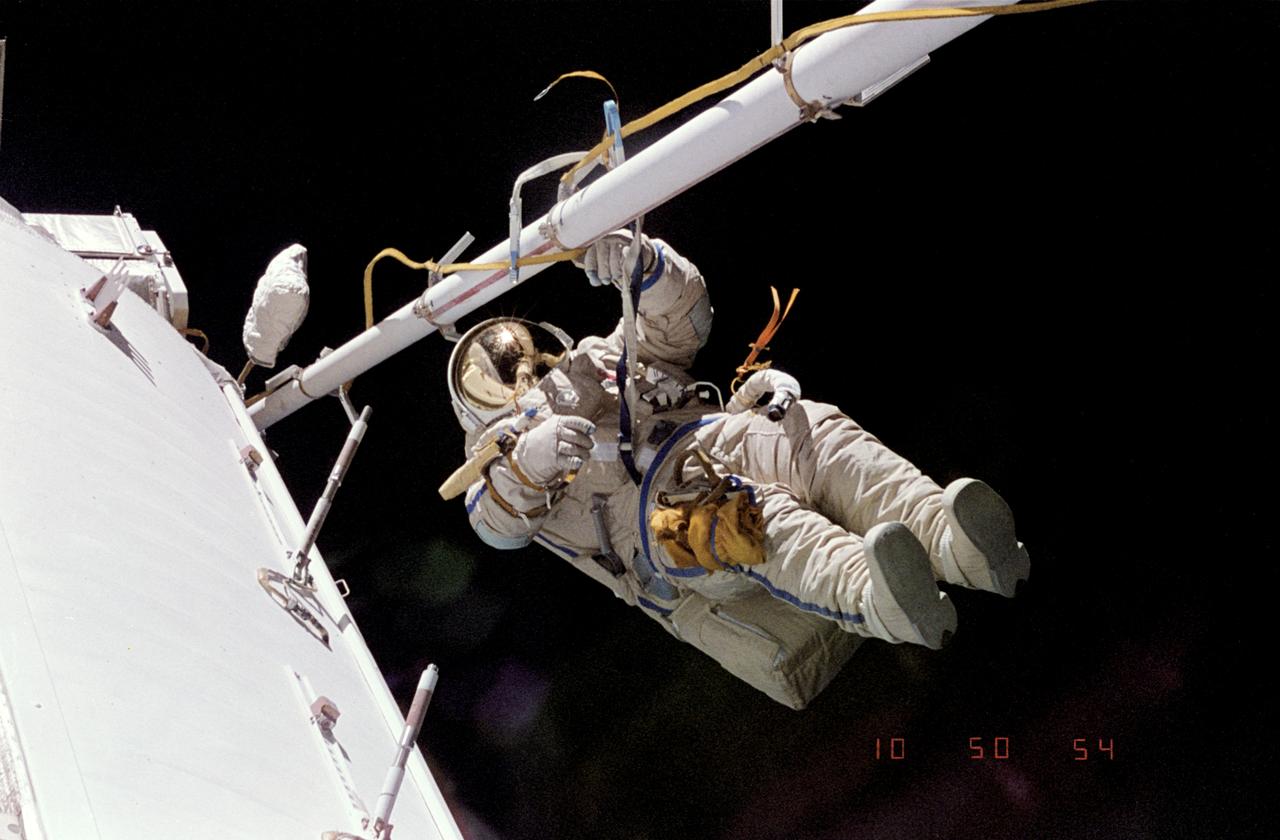
NM18-305-023 (March-July 1995) --- Cosmonaut Gennadiy M. Strekalov, Mir-18 flight engineer, is photographed during one of five space walks conducted by the Mir-18 crew. This is one of many visuals shown during a July 18, 1995, press conference in Houston, Texas.
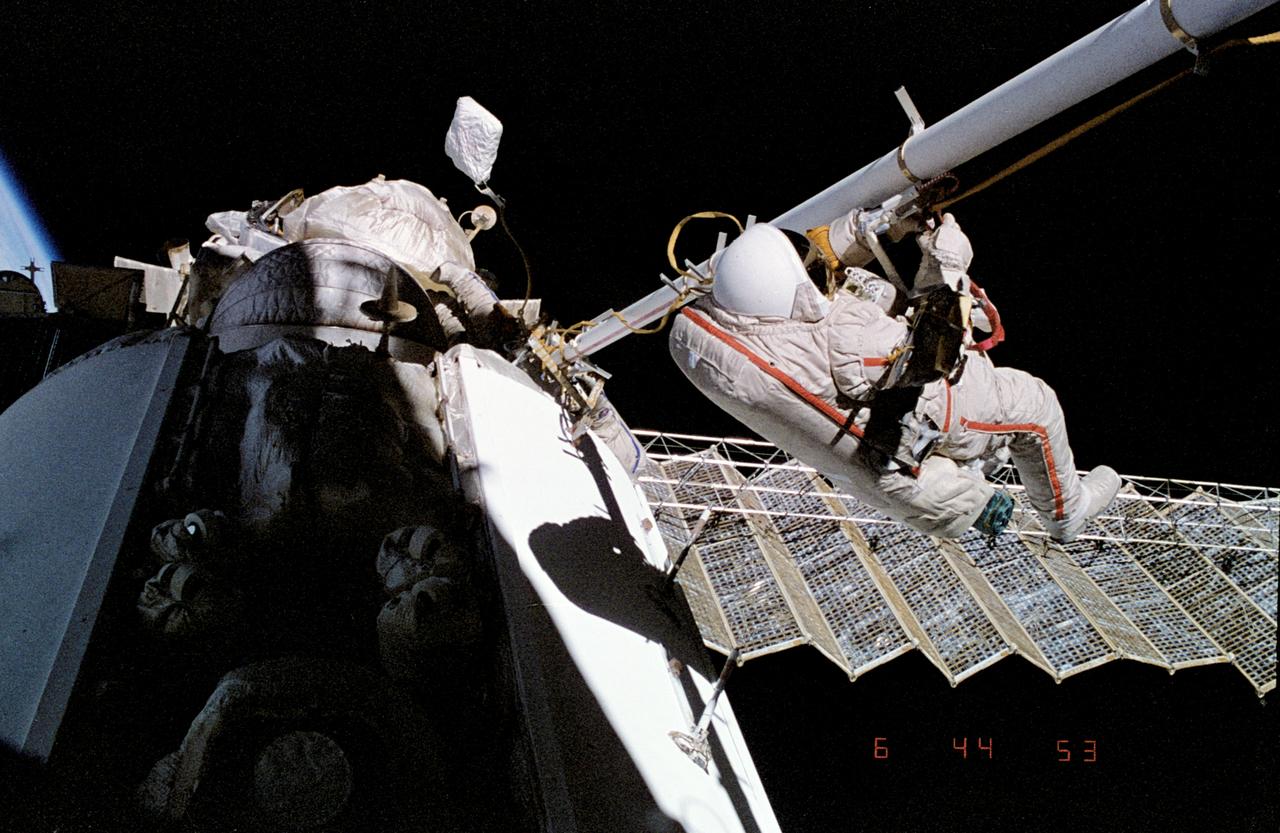
NM18-305-008 (March-July 1995) --- Cosmonaut Vladimir N. Dezhurov, Mir-18 mission commander, is photographed during one of five spacewalks conducted by the Mir-18 crew. Dezhurov is working with solar array panels. This is one of many visuals shown during a July 18 press conference in Houston.

SPACE SHUTTLE STS-71 (MIR 18) SLM-1, FLIGHT FIXATIVE BAGS (FLOWN ONBOARD) QUAIL EGGS

SPACE SHUTTLE STS-71 (MIR 18) SLM-1, FLIGHT FIXATIVE BAGS (FLOWN ONBOARD) QUAIL EGGS
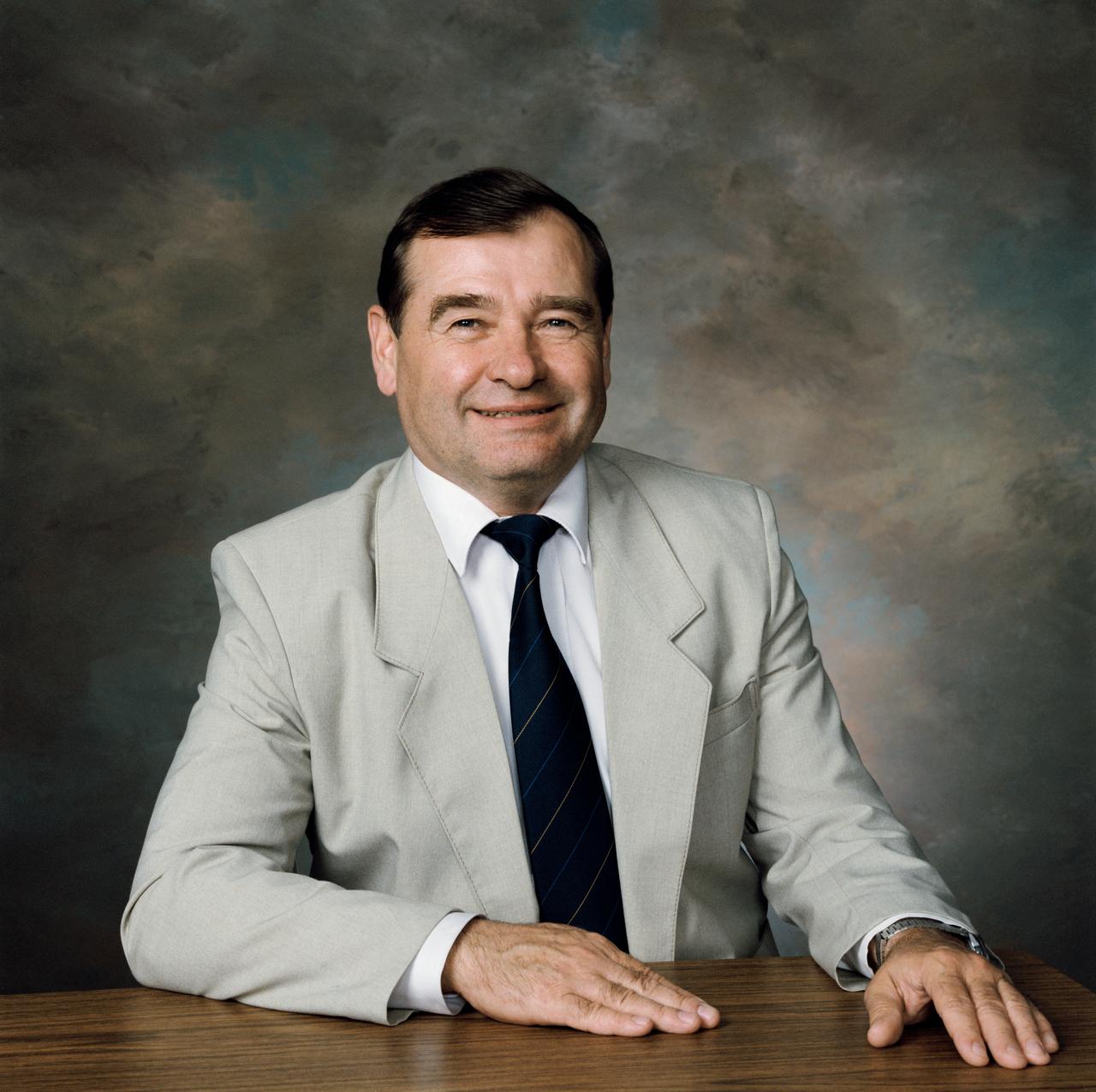
S94-34939 (Nov 1994) --- Gennadity M. Strekalov, Russian cosmonaut Flight Engineer, Mir-18.
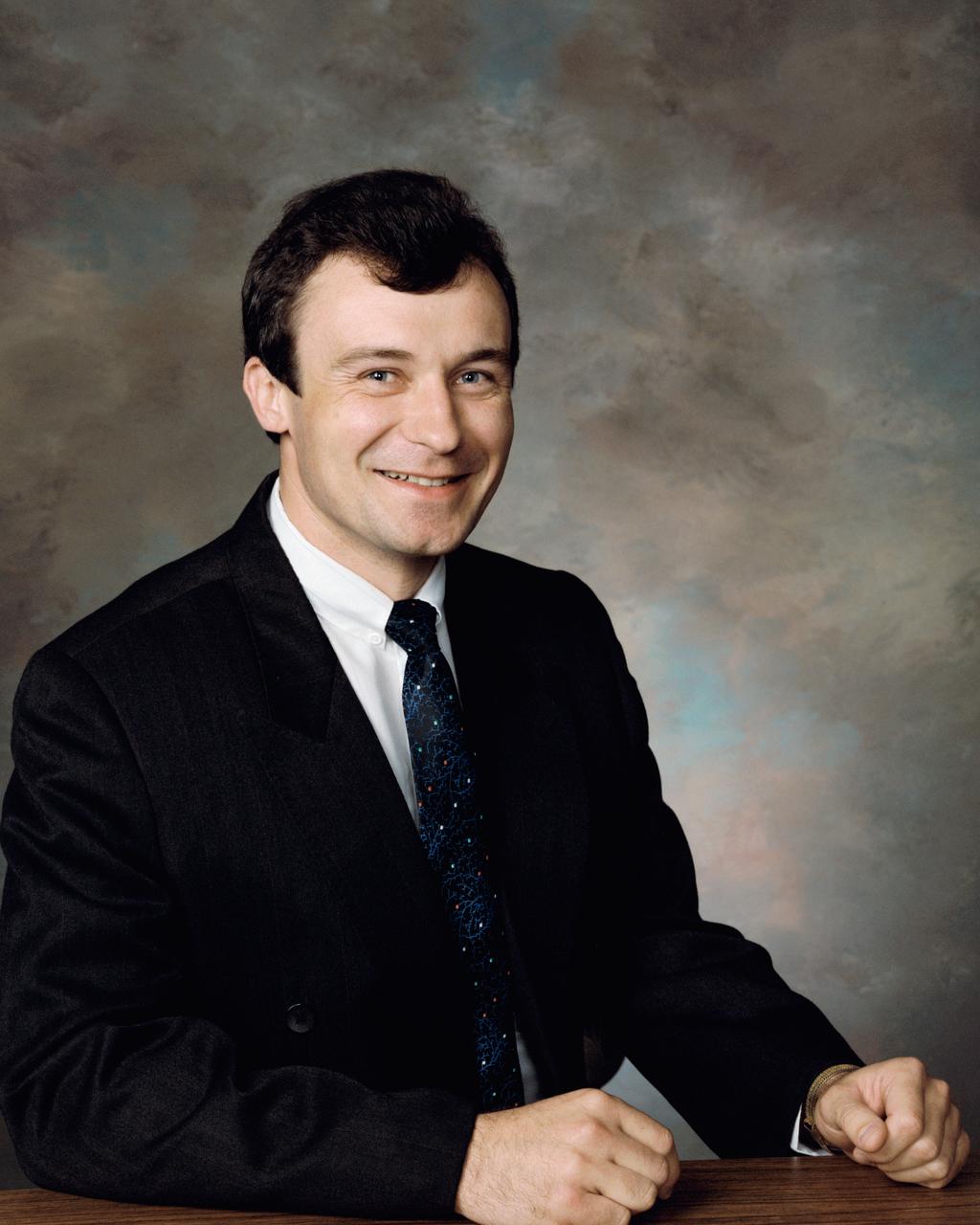
S94-34940 (June 1994) --- Vladimir N. Dezhurov, Russian cosmonaut Commander, Mir-18 EDITOR'S NOTE: Early next year, Dezhurov, along with NASA astronaut Norman E. Thagard and another cosmonaut, will be launched into Earth-orbit to spend three months aboard Russia's Mir space station.
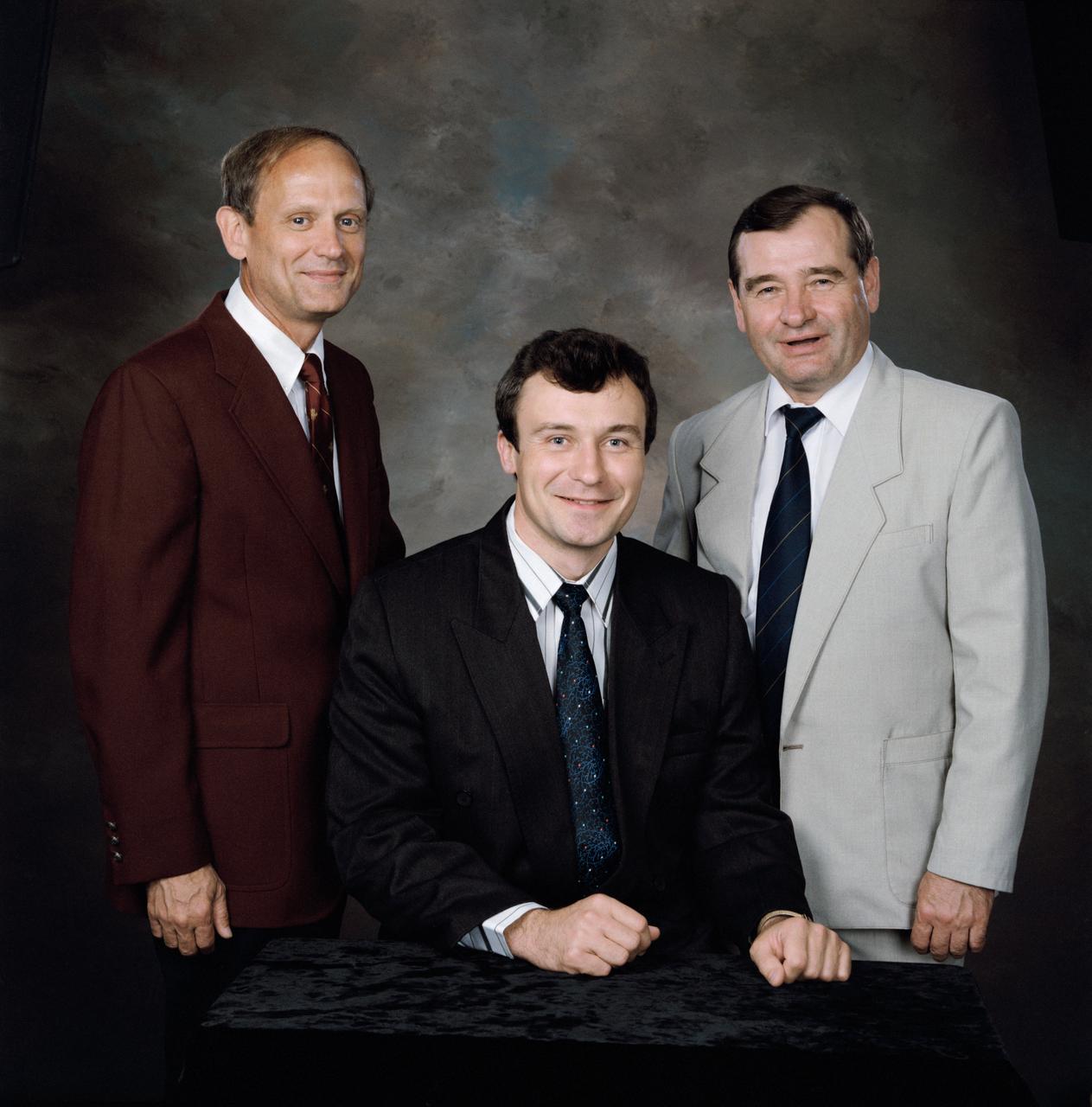
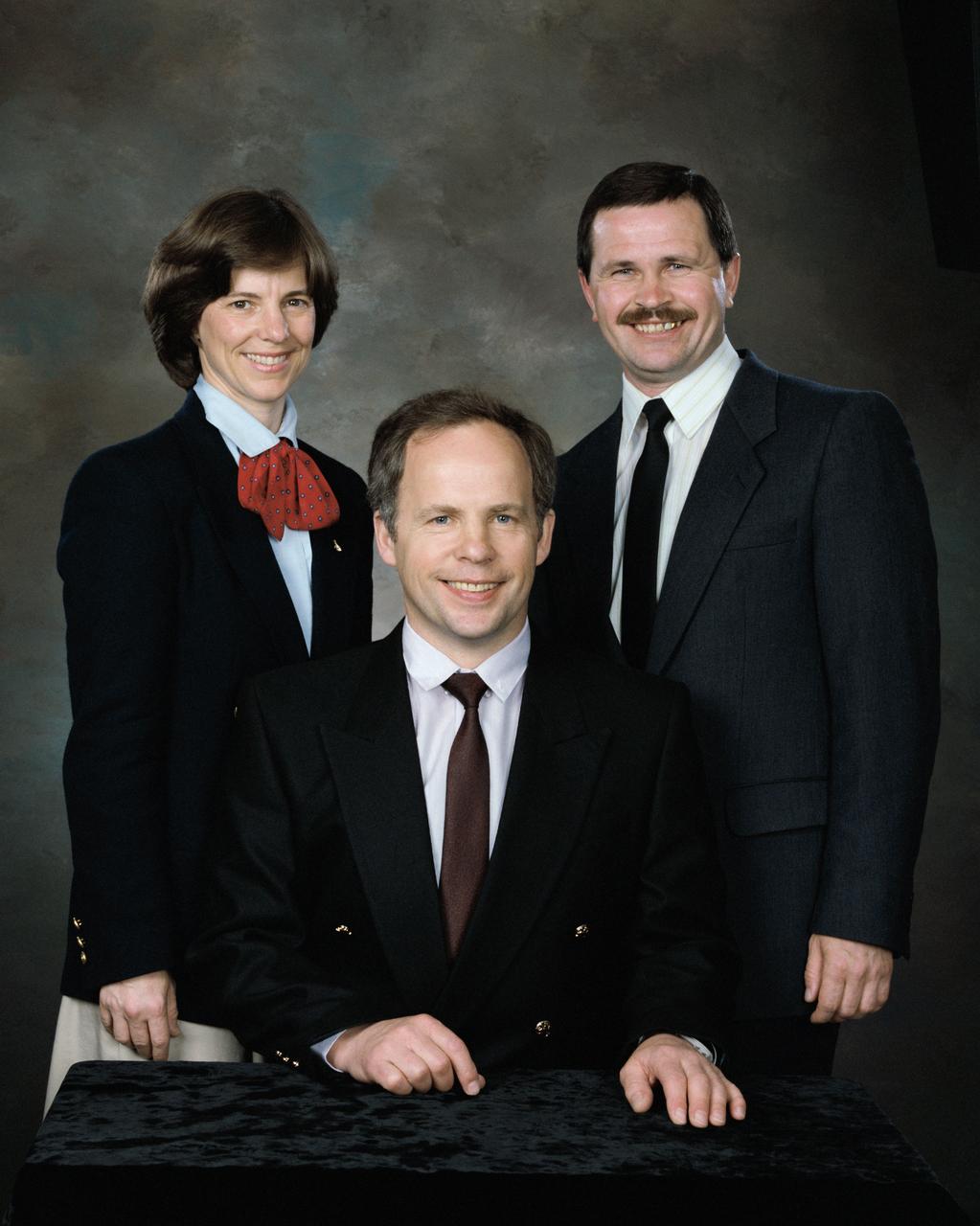
This is a portrait of the Mir 18 crew members in civilian clothes. They are (left to right) Norman E. Thagard, astronaut; commander Vladimir N. Dezhurov, cosmonaut; and Gennadiy M. Strekalov, cosmonaut.
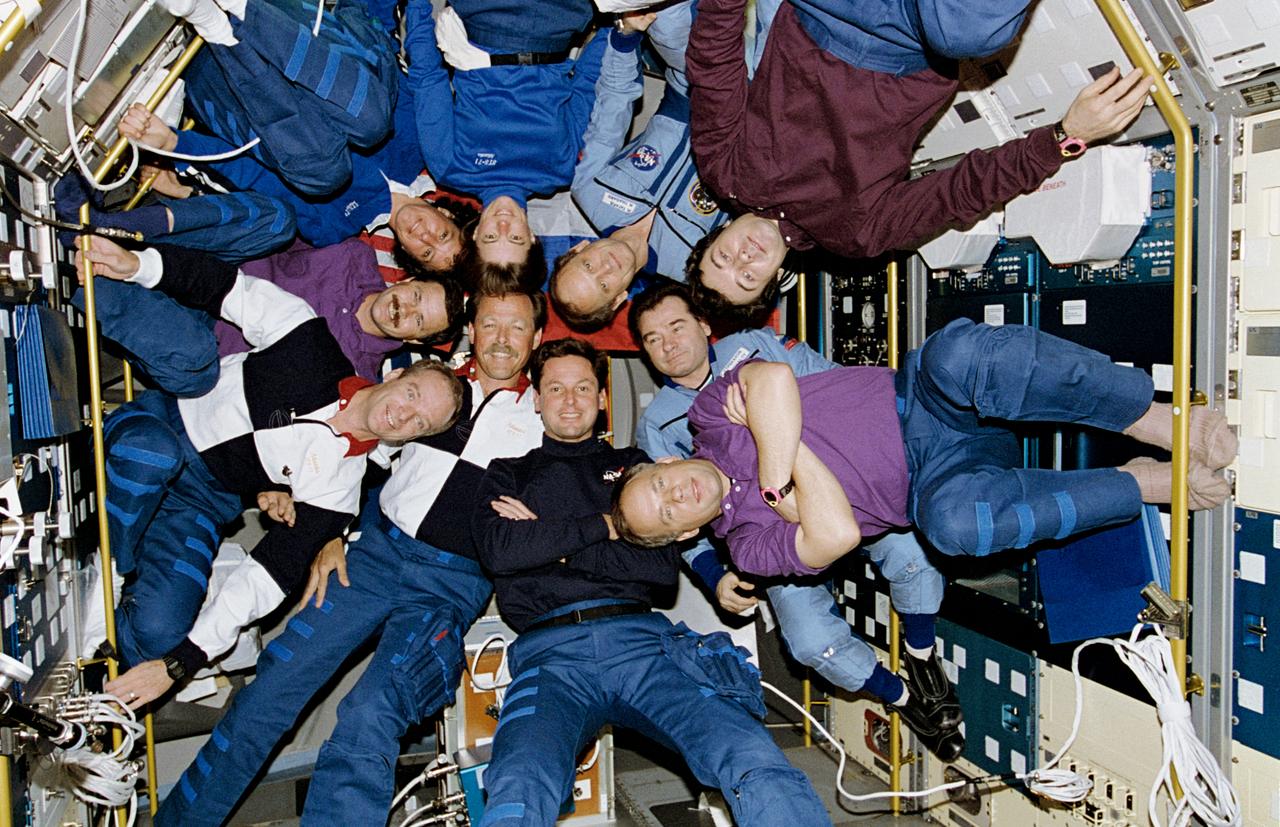
STS071-122-013 (27 June-7 July 1995) --- Inside the space shuttle Atlantis' Spacelab Science Module, the crewmembers of STS-71, Mir-18 and Mir-19 pose for the traditional inflight portrait. For individual identification, hold picture vertically with socked feet of Anatoly Y. Solovyev at bottom center. Clockwise from Solovyev are astronauts Gregory J. Harbaugh, Robert L. Gibson, Charles J. Precourt, Nikolai M. Budarin, Ellen S. Baker, Bonnie J. Dunbar, Norman E. Thagard, and cosmonauts Gennadiy M. Strekalov (at angle) and Vladimir N. Dezhurov.
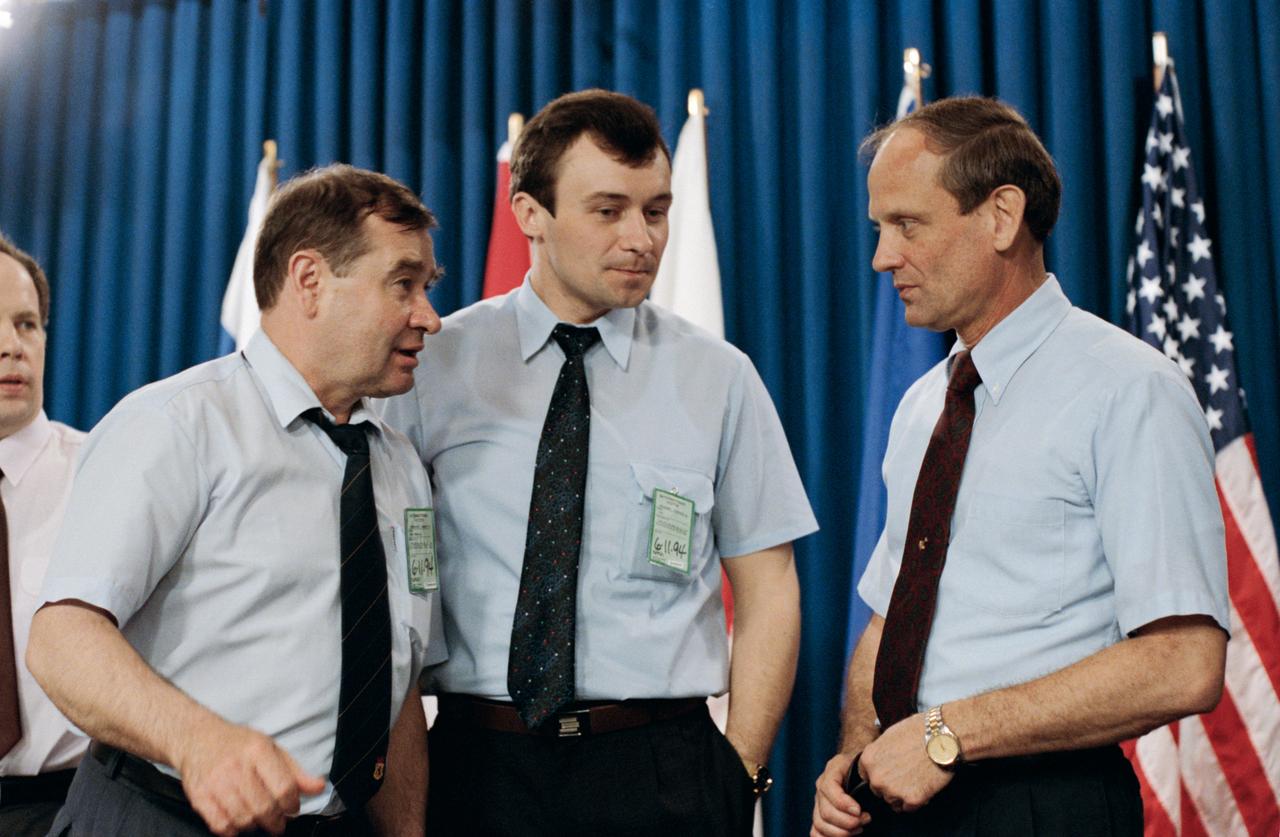
Astronaut Norman E. Thagard, right, chats with two Russian cosmonauts with whom he will be launched into space early next year for a three month mission. Designated Mir 18, the mission aboard the Russian space station will include Mir 18 crew members Gennadiy Strekalov (left) and commander Vladimir Dezhurov. The three appeared at a press conference during a break in medical training at JSC.

STS071-701-064 (29 June 1995) --- Russia's Kvant 2 portion of the Mir Space Station is backdropped against the darkness of space, as photographed from the approaching space shuttle Atlantis on June 29, 1995. Cosmonaut Vladimir N. Dezhurov, Mir-18 mission commander, can be seen aiming a camera through a port hole at center frame. Norman E. Thagard, Mir-18 cosmonaut researcher, aims a camera through a smaller window. Five NASA astronauts and two cosmonauts were onboard Atlantis as it approached the Mir, which has been home for the three-member Mir-18 crew since March of this year.
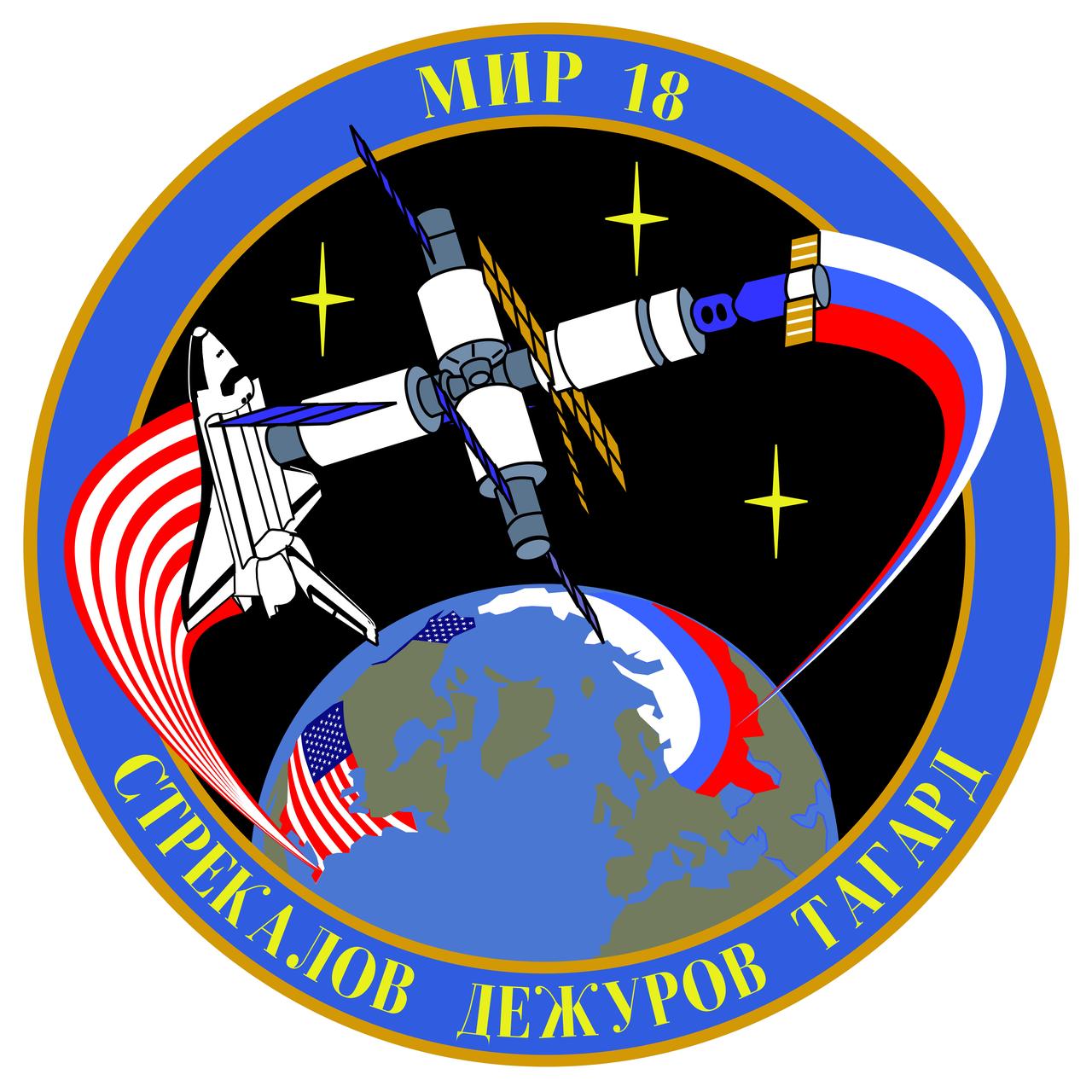
S94-36965 (20 Sept 1994) --- The rising sun signifies the dawn of a new era of human Spaceflight, the first phase of the U.S./Russian space partnership, Shuttle-Mir. Mir is shown in its proposed final on orbit configuration. The Shuttle is shown in a generic tunnel/Spacehab configuration. The Shuttle-Mir combination, docked to acknowledge the union of the two space programs, orbits over an Earth devoid of any definable features or political borders to emphasize Earth as the home planet for all humanity. The individual stars near the Shuttle and the Mir station represent the previous individual accomplishments of Russia's space program and that of the U.S. The binary star is a tribute to the previous U.S.-Russian joint human Spaceflight program, the Apollo-Soyuz Test Project. The flags of the two nations are symbolized by flowing ribbons of the national colors interwoven in space to represent the two nations joint exploration of space. NASA SHUTTLE and PKA MNP are shown in the stylized logo fonts of the two agencies that are conducting this program.

NM18-305-029 (March-July 1995) --- Cosmonaut Gennadiy M. Strekalov, Mir-18 flight engineer, writes on a can lid. During the 115-day stay, crew members often had to improvise for the shortage of paper. This particular set of notes had to do the re-routing of cables on Mir. This visual was one of many that the three Mir-18 crew emembers showed at a July 18 press conference in Houston.

NM18-304-012 (March-July 1995) --- Cosmonaut Vladimir N. Dezhurov, Mir-18 mission commander, is seen in his thermal undergarment prior to donning an EVA suit for one of five space walks conducted during his 115 days aboard Mir. This visual was one of many that the three Mir-18 crew emembers showed at a July 18 press conference in Houston.
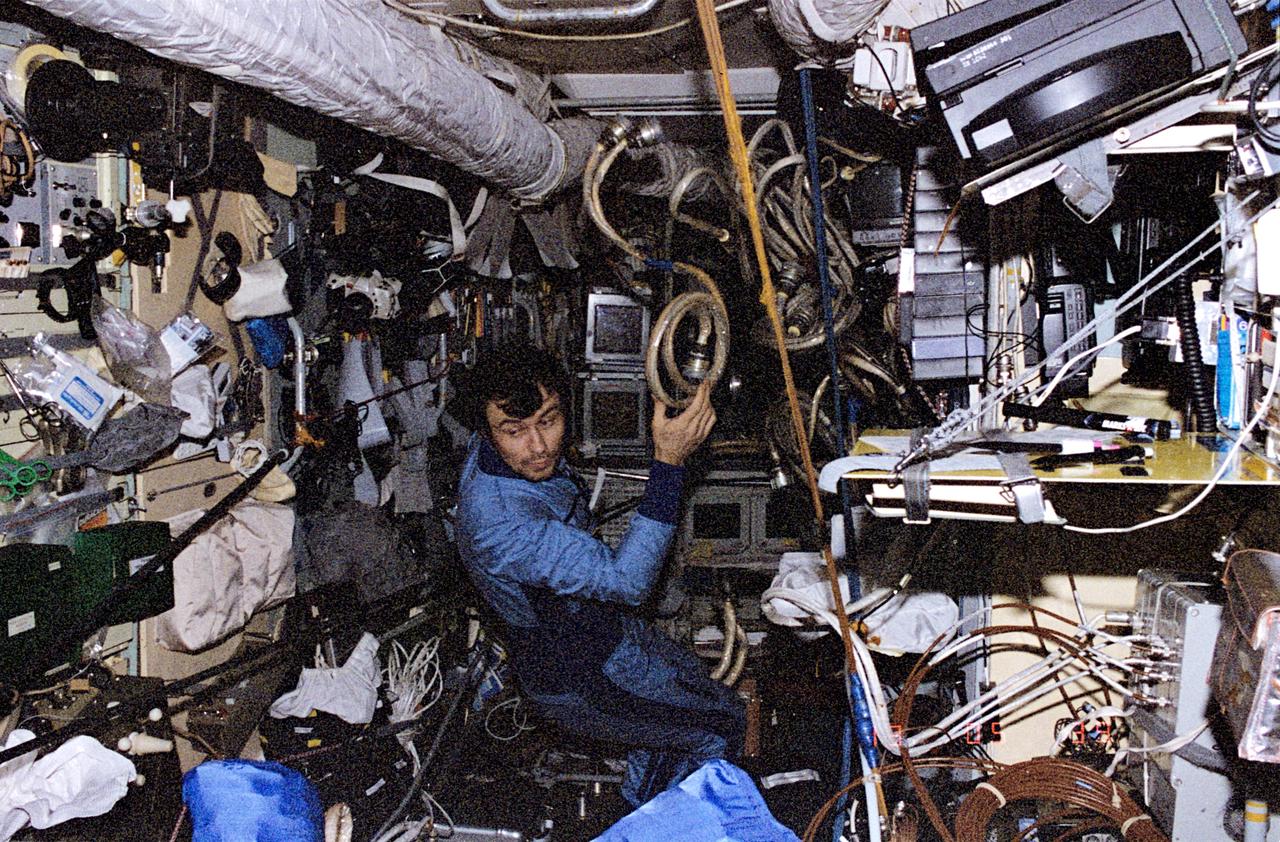
NM18-307-014 (March-July 1995) --- Onboard Mir's Spektr module, cosmonaut Vladimir N. Dezhurov re-routes cables as part of the module's activation process. This visual was one of many shown by the Mir-18 crew at a press conference on July 18 in Houston.
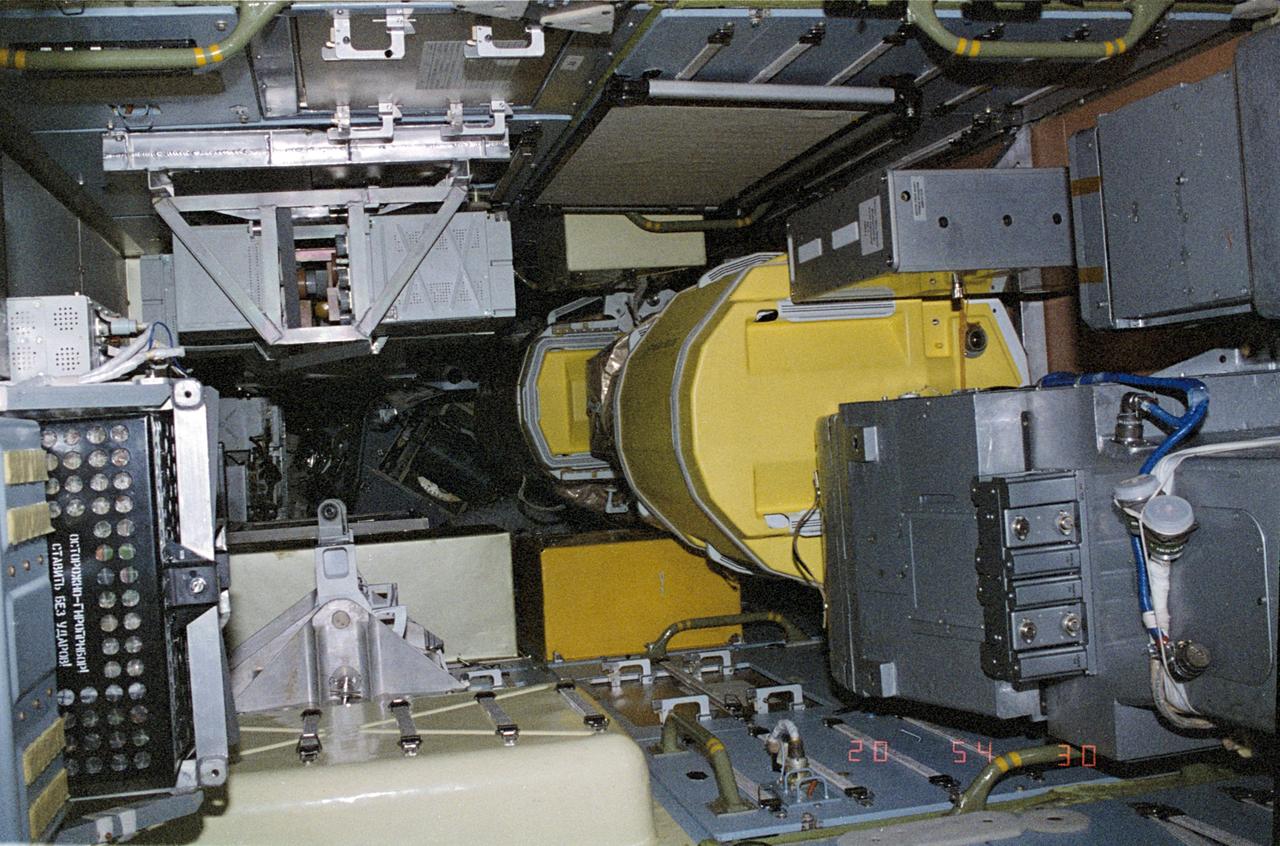
NM18-307-019 (March-July 1995) --- This photograph was taken by one of the Mir-18 crew members shortly after the arrival of the Spektr module. The spacecraft contained yet unopened gear and supplies for the Mir crews. This image was one of many shown at a July 18 press conference in Houston.
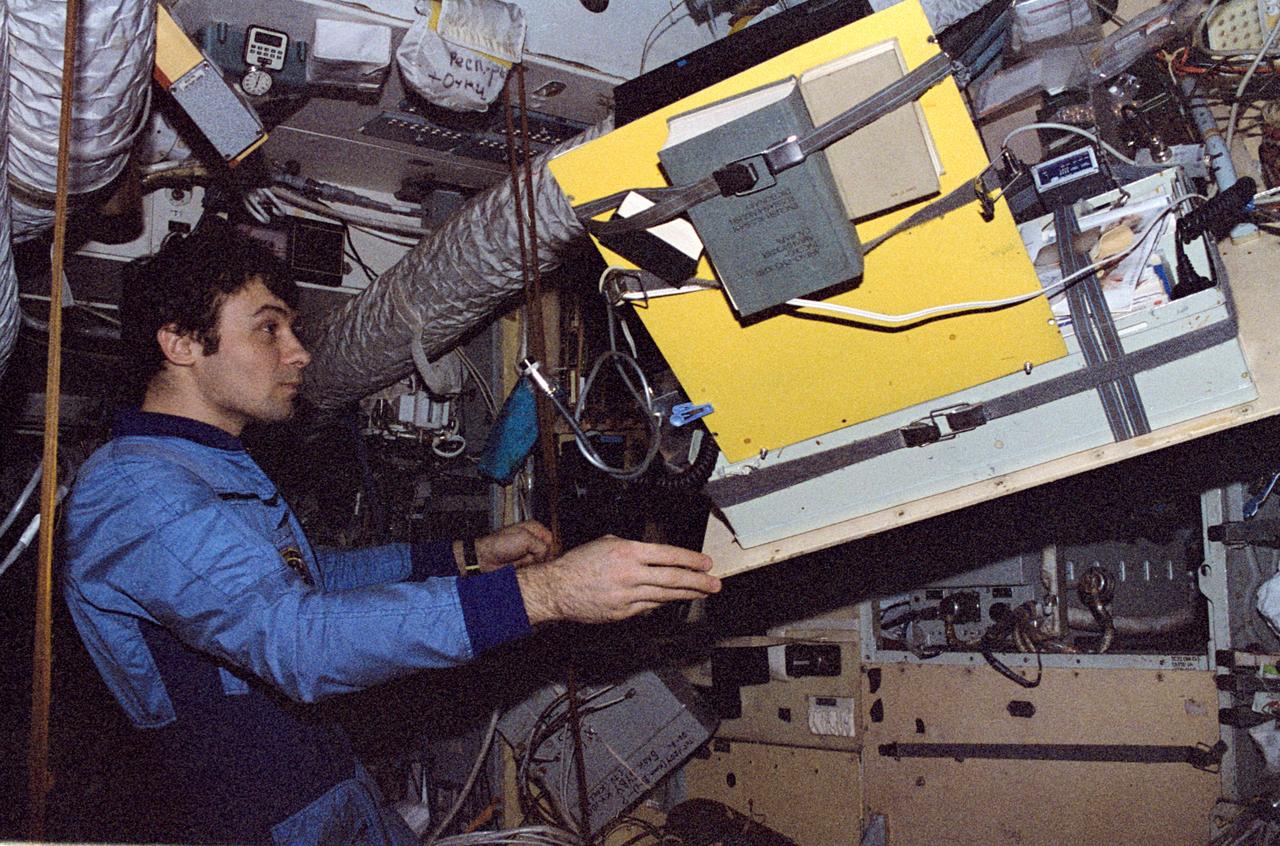
NM18-308-037 (28 June 1995) --- Onboard Mir, cosmonaut Vladimir N. Dezhurov prepares to change batteries at a power supply station as part of the preparation for the next day's scheduled docking with the Space Shuttle Atlantis. This visual was one of many shown by the Mir-18 crew at a press conference on July 18 in Houston.
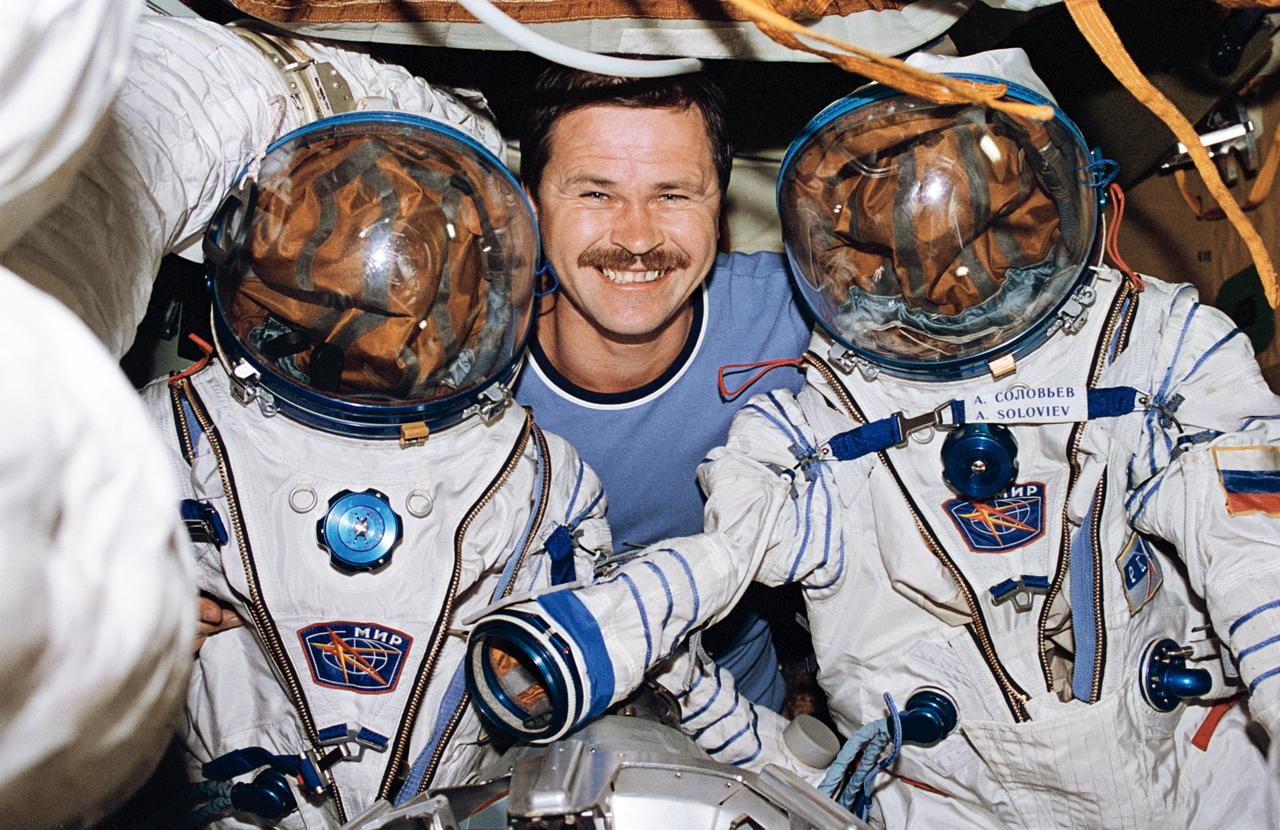
STS071-104-029 (27 June-7 July 1995) --- Cosmonaut Nikolai M. Budarin, Mir-19 flight engineer, is pictured on Russia's Mir Space Station with two Russian space suits. These are for Intravehicular (IVA) wear and are not the suits designed for Extravehicular Activity (EVA). Budarin remained aboard Mir with cosmonaut Anatoly Y. Solovyev, Mir-19 commander, when the three Mir-18 crewmembers and the five STS-71 astronauts later undocked the space shuttle Atlantis from Mir and returned to Earth.
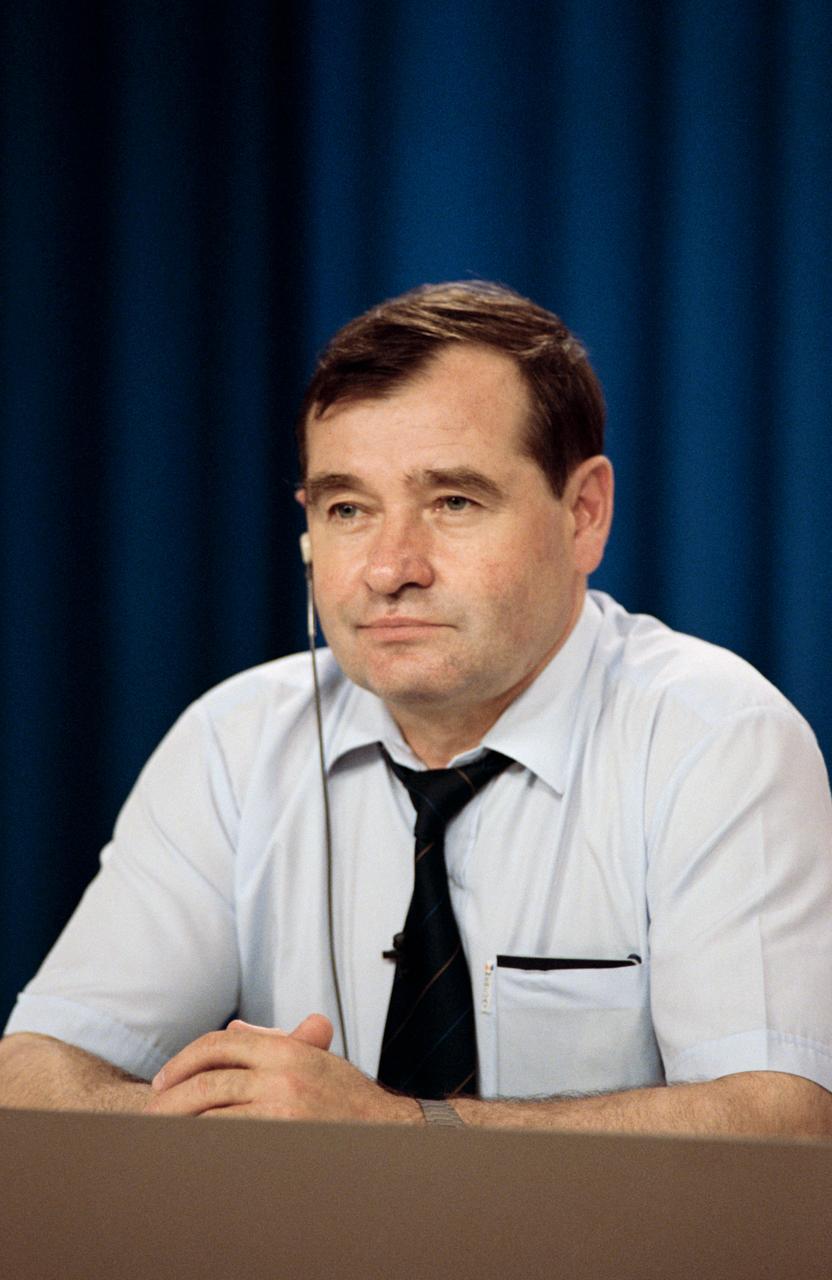
Cosmonaut Gennadiy M. Strekalov, flight engineer for the Mir-18 mission, listens to a question from a news media representative. Crew members for two of the joint Space Shuttle/Mir missions met the press at JSC.

This image of the Space Shuttle Orbiter Atlantis, with cargo bay doors open showing Spacelab Module for the Spacelab Life Science and the docking port, was photographed from the Russian Mir Space Station during STS-71 mission. The STS-71 mission performed the first docking with the Russian Mir Space Station to exchange crews. The Mir 19 crew, cosmonauts Anatoly Solovyev and Nikolai Budarin, replaced the Mir 18 crew, cosmonauts Valdamir Dezhurov and Gernady Strekalov, and astronaut Norman Thagard. Astronaut Thagard was launched aboard a Soyuz spacecraft in March 1995 for a three-month stay on the Mir Space Station as part of the Mir 18 crew. The Orbiter Atlantis was modified to carry a docking system compatible with the Mir Space Station. The Orbiter also carried a Spacelab module for the Spacelab Life Science mission in the payload bay in which various life science experiments and data collection took place throughout the 10-day mission.
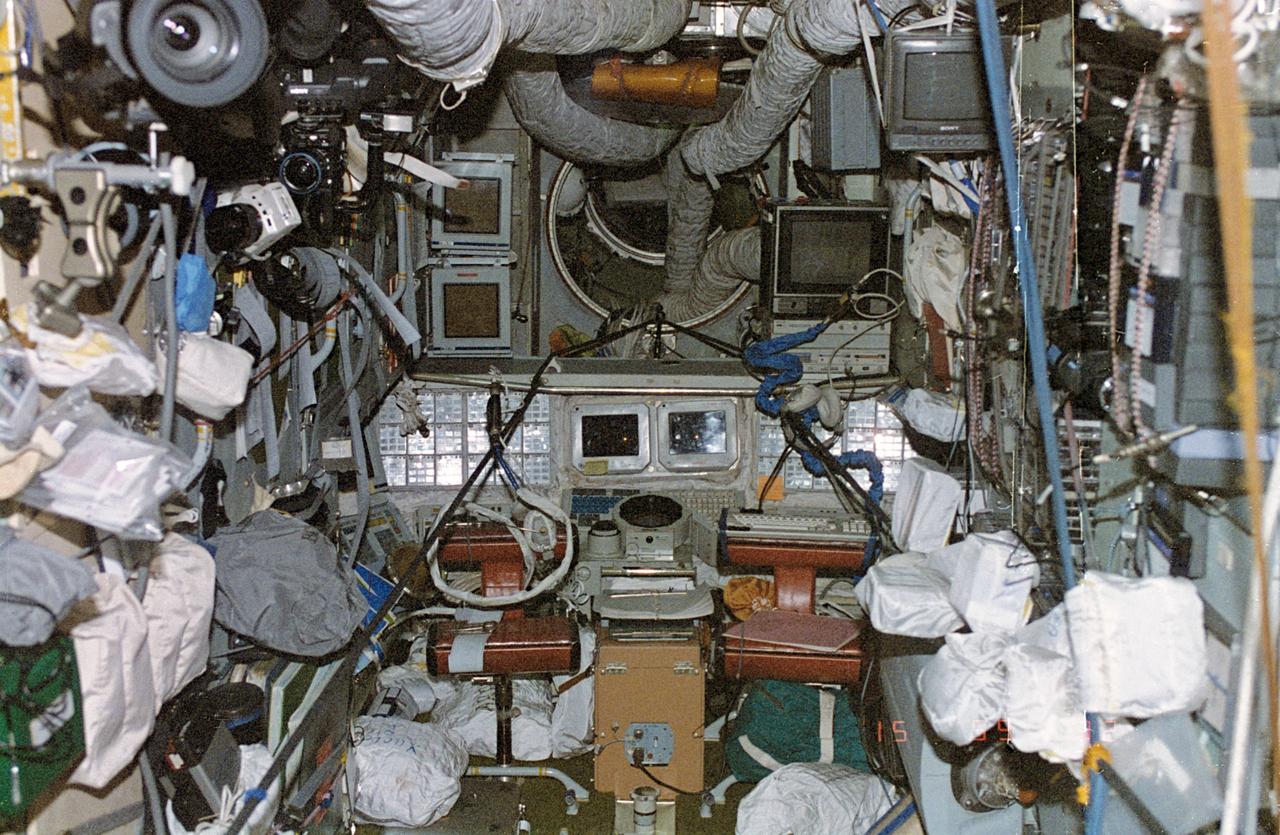
NM18-302-038 (28 June 1995) --- Astronaut Norman E. Thagard, Mir-18 cosmonaut researcher, took this picture aboard Mir on the eve of the targeted arrival day of Atlantis. Thagard told a July 18 press conference audience in Houston that he worked to clean the area prior to the Mir-19 crew and the STS-71 crew arrival and that his showing of this slide represented the first time the crew would have seen the area "in this condition."
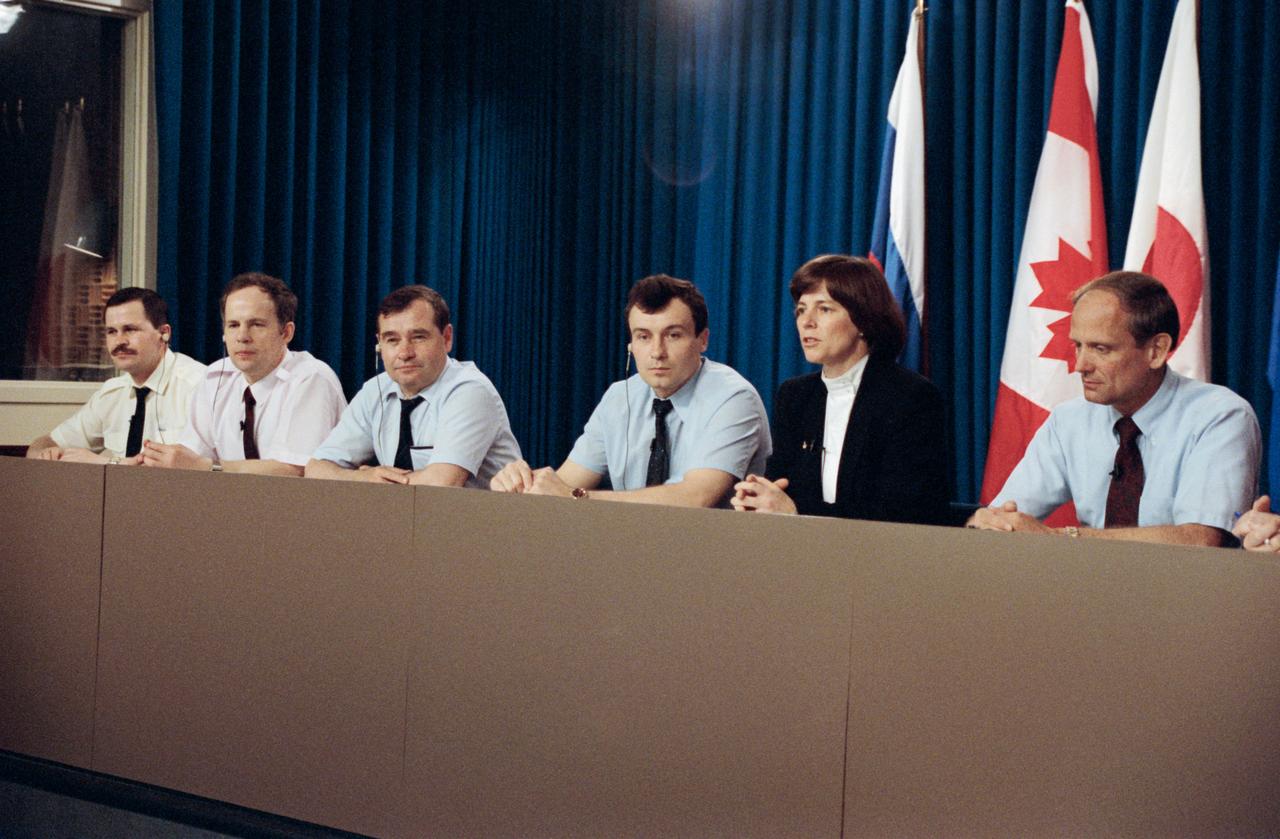
S94-34094 (16 June 1994) --- Crewmembers for the joint Space Shuttle/Mir missions meet the press at the Johnson Space Center (JSC). On the dais are, left to right, cosmonauts Nikolai M. Budarin, Anatoly Y. Solovyov, Gennady M. Strekalov and Vladimir N. Dezhurov, and astronauts Bonnie J. Dunbar and Norman E. Thagard. In a precedent-setting flight, Thagard will be launched with Dezhurov and Strekalov to Mir early next year for a three month mission, designated as Mir 18, on Russia's space station. Then in late May, as the assignment of STS-71, the space shuttle Atlantis will rendezvous with Mir to pick up the Mir 18 crew and transfer cosmonauts Solovyov and Budarin to the station for the Mir 19 mission. STS-71 mission specialist Dunbar is training as Thagard's backup.
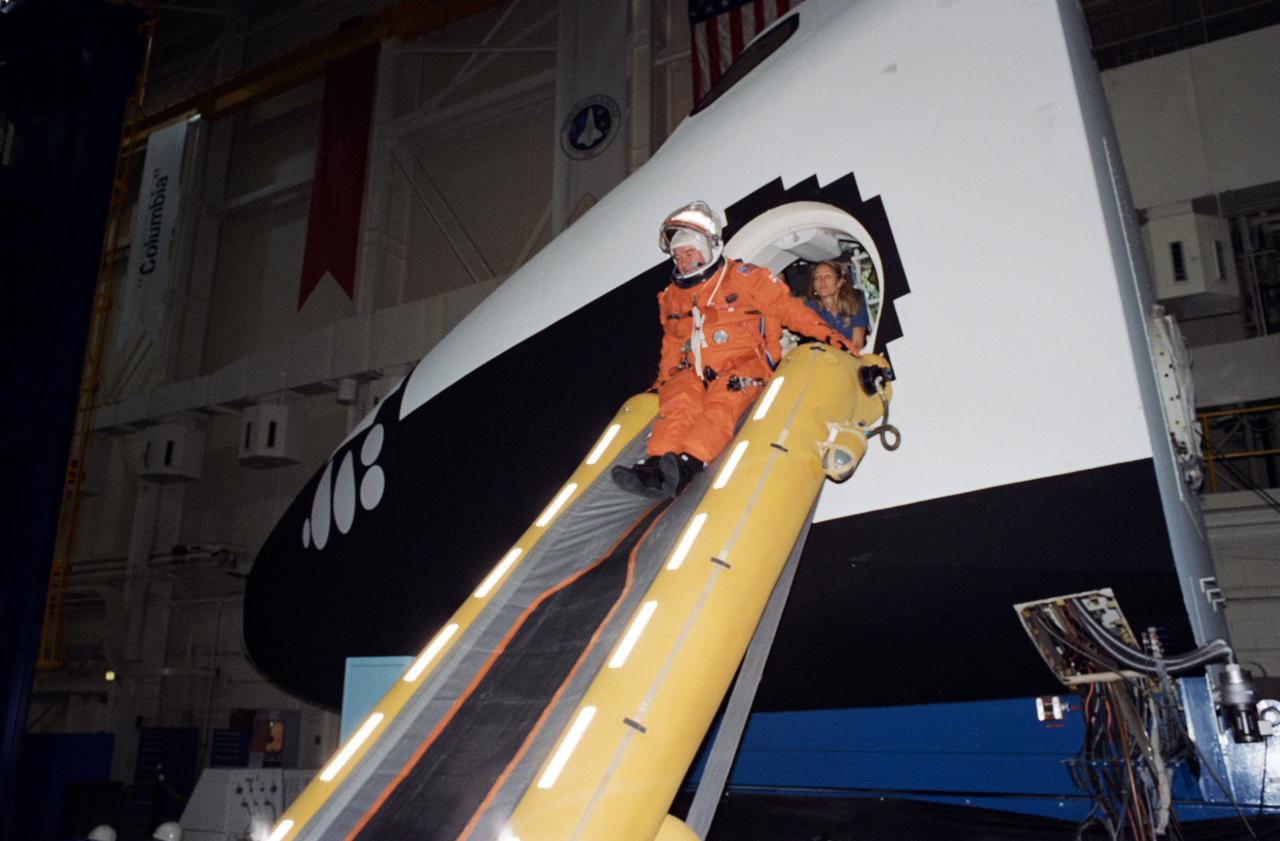
S94-47083 (14 Oct 1994) --- Cosmonaut Gennadiy M. Strekalov, Mir-18 flight engineer, who will return via the Space Shuttle Atlantis from a three-month mission aboard Russia's Mir Space Station, joins the STS-71 crew members during emergency egress training. The training took place in the systems integration facility at the Johnson Space Center (JSC). In a precedent-setting flight, NASA astronaut Norman E. Thagard will be launched with Vladimir N. Dezhurov and Strekalov to the Mir Space Station early next year for a three month mission. Then in late May, as the assignment of STS-71, the Space Shuttle Atlantis will rendezvous with Mir to pick up the Mir 18 crew and transfer two other cosmonauts to the station for the Mir 19 mission.
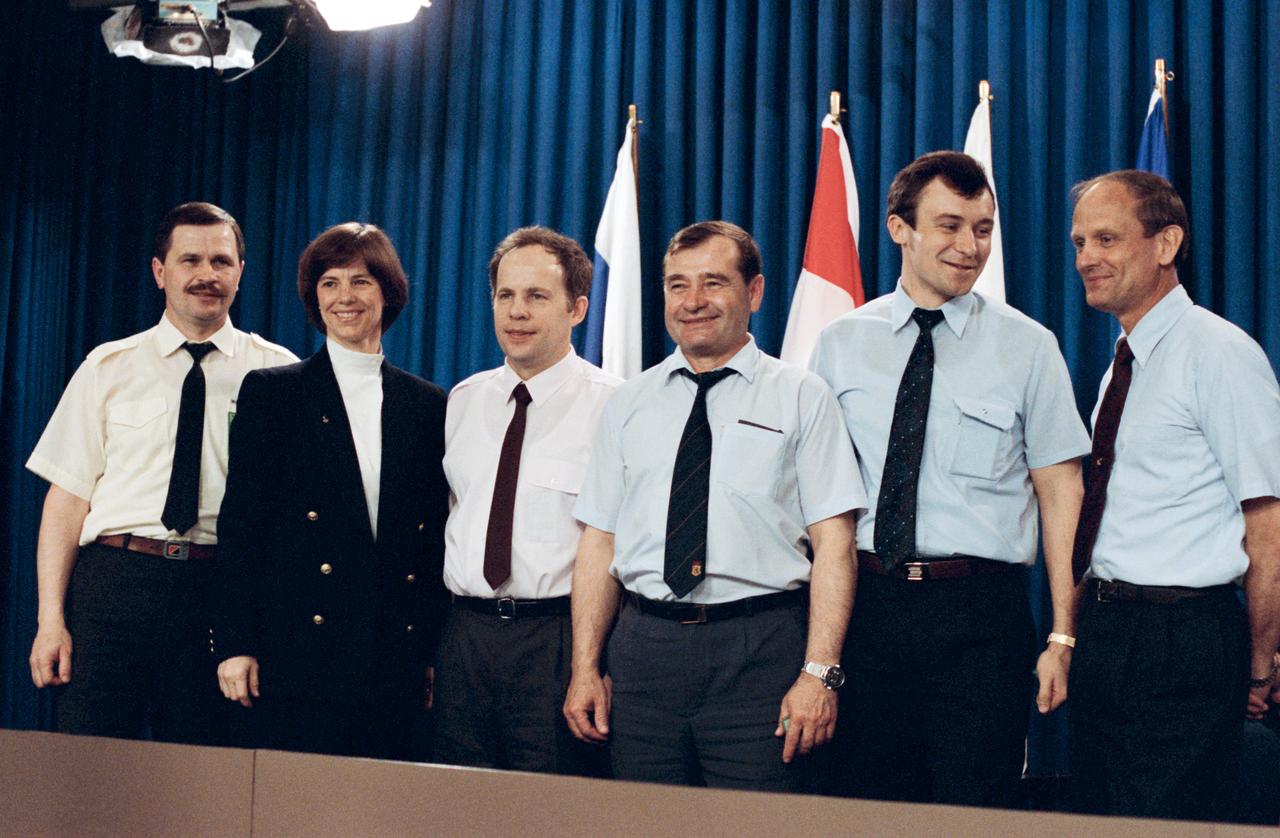
S94-34099 (16 June 1994) --- Crewmembers for two of the joint Space Shuttle/Mir missions pose for photographs after fielding questions from the press at Johnson Space Center (JSC). Left to right are cosmonaut Nikolai M. Budarin, astronaut Bonnie J. Dunbar, cosmonauts Anatoliy Y. Solovyov, Gennadiy M. Strekalov and Vladimir N. Dezhurov; and astronaut Norman E. Thagard. In a precedent-setting flight, Thagard will be launched with Dezhurov and Strekalov to Russia?s Mir Space Station early next year for a three-month mission, designated as Mir 18. Then in late May, as the assignment of STS-71, the Space Shuttle Atlantis will rendezvous with Mir to pick up the Mir 18 crew and transfer cosmonauts Solovyov and Budarin to the station for the Mir 19 mission. STS-71 mission specialist Dunbar is training as Thagard?s backup.
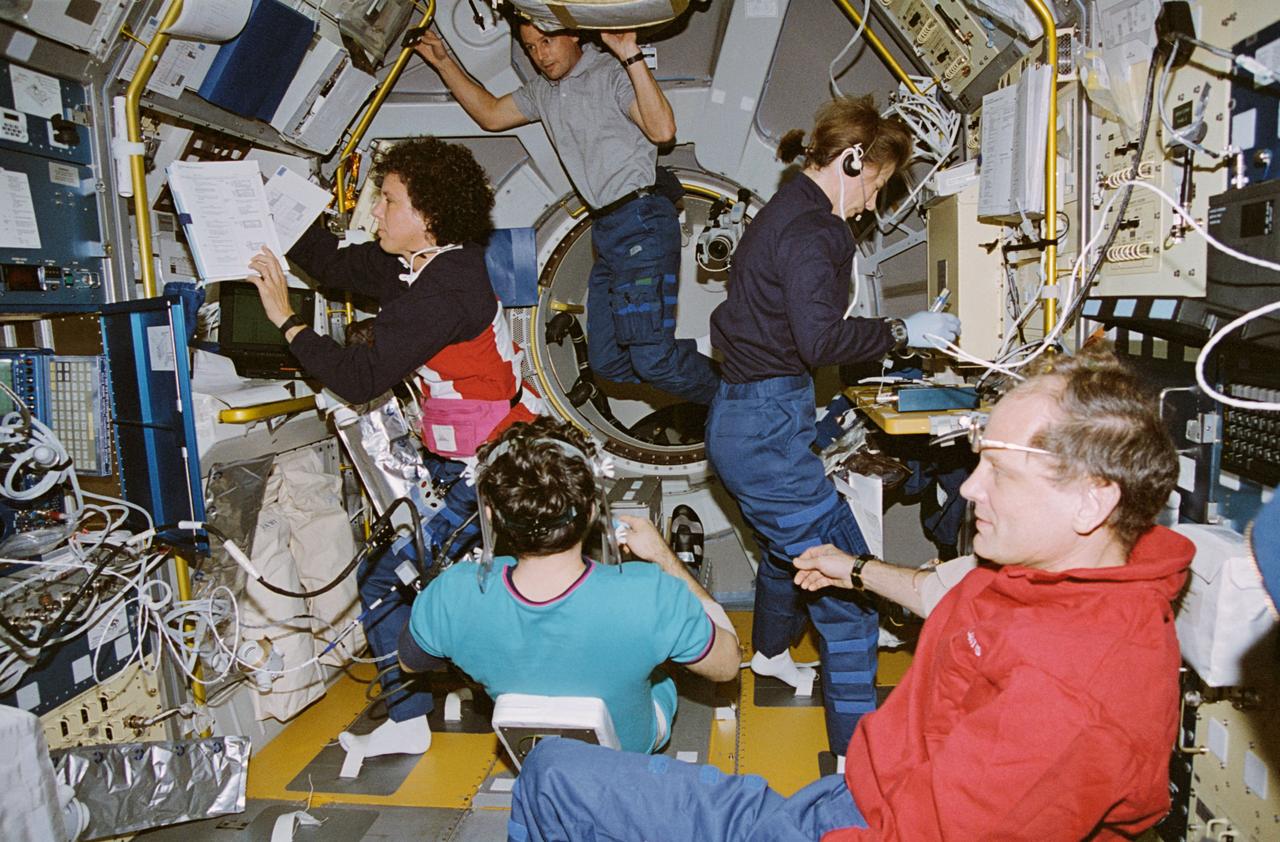
STS071-102-027 (27 June - 7 July 1995) --- Onboard the Spacelab Science Module in the Space Shuttle Atlantis' cargo bay, four astronauts and a cosmonaut team up to collect data from Mir-18 crew members who have been aboard Russia's Mir Space Station for four months. Astronauts Ellen S. Baker (left), Gregory J. Harbaugh (top center) and Bonnie J. Dunbar, STS-71 mission specialists, are joined by astronaut Norman E. Thagard (right) and Vladimir N. Dezhurov (on bicycle ergometer) in the module. Dezhurov was Mir-18 commander and Thagard served as a cosmonaut researcher on the Mir-18 mission. The three STS-71 mission specialists lifted off aboard Atlantis on June 27, 1995, to participate in the historic link-up.
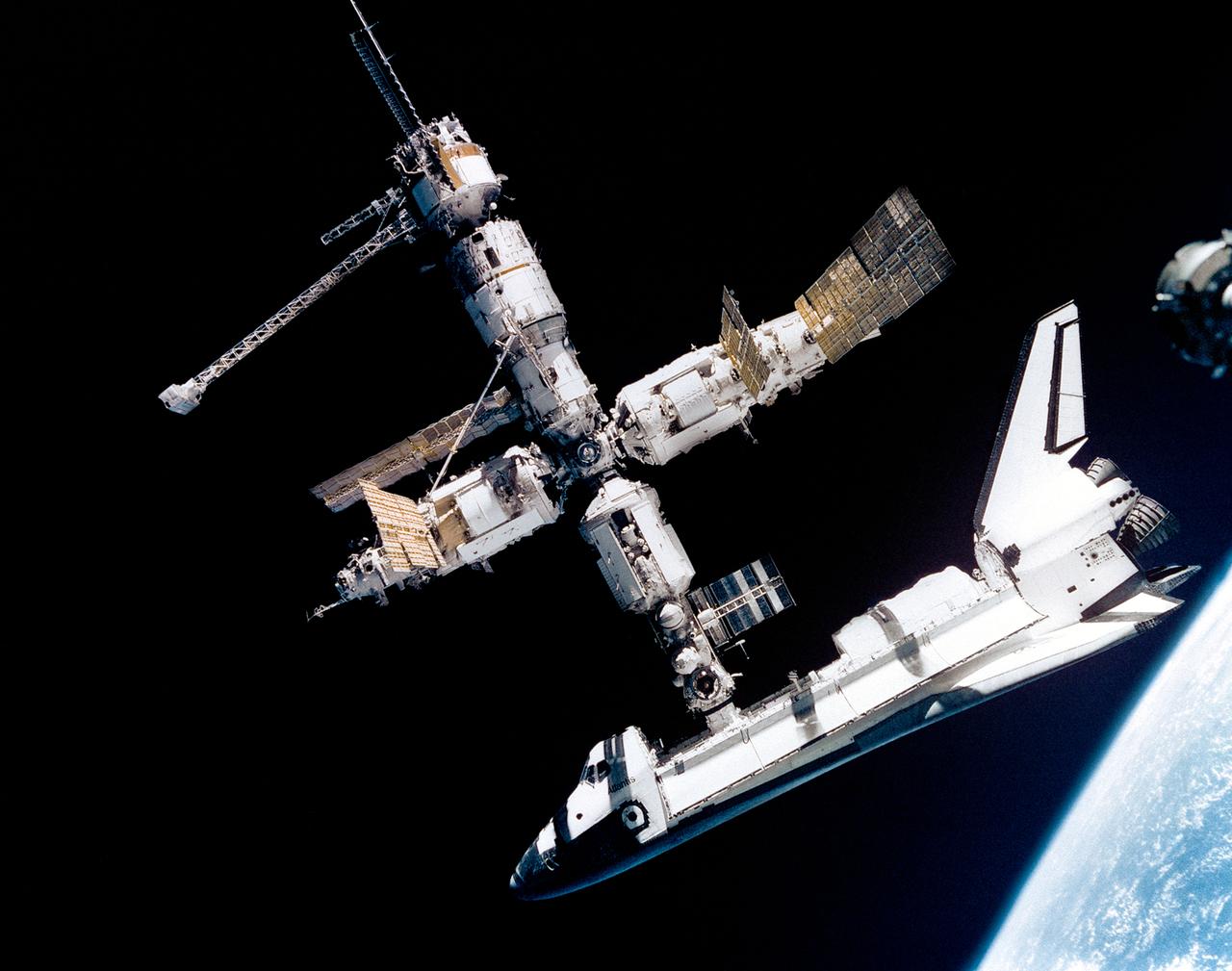
STS071-S-072 (4 July 1995) --- This view of the space shuttle Atlantis still connected to Russia's Mir Space Station was photographed by the Mir-19 crew on July 4, 1995. Cosmonauts Anatoliy Y. Solovyev and Nikolai M. Budarin, Mir-19 commander and flight engineer, respectively, temporarily undocked the Soyuz spacecraft from the cluster of Mir elements to perform a brief fly-around. They took pictures while the STS-71 crew, with Mir-18's three crew members aboard, undocked Atlantis for the completion of this leg of the joint activities. Solovyev and Budarin had been taxied to the Mir Space Station by the STS-71 ascent trip of Atlantis.
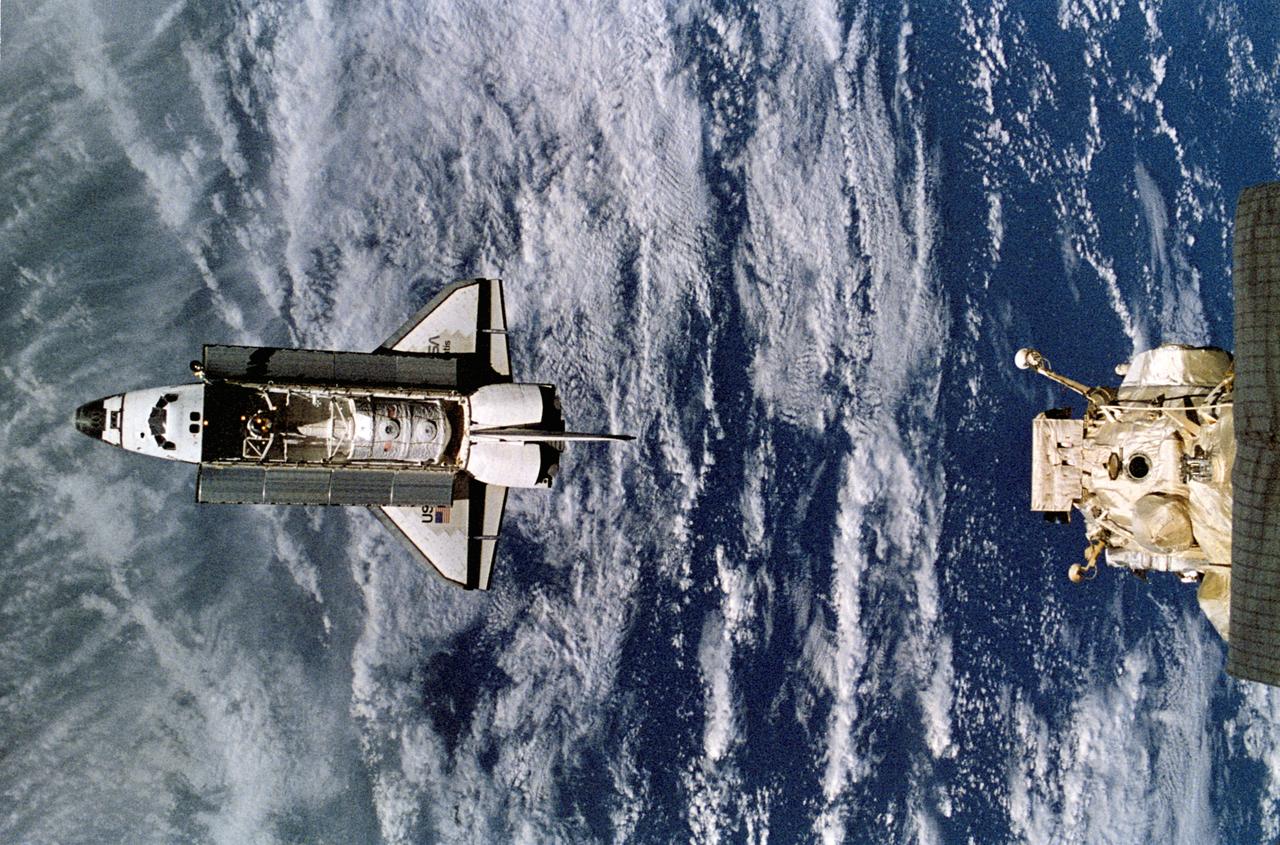
NM18-309-026 (28 June 1995) --- The Space Shuttle Atlantis approaches the docking node on the Kristall module of Russia's Mir Space Station. The photograph was taken by one of the Mir-18 crew members aboard Mir prior to rendezvous and docking of the two spacecraft. The Spacelab Science Module and the tunnel connecting it to the crew cabin, as well as the added mechanism for interface with the Mir's docking system can be easily seen.
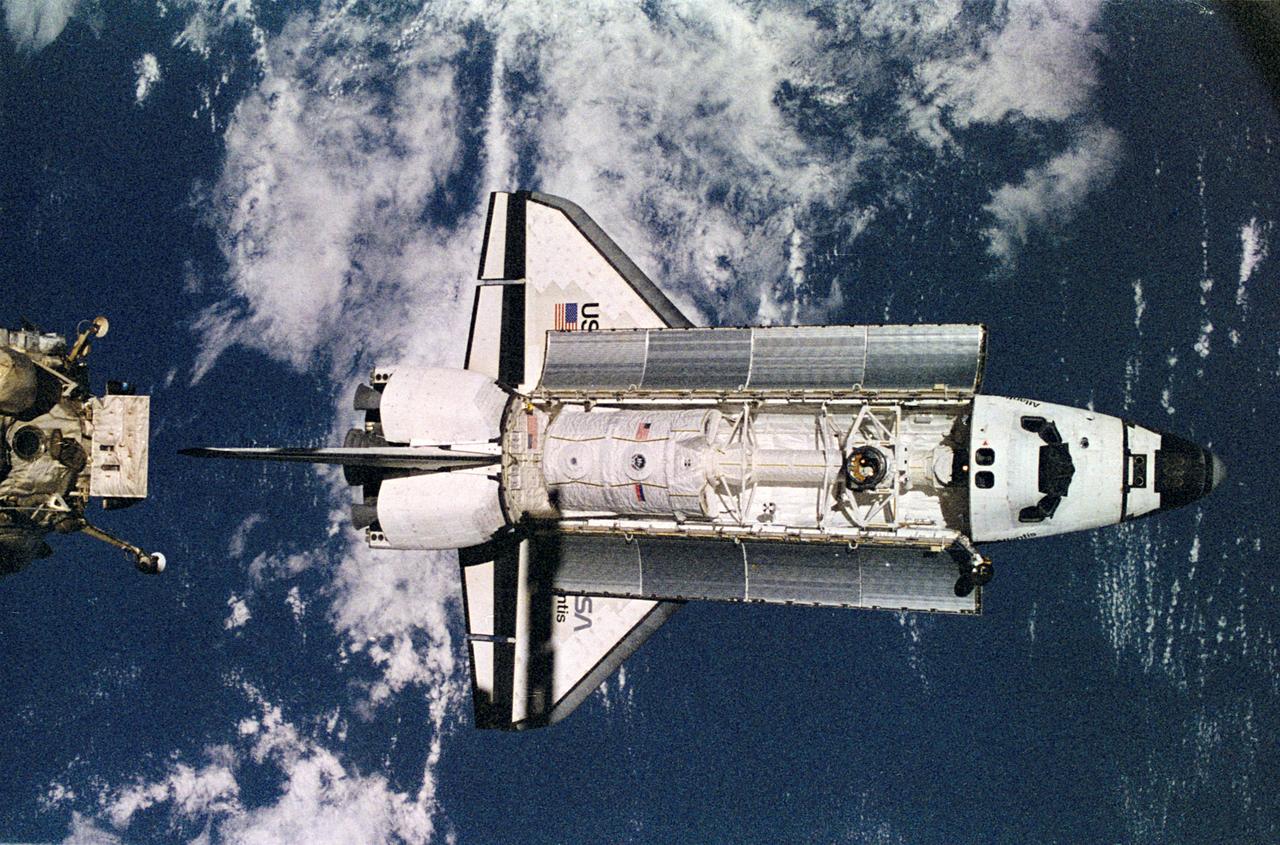
NM18-309-028 (28 June 1995) --- The Space Shuttle Atlantis approaches the docking node on the Kristall module of Russia's Mir Space Station. The photograph was taken by one of the Mir-18 crew members aboard Mir prior to docking of the two spacecraft. The Spacelab science module and the tunnel connecting it to the crew cabin, as well as the added mechanism for interface with the Mir's docking system can be easily seen.
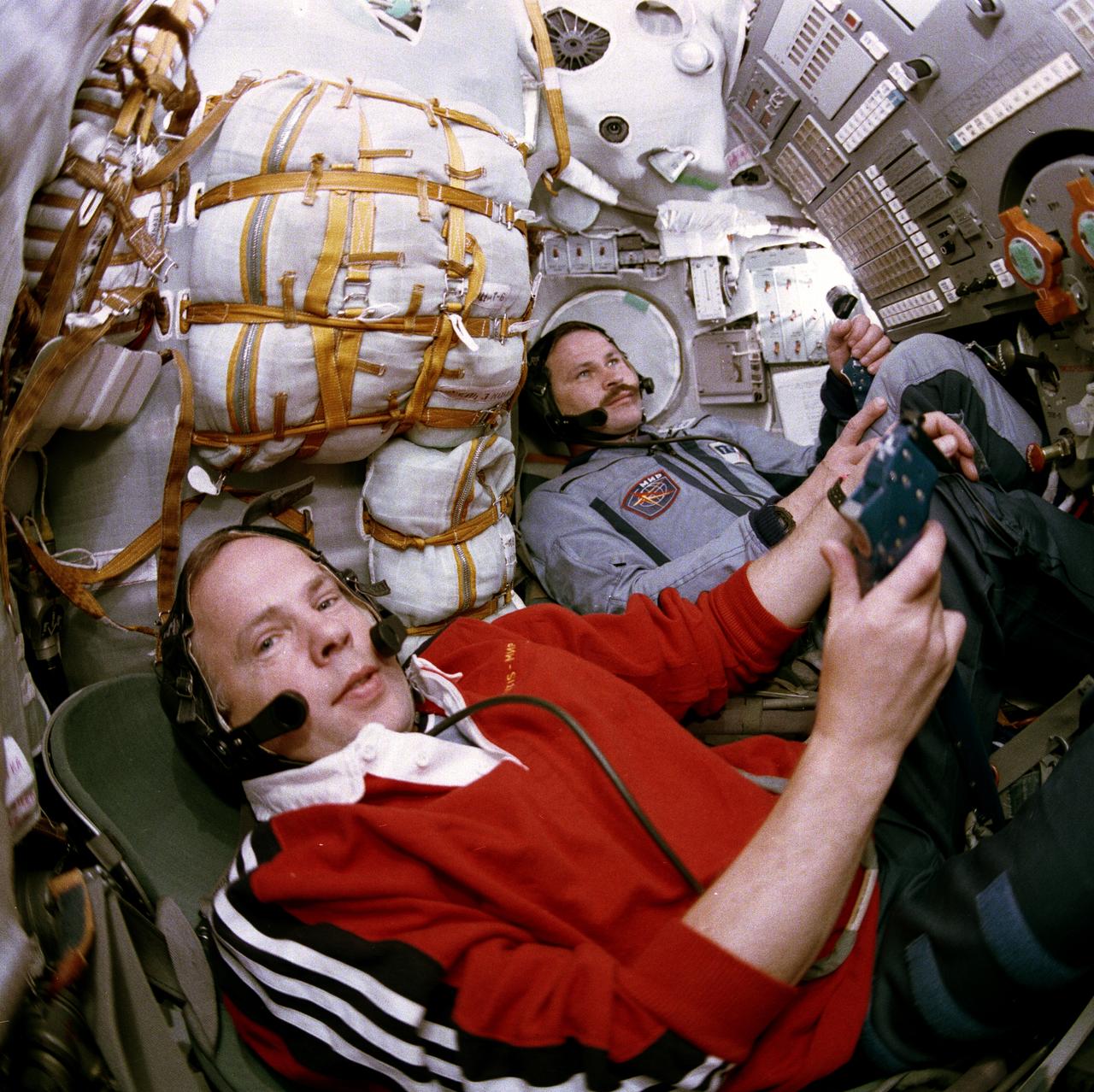
STS071-763-007 (27 June-7 July 1995) --- Onboard the docked Soyuz spacecraft, cosmonauts Anatoly Y. Solovyev (left) and Nikolai M. Budarin, Mir 19 commander and flight engineer, respectively, conduct a checkout of communications systems. The two represent the new in a change of guard aboard Russia's Mir Space Station, as Mir-18 astronaut Norman E. Thagard and two Mir-18 cosmonauts prepare to come back to Earth with the STS-71 crew aboard the space shuttle Atlantis. Later in the joint mission, Solovyev and Budarin backed the Soyuz spacecraft away from the Mir/Atlantis tandem to allow for the space shuttle Atlantis to undock with its crew of six astronauts and two cosmonauts aboard.
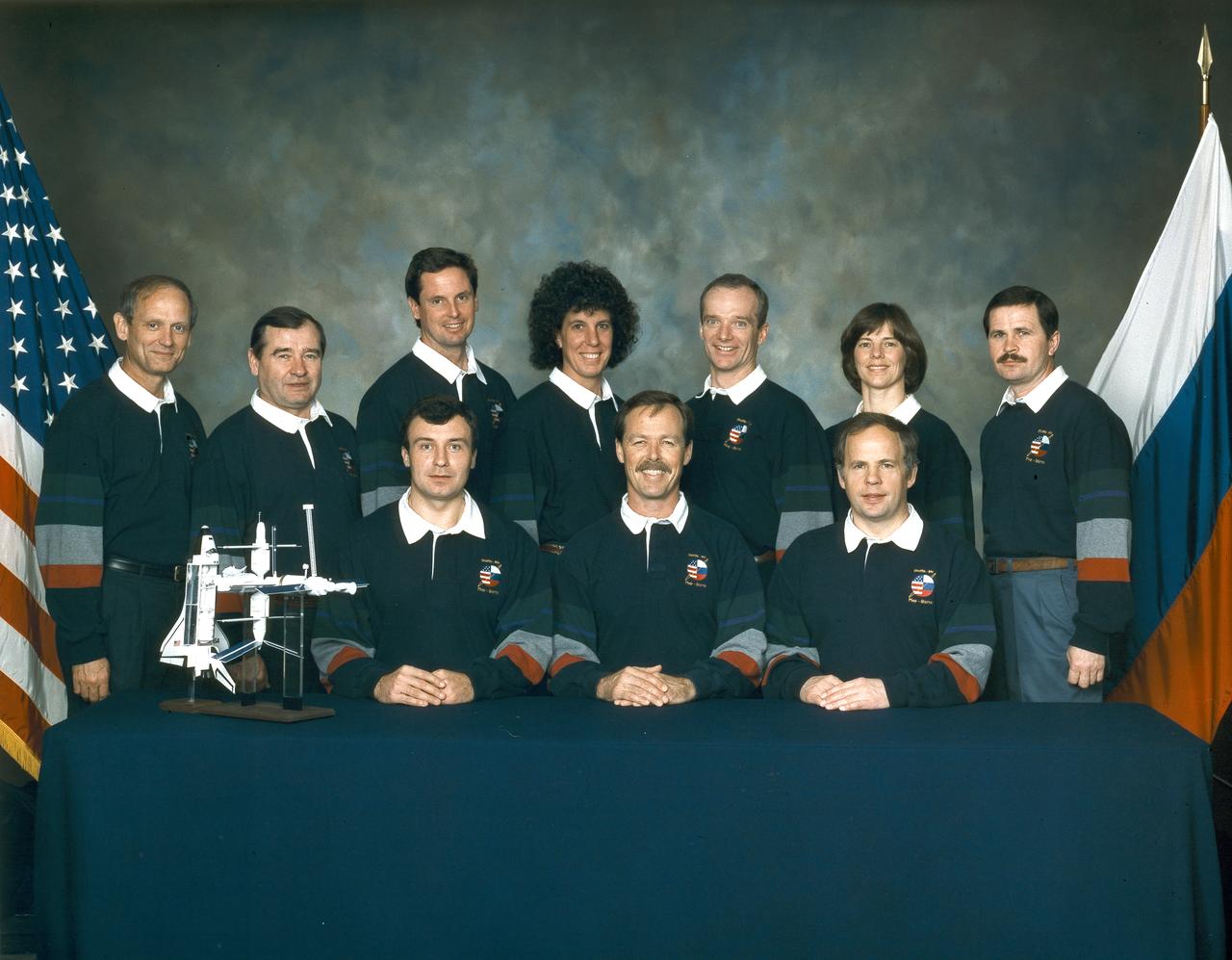
The crew assigned to the STS-71 mission included (front left to right) Vladimir N. Dezhurov, Mir 18 crew download; Robert L. Gibson, commander; and Anatoly Y. Solovyev, Mir 19 crew upload. On the back row, left to right, are Norman E. Thagard, Mir 18 crew download; Gennadiy Strelalov, Mir 18 crew download; Gregory J. Harbaugh, mission specialist; Ellen S. Baker, mission specialist; Charles J. Precourt, pilot; Bonnie J. Dunbar, mission specialist; and Nikolai Budarin, Mir 19 crew upload. Launched aboard the Space Shuttle Atlantis on June 27, 1995 at 3:32:19.044 pm (EDT), the STS-71 mission marked many firsts in human space flight history. It was the first U.S. Space Shuttle-Russian Space Station Mir docking and joint on-orbit operations, and the first on-orbit change out of a shuttle crew. In addition, it was the largest spacecraft ever in orbit and was the 100th U.S. human space launch conducted from the Cape.
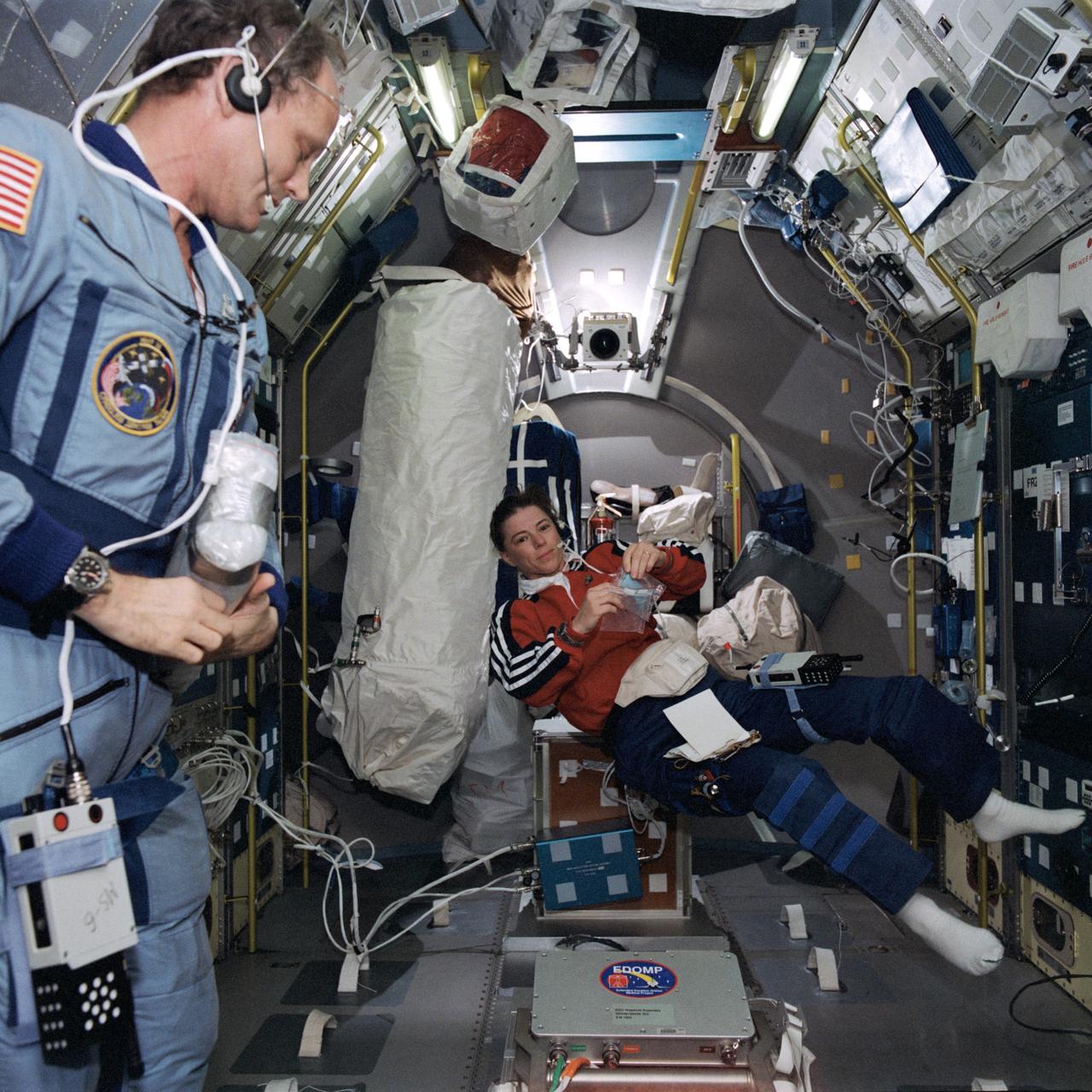
STS071-758-009 (27 June - 7 July 1995) --- Astronaut Bonnie J. Dunbar, mission specialist, floats about in the Spacelab Science Module as astronaut Norman E. Thagard looks on. Thagard, Mir-18 guest cosmonaut researcher, had completed four months in space aboard Russia's Mir Space Station. When this photograph was taken he was undergoing a battery of tests and data collection exercises on Spacelab, onboard the Space Shuttle Atlantis. Dunbar had served as his Mir-18 backup, during a year's training in Russia.
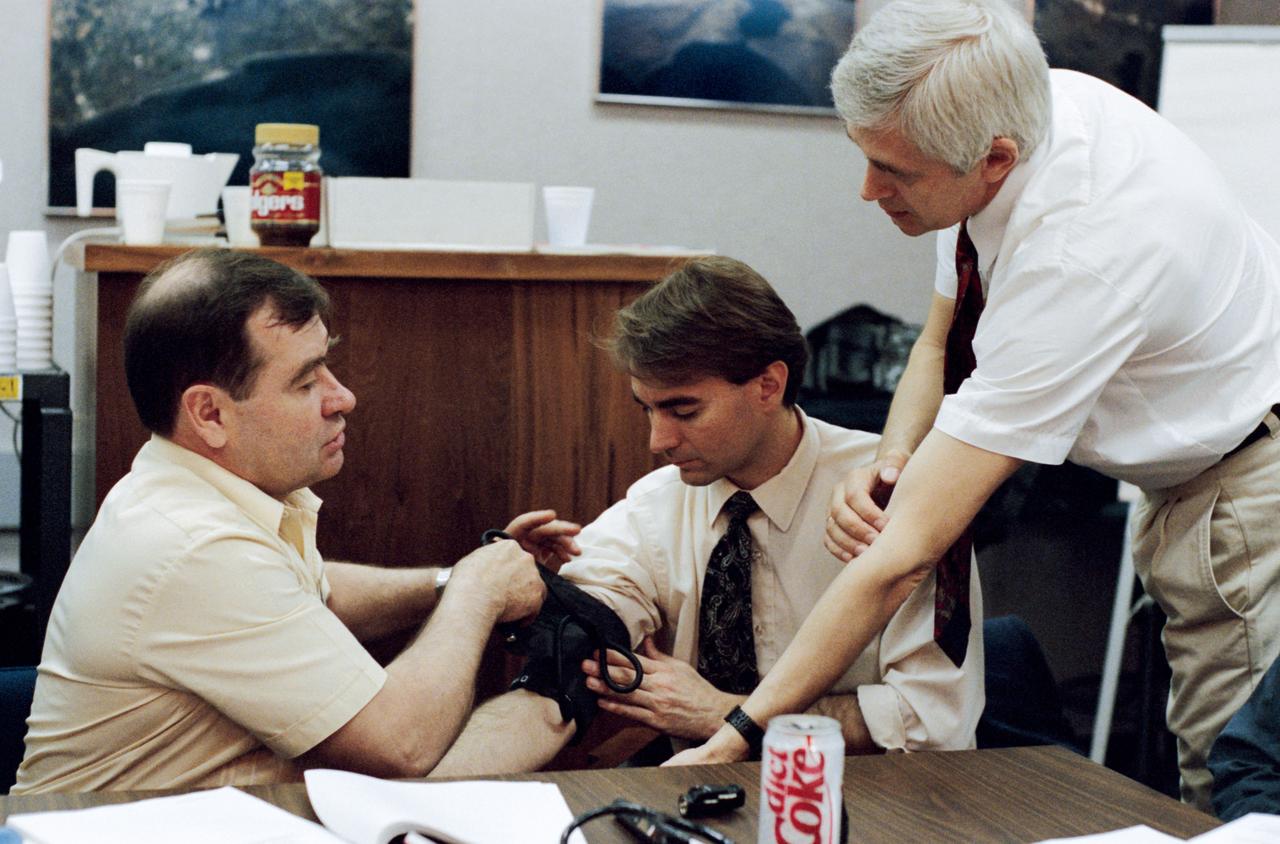
Using Dr. Dave E. Ward, a JSC physician, as a test subject, cosmonaut Gennadiy M. Strekalov (left), rehearses the taking of blood pressure. This is a service he will likely be performing a great deal next year when he boards Russia's Mir Space Station, in Earth-orbit, as Mir 18 flight engineer.
S94-34942 (27 May 1994) --- This is a portrait of (left to right) Bonnie J. Dunbar, Anatoliy Y. Solovyev, and Nikolai M. Budarin in civilian clothes. Dunbar is mission specialist for STS-71, and alternate crew member for Mir 18. Solovyev is commander for Mir 19, and Budarin is the flight engineer for that mission.
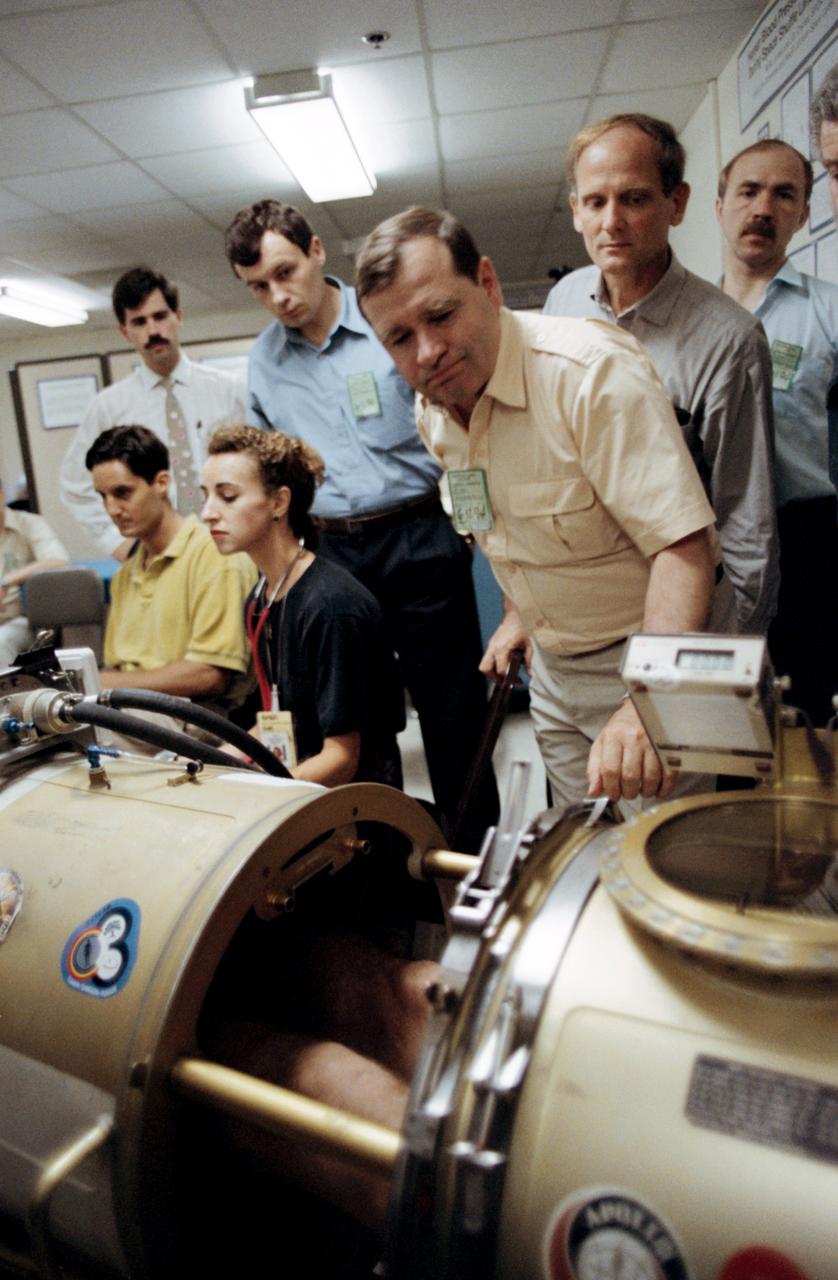
Astronaut Norman E. Thagard (right center), a guest researcher on Russia's Mir 18 mission, monitors a test of a subject (out of frame) in the Lower Body Negative Pressure (LBNP) device. Others pictured, left to right, are Todd Schlegel (seated) of the Medical Sciences Division at JSC, unidentified trainer, Linda Barrows of Krug; cosmonaut Vladimir N. Dezhurov, mission commander; cosmonaut Gennadiy M. Strekalov, Thagard and cosmonaut Alexsandr F. Poleshchuk, Mir 18 reserve flight engineer.
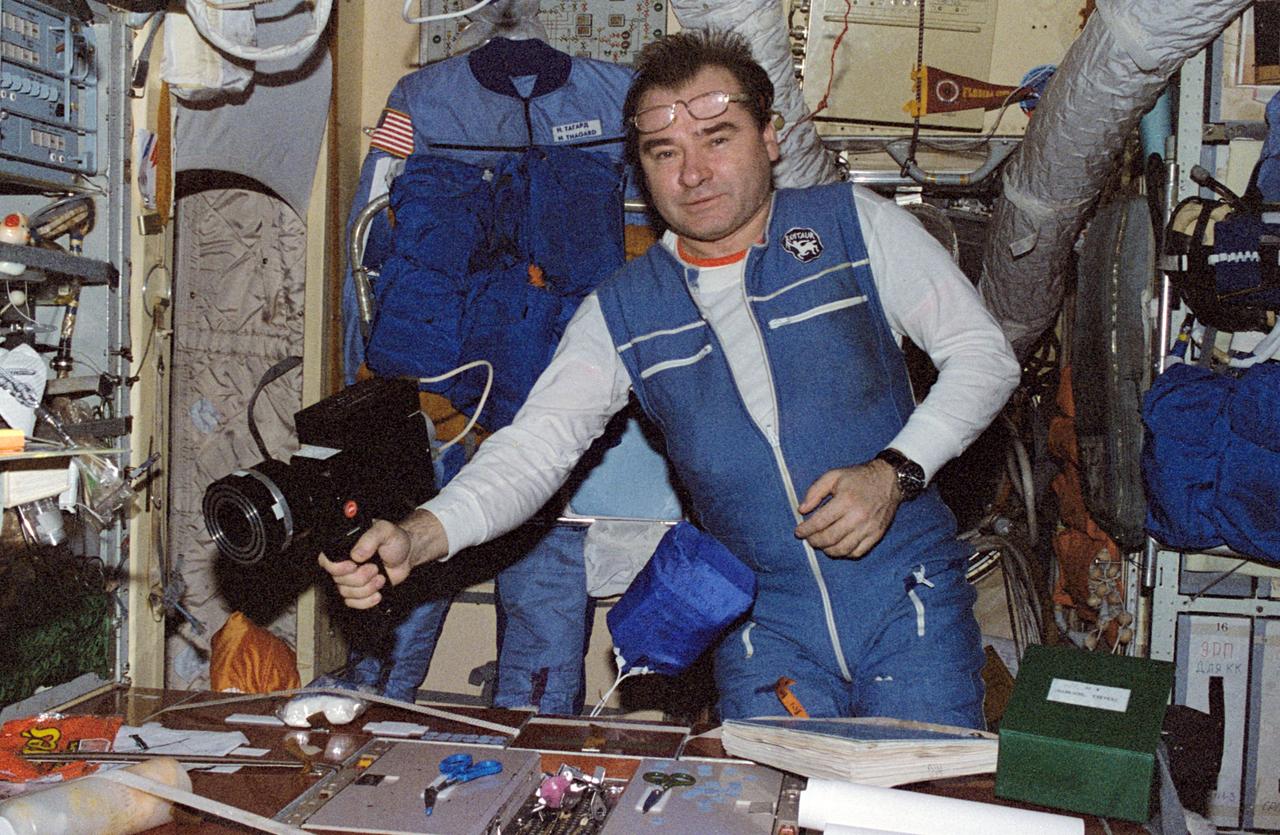
NM18-308-001 (March-July 1995) --- Onboard Mir's base block module, cosmonaut Gennadiy M. Strekalov, uses a hand held device to check the air. He stands near the table used for a great variety of activity--from eating, to chart-making, to hosting onboard press conferences. This visual was one of many shown by the Mir-18 crew at a press conference on July 18 in Houston.
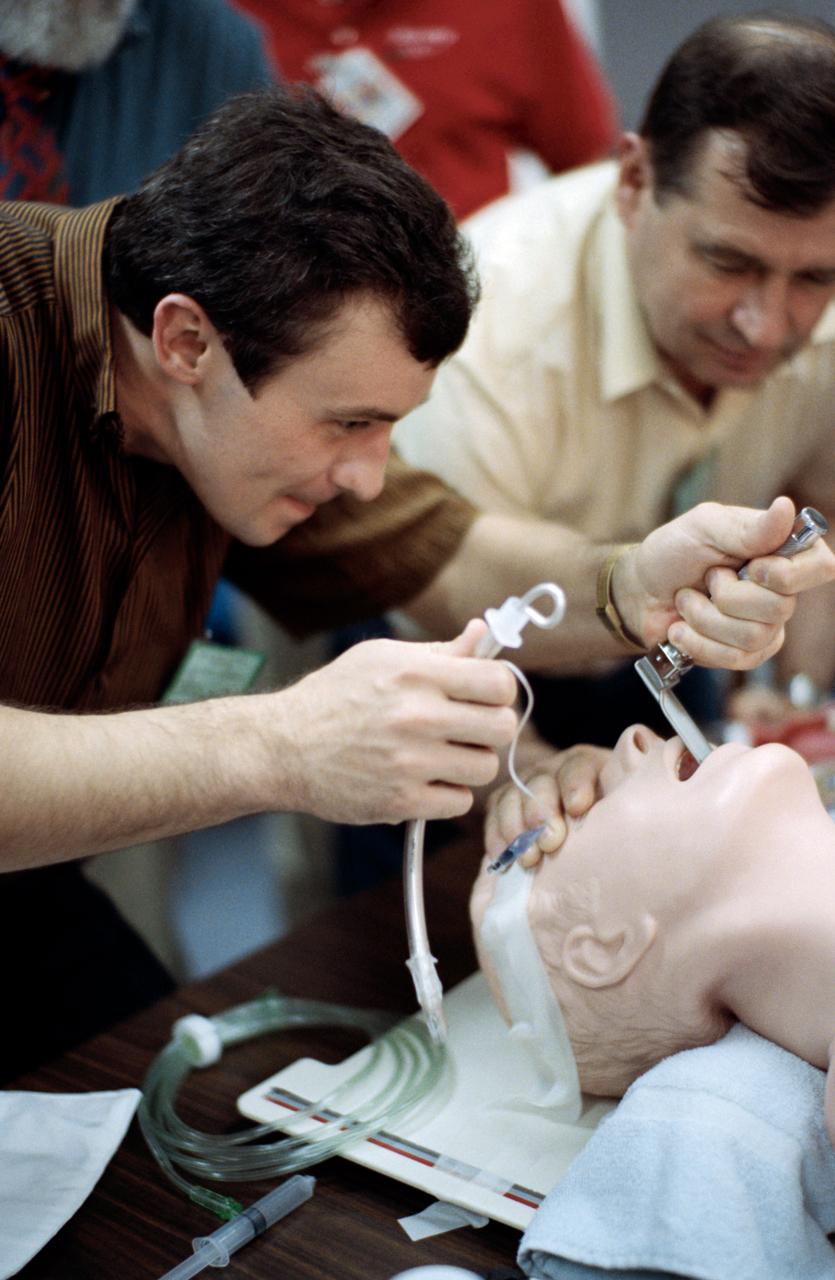
Cosmonaut Vladimir N. Dezhurov (left), Mir 18 mission commander, among a group of Russians in the United States to participate in training for the joint Russia - United States space missions, conducts an intubation on a dummy. Dezhurov, along with Mir 18 flight engineer Gennadiy M. Strekalov (pictured) prepare for upcoming missions which involve crew members from the two nations.
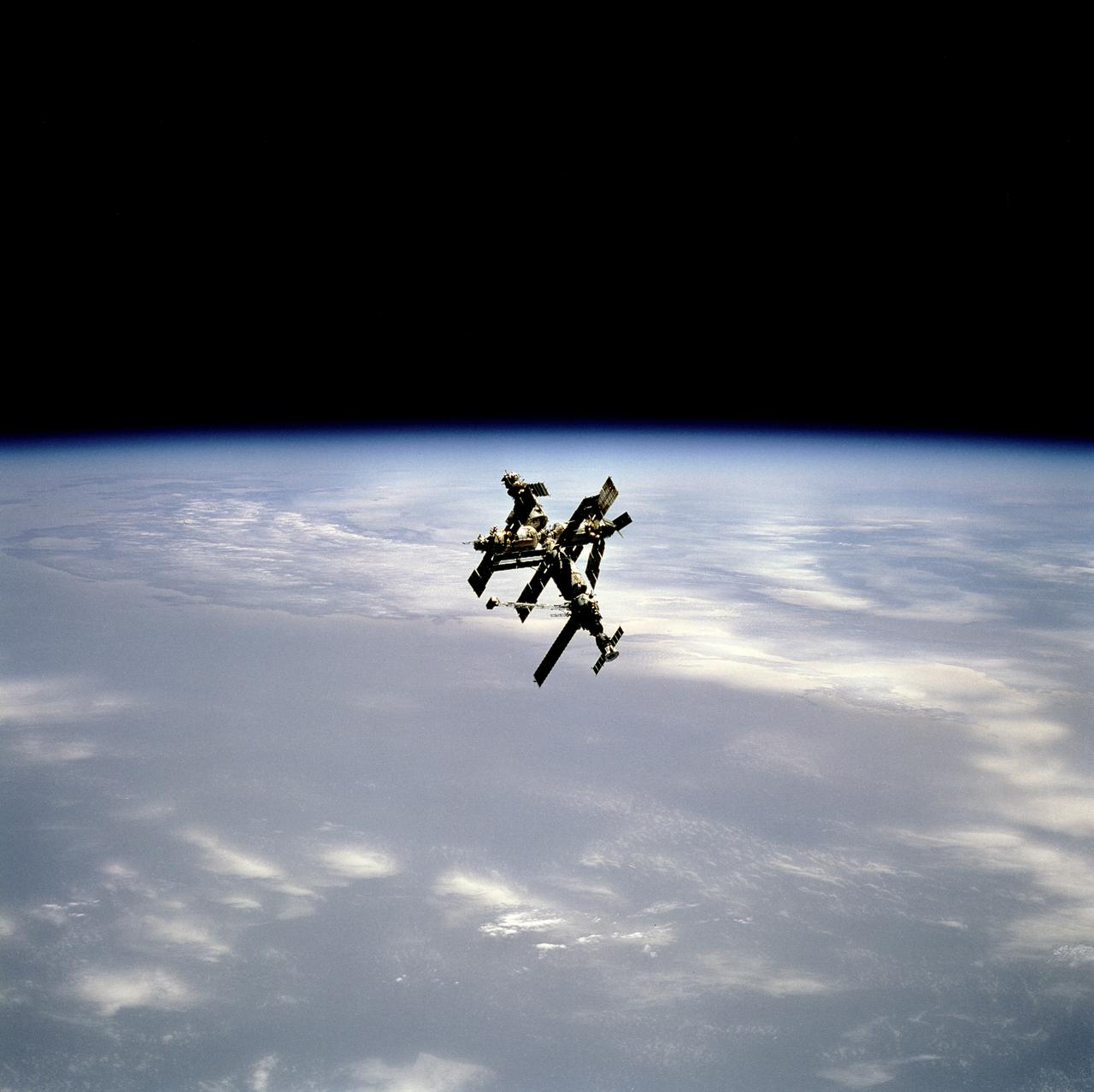
STS071-744-030 (29 June 1995) --- Russia's Mir Space Station is backdropped against blue and white Earth near its horizon, as photographed from the approaching space shuttle Atlantis on June 29, 1995. Five NASA astronauts and two cosmonauts were onboard Atlantis as it approached the Mir, which housed the three-member Mir-18 crew.
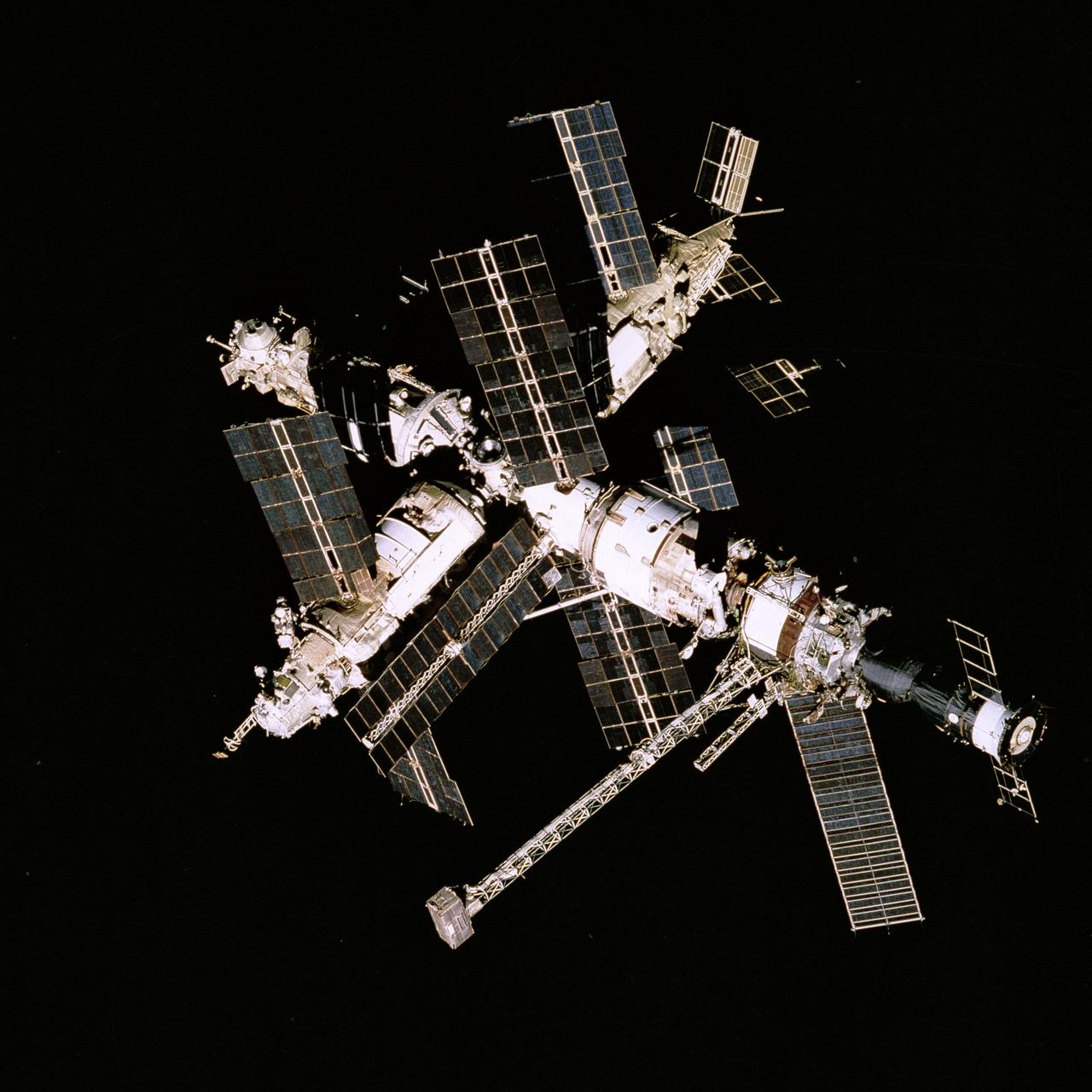
STS071-744-017 (29 June 1995) --- Russia's Mir Space Station is backdropped against the darkness of space, as photographed from the approaching space shuttle Atlantis on June 29, 1995. Five NASA astronauts and two cosmonauts were onboard Atlantis as it approached the Mir, which has been home for the three-member Mir-18 crew since March of this year.
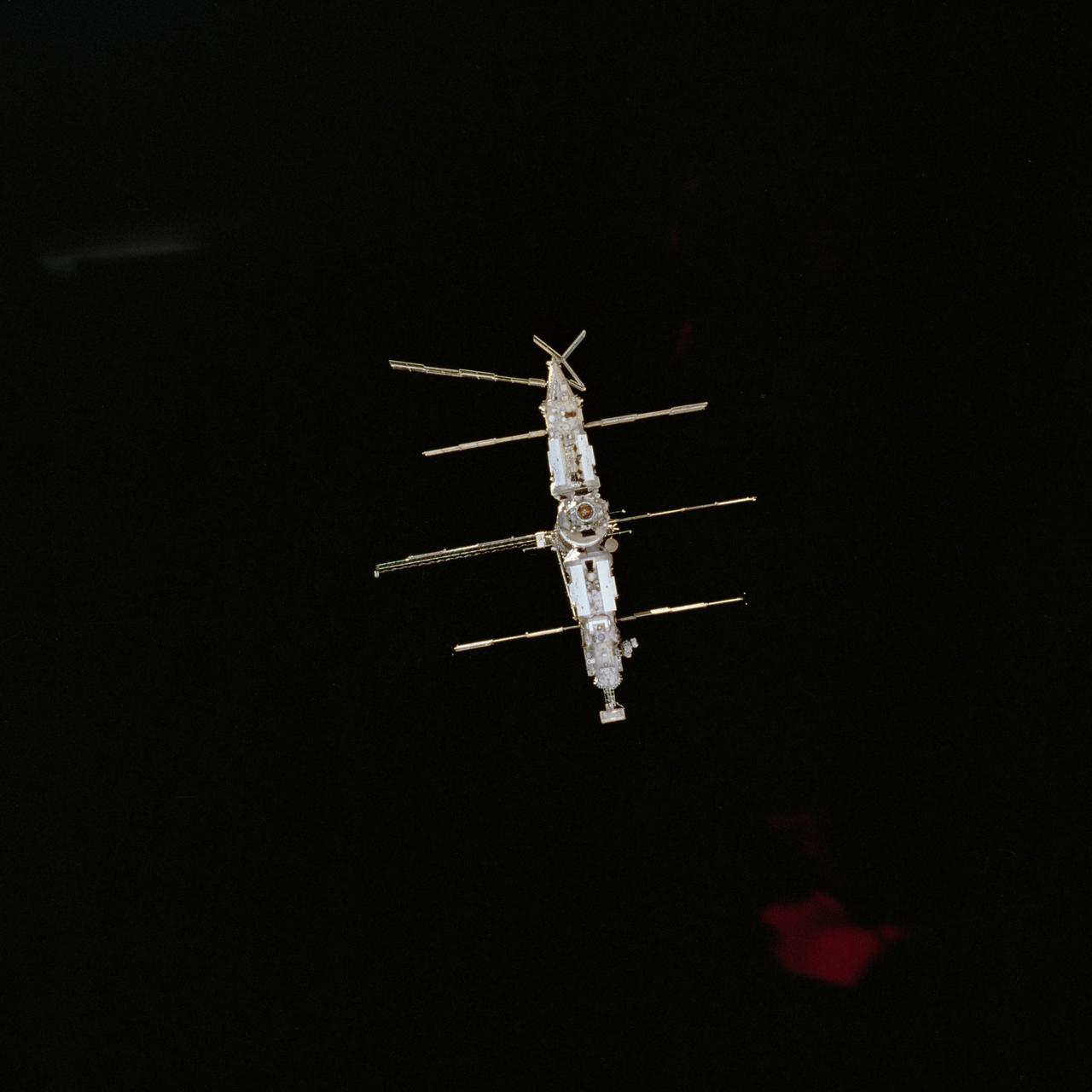
STS071-702-058 (29 June 1995) --- Russia's Mir Space Station is backdropped against the darkness of space, as photographed from the approaching space shuttle Atlantis on June 29, 1995. Five NASA astronauts and two cosmonauts were onboard Atlantis as it approached the Mir, which has been home for the three-member Mir-18 crew since March of this year.
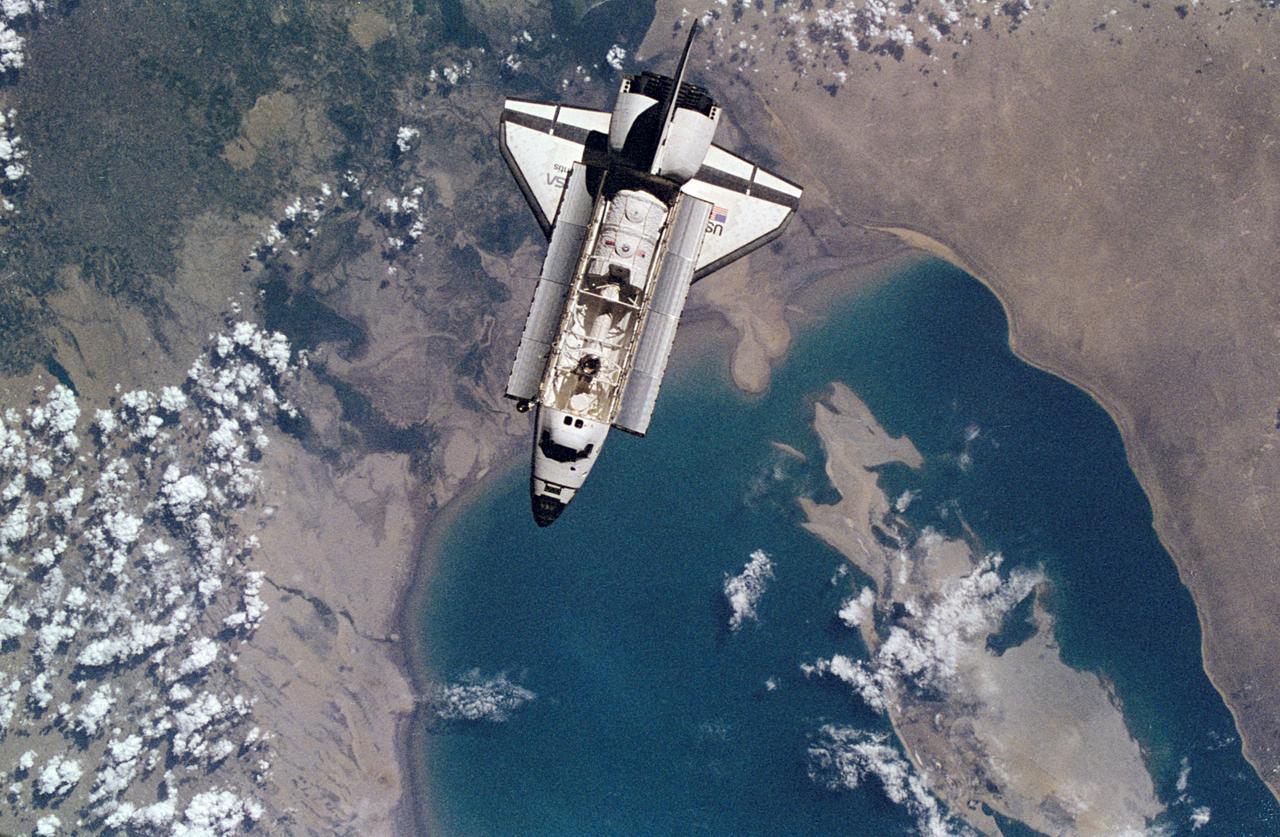
NM18-309-021 (28 June 1995) --- The Space Shuttle Atlantis orbits Earth at a point above Uzbekistan and the southern Aral Sea, as photographed by one of the Mir-18 crew members aboard Russia's Mir Space Station. The image was photographed prior to rendezvous and docking of the two spacecraft. The Spacelab Science Module and the tunnel connecting it to the crew cabin, as well as the added mechanism for interface with the Mir's docking system can be easily seen in the photo.
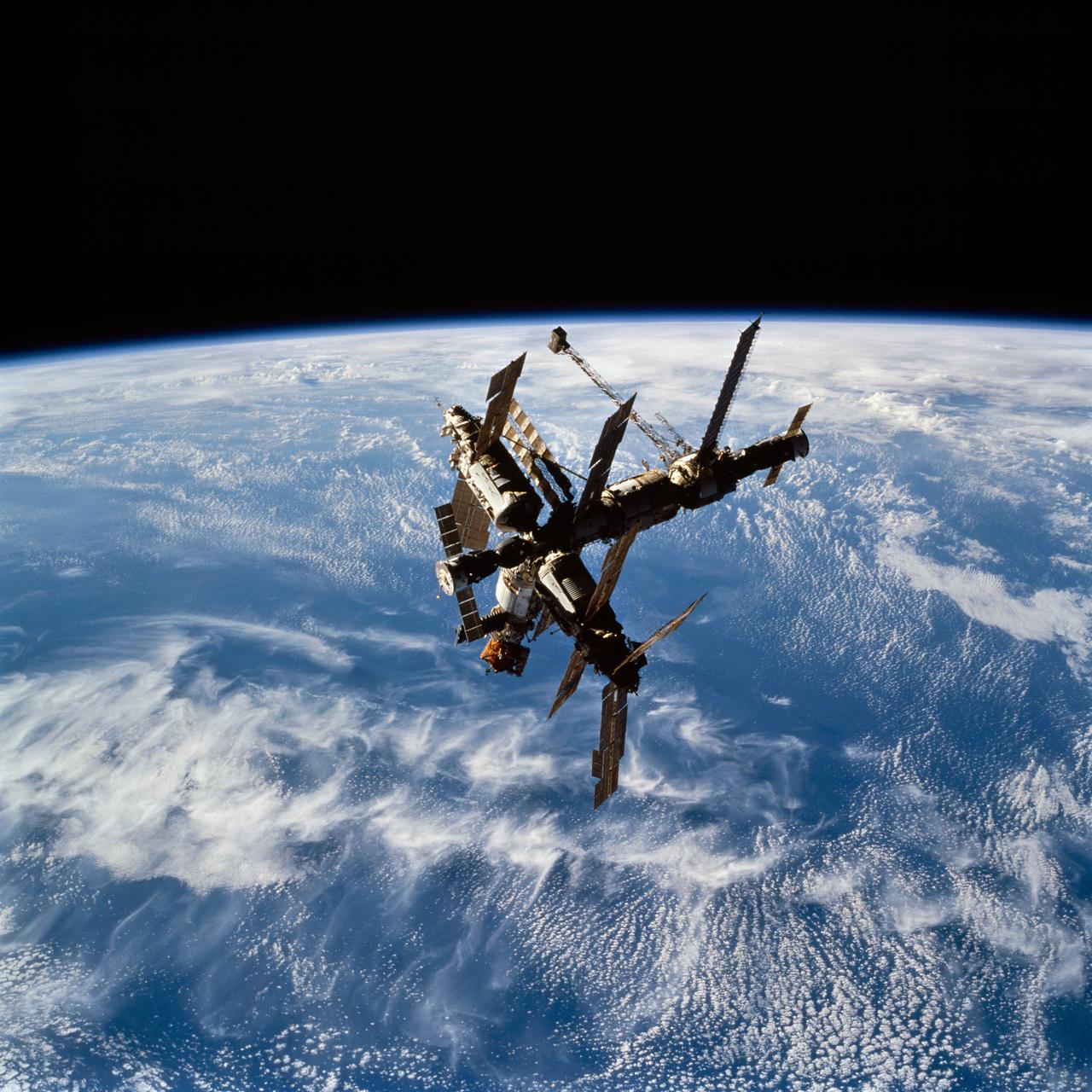
STS074-716-021 (18 Nov 1995) --- With Earth?s horizon providing the backdrop, this is the Russia?s Mir Space Station as seen from the Space Shuttle Atlantis, soon after the two spacecraft began their relative separation on November 18, 1995. With five NASA astronauts aboard the Space Shuttle Atlantis, the flight began with a November 12, 1995, launch from Kennedy Space Center (KSC) and ended with landing there on November 20, 1995. The STS-74 crew members were astronauts Kenneth D. Cameron, mission commander; James D. Halsell Jr., pilot; William S. McArthur Jr., Jerry L. Ross and Canadian astronaut Chris A. Hadfield, all mission specialists. On November 15, 1995, the Space Shuttle Atlantis docked with the Mir Space Station, on which the STS-74 astronauts joined the Mir-20 crew. The Mir-20 crew is composed of cosmonauts Yuriy P. Gidzenko, commander; and Sergei V. Avdeyev, engineer; along with the European Space Agency?s (ESA) Thomas Reiter, cosmonaut researcher. Joint activities on the Mir Space Station and the Space Shuttle Atlantis ended November 18, 1995, when the two spacecraft separated.
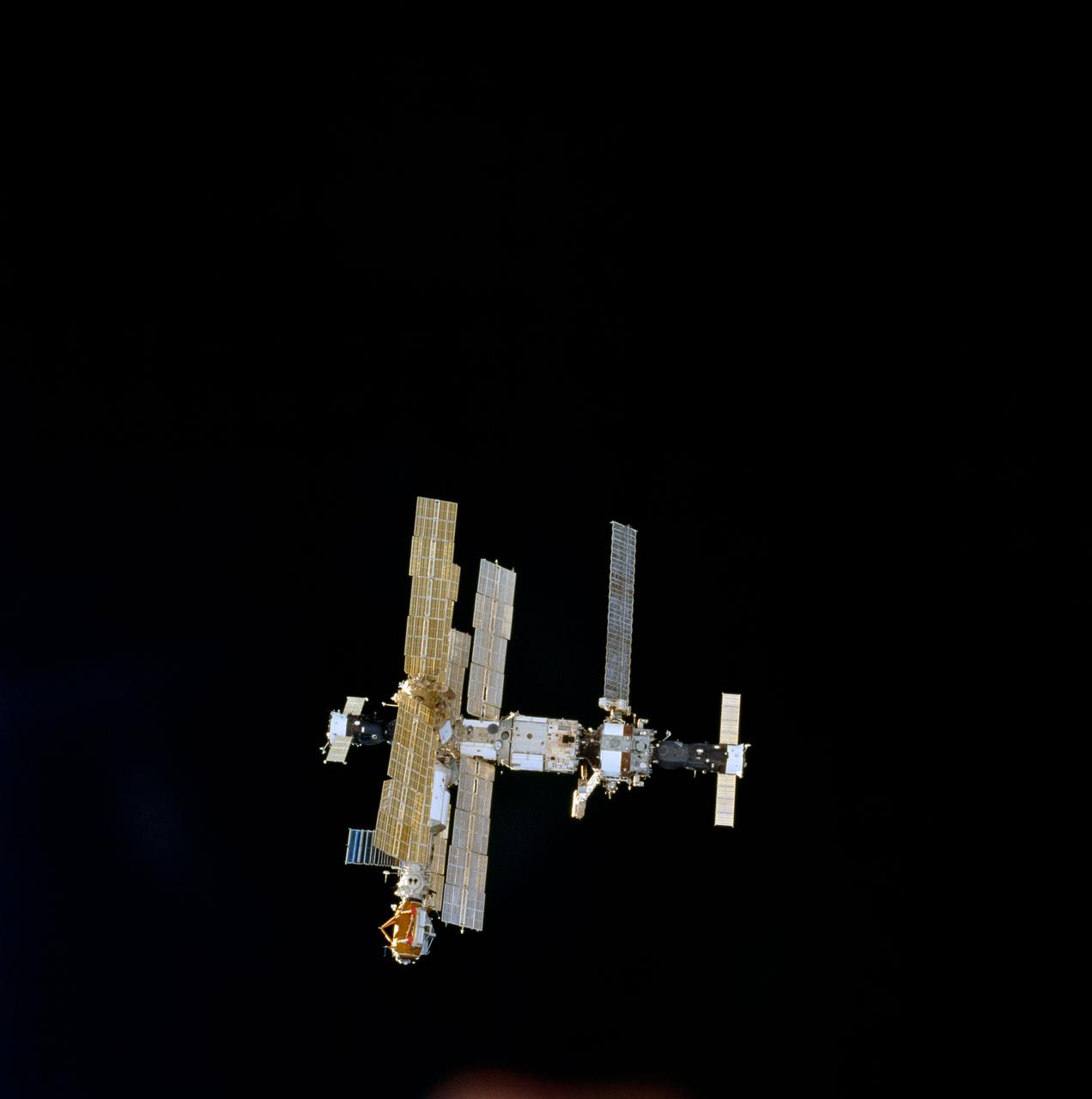
STS074-716-044 (18 Nov 1995) --- With the darkness of space providing the backdrop, this is the Russia?s Mir Space Station as seen from the Space Shuttle Atlantis, not long after the two spacecraft began their relative separation on November 18, 1995. The new Docking Module (DM), delivered by Atlantis over three days earlier, is easily identified in the 70mm frame. With five NASA astronauts aboard the Space Shuttle Atlantis, the flight began with a November 12, 1995, launch from Kennedy Space Center (KSC) and ended with landing there on November 20, 1995. The STS-74 crew members were astronauts Kenneth D. Cameron, mission commander; James D. Halsell Jr., pilot; William S. McArthur Jr., Jerry L. Ross and Canadian astronaut Chris A. Hadfield, all mission specialists. On November 15, 1995, the Space Shuttle Atlantis docked with the Mir Space Station, on which the STS-74 astronauts joined the Mir-20 crew. The Mir-20 crew is composed of cosmonauts Yuriy P. Gidzenko, commander; and Sergei V. Avdeyev, flight engineer; along with the European Space Agency?s (ESA) Thomas Reiter, cosmonaut researcher. Joint activities on the Mir Space Station and the Space Shuttle Atlantis ended November 18, 1995, when the two spacecraft separated.
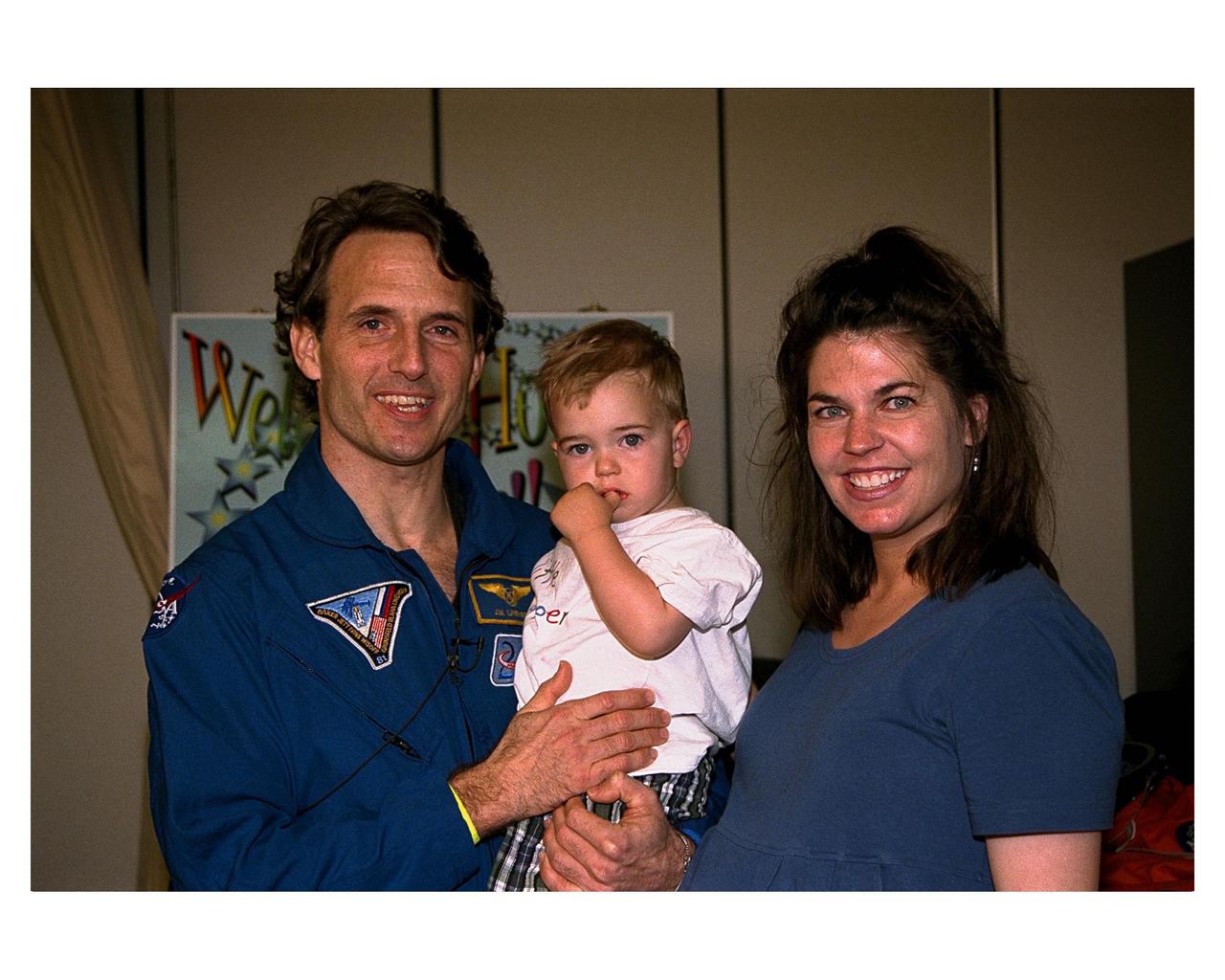
Astronaut and recent Mir 23 crew member Jerry M. Linenger poses for a photograph with his wife, Kathryn, and their 18-month-old son, John, during a family reunion in the Operations and Checkout Building. Kathryn Linenger is expecting their second child next month. Linenger just returned to Earth after a four-month stay on the Russian Space Station Mir. He flew back on Atlantis with six other members of the STS-84 crew, who conducted the sixth Space Shuttle docking with the Mir. STS-84 Mission Specialist C. Michael Foale replaced Linenger on the Mir
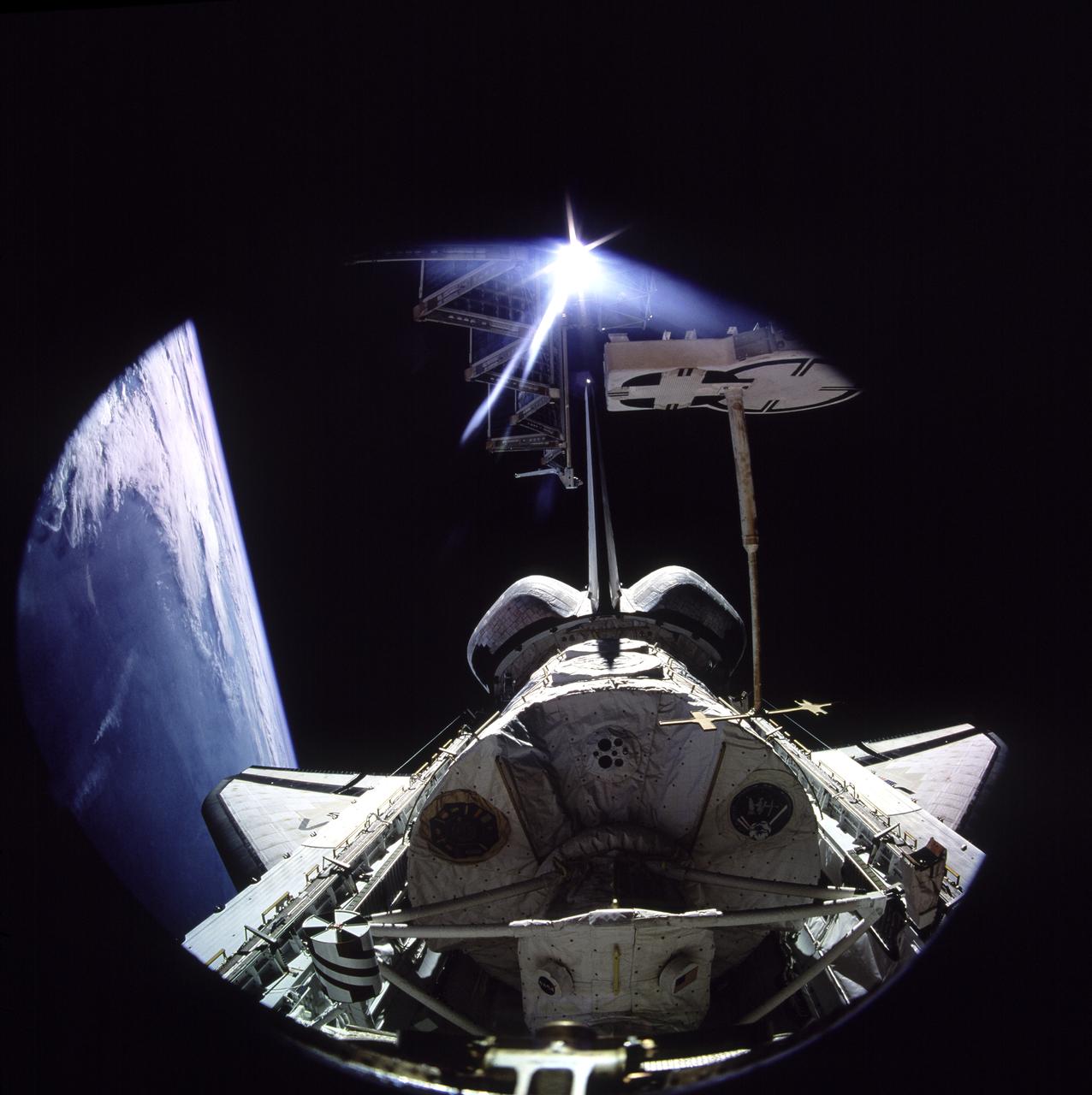
STS071-741-057 (27 June-7 July 1995) --- Docked already with Russia's Mir Space Station, the space shuttle Atlantis' aft cargo bay and Spacelab science module are visible through a window on the Mir Space Station. A 70mm camera, carried into space by the STS-71 crew aboard Atlantis, was used to expose the image. The linkup enabled the seven STS-71 crew members to visit Mir and it allowed the three Mir-18 crew members, in space since March of this year, access to Spacelab. That module was quite busy with tests and data collection involving the three until Atlantis brought them home on July 7, 1995.
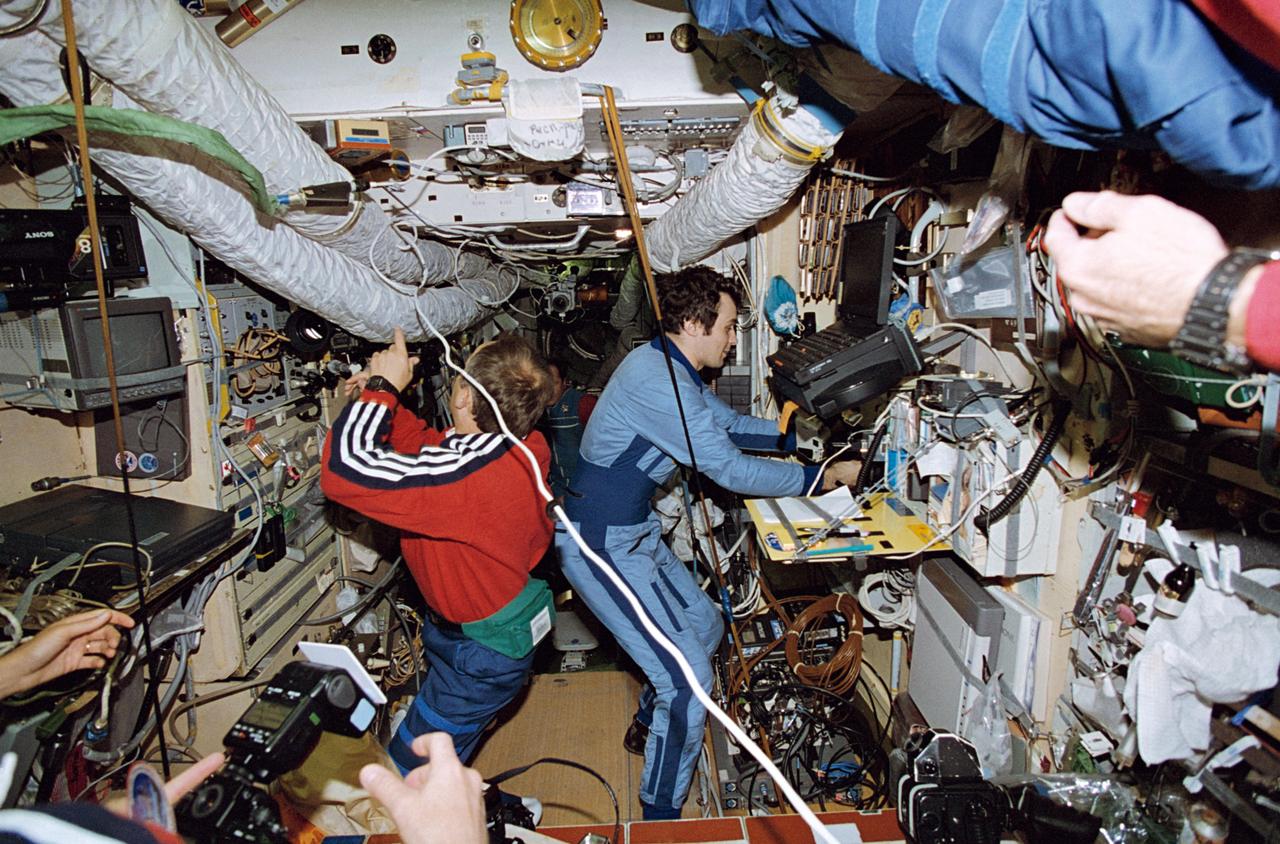
STS071-118-007 (27 June - 7 July 1995) --- Onboard the Russia?s Mir Space Station Mir Base Block, cosmonauts Anatoly Y. Solovyev (left) and Vladimir N. Dezhurov, Mir 19 and 18 commanders, respectively, exchange information about their research tasks. The two represent a change of guard aboard Mir, as Dezhurov prepares to come back to Earth with the STS-71 crew aboard Space Shuttle Atlantis. Nikolai M. Budarin and Gennadiy M. Strekalov - cosmonaut/flight engineers making the same exchange -- are out of frame.
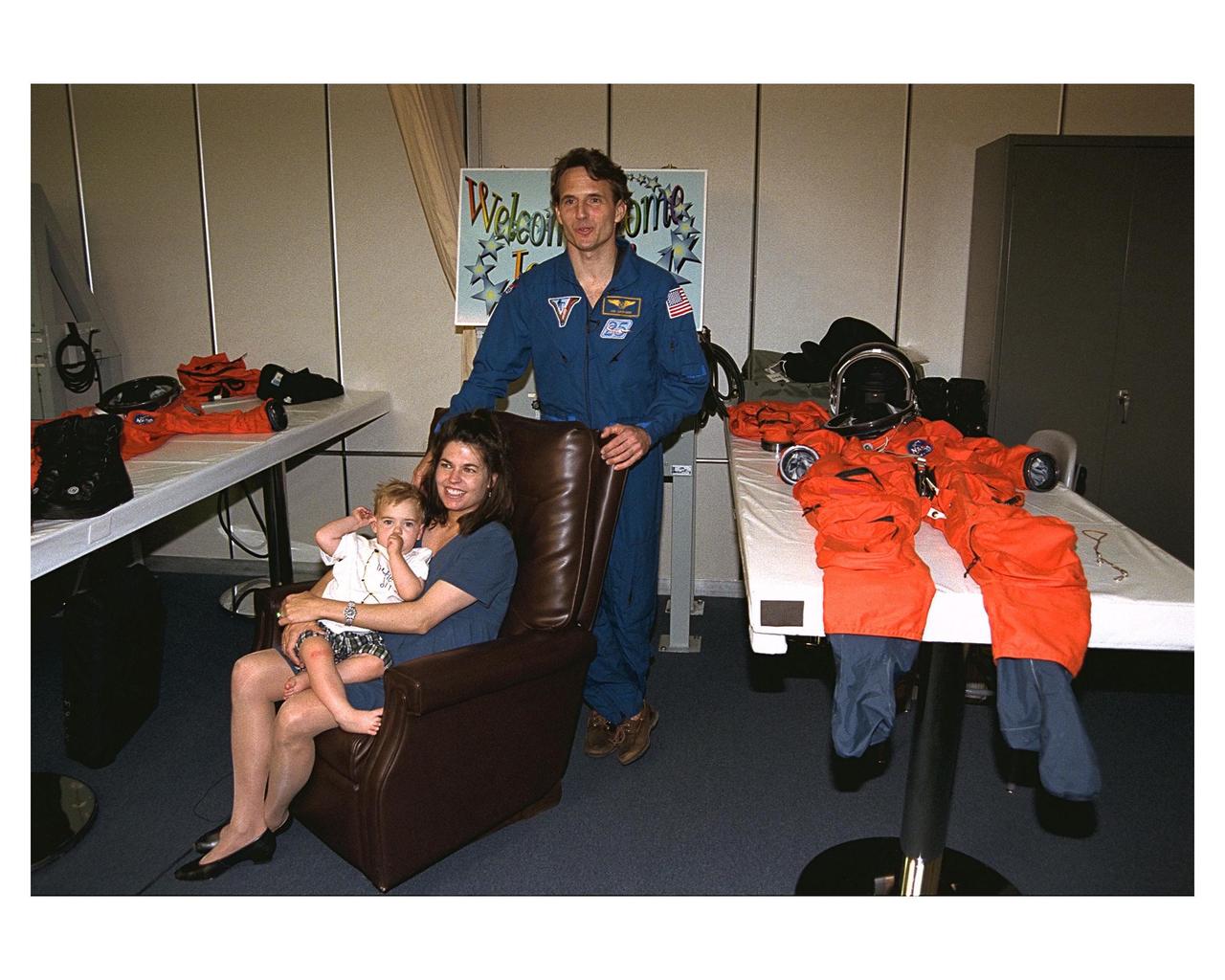
Astronaut and recent Mir 23 crew member Jerry M. Linenger, standing, reunites with his wife, Kathryn, and their 18-month-old son, John, in the astronaut suit-up room in the Operations and Checkout Building. Kathryn Linenger is expecting their second child next month. Linenger just returned to Earth after a four-month stay on the Russian Space Station Mir. He flew back on Atlantis with six other members of the STS-84 crew, who conducted the sixth Space Shuttle docking with the Mir. STS-84 Mission Specialist C. Michael Foale replaced Linenger on the Mir

STS071-S-074 (4 July 1995) --- This view of the space shuttle Atlantis during its move away from Russia's Mir Space Station was photographed by the Mir-19 crew on July 4, 1995. Cosmonauts Anatoliy Y. Solovyev and Nikolai M. Budarin, Mir-19 commander and flight engineer, respectively, temporarily undocked the Soyuz spacecraft from the cluster of Mir elements to perform a brief fly-around. They took pictures while the STS-71 crew, with Mir-18's three crew members aboard, undocked from Atlantis for the completion of this leg of the joint activities. Solovyev and Budarin had been taxied to the Mir Space Station by the STS-71 ascent trip of Atlantis.
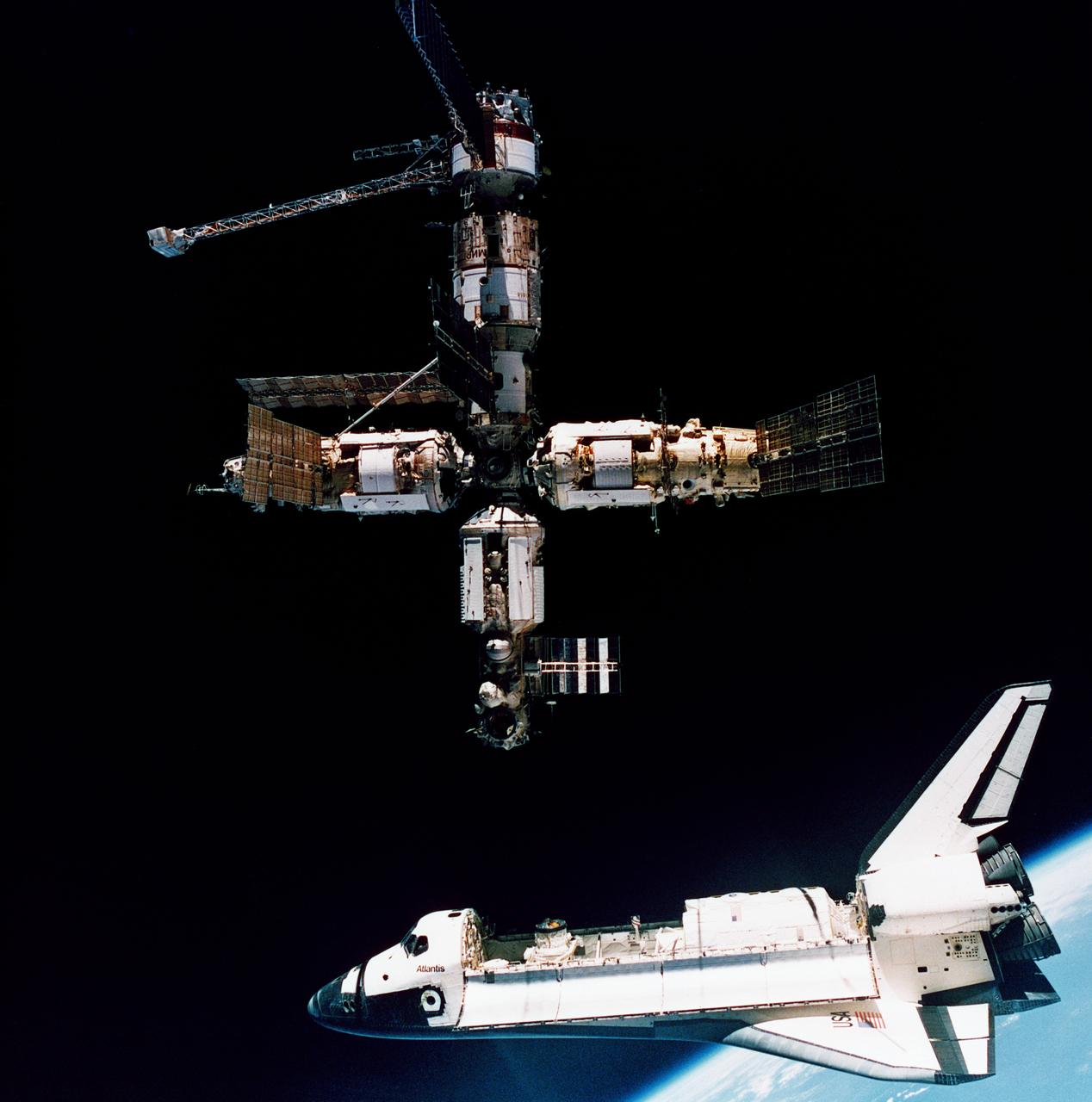
STS071-S-075 (4 July 1995) --- This view of the space shuttle Atlantis beginning its move away from Russia's Mir Space Station was photographed by the Mir-19 crew on July 4, 1995. Cosmonauts Anatoliy Y. Solovyev and Nikolai M. Budarin, Mir-19 commander and flight engineer, respectively, temporarily undocked the Soyuz spacecraft from the cluster of Mir elements to perform a brief fly-around. They took pictures while the STS-71 crew, with Mir-18's three crew members aboard, undocked from Atlantis for the completion of this leg of the joint activities. Solovyev and Budarin had been taxied to the Mir Space Station by the STS-71 ascent trip of Atlantis.
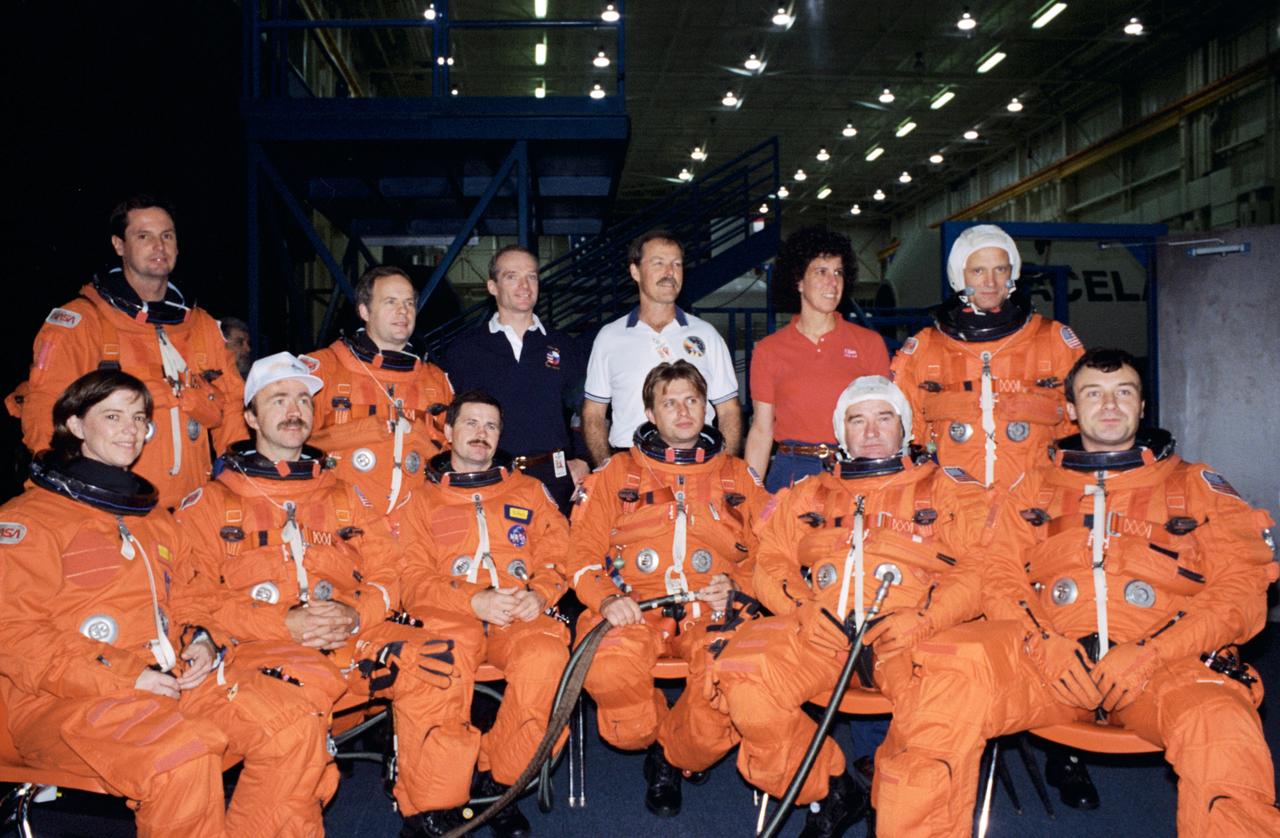
S94-47050 (28 Oct 1994) --- Crew members for the joint Space Shuttle/Russian Mir Space Station missions assemble for an informal portrait during a break in training in the Systems Integration Facility at the Johnson Space Center (JSC). In front (left to right) are astronaut Bonnie J. Dunbar; cosmonauts Aleksandr F. Poleshchuk, Yuriy I. Onufriyenko, Gennadiy M. Strekalov and Vladimir N. Dezhurov. In the rear are astronaut Gregory J. Harbaugh; cosmonaut Anatoliy Y. Solovyev, and astronauts Charles J. Precourt, Robert L. Gibson, Ellen S. Baker and Norman E. Thagard. In a precedent-setting flight, Thagard will be launched as a guest researcher along with Dezhurov, commander, and Strekalov, flight engineer, to Russia's Mir Space Station early next year for a three month mission, designated as Mir 18. Then in late spring, as the assignment of STS-71, the Space Shuttle Atlantis will rendezvous with Mir to pick up the Mir 18 crew and transfer cosmonauts Solovyov and Nikolai M. Budarin to the station for the Mir 19 mission. STS-71 mission specialist Dunbar is training as Thagard's backup.
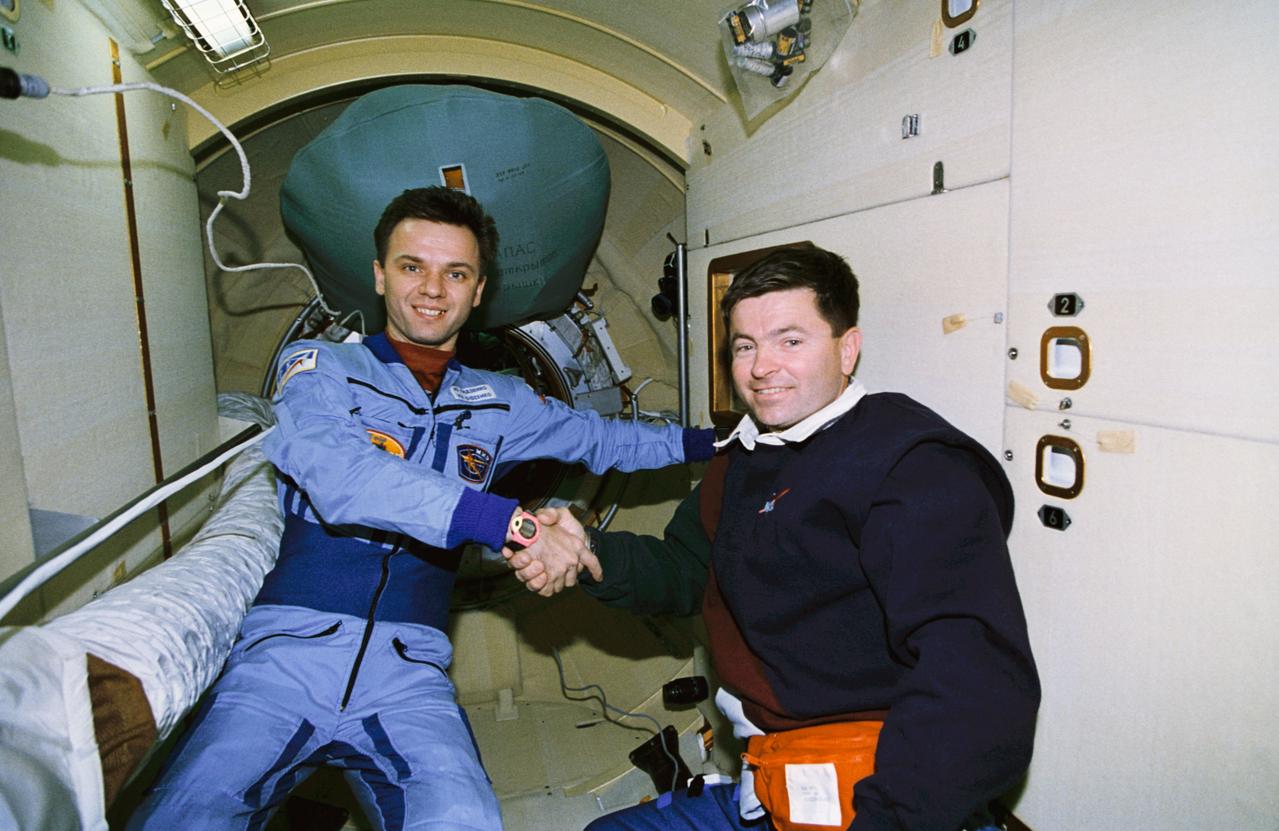
STS074-322-036 (18 Nov 1995) --- Astronaut Kenneth D. Cameron, STS-74 mission commander, shakes hands with cosmonaut Yuriy P. Gidzenko, Mir-20 commander, just prior to the undocking of the Space Shuttle Atlantis with Russia?s Mir Space Station in Earth-orbit. The STS-74 flight began with a November 12, 1995, launch from Kennedy Space Center (KSC) and ended with landing there on November 20, 1995. The STS-74 crew members were astronauts Cameron; James D. Halsell, Jr., pilot; William S. McArthur, Jr., Jerry L. Ross and Canadian astronaut Chris A. Hadfield, all mission specialists. On November 15, 1995, Atlantis docked with Mir, on which the NASA astronauts joined the Mir-20 crew. The Mir-20 crew is composed of cosmonauts Gidzenko; and Sergei V. Avdeyev, engineer; along with the European Space Agency?s (ESA) Thomas Reiter, cosmonaut researcher. Joint activities on the Mir and the Atlantis ended on November 18, 1995, when the two spacecraft separated.
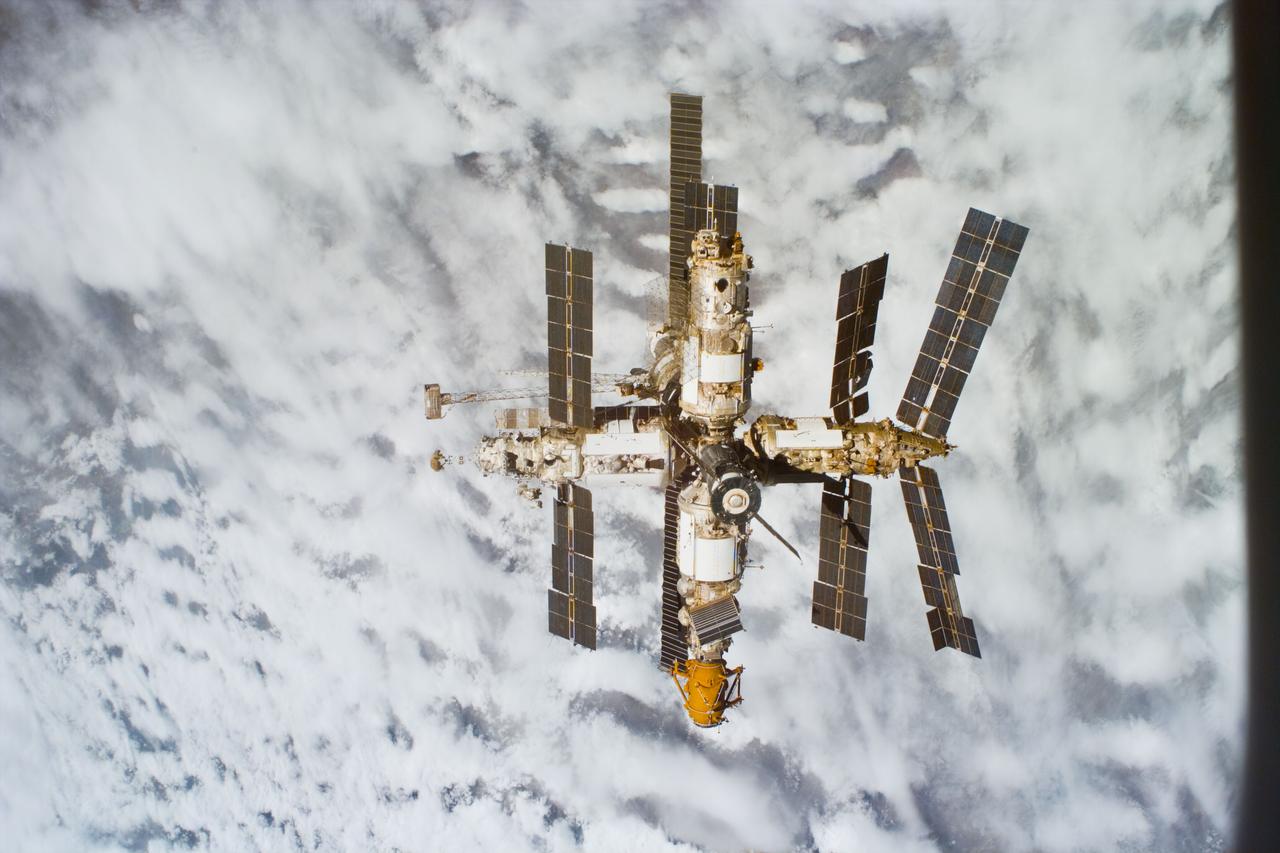
S89-E-5457 (29 Jna 1998) --- Mir Space Station over blanket of white clouds. Scene recorded with electronic still camera (ESC) at 18:04:06 GMT, Jan. 29, 1998.
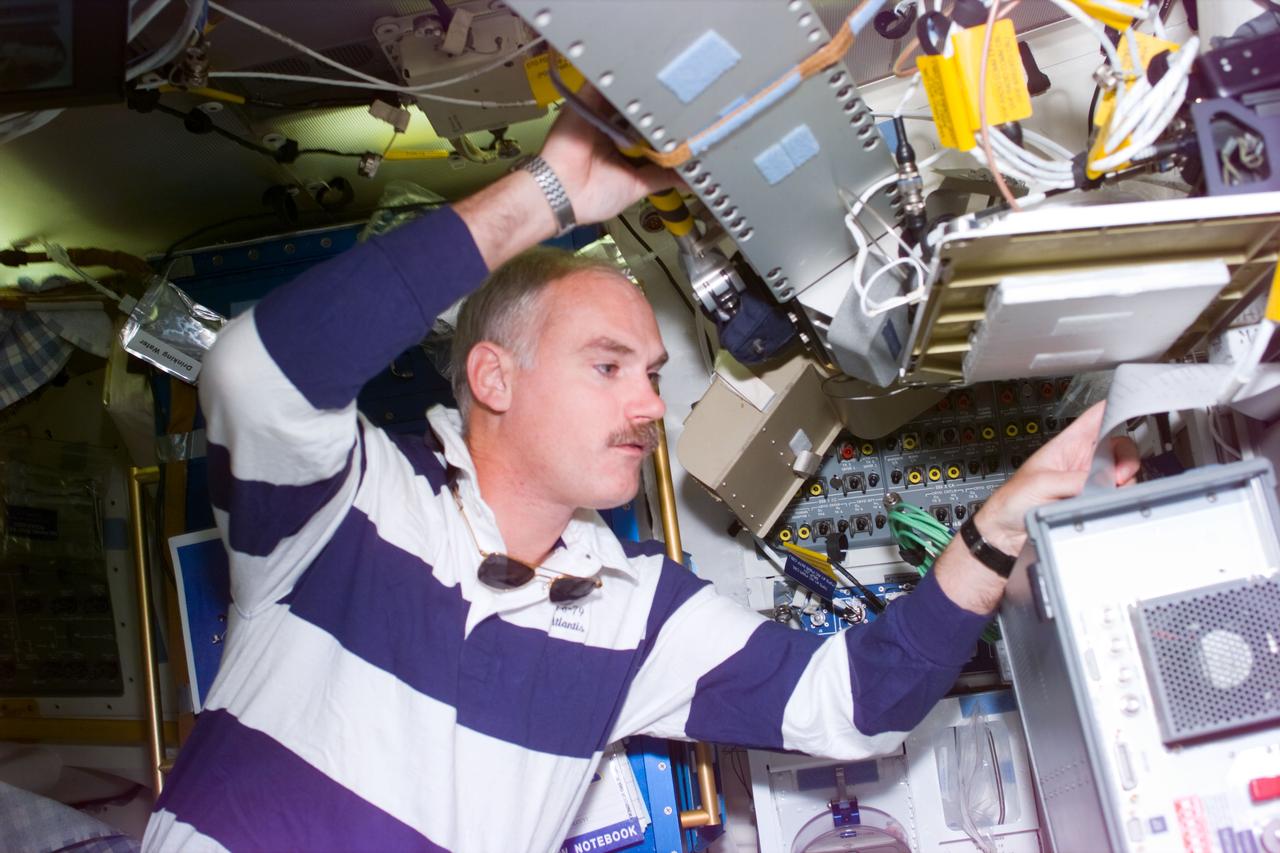
STS79-E-5022 (18 September 1996) --- William F. Readdy, mission commander, checks on Spacehab prior to preparing for Day 4 docking of the Space Shuttle Atlantis with Russia's Mir Space Station, on flight day 3.
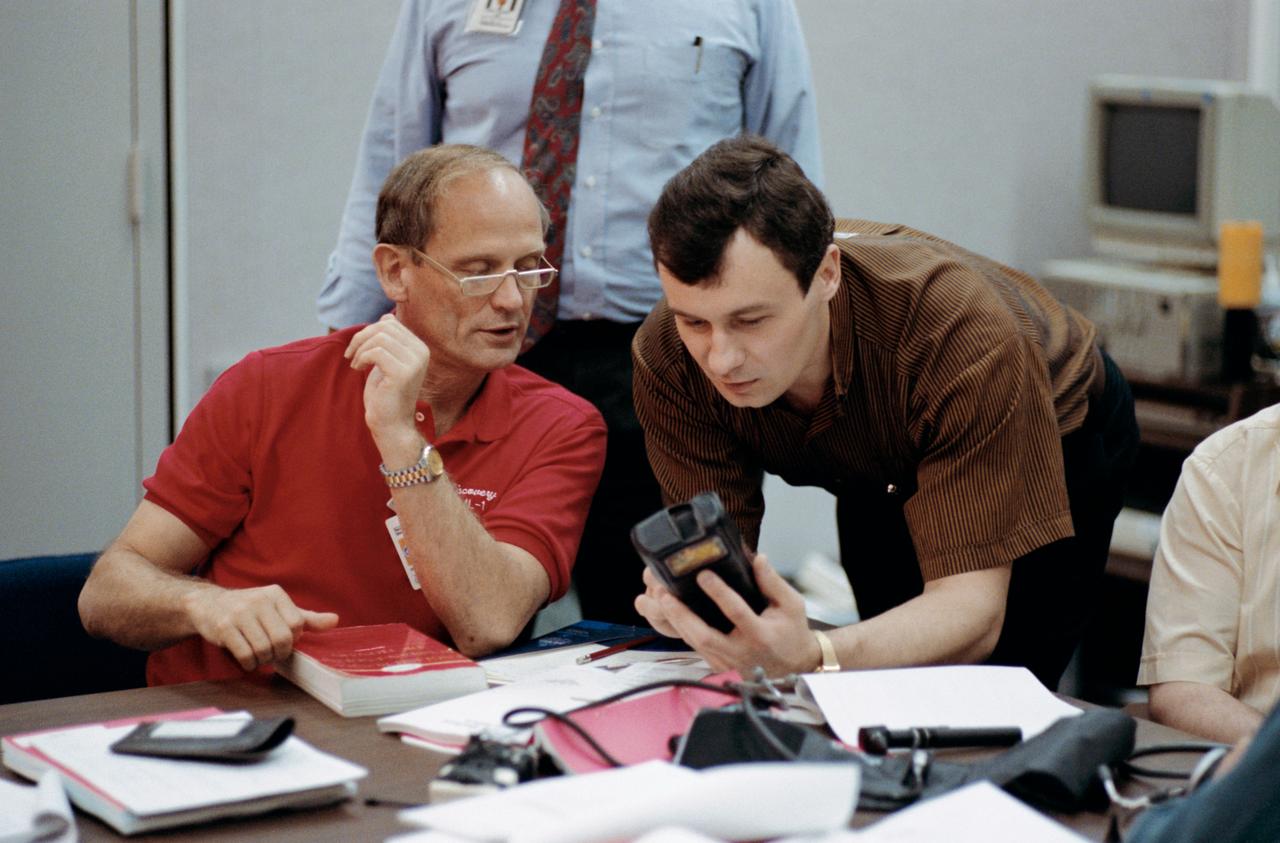
Mir 18 commander Vladimir N. Dezhurov, right, and fellow crew member, astronaut Norman E. Thagard, practice using a bar-code reader during medical operations training at JSC.
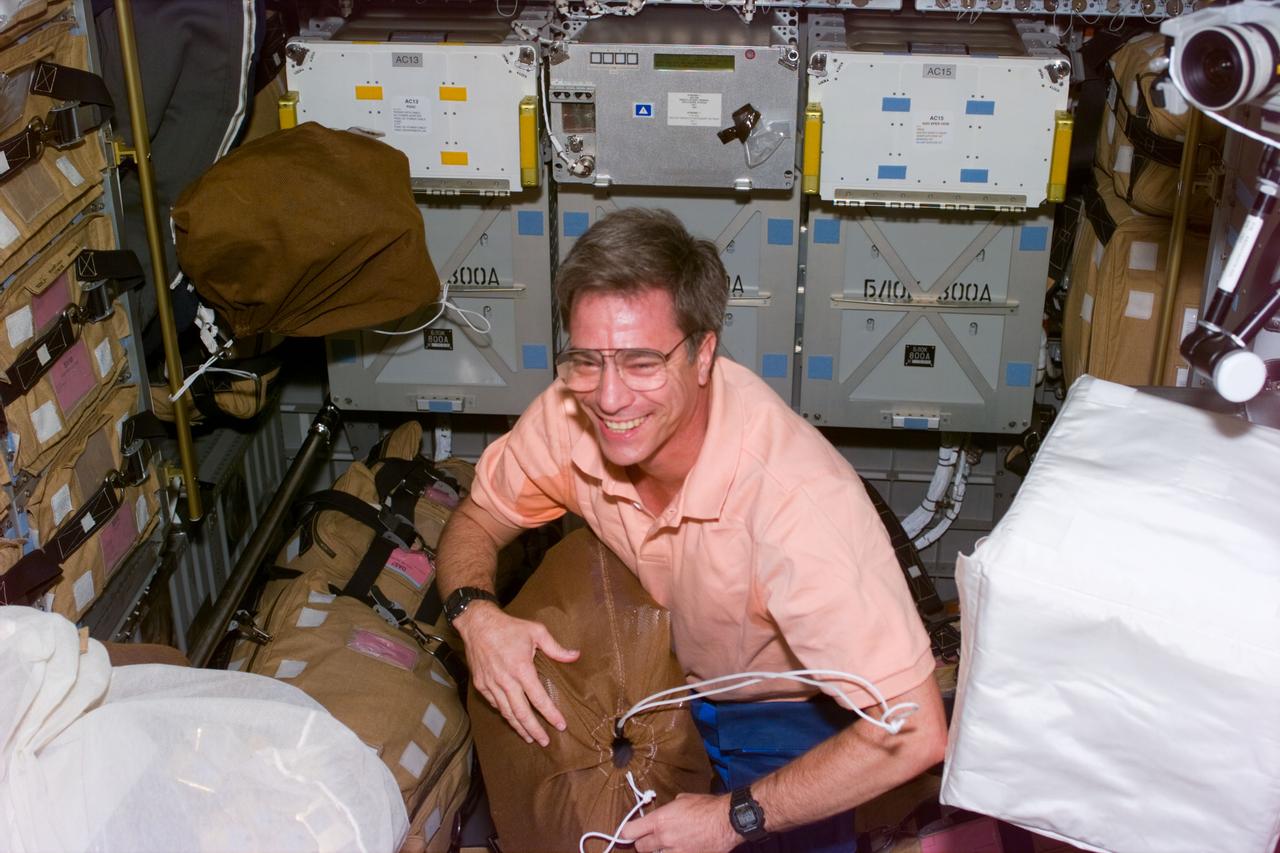
STS79-E-5032 (18 September 1996) --- Astronaut John E. Blaha checks on additional supplies to be transferred to Russia's Mir Space Station from the Space Shuttle Atlantis, on Flight Day 3.
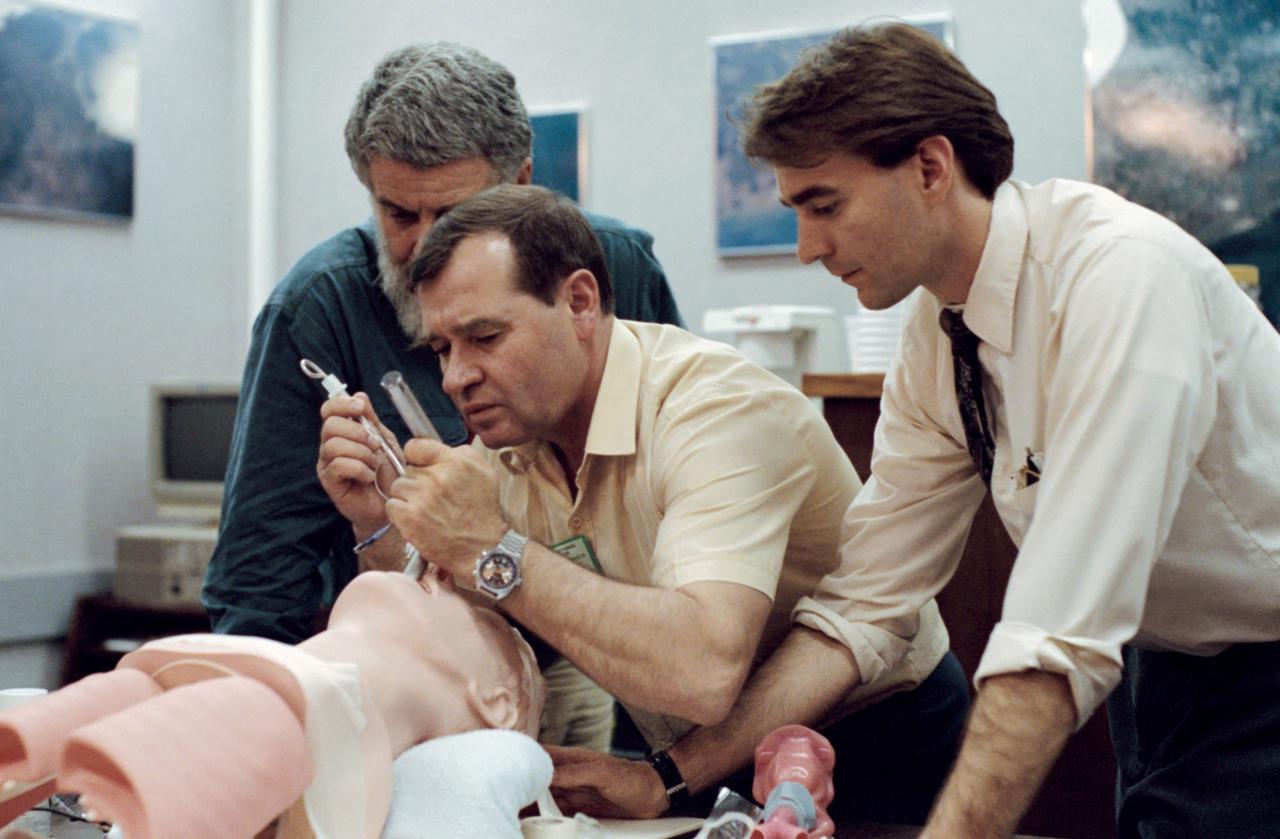
Mir 18 crewmember Gennadiy M. Strekalov, center, practicies an emergency medical procedure to maintain a patient airway during training at JSC. Looking on are Dave E. Ward (right), a JSC medical doctor, and an unidentified interpreter.
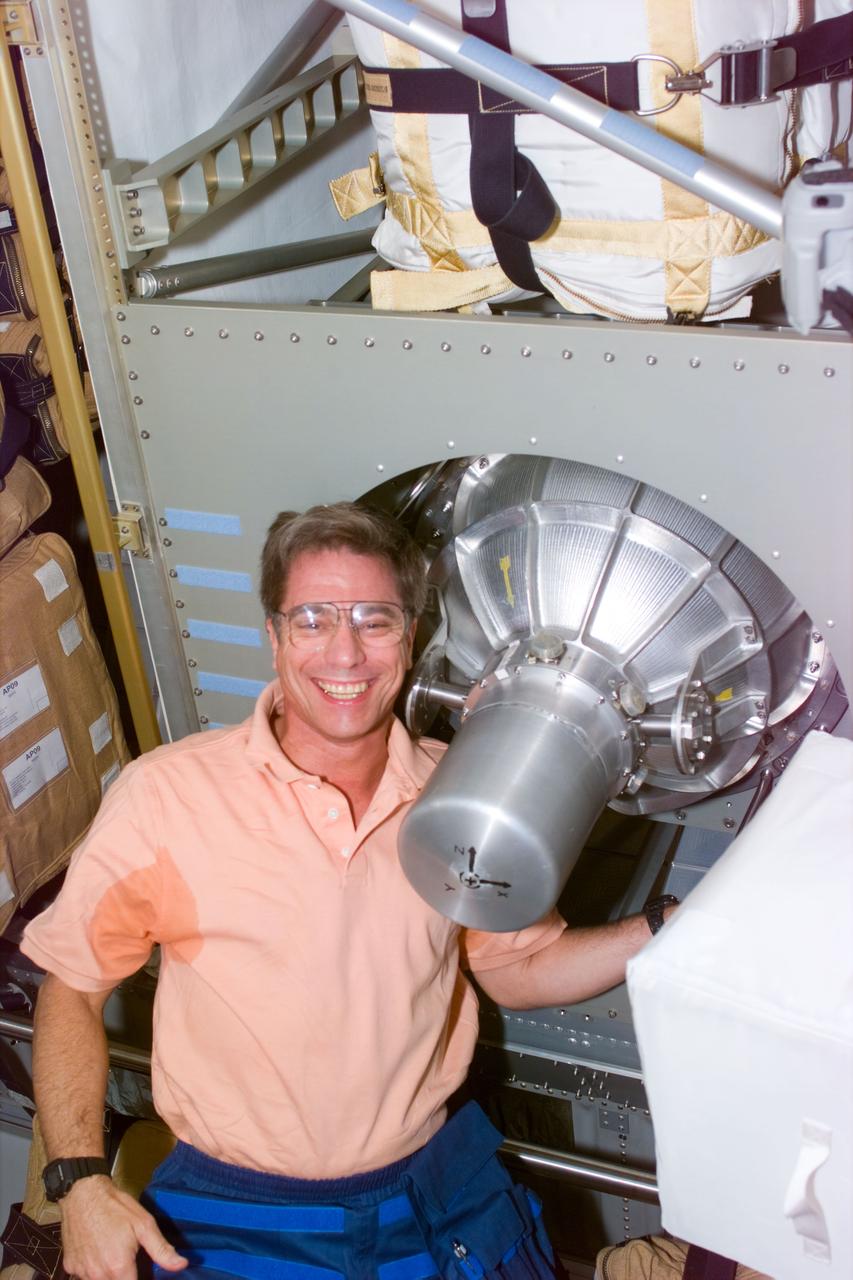
STS79-E-5030 (18 September 1996) --- Astronaut John E. Blaha checks on gyrodyne device, one part of gear to be transferred to Russia's Mir Space Station from the Space Shuttle Atlantis, on Flight Day 3.
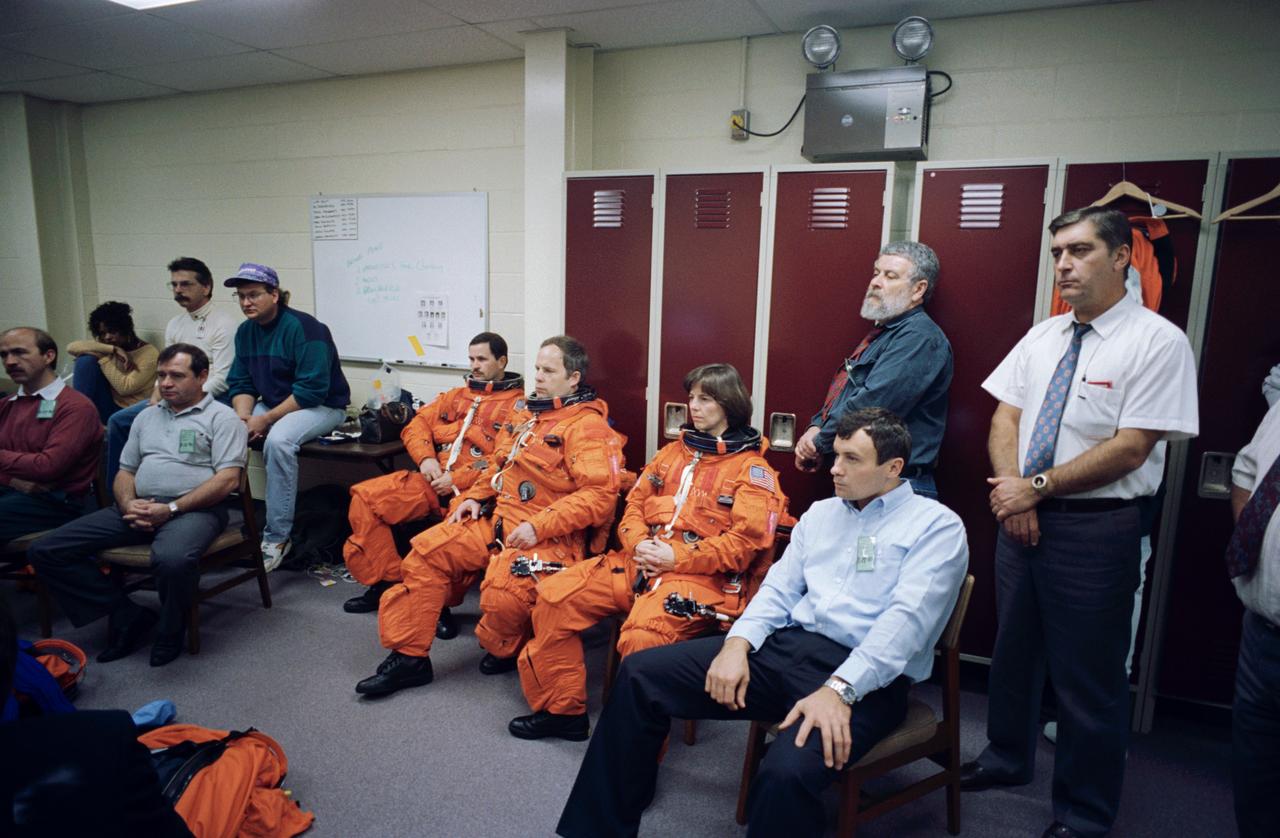
S94-47218 (28 Oct 1994) --- A number of Russian cosmonauts and an American astronaut listen to a briefing on launch and landing emergency situations during a training session in the Systems Integration Facility at the Johnson Space Center (JSC). Scheduled to launch aboard the Space Shuttle Atlantis with the STS-71 crew (in orange suits, left to right) are Nikolai M. Budarin, Mir 19 flight engineer; Anatoliy Y. Solovyev, Mir 19 mission commander; and Bonnie J. Dunbar, STS-71 mission specialist. The three are flanked by cosmonauts Gennadiy M. Strekalov (seated, second left) and Vladimir N. Dezhurov (seated, right foreground), flight engineer and commander, respectively, for the Mir-18 mission, who will return from a Russian Mir Space Station stay in Atlantis along with the two-way crew members of the STS-71 mission. Alexsandr F. Poleshchuk (seated, far left) is a Mir-reserve crew member.
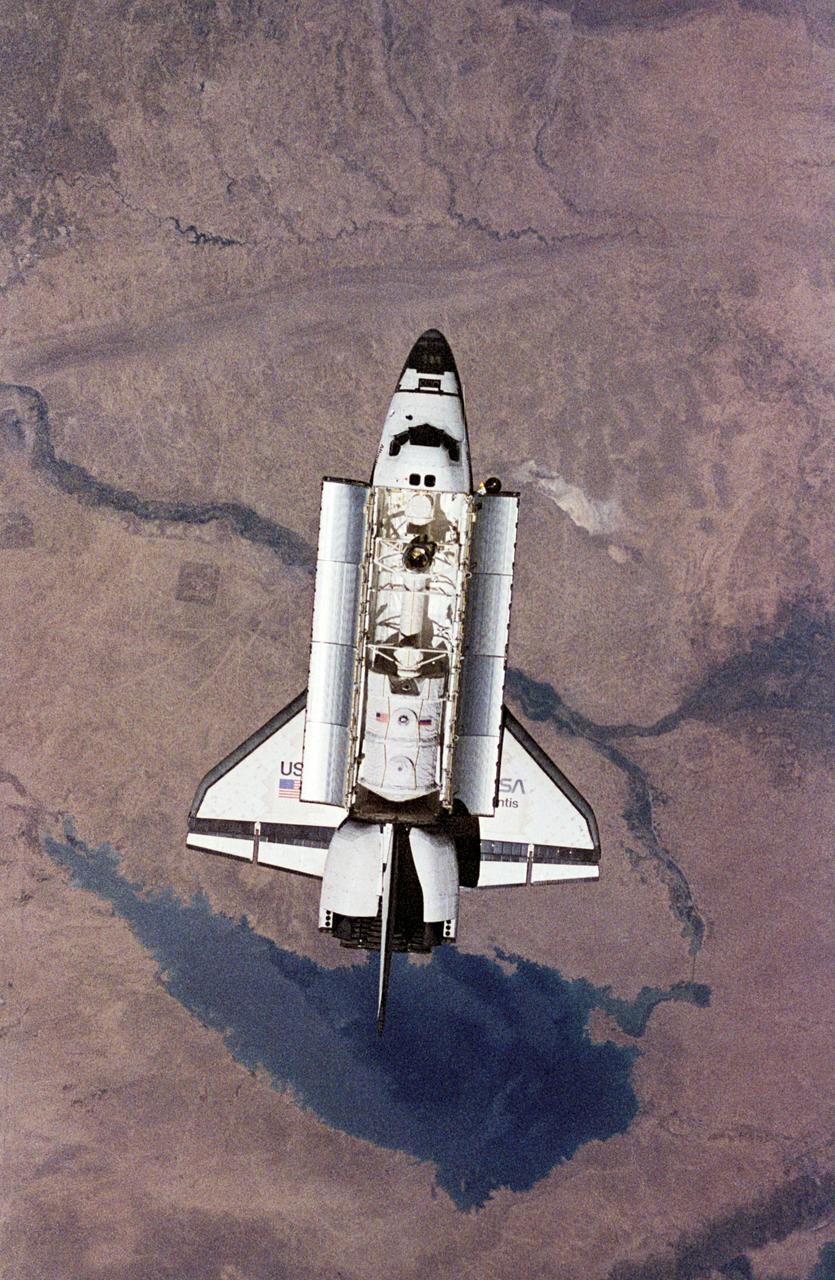
NM18-309-018 (28 June 1995) --- The Space Shuttle Atlantis orbits Earth at a point above Iraq as photographed by one of the Mir-18 crew members aboard Russia's Mir Space Station. The image was photographed prior to rendezvous and docking of the two spacecraft. The Spacelab science module and the tunnel connecting it to the crew cabin, as well as the added mechanism for interface with the Mir's docking system can be easily seen. The geography pictured is 60 miles northwest of Baghdad. The Buhayrat Ath Tharthar (reservoir) is the widest body of water visible. Also seen are the Tigris and Euphrates Rivers.
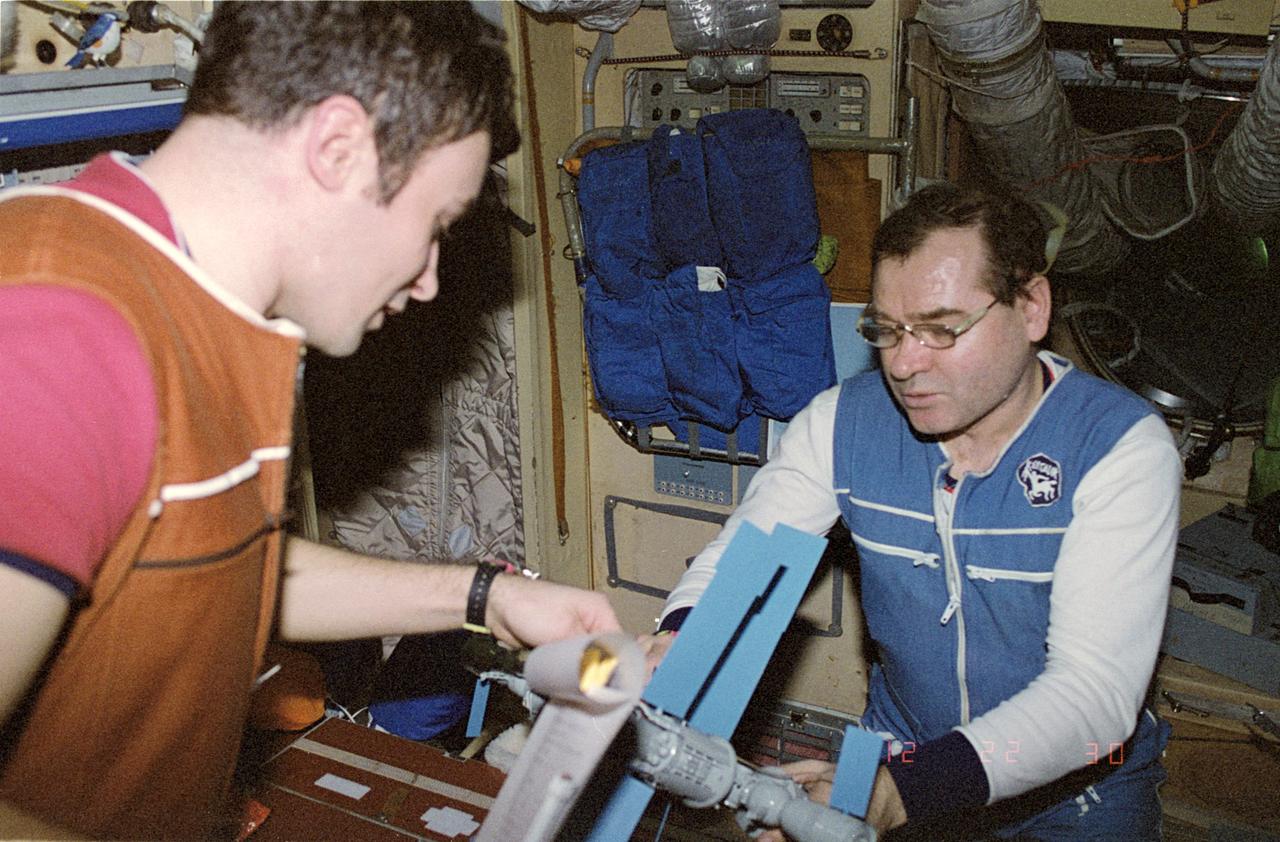
NM18-304-016 (March-July 1995) --- Cosmonauts Vladimir N. Dezhurov (left) and Gennadiy M. Strekalov study a small model of the Mir Space Station prior to one of their five space walks. At a July 18 press coonference in Houston, the two told reporters that the model was helpful in locating strategic points on the various modules, for example, hand rails and foot restraints. Along with astronaut Norman E. Thagard, the two went onto spend 115 days on Mir.
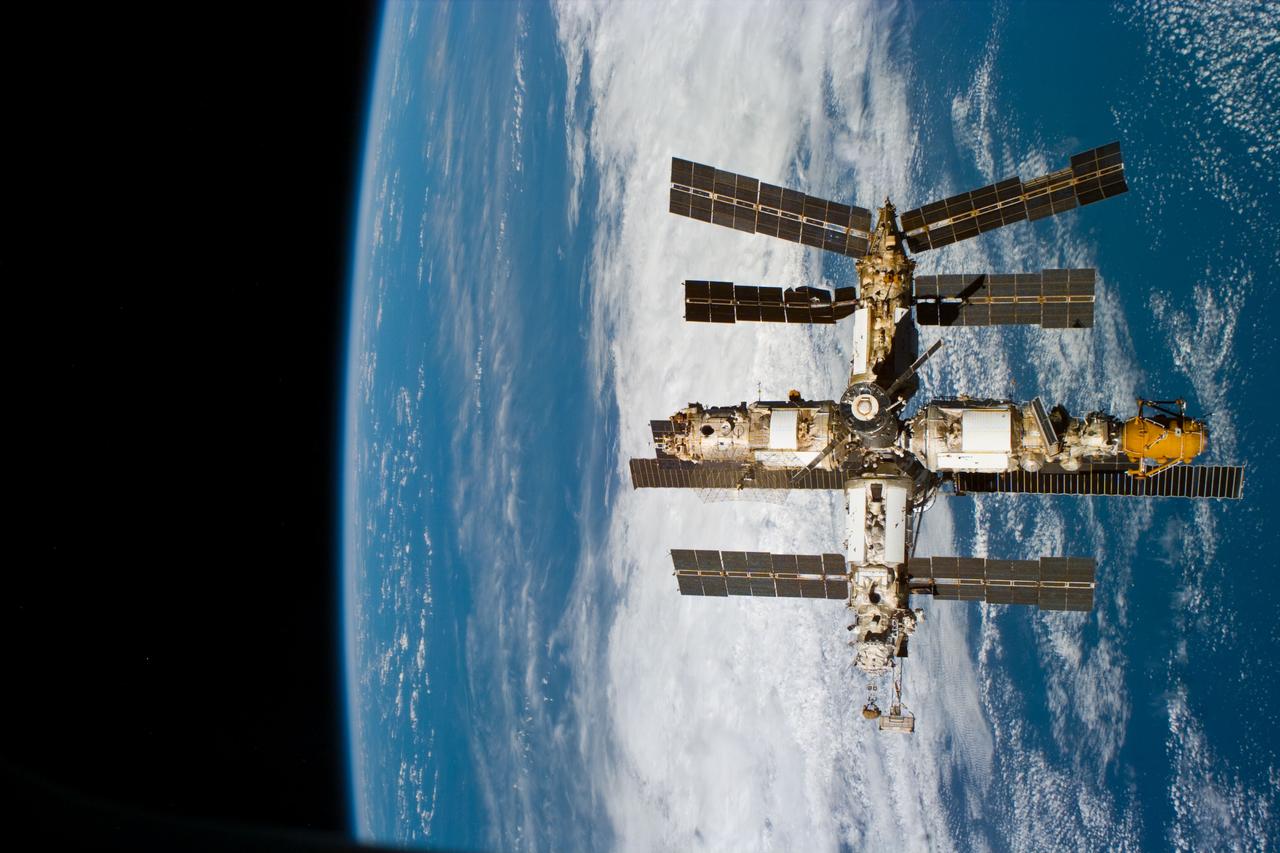
S89-E-5400 (29 Jan 1998) --- This Electronic Still Camera (ESC) image shows the Russian Mir Space Station over clouds and water, 160 nautical miles below, as seen from the Space Shuttle Endeavour. This photograph was taken following undocking operations, bringing to an end the eighth Shuttle/Mir docking activities. This ESC view was taken at 18:10:04 GMT, on January 29, 1998.
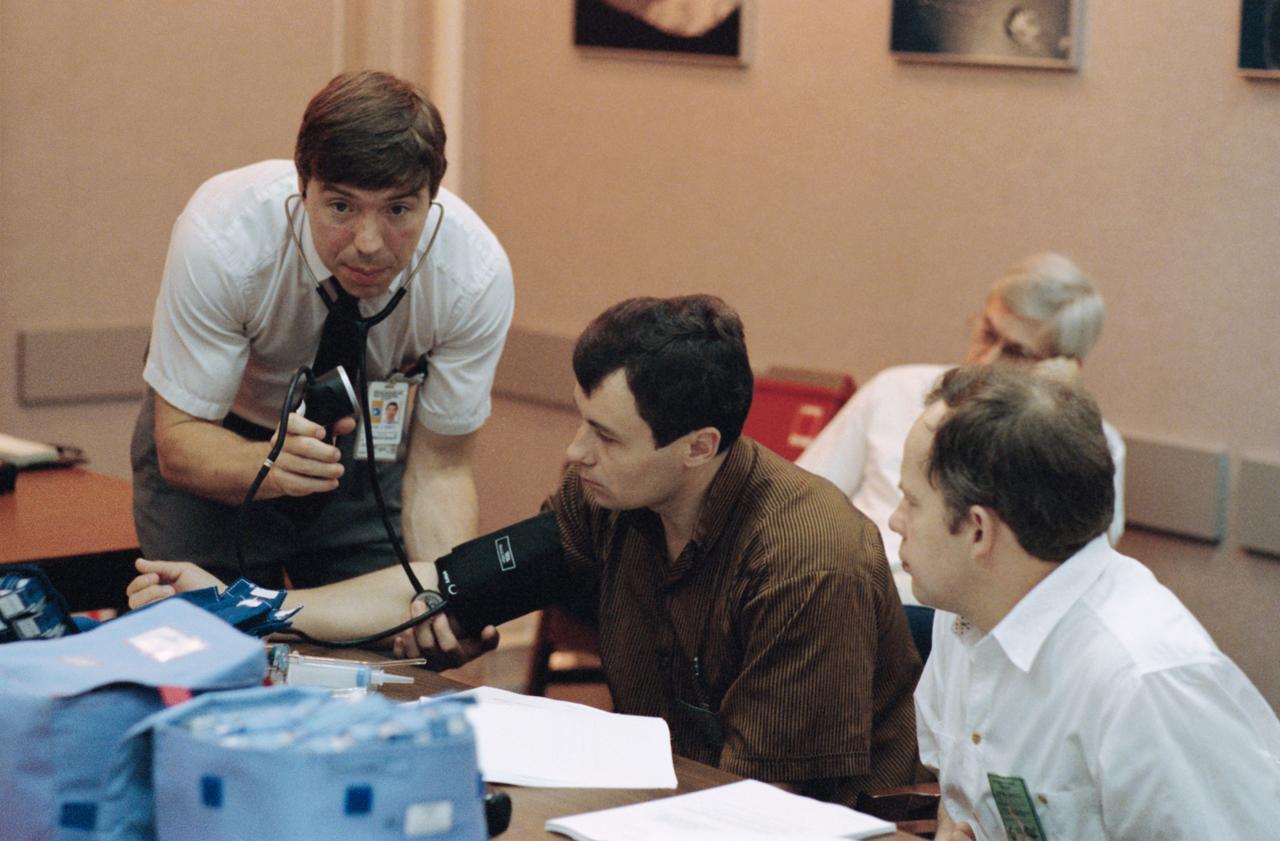
Cosmonaut Vladimir N. Dezhurov (center), Mir 18 mission commander, gets his blood pressure taken by Dr. Michael J. Barrett, flight surgeon. Cosmonaut Anatoliy Y. Solovyev (right), Mir 19 mission commander, looks on. Solovyev, Dezhurov, along with their respective flight engineers and a number of other cosmonauts and astronauts participating in the joint program, were in Houston, Texas, to prepare for their upcoming missions.
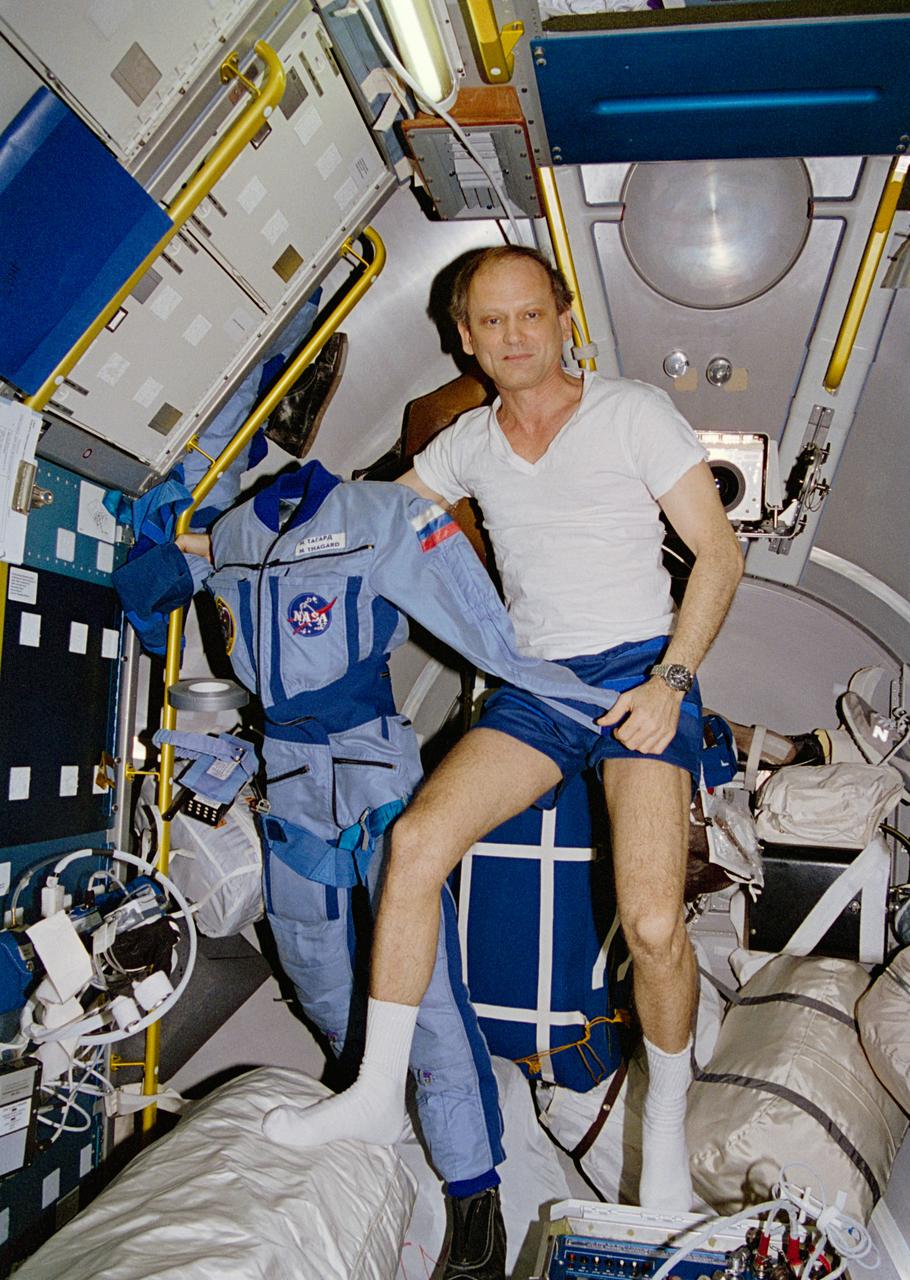
STS071-112-004 (27 June - 7 July 1995) --- Astronaut Norman E. Thagard, displays the flight suit he wore onboard Russia's Mir Space Station during a four month tour of duty as cosmonaut researcher for Mir-18. Thagard is seen in the Spacelab Science Module onboard the Space Shuttle Atlantis, in which he eventually underwent a battery of data collection tests.
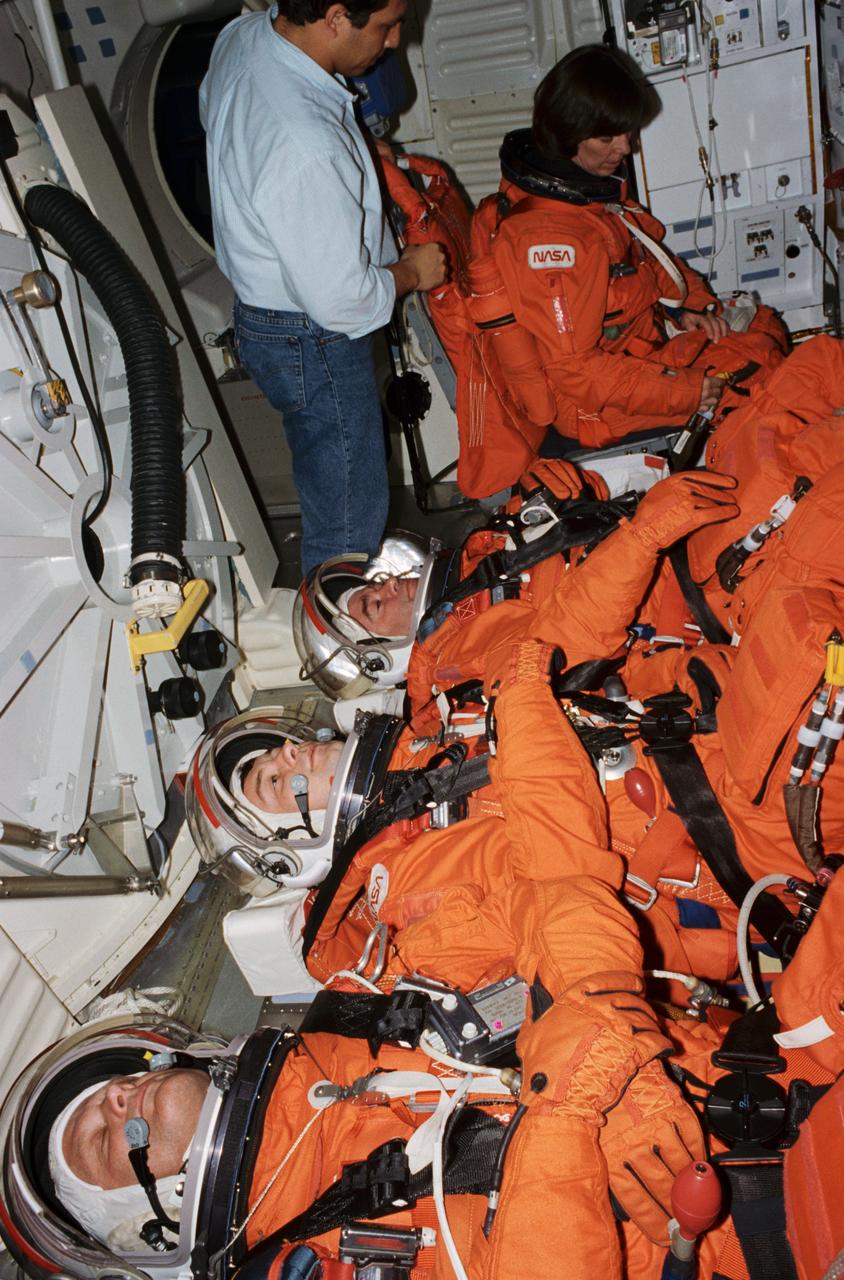
S94-47075 (Nov. 1994) --- In a Shuttle mockup trainer at the Johnson Space Center (JSC), a NASA astronaut and two Russian cosmonauts assigned to Russia's Mir 18 mission check out hardware like that to be flown onboard NASA's Space Shuttle Atlantis, the spacecraft that will retrieve the three from their orbital home for three months. Astronaut Norman E. Thagard (left), cosmonaut Vladimir N. Dezhurov, mission commander; and Gennadiy M. Strekalov, flight engineer; practice using the Recumbent Seating System (RSS). Astronaut Bonnie J. Dunbar, Thagard's backup on Mir 18 and mission specialist for STS-71, sits in a conventional middeck launch and entry station in the background. RSS has been manifest to be carried on the Space Shuttle Atlantis for the STS-71 mission. When the Space Shuttle Atlantis docks with Russia's Mir Space Station in 1995, Thagard and the two Russian cosmonauts, who will have been onboard Mir for a long duration stay, will join the STS-71 crew for the return to Earth.
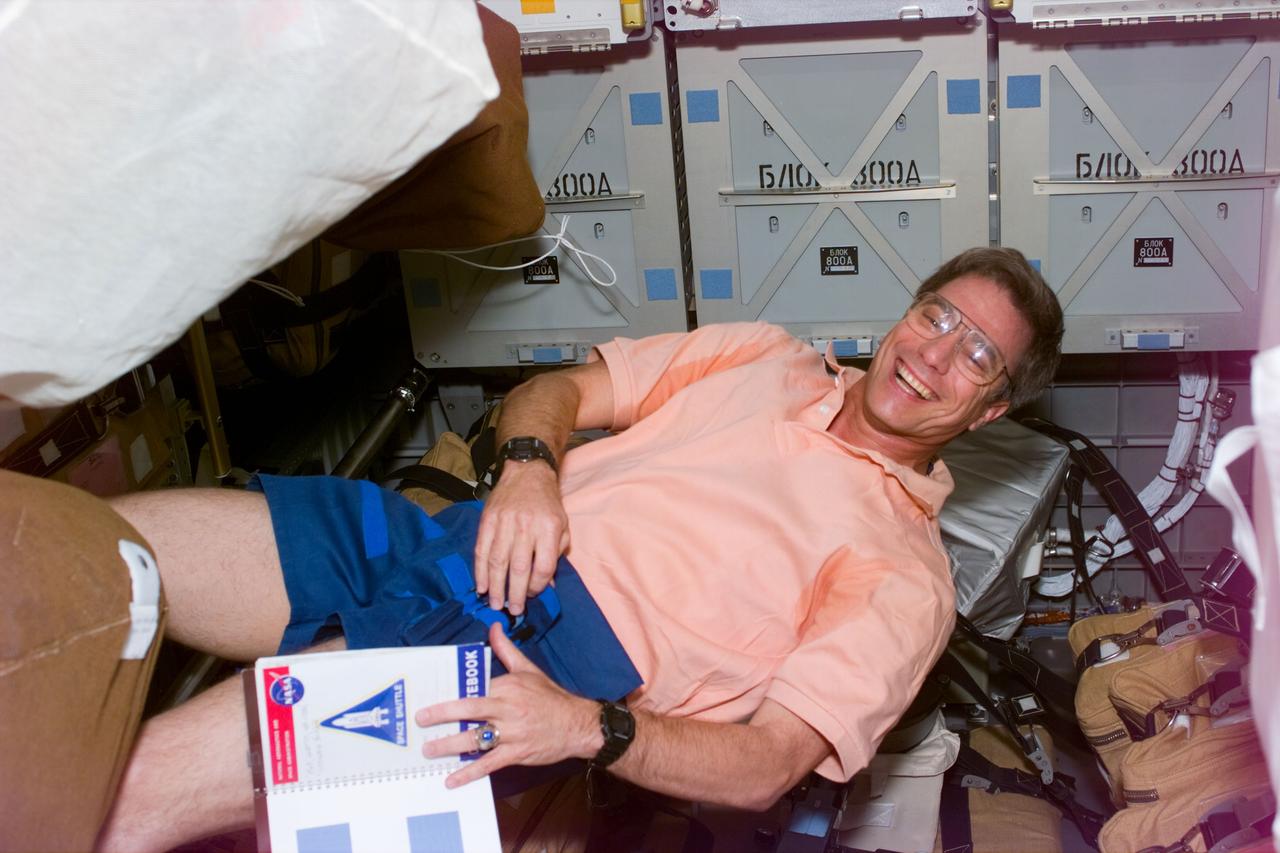
STS79-E-5027 (18 September 1996) --- Astronaut John E. Blaha, near Spacehab lockers onboard the Space Shuttle Atlantis, stays busy with final preparations for joining cosmonauts for crew mates following tomorrow's docking of the Atlantis and Russia's Mir Space Station, on Flight Day 3.
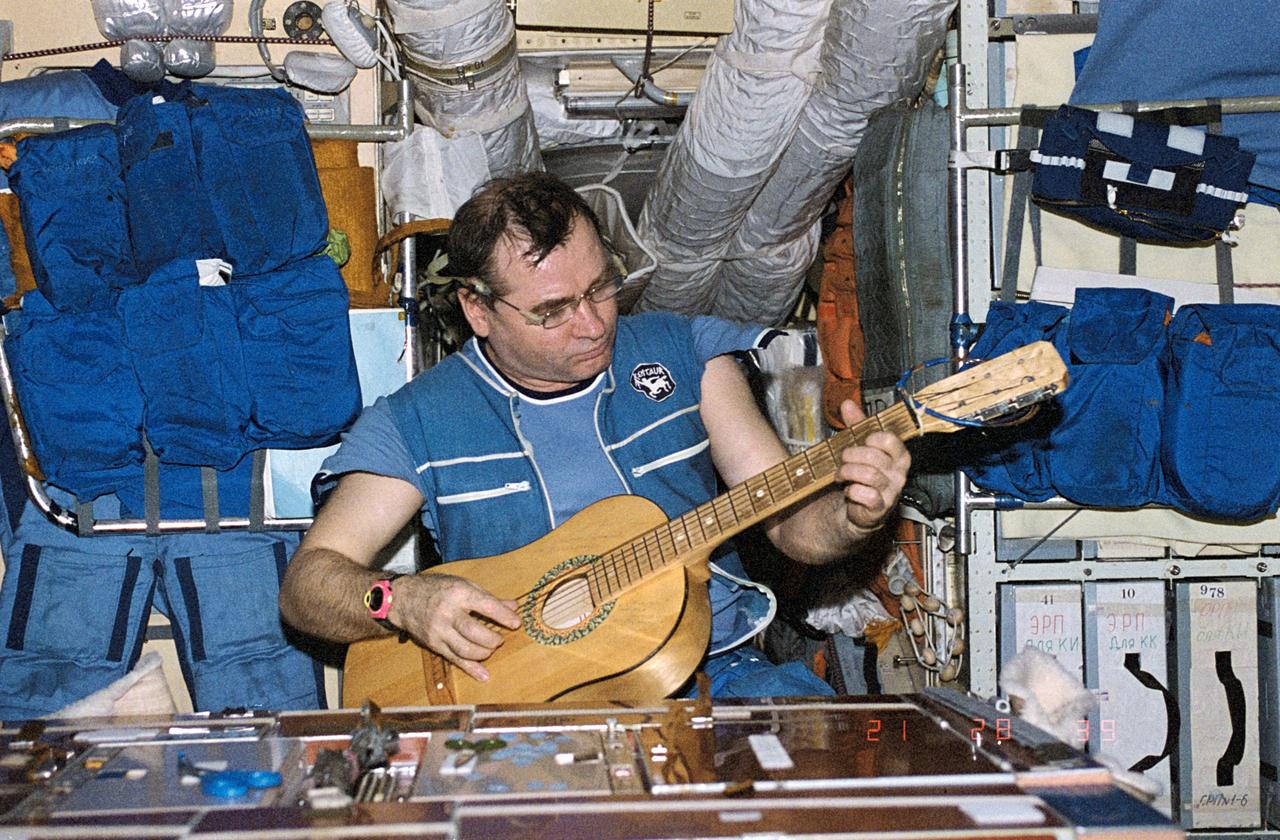
NM18-303-025 (March-July 1995) --- Onboard Mir’s base block module, cosmonaut Gennadiy M. Strekalov finds a rare moment of relaxation. At a July 18 press conference in Houston, Strekalov told reporters the guitar had been aboard the Space Station for several years.
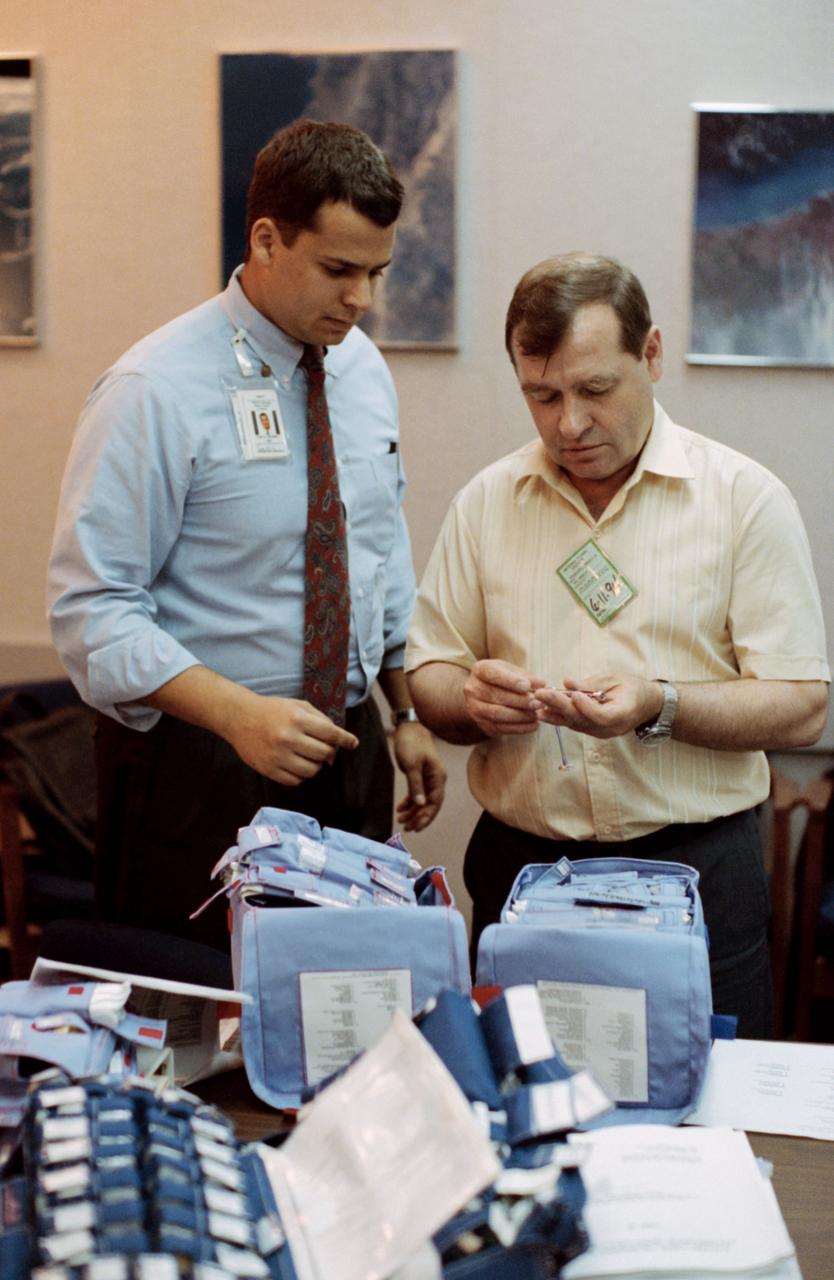
Cosmonaut Gennadiy M. Strekalov (right), Mir-18 flight engineer, is briefed on medical supplies by Ezra D. Kucharz, medical operations trainer for Krug Life Sciences, Incorporated. Strekalov and a number of other cosmonauts and astronauts participating in joint Russia - United States space missions are in Houston, Texas, to prepare for their upcoming missions.
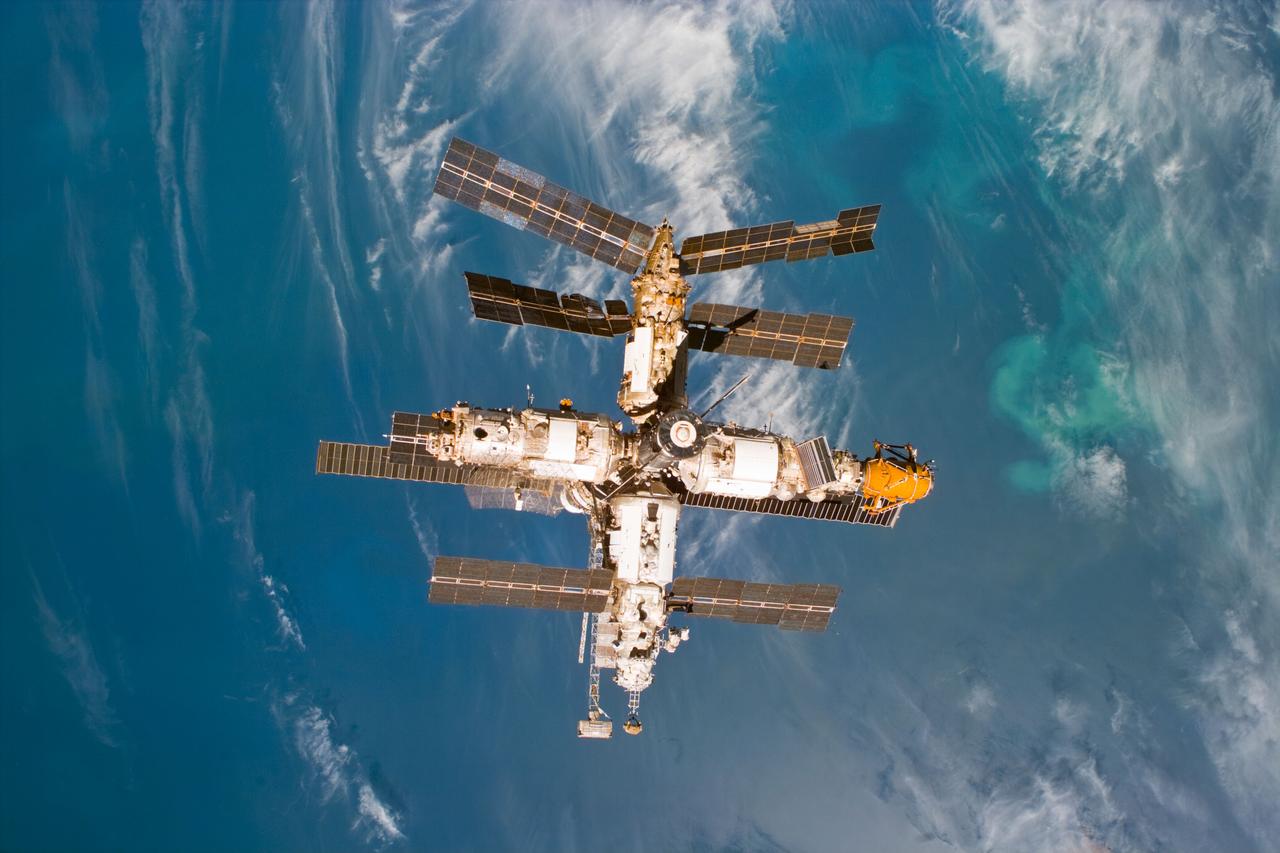
S89-E-5397 (29 Jan 1998) --- Russia's Mir Space Station is backdropped against the blue ocean as it continues to move further and further away from the Space Shuttle Endeavour, from which this electronic still camera (ESC) image was recorded at 18:05:24 GMT, Jan. 29, 1998.
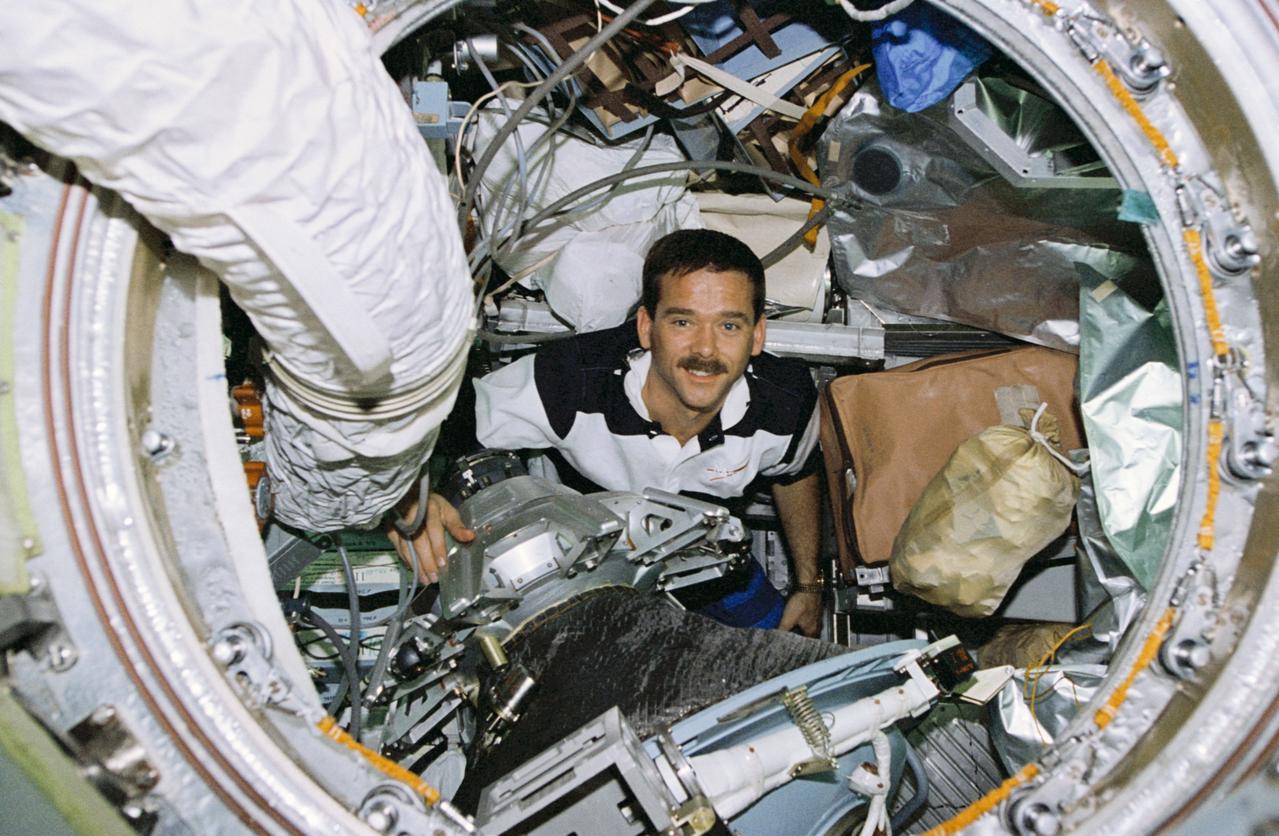
STS074-344-003 (12-20 Nov 1995) --- Astronaut Chris A. Hadfield makes his way among supplies and docking hardware onboard Russia?s Mir Space Station. With five NASA astronauts aboard the Space Shuttle Atlantis, the flight began with a November 12, 1995, launch from Kennedy Space Center (KSC) and ended with landing there on November 20, 1995. The STS-74 crew members were astronauts Kenneth D. Cameron, mission commander; James D. Halsell Jr., pilot; William S. McArthur Jr., Jerry L. Ross and Canadian astronaut Hadfield, all mission specialists. On November 15, 1995, the Space Shuttle Atlantis docked with Russia?s Mir Space Station, on which the NASA astronauts joined the Mir-20 crew. The Mir-20 crew is composed of cosmonauts Yuriy P. Gidzenko, commander; and Sergei V. Avdeyev, engineer; along with the European Space Agency?s (ESA) Thomas Reiter, cosmonaut researcher. Joint activities on the Mir Space Station and the Space Shuttle Atlantis ended on November 18, 1995, when the two spacecraft separated.
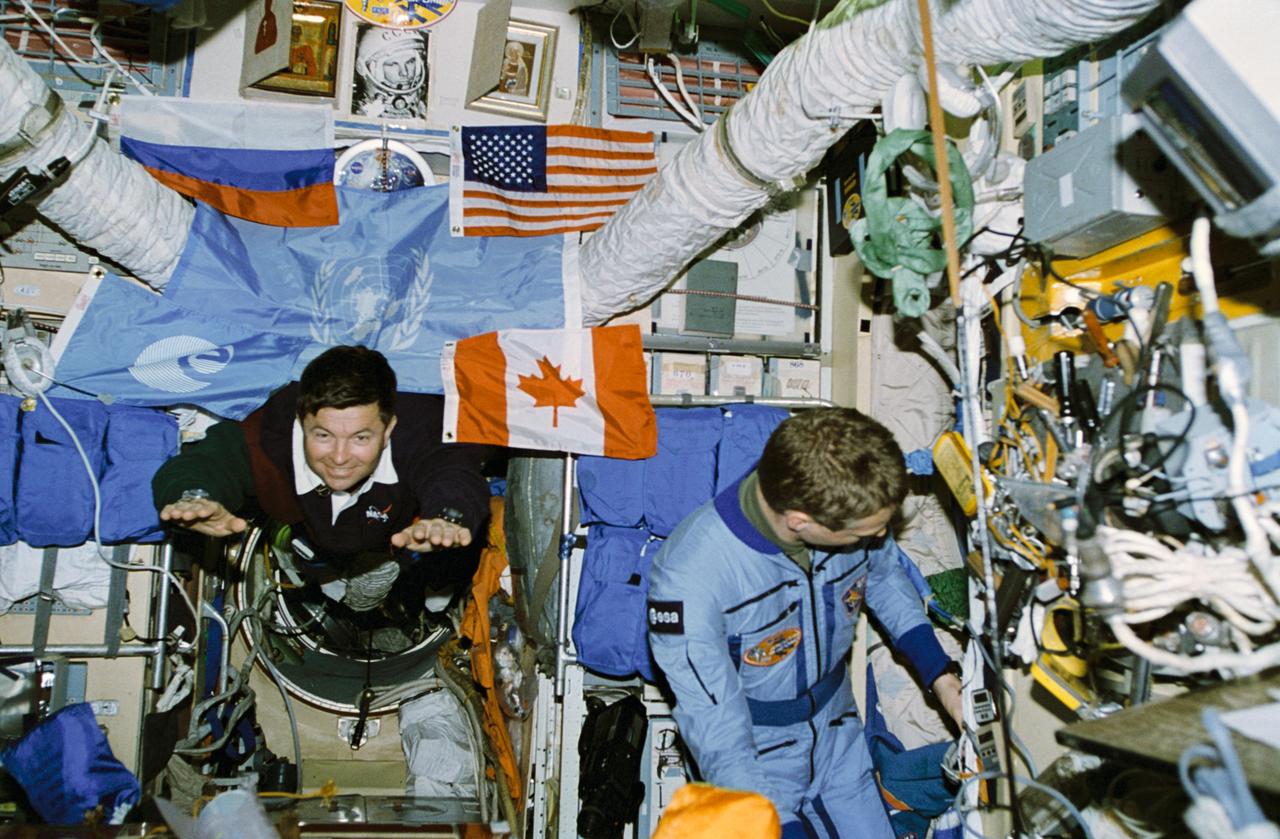
STS074-331-036 (12-20 Nov 1995) --- Astronaut Kenneth D. Cameron floats into the Core Module of Russia?s Mir Space Station. The European Space Agency?s (ESA) Thomas Reiter checks out an array of tools. With five NASA astronauts aboard the Space Shuttle Atlantis, the flight began with a November 12, 1995, launch from Kennedy Space Center (KSC) and ended with landing there on November 20, 1995. The crew members were astronauts Cameron, mission commander; James D. Halsell, Jr., pilot; William S. McArthur, Jr., Jerry L. Ross and Canadian astronaut Chris A. Hadfield, all mission specialists. On November 15, 1995, the Space Shuttle Atlantis docked with the Mir Space Station, on which the NASA astronauts joined the Mir-20 crew. The Mir-20 crew is composed of cosmonauts Yuriy P. Gidzenko, commander; and Sergei V. Avdeyev, engineer; along with Reiter, cosmonaut researcher. Joint activities on the Mir and the Space Shuttle Atlantis ended November 18, 1995, when the two spacecraft separated.
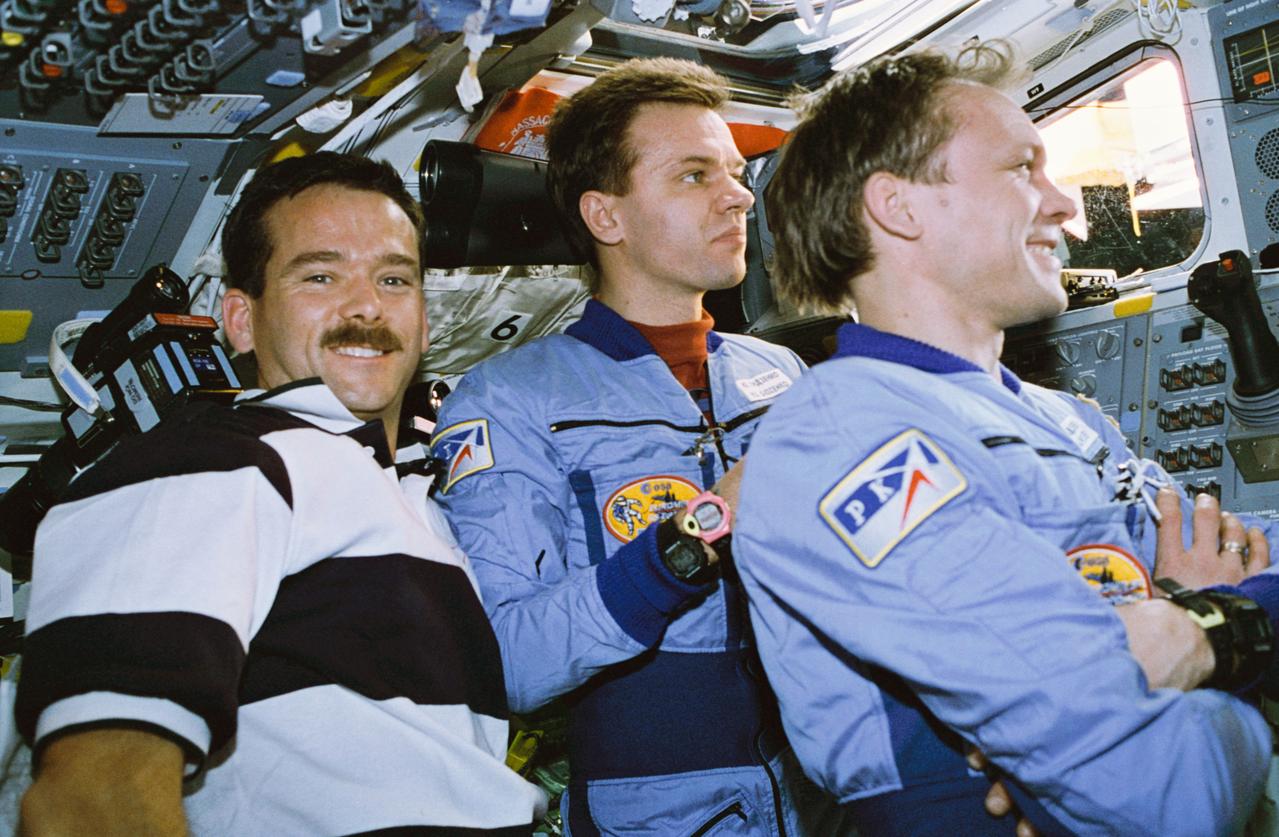
STS074-335-027 (12-20 Nov 1995) --- Astronaut Chris A. Hadfield joins two Mir-20 cosmonauts as they share a unique view through windows on the aft flight deck of the Space Shuttle Atlantis. Cosmonauts Yuriy P. Gidzenko (center), Mir-20 mission commander, and Sergei V. Avdeyev (right), flight engineer, along with the European Space Agency?s (ESA) Thomas Reiter (out of frame), cosmonaut researcher, have been onboard Russia?s Mir Space Station since September 5, 1995. At the time this photo was taken, the Space Shuttle Atlantis is docked with Mir Space Station, which is the subject of interest by the three international spectators here. With five NASA astronauts aboard the Space Shuttle Atlantis, the STS-74 flight began with a November 12, 1995, launch from Kennedy Space Center (KSC) and ended with landing there on November 20, 1995. The STS-74 crew members were astronauts Kenneth D. Cameron, mission commander; James D. Halsell Jr., pilot; William S. McArthur Jr., Jerry L. Ross and Canadian astronaut Hadfield, all mission specialists. Joint activities on the Mir Space Station and the Space Shuttle Atlantis ended on November 18, 1995, when the two spacecraft separated.
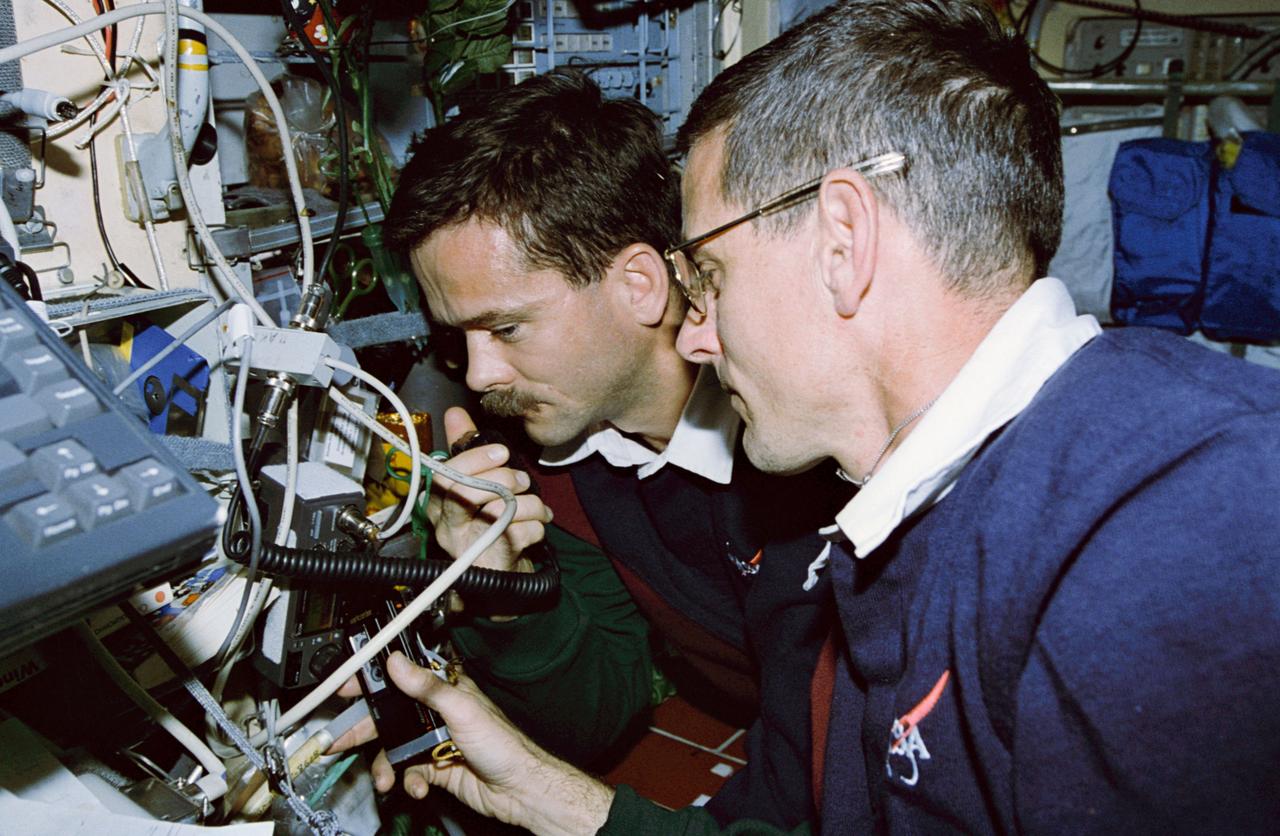
STS074-324-030 (12-20 Nov 1995) --- Astronauts Chris A. Hadfield (left) and William S. McArthur, Jr. check out the Shuttle Amateur Radio Experiment (SAREX) onboard Russia?s Mir Space Station. With five NASA astronauts aboard, the flight of the Space Shuttle Atlantis began with a November 12, 1995, launch from Kennedy Space Center (KSC) and ended with landing there on November 20, 1995. The STS-74 crew members were astronauts Kenneth D. Cameron, mission commander; James D. Halsell, Jr., pilot; McArthur, Jerry L. Ross and Canadian astronaut Hadfield, all mission specialists. On November 15, 1995, the Space Shuttle Atlantis docked with the Mir Space Station, on which the STS-74 astronauts joined the Mir-20 crew. The Mir-20 crew is composed of cosmonauts Yuriy P. Gidzenko, commander; and Sergei V. Avdeyev, flight engineer; along with the European Space Agency?s (ESA) Thomas Reiter, cosmonaut researcher. Joint activities on the Mir Space Station and the Space Shuttle Atlantis ended November 18, 1995, when the two spacecraft separated.
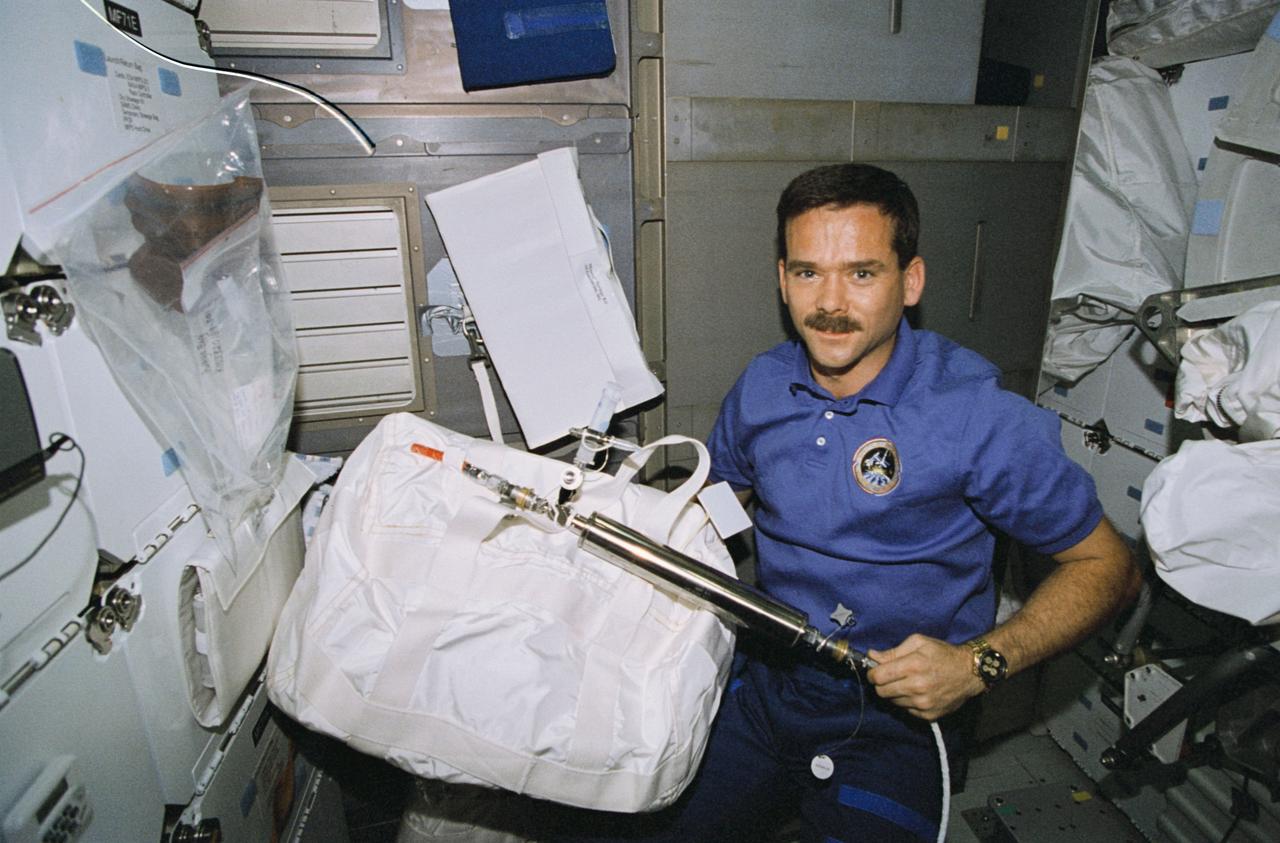
STS074-363-028 (12-20 Nov 1995) --- Canadian astronaut Chris A. Hadfield is seen with a microgravity water production system on the middeck of the Space Shuttle Atlantis. He is filling a fresh water supply bag for Russia?s Mir Space Station. With five NASA astronauts aboard, the flight of the Space Shuttle Atlantis began with a November 12, 1995, launch from Kennedy Space Center (KSC) and ended with landing there on November 20, 1995. The STS-74 crew members were astronauts Kenneth D. Cameron, mission commander; James D. Halsell Jr., pilot; William S. McArthur Jr., Jerry L. Ross and Hadfield, all mission specialists. On November 15, 1995, the Space Shuttle Atlantis docked with the Mir Space Station, on which the STS-74 astronauts joined the Mir-20 crew. The Mir-20 crew is composed of cosmonauts Yuriy P. Gidzenko, commander; and Sergei V. Avdeyev, flight engineer; along with the European Space Agency?s (ESA) Thomas Reiter, cosmonaut researcher. Joint activities on the Mir Space Station and the Space Shuttle Atlantis ended November 18, 1995, when the two spacecraft separated.
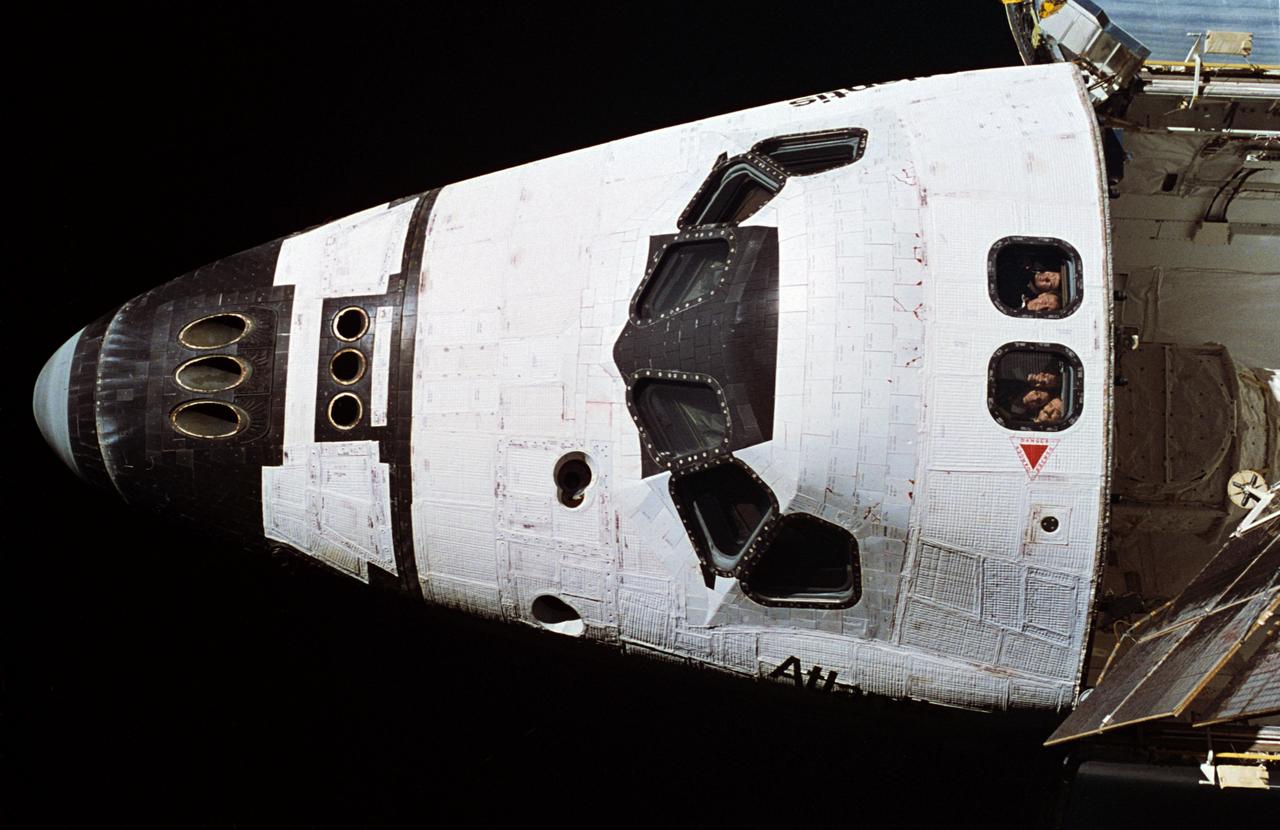
STS074-320-019 (15 Nov 1995) --- The five NASA astronauts aboard the Space Shuttle Atlantis look out overhead windows on the aft flight deck toward their counterparts aboard the Russian Mir Space Station, with which they had just rendezvoused. For orientation purposes, the photo should be held with the nose at frame?s left edge. The STS-74 crew members (from the top) are astronauts Kenneth D. Cameron, mission commander; Jerry L. Ross, mission specialist; James D. Halsell Jr., pilot; William S. McArthur Jr., and Canadian astronaut Chris A. Hadfield, both mission specialists. The flight began with a November 12, 1995, launch from Kennedy Space Center (KSC) and ended with landing there on November 20, 1995. On November 15, 1995, the Space Shuttle Atlantis docked with Russia?s Mir Space Station, on which the STS-74 astronauts joined the Mir-20 crew. The Mir-20 crew is composed of cosmonauts Yuriy P. Gidzenko, commander; and Sergei V. Avdeyev, engineer; along with the European Space Agency?s (ESA) Thomas Reiter, cosmonaut researcher. Joint activities on Mir Space Station and the Space Shuttle ended November 18, 1995, when the two spacecraft separated.
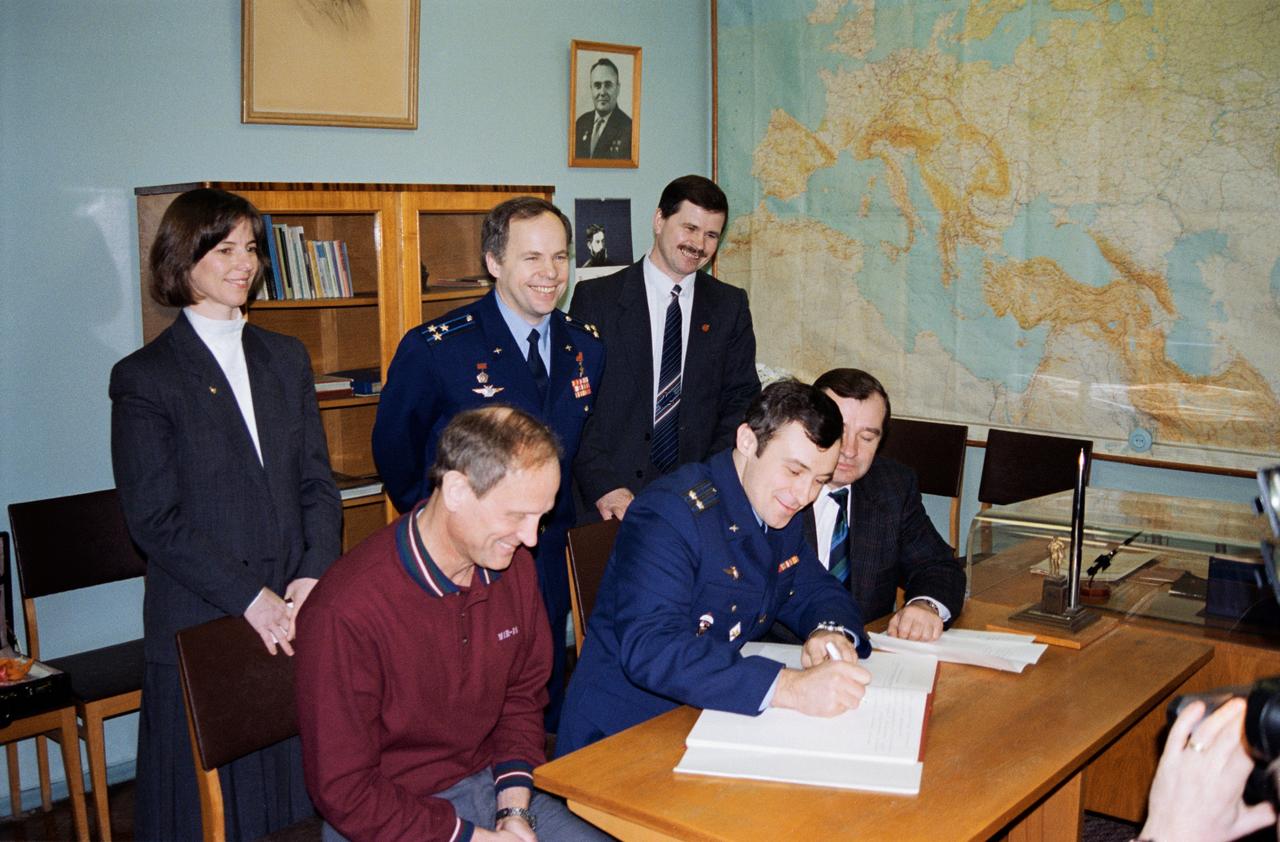
S95-04323 (22 Feb 1995) --- In keeping with Russian tradition, astronaut Norman E. Thagard (seated, left), guest researcher, watches as Vladimir N. Dezhurov (seated, center), signs the diary of the late Yuriy A. Gagarin, the first Russian cosmonaut, as his Mir 18 crew mates and the subsequent Mir crewmembers look on. Cosmonauts Dezhurov, mission commander, and Gennadiy M. Strekalov (seated right, partially obscured), flight engineer, have been training with Thagard in both the United States and Russia for the past several months. Watching are, standing left to right, astronaut Bonnie J. Dunbar, Thagard?s alternate crew member; and cosmonauts Anatoliy Y. Solovyev, Mir 19 mission commander, and Nikolai M. Budarin, flight engineer.
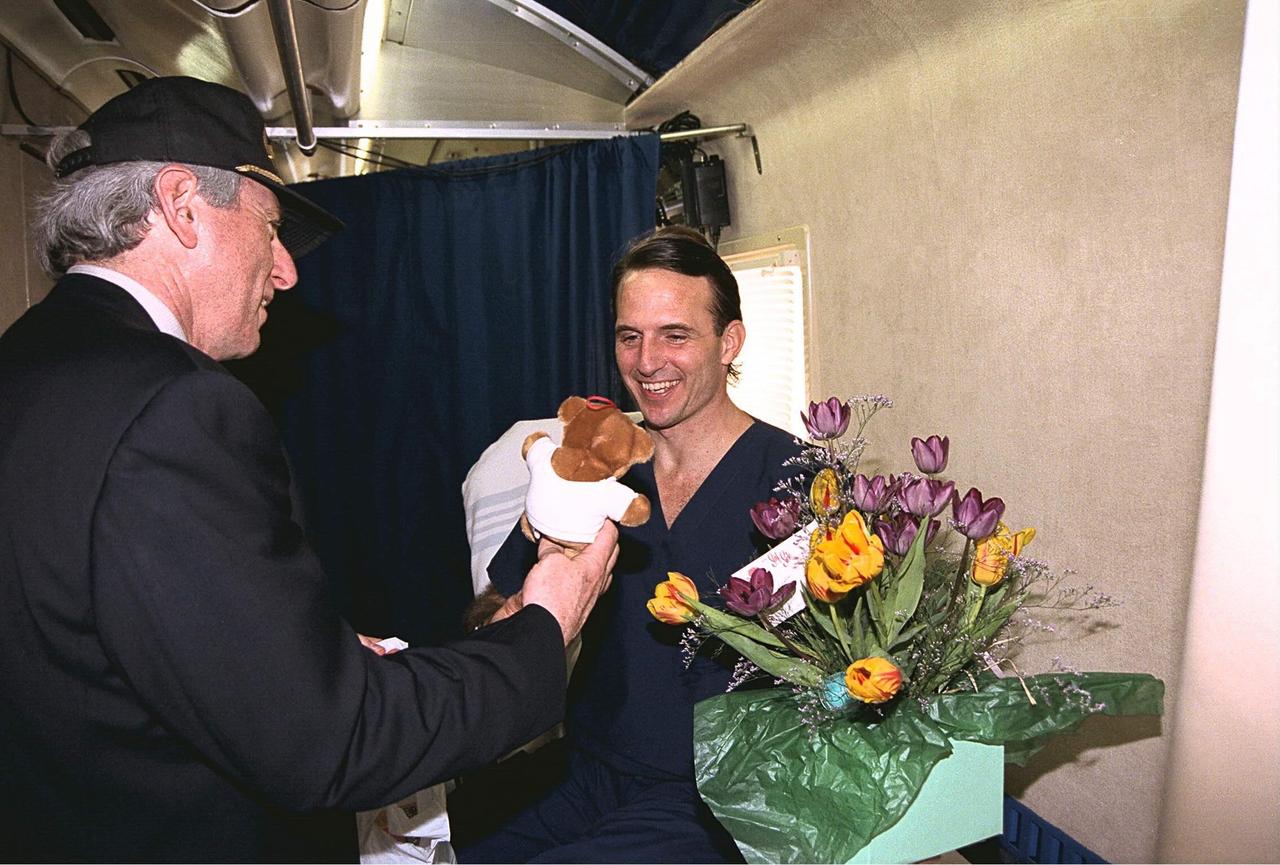
NASA Administrator Daniel Goldin presents some gifts to returning astronaut Jerry M. Linenger, who spent the last four months on the Russian Space Station Mir. Goldin met with Linenger in the Crew Transport Vehicle shortly after the Space Shuttle orbiter Atlantis landed on Runway 33 of KSC’s Shuttle Landing Facility at the conclusion of the nine-day STS-84 mission. Goldin gave the astronaut flowers for Linenger’s wife, Kathryn; a stuffed bear for their 18-month-old son, John; and a rattle for their unborn child who is due next month. STS-84 was the sixth of nine planned dockings of the Space Shuttle with the Mir. Mir 23 crew member Linenger was replaced on the Russian space station by STS-84 Mission Specialist C. Michael Foale
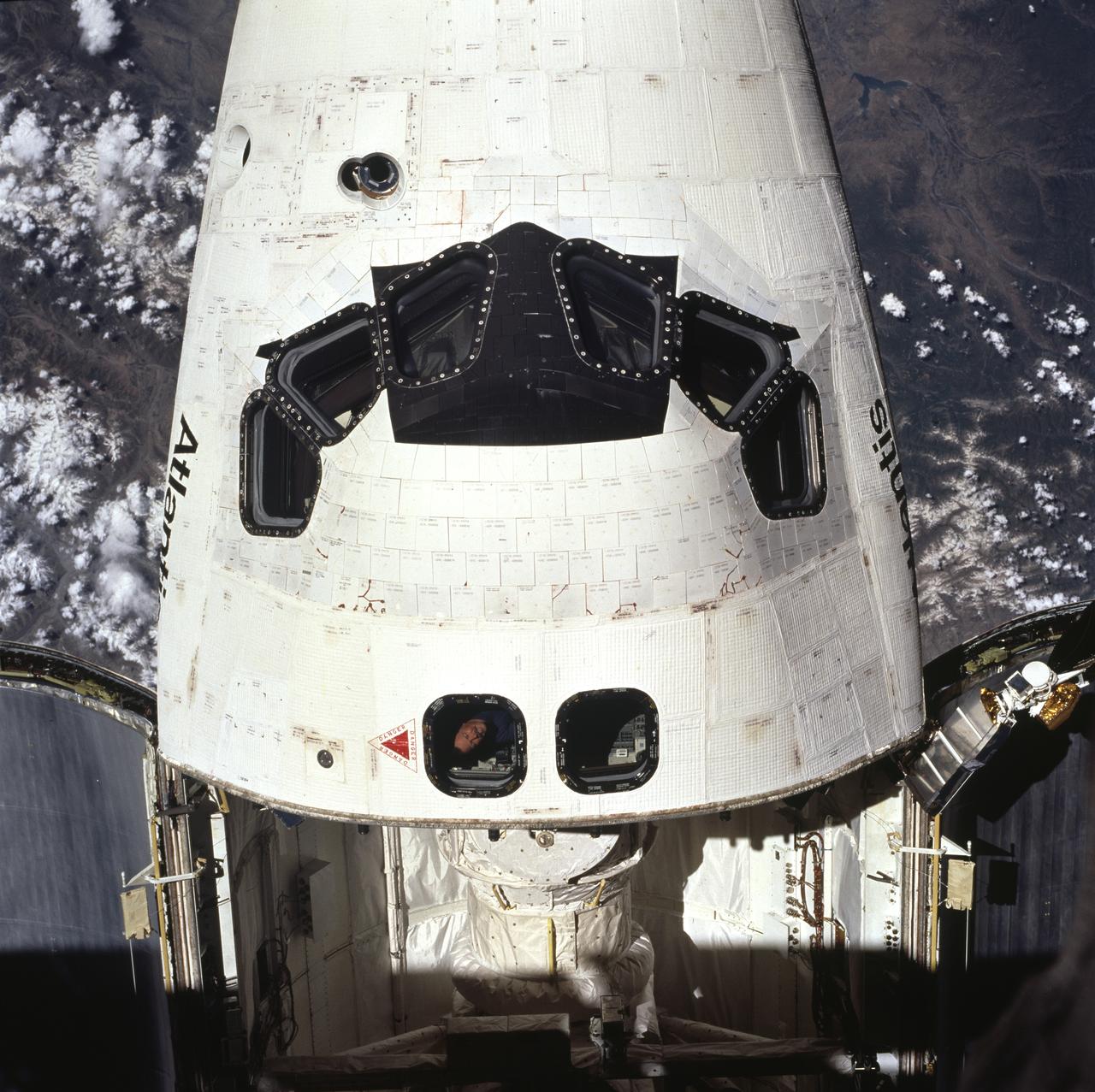
STS071-723-059 (27 June-7 July 1995) --- Docked already with Russia's Mir Space Station, the space shuttle Atlantis, with its crew cabin most prominent, is partially visible through a window on the station. A 70mm camera, carried into space by the crew aboard Atlantis, was used to expose the image. Above astronaut Robert L. Gibson's, STS-71 commander, head can be seen the tunnel leading to Spacelab's Science Module in Atlantis' cargo bay. A port in the tunnel enabled the seven crew members to visit Mir and it allowed the three Mir-18 crewmembers, in space since March of this year, access to Spacelab. That module was quite busy with tests and data collection involving the three until Atlantis brought them home on July 7, 1995.
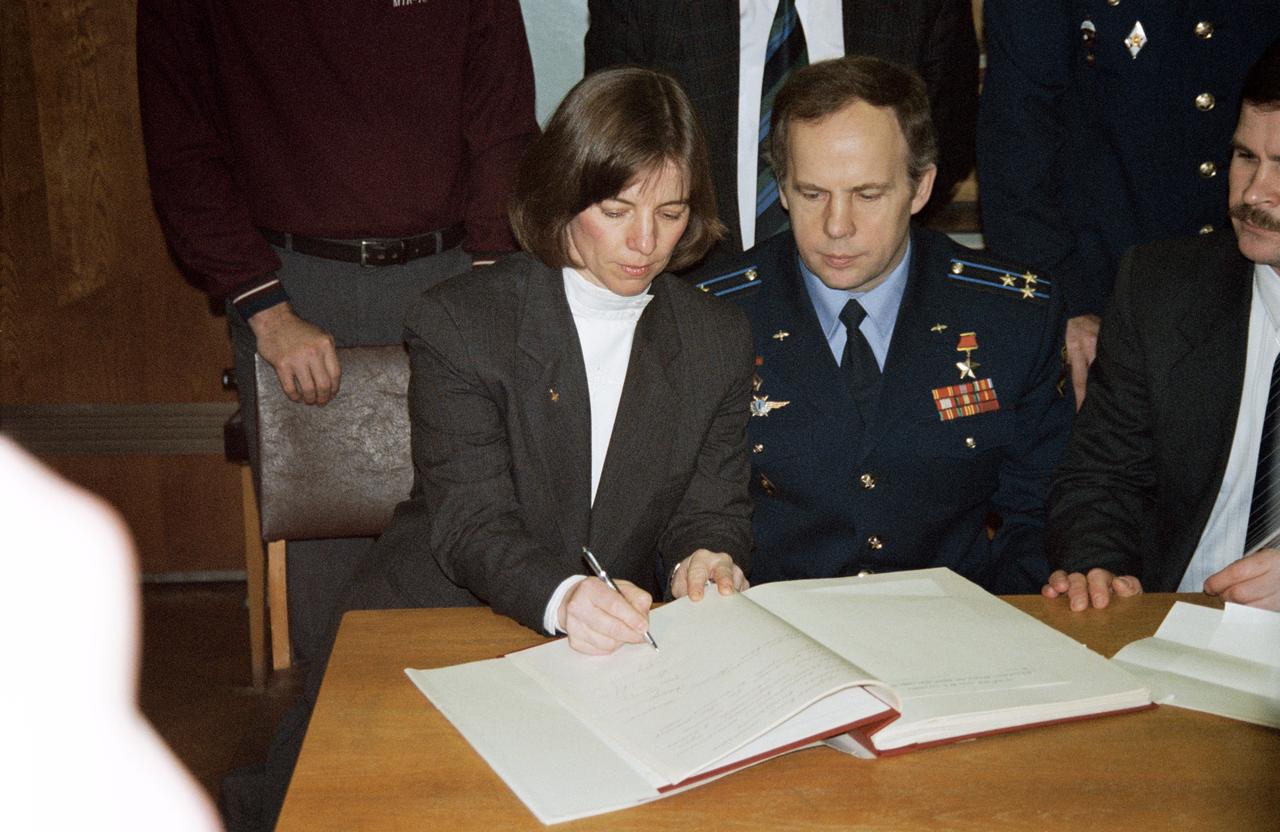
S95-04325 (22 March 1995) --- In keeping with Russian tradition, astronaut Bonnie J. Dunbar (left), STS-71 mission specialist, signs the diary of the late Yuriy A. Gagarin, the first Russian cosmonaut, as her STS-71 crew mates look on. Cosmonauts Anatoliy Y. Solovyov (center), Mir 19 mission commander, and Nikiolai M. Budarin, flight engineer, have been training with Dunbar in both the United States and Russia for the past several months. It is customary for each crew member about to aboard a Russian spacecraft to sign the diary. Dunbar has been in Russia training as alternate researcher for the Mir 18 mission.
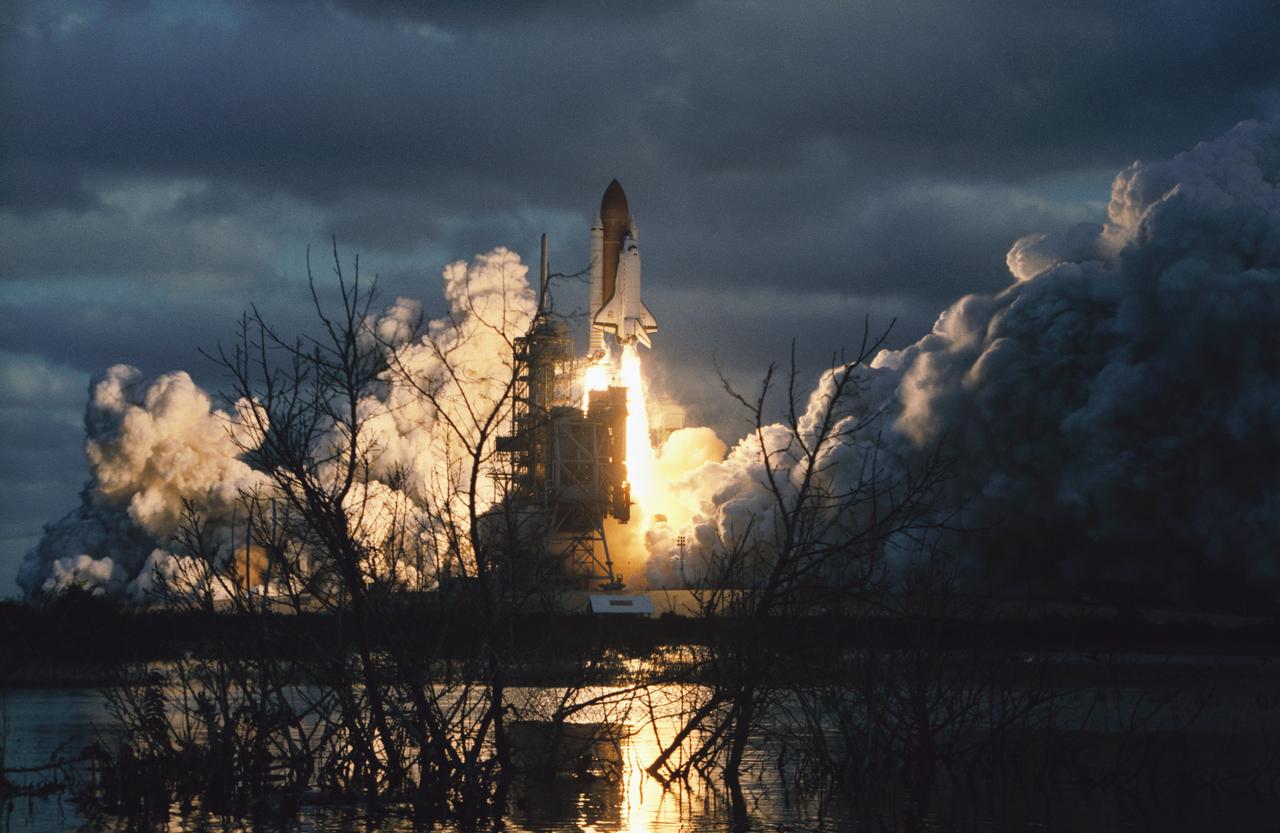
STS074-S-017 (12 Nov 1995) --- With five astronauts aboard, the Space Shuttle Atlantis lifts off from the Kennedy Space Center?s (KSC) Launch Pad 39A. Launch occurred at 7:30:43:071 a.m. (EST), November 12, 1995. The crew members were astronauts Kenneth D. Cameron, mission commander; James D. Halsell Jr., pilot; William S. McArthur Jr., Jerry L. Ross and Canadian astronaut Chris A. Hadfield, all mission specialists. On November 15, 1995, the Space Shuttle Atlantis docked with Russia?s Mir Space Station, on which the NASA astronauts joined the Mir-20 crew. The Mir-20 crew is composed of cosmonauts Yuriy P. Gidzenko, commander; and Sergei V. Avdeyev, engineer; along with the European Space Agency?s (ESA) Thomas Reiter, cosmonaut researcher. Joint activities on the Mir Space Station and the Space Shuttle Atlantis ended on November 18, 1995, when the two spacecraft separated. The November 20, 1995, landing also took place at KSC.
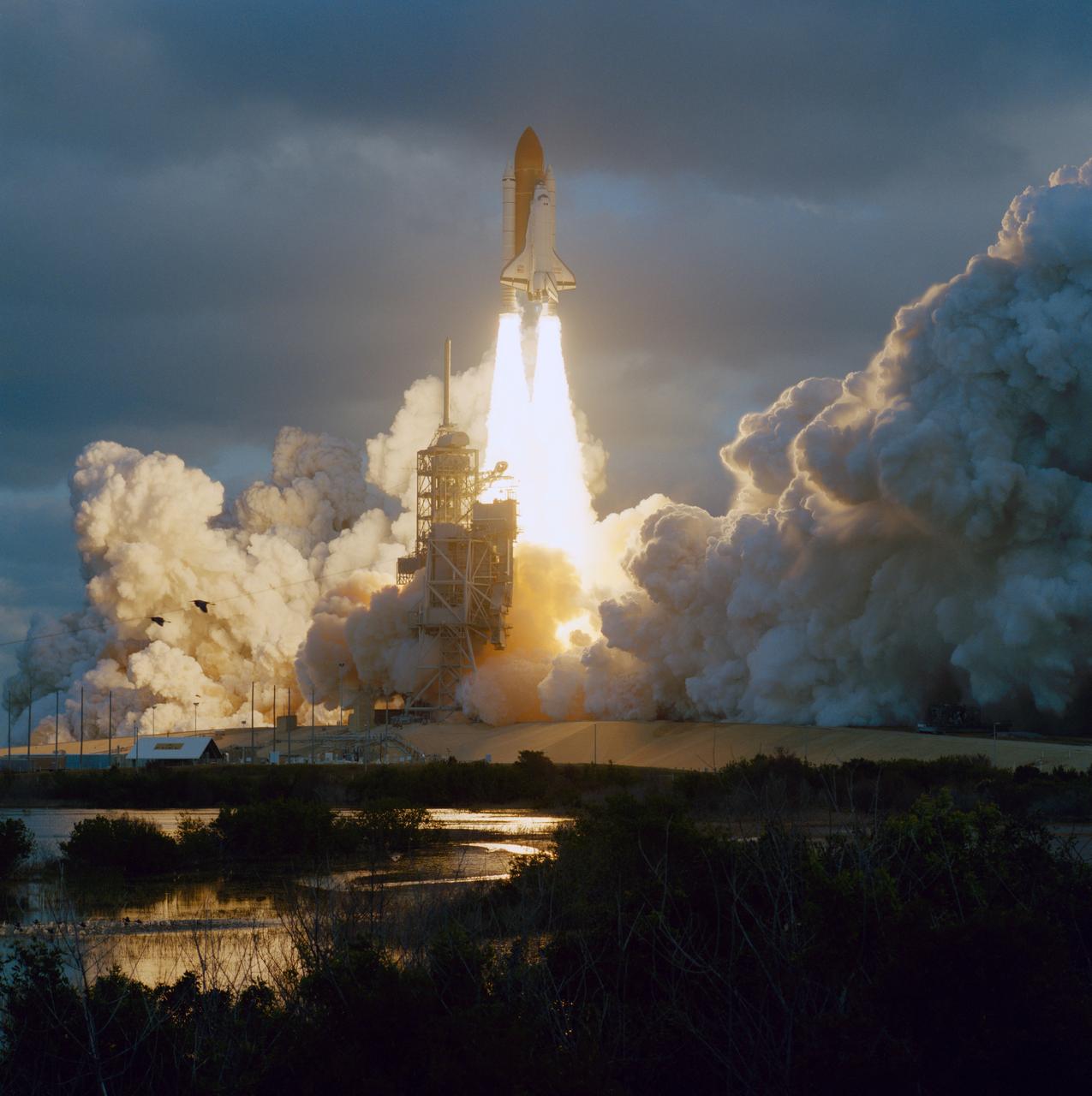
STS074-S-013 (12 Nov 1995) --- With five astronauts aboard, the Space Shuttle Atlantis lifts off from the Kennedy Space Center?s (KSC) Launch Pad 39A. Launch occurred at 7:30:43:071 a.m. (EST), November 12, 1995. The crew members were astronauts Kenneth D. Cameron, mission commander; James D. Halsell Jr., pilot; William S. McArthur Jr., Jerry L. Ross and Canadian astronaut Chris A. Hadfield, all mission specialists. On November 15, 1995, the Space Shuttle Atlantis docked with Russia?s Mir Space Station, on which the NASA astronauts joined the Mir-20 crew. The Mir-20 crew is composed of cosmonauts Yuriy P. Gidzenko, commander; and Sergei V. Avdeyev, engineer; along with the European Space Agency?s (ESA) Thomas Reiter, cosmonaut researcher. Joint activities on the Mir Space Station and the Space Shuttle Atlantis ended on November 18, 1995, when the two spacecraft separated. The November 20, 1995, landing also took place at KSC.
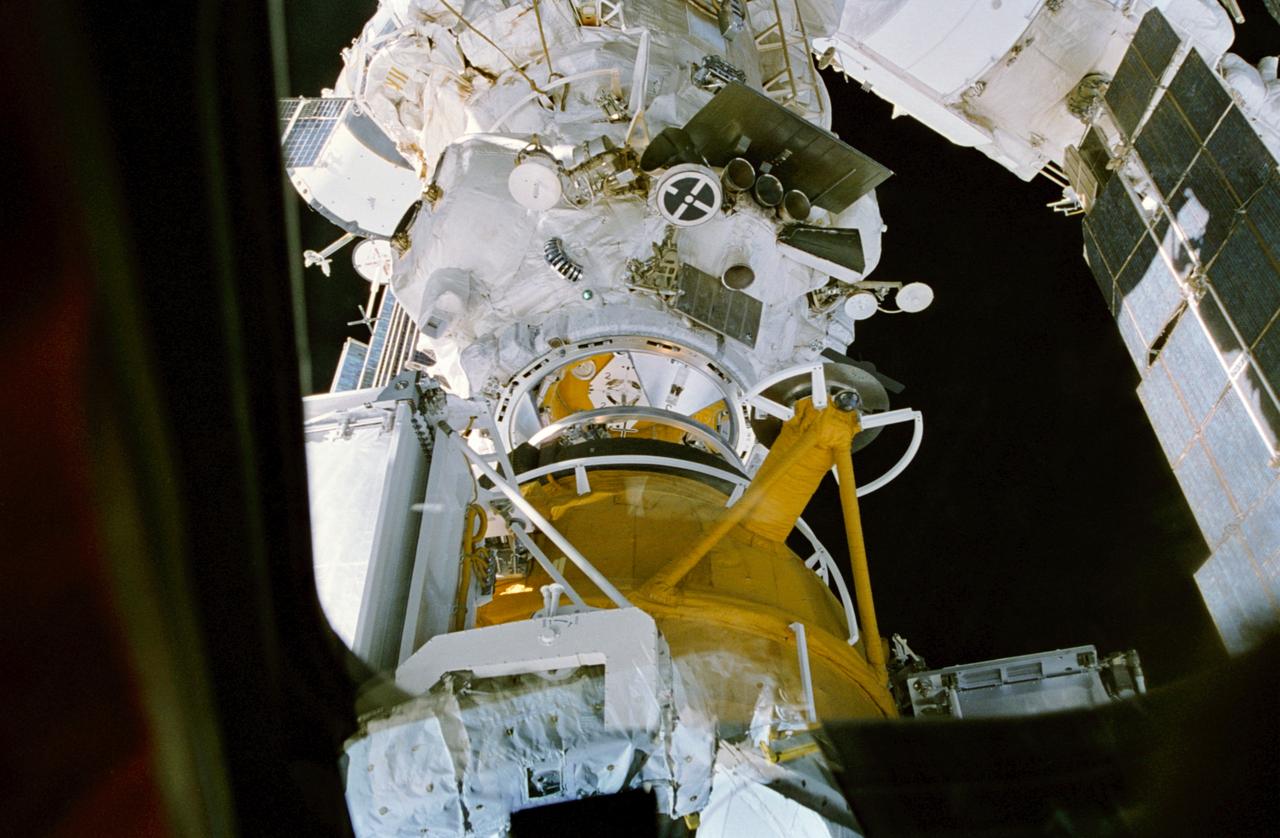
STS074-332-029 (15 Nov 1995) --- A 35mm camera aimed through the Space Shuttle Atlantis? aft windows captured rendezvous and docking operations with the Space Shuttle Atlantis and Russia?s Mir Space Station in Earth-orbit. The new Docking Module (DM), carried into space by the Atlantis is about to contact Kristall on the cluster of Mir components. The flight began with a November 12, 1995, launch from Kennedy Space Center (KSC) and ended with landing there on November 20, 1995. The crew members were astronauts Kenneth D. Cameron, mission commander; James D. Halsell, Jr., pilot; William S. McArthur, Jr., Jerry L. Ross and Canadian astronaut Chris A. Hadfield, all mission specialists. The Mir-20 crew is composed of cosmonauts Yuriy P. Gidzenko, commander; and Sergei V. Avdeyev, engineer; along with the European Space Agency?s (ESA) Thomas Reiter, cosmonaut researcher. Joint activities on the Mir and the Space Shuttle Atlantis ended on November 18, 1995, when the two spacecraft separated.
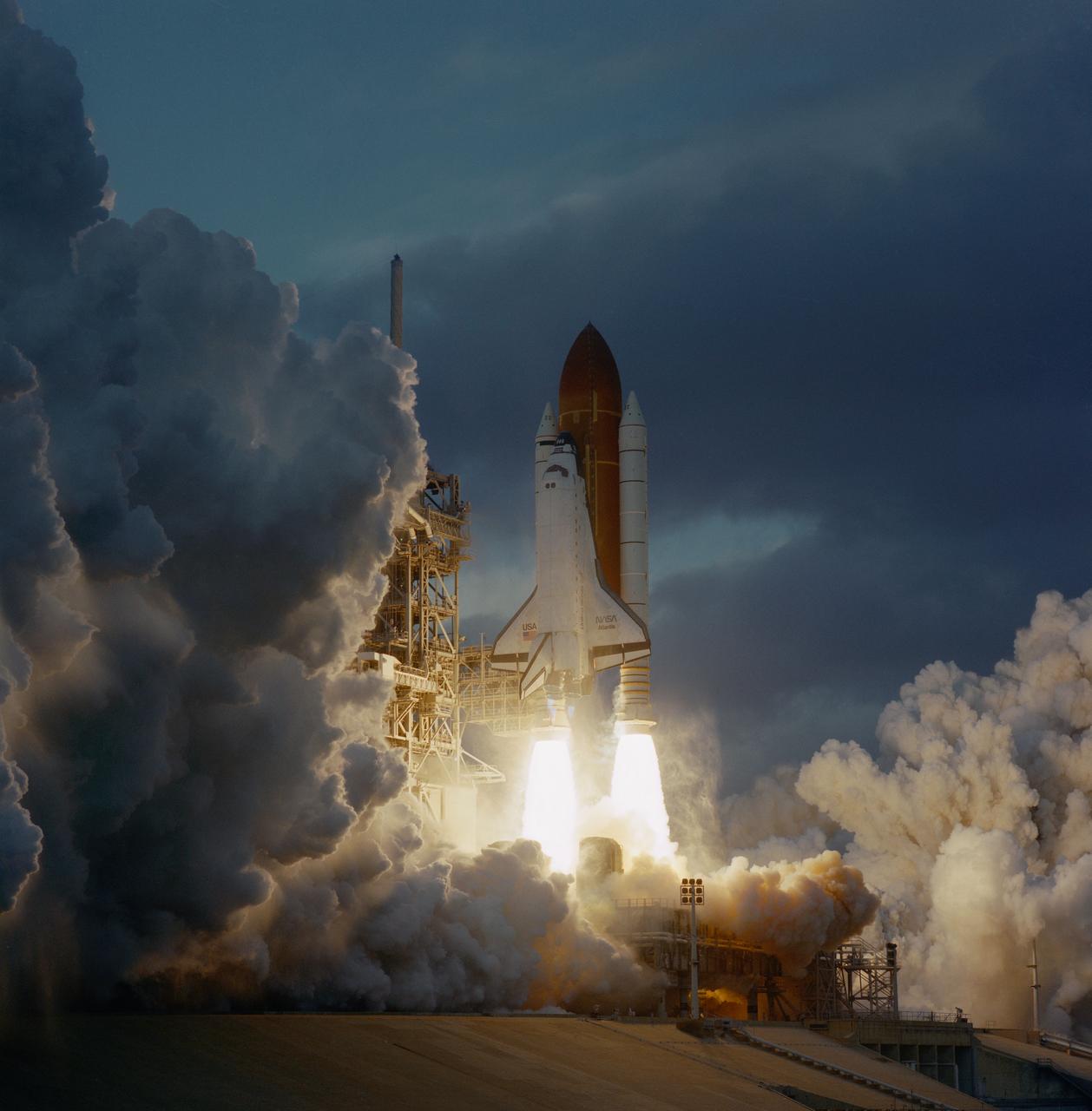
STS074-S-016 (12 Nov 1995) --- With five astronauts aboard, the Space Shuttle Atlantis lifts off from the Kennedy Space Center?s (KSC) Launch Pad 39A. Launch occurred at 7:30:43:071 a.m. (EST), November 12, 1995. The crew members were astronauts Kenneth D. Cameron, mission commander; James D. Halsell Jr., pilot; William S. McArthur Jr., Jerry L. Ross and Canadian astronaut Chris A. Hadfield, all mission specialists. On November 15, 1995, the Space Shuttle Atlantis docked with Russia?s Mir Space Station, on which the NASA astronauts joined the Mir-20 crew. The Mir-20 crew is composed of cosmonauts Yuriy P. Gidzenko, commander; and Sergei V. Avdeyev, engineer; along with the European Space Agency?s (ESA) Thomas Reiter, cosmonaut researcher. Joint activities on the Mir Space Station and the Space Shuttle Atlantis ended on November 18, 1995, when the two spacecraft separated. The November 20, 1995, landing also took place at KSC.
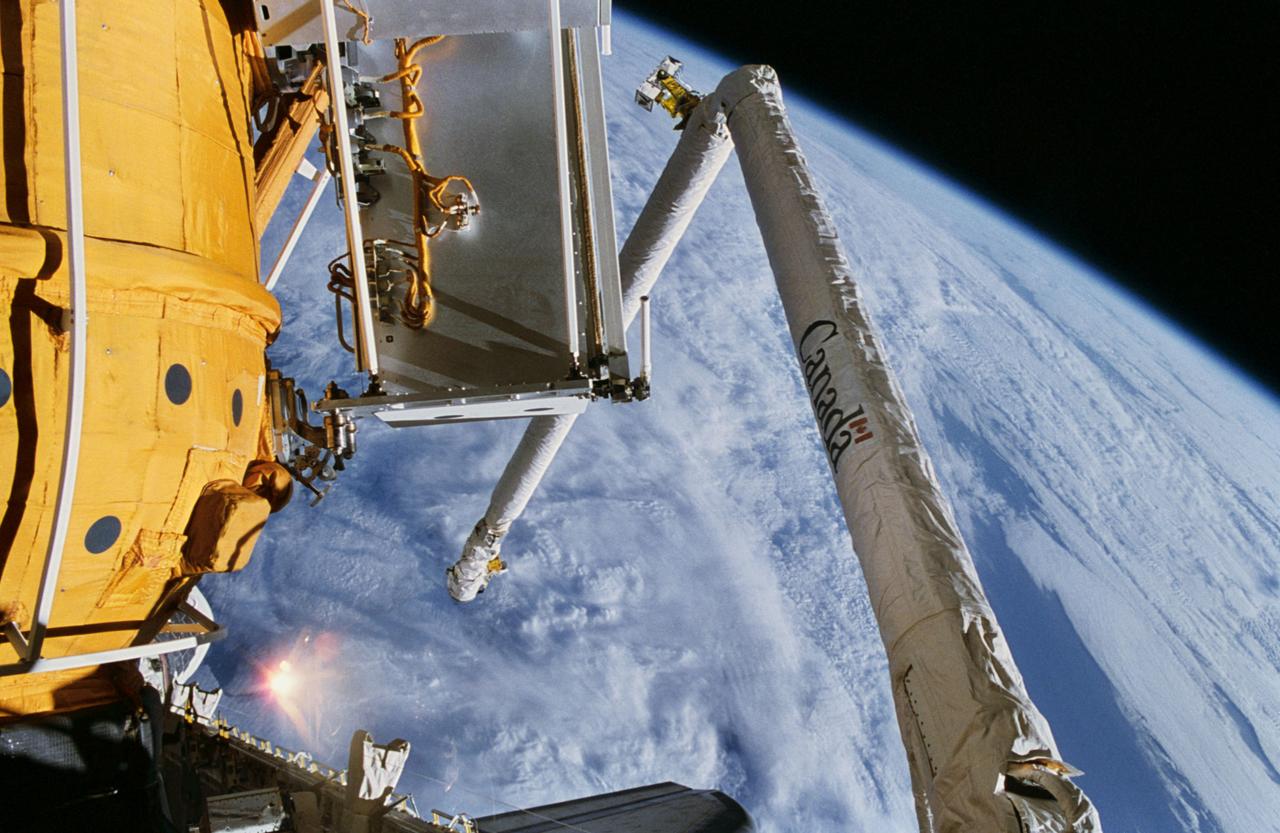
STS074-321-027 (12-20 Nov 1995) --- One of the STS-74 crew members aimed a 35mm camera through aft flight deck windows of the Space Shuttle Atlantis to record this scene of the Remote Manipulator System (RMS) arm and the new Russian Docking Module (DM), backdropped against storm clouds on Earth. With five NASA astronauts aboard, the flight of Atlantis began with a November 12, 1995, launch from Kennedy Space Center (KSC) and ended with landing there on November 20, 1995. The STS-74 crew members were astronauts Kenneth D. Cameron, mission commander; James D. Halsell Jr., pilot; William S. McArthur Jr., Jerry L. Ross and Canadian astronaut Chris A. Hadfield, all mission specialists. On November 15, 1995, the Space Shuttle Atlantis docked with the Mir Space Station, on which the STS-74 astronauts joined the Mir-20 crew. The Mir-20 crew is composed of cosmonauts Yuriy P. Gidzenko, commander; and Sergei V. Avdeyev, flight engineer; along with the European Space Agency?s (ESA) Thomas Reiter, cosmonaut researcher. Joint activities on the Mir Space Station and the Space Shuttle Atlantis ended November 18, 1995, when the two spacecraft separated.
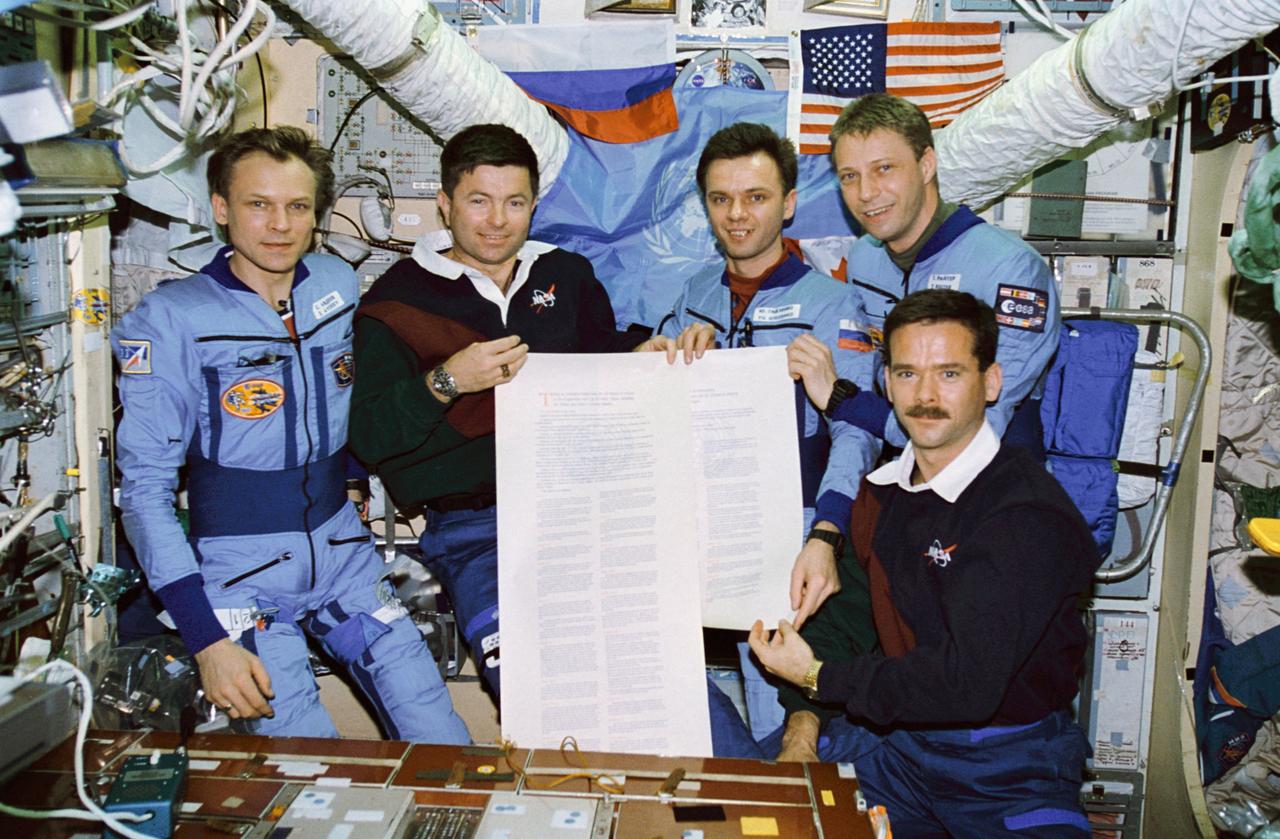
STS074-324-002 (12-20 Nov 1995) --- Several crew members with a scroll they signed commemorating the 50th anniversary of the United Nations (U.N.). In the frame (left to right) are Sergei V. Avdeyev, Kenneth D. Cameron, Yuriy P. Gidzenko, Thomas Reiter and Chris A. Hadfield (front). With five NASA astronauts aboard the Space Shuttle Atlantis, the flight began with a November 12, 1995 launch from Kennedy Space Center (KSC) and ended with landing there on November 20, 1995. The STS-74 crew members were astronauts Cameron, mission commander; James D. Halsell Jr., pilot; William S. McArthur Jr., Jerry L. Ross and Canadian astronaut Hadfield, all mission specialists. On November 15, 1995, the Space Shuttle Atlantis docked with Russia?s Mir Space Station, on which the STS-74 astronauts joined the Mir-20 crew. The Mir-20 crew is composed of cosmonauts Gidzenko, commander; and Avdeyev, engineer; along with the European Space Agency?s (ESA) Reiter, cosmonaut researcher. Joint activities on the Mir Space Station and the Space Shuttle Atlantis ended November 18, 1995, when the two spacecraft separated.
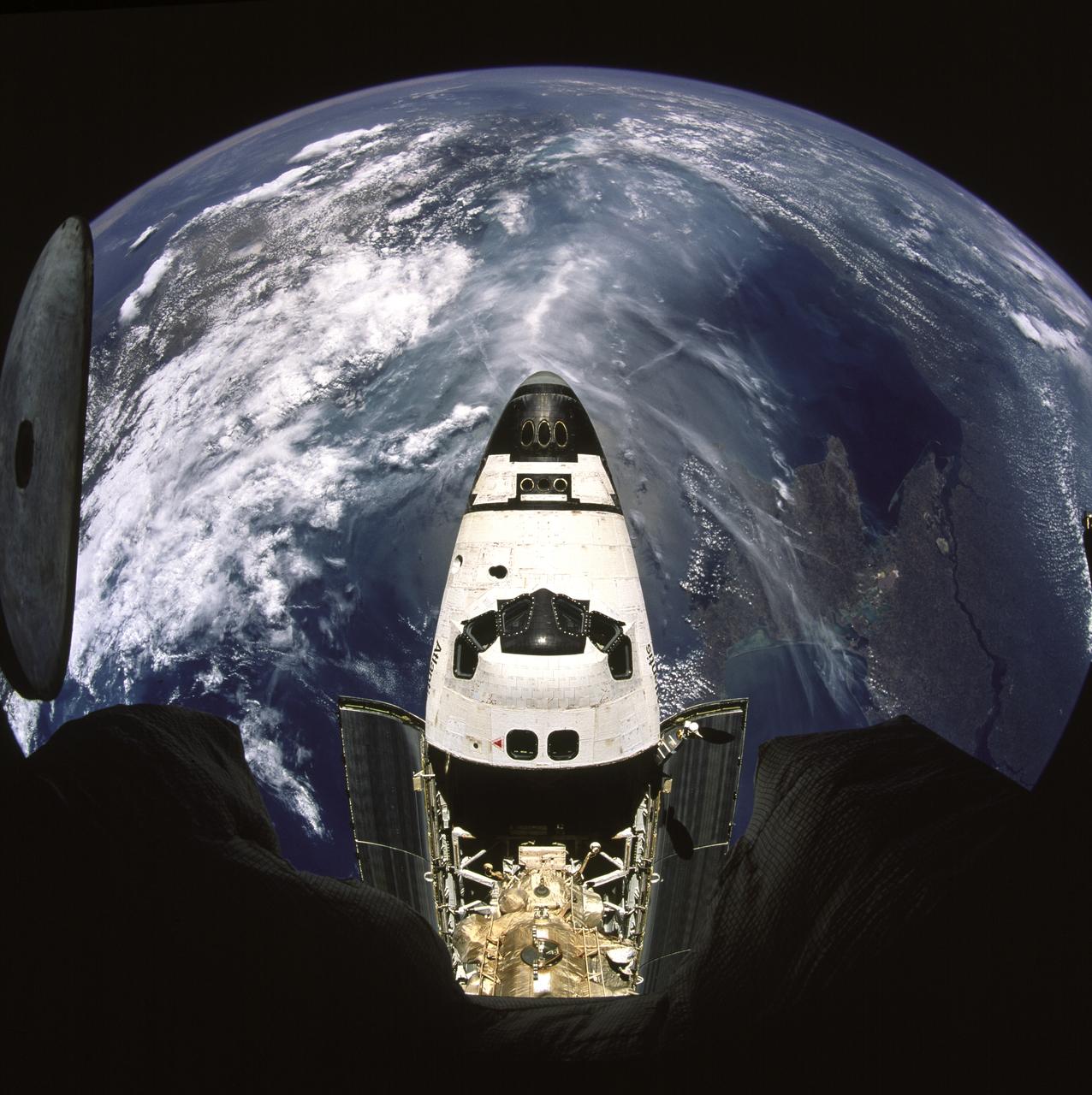
STS071-741-004 (27 June-7 July 1995) --- Docked already with Russia's Mir Space Station and backdropped against a half globe of Earth featuring the Crimean Peninsula, the space shuttle Atlantis is partially visible through a window on the Kvant 2 Module. A 70mm camera, carried into space by the STS-71 crew aboard the space shuttle Atlantis, was used to expose the image. The crew cabin and forward cargo bay of Atlantis are most prominent. Below center can be seen the Androgynous Peripheral Docking System (APDS) and the Kristall Module on Mir. The APDS is connected to a port in a tunnel leading to the Spacelab Science Module in Atlantis' cargo bay. The linkup enabled the seven STS-71 crew members to visit Mir and it allowed the three Mir-18 crew members, in space since March of this year, access to Spacelab. That module was quite busy with tests and data collection involving the three, Mir-18 crew, until Atlantis brought them home on July 7, 1995. The Black Sea lies directly beneath Atlantis, with Ukraine's diamond-shaped Crimean Peninsula immediately to the right of the cockpit. The wide lower course of the Dnepr River can be seen entering the Black Sea at far right. The coast of Romania and Bulgaria lies at a point where the cloud begins at top right. The peninsula of Asia Minor lies across the left of the view, mostly under cloud cover. The Mediterranean Sea is the cloud-free, blue mass beyond. Still further, at about 1,300 miles distance, the north edge of Africa is stretched out as a line across the horizon with its characteristic sandy color. The nose of Atlantis points southwest toward the only outlet of the Black Sea known as the Bosporus.
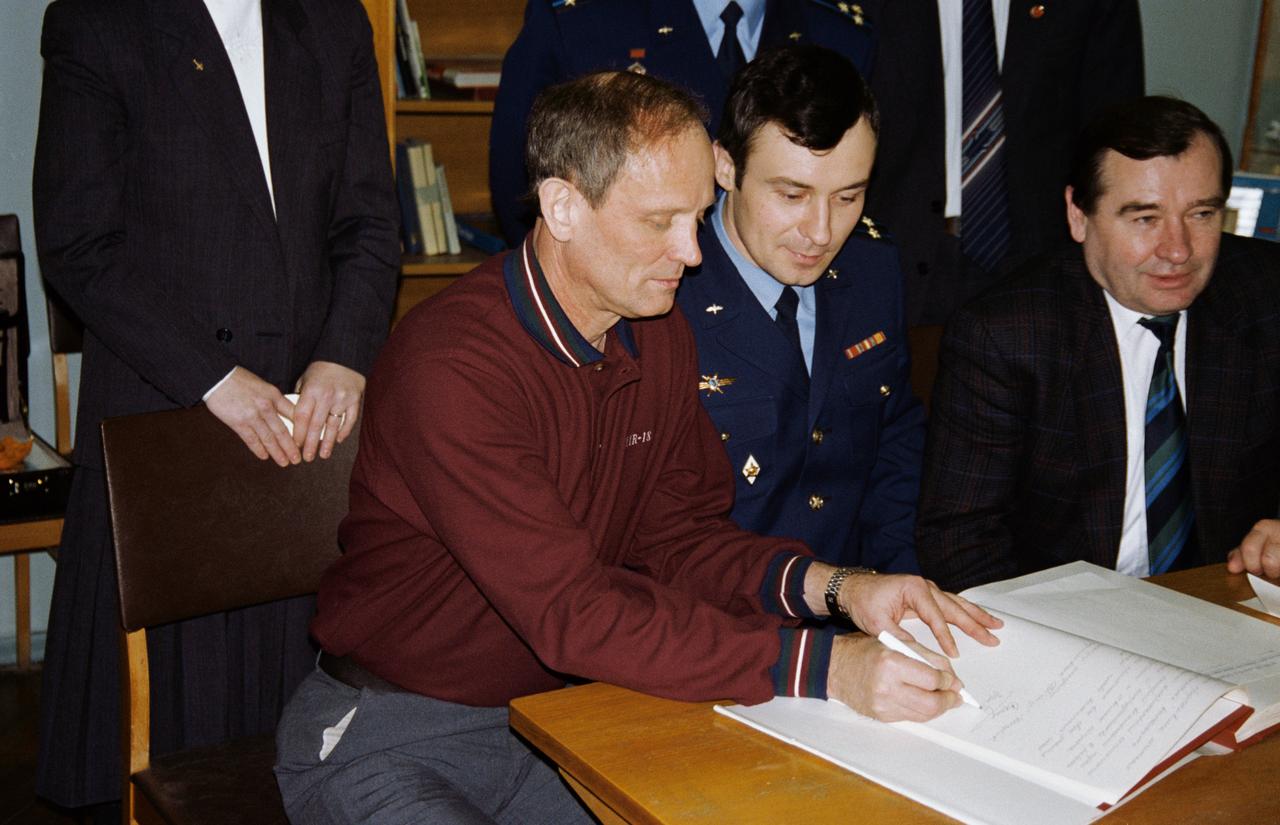
S95-04324 (22 March 1995) --- In keeping with Russian tradition, astronaut Norman E. Thagard (left), guest researcher, signs the diary of the late Yuriy A. Gagarin, the first Russian cosmonaut, as his Mir 18 crew mates look on. Cosmonauts Vladimir N. Dezhurov (center), mission commander, and Gennadiy M. Strkalov, flight engineer, have been training with Thagard in both the United States and Russia for the past several months. It is customary for each crew member about to aboard a Russian spacecraft to sign the diary.
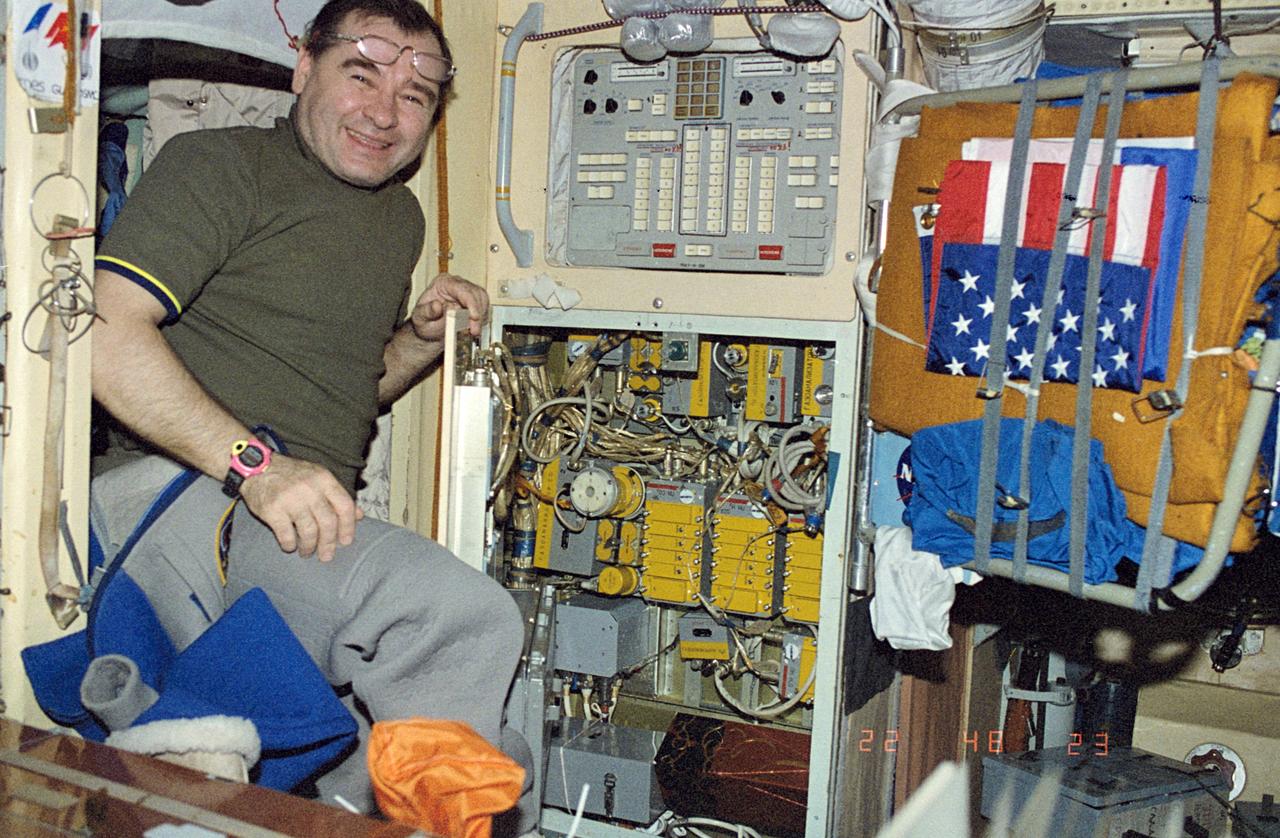
NM18-302-025 (March-July 1995) --- Onboard Mir's base block module cosmonaut Gennadiy M. Strekalov, flight engineer, prepares to check the air quality control and the propulsion system of the station. Strekalov told reporters at a July 18 press conference in Houston that even though he tried not to awaken astronaut Norman E. Thagard, who was asleep nearby, he was unable to keep from disturbing the cosmonaut researcher. He went on to point out that Thagard was always very cooperative and tolerant of such interruptions.
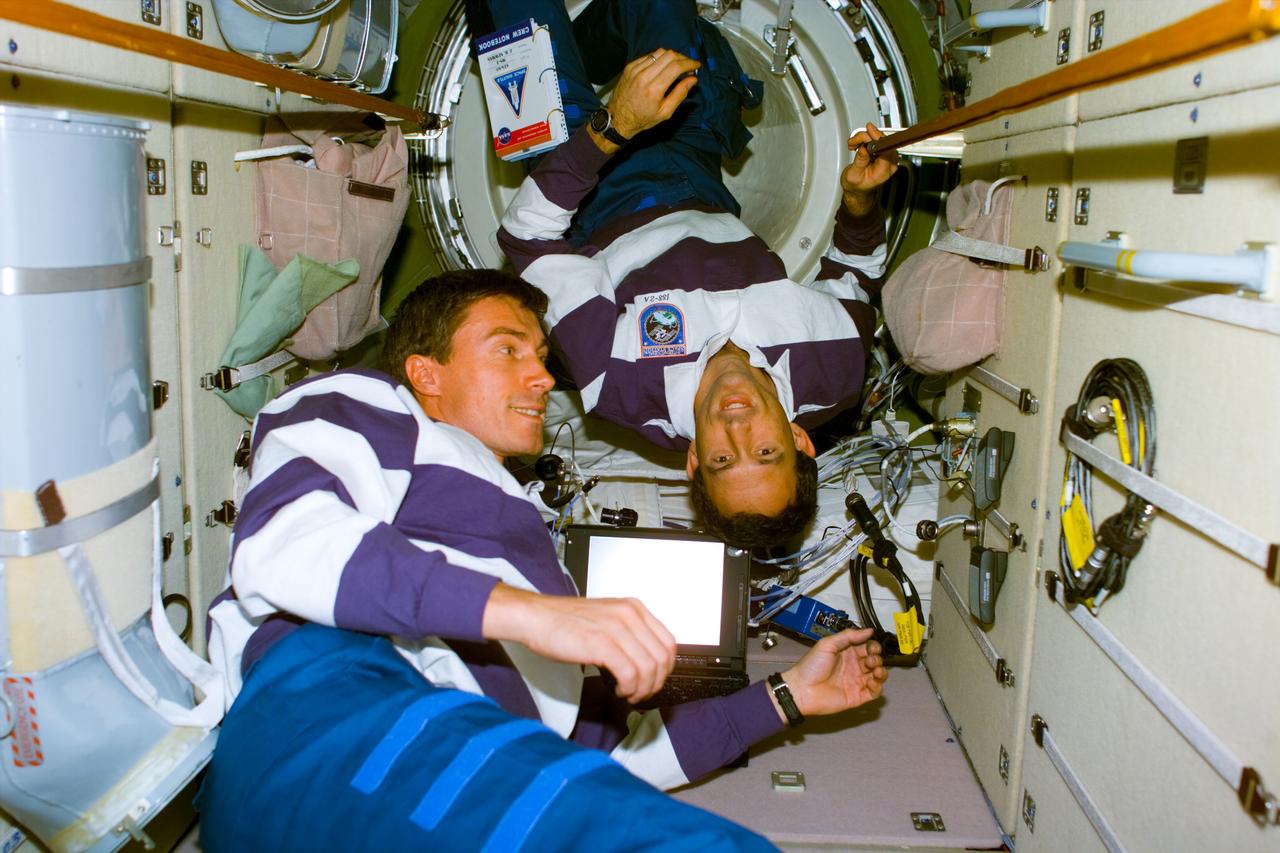
S88-E-5078 (12-11-98) --- Sergei Krikalev, left, and James H. Newman, both mission specialists, begin work in the Zarya. Krikalev, who has spent time in space on both Shuttle and Mir missions, represents the Russian Space Agency (RSA). The photo was taken with an electronic still camera (ESC) at 05:18:06, Dec. 11.

NASA Administrator Dan Goldin congratulates Phase I Shuttle/Mir Program Manager Frank Culbertson on the successful conclusion of Phase I of the joint U.S.-Russian International Space Station Program at KSC's Shuttle Landing Facility following Discovery's landing, as Mission Commander Charles J. Precourt (applauding) and the other members of the STS-91 flight crew look on. Culbertson is holding an American flag, a special wrench, and an optical disc, which he had just been presented by Goldin. The flag rode aboard Mir from the beginning of the Phase I program, the wrench was used on Mir and will be used on the International Space Station, and the optical disc holds data recorded on Mir. All of these items were brought back to Earth from Mir by the STS-91 crew. Discovery's main gear touchdown on Runway 15 was at 2:00:18 p.m. EDT on June 12, 1998, on orbit 155 of the mission. The wheels stopped at 2:01:22 p.m. EDT, for a total mission-elapsed time of 9 days, 19 hours, 55 minutes and 1 second. The 91st Shuttle mission was the 44th KSC landing in the history of the Space Shuttle program and the 15th consecutive landing at KSC. Besides Commander Precourt, the STS-91 flight crew also included Pilot Dominic L. Gorie and Mission Specialists Wendy B. Lawrence, Franklin R. Chang-Diaz, Janet Lynn Kavandi and Valery Victorovitch Ryumin of the Russian Space Agency. Astronaut Andrew S. W. Thomas also returned to Earth from Mir as an STS-91 crew member after 141 days in space
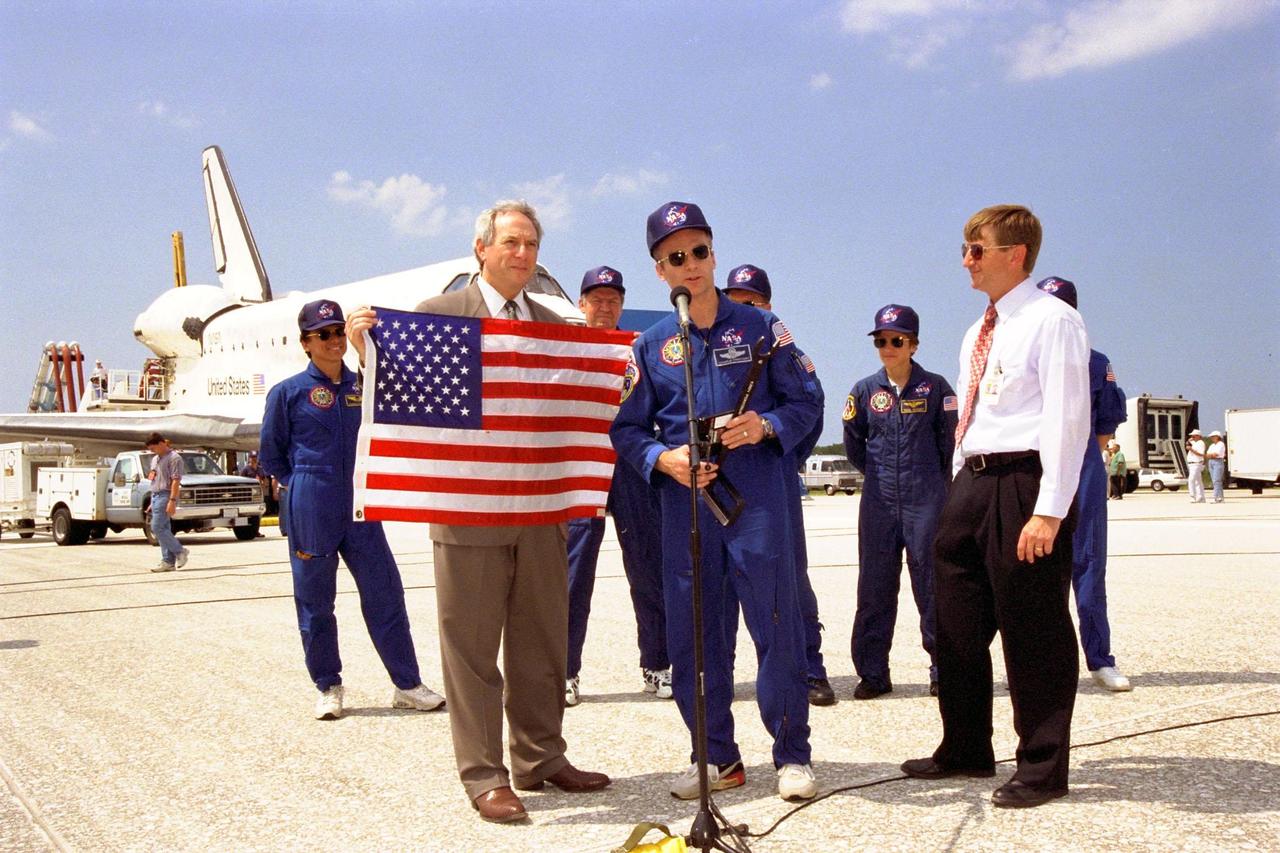
STS-91 Mission Commander Charles J. Precourt (at microphone) presents an American flag, a special wrench, and an optical disc to NASA Administrator Dan Goldin following Discovery's landing at KSC's Shuttle Landing Facility, as Phase I Shuttle/Mir Program Manager Frank Culbertson and the other members of the STS-91 flight crew look on. This landing not only concluded the STS-91 mission, but Phase I of the joint U.S.-Russian International Space Station Program as well. The flag rode aboard Mir from the beginning of the Phase I program, the wrench was used on Mir and will be used on the International Space Station, and the optical disc holds data recorded on Mir. All of these items were brought back to Earth from Mir by the STS-91 crew. Discovery's main gear touchdown on Runway 15 was at 2:00:18 p.m. EDT on June 12, 1998, on orbit 155 of the mission. The wheels stopped at 2:01:22 p.m. EDT, for a total mission-elapsed time of 9 days, 19 hours, 55 minutes and 1 second. The 91st Shuttle mission was the 44th KSC landing in the history of the Space Shuttle program and the 15th consecutive landing at KSC. Besides Commander Precourt, the STS-91 flight crew also included Pilot Dominic L. Gorie and Mission Specialists Wendy B. Lawrence, Franklin R. Chang-Diaz, Janet Lynn Kavandi and Valery Victorovitch Ryumin of the Russian Space Agency. Astronaut Andrew S. W. Thomas also returned to Earth from Mir as an STS-91 crew member after 141 days in space
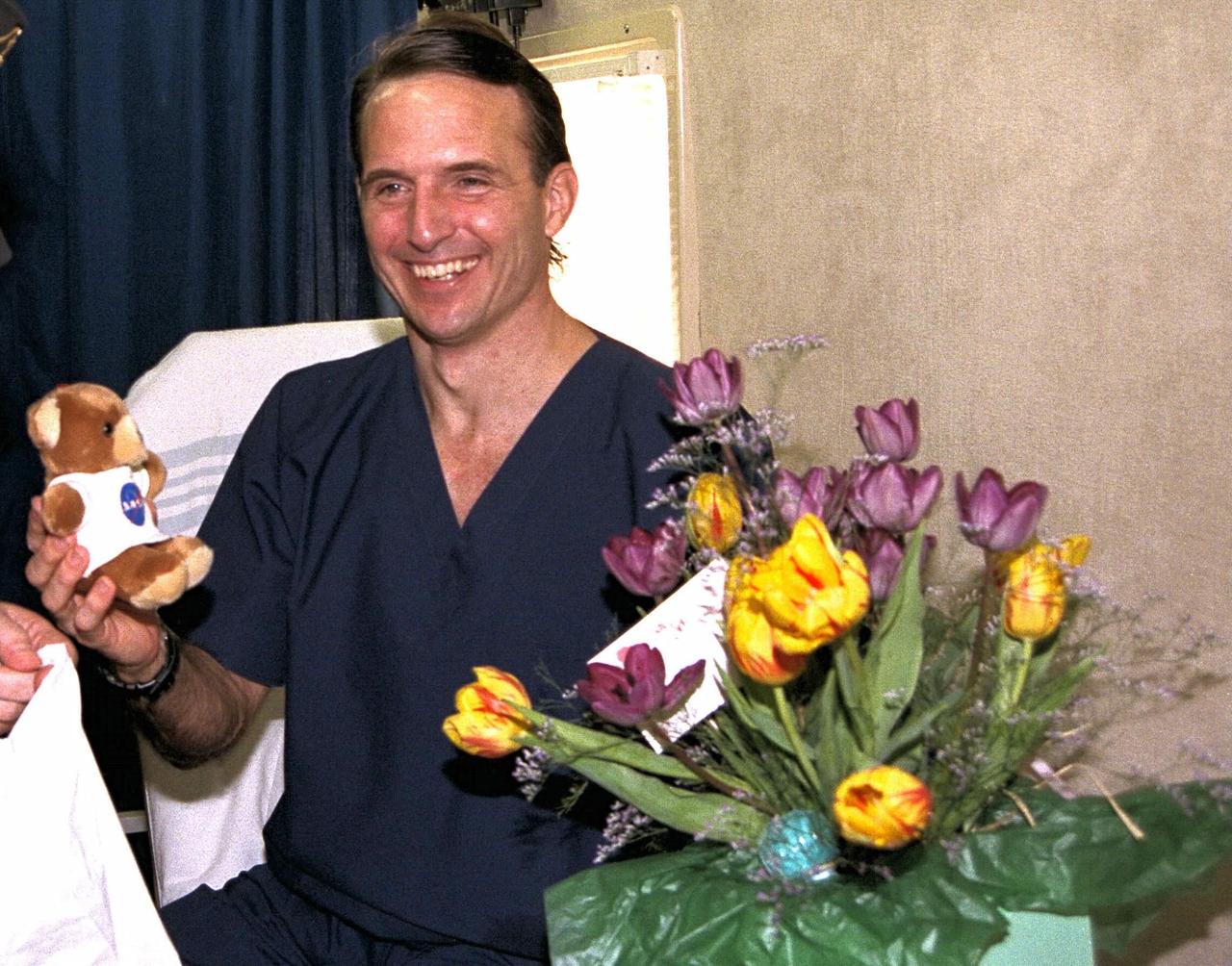
Astronaut and recent Mir 23 crew member Jerry M. Linenger holds a stuffed bear he was given by NASA Administrator Daniel Goldin at the conclusion of the STS-84 Space Shuttle mission. STS-84 was the sixth docking of the Shuttle with the Russian Space Station Mir, where Linenger has lived and worked the past four months. Goldin presented several gifts to Linenger in the Crew Transport Vehicle shortly after landing of the Space Shuttle orbiter Atlantis on KSC’s Runway 33. Besides the bear for Linenger’s 18-month-old son, John, Goldin gave the astronaut flowers for Linenger’s wife, Kathryn; and a rattle for the Linengers’ unborn child who is due next month. Linenger was replaced on the Russian space station by STS-84 Mission Specialist C. Michael Foale
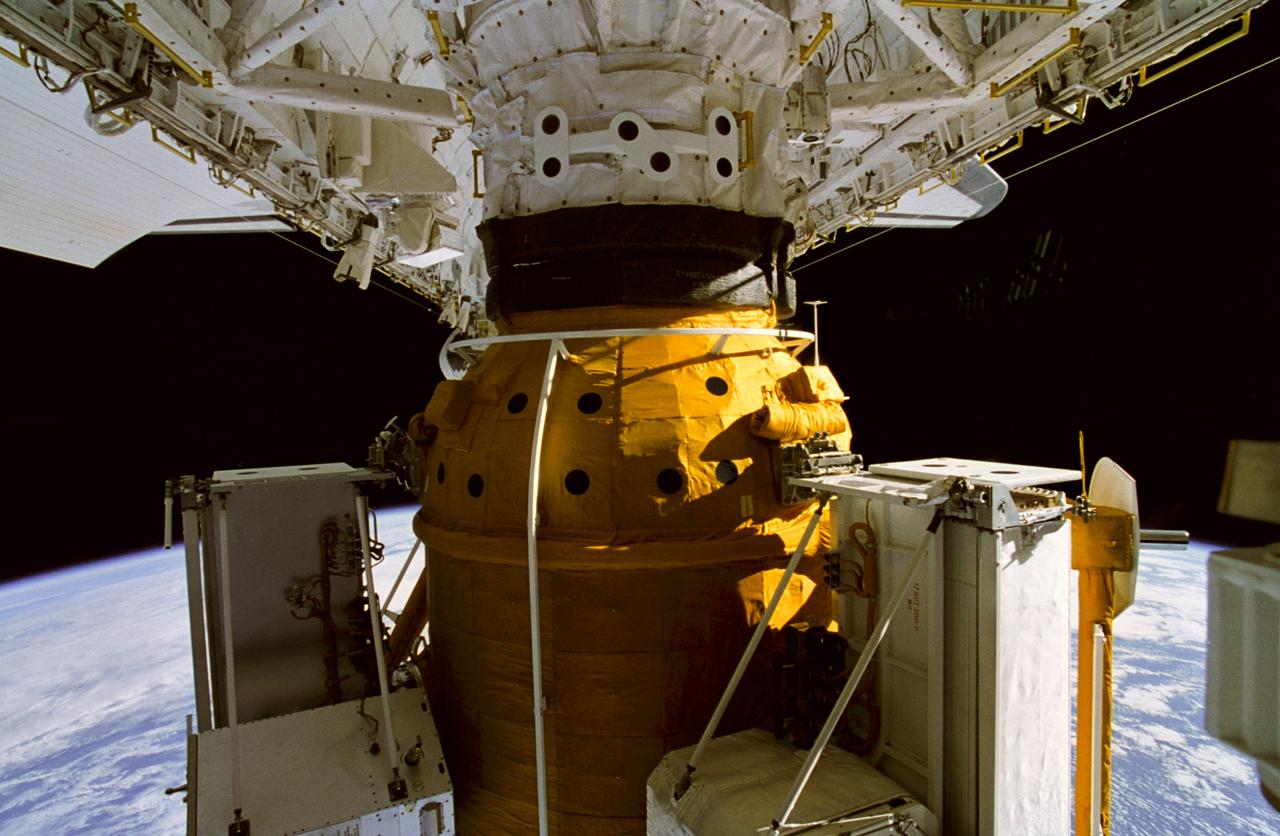
STS074-302-033 (14 Nov 1995) --- A 35mm camera aimed through the Space Shuttle Atlantis? aft windows captured the deployment of the Docking Module (DM), which was later delivered to Russia?s Mir Space Station in Earth-orbit. The Orbiter Docking System (ODS) is partially visible at bottom center. The flight began with a November 12, 1995, launch from Kennedy Space Center (KSC) and ended with landing there on November 20, 1995. The STS-74 crew members were astronauts Kenneth D. Cameron, mission commander; James D. Halsell, pilot; William S. McArthur, Jr., Jerry L. Ross and Canadian astronaut Chris A. Hadfield, all mission specialists. The Mir-20 crew is composed of cosmonauts Yuriy P. Gidzenko, commander; and Sergei V. Avdeyev, engineer; along with the European Space Agency?s (ESA) Thomas Reiter, cosmonaut researcher. Joint activities on the Mir and the Atlantis ended on November 18, 1995, when the two spacecraft separated.
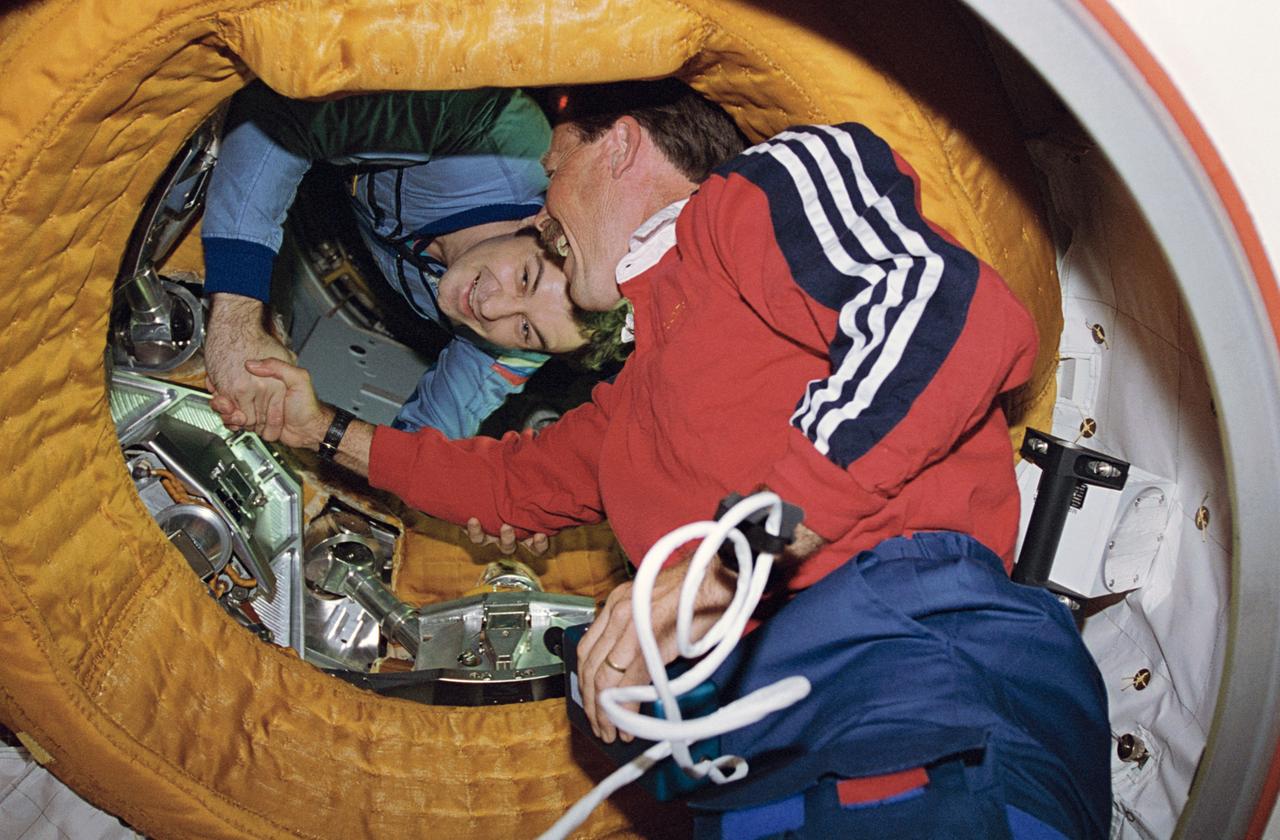
STS071-118-004 (29 June 1995) --- Astronaut Robert L. Gibson, STS-71 commander, shakes the hand of cosmonaut Vladimir N. Dezhurov, Mir-18 commander. The historic handshake took place two and half weeks prior to the 20th anniversary of a similar in-space greeting between cosmonauts and astronauts participating in the Apollo-Soyuz Test Project (ASTP). On July 17, 1975, astronaut Thomas P. Stafford, NASA's ASTP commander, greeted his counterpart, Aleksey A. Leonov in a docking tunnel linking the Soyuz and Apollo spacecraft.
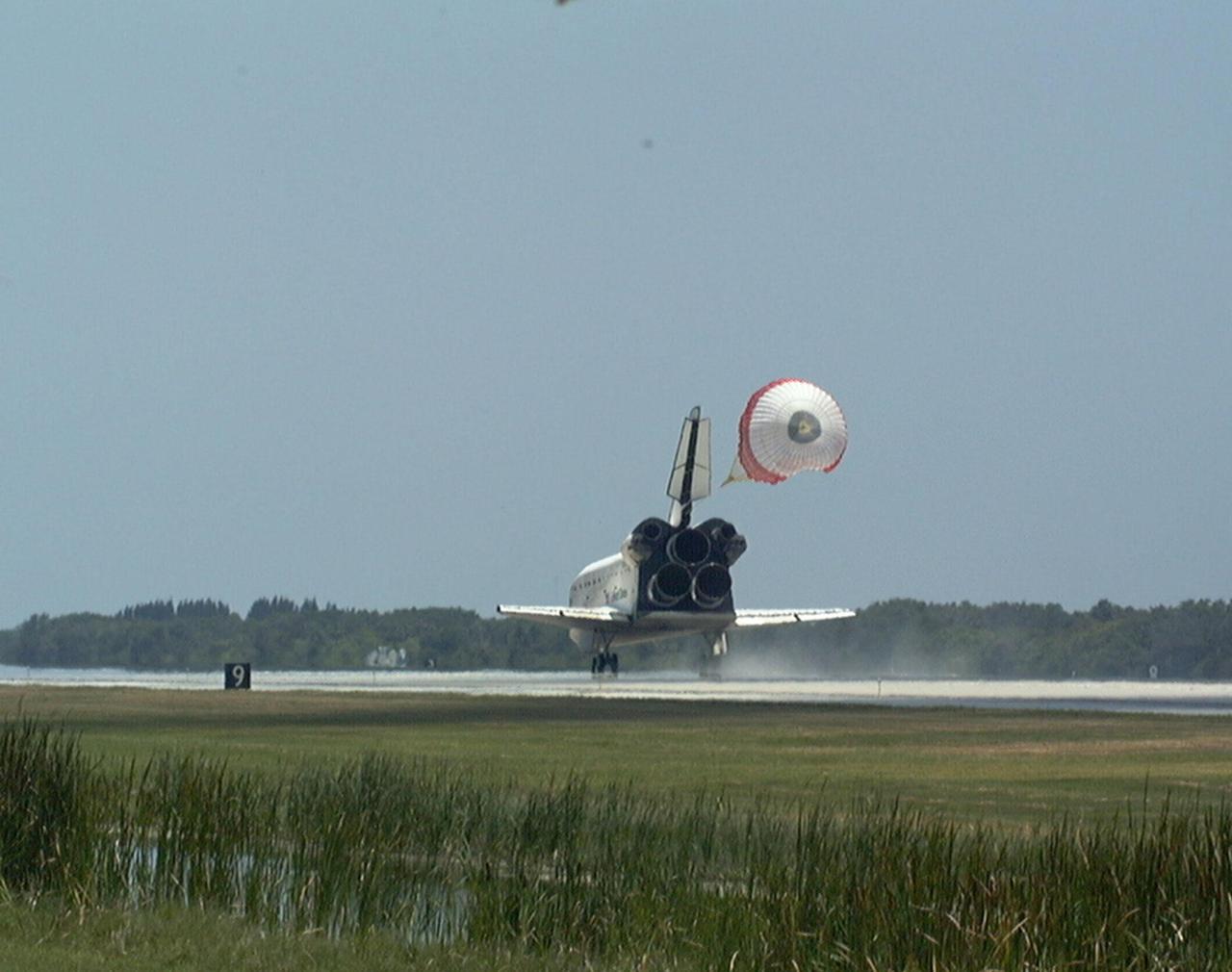
KENNEDY SPACE CENTER, FLA. -- With its drag chute deployed, the orbiter Discovery touches down on Runway 15 of KSC's Shuttle Landing Facility to complete the STS-91 mission. Main gear touchdown was at 2:00:18 p.m. EDT on June 12, 1998, landing on orbit 155 of the mission. The wheels stopped at 2:01:22 p.m. EDT, for a total mission-elapsed time of 9 days, 19 hours, 55 minutes and 1 second. The 91st Shuttle mission was the 44th KSC landing in the history of the Space Shuttle program and the 15th consecutive landing at KSC. During the mission, the orbiter docked with the Russian space station Mir for the ninth time, concluding Phase I of the joint U.S.-Russian International Space Station Program. STS-91 also featured first flights for both the Alpha Magnetic Spectrometer and the Space Shuttle super lightweight external tank. The STS-91 flight crew included Mission Commander Charles J. Precourt; Pilot Dominic L. Gorie; and Mission Specialists Wendy B. Lawrence, Franklin R. Chang-Diaz, Janet Lynn Kavandi and Valery Victorovitch Ryumin of the Russian Space Agency. Astronaut Andrew S. W. Thomas also returned to Earth from Mir as an STS-91 crew member after 141 days in space
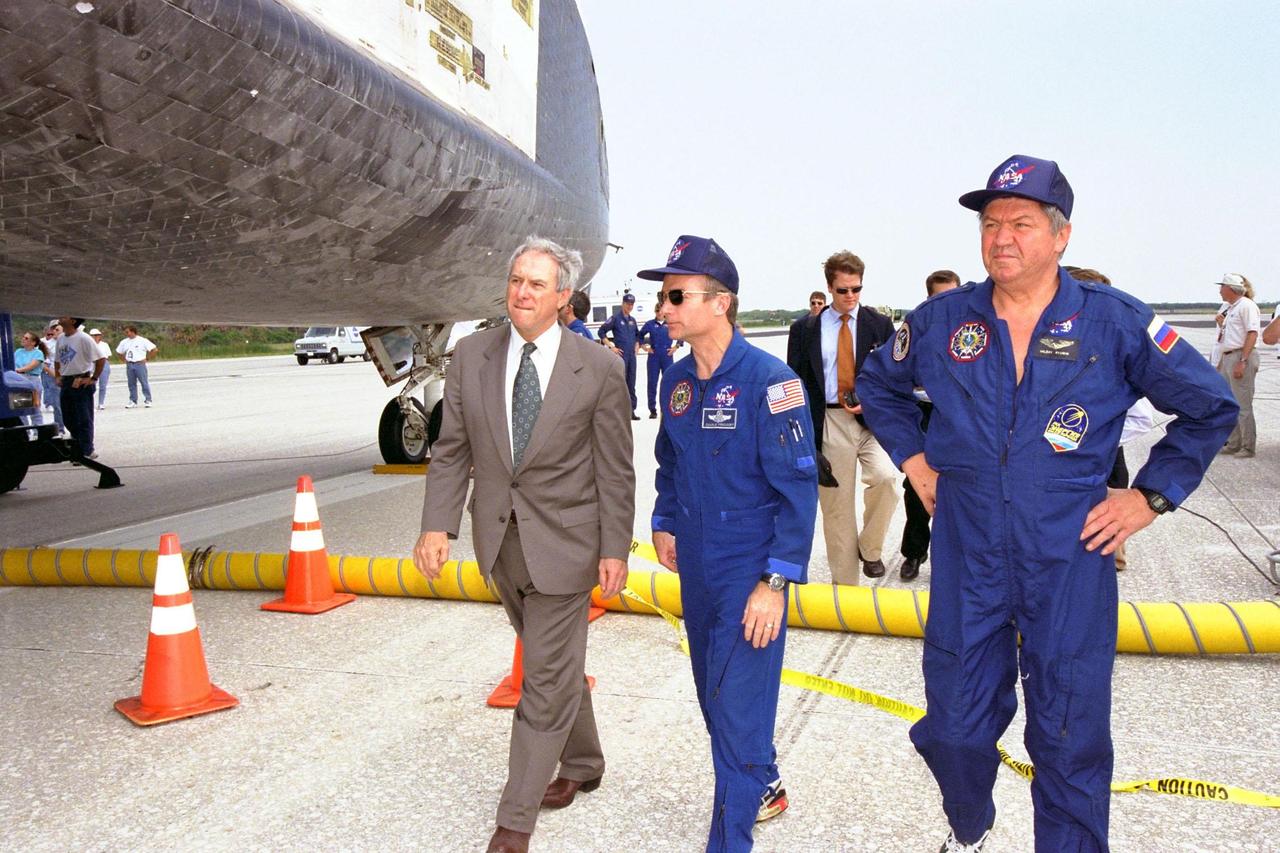
NASA Administrator Dan Goldin, STS-91 Mission Commander Charles J. Precourt, and STS-91 Mission Specialist Valery Victorovitch Ryumin of the Russian Space Agency inspect the orbiter Discovery after its landing at KSC's Shuttle Landing Facility, completing the STS-91 mission. Main gear touchdown occurred on Runway 15 at 2:00:18 p.m. EDT on June 12, 1998, on orbit 155 of the mission. The wheels stopped at 2:01:22 p.m. EDT, for a total mission-elapsed time of 9 days, 19 hours, 55 minutes and 1 second. The 91st Shuttle mission was the 44th KSC landing in the history of the Space Shuttle program and the 15th consecutive landing at KSC. During the mission, the Shuttle docked with the Russian space station Mir for the ninth time, concluding Phase I of the joint U.S.-Russian International Space Station Program. STS-91 also featured first flights for both the Alpha Magnetic Spectrometer and the Space Shuttle super lightweight external tank. The STS-91 flight crew also included Pilot Dominic L. Gorie and Mission Specialists Wendy B. Lawrence, Franklin R. Chang-Diaz, and Janet Lynn Kavandi. Astronaut Andrew S. W. Thomas also returned to Earth from Mir as an STS-91 crew member after 141 days in space
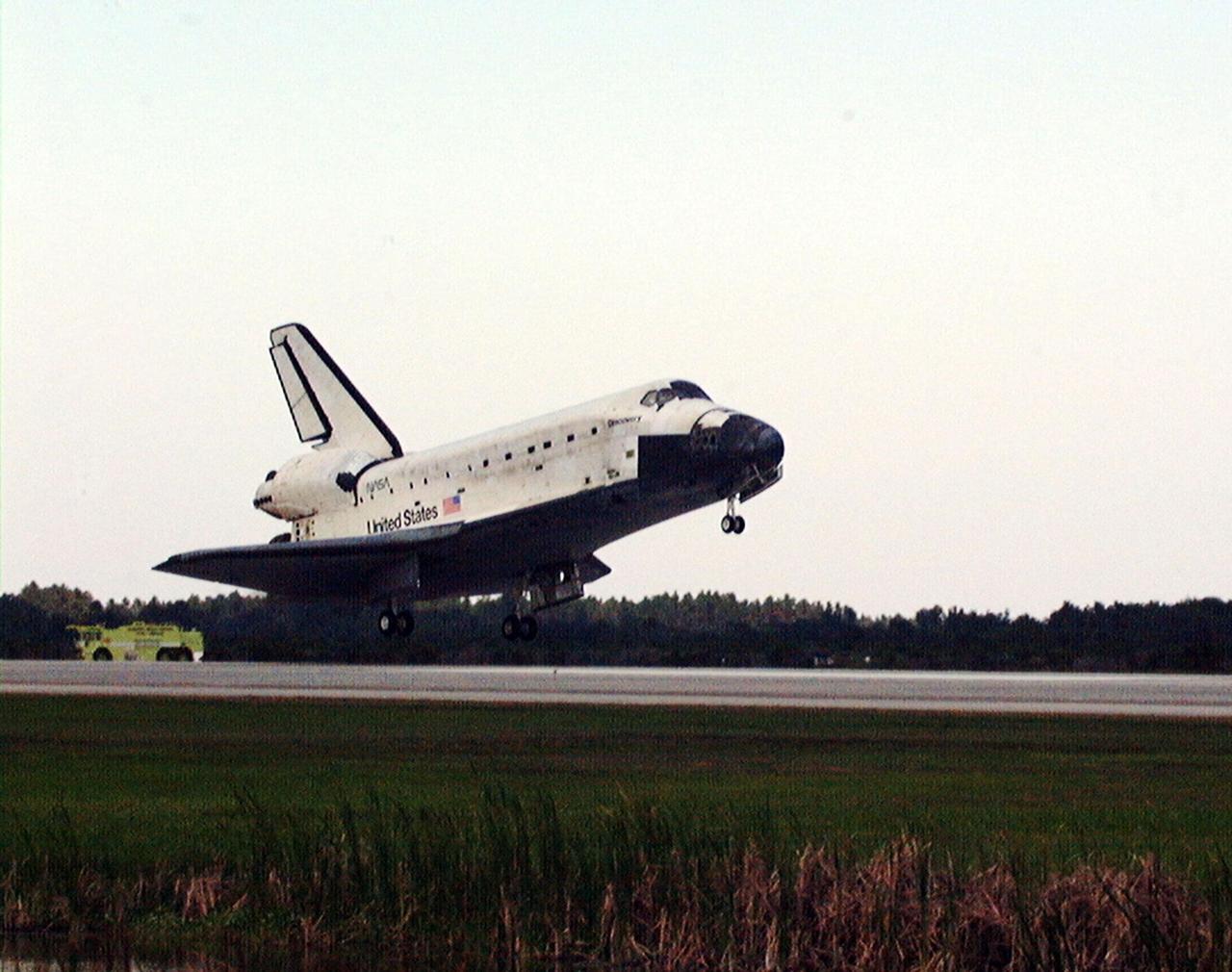
KENNEDY SPACE CENTER, FLA. -- The orbiter Discovery nears touchdown on Runway 15 of KSC's Shuttle Landing Facility to complete the STS-91 mission. Main gear touchdown was at 2:00:18 p.m. EDT on June 12, 1998, landing on orbit 155 of the mission. The wheels stopped at 2:01:22 p.m. EDT, for a total mission-elapsed time of 9 days, 19 hours, 55 minutes and 1 second. The 91st Shuttle mission was the 44th KSC landing in the history of the Space Shuttle program and the 15th consecutive landing at KSC. During the mission, the orbiter docked with the Russian space station Mir for the ninth time, concluding Phase I of the joint U.S.-Russian International Space Station Program. STS-91 also featured first flights for both the Alpha Magnetic Spectrometer and the Space Shuttle super lightweight external tank. The STS-91 flight crew included Mission Commander Charles J. Precourt; Pilot Dominic L. Gorie; and Mission Specialists Wendy B. Lawrence, Franklin R. Chang-Diaz, Janet Lynn Kavandi and Valery Victorovitch Ryumin of the Russian Space Agency. Astronaut Andrew S. W. Thomas also returned to Earth from Mir as an STS-91 crew member after 141 days in space
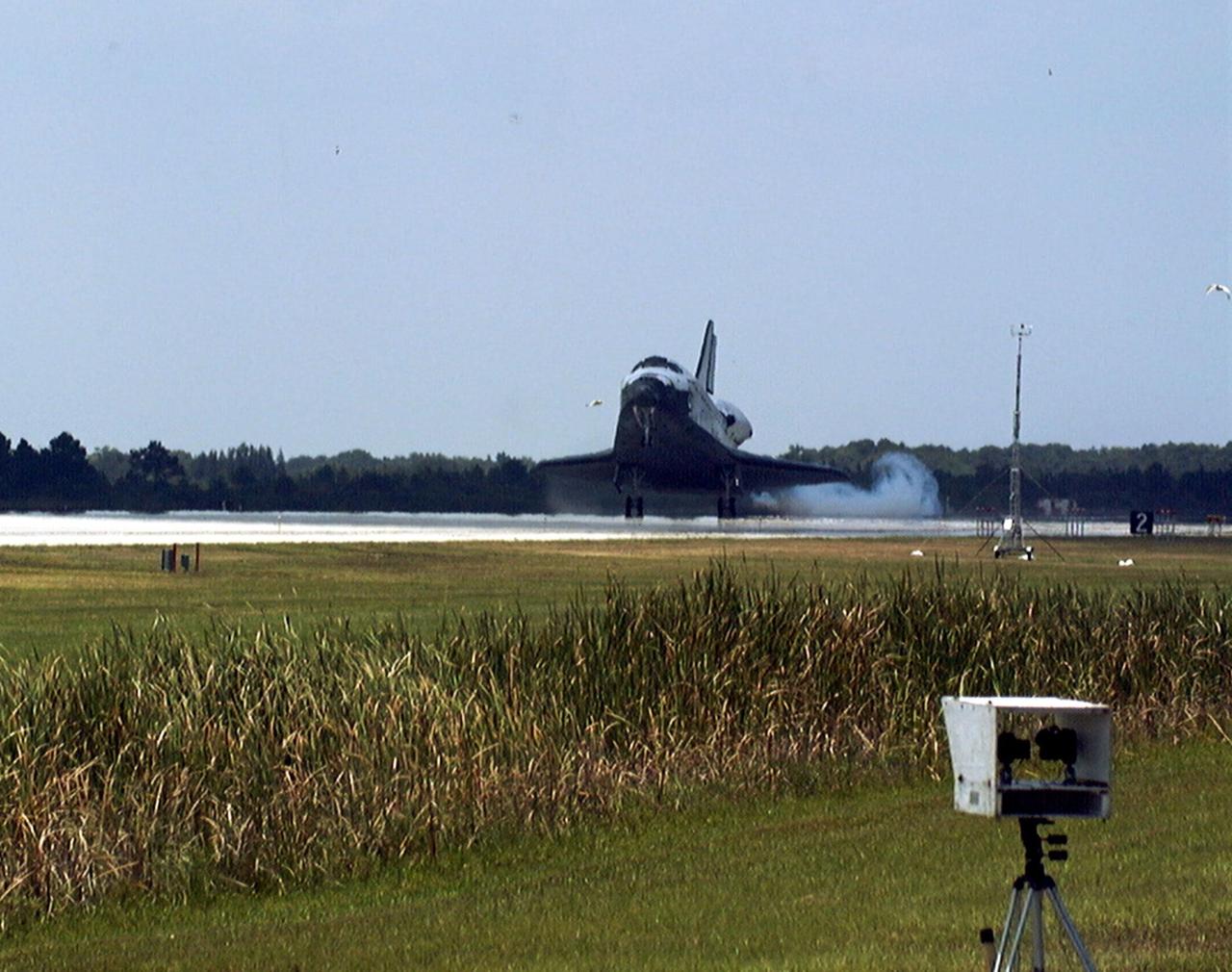
KENNEDY SPACE CENTER, FLA. -- The orbiter Discovery touches down on Runway 15 of KSC's Shuttle Landing Facility to complete the STS-91 mission. Main gear touchdown was at 2:00:18 p.m. EDT on June 12, 1998, landing on orbit 155 of the mission. The wheels stopped at 2:01:22 p.m. EDT, for a total mission-elapsed time of 9 days, 19 hours, 55 minutes and 1 second. The 91st Shuttle mission was the 44th KSC landing in the history of the Space Shuttle program and the 15th consecutive landing at KSC. During the mission, the orbiter docked with the Russian space station Mir for the ninth time, concluding Phase I of the joint U.S.-Russian International Space Station Program. STS-91 also featured first flights for both the Alpha Magnetic Spectrometer and the Space Shuttle super lightweight external tank. The STS-91 flight crew included Mission Commander Charles J. Precourt; Pilot Dominic L. Gorie; and Mission Specialists Wendy B. Lawrence, Franklin R. Chang-Diaz, Janet Lynn Kavandi and Valery Victorovitch Ryumin of the Russian Space Agency. Astronaut Andrew S. W. Thomas also returned to Earth from Mir as an STS-91 crew member after 141 days in space
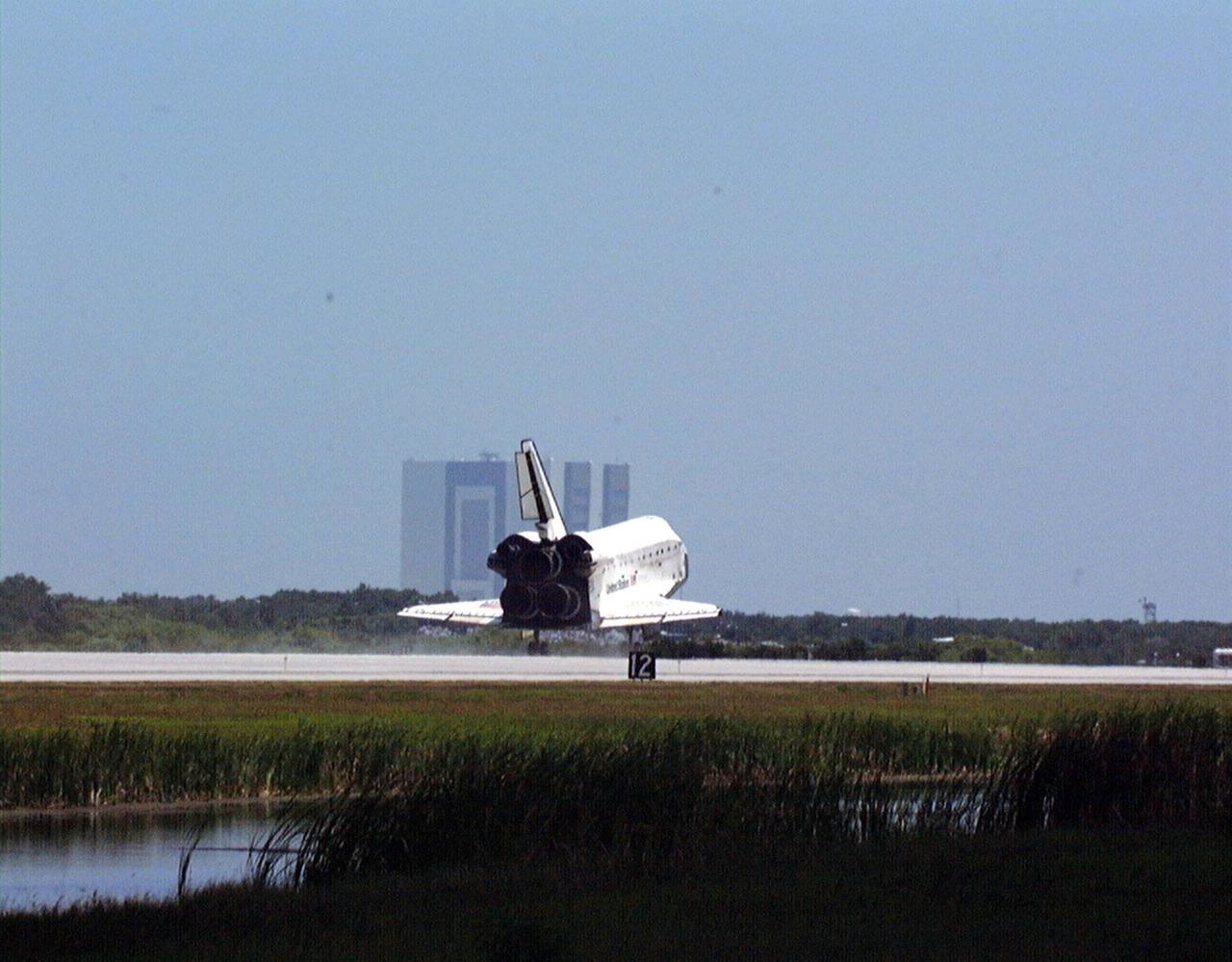
KENNEDY SPACE CENTER, FLA. -- With the 525-foot-tall Vehicle Assemble Building as backdrop, the orbiter Discovery touches down on Runway 15 of KSC's Shuttle Landing Facility to complete the STS-91 mission. Main gear touchdown was at 2:00:18 p.m. EDT on June 12, 1998, landing on orbit 155 of the mission. The wheels stopped at 2:01:22 p.m. EDT, for a total mission-elapsed time of 9 days, 19 hours, 55 minutes and 1 second. The 91st Shuttle mission was the 44th KSC landing in the history of the Space Shuttle program and the 15th consecutive landing at KSC. During the mission, the orbiter docked with the Russian space station Mir for the ninth time, concluding Phase I of the joint U.S.-Russian International Space Station Program. STS-91 also featured first flights for both the Alpha Magnetic Spectrometer and the Space Shuttle super lightweight external tank. The STS-91 flight crew included Mission Commander Charles J. Precourt; Pilot Dominic L. Gorie; and Mission Specialists Wendy B. Lawrence, Franklin R. Chang-Diaz, Janet Lynn Kavandi and Valery Victorovitch Ryumin of the Russian Space Agency. Astronaut Andrew S. W. Thomas also returned to Earth from Mir as an STS-91 crew member after 141 days in space
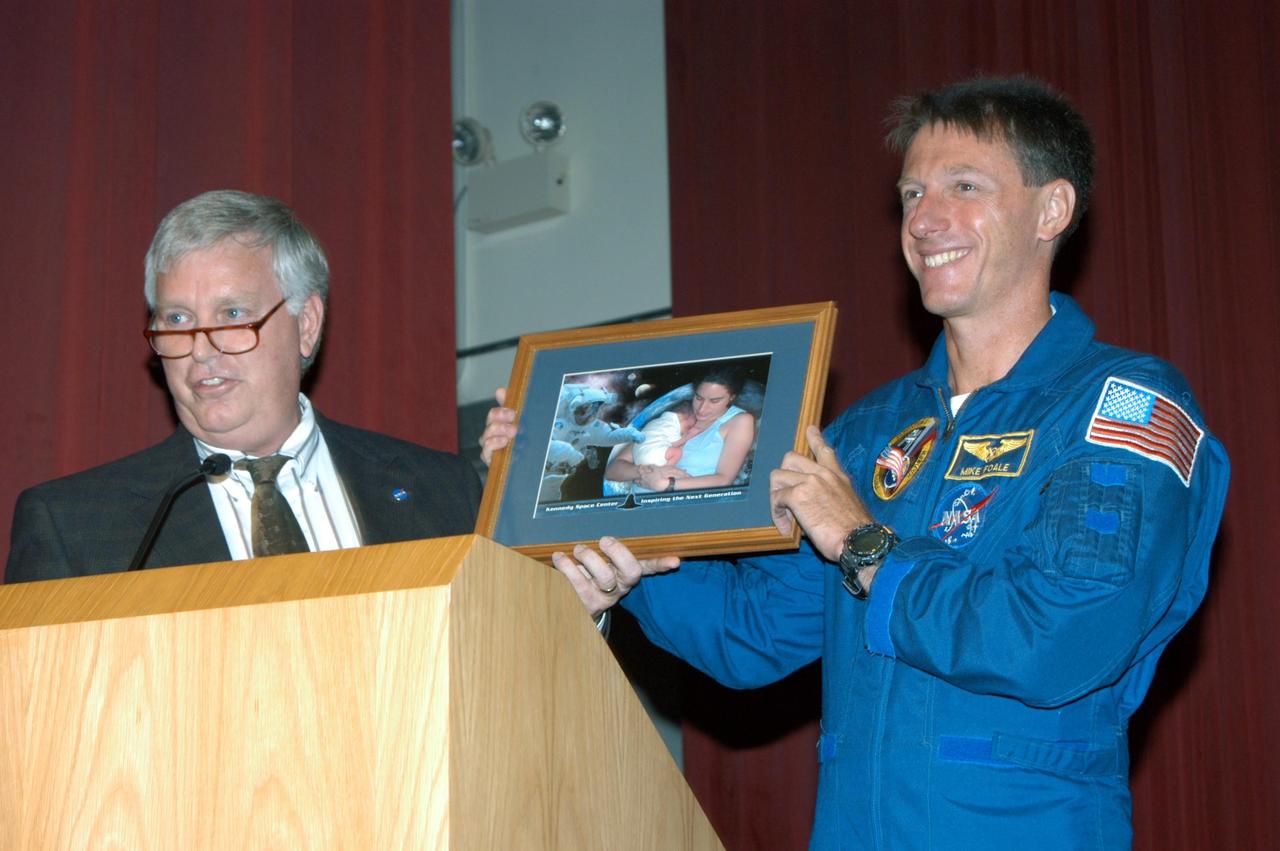
KENNEDY SPACE CENTER, FLA. - In the Training Auditorium, Center Director Jim Kennedy presents a framed photo to astronaut Mike Foale, who spoke to the audience about his experiences aboard the International Space Station as commander of the Expedition 8 crew. Foale and Flight Engineer Alexander Kaleri spent 194 days, 18 hours and 35 minutes in space, the second longest expedition to be completed aboard the Station. In February Foale and Kaleri conducted the first spacewalk ever performed from the complex by a two-person crew. Foale has accumulated more time in space than any U.S. astronaut, amassing a total of 374 days, 11 hours and 19 minutes in space from his Expedition 8 mission, a 1997 flight to the Russian Mir Space Station, and four Space Shuttle missions.
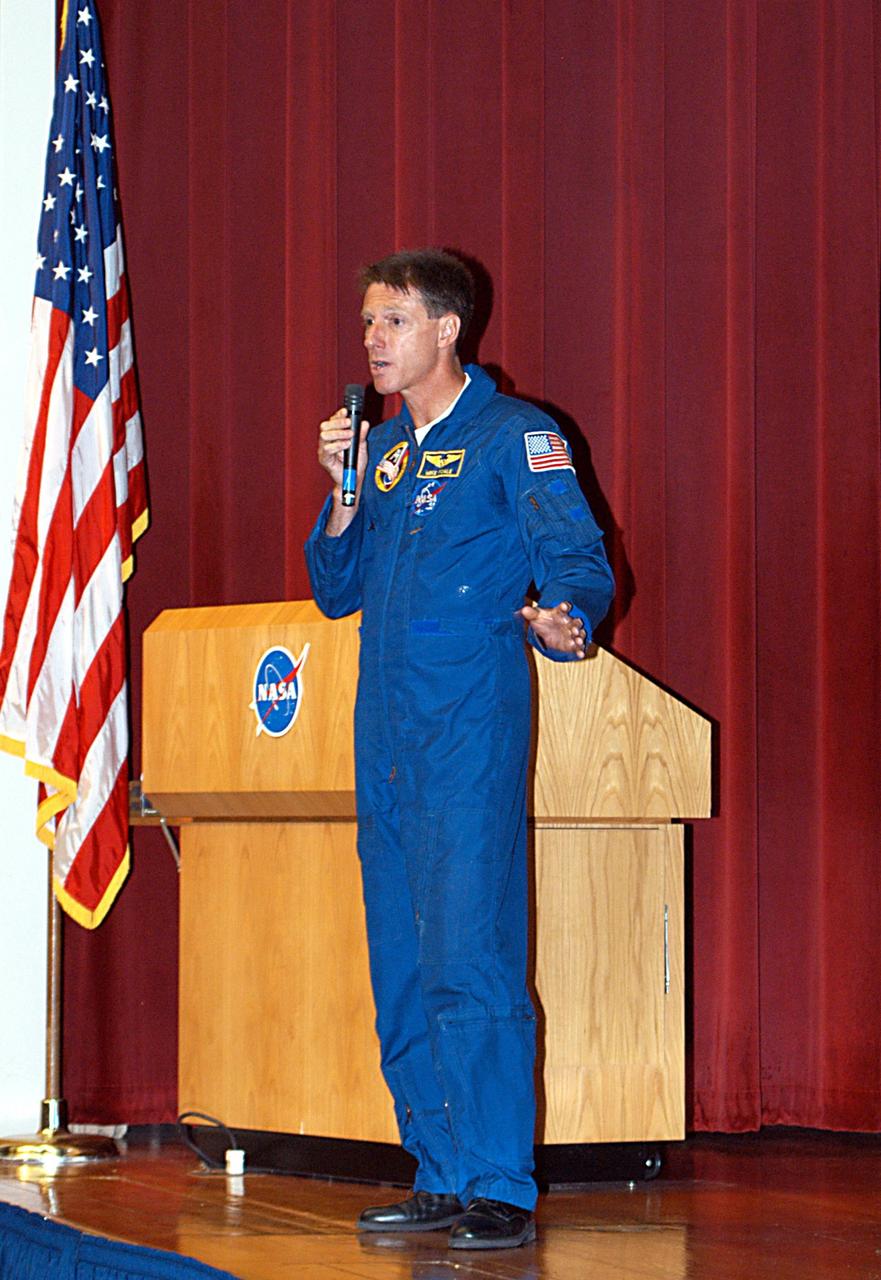
KENNEDY SPACE CENTER, FLA. - In the Training Auditorium, astronaut Mike Foale speaks to the audience about his experiences aboard the International Space Station as commander of the Expedition 8 crew. Foale and Flight Engineer Alexander Kaleri spent 194 days, 18 hours and 35 minutes in space, the second longest expedition to be completed aboard the Station. In February Foale and Kaleri conducted the first spacewalk ever performed from the complex by a two-person crew. Foale has accumulated more time in space than any U.S. astronaut, amassing a total of 374 days, 11 hours and 19 minutes in space from his Expedition 8 mission, a 1997 flight to the Russian Mir Space Station, and four Space Shuttle missions.
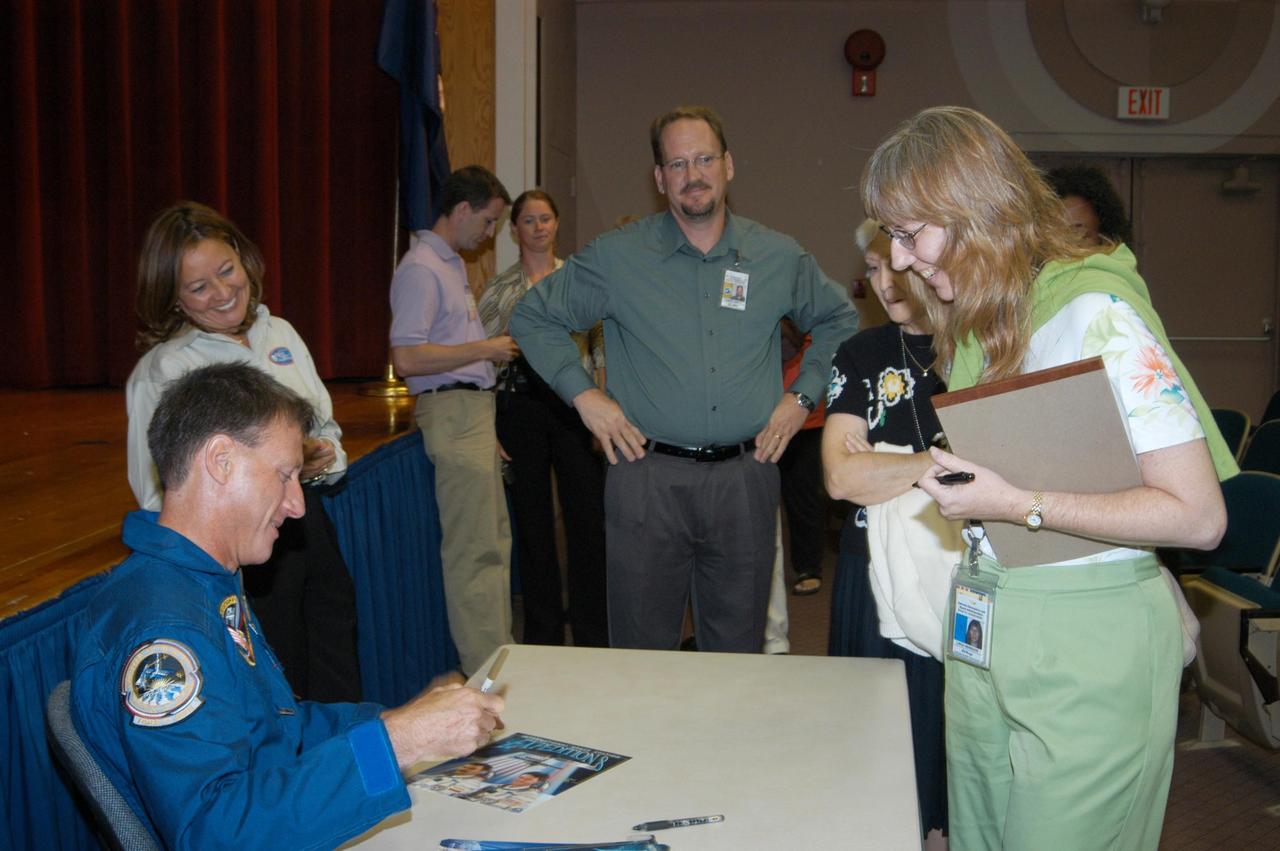
KENNEDY SPACE CENTER, FLA. - After his presentation in the Training Auditorium, astronaut Mike Foale greets employees and signs autographs. Foale shared his experiences aboard the International Space Station as commander of the Expedition 8 crew. Foale and Flight Engineer Alexander Kaleri spent 194 days, 18 hours and 35 minutes in space, the second longest expedition to be completed aboard the Station. In February Foale and Kaleri conducted the first spacewalk ever performed from the complex by a two-person crew. Foale has accumulated more time in space than any U.S. astronaut, amassing a total of 374 days, 11 hours and 19 minutes in space from his Expedition 8 mission, a 1997 flight to the Russian Mir Space Station, and four Space Shuttle missions.
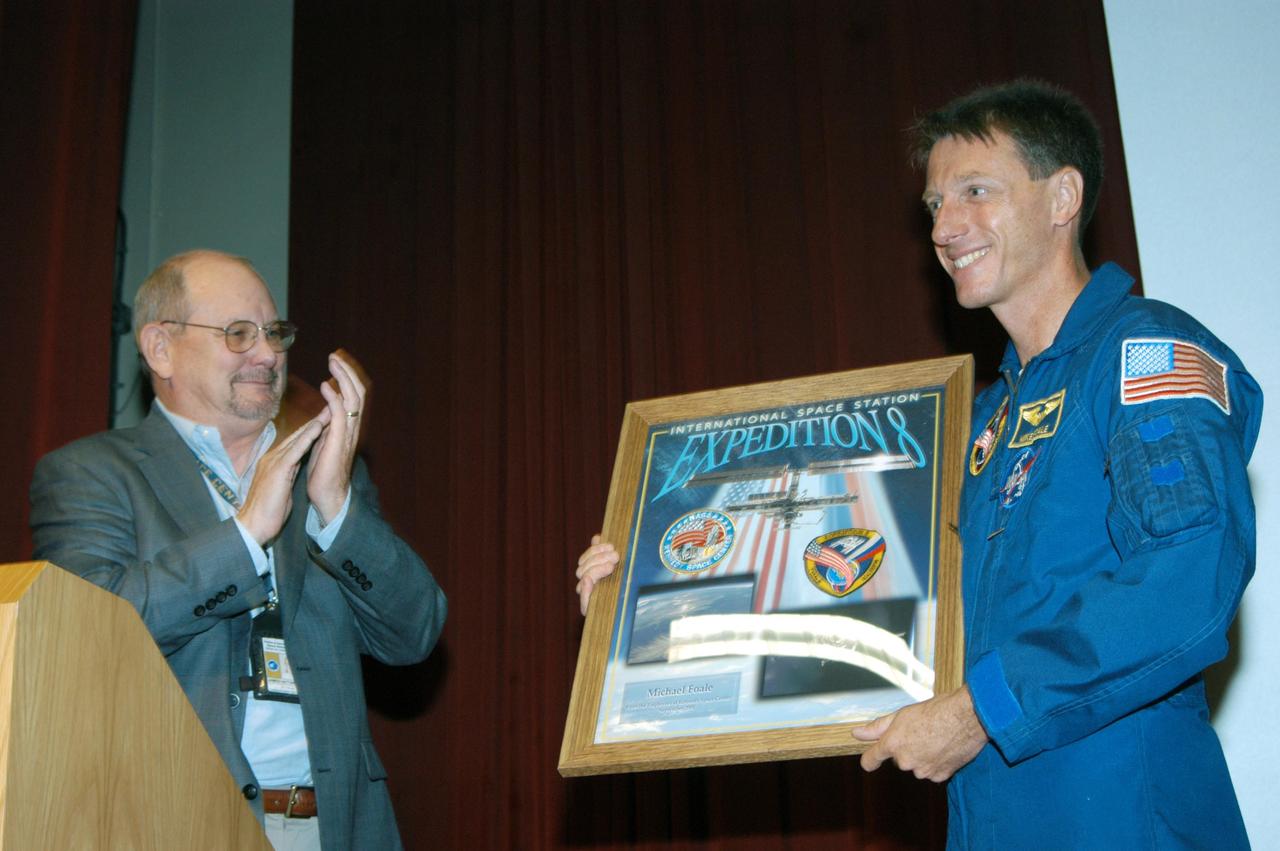
KENNEDY SPACE CENTER, FLA. - In the Training Auditorium, James Hattaway Jr., KSC associate director, presents a framed graphic to astronaut Mike Foale representing his stay aboard the International Space Station as commander of the Expedition 8 crew. .Foale spoke to the audience of employees about his experiences aboard the Space Station. Foale and Flight Engineer Alexander Kaleri spent 194 days, 18 hours and 35 minutes in space, the second longest expedition to be completed aboard the Station. In February Foale and Kaleri conducted the first spacewalk ever performed from the complex by a two-person crew. Foale has accumulated more time in space than any U.S. astronaut, amassing a total of 374 days, 11 hours and 19 minutes in space from his Expedition 8 mission, a 1997 flight to the Russian Mir Space Station, and four Space Shuttle missions.