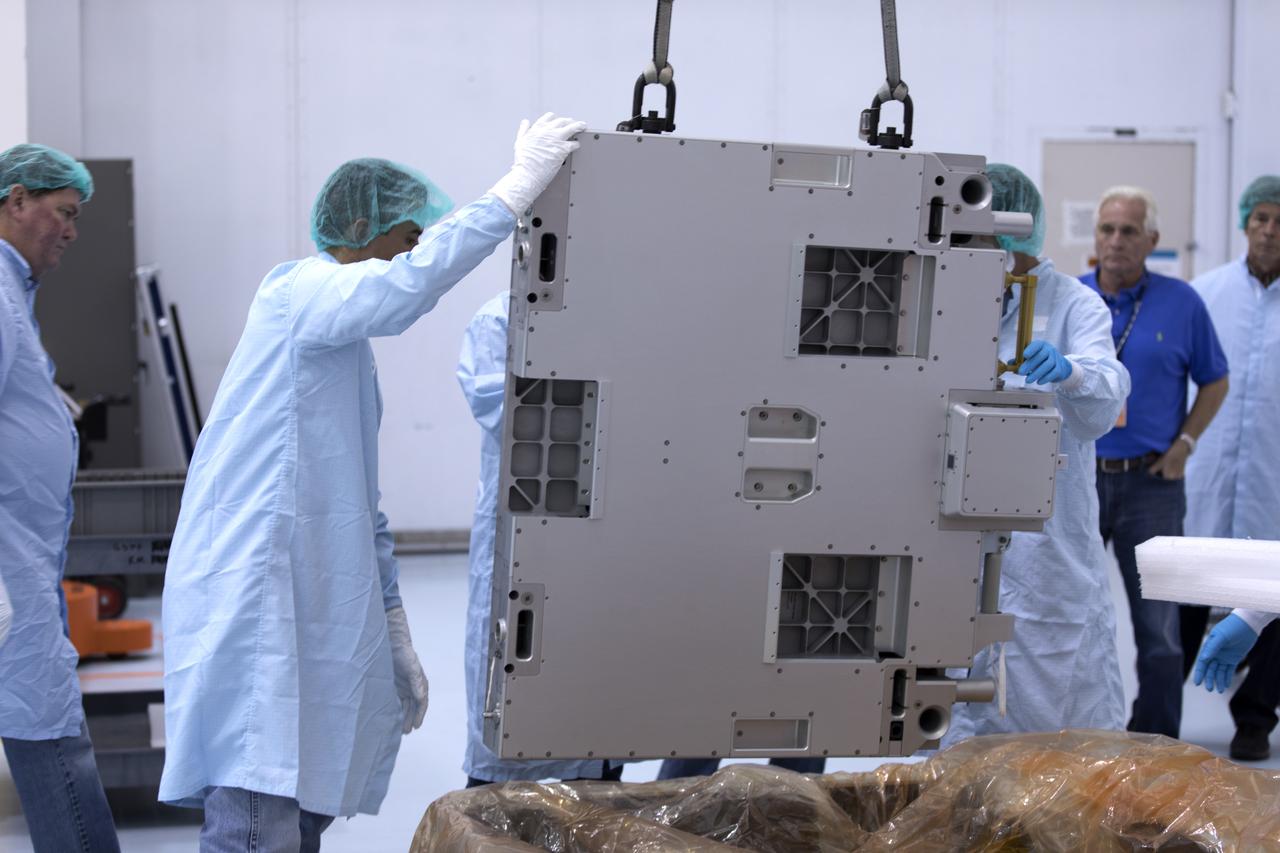
The Materials International Space Station Experiment-Flight Facility, or MISSE-FF, hardware arrived at the Space Station Processing Facility low bay at NASA's Kennedy Space Center in Florida. Technicians assist as a crane is used to lift MISSE out of its shipping container. MISSE will be used to test various materials and computing elements on the exterior of the space station. They will be exposed to the harsh environment of low-Earth orbit, including to a vacuum, atomic oxygen, ultraviolet radiation, direct sunlight and extreme heat and cold. The experiment will provide a better understanding of material durability, from coatings to electronic sensors, which could be applied to future spacecraft designs. MISSE will be delivered to the space station on a future commercial resupply mission.
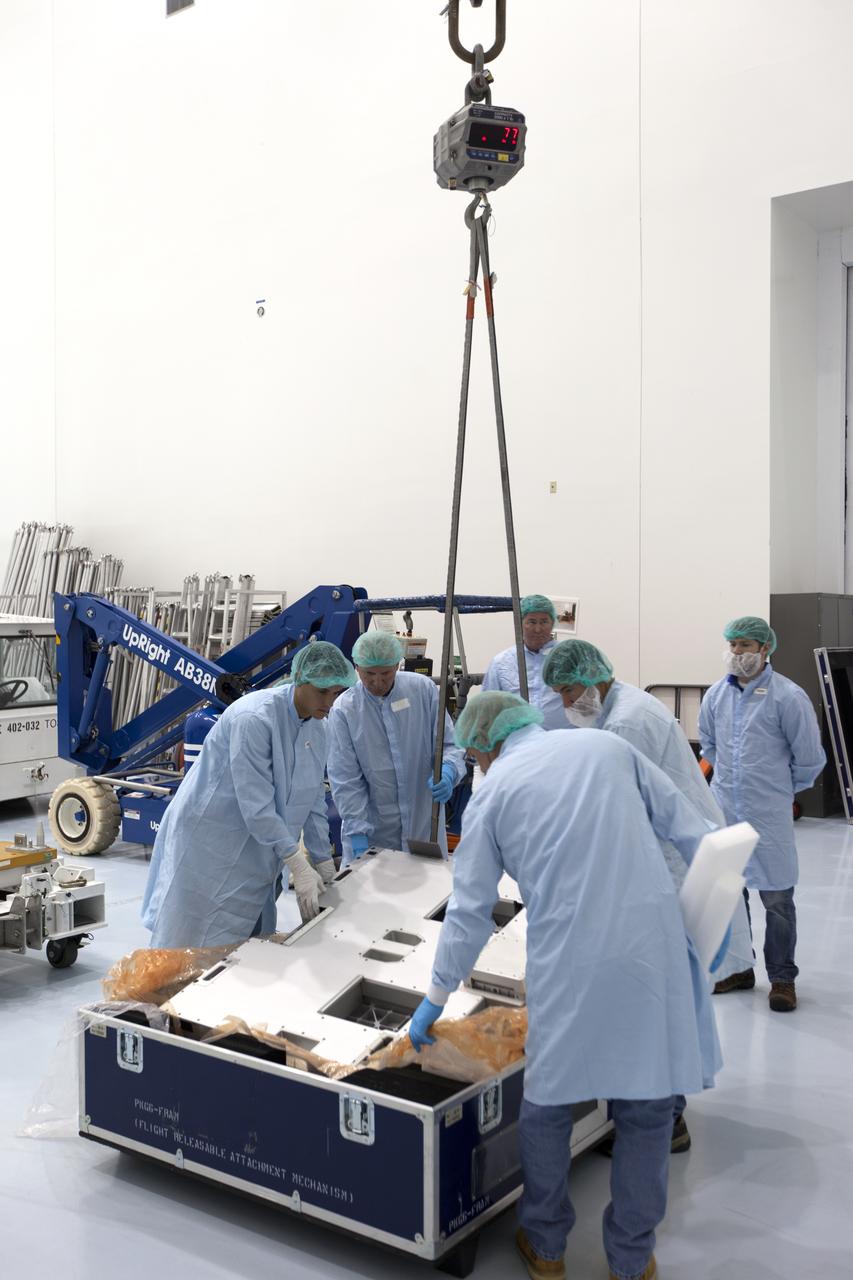
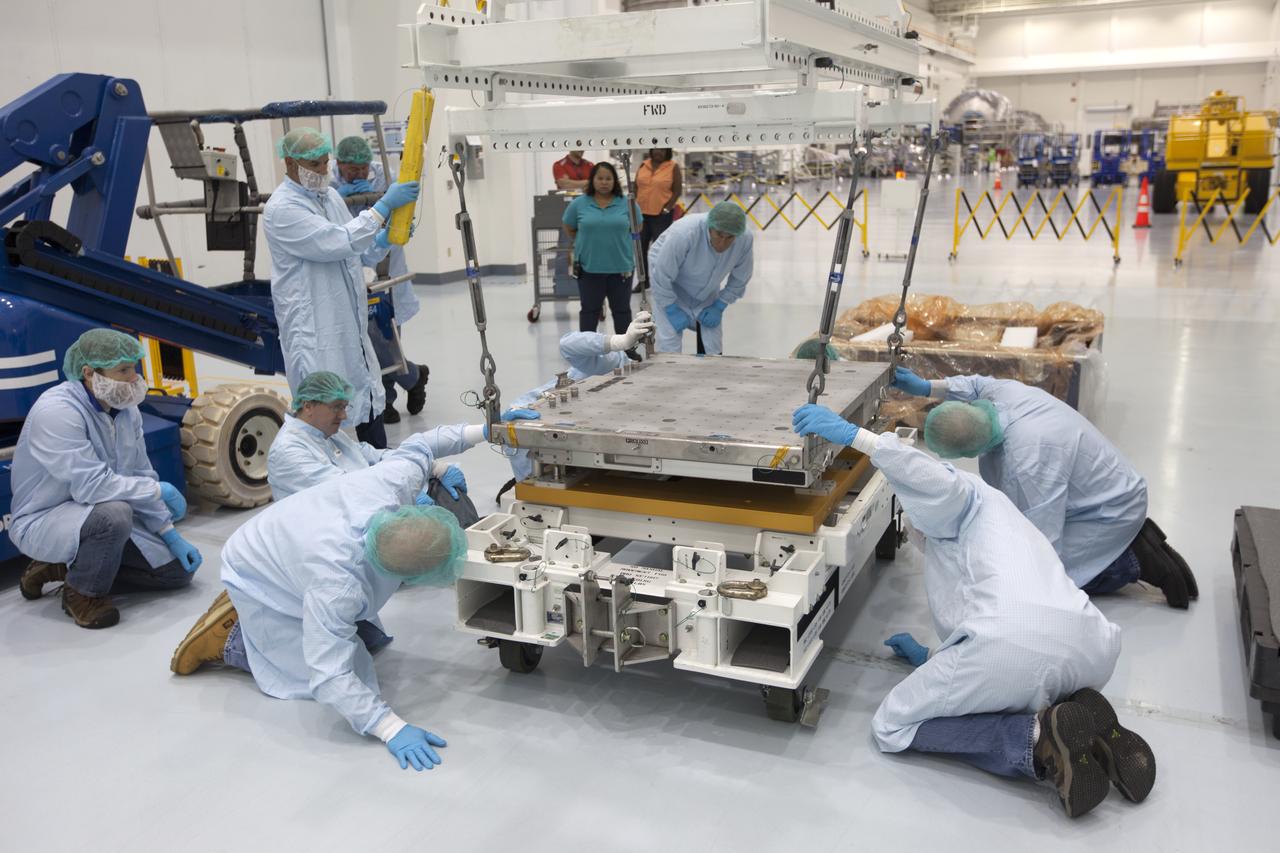
The Materials International Space Station Experiment-Flight Facility, or MISSE-FF, hardware arrived at the Space Station Processing Facility low bay at NASA's Kennedy Space Center in Florida. Technicians attach a crane to MISSE for lifting out of its shipping container. MISSE will be used to test various materials and computing elements on the exterior of the space station. They will be exposed to the harsh environment of low-Earth orbit, including to a vacuum, atomic oxygen, ultraviolet radiation, direct sunlight and extreme heat and cold. The experiment will provide a better understanding of material durability, from coatings to electronic sensors, which could be applied to future spacecraft designs. MISSE will be delivered to the space station on a future commercial resupply mission.
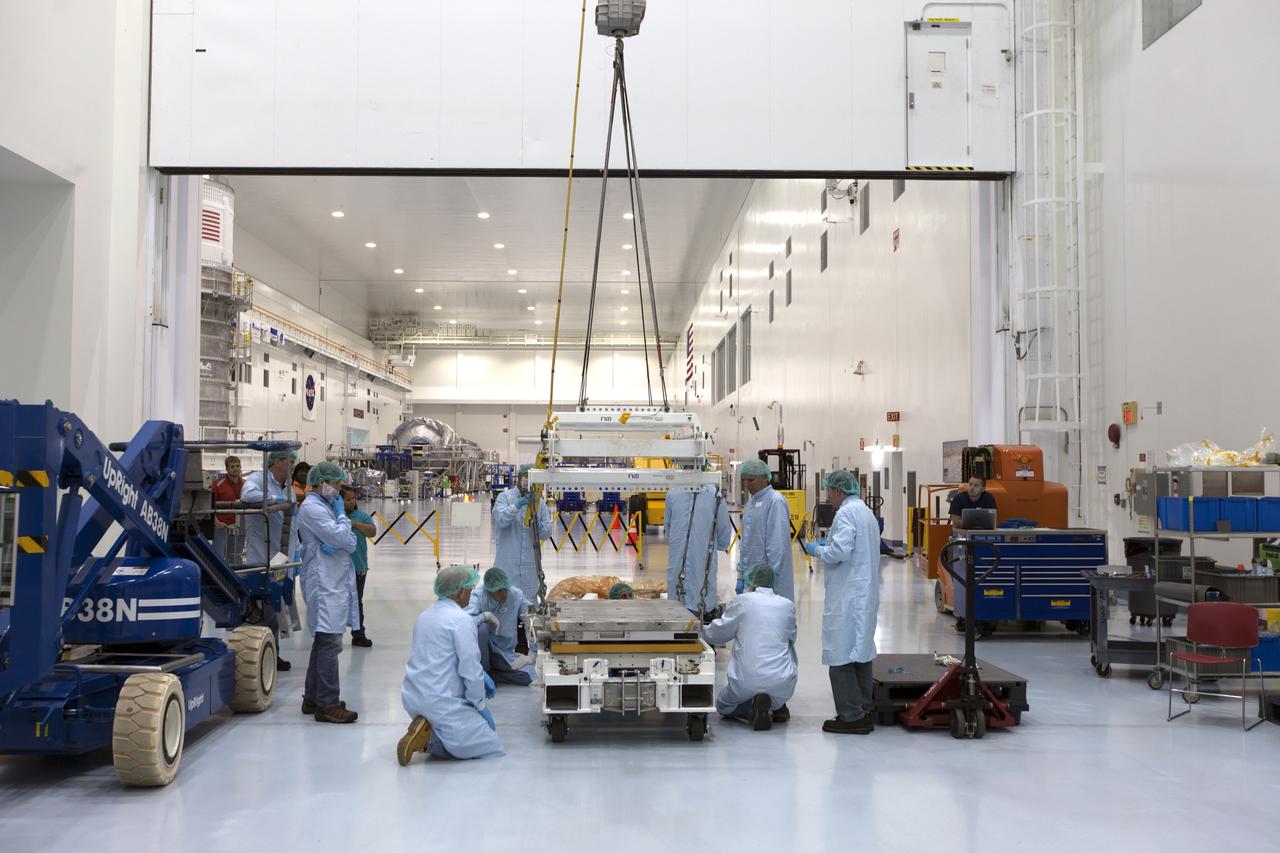
The Materials International Space Station Experiment-Flight Facility, or MISSE-FF, hardware arrived at the Space Station Processing Facility low bay at NASA's Kennedy Space Center in Florida. Technicians assist as one of the components is lowered onto another MISSE component. MISSE will be used to test various materials and computing elements on the exterior of the space station. They will be exposed to the harsh environment of low-Earth orbit, including to a vacuum, atomic oxygen, ultraviolet radiation, direct sunlight and extreme heat and cold. The experiment will provide a better understanding of material durability, from coatings to electronic sensors, which could be applied to future spacecraft designs. MISSE will be delivered to the space station on a future commercial resupply mission.
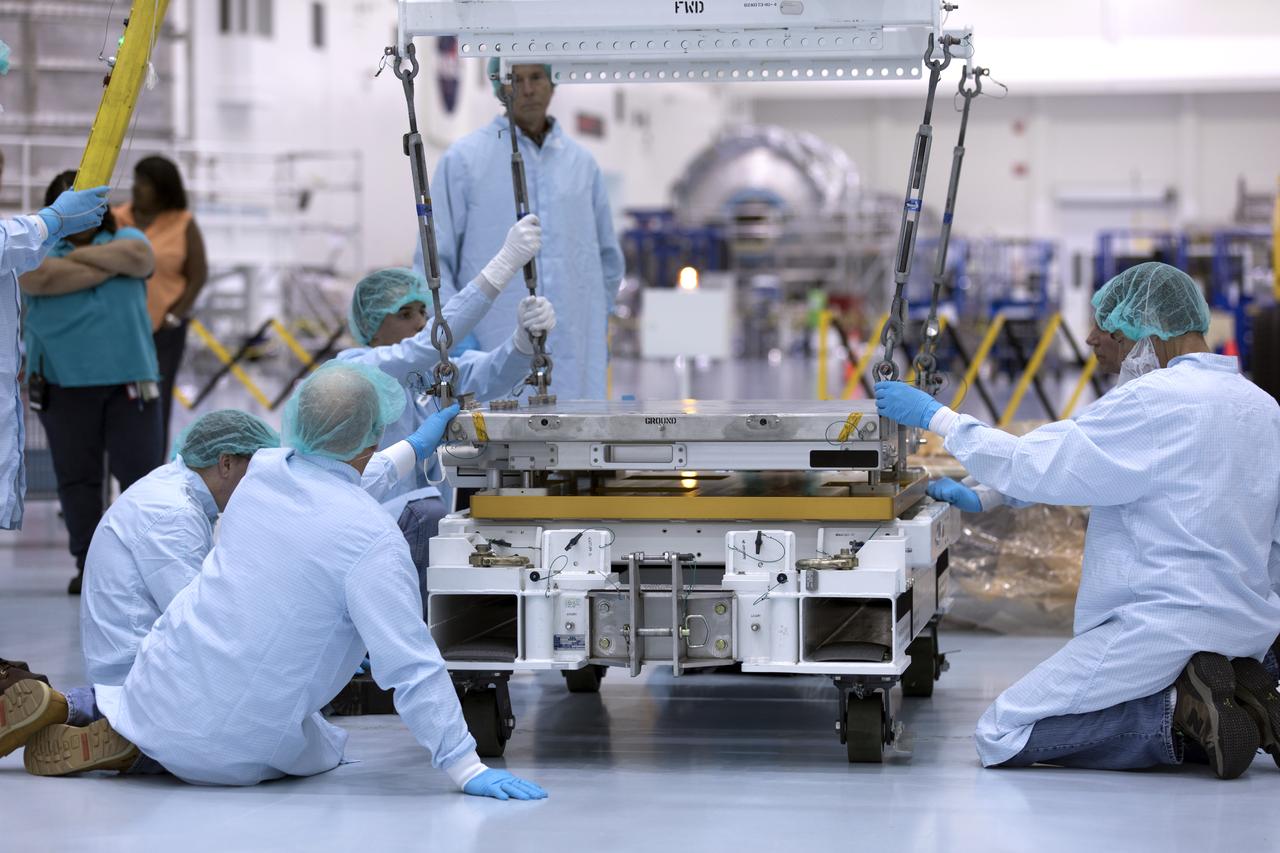
The Materials International Space Station Experiment-Flight Facility, or MISSE-FF, hardware arrived at the Space Station Processing Facility low bay at NASA's Kennedy Space Center in Florida. Technicians assist as one of the components is lowered and secured onto another MISSE component. MISSE will be used to test various materials and computing elements on the exterior of the space station. They will be exposed to the harsh environment of low-Earth orbit, including to a vacuum, atomic oxygen, ultraviolet radiation, direct sunlight and extreme heat and cold. The experiment will provide a better understanding of material durability, from coatings to electronic sensors, which could be applied to future spacecraft designs. MISSE will be delivered to the space station on a future commercial resupply mission.
The Materials International Space Station Experiment-Flight Facility, or MISSE-FF, hardware arrived at the Space Station Processing Facility low bay at NASA's Kennedy Space Center in Florida. Technicians assist as one of the components is lowered onto another MISSE component. MISSE will be used to test various materials and computing elements on the exterior of the space station. They will be exposed to the harsh environment of low-Earth orbit, including to a vacuum, atomic oxygen, ultraviolet radiation, direct sunlight and extreme heat and cold. The experiment will provide a better understanding of material durability, from coatings to electronic sensors, which could be applied to future spacecraft designs. MISSE will be delivered to the space station on a future commercial resupply mission.
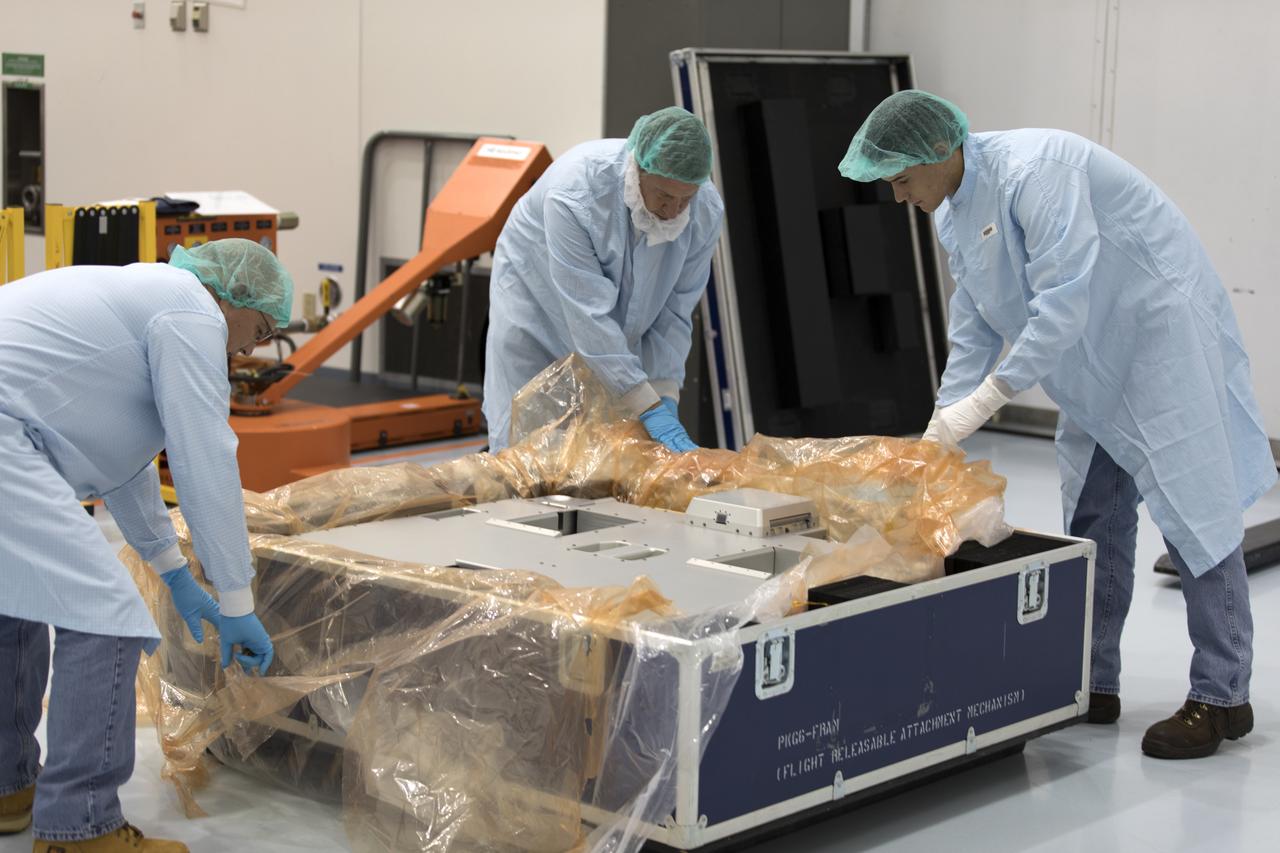
The Materials International Space Station Experiment-Flight Facility, or MISSE-FF, hardware arrived at the Space Station Processing Facility low bay at NASA's Kennedy Space Center in Florida. MISSE will be unpacked for integration and processing. MISSE will be used to test various materials and computing elements on the exterior of the space station. They will be exposed to the harsh environment of low-Earth orbit, including to a vacuum, atomic oxygen, ultraviolet radiation, direct sunlight and extreme heat and cold. The experiment will provide a better understanding of material durability, from coatings to electronic sensors, which could be applied to future spacecraft designs. MISSE will be delivered to the space station on a future commercial resupply mission.
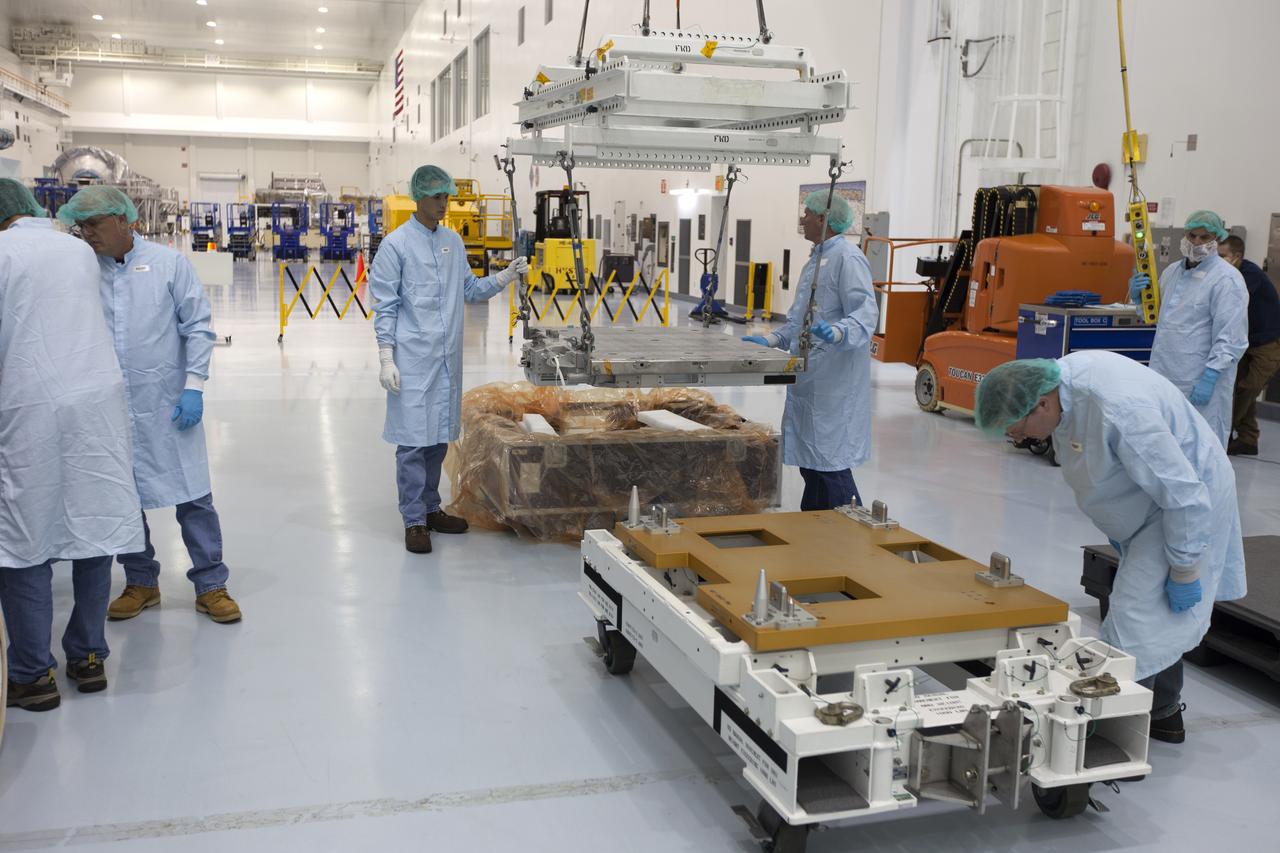
The Materials International Space Station Experiment-Flight Facility, or MISSE-FF, hardware arrived at the Space Station Processing Facility low bay at NASA's Kennedy Space Center in Florida. Technicians assist as MISSE is lifted by crane from its shipping container. MISSE will be used to test various materials and computing elements on the exterior of the space station. They will be exposed to the harsh environment of low-Earth orbit, including to a vacuum, atomic oxygen, ultraviolet radiation, direct sunlight and extreme heat and cold. The experiment will provide a better understanding of material durability, from coatings to electronic sensors, which could be applied to future spacecraft designs. MISSE will be delivered to the space station on a future commercial resupply mission.
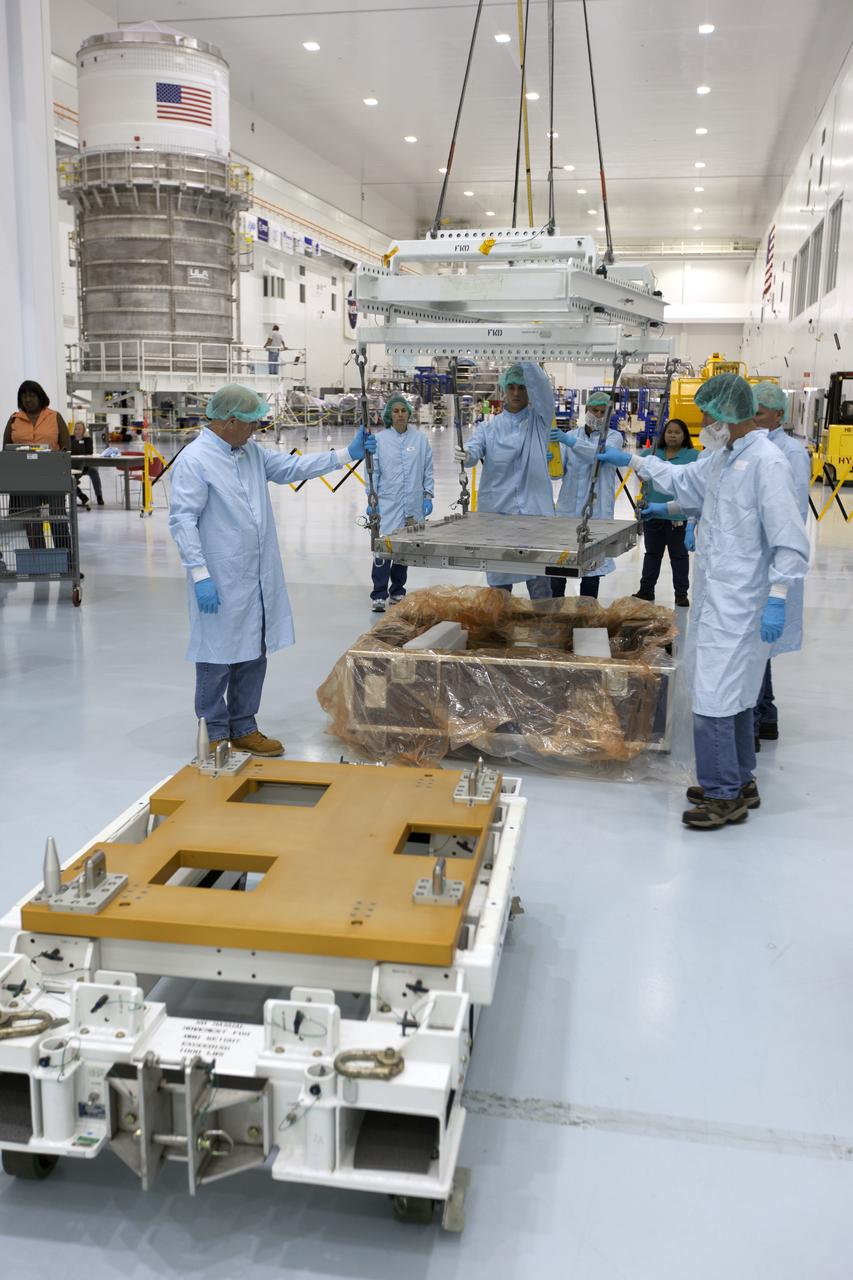
The Materials International Space Station Experiment-Flight Facility, or MISSE-FF, hardware arrived at the Space Station Processing Facility low bay at NASA's Kennedy Space Center in Florida. Technicians assist as MISSE is lifted by crane from its shipping container. MISSE will be used to test various materials and computing elements on the exterior of the space station. They will be exposed to the harsh environment of low-Earth orbit, including to a vacuum, atomic oxygen, ultraviolet radiation, direct sunlight and extreme heat and cold. The experiment will provide a better understanding of material durability, from coatings to electronic sensors, which could be applied to future spacecraft designs. MISSE will be delivered to the space station on a future commercial resupply mission.
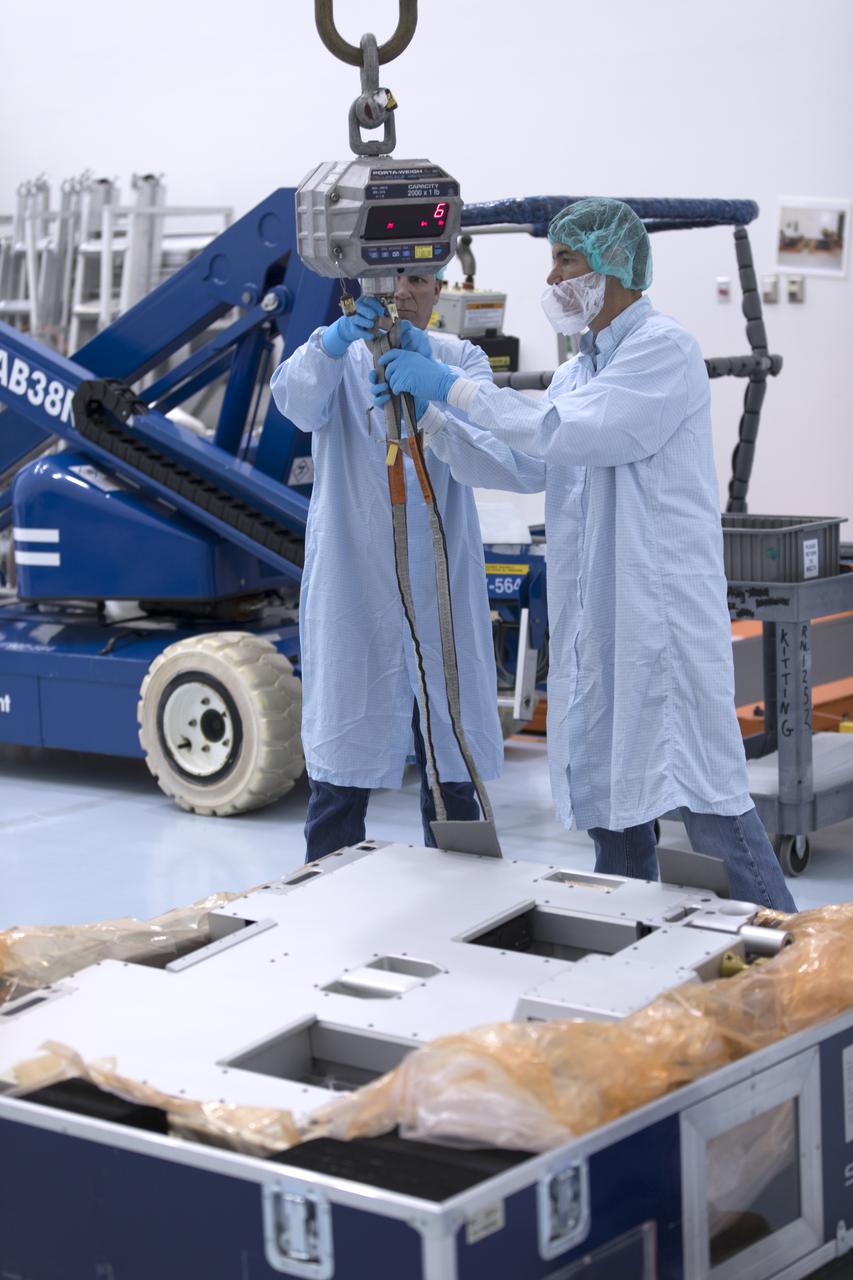
The Materials International Space Station Experiment-Flight Facility, or MISSE-FF, hardware arrived at the Space Station Processing Facility low bay at NASA's Kennedy Space Center in Florida. Technicians work to attach a crane to MISSE for lifting out of its shipping container. MISSE will be used to test various materials and computing elements on the exterior of the space station. They will be exposed to the harsh environment of low-Earth orbit, including to a vacuum, atomic oxygen, ultraviolet radiation, direct sunlight and extreme heat and cold. The experiment will provide a better understanding of material durability, from coatings to electronic sensors, which could be applied to future spacecraft designs. MISSE will be delivered to the space station on a future commercial resupply mission.

Containers carrying set of seeds for a Materials International Space Station Experiment (MISSE) are shown Feb. 11, 2021, at NASA’s Kennedy Space Center in Florida. The containers will fly aboard Northrop Grumman’s Cygnus spacecraft as part of NG-15, a NASA commercial resupply mission to the orbiting laboratory targeted for Feb. 20, 2021. They will be placed in the MISSE testing facility, located near the space station’s solar arrays, where they will be exposed to the extreme environment of space for six months before returning to Earth for further study.
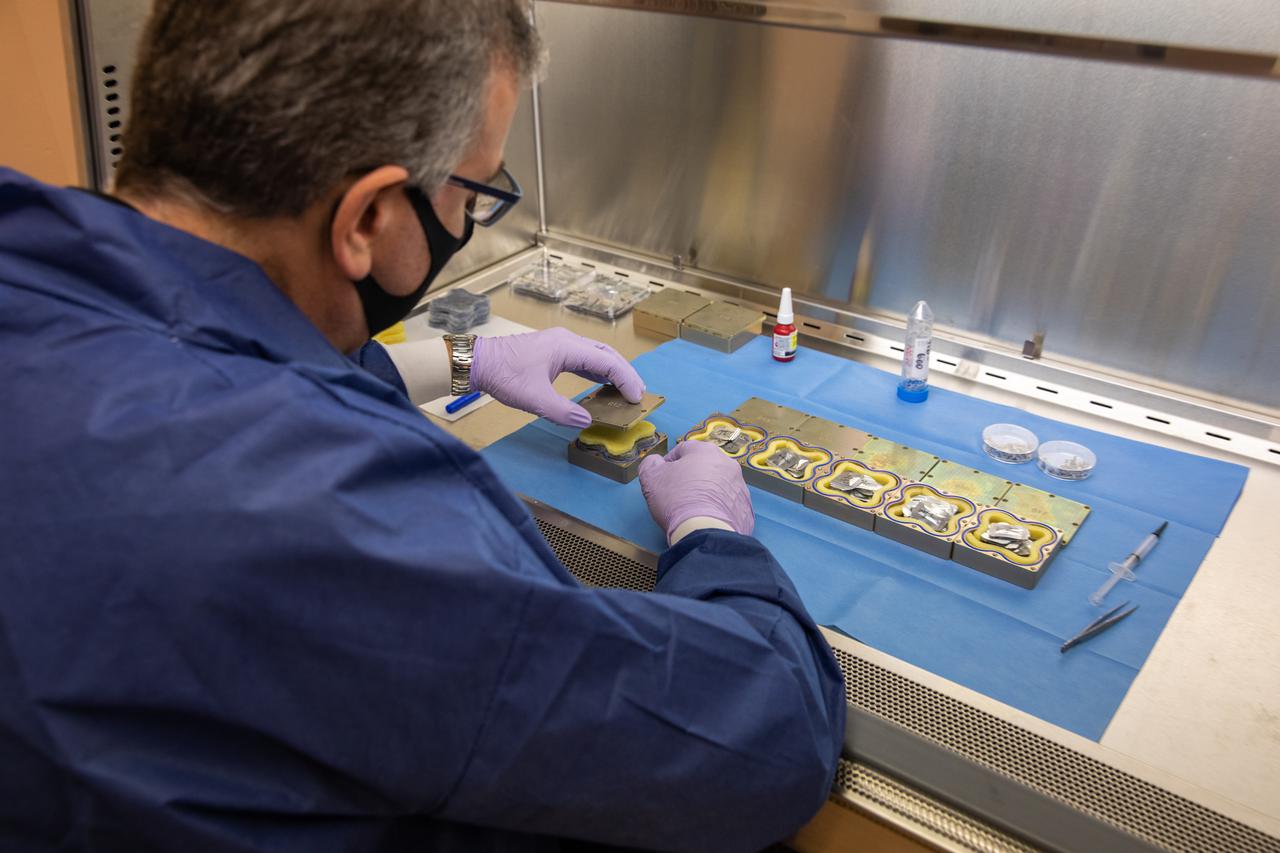
Jeffrey Richards, a project science coordinator working with the Exploration Research and Technology programs at NASA’s Kennedy Space Center in Florida, prepares containers Feb. 11, 2021, for a Materials International Space Station Experiment (MISSE). The containers, carrying sets of seeds, will fly aboard Northrop Grumman’s Cygnus spacecraft as part of NG-15, a NASA commercial resupply mission to the orbiting laboratory targeted for Feb. 20, 2021. They will be placed in the MISSE testing facility, located near the space station’s solar arrays, where they will be exposed to the extreme environment of for six months before returning to Earth for further study.
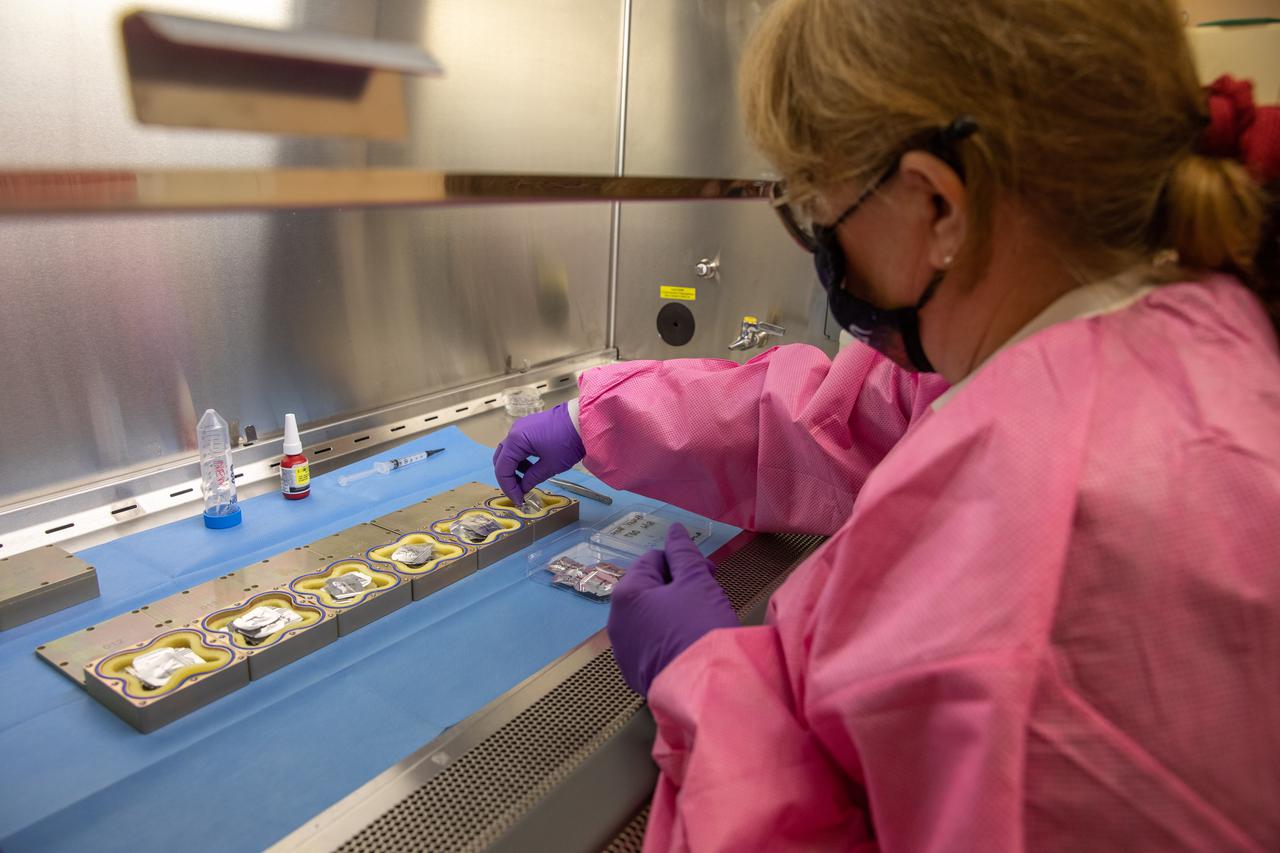
Christina Khodada, a research scientist working with the Exploration Research and Technology Programs, prepares containers Feb. 11, 2021, at NASA’s Kennedy Space Center in Florida for a Materials International Space Station Experiment (MISSE). The containers, carrying sets of seeds, will fly aboard Northrop Grumman’s Cygnus spacecraft as part of NG-15, a NASA commercial resupply mission to the orbiting laboratory targeted for Feb. 20, 2021. They will be placed in the MISSE testing facility, located near the space station’s solar arrays, where they will be exposed to the extreme environment of space for six months before returning to Earth for further study.

Jeffrey Richards, a project science coordinator working with the Exploration Research and Technology programs at NASA’s Kennedy Space Center in Florida, prepares containers Feb. 11, 2021, for a Materials International Space Station Experiment (MISSE). The containers, carrying sets of seeds, will fly aboard Northrop Grumman’s Cygnus spacecraft as part of NG-15, a NASA commercial resupply mission to the orbiting laboratory targeted for Feb. 20, 2021. They will be placed in the MISSE testing facility, located near the space station’s solar arrays, where they will be exposed to the extreme environment of space for six months before returning to Earth for further study.
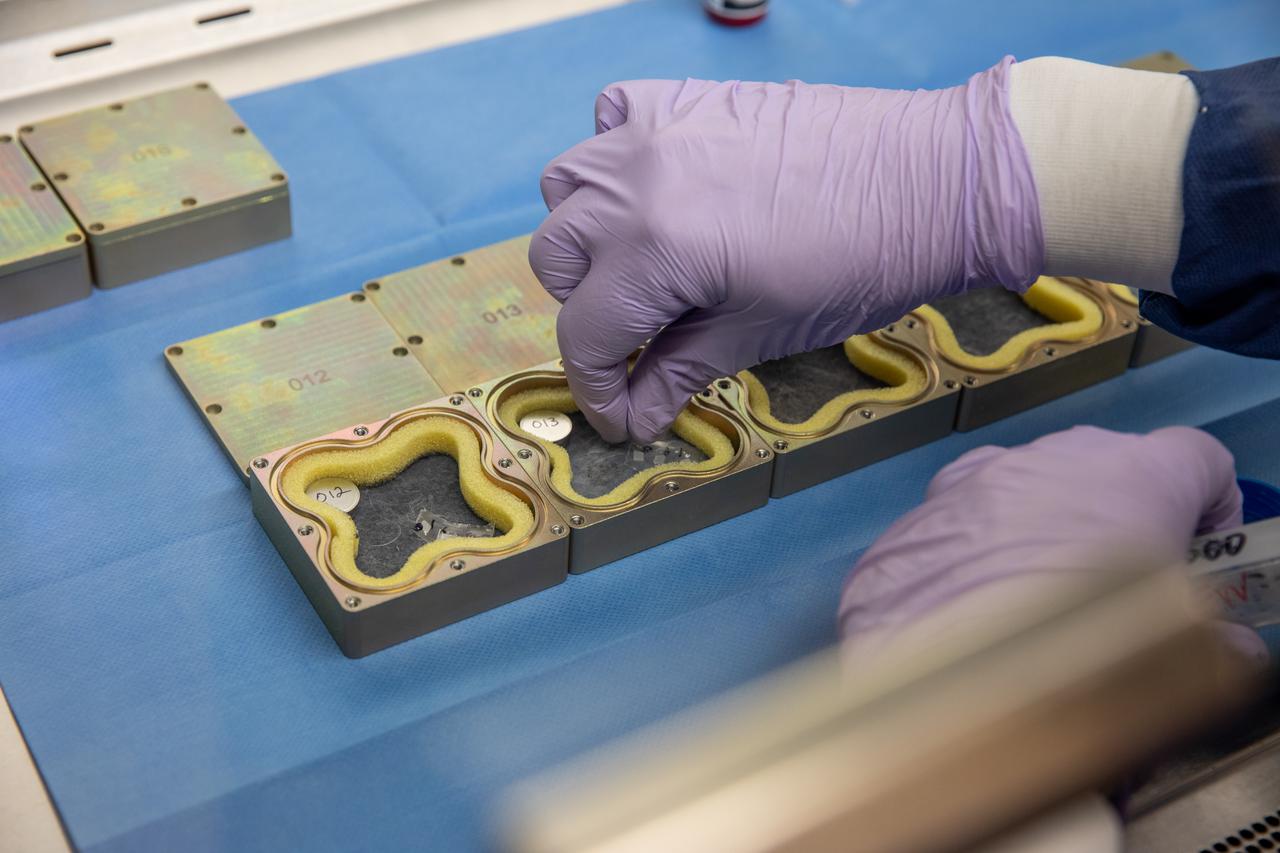
Jeffrey Richards, a project science coordinator working with the Exploration Research and Technology programs at NASA’s Kennedy Space Center in Florida, prepares containers Feb. 11, 2021, for a Materials International Space Station Experiment (MISSE). The containers, carrying sets of seeds, will fly aboard Northrop Grumman’s Cygnus spacecraft as part of NG-15, a NASA commercial resupply mission to the orbiting laboratory targeted for Feb. 20, 2021. They will be placed in the MISSE testing facility, located near the space station’s solar arrays, where they will be exposed to the extreme environment of space for six months before returning to Earth for further study.
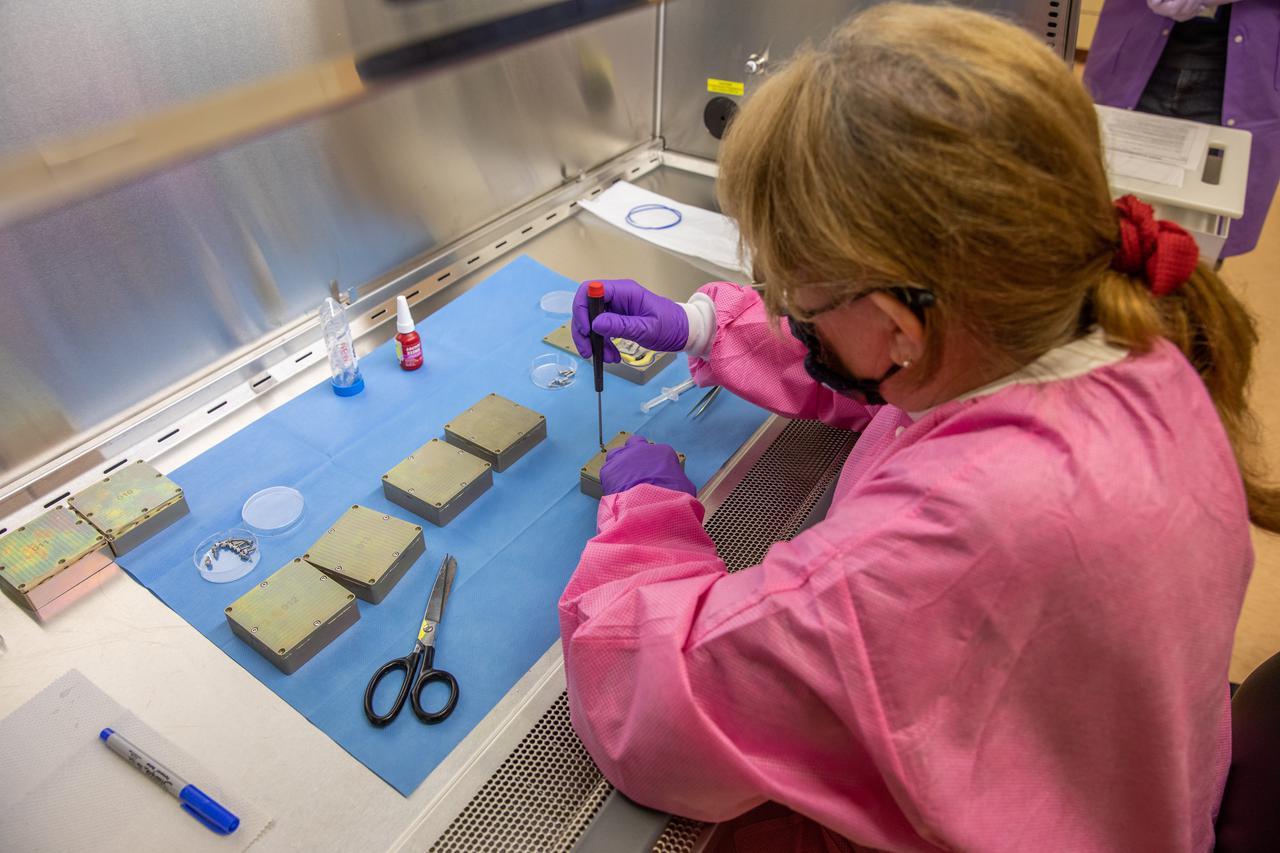
Christina Khodada, a research scientist working with the Exploration Research and Technology Programs, prepares containers Feb. 11, 2021, at NASA’s Kennedy Space Center in Florida for a Materials International Space Station Experiment (MISSE). The containers, carrying sets of seeds, will fly aboard Northrop Grumman’s Cygnus spacecraft as part of NG-15, a NASA commercial resupply mission to the orbiting laboratory targeted for Feb. 20, 2021. They will be placed in the MISSE testing facility, located near the space station’s solar arrays, where they will be exposed to the extreme environment of space for six months before returning to Earth for further study.
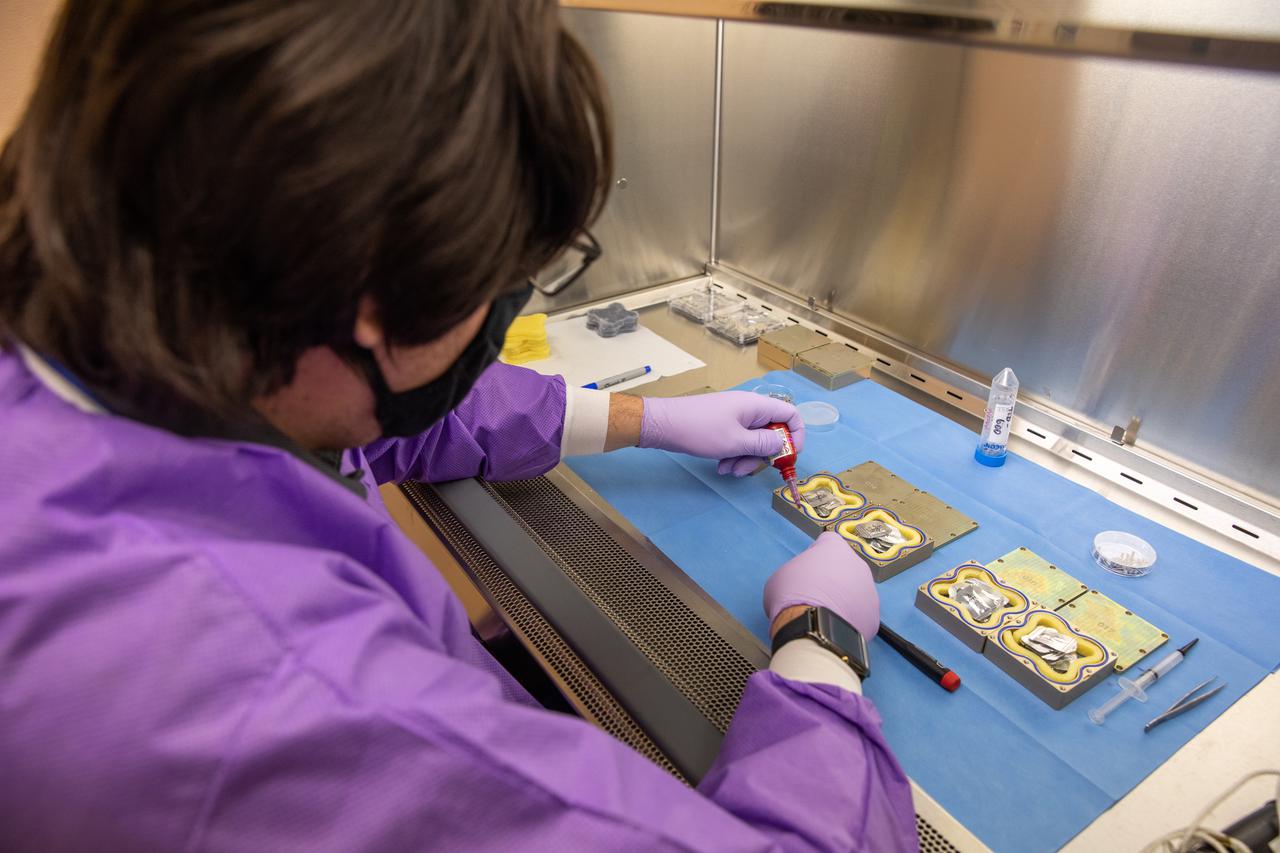
Cory Spern, a research scientist working with the Exploration Research and Technology programs at NASA’s Kennedy Space Center in Florida, prepares containers Feb. 11, 2021, for a Materials International Space Station Experiment (MISSE). The containers, carrying sets of seeds, will fly aboard Northrop Grumman’s Cygnus spacecraft as part of NG-15, a NASA commercial resupply mission to the orbiting laboratory targeted for Feb. 20, 2021. They will be placed in the MISSE testing facility, located near the space station’s solar arrays, where they will be exposed to the extreme environment of space for six months before returning to Earth for further study.

Jeffrey Richards, a project science coordinator working with the Exploration Research and Technology programs at NASA’s Kennedy Space Center in Florida, prepares containers Feb. 11, 2021, for a Materials International Space Station Experiment (MISSE). The containers, carrying sets of seeds, will fly aboard Northrop Grumman’s Cygnus spacecraft as part of NG-15, a NASA commercial resupply mission to the orbiting laboratory targeted for Feb. 20, 2021. They will be placed in the MISSE testing facility, located near the space station’s solar arrays, where they will be exposed to the extreme environment of space for six months before returning to Earth for further study.
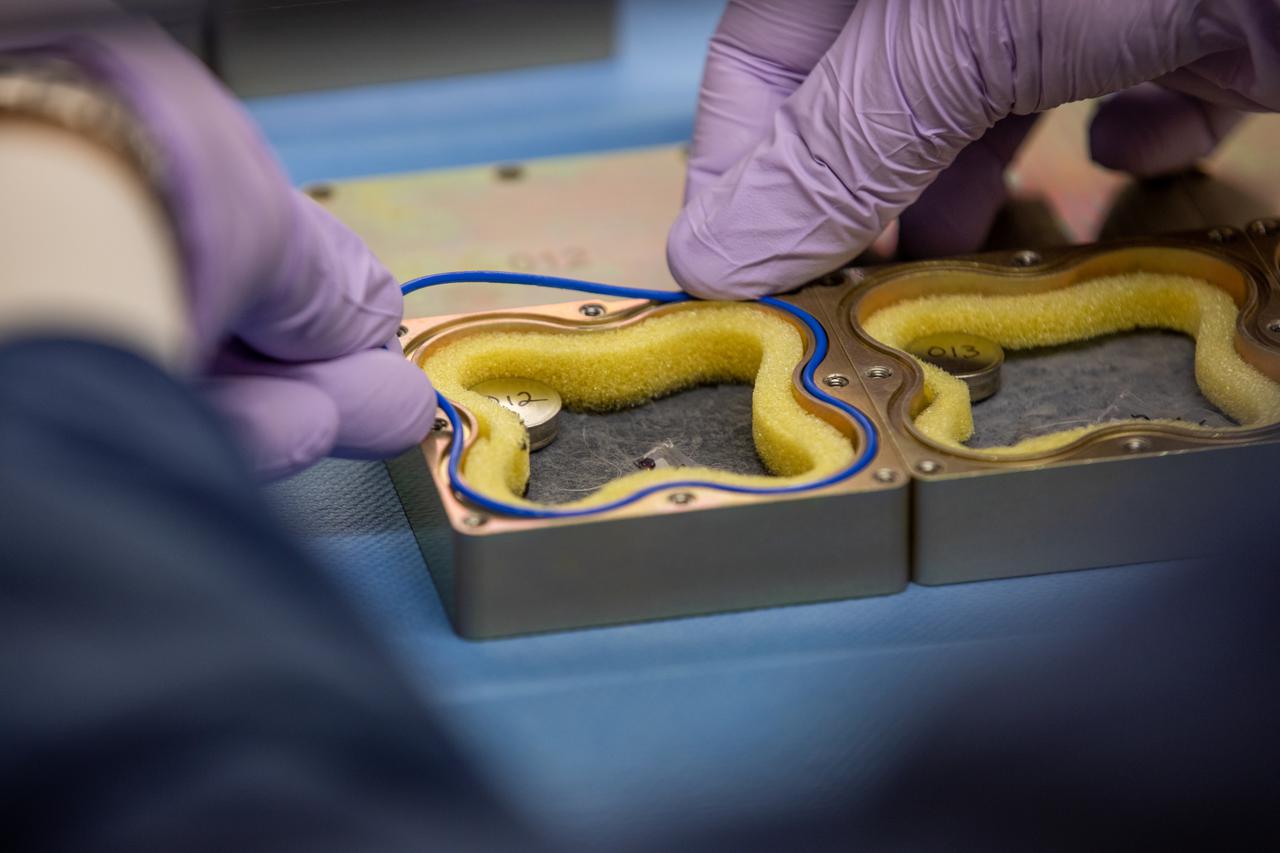
Jeffrey Richards, a project science coordinator working with the Exploration Research and Technology programs at NASA’s Kennedy Space Center in Florida, prepares containers Feb. 11, 2021, for a Materials International Space Station Experiment (MISSE). The containers, carrying sets of seeds, will fly aboard Northrop Grumman’s Cygnus spacecraft as part of NG-15, a NASA commercial resupply mission to the orbiting laboratory targeted for Feb. 20, 2021. They will be placed in the MISSE testing facility, located near the space station’s solar arrays, where they will be exposed to the extreme environment of space for six months before returning to Earth for further study.
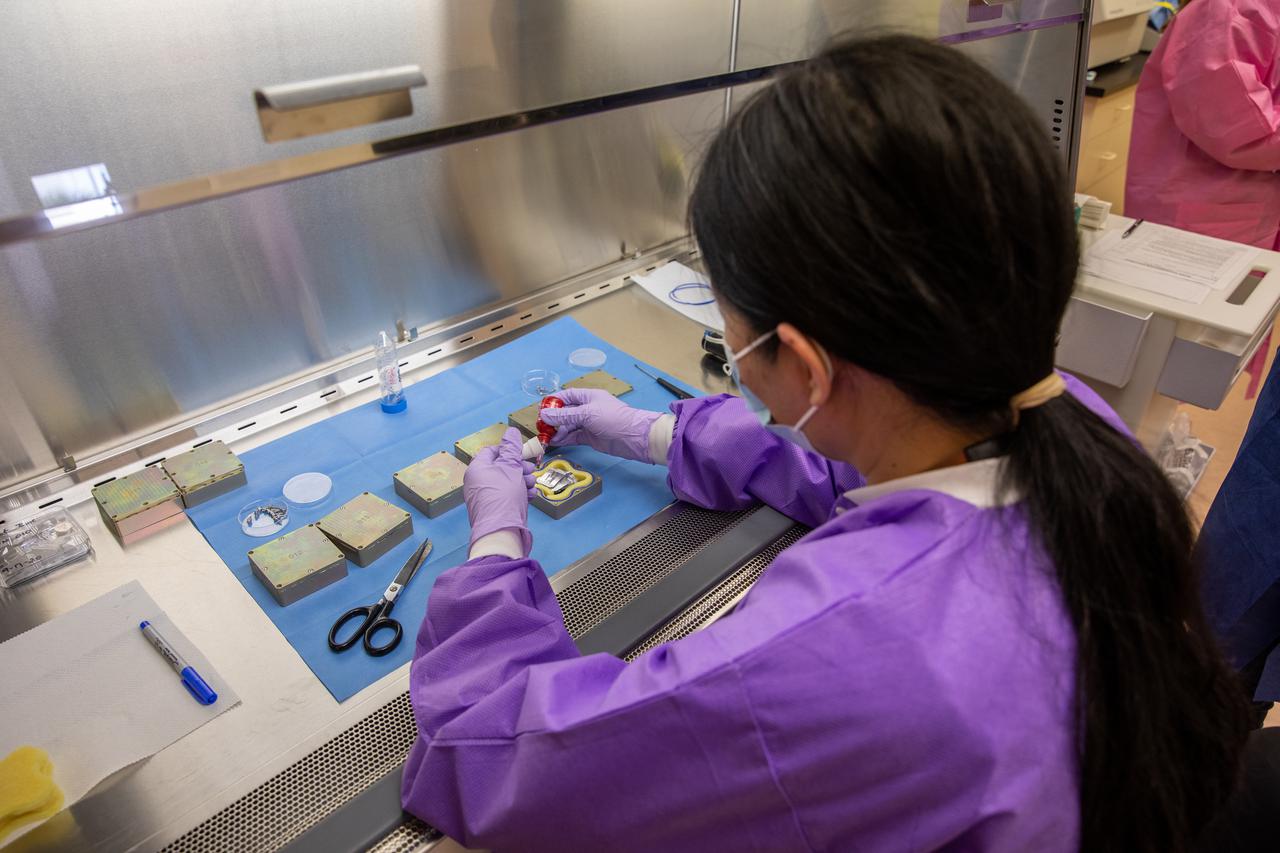
Ye Zhang, project scientist for the Exploration Research and Technology programs at NASA’s Kennedy Space Center in Florida, prepares containers for a Materials International Space Station Experiment (MISSE). The containers, carrying sets of seeds, will fly aboard Northrop Grumman’s Cygnus spacecraft as part of NG-15, a NASA commercial resupply mission to the orbiting laboratory targeted for Feb. 20, 2021. They will be placed in the MISSE testing facility, located near the space station’s solar arrays, where they will be exposed to the extreme environment of space for six months before returning to Earth for further study.
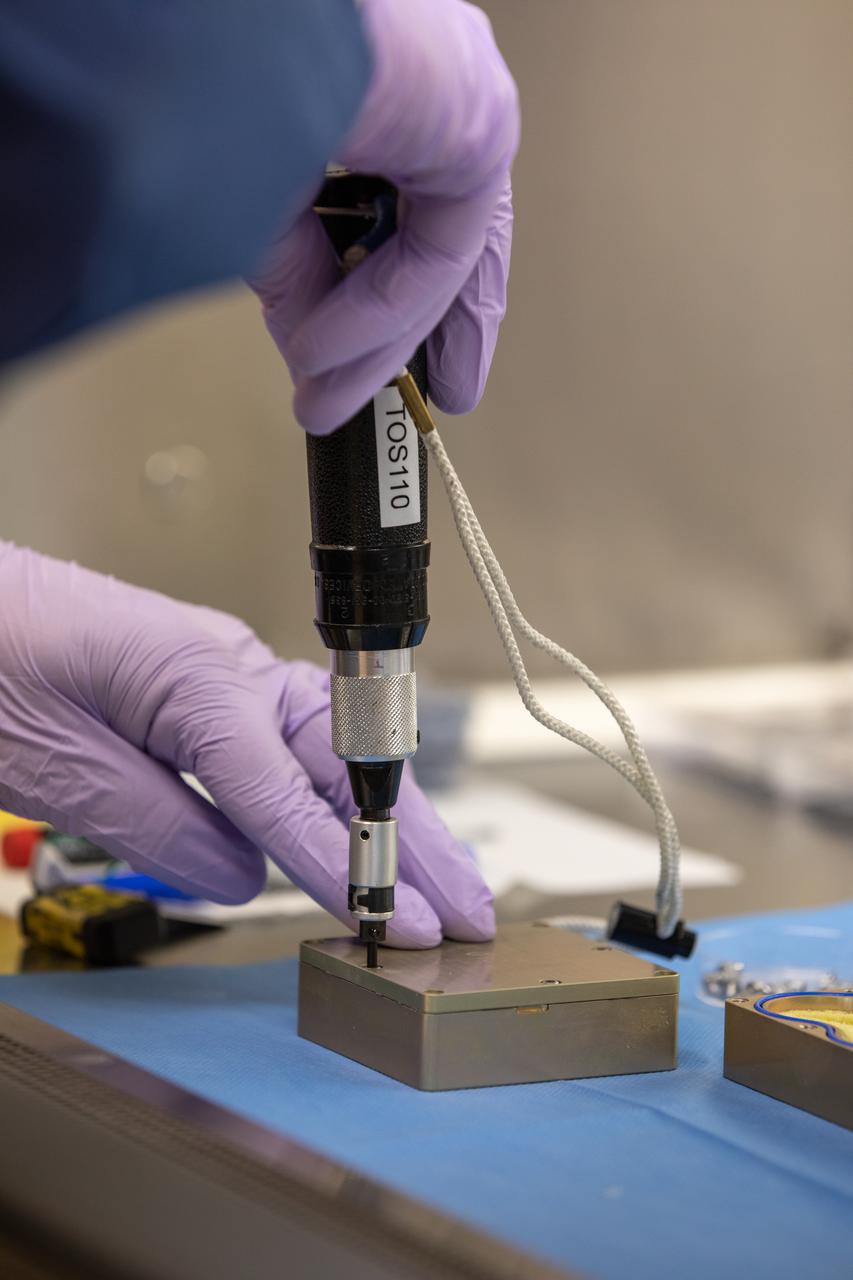
Jeffrey Richards, a project science coordinator working with the Exploration Research and Technology programs at NASA’s Kennedy Space Center in Florida, prepares containers Feb. 11, 2021, for a Materials International Space Station Experiment (MISSE). The containers, carrying sets of seeds, will fly aboard Northrop Grumman’s Cygnus spacecraft as part of NG-15, a NASA commercial resupply mission to the orbiting laboratory targeted for Feb. 20, 2021. They will be placed in the MISSE testing facility, located near the space station’s solar arrays, where they will be exposed to the extreme environment of for six months before returning to Earth for further study.

Jeffrey Richards, a project science coordinator working with the Exploration Research and Technology programs at NASA’s Kennedy Space Center in Florida, prepares containers Feb. 11, 2021, for a Materials International Space Station Experiment (MISSE). The containers, carrying sets of seeds, will fly aboard Northrop Grumman’s Cygnus spacecraft as part of NG-15, a NASA commercial resupply mission to the orbiting laboratory targeted for Feb. 20, 2021. They will be placed in the MISSE testing facility, located near the space station’s solar arrays, where they will be exposed to the extreme environment of space for six months before returning to Earth for further study.

NASA successfully launched the RockSat-X education payload on a Terrier-Improved Malemute suborbital sounding rocket at 7:33:30 a.m. EDT Aug. 17 from the Wallops Flight Facility in Virginia. Students from eight community colleges and universities from across the United States participated in the RockSat-X project.The payload carrying the experiments flew to an altitude of 95 miles. Data was received from most of the student experiments. However, the payload was not recovered as planned. NASA will investigate the anomaly. Credit: NASA/Wallops/A. Stancil <b><a href="http://www.nasa.gov/audience/formedia/features/MP_Photo_Guidelines.html" rel="nofollow">NASA image use policy.</a></b> <b><a href="http://www.nasa.gov/centers/goddard/home/index.html" rel="nofollow">NASA Goddard Space Flight Center</a></b> enables NASA’s mission through four scientific endeavors: Earth Science, Heliophysics, Solar System Exploration, and Astrophysics. Goddard plays a leading role in NASA’s accomplishments by contributing compelling scientific knowledge to advance the Agency’s mission. <b>Follow us on <a href="http://twitter.com/NASAGoddardPix" rel="nofollow">Twitter</a></b> <b>Like us on <a href="http://www.facebook.com/pages/Greenbelt-MD/NASA-Goddard/395013845897?ref=tsd" rel="nofollow">Facebook</a></b> <b>Find us on <a href="http://instagrid.me/nasagoddard/?vm=grid" rel="nofollow">Instagram</a></b>
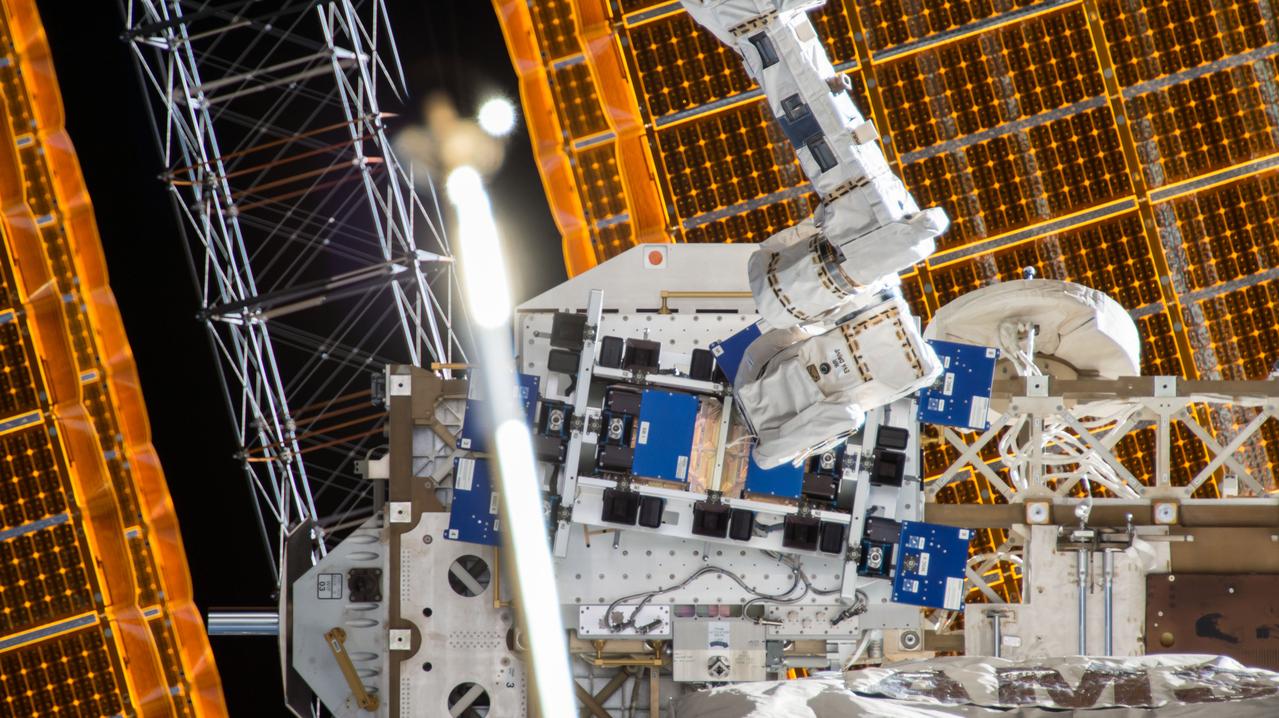
iss055e026913 (4/19/2018) --- View of the Materials ISS Experiment Flight Facility (MISSE-FF) taken by the External High Definition Camera (EHDC1). The MISSE-FF platform provides the ability to test materials, coatings, and components or other larger experiments in the harsh environment of space, which is virtually impossible to do collectively on Earth.
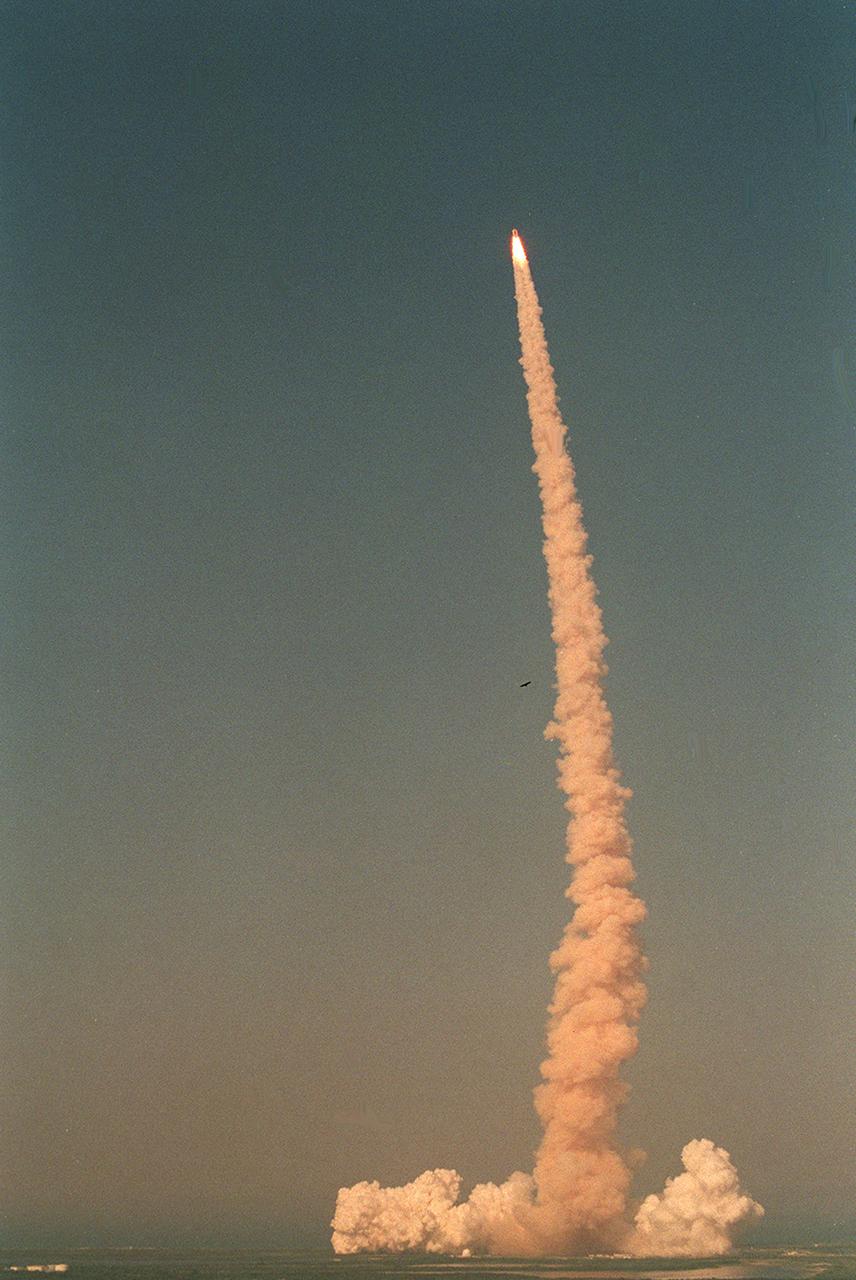
Space Shuttle Orbiter Discovery lifted off for the STS-105 mission on August 10, 2001. The main purpose of the mission was the rotation of the International Space Station (ISS) Expedition Two crew with the Expedition Three crew, and the delivery of supplies utilizing the Italian-built Multipurpose Logistics Module (MPLM) Leonardo. Another payload was the Materials International Space Station Experiment (MISSE). The MISSE experiment was to fly materials and other types of space exposure experiments on the Space Station and was the first externally mounted experiment conducted on the ISS.
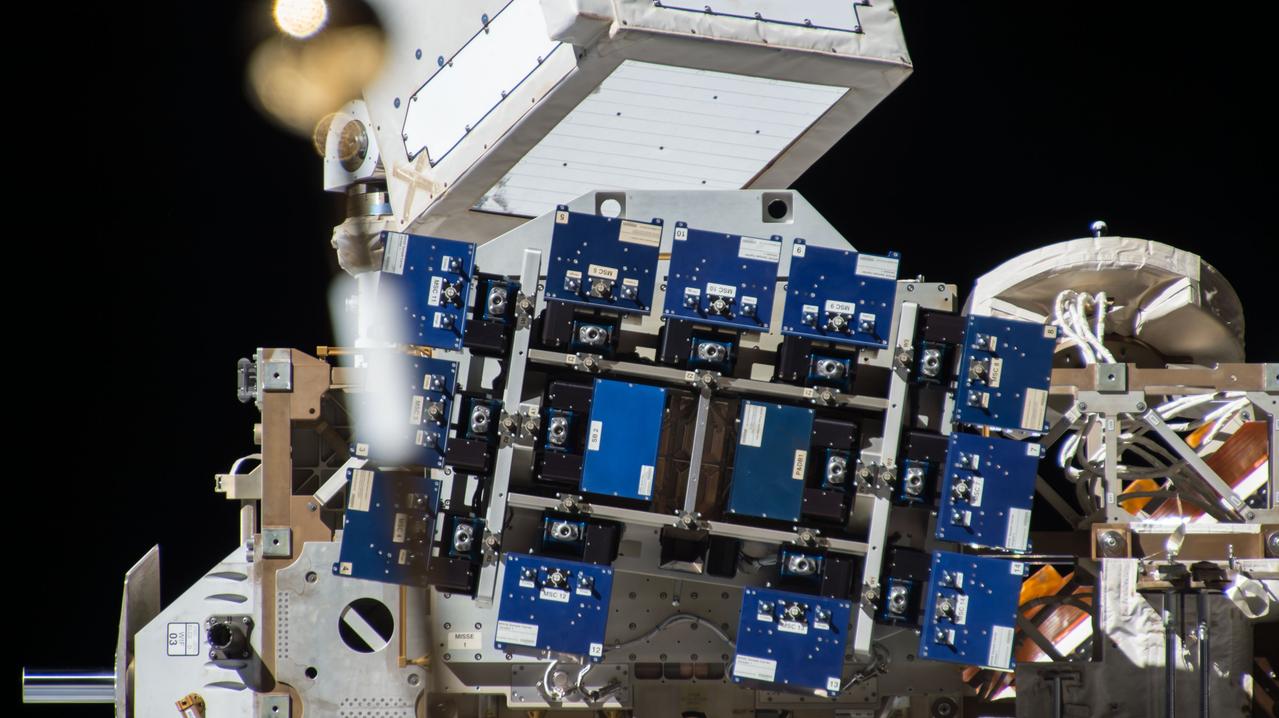
iss058e003972 (1/26/2019) --- Photo documentation of the Materials ISS Experiment Flight Facility (MISSE-FF) platform aboard the International Space Station (ISS).

Miria Finckenor, a researcher at NASA’s Marshall Space Flight Center in Huntsville, Alabama, shows off the 15th Materials International Space Station Experiment, or MISSE, an external science payload berthed on the International Space Station since 2001
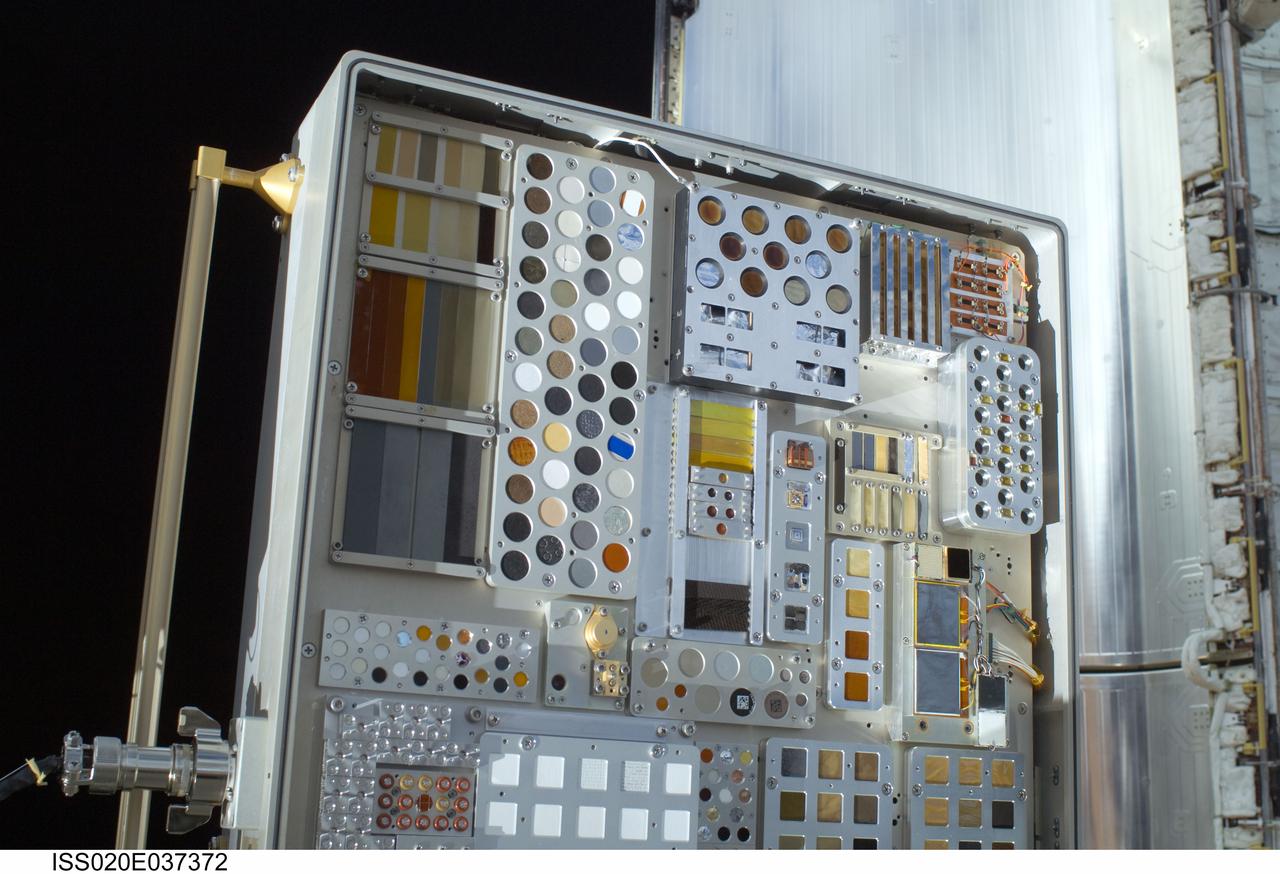
ISS020-E-037372 (1 Sept. 2009) --- A close-up view of a Materials International Space Station Experiment (MISSE-6) on the exterior of the Columbus laboratory is featured in this image photographed by a space walking astronaut during the STS-128 mission’s first session of extravehicular activity (EVA). MISSE collects information on how different materials weather in the environment of space. MISSE was later placed in Space Shuttle Discovery’s payload bay for its return to Earth. A portion of a payload bay door is visible in the background.
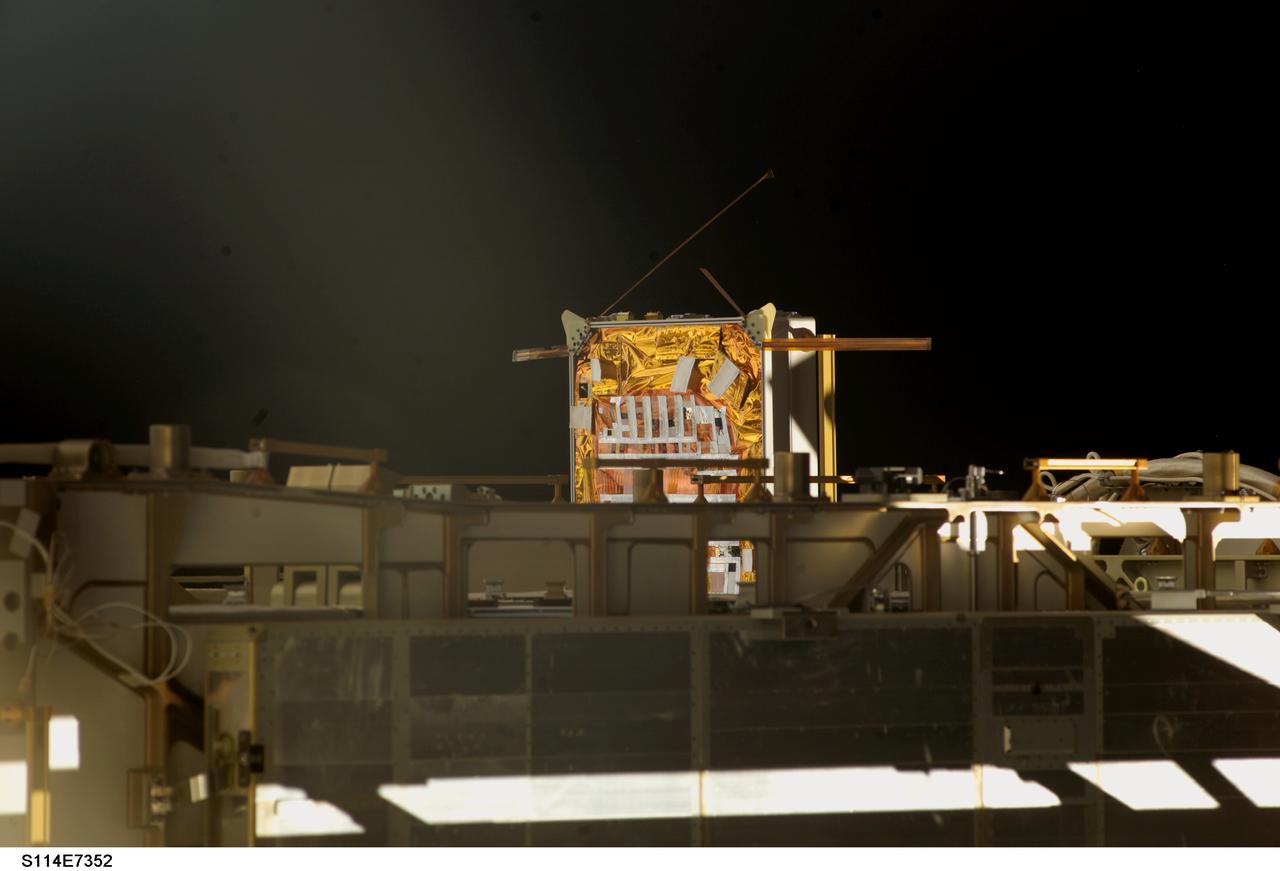
s114e7352 (8/6/2005) --- A view of the Materials International Space Station Experiment (MISSE) 5 Passive Experiment Containter (PEC) mounted on the P6 Truss during one of the STS-114 missions Extravehicular Activities (EVAs). The Materials International Space Station Experiment-5 (MISSE-5) was an external payload that flew on-board the ISS from August 2005 until September 2006. MISSE-5 provided an opportunity for researchers to test a wide range of samples in the Low Earth Orbit (LEO) environment.
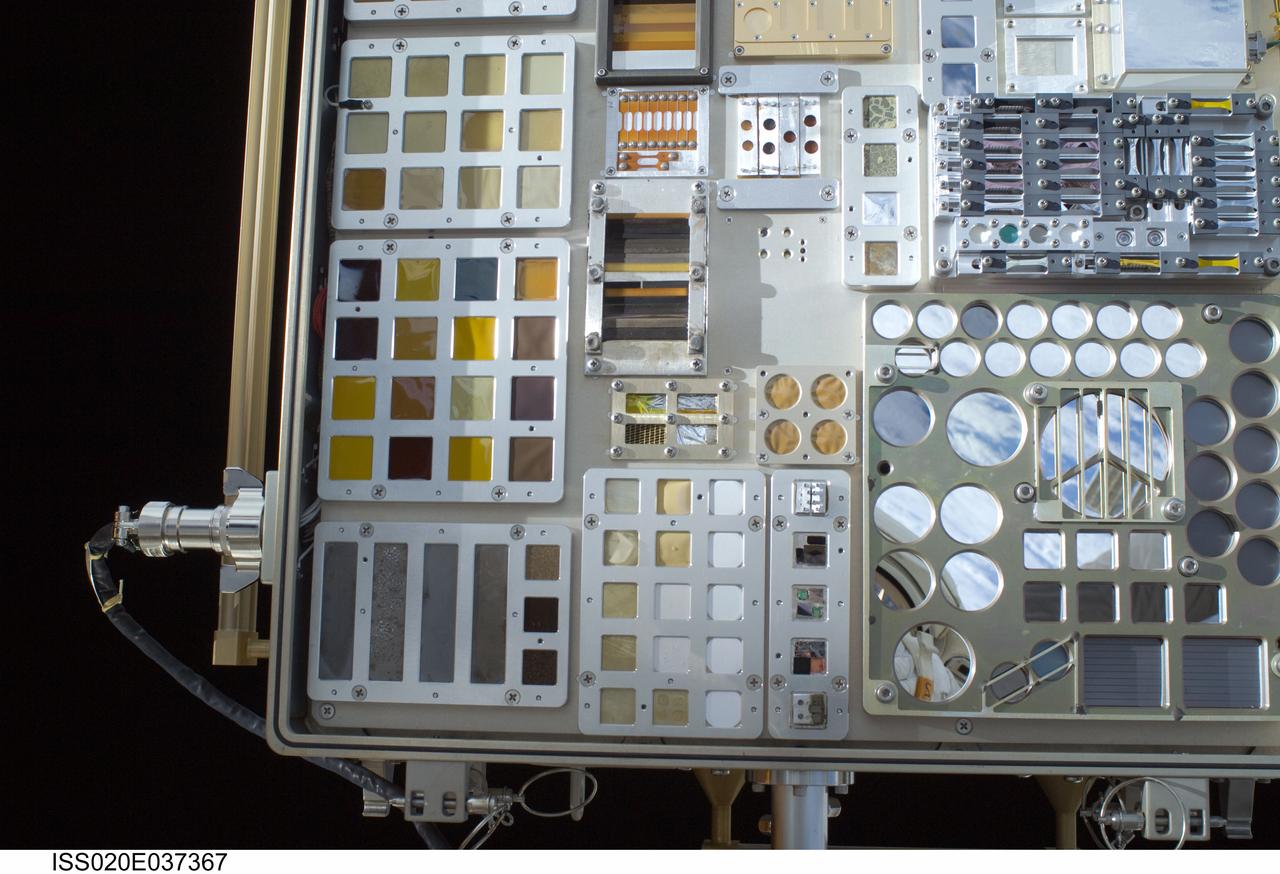
ISS020-E-037367 (1 Sept. 2009) --- A close-up view of a Materials International Space Station Experiment (MISSE-6) on the exterior of the Columbus laboratory is featured in this image photographed by a space walking astronaut during the STS-128 mission’s first session of extravehicular activity (EVA). MISSE collects information on how different materials weather in the environment of space. MISSE was later placed in Space Shuttle Discovery’s cargo bay for its return to Earth.
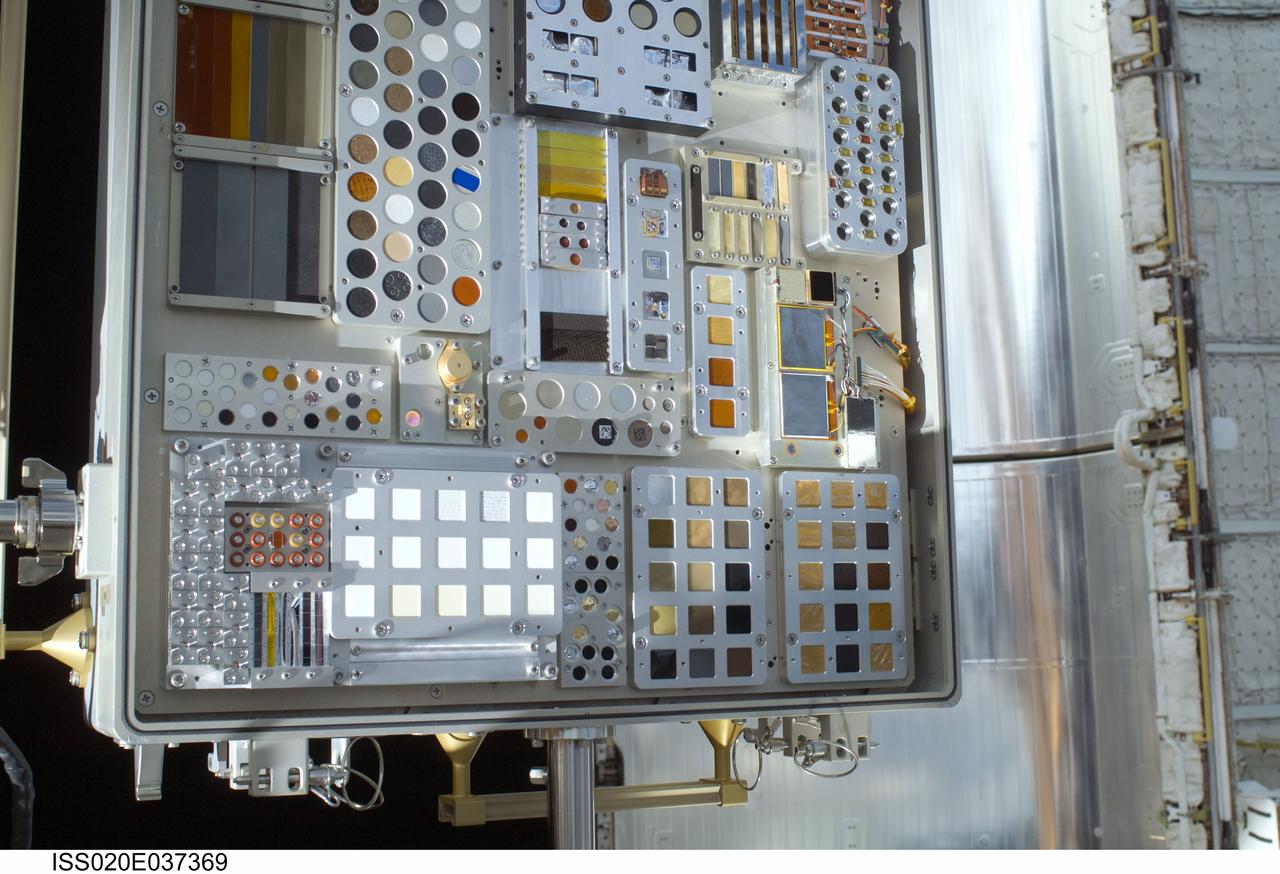
ISS020-E-037369 (1 Sept. 2009) --- A close-up view of a Materials International Space Station Experiment (MISSE-6) on the exterior of the Columbus laboratory is featured in this image photographed by a space walking astronaut during the STS-128 mission’s first session of extravehicular activity (EVA). MISSE collects information on how different materials weather in the environment of space. MISSE was later placed in Space Shuttle Discovery’s payload bay for its return to Earth. A portion of a payload bay door is visible in the background.
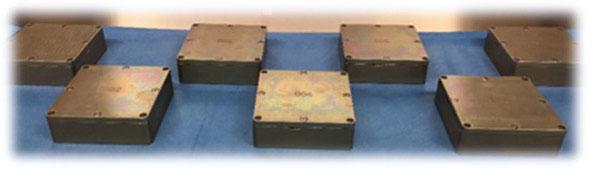
jsc2021e009430 (3/2/2021) --- Materials International Space Station Experiment-14-NASA (MISSE-14-NASA) continues a series of tests by NASA Glenn Research Center on how the harsh environment of space affects the performance and durability of various materials. MISSE-Seed sample containers ready for turnover. Image courtesy of Jeff Richards.
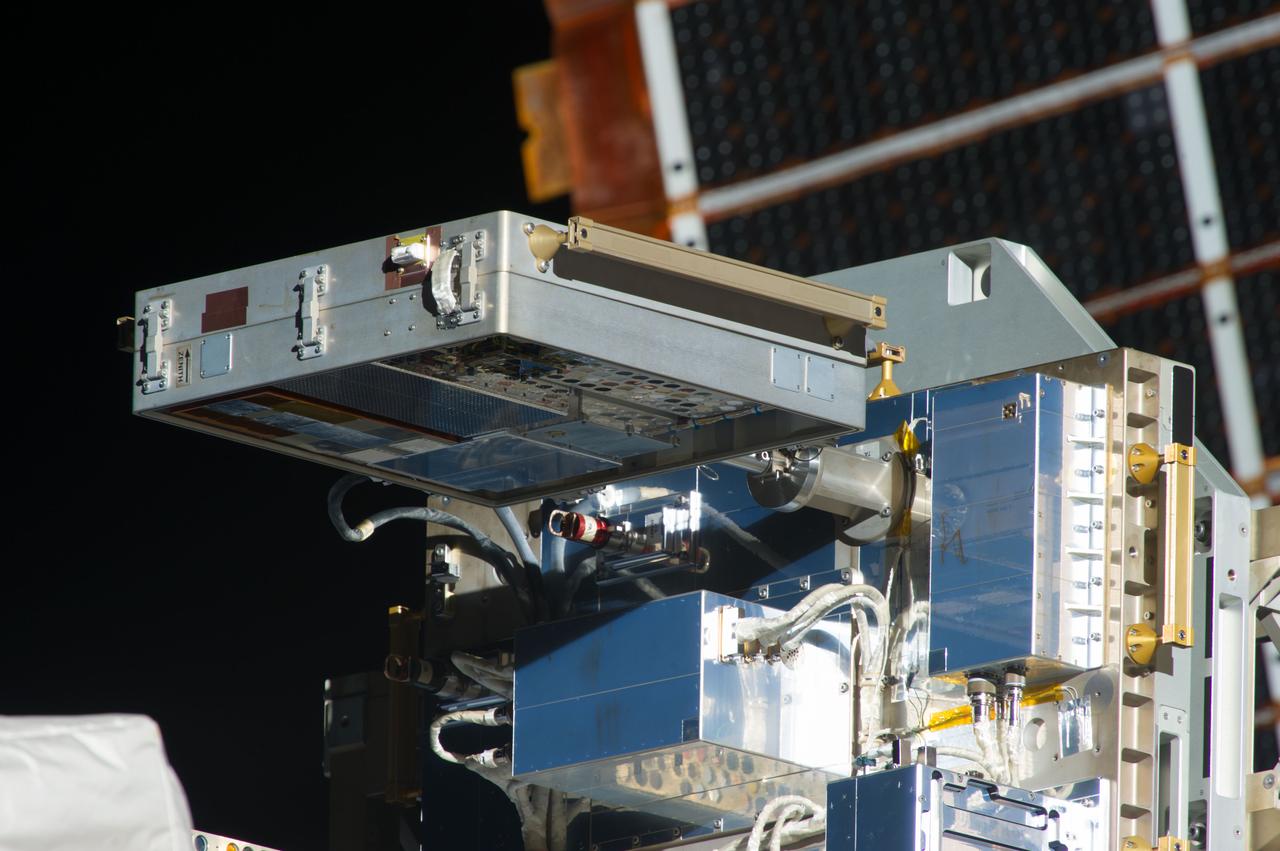
iss036e004042 (5/24/2013) --- View of Materials on International Space Station Experiment - 8 (MISSE-8) which is installed on the ExPRESS Logistics Carrier 2 (ELC-2),located on the S3 Truss Outboard Zenith site.

ISS020-E-037371 (1 Sept. 2009) --- A close-up view of a Materials International Space Station Experiment (MISSE-6) on the exterior of the Columbus laboratory is featured in this image photographed by a space walking astronaut during the STS-128 mission’s first session of extravehicular activity (EVA). MISSE collects information on how different materials weather in the environment of space. MISSE was later placed in Space Shuttle Discovery’s payload bay for its return to Earth. A portion of a payload bay door is visible in the background. The blackness of space and Earth’s horizon provide the backdrop for the scene.
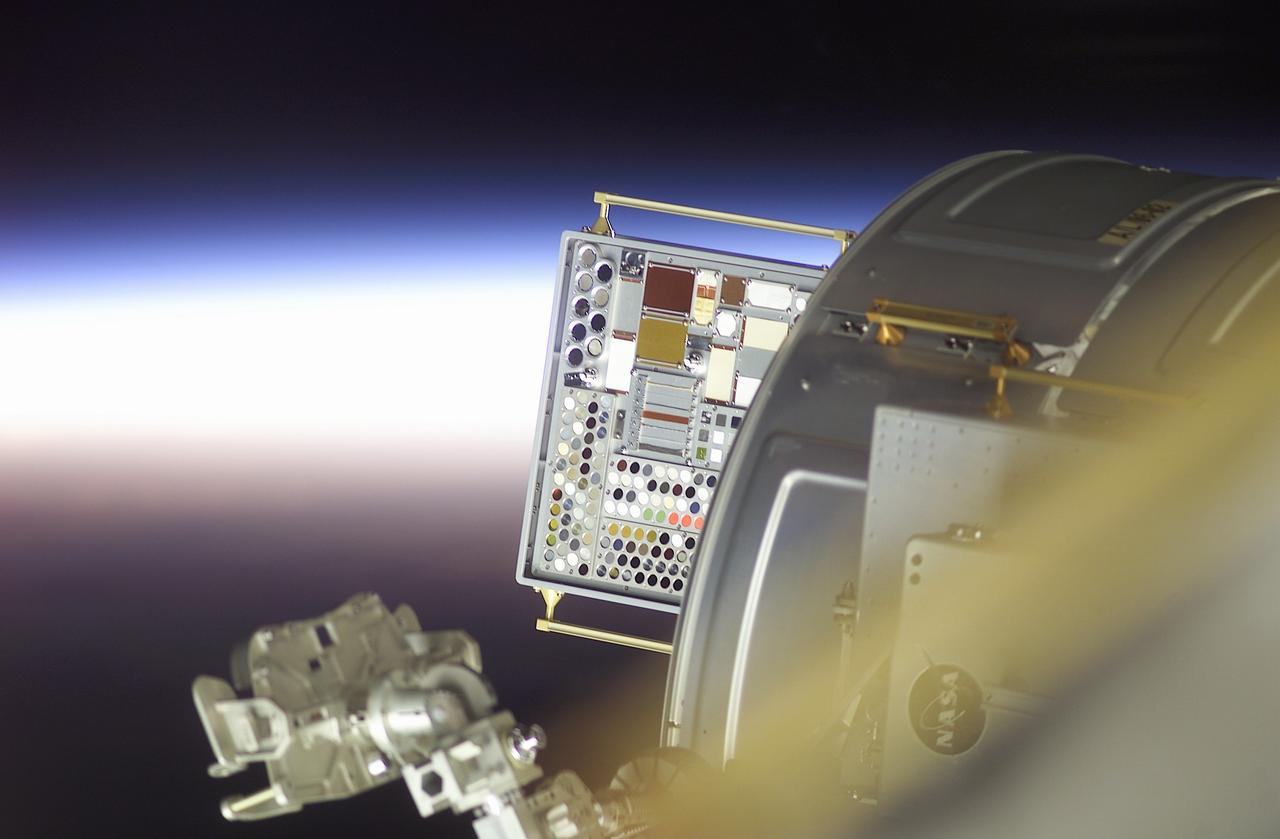
Backdropped by a sunrise, the newly installed Materials International Space Station Experiment (MISSE) is visible on this image. MISSE would expose 750 material samples for about 18 months and collect information on how different materials weather the space environment. The objective of MISSE is to develop early, low-cost, non-intrusive opportunities to conduct critical space exposure tests of space materials and components plarned for use on future spacecraft. The experiment was the first externally mounted experiment conducted on the International Space Station (ISS) and was installed on the outside of the ISS Quest Airlock during extravehicular activity (EVA) of the STS-105 mission. MISSE was launched on August 10, 2001 aboard the Space Shuttle Orbiter Discovery.
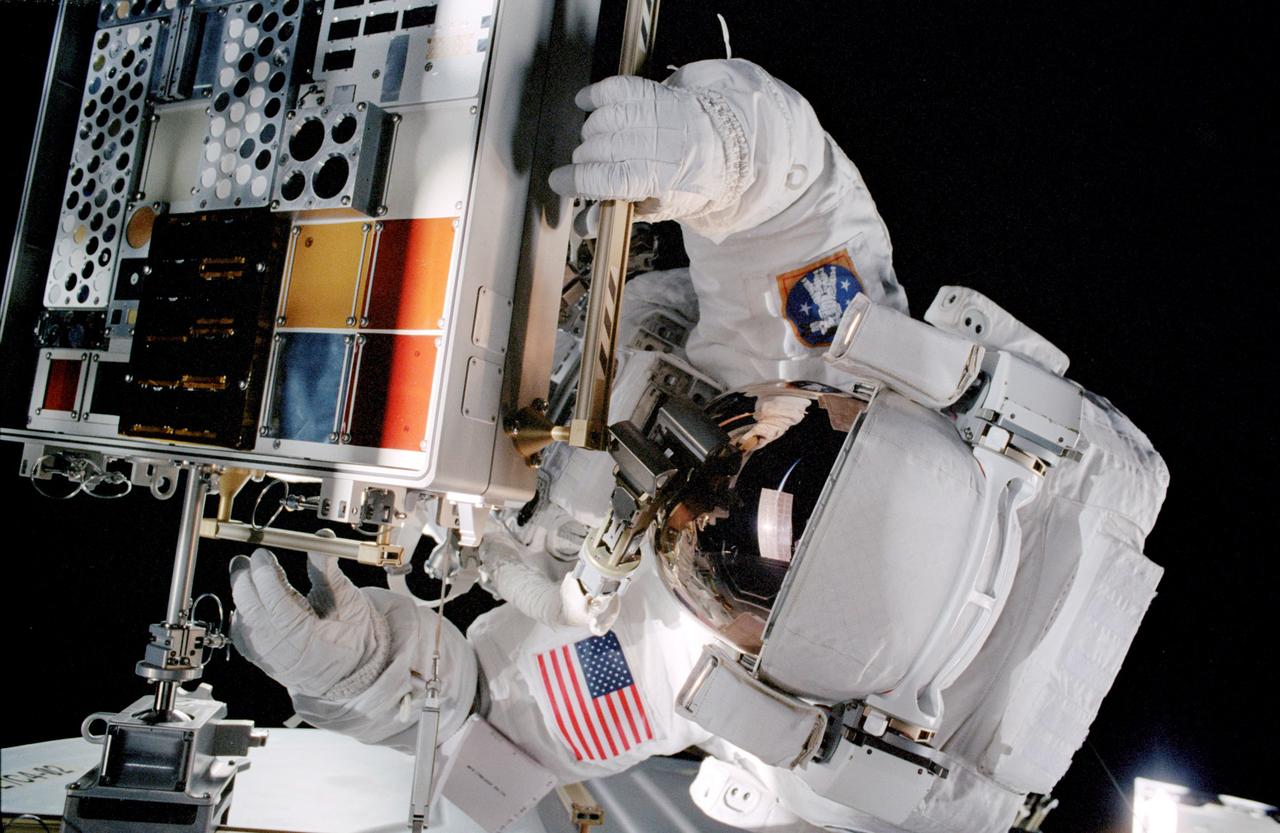
Astronaut Patrick G. Forrester works with the the Materials International Space Station Experiment (MISSE) during extravehicular activity (EVA). MISSE would expose 750 material samples for about 18 months and collect information on how different materials weather the space environment The objective of MISSE is to develop early, low-cost, non-intrusive opportunities to conduct critical space exposure tests of space materials and components plarned for use on future spacecraft. The experiment was the first externally mounted experiment conducted on the International Space Station (ISS) and was installed on the outside of the ISS Quest Airlock. MISSE was launched on August 10, 2001 aboard the Space Shuttle Orbiter Discovery.
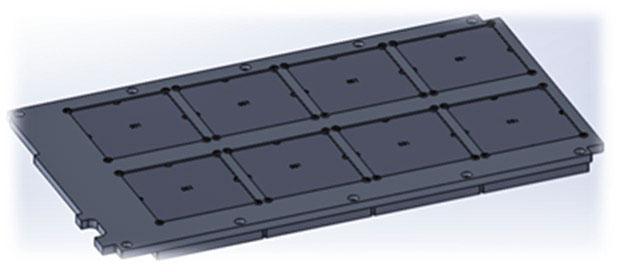
jsc2021e009431 (3/2/2021) --- Materials International Space Station Experiment-14-NASA (MISSE-14-NASA) continues a series of tests by NASA Glenn Research Center on how the harsh environment of space affects the performance and durability of various materials. A CAD drawing of the MISSE panel that will be deployed outside the ISS. Image courtesy of Alpha Space.
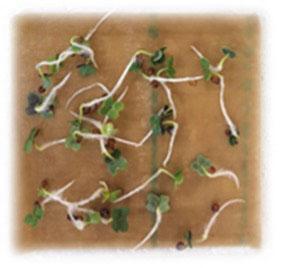
jsc2021e009428 (3/2/2021) --- Materials International Space Station Experiment-14-NASA (MISSE-14-NASA) continues a series of tests by NASA Glenn Research Center on how the harsh environment of space affects the performance and durability of various materials. Example of germination test prior to MISSE-Seed science integration. Image courtesy of Jeff Richards.
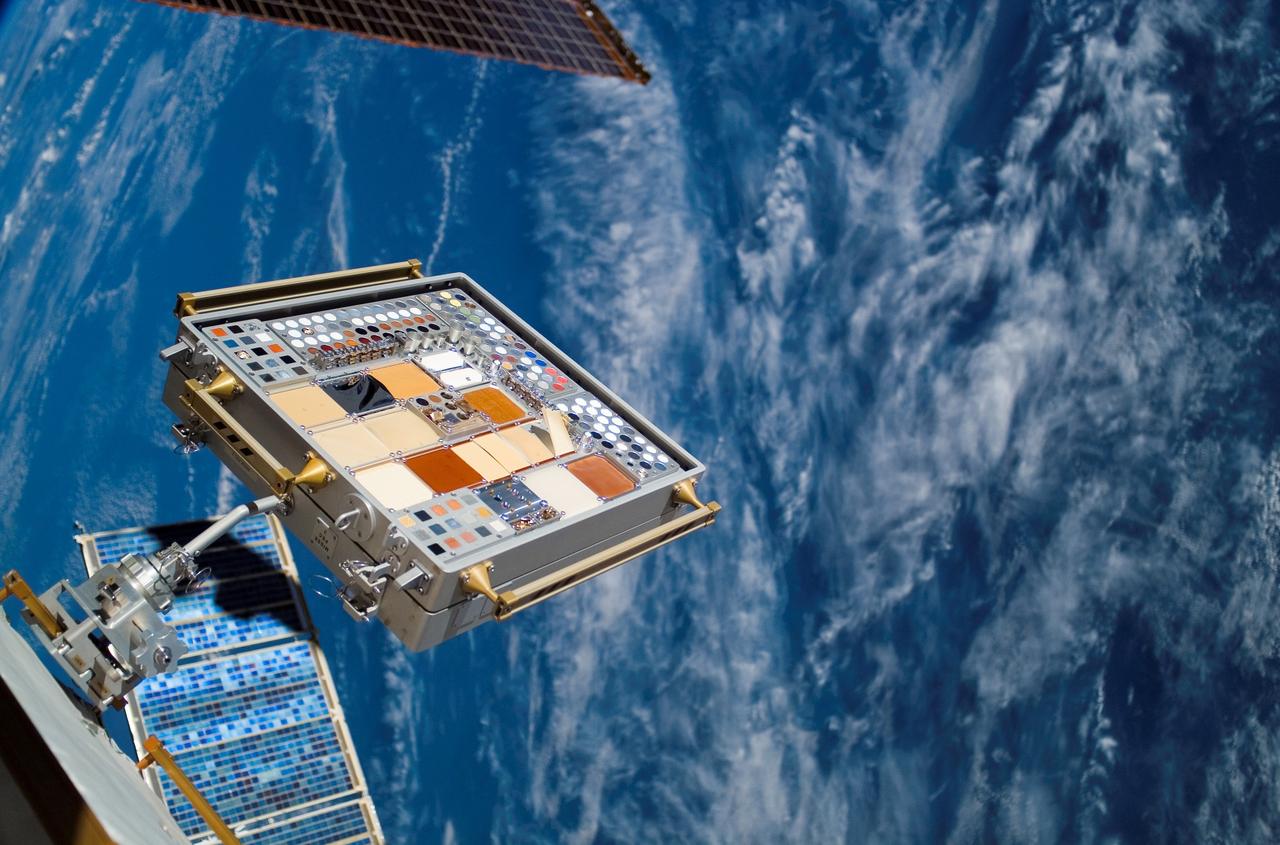
Back dropped by the blue and white Earth is a Materials International Space Station Experiment (MISSE) on the exterior of the Station. The photograph was taken during the second bout of STS-118 Extra Vehicular Activity (EVA). MISSE collects information on how different materials weather in the environment of space.
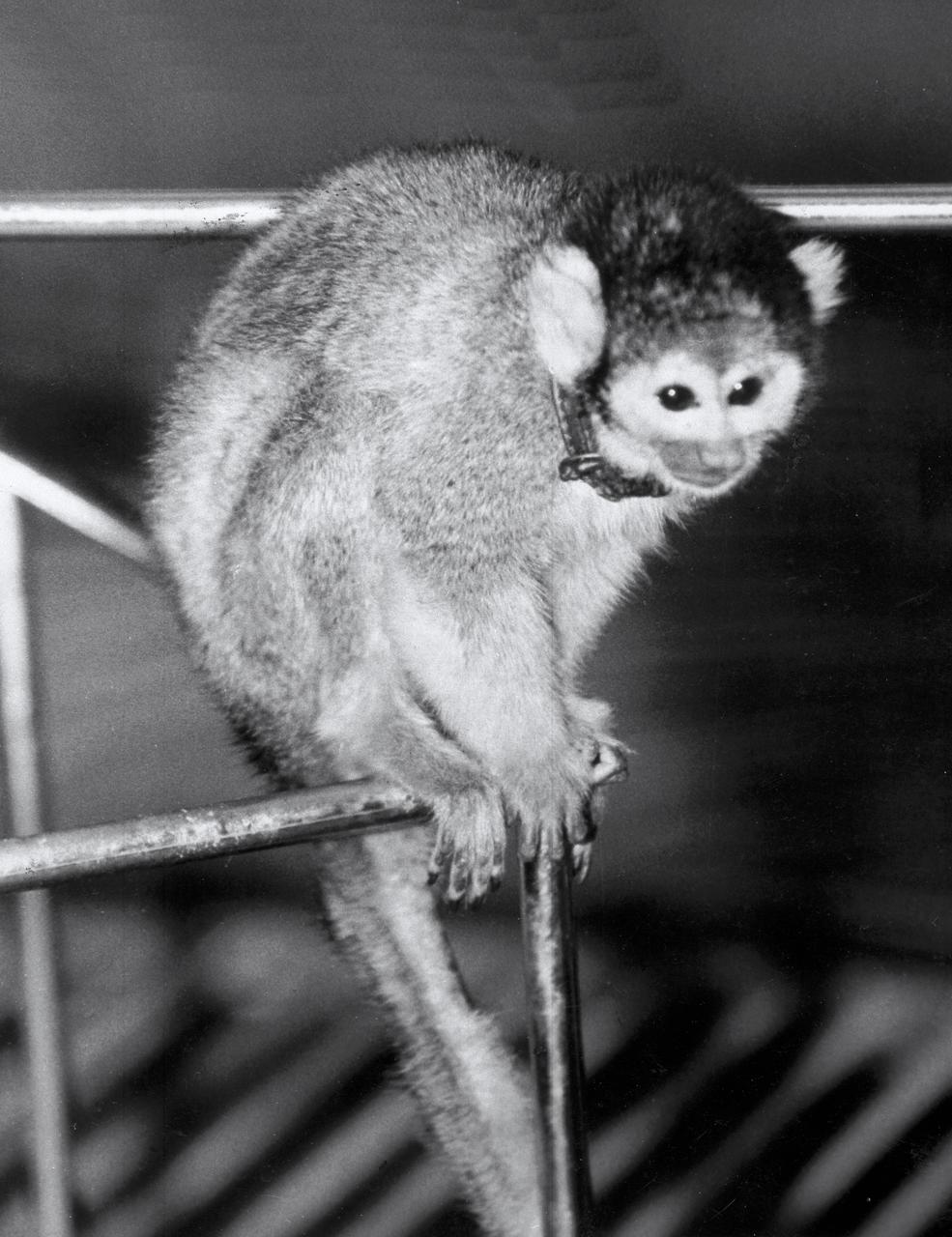
On May 28, 1958, Jupiter Intermediate Range Ballistic Missile provided by U.S. Army team in Huntsville, Alabama, launched a nose cone carrying Baker, a South American squirrel monkey and Able, an American-born rhesus monkey. Baker, pictured here and commonly known as "Miss Baker", was later given a home at the U.S. Space and Rocket Center until her death on November 29, 1984. Able died in 1958. (Photo - Courtesy of Huntsville/Madison County Public Library)
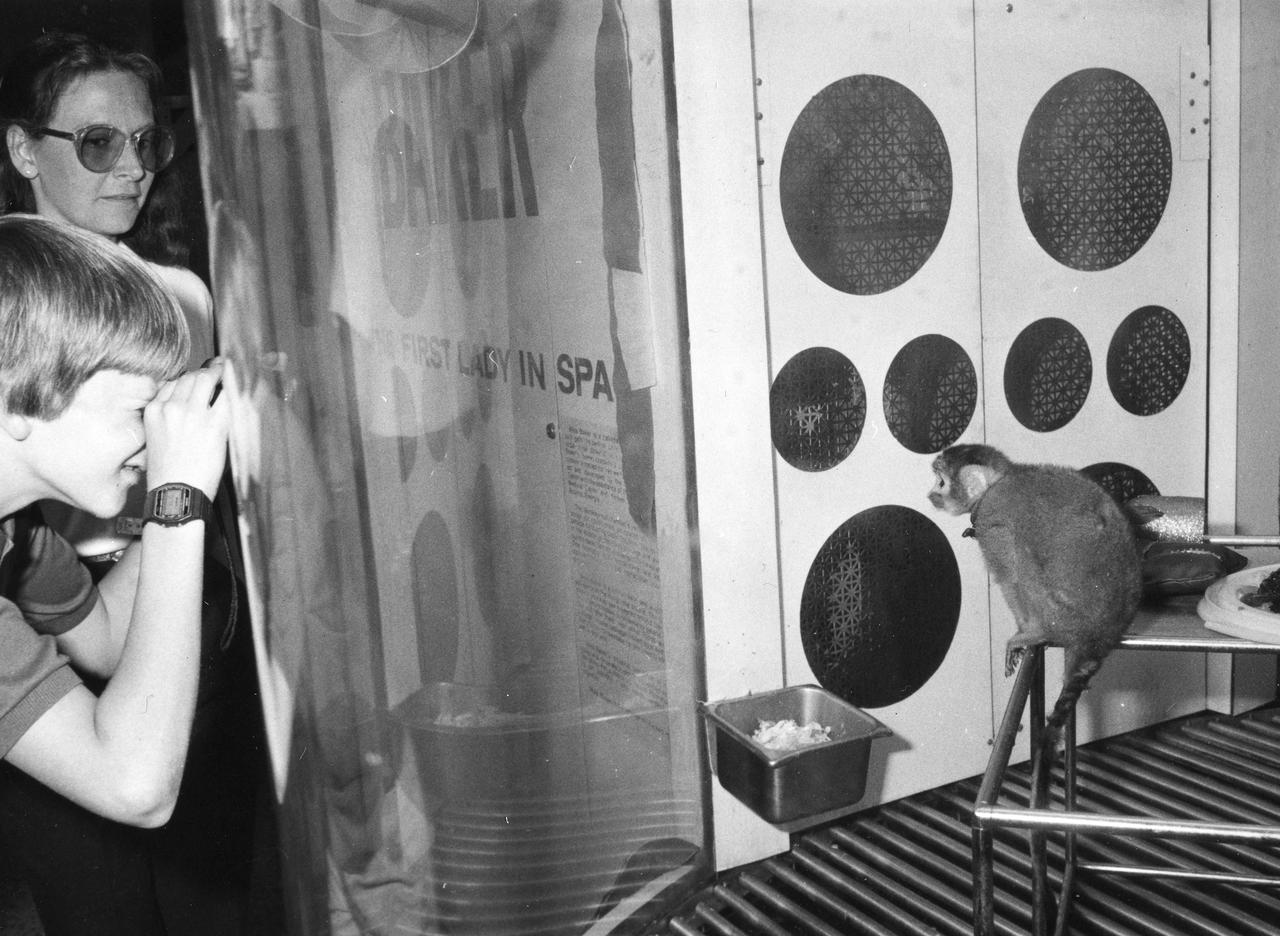
Miss Baker, a squirrel monkey who made a historical flight aboard the Jupiter (AM-18) in May 1959, is seen here in her viewing area where she resided at the U.S. Space and Rocket Center.
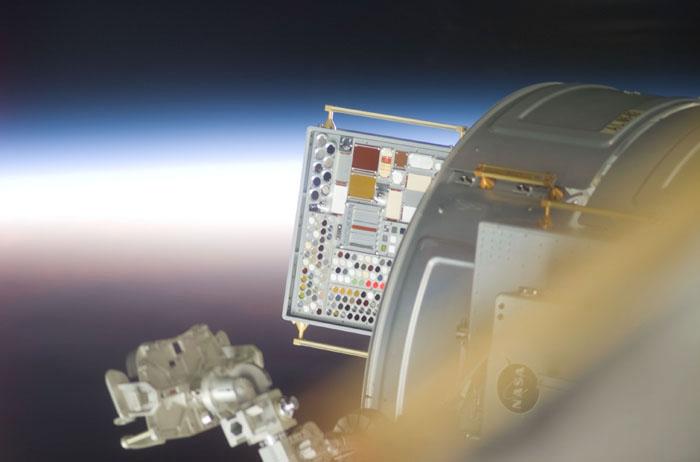
STS105-E-5342 (17 August 2001) --- Backdropped by a sunrise, the newly installed Materials International Space Station Experiment (MISSE) is visible. The MISSE was installed on the outside of the Quest Airlock during the first extravehicular activity (EVA) of the STS-105 mission. MISSE will collect information on how different materials weather in the environment of space. This image was taken with a digital still camera.
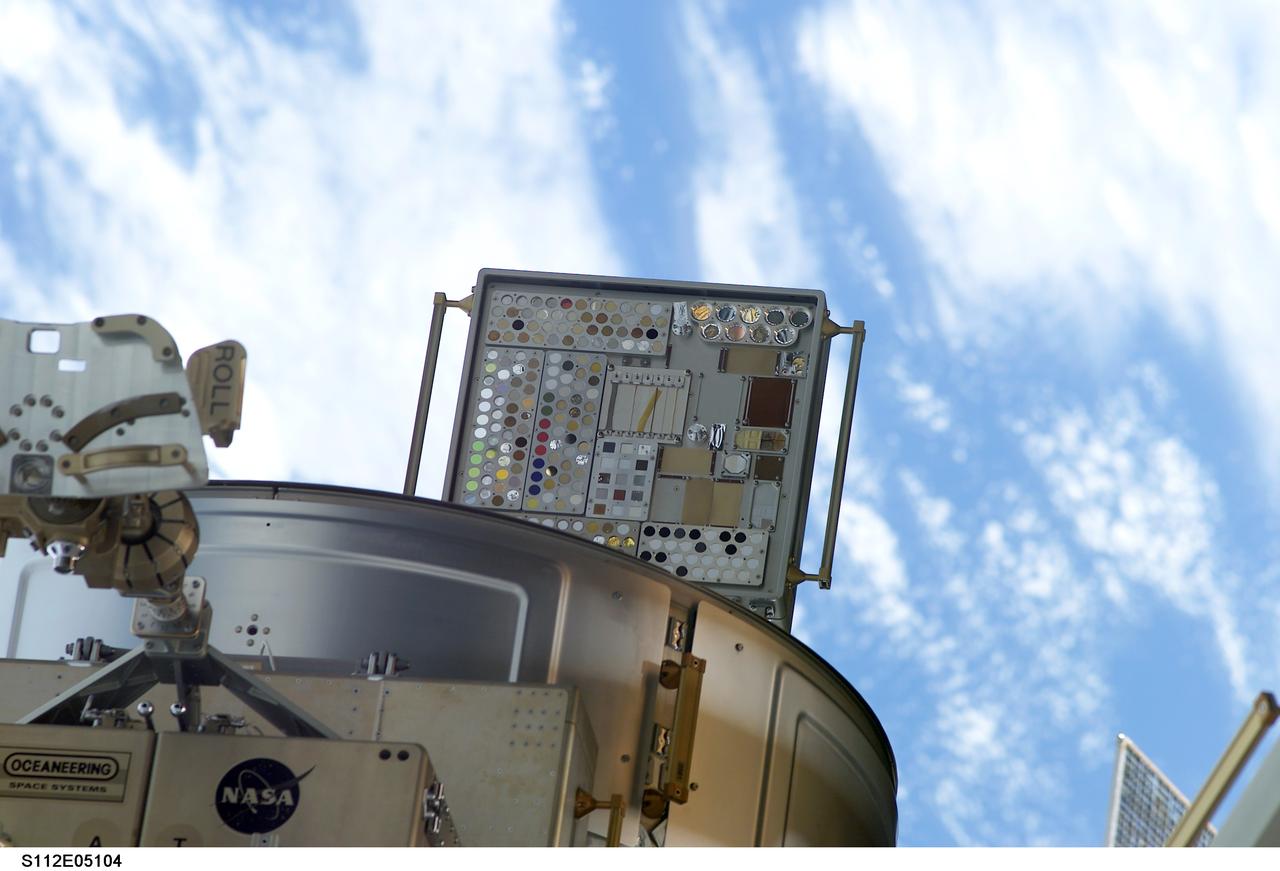
STS112-E-05104 (10 October 2002) --- Backdropped by a blue and white Earth, the Materials International Space Station Experiment (MISSE) and a portion of the Quest Airlock are visible. MISSE collects information on how different materials weather in the environment of space.
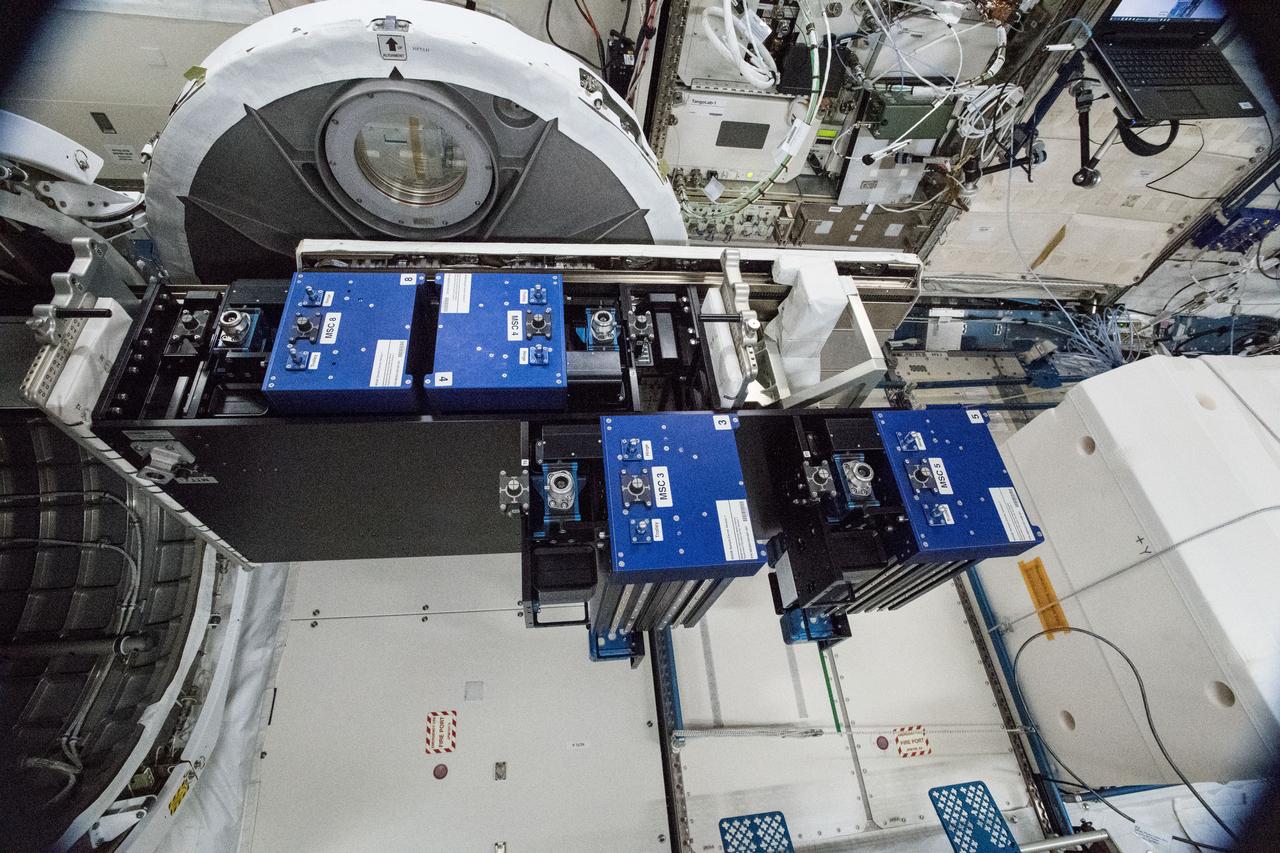
iss055e020137 (4/13/2018) --- Photographic documentation taken in the Japanese Experiment Module (JEM) during preparations for the install of the Materials ISS Experiment - Flight Facility (MISSEE-FF). The MISSE-FF platform provides the ability to test materials, coatings, and components or other larger experiments in the harsh environment of space, which is virtually impossible to do collectively on Earth.
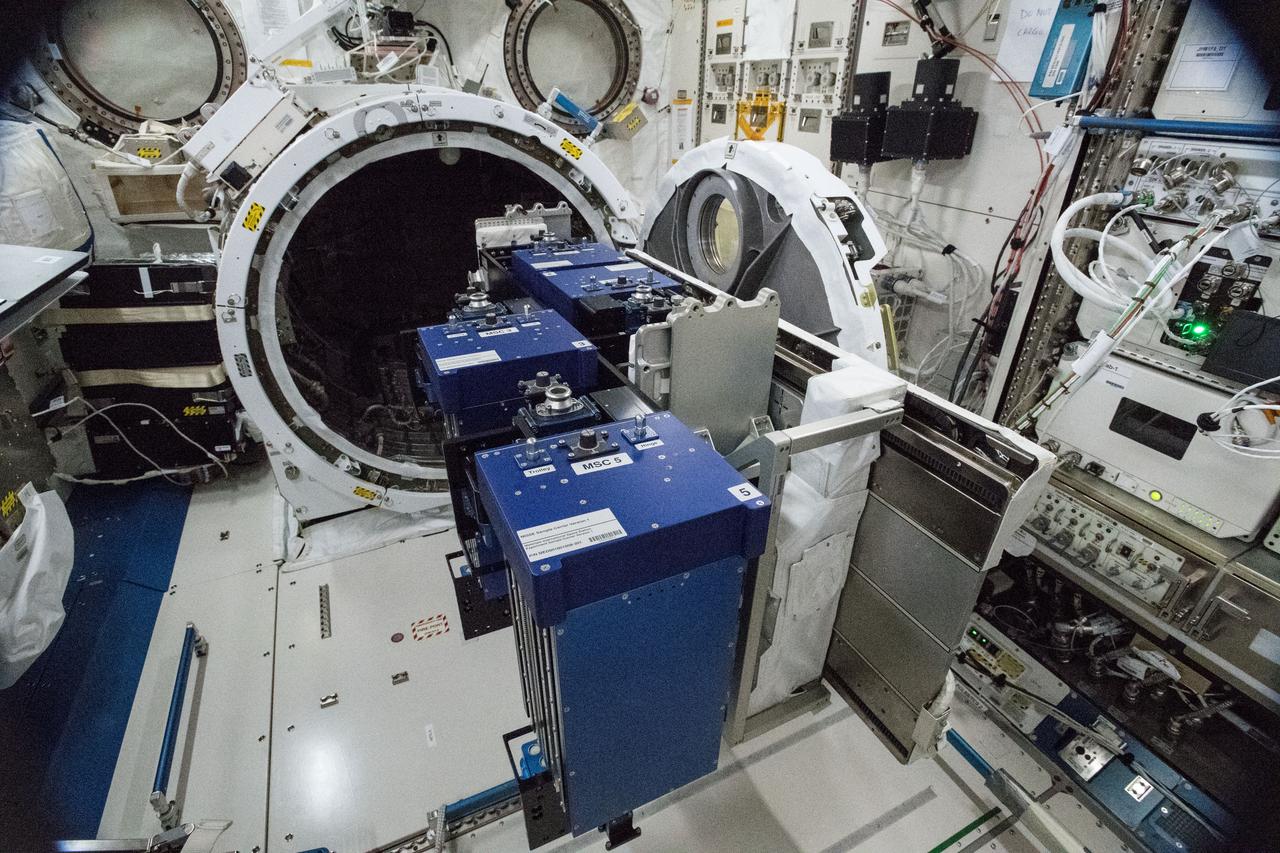
iss055e020134 (4/13/2018) --- Photographic documentation taken in the Japanese Experiment Module (JEM) during preparations for the install of the Materials ISS Experiment - Flight Facility (MISSEE-FF). The MISSE-FF platform provides the ability to test materials, coatings, and components or other larger experiments in the harsh environment of space, which is virtually impossible to do collectively on Earth.
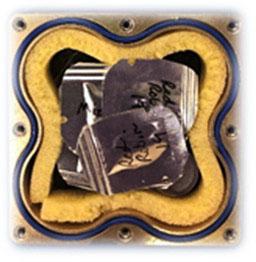
jsc2021e009429 (3/2/2021) --- Materials International Space Station Experiment-14-NASA (MISSE-14-NASA) continues a series of tests by NASA Glenn Research Center on how the harsh environment of space affects the performance and durability of various materials. Seed packets in the Equipment (EUE) container. Image courtesy of Jeff Richards.
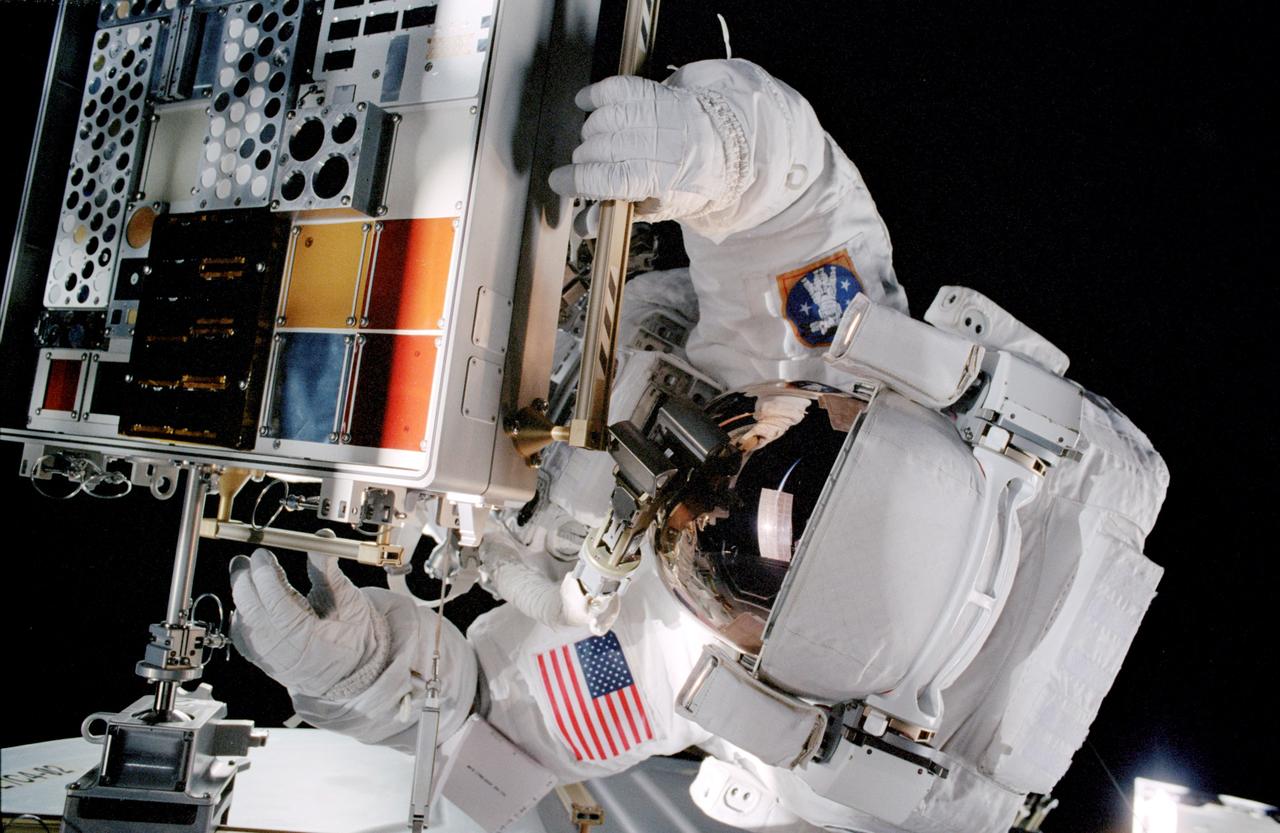
STS105-346-007 (18 August 2001) --- Astronaut Patrick G. Forrester, during the second STS-105 extravehicular activity, prepares to work with the Materials International Space Station Experiment (MISSE). The experiment was installed on the outside of the Quest Airlock during the first extravehicular activity (EVA) of the STS-105 mission. MISSE will collect information on how different materials weather in the environment of space.
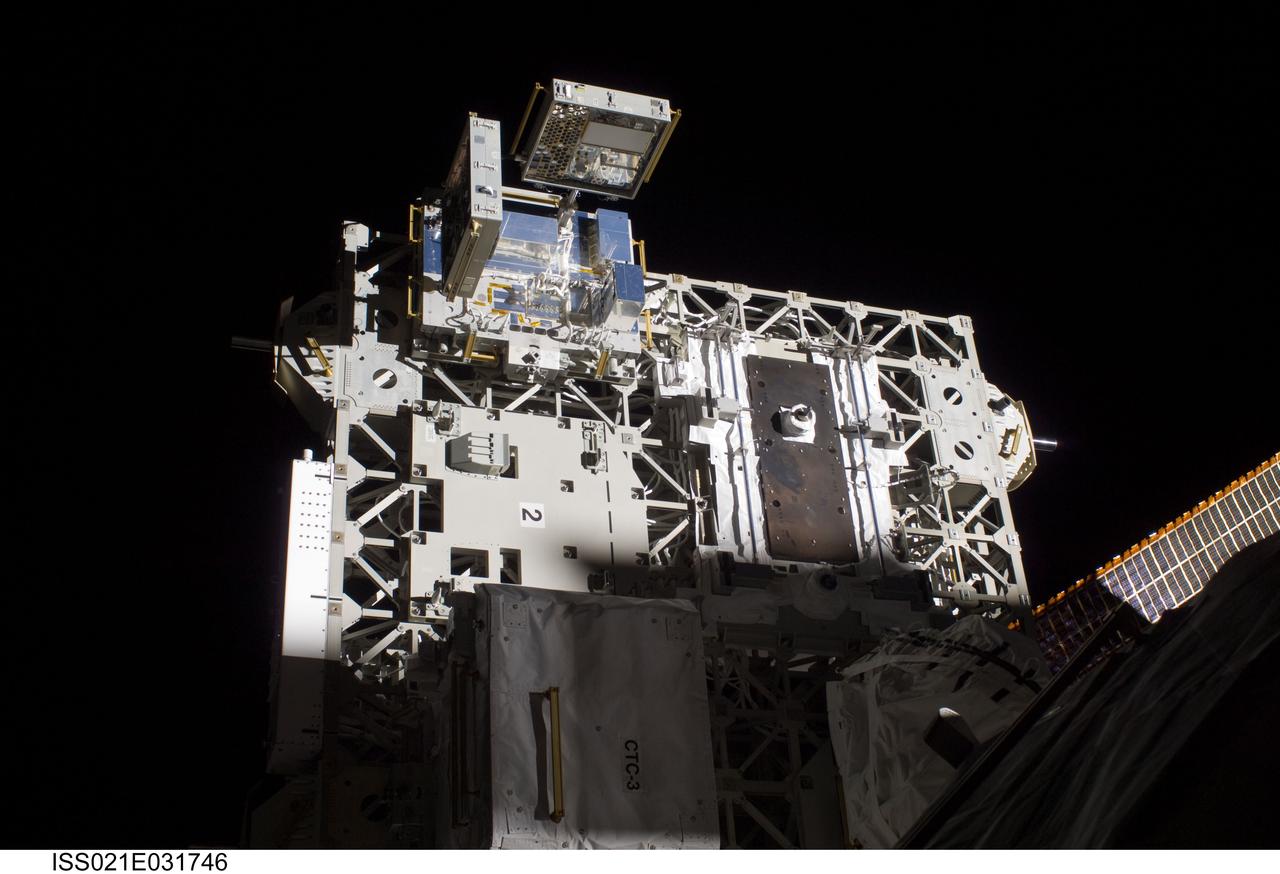
ISS021-E-031746 (23 Nov. 2009) --- The MISSE 7 experiment on the Express Logistics Carrier 2 of the International Space Station was photographed by a space-walking STS-129 astronaut during the mission's third and final session of extravehicular activity (EVA). This is the latest in a series of experiments that expose materials and composite samples to space for several months before they are returned for experts to analyze. This MISSE experiment actually is plugged into the space station’s power supply.
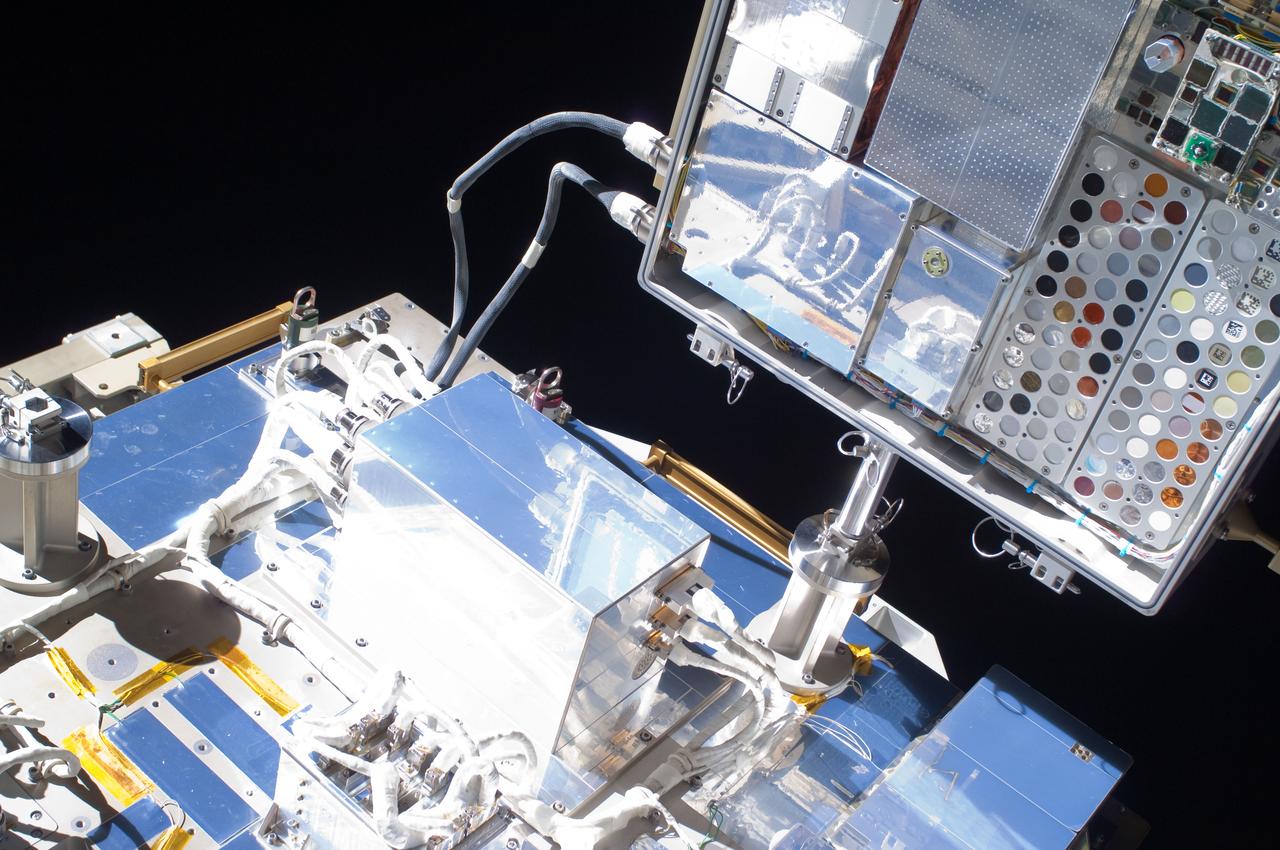
iss027e034948 (5/20/2011) --- Close-up view of Materials International Space Station Experiment (MISSE) 8 and ExPRESS (Expedite the Processing of Experiments to Space Station) Logistics Carrier-2 (ELC-2) taken during MISSE 8 installation. Image was taken by Extravehicular crewmember 1 (EV1) during Expedition 27 / STS-134 Extravehicular Activity 1 (EVA 1).
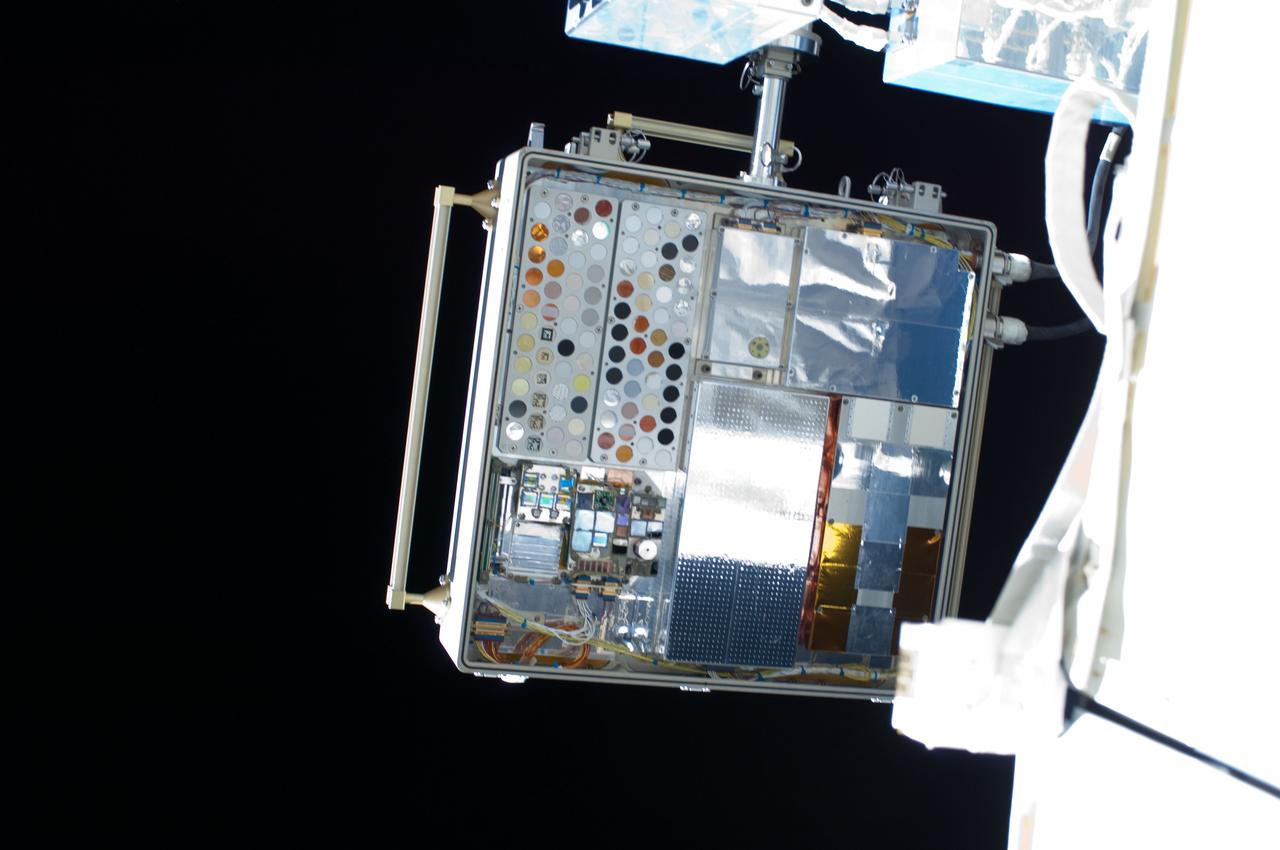
iss028e016106 (7/12/2011) --- View of a Materials on International Space Station Experiment - 8 (MISSE-8) installed on the starboard truss. The Materials on International Space Station Experiment - 8 (MISSE-8) tests various materials and computing elements on the exterior of the space station. The payload container is mounted so one side faces the Earth and the other faces space.

STS105-346-011 (18 August 2001) --- Astronaut Patrick G. Forrester, during the second STS-105 extravehicular activity, prepares to work with the Materials International Space Station Experiment (MISSE, almost out of frame at left). The experiment was installed on the outside of the Quest Airlock during the first extravehicular activity (EVA) of the STS-105 mission. MISSE will collect information on how different materials weather in the environment of space.
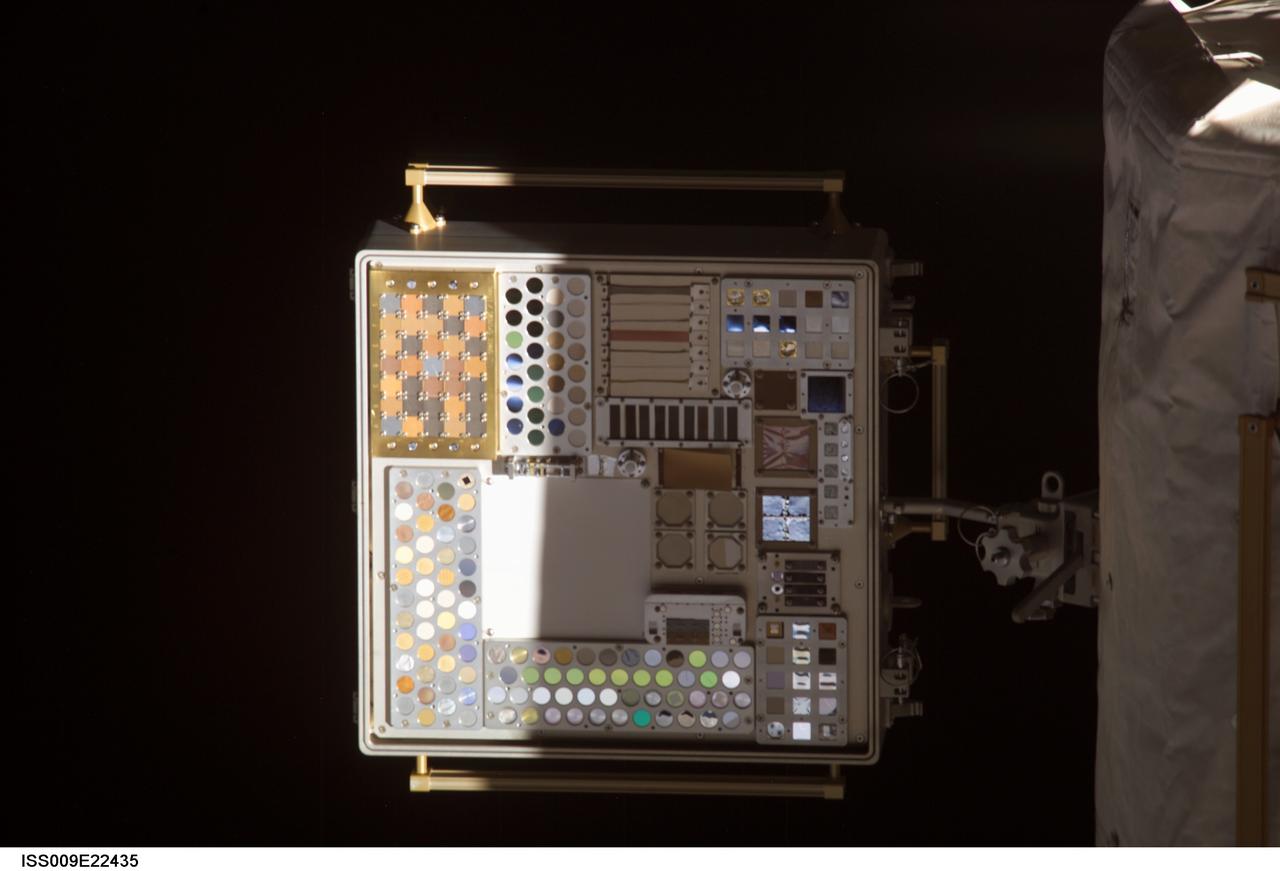
iss009e22435 (9/13/2004) --- A view of the Materials International Space Station Experiment (MISSE) #1,aft side. MISSE is attached to the outside of the Zvezda Service Module (SM). Image taken from the Pirs Docking Compartment forward port window during observation and photography of ISS External Structures on Expedition 9. MISSE-1 and 2 are a test bed for materials and coatings attached to the outside of the ISS is being evaluated for the effects of atomic oxygen, direct sunlight, and extremes of heat and cold. This experiment allows the development and testing of new materials to better withstand the rigors of space environments. Results will provide a better understanding of the durability of various materials when they are exposed to the space environment. Many of the materials may have applications in the design of future spacecraft.
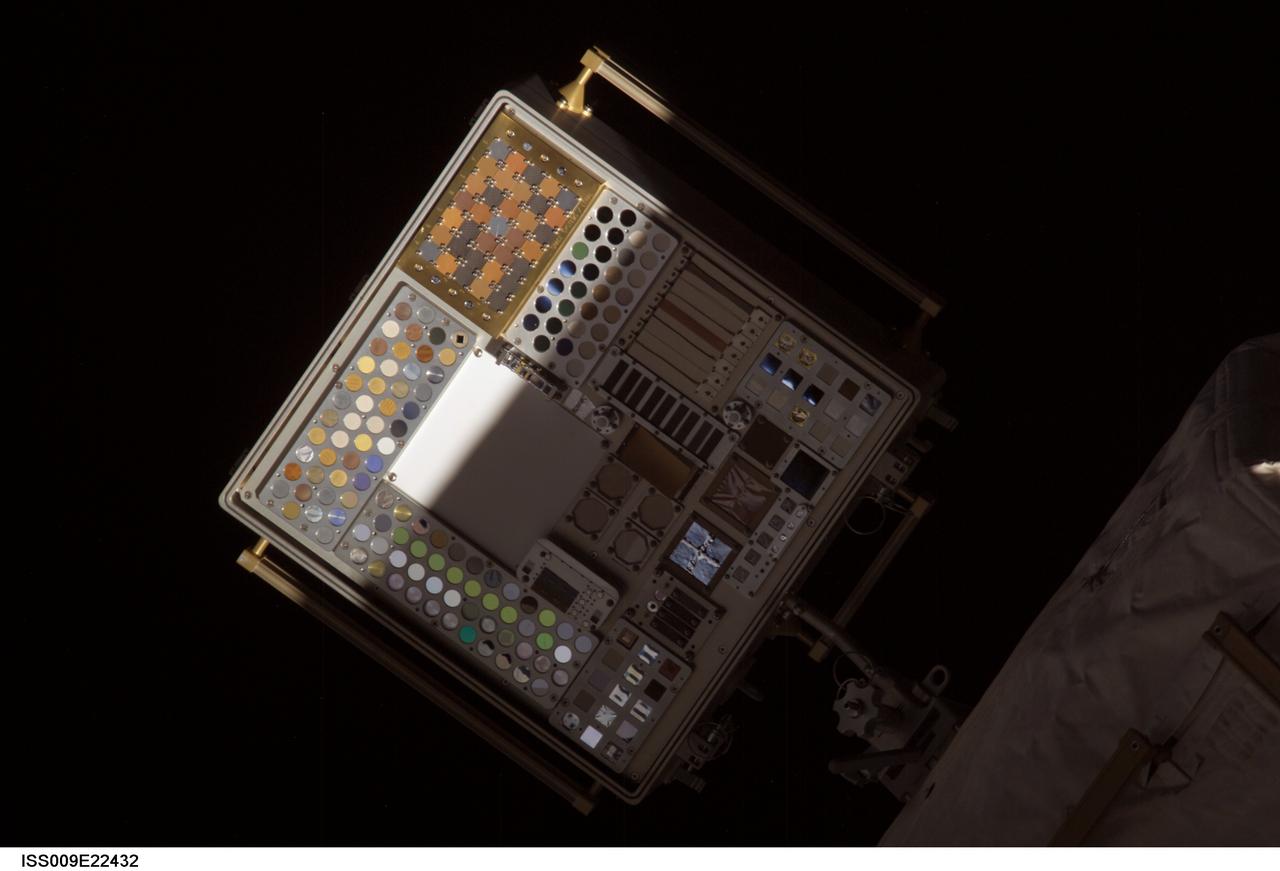
iss009e22432 (9/13/2004) --- A view of the Materials International Space Station Experiment (MISSE) #1, aft side. MISSE is attached to the outside of the Zvezda Service Module (SM). Image taken from the Pirs Docking Compartment forward port window during observation and photography of ISS External Structures on Expedition 9. MISSE-1 and 2 are a test bed for materials and coatings attached to the outside of the ISS is being evaluated for the effects of atomic oxygen, direct sunlight, and extremes of heat and cold. This experiment allows the development and testing of new materials to better withstand the rigors of space environments. Results will provide a better understanding of the durability of various materials when they are exposed to the space environment. Many of the materials may have applications in the design of future spacecraft.

iss013e63407 (8/3/2006) --- View of a Materials International Space Station Experiment (MISSE) Passive Experiment Container 3 (PEC 3) mounted on the Airlock Crewlock endcone of the International Space Station (ISS). Photo taken during Expedition 13. Materials on the International Space Station Experiment 3 and 4 (MISSE - 3 and 4) are the third and fourth in a series of five suitcase-sized test beds attached to the outside of the space station. The beds were deployed during a spacewalk by the station crew in August 2006. They are exposing hundreds of potential space construction materials and different types of solar cells to the harsh environment of space. Mounted to the space station for about a year, the equipment then will be returned to Earth for study. Investigators will use the resulting data to design stronger, more durable spacecraft.
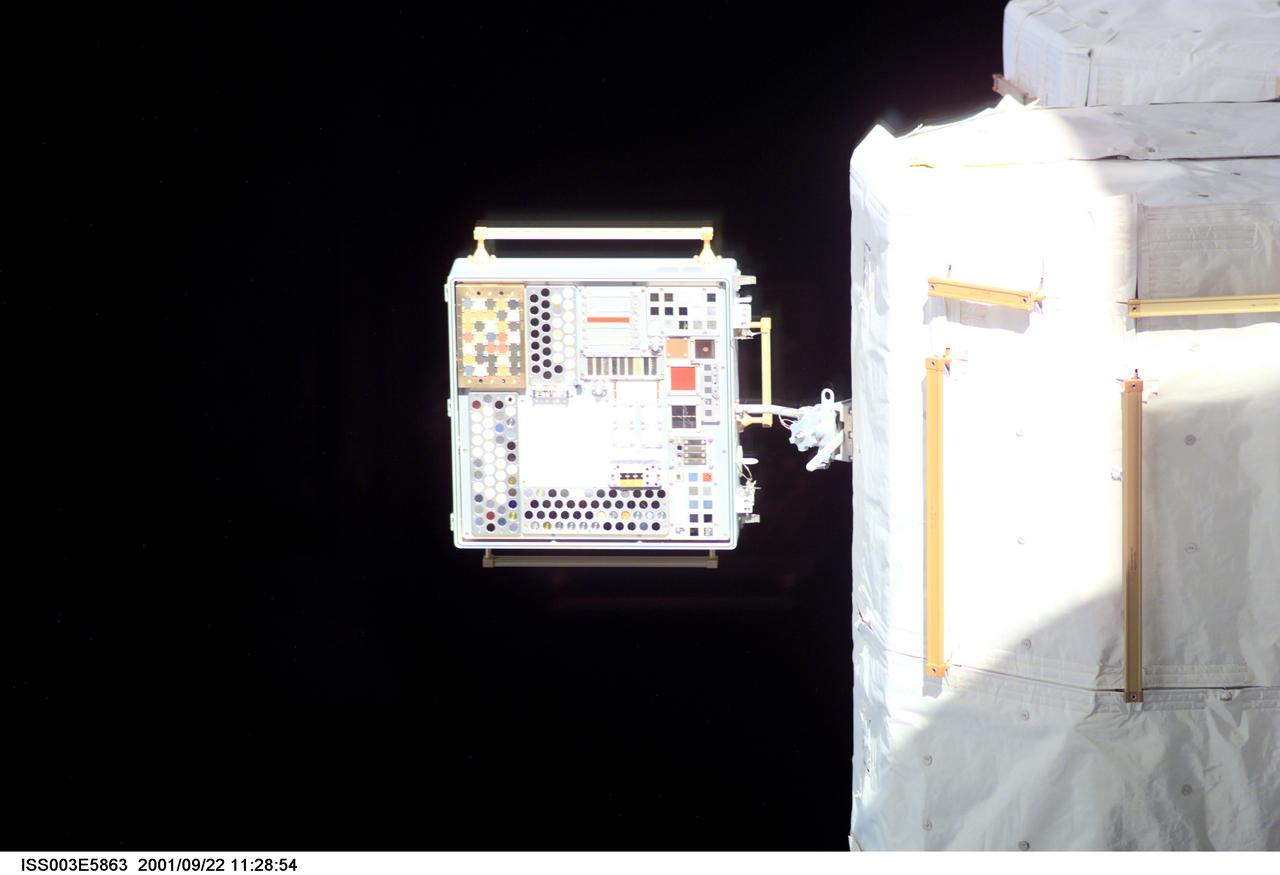
iss003e5863 (9/22/2001) --- A view of the Materials International Space Station Experiment (MISSE) on the Quest / Airlock taken during Expedition 3. MISSE-1 and 2 are a test bed for materials and coatings attached to the outside of the ISS is being evaluated for the effects of atomic oxygen, direct sunlight, and extremes of heat and cold. This experiment allows the development and testing of new materials to better withstand the rigors of space environments. Results will provide a better understanding of the durability of various materials when they are exposed to the space environment. Many of the materials may have applications in the design of future spacecraft.
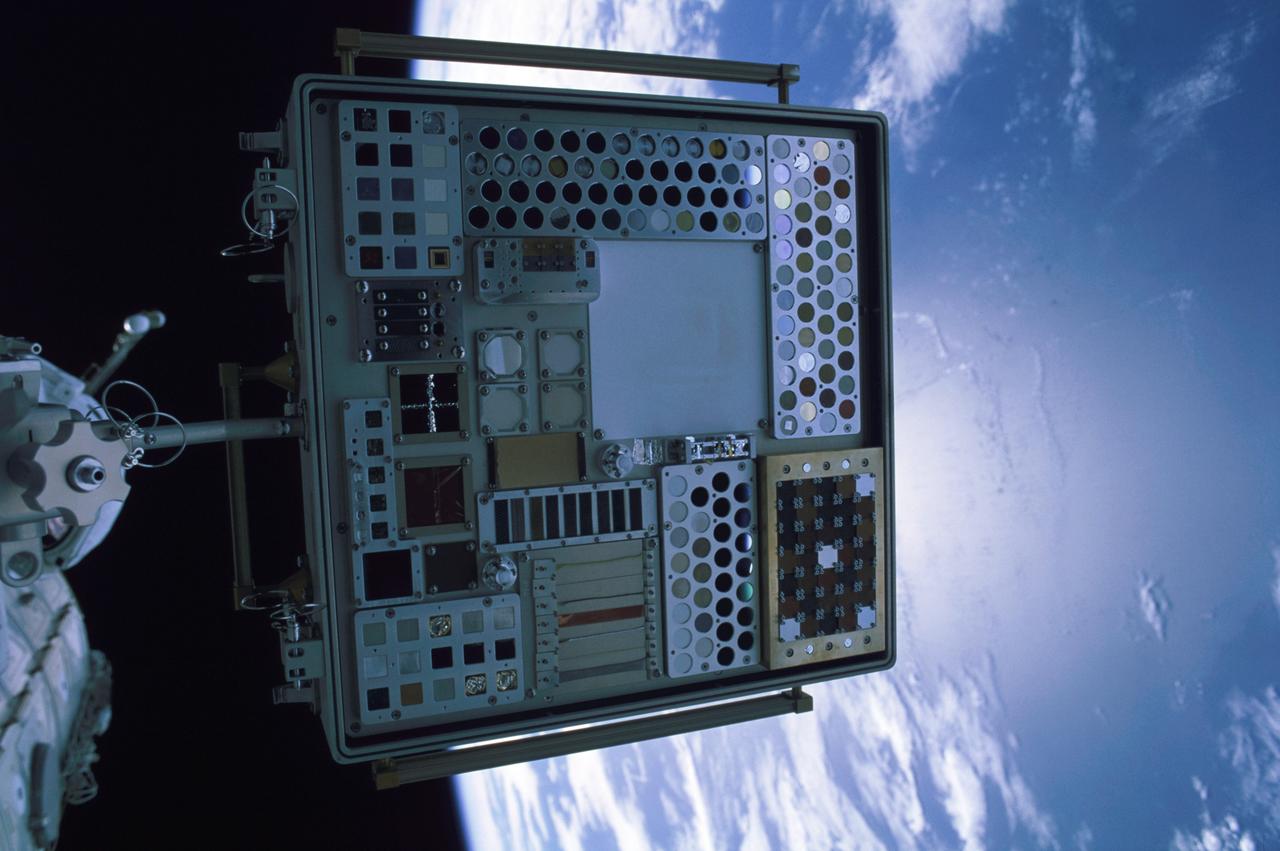
ISS006-348-019 (January 2003) ---- Materials International Space Station Experiment (MISSE), a suitcase-sized experiment attached to the outside of the space station to expose hundreds of potential space construction materials to the environment, leading to stronger, more durable spacecraft construction. Photographed by one of the Expedition 6 crew members with a 35mm camera.
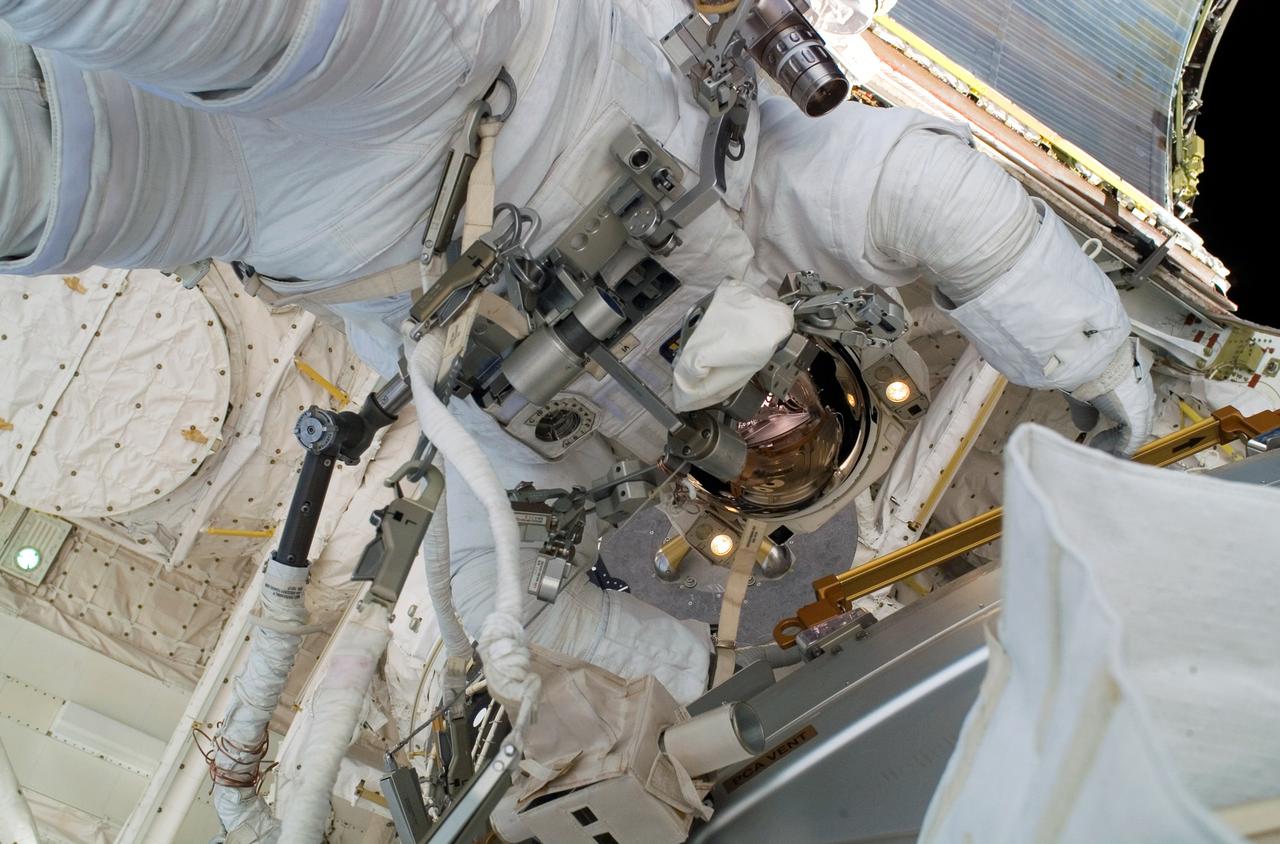
As the construction continued on the International Space Station (ISS), STS-118 Astronaut Dave Williams, representing the Canadian Space Agency, participated in the fourth and final session of Extra Vehicular Activity (EVA). During the 5 hour space walk, Williams and Expedition 15 engineer Clay Anderson (out of frame) installed the External Wireless Instrumentation System Antenna, attached a stand for the shuttle robotic arm extension boom, and retrieved the two Materials International Space Station Experiments (MISSE) for return to Earth. MISSE collects information on how different materials weather in the environment of space.
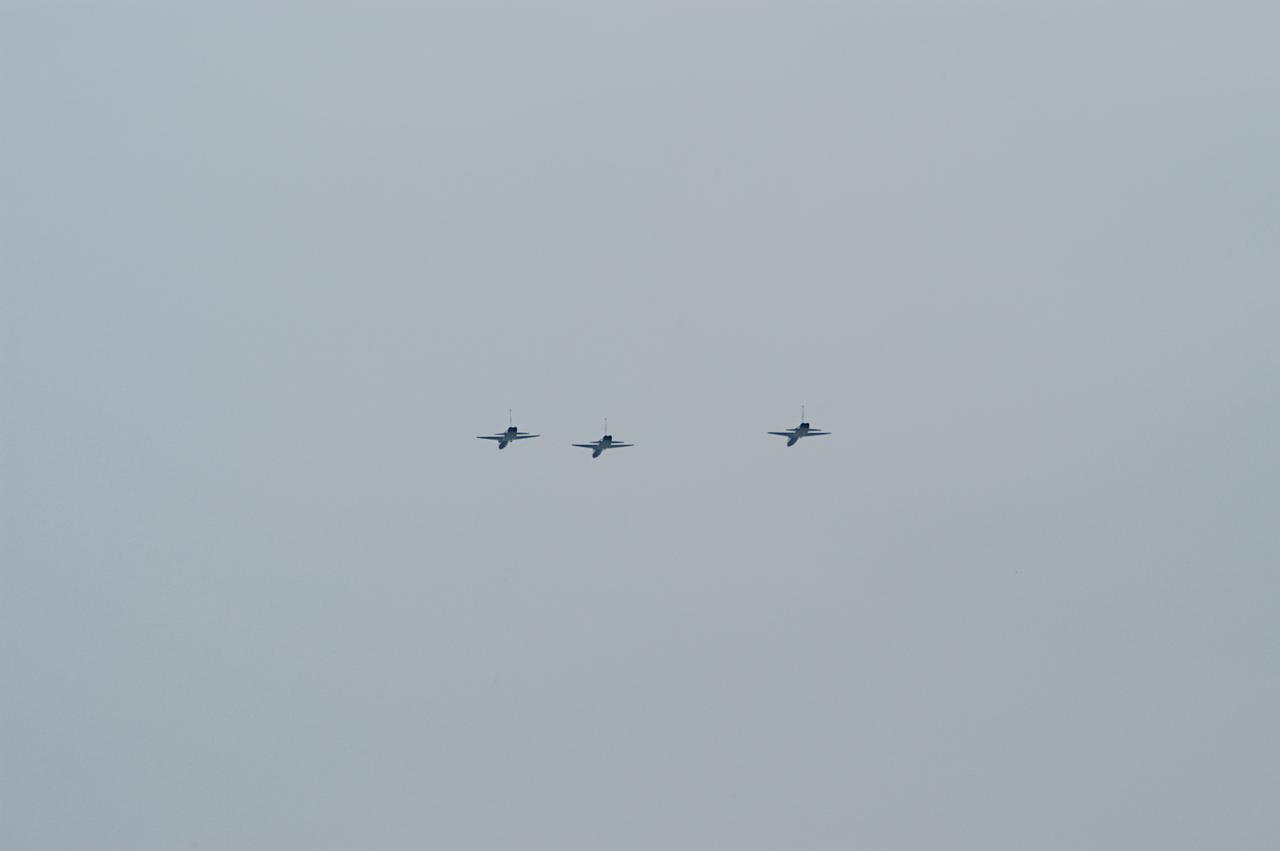
NASA T-38 jet aircraft are flying in a "Missing Man Formation" to conclude the memorial service for the crew of Columbia who were lost on Feb. 1, 2003, over East Texas as they returned to Earth after a 16-day research mission STS-107. The service was held at the Shuttle Landing Facility. Taking part in the service were NASA Administrator Sean O'Keefe, former KSC Director Robert Crippen, astronaut Jim Halsell, several employees, area clergymen, and members of Patrick Air Force Base. Crippen was the first to fly Columbia in 1981; Halsell first flew Columbia in 1994 and again in 1997.
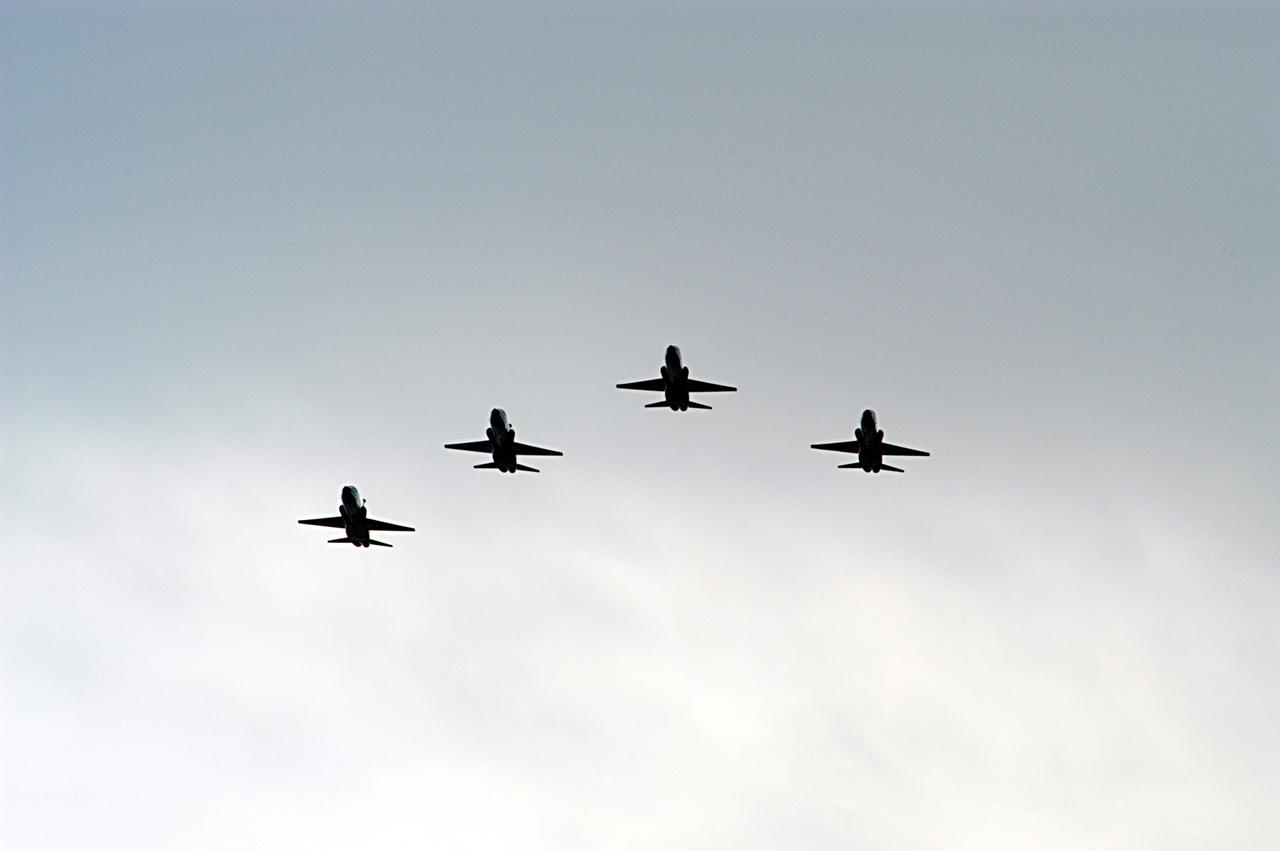
NASA T-38 jet aircraft are flying in a "Missing Man Formation" to conclude the memorial service for the crew of Columbia who were lost on Feb. 1, 2003, over East Texas as they returned to Earth after a 16-day research mission STS-107. The service was held at the Shuttle Landing Facility. Taking part in the service were NASA Administrator Sean O'Keefe, former KSC Director Robert Crippen, astronaut Jim Halsell, several employees, area clergymen, and members of Patrick Air Force Base. Crippen was the first to fly Columbia in 1981; Halsell first flew Columbia in 1994 and again in 1997.
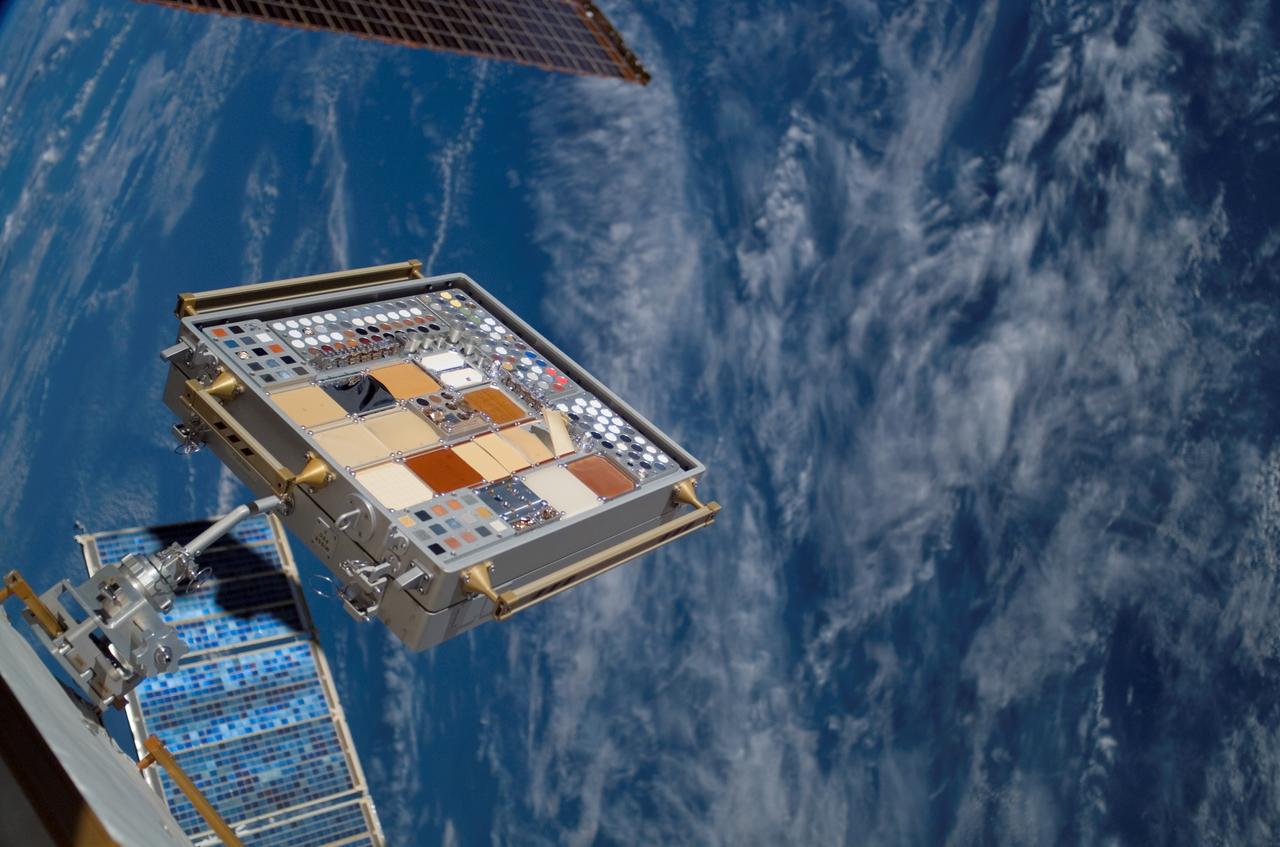
ISS015-E-22410 (13 Aug. 2007) --- Backdropped by a blue and white Earth, a Materials International Space Station Experiment (MISSE) on the exterior of the station is featured in this image photographed by a crewmember during the STS-118 mission's second planned session of extravehicular activity (EVA). MISSE collects information on how different materials weather in the environment of space.
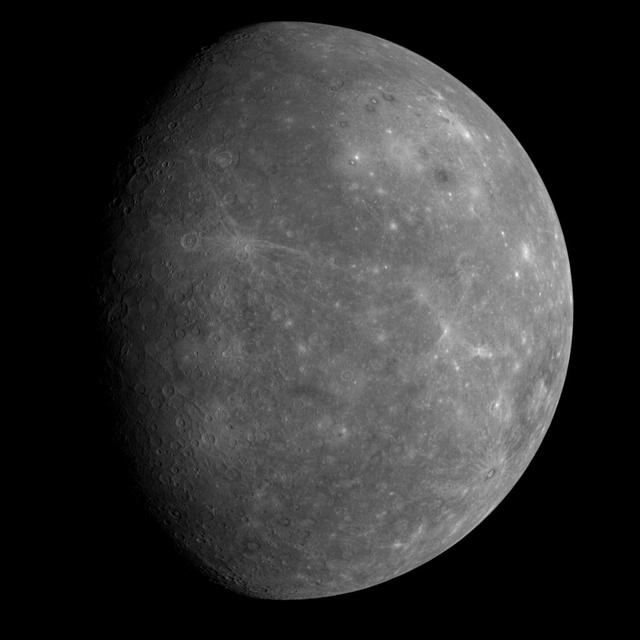
On January 14, 2008, NASA MESSENGER spacecraft observed about half of the hemisphere missed by Mariner 10.
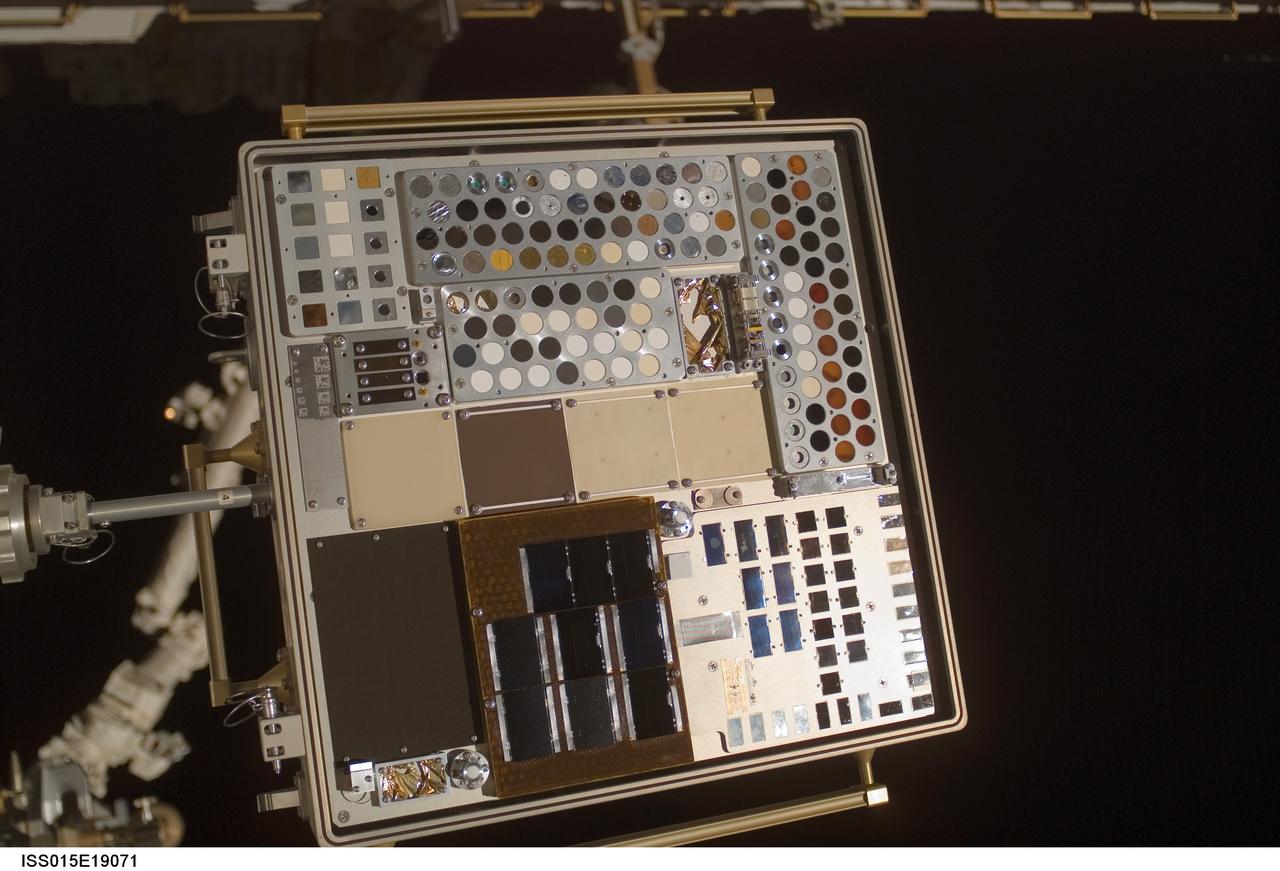
iss015e19071 (7/23/2007) --- View of Materials International Space Station Experiment (MISSE) Passive Experiment Container (PEC) mounted to the exterior of the Quest/Airlock (A/L). Photo taken during a session of Extravehicular Activity (EVA) on Expedition 15. Materials on the International Space Station Experiment 3 and 4 (MISSE - 3 and 4) are the third and fourth in a series of five suitcase-sized test beds attached to the outside of the space station. The beds were deployed during a spacewalk by the station crew in August 2006. They are exposing hundreds of potential space construction materials and different types of solar cells to the harsh environment of space. Mounted to the space station for about a year, the equipment then will be returned to Earth for study. Investigators will use the resulting data to design stronger, more durable spacecraft.
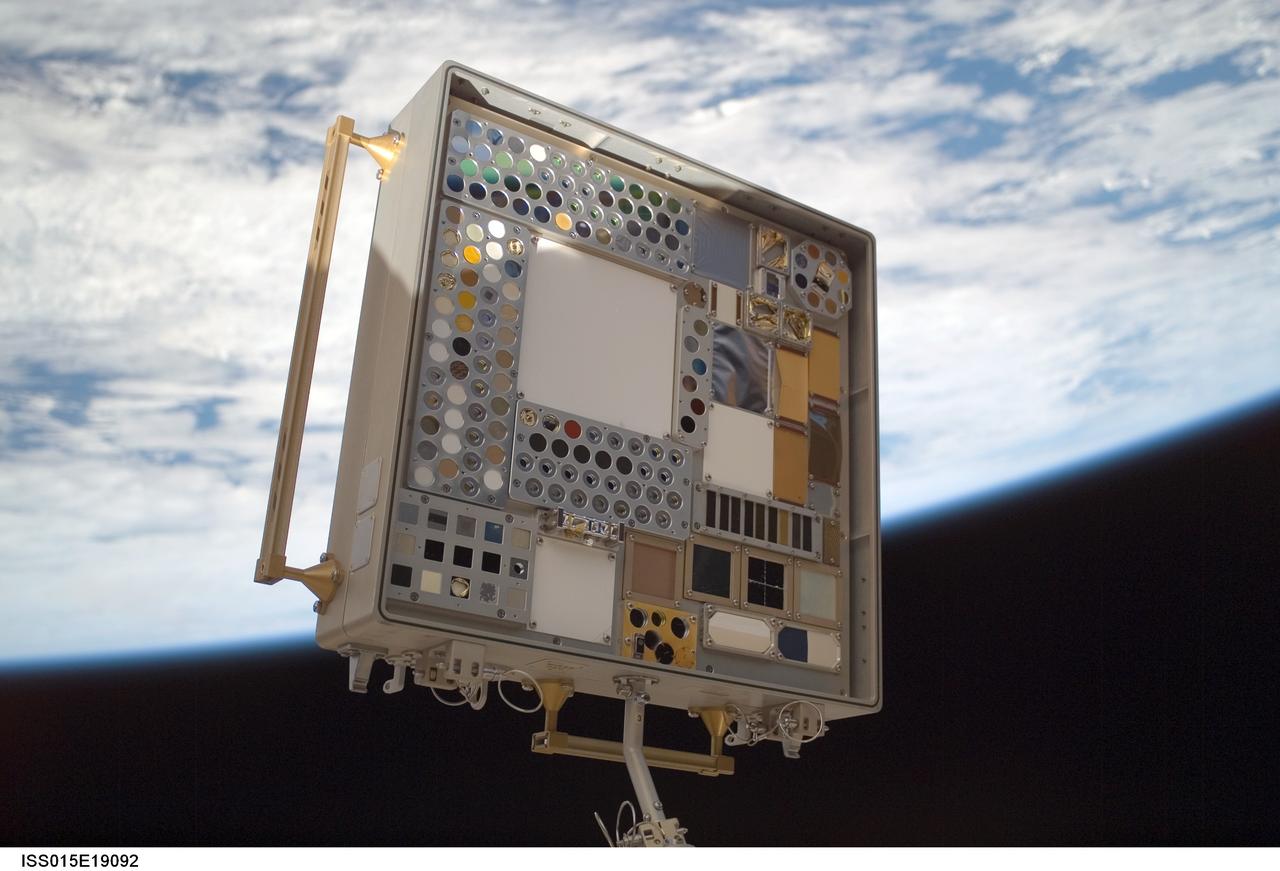
iss015e19092 (7/23/2007) --- View of Materials International Space Station Experiment (MISSE) Passive Experiment Container (PEC) mounted to the exterior of the Quest/Airlock (A/L). Photo taken during a session of Extravehicular Activity (EVA) on Expedition 15. Materials on the International Space Station Experiment 3 and 4 (MISSE - 3 and 4) are the third and fourth in a series of five suitcase-sized test beds attached to the outside of the space station. The beds were deployed during a spacewalk by the station crew in August 2006. They are exposing hundreds of potential space construction materials and different types of solar cells to the harsh environment of space. Mounted to the space station for about a year, the equipment then will be returned to Earth for study. Investigators will use the resulting data to design stronger, more durable spacecraft.
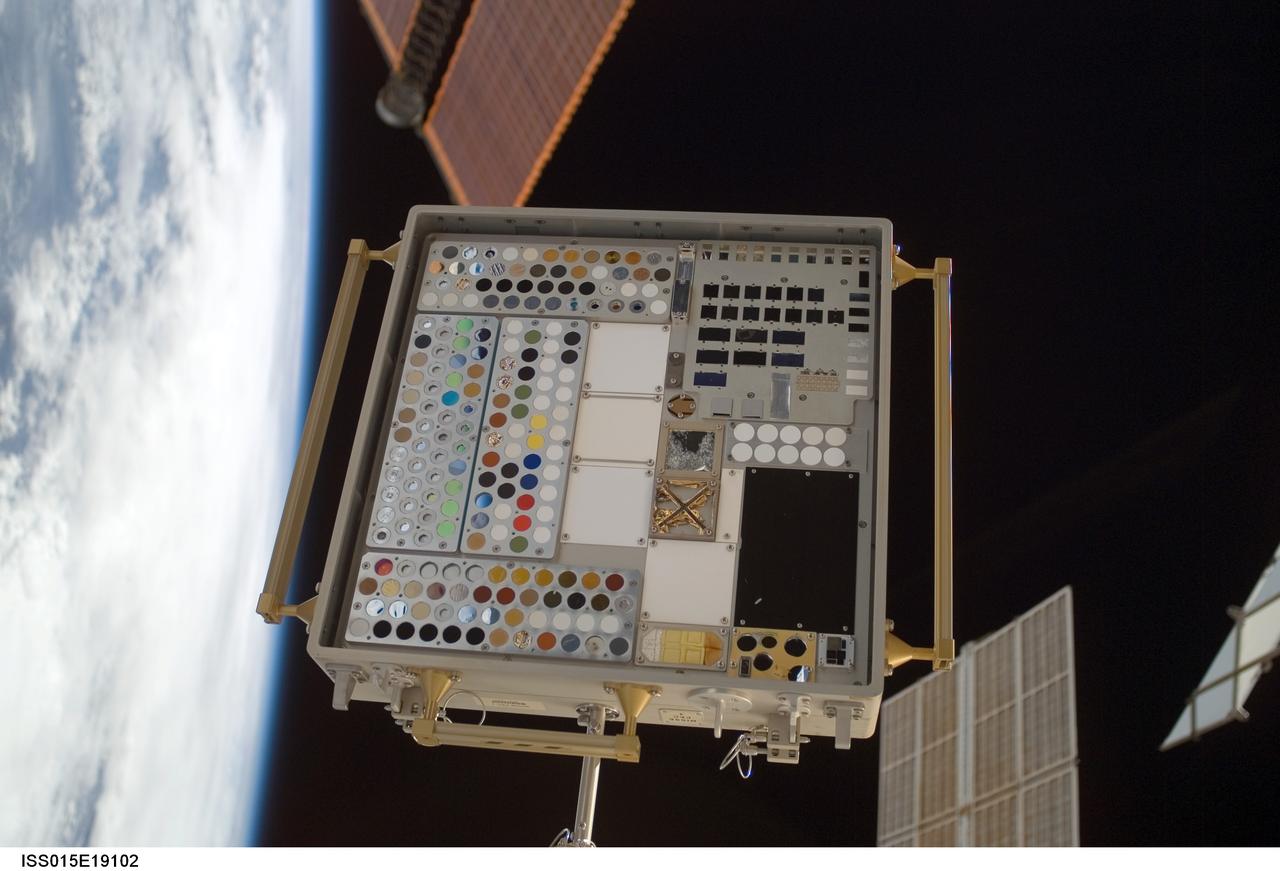
iss015e19102 (7/23/2007) --- View of Materials International Space Station Experiment (MISSE) Passive Experiment Container (PEC) mounted to the exterior of the Quest/Airlock (A/L). Photo taken during a session of Extravehicular Activity (EVA) on Expedition 15. Materials on the International Space Station Experiment 3 and 4 (MISSE - 3 and 4) are the third and fourth in a series of five suitcase-sized test beds attached to the outside of the space station. The beds were deployed during a spacewalk by the station crew in August 2006. They are exposing hundreds of potential space construction materials and different types of solar cells to the harsh environment of space. Mounted to the space station for about a year, the equipment then will be returned to Earth for study. Investigators will use the resulting data to design stronger, more durable spacecraft.
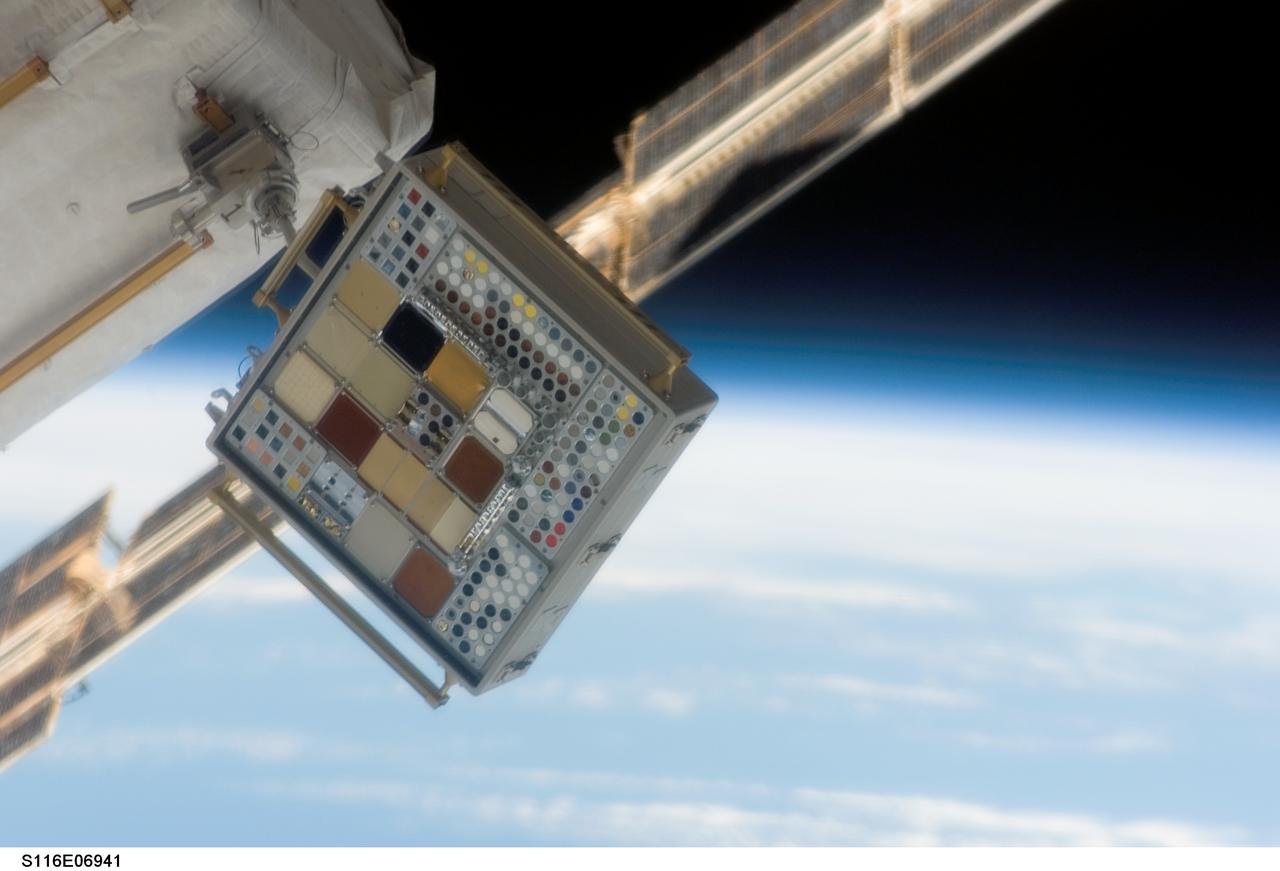
s116e06941 (12/18/2006) --- View of Materials International Space Station Experiment Passive Experiment Container (MISSE PEC) on the Quest/Airlock Crewlock during STS-116 Extravehicular Activity - 4 (EVA-4). Materials on the International Space Station Experiment 3 and 4 (MISSE - 3 and 4) are the third and fourth in a series of five suitcase-sized test beds attached to the outside of the space station. The beds were deployed during a spacewalk by the station crew in August 2006. They are exposing hundreds of potential space construction materials and different types of solar cells to the harsh environment of space. Mounted to the space station for about a year, the equipment then will be returned to Earth for study. Investigators will use the resulting data to design stronger, more durable spacecraft.
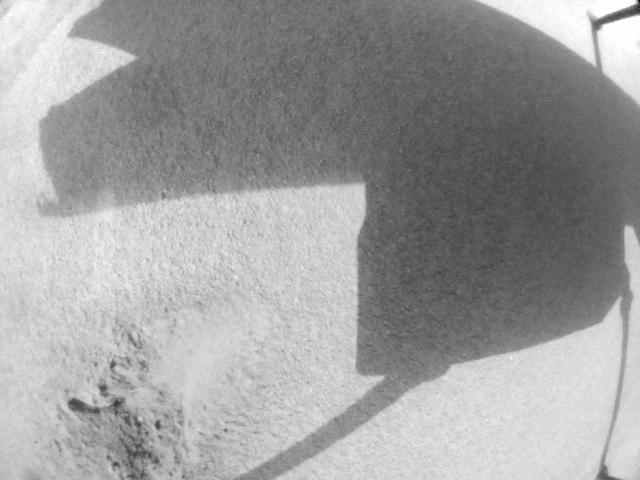
NASA's Ingenuity Mars Helicopter used its black-and-white navigation camera to capture this video showing the shadows of its rotor blades turning on Feb. 11, 2024. Engineers planned the video to get more information about damage that was sustained by the rotor blades after a rough landing occurred during the helicopter's 72nd flight on Jan. 18, 2024. This video shows that Ingenuity's upper rotor, the first rotor seen in this video, has a rotor blade missing. The blade appears to have separated near the mast. Video available at https://photojournal.jpl.nasa.gov/catalog/PIA26244
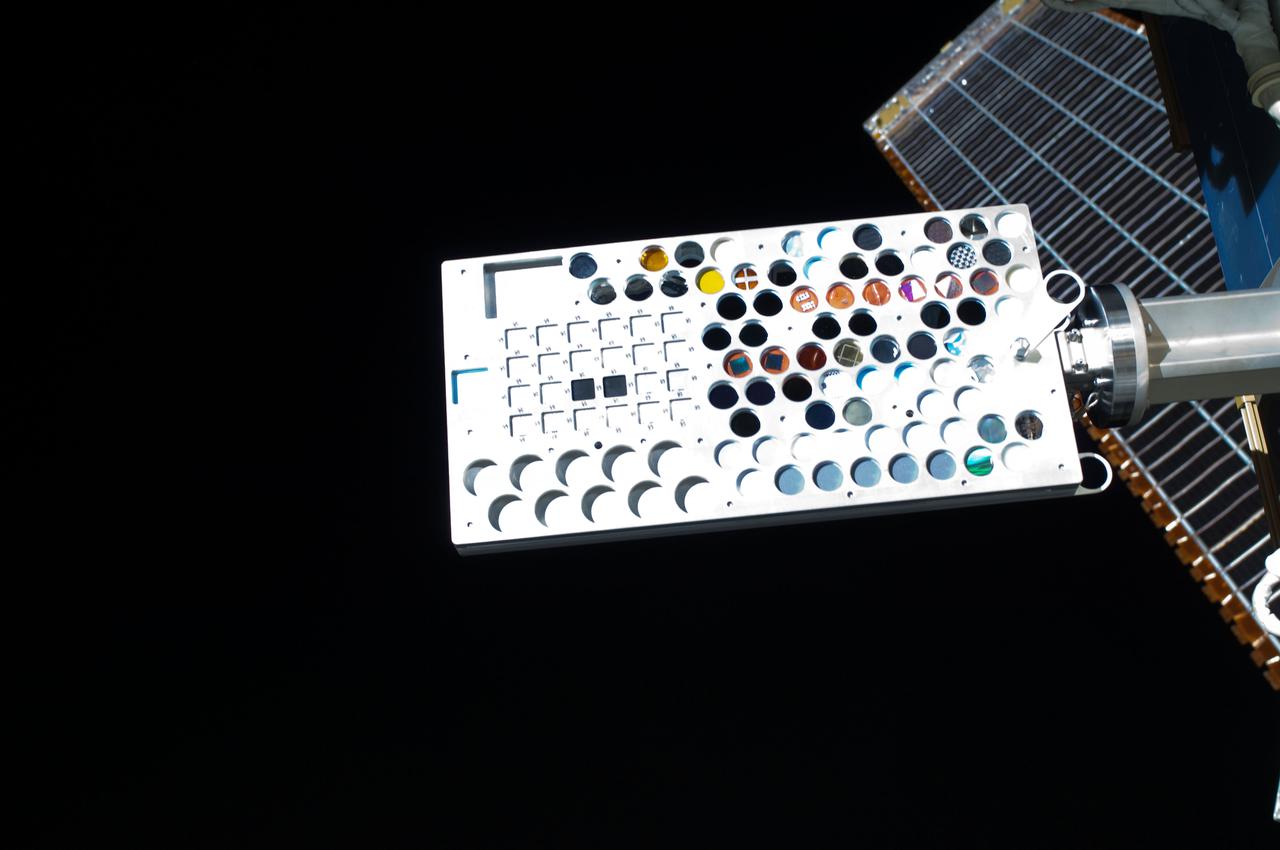
ISS028-E-016111 (12 July 2011) --- This close-up image, recorded during a July 12 spacewalk, shows the Materials on International Space Station Experiment - 8 (MISSE-8). The experiment package is a test bed for materials and computing elements attached to the outside of the orbiting complex. These materials and computing elements are being evaluated for the effects of atomic oxygen, ultraviolet, direct sunlight, radiation, and extremes of heat and cold. This experiment allows the development and testing of new materials and computing elements that can better withstand the rigors of space environments. Results will provide a better understanding of the durability of various materials and computing elements when they are exposed to the space environment, with applications in the design of future spacecraft.
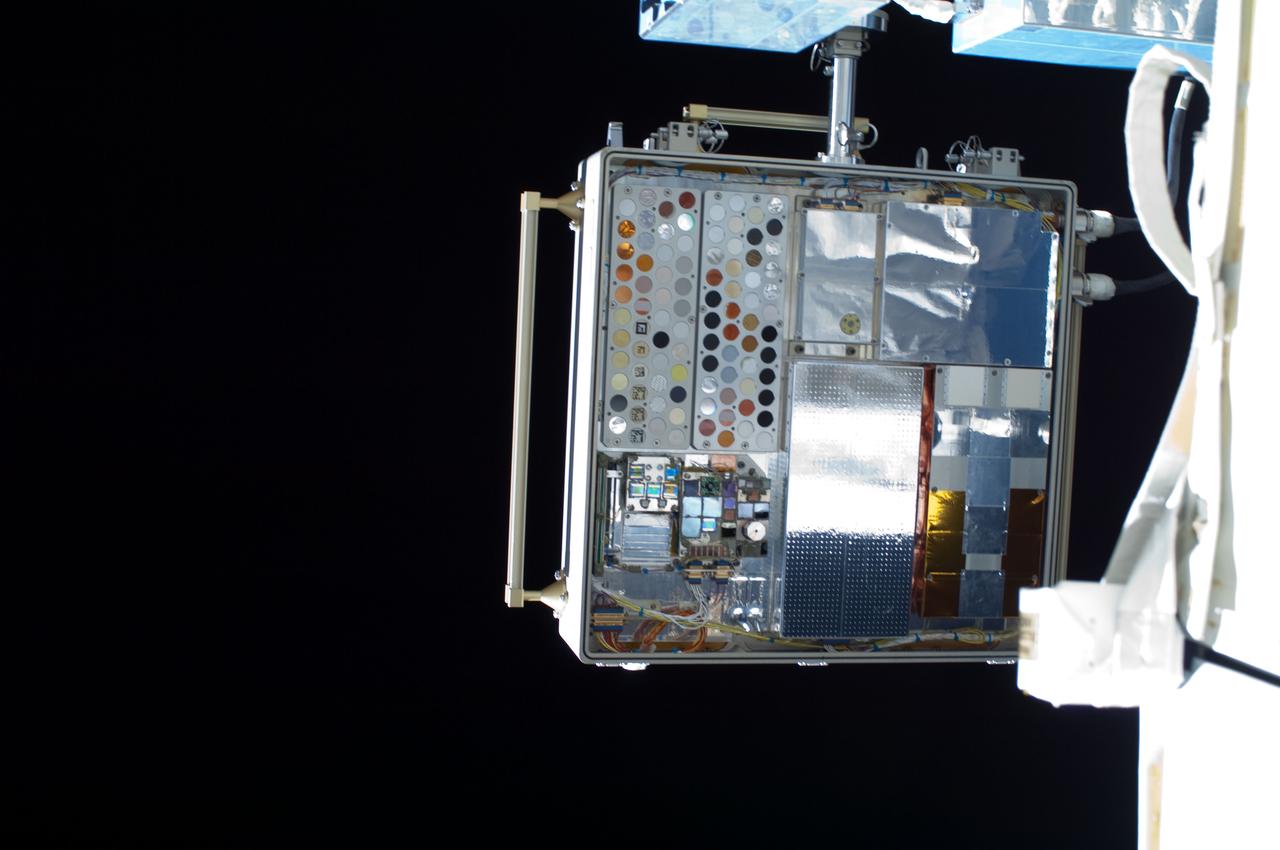
ISS028-E-016107 (12 July 2011) --- This medium close-up image, recorded during a July 12 spacewalk, shows the Materials on International Space Station Experiment - 8 (MISSE-8). The experiment package is a test bed for materials and computing elements attached to the outside of the orbiting complex. These materials and computing elements are being evaluated for the effects of atomic oxygen, ultraviolet, direct sunlight, radiation, and extremes of heat and cold. This experiment allows the development and testing of new materials and computing elements that can better withstand the rigors of space environments. Results will provide a better understanding of the durability of various materials and computing elements when they are exposed to the space environment, with applications in the design of future spacecraft.
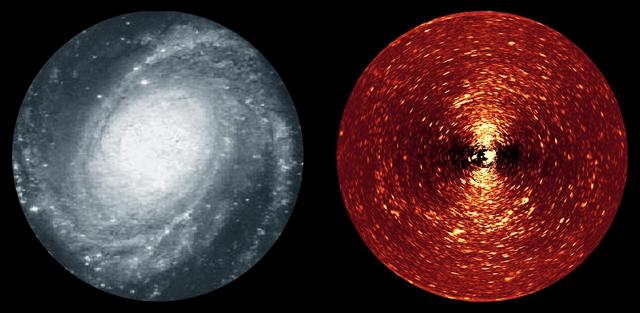
Here we see two different views of the spiral galaxy, Messier 81. On the left is an image taken in blue light, while on the right is a specially-processed version of an image taken with NASA Spitzer infrared array camera at 4.5 microns.
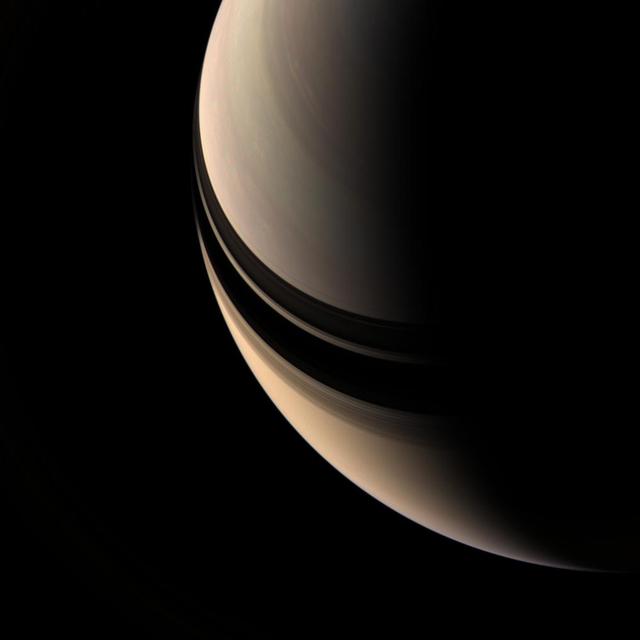
Brooding Saturn seems to be missing its rings, but their shadows on the planet betray their presence. The inner rings are in fact contained within this scene, but they are so tenuous as to be nearly invisible
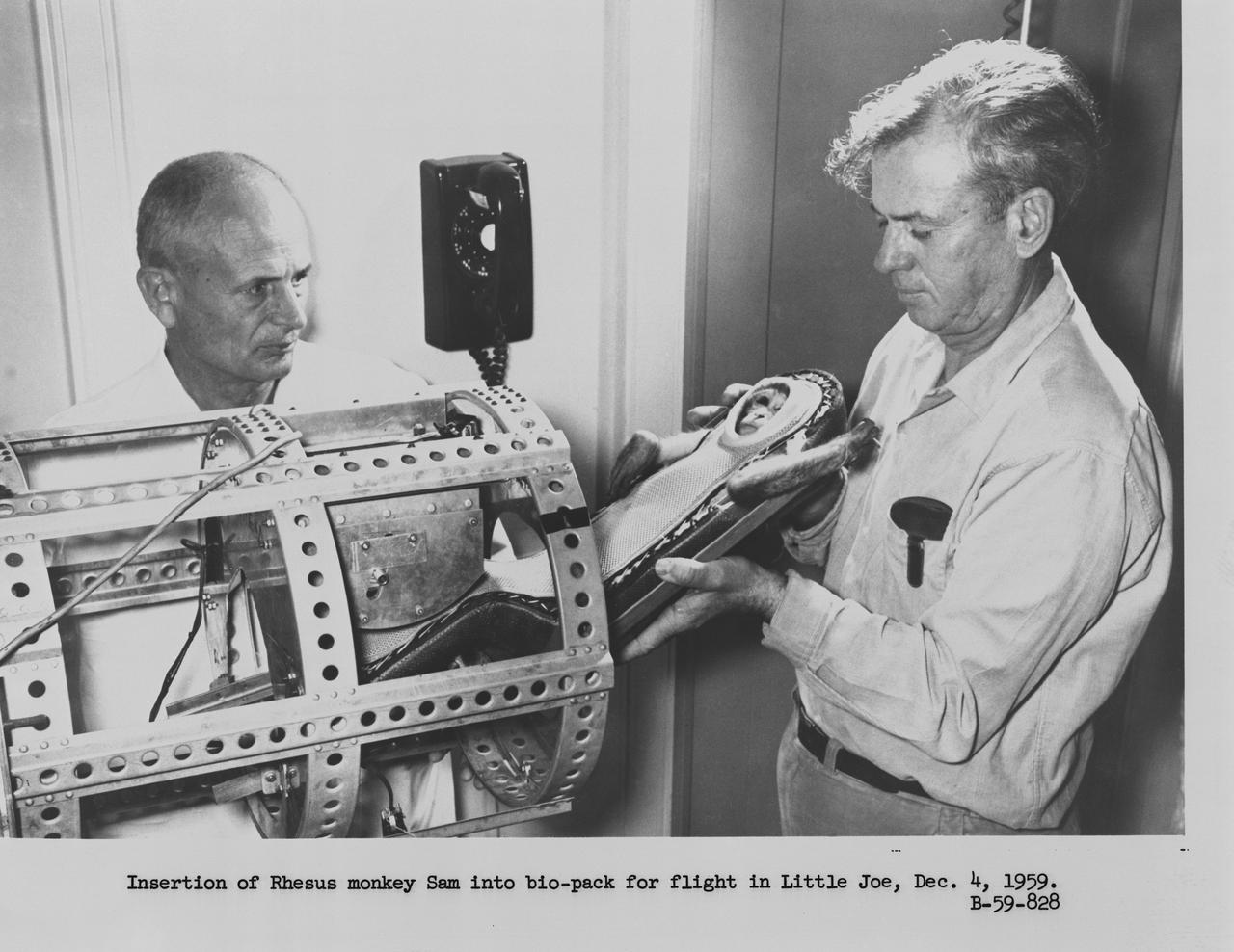
B59-00828 (21 Jan. 1959) --- The test subject, a rhesus monkey named Miss Sam, is seen encased in a model of the Mercury fiberglass contour couch. She is being placed in a container for the Little Joe 1B suborbital test flight of the Mercury Capsule. Photo credit: NASA
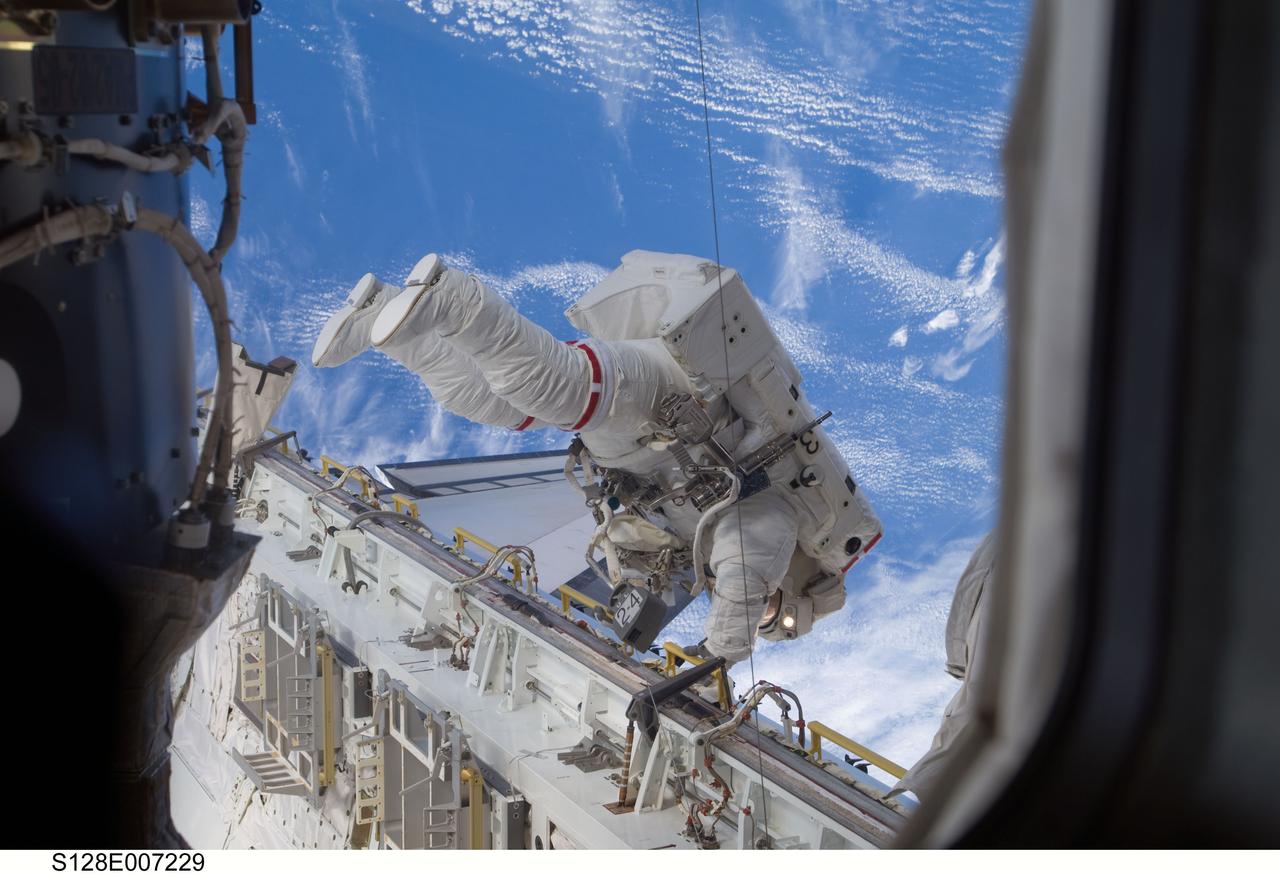
S128-E-007229 (1 Sept. 2009) --- Astronaut Nicole Stott, Expedition 20 flight engineer, participates in the STS-128 mission's first session of extravehicular activity (EVA) as construction and maintenance continue on the International Space Station. During the six-hour, 35-minute spacewalk, Stott and astronaut John “Danny” Olivas (out of frame), mission specialist, removed an empty ammonia tank from the station’s truss and temporarily stowed it on the station’s robotic arm. Olivas and Stott also retrieved the European Technology Exposure Facility (EuTEF) and Materials International Space Station Experiment (MISSE) from the Columbus laboratory module and installed them on Discovery’s payload bay for return.
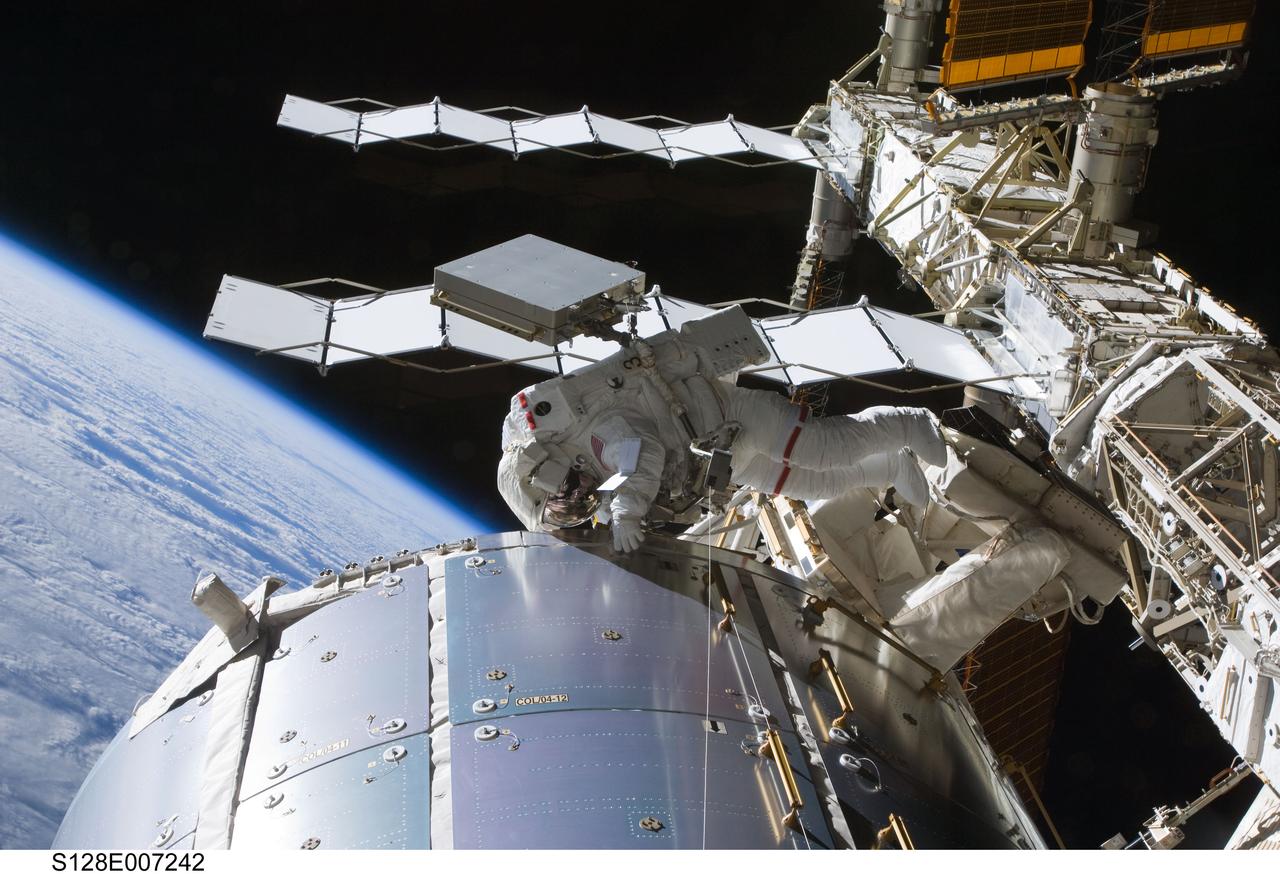
S128-E-007242 (1 Sept. 2009) --- Astronaut Nicole Stott, Expedition 20 flight engineer, participates in the STS-128 mission's first session of extravehicular activity (EVA) as construction and maintenance continue on the International Space Station. During the six-hour, 35-minute spacewalk, Stott and astronaut John “Danny” Olivas (out of frame), mission specialist, removed an empty ammonia tank from the station’s truss and temporarily stowed it on the station’s robotic arm. Olivas and Stott also retrieved the European Technology Exposure Facility (EuTEF) and Materials International Space Station Experiment (MISSE) from the Columbus laboratory module and installed them on Discovery’s payload bay for return.
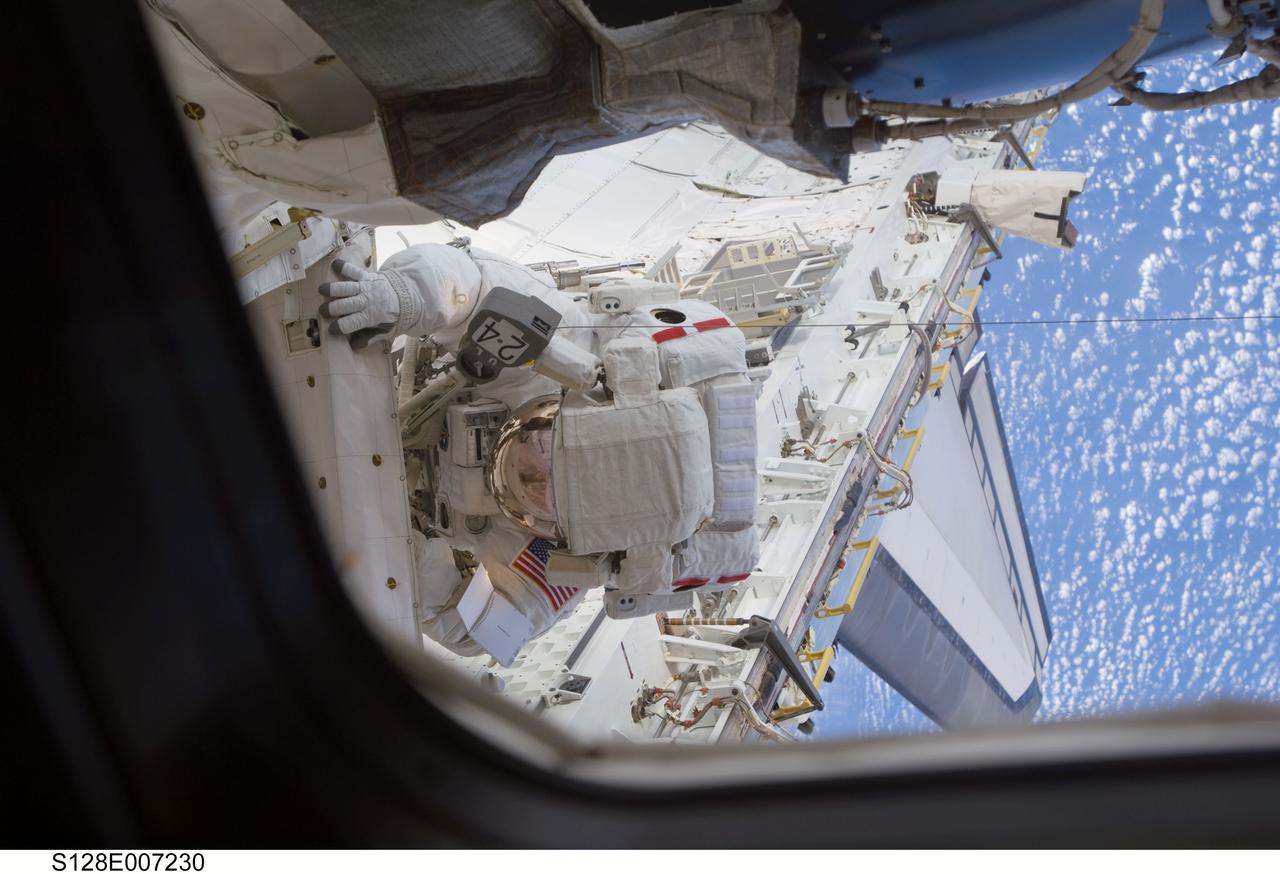
S128-E-007230 (1 Sept. 2009) --- Astronaut Nicole Stott, Expedition 20 flight engineer, participates in the STS-128 mission's first session of extravehicular activity (EVA) as construction and maintenance continue on the International Space Station. During the six-hour, 35-minute spacewalk, Stott and astronaut John “Danny” Olivas (out of frame), mission specialist, removed an empty ammonia tank from the station’s truss and temporarily stowed it on the station’s robotic arm. Olivas and Stott also retrieved the European Technology Exposure Facility (EuTEF) and Materials International Space Station Experiment (MISSE) from the Columbus laboratory module and installed them on Discovery’s payload bay for return.
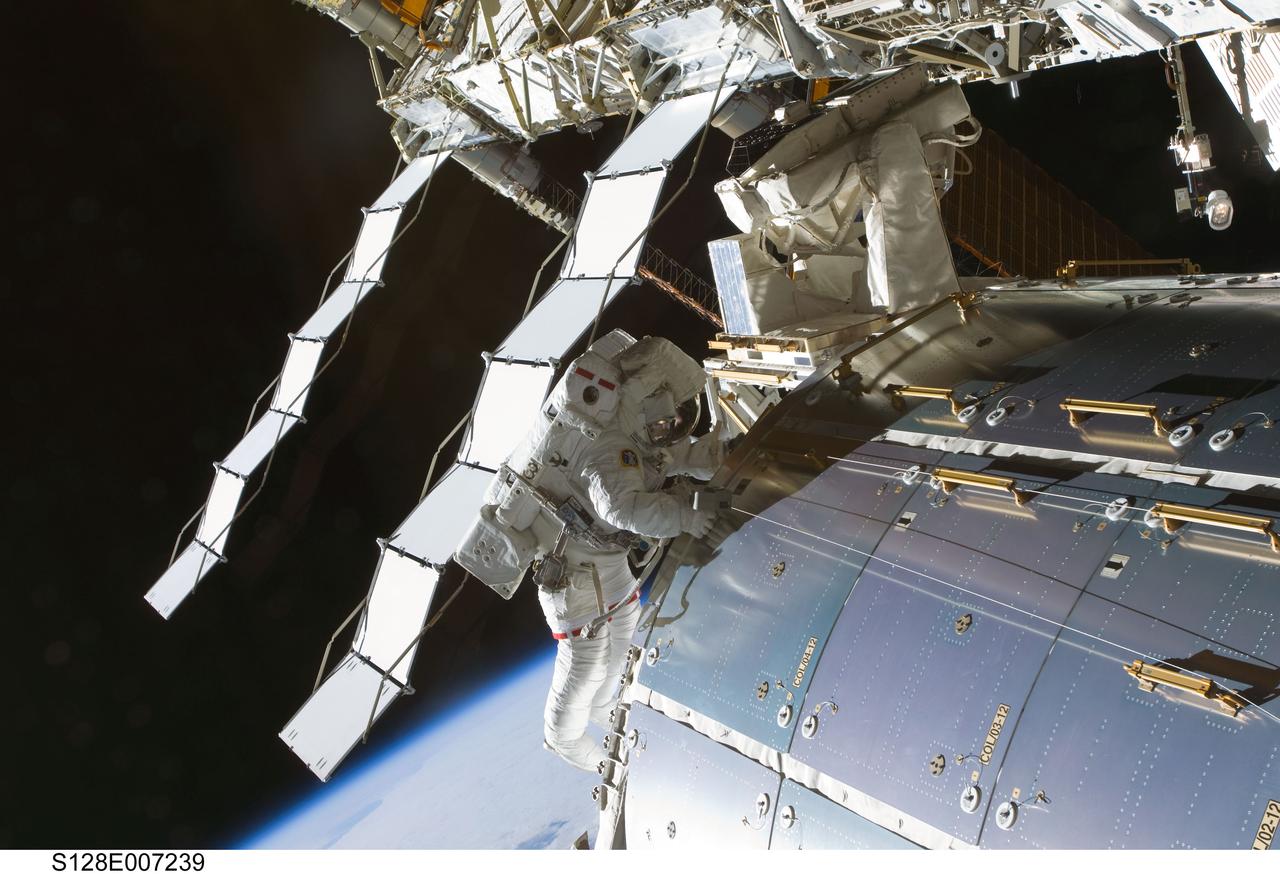
S128-E-007239 (1 Sept. 2009) --- Astronaut Nicole Stott, Expedition 20 flight engineer, participates in the STS-128 mission's first session of extravehicular activity (EVA) as construction and maintenance continue on the International Space Station. During the six-hour, 35-minute spacewalk, Stott and astronaut John “Danny” Olivas (out of frame), mission specialist, removed an empty ammonia tank from the station’s truss and temporarily stowed it on the station’s robotic arm. Olivas and Stott also retrieved the European Technology Exposure Facility (EuTEF) and Materials International Space Station Experiment (MISSE) from the Columbus laboratory module and installed them on Discovery’s payload bay for return.

S128-E-007225 (1 Sept. 2009) --- Astronaut John “Danny” Olivas, STS-128 mission specialist, participates in the mission's first session of extravehicular activity (EVA) as construction and maintenance continue on the International Space Station. During the six-hour, 35-minute spacewalk, Olivas and astronaut Nicole Stott (out of frame), mission specialist, removed an empty ammonia tank from the station’s truss and temporarily stowed it on the station’s robotic arm. Olivas and Stott also retrieved the European Technology Exposure Facility (EuTEF) and Materials International Space Station Experiment (MISSE) from the Columbus laboratory module and installed them on Discovery’s payload bay for return.
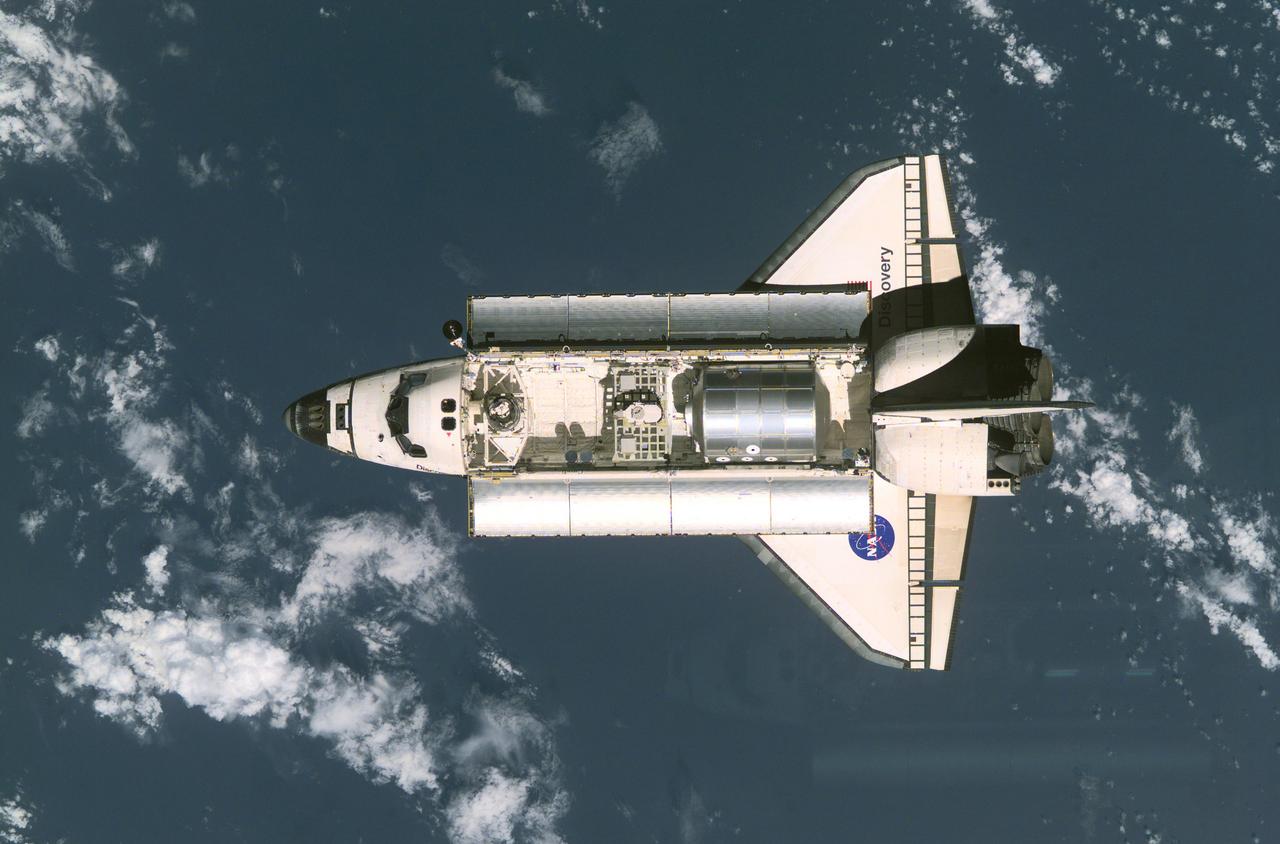
This is a view of the Space Shuttle Discovery as it approaches the International Space Station (ISS) during the STS-105 mission. Visible in the payload bay of Discovery are the Multipurpose Logistics Module (MPLM) Leonardo at right, which stores various supplies and experiments to be transferred into the ISS; at center, the Integrated Cargo Carrier (ICC) which carries the Early Ammonia Servicer (EAS); and two Materials International Space Station Experiment (MISSE) containers at left. Aboard Discovery were the ISS Expedition Three crew, who were to replace the Expedition Two crew that had been living on the ISS for the past five months.
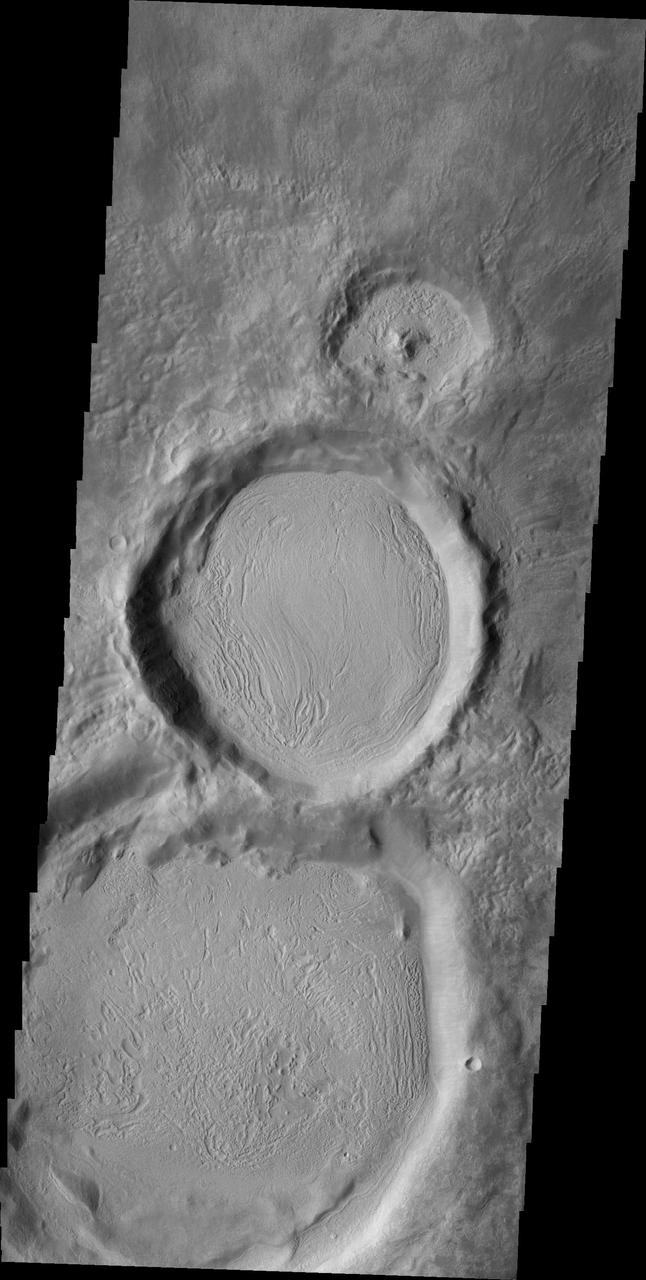
Do you see what I see in this image from NASA Mars Odyssey spacecraft? These three side-by-side craters increase in size toward the bottom of the image. Looks like a snowman, only his eyes are missing.
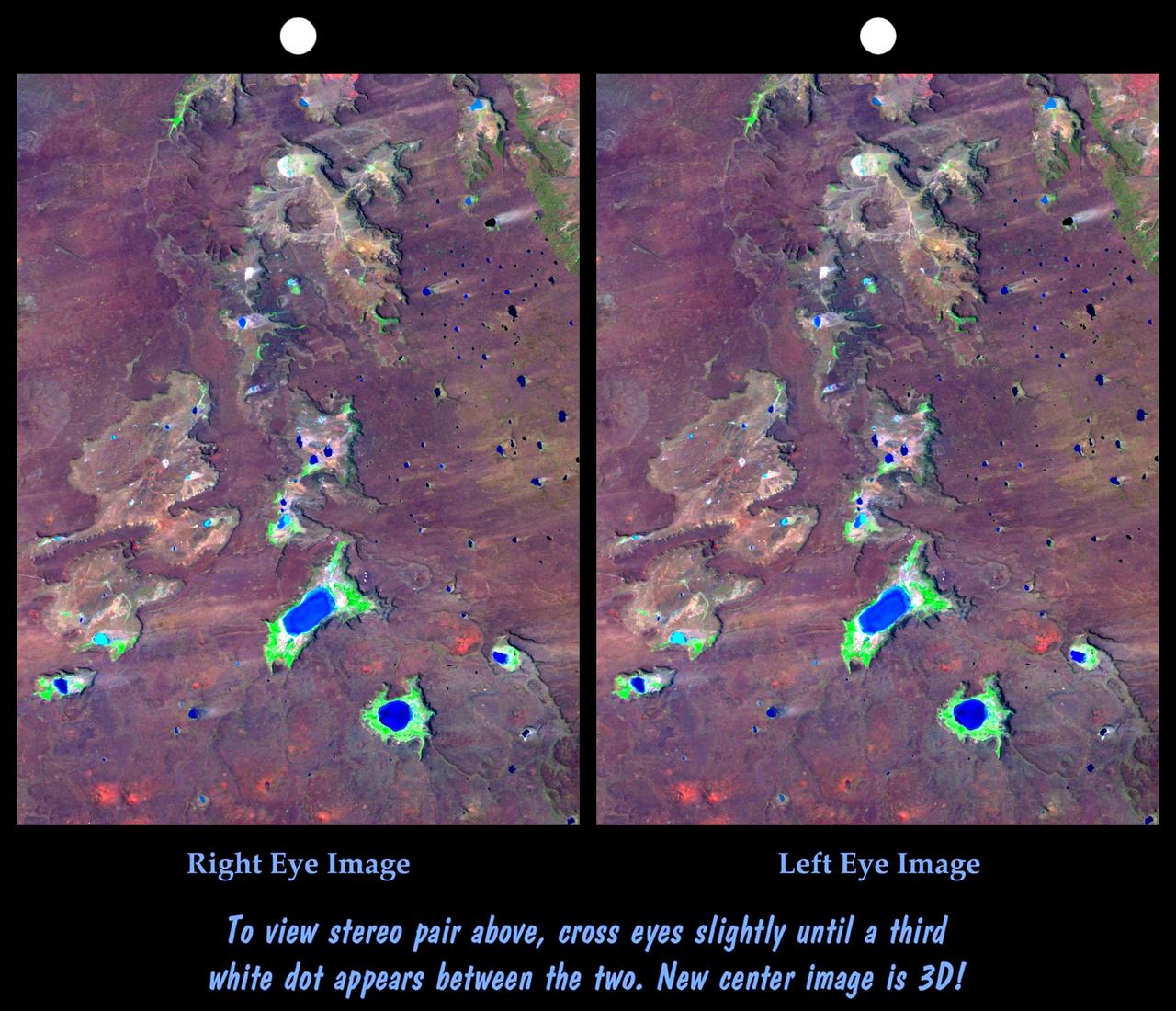
The Meseta de Somuncura is a semi-arid basalt plateau in northern Patagonia. This view of the northwestern part of the plateau, near Los Menucos, Argentina, shows numerous depressions where the upper basalt layers are missing or collapsed.
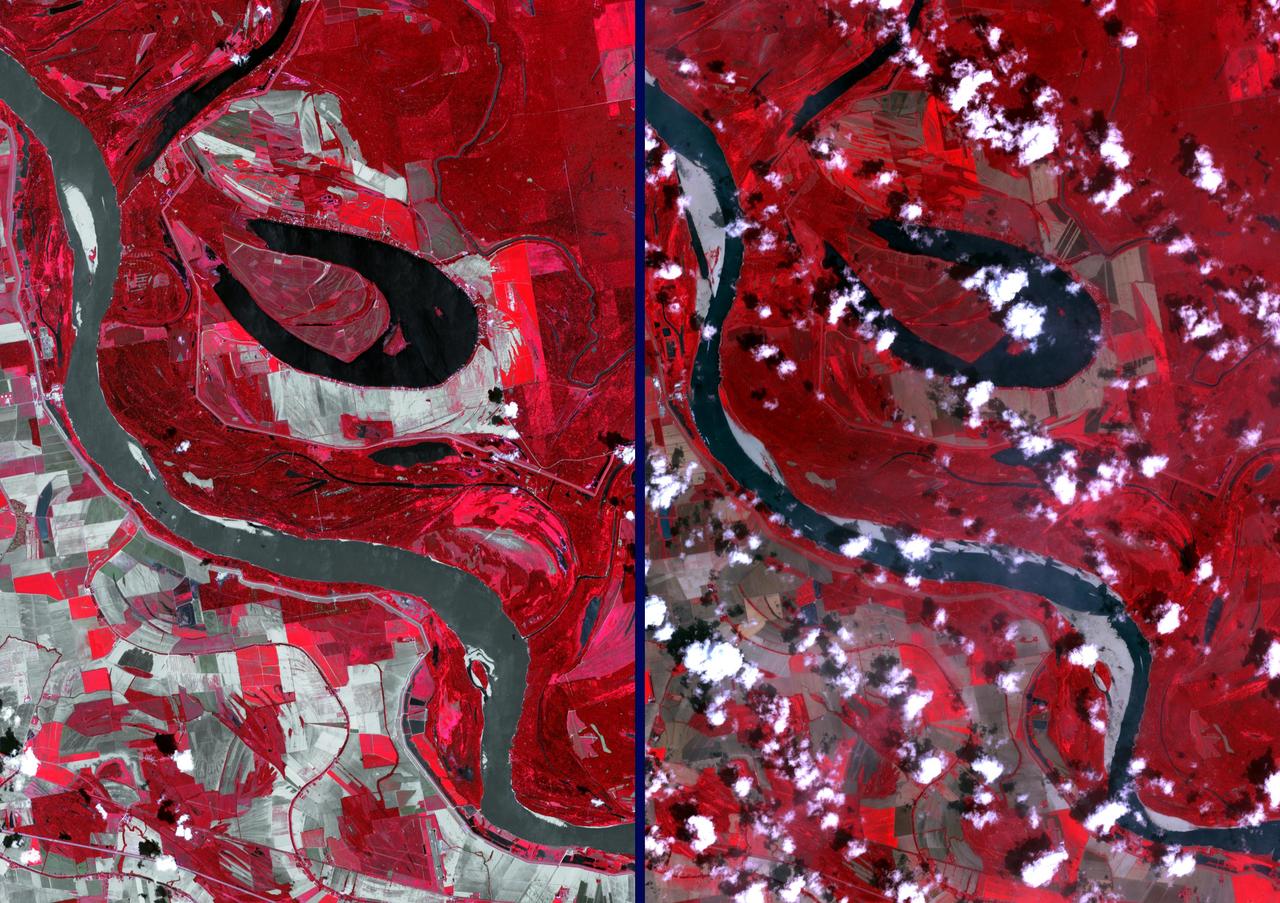
NASA Terra spacecraft acquired this image on Aug. 24, 2012, 13 miles 20 kilometers north of Vicksburg, Miss., as drought continued to afflict the U.S. Midwest, water levels of the Mississippi River approached historic lows.

These two data plots from NASA Spitzer Space Telescope show a primitive supermassive black hole top compared to a typical one; usually, dust tori are missing and only gas disks are observed in primitive black holes.
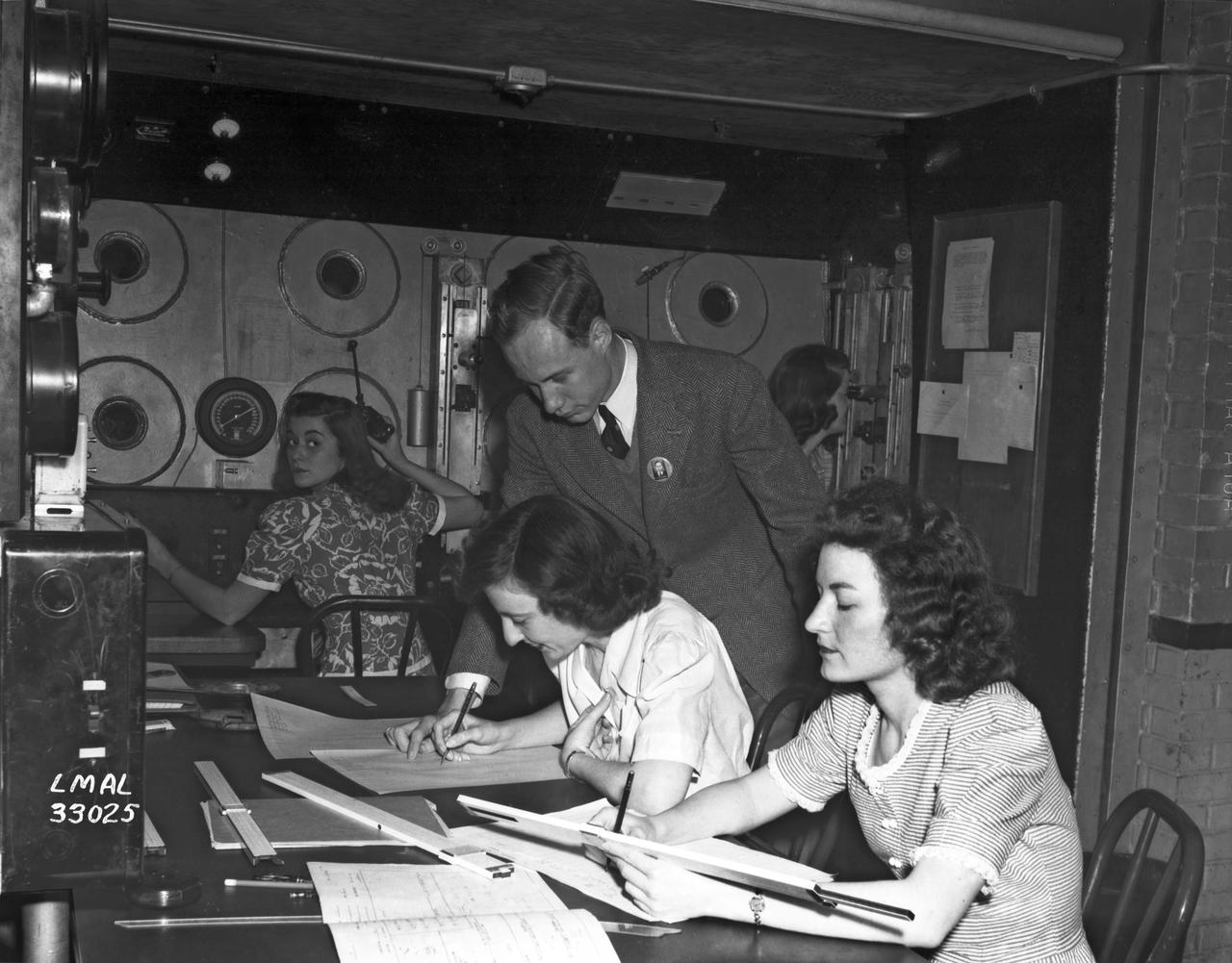
In the picture are F.F. Fullmer, aeronautical engineer, supervise a group of women who are helping operate the research equipment in the two-dimensional wind tunnel. Miss Elizabeth Patterson, left foreground, and Miss Katherine Thomason, right foreground obtains aerodynamic data, while Miss Lenore Woodland left background and Mrs. Blanche White help operate the tunnel. By Lee Dickinson 1943

s114e7235 (8/6/2005) --- Backdropped by a colorful Earth, this aft view of the International Space Station was photographed during the flyaround by the Space Shuttle Discovery following the undocking of the two spacecraft. Visible in the frame are the P6 Truss / Photovoltaic Solar Arrays and MISSE-5. The Materials International Space Station Experiment-5 (MISSE-5) was an external payload that flew on-board the ISS from August 2005 until September 2006. MISSE-5 provided an opportunity for researchers to test a wide range of samples in the Low Earth Orbit (LEO) environment.
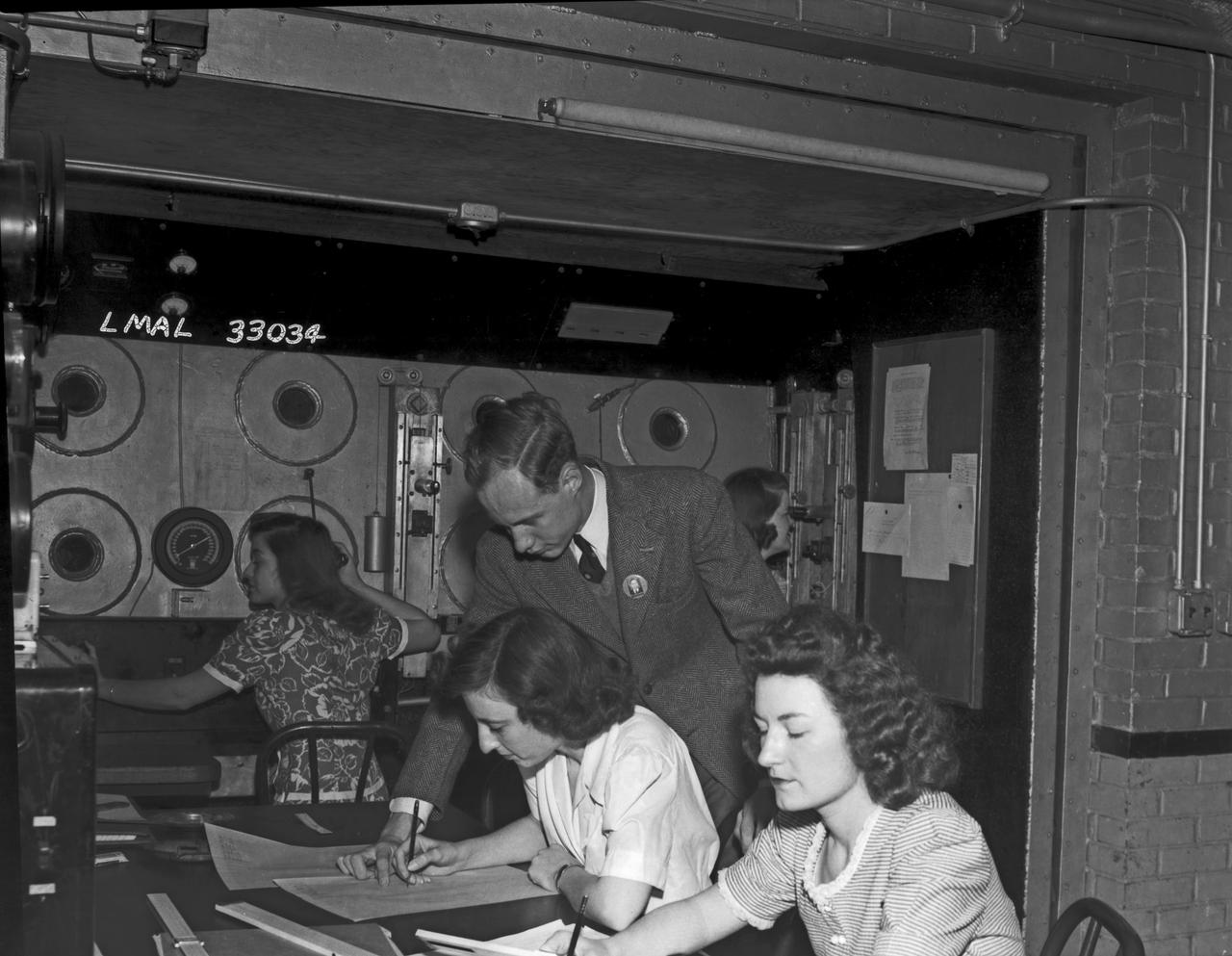
Women Adequately Filling Posts In NACA Laboratory: In the picture are F.F. Fullmer, aeronautical engineer, supervise a group of women who are helping operate the research equipment in the two-dimensional wind tunnel. Miss Elizabeth Patterson, left foreground, and Miss Katherine Thomason, right foreground obtains aerodynamic data, while Miss Lenore Woodland left background and Mrs. Blanche White help operate the tunnel. By Lee Dickinson 1943
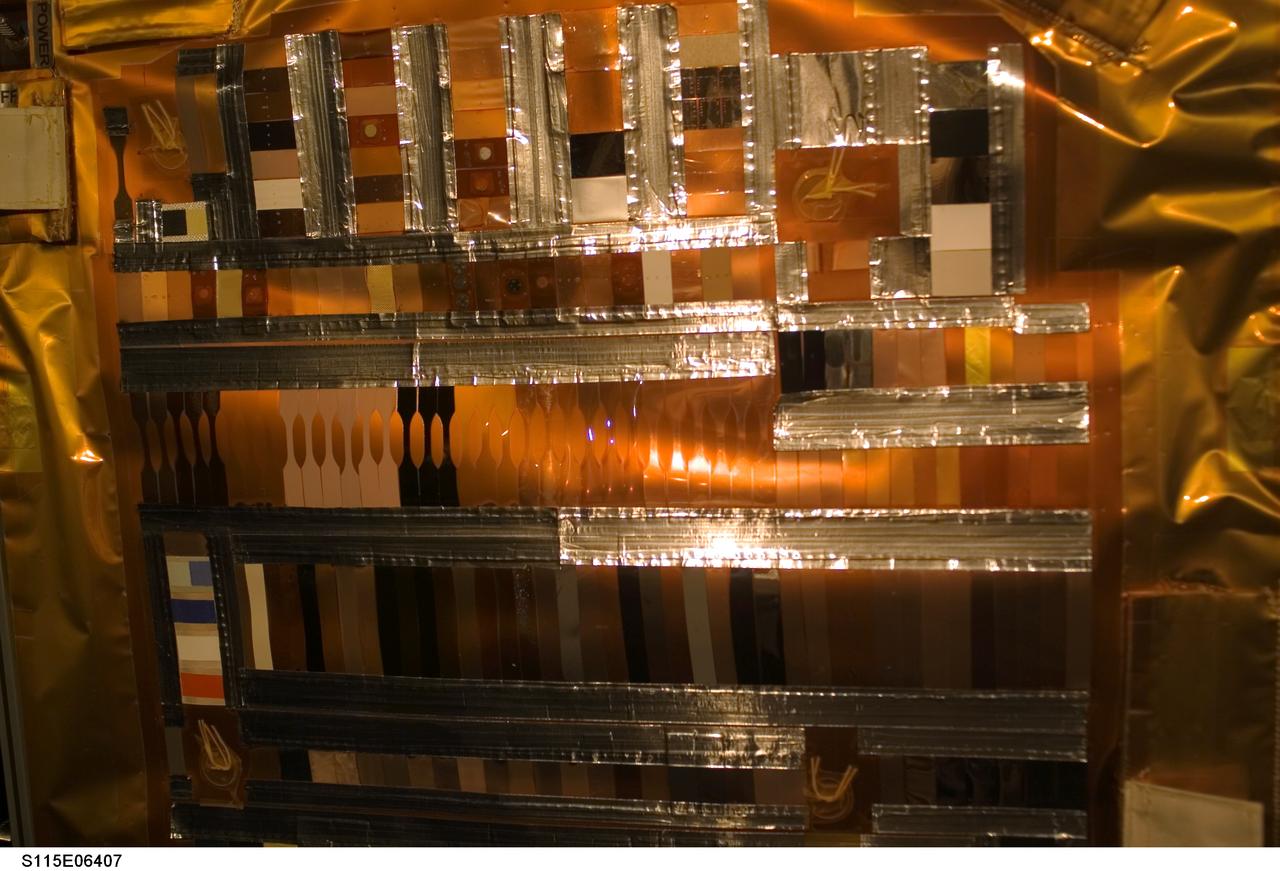
s115e06407 (9/17/2006) --- The Materials International Space Station Experiment-5 (MISSE-5) was an external payload that flew on-board the ISS from August 2005 until September 2006. MISSE-5 provided an opportunity for researchers to test a wide range of samples in the Low Earth Orbit (LEO) environment.

KENNEDY SPACE CENTER, FLA. -- In the Orbiter Processing Facility, the second of two Materials International Space Station Experiments, or MISSE, is lowered into space shuttle Endeavour's payload bay for installation. The MISSE is part of the payload onboard Endeavour for mission STS-123. The MISSE project is a NASA/Langley Research Center-managed cooperative endeavor to fly materials and other types of space exposure experiments on the International Space Station. The objective is to develop early, low-cost, non-intrusive opportunities to conduct critical space exposure tests of space materials and components planned for use on future spacecraft. Photo credit: NASA/Kim Shiflett
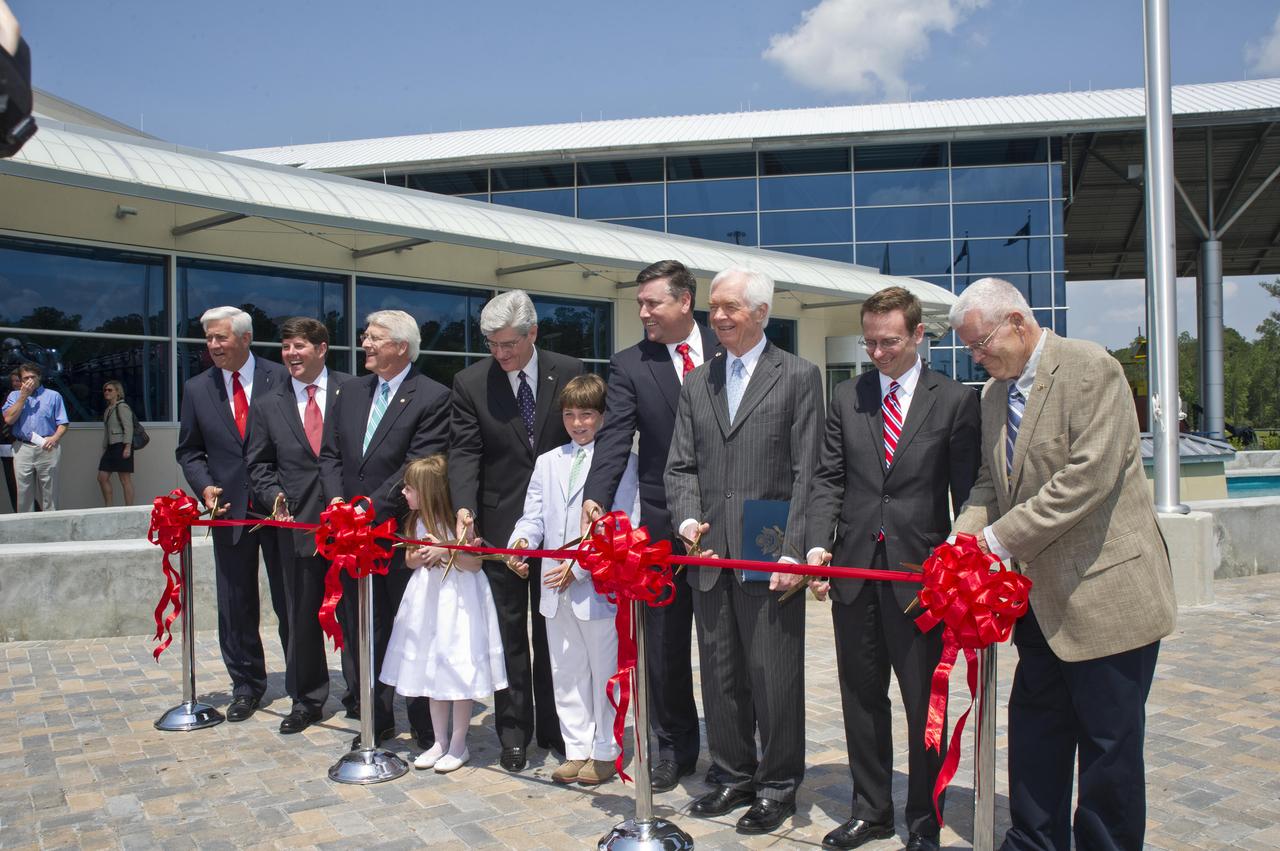
Ceremony participants prepare to cut the ribbon on the INFINITY at NASA Stennis Space Center facility April 11, 2012. Participating in the ceremony were (l to r): Gulfport Mayor and INFINITY Science Center Inc. Chairman George Schloegel; U.S. Rep. Steven Palazzo, R-Miss.; U.S. Sen. Roger Wicker, R-Miss.; Roy S. Estess granddaughter Lauren McKay; Mississippi Gov. Phil Bryant; Leo Seal Jr. grandson Leo Seal IV; Stennis Director Patrick Scheuermann; U.S. Sen. Thad Cochran, R-Miss.; NASA Chief of Staff David Radzanowski; and Apollo 13 astronaut and INFINITY Science Center Inc. Vice Chairman Fred Haise.
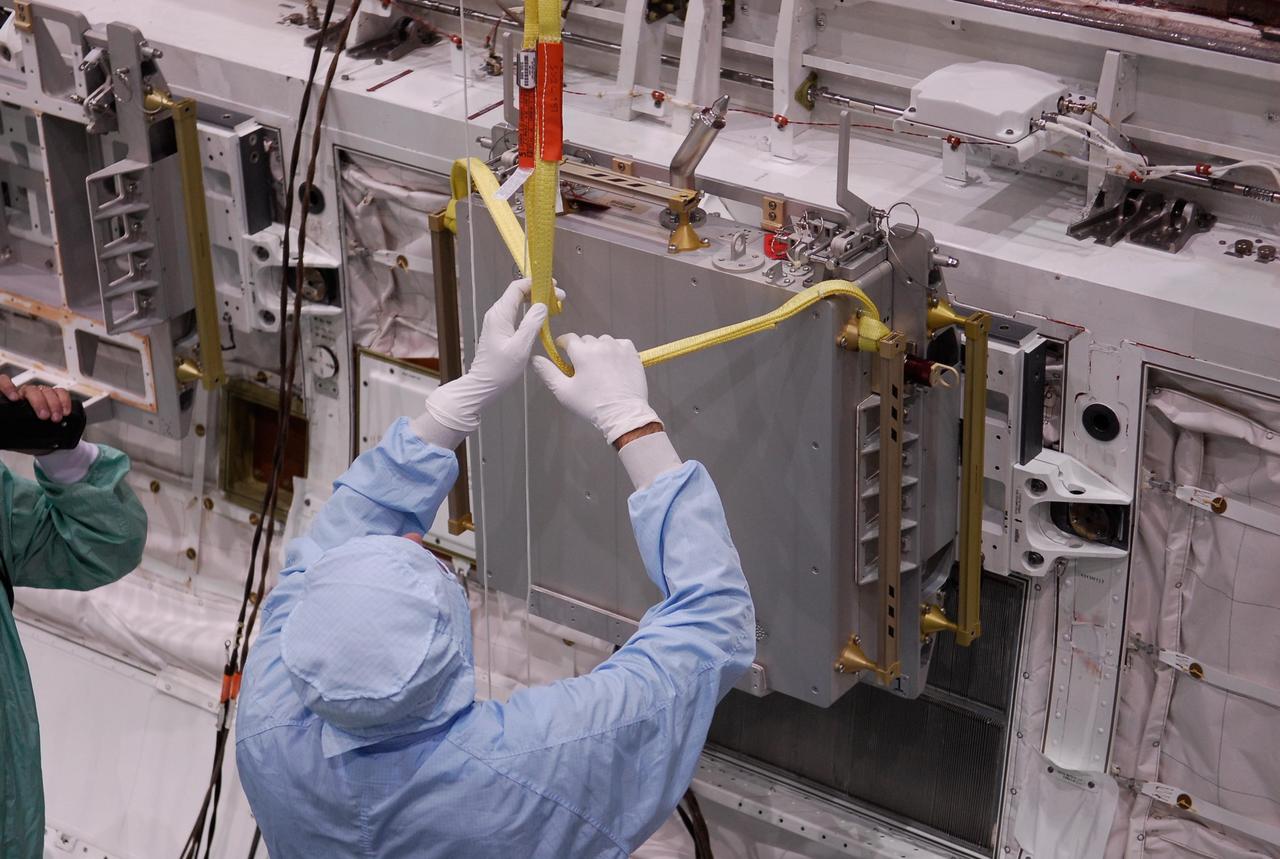
KENNEDY SPACE CENTER, FLA. -- In the Orbiter Processing Facility, one of two Materials International Space Station Experiments, or MISSE, is lowered into space shuttle Endeavour's payload bay for installation. The MISSE is part of the payload onboard Endeavour for mission STS-123. The MISSE project is a NASA/Langley Research Center-managed cooperative endeavor to fly materials and other types of space exposure experiments on the International Space Station. The objective is to develop early, low-cost, non-intrusive opportunities to conduct critical space exposure tests of space materials and components planned for use on future spacecraft. Photo credit: NASA/Kim Shiflett
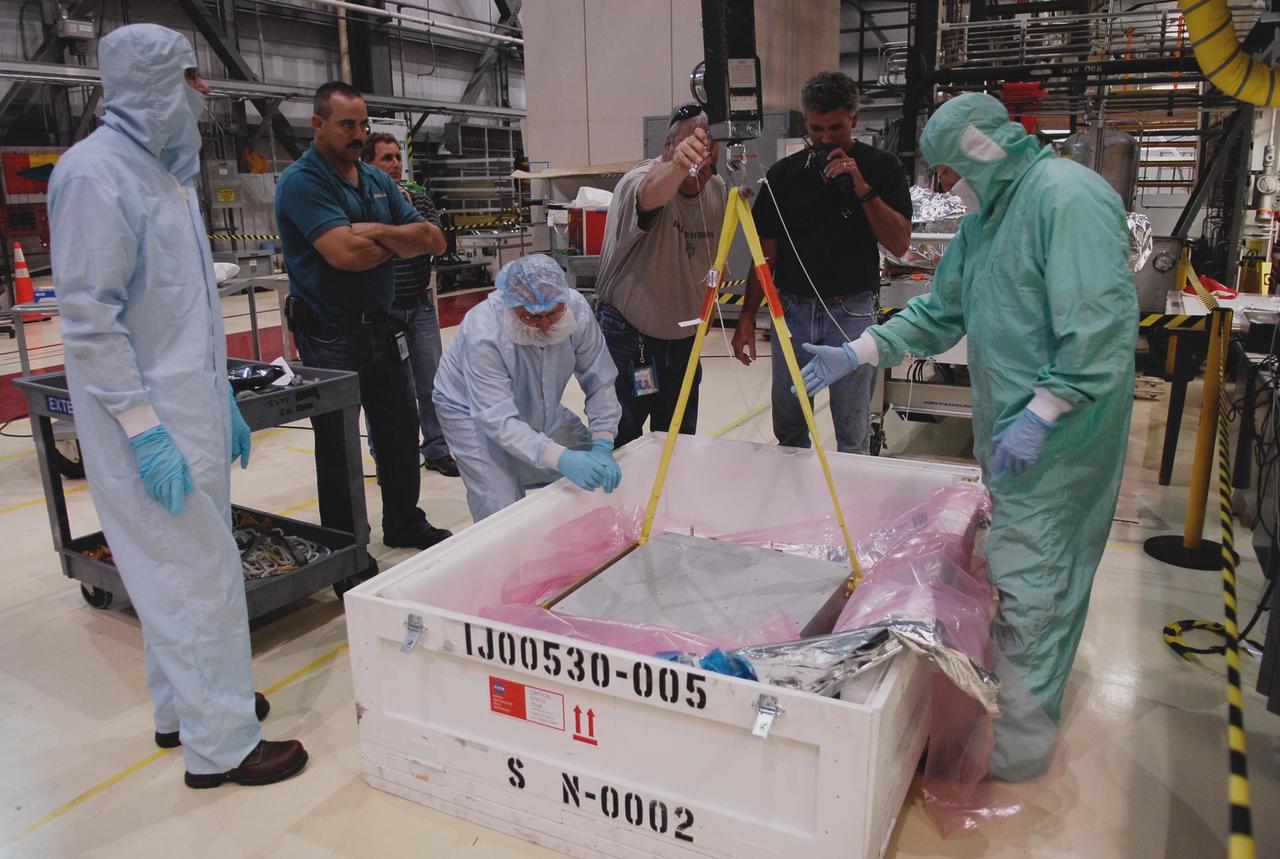
KENNEDY SPACE CENTER, FLA. -- In the Orbiter Processing Facility, technicians get ready to remove one of two Materials International Space Station Experiments, or MISSE, from a shipping container. The MISSE is part of the payload onboard space shuttle Endeavour for mission STS-123. It will be installed in Endeavour's payload bay. The MISSE project is a NASA/Langley Research Center-managed cooperative endeavor to fly materials and other types of space exposure experiments on the International Space Station. The objective is to develop early, low-cost, non-intrusive opportunities to conduct critical space exposure tests of space materials and components planned for use on future spacecraft. Photo credit: NASA/Kim Shiflett
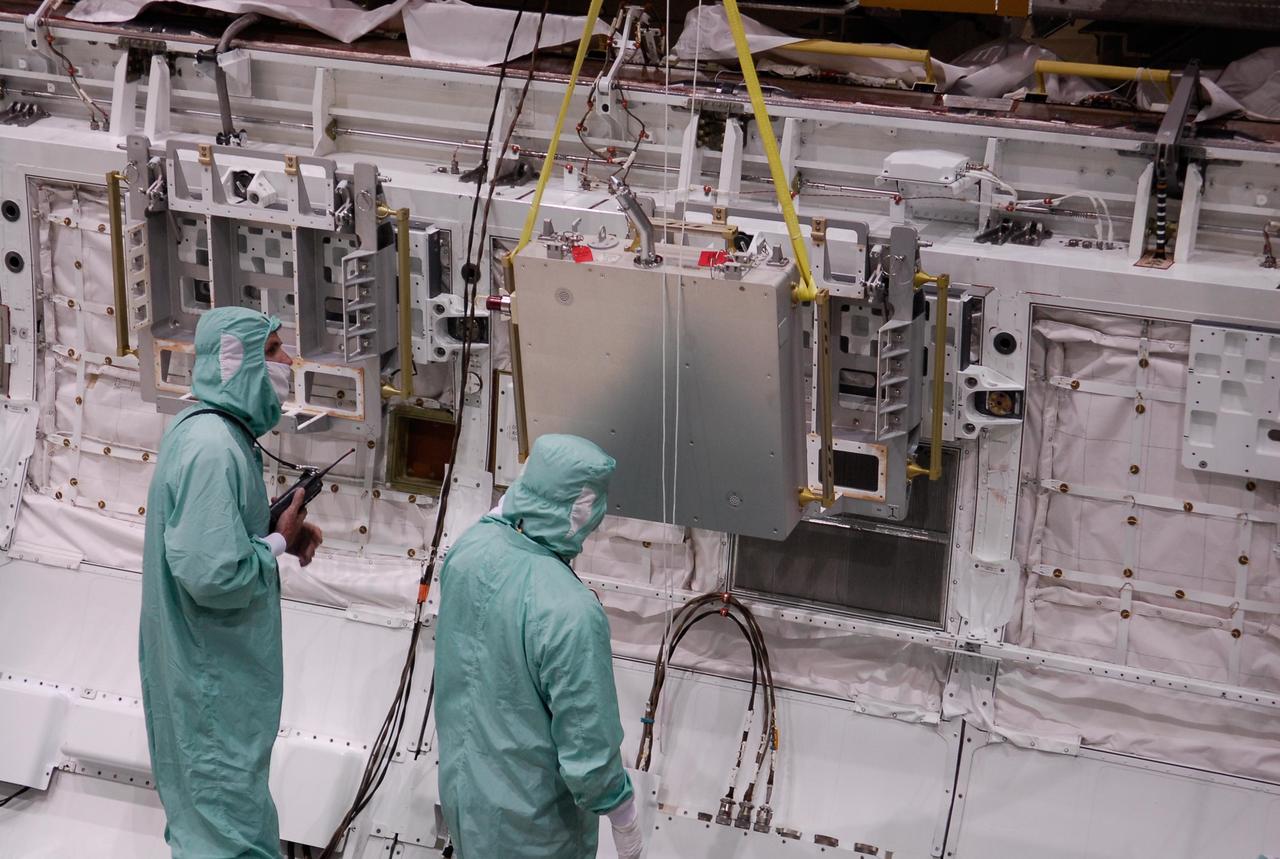
KENNEDY SPACE CENTER, FLA. -- In the Orbiter Processing Facility, one of two Materials International Space Station Experiments, or MISSE, is lowered into space shuttle Endeavour's payload bay for installation. The MISSE is part of the payload onboard Endeavour for mission STS-123. The MISSE project is a NASA/Langley Research Center-managed cooperative endeavor to fly materials and other types of space exposure experiments on the International Space Station. The objective is to develop early, low-cost, non-intrusive opportunities to conduct critical space exposure tests of space materials and components planned for use on future spacecraft. Photo credit: NASA/Kim Shiflett
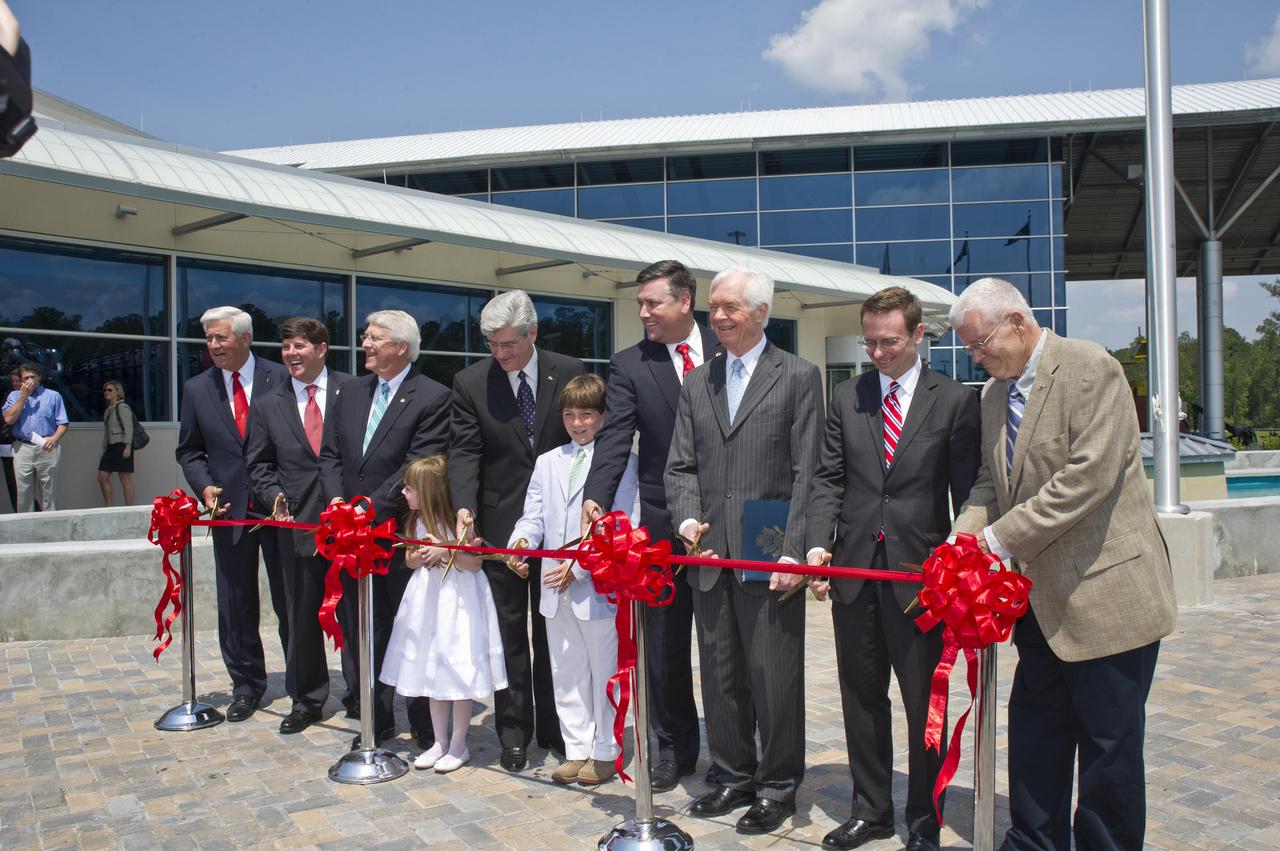
Ceremony participants prepare to cut the ribbon on the INFINITY at NASA Stennis Space Center facility April 11, 2012. Participating in the ceremony were (l to r): Gulfport Mayor and INFINITY Science Center Inc. Chairman George Schloegel; U.S. Rep. Steven Palazzo, R-Miss.; U.S. Sen. Roger Wicker, R-Miss.; Roy S. Estess granddaughter Lauren McKay; Mississippi Gov. Phil Bryant; Leo Seal Jr. grandson Leo Seal IV; Stennis Director Patrick Scheuermann; U.S. Sen. Thad Cochran, R-Miss.; NASA Chief of Staff David Radzanowski; and Apollo 13 astronaut and INFINITY Science Center Inc. Vice Chairman Fred Haise.
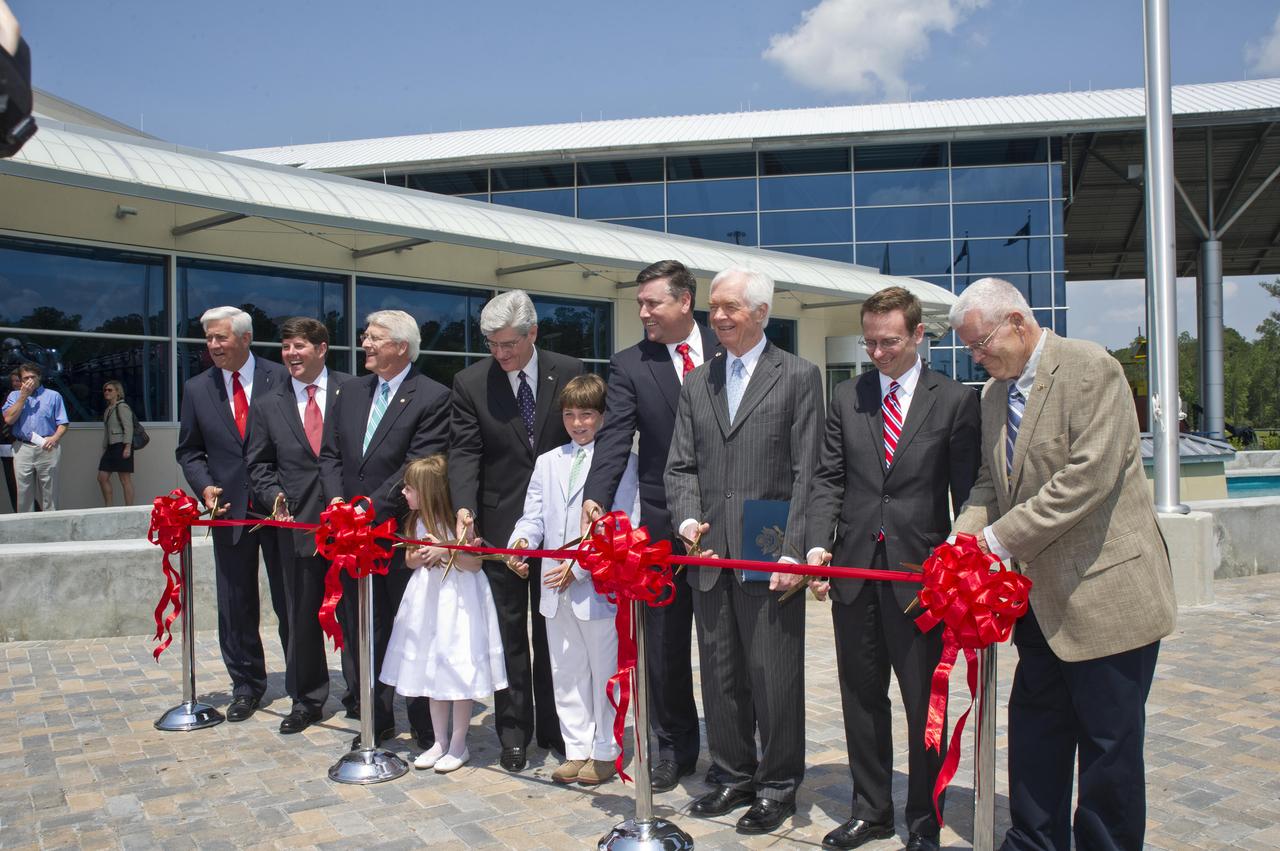
Ceremony participants prepare to cut the ribbon on the INFINITY at NASA Stennis Space Center facility April 11, 2012. Participating in the ceremony were (l to r): Gulfport Mayor and INFINITY Science Center Inc. Chairman George Schloegel; U.S. Rep. Steven Palazzo, R-Miss.; U.S. Sen. Roger Wicker, R-Miss.; Roy S. Estess granddaughter Lauren McKay; Mississippi Gov. Phil Bryant; Leo Seal Jr. grandson Leo Seal IV; Stennis Director Patrick Scheuermann; U.S. Sen. Thad Cochran, R-Miss.; NASA Chief of Staff David Radzanowski; and Apollo 13 astronaut and INFINITY Science Center Inc. Vice Chairman Fred Haise.

KENNEDY SPACE CENTER, FLA. -- In the Orbiter Processing Facility, technicians help lift the first of the Materials International Space Station Experiments, or MISSE, from a shipping container. The MISSE is part of the payload onboard space shuttle Endeavour for mission STS-123. It will be installed in Endeavour's payload bay. The MISSE project is a NASA/Langley Research Center-managed cooperative endeavor to fly materials and other types of space exposure experiments on the International Space Station. The objective is to develop early, low-cost, non-intrusive opportunities to conduct critical space exposure tests of space materials and components planned for use on future spacecraft. Photo credit: NASA/Kim Shiflett
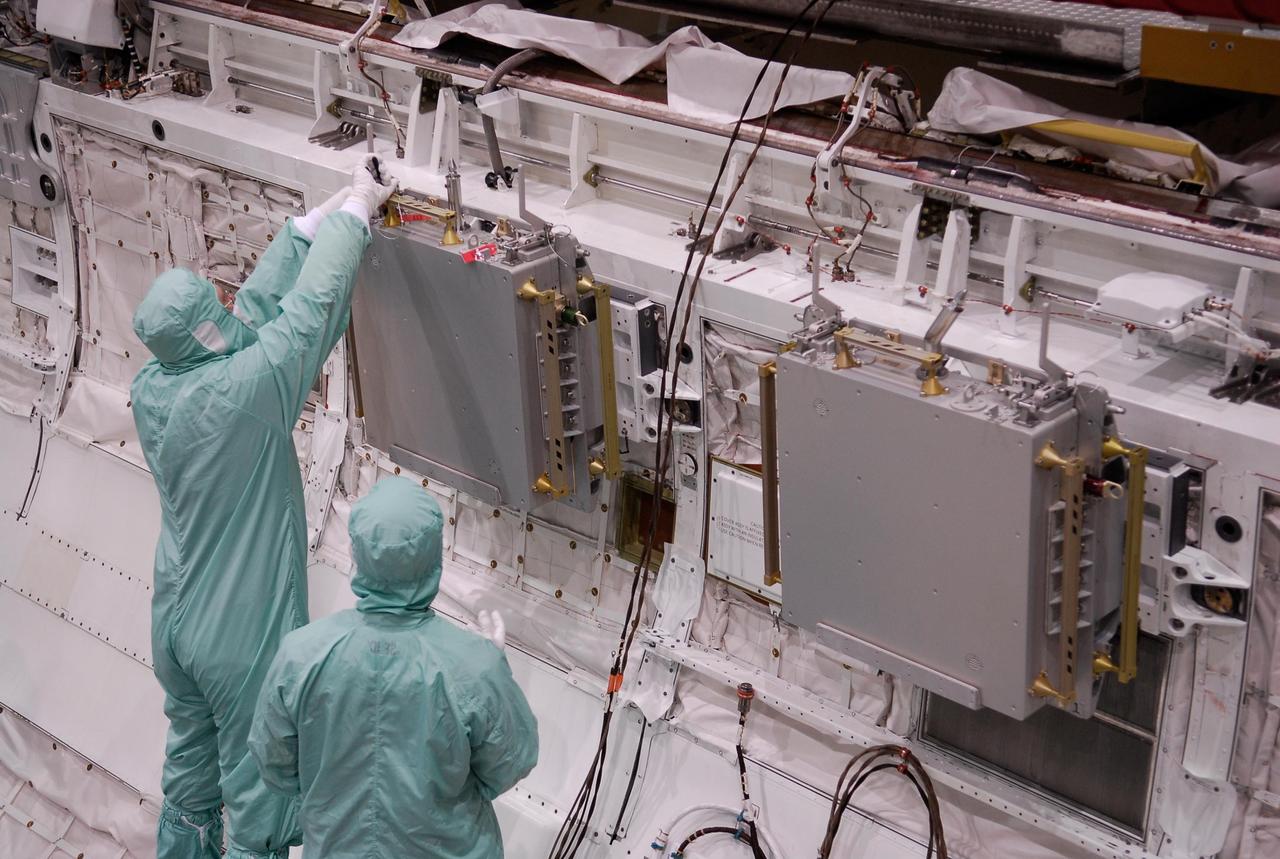
KENNEDY SPACE CENTER, FLA. -- In the Orbiter Processing Facility, technicians install the second Materials International Space Station Experiments, or MISSE, in space shuttle Endeavour's payload bay. The MISSE is part of the payload onboard Endeavour for mission STS-123. The MISSE project is a NASA/Langley Research Center-managed cooperative endeavor to fly materials and other types of space exposure experiments on the International Space Station. The objective is to develop early, low-cost, non-intrusive opportunities to conduct critical space exposure tests of space materials and components planned for use on future spacecraft. Photo credit: NASA/Kim Shiflett
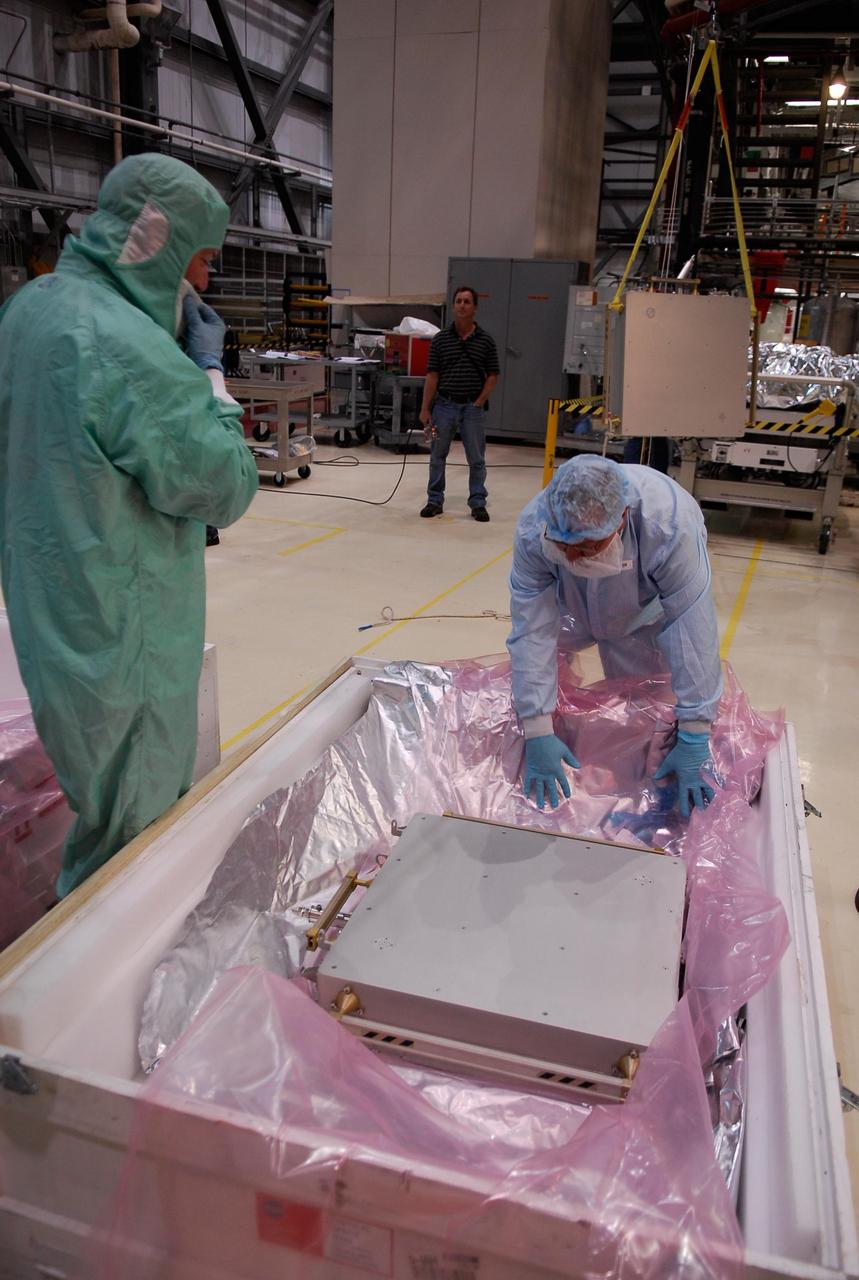
KENNEDY SPACE CENTER, FLA. -- In the Orbiter Processing Facility, technicians get ready to remove another Materials International Space Station Experiments, or MISSE, from a shipping container. The MISSE is part of the payload onboard space shuttle Endeavour for mission STS-123. It will be installed in Endeavour's payload bay. The MISSE project is a NASA/Langley Research Center-managed cooperative endeavor to fly materials and other types of space exposure experiments on the International Space Station. The objective is to develop early, low-cost, non-intrusive opportunities to conduct critical space exposure tests of space materials and components planned for use on future spacecraft. Photo credit: NASA/Kim Shiflett
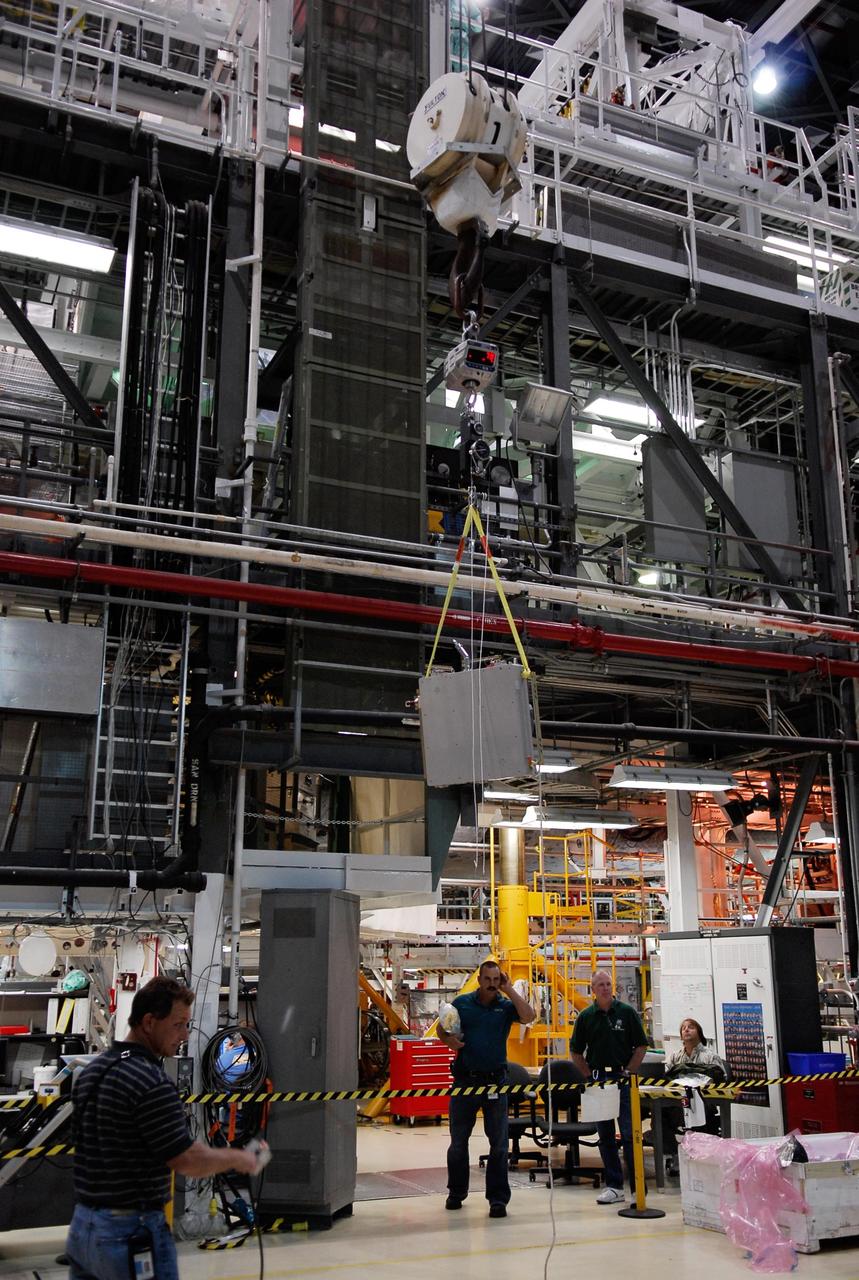
KENNEDY SPACE CENTER, FLA. -- In the Orbiter Processing Facility, one of two Materials International Space Station Experiments, or MISSE, is moved across facility toward space shuttle Endeavour. The MISSE is part of the payload onboard Endeavour for mission STS-123 and will be installed in the payload bay. The MISSE project is a NASA/Langley Research Center-managed cooperative endeavor to fly materials and other types of space exposure experiments on the International Space Station. The objective is to develop early, low-cost, non-intrusive opportunities to conduct critical space exposure tests of space materials and components planned for use on future spacecraft. Photo credit: NASA/Kim Shiflett
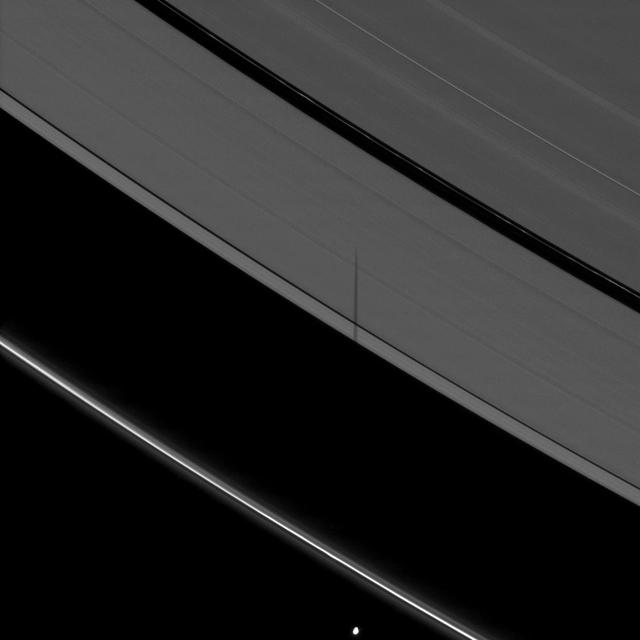
The moon Pandora casts a shadow onto Saturn A ring but not the F ring.
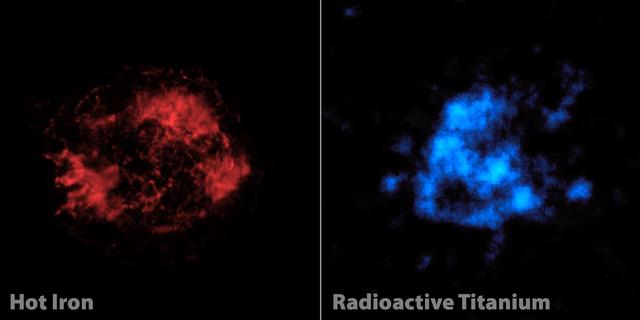
When astronomers first looked at images of a supernova remnant called Cassiopeia A, captured by NASA NuSTAR. The mystery of Cassiopeia A Cas A, a massive star that exploded in a supernova more than 11,000 years ago continues to confound scientists.
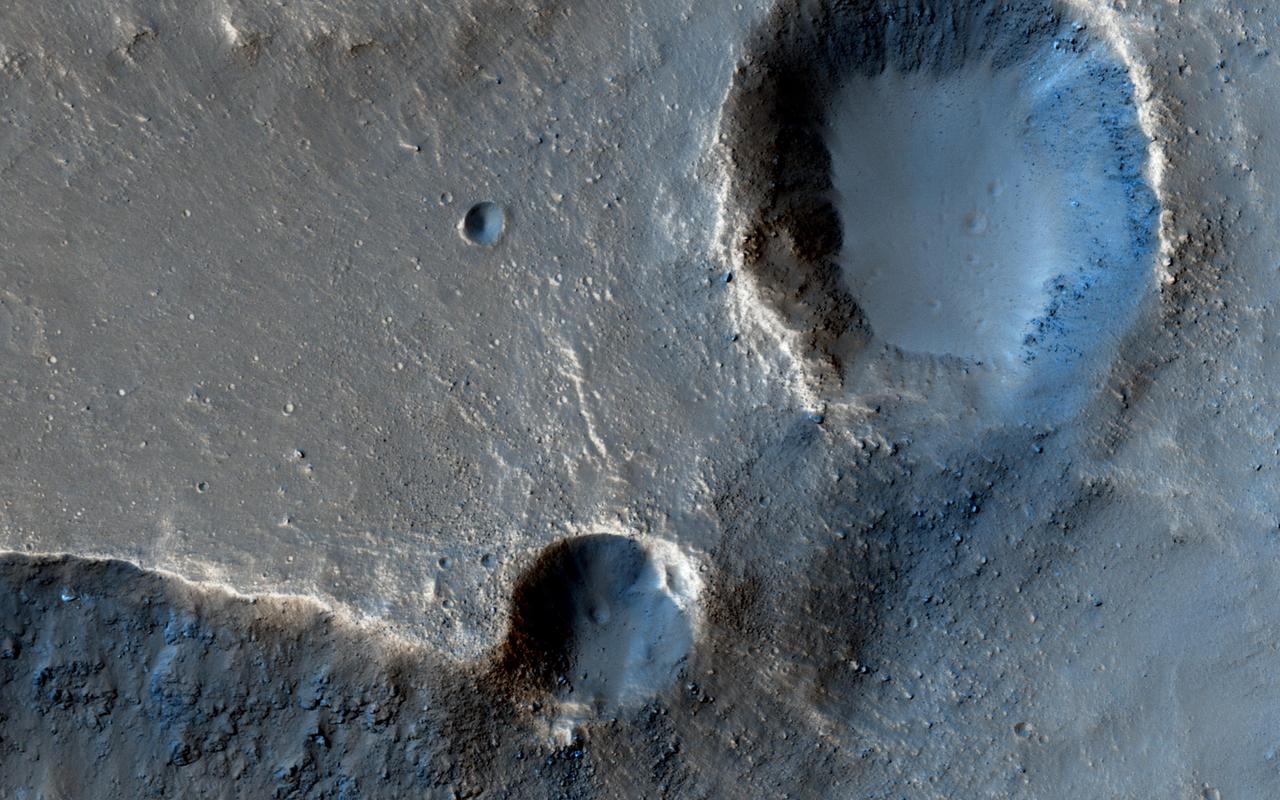
In this observation from NASA's Mars Reconnaissance Orbiter, these two craters perched at the edge of an outflow channel, appear to have lost a portion of their crater rims during a flood event. Alternatively, it is also possible that the craters impacted the edge of the outflow channel after the flood occurred and we are seeing the difference in the strength of the material impacted. https://photojournal.jpl.nasa.gov/catalog/PIA21881

NASA Spitzer and Chandra space telescopes have uncovered a long-lost population of active supermassive black holes, or quasars located deep in the bellies of distant, massive galaxies circled in blue.
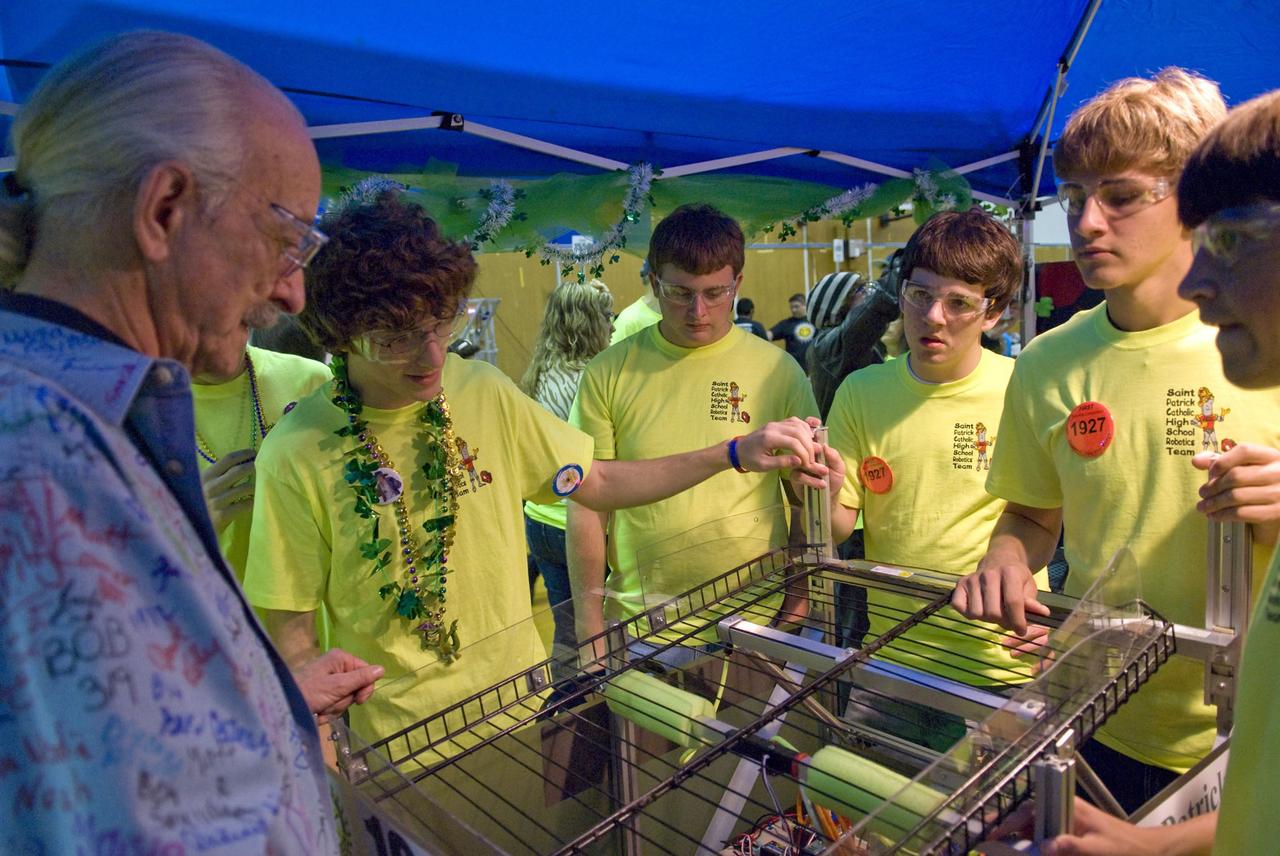
Students (left) from St. Patrick Catholic High School in Biloxi, Miss., prepare their robot during the 2009 FIRST Robotics Bayou Regional competition.