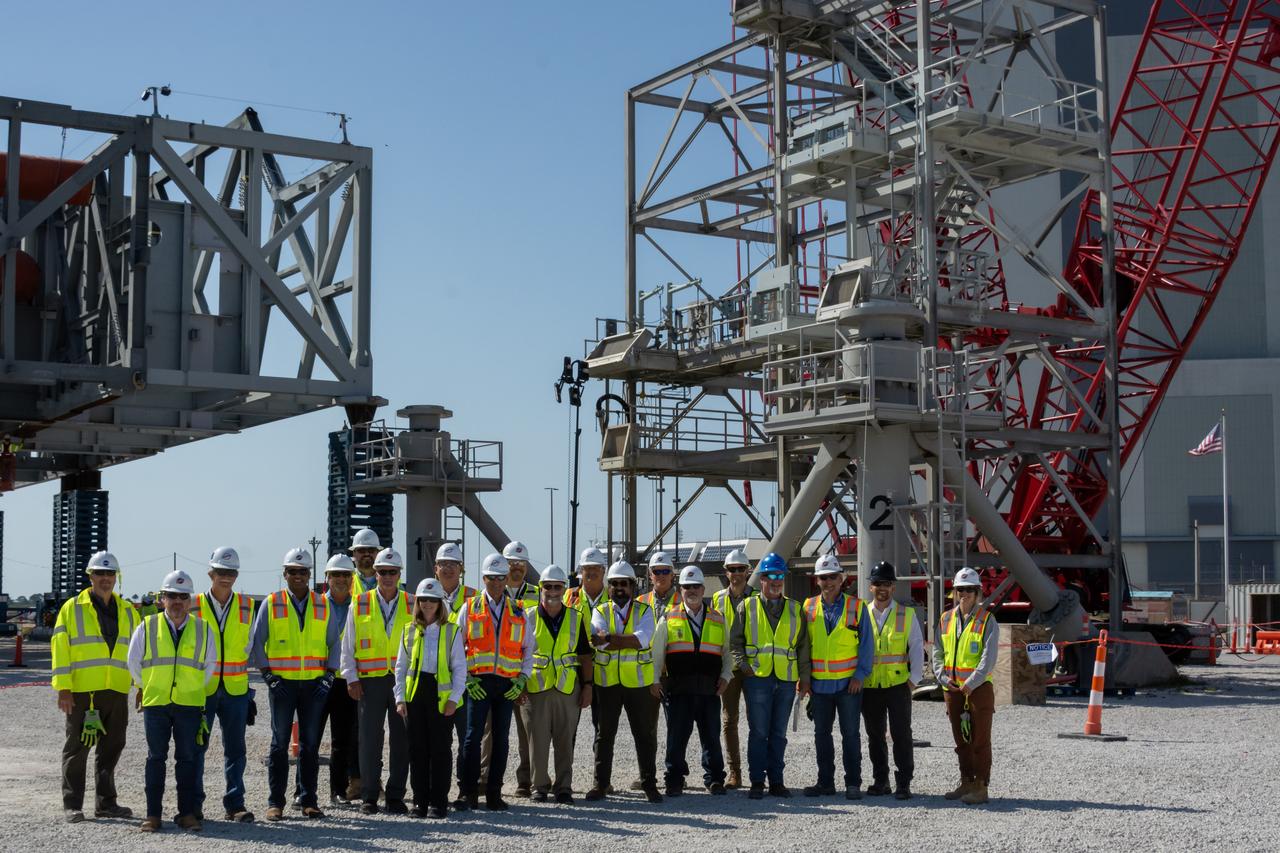
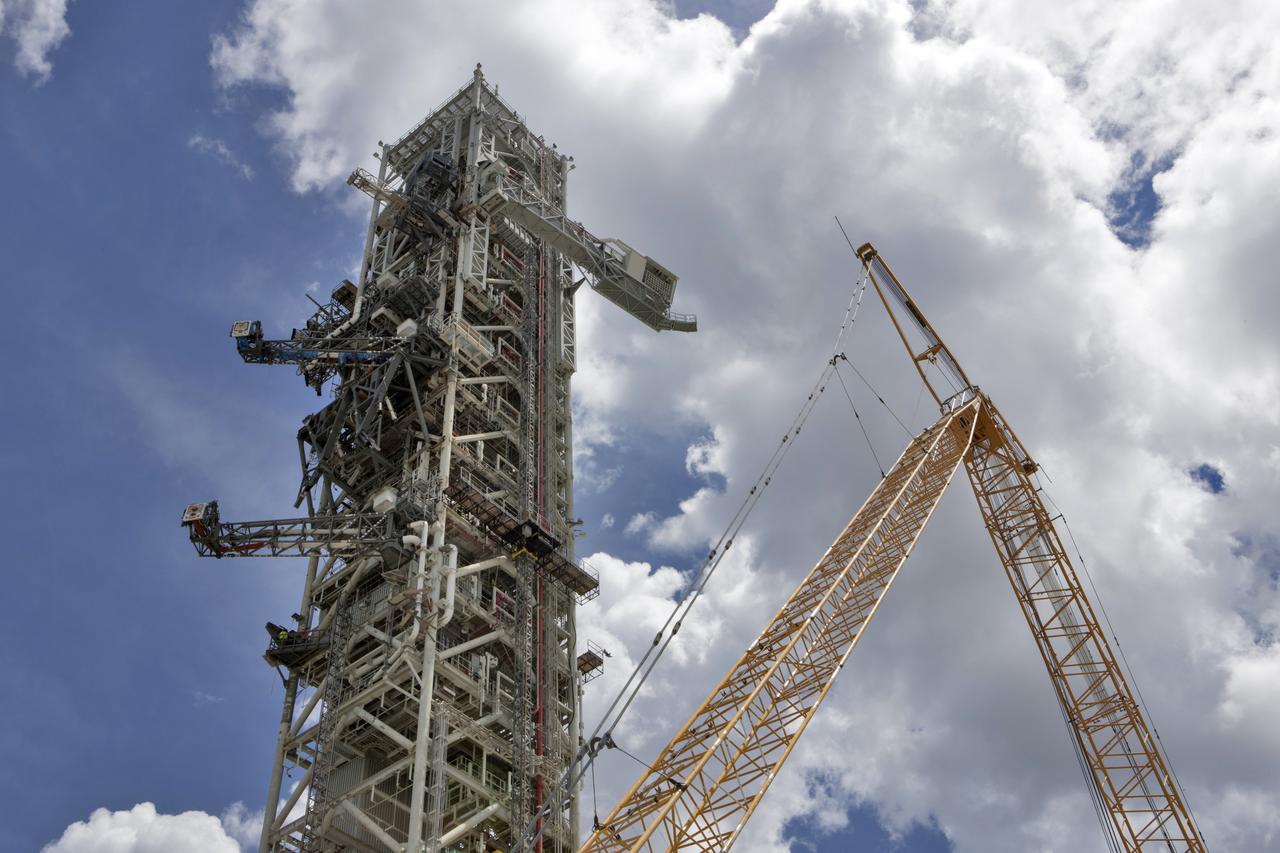
Teams with NASA’s Exploration Ground Systems Program and primary contractor, Bechtel National, Inc., pose for a photo near construction of a permanent mount structure where they will continue building the agency’s new mobile launcher 2 at Kennedy Space Center in Florida on Thursday, May 9, 2024. The 355-foot-tall mobile launcher 2 with a two-story base and a tower will be used to assemble and process the SLS (Space Launch System) rocket and Orion spacecraft in the Vehicle Assembly Building on NASA’s upcoming Artemis missions to the Moon beginning with Artemis IV.
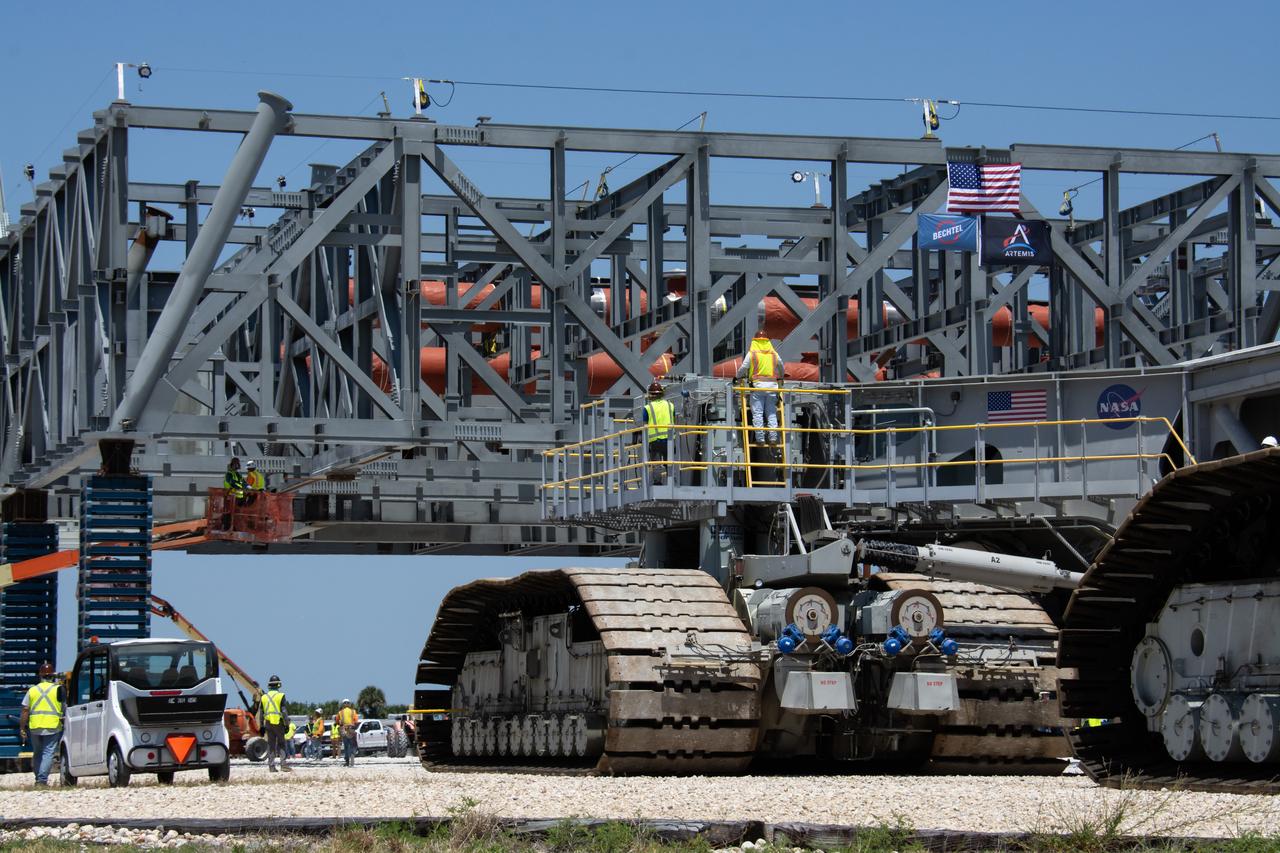
On Thursday, May 9, 2024, teams with NASA’s Exploration Ground Systems Program and primary contractor, Bechtel National, Inc., continue moving the base structure of mobile launcher 2 to a permanent mount structure where assembly will be completed at Kennedy Space Center in Florida. The 355-foot-tall mobile launcher 2 with a two-story base and a tower will be used to assemble and process the SLS (Space Launch System) rocket and Orion spacecraft in the Vehicle Assembly Building on NASA’s upcoming Artemis missions to the Moon beginning with Artemis IV.
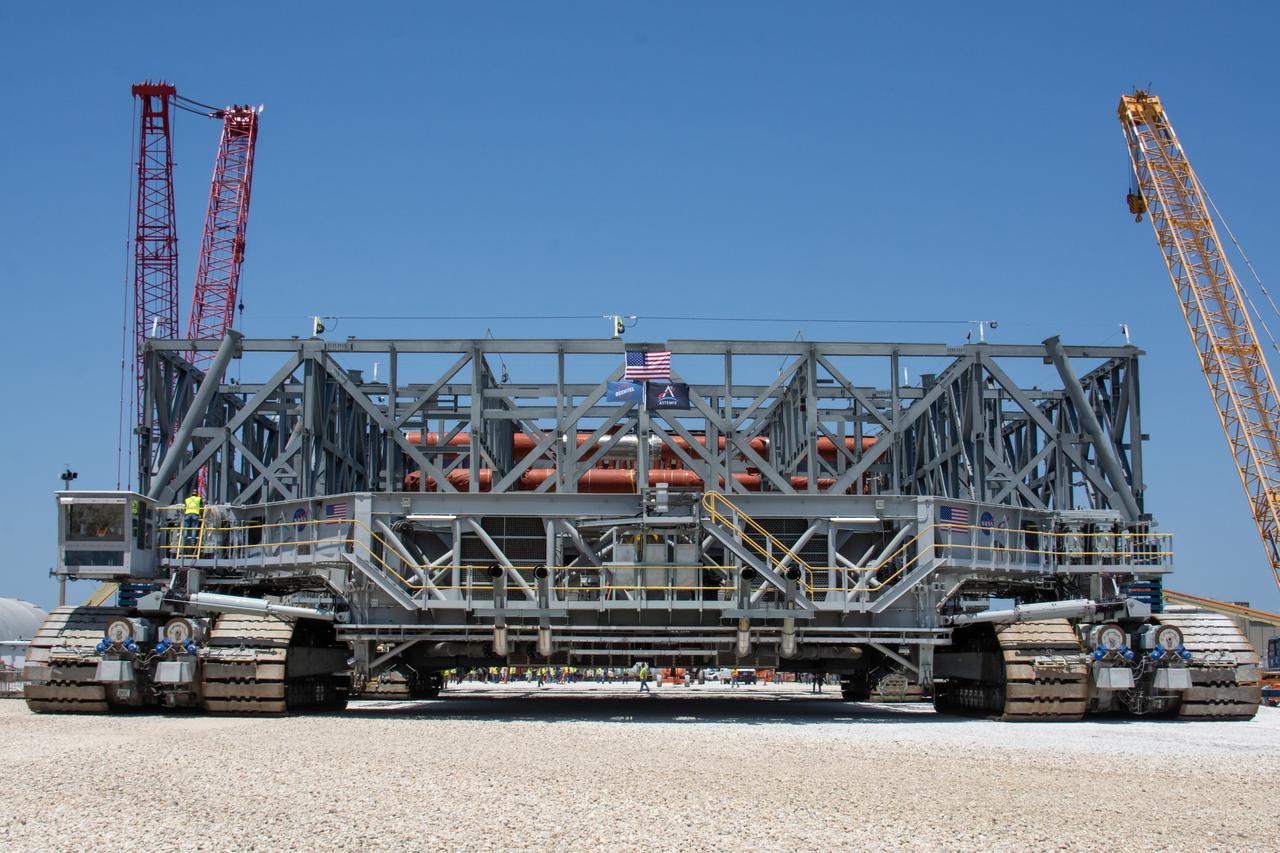
On Thursday, May 9, 2024, teams with NASA’s Exploration Ground Systems Program and primary contractor, Bechtel National, Inc., continue moving the base structure of mobile launcher 2 to a permanent mount structure where assembly will be completed at Kennedy Space Center in Florida. The 355-foot-tall mobile launcher 2 with a two-story base and a tower will be used to assemble and process the SLS (Space Launch System) rocket and Orion spacecraft in the Vehicle Assembly Building on NASA’s upcoming Artemis missions to the Moon beginning with Artemis IV.
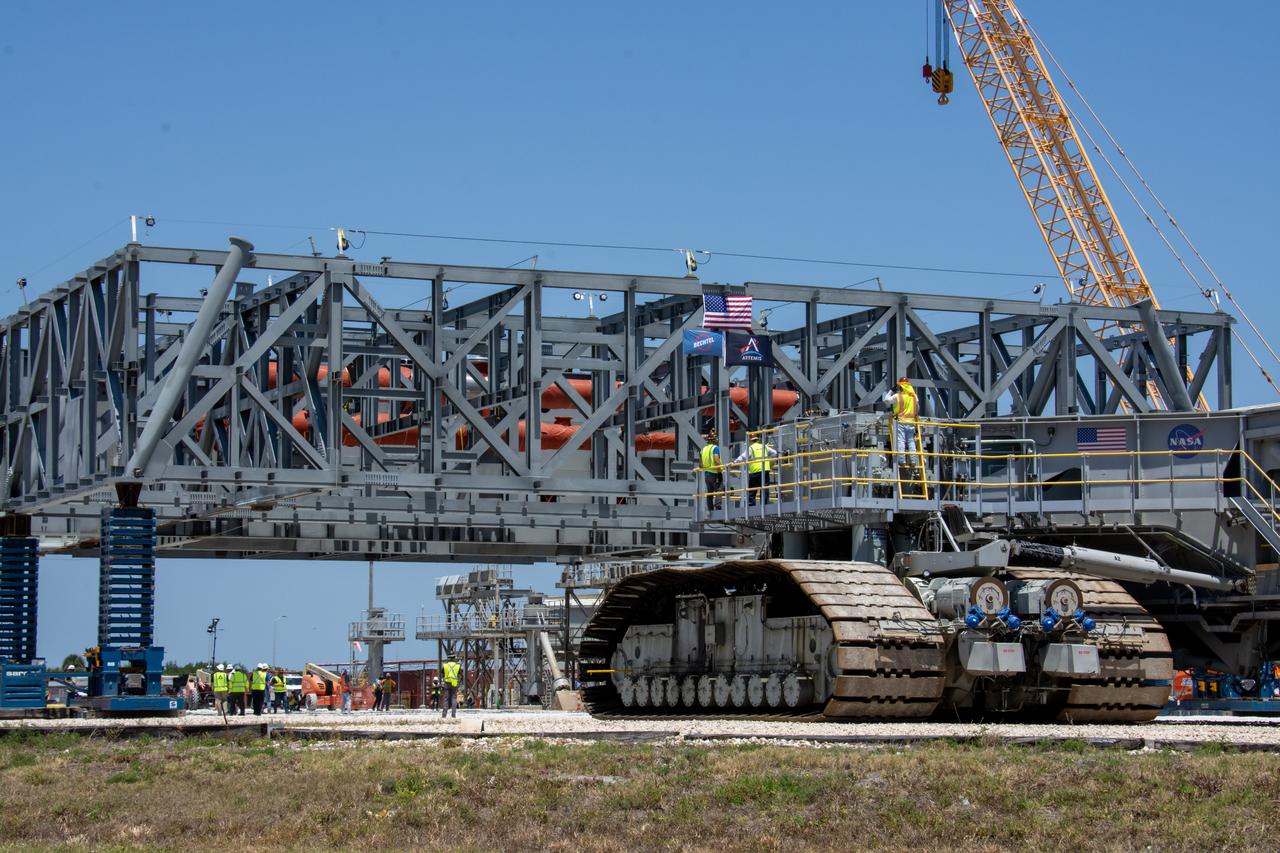
On Thursday, May 9, 2024, teams with NASA’s Exploration Ground Systems Program and primary contractor, Bechtel National, Inc., continue moving the base structure of mobile launcher 2 to a permanent mount structure where assembly will be completed at Kennedy Space Center in Florida. The 355-foot-tall mobile launcher 2 with a two-story base and a tower will be used to assemble and process the SLS (Space Launch System) rocket and Orion spacecraft in the Vehicle Assembly Building on NASA’s upcoming Artemis missions to the Moon beginning with Artemis IV.
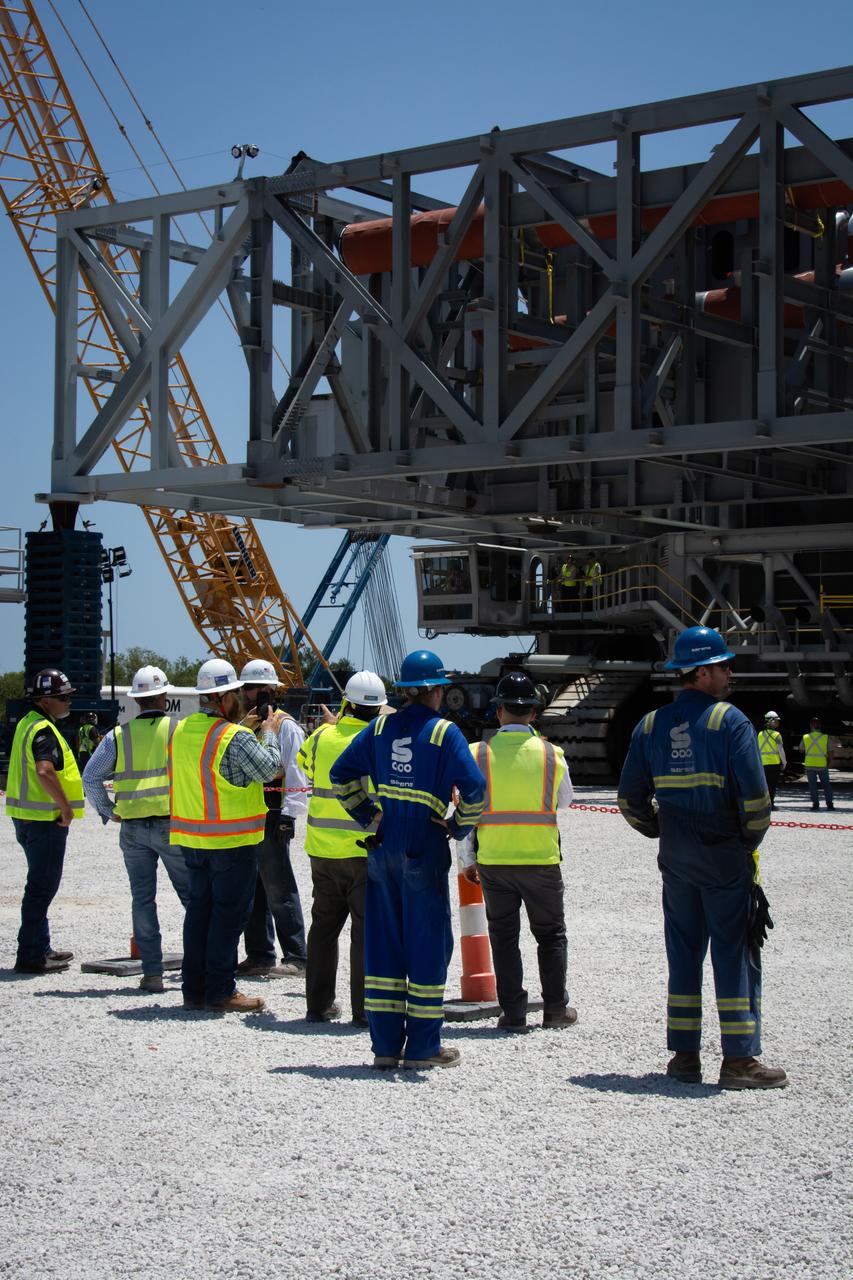
On Thursday, May 9, 2024, teams with NASA’s Exploration Ground Systems Program and primary contractor, Bechtel National, Inc., continue moving the base structure of mobile launcher 2 to a permanent mount structure where assembly will be completed at Kennedy Space Center in Florida. The 355-foot-tall mobile launcher 2 with a two-story base and a tower will be used to assemble and process the SLS (Space Launch System) rocket and Orion spacecraft in the Vehicle Assembly Building on NASA’s upcoming Artemis missions to the Moon beginning with Artemis IV.
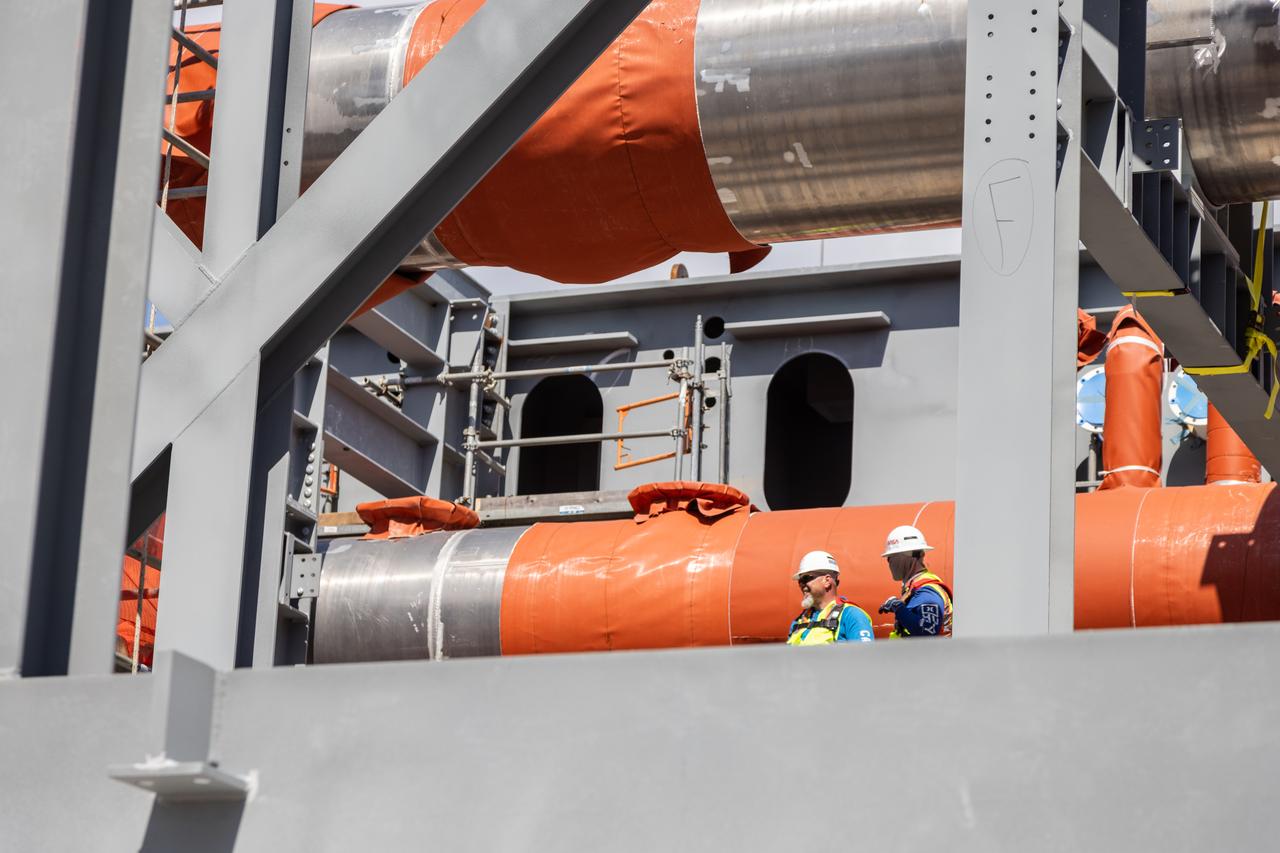
Teams with NASA’s Exploration Ground Systems Program and Bechtel National, Inc., the prime contractor for NASA’s mobile launcher 2, continue construction on the new mobile launcher at the agency’s Kennedy Space Center in Florida on Wednesday, April 24, 2024. Once completed and able to be carried atop the crawler-transporter, the 355-foot-tall mobile launcher 2 will be used during assembly, processing, and launch of the SLS (Space Launch System) rocket and Orion spacecraft on NASA’s upcoming Artemis missions to the Moon beginning with Artemis IV.

With NASA’s iconic Vehicle Assembly Building in the background, teams with the agency’s Exploration Ground Systems Program and primary contractor, Bechtel National, Inc. continue construction on the base of the platform for the new mobile launcher at Kennedy Space Center in Florida on Wednesday, April 24, 2024. Once completed and able to be carried atop the crawler-transporter, the 355-foot-tall mobile launcher 2 will be used during assembly, processing, and launch of the SLS (Space Launch System) rocket and Orion spacecraft on NASA’s upcoming Artemis missions to the Moon beginning with Artemis IV.
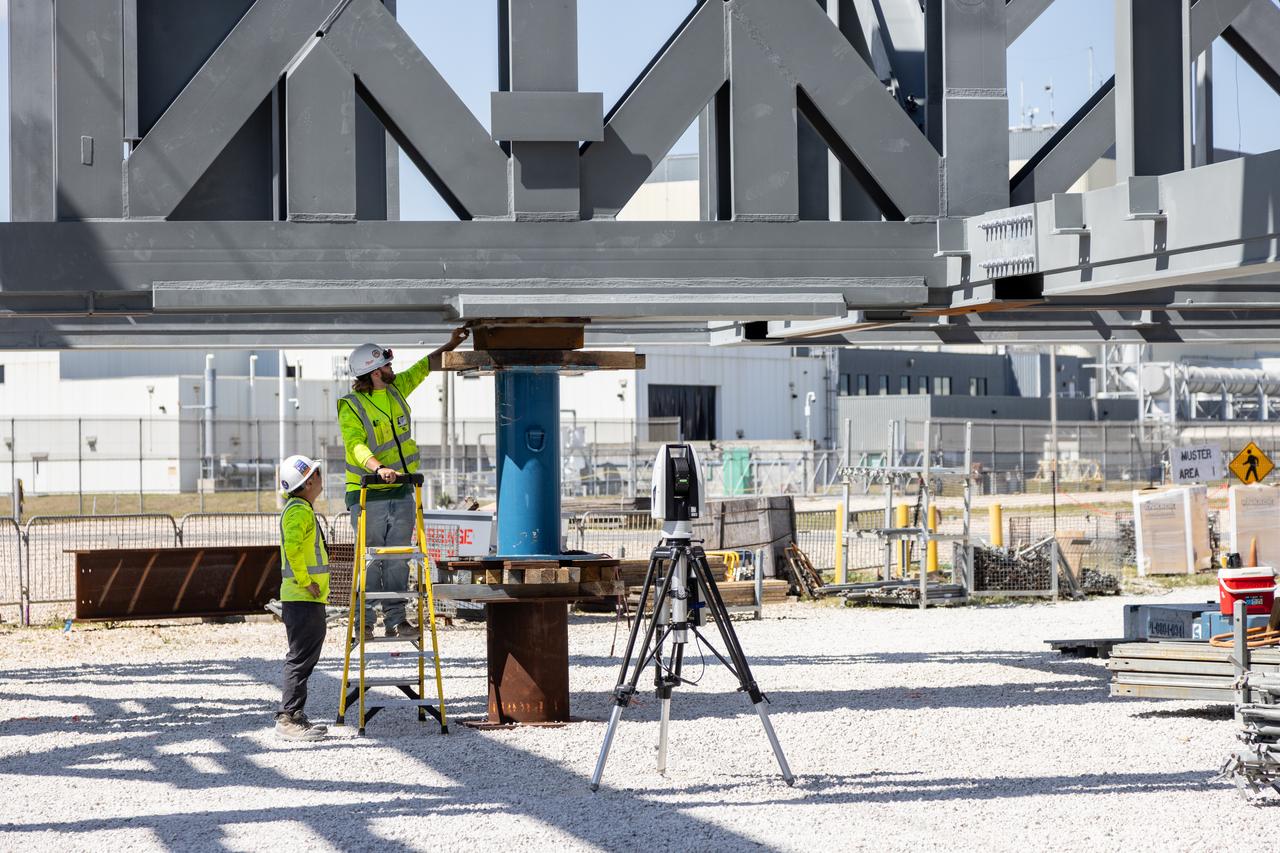
Teams with NASA’s Exploration Ground Systems Program and Bechtel National, Inc., the prime contractor for NASA’s mobile launcher 2, continue construction on the new mobile launcher at the agency’s Kennedy Space Center in Florida on Wednesday, April 24, 2024. Once completed and able to be carried atop the crawler-transporter, the 355-foot-tall mobile launcher 2 will be used during assembly, processing, and launch of the SLS (Space Launch System) rocket and Orion spacecraft on NASA’s upcoming Artemis missions to the Moon beginning with Artemis IV.
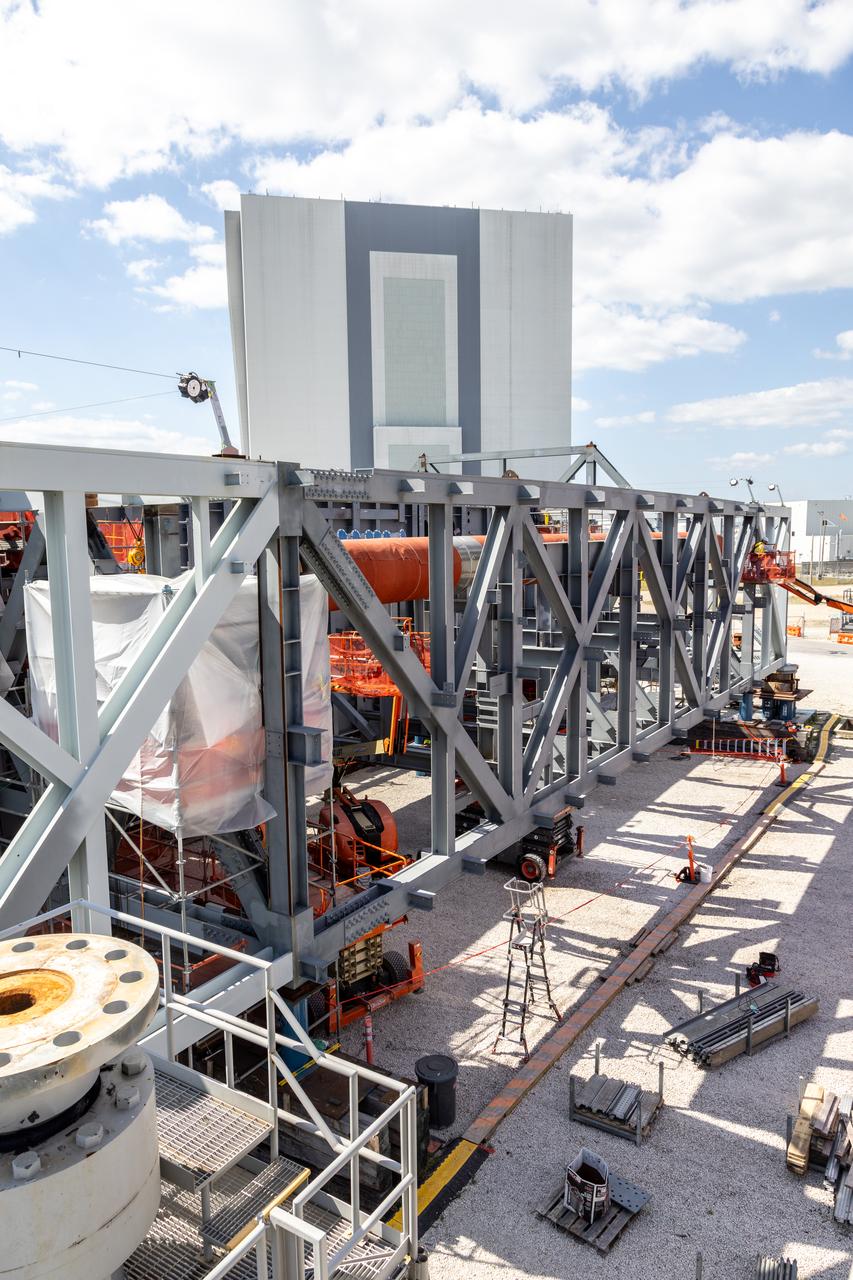
With NASA’s iconic Vehicle Assembly Building in the background, teams with the agency’s Exploration Ground Systems Program and primary contractor, Bechtel National, Inc. continue construction on the base of the platform for the new mobile launcher at Kennedy Space Center in Florida on Wednesday, April 24, 2024. Once completed and able to be carried atop the crawler-transporter, the 355-foot-tall mobile launcher 2 will be used during assembly, processing, and launch of the SLS (Space Launch System) rocket and Orion spacecraft on NASA’s upcoming Artemis missions to the Moon beginning with Artemis IV.
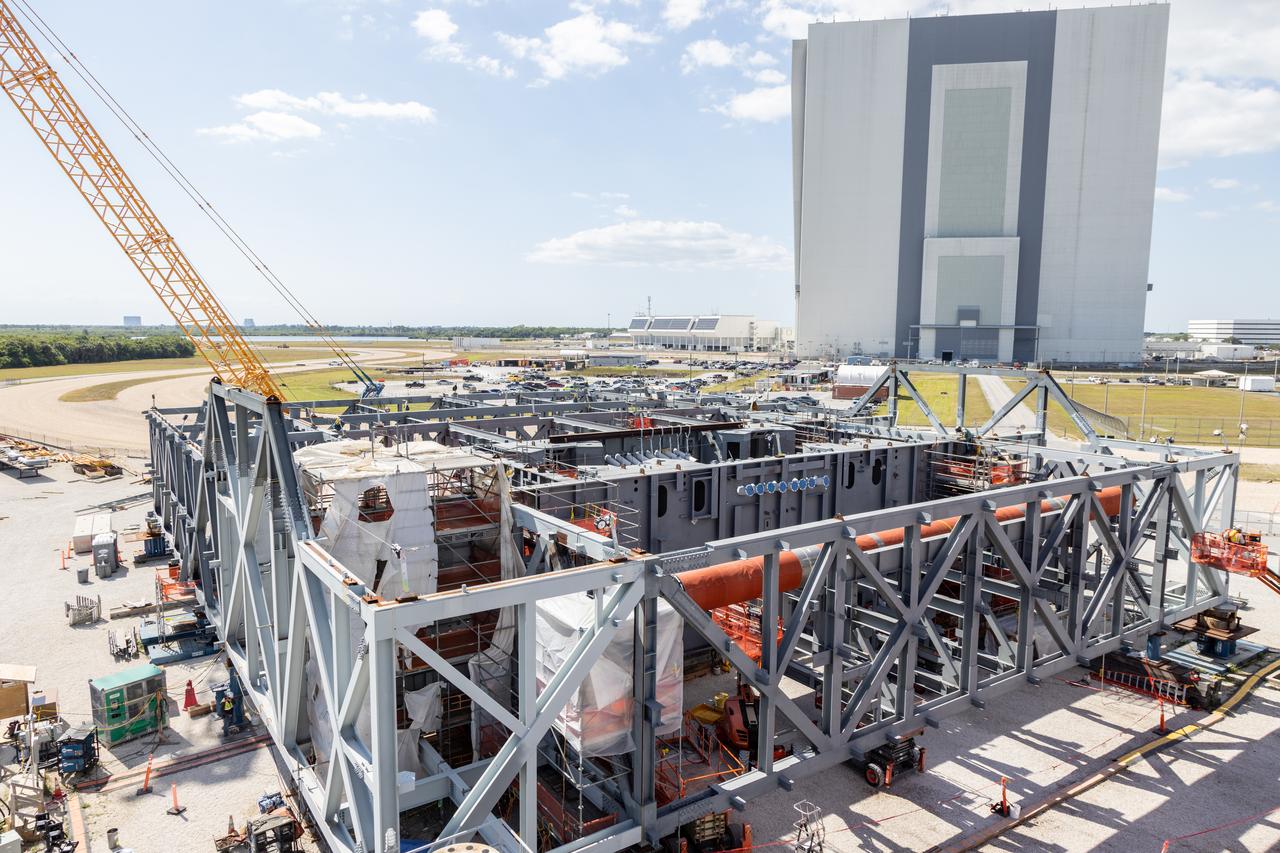
With NASA’s iconic Vehicle Assembly Building in the background, teams with the agency’s Exploration Ground Systems Program and primary contractor, Bechtel National, Inc. continue construction on the base of the platform for the new mobile launcher at Kennedy Space Center in Florida on Wednesday, April 24, 2024. Once completed and able to be carried atop the crawler-transporter, the 355-foot-tall mobile launcher 2 will be used during assembly, processing, and launch of the SLS (Space Launch System) rocket and Orion spacecraft on NASA’s upcoming Artemis missions to the Moon beginning with Artemis IV.
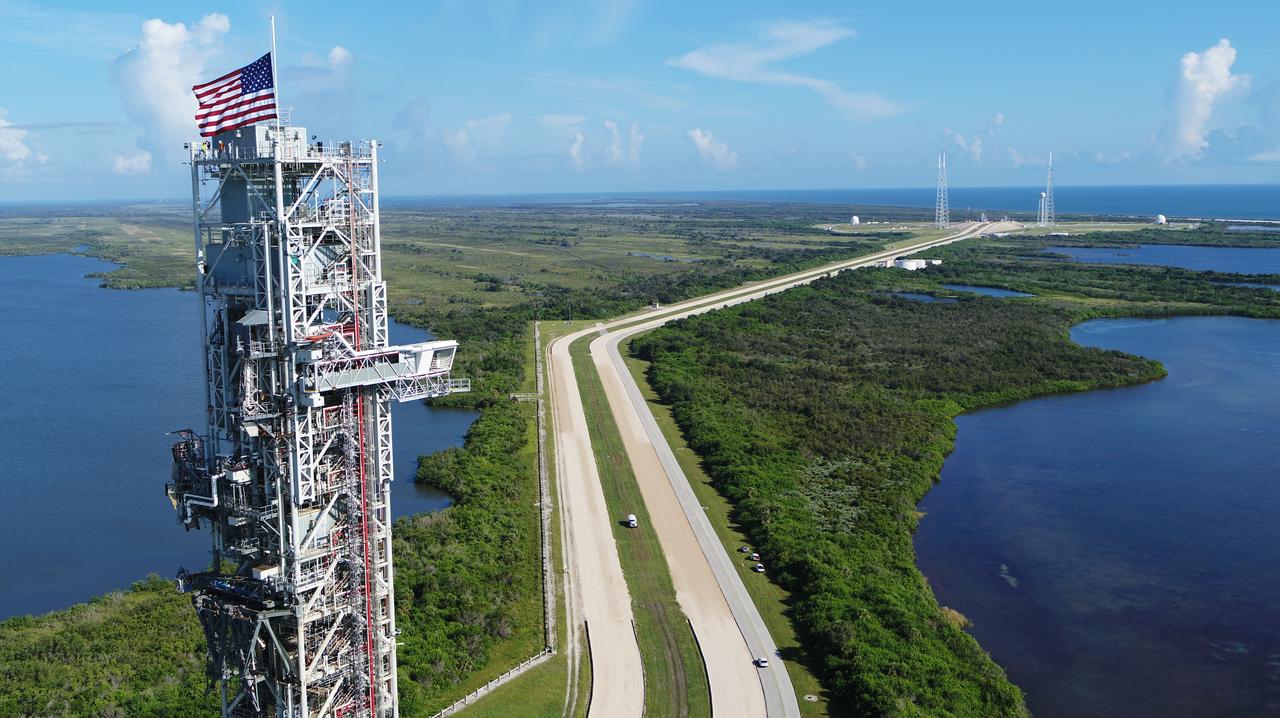
An aerial view of NASA's mobile launcher (ML) atop crawler-transporter 2 as it moves along the crawlerway to Launch Pad 39B on Aug. 31, 2018, at the agency's Kennedy Space Center in Florida. In view on top of the ML is the American flag. The ML will undergo a fit check on the surface of the pad, followed by several days of systems testing. The 380-foot-tall mobile launcher is equipped with the crew access arm and several umbilicals that will provide power, environmental control, pneumatics, communication and electrical connections to NASA's Space Launch System (SLS) and Orion spacecraft. Exploration Ground Systems is preparing the ground systems necessary to launch SLS and Orion on Exploration Mission-1, missions to the Moon and on to Mars.
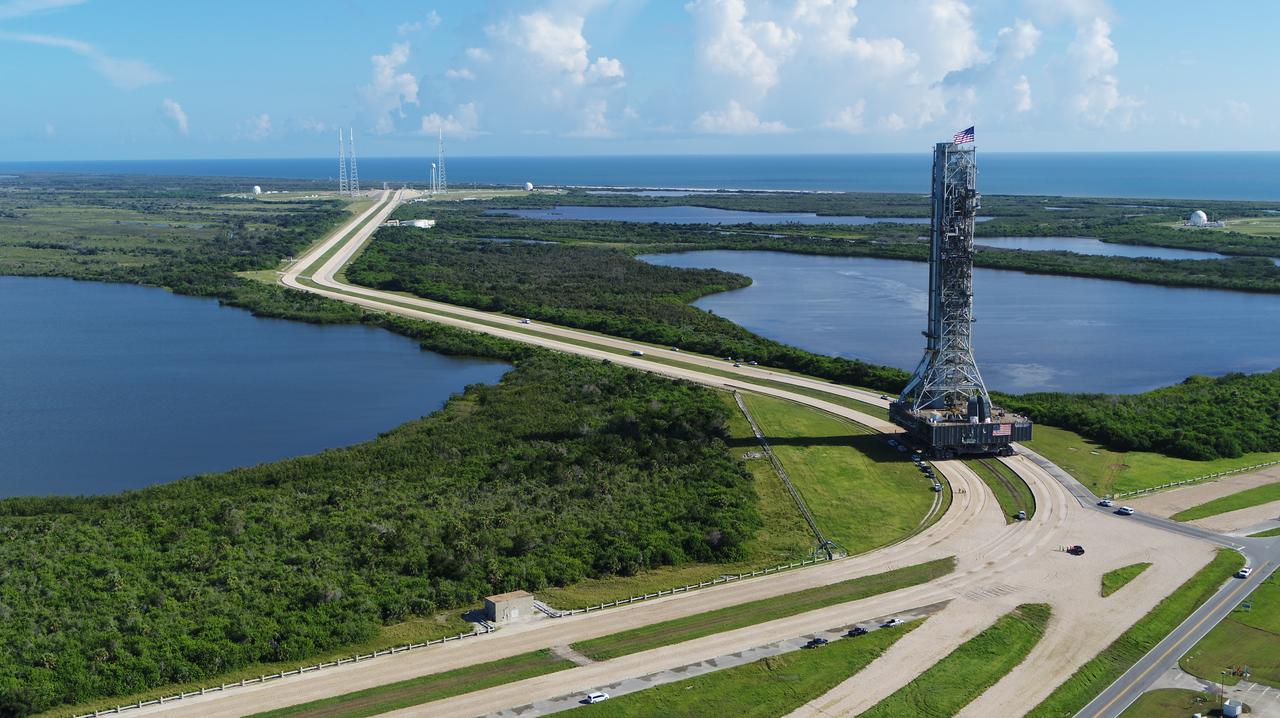
An aerial view of NASA's mobile launcher (ML) atop crawler-transporter 2 as it moves along the crawlerway, making the turn to Launch Pad 39B on Aug. 31, 2018, at the agency's Kennedy Space Center in Florida. In view on top of the ML is the American flag. The ML will undergo a fit check on the surface of the pad, followed by several days of systems testing. The 380-foot-tall mobile launcher is equipped with the crew access arm and several umbilicals that will provide power, environmental control, pneumatics, communication and electrical connections to NASA's Space Launch System (SLS) and Orion spacecraft. Exploration Ground Systems is preparing the ground systems necessary to launch SLS and Orion on Exploration Mission-1, missions to the Moon and on to Mars.
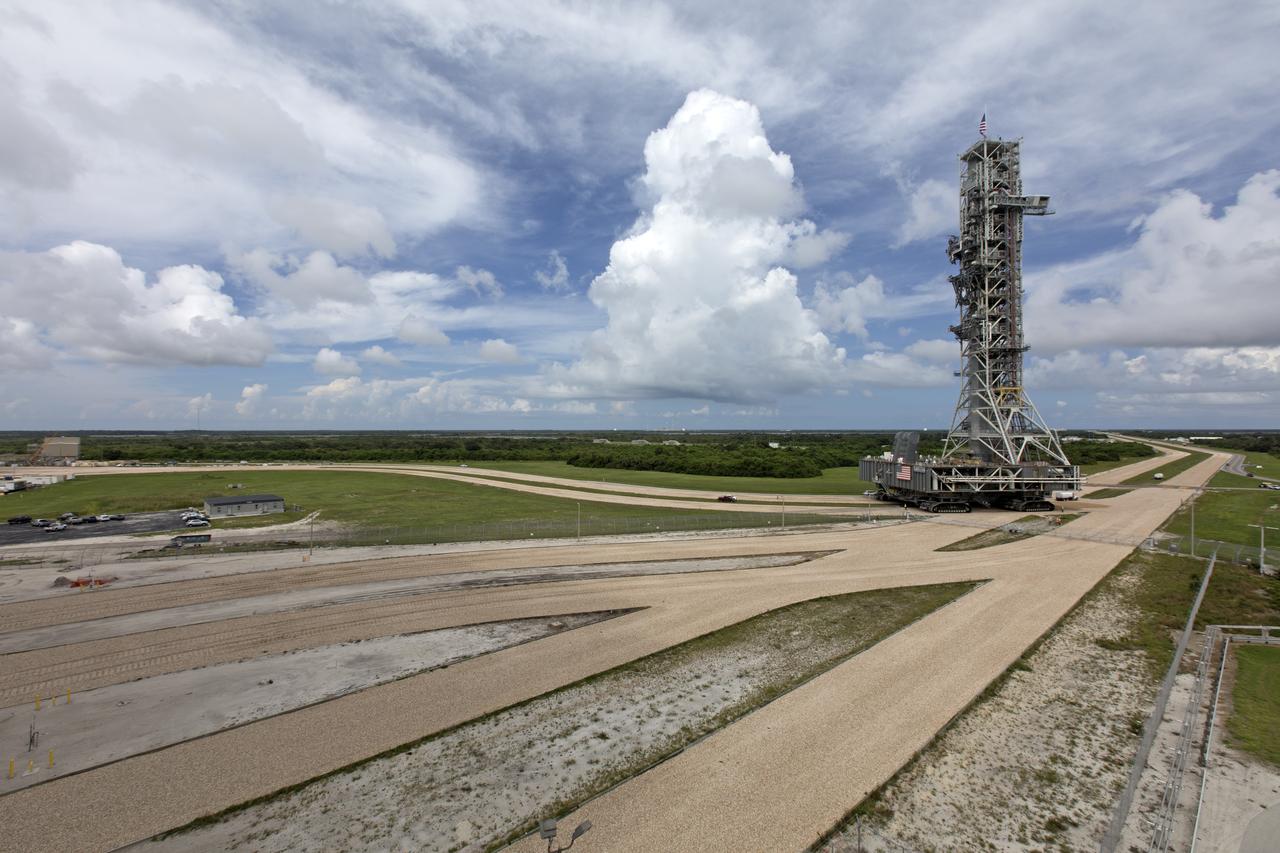
NASA's mobile launcher (ML) atop crawler-transporter 2 (CT-2) moves along the crawlerway on its trek to Launch Pad 39B on Aug. 31, 2018, at the agency's Kennedy Space Center in Florida. CT-2 will move the ML up to the surface of the pad where it will undergo a fit check, followed by several days of systems testing. The 380-foot-tall mobile launcher is equipped with the crew access arm and several umbilicals that will provide power, environmental control, pneumatics, communication and electrical connections to NASA's Space Launch System (SLS) and Orion spacecraft. Exploration Ground Systems is preparing the ground systems necessary to launch SLS and Orion on Exploration Mission-1, missions to the Moon and on to Mars.
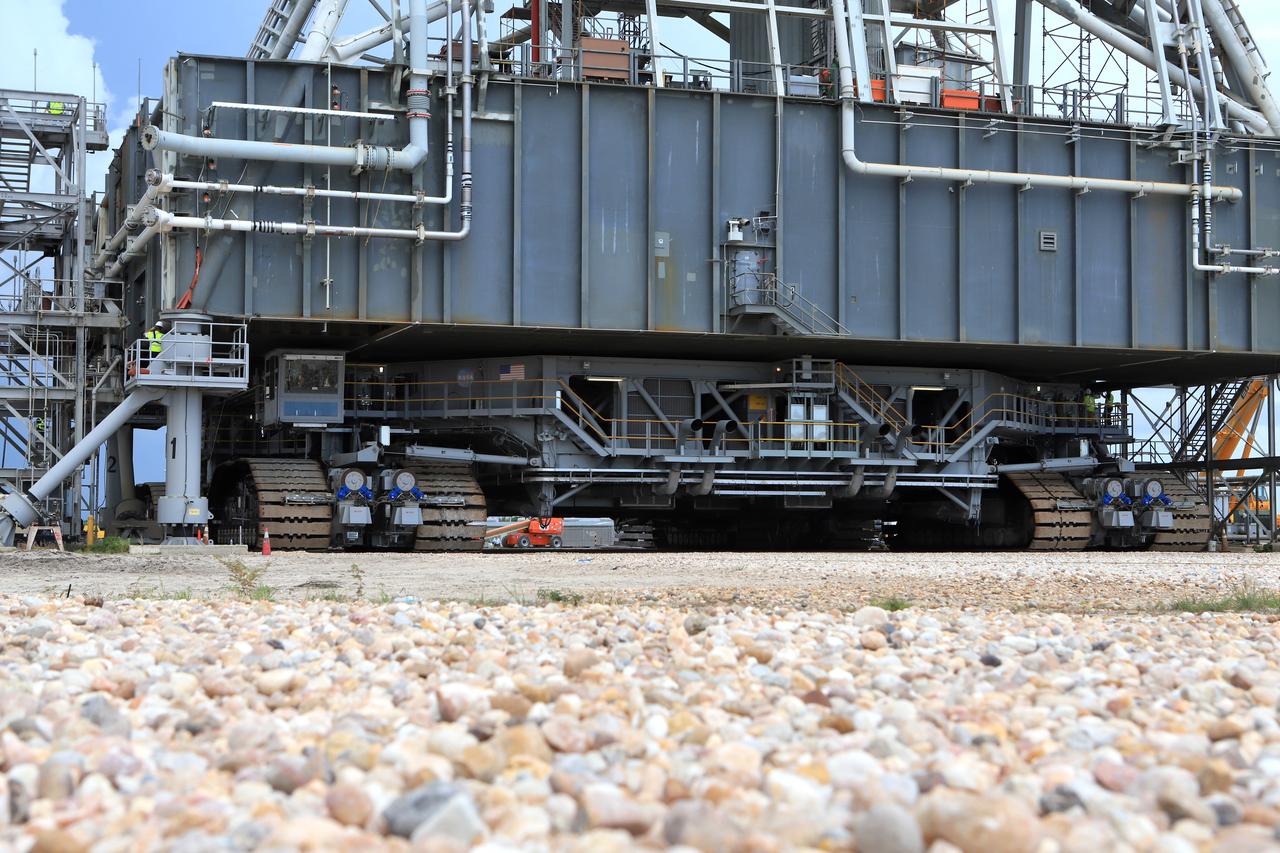
A close-up view of NASA's crawler-transporter 2 (CT-2) with the mobile launcher (ML) atop as it slowly moves along the crawlerway on its trek to Launch Pad 39B on Aug. 30, 2018, at the agency's Kennedy Space Center in Florida. CT-2 will move the ML up to the surface of the pad where it will undergo a fit check, followed by several days of systems testing. The 380-foot-tall mobile launcher is equipped with the crew access arm and several umbilicals that will provide power, environmental control, pneumatics, communication and electrical connections to NASA's Space Launch System (SLS) and Orion spacecraft. Exploration Ground Systems is preparing the ground systems necessary to launch SLS and Orion on Exploration Mission-1, missions to the Moon and on to Mars.
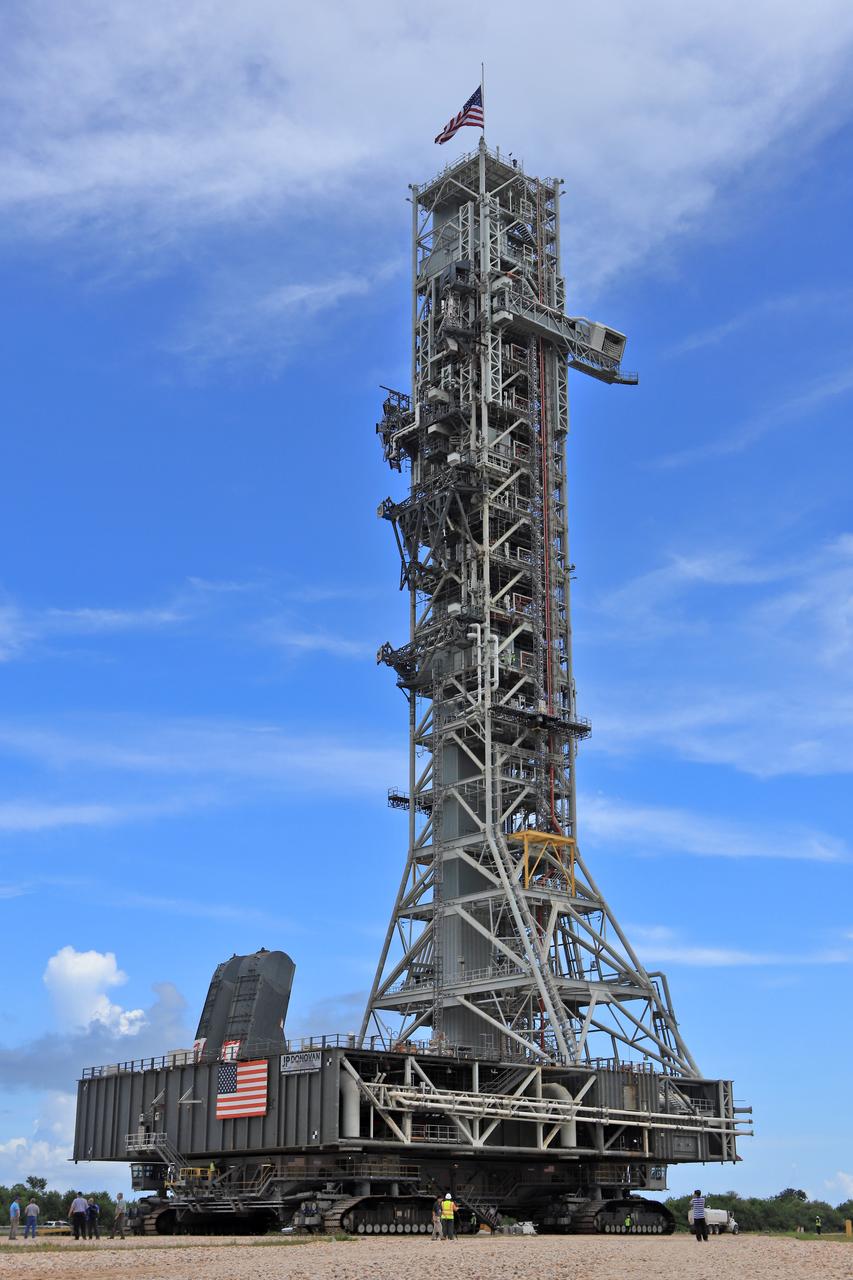
NASA's crawler-transporter 2 (CT-2) with the mobile launcher (ML) atop slowly moves along the crawlerway on its trek to Launch Pad 39B on Aug. 30, 2018, at the agency's Kennedy Space Center in Florida. CT-2 will move the ML up to the surface of the pad where it will undergo a fit check, followed by several days of systems testing. The 380-foot-tall mobile launcher is equipped with the crew access arm and several umbilicals that will provide power, environmental control, pneumatics, communication and electrical connections to NASA's Space Launch System (SLS) and Orion spacecraft. Exploration Ground Systems is preparing the ground systems necessary to launch SLS and Orion on Exploration Mission-1, missions to the Moon and on to Mars.
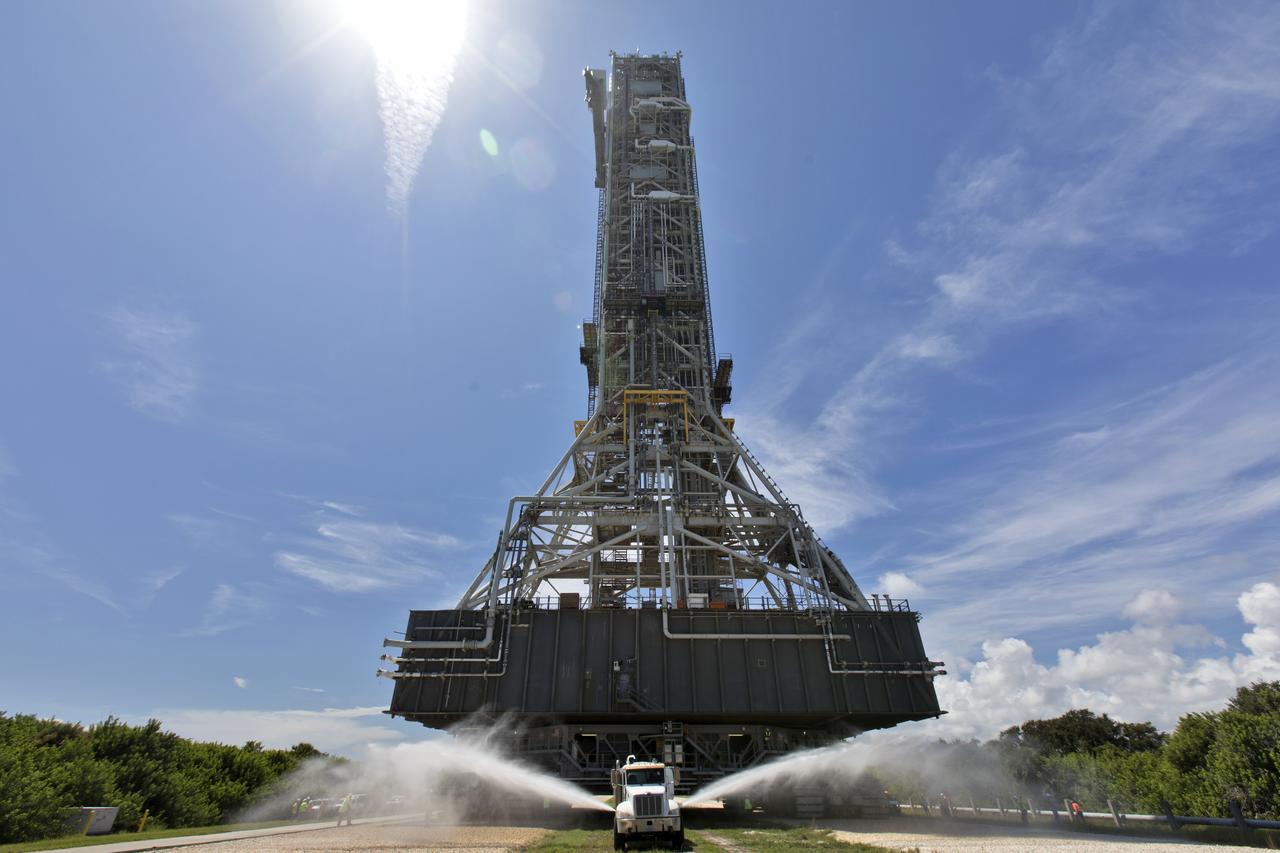
A truck sprays water to reduce the dust as NASA's crawler-transporter 2 (CT-2) with the mobile launcher (ML) atop slowly moves along the crawlerway on its trek to Launch Pad 39B on Aug. 31, 2018, at the agency's Kennedy Space Center in Florida. CT-2 will move the ML up to the surface of the pad where it will undergo a fit check, followed by several days of systems testing. The 380-foot-tall mobile launcher is equipped with the crew access arm and several umbilicals that will provide power, environmental control, pneumatics, communication and electrical connections to NASA's Space Launch System (SLS) and Orion spacecraft. Exploration Ground Systems is preparing the ground systems necessary to launch SLS and Orion on Exploration Mission-1, missions to the Moon and on to Mars.
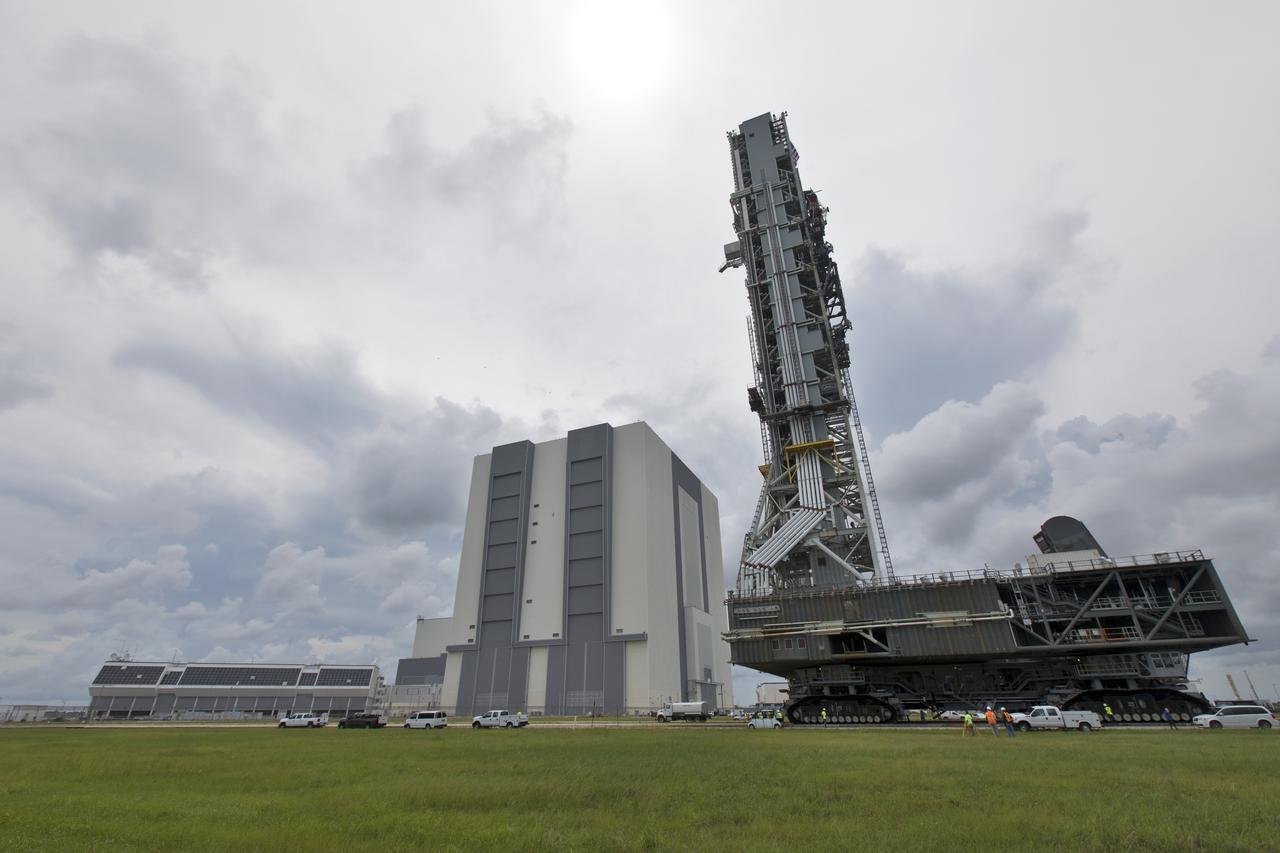
NASA's mobile launcher (ML) atop crawler-transporter 2 (CT-2) moves along the crawlerway on its trek to Launch Pad 39B on Aug. 31, 2018, at the agency's Kennedy Space Center in Florida. CT-2 will move the ML up to the surface of the pad where it will undergo a fit check, followed by several days of systems testing. The 380-foot-tall mobile launcher is equipped with the crew access arm and several umbilicals that will provide power, environmental control, pneumatics, communication and electrical connections to NASA's Space Launch System (SLS) and Orion spacecraft. Exploration Ground Systems is preparing the ground systems necessary to launch SLS and Orion on Exploration Mission-1, missions to the Moon and on to Mars.
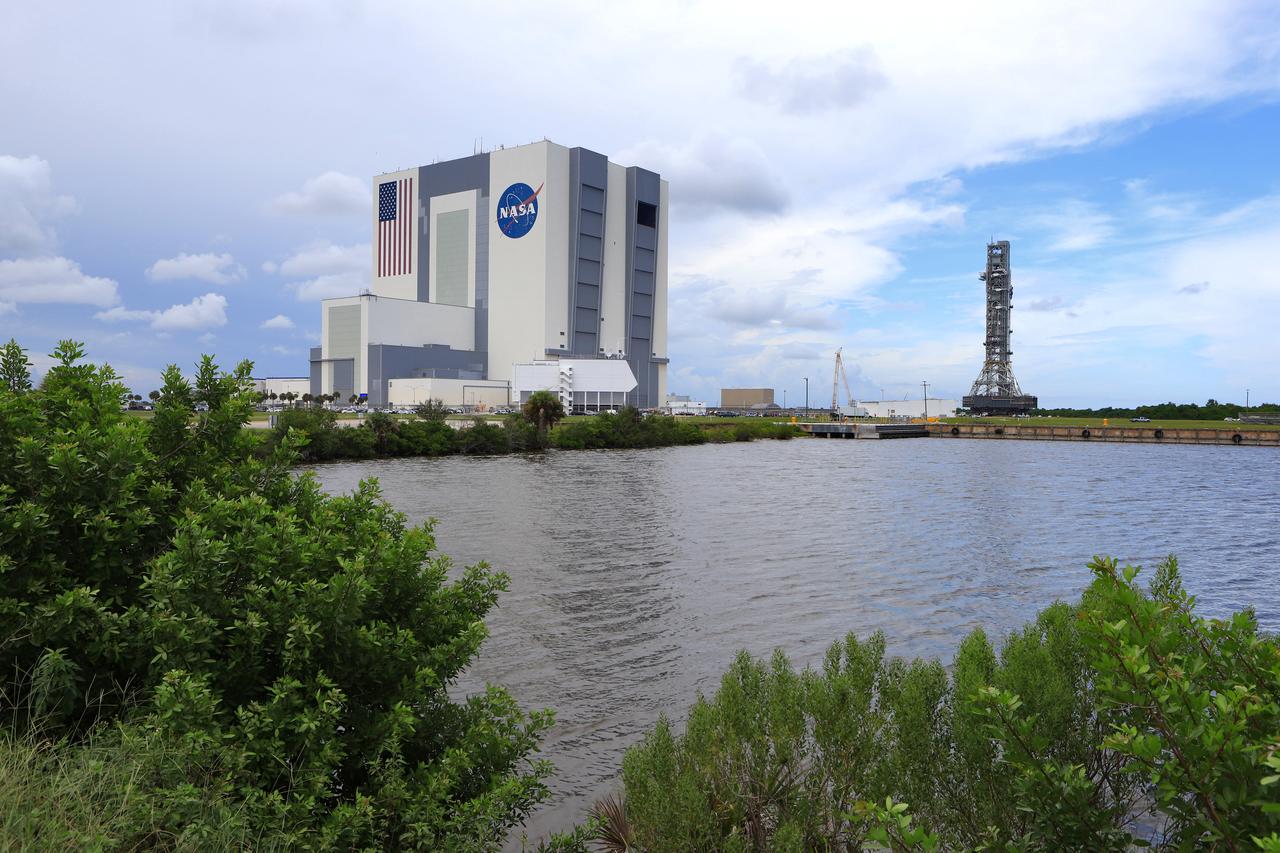
NASA's crawler-transporter 2 (CT-2) with the mobile launcher (ML) atop begins its trek along the crawlerway to Launch Pad 39B on Aug. 30, 2018, at the agency's Kennedy Space Center in Florida. At left is the iconic Vehicle Assembly Building. CT-2 will move the ML up to the surface of the pad where it will undergo a fit check, followed by several days of systems testing. The 380-foot-tall mobile launcher is equipped with the crew access arm and several umbilicals that will provide power, environmental control, pneumatics, communication and electrical connections to NASA's Space Launch System (SLS) and Orion spacecraft. Exploration Ground Systems is preparing the ground systems necessary to launch SLS and Orion on Exploration Mission-1, missions to the Moon and on to Mars.
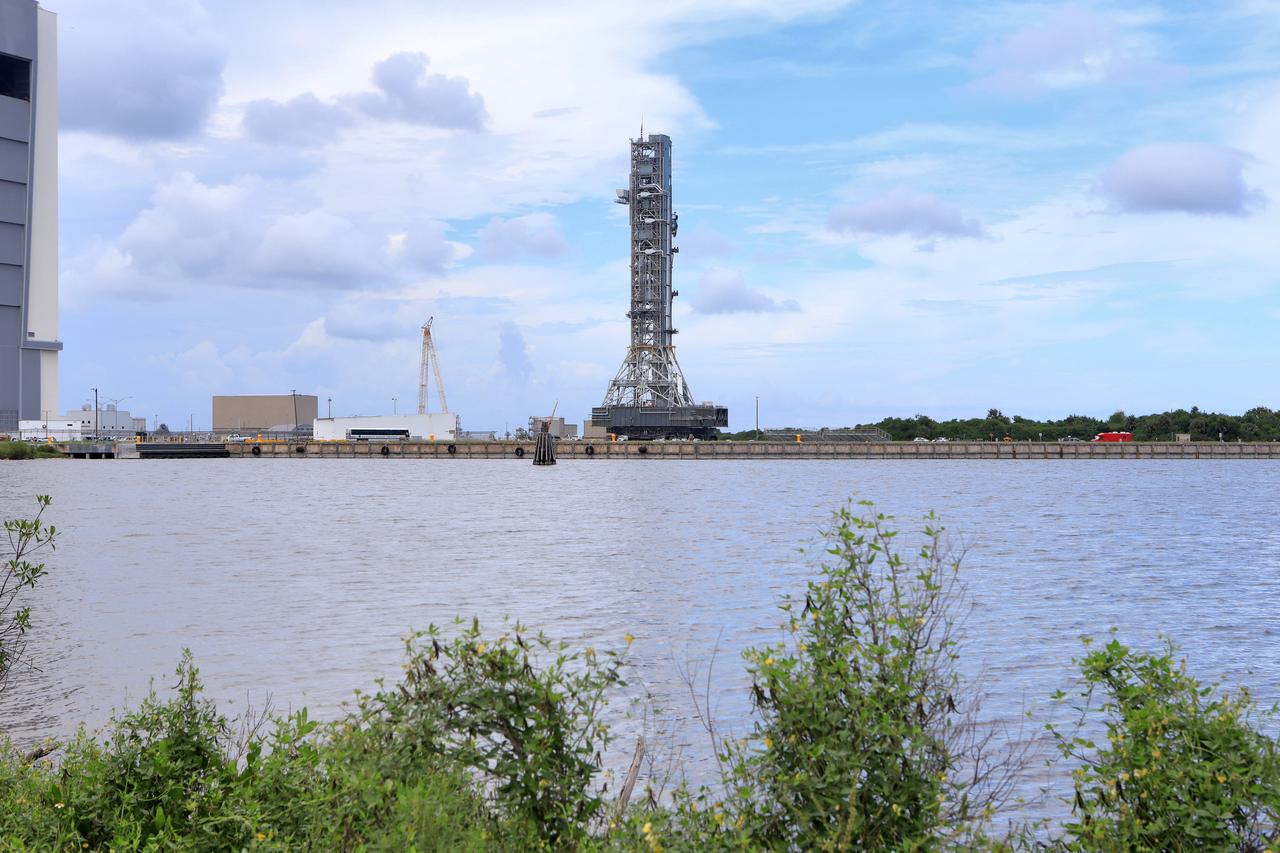
NASA's crawler-transporter 2 (CT-2) with the mobile launcher (ML) atop begins its trek along the crawlerway to Launch Pad 39B on Aug. 30, 2018, at the agency's Kennedy Space Center in Florida. CT-2 will move the ML up to the surface of the pad where it will undergo a fit check, followed by several days of systems testing. The 380-foot-tall mobile launcher is equipped with the crew access arm and several umbilicals that will provide power, environmental control, pneumatics, communication and electrical connections to NASA's Space Launch System (SLS) and Orion spacecraft. Exploration Ground Systems is preparing the ground systems necessary to launch SLS and Orion on Exploration Mission-1, missions to the Moon and on to Mars.
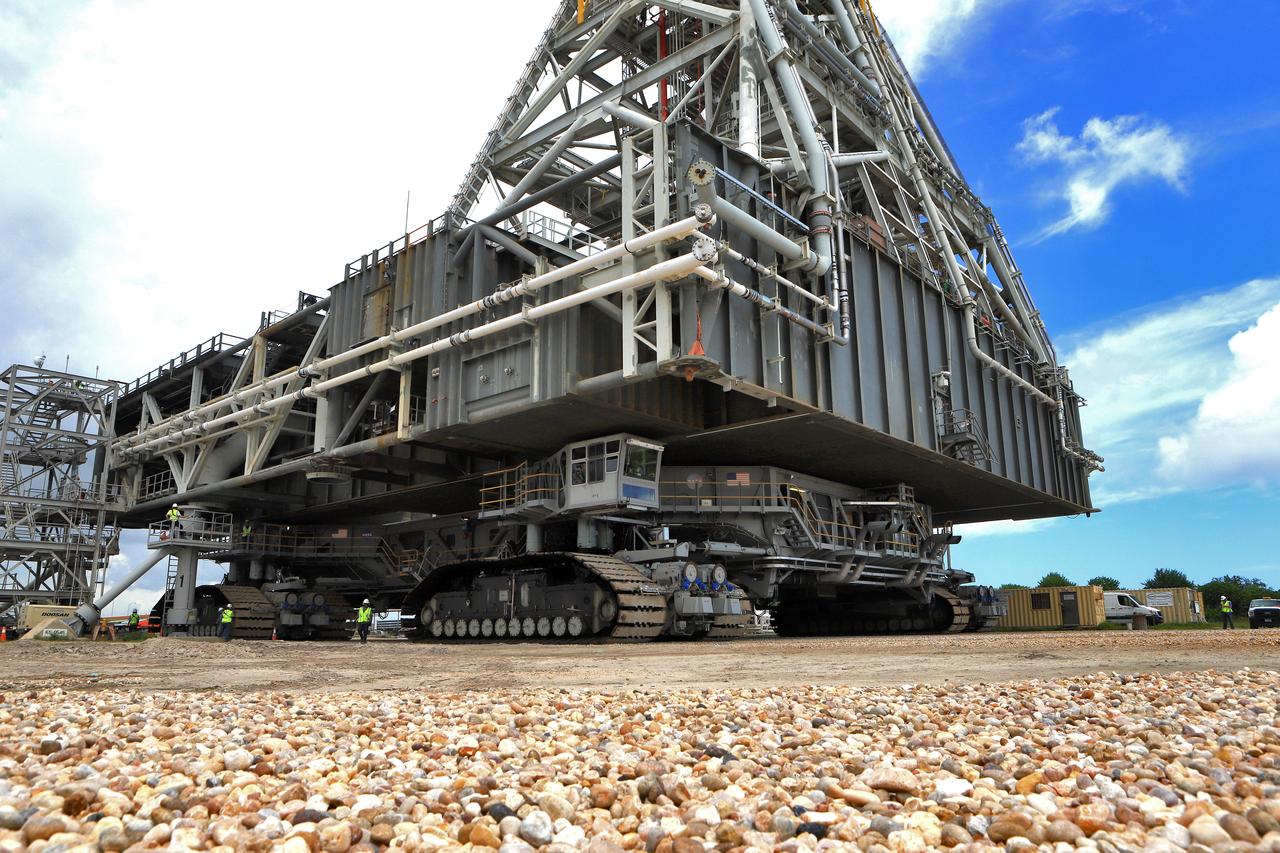
A close-up view of NASA's crawler-transporter 2 (CT-2) with the mobile launcher (ML) atop as it slowly moves along the crawlerway on its trek to Launch Pad 39B on Aug. 30, 2018, at the agency's Kennedy Space Center in Florida. CT-2 will move the ML up to the surface of the pad where it will undergo a fit check, followed by several days of systems testing. The 380-foot-tall mobile launcher is equipped with the crew access arm and several umbilicals that will provide power, environmental control, pneumatics, communication and electrical connections to NASA's Space Launch System (SLS) and Orion spacecraft. Exploration Ground Systems is preparing the ground systems necessary to launch SLS and Orion on Exploration Mission-1, missions to the Moon and on to Mars.
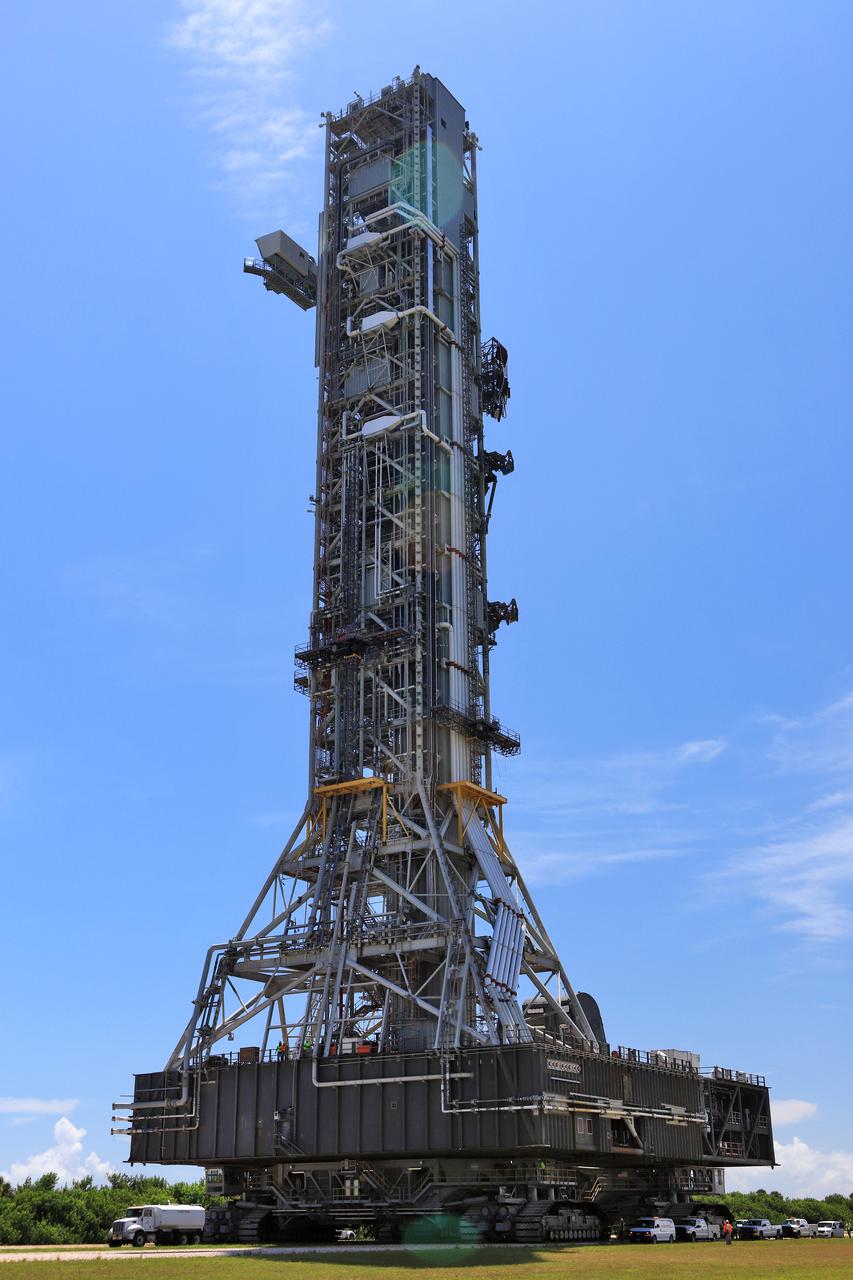
NASA's crawler-transporter 2 (CT-2) with the mobile launcher (ML) atop slowly moves along the crawlerway on its trek to Launch Pad 39B on Aug. 31, 2018, at the agency's Kennedy Space Center in Florida. CT-2 will move the ML up to the surface of the pad where it will undergo a fit check, followed by several days of systems testing. The 380-foot-tall mobile launcher is equipped with the crew access arm and several umbilicals that will provide power, environmental control, pneumatics, communication and electrical connections to NASA's Space Launch System (SLS) and Orion spacecraft. Exploration Ground Systems is preparing the ground systems necessary to launch SLS and Orion on Exploration Mission-1, missions to the Moon and on to Mars.
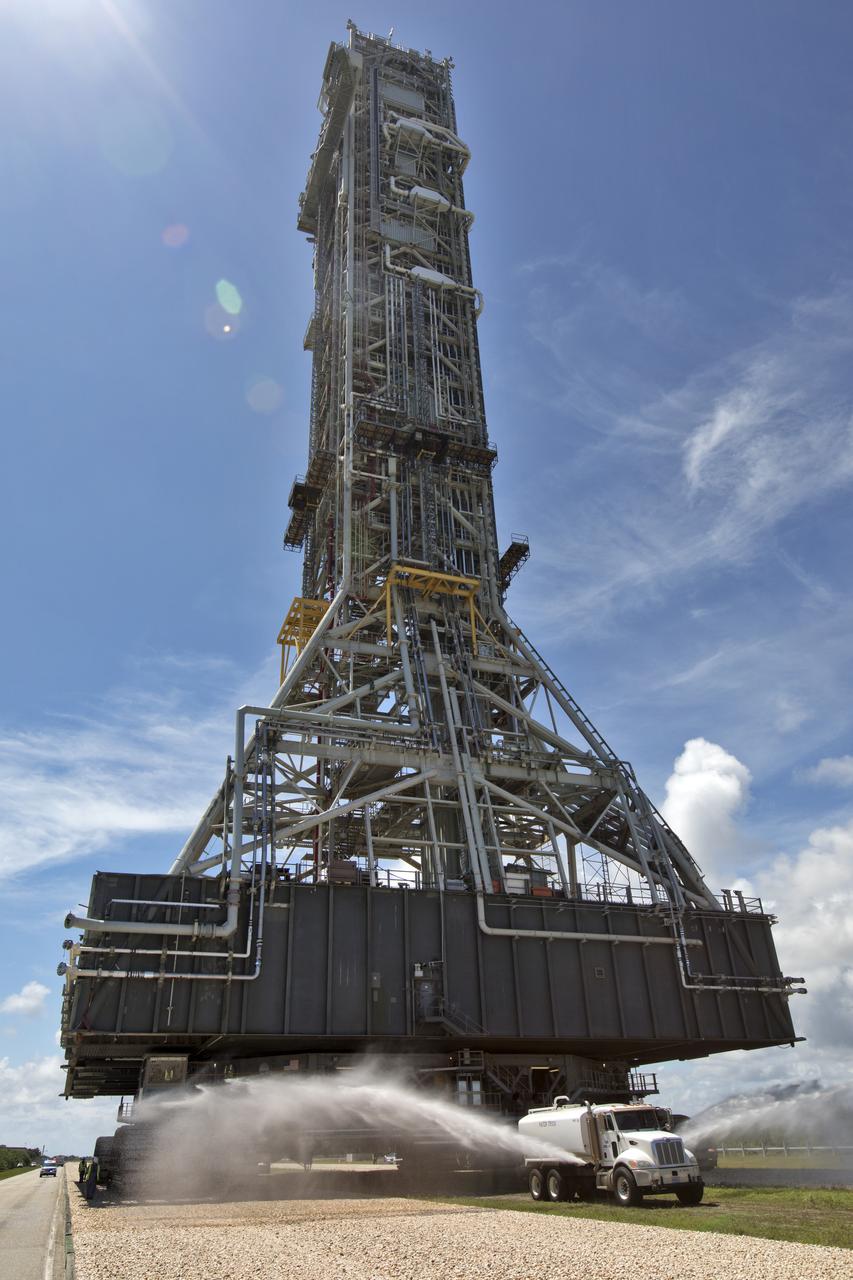
A truck sprays water to reduce the dust as NASA's crawler-transporter 2 (CT-2) with the mobile launcher (ML) atop slowly moves along the crawlerway on its trek to Launch Pad 39B on Aug. 31, 2018, at the agency's Kennedy Space Center in Florida. CT-2 will move the ML up to the surface of the pad where it will undergo a fit check, followed by several days of systems testing. The 380-foot-tall mobile launcher is equipped with the crew access arm and several umbilicals that will provide power, environmental control, pneumatics, communication and electrical connections to NASA's Space Launch System (SLS) and Orion spacecraft. Exploration Ground Systems is preparing the ground systems necessary to launch SLS and Orion on Exploration Mission-1, missions to the Moon and on to Mars.
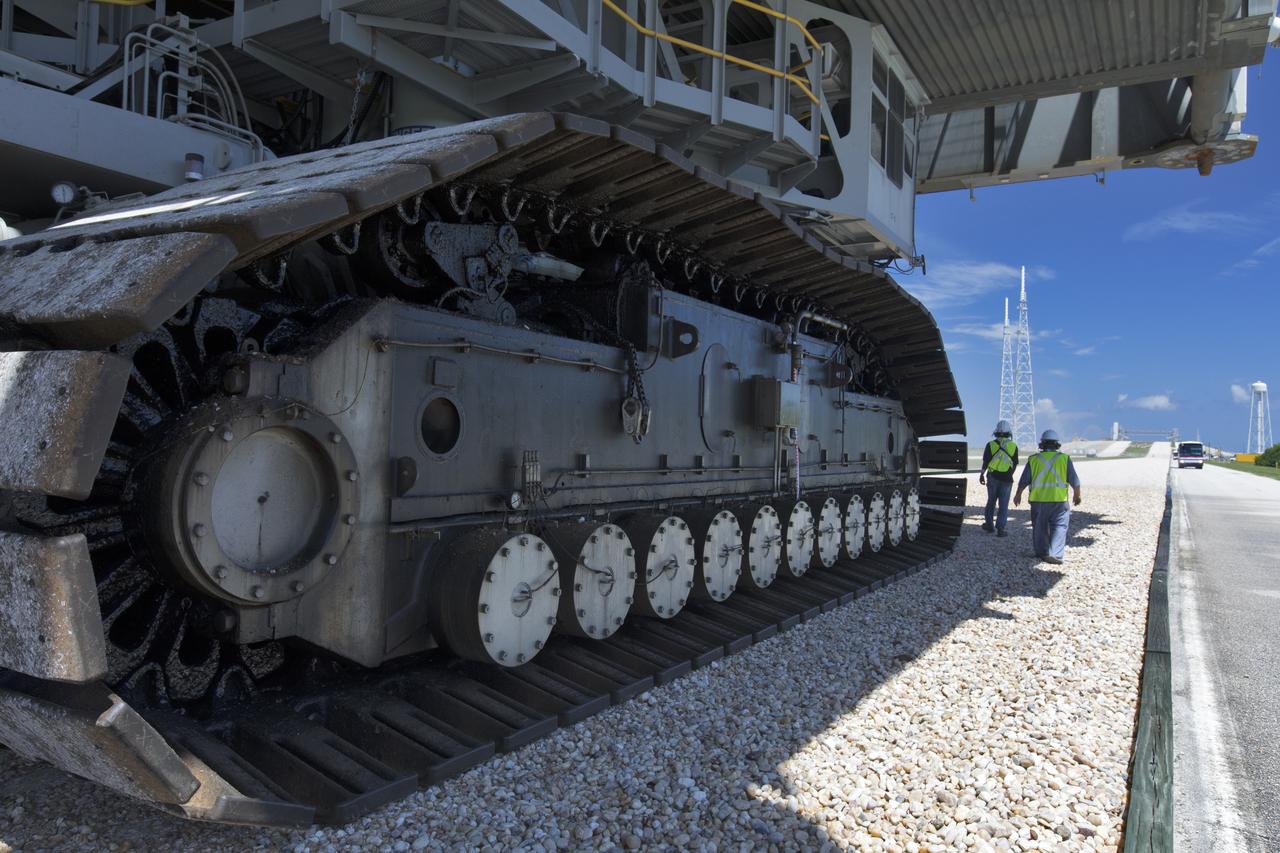
A close-up view of NASA's crawler-transporter 2 (CT-2) with the mobile launcher (ML) atop as it slowly moves along the crawlerway on its trek to Launch Pad 39B on Aug. 31, 2018, at the agency's Kennedy Space Center in Florida. CT-2 will move the ML up to the surface of the pad where it will undergo a fit check, followed by several days of systems testing. The 380-foot-tall mobile launcher is equipped with the crew access arm and several umbilicals that will provide power, environmental control, pneumatics, communication and electrical connections to NASA's Space Launch System (SLS) and Orion spacecraft. Exploration Ground Systems is preparing the ground systems necessary to launch SLS and Orion on Exploration Mission-1, missions to the Moon and on to Mars.
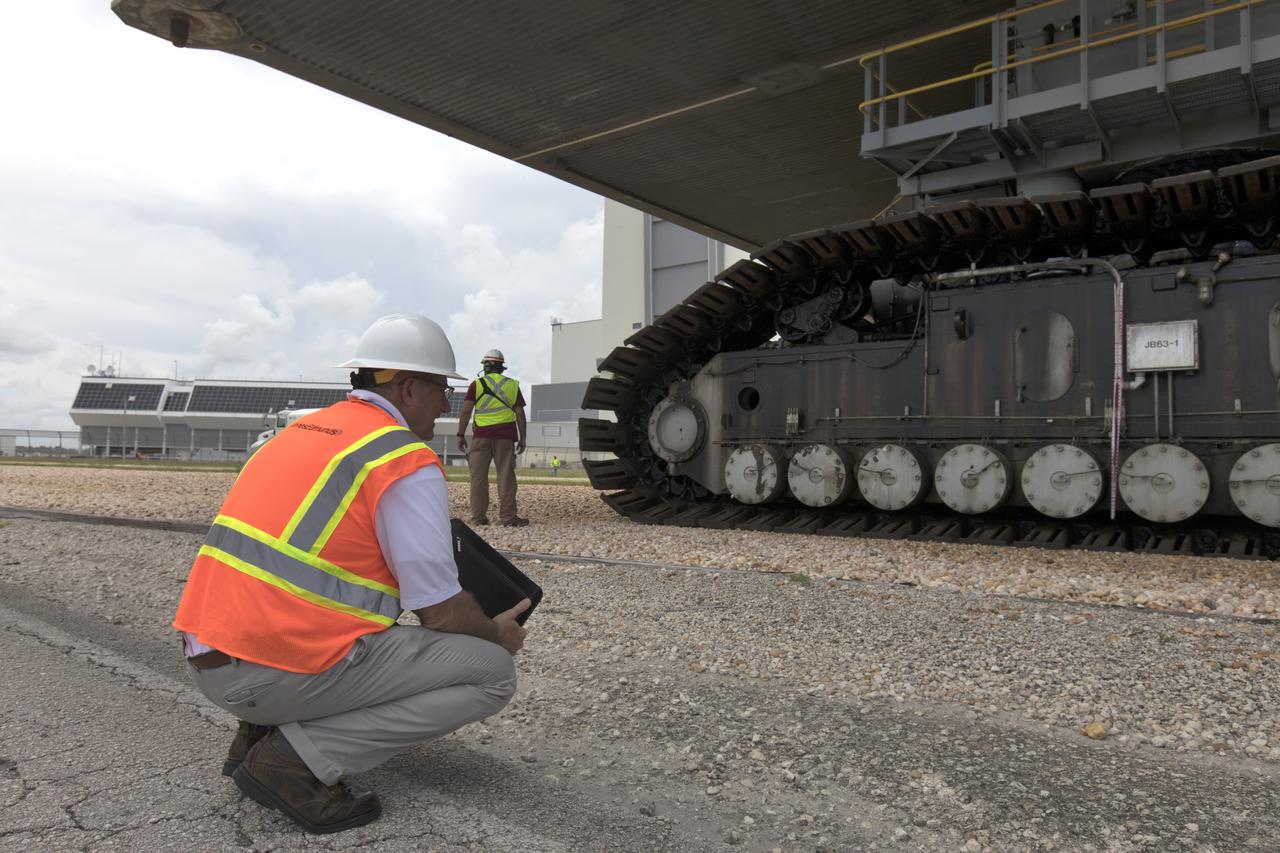
Members of the crawler team watch as NASA's mobile launcher (ML) atop crawler-transporter 2 (CT-2) moves along the crawlerway on its trek to Launch Pad 39B on Aug. 31, 2018, at the agency's Kennedy Space Center in Florida. CT-2 will move the ML up to the surface of the pad where it will undergo a fit check, followed by several days of systems testing. The 380-foot-tall mobile launcher is equipped with the crew access arm and several umbilicals that will provide power, environmental control, pneumatics, communication and electrical connections to NASA's Space Launch System (SLS) and Orion spacecraft. Exploration Ground Systems is preparing the ground systems necessary to launch SLS and Orion on Exploration Mission-1, missions to the Moon and on to Mars.
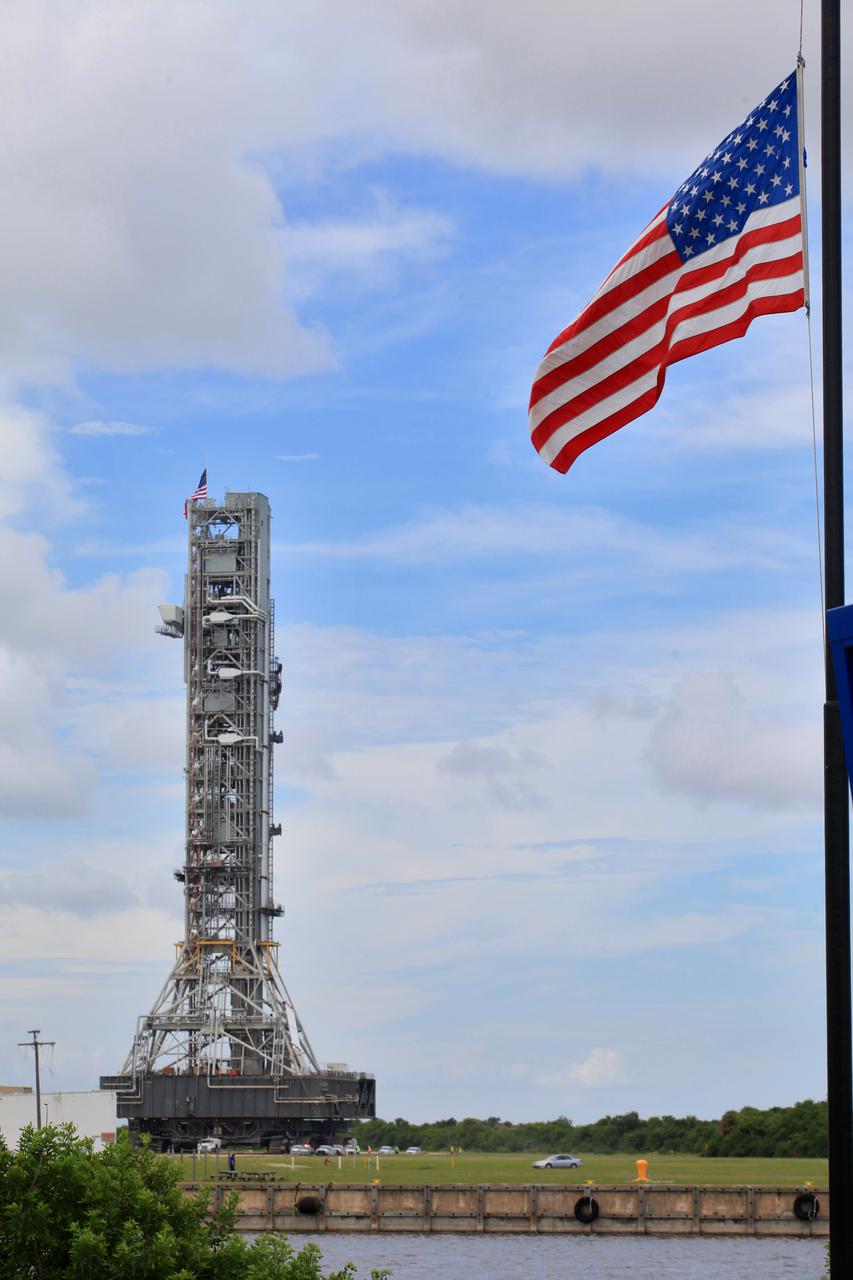
NASA's mobile launcher (ML) atop crawler-transporter 2 (CT-2) moves along the crawlerway on its trek to Launch Pad 39B on Aug. 30, 2018, at the agency's Kennedy Space Center in Florida. CT-2 will move the ML up to the surface of the pad where it will undergo a fit check, followed by several days of systems testing. The 380-foot-tall mobile launcher is equipped with the crew access arm and several umbilicals that will provide power, environmental control, pneumatics, communication and electrical connections to NASA's Space Launch System (SLS) and Orion spacecraft. Exploration Ground Systems is preparing the ground systems necessary to launch SLS and Orion on Exploration Mission-1, missions to the Moon and on to Mars.
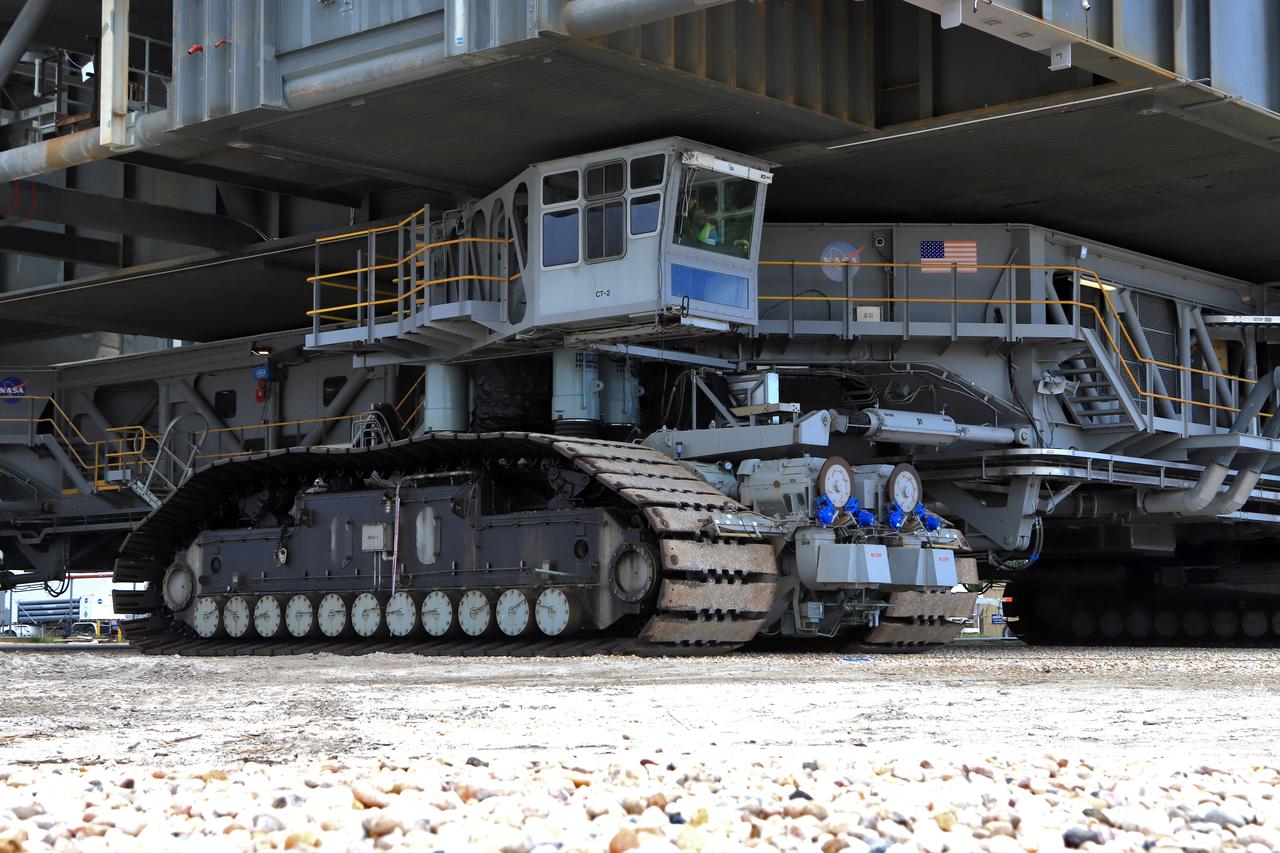
A close-up view of NASA's crawler-transporter 2 (CT-2) with the mobile launcher (ML) atop as it slowly moves along the crawlerway on its trek to Launch Pad 39B on Aug. 30, 2018, at the agency's Kennedy Space Center in Florida. CT-2 will move the ML up to the surface of the pad where it will undergo a fit check, followed by several days of systems testing. The 380-foot-tall mobile launcher is equipped with the crew access arm and several umbilicals that will provide power, environmental control, pneumatics, communication and electrical connections to NASA's Space Launch System (SLS) and Orion spacecraft. Exploration Ground Systems is preparing the ground systems necessary to launch SLS and Orion on Exploration Mission-1, missions to the Moon and on to Mars.
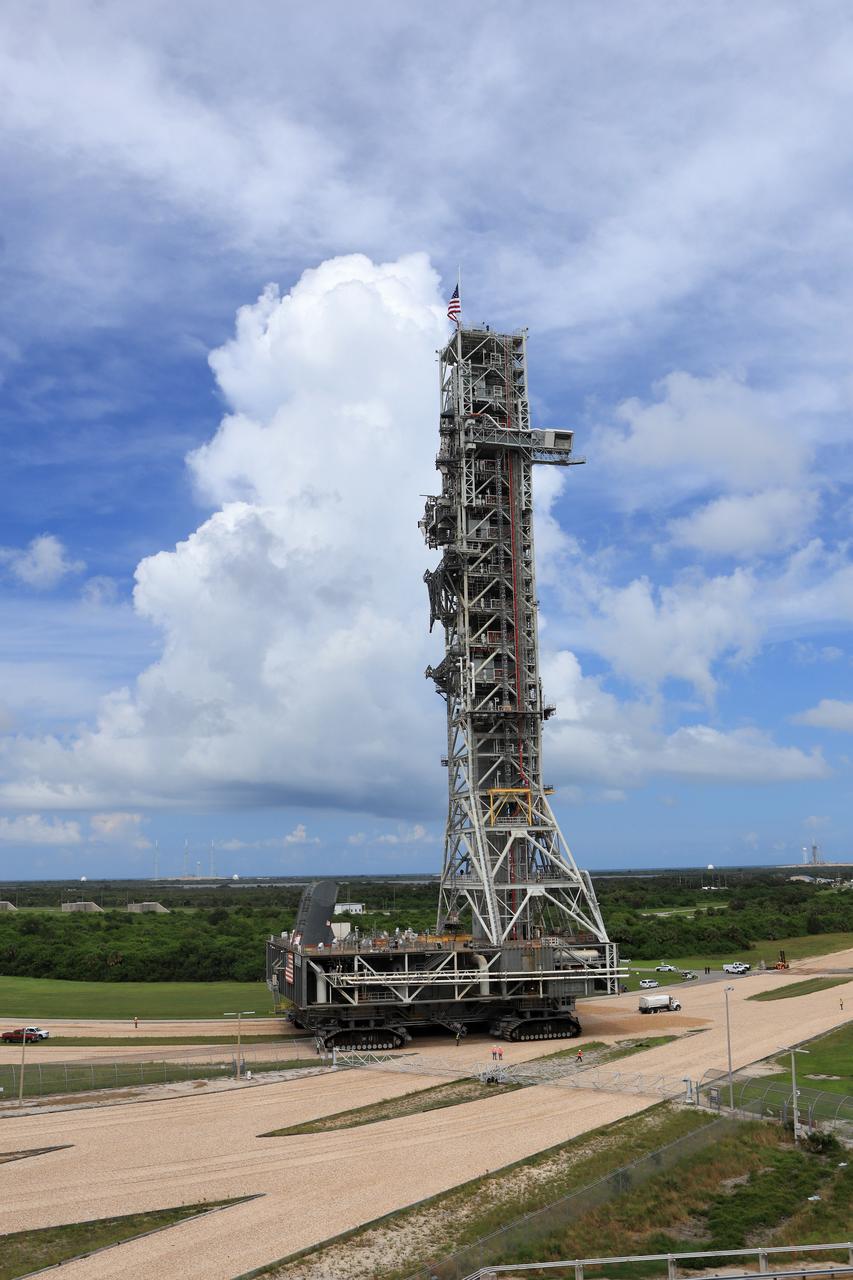
NASA's mobile launcher (ML) atop crawler-transporter 2 (CT-2) moves along the crawlerway on its trek to Launch Pad 39B on Aug. 31, 2018, at the agency's Kennedy Space Center in Florida. CT-2 will move the ML up to the surface of the pad where it will undergo a fit check, followed by several days of systems testing. The 380-foot-tall mobile launcher is equipped with the crew access arm and several umbilicals that will provide power, environmental control, pneumatics, communication and electrical connections to NASA's Space Launch System (SLS) and Orion spacecraft. Exploration Ground Systems is preparing the ground systems necessary to launch SLS and Orion on Exploration Mission-1, missions to the Moon and on to Mars.
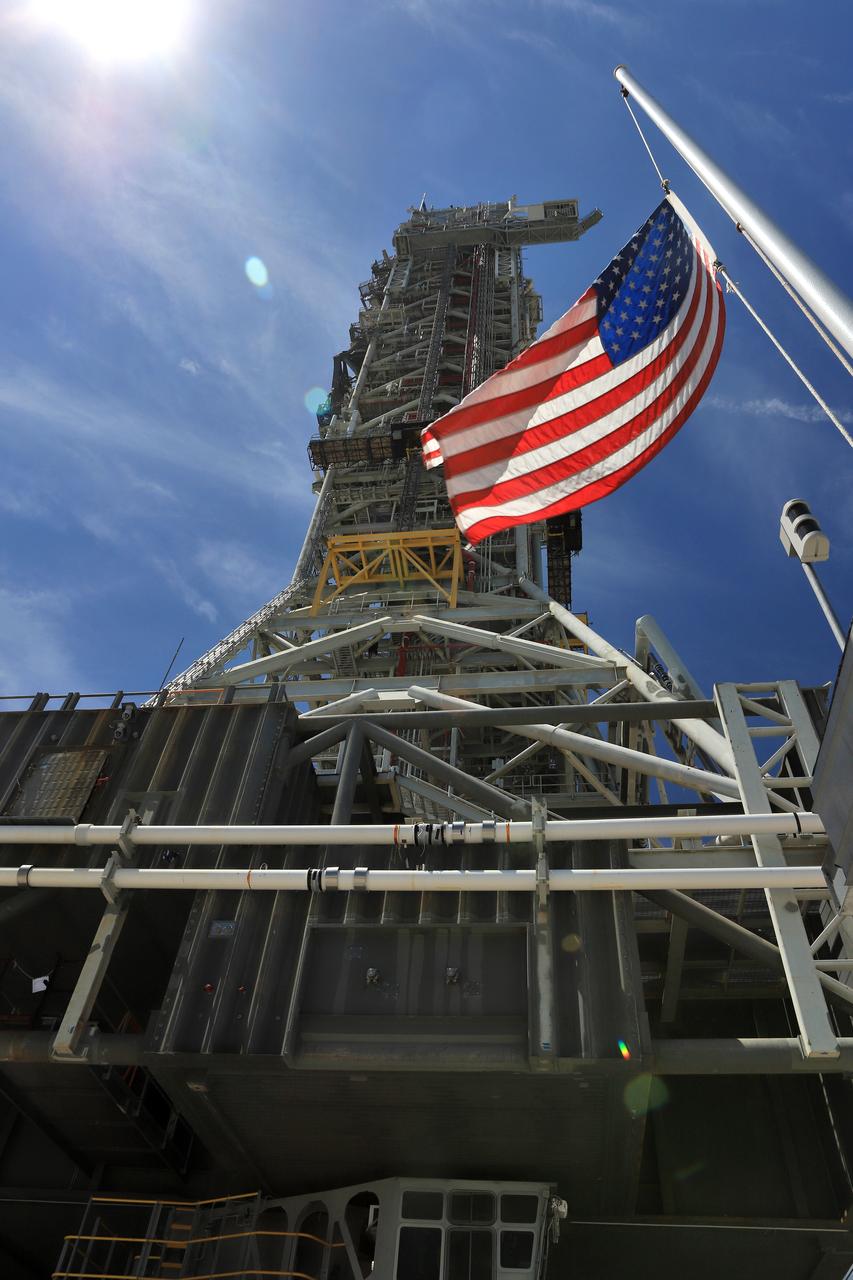
The American flag is in view as NASA's crawler-transporter 2 (CT-2) with the mobile launcher (ML) atop slowly moves along the crawlerway on its trek to Launch Pad 39B on Aug. 31, 2018, at the agency's Kennedy Space Center in Florida. CT-2 will move the ML up to the surface of the pad where it will undergo a fit check, followed by several days of systems testing. The 380-foot-tall mobile launcher is equipped with the crew access arm and several umbilicals that will provide power, environmental control, pneumatics, communication and electrical connections to NASA's Space Launch System (SLS) and Orion spacecraft. Exploration Ground Systems is preparing the ground systems necessary to launch SLS and Orion on Exploration Mission-1, missions to the Moon and on to Mars.
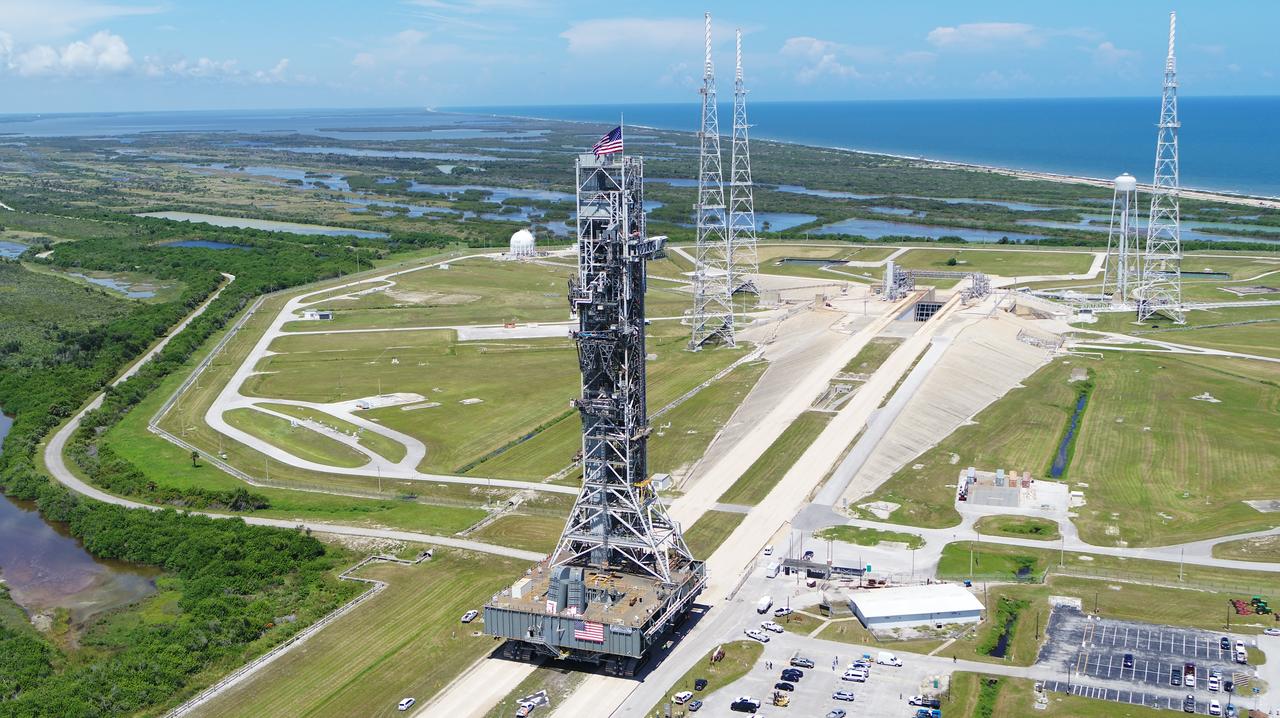
NASA's mobile launcher (ML) atop crawler-transporter 2 arrives at Launch Pad 39B on Aug. 31, 2018, at the agency's Kennedy Space Center in Florida. The ML will undergo a fit check, followed by several days of systems testing. The 380-foot-tall mobile launcher is equipped with the crew access arm and several umbilicals that will provide power, environmental control, pneumatics, communication and electrical connections to NASA's Space Launch System (SLS) and Orion spacecraft. Exploration Ground Systems is preparing the ground systems necessary to launch SLS and Orion on Exploration Mission-1, missions to the Moon and on to Mars.
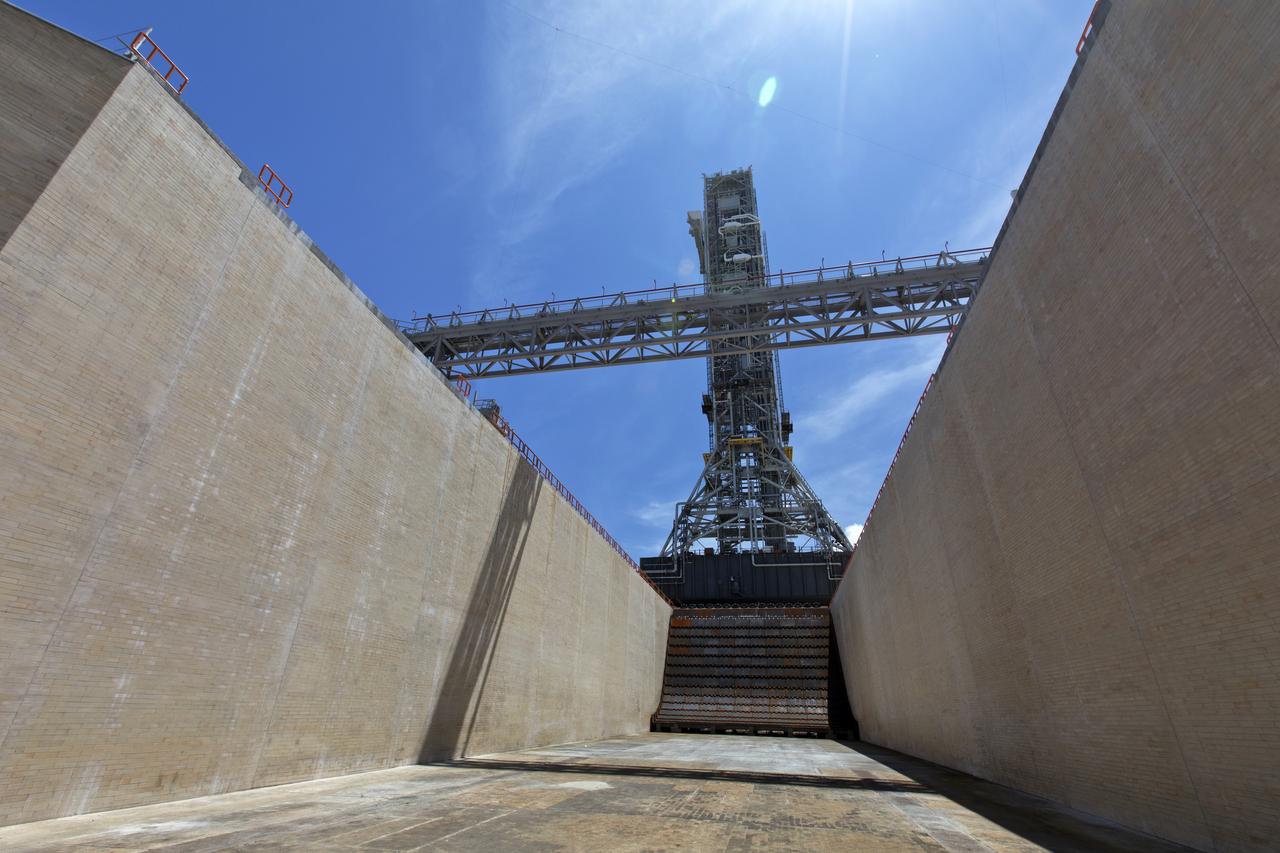
With a view of the flame trench and flame deflector below, NASA's mobile launcher (ML) atop crawler-transporter 2 arrives at Launch Pad 39B on Aug. 31, 2018, at the agency's Kennedy Space Center in Florida. The ML will undergo a fit check, followed by several days of systems testing. The 380-foot-tall mobile launcher is equipped with the crew access arm and several umbilicals that will provide power, environmental control, pneumatics, communication and electrical connections to NASA's Space Launch System (SLS) and Orion spacecraft. Exploration Ground Systems is preparing the ground systems necessary to launch SLS and Orion on Exploration Mission-1, missions to the Moon and on to Mars.
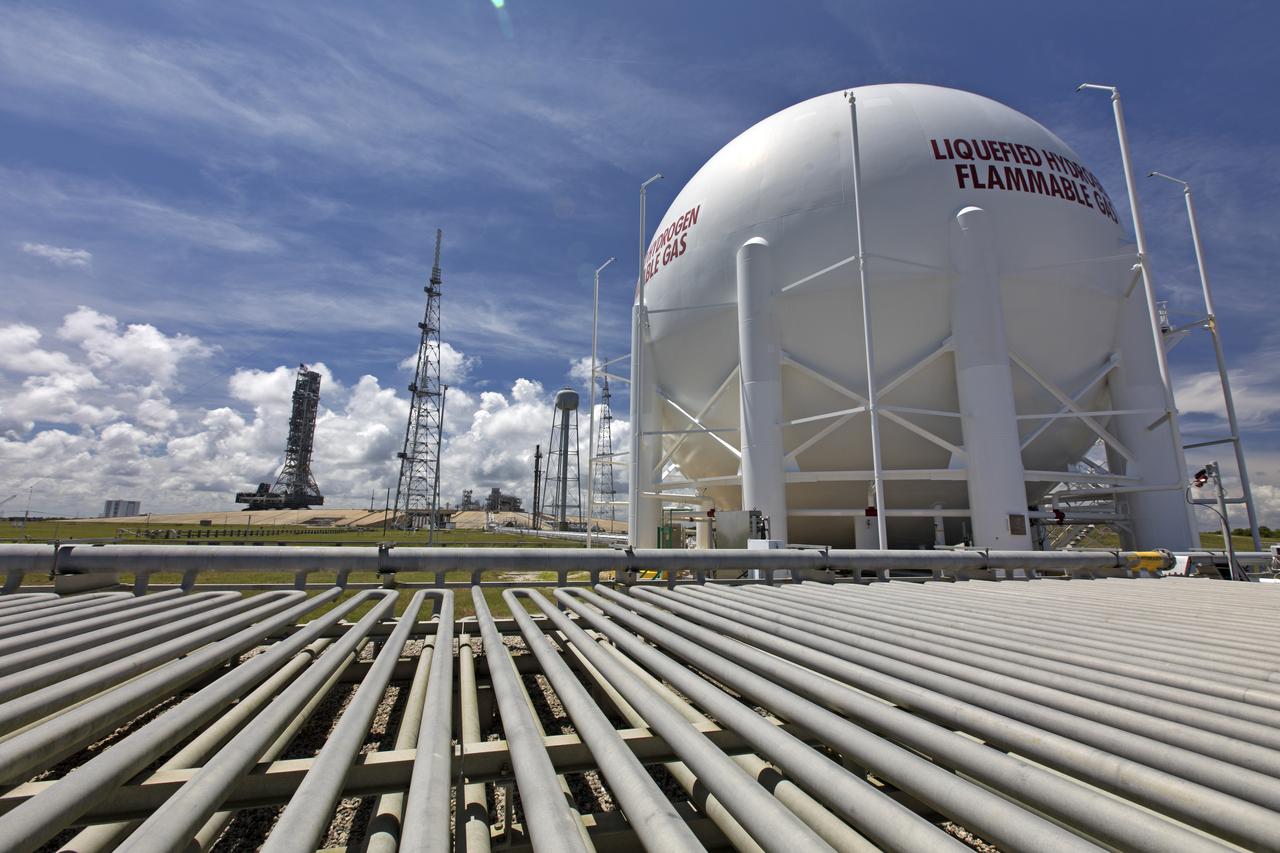
A liquid hydrogen storage tank is in view as NASA's mobile launcher (ML) atop crawler-transporter 2 makes its way up the ramp at Launch Pad 39B on Aug. 31, 2018, at the agency's Kennedy Space Center in Florida. The ML will undergo a fit check, followed by several days of systems testing. The 380-foot-tall mobile launcher is equipped with the crew access arm and several umbilicals that will provide power, environmental control, pneumatics, communication and electrical connections to NASA's Space Launch System (SLS) and Orion spacecraft. Exploration Ground Systems is preparing the ground systems necessary to launch SLS and Orion on Exploration Mission-1, missions to the Moon and on to Mars.
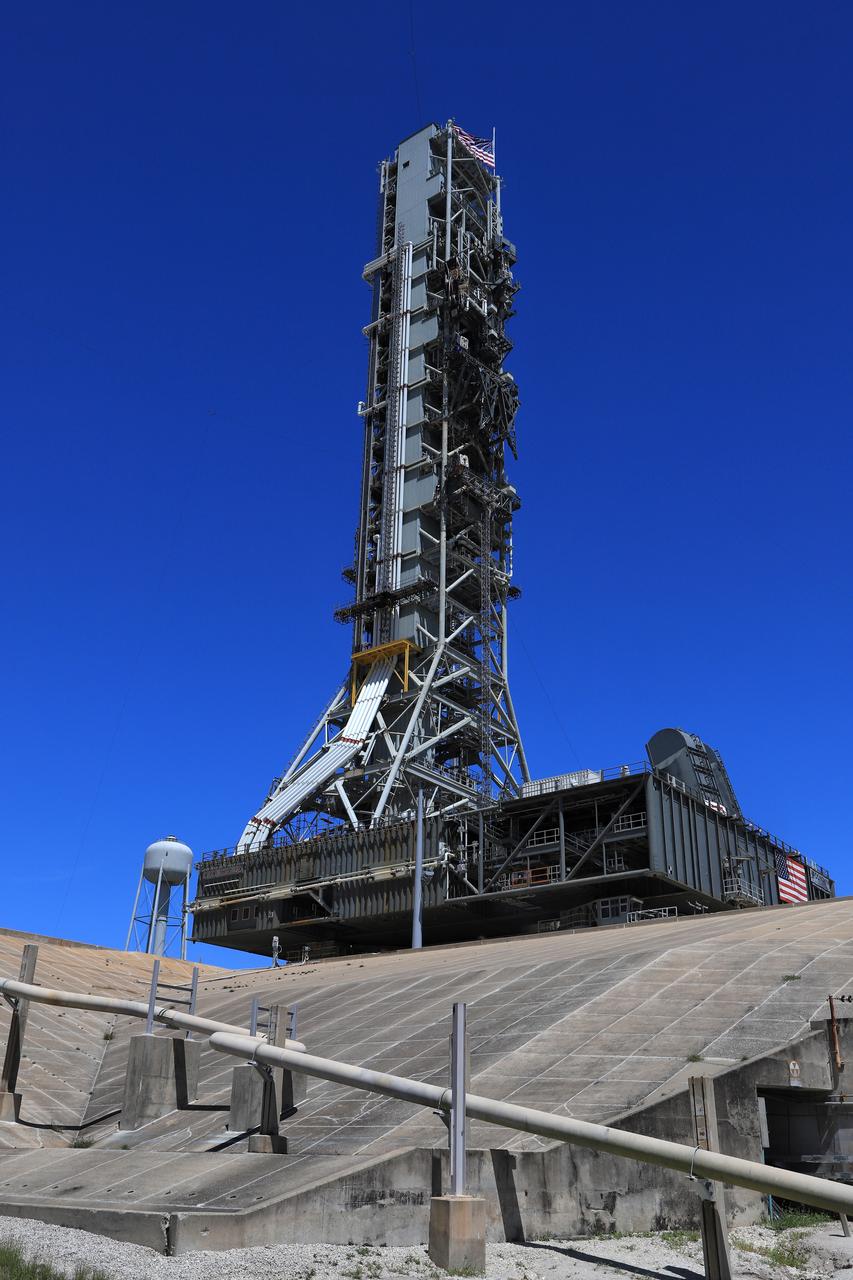
NASA's mobile launcher (ML) atop crawler-transporter 2 arrives at the top of Launch Pad 39B on Aug. 31, 2018, at the agency's Kennedy Space Center in Florida. The ML will undergo a fit check, followed by several days of systems testing. The 380-foot-tall mobile launcher is equipped with the crew access arm and several umbilicals that will provide power, environmental control, pneumatics, communication and electrical connections to NASA's Space Launch System (SLS) and Orion spacecraft. Exploration Ground Systems is preparing the ground systems necessary to launch SLS and Orion on Exploration Mission-1, missions to the Moon and on to Mars.
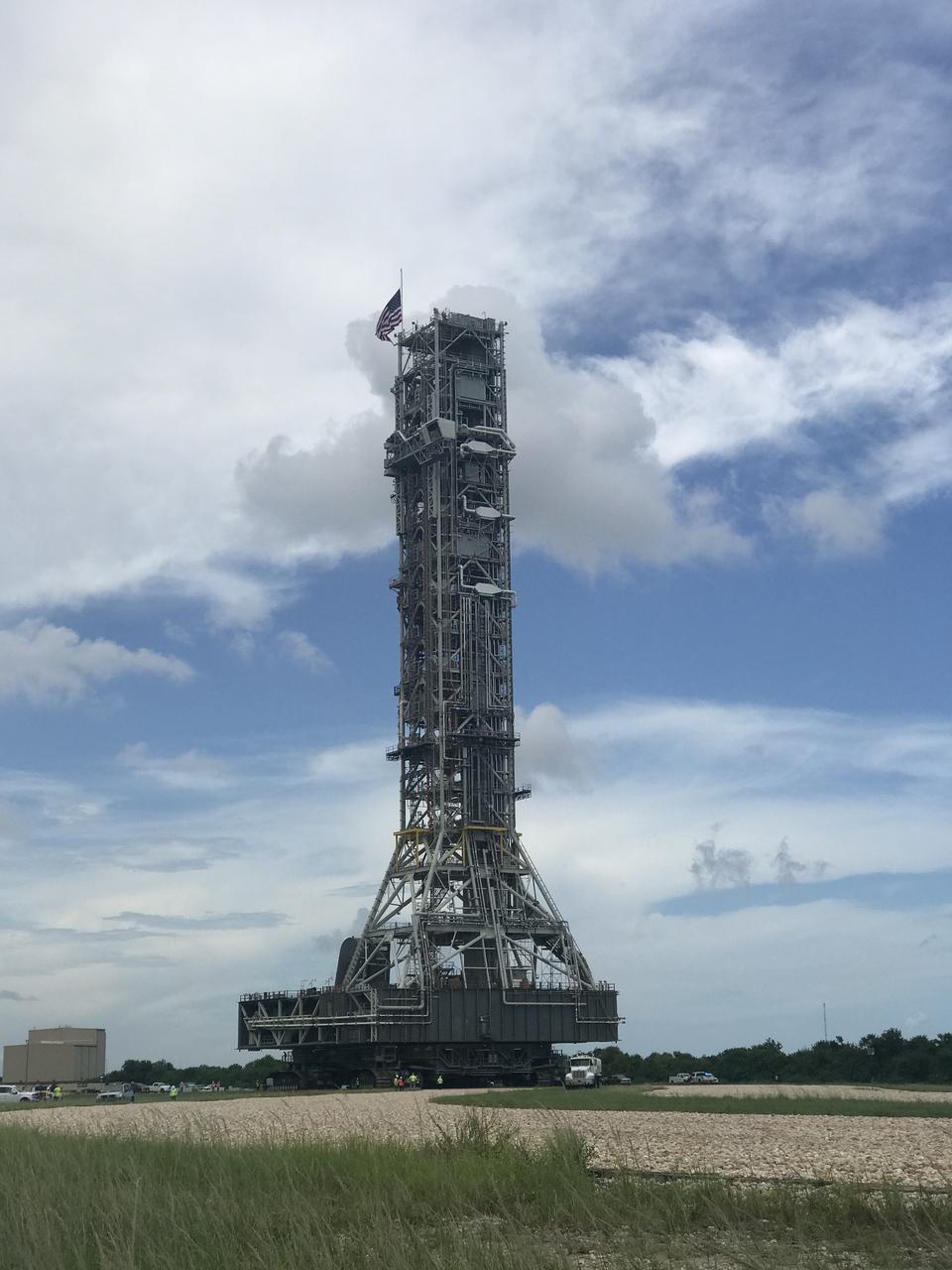
NASA's mobile launcher (ML) atop crawler-transporter 2 begins its trek to Launch Pad 39B on Aug. 30, 2018, at the agency's Kennedy Space Center in Florida. The ML will undergo a fit check on the surface of the pad, followed by several days of systems testing. The 380-foot-tall mobile launcher is equipped with the crew access arm and several umbilicals that will provide power, environmental control, pneumatics, communication and electrical connections to NASA's Space Launch System (SLS) and Orion spacecraft. Exploration Ground Systems is preparing the ground systems necessary to launch SLS and Orion on Exploration Mission-1, missions to the Moon and on to Mars.
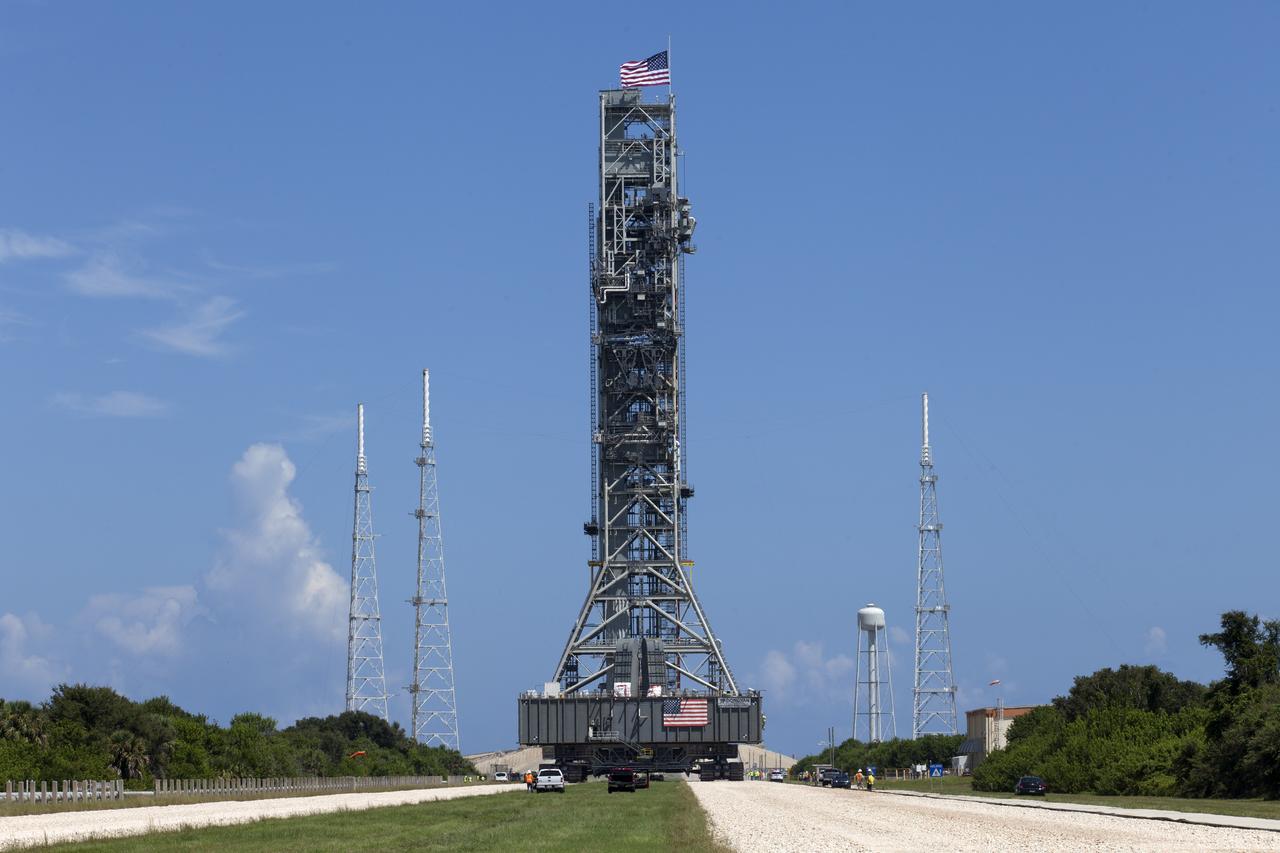
NASA's mobile launcher (ML) atop crawler-transporter 2 arrives at Launch Pad 39B on Aug. 31, 2018, at the agency's Kennedy Space Center in Florida. The ML will undergo a fit check, followed by several days of systems testing. The 380-foot-tall mobile launcher is equipped with the crew access arm and several umbilicals that will provide power, environmental control, pneumatics, communication and electrical connections to NASA's Space Launch System (SLS) and Orion spacecraft. Exploration Ground Systems is preparing the ground systems necessary to launch SLS and Orion on Exploration Mission-1, missions to the Moon and on to Mars.
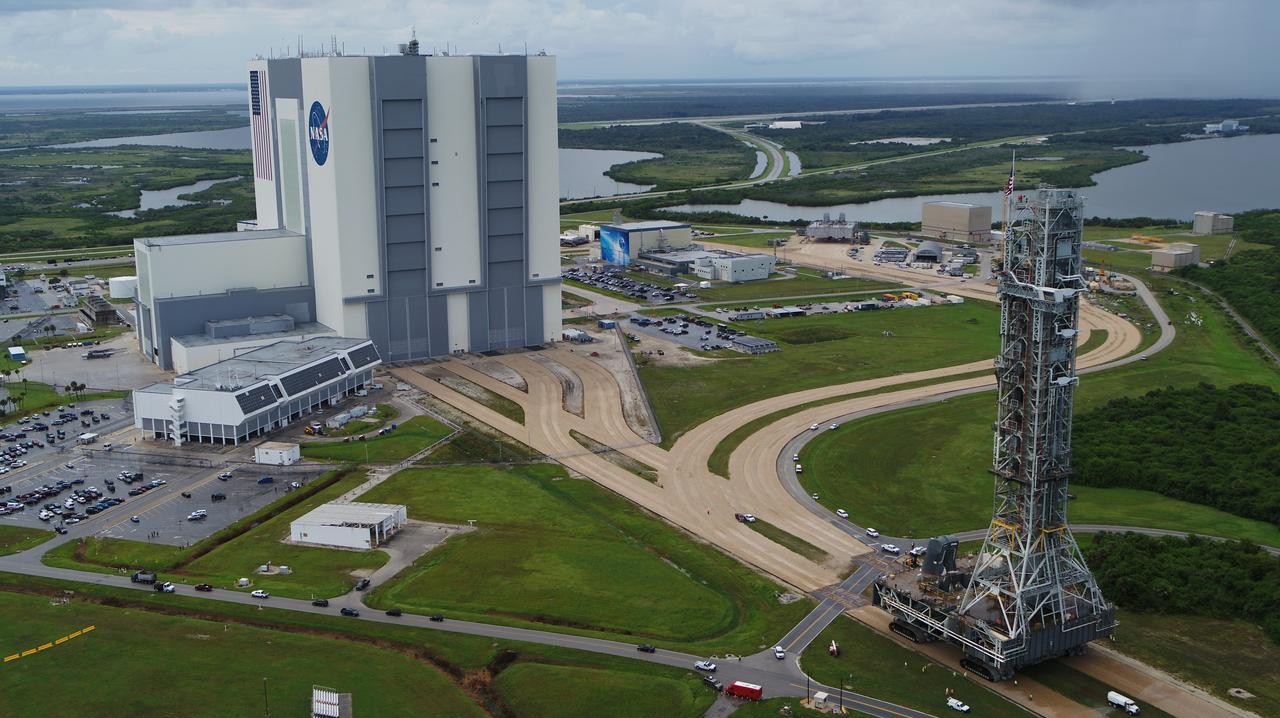
An aerial view of NASA's mobile launcher (ML) atop crawler-transporter 2 as it begins its trek to Launch Pad 39B on Aug. 30, 2018, at the agency's Kennedy Space Center in Florida. The ML will undergo a fit check on the surface of the pad, followed by several days of systems testing. The 380-foot-tall mobile launcher is equipped with the crew access arm and several umbilicals that will provide power, environmental control, pneumatics, communication and electrical connections to NASA's Space Launch System (SLS) and Orion spacecraft. Exploration Ground Systems is preparing the ground systems necessary to launch SLS and Orion on Exploration Mission-1, missions to the Moon and on to Mars.
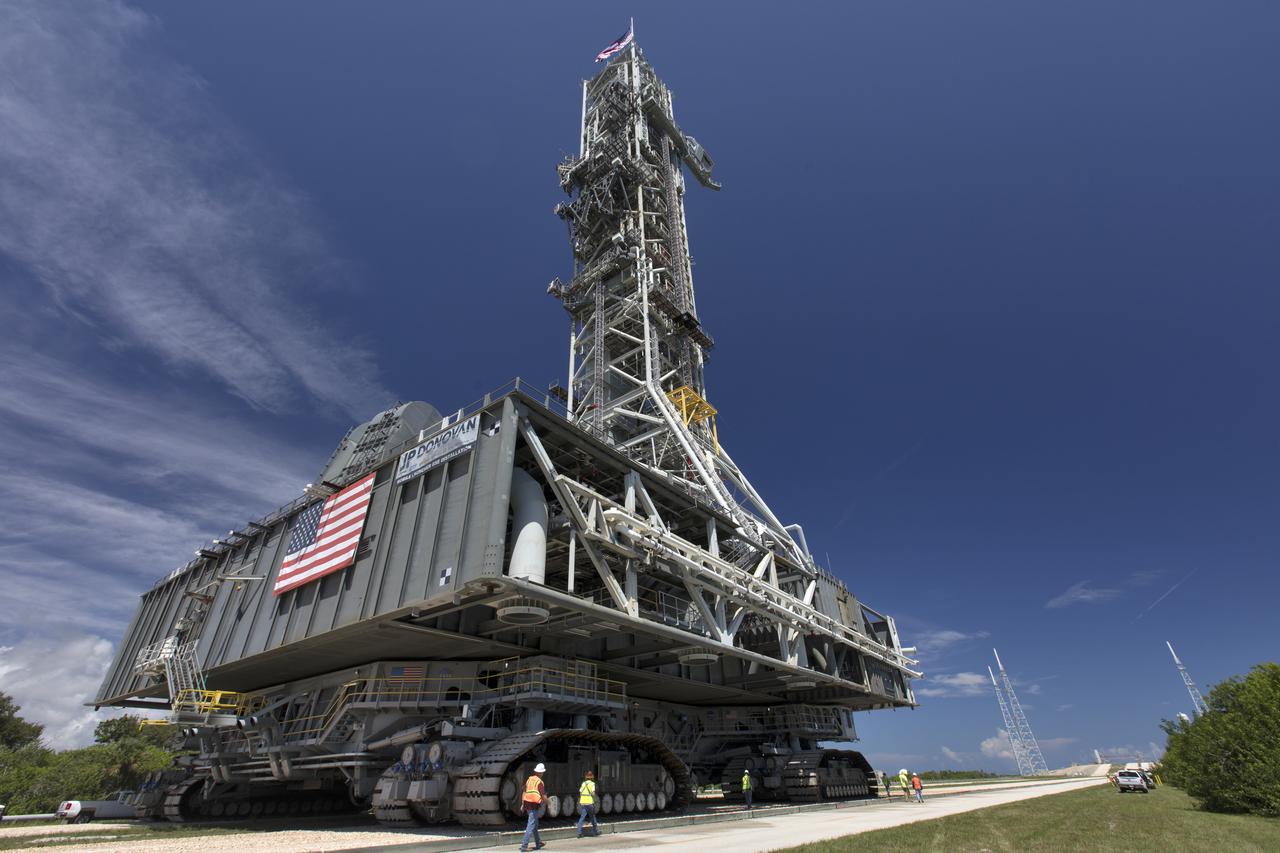
NASA's mobile launcher (ML) atop crawler-transporter 2 approaches Launch Pad 39B on Aug. 31, 2018, at the agency's Kennedy Space Center in Florida. The ML will undergo a fit check, followed by several days of systems testing. The 380-foot-tall mobile launcher is equipped with the crew access arm and several umbilicals that will provide power, environmental control, pneumatics, communication and electrical connections to NASA's Space Launch System (SLS) and Orion spacecraft. Exploration Ground Systems is preparing the ground systems necessary to launch SLS and Orion on Exploration Mission-1, missions to the Moon and on to Mars.
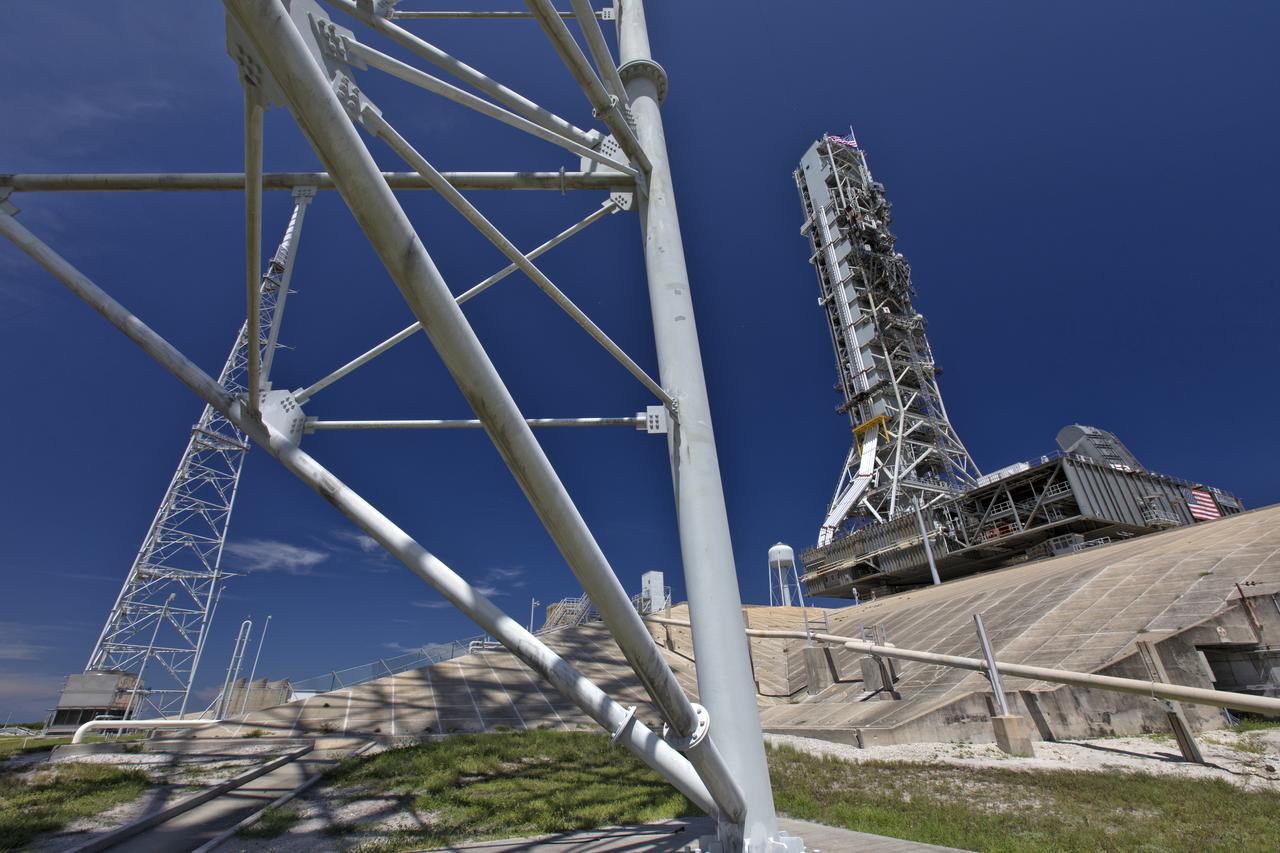
NASA's mobile launcher (ML) atop crawler-transporter 2 arrives at the top of Launch Pad 39B on Aug. 31, 2018, at the agency's Kennedy Space Center in Florida. The ML will undergo a fit check, followed by several days of systems testing. The 380-foot-tall mobile launcher is equipped with the crew access arm and several umbilicals that will provide power, environmental control, pneumatics, communication and electrical connections to NASA's Space Launch System (SLS) and Orion spacecraft. Exploration Ground Systems is preparing the ground systems necessary to launch SLS and Orion on Exploration Mission-1, missions to the Moon and on to Mars.
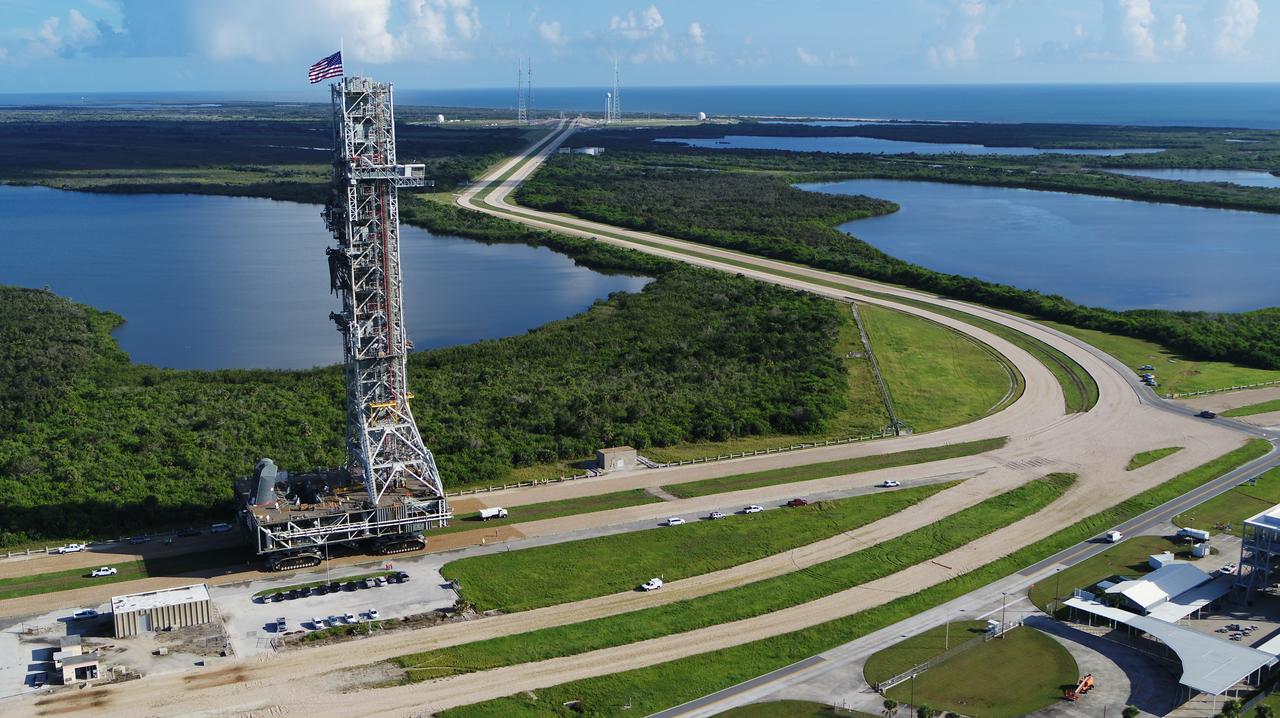
An aerial view of NASA's mobile launcher (ML) atop crawler-transporter 2 as it moves along the crawlerway to Launch Pad 39B on Aug. 31, 2018, at the agency's Kennedy Space Center in Florida. The ML will undergo a fit check on the surface of the pad, followed by several days of systems testing. The 380-foot-tall mobile launcher is equipped with the crew access arm and several umbilicals that will provide power, environmental control, pneumatics, communication and electrical connections to NASA's Space Launch System (SLS) and Orion spacecraft. Exploration Ground Systems is preparing the ground systems necessary to launch SLS and Orion on Exploration Mission-1, missions to the Moon and on to Mars.
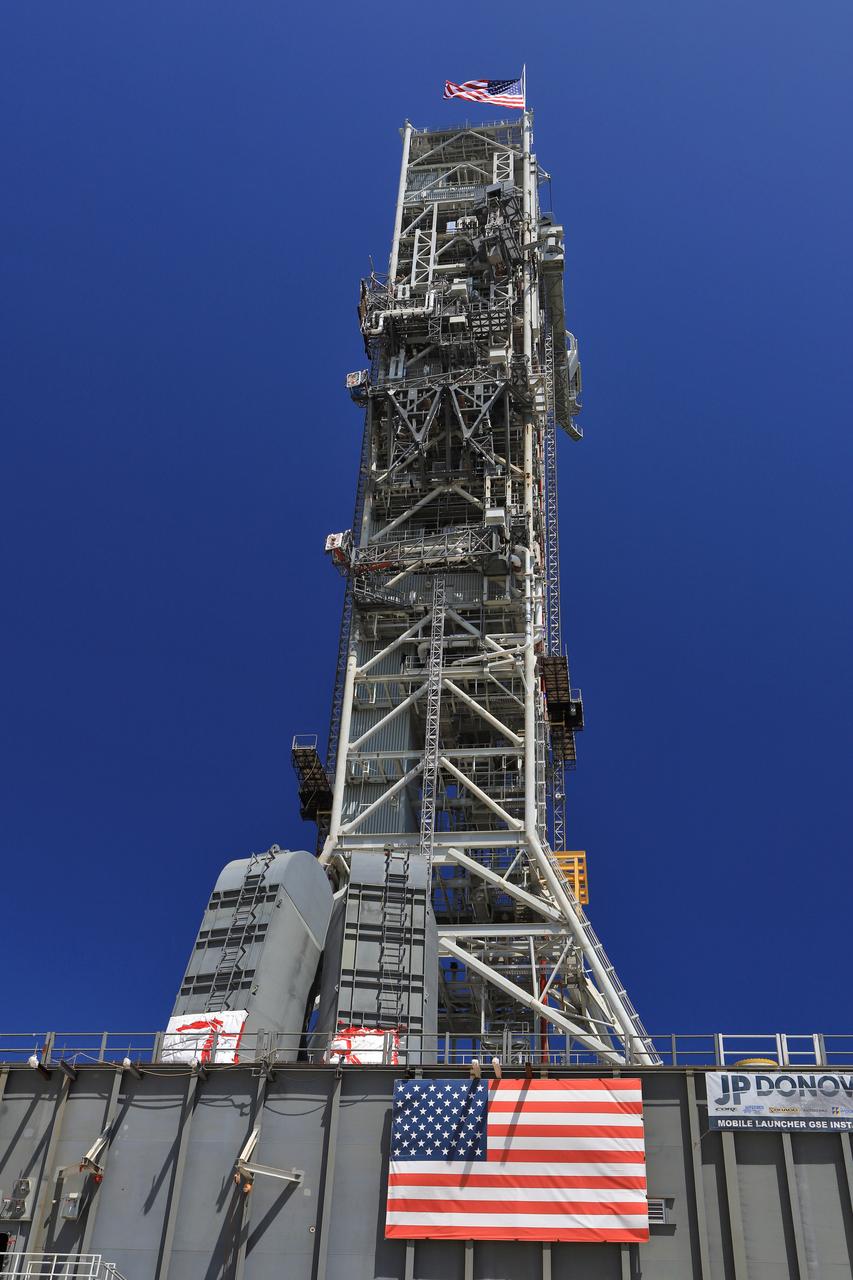
A bright blue sky serves as a backdrop as NASA's mobile launcher (ML) atop crawler-transporter 2 arrives at Launch Pad 39B on Aug. 31, 2018, at the agency's Kennedy Space Center in Florida. The ML will undergo a fit check, followed by several days of systems testing. The 380-foot-tall mobile launcher is equipped with the crew access arm and several umbilicals that will provide power, environmental control, pneumatics, communication and electrical connections to NASA's Space Launch System (SLS) and Orion spacecraft. Exploration Ground Systems is preparing the ground systems necessary to launch SLS and Orion on Exploration Mission-1, missions to the Moon and on to Mars.

NASA's mobile launcher (ML) atop crawler-transporter 2 arrives at Launch Pad 39B on Aug. 31, 2018, at the agency's Kennedy Space Center in Florida. The ML will undergo a fit check, followed by several days of systems testing. The 380-foot-tall mobile launcher is equipped with the crew access arm and several umbilicals that will provide power, environmental control, pneumatics, communication and electrical connections to NASA's Space Launch System (SLS) and Orion spacecraft. Exploration Ground Systems is preparing the ground systems necessary to launch SLS and Orion on Exploration Mission-1, missions to the Moon and on to Mars.
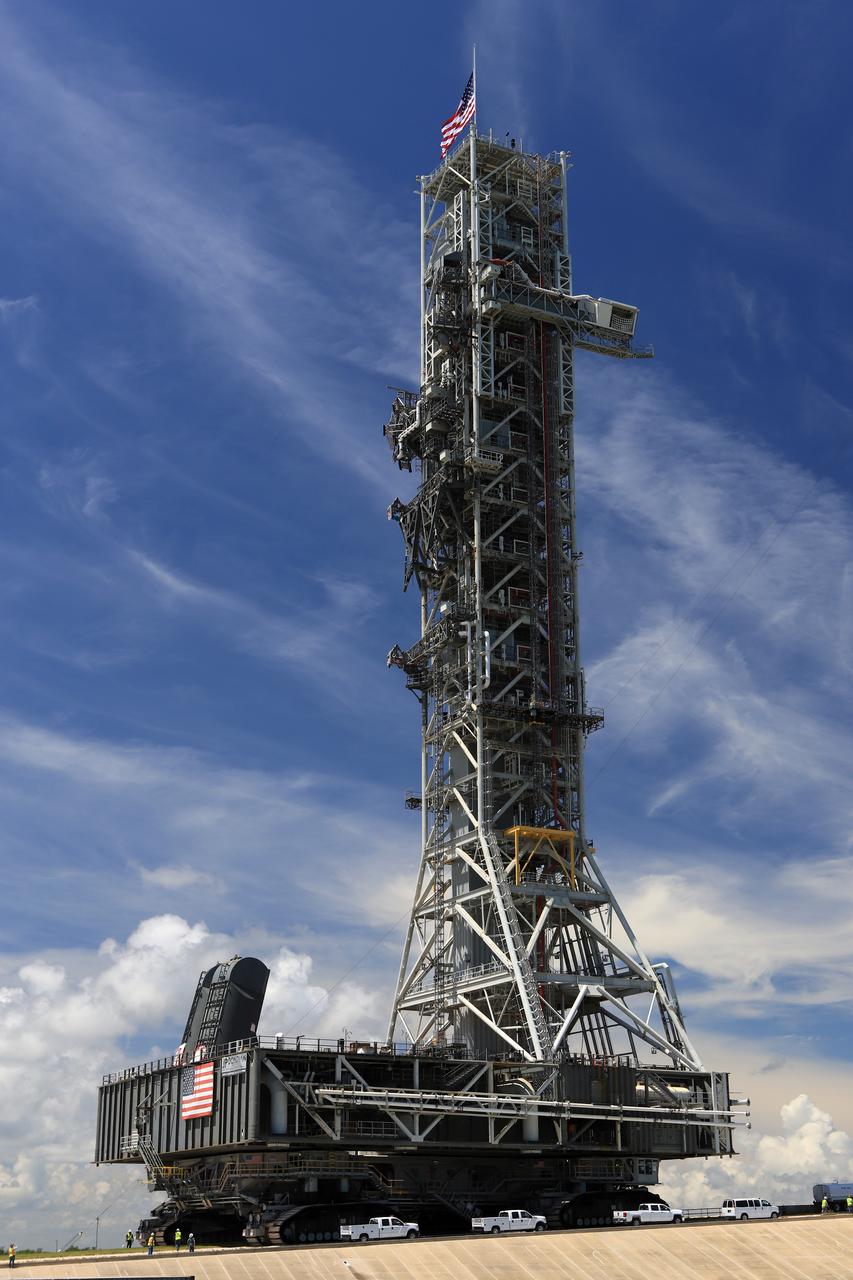
NASA's mobile launcher (ML) atop crawler-transporter 2 arrives at Launch Pad 39B on Aug. 31, 2018, at the agency's Kennedy Space Center in Florida. The ML will undergo a fit check, followed by several days of systems testing. The 380-foot-tall mobile launcher is equipped with the crew access arm and several umbilicals that will provide power, environmental control, pneumatics, communication and electrical connections to NASA's Space Launch System (SLS) and Orion spacecraft. Exploration Ground Systems is preparing the ground systems necessary to launch SLS and Orion on Exploration Mission-1, missions to the Moon and on to Mars.
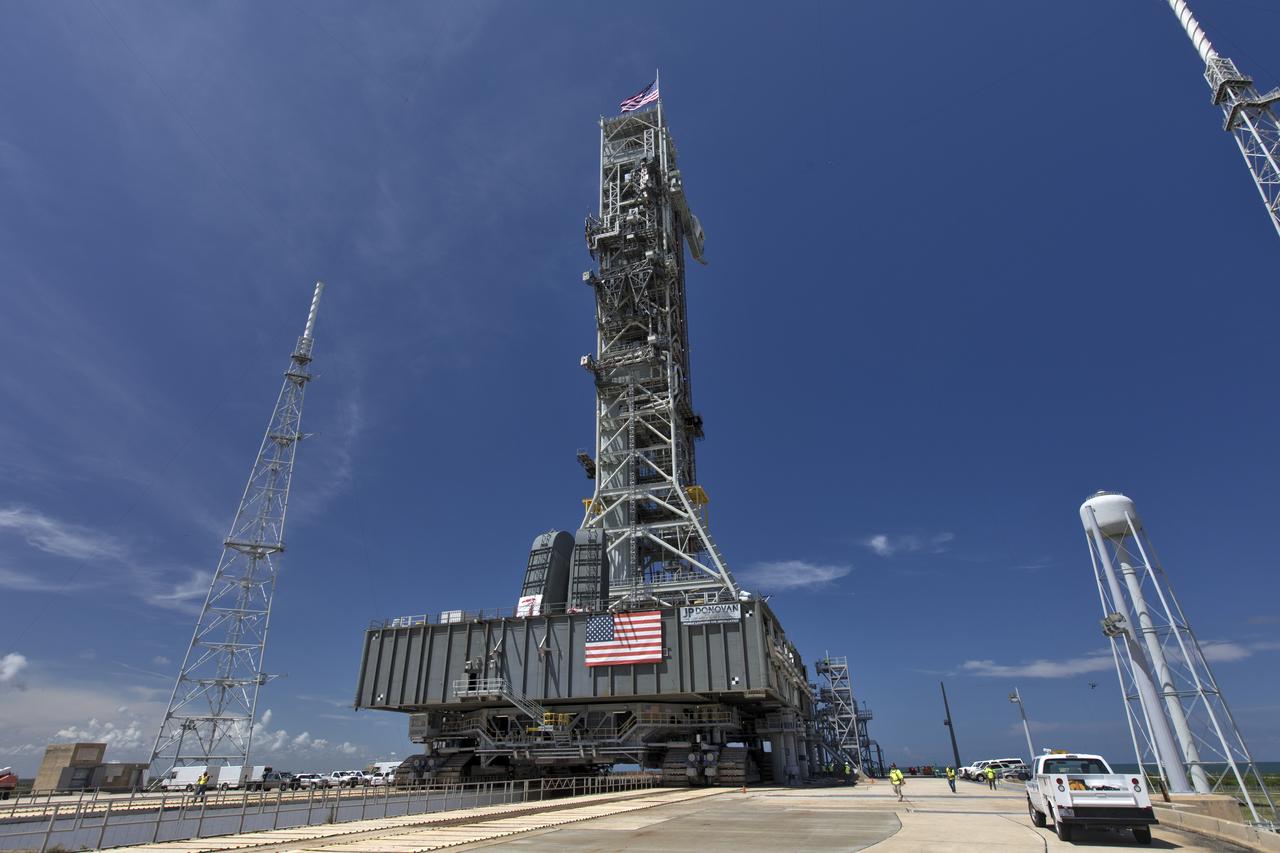
NASA's mobile launcher (ML) atop crawler-transporter 2 arrives at the top of Launch Pad 39B on Aug. 31, 2018, at the agency's Kennedy Space Center in Florida. The ML will undergo a fit check, followed by several days of systems testing. The 380-foot-tall mobile launcher is equipped with the crew access arm and several umbilicals that will provide power, environmental control, pneumatics, communication and electrical connections to NASA's Space Launch System (SLS) and Orion spacecraft. Exploration Ground Systems is preparing the ground systems necessary to launch SLS and Orion on Exploration Mission-1, missions to the Moon and on to Mars.
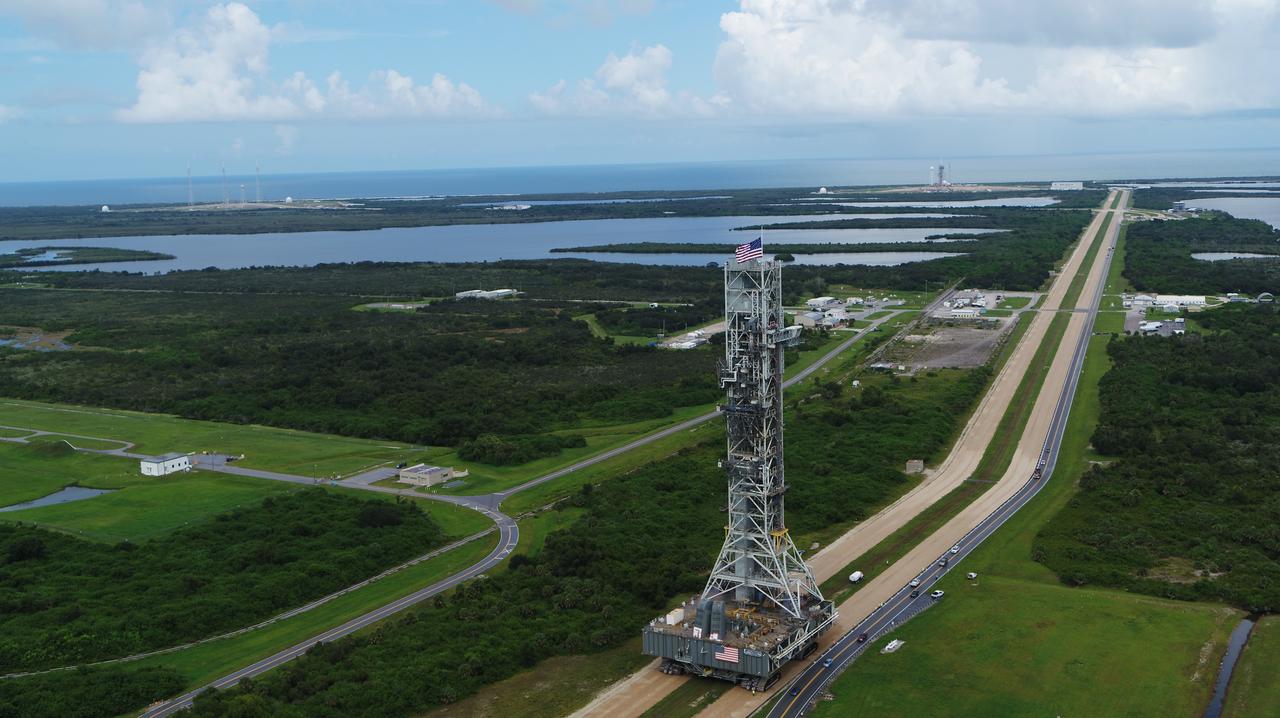
An aerial view of NASA's mobile launcher (ML) atop crawler-transporter 2 as it moves along the crawlerway to Launch Pad 39B on Aug. 30, 2018, at the agency's Kennedy Space Center in Florida. The ML will undergo a fit check on the surface of the pad, followed by several days of systems testing. The 380-foot-tall mobile launcher is equipped with the crew access arm and several umbilicals that will provide power, environmental control, pneumatics, communication and electrical connections to NASA's Space Launch System (SLS) and Orion spacecraft. Exploration Ground Systems is preparing the ground systems necessary to launch SLS and Orion on Exploration Mission-1, missions to the Moon and on to Mars.
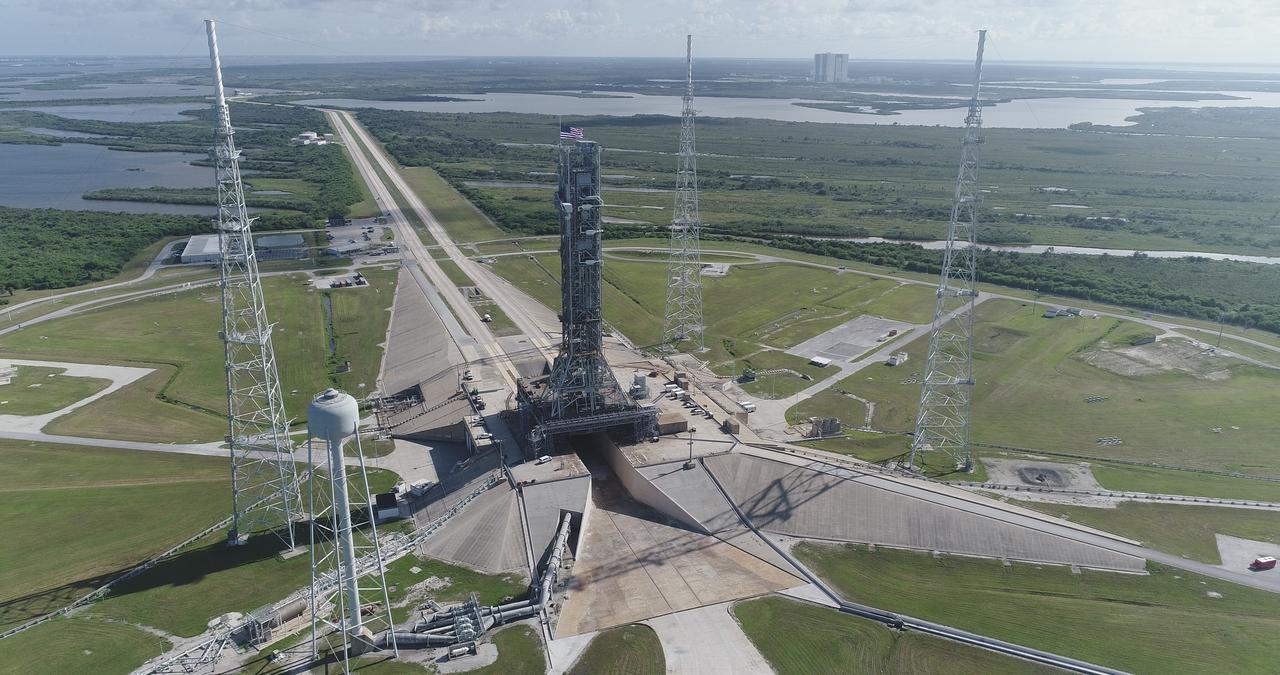
NASA's mobile launcher (ML) atop crawler-transporter 2 is at the top of Launch Pad 39B on Aug. 31, 2018, at the agency's Kennedy Space Center in Florida. The ML will undergo a fit check, followed by several days of systems testing. The 380-foot-tall mobile launcher is equipped with the crew access arm and several umbilicals that will provide power, environmental control, pneumatics, communication and electrical connections to NASA's Space Launch System (SLS) and Orion spacecraft. Exploration Ground Systems is preparing the ground systems necessary to launch SLS and Orion on Exploration Mission-1, missions to the Moon and on to Mars. Photo credit: NASA/Jamie Peer <b><a href="http://www.nasa.gov/audience/formedia/features/MP_Photo_Guidelines.html" rel="nofollow">NASA image use policy.</a></b>

NASA's mobile launcher (ML) atop crawler-transporter 2 is at the top of Launch Pad 39B on Aug. 31, 2018, at the agency's Kennedy Space Center in Florida. The ML will undergo a fit check, followed by several days of systems testing. The 380-foot-tall mobile launcher is equipped with the crew access arm and several umbilicals that will provide power, environmental control, pneumatics, communication and electrical connections to NASA's Space Launch System (SLS) and Orion spacecraft. Exploration Ground Systems is preparing the ground systems necessary to launch SLS and Orion on Exploration Mission-1, missions to the Moon and on to Mars. Photo credit: NASA/Jamie Peer <b><a href="http://www.nasa.gov/audience/formedia/features/MP_Photo_Guidelines.html" rel="nofollow">NASA image use policy.</a></b>
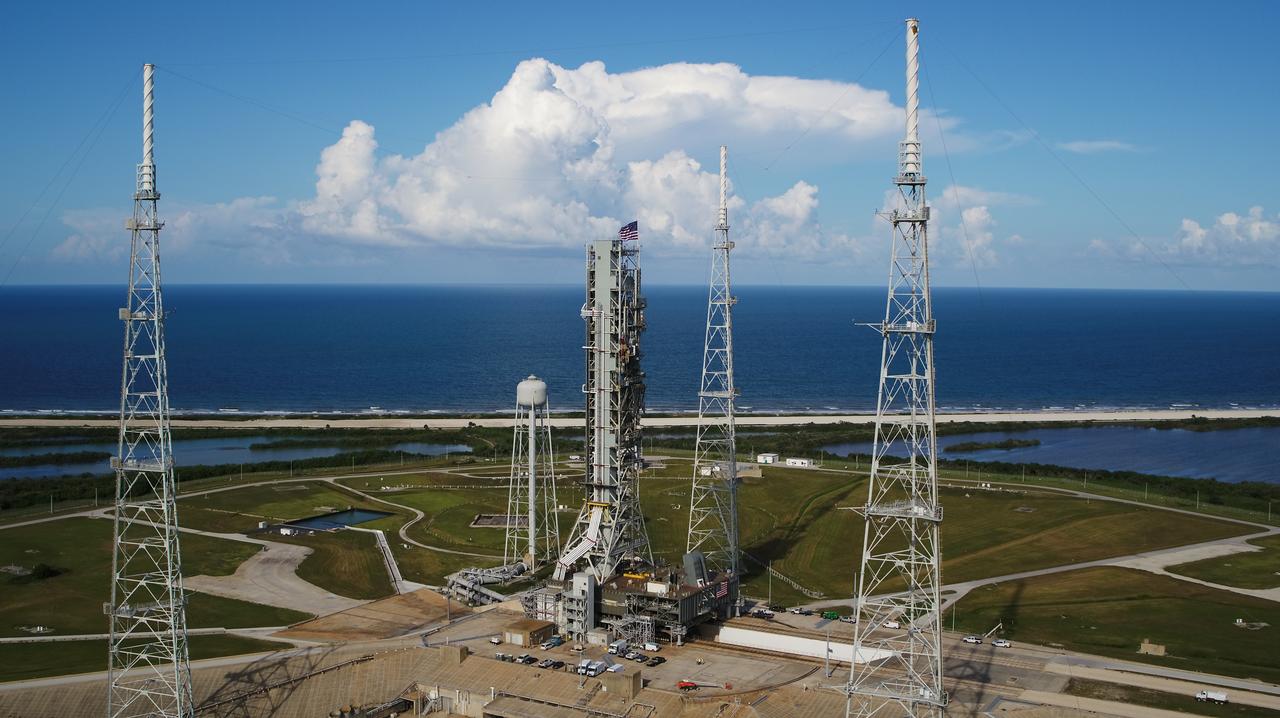
NASA's mobile launcher (ML) atop crawler-transporter 2 is at the top of Launch Pad 39B on Aug. 31, 2018, at the agency's Kennedy Space Center in Florida. The ML will undergo a fit check, followed by several days of systems testing. The 380-foot-tall mobile launcher is equipped with the crew access arm and several umbilicals that will provide power, environmental control, pneumatics, communication and electrical connections to NASA's Space Launch System (SLS) and Orion spacecraft. Exploration Ground Systems is preparing the ground systems necessary to launch SLS and Orion on Exploration Mission-1, missions to the Moon and on to Mars. Photo credit: NASA/Jamie Peer <b><a href="http://www.nasa.gov/audience/formedia/features/MP_Photo_Guidelines.html" rel="nofollow">NASA image use policy.</a></b>
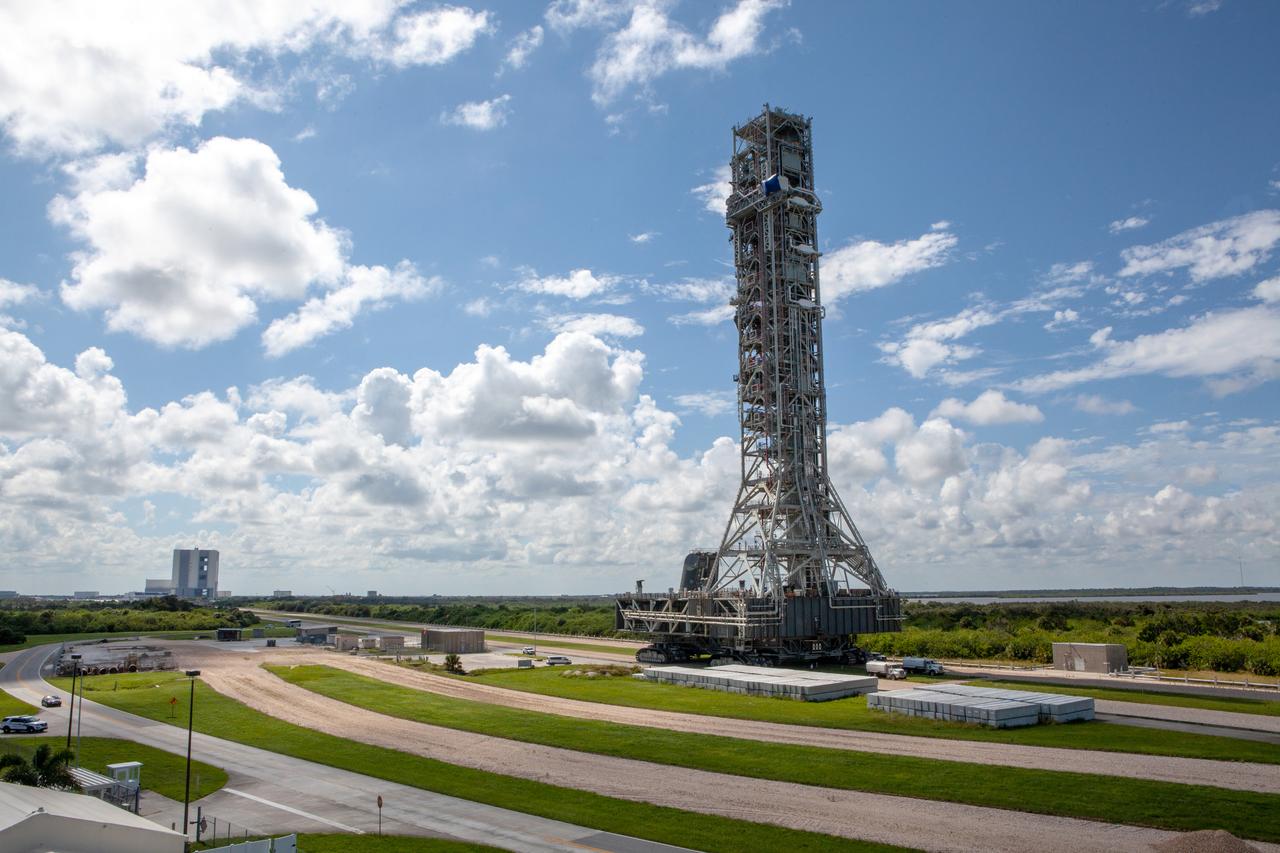
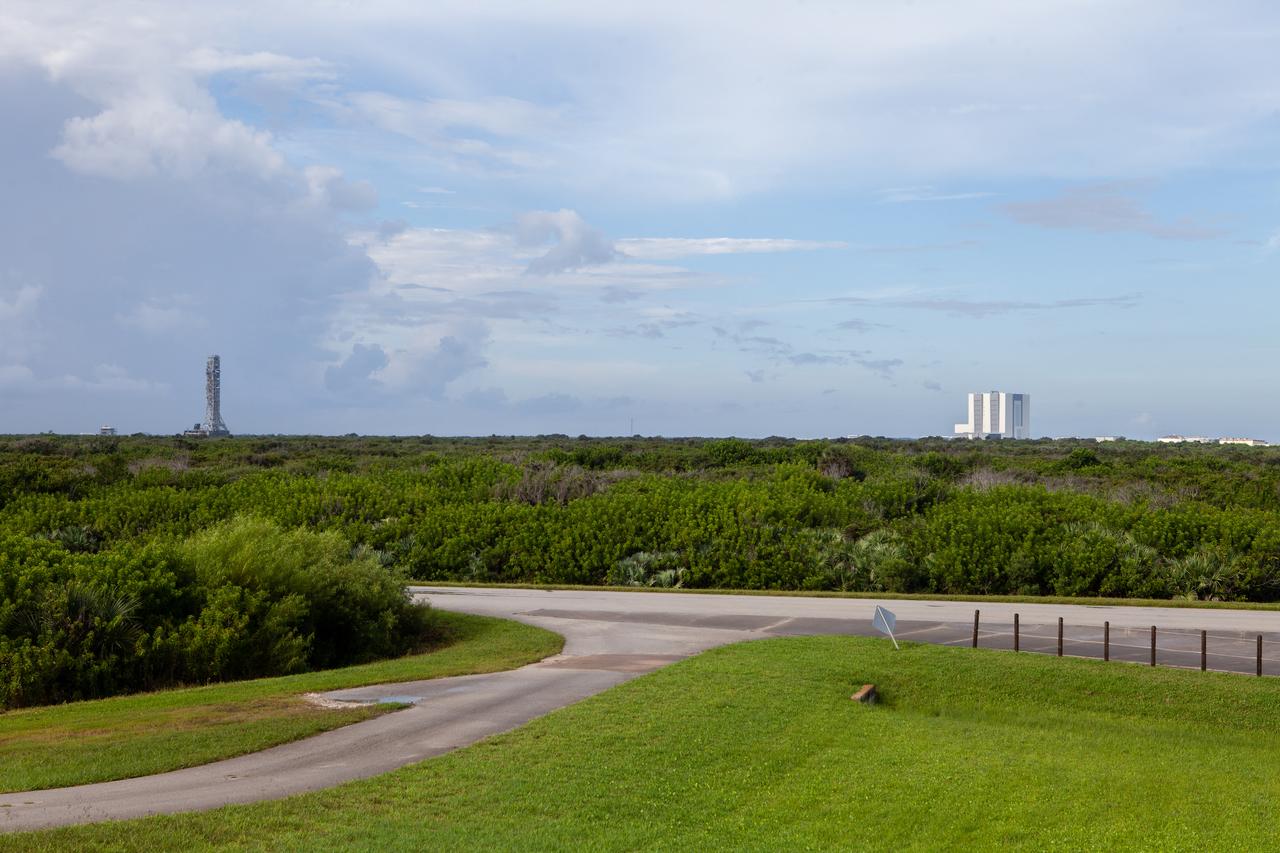
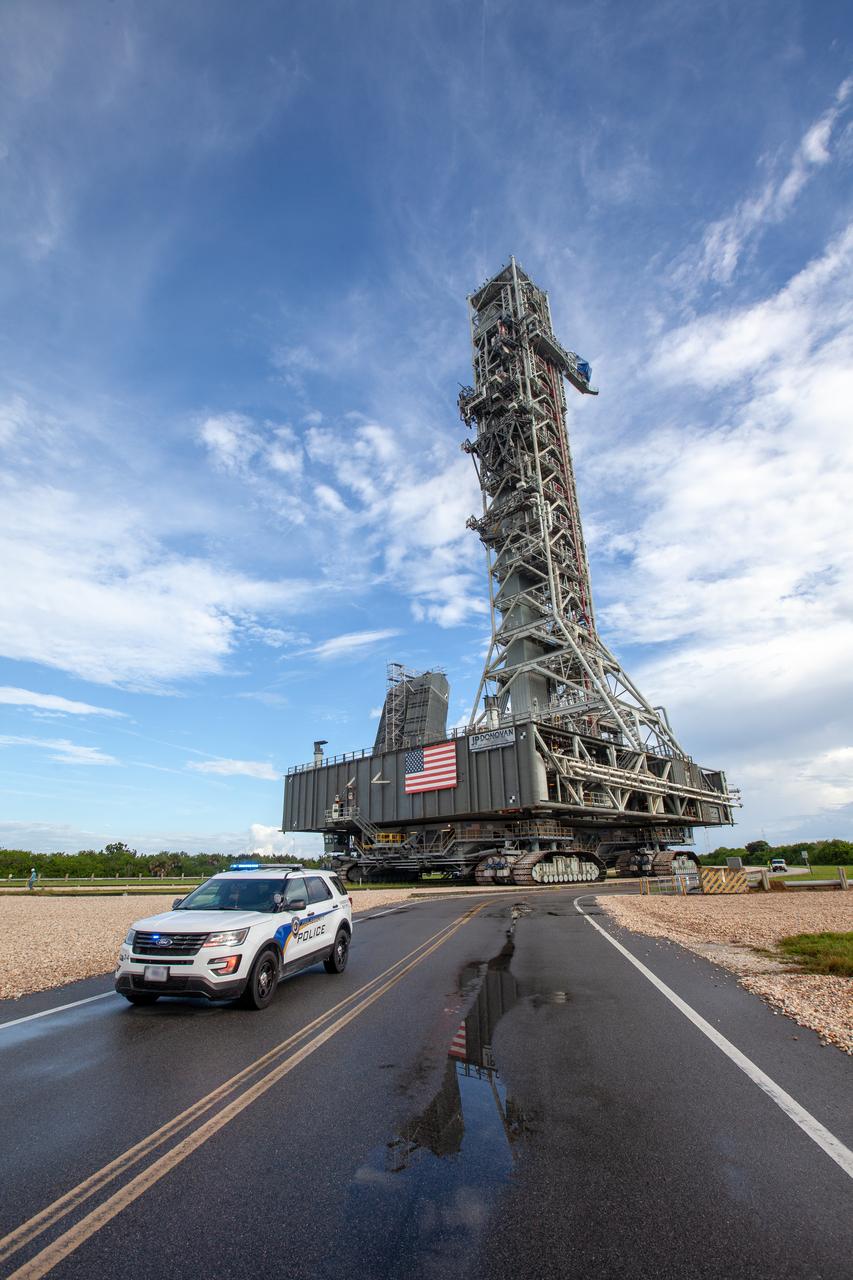
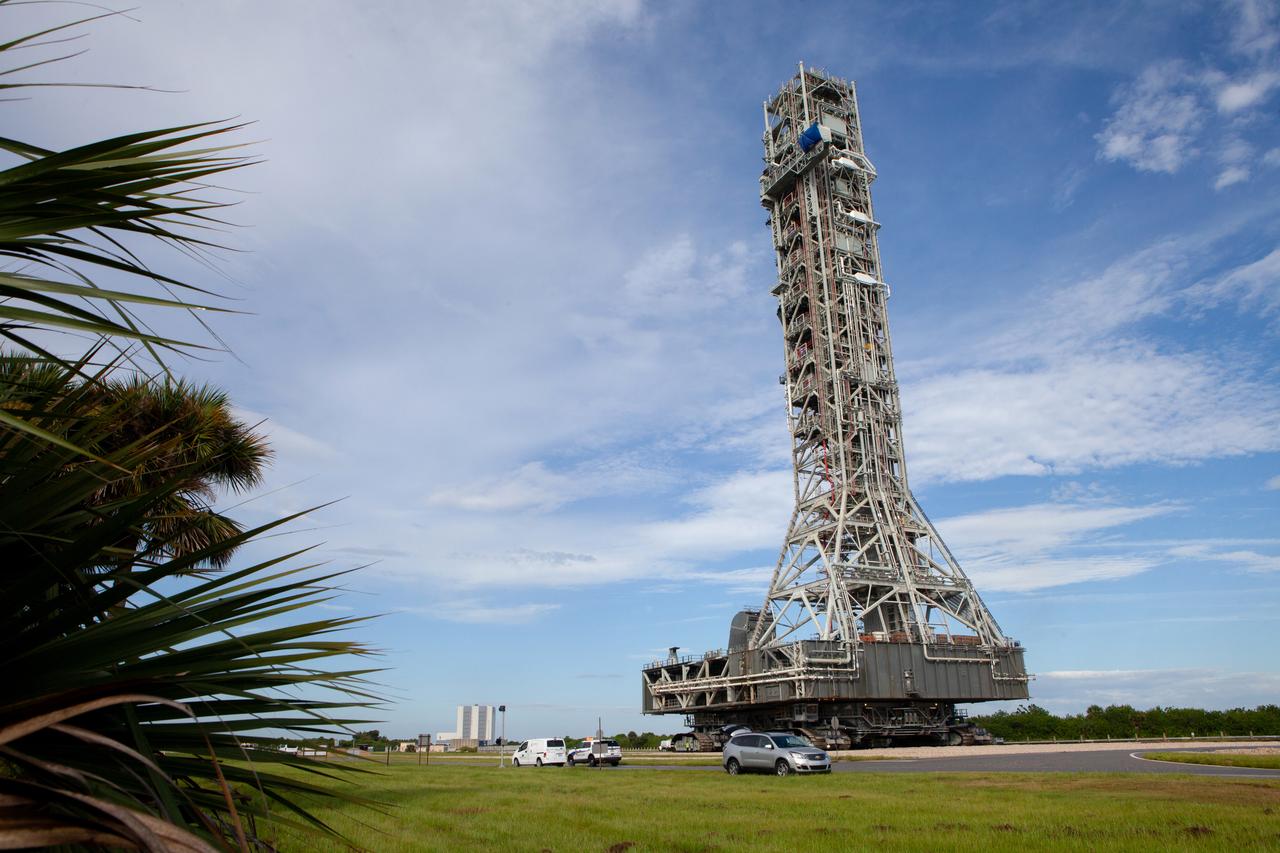
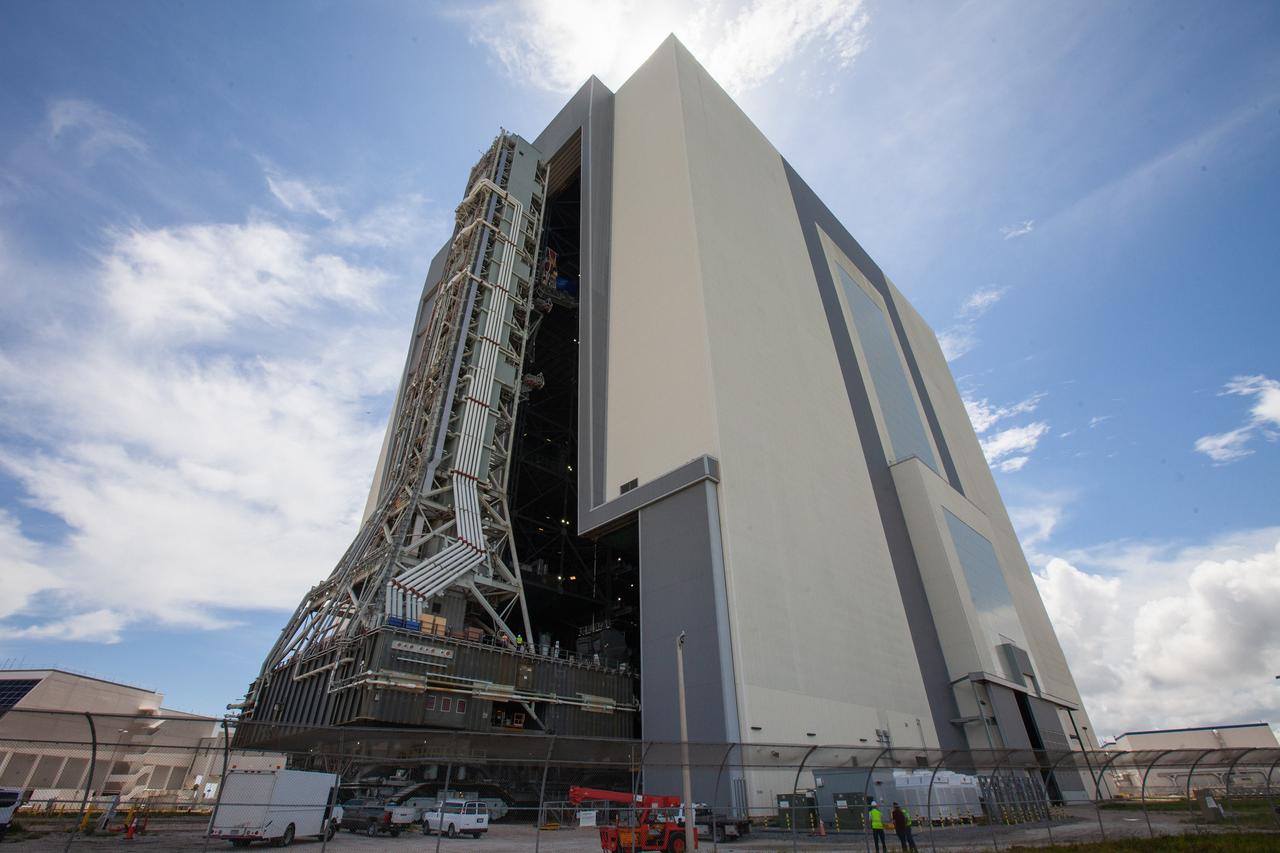
NASA’s mobile launcher (ML) atop crawler-transporter 2 moves along the crawlerway on Sept. 10, 2019, after spending a week and a half inside the Vehicle Assembly Building (VAB) at Kennedy Space Center in Florida due to the approach of Hurricane Dorian. The nearly 400-foot-tall structure was moved from Launch Pad 39B to the VAB for safekeeping on Aug. 30. The storm passed about 70 miles east of the spaceport during the overnight hours Tuesday, Sept. 3, and Wednesday, Sept. 4. NASA’s Exploration Ground Systems is moving the mobile launcher back to the launch pad, where teams will complete testing and checkout on the launcher in the coming weeks for the Artemis I mission.
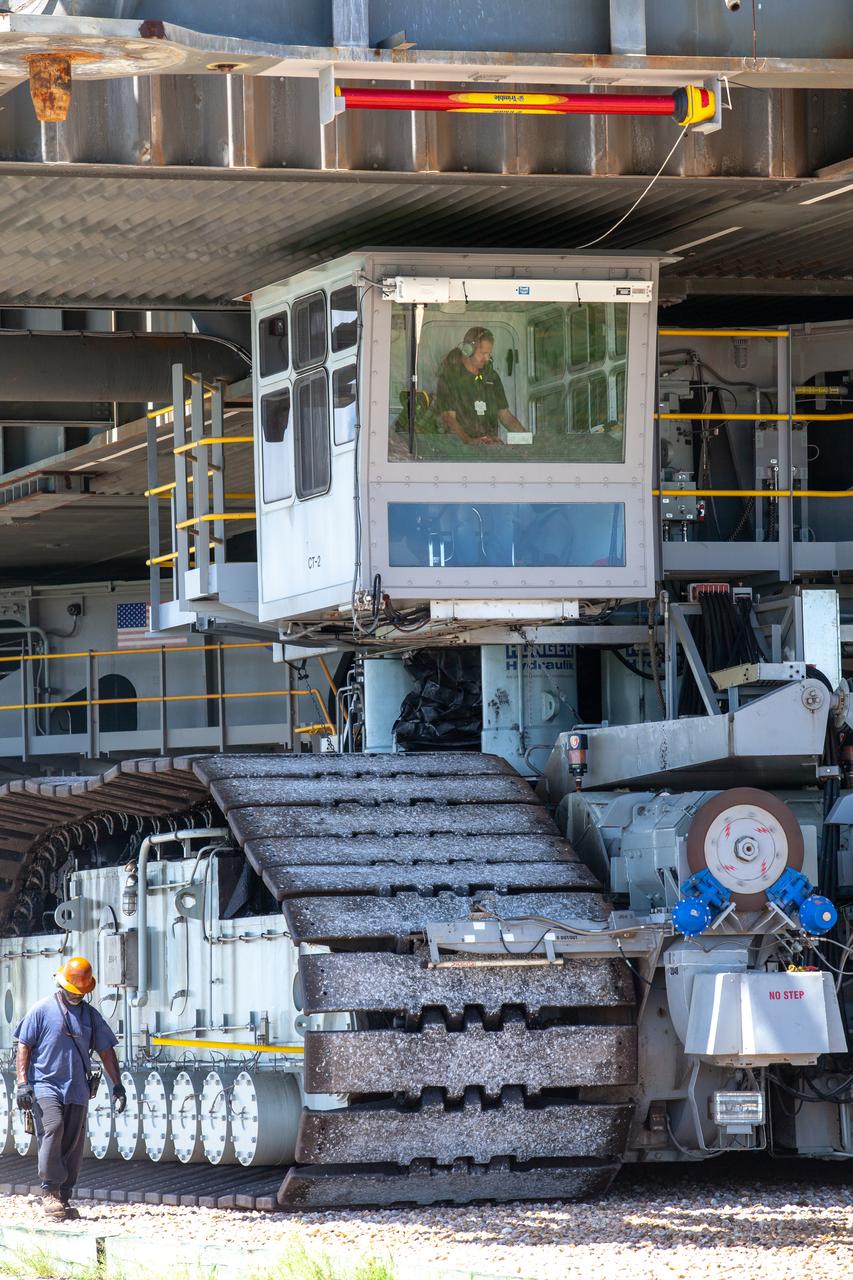
NASA’s mobile launcher (ML) atop crawler-transporter 2 moves along the crawlerway on Sept. 10, 2019, after spending a week and a half inside the Vehicle Assembly Building (VAB) at Kennedy Space Center in Florida due to the approach of Hurricane Dorian. The nearly 400-foot-tall structure was moved from Launch Pad 39B to the VAB for safekeeping on Aug. 30. The storm passed about 70 miles east of the spaceport during the overnight hours Tuesday, Sept. 3, and Wednesday, Sept. 4. NASA’s Exploration Ground Systems is moving the mobile launcher back to the launch pad, where teams will complete testing and checkout on the launcher in the coming weeks for the Artemis I mission.
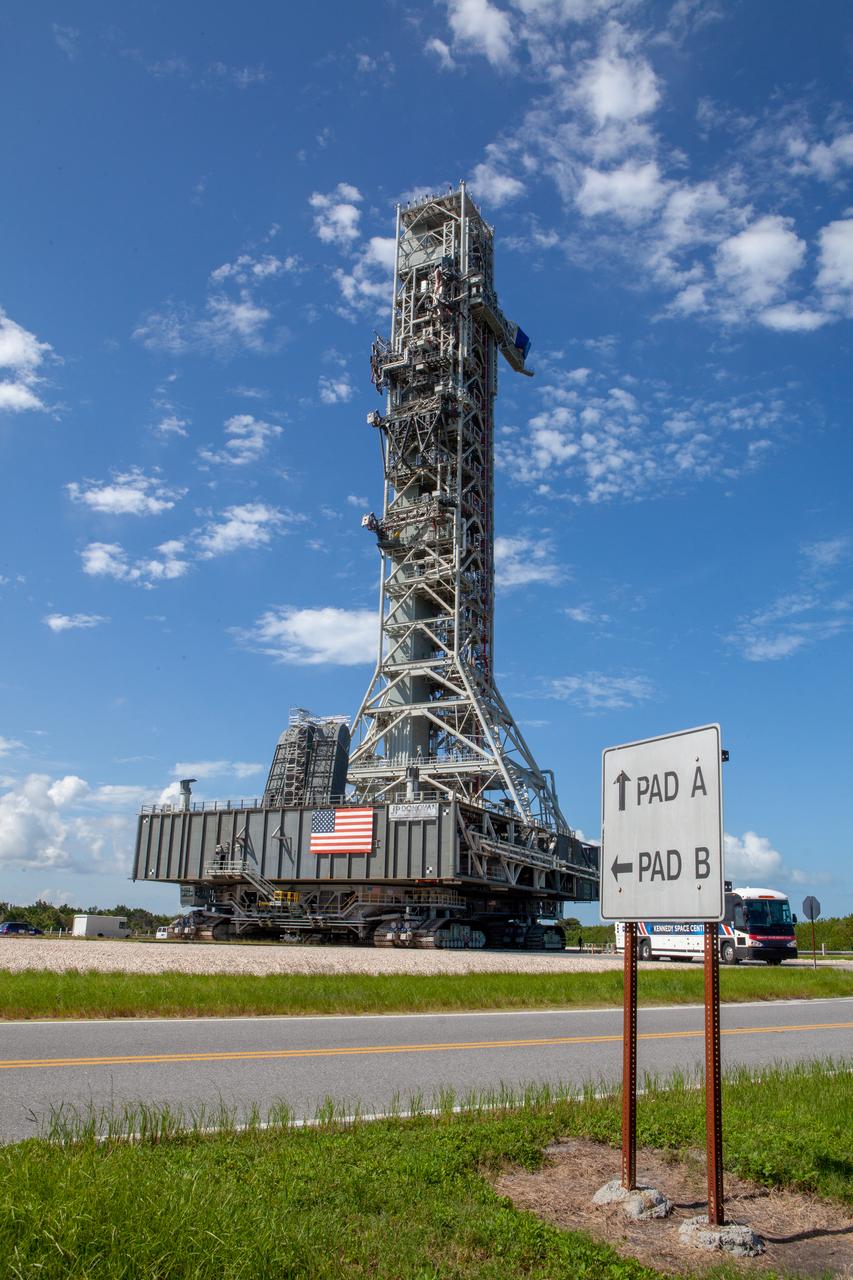
NASA’s mobile launcher (ML) atop crawler-transporter 2 moves along the crawlerway on Sept. 10, 2019, after spending a week and a half inside the Vehicle Assembly Building (VAB) at Kennedy Space Center in Florida due to the approach of Hurricane Dorian. The nearly 400-foot-tall structure was moved from Launch Pad 39B to the VAB for safekeeping on Aug. 30. The storm passed about 70 miles east of the spaceport during the overnight hours Tuesday, Sept. 3, and Wednesday, Sept. 4. NASA’s Exploration Ground Systems is moving the mobile launcher back to the launch pad, where teams will complete testing and checkout on the launcher in the coming weeks for the Artemis I mission.
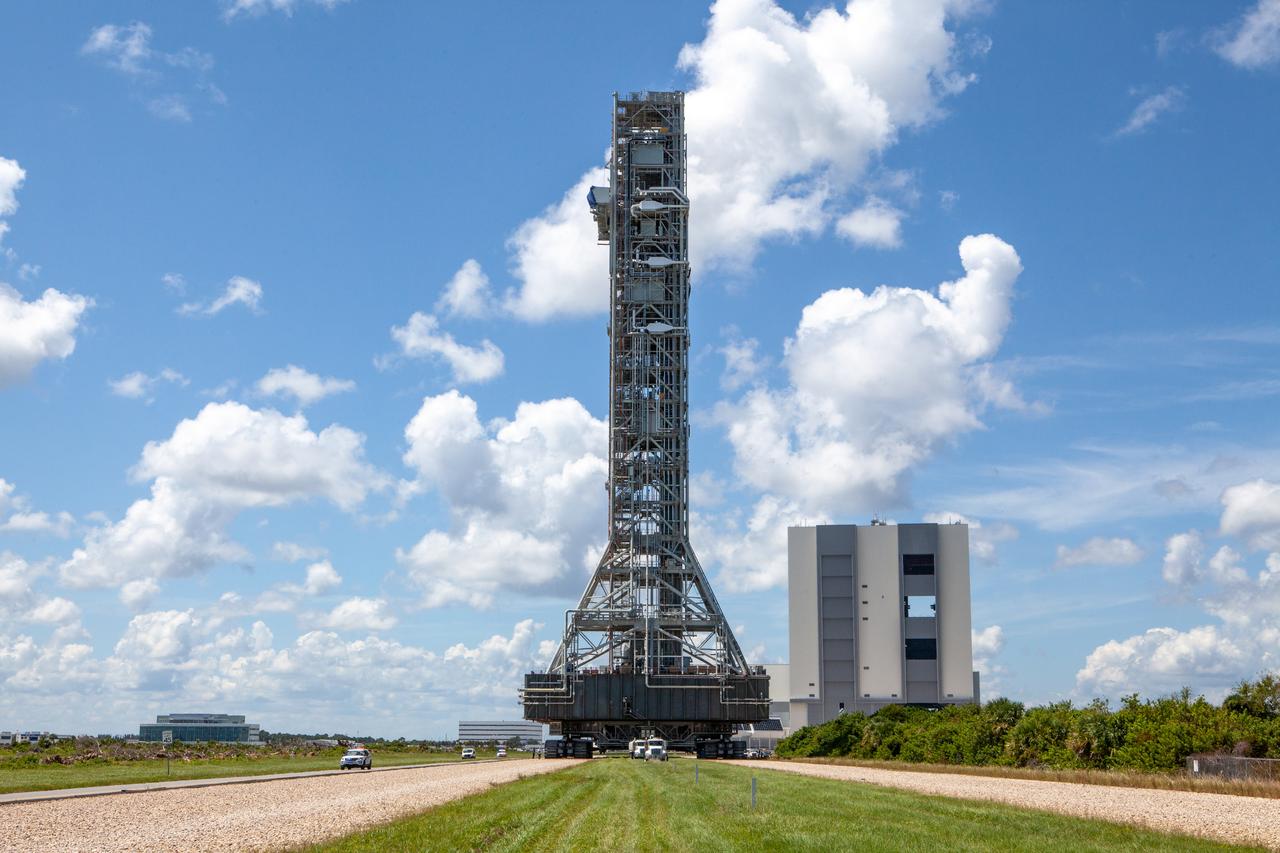
NASA’s mobile launcher (ML) atop crawler-transporter 2 moves along the crawlerway on Sept. 10, 2019, after spending a week and a half inside the Vehicle Assembly Building (VAB) at Kennedy Space Center in Florida due to the approach of Hurricane Dorian. The nearly 400-foot-tall structure was moved from Launch Pad 39B to the VAB for safekeeping on Aug. 30. The storm passed about 70 miles east of the spaceport during the overnight hours Tuesday, Sept. 3, and Wednesday, Sept. 4. NASA’s Exploration Ground Systems is moving the mobile launcher back to the launch pad, where teams will complete testing and checkout on the launcher in the coming weeks for the Artemis I mission.
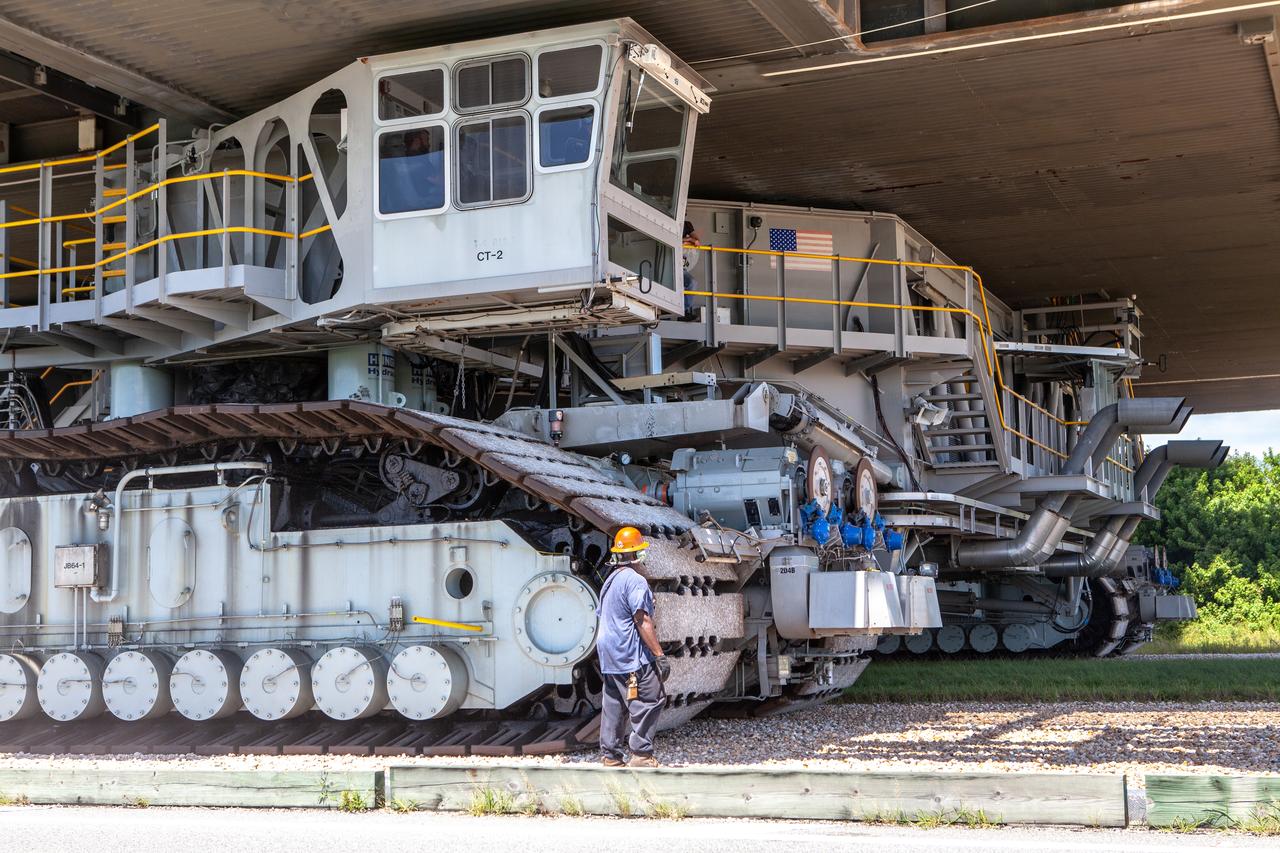
NASA’s mobile launcher (ML) atop crawler-transporter 2 moves along the crawlerway on Sept. 10, 2019, after spending a week and a half inside the Vehicle Assembly Building (VAB) at Kennedy Space Center in Florida due to the approach of Hurricane Dorian. The nearly 400-foot-tall structure was moved from Launch Pad 39B to the VAB for safekeeping on Aug. 30. The storm passed about 70 miles east of the spaceport during the overnight hours Tuesday, Sept. 3, and Wednesday, Sept. 4. NASA’s Exploration Ground Systems is moving the mobile launcher back to the launch pad, where teams will complete testing and checkout on the launcher in the coming weeks for the Artemis I mission.
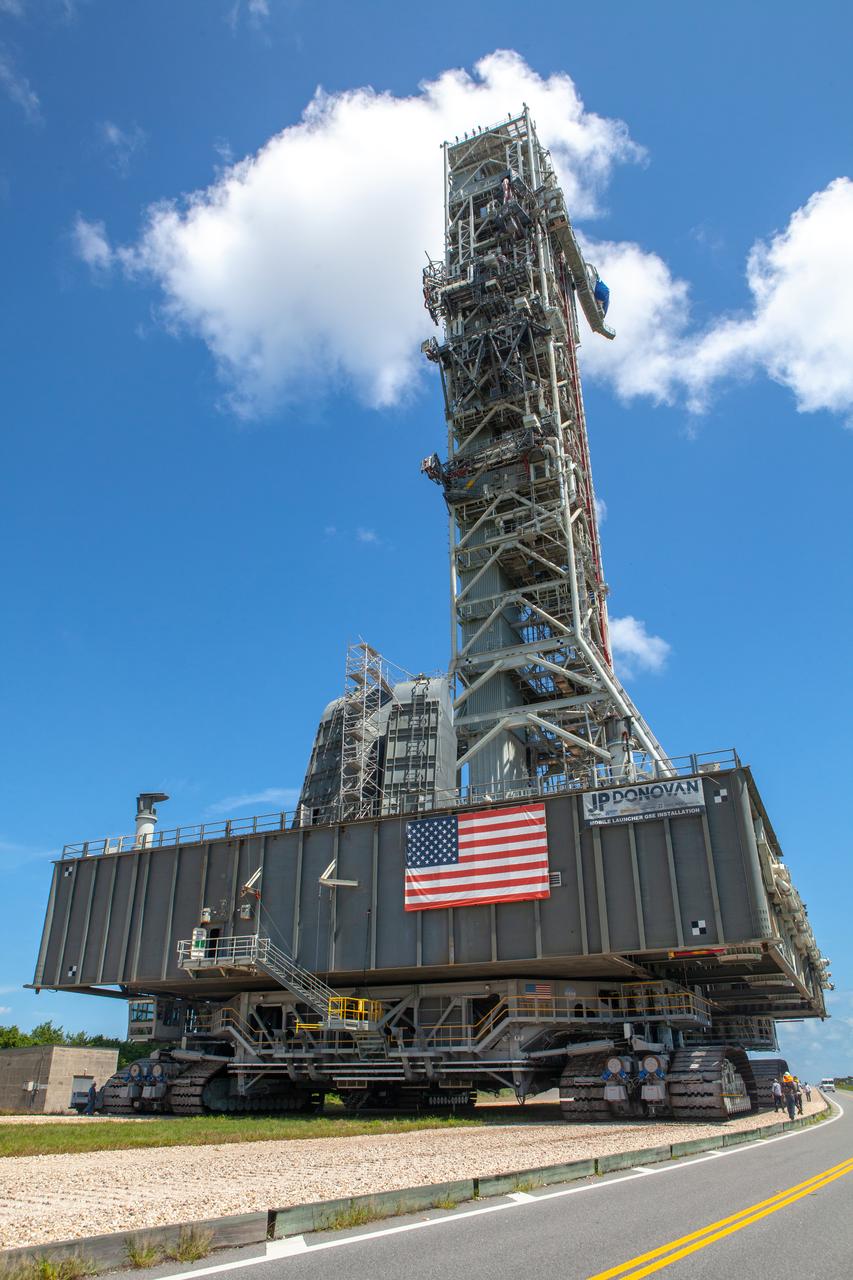
NASA’s mobile launcher (ML) atop crawler-transporter 2 moves along the crawlerway on Sept. 10, 2019, after spending a week and a half inside the Vehicle Assembly Building (VAB) at Kennedy Space Center in Florida due to the approach of Hurricane Dorian. The nearly 400-foot-tall structure was moved from Launch Pad 39B to the VAB for safekeeping on Aug. 30. The storm passed about 70 miles east of the spaceport during the overnight hours Tuesday, Sept. 3, and Wednesday, Sept. 4. NASA’s Exploration Ground Systems is moving the mobile launcher back to the launch pad, where teams will complete testing and checkout on the launcher in the coming weeks for the Artemis I mission.
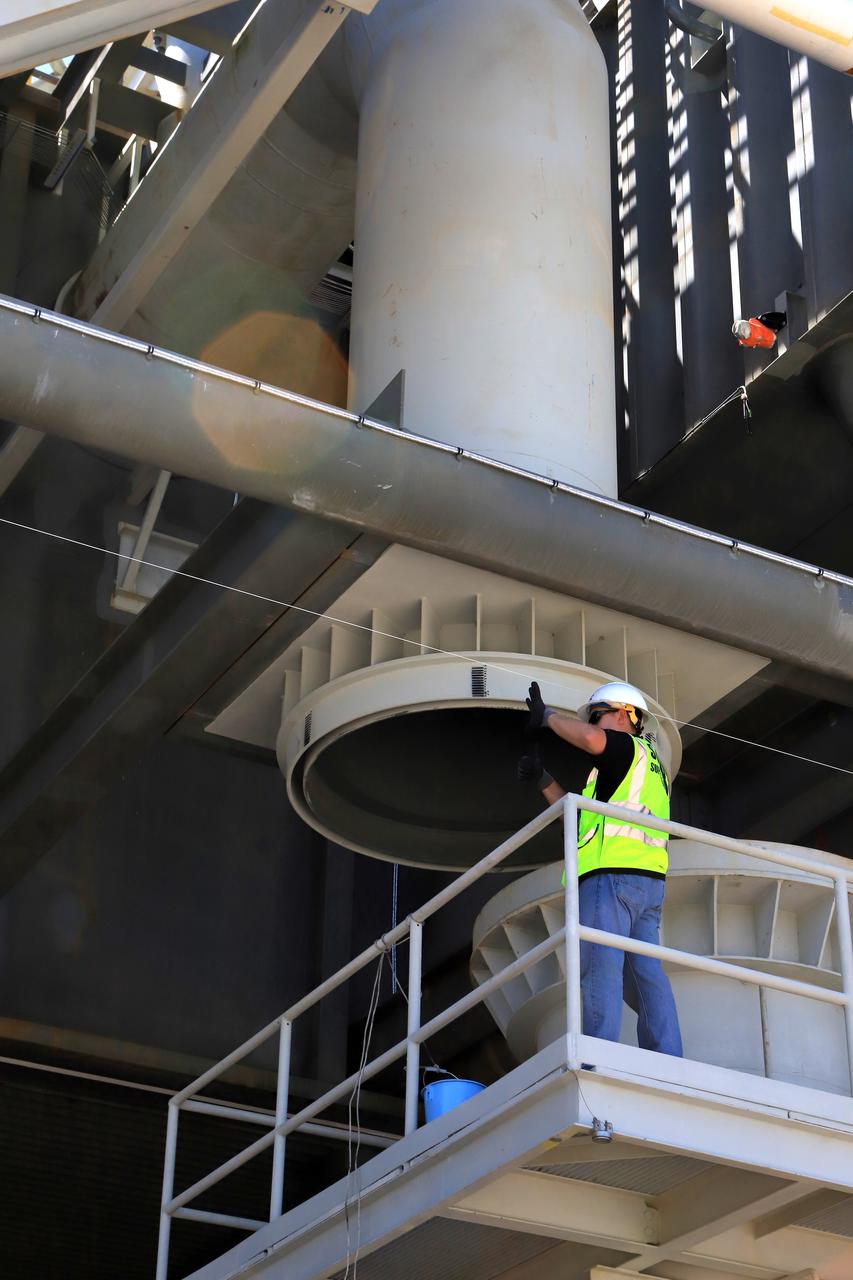
A technician watches as the ignition overpressure water system pipe on the mobile launcher slowly aligns with the pipe on the ground system at Launch Pad 39B at NASA's Kennedy Space Center in Florida, on Aug. 31, 2018. The ML, atop crawler-transporter 2, made the trek along the crawlerway to the pad for a fit check and several days of systems testing. The 380-foot-tall mobile launcher is equipped with the crew access arm and several umbilicals that will provide power, environmental control, pneumatics, communication and electrical connections to NASA's Space Launch System (SLS) and Orion spacecraft. Exploration Ground Systems is preparing the ground systems necessary to launch SLS and Orion on Exploration Mission-1, missions to the Moon and on to Mars.
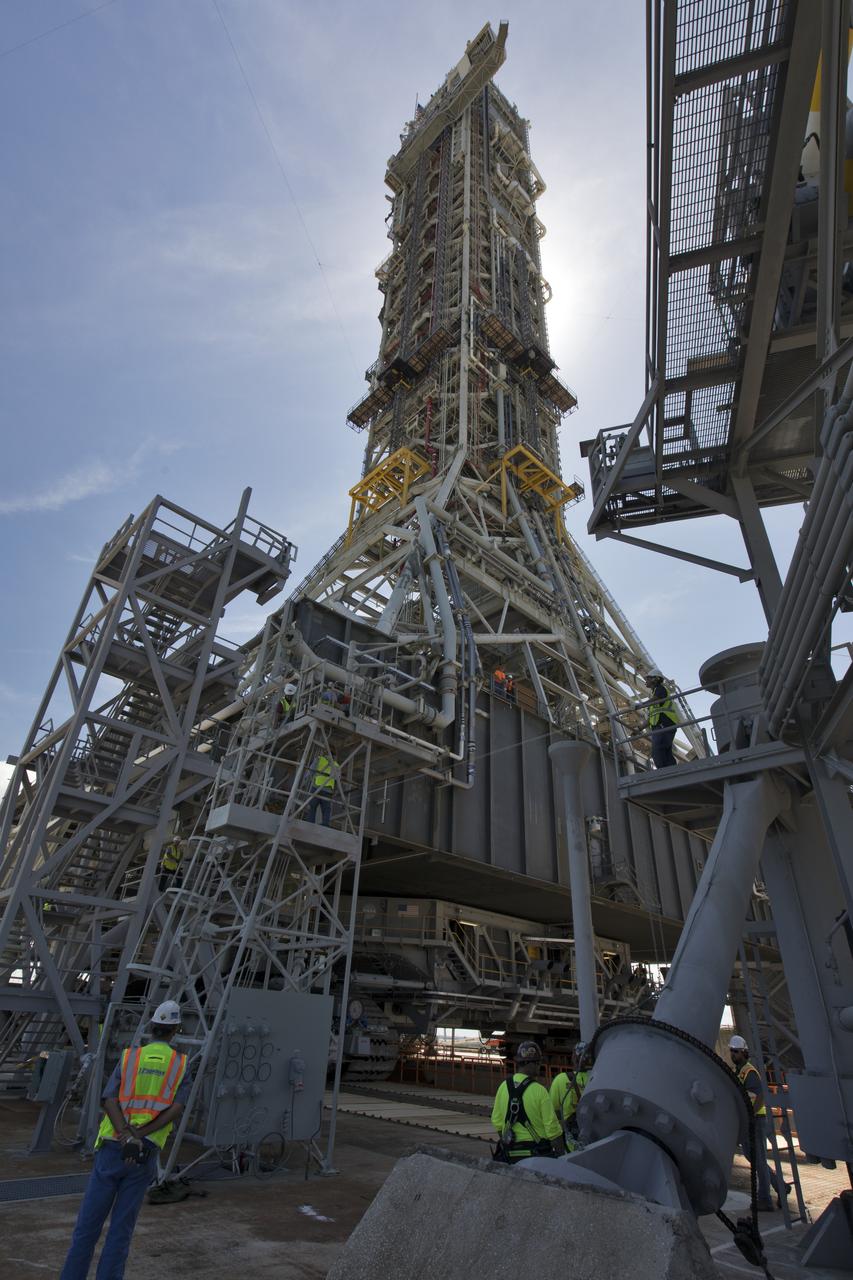
Crawler-transporter 2, with NASA's mobile launcher atop, is stopped at the top of Launch Pad 39B on Aug. 31, 2018, at NASA's Kennedy Space Center in Florida. The ML will undergo a fit check, followed by several days of systems testing. The 380-foot-tall mobile launcher is equipped with the crew access arm and several umbilicals that will provide power, environmental control, pneumatics, communication and electrical connections to NASA's Space Launch System (SLS) and Orion spacecraft. Exploration Ground Systems is preparing the ground systems necessary to launch SLS and Orion on Exploration Mission-1, missions to the Moon and on to Mars.
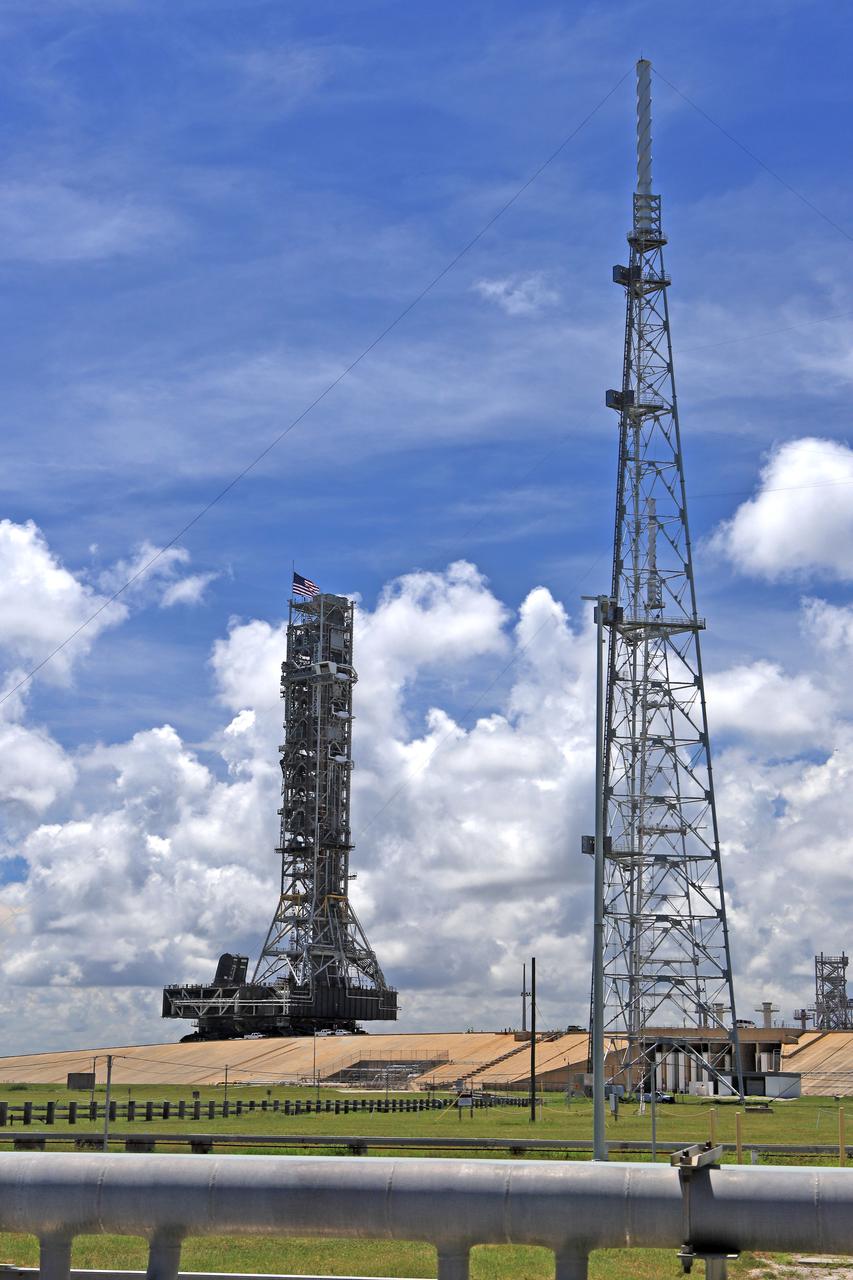
The crawler-transporter 2, with NASA's mobile launcher atop, makes its way up the ramp to the top of Launch Pad 39B at NASA's Kennedy Space Center in Florida, on Aug. 31, 2018. The ML will undergo a fit check, followed by several days of systems testing. The 380-foot-tall mobile launcher is equipped with the crew access arm and several umbilicals that will provide power, environmental control, pneumatics, communication and electrical connections to NASA's Space Launch System (SLS) and Orion spacecraft. Exploration Ground Systems is preparing the ground systems necessary to launch SLS and Orion on Exploration Mission-1, missions to the Moon and on to Mars.
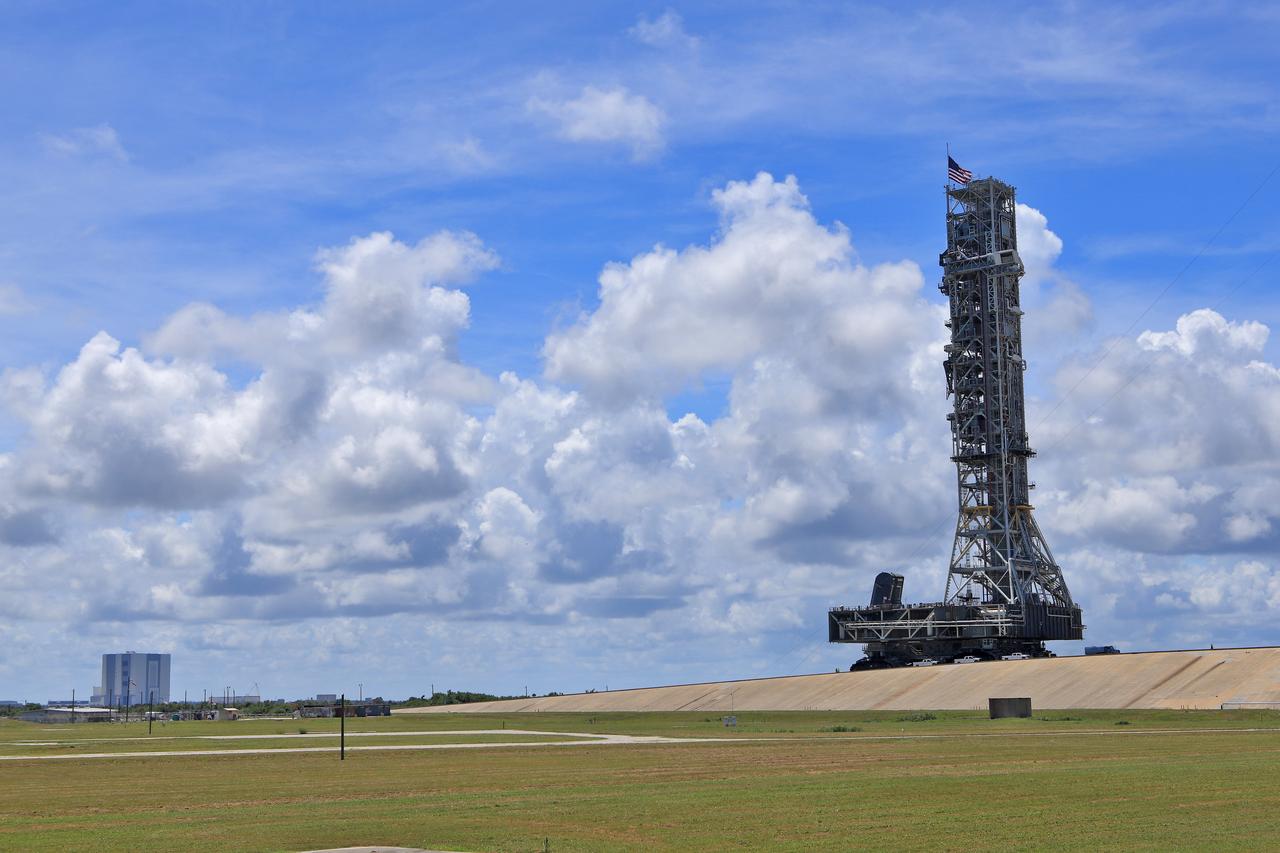
The crawler-transporter 2, with NASA's mobile launcher atop, makes its way up the ramp to the top of Launch Pad 39B at NASA's Kennedy Space Center in Florida, on Aug. 31, 2018. The ML will undergo a fit check, followed by several days of systems testing. The 380-foot-tall mobile launcher is equipped with the crew access arm and several umbilicals that will provide power, environmental control, pneumatics, communication and electrical connections to NASA's Space Launch System (SLS) and Orion spacecraft. Exploration Ground Systems is preparing the ground systems necessary to launch SLS and Orion on Exploration Mission-1, missions to the Moon and on to Mars.
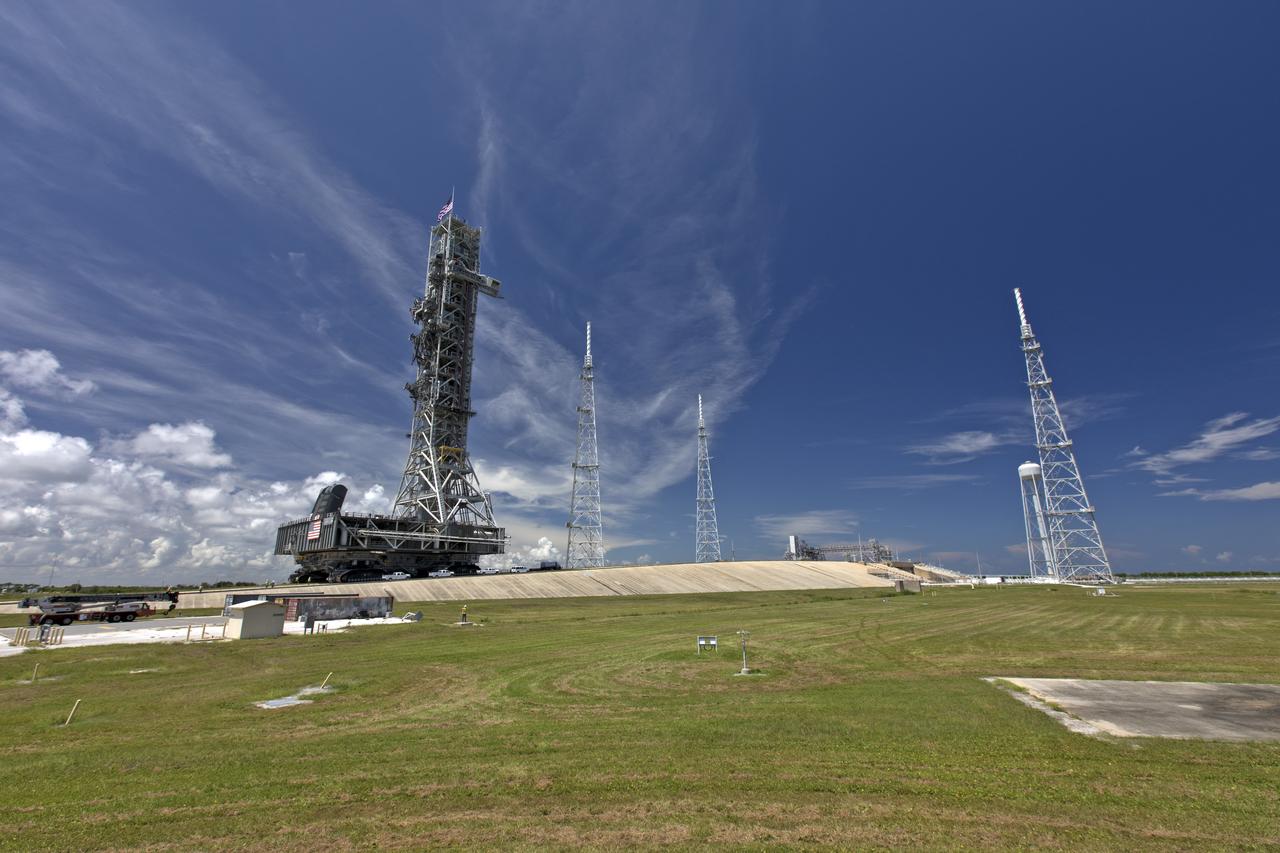
The crawler-transporter 2, with NASA's mobile launcher atop, makes its way up the ramp to the top of Launch Pad 39B at NASA's Kennedy Space Center in Florida, on Aug. 31, 2018. The ML will undergo a fit check, followed by several days of systems testing. The 380-foot-tall mobile launcher is equipped with the crew access arm and several umbilicals that will provide power, environmental control, pneumatics, communication and electrical connections to NASA's Space Launch System (SLS) and Orion spacecraft. Exploration Ground Systems is preparing the ground systems necessary to launch SLS and Orion on Exploration Mission-1, missions to the Moon and on to Mars.
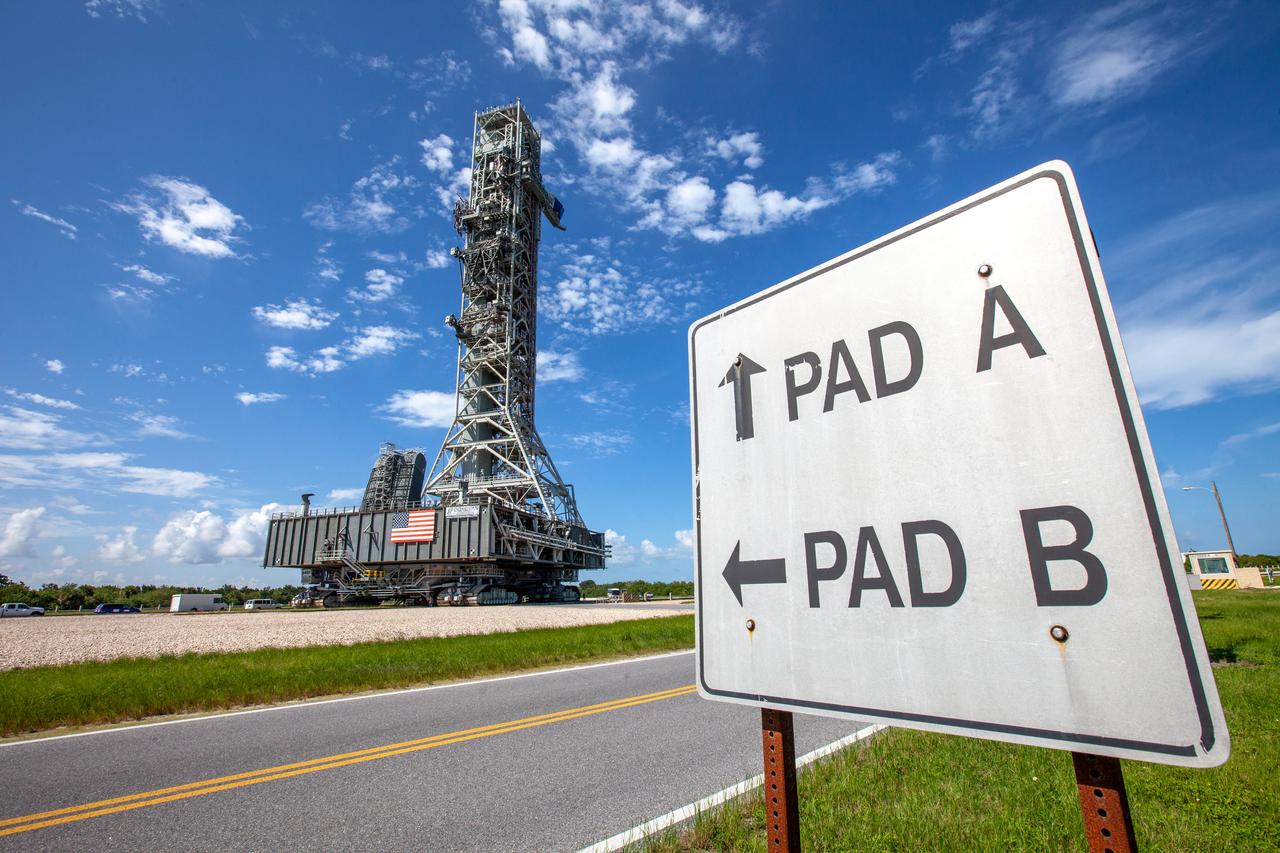
NASA’s mobile launcher (ML) atop crawler-transporter 2 moves along the crawlerway and nears the turn to Launch Pad 39B on Sept. 10, 2019, after spending a week and a half inside the Vehicle Assembly Building (VAB) at Kennedy Space Center in Florida due to the approach of Hurricane Dorian. The nearly 400-foot-tall structure was moved from Pad B to the VAB for safekeeping on Aug. 30. The storm passed about 70 miles east of the spaceport during the overnight hours Tuesday, Sept. 3, and Wednesday, Sept. 4. NASA’s Exploration Ground Systems is moving the mobile launcher back to the launch pad, where teams will complete testing and checkout on the launcher in the coming weeks for the Artemis I mission.
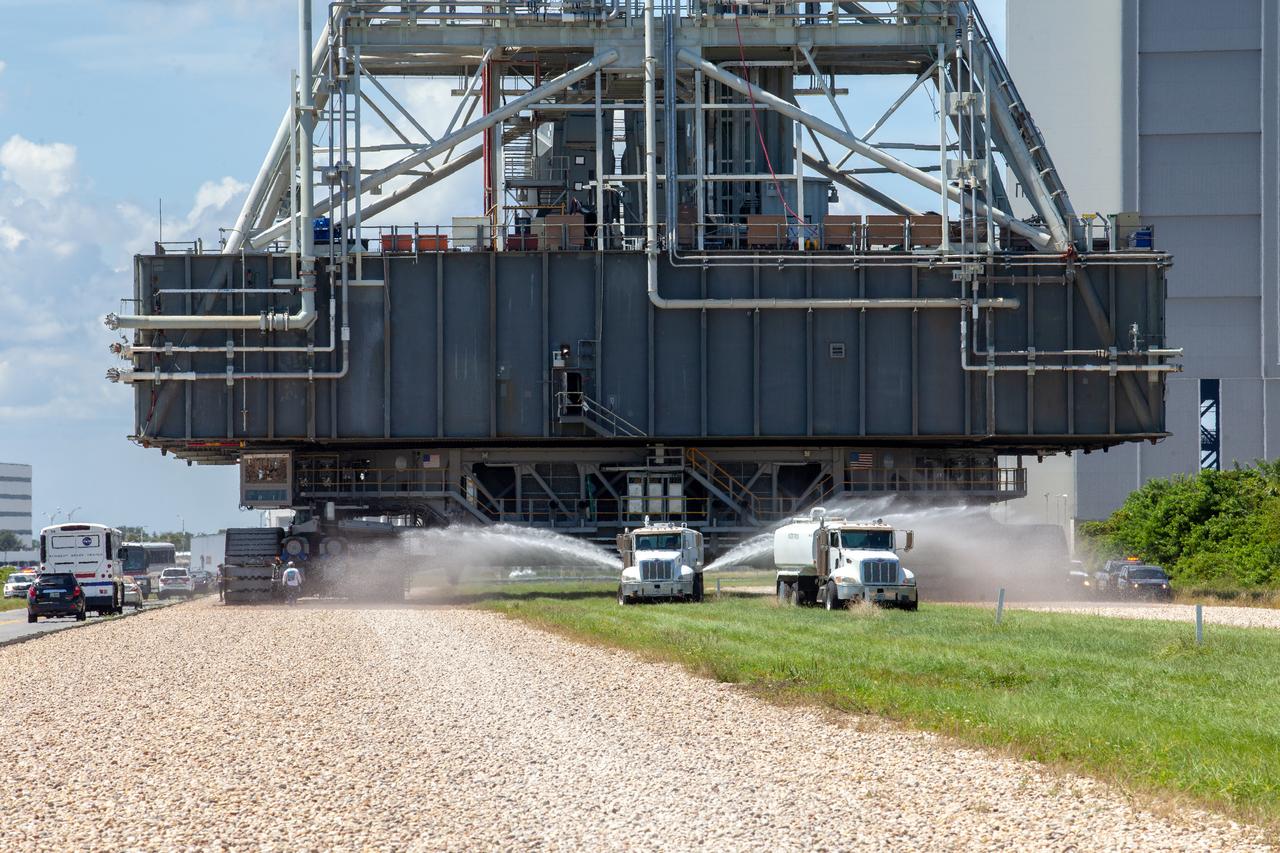
NASA’s mobile launcher (ML) atop crawler-transporter 2 moves along the crawlerway on Sept. 10, 2019, after spending a week and a half inside the Vehicle Assembly Building (VAB) at Kennedy Space Center in Florida due to the approach of Hurricane Dorian. Truck in front spray water to reduce dust and sand. The nearly 400-foot-tall structure was moved from Launch Pad 39B to the VAB for safekeeping on Aug. 30. The storm passed about 70 miles east of the spaceport during the overnight hours Tuesday, Sept. 3, and Wednesday, Sept. 4. NASA’s Exploration Ground Systems is moving the mobile launcher back to the launch pad, where teams will complete testing and checkout on the launcher in the coming weeks for the Artemis I mission.
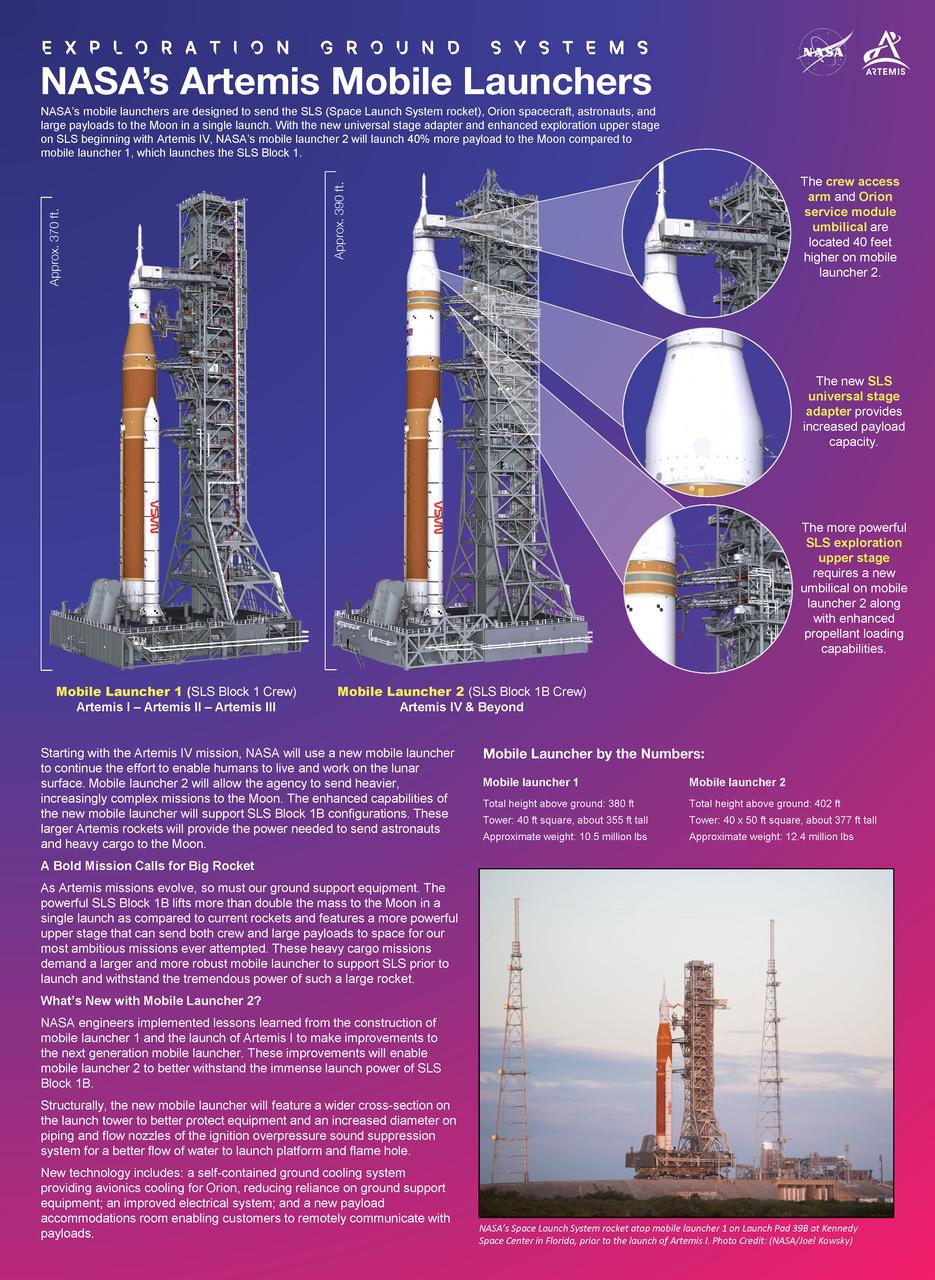
This infographic explains NASA’s mobile launchers designed for the agency's Artemis missions to send the Space Launch System rocket, Orion spacecraft, and large payloads to the Moon in a single launch.
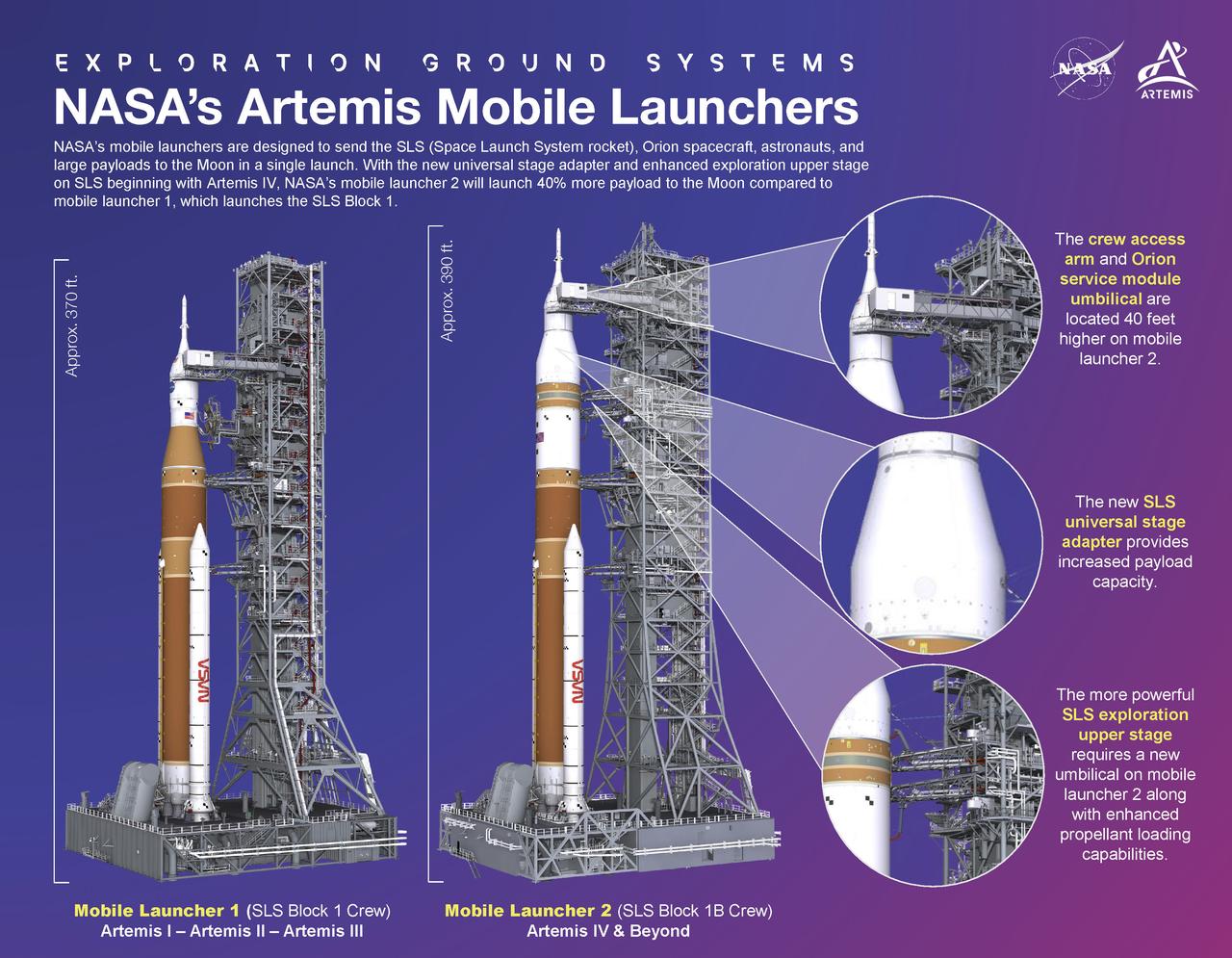
This infographic explains NASA’s mobile launchers designed for the agency's Artemis missions to send the Space Launch System rocket, Orion spacecraft, and large payloads to the Moon in a single launch.
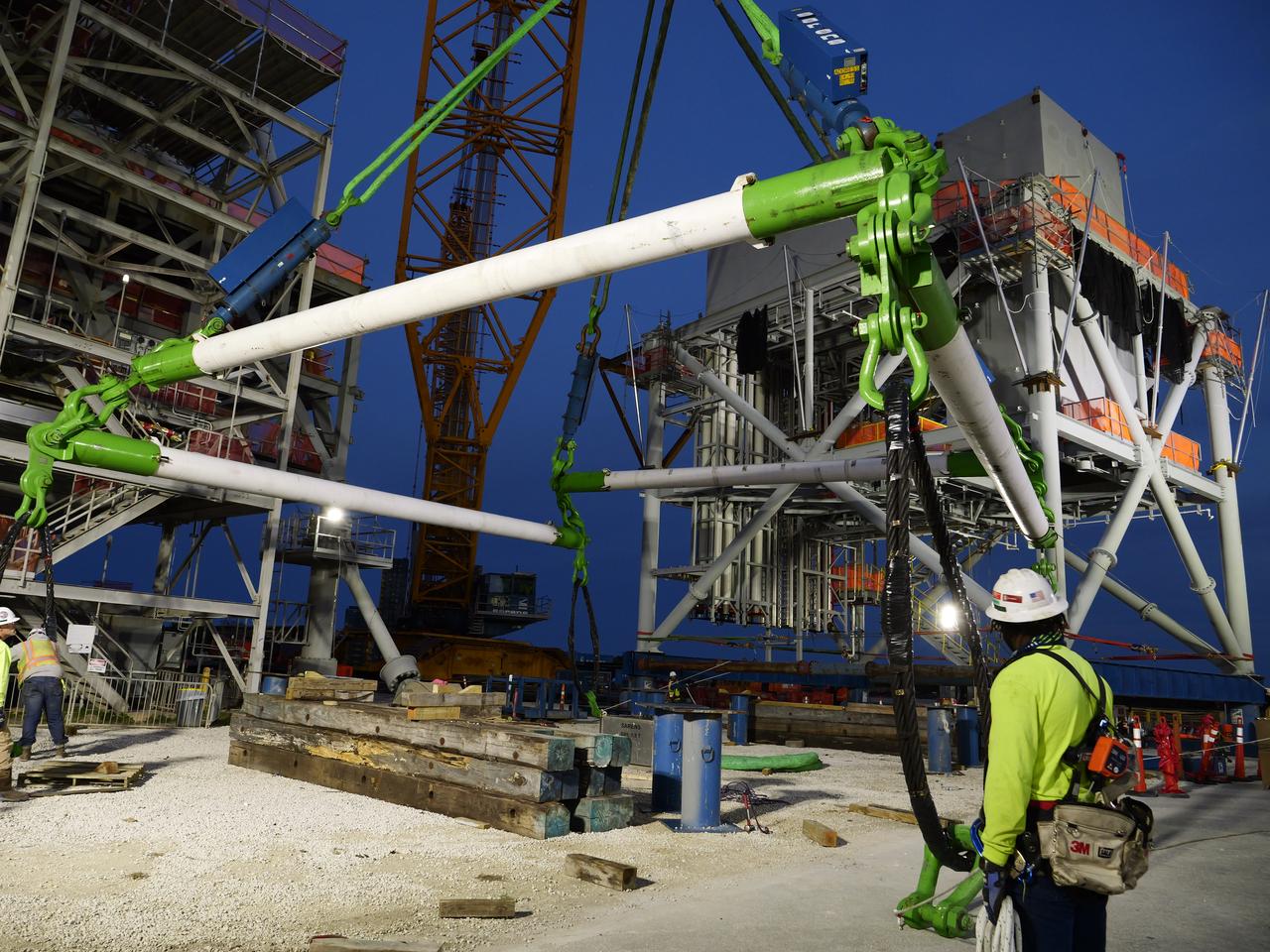
Teams at Bechtel National, Inc. use a crane to lift Module 4 into place atop the mobile launcher 2 tower chair at its Kennedy Space Center park site on January 3, 2025. Module 4 is the first of seven modules that will be stacked vertically to make up the almost 400-foot launch tower that will be used beginning with the Artemis IV mission.

Teams at Bechtel National, Inc. use a crane to lift Module 4 into place atop the mobile launcher 2 tower chair at its Kennedy Space Center park site on January 3, 2025. Module 4 is the first of seven modules that will be stacked vertically to make up the almost 400-foot launch tower that will be used beginning with the Artemis IV mission.

Teams at Bechtel National, Inc. use a crane to lift Module 4 into place atop the mobile launcher 2 tower chair at its Kennedy Space Center park site on January 3, 2025. Module 4 is the first of seven modules that will be stacked vertically to make up the almost 400-foot launch tower that will be used beginning with the Artemis IV mission.
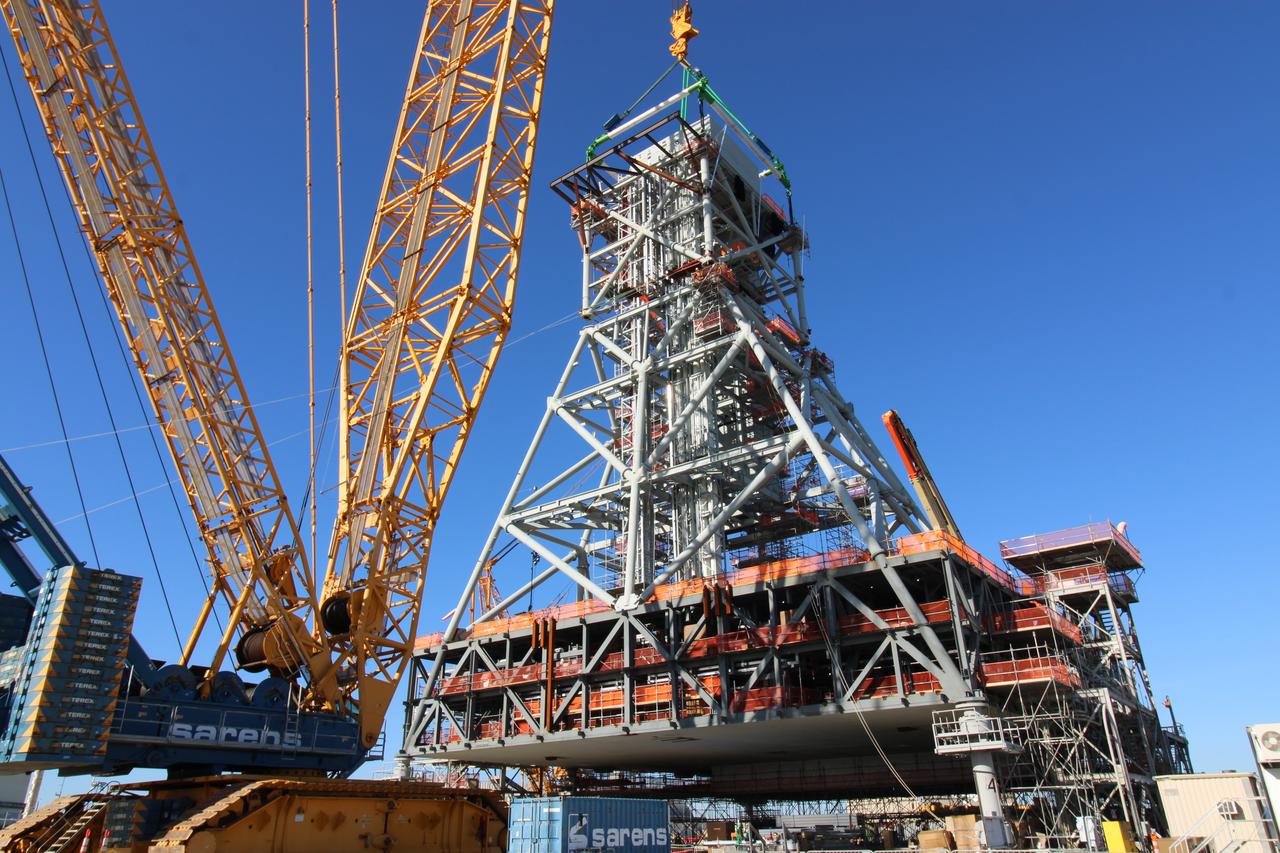
Teams at Bechtel National, Inc. use a crane to lift Module 4 into place atop the mobile launcher 2 tower chair at its Kennedy Space Center park site on January 3, 2025. Module 4 is the first of seven modules that will be stacked vertically to make up the almost 400-foot launch tower that will be used beginning with the Artemis IV mission.
Exploration Ground Systems teams at NASA’s Kennedy Space Center in Florida take precautions to protect Artemis ground support equipment in advance of Hurricane Dorian. On Aug. 30, 2019, crawler-transporter 2 moved the mobile launcher (ML) from its current position at Launch Pad 39B to inside the Vehicle Assembly Building. In its final phases of development, the ML stands nearly 400 feet tall and is needed to assemble, process and launch NASA’s powerful Space Launch System rocket and Orion spacecraft on missions to the Moon and Mars.
Exploration Ground Systems teams at NASA’s Kennedy Space Center in Florida take precautions to protect Artemis ground support equipment in advance of Hurricane Dorian. On Aug. 30, 2019, crawler-transporter 2 moved the mobile launcher (ML) from its current position at Launch Pad 39B to inside the Vehicle Assembly Building. In its final phases of development, the ML stands nearly 400 feet tall and is needed to assemble, process and launch NASA’s powerful Space Launch System rocket and Orion spacecraft on missions to the Moon and Mars.
Exploration Ground Systems teams at NASA’s Kennedy Space Center in Florida take precautions to protect Artemis ground support equipment in advance of Hurricane Dorian. On Aug. 30, 2019, crawler-transporter 2 moved the mobile launcher (ML) from its current position at Launch Pad 39B to inside the Vehicle Assembly Building. In its final phases of development, the ML stands nearly 400 feet tall and is needed to assemble, process and launch NASA’s powerful Space Launch System rocket and Orion spacecraft on missions to the Moon and Mars.
Exploration Ground Systems teams at NASA’s Kennedy Space Center in Florida take precautions to protect Artemis ground support equipment in advance of Hurricane Dorian. On Aug. 30, 2019, crawler-transporter 2 moved the mobile launcher (ML) from its current position at Launch Pad 39B to inside the Vehicle Assembly Building. In its final phases of development, the ML stands nearly 400 feet tall and is needed to assemble, process and launch NASA’s powerful Space Launch System rocket and Orion spacecraft on missions to the Moon and Mars.
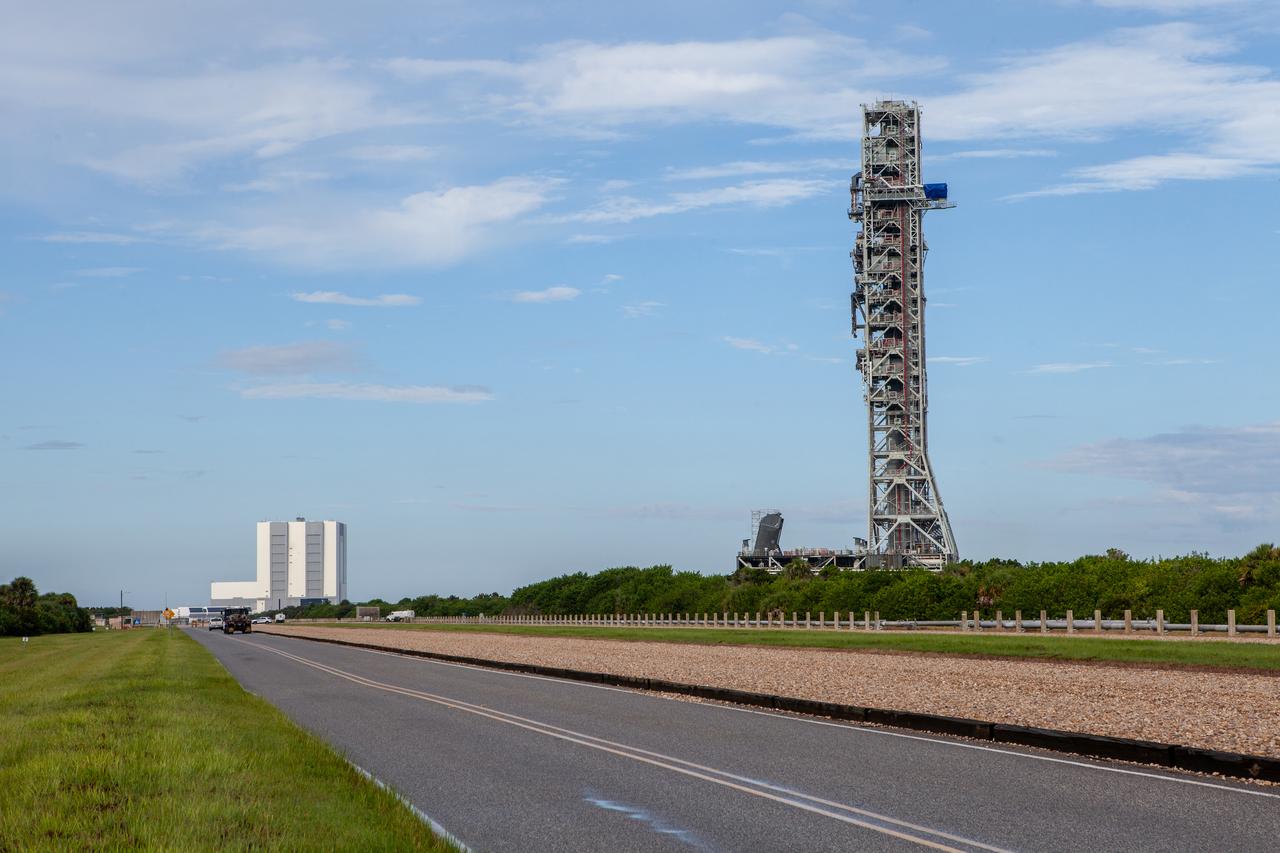
Exploration Ground Systems teams at NASA’s Kennedy Space Center in Florida take precautions to protect Artemis ground support equipment in advance of Hurricane Dorian. On Aug. 30, 2019, crawler-transporter 2 moved the mobile launcher (ML) from its current position at Launch Pad 39B to inside the Vehicle Assembly Building. In its final phases of development, the ML stands nearly 400 feet tall and is needed to assemble, process and launch NASA’s powerful Space Launch System rocket and Orion spacecraft on missions to the Moon and Mars.
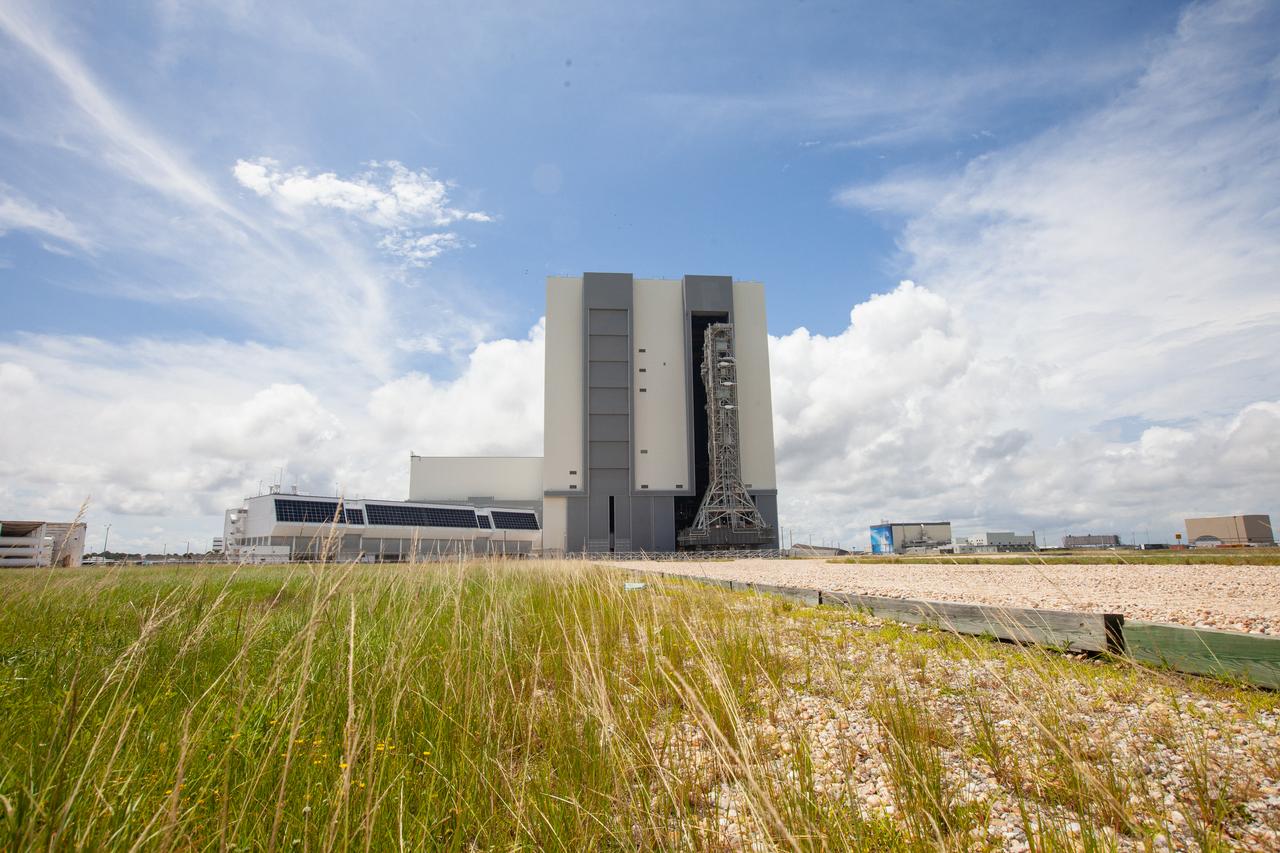
Exploration Ground Systems teams at NASA’s Kennedy Space Center in Florida take precautions to protect Artemis ground support equipment in advance of Hurricane Dorian. On Aug. 30, 2019, crawler-transporter 2 moved the mobile launcher (ML) from its current position at Launch Pad 39B to inside the Vehicle Assembly Building. In its final phases of development, the ML stands nearly 400 feet tall and is needed to assemble, process and launch NASA’s powerful Space Launch System rocket and Orion spacecraft on missions to the Moon and Mars.
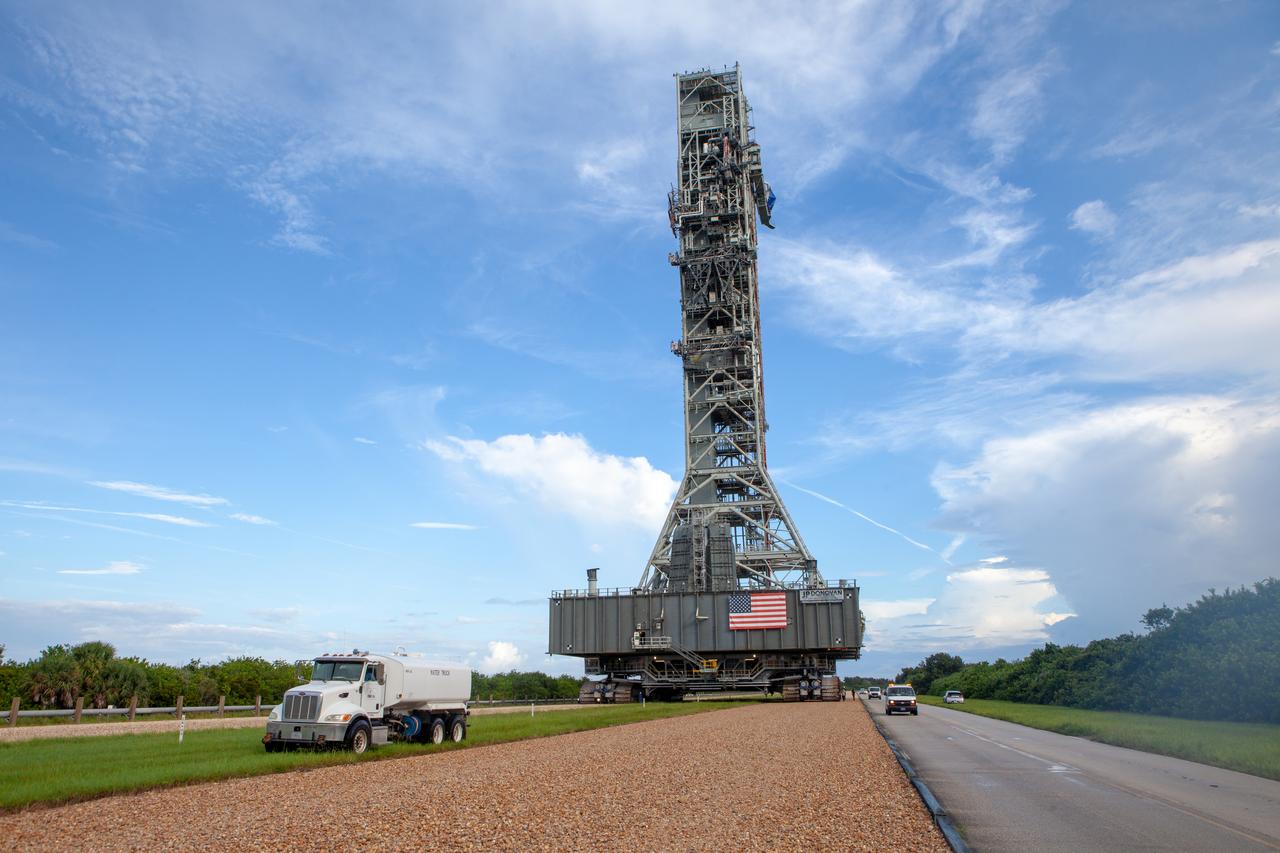
Exploration Ground Systems teams at NASA’s Kennedy Space Center in Florida take precautions to protect Artemis ground support equipment in advance of Hurricane Dorian. On Aug. 30, 2019, crawler-transporter 2 moved the mobile launcher (ML) from its current position at Launch Pad 39B to inside the Vehicle Assembly Building. In its final phases of development, the ML stands nearly 400 feet tall and is needed to assemble, process and launch NASA’s powerful Space Launch System rocket and Orion spacecraft on missions to the Moon and Mars.
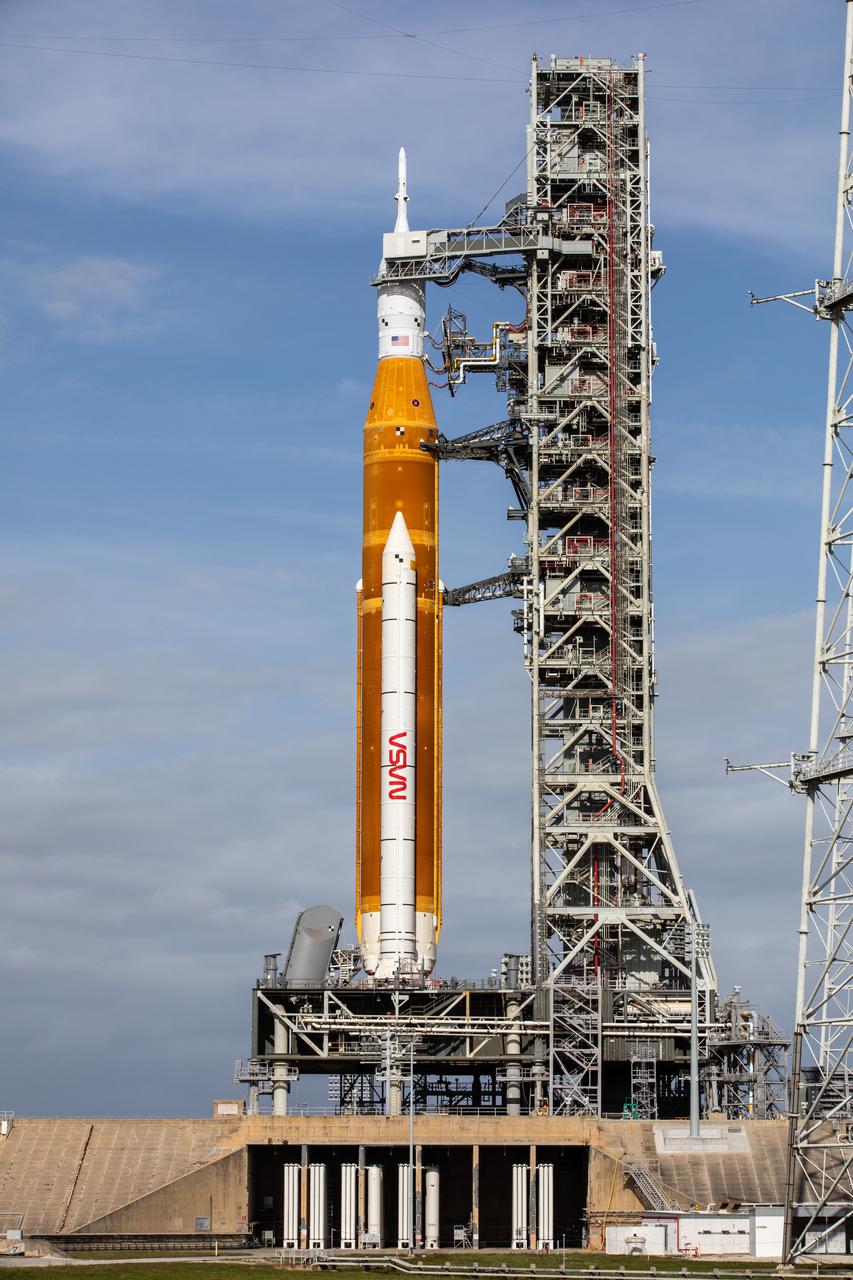
A view of the Artemis I Space Launch System (SLS) and Orion spacecraft atop the mobile launcher (ML) on Launch Pad 39B at NASA’s Kennedy Space Center in Florida on April 21, 2022. Also in view are several of the umbilical connections from the ML to the rocket. The SLS and Orion atop the mobile launcher were transported to the pad on crawler-transporter 2 for a prelaunch test called a wet dress rehearsal. Artemis I will be the first integrated test of the SLS and Orion spacecraft. In future Artemis missions, NASA will land the first woman and the first person of color on the surface of the Moon, paving the way for a long-term lunar presence and serving as a steppingstone on the way to Mars.
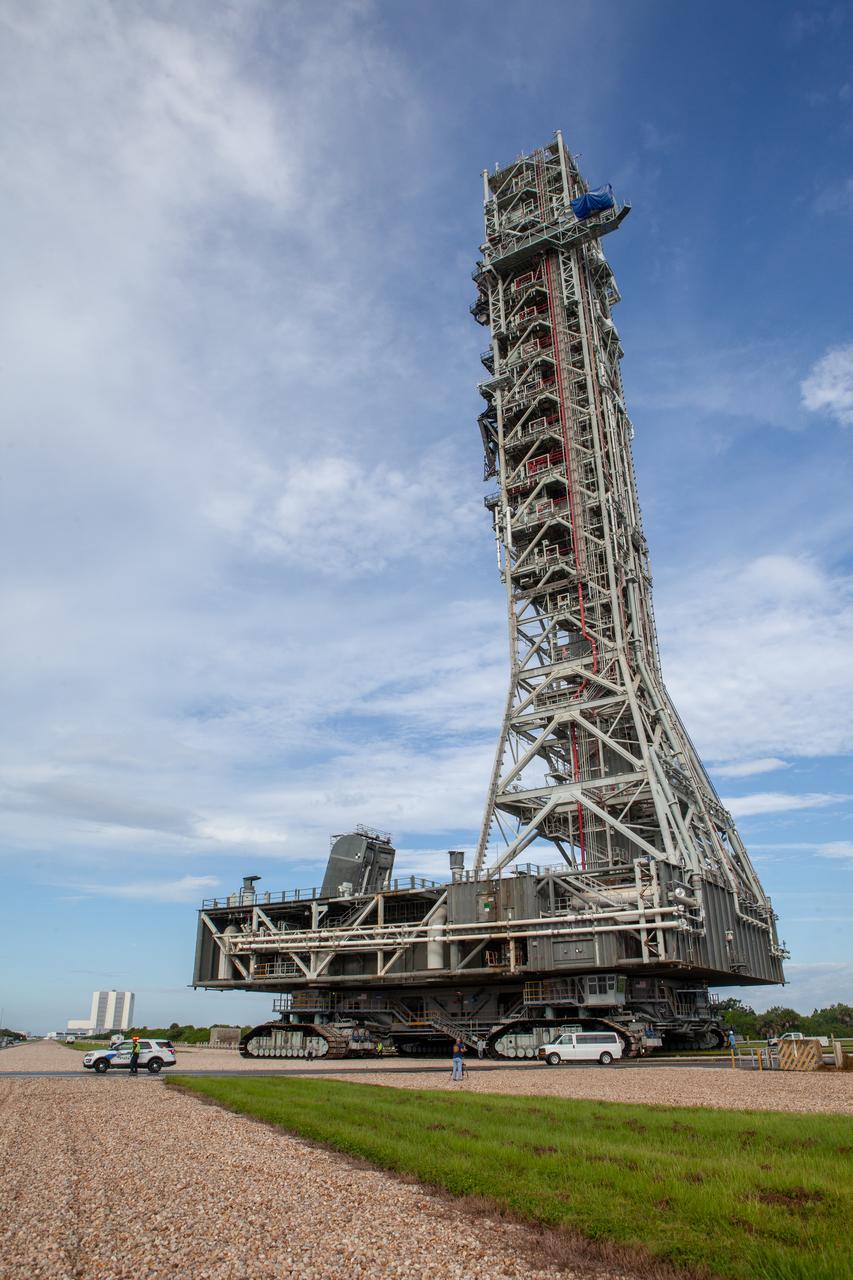
Exploration Ground Systems teams at NASA’s Kennedy Space Center in Florida take precautions to protect Artemis ground support equipment in advance of Hurricane Dorian. On Aug. 30, 2019, crawler-transporter 2 moved the mobile launcher (ML) from its current position at Launch Pad 39B to inside the Vehicle Assembly Building. In its final phases of development, the ML stands nearly 400 feet tall and is needed to assemble, process and launch NASA’s powerful Space Launch System rocket and Orion spacecraft on missions to the Moon and Mars.
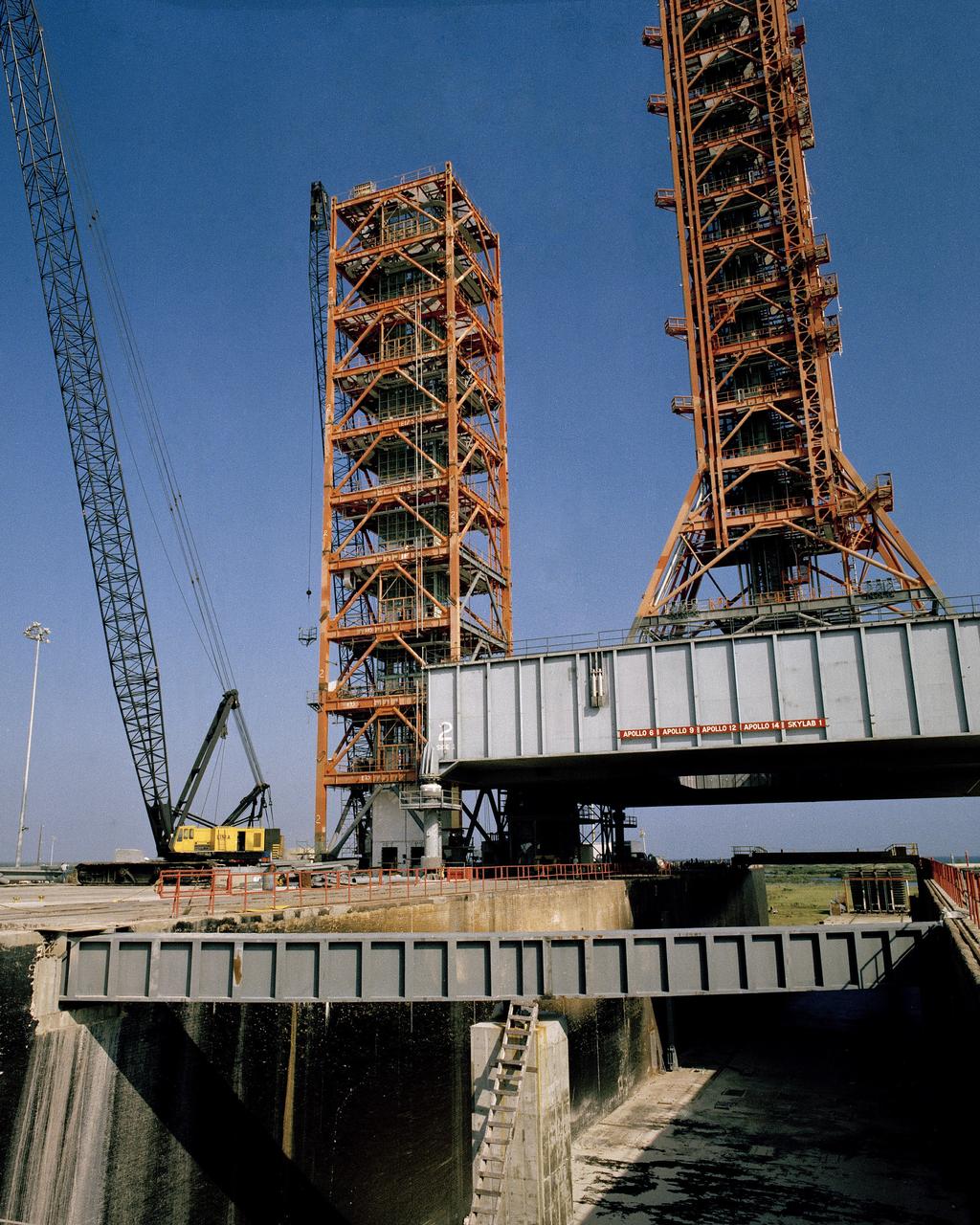
CAPE CANAVERAL, Fla. -- At the Kennedy Space Center in Florida, the shuttle service and access tower SSAT, left, is assembled at Launch Complex 39A from sections of launch umbilical tower 3. The lower 180 feet of the old ML-3 will be topped by the former uppermost section on which a hammerhead crane will be installed and the next lower section which houses the intact ML-3 elevator room and equipment. The SSAT will anchor and support a hinge column to the Payload Changeout Room PCR which will travel on a rail in a specified area to enclose the space shuttle's cargo bay on the pad for installation or removal of payloads. Mobile Launcher 2, center right, is on the pad to support the PCR during construction. Photo Credit: NASA

jsc2019e029850 (4/2/2019) --- Preflight imagery of the Non-Newtonian Fluids in Microgravity (Nickelodeon Slime in Space) investigation slime bag. The bags are made with food grade PVC and have a capacity of 350 mL. The slime bags have two ports: one remains sealed and the other has a long tube which can be sealed with a pinch clip. The bags are filled with Nickelodeon's slime material. On the space station, the slime is extruded through the tube with the pinch clip. Image courtesy of the International Space Station U.S. National Laboratory.
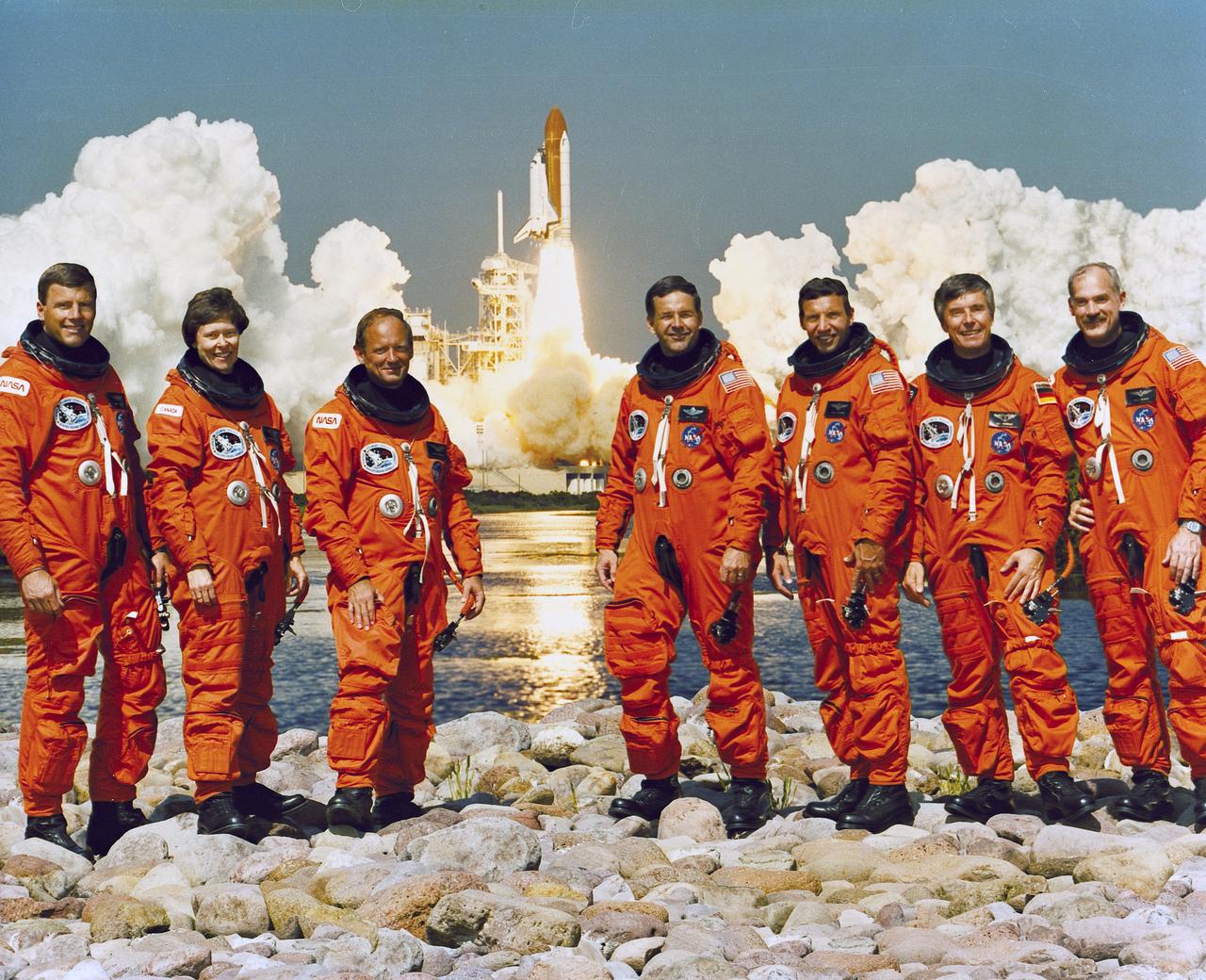
The STS-42 crew portrait includes from left to right: Stephen S. Oswald, pilot; Roberta L. Bondar, payload specialist 1; Norman E. Thagard, mission specialist 1; Ronald J. Grabe, commander; David C. Hilmers, mission specialist 2; Ulf D. Merbold, payload specialist 2; and William F. Readdy, mission specialist 3. Launched aboard the Space Shuttle Discovery on January 22, 1992 at 9:52:33 am (EST), the STS-42 served as the International Microgravity Laboratory-1 (ML-1 ) mission.
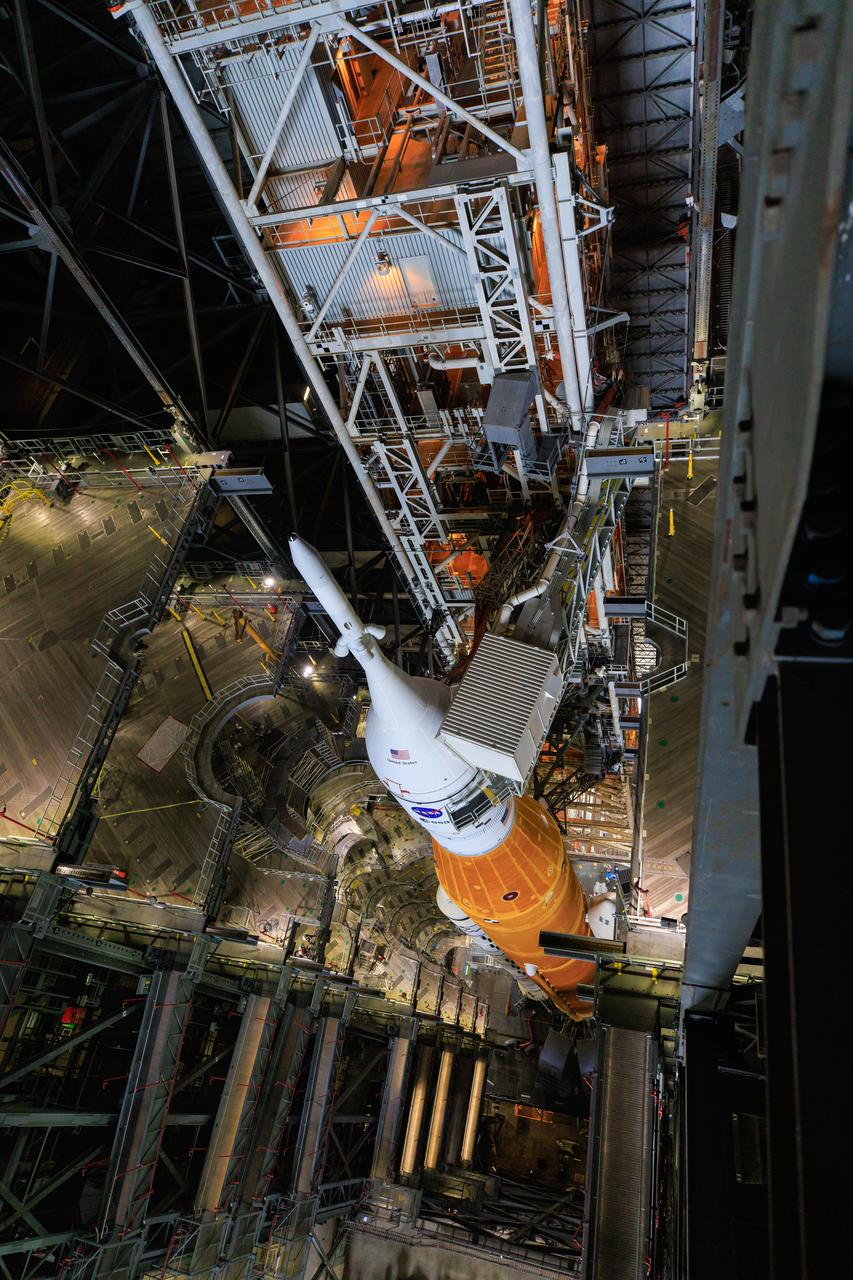
In this view looking down from high above in High Bay 3 of the Vehicle Assembly Building, the Artemis I Space Launch System and Orion spacecraft atop the mobile launcher is ready to move on the crawler-transporter to Launch Complex 39B at NASA’s Kennedy Space Center in Florida on June 3, 2022. The Artemis stack will be delivered to the pad for a wet dress rehearsal test ahead of the Artemis I launch. Artemis I will be the first integrated test of the SLS and Orion spacecraft. In later missions, NASA will land the first woman and the first person of color on the surface of the Moon, paving the way for a long-term lunar presence and serving as a steppingstone on the way to Mars.
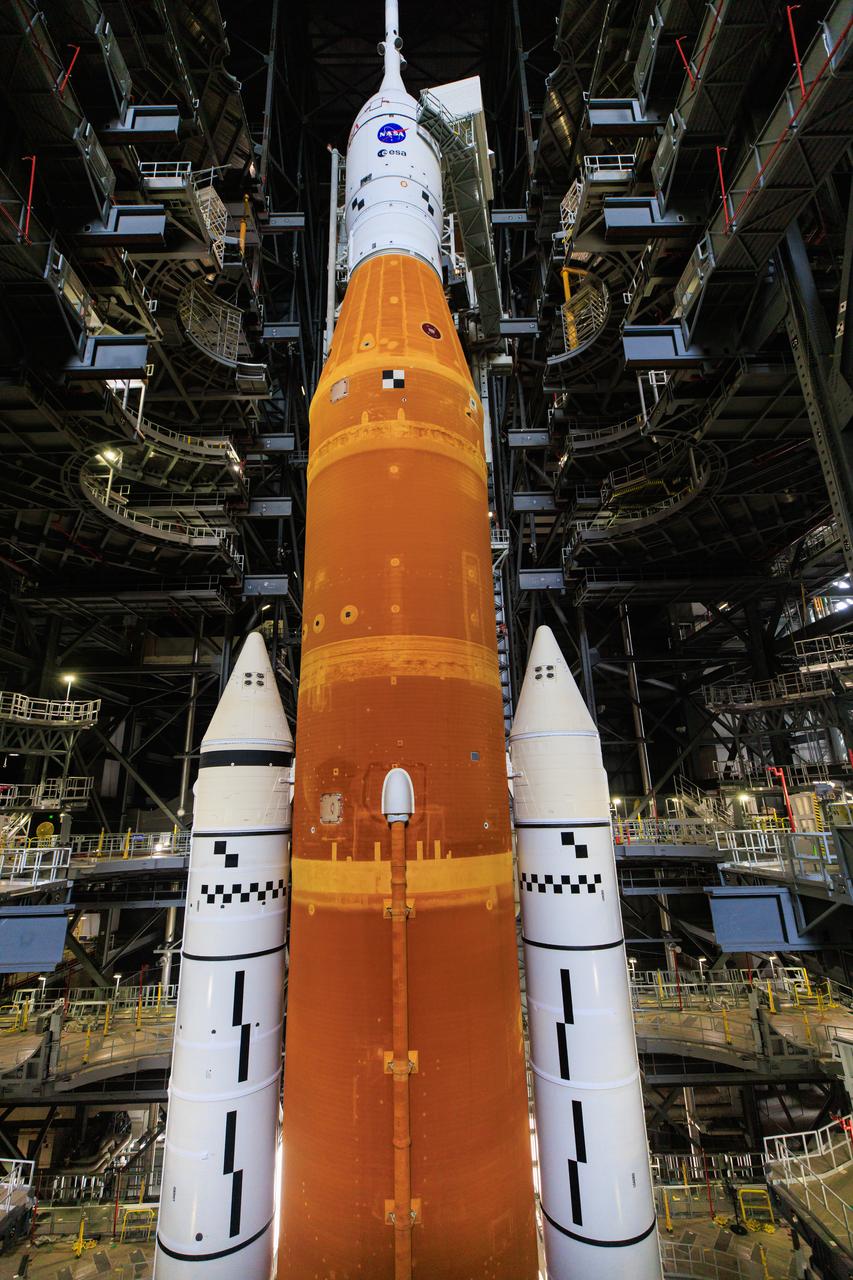
The Artemis I Space Launch System with the Orion spacecraft atop are in view inside High Bay 3 of the Vehicle Assembly Building at NASA’s Kennedy Space Center in Florida on June 3, 2022. The crawler-transporter, driven by engineers, is positioned underneath the Artemis I stack atop the mobile launcher. The crawler will carry the stack to Launch Complex 39B for a wet dress rehearsal test ahead of the Artemis I launch. Artemis I will be the first integrated test of the SLS and Orion spacecraft. In later missions, NASA will land the first woman and the first person of color on the surface of the Moon, paving the way for a long-term lunar presence and serving as a steppingstone on the way to Mars.
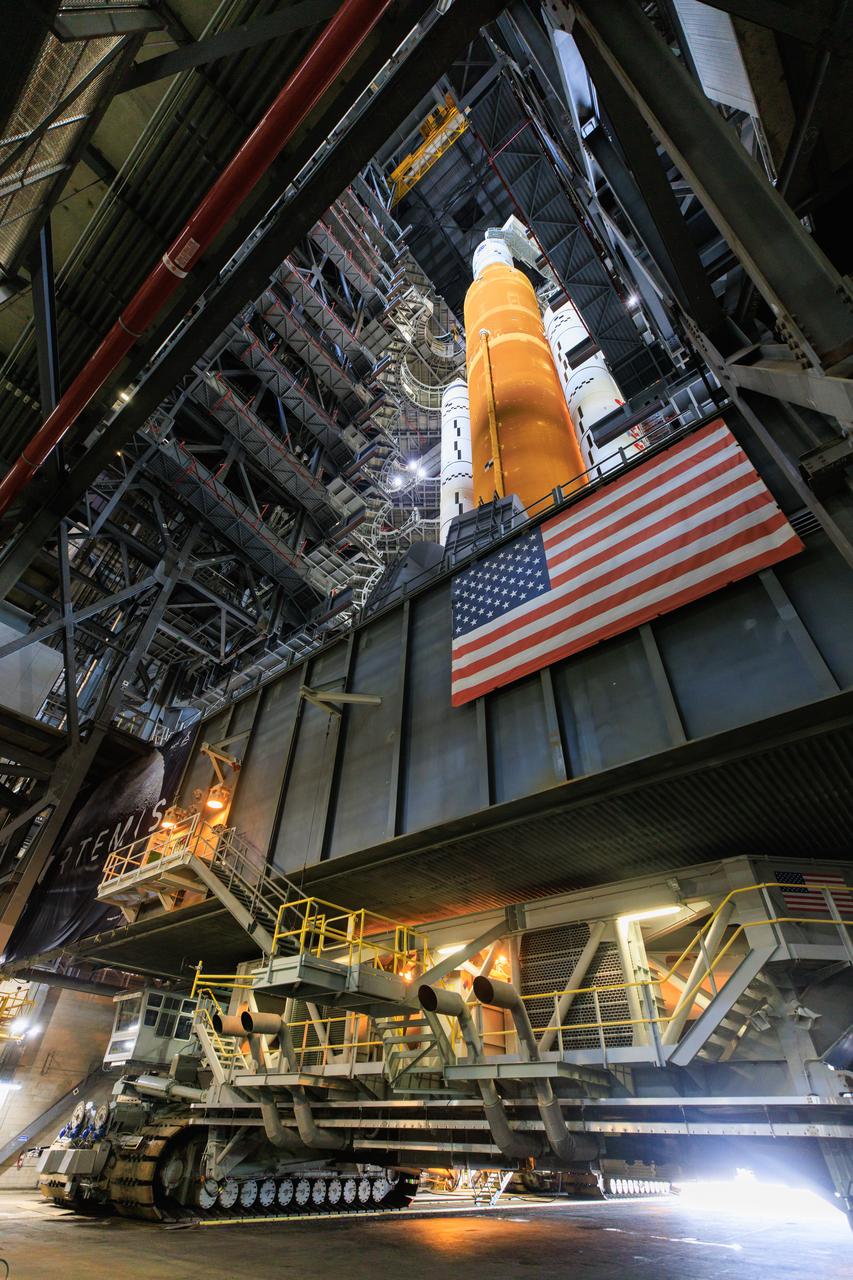
The crawler-transporter, driven by engineers, has moved underneath the Artemis I Space Launch System with the Orion spacecraft atop on the mobile launcher inside the Vehicle Assembly Building at NASA’s Kennedy Space Center in Florida on June 3, 2022. The crawler will carry the Artemis I stack to Launch Complex 39B for a wet dress rehearsal test ahead of the Artemis I launch. Artemis I will be the first integrated test of the SLS and Orion spacecraft. In later missions, NASA will land the first woman and the first person of color on the surface of the Moon, paving the way for a long-term lunar presence and serving as a steppingstone on the way to Mars.
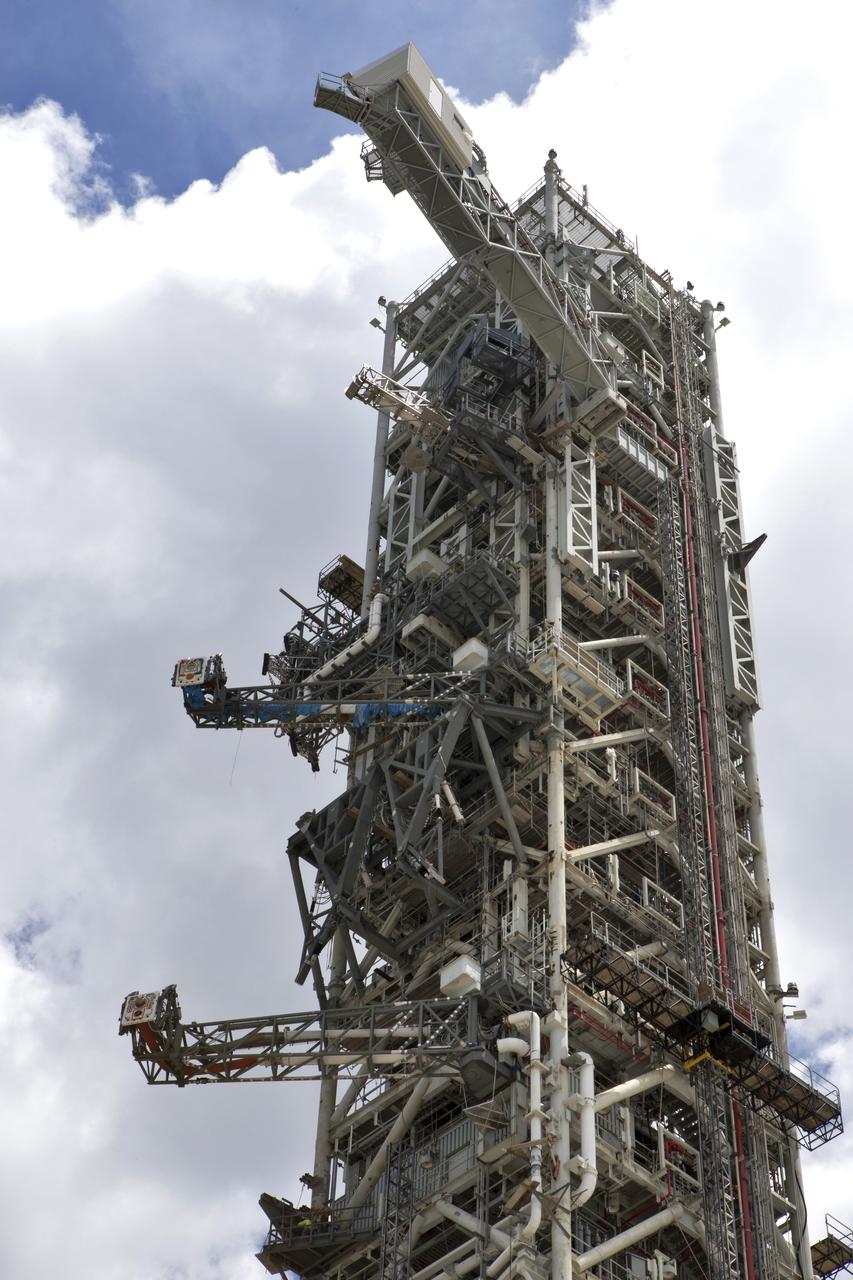
A swing test of the Orion crew access arm, topmost umbilical, is in progress on the mobile launcher at NASA's Kennedy Space Center in Florida, on Aug. 21, 2018. The crew access arm is located at about the 274-foot level on the mobile launcher tower. It will rotate from its retracted position and interface with the Orion crew hatch location to provide entry to the Orion crew module. Exploration Ground Systems extended all of the launch umbilicals on the ML tower to test their functionality before the mobile launcher, atop crawler-transporter 2, is moved to Launch Pad 39B and the Vehicle Assembly Building.
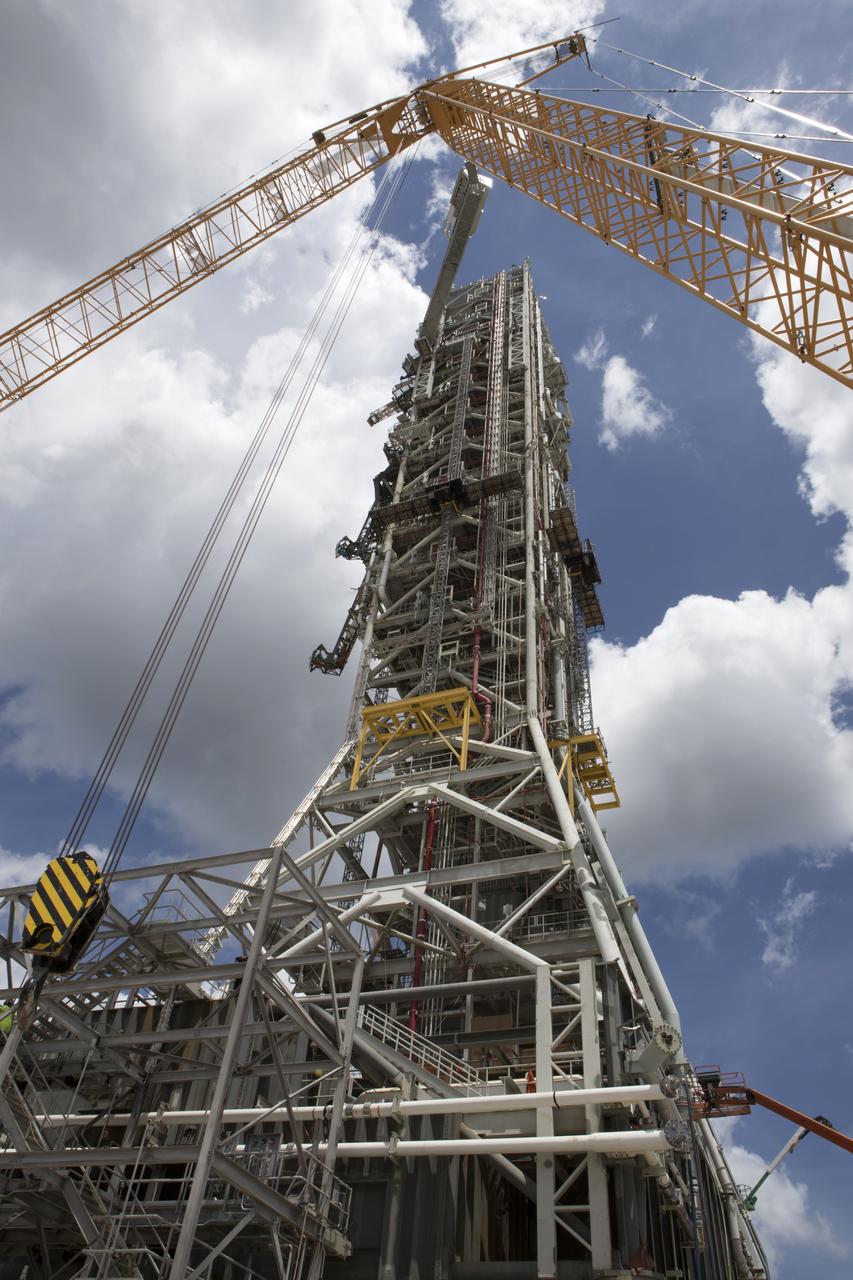
A swing test of the Orion crew access arm, topmost umbilical, is in progress on the mobile launcher at NASA's Kennedy Space Center in Florida, on Aug. 21, 2018. The crew access arm is located at about the 274-foot level on the mobile launcher tower. It will rotate from its retracted position and interface with the Orion crew hatch location to provide entry to the Orion crew module. Exploration Ground Systems extended all of the launch umbilicals on the ML tower to test their functionality before the mobile launcher, atop crawler-transporter 2, is moved to Launch Pad 39B and the Vehicle Assembly Building.
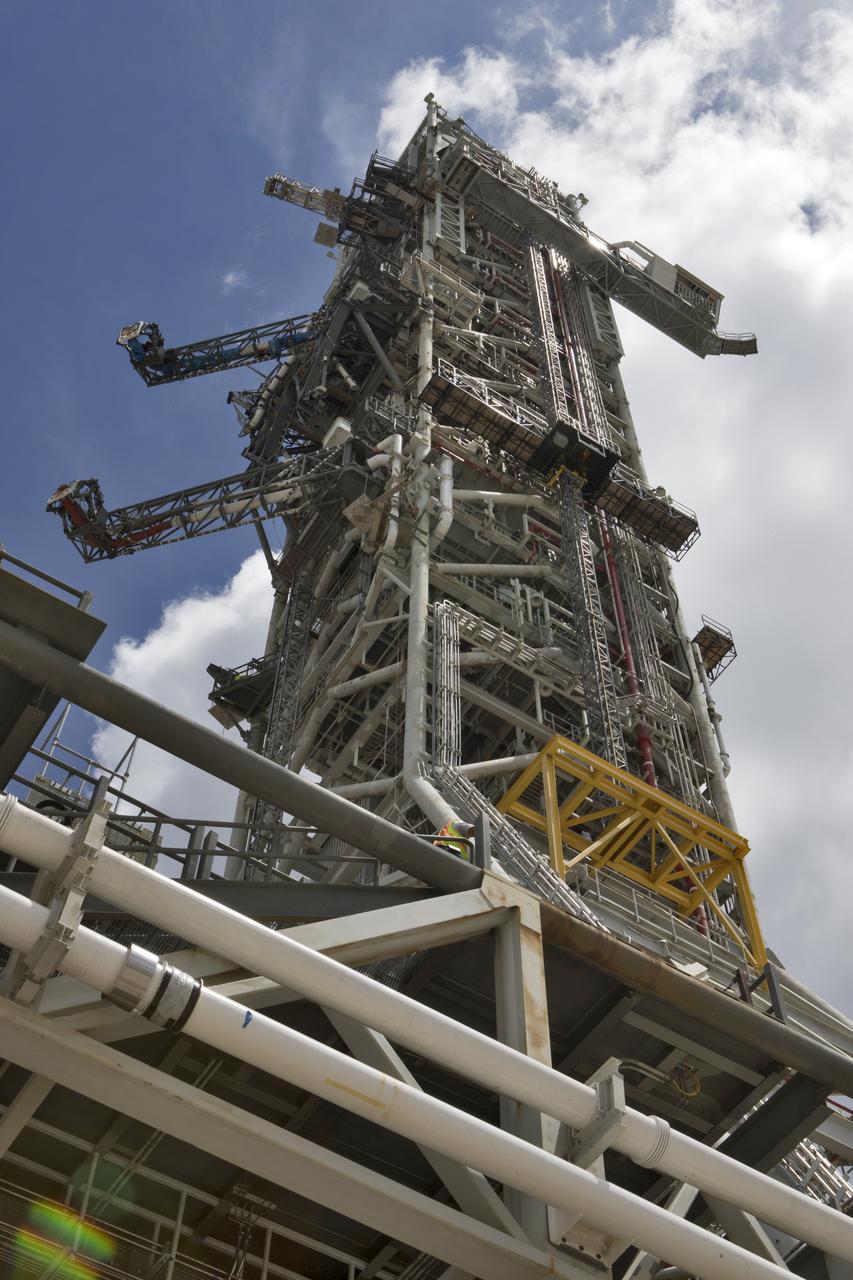
A swing test of the Orion crew access arm, top right, is in progress on the mobile launcher at NASA's Kennedy Space Center in Florida, on Aug. 21, 2018. The crew access arm is located at about the 274-foot level on the mobile launcher tower. It will rotate from its retracted position and interface with the Orion crew hatch location to provide entry to the Orion crew module. Exploration Ground Systems extended all of the launch umbilicals on the ML tower to test their functionality before the mobile launcher, atop crawler-transporter 2, is moved to Launch Pad 39B and the Vehicle Assembly Building.
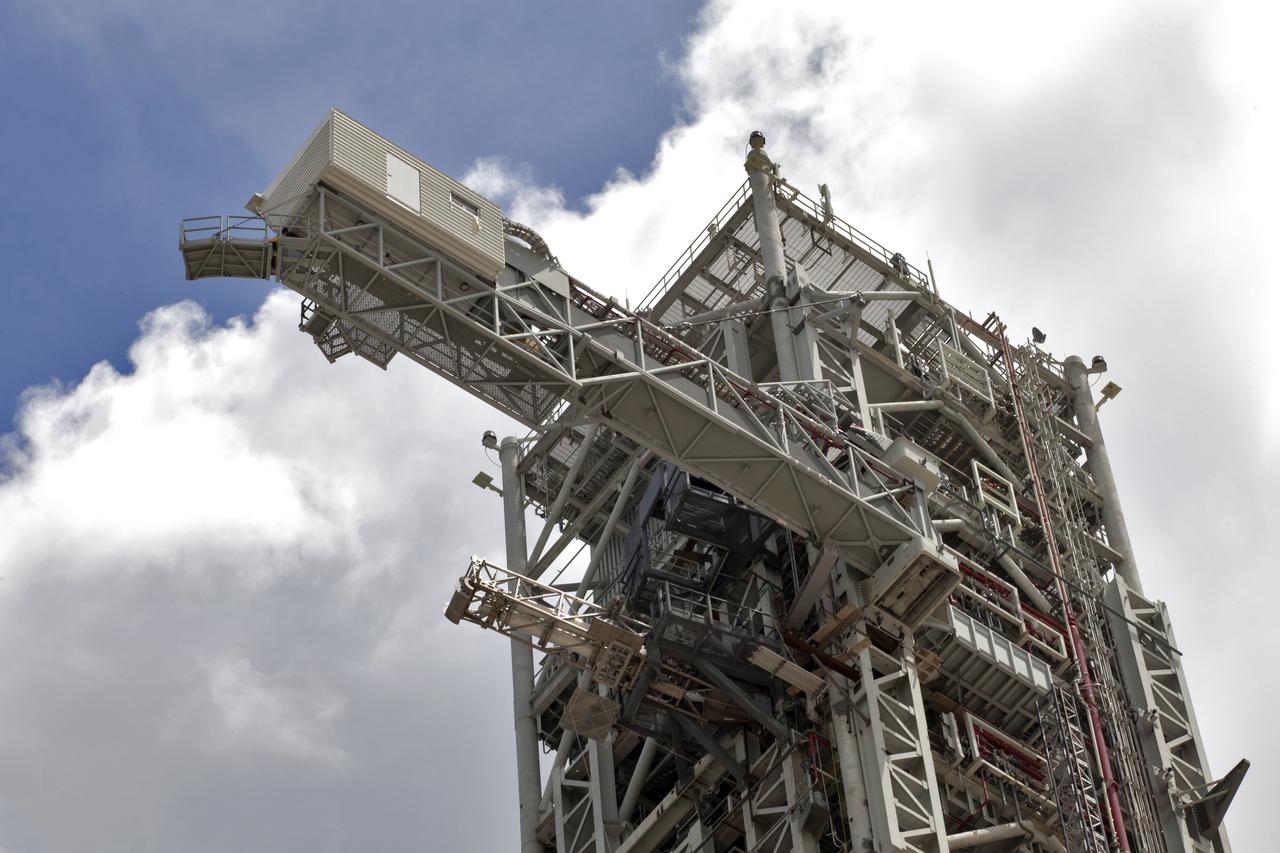
A swing test of the Orion crew access arm is in progress on the mobile launcher at NASA's Kennedy Space Center in Florida, on Aug. 21, 2018. The crew access arm is located at about the 274-foot level on the mobile launcher tower. It will rotate from its retracted position and interface with the Orion crew hatch location to provide entry to the Orion crew module. Exploration Ground Systems extended all of the launch umbilicals on the ML tower to test their functionality before the mobile launcher, atop crawler-transporter 2, is moved to Launch Pad 39B and the Vehicle Assembly Building.
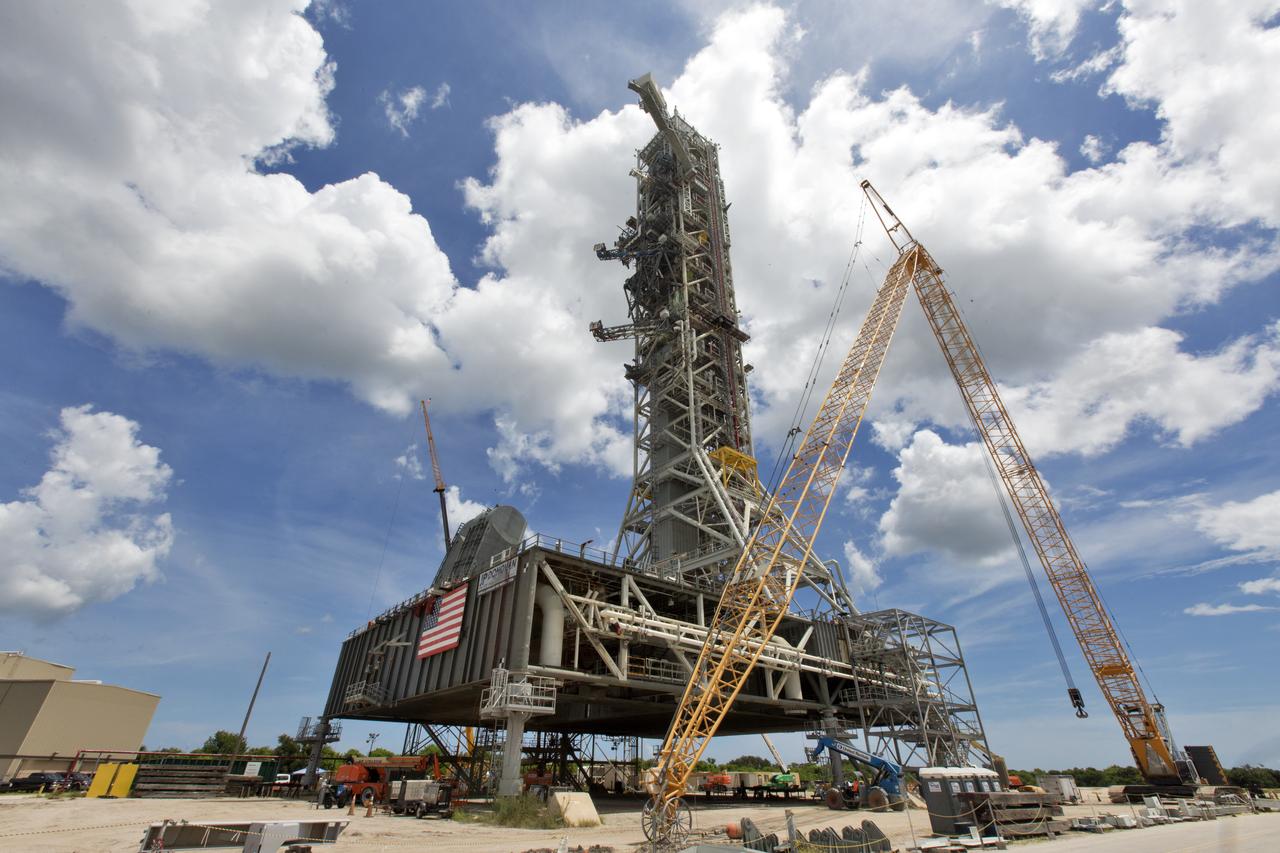
A swing test of the Orion crew access arm, topmost umbilical, is in progress on the mobile launcher at NASA's Kennedy Space Center in Florida, on Aug. 21, 2018. The crew access arm is located at about the 274-foot level on the mobile launcher tower. It will rotate from its retracted position and interface with the Orion crew hatch location to provide entry to the Orion crew module. Exploration Ground Systems extended all of the launch umbilicals on the ML tower to test their functionality before the mobile launcher, atop crawler-transporter 2, is moved to Launch Pad 39B and the Vehicle Assembly Building.
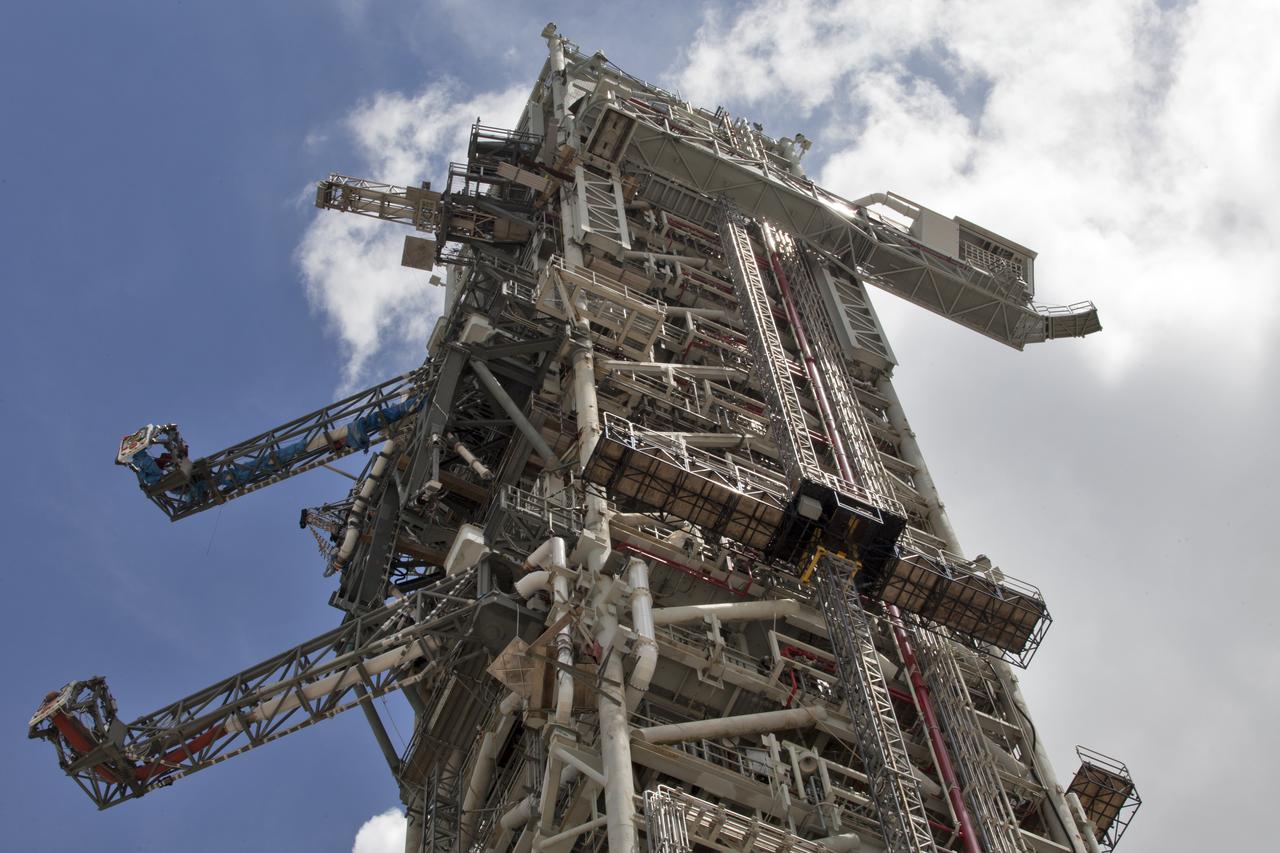
A swing test of the Orion crew access arm, top right, begins on the mobile launcher at NASA's Kennedy Space Center in Florida, on Aug. 21, 2018. The crew access arm is located at about the 274-foot level on the mobile launcher tower. It will rotate from its retracted position and interface with the Orion crew hatch location to provide entry to the Orion crew module. Exploration Ground Systems extended all of the launch umbilicals on the ML tower to test their functionality before the mobile launcher, atop crawler-transporter 2, is moved to Launch Pad 39B and the Vehicle Assembly Building.
A swing test of the Orion crew access arm, top right, is in progress on the mobile launcher at NASA's Kennedy Space Center in Florida, on Aug. 21, 2018. The crew access arm is located at about the 274-foot level on the mobile launcher tower. It will rotate from its retracted position and interface with the Orion crew hatch location to provide entry to the Orion crew module. Exploration Ground Systems extended all of the launch umbilicals on the ML tower to test their functionality before the mobile launcher, atop crawler-transporter 2, is moved to Launch Pad 39B and the Vehicle Assembly Building.
Workers use a crane to lower the right-hand forward assembly for NASA’s Space Launch System onto the right-hand center forward segment on the mobile launcher (ML) in High Bay 3 of the Vehicle Assembly Building at Kennedy Space Center in Florida, on March 2, 2021. Workers with Exploration Ground Systems and contractor Jacobs teams are stacking the twin five-segment boosters on the ML over a number of weeks. When the core stage arrives, it will join the boosters on the mobile launcher, followed by the interim cryogenic propulsion stage and Orion spacecraft. Manufactured by Northrop Grumman in Utah, the twin boosters provide more than 75 percent of the total SLS thrust at launch. Marshall Space Flight Center in Huntsville, Alabama, manages the SLS. Under the Artemis program, NASA will land the first woman and the next man on the Moon. The first in a series of increasingly complex missions, Artemis I will test the Orion spacecraft and SLS as an integrated system ahead of crewed flights to the Moon.
In the transfer aisle of the Vehicle Assembly Building at NASA’s Kennedy Space Center in Florida, workers use a crane to lift the right-hand forward assembly up for transfer into High Bay 3 for the Space Launch System (SLS) on March 2, 2021. The forward assembly will be attached to the center forward segment on the mobile launcher (ML). Workers with Exploration Ground Systems and contractor Jacobs teams are stacking the twin five-segment boosters on the ML over a number of weeks. When the core stage arrives, it will join the boosters on the mobile launcher, followed by the interim cryogenic propulsion stage and Orion spacecraft. Manufactured by Northrop Grumman in Utah, the twin boosters provide more than 75 percent of the total SLS thrust at launch. Marshall Space Flight Center in Huntsville, Alabama, manages the SLS. Under the Artemis program, NASA will land the first woman and the next man on the Moon. The first in a series of increasingly complex missions, Artemis I will test the Orion spacecraft and SLS as an integrated system ahead of crewed flights to the Moon.
In the transfer aisle of the Vehicle Assembly Building at NASA’s Kennedy Space Center in Florida, workers use a crane to lift the right-hand forward assembly for the Space Launch System (SLS) high up for transfer into High Bay 3 on March 2, 2021. The forward assembly will be attached to the center forward segment on the mobile launcher (ML). Workers with Exploration Ground Systems and contractor Jacobs teams are stacking the twin five-segment boosters on the ML over a number of weeks. When the core stage arrives, it will join the boosters on the mobile launcher, followed by the interim cryogenic propulsion stage and Orion spacecraft. Manufactured by Northrop Grumman in Utah, the twin boosters provide more than 75 percent of the total SLS thrust at launch. Marshall Space Flight Center in Huntsville, Alabama, manages the SLS. Under the Artemis program, NASA will land the first woman and the next man on the Moon. The first in a series of increasingly complex missions, Artemis I will test the Orion spacecraft and SLS as an integrated system ahead of crewed flights to the Moon.
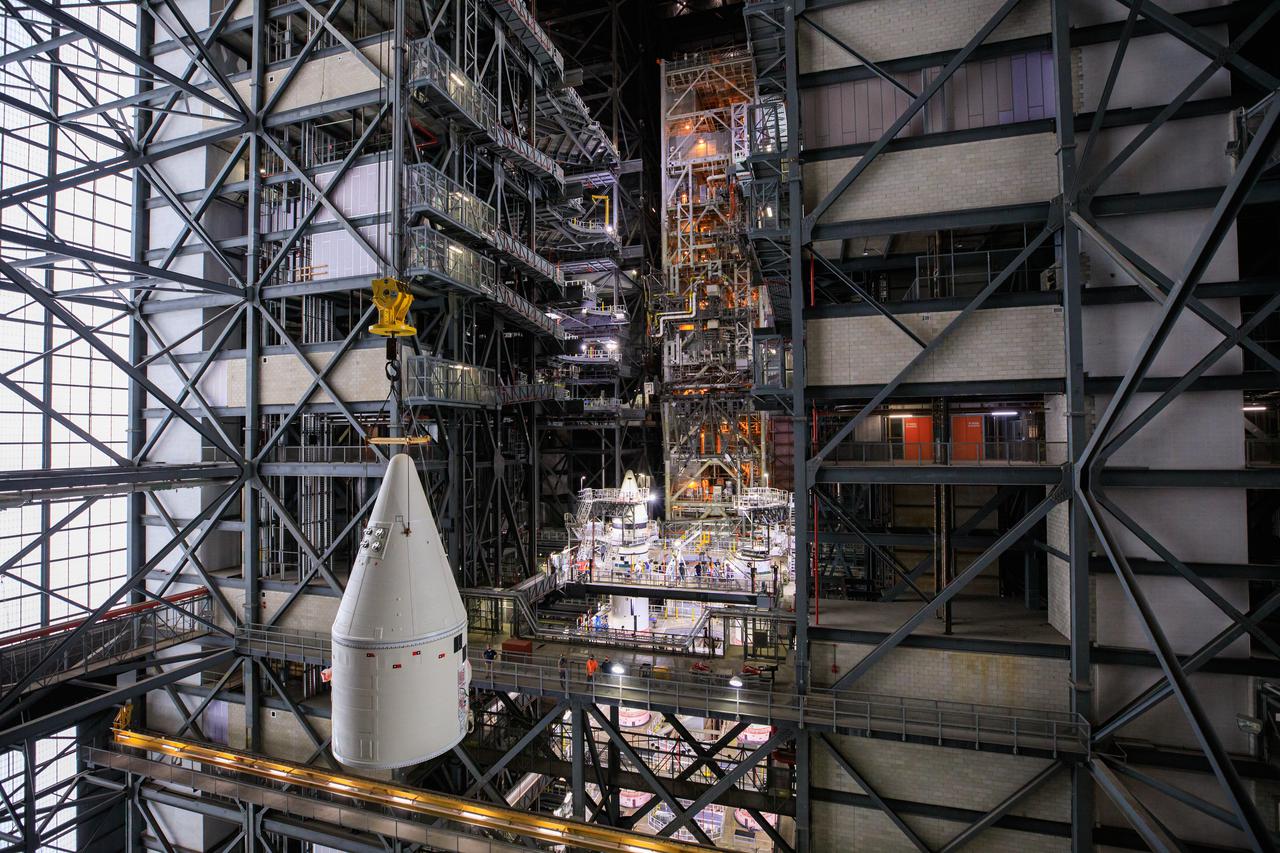
In the transfer aisle of the Vehicle Assembly Building at NASA’s Kennedy Space Center in Florida, workers use a crane to lift the right-hand forward assembly for the Space Launch System (SLS) high up for transfer into High Bay 3 on March 2, 2021. The forward assembly will be attached to the center forward segment on the mobile launcher (ML). Workers with Exploration Ground Systems and contractor Jacobs teams are stacking the twin five-segment boosters on the ML over a number of weeks. When the core stage arrives, it will join the boosters on the mobile launcher, followed by the interim cryogenic propulsion stage and Orion spacecraft. Manufactured by Northrop Grumman in Utah, the twin boosters provide more than 75 percent of the total SLS thrust at launch. Marshall Space Flight Center in Huntsville, Alabama, manages the SLS. Under the Artemis program, NASA will land the first woman and the next man on the Moon. The first in a series of increasingly complex missions, Artemis I will test the Orion spacecraft and SLS as an integrated system ahead of crewed flights to the Moon.
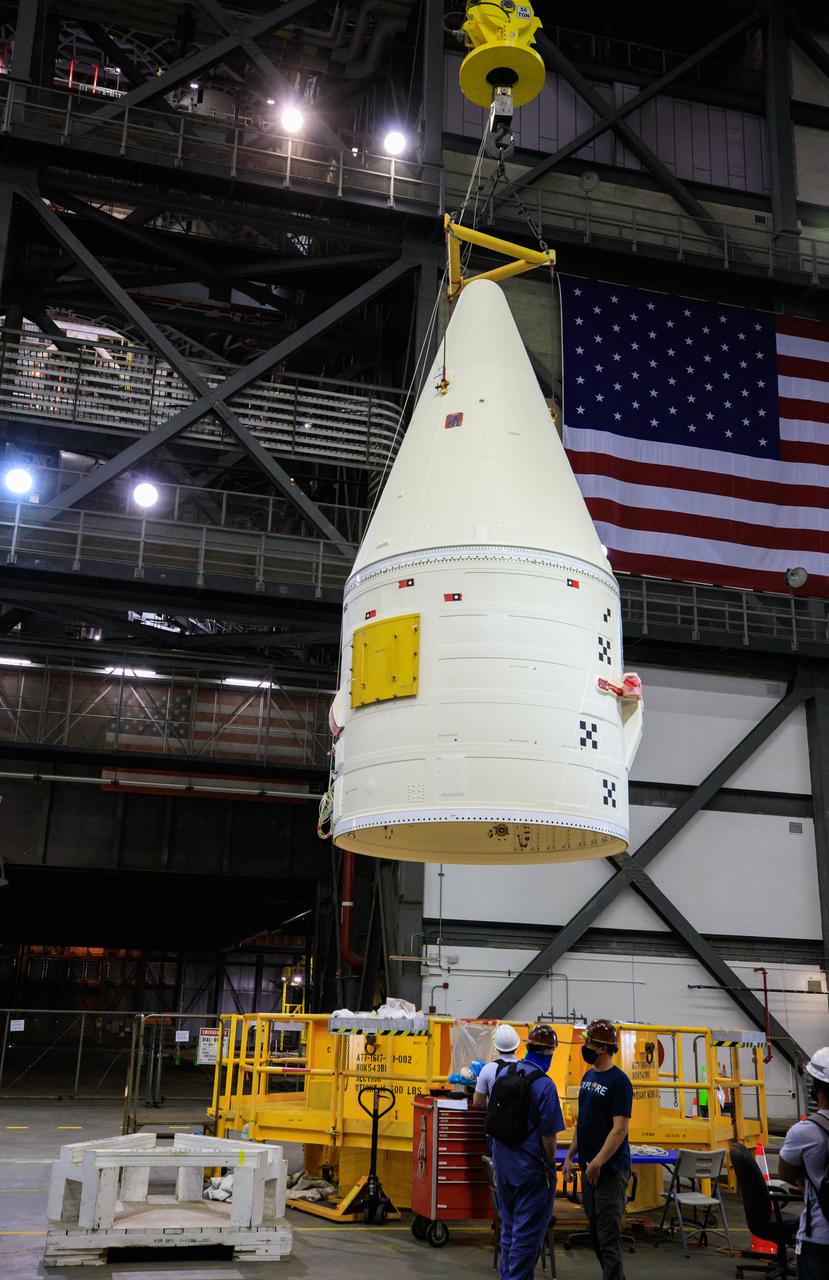
In the transfer aisle of the Vehicle Assembly Building at NASA’s Kennedy Space Center in Florida, workers use a crane to lift the right-hand forward assembly up for transfer into High Bay 3 for the Space Launch System (SLS) on March 2, 2021. The forward assembly will be attached to the center forward segment on the mobile launcher (ML). Workers with Exploration Ground Systems and contractor Jacobs teams are stacking the twin five-segment boosters on the ML over a number of weeks. When the core stage arrives, it will join the boosters on the mobile launcher, followed by the interim cryogenic propulsion stage and Orion spacecraft. Manufactured by Northrop Grumman in Utah, the twin boosters provide more than 75 percent of the total SLS thrust at launch. Marshall Space Flight Center in Huntsville, Alabama, manages the SLS. Under the Artemis program, NASA will land the first woman and the next man on the Moon. The first in a series of increasingly complex missions, Artemis I will test the Orion spacecraft and SLS as an integrated system ahead of crewed flights to the Moon.
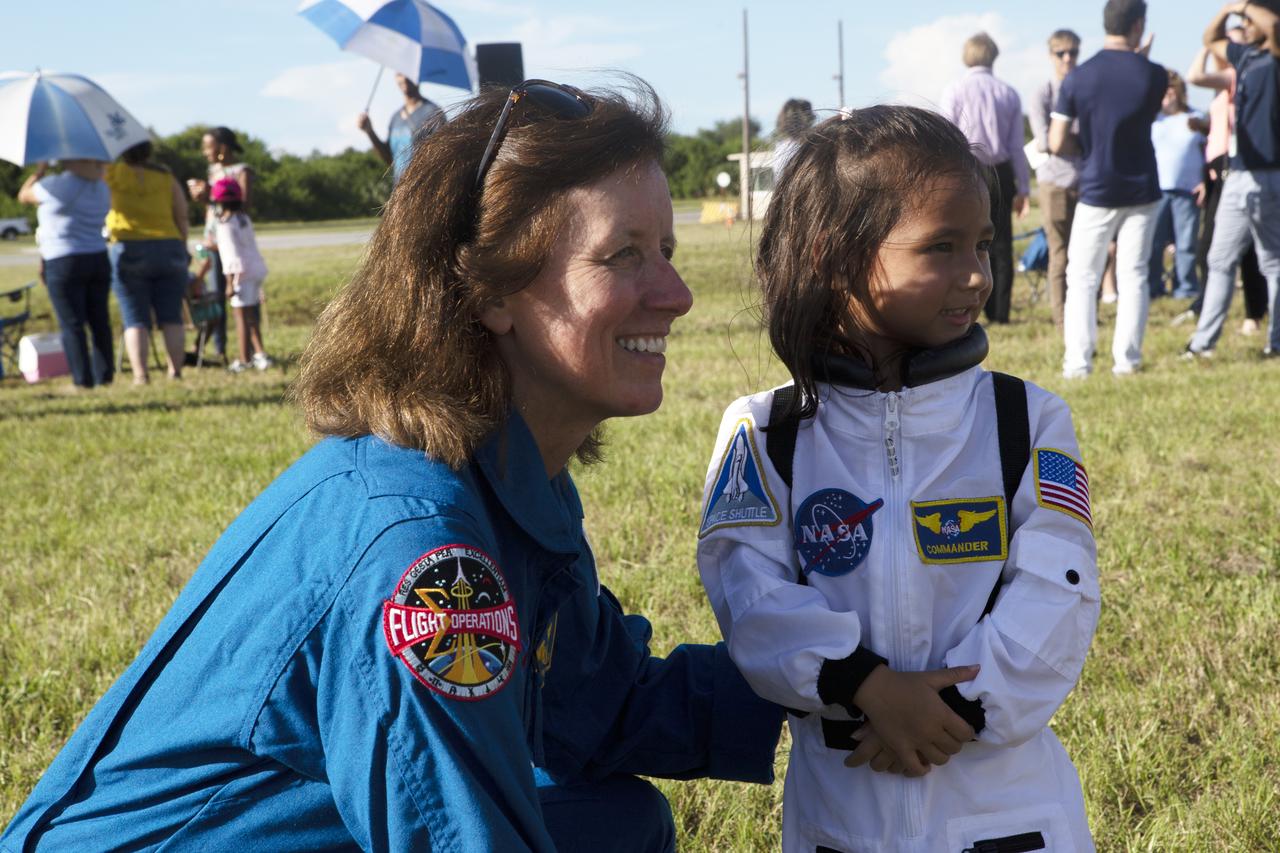
NASA astronaut Shannon Walker visits with a future astronaut during an employee event for workers and their guests for the mobile launcher move to the Vehicle Assembly Building (VAB) on Sept. 7, 2018, at NASA's Kennedy Space Center in Florida. The mobile launcher, atop crawler-transporter 2, began its trek from Launch Pad 39B along the crawlerway after undergoing a fit check and several days of systems testing with the pad. This is the first time that the modified mobile launcher made the trip to the pad. The 380-foot-tall mobile launcher is equipped with the crew access arm and several umbilicals that will provide power, environmental control, pneumatics, communication and electrical connections to the agency's Space Launch System and Orion spacecraft. The mobile launcher will spend seven months in the VAB undergoing testing. Exploration Ground Systems is preparing the ground systems necessary to launch SLS and Orion on Exploration Mission-1, missions to the Moon and on to Mars.
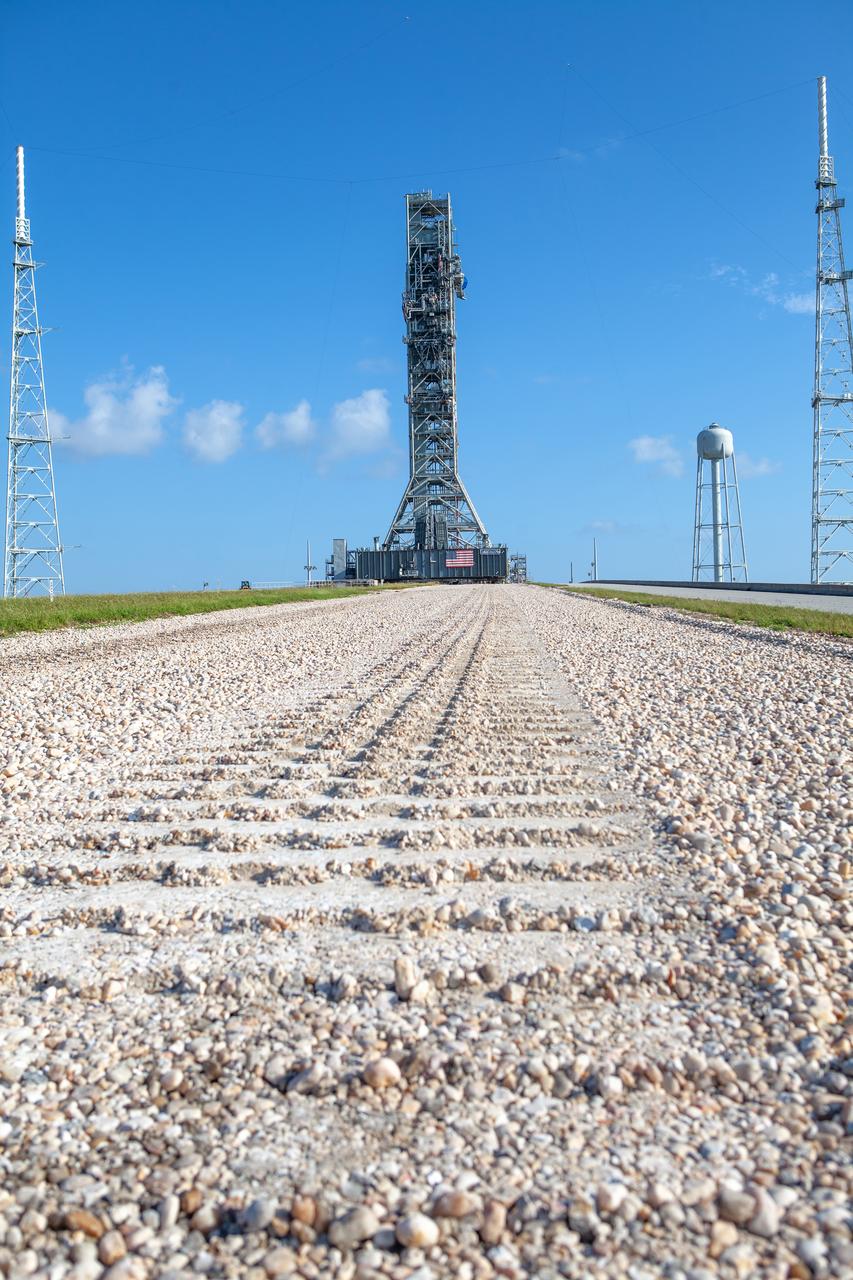
The mobile launcher for Artemis missions is at Launch Pad 39B on Sept. 11, 2019, at NASA’s Kennedy Space Center in Florida, after spending a week and a half inside the Vehicle Assembly Building (VAB) due to the approach of Hurricane Dorian. The nearly 400-foot-tall structure was moved from Launch Pad 39B to the VAB for safekeeping on Aug. 30. The storm passed about 70 miles east of the spaceport during the overnight hours Tuesday, Sept. 3, and Wednesday, Sept. 4. NASA’s Exploration Ground Systems is moving the mobile launcher back to the launch pad, where teams will complete testing and checkout on the launcher in the coming weeks for the Artemis I mission.
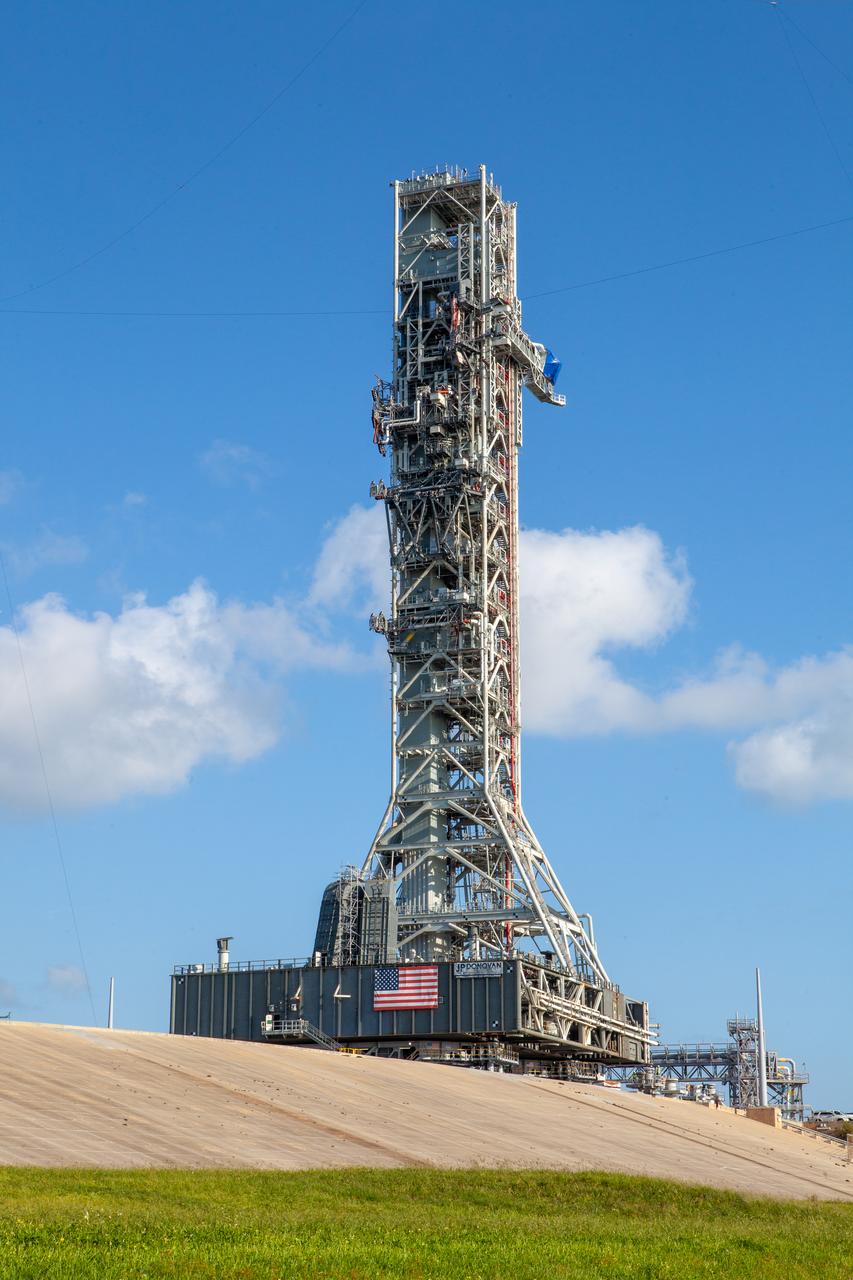
The mobile launcher for Artemis missions is at Launch Pad 39B on Sept. 11, 2019, at NASA’s Kennedy Space Center in Florida, after spending a week and a half inside the Vehicle Assembly Building (VAB) due to the approach of Hurricane Dorian. The nearly 400-foot-tall structure was moved from Launch Pad 39B to the VAB for safekeeping on Aug. 30. The storm passed about 70 miles east of the spaceport during the overnight hours Tuesday, Sept. 3, and Wednesday, Sept. 4. NASA’s Exploration Ground Systems moved the mobile launcher back to the launch pad, where teams will complete testing and checkout on the launcher in the coming weeks for the Artemis I mission.
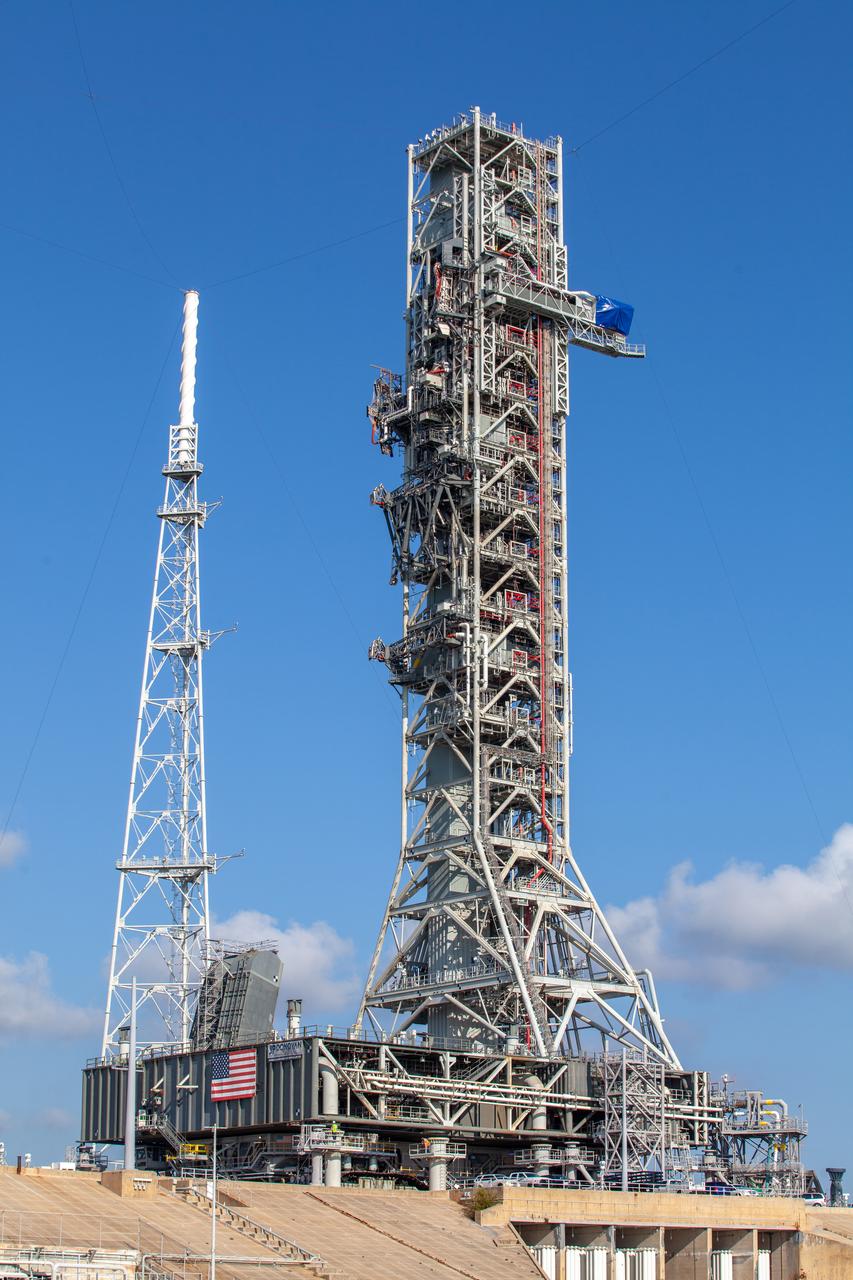
The mobile launcher for Artemis missions is at Launch Pad 39B on Sept. 11, 2019, at NASA’s Kennedy Space Center in Florida, after spending a week and a half inside the Vehicle Assembly Building (VAB) due to the approach of Hurricane Dorian. The nearly 400-foot-tall structure was moved from Launch Pad 39B to the VAB for safekeeping on Aug. 30. The storm passed about 70 miles east of the spaceport during the overnight hours Tuesday, Sept. 3, and Wednesday, Sept. 4. NASA’s Exploration Ground Systems moved the mobile launcher back to the launch pad, where teams will complete testing and checkout on the launcher in the coming weeks for the Artemis I mission.

During an employee event, workers and guests watch from bleachers as NASA's mobile launcher, atop crawler-transporter 2, moves slowly along the crawlerway toward the Vehicle Assembly Building (VAB) on Sept. 7, 2018, at NASA's Kennedy Space Center in Florida. The mobile launcher underwent a fit check and several days of systems testing with the pad. This is the first time that the modified mobile launcher made the trip to the pad. The 380-foot-tall mobile launcher is equipped with the crew access arm and several umbilicals that will provide power, environmental control, pneumatics, communication and electrical connections to the agency's Space Launch System and Orion spacecraft. The mobile launcher will spend seven months in the VAB undergoing testing. Exploration Ground Systems is preparing the ground systems necessary to launch SLS and Orion on Exploration Mission-1, missions to the Moon and on to Mars.
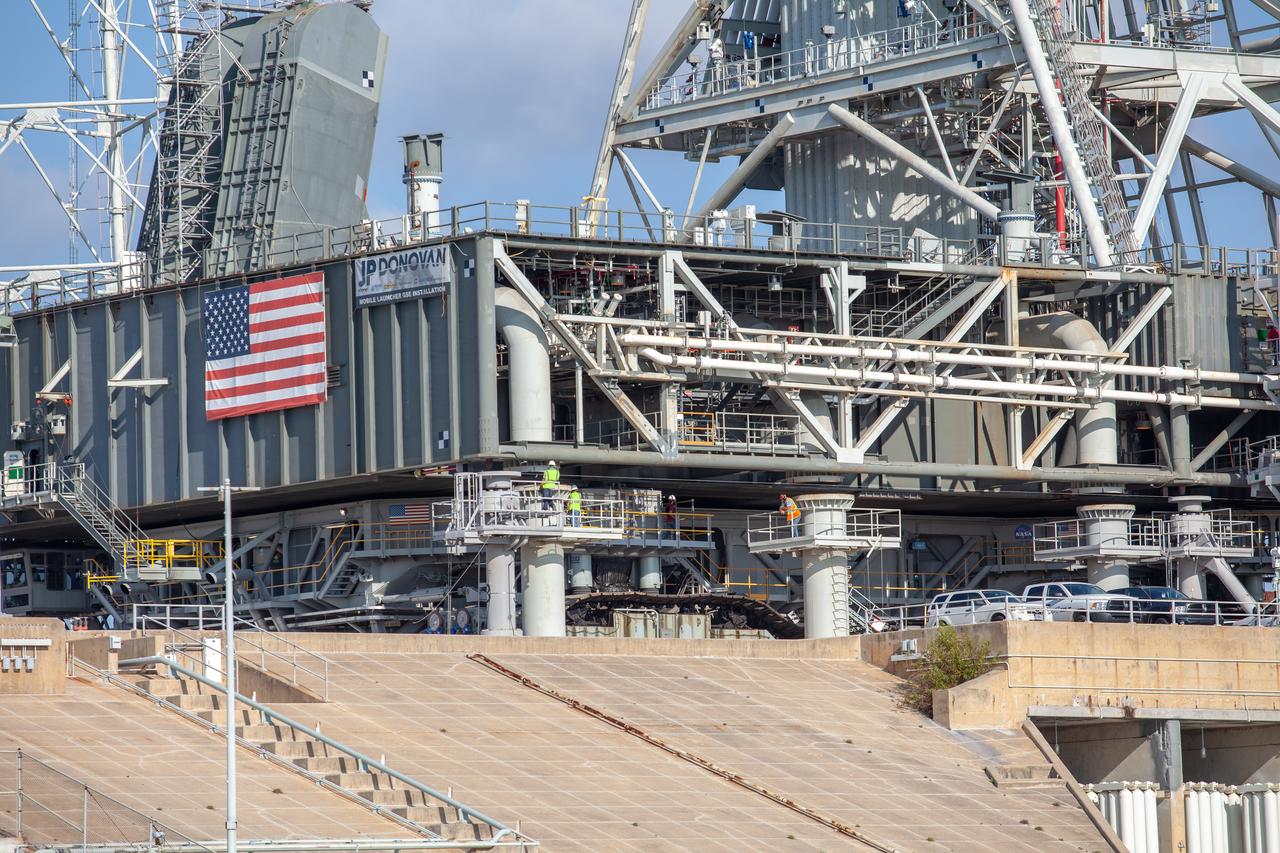
The mobile launcher for Artemis missions is at Launch Pad 39B on Sept. 11, 2019, at NASA’s Kennedy Space Center in Florida, after spending a week and a half inside the Vehicle Assembly Building (VAB) due to the approach of Hurricane Dorian. The nearly 400-foot-tall structure was moved from Launch Pad 39B to the VAB for safekeeping on Aug. 30. The storm passed about 70 miles east of the spaceport during the overnight hours Tuesday, Sept. 3, and Wednesday, Sept. 4. NASA’s Exploration Ground Systems moved the mobile launcher back to the launch pad, where teams will complete testing and checkout on the launcher in the coming weeks for the Artemis I mission.
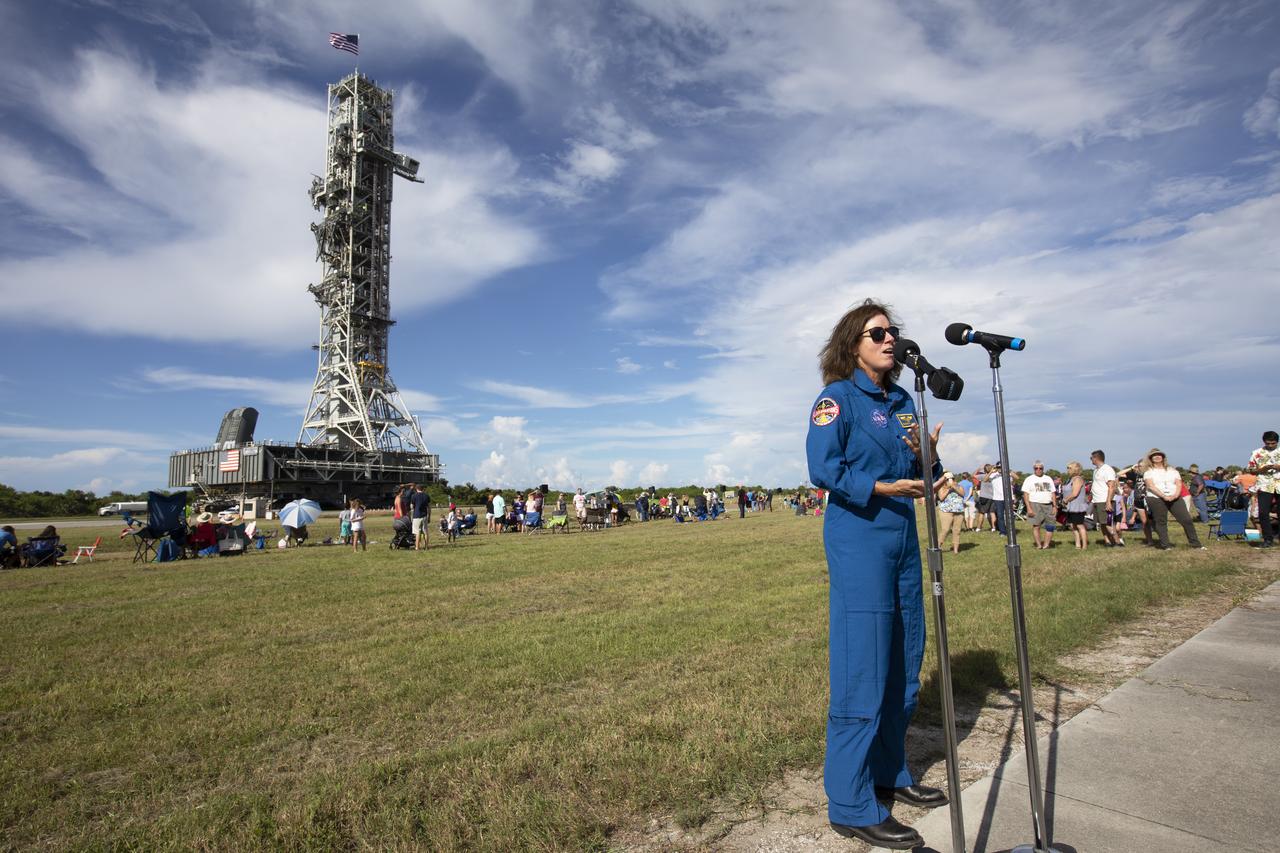
NASA astronaut Shannon Walker speaks to workers and guests during an employee event for the mobile launcher move to the Vehicle Assembly Building (VAB) on Sept. 7, 2018, at NASA's Kennedy Space Center in Florida. The mobile launcher, atop crawler-transporter 2, began its trek from Launch Pad 39B along the crawlerway after undergoing a fit check and several days of systems testing with the pad. This is the first time that the modified mobile launcher made the trip to the pad. The 380-foot-tall mobile launcher is equipped with the crew access arm and several umbilicals that will provide power, environmental control, pneumatics, communication and electrical connections to the agency's Space Launch System and Orion spacecraft. The mobile launcher will spend seven months in the VAB undergoing testing. Exploration Ground Systems is preparing the ground systems necessary to launch SLS and Orion on Exploration Mission-1, missions to the Moon and on to Mars.

The mobile launcher for Artemis missions is at Launch Pad 39B at NASA’s Kennedy Space Center in Florida on Sept. 11, 2019, after spending a week and a half inside the Vehicle Assembly Building (VAB) due to the approach of Hurricane Dorian. The nearly 400-foot-tall structure was moved from Launch Pad 39B to the VAB for safekeeping on Aug. 30. The storm passed about 70 miles east of the spaceport during the overnight hours Tuesday, Sept. 3, and Wednesday, Sept. 4. NASA’s Exploration Ground Systems moved the mobile launcher back to the launch pad, where teams will complete testing and checkout on the launcher in the coming weeks for the Artemis I mission.