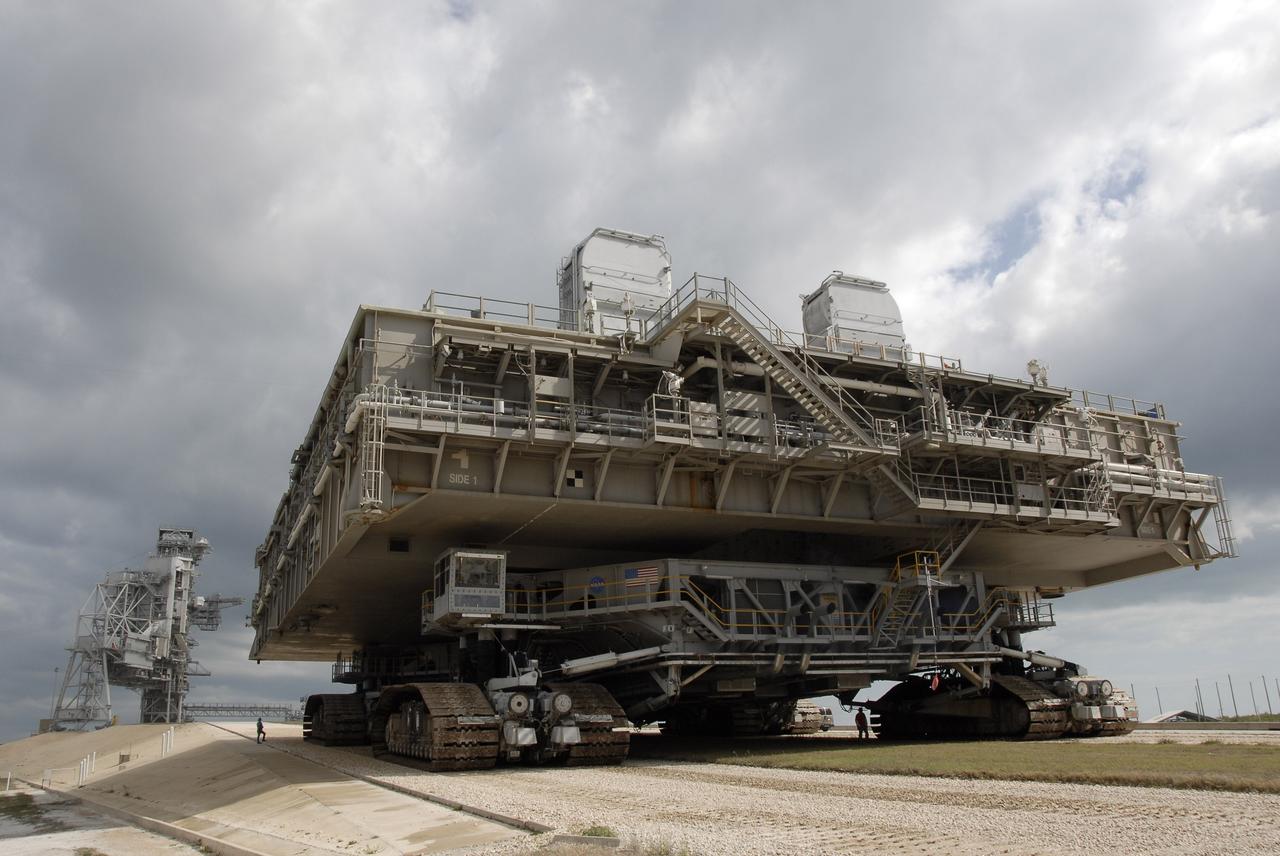
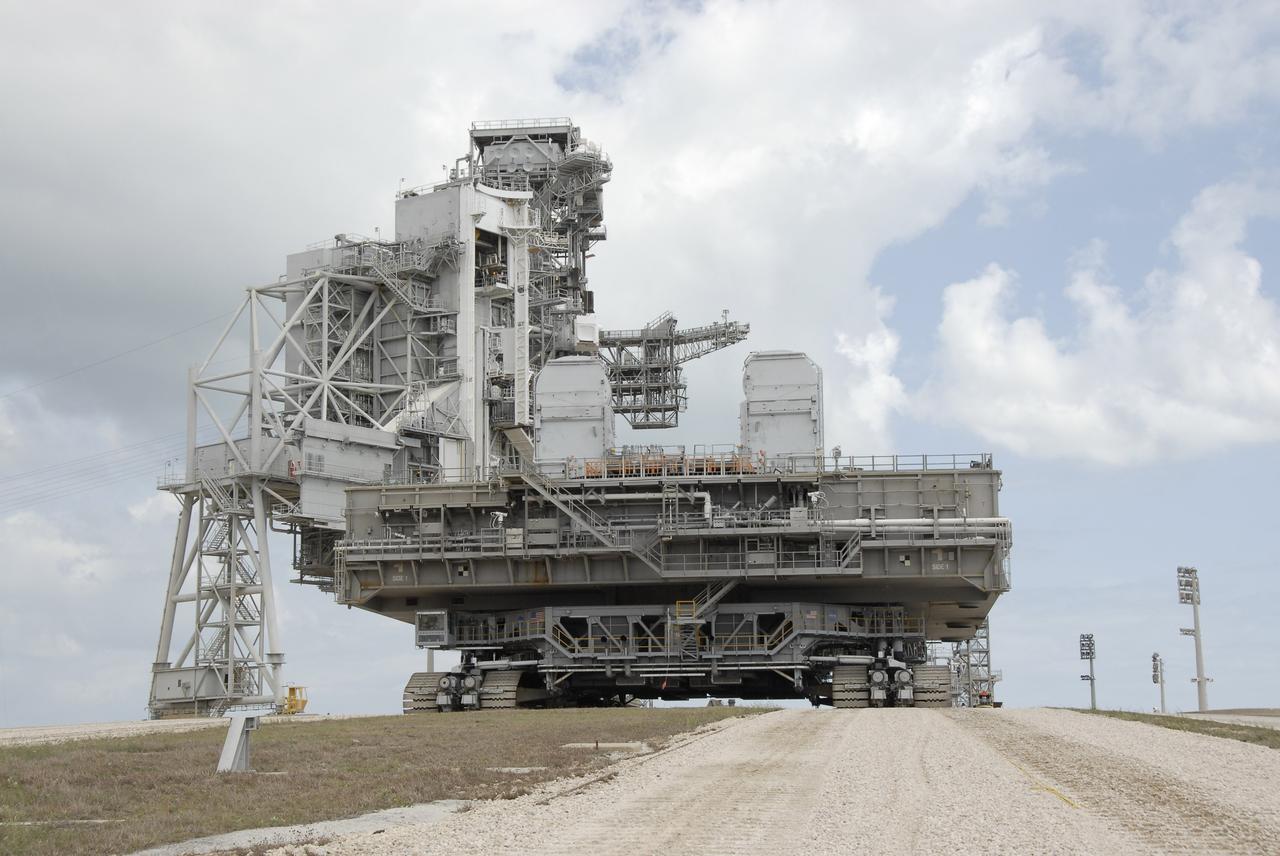
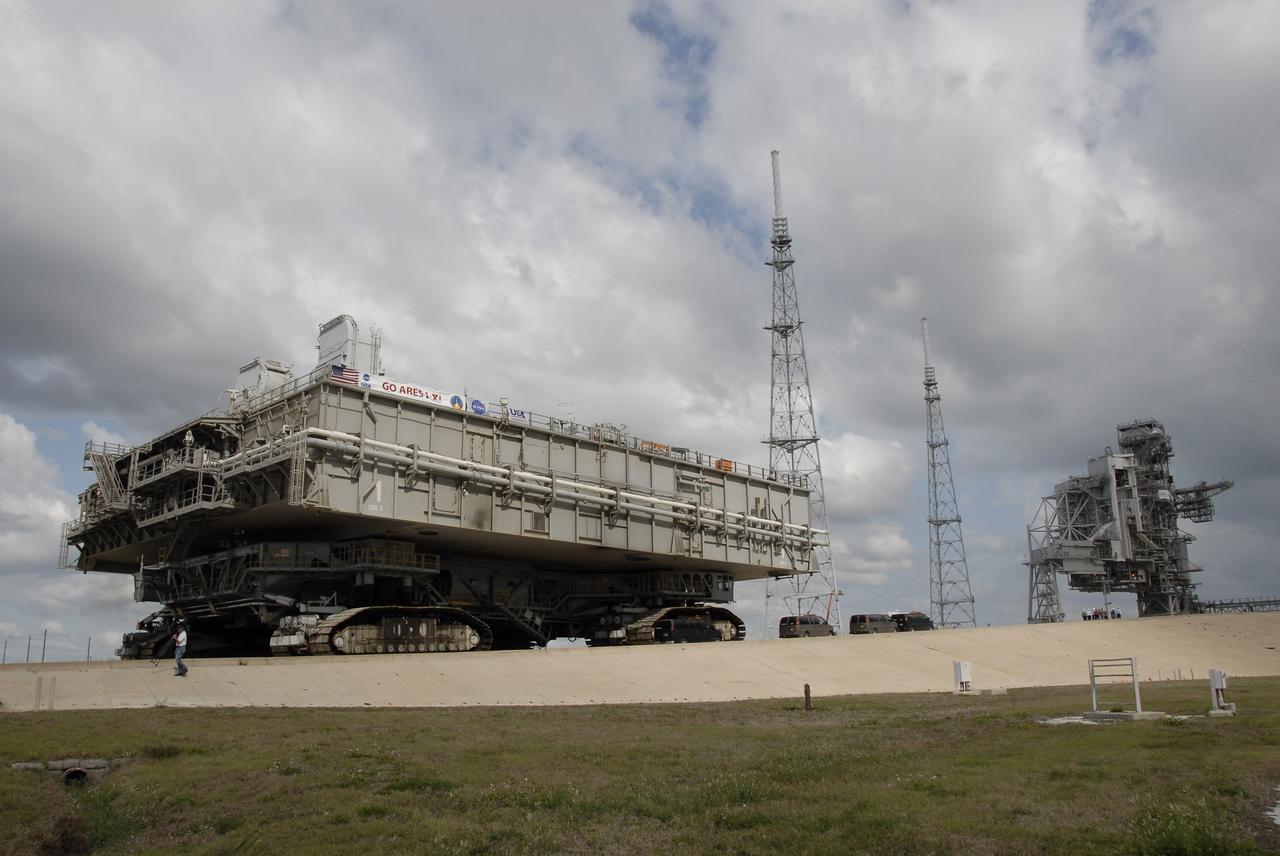
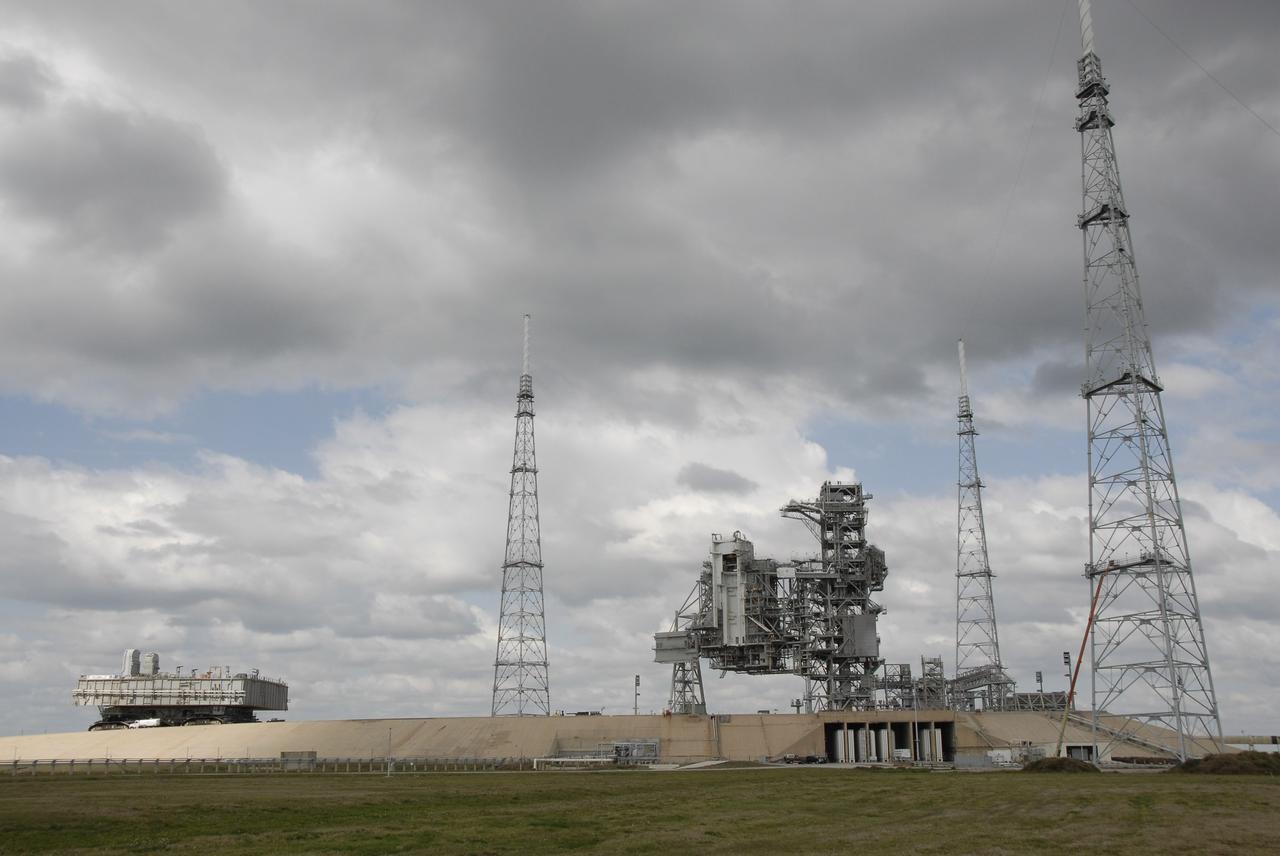
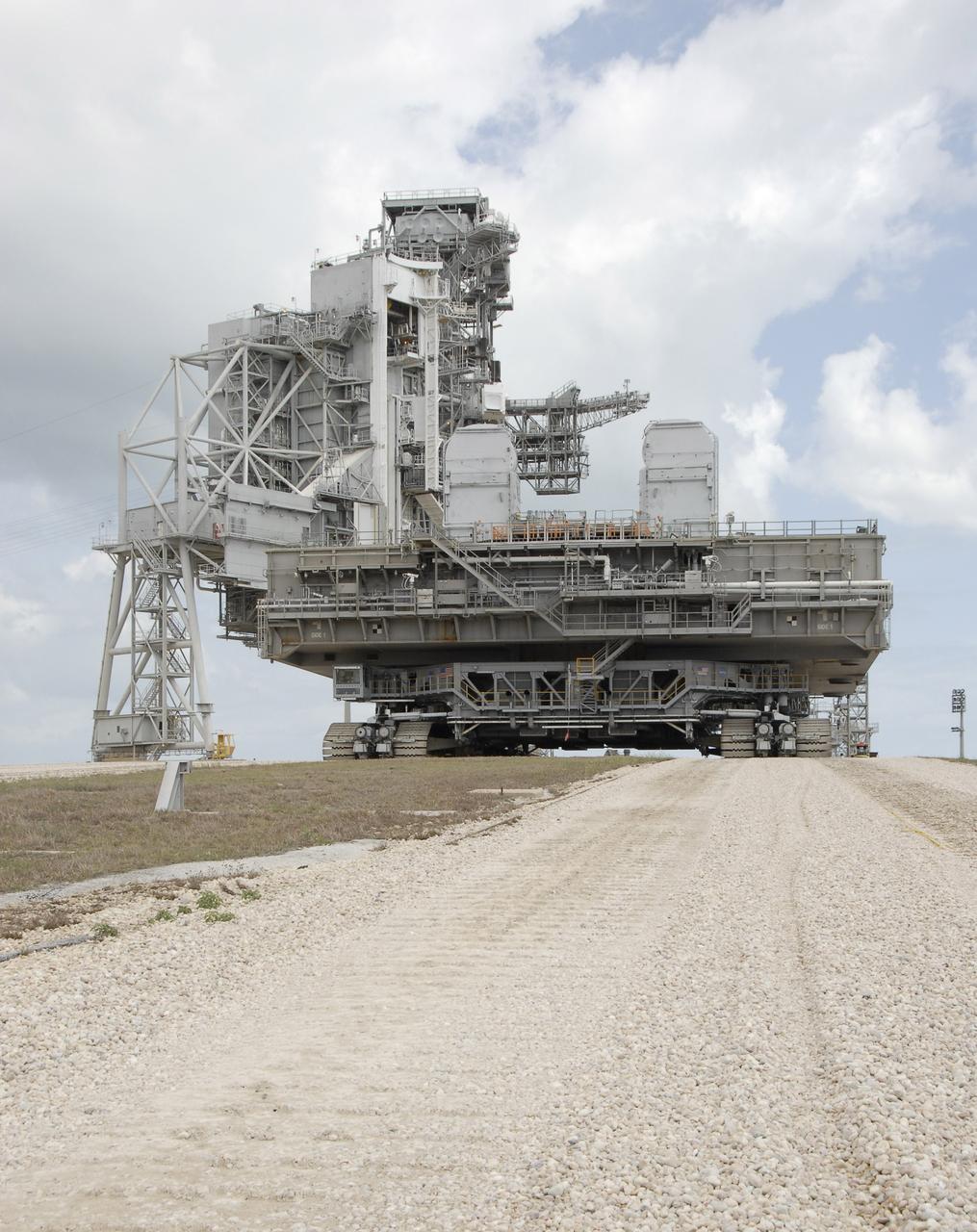
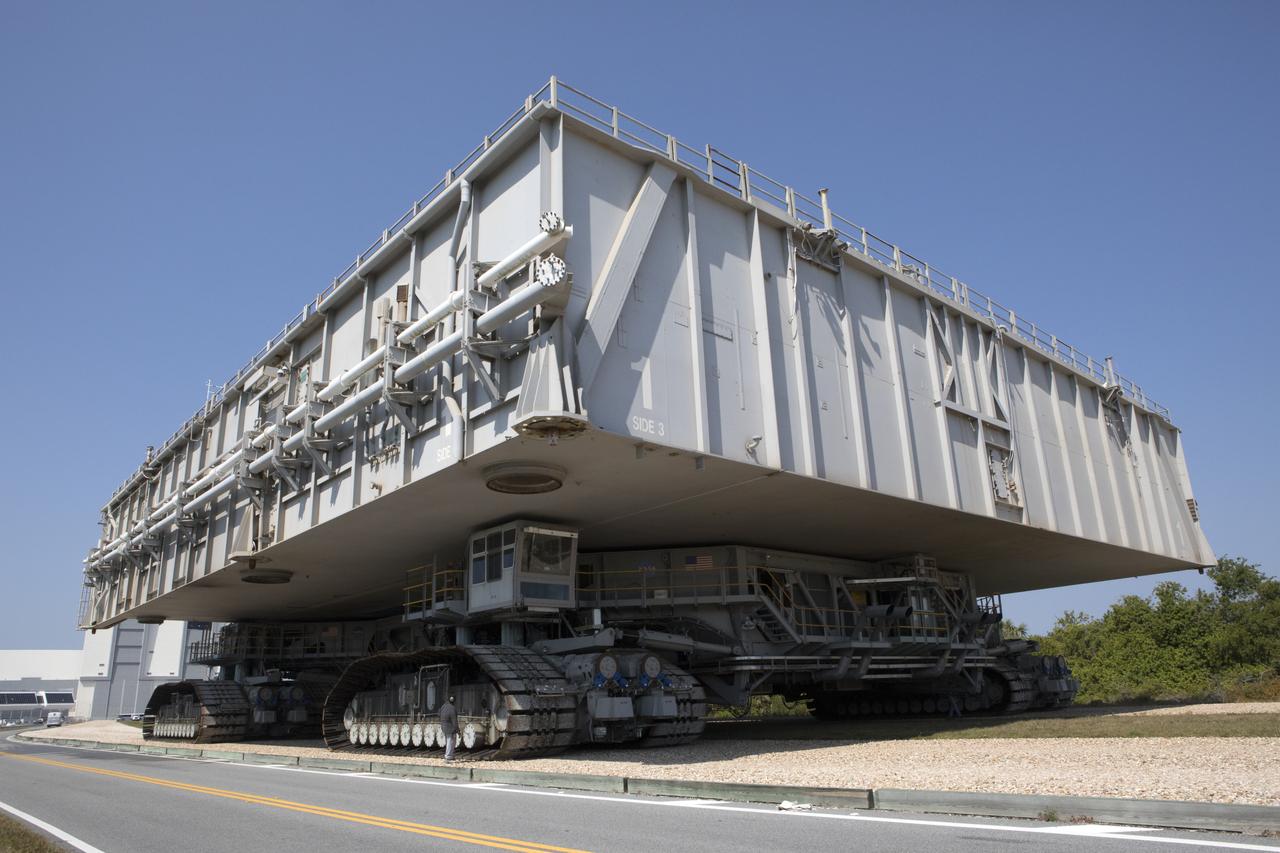
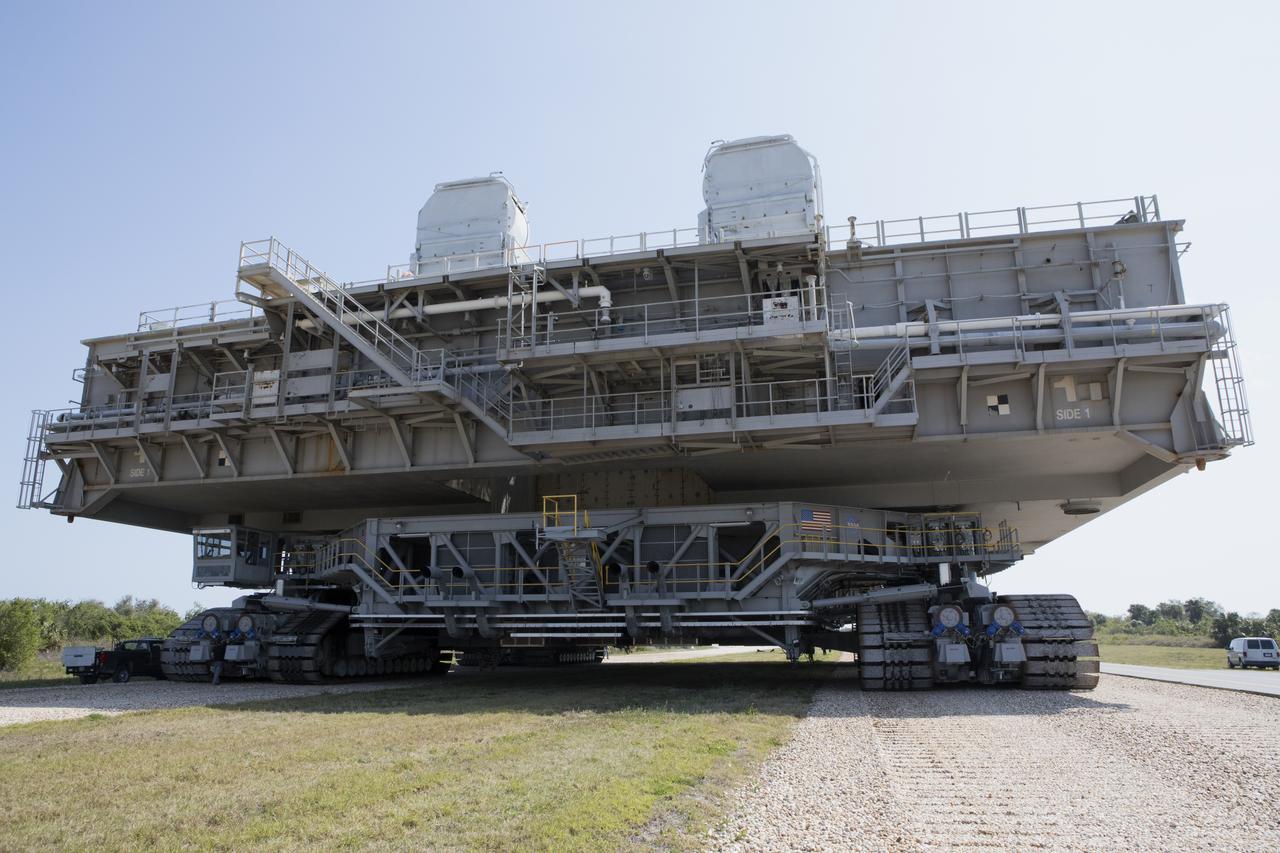
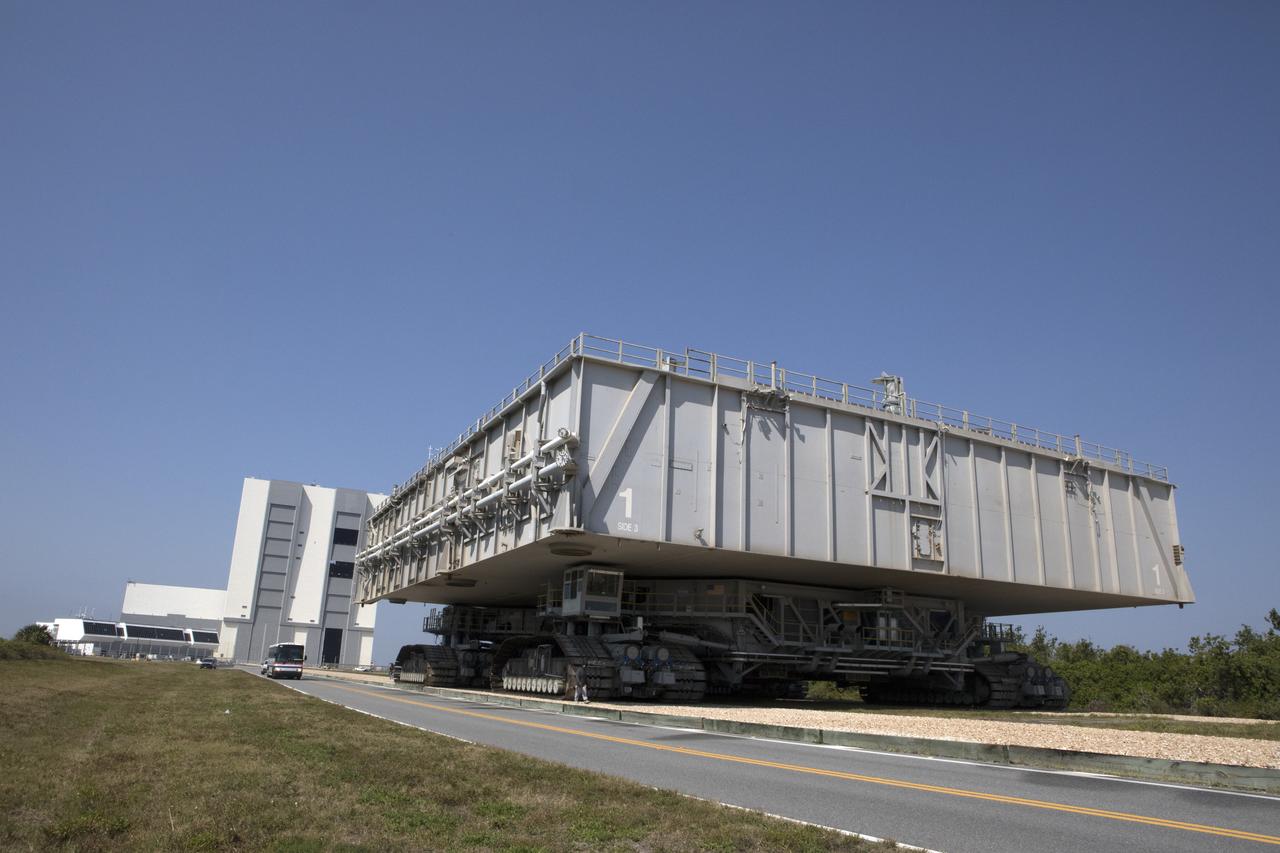
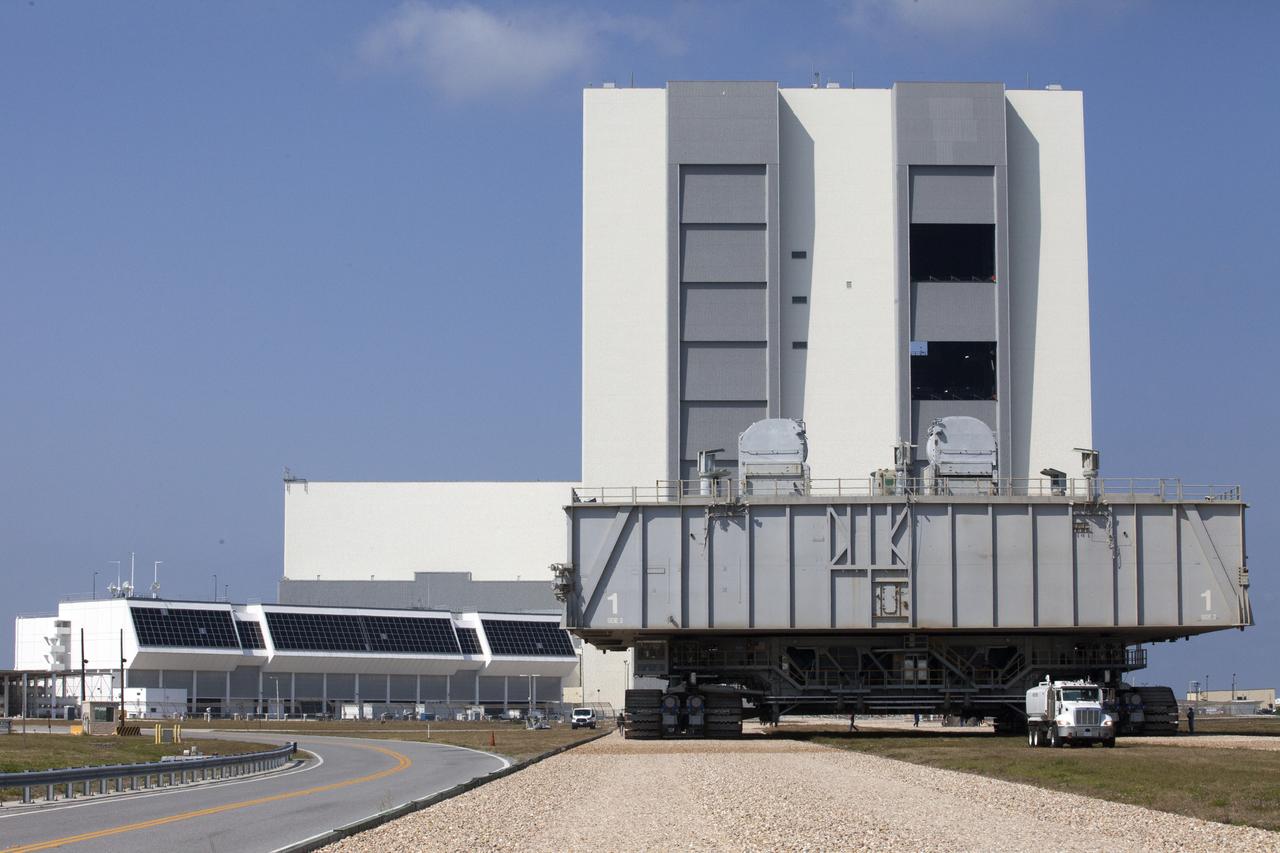
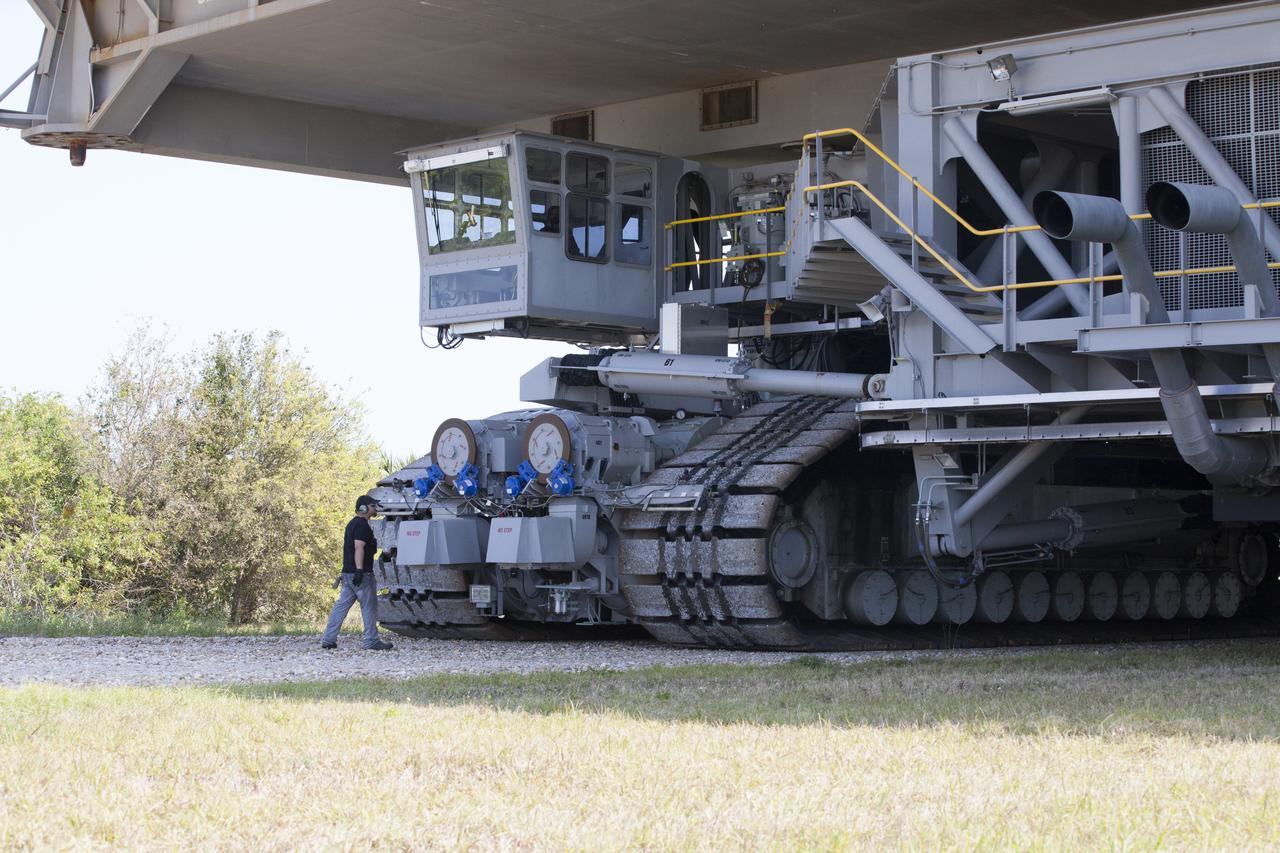
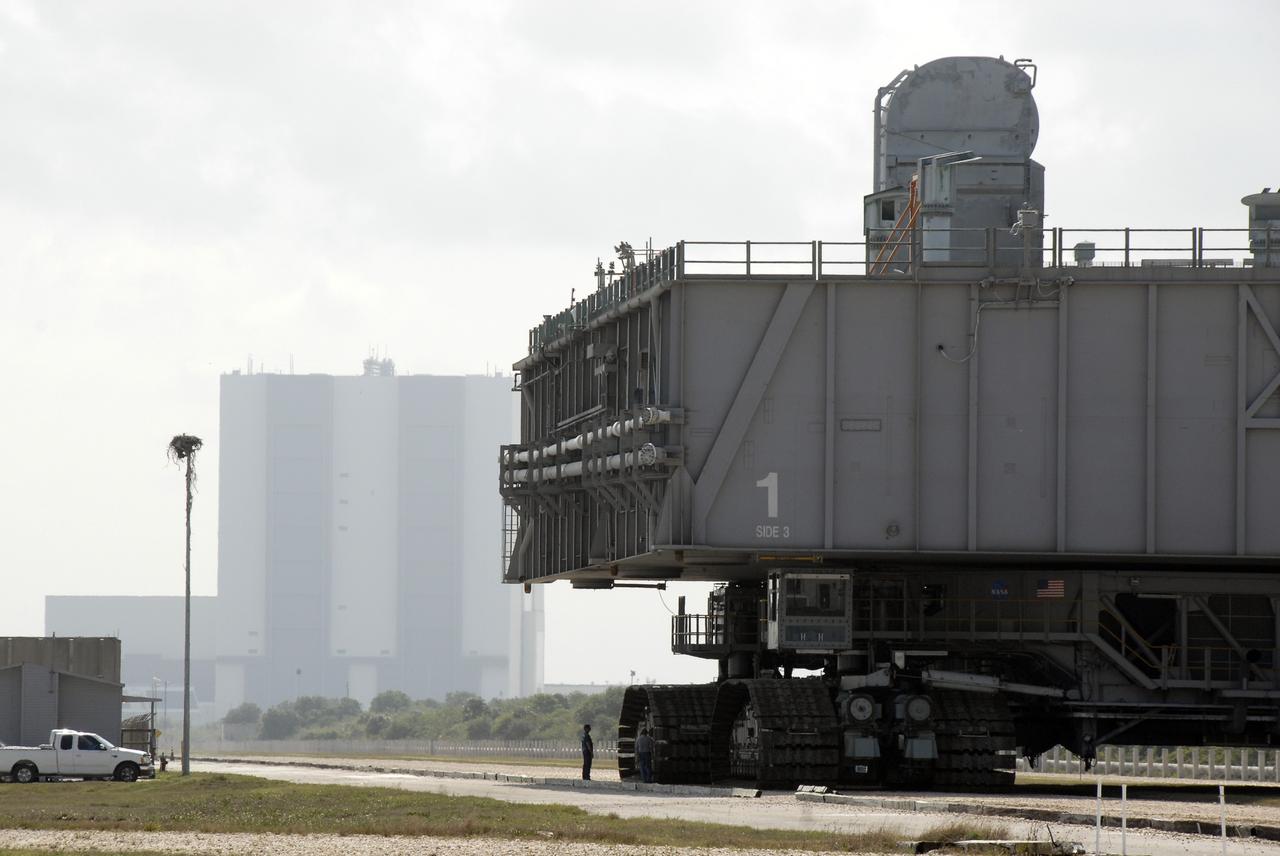
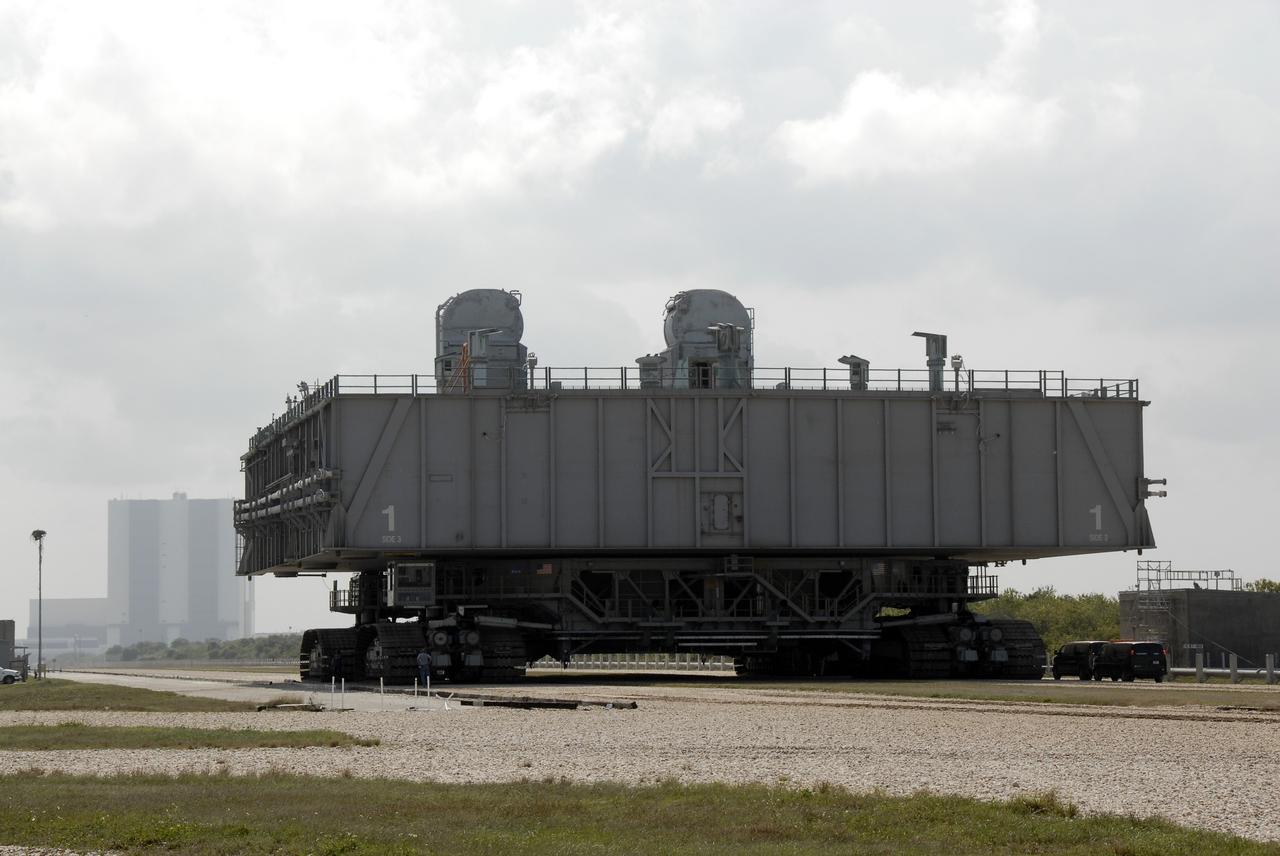
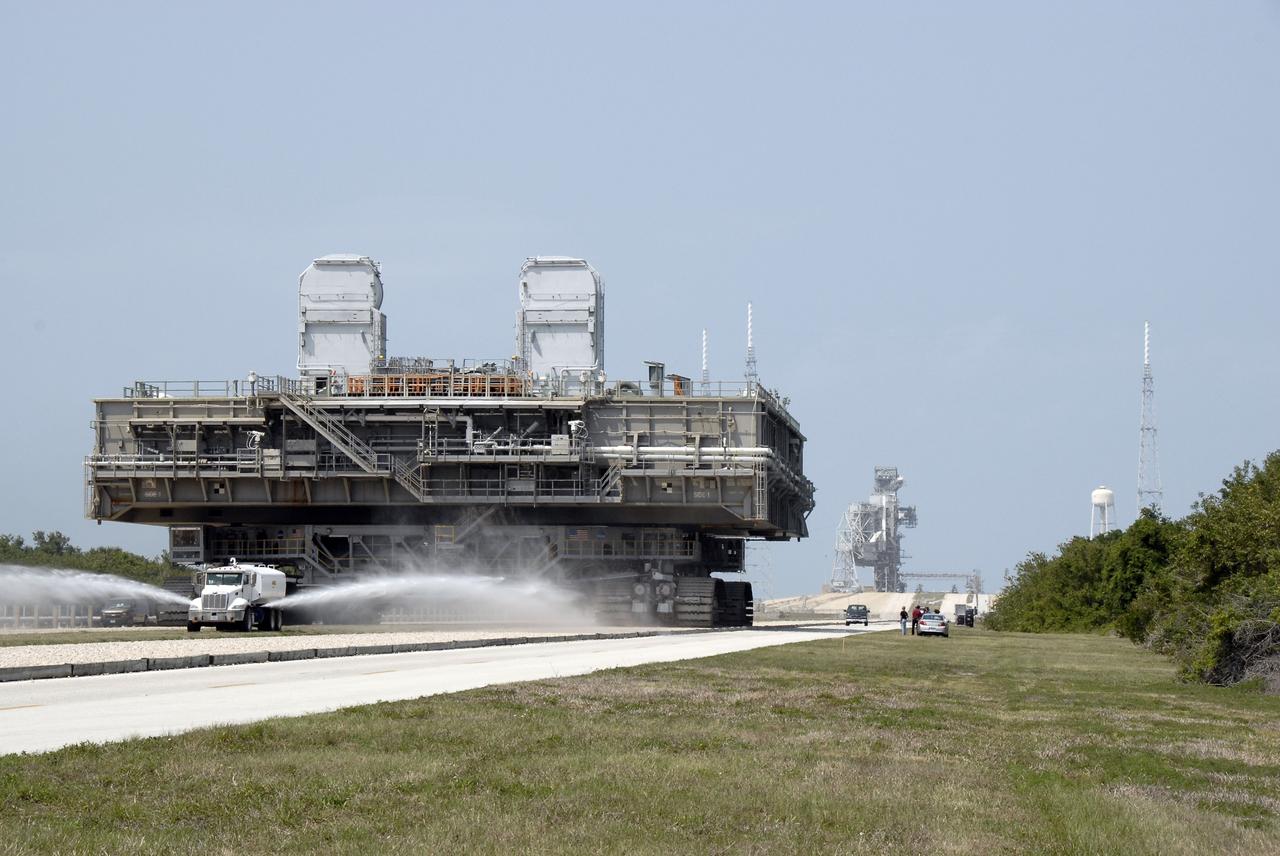
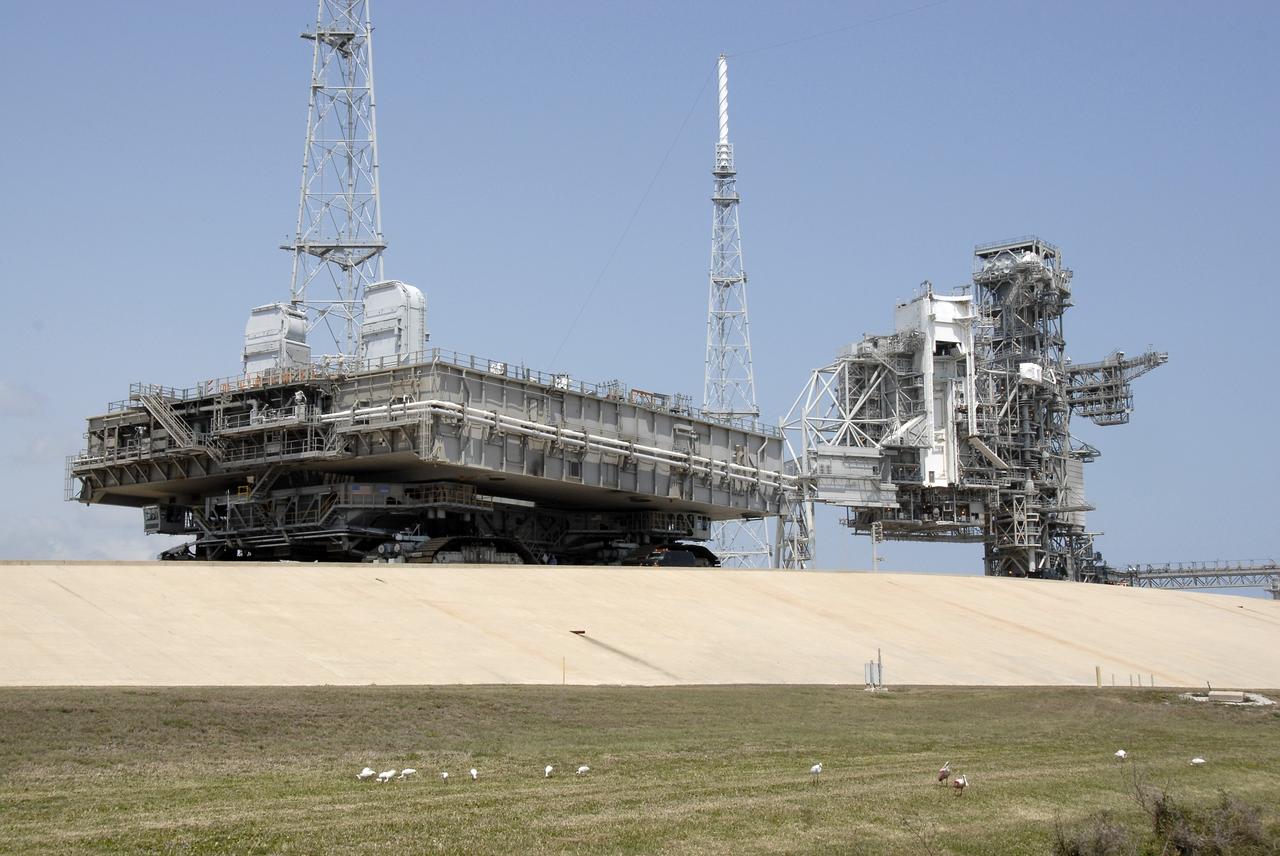
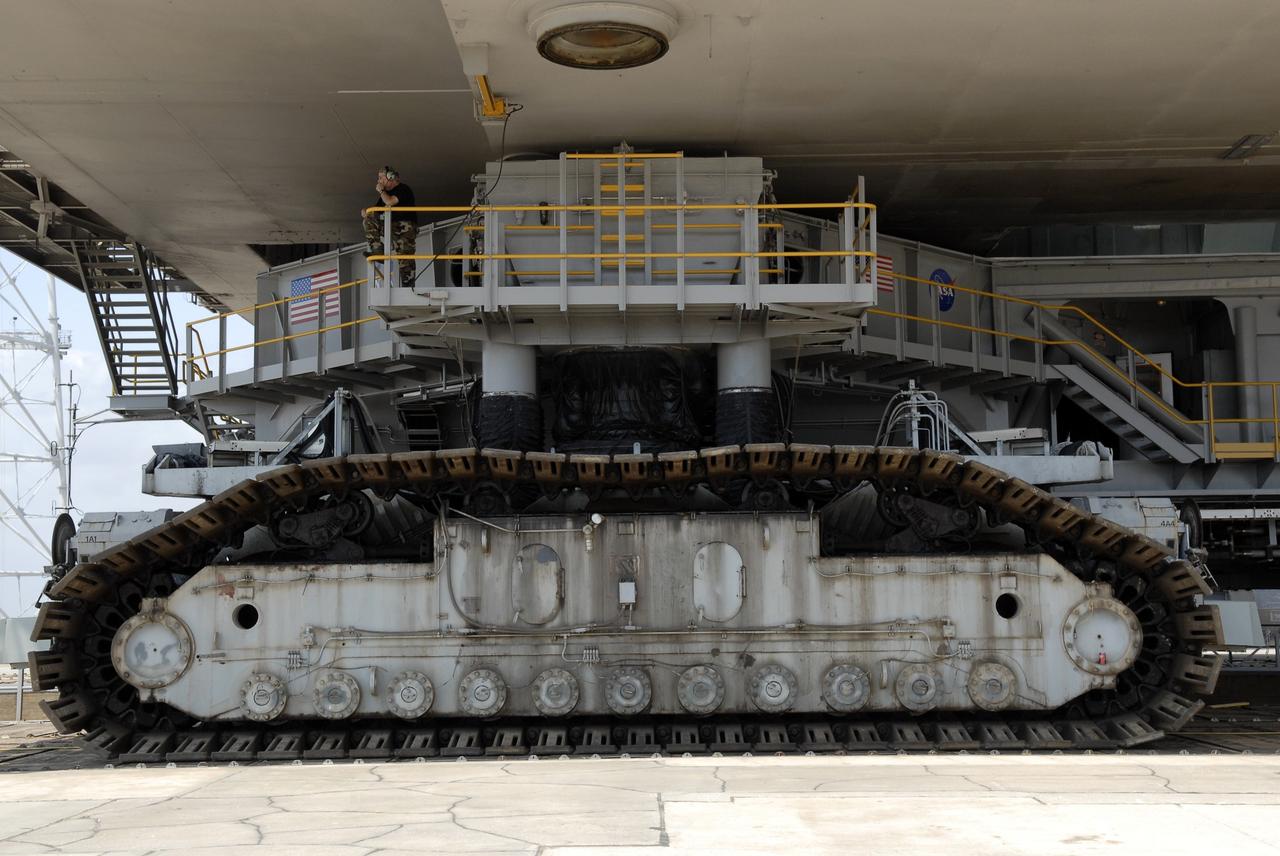
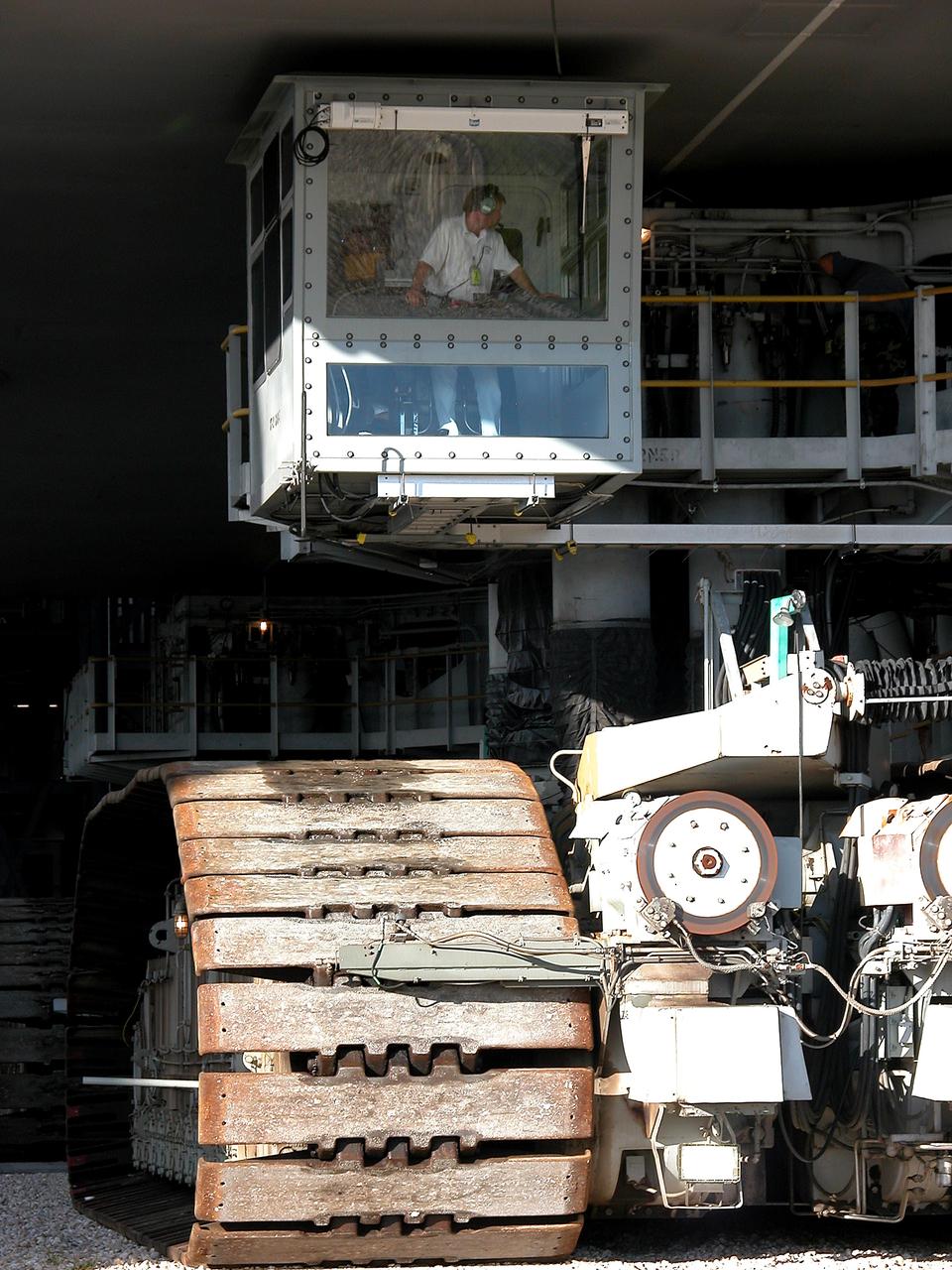
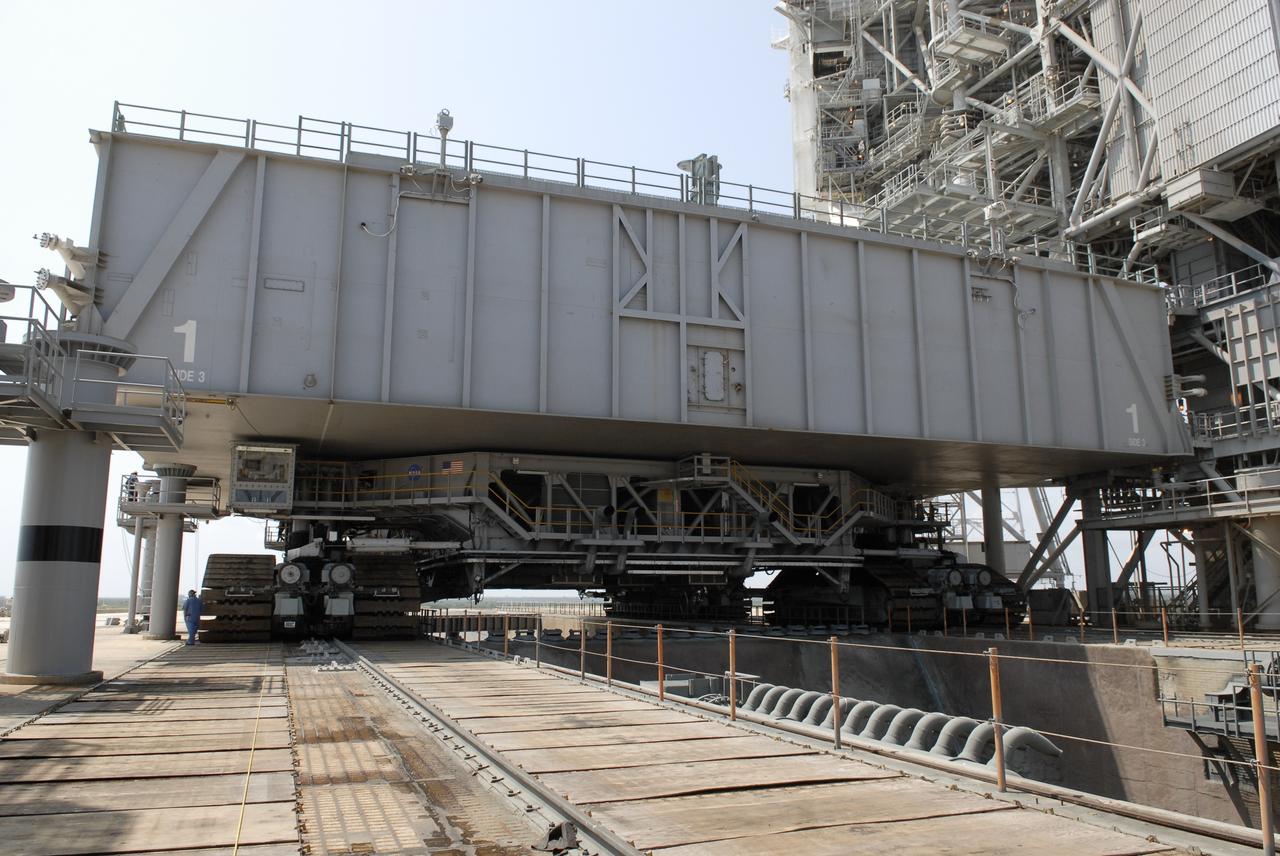
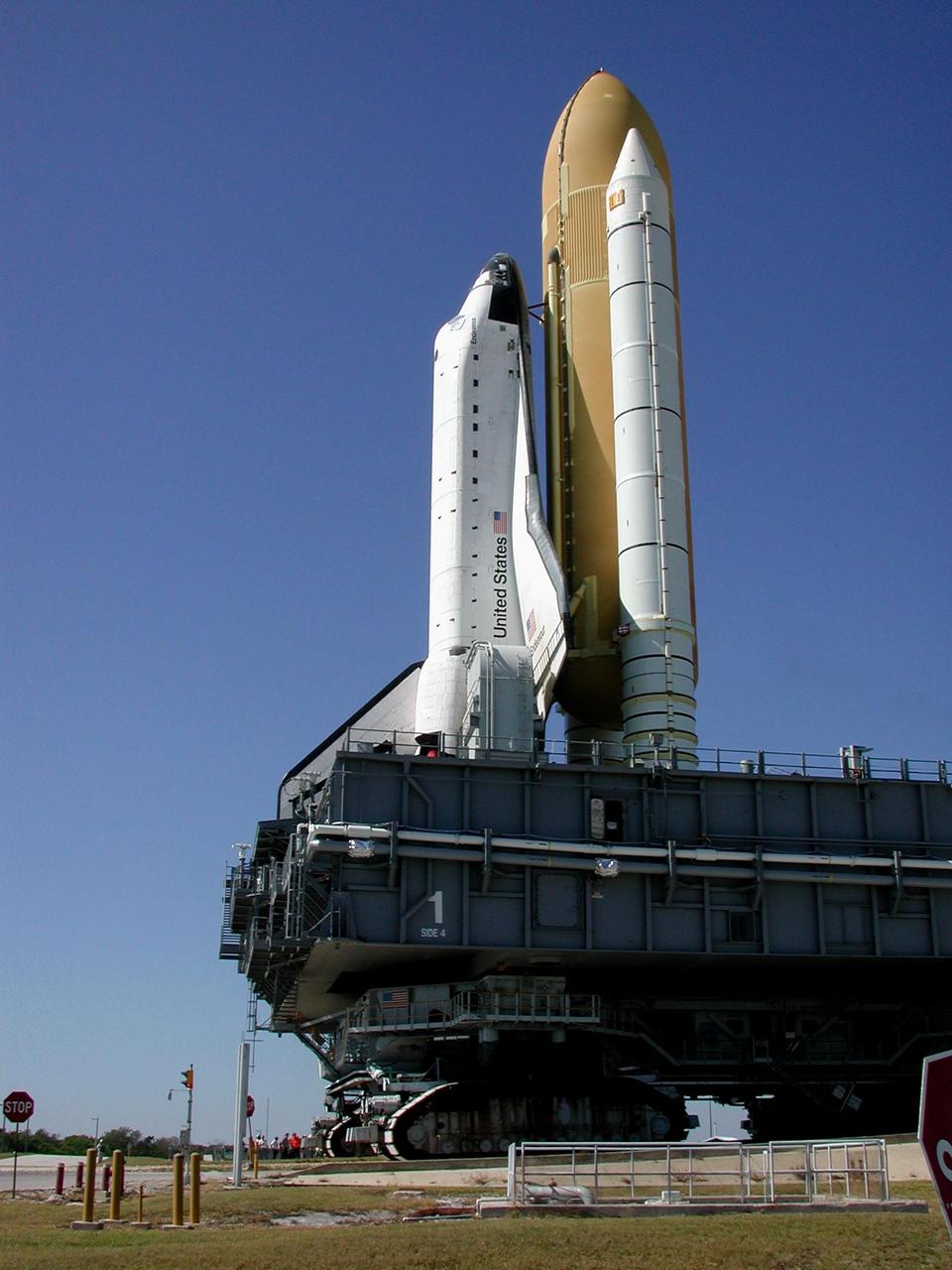
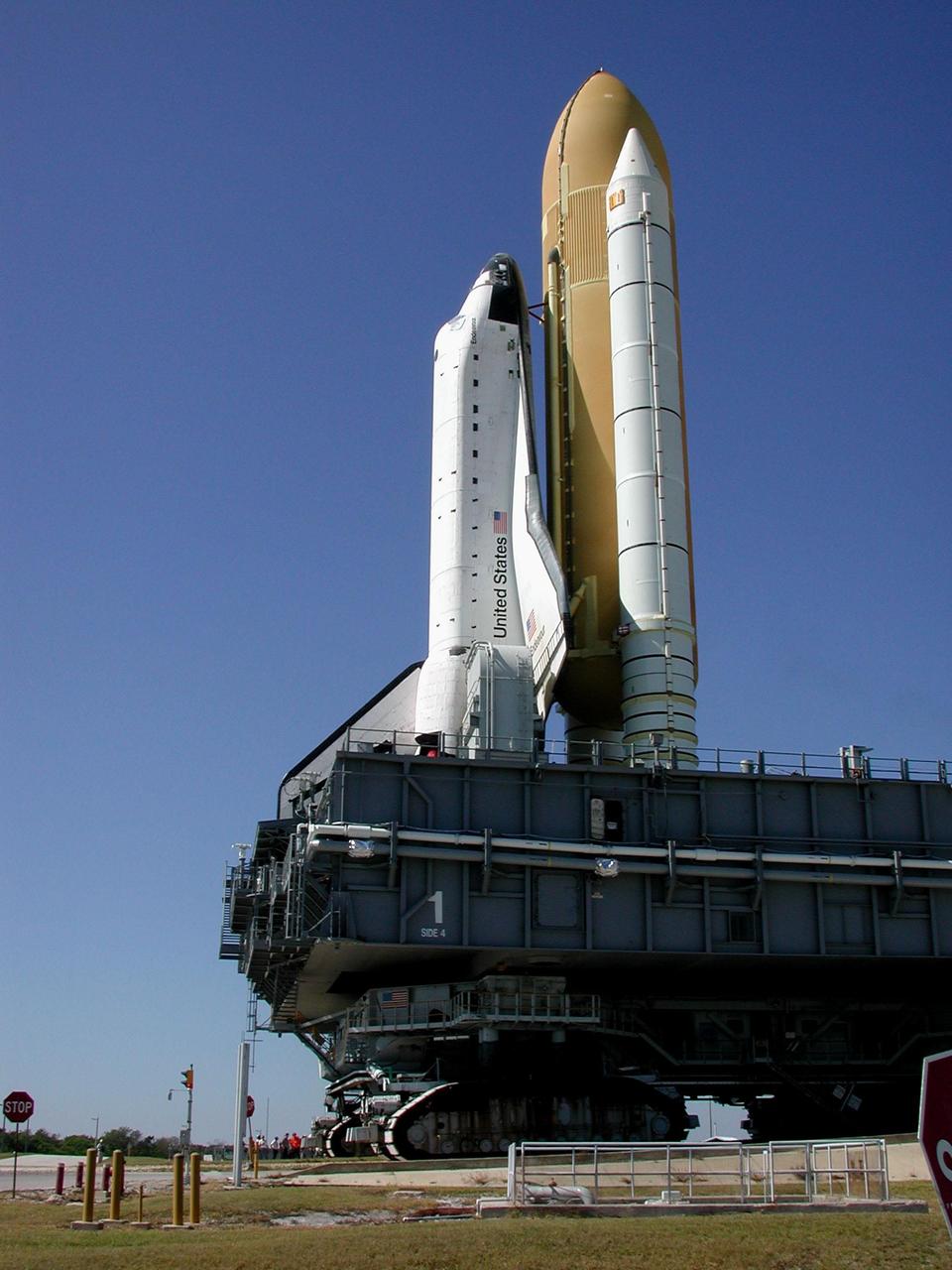
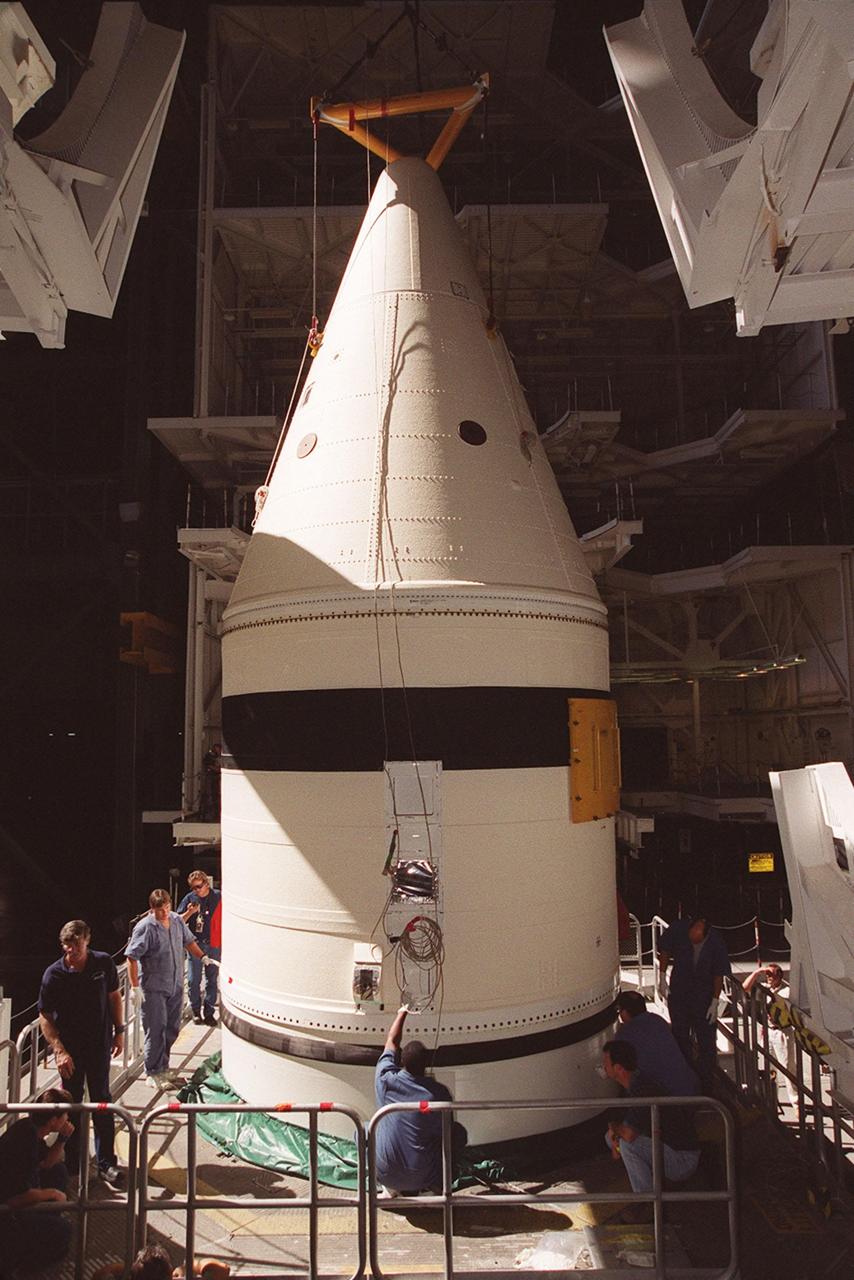
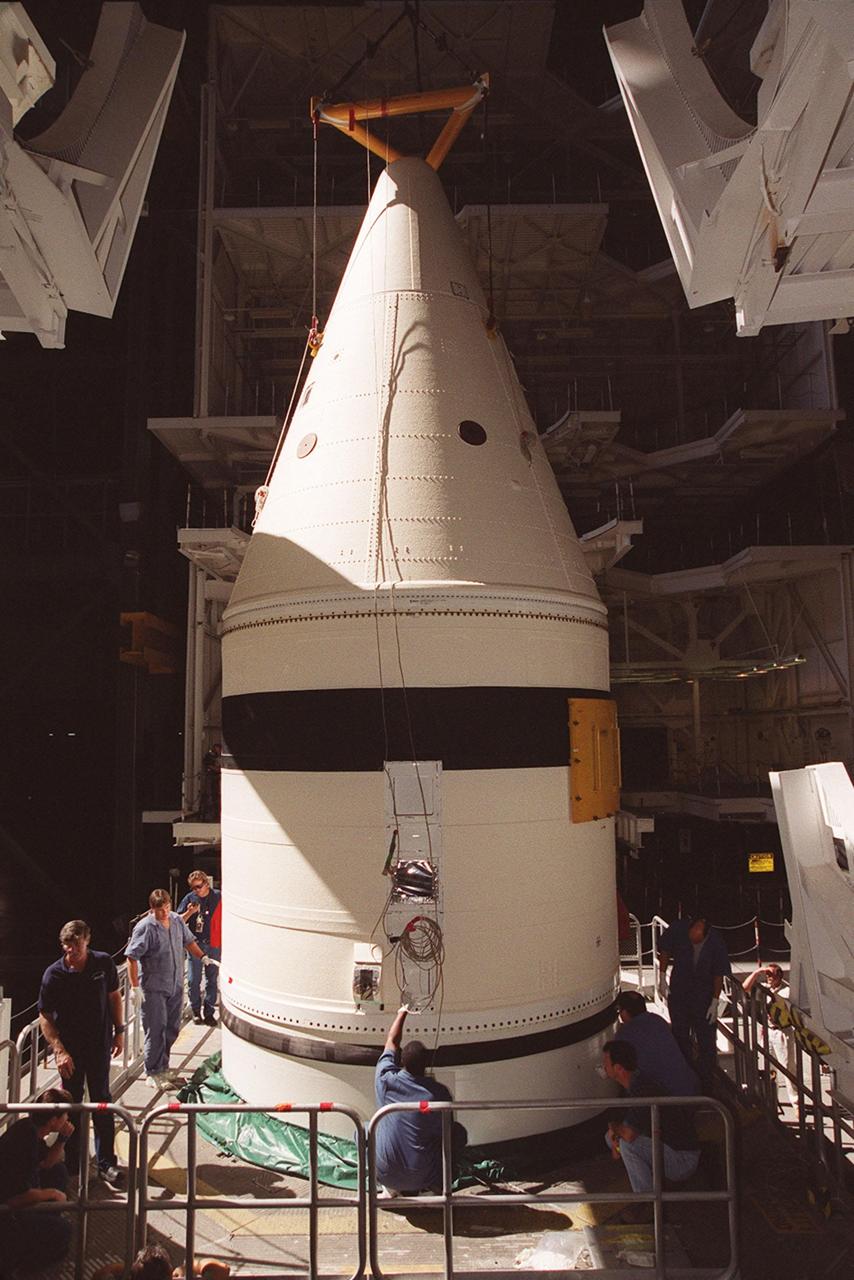
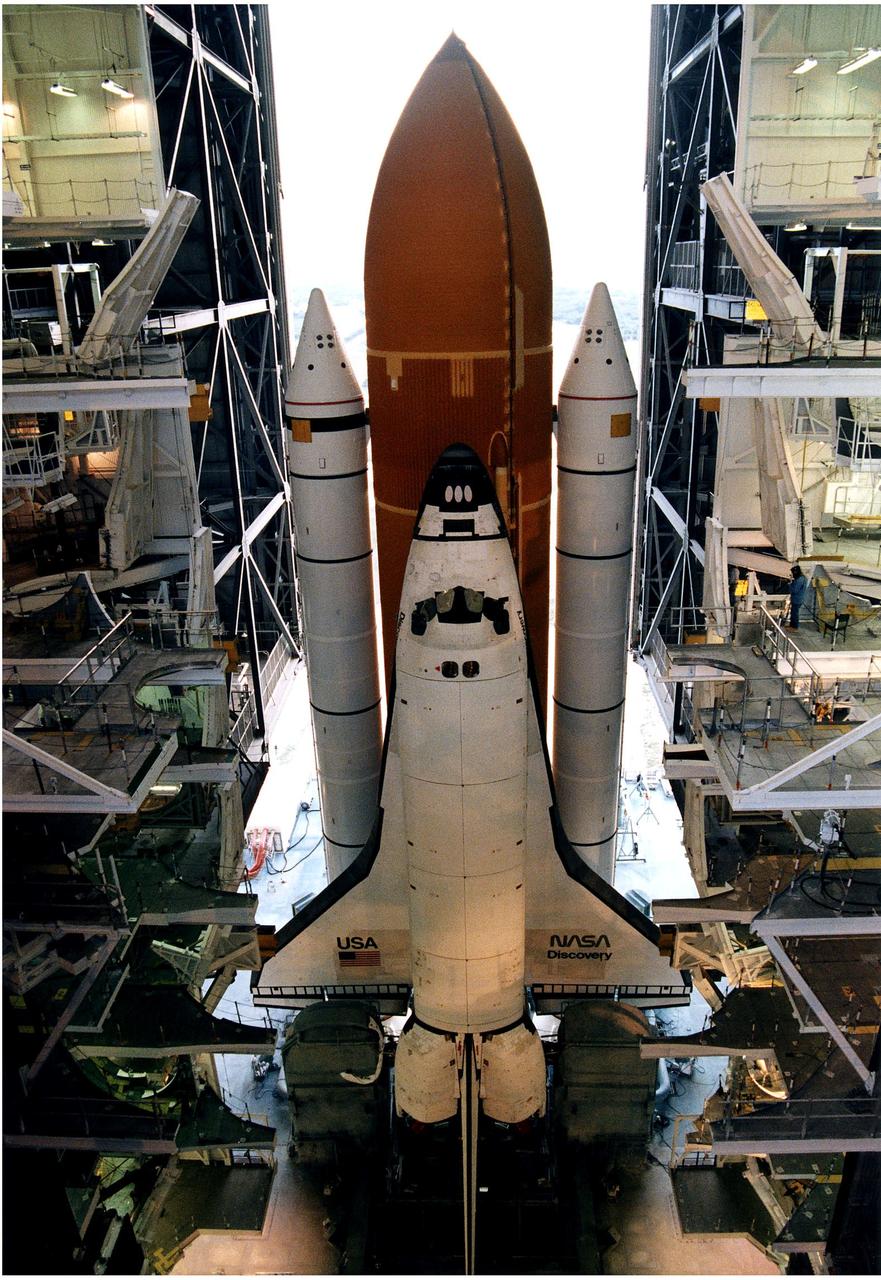
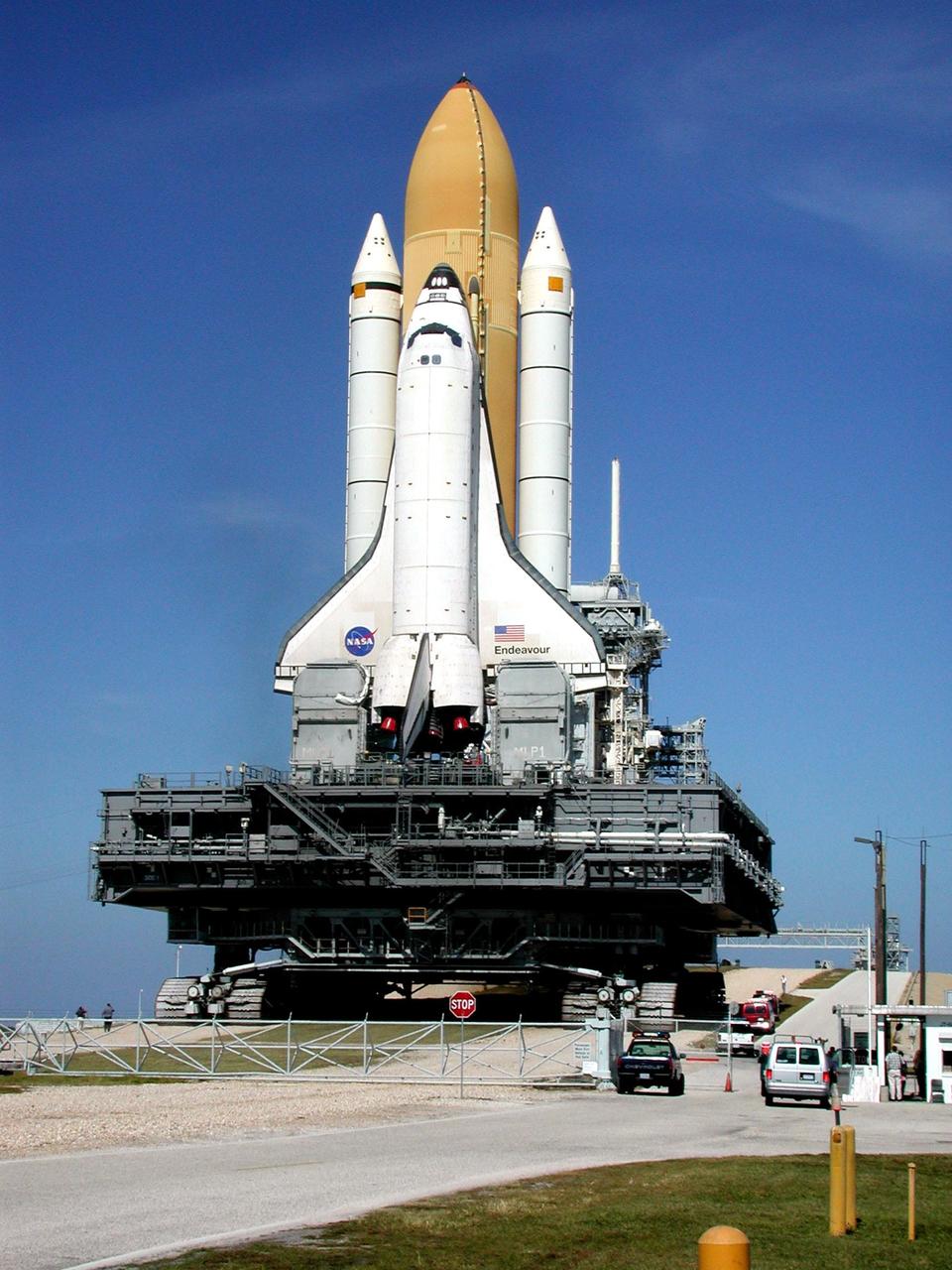
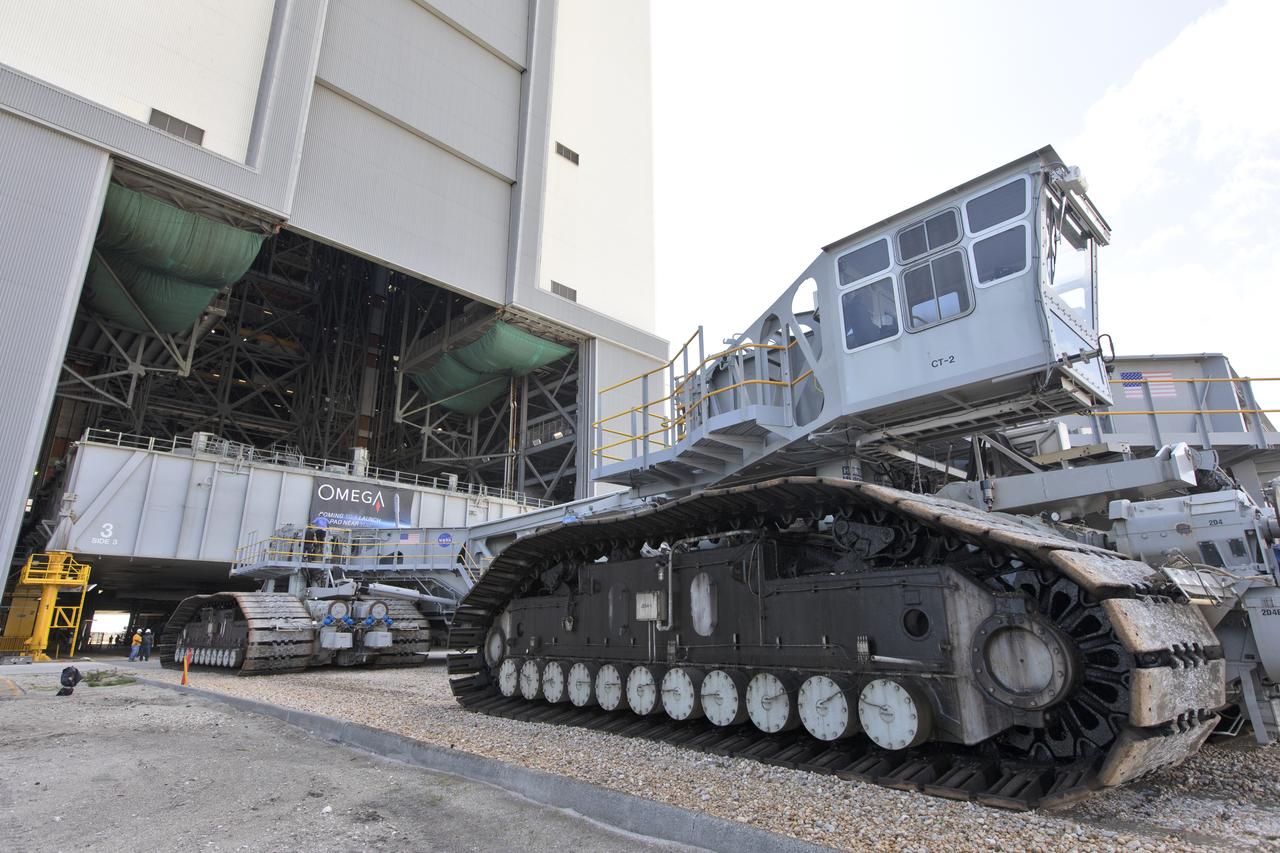
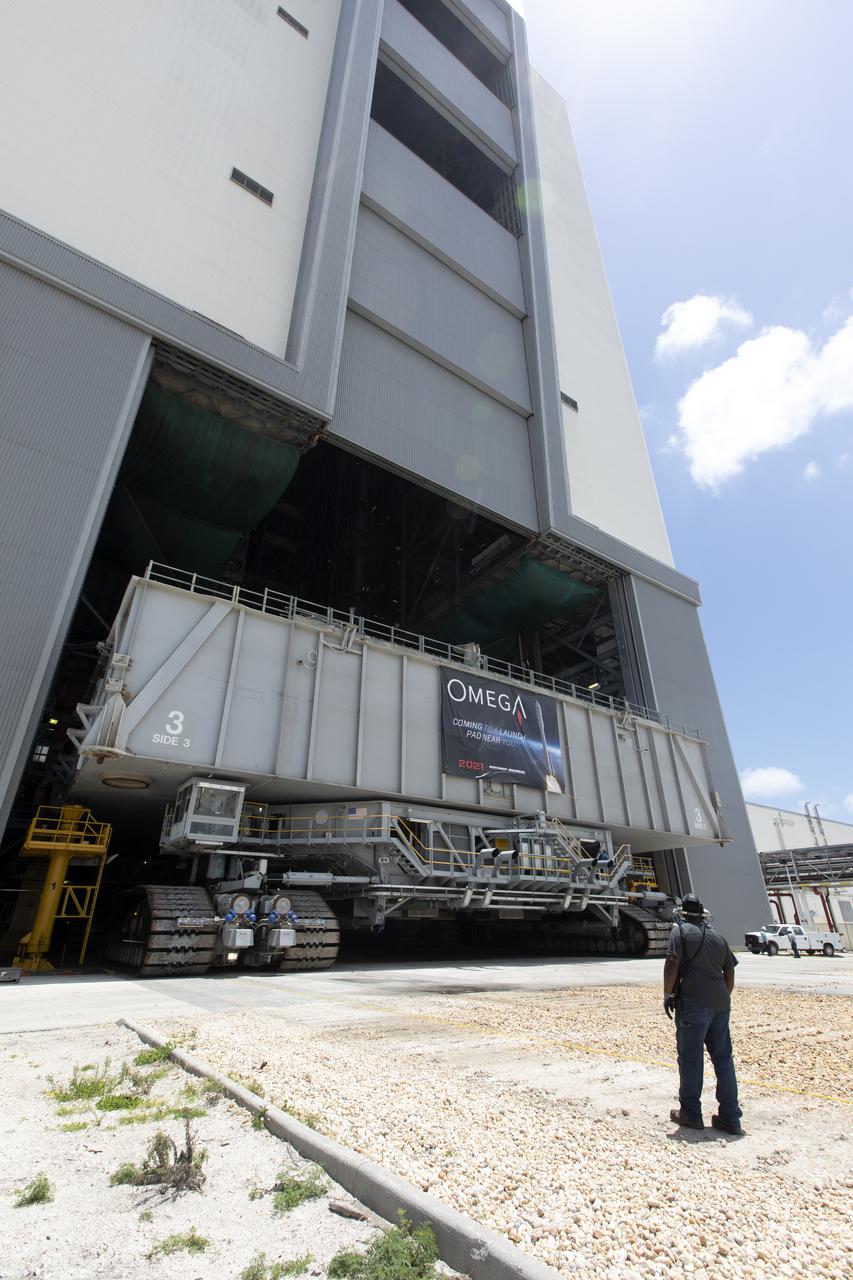
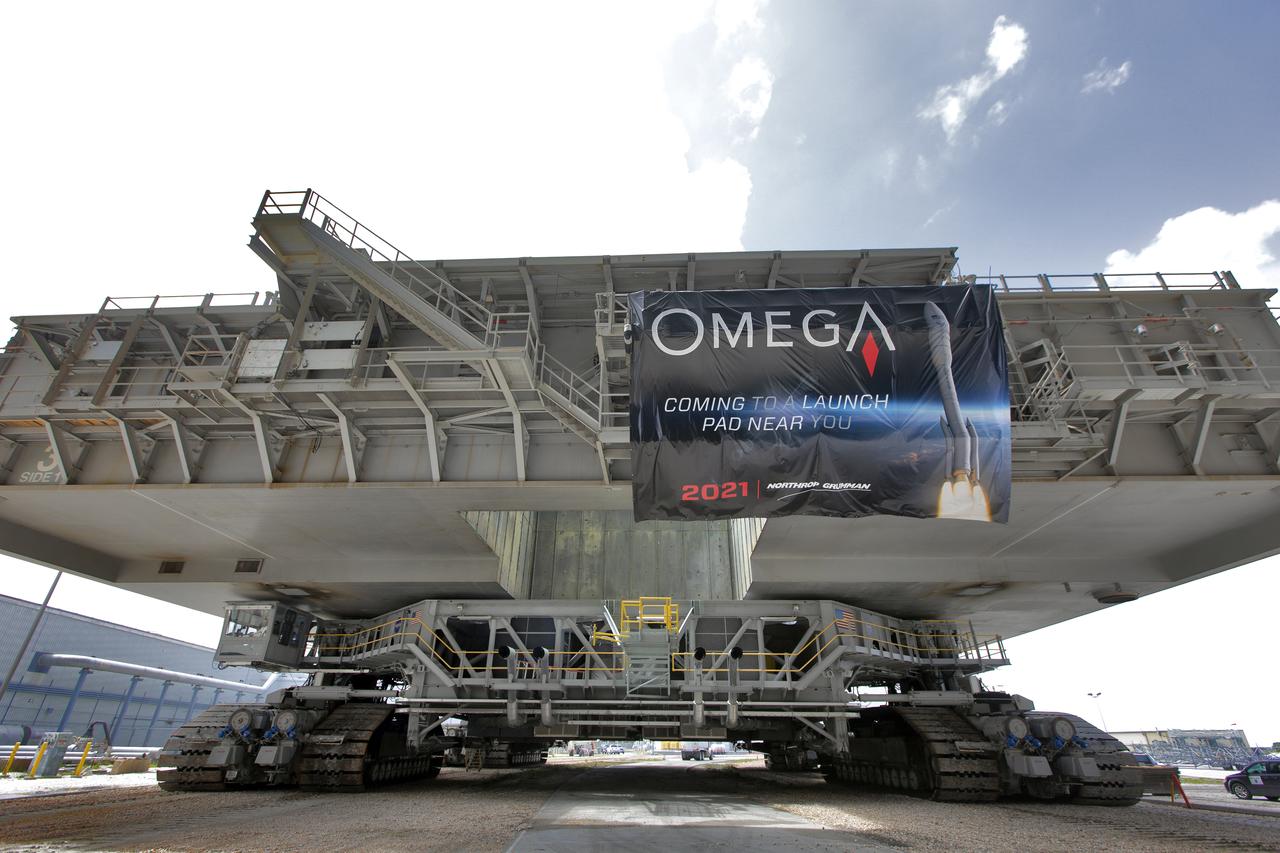
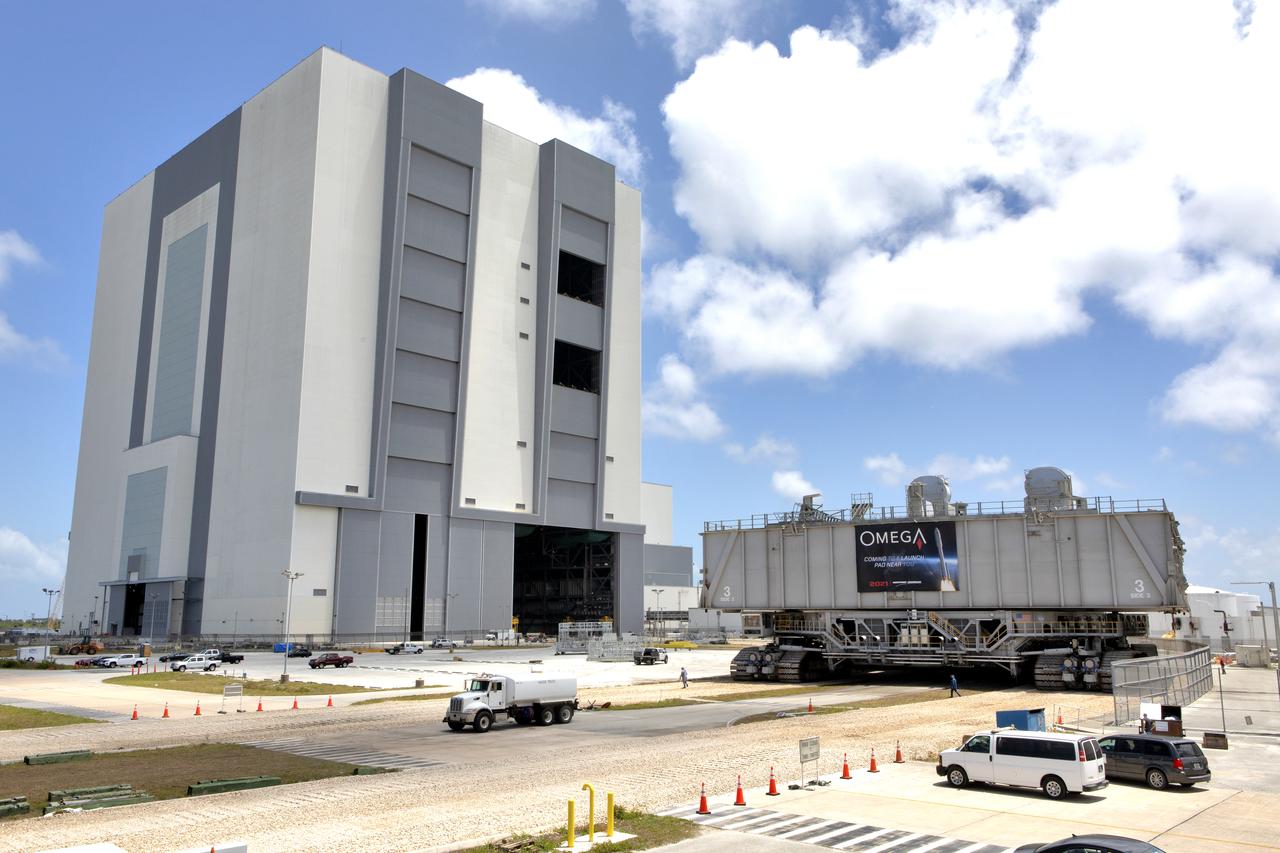
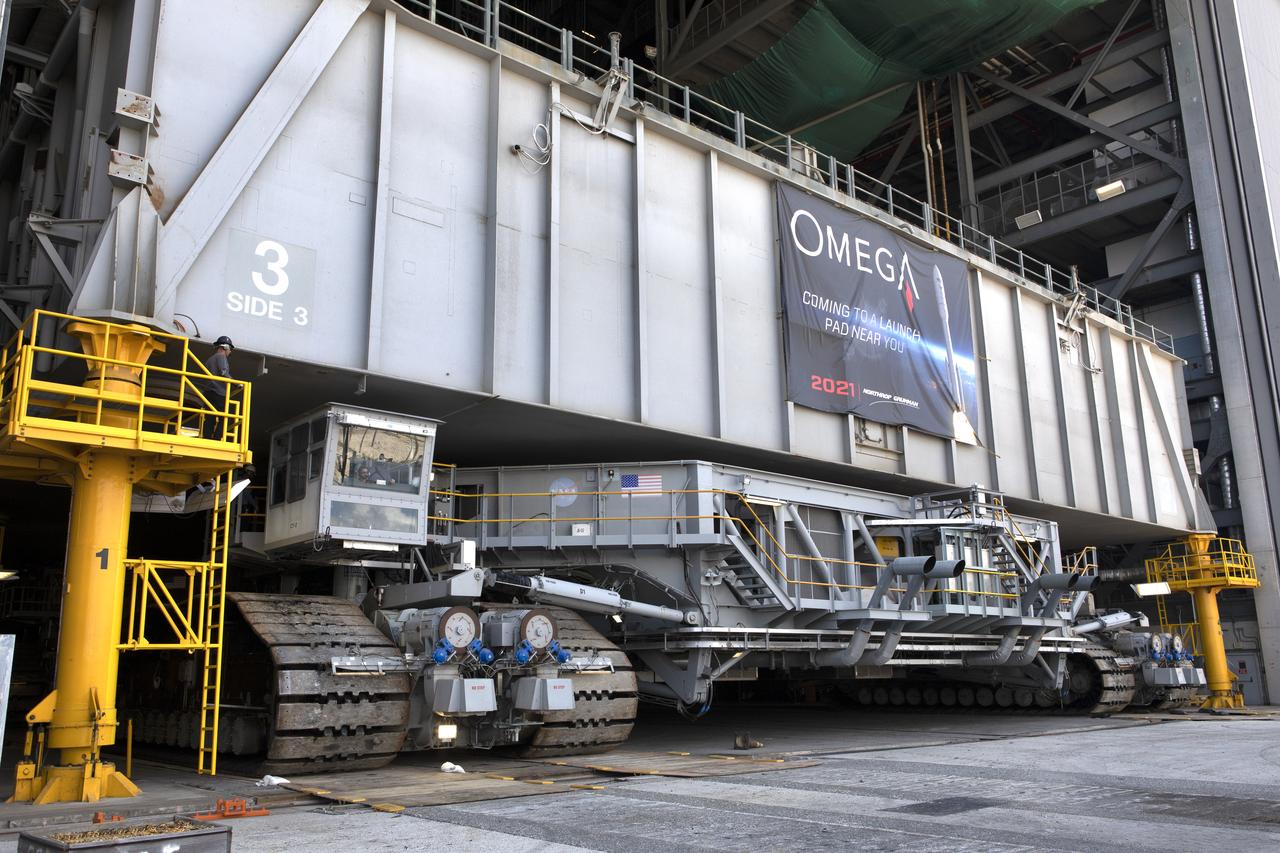
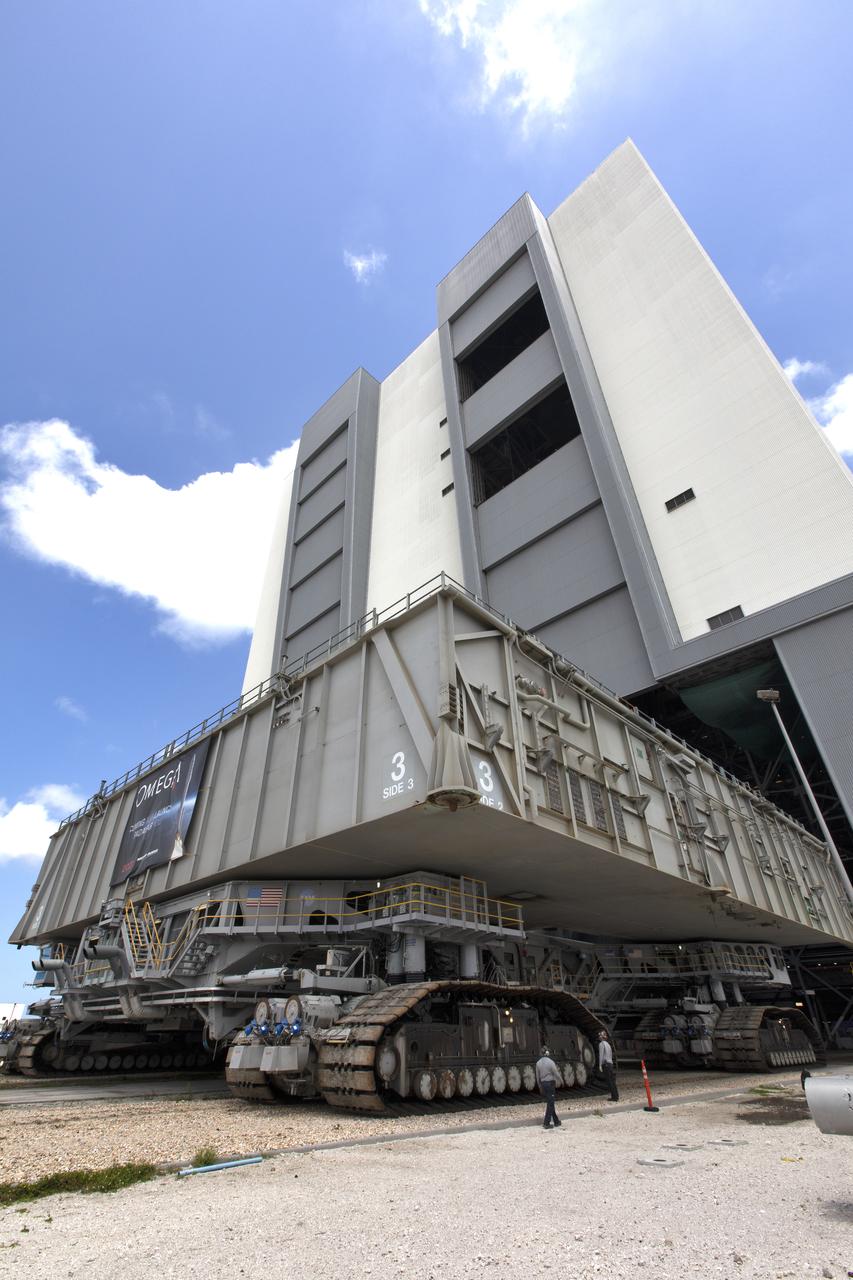
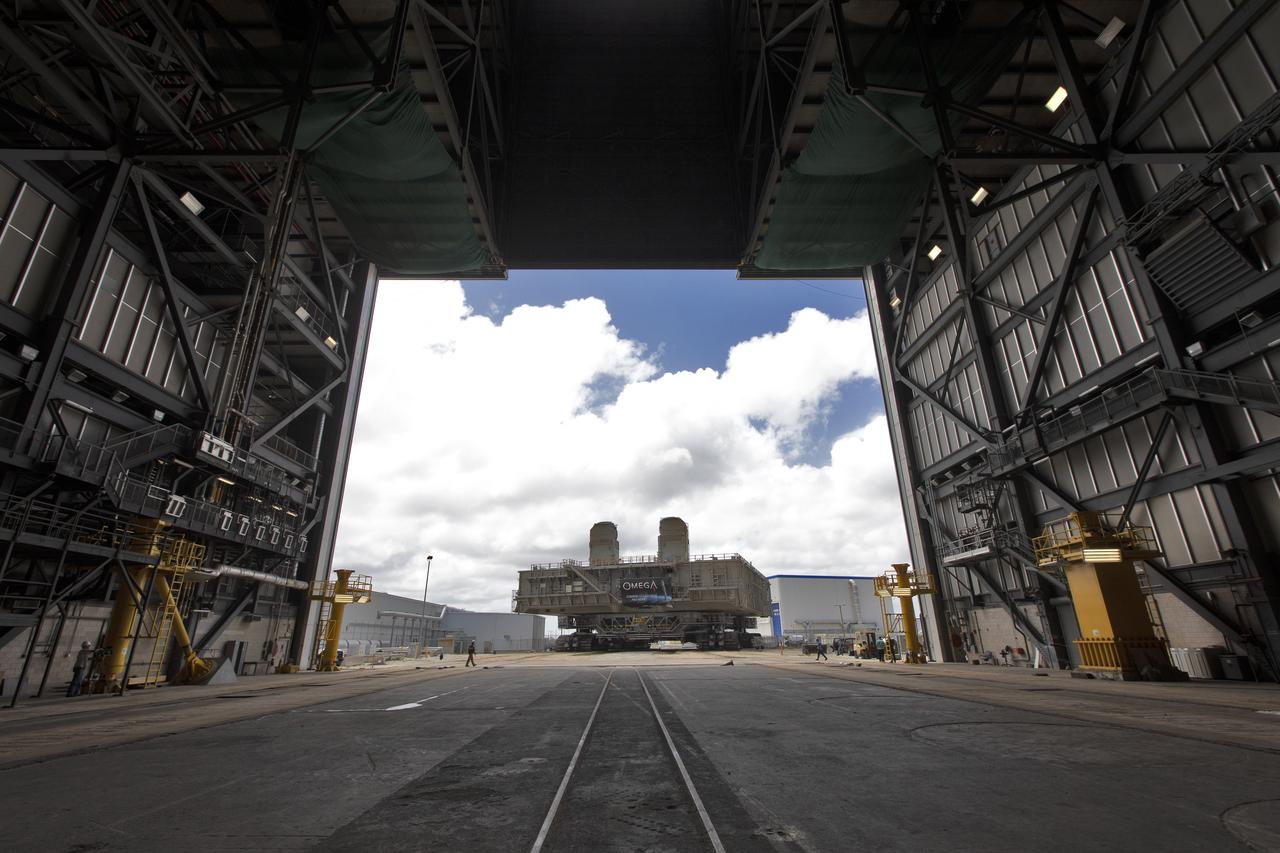
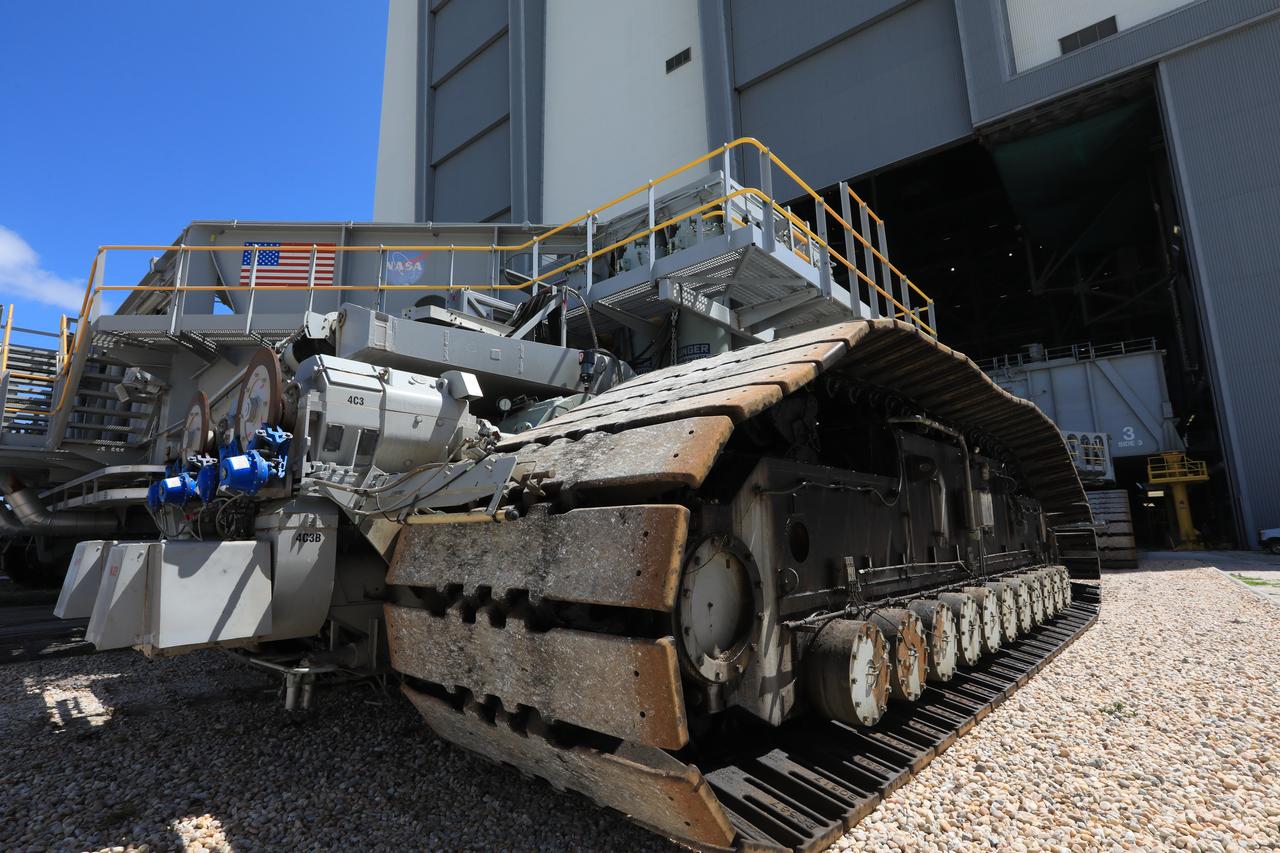
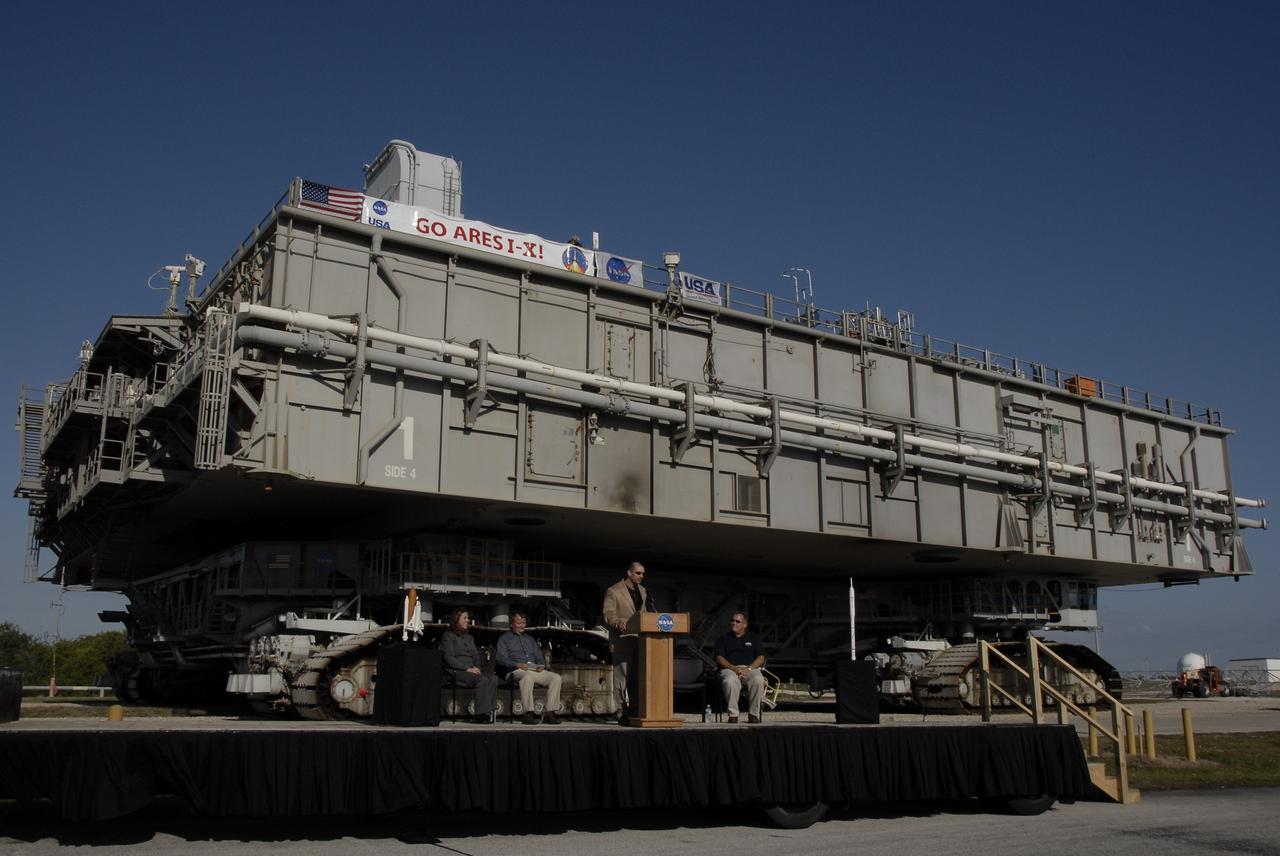
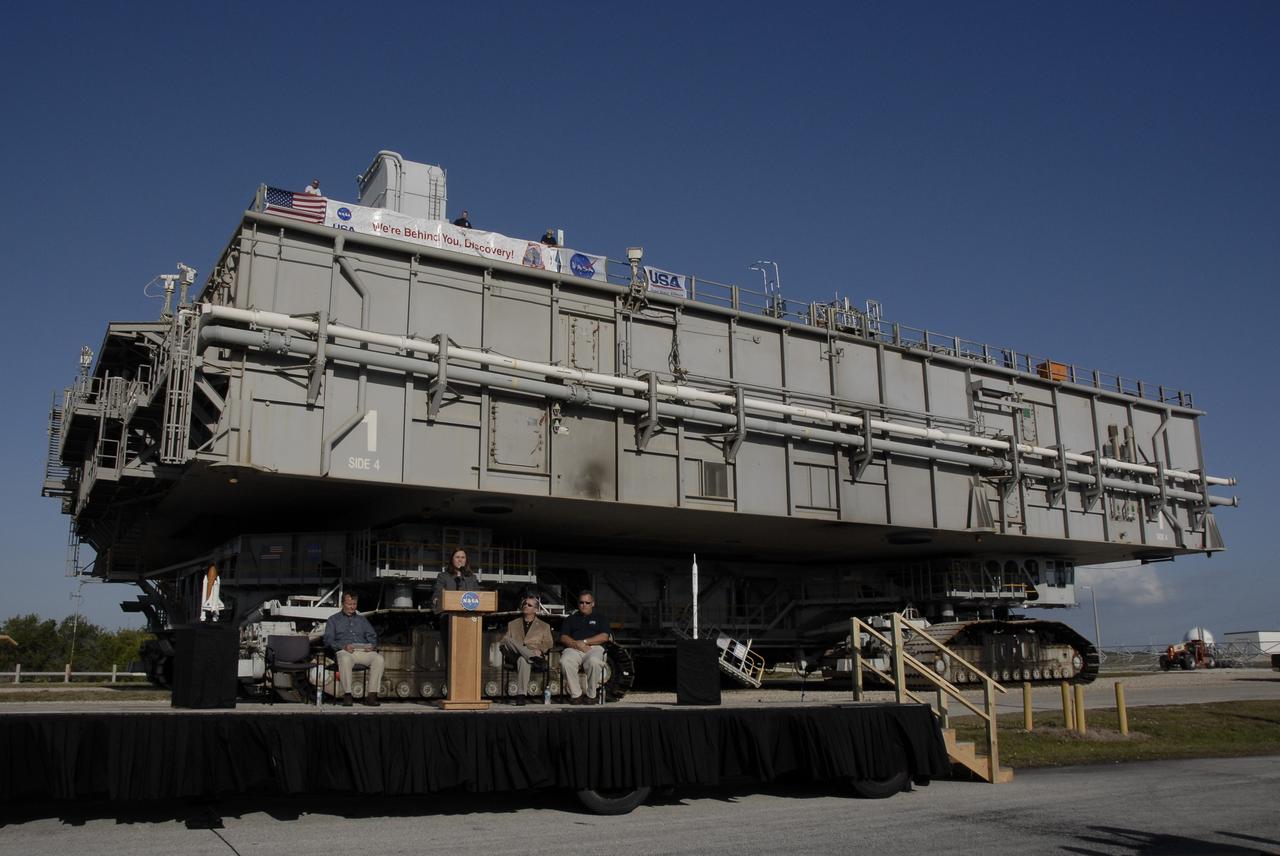
The two mobile launcher platforms (MLPs) are seen at the MSS park site at NASA’s Kennedy Space Center in Florida on Jan. 4, 2021. One MLP is undergoing crawlerway conditioning – a several month-long project to ensure the path the rocket takes from the VAB to the launch pad is strong enough to support the weight for the upcoming Artemis I launch. The other MLP used during the shuttle program is in the process of being demolished.
CT-1 and CT-2, MLP-1 and MLP-2
The two mobile launcher platforms (MLPs) are seen at the MSS park site at NASA’s Kennedy Space Center in Florida on Jan. 4, 2021. One MLP is undergoing crawlerway conditioning – a several month-long project to ensure the path the rocket takes from the VAB to the launch pad is strong enough to support the weight for the upcoming Artemis I launch. The other MLP used during the shuttle program is in the process of being demolished.
CT-1 and CT-2, MLP-1 and MLP-2
The two mobile launcher platforms (MLPs) are seen at the MSS park site at NASA’s Kennedy Space Center in Florida on Jan. 4, 2021. One MLP is undergoing crawlerway conditioning – a several month-long project to ensure the path the rocket takes from the VAB to the launch pad is strong enough to support the weight for the upcoming Artemis I launch. The other MLP used during the shuttle program is in the process of being demolished.
CT-1 and CT-2, MLP-1 and MLP-2
NASA's upgraded crawler-transporter 2 (CT-2) picks up mobile launcher platform 1 (MLP1) at the MLP park site near the Vehicle Assembly at the agency's Kennedy Space Center in Florida. The crawler's upgrades and modifications will be monitored and tested under loaded conditions during its travel to the crawlerway Pad A/B split and back to the crawler yard to confirm it is ready to support the load of the mobile launcher carrying the Space Launch System with Orion atop for the first test flight, Exploration Mission 1. The Ground Systems Development and Operations Program at Kennedy is managing upgrades to the crawler.
MLP-1 on Crawler Transporter 2 (CT-2)
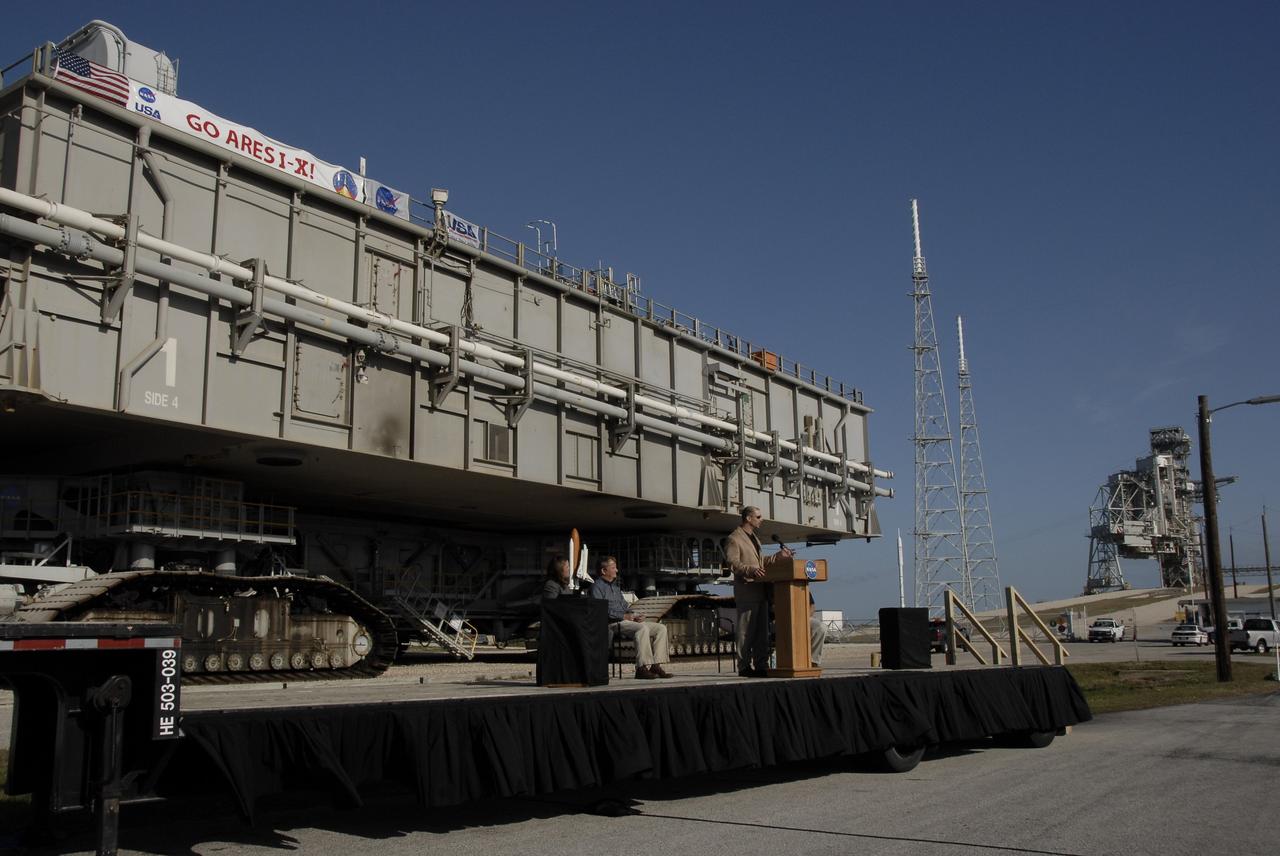
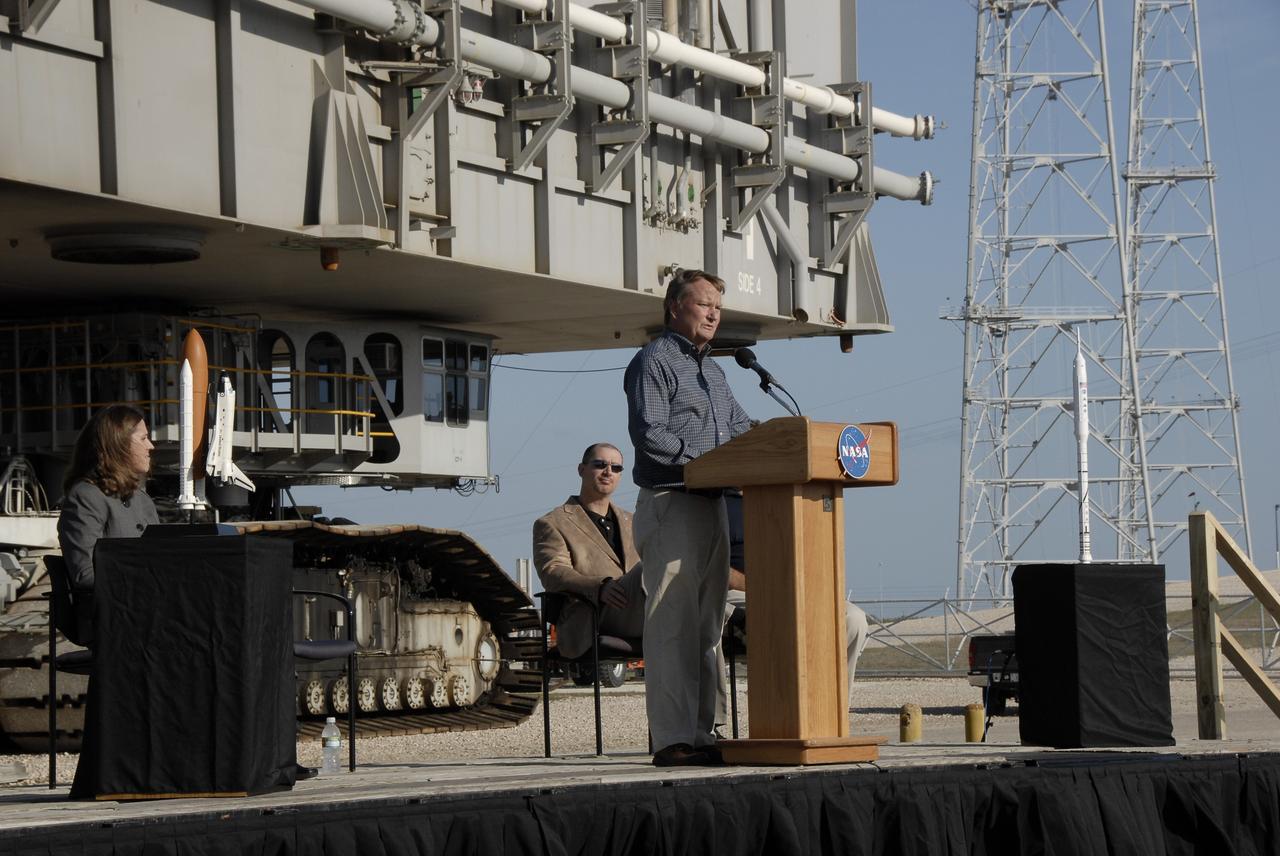
CAPE CANAVERAL, Fla. – Mobile Launcher Platform-1 is moving to Launch Pad 39B at NASA's Kennedy Space Center in Florida via the crawler-transporter underneath.  The MLP has been handed over to the Constellation Program for its future use for the Ares I-X flight test in the summer of 2009. Seen around the service structures on the pad are the new 600-foot lightning towers and masts erected for the Ares launches.  Ares I-X is the test vehicle for the Ares I, which is part of the Constellation Program to return men to the moon and beyond.  Ground Control System hardware was installed in MLP-1 in December 2008.  The MLP is being moved to the launch pad to check out the installed hardware with the Launch Control Center Firing Room 1 equipment, using the actual circuits that will be used when the fully stacked Ares I-X vehicle is rolled out later this year for launch. Following this testing, MLP-1 will be moved to the Vehicle Assembly Building's High Bay 3 to begin stacking, or assembling, Ares I-X.  Photo credit: NASA/Kim Shiflett
KSC-2009-2291
CAPE CANAVERAL, Fla. – Mobile Launcher Platform-1, on top of the crawler-transporter, nears the flame trench (lower left) on the top of Launch Pad 39B at NASA's Kennedy Space Center in Florida.  The MLP has been handed over to the Constellation Program for its future use for the Ares I-X flight test in the summer of 2009.  Ares I-X is the test vehicle for the Ares I, which is part of the Constellation Program to return men to the moon and beyond.  Ground Control System hardware was installed in MLP-1 in December 2008.  The MLP is being moved to the launch pad to check out the installed hardware with the Launch Control Center Firing Room 1 equipment, using the actual circuits that will be used when the fully stacked Ares I-X vehicle is rolled out later this year for launch. Following this testing, MLP-1 will be moved to the Vehicle Assembly Building's High Bay 3 to begin stacking, or assembling, Ares I-X.  Photo credit: NASA/Kim Shiflett
KSC-2009-2294
CAPE CANAVERAL, Fla. – Mobile Launcher Platform-1 nears the top of Launch Pad 39B at NASA's Kennedy Space Center in Florida via the crawler-transporter underneath.  The MLP has been handed over to the Constellation Program for its future use for the Ares I-X flight test in the summer of 2009. Seen around the service structures on the pad are the new 600-foot lightning towers and masts erected for the Ares launches.  Ares I-X is the test vehicle for the Ares I, which is part of the Constellation Program to return men to the moon and beyond.  Ground Control System hardware was installed in MLP-1 in December 2008.  The MLP is being moved to the launch pad to check out the installed hardware with the Launch Control Center Firing Room 1 equipment, using the actual circuits that will be used when the fully stacked Ares I-X vehicle is rolled out later this year for launch. Following this testing, MLP-1 will be moved to the Vehicle Assembly Building's High Bay 3 to begin stacking, or assembling, Ares I-X.  Photo credit: NASA/Kim Shiflett
KSC-2009-2293
CAPE CANAVERAL, Fla. – Mobile Launcher Platform-1, on top of the crawler-transporter, reaches the top of Launch Pad 39B at NASA's Kennedy Space Center in Florida.  The MLP has been handed over to the Constellation Program for its future use for the Ares I-X flight test in the summer of 2009. Ares I-X is the test vehicle for the Ares I, which is part of the Constellation Program to return men to the moon and beyond.  Ground Control System hardware was installed in MLP-1 in December 2008.  The MLP is being moved to the launch pad to check out the installed hardware with the Launch Control Center Firing Room 1 equipment, using the actual circuits that will be used when the fully stacked Ares I-X vehicle is rolled out later this year for launch. Following this testing, MLP-1 will be moved to the Vehicle Assembly Building's High Bay 3 to begin stacking, or assembling, Ares I-X.  Photo credit: NASA/Kim Shiflett
KSC-2009-2295
CAPE CANAVERAL, Fla. – Mobile Launcher Platform-1 is moving to Launch Pad 39B at NASA's Kennedy Space Center in Florida via the crawler-transporter underneath.  The MLP has been handed over to the Constellation Program for its future use for the Ares I-X flight test in the summer of 2009.  Ares I-X is the test vehicle for the Ares I, which is part of the Constellation Program to return men to the moon and beyond.  Ground Control System hardware was installed in MLP-1 in December 2008.  The MLP is being moved to the launch pad to check out the installed hardware with the Launch Control Center Firing Room 1 equipment, using the actual circuits that will be used when the fully stacked Ares I-X vehicle is rolled out later this year for launch. Following this testing, MLP-1 will be moved to the Vehicle Assembly Building's High Bay 3 to begin stacking, or assembling, Ares I-X.  Photo credit: NASA/Kim Shiflett
KSC-2009-2290
CAPE CANAVERAL, Fla. – Mobile Launcher Platform-1, on top of the crawler-transporter, reaches the top of Launch Pad 39B at NASA's Kennedy Space Center in Florida.  The MLP has been handed over to the Constellation Program for its future use for the Ares I-X flight test in the summer of 2009.  Ares I-X is the test vehicle for the Ares I, which is part of the Constellation Program to return men to the moon and beyond.  Ground Control System hardware was installed in MLP-1 in December 2008.  The MLP is being moved to the launch pad to check out the installed hardware with the Launch Control Center Firing Room 1 equipment, using the actual circuits that will be used when the fully stacked Ares I-X vehicle is rolled out later this year for launch. Following this testing, MLP-1 will be moved to the Vehicle Assembly Building's High Bay 3 to begin stacking, or assembling, Ares I-X.  Photo credit: NASA/Kim Shiflett
KSC-2009-2296
CAPE CANAVERAL, Fla. – Mobile Launcher Platform-1 nears the top of Launch Pad 39B at NASA's Kennedy Space Center in Florida via the crawler-transporter underneath.  The MLP has been handed over to the Constellation Program for its future use for the Ares I-X flight test in the summer of 2009.  Ares I-X is the test vehicle for the Ares I, which is part of the Constellation Program to return men to the moon and beyond.  Ground Control System hardware was installed in MLP-1 in December 2008.  The MLP is being moved to the launch pad to check out the installed hardware with the Launch Control Center Firing Room 1 equipment, using the actual circuits that will be used when the fully stacked Ares I-X vehicle is rolled out later this year for launch. Following this testing, MLP-1 will be moved to the Vehicle Assembly Building's High Bay 3 to begin stacking, or assembling, Ares I-X.  Photo credit: NASA/Kim Shiflett
KSC-2009-2292
CAPE CANAVERAL, Fla. – Mobile Launcher Platform-1 is moving to Launch Pad 39B at NASA's Kennedy Space Center in Florida via the crawler-transporter underneath.  The MLP has been handed over to the Constellation Program for its future use for the Ares I-X flight test in the summer of 2009. Ares I-X is the test vehicle for the Ares I, which is part of the Constellation Program to return men to the moon and beyond.  Ground Control System hardware was installed in MLP-1 in December 2008.  The MLP is being moved to the launch pad to check out the installed hardware with the Launch Control Center Firing Room 1 equipment, using the actual circuits that will be used when the fully stacked Ares I-X vehicle is rolled out later this year for launch. Following this testing, MLP-1 will be moved to the Vehicle Assembly Building's High Bay 3 to begin stacking, or assembling, Ares I-X.  Photo credit: NASA/Kim Shiflett
KSC-2009-2289
Ground support technicians walk alongside NASA's upgraded crawler-transporter 2 (CT-2), carrying mobile launcher platform 1, as it slowly travels on the crawlerway at the agency's Kennedy Space Center in Florida. The crawler's upgrades and modifications will be monitored and tested under loaded conditions during its travel to the crawlerway Pad A/B split and back to the crawler yard to confirm it is ready to support the load of the mobile launcher carrying the Space Launch System with Orion atop for the first test flight, Exploration Mission 1. The Ground Systems Development and Operations Program at Kennedy is managing upgrades to the crawler.
MLP-1 on Crawler Transporter 2 (CT-2)
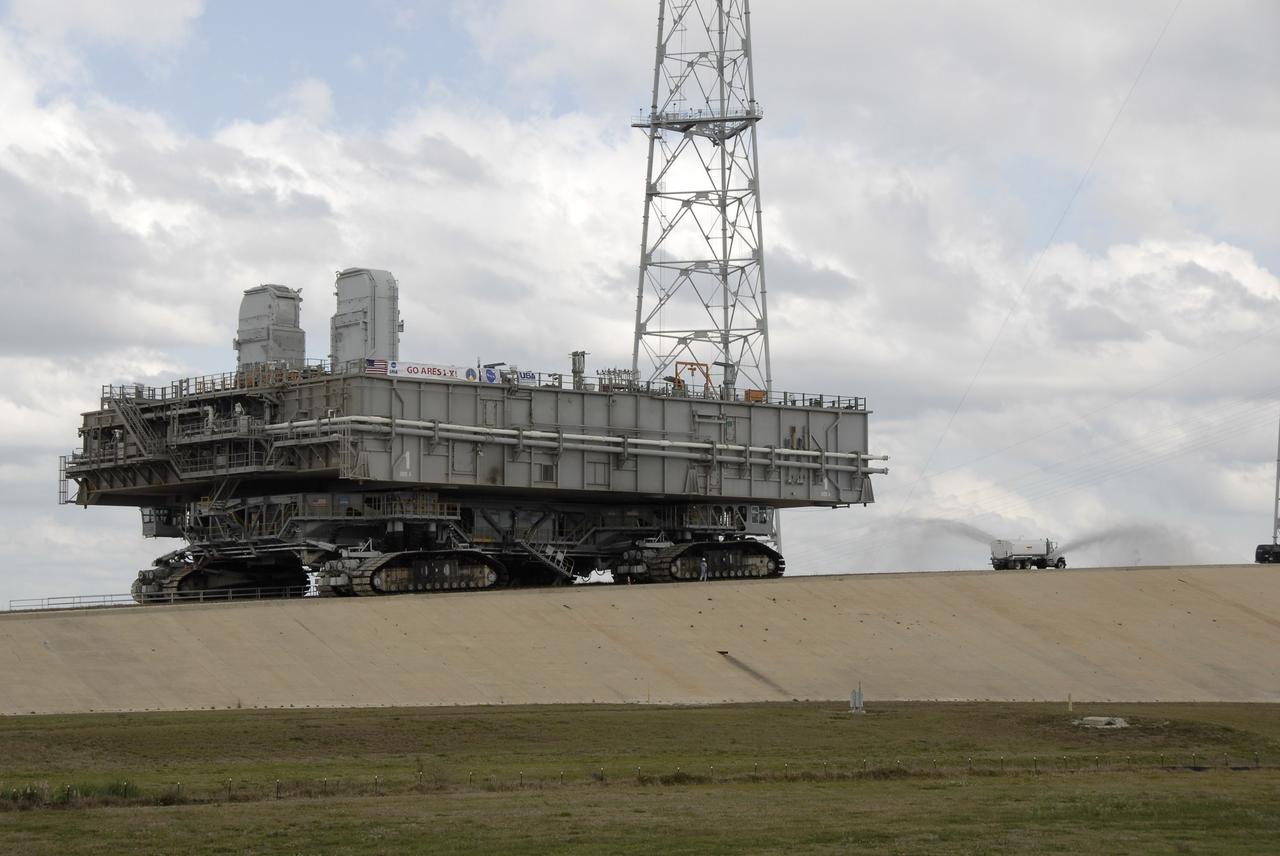
NASA’s upgraded crawler-transporter 2 (CT-2) travels slowly along the crawlerway carrying mobile launcher platform 1 at the agency’s Kennedy Space Center in Florida. The crawler's upgrades and modifications were being monitored and tested under loaded conditions during its travel to the Pad A/B split and back to the crawler yard to confirm it is ready to support the load of the mobile launcher carrying the Space Launch System with Orion atop for the first test flight, Exploration Mission 1. A truck sprays water in front of the crawler to control dust as the large vehicle moves along. The Ground Systems Development and Operations Program at Kennedy is managing upgrades to the crawler.
MLP-1 on Crawler Transporter 2 (CT-2)
NASA's upgraded crawler-transporter 2 (CT-2) travels slowly along the crawlerway, carrying the mobile launcher platform at the agency's Kennedy Space Center in Florida. The crawler's upgrades and modifications will be monitored and tested under loaded conditions during its travel to the crawlerway Pad A/B split and back to the crawler yard to confirm it is ready to support the load of the mobile launcher carrying the Space Launch System with Orion atop for the first test flight, Exploration Mission 1. The Ground Systems Development and Operations Program at Kennedy is managing upgrades to the crawler.
MLP-1 on Crawler Transporter 2 (CT-2)
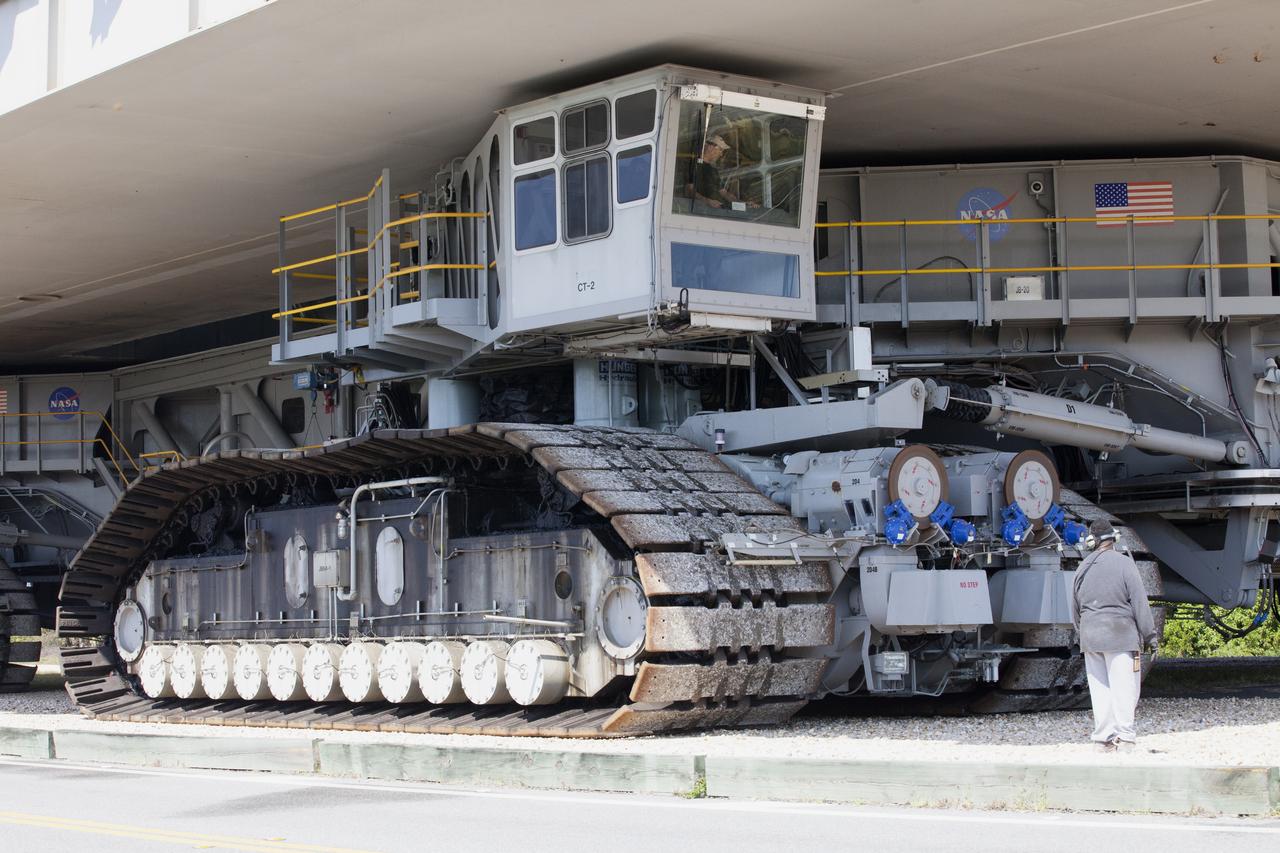
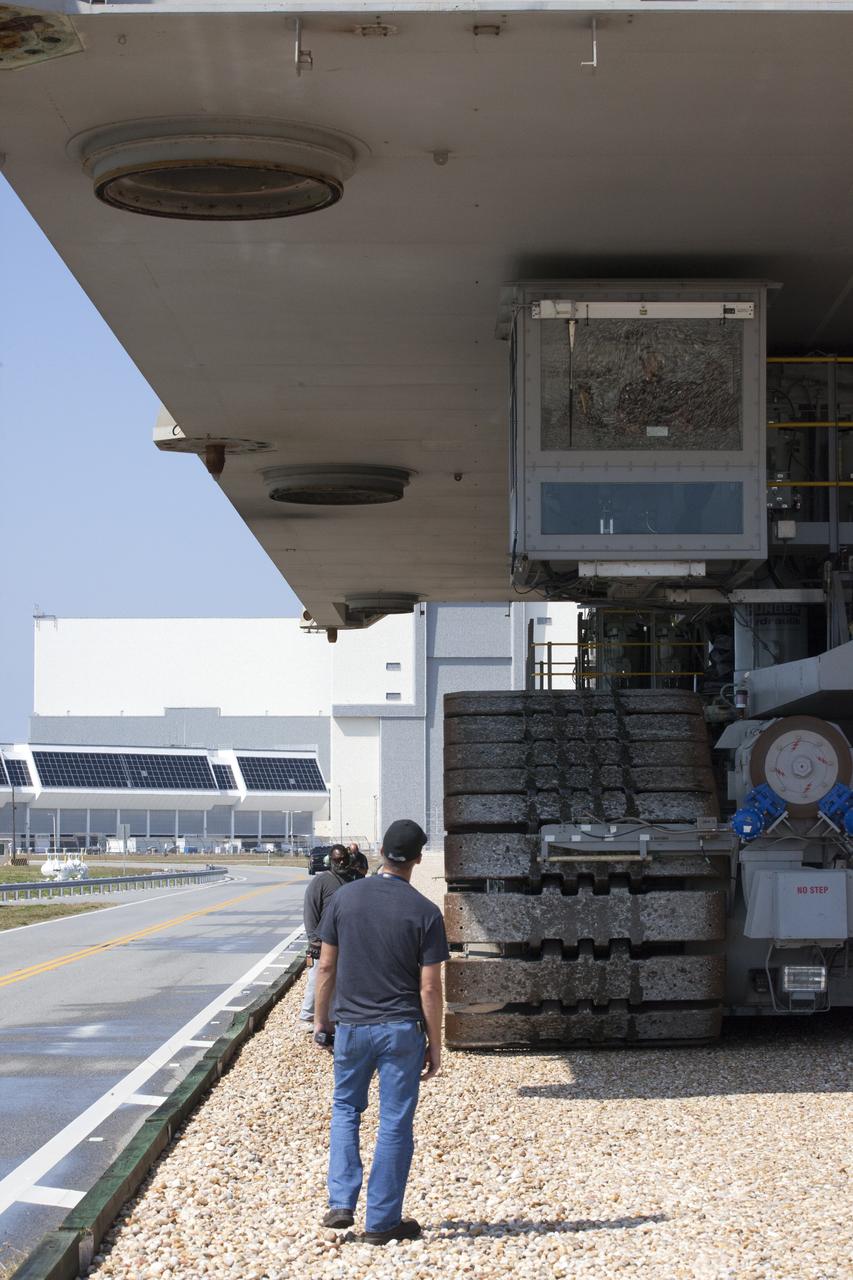
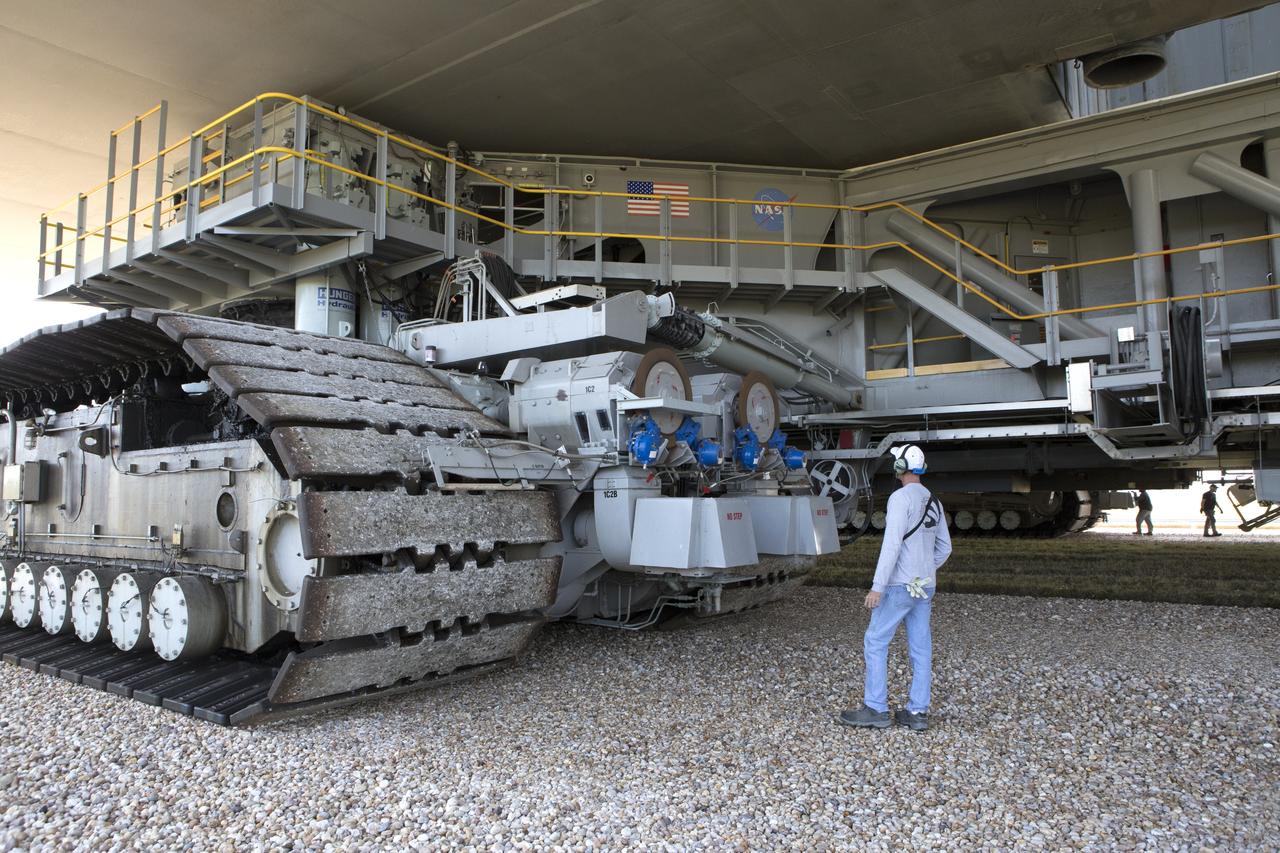
During a load test of NASA's upgraded crawler-transporter 2 (CT-2), a ground support technician watches as the giant vehicle travels along the crawlerway at the agency’s Kennedy Space Center in Florida. The crawler's upgrades and modifications will be monitored and tested under loaded conditions during its travel to the crawlerway Pad A/B split and back to the crawler yard to confirm it is ready to support the load of the mobile launcher carrying the Space Launch System with Orion atop for the first test flight, Exploration Mission 1. The Ground Systems Development and Operations Program at Kennedy is managing upgrades to the crawler.
MLP-1 on Crawler Transporter 2 (CT-2)
NASA's upgraded crawler-transporter 2 (CT-2), carrying mobile launcher platform 1, moves slowly along the crawlerway at the agency's Kennedy Space Center in Florida. The crawler's upgrades and modifications will be monitored and tested under loaded conditions during its travel to the crawlerway Pad A/B split and back to the crawler yard to confirm it is ready to support the load of the mobile launcher carrying the Space Launch System with Orion atop for the first test flight, Exploration Mission 1. The Ground Systems Development and Operations Program at Kennedy is managing upgrades to the crawler.
MLP-1 on Crawler Transporter 2 (CT-2)
NASA's upgraded crawler-transporter 2 (CT-2), carrying mobile launcher platform 1, moves slowly along the crawlerway toward the Vehicle Assembly Building at the agency's Kennedy Space Center in Florida. The crawler's upgrades and modifications were monitored and tested during a loaded test to the crawlerway Pad A/B split. CT-2 will return to the crawler yard. The crawler is being tested to confirm it is ready to support the load of the mobile launcher carrying the Space Launch System with Orion atop for the first test flight, Exploration Mission 1. The Ground Systems Development and Operations Program at Kennedy is managing upgrades to the crawler.
MLP-1 on Crawler Transporter 2 (CT-2)
NASA's upgraded crawler-transporter 2 (CT-2), carrying mobile launcher platform 1, moves slowly along the crawlerway toward the Vehicle Assembly Building at the agency's Kennedy Space Center in Florida. The crawler's upgrades and modifications were monitored and tested during a loaded test to the crawlerway Pad A/B split. CT-2 will return to the crawler yard. The crawler is being tested to confirm it is ready to support the load of the mobile launcher carrying the Space Launch System with Orion atop for the first test flight, Exploration Mission 1. The Ground Systems Development and Operations Program at Kennedy is managing upgrades to the crawler.
MLP-1 on Crawler Transporter 2 (CT-2)
NASA's upgraded crawler-transporter 2 (CT-2), carrying mobile launcher platform 1, moves slowly along the crawlerway at the agency's Kennedy Space Center in Florida. The crawler's upgrades and modifications will be monitored and tested under loaded conditions during its travel to the crawlerway Pad A/B split and back to the crawler yard to confirm it is ready to support the load of the mobile launcher carrying the Space Launch System with Orion atop for the first test flight, Exploration Mission 1. The Ground Systems Development and Operations Program at Kennedy is managing upgrades to the crawler.
MLP-1 on Crawler Transporter 2 (CT-2)
CAPE CANAVERAL, Fla. – At NASA's Kennedy Space Center in Florida, the crawler-transporter is underneath the mobile launcher platform to move it from Kennedy's Launch Pad 39B  to the Vehicle Assembly Building's High Bay 3 in preparation for the Ares I-X flight test this summer. The platform was turned over from the shuttle program to the Constellation Program last month. Ares I-X is the test vehicle for the Ares I, which is part of the Constellation Program to return men to the moon and beyond.  Ground Control System hardware was installed in MLP-1 in December 2008.  The platform was moved to the launch pad to check out the installed hardware with the Launch Control Center Firing Room 1 equipment, using the actual circuits that will be used when the fully stacked Ares I-X vehicle is rolled out later this year for launch.  Photo credit: NASA/Kim Shiflett
KSC-2009-2641
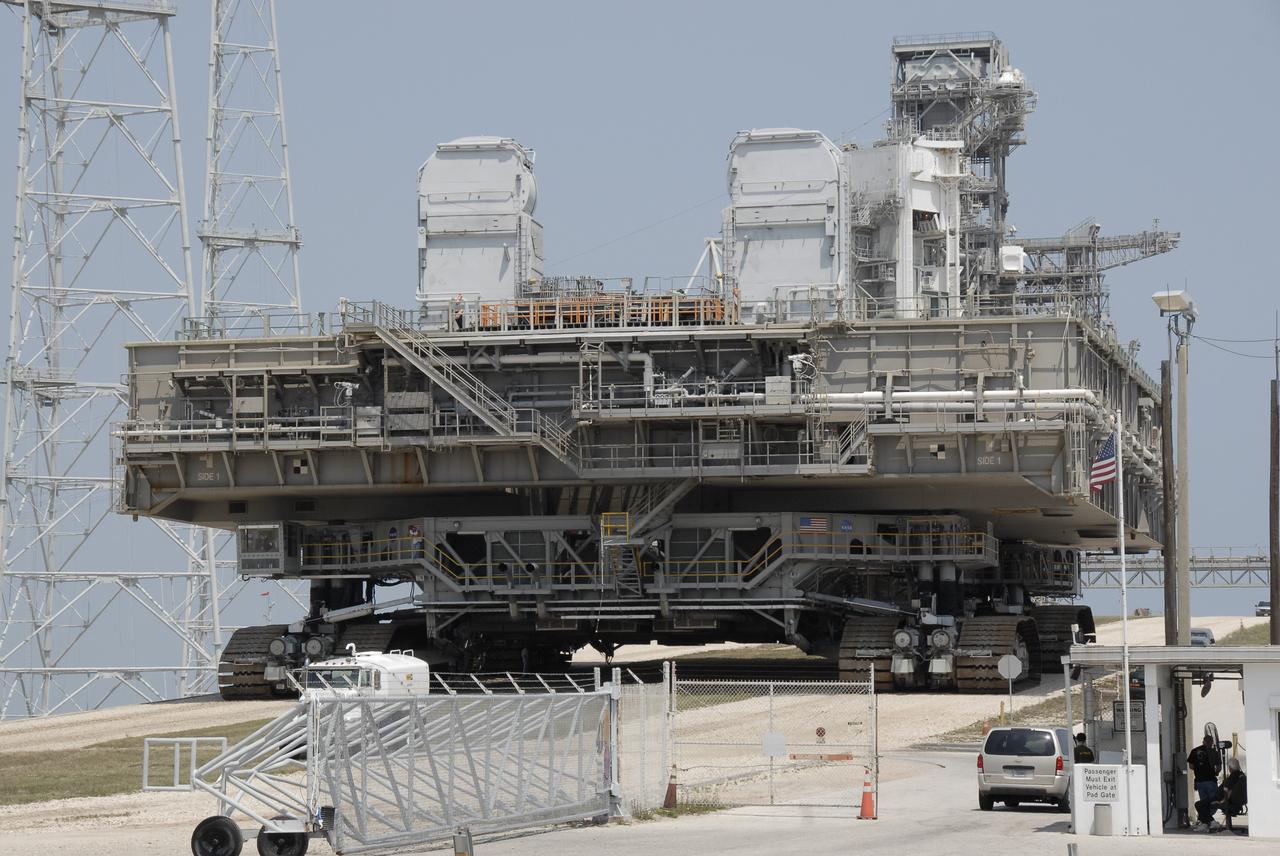
CAPE CANAVERAL, Fla. – At NASA's Kennedy Space Center in Florida, the mobile launcher platform that was turned over from the shuttle program to the Constellation Program last month is being moved from Kennedy's Launch Pad 39B via the crawler-transporter underneath. The platform will be rolled into the Vehicle Assembly Building's High Bay 3 in preparation for the Ares I-X flight test this summer. Ares I-X is the test vehicle for the Ares I, which is part of the Constellation Program to return men to the moon and beyond.  Ground Control System hardware was installed in MLP-1 in December 2008.  The platform was moved to the launch pad to check out the installed hardware with the Launch Control Center Firing Room 1 equipment, using the actual circuits that will be used when the fully stacked Ares I-X vehicle is rolled out later this year for launch.  Photo credit: NASA/Kim Shiflett
KSC-2009-2643
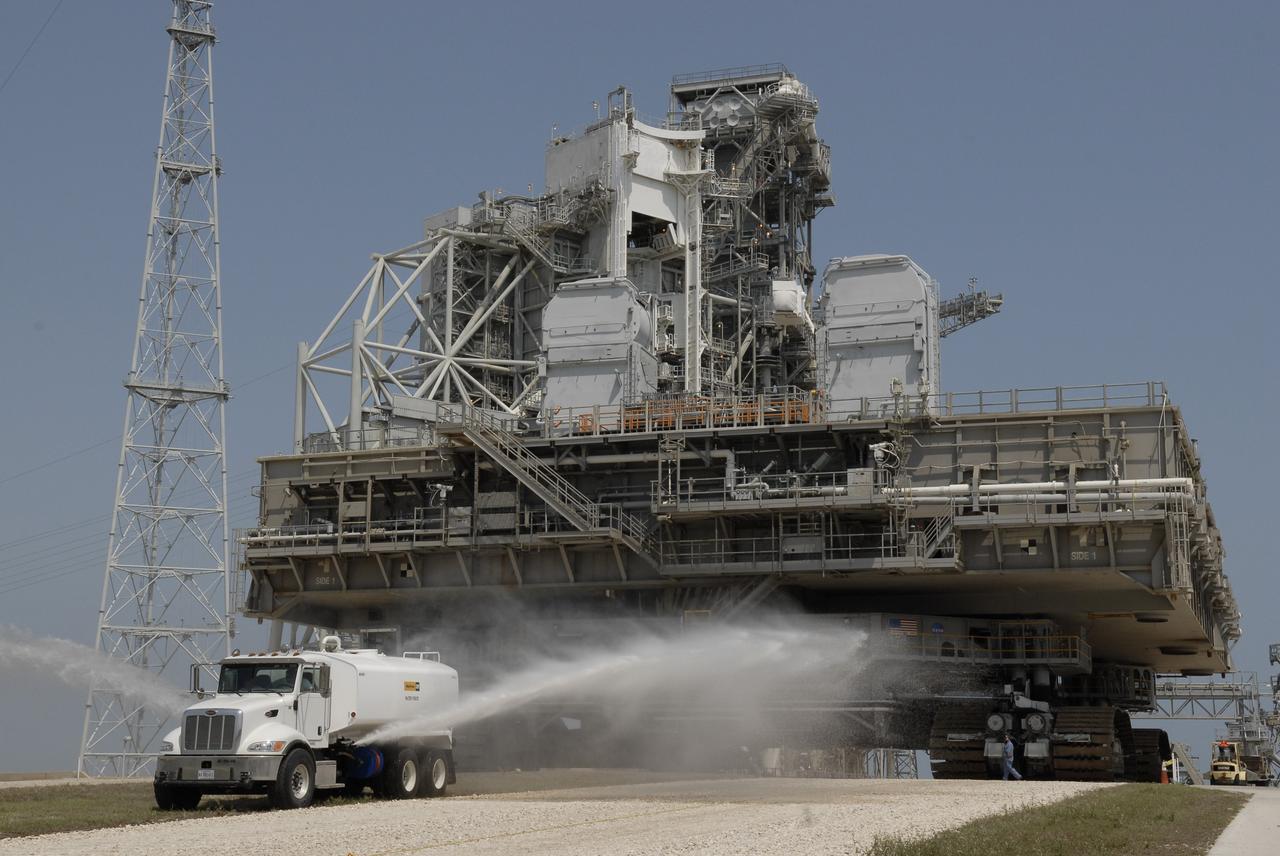
CAPE CANAVERAL, Fla. – At NASA's Kennedy Space Center in Florida, a water truck sprays the dry crawlerway in front of the crawler-transporter carrying the mobile launcher platform on top as it moves away from Kennedy's Launch pad 39B.  The platform, turned over from the shuttle program to the Constellation Program last month, will be rolled into the Vehicle Assembly Building's High Bay 3 in preparation for the Ares I-X flight test this summer. Ares I-X is the test vehicle for the Ares I, which is part of the Constellation Program to return men to the moon and beyond.  Ground Control System hardware was installed in MLP-1 in December 2008.  The platform was moved to the launch pad to check out the installed hardware with the Launch Control Center Firing Room 1 equipment, using the actual circuits that will be used when the fully stacked Ares I-X vehicle is rolled out later this year for launch.  Photo credit: NASA/Kim Shiflett
KSC-2009-2642
CAPE CANAVERAL, Fla. – At NASA's Kennedy Space Center in Florida, the mobile launcher platform that was turned over from the shuttle program to the Constellation Program last month moves along the crawlerway via the crawler-transporter underneath. In the background is the Vehicle Assembly Building. The platform will be rolled into the VAB's High Bay 3 in preparation for the Ares I-X flight test this summer.  Ares I-X is the test vehicle for the Ares I, which is part of the Constellation Program to return men to the moon and beyond.  Ground Control System hardware was installed in MLP-1 in December 2008.  The platform was moved to the launch pad to check out the installed hardware with the Launch Control Center Firing Room 1 equipment, using the actual circuits that will be used when the fully stacked Ares I-X vehicle is rolled out later this year for launch.  Photo credit: NASA/Kim Shiflett
KSC-2009-2646
CAPE CANAVERAL, Fla. – A worker is dwarfed by the giant crawler-transporter and mobile launcher platform moving along the crawlerway toward the Vehicle Assembly Building. The platform will be rolled into the VAB's High Bay 3 in preparation for the Ares I-X flight test this summer.  Ares I-X is the test vehicle for the Ares I, which is part of the Constellation Program to return men to the moon and beyond.  Ground Control System hardware was installed in MLP-1 in December 2008.  The platform was moved to the launch pad to check out the installed hardware with the Launch Control Center Firing Room 1 equipment, using the actual circuits that will be used when the fully stacked Ares I-X vehicle is rolled out later this year for launch.  Photo credit: NASA/Kim Shiflett
KSC-2009-2647
CAPE CANAVERAL, Fla. – At NASA's Kennedy Space Center in Florida, the mobile launcher platform that was turned over from the shuttle program to the Constellation Program last month moves off Kennedy's Launch Pad 39B via the crawler-transporter underneath. The platform will be rolled into the Vehicle Assembly Building's High Bay 3 in preparation for the Ares I-X flight test this summer.  Ares I-X is the test vehicle for the Ares I, which is part of the Constellation Program to return men to the moon and beyond.  Ground Control System hardware was installed in MLP-1 in December 2008.  The platform was moved to the launch pad to check out the installed hardware with the Launch Control Center Firing Room 1 equipment, using the actual circuits that will be used when the fully stacked Ares I-X vehicle is rolled out later this year for launch.  Photo credit: NASA/Kim Shiflett
KSC-2009-2644
CAPE CANAVERAL, Fla. – At NASA's Kennedy Space Center in Florida, a water truck continues to spray the dry crawlerway in front of the crawler-transporter as it moves the mobile launcher platform on top away from Kennedy's Launch pad 39B.  The platform, turned over from the shuttle program to the Constellation Program last month, will be rolled into the Vehicle Assembly Building's High Bay 3 in preparation for the Ares I-X flight test this summer.  Ares I-X is the test vehicle for the Ares I, which is part of the Constellation Program to return men to the moon and beyond.  Ground Control System hardware was installed in MLP-1 in December 2008.  The platform was moved to the launch pad to check out the installed hardware with the Launch Control Center Firing Room 1 equipment, using the actual circuits that will be used when the fully stacked Ares I-X vehicle is rolled out later this year for launch.  Photo credit: NASA/Kim Shiflett
KSC-2009-2645
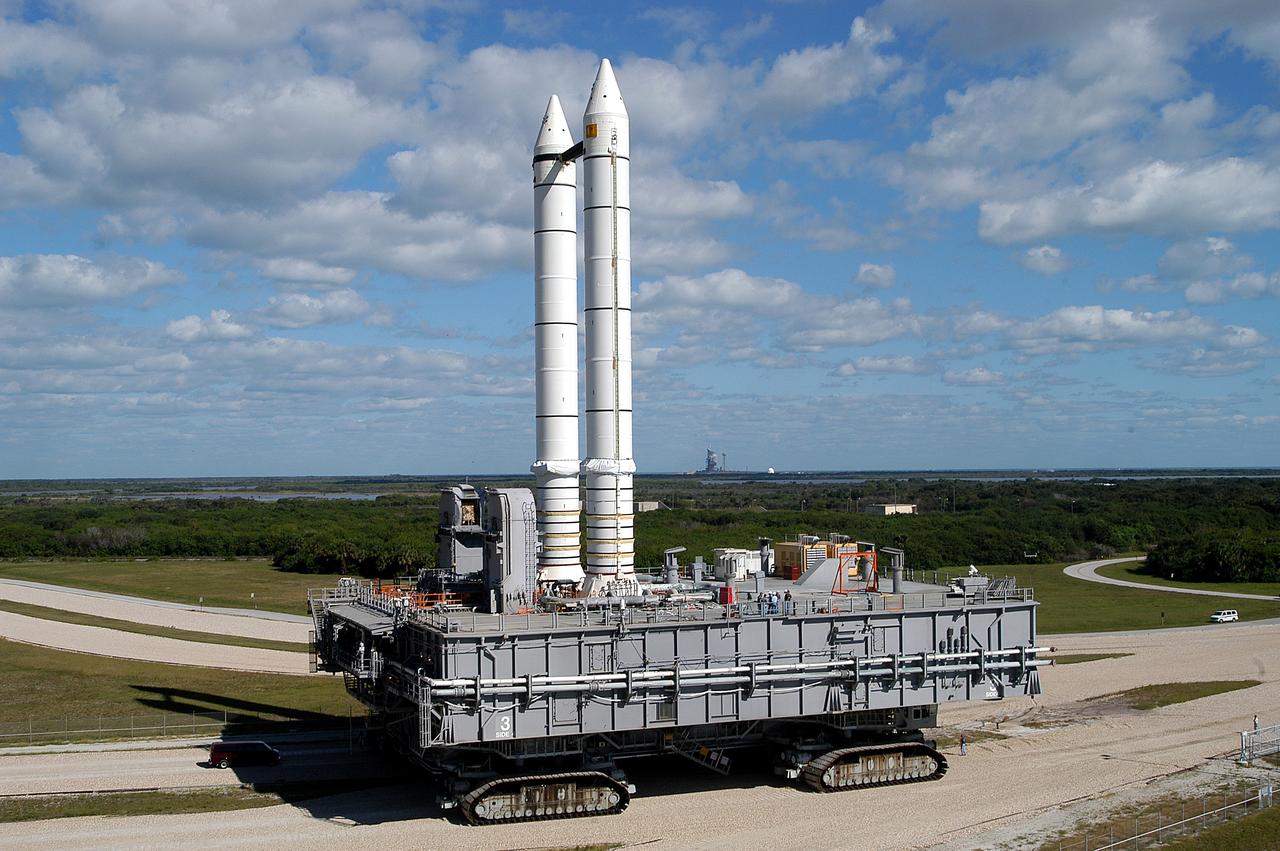
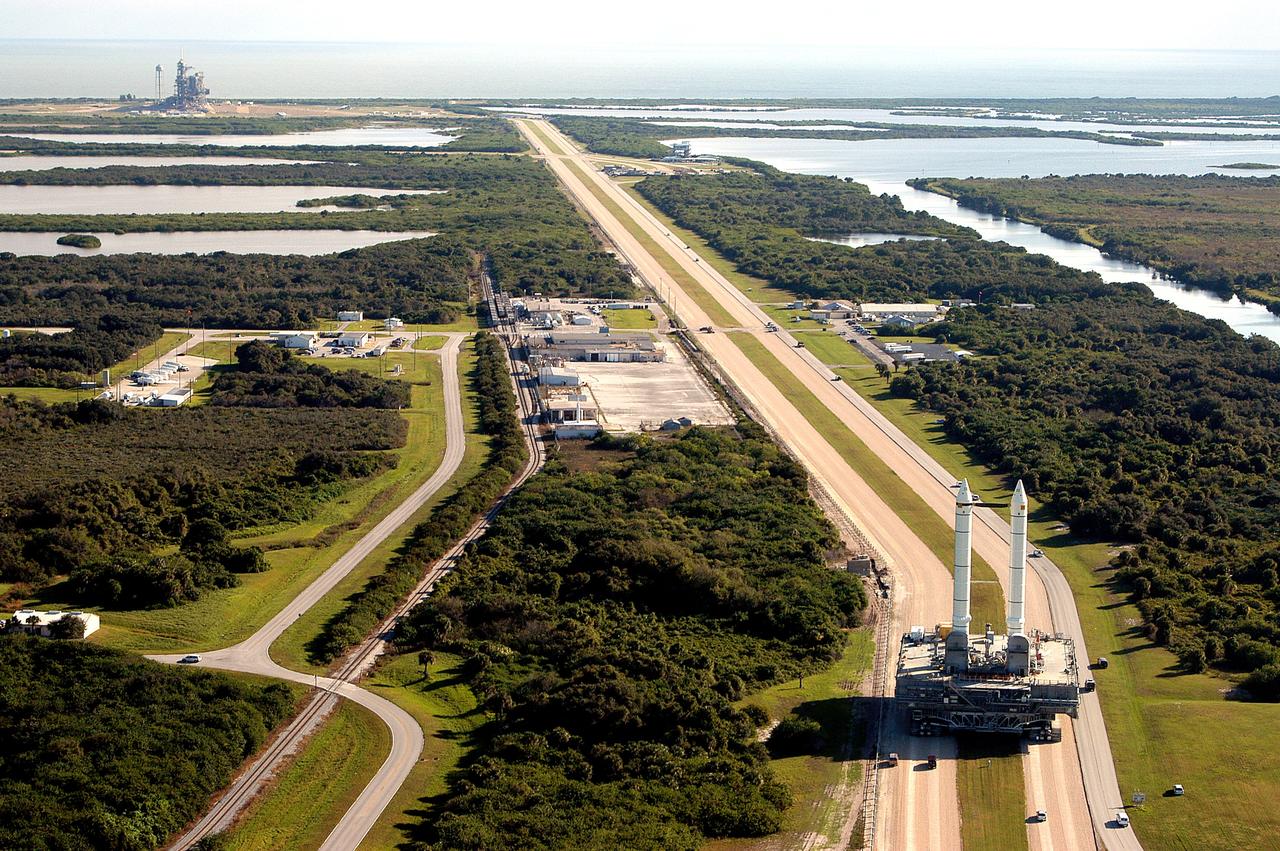
KENNEDY SPACE CENTER, FLA. -  As the crawler transporter slowly moves the Mobile Launcher Platform (MLP) out of the Vehicle Assembly Building, the driver of the front control cab can be seen.  The MLP is carrying two solid rocket boosters for engineering analysis vibration tests on the crawler and MLP.    The crawler is moving at various speeds up to 1 mph in an effort to achieve vibration data gathering goals as it leaves the VAB and then returns.  The boosters are braced at the top for stability.  The primary purpose of these rollout tests is to gather data to develop future maintenance requirements on the transport equipment and the flight hardware. Various parts of the MLP and crawler transporter have been instrumented with vibration data collection equipment.
KENNEDY SPACE CENTER, FLA. - As the crawler transporter slowly moves the Mobile Launcher Platform (MLP) out of the Vehicle Assembly Building, the driver of the front control cab can be seen. The MLP is carrying two solid rocket boosters for engineering analysis vibration tests on the crawler and MLP. The crawler is moving at various speeds up to 1 mph in an effort to achieve vibration data gathering goals as it leaves the VAB and then returns. The boosters are braced at the top for stability. The primary purpose of these rollout tests is to gather data to develop future maintenance requirements on the transport equipment and the flight hardware. Various parts of the MLP and crawler transporter have been instrumented with vibration data collection equipment.
CAPE CANAVERAL, Fla. – At NASA's Kennedy Space Center in Florida, the mobile launcher platform that was turned over from the shuttle program to the Constellation Program last month is being moved from Kennedy's Launch Pad 39B via the crawler-transporter underneath. Here, the platform and crawler can be seen straddling the flame trench on the launch pad.  The platform will be rolled into the Vehicle Assembly Building's High Bay 3 in preparation for the Ares I-X flight test this summer. Ares I-X is the test vehicle for the Ares I, which is part of the Constellation Program to return men to the moon and beyond.  Ground Control System hardware was installed in MLP-1 in December 2008.  The platform was moved to the launch pad to check out the installed hardware with the Launch Control Center Firing Room 1 equipment, using the actual circuits that will be used when the fully stacked Ares I-X vehicle is rolled out later this year for launch.  Photo credit: NASA/Kim Shiflett
KSC-2009-2640
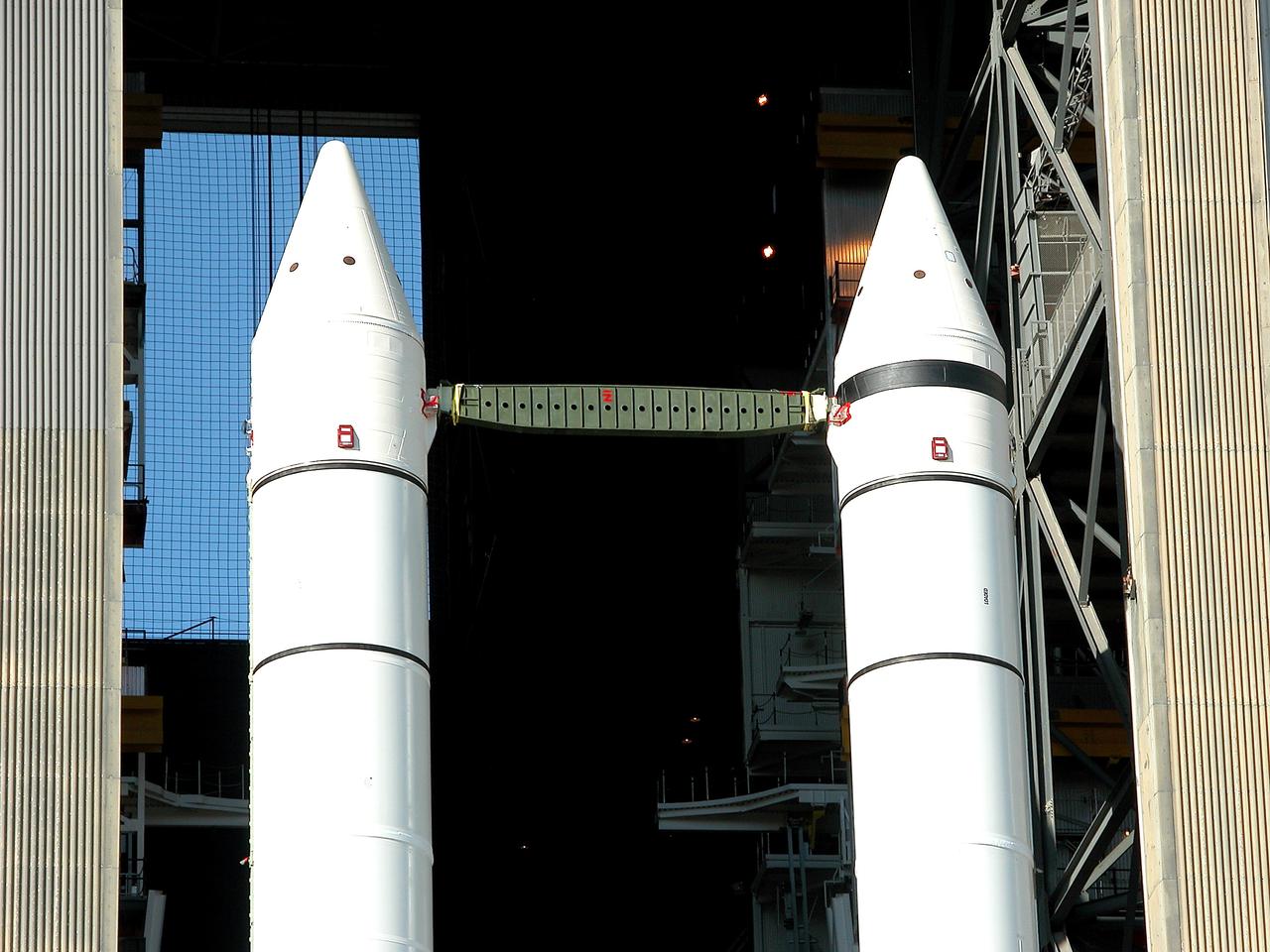
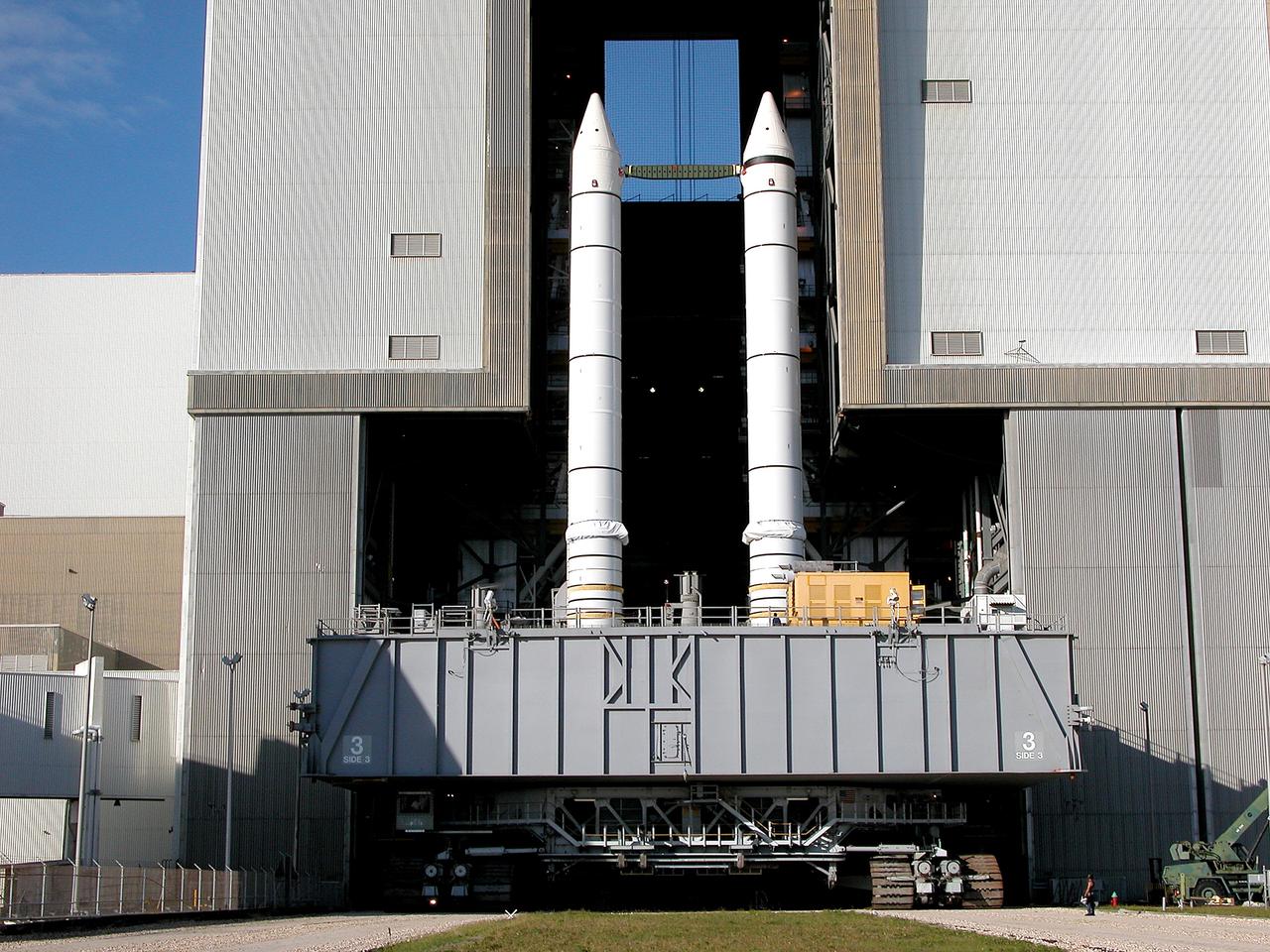
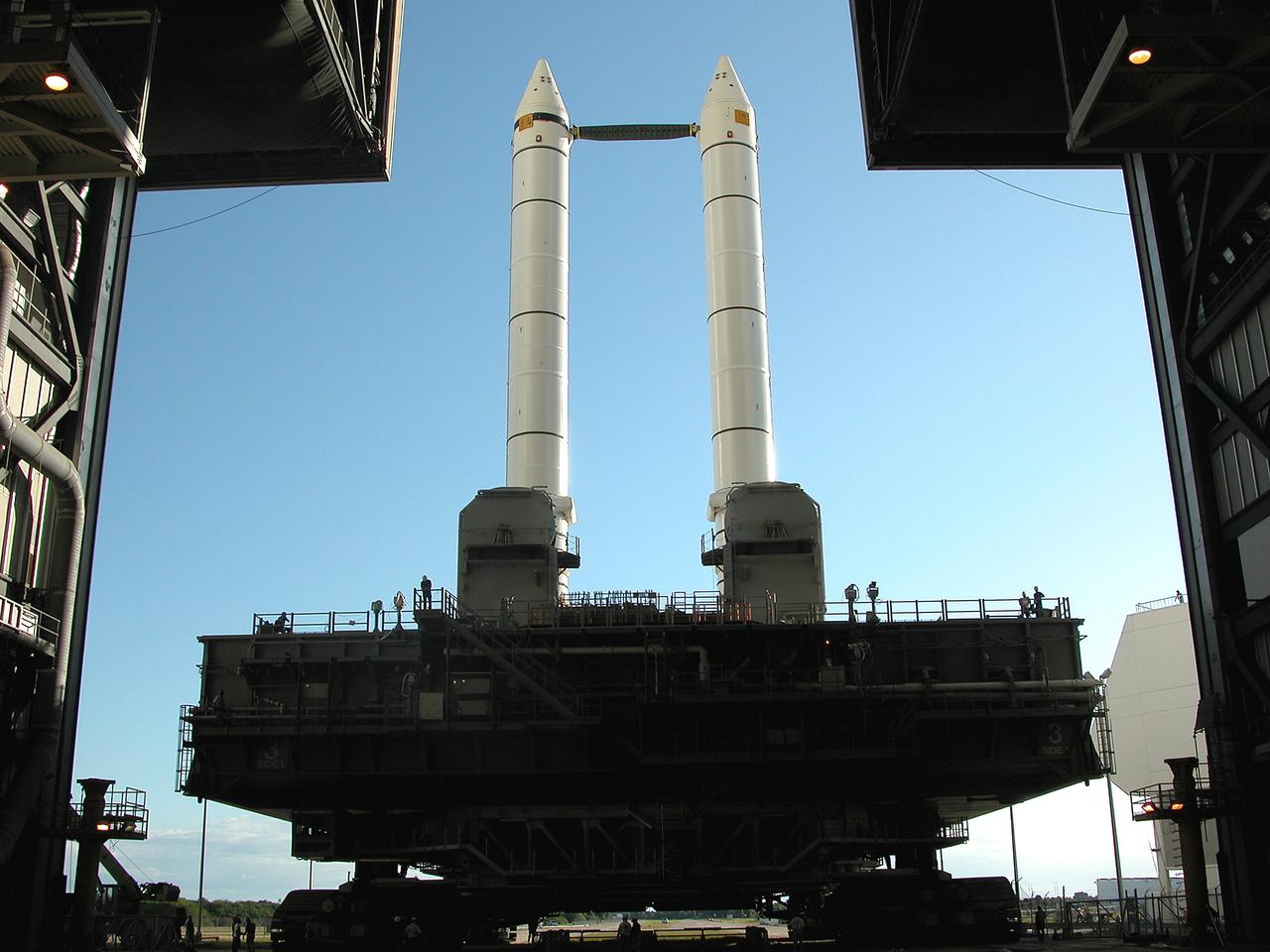
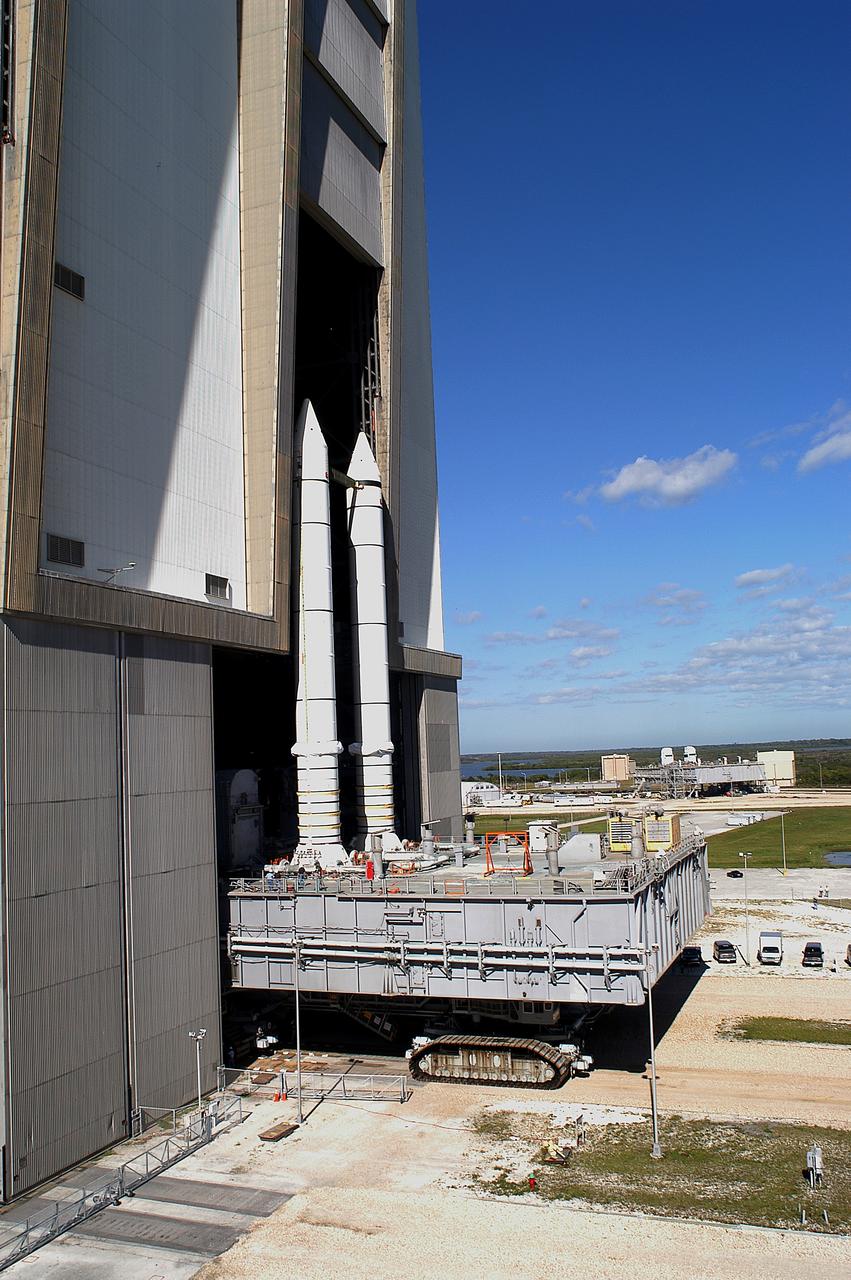
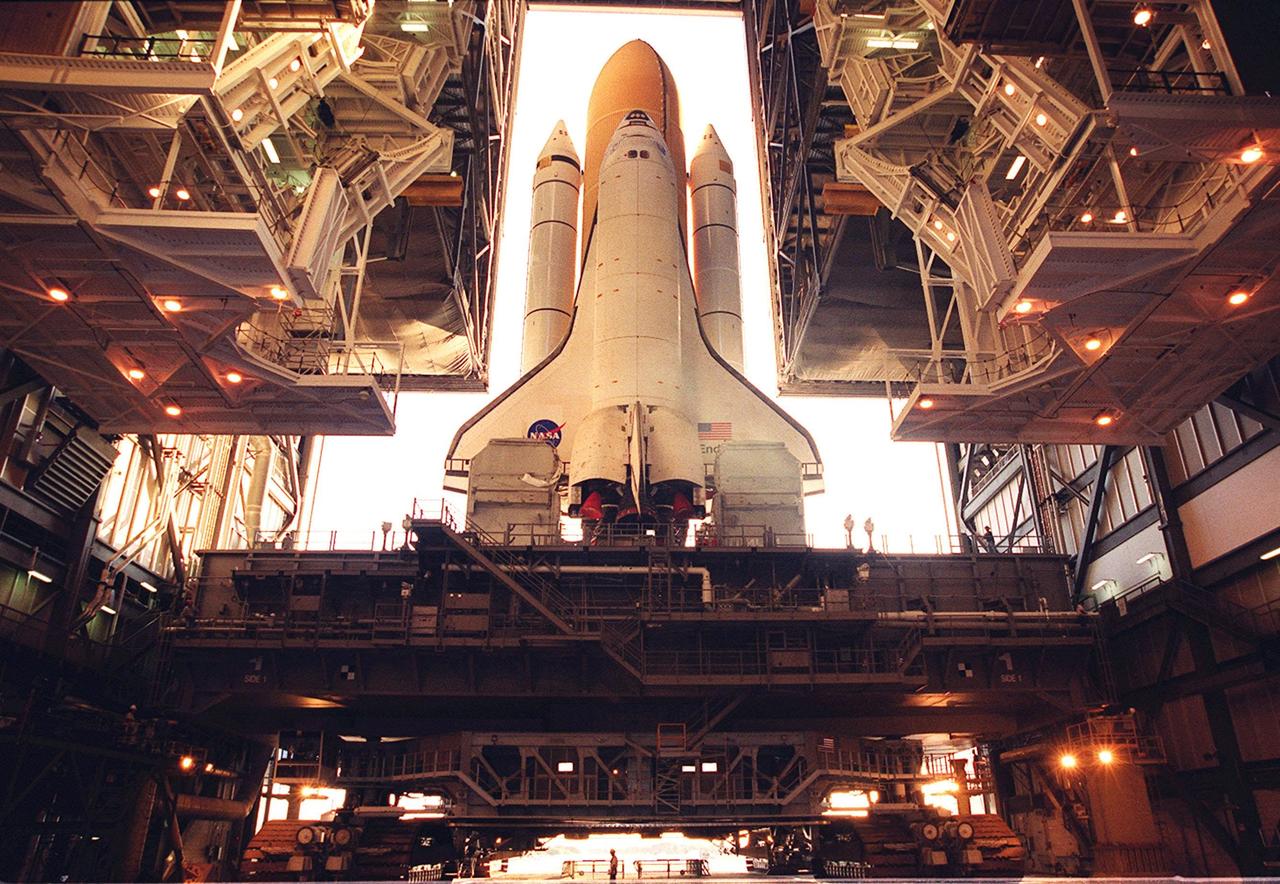
KENNEDY SPACE CENTER, FLA. -  As the crawler transporter slowly moves the Mobile Launcher Platform (MLP) out of the Vehicle Assembly Building, the two solid rocket boosters on top are framed in the doorway.  The move is in support of engineering analysis vibration tests on the crawler and MLP.  The crawler is moving at various speeds up to 1 mph in an effort to achieve vibration data gathering goals as it leaves the VAB and then returns.  The boosters are braced at the top for stability.  The primary purpose of these rollout tests is to gather data to develop future maintenance requirements on the transport equipment and the flight hardware. Various parts of the MLP and crawler transporter have been instrumented with vibration data collection equipment.
KENNEDY SPACE CENTER, FLA. - As the crawler transporter slowly moves the Mobile Launcher Platform (MLP) out of the Vehicle Assembly Building, the two solid rocket boosters on top are framed in the doorway. The move is in support of engineering analysis vibration tests on the crawler and MLP. The crawler is moving at various speeds up to 1 mph in an effort to achieve vibration data gathering goals as it leaves the VAB and then returns. The boosters are braced at the top for stability. The primary purpose of these rollout tests is to gather data to develop future maintenance requirements on the transport equipment and the flight hardware. Various parts of the MLP and crawler transporter have been instrumented with vibration data collection equipment.
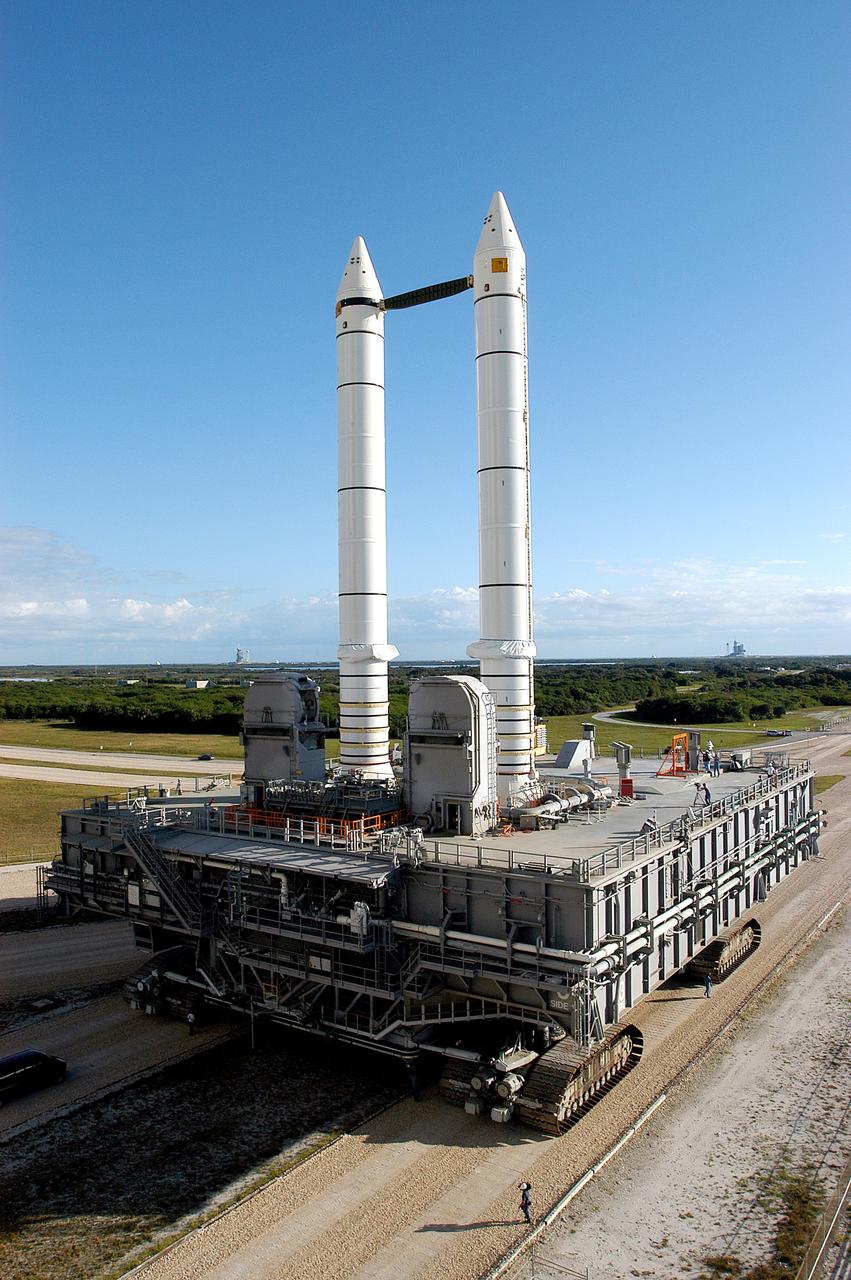
KENNEDY SPACE CENTER, FLA. -  The crawler transporter has slowly moved the Mobile Launcher Platform (MLP), carrying a set of twin solid rocket boosters, out of the Vehicle Assembly Building (VAB) in support of engineering analysis vibration tests on the crawler and MLP. The crawler is moving at various speeds up to 1 mph in an effort to achieve vibration data gathering goals as it leaves the VAB and then returns.  The boosters are braced at the top for stability.  The primary purpose of these rollout tests is to gather data to develop future maintenance requirements on the transport equipment and the flight hardware. Various parts of the MLP and crawler transporter have been instrumented with vibration data collection equipment.
KENNEDY SPACE CENTER, FLA. - The crawler transporter has slowly moved the Mobile Launcher Platform (MLP), carrying a set of twin solid rocket boosters, out of the Vehicle Assembly Building (VAB) in support of engineering analysis vibration tests on the crawler and MLP. The crawler is moving at various speeds up to 1 mph in an effort to achieve vibration data gathering goals as it leaves the VAB and then returns. The boosters are braced at the top for stability. The primary purpose of these rollout tests is to gather data to develop future maintenance requirements on the transport equipment and the flight hardware. Various parts of the MLP and crawler transporter have been instrumented with vibration data collection equipment.
KENNEDY SPACE CENTER, FLA. -  The crawler transporter slowly moves the Mobile Launcher Platform (MLP), carrying a set of twin solid rocket boosters, out of the Vehicle Assembly Building (VAB) in support of engineering analysis vibration tests on the crawler and MLP.   The crawler is moving at various speeds up to 1 mph in an effort to achieve vibration data gathering goals as it leaves the VAB and then returns.  The boosters are braced at the top for stability.  The primary purpose of these rollout tests is to gather data to develop future maintenance requirements on the transport equipment and the flight hardware. Various parts of the MLP and crawler transporter have been instrumented with vibration data collection equipment.
KENNEDY SPACE CENTER, FLA. - The crawler transporter slowly moves the Mobile Launcher Platform (MLP), carrying a set of twin solid rocket boosters, out of the Vehicle Assembly Building (VAB) in support of engineering analysis vibration tests on the crawler and MLP. The crawler is moving at various speeds up to 1 mph in an effort to achieve vibration data gathering goals as it leaves the VAB and then returns. The boosters are braced at the top for stability. The primary purpose of these rollout tests is to gather data to develop future maintenance requirements on the transport equipment and the flight hardware. Various parts of the MLP and crawler transporter have been instrumented with vibration data collection equipment.
KENNEDY SPACE CENTER, FLA. -  As the crawler transporter slowly moves the Mobile Launcher Platform (MLP) out of the Vehicle Assembly Building, the two solid rocket boosters on top are framed in the doorway.  The move is in support of engineering analysis vibration tests on the crawler and MLP. The crawler is moving at various speeds up to 1 mph in an effort to achieve vibration data gathering goals as it leaves the VAB and then returns.  The boosters are braced at the top for stability.  The primary purpose of these rollout tests is to gather data to develop future maintenance requirements on the transport equipment and the flight hardware. Various parts of the MLP and crawler transporter have been instrumented with vibration data collection equipment.
KENNEDY SPACE CENTER, FLA. - As the crawler transporter slowly moves the Mobile Launcher Platform (MLP) out of the Vehicle Assembly Building, the two solid rocket boosters on top are framed in the doorway. The move is in support of engineering analysis vibration tests on the crawler and MLP. The crawler is moving at various speeds up to 1 mph in an effort to achieve vibration data gathering goals as it leaves the VAB and then returns. The boosters are braced at the top for stability. The primary purpose of these rollout tests is to gather data to develop future maintenance requirements on the transport equipment and the flight hardware. Various parts of the MLP and crawler transporter have been instrumented with vibration data collection equipment.
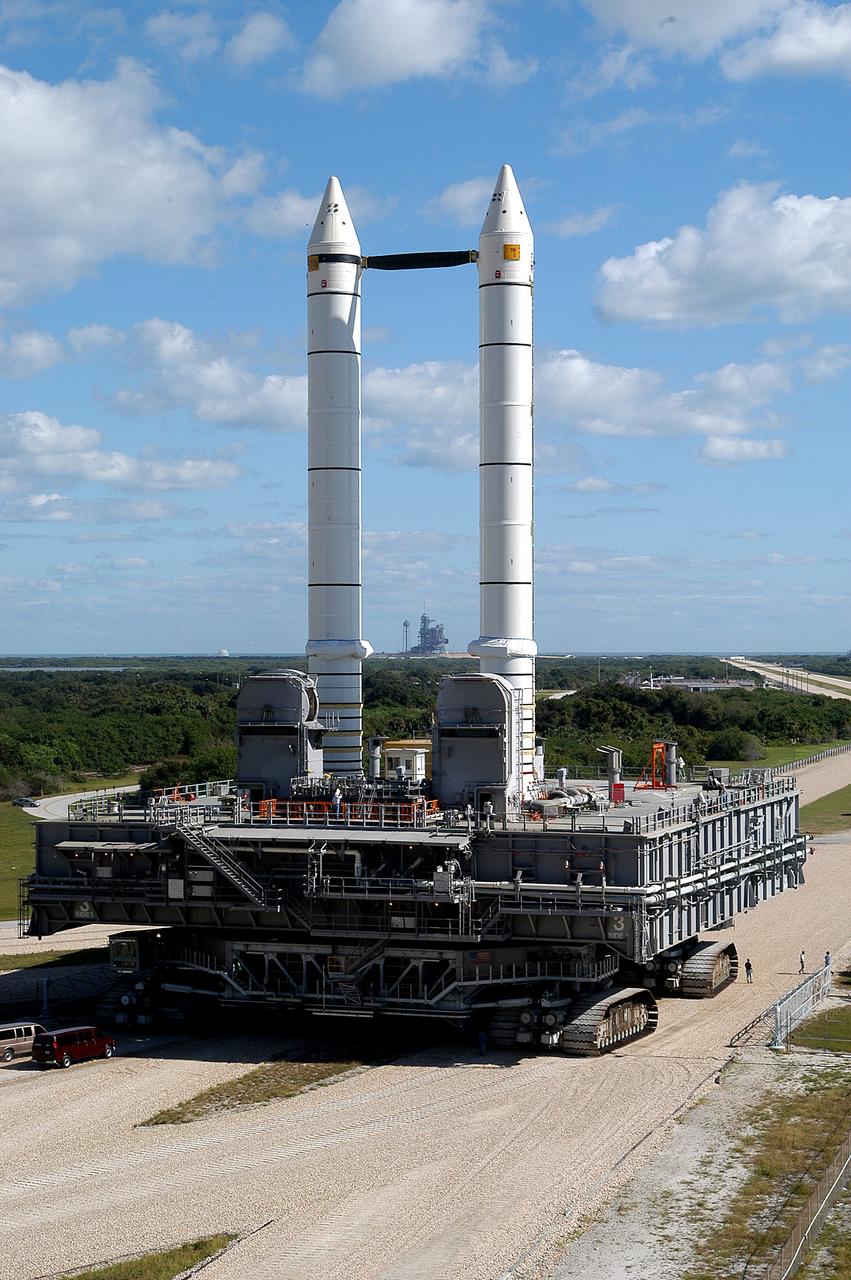
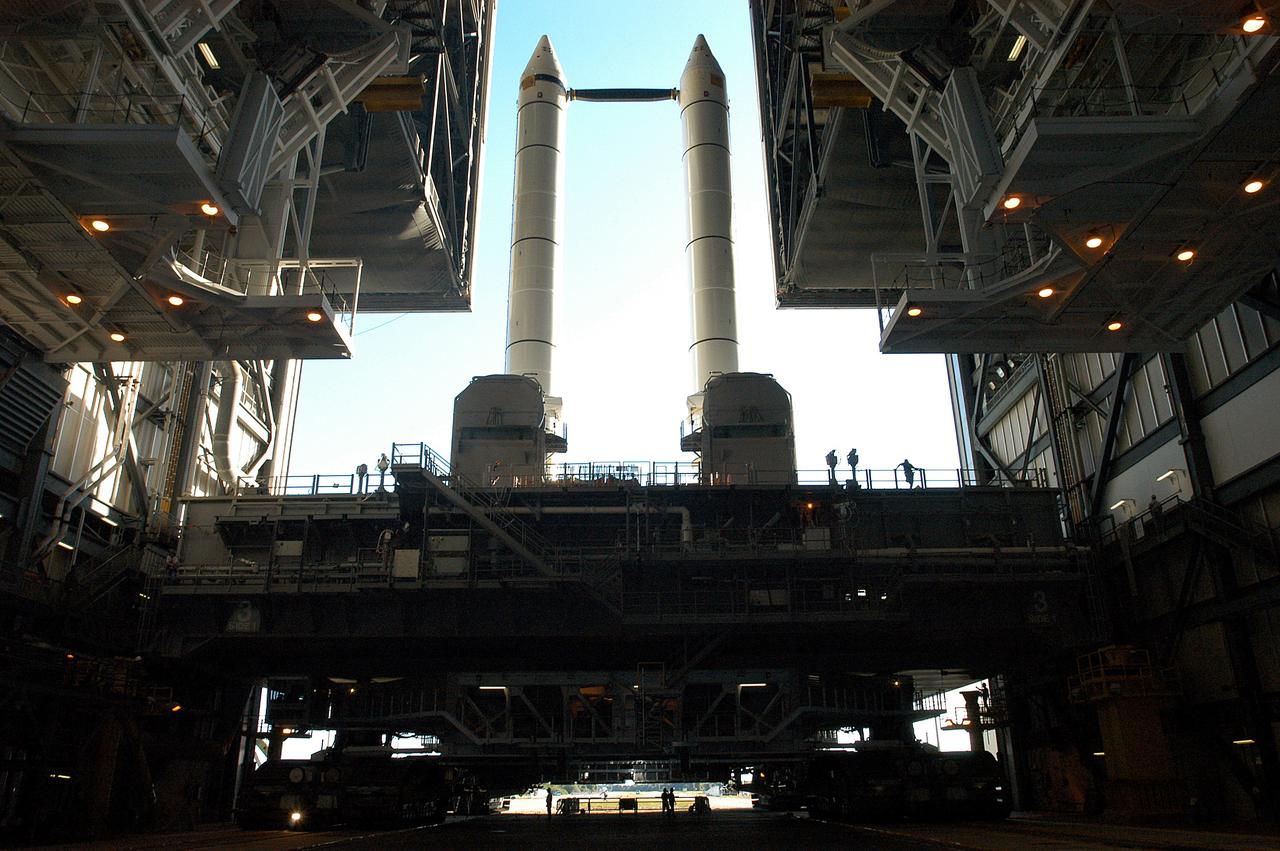
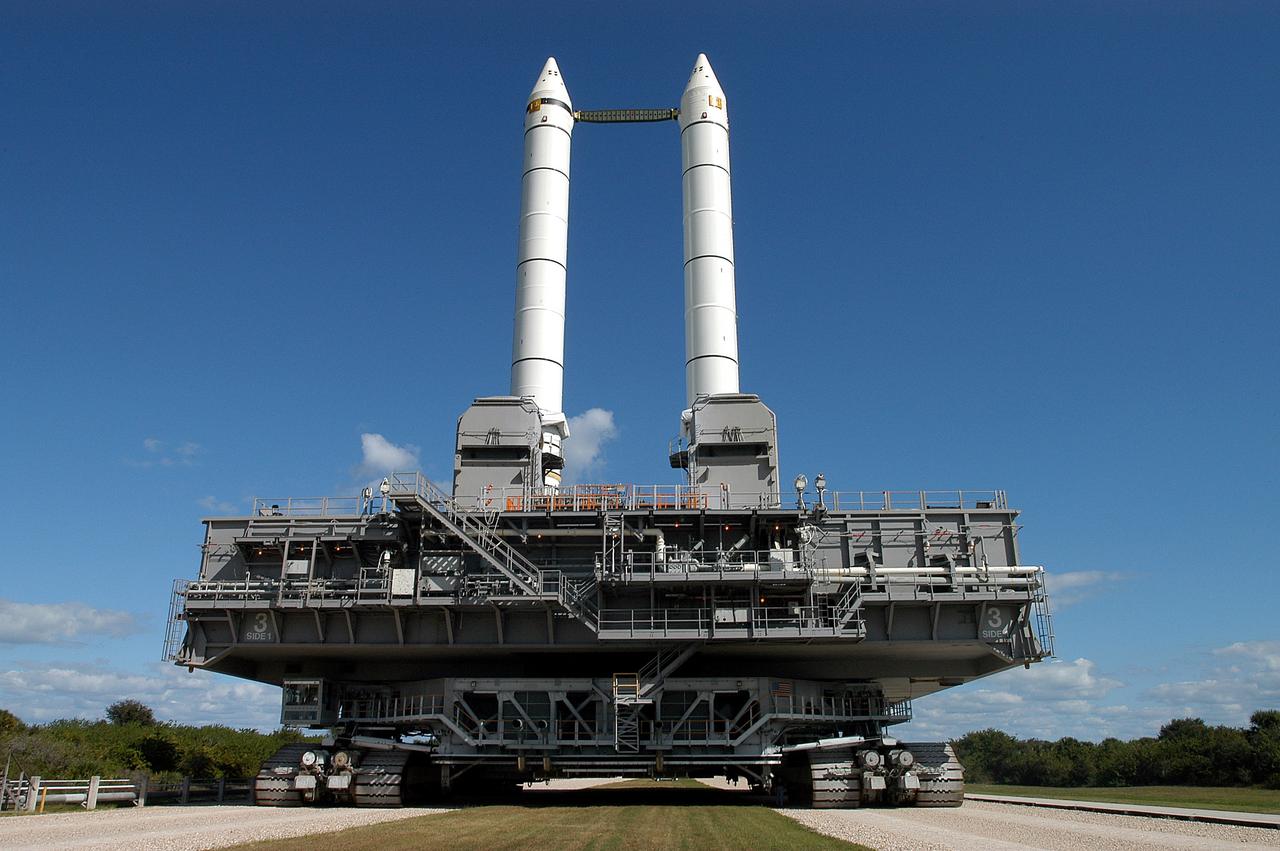
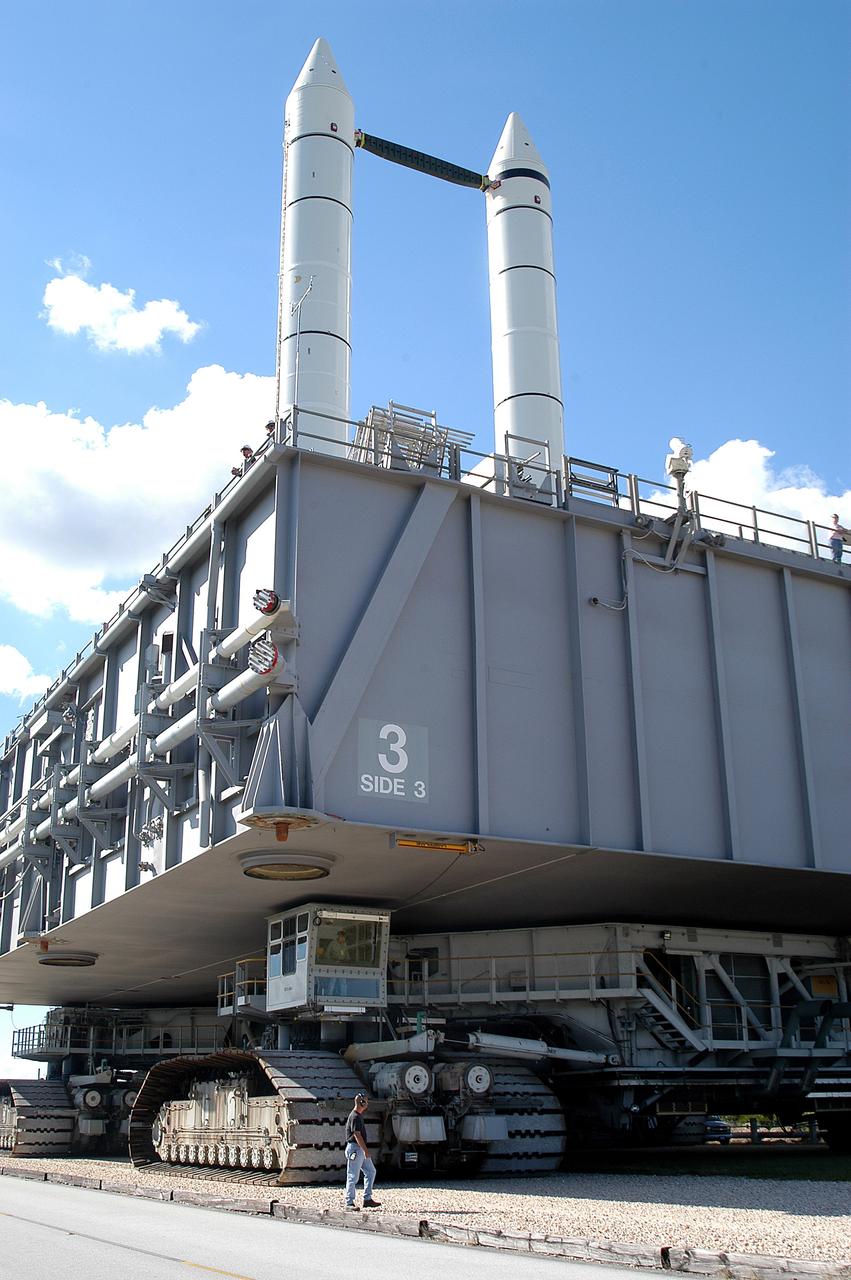
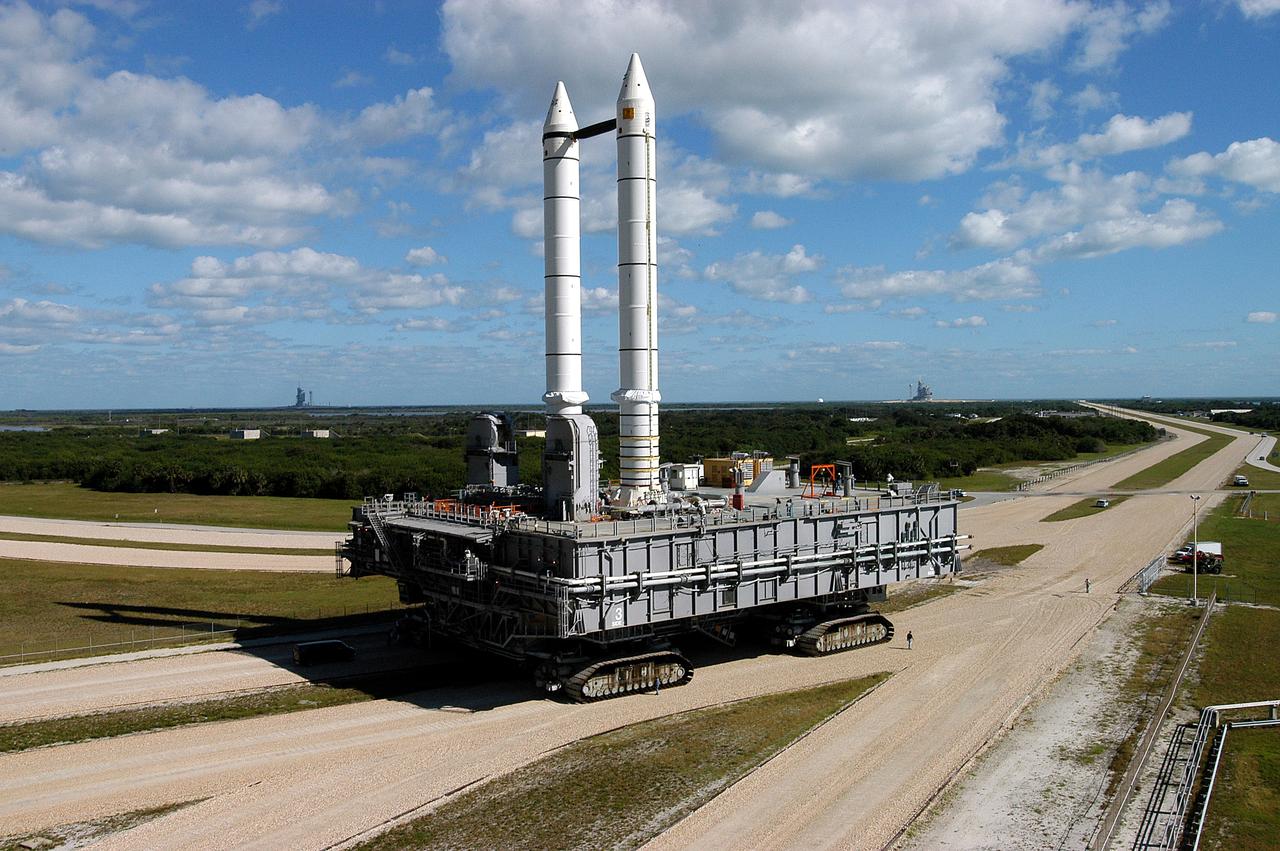
KENNEDY SPACE CENTER, FLA. -  Mobile Launcher Platform (MLP) number 3 and a set of twin solid rocket boosters, atop the crawler-transporter, inch along the crawlerway in support of the second engineering analysis vibration test on the crawler and MLP. The crawler is moving at various speeds up to 1 mph in an effort to achieve vibration data gathering goals as it leaves the VAB, travels toward Launch Pad 39A (framed between the boosters), and then returns.  The boosters are braced at the top for stability.  The primary purpose of these rollout tests is to gather data to develop future maintenance requirements on the transport equipment and the flight hardware. Various parts of the MLP and crawler transporter have been instrumented with vibration data collection equipment.
KENNEDY SPACE CENTER, FLA. - Mobile Launcher Platform (MLP) number 3 and a set of twin solid rocket boosters, atop the crawler-transporter, inch along the crawlerway in support of the second engineering analysis vibration test on the crawler and MLP. The crawler is moving at various speeds up to 1 mph in an effort to achieve vibration data gathering goals as it leaves the VAB, travels toward Launch Pad 39A (framed between the boosters), and then returns. The boosters are braced at the top for stability. The primary purpose of these rollout tests is to gather data to develop future maintenance requirements on the transport equipment and the flight hardware. Various parts of the MLP and crawler transporter have been instrumented with vibration data collection equipment.
KENNEDY SPACE CENTER, FLA. -  Mobile Launcher Platform (MLP) number 3 and a set of twin solid rocket boosters, atop the crawler-transporter, crawls away from the Vehicle Assembly Building in support of the second engineering analysis vibration test on the crawler and MLP. The crawler is moving at various speeds up to 1 mph in an effort to achieve vibration data gathering goals as it leaves the VAB, travels toward Launch Pad 39A and then returns.  The boosters are braced at the top for stability.  The primary purpose of these rollout tests is to gather data to develop future maintenance requirements on the transport equipment and the flight hardware. Various parts of the MLP and crawler transporter have been instrumented with vibration data collection equipment.
KENNEDY SPACE CENTER, FLA. - Mobile Launcher Platform (MLP) number 3 and a set of twin solid rocket boosters, atop the crawler-transporter, crawls away from the Vehicle Assembly Building in support of the second engineering analysis vibration test on the crawler and MLP. The crawler is moving at various speeds up to 1 mph in an effort to achieve vibration data gathering goals as it leaves the VAB, travels toward Launch Pad 39A and then returns. The boosters are braced at the top for stability. The primary purpose of these rollout tests is to gather data to develop future maintenance requirements on the transport equipment and the flight hardware. Various parts of the MLP and crawler transporter have been instrumented with vibration data collection equipment.
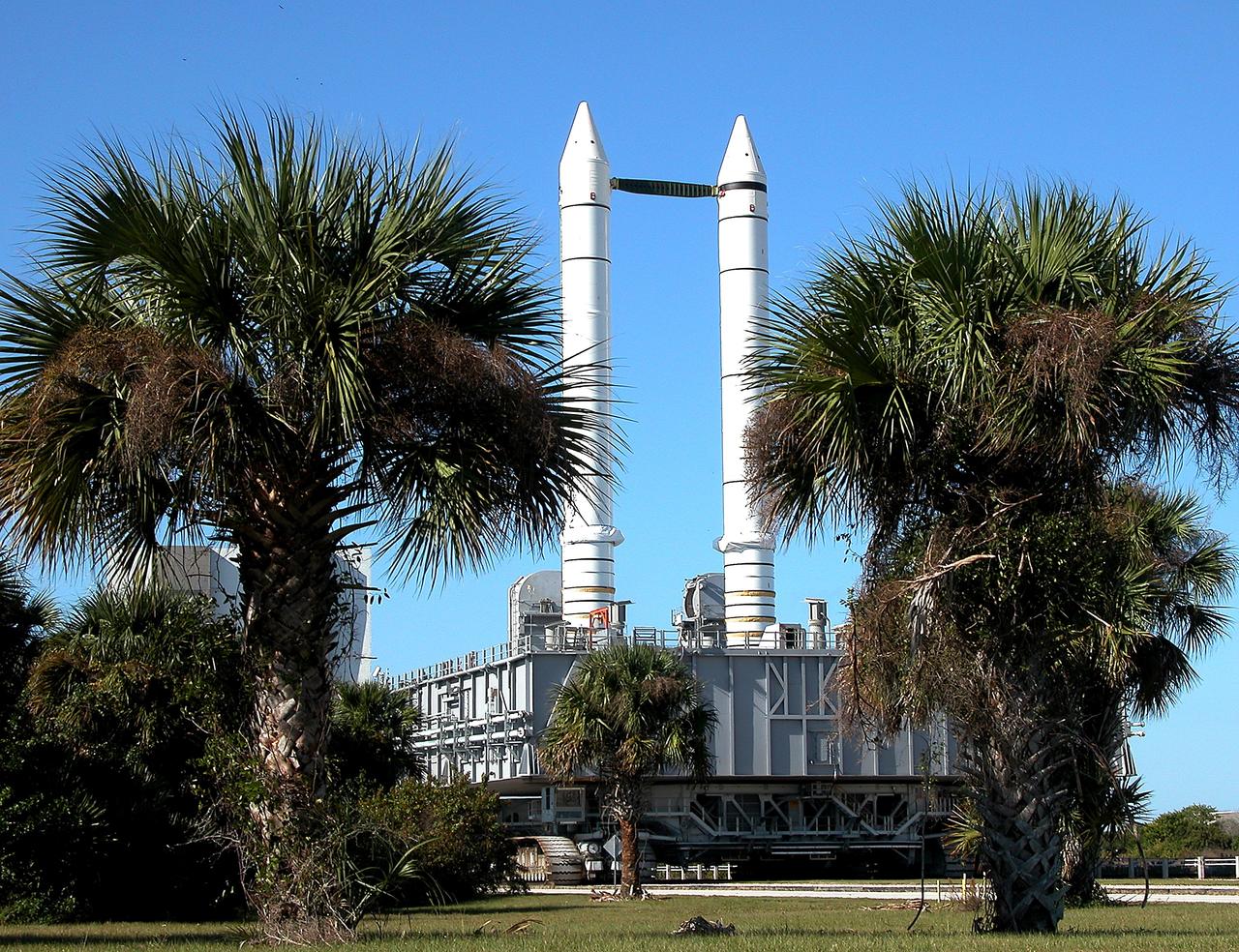
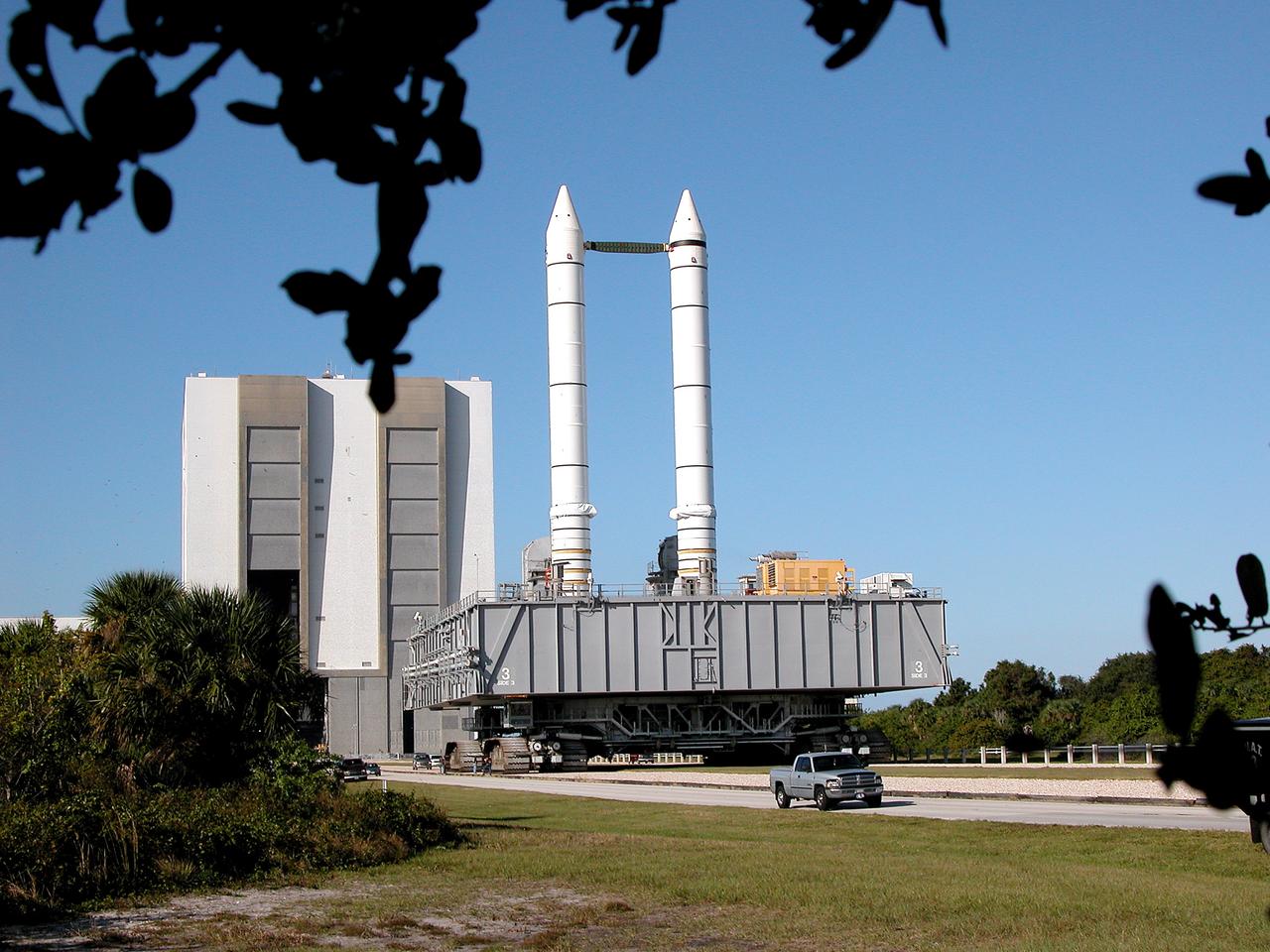
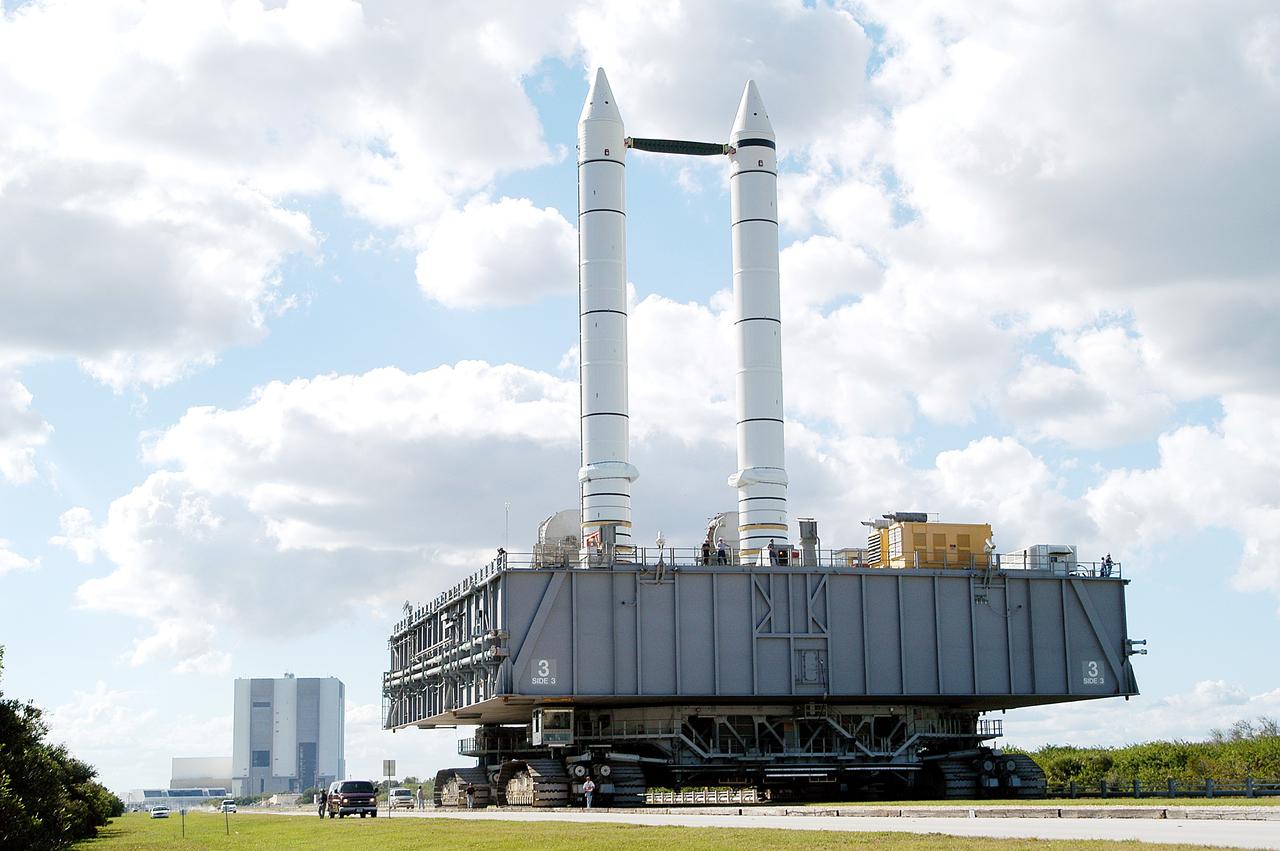
KENNEDY SPACE CENTER, FLA. -  Framed between palm trees, solid rocket boosters loom above the Mobile Launcher Platform (MLP) as the crawler transporter slowly moves it along the crawlerway.  The journey is in support of engineering analysis vibration tests on the crawler and MLP.  The crawler is moving at various speeds up to 1 mph in an effort to achieve vibration data gathering goals as it leaves the VAB and then returns.  The boosters are braced at the top for stability. The primary purpose of these rollout tests is to gather data to develop future maintenance requirements on the transport equipment and the flight hardware. Various parts of the MLP and crawler transporter have been instrumented with vibration data collection equipment.
KENNEDY SPACE CENTER, FLA. - Framed between palm trees, solid rocket boosters loom above the Mobile Launcher Platform (MLP) as the crawler transporter slowly moves it along the crawlerway. The journey is in support of engineering analysis vibration tests on the crawler and MLP. The crawler is moving at various speeds up to 1 mph in an effort to achieve vibration data gathering goals as it leaves the VAB and then returns. The boosters are braced at the top for stability. The primary purpose of these rollout tests is to gather data to develop future maintenance requirements on the transport equipment and the flight hardware. Various parts of the MLP and crawler transporter have been instrumented with vibration data collection equipment.
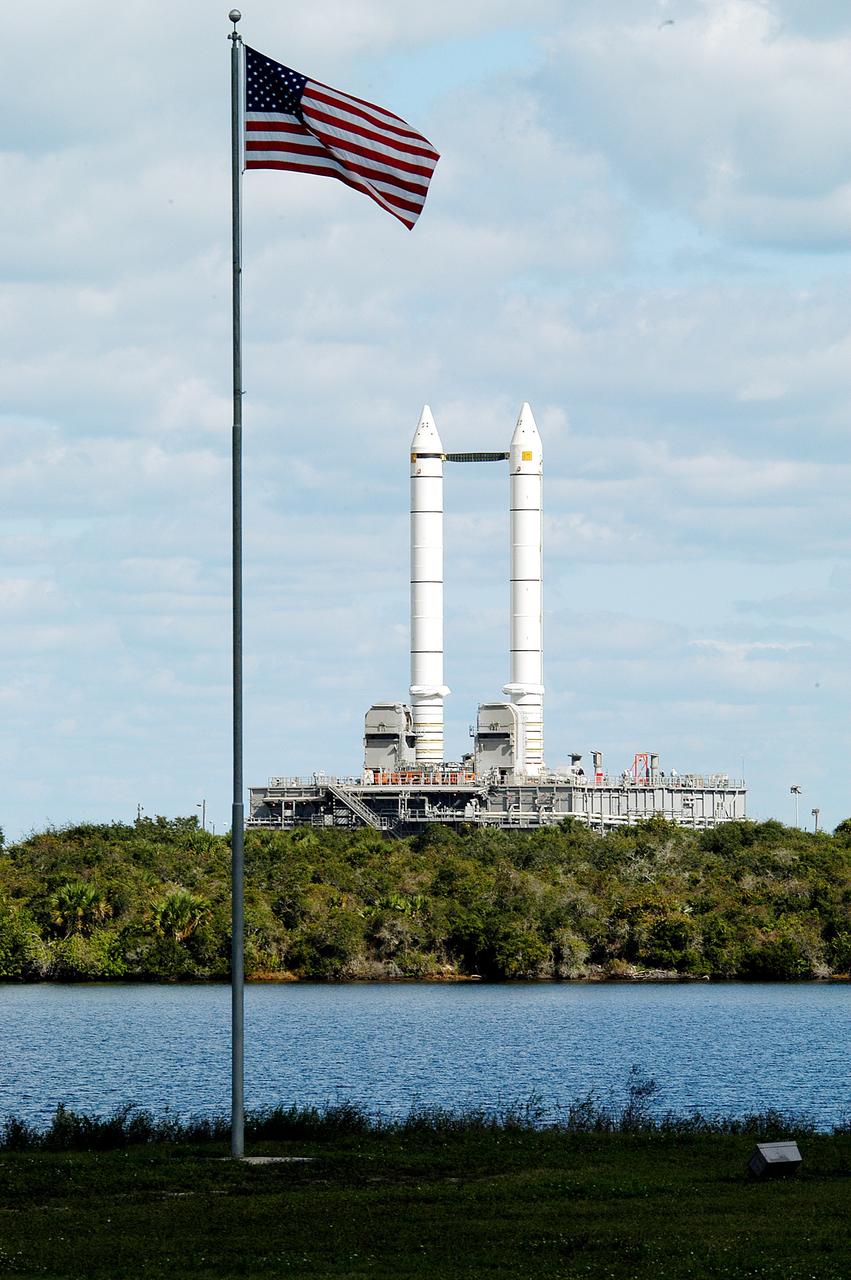
KENNEDY SPACE CENTER, FLA. - Carrying a set of twin solid rocket boosters, the crawler transporter slowly moves the Mobile Launcher Platform (MLP) past the NASA-KSC News Center where the U.S. flag flies daily.  The journey is in support of engineering analysis vibration tests on the crawler and MLP. The crawler is moving at various speeds up to 1 mph in an effort to achieve vibration data gathering goals as it leaves the VAB and then returns.  The boosters are braced at the top for stability.  The primary purpose of these rollout tests is to gather data to develop future maintenance requirements on the transport equipment and the flight hardware. Various parts of the MLP and crawler transporter have been instrumented with vibration data collection equipment.
KENNEDY SPACE CENTER, FLA. - Carrying a set of twin solid rocket boosters, the crawler transporter slowly moves the Mobile Launcher Platform (MLP) past the NASA-KSC News Center where the U.S. flag flies daily. The journey is in support of engineering analysis vibration tests on the crawler and MLP. The crawler is moving at various speeds up to 1 mph in an effort to achieve vibration data gathering goals as it leaves the VAB and then returns. The boosters are braced at the top for stability. The primary purpose of these rollout tests is to gather data to develop future maintenance requirements on the transport equipment and the flight hardware. Various parts of the MLP and crawler transporter have been instrumented with vibration data collection equipment.
KENNEDY SPACE CENTER, FLA. -  The crawler transporter slowly moves the Mobile Launcher Platform (MLP), carrying a set of twin solid rocket boosters, along the crawlerway in support of engineering analysis vibration tests on the crawler and MLP.   In the distance, at left, is Launch Pad 39A. The crawler is moving at various speeds up to 1 mph in an effort to achieve vibration data gathering goals as it leaves the VAB and then returns.  The boosters are braced at the top for stability.  The primary purpose of these rollout tests is to gather data to develop future maintenance requirements on the transport equipment and the flight hardware. Various parts of the MLP and crawler transporter have been instrumented with vibration data collection equipment.
KENNEDY SPACE CENTER, FLA. - The crawler transporter slowly moves the Mobile Launcher Platform (MLP), carrying a set of twin solid rocket boosters, along the crawlerway in support of engineering analysis vibration tests on the crawler and MLP. In the distance, at left, is Launch Pad 39A. The crawler is moving at various speeds up to 1 mph in an effort to achieve vibration data gathering goals as it leaves the VAB and then returns. The boosters are braced at the top for stability. The primary purpose of these rollout tests is to gather data to develop future maintenance requirements on the transport equipment and the flight hardware. Various parts of the MLP and crawler transporter have been instrumented with vibration data collection equipment.
KENNEDY SPACE CENTER, FLA. -   The crawler transporter is slowly moving the Mobile Launcher Platform (MLP), carrying a set of twin solid rocket boosters, out of the Vehicle Assembly Building (VAB) in support of engineering analysis vibration tests on the crawler and MLP. The crawler is moving at various speeds up to 1 mph in an effort to achieve vibration data gathering goals as it leaves the VAB and then returns.  The boosters are braced at the top for stability.  The primary purpose of these rollout tests is to gather data to develop future maintenance requirements on the transport equipment and the flight hardware. Various parts of the MLP and crawler transporter have been instrumented with vibration data collection equipment.
KENNEDY SPACE CENTER, FLA. - The crawler transporter is slowly moving the Mobile Launcher Platform (MLP), carrying a set of twin solid rocket boosters, out of the Vehicle Assembly Building (VAB) in support of engineering analysis vibration tests on the crawler and MLP. The crawler is moving at various speeds up to 1 mph in an effort to achieve vibration data gathering goals as it leaves the VAB and then returns. The boosters are braced at the top for stability. The primary purpose of these rollout tests is to gather data to develop future maintenance requirements on the transport equipment and the flight hardware. Various parts of the MLP and crawler transporter have been instrumented with vibration data collection equipment.
KENNEDY SPACE CENTER, FLA. -  The crawler transporter slowly moves the Mobile Launcher Platform (MLP), carrying a set of twin solid rocket boosters, away from the Vehicle Assembly Building (VAB) in support of engineering analysis vibration tests on the crawler and MLP.   The crawler is moving at various speeds up to 1 mph in an effort to achieve vibration data gathering goals as it leaves the VAB and then returns.  The boosters are braced at the top for stability.  The primary purpose of these rollout tests is to gather data to develop future maintenance requirements on the transport equipment and the flight hardware. Various parts of the MLP and crawler transporter have been instrumented with vibration data collection equipment.
KENNEDY SPACE CENTER, FLA. - The crawler transporter slowly moves the Mobile Launcher Platform (MLP), carrying a set of twin solid rocket boosters, away from the Vehicle Assembly Building (VAB) in support of engineering analysis vibration tests on the crawler and MLP. The crawler is moving at various speeds up to 1 mph in an effort to achieve vibration data gathering goals as it leaves the VAB and then returns. The boosters are braced at the top for stability. The primary purpose of these rollout tests is to gather data to develop future maintenance requirements on the transport equipment and the flight hardware. Various parts of the MLP and crawler transporter have been instrumented with vibration data collection equipment.
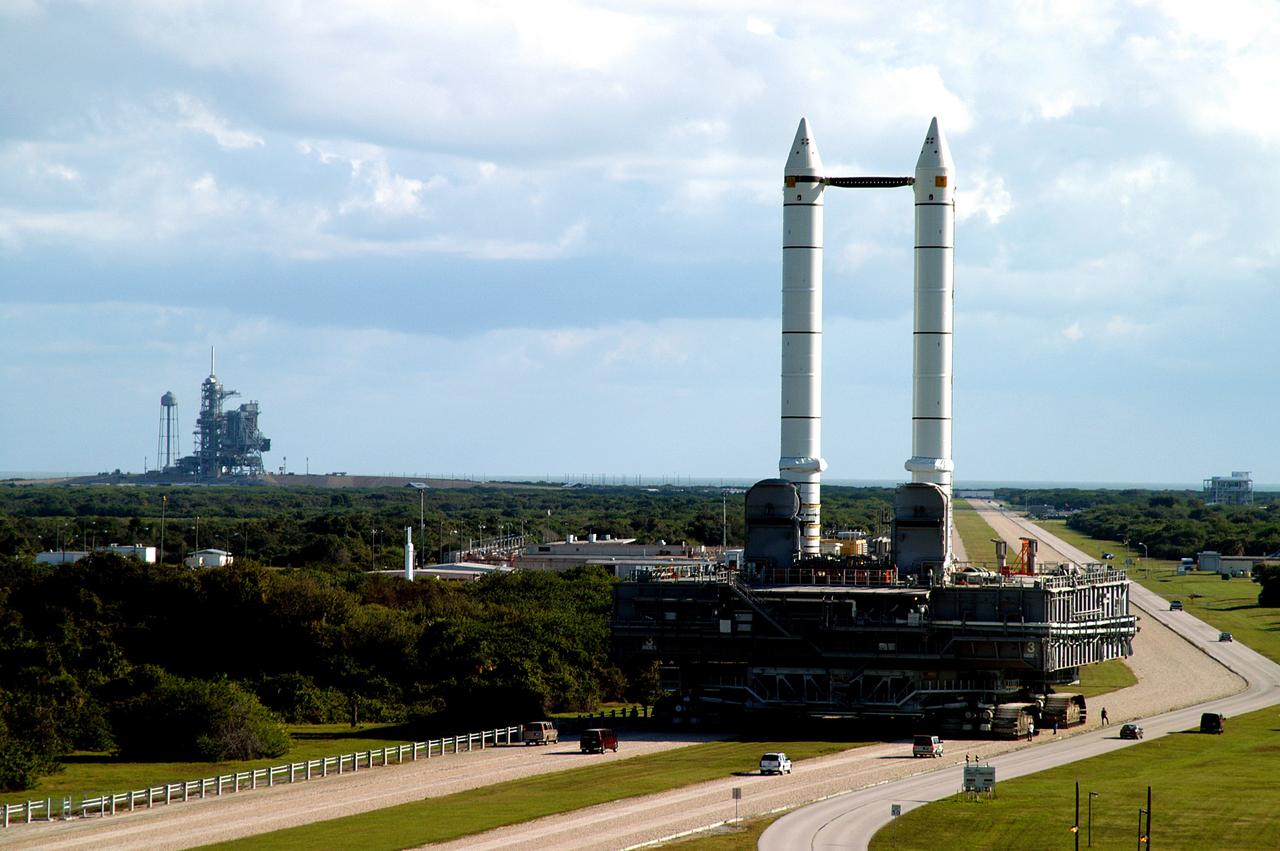
KENNEDY SPACE CENTER, FLA. -  Mobile Launcher Platform (MLP) number 3 and a set of twin solid rocket boosters, atop the crawler-transporter, inch along the crawlerway in support of the second engineering analysis vibration test on the crawler and MLP. The crawler is moving at various speeds up to 1 mph in an effort to achieve vibration data gathering goals as it leaves the VAB, travels toward Launch Pad 39A (on the horizon) and then returns.  The boosters are braced at the top for stability.  The primary purpose of these rollout tests is to gather data to develop future maintenance requirements on the transport equipment and the flight hardware. Various parts of the MLP and crawler transporter have been instrumented with vibration data collection equipment.
KENNEDY SPACE CENTER, FLA. - Mobile Launcher Platform (MLP) number 3 and a set of twin solid rocket boosters, atop the crawler-transporter, inch along the crawlerway in support of the second engineering analysis vibration test on the crawler and MLP. The crawler is moving at various speeds up to 1 mph in an effort to achieve vibration data gathering goals as it leaves the VAB, travels toward Launch Pad 39A (on the horizon) and then returns. The boosters are braced at the top for stability. The primary purpose of these rollout tests is to gather data to develop future maintenance requirements on the transport equipment and the flight hardware. Various parts of the MLP and crawler transporter have been instrumented with vibration data collection equipment.
KENNEDY SPACE CENTER, FLA. -   The crawler transporter slowly moves the Mobile Launcher Platform (MLP), carrying a set of twin solid rocket boosters, along the crawlerway in support of engineering analysis vibration tests on the crawler and MLP.  The crawler is moving at various speeds up to 1 mph in an effort to achieve vibration data gathering goals as it leaves the VAB and then returns.  The boosters are braced at the top for stability.  The primary purpose of these rollout tests is to gather data to develop future maintenance requirements on the transport equipment and the flight hardware. Various parts of the MLP and crawler transporter have been instrumented with vibration data collection equipment.
KENNEDY SPACE CENTER, FLA. - The crawler transporter slowly moves the Mobile Launcher Platform (MLP), carrying a set of twin solid rocket boosters, along the crawlerway in support of engineering analysis vibration tests on the crawler and MLP. The crawler is moving at various speeds up to 1 mph in an effort to achieve vibration data gathering goals as it leaves the VAB and then returns. The boosters are braced at the top for stability. The primary purpose of these rollout tests is to gather data to develop future maintenance requirements on the transport equipment and the flight hardware. Various parts of the MLP and crawler transporter have been instrumented with vibration data collection equipment.
KENNEDY SPACE CENTER, FLA. -  The crawler transporter slowly moves the Mobile Launcher Platform (MLP), carrying a set of twin solid rocket boosters, away from the Vehicle Assembly Building (VAB) in support of engineering analysis vibration tests on the crawler and MLP.   The crawler is moving at various speeds up to 1 mph in an effort to achieve vibration data gathering goals as it leaves the VAB and then returns.  The boosters are braced at the top for stability.  The primary purpose of these rollout tests is to gather data to develop future maintenance requirements on the transport equipment and the flight hardware. Various parts of the MLP and crawler transporter have been instrumented with vibration data collection equipment.
KENNEDY SPACE CENTER, FLA. - The crawler transporter slowly moves the Mobile Launcher Platform (MLP), carrying a set of twin solid rocket boosters, away from the Vehicle Assembly Building (VAB) in support of engineering analysis vibration tests on the crawler and MLP. The crawler is moving at various speeds up to 1 mph in an effort to achieve vibration data gathering goals as it leaves the VAB and then returns. The boosters are braced at the top for stability. The primary purpose of these rollout tests is to gather data to develop future maintenance requirements on the transport equipment and the flight hardware. Various parts of the MLP and crawler transporter have been instrumented with vibration data collection equipment.
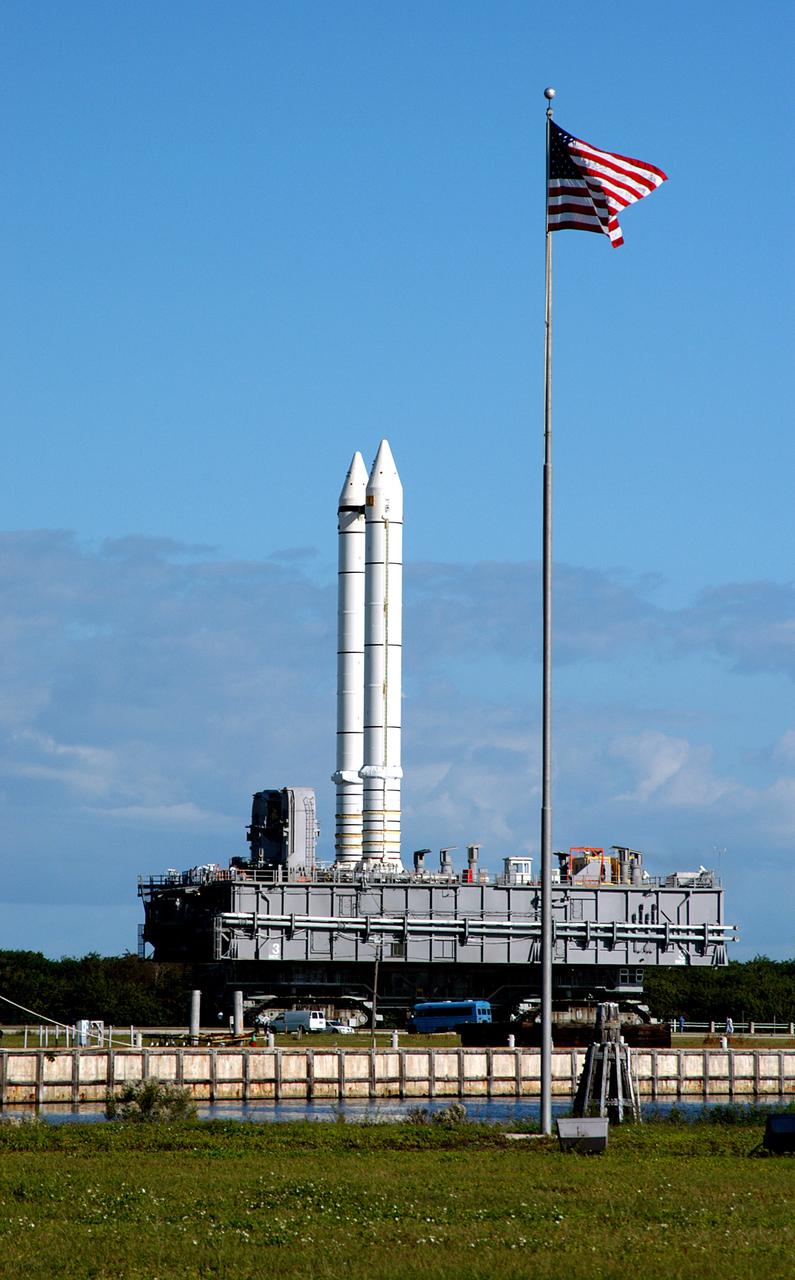
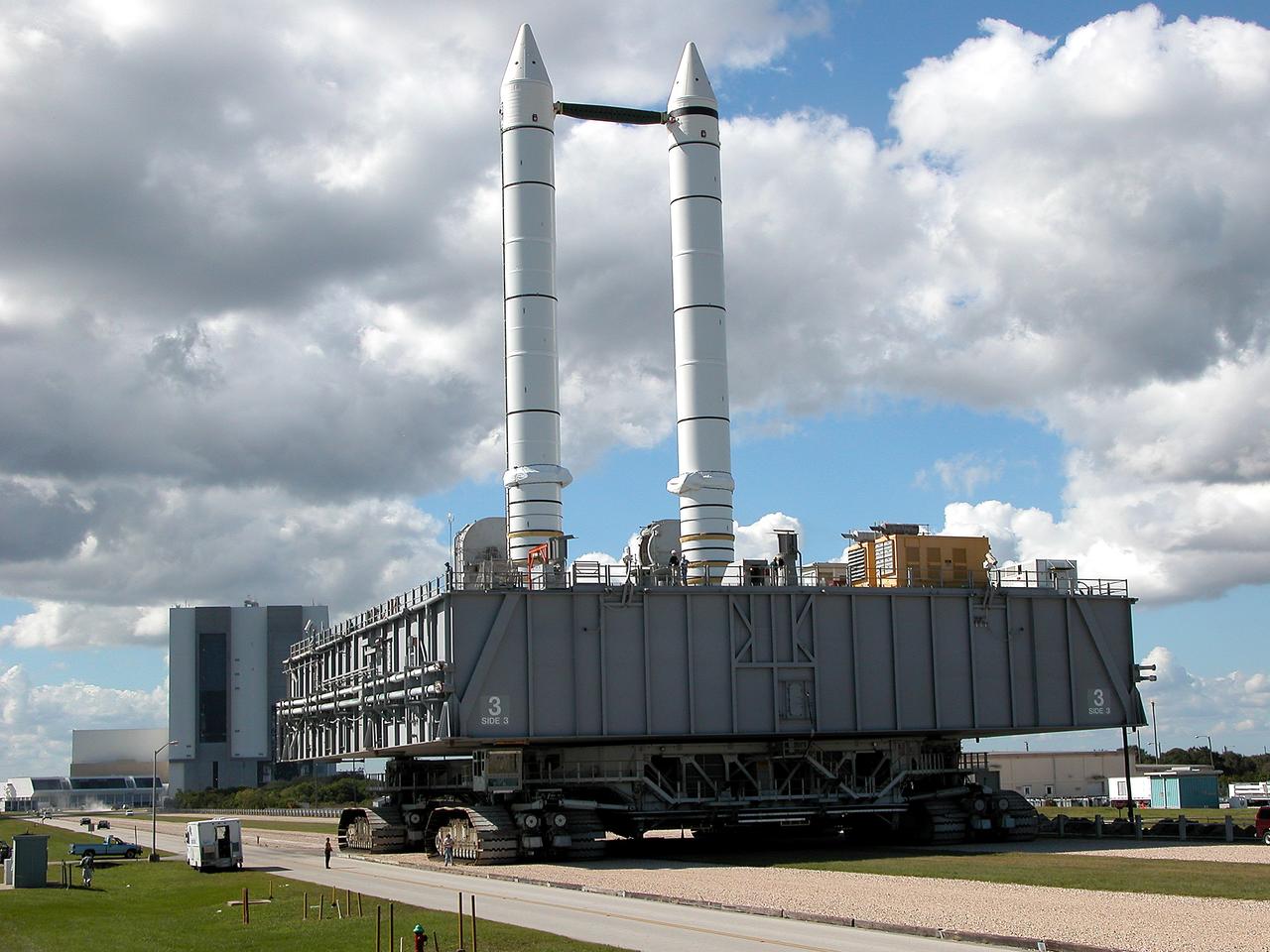
KENNEDY SPACE CENTER, FLA. -  Mobile Launcher Platform (MLP) number 3 and a set of twin solid rocket boosters bolted to it, atop the crawler-transporter, inches along the crawlerway in support of the second engineering analysis vibration test on the crawler and MLP.  The MLP is viewed from the KSC News Center across the turn basin.  The crawler is moving at various speeds up to 1 mph in an effort to achieve vibration data gathering goals as it leaves the VAB, travels toward Launch Pad 39A and then returns.  The boosters are braced at the top for stability.  The primary purpose of these rollout tests is to gather data to develop future maintenance requirements on the transport equipment and the flight hardware. Various parts of the MLP and crawler transporter have been instrumented with vibration data collection equipment.
KENNEDY SPACE CENTER, FLA. - Mobile Launcher Platform (MLP) number 3 and a set of twin solid rocket boosters bolted to it, atop the crawler-transporter, inches along the crawlerway in support of the second engineering analysis vibration test on the crawler and MLP. The MLP is viewed from the KSC News Center across the turn basin. The crawler is moving at various speeds up to 1 mph in an effort to achieve vibration data gathering goals as it leaves the VAB, travels toward Launch Pad 39A and then returns. The boosters are braced at the top for stability. The primary purpose of these rollout tests is to gather data to develop future maintenance requirements on the transport equipment and the flight hardware. Various parts of the MLP and crawler transporter have been instrumented with vibration data collection equipment.
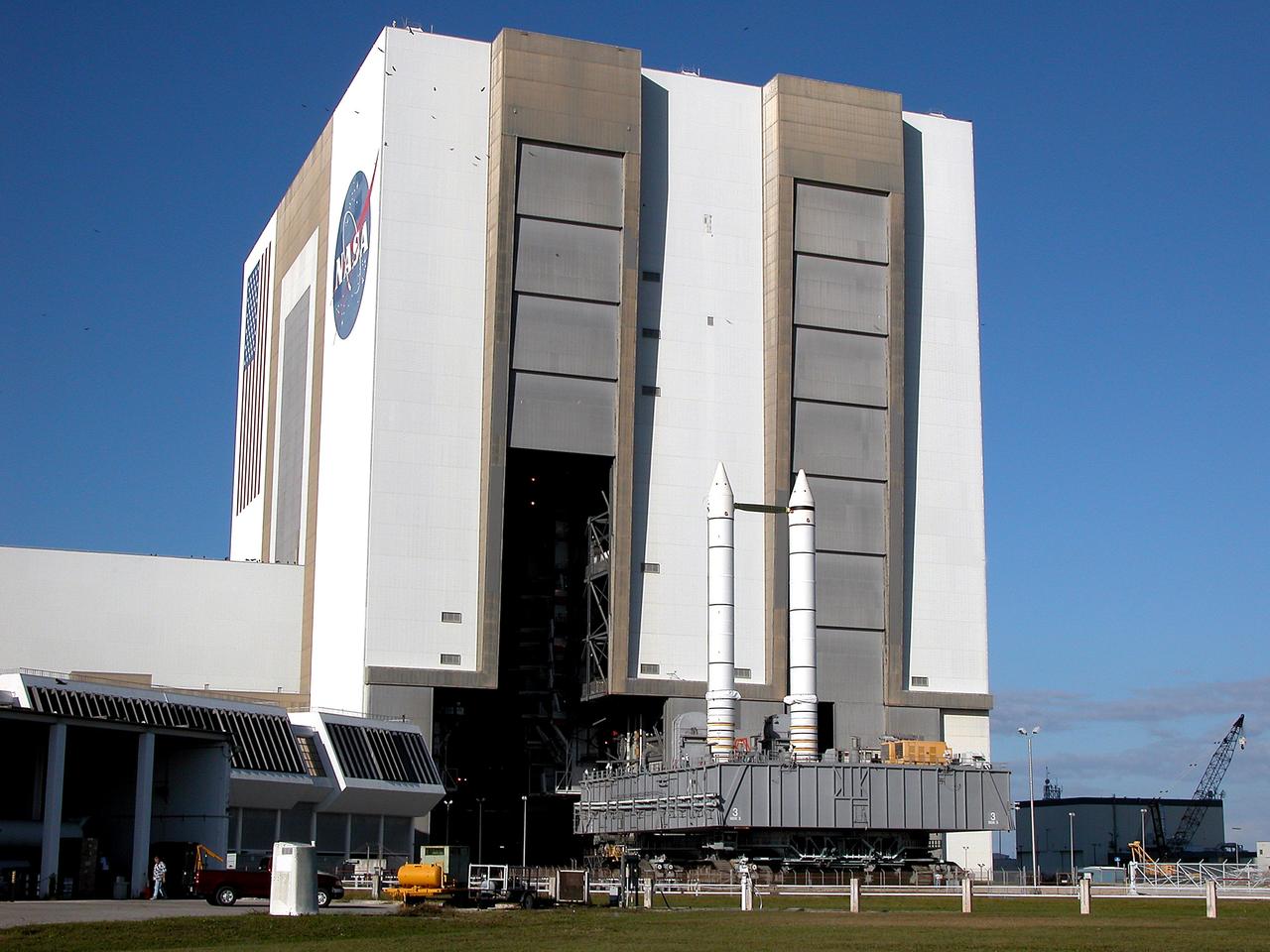
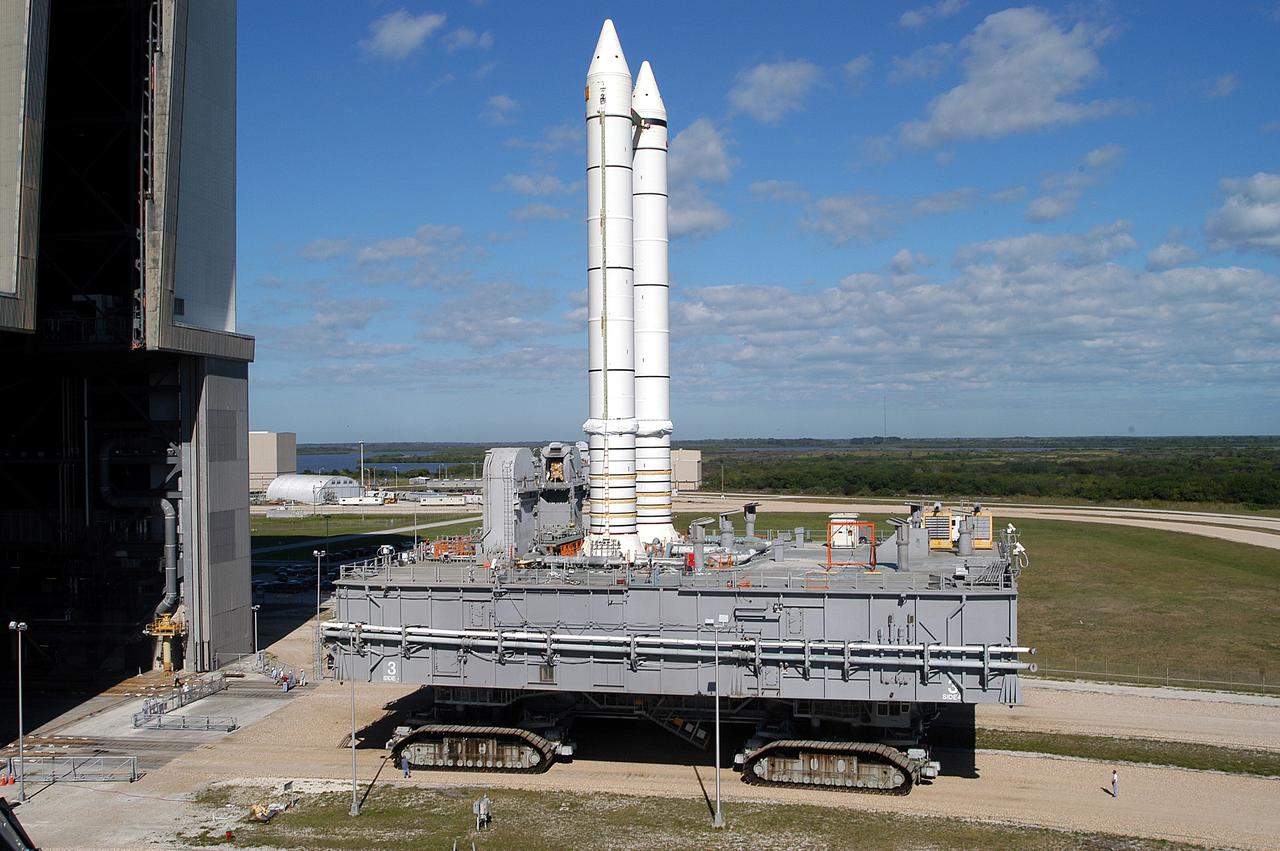
KENNEDY SPACE CENTER, FLA. -  Mobile Launcher Platform (MLP) number 3 and a set of twin solid rocket boosters, atop the crawler-transporter, crawl out of the Vehicle Assembly Building (VAB) in support of the second engineering analysis vibration test on the crawler and MLP. In the background is another MLP.  The crawler is moving at various speeds up to 1 mph in an effort to achieve vibration data gathering goals as it leaves the VAB, travels toward Launch Pad 39A and then returns.  The boosters are braced at the top for stability.  The primary purpose of these rollout tests is to gather data to develop future maintenance requirements on the transport equipment and the flight hardware. Various parts of the MLP and crawler transporter have been instrumented with vibration data collection equipment.
KENNEDY SPACE CENTER, FLA. - Mobile Launcher Platform (MLP) number 3 and a set of twin solid rocket boosters, atop the crawler-transporter, crawl out of the Vehicle Assembly Building (VAB) in support of the second engineering analysis vibration test on the crawler and MLP. In the background is another MLP. The crawler is moving at various speeds up to 1 mph in an effort to achieve vibration data gathering goals as it leaves the VAB, travels toward Launch Pad 39A and then returns. The boosters are braced at the top for stability. The primary purpose of these rollout tests is to gather data to develop future maintenance requirements on the transport equipment and the flight hardware. Various parts of the MLP and crawler transporter have been instrumented with vibration data collection equipment.
KENNEDY SPACE CENTER, FLA. -  Like candles embedded in a sculptured “cake,” the Mobile Launcher Platform (MLP) number 3 with twin solid rocket boosters bolted to it inches along the crawlerway at various speeds up to 1 mph in an effort to achieve vibration data gathering goals. The boosters are braced at the top for stability.  The primary purpose of these rollout tests is to gather data to develop future maintenance requirements on the transport equipment and the flight hardware. Various parts of the MLP and crawler transporter have been instrumented with vibration data collection equipment.
KENNEDY SPACE CENTER, FLA. - Like candles embedded in a sculptured “cake,” the Mobile Launcher Platform (MLP) number 3 with twin solid rocket boosters bolted to it inches along the crawlerway at various speeds up to 1 mph in an effort to achieve vibration data gathering goals. The boosters are braced at the top for stability. The primary purpose of these rollout tests is to gather data to develop future maintenance requirements on the transport equipment and the flight hardware. Various parts of the MLP and crawler transporter have been instrumented with vibration data collection equipment.
KENNEDY SPACE CENTER, FLA. -  The crawler transporter slowly moves the Mobile Launcher Platform (MLP), carrying a set of twin solid rocket boosters, away from the Vehicle Assembly Building (VAB) in support of engineering analysis vibration tests on the crawler and MLP.   In the distance, at left, is Launch Pad 39A.  The water on the right of the crawlerway is the Banana River.  The crawler is moving at various speeds up to 1 mph in an effort to achieve vibration data gathering goals as it leaves the VAB and then returns.  The boosters are braced at the top for stability.  The primary purpose of these rollout tests is to gather data to develop future maintenance requirements on the transport equipment and the flight hardware. Various parts of the MLP and crawler transporter have been instrumented with vibration data collection equipment.
KENNEDY SPACE CENTER, FLA. - The crawler transporter slowly moves the Mobile Launcher Platform (MLP), carrying a set of twin solid rocket boosters, away from the Vehicle Assembly Building (VAB) in support of engineering analysis vibration tests on the crawler and MLP. In the distance, at left, is Launch Pad 39A. The water on the right of the crawlerway is the Banana River. The crawler is moving at various speeds up to 1 mph in an effort to achieve vibration data gathering goals as it leaves the VAB and then returns. The boosters are braced at the top for stability. The primary purpose of these rollout tests is to gather data to develop future maintenance requirements on the transport equipment and the flight hardware. Various parts of the MLP and crawler transporter have been instrumented with vibration data collection equipment.
KENNEDY SPACE CENTER, FLA. -  Mobile Launcher Platform (MLP) number 3 and a set of twin solid rocket boosters bolted to it, atop the crawler-transporter, crawl to the intersection in the crawlerway in support of the second engineering analysis vibration test on the crawler and MLP.  In the background are Launch Pads 39A (right) and 39B (left).  The crawler is moving at various speeds up to 1 mph in an effort to achieve vibration data gathering goals as it leaves the VAB, travels toward Launch Pad 39A and then returns.  The boosters are braced at the top for stability.  The primary purpose of these rollout tests is to gather data to develop future maintenance requirements on the transport equipment and the flight hardware. Various parts of the MLP and crawler transporter have been instrumented with vibration data collection equipment.
KENNEDY SPACE CENTER, FLA. - Mobile Launcher Platform (MLP) number 3 and a set of twin solid rocket boosters bolted to it, atop the crawler-transporter, crawl to the intersection in the crawlerway in support of the second engineering analysis vibration test on the crawler and MLP. In the background are Launch Pads 39A (right) and 39B (left). The crawler is moving at various speeds up to 1 mph in an effort to achieve vibration data gathering goals as it leaves the VAB, travels toward Launch Pad 39A and then returns. The boosters are braced at the top for stability. The primary purpose of these rollout tests is to gather data to develop future maintenance requirements on the transport equipment and the flight hardware. Various parts of the MLP and crawler transporter have been instrumented with vibration data collection equipment.
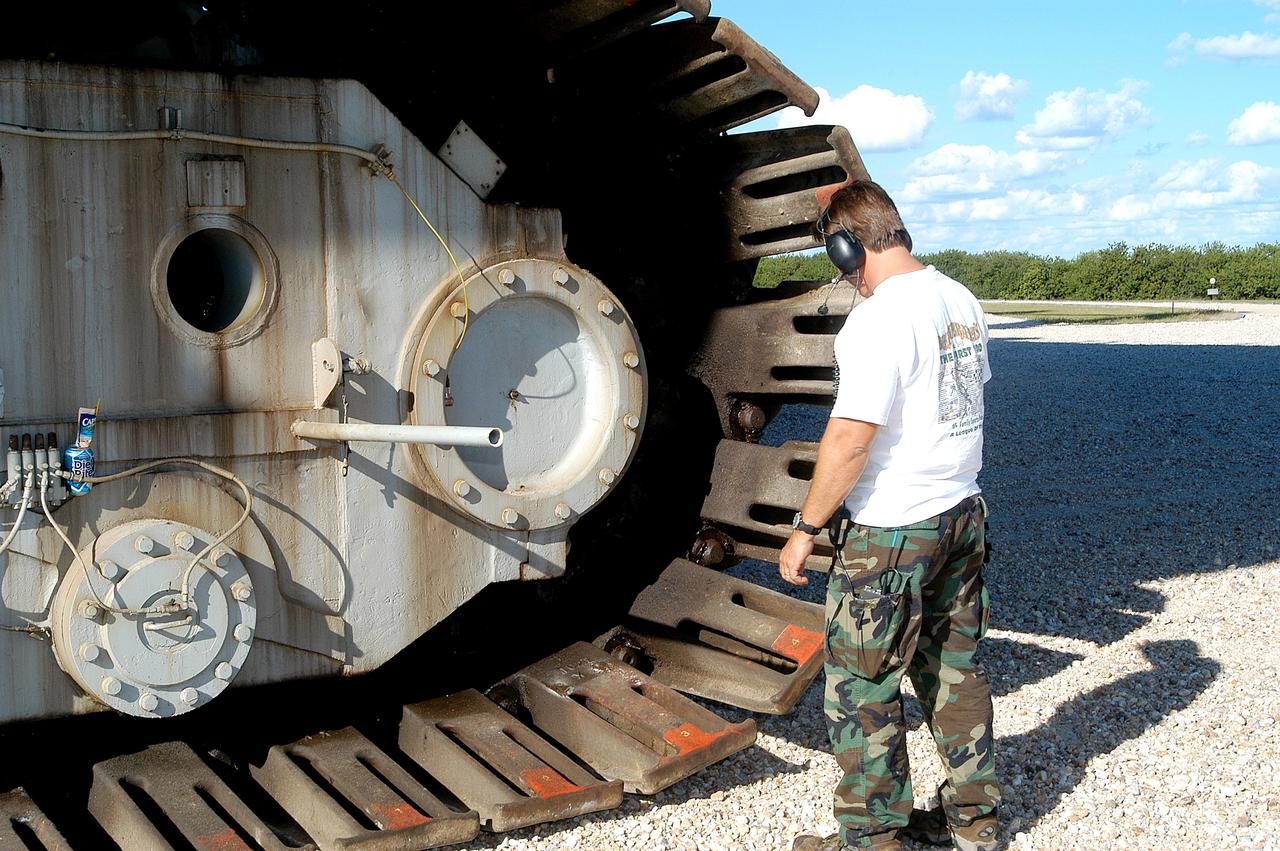
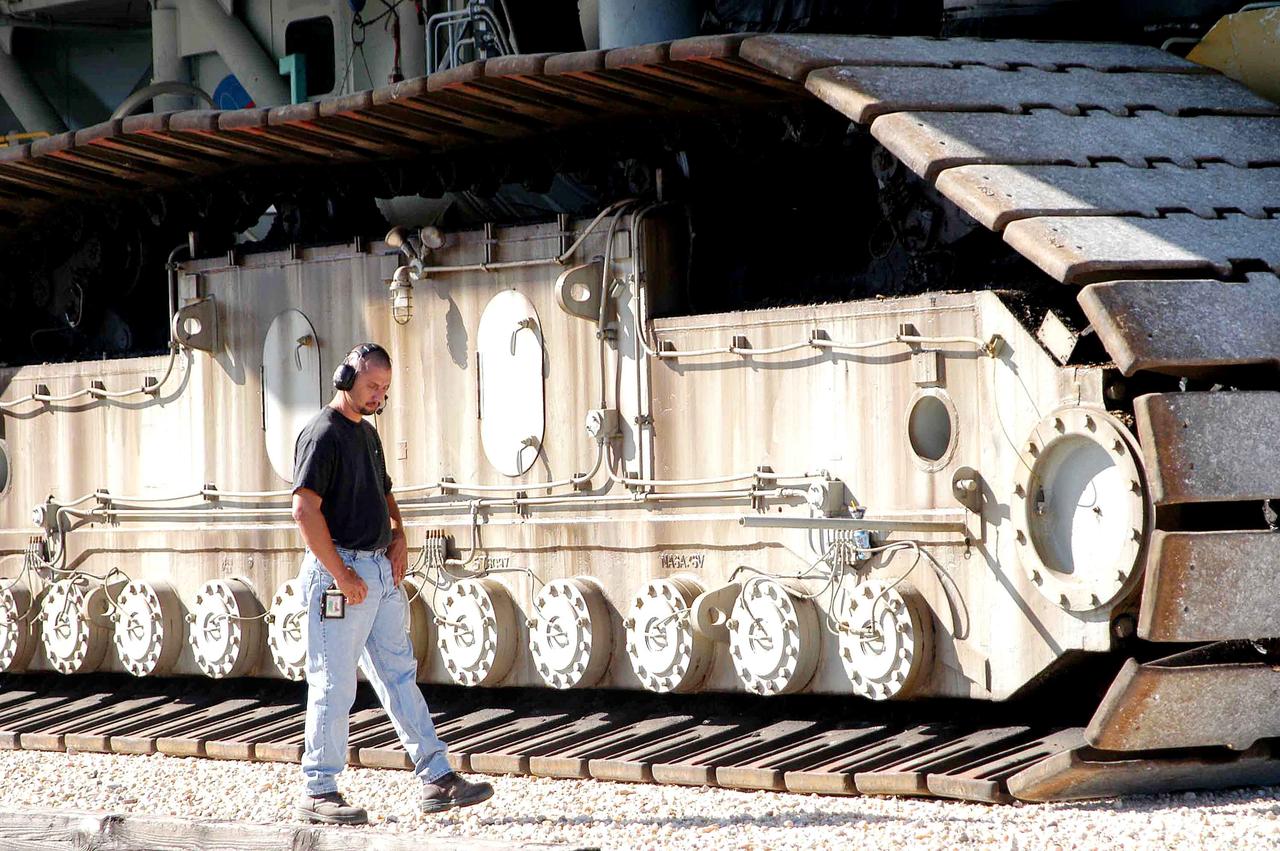
KENNEDY SPACE CENTER, FLA. - A Kennedy Space Center technician inspects the shoes on one of eight tracks of a crawler-transporter (CT).  The CT is moving Mobile Launcher Platform (MLP) number 3 with a set of twin solid rocket boosters bolted on top to the intersection in the crawlerway in support of the second engineering analysis vibration test on the crawler and MLP.  The crawler is moving at various speeds up to 1 mph in an effort to achieve vibration data gathering goals as it leaves the VAB, travels toward Launch Pad 39A and then returns. The boosters are braced at the top for stability. The primary purpose of these rollout tests is to gather data to develop future maintenance requirements on the transport equipment and the flight hardware. Various parts of the MLP and crawler transporter have been instrumented with vibration data collection equipment.
KENNEDY SPACE CENTER, FLA. - A Kennedy Space Center technician inspects the shoes on one of eight tracks of a crawler-transporter (CT). The CT is moving Mobile Launcher Platform (MLP) number 3 with a set of twin solid rocket boosters bolted on top to the intersection in the crawlerway in support of the second engineering analysis vibration test on the crawler and MLP. The crawler is moving at various speeds up to 1 mph in an effort to achieve vibration data gathering goals as it leaves the VAB, travels toward Launch Pad 39A and then returns. The boosters are braced at the top for stability. The primary purpose of these rollout tests is to gather data to develop future maintenance requirements on the transport equipment and the flight hardware. Various parts of the MLP and crawler transporter have been instrumented with vibration data collection equipment.
KENNEDY SPACE CENTER, FLA. - A Kennedy Space Center technician monitors the performance of a crawler-transporter as it moves Mobile Launcher Platform (MLP) number 3, with a set of twin solid rocket boosters bolted atop, to the intersection in the crawlerway during the second engineering analysis vibration test on the crawler and MLP.  The crawler is moving at various speeds up to 1 mph in an effort to achieve vibration data gathering goals as it leaves the VAB, travels toward Launch Pad 39A, and then returns. The boosters are braced at the top for stability. The primary purpose of these rollout tests is to gather data to develop future maintenance requirements on the transport equipment and the flight hardware. Various parts of the MLP and crawler transporter have been instrumented with vibration data collection equipment.
KENNEDY SPACE CENTER, FLA. - A Kennedy Space Center technician monitors the performance of a crawler-transporter as it moves Mobile Launcher Platform (MLP) number 3, with a set of twin solid rocket boosters bolted atop, to the intersection in the crawlerway during the second engineering analysis vibration test on the crawler and MLP. The crawler is moving at various speeds up to 1 mph in an effort to achieve vibration data gathering goals as it leaves the VAB, travels toward Launch Pad 39A, and then returns. The boosters are braced at the top for stability. The primary purpose of these rollout tests is to gather data to develop future maintenance requirements on the transport equipment and the flight hardware. Various parts of the MLP and crawler transporter have been instrumented with vibration data collection equipment.
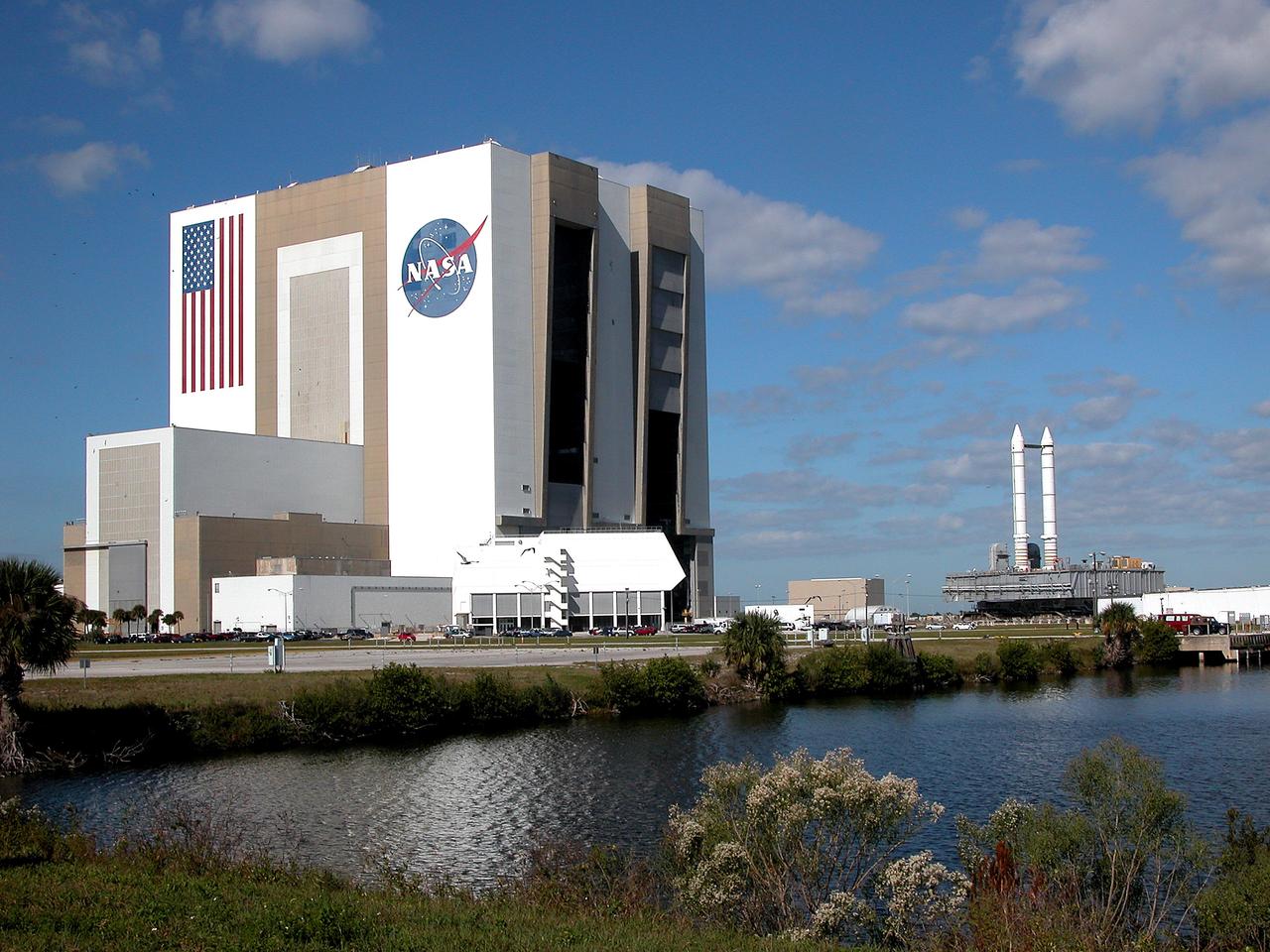
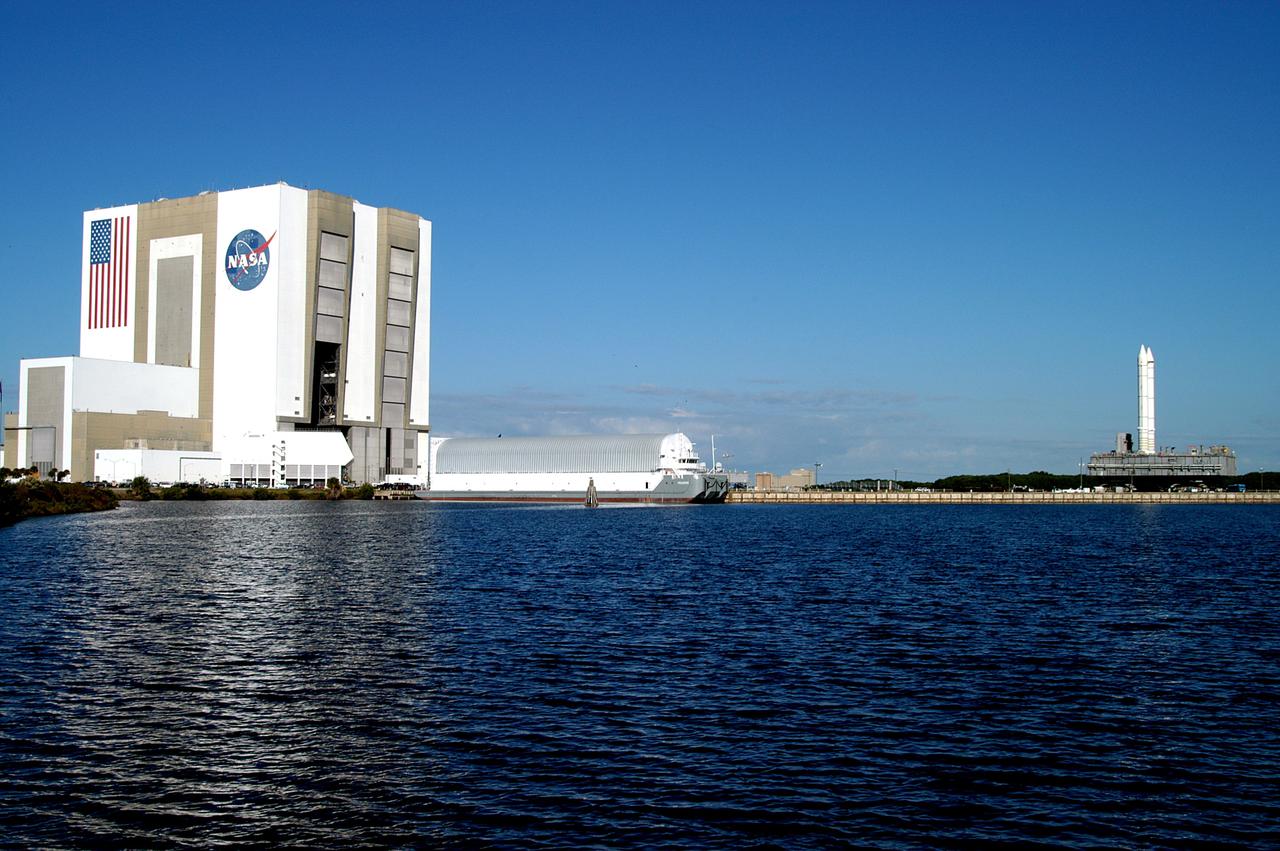
KENNEDY SPACE CENTER, FLA. - Seen across the water of the Launch Complex 39 turn basin, a crawler-transporter, carrying Mobile Launcher Platform (MLP) number 3 with a set of twin solid rocket boosters bolted atop, crawls out of the 525-foot-tall Vehicle Assembly Building during the second engineering analysis vibration test on the crawler and MLP.  The crawler is moving at various speeds up to 1 mph in an effort to achieve vibration data gathering goals as it leaves the VAB, travels toward Launch Pad 39A and then returns. The boosters are braced at the top for stability. The primary purpose of these rollout tests is to gather data to develop future maintenance requirements on the transport equipment and the flight hardware. Various parts of the MLP and crawler transporter have been instrumented with vibration data collection equipment.
KENNEDY SPACE CENTER, FLA. - Seen across the water of the Launch Complex 39 turn basin, a crawler-transporter, carrying Mobile Launcher Platform (MLP) number 3 with a set of twin solid rocket boosters bolted atop, crawls out of the 525-foot-tall Vehicle Assembly Building during the second engineering analysis vibration test on the crawler and MLP. The crawler is moving at various speeds up to 1 mph in an effort to achieve vibration data gathering goals as it leaves the VAB, travels toward Launch Pad 39A and then returns. The boosters are braced at the top for stability. The primary purpose of these rollout tests is to gather data to develop future maintenance requirements on the transport equipment and the flight hardware. Various parts of the MLP and crawler transporter have been instrumented with vibration data collection equipment.
KENNEDY SPACE CENTER, FLA. - A Kennedy Space Center technician walks towards the intersection of the crawlerway beside a crawler-transporter moving Mobile Launcher Platform (MLP) number 3, with a set of twin solid rocket boosters bolted atop, during the second engineering analysis vibration test on the crawler and MLP.  The crawler is moving at various speeds up to 1 mph in an effort to achieve vibration data gathering goals as it leaves the VAB, travels toward Launch Pad 39A, and then returns. The boosters are braced at the top for stability. The primary purpose of these rollout tests is to gather data to develop future maintenance requirements on the transport equipment and the flight hardware. Various parts of the MLP and crawler transporter have been instrumented with vibration data collection equipment.
KENNEDY SPACE CENTER, FLA. - A Kennedy Space Center technician walks towards the intersection of the crawlerway beside a crawler-transporter moving Mobile Launcher Platform (MLP) number 3, with a set of twin solid rocket boosters bolted atop, during the second engineering analysis vibration test on the crawler and MLP. The crawler is moving at various speeds up to 1 mph in an effort to achieve vibration data gathering goals as it leaves the VAB, travels toward Launch Pad 39A, and then returns. The boosters are braced at the top for stability. The primary purpose of these rollout tests is to gather data to develop future maintenance requirements on the transport equipment and the flight hardware. Various parts of the MLP and crawler transporter have been instrumented with vibration data collection equipment.
KENNEDY SPACE CENTER, FLA. -  The crawler transporter slowly moves the Mobile Launcher Platform (MLP), carrying a set of twin solid rocket boosters, away from the Vehicle Assembly Building (VAB) in support of engineering analysis vibration tests on the crawler and MLP.  On either side of the boosters on the horizon can be seen the two launch pads. The crawler is moving at various speeds up to 1 mph in an effort to achieve vibration data gathering goals as it leaves the VAB and then returns.  The boosters are braced at the top for stability.  The primary purpose of these rollout tests is to gather data to develop future maintenance requirements on the transport equipment and the flight hardware. Various parts of the MLP and crawler transporter have been instrumented with vibration data collection equipment.
KENNEDY SPACE CENTER, FLA. - The crawler transporter slowly moves the Mobile Launcher Platform (MLP), carrying a set of twin solid rocket boosters, away from the Vehicle Assembly Building (VAB) in support of engineering analysis vibration tests on the crawler and MLP. On either side of the boosters on the horizon can be seen the two launch pads. The crawler is moving at various speeds up to 1 mph in an effort to achieve vibration data gathering goals as it leaves the VAB and then returns. The boosters are braced at the top for stability. The primary purpose of these rollout tests is to gather data to develop future maintenance requirements on the transport equipment and the flight hardware. Various parts of the MLP and crawler transporter have been instrumented with vibration data collection equipment.
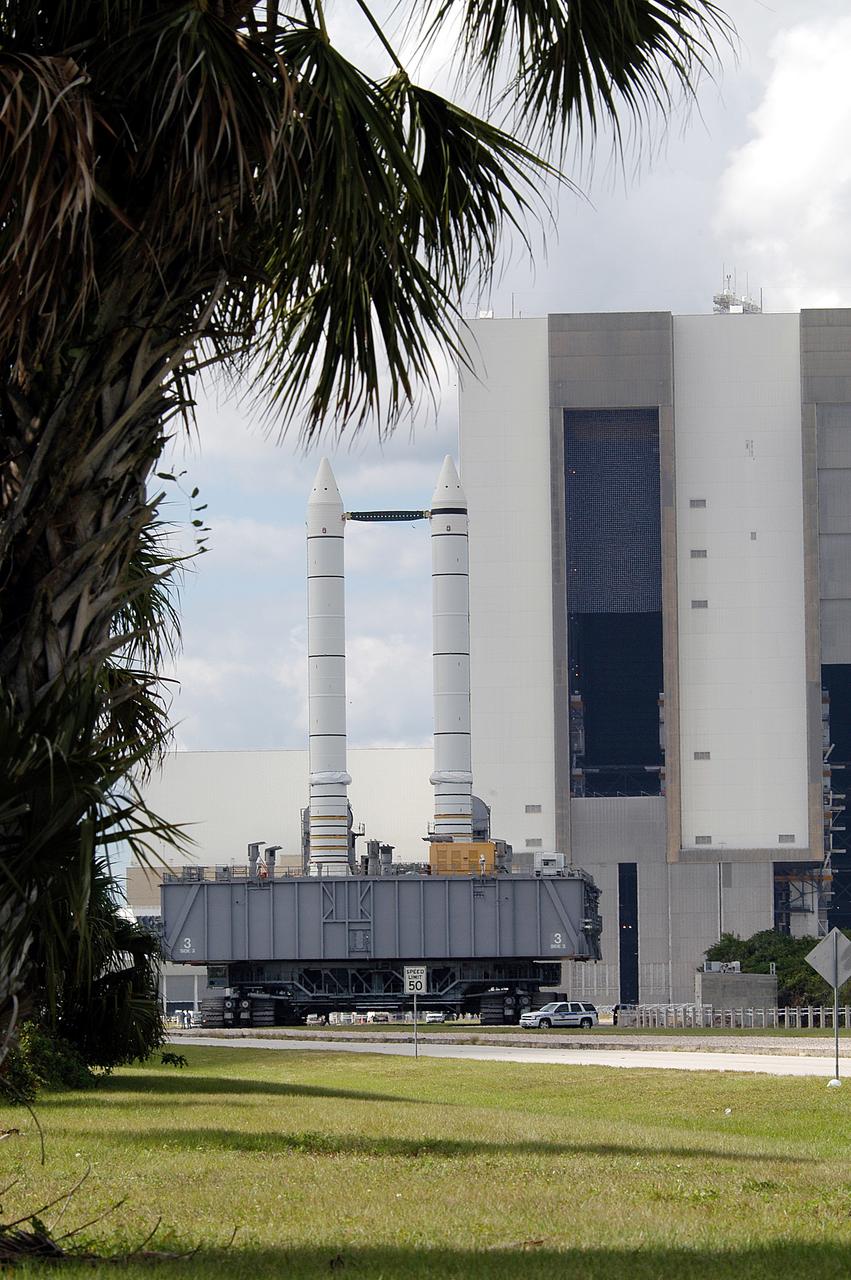
KENNEDY SPACE CENTER, FLA. - A crawler-transporter carrying Mobile Launcher Platform (MLP) number 3, with a set of twin solid rocket boosters bolted atop, crawls to the intersection in the crawlerway in support of the second engineering analysis vibration test on the crawler and MLP.  From this perspective, the Launch Control Center (left) and the 525-foot-tall Vehicle Assembly Building (right) in the background appear dwarfed by the 184-foot-tall boosters. The crawler is moving at various speeds up to 1 mph in an effort to achieve vibration data gathering goals as it leaves the VAB, travels toward Launch Pad 39A and then returns. The boosters are braced at the top for stability. The primary purpose of these rollout tests is to gather data to develop future maintenance requirements on the transport equipment and the flight hardware. Various parts of the MLP and crawler transporter have been instrumented with vibration data collection equipment.
KENNEDY SPACE CENTER, FLA. - A crawler-transporter carrying Mobile Launcher Platform (MLP) number 3, with a set of twin solid rocket boosters bolted atop, crawls to the intersection in the crawlerway in support of the second engineering analysis vibration test on the crawler and MLP. From this perspective, the Launch Control Center (left) and the 525-foot-tall Vehicle Assembly Building (right) in the background appear dwarfed by the 184-foot-tall boosters. The crawler is moving at various speeds up to 1 mph in an effort to achieve vibration data gathering goals as it leaves the VAB, travels toward Launch Pad 39A and then returns. The boosters are braced at the top for stability. The primary purpose of these rollout tests is to gather data to develop future maintenance requirements on the transport equipment and the flight hardware. Various parts of the MLP and crawler transporter have been instrumented with vibration data collection equipment.
KENNEDY SPACE CENTER, FLA. - Viewed across the turn basin in the Launch Complex 39 Area, the crawler transporter slowly moves the Mobile Launcher Platform (MLP), carrying a set of twin solid rocket boosters, away from the Vehicle Assembly Building (VAB).  The journey is in support of engineering analysis vibration tests on the crawler and MLP.  The water on the right of the crawlerway is the Banana River.  The crawler is moving at various speeds up to 1 mph in an effort to achieve vibration data gathering goals as it leaves the VAB and then returns.  The boosters are braced at the top for stability.  The primary purpose of these rollout tests is to gather data to develop future maintenance requirements on the transport equipment and the flight hardware. Various parts of the MLP and crawler transporter have been instrumented with vibration data collection equipment.
KENNEDY SPACE CENTER, FLA. - Viewed across the turn basin in the Launch Complex 39 Area, the crawler transporter slowly moves the Mobile Launcher Platform (MLP), carrying a set of twin solid rocket boosters, away from the Vehicle Assembly Building (VAB). The journey is in support of engineering analysis vibration tests on the crawler and MLP. The water on the right of the crawlerway is the Banana River. The crawler is moving at various speeds up to 1 mph in an effort to achieve vibration data gathering goals as it leaves the VAB and then returns. The boosters are braced at the top for stability. The primary purpose of these rollout tests is to gather data to develop future maintenance requirements on the transport equipment and the flight hardware. Various parts of the MLP and crawler transporter have been instrumented with vibration data collection equipment.
KENNEDY SPACE CENTER, FLA. -  Mobile Launcher Platform (MLP) number 3 and a set of twin solid rocket boosters, atop the crawler-transporter, inch away from the Vehicle Assembly Building (VAB) in support of the second engineering analysis vibration test on the crawler and MLP. The crawler is moving at various speeds up to 1 mph in an effort to achieve vibration data gathering goals as it leaves the VAB, travels toward Launch Pad 39A and then returns.  The boosters are braced at the top for stability.  The primary purpose of these rollout tests is to gather data to develop future maintenance requirements on the transport equipment and the flight hardware. Various parts of the MLP and crawler transporter have been instrumented with vibration data collection equipment.
KENNEDY SPACE CENTER, FLA. - Mobile Launcher Platform (MLP) number 3 and a set of twin solid rocket boosters, atop the crawler-transporter, inch away from the Vehicle Assembly Building (VAB) in support of the second engineering analysis vibration test on the crawler and MLP. The crawler is moving at various speeds up to 1 mph in an effort to achieve vibration data gathering goals as it leaves the VAB, travels toward Launch Pad 39A and then returns. The boosters are braced at the top for stability. The primary purpose of these rollout tests is to gather data to develop future maintenance requirements on the transport equipment and the flight hardware. Various parts of the MLP and crawler transporter have been instrumented with vibration data collection equipment.
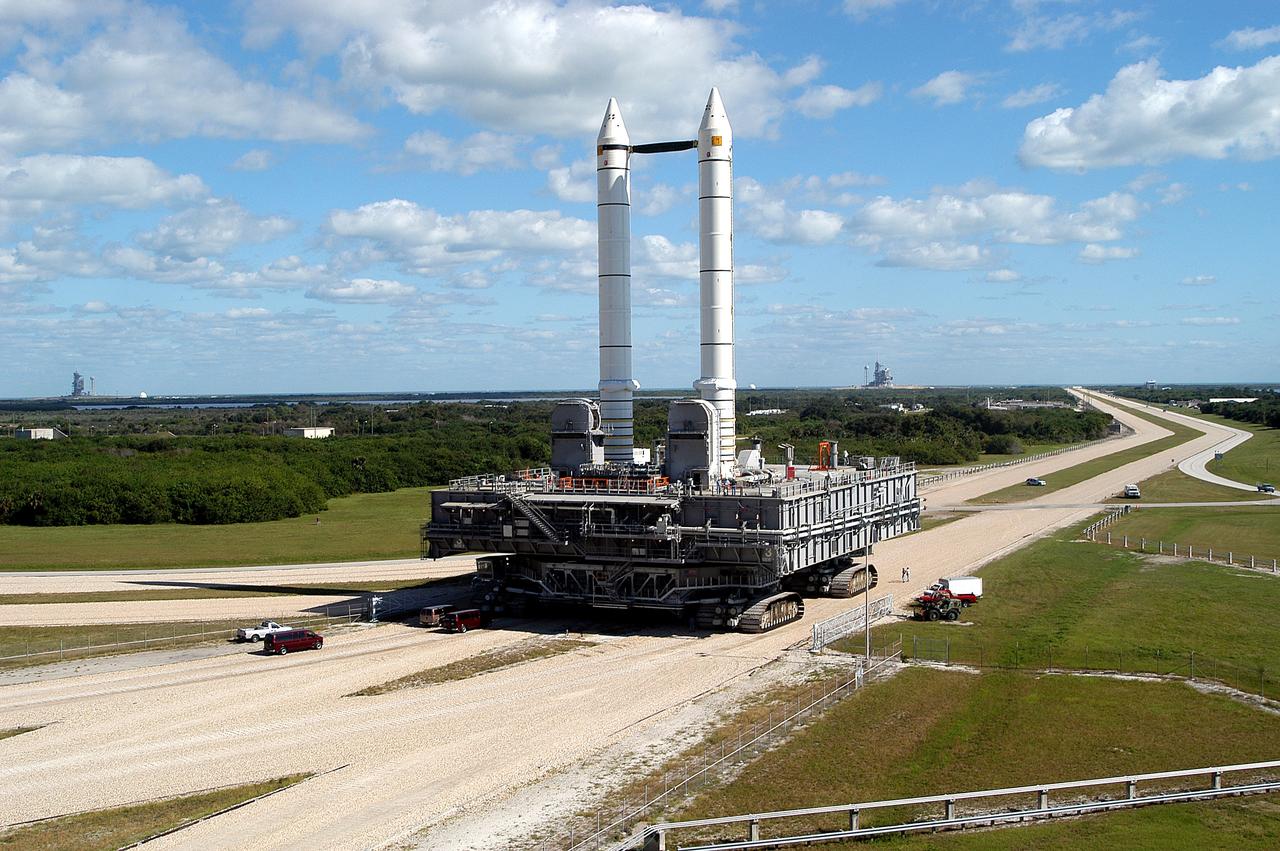
KENNEDY SPACE CENTER, FLA. -  Mobile Launcher Platform (MLP) number 3 and a set of twin solid rocket boosters, atop the crawler-transporter, inch along the crawlerway in support of the second engineering analysis vibration test on the crawler and MLP. The crawler is moving at various speeds up to 1 mph in an effort to achieve vibration data gathering goals as it leaves the VAB, travels toward Launch Pad 39A (on the horizon at right; Pad 39B is at far left), and then returns.  The boosters are braced at the top for stability.  The primary purpose of these rollout tests is to gather data to develop future maintenance requirements on the transport equipment and the flight hardware. Various parts of the MLP and crawler transporter have been instrumented with vibration data collection equipment.
KENNEDY SPACE CENTER, FLA. - Mobile Launcher Platform (MLP) number 3 and a set of twin solid rocket boosters, atop the crawler-transporter, inch along the crawlerway in support of the second engineering analysis vibration test on the crawler and MLP. The crawler is moving at various speeds up to 1 mph in an effort to achieve vibration data gathering goals as it leaves the VAB, travels toward Launch Pad 39A (on the horizon at right; Pad 39B is at far left), and then returns. The boosters are braced at the top for stability. The primary purpose of these rollout tests is to gather data to develop future maintenance requirements on the transport equipment and the flight hardware. Various parts of the MLP and crawler transporter have been instrumented with vibration data collection equipment.
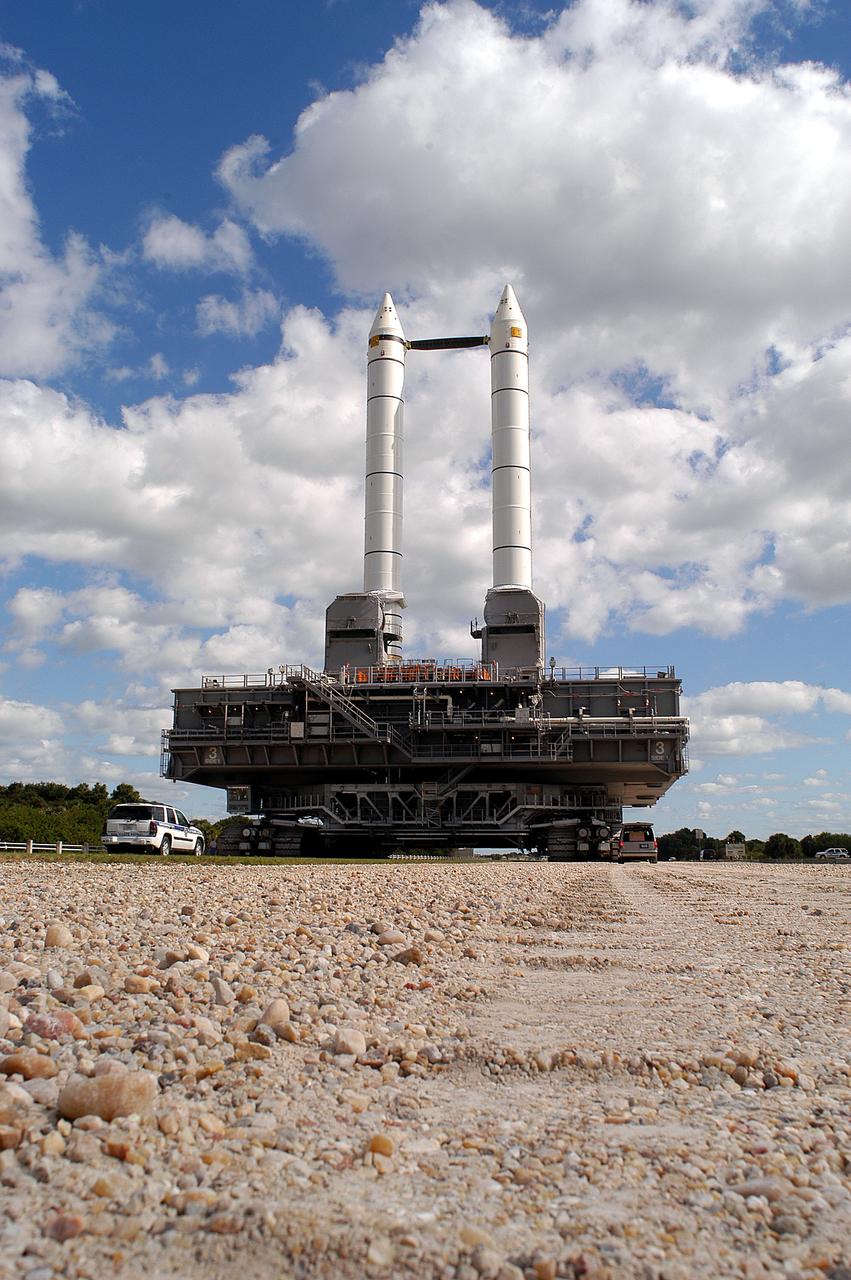
KENNEDY SPACE CENTER, FLA. -  Mobile Launcher Platform (MLP) number 3 and a set of twin solid rocket boosters, atop the crawler-transporter, inch along the crawlerway in support of the second engineering analysis vibration test on the crawler and MLP. The view reveals the river gravel surface that is 4 inches thick on the straightaway sections and 8 inches thick on curves. The crawler is moving at various speeds up to 1 mph in an effort to achieve vibration data gathering goals as it leaves the VAB, travels toward Launch Pad 39A and then returns.  The boosters are braced at the top for stability.  The primary purpose of these rollout tests is to gather data to develop future maintenance requirements on the transport equipment and the flight hardware. Various parts of the MLP and crawler transporter have been instrumented with vibration data collection equipment.
KENNEDY SPACE CENTER, FLA. - Mobile Launcher Platform (MLP) number 3 and a set of twin solid rocket boosters, atop the crawler-transporter, inch along the crawlerway in support of the second engineering analysis vibration test on the crawler and MLP. The view reveals the river gravel surface that is 4 inches thick on the straightaway sections and 8 inches thick on curves. The crawler is moving at various speeds up to 1 mph in an effort to achieve vibration data gathering goals as it leaves the VAB, travels toward Launch Pad 39A and then returns. The boosters are braced at the top for stability. The primary purpose of these rollout tests is to gather data to develop future maintenance requirements on the transport equipment and the flight hardware. Various parts of the MLP and crawler transporter have been instrumented with vibration data collection equipment.
KENNEDY SPACE CENTER, FLA. - The crawler-transporter carrying Mobile Launcher Platform (MLP) number 3, with a set of twin solid rocket boosters bolted atop, crawls to the intersection in the crawlerway in support of the second engineering analysis vibration test on the crawler and MLP.  From this perspective, the Launch Control Center (left) and the 525-foot-tall Vehicle Assembly Building (right) in the background appear dwarfed by the 184-foot-tall boosters. The crawler is moving at various speeds up to 1 mph in an effort to achieve vibration data gathering goals as it leaves the VAB, travels toward Launch Pad 39A and then returns. The boosters are braced at the top for stability. The primary purpose of these rollout tests is to gather data to develop future maintenance requirements on the transport equipment and the flight hardware. Various parts of the MLP and crawler transporter have been instrumented with vibration data collection equipment.
KENNEDY SPACE CENTER, FLA. - The crawler-transporter carrying Mobile Launcher Platform (MLP) number 3, with a set of twin solid rocket boosters bolted atop, crawls to the intersection in the crawlerway in support of the second engineering analysis vibration test on the crawler and MLP. From this perspective, the Launch Control Center (left) and the 525-foot-tall Vehicle Assembly Building (right) in the background appear dwarfed by the 184-foot-tall boosters. The crawler is moving at various speeds up to 1 mph in an effort to achieve vibration data gathering goals as it leaves the VAB, travels toward Launch Pad 39A and then returns. The boosters are braced at the top for stability. The primary purpose of these rollout tests is to gather data to develop future maintenance requirements on the transport equipment and the flight hardware. Various parts of the MLP and crawler transporter have been instrumented with vibration data collection equipment.
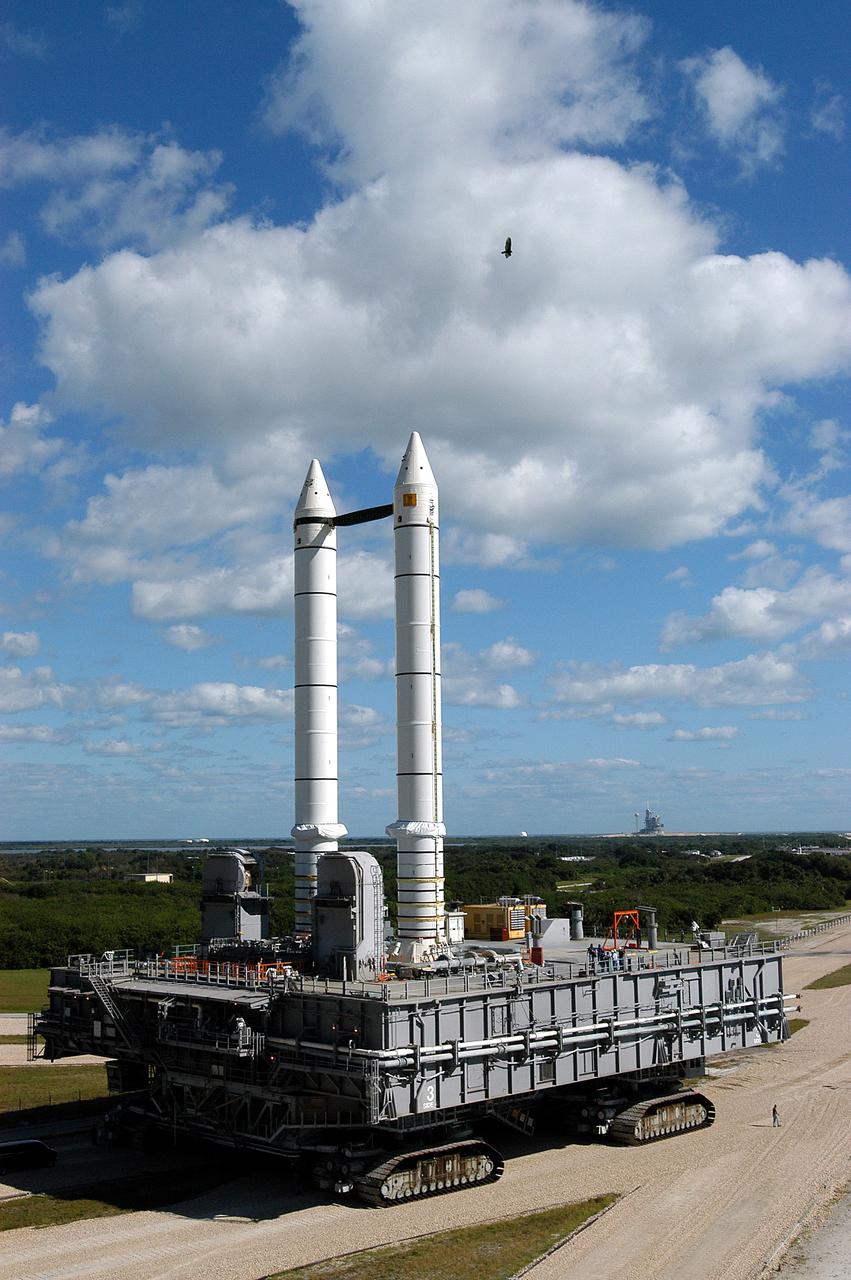
KENNEDY SPACE CENTER, FLA. -  A high-flying bird takes a closer look at the Mobile Launcher Platform (MLP) number 3 with twin solid rocket boosters bolted to it as it crawls toward Launch Pad 39A, in the background.  The crawler is moving along the crawlerway at various speeds up to 1 mph in an effort to achieve vibration data gathering goals as it travels toward Launch Pad 39A and then returns.  The boosters are braced at the top for stability.  The primary purpose of these rollout tests is to gather data to develop future maintenance requirements on the transport equipment and the flight hardware. Various parts of the MLP and crawler transporter have been instrumented with vibration data collection equipment.
KENNEDY SPACE CENTER, FLA. - A high-flying bird takes a closer look at the Mobile Launcher Platform (MLP) number 3 with twin solid rocket boosters bolted to it as it crawls toward Launch Pad 39A, in the background. The crawler is moving along the crawlerway at various speeds up to 1 mph in an effort to achieve vibration data gathering goals as it travels toward Launch Pad 39A and then returns. The boosters are braced at the top for stability. The primary purpose of these rollout tests is to gather data to develop future maintenance requirements on the transport equipment and the flight hardware. Various parts of the MLP and crawler transporter have been instrumented with vibration data collection equipment.
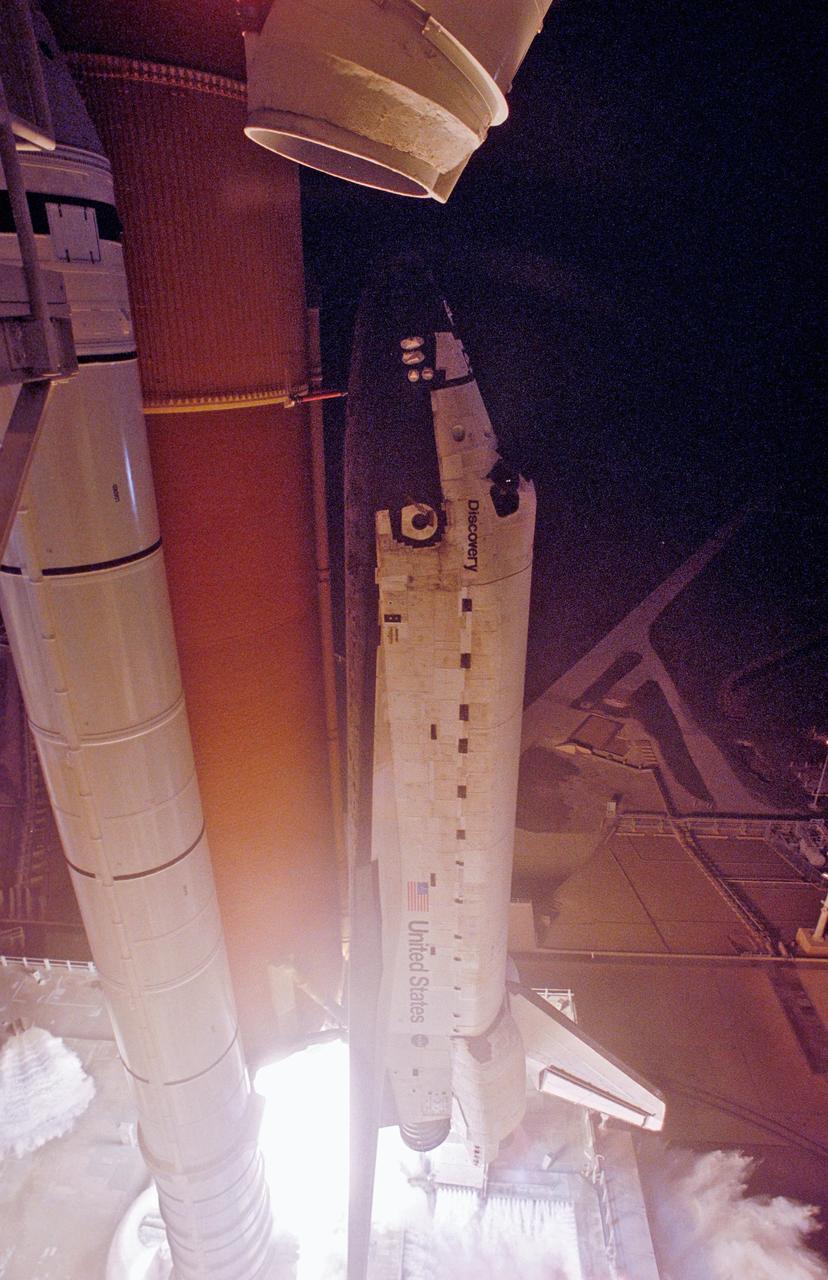
KENNEDY SPACE CENTER, FLA. --  This closeup view shows the water flooding the mobile launcher platform below Space Shuttle Discovery as it lifts off Launch Pad 39B on mission STS-116. Discovery lifted off from KSC's Launch Pad 39B at 8:47 p.m. EST on mission STS-116.  This was the second launch attempt for mission STS-116.  The first launch attempt on Dec. 7 was postponed due a low cloud ceiling over Kennedy Space Center. This is Discovery's 33rd mission and the first night launch since 2002.   The 20th shuttle mission to the International Space Station, STS-116 carries another truss segment, P5. It will serve as a spacer, mated to the P4 truss that was attached in September.  After installing the P5, the crew will reconfigure and redistribute the power generated by two pairs of U.S. solar arrays. Landing is expected Dec. 21 at KSC.
KSC-06pp2771
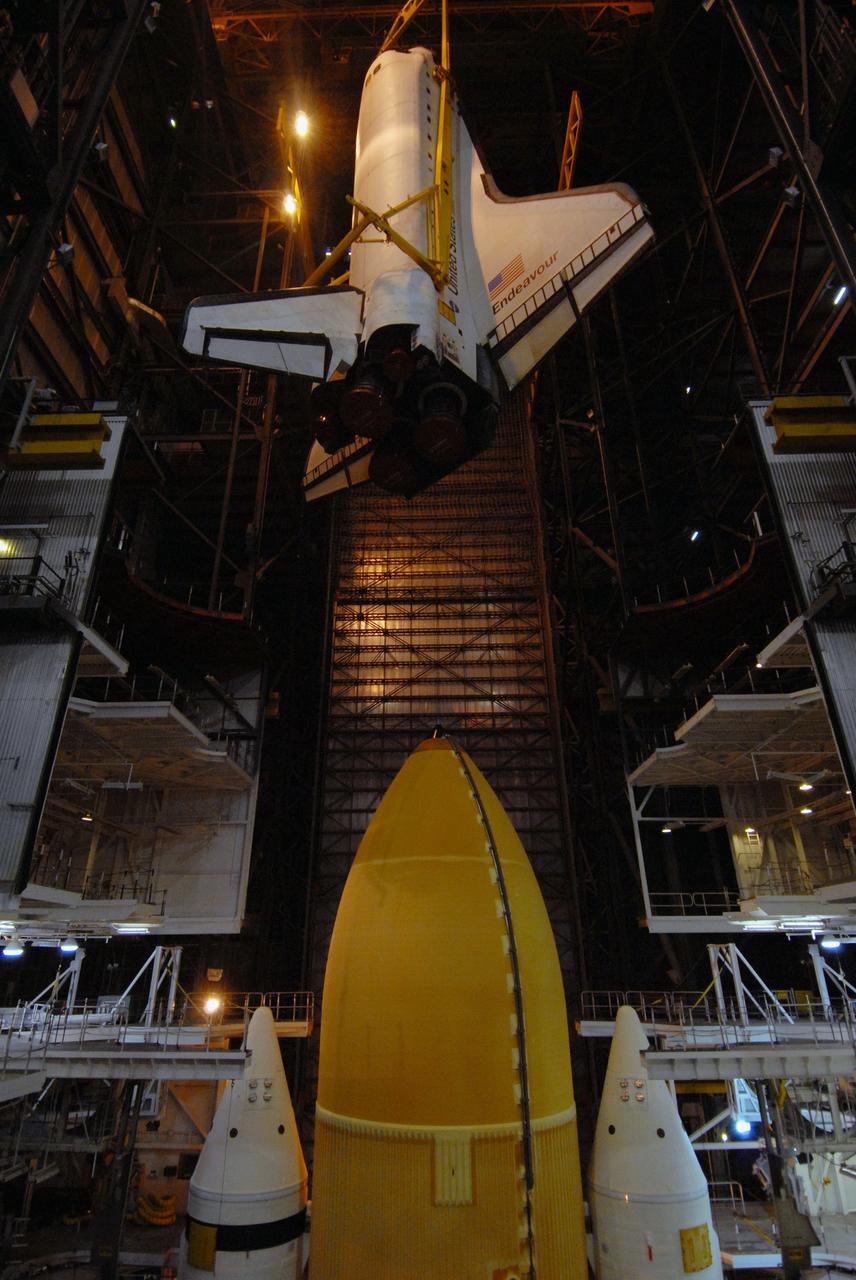
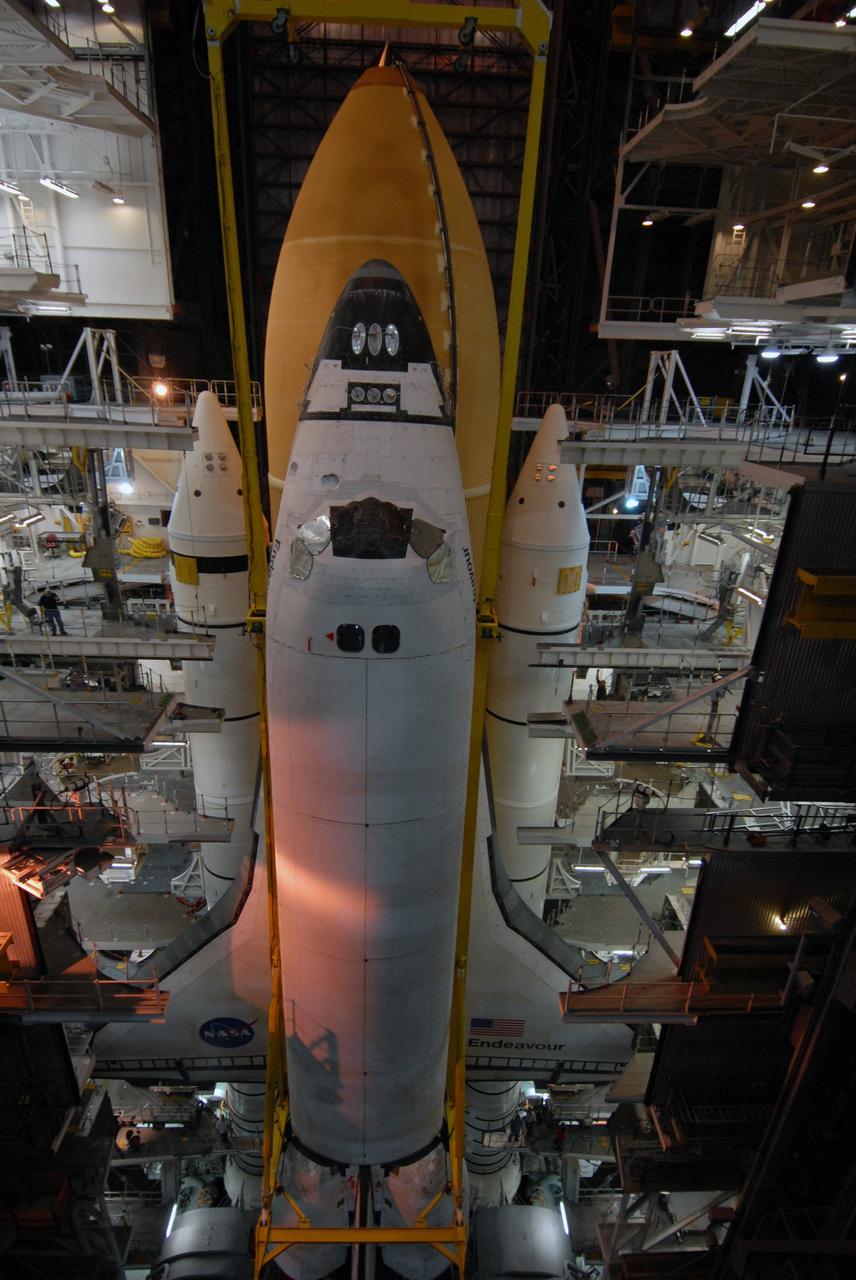
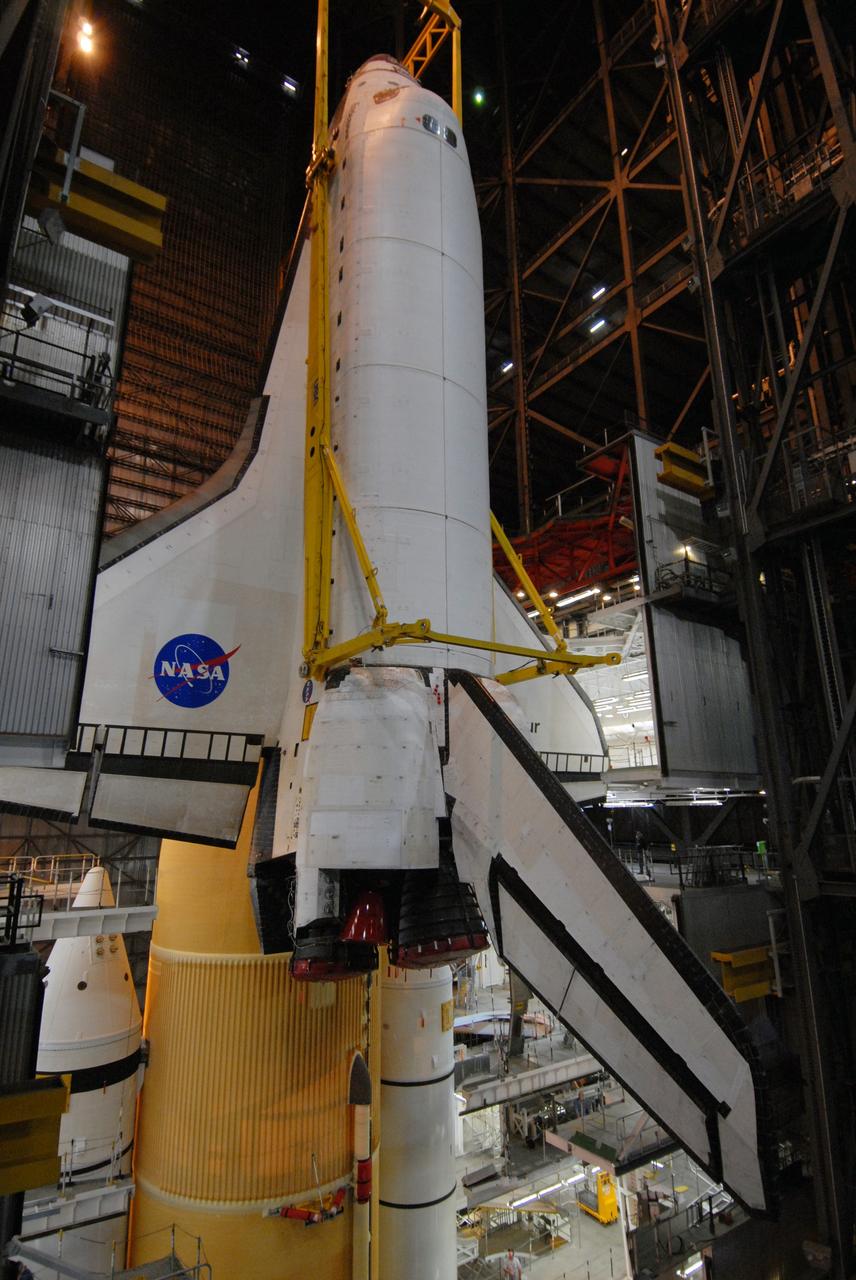
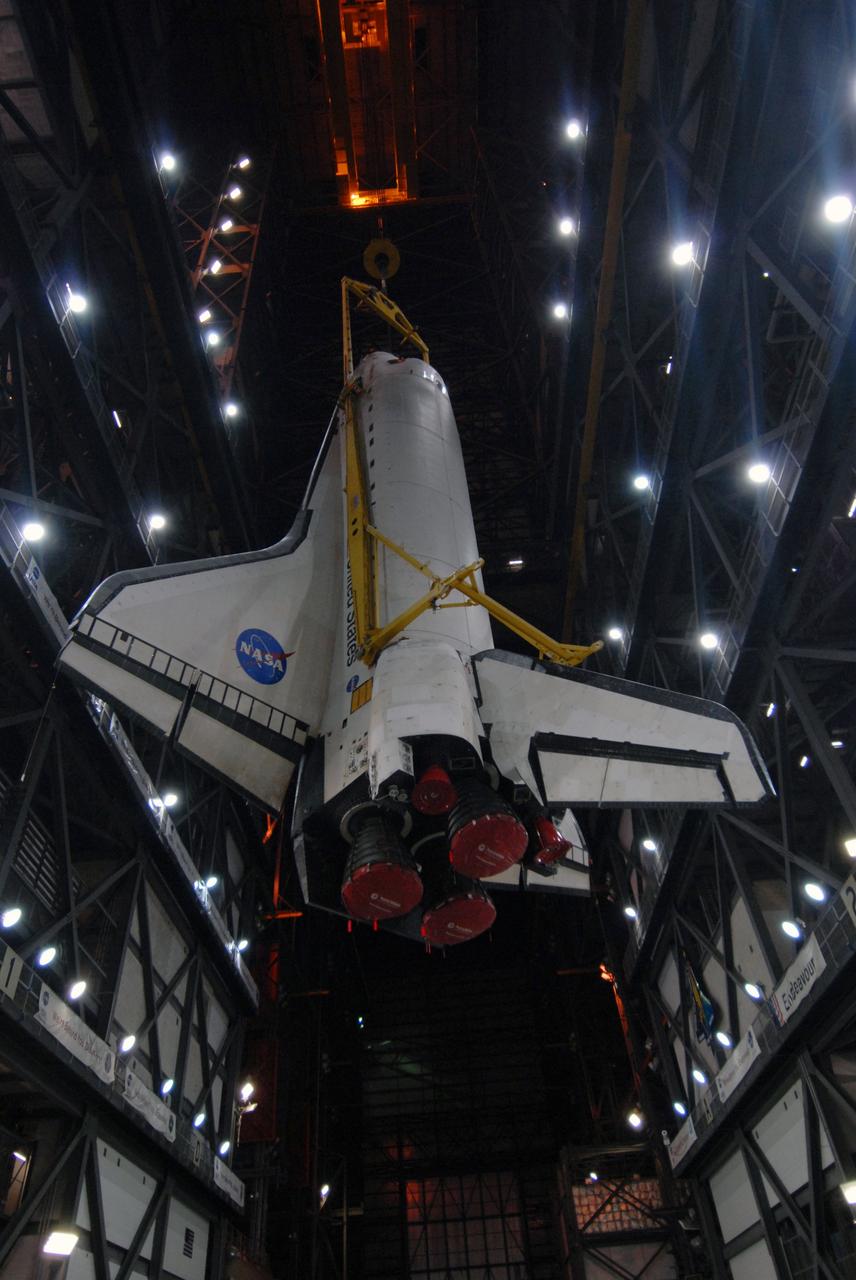
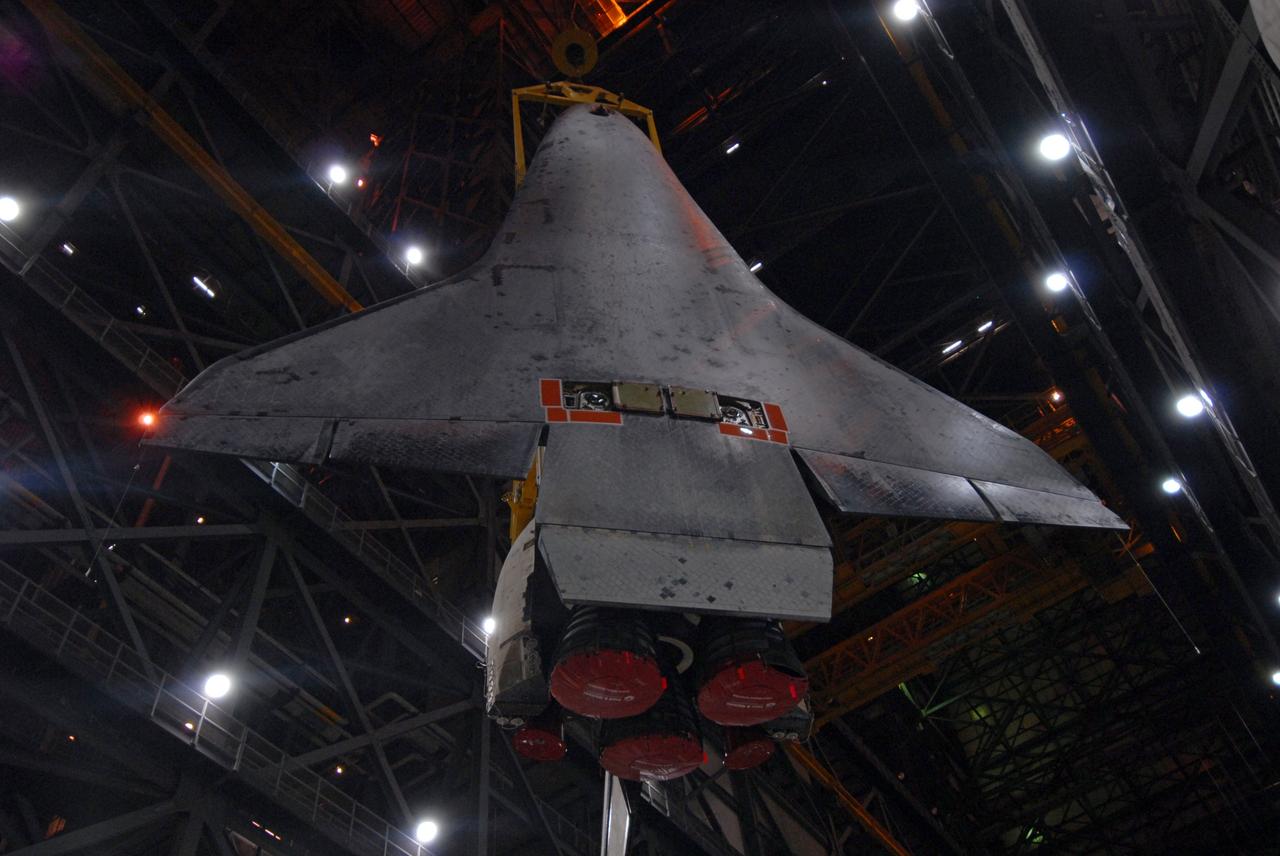
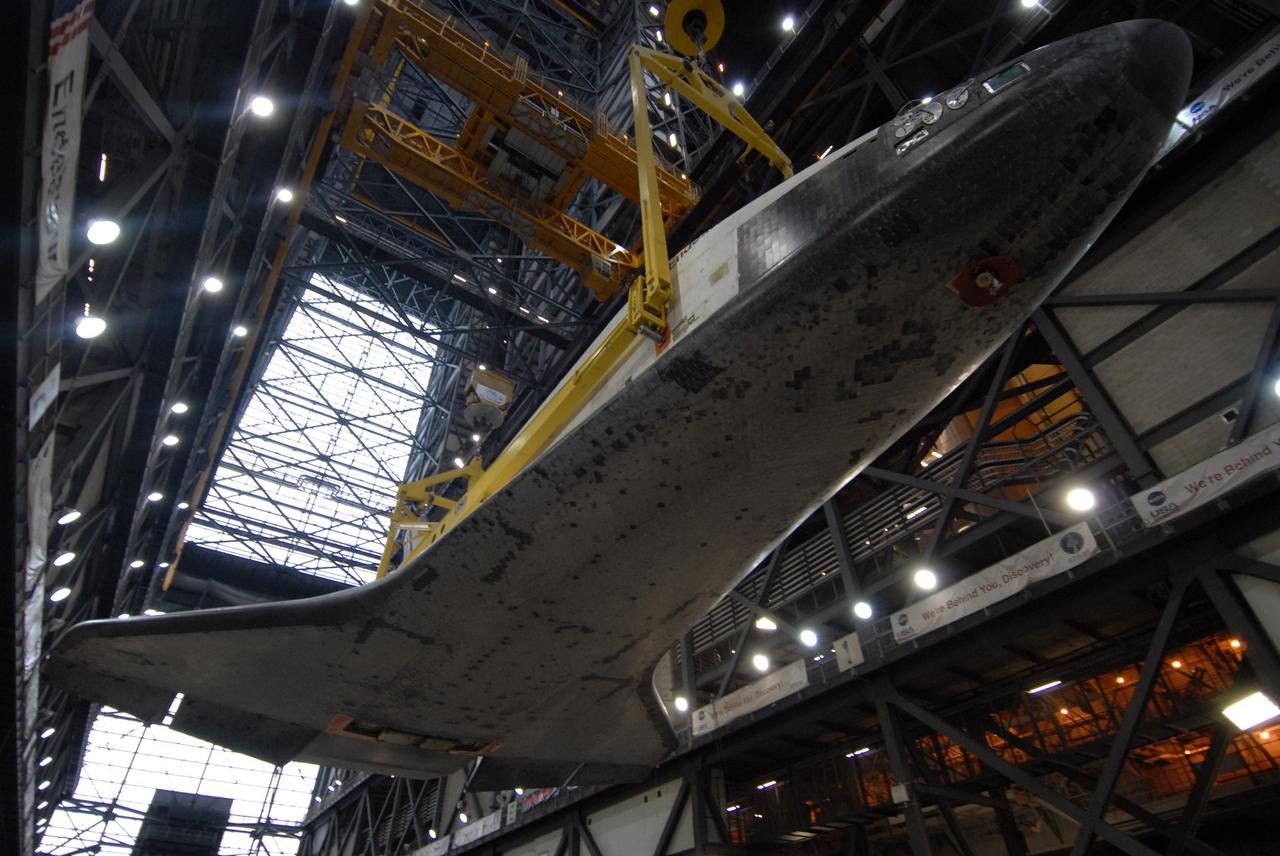
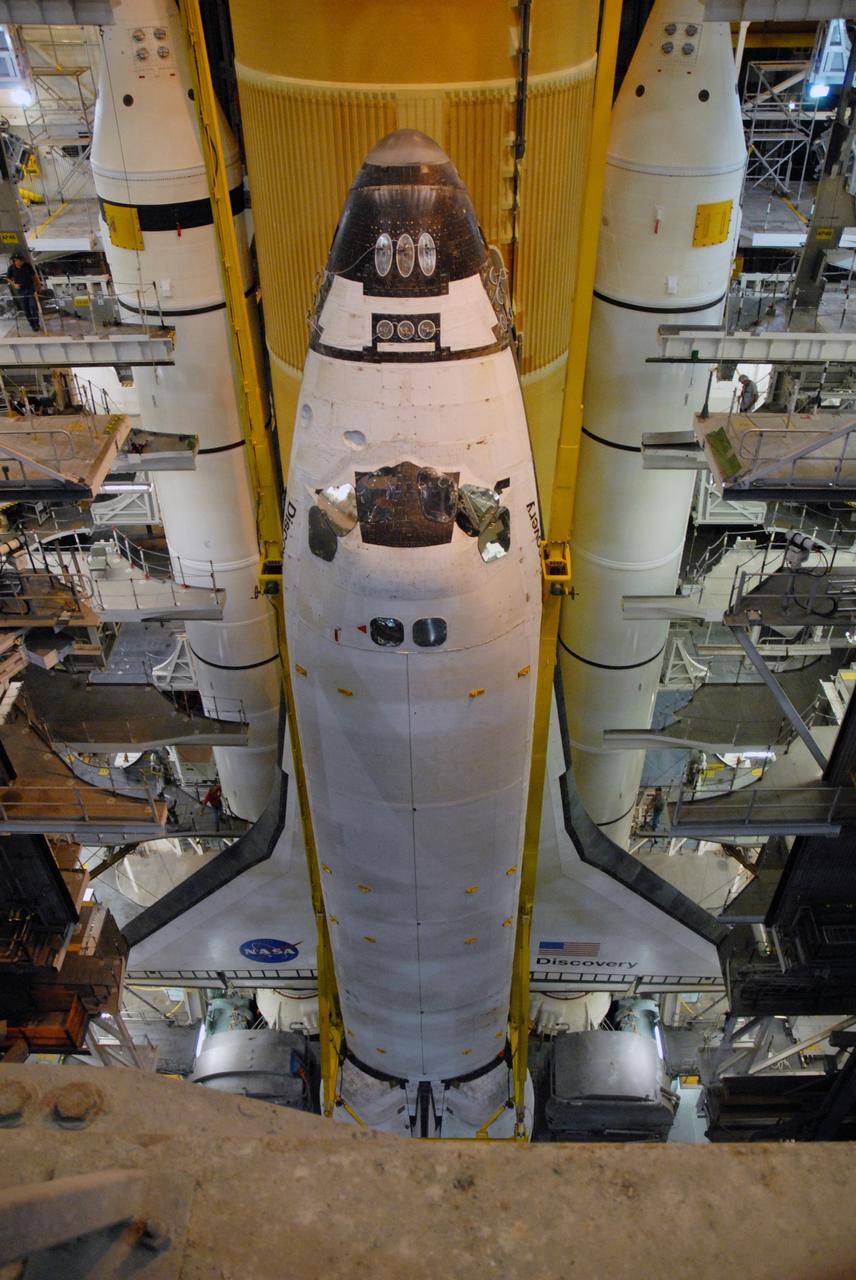
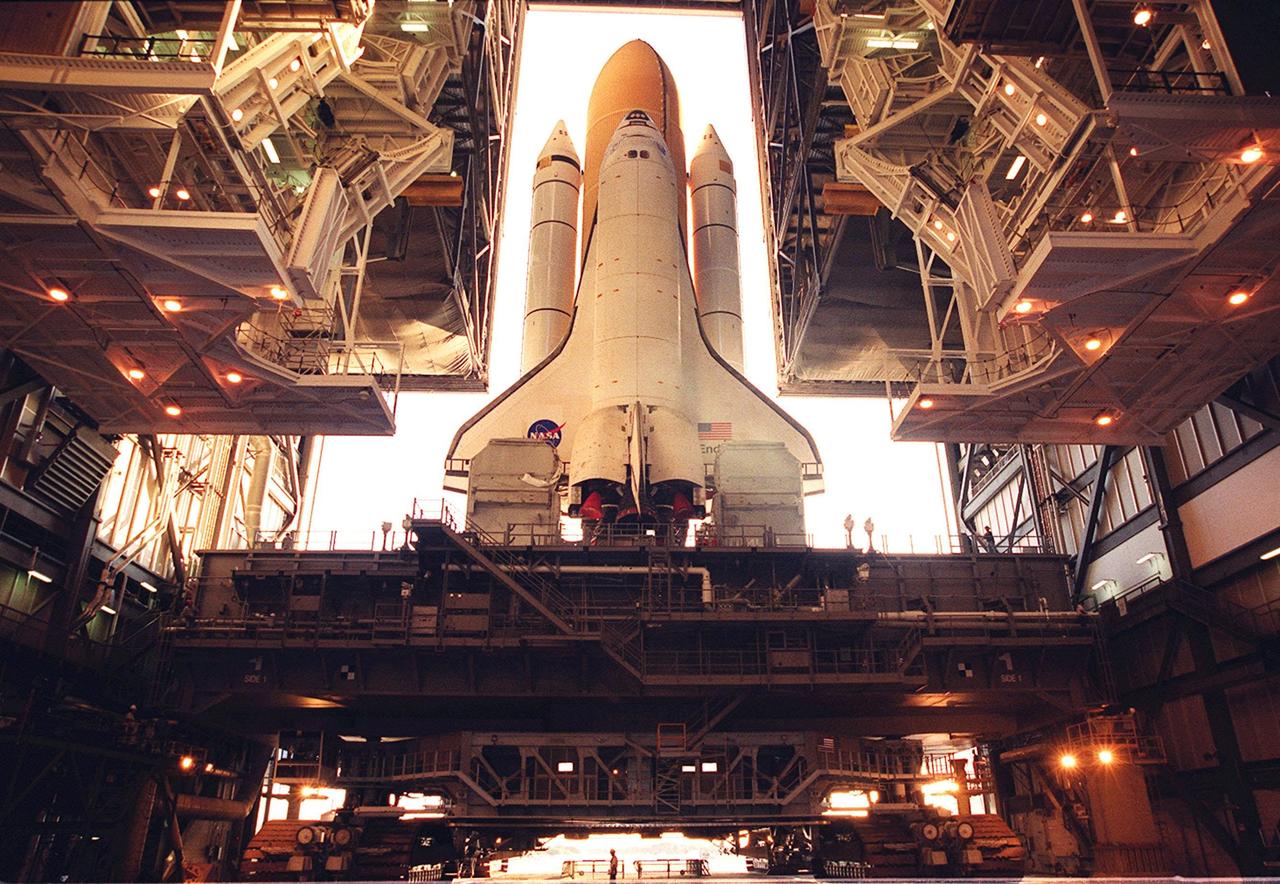
CAPE CANAVERAL, Fla. – In the Vehicle Assembly Building at NASA's Kennedy Space Center in Florida space shuttle Endeavour is lifted into the upper levels for transfer to High Bay 1.  The shuttle then will be lowered onto the mobile launcher platform and attached to the external fuel tank and solid rocket boosters already installed there.  Endeavour is scheduled to roll out to Launch Pad 39B on April 17. Endeavour will be prepared on the pad for liftoff in the unlikely event that a rescue mission is necessary following space shuttle Atlantis' launch on the STS-125 mission to service the Hubble Space Telescope. After Atlantis is cleared to land, Endeavour will move to Launch Pad 39A for its upcoming STS-127 mission to the International Space Station, targeted to launch in mid-June. Photo credit: NASA/Troy Cryder
KSC-2009-2618
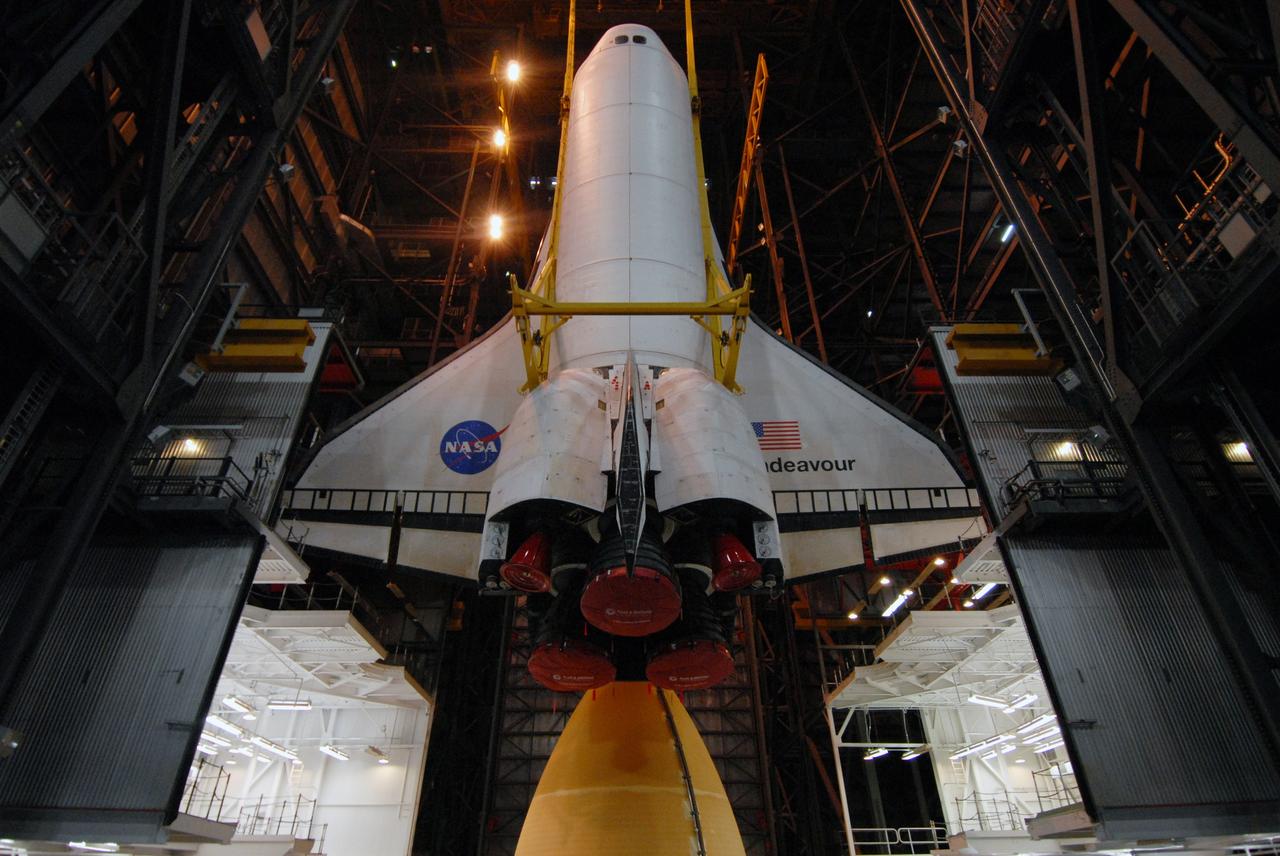
CAPE CANAVERAL, Fla. – In the Vehicle Assembly Building at NASA's Kennedy Space Center in Florida, space shuttle Endeavour is lowered into High Bay 1 toward the mobile launcher platform for attachment to the external tank and solid rocket boosters already installed on the platform.  Endeavour is scheduled to roll out to Launch Pad 39B on April 17. Endeavour will be prepared on the pad for liftoff in the unlikely event that a rescue mission is necessary following space shuttle Atlantis' launch on the STS-125 mission to service the Hubble Space Telescope. After Atlantis is cleared to land, Endeavour will move to Launch Pad 39A for its upcoming STS-127 mission to the International Space Station, targeted to launch in mid-June.  Photo credit: NASA/Troy Cryder
KSC-2009-2623
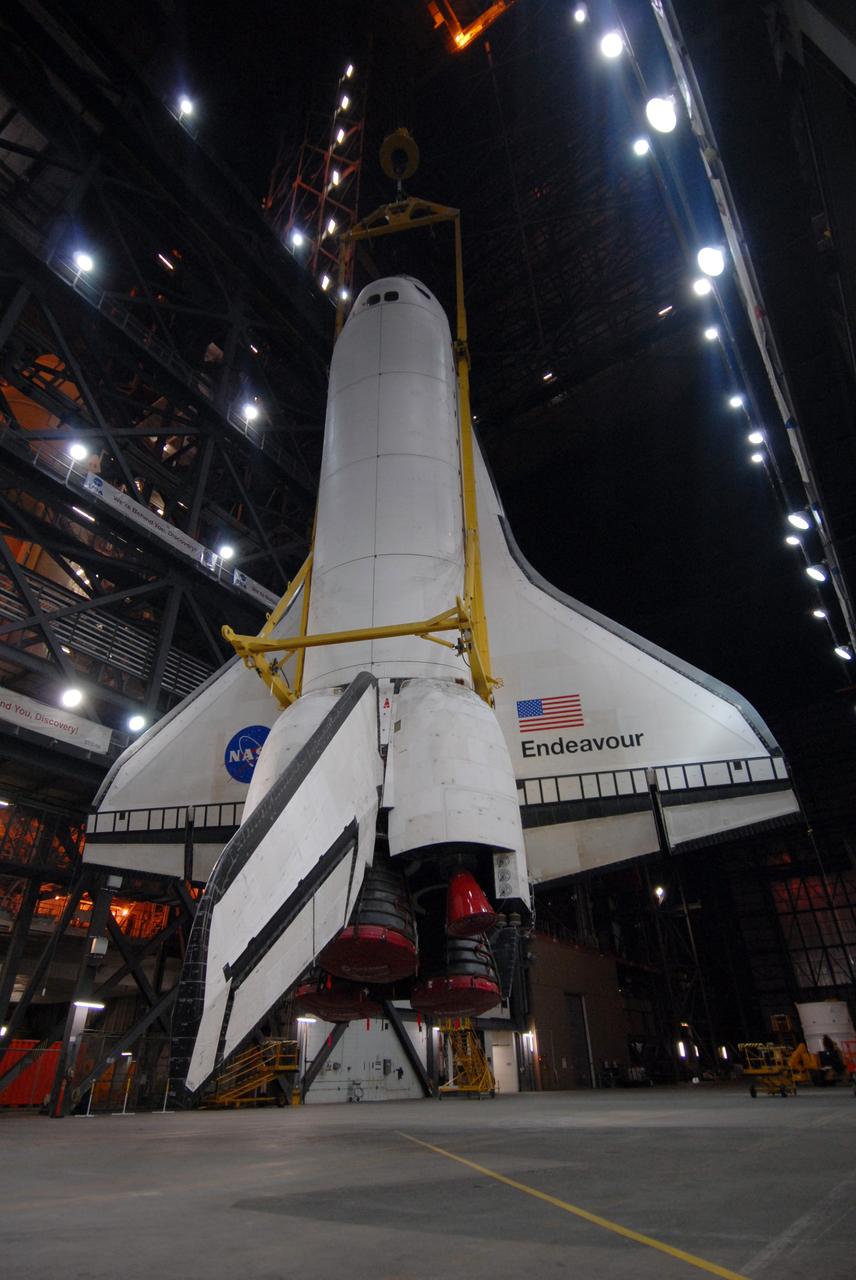
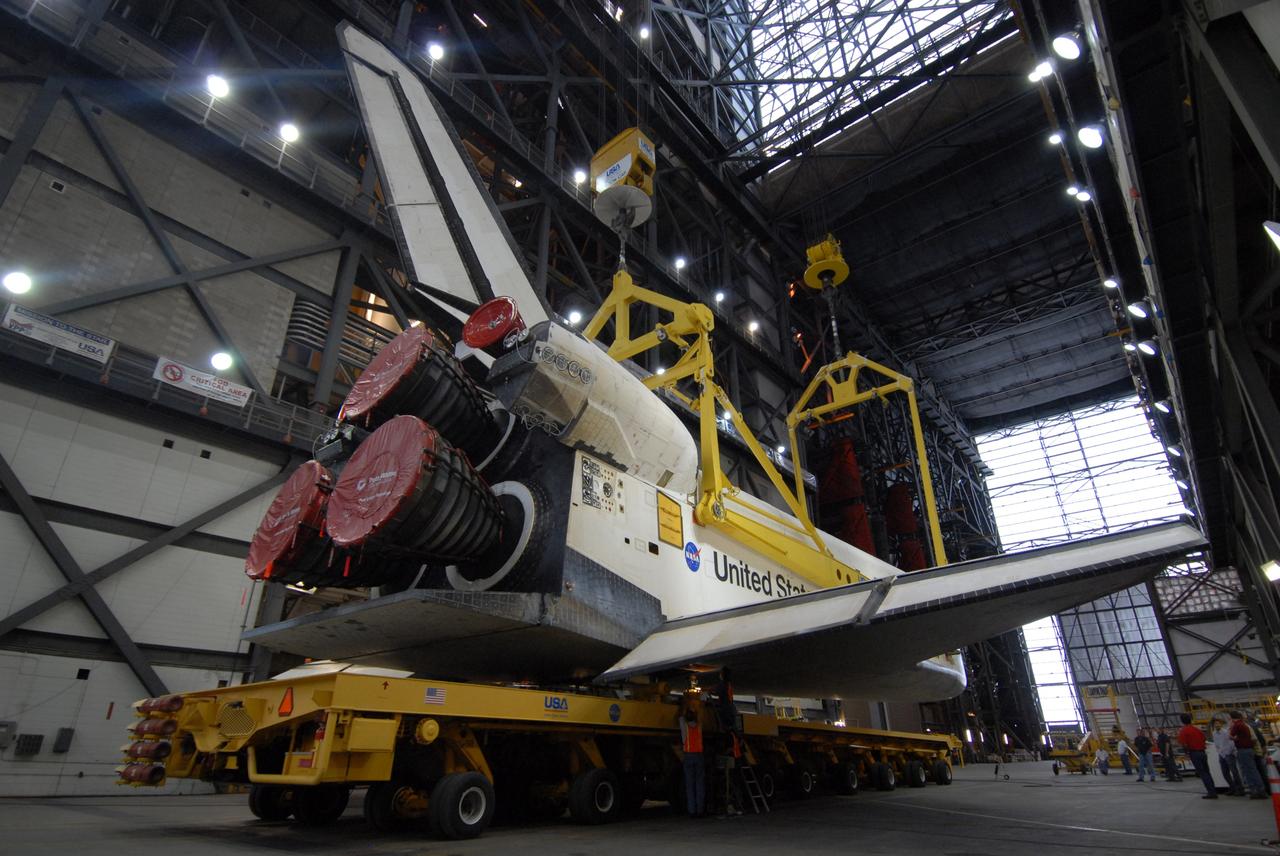
CAPE CANAVERAL, Fla. – In the transfer aisle of the Vehicle Assembly Building at NASA's Kennedy Space Center in Florida, cranes raise space shuttle Endeavour to vertical.  Endeavour then will be lifted into High Bay 1 and attached to the external fuel tank and solid rocket boosters already installed on the mobile launcher platform.  Endeavour is scheduled to roll out to Launch Pad 39B on April 17. Endeavour will be prepared on the pad for liftoff in the unlikely event that a rescue mission is necessary following space shuttle Atlantis' launch on the STS-125 mission to service the Hubble Space Telescope. After Atlantis is cleared to land, Endeavour will move to Launch Pad 39A for its upcoming STS-127 mission to the International Space Station, targeted to launch in mid-June.  Photo credit: NASA/Troy Cryder
KSC-2009-2616
CAPE CANAVERAL, Fla. – In the Vehicle Assembly Building at NASA's Kennedy Space Center in Florida, space shuttle Endeavour is lowered into High Bay 1 toward the external tank and solid rocket boosters already installed on the mobile launcher platform.   Endeavour is scheduled to roll out to Launch Pad 39B on April 17. Endeavour will be prepared on the pad for liftoff in the unlikely event that a rescue mission is necessary following space shuttle Atlantis' launch on the STS-125 mission to service the Hubble Space Telescope. After Atlantis is cleared to land, Endeavour will move to Launch Pad 39A for its upcoming STS-127 mission to the International Space Station, targeted to launch in mid-June.  Photo credit: NASA/Troy Cryder
KSC-2009-2620
CAPE CANAVERAL, Fla. – In the Vehicle Assembly Building at NASA's Kennedy Space Center in Florida, space shuttle Endeavour is lowered into High Bay 1 toward the mobile launcher platform for attachment to the external tank and solid rocket boosters already installed on the platform. Endeavour is scheduled to roll out to Launch Pad 39B on April 17. Endeavour will be prepared on the pad for liftoff in the unlikely event that a rescue mission is necessary following space shuttle Atlantis' launch on the STS-125 mission to service the Hubble Space Telescope. After Atlantis is cleared to land, Endeavour will move to Launch Pad 39A for its upcoming STS-127 mission to the International Space Station, targeted to launch in mid-June.  Photo credit: NASA/Troy Cryder
KSC-2009-2622
CAPE CANAVERAL, Fla. – In the transfer aisle of the Vehicle Assembly Building at NASA's Kennedy Space Center in Florida, cranes lift space shuttle Endeavour in order to raise it to vertical.  Once vertical, the shuttle will be lifted into High Bay 1, then lowered and attached to the external fuel tank and solid rocket boosters already installed on the mobile launcher platform.  Endeavour is scheduled to roll out to Launch Pad 39B on April 17. Endeavour will be prepared on the pad for liftoff in the unlikely event that a rescue mission is necessary following space shuttle Atlantis' launch on the STS-125 mission to service the Hubble Space Telescope. After Atlantis is cleared to land, Endeavour will move to Launch Pad 39A for its upcoming STS-127 mission to the International Space Station, targeted to launch in mid-June. Photo credit: NASA/Troy Cryder
KSC-2009-2615
CAPE CANAVERAL, Fla. – Viewed from below, space shuttle Endeavour is lifted in the upper levels of the Vehicle Assembly Building at NASA's Kennedy Space Center in Florida for transfer to High Bay 1. The shuttle then will be lowered onto the mobile launcher platform and attached to the external fuel tank and solid rocket boosters already installed there.  Endeavour is scheduled to roll out to Launch Pad 39B on April 17. Endeavour will be prepared on the pad for liftoff in the unlikely event that a rescue mission is necessary following space shuttle Atlantis' launch on the STS-125 mission to service the Hubble Space Telescope. After Atlantis is cleared to land, Endeavour will move to Launch Pad 39A for its upcoming STS-127 mission to the International Space Station, targeted to launch in mid-June.  Photo credit: NASA/Troy Cryder
KSC-2009-2619
CAPE CANAVERAL, Fla. – In the transfer aisle of the Vehicle Assembly Building at NASA's Kennedy Space Center in Florida, cranes are fitted onto space shuttle Endeavour to be lifted into High Bay 1.  In the high bay, the shuttle will be attached to the external fuel tank and solid rocket boosters already installed on the mobile launcher platform. Endeavour is scheduled to roll out to Launch Pad 39B on April 17. Endeavour will be prepared on the pad for liftoff in the unlikely event that a rescue mission is necessary following space shuttle Atlantis' launch on the STS-125 mission to service the Hubble Space Telescope. After Atlantis is cleared to land, Endeavour will move to Launch Pad 39A for its upcoming STS-127 mission to the International Space Station, targeted to launch in mid-June. Photo credit: NASA/Troy Cryder
KSC-2009-2614
CAPE CANAVERAL, Fla. – Space shuttle Endeavour is suspended above the transfer aisle of the Vehicle Assembly Building at NASA's Kennedy Space Center in Florida.  In this position, it is ready to be lifted into High Bay 1 and attached to the external fuel tank and solid rocket boosters already installed on the mobile launcher platform.  Endeavour is scheduled to roll out to Launch Pad 39B on April 17. Endeavour will be prepared on the pad for liftoff in the unlikely event that a rescue mission is necessary following space shuttle Atlantis' launch on the STS-125 mission to service the Hubble Space Telescope. After Atlantis is cleared to land, Endeavour will move to Launch Pad 39A for its upcoming STS-127 mission to the International Space Station, targeted to launch in mid-June. Photo credit: NASA/Troy Cryder
KSC-2009-2617
CAPE CANAVERAL, Fla. – In the Vehicle Assembly Building at NASA's Kennedy Space Center in Florida, space shuttle Endeavour is lowered into High Bay 1 toward the external tank and solid rocket boosters already installed on the mobile launcher platform.      Endeavour is scheduled to roll out to Launch Pad 39B on April 17. Endeavour will be prepared on the pad for liftoff in the unlikely event that a rescue mission is necessary following space shuttle Atlantis' launch on the STS-125 mission to service the Hubble Space Telescope. After Atlantis is cleared to land, Endeavour will move to Launch Pad 39A for its upcoming STS-127 mission to the International Space Station, targeted to launch in mid-June.  Photo credit: NASA/Troy Cryder
KSC-2009-2621
CAPE CANAVERAL, Fla. – In the Vehicle Assembly Building's High Bay 1 at NASA's Kennedy Space Center in Florida, space shuttle Endeavour is in place for attachment to the external tank and solid rocket boosters on the mobile launcher platform. Endeavour is scheduled to roll out to Launch Pad 39B on April 17. Endeavour will be prepared on the pad for liftoff in the unlikely event that a rescue mission is necessary following space shuttle Atlantis' launch on the STS-125 mission to service the Hubble Space Telescope. After Atlantis is cleared to land, Endeavour will move to Launch Pad 39A for its upcoming STS-127 mission to the International Space Station, targeted to launch in mid-June.  Photo credit: NASA/Troy Cryder
KSC-2009-2624
KENNEDY SPACE CENTER, FLA. -- Space Shuttle Endeavour and the Mobile Launcher Platform (MLP) start backing through the gate to Launch Pad 39B after a cracked cleat was discovered on the crawler-transporter. Workers near the pad (behind the crawler track) look at the cleats. The vehicle, which moves the MLP and Shuttle at about 1 mph, has a leveling system designed to keep the top of the Space Shuttle vertical while negotiating the 5 percent grade leading to the top of the pad. When the Shuttle-MLP are back on level ground, the crawler tracks will be inspected and the broken cleat repaired. Endeavour is scheduled to be launched Nov. 30 at 10:01 p.m. EST on mission STS-97, the sixth construction flight to the International Space Station. Its payload includes the P6 Integrated Truss Structure and a photovoltaic (PV) module, with giant solar arrays that will provide power to the Station. The mission includes two spacewalks to complete the solar array connections
KSC00padig059
KENNEDY SPACE CENTER, FLA. -- Space Shuttle Endeavour and the Mobile Launcher Platform (MLP) start backing through the gate to Launch Pad 39B after a cracked cleat was discovered on the crawler-transporter. Workers near the pad (behind the crawler track) look at the cleats. The vehicle, which moves the MLP and Shuttle at about 1 mph, has a leveling system designed to keep the top of the Space Shuttle vertical while negotiating the 5 percent grade leading to the top of the pad. When the Shuttle-MLP are back on level ground, the crawler tracks will be inspected and the broken cleat repaired. Endeavour is scheduled to be launched Nov. 30 at 10:01 p.m. EST on mission STS-97, the sixth construction flight to the International Space Station. Its payload includes the P6 Integrated Truss Structure and a photovoltaic (PV) module, with giant solar arrays that will provide power to the Station. The mission includes two spacewalks to complete the solar array connections
KSC-00padig059
In the Vehicle Assembly Building, both solid rocket boosters (SRBs) are shown on the mobile launcher platform (MLP)as part of the stack for Discovery and Shuttle mission STS-92. Visible between them on the MLP are the opening (at left) for the external tank and the opening (at right) for the orbiter. Each SRB weighs approximately 1.3 million pounds at launch. The mission, scheduled for launch Oct. 5, from Launch Pad 39A, is the fifth flight to the International Space Station. Payloads on the mission include the Z-1 truss and Pressurized Mating Adapter-3, components of the Space Station
KSC-00pp0861
In the Vehicle Assembly Building, both solid rocket boosters (SRBs) are shown on the mobile launcher platform (MLP)as part of the stack for Discovery and Shuttle mission STS-92. Visible between them on the MLP are the opening (at left) for the external tank and the opening (at right) for the orbiter. Each SRB weighs approximately 1.3 million pounds at launch. The mission, scheduled for launch Oct. 5, from Launch Pad 39A, is the fifth flight to the International Space Station. Payloads on the mission include the Z-1 truss and Pressurized Mating Adapter-3, components of the Space Station
KSC00pp0861
KENNEDY SPACE CENTER, FLA. -  After leaving the Vehicle Assembly Building, the Space Shuttle Discovery makes its slow - up to 1 mile per hour - trek along the crawlerway to Launch Pad 39A in preparation for the STS-82 mission.  The Shuttle is assembled on a Mobile Launcher Platform, seen in this view taken from above, and the entire assemblage is carried out to the launch pad on the crawler transporter, which is underneath the MLP.  A seven-member crew will perform the second servicing of the orbiting Hubble Space Telescope (HST) during the 10-day STS-82 mission, which is targeted for a Feb. 11 liftoff.
KENNEDY SPACE CENTER, FLA. - After leaving the Vehicle Assembly Building, the Space Shuttle Discovery makes its slow - up to 1 mile per hour - trek along the crawlerway to Launch Pad 39A in preparation for the STS-82 mission. The Shuttle is assembled on a Mobile Launcher Platform, seen in this view taken from above, and the entire assemblage is carried out to the launch pad on the crawler transporter, which is underneath the MLP. A seven-member crew will perform the second servicing of the orbiting Hubble Space Telescope (HST) during the 10-day STS-82 mission, which is targeted for a Feb. 11 liftoff.
CAPE CANAVERAL, Fla. – Near Launch Pad 39B at NASA's Kennedy Space Center in Florida, employees and media gather listen to Shuttle Launch Director Mike Leinbach  during the handover ceremony for Mobile Launcher Platform-1. The platform is being transferred from NASA's Space Shuttle Program to the Constellation Program for the Ares I-X flight test targeted for this summer. Also participating in the ceremony are Rita Willcoxon, director of Launch Vehicle Processing at Kennedy, Pepper E. Phillips, director of the Constellation Project Office, and Brett Raulerson, manager of MLP Operations with United Space Alliance.  Constructed in 1964, the mobile launchers used in Apollo/Saturn operations were modified for use in shuttle operations. With cranes, umbilical towers and swing arms removed, the mobile launchers were renamed Mobile Launcher Platforms, or MLPs.  Photo credit: NASA/Kim Shiflett
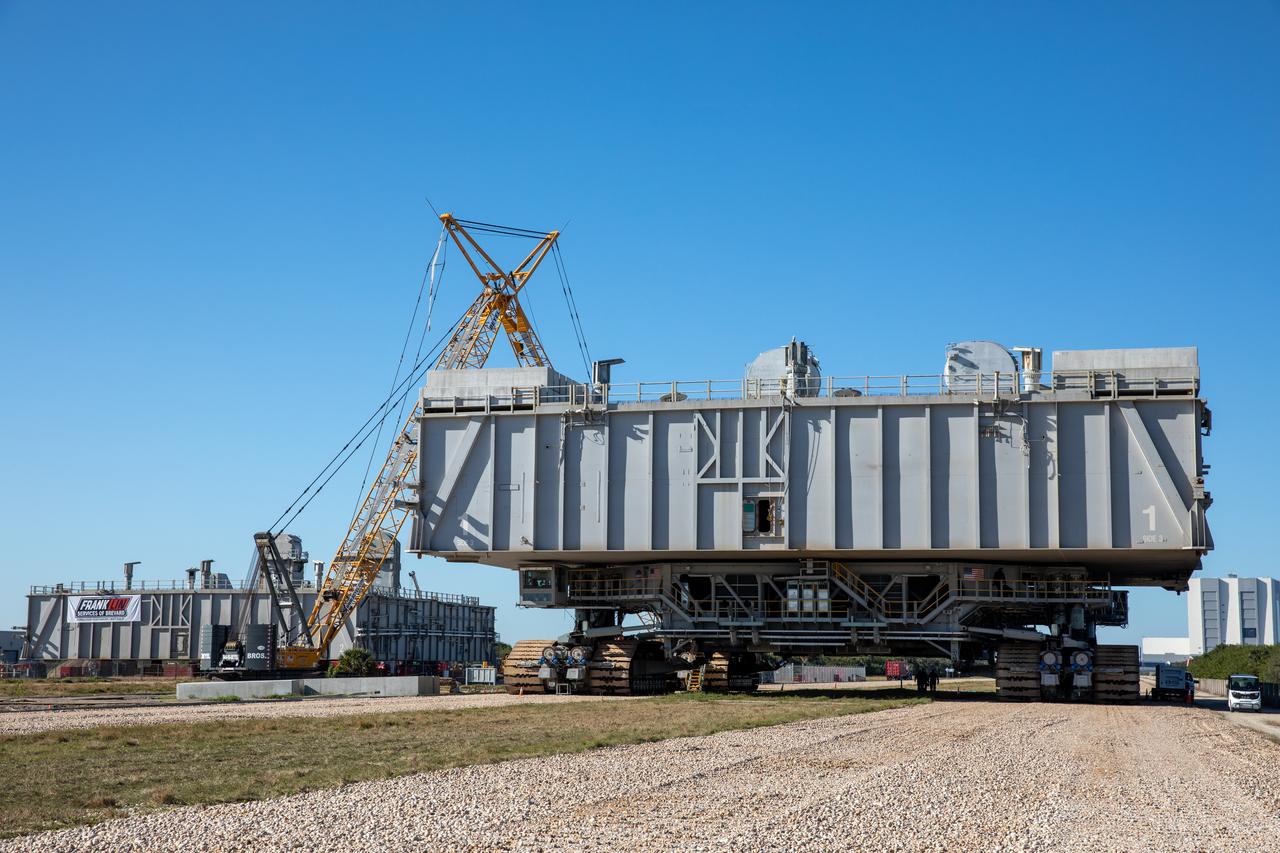
KSC-2009-2304
CAPE CANAVERAL, Fla. – Near Launch Pad 39B at NASA's Kennedy Space Center in Florida,  Director of the Constellation Project Office  Pepper E. Phillips speaks to employees and media during the handover ceremony for Mobile Launcher Platform-1.  Marking the handover is the change of banner on the platform behind him.  On the stage and also participating in the ceremony are Director of Launch Vehicle Processing Rita Willcoxon , Shuttle Launch Director Mike Leinbach,  and Manager of MLP Operations with United Space Alliance Brett Raulerson.  The platform is being transferred from NASA's Space Shuttle Program to the Constellation Program for the Ares I-X flight test targeted for this summer. Constructed in 1964, the mobile launchers used in Apollo/Saturn operations were modified for use in shuttle operations. With cranes, umbilical towers and swing arms removed, the mobile launchers were renamed Mobile Launcher Platforms, or MLPs.  Photo credit: NASA/Kim Shiflett
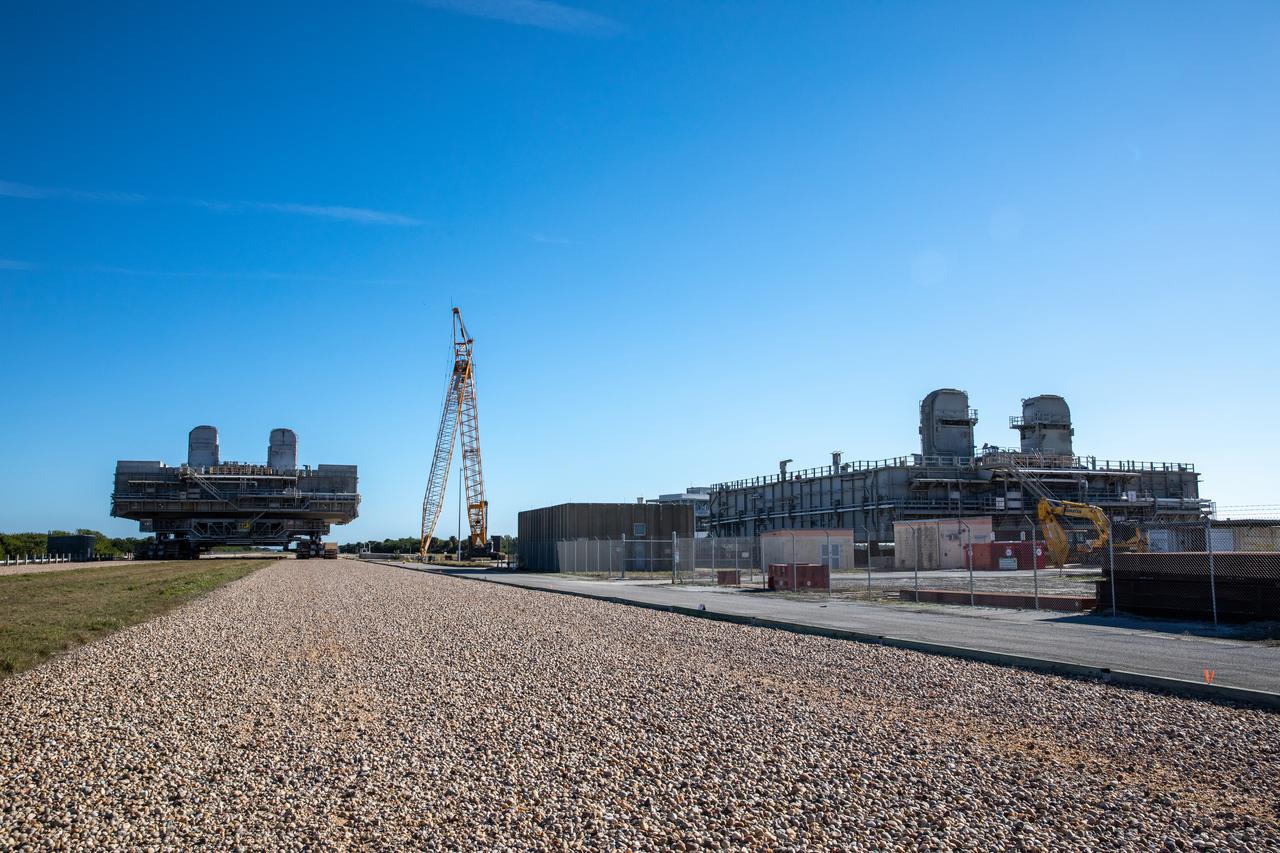
KSC-2009-2305
During a practice run, crawler-transporter 2 (CT-2) is moving inside High Bay 2 of the Vehicle Assembly Building (VAB) at NASA’s Kennedy Space Center in Florida on May 1, 2019. CT-2 picked up the space shuttle-era mobile launch platform-3 (MLP-3). The VAB is getting its first commercial tenant. Northrop Grumman signed a Reimbursable Space Act Agreement with NASA for use of the facilities. The company will assemble and test its new OmegA rocket inside the massive facility’s High Bay 2. The company also will modify MLP-3 to serve as the launch vehicle’s assembly and launch platform. Northrop Grumman is developing the OmegA rocket, an intermediate/heavy-class launch vehicle, as part of a launch services agreement with the U.S. Air Force.
Crawler Clears VAB's Highbay 2 for Commercial Partner
During a practice run, crawler-transporter 2 (CT-2) picked up the space shuttle-era mobile launch platform-3 (MLP-3) inside High Bay 2 of the Vehicle Assembly Building (VAB) at NASA’s Kennedy Space Center in Florida on May 1, 2019. The VAB is getting its first commercial tenant. Northrop Grumman signed a Reimbursable Space Act Agreement with NASA for use of the facilities. The company will assemble and test its new OmegA rocket inside the massive facility’s High Bay 2. The company also will modify MLP-3 to serve as the launch vehicle’s assembly and launch platform. Northrop Grumman is developing the OmegA rocket, an intermediate/heavy-class launch vehicle, as part of a launch services agreement with the U.S. Air Force.
Crawler Clears VAB's Highbay 2 for Commercial Partner
During a practice run, crawler-transporter 2 (CT-2) is being driven to the Vehicle Assembly Building (VAB) at NASA’s Kennedy Space Center in Florida on May 1, 2019. CT-2 entered High Bay 2, and picked up the space shuttle-era mobile launch platform-3 (MLP-3). The VAB is getting its first commercial tenant. Northrop Grumman signed a Reimbursable Space Act Agreement with NASA for use of the facilities. The company will assemble and test its new OmegA rocket inside the massive facility’s High Bay 2. The company also will modify MLP-3 to serve as the launch vehicle’s assembly and launch platform. Northrop Grumman is developing the OmegA rocket, an intermediate/heavy-class launch vehicle, as part of a launch services agreement with the U.S. Air Force.
Crawler Clears VAB's Highbay 2 for Commercial Partner
During a practice run, crawler-transporter 2 (CT-2), with the space shuttle-era mobile launch platform-3 (MLP-3) on top, moves out of High Bay 2 of the Vehicle Assembly Building (VAB) at NASA’s Kennedy Space Center in Florida on May 1, 2019. A truck in front sprays water to reduce dust on the crawlerway. The VAB is getting its first commercial tenant. Northrop Grumman signed a Reimbursable Space Act Agreement with NASA for use of the facilities. The company will assemble and test its new OmegA rocket inside the massive facility’s High Bay 2. The company also will modify MLP-3 to serve as the launch vehicle’s assembly and launch platform. Northrop Grumman is developing the OmegA rocket, an intermediate/heavy-class launch vehicle, as part of a launch services agreement with the U.S. Air Force.
Crawler Clears VAB's Highbay 2 for Commercial Partner
During a practice run, crawler-transporter 2 (CT-2) is at the entrance to High Bay 2 of the Vehicle Assembly Building (VAB) at NASA’s Kennedy Space Center in Florida on May 1, 2019. CT-2 entered High Bay 2, and picked up the space shuttle-era mobile launch platform-3 (MLP-3). The VAB is getting its first commercial tenant. Northrop Grumman signed a Reimbursable Space Act Agreement with NASA for use of the facilities. The company will assemble and test its new OmegA rocket inside the massive facility’s High Bay 2. The company also will modify MLP-3 to serve as the launch vehicle’s assembly and launch platform. Northrop Grumman is developing the OmegA rocket, an intermediate/heavy-class launch vehicle, as part of a launch services agreement with the U.S. Air Force.
Crawler Clears VAB's Highbay 2 for Commercial Partner
CAPE CANAVERAL, Fla. – NASA's Kennedy Space Center management host a ceremony near Launch Pad 39B to mark the handover of Mobile Launcher Platform-1 (behind them) from NASA's Space Shuttle Program to the Constellation Program for the Ares I-X flight test targeted for this summer. Seated are (left) Shuttle Launch  Director Mike Leinbach and (right) Pepper E. Phillips, director of the Constellation Project Office, and Brett Raulerson, manager of MLP Operations with United Space Alliance.  At the podium is Rita Willcoxon, director of Launch Vehicle Processing at Kennedy. Constructed in 1964, the mobile launchers used in Apollo/Saturn operations were modified for use in shuttle operations. With cranes, umbilical towers and swing arms removed, the mobile launchers were renamed Mobile Launcher Platforms, or MLPs.  Photo credit: NASA/Kim Shiflett
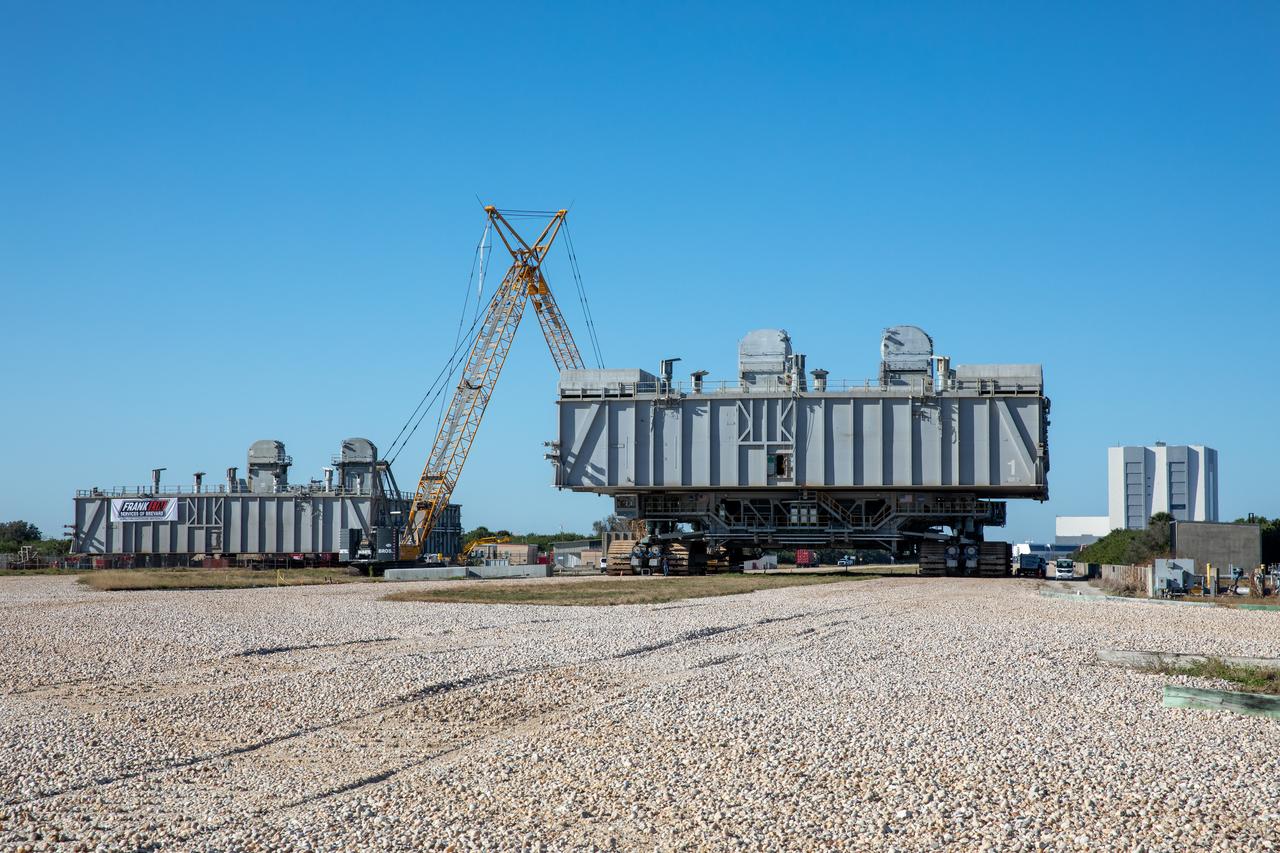
KSC-2009-2301
KENNEDY SPACE CENTER, Fla. -- Space Shuttle Endeavour appears dwarfed by the structures inside the Vehicle Assembly Building as it begins rollout to Launch Pad 39B. The Shuttle rests on top of the Mobile Launcher Platform (MLP). Underneath (bottom of photo) is the crawler-transporter that will move the Shuttle and MLP to the pad on four double-tracked crawlers. The maximum speed of the loaded transporter is 1 mph. Endeavour is scheduled to be launched Nov. 30 at 10:01 p.m. EST on mission STS-97, the sixth construction flight to the International Space Station. Its payload includes the P6 Integrated Truss Structure and a photovoltaic (PV) module, with giant solar arrays that will provide power to the Station. The mission includes two spacewalks to complete the solar array connections
KSC00pp1623
During a practice run, crawler-transporter 2 (CT-2), with the space shuttle-era mobile launch platform-3 (MLP-3) on top, begins its move out of High Bay 2 of the Vehicle Assembly Building (VAB) at NASA’s Kennedy Space Center in Florida on May 1, 2019. The VAB is getting its first commercial tenant. Northrop Grumman signed a Reimbursable Space Act Agreement with NASA for use of the facilities. The company will assemble and test its new OmegA rocket inside the massive facility’s High Bay 2. The company also will modify MLP-3 to serve as the launch vehicle’s assembly and launch platform. Northrop Grumman is developing the OmegA rocket, an intermediate/heavy-class launch vehicle, as part of a launch services agreement with the U.S. Air Force.
Crawler Clears VAB's Highbay 2 for Commercial Partner
CAPE CANAVERAL, Fla. – Near Launch Pad 39B  at NASA's Kennedy Space Center in Florida, Shuttle Launch Director Mike Leinbach speaks to the employees and media during the handover ceremony for Mobile Launcher Platform-1. The platform is being transferred from NASA's Space Shuttle Program to the Constellation Program for the Ares I-X flight test targeted for this summer. Also participating in the ceremony are (left) Rita Willcoxon, director of Launch Vehicle Processing at Kennedy, (right) Pepper E. Phillips, director of the Constellation Project Office, and (not visible) Brett Raulerson, manager of MLP Operations with United Space Alliance. Constructed in 1964, the mobile launchers used in Apollo/Saturn operations were modified for use in shuttle operations. With cranes, umbilical towers and swing arms removed, the mobile launchers were renamed Mobile Launcher Platforms, or MLPs.  Photo credit: NASA/Kim Shiflett
KSC-2009-2303
During a practice run, crawler-transporter 2 (CT-2), with the space shuttle-era mobile launch platform-3 (MLP-3) on top, has exited High Bay 2 of the Vehicle Assembly Building (VAB) and moves slowly along the crawlerway at NASA’s Kennedy Space Center in Florida on May 1, 2019. The VAB is getting its first commercial tenant. Northrop Grumman signed a Reimbursable Space Act Agreement with NASA for use of the facilities. The company will assemble and test its new OmegA rocket inside the massive facility’s High Bay 2. The company also will modify MLP-3 to serve as the launch vehicle’s assembly and launch platform. Northrop Grumman is developing the OmegA rocket, an intermediate/heavy-class launch vehicle, as part of a launch services agreement with the U.S. Air Force.
Crawler Clears VAB's Highbay 2 for Commercial Partner
During a practice run, crawler-transporter 2 (CT-2), with the space shuttle-era mobile launch platform-3 (MLP-3) on top, moves out of High Bay 2 of the Vehicle Assembly Building (VAB) at NASA’s Kennedy Space Center in Florida on May 1, 2019. The VAB is getting its first commercial tenant. Northrop Grumman signed a Reimbursable Space Act Agreement with NASA for use of the facilities. The company will assemble and test its new OmegA rocket inside the massive facility’s High Bay 2. The company also will modify MLP-3 to serve as the launch vehicle’s assembly and launch platform. Northrop Grumman is developing the OmegA rocket, an intermediate/heavy-class launch vehicle, as part of a launch services agreement with the U.S. Air Force.
Crawler Clears VAB's Highbay 2 for Commercial Partner
During a practice run, crawler-transporter 2 (CT-2), with the space shuttle-era mobile launch platform-3 (MLP-3) on top, has exited High Bay 2 of the Vehicle Assembly Building (VAB) and moves slowly along the crawlerway at NASA’s Kennedy Space Center in Florida on May 1, 2019. The VAB is getting its first commercial tenant. Northrop Grumman signed a Reimbursable Space Act Agreement with NASA for use of the facilities. The company will assemble and test its new OmegA rocket inside the massive facility’s High Bay 2. The company also will modify MLP-3 to serve as the launch vehicle’s assembly and launch platform. Northrop Grumman is developing the OmegA rocket, an intermediate/heavy-class launch vehicle, as part of a launch services agreement with the U.S. Air Force.
Crawler Clears VAB's Highbay 2 for Commercial Partner
During a practice run, crawler-transporter 2 (CT-2), with the space shuttle-era mobile launch platform-3 (MLP-3) on top, has exited High Bay 2 of the Vehicle Assembly Building (VAB) and moves slowly along the crawlerway at NASA’s Kennedy Space Center in Florida on May 1, 2019. The VAB is getting its first commercial tenant. Northrop Grumman signed a Reimbursable Space Act Agreement with NASA for use of the facilities. The company will assemble and test its new OmegA rocket inside the massive facility’s High Bay 2. The company also will modify MLP-3 to serve as the launch vehicle’s assembly and launch platform. Northrop Grumman is developing the OmegA rocket, an intermediate/heavy-class launch vehicle, as part of a launch services agreement with the U.S. Air Force.
Crawler Clears VAB's Highbay 2 for Commercial Partner
During a practice run, crawler-transporter 2 (CT-2) is at the entrance to High Bay 2 of the Vehicle Assembly Building (VAB) at NASA’s Kennedy Space Center in Florida on May 1, 2019. CT-2 entered High Bay 2, and picked up the space shuttle-era mobile launch platform-3 (MLP-3). The VAB is getting its first commercial tenant. Northrop Grumman signed a Reimbursable Space Act Agreement with NASA for use of the facilities. The company will assemble and test its new OmegA rocket inside the massive facility’s High Bay 2. The company also will modify MLP-3 to serve as the launch vehicle’s assembly and launch platform. Northrop Grumman is developing the OmegA rocket, an intermediate/heavy-class launch vehicle, as part of a launch services agreement with the U.S. Air Force.
Crawler Clears VAB's Highbay 2 for Commercial Partner
During a practice run, crawler-transporter 2 (CT-2) is at the entrance to High Bay 2 of the Vehicle Assembly Building (VAB) at NASA’s Kennedy Space Center in Florida on May 1, 2019. CT-2 entered High Bay 2, and picked up the space shuttle-era mobile launch platform-3 (MLP-3). The VAB is getting its first commercial tenant. Northrop Grumman signed a Reimbursable Space Act Agreement with NASA for use of the facilities. The company will assemble and test its new OmegA rocket inside the massive facility’s High Bay 2. The company also will modify MLP-3 to serve as the launch vehicle’s assembly and launch platform. Northrop Grumman is developing the OmegA rocket, an intermediate/heavy-class launch vehicle, as part of a launch services agreement with the U.S. Air Force.
Crawler Clears VAB's Highbay 2 for Commercial Partner
During a practice run, crawler-transporter 2 (CT-2) is moving inside High Bay 2 of the Vehicle Assembly Building (VAB) at NASA’s Kennedy Space Center in Florida on May 1, 2019. In view at right is one of the cabs used to drive the crawler. CT-2 picked up the space shuttle-era mobile launch platform-3 (MLP-3). The VAB is getting its first commercial tenant. Northrop Grumman signed a Reimbursable Space Act Agreement with NASA for use of the facilities. The company will assemble and test its new OmegA rocket inside the massive facility’s High Bay 2. The company also will modify MLP-3 to serve as the launch vehicle’s assembly and launch platform. Northrop Grumman is developing the OmegA rocket, an intermediate/heavy-class launch vehicle, as part of a launch services agreement with the U.S. Air Force.
Crawler Clears VAB's Highbay 2 for Commercial Partner
During a practice run, crawler-transporter 2 (CT-2), with the space shuttle-era mobile launch platform-3 (MLP-3) on top, has exited High Bay 2 of the Vehicle Assembly Building (VAB) and moves slowly along the crawlerway at NASA’s Kennedy Space Center in Florida on May 1, 2019. The VAB is getting its first commercial tenant. Northrop Grumman signed a Reimbursable Space Act Agreement with NASA for use of the facilities. The company will assemble and test its new OmegA rocket inside the massive facility’s High Bay 2. The company also will modify MLP-3 to serve as the launch vehicle’s assembly and launch platform. Northrop Grumman is developing the OmegA rocket, an intermediate/heavy-class launch vehicle, as part of a launch services agreement with the U.S. Air Force.
Crawler Clears VAB's Highbay 2 for Commercial Partner
CAPE CANAVERAL, Fla. – In High Bay 1 of the Vehicle Assembly Building at NASA's Kennedy Space Center in Florida, space shuttle Discovery is lowered onto the mobile launcher platform, or MLP.  It is in front of the external fuel tank and solid rocket boosters on either side that are already secured there.  The shuttle will be attached to the external tank on the MLP.  Discovery is scheduled to roll out to Launch Pad 39A the first week of August to prepare for the STS-128 mission to the International Space Station.  The shuttle will carry the Leonardo Multi-Purpose Logistics Module containing life support racks and science racks and the Lightweight Multi-Purpose Experiment Support Structure Carrier in its payload bay.  Launch of Discovery is targeted for late August.  Photo credit: NASA/Ben Smegelsky
KSC-2009-4257
KENNEDY SPACE CENTER, Fla. -- As the early morning sky lights up, Space Shuttle Endeavour inches its way to Launch Pad 39B (on the horizon) via the crawlerway that leads from the Vehicle Assembly Building. The Shuttle is atop the Mobile Launcher Platform (MLP). Visible beneath the MLP is the crawler-transporter, which moves on four double-tracked crawlers. Each shoe on the crawler track weighs a ton. Unloaded, the transporter weighs 6 million pounds and moves at 2 mph. The maximum speed of the loaded transporter is 1 mph. Endeavour is scheduled to be launched Nov. 30 at 10:01 p.m. EST on mission STS-97, the sixth construction flight to the International Space Station. Its payload includes the P6 Integrated Truss Structure and a photovoltaic (PV) module, with giant solar arrays that will provide power to the Station. The mission includes two spacewalks to complete the solar array connections
KSC-00padig052
CAPE CANAVERAL, Fla. – Near Launch Pad 39B at NASA's Kennedy Space Center in Florida,  Director of the Constellation Project Office  Pepper E. Phillips speaks to employees and media during the handover ceremony for Mobile Launcher Platform-1.  Marking the handover is the change of banner on the platform behind him.  On the stage and also participating in the ceremony are Director of Launch Vehicle Processing Rita Willcoxon , Shuttle Launch Director Mike Leinbach,  and Manager of MLP Operations with United Space Alliance Brett Raulerson.  The platform is being transferred from NASA's Space Shuttle Program to the Constellation Program for the Ares I-X flight test targeted for this summer. Constructed in 1964, the mobile launchers used in Apollo/Saturn operations were modified for use in shuttle operations. With cranes, umbilical towers and swing arms removed, the mobile launchers were renamed Mobile Launcher Platforms, or MLPs.  Photo credit: NASA/Kim Shiflett
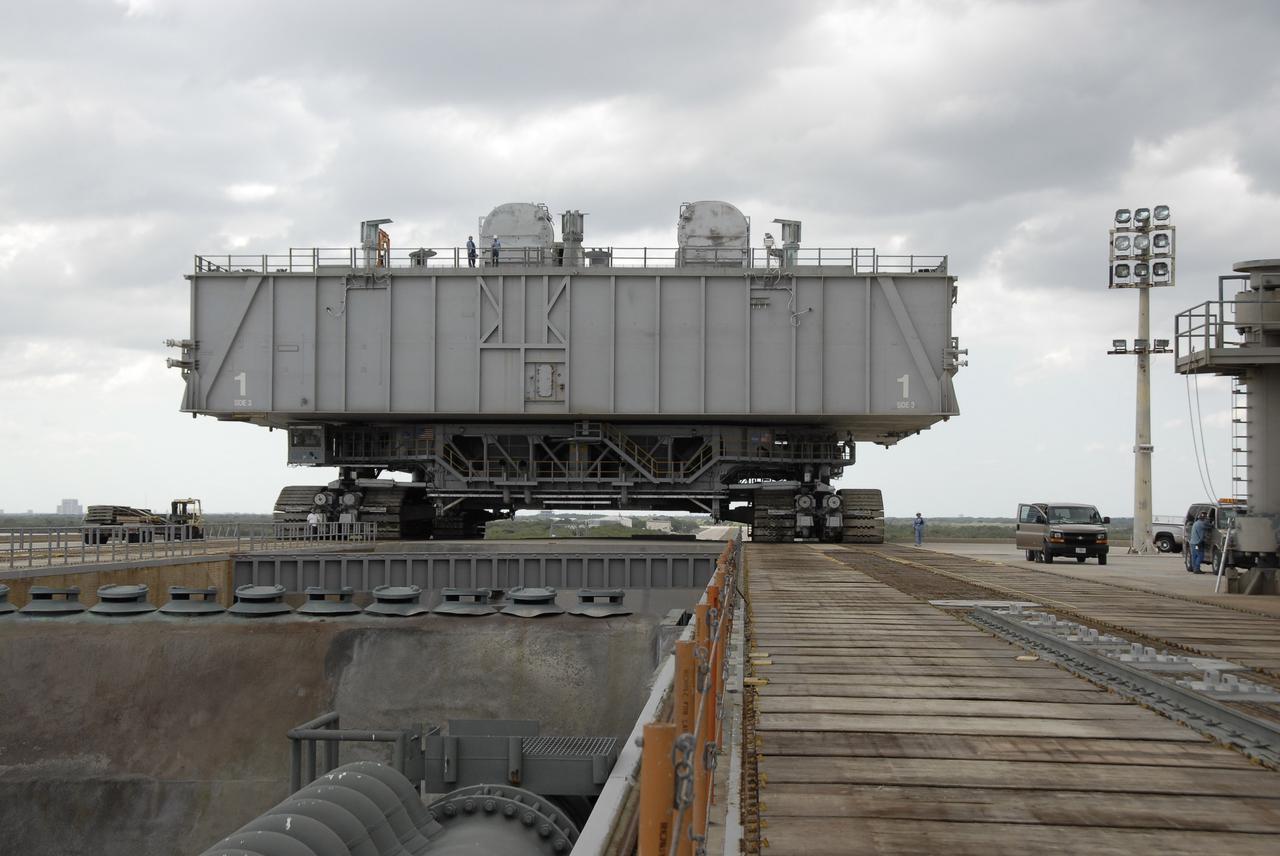
KSC-2009-2306
KENNEDY SPACE CENTER, Fla. -- As the early morning sky lights up, Space Shuttle Endeavour inches its way to Launch Pad 39B (on the horizon) via the crawlerway that leads from the Vehicle Assembly Building. The Shuttle is atop the Mobile Launcher Platform (MLP). Visible beneath the MLP is the crawler-transporter, which moves on four double-tracked crawlers. Each shoe on the crawler track weighs a ton. Unloaded, the transporter weighs 6 million pounds and moves at 2 mph. The maximum speed of the loaded transporter is 1 mph. Endeavour is scheduled to be launched Nov. 30 at 10:01 p.m. EST on mission STS-97, the sixth construction flight to the International Space Station. Its payload includes the P6 Integrated Truss Structure and a photovoltaic (PV) module, with giant solar arrays that will provide power to the Station. The mission includes two spacewalks to complete the solar array connections
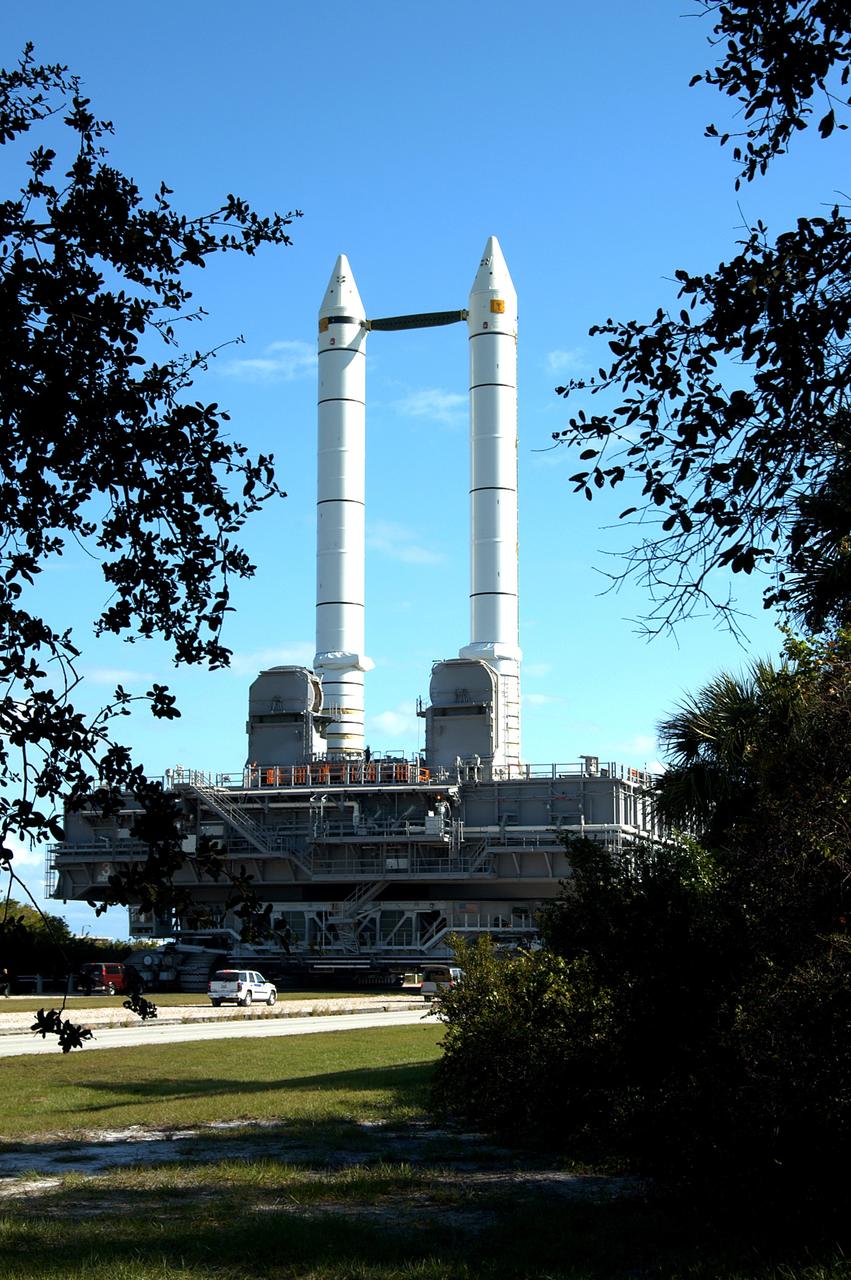
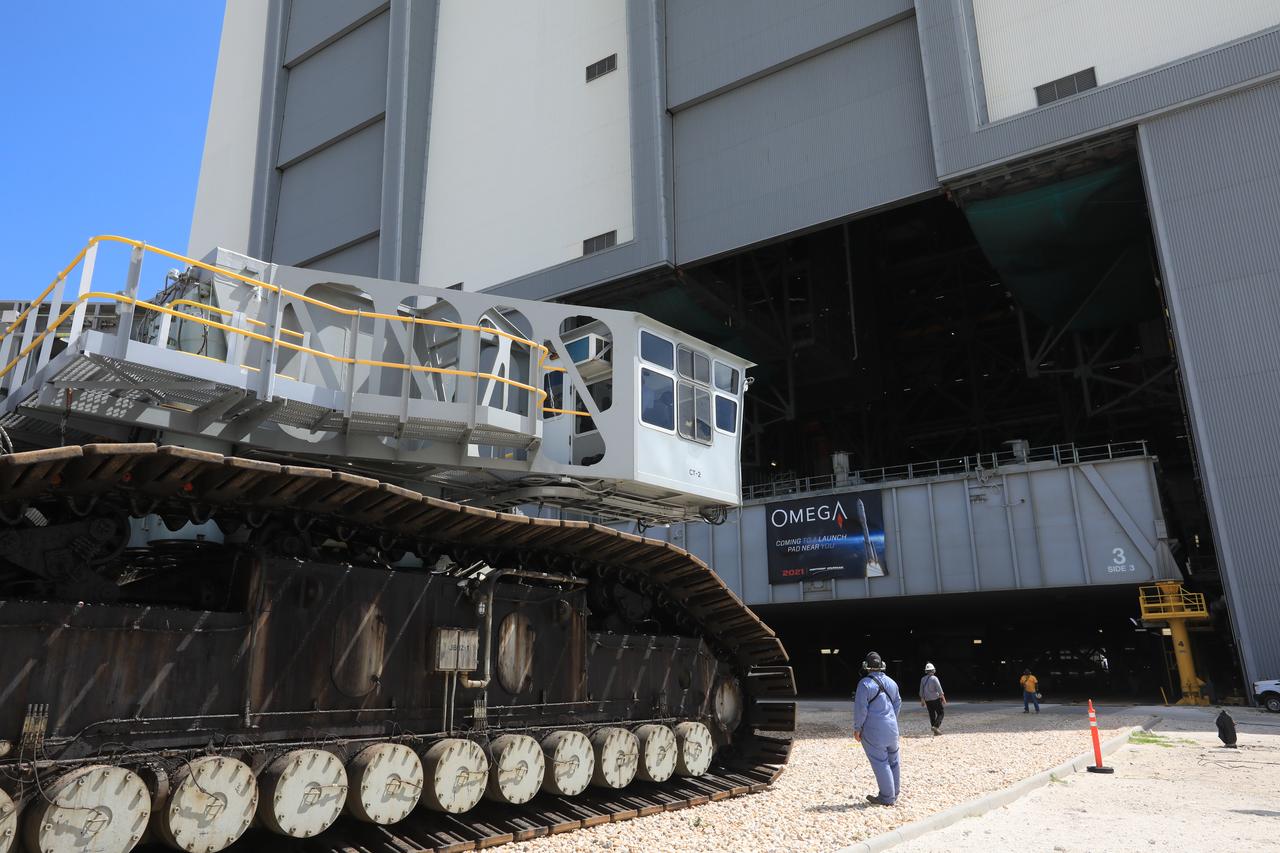
KSC00padig052