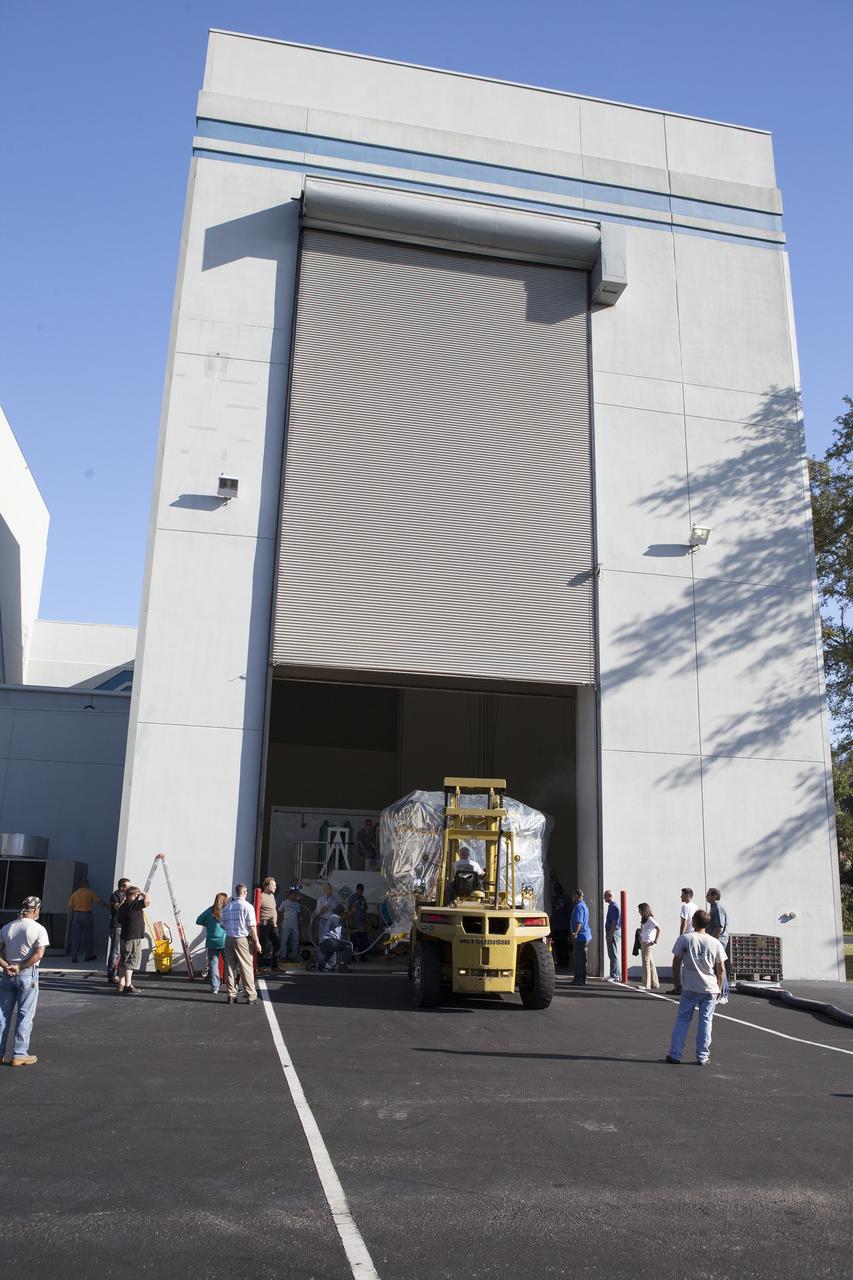
CAPE CANAVERAL, Fla. – Two of the observatories for NASA's Magnetospheric Multiscale Observatory, or MMS, the lower stack, mini-stack number 1, begin the trip from the Building 2 south encapsulation bay to the Building 1 high bay at the Astrotech payload processing facility in Titusville, Florida, near Kennedy Space Center. The MMS upper stack, mini-stack number 2, is scheduled to arrive in about two weeks. MMS is a Solar Terrestrial Probes mission comprising four identically instrumented spacecraft that will use Earth’s magnetosphere as a laboratory to study the microphysics of three fundamental plasma processes: magnetic reconnection, energetic particle acceleration and turbulence. Launch aboard a United Launch Alliance Atlas V rocket from Space Launch Complex 41 on Cape Canaveral Air Force Station is targeted for March 12, 2015. To learn more about MMS, visit http://mms.gsfc.nasa.gov. Photo credit: NASA/Dan Casper
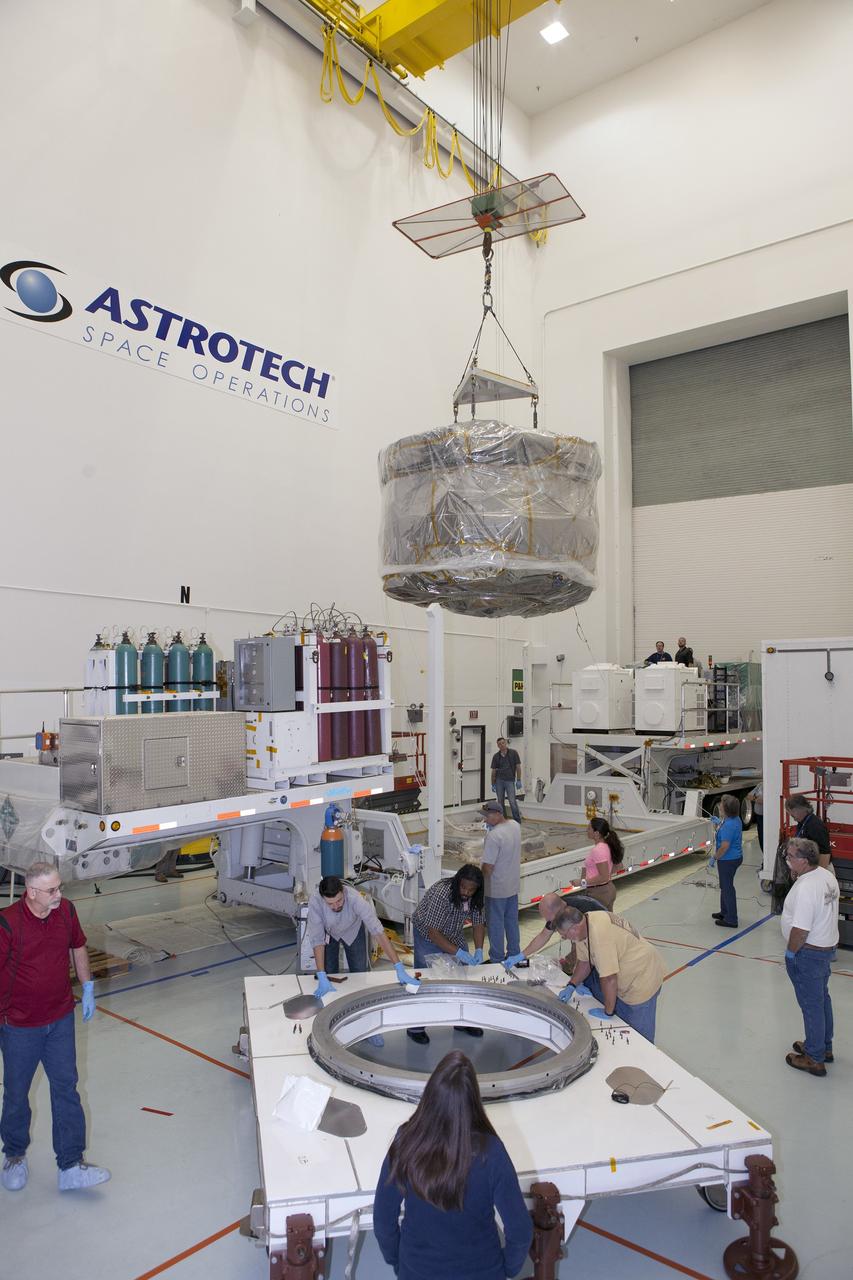
CAPE CANAVERAL, Fla. – Two of the observatories, the lower stack, mini-stack number 1, for NASA's Magnetospheric Multiscale Observatory, or MMS, glides toward a payload dolly during uncrating operations in the Building 2 south encapsulation bay at the Astrotech payload processing facility in Titusville, Florida, near Kennedy Space Center. The MMS upper stack, mini-stack number 2, is scheduled to arrive in about two weeks. MMS is a Solar Terrestrial Probes mission comprising four identically instrumented spacecraft that will use Earth’s magnetosphere as a laboratory to study the microphysics of three fundamental plasma processes: magnetic reconnection, energetic particle acceleration and turbulence. Launch aboard a United Launch Alliance Atlas V rocket from Space Launch Complex 41 on Cape Canaveral Air Force Station is targeted for March 12, 2015. To learn more about MMS, visit http://mms.gsfc.nasa.gov. Photo credit: NASA/Dan Casper
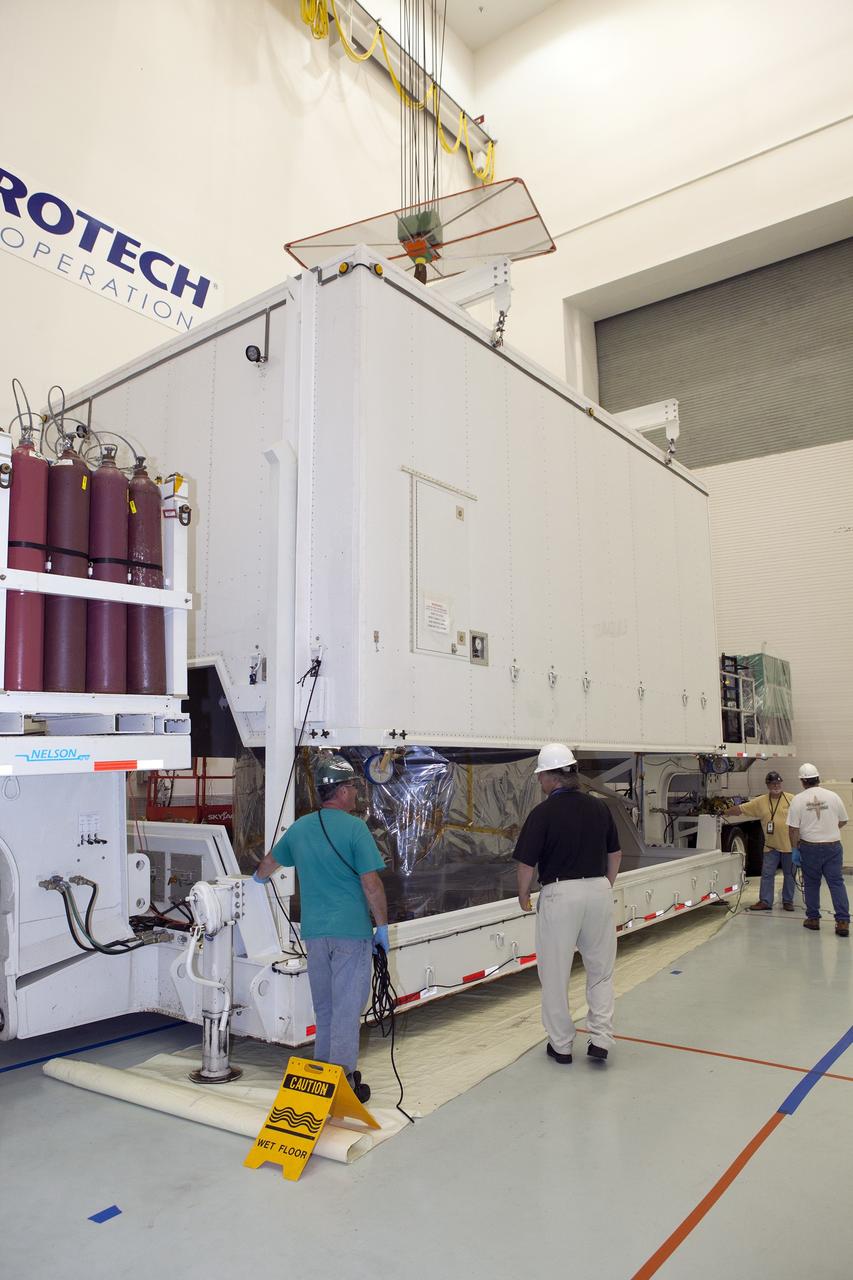
CAPE CANAVERAL, Fla. – The protective shipping container is lifted from the lower stack, mini-stack number 1, two of the observatories for NASA's Magnetospheric Multiscale Observatory, or MMS, in the Building 2 south encapsulation bay at the Astrotech payload processing facility in Titusville, Florida, near Kennedy Space Center. The MMS upper stack, mini-stack number 2, is scheduled to arrive in about two weeks. MMS is a Solar Terrestrial Probes mission comprising four identically instrumented spacecraft that will use Earth’s magnetosphere as a laboratory to study the microphysics of three fundamental plasma processes: magnetic reconnection, energetic particle acceleration and turbulence. Launch aboard a United Launch Alliance Atlas V rocket from Space Launch Complex 41 on Cape Canaveral Air Force Station is targeted for March 12, 2015. To learn more about MMS, visit http://mms.gsfc.nasa.gov. Photo credit: NASA/Dan Casper
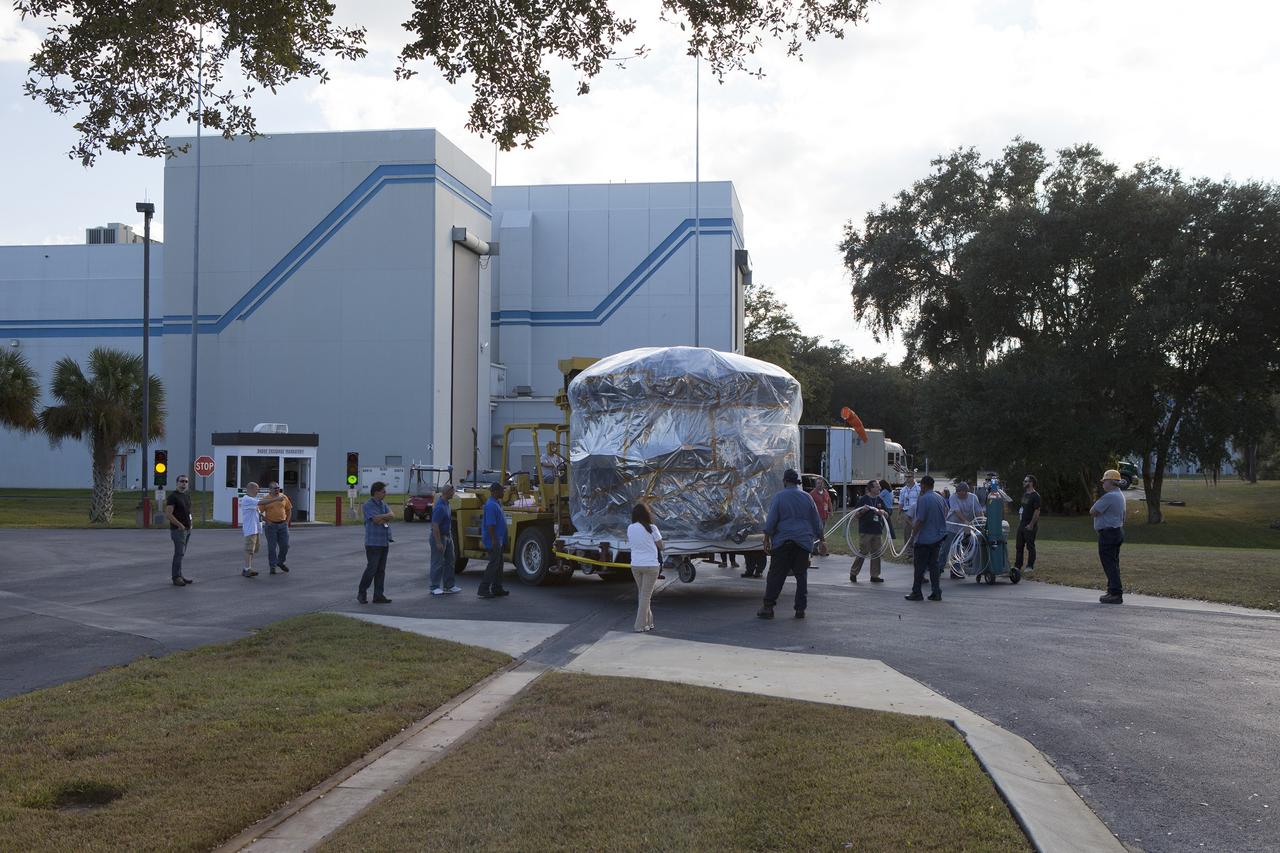
CAPE CANAVERAL, Fla. – Workers surround two of the observatories, the lower stack, mini-stack number 1, for NASA's Magnetospheric Multiscale Observatory, or MMS, on their trip from the Building 2 south encapsulation bay to the Building 1 high bay at the Astrotech payload processing facility in Titusville, Florida, near Kennedy Space Center. The MMS upper stack, mini-stack number 2, is scheduled to arrive in about two weeks. MMS is a Solar Terrestrial Probes mission comprising four identically instrumented spacecraft that will use Earth’s magnetosphere as a laboratory to study the microphysics of three fundamental plasma processes: magnetic reconnection, energetic particle acceleration and turbulence. Launch aboard a United Launch Alliance Atlas V rocket from Space Launch Complex 41 on Cape Canaveral Air Force Station is targeted for March 12, 2015. To learn more about MMS, visit http://mms.gsfc.nasa.gov. Photo credit: NASA/Dan Casper
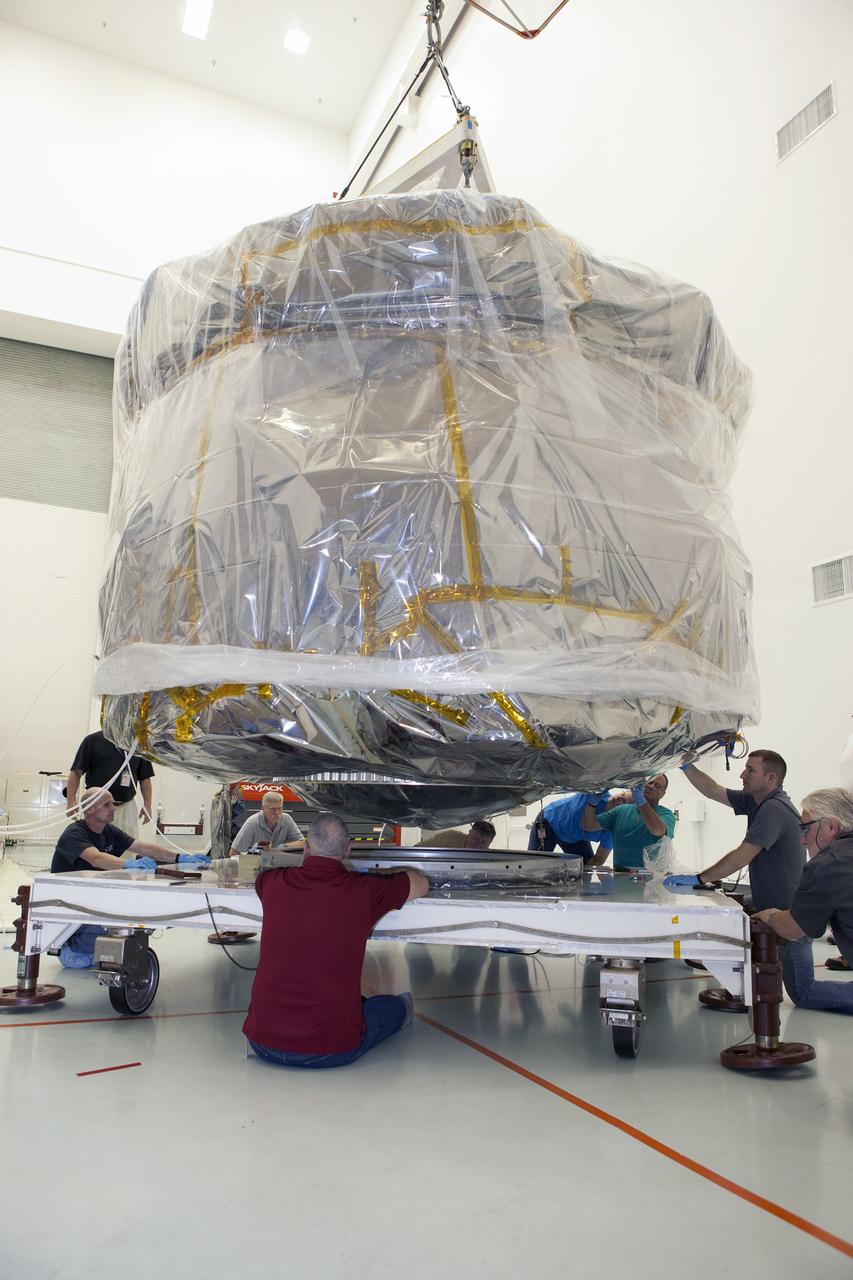
CAPE CANAVERAL, Fla. – Workers position two of the observatories, the lower stack, mini-stack number 1 for NASA's Magnetospheric Multiscale Observatory, or MMS, onto a payload dolly in the Building 2 south encapsulation bay at the Astrotech payload processing facility in Titusville, Florida, near Kennedy Space Center. The MMS upper stack, mini-stack number 2, is scheduled to arrive in about two weeks. MMS is a Solar Terrestrial Probes mission comprising four identically instrumented spacecraft that will use Earth’s magnetosphere as a laboratory to study the microphysics of three fundamental plasma processes: magnetic reconnection, energetic particle acceleration and turbulence. Launch aboard a United Launch Alliance Atlas V rocket from Space Launch Complex 41 on Cape Canaveral Air Force Station is targeted for March 12, 2015. To learn more about MMS, visit http://mms.gsfc.nasa.gov. Photo credit: NASA/Dan Casper
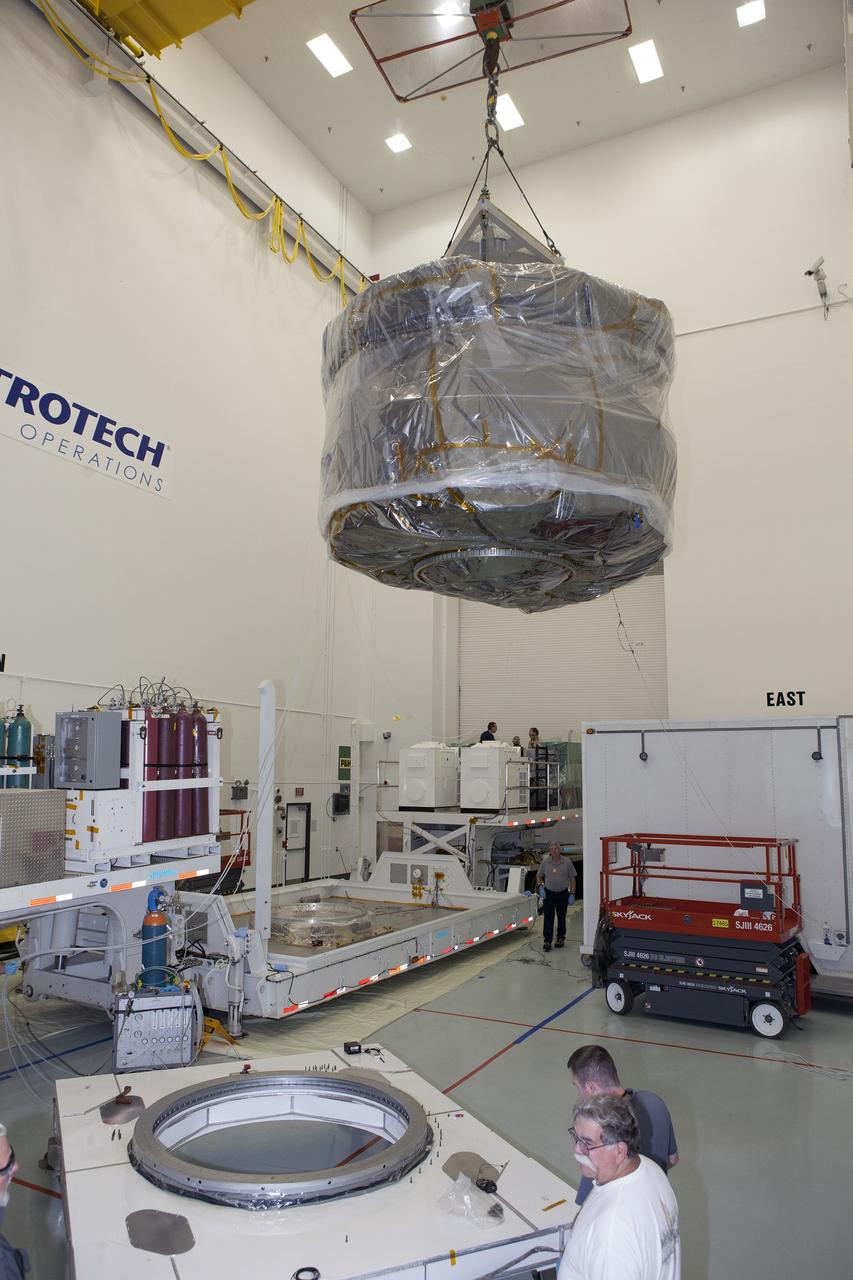
CAPE CANAVERAL, Fla. – Two of the observatories, the lower stack, mini-stack number 1, for NASA's Magnetospheric Multiscale Observatory are suspended over a payload dolly during uncrating operations in the Building 2 south encapsulation bay at the Astrotech payload processing facility in Titusville, Florida, near Kennedy Space Center. The MMS upper stack, mini-stack number 2, is scheduled to arrive in about two weeks. MMS is a Solar Terrestrial Probes mission comprising four identically instrumented spacecraft that will use Earth’s magnetosphere as a laboratory to study the microphysics of three fundamental plasma processes: magnetic reconnection, energetic particle acceleration and turbulence. Launch aboard a United Launch Alliance Atlas V rocket from Space Launch Complex 41 on Cape Canaveral Air Force Station is targeted for March 12, 2015. To learn more about MMS, visit http://mms.gsfc.nasa.gov. Photo credit: NASA/Dan Casper
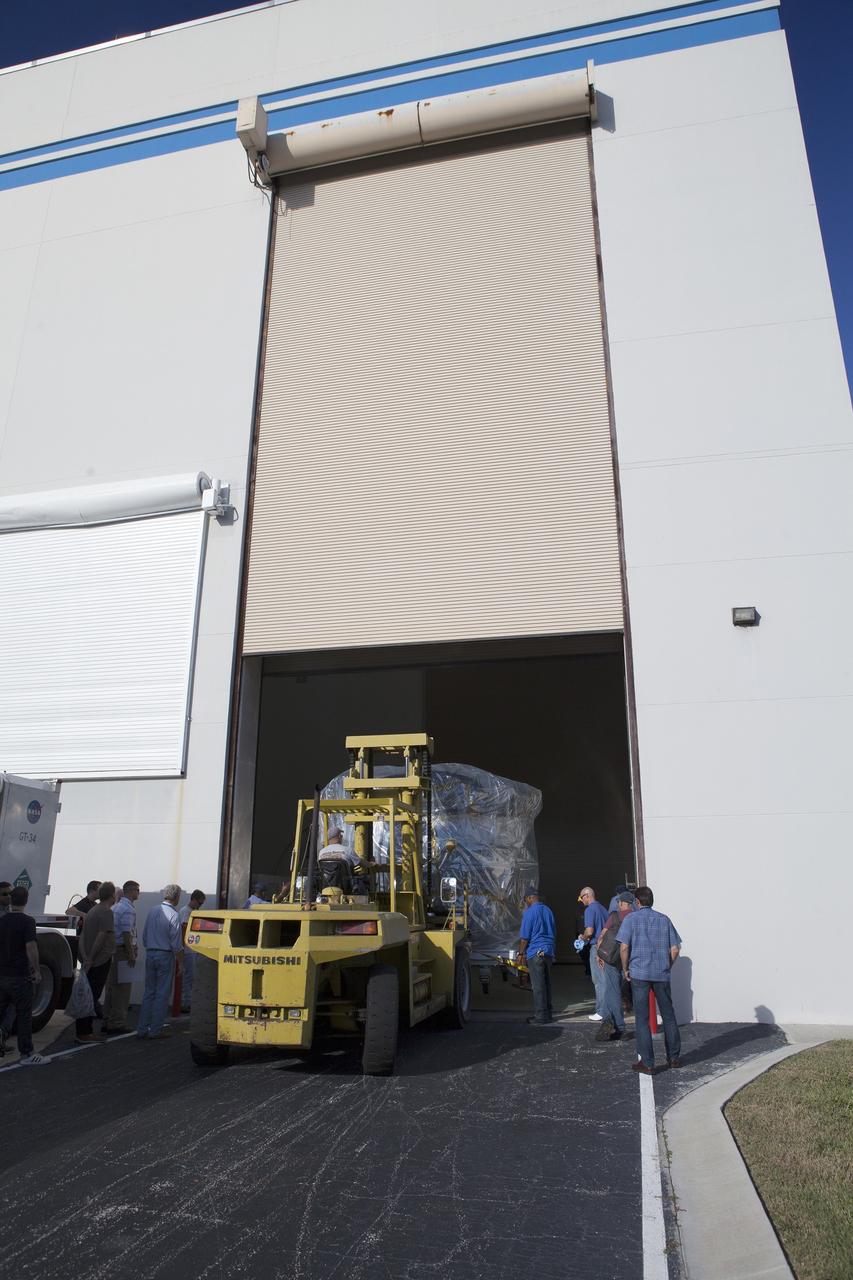
CAPE CANAVERAL, Fla. – Two of the observatories, the lower stack, mini-stack number 1, for NASA's Magnetospheric Multiscale Observatory, or MMS, roll into the Building 1 airlock at the Astrotech payload processing facility in Titusville, Florida, near Kennedy Space Center. The MMS upper stack, mini-stack number 2, is scheduled to arrive in about two weeks. MMS is a Solar Terrestrial Probes mission comprising four identically instrumented spacecraft that will use Earth’s magnetosphere as a laboratory to study the microphysics of three fundamental plasma processes: magnetic reconnection, energetic particle acceleration and turbulence. Launch aboard a United Launch Alliance Atlas V rocket from Space Launch Complex 41 on Cape Canaveral Air Force Station is targeted for March 12, 2015. To learn more about MMS, visit http://mms.gsfc.nasa.gov. Photo credit: NASA/Dan Casper
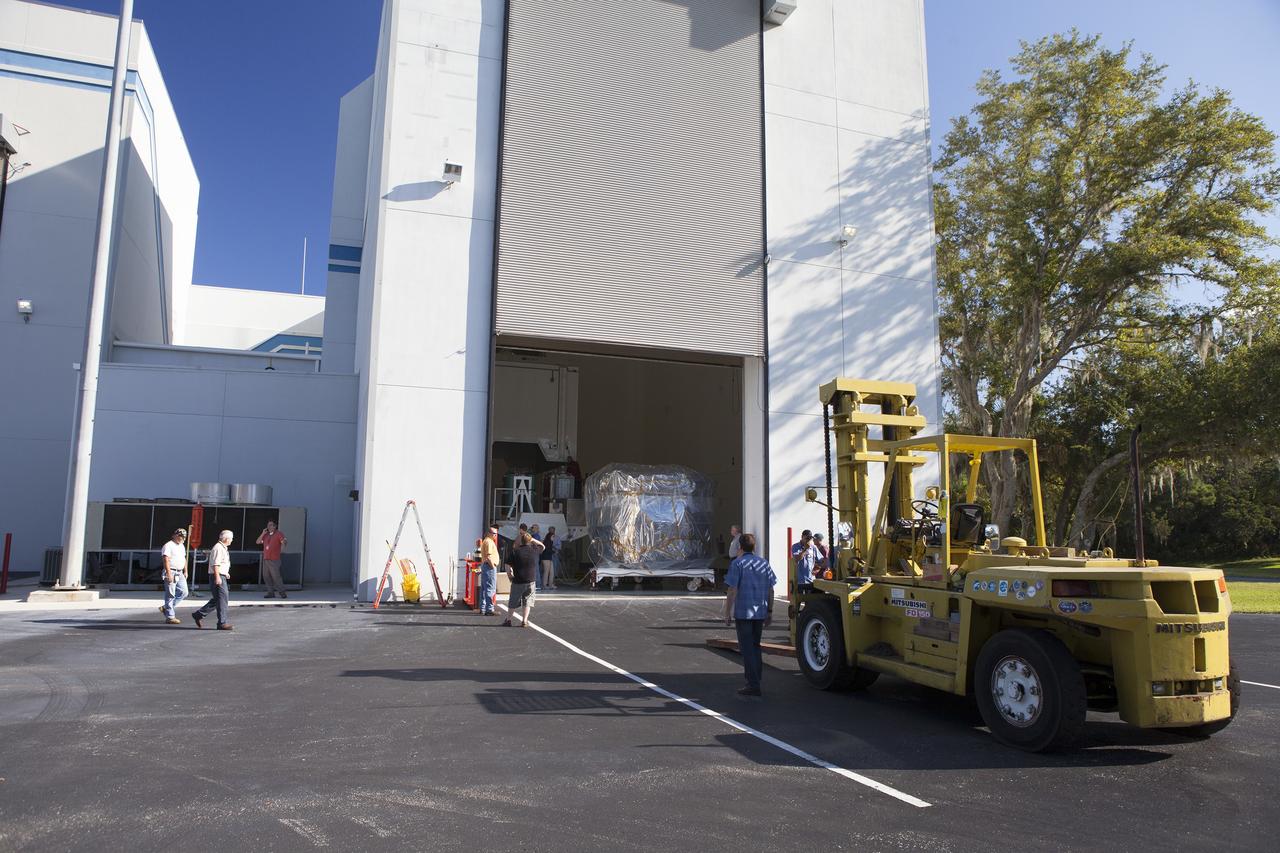
CAPE CANAVERAL, Fla. – Preparations are underway to tow two of the observatories, the lower stack, mini-stack number 1, for NASA's Magnetospheric Multiscale Observatory, or MMS, from the Building 2 south encapsulation bay to the Building 1 high bay at the Astrotech payload processing facility in Titusville, Florida, near Kennedy Space Center. The MMS upper stack, mini-stack number 2, is scheduled to arrive in about two weeks. MMS is a Solar Terrestrial Probes mission comprising four identically instrumented spacecraft that will use Earth’s magnetosphere as a laboratory to study the microphysics of three fundamental plasma processes: magnetic reconnection, energetic particle acceleration and turbulence. Launch aboard a United Launch Alliance Atlas V rocket from Space Launch Complex 41 on Cape Canaveral Air Force Station is targeted for March 12, 2015. To learn more about MMS, visit http://mms.gsfc.nasa.gov. Photo credit: NASA/Dan Casper
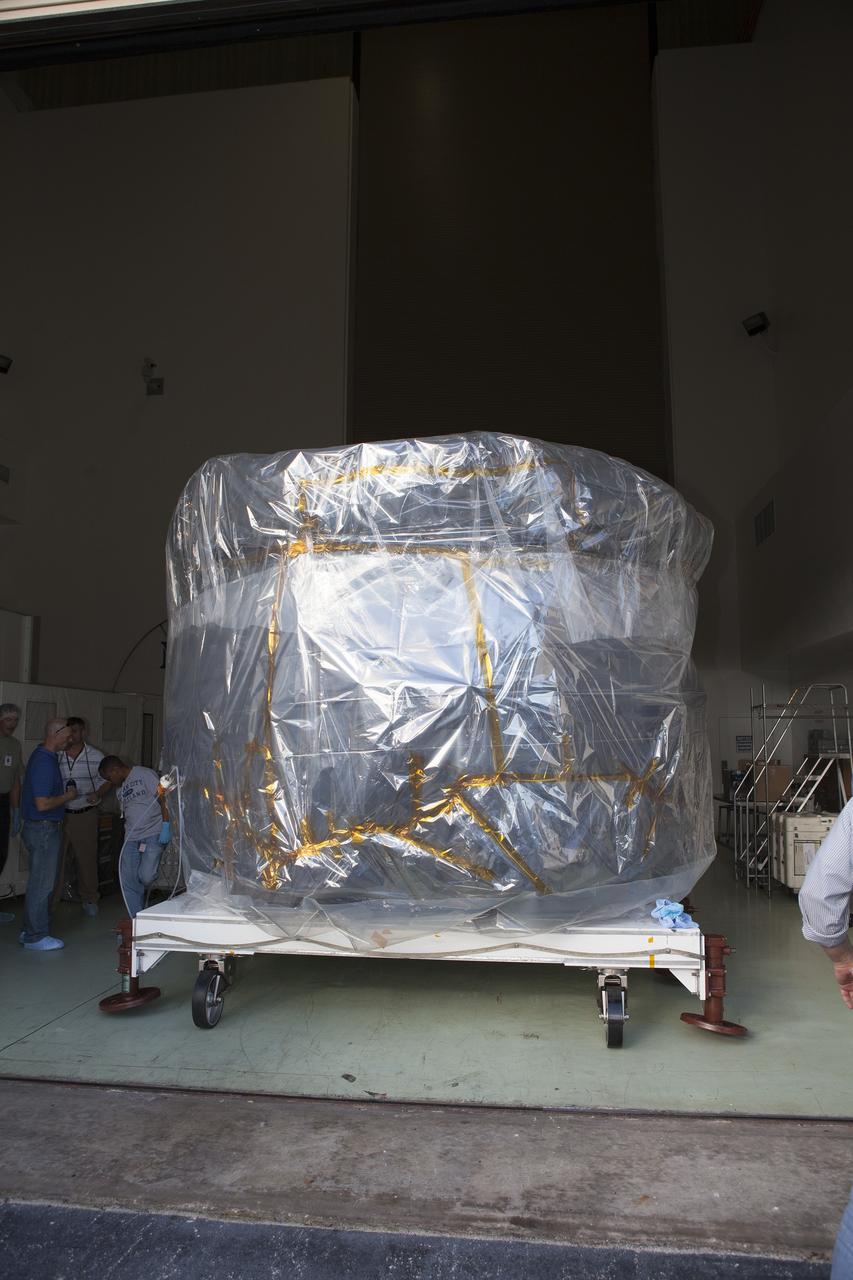
CAPE CANAVERAL, Fla. – Two of the observatories, the lower stack, mini-stack number 1, for NASA's Magnetospheric Multiscale Observatory, or MMS, arrive in the Building 1 airlock at the Astrotech payload processing facility in Titusville, Florida, near Kennedy Space Center. The MMS upper stack, mini-stack number 2, is scheduled to arrive in about two weeks. MMS is a Solar Terrestrial Probes mission comprising four identically instrumented spacecraft that will use Earth’s magnetosphere as a laboratory to study the microphysics of three fundamental plasma processes: magnetic reconnection, energetic particle acceleration and turbulence. Launch aboard a United Launch Alliance Atlas V rocket from Space Launch Complex 41 on Cape Canaveral Air Force Station is targeted for March 12, 2015. To learn more about MMS, visit http://mms.gsfc.nasa.gov. Photo credit: NASA/Dan Casper
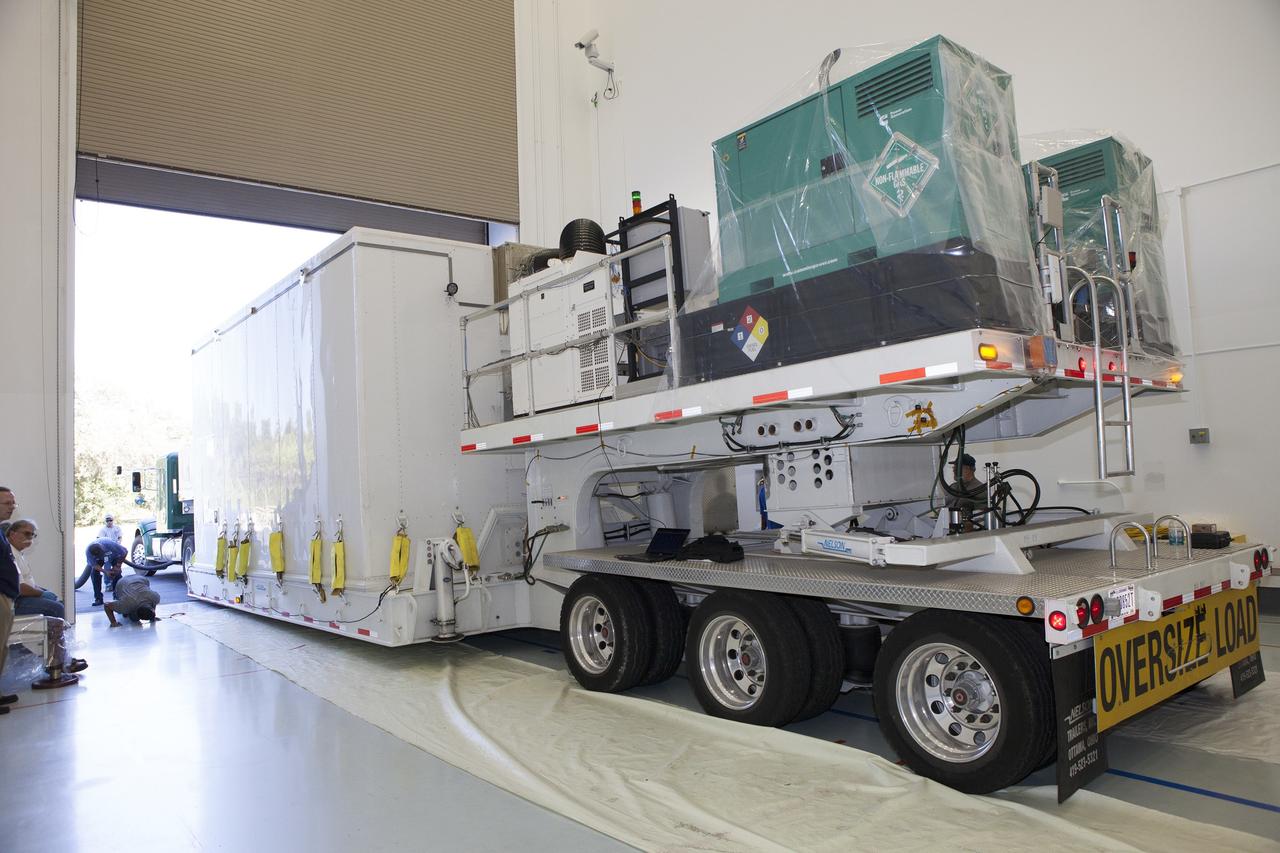
CAPE CANAVERAL, Fla. – Preparations are underway to remove the lower stack, mini-stack number 1, two of the observatories for NASA's Magnetospheric Multiscale Observatory, or MMS, from their protective shipping container in the Building 2 south encapsulation bay at the Astrotech payload processing facility in Titusville, Florida, near Kennedy Space Center. The MMS upper stack, mini-stack number 2, is scheduled to arrive in about two weeks. MMS is a Solar Terrestrial Probes mission comprising four identically instrumented spacecraft that will use Earth’s magnetosphere as a laboratory to study the microphysics of three fundamental plasma processes: magnetic reconnection, energetic particle acceleration and turbulence. Launch aboard a United Launch Alliance Atlas V rocket from Space Launch Complex 41 on Cape Canaveral Air Force Station is targeted for March 12, 2015. To learn more about MMS, visit http://mms.gsfc.nasa.gov. Photo credit: NASA/Dan Casper
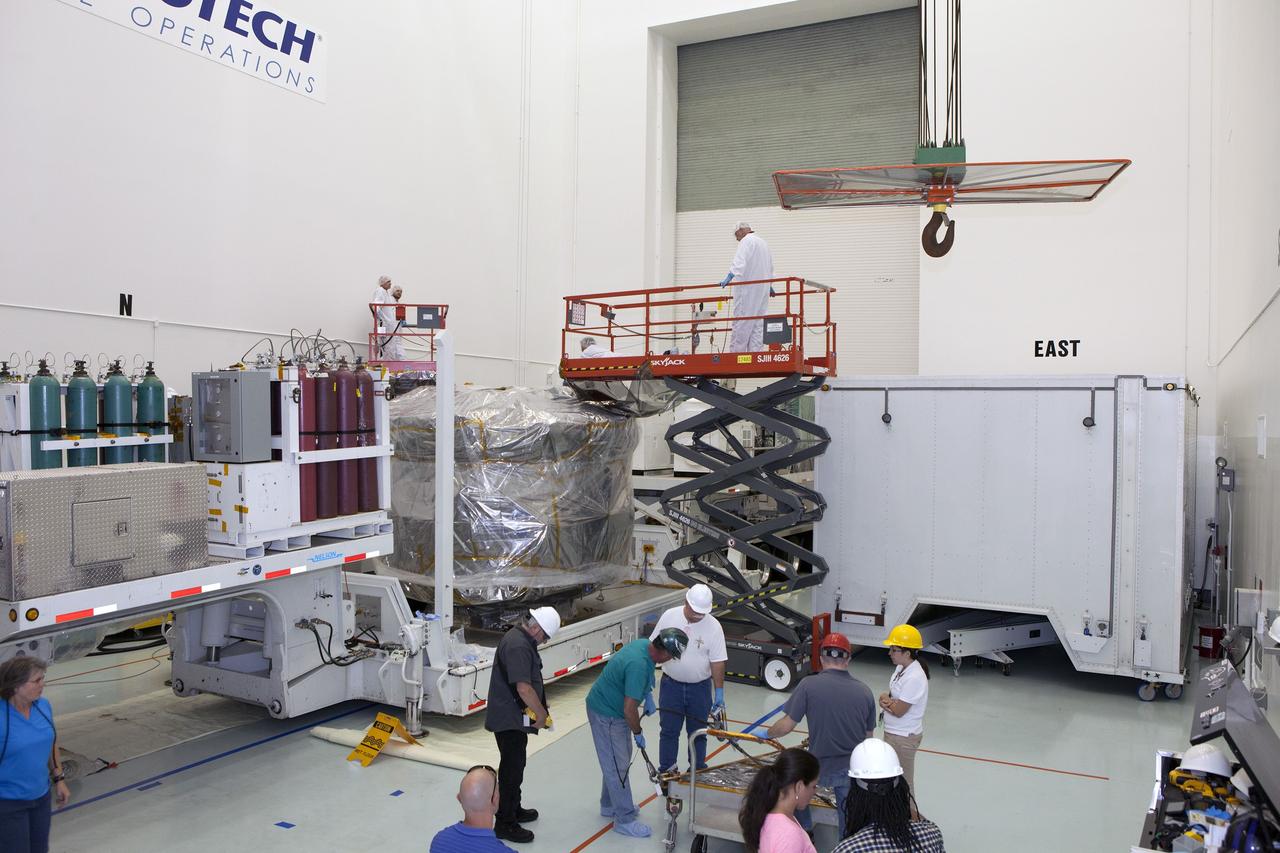
CAPE CANAVERAL, Fla. – Workers prepare a payload dolly for the lower stack, mini-stack number 1, two of the observatories for NASA's Magnetospheric Multiscale Observatory, or MMS, during uncrating operations in the Building 2 south encapsulation bay at the Astrotech payload processing facility in Titusville, Florida, near Kennedy Space Center. The MMS upper stack, mini-stack number 2, is scheduled to arrive in about two weeks. MMS is a Solar Terrestrial Probes mission comprising four identically instrumented spacecraft that will use Earth’s magnetosphere as a laboratory to study the microphysics of three fundamental plasma processes: magnetic reconnection, energetic particle acceleration and turbulence. Launch aboard a United Launch Alliance Atlas V rocket from Space Launch Complex 41 on Cape Canaveral Air Force Station is targeted for March 12, 2015. To learn more about MMS, visit http://mms.gsfc.nasa.gov. Photo credit: NASA/Dan Casper
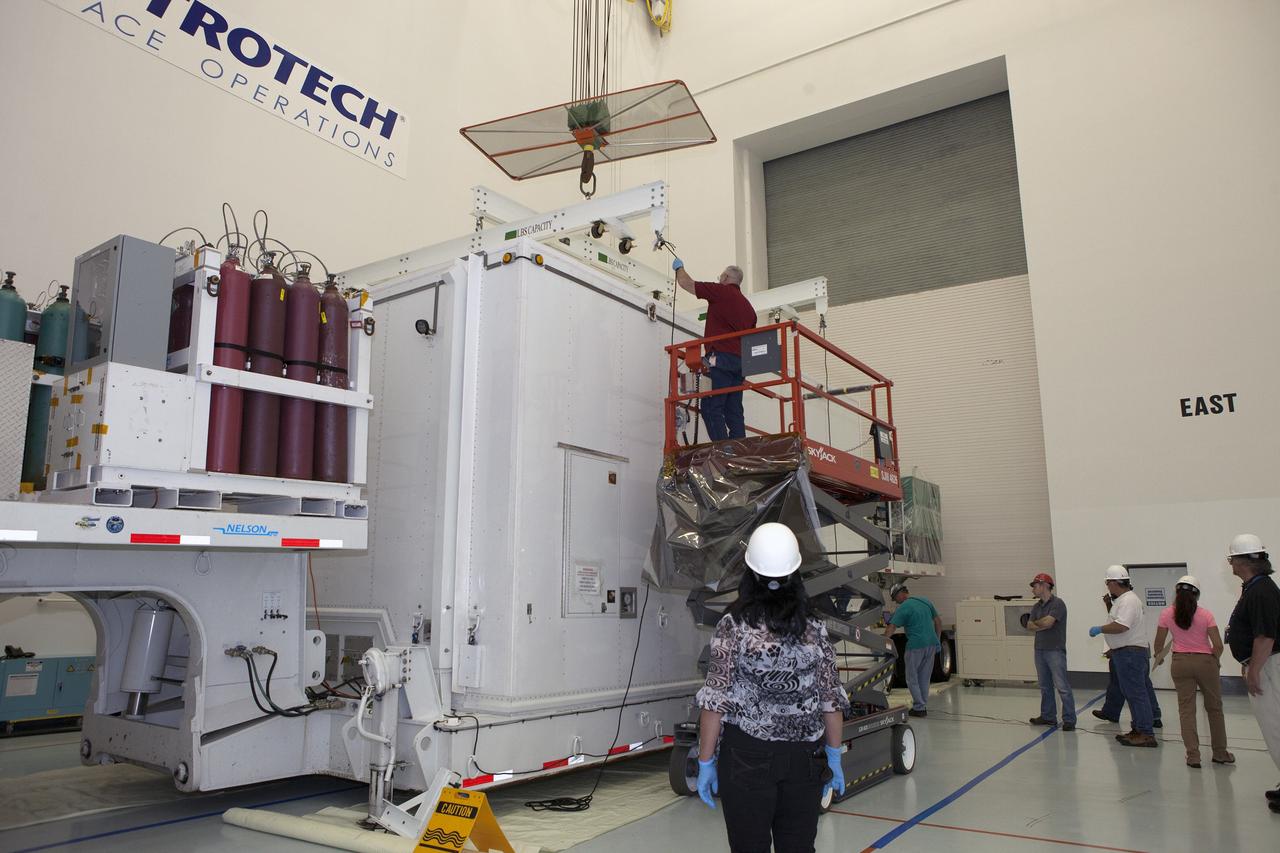
CAPE CANAVERAL, Fla. – Workers attach a crane to the protective shipping container to prepare to uncover the lower stack, mini-stack number 1, two of the observatories for NASA's Magnetospheric Multiscale Observatory, or MMS. They were delivered to the Building 2 south encapsulation bay at the Astrotech payload processing facility in Titusville, Florida, near Kennedy Space Center. The MMS upper stack, mini-stack number 2, is scheduled to arrive in about two weeks. MMS is a Solar Terrestrial Probes mission comprising four identically instrumented spacecraft that will use Earth’s magnetosphere as a laboratory to study the microphysics of three fundamental plasma processes: magnetic reconnection, energetic particle acceleration and turbulence. Launch aboard a United Launch Alliance Atlas V rocket from Space Launch Complex 41 on Cape Canaveral Air Force Station is targeted for March 12, 2015. To learn more about MMS, visit http://mms.gsfc.nasa.gov. Photo credit: NASA/Dan Casper
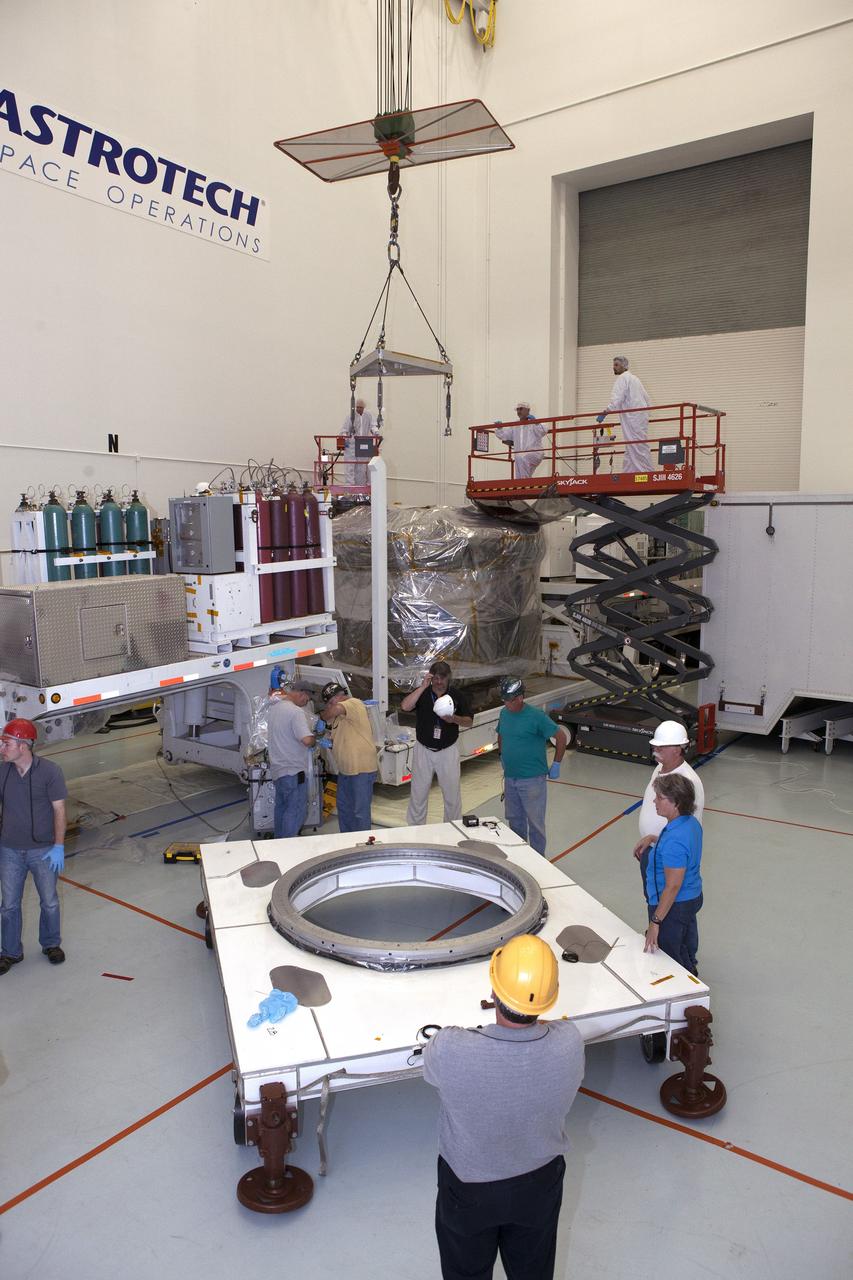
CAPE CANAVERAL, Fla. – A crane is lowered toward the lower stack, mini-stack number 1, two of the observatories for NASA's Magnetospheric Multiscale Observatory, or MMS, during uncrating operations in the Building 2 south encapsulation bay at the Astrotech payload processing facility in Titusville, Florida, near Kennedy Space Center. The MMS upper stack, mini-stack number 2, is scheduled to arrive in about two weeks. MMS is a Solar Terrestrial Probes mission comprising four identically instrumented spacecraft that will use Earth’s magnetosphere as a laboratory to study the microphysics of three fundamental plasma processes: magnetic reconnection, energetic particle acceleration and turbulence. Launch aboard a United Launch Alliance Atlas V rocket from Space Launch Complex 41 on Cape Canaveral Air Force Station is targeted for March 12, 2015. To learn more about MMS, visit http://mms.gsfc.nasa.gov. Photo credit: NASA/Dan Casper