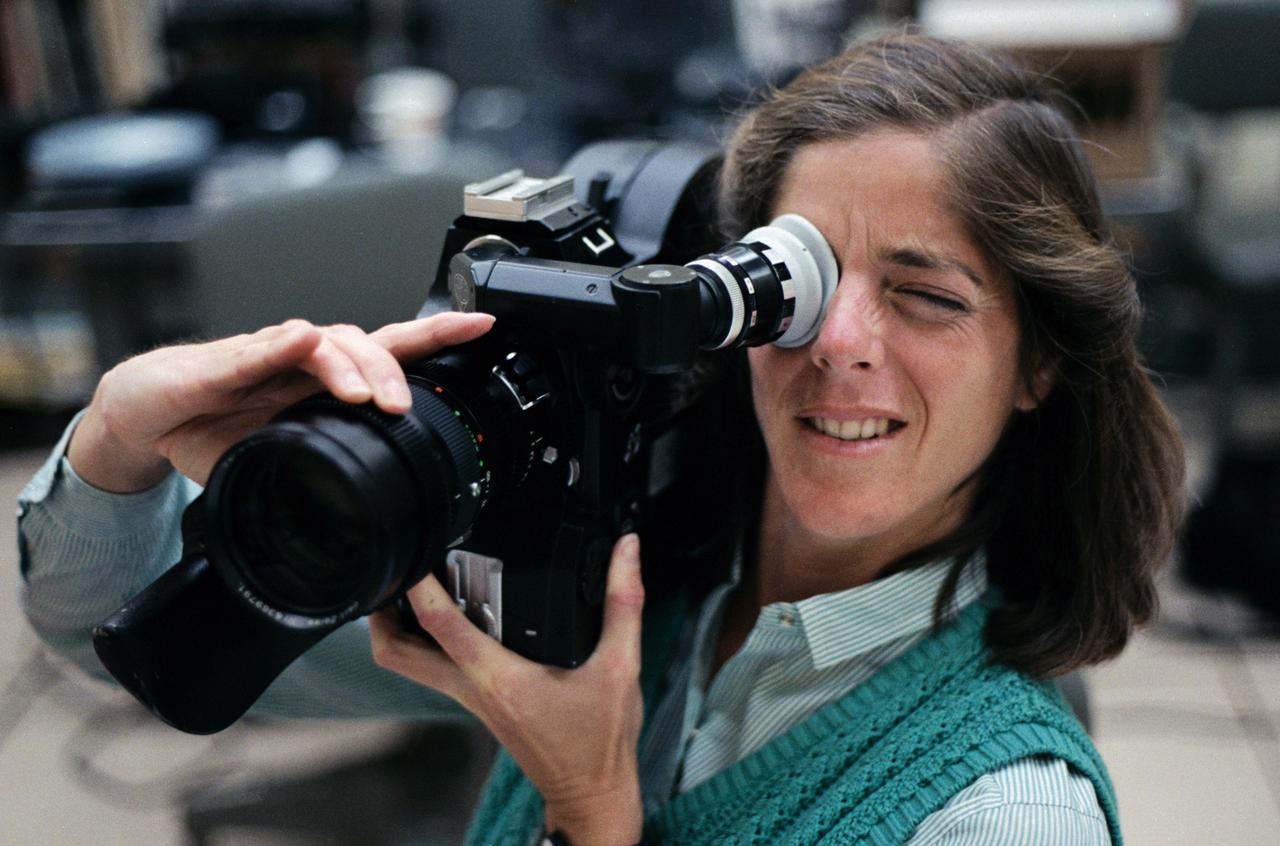
S85-40671 (18 Sept. 1985) --- The two teachers, Barbara R. Morgan and Sharon Christa McAuliffe (out of frame) have hands-on experience with an Arriflex motion picture camera following a briefing on space photography. The two began training Sept. 10, 1985 with the STS-51L crew and learning basic procedures for space travelers. The second week of training included camera training, aircraft familiarization and other activities. Morgan zeroes in on a test subject during a practice session with the Arriflex. Photo credit: NASA
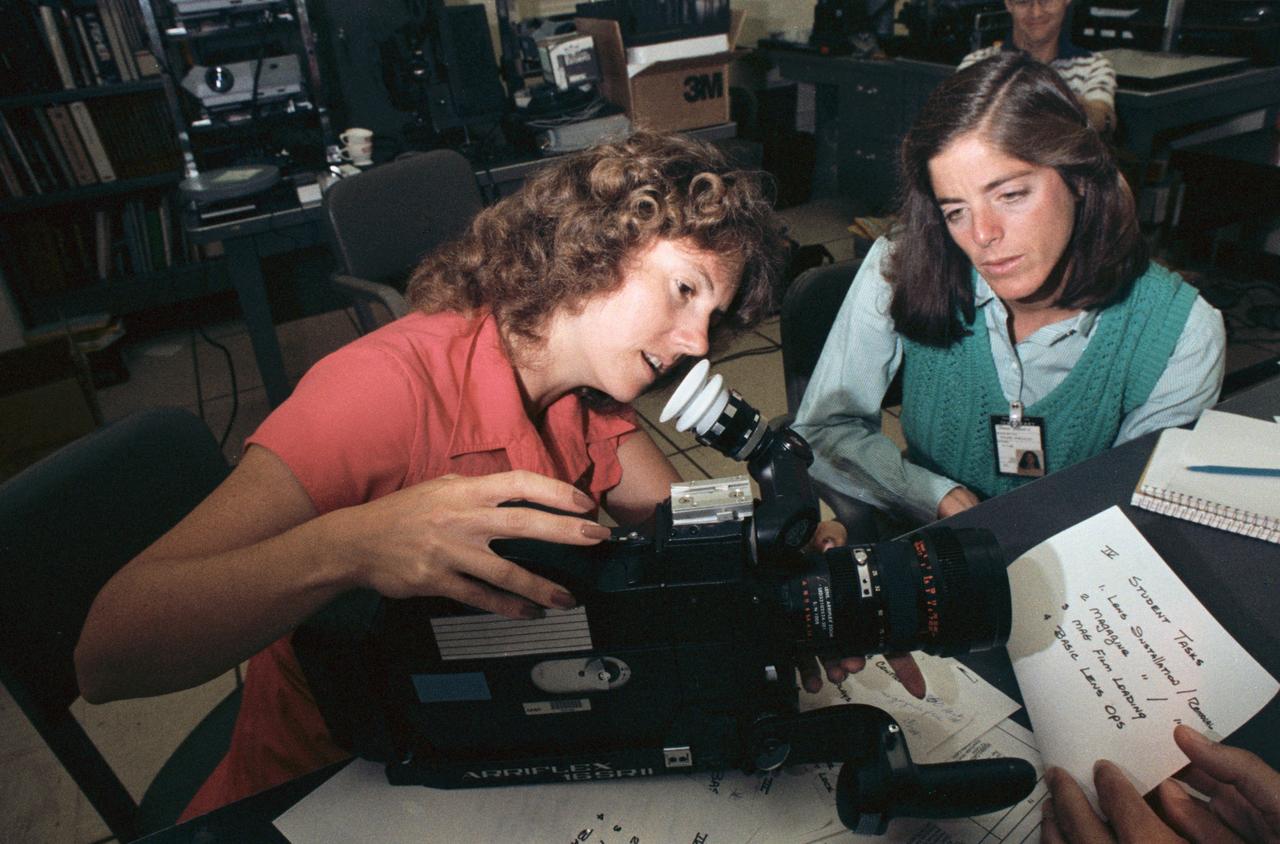
S85-40668 (18 Sept. 1985) --- The two teachers, Sharon Christa McAuliffe (left) and Barbara R. Morgan have hands-on experience with an Arriflex motion picture camera following a briefing on space photography. The two began training Sept. 10, 1985 with the STS-51L crew and learning basic procedures for space travelers. The second week of training included camera training, aircraft familiarization and other activities. Photo credit: NASA
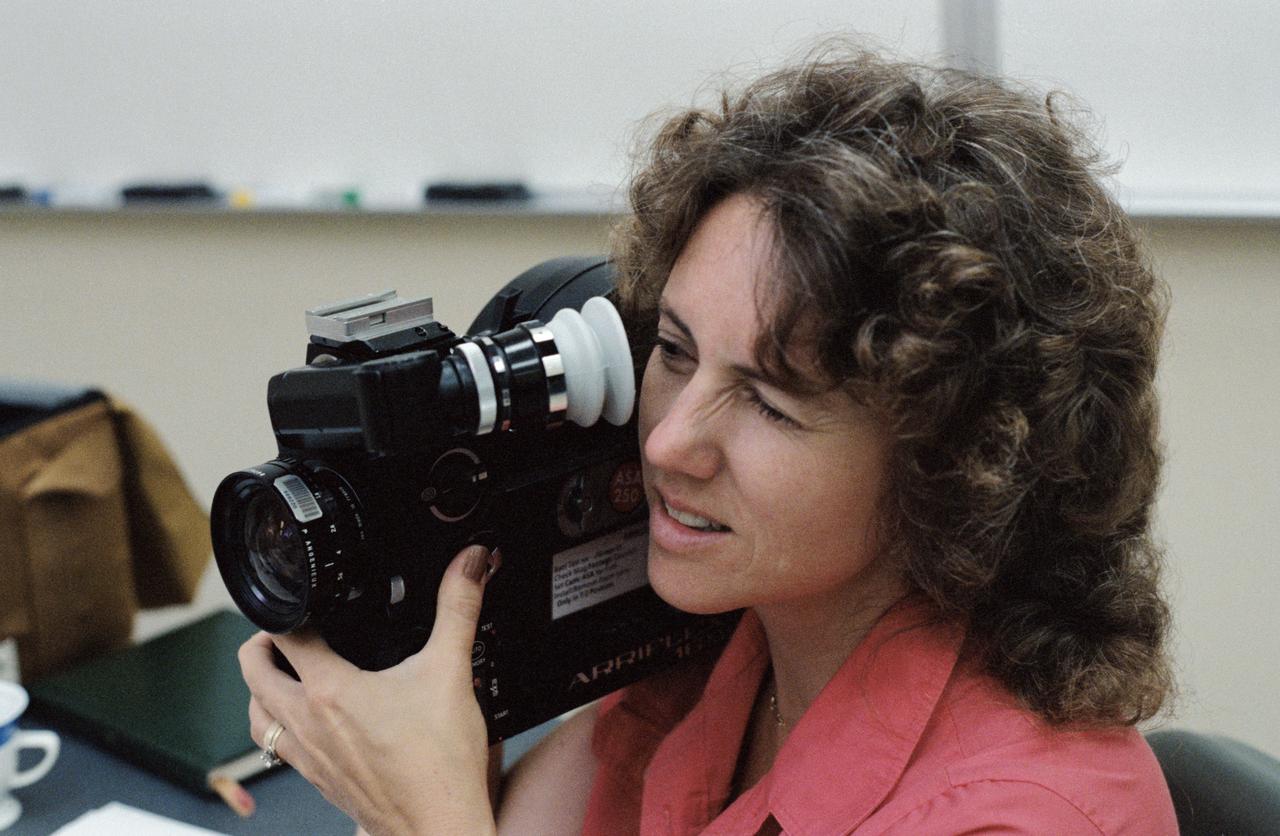
S85-40670 (18 Sept. 1985) --- The two teachers, Sharon Christa McAuliffe and Barbara R. Morgan (out of frame) have hands-on experience with an Arriflex motion picture camera following a briefing on space photography. The two began training Sept. 10, 1985 with the STS-51L crew and learning basic procedures for space travelers. The second week of training included camera training, aircraft familiarization and other activities. McAuliffe zeroes in on a test subject during a practice session with the Arriflex. Photo credit: NASA
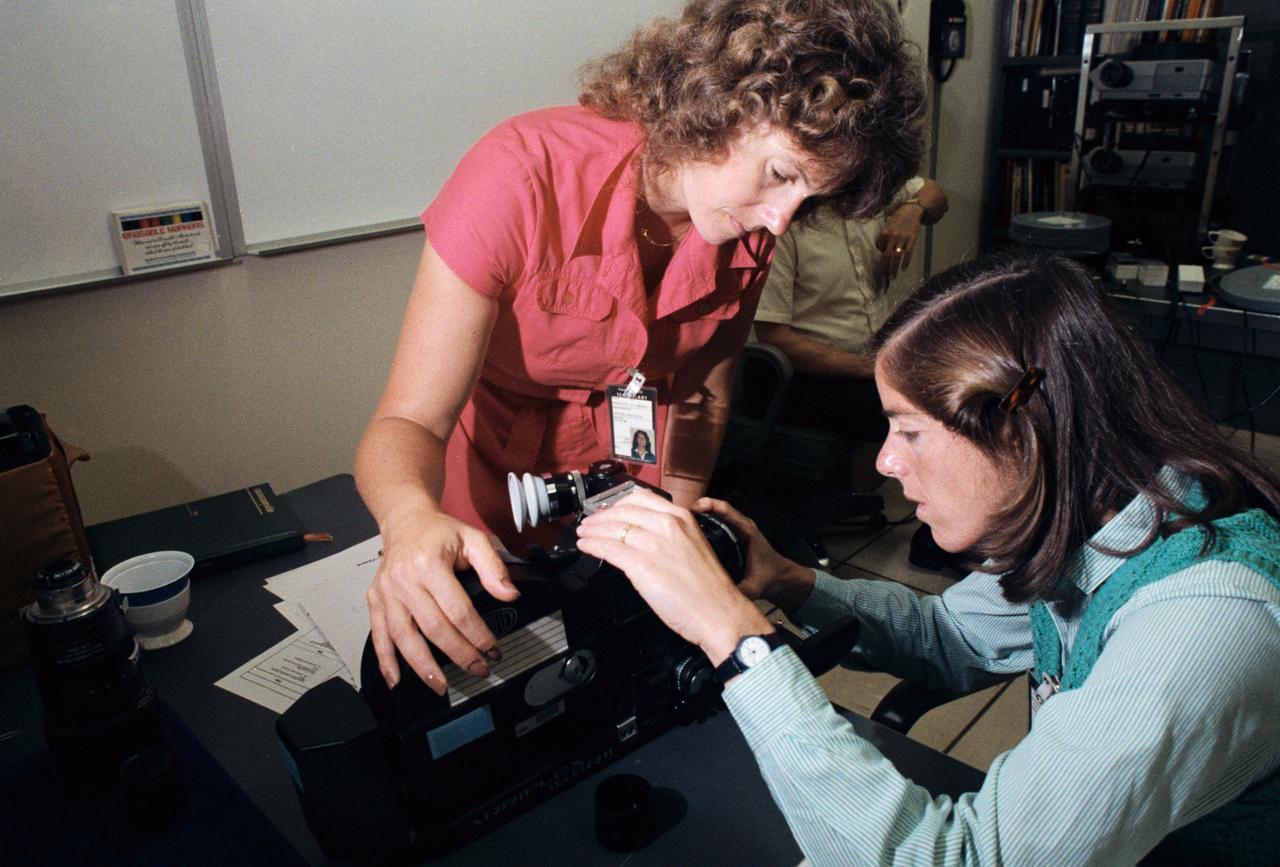
S85-40669 (18 Sept. 1985) --- The two teachers, Sharon Christa McAuliffe (left) and Barbara R. Morgan have hands-on experience with an Arriflex motion picture camera following a briefing on space photography. The two began training Sept. 10, 1985 with the STS-51L crew and learning basic procedure for space travelers. The second week of training included camera training, aircraft familiarization and other activities. Morgan adjusts a lens as a studious McAuliffe looks on. Photo credit: NASA
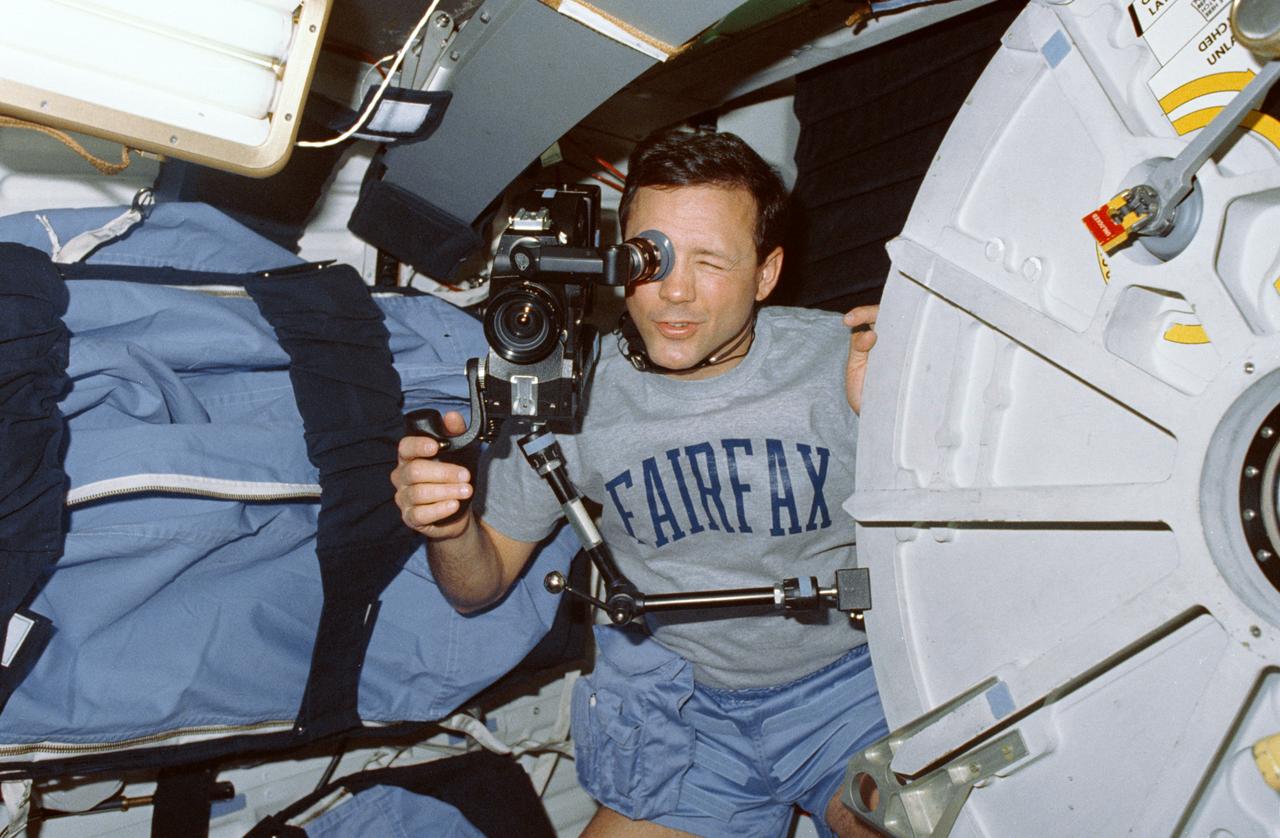
STS-36 Mission Specialist (MS) Pierre J. Thuot operates 16mm ARRIFLEX motion picture camera mounted on the open airlock hatch via a bracket. Thuot uses the camera to record activity of his fellow STS-36 crewmembers on the middeck of Atlantis, Orbiter Vehicle (OV) 104. Positioned between the airlock hatch and the starboard wall-mounted sleep restraints, Thuot, wearing a FAIRFAX t-shirt, squints into the cameras eye piece. Thuot and four other astronauts spent four days, 10 hours and 19 minutes aboard OV-104 for the Department of Defense (DOD) devoted mission.
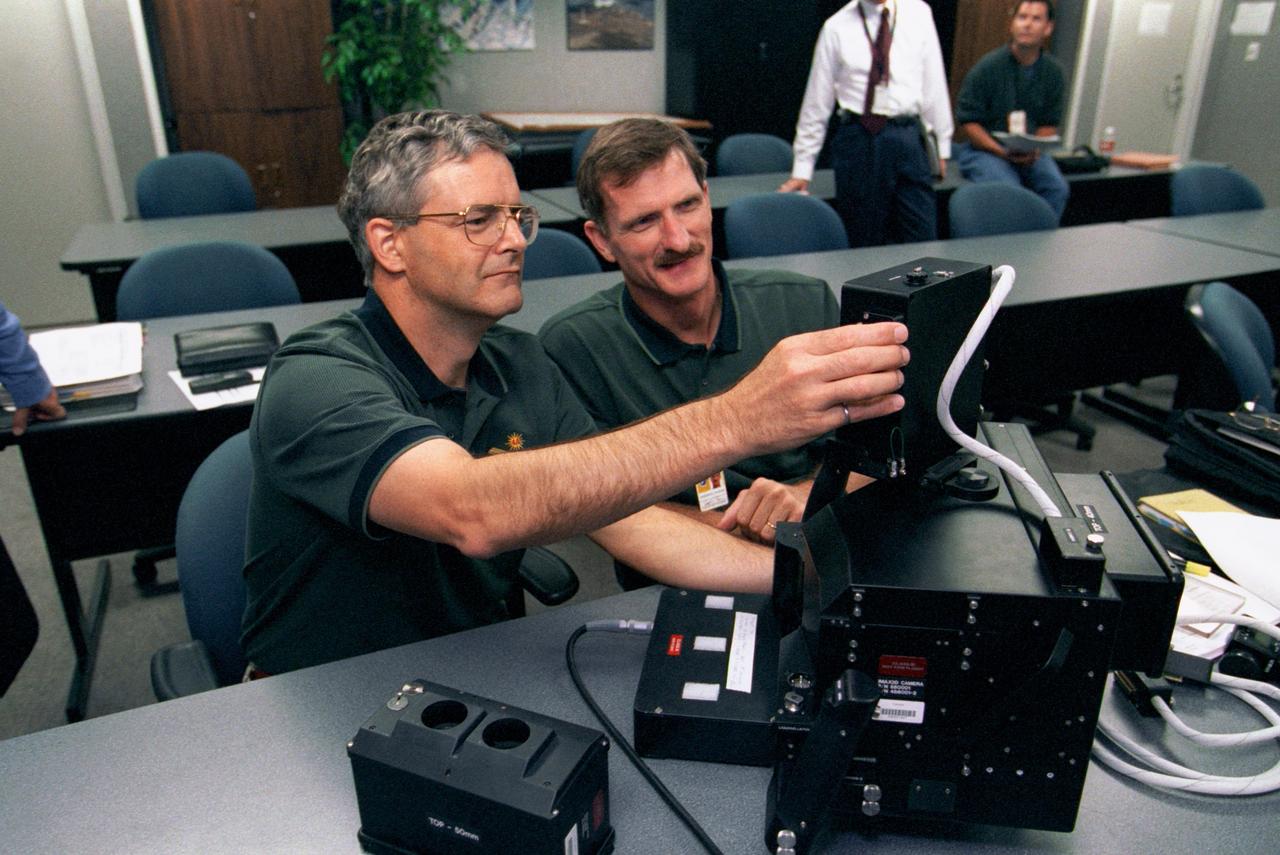
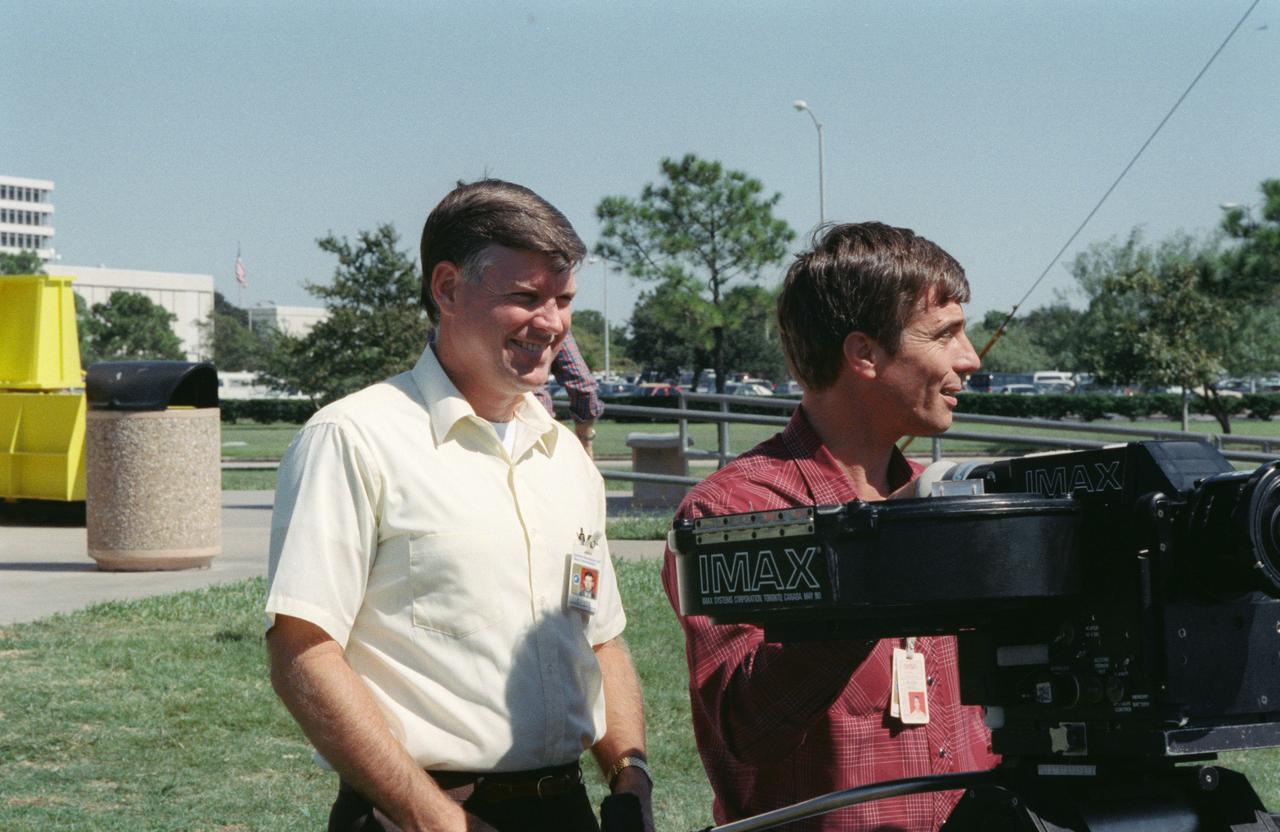
JSC2000-04743 (13 June 2000) --- Astronauts Marc Garneau (left) and Joseph R. Tanner, STS-97 mission specialists, familiarize themselves with an IMAX 3D motion picture camera during a training session in the Flight Operations Facility at the Johnson Space Center (JSC). Garneau represents the Canadian Space Agency (CSA).
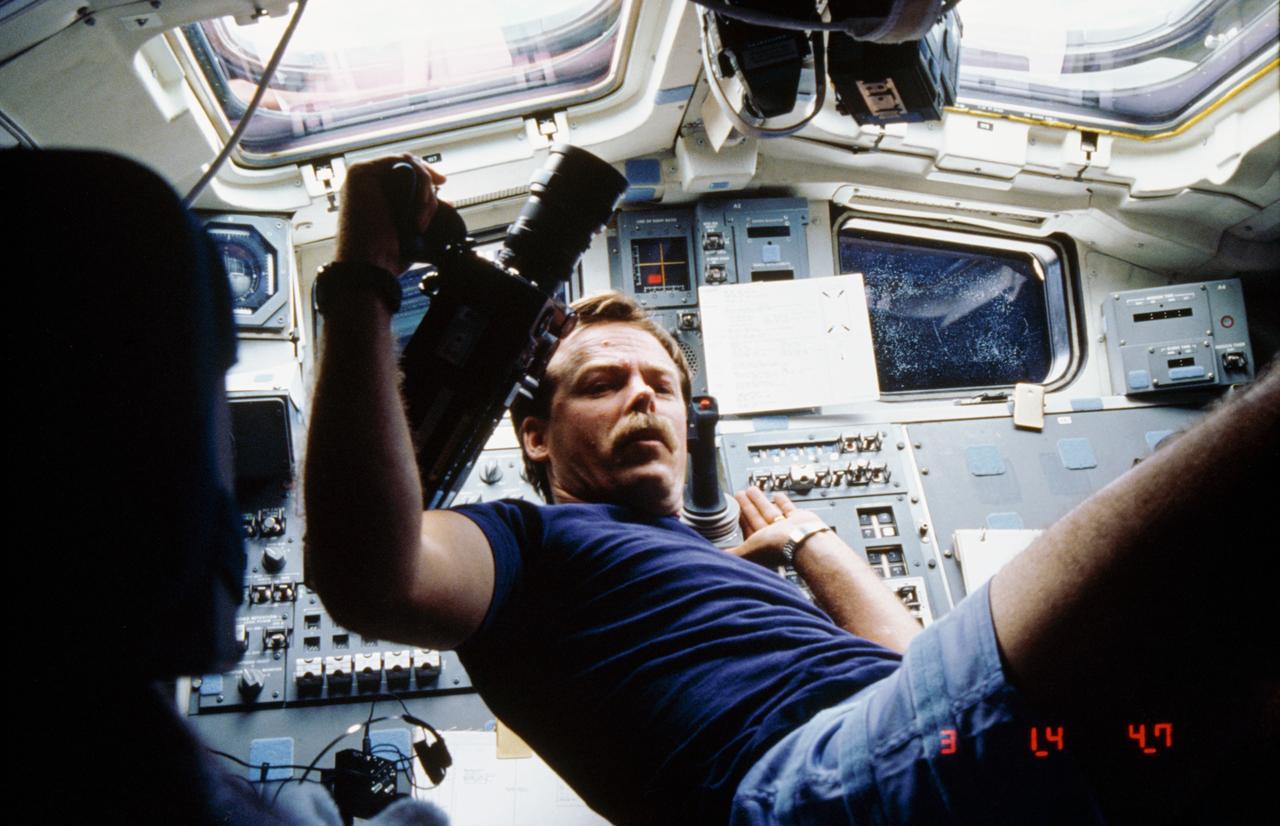
61C-07-030 (15 Jan 1986) --- Astronaut Robert L. Gibson, STS 61-C mission commander, partially floats on the aft flight deck of the earth-orbiting Space Shuttle Columbia while preparing to use a motion picture camera. The windows overlooking the cargo bay are visible in the background.
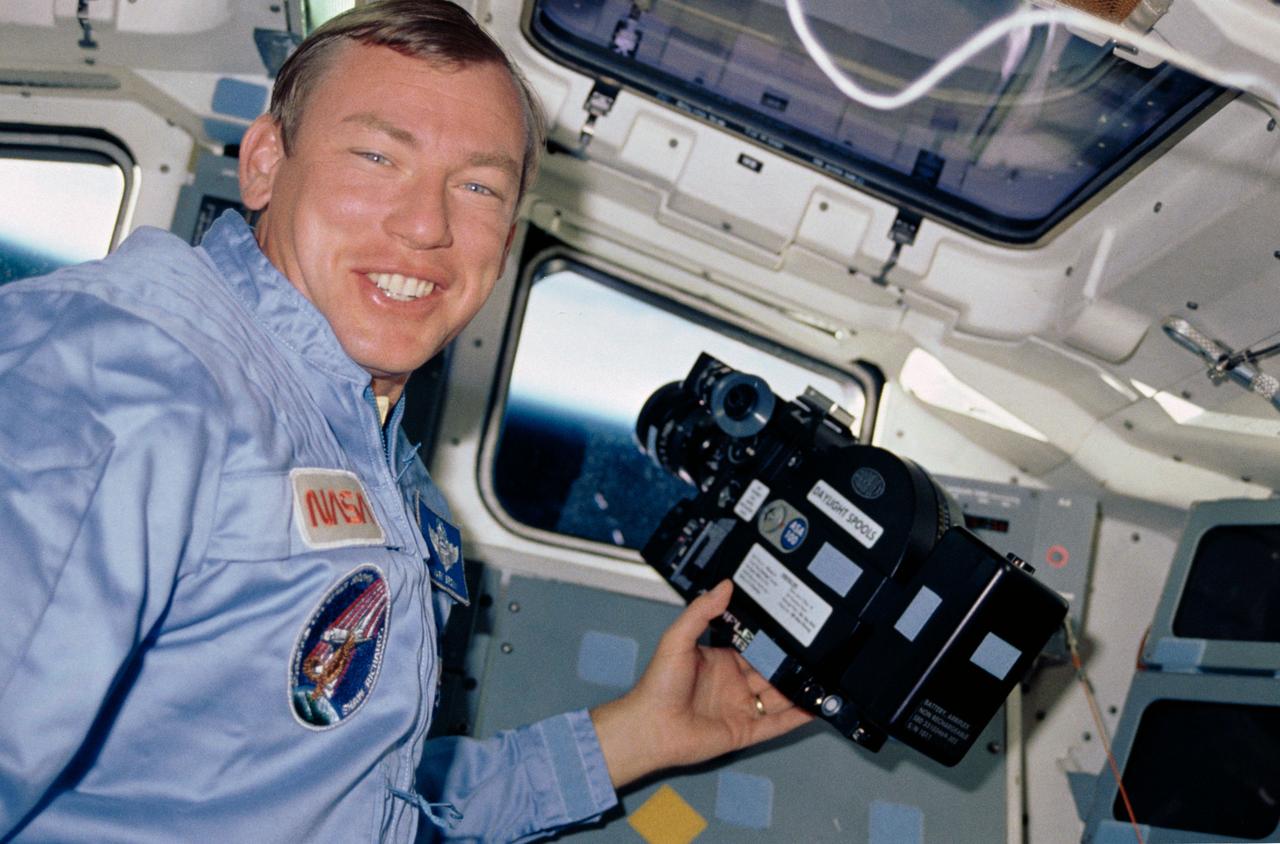
STS028-17-033 (August 1989) --- Astronaut Mark N. Brown, STS-28 mission specialist, pauses from a session of motion-picture photography conducted through one of the aft windows on the flight deck of the Earth-orbiting Space Shuttle Columbia. He is using an Arriflex camera. The horizon of the blue and white appearing Earth and its airglow are visible in the background.
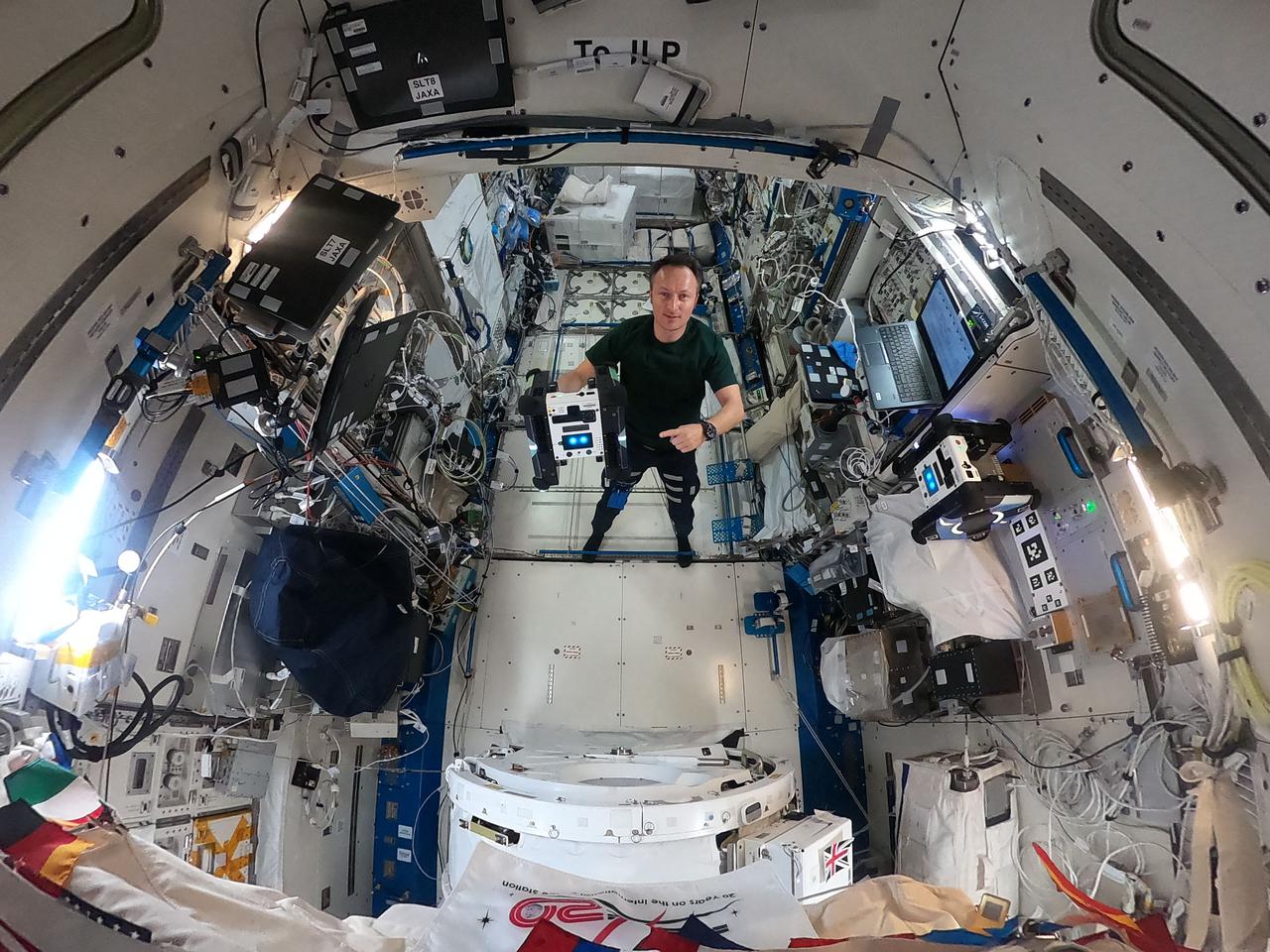
iss066e087003 (Dec. 4, 2021) --- ESA (European Space Agency) astronaut and Expedition 66 Flight Engineer Matthias Maurer is pictured inside the Kibo laboratory module setting up an Astrobee robotic free-flyer for the ReSWARM experiment. The robotics demonstration tests autonomous microgravity motion planning and control for on-orbit assembly and coordinated motion.
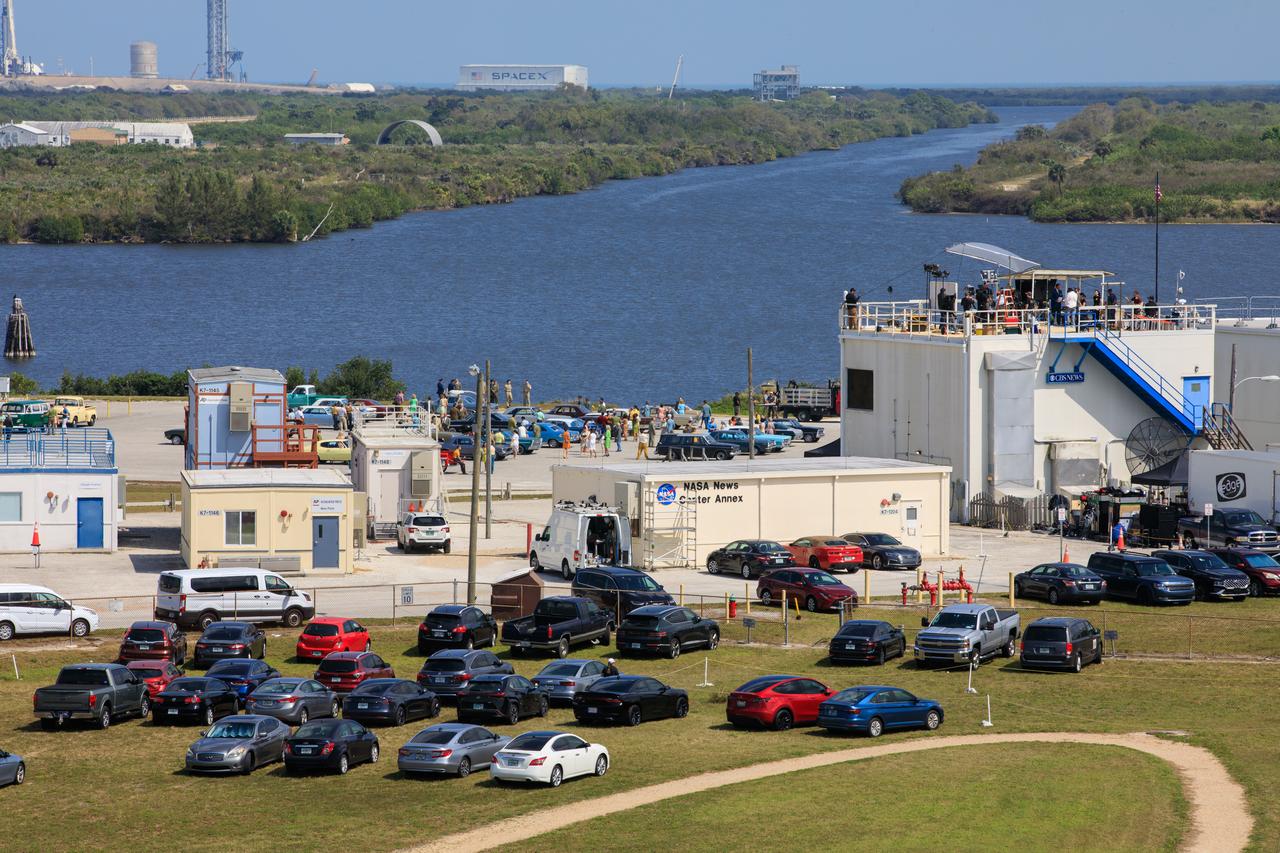
A major motion picture is being filmed in February 2023 at NASA’s Kennedy Space Center in Florida. Filming is in progress in the lower parking lot of the News Center.
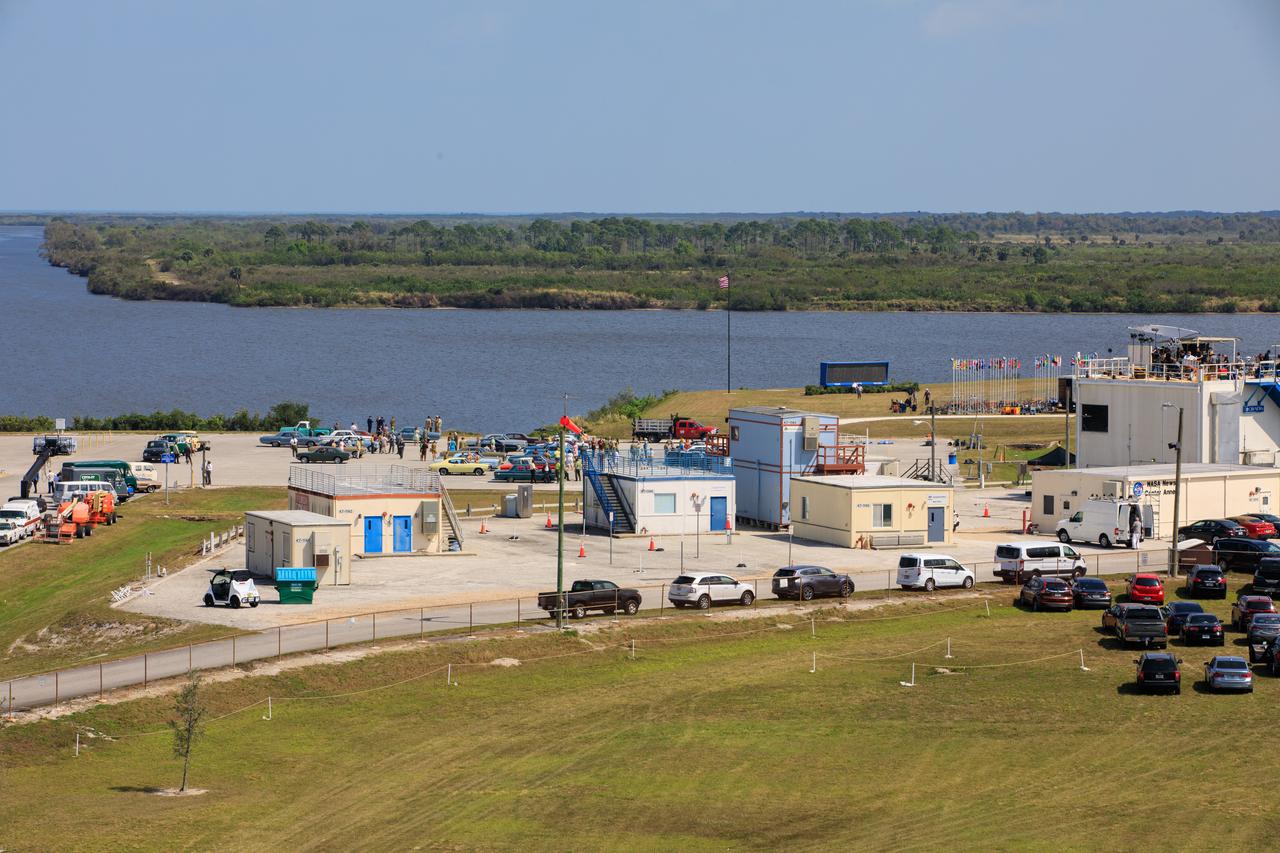
A major motion picture is being filmed in February 2023 at NASA’s Kennedy Space Center in Florida. Filming is in progress in the lower parking lot of the News Center.
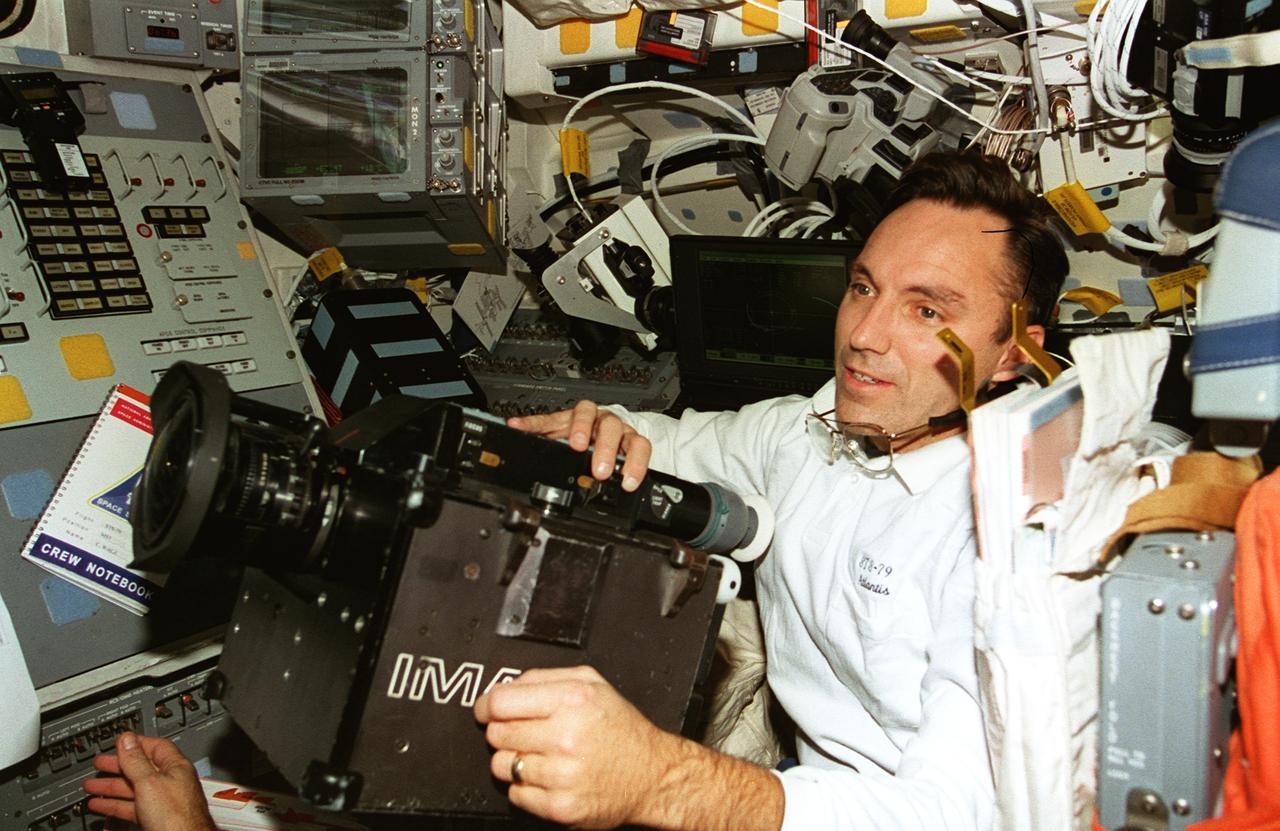
STS079-362-023 (16-26 Sept. 1996) --- Astronaut Carl E. Walz, mission specialist, positions the IMAX camera for a shoot on the flight deck of the Space Shuttle Atlantis. The IMAX project is a collaboration among NASA, the Smithsonian Institution's National Air and Space Museum, IMAX Systems Corporation and the Lockheed Corporation to document in motion picture format significant space activities and promote NASA's educational goals using the IMAX film medium. This system, developed by IMAX of Toronto, uses specially designed 65mm cameras and projectors to record and display very high definition color motion pictures which, accompanied by six-channel high fidelity sound, are displayed on screens in IMAX and OMNIMAX theaters that are up to ten times larger than a conventional screen, producing a feeling of "being there." The 65mm photography is transferred to 70mm motion picture films for showing in IMAX theaters. IMAX cameras have been flown on 14 previous missions.
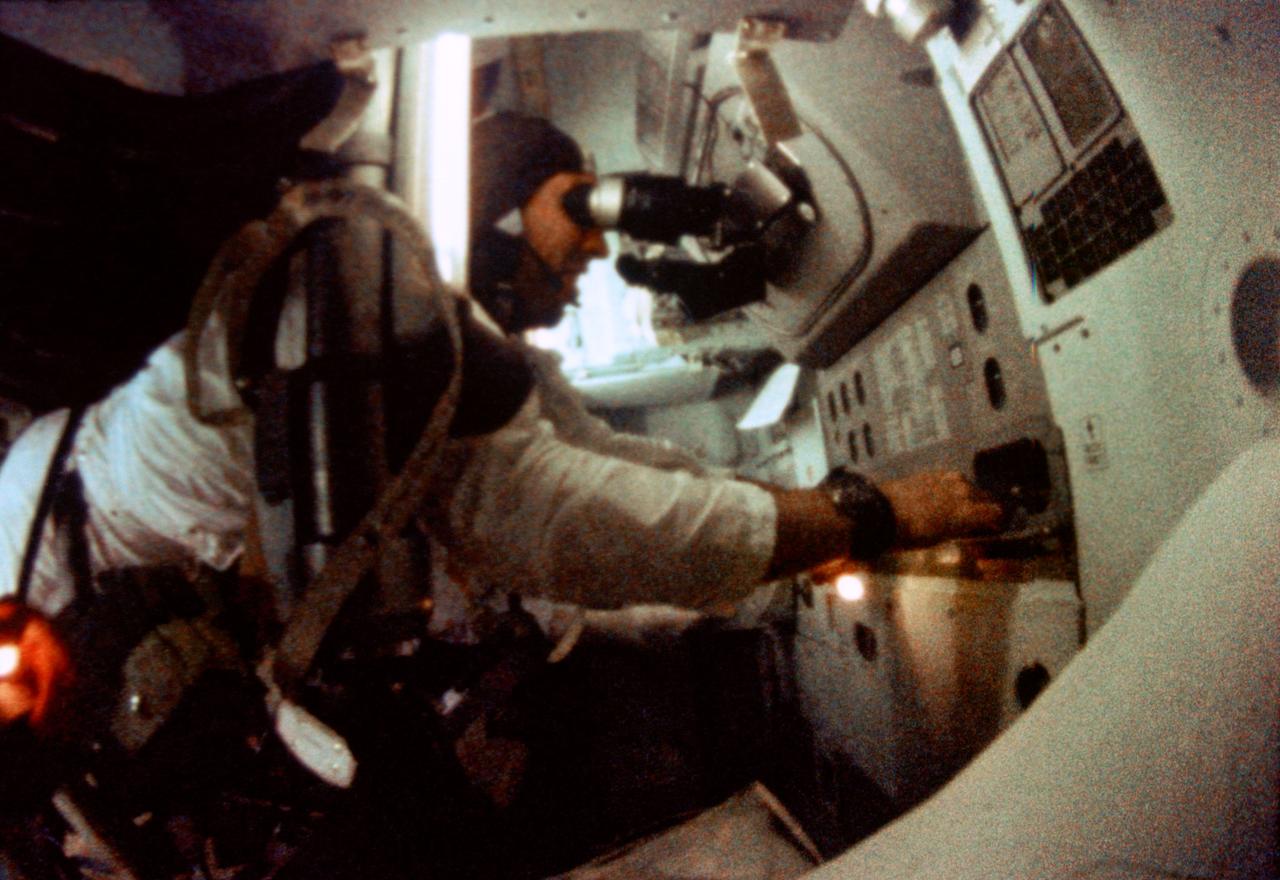
S69-35097 (21-27 Dec. 1968) --- Astronaut James A. Lovell Jr., Apollo 8 command module pilot, is seen at the Apollo 8 Spacecraft Command Module's Guidance and Navigation station during the Apollo 8 lunar orbit mission. This picture was taken from 16mm motion picture film.
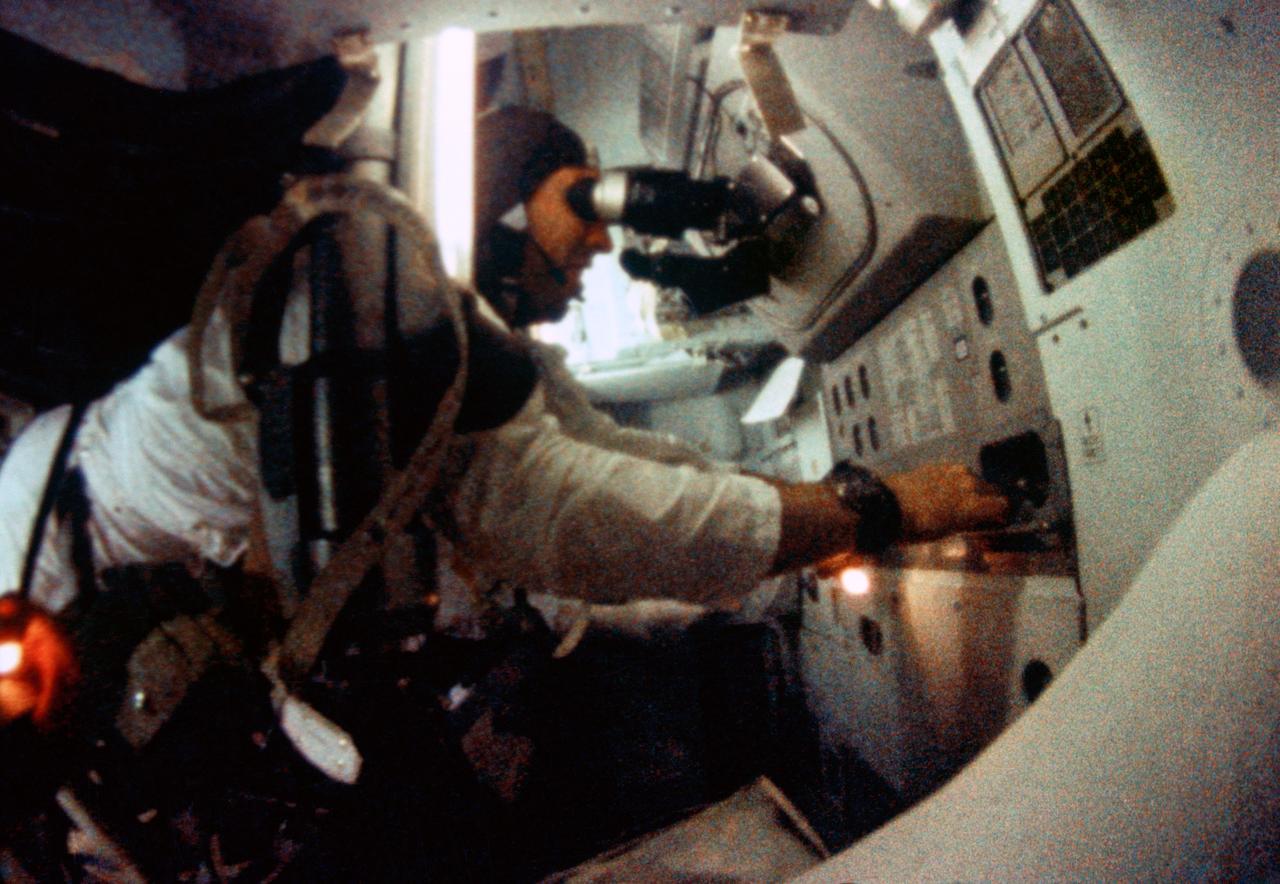
S69-35099 (21-27 Dec. 1968) --- Astronaut James A. Lovell Jr., Apollo 8 command module pilot, is seen at the Apollo 8 Spacecraft Command Module's Guidance and Navigation station during the Apollo 8 lunar orbit mission. This picture was taken from 16mm motion picture film.
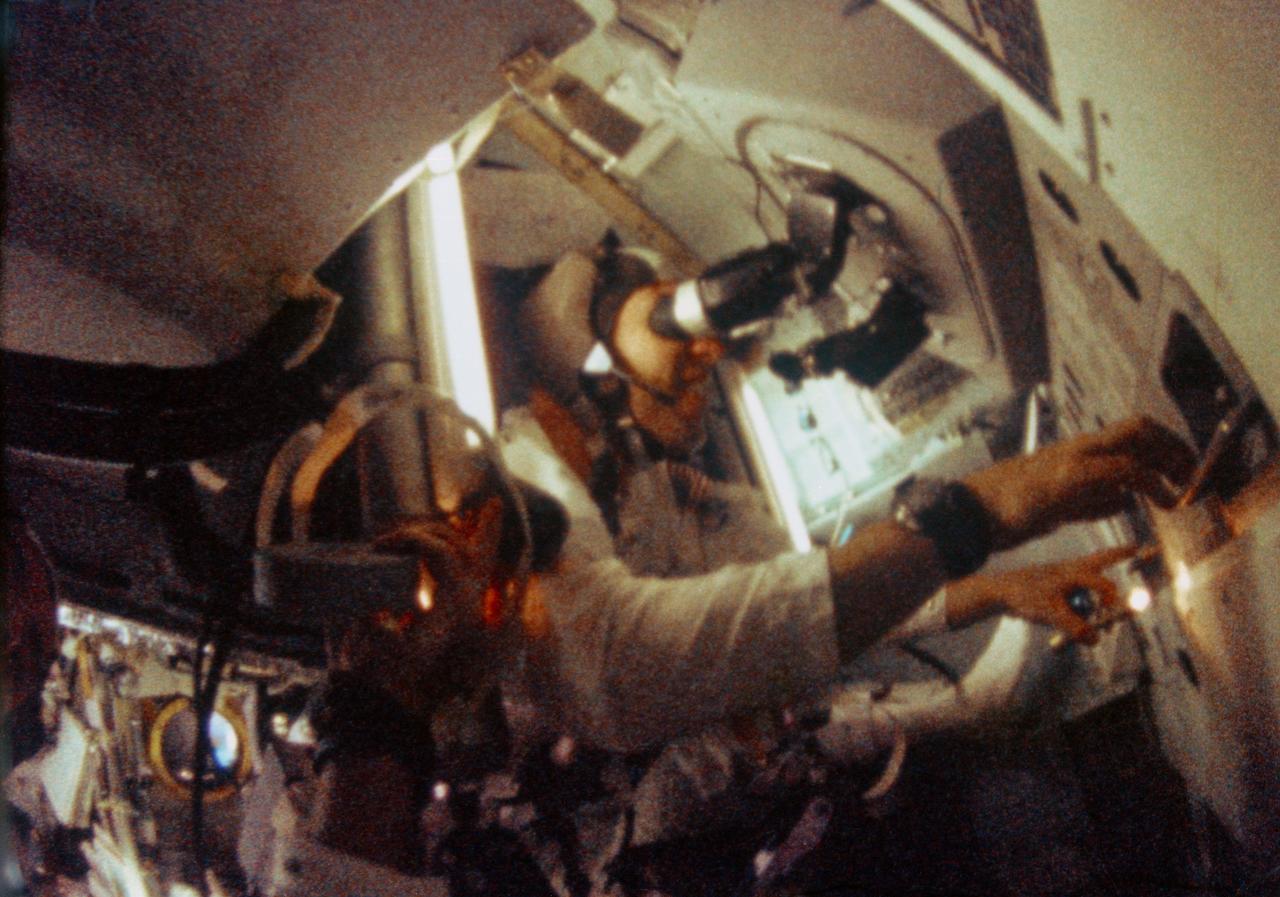
S69-35098 (21-27 Dec. 1968) --- Astronaut James A. Lovell Jr., Apollo 8 command module pilot, is seen at the Apollo 8 Spacecraft Command Module's Guidance and Navigation station during the Apollo 8 lunar orbit mission. This picture was taken from 16mm motion picture film.
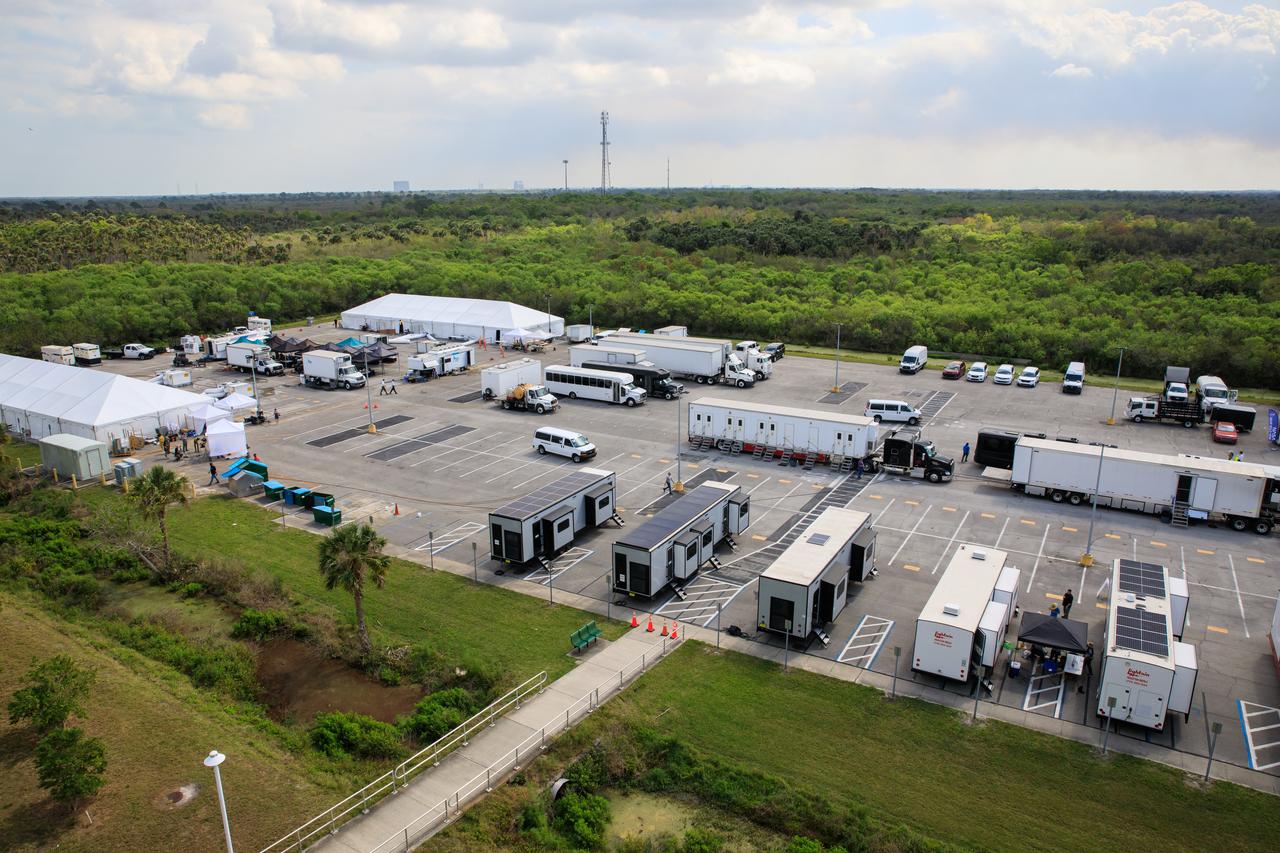
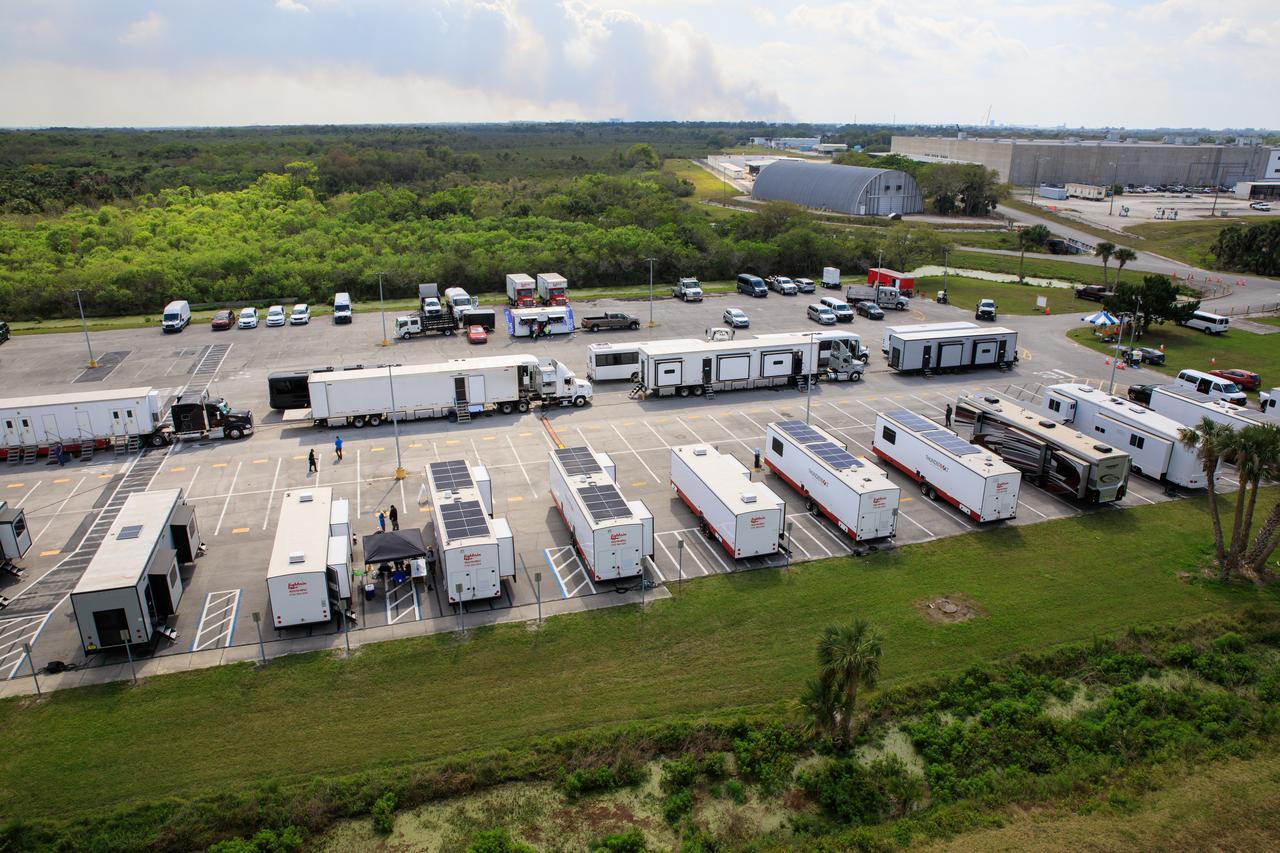
A major motion picture is being filmed in February 2023 at NASA’s Kennedy Space Center in Florida. In view is Base Camp #1 in the Launch Complex 39 area that includes support buildings for the film project.
A major motion picture is being filmed in February 2023 at NASA’s Kennedy Space Center in Florida. In view is Base Camp #1 in the Launch Complex 39 area that includes support buildings for the film project.
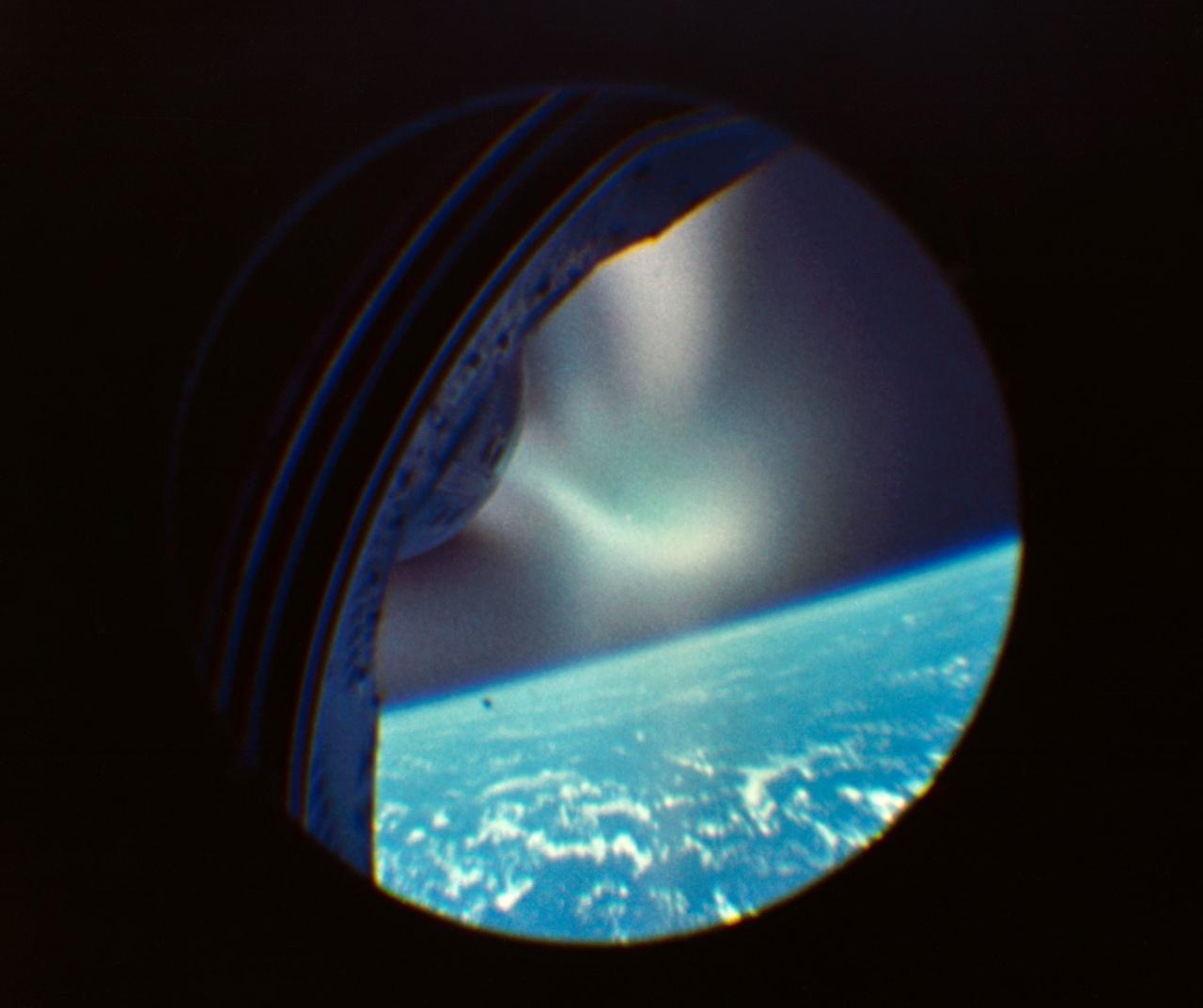
This photograph is an enlargement of a frame from a 16mm motion picture film which was mounted within the spacecraft to take film through the hatch window. CAPE KENNEDY, FL CN
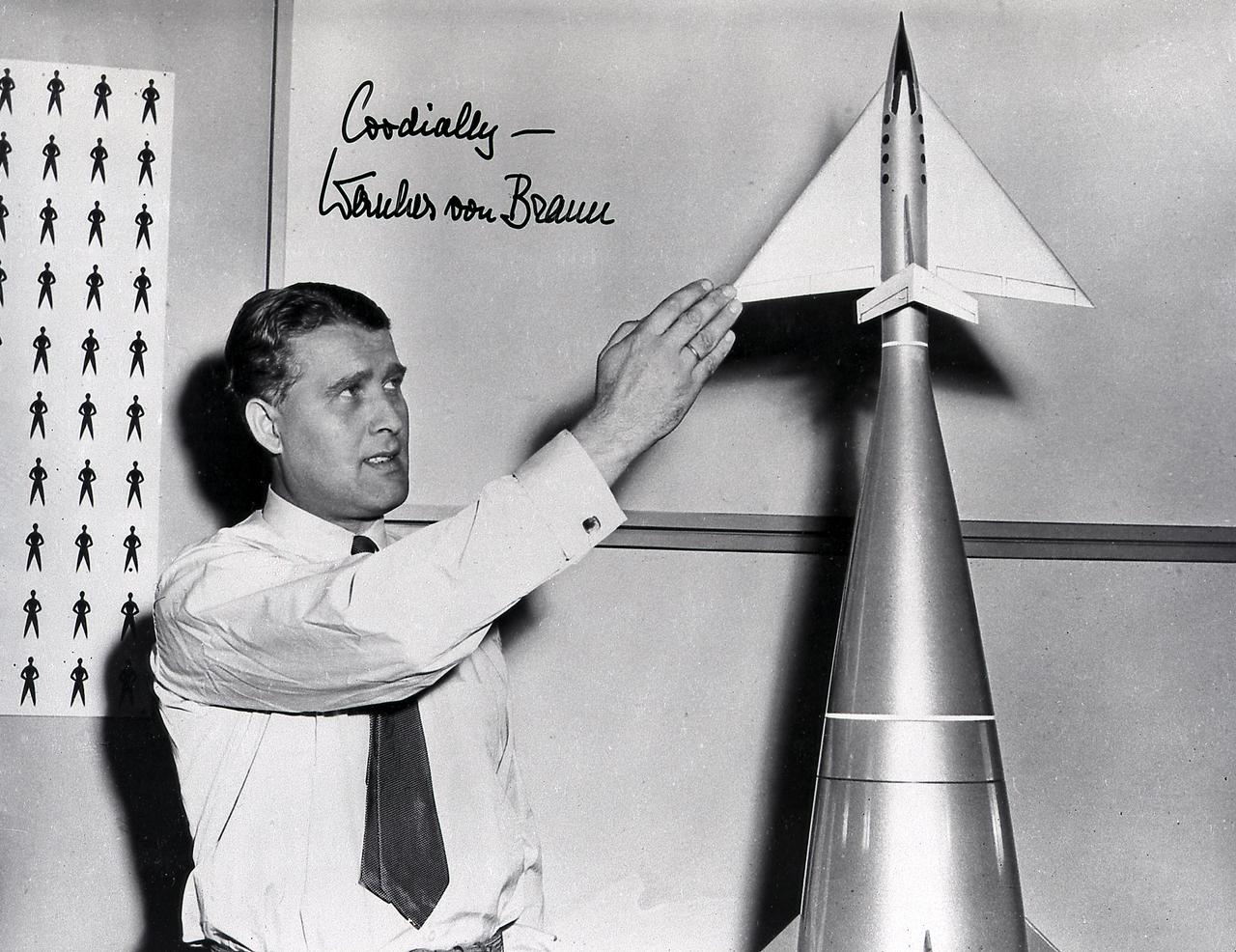
Dr. von Braun stands beside a model of the upper stage (Earth-returnable stage) of the three-stage launch vehicle built for the series of the motion picture productions of space flight produced by Walt Disney in the mid-1950's.
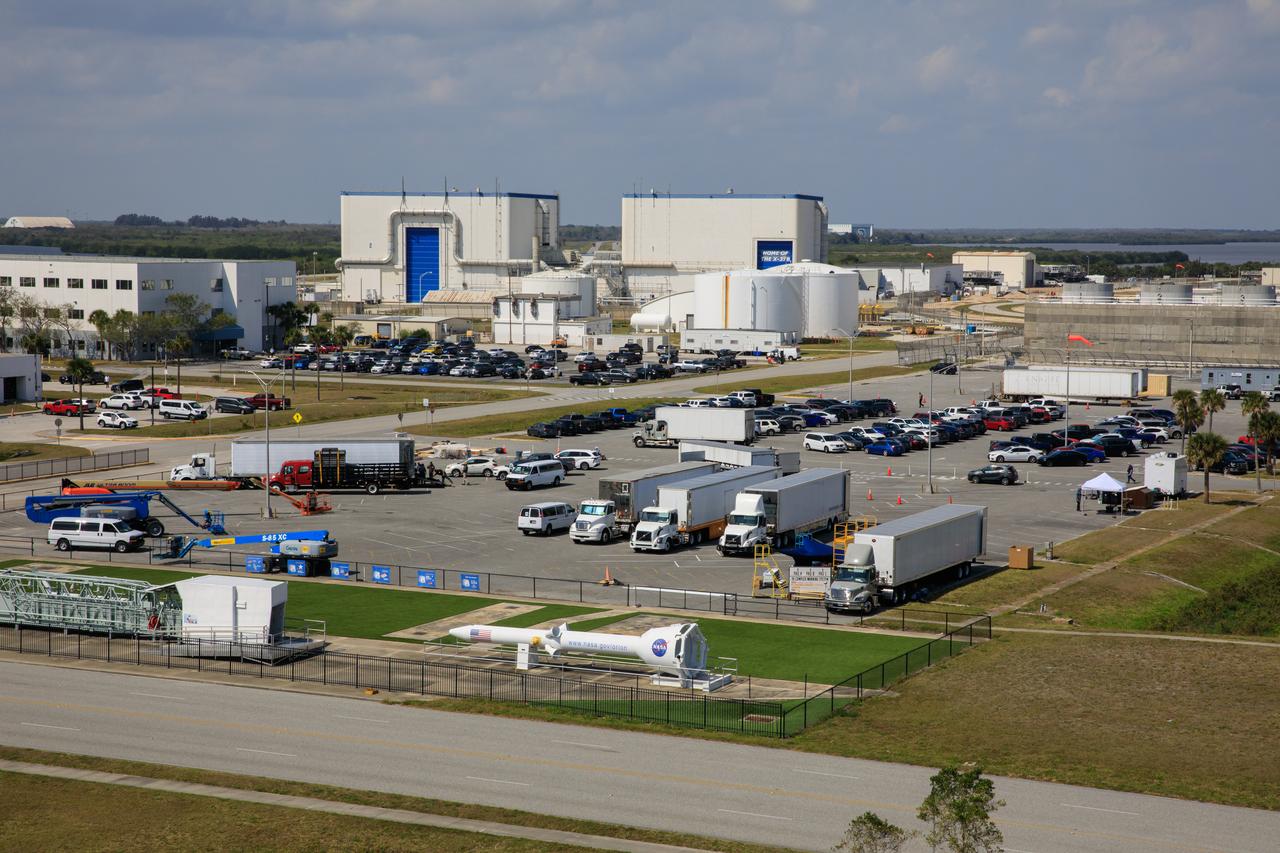
A major motion picture is being filmed in February 2023 at NASA’s Kennedy Space Center in Florida. In view are some of the support vehicles in use for the film project in the Launch Complex 39 area.
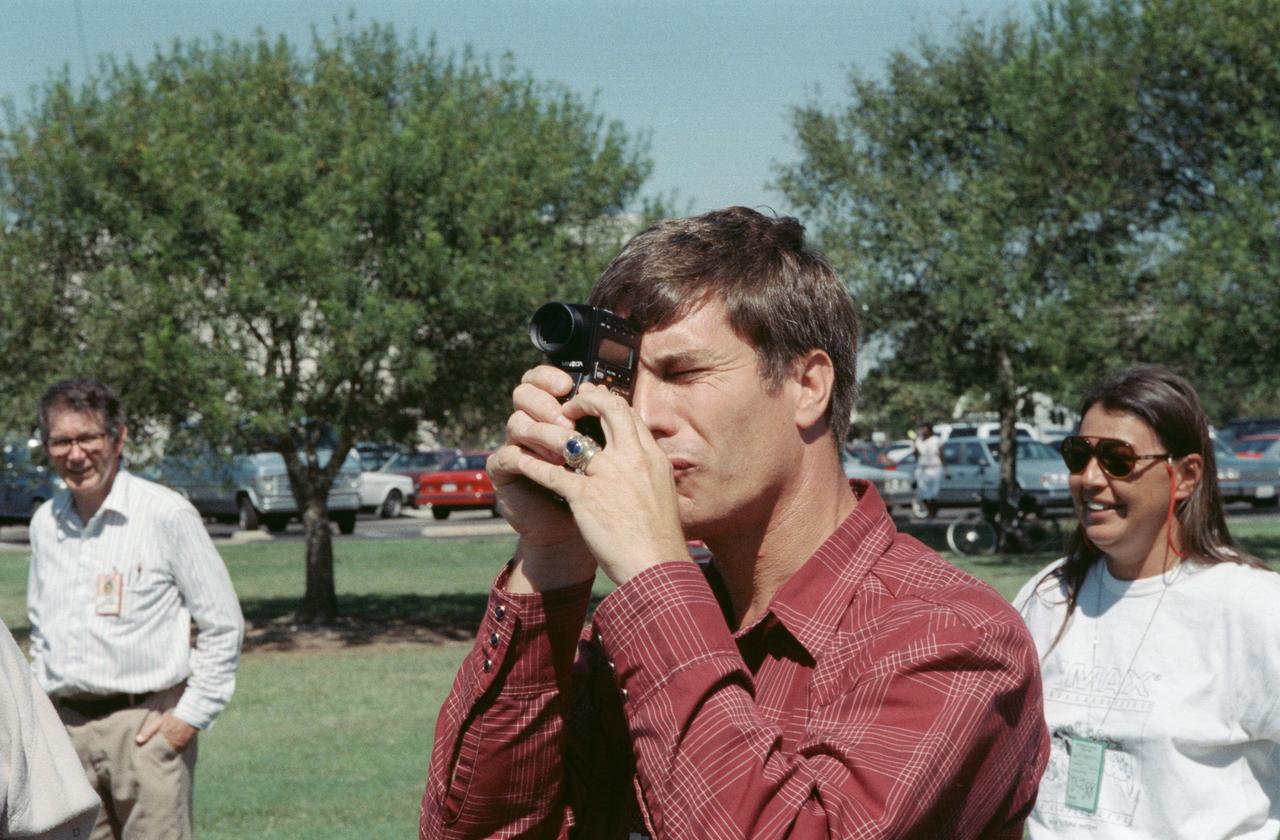
S88-52476 (8 Nov 1988) --- John E. Blaha, STS-29 pilot, gets in some training on the operation of one of the payloads for his upcoming spaceflight aboard Discovery. The payload is an Imax motion-picture camera, hardware of which is out of frame here. Blaha uses a light meter to get a reading before operating the camera in a practice run. The crew met with Imax personnel on the JSC grounds to practice using the motion-picture camera, making its first post-Challenger trip into space. Phyllis Wilson with Imax is at far right. The payload flew on a number of earlier STS flights.

In the Press Site auditorium at the Kennedy Space Center in Florida, Ted Melfi, writer and director of the upcoming motion picture “Hidden Figures,” speaks to members of the media during a news conference with other key individuals involved in the upcoming motion picture. The movie is based on the book of the same title, by Margot Lee Shetterly. It chronicles the lives of Katherine Johnson, Dorothy Vaughan and Mary Jackson, three African-American women who worked for NASA as human "computers.” Their mathematical calculations were crucial to the success of Project Mercury missions including John Glenn’s orbital flight aboard Friendship 7 in 1962. The film is due in theaters in January 2017.
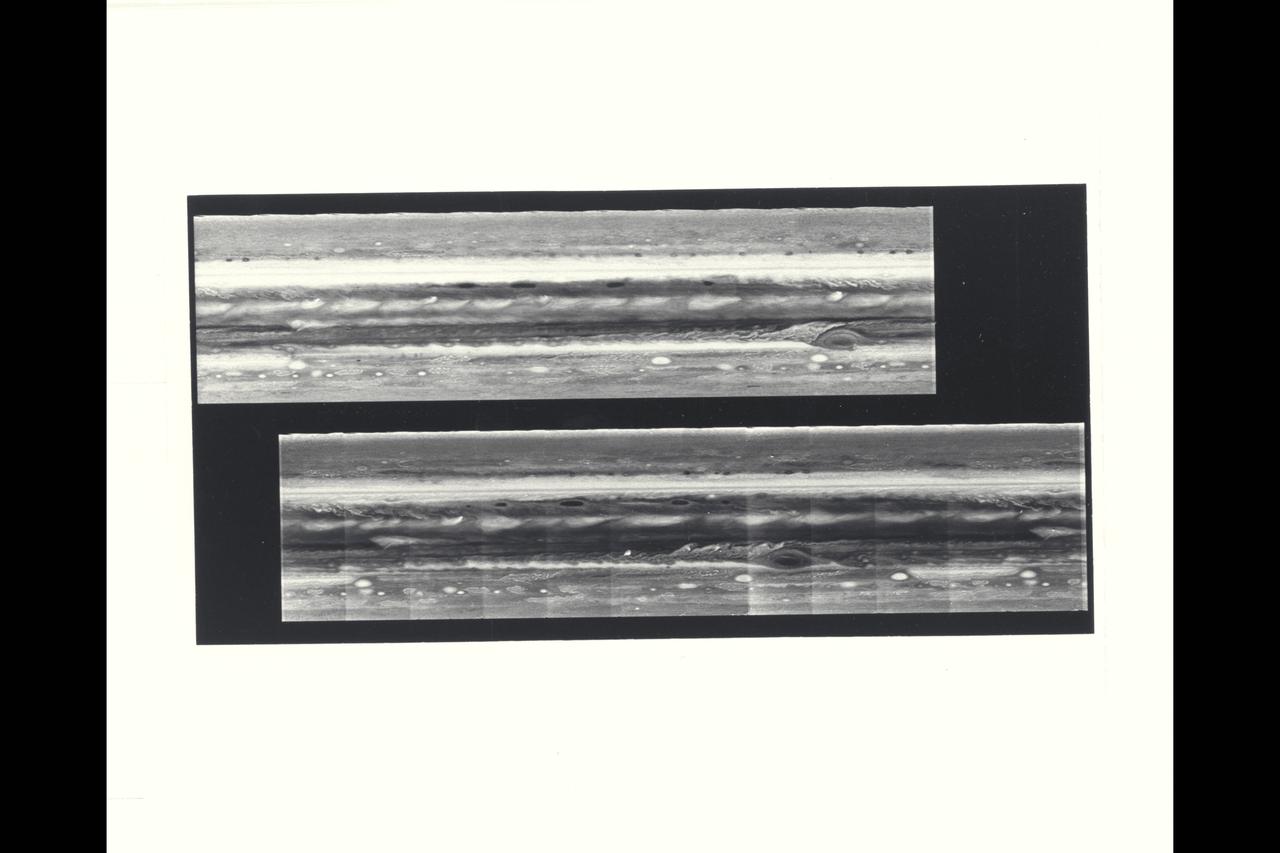
The cylindrical projections of Jupiter, representing both Voyager 1 (top) and Voyager 2 (bottom), are presented in this comparison. The top picture extends 400 degrees longitude to 0 degrees (right edge). It is aligned with the lower image so that the longitude scale is correct for both frames. The comparison between the pictures shows the relative motions of features in Jupiter's atmosphere. It can be seen that the Great Red Spot has moved westward and the white oval features eastward during the time between the acquisition of these pictures. Regulare plume patterns are equidistant around the northern edge of the equator, while a train of small spots has moved eastward at approxiamately 80 degrees south latitude. In addition to these relative motions, significant changes are evident in the recirculation flow east of the Great Red Spot, in the disturbed region west of the Greast Red Spot, and as seen in the brightening of material spreading into the equatorial region from the more southerly latitudes.
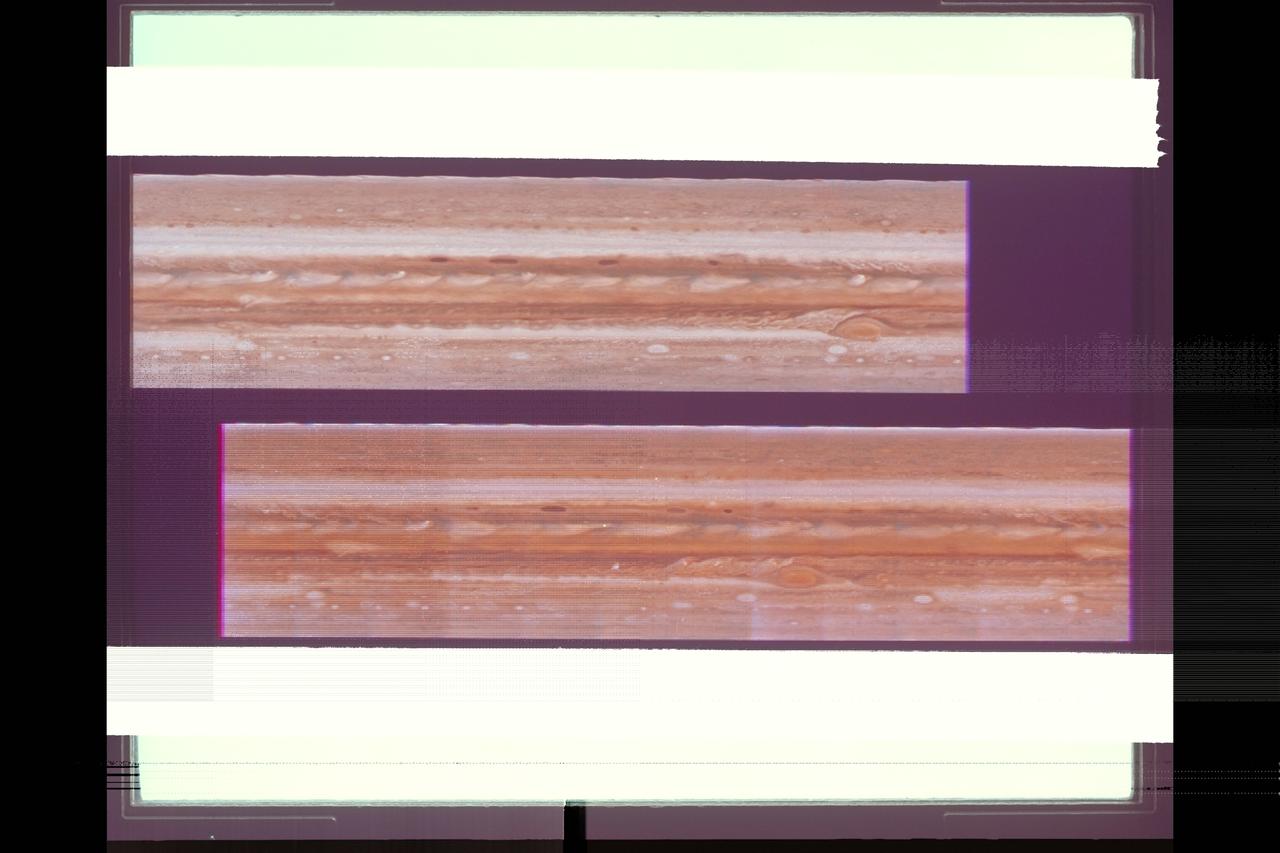
The cylindrical projections of Jupiter, representing both Voyager 1 (top) and Voyager 2 (bottom), are presented in this comparison. The top picture extends 400 degrees longitude to 0 degrees (right edge). It is aligned with the lower image so that the longitude scale is correct for both frames. The comparison between the pictures shows the relative motions of features in Jupiter's atmosphere. It can be seen that the Great Red Spot has moved westward and the white oval features eastward during the time between the acquisition of these pictures. Regulare plume patterns are equidistant around the northern edge of the equator, while a train of small spots has moved eastward at approxiamately 80 degrees south latitude. In addition to these relative motions, significant changes are evident in the recirculation flow east of the Great Red Spot, in the disturbed region west of the Greast Red Spot, and as seen in the brightening of material spreading into the equatorial region from the more southerly latitudes.
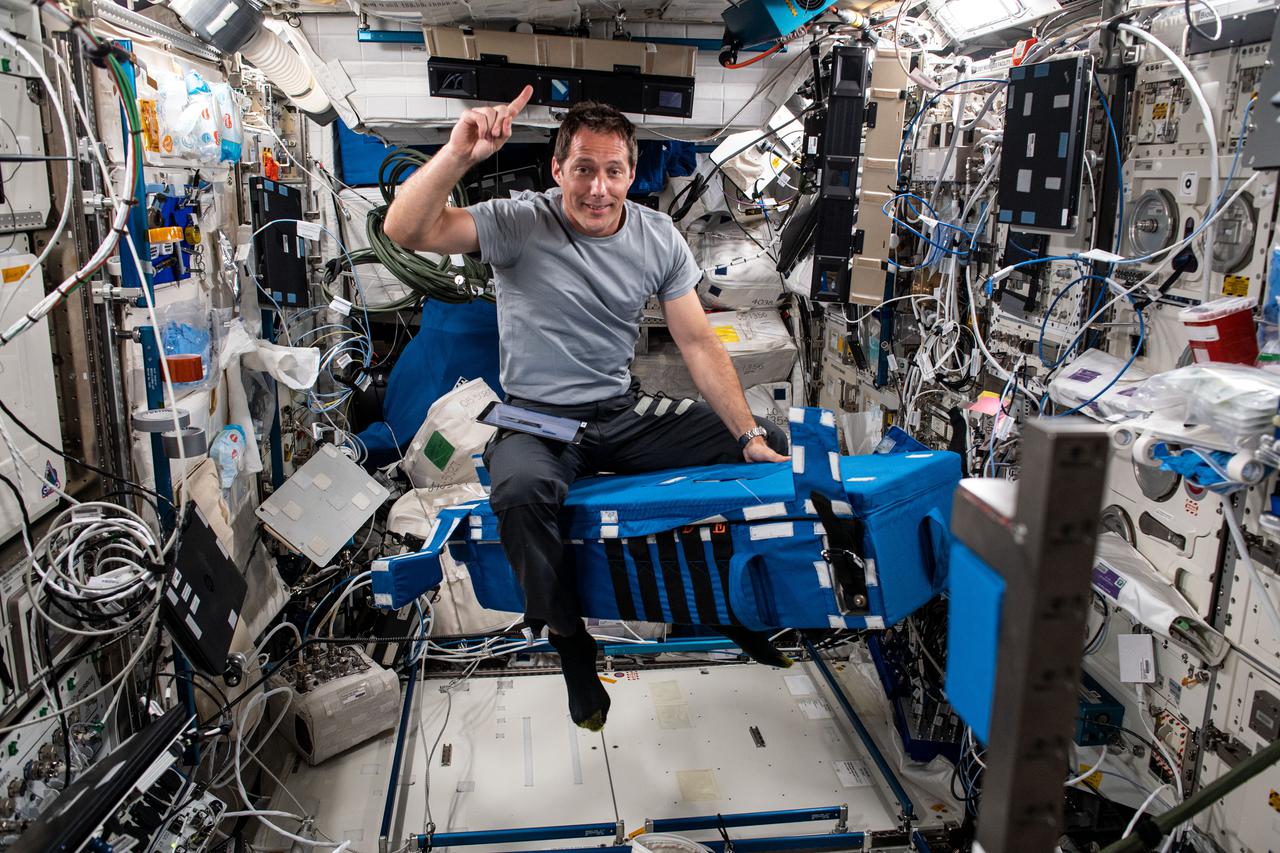
iss065e006534 (April 26, 2021) --- Expedition 65 Flight Engineer Thomas Pesquet of the European Space Agency is pictured inside the Columbus laboratory module setting up hardware for the Grip experiment. The motion study is composed of a series of dexterous manipulation tasks that may lead to improved spacecraft interfaces and deeper insights into human cognition in space.
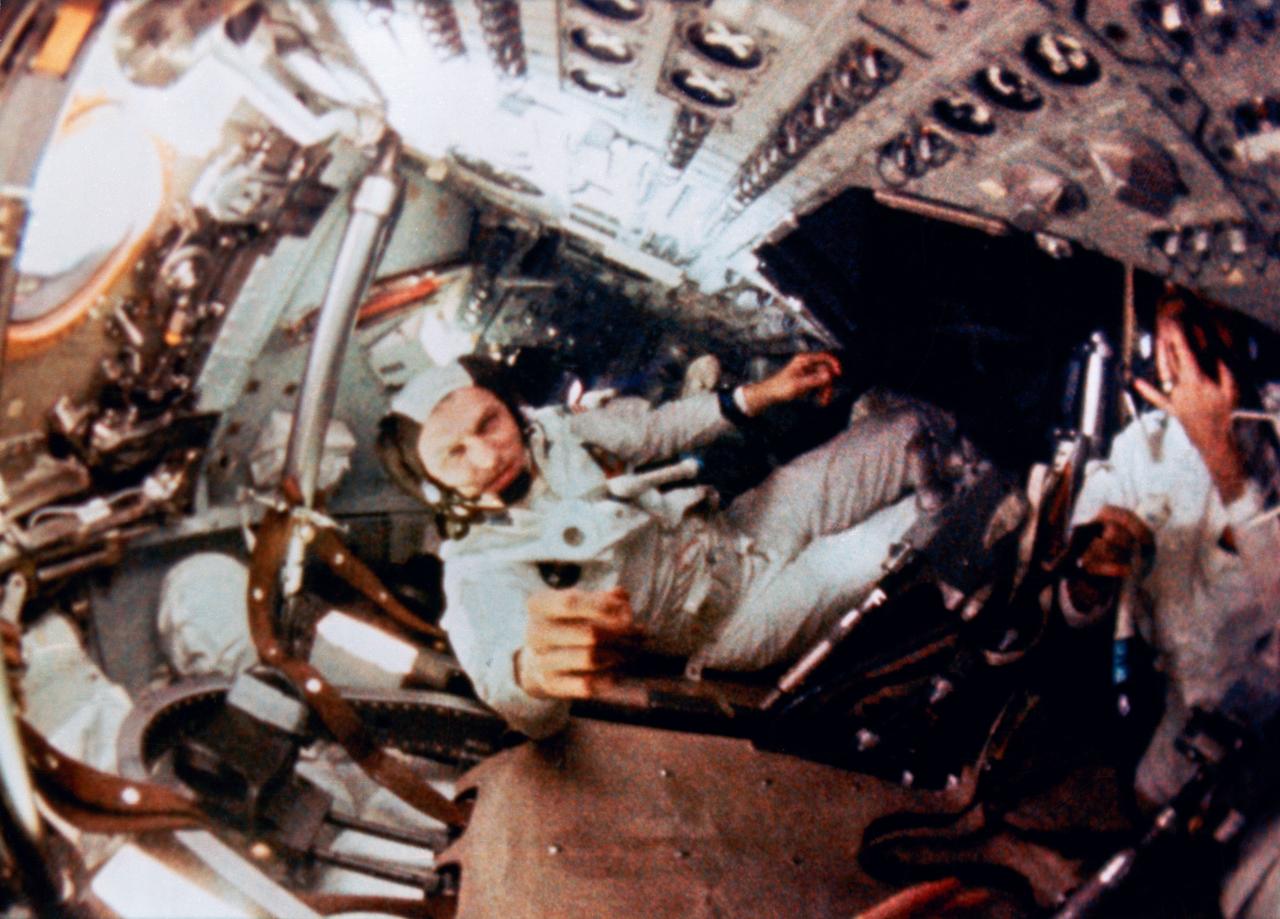
S68-56531 (21-27 Dec. 1968) --- Astronaut Frank Borman, mission commander, is shown during intravehicular activity (IVA) on the Apollo 8 lunar orbit mission. This still print was made from movie film exposed by an onboard 16mm motion picture camera.

STS79-E-5366 (16-26 September 1996) --- Astronaut Carl E. Walz handles the IMAX in-cabin motion picture camera, which was used to capture some of the same imagery seen in this series of Electronic Still Camera (ESC) views.
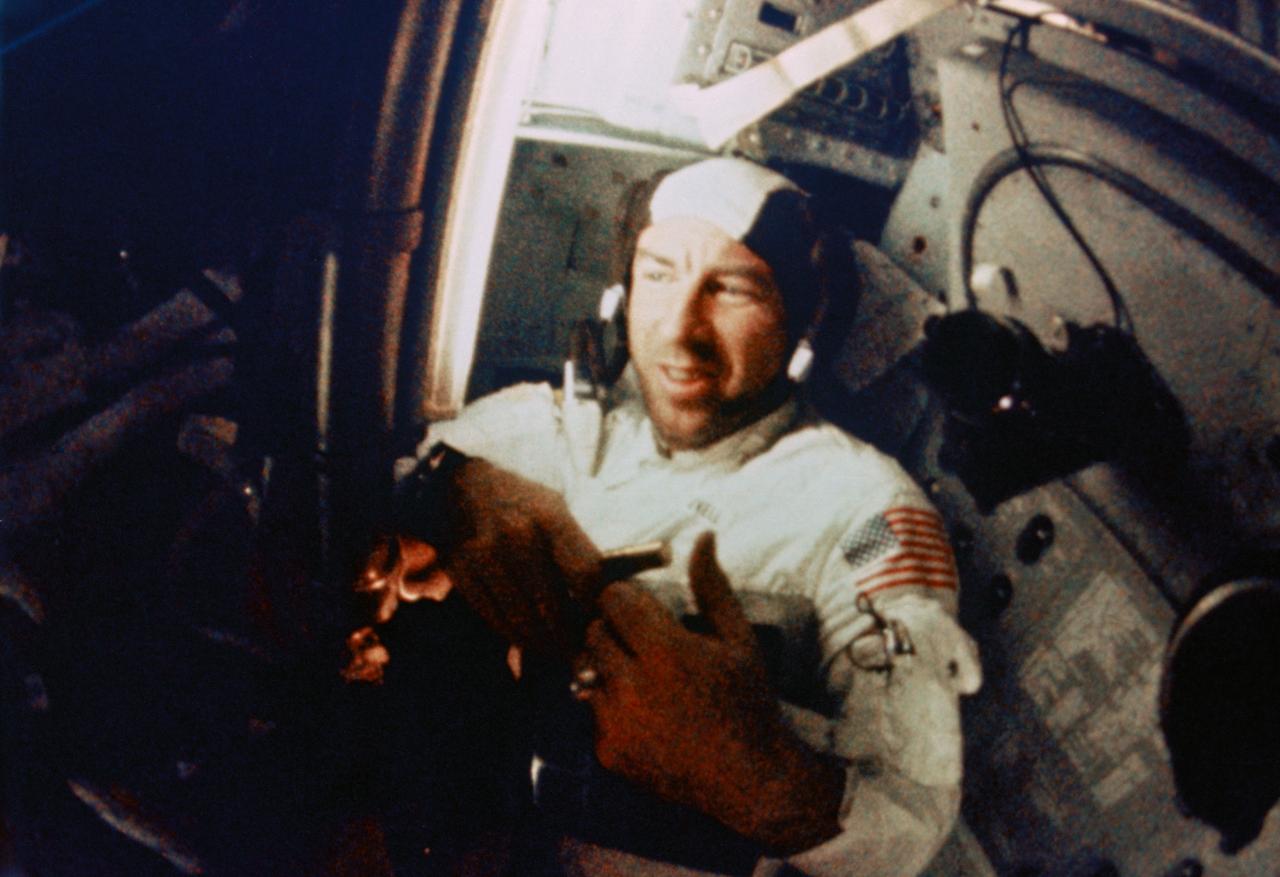
S68-56533 (21-27 Dec. 1968) --- Astronaut James A. Lovell Jr., command module pilot, is shown during intravehicular activity (IVA) on the Apollo 8 lunar orbit mission. This still print was made from movie film taken by an onboard 16mm motion picture camera.
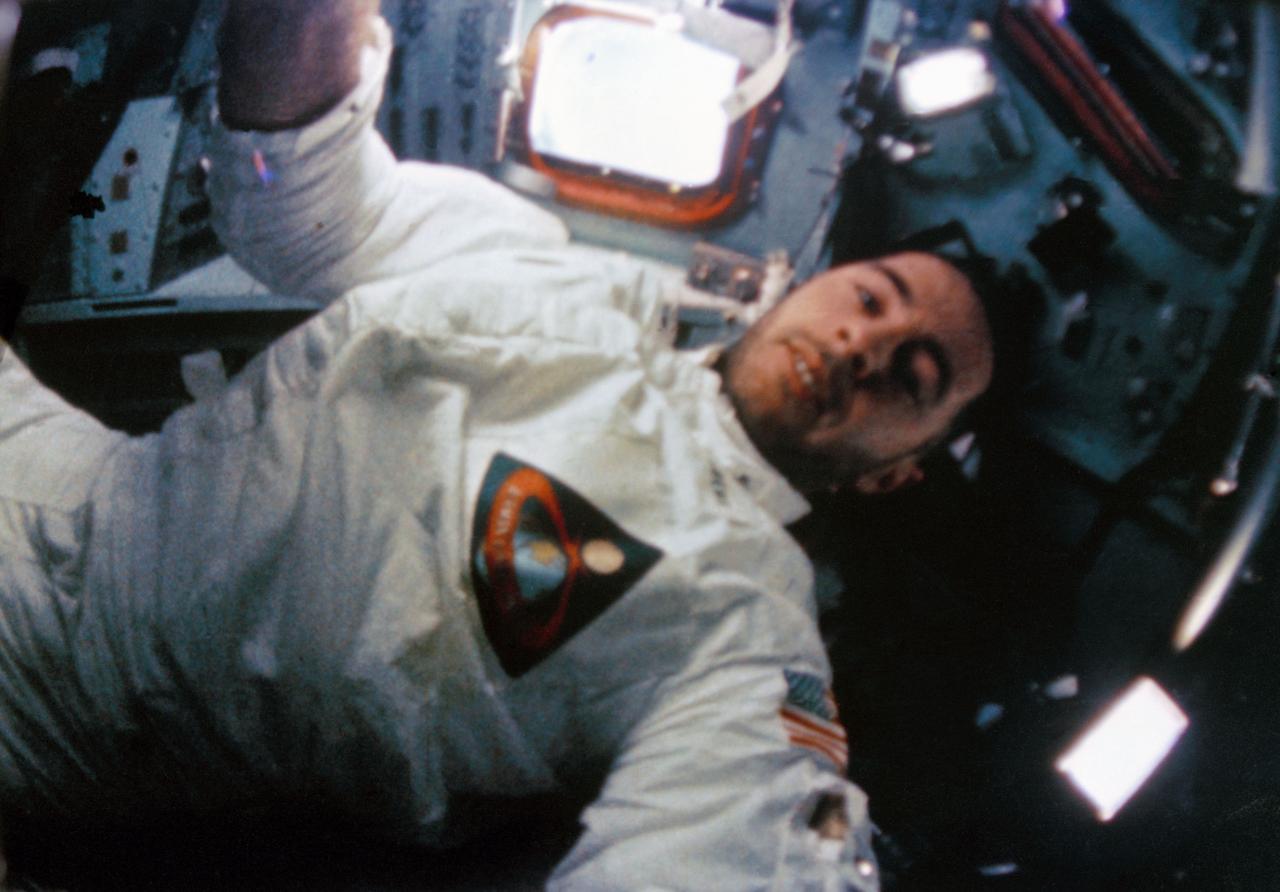
S68-56532 (21-27 Dec. 1968) --- Astronaut William A. Anders, lunar module pilot, is shown during intravehicular activity (IVA) on the Apollo 8 lunar orbit mission. This still print was made from movie film taken by an onboard 16mm motion picture camera.
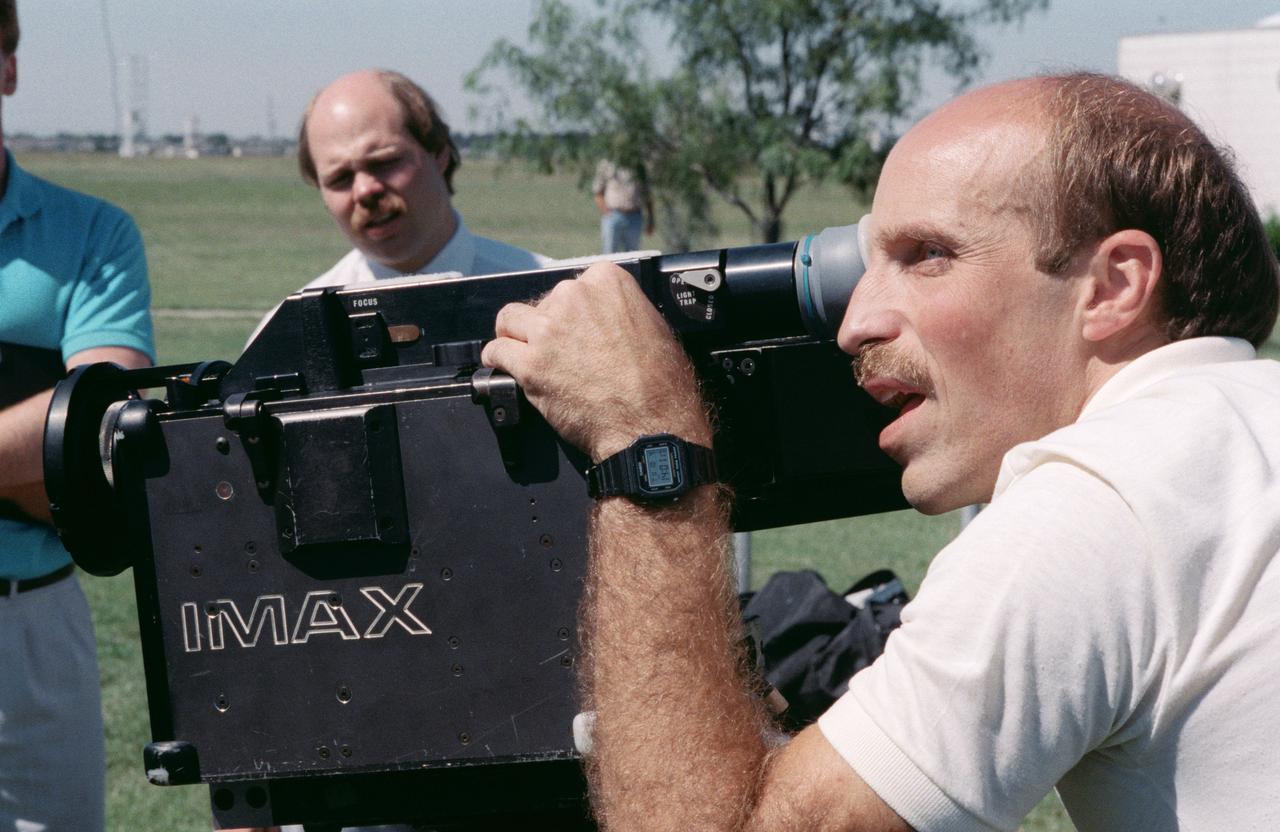
S88-52466 (8 Nov 1988) --- James P. Bagian, STS-29 mission specialist, gets in some training on the operation of one of the payloads for his upcoming spaceflight aboard Discovery. The crew met with Imax personnel, some of whom are pictured here, on the JSC grounds to practice using the motion- picture camera, making its first post-Challenger trip into space. The payload flew on a number of earlier STS flights.
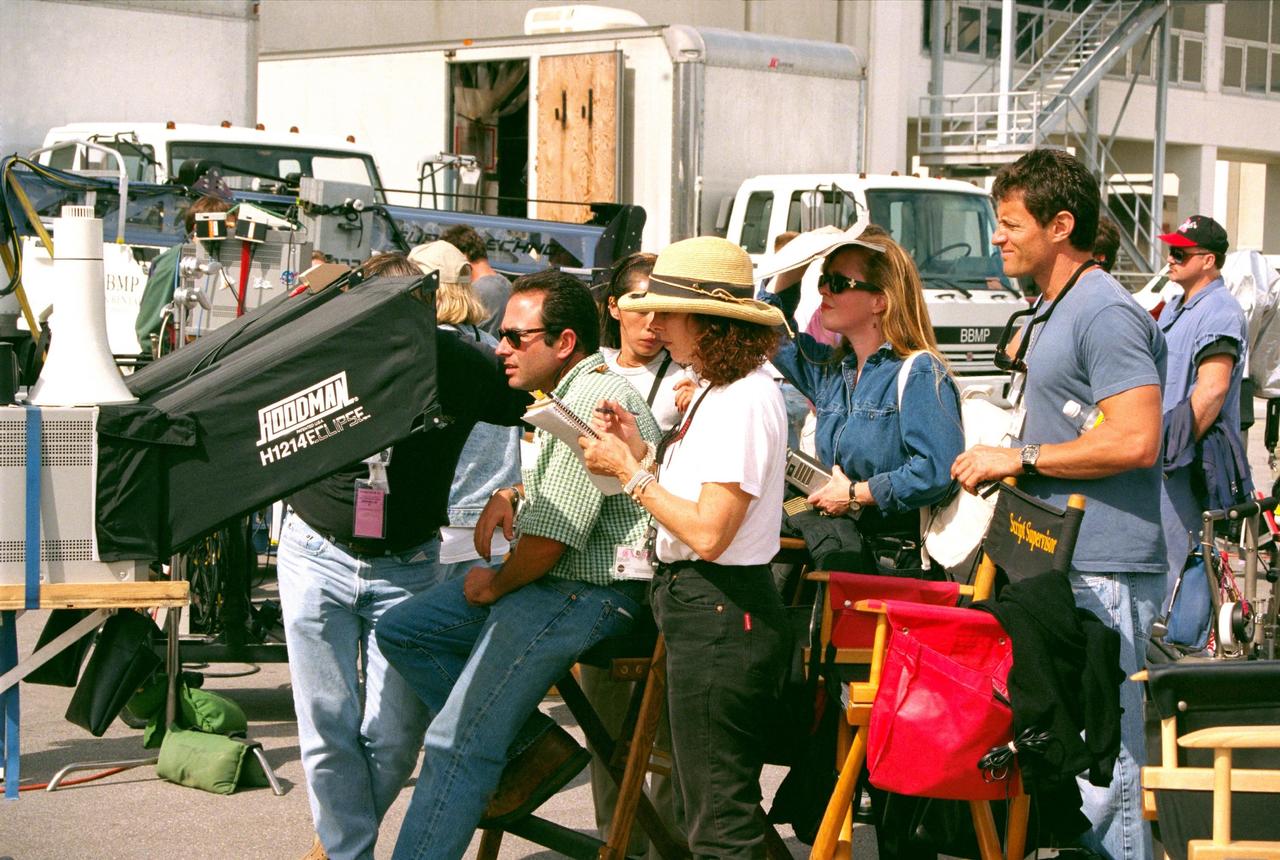
KENNEDY SPACE CENTER, FLA. -- Scheduled for release in the summer of 1998, the major motion picture "Armageddon," starring Bruce Willis and Billy Bob Thornton, was filmed on location at Kennedy Space Center in October and November 1997. The Touchstone Pictures movie, directed by Michael Bay, is about an asteroid on a collision course with Earth, threatening to strike our planet and threaten all life on it.
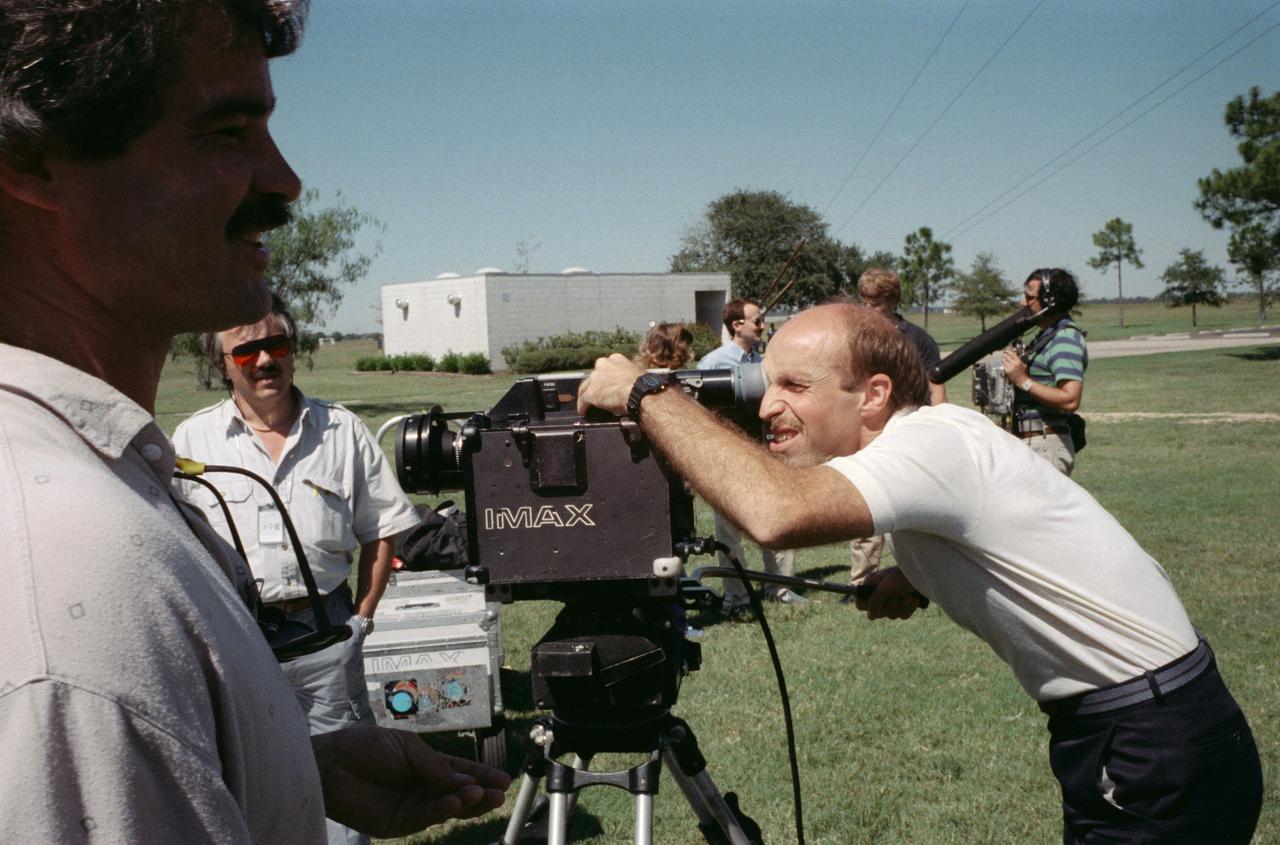
S88-52470 (8 Nov 1988) --- James P. Bagian, STS-29 mission specialist, gets in some training on the operation of one of the payloads for his upcoming spaceflight aboard Discovery. The crew met with Imax personnel, some of whom are pictured here, on the JSC grounds to practice using the motion- picture camera, making its first post-Challenger trip into space. The payload flew on a number of earlier STS flights.

Range : 1 million kilometers Voyager 2 completed a dramatic 10 hour time lapse photo sequence to monitor the active volcanos on Jupiter's moon Io following the spacecraft's closest approach to Jupiter. This picture is one of about 200 images that will be used to generate a time lapse motion picture to illustrate Io's volcanic activity. On the bright limb, two of the plumes (P-5 & P-6) discovered in March by Voyager 1 are again visible. The plumes are spewing materials to a height of about 100 kilometers.
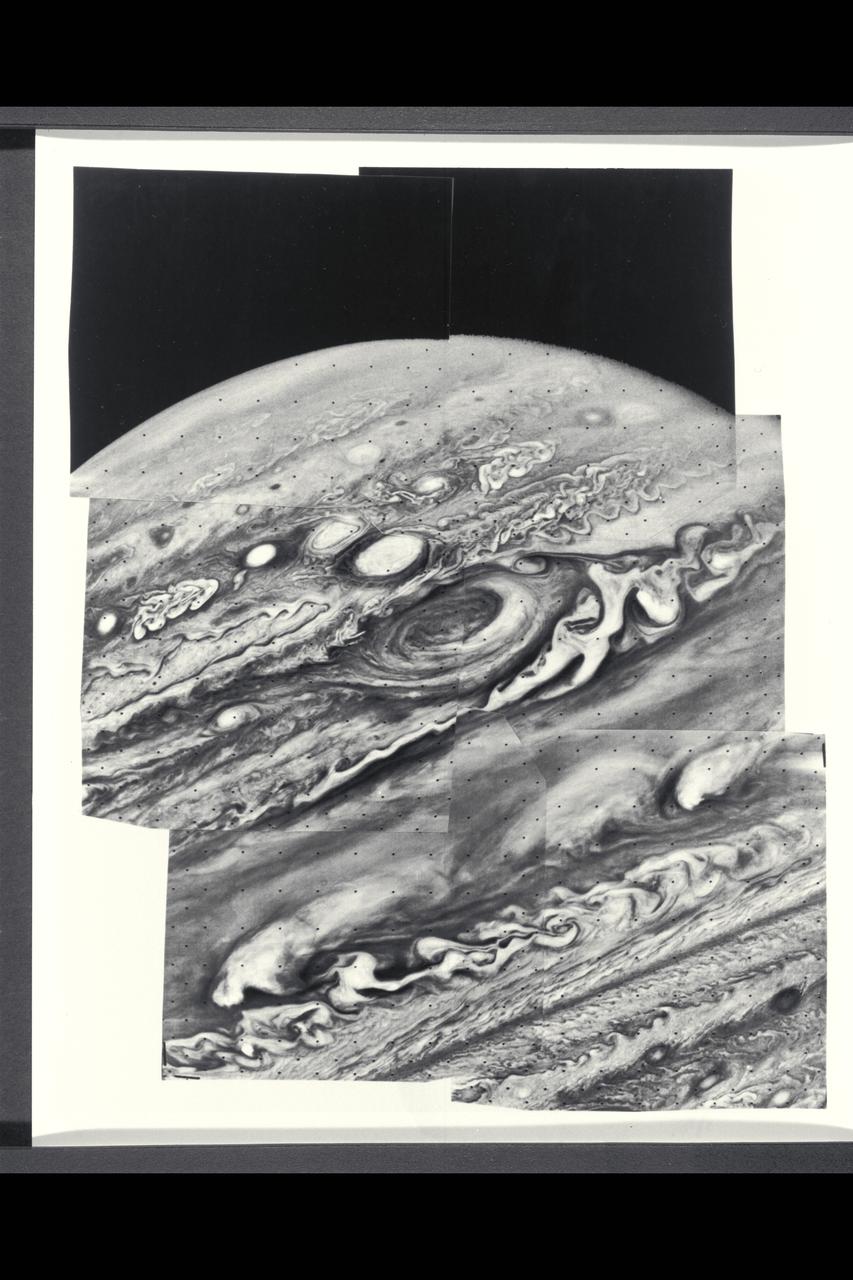
Range : 6.5 million kilometers (4 million miles) Six violet images of Jupiter makes the mosaic photo, showing the Great Red Spot as a swirling vortex type motion. This motion is also seen in several nearby white clouds. These bright white clouds and the Red Spot are rotating in a counter clockwise direction, except the peculiar filimentary cloud to the right of the Red Spot is going clockwise. The top of the picture shows the turbulence from the equatorial jet and more northerly atmospheric currents. The smallest clouds shown are only 70 miles (120 km) across.
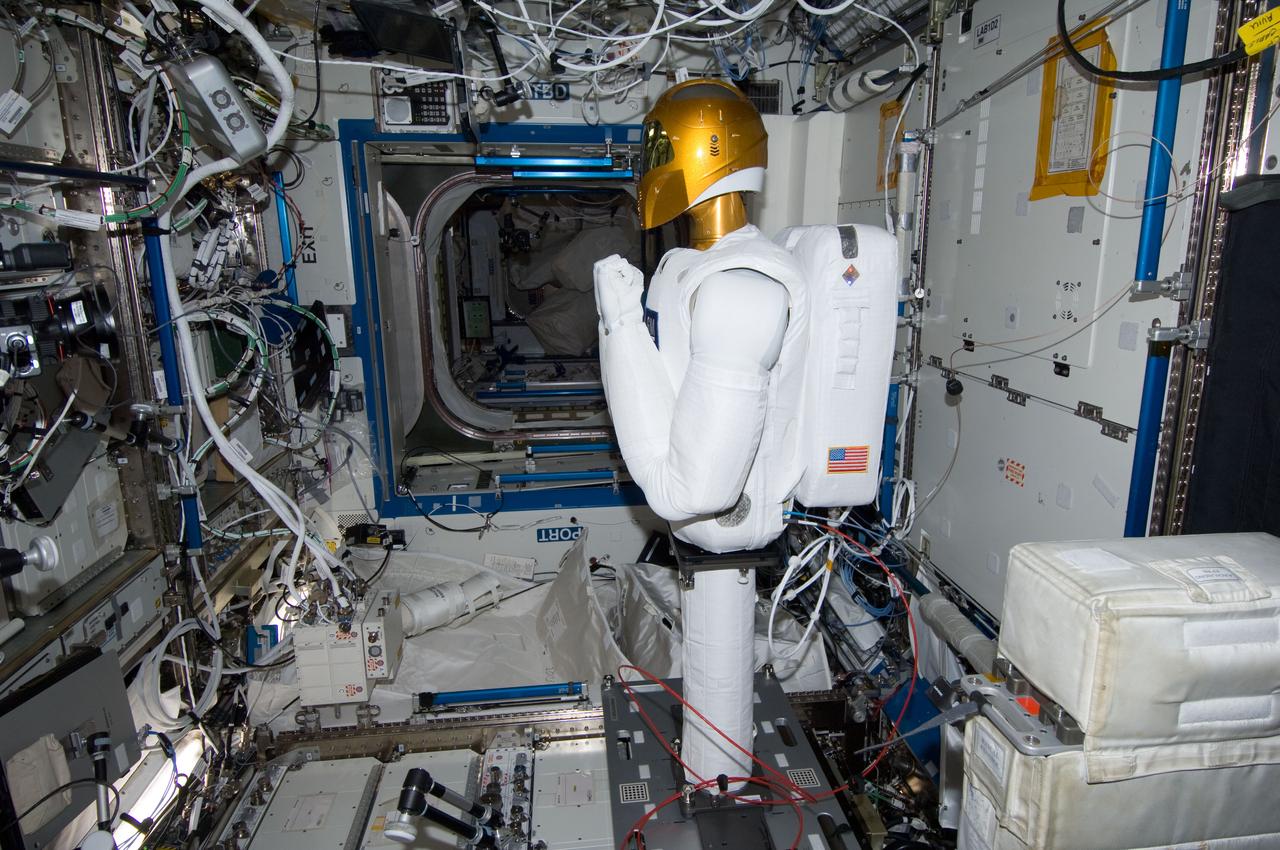
ISS029-E-025807 (13 Oct. 2011) --- Robonaut 2 -- the first dexterous humanoid robot in space – is pictured in the Destiny laboratory of the International Space Station. NASA astronaut Mike Fossum, Expedition 29 commander; and Japan Aerospace Exploration Agency astronaut Satoshi Furukawa, flight engineer, (both out of frame) joined forces to conduct the second onboard tests of R2, which was put in motion for the first time in orbit. After performing a coordinated power-up with the ground, the crew maneuvered each arm joint to determine the differences of the microgravity environment by setting control gains through repetitive motions. They also performed an initial vision checkout of the high-def cameras to verify they are working and in focus. The ground then commanded R2 to move to the stow-position while monitoring the motion.
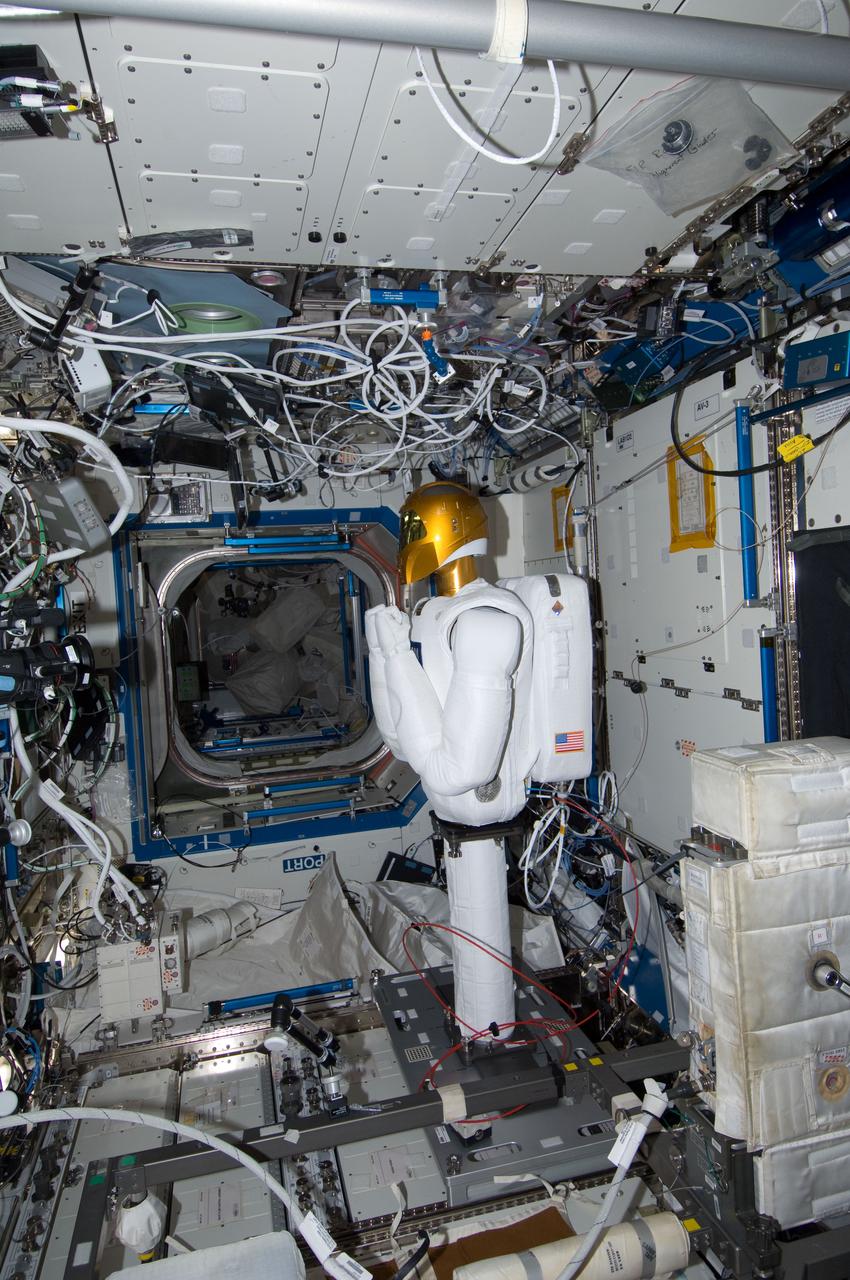
ISS029-E-025806 (13 Oct. 2011) --- Robonaut 2 -- the first dexterous humanoid robot in space – is pictured in the Destiny laboratory of the International Space Station. NASA astronaut Mike Fossum, Expedition 29 commander; and Japan Aerospace Exploration Agency astronaut Satoshi Furukawa, flight engineer, (both out of frame) joined forces to conduct the second onboard tests of R2, which was put in motion for the first time in orbit. After performing a coordinated power-up with the ground, the crew maneuvered each arm joint to determine the differences of the microgravity environment by setting control gains through repetitive motions. They also performed an initial vision checkout of the high-def cameras to verify they are working and in focus. The ground then commanded R2 to move to the stow-position while monitoring the motion.
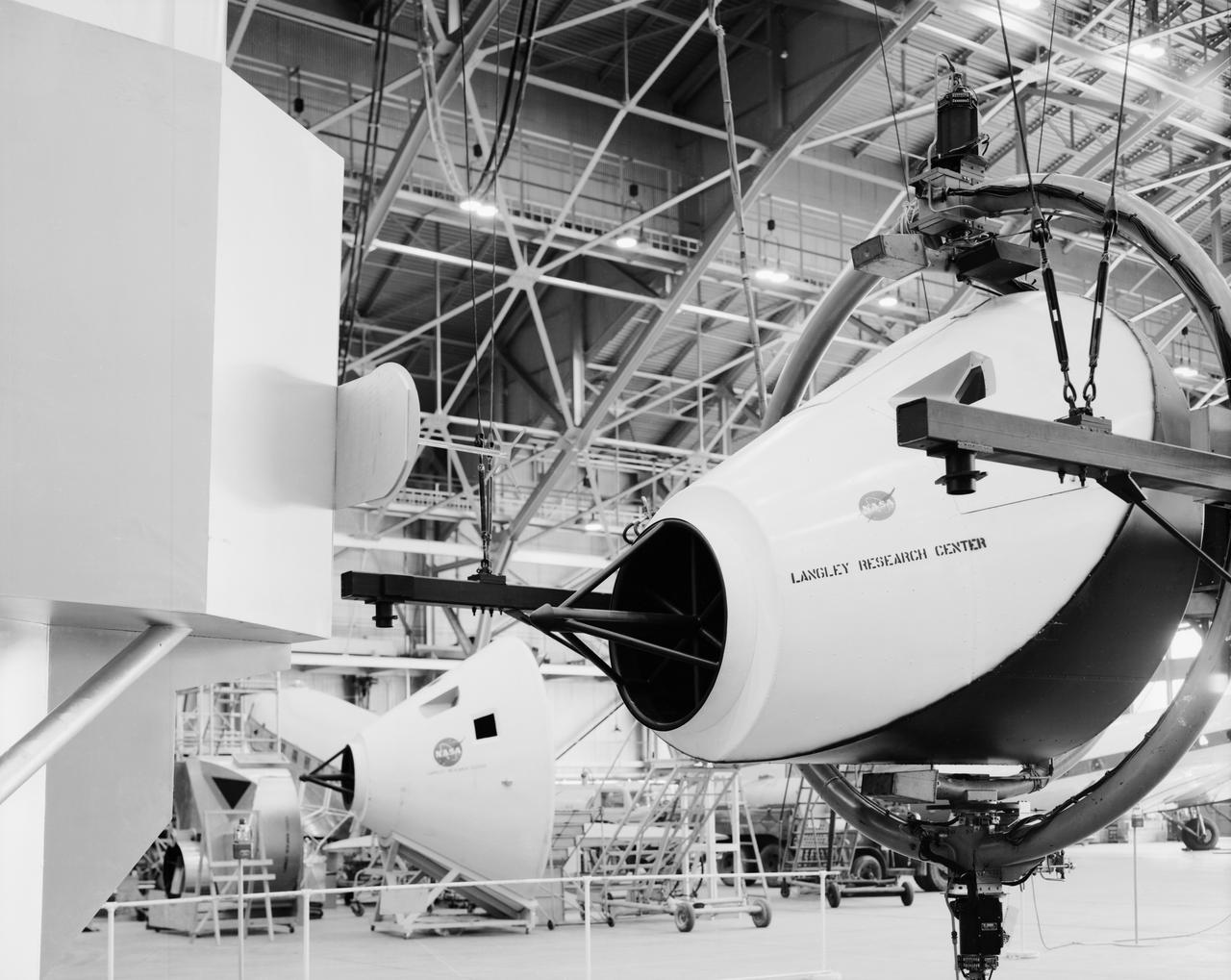
Originally the Rendezvous was used by the astronauts preparing for Gemini missions. The Rendezvous Docking Simulator was then modified and used to develop docking techniques for the Apollo program. This picture shows a later configuration of the Apollo docking with the LEM target. A.W. Vogeley described the simulator as follows: The Rendezvous Docking Simulator and also the Lunar Landing Research Facility are both rather large moving-base simulators. It should be noted, however, that neither was built primarily because of its motion characteristics. The main reason they were built was to provide a realistic visual scene. A secondary reason was that they would provide correct angular motion cues (important in control of vehicle short-period motions) even though the linear acceleration cues would be incorrect. -- Published in A.W. Vogeley, Piloted Space-Flight Simulation at Langley Research Center, Paper presented at the American Society of Mechanical Engineers, 1966 Winter Meeting, New York, NY, November 27 - December 1, 1966.
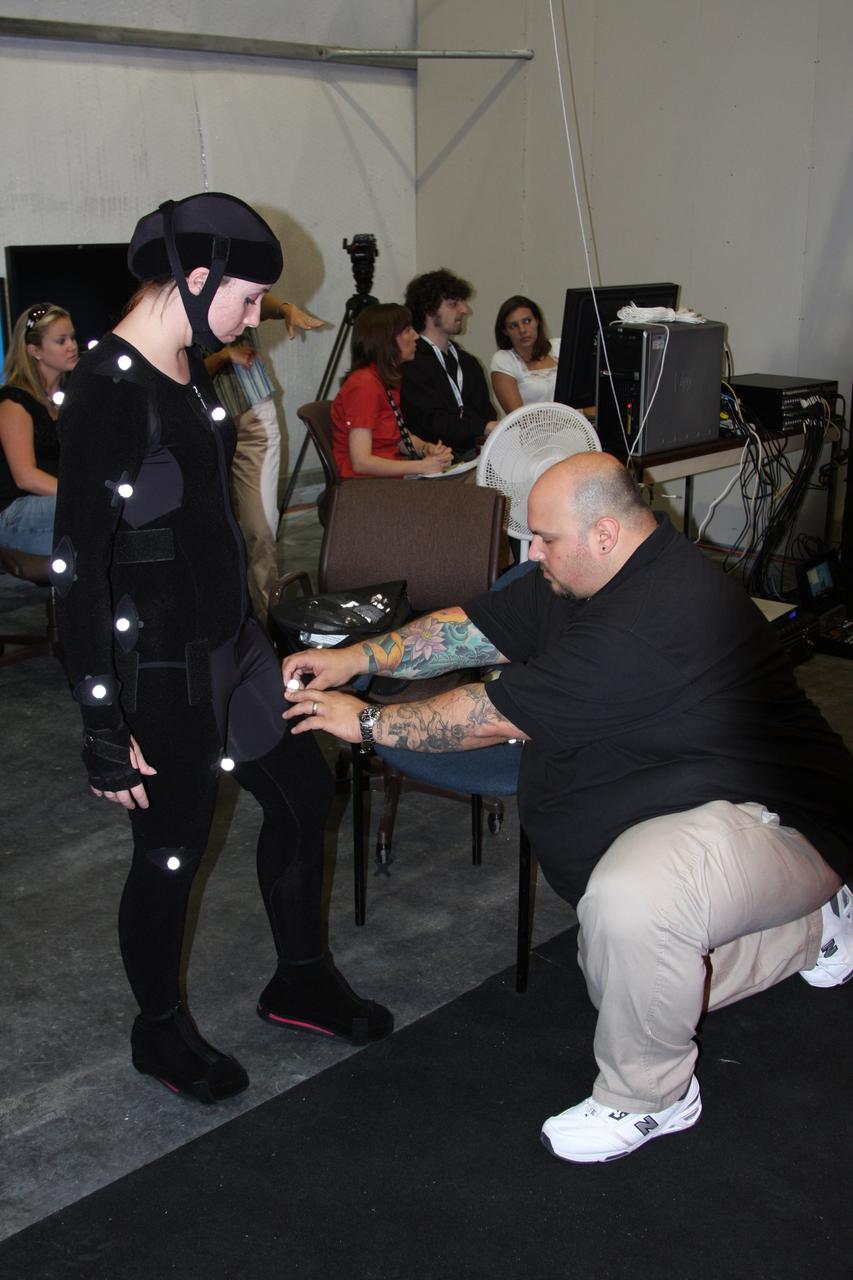
CAPE CANAVERAL, Fla. –David Voci, NYIT MOCAP (Motion Capture) team co-director (seated at the workstation in the background) prepares to direct a motion capture session assisted by Kennedy Advanced Visualizations Environment staff led by Brad Lawrence (not pictured) and by Lora Ridgwell from United Space Alliance Human Factors (foreground, left). Ridgwell will help assemble the Orion Crew Module mockup. The motion tracking aims to improve efficiency of assembly processes and identify potential ergonomic risks for technicians assembling the mockup. The work is being performed in United Space Alliance's Human Engineering Modeling and Performance Lab in the RLV Hangar at NASA's Kennedy Space Center. Part of NASA's Constellation Program, the Orion spacecraft will return humans to the moon and prepare for future voyages to Mars and other destinations in our solar system.
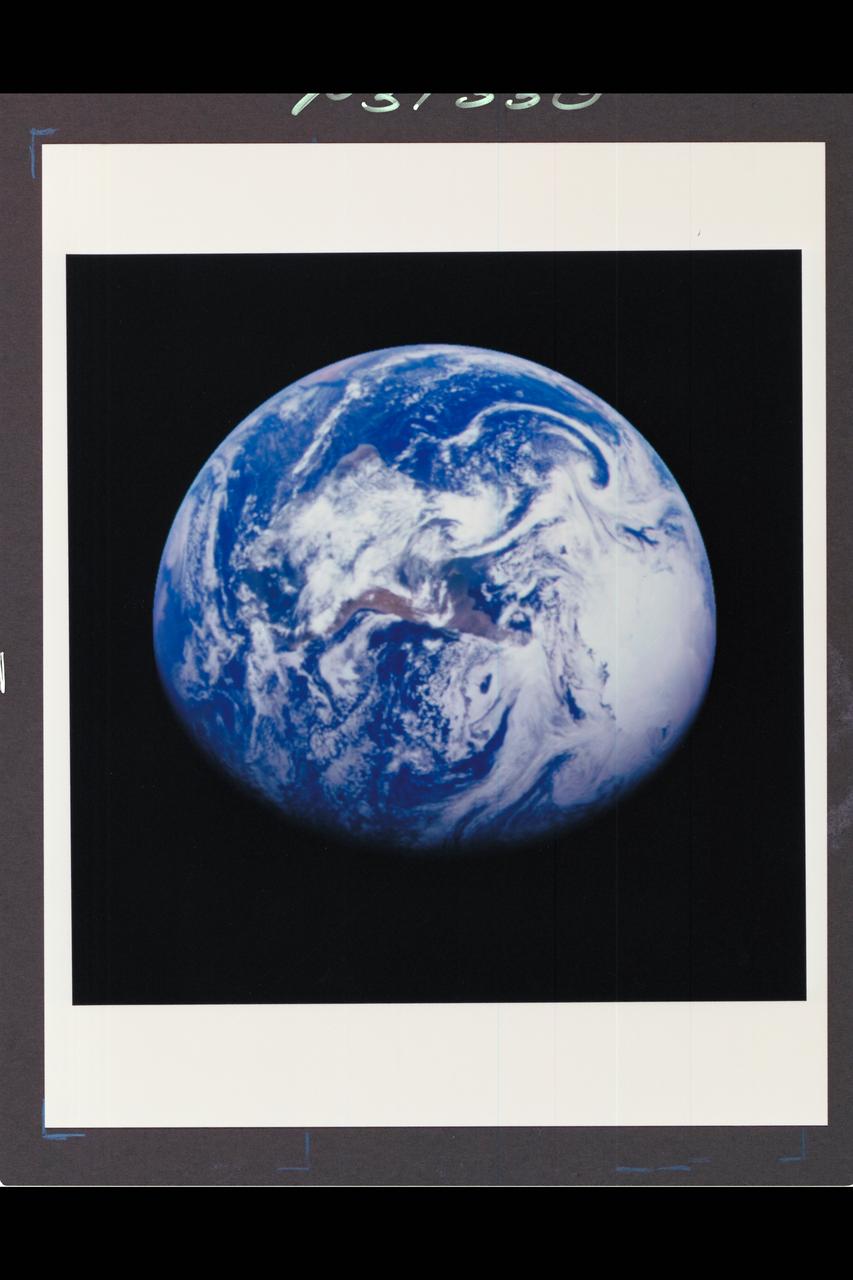
ref # P-37330 Range : 1.3 million miles This color image of the Earth was obtained by the Galileo spacecraft at about 6:10 am PST. The color composite used images taken through the red, green and violet filters. South America is near the center of the picture, and the white, sunlit continent of Antarctica is below. Picturesque weather fronts are visible in the South Atlantic, lower right. This is the first frame of the Galileo Earth spin movie, a 500-frame time-lapse motion picture showing a 25-hour period of Earth's rotation and atmosphertic dynamics.
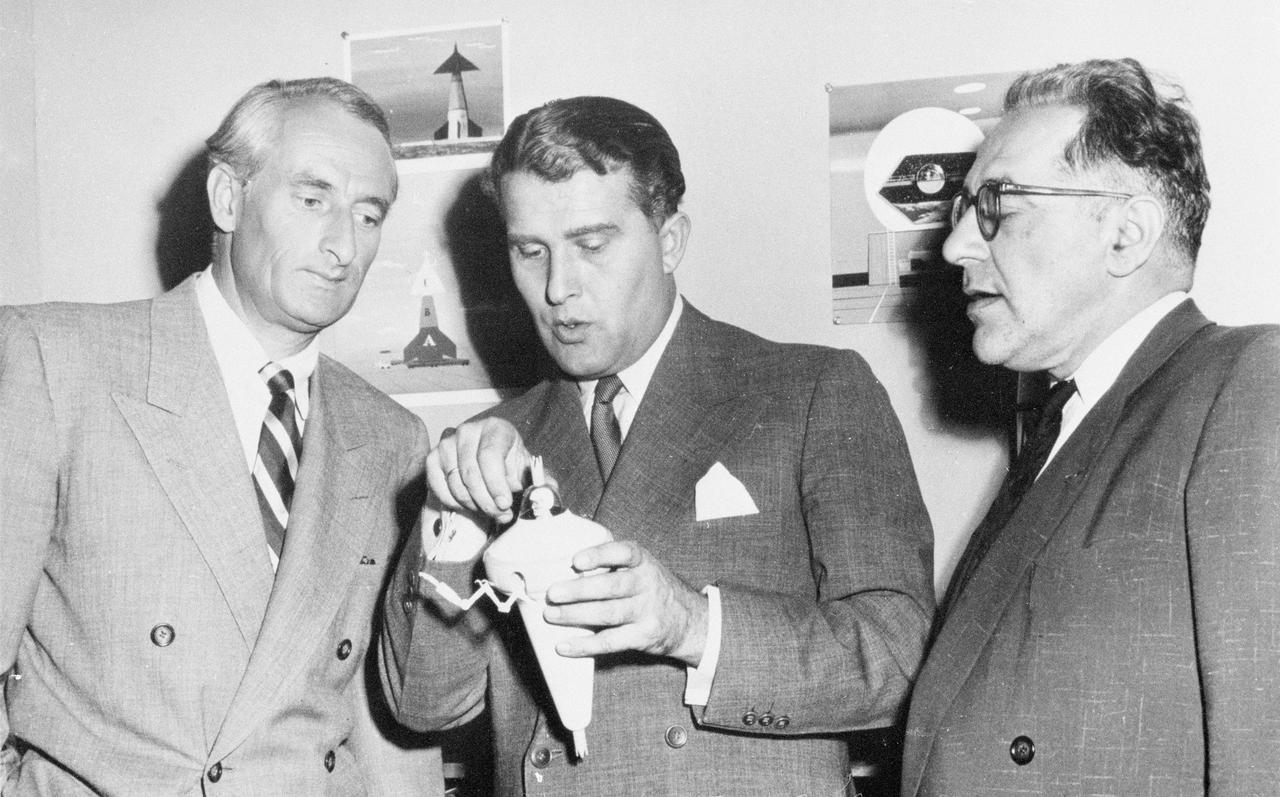
Dr. Wernher von Braun (center), then Chief of the Guided Missile Development Division at Redstone Arsenal, Alabama, discusses a "bottle suit" model with Dr. Heinz Haber (left), an expert on aviation medicine, and Willey Ley, a science writer on rocketry and space exploration. The three men were at the Disney studios appearing in the motion picture, entitled "Man in Space."
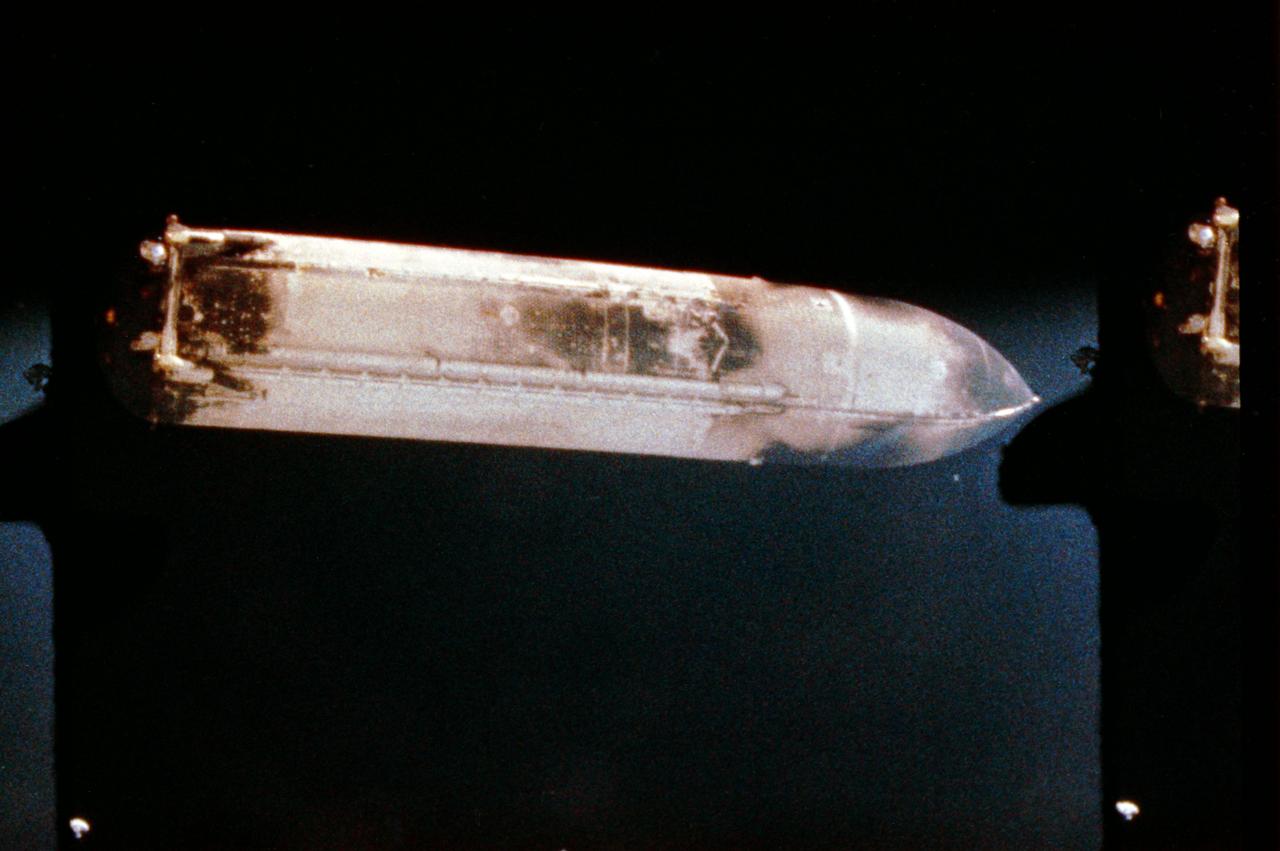
S81-30509 (12 April 1981) --- Separation of space shuttle Columbia?s external tank, photographed by motion picture cameras in the umbilical bays, occurred following the shutdown of the vehicle?s three main engines. The Columbia?s cameras were able to record the underside of the tank as the orbiter headed toward its Earth-orbital mission with astronauts John W. Young and Robert L. Crippen aboard, and the fuel tank fell toward Earth, passing through the atmosphere rapidly. Photo credit: NASA
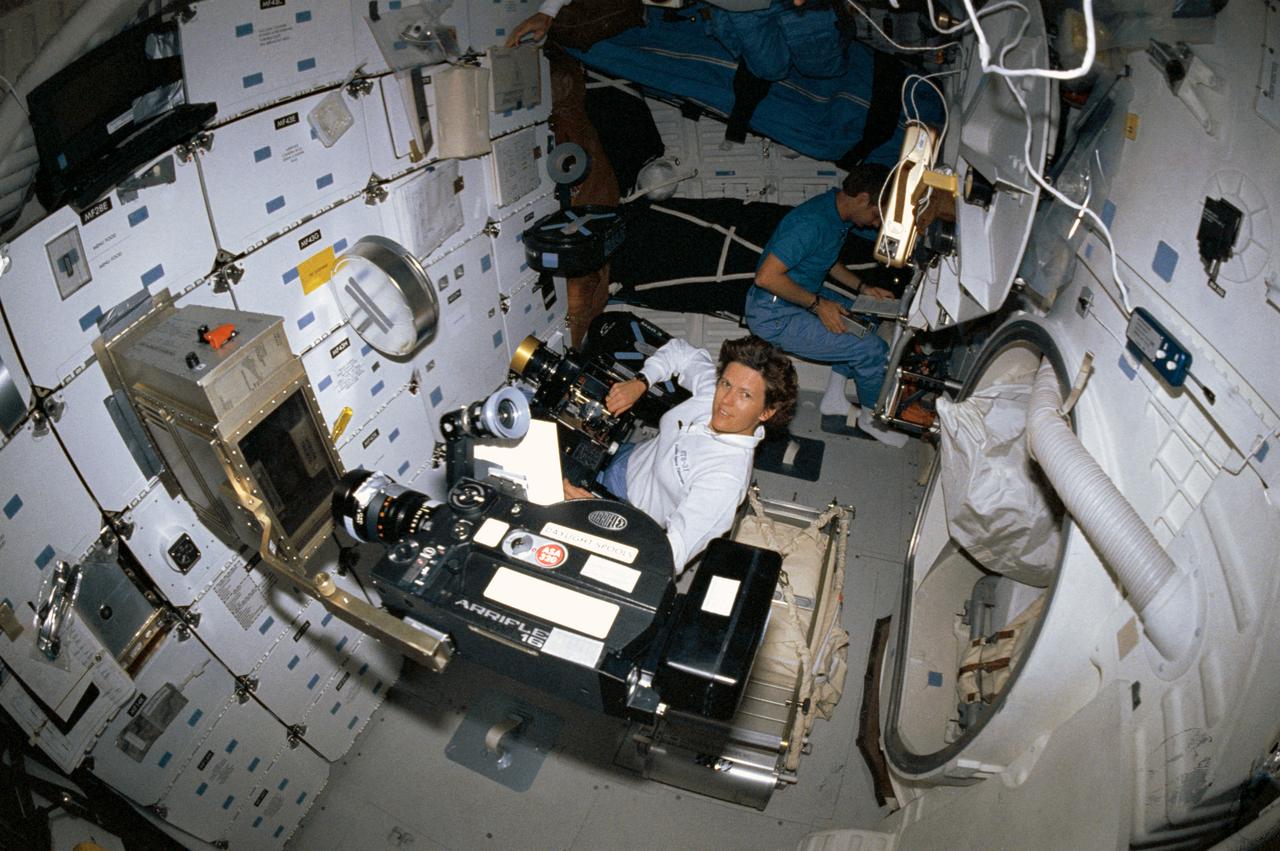
STS031-05-002 (24-29 April 1990) --- A 35mm camera with a "fish eye" lens captured this high angle image on Discovery's middeck. Astronaut Kathryn D. Sullivan works with the IMAX camera in foreground, while Astronaut Steven A. Hawley consults a checklist in corner. An Arriflex motion picture camera records student ion arc experiment in apparatus mounted on stowage locker. The experiment was the project of Gregory S. Peterson, currently a student at Utah State University.
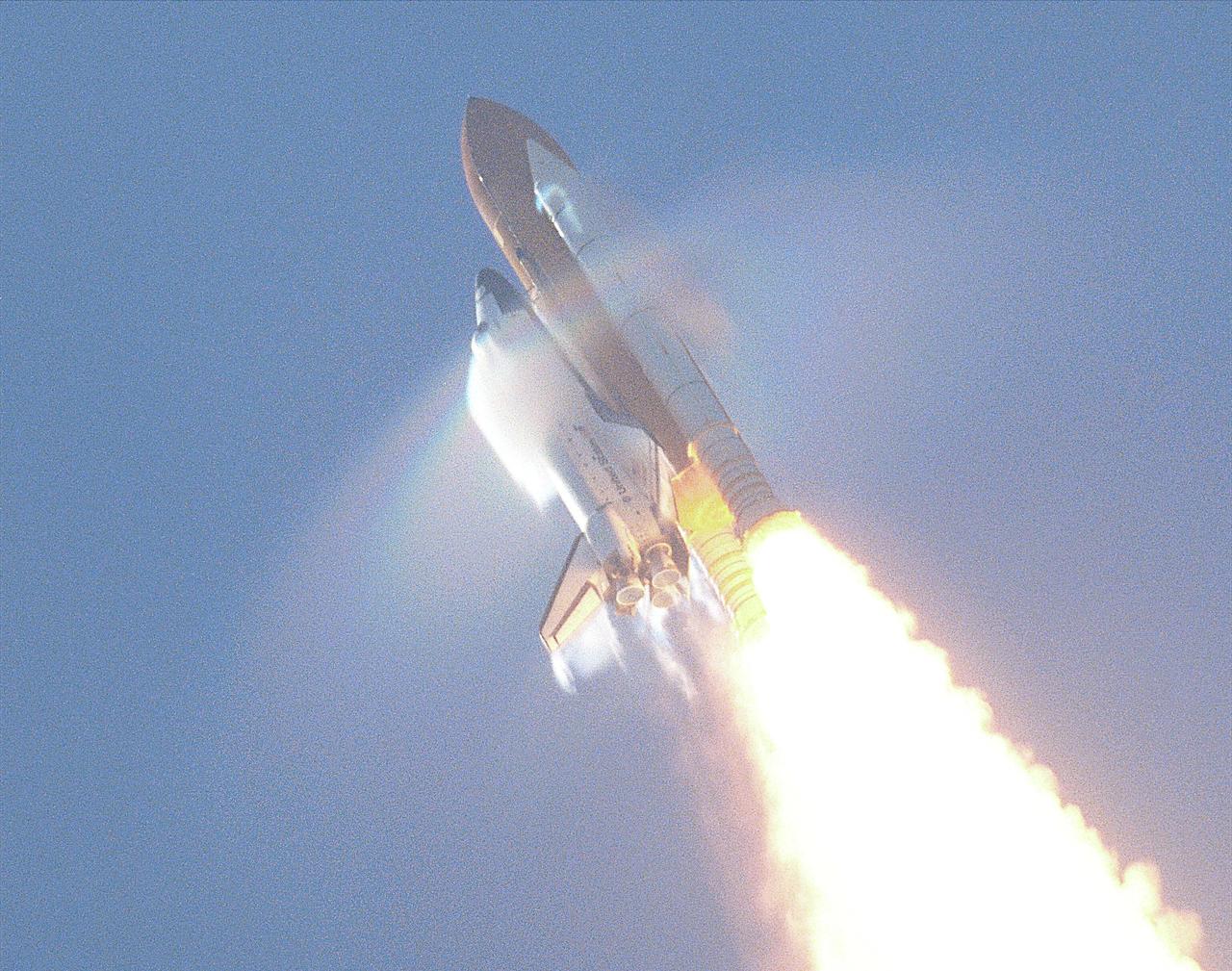
KENNEDY SPACE CENTER, FLA. -- This view of the shock wave condensation collars backlit by the sun occurred during the launch of Atlantis on STS-106 and was captured on an engineering 35mm motion picture film. One frame was digitized to make this still image. Although the primary effect is created by the Orbiter forward fuselage, secondary effects can be seen on the SRB forward skirt, Orbiter vertical stabilizer and wing trailing edges (behind SSME's).
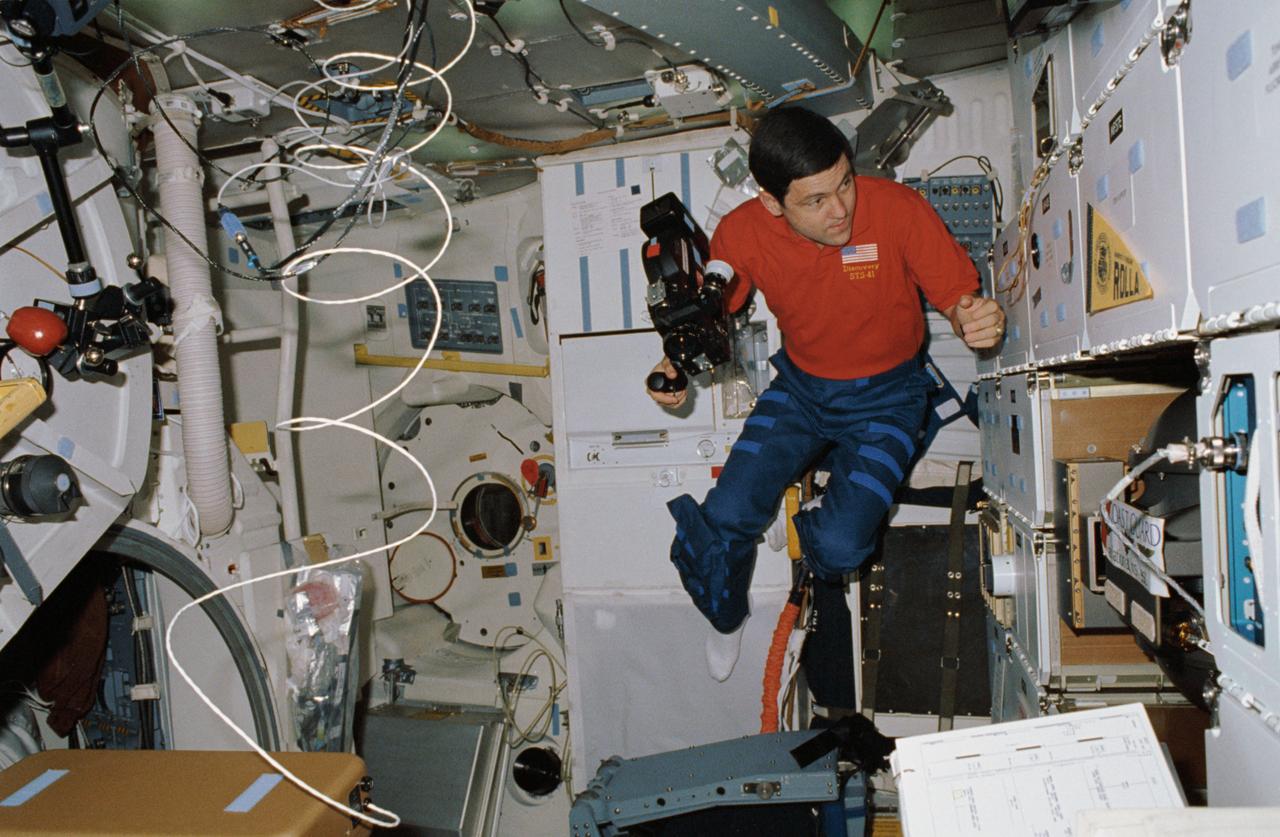
STS041-05-011 (6-10 Oct 1990) --- Astronaut Robert D. Cabana, STS-41 pilot, exhibits the weightlessness of space travel as he appears to "float" about on the middeck of Discovery. Careful inspection of the photo proves that, actually, his floating is limited, as he has anchored his left foot with a special restraint device. He apparently has chosen this vantage point to use the Arriflex motion picture camera in his right hand.
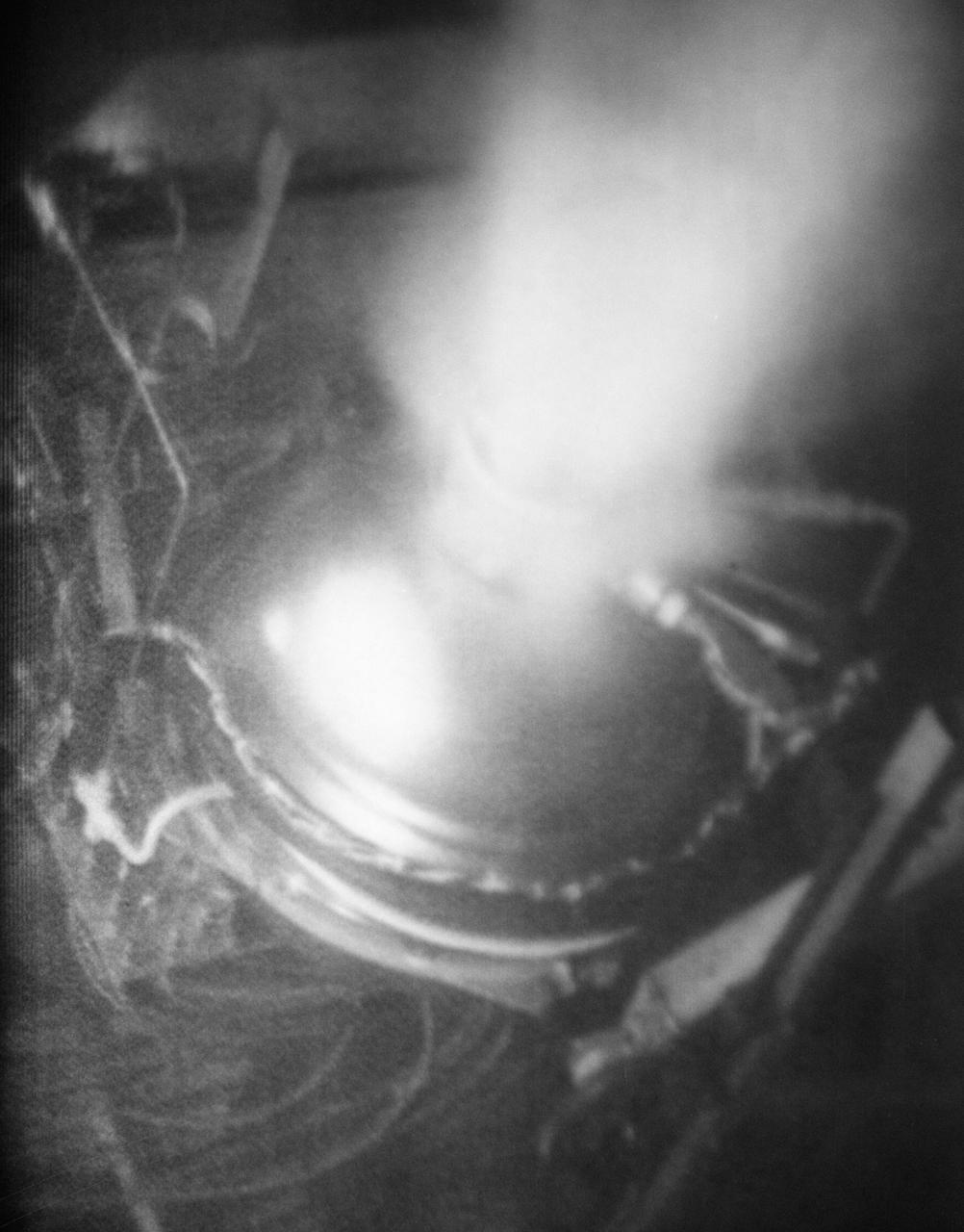
S70-41984 (June 1970) --- Full-scale propagation test at the NASA Manned Spacecraft Center (MSC) of fire inside an Apollo Service Module (SM) oxygen tank. The photograph from a motion picture sequence taken from outside the vessel shows failure of tank conduit with abrupt loss of oxygen pressure. The test was part of the Apollo 13 post flight investigation of the Service Module explosion incident. Photo credit: NASA
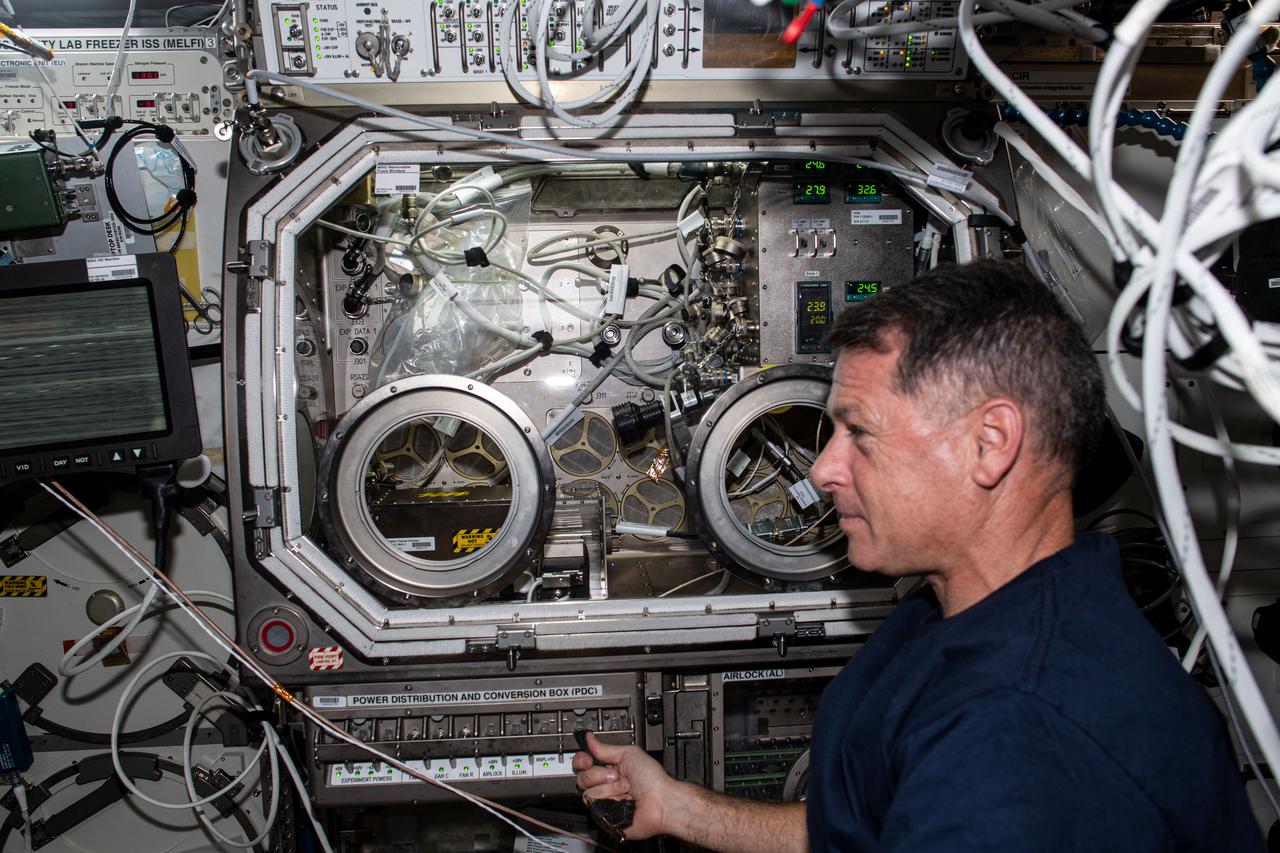
iss065e020580 (May 5, 2021) --- NASA astronaut and Expedition 65 Flight Engineer Shane Kimbrough is pictured in front of the Microgravity Science Glovebox setting up hardware for a physics investigation. The experiment known as Solidification Using a Baffle in Sealed Ampoules, or SUBSA, explores experimental methods of crystallizing melts in microgravity and is expected to result in reduced fluid motion in the melt, leading to better distribution of subcomponents and the potential for improved technology used in producing semiconductor crystals.
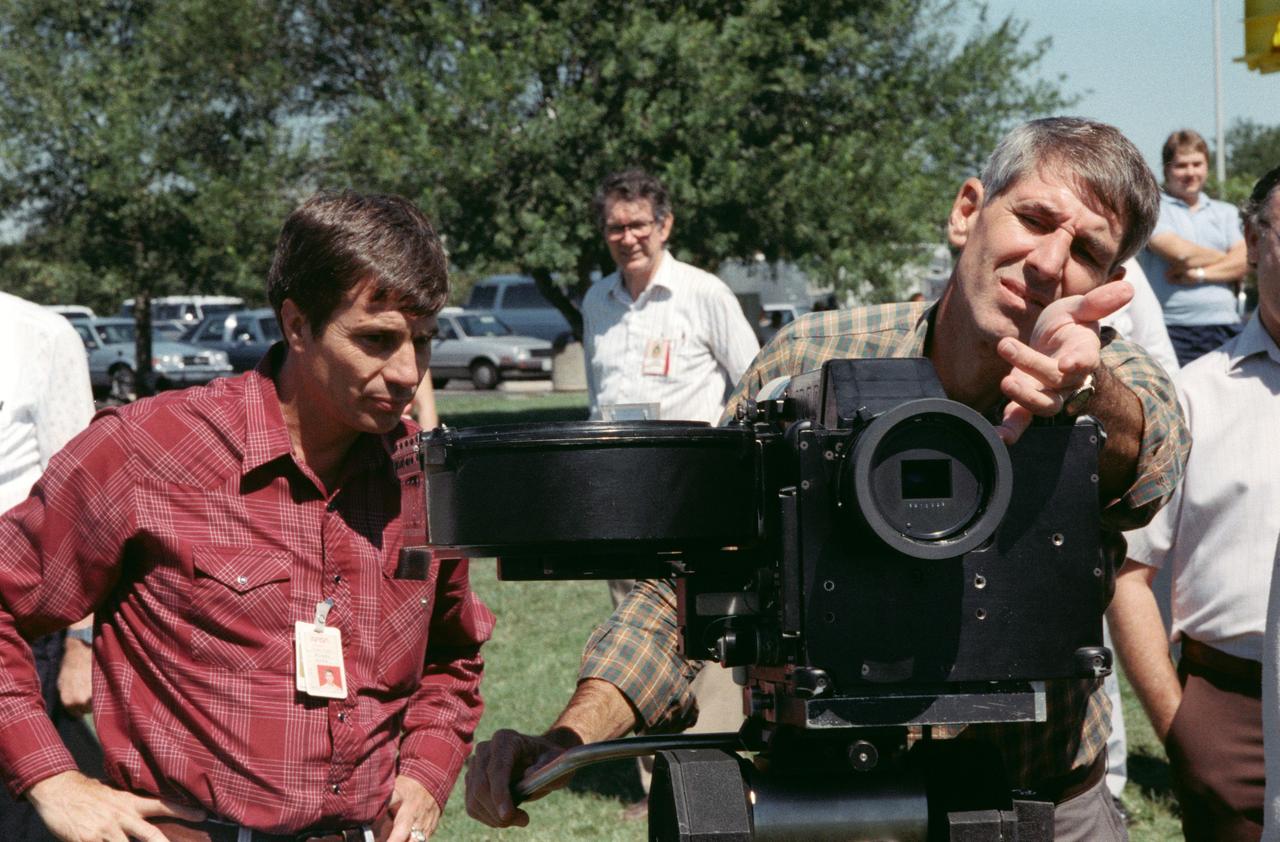
S88-52469 (8 Nov 1988) --- Astronauts John E. Blaha, left, and Robert C. Springer, STS-29 pilot and mission specialist, respectively, get in some training on the operation of one of the payloads for their upcoming spaceflight aboard Discovery. The crew met with Imax personnel on the JSC grounds to practice using the motion-picture camera, making its first post-Challenger trip into space. The payload flew on a number of earlier STS flights.

41D-12-020 (6 Sept 1984) --- Astronaut Judith A. Resnik, mission specialist, anchors herself on the flight deck (out of frame) to take a peek at mid-deck activity aboard the Earth-orbiting Space Shuttle Discovery. Among the many stationary and portable cameras onboard the flight are (left to right) TV camera, a data acquisition motion picture camera and the IMAX.
S88-52473 (8 Nov 1988) --- The commander and pilot of NASA's STS-29 mission get some training on the operation of one of the payloads for their upcoming spaceflight aboard Discovery. Astronauts Michael L. Coats, left, and John E. Blaha, along with the three other members of the crew, met with Imax personnel on the JSC grounds to practice using the motion-picture camera, making its first post-Challenger trip into space. The payload flew on a number of earlier STS flights.
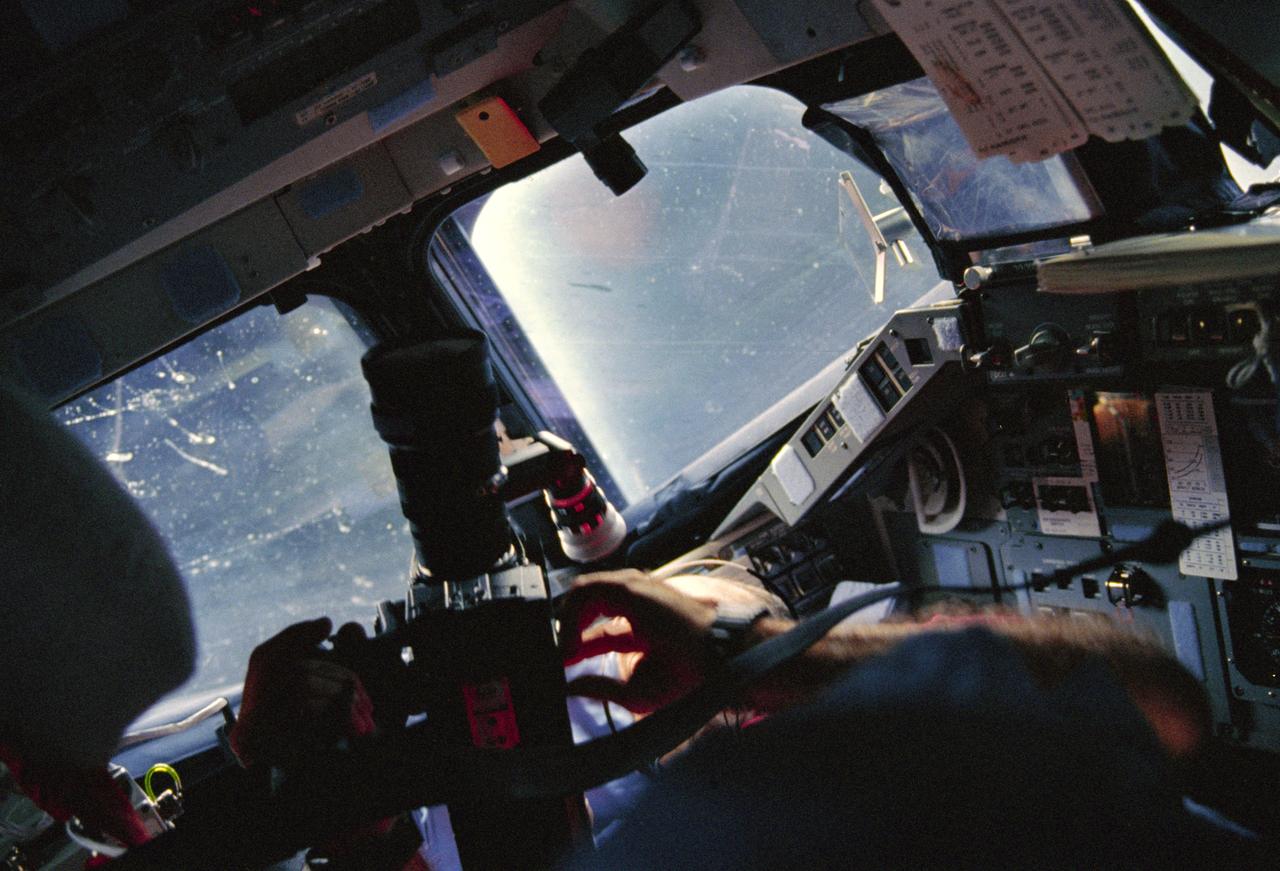
STS029-06-015 (13-18 March 1989) --- This scene of an astronaut with a camera was a common one during the five-day flight of STS-29. Astronaut James P. Bagian, STS-29 mission specialist, aims the Arriflex motion picture camera at Earth through one of Discovery's overhead windows. The scene was recorded with a 35mm camera.
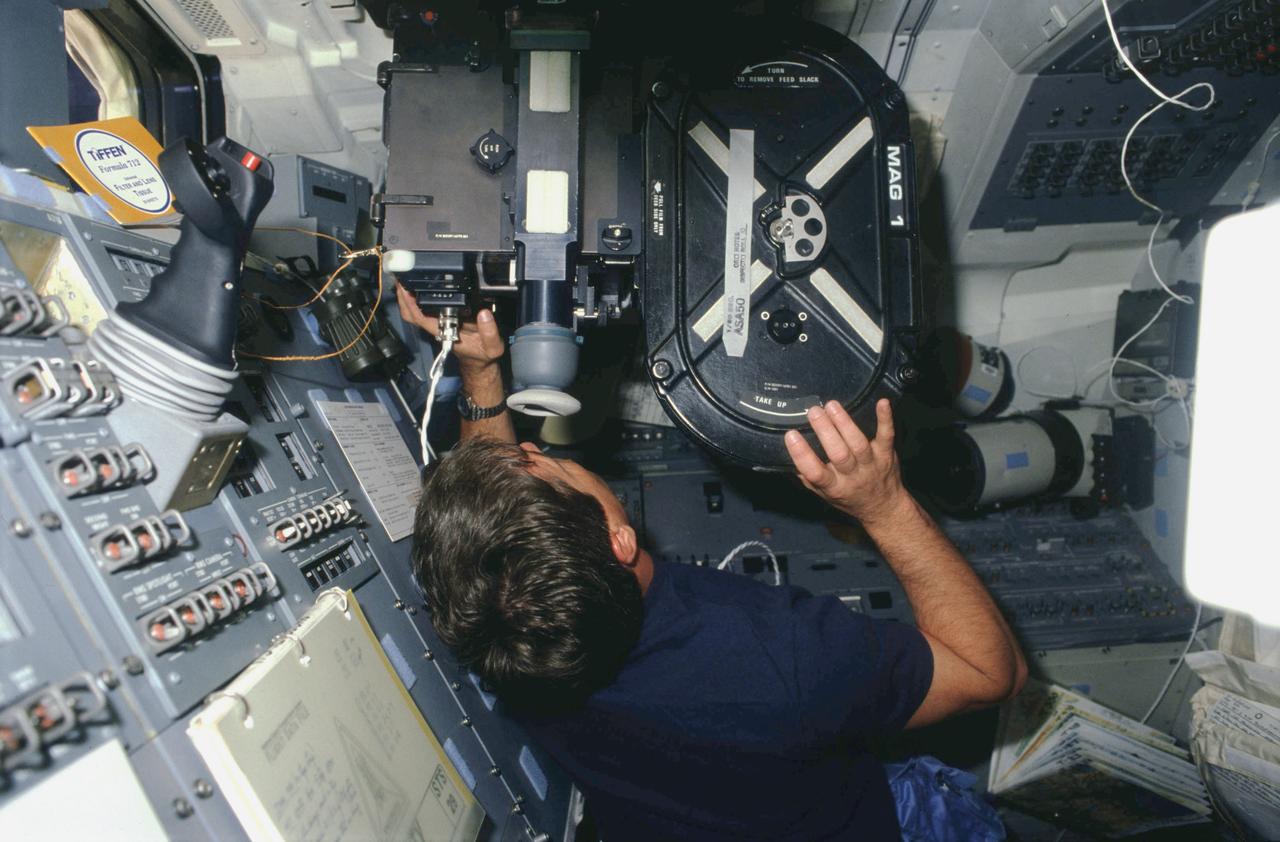
Pilot John E. Blaha balances and points IMAX motion picture camera out aft flight deck overhead window to film Earth's surface below. Blaha is surrounded by onorbit station control panels in foreground, payload station in background, and forward overhead panels above. Handbook titled "TiFFEN Formula 712" and checklists are velcroed to onorbit station panels. An open atlas freefloats just below Blaha's right elbow.
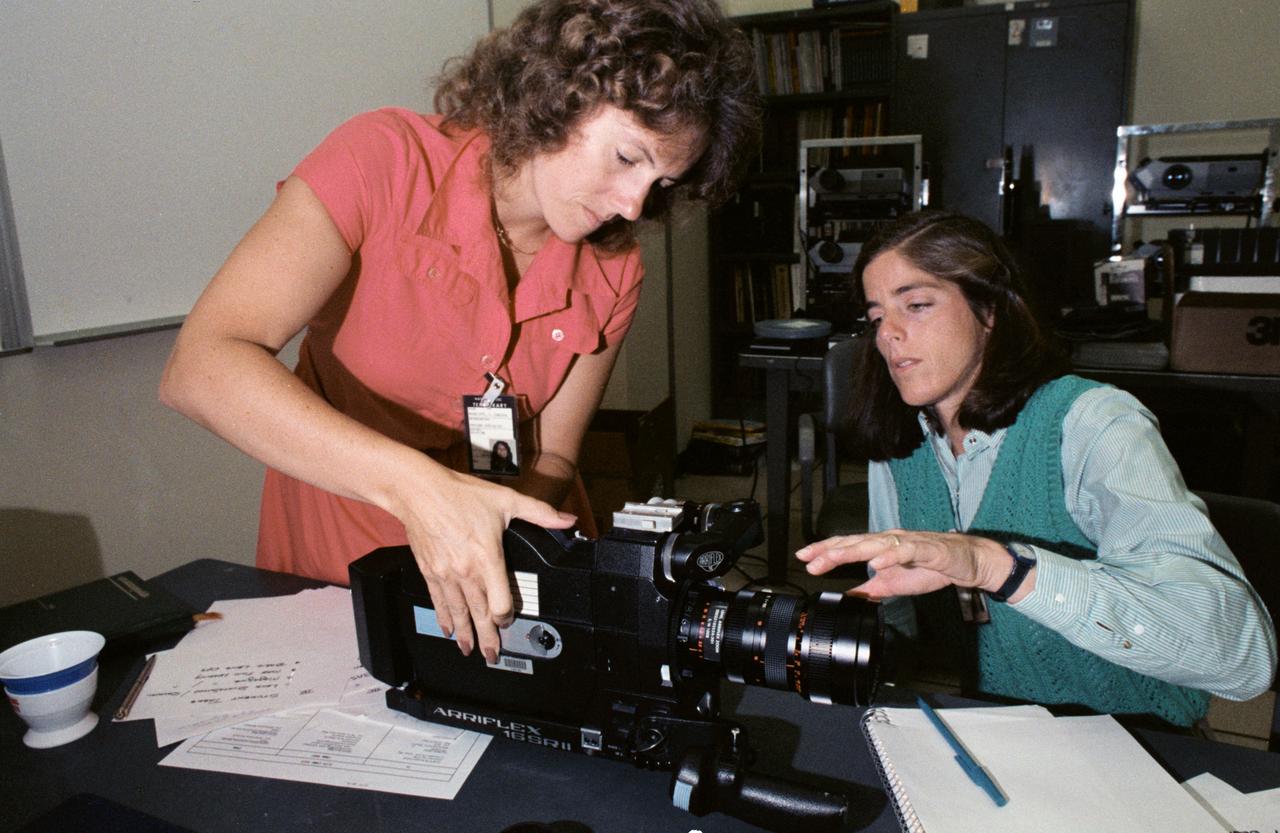
S85-41033 (18 Sept. 1985) --- Two women in training at JSC as part of the Teacher-in-Space Project and a position on NASA’s STS-51L mission learn handling of the Arriflex motion picture camera used on shuttle flights. Sharon Christa McAuliffe (left) was recently named as prime crew member for the 51-L flight; and Barbara R. Morgan, here lending help with camera’s lens, will serve as backup. The photograph was taken by Otis Imboden. Photo credit: NASA

Range : 1,550,000 km ( 961,000 miles ) These high resolution pictures of Jupiter's ring were obtained by Voyager 2 some 26 hrs. past the planet, 2 degrees below the ring plane. The forward scattering of sunlight reveals a radial distribution and density gradient of very small particles extending inward from the ring toward Jupiter. There is an indication of structure within the ring, but unfortunatly the spacecrafts motion during these long exposures blurred out the highest resolution detail, particularly in the frame at right.
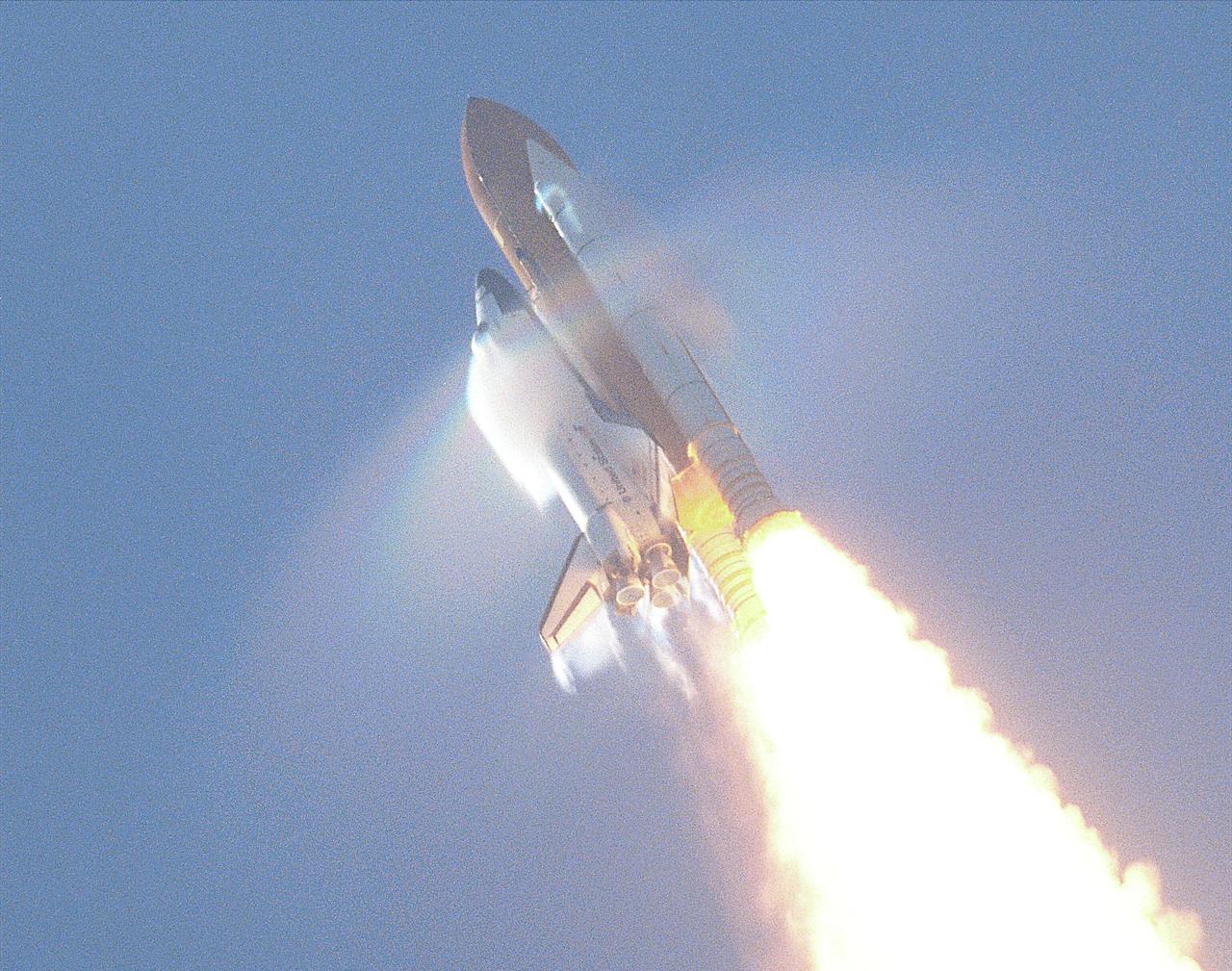
KENNEDY SPACE CENTER, FLA. -- This view of the shock wave condensation collars backlit by the sun occurred during the launch of Atlantis on STS-106 and was captured on an engineering 35mm motion picture film. One frame was digitized to make this still image. Although the primary effect is created by the Orbiter forward fuselage, secondary effects can be seen on the SRB forward skirt, Orbiter vertical stabilizer and wing trailing edges (behind SSME's).
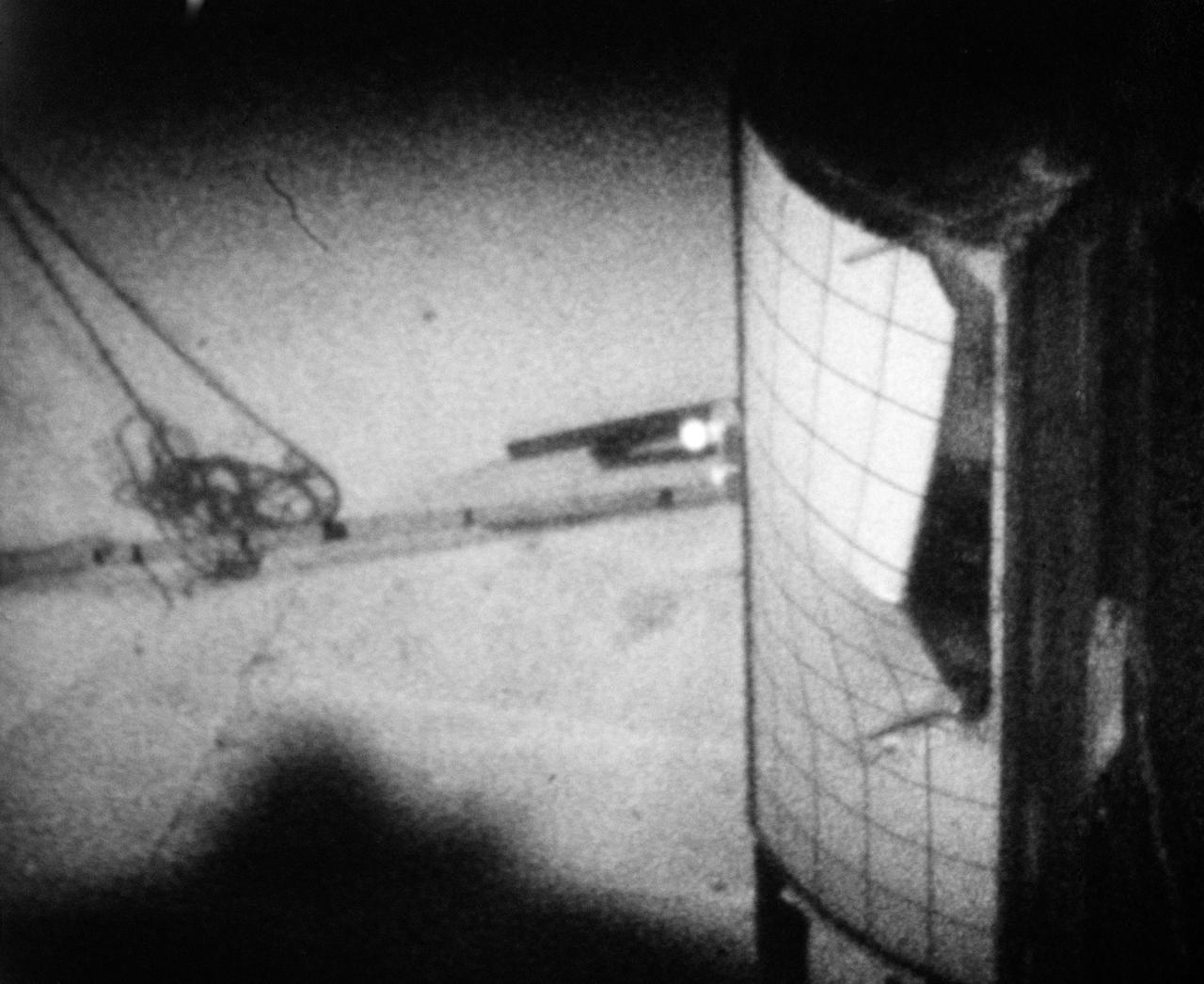
S70-41982 (June 1970) --- Sequence photo from 16mm motion picture film of test at National Aeronautics and Space Administration's Langley Research Center which seeks to determine mechanism by which Apollo 13 panel was separated from the Service Module. Test used a 1/2 scale model with a honeycomb sandwich panel and was conducted in a vacuum. (First of three photographs in sequence). Photo credit: NASA
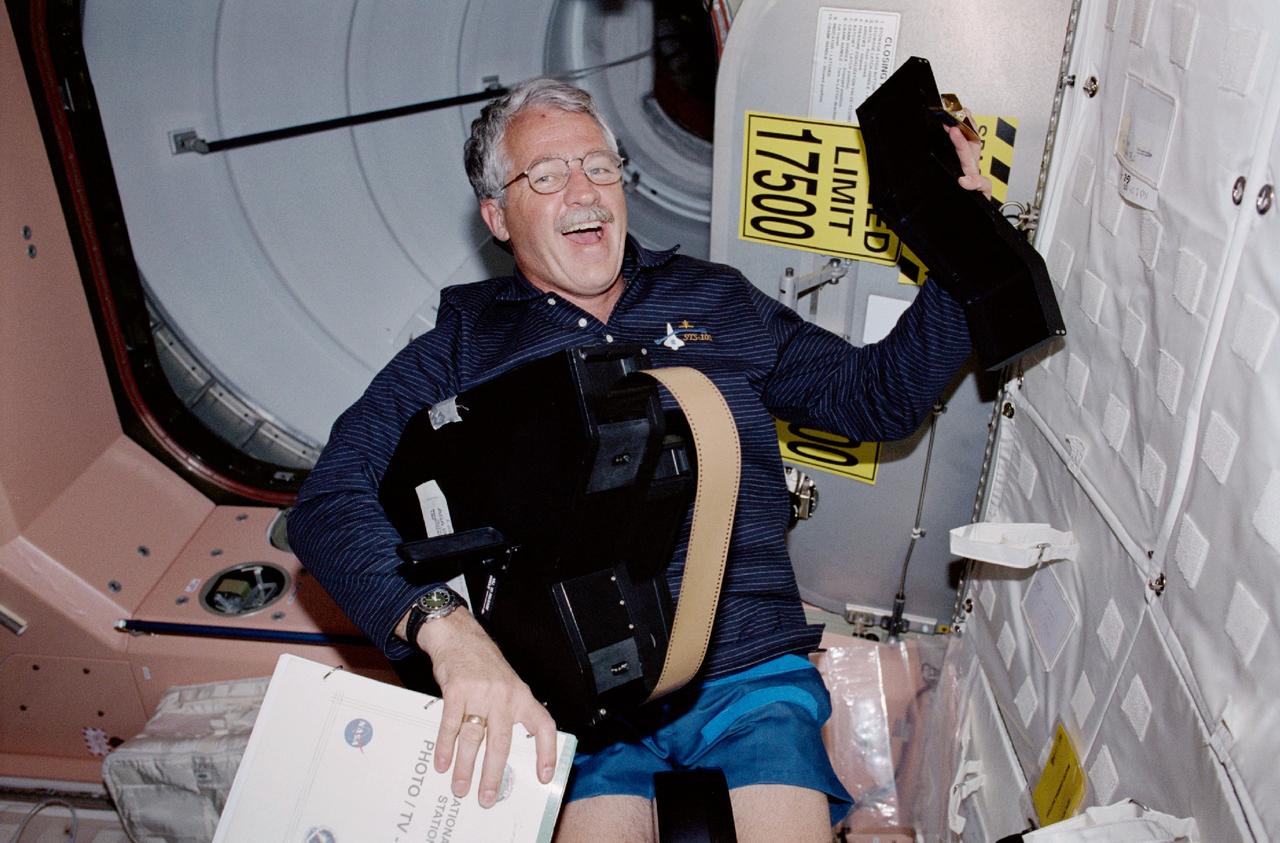
STS100-342-035 (19 April-1 May 2001) --- Astronaut John L. Phillips, mission specialist, works with the IMAX camera on the International Space Station (ISS). Phillips and his STS-100 crew mates transferred supplies to the station and recorded video, motion picture and still photography of their activities, including interaction with the Expedition Two crewmembers.

Range : 1.4 to 2 million miles This series of pictures shows four views of the planet Venus obtained by Galileo's Solid State Imaging System.The pictures in the top row were taken about 4 & 5 days after closest approach; those in the bottom row were taken about 6 days out, 2 hours apart. In these violet-light images, north is at the top and the evening terminator to the left. The cloud features high in the planet's atmosphere rotate from right to left, from the limb through the noon meridian toward the terminator, travelling all the way around the planet once every four days. The motion can be seen by comoparing the last two pictures, taken two hours apart. The other views show entirely different faces of Venus. These photos are part of the 'Venus global circulation' sequence planned by the imaging team.
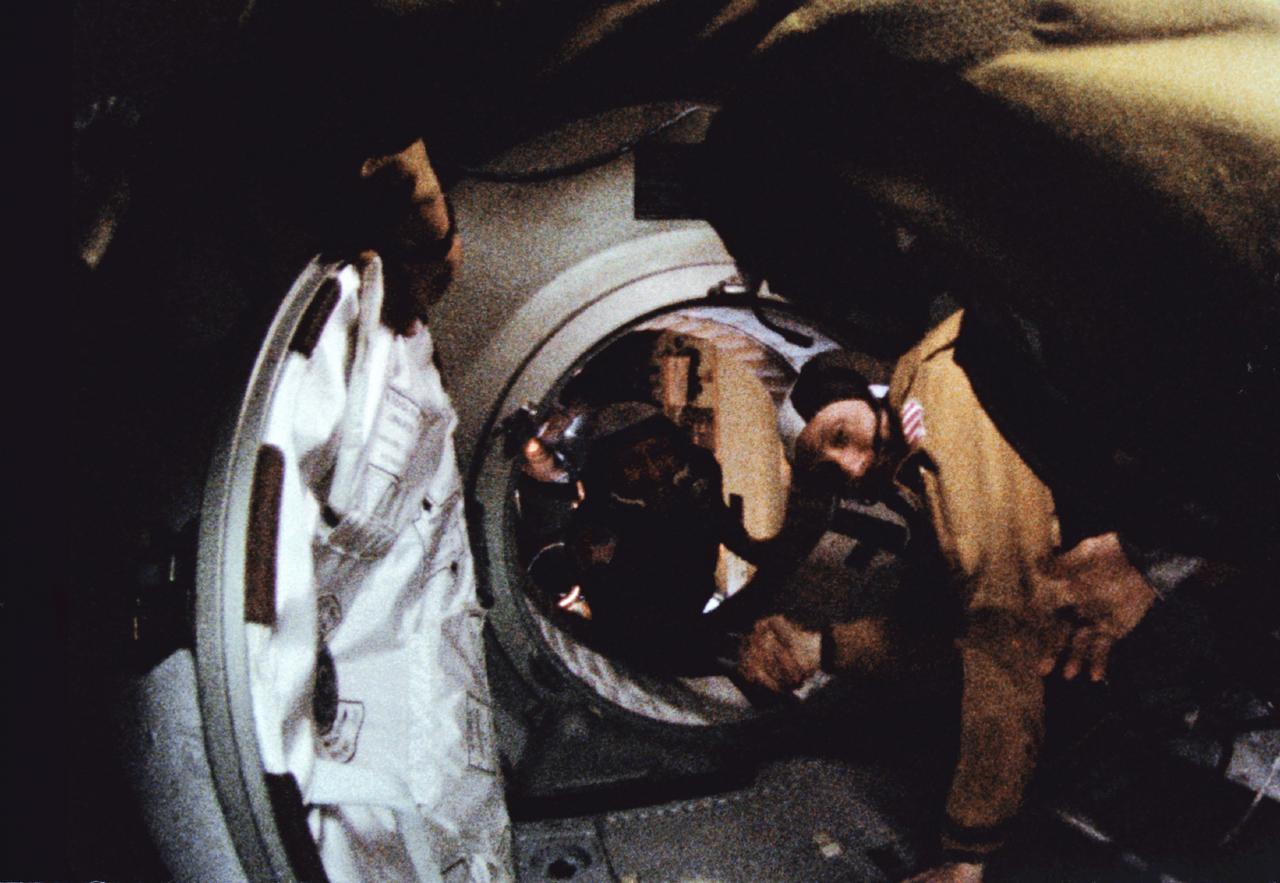
S75-29432 (17 July 1975) --- Astronaut Thomas P. Stafford (in foreground) and cosmonaut Aleksei A. Leonov make their historic handshake in space on July 17, 1975 during the joint U.S.-USSR Apollo Soyuz Test Project (ASTP) docking mission in Earth orbit. This picture was reproduced from a frame of 16mm motion picture film. The American and Soviet spacecraft were joined together in space for approximately 47 hours on July 17th, 18th, 19th, 1975. The Apollo crew consisted of astronauts Thomas P. Stafford, commander; Donald K. "Deke" Slayton, docking module pilot; Vance D. Brand, command module pilot. The Soyuz 19 crew consisted of cosmonauts Aleksei A. Leonov, command pilot; and Valeri N. Kubasov, flight engineer.
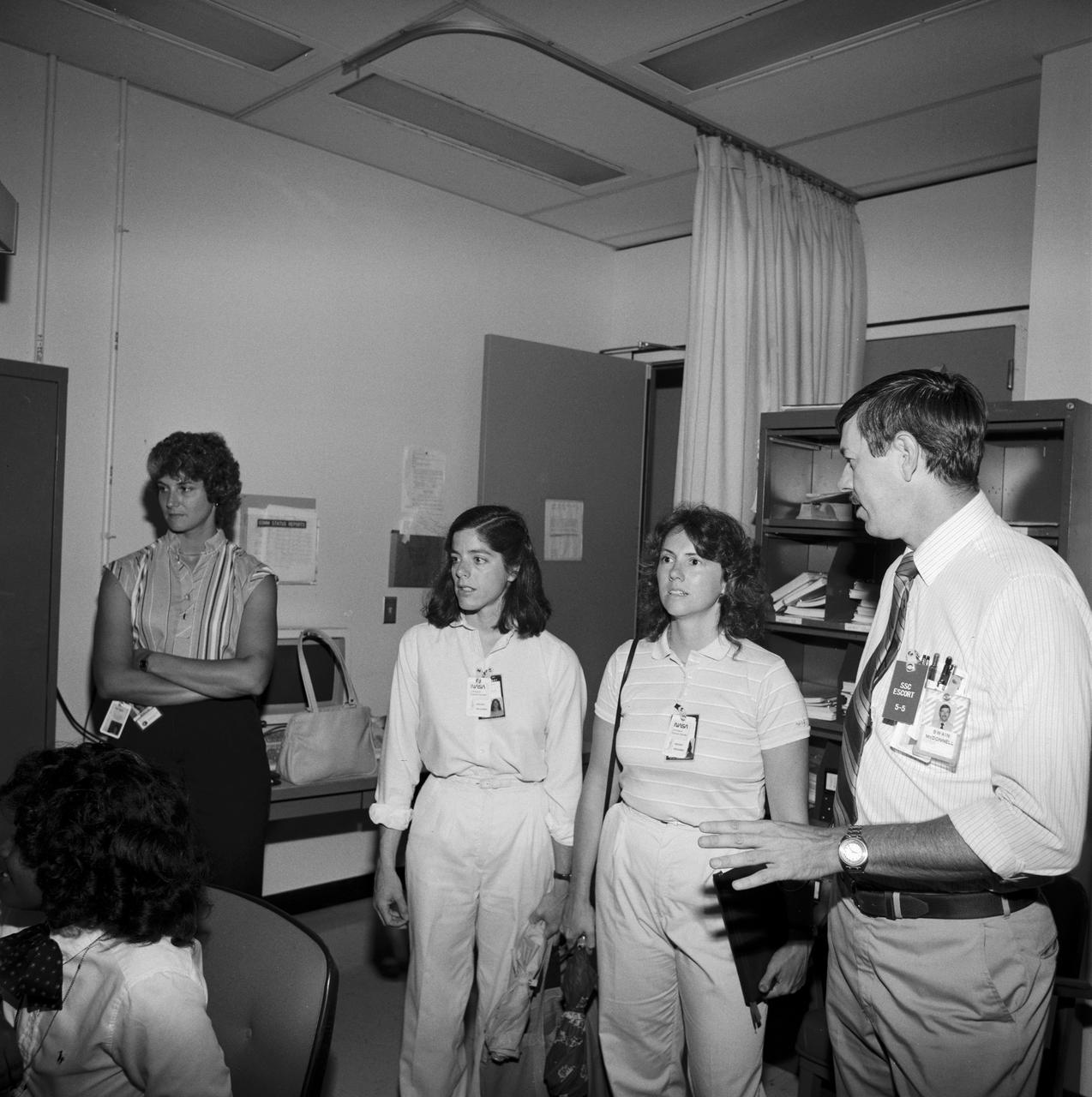
S85-40510 & S85-40511 (23 Sept. 1985) --- Two women representing the Teacher-in-Space Project undergo training in preparation for the 51-L mission in two photographs made in the Johnson Space Center’s mission simulation and training facility. In S85-40510, Sharon Christa McAuliffe (second right), prime crew member; and Barbara R. Morgan (second left), backup, are briefed in the shuttle mission simulator’s instruction station by Jerry Swain, right, instruction team leader. Others pictured are Michelle Brekke (far left) of the payload specialists’ office and Patricia A. Lawson (lower left foreground). Astronaut Ellison S. Onizuka, in S85-40511, assists Morgan with a head set as the two trainees are familiarized with launch and entry stations in the motion base shuttle mission simulator (SMS). The citizen observer (McAuliffe) is scheduled to be seated on the middeck. This picture, however, was taken at the mission specialists’ station on the flight deck. Photo credit: NASA
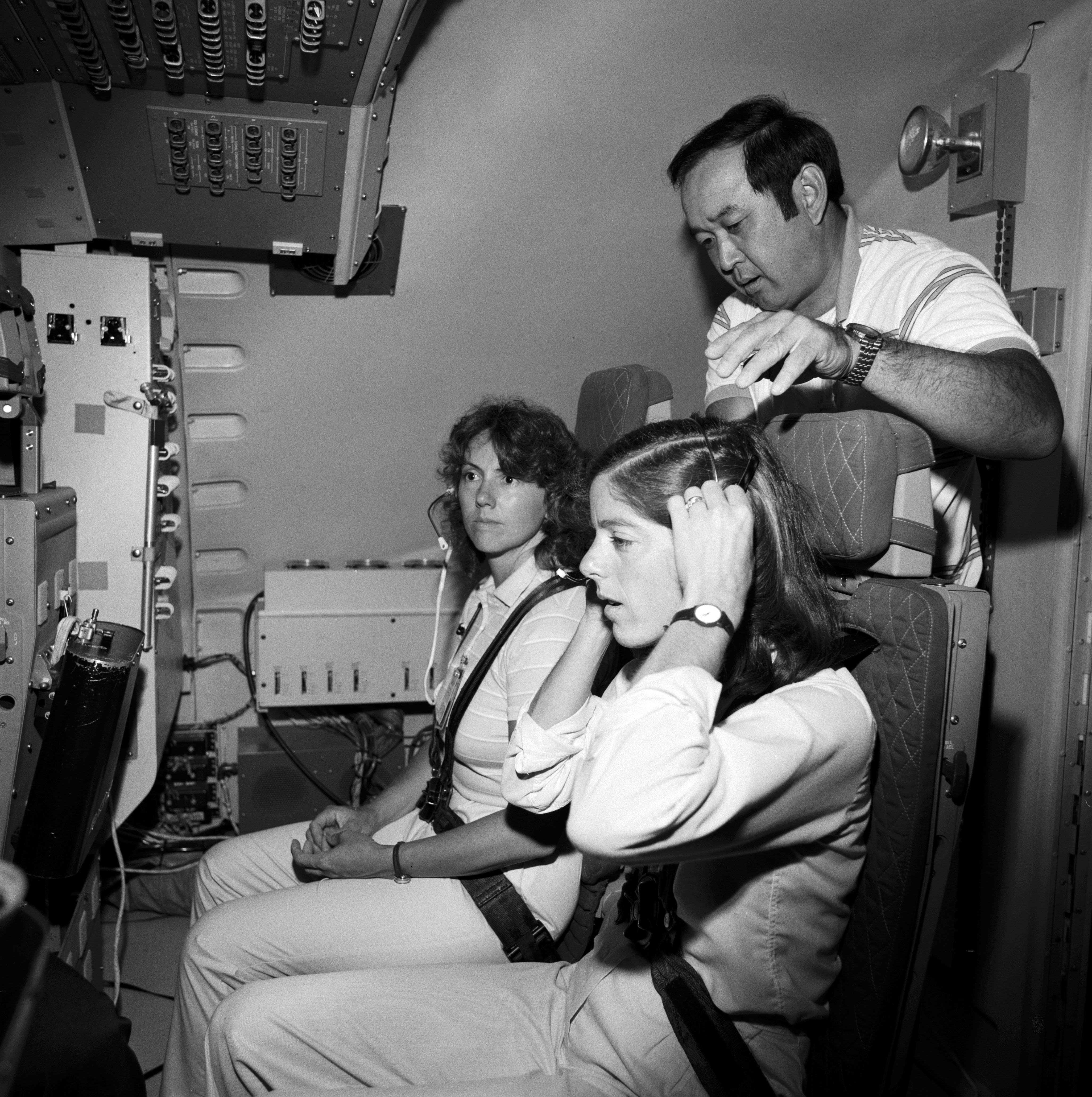
S85-40510 & S85-40511 (23 Sept. 1985) --- Two women representing the Teacher-in-Space Project undergo training in preparation for the 51-L mission in two photographs made in the Johnson Space Center’s mission simulation and training facility. In S85-40510, Sharon Christa McAuliffe (second right), prime crew member; and Barbara R. Morgan (second left), backup, are briefed in the shuttle mission simulator’s instruction station by Jerry Swain, right, instruction team leader. Others pictured are Michelle Brekke (far left) of the payload specialists’ office and Patricia A. Lawson (lower left foreground). Astronaut Ellison S. Onizuka, in S85-40511, assists Morgan with a head set as the two trainees are familiarized with launch and entry stations in the motion base shuttle mission simulator (SMS). The citizen observer (McAuliffe) is scheduled to be seated on the middeck. This picture, however, was taken at the mission specialists’ station on the flight deck. Photo credit: NASA

This color image of the Earth was obtained by NASA's Galileo at about 6:10 a.m. Pacific Standard Time on Dec. 11, 1990, when the spacecraft was about 1.3 million miles from the planet during the first of two Earth flybys on its way to Jupiter. The color composite used images taken through the red, green and violet filters. South America is near the center of the picture, and the white, sunlit continent of Antarctica is below. Picturesque weather fronts are visible in the South Atlantic, lower right. This is the first frame of the Galileo Earth spin movie, a 500- frame time-lapse motion picture showing a 25-hour period of Earth's rotation and atmospheric dynamics. A movie is availalble at http://photojournal.jpl.nasa.gov/catalog/PIA00114
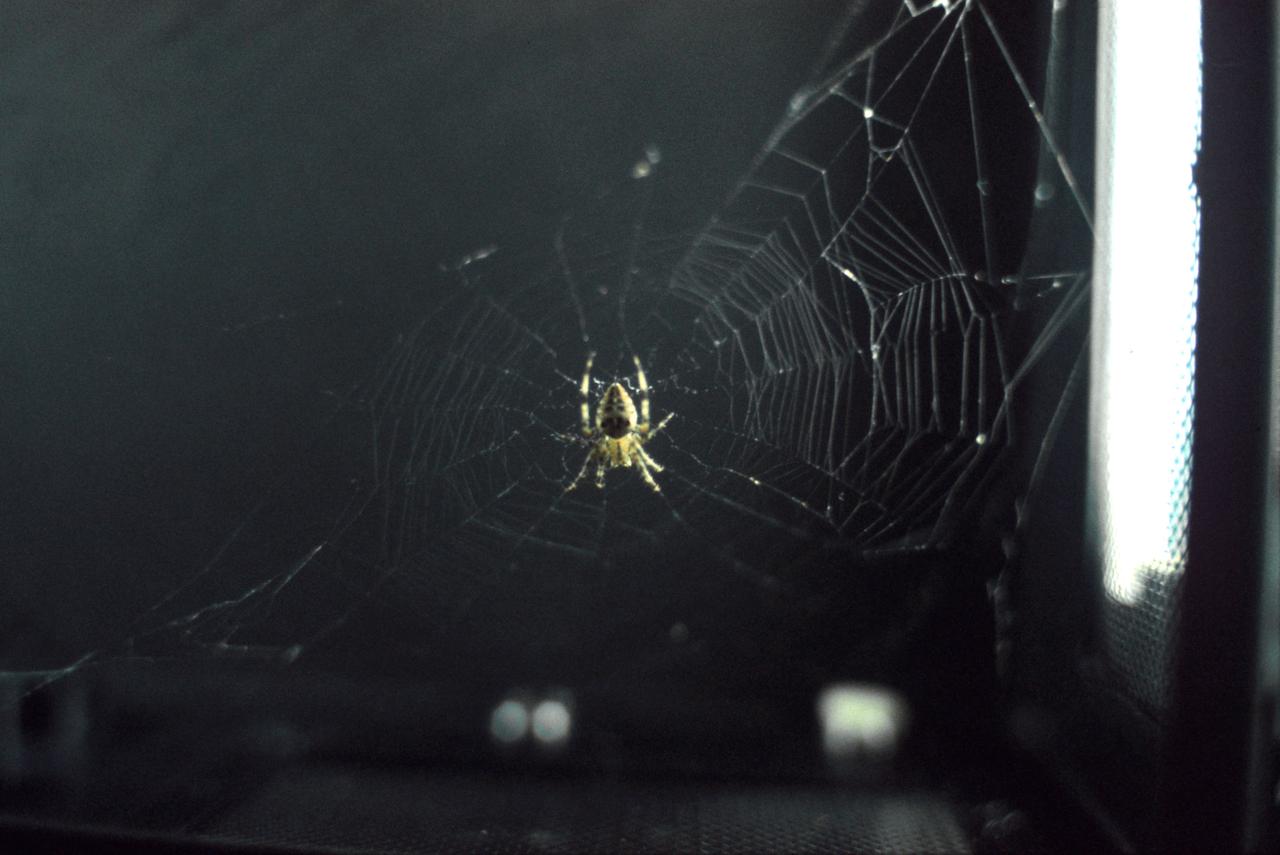
SL3-108-1307 (July-September 1973) --- A close-up view of Arabella, one of the two Skylab 3 common cross spiders "Araneus diadematus," and the web it had spun in the zero-gravity of space aboard the Skylab space station cluster in Earth orbit. This picture was taken with a hand-held 35mm Nikon camera. During the 59-day Skylab 3 mission the two spiders, Arabella and Anita, were housed in an enclosure onto which a motion picture and a still camera were attempts to build a web in the weightless environment. The spider experiment (ED52) was one of 25 experiments selected for Skylab by NASA from more than 3,400 experiment proposals submitted by high school students throughout the nation. ED52 was submitted by 17-year-old Judith S. Miles of Lexington, Massachusetts. Anita died during the last week of the mission. Photo credit: NASA
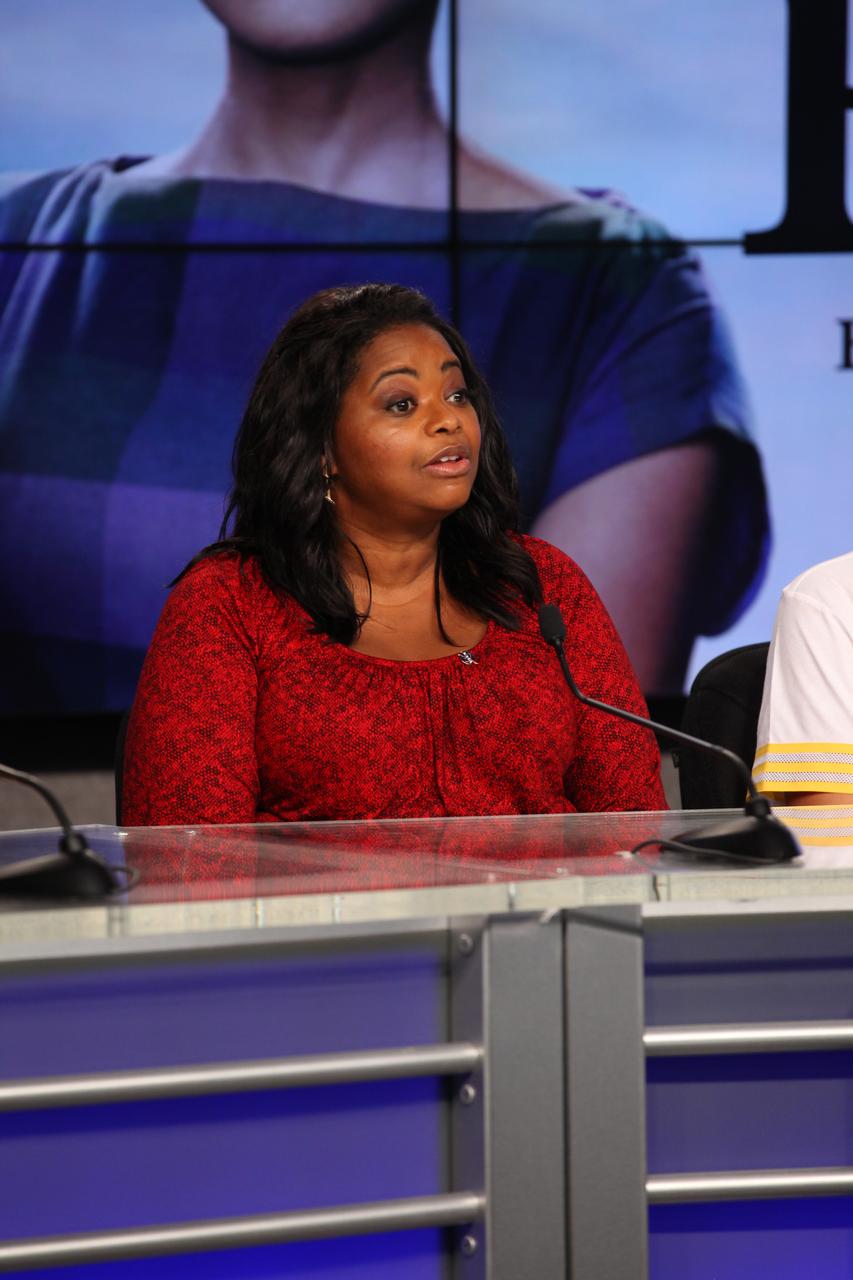
In the Press Site auditorium at the Kennedy Space Center in Florida, Octavia Spencer speaks to members of the media during a news conference with other key individuals involved in the upcoming motion picture "Hidden Figures." The movie is based on the book of the same title, by Margot Lee Shetterly. It chronicles the lives of Katherine Johnson, Dorothy Vaughan (played by Spencer) and Mary Jackson, three African-American women who worked for NASA as human "computers.” Their mathematical calculations were crucial to the success of Project Mercury missions including John Glenn’s orbital flight aboard Friendship 7 in 1962. The film is due in theaters in January 2017.

S83-32571 (23 May 1983) --- Four-fifths of the STS-7 crew take a break from simulations in the Johnson Space Center?s Mission Simulation and Training Facility and pose for NASA photographer. Standing on the steps leading into the motion-based Shuttle Mission Simulator (SMS) are (left to right) astronauts Robert L. Crippen, John M. Fabian, Frederick H. Hauck and Sally K. Ride. Crippen is crew commander; Hauck, pilot; and Fabian and Ride are mission specialists, along with Norman E. Thagard (not involved in this phase of training and not pictured). Photo credit: NASA
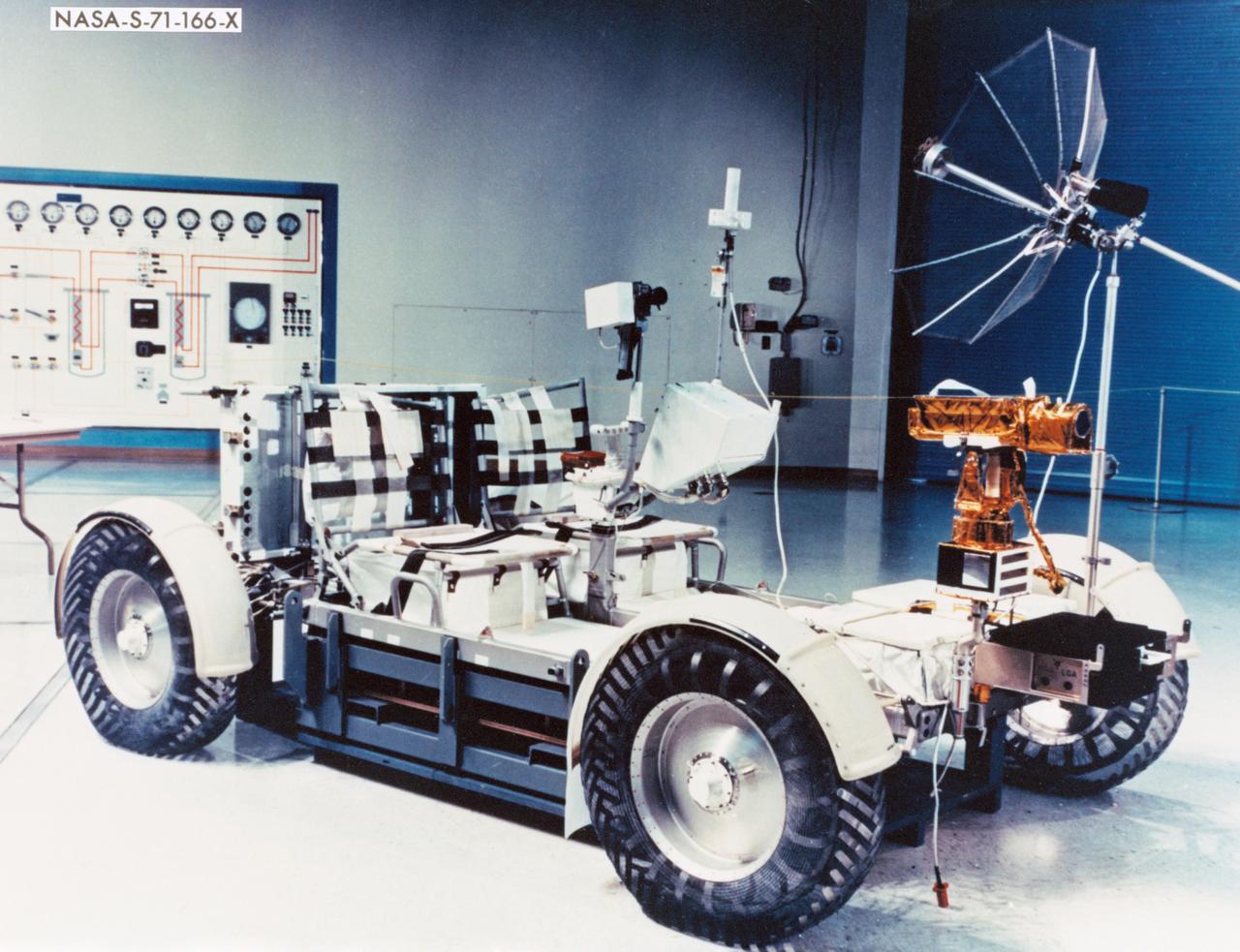
S71-00166 (June 1971) --- A close-up view of the Lunar Roving Vehicle (LRV). Apollo 15 will be the first mission to employ the services of the LRV. Astronauts David R. Scott, commander; and James B. Irwin, lunar module pilot, will move about the lunar surface in the Hadley-Apennine region in their four-wheeled vehicle while astronaut Alfred M. Worden, command module pilot, remains with the Command and Service Modules (CSM) in lunar orbit. A television camera, which can be controlled remotely from the ground (front), and a motion picture camera (rear) are among the gear on the LRV.

In the IMAX Theater of the Kennedy Space Center Visitor Complex Cast and crew members of the upcoming motion picture "Hidden Figures" participate in a question and answer session. From the left are Pharrell Williams, musician and producer of “Hidden Figures," and Janelle Monáe, who portrays Mary Jackson in the film. The movie chronicles the lives of Katherine Johnson, Dorothy Vaughan and Mary Jackson, three African-American women who worked for NASA as human "computers.” Their mathematical calculations were crucial to the success of Project Mercury missions including John Glenn’s orbital flight aboard Friendship 7 in 1962. The film is due in theaters in January 2017.

In the IMAX Theater of the Kennedy Space Center Visitor Complex Cast and crew members of the upcoming motion picture "Hidden Figures" participate in a question and answer session. From the left are Taraji P. Henson, who portrays Katherine Johnson in the film, Pharrell Williams, musician and producer of “Hidden Figures," and Janelle Monáe, who portrays Mary Jackson. The movie chronicles the lives of Katherine Johnson, Dorothy Vaughan and Mary Jackson, three African-American women who worked for NASA as human "computers.” Their mathematical calculations were crucial to the success of Project Mercury missions including John Glenn’s orbital flight aboard Friendship 7 in 1962. The film is due in theaters in January 2017.
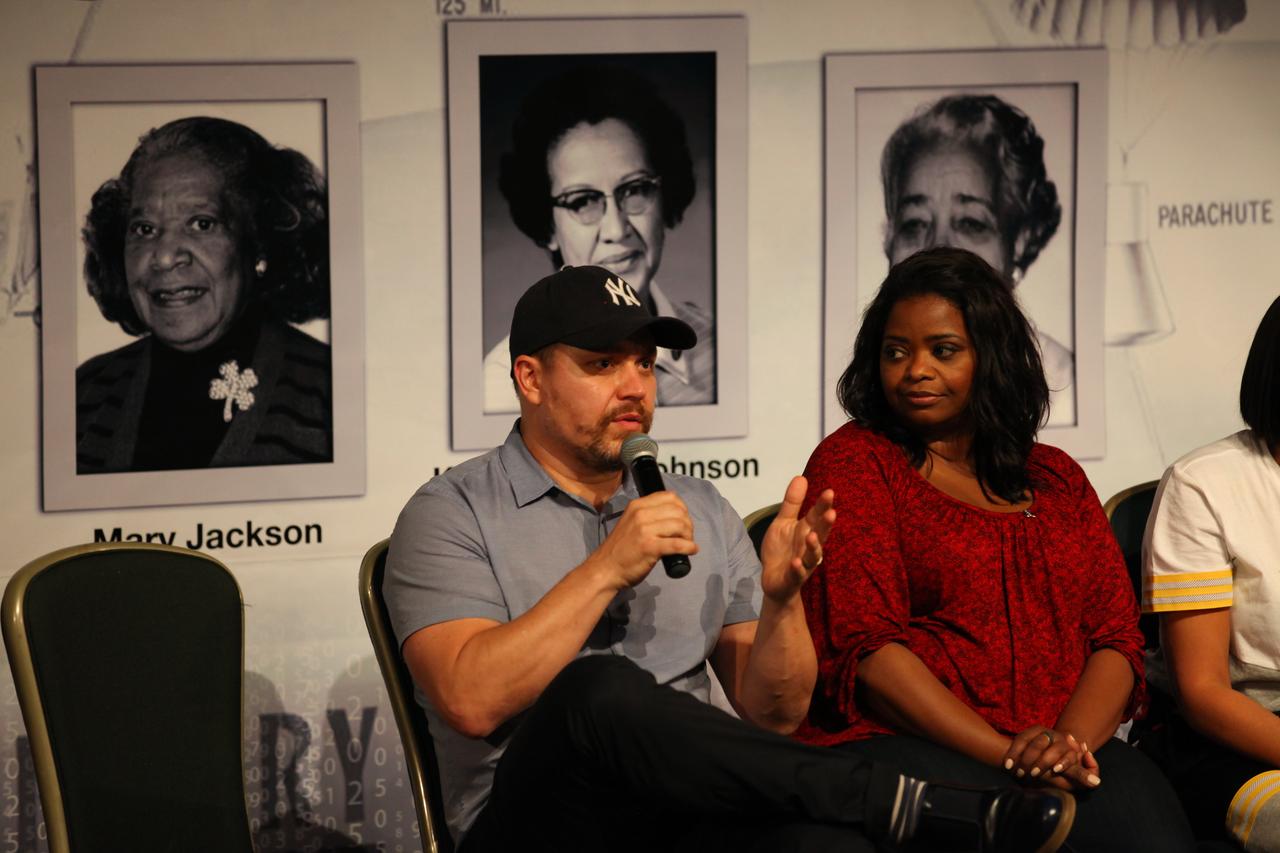
In the IMAX Theater of the Kennedy Space Center Visitor Complex Cast and crew members of the upcoming motion picture "Hidden Figures" participate in a question and answer session. From the left are Ted Melfi, writer and director of “Hidden Figures,” and Octavia Spencer, who portrays Dorothy Vaughan in the film. The movie is based on the book of the same title, by Margot Lee Shetterly. It chronicles the lives of Katherine Johnson, Dorothy Vaughan and Mary Jackson, three African-American women who worked for NASA as human "computers.” Their mathematical calculations were crucial to the success of Project Mercury missions including John Glenn’s orbital flight aboard Friendship 7 in 1962. The film is due in theaters in January 2017.
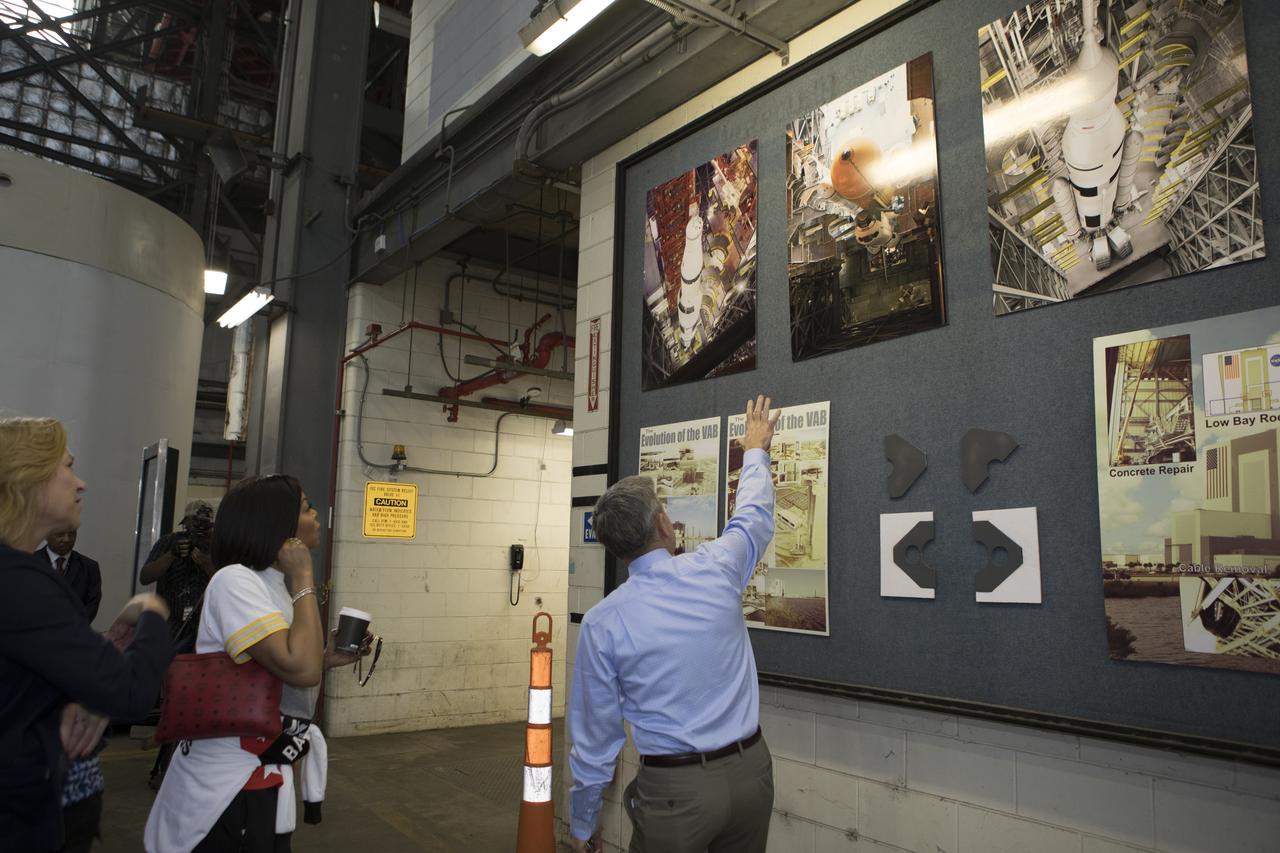
Kennedy Space Center Director Bob Cabana points to a display during a tour for cast and crew members of the upcoming motion picture "Hidden Figures." The group is walking thought the transfer aisle of the Vehicle Assembly Building. The movie is based on the book of the same title, by Margot Lee Shetterly. It chronicles the lives of Katherine Johnson, Dorothy Vaughan and Mary Jackson, three African-American women who worked for NASA as human "computers.” Their mathematical calculations were crucial to the success of Project Mercury missions including John Glenn’s orbital flight aboard Friendship 7 in 1962. The film is due in theaters in January 2017.
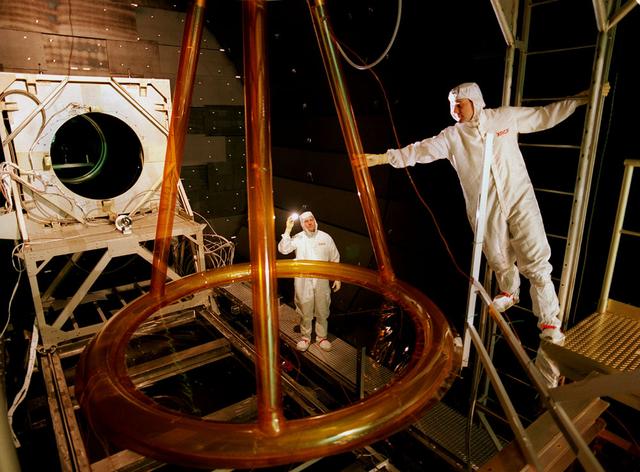
The Shooting Star Experiment (SSE) is designed to develop and demonstrate the technology required to focus the sun's energy and use the energy for inexpensive space Propulsion Research. Pictured is an engineering model (Pathfinder III) of the Shooting Star Experiment (SSE). This model was used to test and characterize the motion and deformation of the structure caused by thermal effects. In this photograph, alignment targets are being placed on the engineering model so that a theodolite (alignment telescope) could be used to accurately measure the deformation and deflections of the engineering model under extreme conditions, such as the coldness of deep space and the hotness of the sun as well as vacuum. This thermal vacuum test was performed at the X-Ray Calibration Facility because of the size of the test article and the capabilities of the facility to simulate in-orbit conditions

In the Press Site auditorium at the Kennedy Space Center in Florida, Taraji P. Henson speaks to members of the media during a news conference with other key individuals involved in the upcoming motion picture "Hidden Figures." The movie is based on the book of the same title, by Margot Lee Shetterly. It chronicles the lives of Katherine Johnson (played by Henson), Dorothy Vaughan and Mary Jackson, three African-American women who worked for NASA as human "computers.” Their mathematical calculations were crucial to the success of Project Mercury missions including John Glenn’s orbital flight aboard Friendship 7 in 1962. The film is due in theaters in January 2017.

In the Press Site auditorium at the Kennedy Space Center in Florida, Pharrell Williams, musician and producer of “Hidden Figures" speaks to members of the media during a news conference with other key individuals involved in the upcoming motion picture. The movie is based on the book of the same title, by Margot Lee Shetterly. It chronicles the lives of Katherine Johnson, Dorothy Vaughan and Mary Jackson, three African-American women who worked for NASA as human "computers.” Their mathematical calculations were crucial to the success of Project Mercury missions including John Glenn’s orbital flight aboard Friendship 7 in 1962. The film is due in theaters in January 2017.
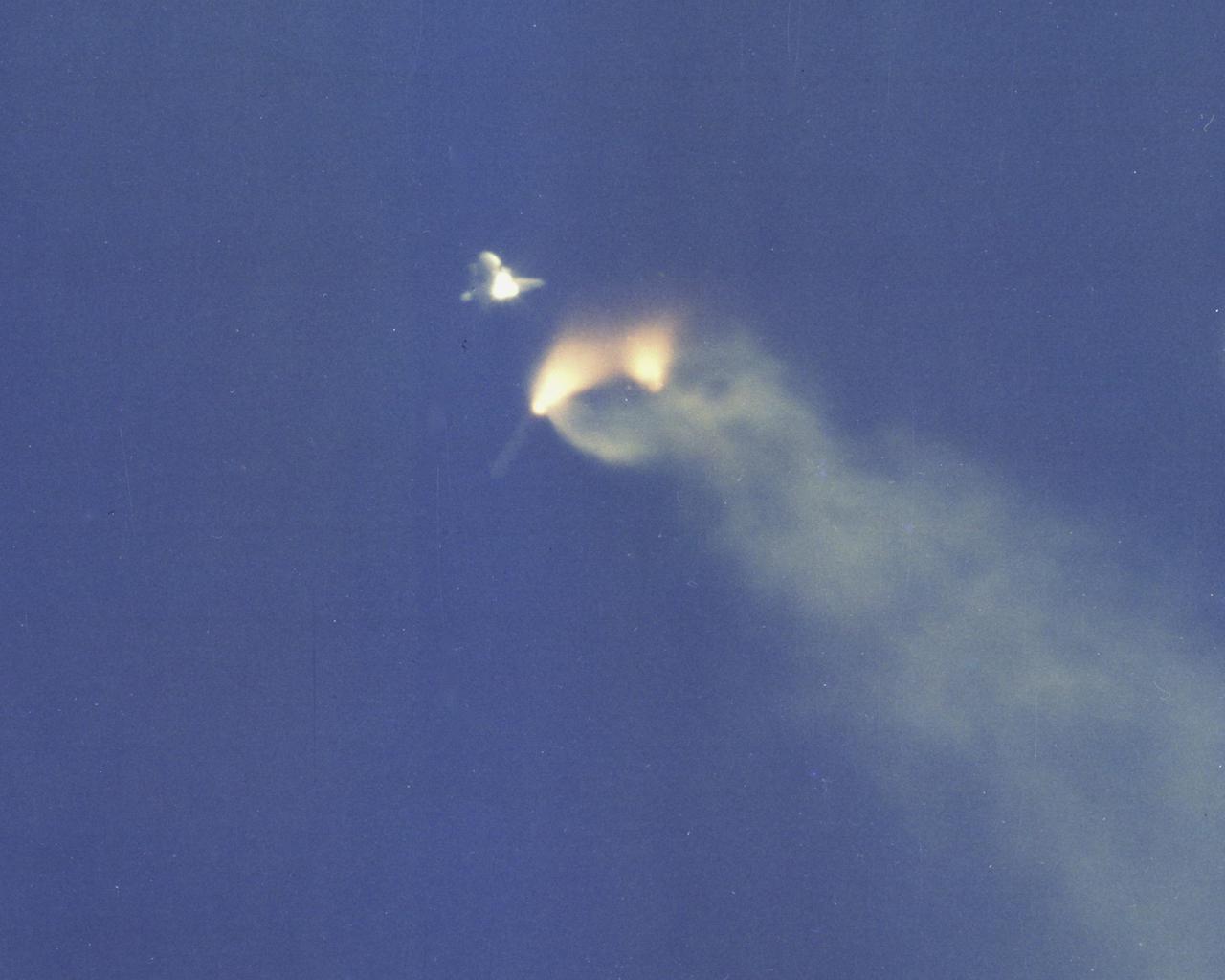
KENNEDY SPACE CENTER, FLA. - Separation of the Space Shuttle’s solid rocket boosters (SRB’s) occurs at two minutes, 11 seconds after launch from Pad A, Launch Complex 39. This sequence, showing initiation of separations, and falling away of the two booster casings, still spewing sparks from their white-hot linings, was taken by a 70mm radar-tracked Photosonic motion picture camera with a 360-inch focal lens, from Universal Camera Site 10, located on KSC approximately eight miles north of the launch pad. The three frames were taken from a 1,000 foot run of EF film exposed at a rate of 40 frames per second.
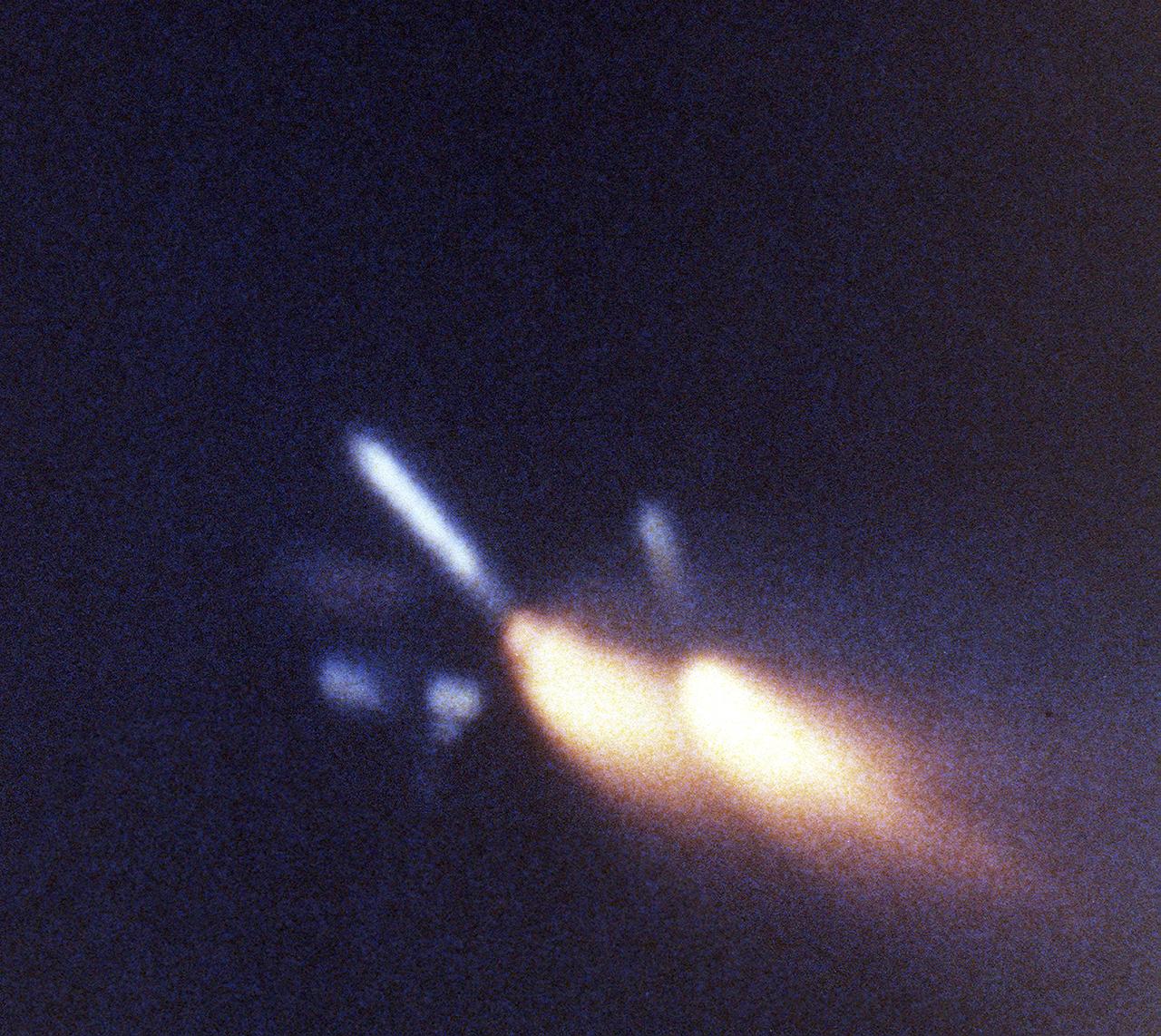
This view, taken by a motion picture tracking camera for the STS-3 mission, shows both left and right solid rocket boosters (SRB's) at the moment of separation from the external tank (ET). After impact to the ocean, they were retrieved and refurbished for reuse. The Shuttle's SRB's and solid rocket motors (SRM's) are the largest ever built and the first designed for refurbishment and reuse. Standing nearly 150-feet high, the twin boosters provide the majority of thrust for the first two minutes of flight, about 5.8 million pounds. That is equivalent to 44 million horsepower, or the combined power of 400,000 subcompact cars.
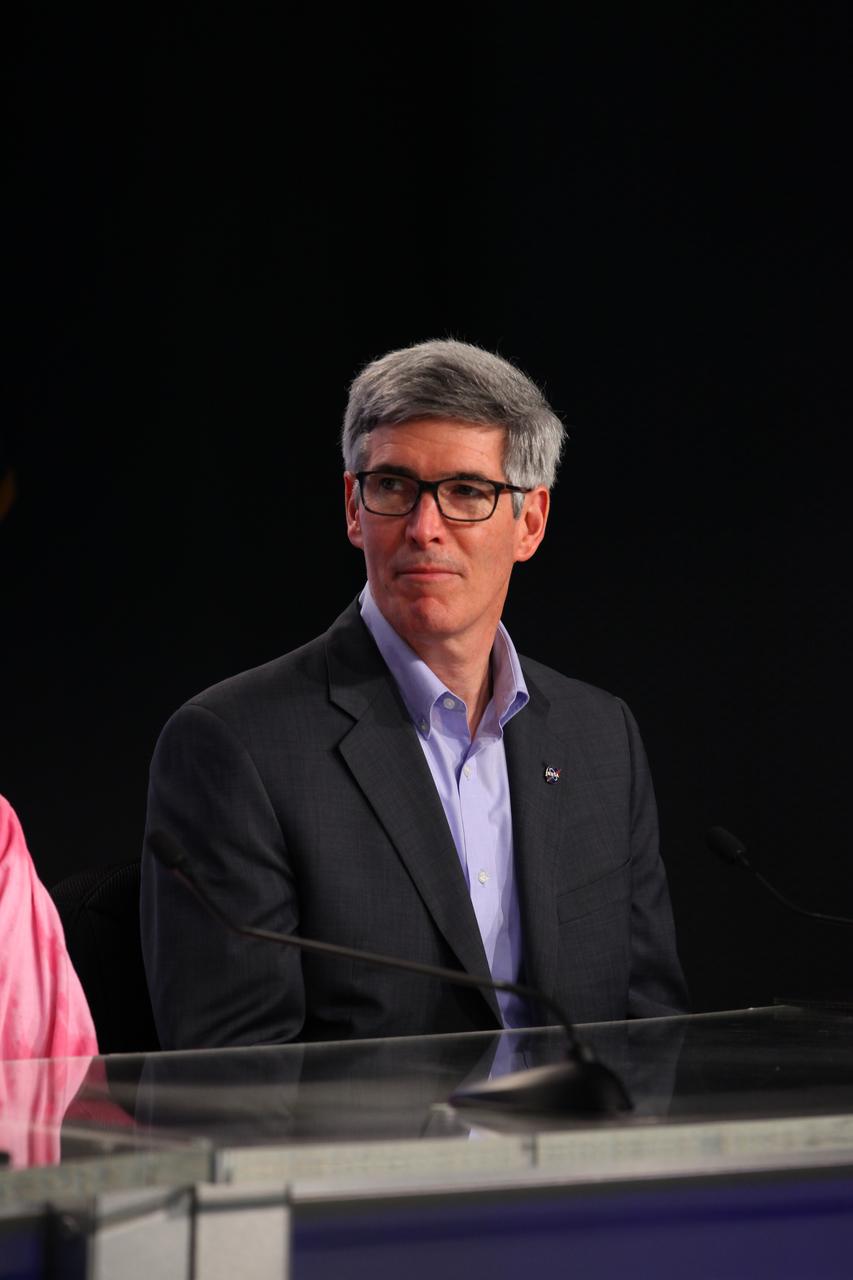
In the Press Site auditorium at the Kennedy Space Center in Florida, Bill Barry, NASA's chief historian, speaks to members of the media during a a news conference with key individuals involved in the upcoming motion picture "Hidden Figures." The movie is based on the book of the same title, by Margot Lee Shetterly. It chronicles the lives of Katherine Johnson, Dorothy Vaughan and Mary Jackson, three African-American women who worked for NASA as human "computers.” Their mathematical calculations were crucial to the success of Project Mercury missions including John Glenn’s orbital flight aboard Friendship 7 in 1962. The film is due in theaters in January 2017.
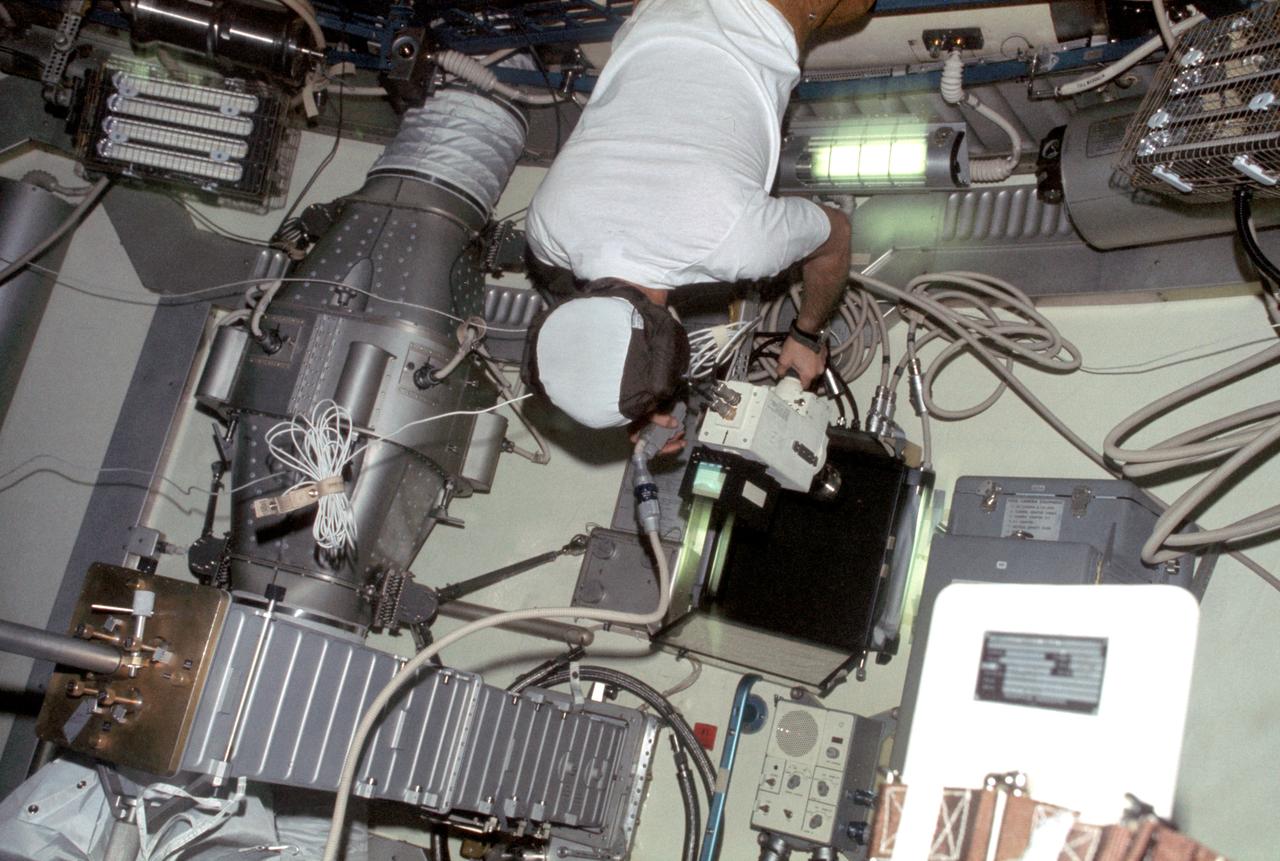
SL3-109-1345 (August 1973) --- View of scientist-astronaut Owen K. Garriott, Skylab 3 science pilot, taking TV footage of Arabella and Anita, the two Skylab 3 common cross spiders "aranous diadematus," aboard the Skylab space station cluster in Earth orbit. During the 59-day Skylab 3 mission the two spiders Arabella and Anita, were housed in an enclosure onto which a motion picture and still camera were attached to record the spiders' attempts to build a web in the weightless environment. Note the automatic data acquisition camera (DAC) about 3.5 feet to Garriott's right (about waist level). Photo credit: NASA

Kennedy Space Center Director Bob Cabana speaks cast and crew members of the upcoming motion picture "Hidden Figures" outside the Vehicle Assembly Building. From the left are Pharrell Williams, musician and producer of “Hidden Figures," Taraji P. Henson, who portrays Katherine Johnson in the film and Cabana. The movie is based on the book of the same title, by Margot Lee Shetterly. It chronicles the lives of Katherine Johnson, Dorothy Vaughan and Mary Jackson, three African-American women who worked for NASA as human "computers.” Their mathematical calculations were crucial to the success of Project Mercury missions including John Glenn’s orbital flight aboard Friendship 7 in 1962. The film is due in theaters in January 2017.
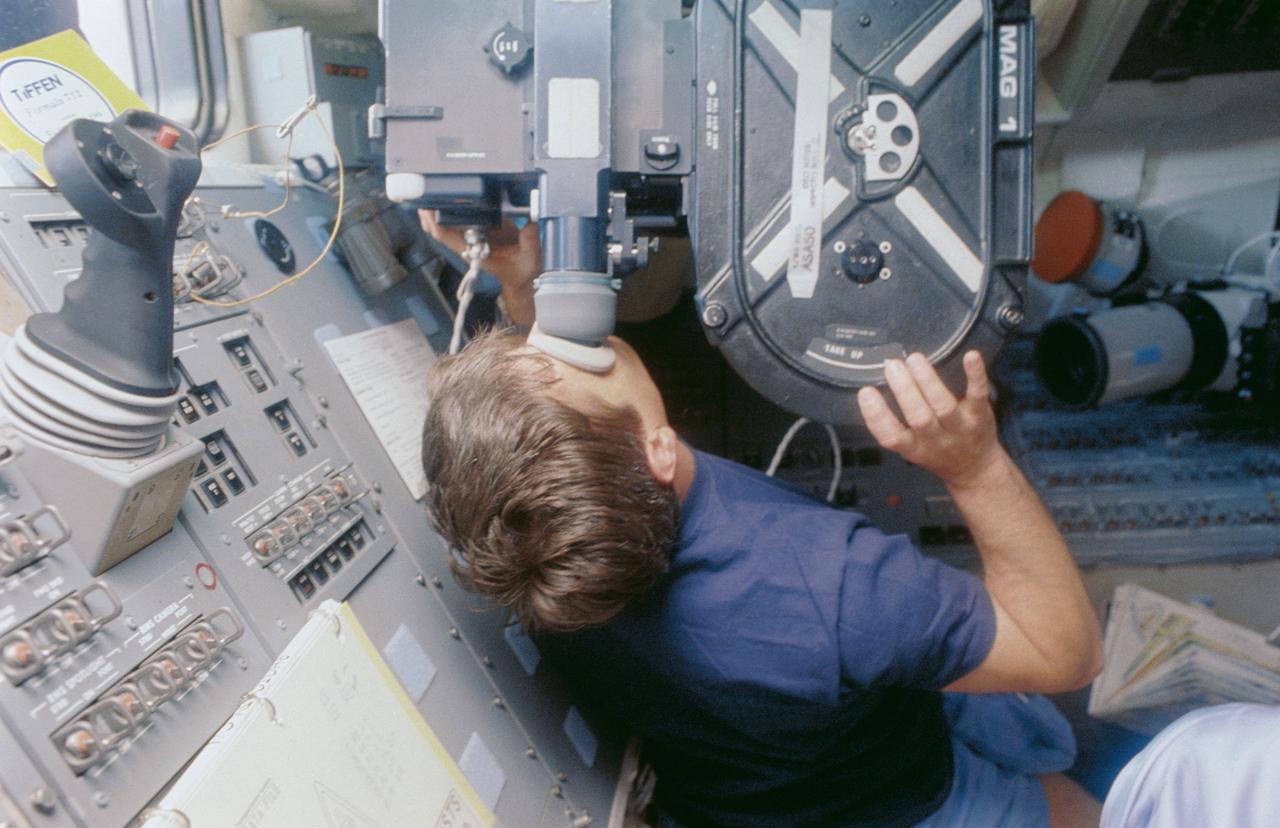
STS029-04-028 (March 1989) --- One of a series of photographs released in conjunction with the STS-29 post-flight press conference on March 28, 1989 at the Johnson Space Center (JSC), Houston, Texas. Onboard Discovery for the five-day mission were Astronauts Michael L. Coats, John E. Blaha, James F. Buchli, James P. Bagian and Robert C. Springer. STS029-04-028 --- A 35mm frame of Blaha using the overhead window on Discovery's aft flight deck to capture Earth scenes with the IMAX motion picture camera.
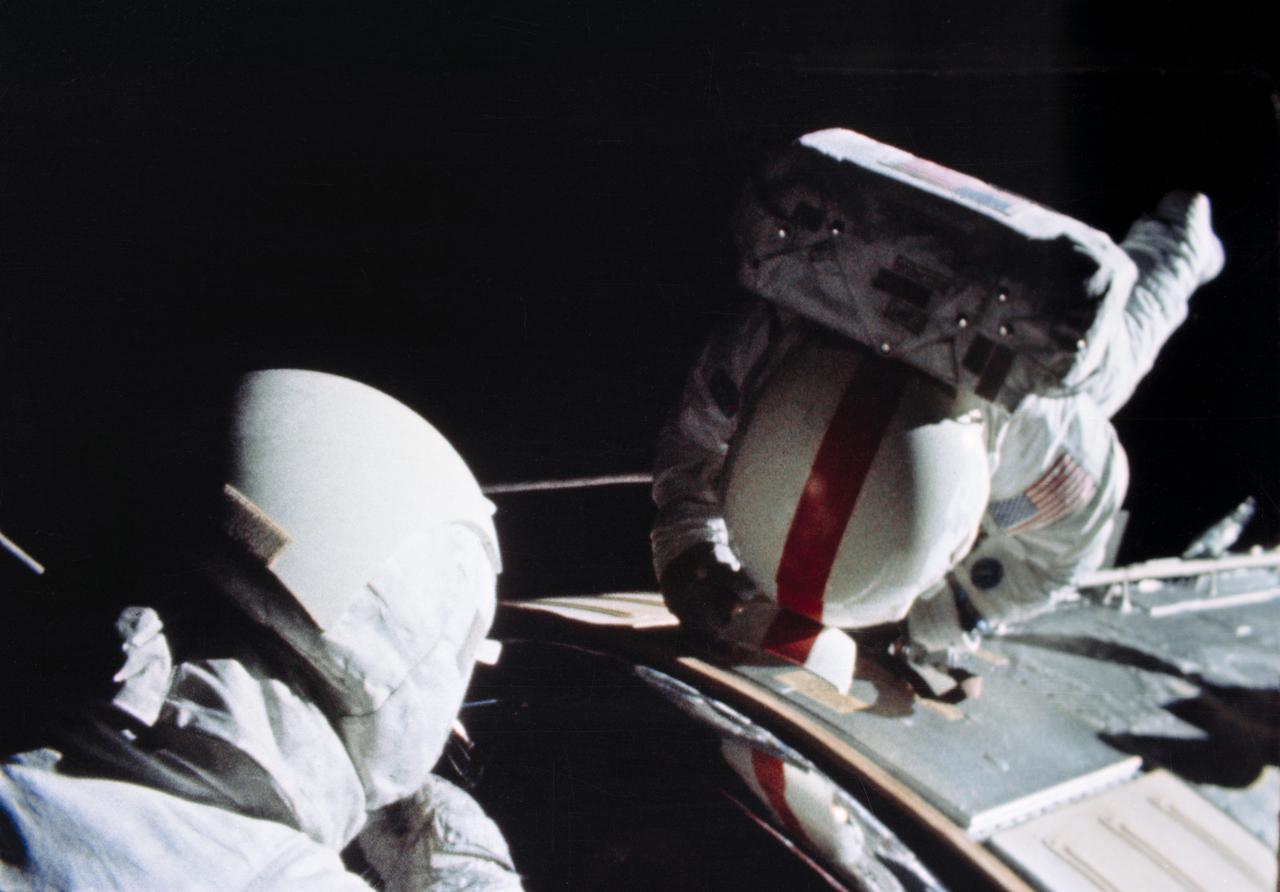
S72-37001 (25 April 1972) --- Astronaut Thomas K. Mattingly II, command module pilot, performs an extravehicular activity (EVA) during the Apollo 16 trans-Earth coast. Mattingly is assisted by astronaut Charles M. Duke Jr., lunar module pilot. Mattingly inspected the SIM Bay or Service Module (SM), and retrieved film from the Mapping and Panoramic Cameras. Mattingly is wearing the helmet of astronaut John W. Young, commander. The helmet's lunar EVA visor assembly helped protect Mattingly's eyes from the bright sun. This view is a frame from motion picture film exposed by a 16mm Maurer camera.
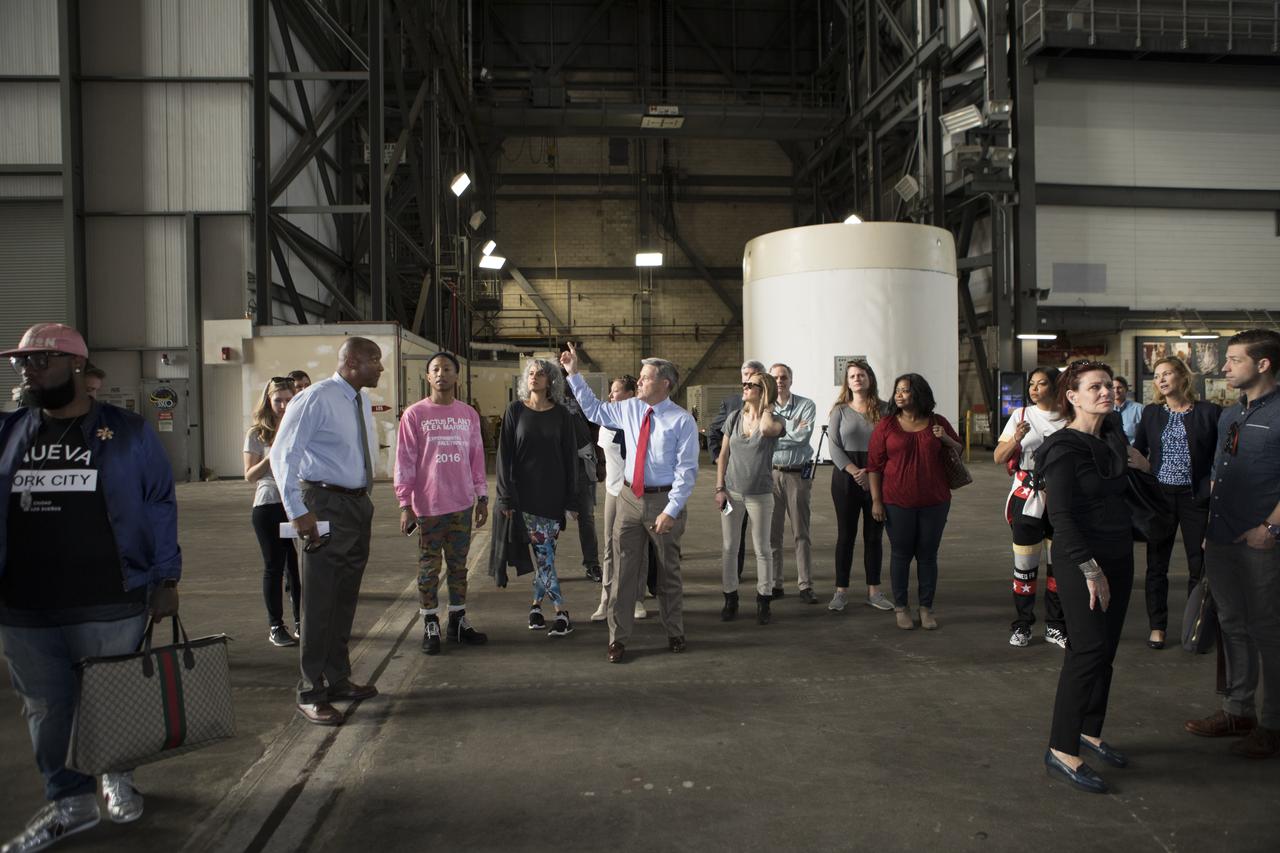
Kennedy Space Center Director Bob Cabana (center pointing to the left) provides a tour for cast and crew members of the upcoming motion picture "Hidden Figures." The group is walking thought the transfer aisle of the Vehicle Assembly Building. The movie is based on the book of the same title, by Margot Lee Shetterly. It chronicles the lives of Katherine Johnson, Dorothy Vaughan and Mary Jackson, three African-American women who worked for NASA as human "computers.” Their mathematical calculations were crucial to the success of Project Mercury missions including John Glenn’s orbital flight aboard Friendship 7 in 1962. The film is due in theaters in January 2017.
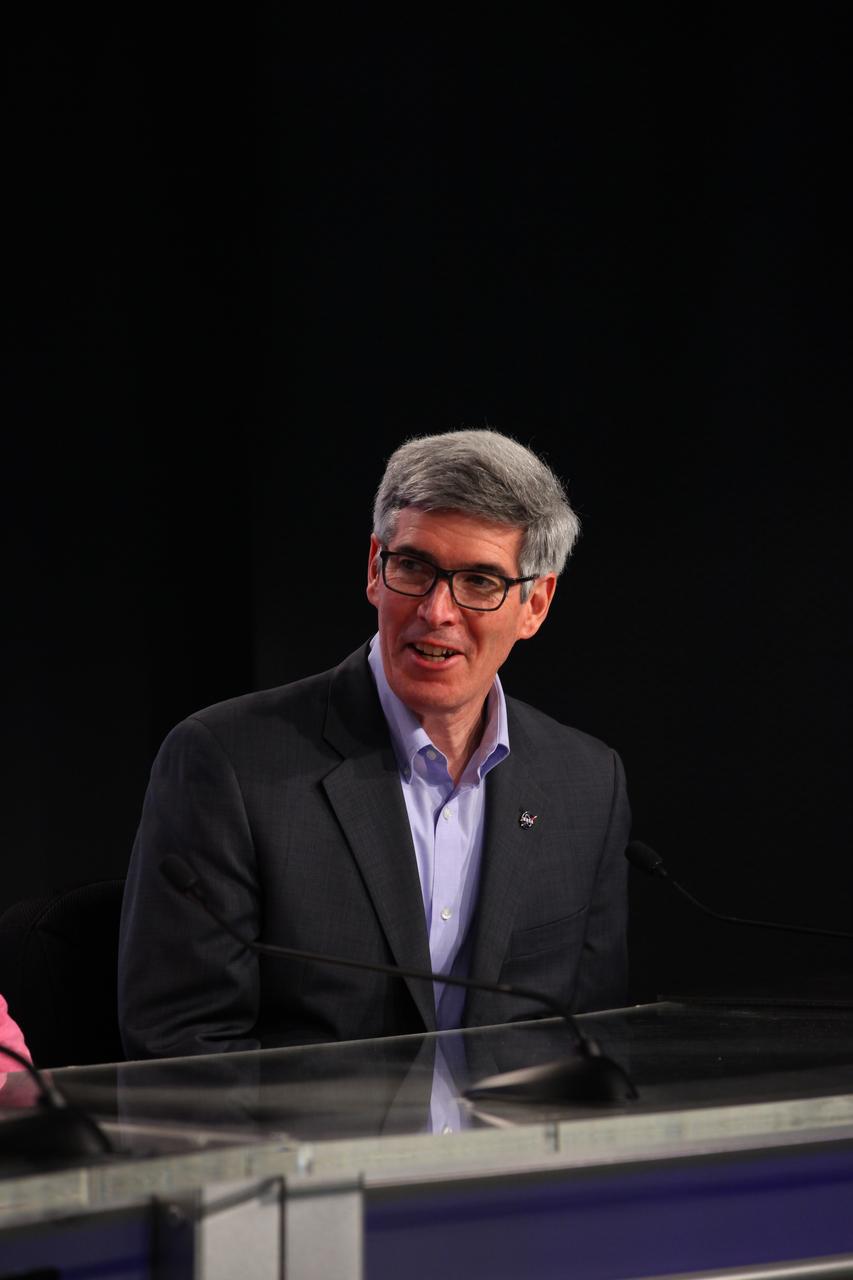
In the Press Site auditorium at the Kennedy Space Center in Florida, Bill Barry, NASA's chief historian, speaks to members of the media during a a news conference with key individuals involved in the upcoming motion picture "Hidden Figures." The movie is based on the book of the same title, by Margot Lee Shetterly. It chronicles the lives of Katherine Johnson, Dorothy Vaughan and Mary Jackson, three African-American women who worked for NASA as human "computers.” Their mathematical calculations were crucial to the success of Project Mercury missions including John Glenn’s orbital flight aboard Friendship 7 in 1962. The film is due in theaters in January 2017.
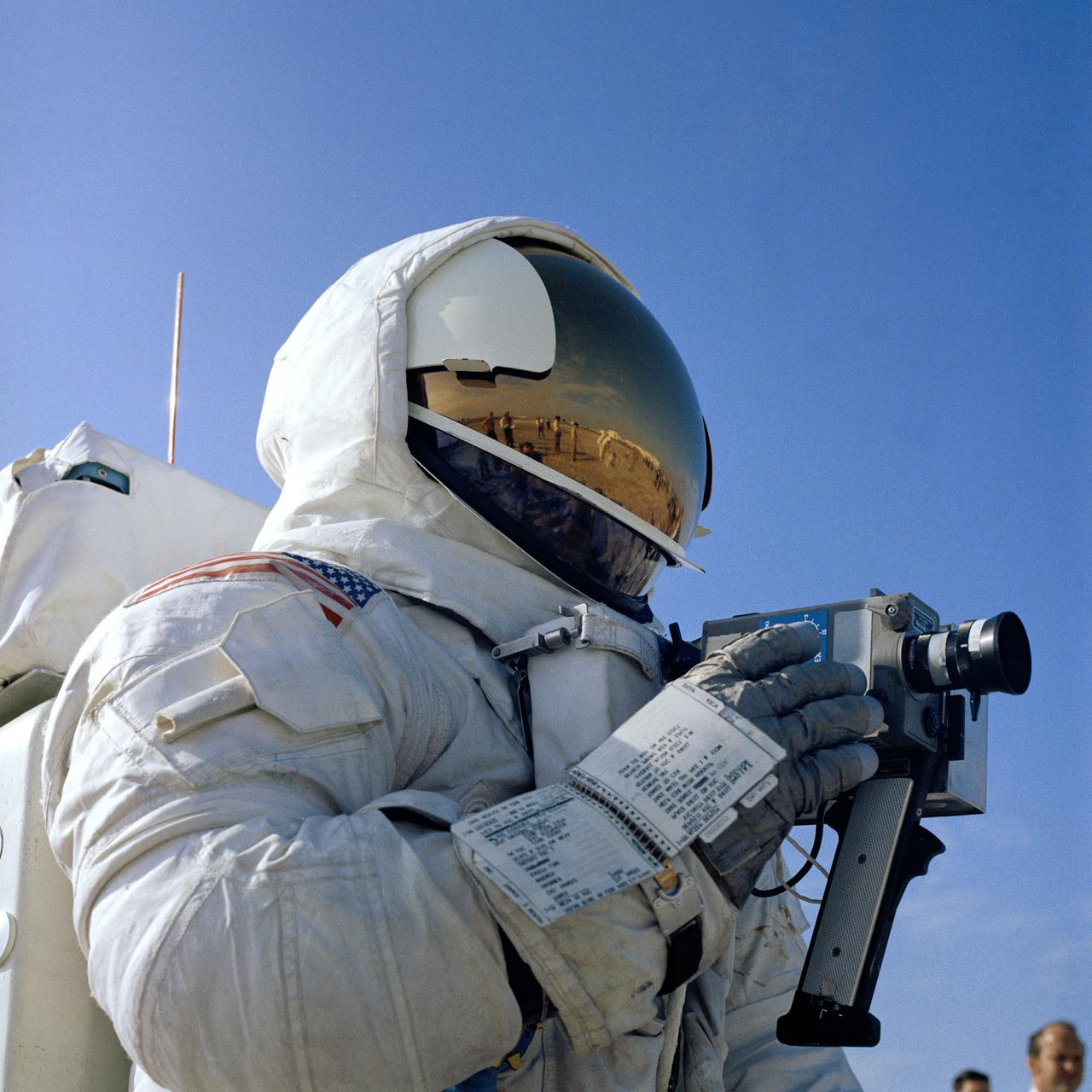
CAPE CANAVERAL, Fla. - Astronaut Fred W. Haise Jr., Apollo 13 lunar module pilot, practices operation of the 16-millimeter motion picture camera to be used on the lunar surface during the Apollo 13 mission. The Apollo 13 landing is scheduled for the Fra Mauro, a highlands area approximately 95 miles east of the Apollo 12 landing site in November 1969. Apollo 13, scheduled for launch from Kennedy Space Center on April 11, has a prime crew composed of Haise, James A. Lovell Jr., commander, and Thomas K. Mattingly II, command module pilot. Photo credit: NASA
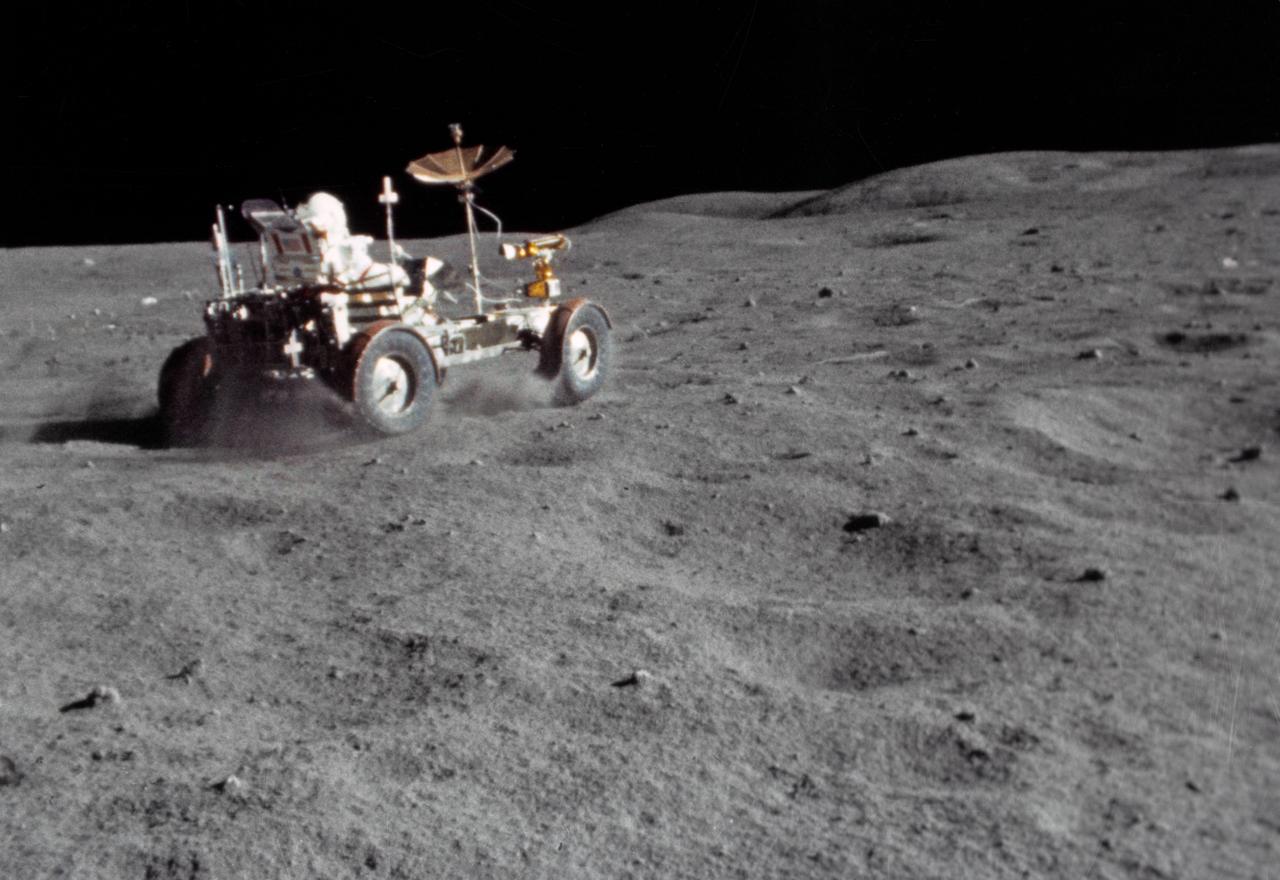
S72-37002 (21 April 1972) --- The Lunar Roving Vehicle (LRV) gets a speed workout by astronaut John W. Young in the "Grand Prix" run during the first Apollo 16 extravehicular activity (EVA) at the Descartes landing site. This view is a frame from motion picture film exposed by a 16mm Maurer camera held by astronaut Charles M. Duke Jr. While astronauts Young, commander, and Duke, lunar module pilot, descended in the Lunar Module (LM) "Orion" to explore the Descartes highlands region of the moon, astronaut Thomas K. Mattingly II, command module pilot, remained with the Command and Service Modules (CSM) "Casper" in lunar orbit.
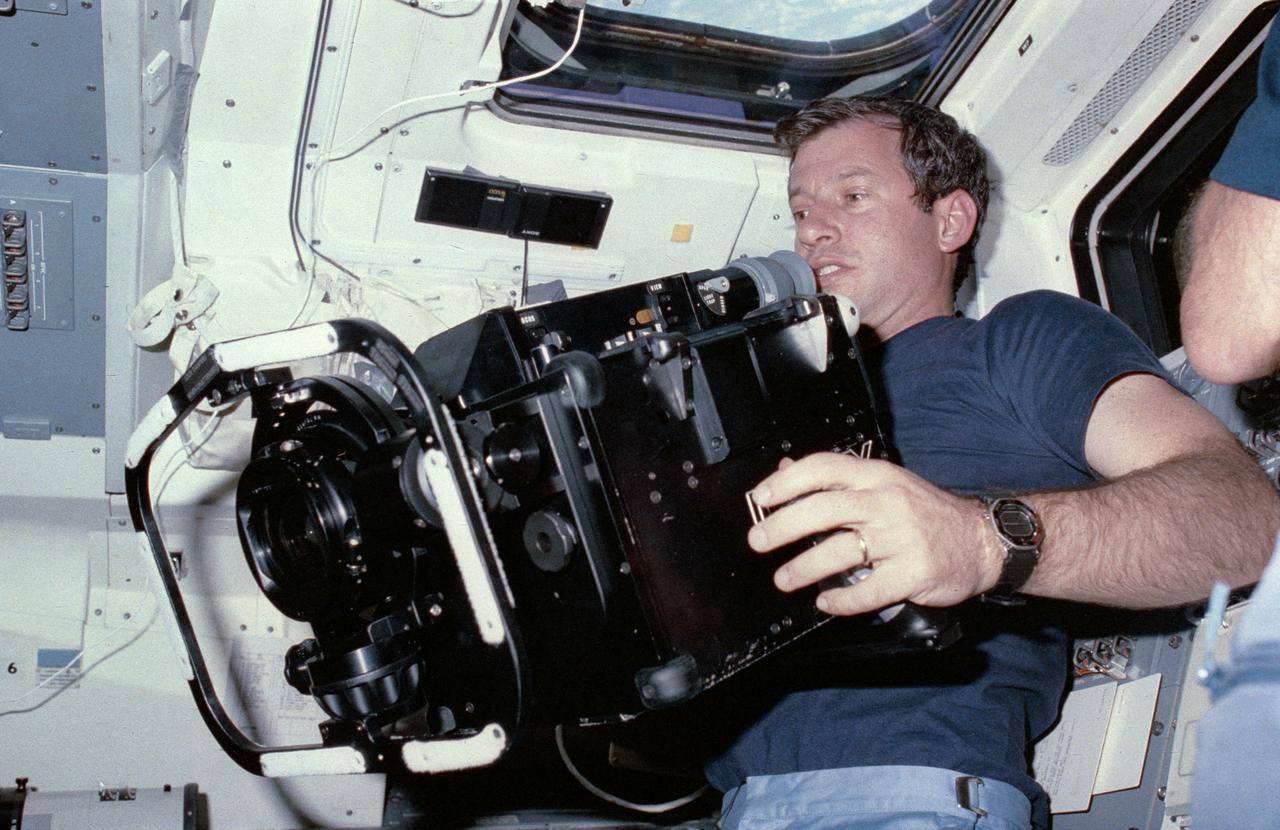
41C-05-180 (9 April 1984) --- Astronaut Terry J. Hart, 41-C mission specialist, holds a 70 pound IMAX camera in the middeck of the Earth orbiting Space Shuttle Challenger. The motion picture camera (65mm) handles 1,000 ft. rolls which have a running time of three minutes (24 frames per second). Hart, who used a black bag as a sort of in space darkroom for five film change outs throughout the flight, commented to ground controllers that the film magazines were much easier to reload in space than in the normal one G environment on Earth.

In the Press Site auditorium at the Kennedy Space Center in Florida, Taraji P. Henson speaks to members of the media during a news conference with other key individuals involved in the upcoming motion picture "Hidden Figures." The movie is based on the book of the same title, by Margot Lee Shetterly. It chronicles the lives of Katherine Johnson (played by Henson), Dorothy Vaughan and Mary Jackson, three African-American women who worked for NASA as human "computers.” Their mathematical calculations were crucial to the success of Project Mercury missions including John Glenn’s orbital flight aboard Friendship 7 in 1962. The film is due in theaters in January 2017.
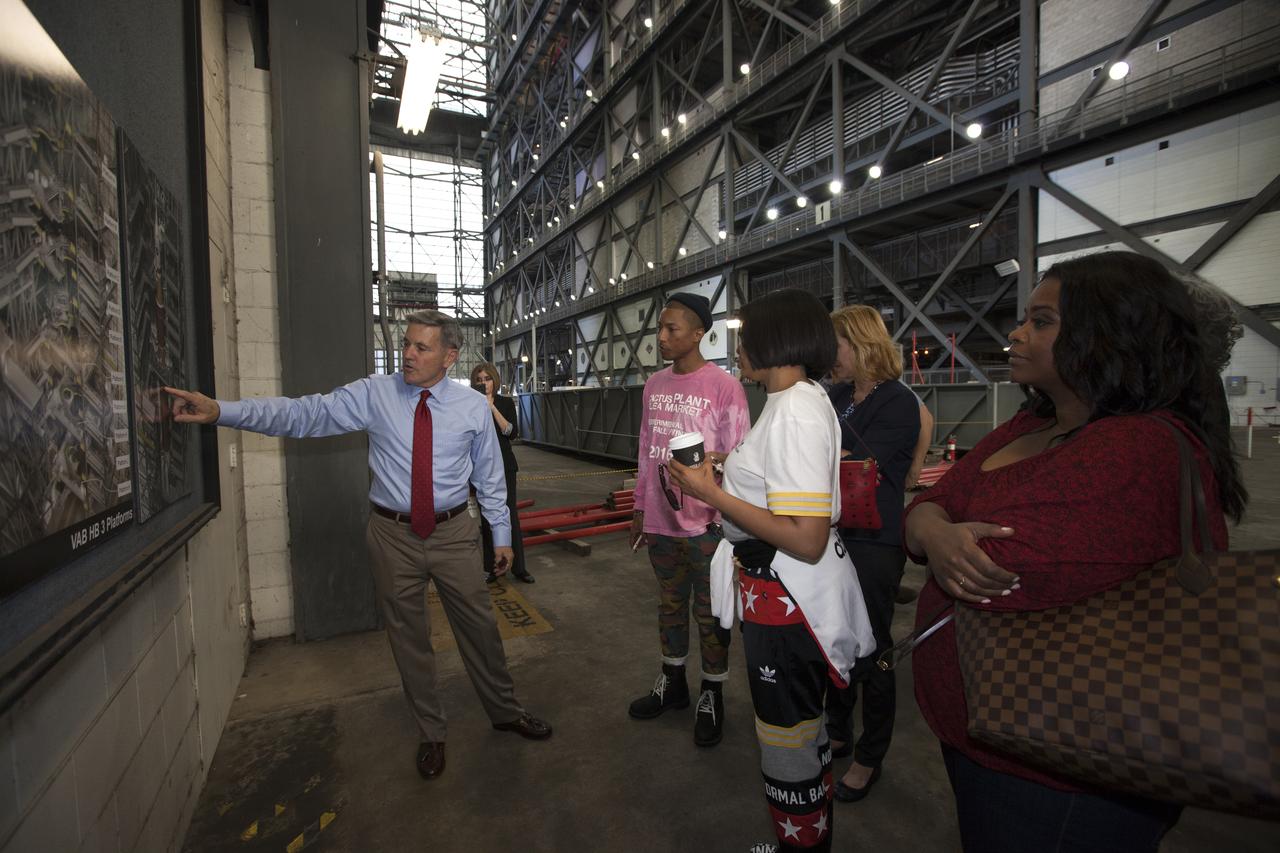
Kennedy Space Center Director Bob Cabana points to a display during a tour for cast and crew members of the upcoming motion picture "Hidden Figures." The group is walking thought the transfer aisle of the Vehicle Assembly Building. The movie is based on the book of the same title, by Margot Lee Shetterly. It chronicles the lives of Katherine Johnson, Dorothy Vaughan and Mary Jackson, three African-American women who worked for NASA as human "computers.” Their mathematical calculations were crucial to the success of Project Mercury missions including John Glenn’s orbital flight aboard Friendship 7 in 1962. The film is due in theaters in January 2017.
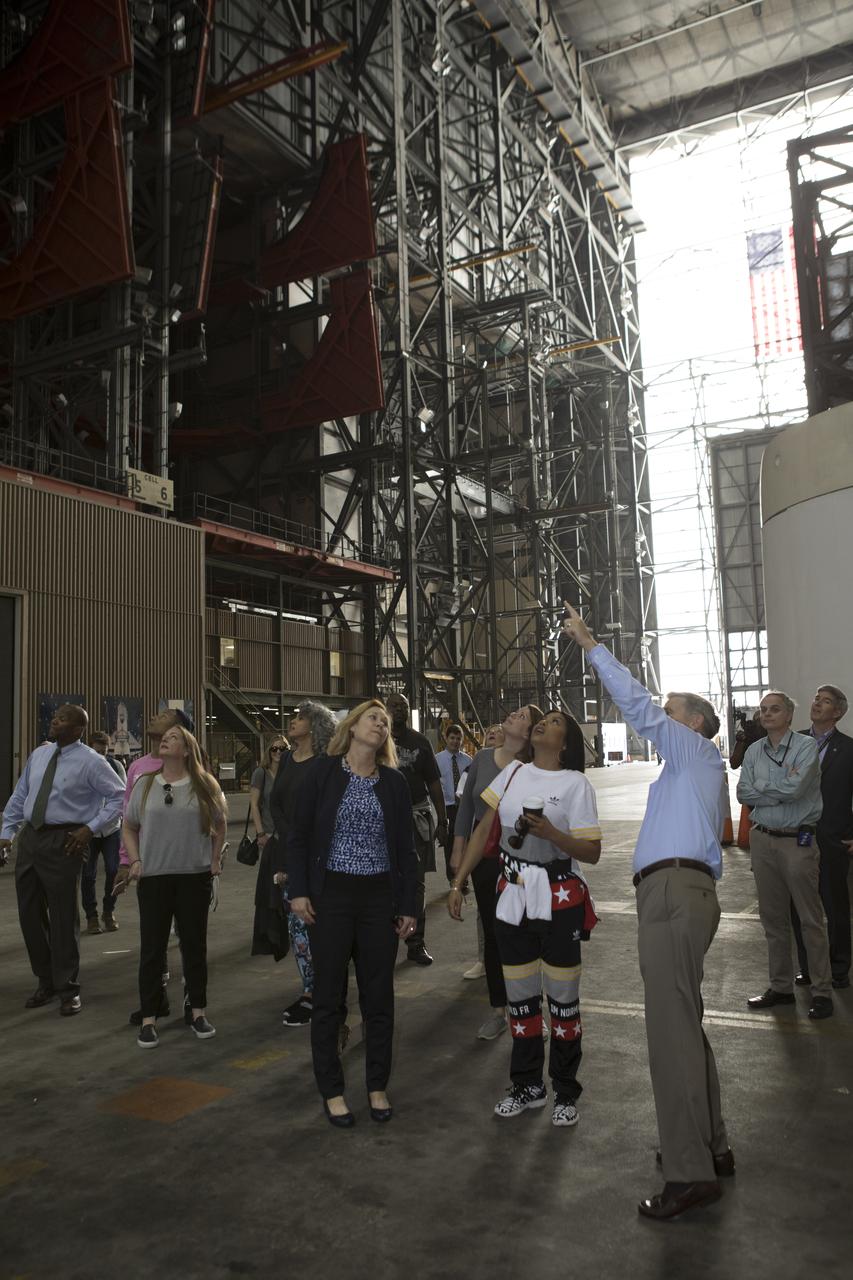
Kennedy Space Center Director Bob Cabana (pointing) provides a tour for cast and crew members of the upcoming motion picture "Hidden Figures." The group is walking thought the transfer aisle of the Vehicle Assembly Building. The movie is based on the book of the same title, by Margot Lee Shetterly. It chronicles the lives of Katherine Johnson, Dorothy Vaughan and Mary Jackson, three African-American women who worked for NASA as human "computers.” Their mathematical calculations were crucial to the success of Project Mercury missions including John Glenn’s orbital flight aboard Friendship 7 in 1962. The film is due in theaters in January 2017.

In the Press Site auditorium at the Kennedy Space Center in Florida, Octavia Spencer speaks to members of the media during a news conference with other key individuals involved in the upcoming motion picture "Hidden Figures." The movie is based on the book of the same title, by Margot Lee Shetterly. It chronicles the lives of Katherine Johnson, Dorothy Vaughan (played by Spencer) and Mary Jackson, three African-American women who worked for NASA as human "computers.” Their mathematical calculations were crucial to the success of Project Mercury missions including John Glenn’s orbital flight aboard Friendship 7 in 1962. The film is due in theaters in January 2017.
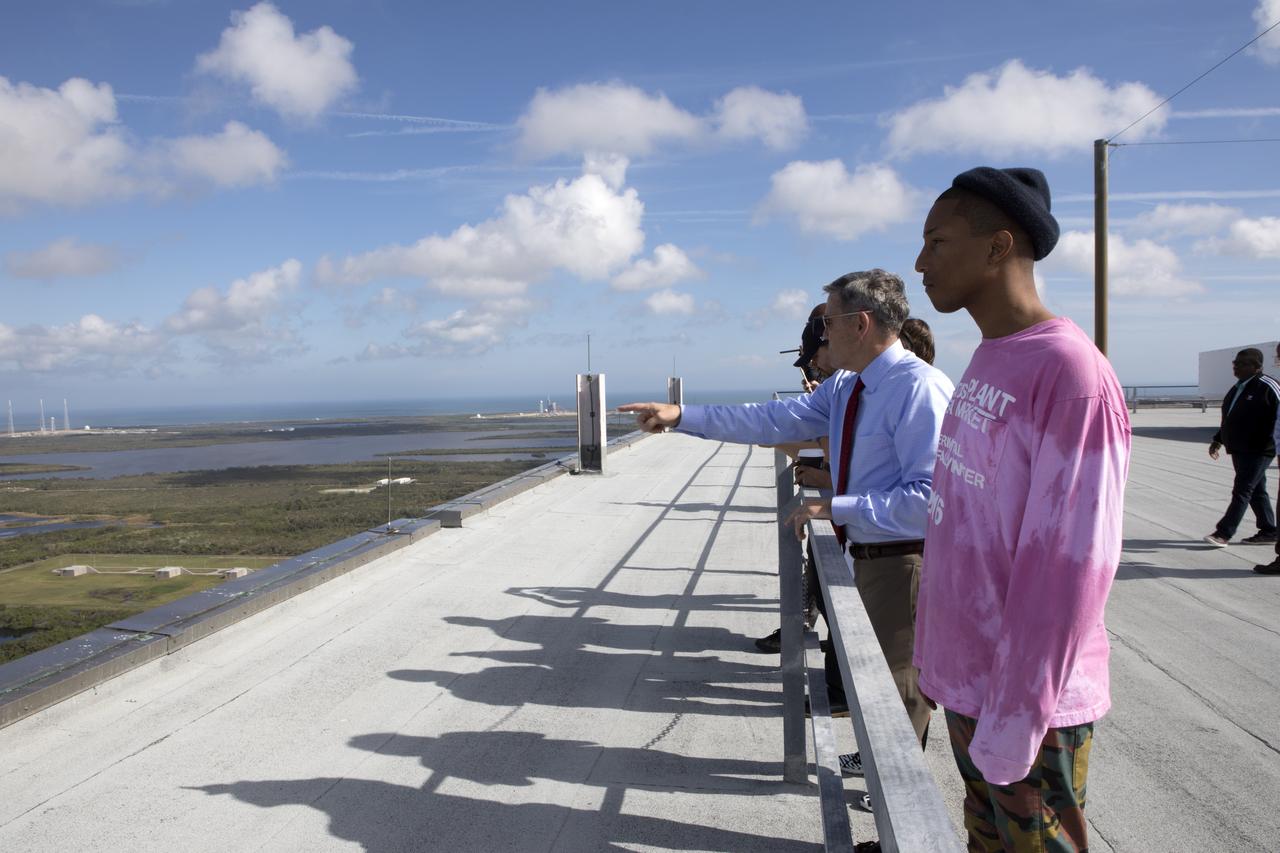
During a tour for cast and crew members of the upcoming motion picture "Hidden Figures," Kennedy Space Center Director Bob Cabana points to Launch Pads 39A and 39B from the roof of the Vehicle Assembly Building. In the foreground is Pharrell Williams, musician and producer of “Hidden Figures." The movie is based on the book of the same title, by Margot Lee Shetterly. It chronicles the lives of Katherine Johnson, Dorothy Vaughan and Mary Jackson, three African-American women who worked for NASA as human "computers.” Their mathematical calculations were crucial to the success of Project Mercury missions including John Glenn’s orbital flight aboard Friendship 7 in 1962. The film is due in theaters in January 2017.
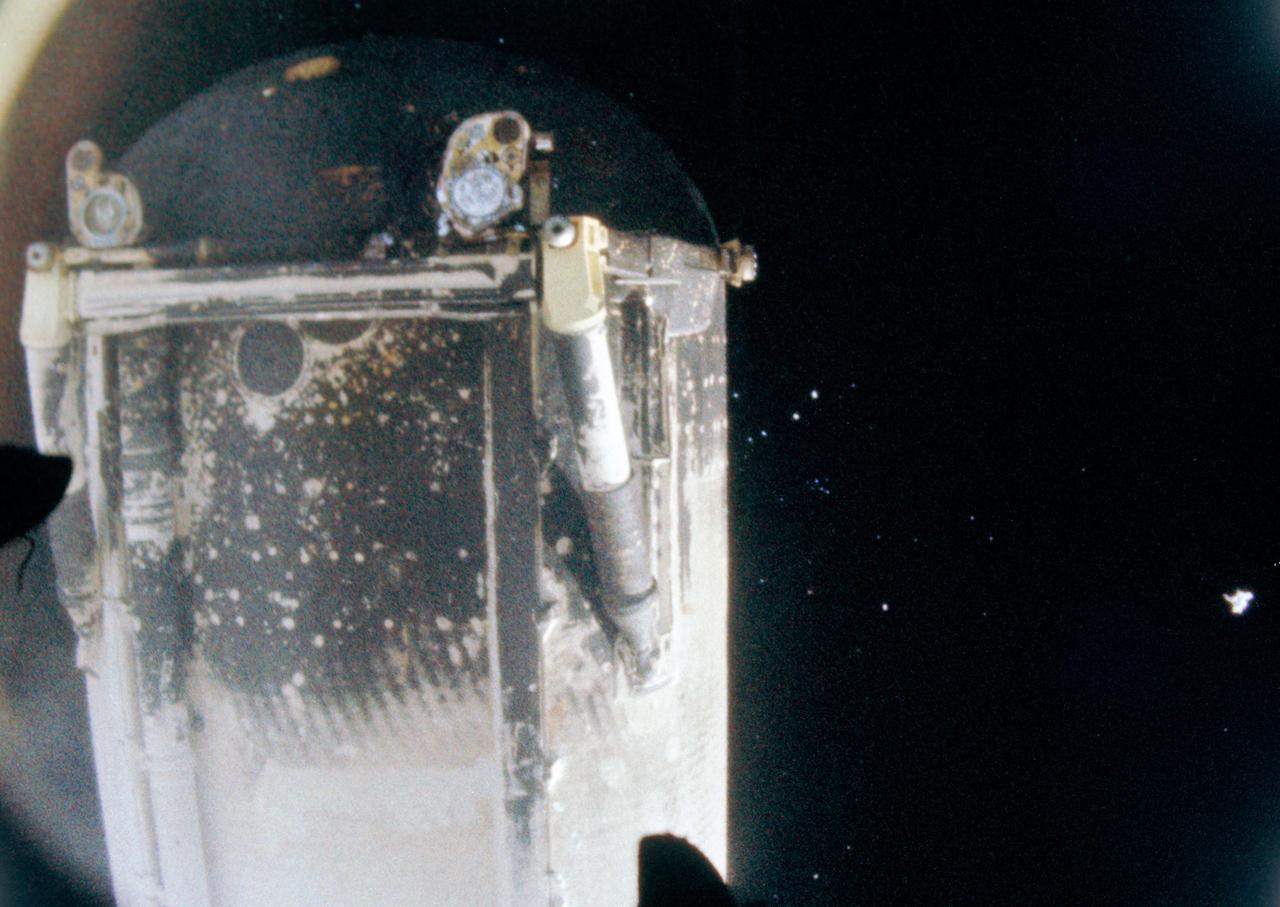
S81-30505 (12 April 1981) --- Separation of space shuttle Columbia?s external tank, photographed by motion picture cameras in the umbilical bays, occurred following the shutdown of the vehicle?s three main engines. Columbia?s cameras were able to record the bottom side of the tank as the orbiter headed toward its Earth-orbital mission with astronauts John W. Young and Robert L. Crippen aboard and the fuel tank fell toward Earth, passing through the atmosphere rapidly. Liquid oxygen and liquid hydrogen umbilical connectors can be seen at the bottom of the tank. For orientation, the photo should be held with the rounded end at bottom of the frame. Photo credit: NASA
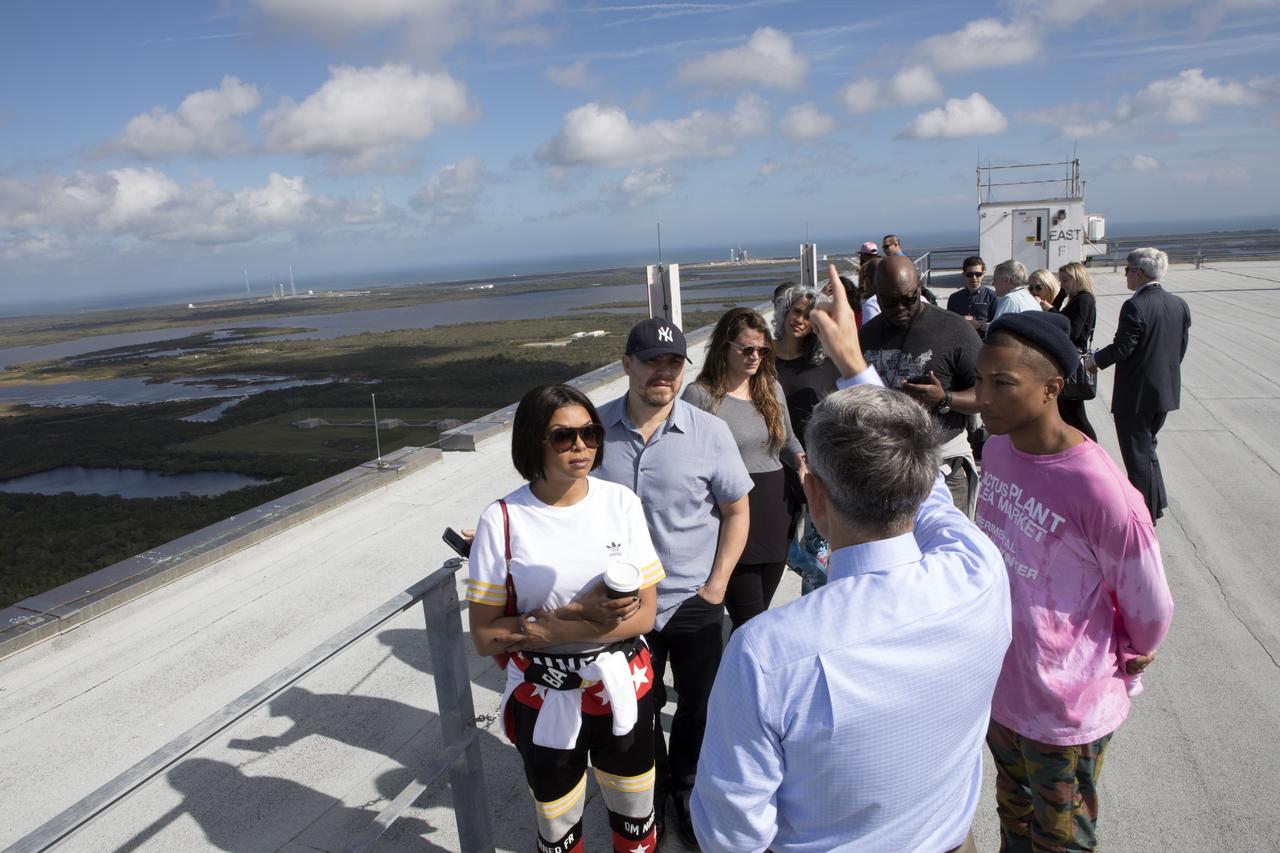
During a tour for cast and crew members of the upcoming motion picture "Hidden Figures," Kennedy Space Center Director Bob Cabana describes the view from the roof of the Vehicle Assembly Building. The movie is based on the book of the same title, by Margot Lee Shetterly. It chronicles the lives of Katherine Johnson, Dorothy Vaughan and Mary Jackson, three African-American women who worked for NASA as human "computers.” Their mathematical calculations were crucial to the success of Project Mercury missions including John Glenn’s orbital flight aboard Friendship 7 in 1962. The film is due in theaters in January 2017.

In the Press Site auditorium at the Kennedy Space Center in Florida, Janelle Monáe, speaks to members of the media during a news conference with other key individuals involved in the upcoming motion picture "Hidden Figures." The movie is based on the book of the same title, by Margot Lee Shetterly. It chronicles the lives of Katherine Johnson, Dorothy Vaughan and Mary Jackson (portrayed by Monáe), three African-American women who worked for NASA as human "computers.” Their mathematical calculations were crucial to the success of Project Mercury missions including John Glenn’s orbital flight aboard Friendship 7 in 1962. The film is due in theaters in January 2017.
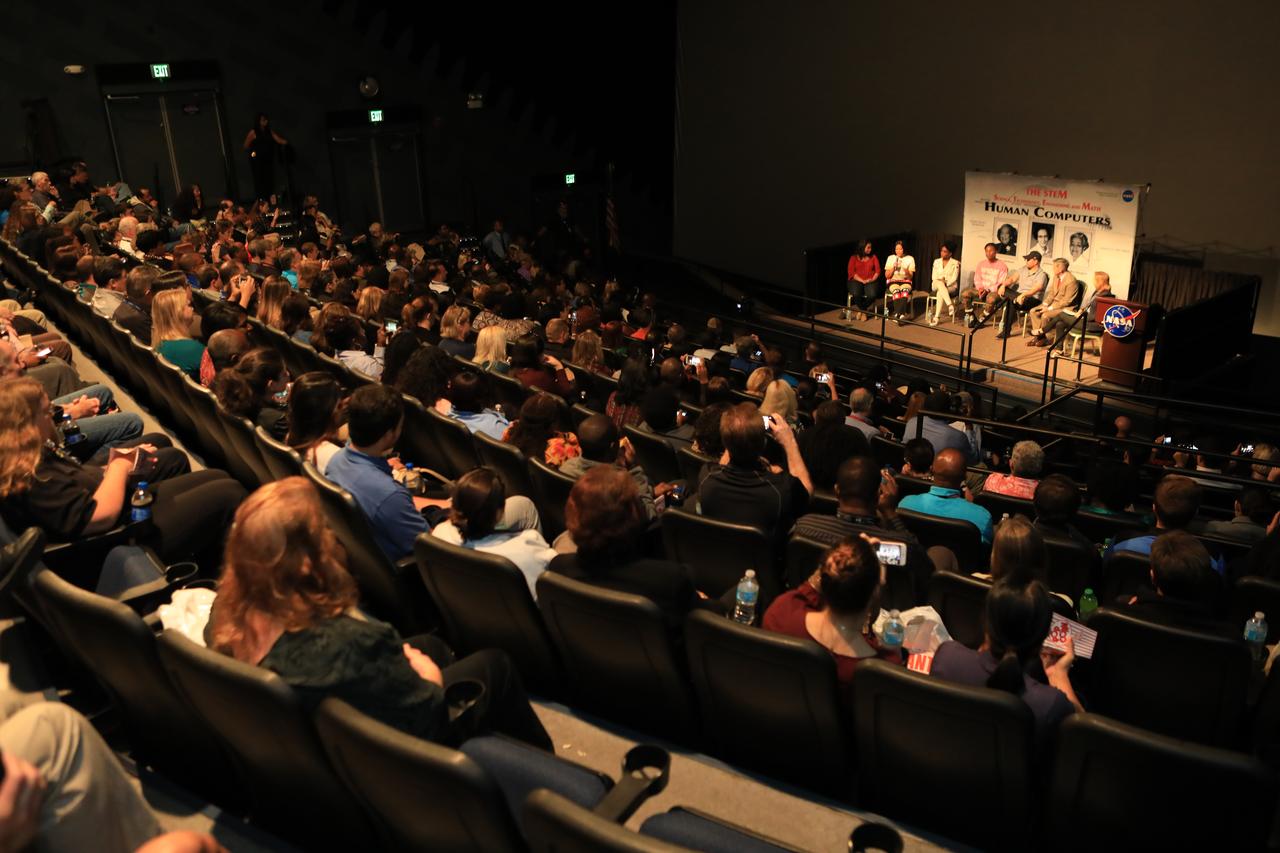
In the IMAX Theater of the Kennedy Space Center Visitor Complex Cast and crew members of the upcoming motion picture "Hidden Figures" participate in a question and answer session. The movie is based on the book of the same title, by Margot Lee Shetterly. It chronicles the lives of Katherine Johnson, Dorothy Vaughan and Mary Jackson, three African-American women who worked for NASA as human "computers.” Their mathematical calculations were crucial to the success of Project Mercury missions including John Glenn’s orbital flight aboard Friendship 7 in 1962. The film is due in theaters in January 2017.
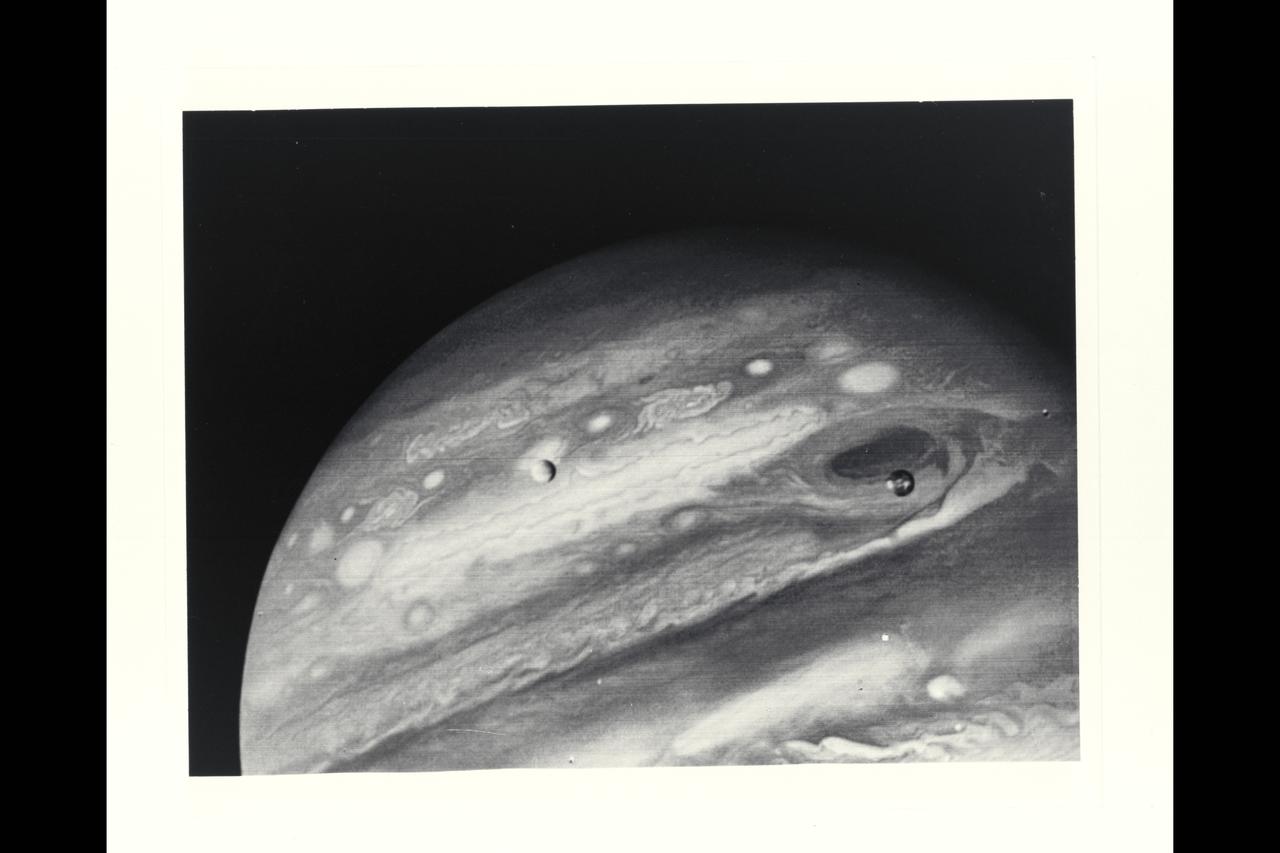
Voyager 1 Image of Jupiter and two of its satellites (Io, left, and Europa). Io is about 350,000 kilometers (220,000 miles) above Jupiter's Great Red Spot; Europa is about 600,000 kilometers (375,000 miles) above Jupiter's clouds. Although both satellites have about the same brightness, Io's color is very different from Europa's. Io's equatorial region show two types of material -- dark orange, broken by several bright spots -- producing a mottled appearance. The poles are darker and reddish. Preliminary evidence suggests color variations within and between the polar regions. Io's surface composition is unknown, but scientists believe it may be a mixture of salts and sulfur. Erupoa is less strongly colored, although still relatively dark at short wavelengths. Markings on Eruopa are less evident that on the other satellites, although this picture shows darker regions toward the trailing half of the visible disk. Jupiter at this point is about 20 million kilometers (12.4 million miles) from the spacecraft. At this resolution (about 400 kimometers or 250 miles) there is evidence of circular motion in Jupiter's atmosphere. While the dominant large-scale motions are west-to-east, small-scale movement includes eddy-like circulation within and between the bands. (JPL ref: P-21082)
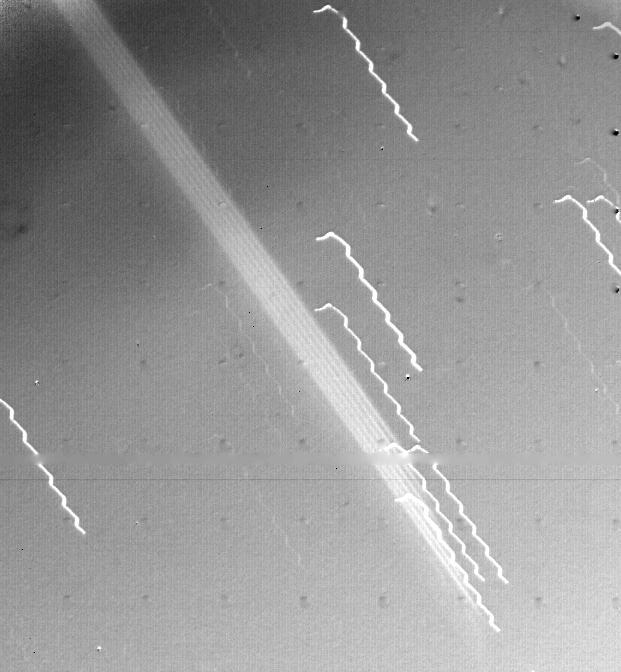
First evidence of a ring around the planet Jupiter is seen in this photograph taken by Voyager 1 on March 4, 1979. The multiple exposure of the extremely thin faint ring appears as a broad light band crossing the center of the picture. The edge of the ring is 1,212,000 km from the spacecraft and 57,000 km from the visible cloud deck of Jupiter. The background stars look like broken hair pins because of spacecraft motion during the 11 minute 12 second exposure. The wavy motion of the star trails is due to the ultra-slow natural oscillation of the spacecraft (with a period of 78 seconds). The black dots are geometric calibration points in the camera. The ring thickness is estimated to be 30 km or less. The photograph was part of a sequence planned to search for such rings in Jupiter's equatorial plane. The ring has been invisible from Earth because of its thinness and its transparency when viewed at any angle except straight on. JPL manages and controls the Voyager Project for NASA's Office of Space Science. http://photojournal.jpl.nasa.gov/catalog/PIA02251
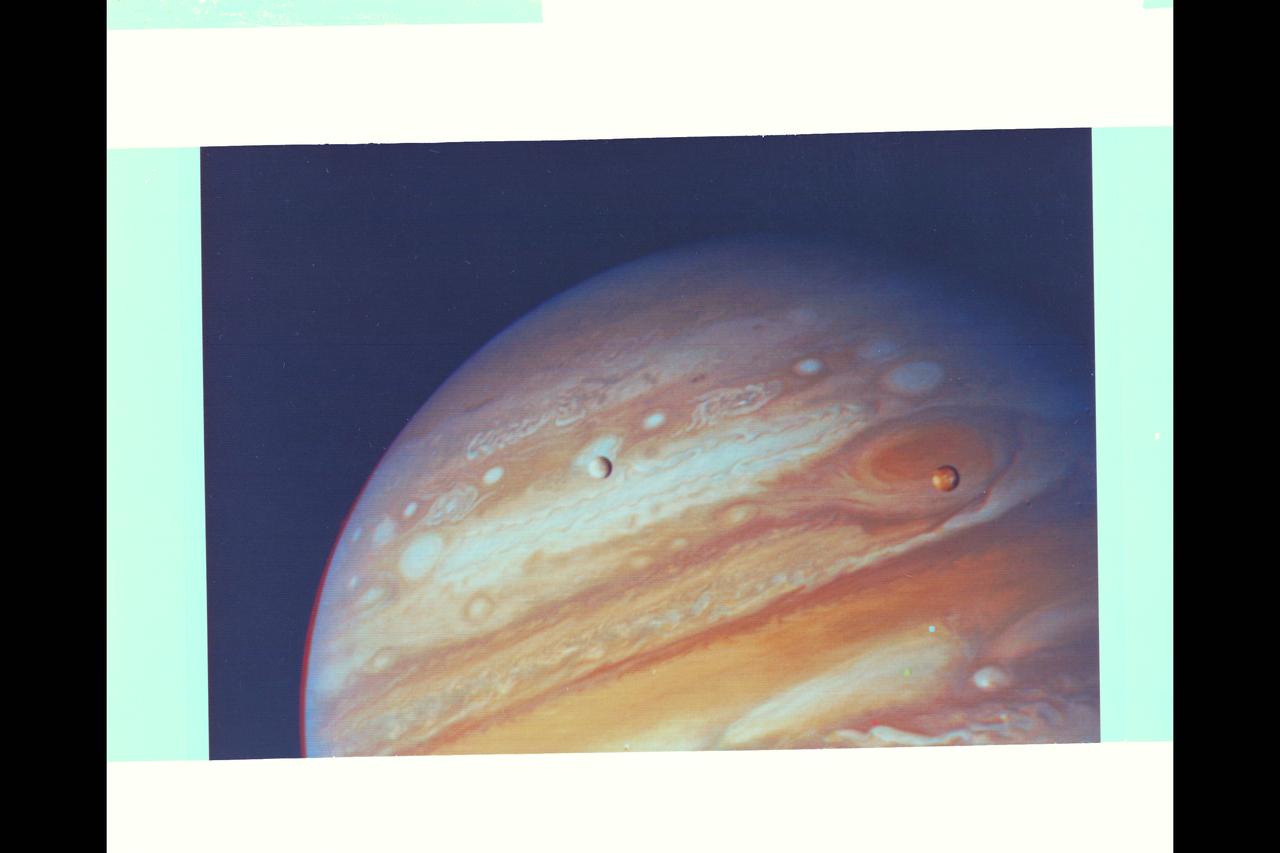
Voyager 1 Image of Jupiter and two of its satellites (Io, left, and Europa). Io is about 350,000 kilometers (220,000 miles) above Jupiter's Great Red Spot; Europa is about 600,000 kilometers (375,000 miles) above Jupiter's clouds. Although both satellites have about the same brightness, Io's color is very different from Europa's. Io's equatorial region show two types of material -- dark orange, broken by several bright spots -- producing a mottled appearance. The poles are darker and reddish. Preliminary evidence suggests color variations within and between the polar regions. Io's surface composition is unknown, but scientists believe it may be a mixture of salts and sulfur. Erupoa is less strongly colored, although still relatively dark at short wavelengths. Markings on Eruopa are less evident that on the other satellites, although this picture shows darker regions toward the trailing half of the visible disk. Jupiter at this point is about 20 million kilometers (12.4 million miles) from the spacecraft. At this resolution (about 400 kimometers or 250 miles) there is evidence of circular motion in Jupiter's atmosphere. While the dominant large-scale motions are west-to-east, small-scale movement includes eddy-like circulation within and between the bands. (JPL ref: P-21082)
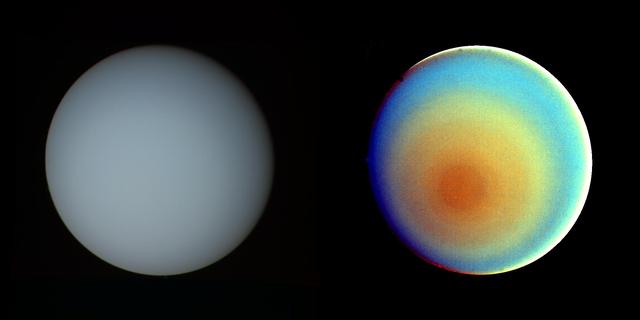
These two pictures of Uranus -- one in true color (left) and the other in false color -- were compiled from images returned Jan. 17, 1986, by the narrow-angle camera of Voyager 2. The spacecraft was 9.1 million kilometers (5.7 million miles) from the planet, several days from closest approach. The picture at left has been processed to show Uranus as human eyes would see it from the vantage point of the spacecraft. The picture is a composite of images taken through blue, green and orange filters. The darker shadings at the upper right of the disk correspond to the day-night boundary on the planet. Beyond this boundary lies the hidden northern hemisphere of Uranus, which currently remains in total darkness as the planet rotates. The blue-green color results from the absorption of red light by methane gas in Uranus' deep, cold and remarkably clear atmosphere. The picture at right uses false color and extreme contrast enhancement to bring out subtle details in the polar region of Uranus. Images obtained through ultraviolet, violet and orange filters were respectively converted to the same blue, green and red colors used to produce the picture at left. The very slight contrasts visible in true color are greatly exaggerated here. In this false-color picture, Uranus reveals a dark polar hood surrounded by a series of progressively lighter concentric bands. One possible explanation is that a brownish haze or smog, concentrated over the pole, is arranged into bands by zonal motions of the upper atmosphere. The bright orange and yellow strip at the lower edge of the planet's limb is an artifact of the image enhancement. In fact, the limb is dark and uniform in color around the planet. http://photojournal.jpl.nasa.gov/catalog/PIA00032
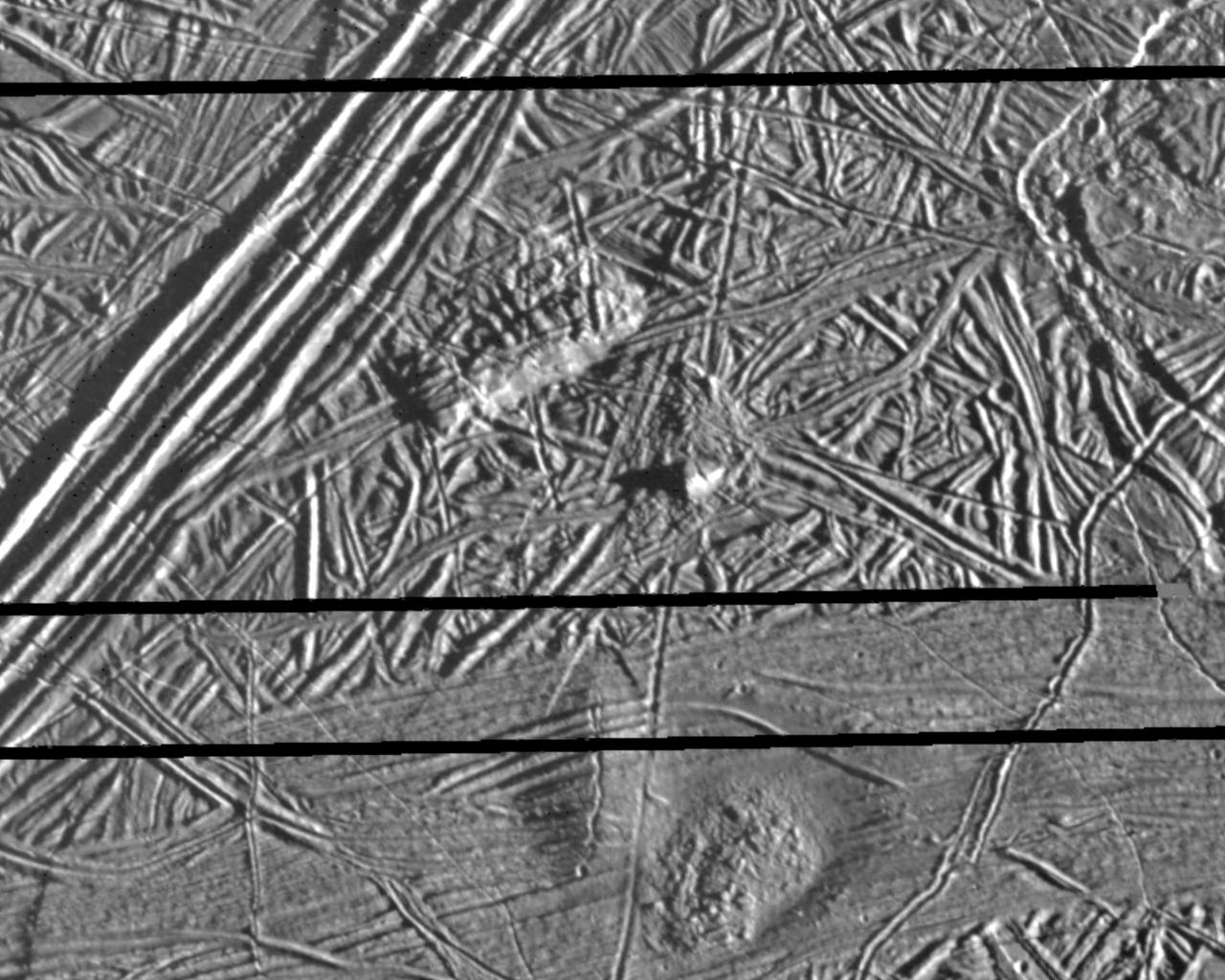
his picture of Europa, a moon of Jupiter, was obtained on February 20, 1997, by the Solid State Imaging system onboard the Galileo spacecraft during its sixth orbit around Jupiter. The area is centered at 9.3 degrees north latitude, 275.7 degrees west longitude, on the trailing hemisphere of Europa. As Europa moves in its orbit around Jupiter, the trailing hemisphere is the portion which is always on the moon's backside opposite to its direction of motion. The area depicted is about 32 kilometers by 40 kilometers (20 miles by 25 miles). Resolution is 54 meters (59 yards). The Sun illuminates the scene from the right (east). A section of a triple band crosses the upper left of the picture and extends for hundreds of miles across the surface. Triple bands derive their name from their appearance at lower resolution as a narrow bright band flanked by a pair of darker bands. At the high resolution of this picture, however, the triple band is much more complex and is composed of a system of ridges 6 kilometers (4 miles) across. Some ridges reach heights of about 180 meters (200 yards). Other features include a hill in the center of the picture about 480 meters (500 yards) high. Two mounds about 6 kilometers across (4 miles) are seen in the bottom of the picture. The ridges, hills and mounds probably all represent uplifts of the icy crust of Europa by processes originating from the interior. http://photojournal.jpl.nasa.gov/catalog/PIA00590
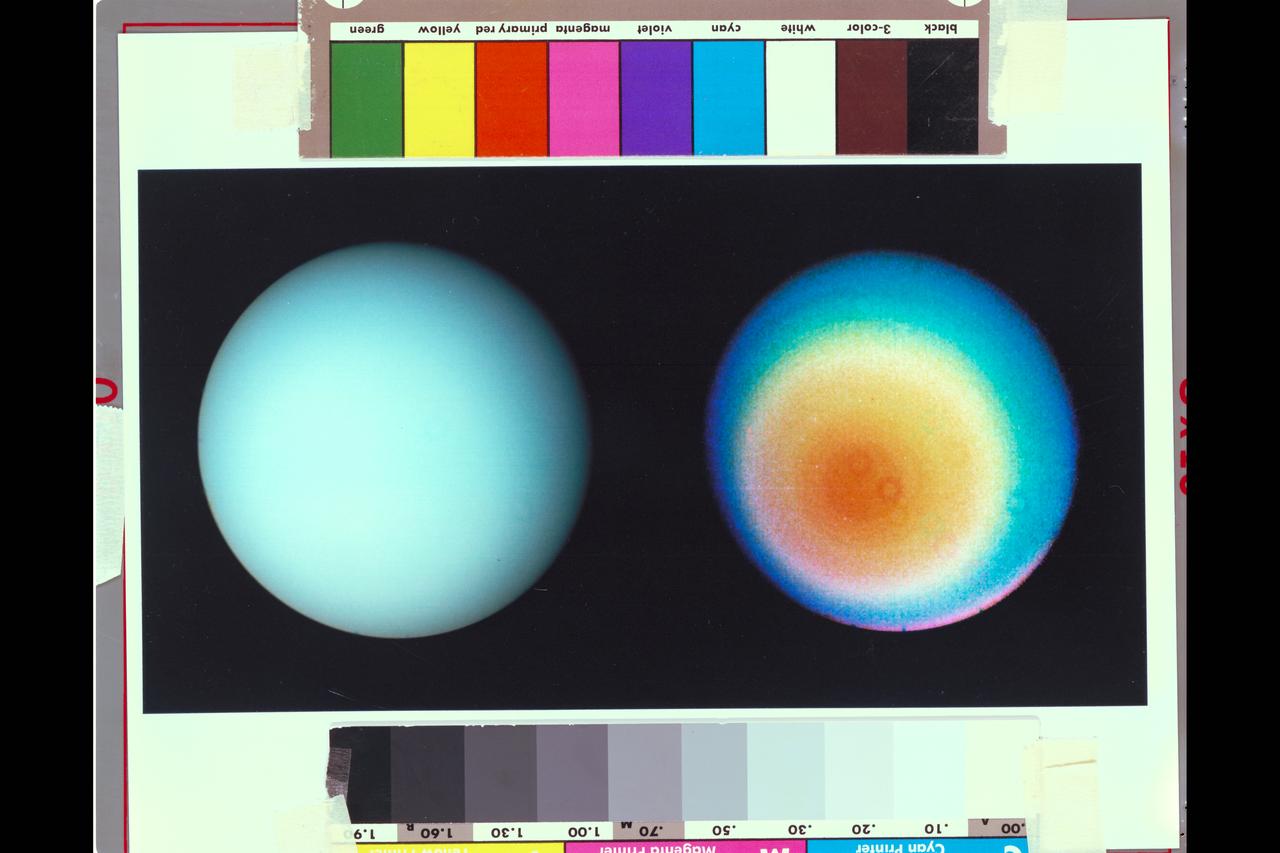
Range : 9.1 million miles (5.7 million miles) P-29478C These two images pictures of Uranus, one in true color and the other in false color, were shot by Voyager 2's narrow angle camera. The picture at left has been processed to show Uranus as the human eye would see from the vantage point of the spacecraft. The image is a composite of shots taken through blue, green, and orange filters. The darker shadings on the upper right of the disk correspond to day-night boundaries on the planet. Beyond this boundary lies the hidden northern hemisphere of Uranus, which currently remains in total darkness as the planet rotates. The blue-green color results from the aborption of red light by methane gas in Uranus' deep, cold, and remarkably clear atmosphere. The picture at right uses false color and extreme contrast to bring out subtle details in the polar region of Uranus. Images obtained through ultraviolet, violet, and orange filters were respectively converted to the same blue, green, and red colors used to produce the picture at left. The very slight contrasts visible in true color are greatly exaggerated here. In this false colr picture, Uranus reveals a dark polar hood surrounded by aseries of progressively lighter concentric bands. One possible explanation is that a brownish haze or smog, concentrated around the pole, is arranged into bands of zonal motions of the upper atmosphere. Several artifacts of the optics and processing are visible. The occasional donut shapes are shadows cast by dust in the camera optics;the processing needed to bring ot faint features also bring out camera blemishes. in addition, the bright pink strip at the lower edge of the planets limb is an artifact of the image enhancement. In fact, the limb is dark and uniform in color around the planet.
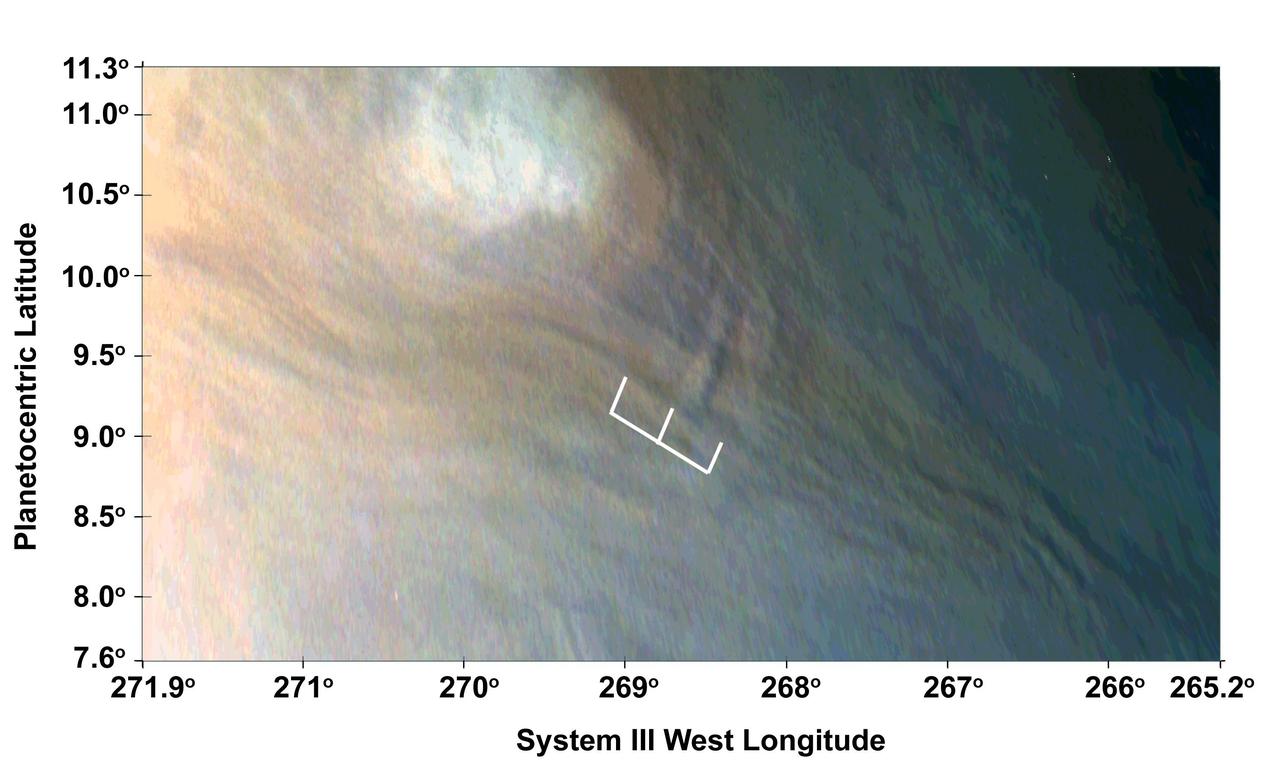
Three waves can be seen in this image, which is an excerpt of a JunoCam image taken on Feb. 2, 2017, during Juno's fourth flyby of Jupiter (perijove 4). The region imaged in this picture is part of the visibly dark band just north of Jupiter's equator known as the North Equatorial Belt. Most of this belt is characterized by downwelling motions, but during perijove 4 it had several bright areas of upwelling clouds. One of those upwelling clouds appears to be accompanied by dark regions, which are most likely shadows. The shadow associated with the center of the three waves is about 25 miles (40 kilometers) long; from the angle of illumination, we can deduce that the shadowed part of the wave must be around 4 miles (7 kilometers) above the main cloud deck, with the peak of the wave probably close to 6 miles (10 kilometers) above the main cloud deck. https://photojournal.jpl.nasa.gov/catalog/PIA22796