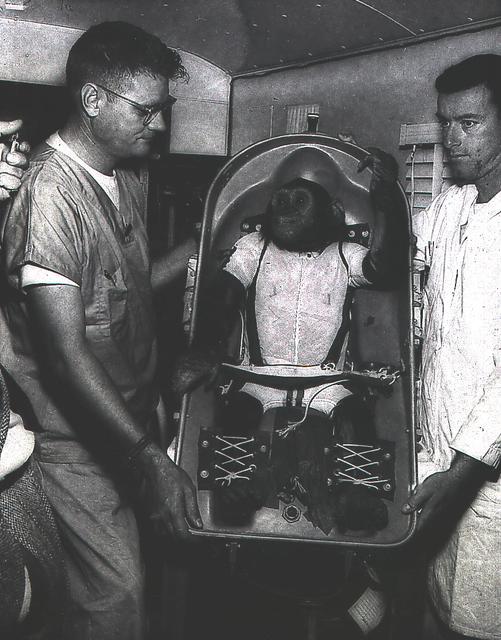
A three-year-old chimpanzee, named Ham, in the biopack couch for the MR-2 suborbital test flight. On January 31, 1961, a Mercury-Redstone launch from Cape Canaveral carried the chimpanzee "Ham" over 640 kilometers down range in an arching trajectory that reached a peak of 254 kilometers above the Earth. The mission was successful and Ham performed his lever-pulling task well in response to the flashing light. NASA used chimpanzees and other primates to test the Mercury Capsule before launching the first American astronaut Alan Shepard in May 1961. The successful flight and recovery confirmed the soundness of the Mercury-Redstone systems.
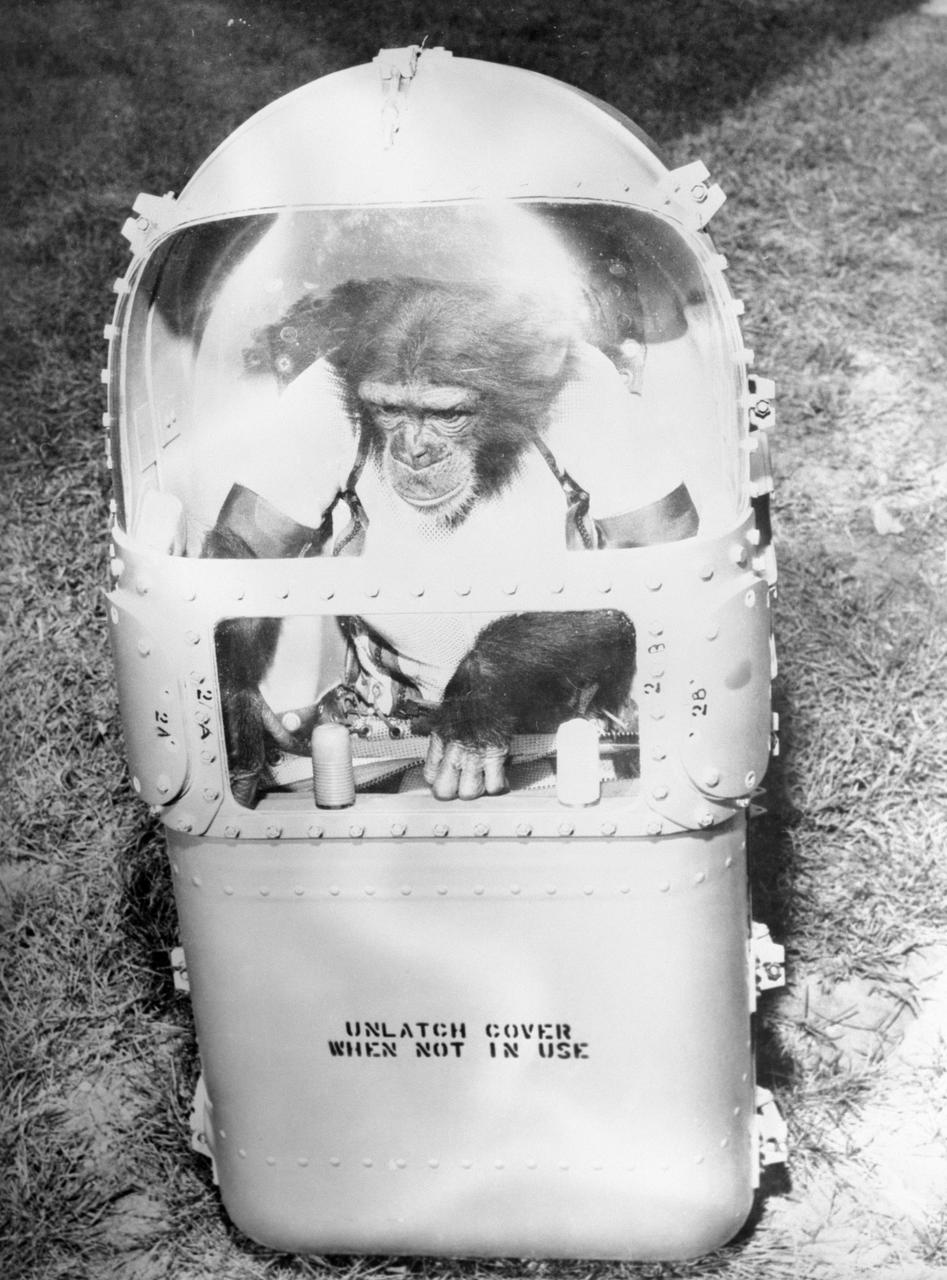
S62-01698 (31 Jan. 1961) --- Chimpanzee "Ham" in his flight couch, after his trip in the Mercury-Redstone 2 (MR-2) on Jan. 31, 1961. Photo credit: NASA
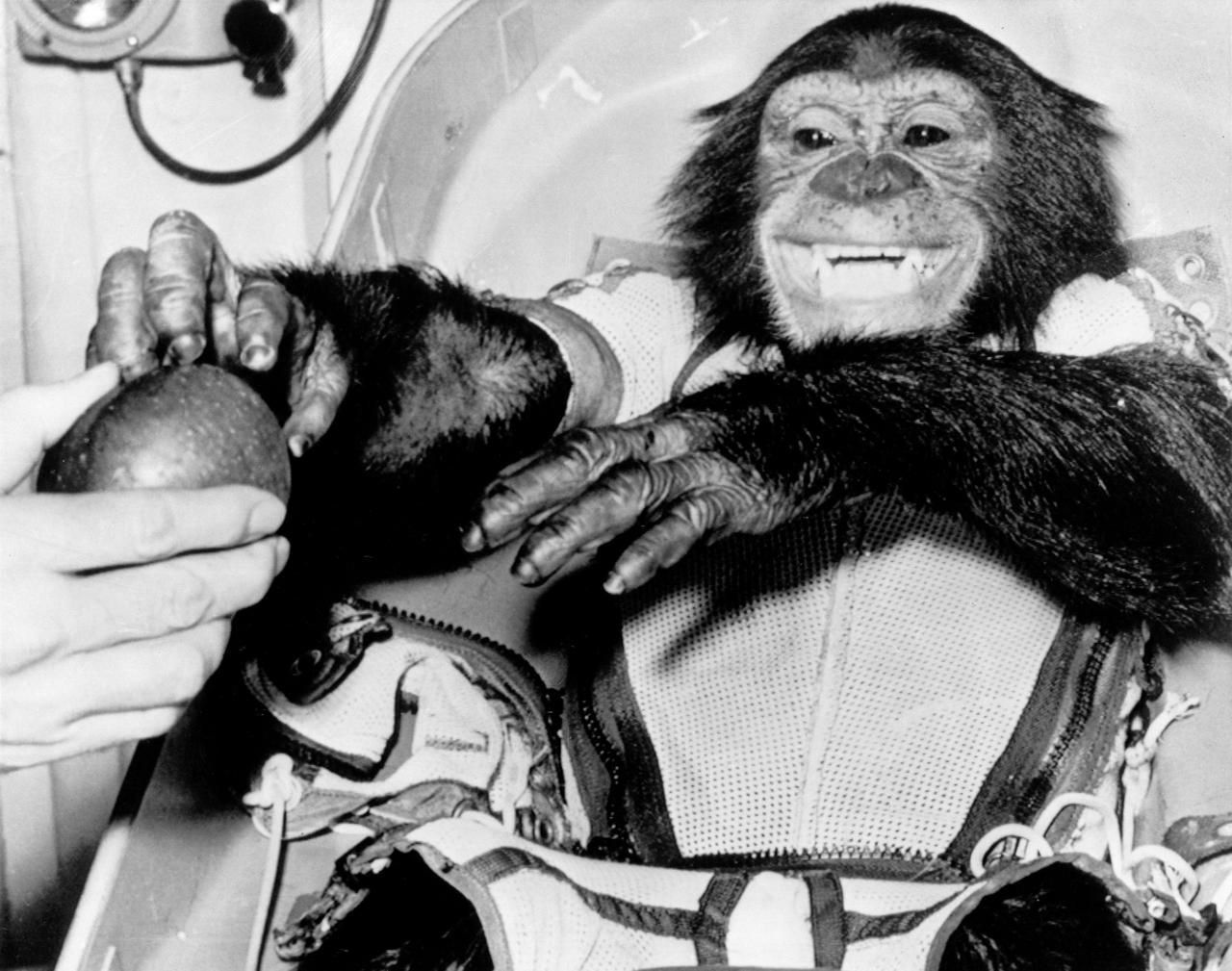
S63-18198 (31 Jan. 1961) --- Closeup view of the chimpanzee "Ham", the live test subject for the Mercury-Redstone 2 (MR-2) test flight, following his successful recovery from the Atlantic. The 420-statute mile suborbital MR-2 flight by the 37-pound primate was a significant accomplishment on the American route toward manned spaceflight. Photo credit: NASA
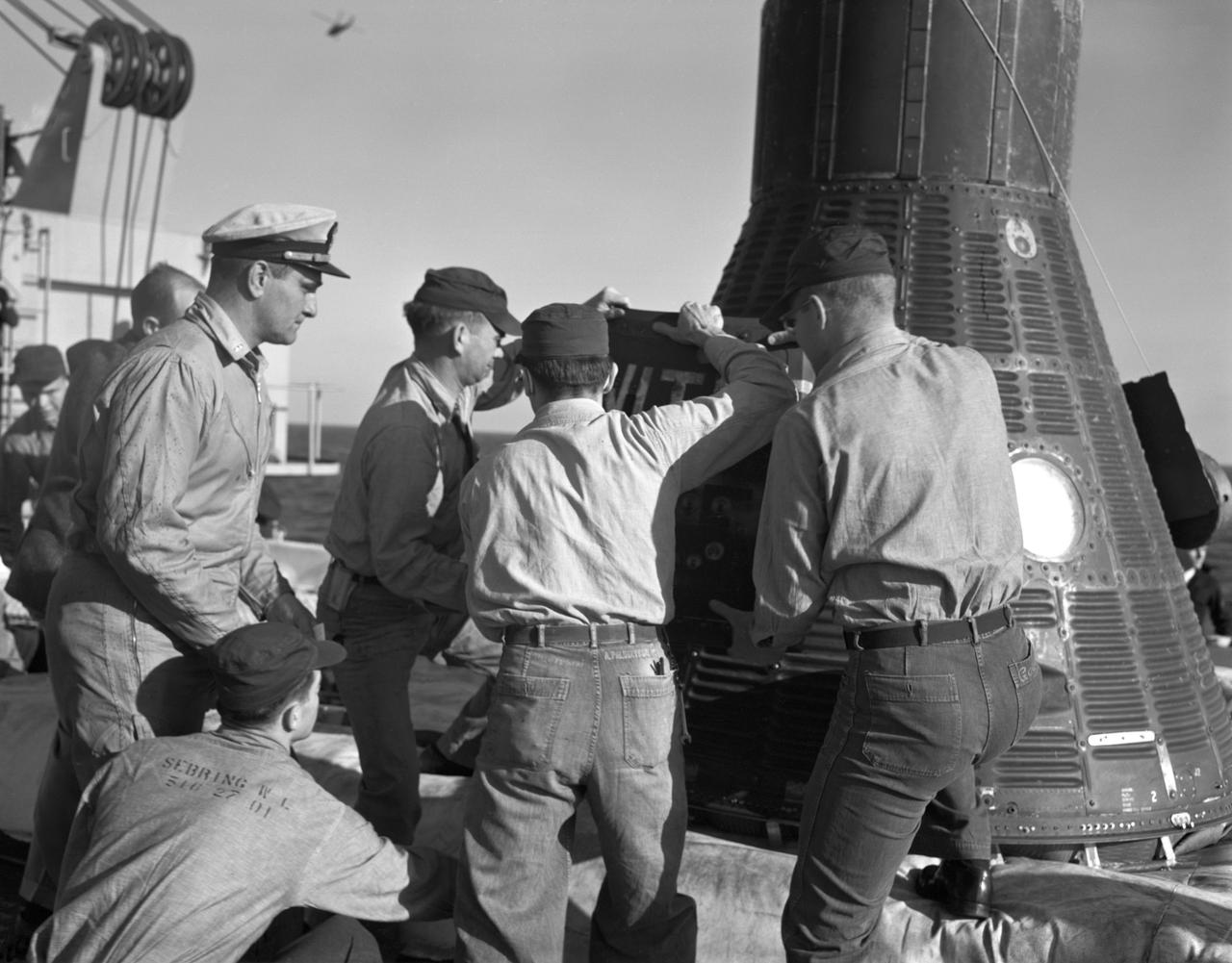
S61-00199 (31 Jan. 1961) --- Recovery personnel aboard the USS Donner remove ?Ham?, a 37-pound chimpanzee, from a Mercury-Redstone spacecraft following the successful Mercury-Redstone 2 (MR-2) suborbital flight from Cape Canaveral, Florida. The primate's 420-statute mile MR-2 flight was a significant accomplishment on the American route toward manned spaceflight. Photo credit: NASA
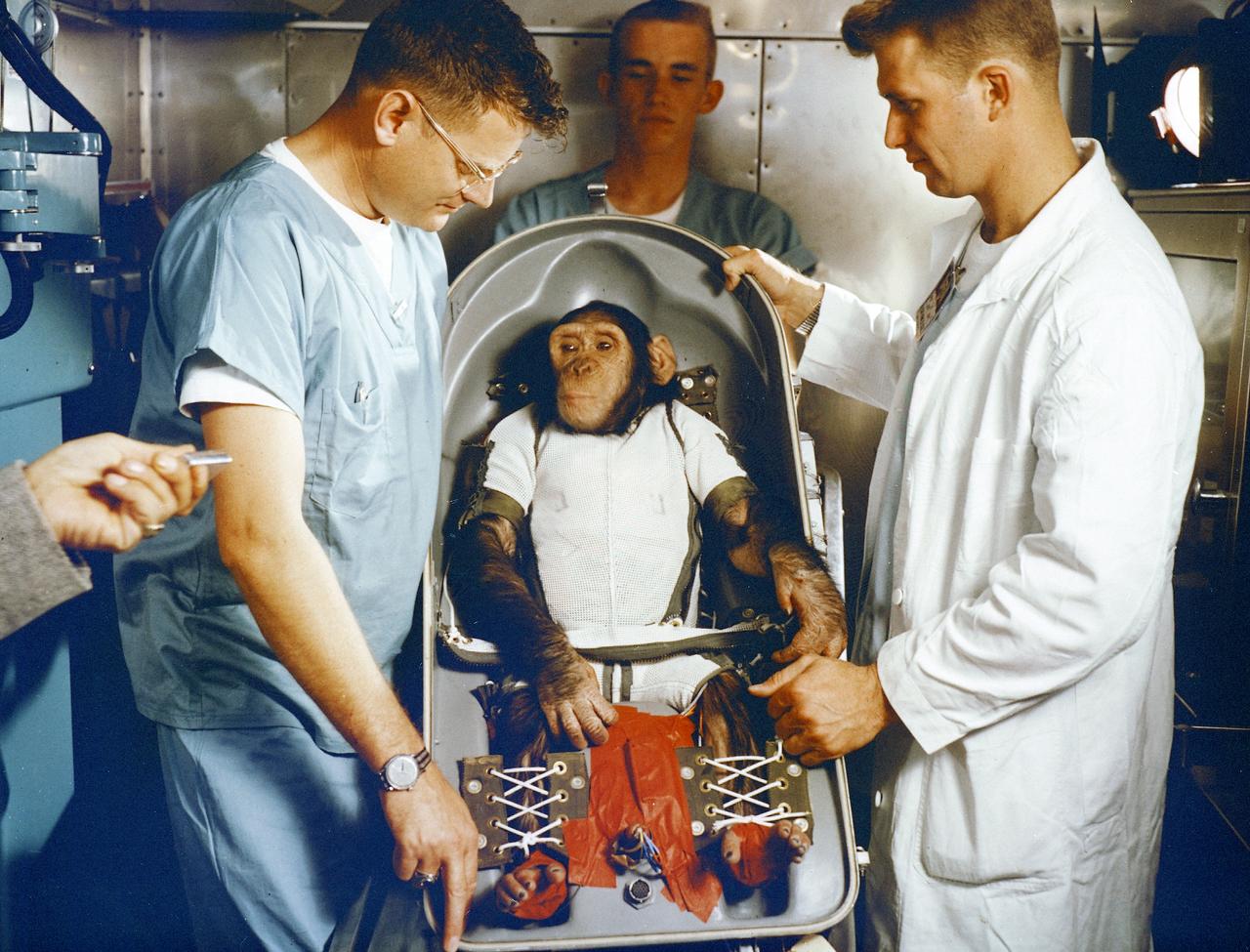
A three-year-old chimpanzee, named Ham, in the biopack couch for the MR-2 suborbital test flight. On January 31, 1961, a Mercury-Redstone launch from Cape Canaveral carried the chimpanzee "Ham" over 640 kilometers down range in an arching trajectory that reached a peak of 254 kilometers above the Earth. The mission was successful and Ham performed his lever-pulling task well in response to the flashing light. NASA used chimpanzees and other primates to test the Mercury Capsule before launching the first American astronaut Alan Shepard in May 1961. The successful flight and recovery confirmed the soundness of the Mercury-Redstone systems.
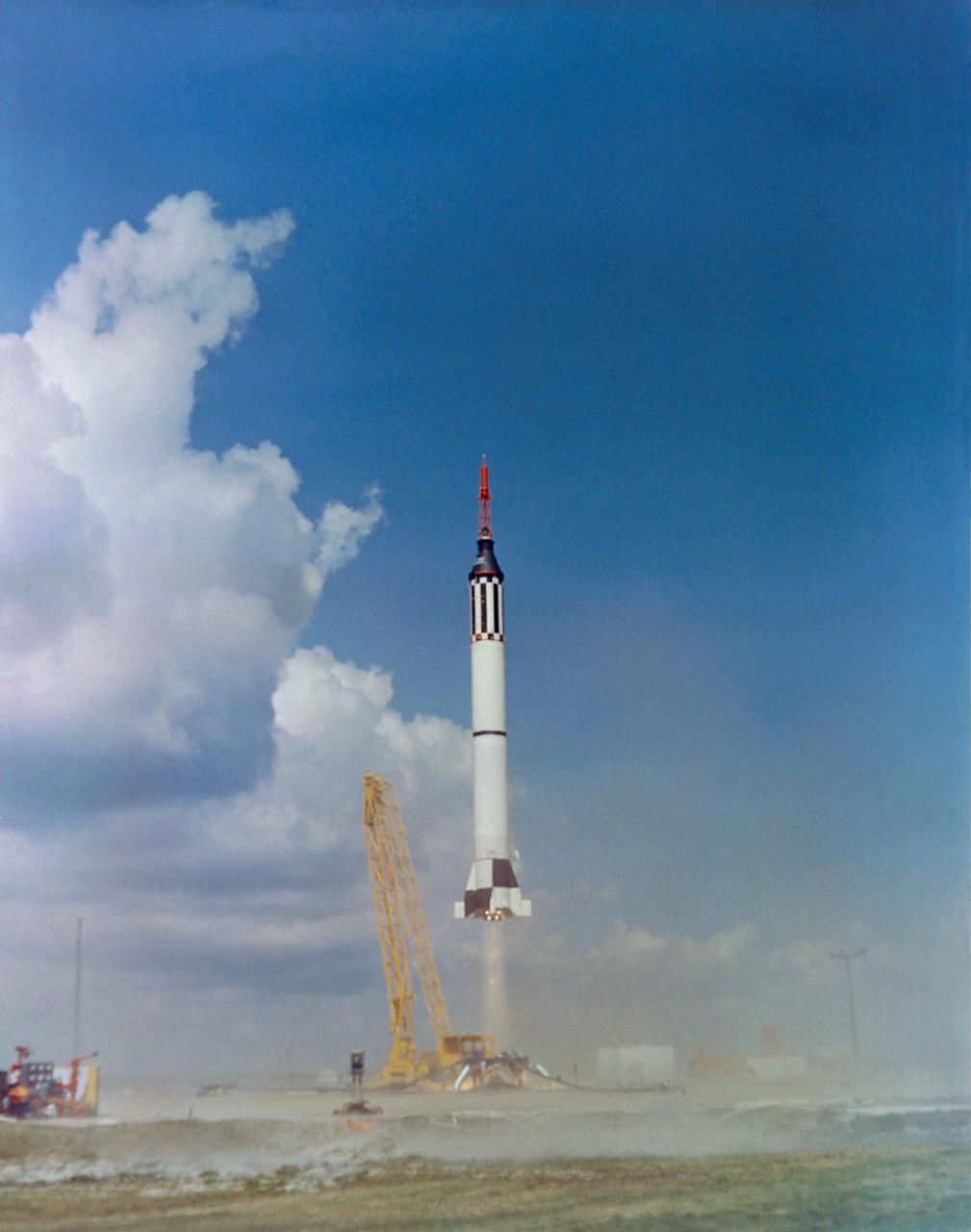
S63-22731 (31 Jan. 1961) --- The launch of the Mercury-Redstone 2 (MR-2) suborbital mission from Cape Canaveral, Florida, on Jan. 31, 1961. Onboard the spacecraft was ?Ham?, a 37-pound chimpanzee. Despite an over-acceleration factor, the flight was considered to be successful. Following recovery Ham appeared to be in good physiological condition, but sometime later when he was shown the Mercury spacecraft it was visually apparent that he had no further interest in cooperating with the spaceflight program. Photo credit: NASA
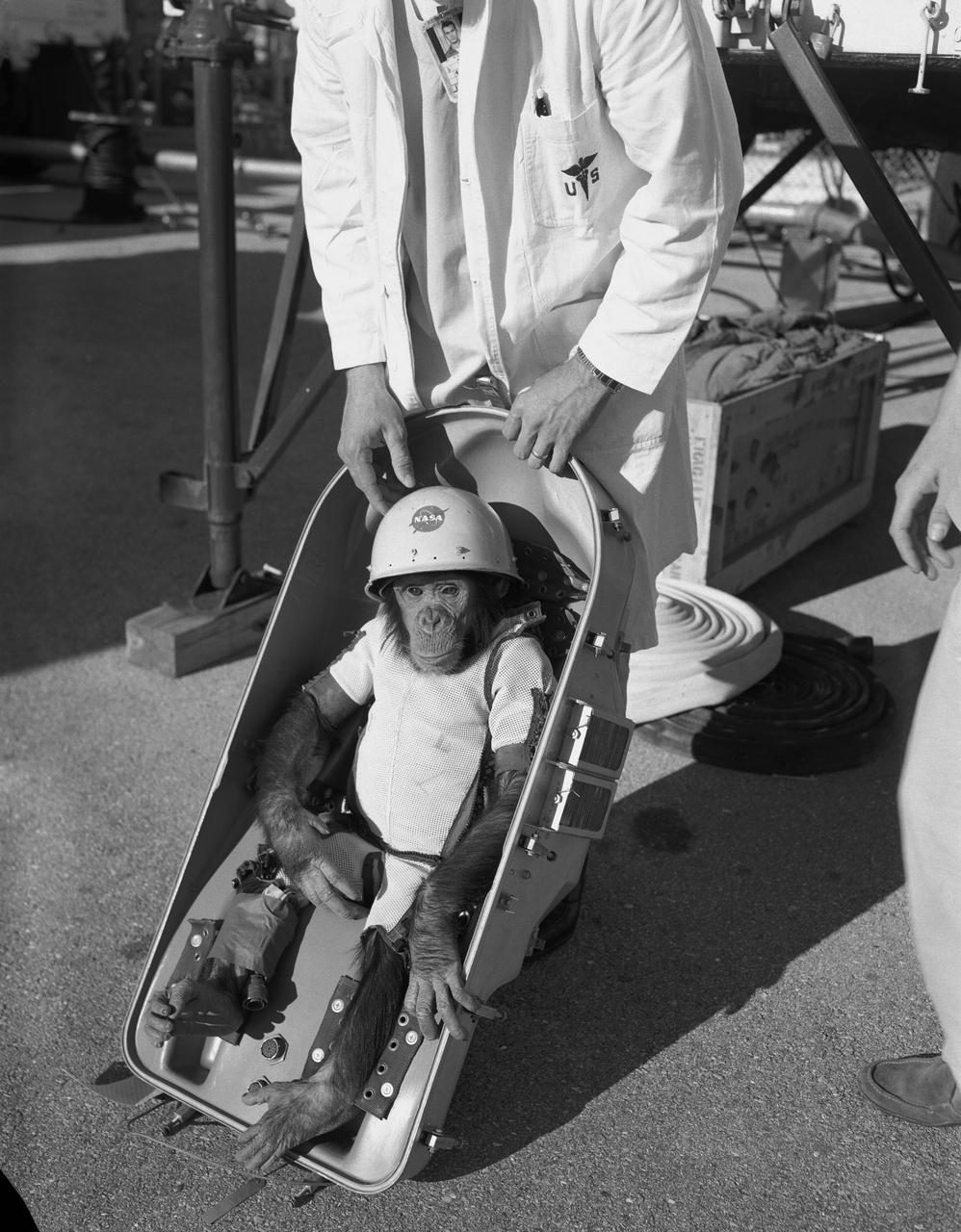
S63-20801 (23 Jan. 1961) --- Primate chimpanzee ?Ham?, in his spacesuit, is fitted into the couch of the Mercury-Redstone 2 (MR-2) capsule #5 prior to its test flight which was conducted on Jan. 31, 1961. Photo credit: NASA
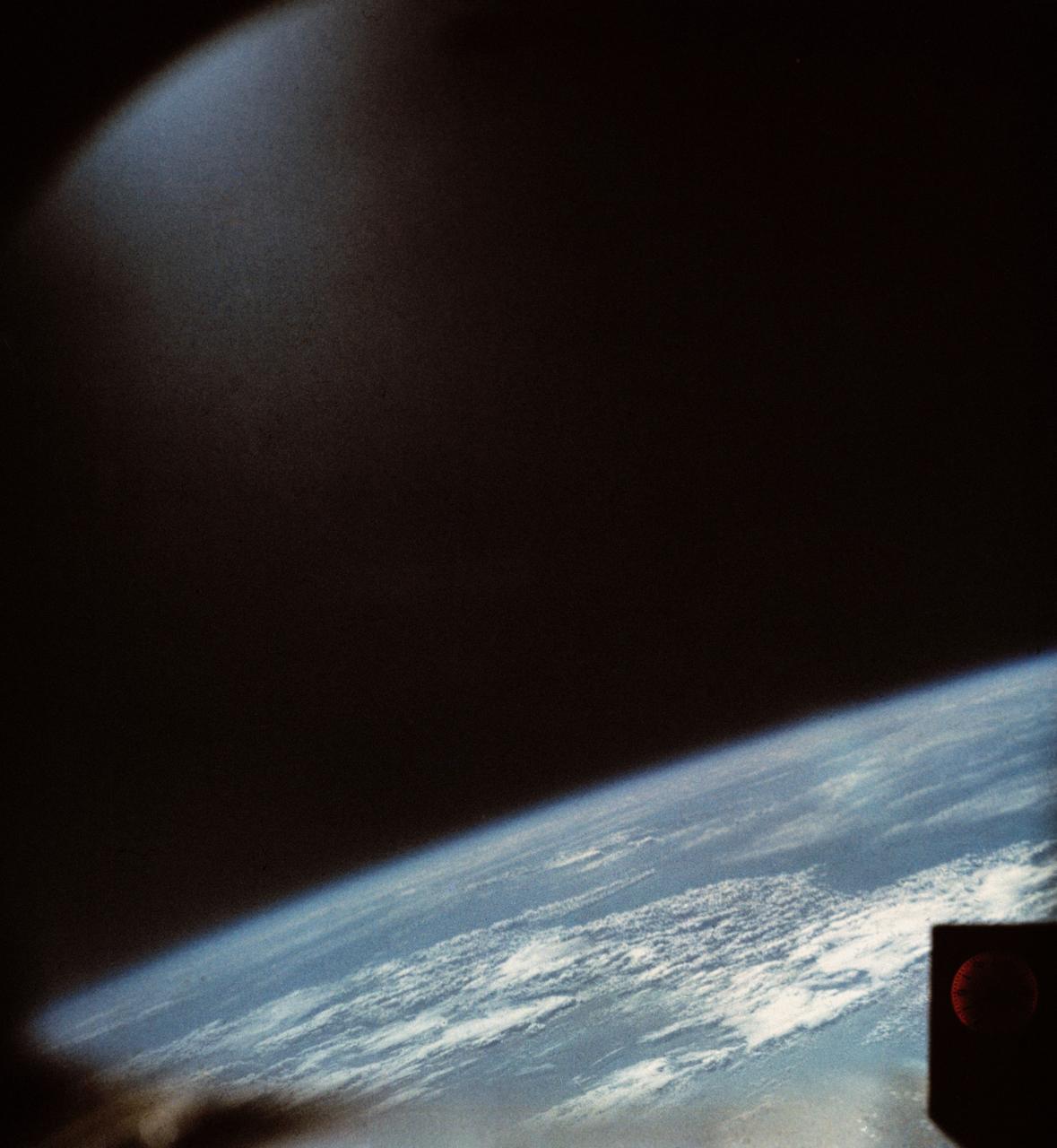
S61-04692 (31 Jan. 1961) --- Earth view from the Mercury Redstone 2 (MR-2) spacecraft. Photo credit: NASA
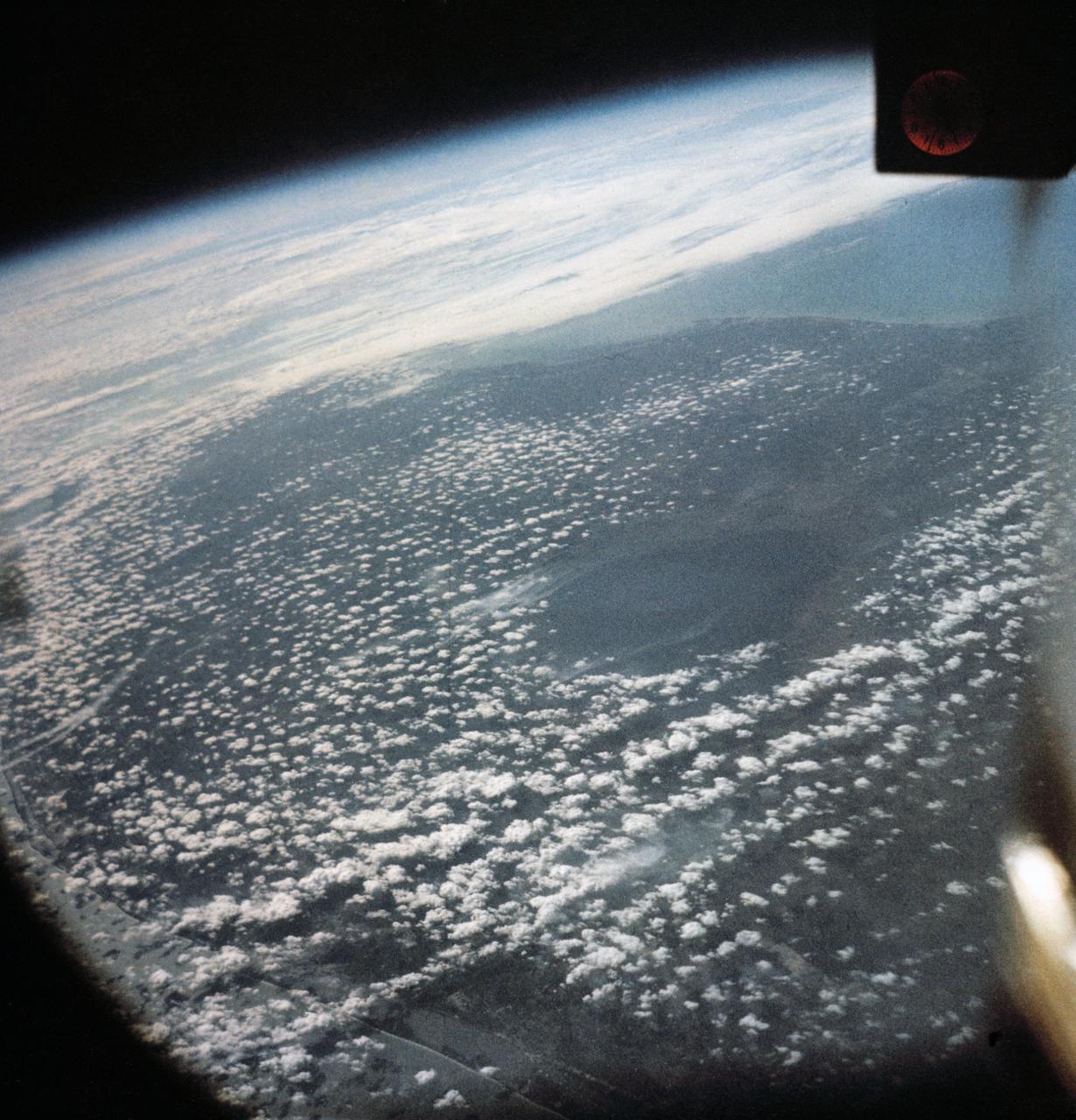
S61-04674 (31 Jan. 1961) --- Earth view from the Mercury Redstone 2 (MR-2) spacecraft. Photo credit: NASA
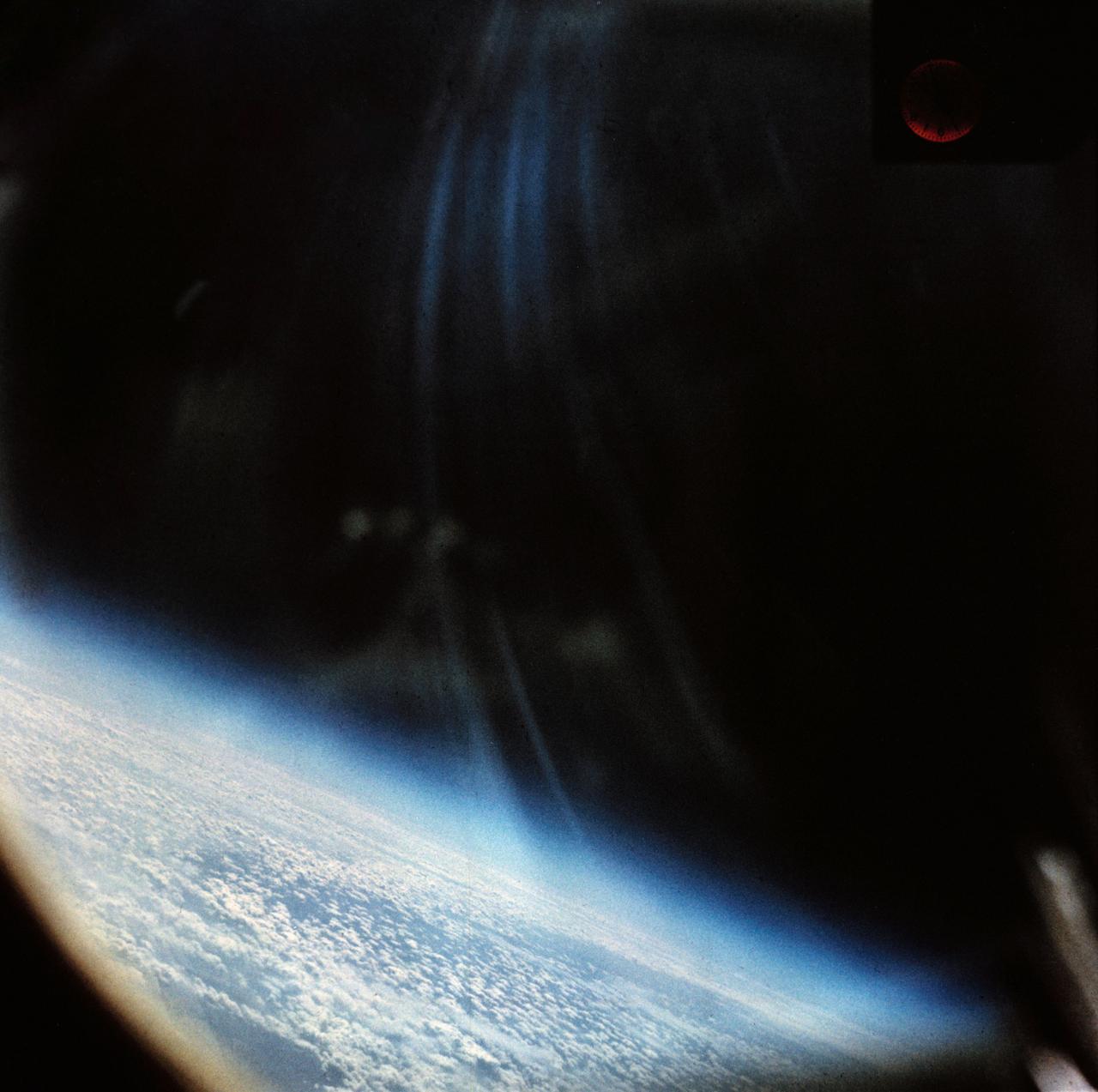
S61-04667 (31 Jan. 1961) --- Earth view from the Mercury Redstone 2 (MR-2) spacecraft. Photo credit: NASA
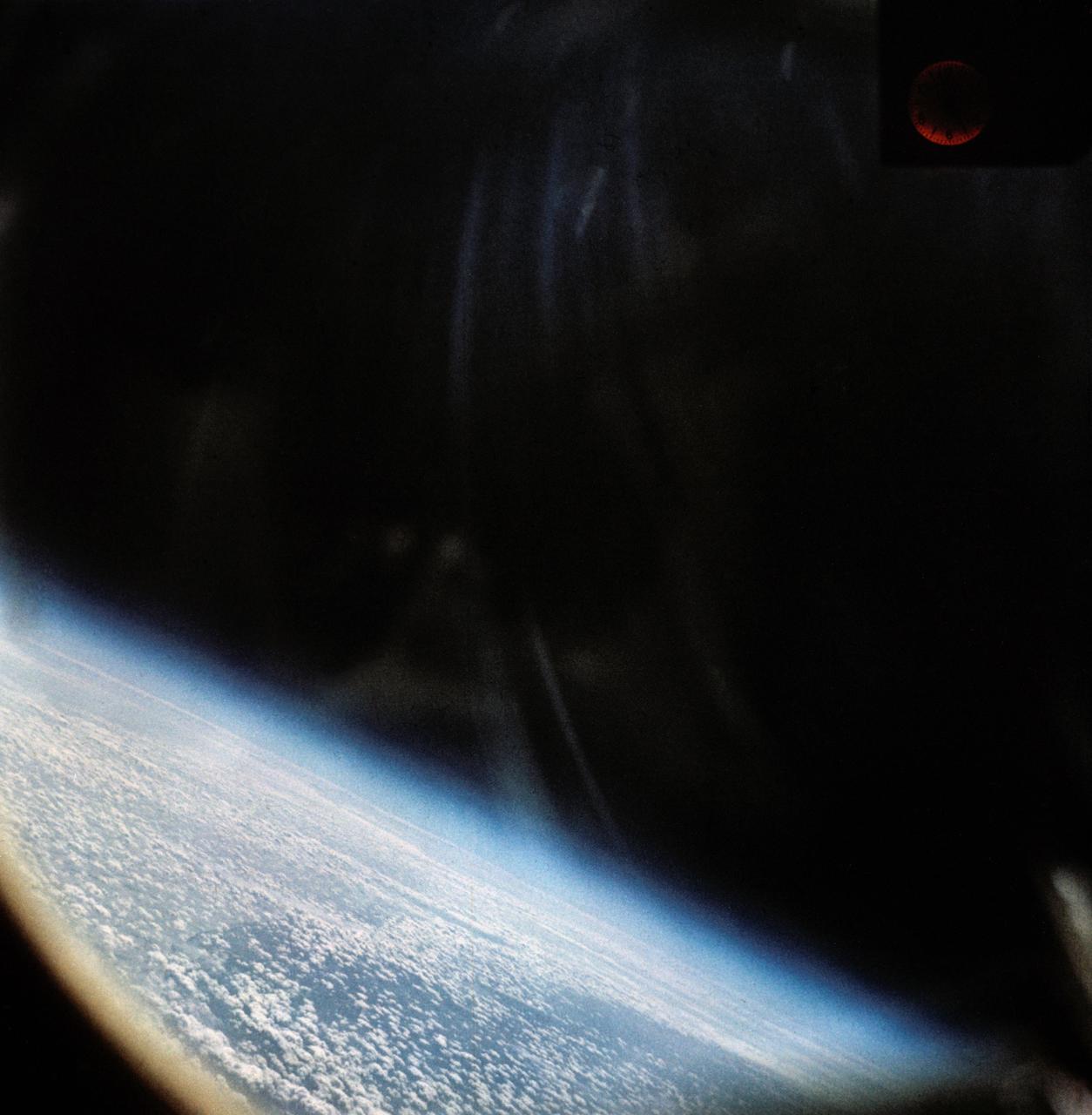
S61-04669 (31 Jan. 1961) --- Earth view from the Mercury Redstone 2 (MR-2) spacecraft. Photo credit: NASA
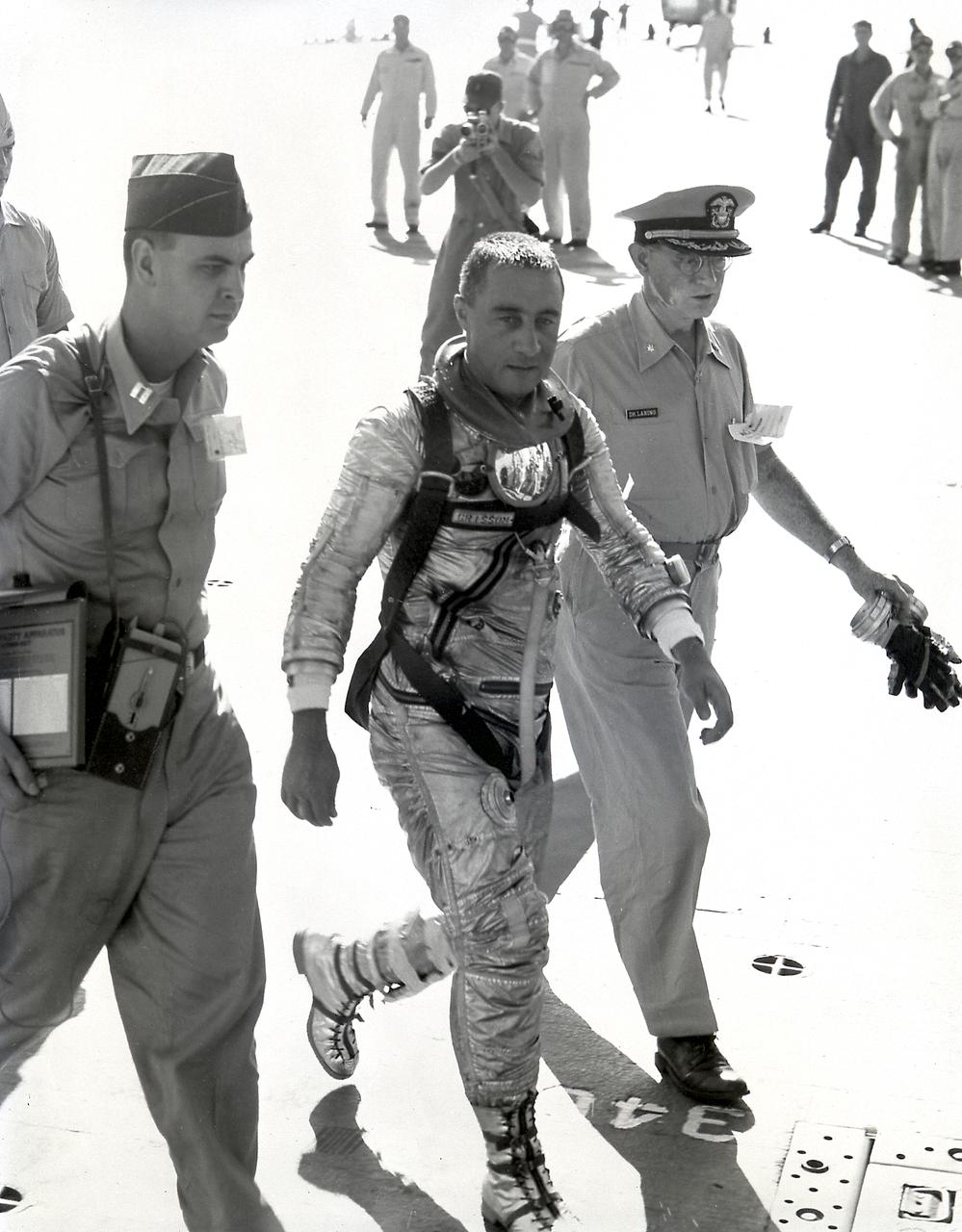
Astronaut Virgil Grissom walks on the recovery ship after completing the 15-1/2-minute suborbital MR-4 mission.
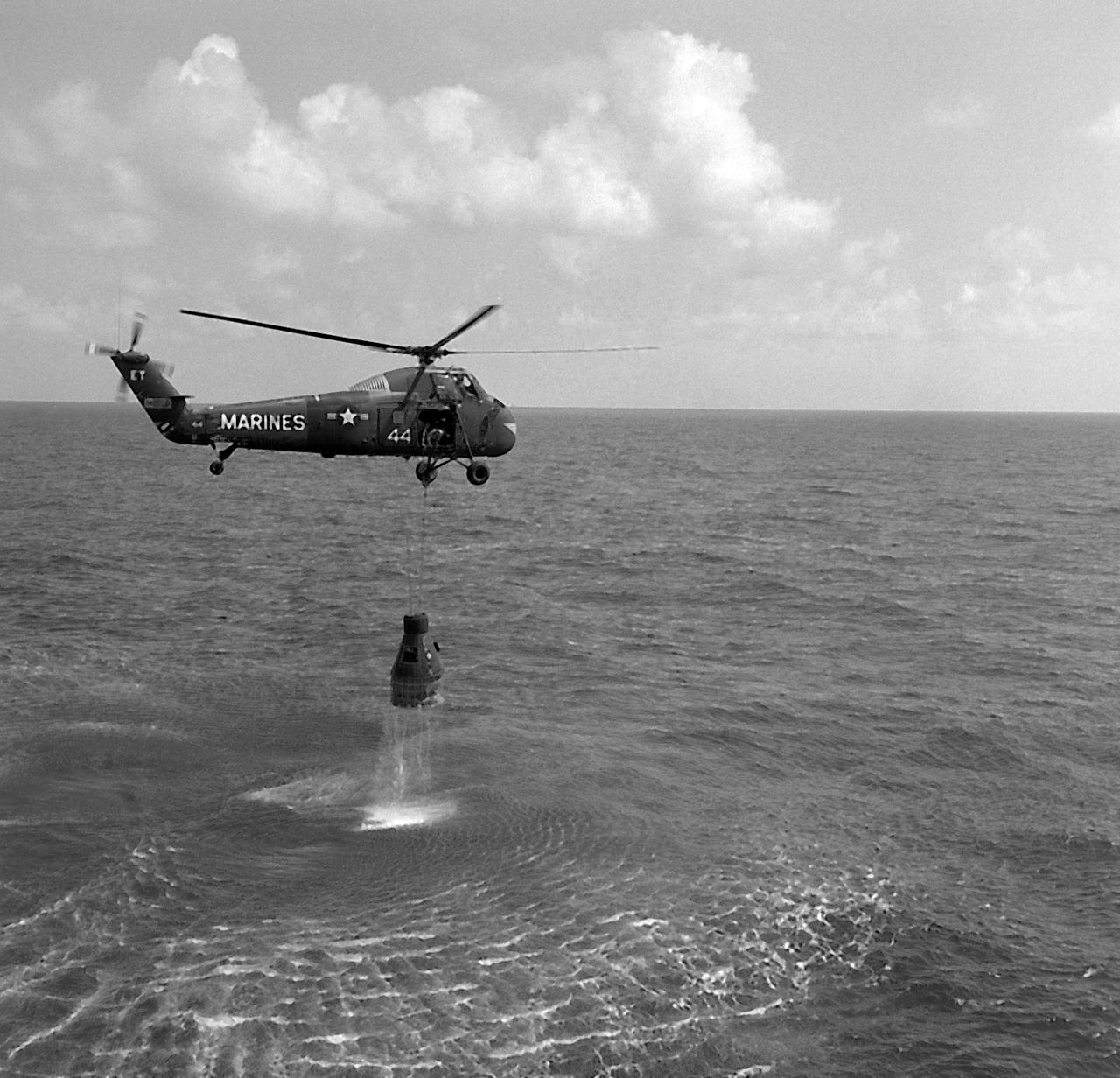
This photo depicts the recovery of the Freedom 7 (MR-3) capsule by a U.S. Marine helicopter. The MR-3 mission successfully placed the first American astronaut, Alan Shepard, in space for 15-1/2 minutes and returned safely to Earth on May 5, 1961.
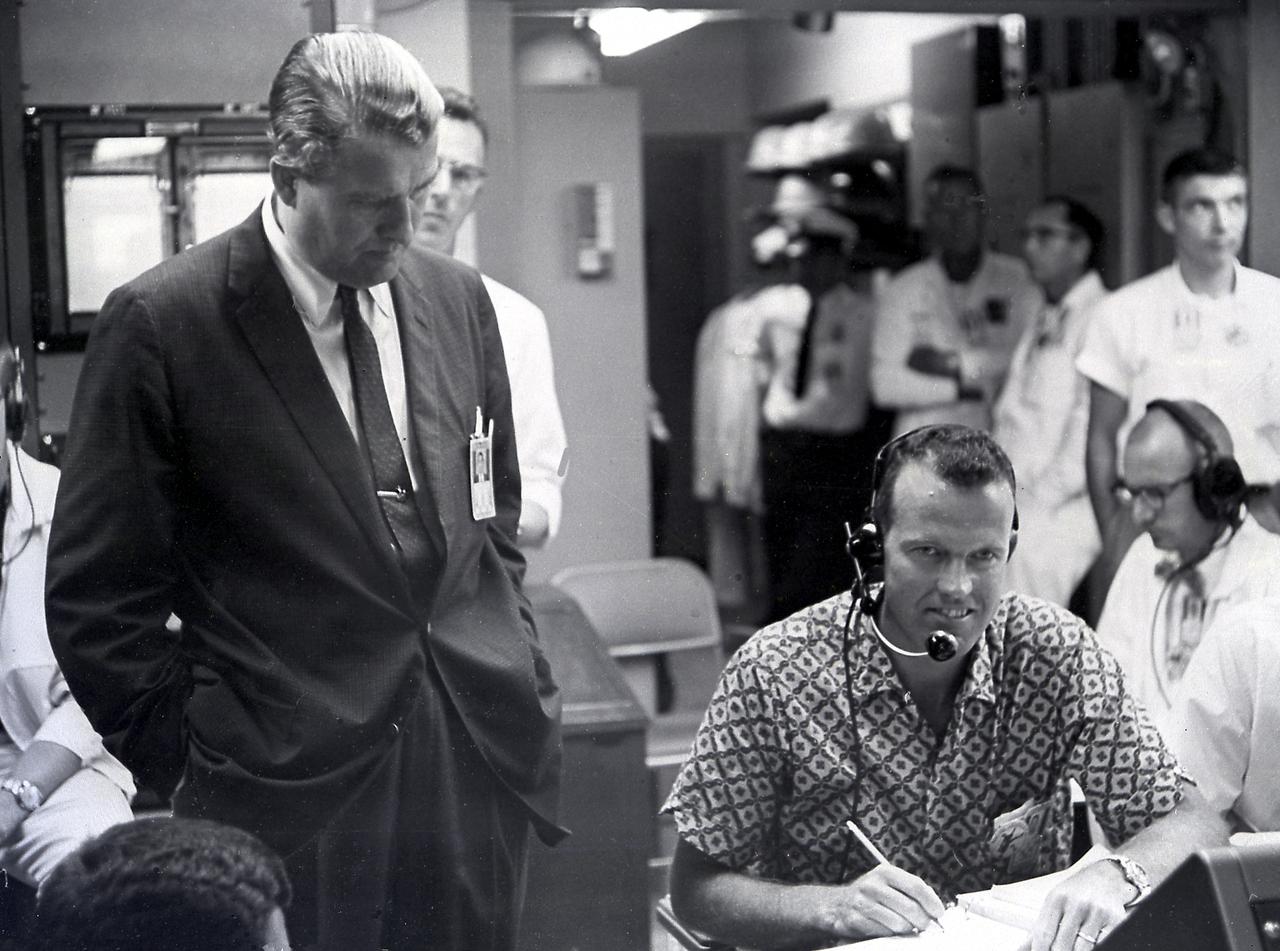
Photographed are Dr. von Braun and Astronaut L. Gordon Cooper in the blockhouse during the recovery operation of the MR-3 (Freedom 7) mission on May 5, 1961. The MR-3 mission, a 15-1/2-minute suborbital test flight, put the first American astronaut, Alan Shepard, in space.
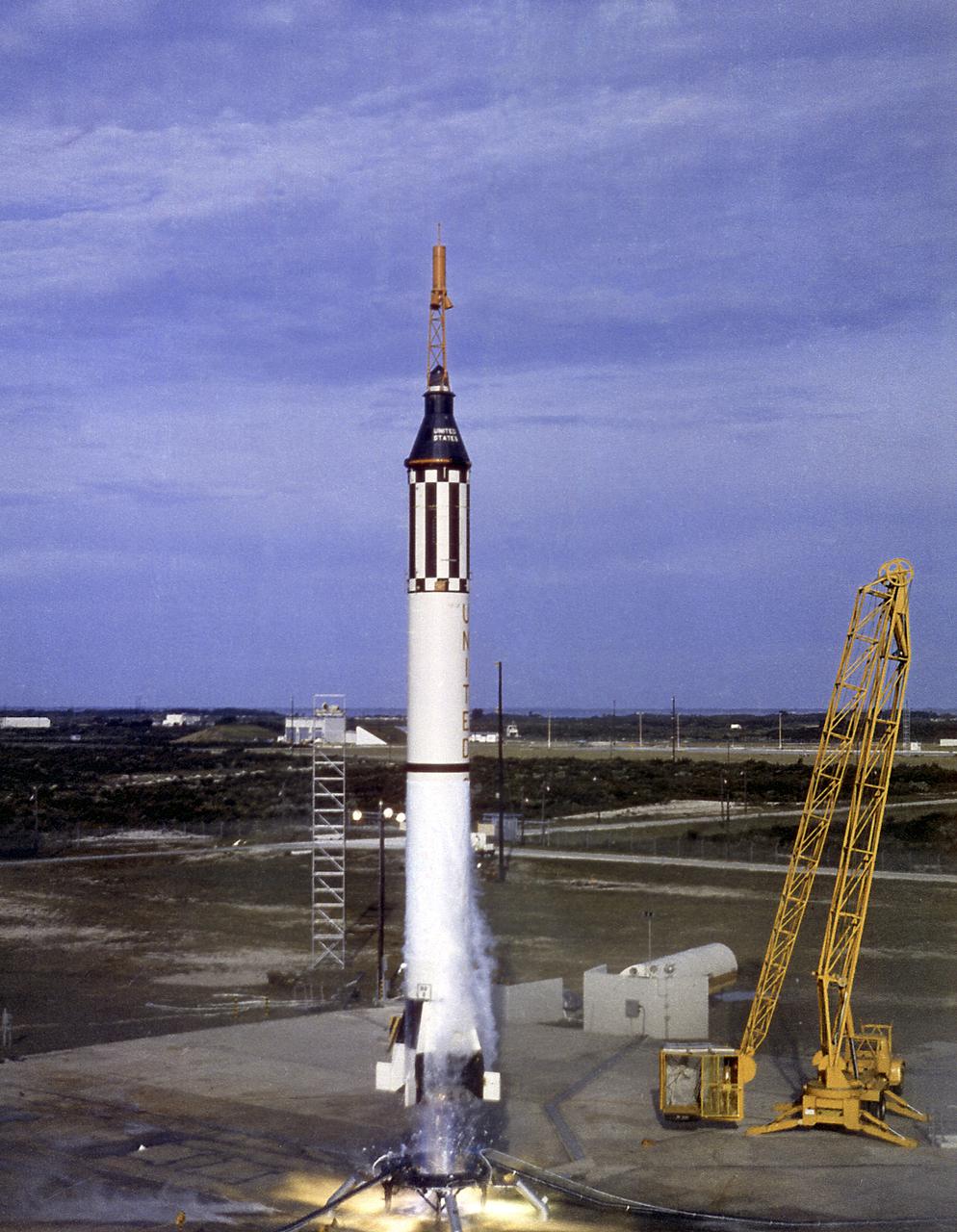
Liftoff of MR-4 (Mercury-Redstone), Liberty Bell 7, on July 21, 1961. MR-4 mission was the second marned suborbital flight and carried Astronaut Virgil Grissom aboard the Liberty Bell 7 spacecraft in space for a duration of 15-1/2 minutes.
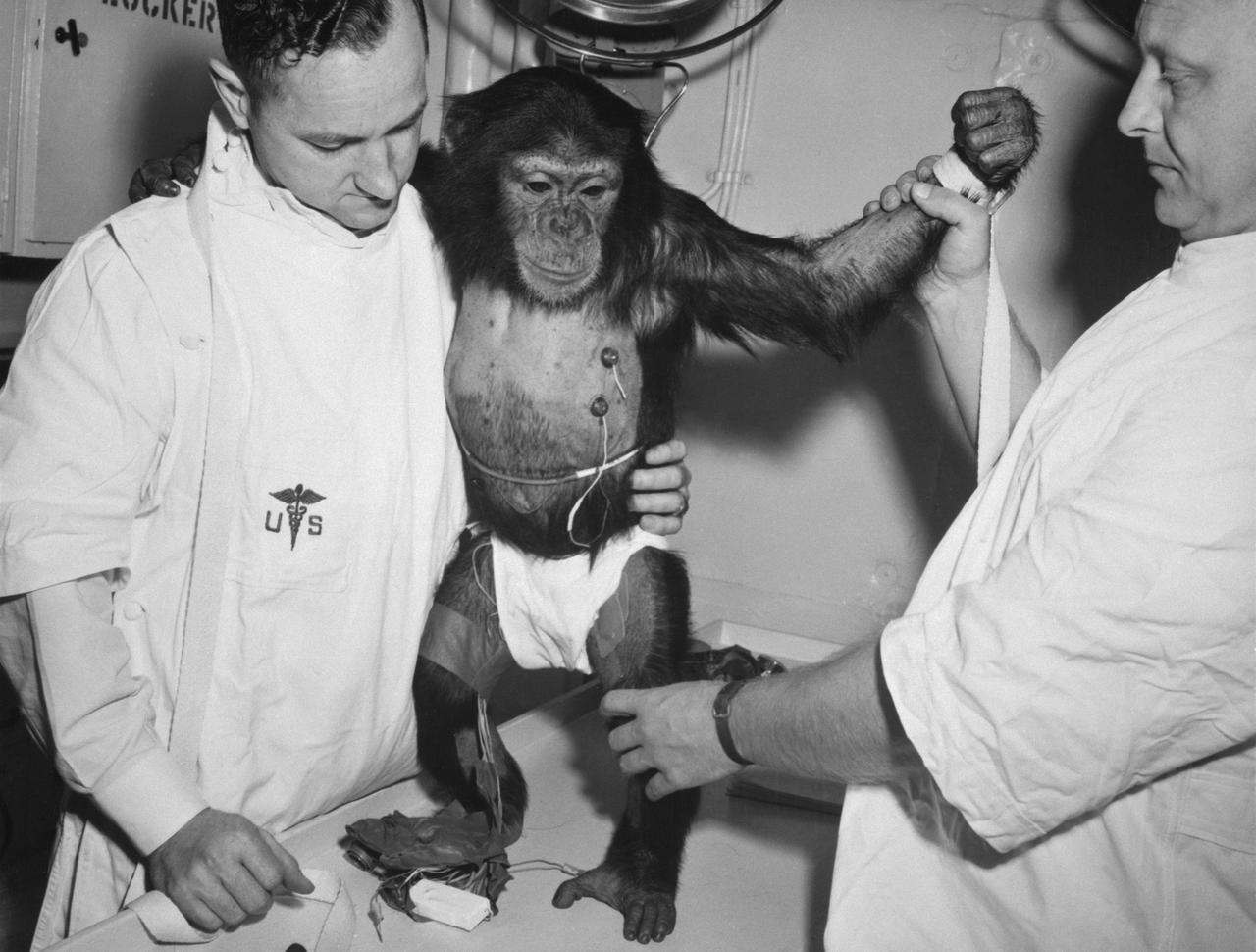
S61-00203 (31 Jan. 1961) --- Chimpanzee "Ham" with bio-sensors attached to his body is readied by handlers for his trip in the Mercury-Redstone 2 (MR-2) spacecraft. Photo credit: NASA
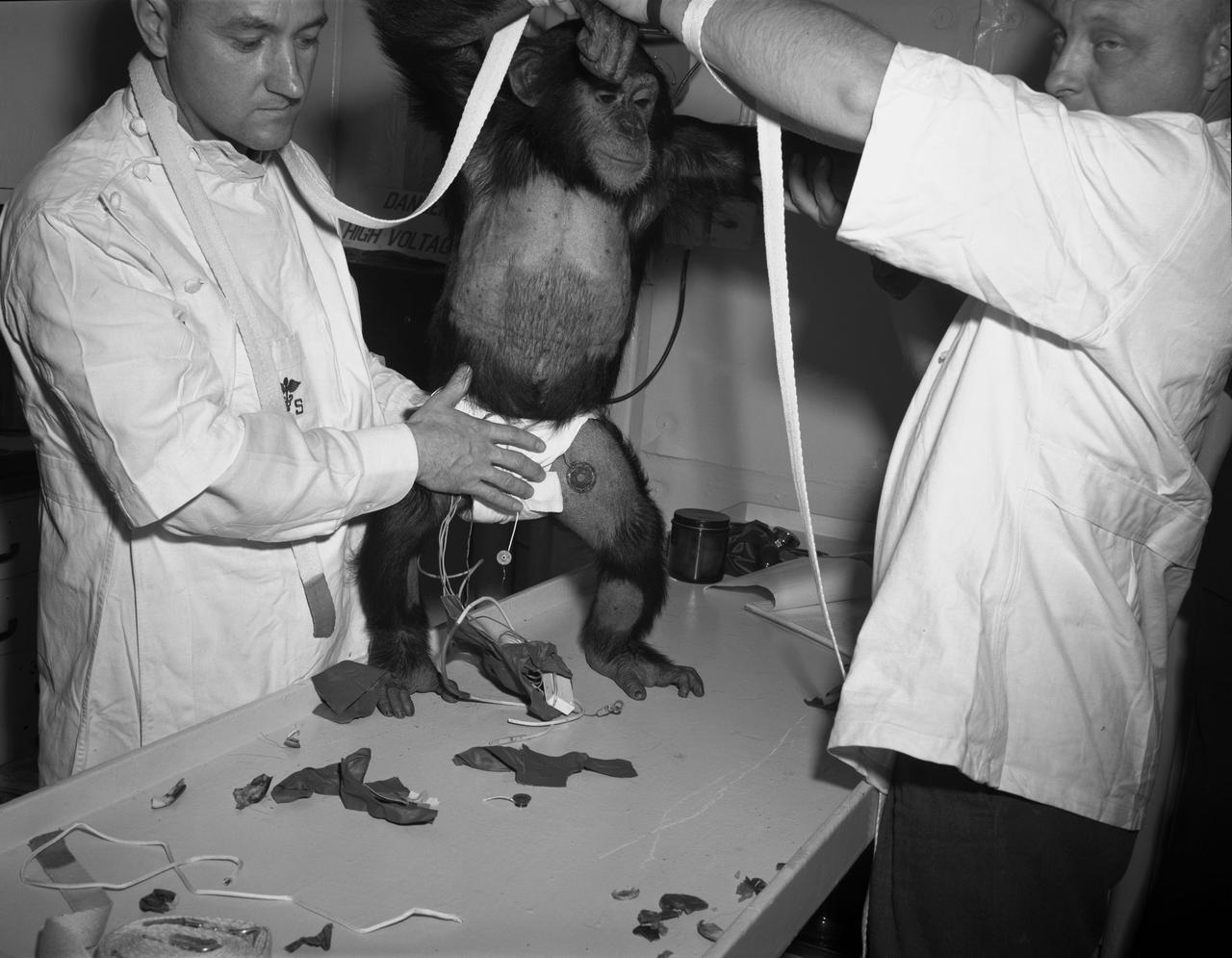
S63-20800 (31 Jan. 1961) --- Chimpanzee "Ham" being assisted into "spacesuit" prior to the Mercury-Redstone 2 (MR-2) test flight which was conducted on Jan. 31, 1961. Photo credit: NASA

Mary Jackson at Work. In 1958 Mary Jackson became NASA’s first black female engineer. At the time this photo was taken in June 2, 1977 Mrs. Jackson was working in the Transonic Aerodynamic Branch.
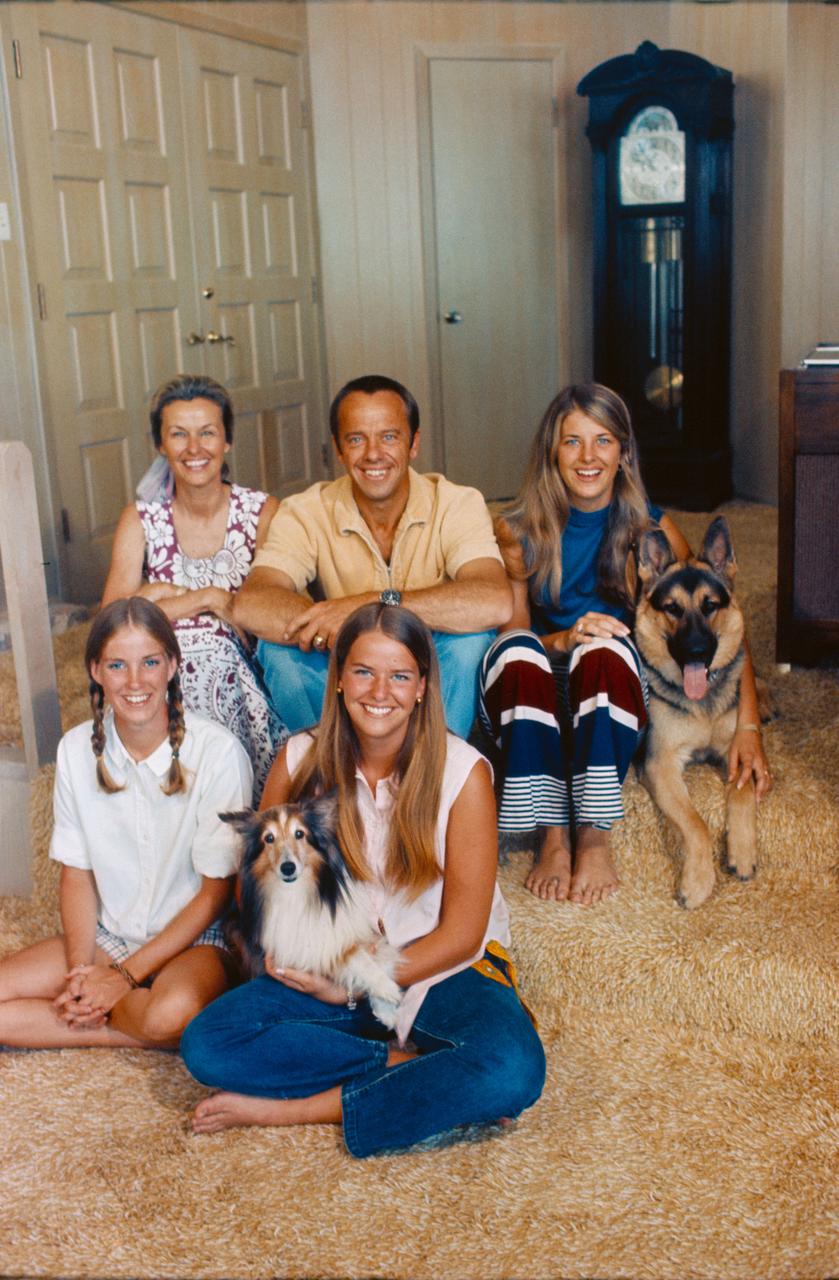
S71-17356 (January 1971) --- This is a family portrait of astronaut Alan B. Shepard Jr. and his family. Shepard is the commander of the Apollo 14 lunar landing mission. The family includes Mrs. Shepard, the former Louise Brewer; Laura Shepard Snyder (seated on Shepard's left), born on July 2, 1947; Julie Shepard (right foreground), born on March 16, 1951; and Alice Shepard (left foreground), a niece of Mrs. Shepard.
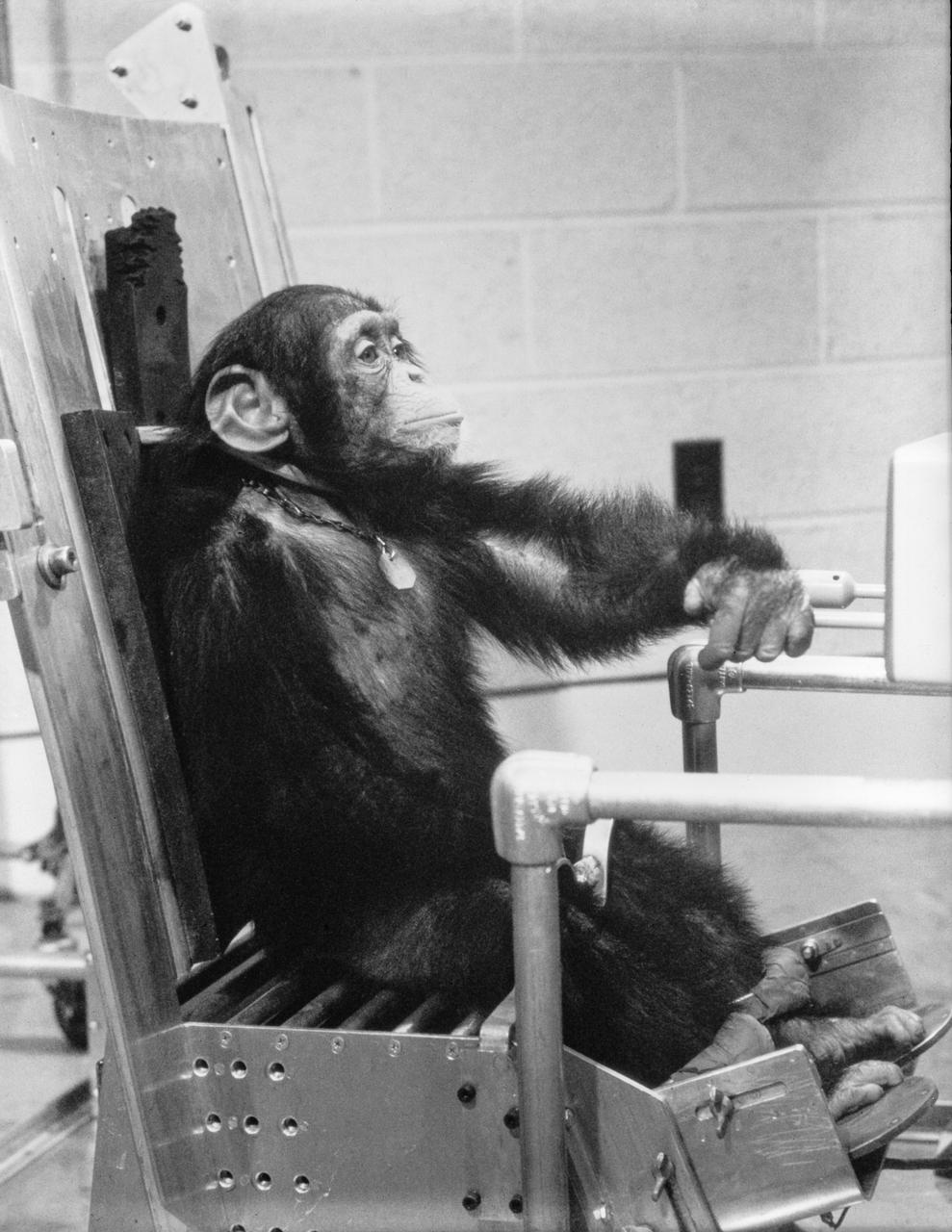
G61-00337 (31 Jan. 1961) --- Chimpanzee "Ham" during preflight activity with one of his handlers prior to the Mercury-Redstone 2 (MR-2) test flight which was conducted on Jan. 31, 1961. Photo credit: NASA
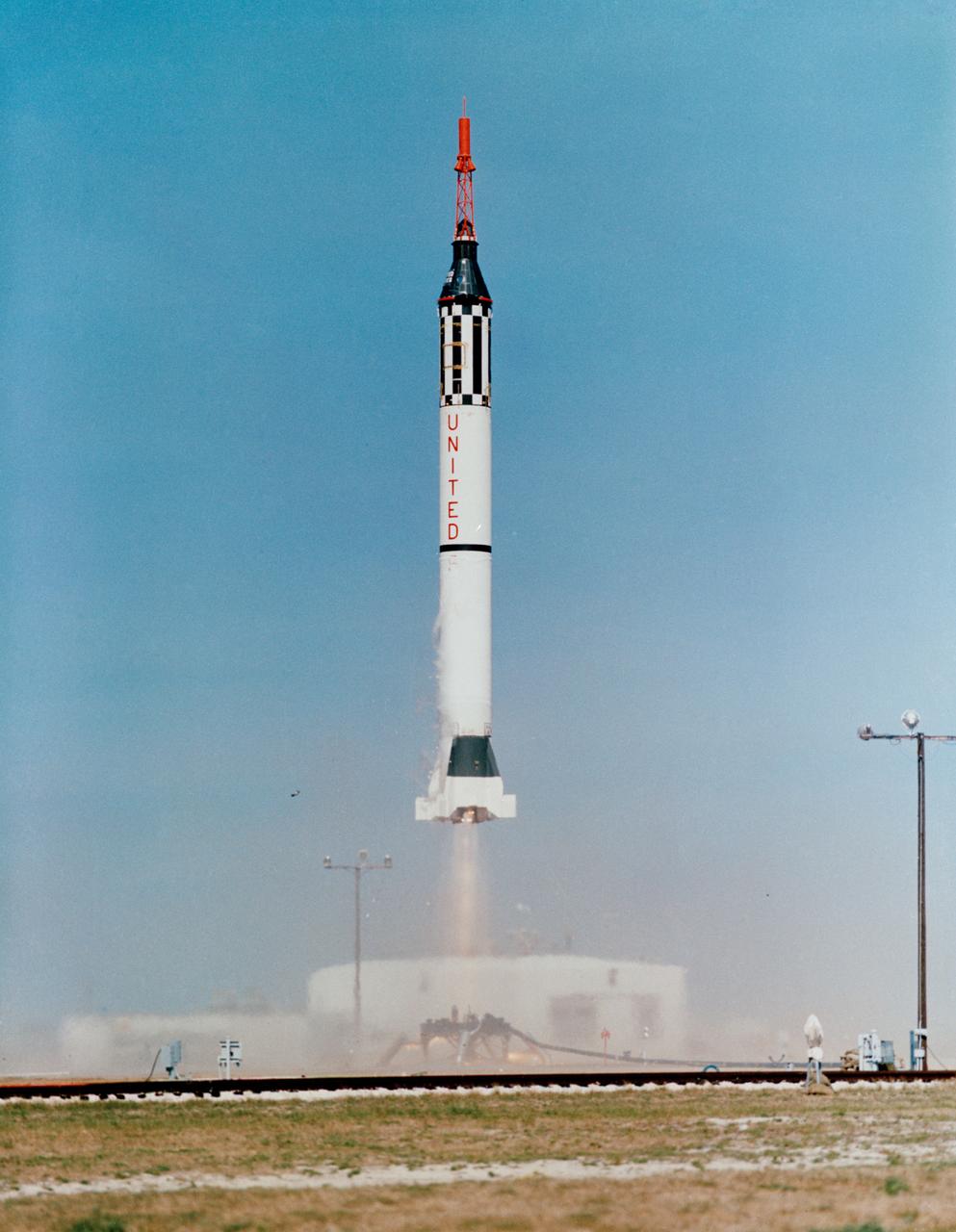
S61-01942 (31 Jan. 1961) --- Launch of the Mercury-Redstone 2 (MR-2) vehicle on Jan. 31, 1961. The 16-minute suborbital flight carried biomedical test subject chimpanzee (Ham) aboard. Photo credit: NASA
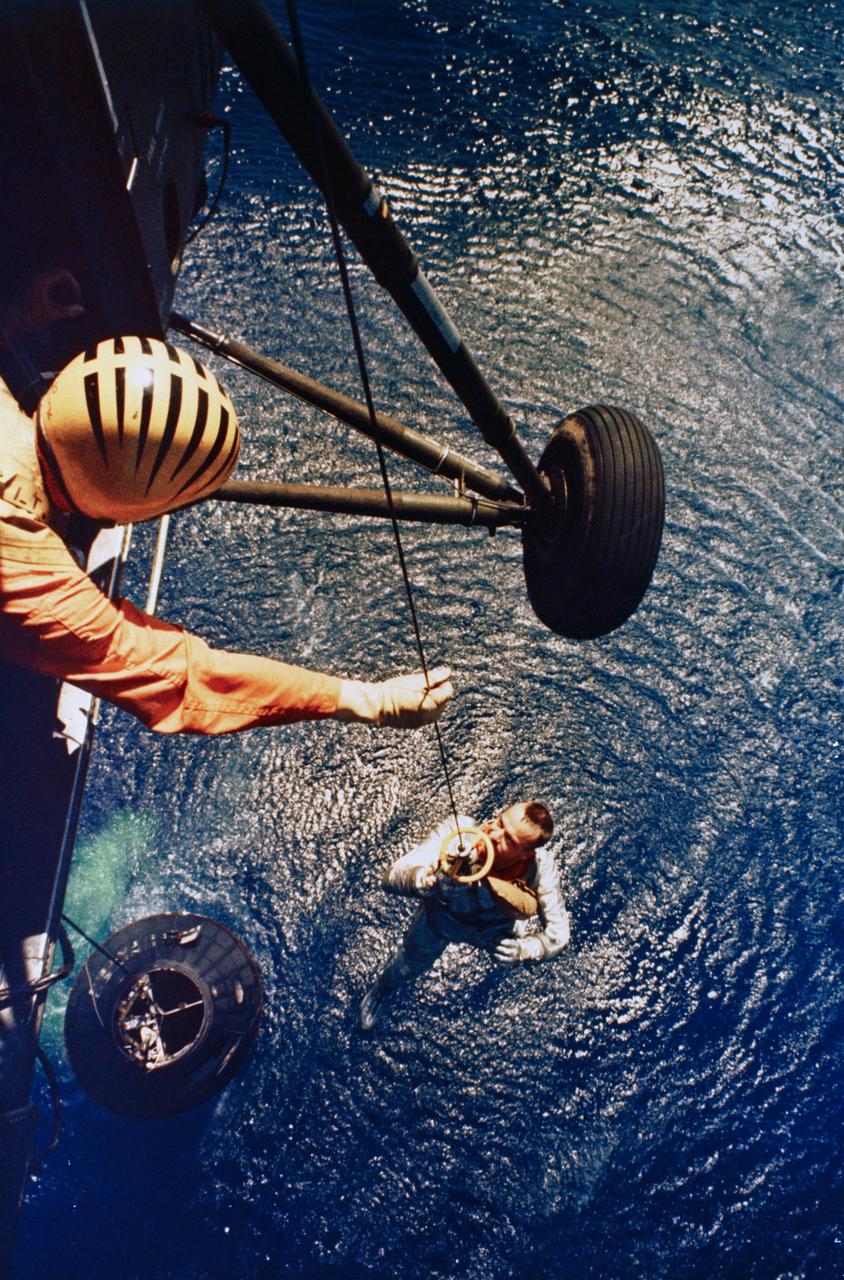
S88-31376 (5 May 1961) --- Astronaut Alan B. Shepard Jr., pilot of the Mercury-Redstone 3 (MR-3) suborbital spaceflight, is retrieved by a helicopter from the USS Lake Champlain during recovery operations in the western Atlantic Ocean. Shepard and the Mercury spacecraft designated the ?Freedom 7? (floating in water below) were flown to the deck of the recovery ship within 11 minutes of splashdown. MR-3 was the United States? first manned space mission. The spacecraft attained a maximum speed of 5,180 miles per hour, reached an altitude of 116 1/2 statute miles, and landed 302 statute miles downrange from Cape Canaveral, Florida. The suborbital mission lasted 15 minutes and 22 seconds. Photo credit: NASA or National Aeronautics and Space Administration
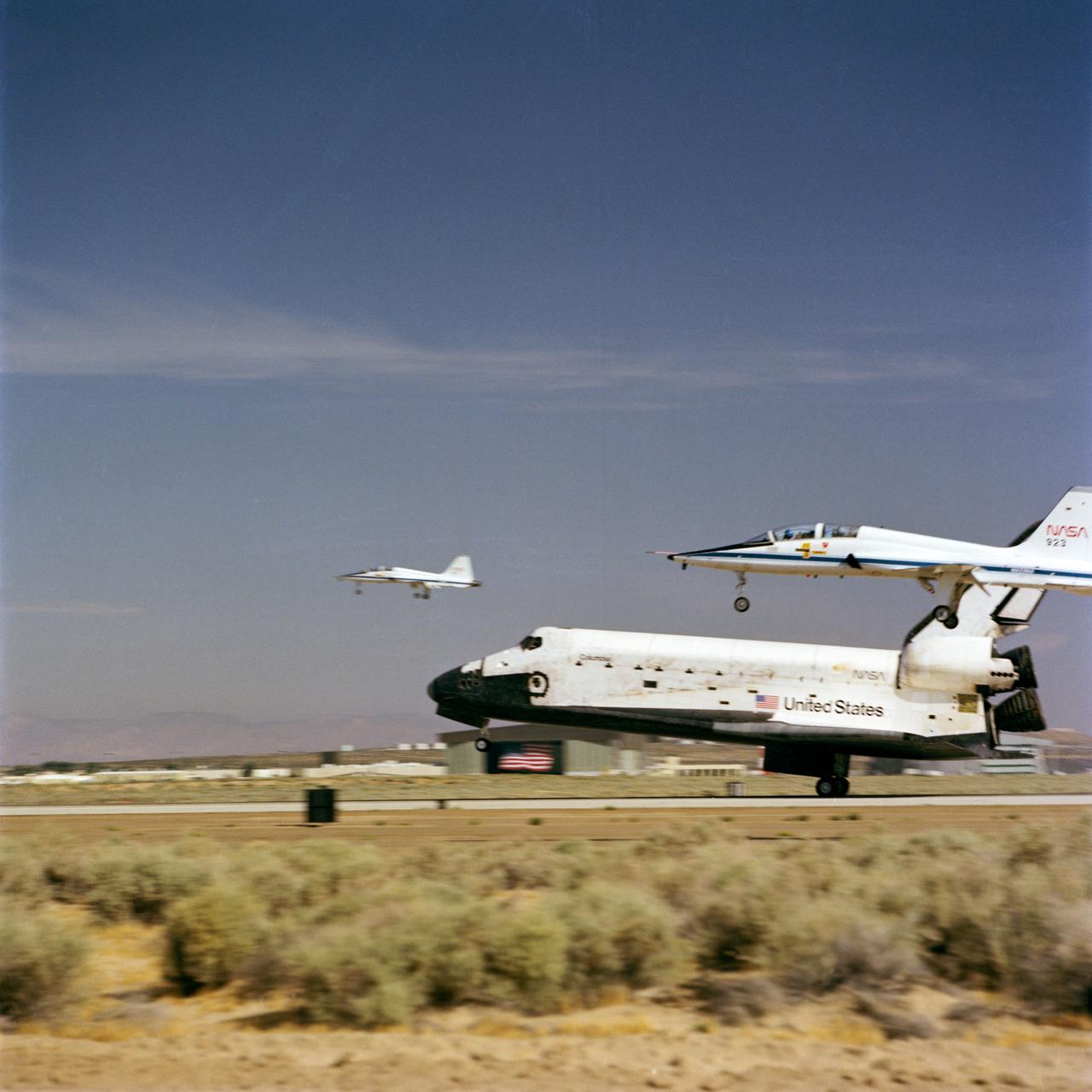
Views of the Columbia landing at EAFB ending the STS-4 Mission on 07/04/1982; of President and Mrs. Reagan greeting the crew out on the Lake bed Runway; and, the view of Roy Rogers with Astronauts Jerry Ross and Guy Gardner. 1. President Ronald Reagan & wife Nancy 2. Roy Rogers 3. Astronaut Jerry L. Ross 4. Astronaut Guy S. Gardner Edwards AFB, CA
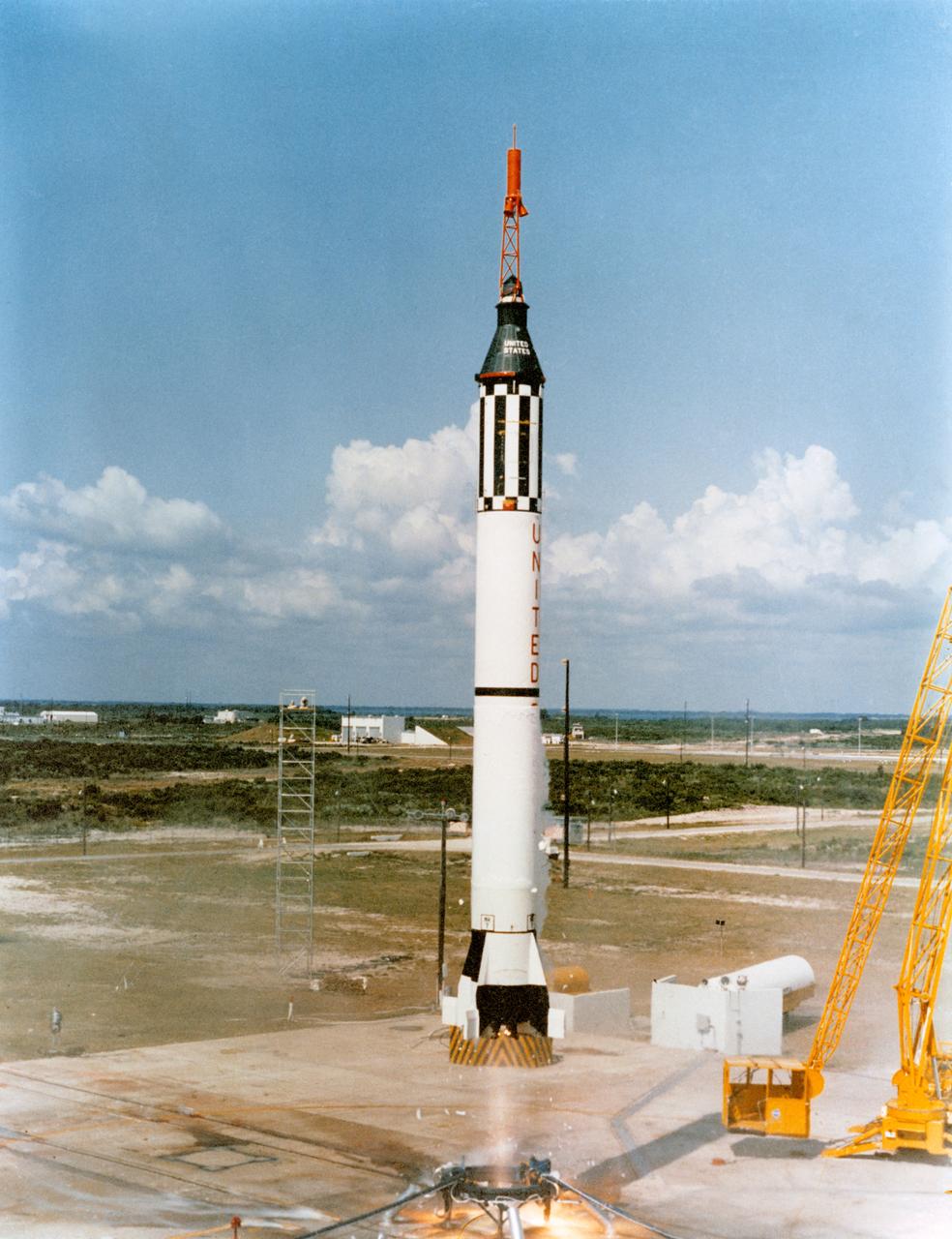
S61-01927 (5 May 1961) --- Mercury-Redstone 3 (MR-3), the United States' first manned spaceflight, is launched from Cape Canaveral on a suborbital mission. Astronaut Alan B. Shepard Jr. was the pilot of the Mercury spacecraft, designated "Freedom 7". The spacecraft attained a maximum speed of 5,180 miles per hour (mph), reached an altitude of 116 1/2 statute miles, and landed 302 statute miles downrange from Cape Canaveral, Florida. Photo credit: NASA or National Aeronautics and Space Administration
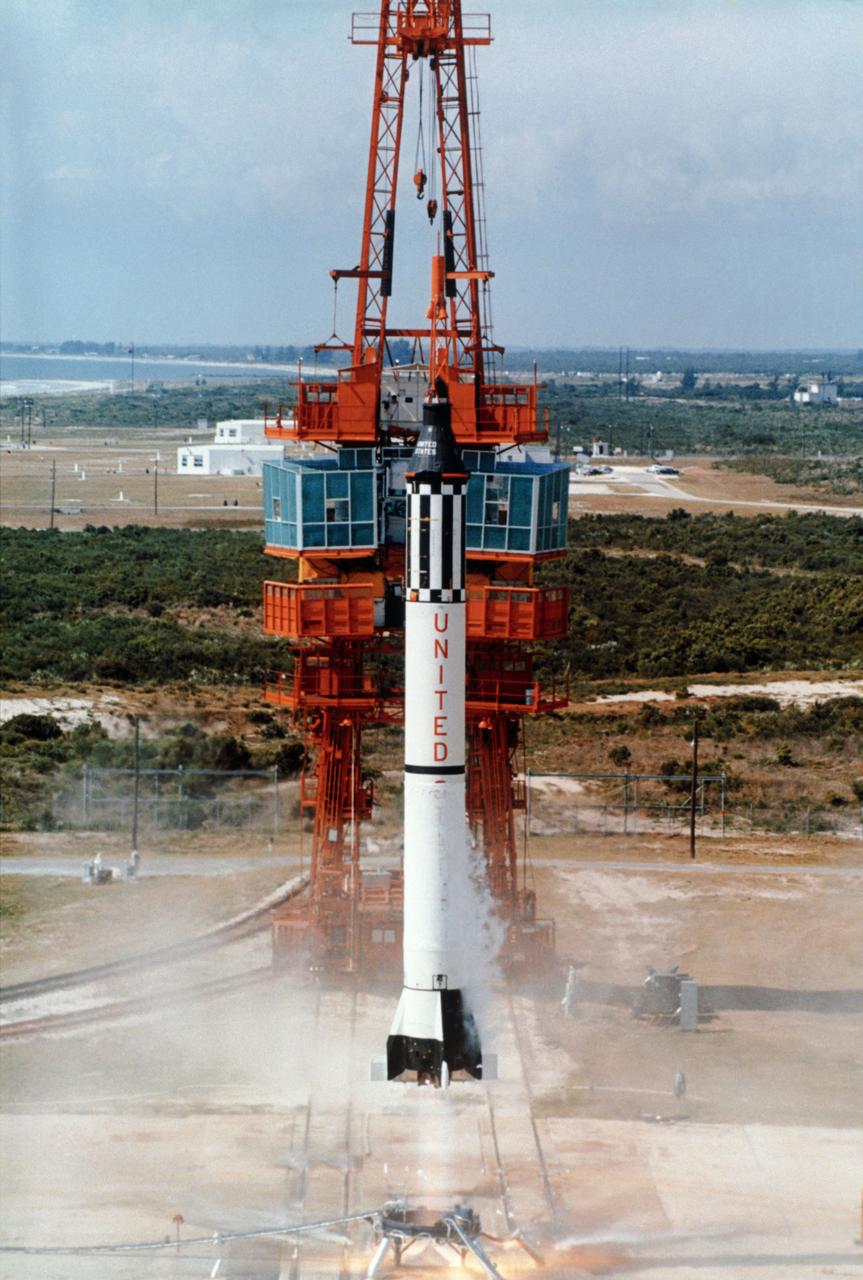
S61-01928 (5 May 1961) --- Mercury-Redstone 3 (MR-3), the United States' first manned spaceflight, is launched from Cape Canaveral on a suborbital mission. Astronaut Alan B. Shepard Jr. was the pilot of the Mercury spacecraft, designated "Freedom 7". The spacecraft attained a maximum speed of 5,180 miles per hour (mph), reached an altitude of 116 1/2 statute miles, and landed 302 statute miles downrange from Cape Canaveral, Florida. Photo credit: NASA or National Aeronautics and Space Administration
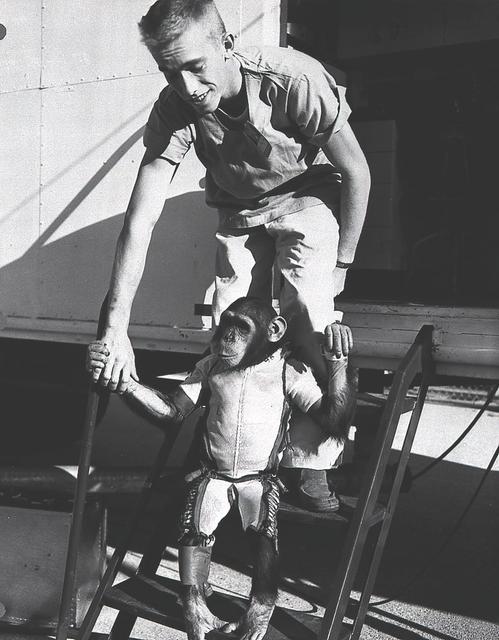
Ham, a three-year-old chimpanzee, in the spacesuit he would wear for the second Mercury- Redstone (MR-2) suborbital test flight in January, 1961. NASA used chimpanzees and other primates to test the Mercury capsule before launching the fisrt American astronaut, Alan Shepard, in May 1961. The Mercury capsule rode atop a modified Redstone rocket, developed by Dr. Wernher von Braun and the German Rocket Team in Huntsville, Alabama.
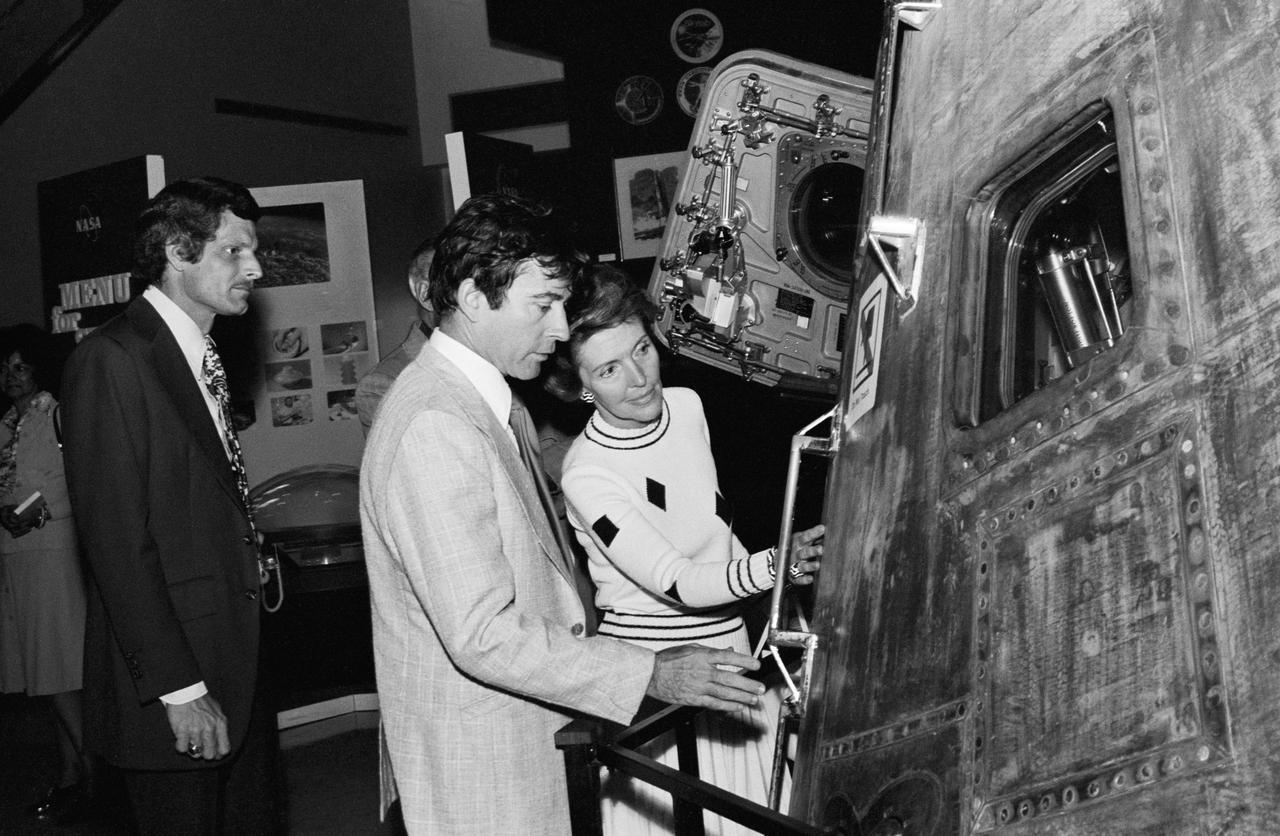
Nine views documenting JSC visit by Mrs. Ronald ( Nancy ) Reagan wife of the U.S, Presidential Candidate challenging the incumbent for Republican nomination. All views are in Building 2. She is seen in Building 2 exhibit area with Astronaut John W. Young in all views and with PAO Harold S. Stall in several. Stall, Young, Reagan at LTA-8 ( 25563 ); Young, Reagan at LRV ( 25564 ); Medium shot of Young, Reagan. ( 25565 ); Young, Reagan at command Module. (25566 ); Reagan, Young, Stall at Cm ( 25567 ); Young, Reagan at Shuttle exhibit. ( 25568 thru 25569 );

KENNEDY SPACE CENTER, FLA. - Mrs. Daniel R. Mulville shakes hands with Kent V. Rominger, Deputy Director of Flight Crew Operations, on the runway of the Shuttle Landing Facility following the landing of Endeavour. Mrs. Mulville is the wife of Dr. Daniel R. Mulville, NASA Associate Deputy Administrator. In the group, from left are KSC Director Roy D. Bridges; Mrs. Mulville; Dr. Mulville (back to camera); James D. Halsell Jr., Manager of Launch Integration at KSC, Space Shuttle Program; Rominger; and STS-113 Commander James Wetherbee. Commander Wetherbee earlier guided Space Shuttle Endeavour to a flawless touchdown on runway 33 at the Shuttle Landing Facility after completing the 13-day, 18-hour, 48-minute, 5.74-million mile STS-113 mission to the International Space Station. Main gear touchdown was at 2:37:12 p.m. EST, nose gear touchdown was at 2:37:23 p.m., and wheel stop was at 2:38:25 p.m. Poor weather conditions thwarted landing opportunities until a fourth day, the first time in Shuttle program history that a landing has been waved off for three consecutive days. The orbiter also carried the other members of the STS-113 crew, Pilot Paul Lockhart and Mission Specialists Michael Lopez-Alegria and John Herrington, as well as the returning Expedition Five crew, Commander Valeri Korzun, ISS Science Officer Peggy Whitson and Flight Engineer Sergei Treschev. The installation of the P1 truss on the International Space Station was accomplished during the mission.
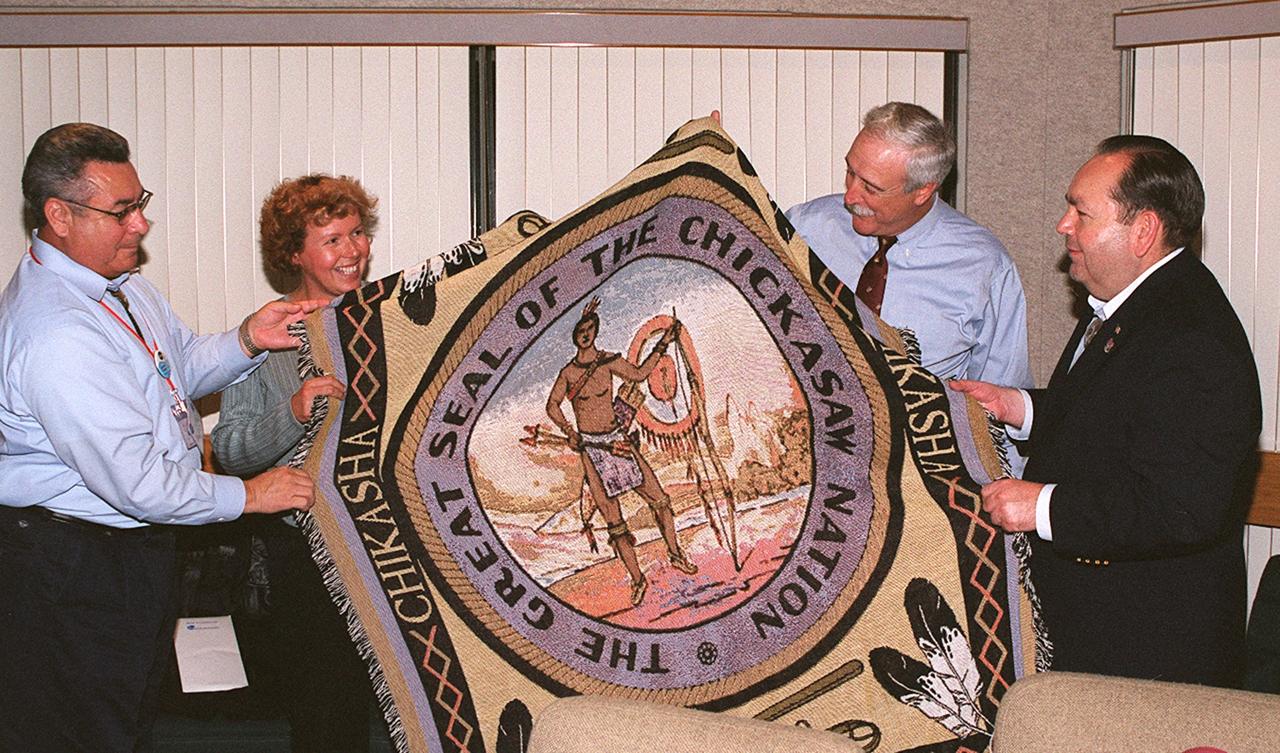
KENNEDY SPACE CENTER, FLA. -- During an administrator's briefing at the IMAX 2 theatre, Lt. Gov. Jefferson Keel of the Chickasaw Nation (far left) presents a blanket with the seal of the Chickasaw Nation to NASA Administrator Sean O'Keefe (second from right). Next to O'Keefe is Chickasaw Gov. Bill Anoatubby. Next to Gov. Keel is Mrs. Laura O'Keefe. STS-113 Mission Specialist John Herrington is a tribally enrolled Chickasaw and the world's first Native American astronaut. Kennedy Space Center hosted more than 350 Native Americans in STS-113 prelaunch events surrounding the historic mission assignment of Herrington.
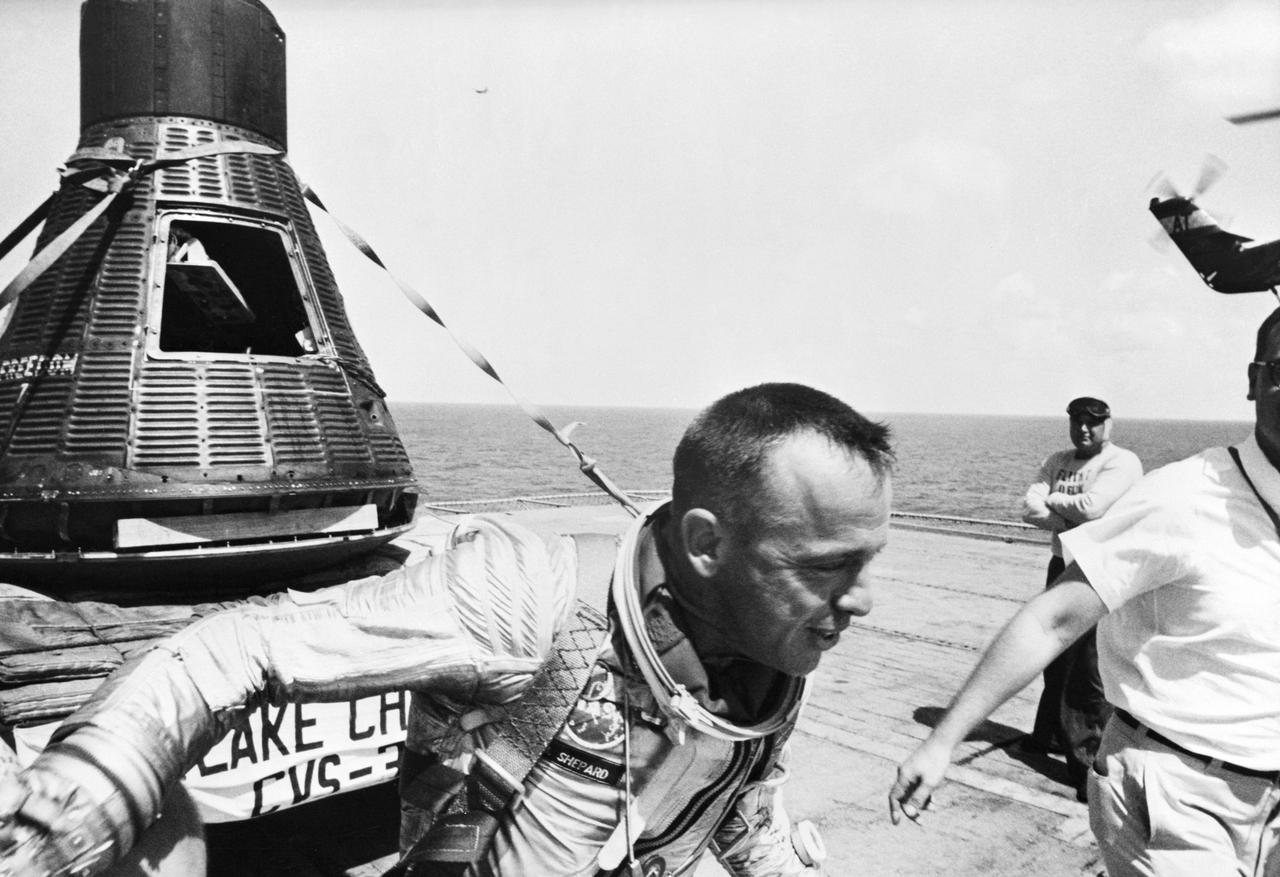
S61-02727 (5 May 1961) --- Astronaut Alan B. Shepard is seen on the deck of the USS Lake Champlain after the recovery of his Mercury capsule in the western Atlantic Ocean. Shepard and the Mercury spacecraft designated the ?Freedom 7? were flown to the deck of the recovery ship within 11 minutes of splashdown. MR-3 was the United States? first manned space mission. The spacecraft attained a maximum speed of 5,180 miles per hour, reached an altitude of 116 1/2 statute miles, and landed 302 statute miles downrange from Cape Canaveral, Florida. The suborbital mission lasted 15 minutes and 22 seconds. Photo credit: NASA or National Aeronautics and Space Administration
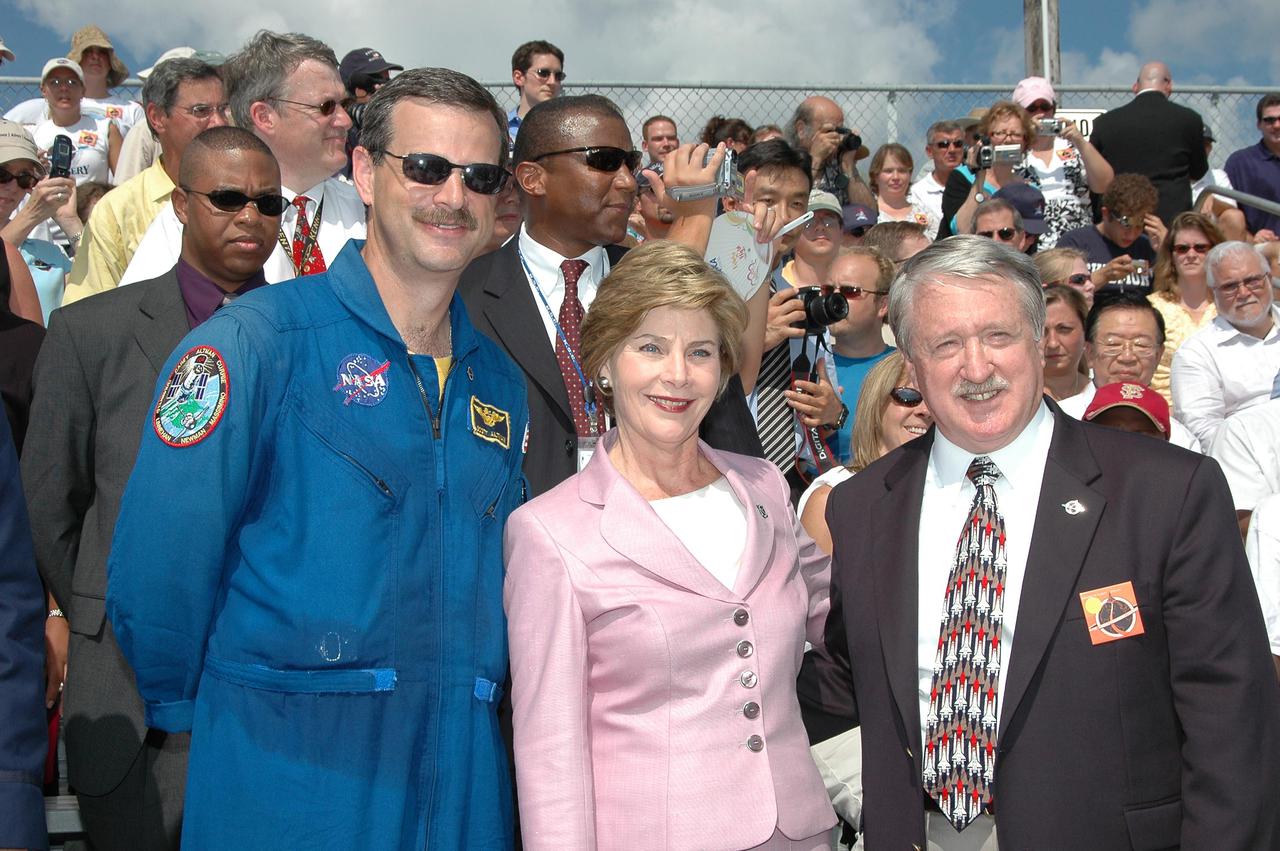
KENNEDY SPACE CENTER, FLA. - In the stands at NASA Kennedy Space Center’s Banana Creek viewing site, First Lady Laura Bush pauses for a photo with astronaut Scott Altmann and Michael O’Brien, assistant administrator for External Relations. Mrs. Bush and other guests are attending the launch of Space Shuttle Discovery on Return to Flight mission STS-114, scheduled to lift off at 10:39 a.m. EDT from Launch Pad 39B with a crew of seven. Mrs. Bush is only the third First Lady to witness a Space Shuttle launch at KSC. On this mission to the International Space Station the crew will perform inspections on-orbit for the first time of all of the Reinforced Carbon-Carbon (RCC) panels on the leading edge of the wings and the Thermal Protection System tiles using the new Canadian-built Orbiter Boom Sensor System and the data from 176 impact and temperature sensors. Mission Specialists will also practice repair techniques on RCC and tile samples during a spacewalk in the payload bay. During two additional spacewalks, the crew will install the External Stowage Platform-2, equipped with spare part assemblies, and a replacement Control Moment Gyroscope contained in the Lightweight Multi-Purpose Experiment Support Structure. The 12-day mission is expected to end with touchdown at the Shuttle Landing Facility on Aug. 7.
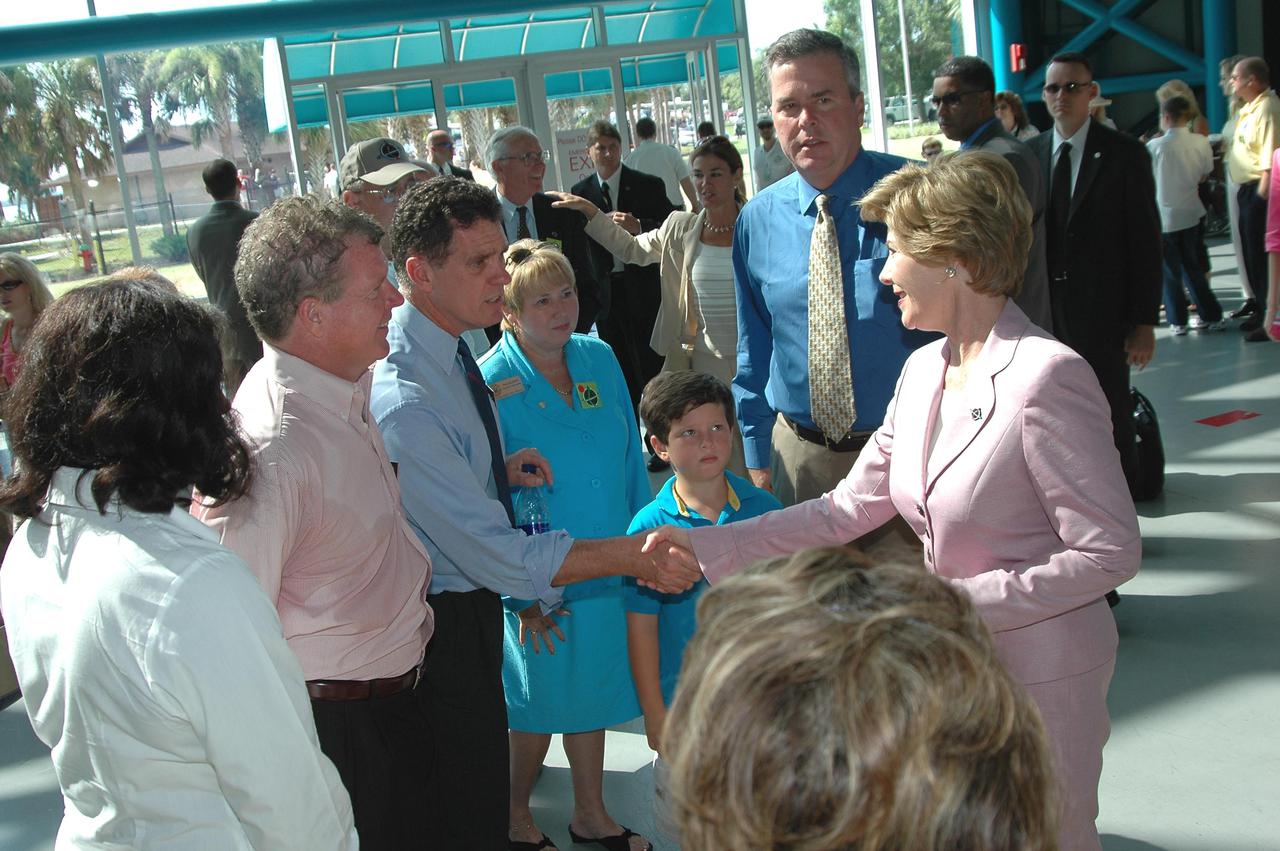
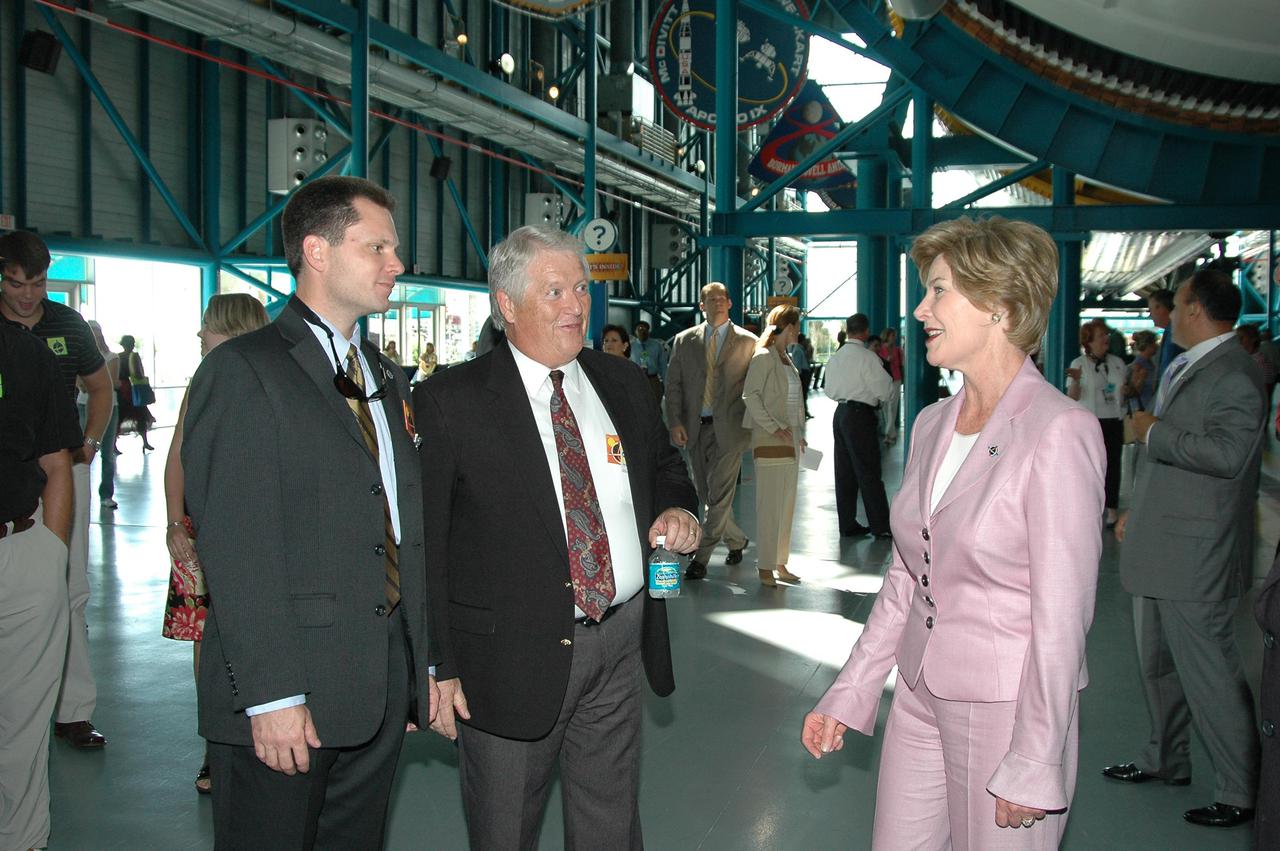
KENNEDY SPACE CENTER, FLA. - At NASA Kennedy Space Center’s Apollo_Saturn V Center, First Lady Laura Bush (right) greets Florida Congressman Dave Weldon (shaking hands) and Congressman Tom Feeney. They are attending the historic launch of Space Shuttle Discovery on Return to Flight mission STS-114, scheduled to lift off at 10:39 a.m. EDT from Launch Pad 39B with a crew of seven. Mrs. Bush is only the third First Lady to witness a Space Shuttle launch at KSC. Behind Mrs. Bush is Florida Gov. Jeb Bush. On this mission to the International Space Station the crew will perform inspections on-orbit for the first time of all of the Reinforced Carbon-Carbon (RCC) panels on the leading edge of the wings and the Thermal Protection System tiles using the new Canadian-built Orbiter Boom Sensor System and the data from 176 impact and temperature sensors. Mission Specialists will also practice repair techniques on RCC and tile samples during a spacewalk in the payload bay. During two additional spacewalks, the crew will install the External Stowage Platform-2, equipped with spare part assemblies, and a replacement Control Moment Gyroscope contained in the Lightweight Multi-Purpose Experiment Support Structure. The 12-day mission is expected to end with touchdown at the Shuttle Landing Facility on Aug. 7.
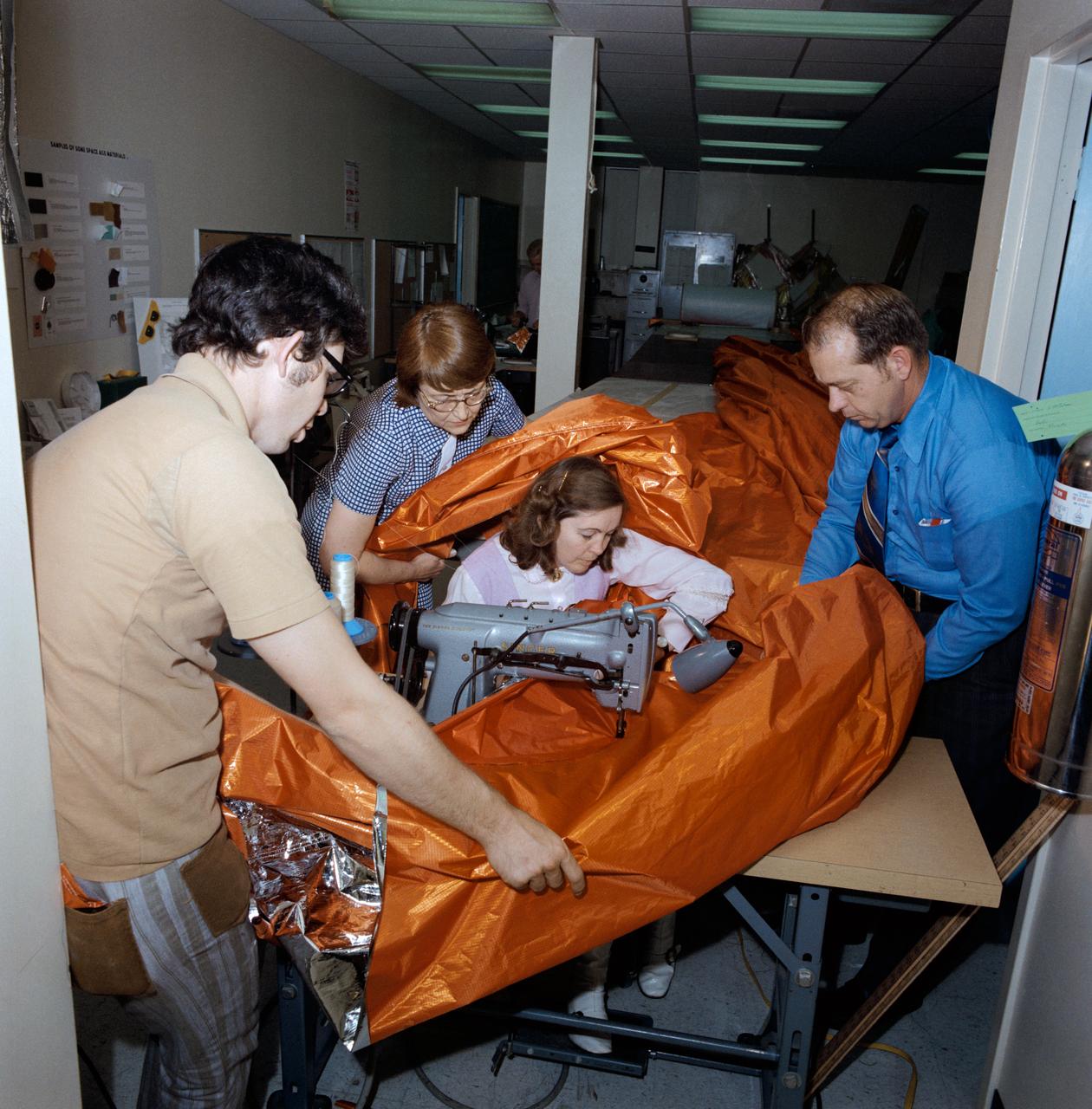
S73-26047 (18 May 1973) --- A sail-like sunshade for possible use as a sunscreen for the Skylab orbital workshop (OWS) is shown being fabricated in the GE Building across the street from the Johnson Space Center. Three persons assist the seamstress feed the material through the sewing machine. The three-layered shade will be composed of a top layer of aluminum Mylar, a middle layer of laminated nylon rip stop, and a bottom layer of thin nylon. Working on the sunshade, from left to right, are Dale Gentry, Elizabeth Gauldin, Alyene Baker and James H. Barnett Jr. Mrs. Baker, a GE employee, operates the double-needle sewing machine. Barnett is head of the Crew Equipment Development Section of JSC's Crew Systems Division. Mrs. Gauldin is also with the Crew Systems Division. Gentry works for GE. The work shown here is part of the crash program underway to prepare a protection device for Skylab to replace the original shield which was lost when the unmanned Skylab 1 launch took place on May 14, 1973. The improvised solar shield selected to be used will be carried to Earth orbit by the Skylab 2 crew, who will deploy it to shade part of the OWS from the hot rays of the sun. Loss of the original shield, as expected, has caused an overheating problem on the OWS. Photo credit: NASA
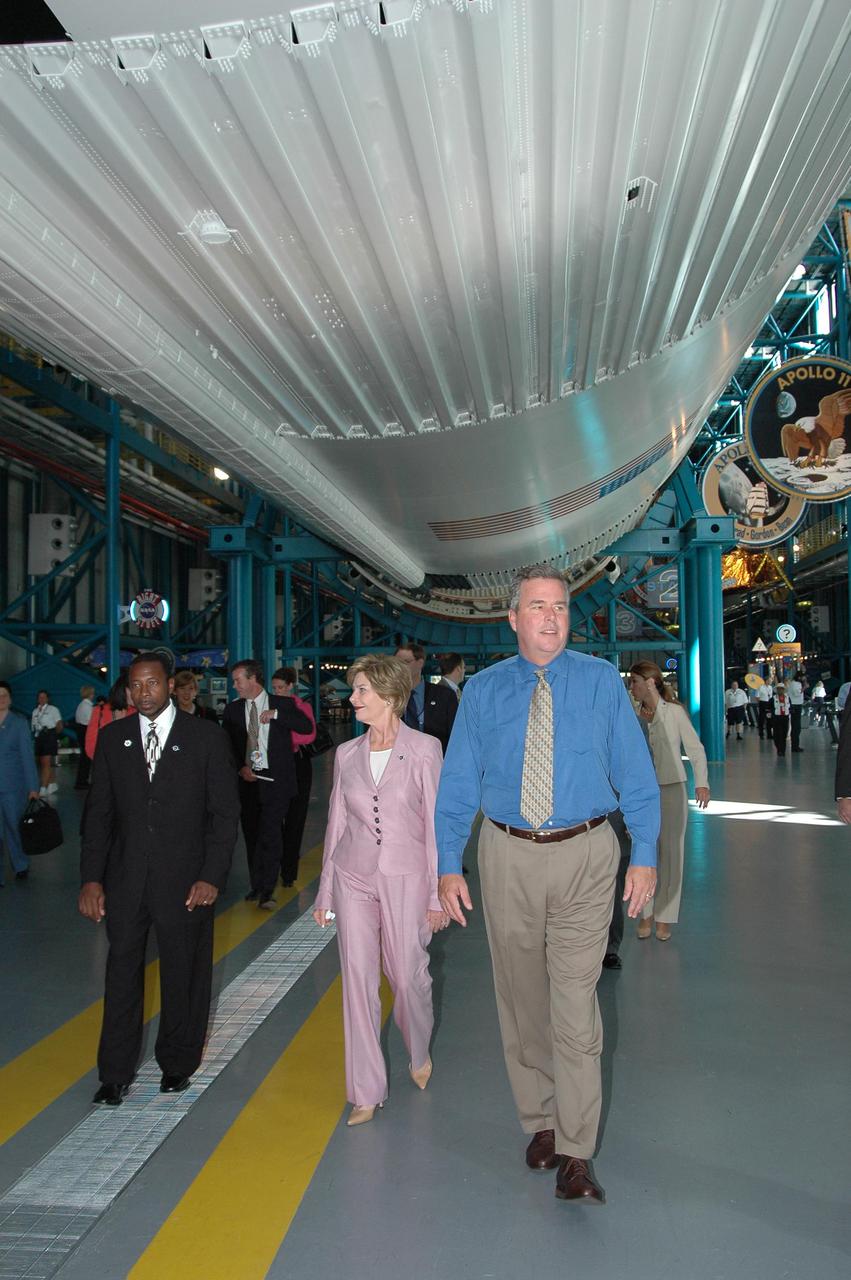
KENNEDY SPACE CENTER, FLA. - At the Apollo V_Saturn Center, First Lady Laura Bush and Florida Gov. Jeb Bush stroll under the massive rocket suspended above. At left is KSC Deputy Director Woodrow Whitlow Jr. Mrs. Bush and the governor are attending the historic launch of Space Shuttle Discovery on Return to Flight mission STS-114, scheduled to lift off at 10:39 a.m. EDT from Launch Pad 39B with a crew of seven. Mrs. Bush is only the third First Lady to witness a Space Shuttle launch at KSC. On this mission to the International Space Station the crew will perform inspections on-orbit for the first time of all of the Reinforced Carbon-Carbon (RCC) panels on the leading edge of the wings and the Thermal Protection System tiles using the new Canadian-built Orbiter Boom Sensor System and the data from 176 impact and temperature sensors. Mission Specialists will also practice repair techniques on RCC and tile samples during a spacewalk in the payload bay. During two additional spacewalks, the crew will install the External Stowage Platform-2, equipped with spare part assemblies, and a replacement Control Moment Gyroscope contained in the Lightweight Multi-Purpose Experiment Support Structure. The 12-day mission is expected to end with touchdown at the Shuttle Landing Facility on Aug. 7.
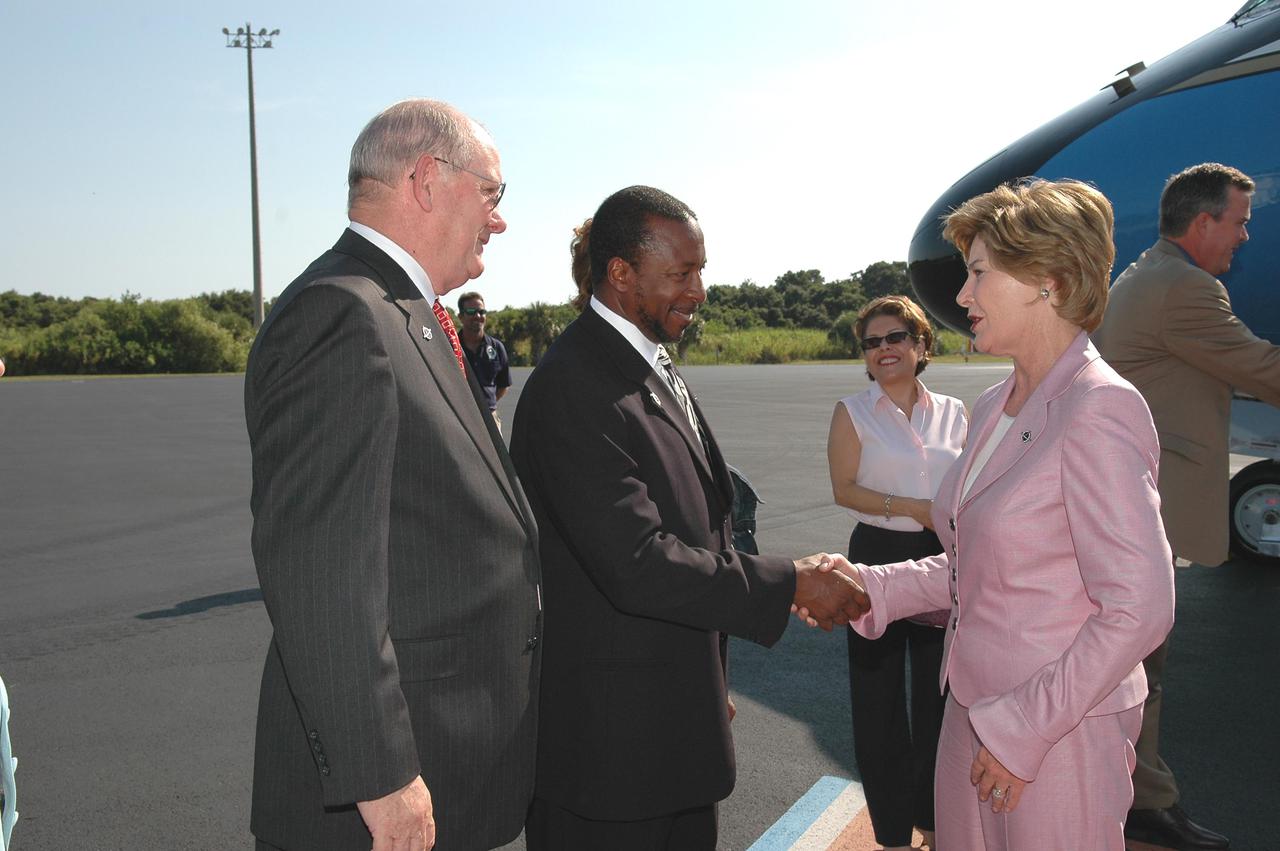
KENNEDY SPACE CENTER, FLA. - After arriving at the Skid Strip on Cape Canaveral Air Force Station, First Lady Laura Bush is welcomed by Jim Hattaway (left), associate director at NASA Kennedy Space Center, and Woodrow Whitlow Jr., deputy director at KSC. Mrs. Bush is attending the historic launch of Space Shuttle Discovery on Return to Flight mission STS-114, scheduled to lift off at 10:39 a.m. EDT from Launch Pad 39B with a crew of seven. Mrs. Bush is only the third First Lady to witness a Space Shuttle launch at KSC. On this mission to the International Space Station the crew will perform inspections on-orbit for the first time of all of the Reinforced Carbon-Carbon (RCC) panels on the leading edge of the wings and the Thermal Protection System tiles using the new Canadian-built Orbiter Boom Sensor System and the data from 176 impact and temperature sensors. Mission Specialists will also practice repair techniques on RCC and tile samples during a spacewalk in the payload bay. During two additional spacewalks, the crew will install the External Stowage Platform-2, equipped with spare part assemblies, and a replacement Control Moment Gyroscope contained in the Lightweight Multi-Purpose Experiment Support Structure. The 12-day mission is expected to end with touchdown at the Shuttle Landing Facility on Aug. 7.
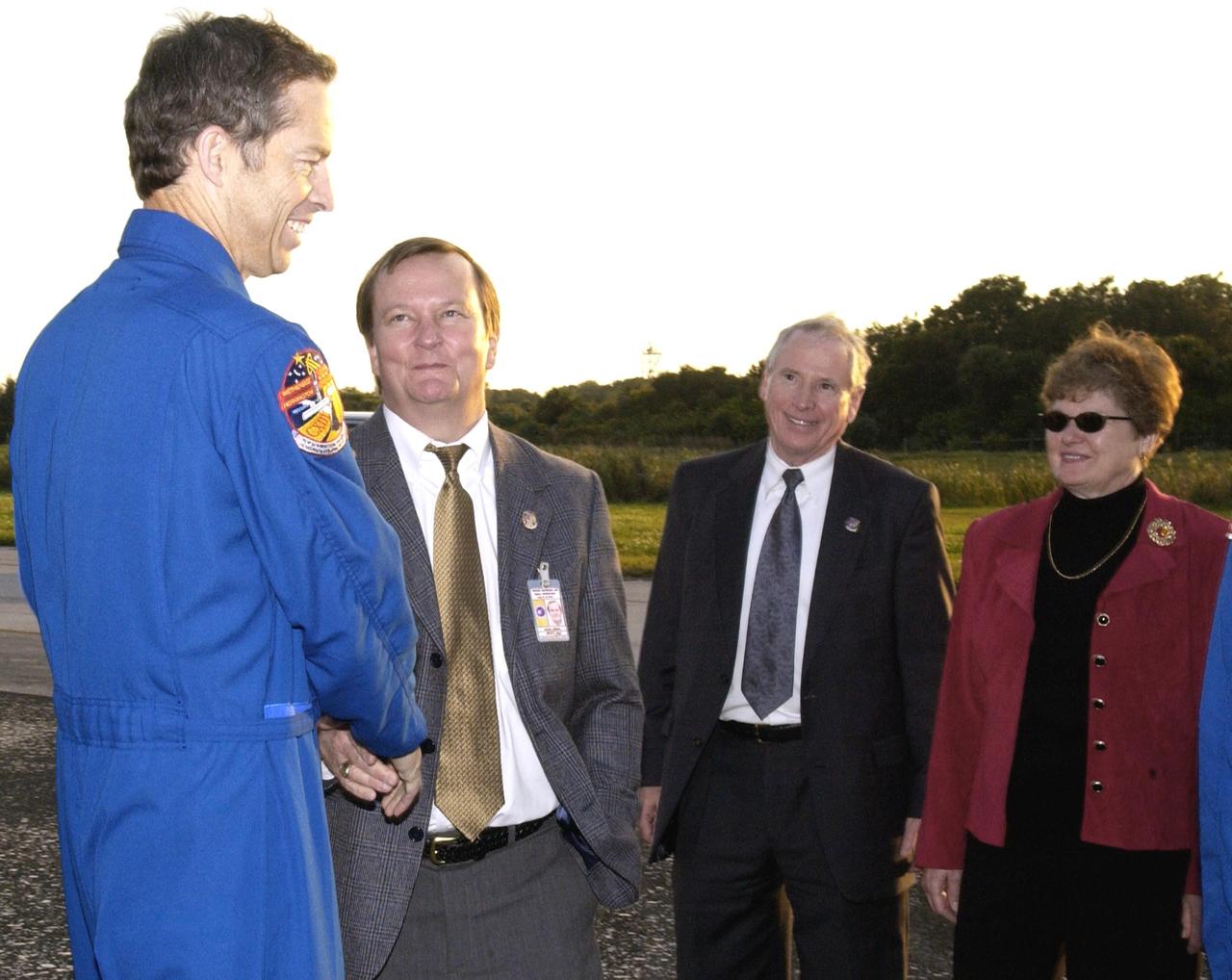
KENNEDY SPACE CENTER, FLA. - STS-113 Commander James Wetherbee shakes hands with Michael D. Leinbach, Shuttle Launch Director at KSC, on the runway of the Shuttle Landing Facility following the landing of Endeavour. From left are Wetherbee, Leinbach, Dr. Daniel R. Mulville, NASA Associate Deputy Administrator, and Mrs. Mulville. Commander Wetherbee earlier guided Space Shuttle Endeavour to a flawless touchdown on runway 33 at the Shuttle Landing Facility after completing the 13-day, 18-hour, 48-minute, 5.74-million mile STS-113 mission to the International Space Station. Main gear touchdown was at 2:37:12 p.m. EST, nose gear touchdown was at 2:37:23 p.m., and wheel stop was at 2:38:25 p.m. Poor weather conditions thwarted landing opportunities until a fourth day, the first time in Shuttle program history that a landing has been waved off for three consecutive days. The orbiter also carried the other members of the STS-113 crew, Pilot Paul Lockhart and Mission Specialists Michael Lopez-Alegria and John Herrington, as well as the returning Expedition Five crew, Commander Valeri Korzun, ISS Science Officer Peggy Whitson and Flight Engineer Sergei Treschev. The installation of the P1 truss on the International Space Station was accomplished during the mission.
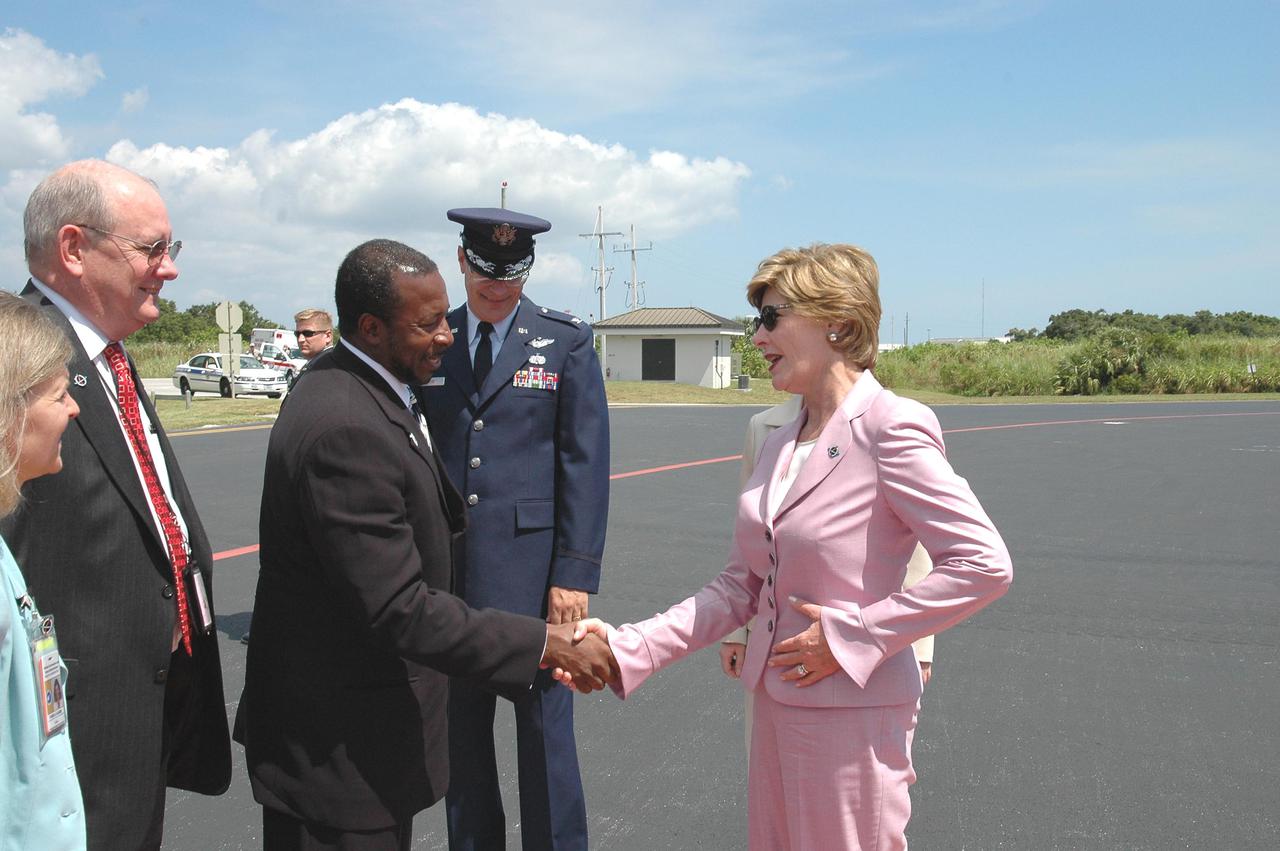
KENNEDY SPACE CENTER, FLA. - At the Skid Strip on Cape Canaveral Air Force Station, First Lady Laura Bush says farewell to KSC Deputy Director Woodrow Whitlow Jr. At left is Associate Director Jim Hattaway. Mrs. Bush witnessed the historic launch of Space Shuttle Discovery on Return to Flight mission STS-114. She is only the third First Lady to witness a Space Shuttle launch at KSC. On this mission to the International Space Station the crew will perform inspections on-orbit for the first time of all of the Reinforced Carbon-Carbon (RCC) panels on the leading edge of the wings and the Thermal Protection System tiles using the new Canadian-built Orbiter Boom Sensor System and the data from 176 impact and temperature sensors. Mission Specialists will also practice repair techniques on RCC and tile samples during a spacewalk in the payload bay. During two additional spacewalks, the crew will install the External Stowage Platform-2, equipped with spare part assemblies, and a replacement Control Moment Gyroscope contained in the Lightweight Multi-Purpose Experiment Support Structure. The 12-day mission is expected to end with touchdown at the Shuttle Landing Facility on Aug. 7.
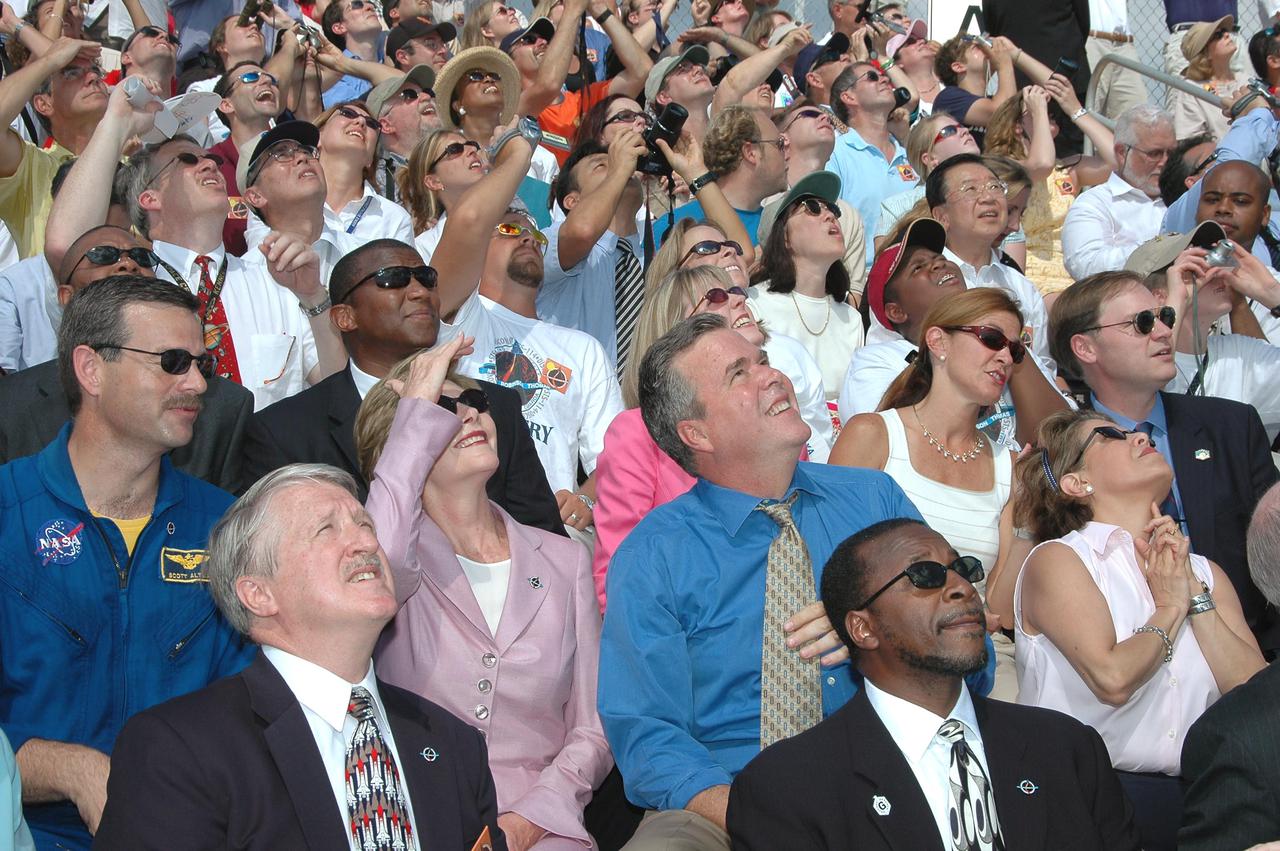
KENNEDY SPACE CENTER, FLA. - In the stands at NASA Kennedy Space Center’s Banana Creek viewing site, First Lady Laura Bush and other guests follow path of Space Shuttle Discovery as it successfully launches on Return to Flight mission STS-114 at 10:39 a.m. EDT from Launch Pad 39B. At right of Mrs. Bush is Florida Gov. Jeb Bush. KSC Deputy Director Woodrow Whitlow Jr. is in front of the governor. On this mission to the International Space Station the crew will perform inspections on-orbit for the first time of all of the Reinforced Carbon-Carbon (RCC) panels on the leading edge of the wings and the Thermal Protection System tiles using the new Canadian-built Orbiter Boom Sensor System and the data from 176 impact and temperature sensors. Mission Specialists will also practice repair techniques on RCC and tile samples during a spacewalk in the payload bay. During two additional spacewalks, the crew will install the External Stowage Platform-2, equipped with spare part assemblies, and a replacement Control Moment Gyroscope contained in the Lightweight Multi-Purpose Experiment Support Structure. The 12-day mission is expected to end with touchdown at the Shuttle Landing Facility on Aug. 7.
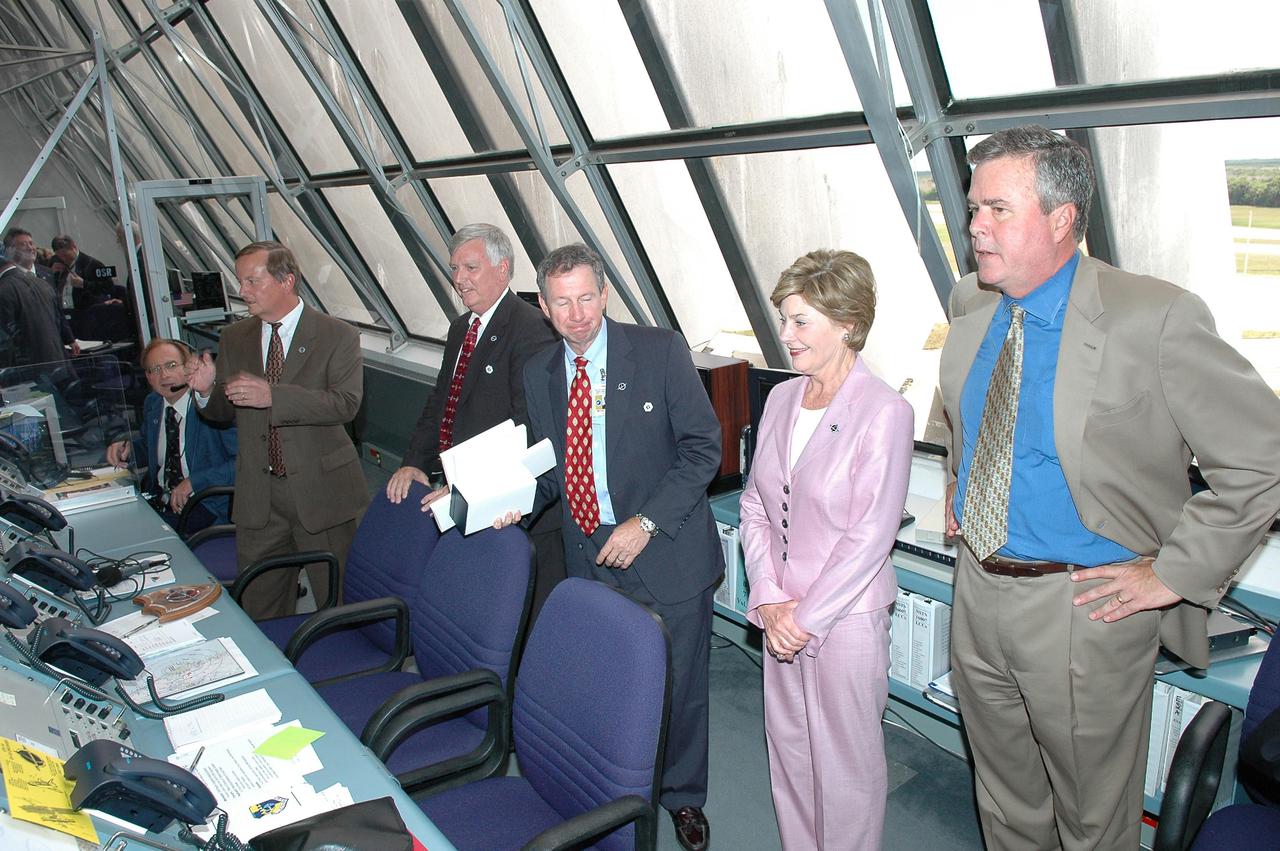
KENNEDY SPACE CENTER, FLA. - In the Launch Control Center at NASA Kennedy Space Center, First Lady Laura Bush congratulates NASA officials for a successful launch of Space Shuttle Discovery on Return to Flight mission STS-114. From left are NASA launch commentator George Diller, Shuttle Launch Director Mike Leinbach, Center Director Jim Kennedy, NASA Administrator Mike Griffin, Mrs. Bush and Florida Gov. Jeb Bush. On this mission to the International Space Station the crew will perform inspections on-orbit for the first time of all of the Reinforced Carbon-Carbon (RCC) panels on the leading edge of the wings and the Thermal Protection System tiles using the new Canadian-built Orbiter Boom Sensor System and the data from 176 impact and temperature sensors. Mission Specialists will also practice repair techniques on RCC and tile samples during a spacewalk in the payload bay. During two additional spacewalks, the crew will install the External Stowage Platform-2, equipped with spare part assemblies, and a replacement Control Moment Gyroscope contained in the Lightweight Multi-Purpose Experiment Support Structure. The 12-day mission is expected to end with touchdown at the Shuttle Landing Facility on Aug. 7.
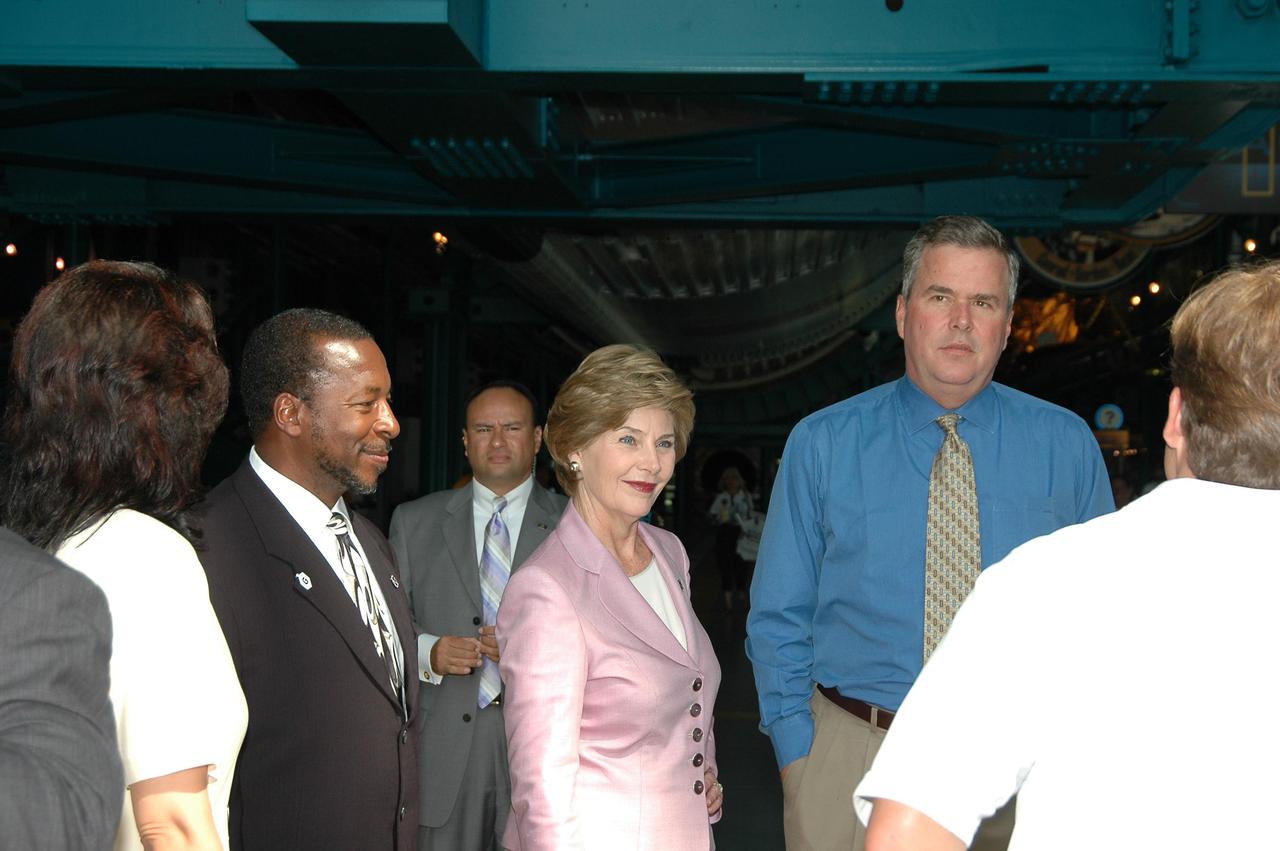
KENNEDY SPACE CENTER, FLA. - At the NASA Kennedy Space Center’s Apollo_SaturnV Center, First Lady Laura Bush and Florida Gov. Jeb Bush (right) greet other guests attending the launch of Space Shuttle Discovery on Return to Flight mission STS-114, scheduled to lift off at 10:39 a.m. EDT from Launch Pad 39B with a crew of seven. At left is KSC Deputy Director Woodrow Whitlow Jr. Mrs. Bush is only the third First Lady to witness a Space Shuttle launch at KSC. On this mission to the International Space Station the crew will perform inspections on-orbit for the first time of all of the Reinforced Carbon-Carbon (RCC) panels on the leading edge of the wings and the Thermal Protection System tiles using the new Canadian-built Orbiter Boom Sensor System and the data from 176 impact and temperature sensors. Mission Specialists will also practice repair techniques on RCC and tile samples during a spacewalk in the payload bay. During two additional spacewalks, the crew will install the External Stowage Platform-2, equipped with spare part assemblies, and a replacement Control Moment Gyroscope contained in the Lightweight Multi-Purpose Experiment Support Structure. The 12-day mission is expected to end with touchdown at the Shuttle Landing Facility on Aug. 7.
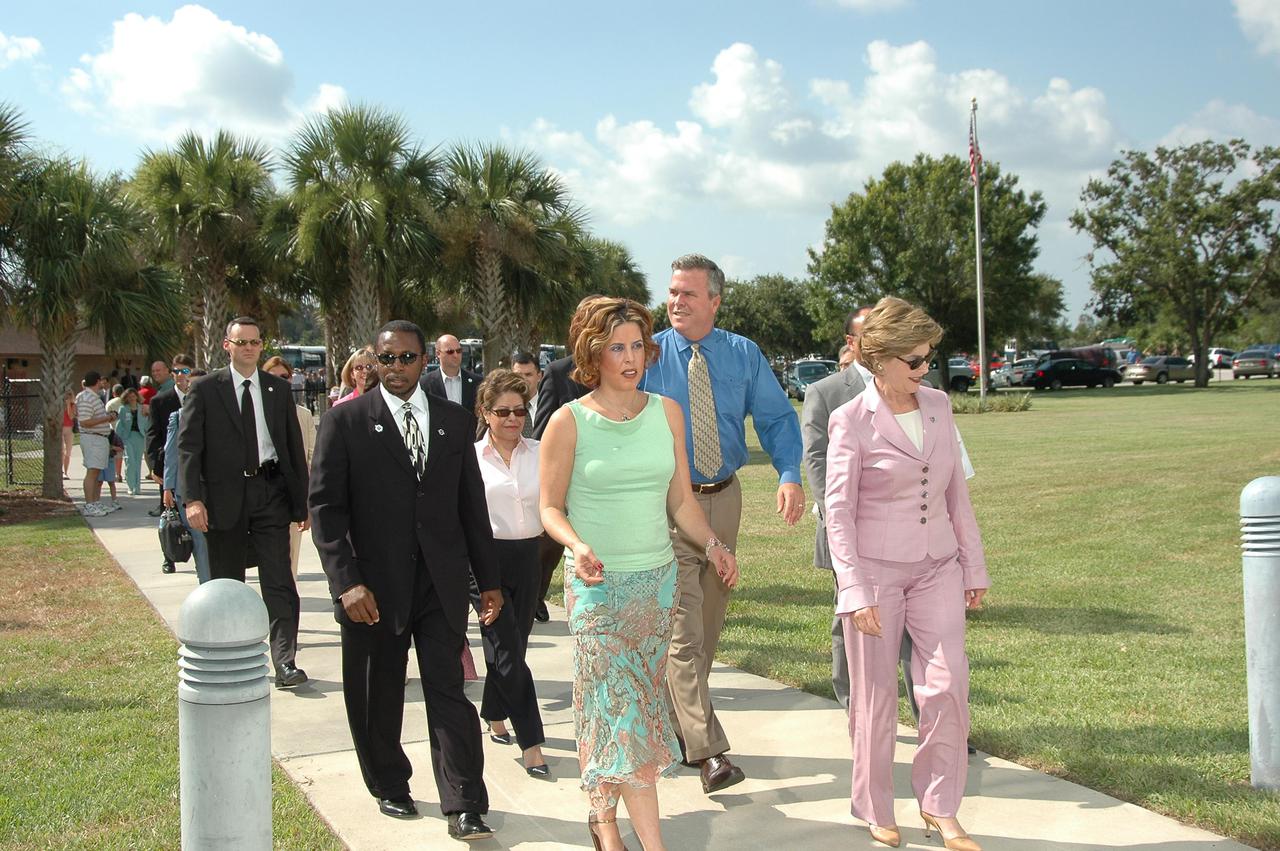
KENNEDY SPACE CENTER, FLA. - KSC Deputy Director Woodrow Whitlow Jr. (left) escorts distinguished guests to the VIP viewing site at NASA Kennedy Space Center. First Lady Laura Bush is in front (right) with Noelle Bush, the daughter of Florida Gov. Jeb Bush and Columba Bush behind her. They are attending the historic launch of Space Shuttle Discovery on Return to Flight mission STS-114, scheduled to lift off at 10:39 a.m. EDT from Launch Pad 39B with a crew of seven. Mrs. Bush is only the third First Lady to witness a Space Shuttle launch at KSC. On this mission to the International Space Station the crew will perform inspections on-orbit for the first time of all of the Reinforced Carbon-Carbon (RCC) panels on the leading edge of the wings and the Thermal Protection System tiles using the new Canadian-built Orbiter Boom Sensor System and the data from 176 impact and temperature sensors. Mission Specialists will also practice repair techniques on RCC and tile samples during a spacewalk in the payload bay. During two additional spacewalks, the crew will install the External Stowage Platform-2, equipped with spare part assemblies, and a replacement Control Moment Gyroscope contained in the Lightweight Multi-Purpose Experiment Support Structure. The 12-day mission is expected to end with touchdown at the Shuttle Landing Facility on Aug. 7.
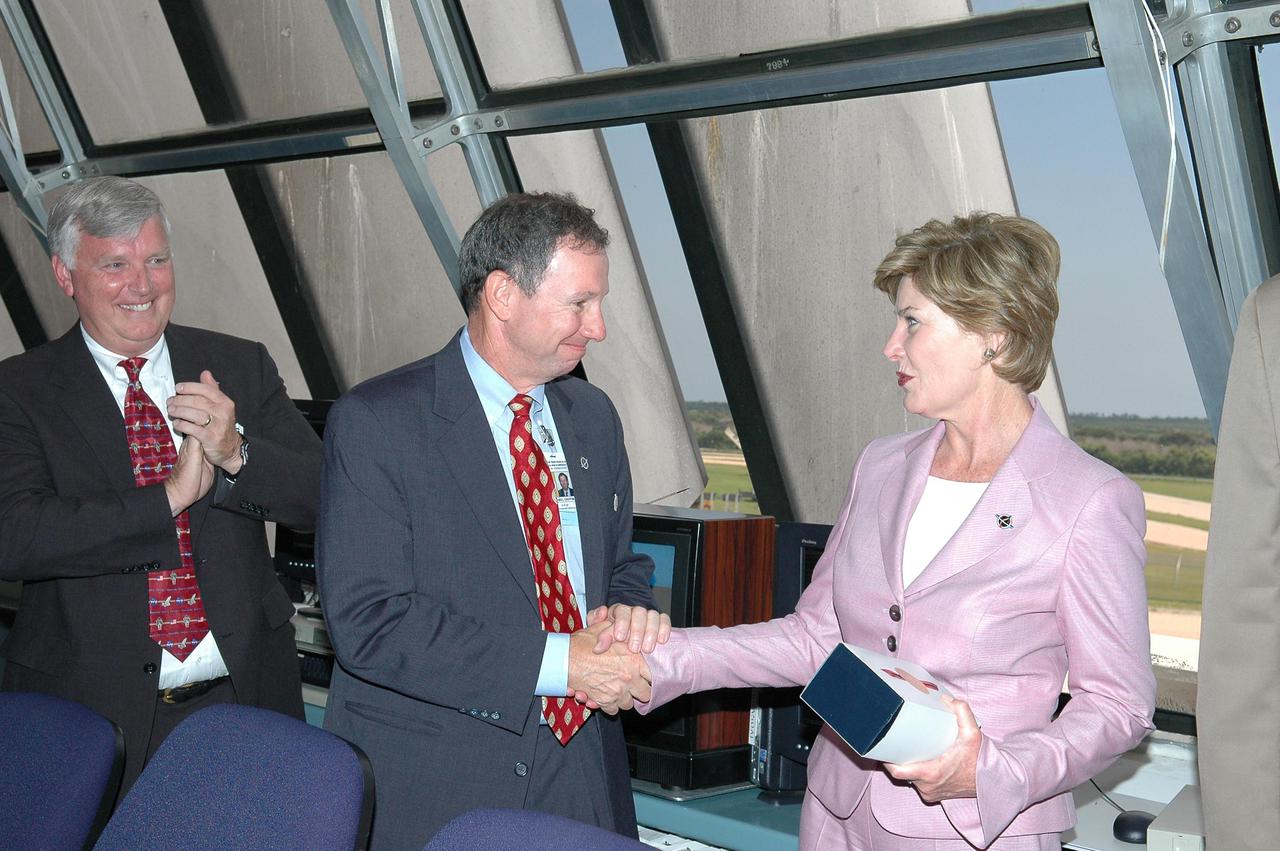
KENNEDY SPACE CENTER, FLA. - In the Launch Control Center at NASA Kennedy Space Center, First Lady Laura Bush thanks NASA Administrator for his hospitality. At far left is Center Director Jim Kennedy. Mrs. Bush witnessed the historic launch of Space Shuttle Discovery on Return to Flight mission STS-114. She is only the third First Lady to witness a Space Shuttle launch at KSC.On this mission to the International Space Station the crew will perform inspections on-orbit for the first time of all of the Reinforced Carbon-Carbon (RCC) panels on the leading edge of the wings and the Thermal Protection System tiles using the new Canadian-built Orbiter Boom Sensor System and the data from 176 impact and temperature sensors. Mission Specialists will also practice repair techniques on RCC and tile samples during a spacewalk in the payload bay. During two additional spacewalks, the crew will install the External Stowage Platform-2, equipped with spare part assemblies, and a replacement Control Moment Gyroscope contained in the Lightweight Multi-Purpose Experiment Support Structure. The 12-day mission is expected to end with touchdown at the Shuttle Landing Facility on Aug. 7.
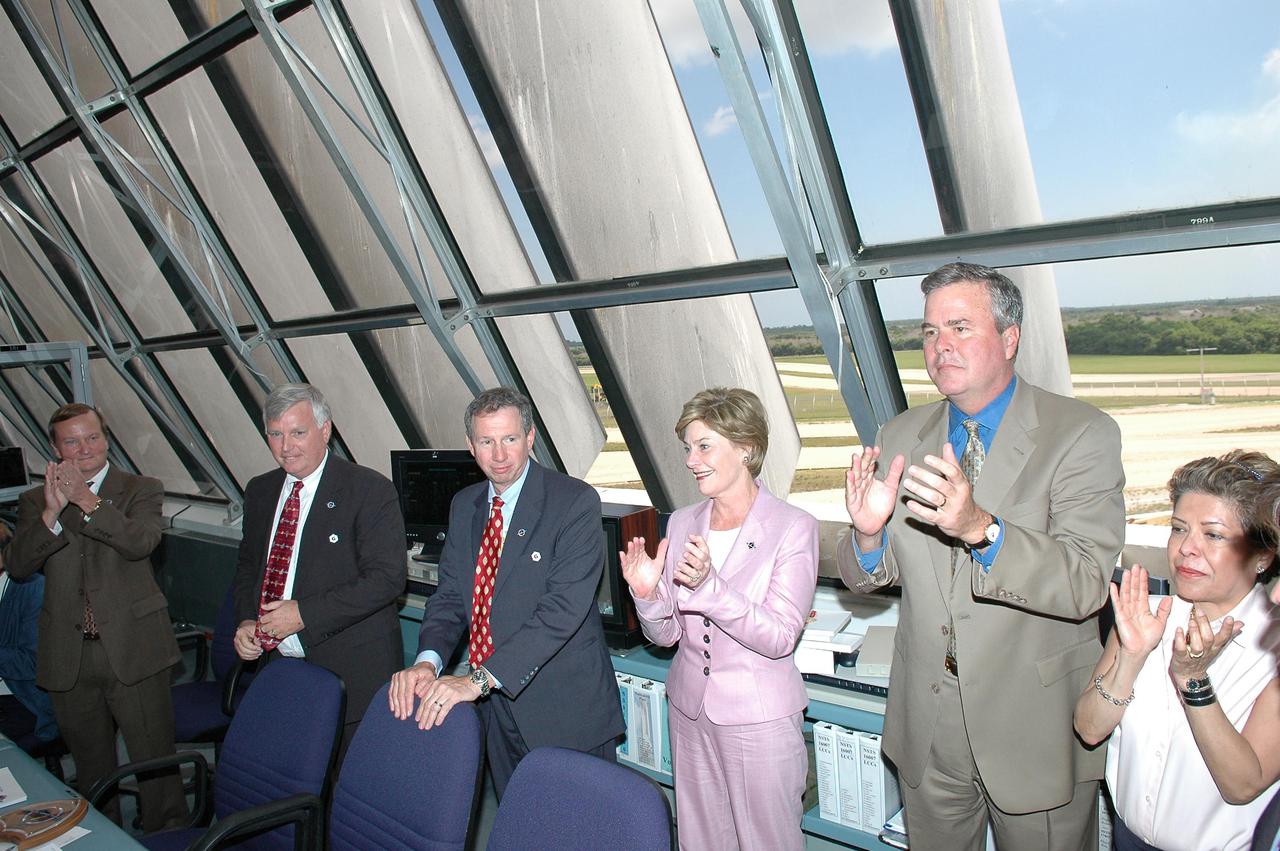
KENNEDY SPACE CENTER, FLA. - In the Launch Control Center at NASA Kennedy Space Center, First Lady Laura Bush congratulates the launch team for a successful launch of Space Shuttle Discovery on Return to Flight mission STS-114. From left are Shuttle Launch Director Mike Leinbach, Center Director Jim Kennedy, NASA Administrator Mike Griffin, Mrs. Bush, Florida Gov. Jeb Bush and his wife, Columba. On this mission to the International Space Station the crew will perform inspections on-orbit for the first time of all of the Reinforced Carbon-Carbon (RCC) panels on the leading edge of the wings and the Thermal Protection System tiles using the new Canadian-built Orbiter Boom Sensor System and the data from 176 impact and temperature sensors. Mission Specialists will also practice repair techniques on RCC and tile samples during a spacewalk in the payload bay. During two additional spacewalks, the crew will install the External Stowage Platform-2, equipped with spare part assemblies, and a replacement Control Moment Gyroscope contained in the Lightweight Multi-Purpose Experiment Support Structure. The 12-day mission is expected to end with touchdown at the Shuttle Landing Facility on Aug. 7.
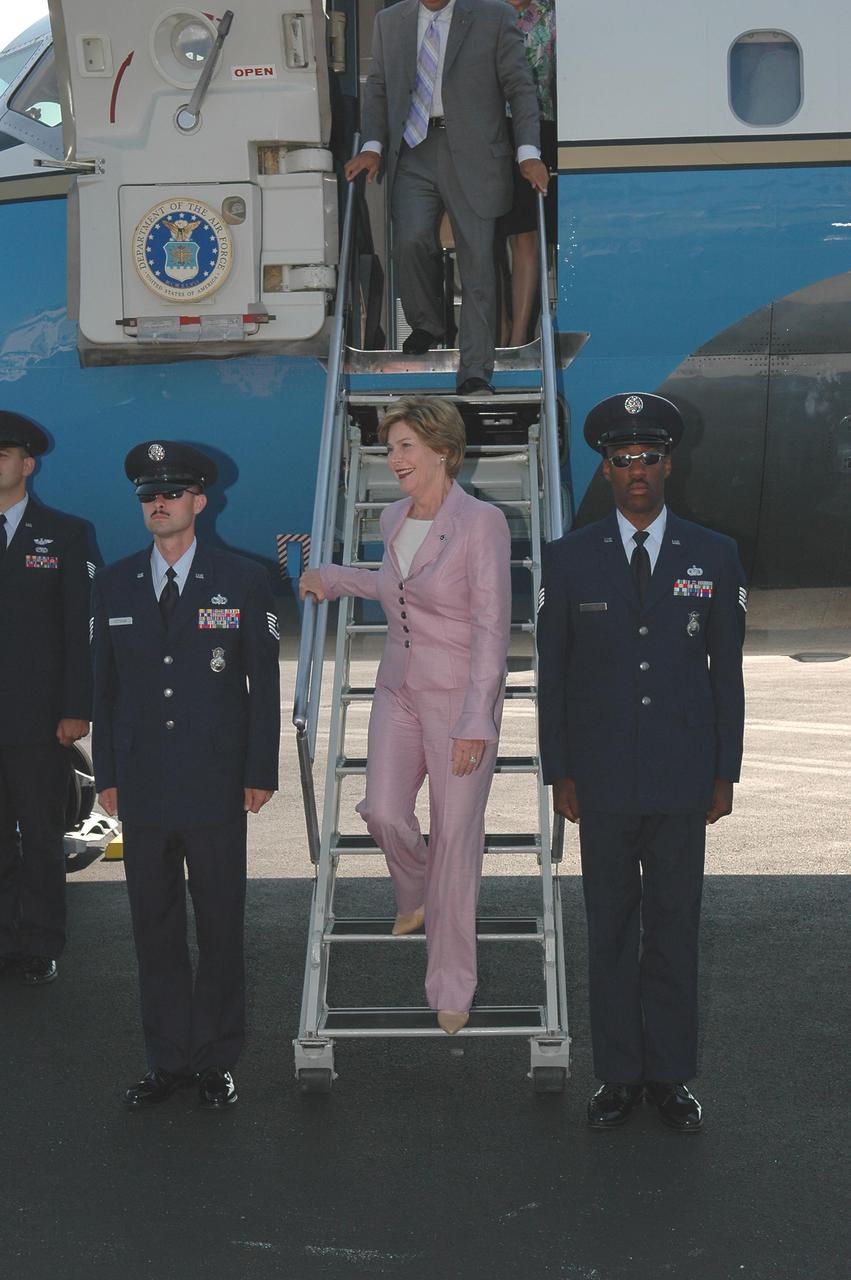
KENNEDY SPACE CENTER, FLA. - Arriving at the Skid Strip on Cape Canaveral Air Force Station is First Lady Laura Bush, who is attending the historic launch of Space Shuttle Discovery on Return to Flight mission STS-114, scheduled to lift off at 10:39 a.m. EDT from Launch Pad 39B with a crew of seven. Mrs. Bush is only the third First Lady to witness a Space Shuttle launch at KSC. On this mission to the International Space Station the crew will perform inspections on-orbit for the first time of all of the Reinforced Carbon-Carbon (RCC) panels on the leading edge of the wings and the Thermal Protection System tiles using the new Canadian-built Orbiter Boom Sensor System and the data from 176 impact and temperature sensors. Mission Specialists will also practice repair techniques on RCC and tile samples during a spacewalk in the payload bay. During two additional spacewalks, the crew will install the External Stowage Platform-2, equipped with spare part assemblies, and a replacement Control Moment Gyroscope contained in the Lightweight Multi-Purpose Experiment Support Structure. The 12-day mission is expected to end with touchdown at the Shuttle Landing Facility on Aug. 7.
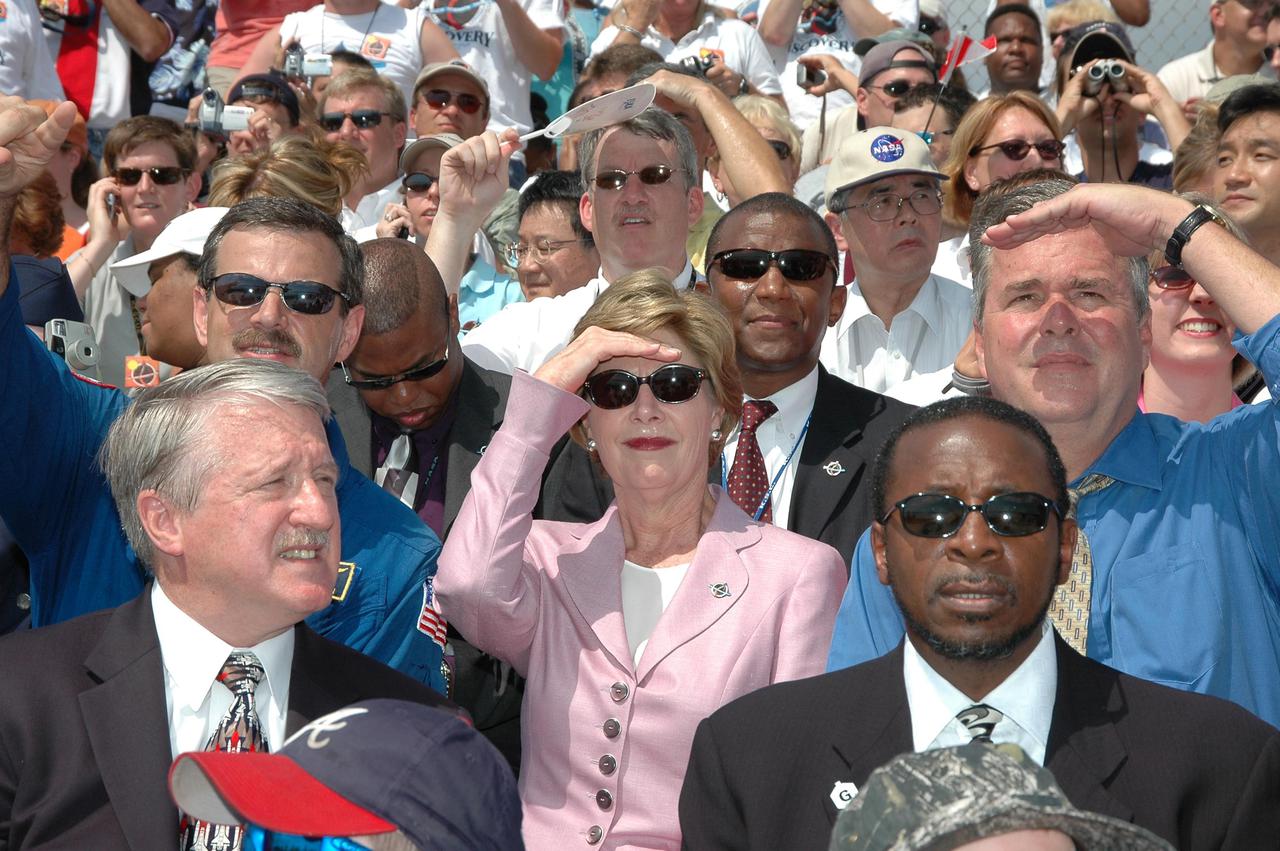
KENNEDY SPACE CENTER, FLA. - In the stands at NASA Kennedy Space Center’s Banana Creek viewing site, First Lady Laura Bush (center) watches Launch Pad 39B for the liftoff of Space Shuttle Discovery on Return to Flight mission STS-114, scheduled to lift off at 10:39 a.m. EDT. She is flanked by astronaut Scott Altmann at left and Florida Gov. Jeb Bush at right. In front of her are Michael O’Brien (left), assistant administrator for External Relations, and Woodrow Whitlow Jr. (right), KSC deputy director. Mrs. Bush is only the third First Lady to witness a Space Shuttle launch at KSC. On this mission to the International Space Station the crew will perform inspections on-orbit for the first time of all of the Reinforced Carbon-Carbon (RCC) panels on the leading edge of the wings and the Thermal Protection System tiles using the new Canadian-built Orbiter Boom Sensor System and the data from 176 impact and temperature sensors. Mission Specialists will also practice repair techniques on RCC and tile samples during a spacewalk in the payload bay. During two additional spacewalks, the crew will install the External Stowage Platform-2, equipped with spare part assemblies, and a replacement Control Moment Gyroscope contained in the Lightweight Multi-Purpose Experiment Support Structure. The 12-day mission is expected to end with touchdown at the Shuttle Landing Facility on Aug. 7.
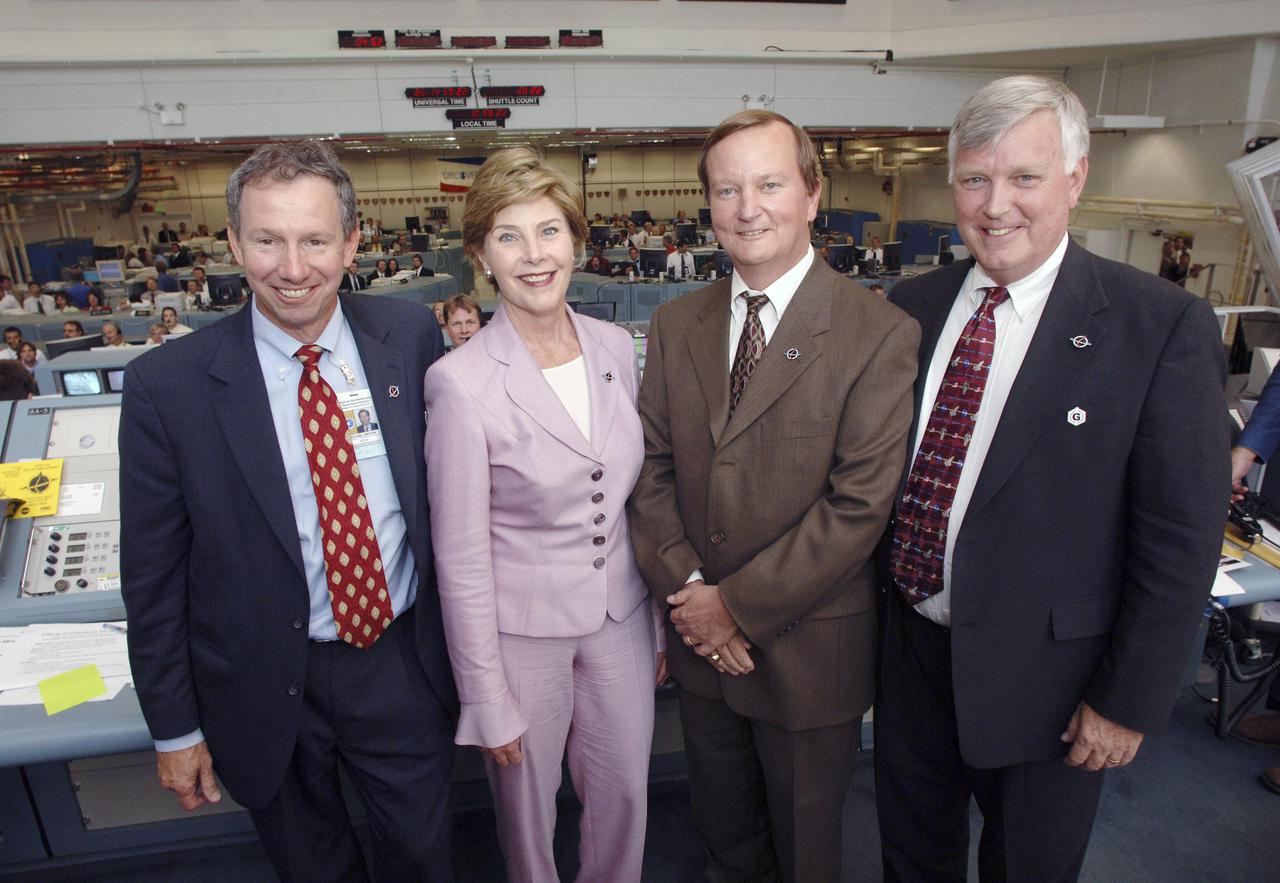
KENNEDY SPACE CENTER, FLA. - In the Launch Control Center at NASA Kennedy Space Center, NASA Administrator Mike Griffin, First Lady Laura Bush, Shuttle Launch Director Mike Leinbach and Center Director Jim Kennedy pose for a photograph. Mrs. Bush witnessed the historic launch of Space Shuttle Discovery on Return to Flight mission STS-114. She is only the third First Lady to witness a Space Shuttle launch at KSC. On this mission to the International Space Station the crew will perform inspections on-orbit for the first time of all of the Reinforced Carbon-Carbon (RCC) panels on the leading edge of the wings and the Thermal Protection System tiles using the new Canadian-built Orbiter Boom Sensor System and the data from 176 impact and temperature sensors. Mission Specialists will also practice repair techniques on RCC and tile samples during a spacewalk in the payload bay. During two additional spacewalks, the crew will install the External Stowage Platform-2, equipped with spare part assemblies, and a replacement Control Moment Gyroscope contained in the Lightweight Multi-Purpose Experiment Support Structure. The 12-day mission is expected to end with touchdown at the Shuttle Landing Facility on Aug. 7. (Photo Credit: Bill Ingalls)
KENNEDY SPACE CENTER, FLA. - At NASA Kennedy Space Center’s Apollo V_Saturn Center, First Lady Laura Bush (right) greets Scott Thurston (far left), NASA vehicle manager, and Tom Overton, vehicle integration manager. They are attending the historic launch of Space Shuttle Discovery on Return to Flight mission STS-114, scheduled to lift off at 10:39 a.m. EDT from Launch Pad 39B with a crew of seven. Mrs. Bush is only the third First Lady to witness a Space Shuttle launch at KSC. On this mission to the International Space Station the crew will perform inspections on-orbit for the first time of all of the Reinforced Carbon-Carbon (RCC) panels on the leading edge of the wings and the Thermal Protection System tiles using the new Canadian-built Orbiter Boom Sensor System and the data from 176 impact and temperature sensors. Mission Specialists will also practice repair techniques on RCC and tile samples during a spacewalk in the payload bay. During two additional spacewalks, the crew will install the External Stowage Platform-2, equipped with spare part assemblies, and a replacement Control Moment Gyroscope contained in the Lightweight Multi-Purpose Experiment Support Structure. The 12-day mission is expected to end with touchdown at the Shuttle Landing Facility on Aug. 7.

This image from NASA's James Webb Space Telescope reveals at least 17 concentric dust rings emanating from a pair of stars orbiting one another. Located just over 5,000 light-years from Earth, the system is known as Wolf-Rayet 140 because one of the stars is a Wolf-Rayet star. The other is an O-type star, one of the most massive star types known. Each ring was created when the two stars came close together and their stellar winds (streams of gas they blow into space) collided, compressing the gas and forming dust. A ring is produced once per orbit, every 7.93 years. A Wolf-Rayet star is an O-type star born with at least 25 times more mass than our Sun that is nearing the end of its life, when it will likely collapse directly to black hole, or explode as a supernova. These delays between periods of dust production create the unique ring pattern. Some Wolf-Rayet binaries in which the stars are close enough together and have circular orbits produce dust continuously, often forming a pinwheel pattern. WR 140's rings are also referred to as shells because they are not perfectly circular and are thicker and wider than they appear in the image. The rings appear brighter in some areas but are almost invisible in others, rather than forming a perfect "bullseye" pattern. That's because production of dust is variable as the stars get close to one another, and because Webb views the system at an angle and is not looking directly at the orbital plane of the stars. One of the densest regions of dust production creates the bright feature appearing at 2 o'clock. The image was taken by the Mid-Infrared Instrument (MIRI), now managed by the agency's Goddard Space Flight Center. MIRI was developed through a 50-50 partnership between NASA and ESA (European Space Agency). The Jet Propulsion Laboratory in Southern California led the effort for NASA, and a multinational consortium of European astronomical institutes contributed for ESA. Webb's science instruments detect infrared light, a range of wavelengths emitted by warm objects and invisible to the human eye. MIRI detects the longest infrared wavelengths, which means it can often see cooler objects – including these dust rings – than the other three Webb instruments can. The filters used to take this image were the F770W (7.7 micrometers, shown as blue), F1500W (15 micrometers, shown as green), and F2100W (21 micrometers, shown as red). The observations were done under Webb's early release observation (ERO) program number 1349. The most common element found in stars, hydrogen, can't form dust on its own. But Wolf-Rayet stars in their later stages have blown away all of their hydrogen, so they eject elements typically found deep in a star's interior, like carbon, which can form dust. Data from MIRI's Medium Resolution Spectrometer (MRS) shows that the dust made by WR 140 is likely made of a class of molecules called polycyclic aromatic hydrocarbons (PAHs), which are a type of organic carbon-rich compounds that are thought to enrich the carbon content throughout the Universe. Initial processing of the Webb WR 140 data included eight bright "spikes" of light emanating from the center of the image. These are not features of the system, but so-called artifacts of the telescope itself. They were removed from the image, in order to give viewers an unobscured view of the source object. https://photojournal.jpl.nasa.gov/catalog/PIA25432