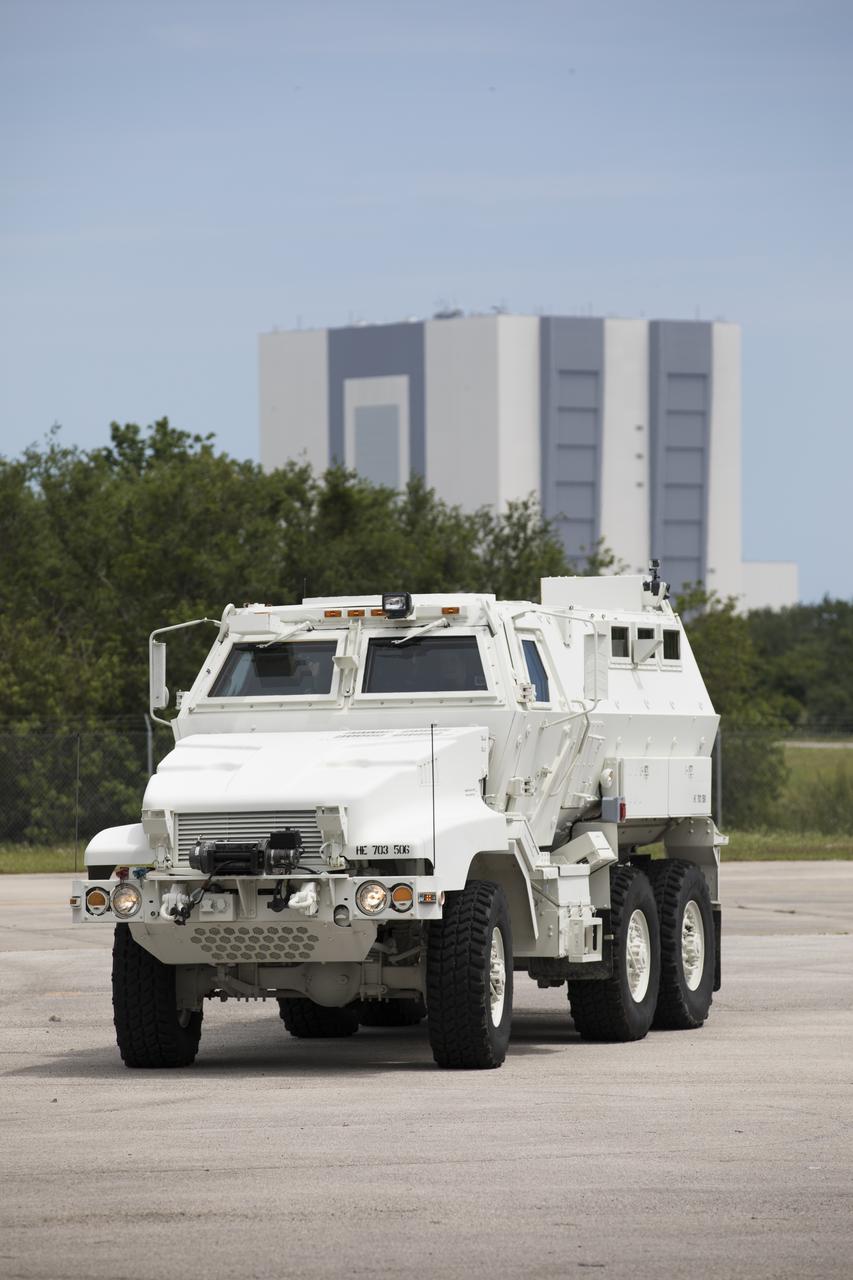
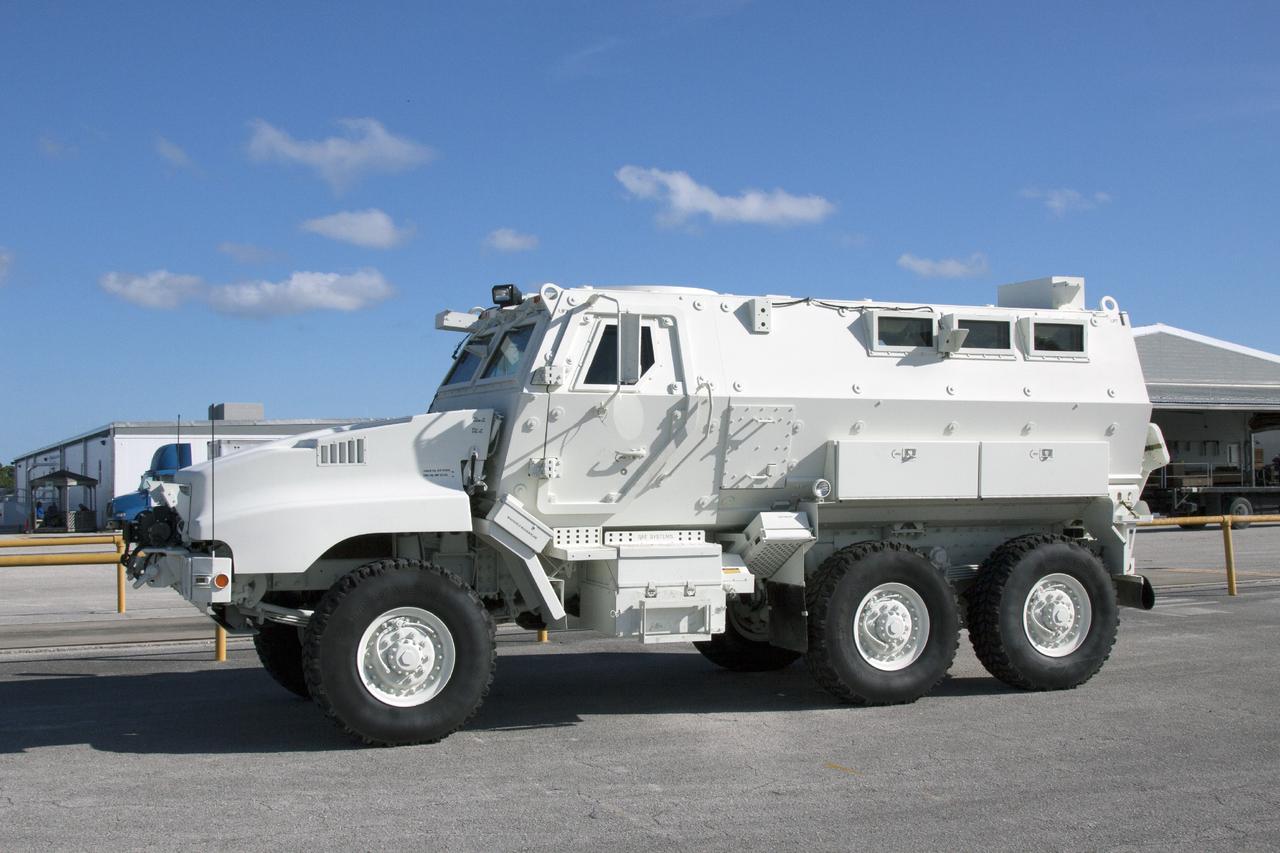
An MRAP armored vehicle goes through a training run on the Shuttle Landing Facility to support NASA's Commercial Crew Program at the agency's Kennedy Space Center in Florida. The 45,000-pound mine-resistant ambush protected vehicle, or MRAP, was originally designed for military applications. The MRAP offers a mobile bunker for astronauts and ground crews in the unlikely event they have to get away from the launch pad quickly in an emergency.
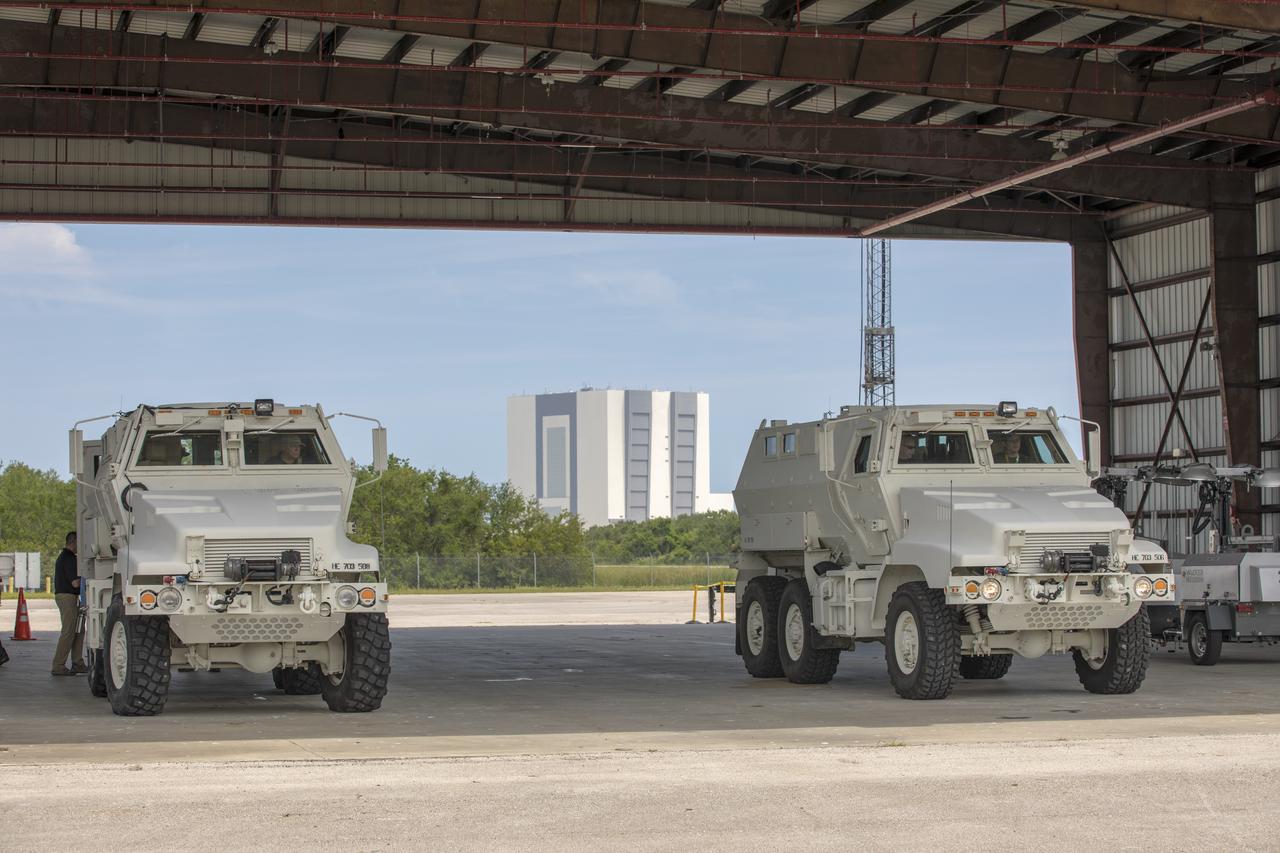
Inside a Shuttle Landing Facility hangar at NASA's Kennedy Space Center in Florida, two MRAP armored vehicles are prepared for a training drive to support the agency's Commercial Crew Program. The 45,000-pound mine-resistant ambush protected vehicle, or MRAP, was originally designed for military applications. The MRAP offers a mobile bunker for astronauts and ground crews in the unlikely event they have to get away from the launch pad quickly in an emergency.
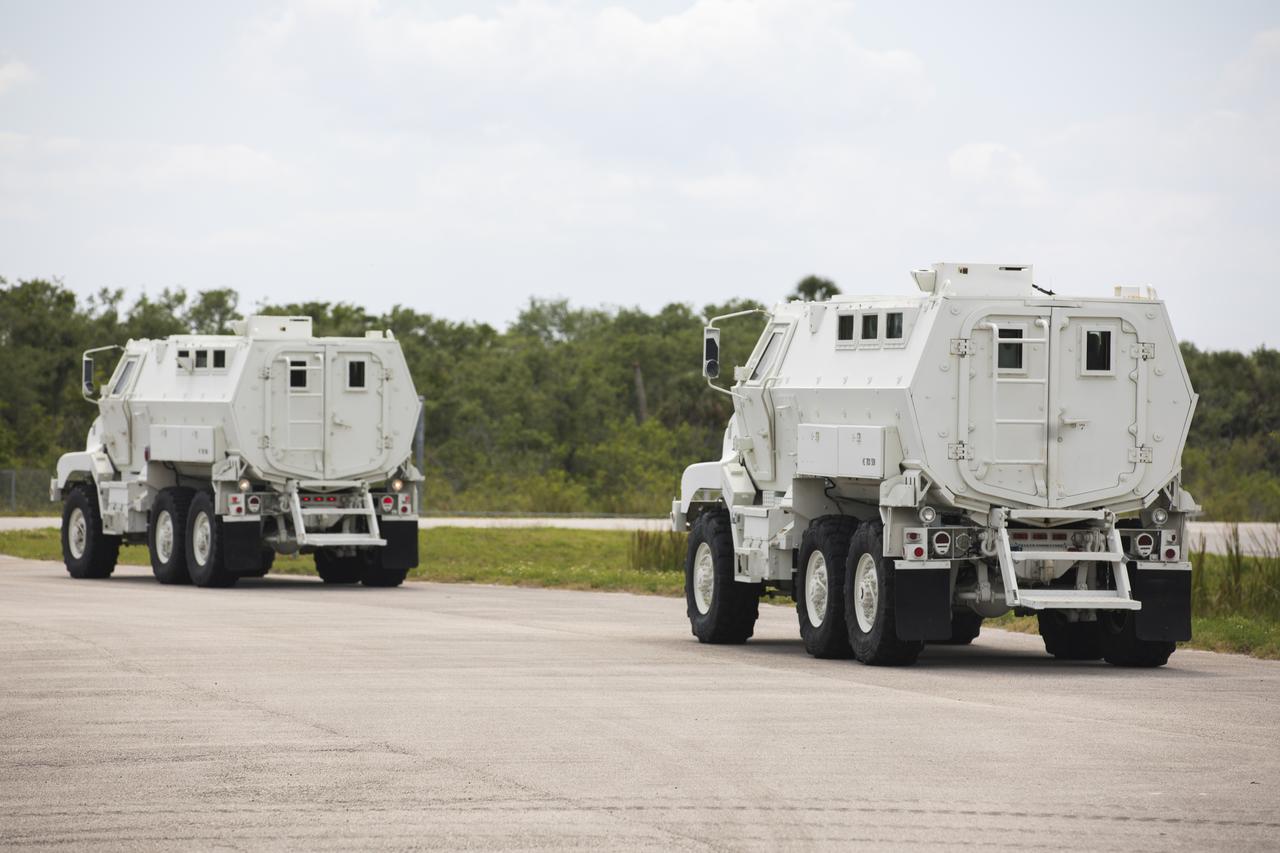
Two MRAP armored vehicles go through a training run on the Shuttle Landing Facility to support NASA's Commercial Crew Program at the agency's Kennedy Space Center in Florida. The 45,000-pound mine-resistant ambush protected vehicle, or MRAPs, were originally designed for military applications. The MRAP offers a mobile bunker for astronauts and ground crews in the unlikely event they have to get away from the launch pad quickly in an emergency.
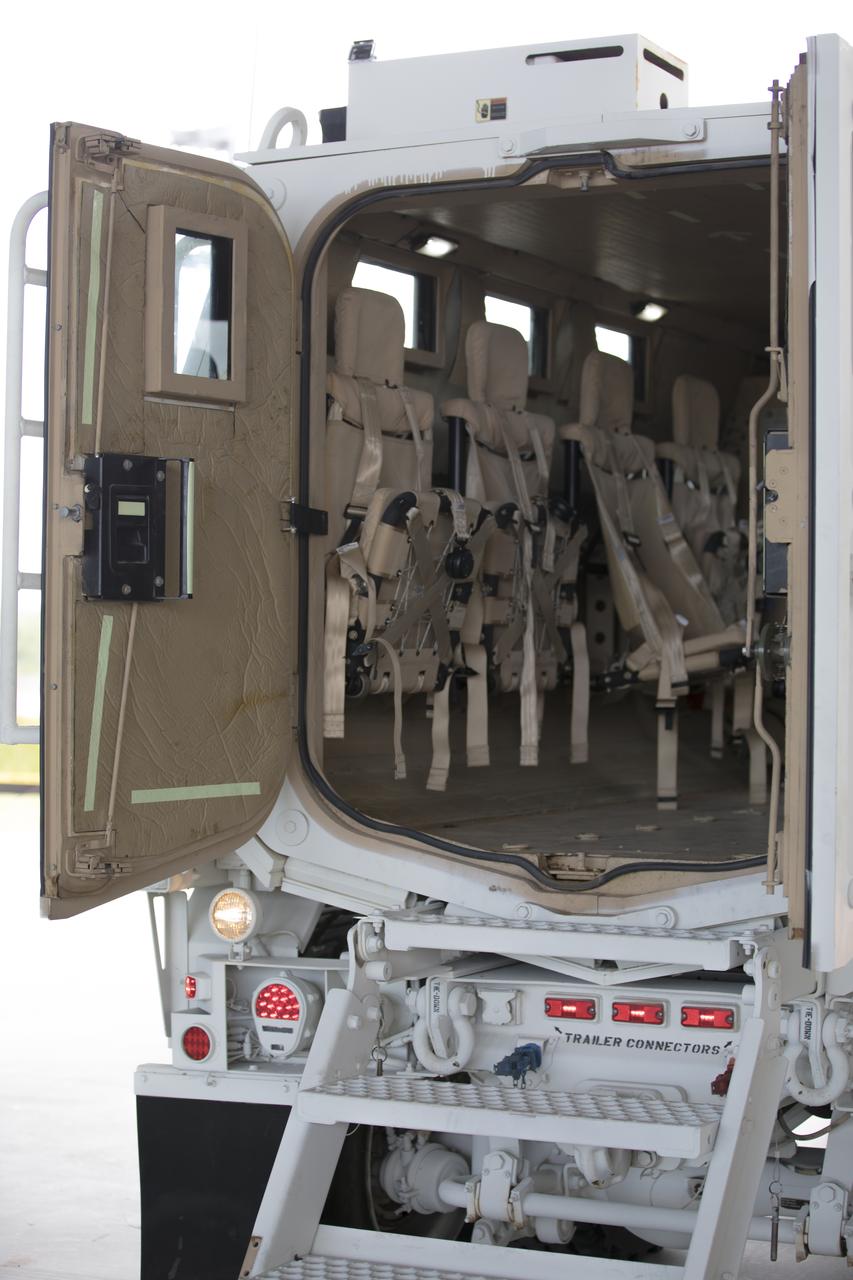
Following a training run on the Shuttle Landing Facility at NASA's Kennedy Space Center in Florida, MRAP back doors are opened showing seating in the armored vehicle. The 45,000-pound mine-resistant ambush protected vehicle, or MRAP, was originally designed for military applications, but will support the agency's Commercial Crew Program at the spaceport. The MRAP offers a mobile bunker for astronauts and ground crews in the unlikely event they have to get away from the launch pad quickly in an emergency.
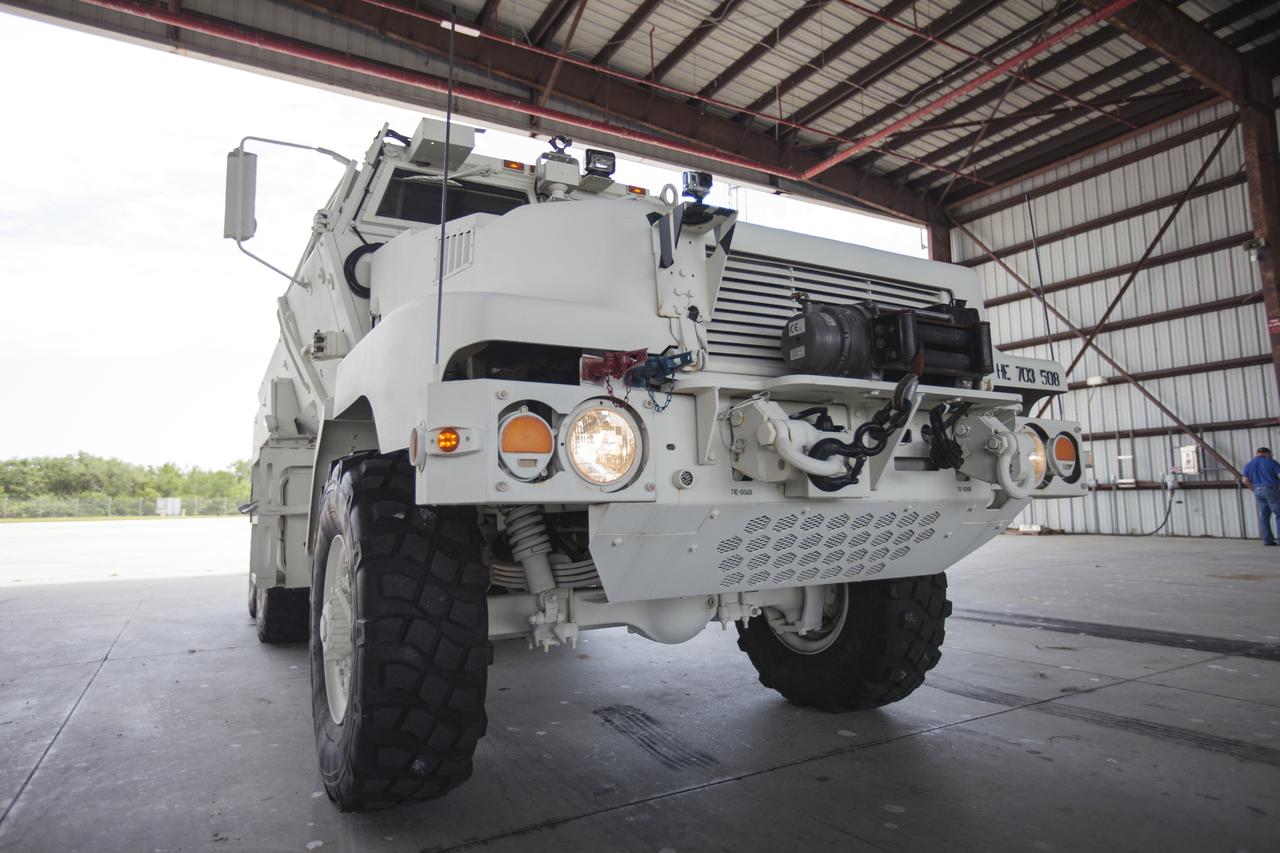
Inside a Shuttle Landing Facility hangar at NASA's Kennedy Space Center in Florida, an MRAP armored vehicle is prepared for a training drive to support the agency's Commercial Crew Program. The 45,000-pound mine-resistant ambush protected vehicle, or MRAP, was originally designed for military applications. The MRAP offers a mobile bunker for astronauts and ground crews in the unlikely event they have to get away from the launch pad quickly in an emergency.
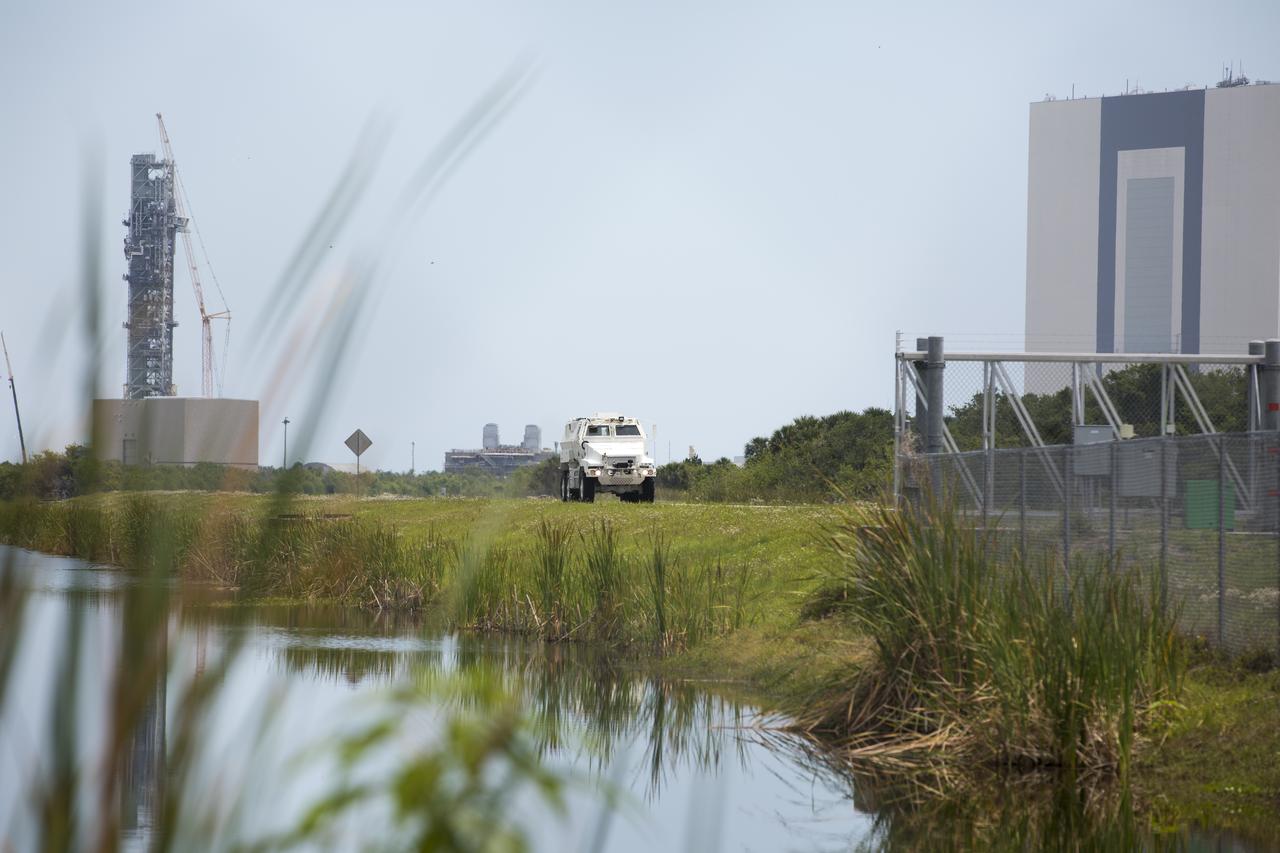
An MRAP armored vehicle goes through a training run on the Shuttle Landing Facility to support NASA's Commercial Crew Program at the agency's Kennedy Space Center in Florida. The 45,000-pound mine-resistant. The MRAP offers a mobile bunker for astronauts and ground crews in the unlikely event they have to get away from the launch pad quickly in an emergency.
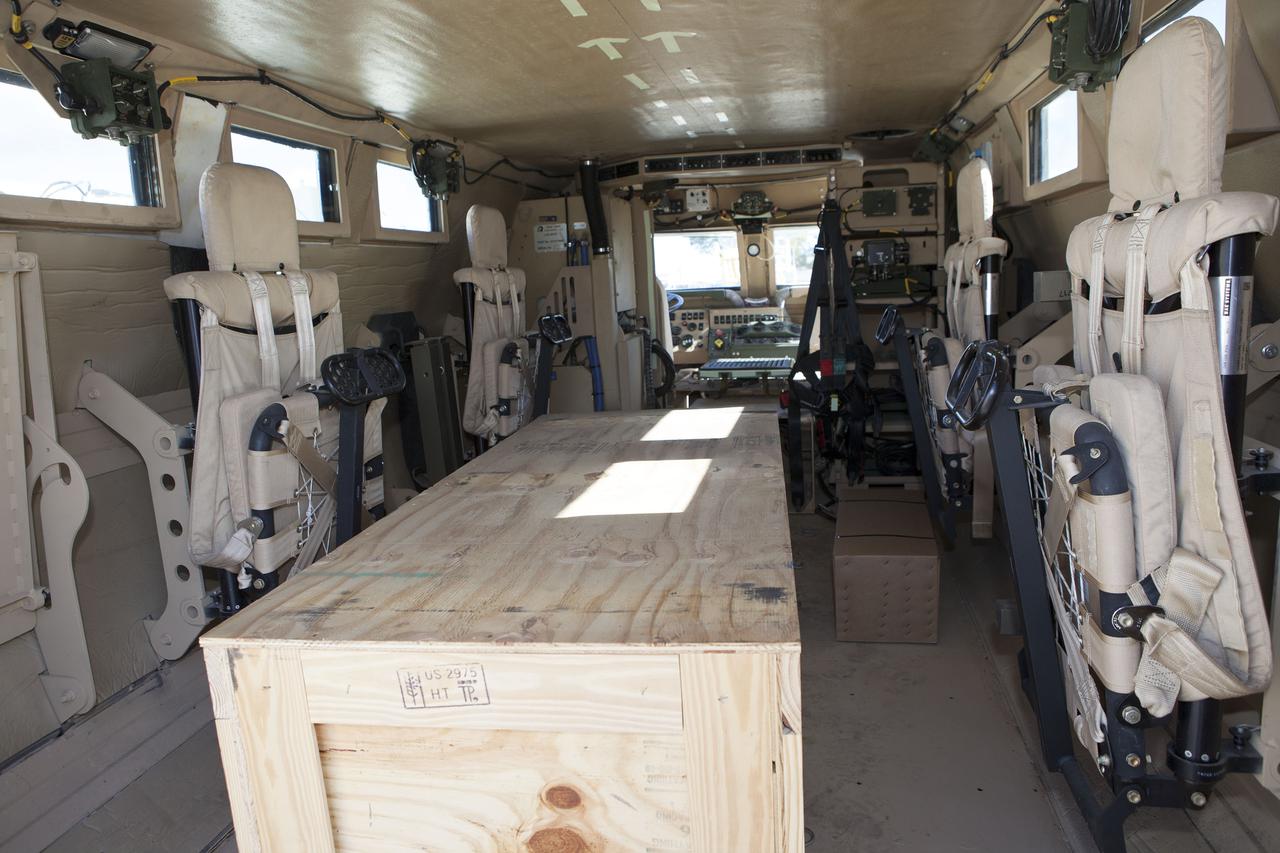
CAPE CANAVERAL, Fla. – A view of the interior of one of four new emergency egress vehicles, called Mine-Resistant Ambush-Protected, or MRAP, vehicles is shown. The MRAPs are at the Maintenance and Operations Facility at NASA’s Kennedy Space Center in Florida. The MRAPs arrived from the U.S. Army Red River Depot in Texarkana, Texas in December 2013. The vehicles were processed in and then transported to the Rotation, Processing and Surge Facility near the Vehicle Assembly Building for temporary storage. The Ground Systems Development and Operations Program at Kennedy led the efforts to an emergency egress vehicle that future astronauts could quickly use to leave the Launch Complex 39 area in case of an emergency. During crewed launches of NASA’s Space Launch System and Orion spacecraft, the MRAP will be stationed by the slidewire termination area at the pad. In case of an emergency, the crew will ride a slidewire to the ground and immediately board the MRAP for safe egress from the pad. The new vehicles replace the M-113 vehicles that were used during the Space Shuttle Program. Photo credit: NASA_Kim Shiflett
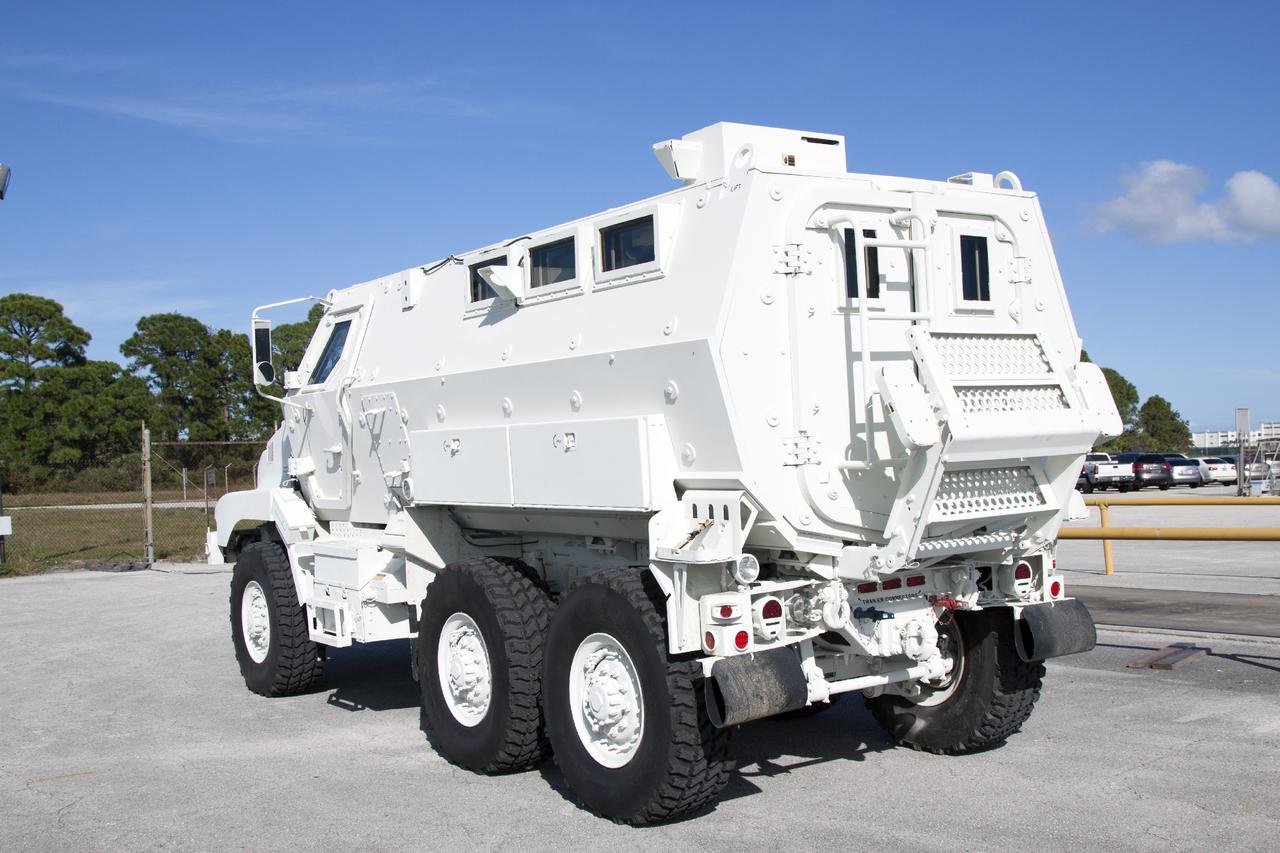
CAPE CANAVERAL, Fla. -- The first of four new emergency egress vehicles, called Mine-Resistant Ambush-Protection, or MRAP, vehicles arrived at Kennedy Space Center in Florida from the U.S. Army Red River Depot in Texarkana, Texas. Each vehicle will be processed in and then transported to the Rotation, Processing and Surge Facility near the Vehicle Assembly Building for temporary storage. The Ground Systems Development and Operations Program at Kennedy led the efforts to an emergency egress vehicle that future astronauts could quickly use to leave the Launch Complex 39 area in case of an emergency. During crewed launches of NASA’s Space Launch System and Orion spacecraft, the MRAP will be stationed by the slidewire termination area at the pad. In case of an emergency, the crew will ride a slidewire to the ground and immediately board the MRAP for safe egress from the pad. The new vehicles replace the M-113 vehicles that were used during the Space Shuttle Program. Photo credit: NASA/Jim Grossmann
CAPE CANAVERAL, Fla. -- The first of four new emergency egress vehicles, called Mine-Resistant Ambush-Protection, or MRAP, vehicles arrived at Kennedy Space Center in Florida from the U.S. Army Red River Depot in Texarkana, Texas. Each vehicle will be processed in and then transported to the Rotation, Processing and Surge Facility near the Vehicle Assembly Building for temporary storage. The Ground Systems Development and Operations Program at Kennedy led the efforts to an emergency egress vehicle that future astronauts could quickly use to leave the Launch Complex 39 area in case of an emergency. During crewed launches of NASA’s Space Launch System and Orion spacecraft, the MRAP will be stationed by the slidewire termination area at the pad. In case of an emergency, the crew will ride a slidewire to the ground and immediately board the MRAP for safe egress from the pad. The new vehicles replace the M-113 vehicles that were used during the Space Shuttle Program. Photo credit: NASA/Jim Grossmann
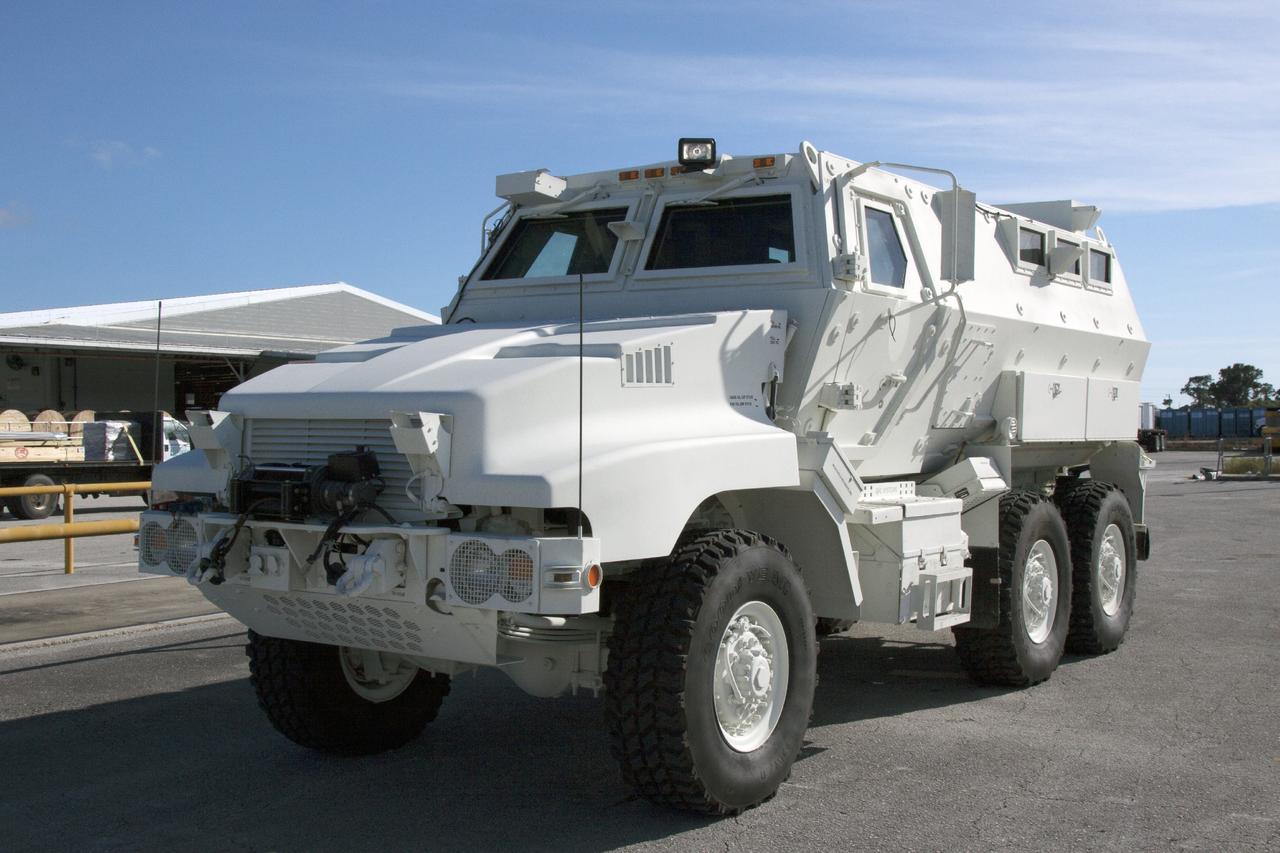
CAPE CANAVERAL, Fla. -- The first of four new emergency egress vehicles, called Mine-Resistant Ambush-Protection, or MRAP, vehicles arrived at Kennedy Space Center in Florida from the U.S. Army Red River Depot in Texarkana, Texas. Each vehicle will be processed in and then transported to the Rotation, Processing and Surge Facility near the Vehicle Assembly Building for temporary storage. The Ground Systems Development and Operations Program at Kennedy led the efforts to an emergency egress vehicle that future astronauts could quickly use to leave the Launch Complex 39 area in case of an emergency. During crewed launches of NASA’s Space Launch System and Orion spacecraft, the MRAP will be stationed by the slidewire termination area at the pad. In case of an emergency, the crew will ride a slidewire to the ground and immediately board the MRAP for safe egress from the pad. The new vehicles replace the M-113 vehicles that were used during the Space Shuttle Program. Photo credit: NASA/Jim Grossmann
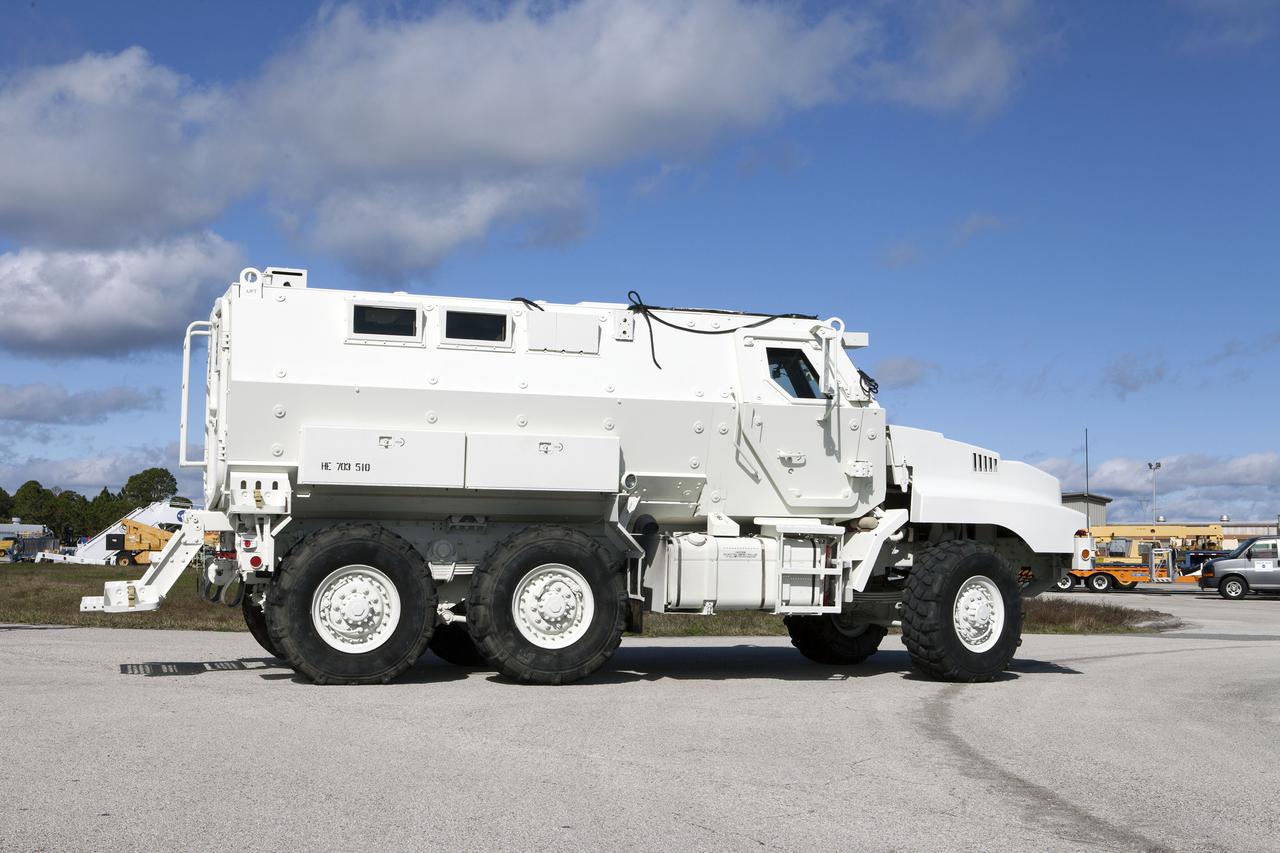
CAPE CANAVERAL, Fla. – One of four new emergency egress vehicles, called Mine-Resistant Ambush-Protection, or MRAP, vehicles is driven to the Maintenance and Operations Facility at NASA’s Kennedy Space Center in Florida. The MRAPs arrived from the U.S. Army Red River Depot in Texarkana, Texas in December 2013. The vehicles were processed in and then transported to the Rotation, Processing and Surge Facility near the Vehicle Assembly Building for temporary storage. The Ground Systems Development and Operations Program at Kennedy led the efforts to an emergency egress vehicle that future astronauts could quickly use to leave the Launch Complex 39 area in case of an emergency. During crewed launches of NASA’s Space Launch System and Orion spacecraft, the MRAP will be stationed by the slidewire termination area at the pad. In case of an emergency, the crew will ride a slidewire to the ground and immediately board the MRAP for safe egress from the pad. The new vehicles replace the M-113 vehicles that were used during the Space Shuttle Program. Photo credit: NASA_Kim Shiflett
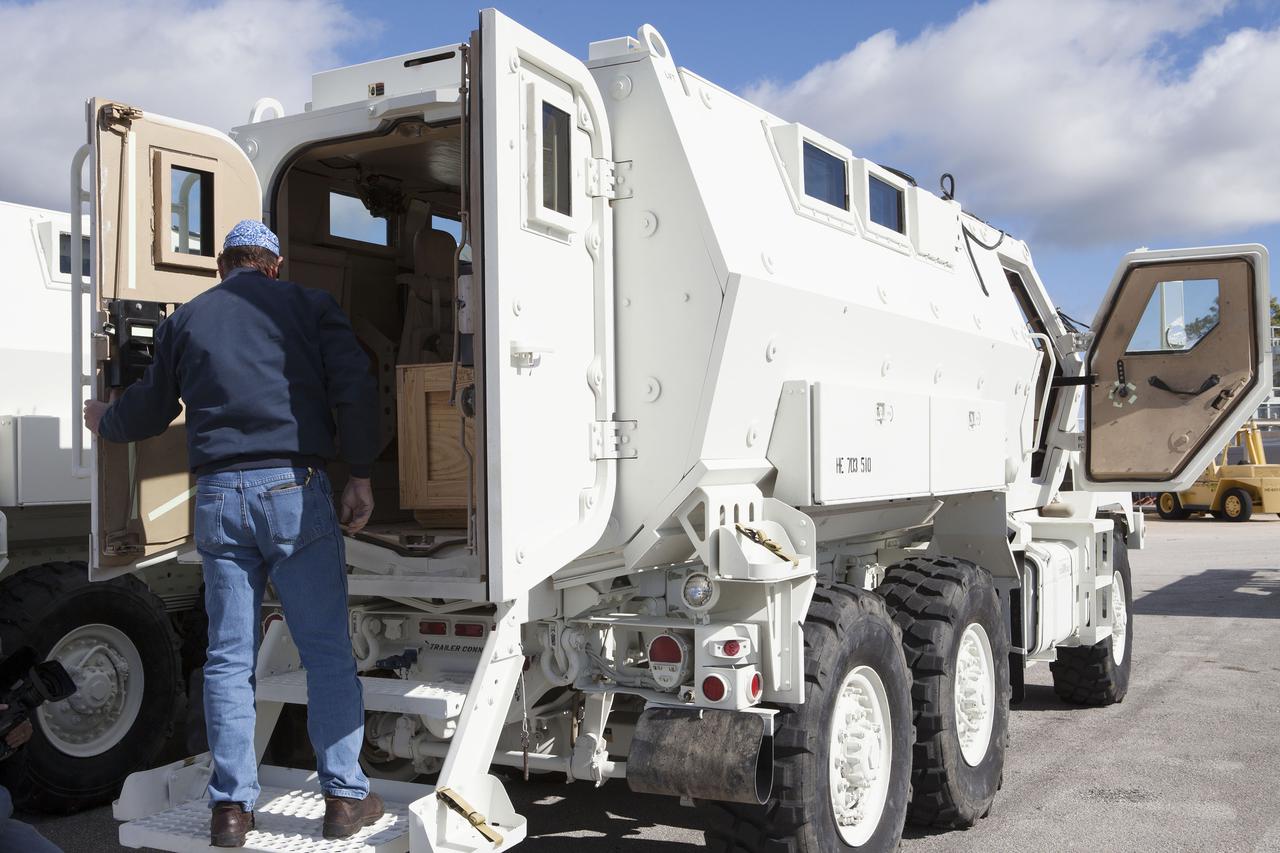
CAPE CANAVERAL, Fla. – A URS Federal Services worker enters one of the four new emergency egress vehicles, called Mine-Resistant Ambush-Protected, or MRAP, vehicles at the Maintenance and Operations Facility at NASA’s Kennedy Space Center in Florida. The MRAPs arrived from the U.S. Army Red River Depot in Texarkana, Texas in December 2013. The vehicles were processed in and then transported to the Rotation, Processing and Surge Facility near the Vehicle Assembly Building for temporary storage. The Ground Systems Development and Operations Program at Kennedy led the efforts to an emergency egress vehicle that future astronauts could quickly use to leave the Launch Complex 39 area in case of an emergency. During crewed launches of NASA’s Space Launch System and Orion spacecraft, the MRAP will be stationed by the slidewire termination area at the pad. In case of an emergency, the crew will ride a slidewire to the ground and immediately board the MRAP for safe egress from the pad. The new vehicles replace the M-113 vehicles that were used during the Space Shuttle Program. Photo credit: NASA_Kim Shiflett
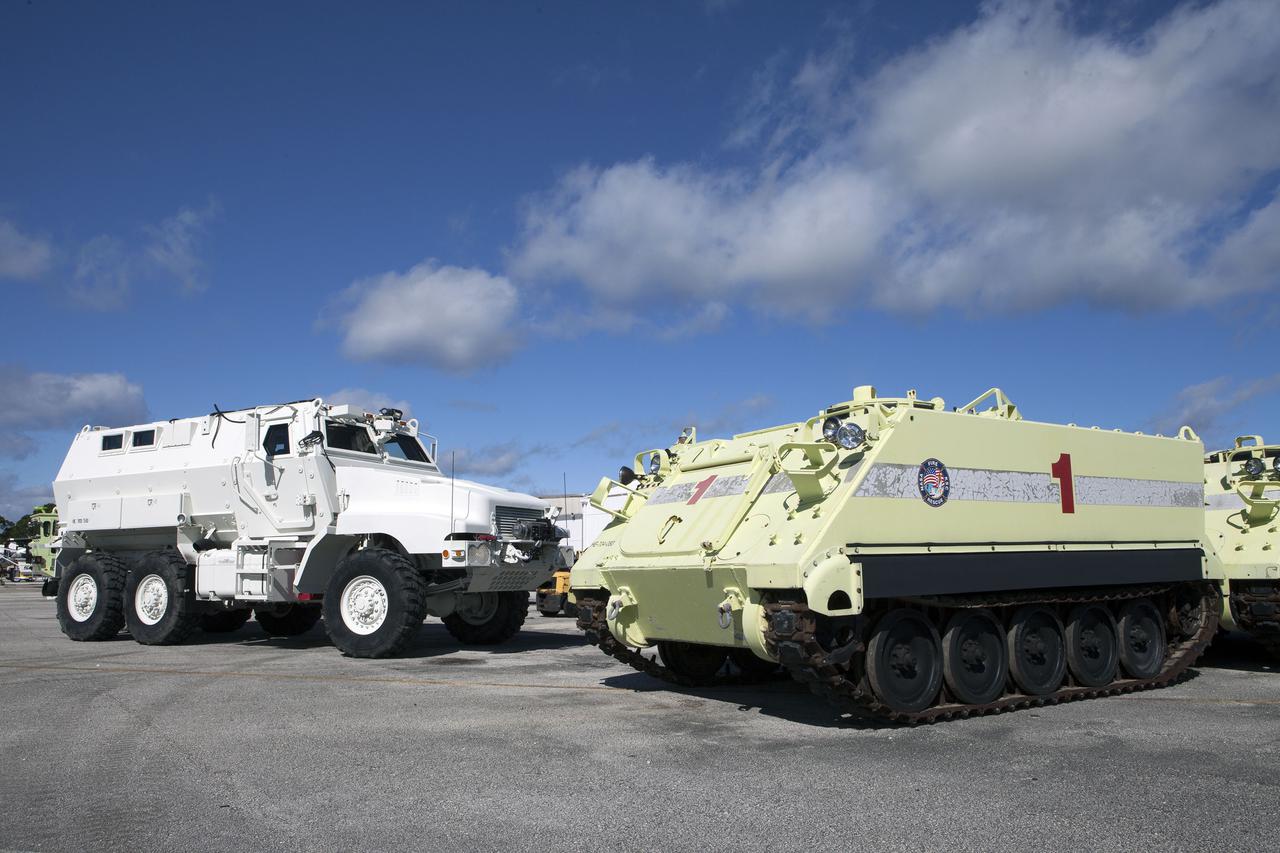
CAPE CANAVERAL, Fla. – One of four new emergency egress vehicles, called Mine-Resistant Ambush-Protection, or MRAP, vehicles sits near space shuttle-era M-113 vehicles at the Maintenance and Operations Facility at NASA’s Kennedy Space Center in Florida. The MRAPs arrived from the U.S. Army Red River Depot in Texarkana, Texas in December 2013. The vehicles were processed in and then transported to the Rotation, Processing and Surge Facility near the Vehicle Assembly Building for temporary storage. The Ground Systems Development and Operations Program at Kennedy led the efforts to an emergency egress vehicle that future astronauts could quickly use to leave the Launch Complex 39 area in case of an emergency. During crewed launches of NASA’s Space Launch System and Orion spacecraft, the MRAP will be stationed by the slidewire termination area at the pad. In case of an emergency, the crew will ride a slidewire to the ground and immediately board the MRAP for safe egress from the pad. The new vehicles replace the M-113 vehicles that were used during the Space Shuttle Program. Photo credit: NASA_Kim Shiflett
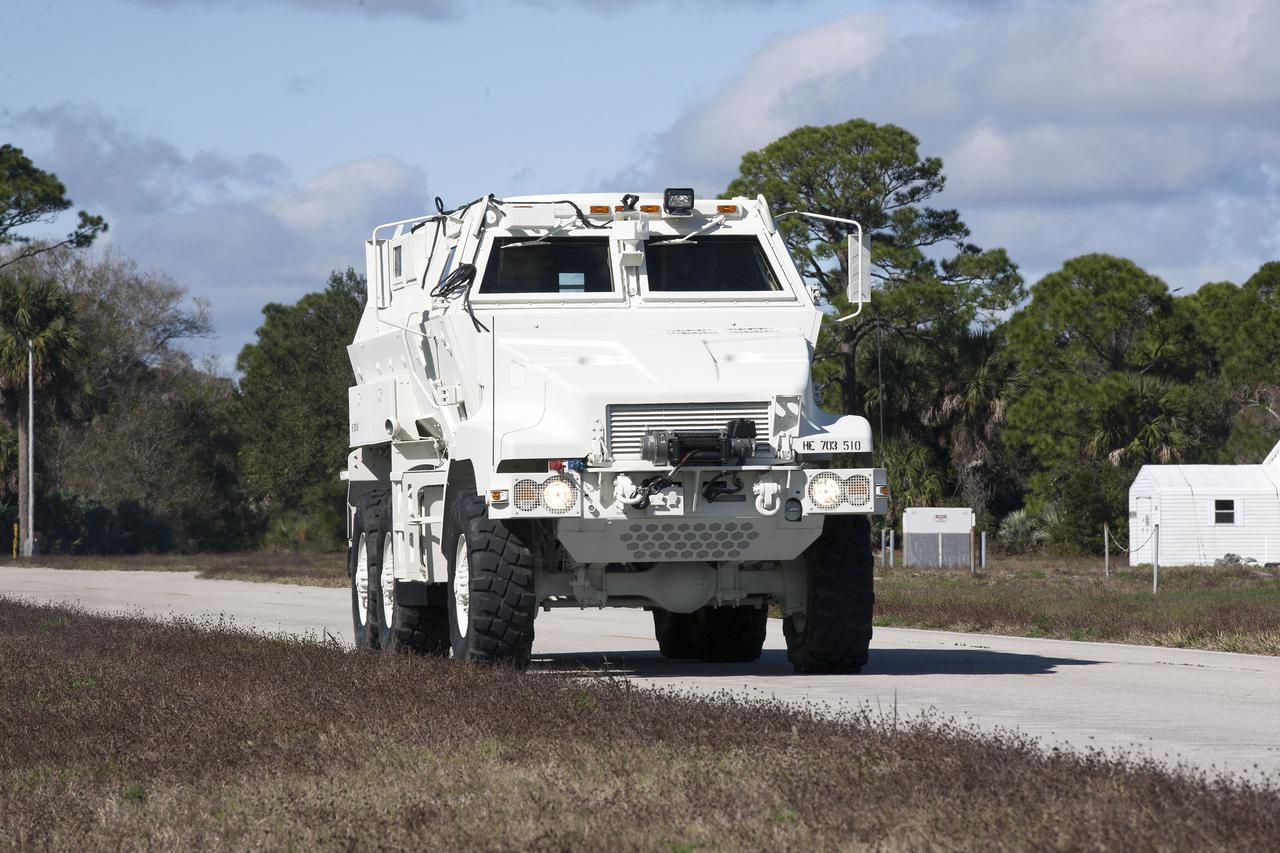
CAPE CANAVERAL, Fla. –One of four new emergency egress vehicles, called Mine-Resistant Ambush-Protection, or MRAP, vehicles is driven to the Maintenance and Operations Facility at NASA’s Kennedy Space Center in Florida. The MRAPs arrived from the U.S. Army Red River Depot in Texarkana, Texas in December 2013. The vehicles were processed in and then transported to the Rotation, Processing and Surge Facility near the Vehicle Assembly Building for temporary storage. The Ground Systems Development and Operations Program at Kennedy led the efforts to an emergency egress vehicle that future astronauts could quickly use to leave the Launch Complex 39 area in case of an emergency. During crewed launches of NASA’s Space Launch System and Orion spacecraft, the MRAP will be stationed by the slidewire termination area at the pad. In case of an emergency, the crew will ride a slidewire to the ground and immediately board the MRAP for safe egress from the pad. The new vehicles replace the M-113 vehicles that were used during the Space Shuttle Program. Photo credit: NASA_Kim Shiflett
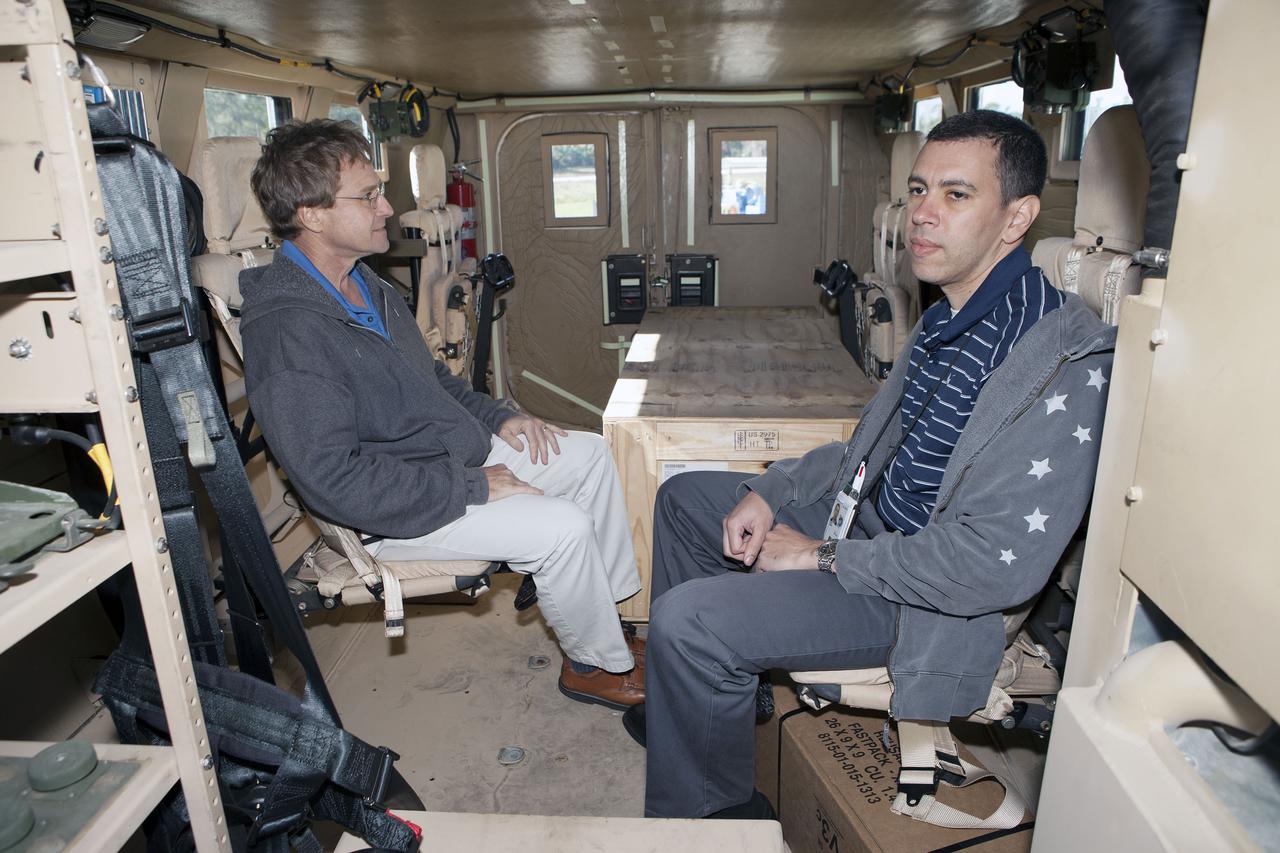
CAPE CANAVERAL, Fla. – Tom Hoffmann, left, and Danny Zeno, both Ground Systems Development and Operations, or GSDO, integration engineers, sit inside one of four new emergency egress vehicles, called Mine-Resistant Ambush-Protected, or MRAP, vehicles at the Maintenance and Operations Facility at NASA’s Kennedy Space Center in Florida. The MRAPs arrived from the U.S. Army Red River Depot in Texarkana, Texas in December 2013. The vehicles were processed in and then transported to the Rotation, Processing and Surge Facility near the Vehicle Assembly Building for temporary storage. The GSDO Program at Kennedy led the efforts to an emergency egress vehicle that future astronauts could quickly use to leave the Launch Complex 39 area in case of an emergency. During crewed launches of NASA’s Space Launch System and Orion spacecraft, the MRAP will be stationed by the slidewire termination area at the pad. In case of an emergency, the crew will ride a slidewire to the ground and immediately board the MRAP for safe egress from the pad. The new vehicles replace the M-113 vehicles that were used during the Space Shuttle Program. Photo credit: NASA_Kim Shiflett
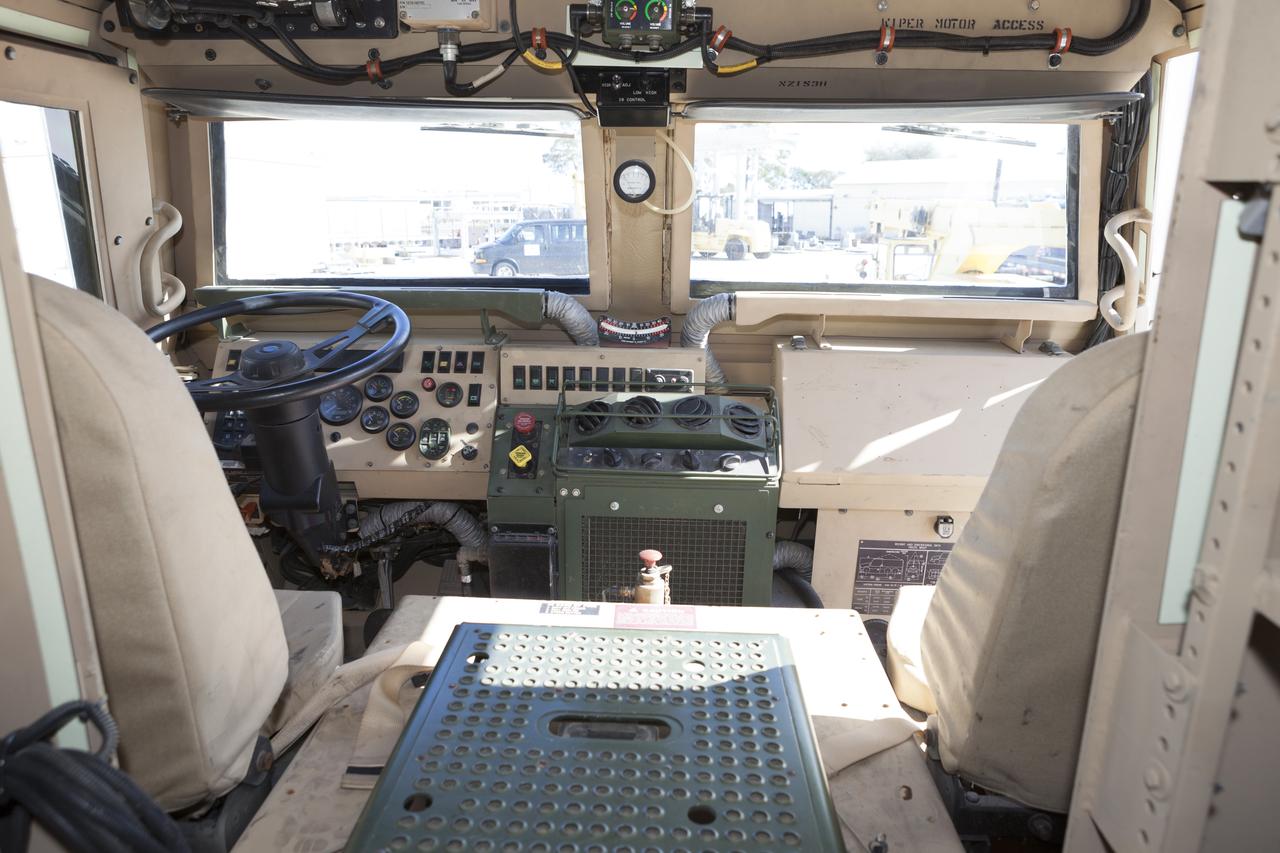
CAPE CANAVERAL, Fla. – A view of the interior of one of four new emergency egress vehicles, called Mine-Resistant Ambush-Protected, or MRAP, vehicles is shown. The MRAPs are at the Maintenance and Operations Facility at NASA’s Kennedy Space Center in Florida. The MRAPs arrived from the U.S. Army Red River Depot in Texarkana, Texas in December 2013. The vehicles were processed in and then transported to the Rotation, Processing and Surge Facility near the Vehicle Assembly Building for temporary storage. The Ground Systems Development and Operations Program at Kennedy led the efforts to an emergency egress vehicle that future astronauts could quickly use to leave the Launch Complex 39 area in case of an emergency. During crewed launches of NASA’s Space Launch System and Orion spacecraft, the MRAP will be stationed by the slidewire termination area at the pad. In case of an emergency, the crew will ride a slidewire to the ground and immediately board the MRAP for safe egress from the pad. The new vehicles replace the M-113 vehicles that were used during the Space Shuttle Program. Photo credit: NASA/Kim Shiflett
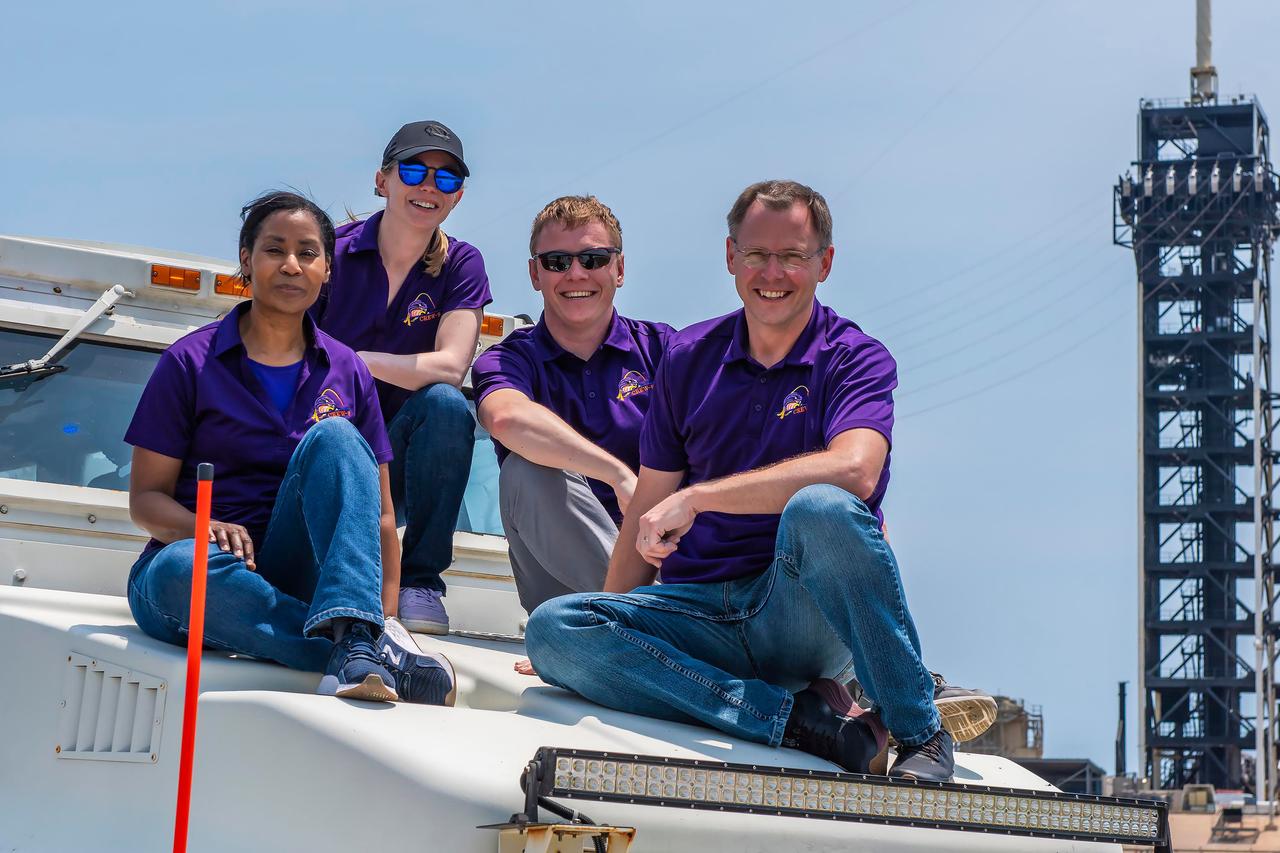
jsc2024e050144 (May 13, 2024) --- NASA’s SpaceX Crew-9 members sit atop their Mine Resistant Ambush Protected (MRAP) vehicle as part of their SpaceX crew training at Launch Complex 39A at NASA's Kennedy Space Center in Florida. From left are, Mission Specialist Stephanie Wilson from NASA; Commander Zena Cardman from NASA; Mission Spedialist Alexsandr Gorbunov from Roscosmos; and Pilot Nick Hague from NASA. Credit: SpaceX
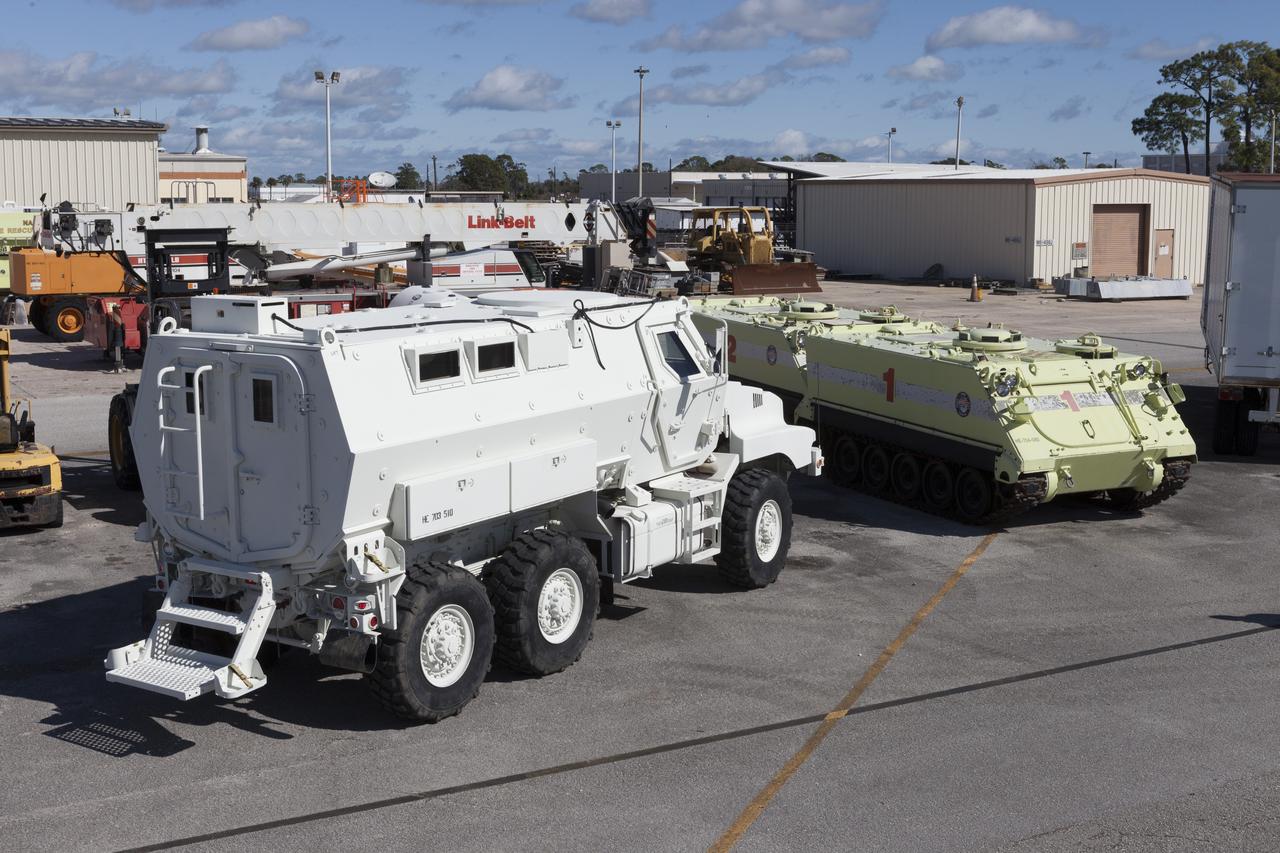
CAPE CANAVERAL, Fla. – One of four new emergency egress vehicles, called Mine-Resistant Ambush-Protection, or MRAP, vehicles sits near space shuttle-era M-113 vehicles at the Maintenance and Operations Facility at NASA’s Kennedy Space Center in Florida. The MRAPs arrived from the U.S. Army Red River Depot in Texarkana, Texas in December 2013. The vehicles were processed in and then transported to the Rotation, Processing and Surge Facility near the Vehicle Assembly Building for temporary storage. The Ground Systems Development and Operations Program at Kennedy led the efforts to an emergency egress vehicle that future astronauts could quickly use to leave the Launch Complex 39 area in case of an emergency. During crewed launches of NASA’s Space Launch System and Orion spacecraft, the MRAP will be stationed by the slidewire termination area at the pad. In case of an emergency, the crew will ride a slidewire to the ground and immediately board the MRAP for safe egress from the pad. The new vehicles replace the M-113 vehicles that were used during the Space Shuttle Program. Photo credit: NASA/Kim Shiflett
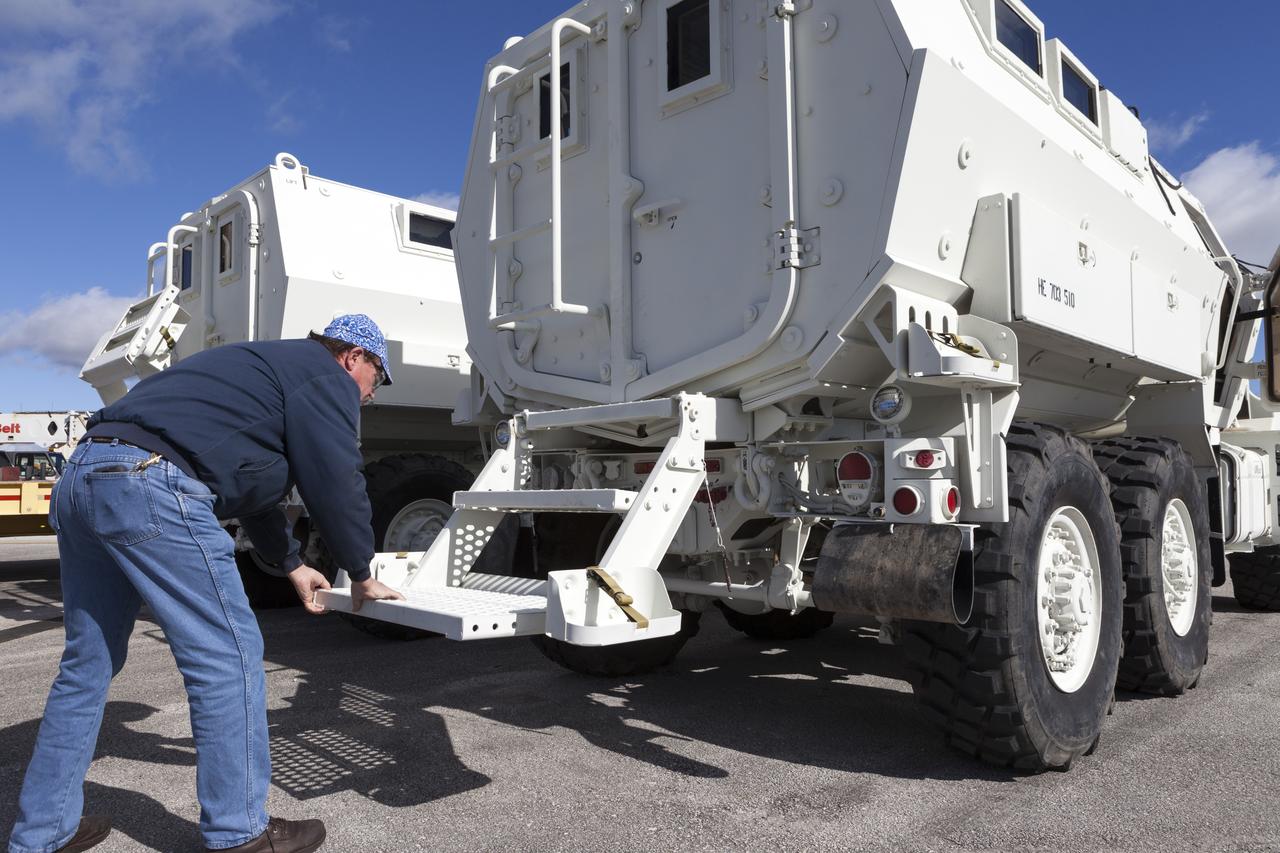
CAPE CANAVERAL, Fla. – A URS Federal Services worker pulls down the steps to the entrance of one of the four new emergency egress vehicles, called Mine-Resistant Ambush-Protected, or MRAP, vehicles at the Maintenance and Operations Facility at NASA’s Kennedy Space Center in Florida. The MRAPs arrived from the U.S. Army Red River Depot in Texarkana, Texas in December 2013. The vehicles were processed in and then transported to the Rotation, Processing and Surge Facility near the Vehicle Assembly Building for temporary storage. The Ground Systems Development and Operations Program at Kennedy led the efforts to an emergency egress vehicle that future astronauts could quickly use to leave the Launch Complex 39 area in case of an emergency. During crewed launches of NASA’s Space Launch System and Orion spacecraft, the MRAP will be stationed by the slidewire termination area at the pad. In case of an emergency, the crew will ride a slidewire to the ground and immediately board the MRAP for safe egress from the pad. The new vehicles replace the M-113 vehicles that were used during the Space Shuttle Program. Photo credit: NASA/Kim Shiflett

CAPE CANAVERAL, Fla. – One of four new emergency egress vehicles, called Mine-Resistant Ambush-Protection, or MRAP, vehicles is driven to the Maintenance and Operations Facility at Kennedy Space Center in Florida. The MRAPs arrived from the U.S. Army Red River Depot in Texarkana, Texas in December 2013. The vehicles were processed in and then transported to the Rotation, Processing and Surge Facility near the Vehicle Assembly Building for temporary storage. The Ground Systems Development and Operations Program at Kennedy led the efforts to an emergency egress vehicle that future astronauts could quickly use to leave the Launch Complex 39 area in case of an emergency. During crewed launches of NASA’s Space Launch System and Orion spacecraft, the MRAP will be stationed by the slidewire termination area at the pad. In case of an emergency, the crew will ride a slidewire to the ground and immediately board the MRAP for safe egress from the pad. The new vehicles replace the M-113 vehicles that were used during the Space Shuttle Program. Photo credit: NASA/Kim Shiflett
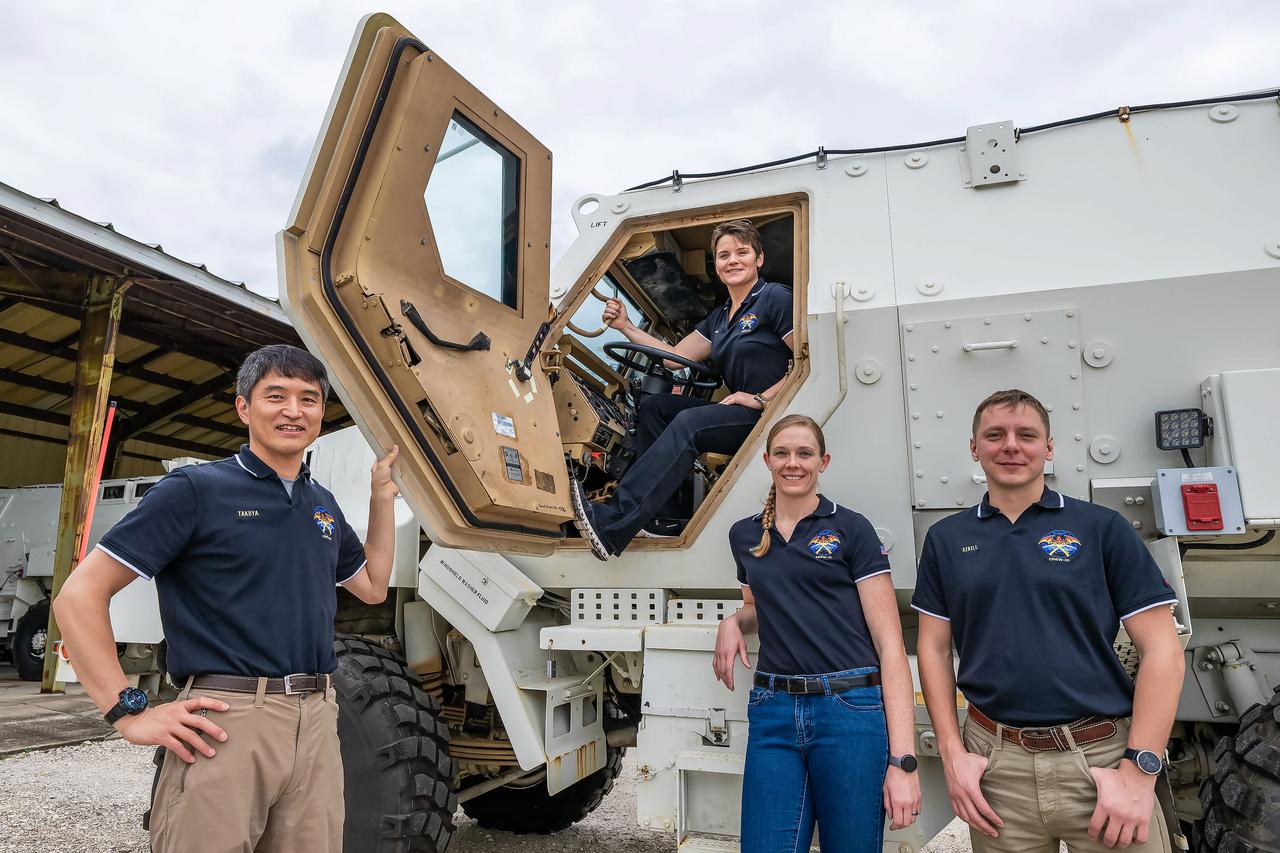
jsc2024e080753 (Nov. 18, 2024) --- NASA’s SpaceX Crew-10 members pose in front of their Mine Resistant Ambush Protected (MRAP) vehicle as part of their SpaceX crew training at Launch Complex 39A at NASA's Kennedy Space Center in Florida. From left are Mission Specialist Takuya Onishi of JAXA (Japan Aerospace Exploration Agency), Commander Anne McClain of NASA, Pilot Nichole Ayers of NASA, and Mission Specialist Kirill Peskov of Roscosmos. Credit: SpaceX
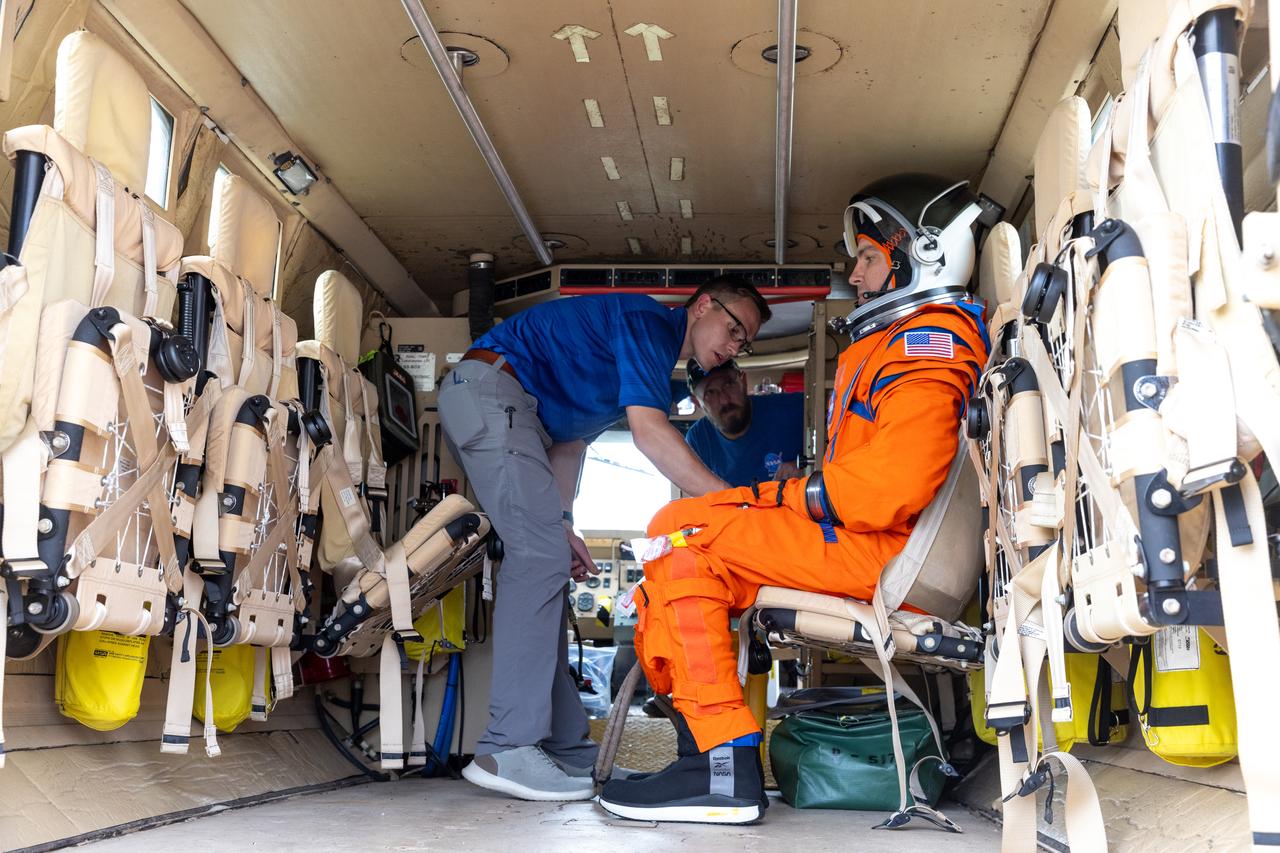
Teams with NASA’s Exploration Ground Systems Program, including an astronaut stand-in, participate in a series of integrated system verification and validation tests inside a mine-resistant ambush protected vehicle, or MRAP, at Launch Pad 39B at the agency’s Kennedy Space Center in Florida on Thursday, Aug. 8, 2024. Originally designed for military applications, the 45,000-pound MRAP offers a mobile bunker for astronauts and ground crews in the unlikely event they have to get away from the launch pad quickly in an emergency.
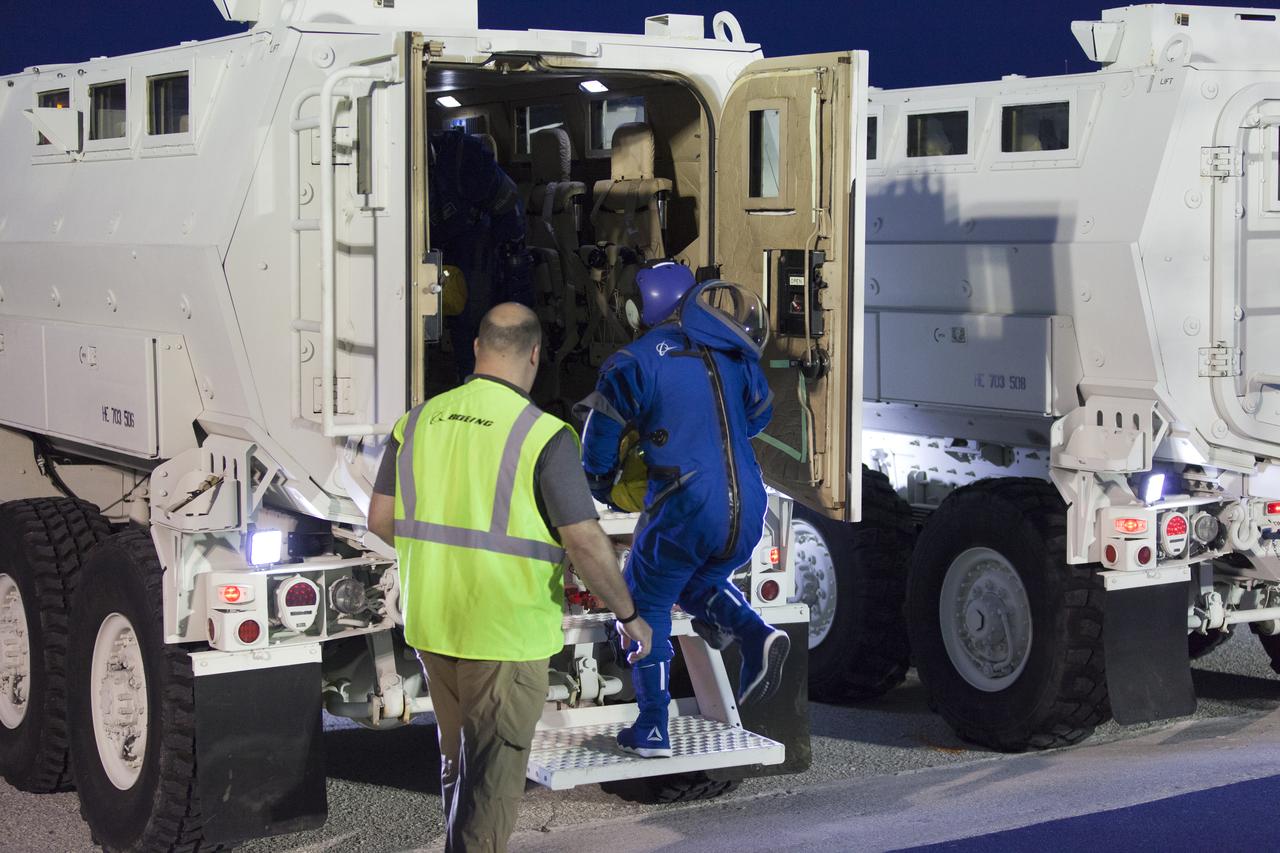
An astronaut heads into a mine-resistant ambush protected vehicle, or MRAP, during a Boeing/United Launch Alliance emergency egress system demonstration at Cape Canaveral Air Force Station’s Launch Complex 41 in Florida on June 19, 2018. NASA’s MRAPs offer a mobile bunker for astronauts and ground crews, should they need to escape from the launch pad quickly in an emergency.
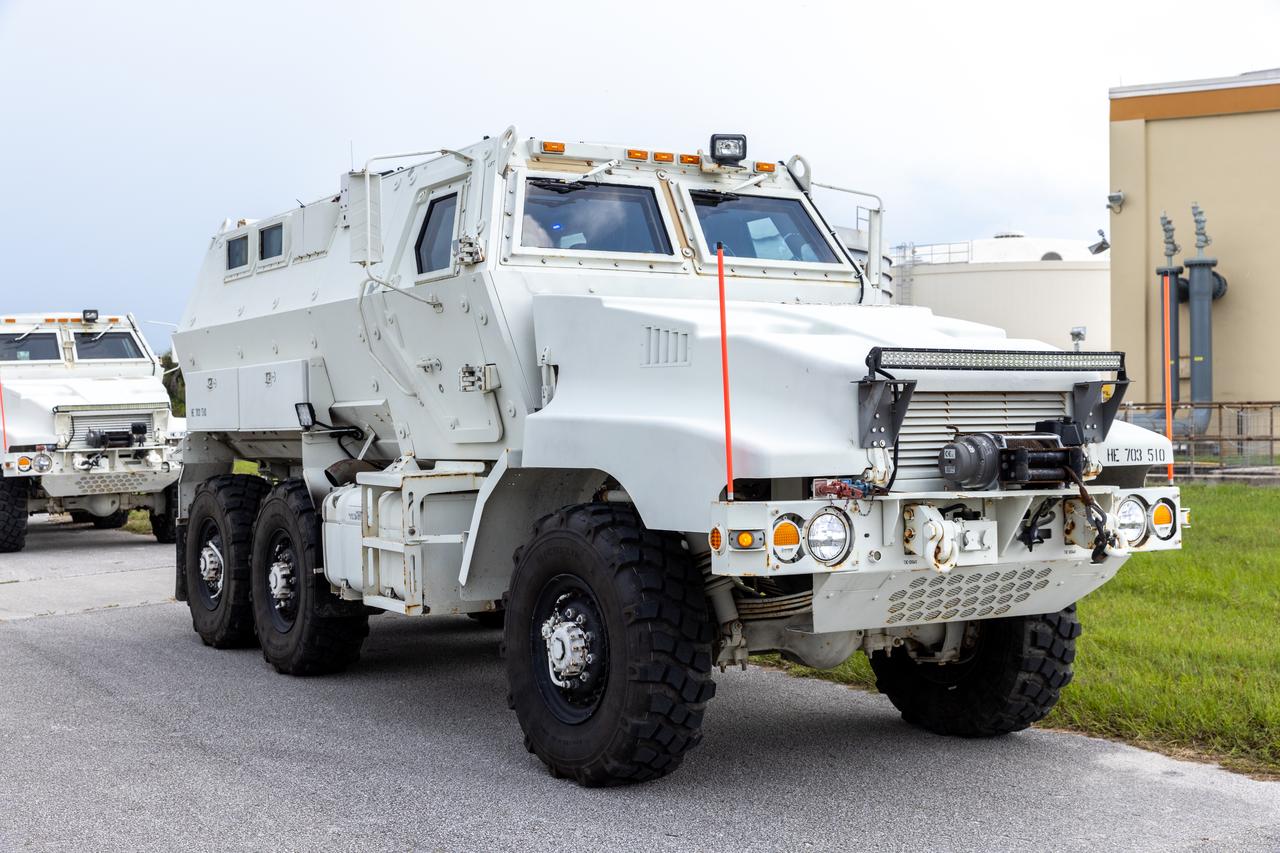
Multiple 45,000-pound mine-resistant ambush protected vehicles, or MRAPs, participate in a series of integrated system verification and validation tests inside at Launch Pad 39B at the agency’s Kennedy Space Center in Florida on Thursday, Aug. 8, 2024. Originally designed for military applications, the MRAP offers a mobile bunker for astronauts and ground crews in the unlikely event they have to get away from the launch pad quickly in an emergency.
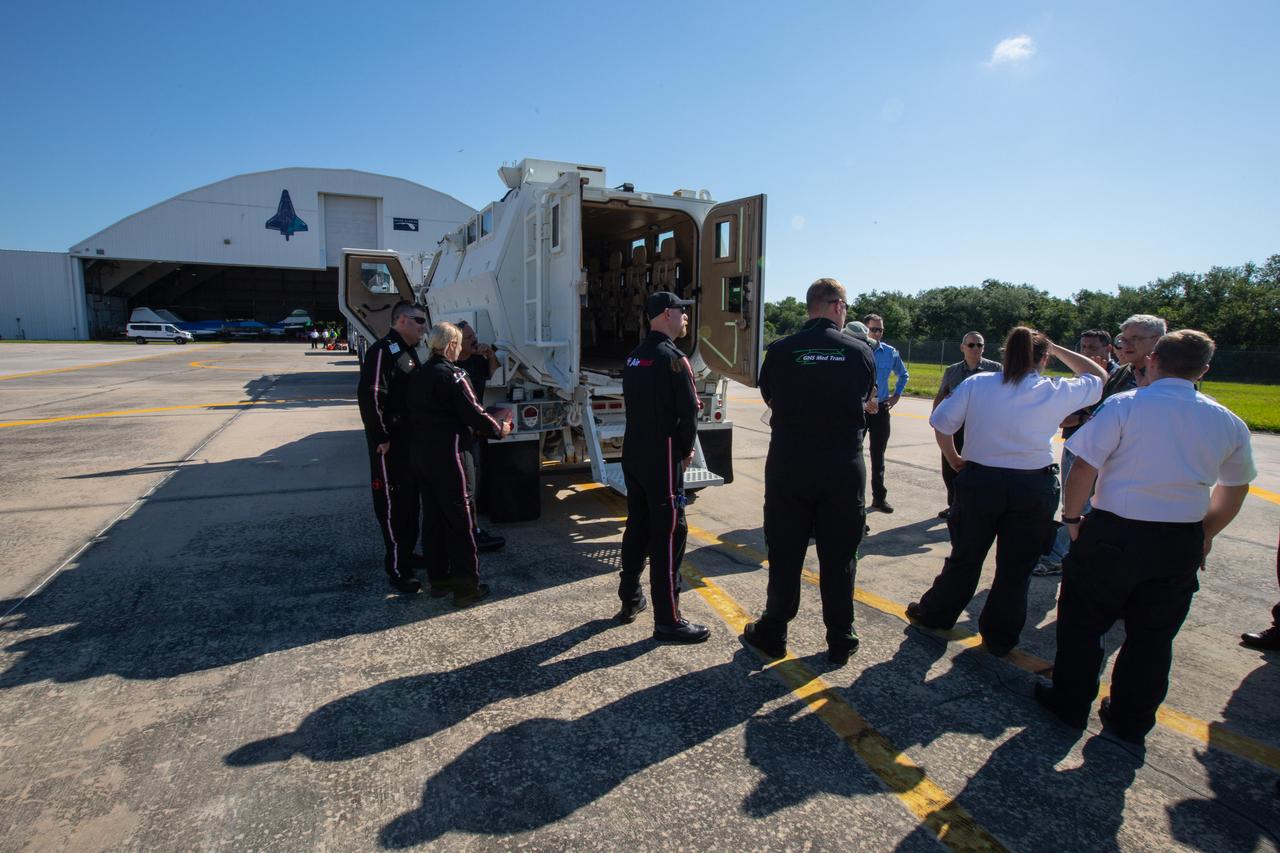
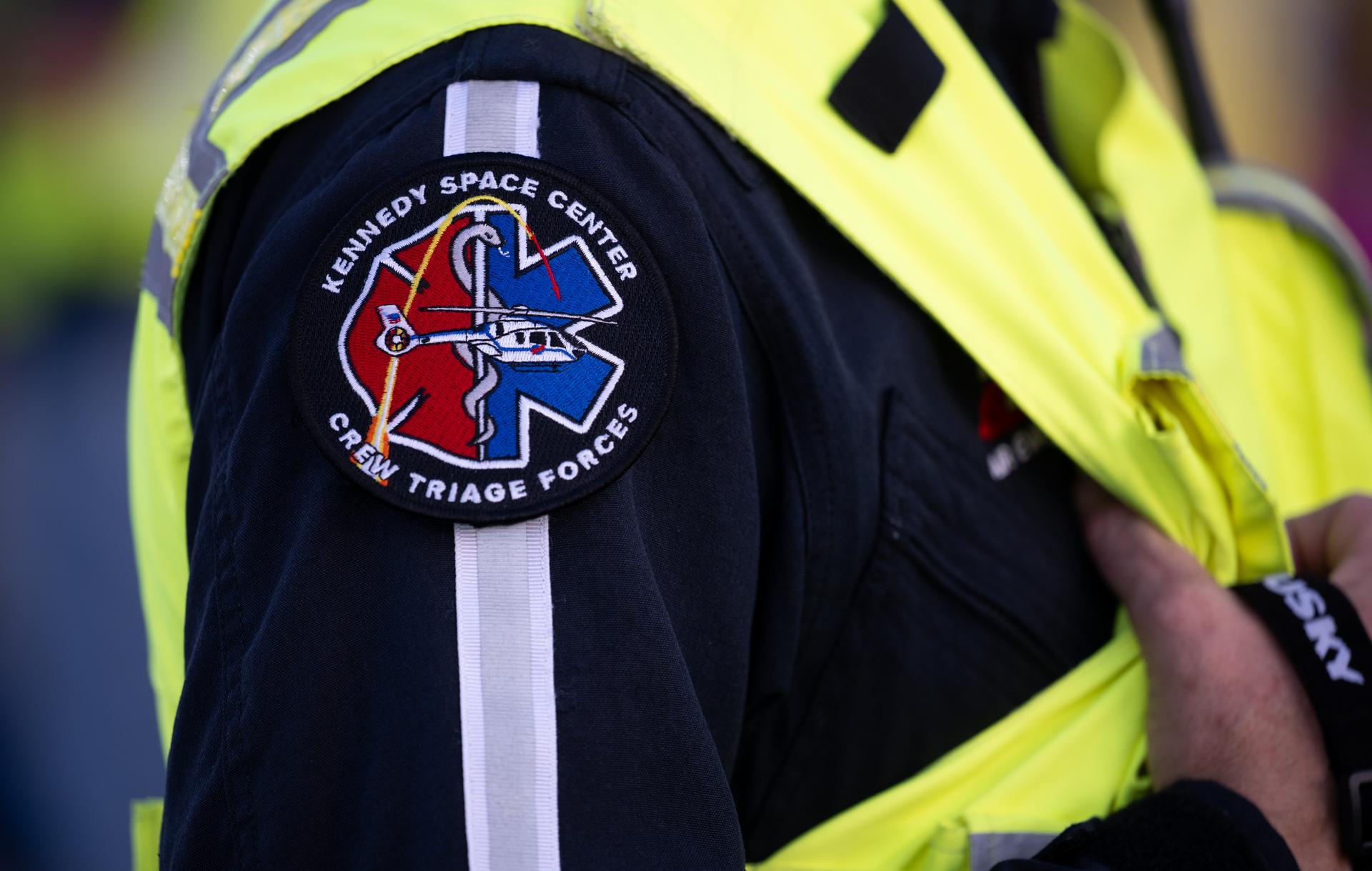
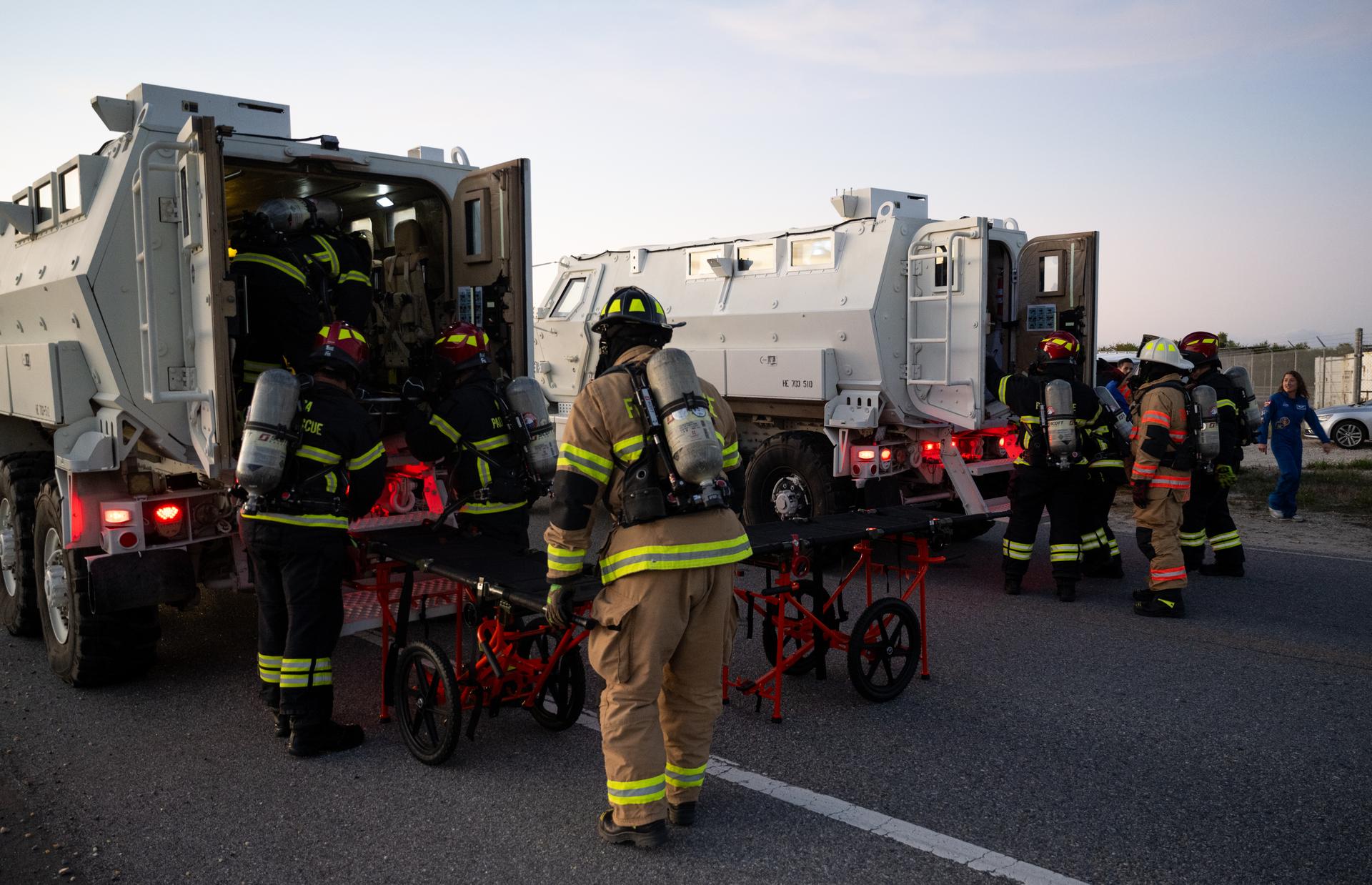
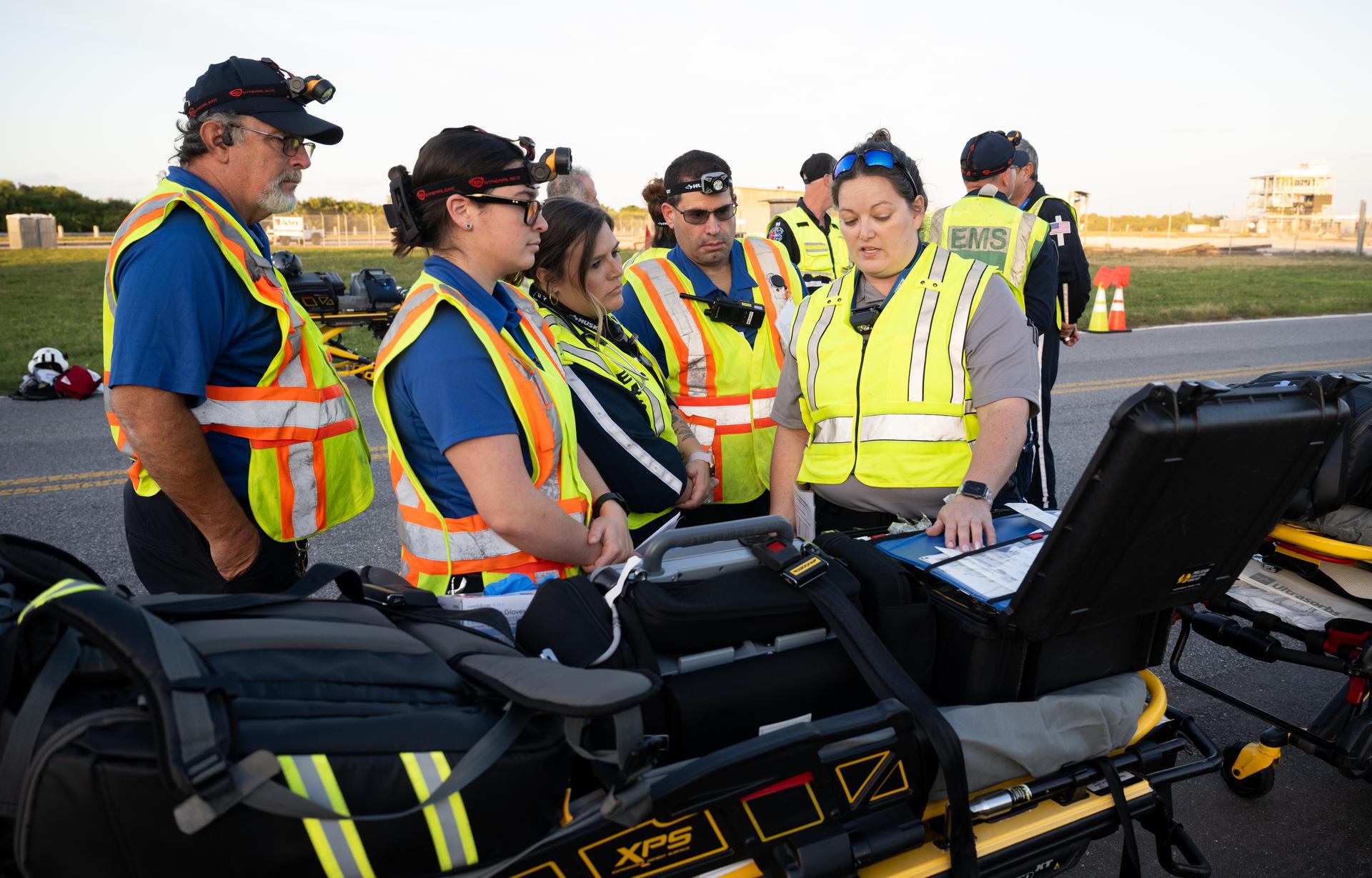
A Kennedy Space Center Mine Resistant Ambush Protected (MRAP) tactical vehicle stands at the ready during a medical support training course at the Florida spaceport’s Shuttle Landing Facility on May 17, 2019. Kennedy personnel and American Medical Response (AMR) contractor paramedics participated in the course, which was designed to familiarize the AMR paramedics with the center’s Triage Forces deployment, including medical team members, fire/rescue personnel, environmental health specialists and flight operations crew members, as well as a helicopter, MRAP, fire pumper truck and triage vehicles. The AMR paramedics will assist the agency in contingency planning for the return of human spaceflight from Kennedy.
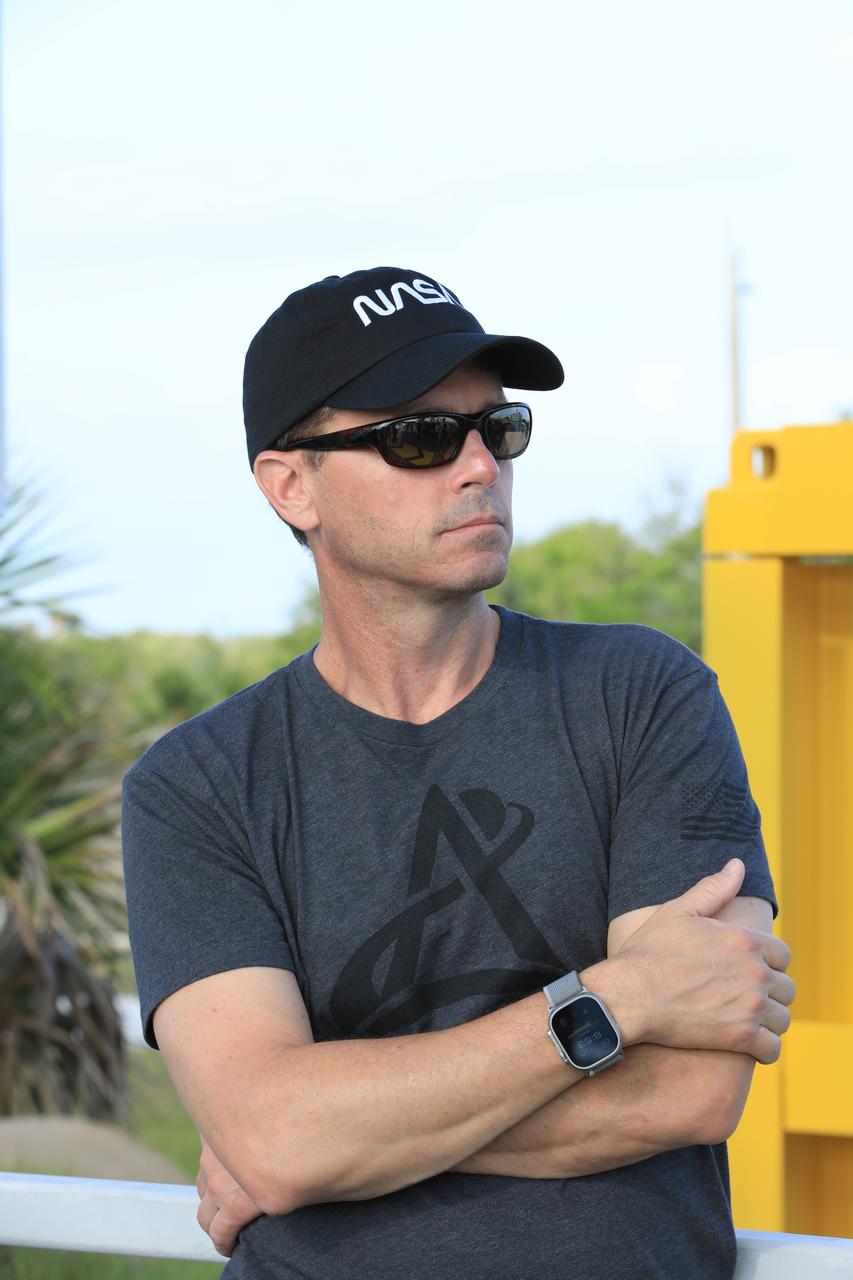
NASA astronaut Reid Wiseman participates in training with teams from NASA’s Exploration Ground Systems Program at Launch Complex 39B at the agency’s Kennedy Space Center in Florida on Tuesday, May 6, 2025. Wiseman and fellow Artemis II crew members and backup members trained with the mine-resistant ambush protected vehicles, or MRAPs, inside the launch pad area. Originally designed for military applications, the 45,000-pound MRAP offers a mobile bunker for astronauts and ground crews in the unlikely event they must get away from the launch pad quickly in an emergency.
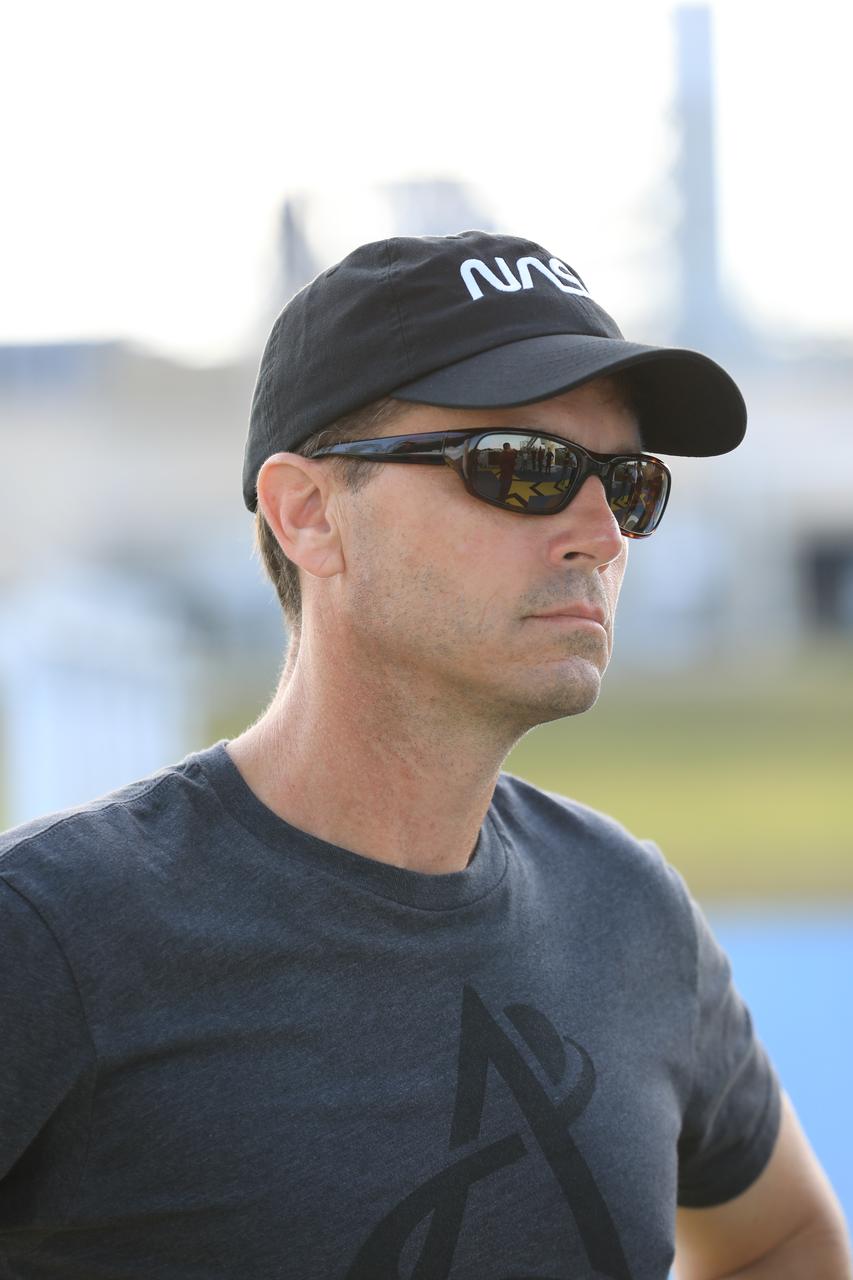
NASA astronaut Reid Wiseman participates in training with teams from NASA’s Exploration Ground Systems Program at Launch Complex 39B at the agency’s Kennedy Space Center in Florida on Tuesday, May 6, 2025. Wiseman and fellow Artemis II crew members and backup members trained with the mine-resistant ambush protected vehicles, or MRAPs, inside the launch pad area. Originally designed for military applications, the 45,000-pound MRAP offers a mobile bunker for astronauts and ground crews in the unlikely event they must get away from the launch pad quickly in an emergency.
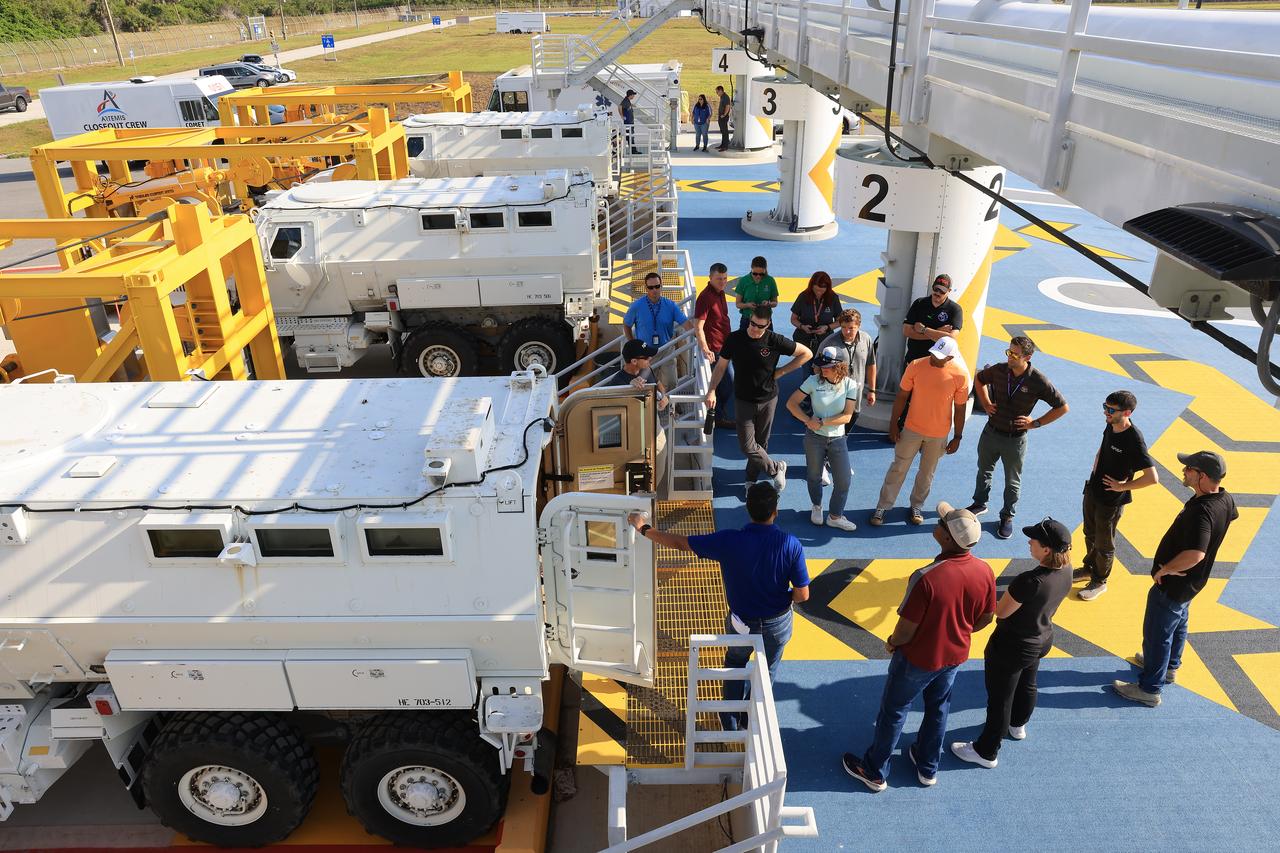
Crew members and backup members for NASA’s Artemis II mission and teams from the agency’s Exploration Ground Systems Program participate in emergency egress training at Launch Complex 39B at NASA’s Kennedy Space Center in Florida on Tuesday, May 6, 2025. Teams trained with the mine-resistant ambush protected vehicles, or MRAPs, inside the launch pad terminus area, where the emergency egress baskets carrying the astronauts and flight crew will arrive following their safe exit from the mobile launcher. Originally designed for military applications, the 45,000-pound MRAP offers a mobile bunker for astronauts and ground crews in the unlikely event they must get away from the launch pad quickly in an emergency.
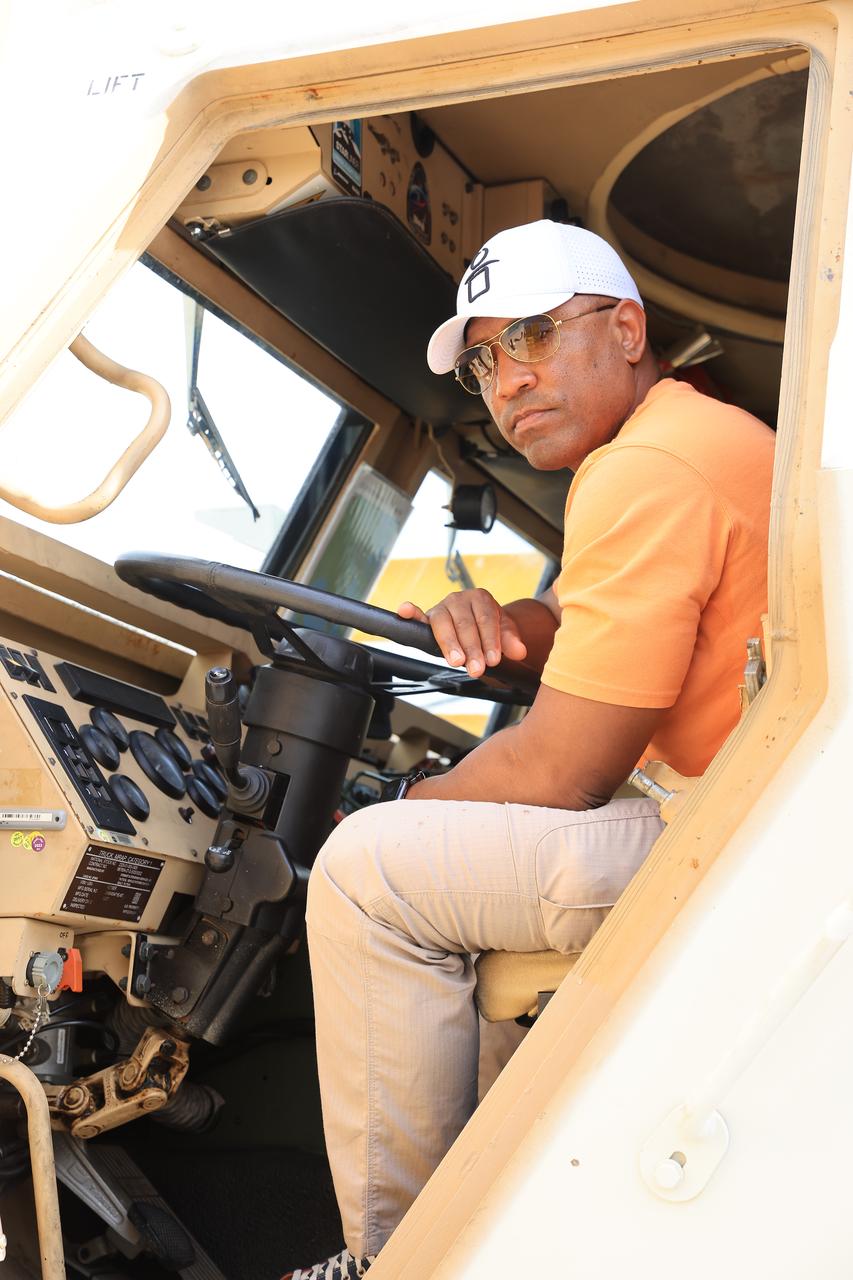
NASA astronaut Victor Glover participates in emergency egress training with teams from NASA’s Exploration Ground Systems Program at Launch Complex 39B at the agency’s Kennedy Space Center in Florida on Tuesday, May 6, 2025. Glover and fellow Artemis II crew members and backup members trained with the mine-resistant ambush protected vehicles, or MRAPs, inside the launch pad area. Originally designed for military applications, the 45,000-pound MRAP offers a mobile bunker for astronauts and ground crews in the unlikely event they must get away from the launch pad quickly in an emergency.
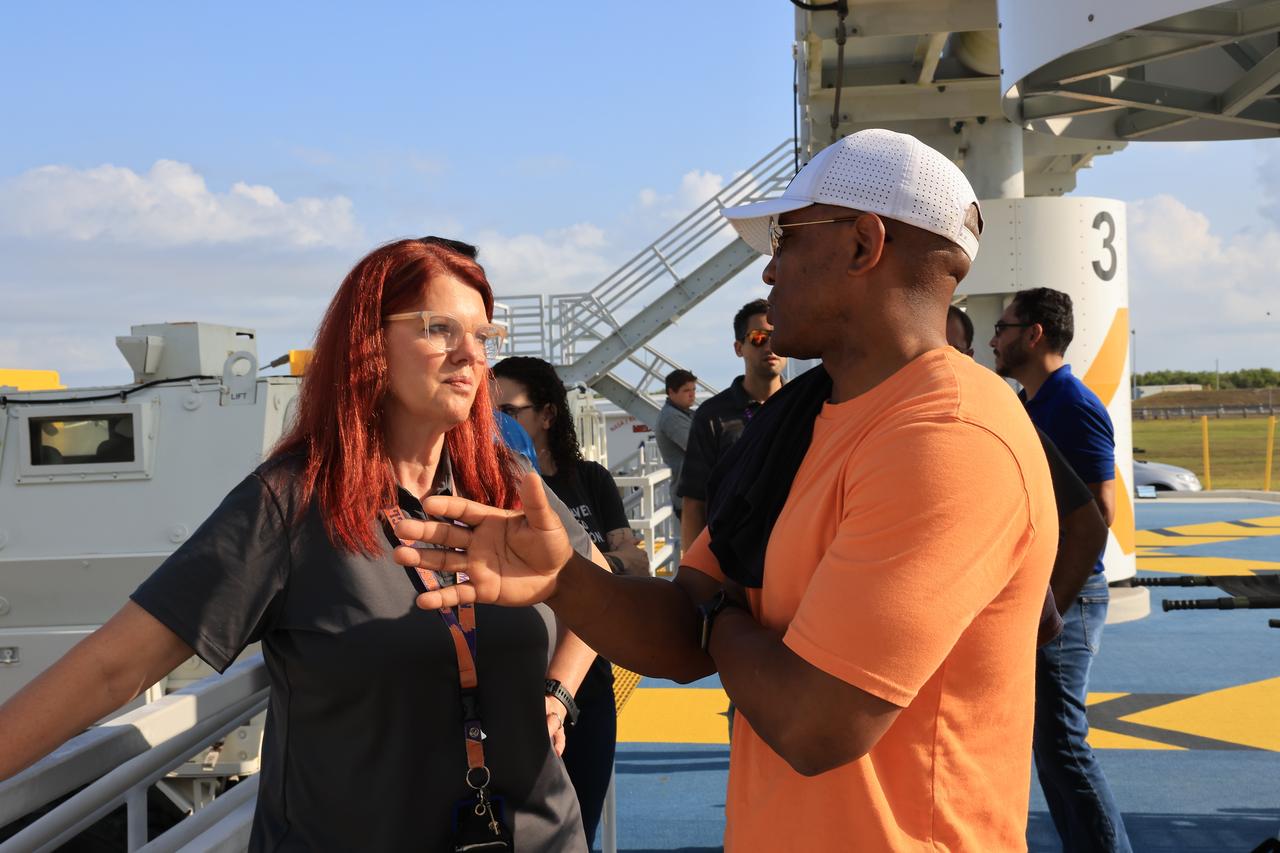
From left, Charlie Blackwell-Thompson, Artemis launch director with NASA’s Exploration Ground Systems Program, and Artemis II pilot Victor Glover participate in training at Launch Complex 39B at the agency’s Kennedy Space Center in Florida on Tuesday, May 6, 2025. Glover and fellow Artemis II crew members and backup members trained with the mine-resistant ambush protected vehicles, or MRAPs, inside the launch pad area. Originally designed for military applications, the 45,000-pound MRAP offers a mobile bunker for astronauts and ground crews in the unlikely event they must get away from the launch pad quickly in an emergency.
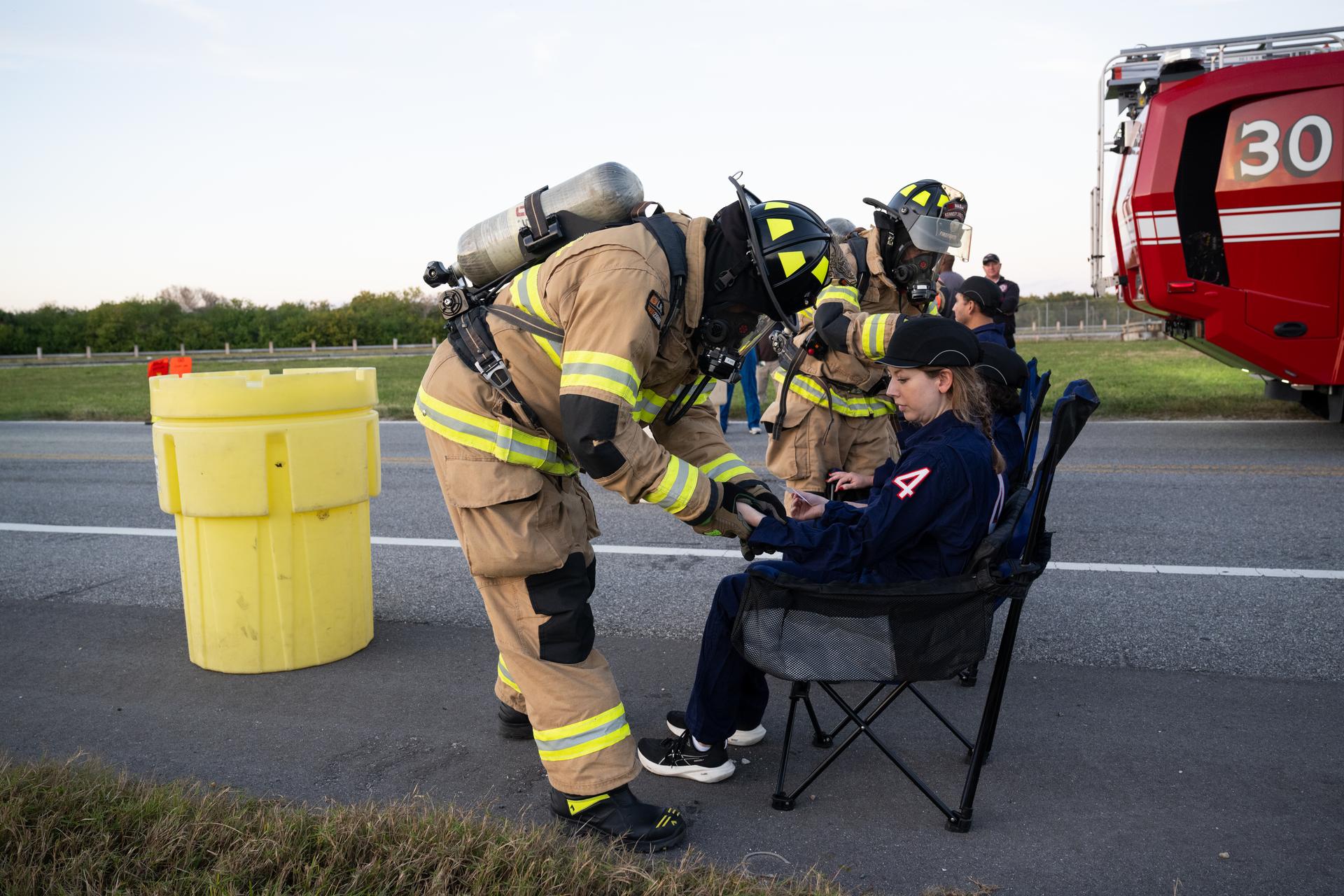
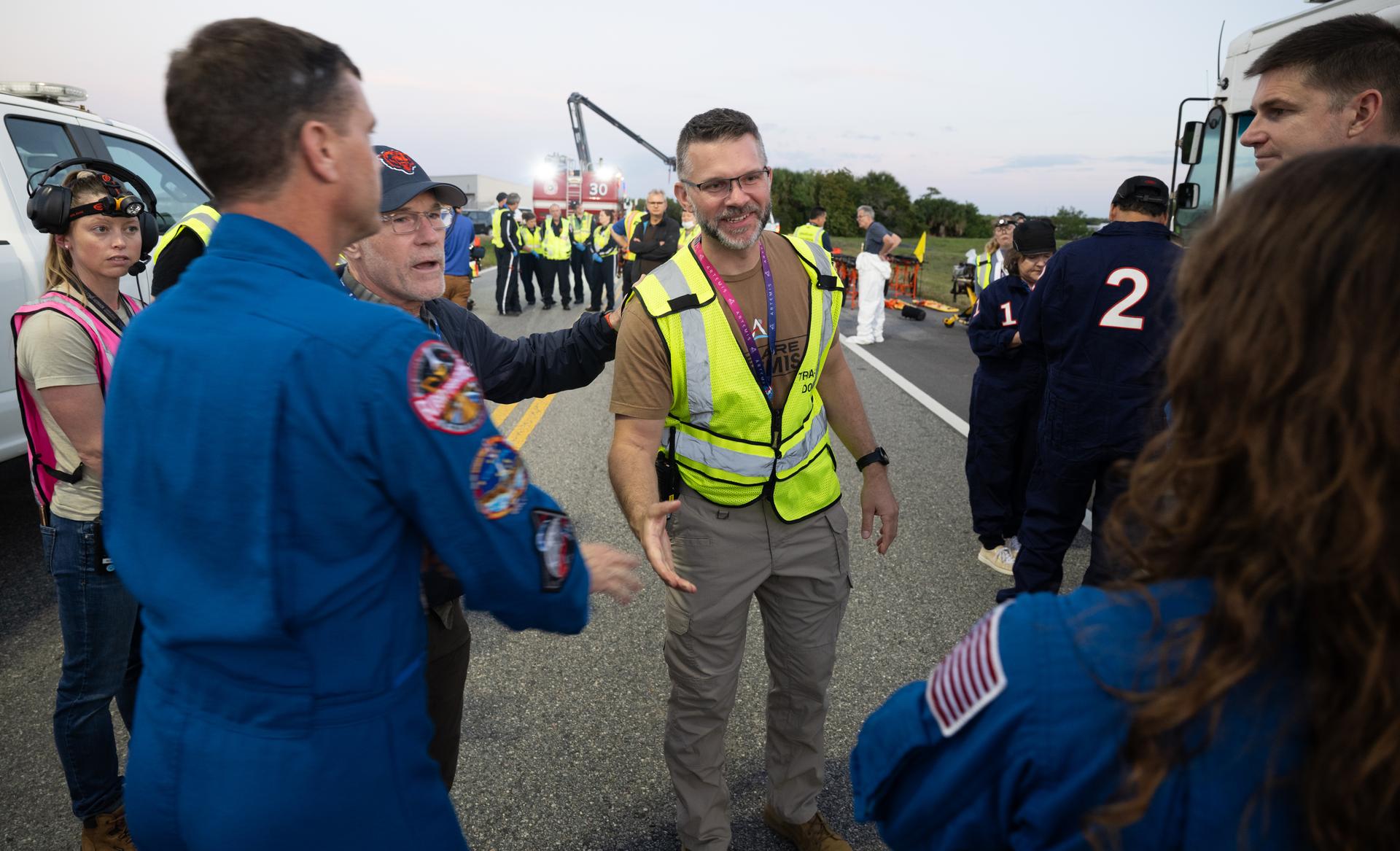
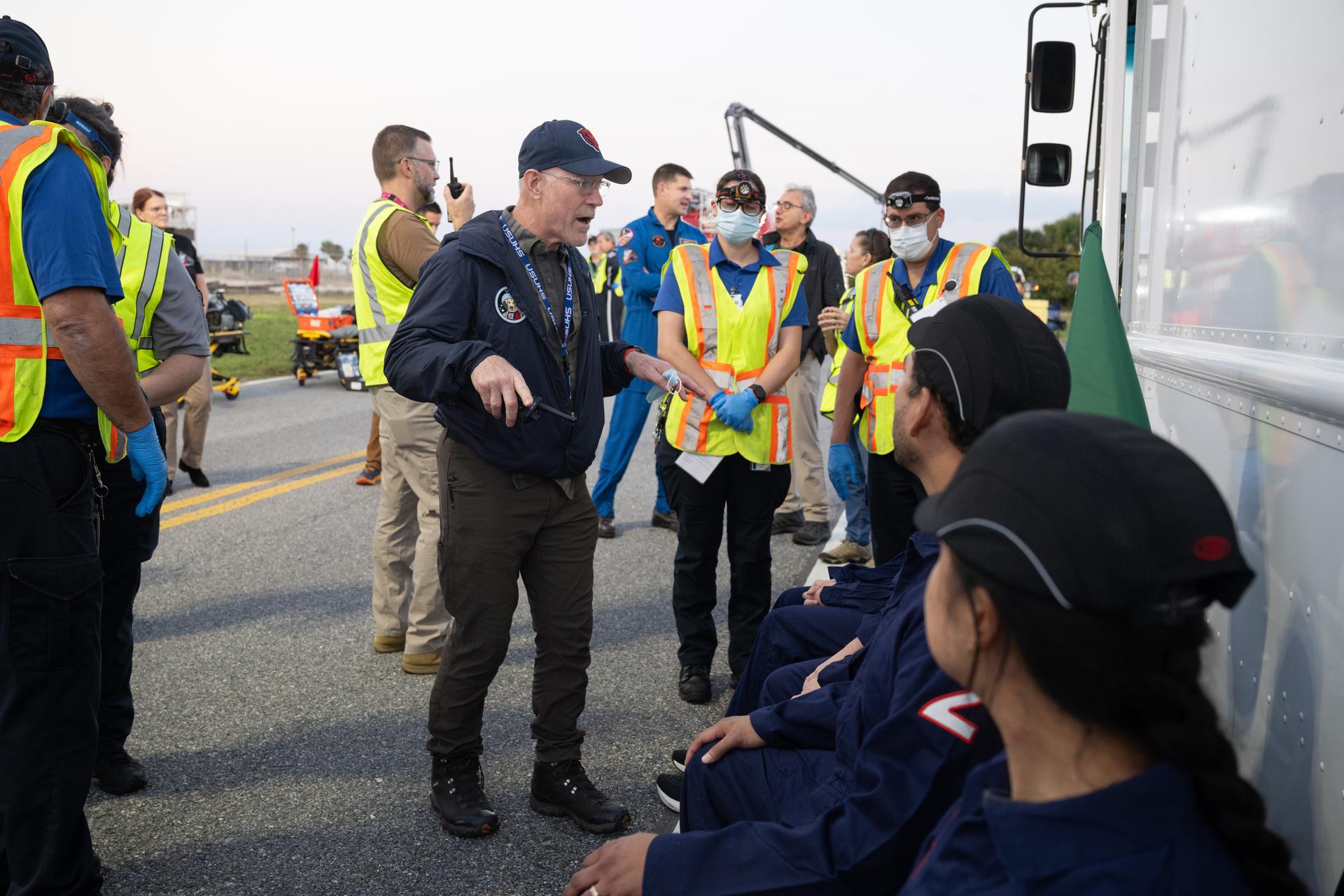
Teams at NASA's Kennedy Space Center in Florida practiced various emergency rescue training scenarios with the Artemis II crew, Friday, Dec. 19, 2025, ahead of the Artemis II mission. In the unlikely event of an emergency during launch countdown at Launch Complex 39B, personnel will be transported in mine-resistant ambush protected vehicles, or MRAPS, from the pad and to one of the triage site locations at Kennedy. Photo Credit: (NASA/Joel Kowsky)
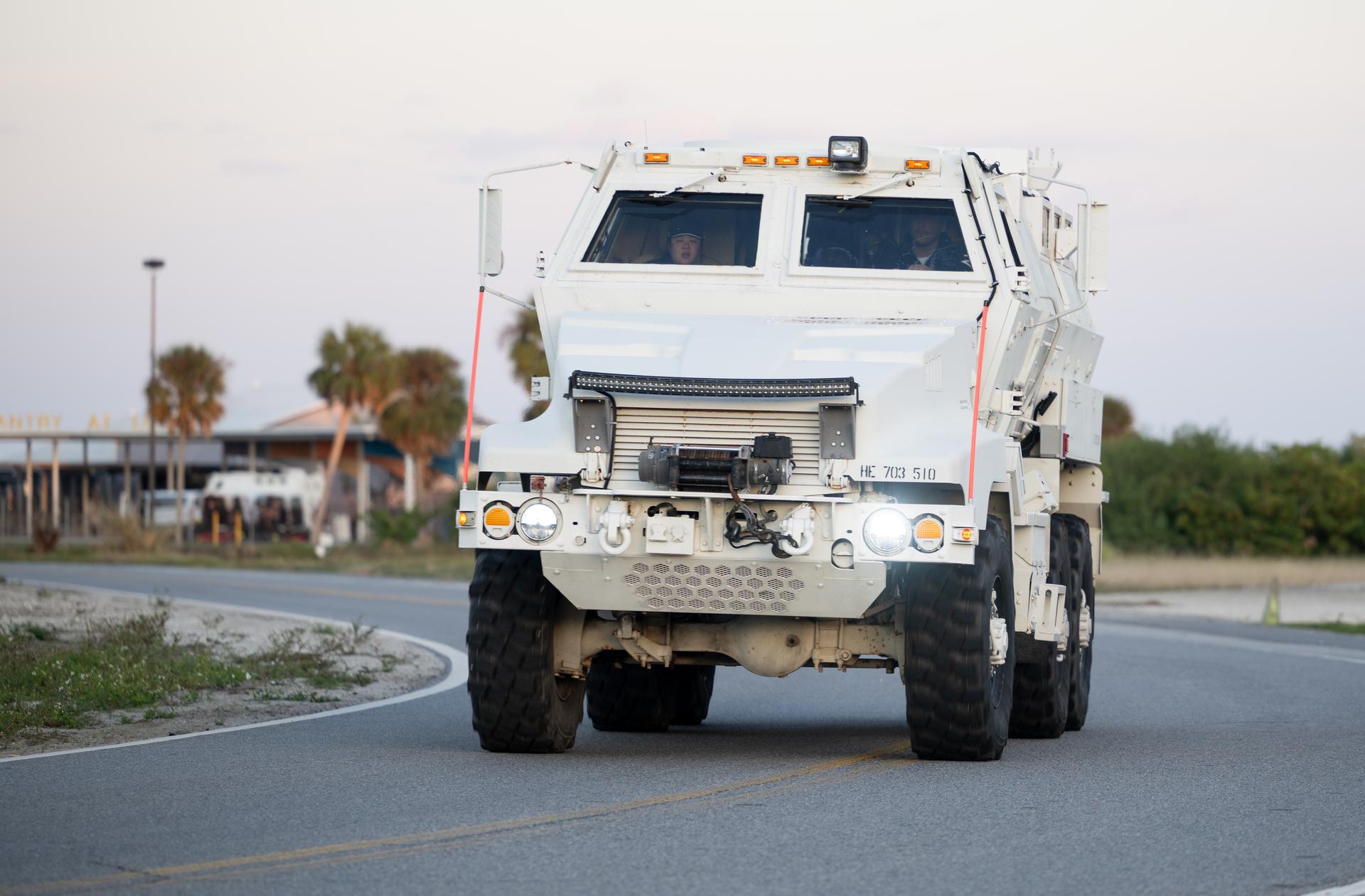
Teams at NASA's Kennedy Space Center in Florida practiced various emergency rescue training scenarios with the Artemis II crew, Friday, Dec. 19, 2025, ahead of the Artemis II mission. In the unlikely event of an emergency during launch countdown at Launch Complex 39B, personnel will be transported in mine-resistant ambush protected vehicles, or MRAPS, from the pad and to one of the triage site locations at Kennedy. Photo Credit: (NASA/Joel Kowsky)
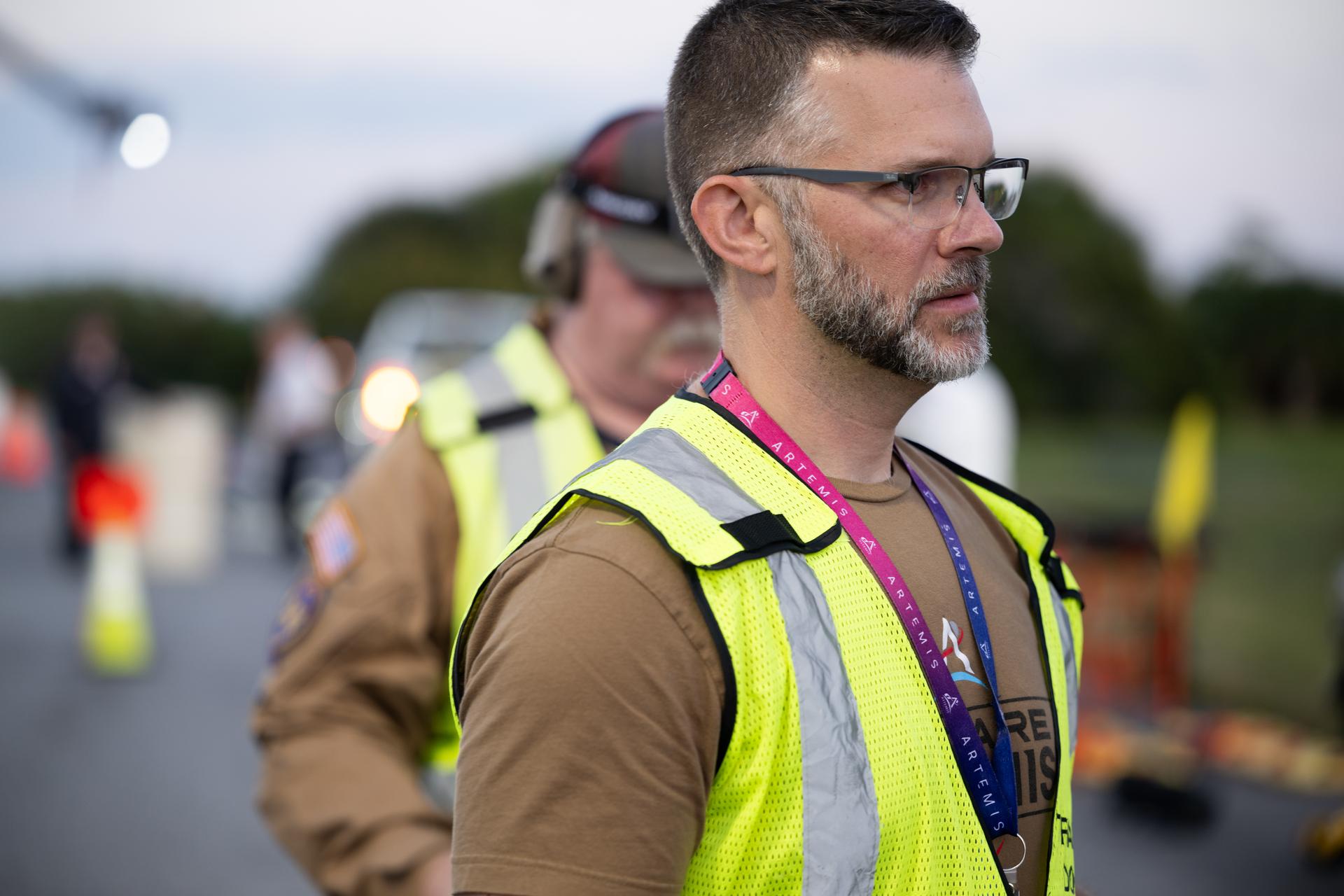
Teams at NASA's Kennedy Space Center in Florida practiced various emergency rescue training scenarios with the Artemis II crew, Friday, Dec. 19, 2025, ahead of the Artemis II mission. In the unlikely event of an emergency during launch countdown at Launch Complex 39B, personnel will be transported in mine-resistant ambush protected vehicles, or MRAPS, from the pad and to one of the triage site locations at Kennedy. Photo Credit: (NASA/Joel Kowsky)
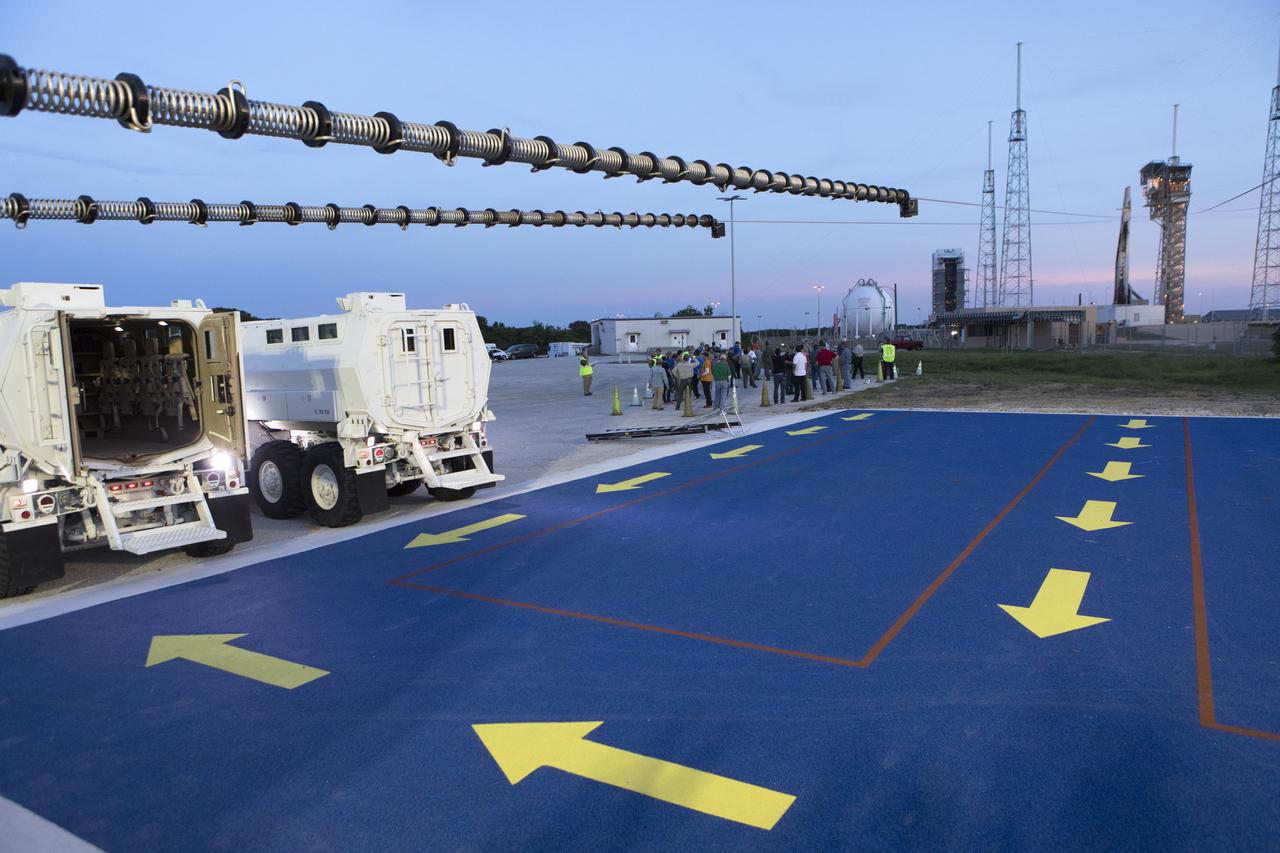
Two mine-resistant ambush protected vehicles, or MRAPs, sit ready to receive astronauts and ground crews during a Boeing/United Launch Alliance emergency egress system demonstration at Cape Canaveral Air Force Station’s Launch Complex 41 in Florida on June 19, 2018. The emergency egress system will provide an escape route in the unlikely event of an emergency on the launch pad on launch day.
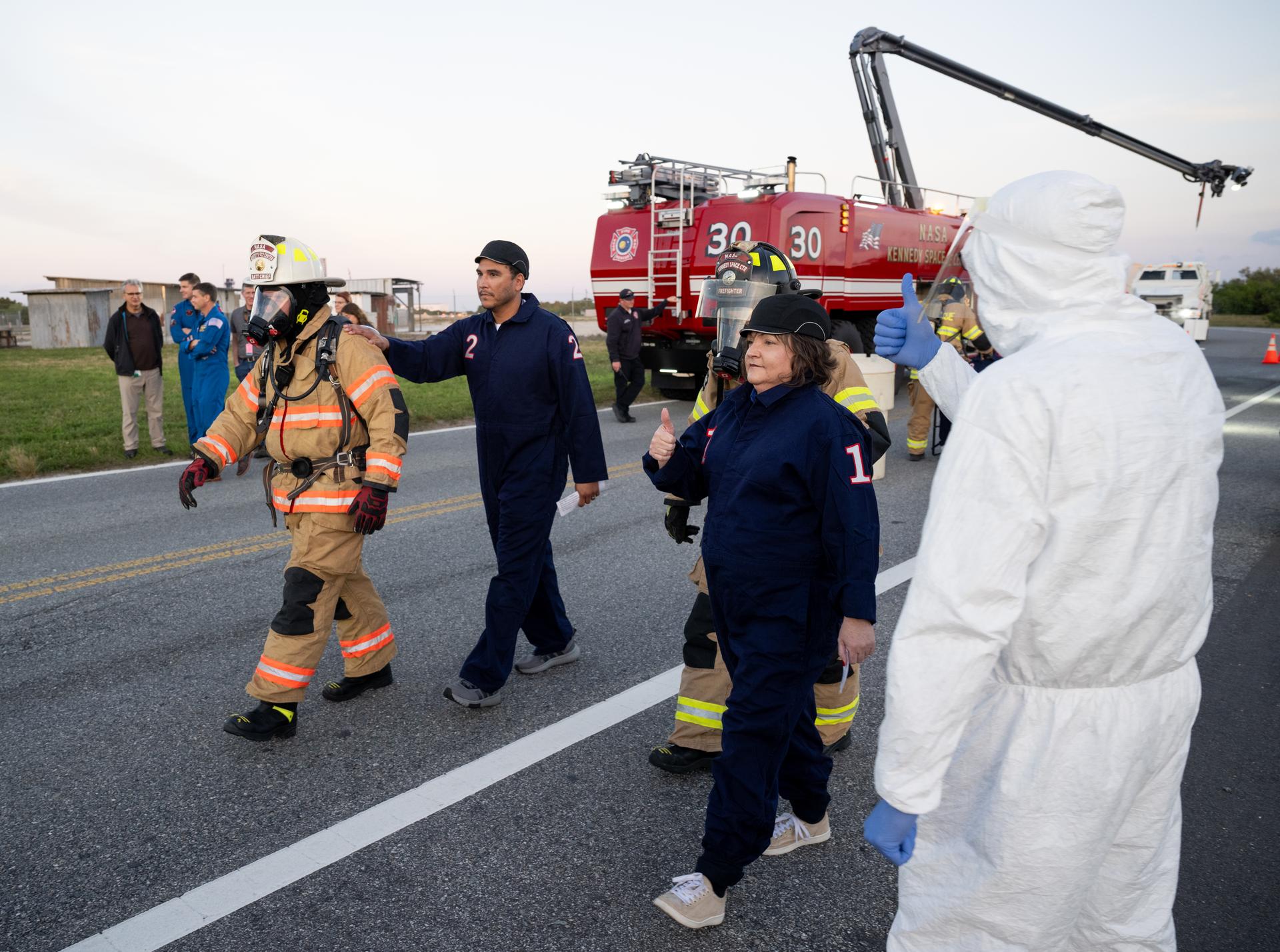
Teams at NASA's Kennedy Space Center in Florida practiced various emergency rescue training scenarios with the Artemis II crew, Friday, Dec. 19, 2025, ahead of the Artemis II mission. In the unlikely event of an emergency during launch countdown at Launch Complex 39B, personnel will be transported in mine-resistant ambush protected vehicles, or MRAPS, from the pad and to one of the triage site locations at Kennedy. Photo Credit: (NASA/Joel Kowsky)
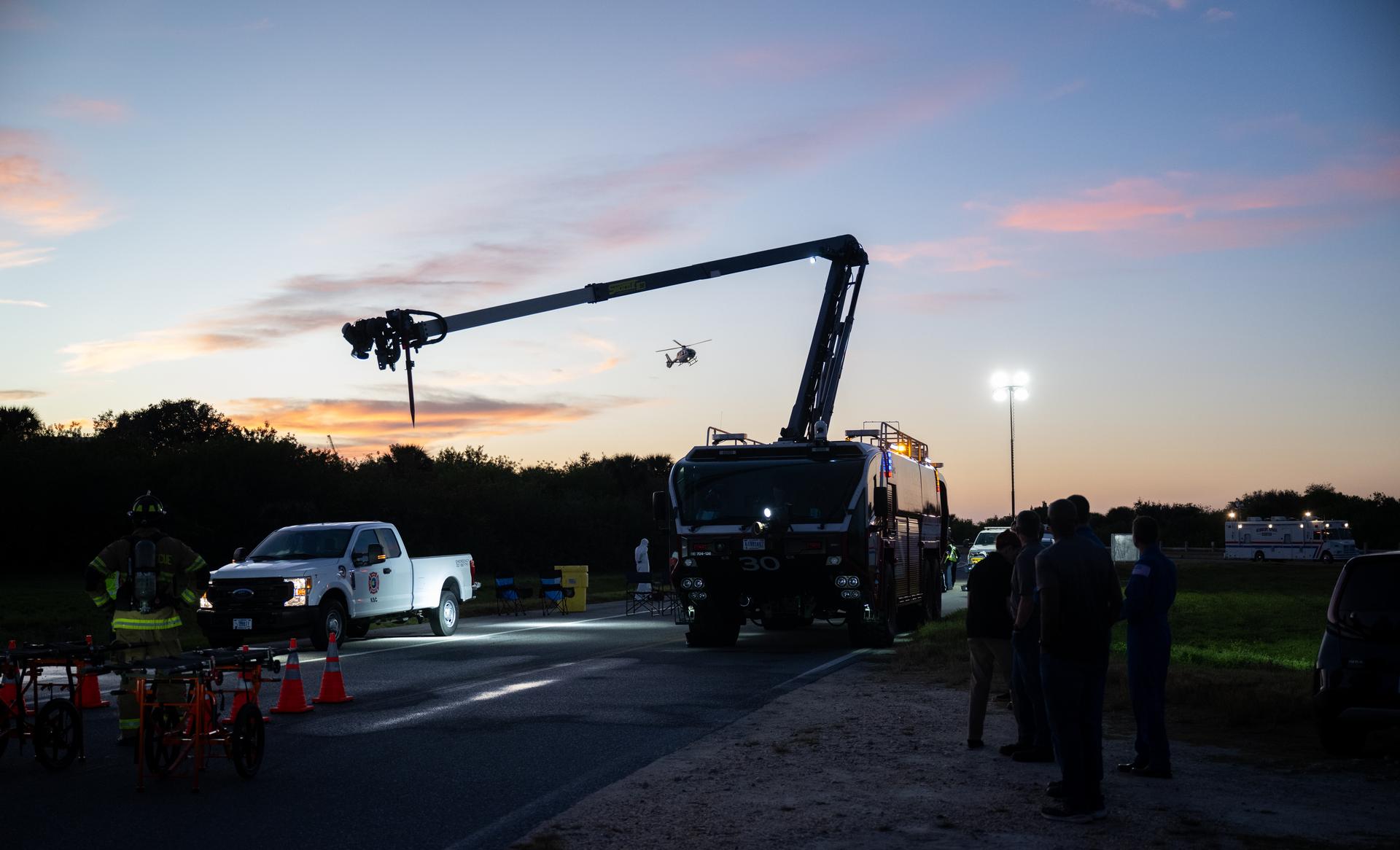
Teams at NASA's Kennedy Space Center in Florida practiced various emergency rescue training scenarios with the Artemis II crew, Friday, Dec. 19, 2025, ahead of the Artemis II mission. In the unlikely event of an emergency during launch countdown at Launch Complex 39B, personnel will be transported in mine-resistant ambush protected vehicles, or MRAPS, from the pad and to one of the triage site locations at Kennedy. Photo Credit: (NASA/Joel Kowsky)
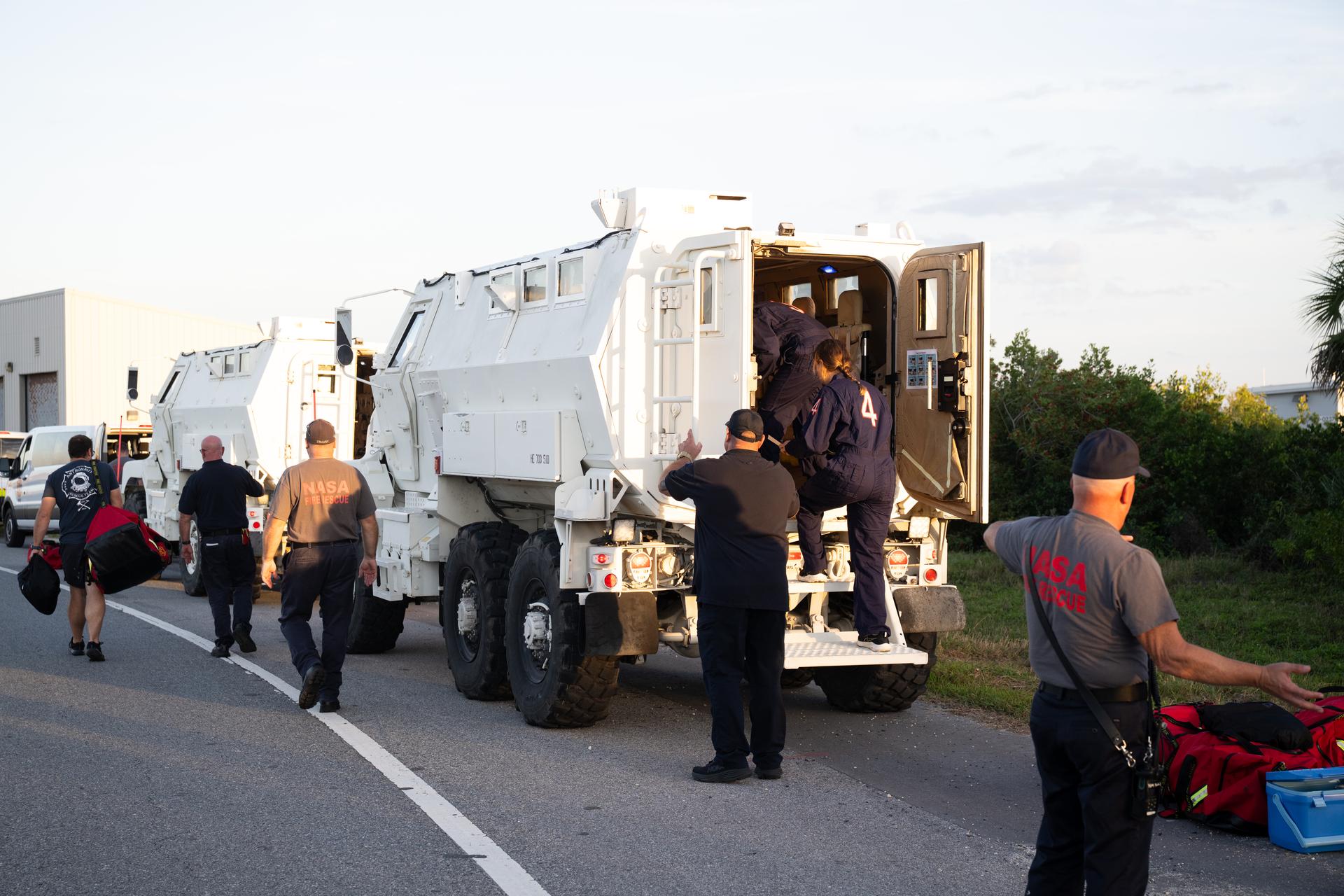
Teams at NASA's Kennedy Space Center in Florida practiced various emergency rescue training scenarios with the Artemis II crew, Friday, Dec. 19, 2025, ahead of the Artemis II mission. In the unlikely event of an emergency during launch countdown at Launch Complex 39B, personnel will be transported in mine-resistant ambush protected vehicles, or MRAPS, from the pad and to one of the triage site locations at Kennedy. Photo Credit: (NASA/Joel Kowsky)
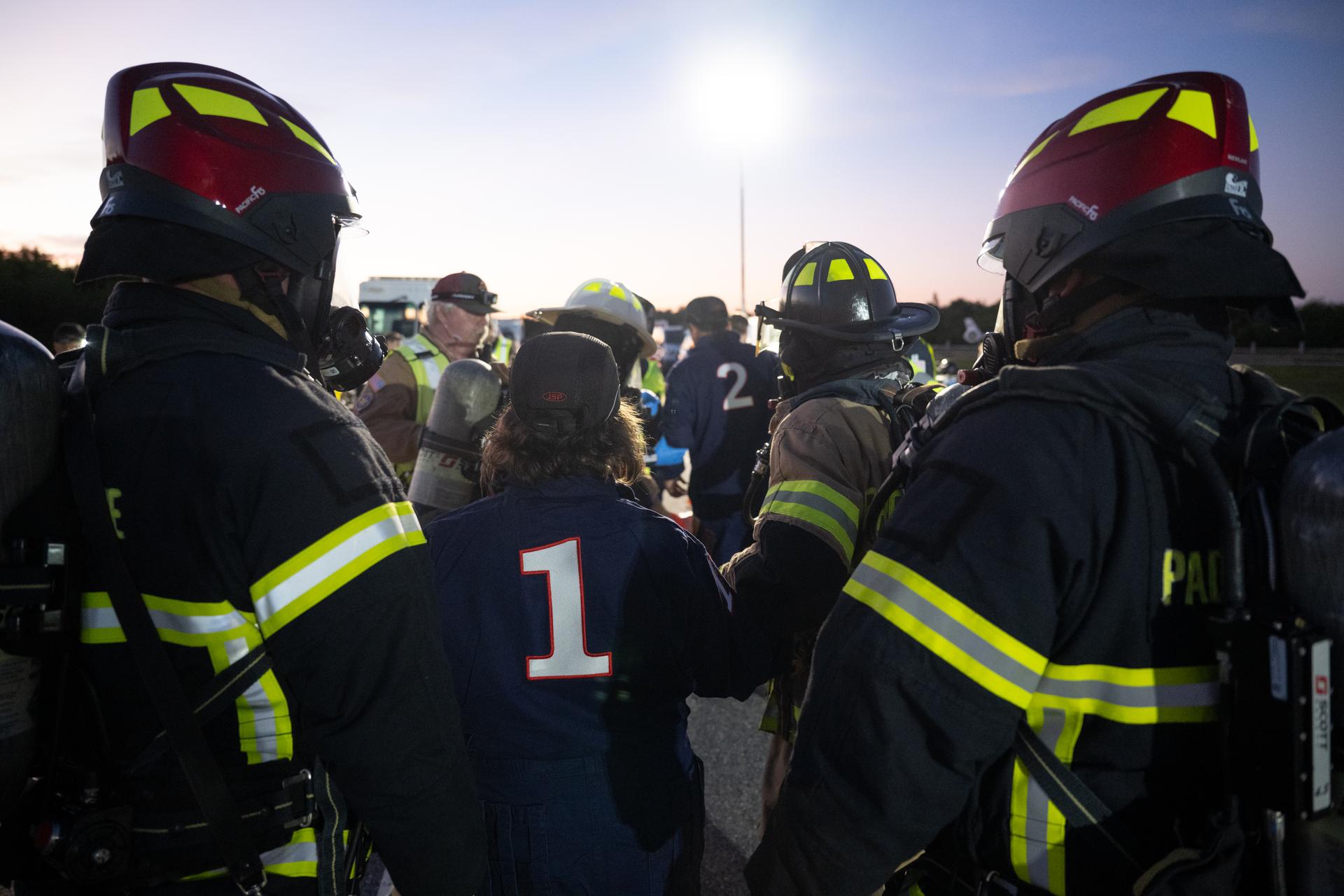
Teams at NASA's Kennedy Space Center in Florida practiced various emergency rescue training scenarios with the Artemis II crew, Friday, Dec. 19, 2025, ahead of the Artemis II mission. In the unlikely event of an emergency during launch countdown at Launch Complex 39B, personnel will be transported in mine-resistant ambush protected vehicles, or MRAPS, from the pad and to one of the triage site locations at Kennedy. Photo Credit: (NASA/Joel Kowsky)
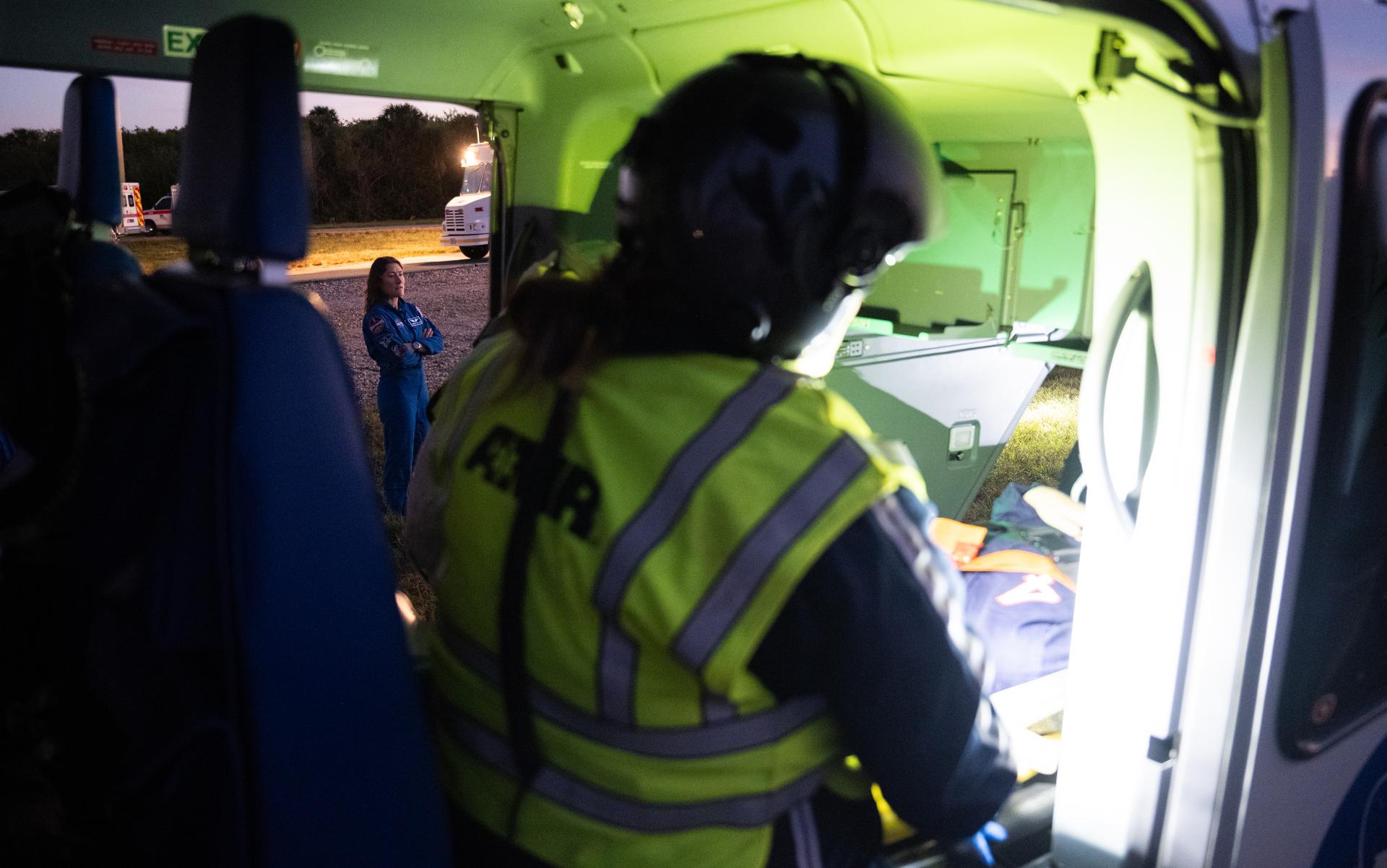
NASA astronaut Christina Koch, Artemis II mission specialist, looks on as teams at NASA's Kennedy Space Center in Florida practiced various emergency rescue training scenarios with the Artemis II crew, Friday, Dec. 19, 2025, ahead of the Artemis II mission. In the unlikely event of an emergency during launch countdown at Launch Complex 39B, personnel will be transported in mine-resistant ambush protected vehicles, or MRAPS, from the pad and to one of the triage site locations at Kennedy. Photo Credit: (NASA/Joel Kowsky)
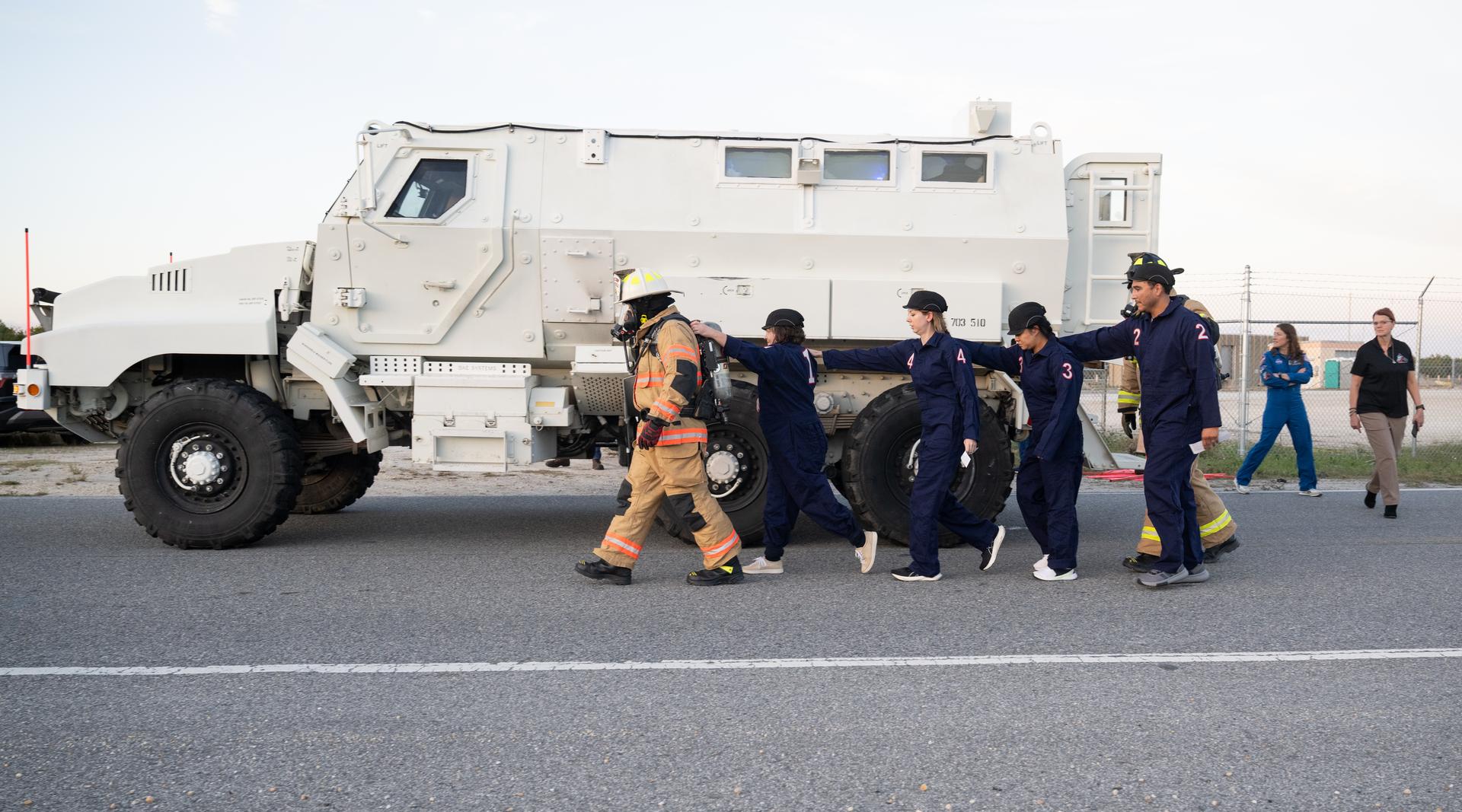
Teams at NASA's Kennedy Space Center in Florida practiced various emergency rescue training scenarios with the Artemis II crew, Friday, Dec. 19, 2025, ahead of the Artemis II mission. In the unlikely event of an emergency during launch countdown at Launch Complex 39B, personnel will be transported in mine-resistant ambush protected vehicles, or MRAPS, from the pad and to one of the triage site locations at Kennedy. Photo Credit: (NASA/Joel Kowsky)
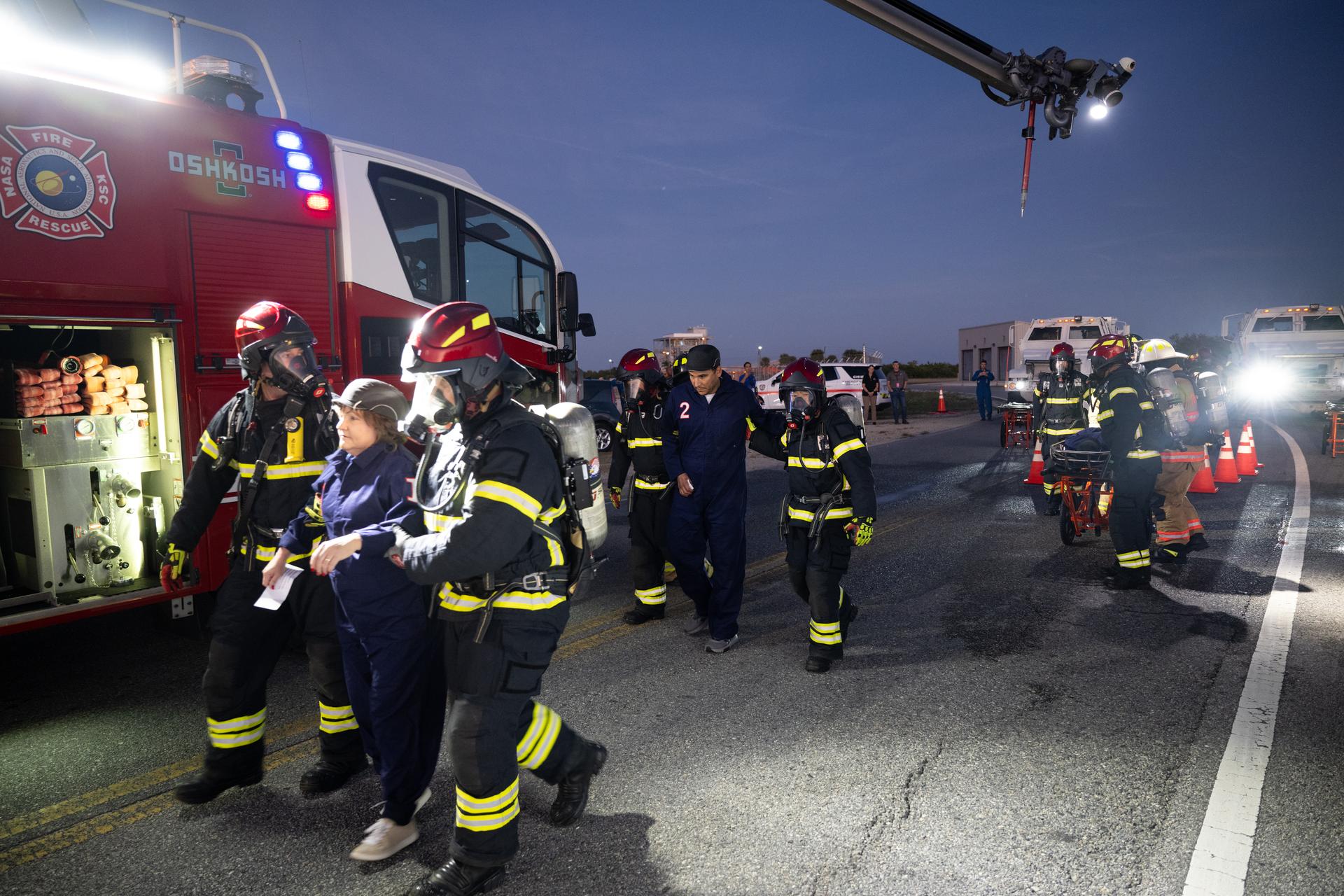
Teams at NASA's Kennedy Space Center in Florida practiced various emergency rescue training scenarios with the Artemis II crew, Friday, Dec. 19, 2025, ahead of the Artemis II mission. In the unlikely event of an emergency during launch countdown at Launch Complex 39B, personnel will be transported in mine-resistant ambush protected vehicles, or MRAPS, from the pad and to one of the triage site locations at Kennedy. Photo Credit: (NASA/Joel Kowsky)
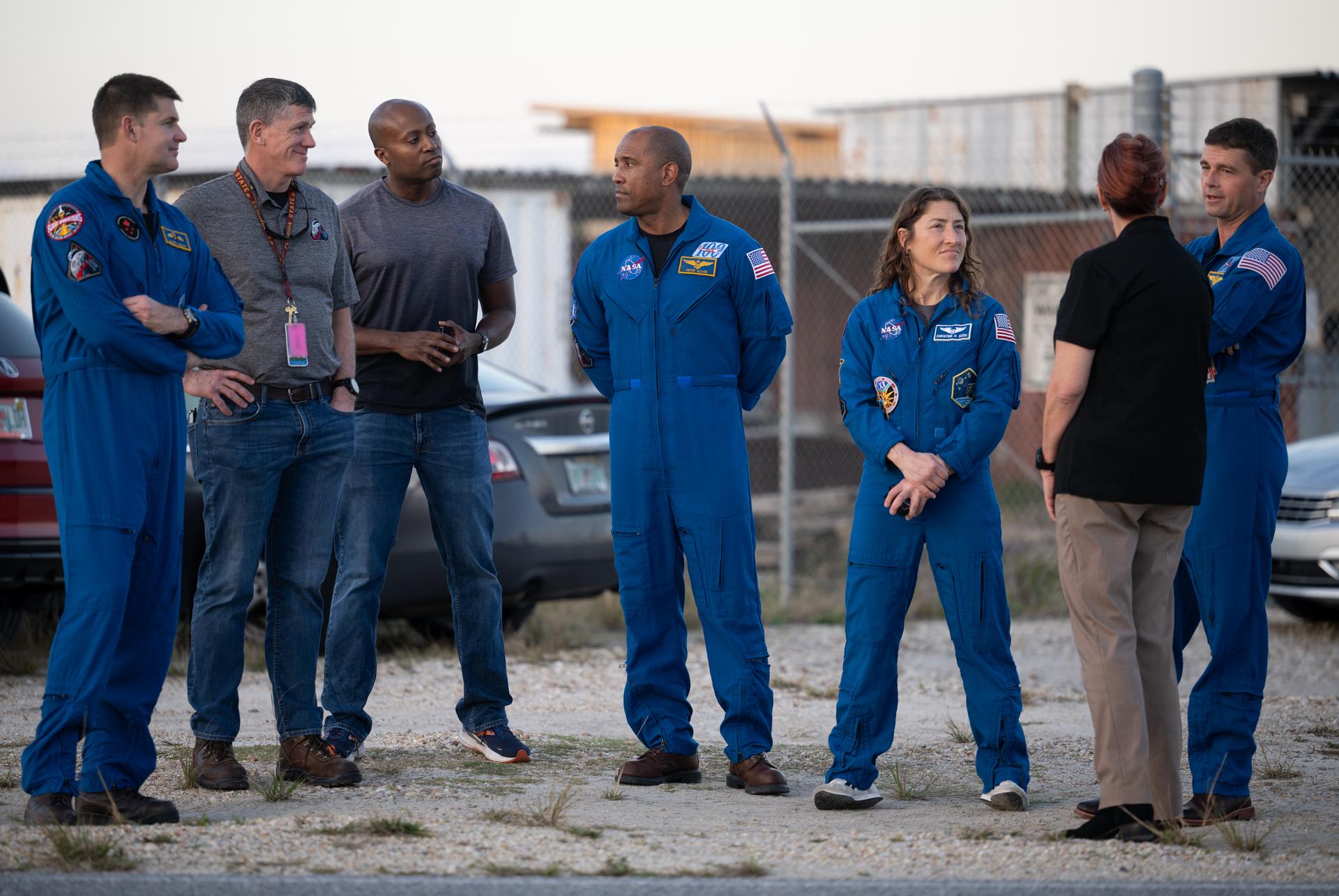
Teams at NASA's Kennedy Space Center in Florida practiced various emergency rescue training scenarios with the Artemis II crew, Friday, Dec. 19, 2025, ahead of the Artemis II mission. In the unlikely event of an emergency during launch countdown at Launch Complex 39B, personnel will be transported in mine-resistant ambush protected vehicles, or MRAPS, from the pad and to one of the triage site locations at Kennedy. Photo Credit: (NASA/Joel Kowsky) NOTE - Portions of this image have been blurred for security reasons.
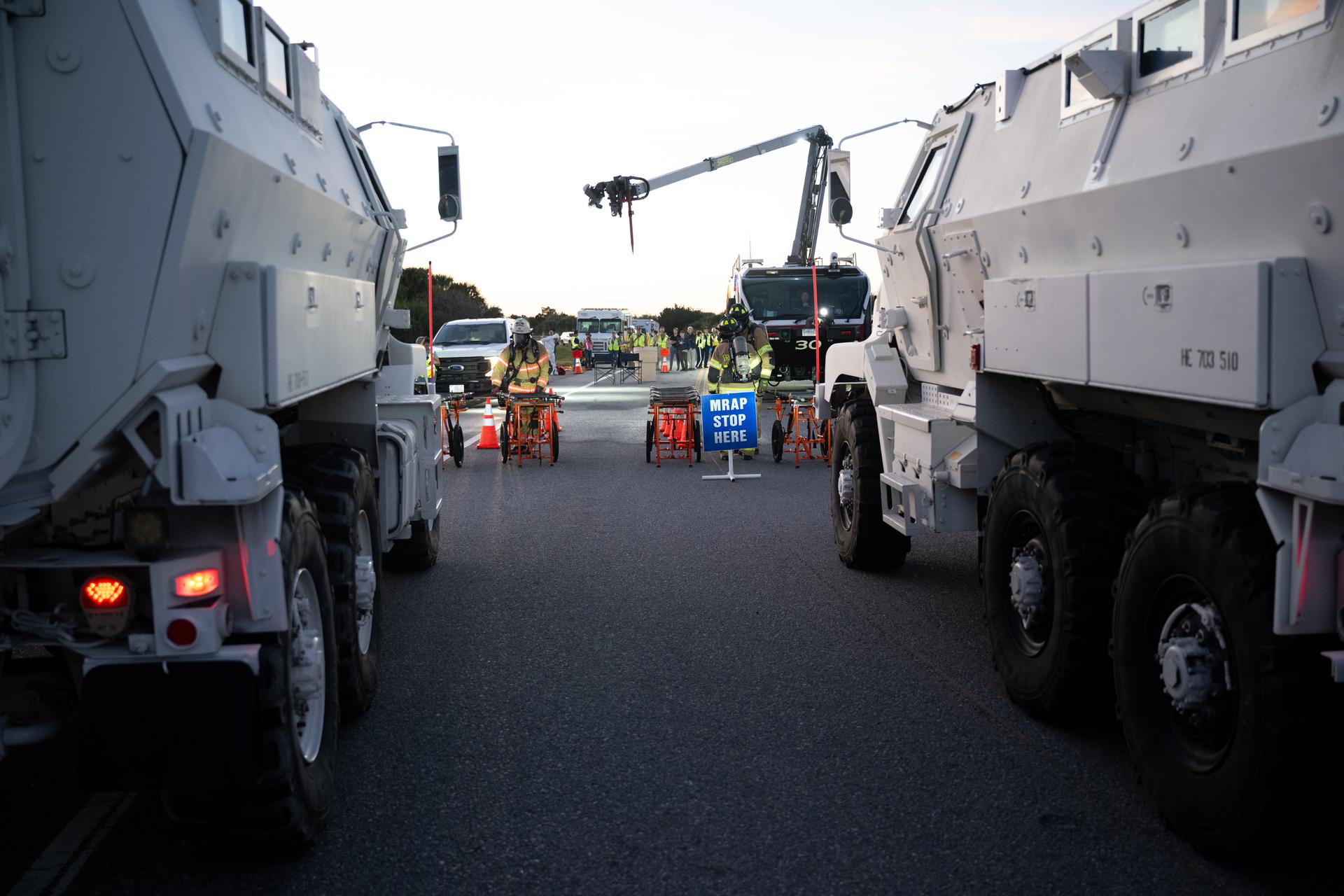
Teams at NASA's Kennedy Space Center in Florida practiced various emergency rescue training scenarios with the Artemis II crew, Friday, Dec. 19, 2025, ahead of the Artemis II mission. In the unlikely event of an emergency during launch countdown at Launch Complex 39B, personnel will be transported in mine-resistant ambush protected vehicles, or MRAPS, from the pad and to one of the triage site locations at Kennedy. Photo Credit: (NASA/Joel Kowsky)
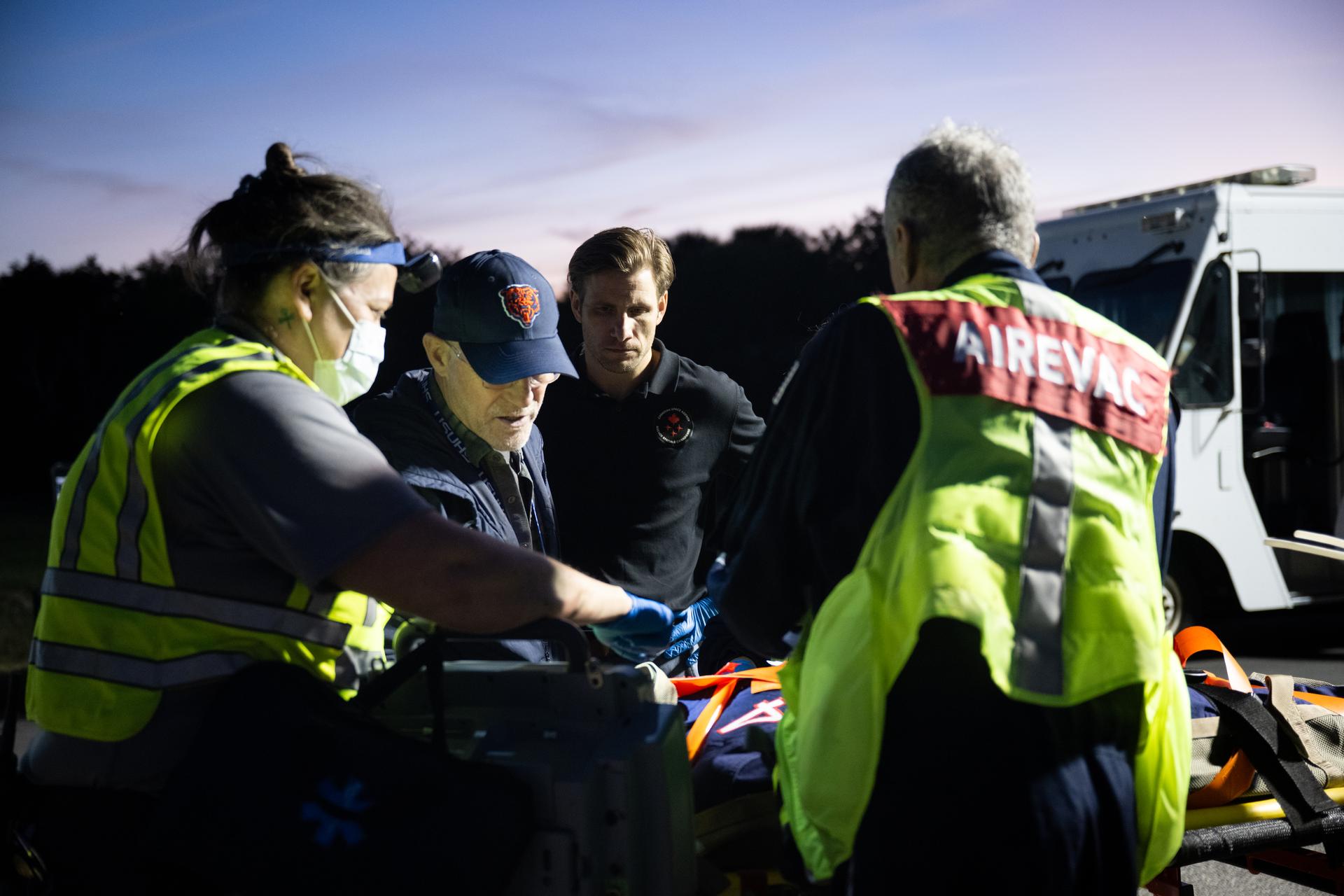
Teams at NASA's Kennedy Space Center in Florida practiced various emergency rescue training scenarios with the Artemis II crew, Friday, Dec. 19, 2025, ahead of the Artemis II mission. In the unlikely event of an emergency during launch countdown at Launch Complex 39B, personnel will be transported in mine-resistant ambush protected vehicles, or MRAPS, from the pad and to one of the triage site locations at Kennedy. Photo Credit: (NASA/Joel Kowsky)
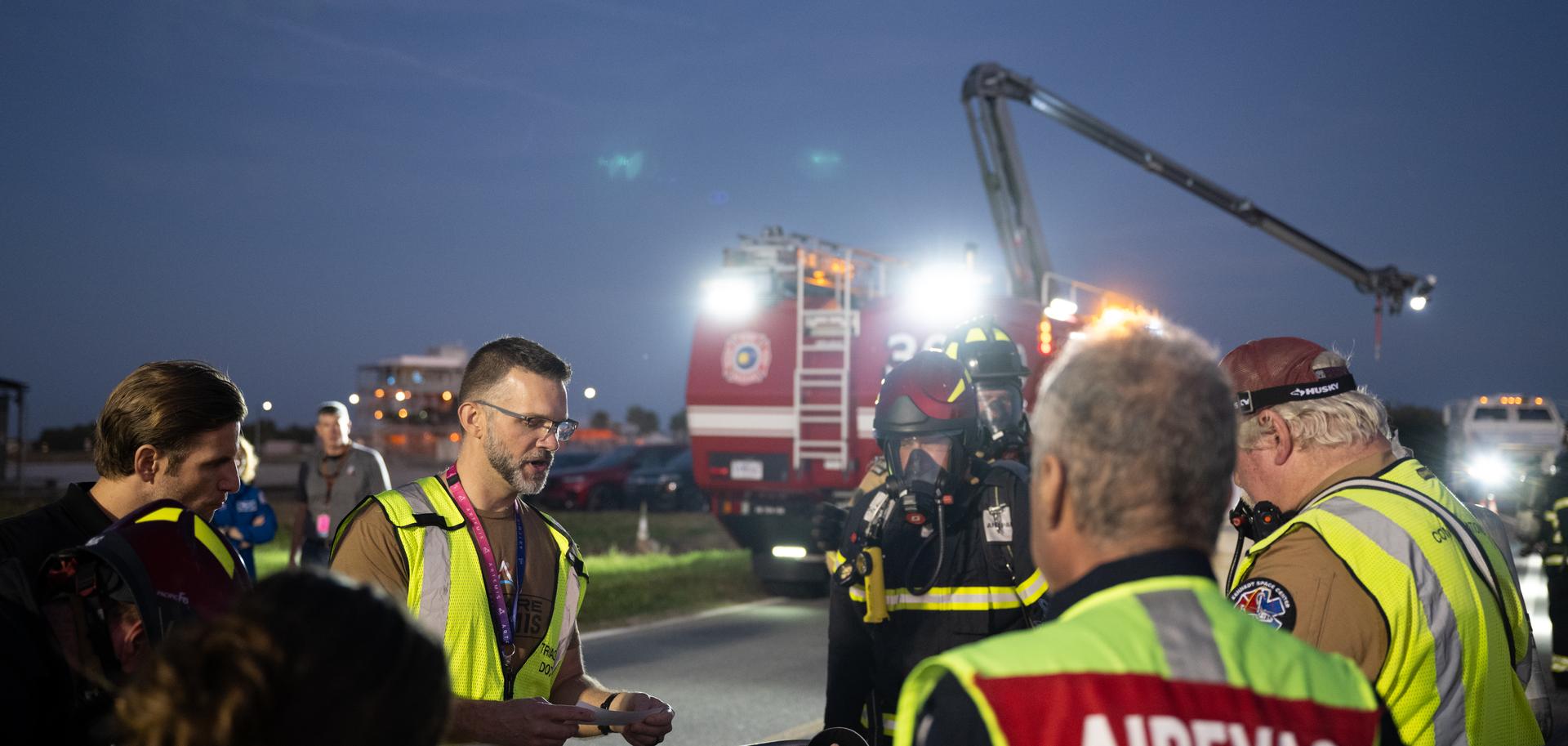
Teams at NASA's Kennedy Space Center in Florida practiced various emergency rescue training scenarios with the Artemis II crew, Friday, Dec. 19, 2025, ahead of the Artemis II mission. In the unlikely event of an emergency during launch countdown at Launch Complex 39B, personnel will be transported in mine-resistant ambush protected vehicles, or MRAPS, from the pad and to one of the triage site locations at Kennedy. Photo Credit: (NASA/Joel Kowsky)
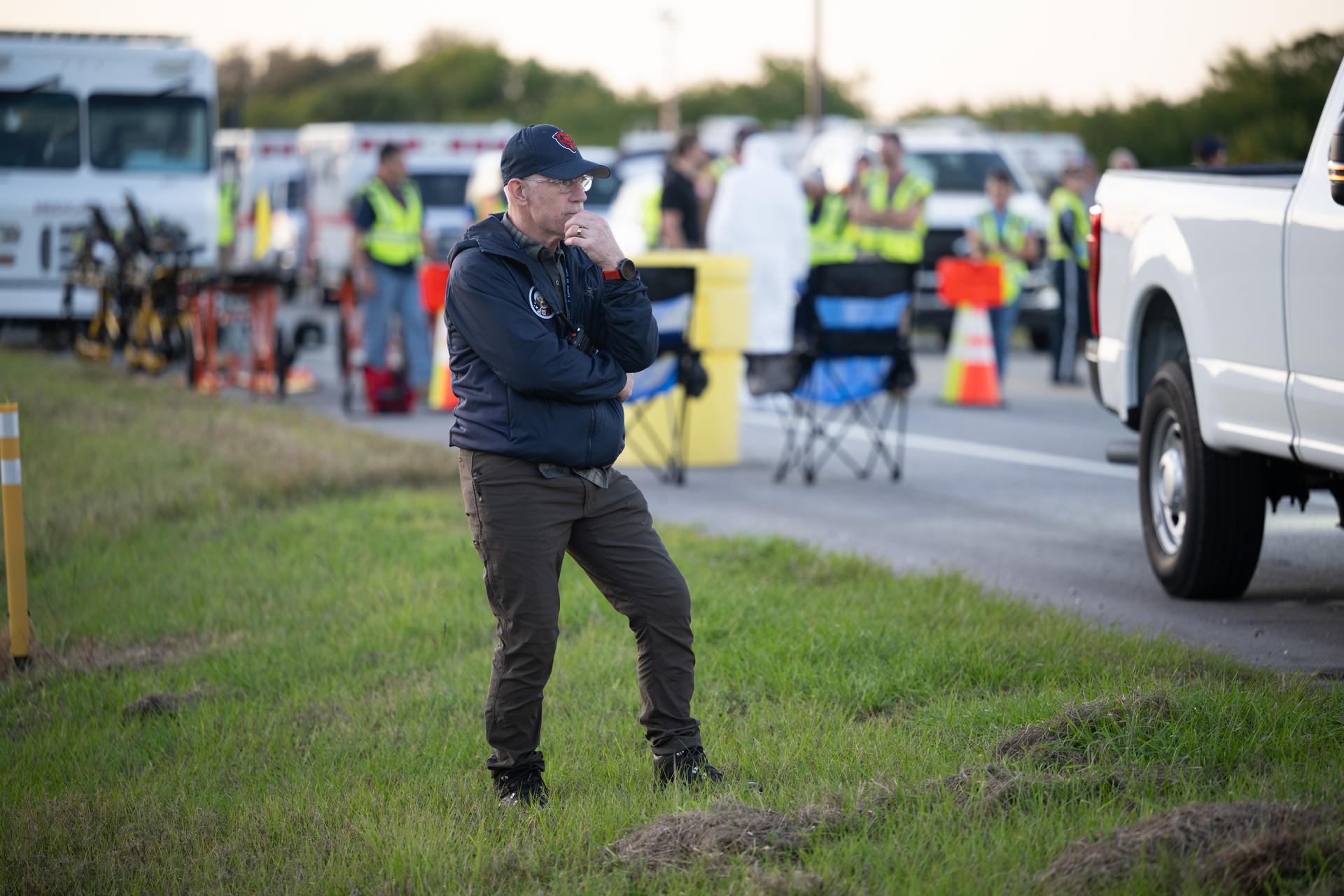
NASA Flight Surgeon Richard Scheuring watches as teams at NASA's Kennedy Space Center in Florida practiced various emergency rescue training scenarios with the Artemis II crew, Friday, Dec. 19, 2025, ahead of the Artemis II mission. In the unlikely event of an emergency during launch countdown at Launch Complex 39B, personnel will be transported in mine-resistant ambush protected vehicles, or MRAPS, from the pad and to one of the triage site locations at Kennedy. Photo Credit: (NASA/Joel Kowsky)
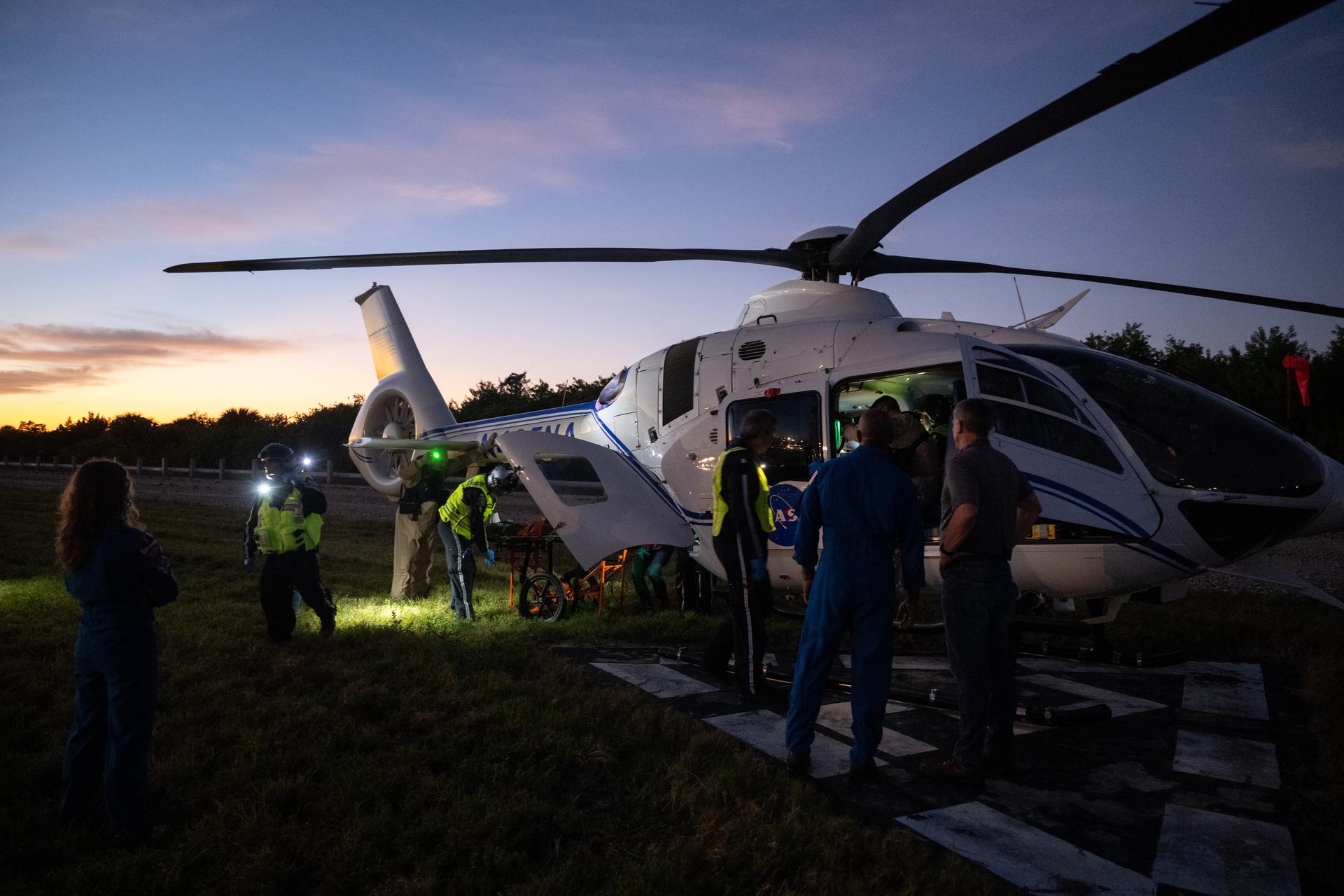
Teams at NASA's Kennedy Space Center in Florida practiced various emergency rescue training scenarios with the Artemis II crew, Friday, Dec. 19, 2025, ahead of the Artemis II mission. In the unlikely event of an emergency during launch countdown at Launch Complex 39B, personnel will be transported in mine-resistant ambush protected vehicles, or MRAPS, from the pad and to one of the triage site locations at Kennedy. Photo Credit: (NASA/Joel Kowsky)
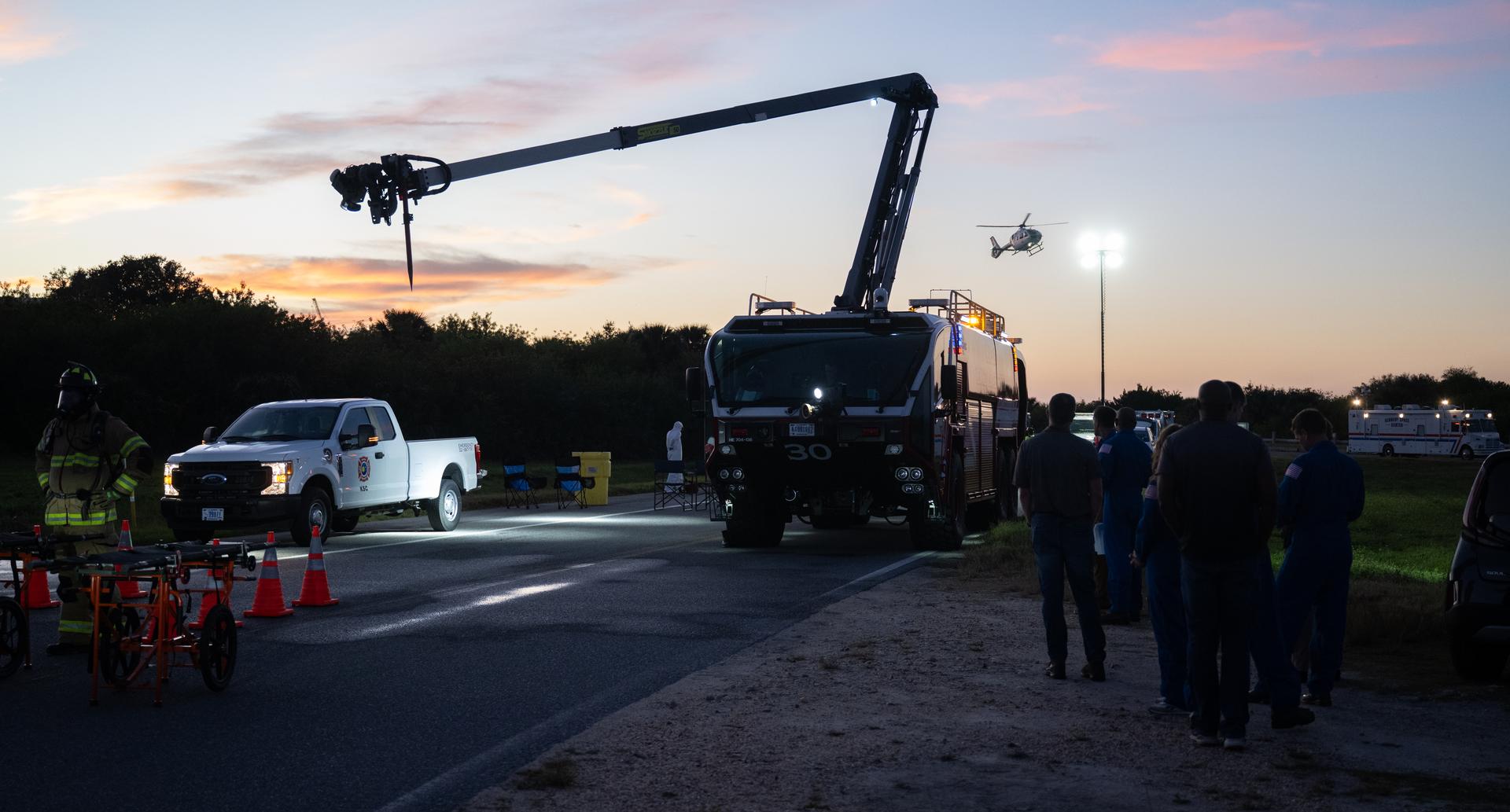
Teams at NASA's Kennedy Space Center in Florida practiced various emergency rescue training scenarios with the Artemis II crew, Friday, Dec. 19, 2025, ahead of the Artemis II mission. In the unlikely event of an emergency during launch countdown at Launch Complex 39B, personnel will be transported in mine-resistant ambush protected vehicles, or MRAPS, from the pad and to one of the triage site locations at Kennedy. Photo Credit: (NASA/Joel Kowsky)
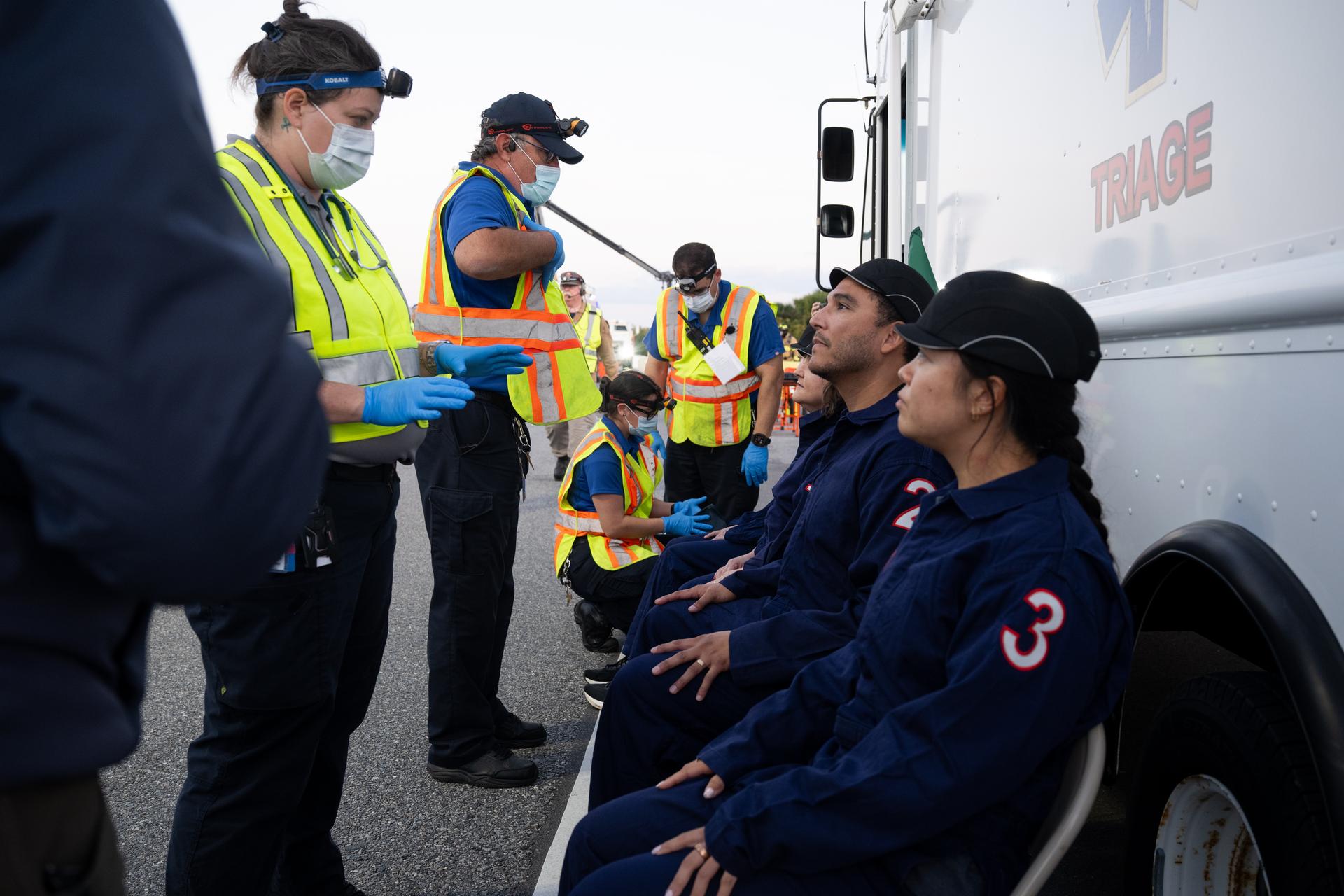
Teams at NASA's Kennedy Space Center in Florida practiced various emergency rescue training scenarios with the Artemis II crew, Friday, Dec. 19, 2025, ahead of the Artemis II mission. In the unlikely event of an emergency during launch countdown at Launch Complex 39B, personnel will be transported in mine-resistant ambush protected vehicles, or MRAPS, from the pad and to one of the triage site locations at Kennedy. Photo Credit: (NASA/Joel Kowsky)
Teams at NASA's Kennedy Space Center in Florida practiced various emergency rescue training scenarios with the Artemis II crew, Friday, Dec. 19, 2025, ahead of the Artemis II mission. In the unlikely event of an emergency during launch countdown at Launch Complex 39B, personnel will be transported in mine-resistant ambush protected vehicles, or MRAPS, from the pad and to one of the triage site locations at Kennedy. Photo Credit: (NASA/Joel Kowsky)
Teams at NASA's Kennedy Space Center in Florida practiced various emergency rescue training scenarios with the Artemis II crew, Friday, Dec. 19, 2025, ahead of the Artemis II mission. In the unlikely event of an emergency during launch countdown at Launch Complex 39B, personnel will be transported in mine-resistant ambush protected vehicles, or MRAPS, from the pad and to one of the triage site locations at Kennedy. Photo Credit: (NASA/Joel Kowsky)
Teams at NASA's Kennedy Space Center in Florida practiced various emergency rescue training scenarios with the Artemis II crew, Friday, Dec. 19, 2025, ahead of the Artemis II mission. In the unlikely event of an emergency during launch countdown at Launch Complex 39B, personnel will be transported in mine-resistant ambush protected vehicles, or MRAPS, from the pad and to one of the triage site locations at Kennedy. Photo Credit: (NASA/Joel Kowsky)
Teams at NASA's Kennedy Space Center in Florida practiced various emergency rescue training scenarios with the Artemis II crew, Friday, Dec. 19, 2025, ahead of the Artemis II mission. In the unlikely event of an emergency during launch countdown at Launch Complex 39B, personnel will be transported in mine-resistant ambush protected vehicles, or MRAPS, from the pad and to one of the triage site locations at Kennedy. Photo Credit: (NASA/Joel Kowsky)
Teams at NASA's Kennedy Space Center in Florida practiced various emergency rescue training scenarios with the Artemis II crew, Friday, Dec. 19, 2025, ahead of the Artemis II mission. In the unlikely event of an emergency during launch countdown at Launch Complex 39B, personnel will be transported in mine-resistant ambush protected vehicles, or MRAPS, from the pad and to one of the triage site locations at Kennedy. Photo Credit: (NASA/Joel Kowsky)
Teams at NASA's Kennedy Space Center in Florida practiced various emergency rescue training scenarios with the Artemis II crew, Friday, Dec. 19, 2025, ahead of the Artemis II mission. In the unlikely event of an emergency during launch countdown at Launch Complex 39B, personnel will be transported in mine-resistant ambush protected vehicles, or MRAPS, from the pad and to one of the triage site locations at Kennedy. Photo Credit: (NASA/Joel Kowsky)
Teams at NASA's Kennedy Space Center in Florida practiced various emergency rescue training scenarios with the Artemis II crew, Friday, Dec. 19, 2025, ahead of the Artemis II mission. In the unlikely event of an emergency during launch countdown at Launch Complex 39B, personnel will be transported in mine-resistant ambush protected vehicles, or MRAPS, from the pad and to one of the triage site locations at Kennedy. Photo Credit: (NASA/Joel Kowsky)
Teams at NASA's Kennedy Space Center in Florida practiced various emergency rescue training scenarios with the Artemis II crew, Friday, Dec. 19, 2025, ahead of the Artemis II mission. In the unlikely event of an emergency during launch countdown at Launch Complex 39B, personnel will be transported in mine-resistant ambush protected vehicles, or MRAPS, from the pad and to one of the triage site locations at Kennedy. Photo Credit: (NASA/Joel Kowsky)
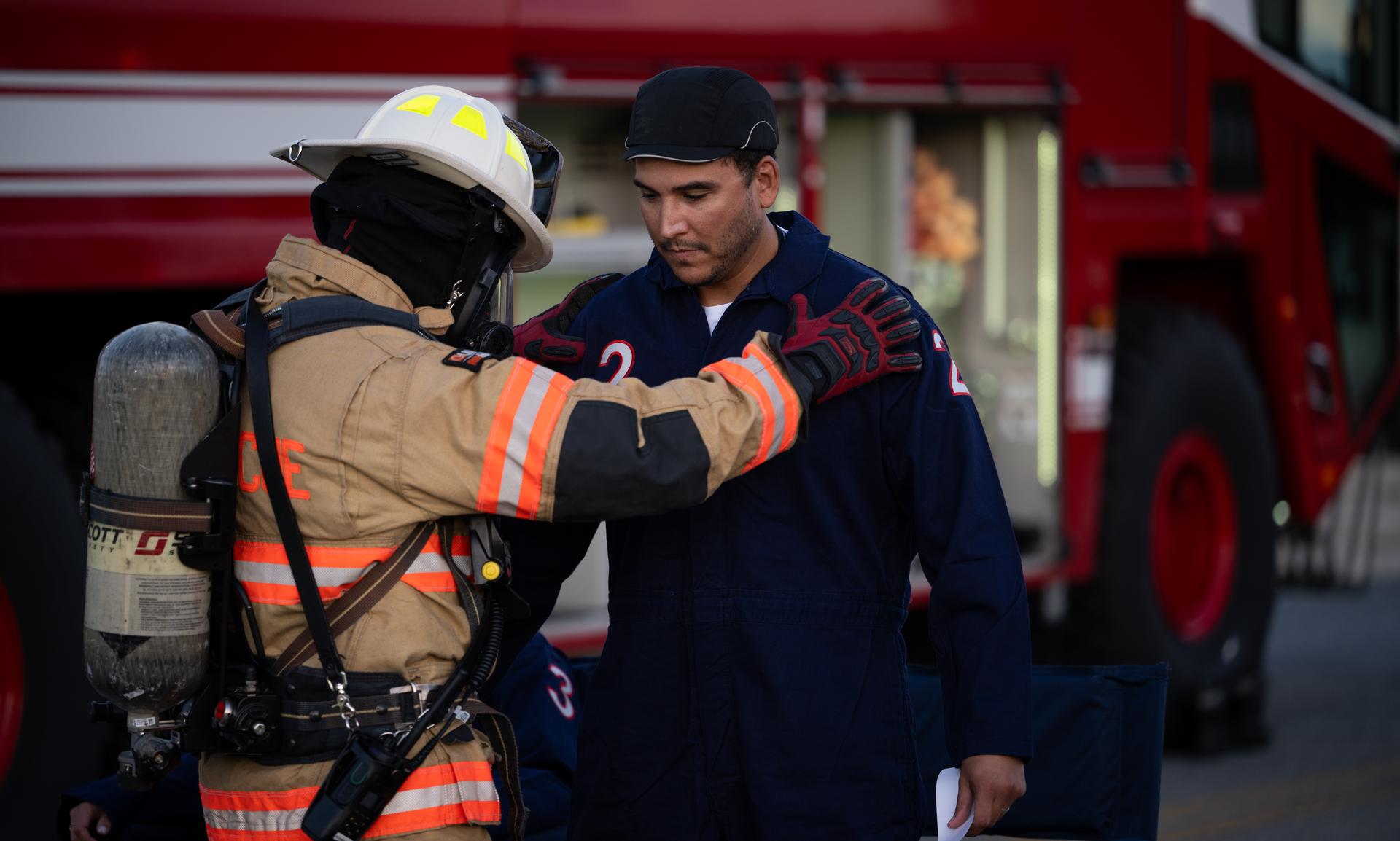
Teams at NASA's Kennedy Space Center in Florida practiced various emergency rescue training scenarios with the Artemis II crew, Friday, Dec. 19, 2025, ahead of the Artemis II mission. In the unlikely event of an emergency during launch countdown at Launch Complex 39B, personnel will be transported in mine-resistant ambush protected vehicles, or MRAPS, from the pad and to one of the triage site locations at Kennedy. Photo Credit: (NASA/Joel Kowsky)
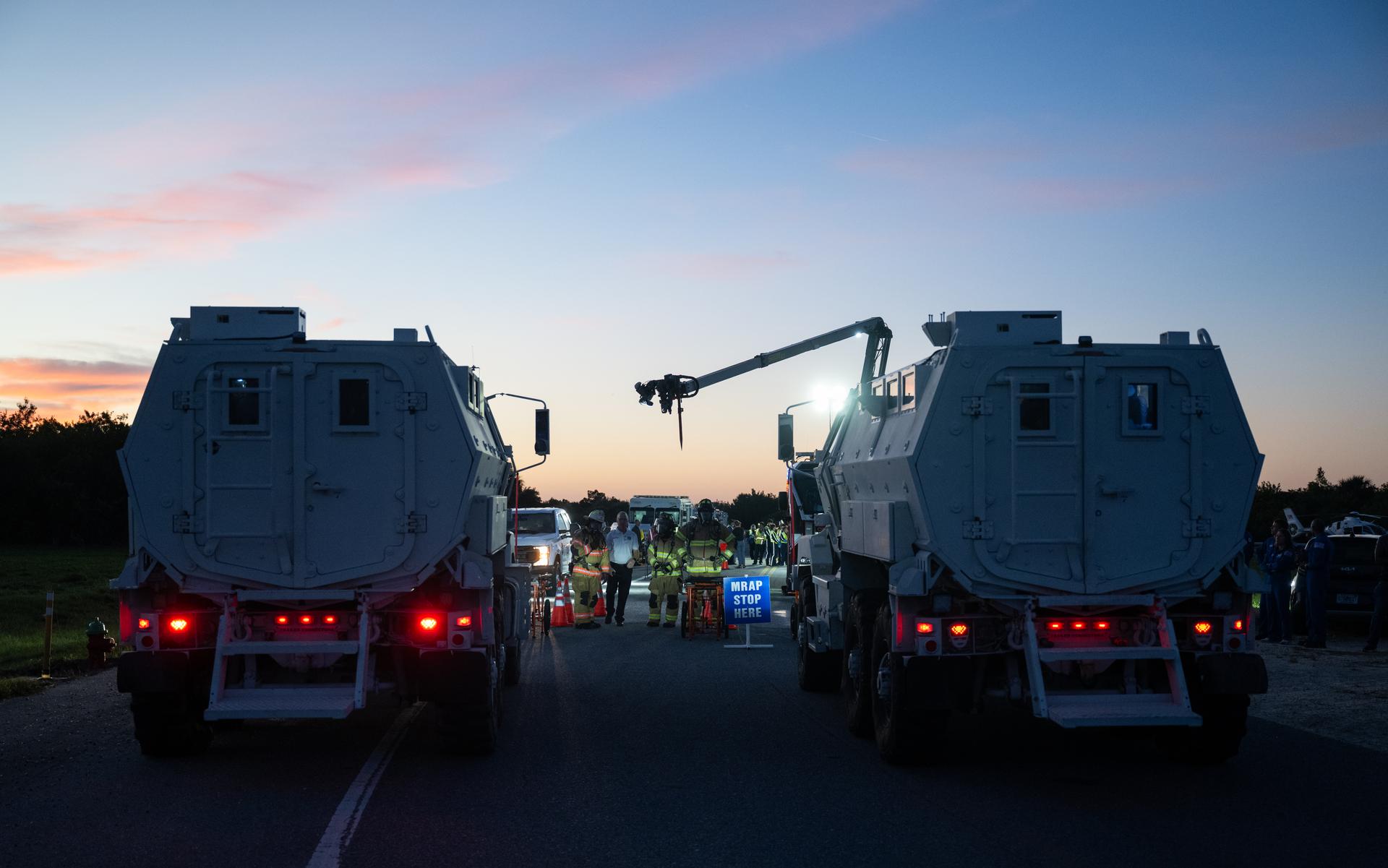
Teams at NASA's Kennedy Space Center in Florida practiced various emergency rescue training scenarios with the Artemis II crew, Friday, Dec. 19, 2025, ahead of the Artemis II mission. In the unlikely event of an emergency during launch countdown at Launch Complex 39B, personnel will be transported in mine-resistant ambush protected vehicles, or MRAPS, from the pad and to one of the triage site locations at Kennedy. Photo Credit: (NASA/Joel Kowsky)
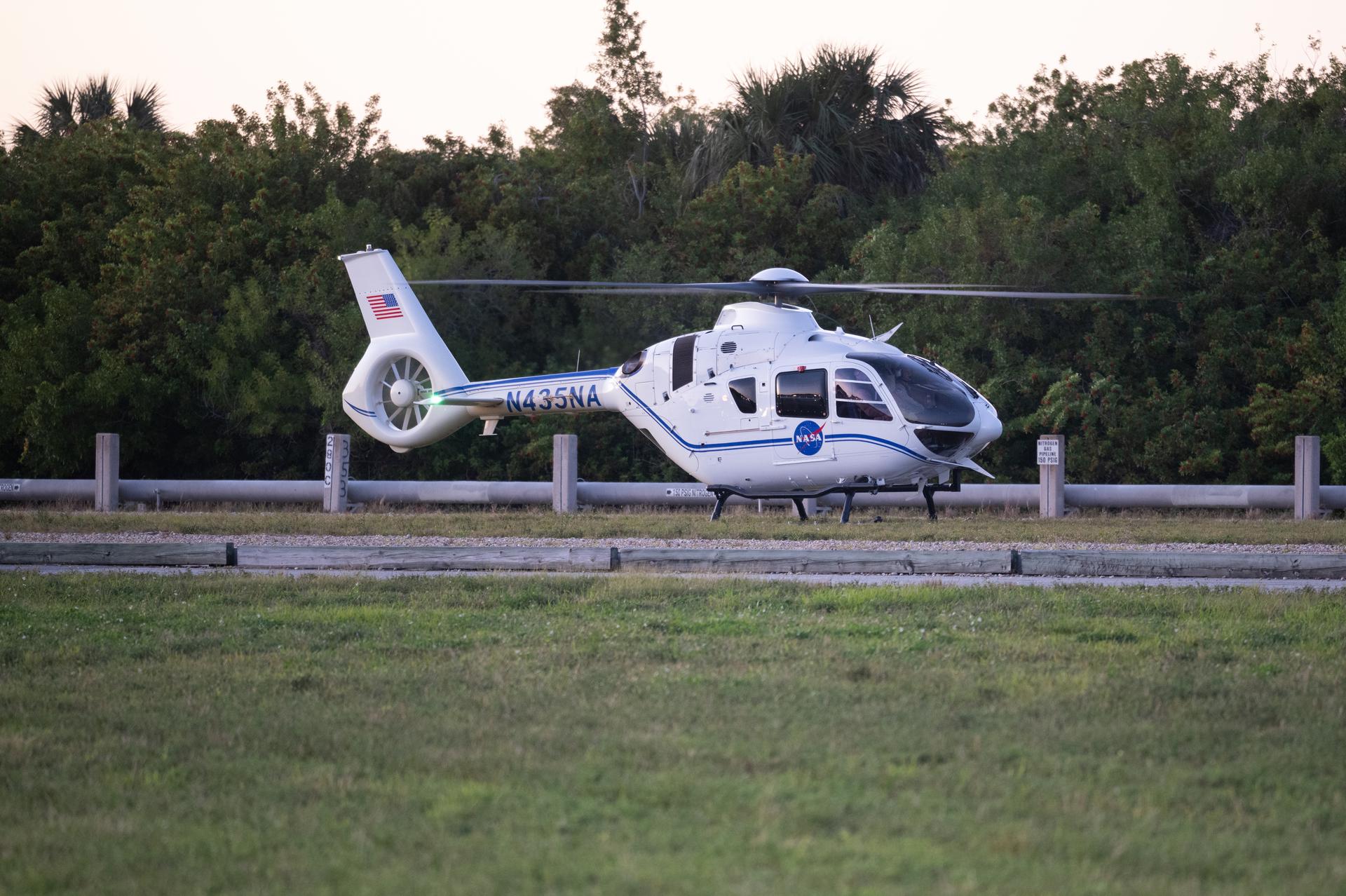
Teams at NASA's Kennedy Space Center in Florida practiced various emergency rescue training scenarios with the Artemis II crew, Friday, Dec. 19, 2025, ahead of the Artemis II mission. In the unlikely event of an emergency during launch countdown at Launch Complex 39B, personnel will be transported in mine-resistant ambush protected vehicles, or MRAPS, from the pad and to one of the triage site locations at Kennedy. Photo Credit: (NASA/Joel Kowsky)
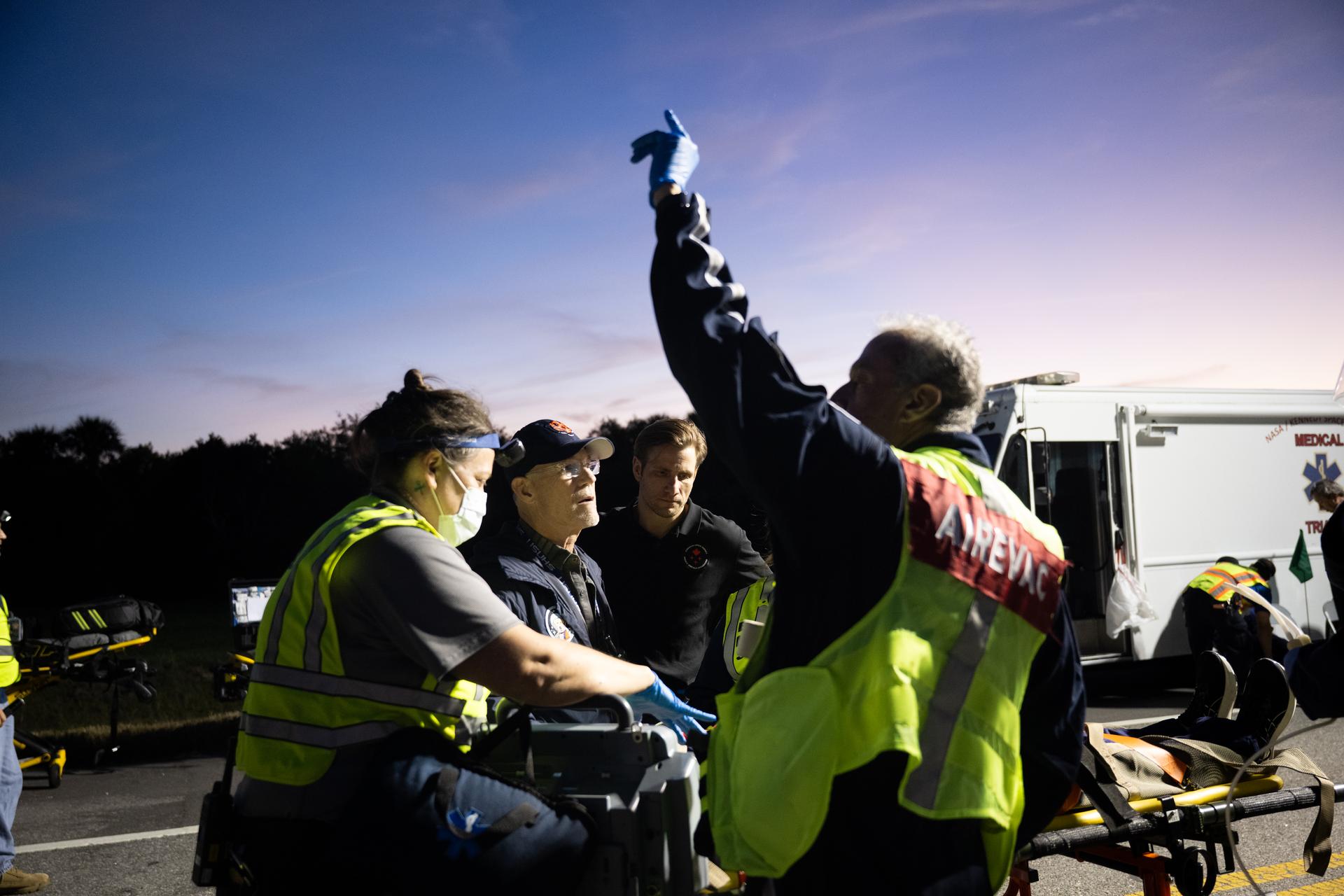
Teams at NASA's Kennedy Space Center in Florida practiced various emergency rescue training scenarios with the Artemis II crew, Friday, Dec. 19, 2025, ahead of the Artemis II mission. In the unlikely event of an emergency during launch countdown at Launch Complex 39B, personnel will be transported in mine-resistant ambush protected vehicles, or MRAPS, from the pad and to one of the triage site locations at Kennedy. Photo Credit: (NASA/Joel Kowsky)
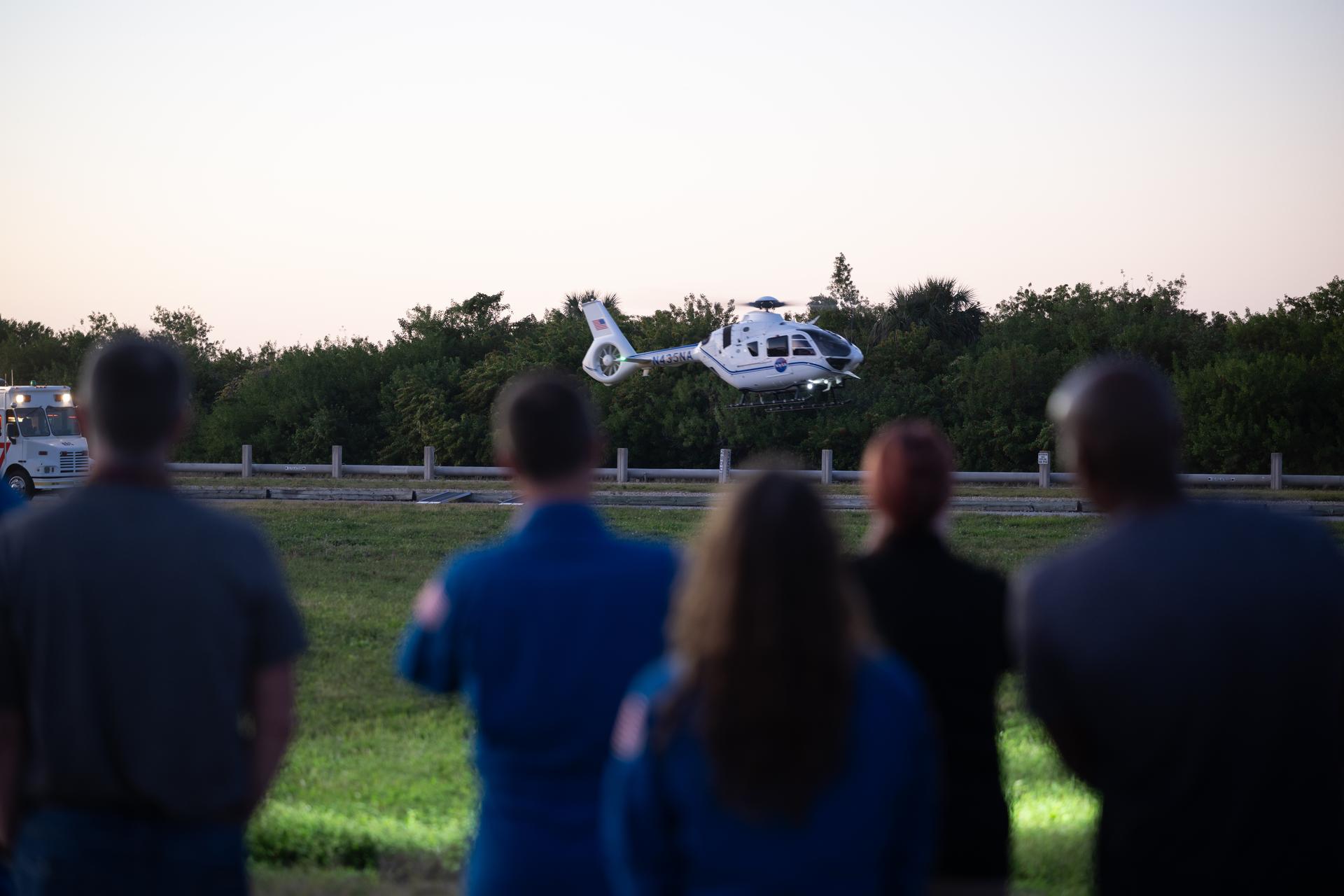
Teams at NASA's Kennedy Space Center in Florida practiced various emergency rescue training scenarios with the Artemis II crew, Friday, Dec. 19, 2025, ahead of the Artemis II mission. In the unlikely event of an emergency during launch countdown at Launch Complex 39B, personnel will be transported in mine-resistant ambush protected vehicles, or MRAPS, from the pad and to one of the triage site locations at Kennedy. Photo Credit: (NASA/Joel Kowsky)
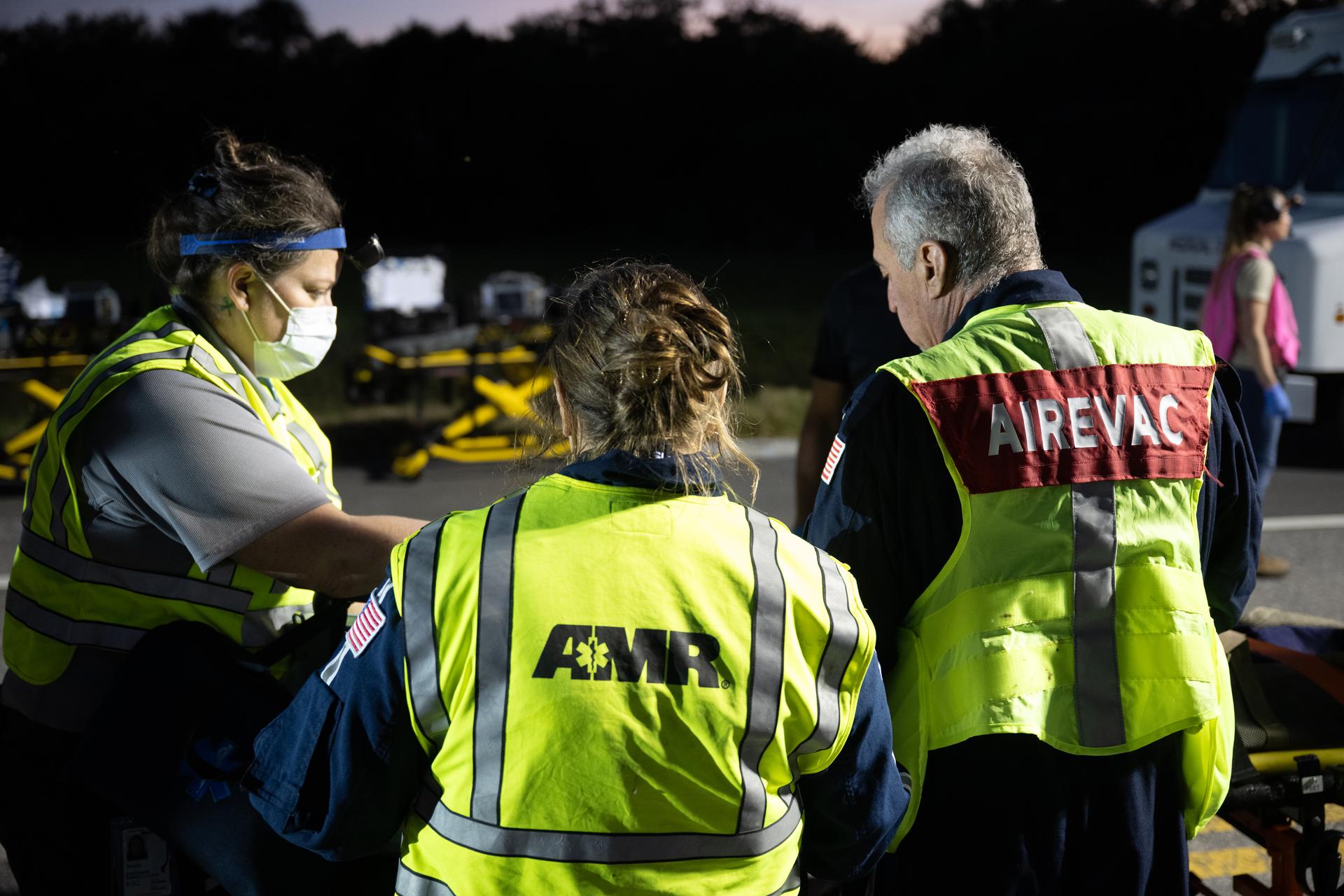
Teams at NASA's Kennedy Space Center in Florida practiced various emergency rescue training scenarios with the Artemis II crew, Friday, Dec. 19, 2025, ahead of the Artemis II mission. In the unlikely event of an emergency during launch countdown at Launch Complex 39B, personnel will be transported in mine-resistant ambush protected vehicles, or MRAPS, from the pad and to one of the triage site locations at Kennedy. Photo Credit: (NASA/Joel Kowsky)
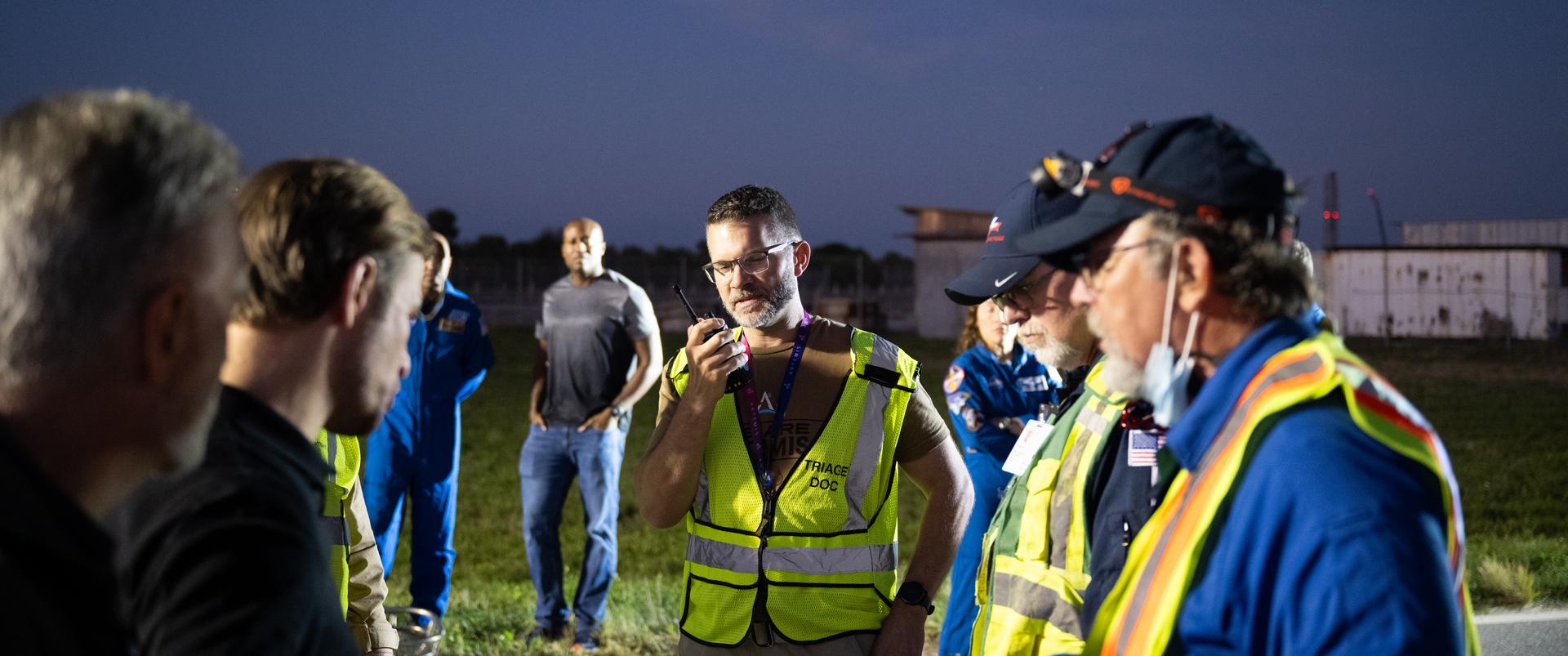
Teams at NASA's Kennedy Space Center in Florida practiced various emergency rescue training scenarios with the Artemis II crew, Friday, Dec. 19, 2025, ahead of the Artemis II mission. In the unlikely event of an emergency during launch countdown at Launch Complex 39B, personnel will be transported in mine-resistant ambush protected vehicles, or MRAPS, from the pad and to one of the triage site locations at Kennedy. Photo Credit: (NASA/Joel Kowsky)
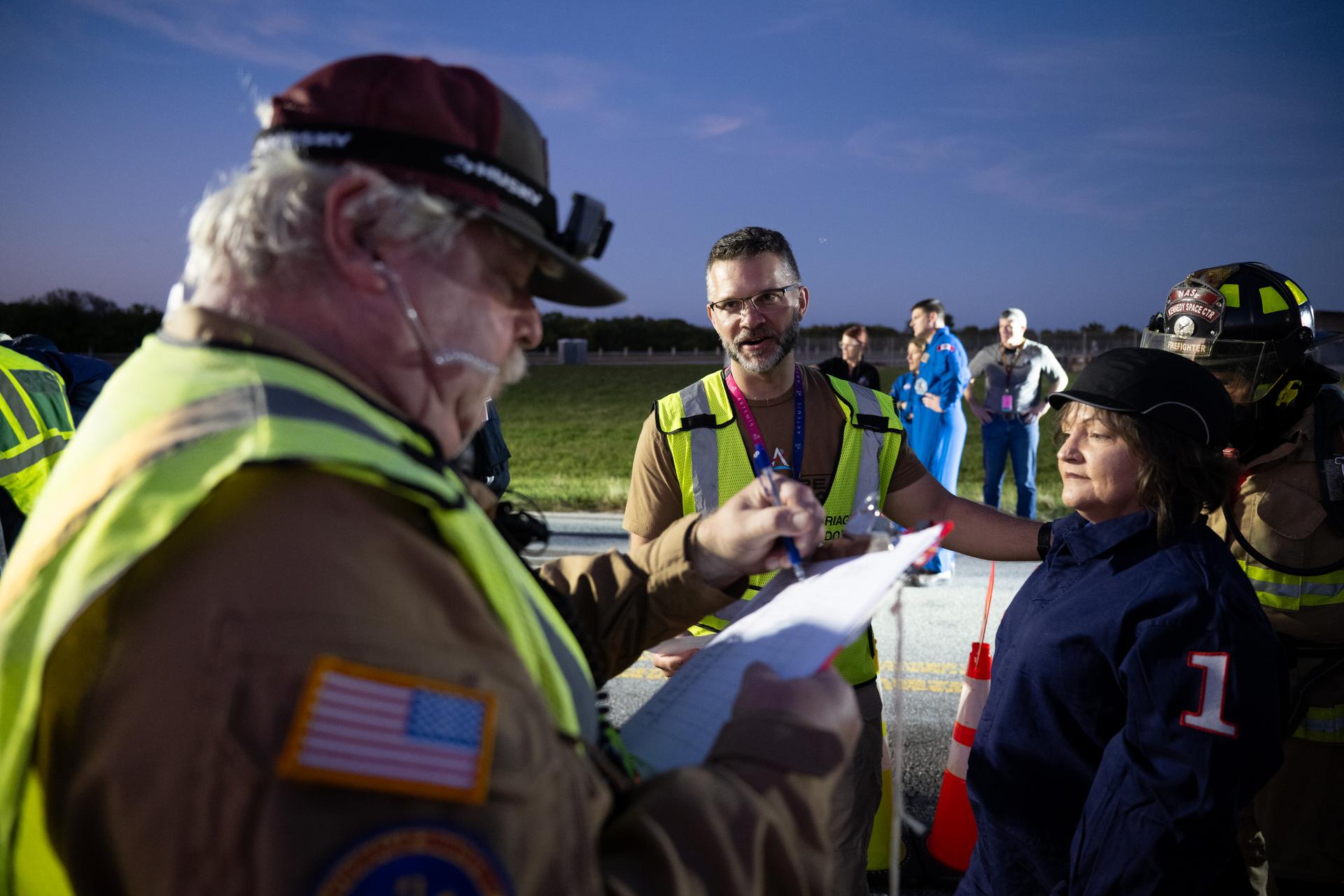
Teams at NASA's Kennedy Space Center in Florida practiced various emergency rescue training scenarios with the Artemis II crew, Friday, Dec. 19, 2025, ahead of the Artemis II mission. In the unlikely event of an emergency during launch countdown at Launch Complex 39B, personnel will be transported in mine-resistant ambush protected vehicles, or MRAPS, from the pad and to one of the triage site locations at Kennedy. Photo Credit: (NASA/Joel Kowsky)
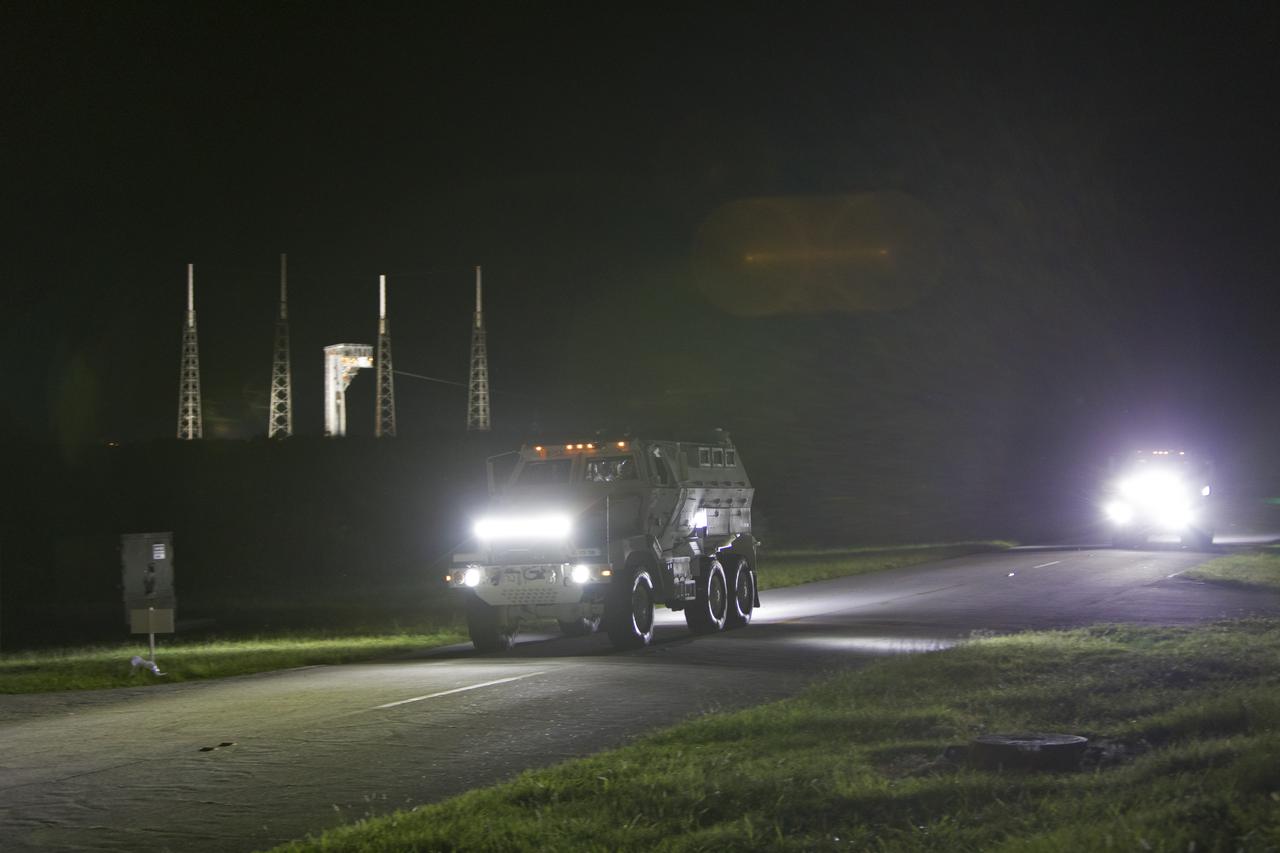
Originally designed for military applications, NASA’s mine-resistant ambush protected vehicles, or MRAPs, will be used in the unlikely event of an emergency at the launch pad prior to liftoff. The vehicles, seen here during a Boeing/United Launch Alliance emergency egress system demonstration at Cape Canaveral Air Force Station’s Launch Complex 41 in Florida on June 19, 2018, offer a mobile bunker for astronauts and ground crews, should they need to get away from the launch pad quickly in an emergency.
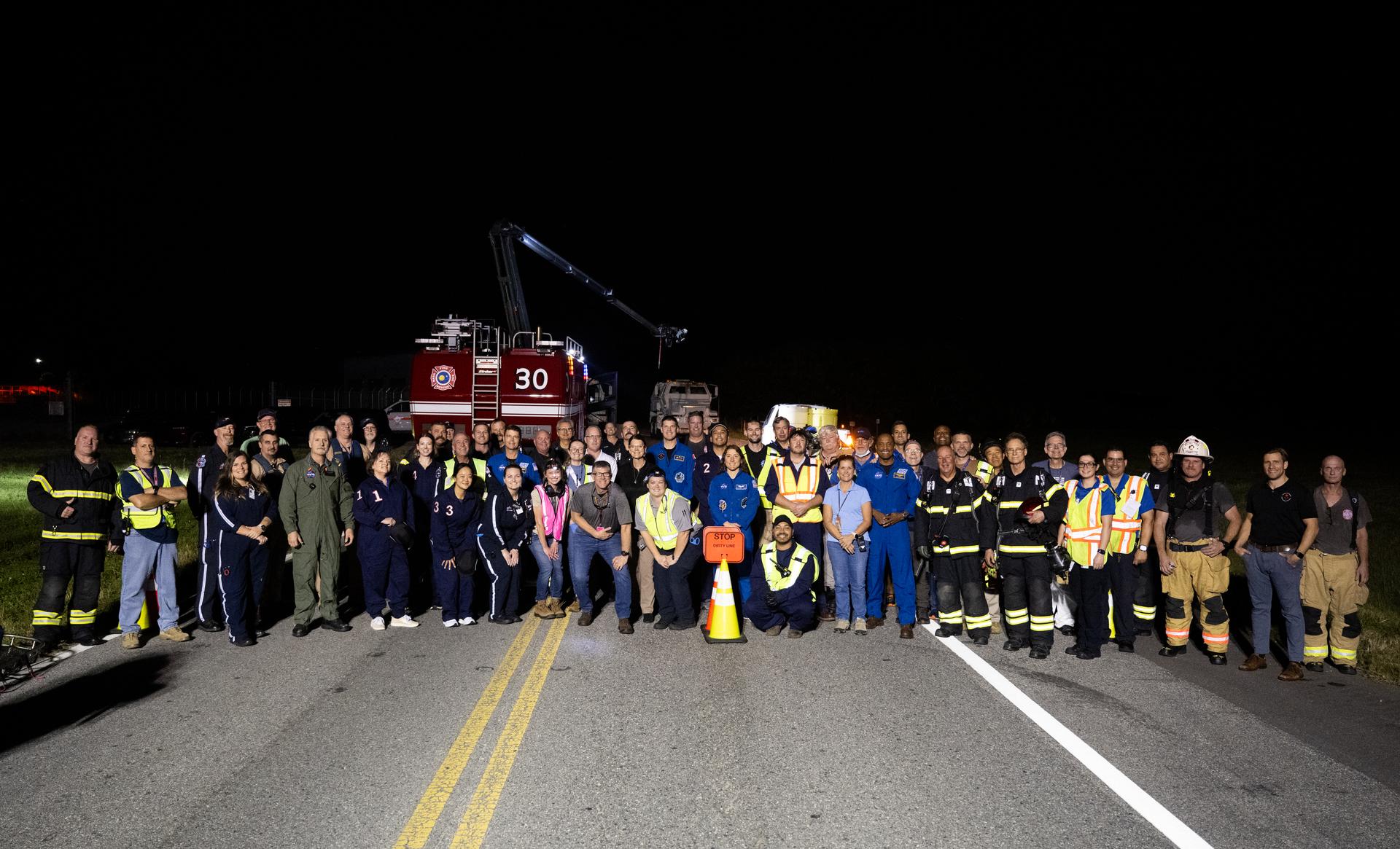
Teams at NASA's Kennedy Space Center in Florida pose for a group picture after practicing various emergency rescue training scenarios with the Artemis II crew, Friday, Dec. 19, 2025, ahead of the Artemis II mission. In the unlikely event of an emergency during launch countdown at Launch Complex 39B, personnel will be transported in mine-resistant ambush protected vehicles, or MRAPS, from the pad and to one of the triage site locations at Kennedy. Photo Credit: (NASA/Joel Kowsky)
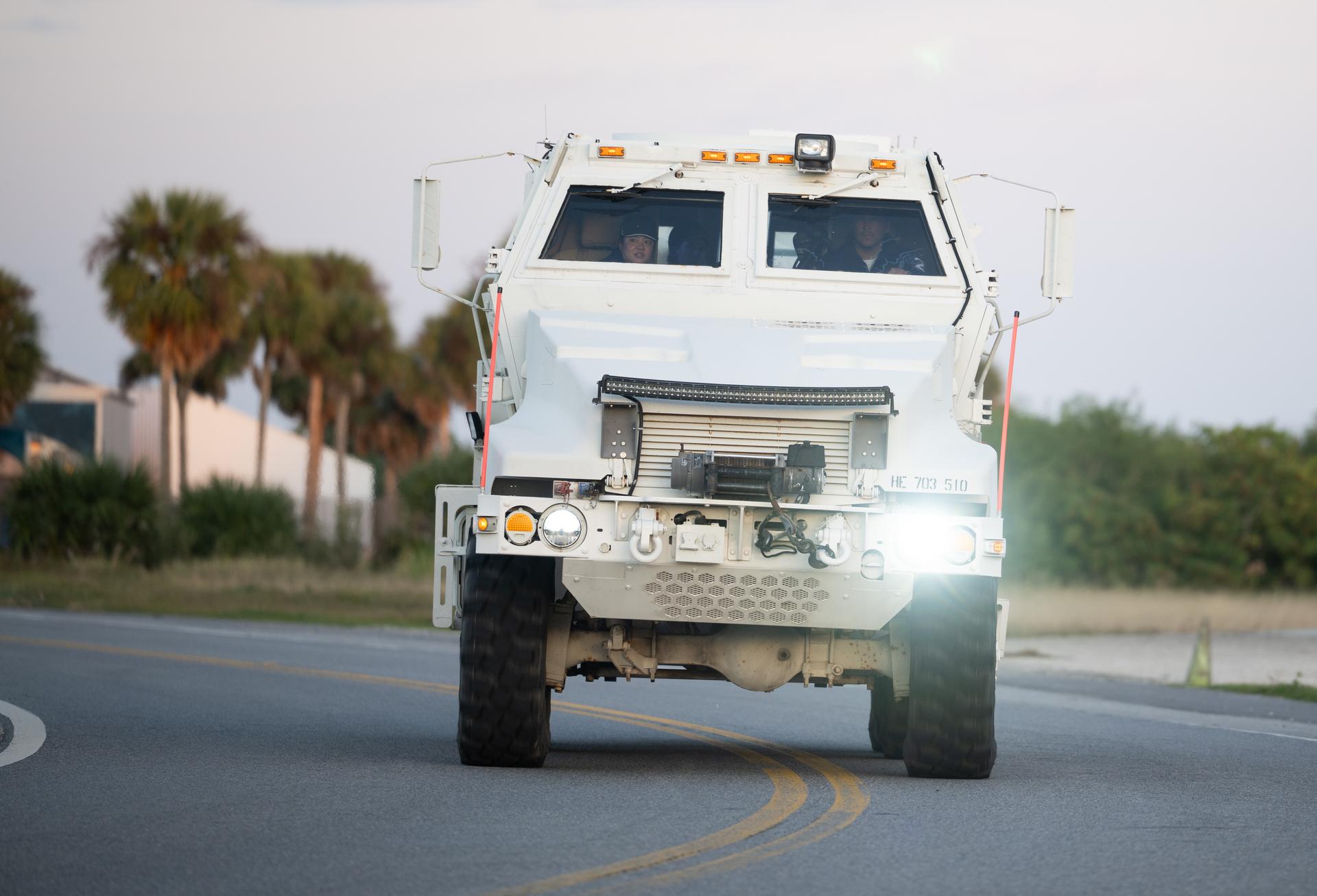
Teams at NASA's Kennedy Space Center in Florida practiced various emergency rescue training scenarios with the Artemis II crew, Friday, Dec. 19, 2025, ahead of the Artemis II mission. In the unlikely event of an emergency during launch countdown at Launch Complex 39B, personnel will be transported in mine-resistant ambush protected vehicles, or MRAPS, from the pad and to one of the triage site locations at Kennedy. Photo Credit: (NASA/Joel Kowsky)
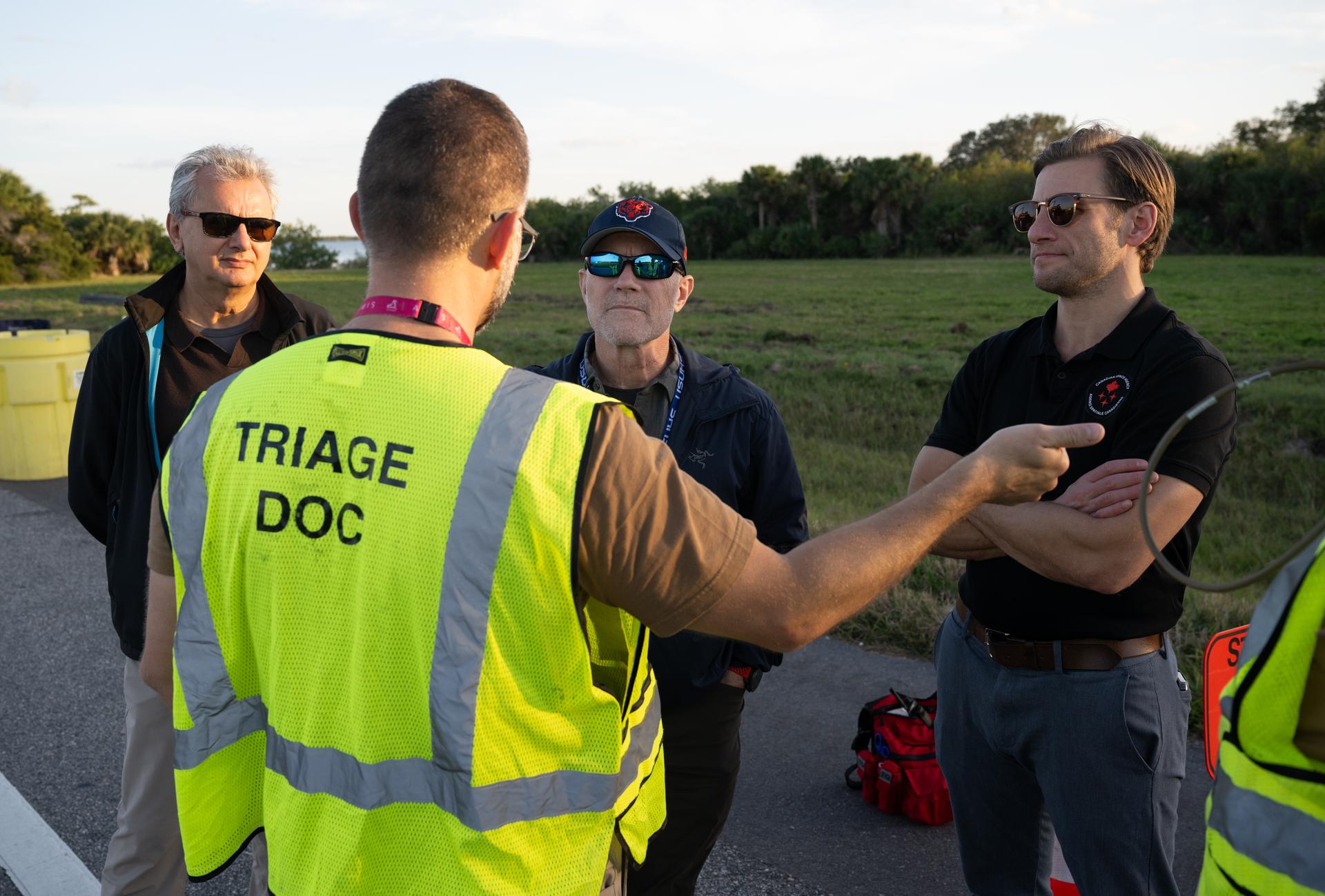
Teams at NASA's Kennedy Space Center in Florida practiced various emergency rescue training scenarios with the Artemis II crew, Friday, Dec. 19, 2025, ahead of the Artemis II mission. In the unlikely event of an emergency during launch countdown at Launch Complex 39B, personnel will be transported in mine-resistant ambush protected vehicles, or MRAPS, from the pad and to one of the triage site locations at Kennedy. Photo Credit: (NASA/Joel Kowsky)
Teams at NASA's Kennedy Space Center in Florida practiced various emergency rescue training scenarios with the Artemis II crew, Friday, Dec. 19, 2025, ahead of the Artemis II mission. In the unlikely event of an emergency during launch countdown at Launch Complex 39B, personnel will be transported in mine-resistant ambush protected vehicles, or MRAPS, from the pad and to one of the triage site locations at Kennedy. Photo Credit: (NASA/Joel Kowsky)
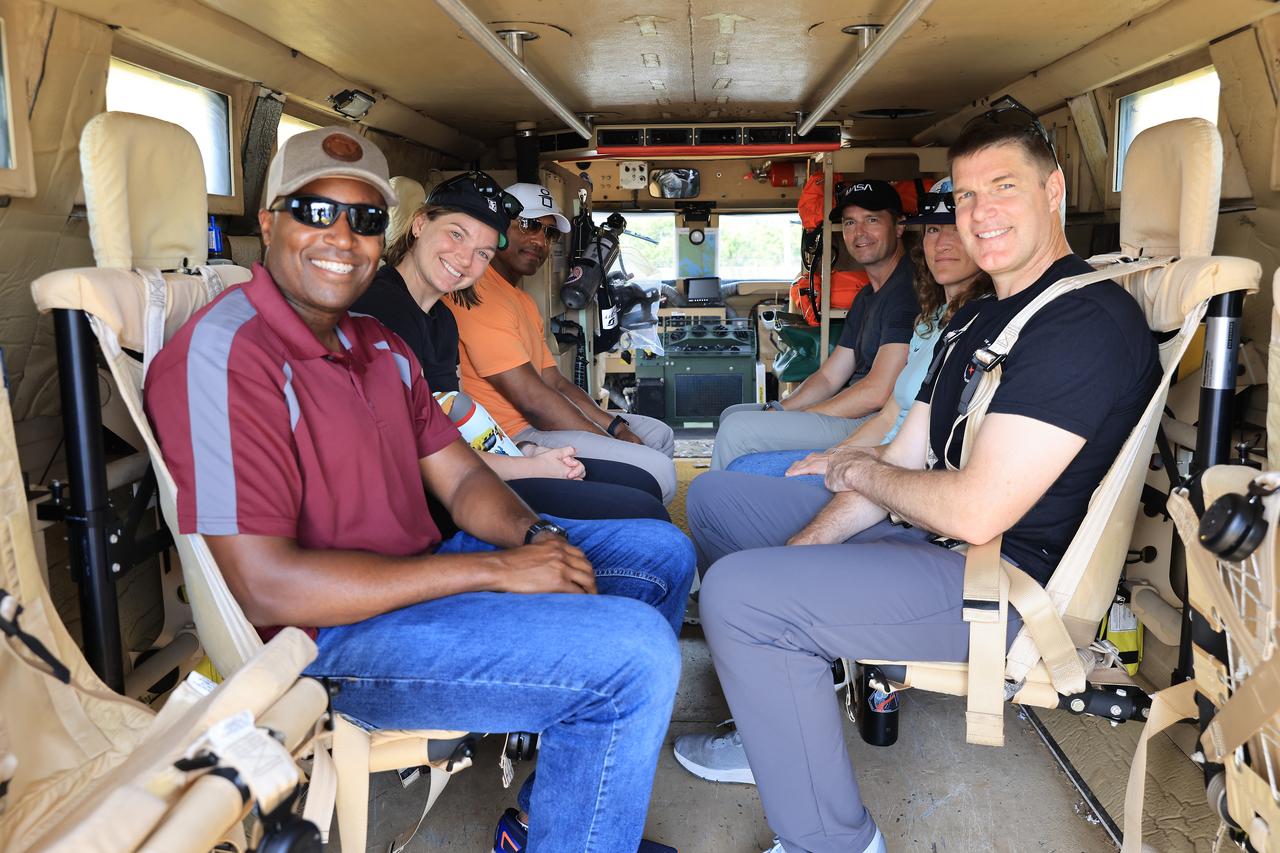
Crew members and backup members for NASA’s Artemis II mission and teams from the agency’s Exploration Ground Systems Program participate in emergency egress training at Launch Complex 39B at NASA’s Kennedy Space Center in Florida on Tuesday, May 6, 2025. From left, Andre Douglas, NASA’s Artemis II backup crew member; CSA (Canadian Space Agency) astronaut Jenni Gibbons, Artemis II backup crew member; NASA astronaut Victor Glover, Artemis II pilot; NASA astronaut Reid Wiseman, Artemis II commander; NASA astronaut Christina Koch, Artemis II mission specialist; and CSA astronaut Jeremy Hansen, Artemis II mission specialist sit in the back of a mine-resistant ambush protected vehicle, or MRAP. Originally designed for military applications, the 45,000-pound MRAP offers a mobile bunker for astronauts and ground crews in the unlikely event they must get away from the launch pad quickly in an emergency.
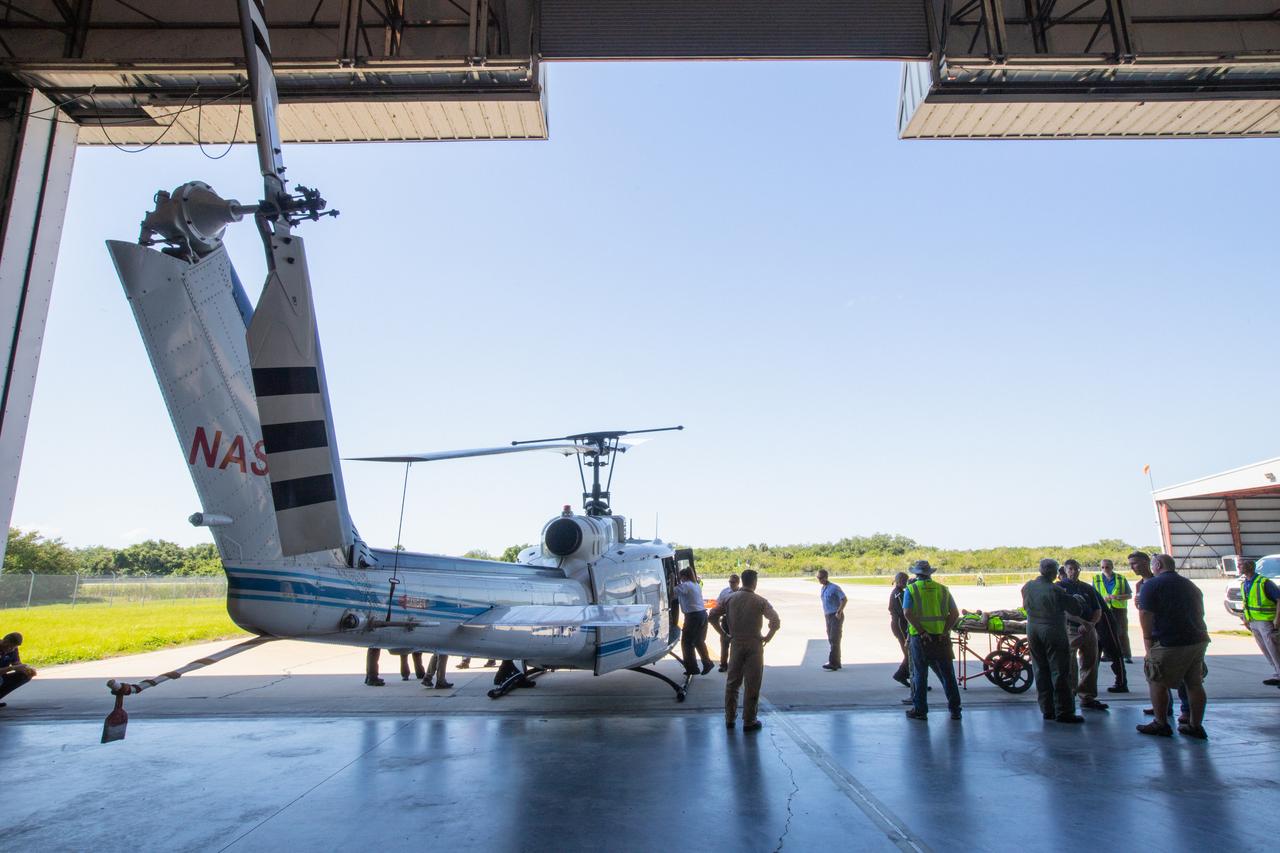
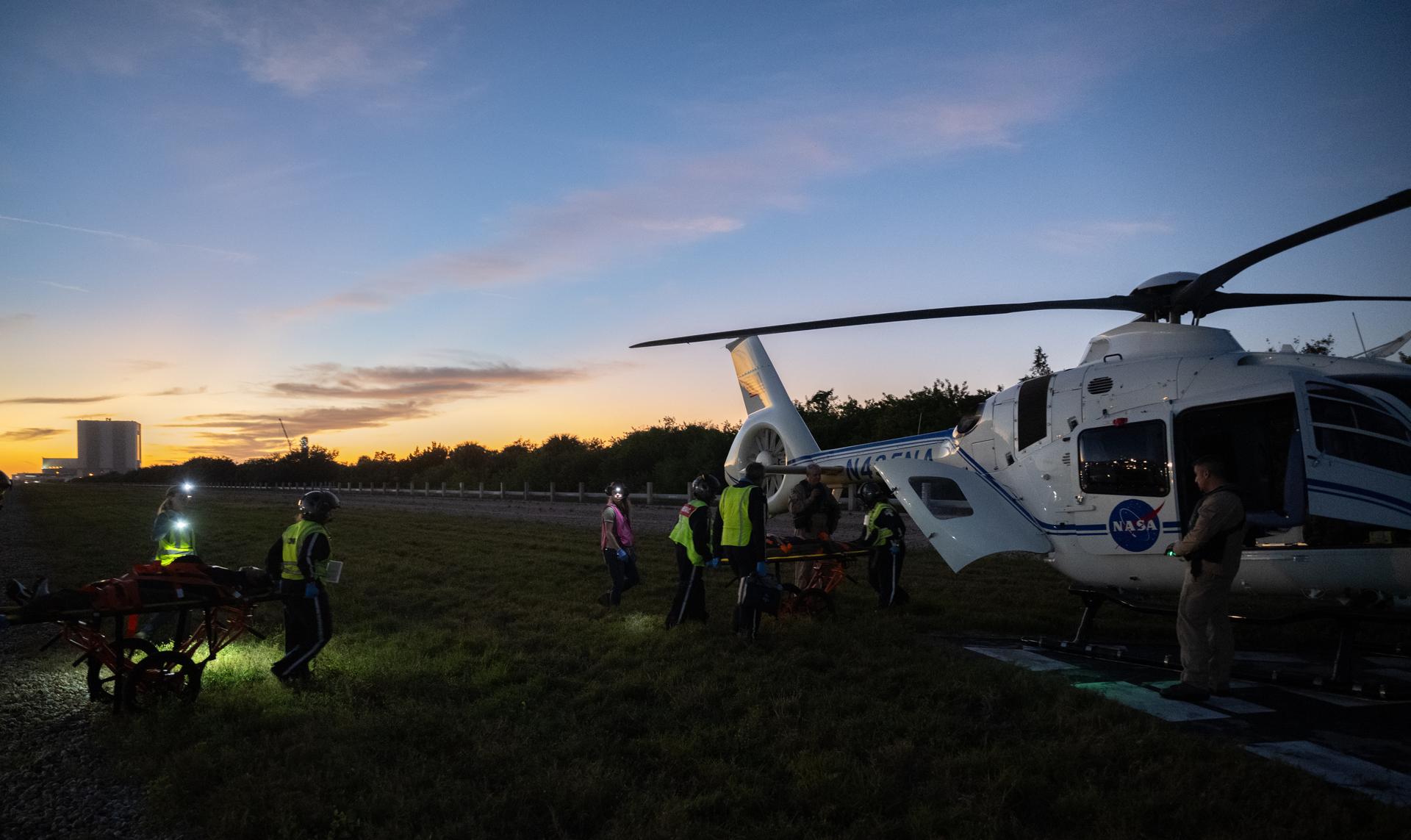
Kennedy Space Center personnel and American Medical Response (AMR) contractor paramedics gather near a NASA helicopter in the Space Florida hangar at the spaceport’s Shuttle Landing Facility on May 17, 2019, for a medical support training course. The course was designed to familiarize the AMR paramedics with the center’s Triage Forces deployment, which included medical team members, fire/rescue personnel, environmental health specialists and flight operations crew members, as well as the helicopter, Mine Resistant Ambush Protected (MRAP) tactical vehicle, fire pumper truck and triage vehicles. The AMR paramedics will assist the agency in contingency planning for the return of human spaceflight from Kennedy.
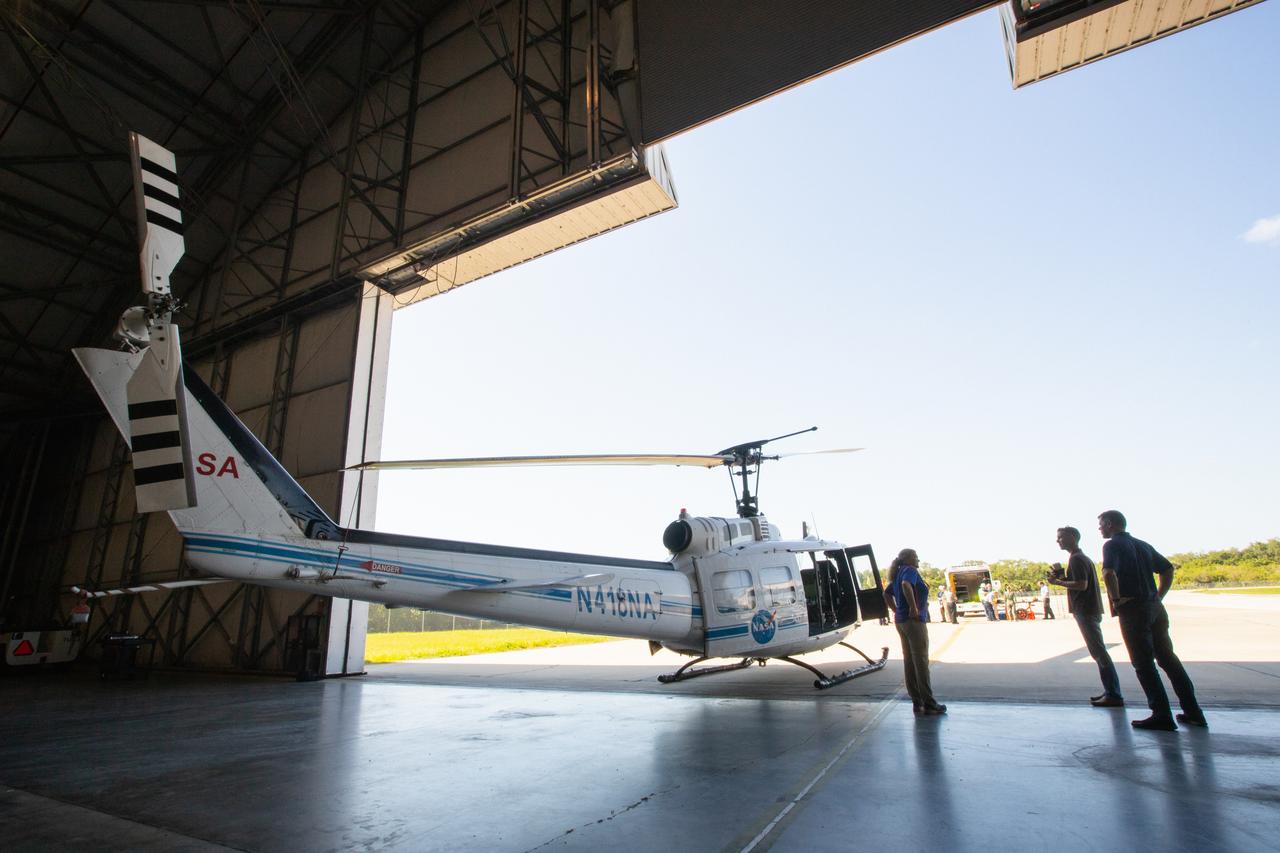
Kennedy Space Center personnel and American Medical Response (AMR) contractor paramedics gather near a NASA helicopter during a medical support training course in the Space Florida hangar at the spaceport’s Shuttle Landing Facility on May 17, 2019. The course was designed to familiarize the AMR paramedics with the center’s Triage Forces deployment, which included medical team members, fire/rescue personnel, environmental health specialists and flight operations crew members, as well as a helicopter, Mine Resistant Ambush Protected (MRAP) tactical vehicle, fire pumper truck and triage vehicles. The AMR paramedics will assist the agency in contingency planning for the return of human spaceflight from Kennedy.
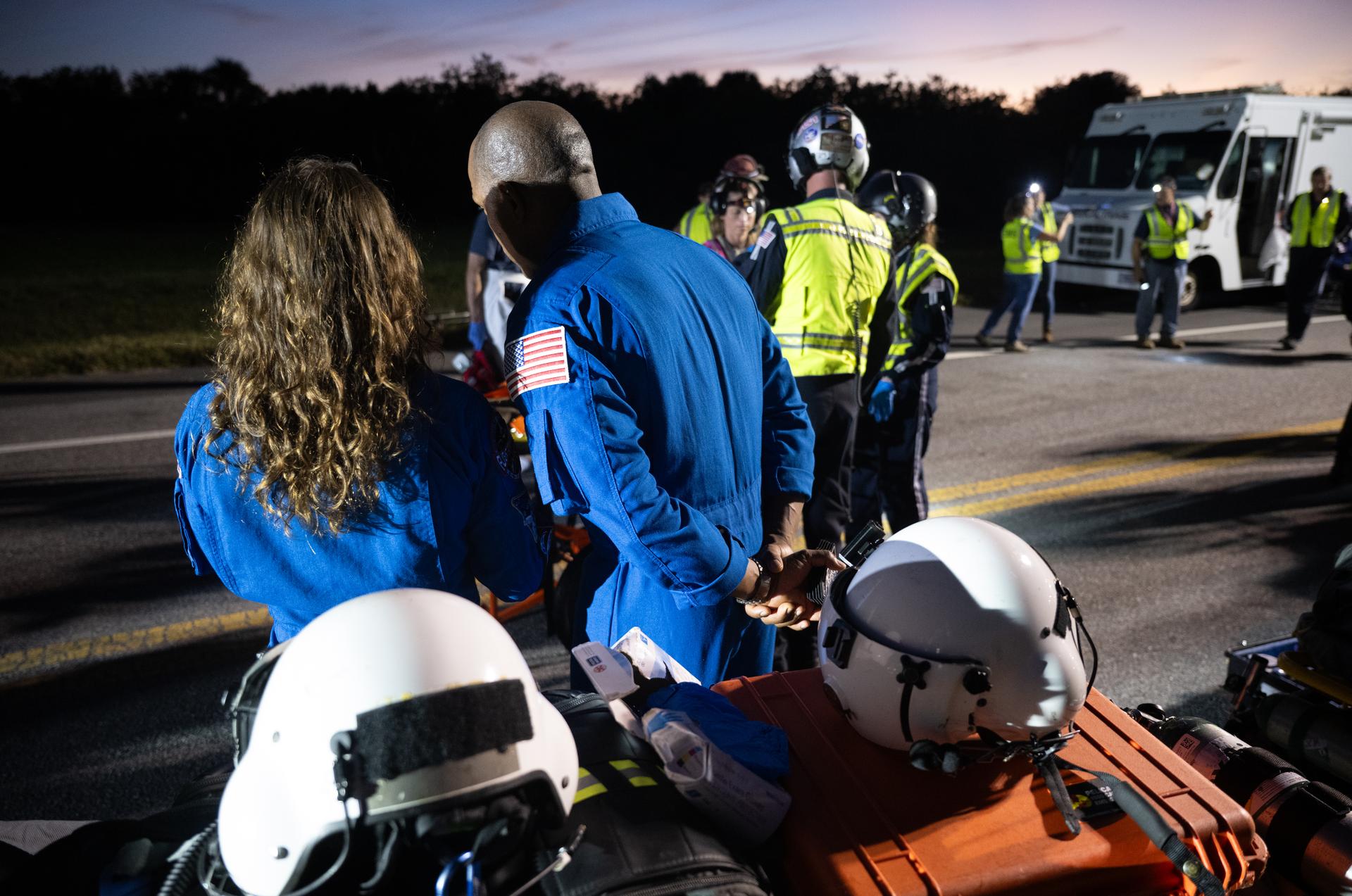
NASA astronauts Victor Glover, Artemis II pilot, right, and Christina Koch, Artemis II mission specialist, talk as teams at NASA's Kennedy Space Center in Florida practiced various emergency rescue training scenarios with the Artemis II crew, Friday, Dec. 19, 2025, ahead of the Artemis II mission. In the unlikely event of an emergency during launch countdown at Launch Complex 39B, personnel will be transported in mine-resistant ambush protected vehicles, or MRAPS, from the pad and to one of the triage site locations at Kennedy. Photo Credit: (NASA/Joel Kowsky)
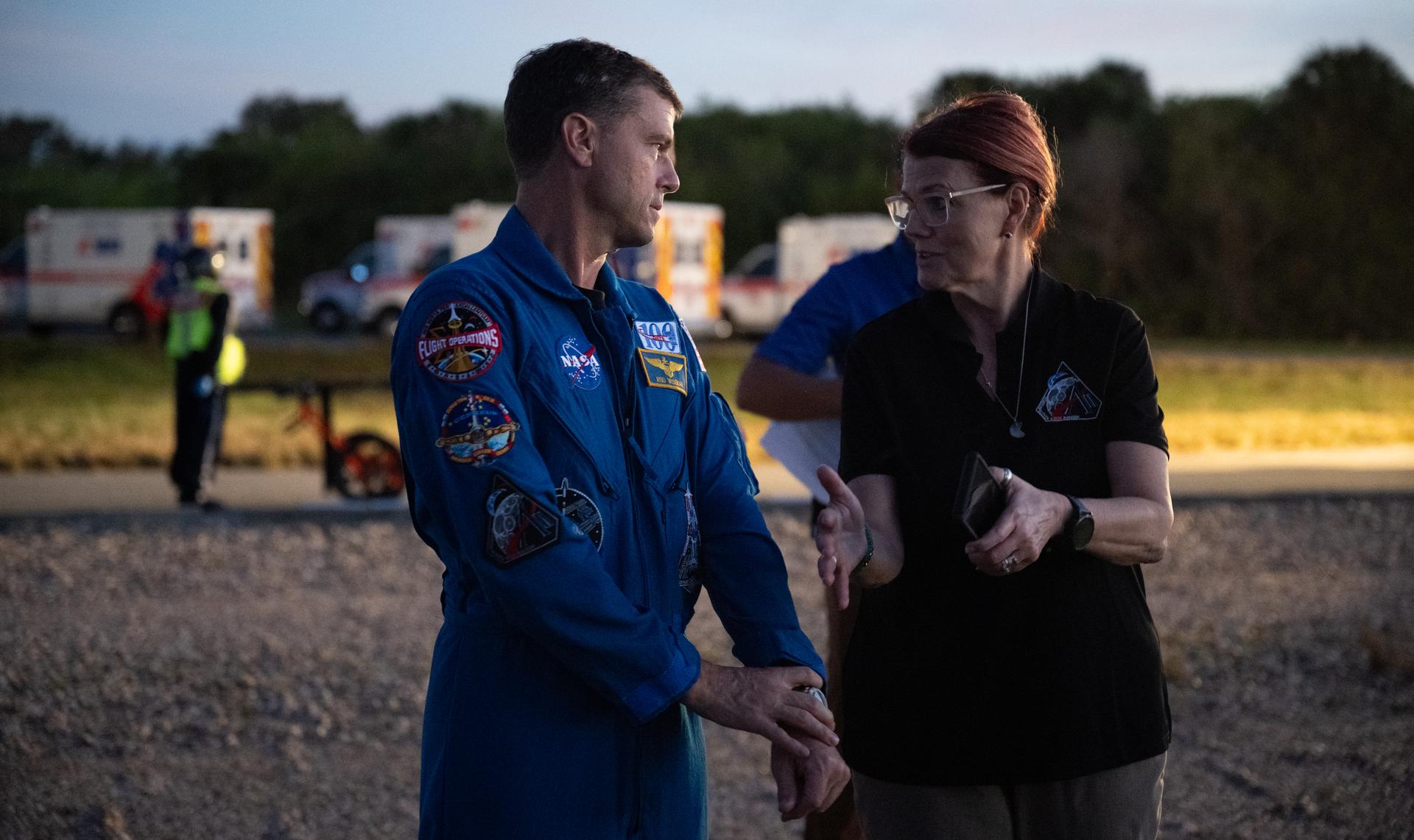
NASA astronaut Reid Wiseman, Artemis II commander, and Charline Blackwell-Thompson, Artemis II Launch Director, talk as teams at NASA's Kennedy Space Center in Florida practiced various emergency rescue training scenarios with the Artemis II crew, Friday, Dec. 19, 2025, ahead of the Artemis II mission. In the unlikely event of an emergency during launch countdown at Launch Complex 39B, personnel will be transported in mine-resistant ambush protected vehicles, or MRAPS, from the pad and to one of the triage site locations at Kennedy. Photo Credit: (NASA/Joel Kowsky)
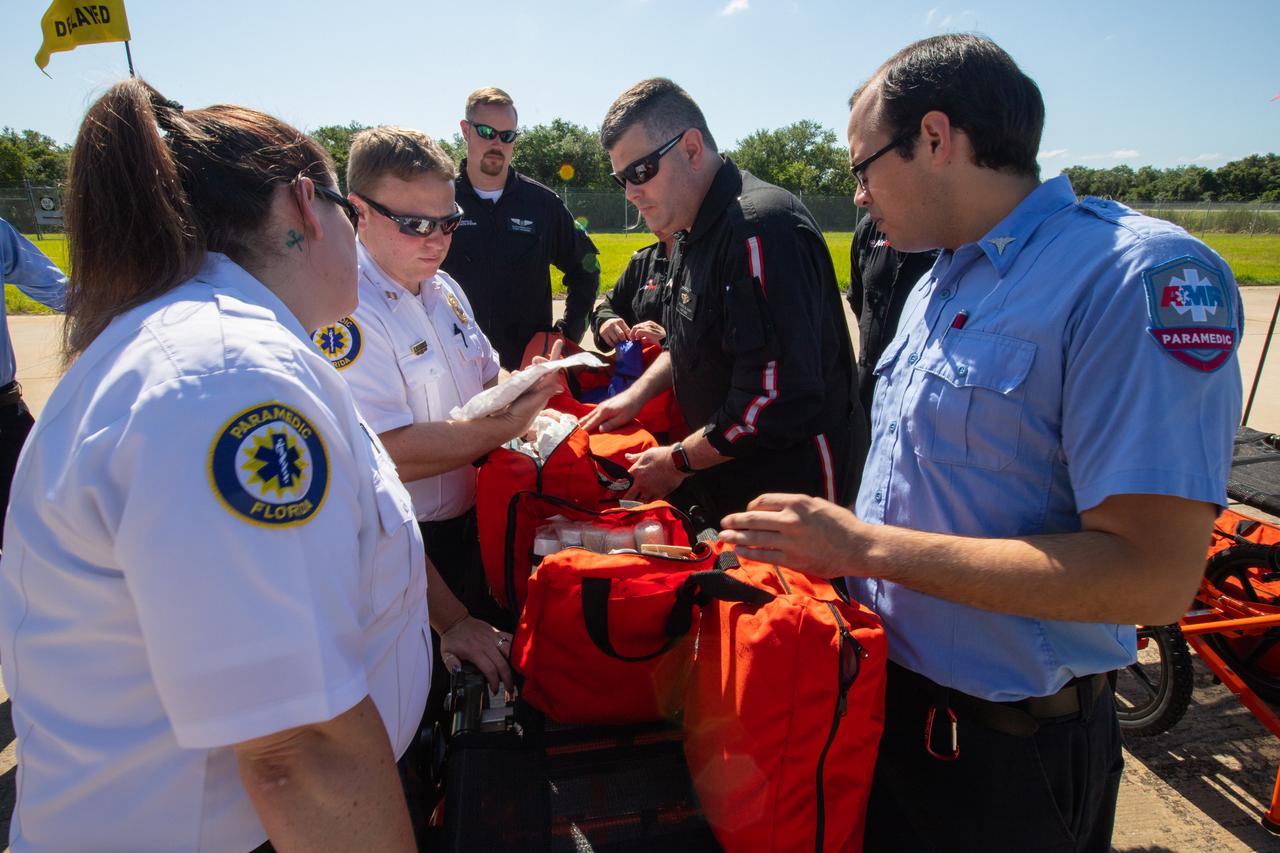
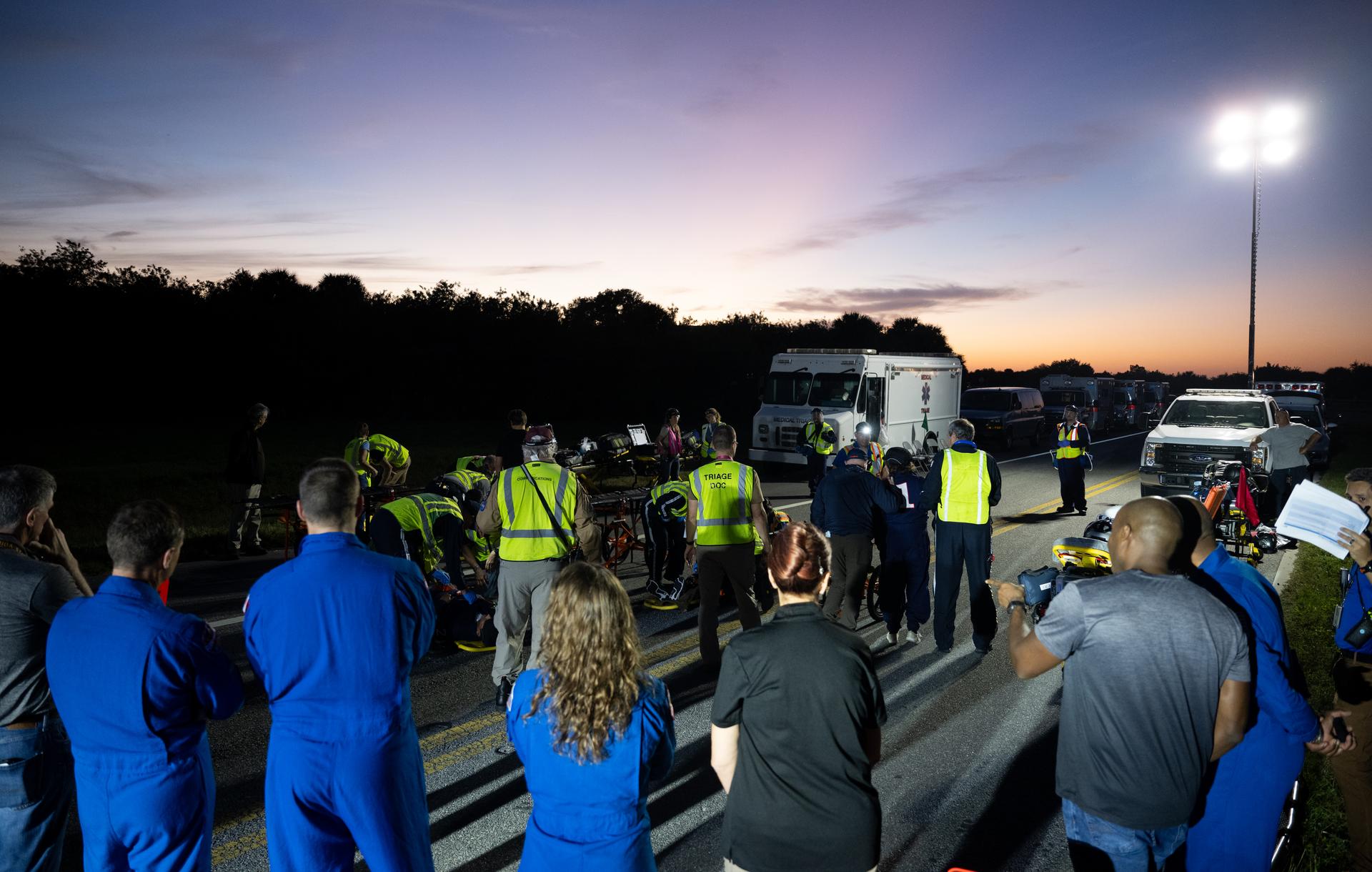
Kennedy Space Center personnel and American Medical Response (AMR) contractor paramedics participate in a medical support training course at the Florida spaceport’s Shuttle Landing Facility on May 17, 2019. The course was designed to familiarize the AMR paramedics with the center’s Triage Forces deployment, which included medical team members, fire/rescue personnel, environmental health specialists and flight operations crew members, as well as a helicopter, Mine Resistant Ambush Protected (MRAP) tactical vehicle, fire pumper truck and triage vehicles. The AMR paramedics will assist the agency in contingency planning for the return of human spaceflight from Kennedy.
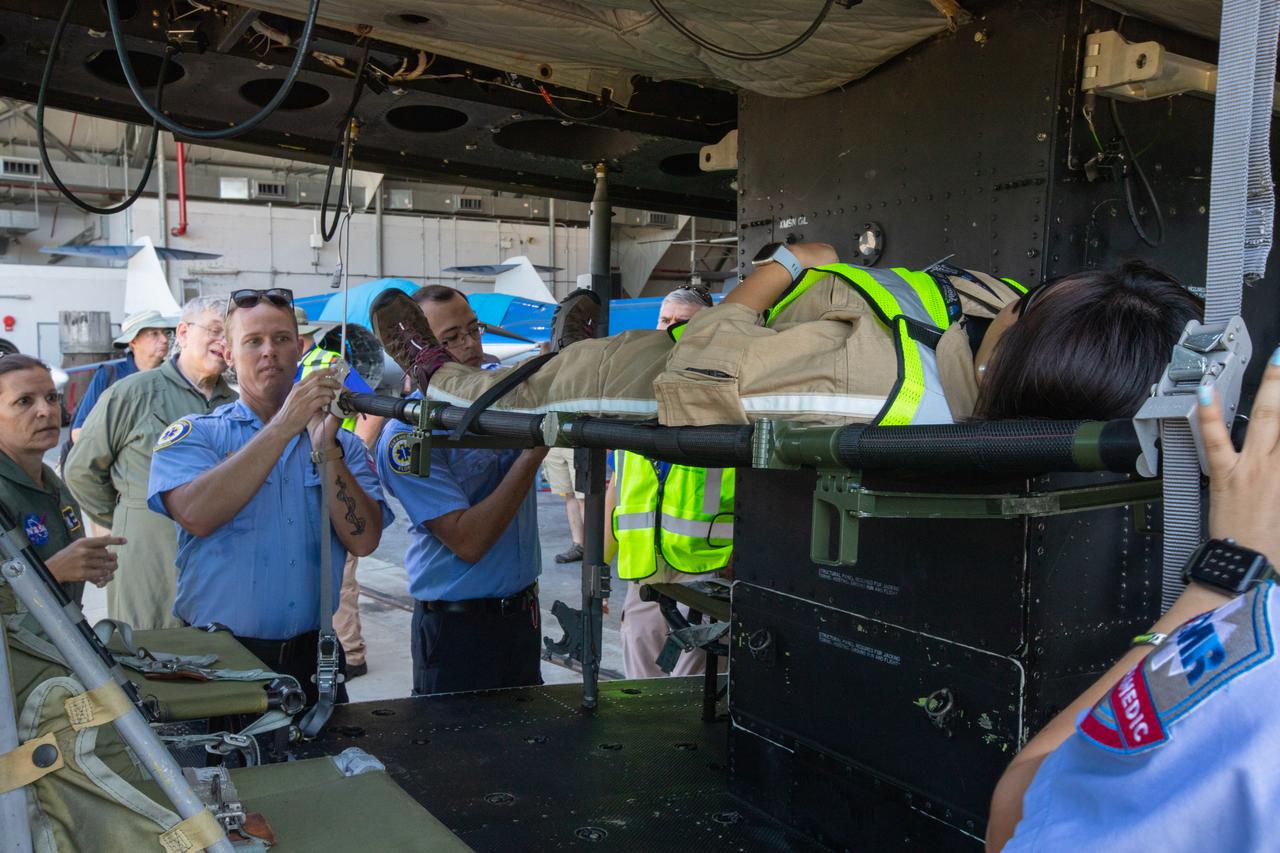
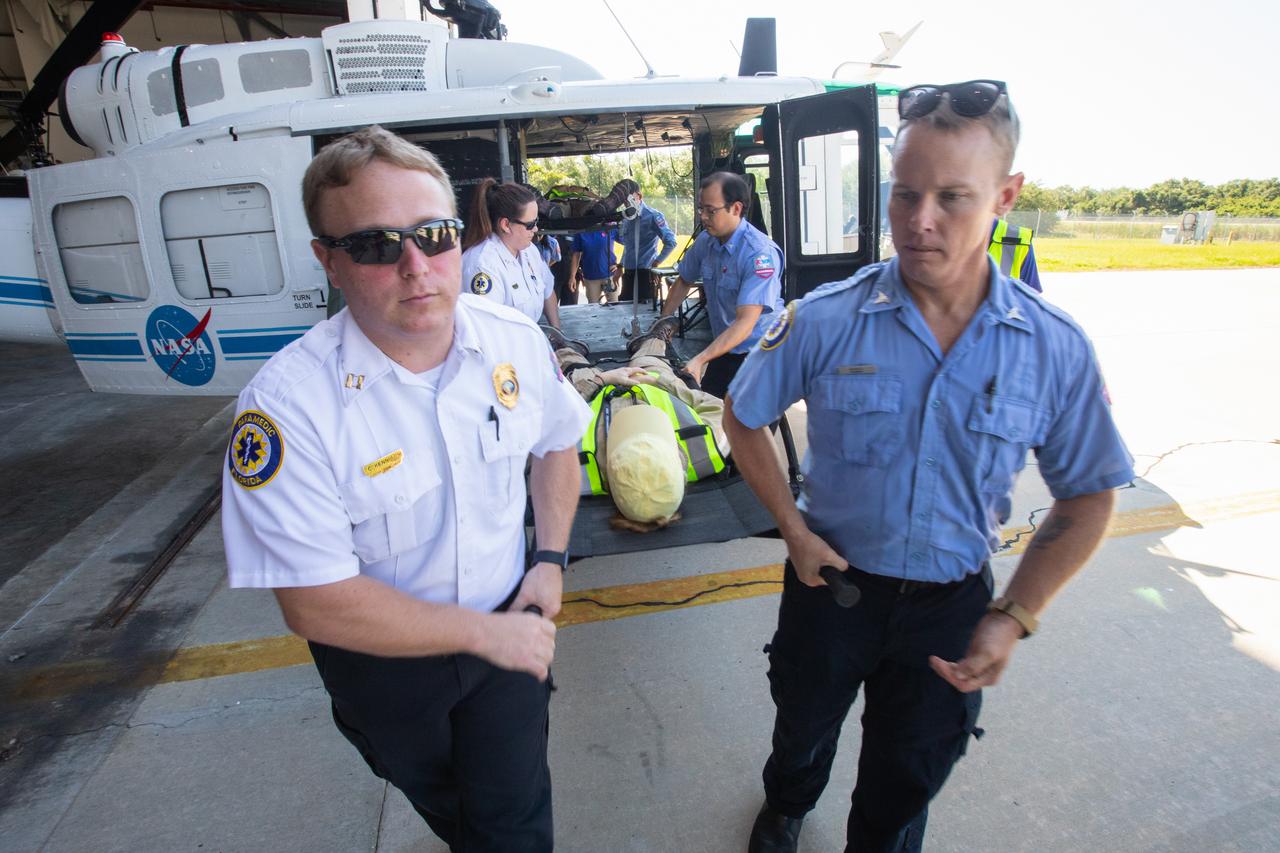
Kennedy Space Center personnel and American Medical Response (AMR) contractor paramedics load a “patient,” a KEMCON Fitness Center staff member, into a NASA helicopter during a medical support training course in the Space Florida hangar at the spaceport’s Shuttle Landing Facility on May 17, 2019. The course was designed to familiarize the AMR paramedics with the center’s Triage Forces deployment, which included medical team members, fire/rescue personnel, environmental health specialists and flight operations crew members, as well as a helicopter, Mine Resistant Ambush Protected (MRAP) tactical vehicle, fire pumper truck and triage vehicles. The AMR paramedics will assist the agency in contingency planning for the return of human spaceflight from Kennedy.
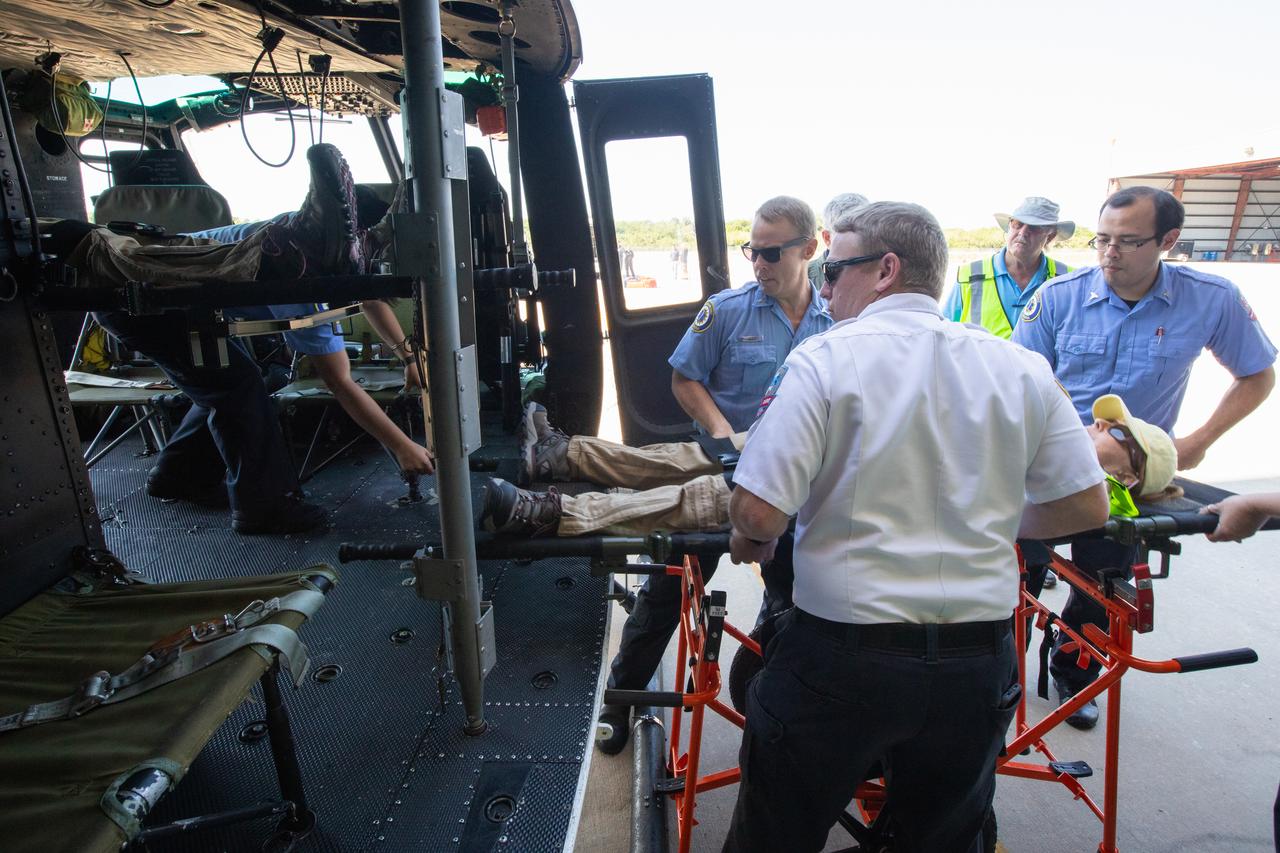
Kennedy Space Center personnel and American Medical Response (AMR) contractor paramedics load a “patient,” a KEMCON Fitness Center staff member, into a NASA helicopter during a medical support training course in the Space Florida hangar at the spaceport’s Shuttle Landing Facility on May 17, 2019. The course was designed to familiarize the AMR paramedics with the center’s Triage Forces deployment, which included medical team members, fire/rescue personnel, environmental health specialists and flight operations crew members, as well as a helicopter, Mine Resistant Ambush Protected (MRAP) tactical vehicle, fire pumper truck and triage vehicles. The AMR paramedics will assist the agency in contingency planning for the return of human spaceflight from Kennedy.
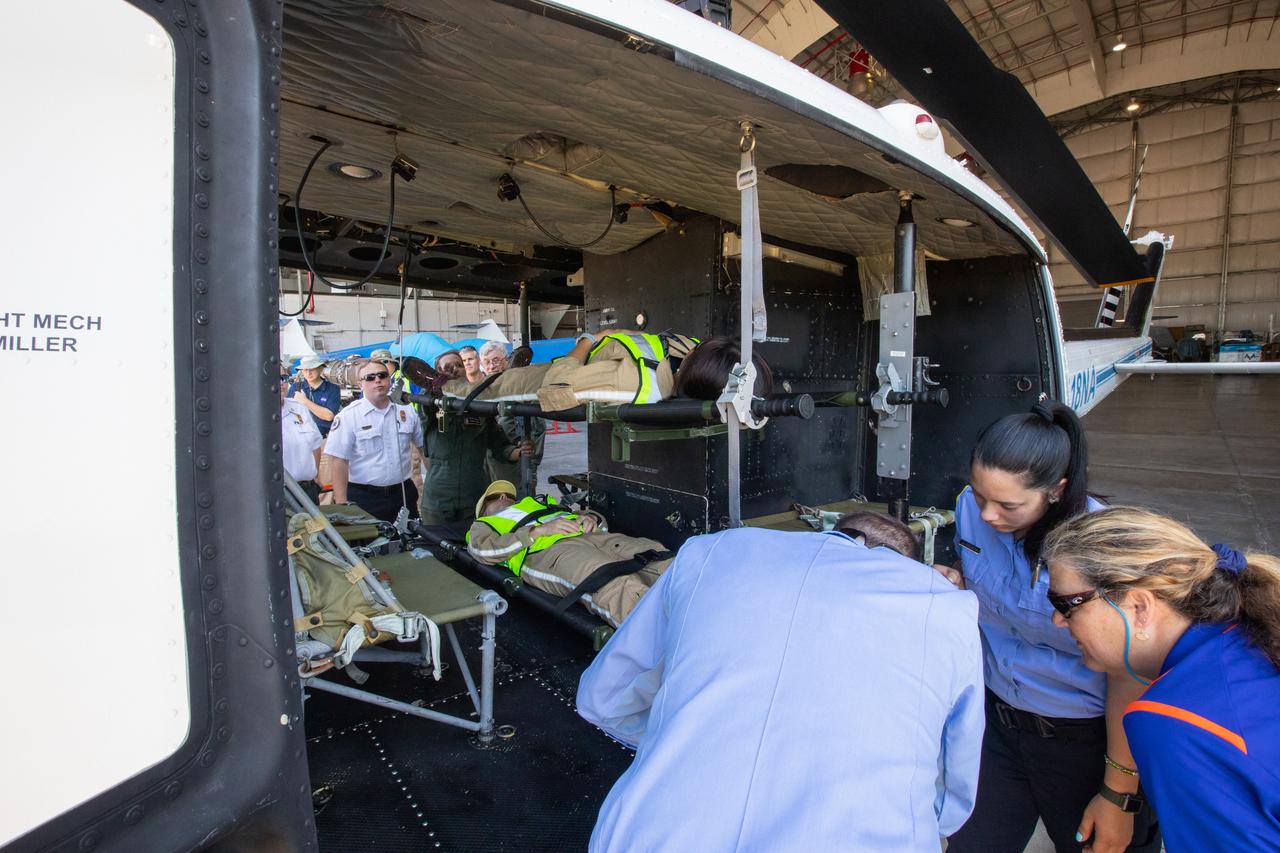
Kennedy Space Center personnel and American Medical Response (AMR) contractor paramedics gather around a “patient,” a KEMCON Fitness Center staff member, during a medical support training course in the Space Florida hangar at the spaceport’s Shuttle Landing Facility on May 17, 2019. The course was designed to familiarize the AMR paramedics with the center’s Triage Forces deployment, which included medical team members, fire/rescue personnel, environmental health specialists and flight operations crew members, as well as a helicopter, Mine Resistant Ambush Protected (MRAP) tactical vehicle, fire pumper truck and triage vehicles. The AMR paramedics will assist the agency in contingency planning for the return of human spaceflight from Kennedy.
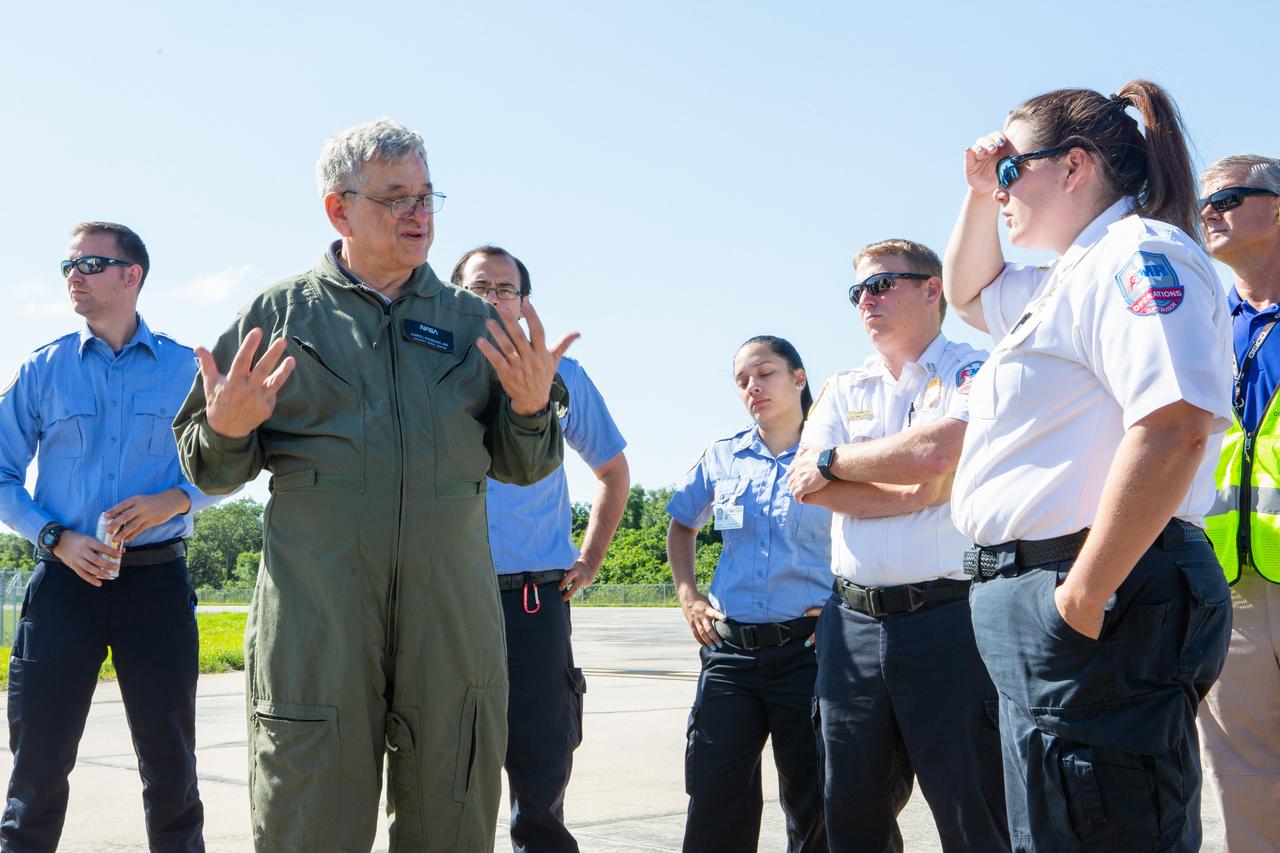
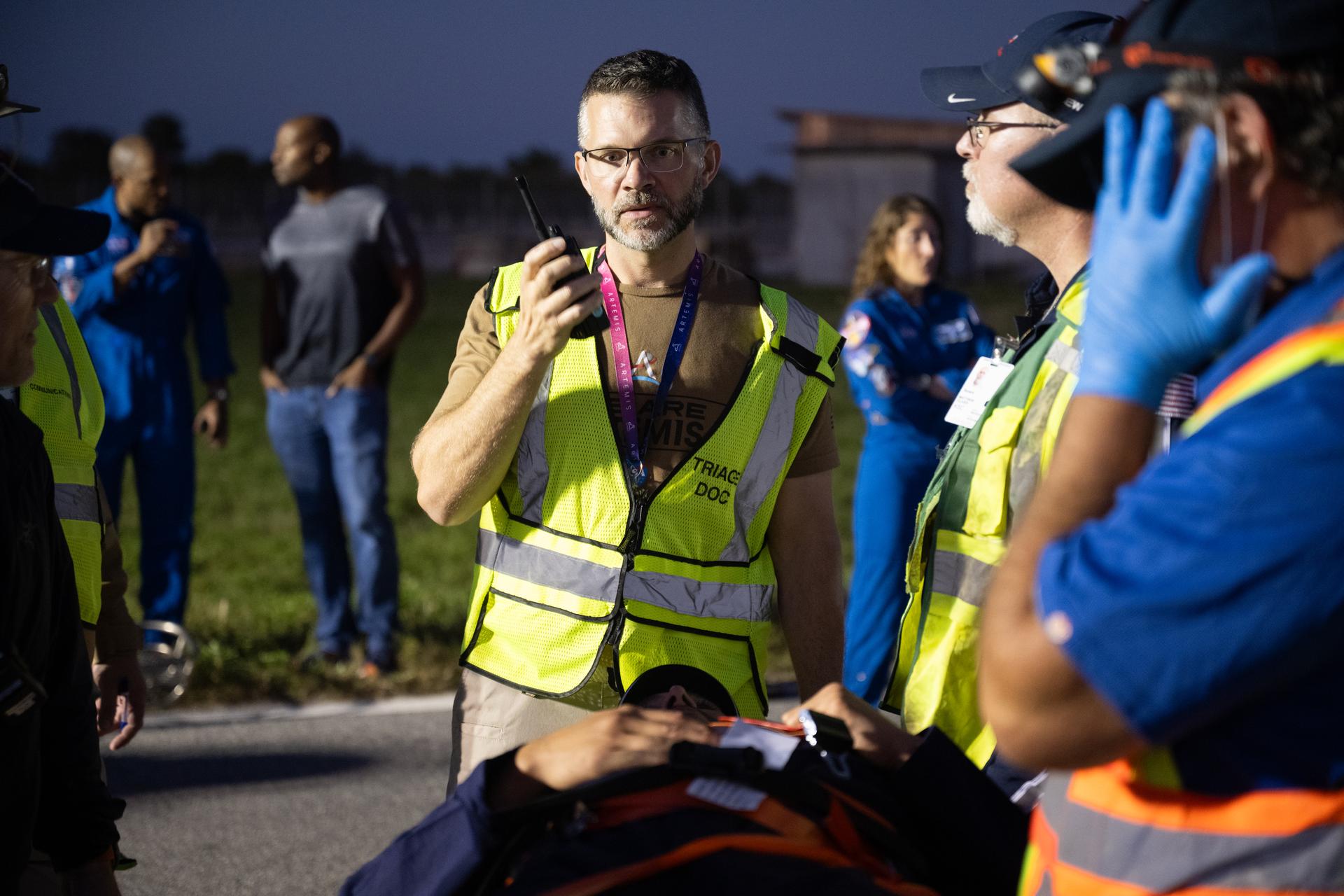
KEMCON physician Dr. Dan Woodard speaks to Kennedy Space Center personnel and American Medical Response (AMR) contractor paramedics gathered at the Florida spaceport’s Shuttle Landing Facility on May 17, 2019, for a medical support training course. The course was designed to familiarize the AMR paramedics with the center’s Triage Forces deployment, which included medical team members, fire/rescue personnel, environmental health specialists and flight operations crew members, as well as a helicopter, Mine Resistant Ambush Protected (MRAP) tactical vehicle, fire pumper truck and triage vehicles. The AMR paramedics will assist the agency in contingency planning for the return of human spaceflight from Kennedy.
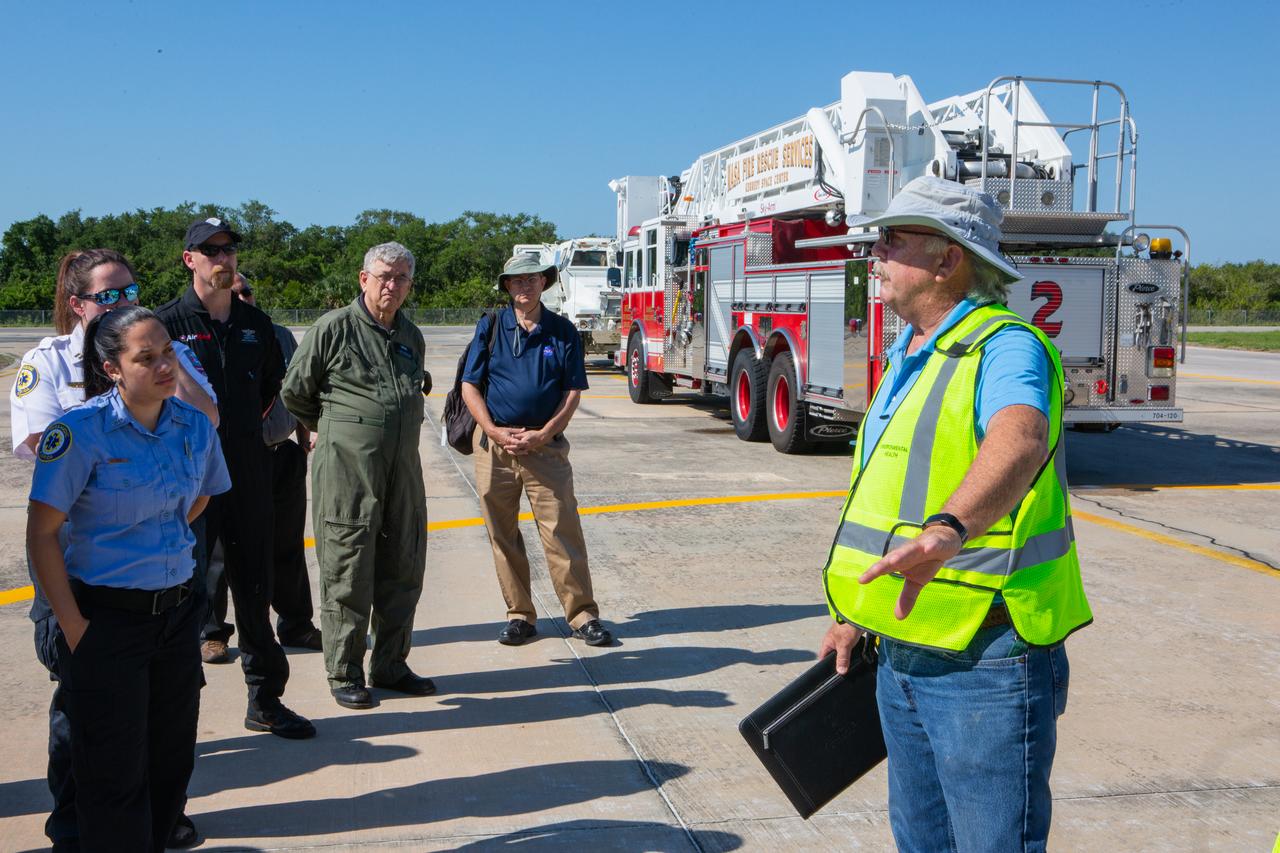
Kennedy Space Center personnel and American Medical Response (AMR) contractor paramedics gather at the Florida spaceport’s Shuttle Landing Facility on May 17, 2019, for a medical support training course. The course was designed to familiarize the AMR paramedics with the center’s Triage Forces deployment, which included medical team members, fire/rescue personnel, environmental health specialists and flight operations crew members, as well as a helicopter, Mine Resistant Ambush Protected (MRAP) tactical vehicle, fire pumper truck and triage vehicles. The AMR paramedics will assist the agency in contingency planning for the return of human spaceflight from Kennedy.
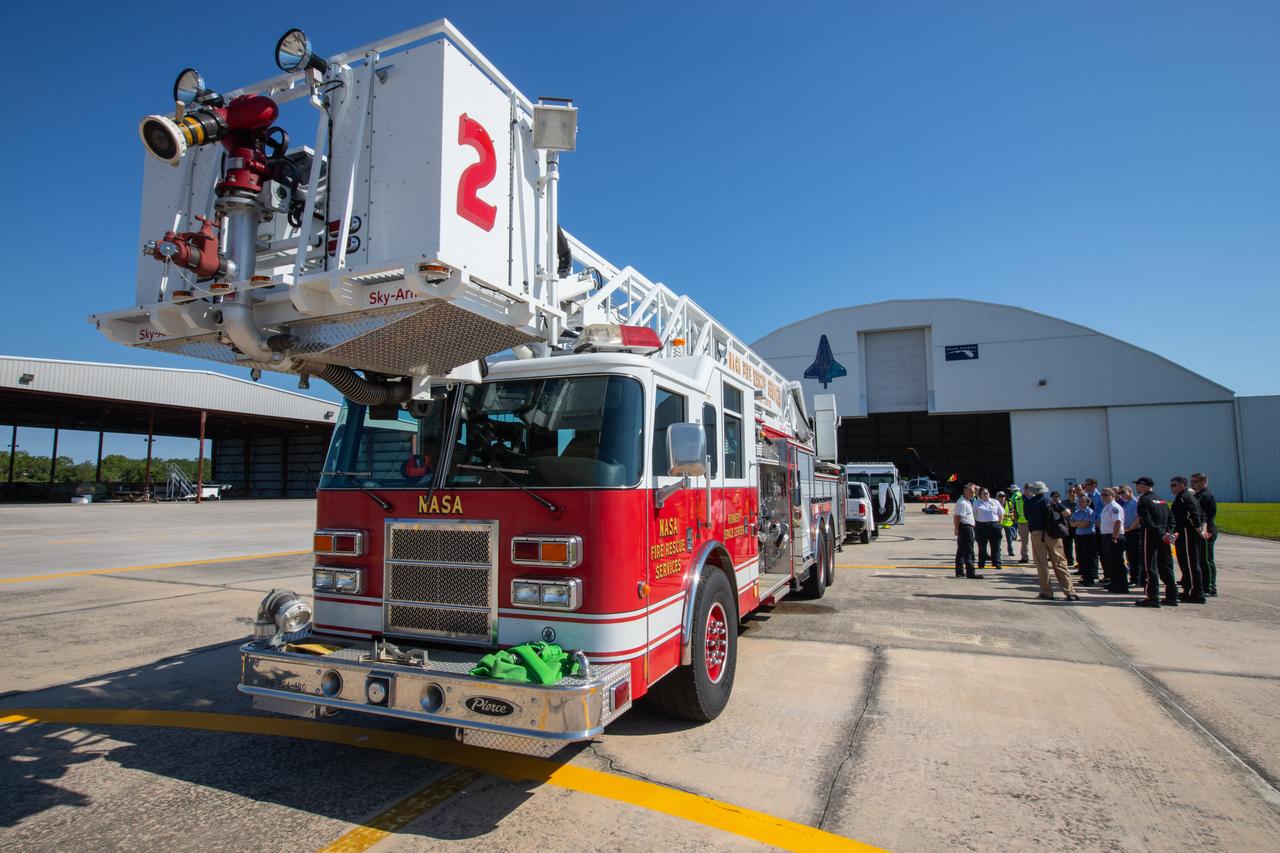
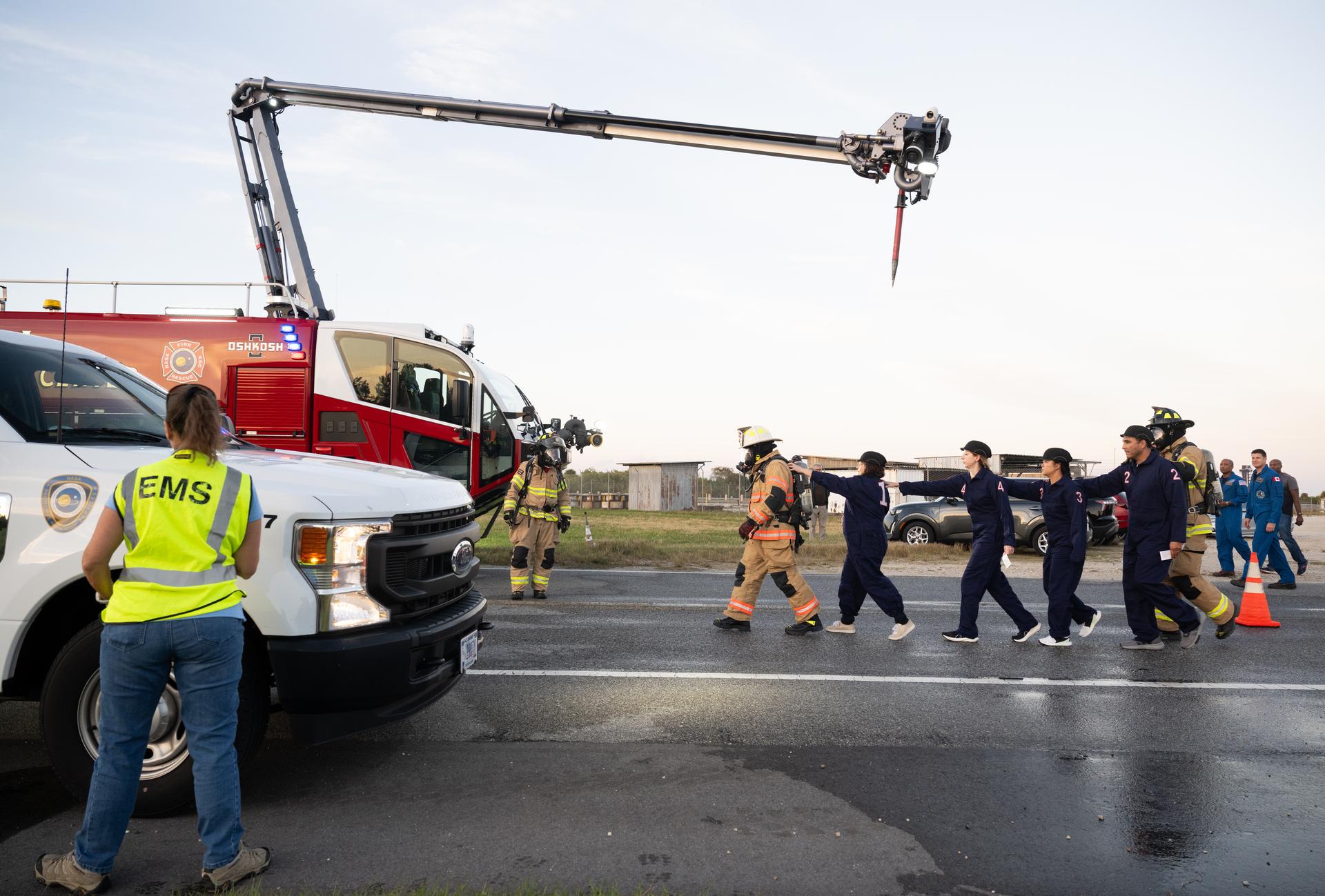
A Kennedy Space Center fire pumper truck stands at the ready during a medical support training course at the Florida spaceport’s Shuttle Landing Facility on May 17, 2019. Kennedy personnel and American Medical Response (AMR) contractor paramedics participated in the course, which was designed to familiarize the AMR paramedics with the center’s Triage Forces deployment, including medical team members, fire/rescue personnel, environmental health specialists and flight operations crew members, as well as a helicopter, Mine Resistant Ambush Protected (MRAP) tactical vehicle, fire pumper truck and triage vehicles. The AMR paramedics will assist the agency in contingency planning for the return of human spaceflight from Kennedy.
Kennedy Space Center personnel and American Medical Response (AMR) contractor paramedics gather around a “patient,” a KEMCON Fitness Center staff member, during a medical support training course in the Space Florida hangar at the spaceport’s Shuttle Landing Facility on May 17, 2019. The course was designed to familiarize the AMR paramedics with the center’s Triage Forces deployment, which included medical team members, fire/rescue personnel, environmental health specialists and flight operations crew members, as well as a helicopter, Mine Resistant Ambush Protected (MRAP) tactical vehicle, fire pumper truck and triage vehicles. The AMR paramedics will assist the agency in contingency planning for the return of human spaceflight from Kennedy.
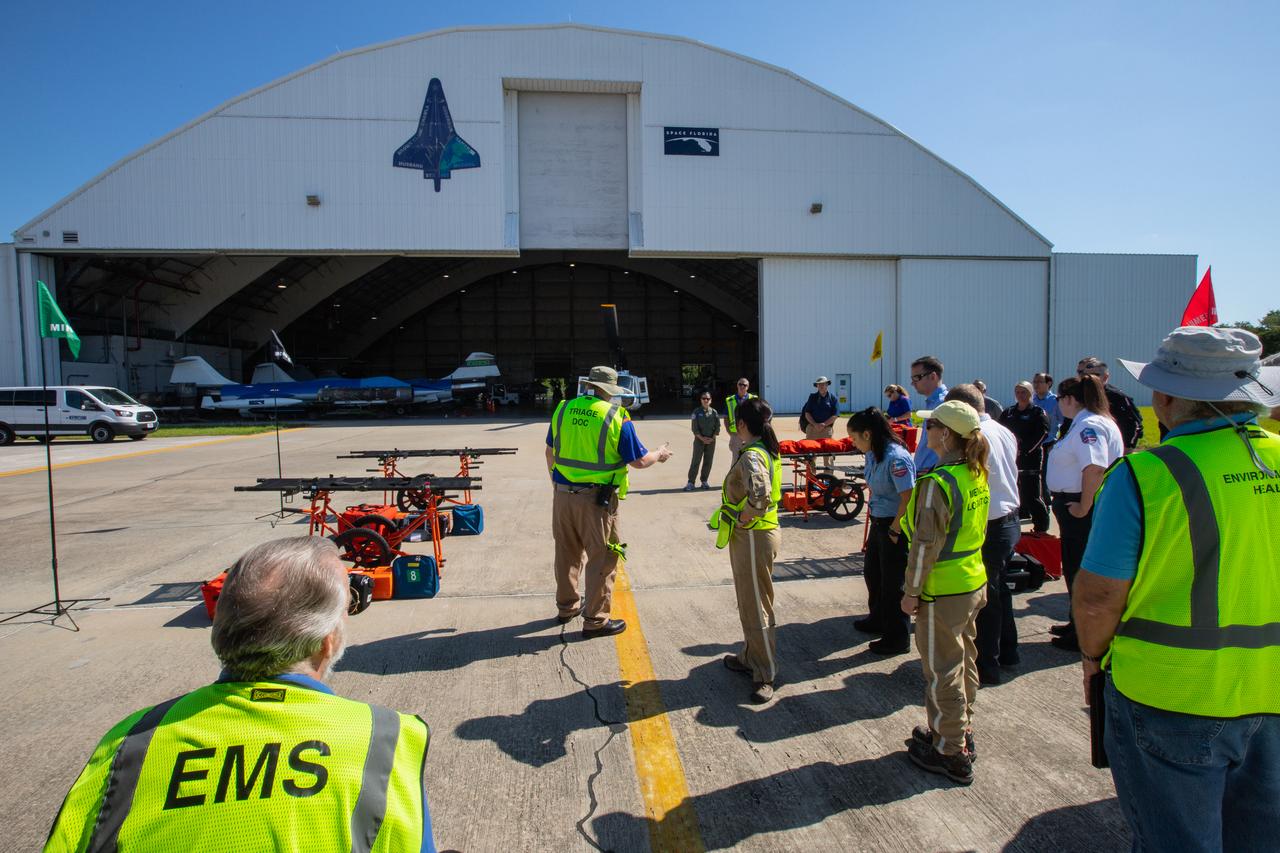
Kennedy Space Center personnel and American Medical Response (AMR) contractor paramedics gather near the Space Florida hangar at the spaceport’s Shuttle Landing Facility on May 17, 2019, for a medical support training course. The course was designed to familiarize the AMR paramedics with the center’s Triage Forces deployment, which included medical team members, fire/rescue personnel, environmental health specialists and flight operations crew members, as well as a helicopter, Mine Resistant Ambush Protected (MRAP) tactical vehicle, fire pumper truck and triage vehicles. The AMR paramedics will assist the agency in contingency planning for the return of human spaceflight from Kennedy.
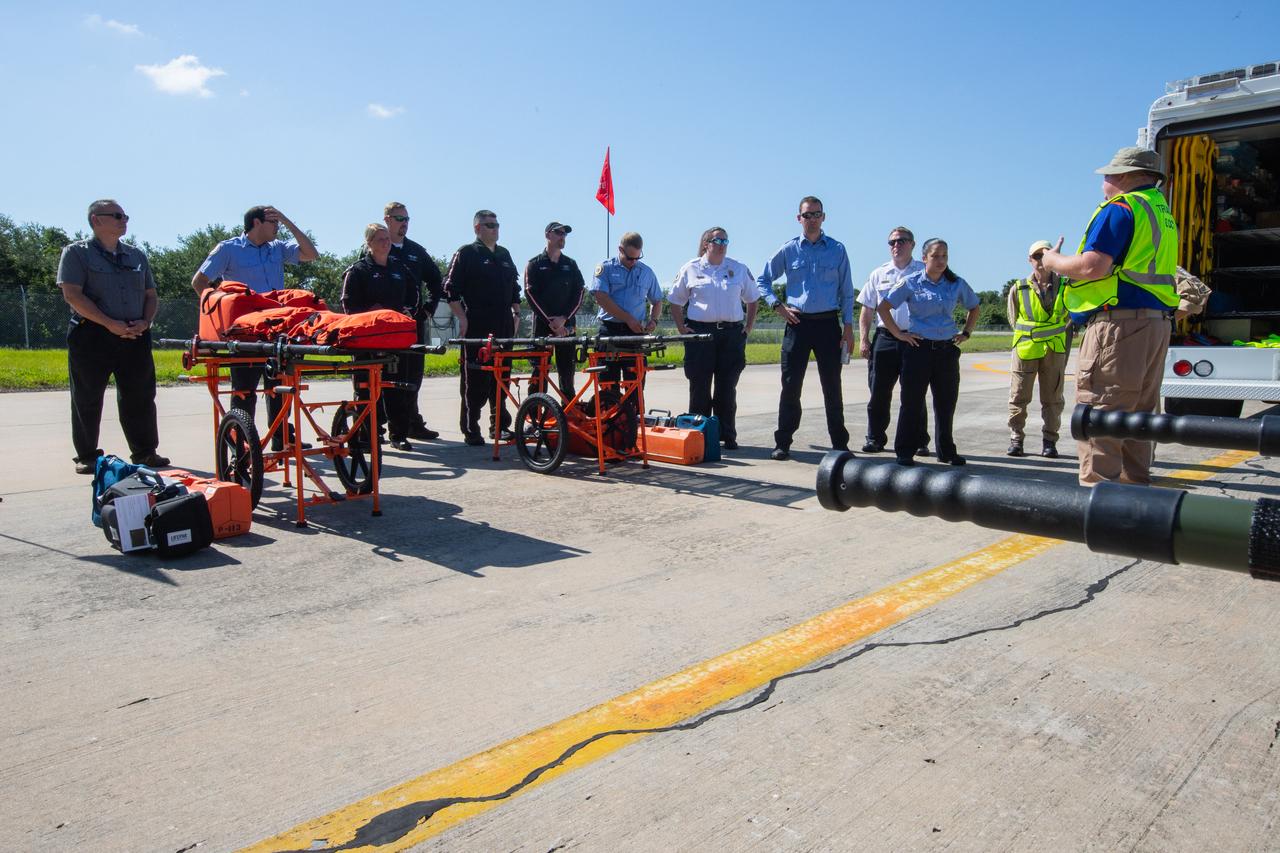
Kennedy Space Center personnel and American Medical Response (AMR) contractor paramedics gather at the Florida spaceport’s Shuttle Landing Facility on May 17, 2019, for a medical support training course. The course was designed to familiarize the AMR paramedics with the center’s Triage Forces deployment, which included medical team members, fire/rescue personnel, environmental health specialists and flight operations crew members, as well as a helicopter, Mine Resistant Ambush Protected (MRAP) tactical vehicle, fire pumper truck and triage vehicles. The AMR paramedics will assist the agency in contingency planning for the return of human spaceflight from Kennedy.
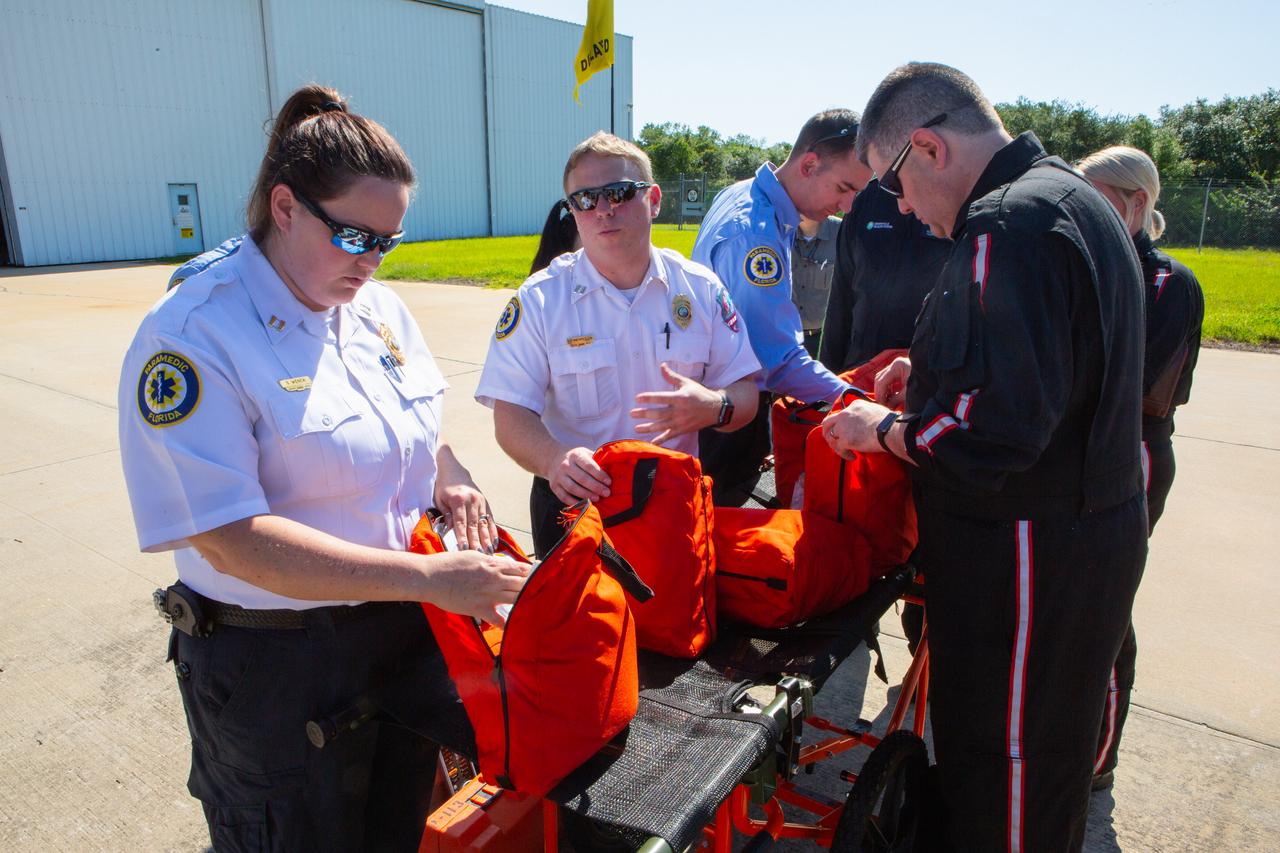
Kennedy Space Center personnel and American Medical Response (AMR) contractor paramedics gather at the Florida spaceport’s Shuttle Landing Facility on May 17, 2019, for a medical support training course. The course was designed to familiarize the AMR paramedics with the center’s Triage Forces deployment, which included medical team members, fire/rescue personnel, environmental health specialists and flight operations crew members, as well as a helicopter, Mine Resistant Ambush Protected (MRAP) tactical vehicle, fire pumper truck and triage vehicles. The AMR paramedics will assist the agency in contingency planning for the return of human spaceflight from Kennedy.
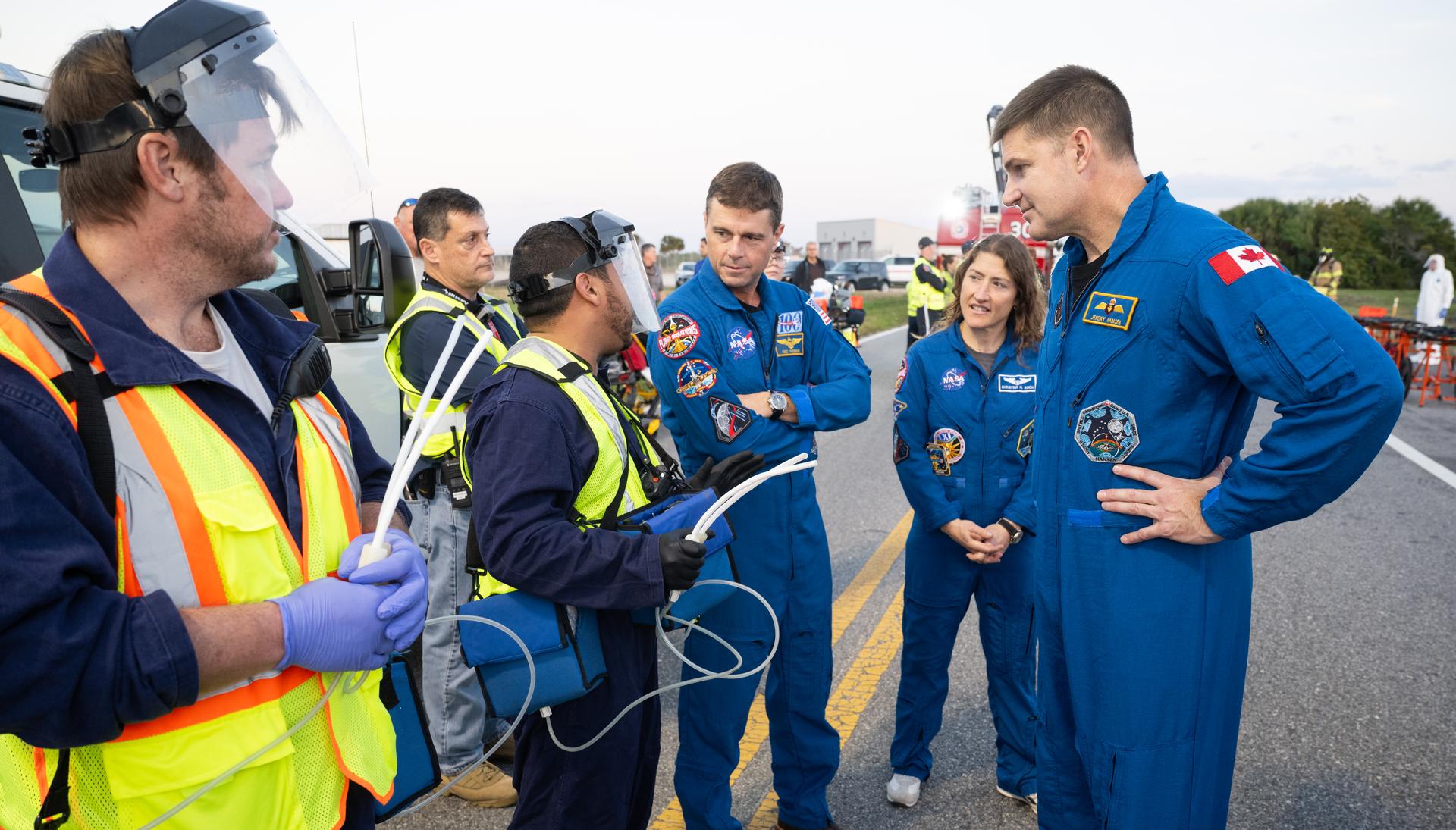
CSA (Canadian Space Agency) astronaut Jeremy Hansen, Artemis II mission specialist, right, and NASA astronauts Christina Koch, Artemis II mission specialist, and Reid Wiseman, Artemis II commander, talk with team members at NASA's Kennedy Space Center in Florida as they practiced various emergency rescue training scenarios with the Artemis II crew, Friday, Dec. 19, 2025, ahead of the Artemis II mission. In the unlikely event of an emergency during launch countdown at Launch Complex 39B, personnel will be transported in mine-resistant ambush protected vehicles, or MRAPS, from the pad and to one of the triage site locations at Kennedy. Photo Credit: (NASA/Joel Kowsky)
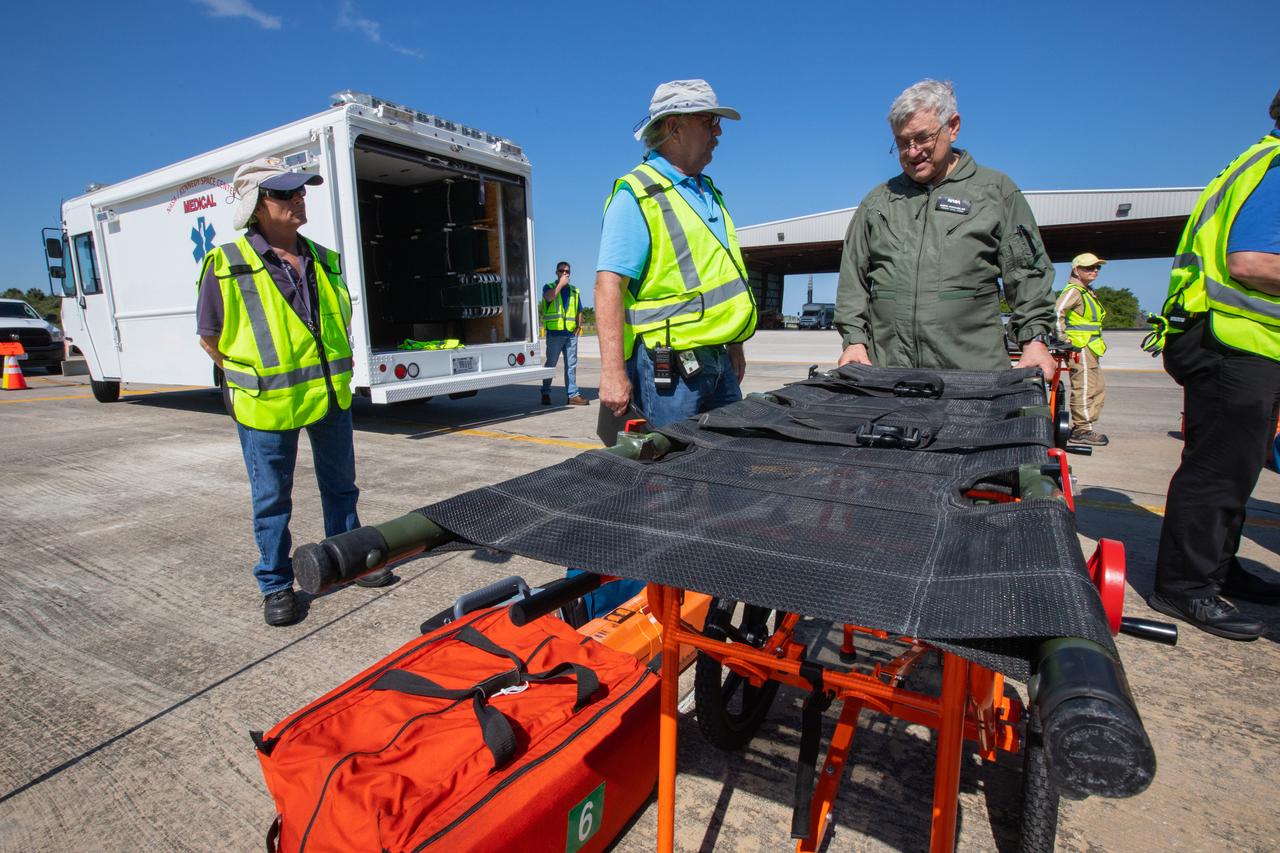
Kennedy Space Center personnel and American Medical Response (AMR) contractor paramedics participate in a medical support training course at the Florida spaceport’s Shuttle Landing Facility on May 17, 2019. The course was designed to familiarize the AMR paramedics with the center’s Triage Forces deployment, which included medical team members, fire/rescue personnel, environmental health specialists and flight operations crew members, as well as a helicopter, Mine Resistant Ambush Protected (MRAP) tactical vehicle, fire pumper truck and triage vehicles. The AMR paramedics will assist the agency in contingency planning for the return of human spaceflight from Kennedy.
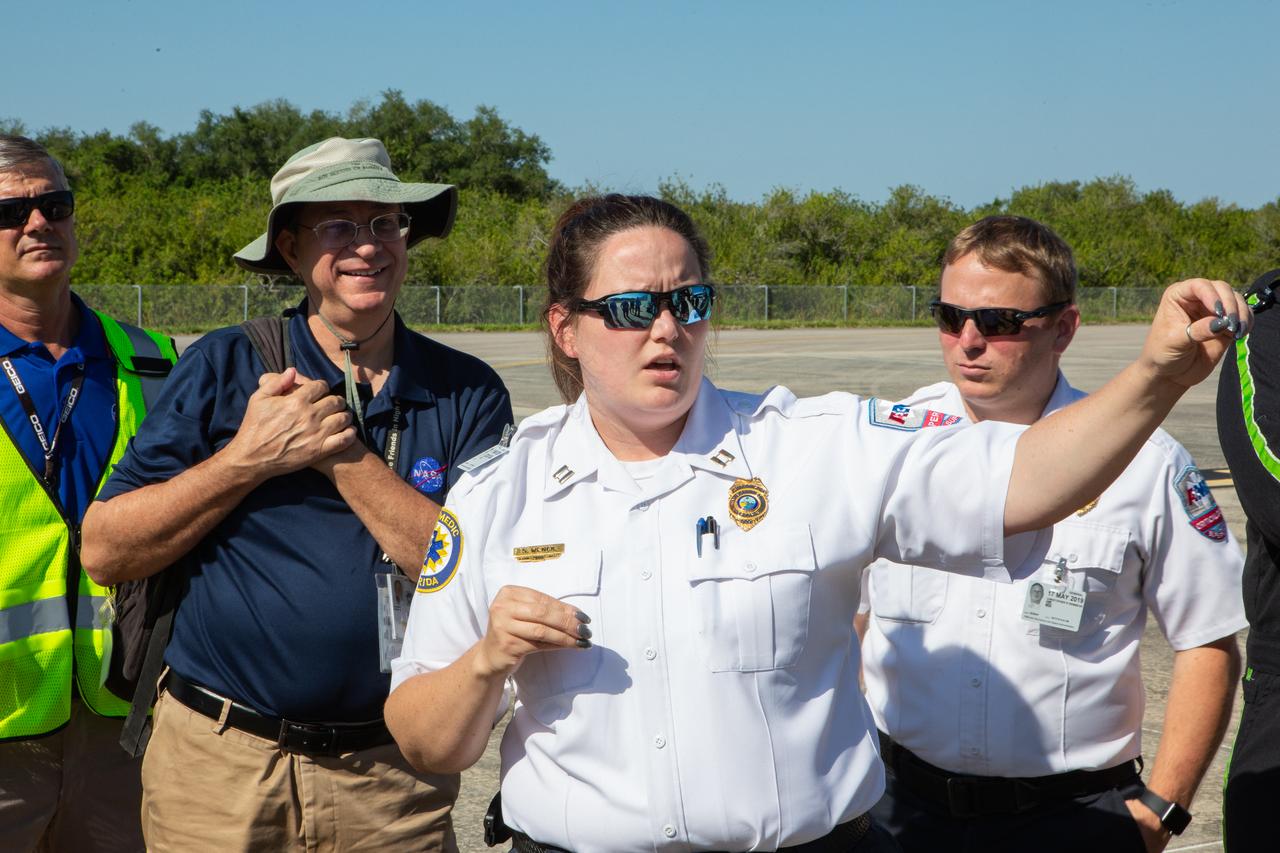
An American Medical Response (AMR) contractor paramedic speaks to Kennedy Space Center and AMR personnel gathered at the Florida spaceport’s Shuttle Landing Facility on May 17, 2019, for a medical support training course. The course was designed to familiarize the AMR paramedics with the center’s Triage Forces deployment, which included medical team members, fire/rescue personnel, environmental health specialists and flight operations crew members, as well as a helicopter, Mine Resistant Ambush Protected (MRAP) tactical vehicle, fire pumper truck and triage vehicles. The AMR paramedics will assist the agency in contingency planning for the return of human spaceflight from Kennedy.
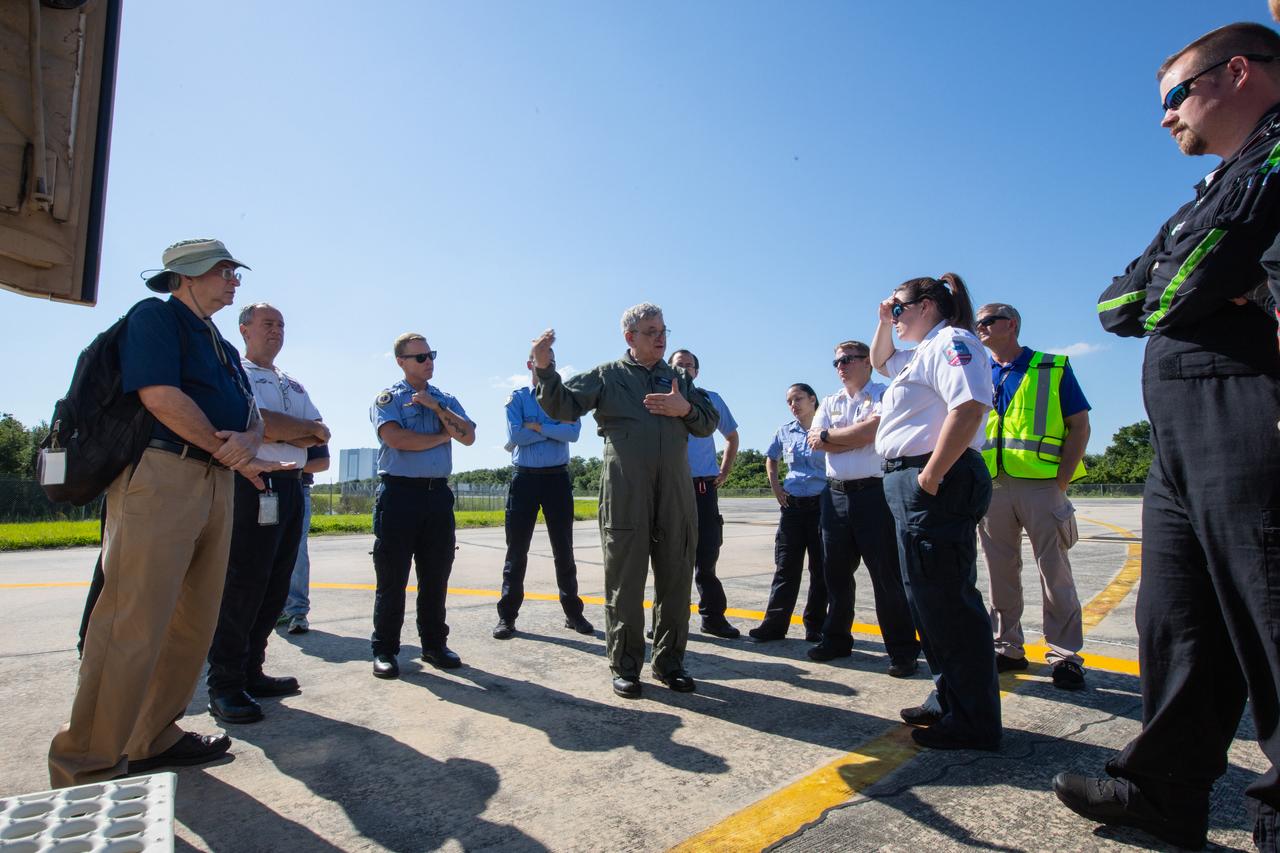
KEMCON physician Dr. Dan Woodard speaks to Kennedy Space Center personnel and American Medical Response (AMR) contractor paramedics gathered at the Florida spaceport’s Shuttle Landing Facility on May 17, 2019, for a medical support training course. The course was designed to familiarize the AMR paramedics with the center’s Triage Forces deployment, which included medical team members, fire/rescue personnel, environmental health specialists and flight operations crew members, as well as a helicopter, Mine Resistant Ambush Protected (MRAP) tactical vehicle, fire pumper truck and triage vehicles. The AMR paramedics will assist the agency in contingency planning for the return of human spaceflight from Kennedy.
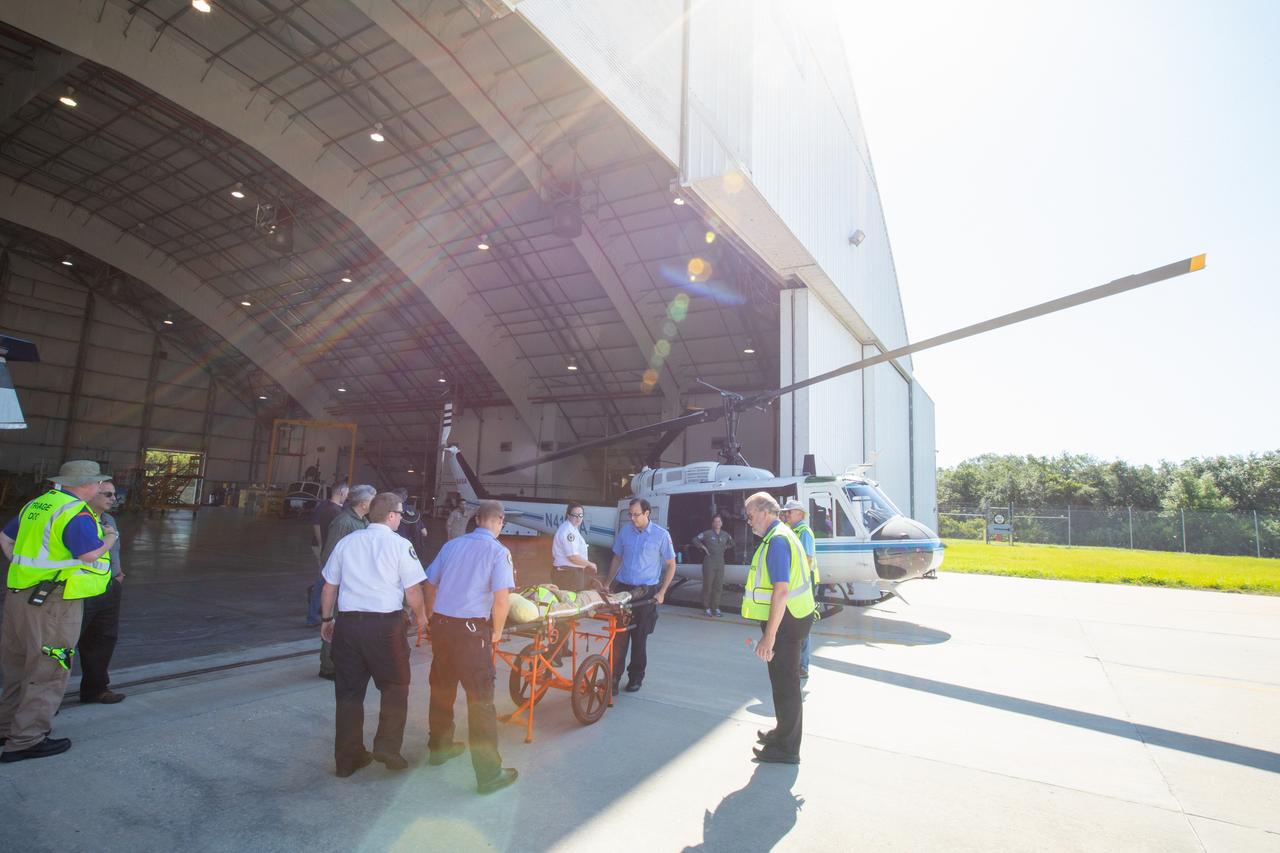
Kennedy Space Center personnel and American Medical Response (AMR) contractor paramedics gather around a “patient,” a KEMCON Fitness Center staff member, during a medical support training course in the Space Florida hangar at the spaceport’s Shuttle Landing Facility on May 17, 2019. The course was designed to familiarize the AMR paramedics with the center’s Triage Forces deployment, which included medical team members, fire/rescue personnel, environmental health specialists and flight operations crew members, as well as a helicopter, Mine Resistant Ambush Protected (MRAP) tactical vehicle, fire pumper truck and triage vehicles. The AMR paramedics will assist the agency in contingency planning for the return of human spaceflight from Kennedy.
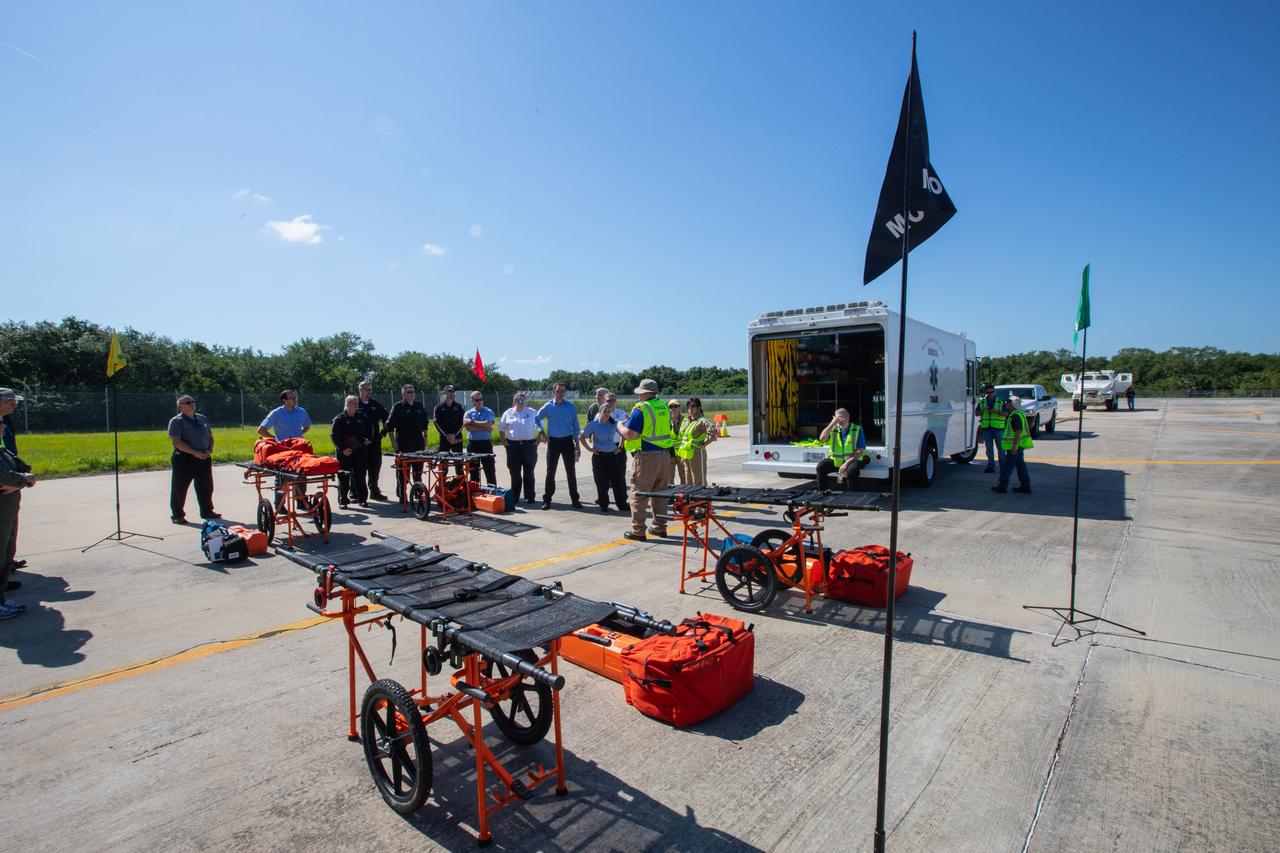
Kennedy Space Center personnel and American Medical Response (AMR) contractor paramedics gather at the Florida spaceport’s Shuttle Landing Facility on May 17, 2019, for a medical support training course. The course was designed to familiarize the AMR paramedics with the center’s Triage Forces deployment, which included medical team members, fire/rescue personnel, environmental health specialists and flight operations crew members, as well as a helicopter, Mine Resistant Ambush Protected (MRAP) tactical vehicle, fire pumper truck and triage vehicles. The AMR paramedics will assist the agency in contingency planning for the return of human spaceflight from Kennedy.
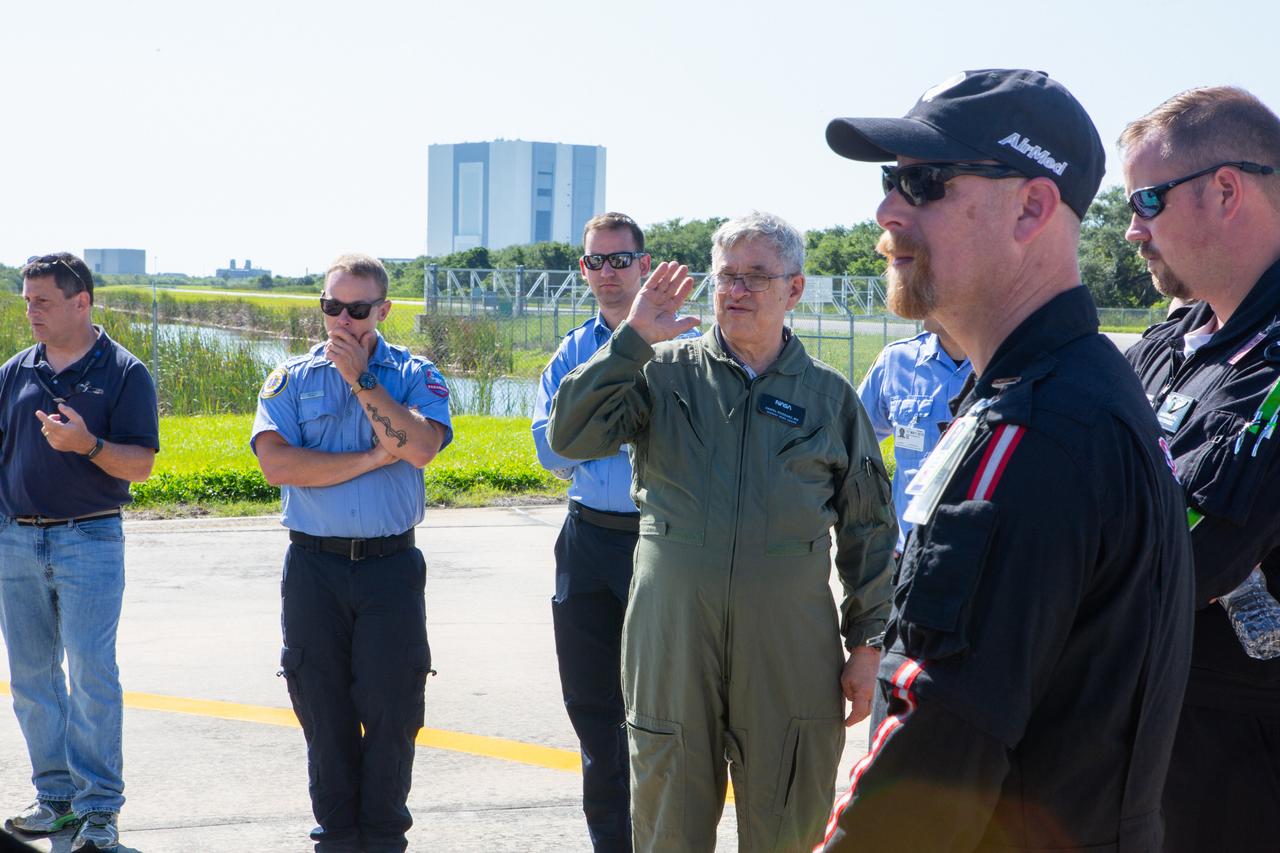
KEMCON physician Dr. Dan Woodard speaks to Kennedy Space Center personnel and American Medical Response (AMR) contractor paramedics gathered at the Florida spaceport’s Shuttle Landing Facility on May 17, 2019, for a medical support training course. The course was designed to familiarize the AMR paramedics with the center’s Triage Forces deployment, which included medical team members, fire/rescue personnel, environmental health specialists and flight operations crew members, as well as a helicopter, Mine Resistant Ambush Protected (MRAP) tactical vehicle, fire pumper truck and triage vehicles. The AMR paramedics will assist the agency in contingency planning for the return of human spaceflight from Kennedy.
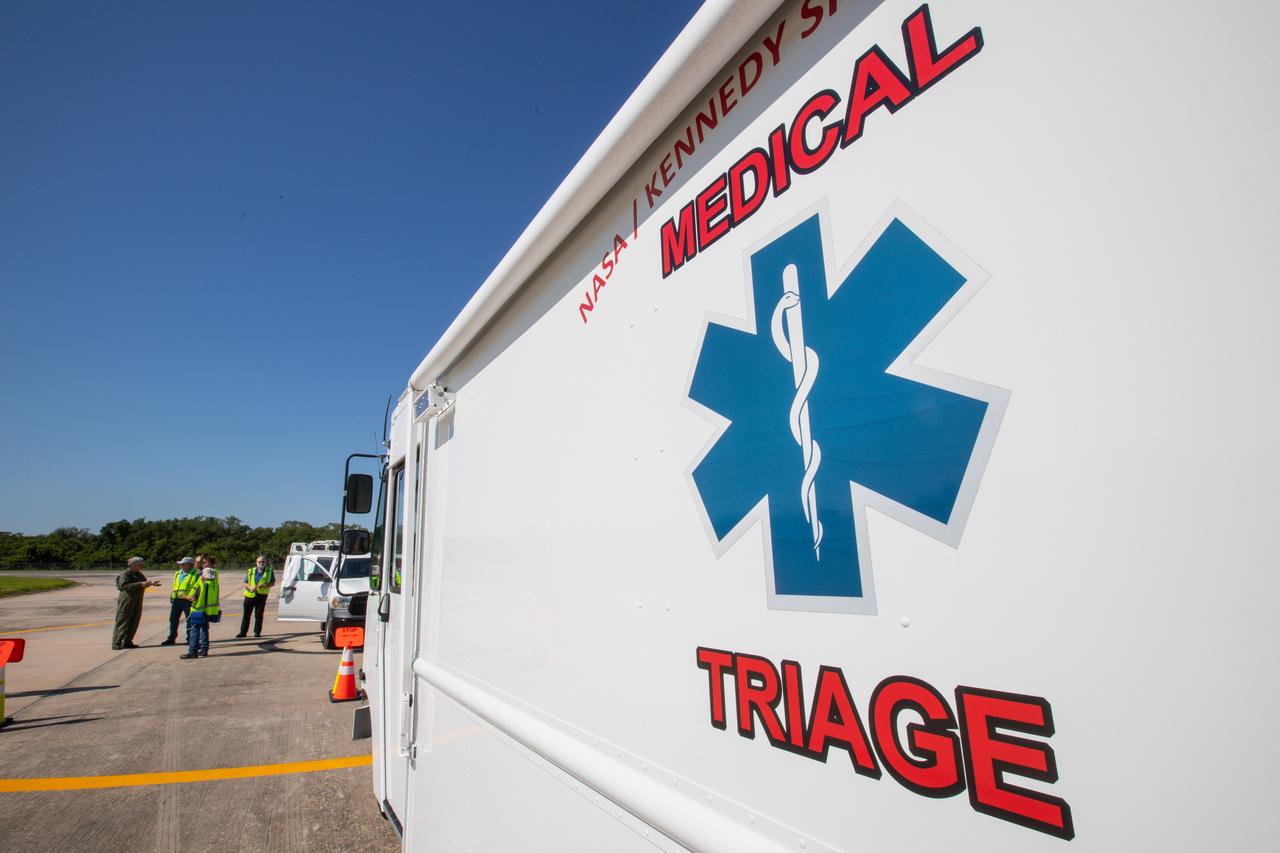
One of Kennedy Space Center’s medical triage vehicles stands at the ready during a medical support training course at the Florida spaceport’s Shuttle Landing Facility on May 17, 2019. Kennedy personnel and American Medical Response (AMR) contractor paramedics participated in the course, which was designed to familiarize the AMR paramedics with the center’s Triage Forces deployment, including medical team members, fire/rescue personnel, environmental health specialists and flight operations crew members, as well as a helicopter, Mine Resistant Ambush Protected (MRAP) tactical vehicle, fire pumper truck and triage vehicles. The AMR paramedics will assist the agency in contingency planning for the return of human spaceflight from Kennedy.
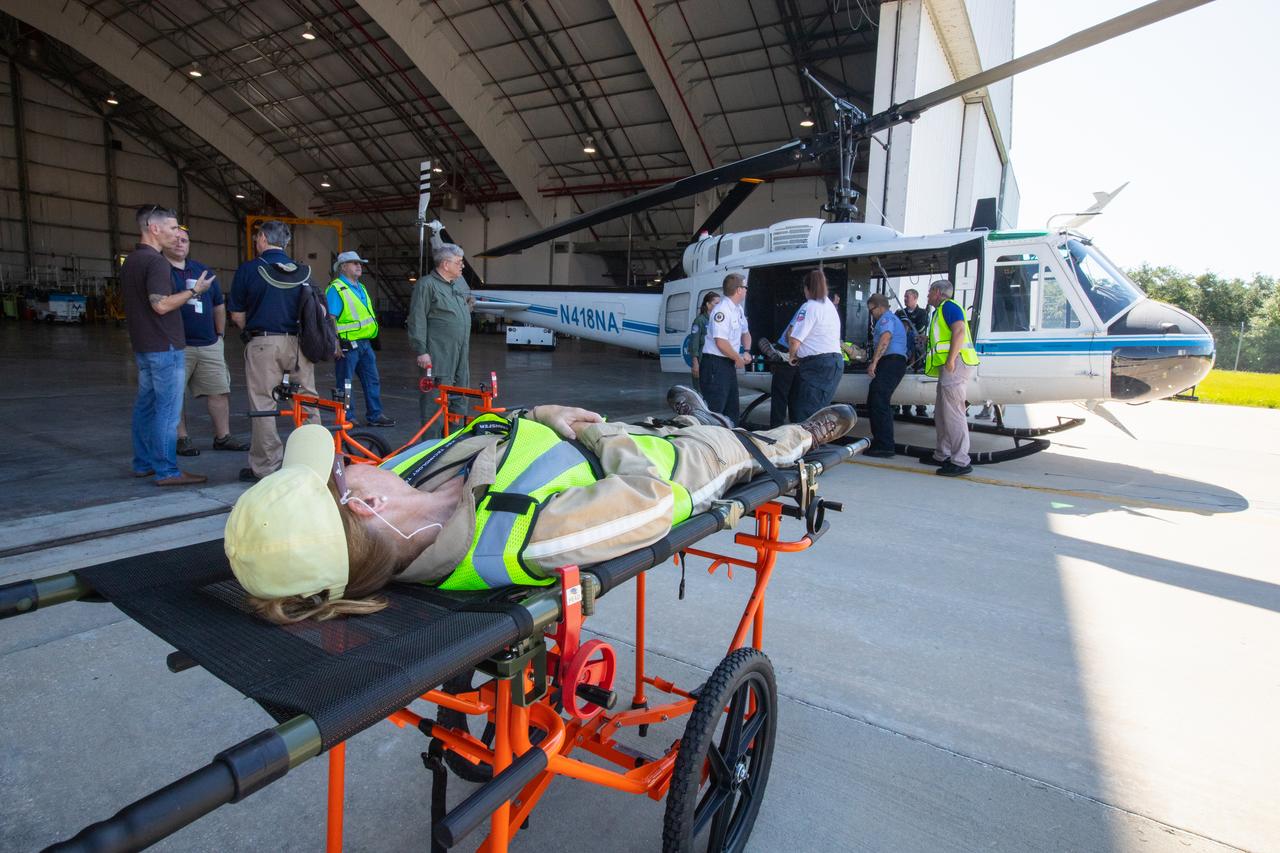
A Kennedy Space Center staff member serves as a “patient” during a medical support training course held May 17, 2019, in the Space Florida hangar at the spaceport’s Shuttle Landing Facility. The course was designed to familiarize the AMR paramedics with the center’s Triage Forces deployment, which included medical team members, fire/rescue personnel, environmental health specialists and flight operations crew members, as well as a helicopter, Mine Resistant Ambush Protected (MRAP) tactical vehicle, fire pumper truck and triage vehicles. The AMR paramedics will assist the agency in contingency planning for the return of human spaceflight from Kennedy.
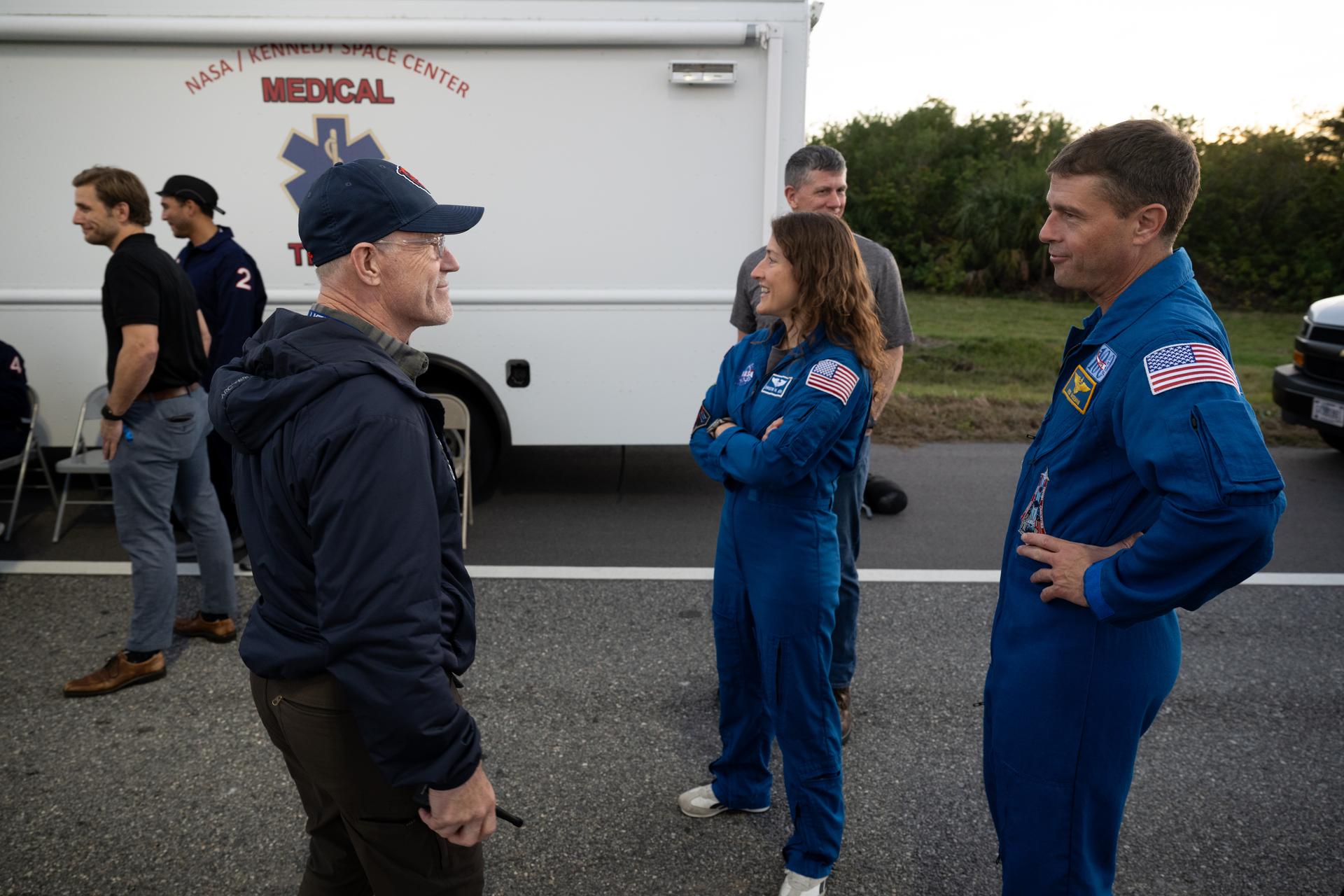
NASA Flight Surgeon Richard Scheuring, left, talks with NASA astronauts Reid Wiseman, Artemis II commander, right, and Christina Koch, Artemis II mission specialist, as teams at NASA's Kennedy Space Center in Florida practiced various emergency rescue training scenarios with the Artemis II crew, Friday, Dec. 19, 2025, ahead of the Artemis II mission. In the unlikely event of an emergency during launch countdown at Launch Complex 39B, personnel will be transported in mine-resistant ambush protected vehicles, or MRAPS, from the pad and to one of the triage site locations at Kennedy. Photo Credit: (NASA/Joel Kowsky)
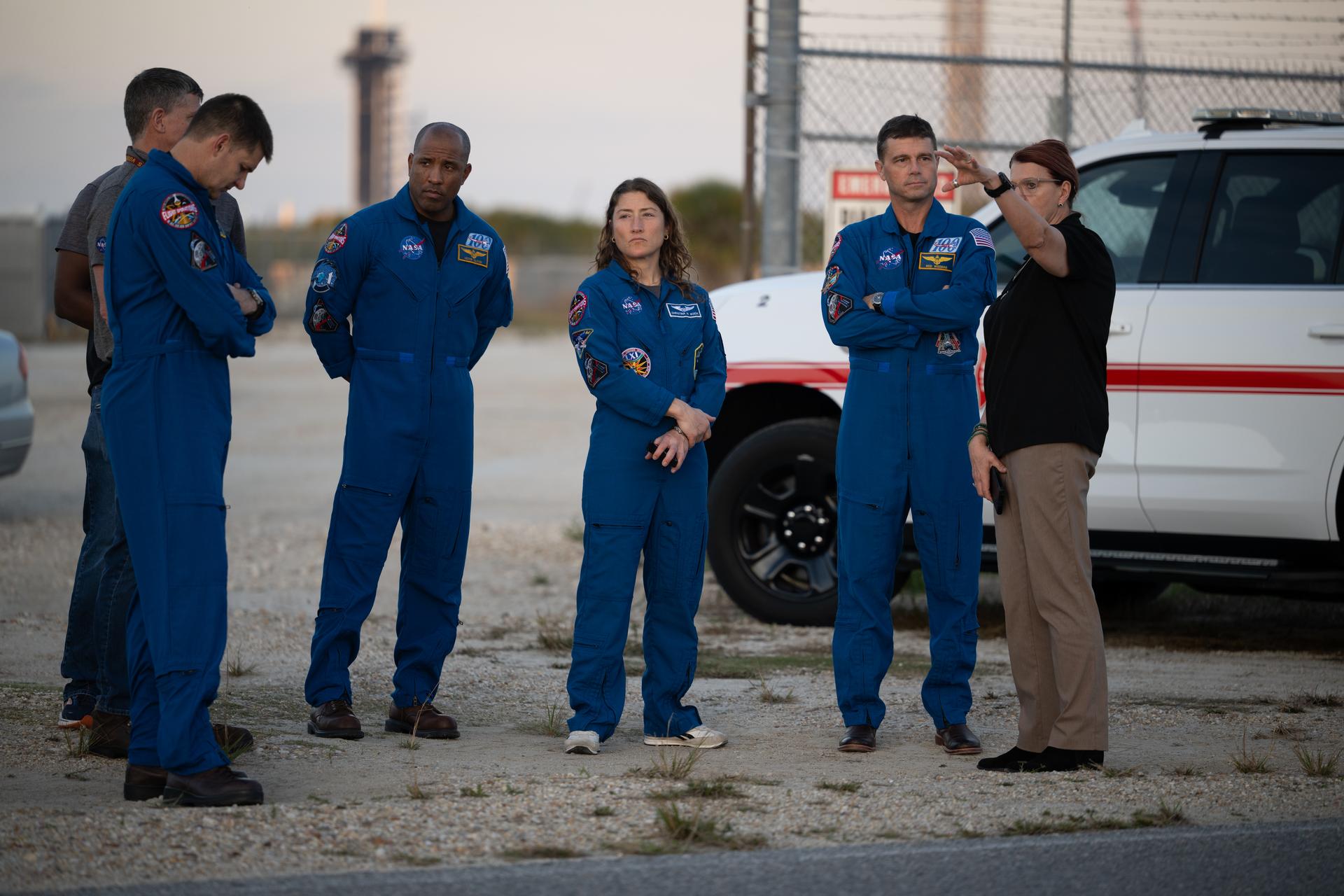
Charlie Blackwell-Thompson, Artemis II Launch Director, right, talks to NASA astronauts Reid Wiseman, Artemis II commander, second from right, Christina Koch, Artemis II mission specialist, Victor Glover, Artemis II pilot, and CSA (Canadian Space Agency) astronaut Jeremy Hansen, as teams at NASA's Kennedy Space Center in Florida practiced various emergency rescue training scenarios with the Artemis II crew, Friday, Dec. 19, 2025, ahead of the Artemis II mission. In the unlikely event of an emergency during launch countdown at Launch Complex 39B, personnel will be transported in mine-resistant ambush protected vehicles, or MRAPS, from the pad and to one of the triage site locations at Kennedy. Photo Credit: (NASA/Joel Kowsky)
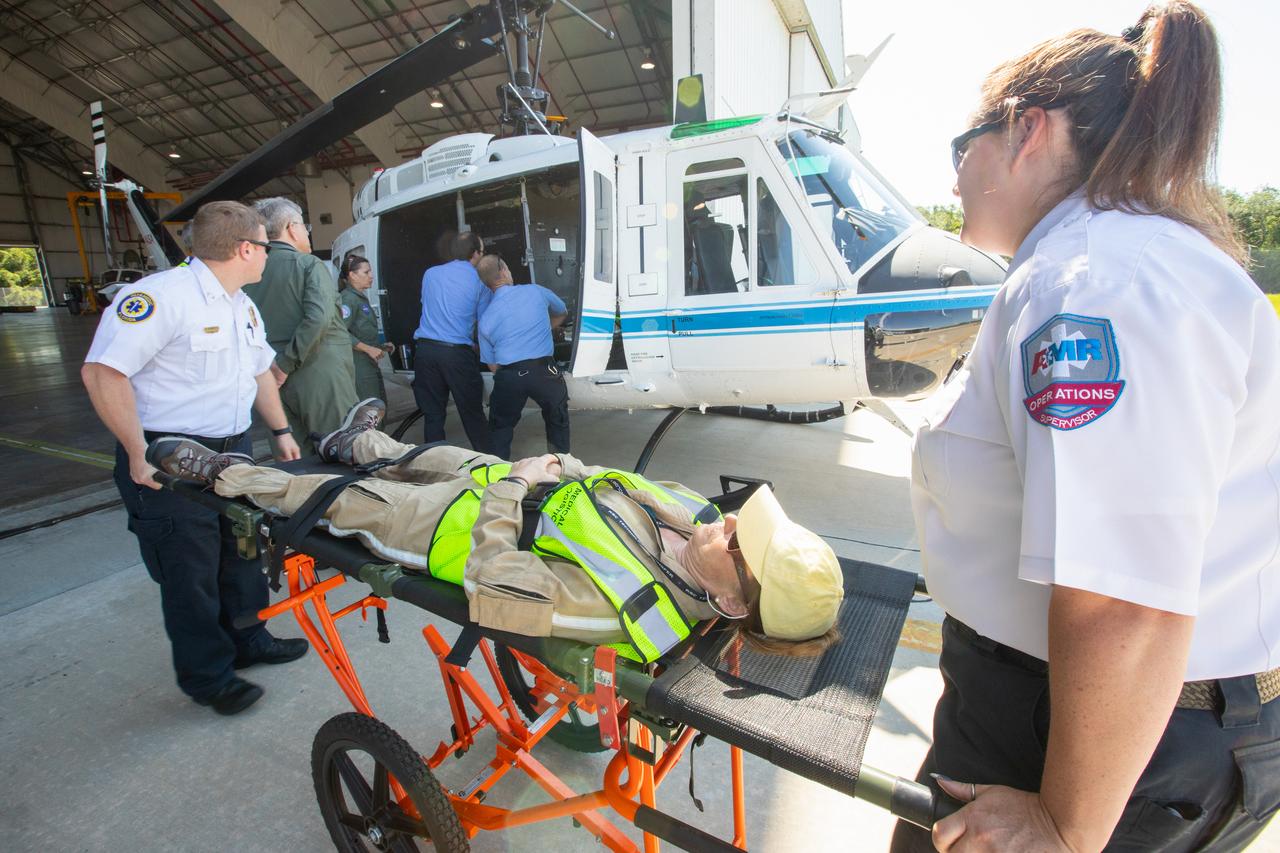
Kennedy Space Center personnel and American Medical Response (AMR) contractor paramedics prepare to load a “patient,” a KEMCON Fitness Center staff member, into a NASA helicopter during a medical support training course in the Space Florida hangar at the spaceport’s Shuttle Landing Facility on May 17, 2019. The course was designed to familiarize the AMR paramedics with the center’s Triage Forces deployment, which included medical team members, fire/rescue personnel, environmental health specialists and flight operations crew members, as well as a helicopter, Mine Resistant Ambush Protected (MRAP) tactical vehicle, fire pumper truck and triage vehicles. The AMR paramedics will assist the agency in contingency planning for the return of human spaceflight from Kennedy.
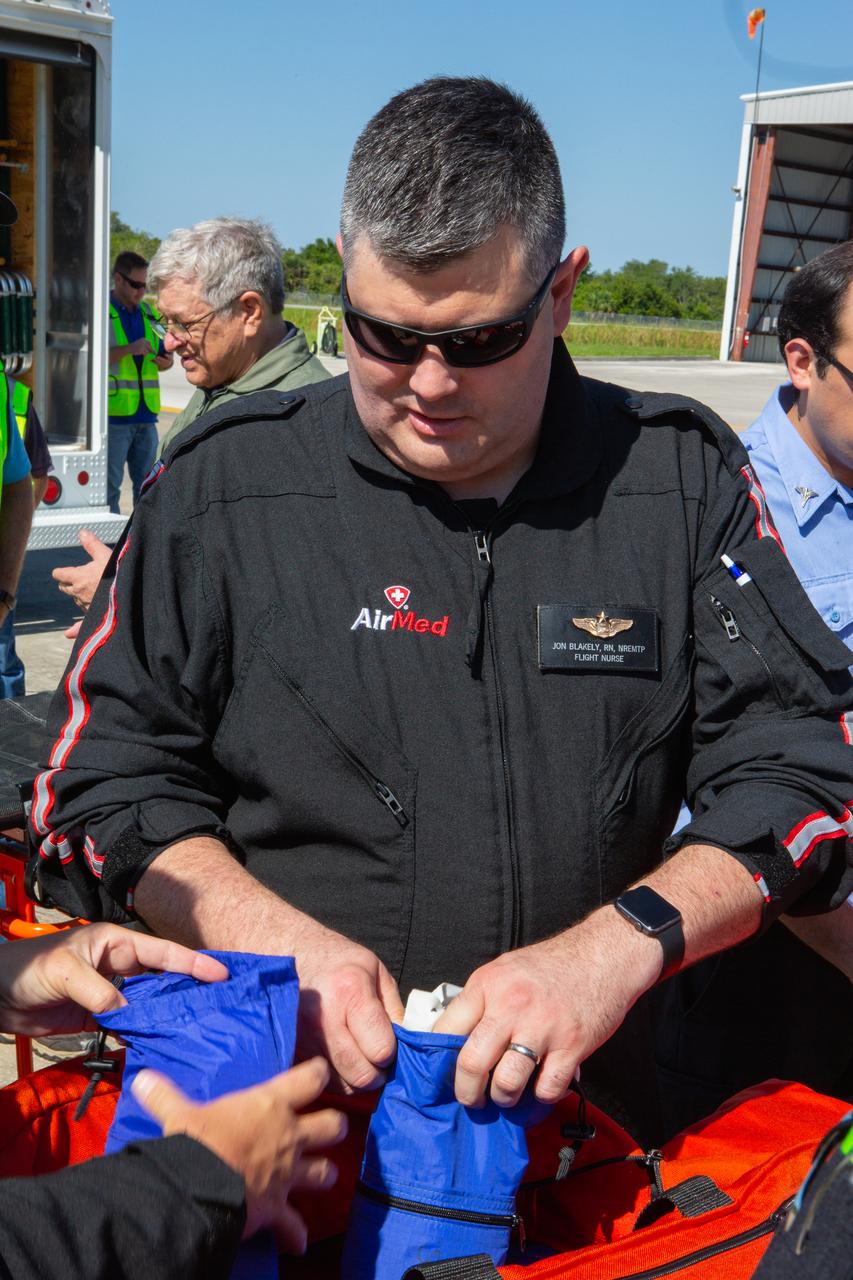
Jon Blakely, an AirMed flight nurse, joins Kennedy Space Center personnel and American Medical Response (AMR) contractor paramedics at the Florida spaceport’s Shuttle Landing Facility on May 17, 2019, for a medical support training course. Signs in the foreground indicate the “dirty side,” where patient off-loading and decontamination would take place, and the “clean side,” used for patient evaluation and medevac. The course was designed to familiarize the AMR paramedics with the center’s Triage Forces deployment, which included medical team members, fire/rescue personnel, environmental health specialists and flight operations crew members, as well as a helicopter, Mine Resistant Ambush Protected (MRAP) tactical vehicle, fire pumper truck and triage vehicles. The AMR paramedics will assist the agency in contingency planning for the return of human spaceflight from Kennedy.
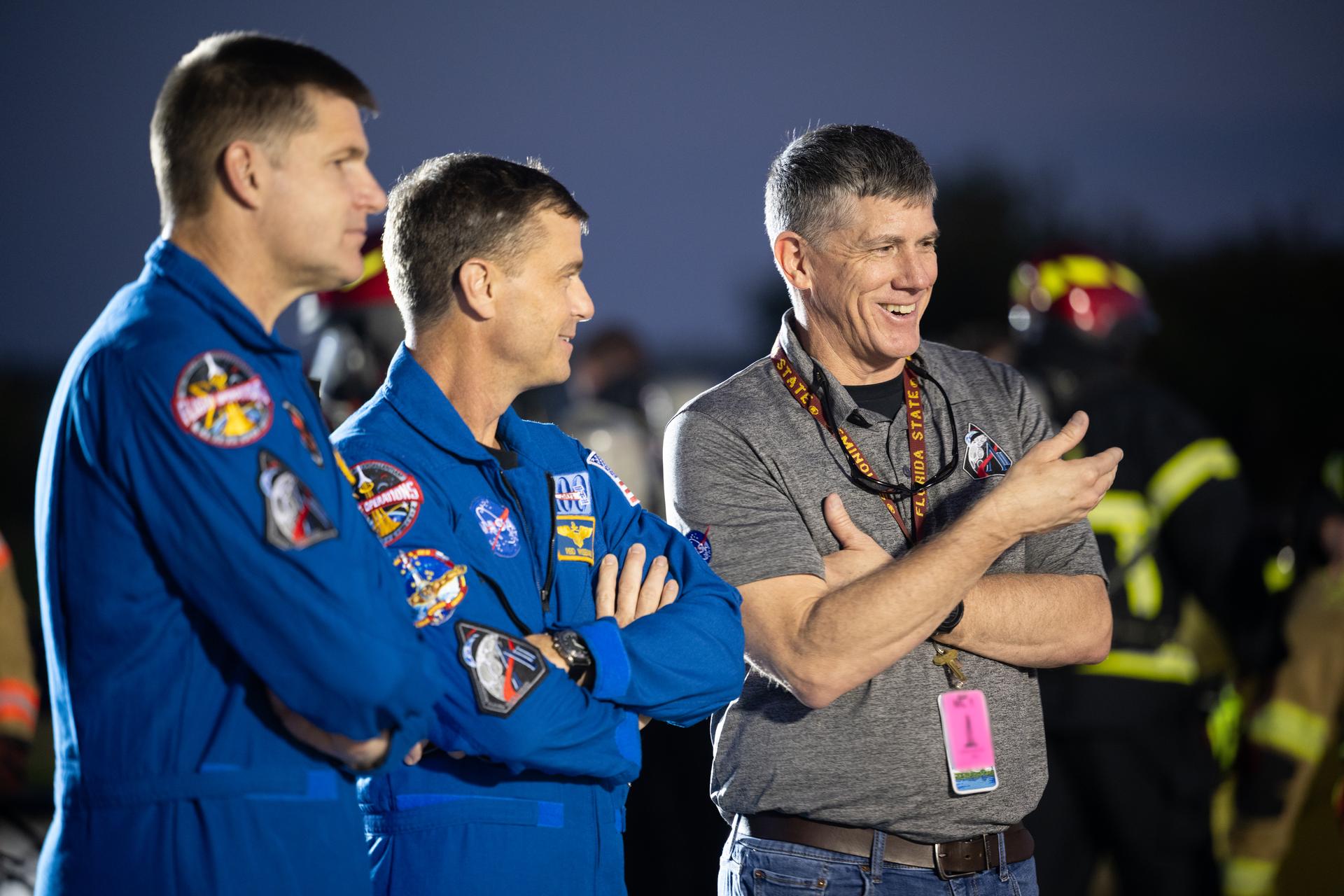
Jeremy Graeber, Artemis II Assistant Launch Director, talks with NASA astronaut Reid Wiseman, Artemis II commander, and CSA (Canadian Space Agency) astronaut Jeremy Hansen, Artemis II mission specialist, as teams at NASA's Kennedy Space Center in Florida practiced various emergency rescue training scenarios with the Artemis II crew, Friday, Dec. 19, 2025, ahead of the Artemis II mission. In the unlikely event of an emergency during launch countdown at Launch Complex 39B, personnel will be transported in mine-resistant ambush protected vehicles, or MRAPS, from the pad and to one of the triage site locations at Kennedy. Photo Credit: (NASA/Joel Kowsky) NOTE - Portions of this image have been blurred for security reasons.