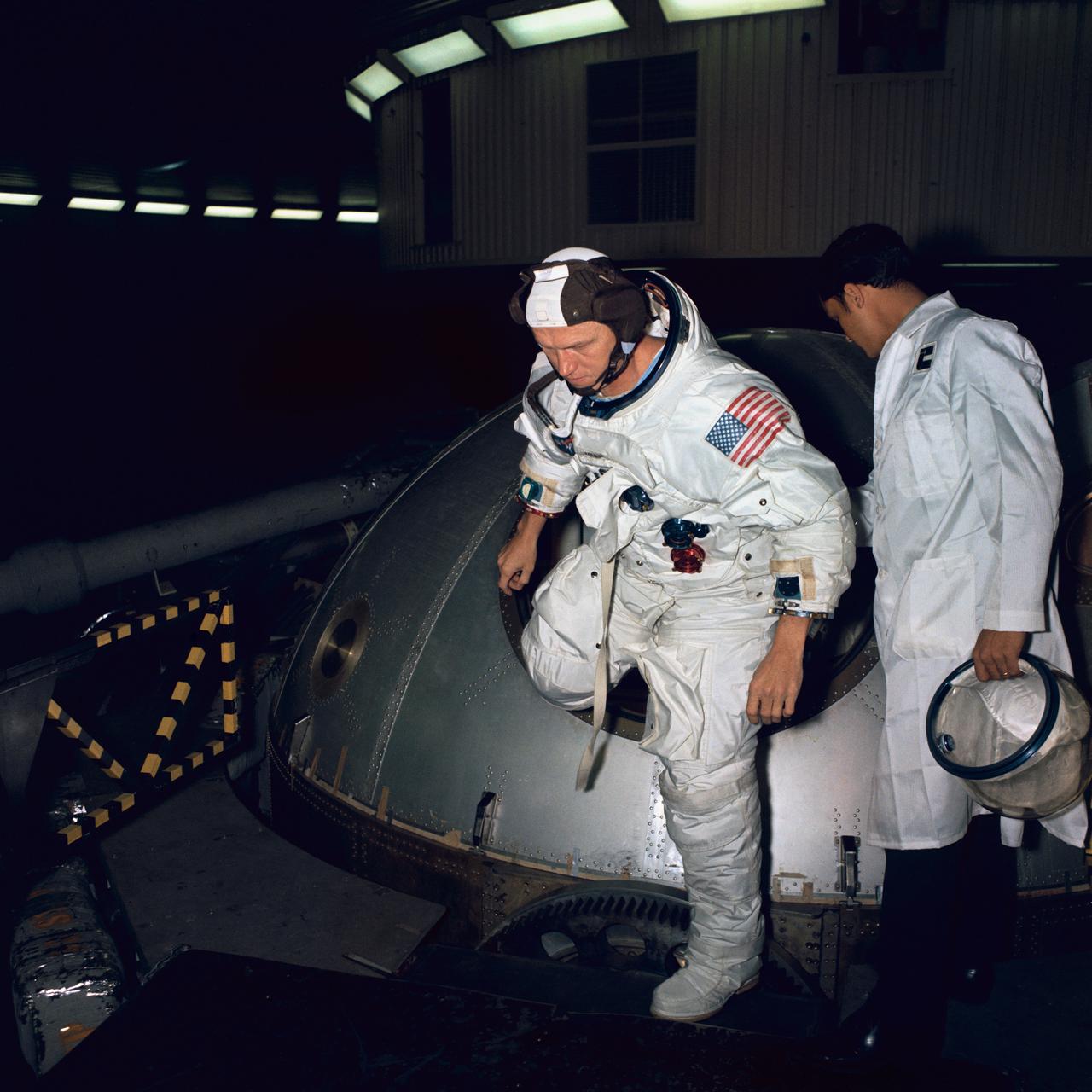
S68-53186 (1 Nov. 1968) --- Astronaut Frank Borman, Apollo 8 commander, egresses the gondola in Building 29 after centrifuge training in the Manned Spacecraft Center's (MSC) Flight Acceleration Facility (FAF).
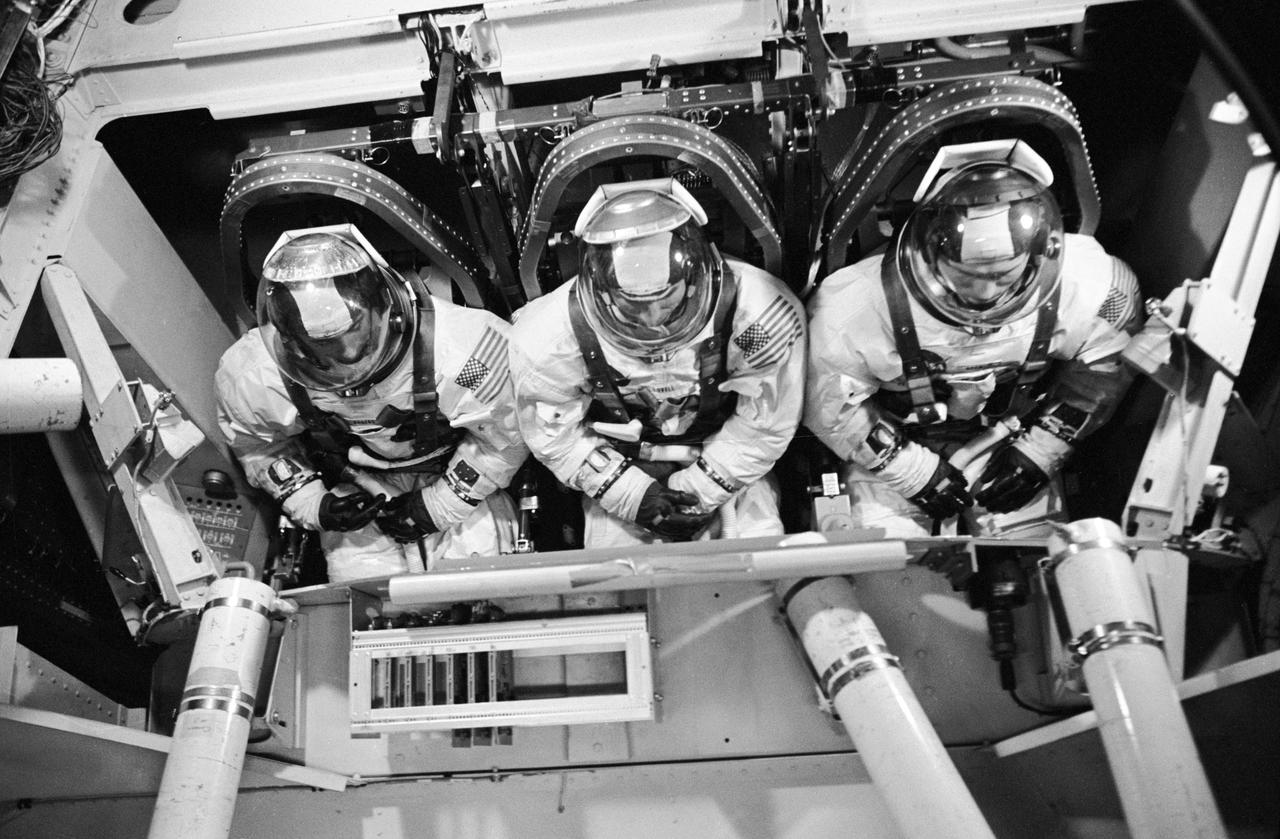
S68-53283 (1 Nov. 1968) --- The Apollo 8 prime crew is seen inside the gondola during centrifuge training in MSC's Flight Acceleration Facility, Building 29. Left to right, are astronauts William A. Anders, lunar module pilot, James A. Lovell Jr., command module pilot; and Frank Borman, commander. Photo credit: NASA
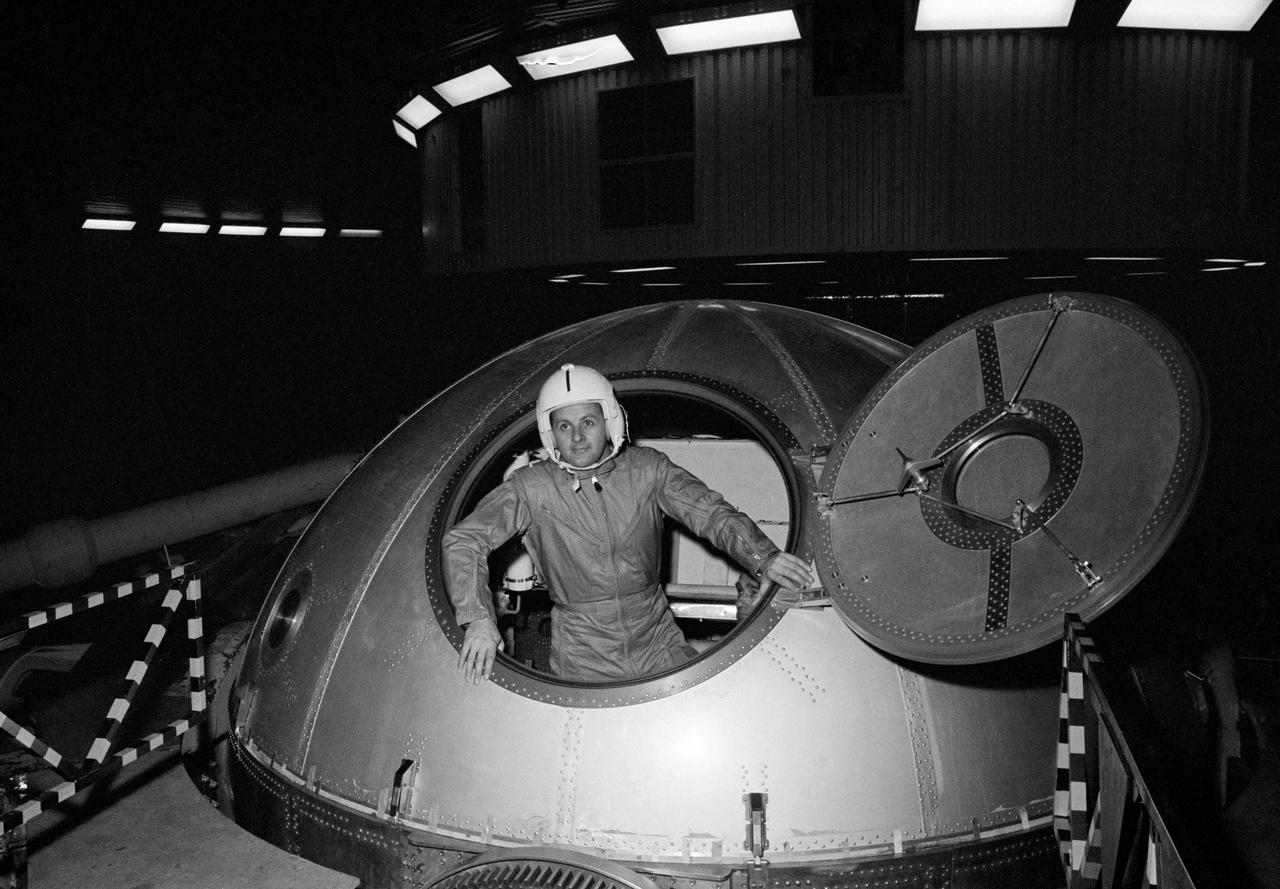
Views of Astronaut Dr. Philip K. Chapman training in the Lunar Module (LM) Simulator, Centrifuge, and the Apollo Mission Simulator. MSC
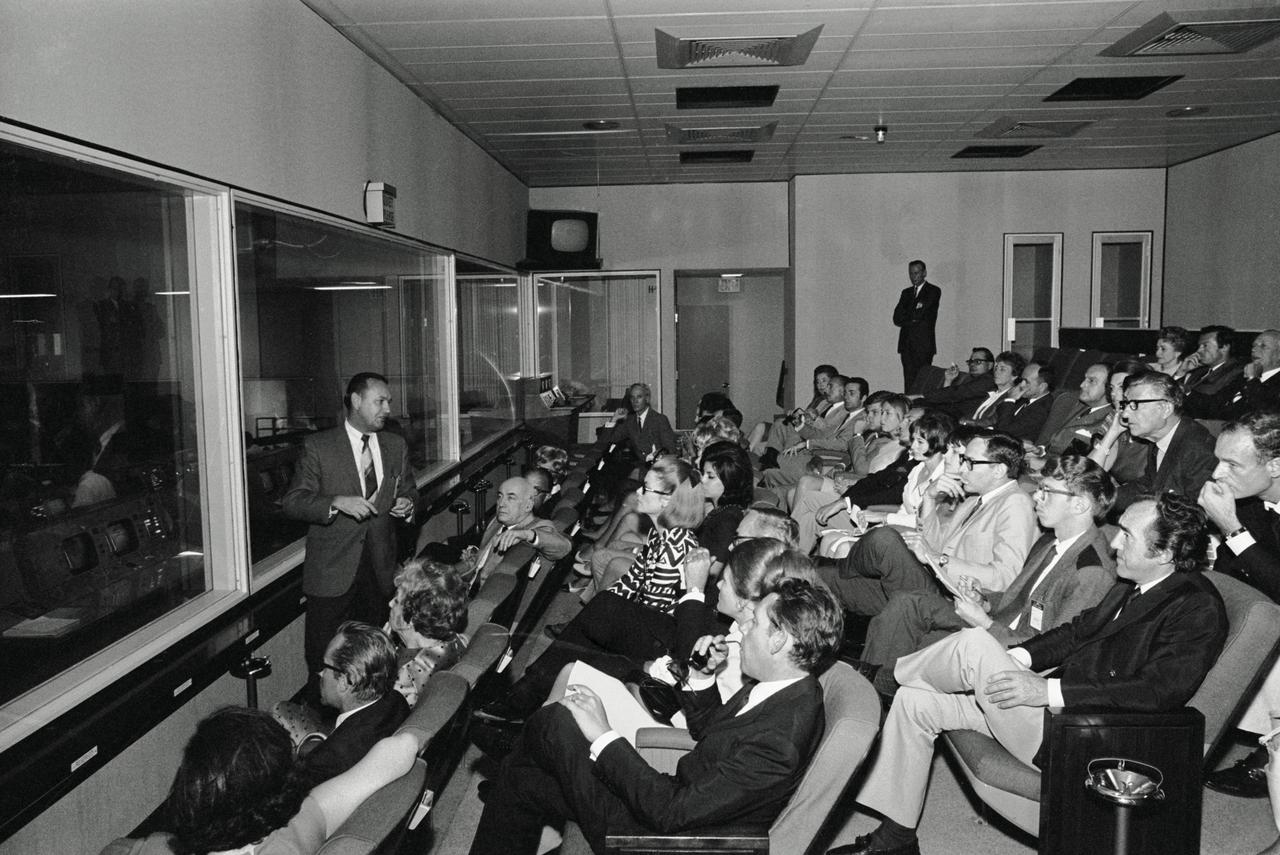
The Princess and Princess of Monaco tour MSC with Dr. Gilruth, Dr. Kraft and others. MSC, HOUSTON, TX
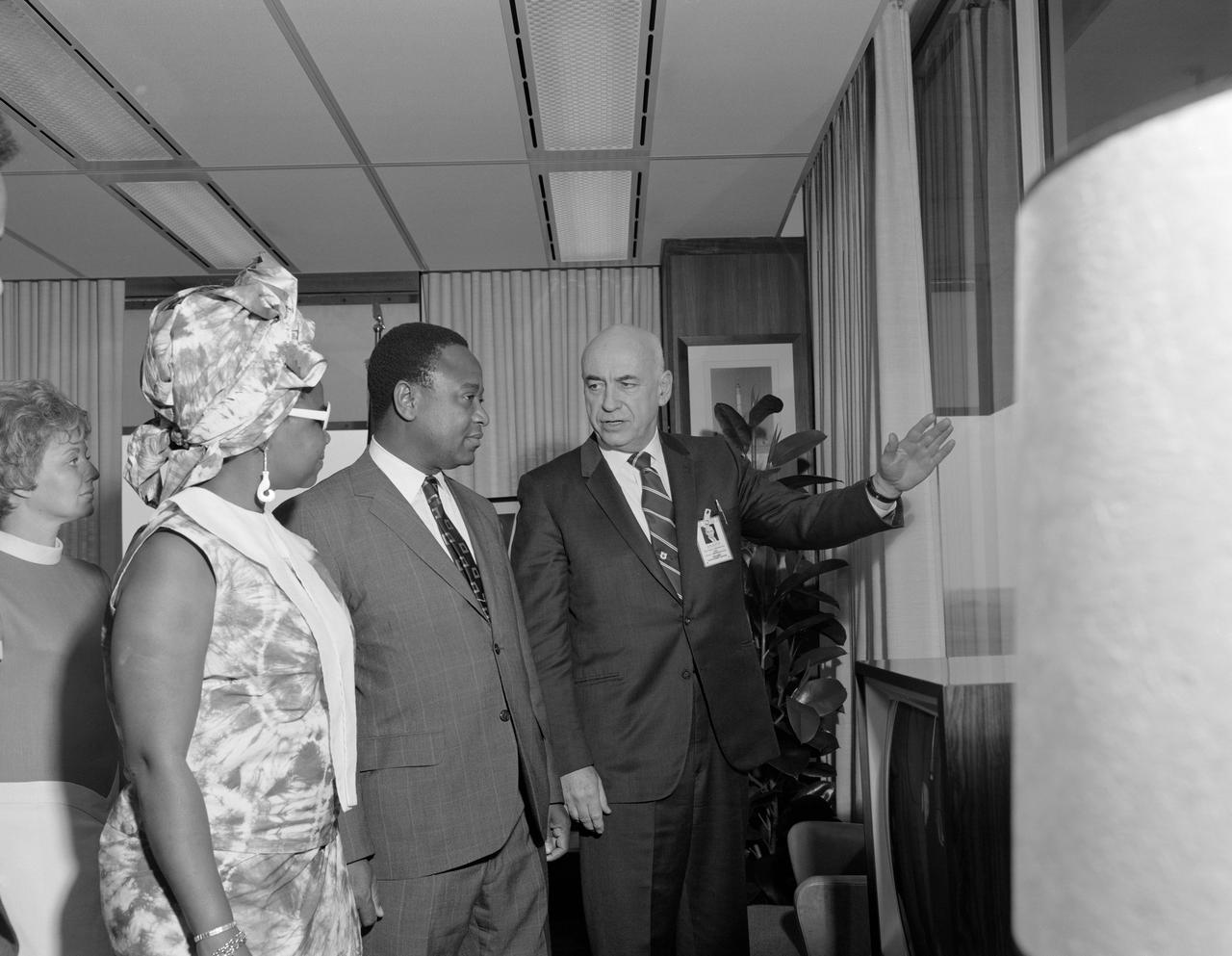
View of Ambassador Joe Iyalla, of Nigeria during his tour of MSC with Dr. Robert R. Gilruth,Center Director on the right. MSC, HOUSTON, TX
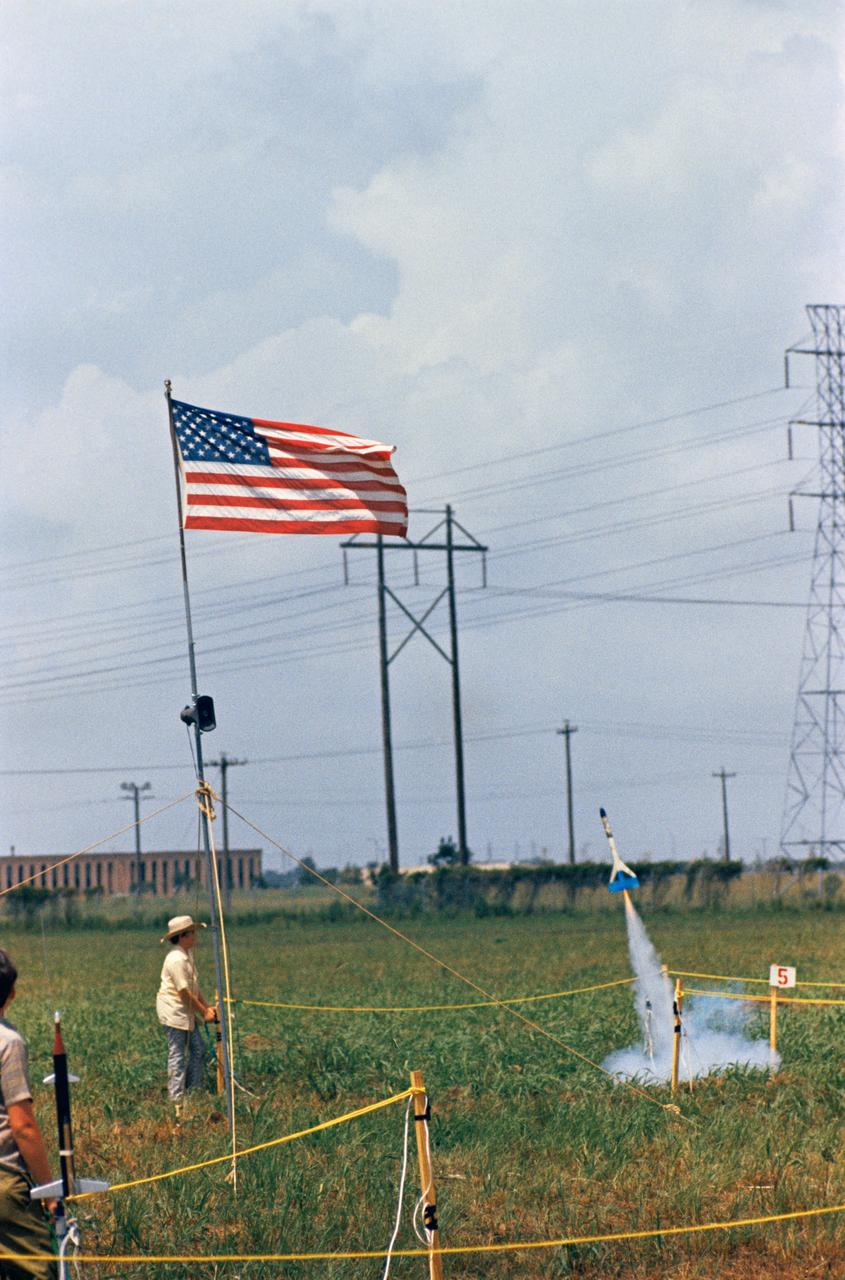
Views of the Texas Area Rocket Meet at MSC in Houston.
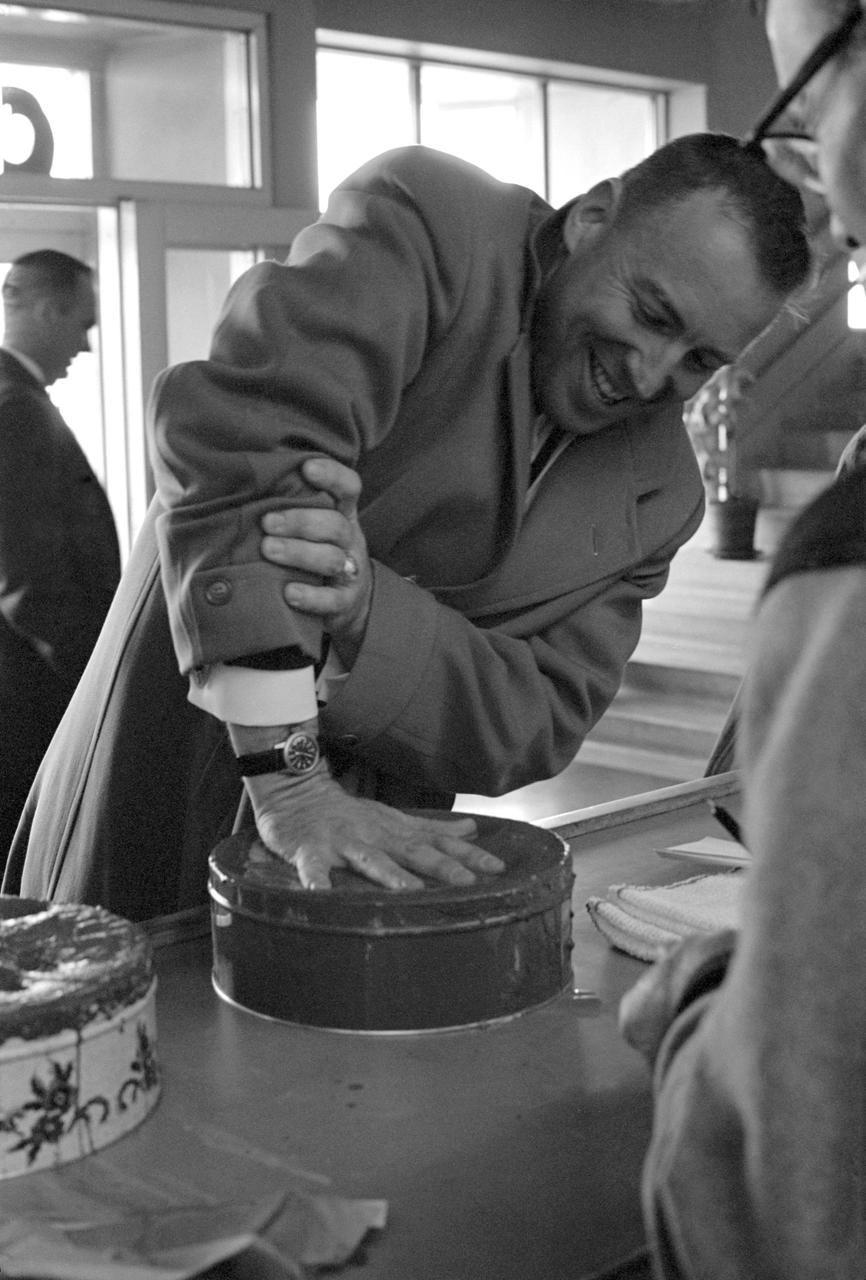
MSC Flight Crew visit Lowell Observatory at Flagstaff, AZ
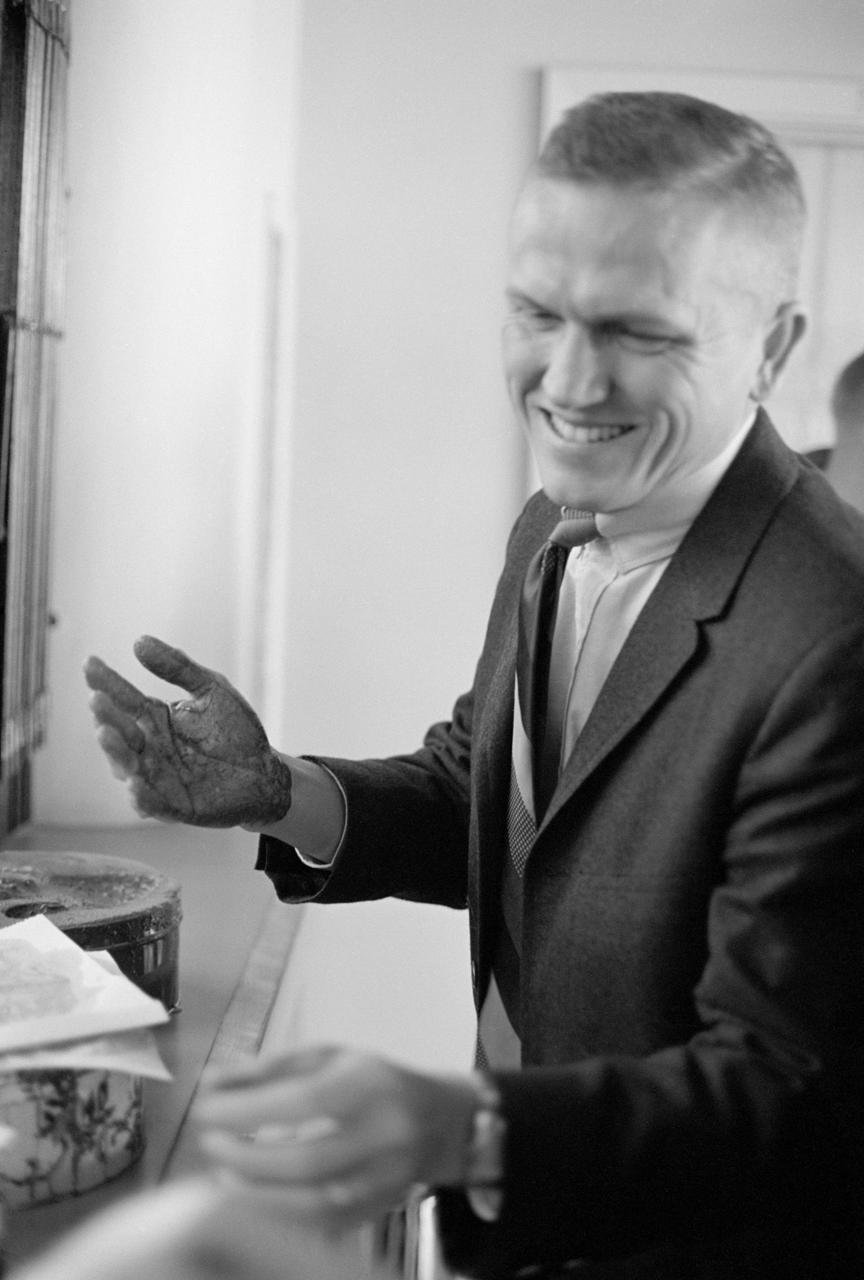
MSC Flight Crew visit Lowell Observatory at Flagstaff, AZ
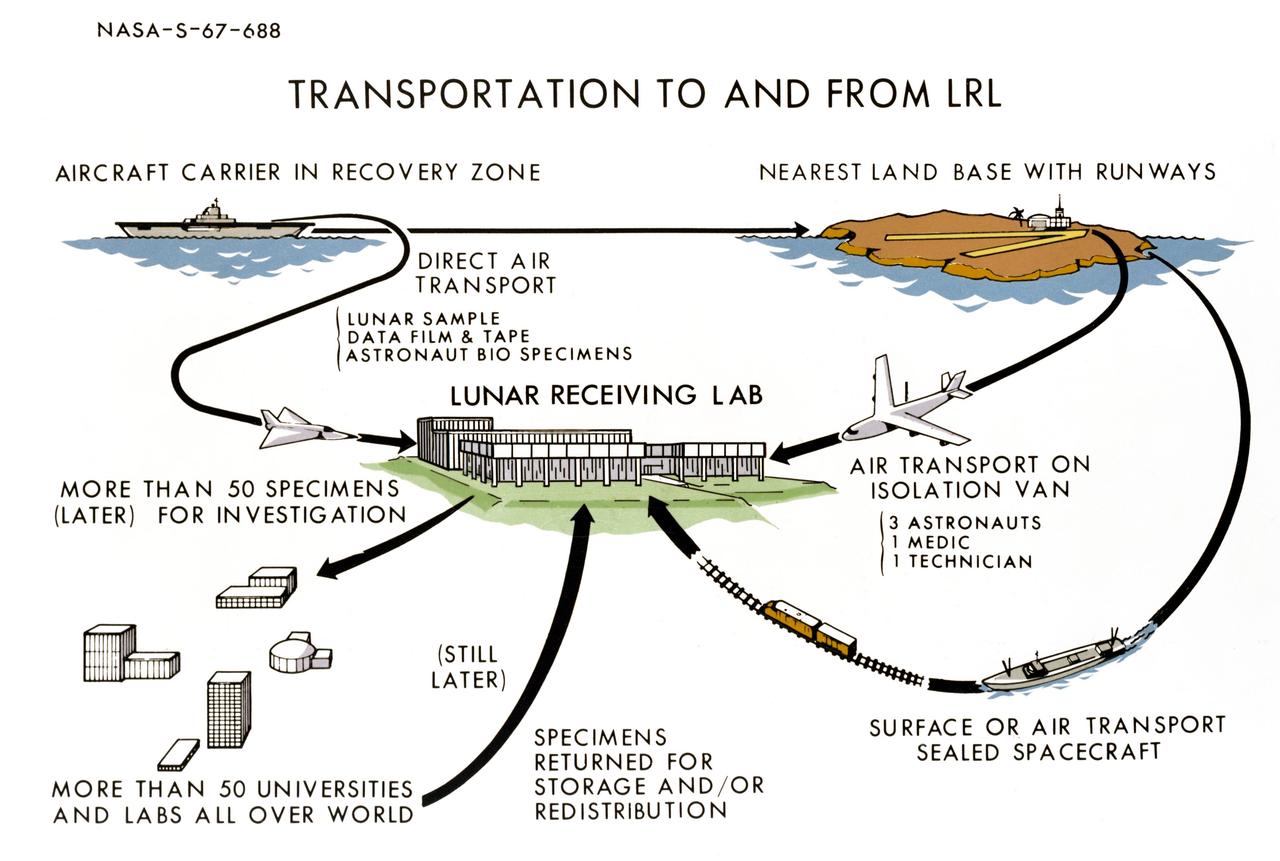
Cutway view illustrating transportation of the LRL to and from MSC. MSC, HOUSTON, TX CN and B&W
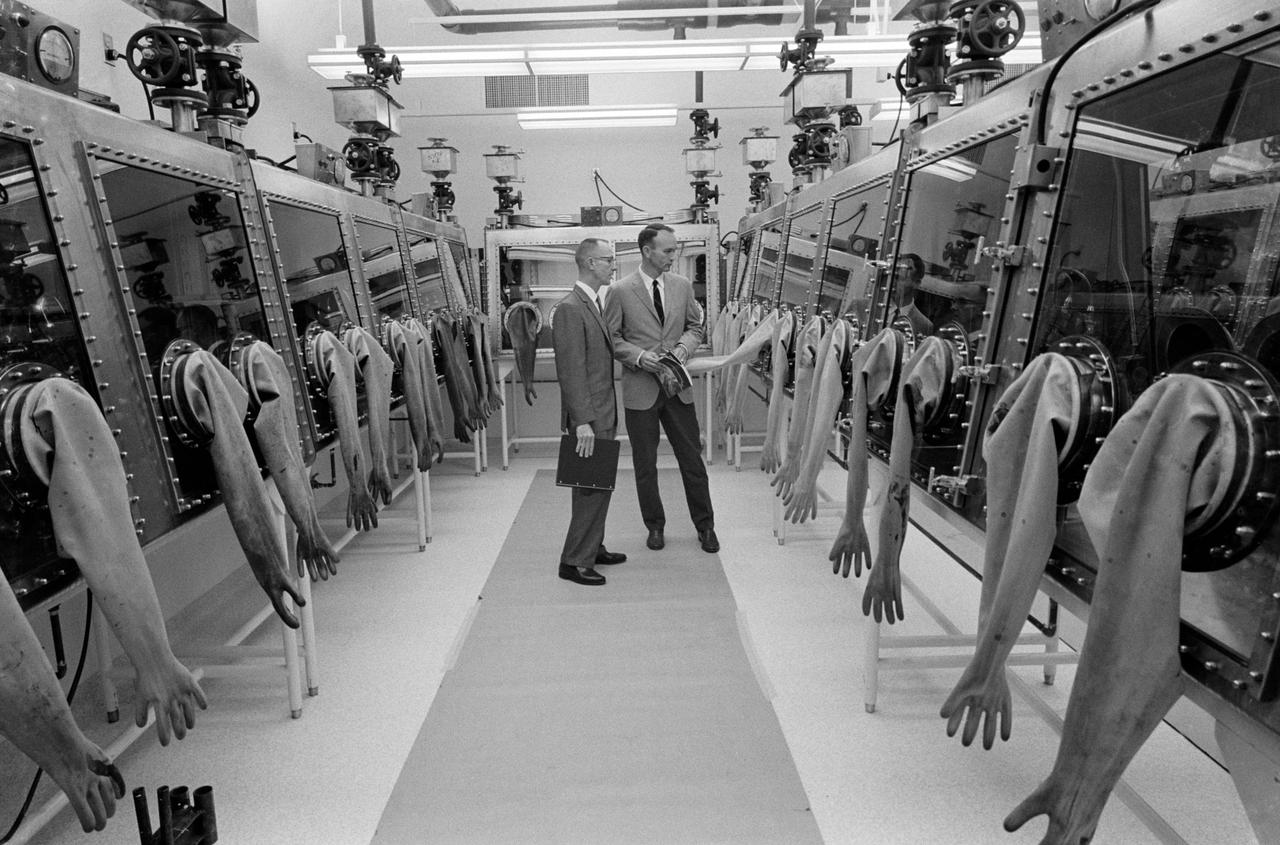
Astronaut Michael Collins on the right and Richard Wright on the left during tour of Lunar Receiving Lab (LRL) at MSC.
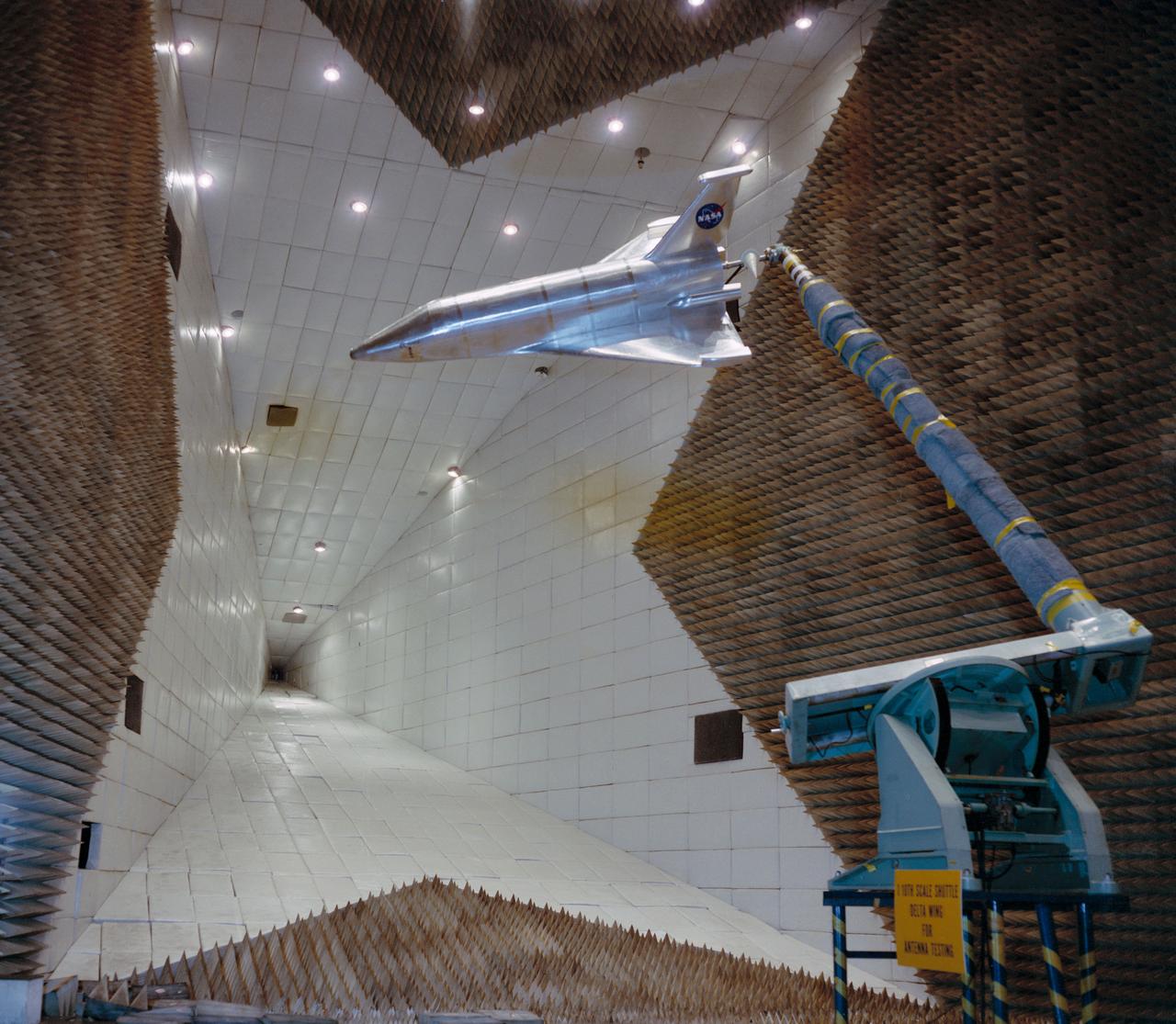
1/10 Scale-Model (metal) inside the Anechoic Chamber, Bldg. 14. 1. SHUTTLE - MODELS MSC, HOUSTON, TX
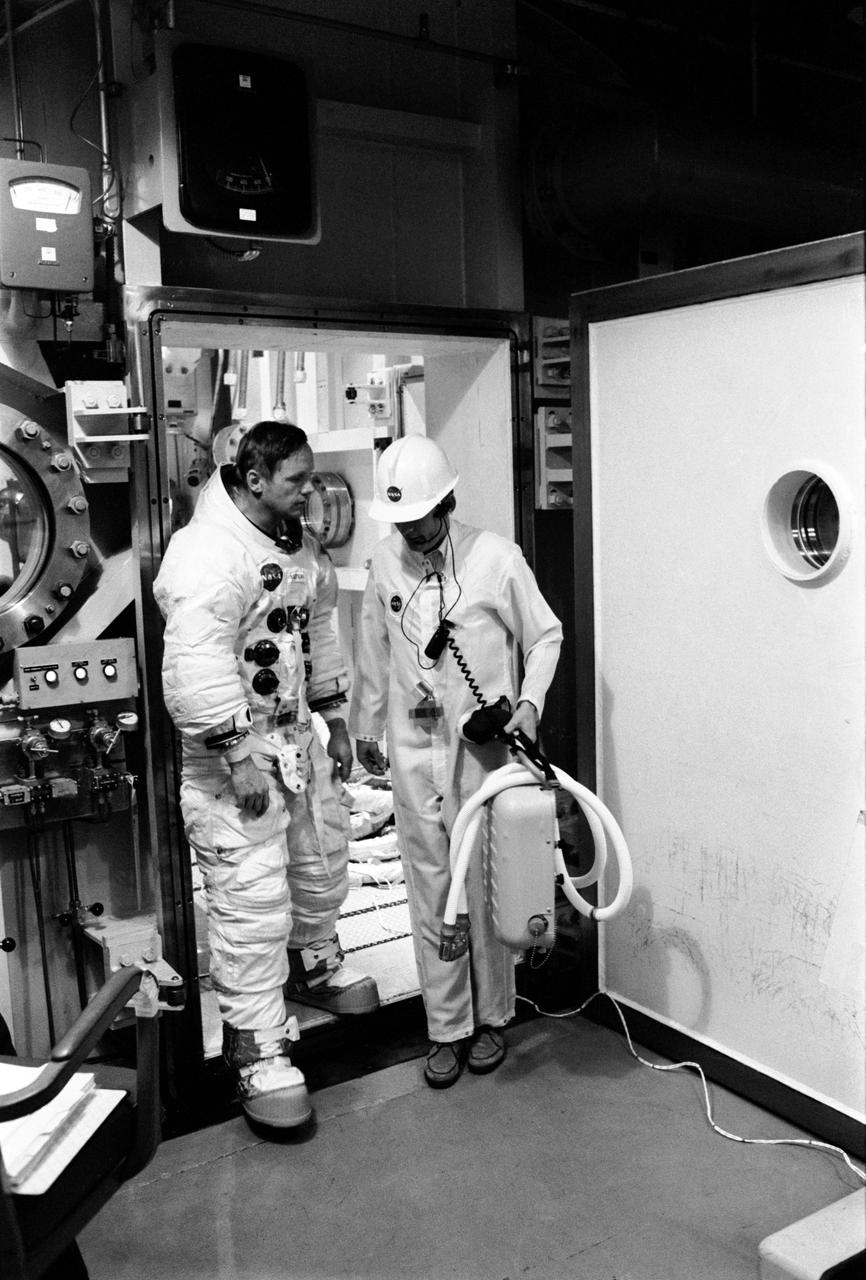
Apollo XI Astronaut Armstrong Thermal Vacuum Training in Chamber "B", Bldg. 32. MSC, Houston, TX
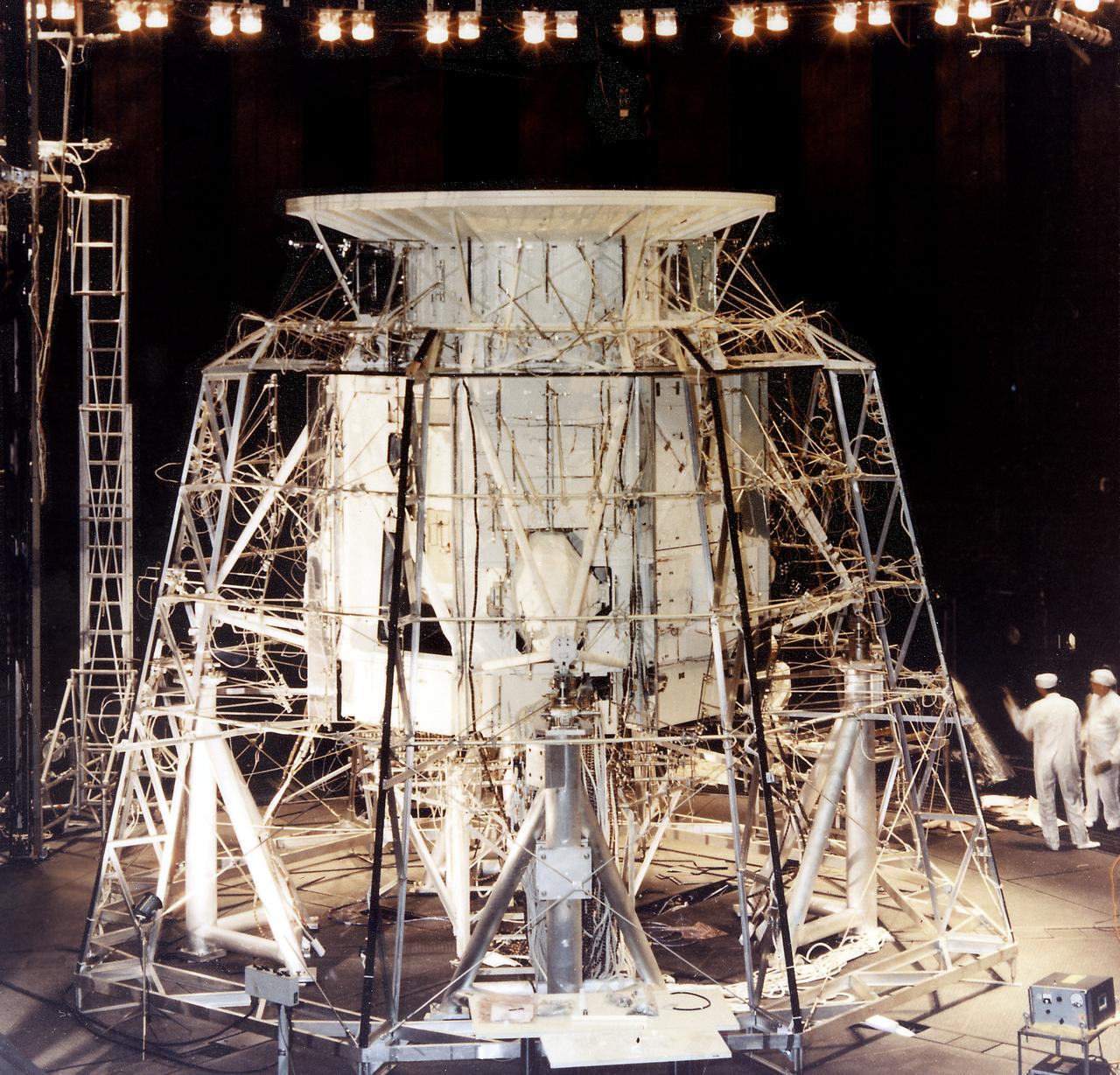
The Apollo Telescope Mount (ATM), designed and developed by the Marshall Space Flight Center, was one of four major components comprising the Skylab (1973-1979). The ATM housed the first manned scientific telescope in space. This photograph is of the ATM thermal systems unit undergoing testing in the Space Environment Simulation Laboratory of the Manned Spacecraft Center (MSC). The ATM thermal systems unit was used to control the temperatures of space instrument's subsystems during a mission. The MSC was renamed the Johnson Space Center (JSC) in early 1973.
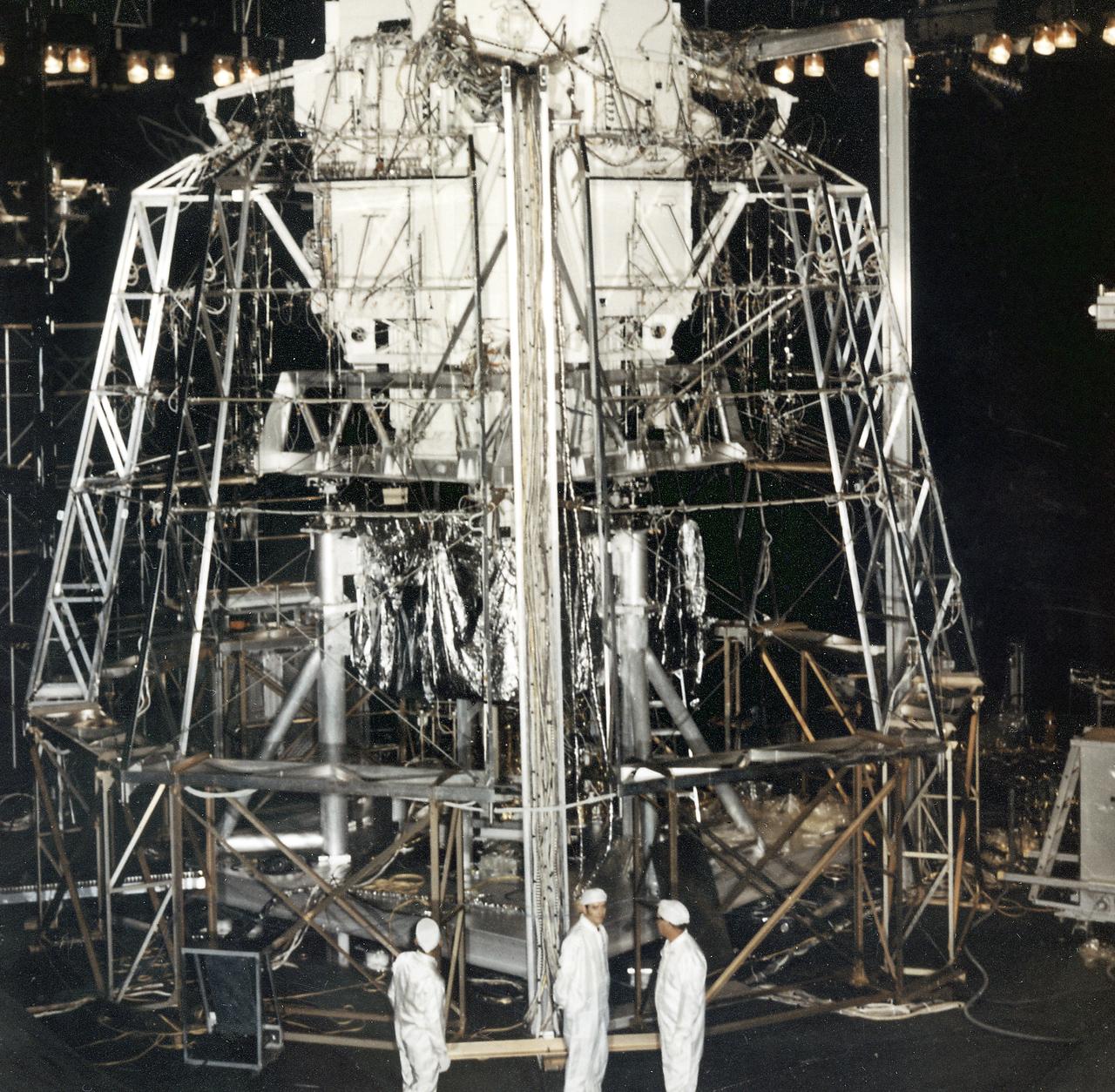
The Apollo Telescope Mount (ATM), designed and developed by the Marshall Space Flight Center, was one of four major components comprising the Skylab (1973-1979). The ATM housed the first manned scientific telescope in space. This photograph shows the ATM rigged for altitude and space simulation tests at the Space Environment Simulation Laboratory of the Manned Spacecraft Center (MSC). The MSC was renamed the Johnson Space Center (JSC) in early 1973.
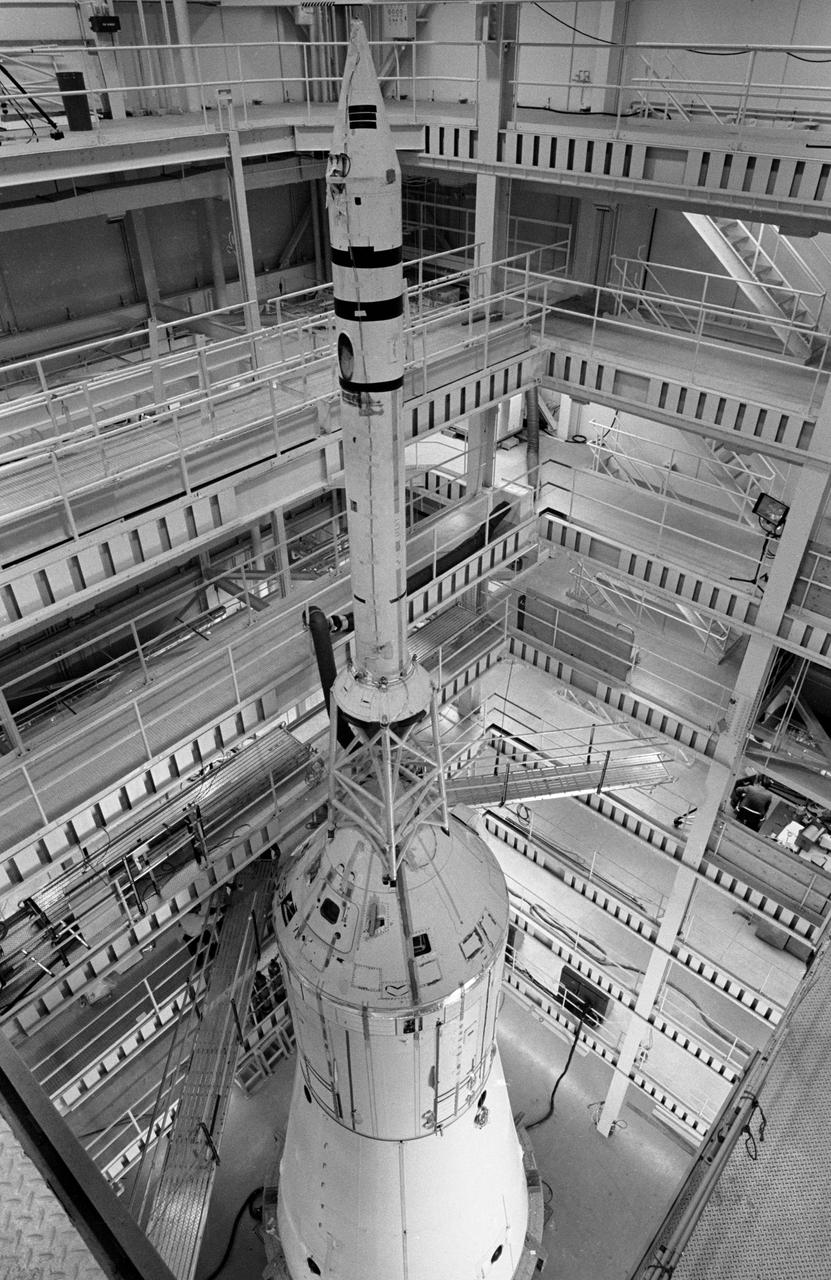
Apollo Spacecraft (S/C)-105 Stack (LET-CSM-SLA) in Bldg. 49 for Vibro-Acoustic Tests. 1. Bldg. 49 - Apollo Stack MSC, Houston, TX
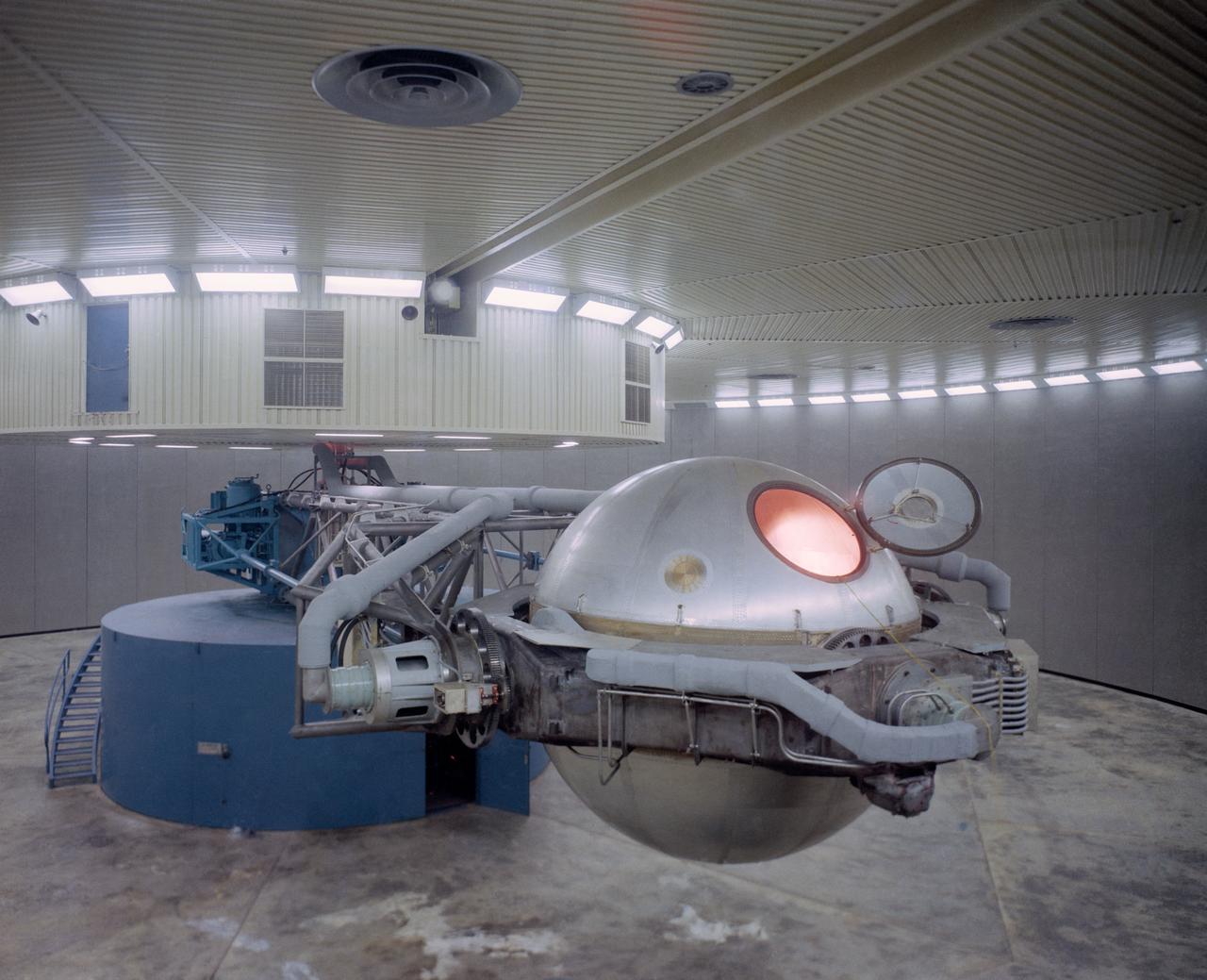
The new centrifuge at MSC, located in the Flight Acceleration Facility (FAF), Bldg. 29. The 50-ft. arm can swing the 3-man gondola to create G-Forces Astronauts will experience during liftoffs and re-entry conditions. MSC, HOUSTON, TX CN
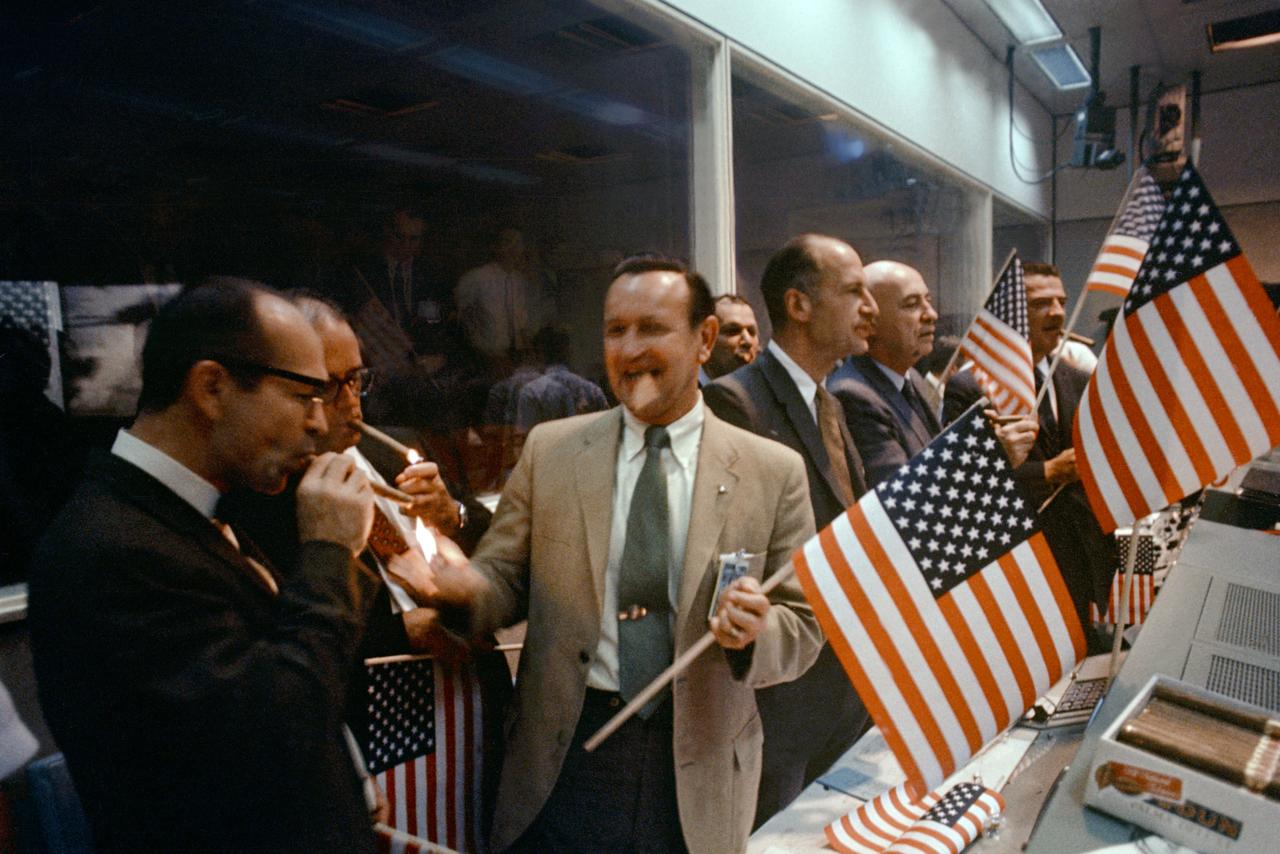
S69-40302 (24 July 1969) --- A group of NASA and Manned Spacecraft Center (MSC) officials join in with the flight controllers in the Mission Operations Control Room (MOCR) in the Mission Control Center (MCC), Building 30, in celebrating the successful conclusion of the Apollo 11 lunar landing mission. From left foreground are Dr. Maxime A. Faget, MSC Director of Engineering and Development; George S. Trimble, MSC Deputy Director; Dr. Christopher C. Kraft Jr., MSC Director of Flight Operations; Julian Scheer (in back), Assistant Administrator, Office of Public Affairs, NASA Headquarters; George M. Low, Manager, Apollo Spacecraft Program, MSC; Dr. Robert R. Gilruth, MSC Director; and Charles W. Mathews, Deputy Associate Administrator, Office of Manned Space Flight, NASA Headquarters.
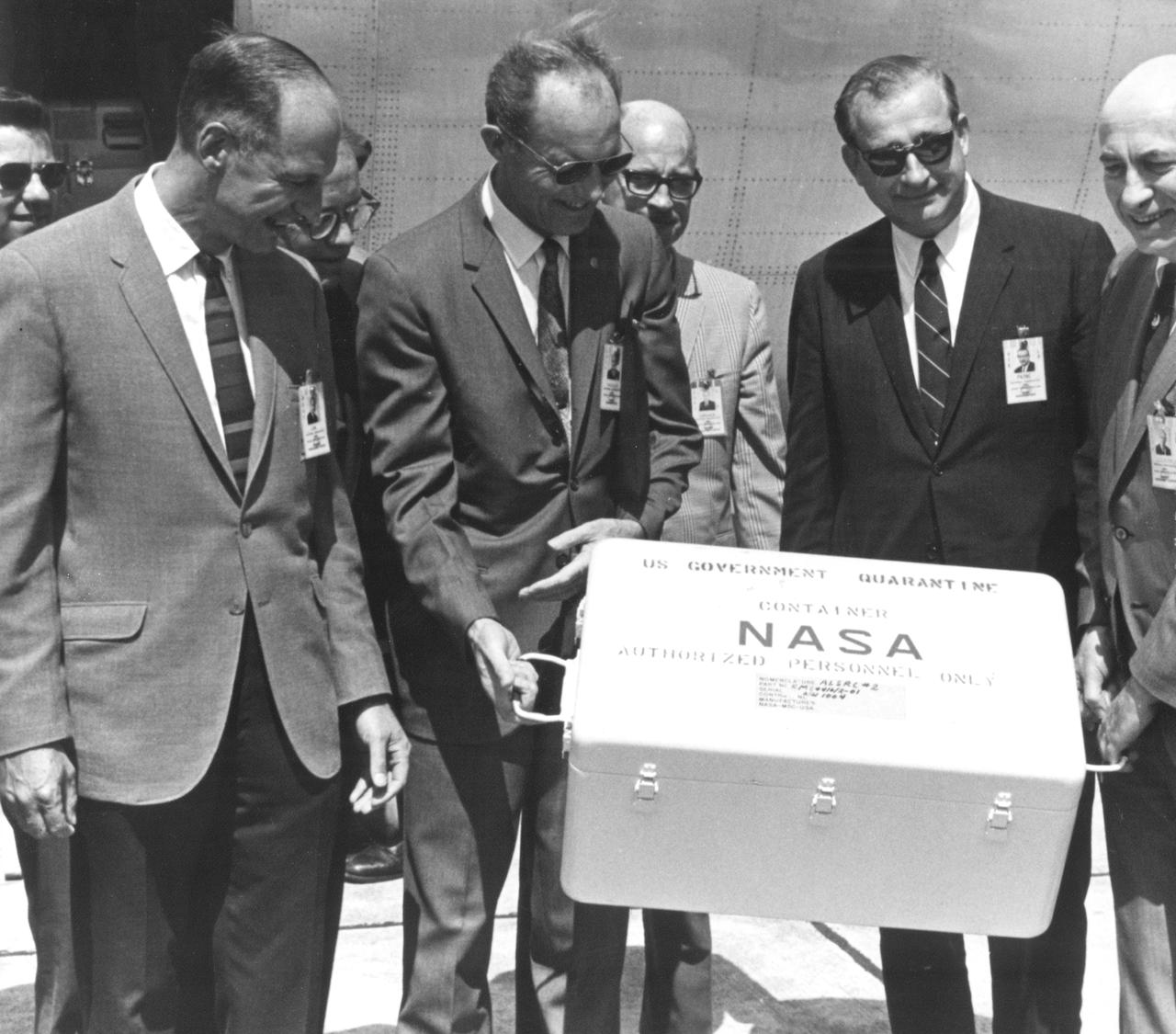
The Apollo 11 mission, the first manned lunar mission, launched from the Kennedy Space Center, Florida via the Marshall Space Flight Center (MSFC) developed Saturn V launch vehicle on July 16, 1969 and safely returned to Earth on July 24, 1969. Aboard the space craft were astronauts Neil A. Armstrong, commander; Michael Collins, Command Module (CM) pilot; and Edwin E. Aldrin Jr., Lunar Module (LM) pilot. The CM, piloted by Michael Collins remained in a parking orbit around the Moon while the LM, named “Eagle’’, carrying astronauts Neil Armstrong and Edwin Aldrin, landed on the Moon. During 2½ hours of surface exploration, the crew collected 47 pounds of lunar surface material for analysis back on Earth. This photograph was taken as the mission’s first loaded sample return container arrived at Ellington Air Force Base by air from the Pacific recovery area. The rock box was immediately taken to the Lunar Receiving Laboratory at the Manned Spacecraft Center (MSC) in Houston, Texas. Happily posing for the photograph with the rock container are (L-R) Richard S. Johnston (back), special assistant to the MSC Director; George M. Low, MSC Apollo Spacecraft Program manager; George S. Trimble (back), MSC Deputy Director; Lt. General Samuel C. Phillips, Apollo Program Director, Office of Manned Spaceflight at NASA headquarters; Eugene G. Edmonds, MSC Photographic Technology Laboratory; Dr. Thomas O. Paine, NASA Administrator; and Dr. Robert R. Gilruth, MSC Director.
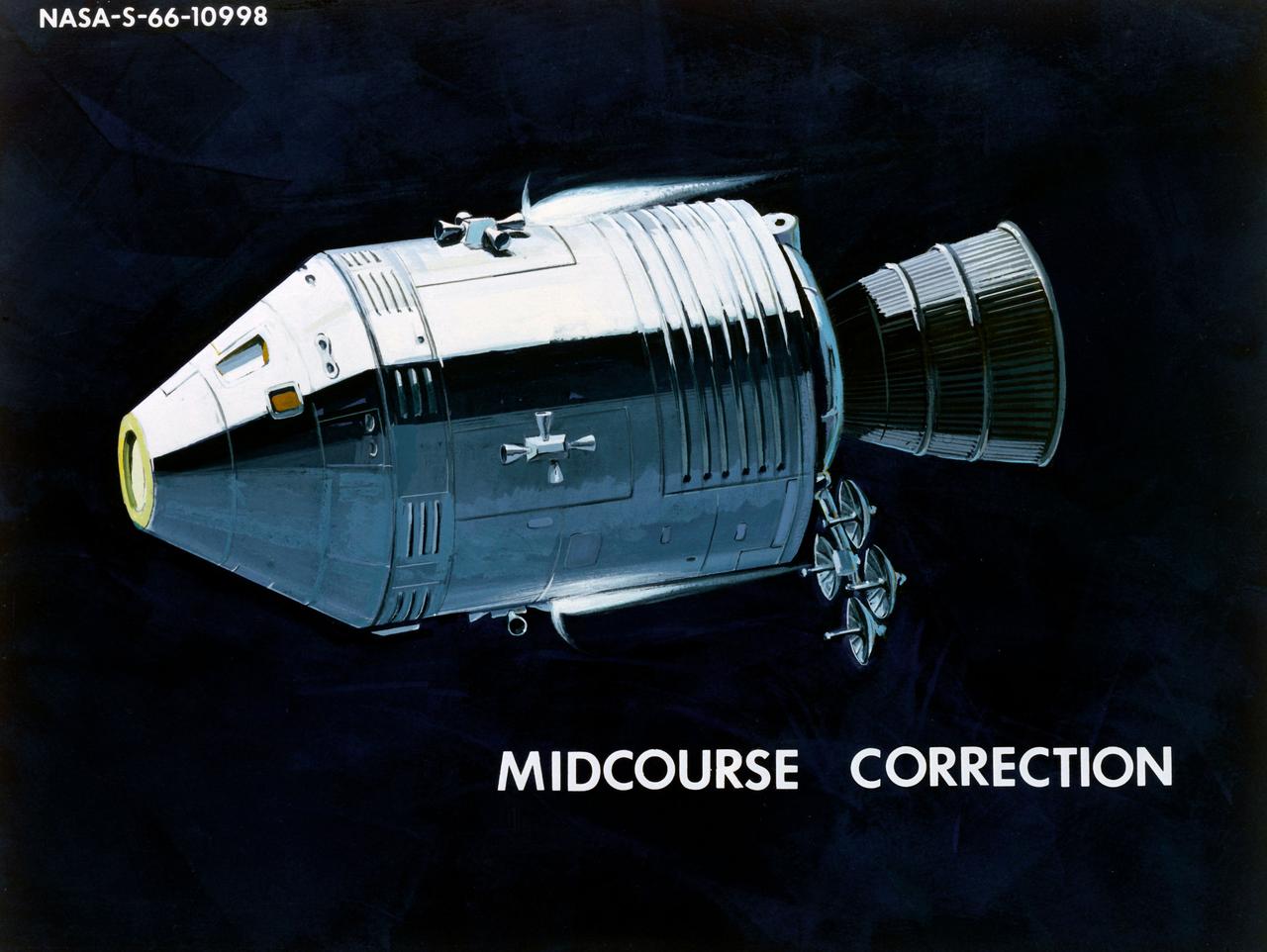
Apollo CM, Mid-Course Correction. MSC, HOUSTON, TX CN/BW 12/01/1966 - 06/01/1966
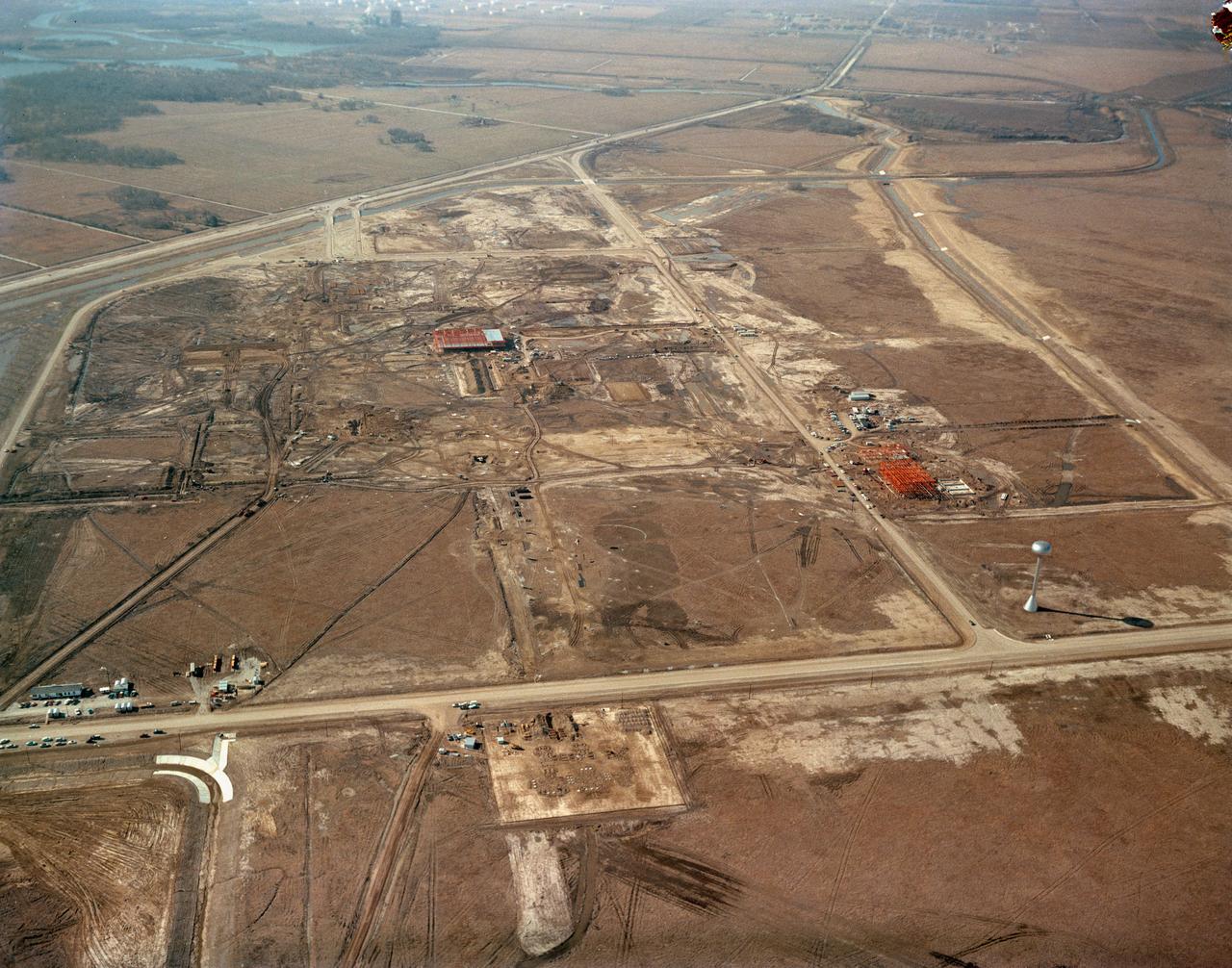
S63-00950 (1963) --- An aerial view of Site 1, the Manned Spacecraft Center, in 1963 during early construction. The view faces the southwest. Highway 528 is at the top of the picture. Second Street runs basically north and south on the right side of the image, to the right or west and running parallel to that avenue is a drainage ditch. Winding through the site a Houston Lighting and Power Co. canal crosses over the drainage ditch near the top of the frame. Twin bridges over the canal are pictured at upper left which were constructed to allow traffic to enter and leave through MSC's secondary gateway. The unfinished red structure to the right of center and roughly 100 yards south of the elevated water storage tank is the Central Heating and Cooling Plant. In the upper left quadrant of the frame, construction appears very far along on the Central Data Office.
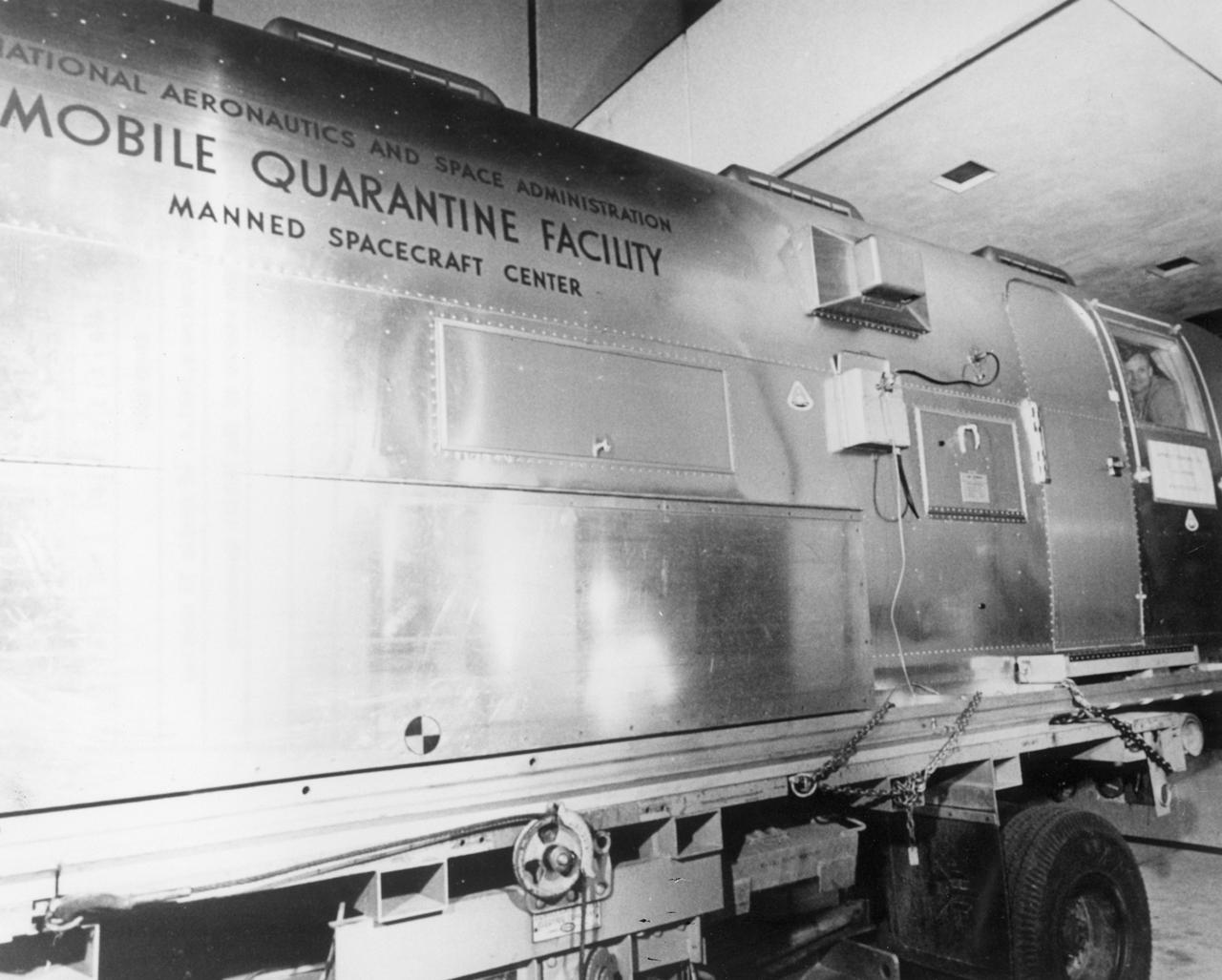
The Apollo 11 mission, the first manned lunar mission, launched from the Kennedy Space Center, Florida via the Marshall Space Flight Center (MSFC) developed Saturn V launch vehicle on July 16, 1969 and safely returned to Earth on July 24, 1969. Aboard the space craft were astronauts Neil A. Armstrong, commander; Michael Collins, Command Module (CM) pilot; and Edwin E. Aldrin Jr., Lunar Module (LM) pilot. The CM, piloted by Michael Collins remained in a parking orbit around the Moon while the LM, named “Eagle’’, carrying astronauts Neil Armstrong and Edwin Aldrin, landed on the Moon. During 2½ hours of surface exploration, the crew collected 47 pounds of lunar surface material for analysis back on Earth. The recovery operation took place in the Pacific Ocean where Navy para-rescue men recovered the capsule housing the 3-man Apollo 11 crew. The crew was airlifted to safety aboard the U.S.S. Hornet, where they were quartered in a Mobile Quarantine Facility (MQF) which served as their home until they reached the NASA Manned Spacecraft Center (MSC) Lunar Receiving Laboratory in Houston, Texas. In this close up of the MQF, commander Armstrong can be seen through the facility window after its arrival at the MSC.
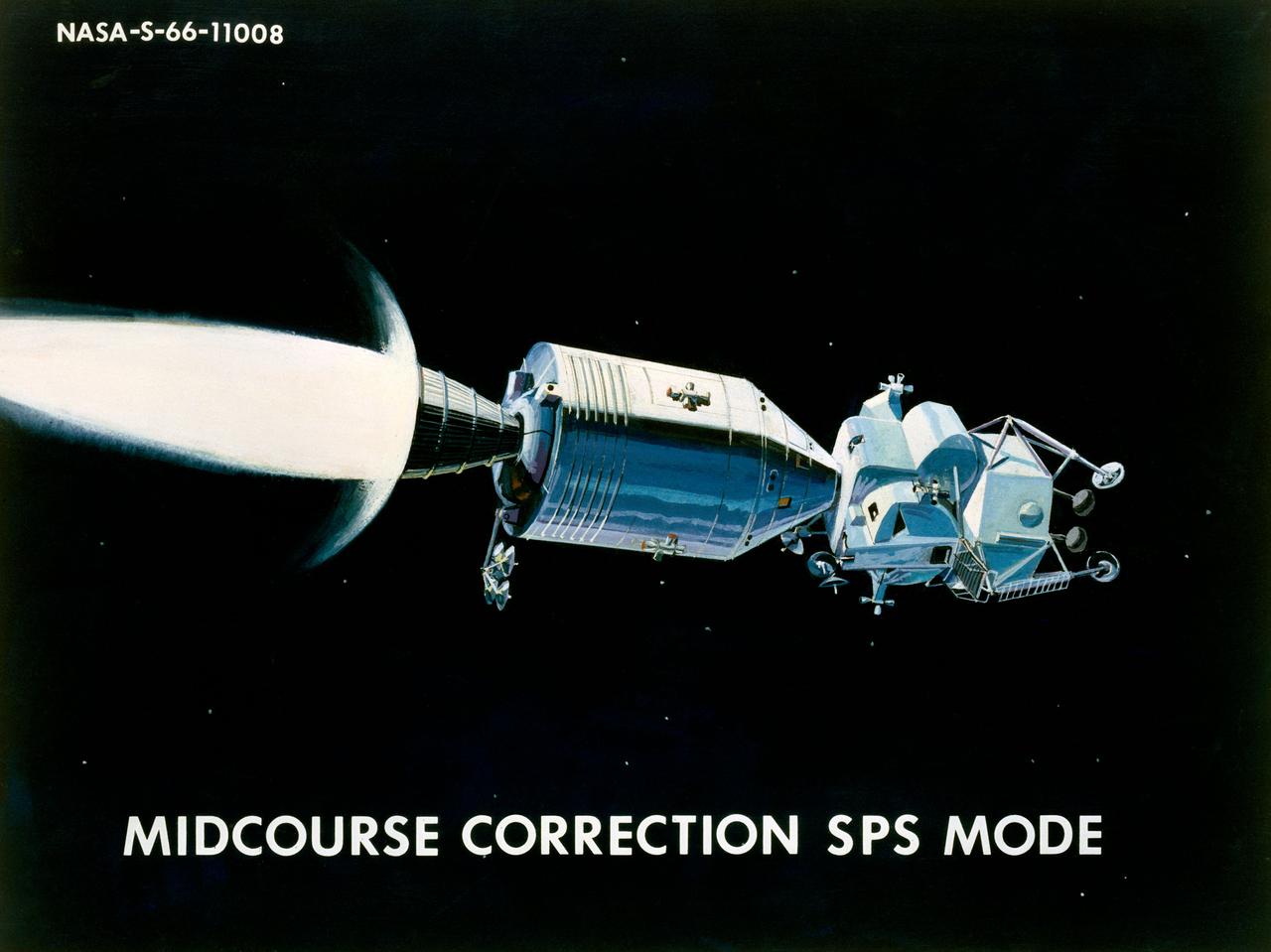
Apollo CM, Mid-Course correction, SPS Mode. MSC, HOUSTON, TX CN/BW 12/01/1966 - 06/01/1966
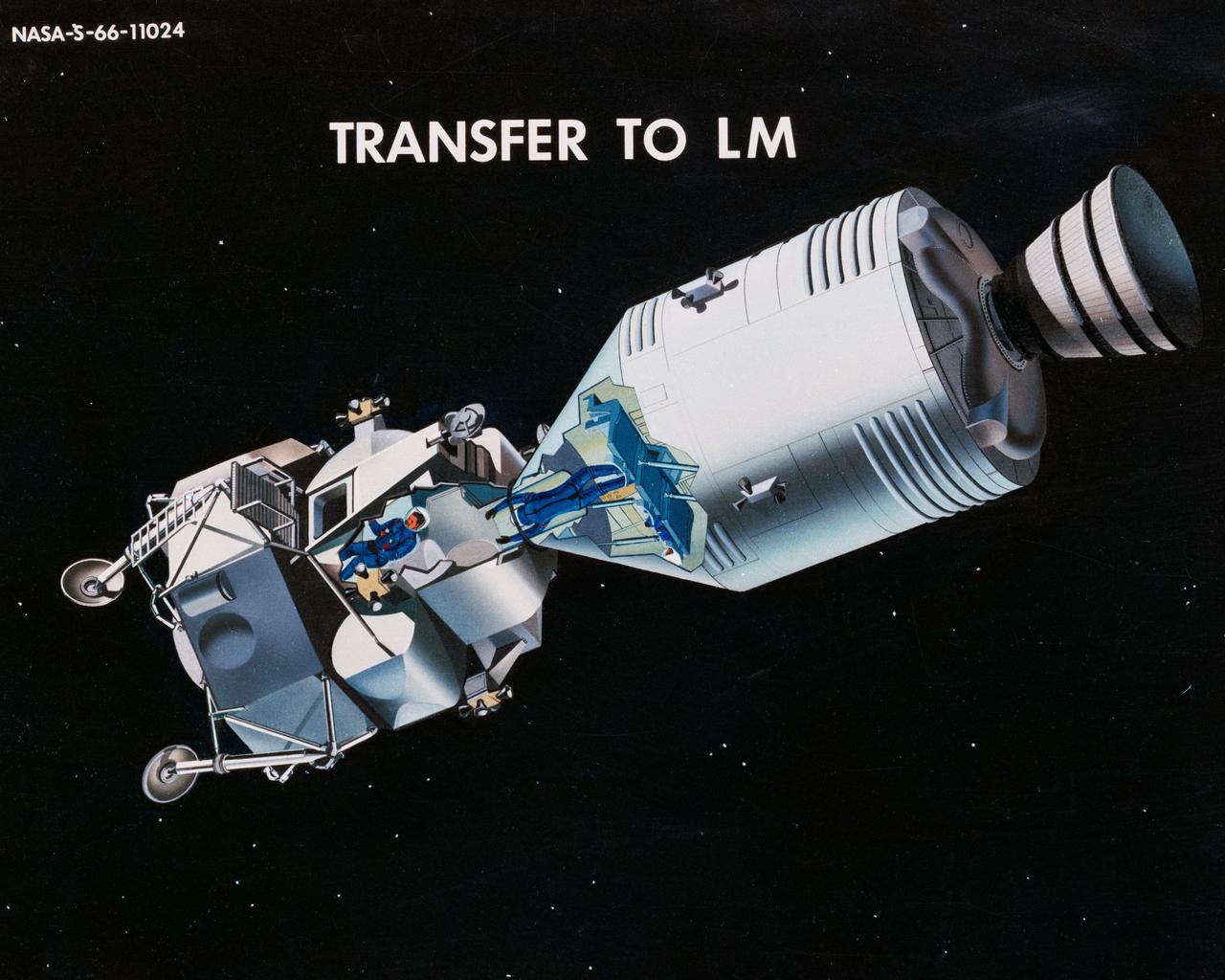
Apollo CM, Transfer to Lunar Module (LM). MSC, HOUSTON, TX CN/BW 12/01/1966 - 06/01/1966

Maxime Faget explains a model of the Apollo Spacecraft to members of the Korean National Assembly.( 19431 thru 19432 ); MSC, HOUSTON, TX B&W
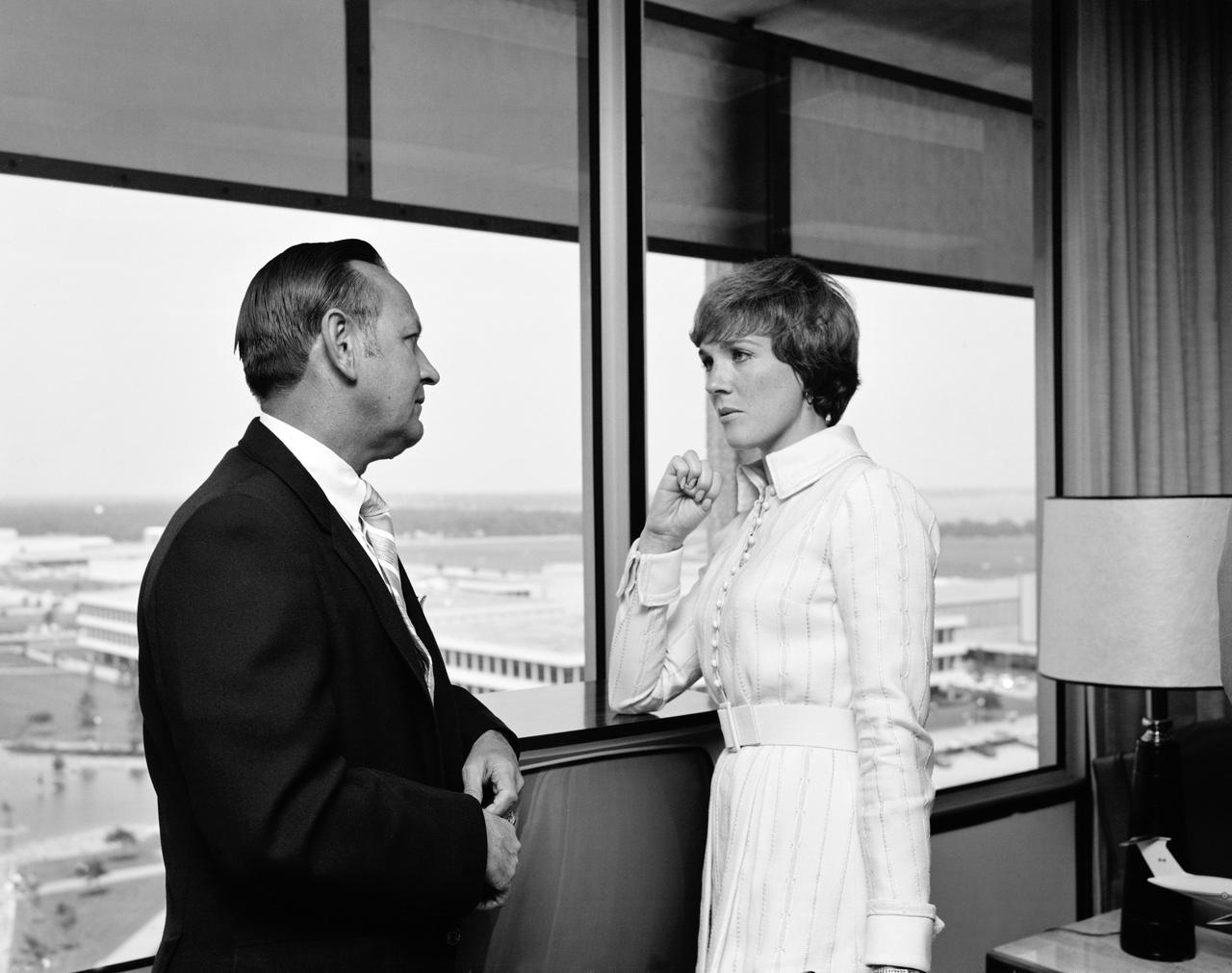
Views of Julie Andrews as she and her entourage visit MSC with Astronauts Thomas Stafford and Joe Kerwin; Public Affairs Officer Brian Duff; James McLane, Bldg. 32; and, Dr. Christopher C. Kraft. 1. KRAFT, C. C., DR. - JULIE ANDREWS TOUR 2. ANDREWS, JULIE - TOUR MSC, HOUSTON, TX
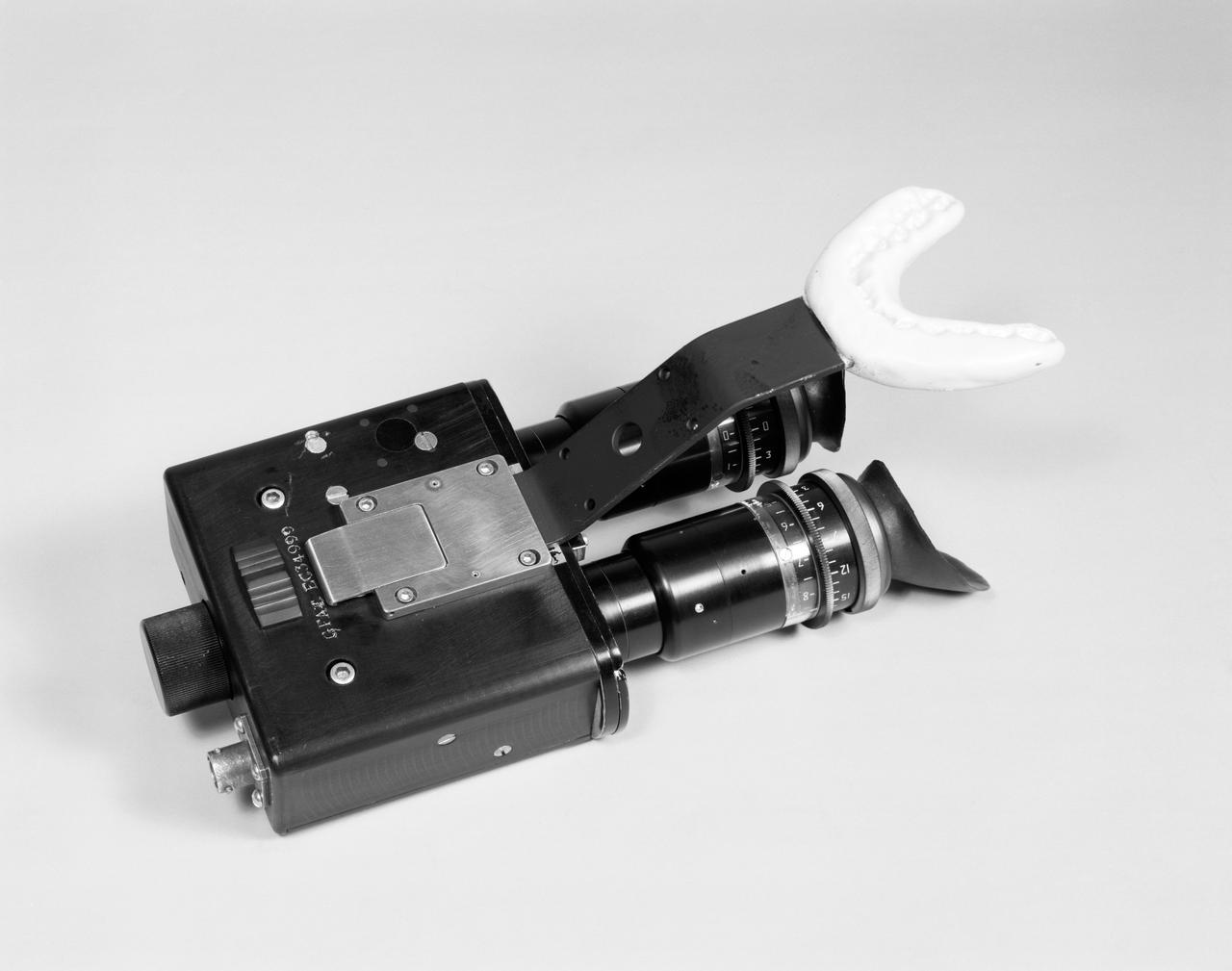
GT-4 Experimental Vision Tester. MSC, HOUSTON, TX
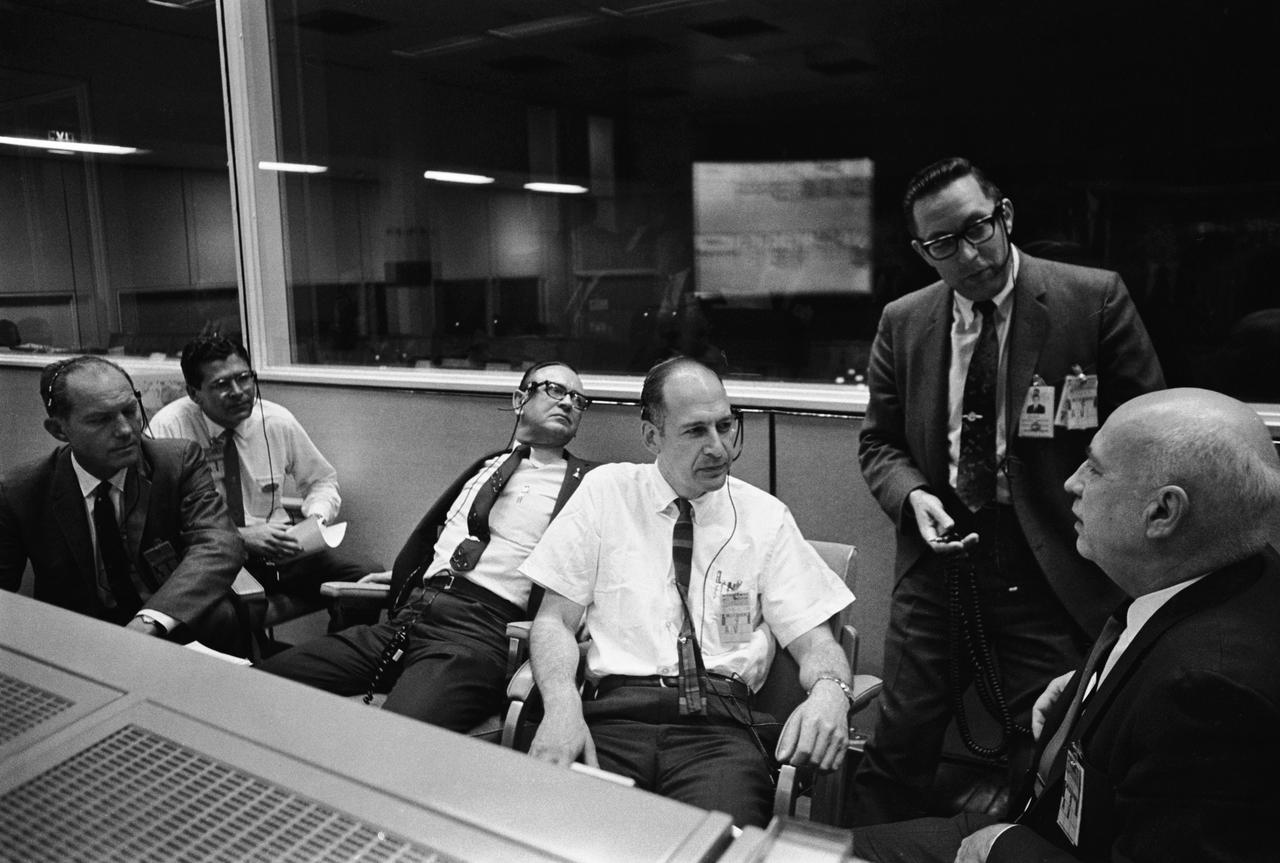
MCC activities during the Apollo IX Mission. MSC, HOUSTON, TX
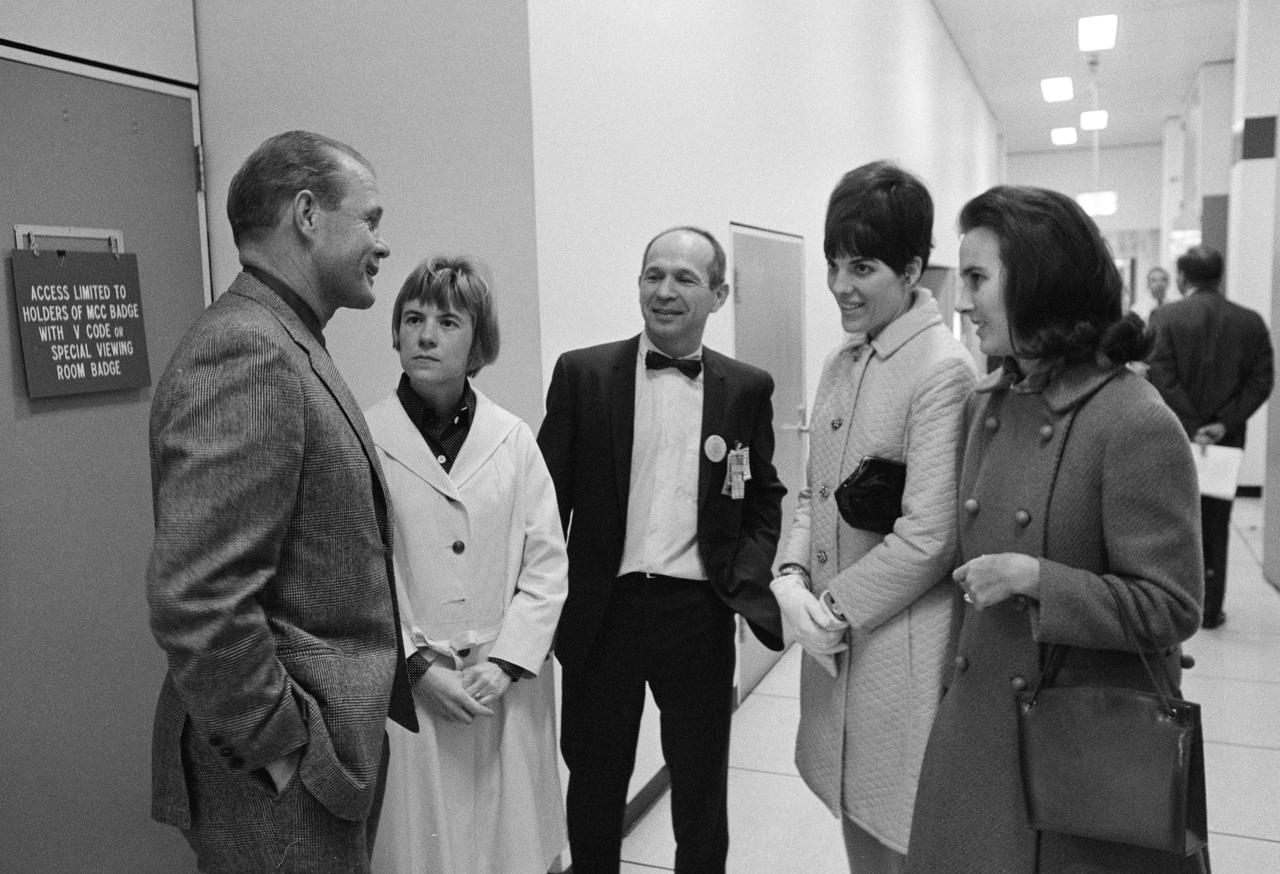
MCC activities during the Apollo IX Mission. MSC, HOUSTON, TX
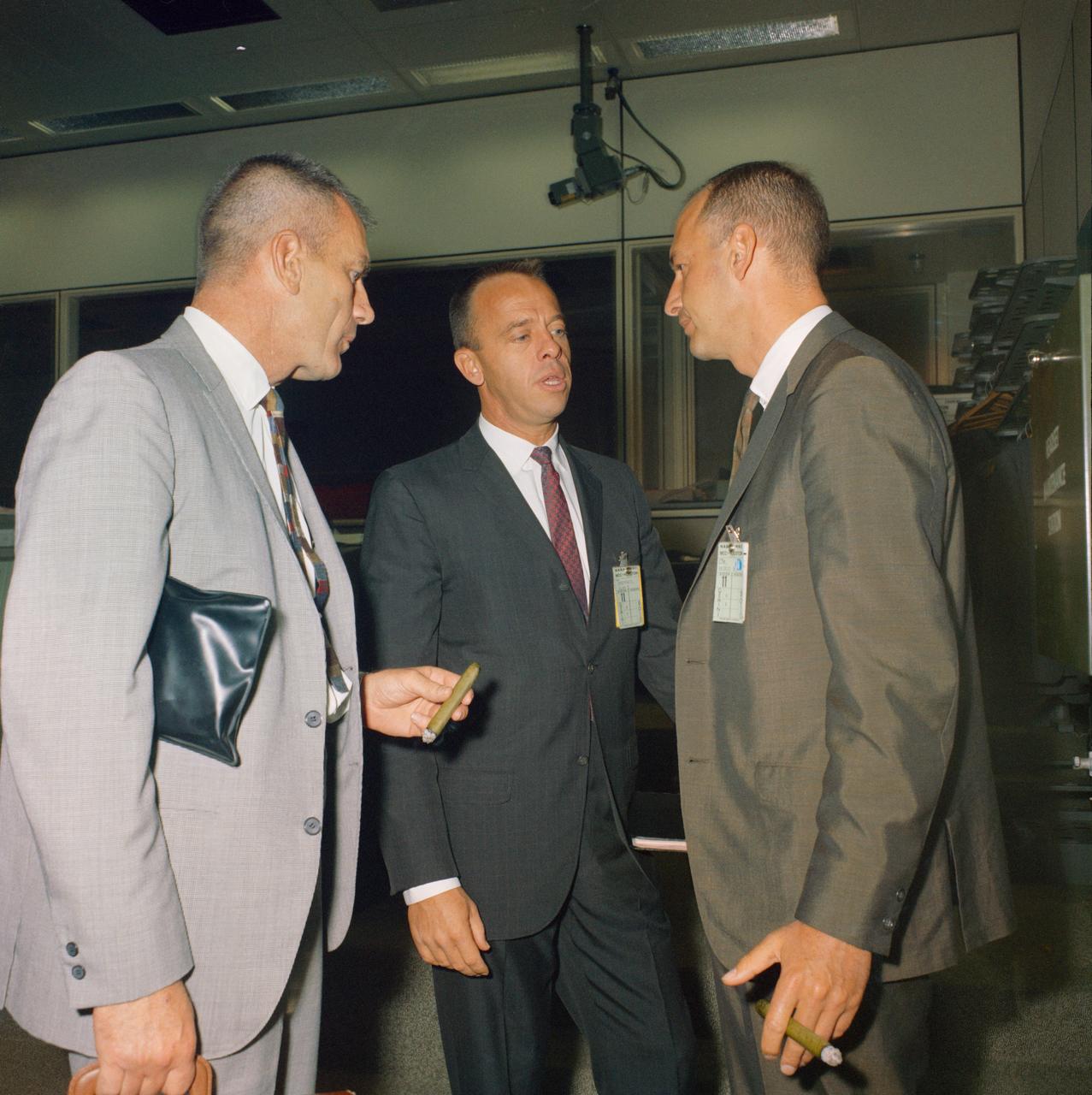
S66-52754 (12 Sept. 1966) --- Three key Manned Spacecraft Center (MSC) officials hold discussion in the Mission Control room during Gemini-11 activity. Left to right, are Donald K. Slayton, MSC Director of Flight Crew Operations; astronaut Alan B. Shepard Jr., Chief, MSC Astronaut Office; and George M. Low, MSC Deputy Director. Photo credit: NASA
S69-40024 (24 July 1969) --- NASA and Manned Spacecraft Center (MSC) officials join in with the flight controllers, in the Mission Operations Control Room (MOCR) in the Mission Control Center (MCC), in celebrating the successful conclusion of the Apollo 11 lunar landing mission. Identifiable in the picture, starting in foreground, are Dr. Robert R. Gilruth, MSC Director; George M. Low, Manager, Apollo Spacecraft Program, MSC; Dr. Christopher C. Kraft Jr., MSC Director of Flight Operation; U.S. Air Force Lt. Gen. Samuel C. Phillips (with glasses, looking downward), Apollo Program Director, Office of Manned Space Flight, NASA Headquarters; and Dr. George E. Mueller (with glasses, looking toward left), Associate Administrator, Office of Manned Space Flight, NASA Headquarters. Former astronaut John H. Glenn Jr. is standing behind Mr. Low.
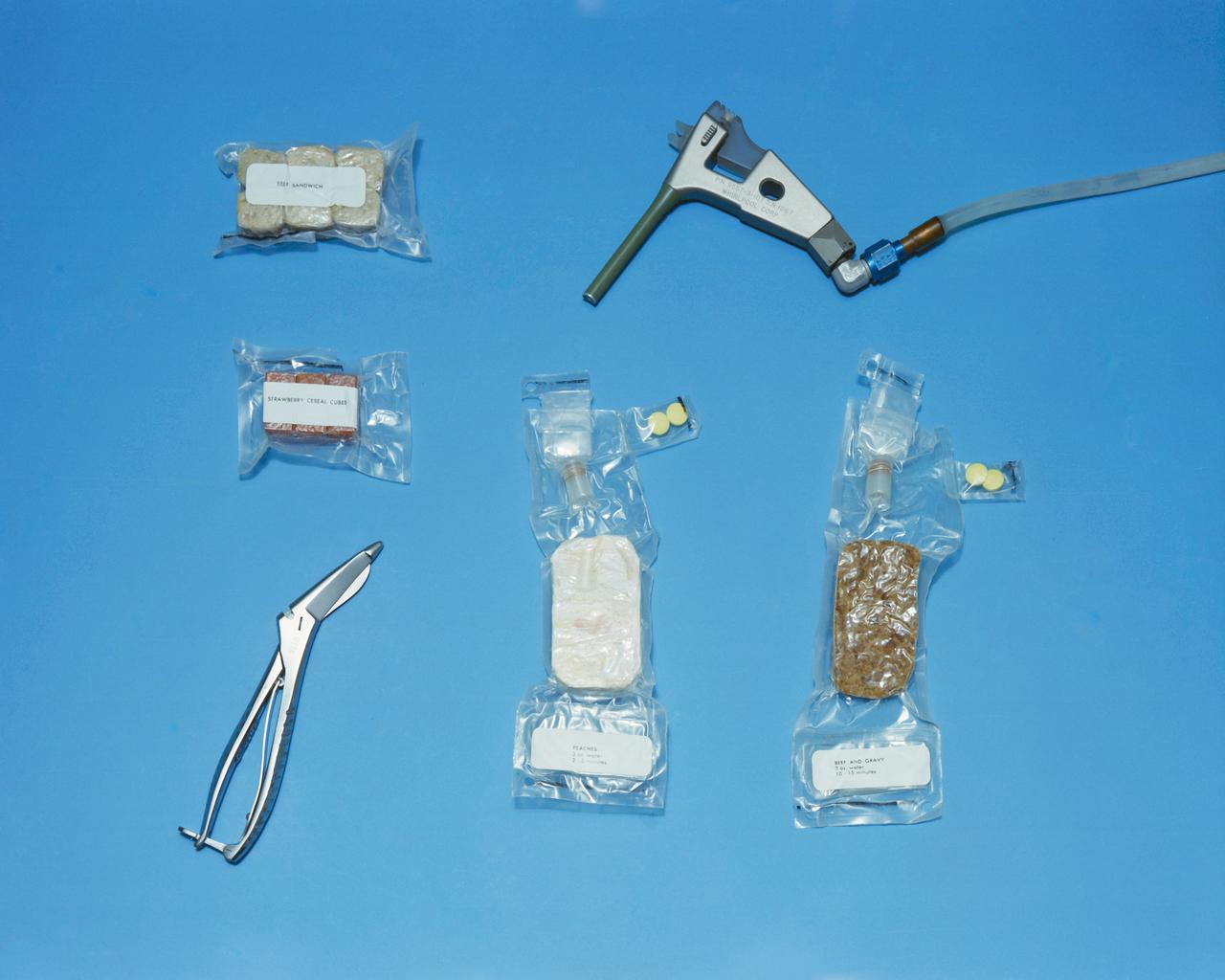
Food packages for use on the Gemini-Titan 4 (GT-4) flight. Packages include beef and gravy, peaches, strawberry cereal cubes and beef sandwiches. A water gun is used to reconstitute the dehydrated food. MSC, HOUSTON, TX CN
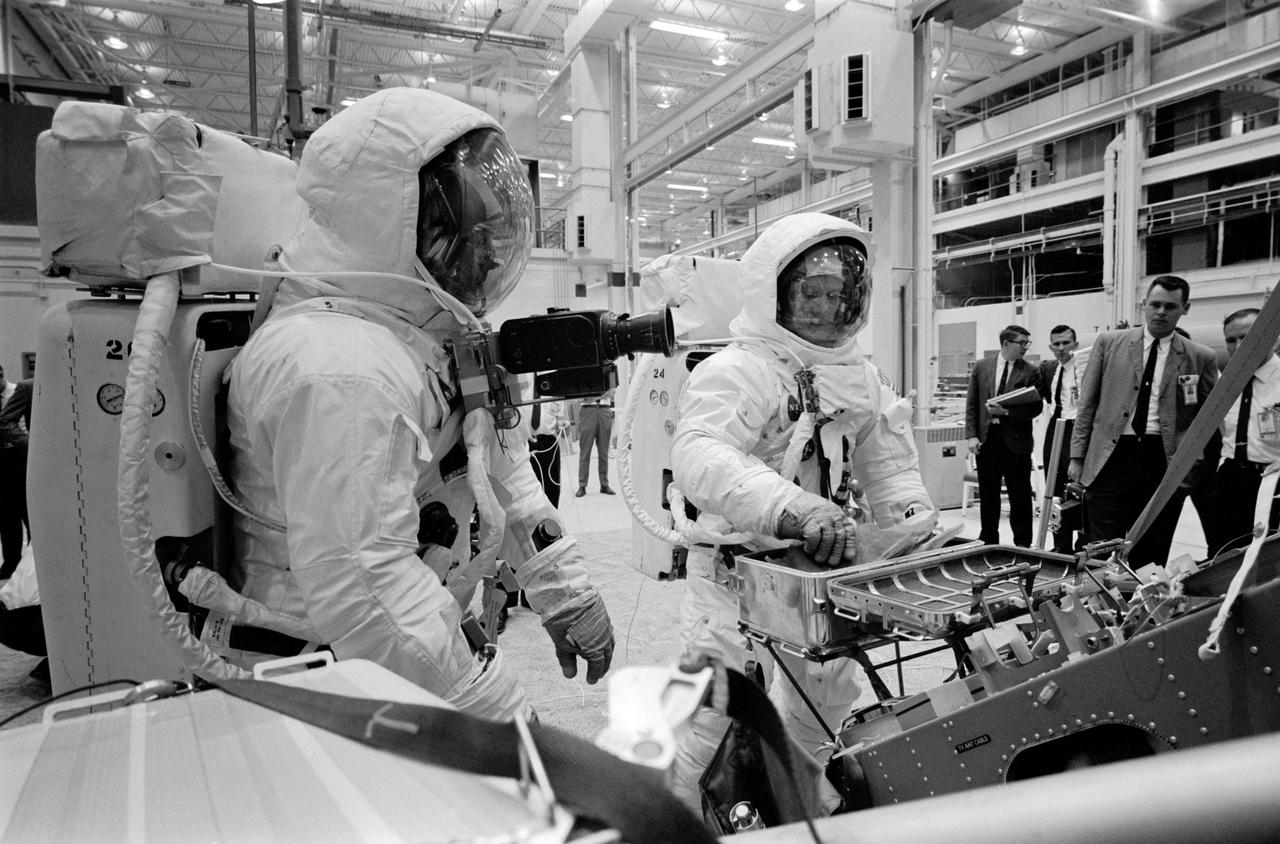
Suited Apollo XI Crewmen Armstrong and Aldrin training in Apollo Lunar Surface Experiments Package (ALSEP) deployment in Building 5, as Astronaut Mike Collins trains in the Building 20 Centrifuge. S-Band Antenna (31148 thru 31165, 31178 thru 31179) MSC, HOUSTON, TX
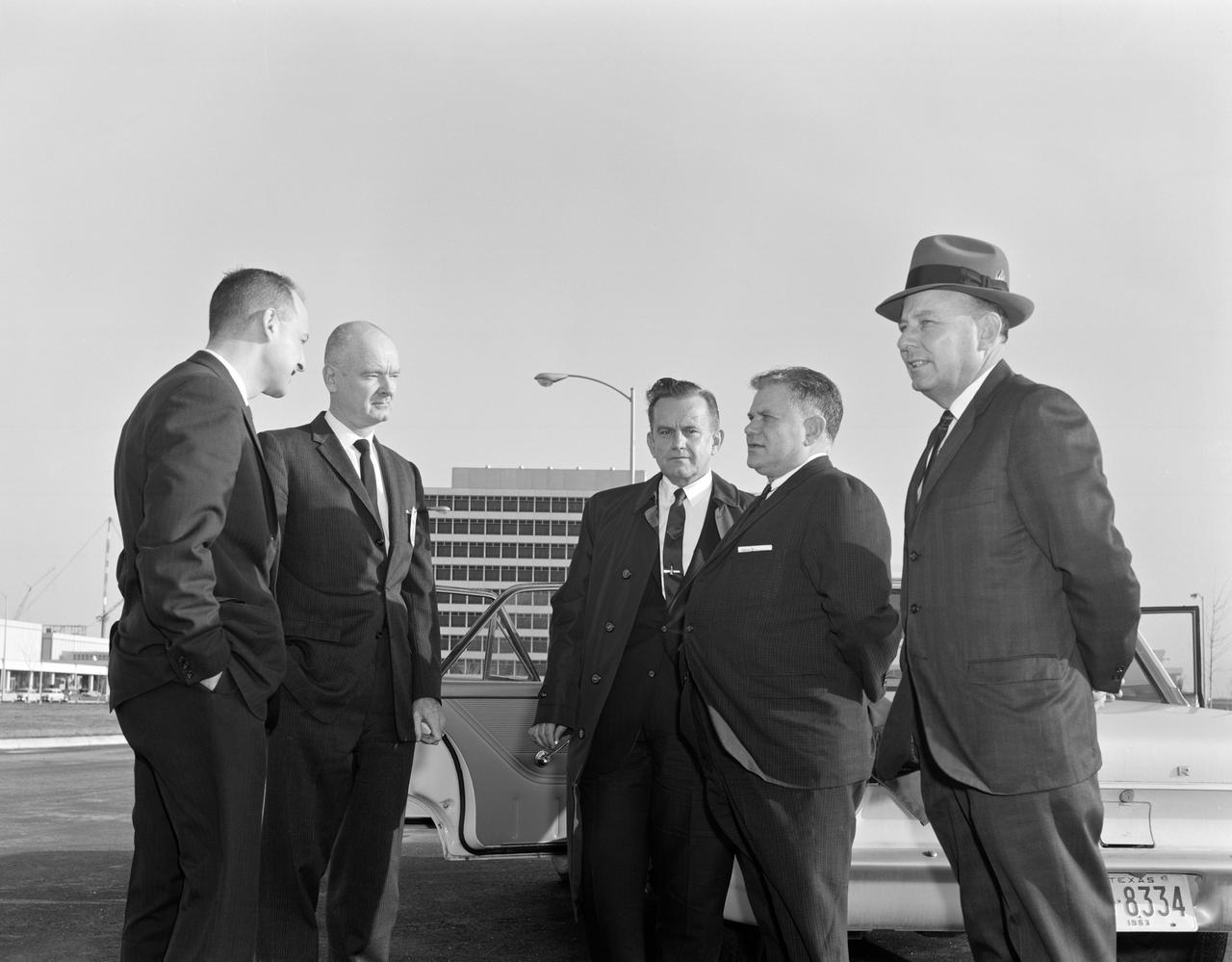
George Low, Joseph Piland, Philip Hamburger, Congressman Olin Teague from Texas; and, Congressman Joe D. Waggoner from Louisiana at the entrance to Site 1, Clear Lake, prior to briefing for the House Subcommittee on Manned Spaceflight. MSC, Houston, TX
S69-40209 (27 July 1969) --- The crewmen of the Apollo 11 lunar landing mission go through their post flight debriefing session on Sunday, July 27, 1969. Left to right, are astronauts Edwin E. Aldrin Jr., lunar module pilot; Michael Collins, command module pilot; and Neil A. Armstrong, commander. They are seated in the debriefing room of the Crew Reception Area of the Lunar Receiving Laboratory at the Manned Spacecraft Center (MSC). In the foreground are Donald K. Slayton (right), MSC Director of Flight Crew Operations; and Lloyd Reeder, training coordinator.
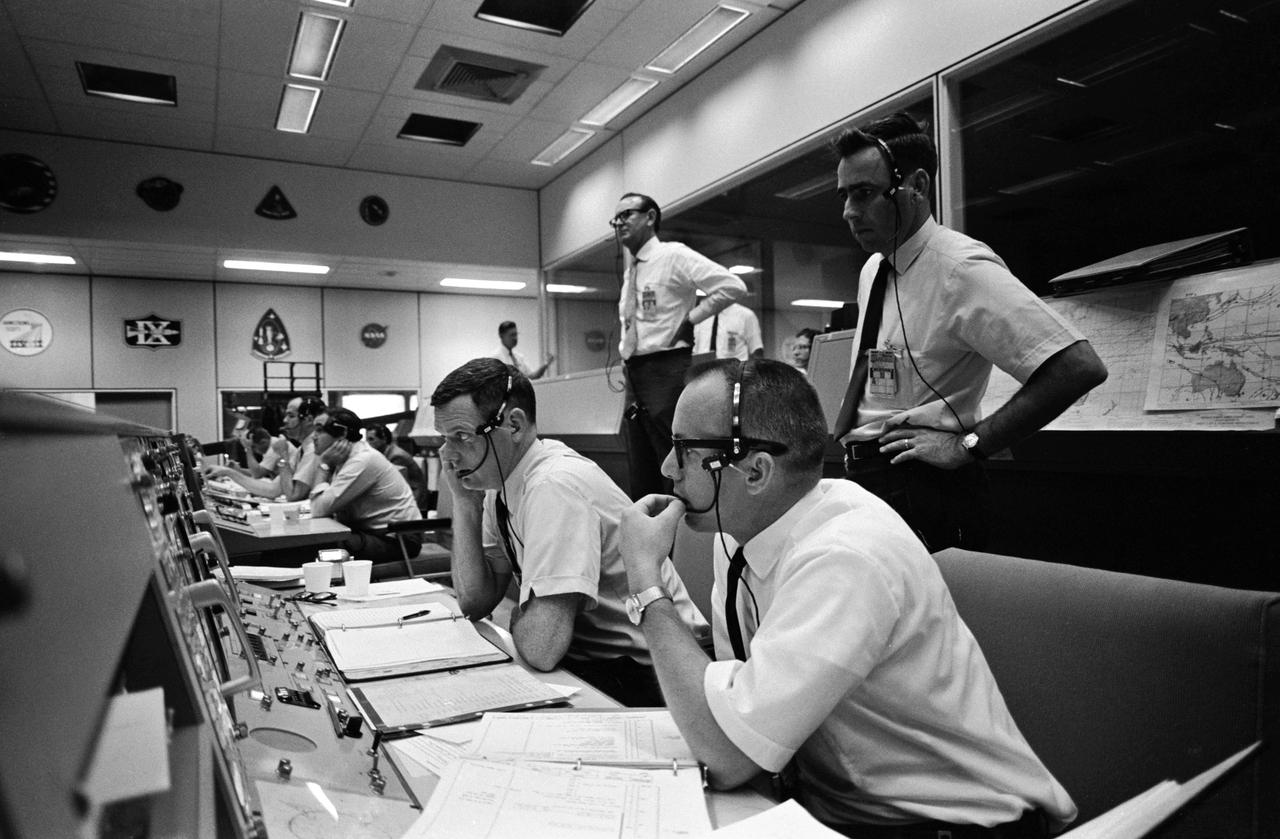
S69-34038 (18 May 1969) --- View of activity at the flight director's console in the Mission Operations Control Room in the Mission Control Center, Building 30, on the first day of the Apollo 10 lunar orbit mission. Seated are Gerald D. Griffin (foreground) and Glynn S. Lunney, Shift 1 (Black Team) flight directors. Milton L. Windler, standing behind them, is the flight director of Shift 2 (Maroon Team). In the center background, standing, is Dr. Christopher C. Kraft Jr., MSC Director of Flight Operations.
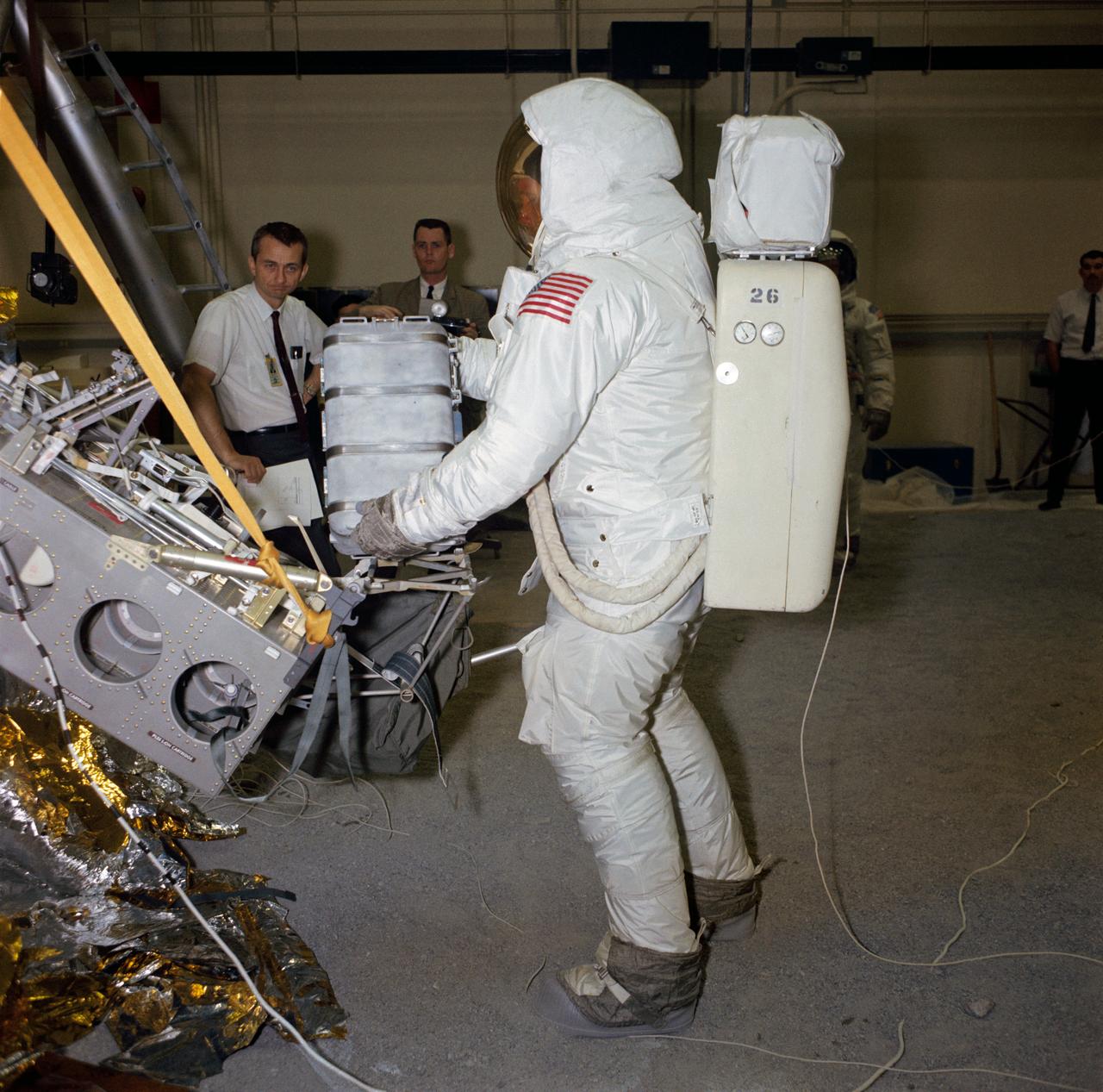
S69-31075 (18 April 1969) --- Suited astronaut Neil A. Armstrong, wearing an Extravehicular Mobility Unit (EMU), participates in lunar surface simulation training on April 18, 1969 in building 9, Manned Spacecraft Center (MSC). Armstrong is prime crew commander of the Apollo 11 lunar landing mission. Here, he is opening a sample return container. On the right is the Modular Equipment Stowage Assembly (MESA) and the Lunar Module (LM) mockup.
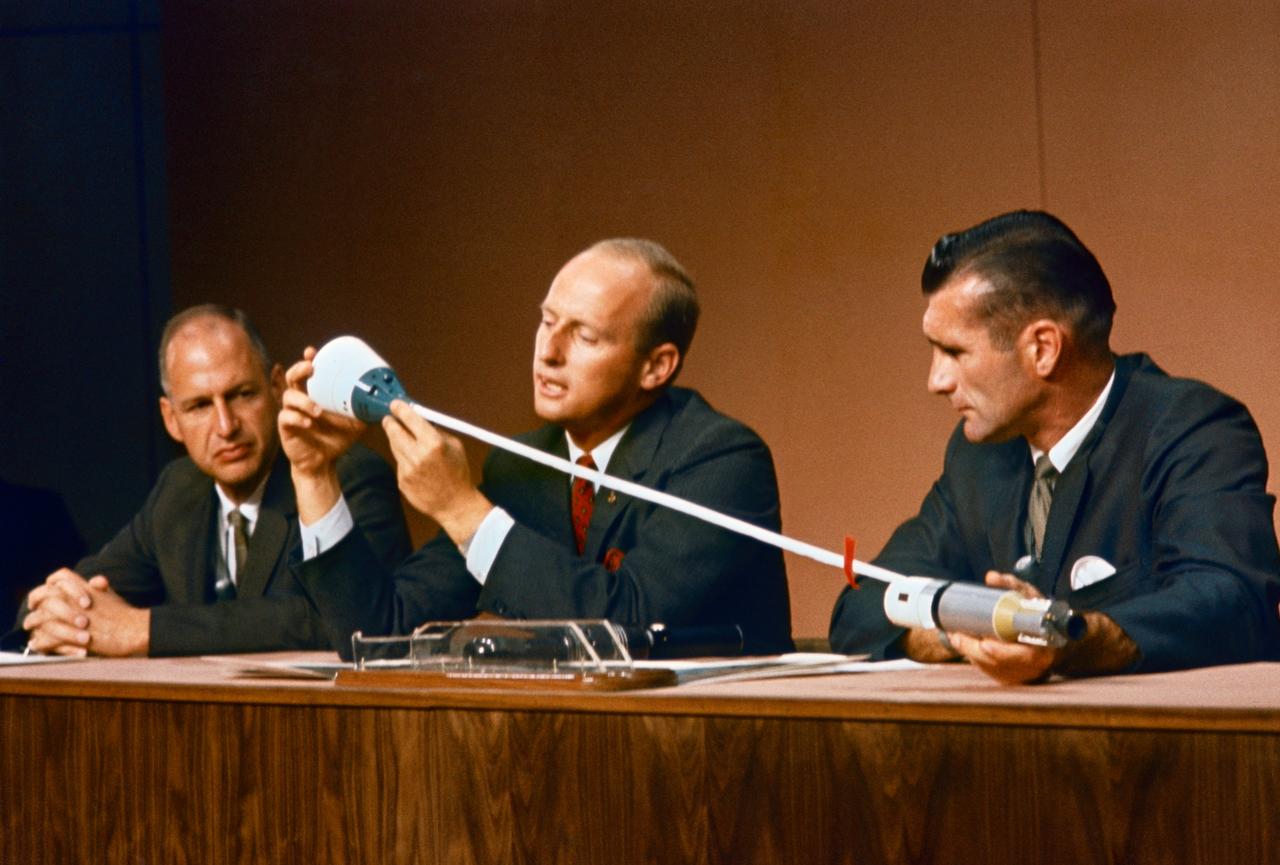
S66-45635 (26 Sept. 1966) --- Astronaut Charles Conrad Jr. (center), Gemini-11 prime crew command pilot, discusses the Gemini-11/Agena tether before a gathering of news media representatives in the MSC Building 1 auditorium. Holding an Agena model at right is astronaut Richard F. Gordon Jr., Gemini-11 pilot. Looking on at left is George M. Low, MSC Deputy Director. Photo credit: NASA

S69-53894 (October 1969) --- Dr. Charles H. Walkinshaw, Jr., Spaceflight Biotechnology Branch botanist, Preventive Medicine Division, Manned Spacecraft Center (MSC), examines sorghum and tobacco plants in lunar (germ free) soil in the Plant Laboratory of the MSC’s Lunar Receiving Laboratory. The soil was brought back from the moon by the crew of the Apollo 11 lunar landing mission.
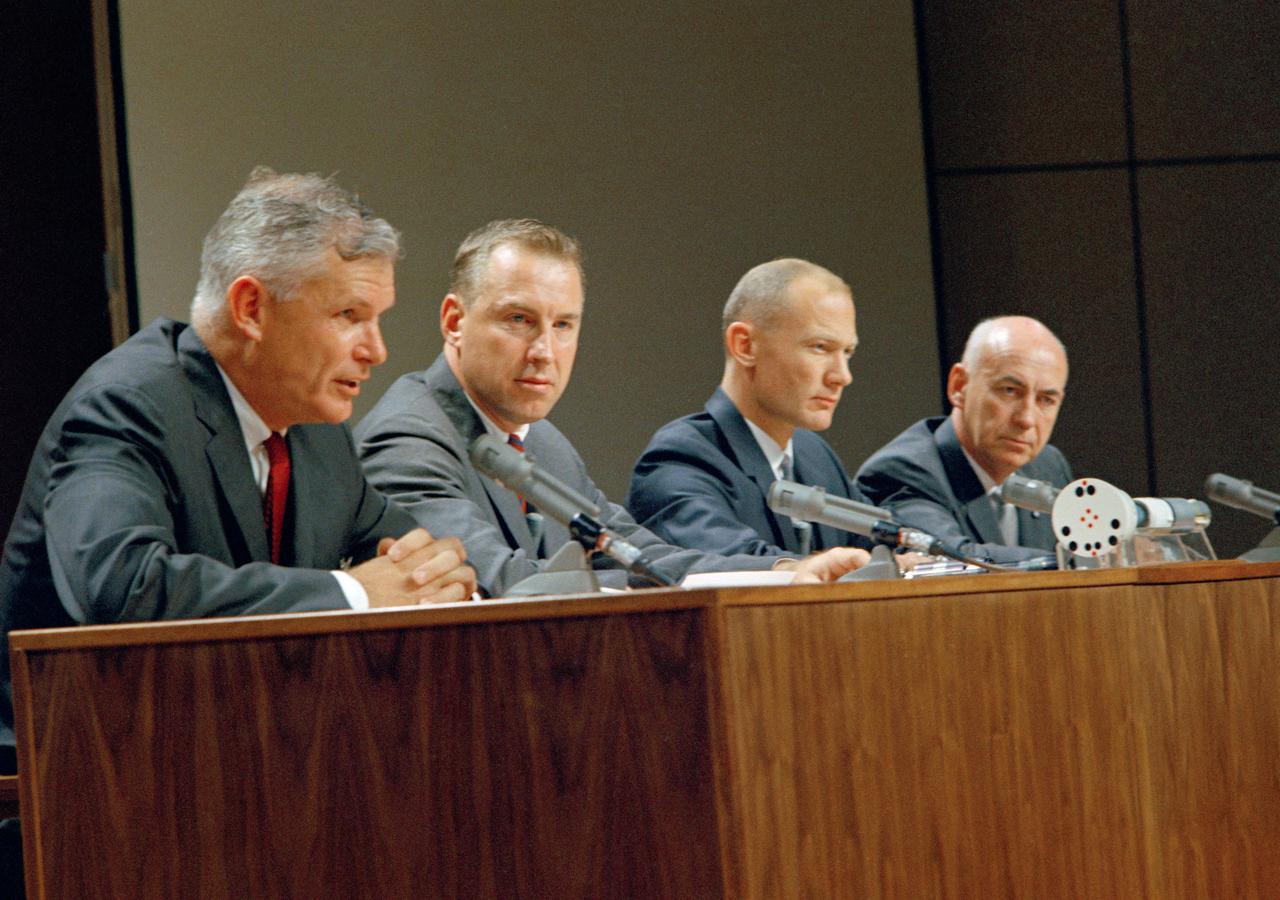
S66-65190 (23 Nov. 1966) --- Two key NASA officials and the Gemini-12 crew explain the Gemini-12 space mission to news media representatives at a postflight press conference in the MSC auditorium. Left to right, are Dr. Robert C. Seamans Jr., NASA Deputy Administrator; astronaut James A. Lovell Jr., command pilot; astronaut Edwin E. Aldrin Jr., pilot; and Dr. Robert R. Gilruth, MSC Director. Photo credit: NASA
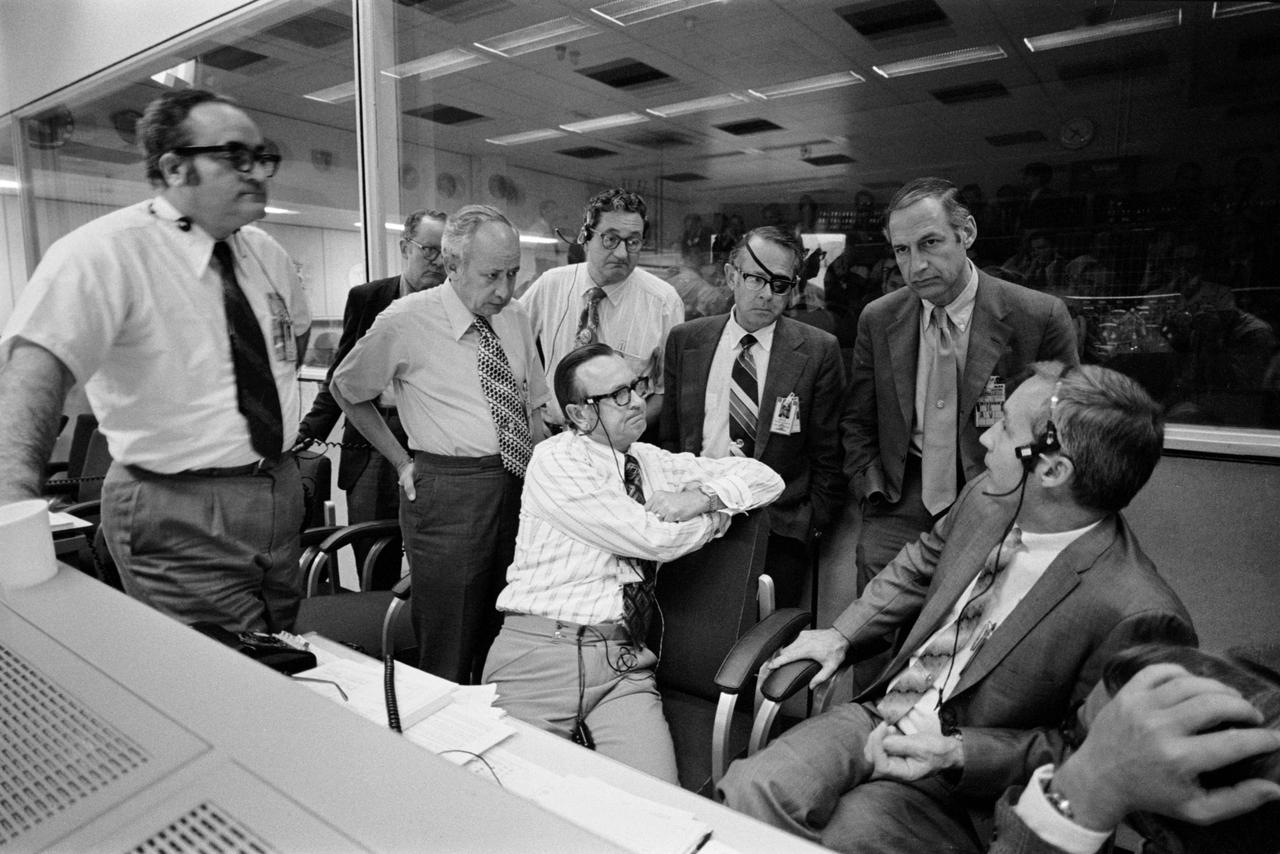
S72-37010 (20 April 1972) --- NASA officials gather around a console in the Mission Operations Control Room (MOCR) in the Mission Control Center (MCC) prior to the making of a decision whether to land Apollo 16 on the moon or to abort the landing. Seated, left to right, are Dr. Christopher C. Kraft Jr., Director of the Manned Spacecraft Center (MSC), and Brig. Gen. James A. McDivitt (USAF), Manager, Apollo Spacecraft Program Office, MSC; and standing, left to right, are Dr. Rocco A. Petrone, Apollo Program Director, Office Manned Space Flight (OMSF), NASA HQ.; Capt. John K. Holcomb (U.S. Navy, Ret.), Director of Apollo Operations, OMSF; Sigurd A. Sjoberg, Deputy Director, MSC; Capt. Chester M. Lee (U.S. Navy, Ret.), Apollo Mission Director, OMSF; Dale D. Myers, NASA Associate Administrator for Manned Space Flight; and Dr. George M. Low, NASA Deputy Administrator. Photo credit: NASA
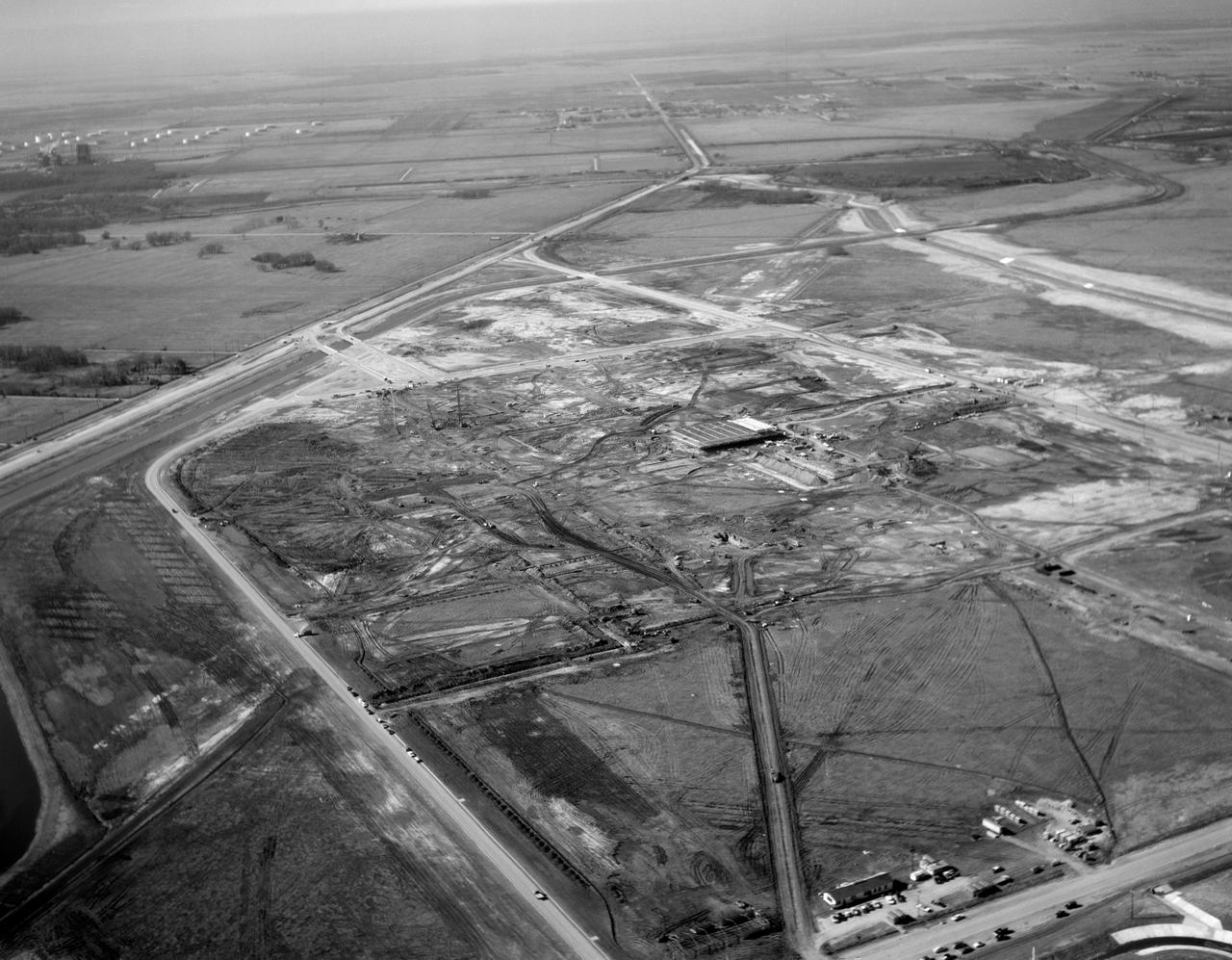
S63-01074 (1963) --- A black and white aerial view of Site 1, the Manned Spacecraft Center, in 1963 during early construction. The view faces the southwest. Highway 528 is at the top of the picture. Second Street runs basically north and south on the right side of the image, to the right or west and running parallel to that avenue is a drainage ditch. Winding through the site a Houston Lighting and Power Co. canal crosses over the drainage ditch near the top of the frame. Twin bridges over the canal are pictured at upper left which were constructed to allow traffic to enter and leave through MSC's secondary gateway. In frame center, construction appears very far along on the Central Data Office.
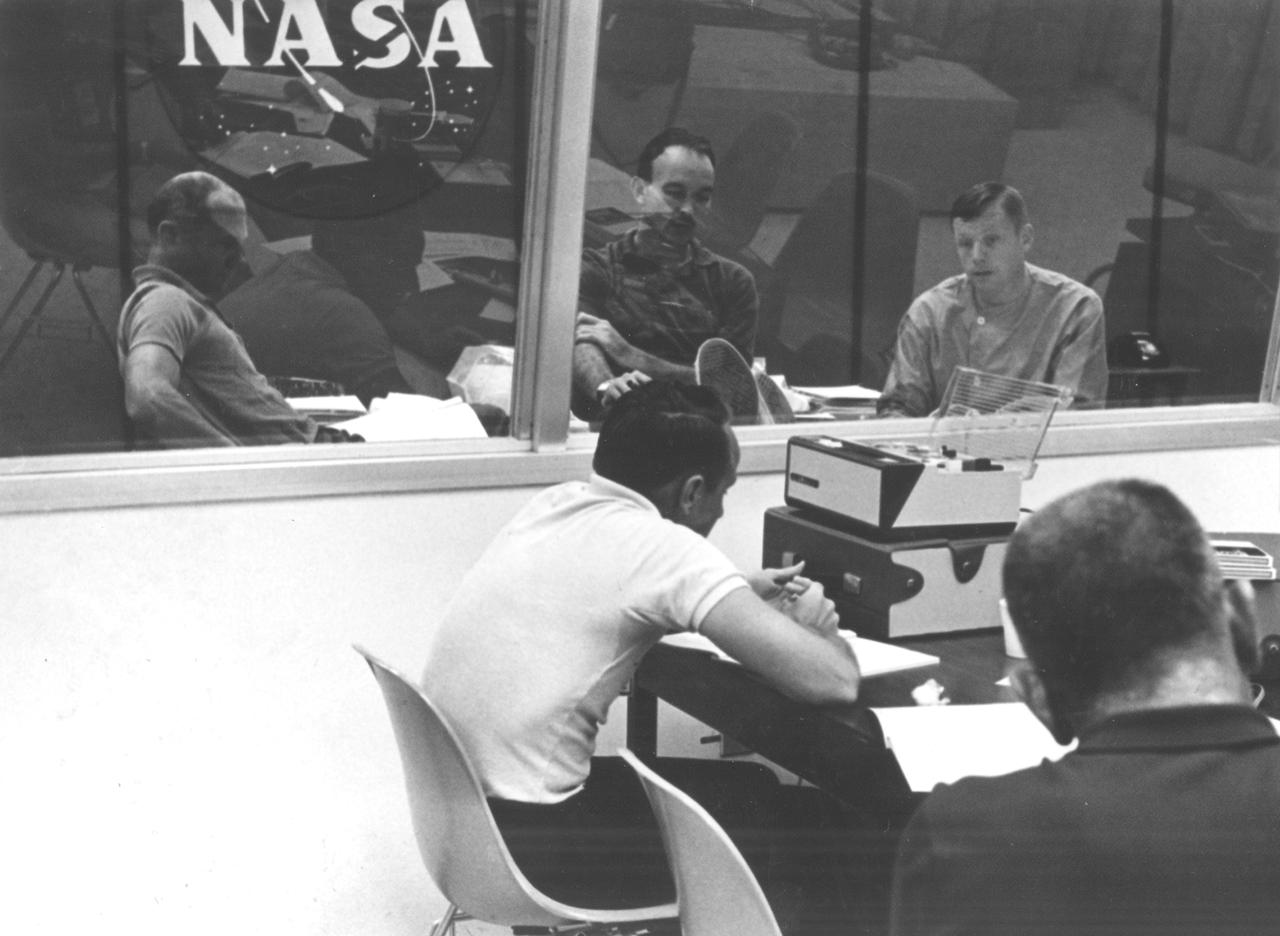
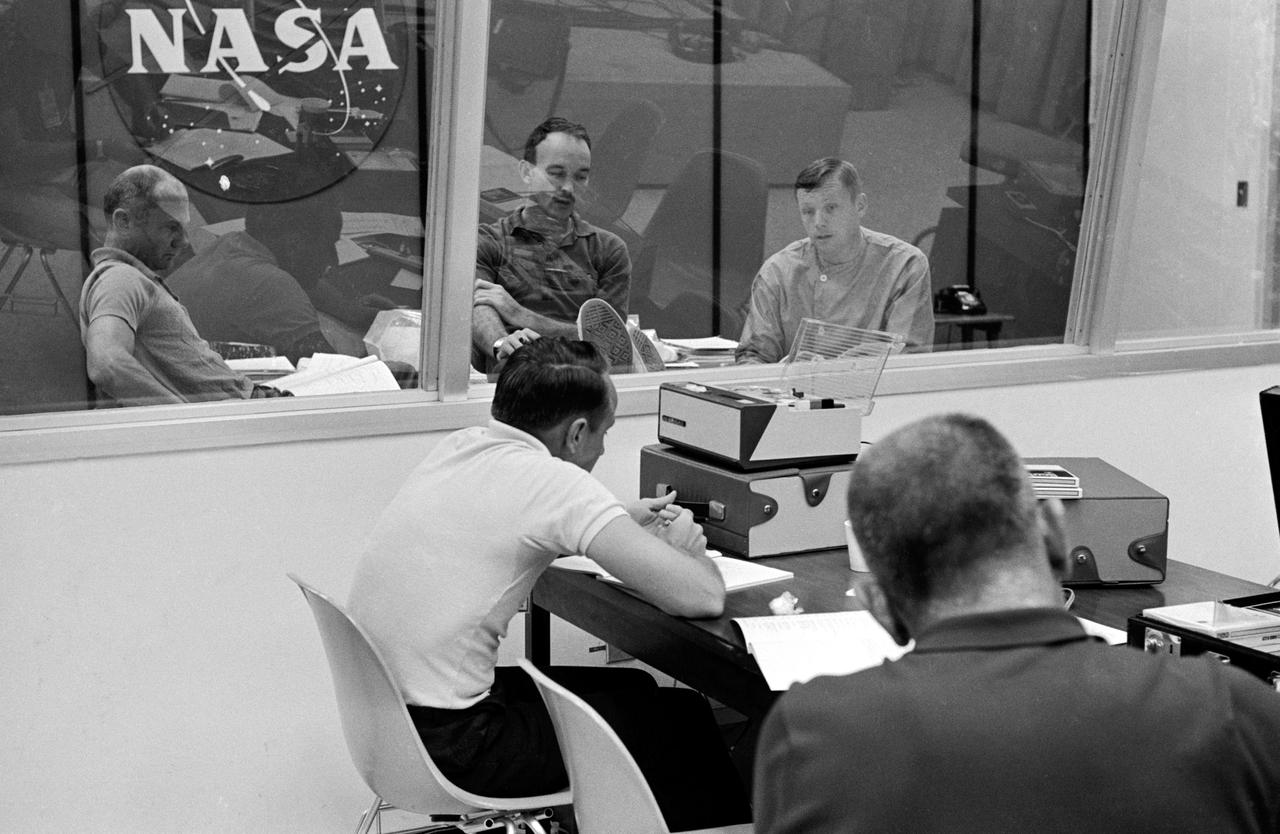
The Apollo 11 mission, the first manned lunar mission, launched from the Kennedy Space Center, Florida via the Marshall Space Flight Center (MSFC) developed Saturn V launch vehicle on July 16, 1969 and safely returned to Earth on July 24, 1969. Aboard the space craft were astronauts Neil A. Armstrong, commander; Michael Collins, Command Module (CM) pilot; and Edwin E. Aldrin Jr., Lunar Module (LM) pilot. The CM, piloted by Michael Collins remained in a parking orbit around the Moon while the LM, named “Eagle’’, carrying astronauts Neil Armstrong and Edwin Aldrin, landed on the Moon. During 2½ hours of surface exploration, the crew collected 47 pounds of lunar surface material for analysis back on Earth. The recovery operation took place in the Pacific Ocean where Navy para-rescue men recovered the capsule housing the 3-man Apollo 11 crew. The crew was airlifted to safety aboard the U.S.S. Hornet, where they were quartered in a Mobile Quarantine Facility (MQF) which served as their home until they reached the NASA Manned Spacecraft Center (MSC) Lunar Receiving Laboratory in Houston, Texas. The three are seen here at the MSC, still inside the MQF, undergoing their first debriefing on Sunday, August 3, 1969. Behind the glass are (L-R): Edwin Aldrin, Michael Collins, and Neil Armstrong.
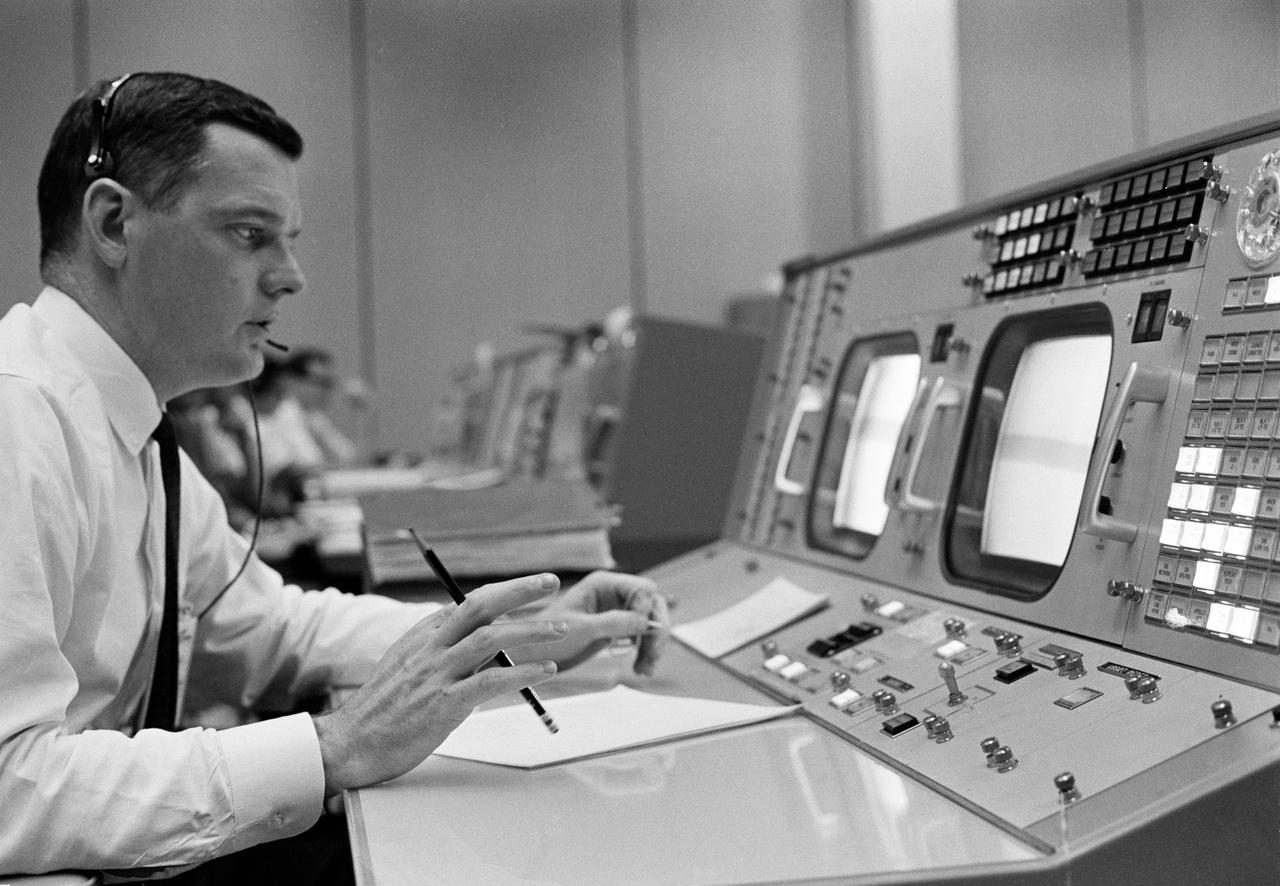
Glynn S. Lunney at his console in the MCC during an Apollo simulation exercise. MSC, Houston, TX
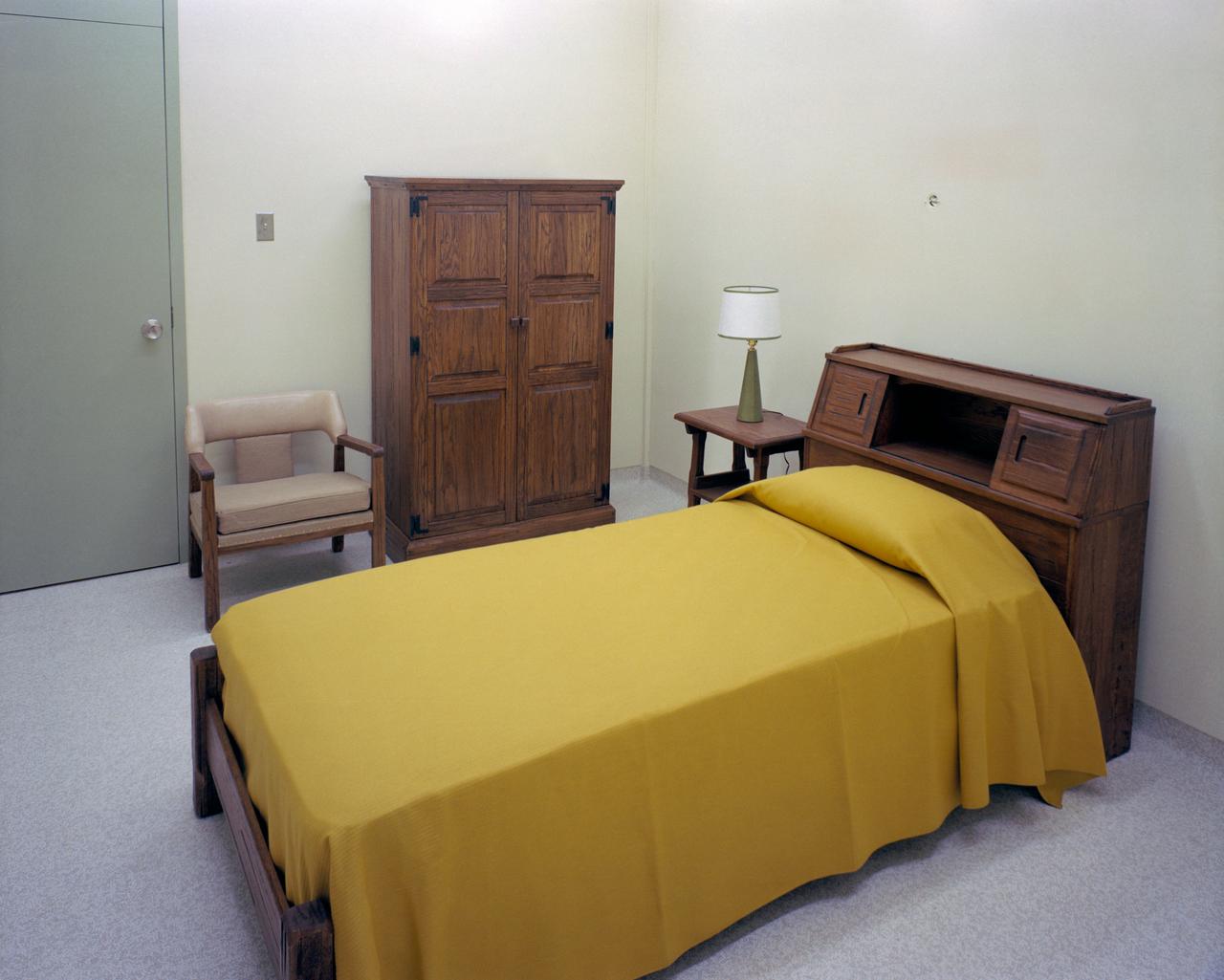
Typical Astronaut living quarters in the Crew Reception Area of the LRL, Bldg. 37, MSC, Houston, TX
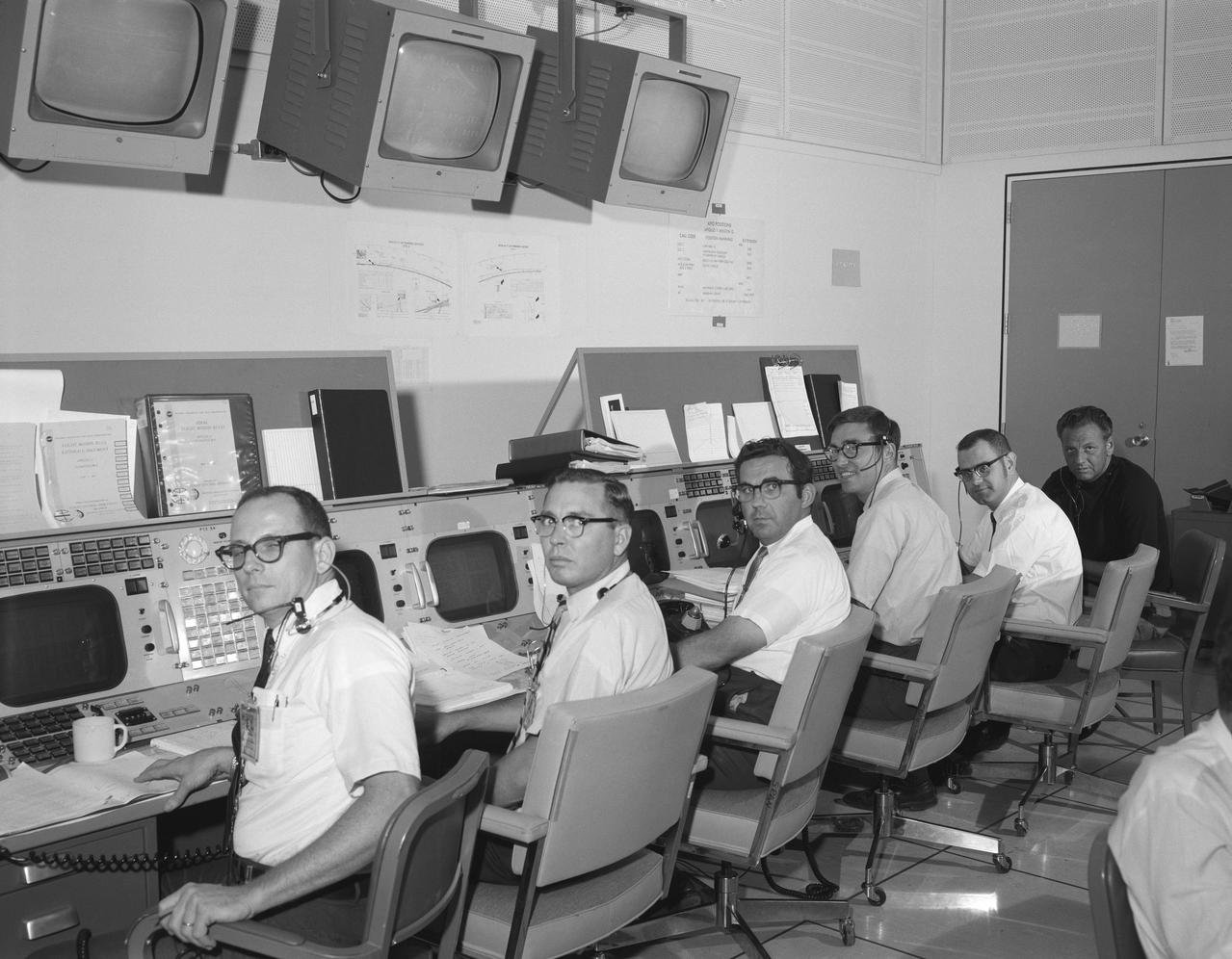
Documentary views of the SPAN preparations in the MCC during the Apollo 11 Mission. MSC, Houston, TX
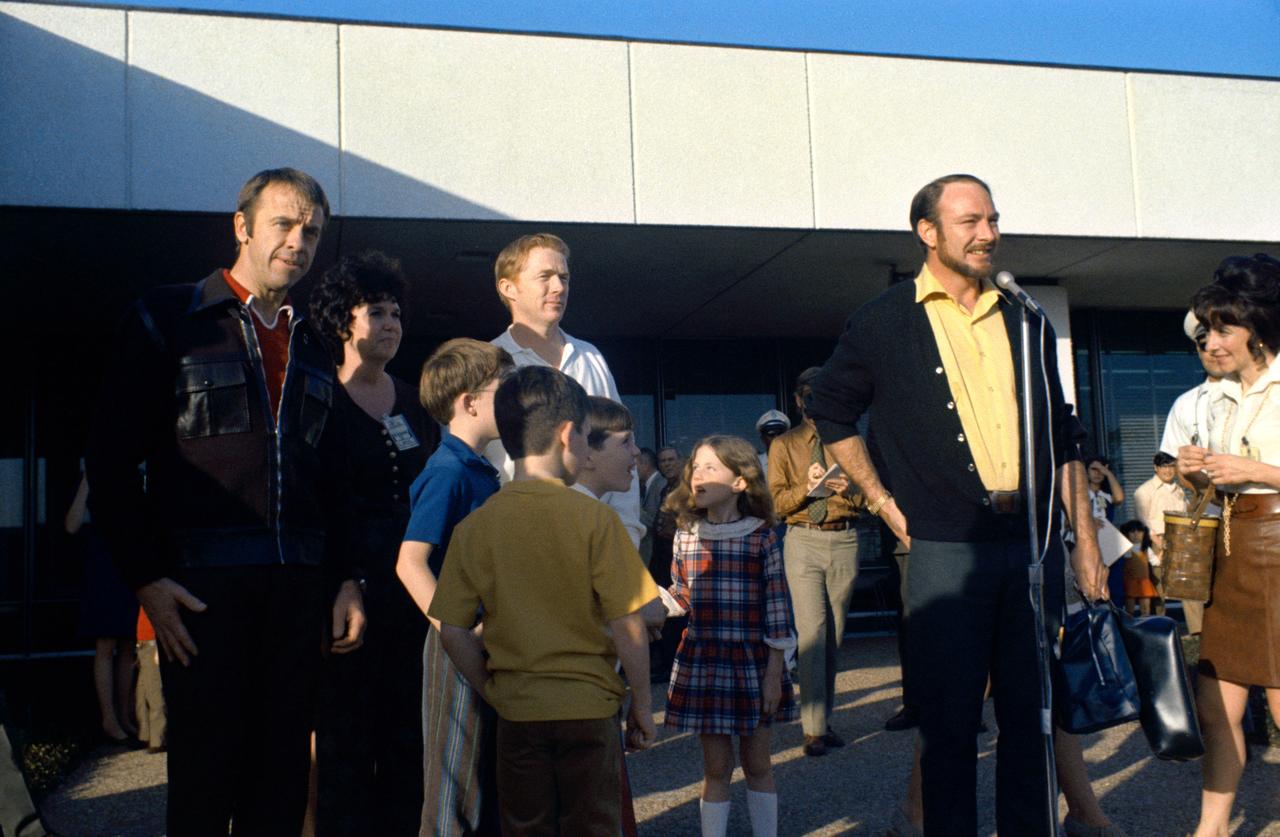
S71-22028 (26 Feb. 1971) --- Astronaut Edgar D. Mitchell, right, the Apollo 14 lunar module pilot, addresses NASA-MSC personnel and news media representatives and other visitors soon after he and his fellow crewmen were released from a 15-day confinement period in the Lunar Receiving Laboratory. Pictured with Mitchell in front of the LRL, MSC Building 37, are astronauts Alan B. Shepard Jr., left, commander; and Stuart A Roosa, command module pilot, Mrs. Mitchell is at right and Mrs. Roosa, near left. Roosa is flanked by his four children, left to right, Christopher A., Stuart A. Roosa Jr., John D. and Rosemary D.

S68-18733 (22 Jan. 1968) --- Dr. Robert R. Gilruth (right), MSC Director, sits with Dr. Christopher C. Kraft Jr., MSC director of flight operations, at his flight operations director console in the Mission Control Center, Building 30, during the Apollo 5 (LM-1/Saturn 204) unmanned space mission.
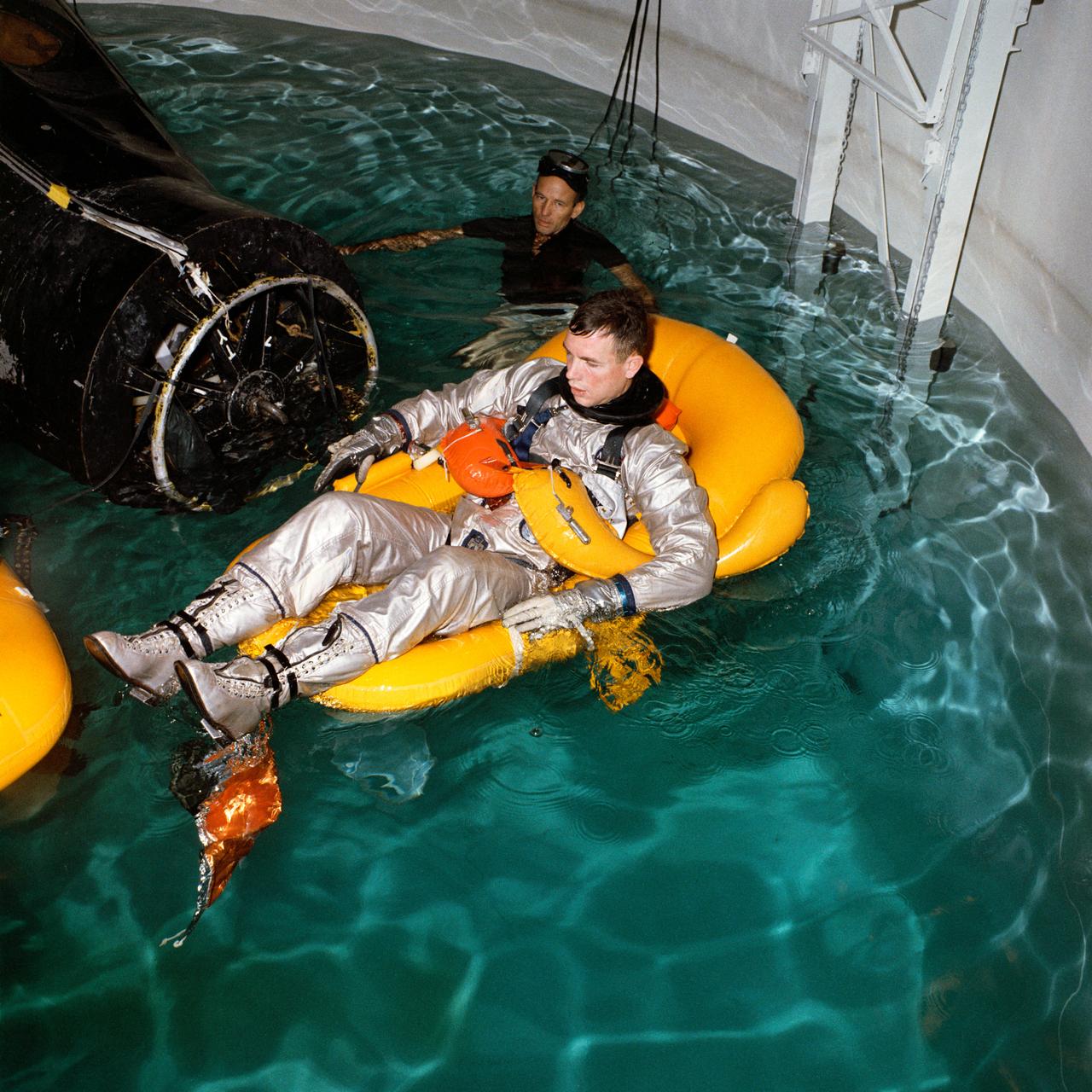
S66-15743 (5 Jan. 1966) --- Astronaut David R. Scott, pilot of the Gemini-8 prime crew, undergoes water egress training in a special tank in building 260A at the Manned Spacecraft Center (MSC), Houston, Texas. An MSC swimmer assists in the training exercise. A boilerplate model of a Gemini spacecraft floats in the water beside Scott. Photo credit: NASA
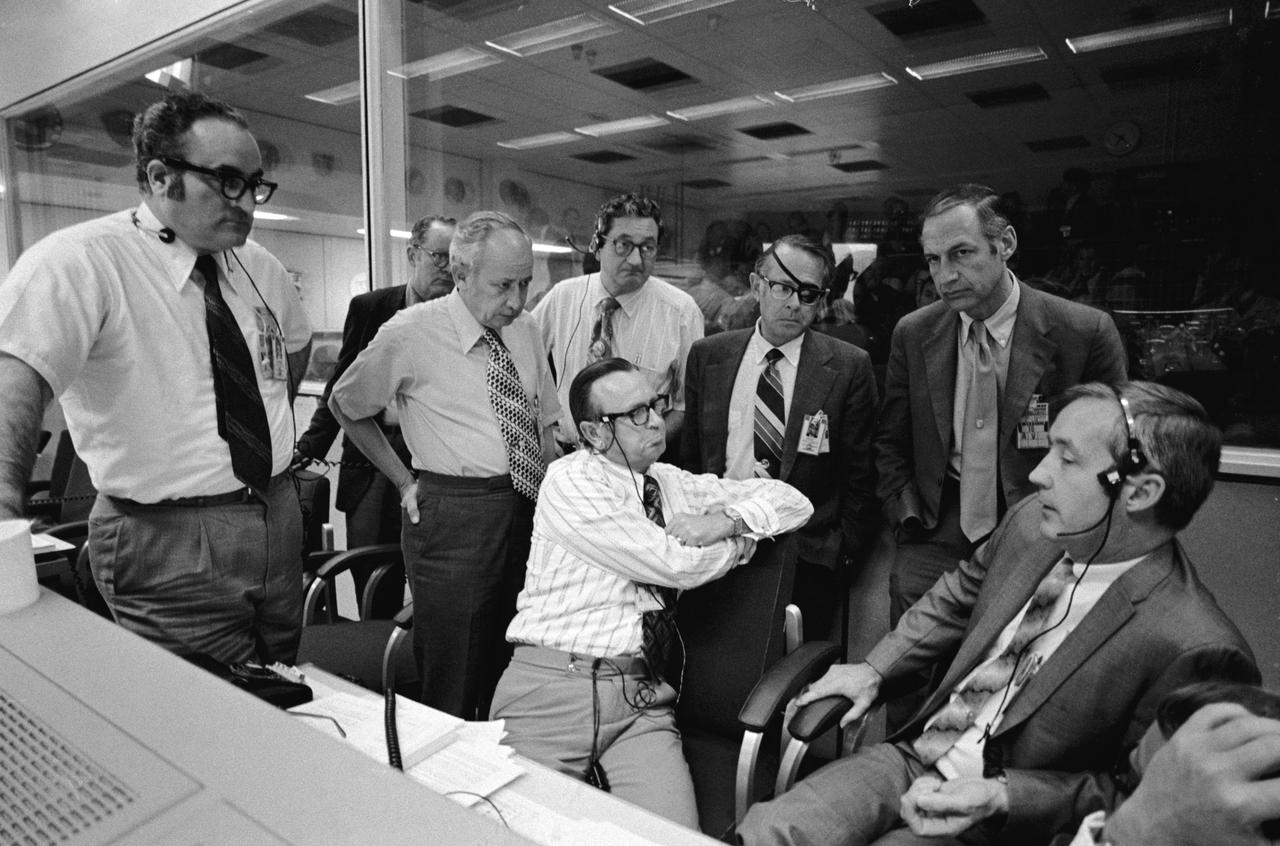
S72-37009 (20 April 1972) --- NASA officials gather around a console in the Mission Operations Control Room (MOCR) in the Mission Control Center (MCC) prior to the making of a decision whether to land Apollo 16 on the moon or to abort the landing. Seated, left to right, are Dr. Christopher C. Kraft Jr., Director of the Manned Spacecraft Center (MSC), and Brig. Gen. James A. McDivitt (USAF), Manager, Apollo Spacecraft Program Office, MSC; and standing, left to right, are Dr. Rocco A. Petrone, Apollo Program Director, Office Manned Space Flight (OMSF), NASA HQ.; Capt. John K. Holcomb (U.S. Navy, Ret.), Director of Apollo Operations, OMSF; Sigurd A. Sjoberg, Deputy Director, MSC; Capt. Chester M. Lee (U.S. Navy, Ret.), Apollo Mission Director, OMSF; Dale D. Myers, NASA Associate Administrator for Manned Space Flight; and Dr. George M. Low, NASA Deputy Administrator. Photo credit: NASA
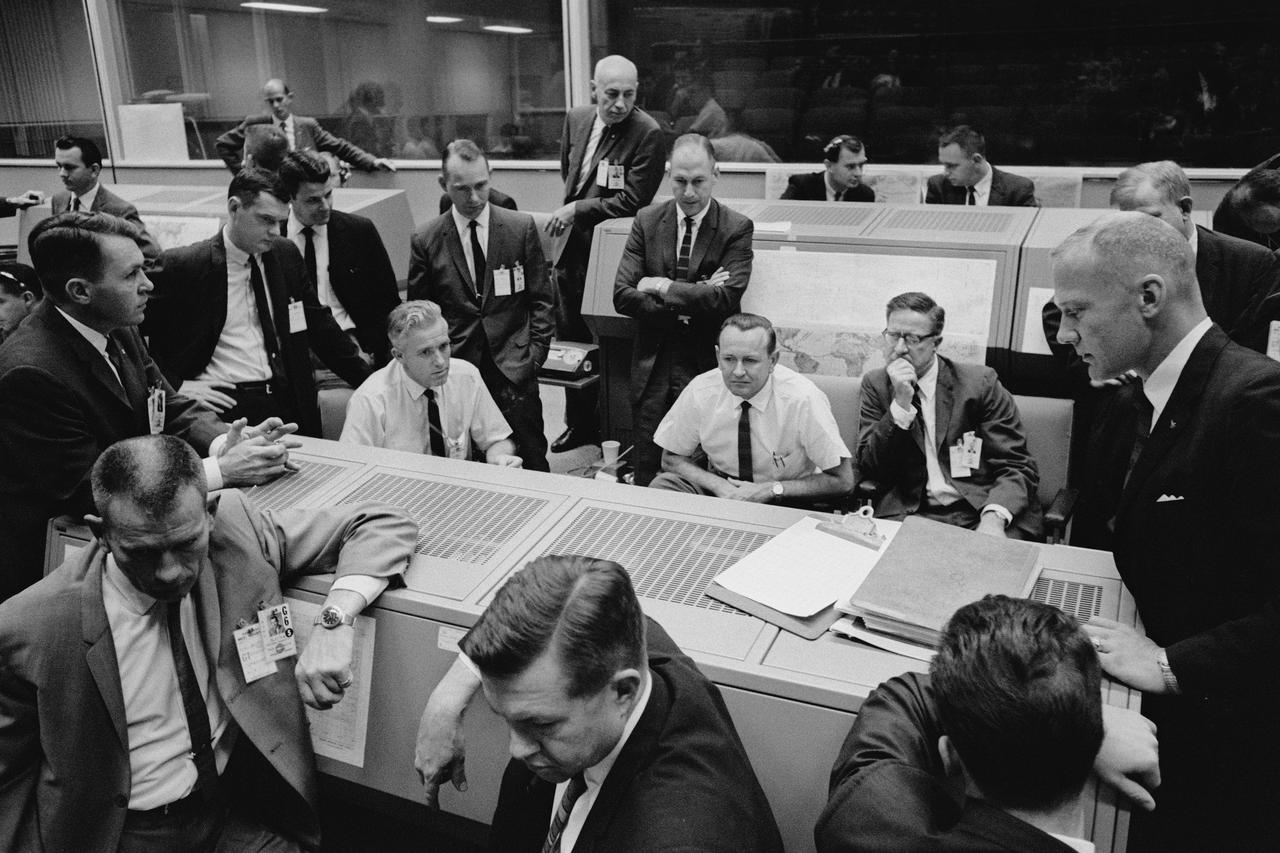
S65-44401 (1965) --- A group of National Aeronautics and Space Administration (NASA) and Manned Spacecraft Center (MSC) officials and personnel watch a Cape Kennedy press conference being telecast in the Mission Control Center (MCC) after the Gemini-6 mission was scrubbed due to the apparent failure of the Agena Target Vehicle to attain orbit.
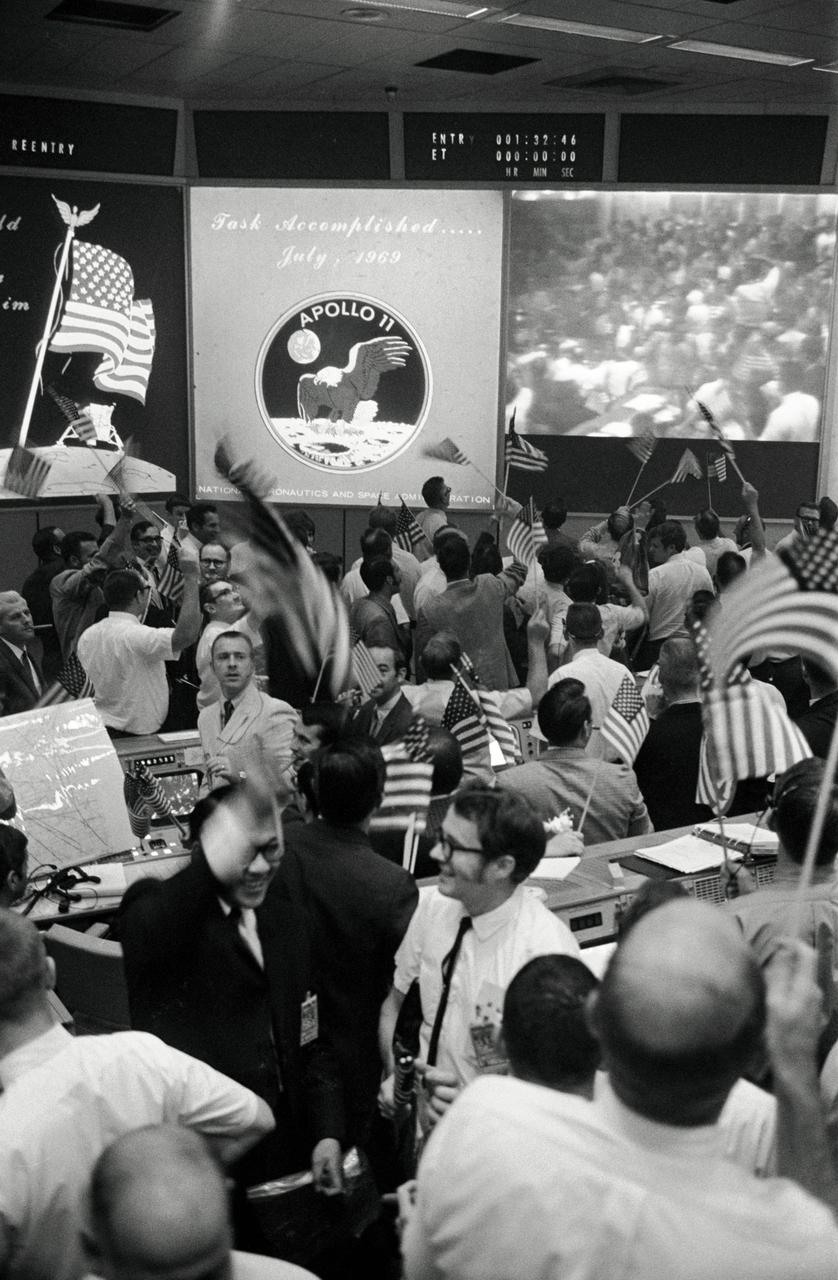
S69-40023 (24 July 1969) --- Overall view of the Mission Operations Control Room (MOCR) in the Mission Control Center (MCC), Building 30, Manned Spacecraft Center (MSC), showing the flight controllers celebrating the successful conclusion of the Apollo 11 lunar landing mission.
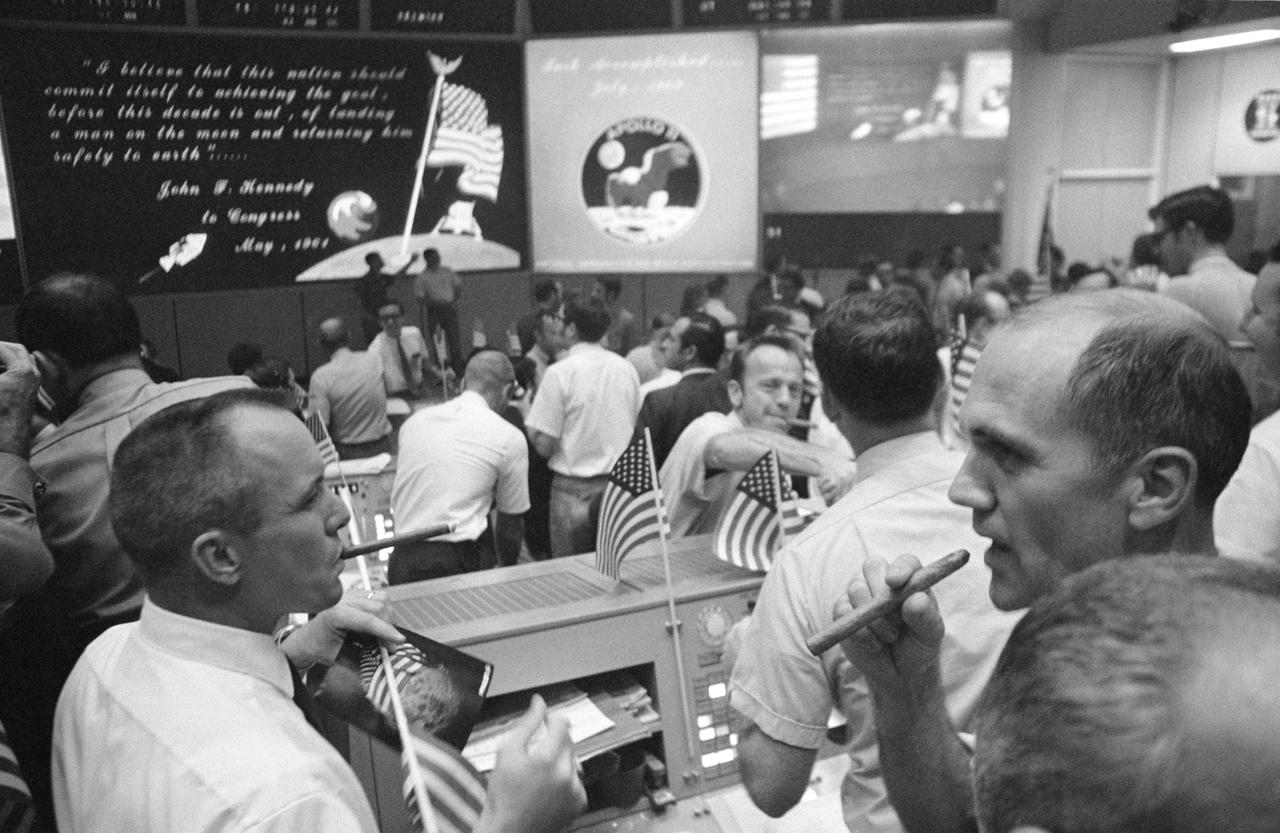
S69-40025 (24 July 1969) --- Overall view of the Mission Operations Control Room (MOCR) in the Mission Control Center (MCC), Building 30, Manned Spacecraft Center (MSC), showing the flight controllers celebrating the successful conclusion of the Apollo 11 lunar landing mission.
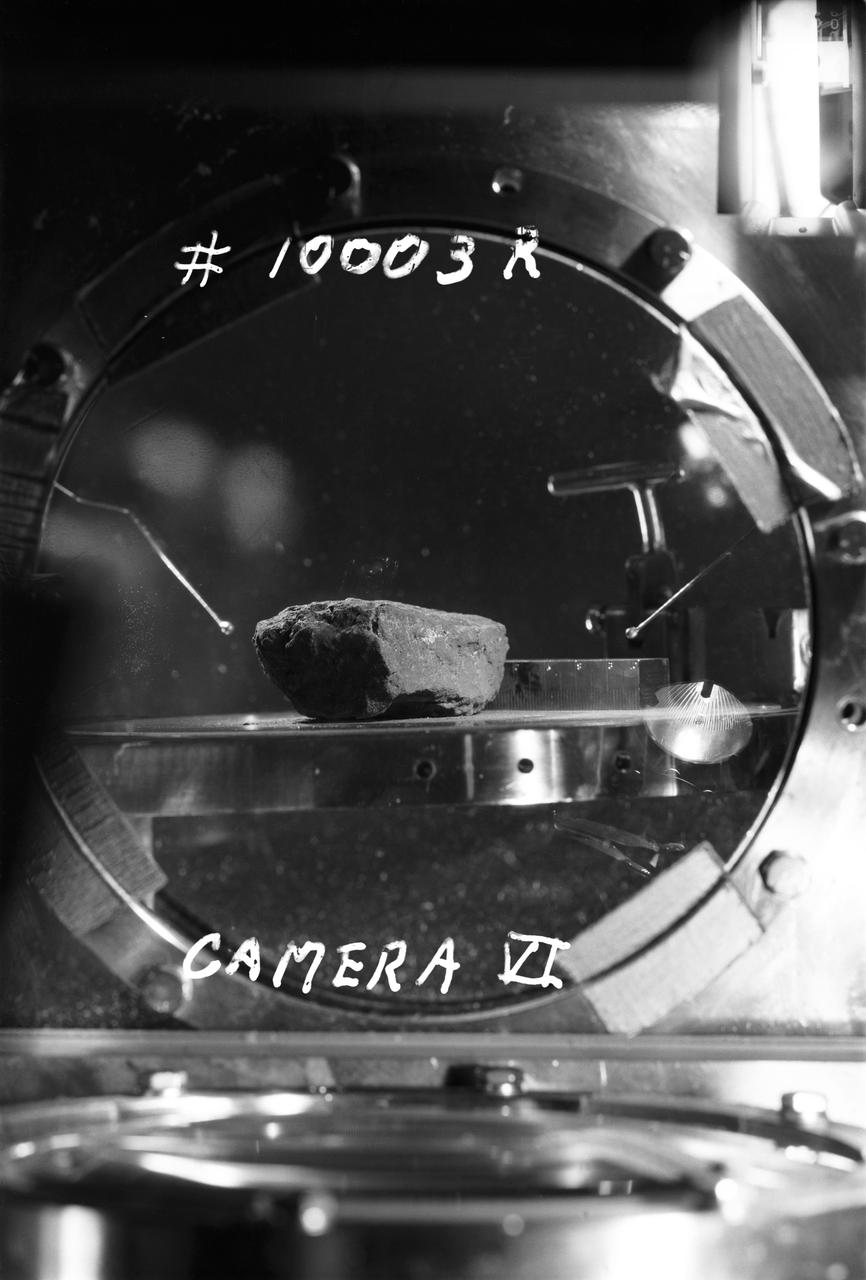
S69-45009 (27 July 1969) --- This is the first lunar sample that was photographed in detail in the Lunar Receiving Laboratory (LRL) at the Manned Spacecraft Center (MSC). The photograph shows a granular, fine-grained, mafic (iron magnesium rich) rock. At this early stage of the examination, this rock appears similar to several igneous rock types found on Earth. The scale is printed backwards due to the photographic configuration in the Vacuum Chamber. The sample number is 10003. This rock was among the samples collected by astronauts Neil A. Armstrong and Edwin E. Aldrin Jr. during their lunar surface extravehicular activity (EVA) on July 20, 1969.
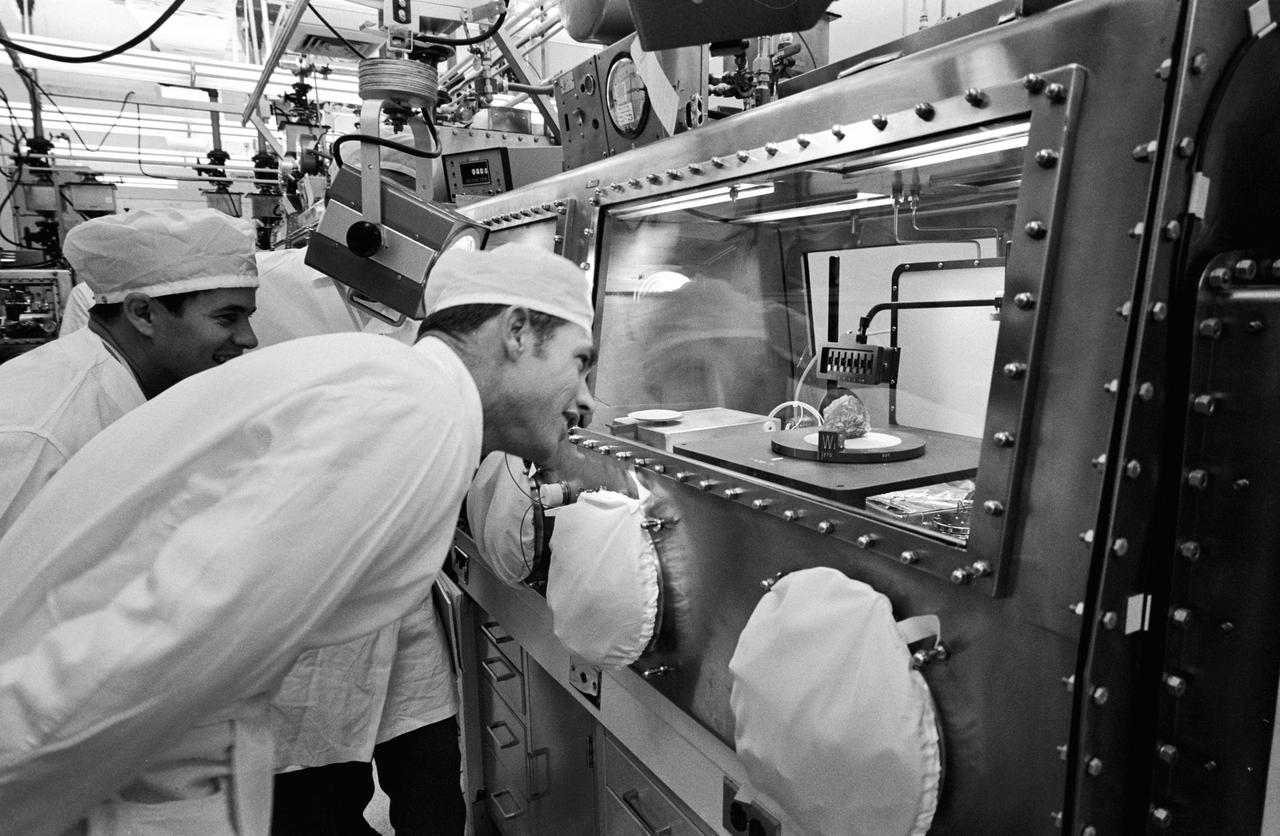
S71-43477 (12 Aug. 1971) --- Astronaut David R. Scott, right, commander of the Apollo 15 mission, gets a close look at the sample referred to as "Genesis rock" in the Non-Sterile Nitrogen Processing Line (NNPL) in the Lunar Receiving Laboratory (LRL) at the Manned Spacecraft Center (MSC). Scientist-astronaut Joseph P. Allen IV, left, an Apollo 15 spacecraft communicator, looks on with interest. The white-colored rock has been given the permanent identification of 15415.
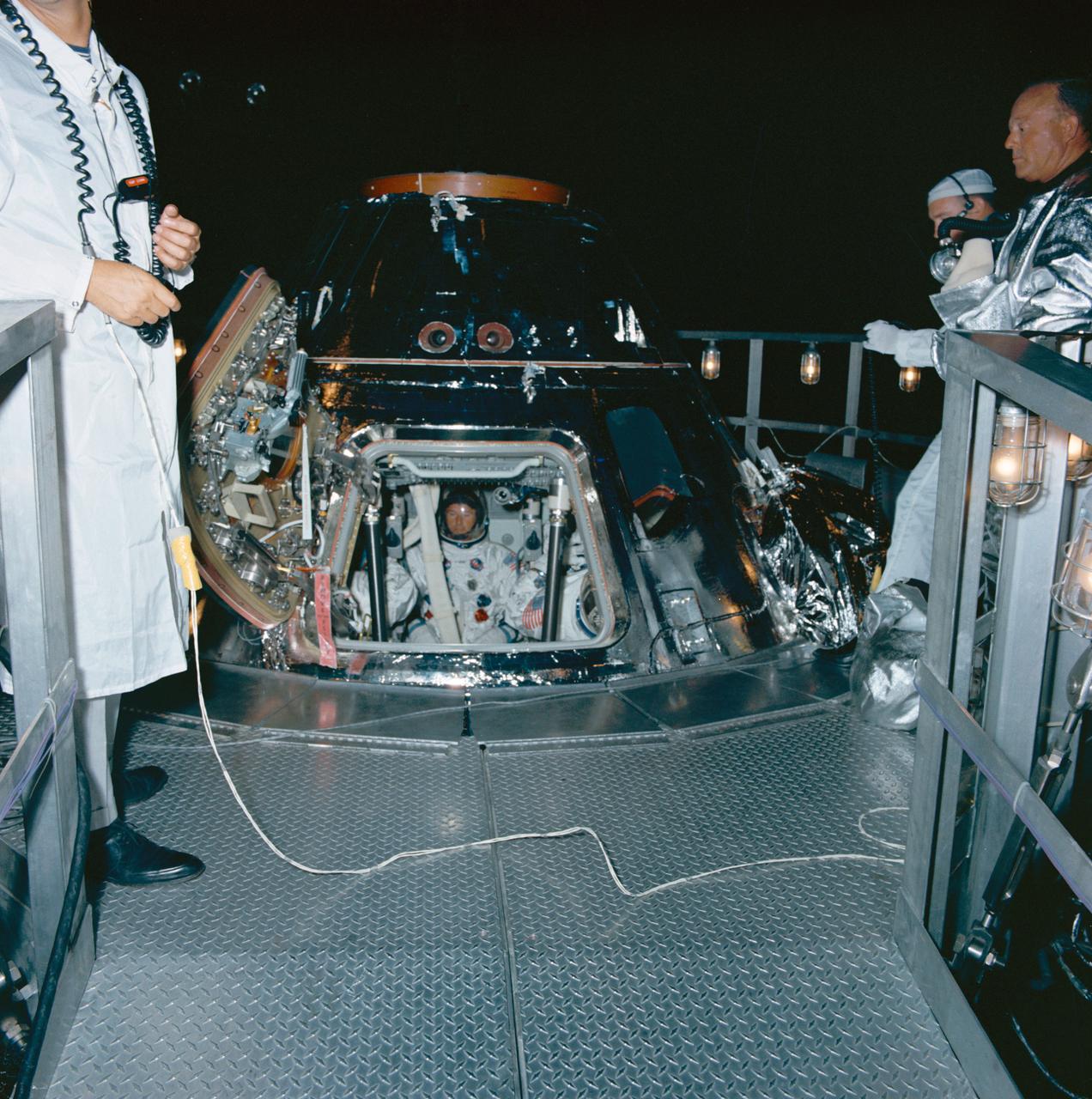
Crew ingress and beginnings of 7 1/2-day Manned Thermal Vacuum Test with Astronauts Joe Engle, Dr. Joseph Kerwin and Brand in the Apollo S/C-2TV-1, Chamber "A", Bldg. 32. Note - 35mm BW (S68-35881 thru S68-35882) - 120 CN (S68-35883 thru S68-35908) 1. ASTRONAUT BRAND, VANCE D. - VACUUM TEST 2. ASTRONAUT KERWIN, JOSEPH - VACUUM TEST 3. ASTRONAUT ENGLE, JOE - VACUUM MSC, HOUSTON, TX
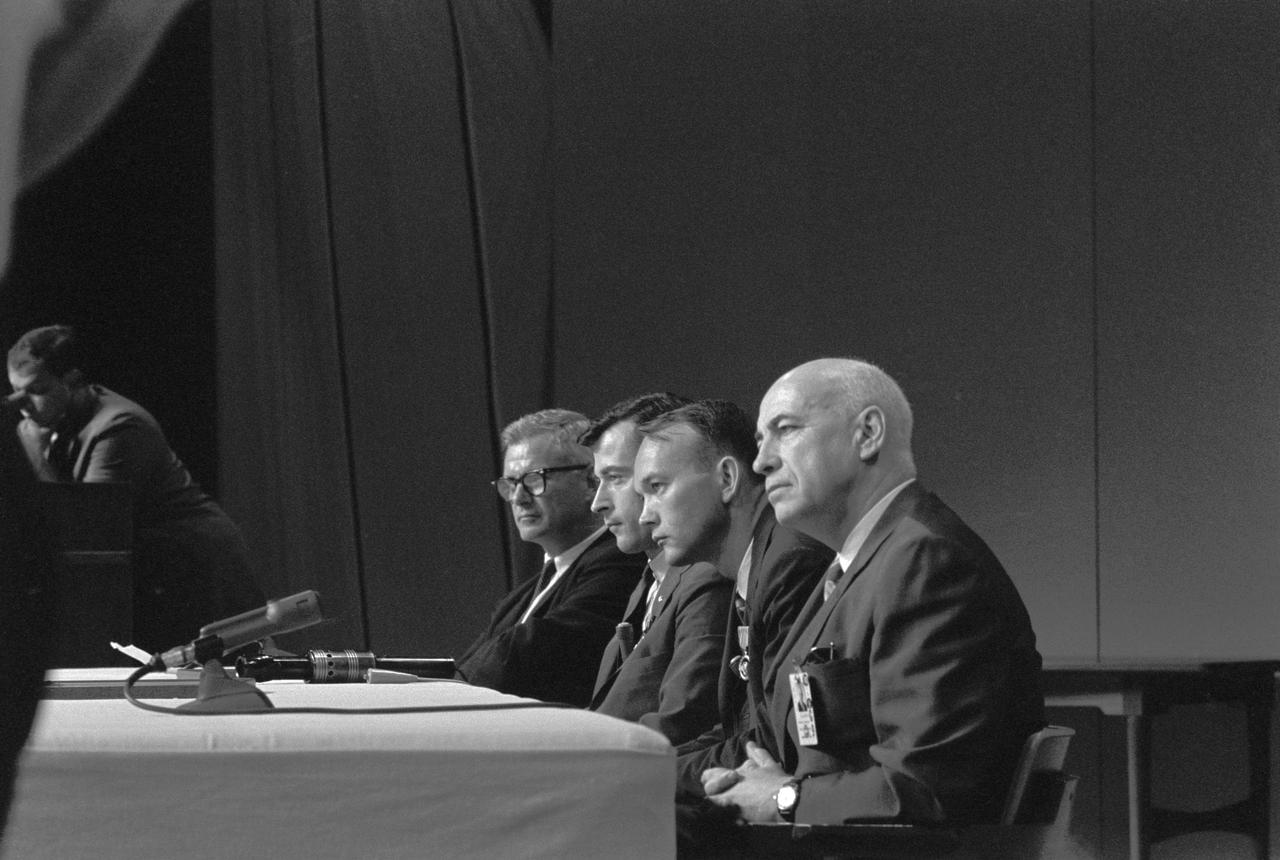
S66-39895 (1 Aug. 1966) --- Panel members of the Gemini-10 news conference held in the Building 1 auditorium were (from left) Dr. Robert C. Seamans Jr., NASA Deputy Administrator; astronaut John W. Young, Gemini-10 command pilot; astronaut Michael Collins, Gemini-10 pilot; and Dr. Robert R. Gilruth, MSC Director. Photo credit: NASA

S64-16482 (1964) --- At the Manned Spacecraft Center, Wesley Hjornevik, Assistant Director for Administration, with members of House Subcommittee and MSC Officials outside Central Data Building (Building 12) after briefing. Others pictured are Don Fuqua, Bob Casey, Edward J. Patten, Alec C. Bond, Maxime Faget, Wesley Hjornevik, Charles W. Mathews. Photo credit: NASA
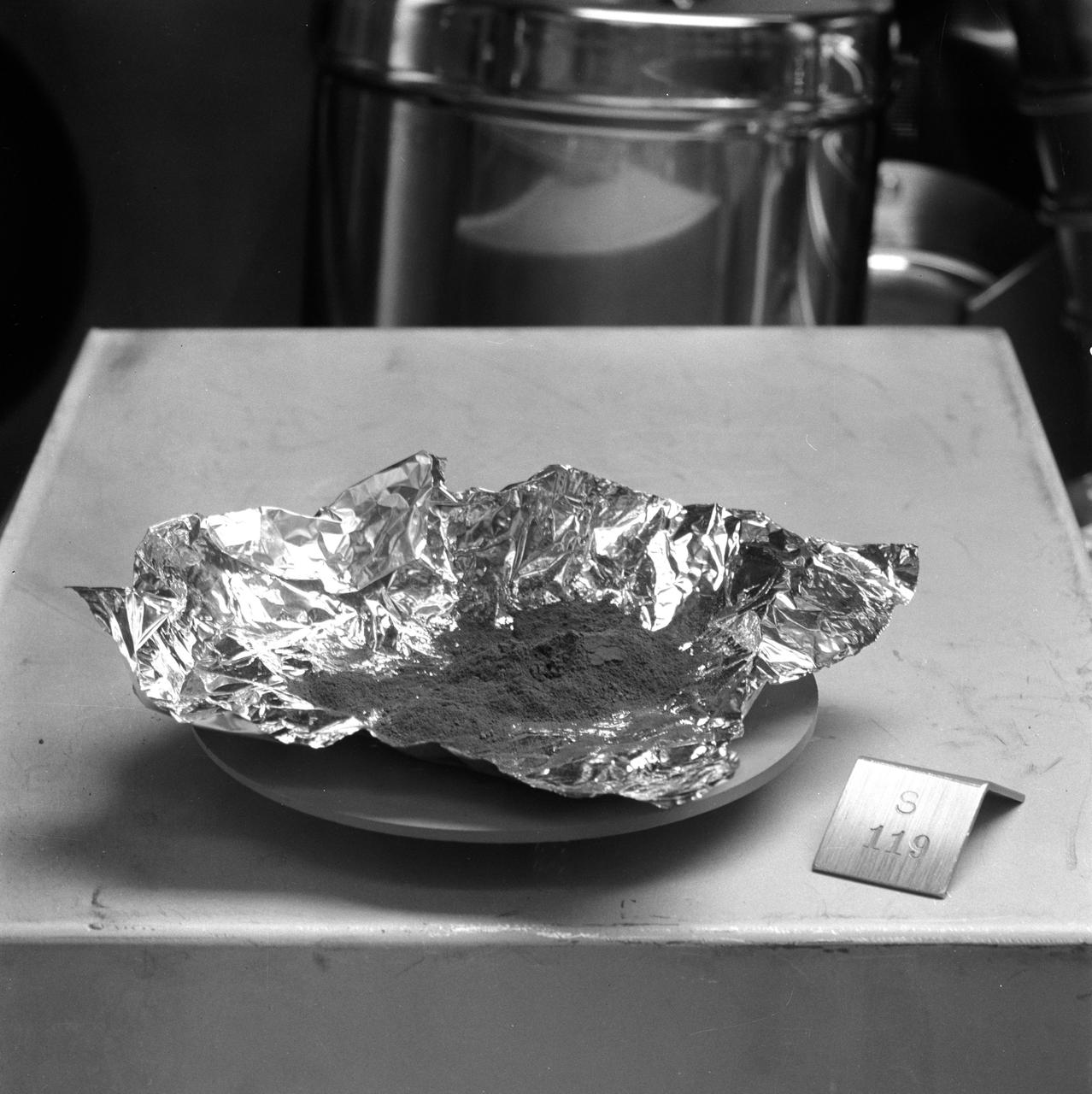
S71-19269 (12 Feb. 1971) --- A close-up view of Apollo 14 sample number 14414 & 14412, a fine lunar powder-like material under examination in the Sterile Nitrogen Atmospheric Processing (SNAP) line in the Lunar Receiving Laboratory (LRL) at the Manned Spacecraft Center (MSC). Scientists are currently making preliminary analyses of material brought back from the moon by the crew of Apollo 14 lunar landing mission.
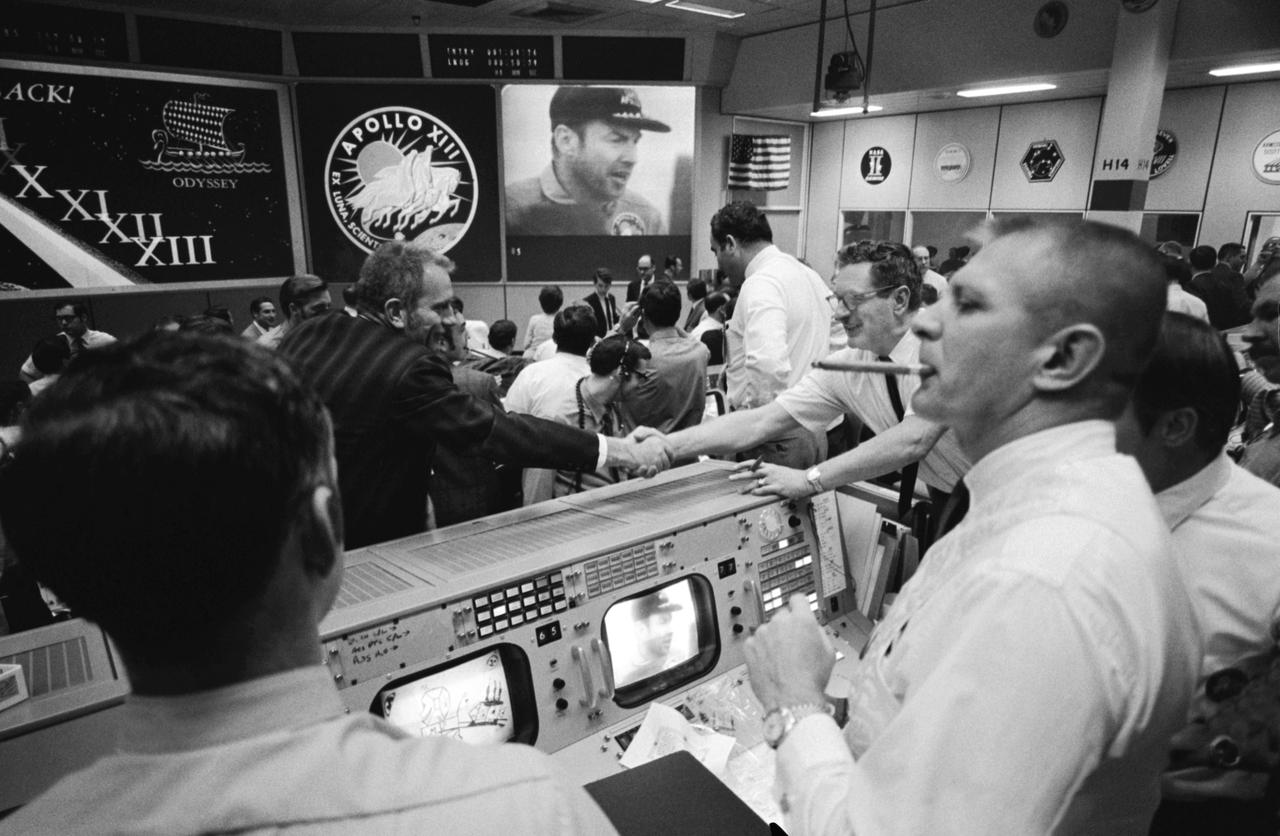
S70-35145 (17 April 1970) --- Overall view of Mission Operations Control Room in Mission Control Center at the Manned Spacecraft Center (MSC) during the ceremonies aboard the USS Iwo Jima, prime recovery ship for the Apollo 13 mission. Dr. Donald K. Slayton (in black shirt, left of center), director of Flight Crew Operations at MSC, and Chester M. Lee of the Apollo Program Directorate, Office of Manned Space Flight, NASA Headquarters, shake hands, while Dr. Rocco A. Petrone, Apollo program director, Office of Manned Space Flight, NASA Headquarters (standing, near Lee), watches the large screen showing astronaut James A. Lovell Jr., Apollo 13 commander, during the onboard ceremonies. In the foreground, Glynn S. Lunney (extreme left) and Eugene F. Kranz (smoking a cigar), two Apollo 13 flight directors, view the activity from their consoles.
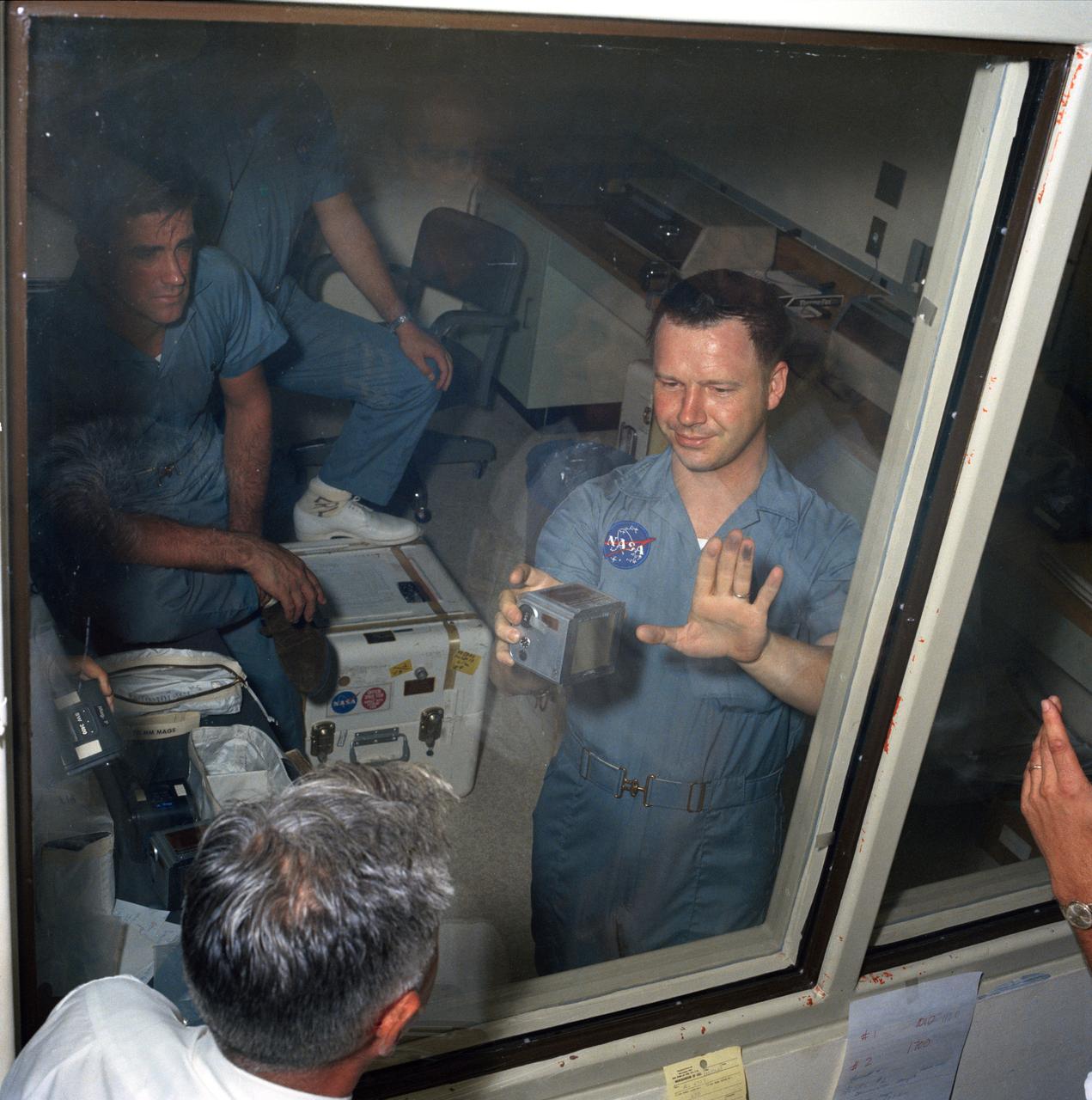
The first direct exposure to Lunar material for Crew Reception Personnel probably happened late Friday, 07/25/1969. Terry Slezak (displaying Moon dust on his left hand fingers), MSC photographic technician, was removing film magazines from the first of two (2) containers when the incident occurred. As he removed the plastic seal from Magazine "S", one of the 70mm magazines taken during Apollo XI Extravehicular Activity (EVA), it was apparent that the exterior of the cassette displayed traces of a black powdery substance. Apollo XI Commander Neil Armstrong reported during the mission that he had retrieved a 70mm cassette which had dropped to the Lunar surface. Seen in the backgound is John H. Boynton. ( S69-40054 ) MSC, Houston, TX
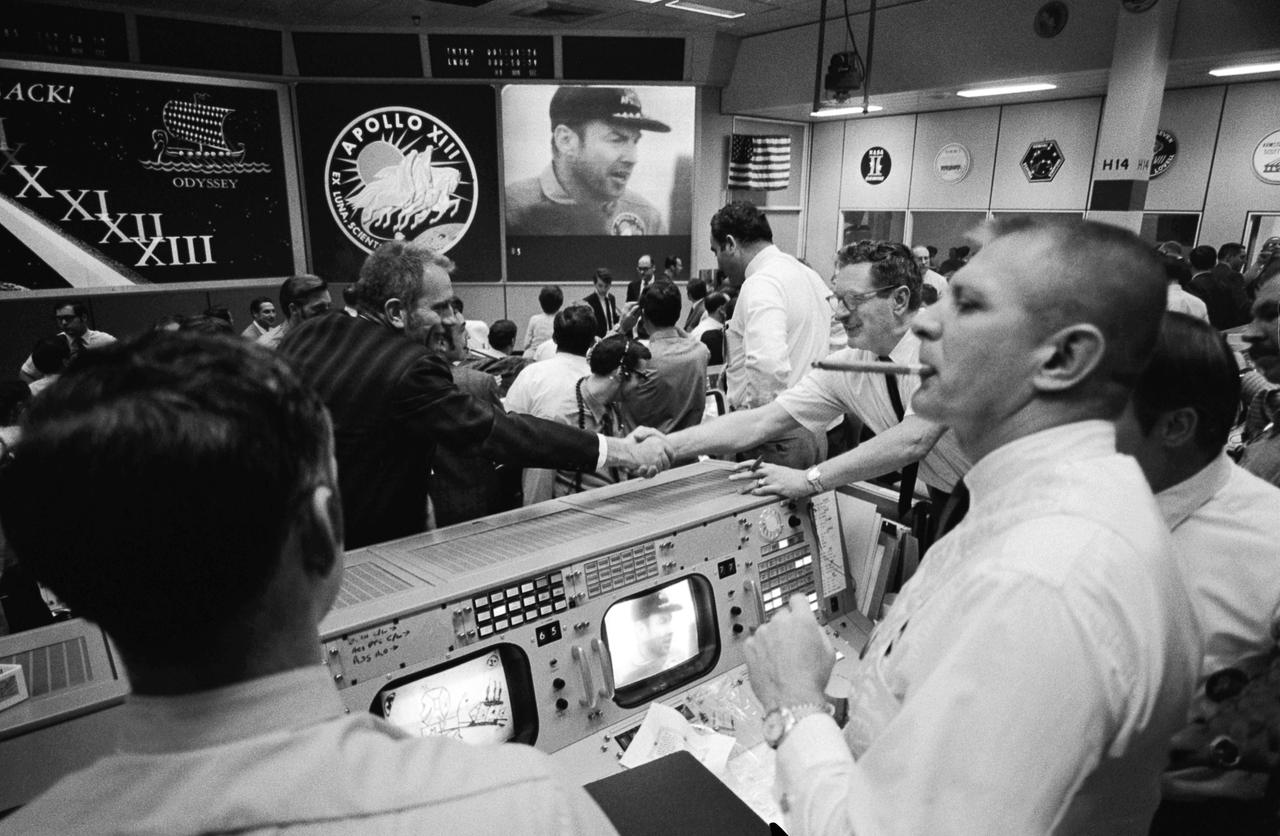
S70-35145 (17 April 1970) --- Overall view of Mission Operations Control Room in Mission Control Center at the Manned Spacecraft Center (MSC) during the ceremonies aboard the USS Iwo Jima, prime recovery ship for the Apollo 13 mission. Dr. Donald K. Slayton (in black shirt, left of center), director of Flight Crew Operations at MSC, and Chester M. Lee of the Apollo Program Directorate, Office of Manned Space Flight, NASA Headquarters, shake hands, while Dr. Rocco A. Petrone, Apollo program director, Office of Manned Space Flight, NASA Headquarters (standing, near Lee), watches the large screen showing astronaut James A. Lovell Jr., Apollo 13 commander, during the onboard ceremonies. In the foreground, Glynn S. Lunney (extreme left) and Eugene F. Kranz (smoking a cigar), two Apollo 13 flight directors, view the activity from their consoles.
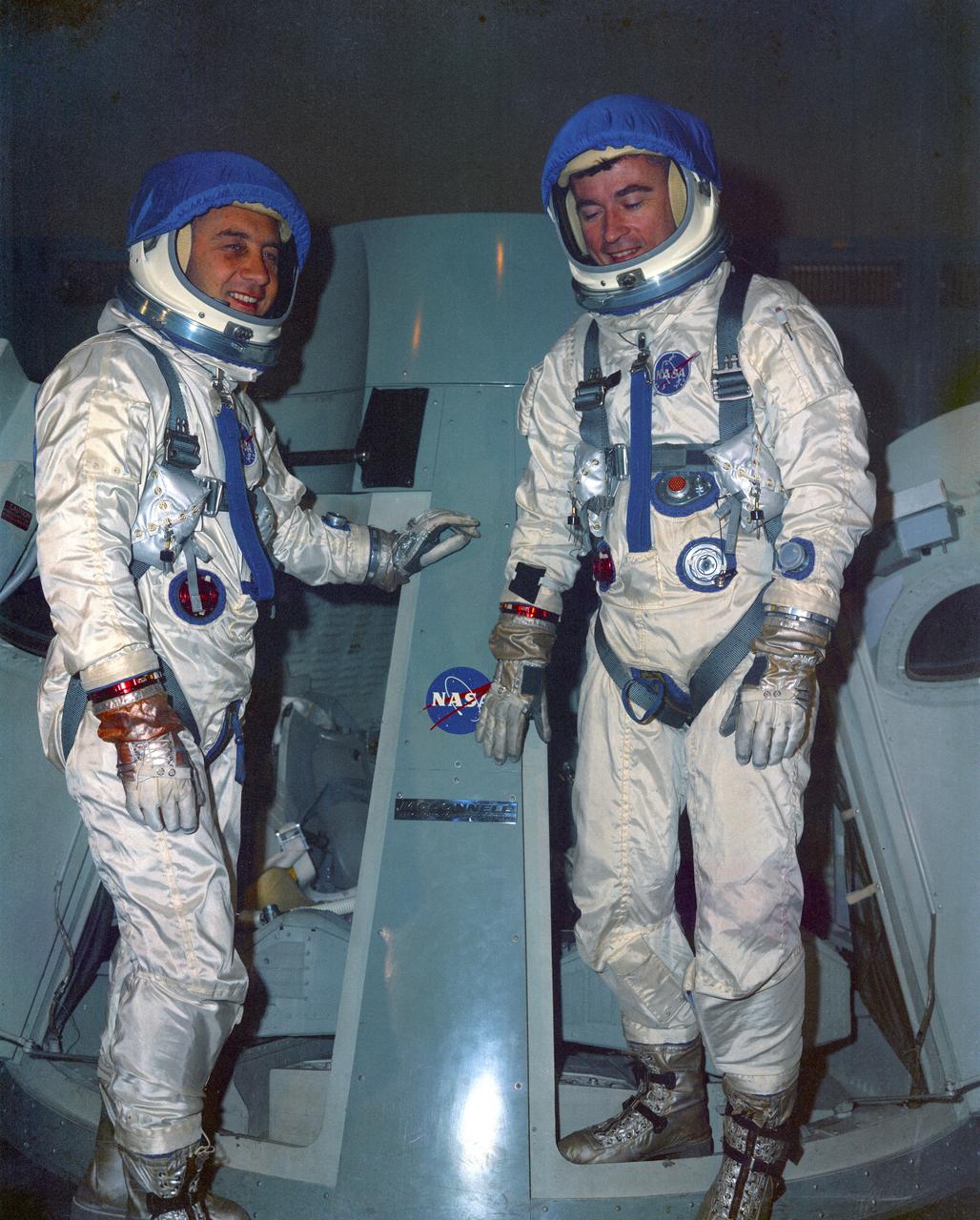
Seen in this view left to right Astronauts Virgil I. Grissom and John Young stand in front of Gemini trainer prior to test, MCC. MSC, HOUSTON, TX CN
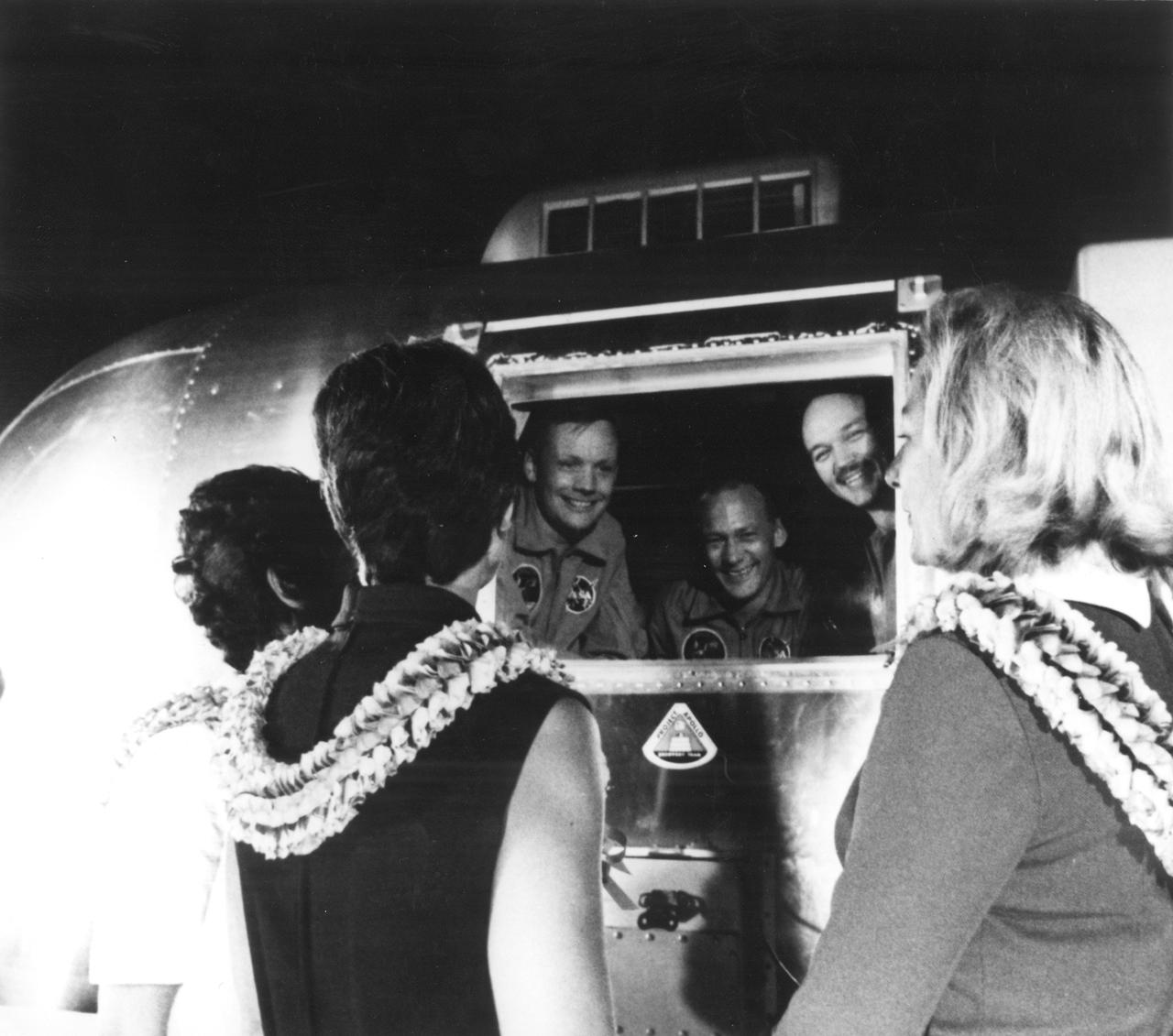
The Apollo 11 mission, the first manned lunar mission, launched from the Kennedy Space Center, Florida via the Marshall Space Flight Center (MSFC) developed Saturn V launch vehicle on July 16, 1969 and safely returned to Earth on July 24, 1969. Aboard the space craft were astronauts Neil A. Armstrong, commander; Michael Collins, Command Module (CM) pilot; and Edwin E. Aldrin Jr., Lunar Module (LM) pilot. The CM, piloted by Michael Collins remained in a parking orbit around the Moon while the LM, named “Eagle’’, carrying astronauts Neil Armstrong and Edwin Aldrin, landed on the Moon. During 2½ hours of surface exploration, the crew collected 47 pounds of lunar surface material for analysis back on Earth. The recovery operation took place in the Pacific Ocean where Navy para-rescue men recovered the capsule housing the 3-man Apollo 11 crew. The crew was airlifted to safety aboard the U.S.S. Hornet, where they were quartered in a Mobile Quarantine Facility (MQF) which served as their home until they reached the NASA Manned Spacecraft Center (MSC) Lunar Receiving Laboratory in Houston, Texas. On arrival at Ellington Air Force base near the MSC, the crew, still under a 21 day quarantine in the MQF are greeted by their wives. Looking out of the facility are (L-R) Armstrong, Aldrin, and Collins. Wives are (L-R) Pat Collins, Jan Armstrong, and Joan Aldrin.
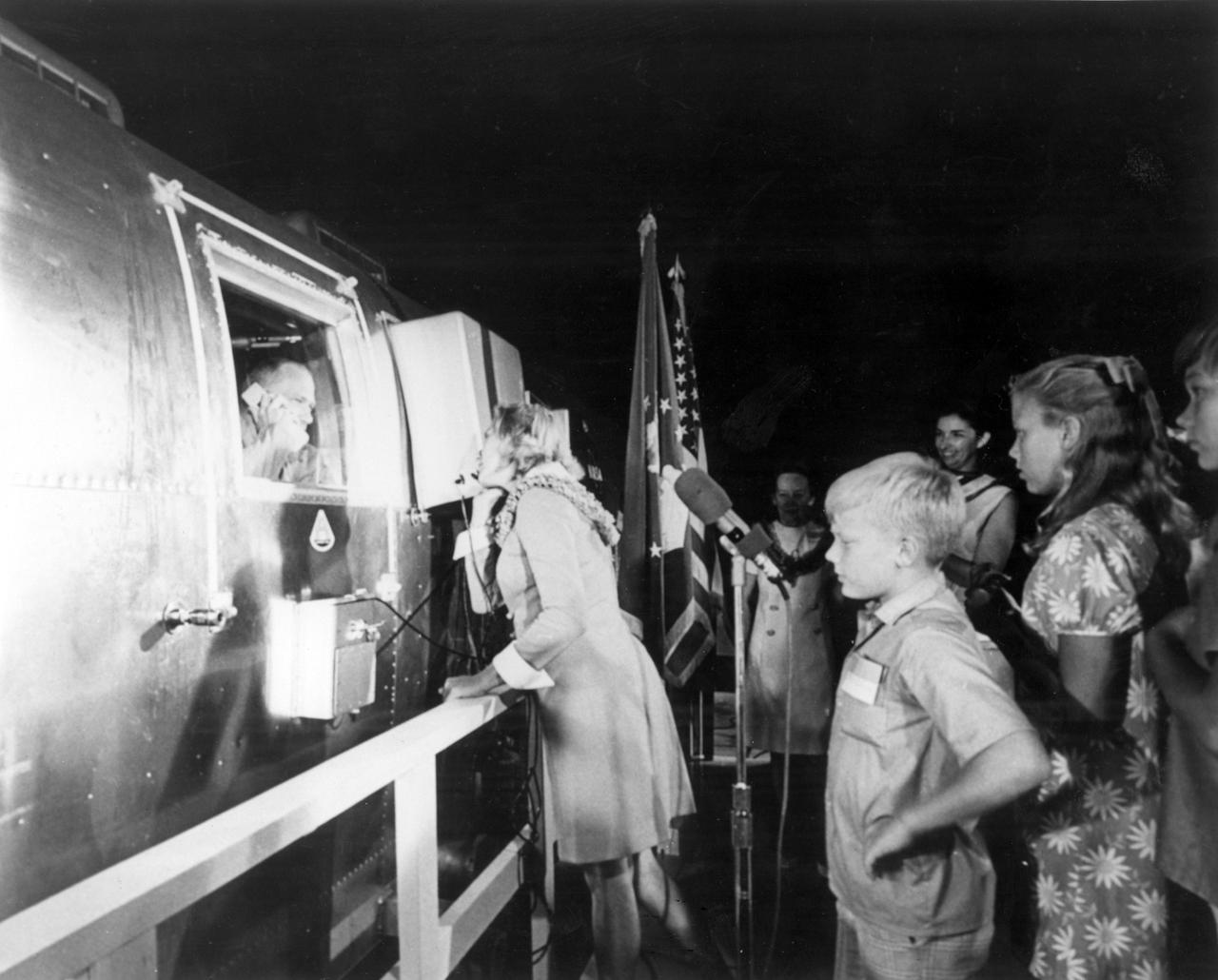
The Apollo 11 mission, the first manned lunar mission, launched from the Kennedy Space Center, Florida via the Marshall Space Flight Center (MSFC) developed Saturn V launch vehicle on July 16, 1969 and safely returned to Earth on July 24, 1969. Aboard the space craft were astronauts Neil A. Armstrong, commander; Michael Collins, Command Module (CM) pilot; and Edwin E. (Buzz) Aldrin Jr., Lunar Module (LM) pilot. The CM, piloted by Michael Collins remained in a parking orbit around the Moon while the LM, named “Eagle’’, carrying astronauts Neil Armstrong and Edwin Aldrin, landed on the Moon. During 2½ hours of surface exploration, the crew collected 47 pounds of lunar surface material for analysis back on Earth. The recovery operation took place in the Pacific Ocean where Navy para-rescue men recovered the capsule housing the 3-man Apollo 11 crew. The crew was airlifted to safety aboard the U.S.S. Hornet, where they were quartered in a Mobile Quarantine Facility (MQF) which served as their home until they reached the NASA Manned Spacecraft Center (MSC) Lunar Receiving Laboratory in Houston, Texas. On arrival at Ellington Air Force base near the MSC, the crew, still under a 21 day quarantine in the MQF, were greeted by their wives. Pictured here is Joan Aldrin, wife of Buzz Aldrin, speaking with her husband via telephone patch.
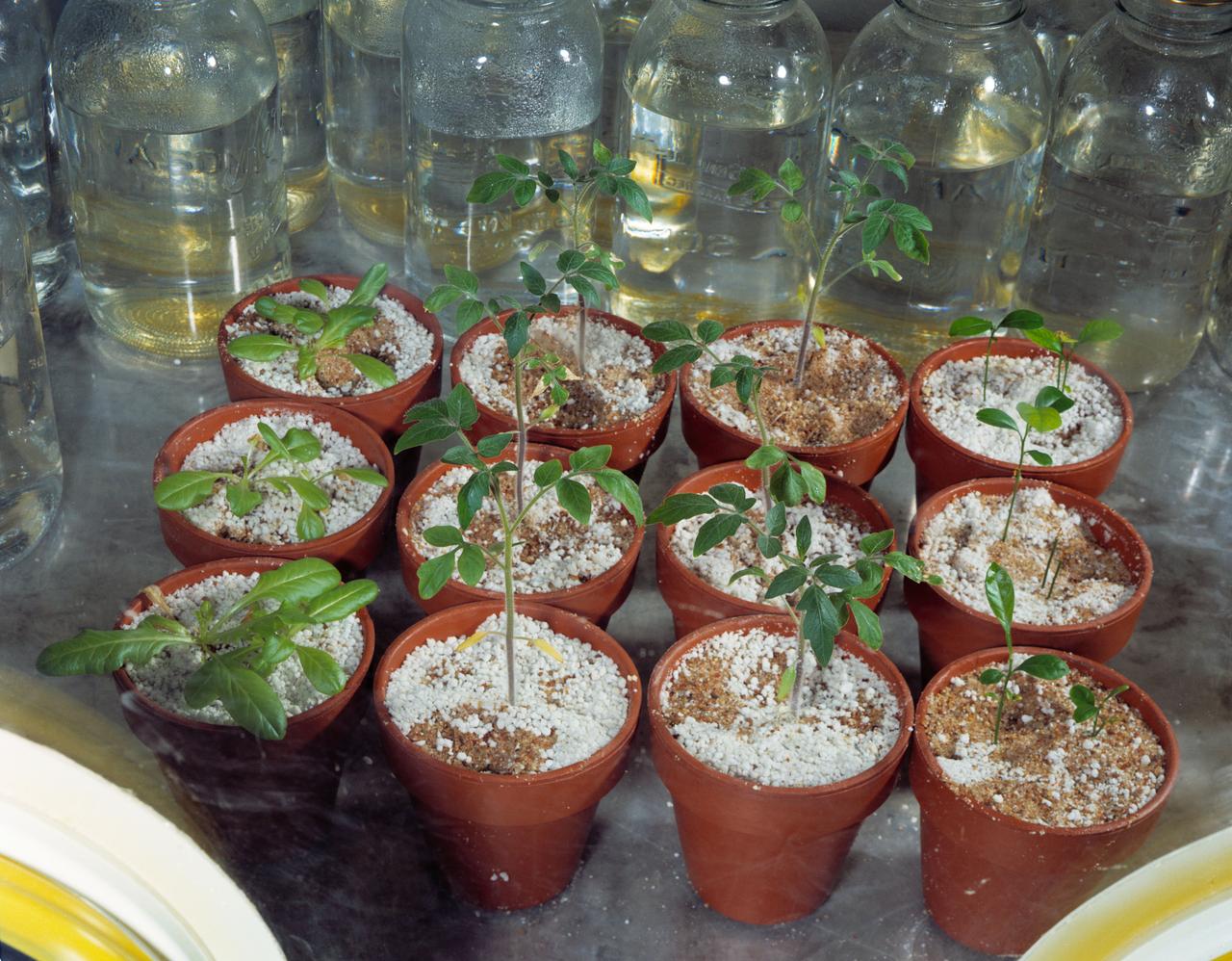
S71-51318 (1 Oct. 1971) --- A close view of germ free plants -- lettuce (left), tomato (right center and left center) and citrus (right). This type of testing is a unique effort at the Manned Spacecraft Center (MSC) to grow germ-free plants. By study of the germ-free plants, NASA and the U.S. Department of Agriculture Forest Service hope to establish clearly the exact mineral needs of the plants alone. Previous nutrition studies have measured the needs of a complex of soil:micro-organisms:plants. Results from studies where the role of microbes is not known or defined are difficult to interpret and do not lead to the accumulation of exacting facts on plant nutrition.
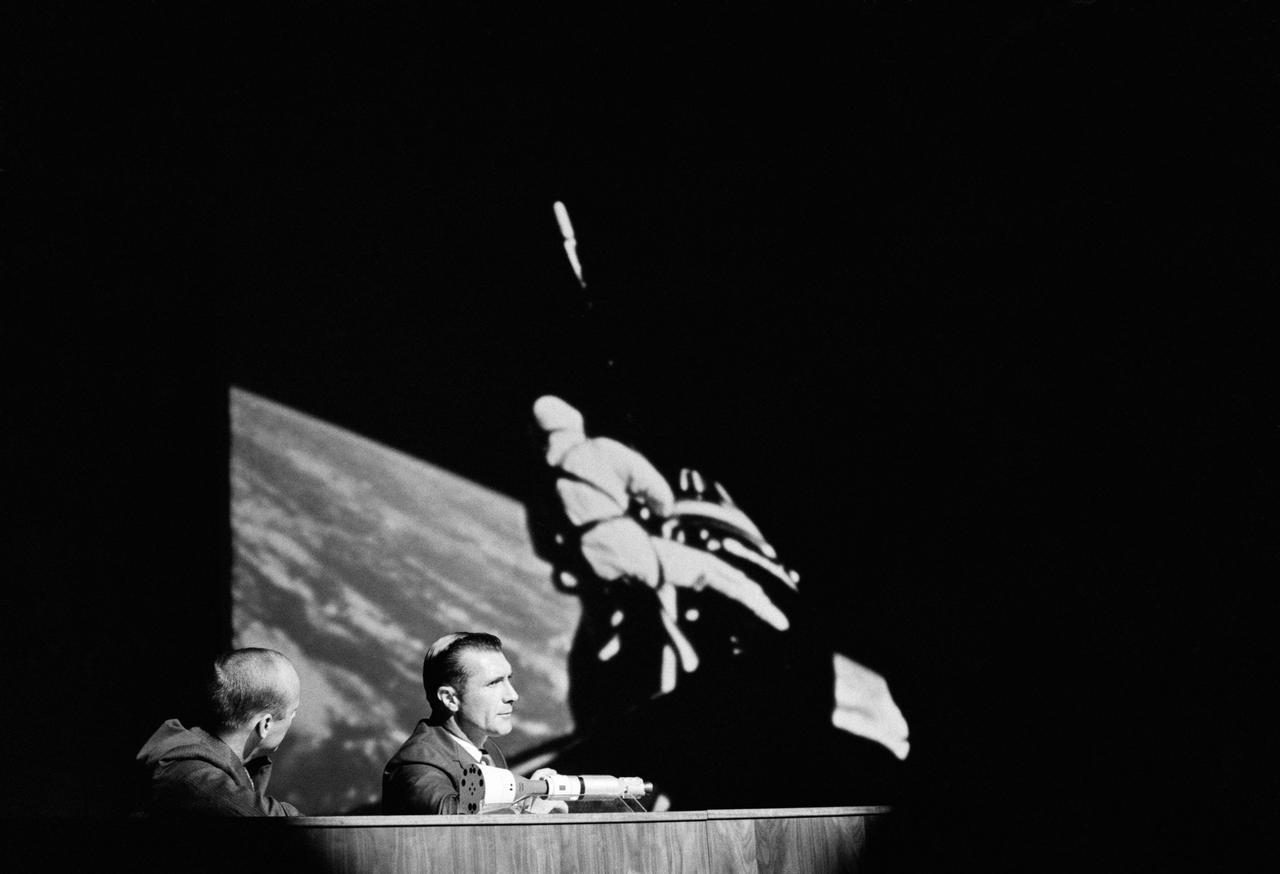
S66-45605 (26 Sept. 1966) --- Movie film of the Gemini-11 extravehicular activity and rendezvous with the Agena Target Docking Vehicle was shown at the Gemini-11 press conference in the MSC Building 1 auditorium. Astronauts Charles Conrad Jr. (left), command pilot, and Richard F. Gordon Jr., pilot, discussed the Gemini-11 EVA and rendezvous mission during the film. Picture on screen shows close-up of astronaut Gordon connecting the Agena Target Vehicle to the spacecraft with a tether line during his spacewalk. Photo credit: NASA
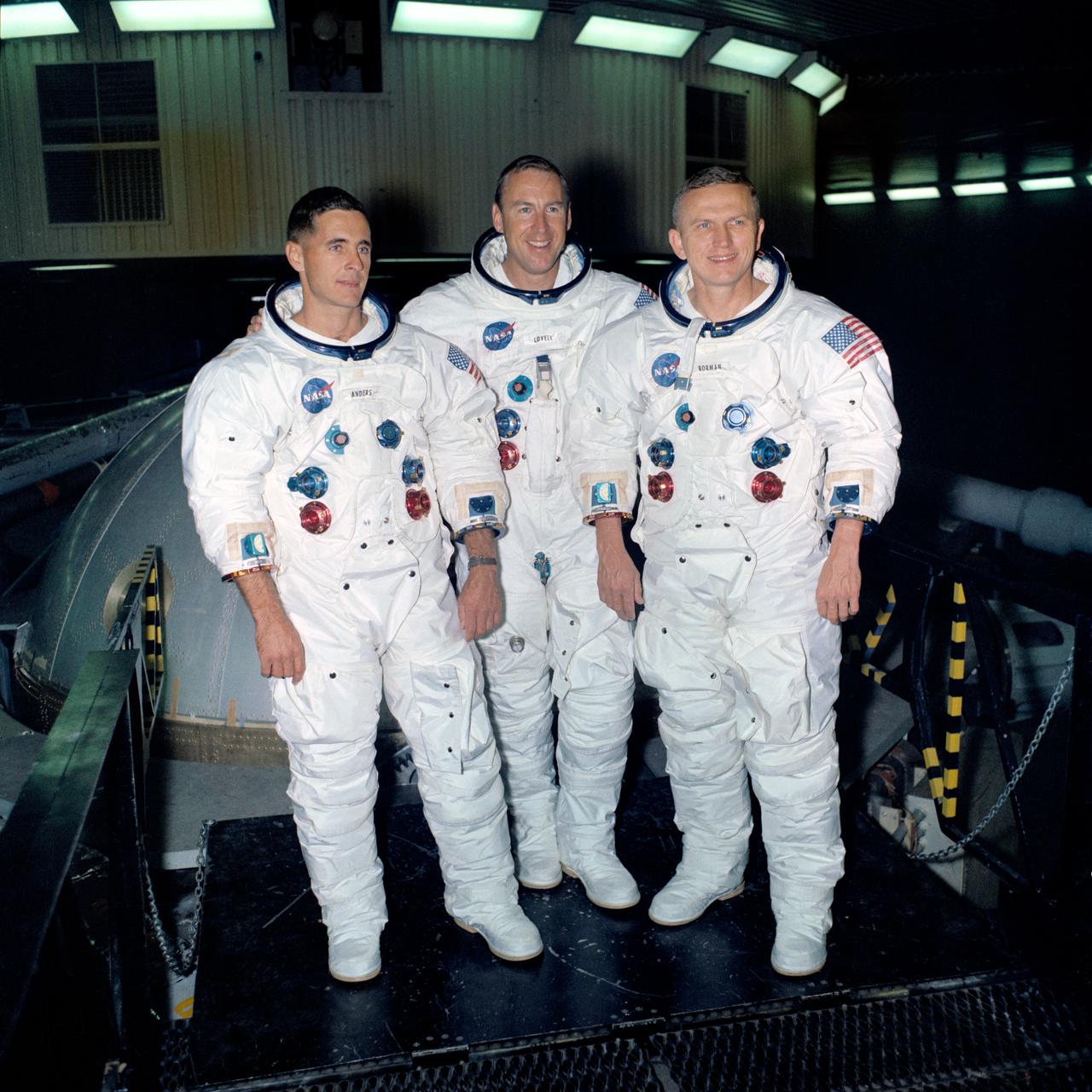
S68-53187 (1 Nov. 1968) --- The prime crew of the Apollo 8 lunar orbit mission stands beside the gondola in Building 29 after suiting up for centrifuge training in the Manned Spacecraft Center's (MSC) Flight Acceleration Facility (FAF). Left to right, are astronauts William A. Anders, lunar module pilot; James A. Lovell Jr., command module pilot; and Frank Borman, commander.
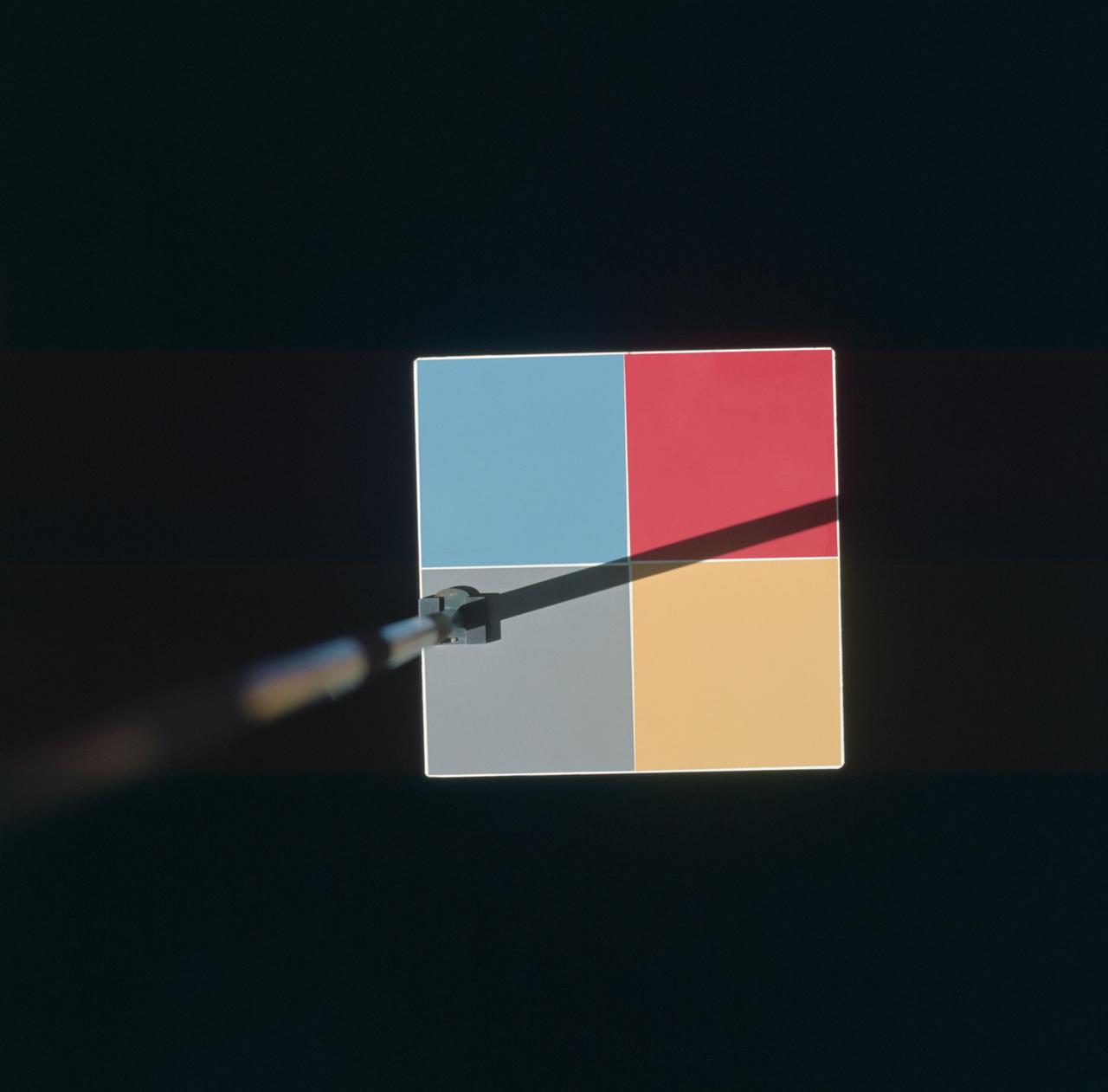
S66-46025 (18 July 1966) --- Astronaut Michael Collins, Gemini-10 pilot, photographed this MSC-8 color patch outside the spacecraft during the Gemini-10/Agena docking mission. The experiment was for the purpose of showing what effect the environment of space will have upon the color photography taken in cislunar space and on the lunar surface during an Apollo mission. Photo credit: NASA
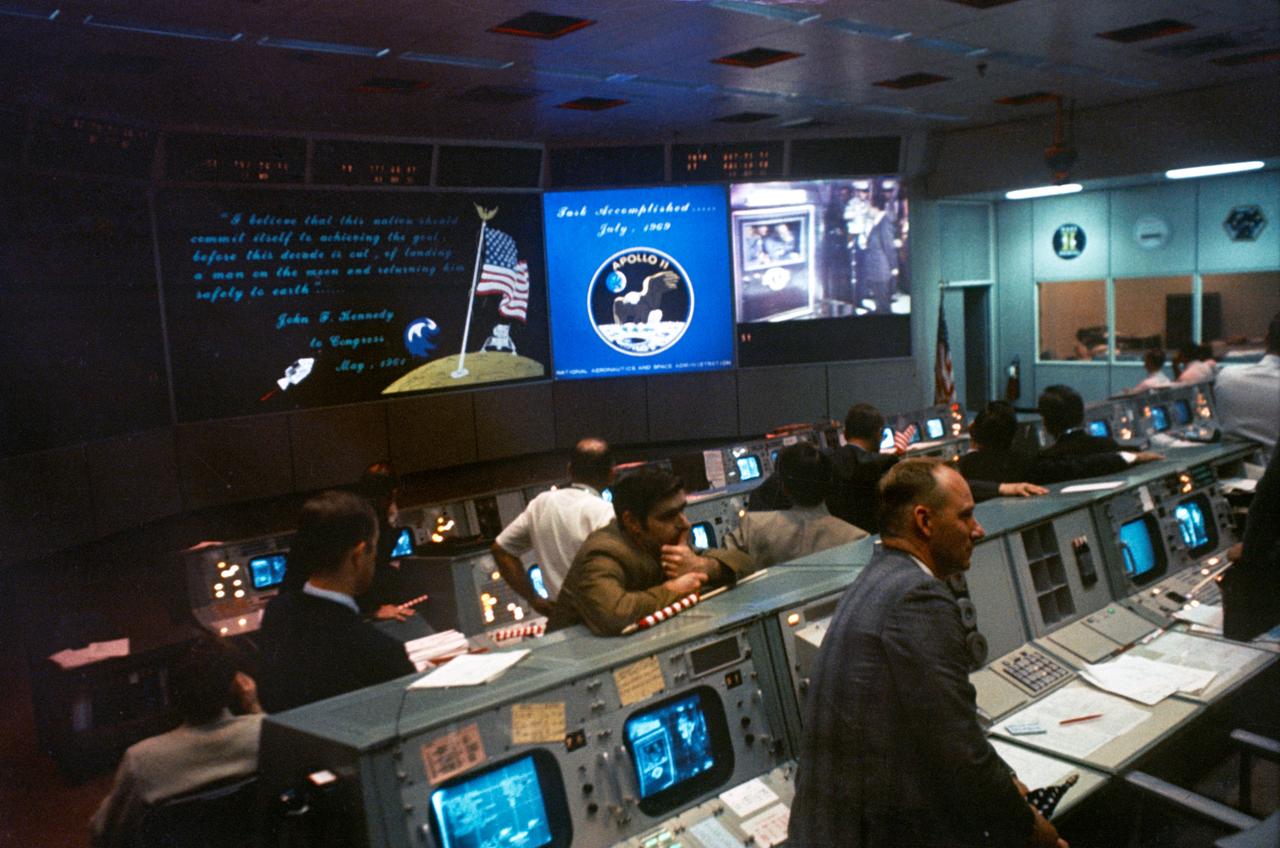
S69-40301 (24 July 1969) --- Overall view of the Mission Operations Control Room (MOCR) in the Mission Control Center (MCC), Building 30, Manned Spacecraft Center (MSC), at the conclusion of the Apollo 11 lunar landing mission. The television monitor shows President Richard M. Nixon greeting the Apollo 11 astronauts aboard the USS Hornet in the Pacific recovery area. Astronauts Neil A. Armstrong, Michael Collins, and Edwin E. Aldrin Jr. are inside the Mobile Quarantine Facility (MQF).
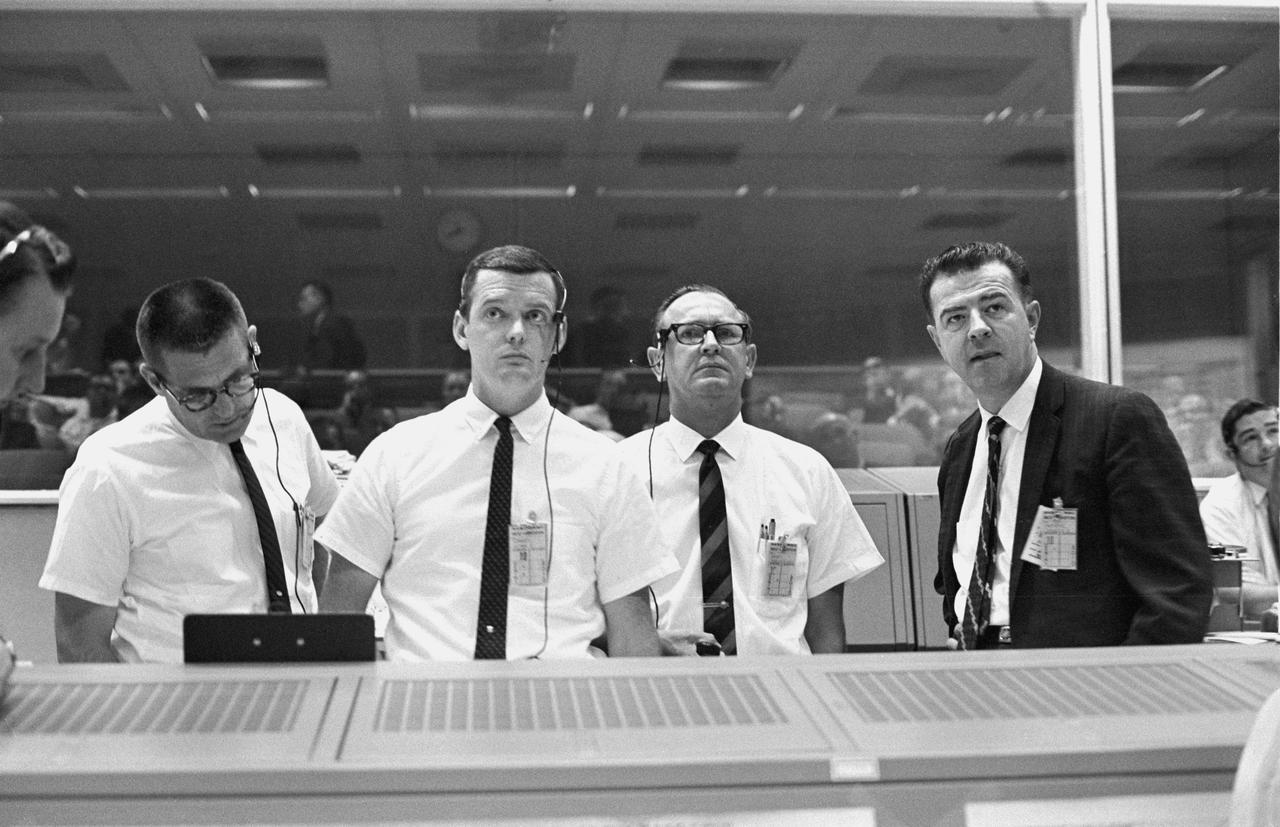
S66-43377 (18 July 1966) --- Standing at the flight director's console, viewing the Gemini-10 flight display in the Mission Control Center, are (left to right) William C. Schneider, Mission Director; Glynn Lunney, Prime Flight Director; Christopher C. Kraft Jr., MSC Director of Flight Operations; and Charles W. Mathews, Manager, Gemini Program Office. Photo credit: NASA
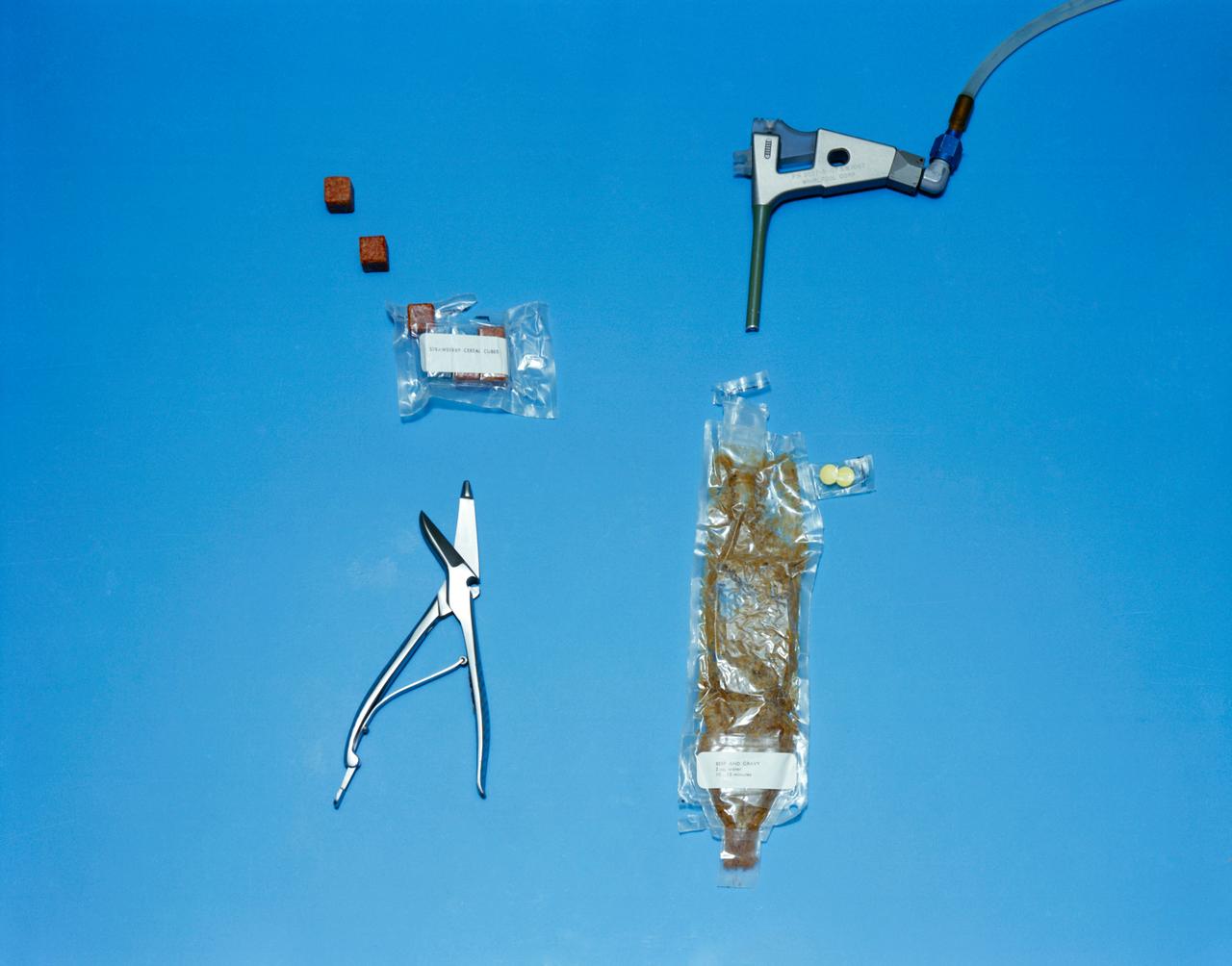
Food packages of beef and gravy fully reconstituted and ready to eat. An astronaut would squeeze food through opening at right side of package. Water gun is used to reconstitute dehydrated food. Scissors are used to open packages. This is the type of space food which will be used on the Gemini-Titan 4 spaceflight. MSC, Houston, TX *S65-24895 thru S65-24899
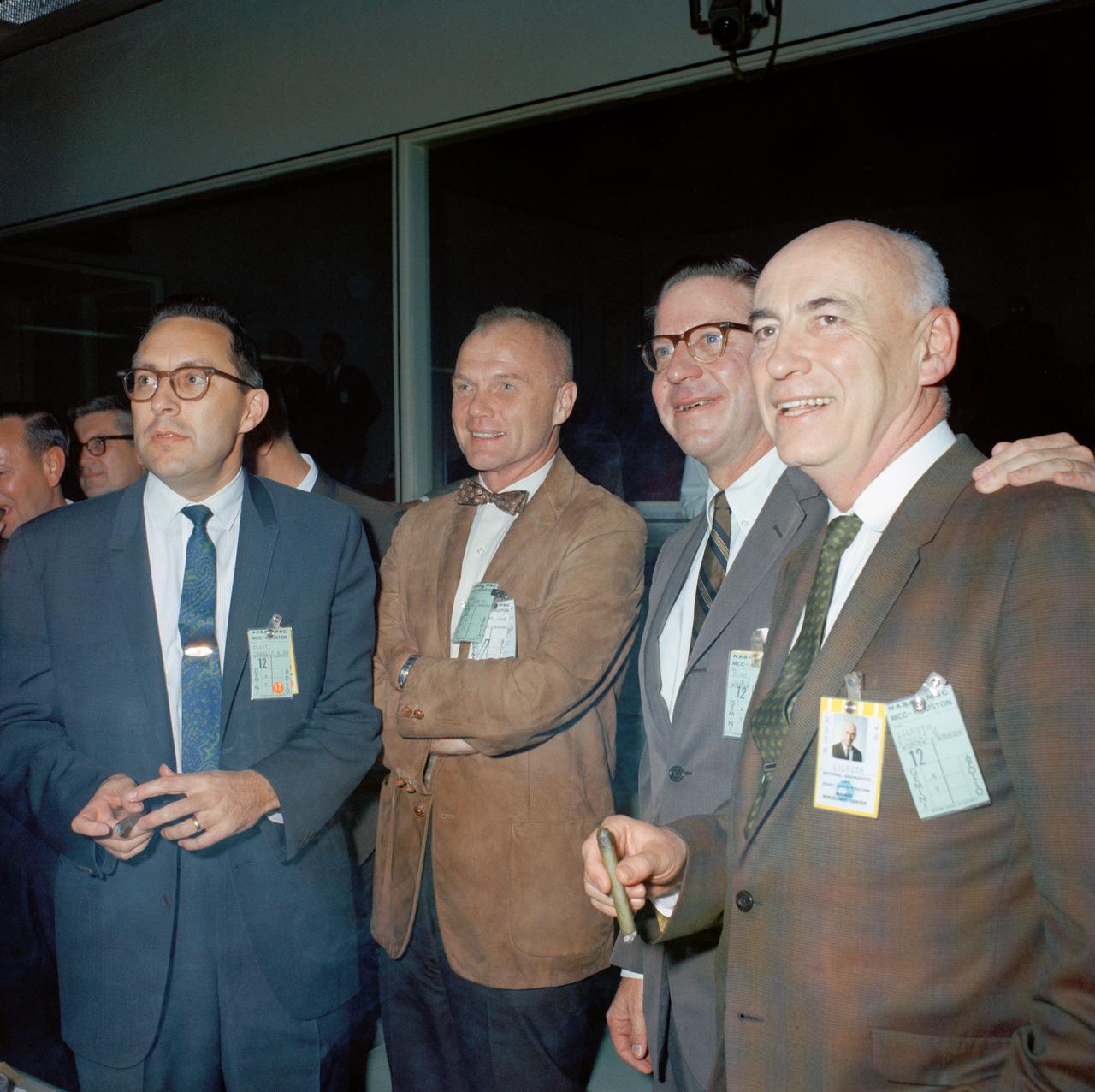
S66-64884 (15 Nov. 1966) --- Watching console activity in the Mission Control Center in Houston during the Gemini-12 splashdown (left to right), are Dr. Charles A. Berry, Director of Medical Research and Operations; astronaut John H. Glenn Jr.; James C. Elms, Director, NASA Electronics Research Center; and Dr. Robert R. Gilruth, Manned Spaceflight Center (MSC) Director. Photo credit: NASA
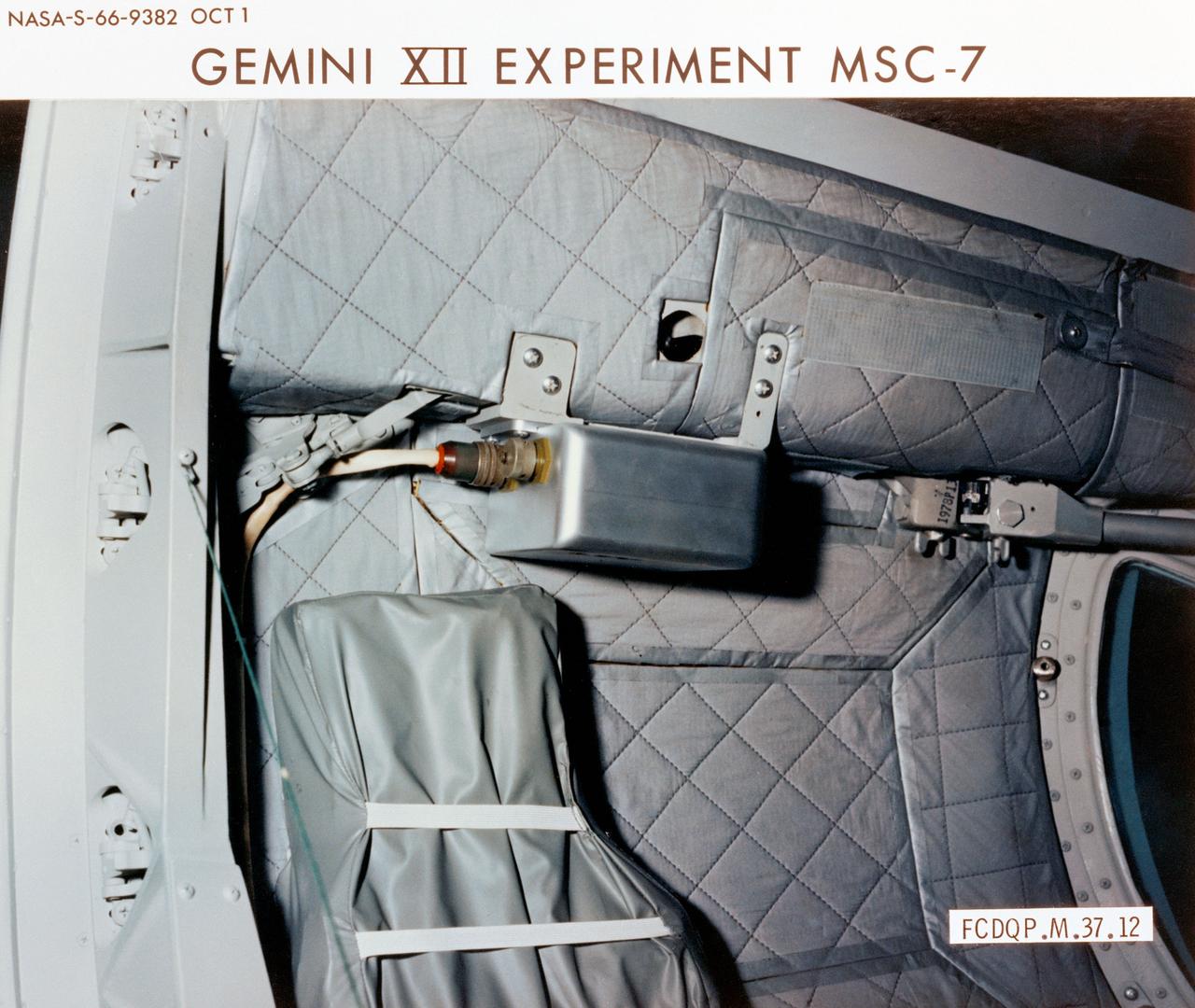
S66-09382 (1 Oct. 1966) --- Gemini-12 Experiment MSC-7 Bremsstrahlung Spectrometer-Spectrometer Analyzer processor installed in cabin. Objective of experiment is to determine the gamma and beta flux and energy spectra induced inside the spacecraft by exterior electrons. Photo credit: NASA
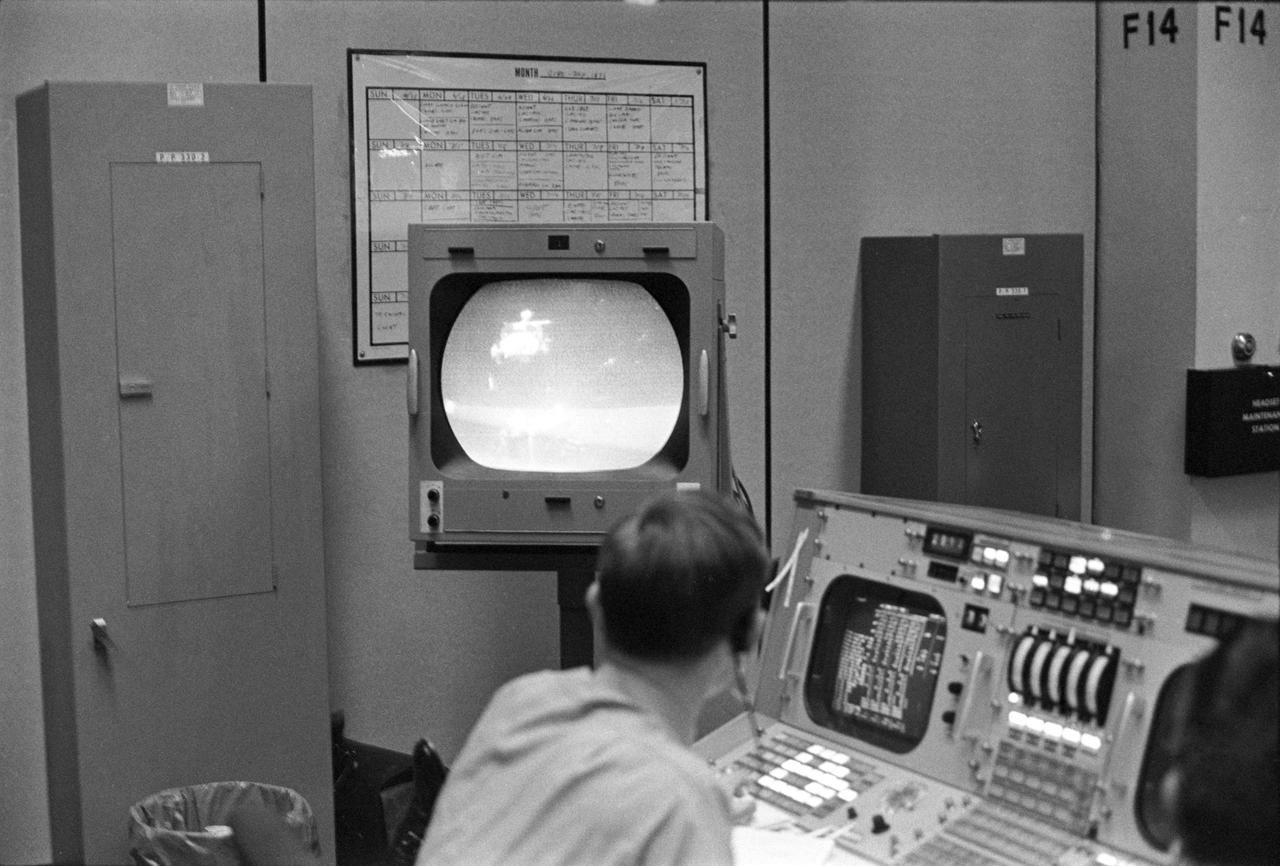
View of a photograph of the television (TV) monitor in the MCC showing a picture being transmitted from the color TV camera mounted on the parked Lunar Roving Vehicle (LRV) at the Hadley-Apennine Landing Site showing the liftoff of the Apollo 15 Lunar Module (LM) Ascent Stage from the Lunar surface. MSC, Houston, TX
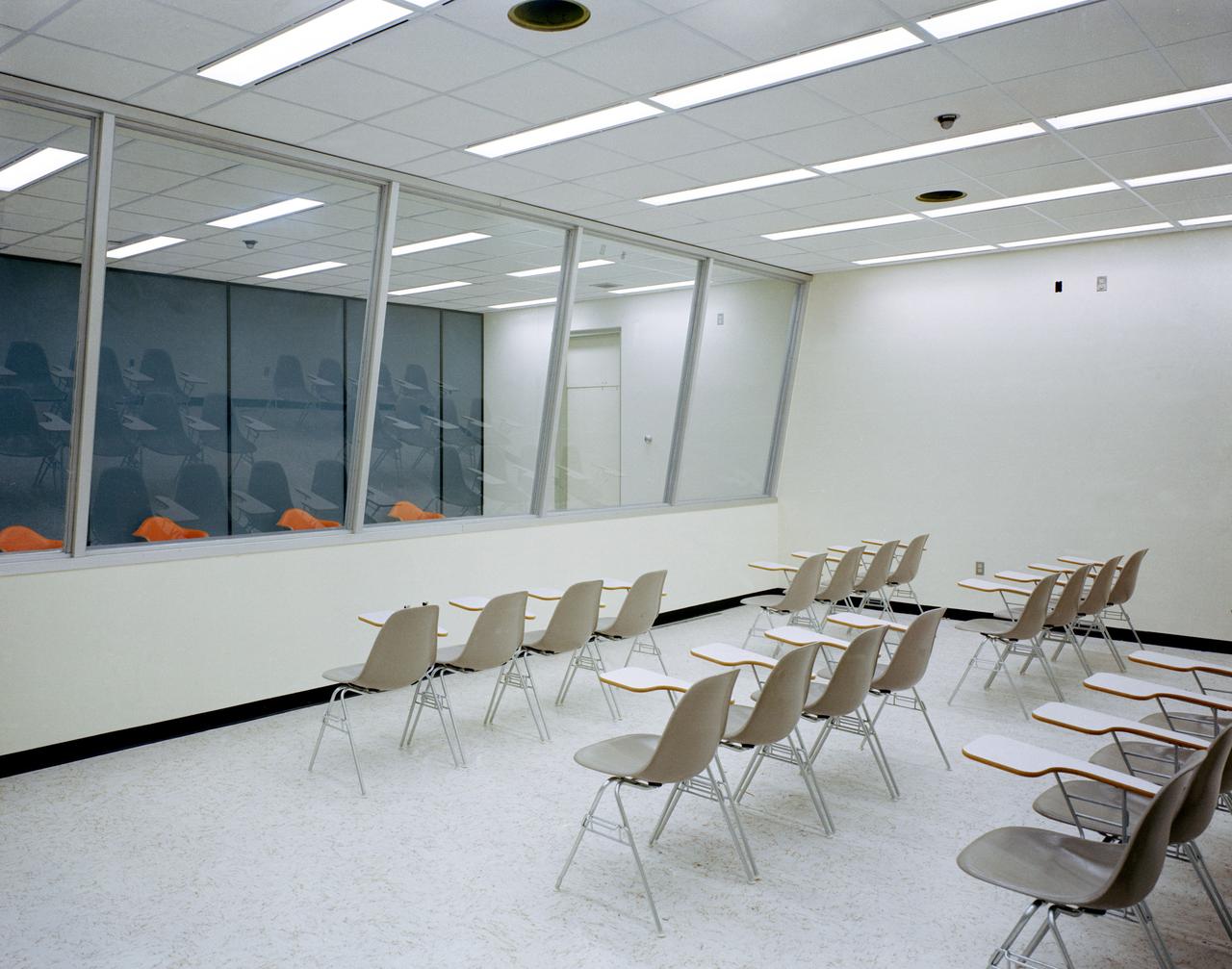
Room 190 of the Support and Administrative Facilities, CRA, LRL, Bldg 37. The room is a debriefing room which facilitates indirect contact with the Astronauts and CRA Medical Staff during quarantine periods. Also called the Press Room. MSC, Houston, TX
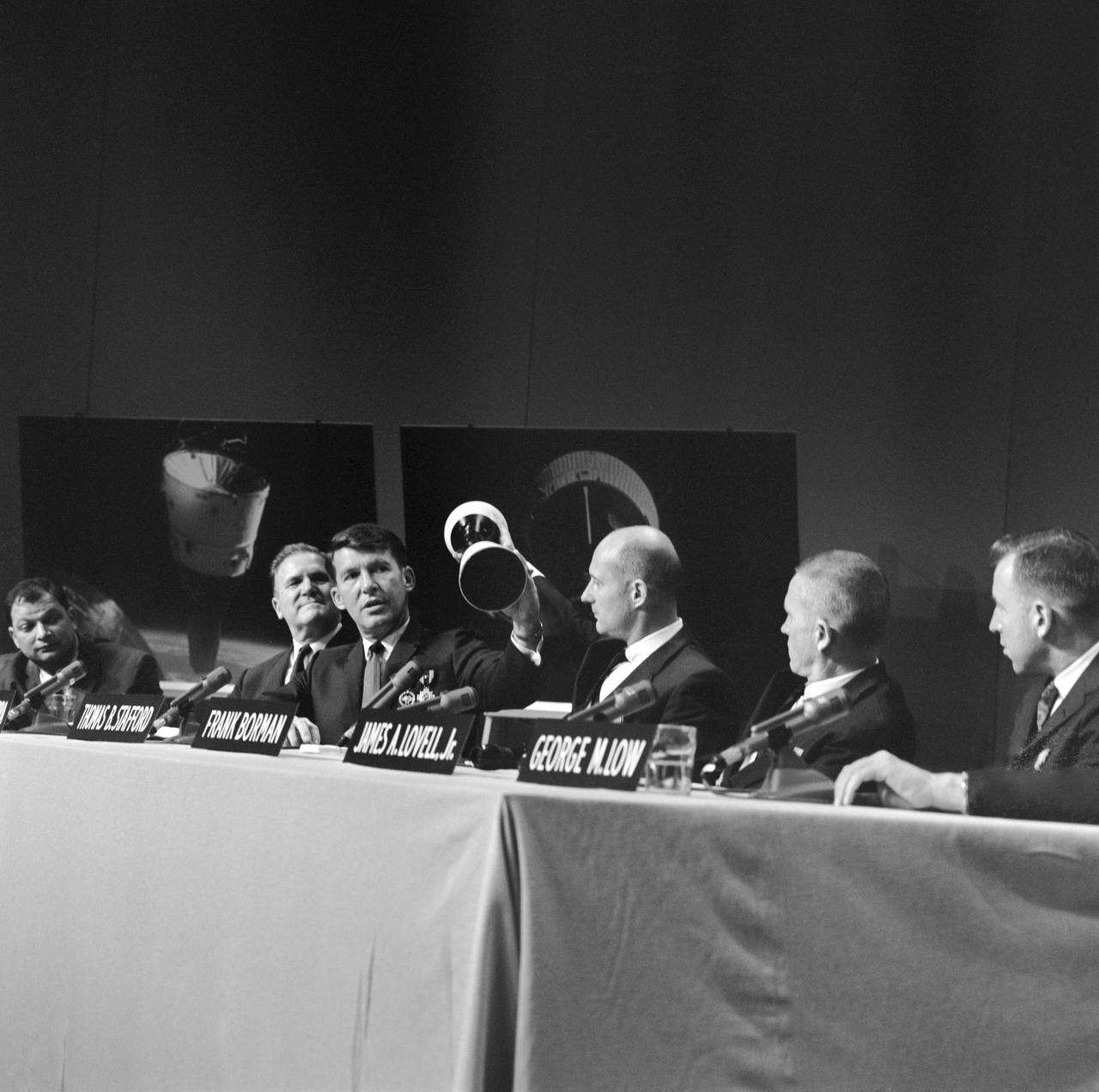
S66-15044 (3 Jan. 1966) --- View of the Gemini 6 and 7 press conference. From right to left are NASA Administrator James E. Webb; MSC Deputy Director George M. Low; and astronauts James A. Lovell Jr., Frank Borman, Thomas B. Stafford and Walter M. Schirra. Photo credit: NASA
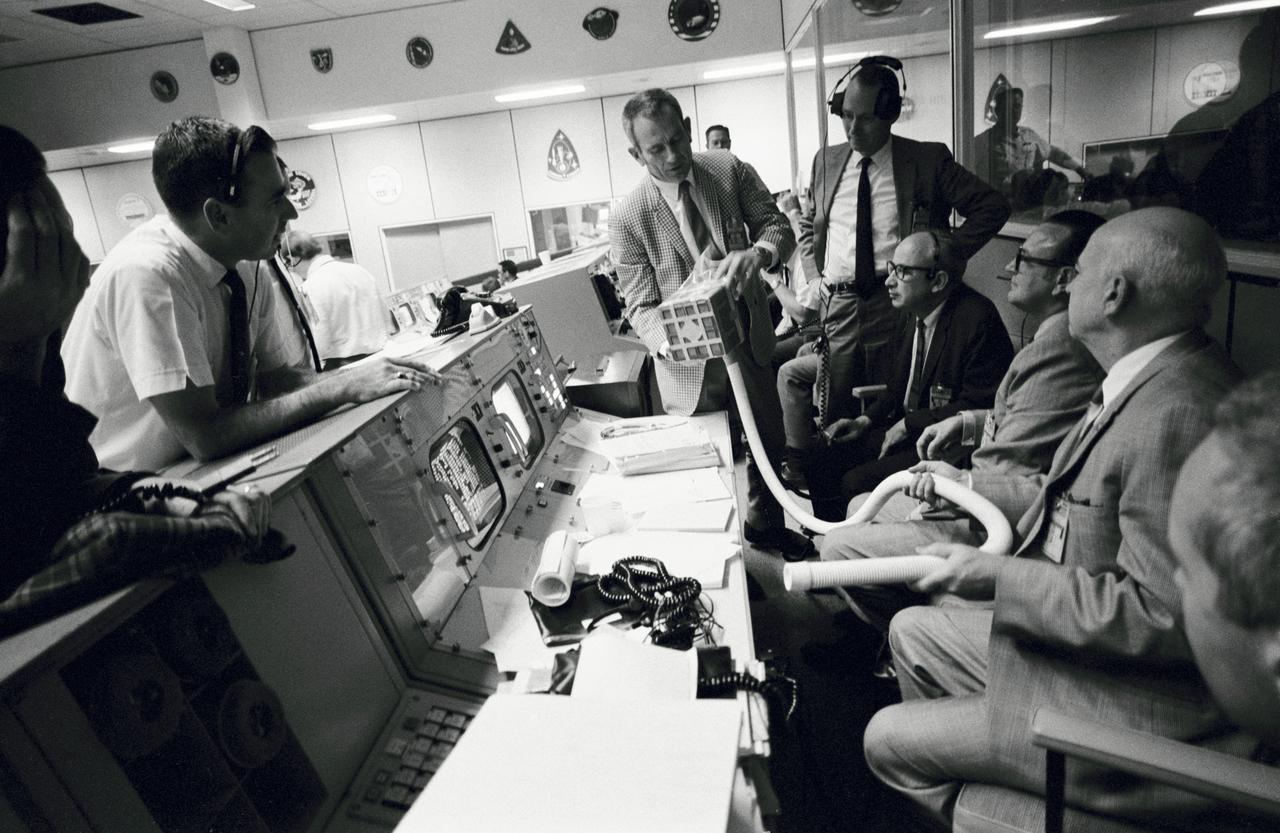
S70-35013 (15 April 1970) --- Prototype of the "mail box" constructed at the Manned Spacecraft Center (MSC) to remove carbon dioxide from the Apollo 13 Command Module (CM) is displayed in the Mission Control Center (MCC). The "mail box" was constructed when it became apparent CO2 was prevalent in the CM and the spacecraft's lithium hydroxide system was not removing it sufficiently. A space suit exhaust hose is connected to a lithium hydroxide canister to purge the cabin air. There are 16 such canisters in the CM and each will last approximately 12 hours. Looking at the "mail box" are (from the left): Milton L. Windler, shift 1 flight director; Dr. Donald K. (Deke) Slayton, director of flight crew operations, MSC; Howard W. Tindall, deputy director, flight operations, MSC; Sigurd A. Sjoberg, director, flight operations, MSC; Dr. Christopher C. Kraft, deputy director, MSC; and Dr. Robert R. Gilruth, director, MSC.
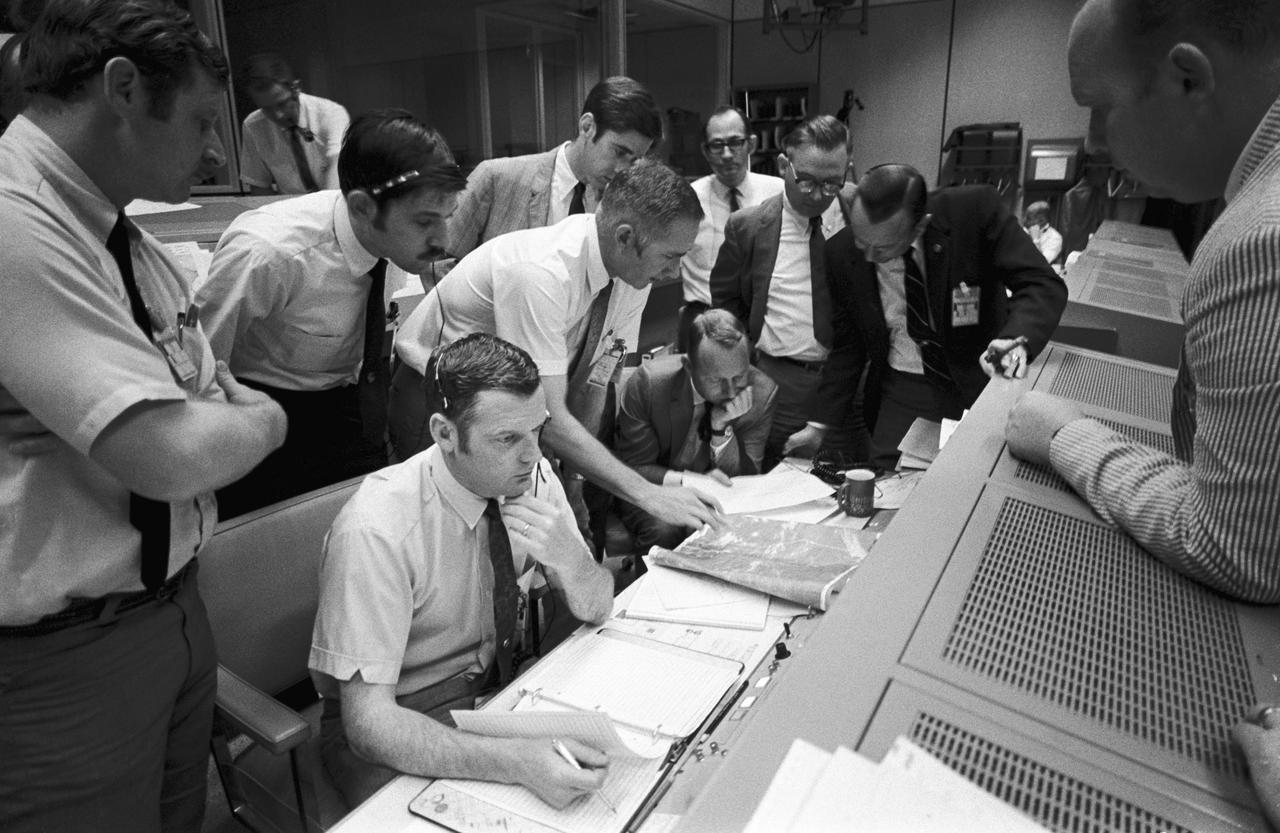
S70-35014 (15 April 1970) --- A group of flight controllers gathers around the console of Glenn S. Lunney (seated, nearest camera), Shift 4 flight director, in the Mission Operations Control Room (MOCR) of Mission Control Center (MCC), located in Building 30 at the Manned Spacecraft Center (MSC). Their attention is drawn to a weather map of the proposed landing site in the South Pacific Ocean. Among those looking on is Dr. Christopher C. Kraft, deputy director, MSC, standing in black suit, on right. When this photograph was taken, the Apollo 13 lunar landing mission had been canceled, and the problem-plagued Apollo 13 crew members were in trans-Earth trajectory attempting to bring their crippled spacecraft back home.
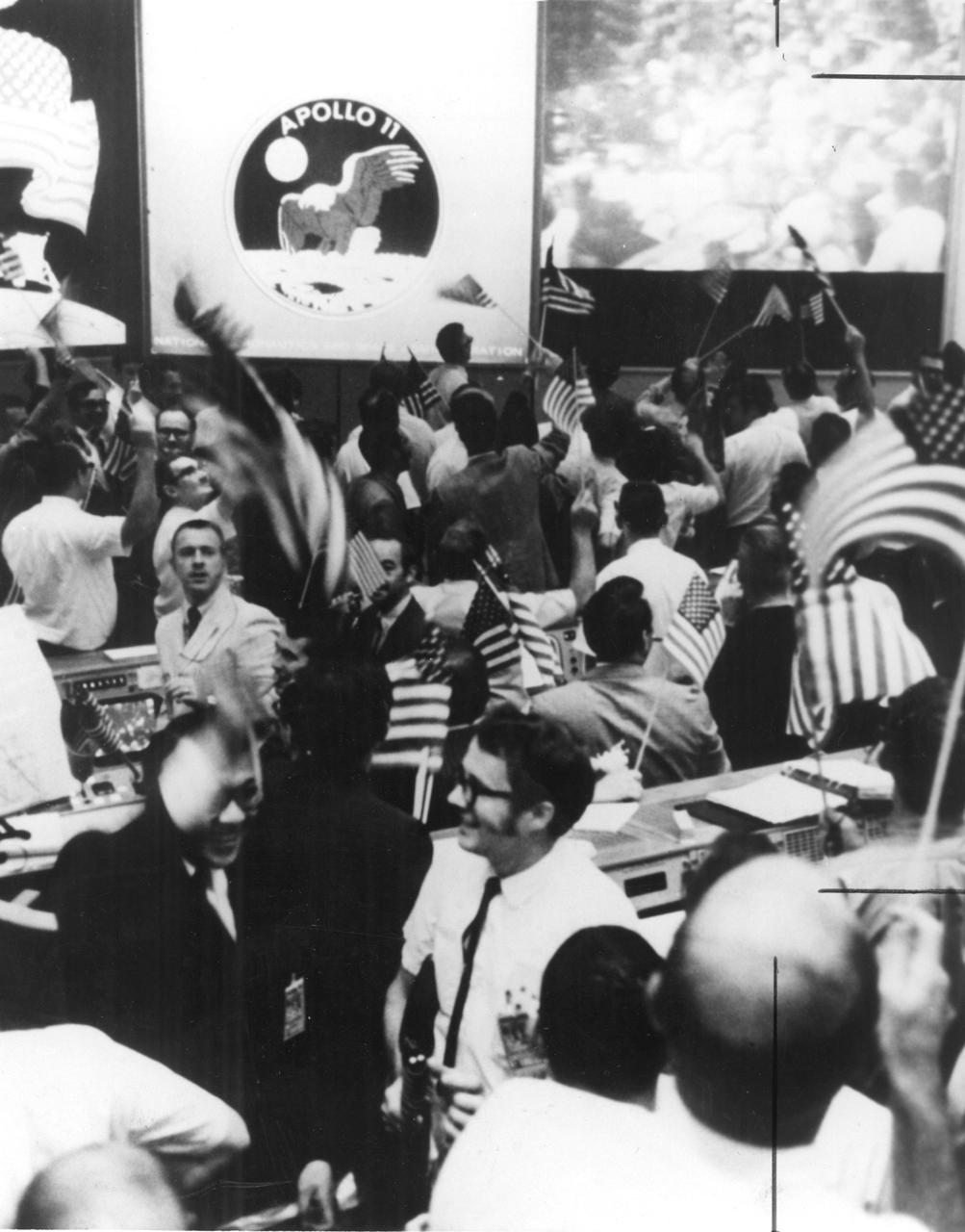
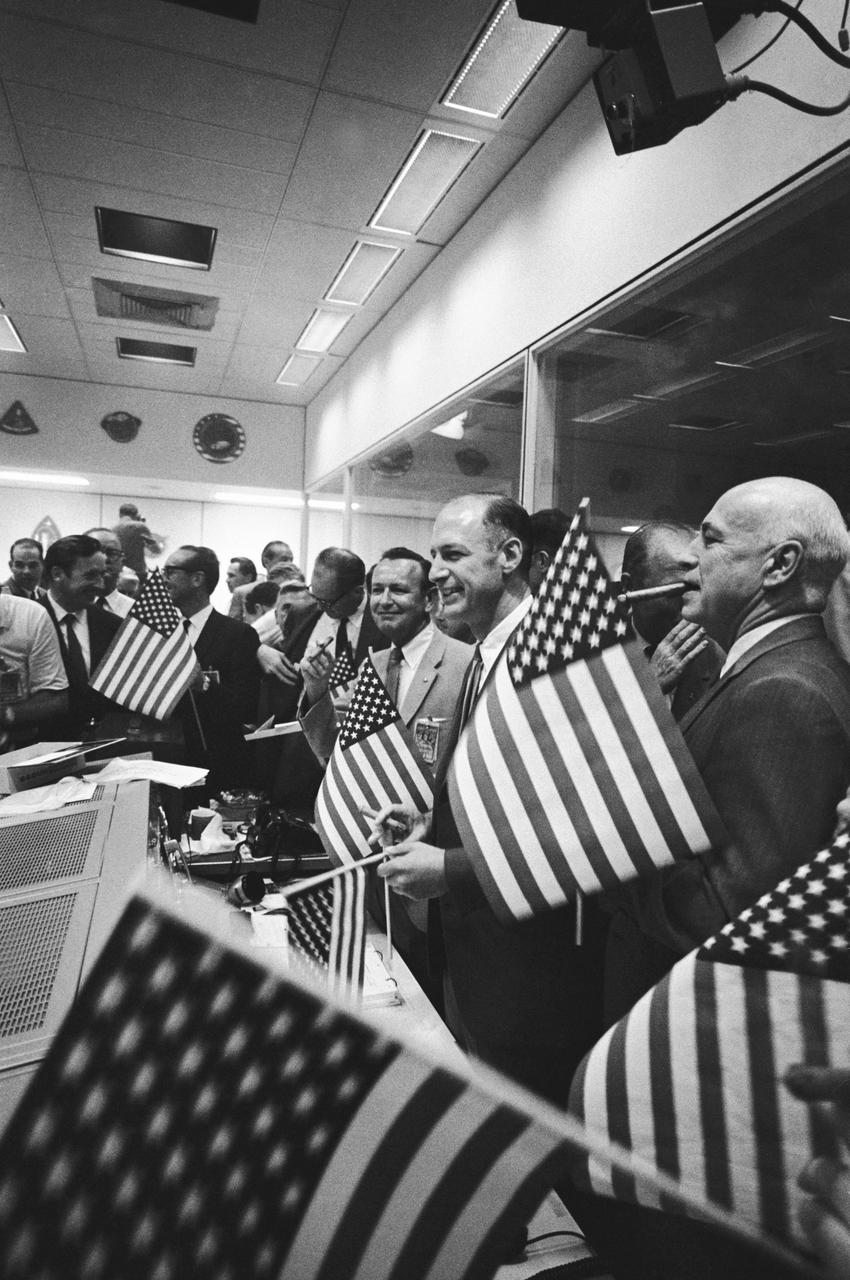
The Apollo 11 mission, the first manned lunar mission, launched from the Kennedy Space Center, Florida via the Marshall Space Flight Center (MSFC) developed Saturn V launch vehicle on July 16, 1969 and safely returned to Earth on July 24, 1969. Aboard he space craft were astronauts Neil A. Armstrong, commander; Michael Collins, Command Module (CM) pilot; and Edwin E. Aldrin Jr., Lunar Module (LM) pilot. The CM, piloted by Michael Collins remained in a parking orbit around the Moon while the LM, named “Eagle’’, carrying astronauts Neil Armstrong and Edwin Aldrin, landed on the Moon. During 2½ hours of surface exploration, the crew collected 47 pounds of lunar surface material for analysis back on Earth. Splashdown occurred in the Pacific Ocean on July 24, 1969. This overall view of the Mission Operations Control Room in the Mission Control Center at the NASA Manned Spacecraft Center (MSC) in Houston Texas shows the jubilation of the celebration of mission success. Mission controllers wave their American flags just after Apollo 11 had been recovered from the Pacific Ocean.
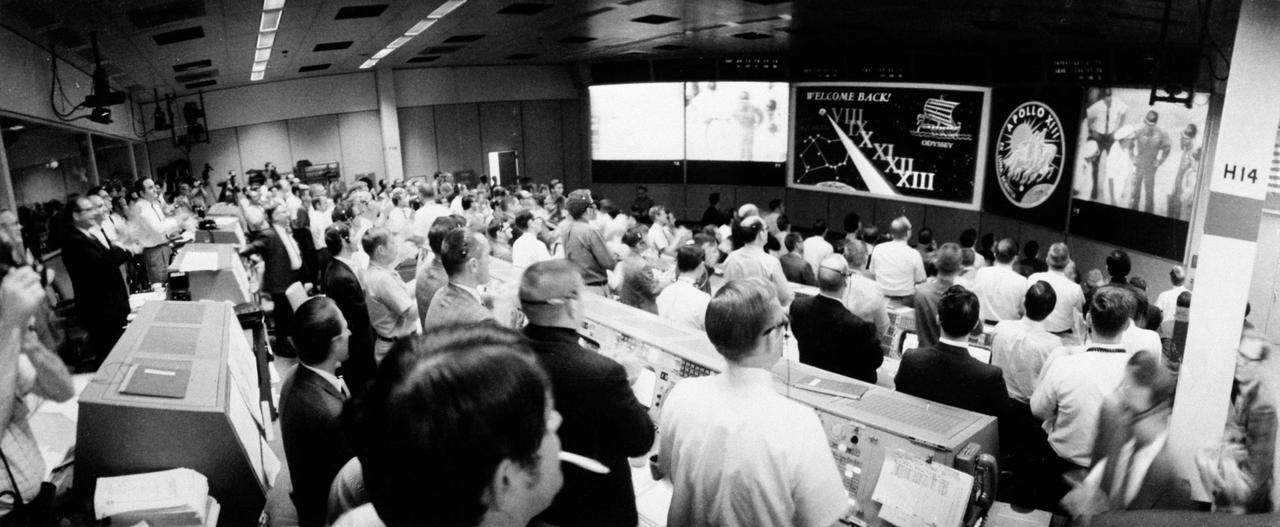
S70-35472 (17 April 1970) --- Overall view of the crowded Mission Operations Control Room (MOCR) in the Mission Control Center (MCC) at the Manned Spacecraft Center (MSC) during post-recovery ceremonies aboard the USS Iwo Jima, prime recovery ship for the Apollo 13 mission. The Apollo 13 spacecraft, with astronauts James A. Lovell Jr., commander; John L. Swigert Jr., command module pilot; and Fred W. Haise Jr., lunar module pilot, aboard, splashed down in the South Pacific at 12:07:44 p.m. (CST), April 17, 1970. The smooth splashdown and recovery operations brought an end to a perilous spaceflight for the crewmembers, and a tiring one for ground crew in MCC.
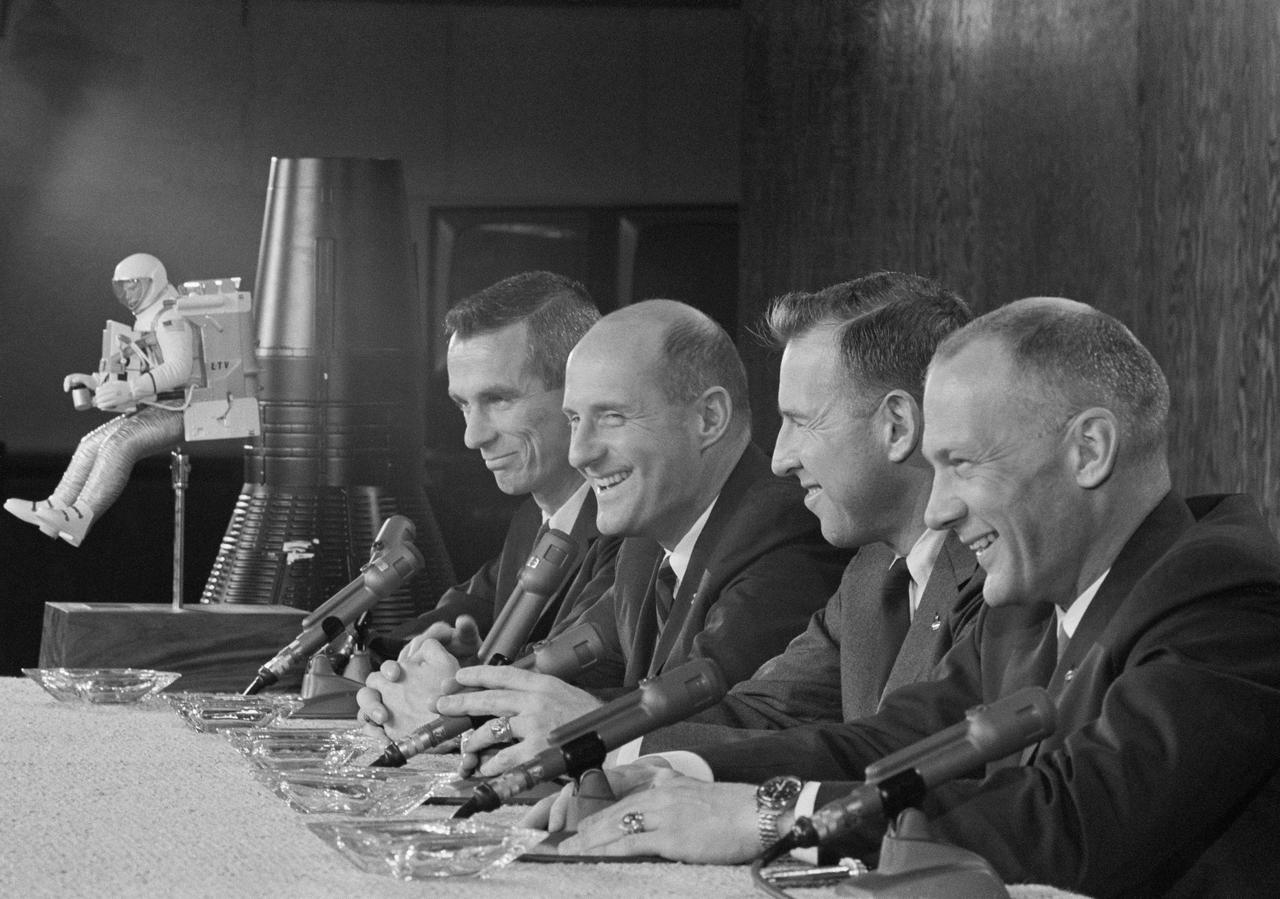
S66-24580 (23 April 1966) --- The two crews of the Gemini-9 spaceflight appear before a gathering of news media representatives during a press conference in the MSC News Center, Building 6. Left to right, are astronauts Eugene A. Cernan, prime crew pilot; Thomas P. Stafford, prime crew command pilot; James A. Lovell Jr., backup crew command pilot; and Edwin E. Aldrin Jr., backup crew pilot. A Gemini spacecraft model and a model of an astronaut wearing an Astronaut Maneuvering Unit (in background) were used to explain the Gemini-9 mission. Photo credit: NASA
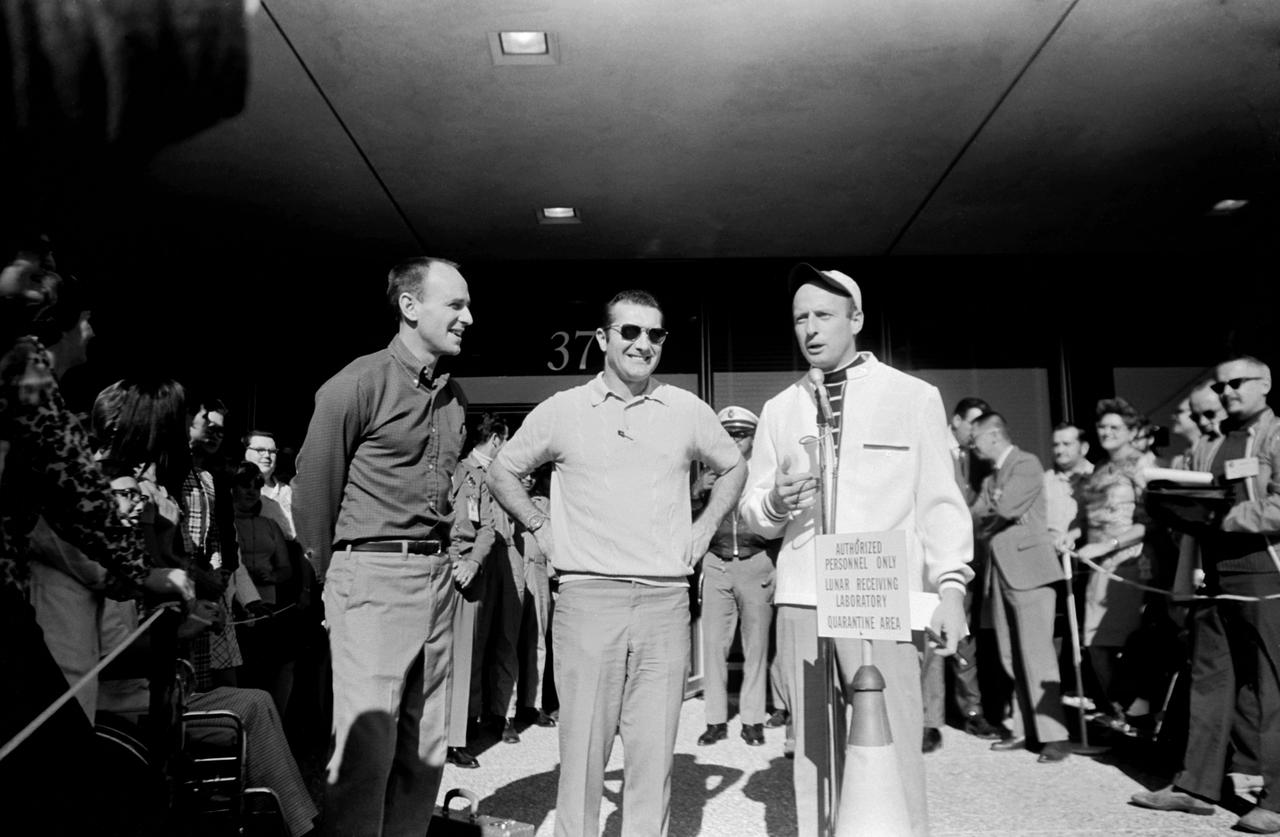
S69-62884 (10 Dec. 1969) --- Astronaut Charles Conrad Jr., commander of the Apollo 12 lunar landing mission, makes several remarks publicly in response to the welcome given him and other members of the Apollo 12 crew upon their release from post-mission isolation in the Manned Spacecraft Center's (MSC) Lunar Receiving Laboratory (LRL). Pictured with Conrad outside Building 37, which houses the LRL, are his fellow crewmembers for the Apollo 12 mission, astronauts Alan L. Bean (left), lunar module pilot; and Richard F. Gordon Jr. (center), command module pilot.
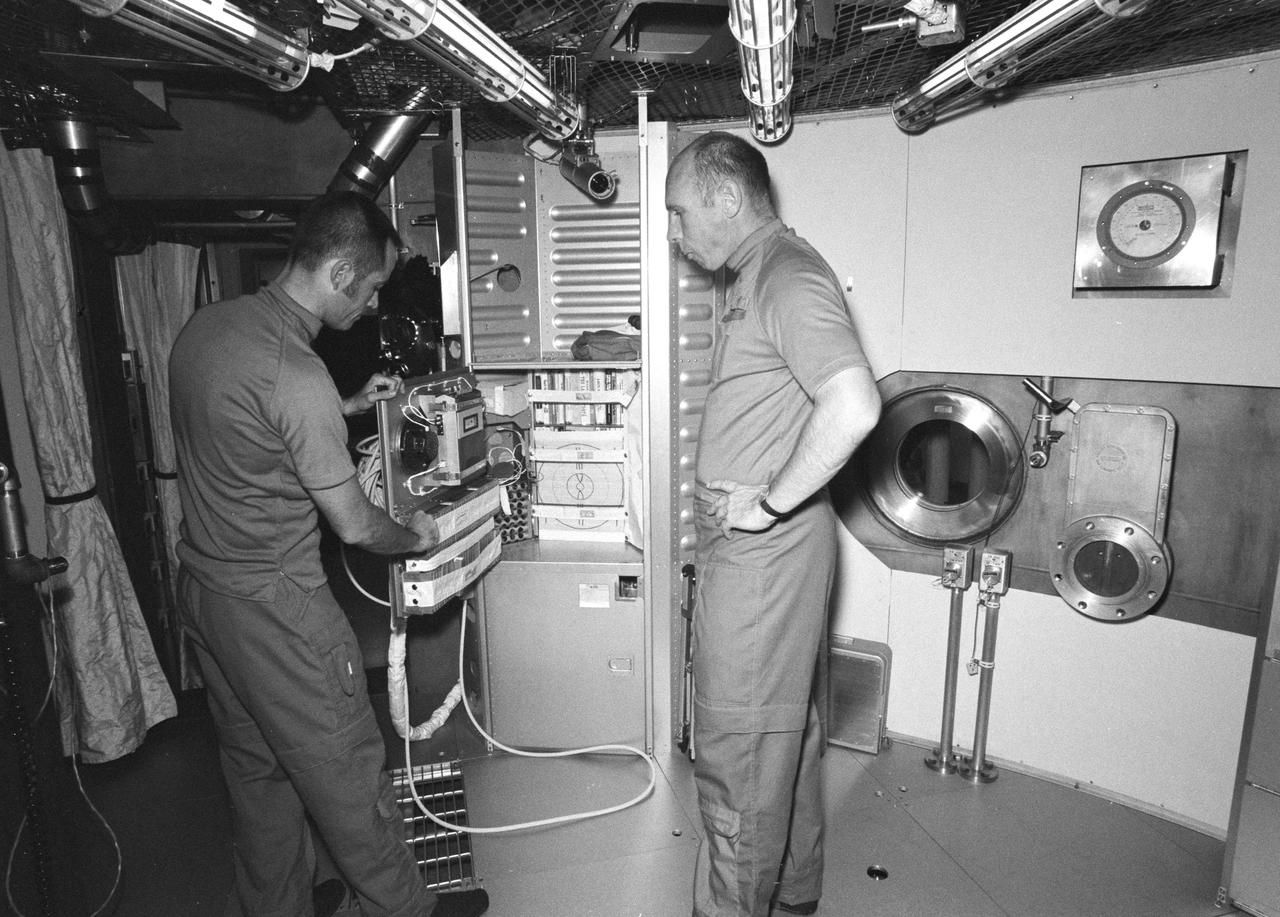
S72-41858 (15 June 1972) --- Astronauts Robert L. Crippen, left, Skylab Medical Experiment Altitude Test (SMEAT) crew commander, and Dr. William E. Thornton, SMEAT science pilot, stand at the cabinet containing off duty recreation equipment. They are two members of a three-man SMEAT crew who will spend up to 56 days in the Crew Systems Division's 20-foot altitude chamber at the NASA Manned Spacecraft Center (MSC) beginning in mid-July to obtain medical data and evaluate medical experiment equipment for Skylab. Astronaut Karol J. Bobko, SMEAT pilot, the third crew member is not shown in this view. Photo credit: NASA
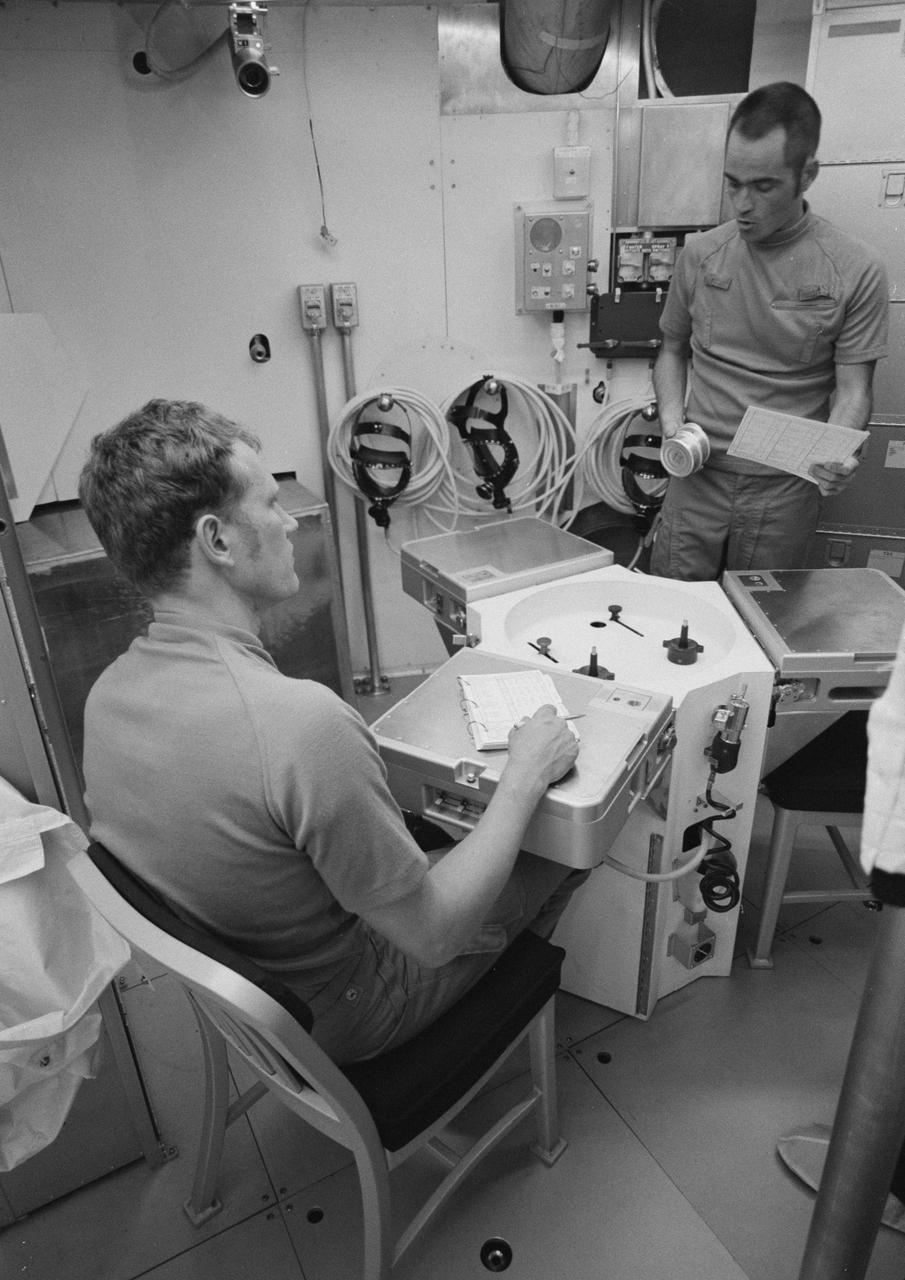
S72-41853 (15 June 1972) --- Two members of the three-man Skylab Medical Experiment Altitude Test (SMEAT) crew, that will spend up to 56 days in the Crew Systems Division's 20-foot altitude chamber at the Manned Spacecraft Center (MSC) beginning in mid-July, go over a menu in the food preparation area. Seated at the simulated wardroom food table is astronaut Karol J. Bobko, SMEAT pilot, and standing is astronaut Robert L. Crippen, SMEAT commander. Dr. William E. Thornton, SMEAT science pilot, the third crew member is not shown in this view. Photo credit: NASA
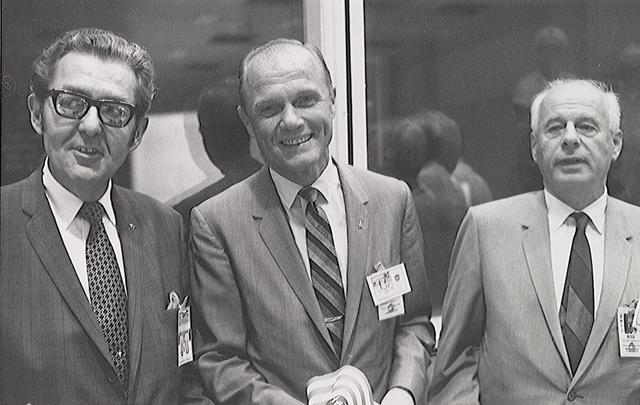
S69-44022 (7-24-69) --- On hand in Houston's mission control center to witness activity associated with the landing and recovery operations for the Apollo 11 mission were, from the left, Bob Kline, chief of the Mission Operations Procurement Branch at the Manned Spacecraft Center (MSC); astronaut John H. Glenn Jr.; and Eberhard Rees, deputy director of the Marshall Space Flight Center (MSFC). They were among a large number of personnel on hand in the MCC's mission operations control room (MOCR). Glenn holds one of the dozens of flags that were handed out for the return's celebration.
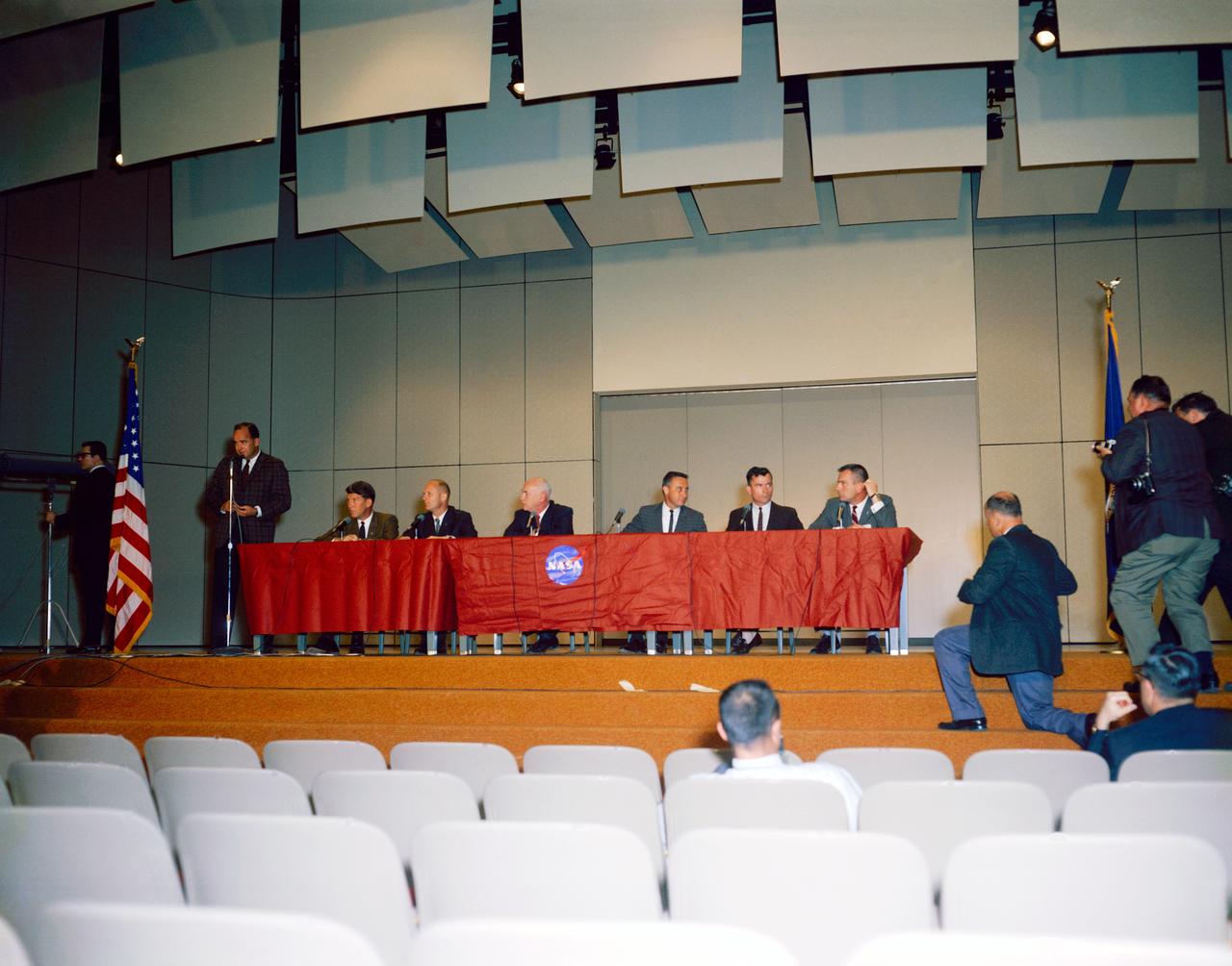
S64-19466 (13 April 1964) --- A press conference was held in the Bldg. 1 auditorium at the NASA Manned Spacecraft Center to announce the first Gemini astronaut selections. Shown left to right are Paul Haney, MSC Public Affairs Officer (standing); astronauts Walter Schirra and Thomas Stafford; Dr. Robert Gilruth, director of MSC; astronauts Virgil Grissom and John Young; and Donald K. Slayton, assistant director of Flight Crew Operations at MSC.

Astronaut John W. Young, Apollo 16 prime crew commander (right), takes a drive in the One-G Lunar Roving Vehicle (LRV) trainer in the Lunar Topgraphic Simulation area at the Manned Spacecraft Center (MSC). He is accompanied by John Omstead, with General Electric, MSC.
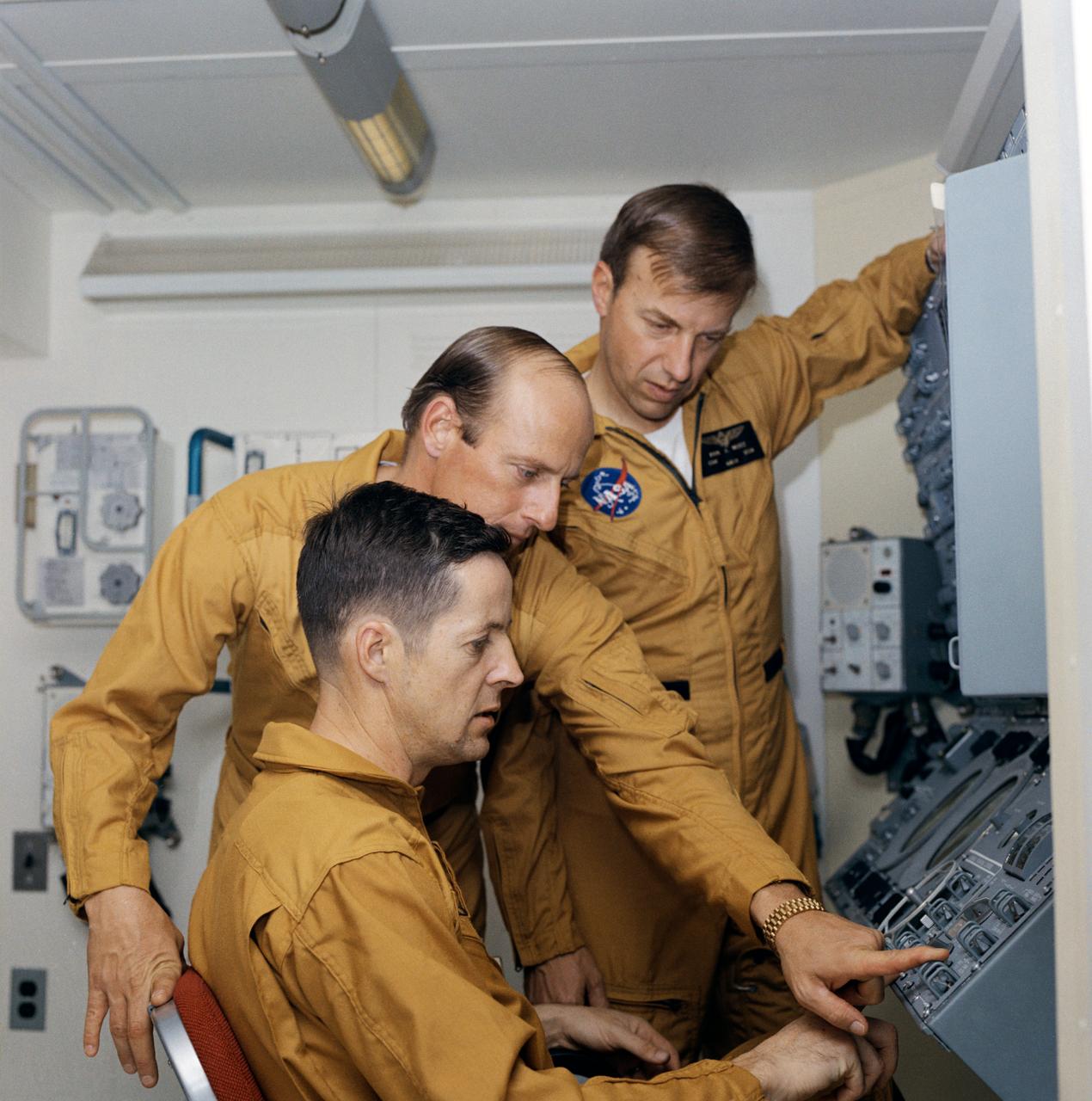
S72-17512 (19 Jan. 1972) --- These three men are the crewmen for the first manned Skylab mission. They are astronaut Charles Conrad Jr., commander, standing left; scientist-astronaut Joseph P. Kerwin, seated; and astronaut Paul J. Weitz, pilot. They were photographed and interviewed during an "open house" press day in the realistic atmosphere of the Multiple Docking Adapter (MDA) trainer in the Mission Simulation and Training Facility at the Manned Spacecraft Center (MSC). The control and display panel for the Apollo Telescope Mount (ATM) is at right. Photo credit: NASA
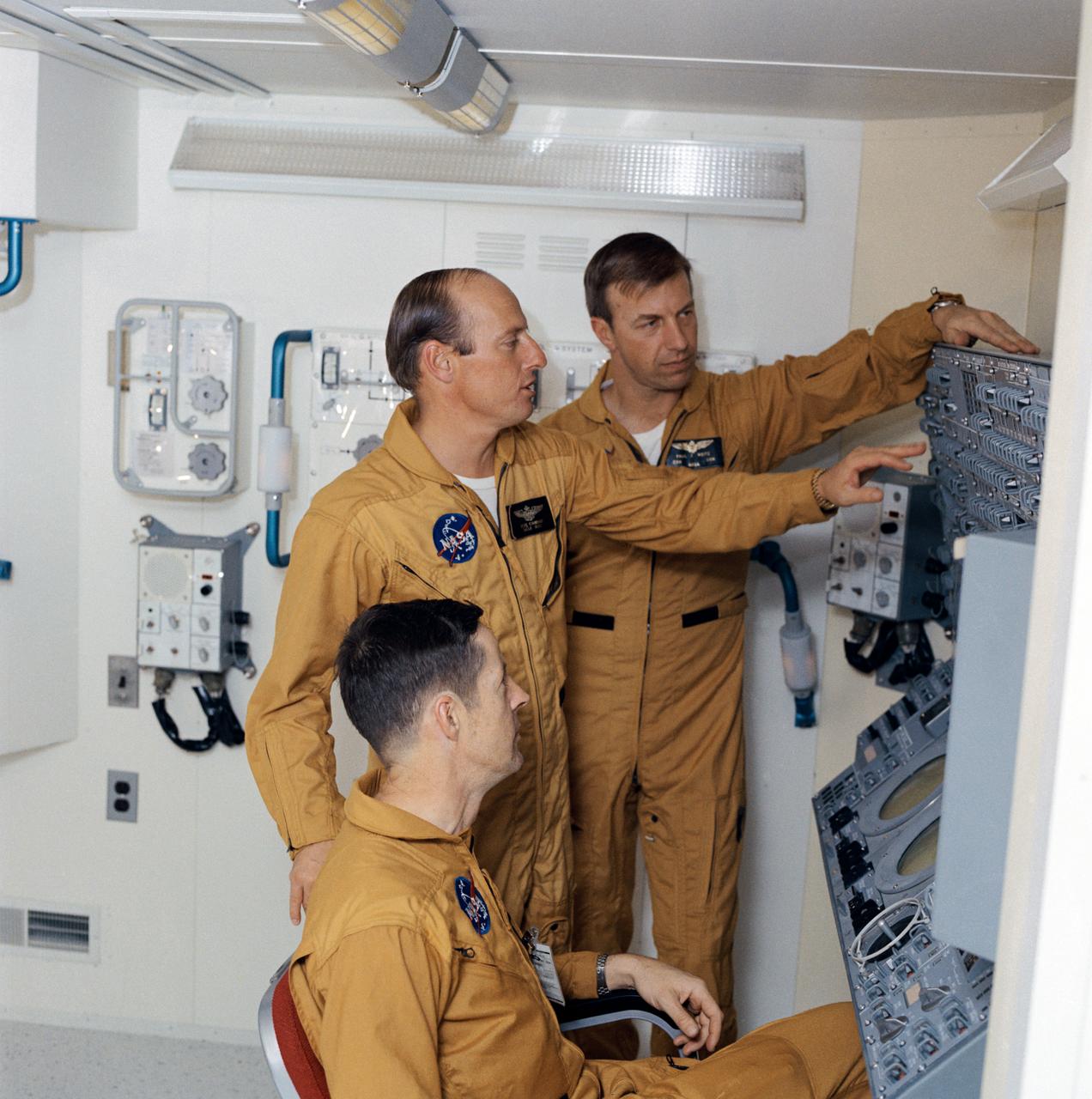
S72-17509 (19 Jan. 1972) --- These three men are the crewmen for the first manned Skylab mission. They are astronaut Charles Conrad Jr., commander, standing left; scientist-astronaut Joseph P. Kerwin, seated; and astronaut Paul J. Weitz, pilot. They were photographed and interviewed during an "open house" press day in the realistic atmosphere of the Multiple Docking Adapter (MDA) trainer in the Mission Simulation and Training Facility at the Manned Spacecraft Center (MSC). The control and display panel for the Apollo Telescope Mount (ATM) is at right. Photo credit: NASA
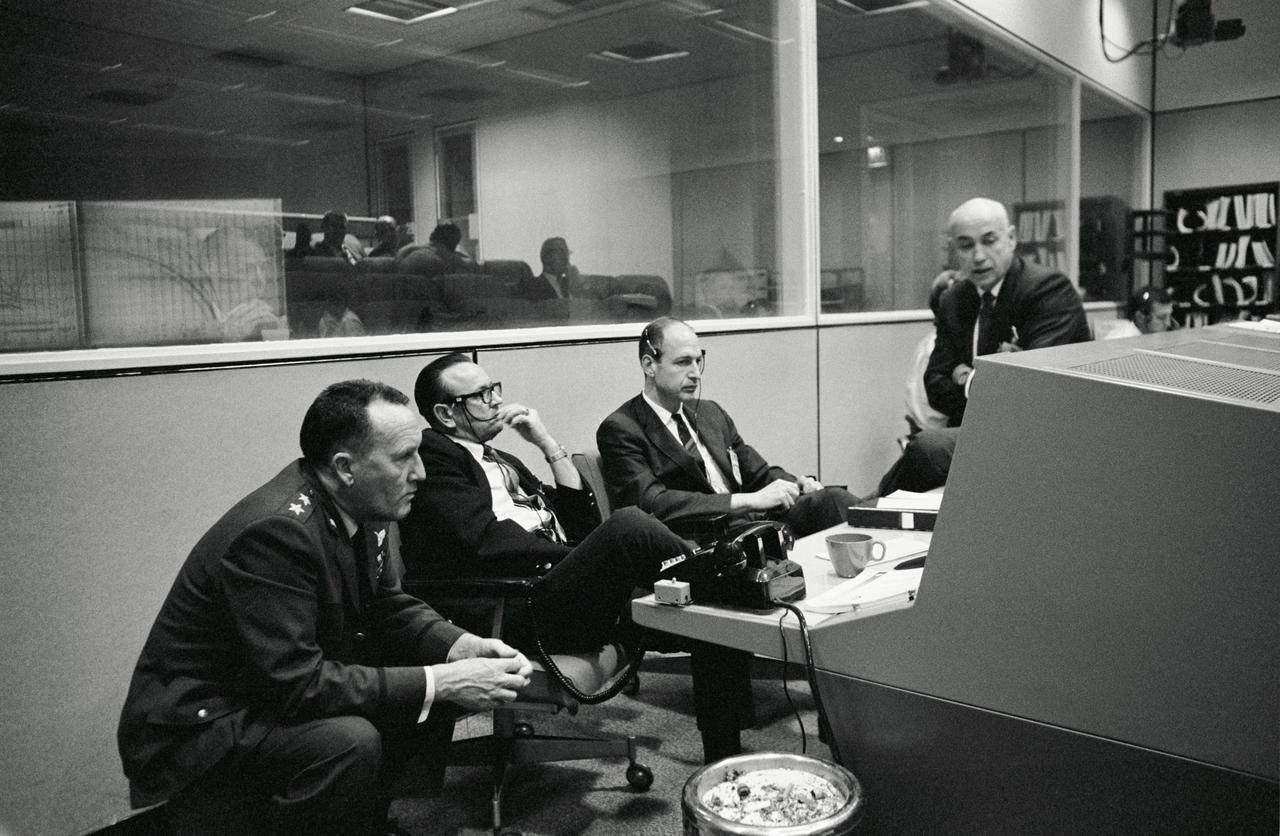
S68-20986 (4 April 1968) --- Scene at the flight operations director's console in the Mission Control Center, Building 30, during the Apollo 6 (Spacecraft 020/Saturn 520) unmanned space flight. Left to right, are Air Force Maj. Gen. Vincent G. Huston, DOD Manager, Manned Space Flight Operations, Andrews Air Force Base, Washington, D.C.; Dr. Christopher C. Kraft Jr., MSC director of flight operations; George M. Low, manager, MSC Apollo Spacecraft Program Office; and Dr. Robert R. Gilruth, MSC Director.
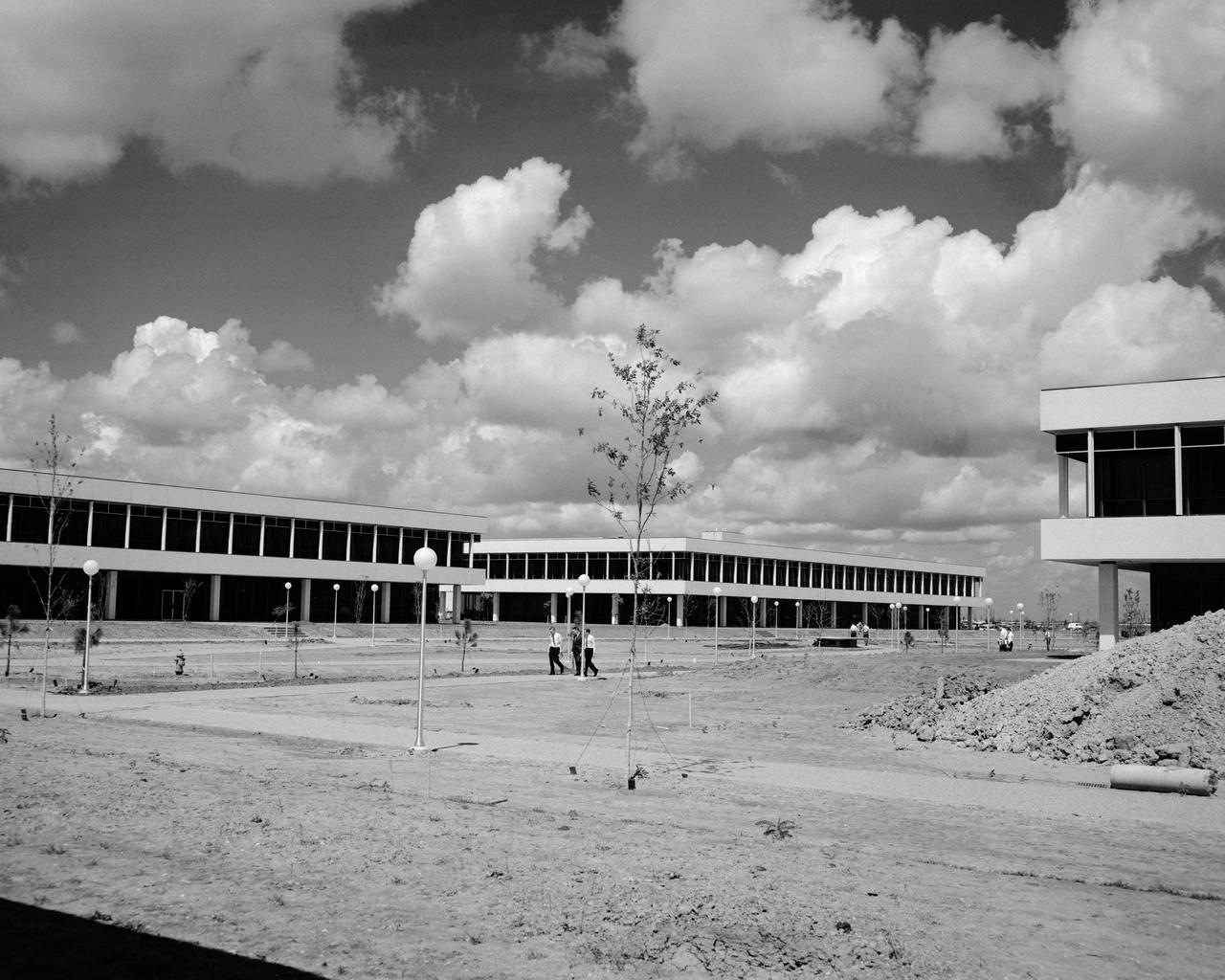
Bldg. 13, left, bldg. 15, right, looking Soutnwest. MSC, HOUSTON, TX B&W
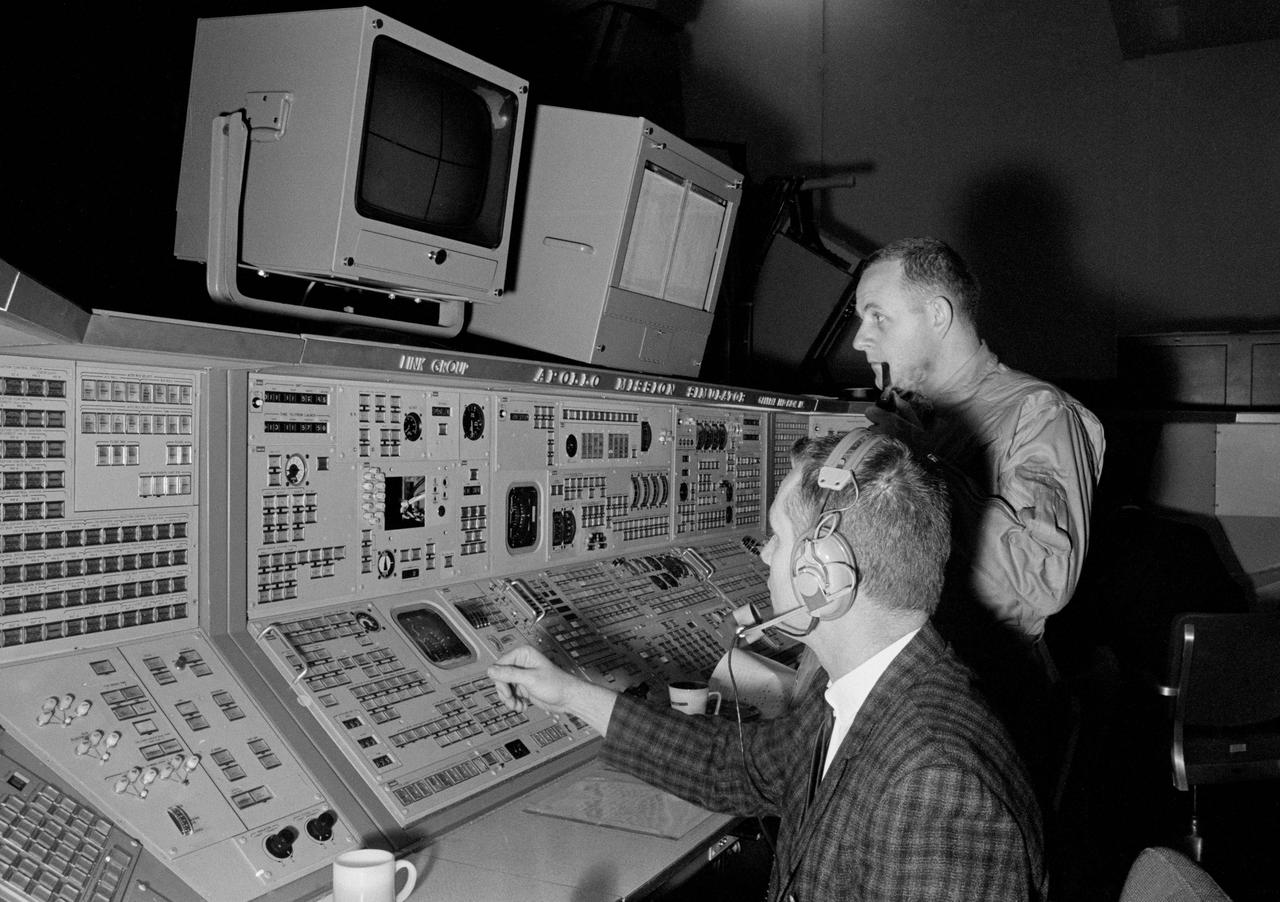
Views of Astronaut Dr. Philip K. Chapman training in the Lunar Module (LM) Simulator, Centrifuge, and the Apollo Mission Simulator. MSC
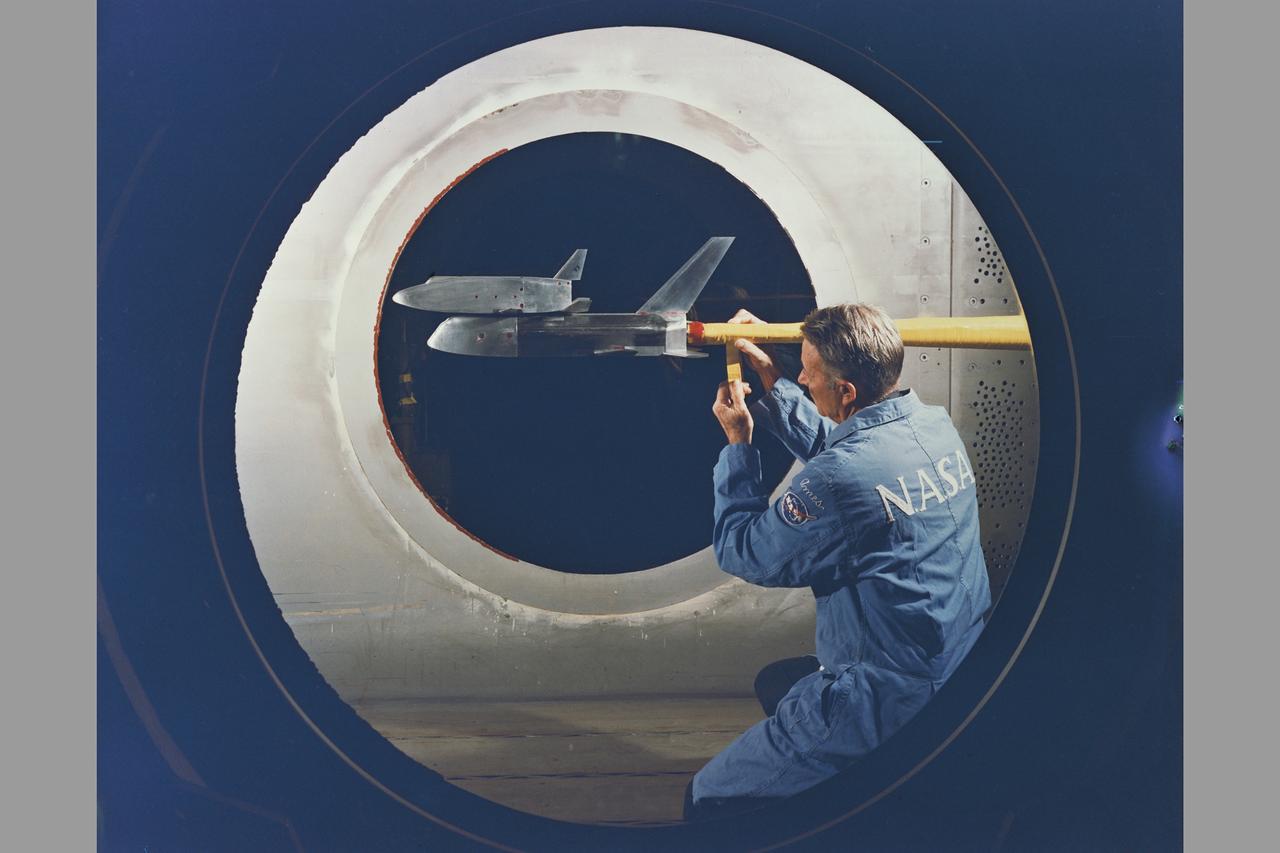
MSC Space Shuttle Model stability and control characteristics test in 9x7ft w.t. (test number not available)
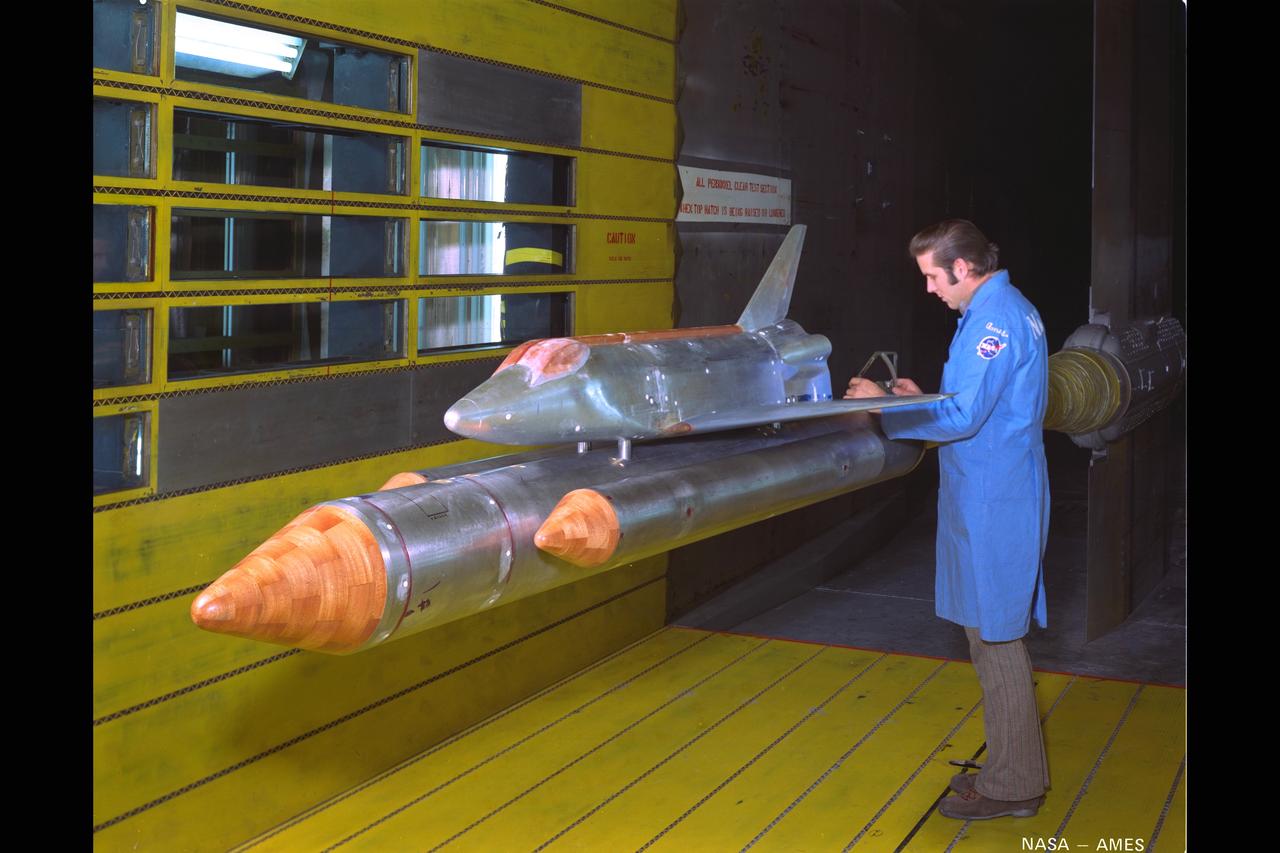
MSC 040A Space Shuttle: 11ft. W.T. Tests pf Acoustic Environment (Configuration 5 with James M. Peterson
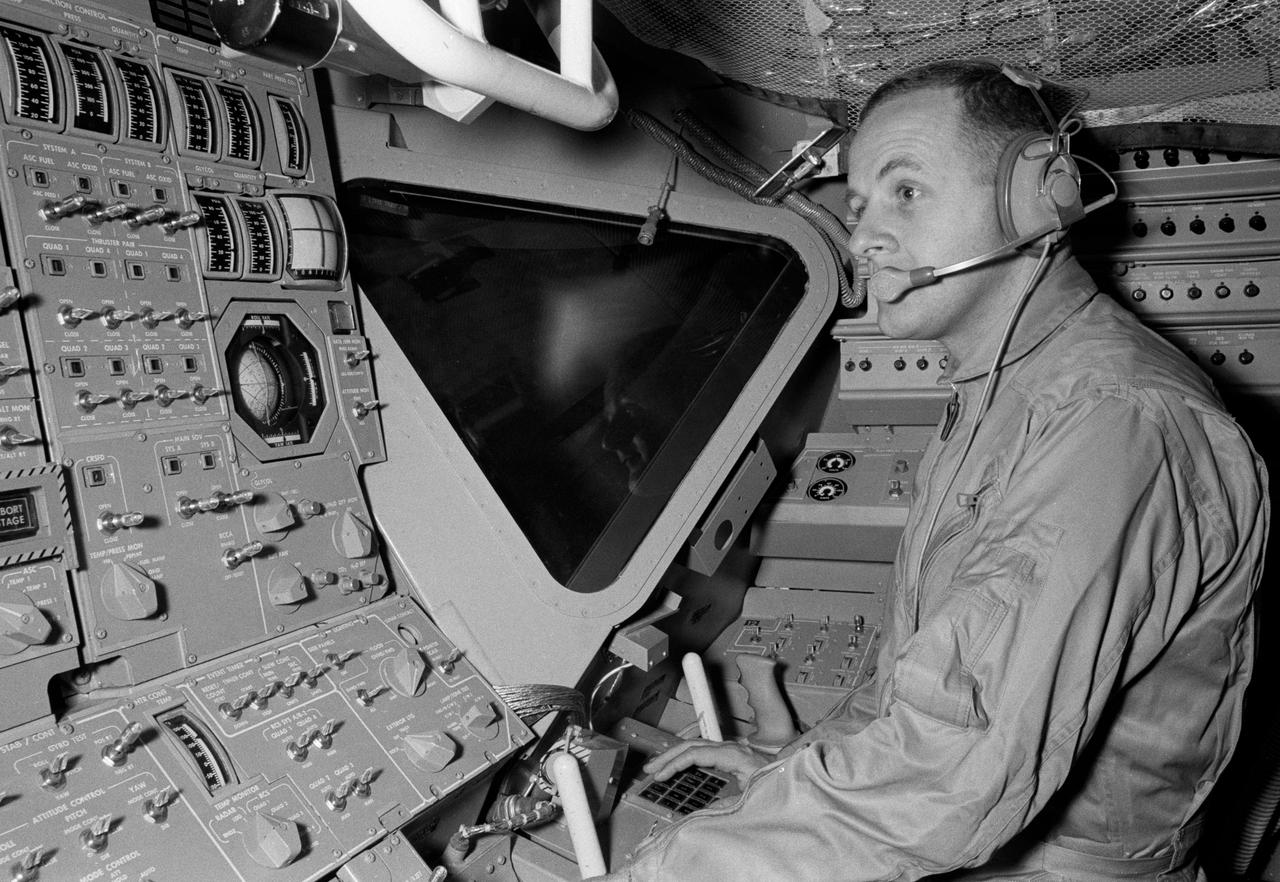
Views of Astronaut Dr. Philip K. Chapman training in the Lunar Module (LM) Simulator, Centrifuge, and the Apollo Mission Simulator. MSC
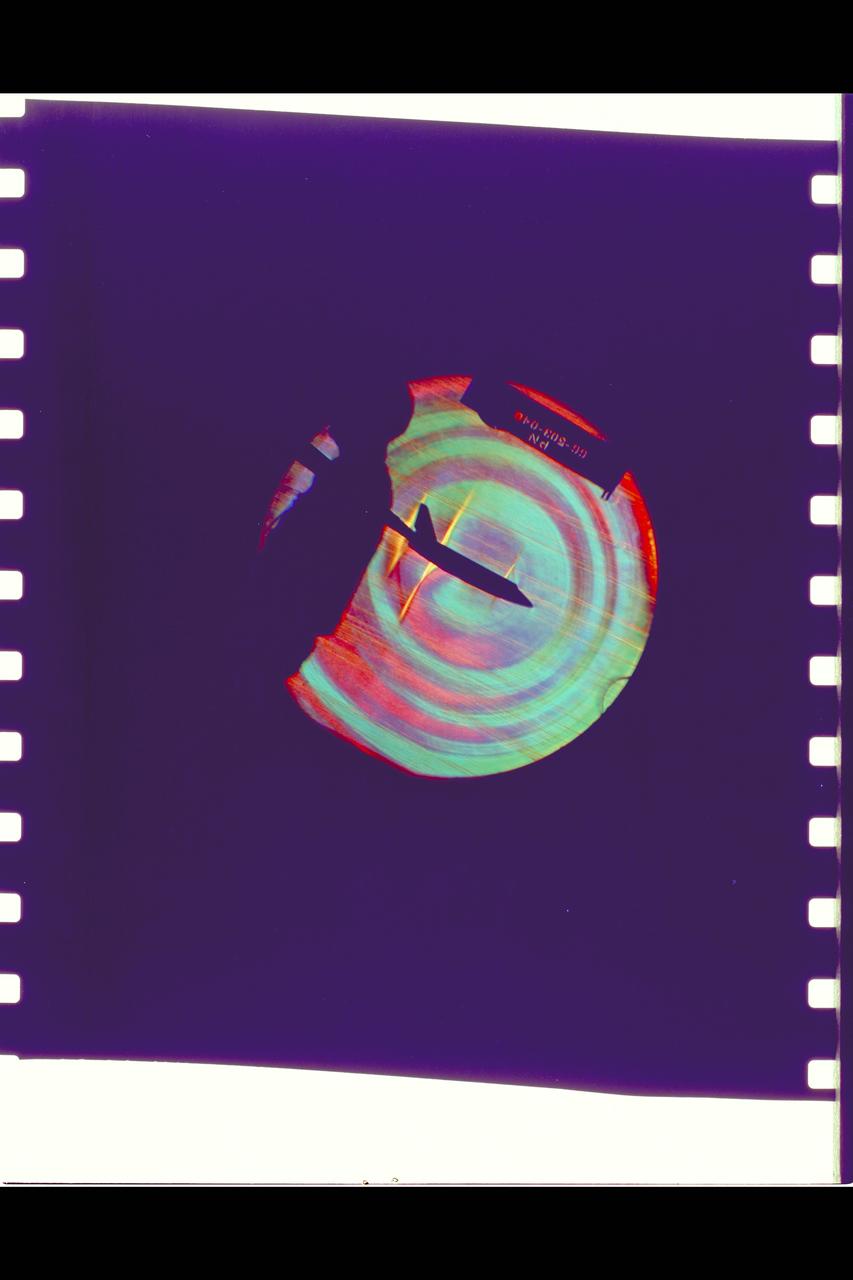
MSC Space Shuttle Stability and Control Characteristics. Schlieren of North American Rockwell Straight Wing orbiter approximate Mach .95
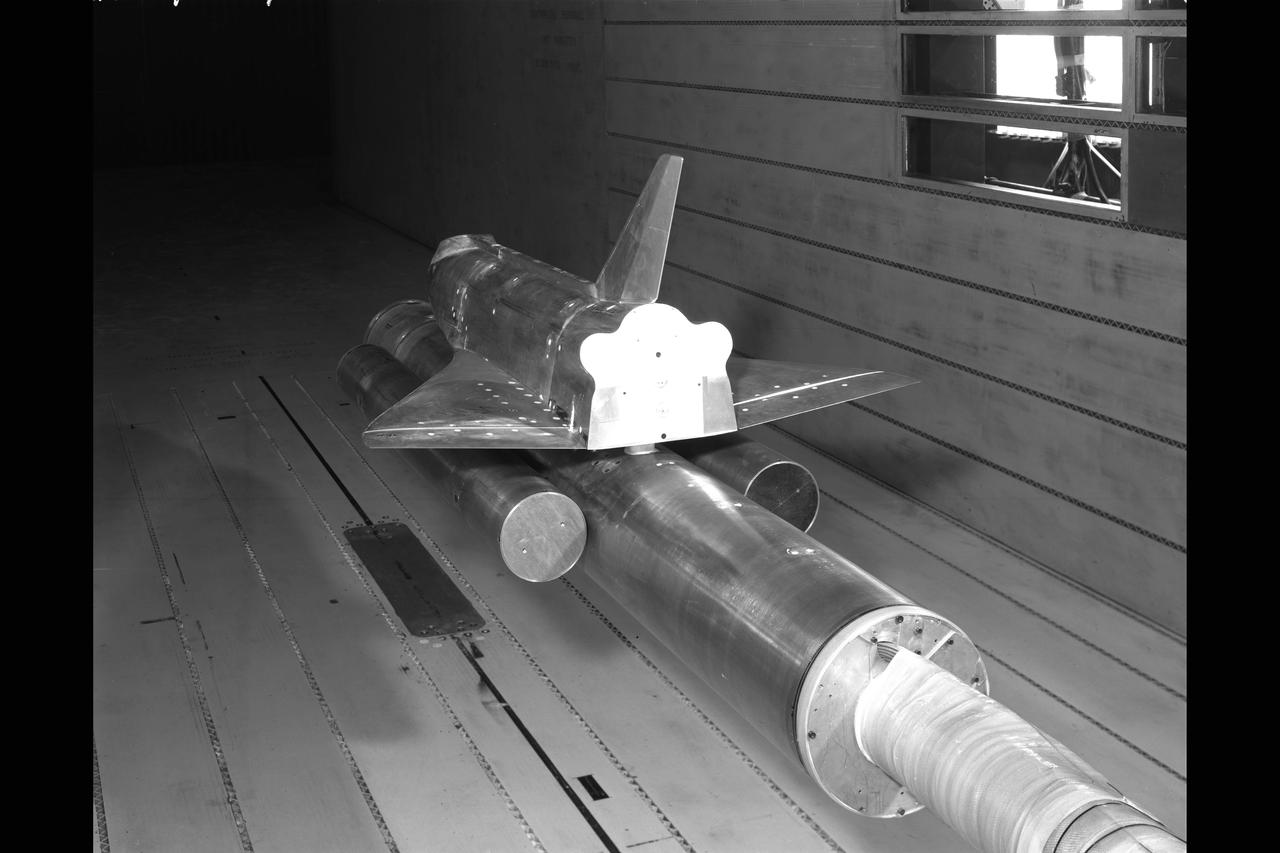
MSC 040A Space Shuttle: 11ft. W.T. Test of Acoustic Environment (Configuration #5)
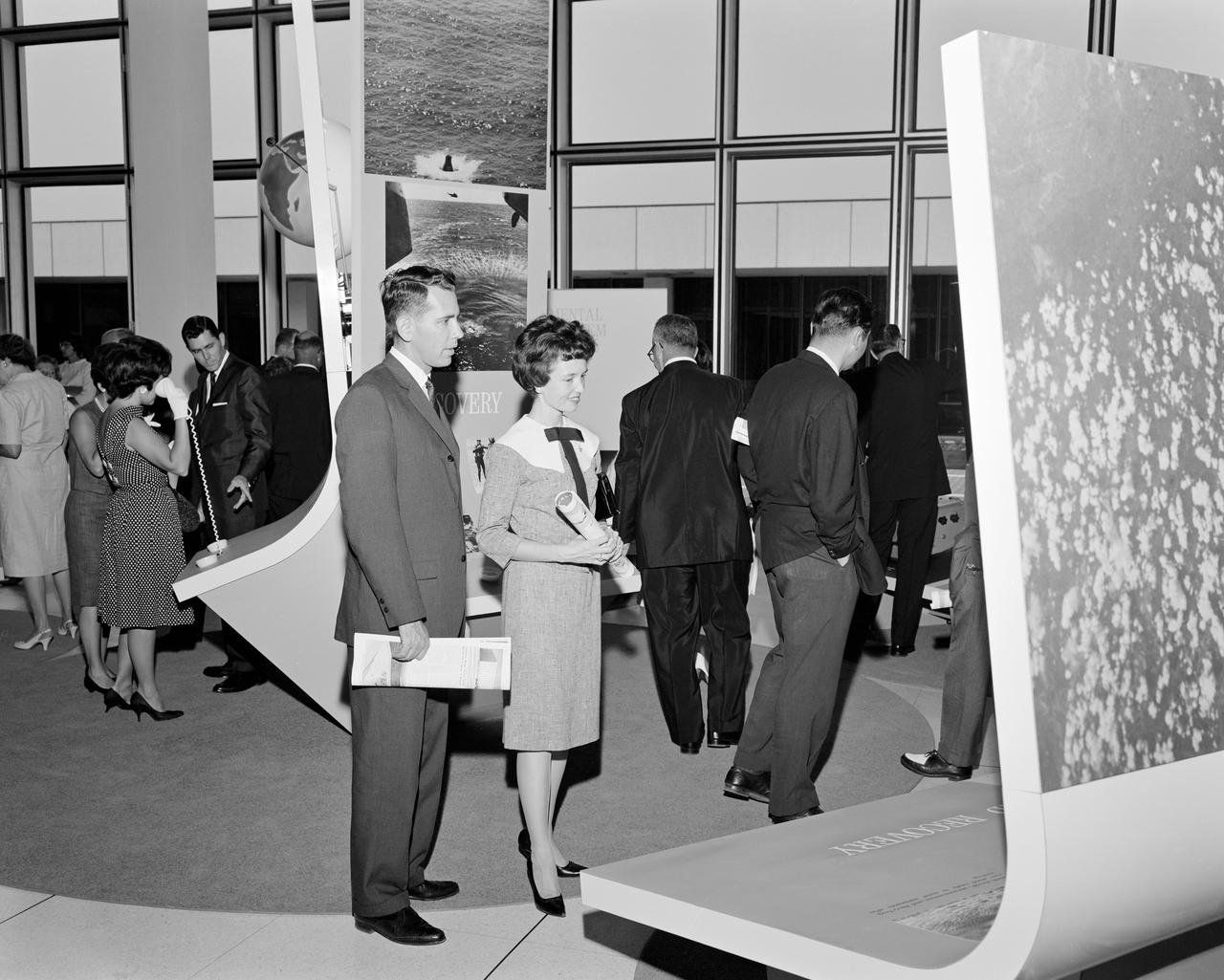
Open House - Visitiors to the MSC Open House view the many exhibits found in Bldg. 1
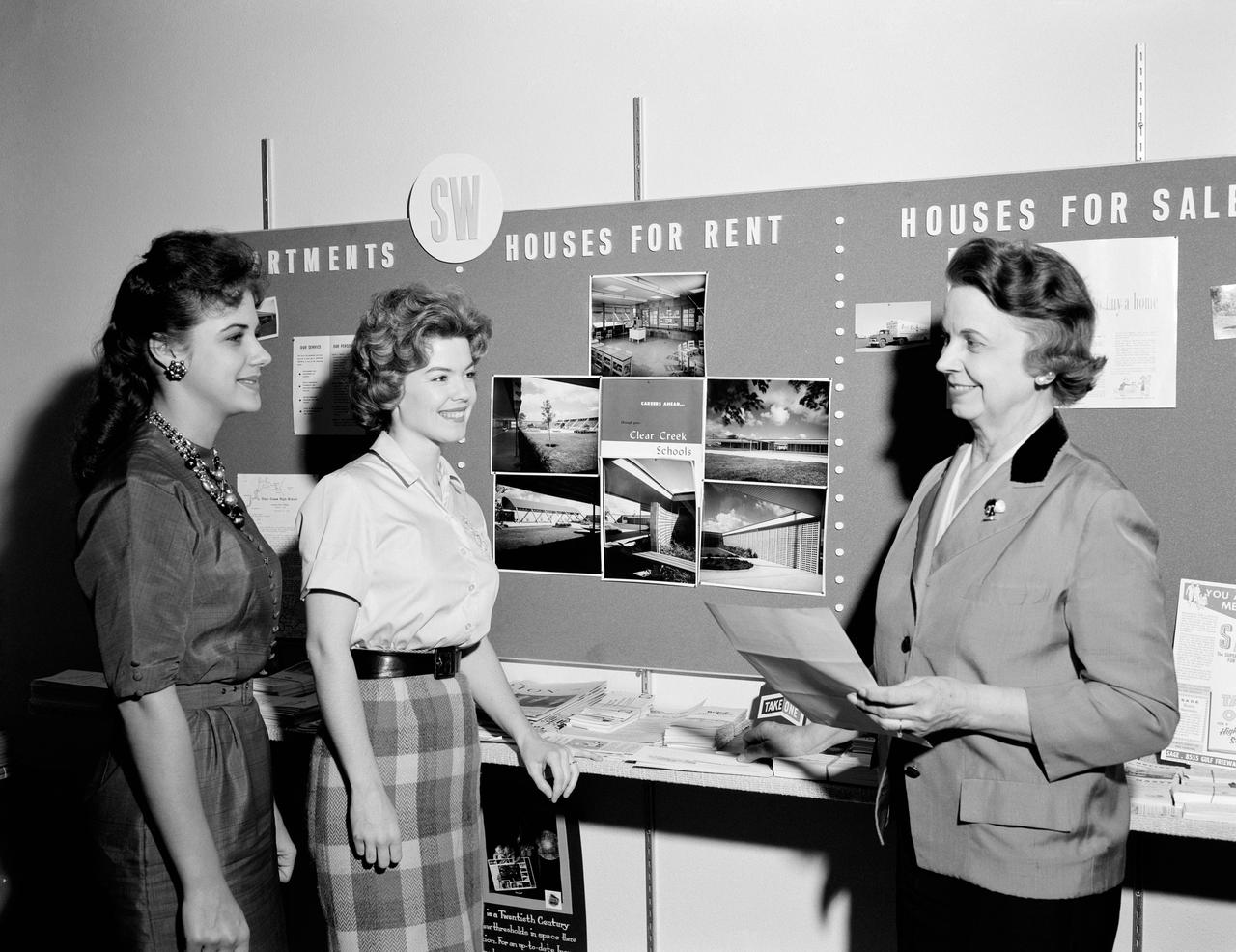
View of personnel looking at announcements concerning apartments for rent at the MSC Re-location Center.
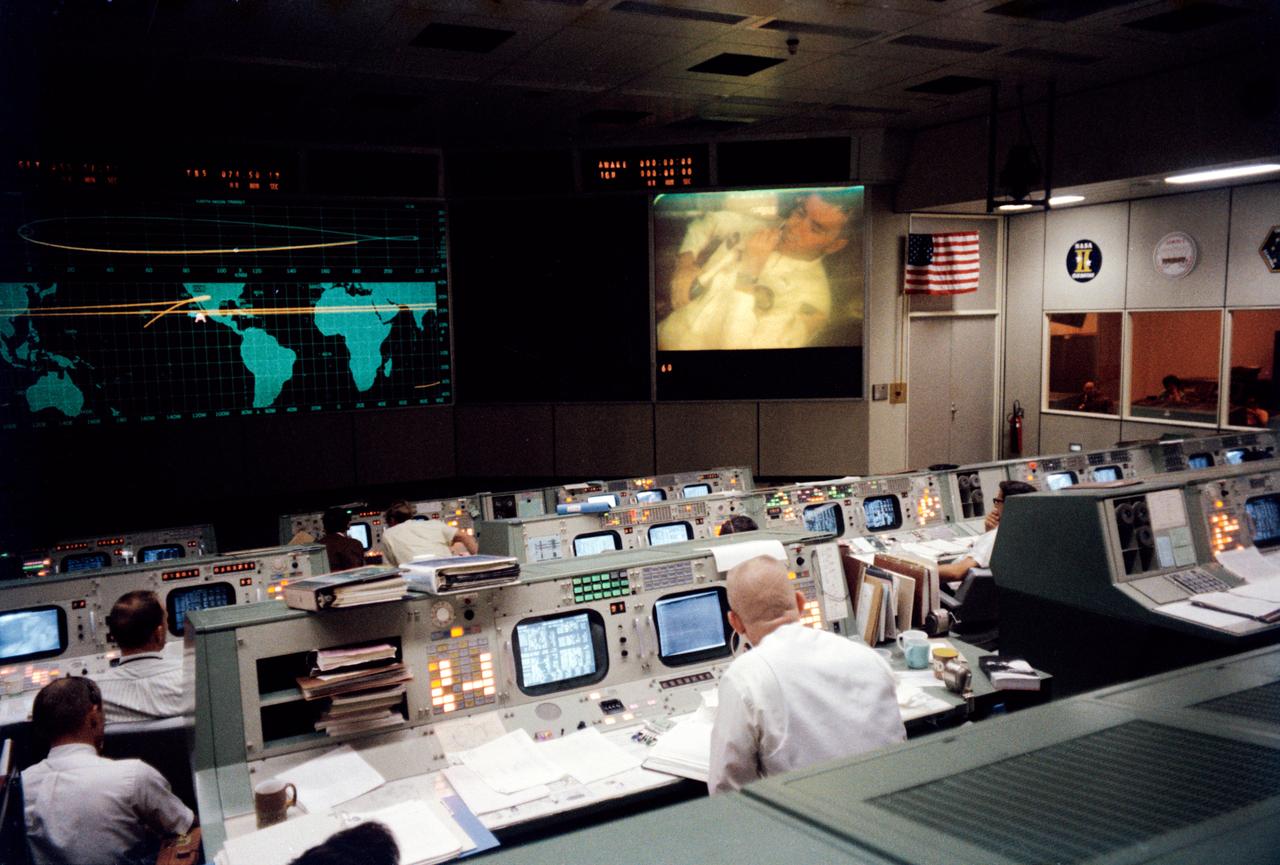
S70-35139 (13 April 1970) --- Overall view of the Mission Operations Control Room (MOCR) in the Mission Control Center (MCC) at Manned Spacecraft Center (MSC), during the fourth television transmission from the Apollo 13 mission in space. Eugene F. Kranz (foreground, back to camera), one of four Apollo 13 flight directors, views the large screen at front of MOCR, astronaut Fred W. Haise Jr., lunar module pilot, is seen on the screen. The fourth TV transmission from the Apollo 13 mission was on the evening of April 13, 1970.