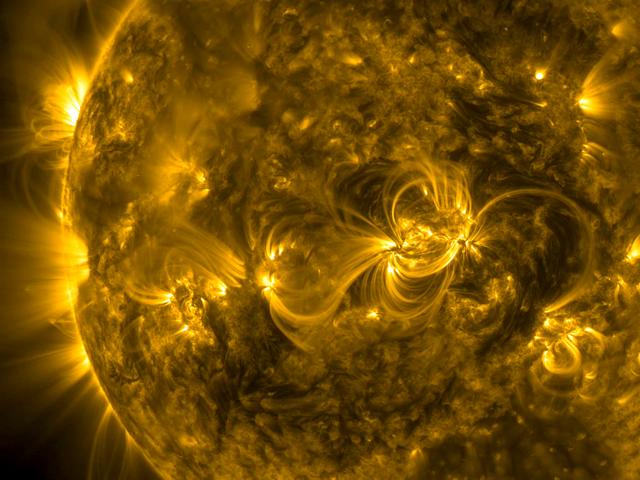
A series of linked loops across the face of the Sun highlighted the dynamic magnetic connections generated by several active regions (Jan. 3-6, 2015). Active regions have magnetic north and south polarity and the arcing loops find the opposite pole to make the connection. What is unusual here is that they all kind of line up and link nicely together. These movies are made in a wavelength of extreme ultraviolet light. Credit: NASA/Solar Dynamics Observatory <b><a href="http://www.nasa.gov/audience/formedia/features/MP_Photo_Guidelines.html" rel="nofollow">NASA image use policy.</a></b> <b><a href="http://www.nasa.gov/centers/goddard/home/index.html" rel="nofollow">NASA Goddard Space Flight Center</a></b> enables NASA’s mission through four scientific endeavors: Earth Science, Heliophysics, Solar System Exploration, and Astrophysics. Goddard plays a leading role in NASA’s accomplishments by contributing compelling scientific knowledge to advance the Agency’s mission. <b>Follow us on <a href="http://twitter.com/NASAGoddardPix" rel="nofollow">Twitter</a></b> <b>Like us on <a href="http://www.facebook.com/pages/Greenbelt-MD/NASA-Goddard/395013845897?ref=tsd" rel="nofollow">Facebook</a></b> <b>Find us on <a href="http://instagram.com/nasagoddard?vm=grid" rel="nofollow">Instagram</a></b>
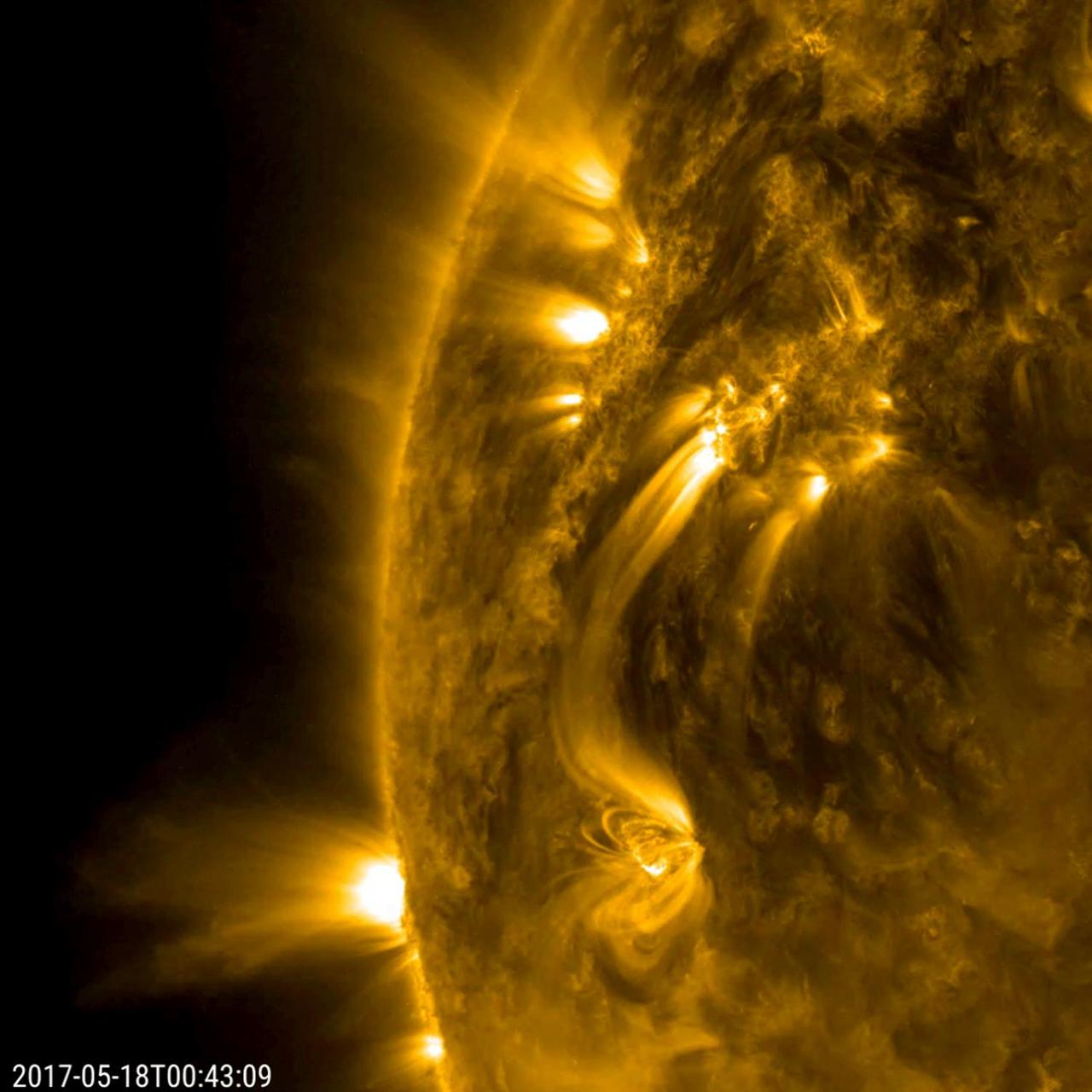
Several bright bands of plasma connect from one active region to another, even though they are tens of thousands of miles away from each other (May 17-18, 2017). Active regions are, by their nature, strong magnetic areas with north and south poles. The plasma consists of charged particles that stream along the magnetic field lines between these two regions. These connecting lines are clearly visible in this wavelength of extreme ultraviolet light. Other loops and strands of bright plasma can be seen rising up and out of smaller active regions as well. The video covers about one day's worth of activity. Movies are available at https://photojournal.jpl.nasa.gov/catalog/PIA21638
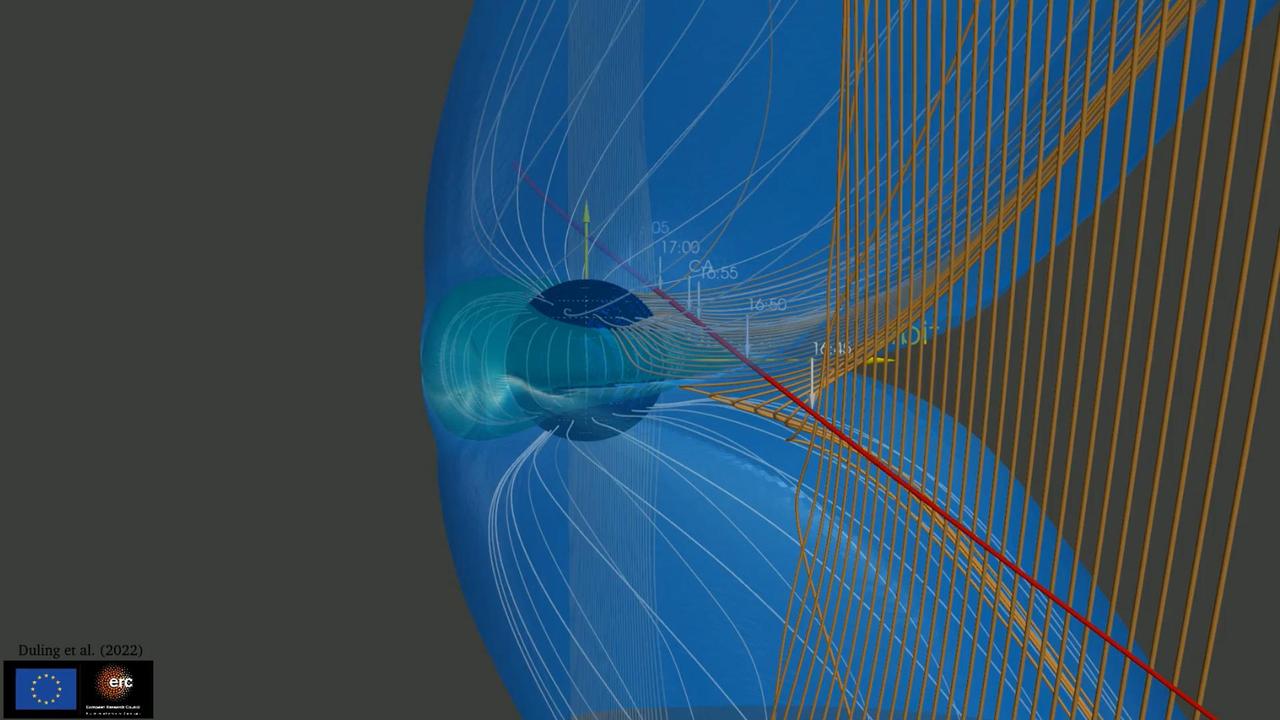
This animation illustrates how the magnetic field surrounding Jupiter's moon Ganymede (represented by the blue lines) interacts with and disrupts the magnetic field surrounding Jupiter (represented by the orange lines). During the June 2021 close approach to Ganymede by NASA's Juno spacecraft, the Magnetic Field (MAG) and Jovian Auroral Distributions Experiment (JADE) instruments aboard the spacecraft recorded data showing evidence of the breaking and reforming of magnetic field connections between Jupiter and Ganymede. Studying Ganymede's magnetic field can provide scientists with clues about the nature of the salty water reservoir suspected to exist deep under the moon's surface. Animation available at https://photojournal.jpl.nasa.gov/catalog/PIA25724
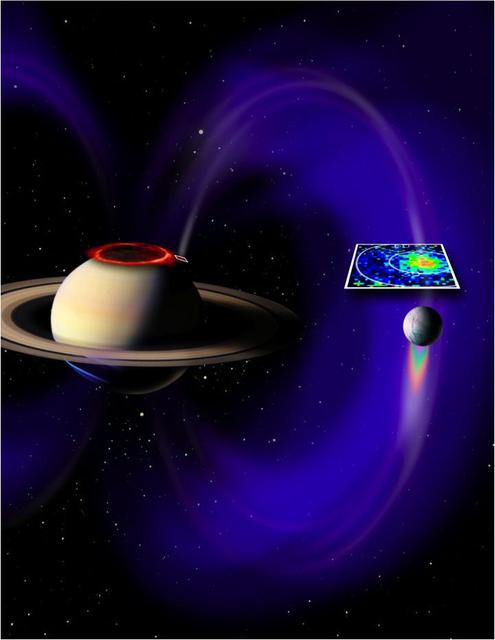
This artist concept based on data from NASA Cassini spacecraft, shows a glowing patch of ultraviolet light near Saturn north pole that occurs at the footprint of the magnetic connection between Saturn and its moon Enceladus.
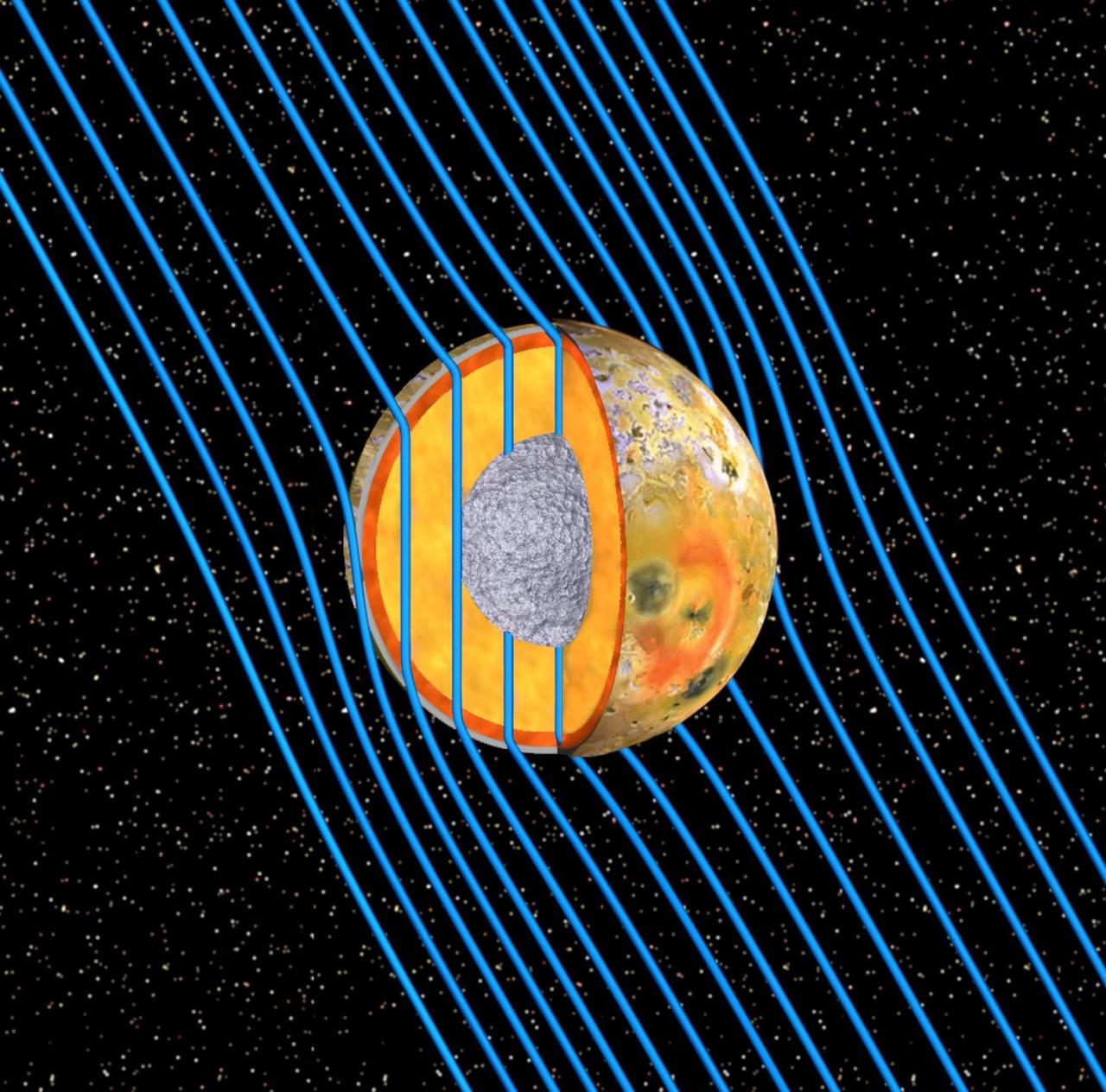
This graphic shows the internal structure of Jupiter moon Io as revealed by data from NASA Galileo spacecraft. Io is bathed in magnetic field lines shown in blue that connect the north polar region of Jupiter to the planet south polar region.
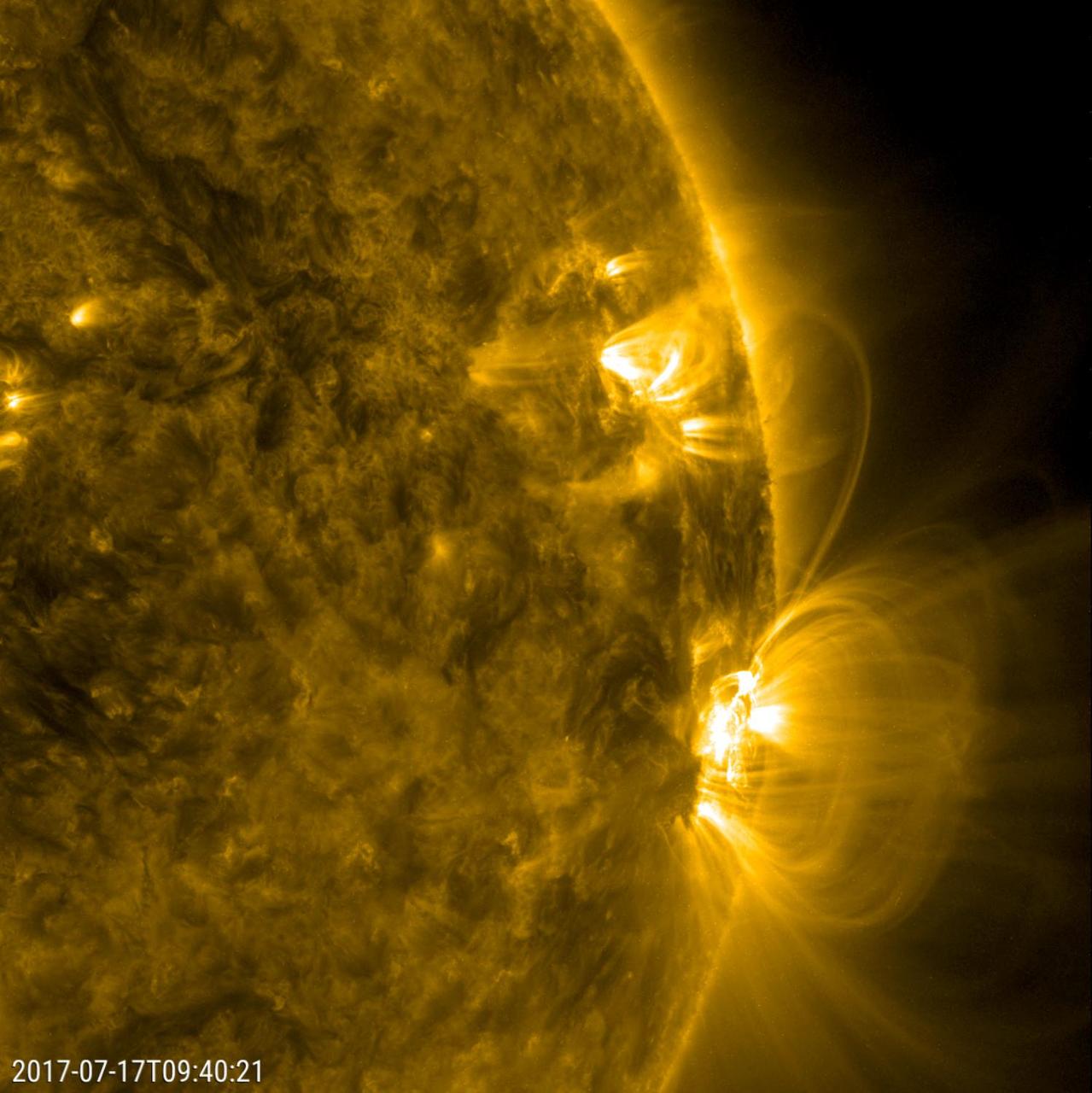
Numerous arches of magnetic field lines danced and swayed above a large active region over about a 30-hour period (July 17-18, 2017). We can also see the magnetic field lines from the large active region reached out and connected with a smaller active region. Those linked lines then strengthened (become brighter), but soon began to develop a kink in them and rather swiftly faded from view. All of this activity is driven by strong magnetic forces associated with the active regions. The images were taken in a wavelength of extreme ultraviolet light. https://photojournal.jpl.nasa.gov/catalog/PIA21838
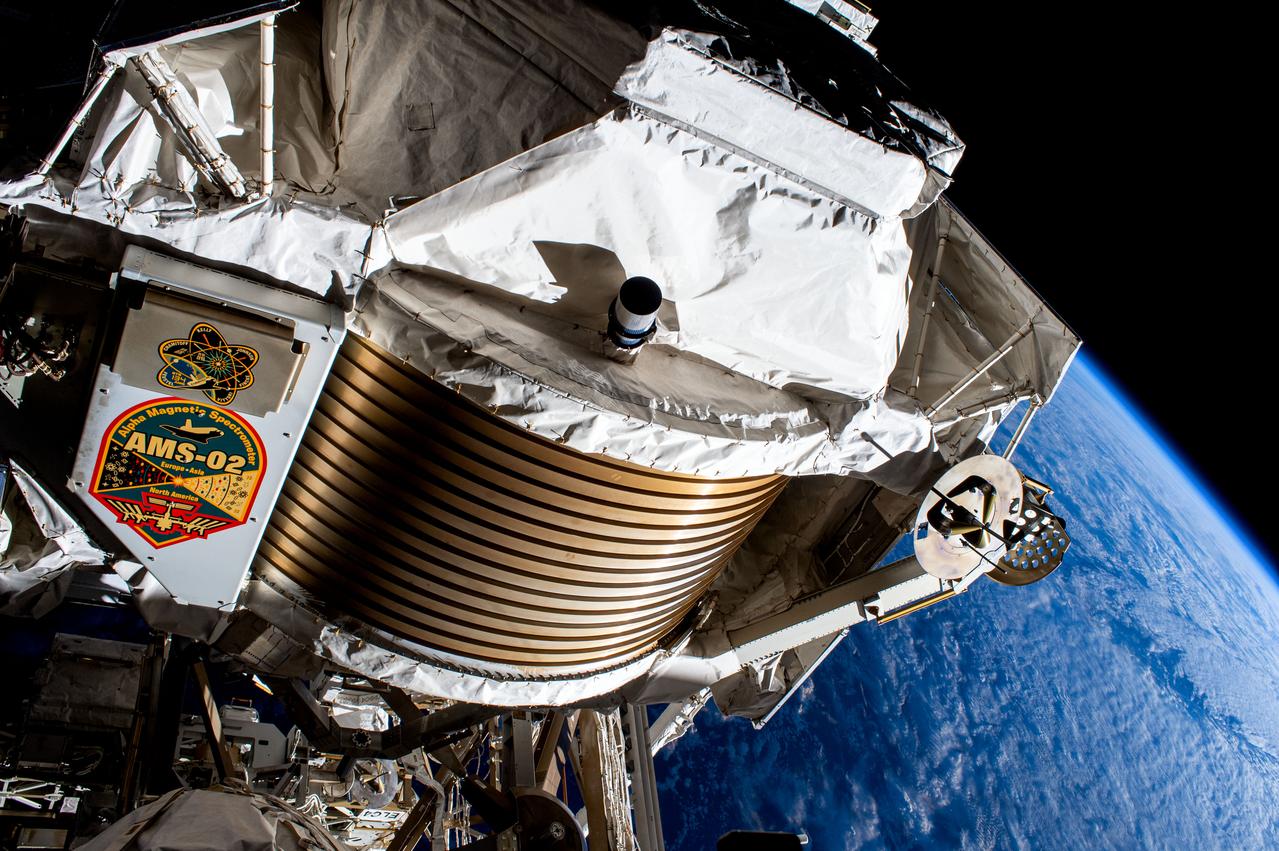
The Alpha Magnetic Spectrometer was photographed during a spacewalk in January 2017. NASA astronauts Shane Kimbrough and Peggy Whitson successfully installed three new adapter plates and hooked up electrical connections for three of the six new lithium-ion batteries on the International Space Station. They also accomplished several get-ahead tasks, including a photo survey of the Alpha Magnetic Spectrometer.

The magnetic field lines between a pair of active regions formed a beautiful set of swaying arches rising up above them Apr. 24-26, 2017, as seen by NASA Solar Dynamics Observatory. The connection between opposing poles of polarity is visible in exquisite detail in this wavelength of extreme ultraviolet light. What we are really seeing are charged particles spinning along the magnetic field lines. Other field lines are traced as they reach out in other directions as well. Videos can be seen at https://photojournal.jpl.nasa.gov/catalog/PIA21604
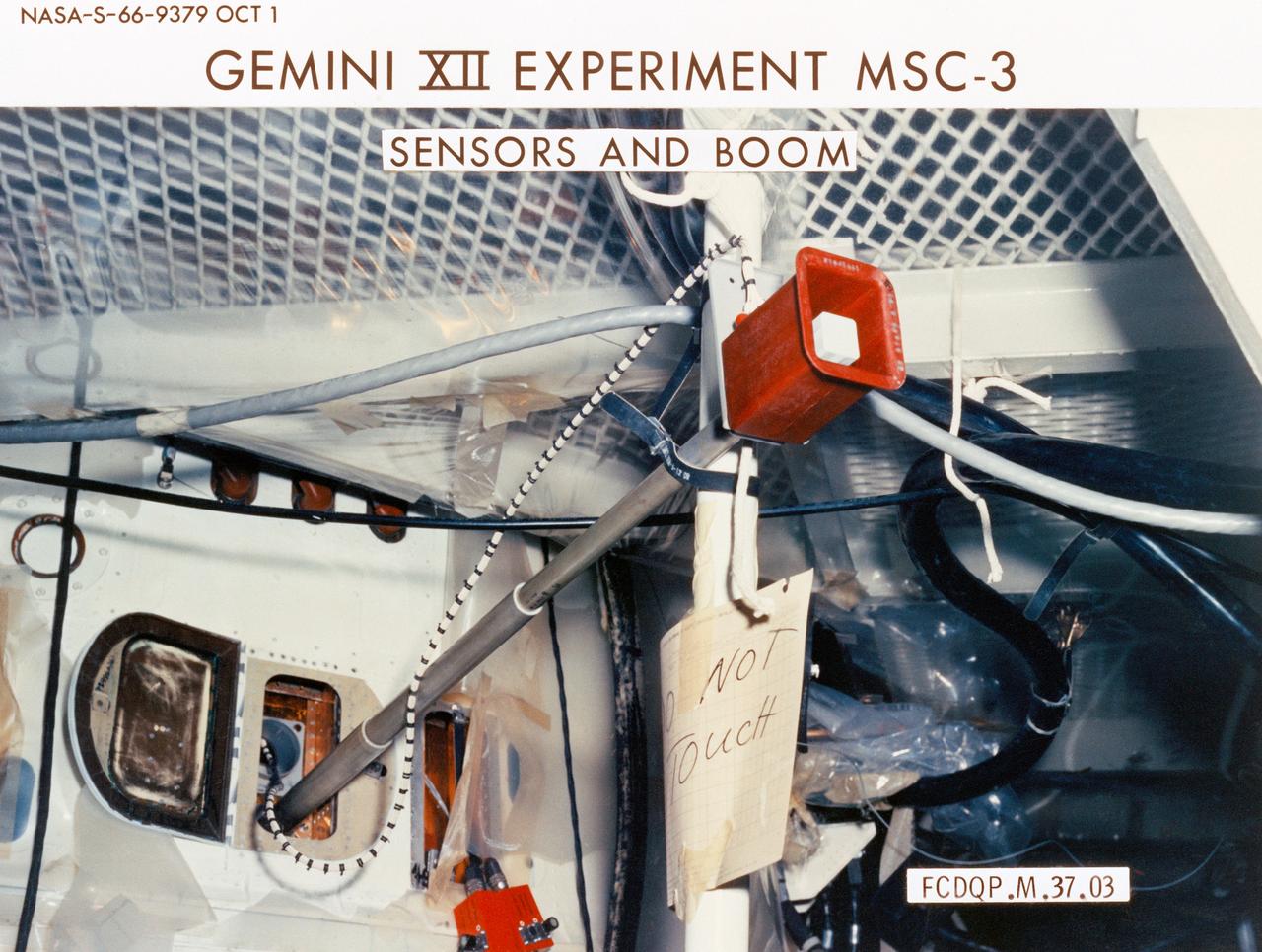
S66-09379 (1 Oct. 1966) --- Tri-Axis Magnetometer-Sensor Unit mounted on telescoping boom. Cable connects Sensor Unit with Electronics Unit mounted on retrograde beam in retrograde adapter section. Objective of experiment is to monitor the direction and amplitude of Earth's magnetic field (Gemini-12). Photo credit: NASA
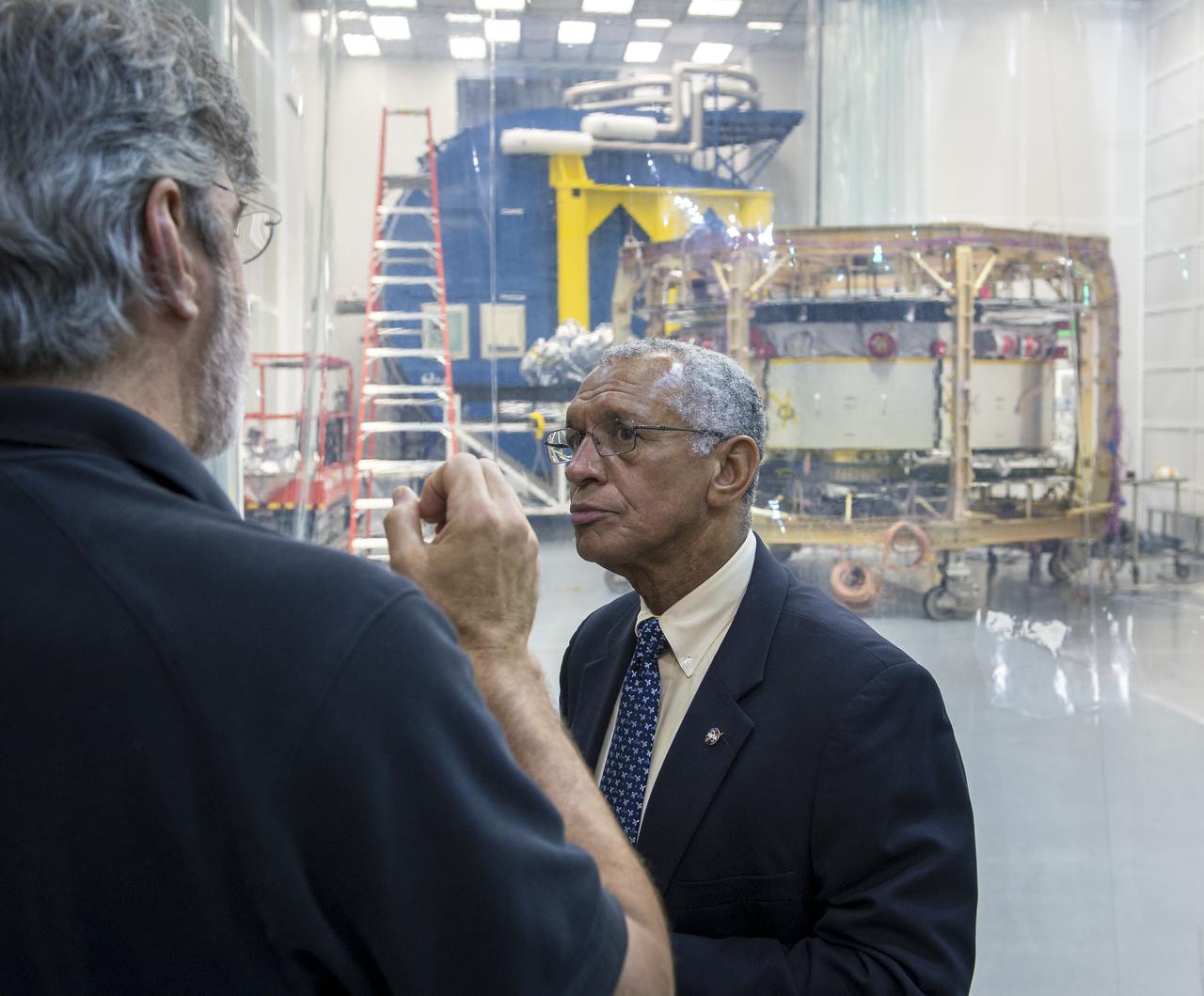
NASA Administrator Charles Bolden listens to Magnetospheric Multiscale (MMS) Mission Project Manager Craig Tooley talk about the MMS mission outside of a Naval Research Laboratory cleanroom where one of four Magnetospheric Multiscale (MMS) spacecraft is currently undergoing testing, Monday, August 4, 2014, in Washington. The Magnetospheric Multiscale, or MMS, mission will study the mystery of how magnetic fields around Earth connect and disconnect, explosively releasing energy via a process known as magnetic reconnection. The four identical spacecraft are scheduled to launch in 2015 from Cape Canaveral and will orbit around Earth in varying formations through the dynamic magnetic system surrounding our planet to provide the first three-dimensional views of the magnetic reconnection process. The goal of the STP Program is to understand the fundamental physical processes of the space environment from the sun to Earth, other planets, and the extremes of the solar system boundary. Photo Credit: (NASA/Bill Ingalls)
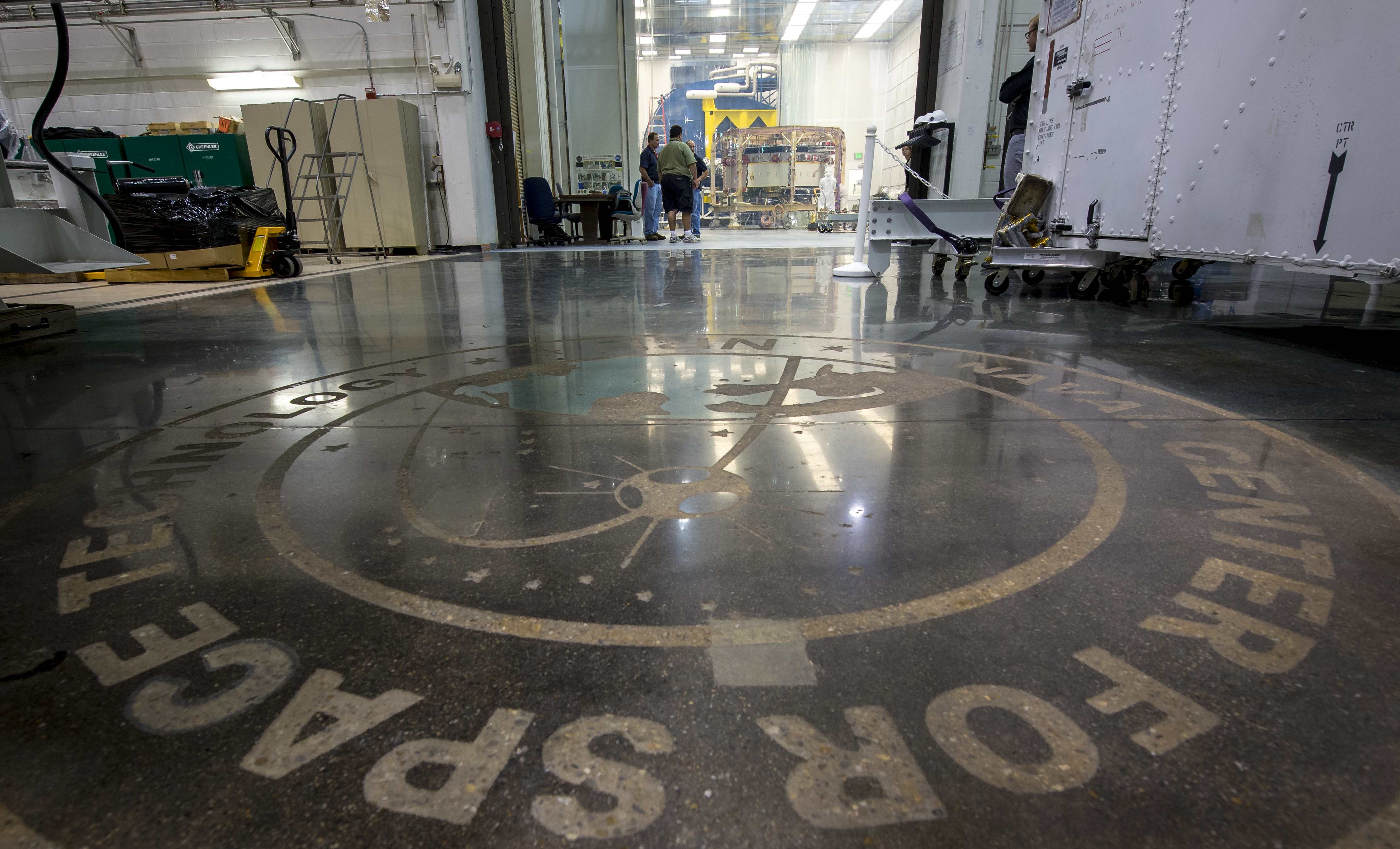
One of four Magnetospheric Multiscale (MMS) spacecraft, in the background, is seen in a cleanroom at the Naval Research Lab’s, Naval Center for Space Technology, Monday, August 4, 2014, in Washington. The Magnetospheric Multiscale, or MMS, mission will study the mystery of how magnetic fields around Earth connect and disconnect, explosively releasing energy via a process known as magnetic reconnection. The four identical spacecraft are scheduled to launch in 2015 from Cape Canaveral and will orbit around Earth in varying formations through the dynamic magnetic system surrounding our planet to provide the first three-dimensional views of the magnetic reconnection process. The goal of the STP Program is to understand the fundamental physical processes of the space environment from the sun to Earth, other planets, and the extremes of the solar system boundary. Photo Credit: (NASA/Bill Ingalls)
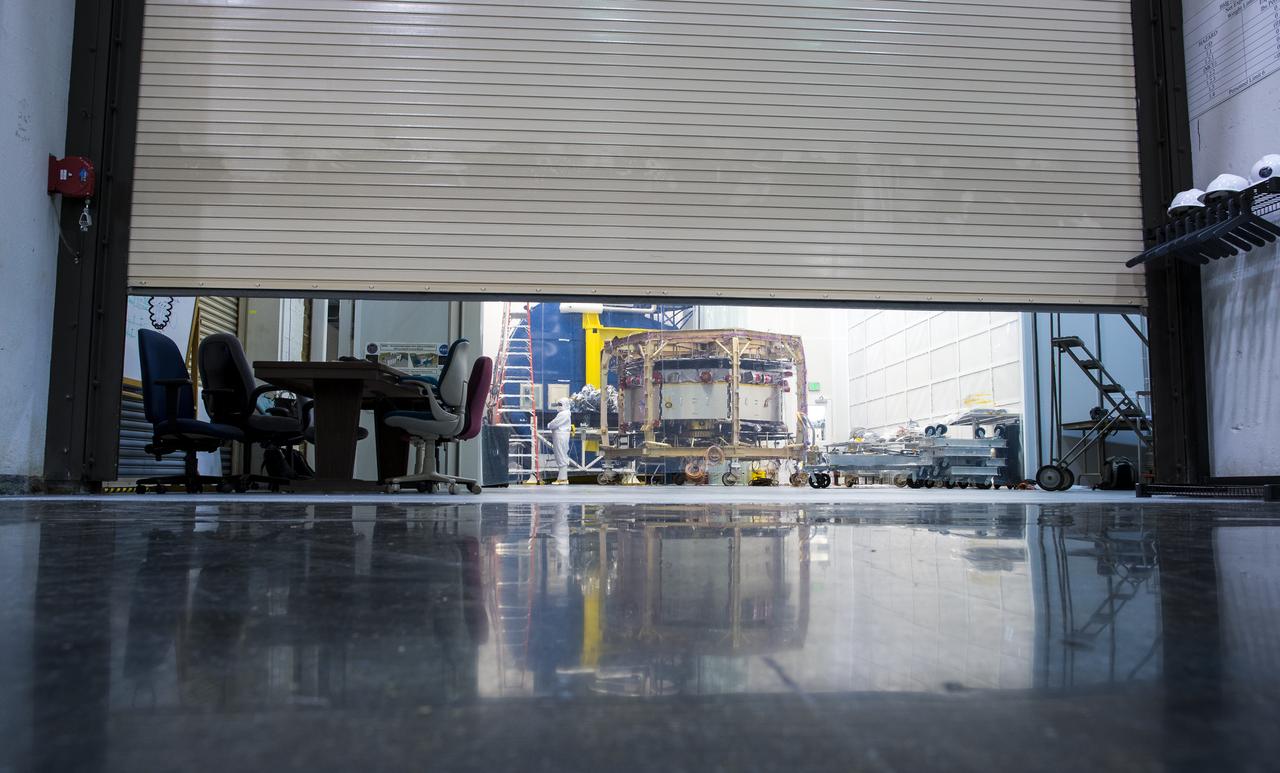
One of four Magnetospheric Multiscale (MMS) spacecraft, in the background, is seen in a cleanroom at the Naval Research Lab’s, Naval Center for Space Technology, Monday, August 4, 2014, in Washington. The Magnetospheric Multiscale, or MMS, mission will study the mystery of how magnetic fields around Earth connect and disconnect, explosively releasing energy via a process known as magnetic reconnection. The four identical spacecraft are scheduled to launch in 2015 from Cape Canaveral and will orbit around Earth in varying formations through the dynamic magnetic system surrounding our planet to provide the first three-dimensional views of the magnetic reconnection process. The goal of the STP Program is to understand the fundamental physical processes of the space environment from the sun to Earth, other planets, and the extremes of the solar system boundary. Photo Credit: (NASA/Bill Ingalls)
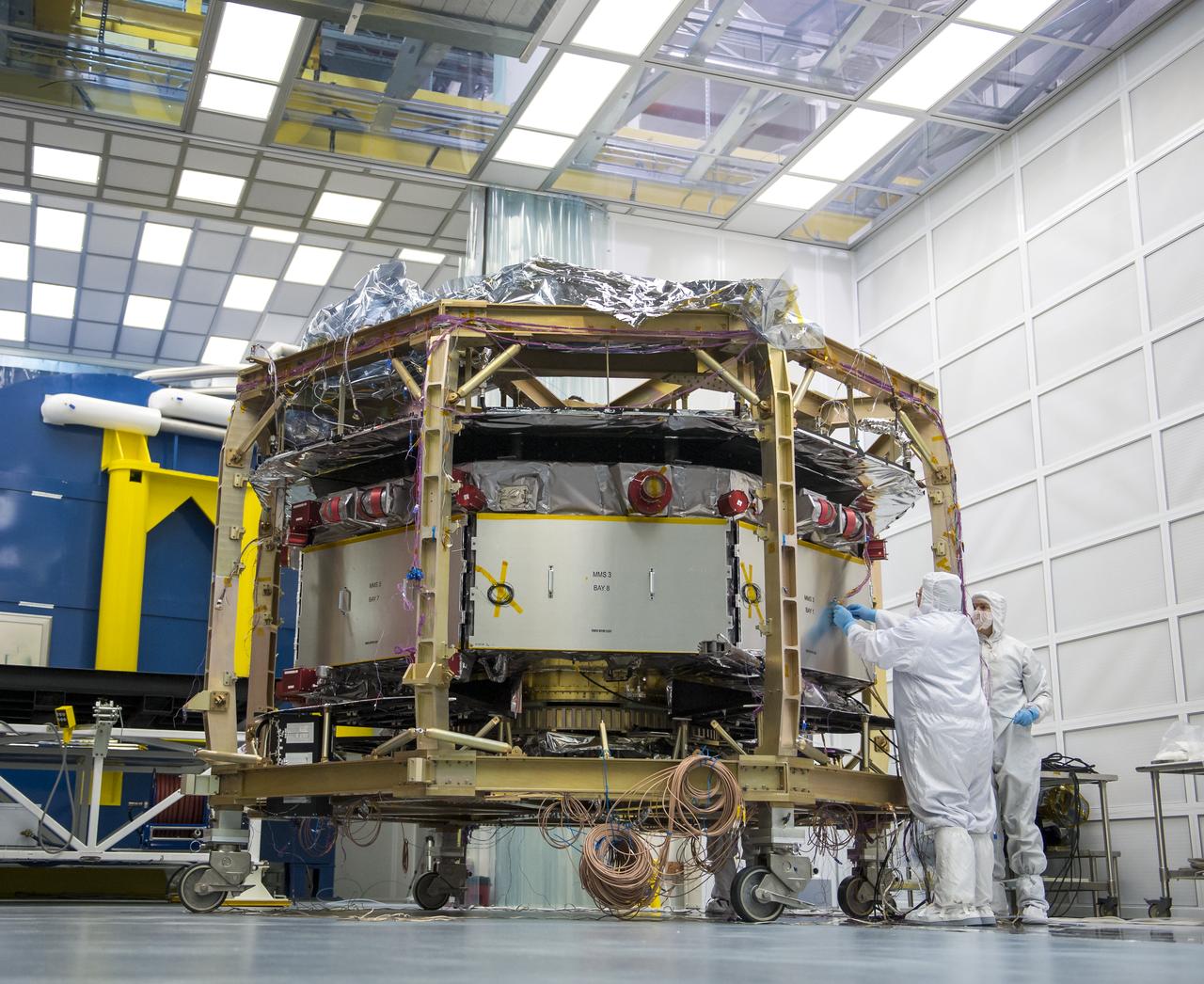
Engineers work on one of four Magnetospheric Multiscale (MMS) spacecraft in a cleanroom at the Naval Research Lab, Monday, August 4, 2014, in Washington. The Magnetospheric Multiscale, or MMS, mission will study the mystery of how magnetic fields around Earth connect and disconnect, explosively releasing energy via a process known as magnetic reconnection. The four identical spacecraft are scheduled to launch in 2015 from Cape Canaveral and will orbit around Earth in varying formations through the dynamic magnetic system surrounding our planet to provide the first three-dimensional views of the magnetic reconnection process. The goal of the STP Program is to understand the fundamental physical processes of the space environment from the sun to Earth, other planets, and the extremes of the solar system boundary. Photo Credit: (NASA/Bill Ingalls)
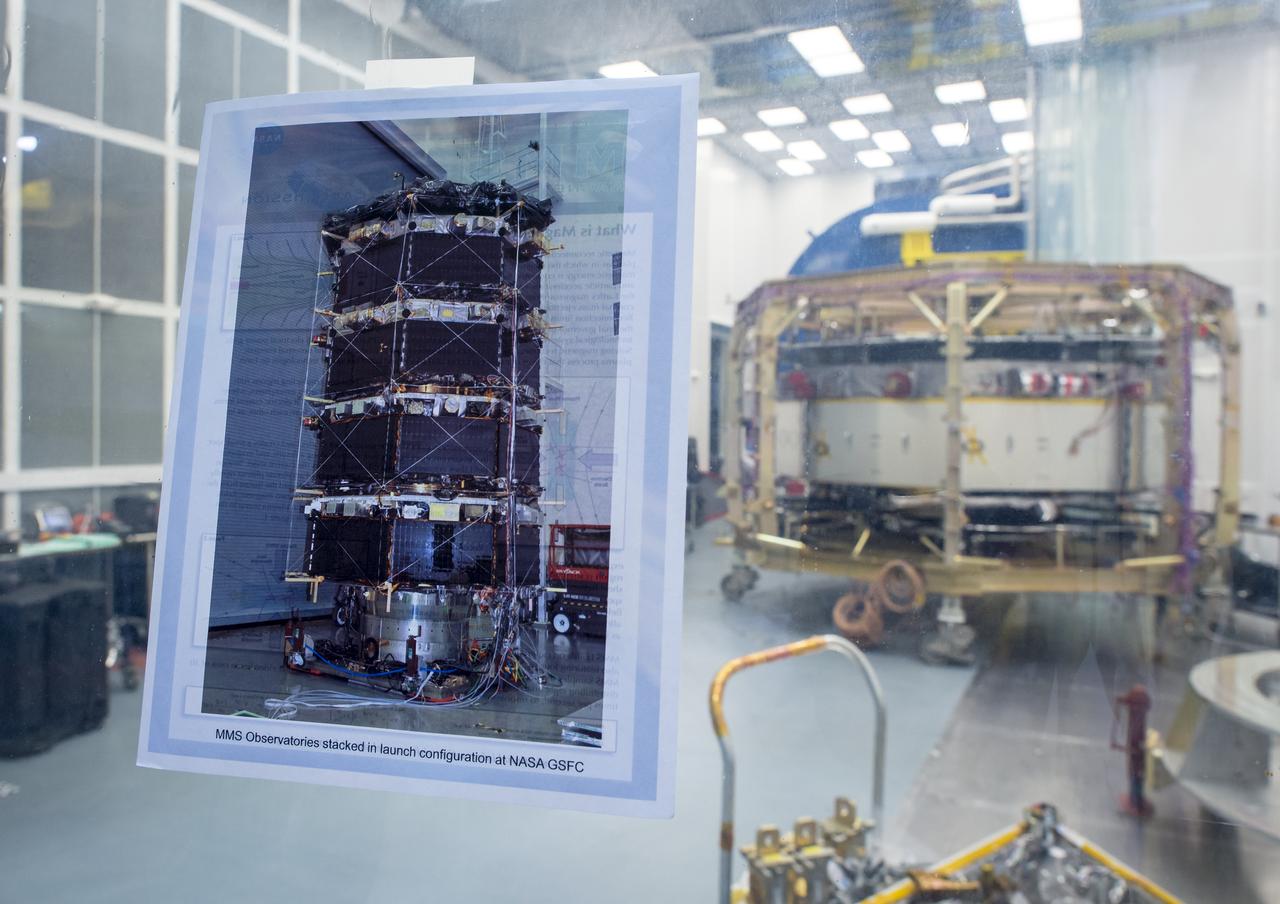
A photograph showing what all four Magnetospheric Multiscale (MMS) spacecraft look like when stacked is seen taped to the window of a Naval Research Laboratory cleanroom where one of the four spacecraft is undergoing testing, Monday, August 4, 2014, in Washington. The Magnetospheric Multiscale, or MMS, mission will study the mystery of how magnetic fields around Earth connect and disconnect, explosively releasing energy via a process known as magnetic reconnection. The four identical spacecraft are scheduled to launch in 2015 from Cape Canaveral and will orbit around Earth in varying formations through the dynamic magnetic system surrounding our planet to provide the first three-dimensional views of the magnetic reconnection process. The goal of the STP Program is to understand the fundamental physical processes of the space environment from the sun to Earth, other planets, and the extremes of the solar system boundary. Photo Credit: (NASA/Bill Ingalls)
A solid rocket motor for the United Launch Alliance Atlas V rocket slated to boost NASA's Magnetospheric Multiscale mission, or MMS, is lowered into position inside the mobile service tower at Space Launch Complex 41 on Cape Canaveral Air Force Station in Florida. Four identical MMS spacecraft will study the mystery of how magnetic fields around Earth connect and disconnect, explosively releasing energy via a process known a magnetic reconnection. Launch is set for March 12. To learn more: http://www.nasa.gov/mms. Photo credit: NASA/ Kim Shiflett

A solid rocket motor for the United Launch Alliance Atlas V rocket slated to boost NASA's Magnetospheric Multiscale mission, or MMS, is lifted at the mobile service tower at Space Launch Complex 41 on Cape Canaveral Air Force Station in Florida. Four identical MMS spacecraft will study the mystery of how magnetic fields around Earth connect and disconnect, explosively releasing energy via a process known a magnetic reconnection. Launch is set for March 12. To learn more: http://www.nasa.gov/mms. Photo credit: NASA/ Kim Shiflett
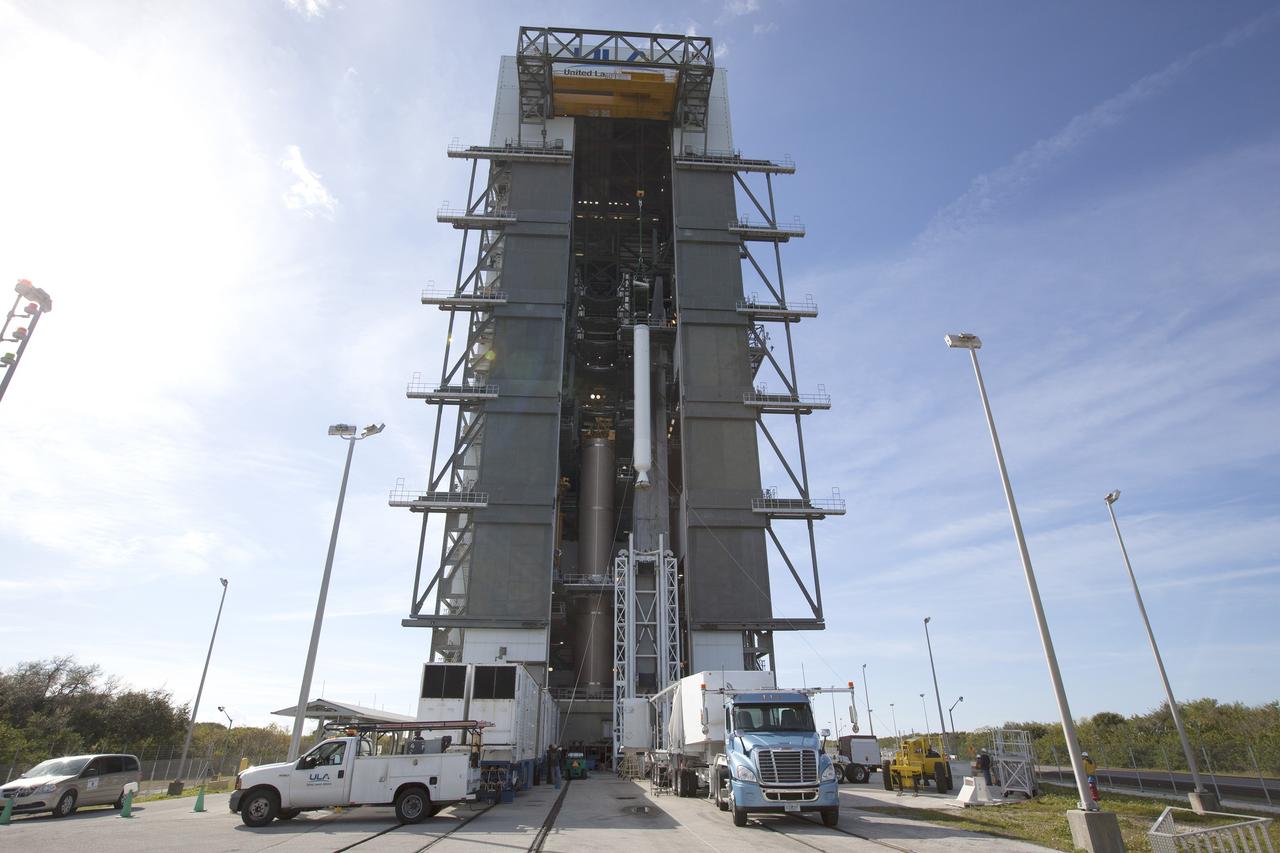
A solid rocket motor for the United Launch Alliance Atlas V rocket slated to boost NASA's Magnetospheric Multiscale mission, or MMS, is lifted at the mobile service tower at Space Launch Complex 41 on Cape Canaveral Air Force Station in Florida. Four identical MMS spacecraft will study the mystery of how magnetic fields around Earth connect and disconnect, explosively releasing energy via a process known a magnetic reconnection. Launch is set for March 12. To learn more: http://www.nasa.gov/mms. Photo credit: NASA/ Kim Shiflett
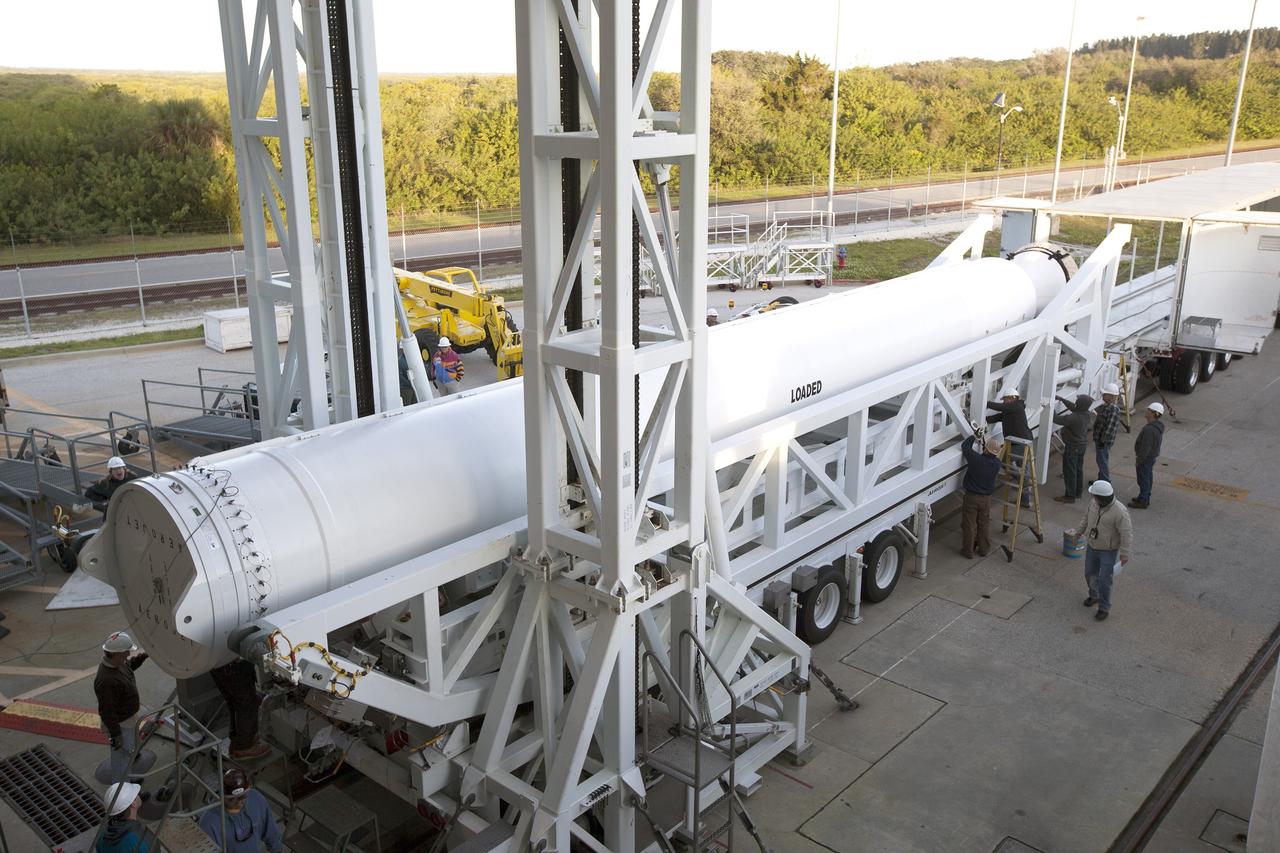
A solid rocket motor for the United Launch Alliance Atlas V rocket slated to boost NASA's Magnetospheric Multiscale mission, or MMS, arrives at the mobile service tower at Space Launch Complex 41 on Cape Canaveral Air Force Station in Florida. Four identical MMS spacecraft will study the mystery of how magnetic fields around Earth connect and disconnect, explosively releasing energy via a process known a magnetic reconnection. Launch is set for March 12. To learn more: http://www.nasa.gov/mms. Photo credit: NASA/ Kim Shiflett

A solid rocket motor for the United Launch Alliance Atlas V rocket slated to boost NASA's Magnetospheric Multiscale mission, or MMS, is lowered into position inside the mobile service tower at Space Launch Complex 41 on Cape Canaveral Air Force Station in Florida. Four identical MMS spacecraft will study the mystery of how magnetic fields around Earth connect and disconnect, explosively releasing energy via a process known a magnetic reconnection. Launch is set for March 12. To learn more: http://www.nasa.gov/mms. Photo credit: NASA/ Kim Shiflett

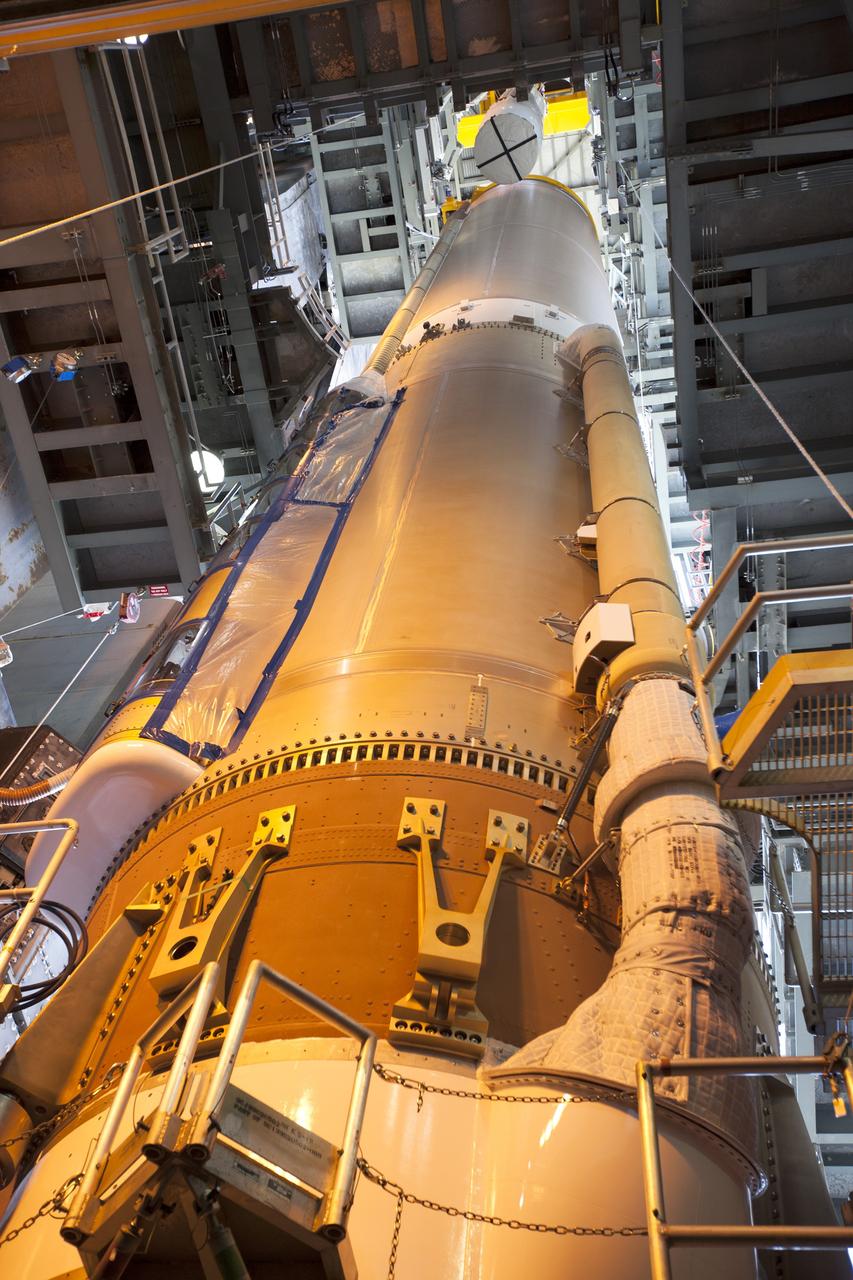
CAPE CANAVERAL, Fla. – The first stage of the United Launch Alliance Atlas V rocket for NASA's Magnetospheric Multiscale mission, or MMS, is lifted into the mobile service tower at Space Launch Complex 41 on Cape Canaveral Air Force Station in Florida. MMS will study the mystery of how magnetic fields around Earth connect and disconnect, explosively releasing energy via a process known a magnetic reconnection. MMS consists of four identical spacecraft that work together to provide the first three-dimensional view of this fundamental process, which occurs throughout the universe. Launch is set for March 12. To learn more about MMS, visit http://www.nasa.gov/mms. Photo credit: NASA/Jim Grossmann
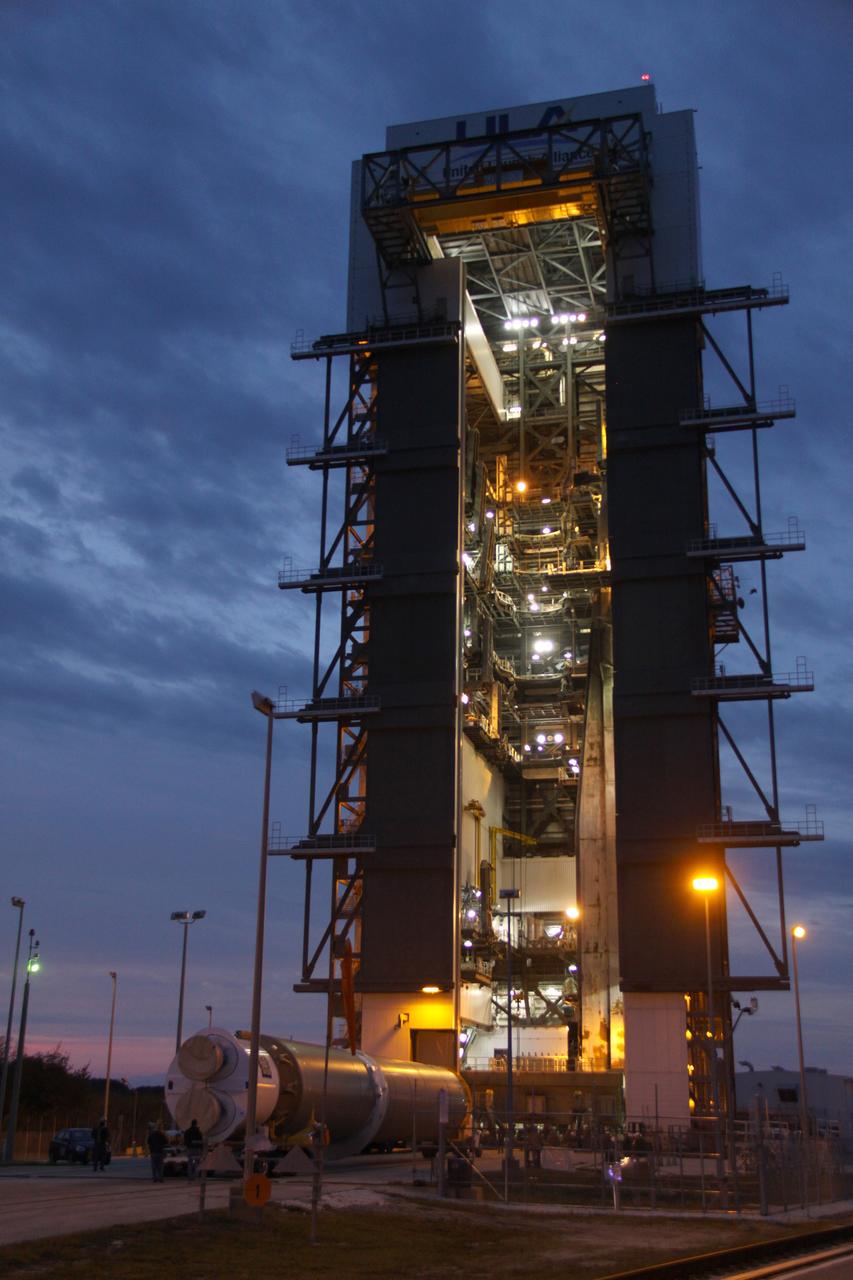
CAPE CANAVERAL, Fla. – The first stage of the United Launch Alliance Atlas V rocket for NASA's Magnetospheric Multiscale mission, or MMS, arrives at the mobile service tower at Space Launch Complex 41 on Cape Canaveral Air Force Station in Florida. MMS will study the mystery of how magnetic fields around Earth connect and disconnect, explosively releasing energy via a process known a magnetic reconnection. MMS consists of four identical spacecraft that work together to provide the first three-dimensional view of this fundamental process, which occurs throughout the universe. Launch is set for March 12. To learn more about MMS, visit http://www.nasa.gov/mms. Photo credit: NASA/Jim Grossmann
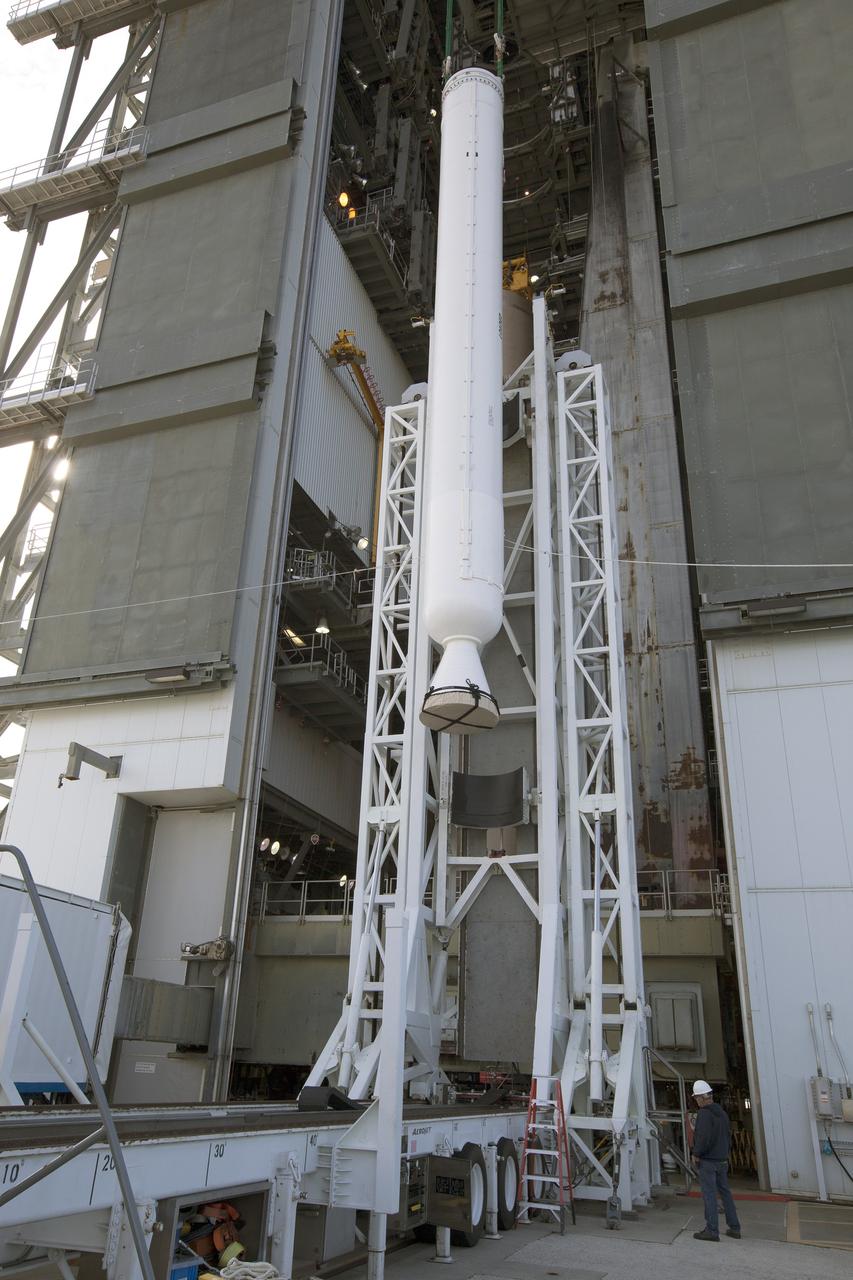
A solid rocket motor for the United Launch Alliance Atlas V rocket slated to boost NASA's Magnetospheric Multiscale mission, or MMS, is lifted at the mobile service tower at Space Launch Complex 41 on Cape Canaveral Air Force Station in Florida. Four identical MMS spacecraft will study the mystery of how magnetic fields around Earth connect and disconnect, explosively releasing energy via a process known a magnetic reconnection. Launch is set for March 12. To learn more: http://www.nasa.gov/mms. Photo credit: NASA/ Kim Shiflett
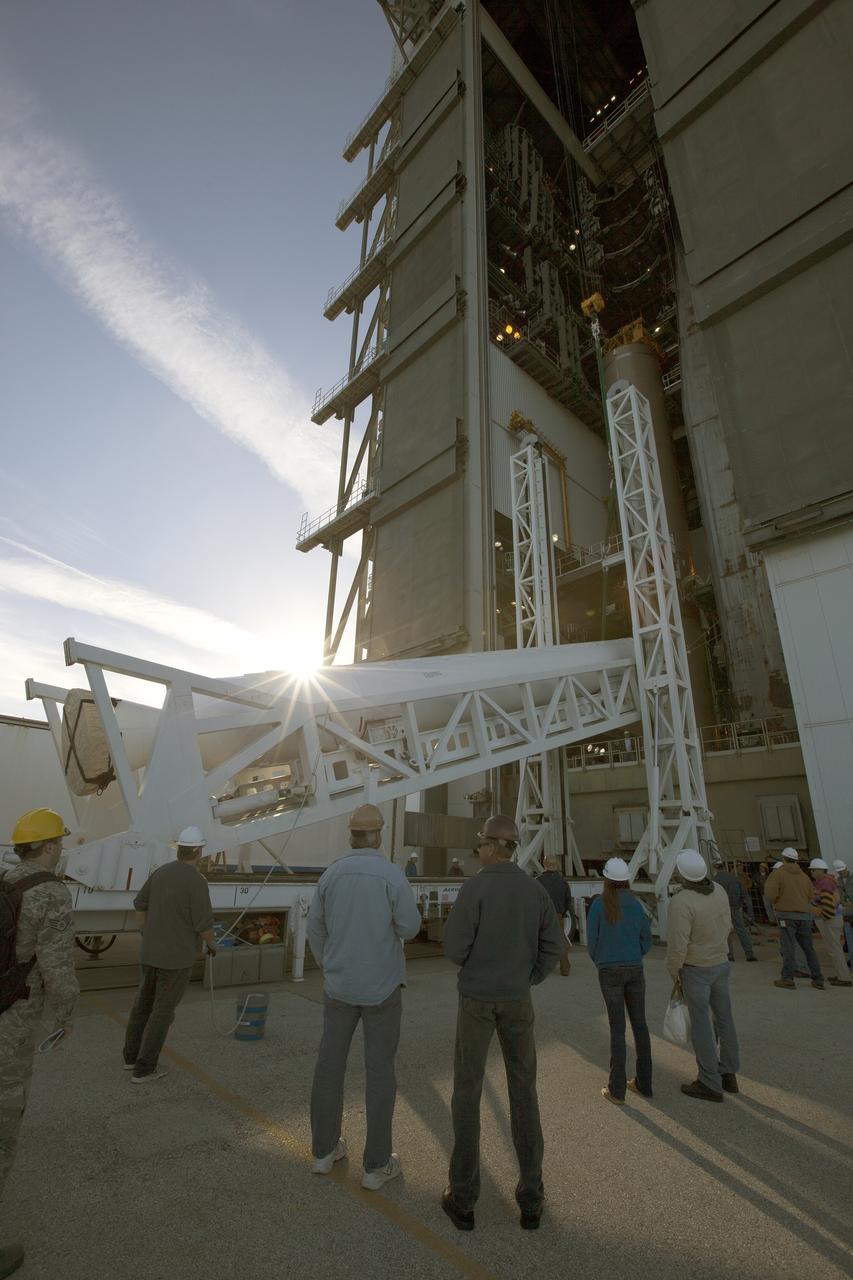
A solid rocket motor for the United Launch Alliance Atlas V rocket slated to boost NASA's Magnetospheric Multiscale mission, or MMS, is lifted at the mobile service tower at Space Launch Complex 41 on Cape Canaveral Air Force Station in Florida. Four identical MMS spacecraft will study the mystery of how magnetic fields around Earth connect and disconnect, explosively releasing energy via a process known a magnetic reconnection. Launch is set for March 12. To learn more: http://www.nasa.gov/mms. Photo credit: NASA/ Kim Shiflett
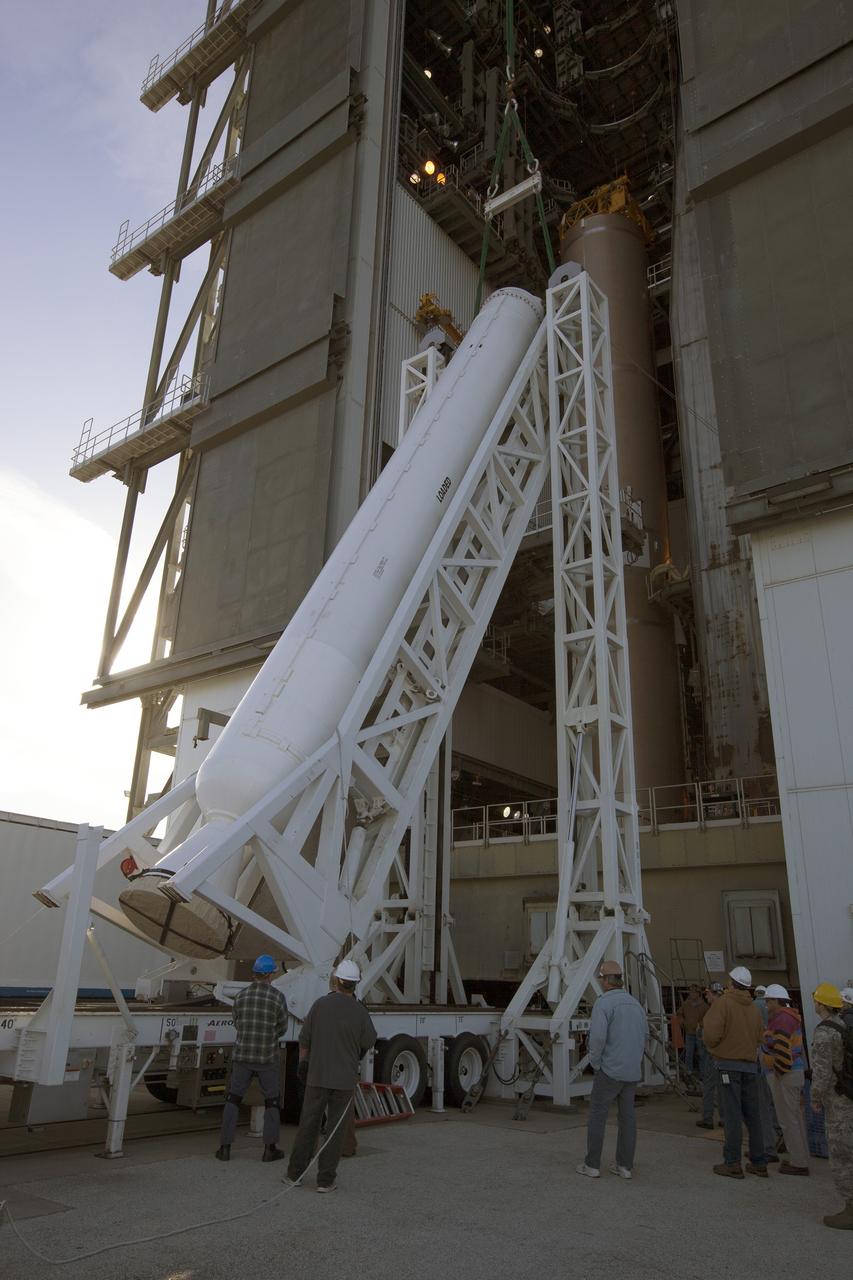
A solid rocket motor for the United Launch Alliance Atlas V rocket slated to boost NASA's Magnetospheric Multiscale mission, or MMS, is lifted at the mobile service tower at Space Launch Complex 41 on Cape Canaveral Air Force Station in Florida. Four identical MMS spacecraft will study the mystery of how magnetic fields around Earth connect and disconnect, explosively releasing energy via a process known a magnetic reconnection. Launch is set for March 12. To learn more: http://www.nasa.gov/mms. Photo credit: NASA/ Kim Shiflett
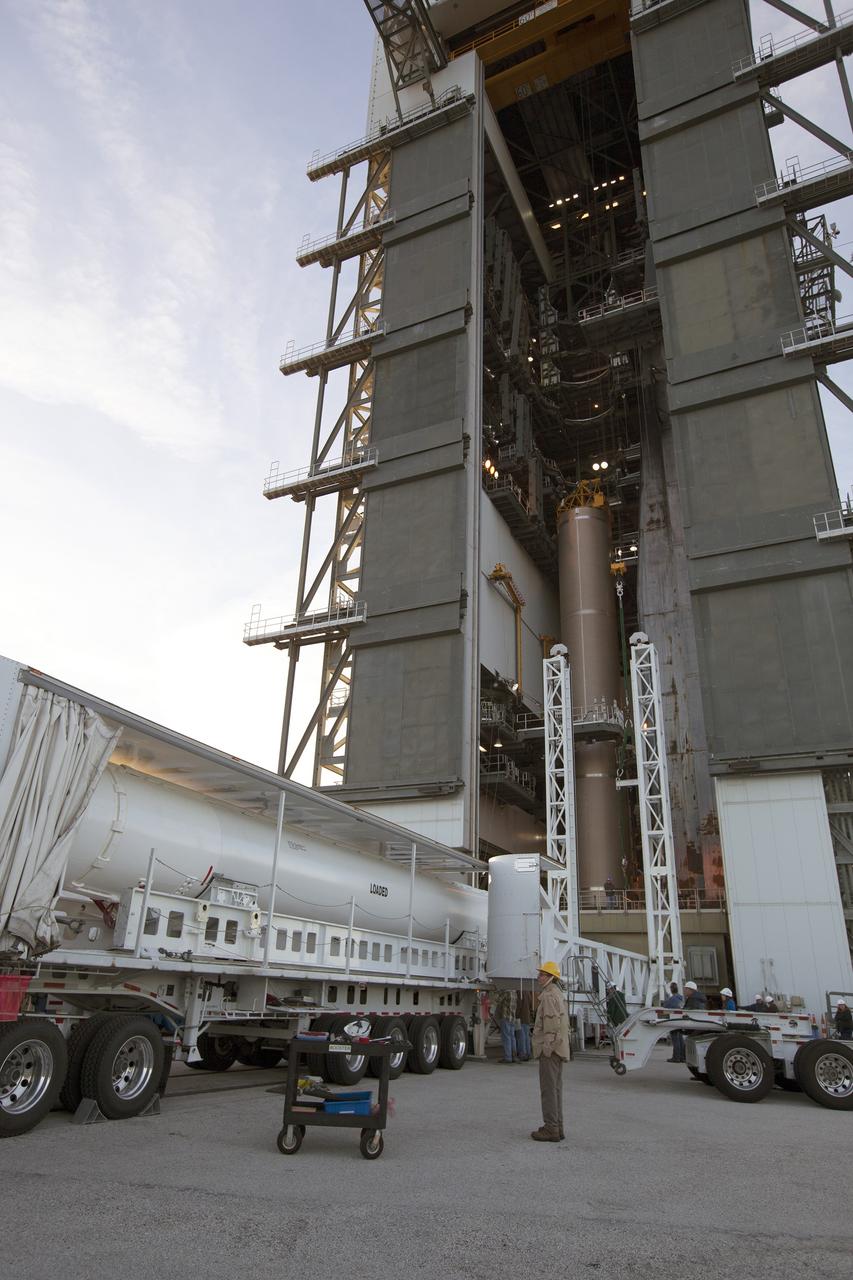
A solid rocket motor for the United Launch Alliance Atlas V rocket slated to boost NASA's Magnetospheric Multiscale mission, or MMS, arrives at the mobile service tower at Space Launch Complex 41 on Cape Canaveral Air Force Station in Florida. Four identical MMS spacecraft will study the mystery of how magnetic fields around Earth connect and disconnect, explosively releasing energy via a process known a magnetic reconnection. Launch is set for March 12. To learn more: http://www.nasa.gov/mms. Photo credit: NASA/ Kim Shiflett
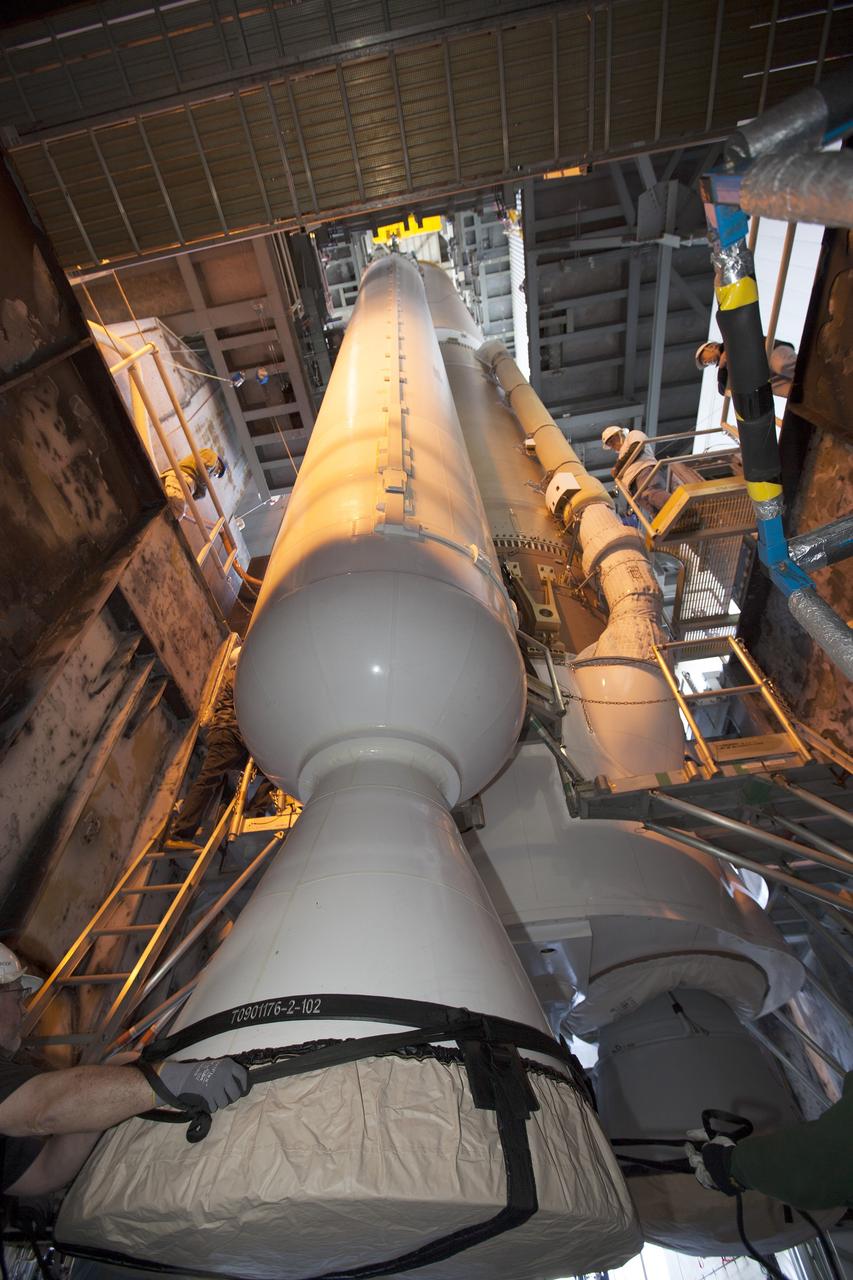
A solid rocket motor for the United Launch Alliance Atlas V rocket slated to boost NASA's Magnetospheric Multiscale mission, or MMS, is lowered into position inside the mobile service tower at Space Launch Complex 41 on Cape Canaveral Air Force Station in Florida. Four identical MMS spacecraft will study the mystery of how magnetic fields around Earth connect and disconnect, explosively releasing energy via a process known a magnetic reconnection. Launch is set for March 12. To learn more: http://www.nasa.gov/mms. Photo credit: NASA/ Kim Shiflett
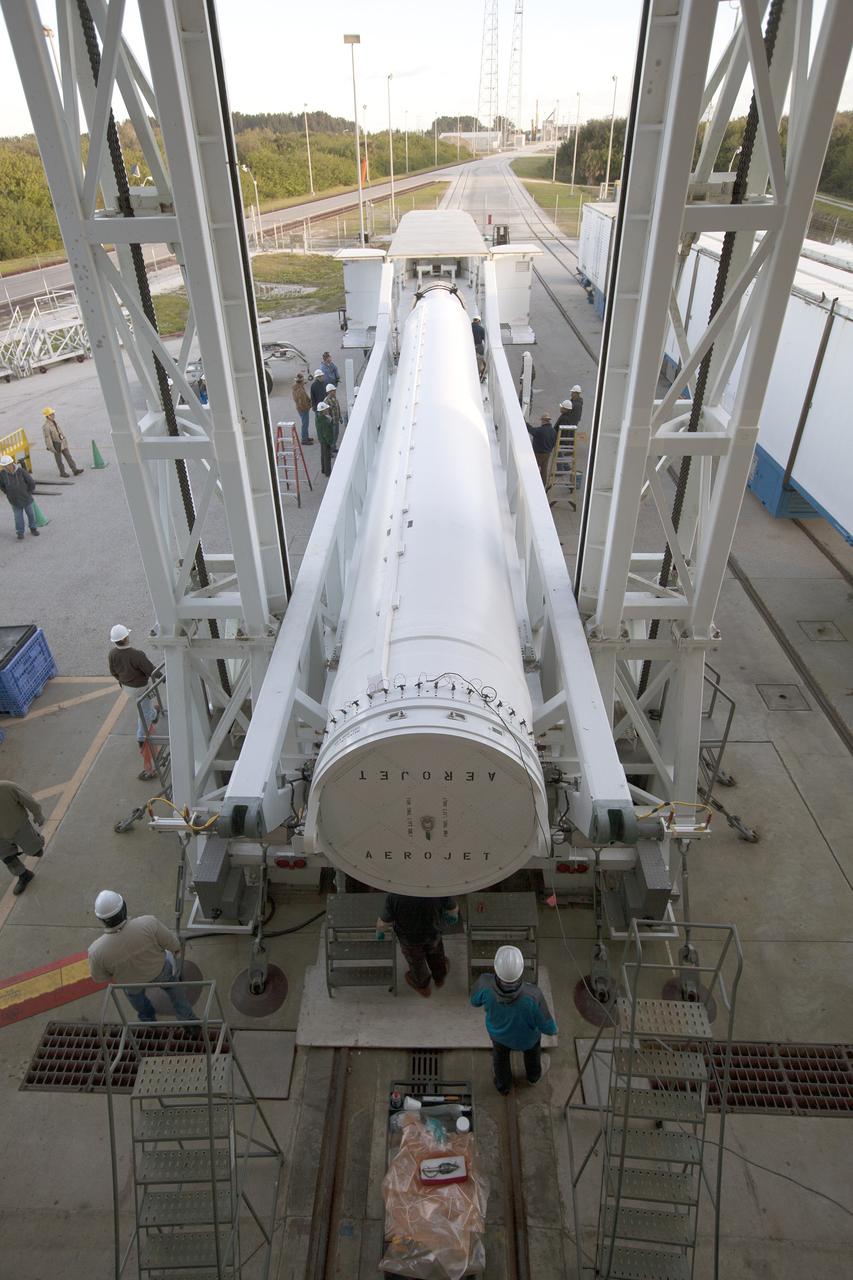
A solid rocket motor for the United Launch Alliance Atlas V rocket slated to boost NASA's Magnetospheric Multiscale mission, or MMS, arrives at the mobile service tower at Space Launch Complex 41 on Cape Canaveral Air Force Station in Florida. Four identical MMS spacecraft will study the mystery of how magnetic fields around Earth connect and disconnect, explosively releasing energy via a process known a magnetic reconnection. Launch is set for March 12. To learn more: http://www.nasa.gov/mms. Photo credit: NASA/ Kim Shiflett

A solid rocket motor for the United Launch Alliance Atlas V rocket slated to boost NASA's Magnetospheric Multiscale mission, or MMS, is lowered into position inside the mobile service tower at Space Launch Complex 41 on Cape Canaveral Air Force Station in Florida. Four identical MMS spacecraft will study the mystery of how magnetic fields around Earth connect and disconnect, explosively releasing energy via a process known a magnetic reconnection. Launch is set for March 12. To learn more: http://www.nasa.gov/mms. Photo credit: NASA/ Kim Shiflett
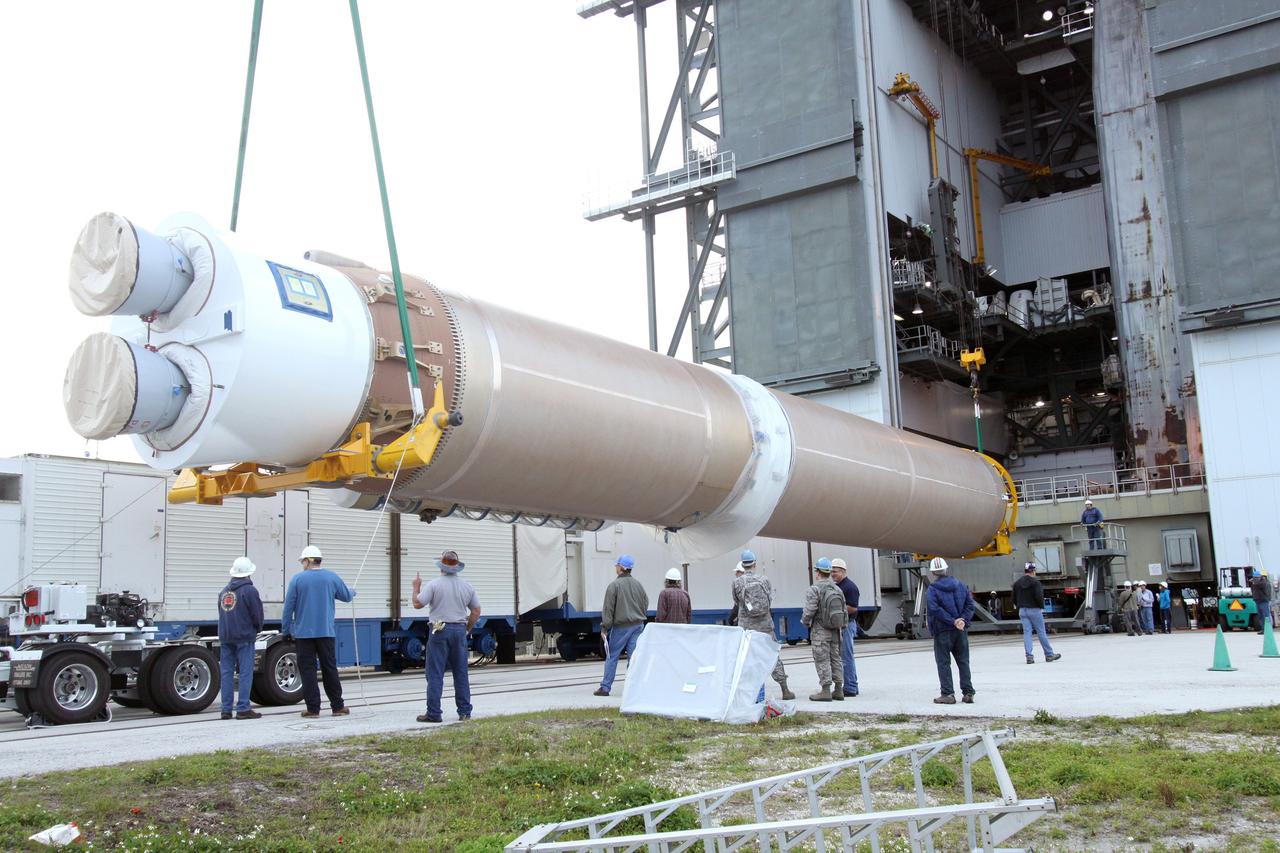
CAPE CANAVERAL, Fla. – The first stage of the United Launch Alliance Atlas V rocket for NASA's Magnetospheric Multiscale mission, or MMS, is lifted into the mobile service tower at Space Launch Complex 41 on Cape Canaveral Air Force Station in Florida. MMS will study the mystery of how magnetic fields around Earth connect and disconnect, explosively releasing energy via a process known a magnetic reconnection. MMS consists of four identical spacecraft that work together to provide the first three-dimensional view of this fundamental process, which occurs throughout the universe. Launch is set for March 12. To learn more about MMS, visit http://www.nasa.gov/mms. Photo credit: NASA/Jim Grossmann
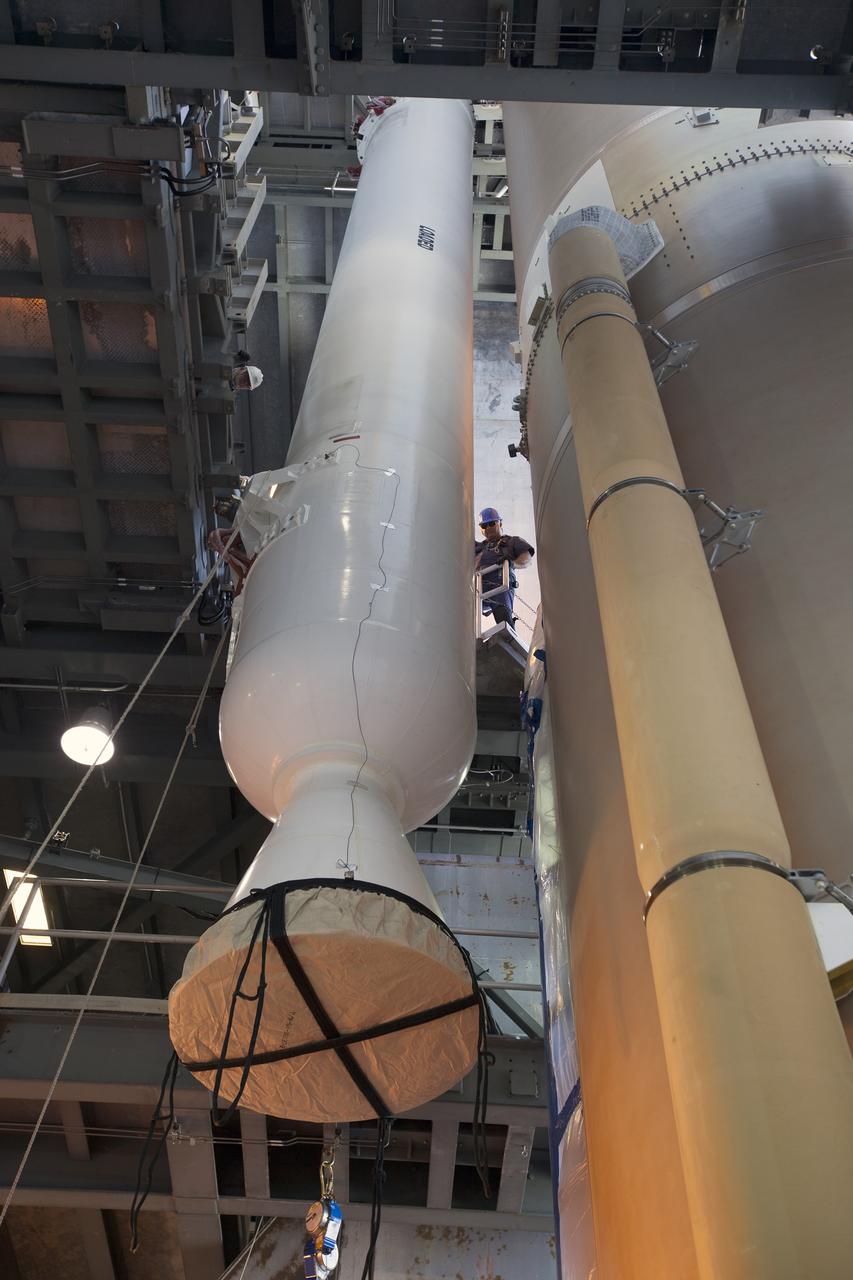
A solid rocket motor for the United Launch Alliance Atlas V rocket slated to boost NASA's Magnetospheric Multiscale mission, or MMS, is lowered into position inside the mobile service tower at Space Launch Complex 41 on Cape Canaveral Air Force Station in Florida. Four identical MMS spacecraft will study the mystery of how magnetic fields around Earth connect and disconnect, explosively releasing energy via a process known a magnetic reconnection. Launch is set for March 12. To learn more: http://www.nasa.gov/mms. Photo credit: NASA/ Kim Shiflett

iss051e041849 (05/12/2017) -- NASA astronaut Peggy Whitson is seen during the 200th spacewalk in support of the International Space Station. Expedition 51 Commander Peggy Whitson and Flight Engineer Jack Fischer of NASA successfully replaced a large avionics box that supplies electricity and data connections to the science experiments. The astronauts also completed additional tasks to install a connector that will route data to the Alpha Magnetic Spectrometer, repair insulation at the connecting point of the Japanese robotic arm, and install a protective shield on the Pressurized Mating Adapter-3. This adapter will host a new international docking port for the arrival of commercial crew spacecraft.

iss051e041844 (05/12/2017) -- NASA astronaut Jack Fischer is seen during the 200th spacewalk in support of the International Space Station. Expedition 51 Commander Peggy Whitson and Flight Engineer Jack Fischer of NASA successfully replaced a large avionics box that supplies electricity and data connections to the science experiments. The astronauts also completed additional tasks to install a connector that will route data to the Alpha Magnetic Spectrometer, repair insulation at the connecting point of the Japanese robotic arm, and install a protective shield on the Pressurized Mating Adapter-3. This adapter will host a new international docking port for the arrival of commercial crew spacecraft.
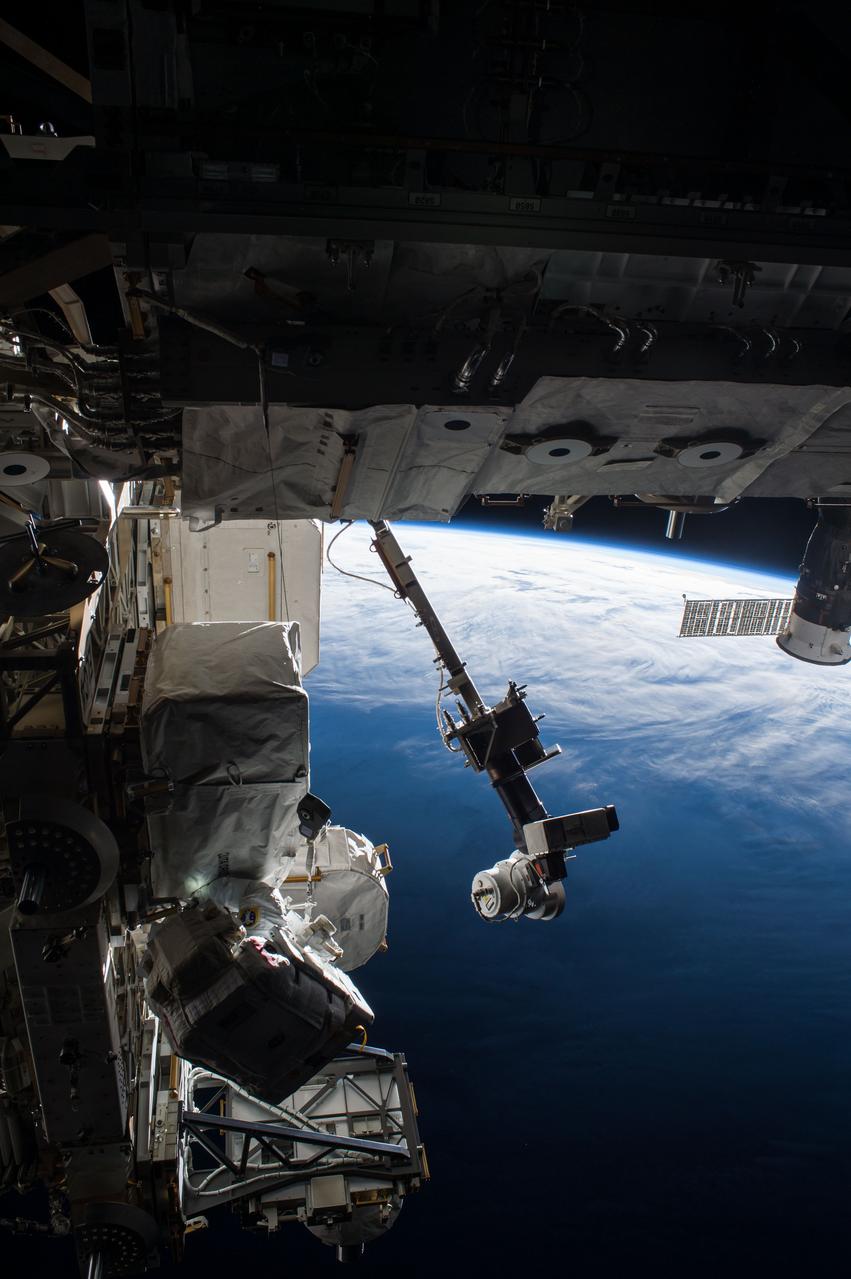
iss051e041847 (05/12/2017) -- NASA astronaut Peggy Whitson is seen during the 200th spacewalk in support of the International Space Station. Expedition 51 Commander Peggy Whitson and Flight Engineer Jack Fischer of NASA successfully replaced a large avionics box that supplies electricity and data connections to the science experiments. The astronauts also completed additional tasks to install a connector that will route data to the Alpha Magnetic Spectrometer, repair insulation at the connecting point of the Japanese robotic arm, and install a protective shield on the Pressurized Mating Adapter-3. This adapter will host a new international docking port for the arrival of commercial crew spacecraft.

iss051e041841 (05/12/2017) -- NASA astronaut Peggy Whitson is seen during the 200th spacewalk in support of the International Space Station. Expedition 51 Commander Peggy Whitson and Flight Engineer Jack Fischer of NASA successfully replaced a large avionics box that supplies electricity and data connections to the science experiments. The astronauts also completed additional tasks to install a connector that will route data to the Alpha Magnetic Spectrometer, repair insulation at the connecting point of the Japanese robotic arm, and install a protective shield on the Pressurized Mating Adapter-3. This adapter will host a new international docking port for the arrival of commercial crew spacecraft.
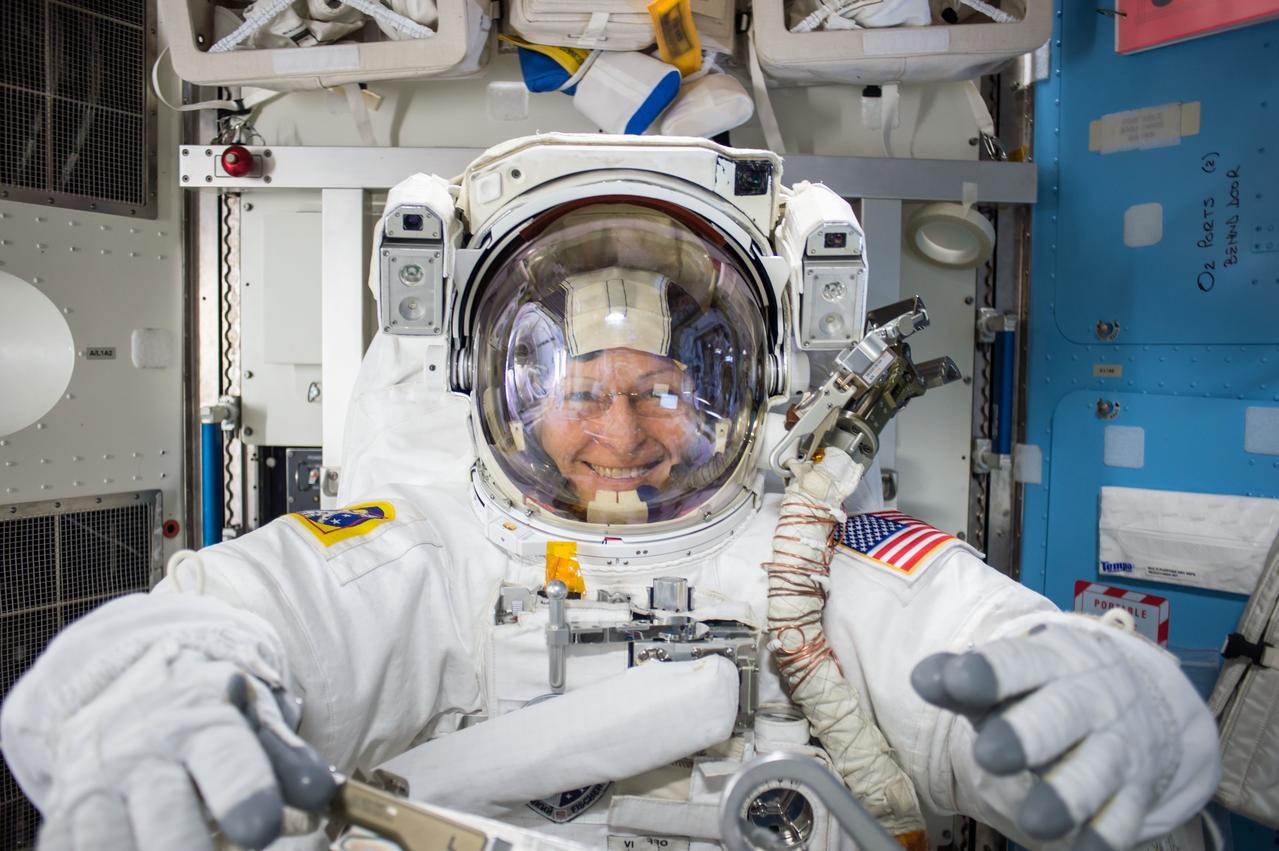
iss051e041836 (05/12/2017) -- NASA astronaut Peggy Whitson is seen prior to the 200th spacewalk in support of the International Space Station. Expedition 51 Commander Peggy Whitson and Flight Engineer Jack Fischer of NASA successfully replaced a large avionics box that supplies electricity and data connections to the science experiments. The astronauts also completed additional tasks to install a connector that will route data to the Alpha Magnetic Spectrometer, repair insulation at the connecting point of the Japanese robotic arm, and install a protective shield on the Pressurized Mating Adapter-3. This adapter will host a new international docking port for the arrival of commercial crew spacecraft.

iss051e041860 (05/12/2017) -- NASA astronaut Peggy Whitson is seen during the 200th spacewalk in support of the International Space Station. Expedition 51 Commander Peggy Whitson and Flight Engineer Jack Fischer of NASA successfully replaced a large avionics box that supplies electricity and data connections to the science experiments. The astronauts also completed additional tasks to install a connector that will route data to the Alpha Magnetic Spectrometer, repair insulation at the connecting point of the Japanese robotic arm, and install a protective shield on the Pressurized Mating Adapter-3. This adapter will host a new international docking port for the arrival of commercial crew spacecraft.
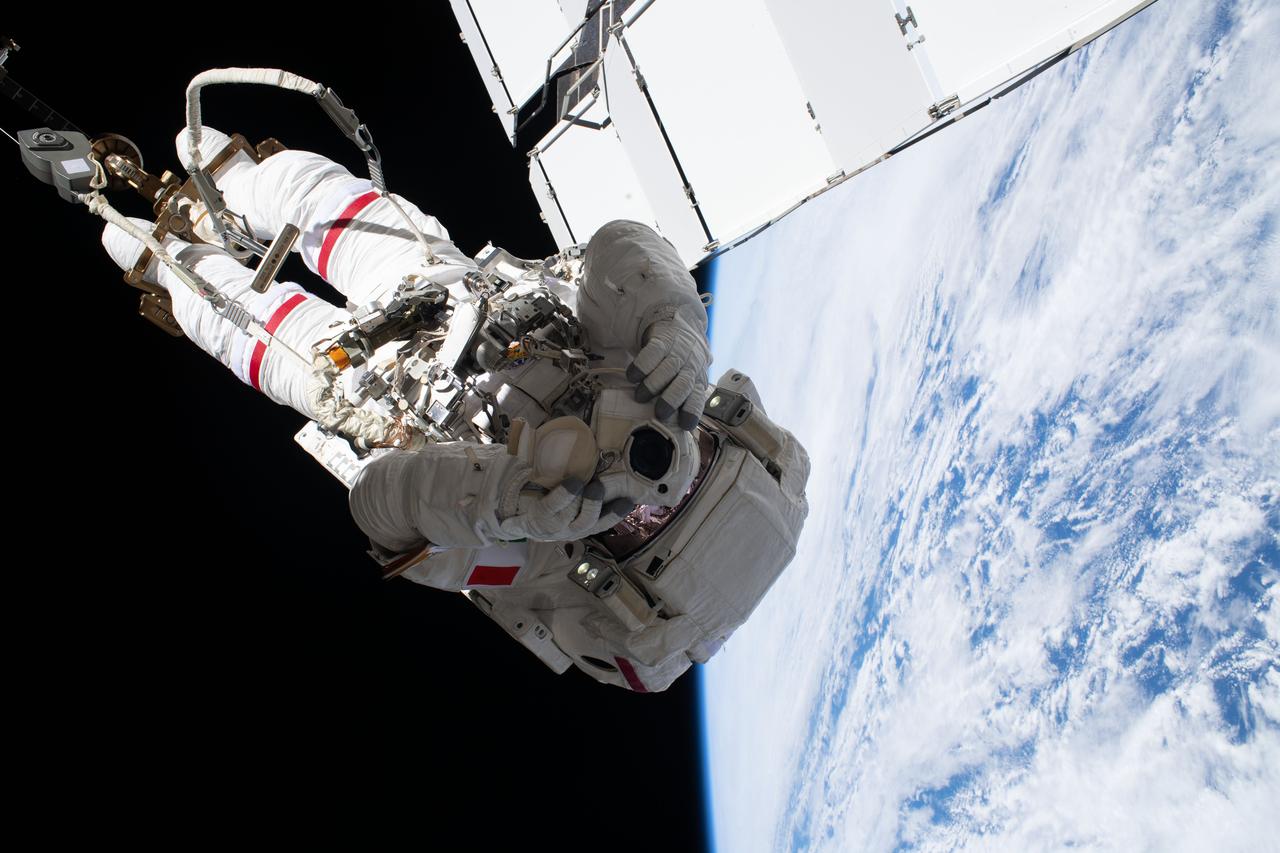
iss061e058522 (Nov. 22, 2019) --- Astronaut and spacewalker Luca Parmitano of ESA (European Space Agency) soars 250 miles above the Earth's surface attached to an articulated portable foot restraint, connected to the tip of the Canadarm2 robotic arm. He and fellow astronaut Andrew Morgan (out of frame) were conducting the second spacewalk to repair the International Space Station's cosmic particle detector, the Alpha Magnetic Spectrometer.
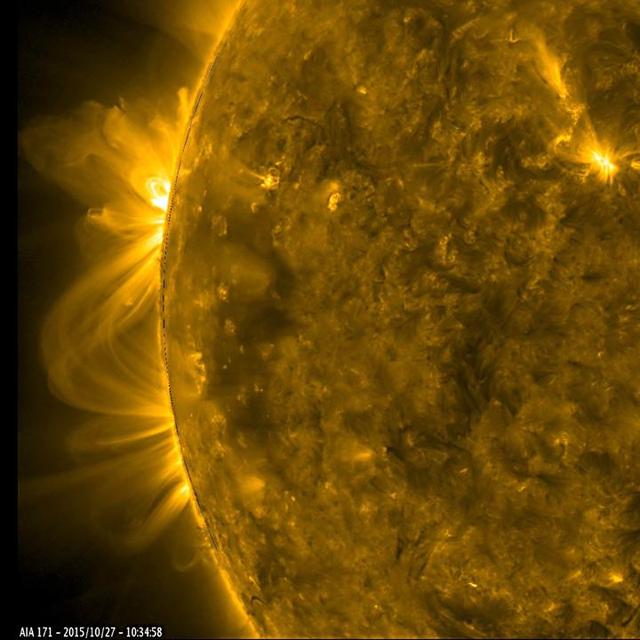
As a pair of active regions began to rotate into view, their towering magnetic field lines above them bloomed into a dazzling display of twisting arches (Oct. 27-28, 2015). Some of the lines reached over and connected with the neighboring active region. Active regions are usually the source of solar storms. The images were taken in a wavelength of extreme ultraviolet light. http://photojournal.jpl.nasa.gov/catalog/PIA20048
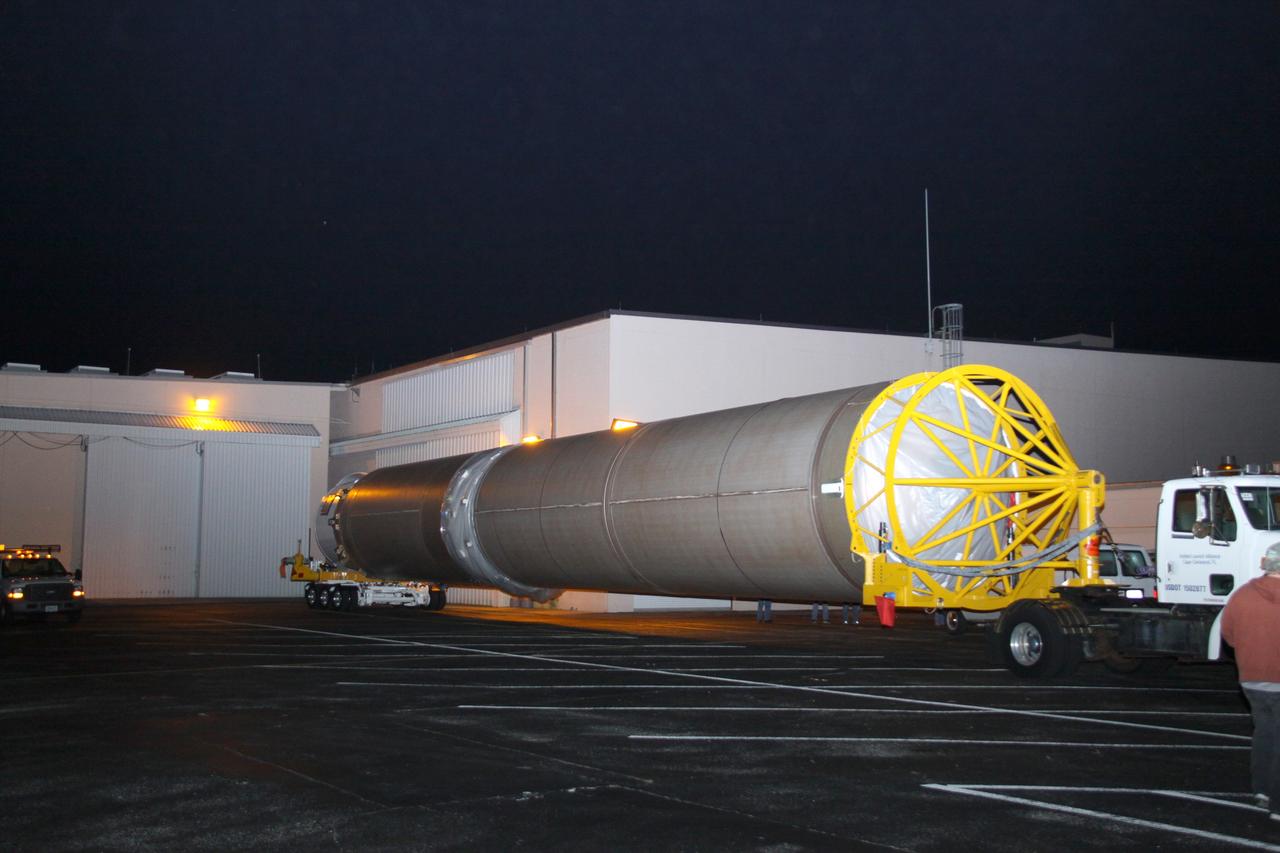
CAPE CANAVERAL, Fla. – The first stage of the United Launch Alliance Atlas V rocket for NASA's Magnetospheric Multiscale mission, or MMS, begins the short journey from the Atlas Spaceflight Operations Center, or ASOC, on Cape Canaveral Air Force Station in Florida to Space Launch Complex 41. MMS will study the mystery of how magnetic fields around Earth connect and disconnect, explosively releasing energy via a process known a magnetic reconnection. MMS consists of four identical spacecraft that work together to provide the first three-dimensional view of this fundamental process, which occurs throughout the universe. Launch is set for March 12. To learn more about MMS, visit http://www.nasa.gov/mms. Photo credit: NASA/Jim Grossmann
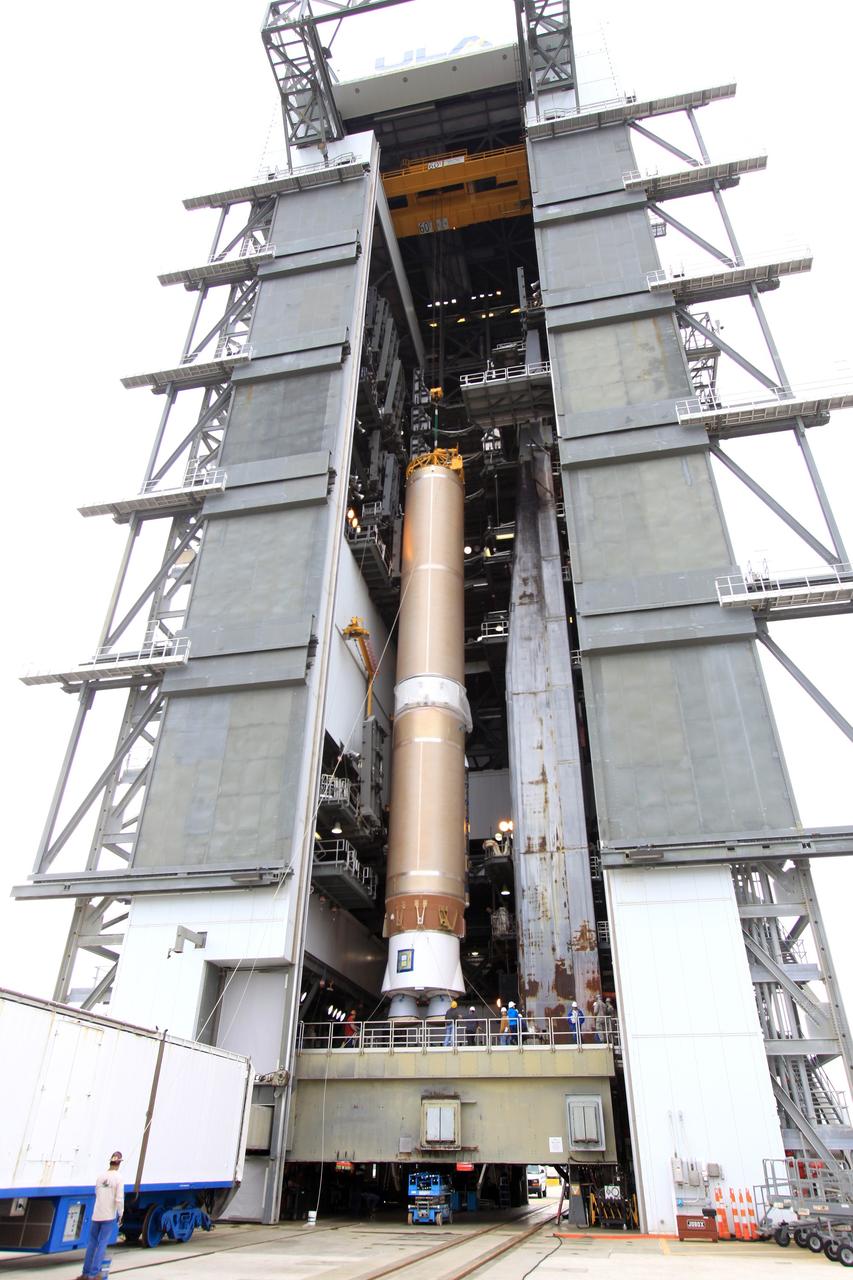
CAPE CANAVERAL, Fla. – The first stage of the United Launch Alliance Atlas V rocket for NASA's Magnetospheric Multiscale mission, or MMS, is positioned on the launch platform in the mobile service tower at Space Launch Complex 41 on Cape Canaveral Air Force Station in Florida. MMS will study the mystery of how magnetic fields around Earth connect and disconnect, explosively releasing energy via a process known a magnetic reconnection. MMS consists of four identical spacecraft that work together to provide the first three-dimensional view of this fundamental process, which occurs throughout the universe. Launch is set for March 12. To learn more about MMS, visit http://www.nasa.gov/mms. Photo credit: NASA/Jim Grossmann
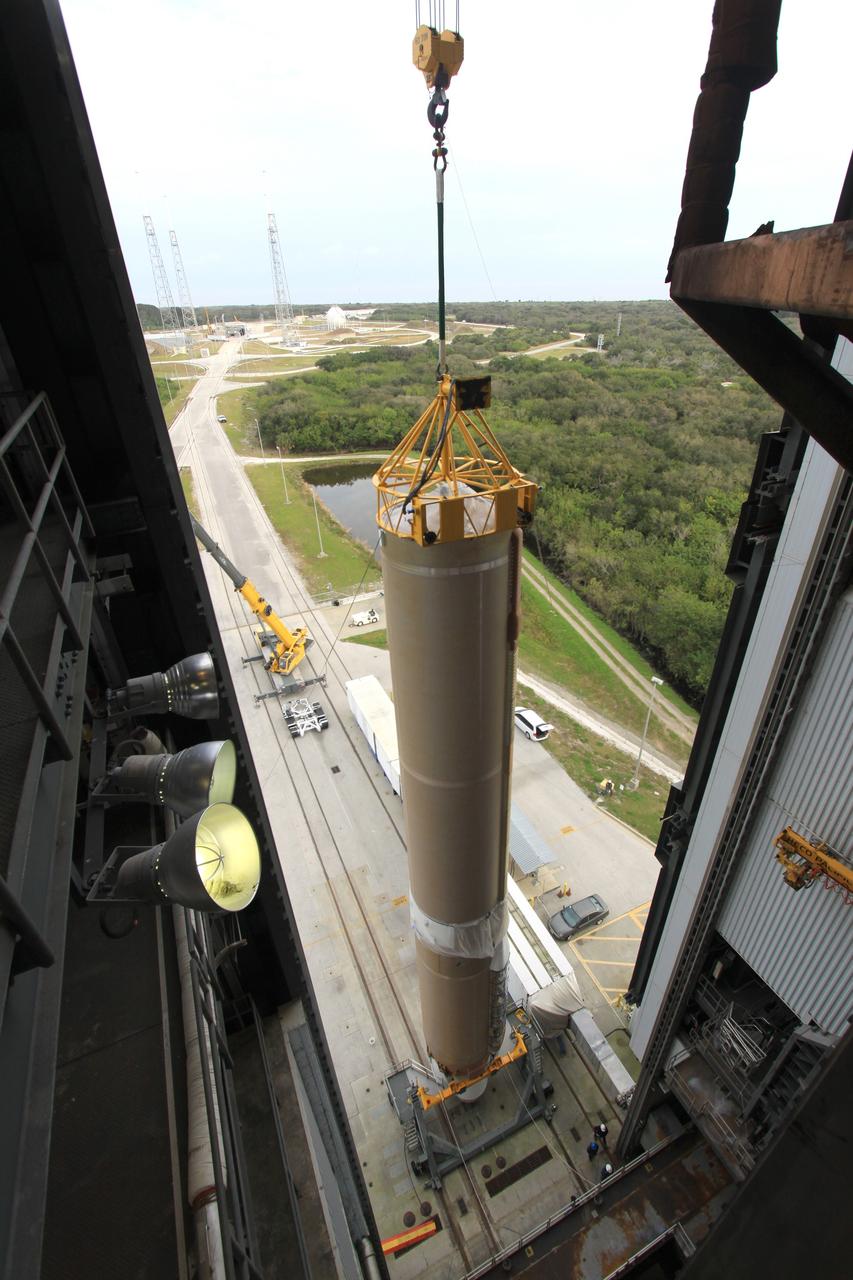
CAPE CANAVERAL, Fla. – A crane lifts the first stage of the United Launch Alliance Atlas V rocket for NASA's Magnetospheric Multiscale mission, or MMS, into the mobile service tower at Space Launch Complex 41 on Cape Canaveral Air Force Station in Florida. MMS will study the mystery of how magnetic fields around Earth connect and disconnect, explosively releasing energy via a process known a magnetic reconnection. MMS consists of four identical spacecraft that work together to provide the first three-dimensional view of this fundamental process, which occurs throughout the universe. Launch is set for March 12. To learn more about MMS, visit http://www.nasa.gov/mms. Photo credit: NASA/Jim Grossmann
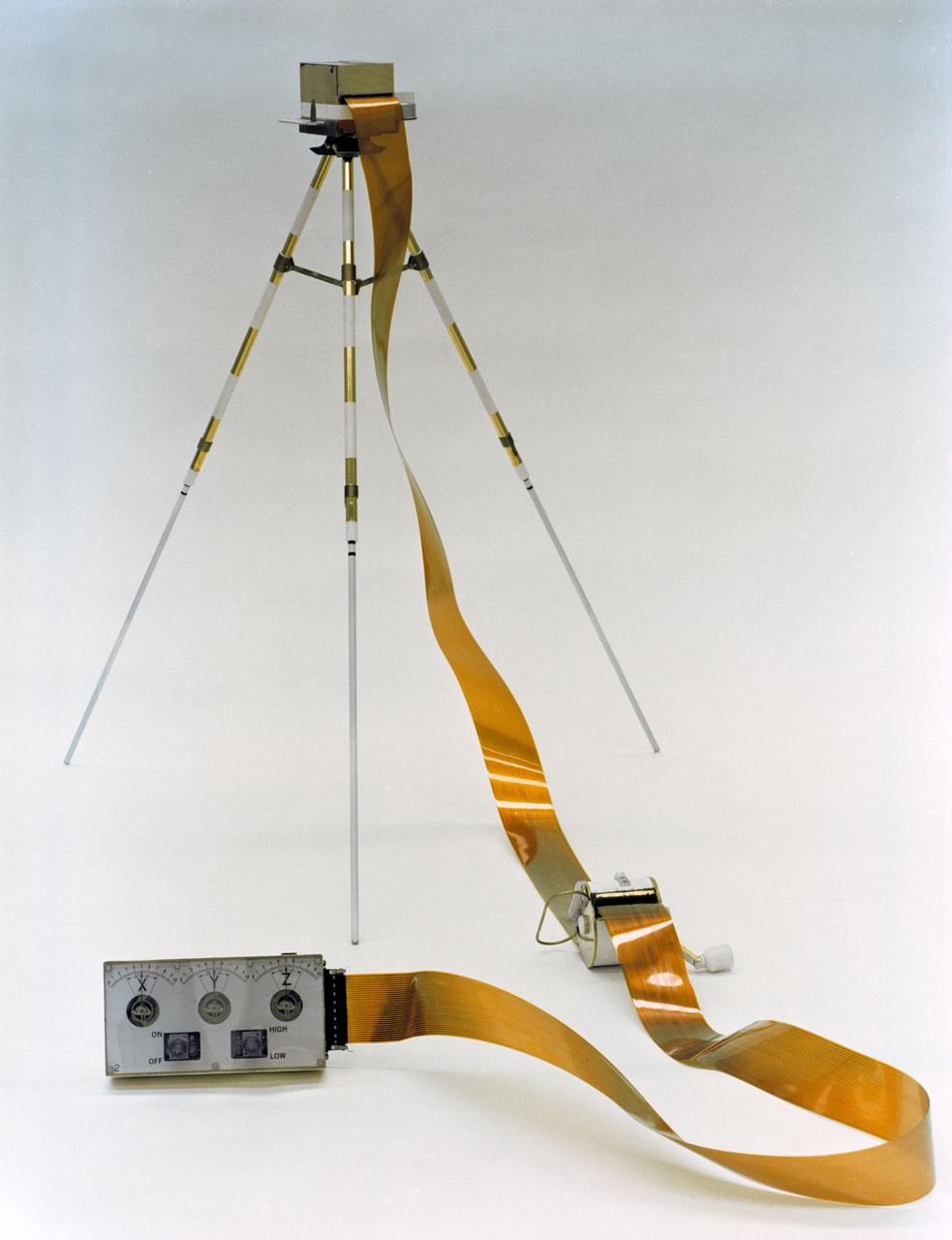
S70-56721 (December 1970) --- A close-up view of the Lunar Portable Magnetometer (LPM), which will be used by the crew of the Apollo 14 lunar landing mission during the second extravehicular activity (EVA). The LPM's components, a tripod-mounted flux-gate magnetometer sensor head and an electronics data package, connected by a 50-feet flat cable, function together to measure variations in the lunar magnetic field at several points on the geological traverse. Data gathered will be used to determine the location, strength and dimensions of magnetic sources, as well as knowledge of the local and total selenological structure. The LPM will be carried on the Modular Equipment Transporter (MET), and deployed by the lunar module pilot, who will align the sensor head at least 35 feet from the data package. The LM pilot will then return to the MET and verbally relay the LPM readouts to Earth. Astronaut Edgar D. Mitchell is the lunar module pilot for the Apollo 14 lunar landing mission.
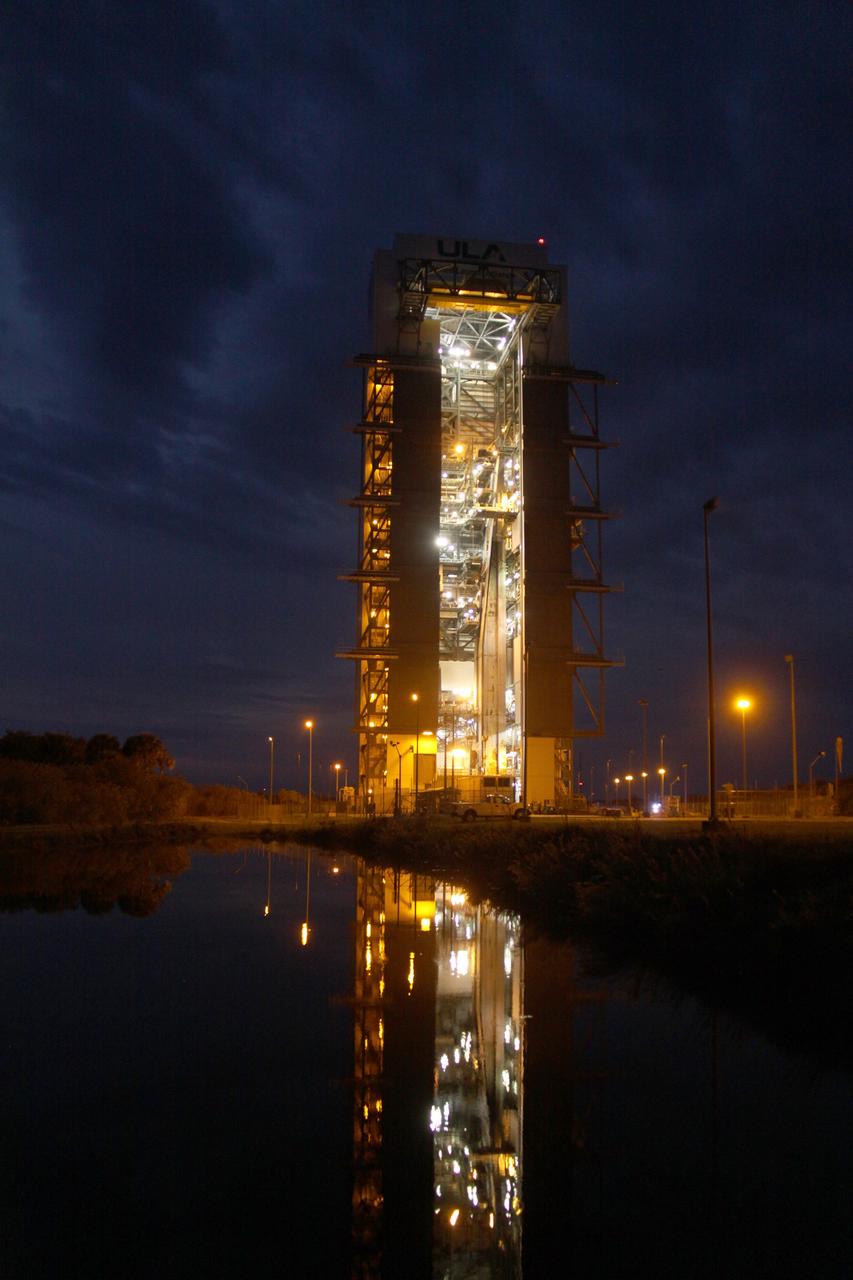
CAPE CANAVERAL, Fla. – Preparations are underway in the mobile service tower at Space Launch Complex 41 on Cape Canaveral Air Force Station in Florida for the arrival of the first stage of a United Launch Alliance Atlas V rocket from the Atlas Spaceflight Operations Center, or ASOC. The rocket will launch NASA's Magnetospheric Multiscale mission, or MMS. MMS will study the mystery of how magnetic fields around Earth connect and disconnect, explosively releasing energy via a process known a magnetic reconnection. MMS consists of four identical spacecraft that work together to provide the first three-dimensional view of this fundamental process, which occurs throughout the universe. Launch is set for March 12. To learn more about MMS, visit http://www.nasa.gov/mms. Photo credit: NASA/Jim Grossmann
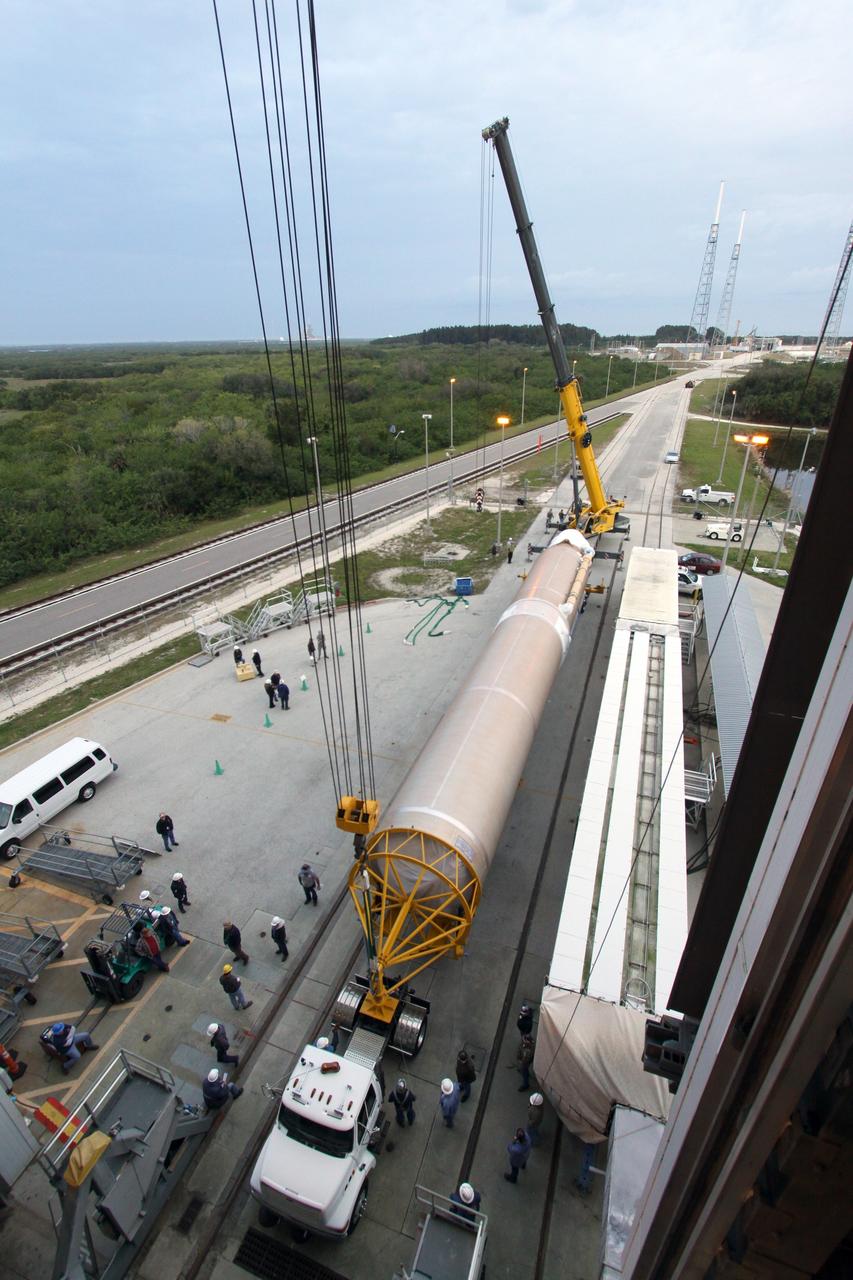
CAPE CANAVERAL, Fla. – Operations are underway at Space Launch Complex 41 on Cape Canaveral Air Force Station in Florida to lift the newly delivered first stage of a United Launch Alliance Atlas V rocket into the mobile service tower. The rocket will launch NASA's Magnetospheric Multiscale mission, or MMS. MMS will study the mystery of how magnetic fields around Earth connect and disconnect, explosively releasing energy via a process known a magnetic reconnection. MMS consists of four identical spacecraft that work together to provide the first three-dimensional view of this fundamental process, which occurs throughout the universe. Launch is set for March 12. To learn more about MMS, visit http://www.nasa.gov/mms. Photo credit: NASA/Jim Grossmann
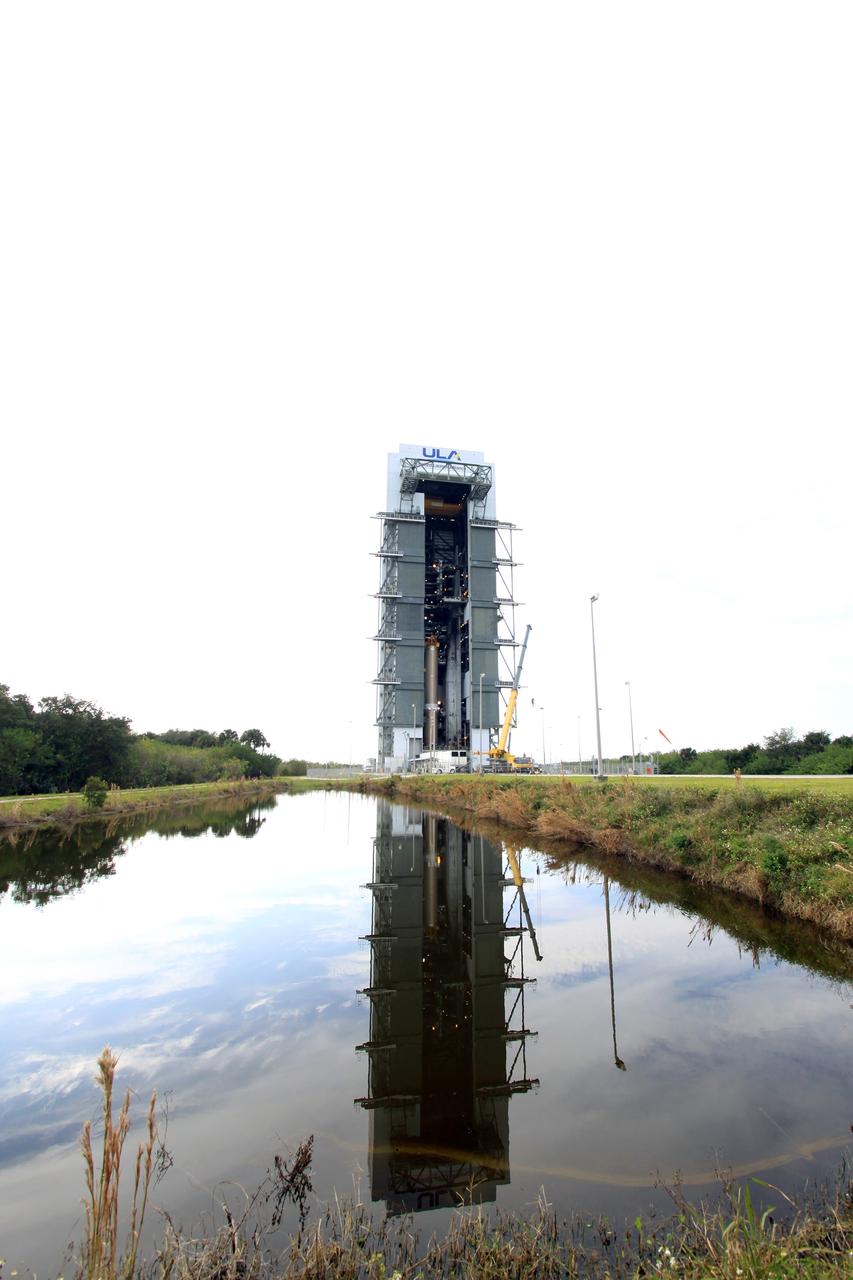
CAPE CANAVERAL, Fla. – The first stage of the United Launch Alliance Atlas V rocket for NASA's Magnetospheric Multiscale mission, or MMS, is in position on the launch platform in the mobile service tower at Space Launch Complex 41 on Cape Canaveral Air Force Station in Florida. MMS will study the mystery of how magnetic fields around Earth connect and disconnect, explosively releasing energy via a process known a magnetic reconnection. MMS consists of four identical spacecraft that work together to provide the first three-dimensional view of this fundamental process, which occurs throughout the universe. Launch is set for March 12. To learn more about MMS, visit http://www.nasa.gov/mms. Photo credit: NASA/Jim Grossmann
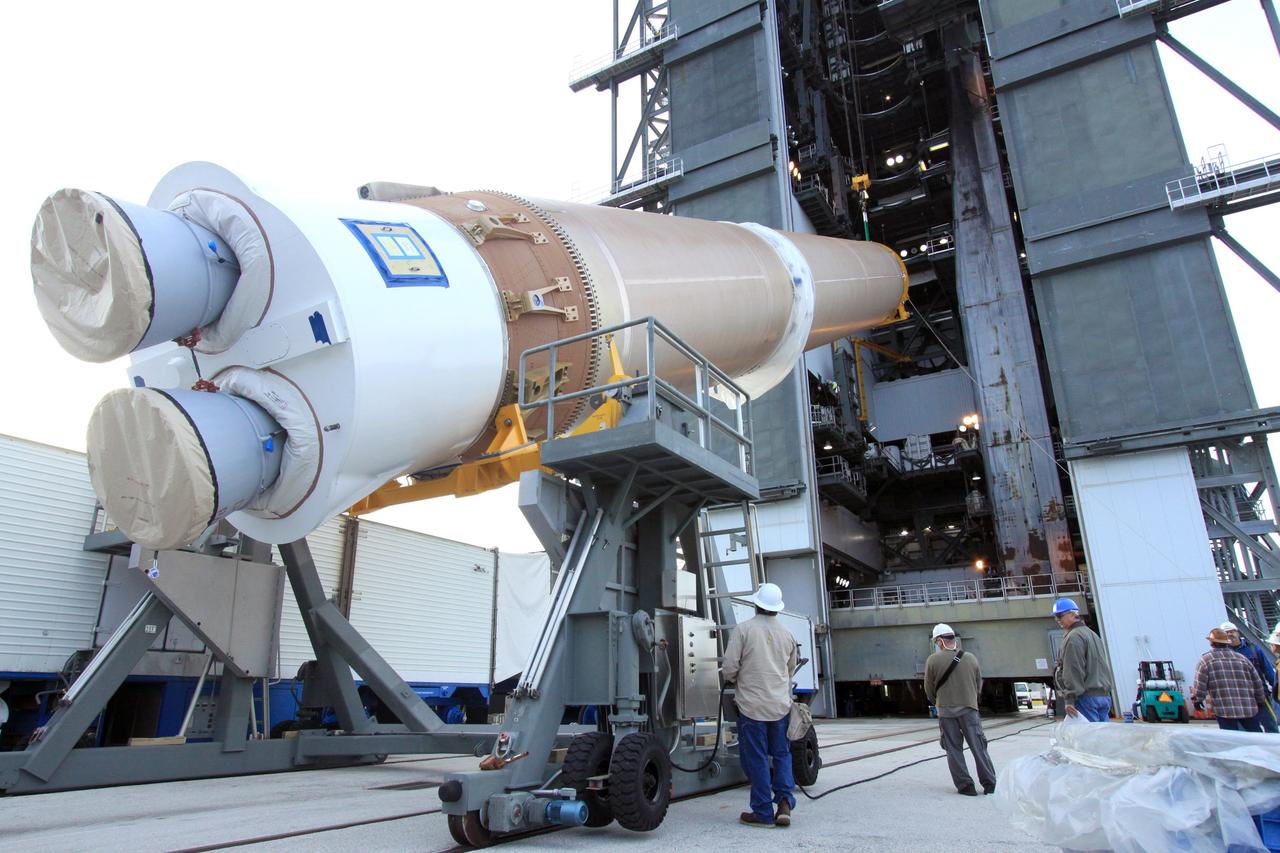
CAPE CANAVERAL, Fla. – Workers supervise the lift of the first stage of the United Launch Alliance Atlas V rocket for NASA's Magnetospheric Multiscale mission, or MMS, into the mobile service tower at Space Launch Complex 41 on Cape Canaveral Air Force Station in Florida. MMS will study the mystery of how magnetic fields around Earth connect and disconnect, explosively releasing energy via a process known a magnetic reconnection. MMS consists of four identical spacecraft that work together to provide the first three-dimensional view of this fundamental process, which occurs throughout the universe. Launch is set for March 12. To learn more about MMS, visit http://www.nasa.gov/mms. Photo credit: NASA/Jim Grossmann
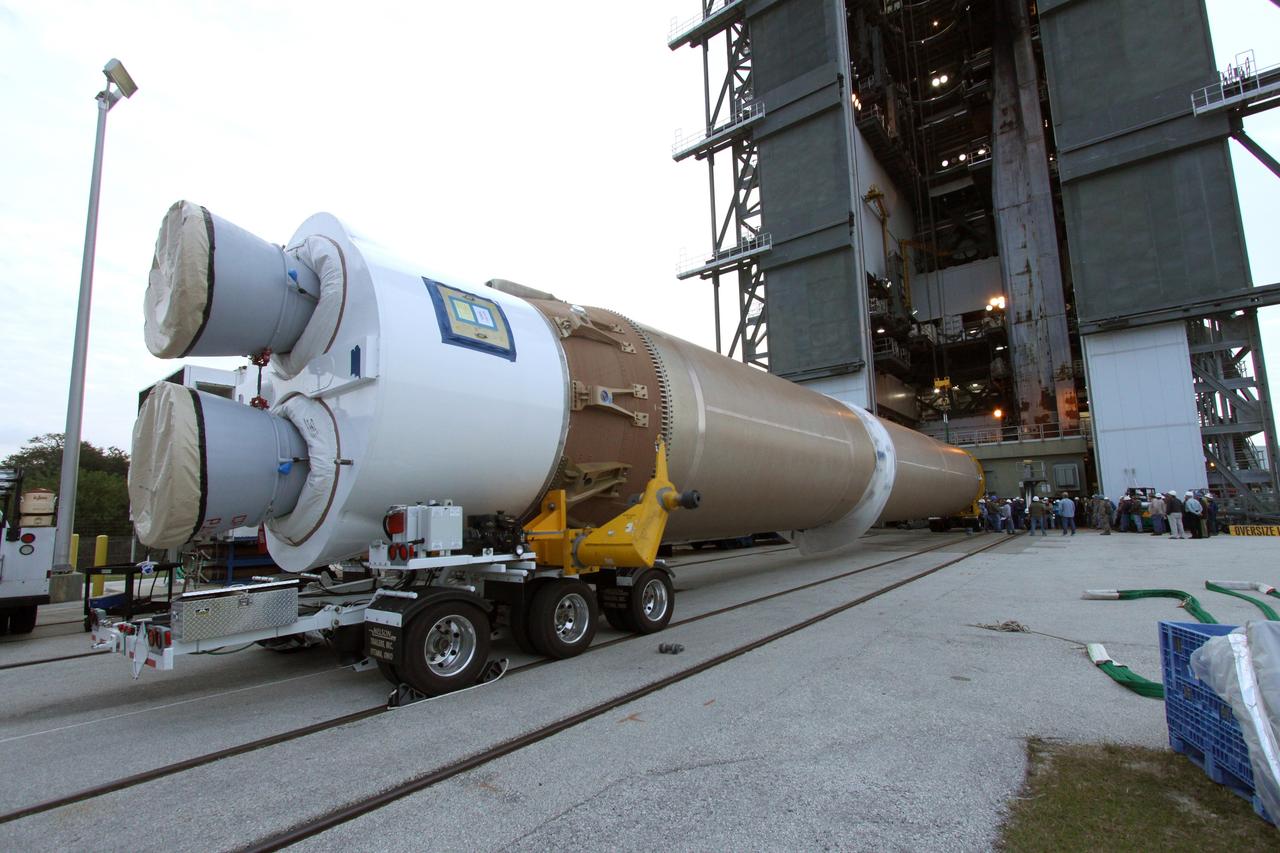
CAPE CANAVERAL, Fla. – Operations are underway at Space Launch Complex 41 on Cape Canaveral Air Force Station in Florida to lift the newly delivered first stage of a United Launch Alliance Atlas V rocket into the mobile service tower. The rocket will launch NASA's Magnetospheric Multiscale mission, or MMS. MMS will study the mystery of how magnetic fields around Earth connect and disconnect, explosively releasing energy via a process known a magnetic reconnection. MMS consists of four identical spacecraft that work together to provide the first three-dimensional view of this fundamental process, which occurs throughout the universe. Launch is set for March 12. To learn more about MMS, visit http://www.nasa.gov/mms. Photo credit: NASA/Jim Grossmann
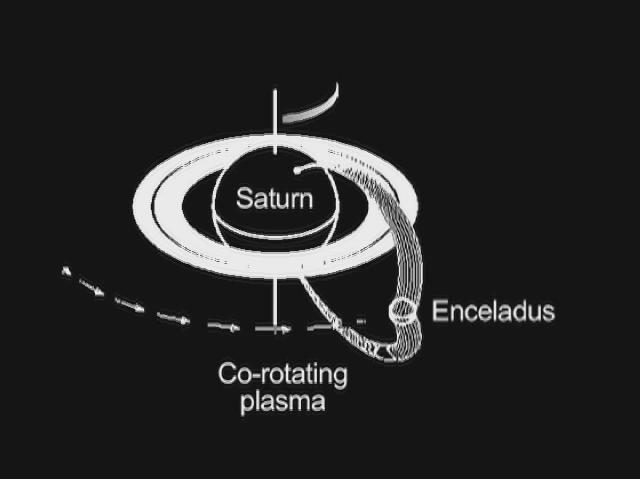
This graphic shows how Saturn and its moon Enceladus are electrically linked. Magnetic field lines, invisible to the human eye but detectable by the fields and particles instruments on NASA's Cassini spacecraft, arc from Saturn's north polar region to south polar region. Enceladus resides in the arc of a set of the field lines and feeds charged particles into the Saturn atmosphere. As Enceladus orbits around Saturn, the "footprint" of its connection to Saturn's north polar region, visible in ultraviolet light, also rotates. A doughnut of plasma, or hot ionized gas, revolves around Saturn at the same pace as the planet turns. The interaction of this plasma cloud with Enceladus shoots electrons along the magnetic field lines into the polar region of Saturn. The rain of electrons into Saturn's atmosphere creates an ultraviolet glow in an aurora-like phenomenon. Cassini's radio and plasma wave science instrument has detected a "hiss-like" radio noise generated by electrons moving along magnetic field lines from Enceladus to the glowing patch of ultraviolet light on Saturn. An animation is available at http://photojournal.jpl.nasa.gov/catalog/PIA13897

The magnetic field lines between a pair of active regions formed a beautiful set of swaying arches, seen in this footage captured by NASA’s Solar Dynamics Observatory on April 24-26, 2017. The arches are traced out by charged particles spinning along the magnetic field lines. These arches, which form a connection between regions of opposite magnetic polarity, are visible in exquisite detail in this wavelength of extreme ultraviolet light. Extreme ultraviolet light is typically invisible to our eyes, but is colorized here in gold. Credit: NASA/Goddard/SDO <b><a href="http://www.nasa.gov/audience/formedia/features/MP_Photo_Guidelines.html" rel="nofollow">NASA image use policy.</a></b> <b><a href="http://www.nasa.gov/centers/goddard/home/index.html" rel="nofollow">NASA Goddard Space Flight Center</a></b> enables NASA’s mission through four scientific endeavors: Earth Science, Heliophysics, Solar System Exploration, and Astrophysics. Goddard plays a leading role in NASA’s accomplishments by contributing compelling scientific knowledge to advance the Agency’s mission. <b>Follow us on <a href="http://twitter.com/NASAGoddardPix" rel="nofollow">Twitter</a></b> <b>Like us on <a href="http://www.facebook.com/pages/Greenbelt-MD/NASA-Goddard/395013845897?ref=tsd" rel="nofollow">Facebook</a></b> <b>Find us on <a href="http://instagrid.me/nasagoddard/?vm=grid" rel="nofollow">Instagram</a></b>
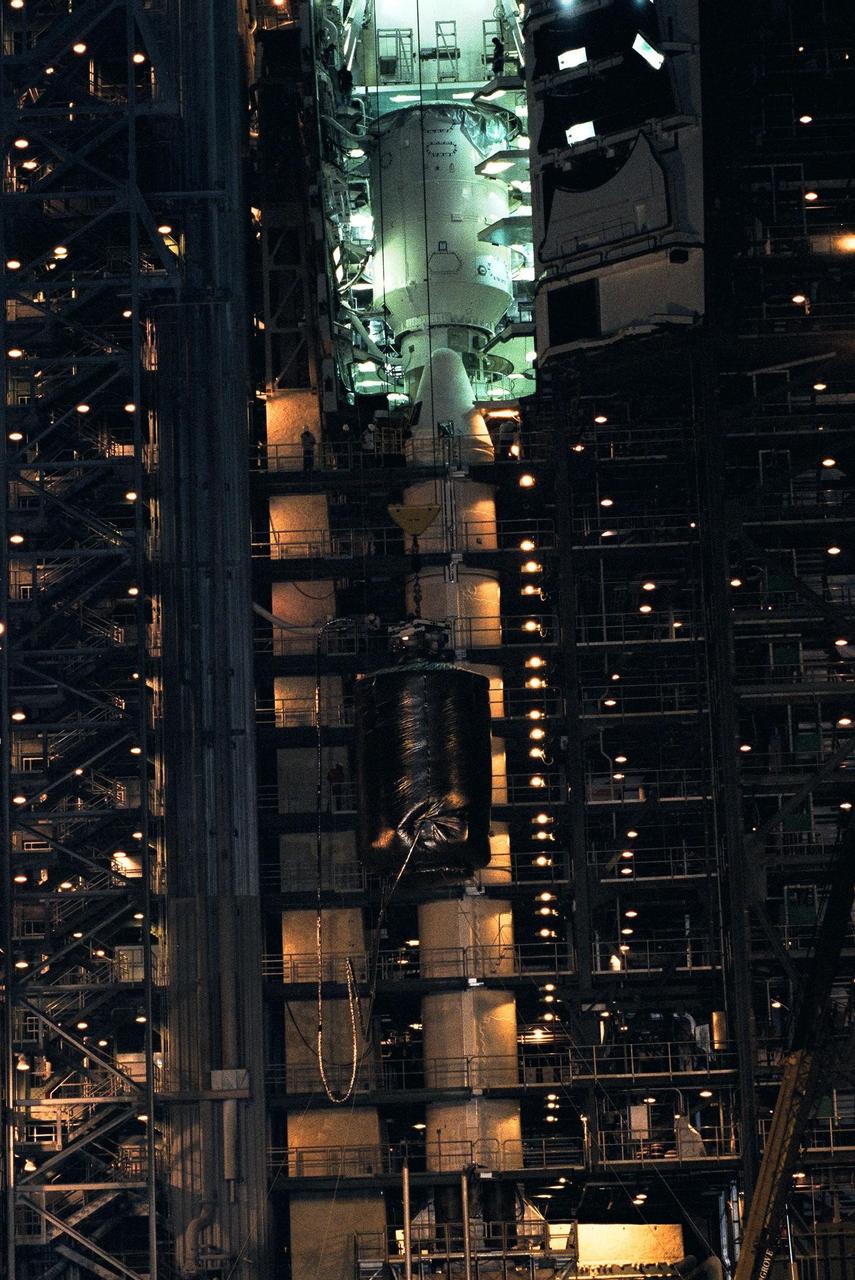
Technicians at Launch Complex 40, Cape Canaveral Air Station (CCAS), connect the crane to the top of the Cassini spacecraft in preparation for the lift to the top of its Titan IV/Centaur launch vehicle. Cassini is an international mission conducted by the National Aeronautics and Space Administration (NASA), the European Space Agency (ESA), and the Italian Space Agency (ASI). The two-story-tall spacecraft, scheduled for launch on Oct. 6, is destined to arrive at Saturn in July 2004, where it will orbit and study Saturn, its rings, moons and magnetic environment in detail over a four-year period. The Cassini mission is managed for NASA's Office of Space Science by the Jet Propulsion Laboratory, a division of the California Institute of Technology
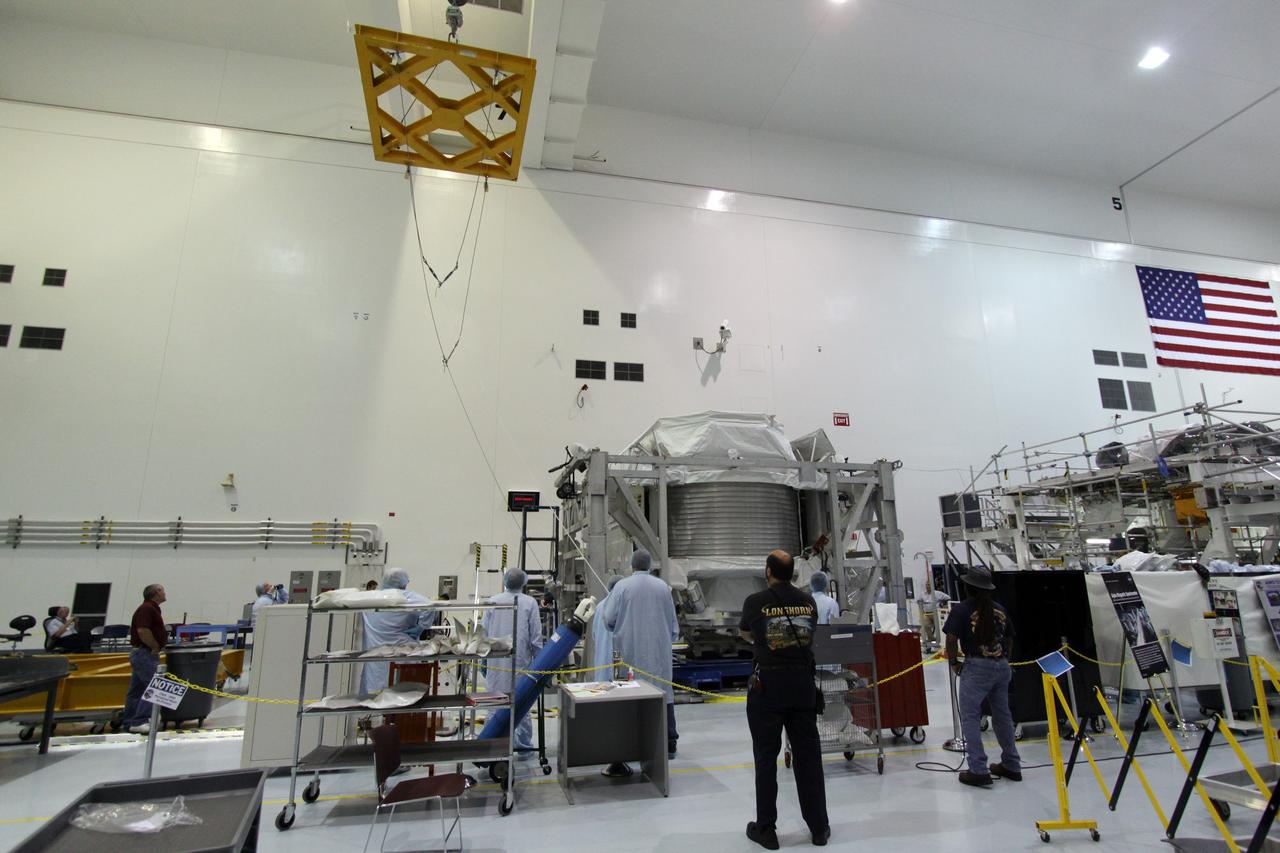
CAPE CANAVERAL, Fla. -- In the Space Station Processing Facility at NASA's Kennedy Space Center in Florida, an overhead crane is poised over the Alpha Magnetic Spectrometer, or AMS, to lift the Payload Attach System, or PAS, up to the AMS. The PAS provides a method of securely connecting the payload to the International Space Station. AMS, a state-of-the-art particle physics detector, is designed to operate as an external module on the International Space Station. It will use the unique environment of space to study the universe and its origin by searching for dark matter. AMS will fly to the station aboard space shuttle Endeavour's STS-134 mission targeted to launch Feb. 26, 2011. Photo credit: NASA/Jack Pfaller
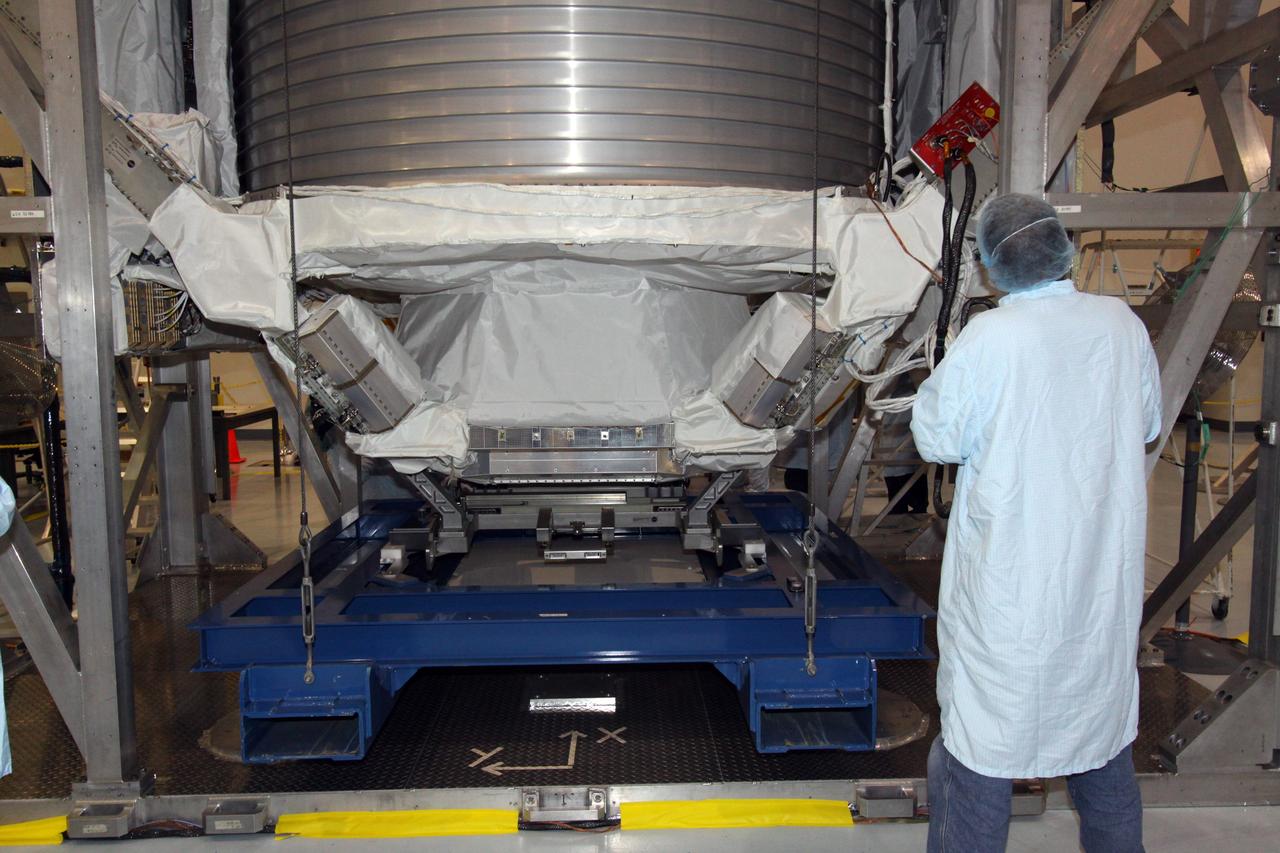
CAPE CANAVERAL, Fla. -- In the Space Station Processing Facility at NASA's Kennedy Space Center in Florida, a technician monitors the progress of the Payload Attach System, or PAS, as it is lifted up to the Alpha Magnetic Spectrometer, or AMS, where it will be attached to the bottom of the AMS. The PAS provides a method of securely connecting the payload to the International Space Station. AMS, a state-of-the-art particle physics detector, is designed to operate as an external module on the International Space Station. It will use the unique environment of space to study the universe and its origin by searching for dark matter. AMS will fly to the station aboard space shuttle Endeavour's STS-134 mission targeted to launch Feb. 26, 2011. Photo credit: NASA/Jack Pfaller
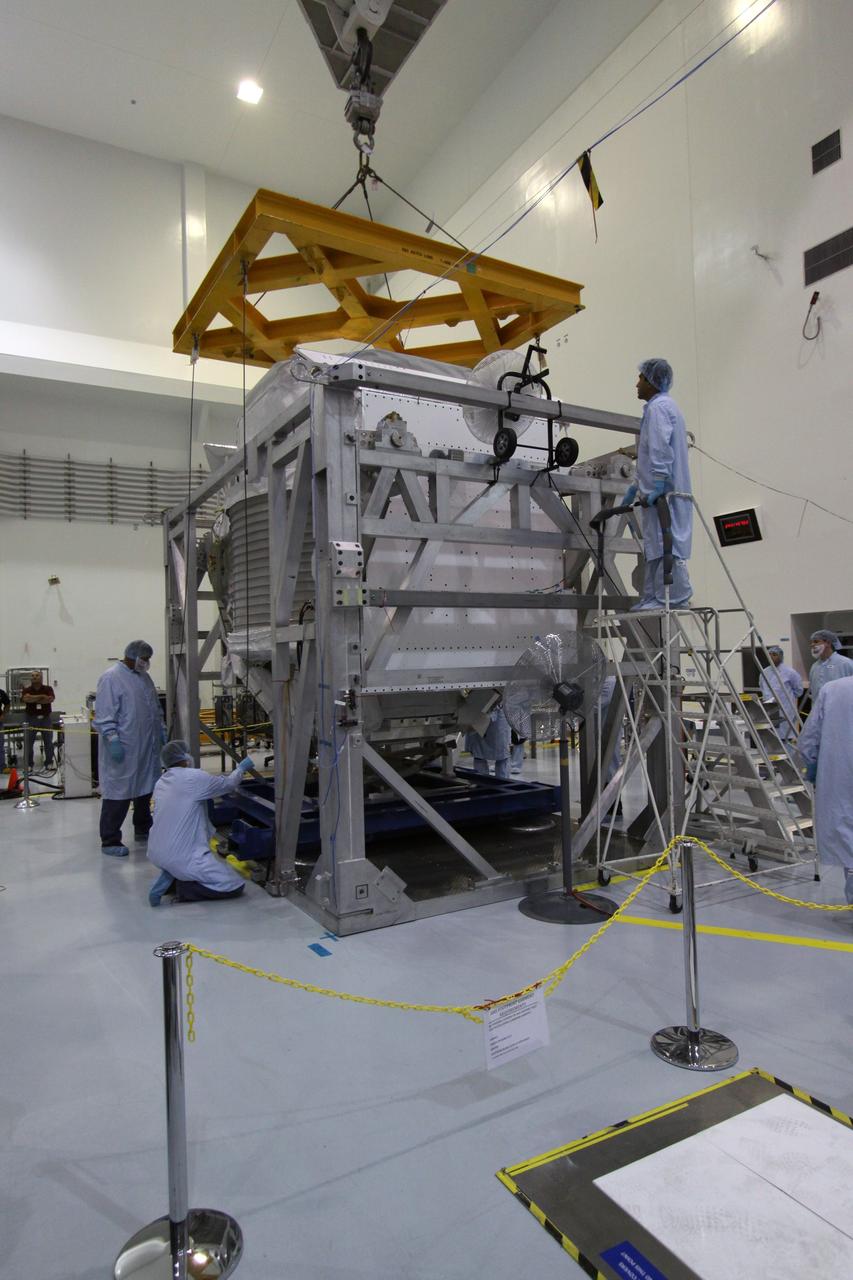
CAPE CANAVERAL, Fla. -- Technicians in the Space Station Processing Facility at NASA's Kennedy Space Center in Florida, monitor the guide wires of the overhead crane as it lifts the Payload Attach System, or PAS, up to the Alpha Magnetic Spectrometer, or AMS, for installation. The PAS provides a method of securely connecting the payload to the International Space Station. AMS, a state-of-the-art particle physics detector, is designed to operate as an external module on the International Space Station. It will use the unique environment of space to study the universe and its origin by searching for dark matter. AMS will fly to the station aboard space shuttle Endeavour's STS-134 mission targeted to launch Feb. 26, 2011. Photo credit: NASA/Jack Pfaller
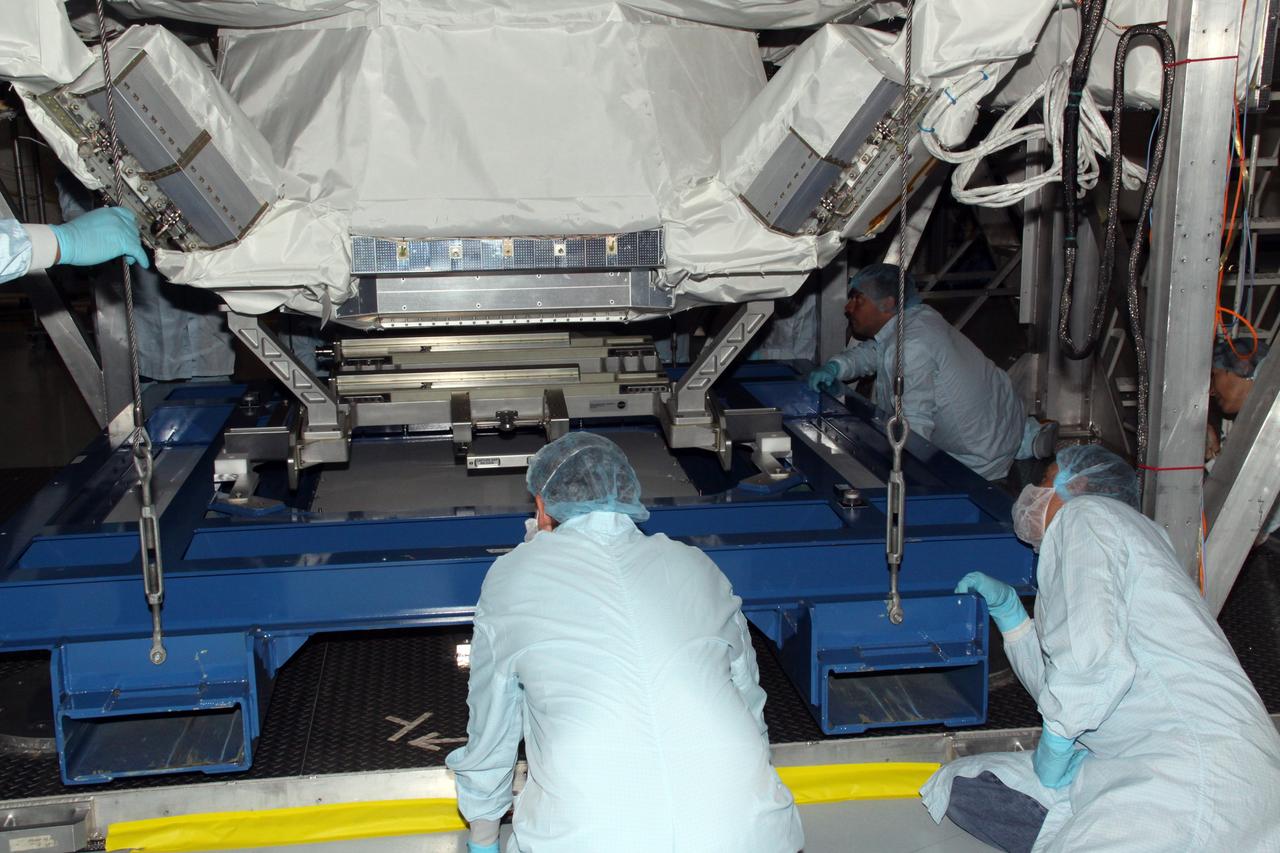
CAPE CANAVERAL, Fla. -- Technicians in the Space Station Processing Facility at NASA's Kennedy Space Center in Florida, check the progress of the Payload Attach System, or PAS, as it is lifted up to the Alpha Magnetic Spectrometer, where it will be attached to the bottom of the AMS. The PAS provides a method of securely connecting the payload to the International Space Station. AMS, a state-of-the-art particle physics detector, is designed to operate as an external module on the International Space Station. It will use the unique environment of space to study the universe and its origin by searching for dark matter. AMS will fly to the station aboard space shuttle Endeavour's STS-134 mission targeted to launch Feb. 26, 2011. Photo credit: NASA/Jack Pfaller
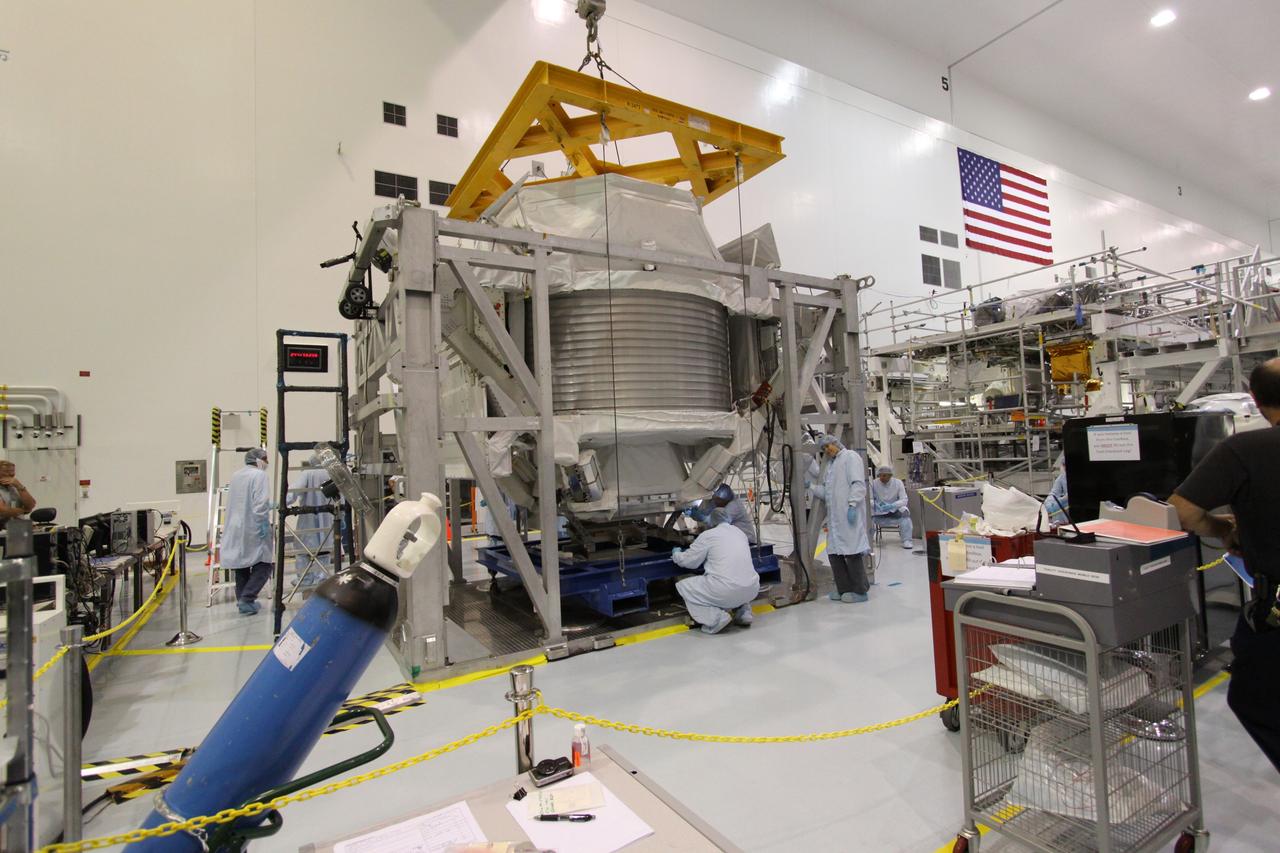
CAPE CANAVERAL, Fla. -- Technicians in the Space Station Processing Facility at NASA's Kennedy Space Center in Florida, check the progress of the Payload Attach System, or PAS, as it is lifted up to the Alpha Magnetic Spectrometer, where it will be attached to the bottom of the AMS. The PAS provides a method of securely connecting the payload to the International Space Station. AMS, a state-of-the-art particle physics detector, is designed to operate as an external module on the International Space Station. It will use the unique environment of space to study the universe and its origin by searching for dark matter. AMS will fly to the station aboard space shuttle Endeavour's STS-134 mission targeted to launch Feb. 26, 2011. Photo credit: NASA/Jack Pfaller
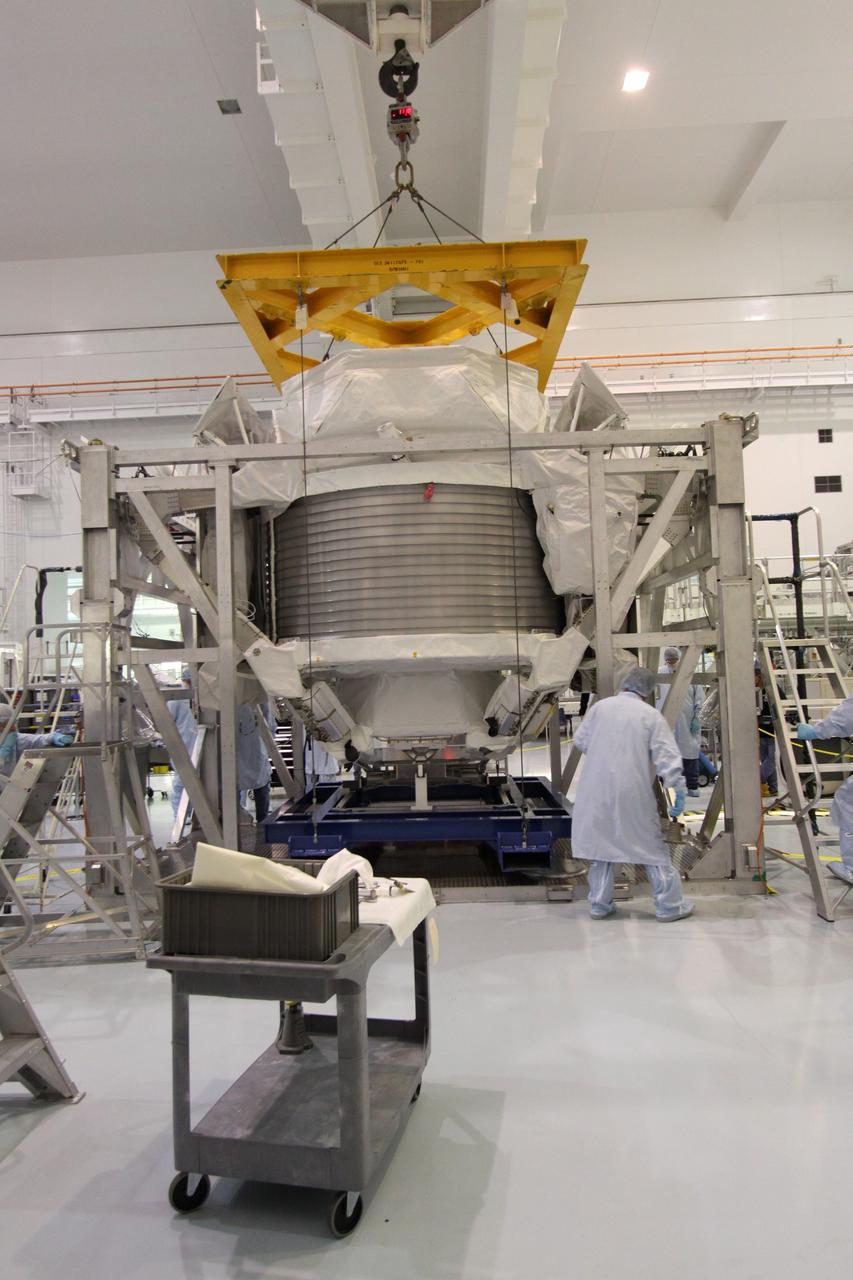
CAPE CANAVERAL, Fla. -- A technicians in the Space Station Processing Facility at NASA's Kennedy Space Center in Florida, check the progress of the Payload Attach System, or PAS, as it is lifted up to the Alpha Magnetic Spectrometer, or AMS, where it will be attached to the bottom of the AMS. The PAS provides a method of securely connecting the payload to the International Space Station. AMS, a state-of-the-art particle physics detector, is designed to operate as an external module on the International Space Station. It will use the unique environment of space to study the universe and its origin by searching for dark matter. AMS will fly to the station aboard space shuttle Endeavour's STS-134 mission targeted to launch Feb. 26, 2011. Photo credit: NASA/Jack Pfaller
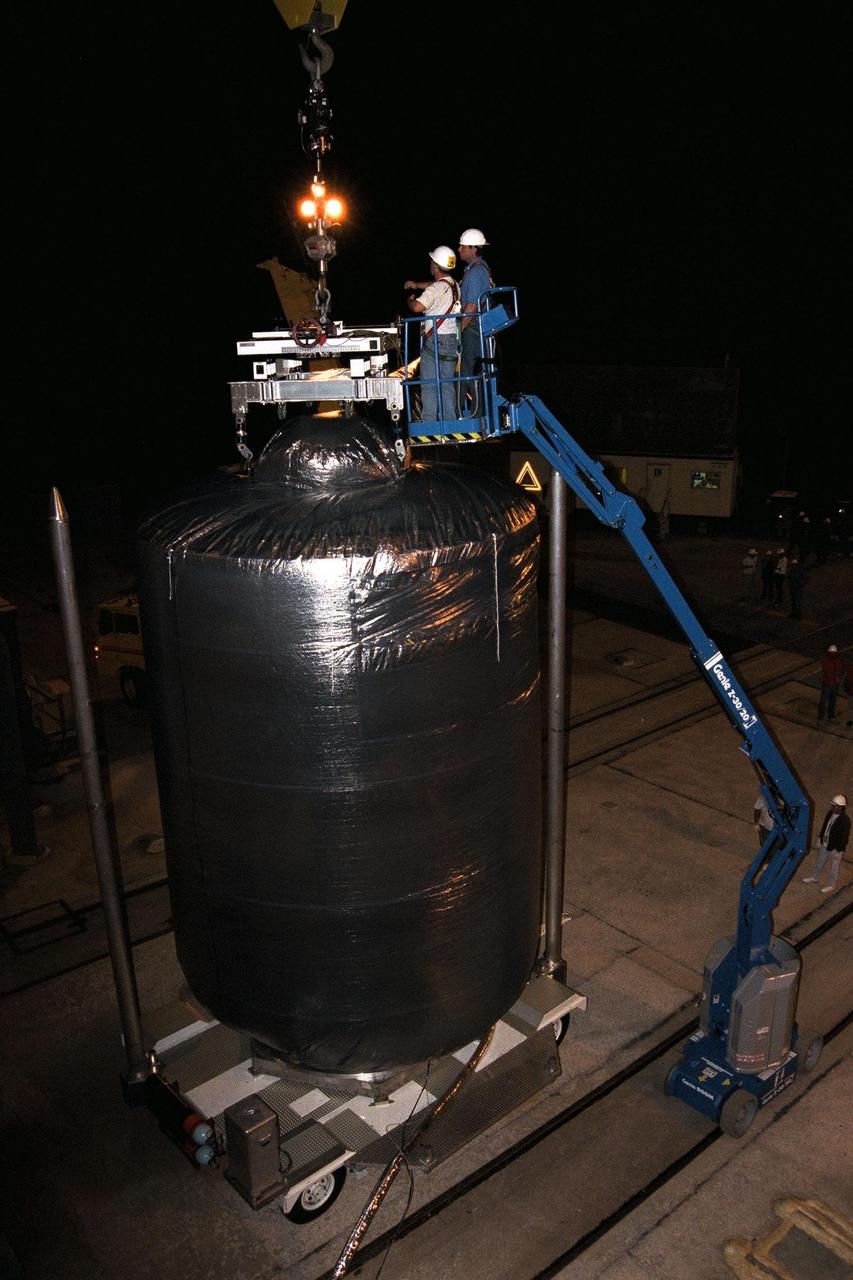
Technicians at Launch Complex 40, Cape Canaveral Air Station (CCAS), connect the crane to the top of the Cassini spacecraft in preparation for the lift to the top of its Titan IV/Centaur launch vehicle. Cassini is an international mission conducted by the National Aeronautics and Space Administration (NASA), the European Space Agency (ESA), and the Italian Space Agency (ASI). The two-story-tall spacecraft, scheduled for launch on Oct. 6, is destined to arrive at Saturn in July 2004, where it will orbit and study Saturn, its rings, moons and magnetic environment in detail over a four-year period. The Cassini mission is managed for NASA's Office of Space Science by the Jet Propulsion Laboratory, a division of the California Institute of Technology
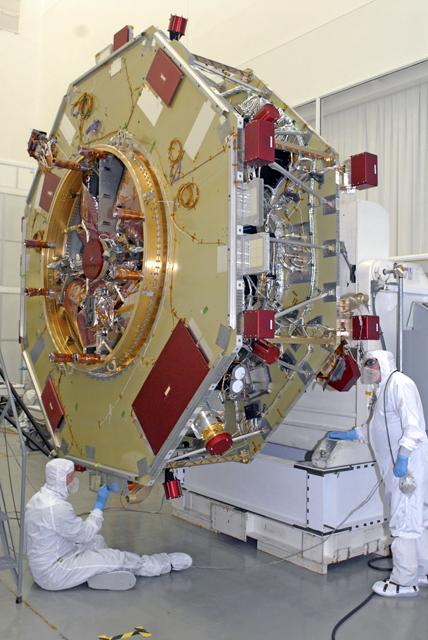
Observatory #1 is shown here on the Ransome table, tilted in a vertical position to provide better access for the engineers and technicians. Learn more about MMS at <a href="http://www.nasa.gov/mms" rel="nofollow">www.nasa.gov/mms</a> Credit NASA/Goddard The Magnetospheric Multiscale, or MMS, will study how the sun and the Earth's magnetic fields connect and disconnect, an explosive process that can accelerate particles through space to nearly the speed of light. This process is called magnetic reconnection and can occur throughout all space. <b><a href="http://www.nasa.gov/audience/formedia/features/MP_Photo_Guidelines.html" rel="nofollow">NASA image use policy.</a></b> <b><a href="http://www.nasa.gov/centers/goddard/home/index.html" rel="nofollow">NASA Goddard Space Flight Center</a></b> enables NASA’s mission through four scientific endeavors: Earth Science, Heliophysics, Solar System Exploration, and Astrophysics. Goddard plays a leading role in NASA’s accomplishments by contributing compelling scientific knowledge to advance the Agency’s mission. <b>Follow us on <a href="http://twitter.com/NASAGoddardPix" rel="nofollow">Twitter</a></b> <b>Like us on <a href="http://www.facebook.com/pages/Greenbelt-MD/NASA-Goddard/395013845897?ref=tsd" rel="nofollow">Facebook</a></b> <b>Find us on <a href="http://instagram.com/nasagoddard?vm=grid" rel="nofollow">Instagram</a></b>
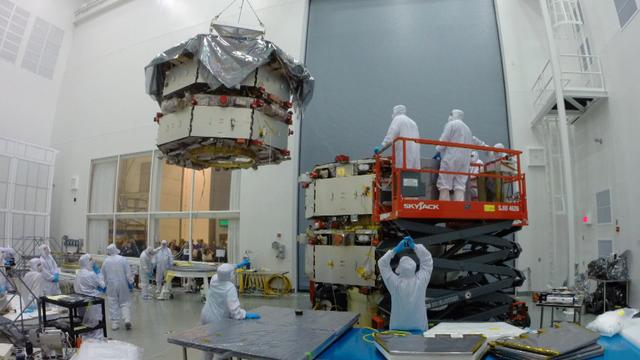
MMS Four Separate – View of all four spacecraft in the MMS Cleanroom getting prepared for stacking operations. Learn more about MMS at <a href="http://www.nasa.gov/mms" rel="nofollow">www.nasa.gov/mms</a> Credit NASA/Chris Gunn The Magnetospheric Multiscale, or MMS, will study how the sun and the Earth's magnetic fields connect and disconnect, an explosive process that can accelerate particles through space to nearly the speed of light. This process is called magnetic reconnection and can occur throughout all space. <b><a href="http://www.nasa.gov/audience/formedia/features/MP_Photo_Guidelines.html" rel="nofollow">NASA image use policy.</a></b> <b><a href="http://www.nasa.gov/centers/goddard/home/index.html" rel="nofollow">NASA Goddard Space Flight Center</a></b> enables NASA’s mission through four scientific endeavors: Earth Science, Heliophysics, Solar System Exploration, and Astrophysics. Goddard plays a leading role in NASA’s accomplishments by contributing compelling scientific knowledge to advance the Agency’s mission. <b>Follow us on <a href="http://twitter.com/NASAGoddardPix" rel="nofollow">Twitter</a></b> <b>Like us on <a href="http://www.facebook.com/pages/Greenbelt-MD/NASA-Goddard/395013845897?ref=tsd" rel="nofollow">Facebook</a></b> <b>Find us on <a href="http://instagram.com/nasagoddard?vm=grid" rel="nofollow">Instagram</a></b>
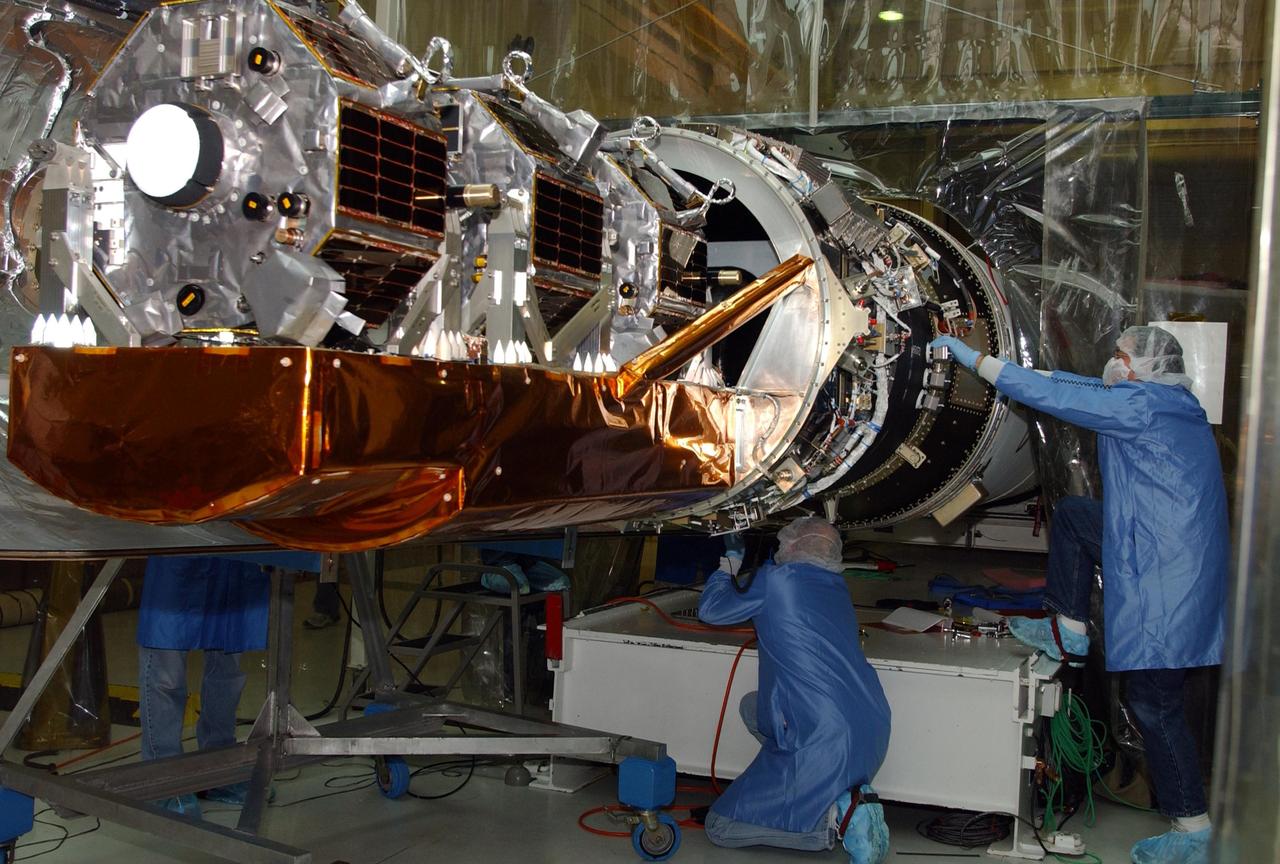
VANDENBERG AIR FORCE BASE, CALIF. -Inside Orbital Sciences’ Building 1555 at Vandenberg Air Force Base in California, a worker checks connections on the Space Technology 5 (ST5) spacecraft before encapsulation with the fairing. The ST5, mated to Orbital Sciences' Pegasus XL launch vehicle, contains three microsatellites with miniaturized redundant components and technologies. Each will validate New Millennium Program selected technologies, such as the Cold Gas Micro-Thruster and X-Band Transponder Communication System. After deployment from the Pegasus, the micro-satellites will be positioned in a “string of pearls” constellation that demonstrates the ability to position them to perform simultaneous multi-point measurements of the magnetic field using highly sensitive magnetometers. The data will help scientists understand and map the intensity and direction of the Earth’s magnetic field, its relation to space weather events, and affects on our planet. With such missions, NASA hopes to improve scientists’ ability to accurately forecast space weather and minimize its harmful effects on space- and ground-based systems. Launch of ST5 is scheduled from the belly of an L-1011 carrier aircraft no earlier than March 14 from Vandenberg Air Force Base.
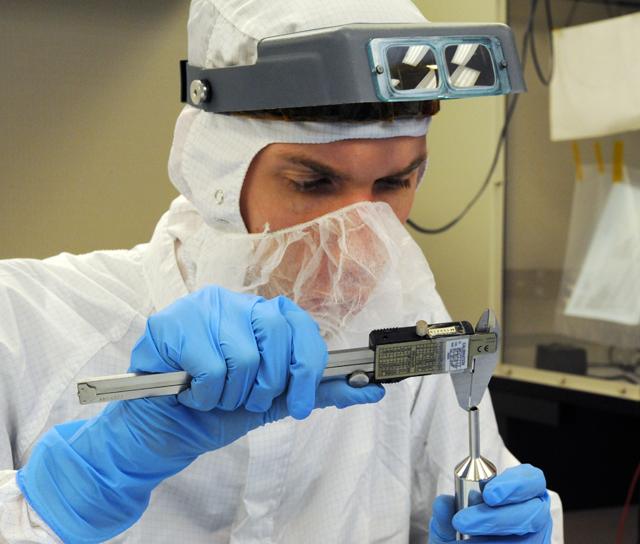
Propulsion engineer measures the flight filters during the receiving inspection. Learn more about MMS at <a href="http://www.nasa.gov/mms" rel="nofollow">www.nasa.gov/mms</a> Credit NASA/Goddard The Magnetospheric Multiscale, or MMS, will study how the sun and the Earth's magnetic fields connect and disconnect, an explosive process that can accelerate particles through space to nearly the speed of light. This process is called magnetic reconnection and can occur throughout all space. <b><a href="http://www.nasa.gov/audience/formedia/features/MP_Photo_Guidelines.html" rel="nofollow">NASA image use policy.</a></b> <b><a href="http://www.nasa.gov/centers/goddard/home/index.html" rel="nofollow">NASA Goddard Space Flight Center</a></b> enables NASA’s mission through four scientific endeavors: Earth Science, Heliophysics, Solar System Exploration, and Astrophysics. Goddard plays a leading role in NASA’s accomplishments by contributing compelling scientific knowledge to advance the Agency’s mission. <b>Follow us on <a href="http://twitter.com/NASAGoddardPix" rel="nofollow">Twitter</a></b> <b>Like us on <a href="http://www.facebook.com/pages/Greenbelt-MD/NASA-Goddard/395013845897?ref=tsd" rel="nofollow">Facebook</a></b> <b>Find us on <a href="http://instagram.com/nasagoddard?vm=grid" rel="nofollow">Instagram</a></b>
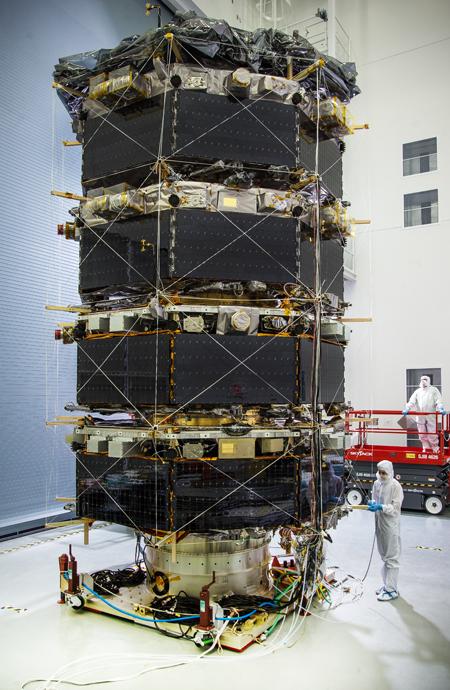
MMS Stacked – View of the fully stacked MMS prior to being bagged for vibration tests. Learn more about MMS at <a href="http://www.nasa.gov/mms" rel="nofollow">www.nasa.gov/mms</a> Credit NASA/Chris Gunn The Magnetospheric Multiscale, or MMS, will study how the sun and the Earth's magnetic fields connect and disconnect, an explosive process that can accelerate particles through space to nearly the speed of light. This process is called magnetic reconnection and can occur throughout all space. <b><a href="http://www.nasa.gov/audience/formedia/features/MP_Photo_Guidelines.html" rel="nofollow">NASA image use policy.</a></b> <b><a href="http://www.nasa.gov/centers/goddard/home/index.html" rel="nofollow">NASA Goddard Space Flight Center</a></b> enables NASA’s mission through four scientific endeavors: Earth Science, Heliophysics, Solar System Exploration, and Astrophysics. Goddard plays a leading role in NASA’s accomplishments by contributing compelling scientific knowledge to advance the Agency’s mission. <b>Follow us on <a href="http://twitter.com/NASAGoddardPix" rel="nofollow">Twitter</a></b> <b>Like us on <a href="http://www.facebook.com/pages/Greenbelt-MD/NASA-Goddard/395013845897?ref=tsd" rel="nofollow">Facebook</a></b> <b>Find us on <a href="http://instagram.com/nasagoddard?vm=grid" rel="nofollow">Instagram</a></b>
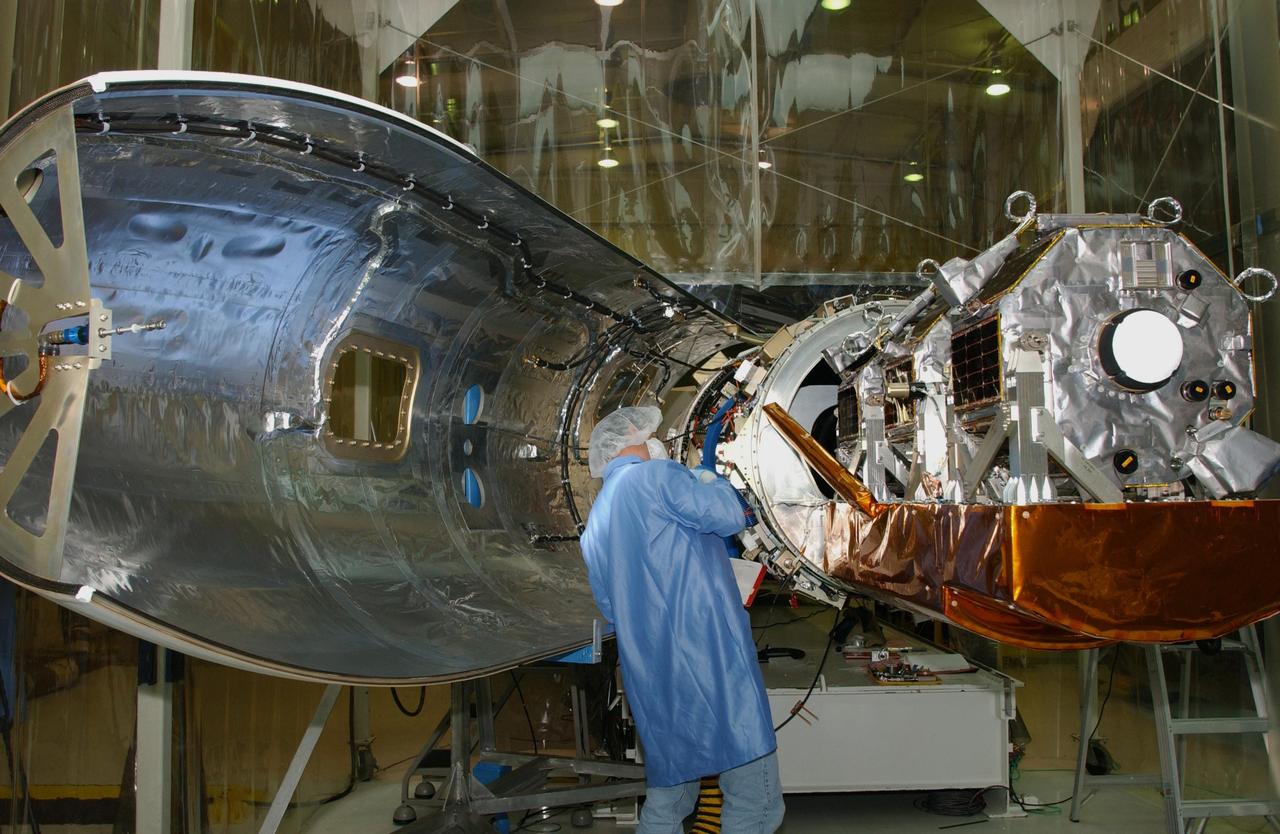
VANDENBERG AIR FORCE BASE, CALIF. - Inside Orbital Sciences’ Building 1555 at Vandenberg Air Force Base in California, a worker completes connections on the Space Technology 5 (ST5) spacecraft before enclosure. The ST5, mated to Orbital Sciences' Pegasus XL launch vehicle, contains three microsatellites with miniaturized redundant components and technologies. Each will validate New Millennium Program selected technologies, such as the Cold Gas Micro-Thruster and X-Band Transponder Communication System. After deployment from the Pegasus, the micro-satellites will be positioned in a “string of pearls” constellation that demonstrates the ability to position them to perform simultaneous multi-point measurements of the magnetic field using highly sensitive magnetometers. The data will help scientists understand and map the intensity and direction of the Earth’s magnetic field, its relation to space weather events, and affects on our planet. With such missions, NASA hopes to improve scientists’ ability to accurately forecast space weather and minimize its harmful effects on space- and ground-based systems. Launch of ST5 is scheduled from the belly of an L-1011 carrier aircraft no earlier than March 14 from Vandenberg Air Force Base.
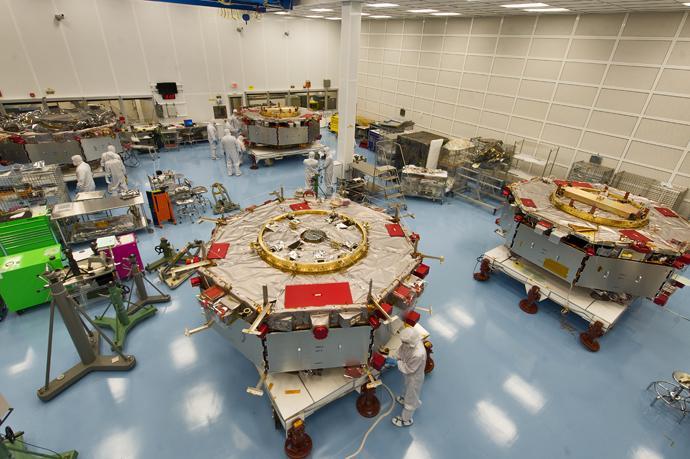
MMS Four Separate – View of all four spacecraft in the MMS Cleanroom getting prepared for stacking operations. Learn more about MMS at <a href="http://www.nasa.gov/mms" rel="nofollow">www.nasa.gov/mms</a> Credit NASA/Chris Gunn The Magnetospheric Multiscale, or MMS, will study how the sun and the Earth's magnetic fields connect and disconnect, an explosive process that can accelerate particles through space to nearly the speed of light. This process is called magnetic reconnection and can occur throughout all space. <b><a href="http://www.nasa.gov/audience/formedia/features/MP_Photo_Guidelines.html" rel="nofollow">NASA image use policy.</a></b> <b><a href="http://www.nasa.gov/centers/goddard/home/index.html" rel="nofollow">NASA Goddard Space Flight Center</a></b> enables NASA’s mission through four scientific endeavors: Earth Science, Heliophysics, Solar System Exploration, and Astrophysics. Goddard plays a leading role in NASA’s accomplishments by contributing compelling scientific knowledge to advance the Agency’s mission. <b>Follow us on <a href="http://twitter.com/NASAGoddardPix" rel="nofollow">Twitter</a></b> <b>Like us on <a href="http://www.facebook.com/pages/Greenbelt-MD/NASA-Goddard/395013845897?ref=tsd" rel="nofollow">Facebook</a></b> <b>Find us on <a href="http://instagram.com/nasagoddard?vm=grid" rel="nofollow">Instagram</a></b>

CAPE CANAVERAL, Fla. -- In the Vehicle Assembly Building at NASA's Kennedy Space Center in Florida, workers apply a special solution to the connecting sections of the left forward center solid rocket booster segment before the upper segment is joined to it. The booster along with its twin will be stacked on the mobile launcher platform along with an external fuel tank awaiting the arrival of space shuttle Endeavour for its flight to the International Space Station. As the final planned mission of the Space Shuttle Program, Endeavour and its crew will deliver the Alpha Magnetic Spectrometer, as well as critical spare components to the station on the STS-134 mission targeted for launch Feb. 26, 2011. For more information visit, http://www.nasa.gov/mission_pages/shuttle/shuttlemissions/sts134/index.html. Photo credit: NASA/Kim Shiflett
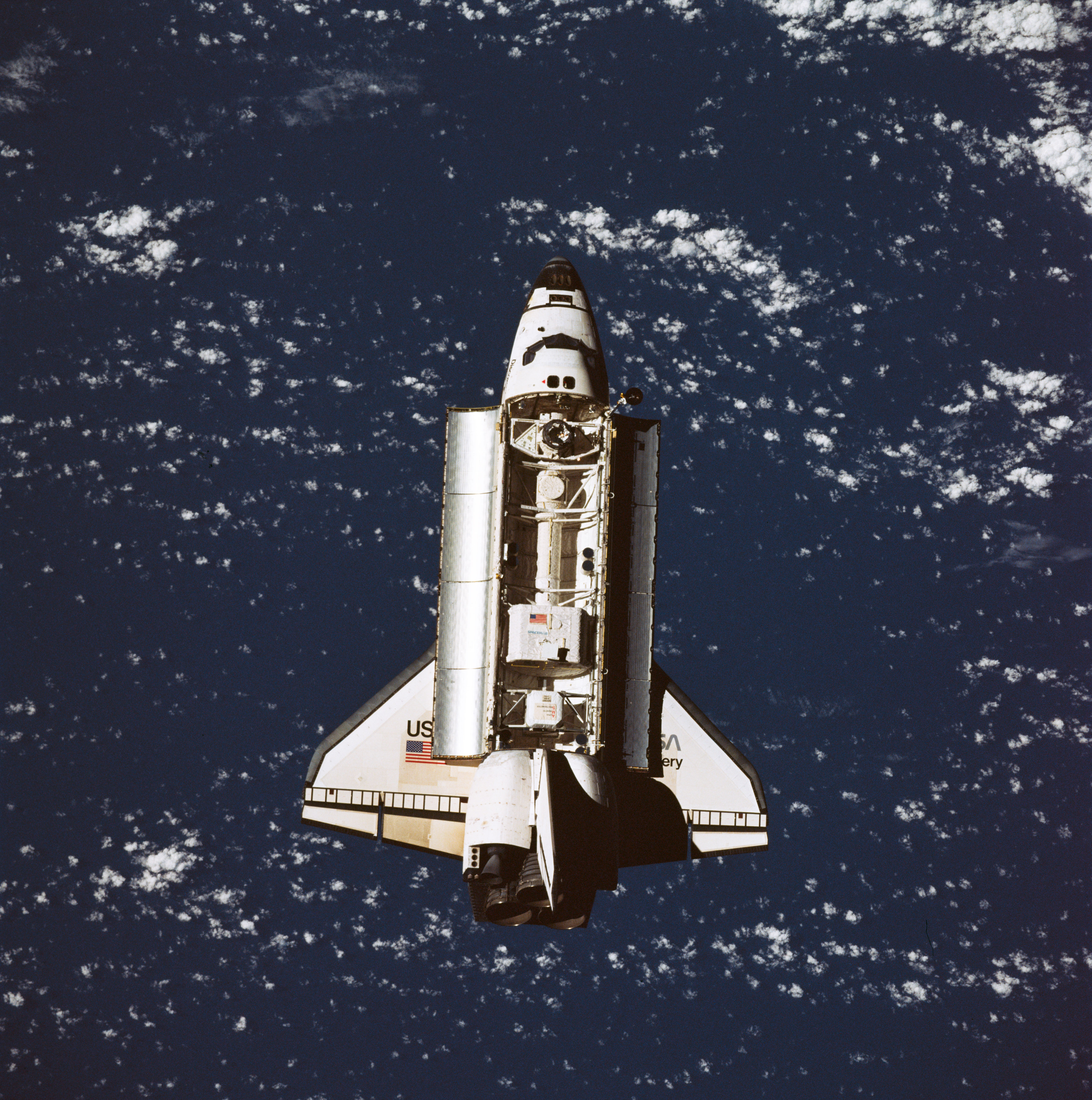
NASA7-726-063C (3 June 1998) --- The Space Shuttle Discovery approaches Russia's Mir space station in this 70mm photograph taken from the Mir. The nadir perspective affords a clear look at the layout of the cargo bay, revealing the open bay doors; the docking apparatus for connecting to Mir (near cabin), the tunnel; the SPACEHAB module (second element from aft); the Alpha Magnetic Spectrometer (near aft firewall); and the Ku-band antenna for communications (near cabin). Affixed to the lower right corner of the top of SPACEHAB is the external antenna for the SPACEHAB universal communications system (SHUCS). Discovery is the third Shuttle to visit Mir in a series of ten rendezvous (including nine docking) missions. Photo Credit: National Aeronautics and Space Administration (NASA) and the Russian Aviation and Space Agency.
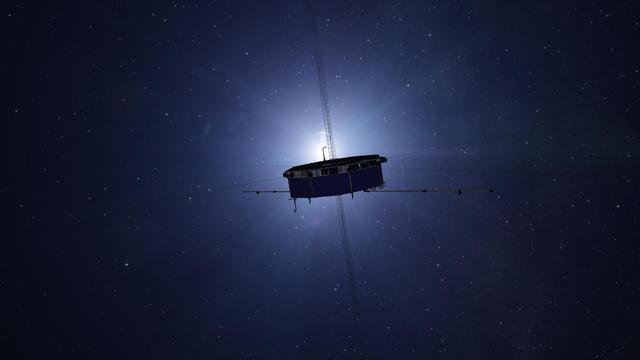
MMS Spacecraft Animation The Magnetospheric Multiscale (MMS) mission is a Solar Terrestrial Probes mission comprising four identically instrumented spacecraft that will use Earth's magnetosphere as a laboratory to study the microphysics of three fundamental plasma processes: magnetic reconnection, energetic particle acceleration, and turbulence. These processes occur in all astrophysical plasma systems but can be studied in situ only in our solar system and most efficiently only in Earth's magnetosphere, where they control the dynamics of the geospace environment and play an important role in the processes known as "space weather." Learn more about MMS at <a href="http://www.nasa.gov/mms" rel="nofollow">www.nasa.gov/mms</a> Learn more about MMS at <a href="http://www.nasa.gov/mms" rel="nofollow">www.nasa.gov/mms</a> Credit NASA/Chris Gunn The Magnetospheric Multiscale, or MMS, will study how the sun and the Earth's magnetic fields connect and disconnect, an explosive process that can accelerate particles through space to nearly the speed of light. This process is called magnetic reconnection and can occur throughout all space. <b><a href="http://www.nasa.gov/audience/formedia/features/MP_Photo_Guidelines.html" rel="nofollow">NASA image use policy.</a></b> <b><a href="http://www.nasa.gov/centers/goddard/home/index.html" rel="nofollow">NASA Goddard Space Flight Center</a></b> enables NASA’s mission through four scientific endeavors: Earth Science, Heliophysics, Solar System Exploration, and Astrophysics. Goddard plays a leading role in NASA’s accomplishments by contributing compelling scientific knowledge to advance the Agency’s mission. <b>Follow us on <a href="http://twitter.com/NASAGoddardPix" rel="nofollow">Twitter</a></b> <b>Like us on <a href="http://www.facebook.com/pages/Greenbelt-MD/NASA-Goddard/395013845897?ref=tsd" rel="nofollow">Facebook</a></b> <b>Find us on <a href="http://instagram.com/nasagoddard?vm=grid" rel="nofollow">Instagram</a></b>
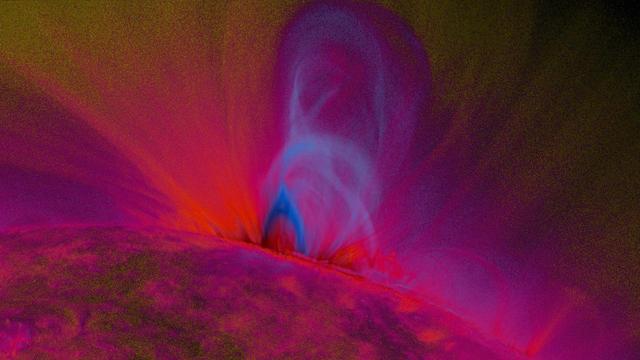
Caption: This is an image of magnetic loops on the sun, captured by NASA's Solar Dynamics Observatory (SDO). It has been processed to highlight the edges of each loop to make the structure more clear. A series of loops such as this is known as a flux rope, and these lie at the heart of eruptions on the sun known as coronal mass ejections (CMEs.) This is the first time scientists were able to discern the timing of a flux rope's formation. (SDO AIA 131 and 171 difference blended image of flux ropes during CME.) Credit: NASA/Goddard Space Flight Center/SDO ---- On July 18, 2012, a fairly small explosion of light burst off the lower right limb of the sun. Such flares often come with an associated eruption of solar material, known as a coronal mass ejection or CME – but this one did not. Something interesting did happen, however. Magnetic field lines in this area of the sun's atmosphere, the corona, began to twist and kink, generating the hottest solar material – a charged gas called plasma – to trace out the newly-formed slinky shape. The plasma glowed brightly in extreme ultraviolet images from the Atmospheric Imaging Assembly (AIA) aboard NASA’s Solar Dynamics Observatory (SDO) and scientists were able to watch for the first time the very formation of something they had long theorized was at the heart of many eruptive events on the sun: a flux rope. Eight hours later, on July 19, the same region flared again. This time the flux rope's connection to the sun was severed, and the magnetic fields escaped into space, dragging billions of tons of solar material along for the ride -- a classic CME. "Seeing this structure was amazing," says Angelos Vourlidas, a solar scientist at the Naval Research Laboratory in Washington, D.C. "It looks exactly like the cartoon sketches theorists have been drawing of flux ropes since the 1970s. It was a series of figure eights lined up to look like a giant slinky on the sun." <b>To read more about this new discovery go to: <a href="http://1.usa.gov/14UHsTt" rel="nofollow">1.usa.gov/14UHsTt</a> </b>
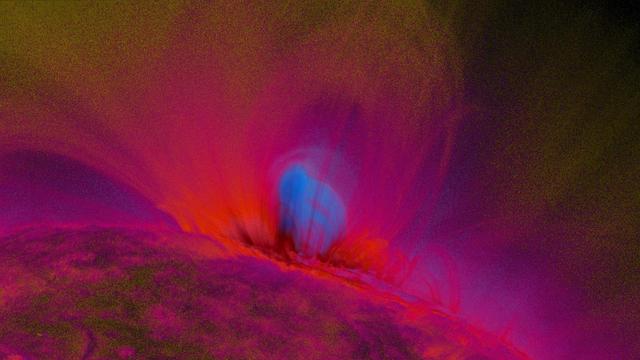
Caption: This is an image of magnetic loops on the sun, captured by NASA's Solar Dynamics Observatory (SDO). It has been processed to highlight the edges of each loop to make the structure more clear. A series of loops such as this is known as a flux rope, and these lie at the heart of eruptions on the sun known as coronal mass ejections (CMEs.) This is the first time scientists were able to discern the timing of a flux rope's formation. (SDO AIA 131 and 171 difference blended image of flux ropes during CME.) Credit: NASA/Goddard Space Flight Center/SDO ---- On July 18, 2012, a fairly small explosion of light burst off the lower right limb of the sun. Such flares often come with an associated eruption of solar material, known as a coronal mass ejection or CME – but this one did not. Something interesting did happen, however. Magnetic field lines in this area of the sun's atmosphere, the corona, began to twist and kink, generating the hottest solar material – a charged gas called plasma – to trace out the newly-formed slinky shape. The plasma glowed brightly in extreme ultraviolet images from the Atmospheric Imaging Assembly (AIA) aboard NASA’s Solar Dynamics Observatory (SDO) and scientists were able to watch for the first time the very formation of something they had long theorized was at the heart of many eruptive events on the sun: a flux rope. Eight hours later, on July 19, the same region flared again. This time the flux rope's connection to the sun was severed, and the magnetic fields escaped into space, dragging billions of tons of solar material along for the ride -- a classic CME. "Seeing this structure was amazing," says Angelos Vourlidas, a solar scientist at the Naval Research Laboratory in Washington, D.C. "It looks exactly like the cartoon sketches theorists have been drawing of flux ropes since the 1970s. It was a series of figure eights lined up to look like a giant slinky on the sun." <b>To read more about this new discovery go to: <a href="http://1.usa.gov/14UHsTt" rel="nofollow">1.usa.gov/14UHsTt</a> </b>
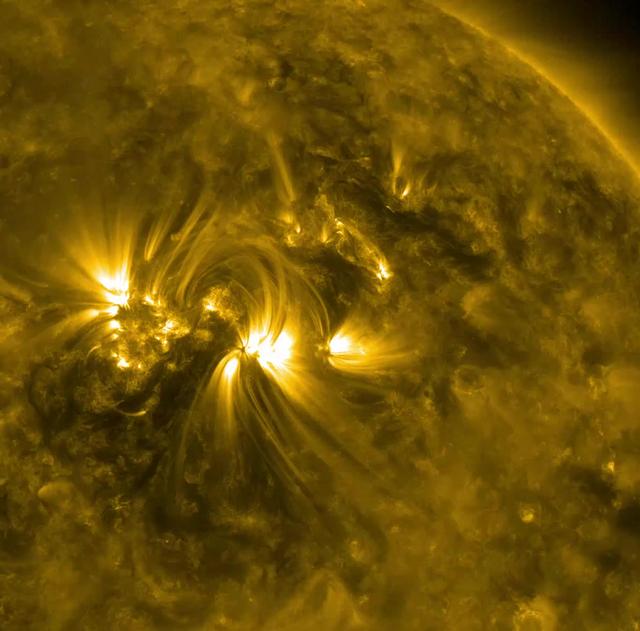
The magnetic field lines between a pair of active regions formed a beautiful set of swaying arches, seen in this footage captured by NASA’s Solar Dynamics Observatory on April 24-26, 2017. The arches are traced out by charged particles spinning along the magnetic field lines. These arches, which form a connection between regions of opposite magnetic polarity, are visible in exquisite detail in this wavelength of extreme ultraviolet light. Extreme ultraviolet light is typically invisible to our eyes, but is colorized here in gold. Read more: <a href="https://go.nasa.gov/2pGgYZt" rel="nofollow">go.nasa.gov/2pGgYZt</a> <b><a href="http://www.nasa.gov/audience/formedia/features/MP_Photo_Guidelines.html" rel="nofollow">NASA image use policy.</a></b> <b><a href="http://www.nasa.gov/centers/goddard/home/index.html" rel="nofollow">NASA Goddard Space Flight Center</a></b> enables NASA’s mission through four scientific endeavors: Earth Science, Heliophysics, Solar System Exploration, and Astrophysics. Goddard plays a leading role in NASA’s accomplishments by contributing compelling scientific knowledge to advance the Agency’s mission. <b>Follow us on <a href="http://twitter.com/NASAGoddardPix" rel="nofollow">Twitter</a></b> <b>Like us on <a href="http://www.facebook.com/pages/Greenbelt-MD/NASA-Goddard/395013845897?ref=tsd" rel="nofollow">Facebook</a></b> <b>Find us on <a href="http://instagrid.me/nasagoddard/?vm=grid" rel="nofollow">Instagram</a></b>
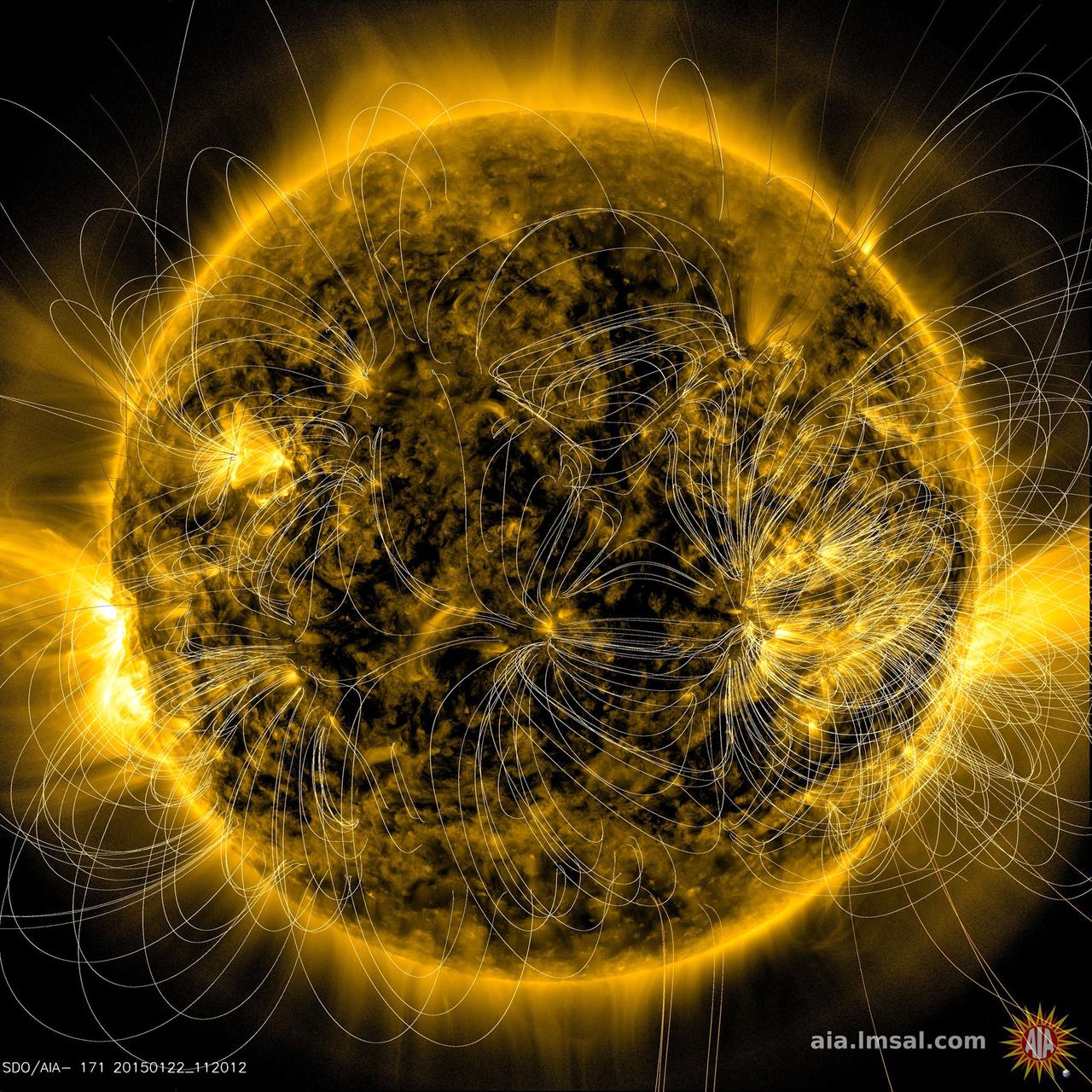
Scientists have developed a way to produce models of where the magnetic field lines are several times each day. Here we have created a time-lapse version of these models over four days (2-3 each day) to give you a peek at how these change over time. The spiraling arcs of magnetic field lines emerge from active regions and connect back to areas with the opposite polarity. The field lines are more concentrated where regions are more magnetically intense. And of course, they rotate with the rotation of the Sun. Credit: NASA/Solar Dynamics Observatory <b><a href="http://www.nasa.gov/audience/formedia/features/MP_Photo_Guidelines.html" rel="nofollow">NASA image use policy.</a></b> <b><a href="http://www.nasa.gov/centers/goddard/home/index.html" rel="nofollow">NASA Goddard Space Flight Center</a></b> enables NASA’s mission through four scientific endeavors: Earth Science, Heliophysics, Solar System Exploration, and Astrophysics. Goddard plays a leading role in NASA’s accomplishments by contributing compelling scientific knowledge to advance the Agency’s mission. <b>Follow us on <a href="http://twitter.com/NASAGoddardPix" rel="nofollow">Twitter</a></b> <b>Like us on <a href="http://www.facebook.com/pages/Greenbelt-MD/NASA-Goddard/395013845897?ref=tsd" rel="nofollow">Facebook</a></b> <b>Find us on <a href="http://instagram.com/nasagoddard?vm=grid" rel="nofollow">Instagram</a></b>
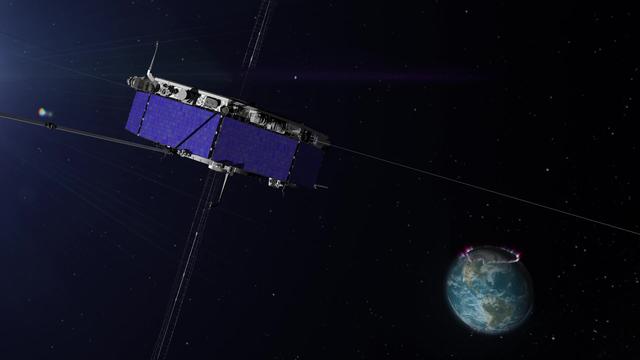
MMS Spacecraft Animation The Magnetospheric Multiscale (MMS) mission is a Solar Terrestrial Probes mission comprising four identically instrumented spacecraft that will use Earth's magnetosphere as a laboratory to study the microphysics of three fundamental plasma processes: magnetic reconnection, energetic particle acceleration, and turbulence. These processes occur in all astrophysical plasma systems but can be studied in situ only in our solar system and most efficiently only in Earth's magnetosphere, where they control the dynamics of the geospace environment and play an important role in the processes known as "space weather." Learn more about MMS at <a href="http://www.nasa.gov/mms" rel="nofollow">www.nasa.gov/mms</a> Learn more about MMS at <a href="http://www.nasa.gov/mms" rel="nofollow">www.nasa.gov/mms</a> Credit NASA/Goddard The Magnetospheric Multiscale, or MMS, will study how the sun and the Earth's magnetic fields connect and disconnect, an explosive process that can accelerate particles through space to nearly the speed of light. This process is called magnetic reconnection and can occur throughout all space. <b><a href="http://www.nasa.gov/audience/formedia/features/MP_Photo_Guidelines.html" rel="nofollow">NASA image use policy.</a></b> <b><a href="http://www.nasa.gov/centers/goddard/home/index.html" rel="nofollow">NASA Goddard Space Flight Center</a></b> enables NASA’s mission through four scientific endeavors: Earth Science, Heliophysics, Solar System Exploration, and Astrophysics. Goddard plays a leading role in NASA’s accomplishments by contributing compelling scientific knowledge to advance the Agency’s mission. <b>Follow us on <a href="http://twitter.com/NASAGoddardPix" rel="nofollow">Twitter</a></b> <b>Like us on <a href="http://www.facebook.com/pages/Greenbelt-MD/NASA-Goddard/395013845897?ref=tsd" rel="nofollow">Facebook</a></b> <b>Find us on <a href="http://instagram.com/nasagoddard?vm=grid" rel="nofollow">Instagram</a></b>
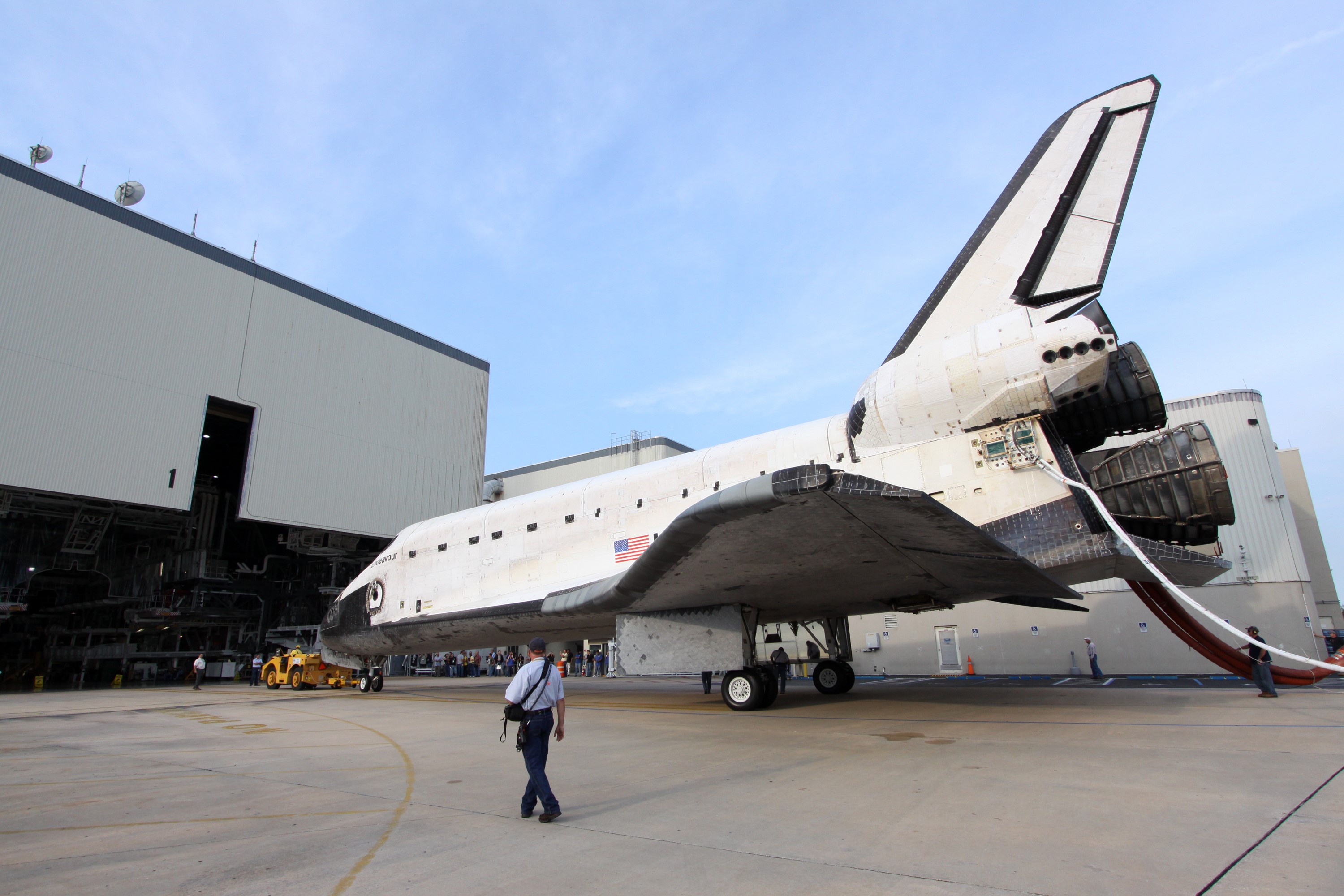
CAPE CANAVERAL, Fla. -- A "towback" vehicle slowly pulls shuttle Endeavour into Orbiter Processing Facility-1 at NASA's Kennedy Space Center in Florida. A purge unit that pumps conditioned air into a shuttle after landing is connected to Endeavour's aft end. Once inside the processing facility, Endeavour will be prepared for future public display. Endeavour's final return from space completed the 16-day, 6.5-million-mile STS-134 mission. Main gear touchdown was at 2:34:51 a.m. EDT, followed by nose gear touchdown at 2:35:04 a.m., and wheelstop at 2:35:36 a.m. Endeavour and its crew delivered the Alpha Magnetic Spectrometer-2 (AMS) and the Express Logistics Carrier-3 (ELC-3) to the International Space Station. AMS will help researchers understand the origin of the universe and search for evidence of dark matter, strange matter and antimatter from the station. ELC-3 carried spare parts that will sustain station operations once the shuttles are retired from service. STS-134 was the 25th and final flight for Endeavour, which spent 299 days in space, orbited Earth 4,671 times and traveled 122,883,151 miles. Photo credit: NASA/Jack Pfaller
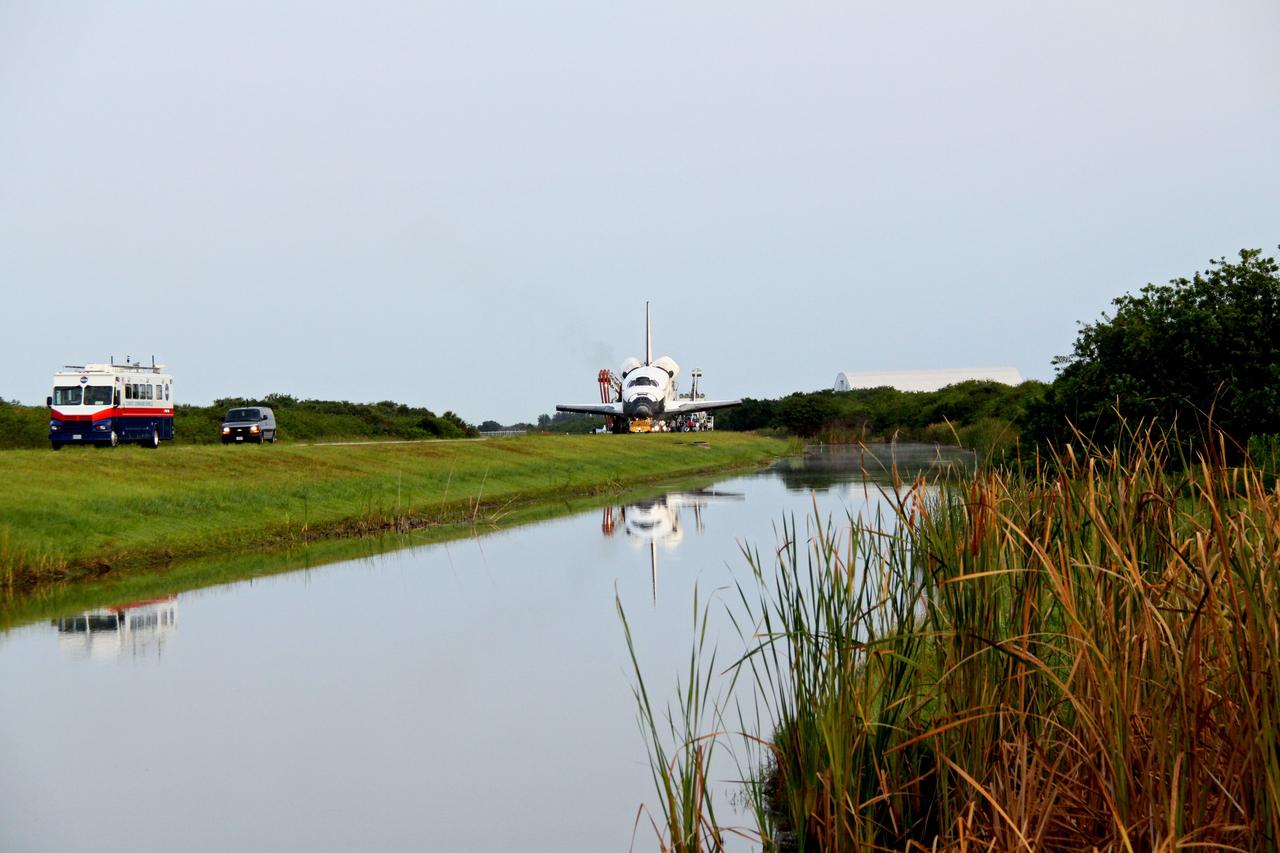
CAPE CANAVERAL, Fla. -- In the early morning hours after landing, space shuttle Endeavour's "towback" vehicle slowly pulls it from the Shuttle Landing Facility to Orbiter Processing Facility-1 at NASA's Kennedy Space Center in Florida. A purge unit that pumps conditioned air into a shuttle after landing is connected to Endeavour's aft end. Once inside the processing facility, Endeavour will be prepared for future public display. Endeavour's final return from space completed the 16-day, 6.5-million-mile STS-134 mission. Main gear touchdown was at 2:34:51 a.m. EDT, followed by nose gear touchdown at 2:35:04 a.m., and wheelstop at 2:35:36 a.m. Endeavour and its crew delivered the Alpha Magnetic Spectrometer-2 (AMS) and the Express Logistics Carrier-3 (ELC-3) to the International Space Station. AMS will help researchers understand the origin of the universe and search for evidence of dark matter, strange matter and antimatter from the station. ELC-3 carried spare parts that will sustain station operations once the shuttles are retired from service. STS-134 was the 25th and final flight for Endeavour, which spent 299 days in space, orbited Earth 4,671 times and traveled 122,883,151 miles. Photo credit: NASA/Jack Pfaller
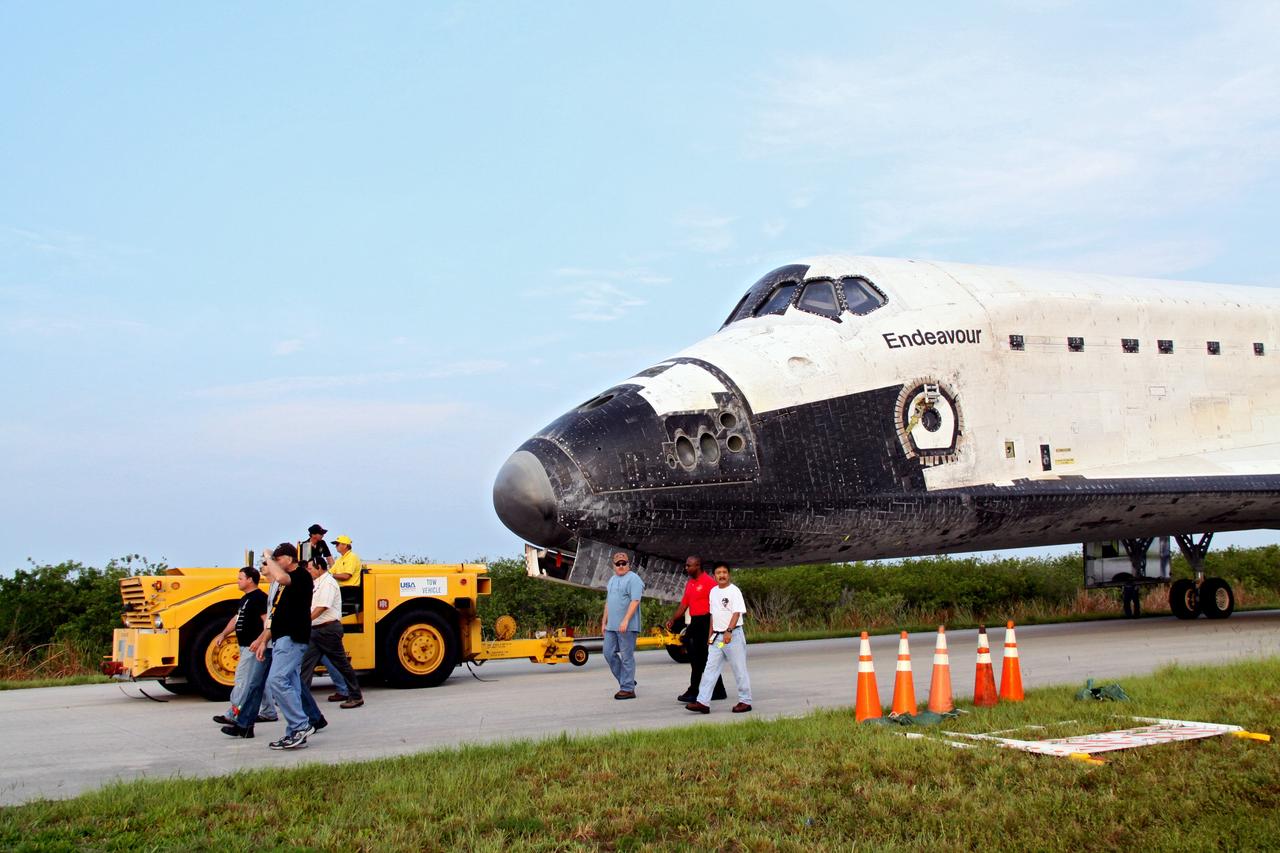
CAPE CANAVERAL, Fla. -- Workers accompany shuttle Endeavour as a "towback" vehicle slowly pulls it from the Shuttle Landing Facility to Orbiter Processing Facility-1 at NASA's Kennedy Space Center in Florida. A purge unit that pumps conditioned air into a shuttle after landing is connected to Endeavour's aft end. Once inside the processing facility, Endeavour will be prepared for future public display. Endeavour's final return from space completed the 16-day, 6.5-million-mile STS-134 mission. Main gear touchdown was at 2:34:51 a.m. EDT, followed by nose gear touchdown at 2:35:04 a.m., and wheelstop at 2:35:36 a.m. Endeavour and its crew delivered the Alpha Magnetic Spectrometer-2 (AMS) and the Express Logistics Carrier-3 (ELC-3) to the International Space Station. AMS will help researchers understand the origin of the universe and search for evidence of dark matter, strange matter and antimatter from the station. ELC-3 carried spare parts that will sustain station operations once the shuttles are retired from service. STS-134 was the 25th and final flight for Endeavour, which spent 299 days in space, orbited Earth 4,671 times and traveled 122,883,151 miles. Photo credit: NASA/Jack Pfaller
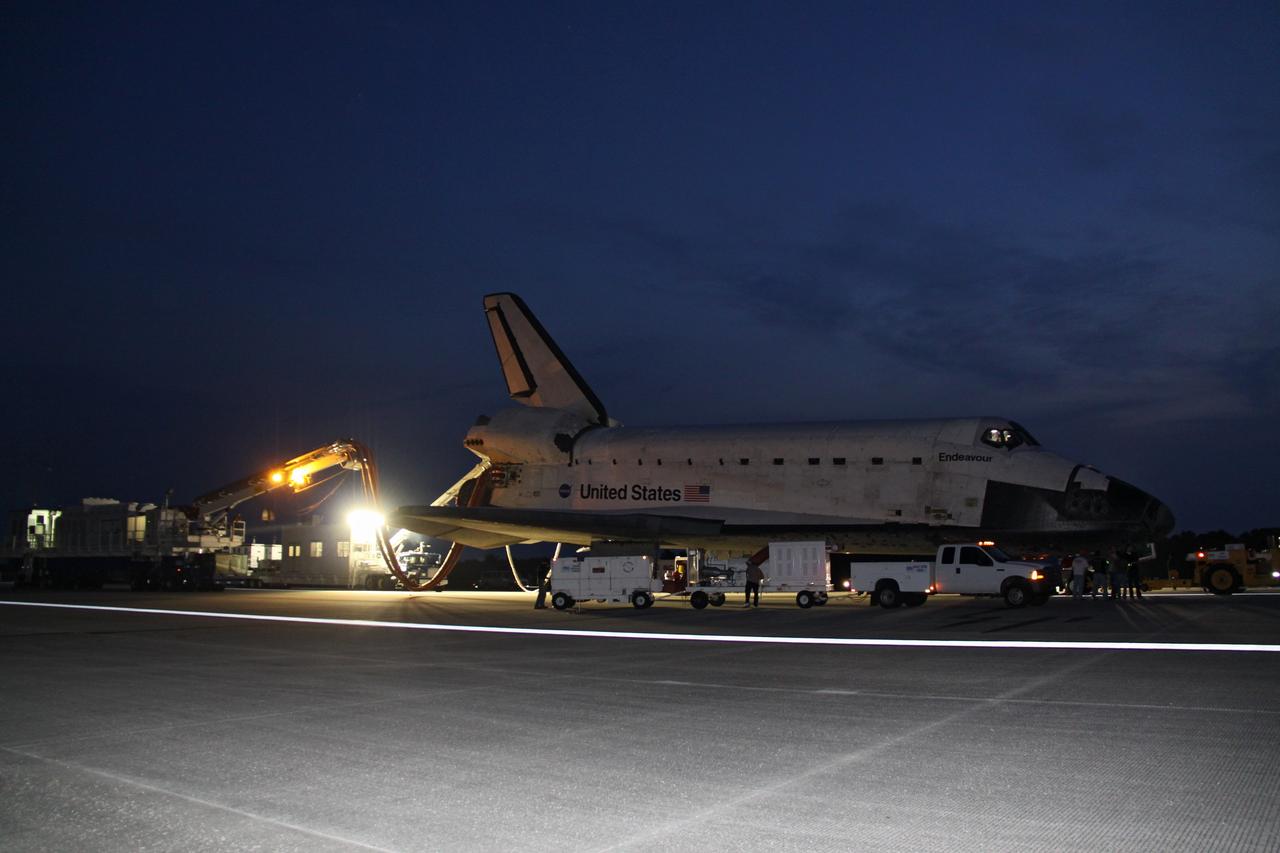
CAPE CANAVERAL, Fla. -- In the early morning hours after landing, space shuttle Endeavour's "towback" vehicle slowly pulls it from the Shuttle Landing Facility to Orbiter Processing Facility-1 at NASA's Kennedy Space Center in Florida. A purge unit that pumps conditioned air into a shuttle after landing is connected to Endeavour's aft end. Once inside the processing facility, Endeavour will be prepared for future public display. Endeavour's final return from space completed the 16-day, 6.5-million-mile STS-134 mission. Main gear touchdown was at 2:34:51 a.m. EDT, followed by nose gear touchdown at 2:35:04 a.m., and wheelstop at 2:35:36 a.m. Endeavour and its crew delivered the Alpha Magnetic Spectrometer-2 (AMS) and the Express Logistics Carrier-3 (ELC-3) to the International Space Station. AMS will help researchers understand the origin of the universe and search for evidence of dark matter, strange matter and antimatter from the station. ELC-3 carried spare parts that will sustain station operations once the shuttles are retired from service. STS-134 was the 25th and final flight for Endeavour, which spent 299 days in space, orbited Earth 4,671 times and traveled 122,883,151 miles. Photo credit: NASA/Jack Pfaller
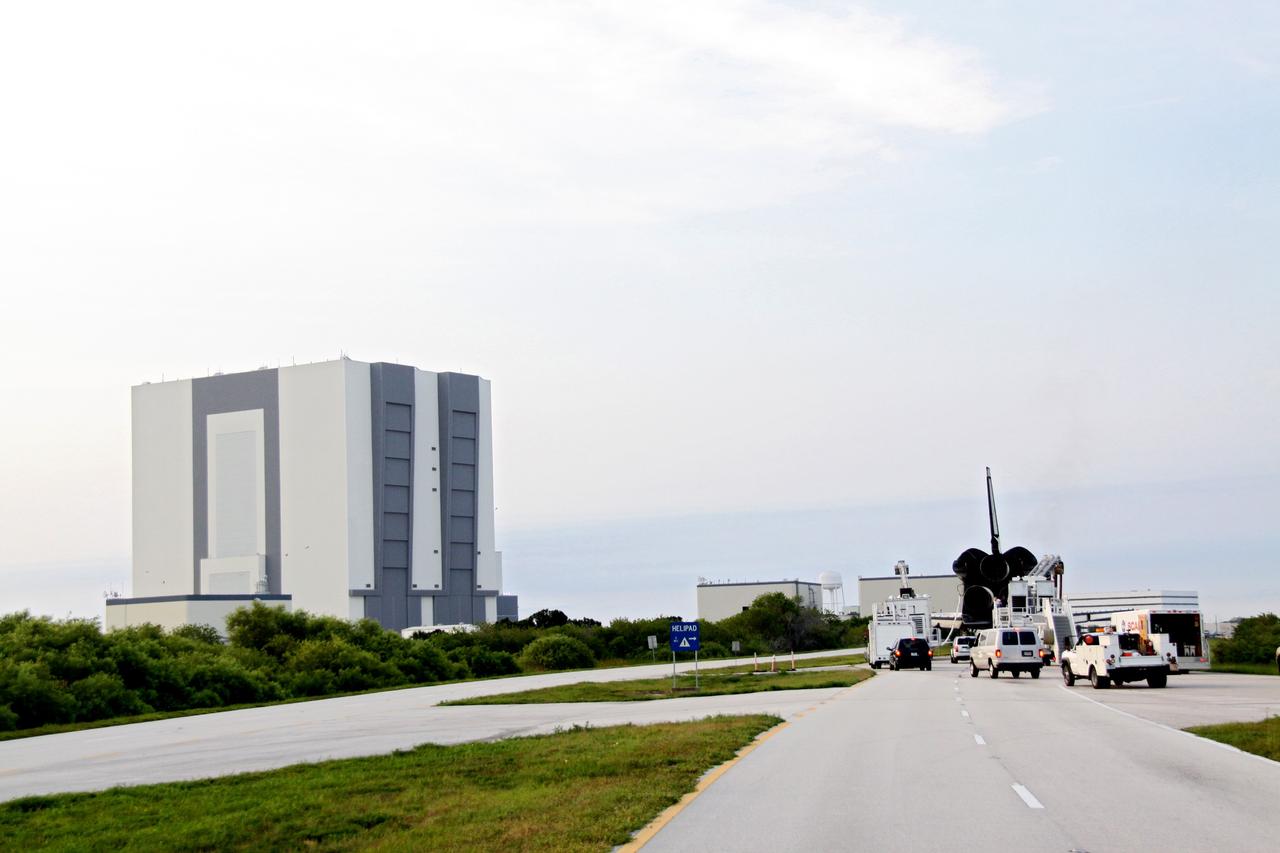
CAPE CANAVERAL, Fla. -- A "towback" vehicle slowly pulls shuttle Endeavour from the Shuttle Landing Facility to Orbiter Processing Facility-1 at NASA's Kennedy Space Center in Florida. A purge unit that pumps conditioned air into a shuttle after landing is connected to Endeavour's aft end. In the background is the massive Vehicle Assembly Building. Once inside the processing facility, Endeavour will be prepared for future public display. Endeavour's final return from space completed the 16-day, 6.5-million-mile STS-134 mission. Main gear touchdown was at 2:34:51 a.m. EDT, followed by nose gear touchdown at 2:35:04 a.m., and wheelstop at 2:35:36 a.m. Endeavour and its crew delivered the Alpha Magnetic Spectrometer-2 (AMS) and the Express Logistics Carrier-3 (ELC-3) to the International Space Station. AMS will help researchers understand the origin of the universe and search for evidence of dark matter, strange matter and antimatter from the station. ELC-3 carried spare parts that will sustain station operations once the shuttles are retired from service. STS-134 was the 25th and final flight for Endeavour, which spent 299 days in space, orbited Earth 4,671 times and traveled 122,883,151 miles. Photo credit: NASA/Jack Pfaller
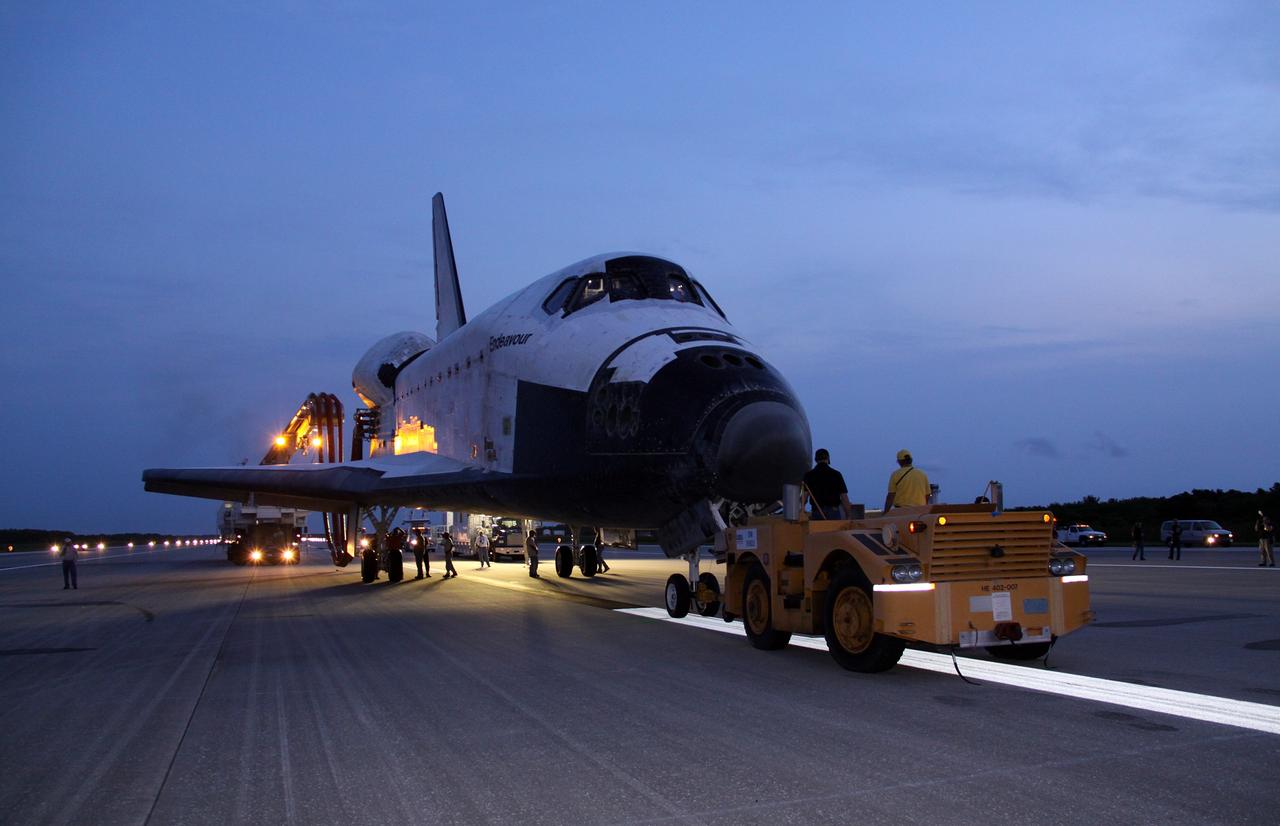
CAPE CANAVERAL, Fla. -- In the early morning hours after landing, space shuttle Endeavour's "towback" vehicle slowly pulls it from the Shuttle Landing Facility to Orbiter Processing Facility-1 at NASA's Kennedy Space Center in Florida. A purge unit that pumps conditioned air into a shuttle after landing is connected to Endeavour's aft end. Once inside the processing facility, Endeavour will be prepared for future public display. Endeavour's final return from space completed the 16-day, 6.5-million-mile STS-134 mission. Main gear touchdown was at 2:34:51 a.m. EDT, followed by nose gear touchdown at 2:35:04 a.m., and wheelstop at 2:35:36 a.m. Endeavour and its crew delivered the Alpha Magnetic Spectrometer-2 (AMS) and the Express Logistics Carrier-3 (ELC-3) to the International Space Station. AMS will help researchers understand the origin of the universe and search for evidence of dark matter, strange matter and antimatter from the station. ELC-3 carried spare parts that will sustain station operations once the shuttles are retired from service. STS-134 was the 25th and final flight for Endeavour, which spent 299 days in space, orbited Earth 4,671 times and traveled 122,883,151 miles. Photo credit: NASA/Jack Pfaller
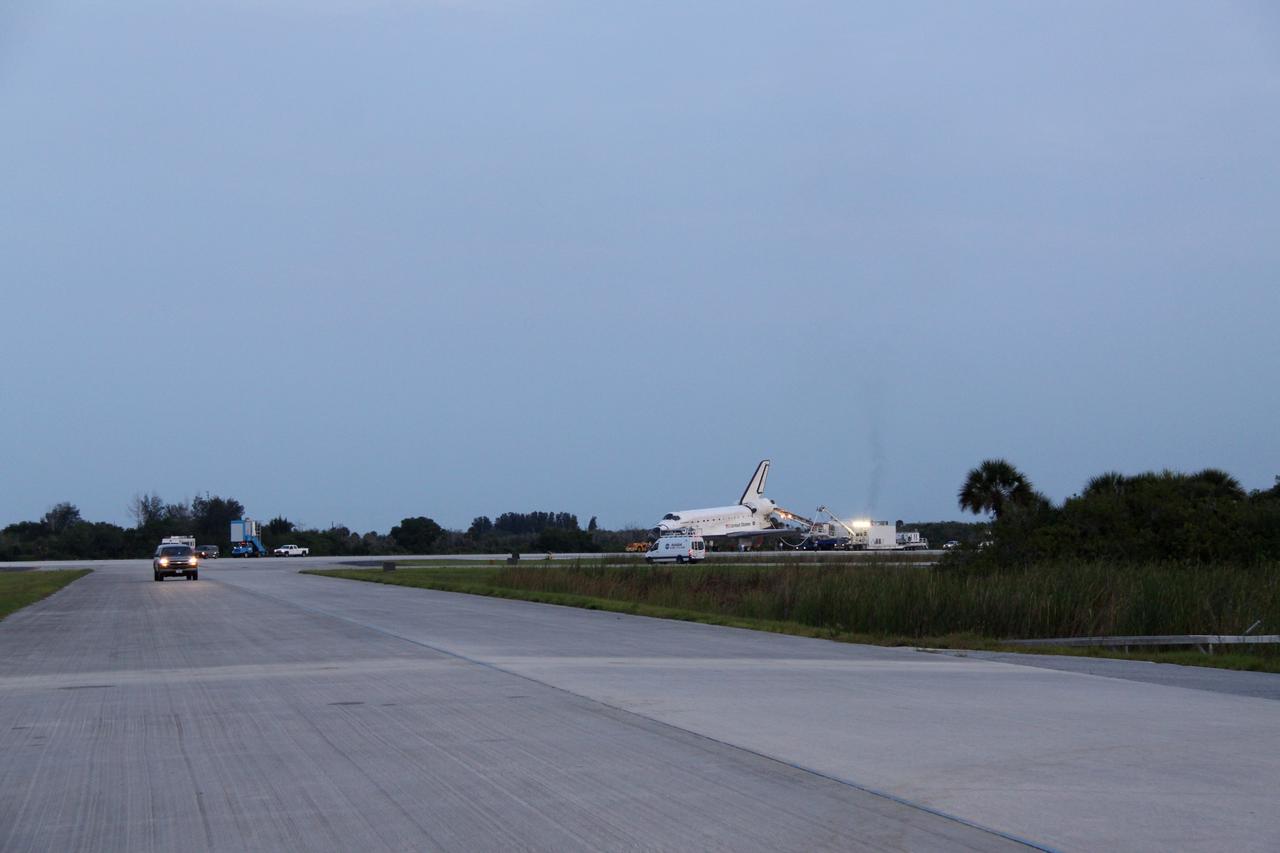
CAPE CANAVERAL, Fla. -- In the early morning hours after landing, space shuttle Endeavour's "towback" vehicle slowly pulls it from the Shuttle Landing Facility to Orbiter Processing Facility-1 at NASA's Kennedy Space Center in Florida. A purge unit that pumps conditioned air into a shuttle after landing is connected to Endeavour's aft end. Once inside the processing facility, Endeavour will be prepared for future public display. Endeavour's final return from space completed the 16-day, 6.5-million-mile STS-134 mission. Main gear touchdown was at 2:34:51 a.m. EDT, followed by nose gear touchdown at 2:35:04 a.m., and wheelstop at 2:35:36 a.m. Endeavour and its crew delivered the Alpha Magnetic Spectrometer-2 (AMS) and the Express Logistics Carrier-3 (ELC-3) to the International Space Station. AMS will help researchers understand the origin of the universe and search for evidence of dark matter, strange matter and antimatter from the station. ELC-3 carried spare parts that will sustain station operations once the shuttles are retired from service. STS-134 was the 25th and final flight for Endeavour, which spent 299 days in space, orbited Earth 4,671 times and traveled 122,883,151 miles. Photo credit: NASA/Jack Pfaller
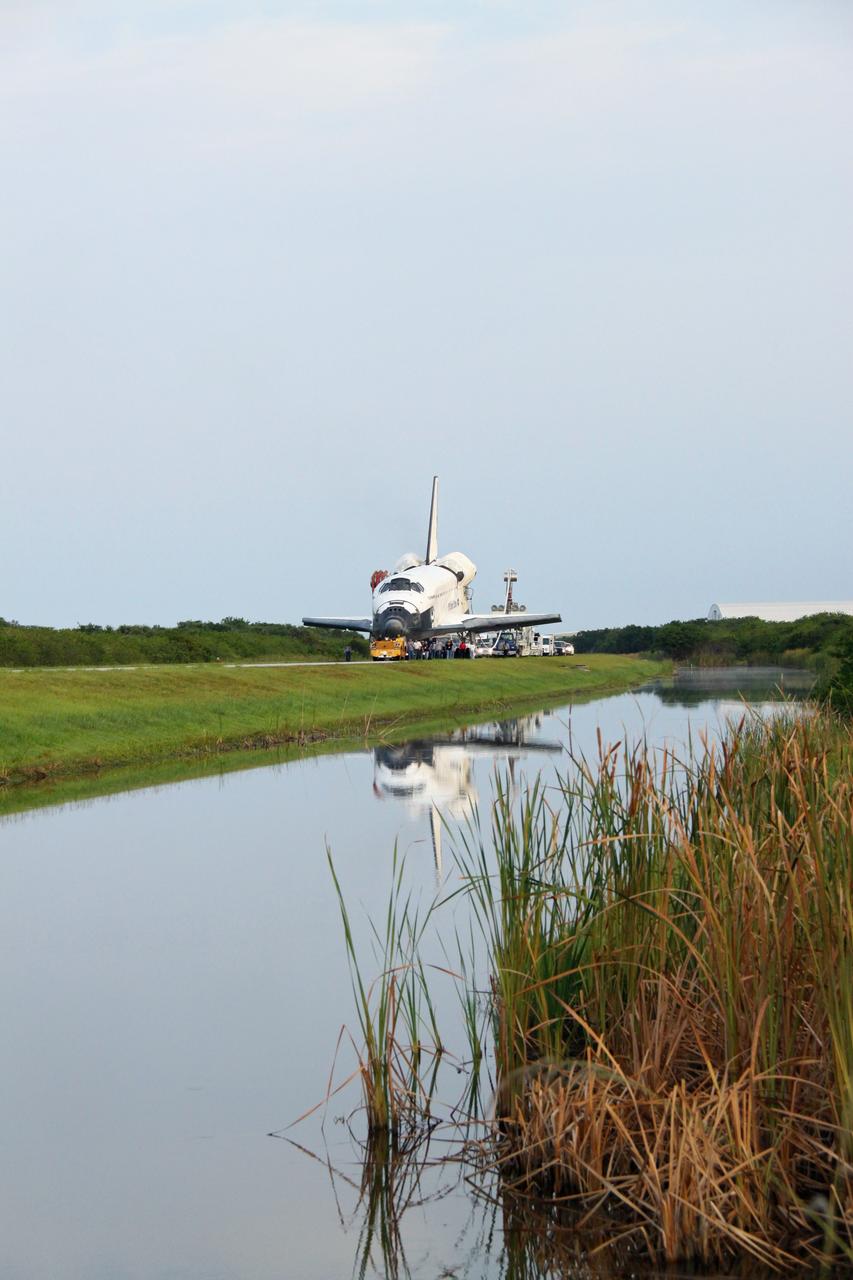
CAPE CANAVERAL, Fla. -- A "towback" vehicle slowly pulls shuttle Endeavour from the Shuttle Landing Facility to Orbiter Processing Facility-1 at NASA's Kennedy Space Center in Florida. A purge unit that pumps conditioned air into a shuttle after landing is connected to Endeavour's aft end. Once inside the processing facility, Endeavour will be prepared for future public display. Endeavour's final return from space completed the 16-day, 6.5-million-mile STS-134 mission. Main gear touchdown was at 2:34:51 a.m. EDT, followed by nose gear touchdown at 2:35:04 a.m., and wheelstop at 2:35:36 a.m. Endeavour and its crew delivered the Alpha Magnetic Spectrometer-2 (AMS) and the Express Logistics Carrier-3 (ELC-3) to the International Space Station. AMS will help researchers understand the origin of the universe and search for evidence of dark matter, strange matter and antimatter from the station. ELC-3 carried spare parts that will sustain station operations once the shuttles are retired from service. STS-134 was the 25th and final flight for Endeavour, which spent 299 days in space, orbited Earth 4,671 times and traveled 122,883,151 miles. Photo credit: NASA/Jack Pfaller
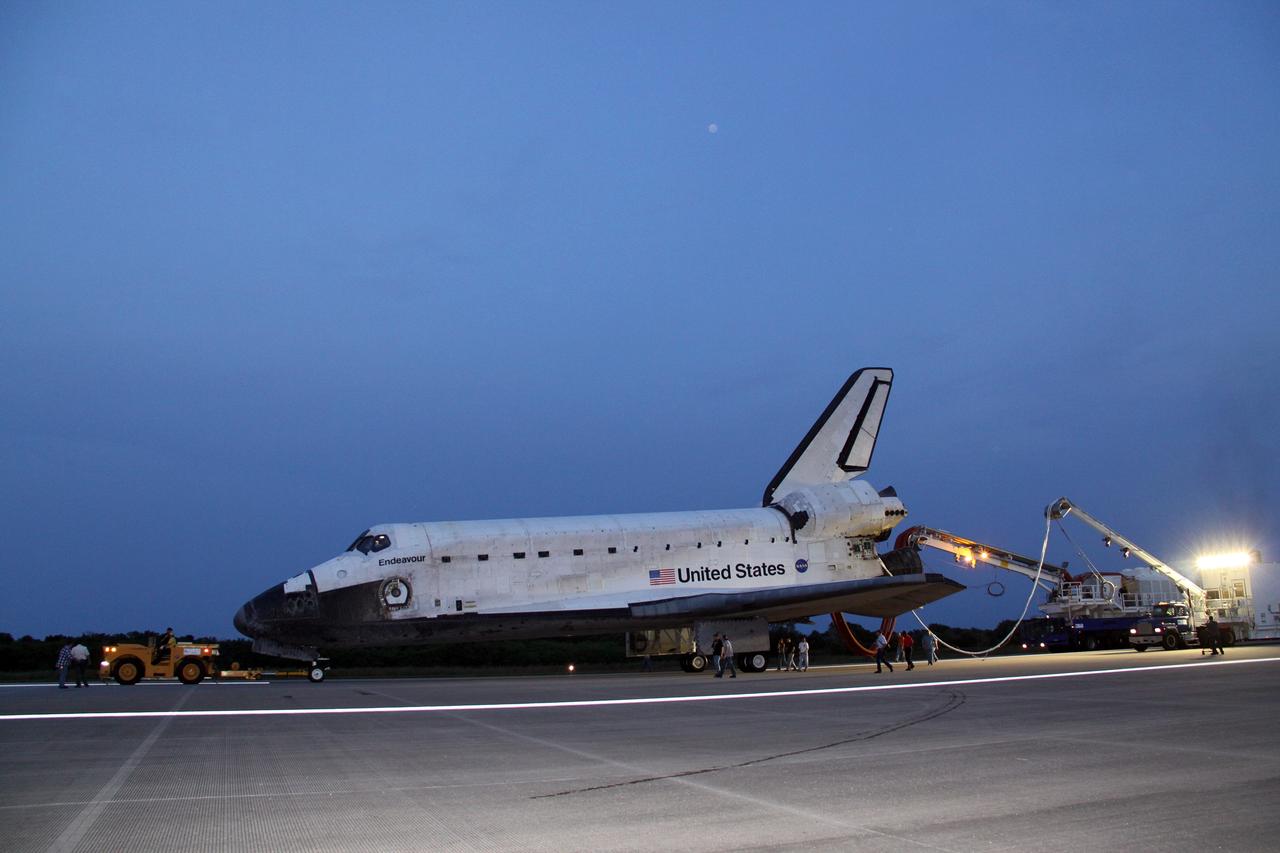
CAPE CANAVERAL, Fla. -- In the early morning hours after landing, space shuttle Endeavour's "towback" vehicle slowly pulls it from the Shuttle Landing Facility to Orbiter Processing Facility-1 at NASA's Kennedy Space Center in Florida. A purge unit that pumps conditioned air into a shuttle after landing is connected to Endeavour's aft end. Once inside the processing facility, Endeavour will be prepared for future public display. Endeavour's final return from space completed the 16-day, 6.5-million-mile STS-134 mission. Main gear touchdown was at 2:34:51 a.m. EDT, followed by nose gear touchdown at 2:35:04 a.m., and wheelstop at 2:35:36 a.m. Endeavour and its crew delivered the Alpha Magnetic Spectrometer-2 (AMS) and the Express Logistics Carrier-3 (ELC-3) to the International Space Station. AMS will help researchers understand the origin of the universe and search for evidence of dark matter, strange matter and antimatter from the station. ELC-3 carried spare parts that will sustain station operations once the shuttles are retired from service. STS-134 was the 25th and final flight for Endeavour, which spent 299 days in space, orbited Earth 4,671 times and traveled 122,883,151 miles. Photo credit: NASA/Jack Pfaller
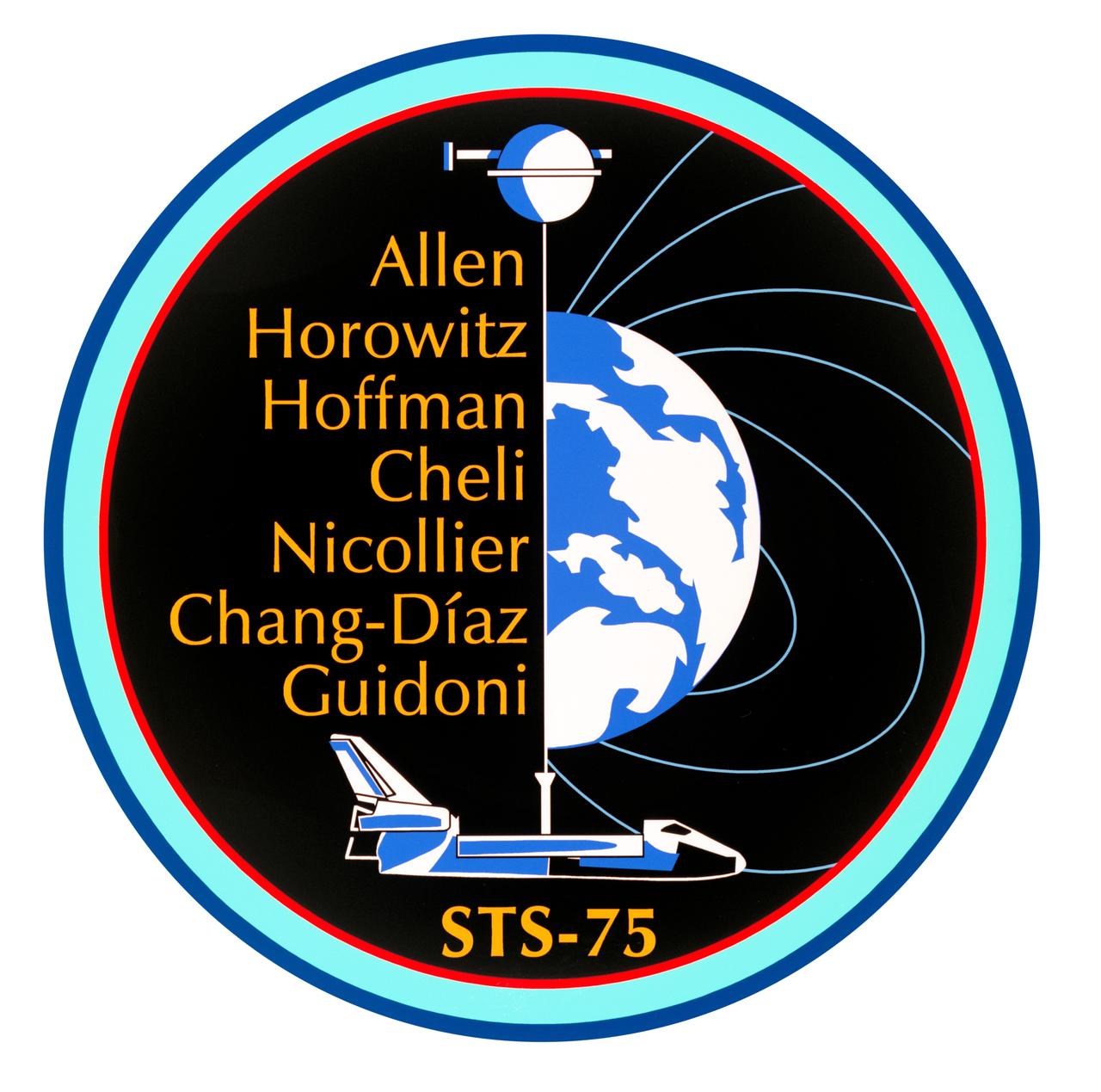
STS075-S-001 (September 1995) --- The STS-75 crew patch depicts the space shuttle Columbia and the Tethered Satellite connected by a 21-kilometer electronically conducting tether. The orbiter/satellite system is passing through Earth?s magnetic field which, like an electronic generator, will produce thousands of volts of electricity. Columbia is carrying the United States Microgravity pallet to conduct microgravity research in material science and thermodynamics. The tether is crossing Earth?s terminator signifying the dawn of a new era for space tether applications and in mankind?s knowledge of Earth?s ionosphere, material science, and thermodynamics. The patch was designed for the STS-75 crew members by Mike Sanni. The NASA insignia design for space shuttle flights is reserved for use by the astronauts and for other official use as the NASA Administrator may authorize. Public availability has been approved only in the forms of illustrations by the various news media. When and if there is any change in this policy, which is not anticipated, the change will be publicly announced. Photo credit: NASA
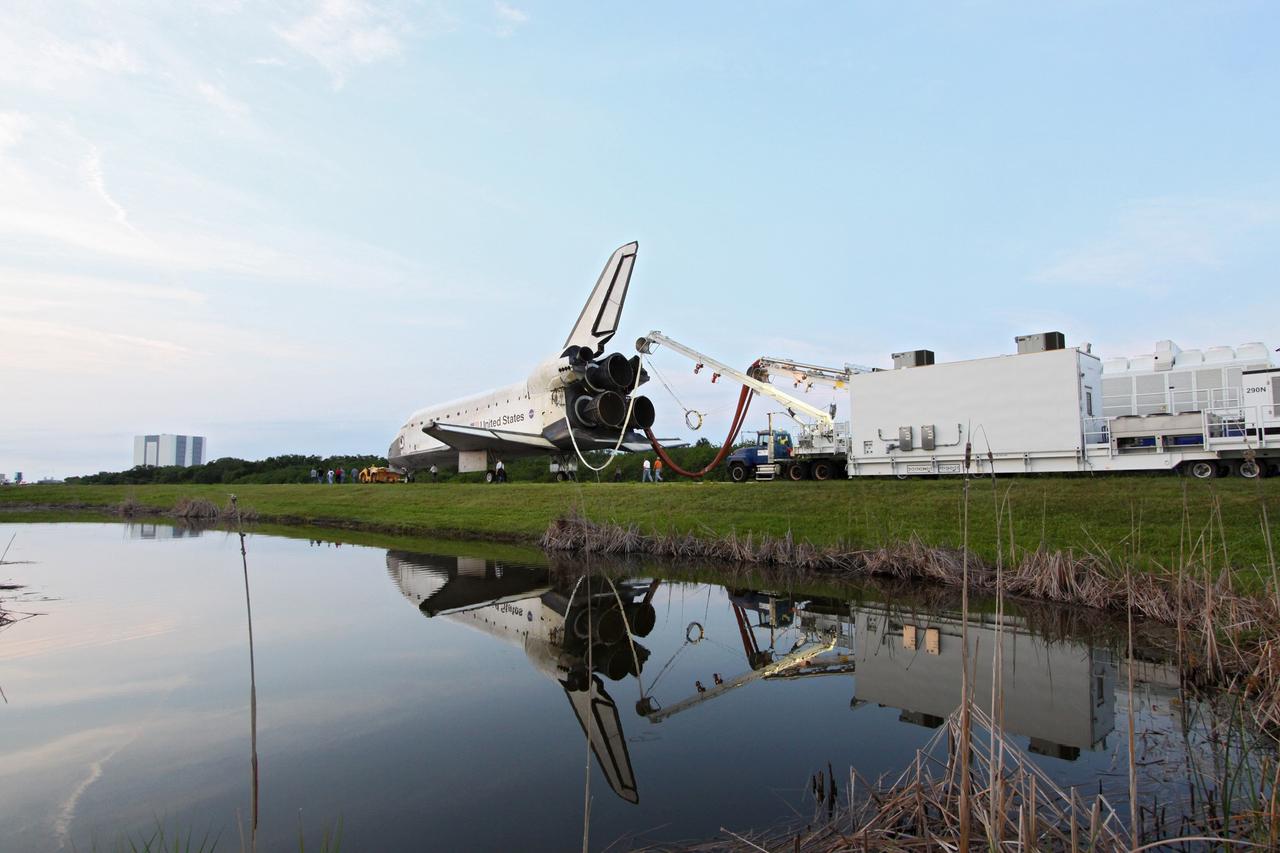
CAPE CANAVERAL, Fla. -- In the early morning hours after landing, space shuttle Endeavour's "towback" vehicle slowly pulls it from the Shuttle Landing Facility to Orbiter Processing Facility-1 at NASA's Kennedy Space Center in Florida. A purge unit that pumps conditioned air into a shuttle after landing is connected to Endeavour's aft end. In the background is the massive Vehicle Assembly Building. Once inside the processing facility, Endeavour will be prepared for future public display. Endeavour's final return from space completed the 16-day, 6.5-million-mile STS-134 mission. Main gear touchdown was at 2:34:51 a.m. EDT, followed by nose gear touchdown at 2:35:04 a.m., and wheelstop at 2:35:36 a.m. Endeavour and its crew delivered the Alpha Magnetic Spectrometer-2 (AMS) and the Express Logistics Carrier-3 (ELC-3) to the International Space Station. AMS will help researchers understand the origin of the universe and search for evidence of dark matter, strange matter and antimatter from the station. ELC-3 carried spare parts that will sustain station operations once the shuttles are retired from service. STS-134 was the 25th and final flight for Endeavour, which spent 299 days in space, orbited Earth 4,671 times and traveled 122,883,151 miles. Photo credit: NASA/Jack Pfaller
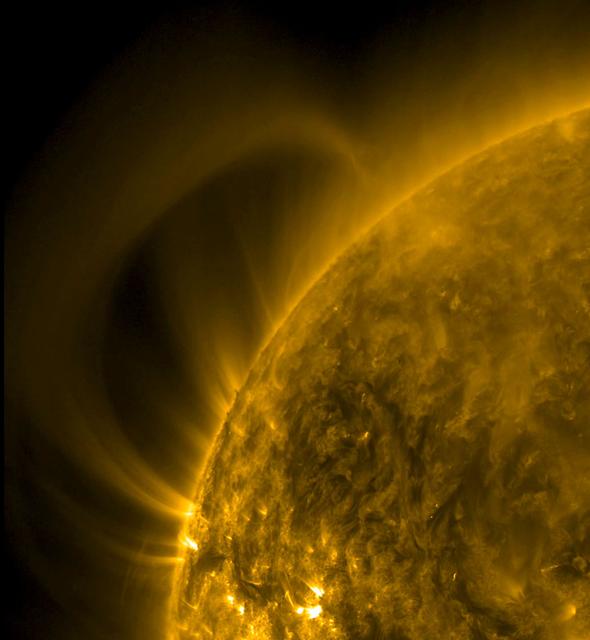
A giant arch of plasma rose up out of the Sun and then stretched itself until it had reached back to a point behind our view of the Sun (Sept, 17-18, 2014). Since it emerged from a magnetically intense active region, the arch is likely connecting to another active region over the Sun's horizon. We rarely see material extend this distance. The images were observed in the extreme ultraviolet wavelength of 171 Angstroms. Credit: NASA/Solar Dynamics Observatory <b><a href="http://www.nasa.gov/audience/formedia/features/MP_Photo_Guidelines.html" rel="nofollow">NASA image use policy.</a></b> <b><a href="http://www.nasa.gov/centers/goddard/home/index.html" rel="nofollow">NASA Goddard Space Flight Center</a></b> enables NASA’s mission through four scientific endeavors: Earth Science, Heliophysics, Solar System Exploration, and Astrophysics. Goddard plays a leading role in NASA’s accomplishments by contributing compelling scientific knowledge to advance the Agency’s mission. <b>Follow us on <a href="http://twitter.com/NASAGoddardPix" rel="nofollow">Twitter</a></b> <b>Like us on <a href="http://www.facebook.com/pages/Greenbelt-MD/NASA-Goddard/395013845897?ref=tsd" rel="nofollow">Facebook</a></b> <b>Find us on <a href="http://instagram.com/nasagoddard?vm=grid" rel="nofollow">Instagram</a></b>
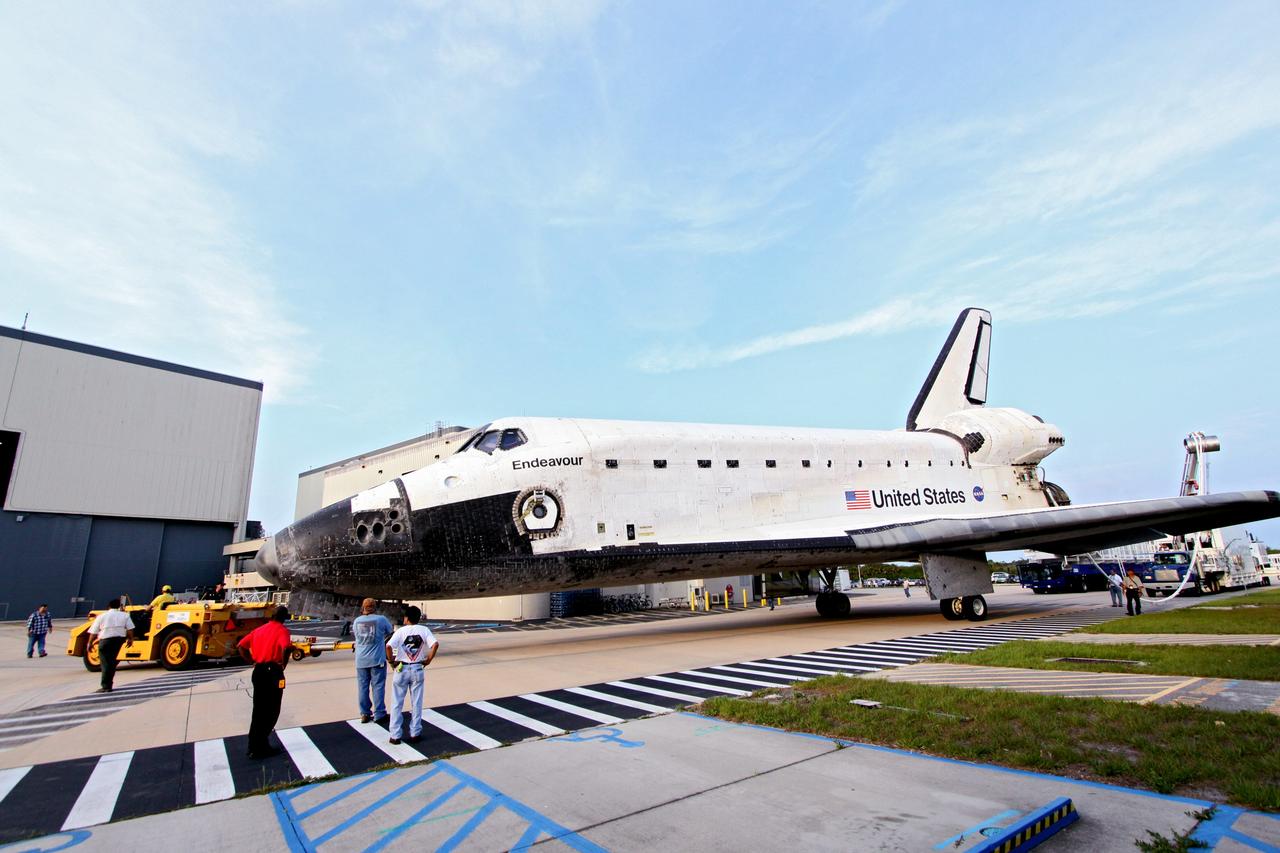
CAPE CANAVERAL, Fla. -- Workers accompany shuttle Endeavour as a "towback" vehicle slowly pulls it into Orbiter Processing Facility-1 at NASA's Kennedy Space Center in Florida. A purge unit that pumps conditioned air into a shuttle after landing is connected to Endeavour's aft end. Once inside the processing facility, Endeavour will be prepared for future public display. Endeavour's final return from space completed the 16-day, 6.5-million-mile STS-134 mission. Main gear touchdown was at 2:34:51 a.m. EDT, followed by nose gear touchdown at 2:35:04 a.m., and wheelstop at 2:35:36 a.m. Endeavour and its crew delivered the Alpha Magnetic Spectrometer-2 (AMS) and the Express Logistics Carrier-3 (ELC-3) to the International Space Station. AMS will help researchers understand the origin of the universe and search for evidence of dark matter, strange matter and antimatter from the station. ELC-3 carried spare parts that will sustain station operations once the shuttles are retired from service. STS-134 was the 25th and final flight for Endeavour, which spent 299 days in space, orbited Earth 4,671 times and traveled 122,883,151 miles. Photo credit: NASA/Jack Pfaller
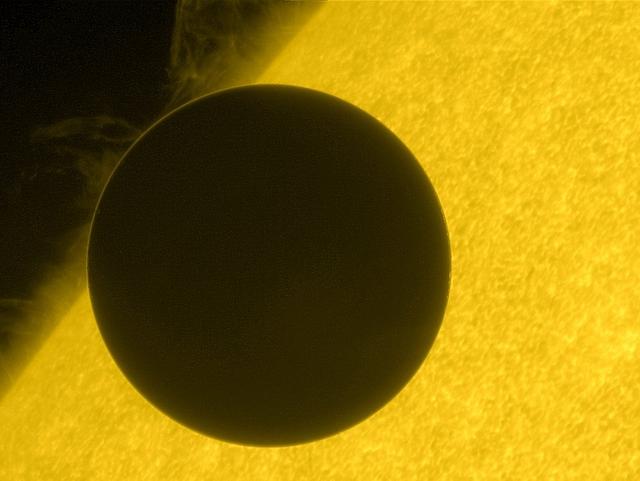
On June 5, 2012, Hinode captured this stunning view of the transit of Venus -- the last instance of this rare phenomenon until 2117. Hinode is a joint JAXA/NASA mission to study the connections of the sun's surface magnetism, primarily in and around sunspots. NASA's Marshall Space Flight Center in Huntsville, Ala., manages Hinode science operations and oversaw development of the scientific instrumentation provided for the mission by NASA, and industry. The Smithsonian Astrophysical Observatory in Cambridge, Mass., is the lead U.S. investigator for the X-ray Telescope. Image credit: JAXA/NASA <b><a href="http://www.nasa.gov/audience/formedia/features/MP_Photo_Guidelines.html" rel="nofollow">NASA image use policy.</a></b> <b><a href="http://www.nasa.gov/centers/goddard/home/index.html" rel="nofollow">NASA Goddard Space Flight Center</a></b> enables NASA’s mission through four scientific endeavors: Earth Science, Heliophysics, Solar System Exploration, and Astrophysics. Goddard plays a leading role in NASA’s accomplishments by contributing compelling scientific knowledge to advance the Agency’s mission. <b>Follow us on <a href="http://twitter.com/NASA_GoddardPix" rel="nofollow">Twitter</a></b> <b>Like us on <a href="http://www.facebook.com/pages/Greenbelt-MD/NASA-Goddard/395013845897?ref=tsd" rel="nofollow">Facebook</a></b> <b>Find us on <a href="http://instagrid.me/nasagoddard/?vm=grid" rel="nofollow">Instagram</a></b>
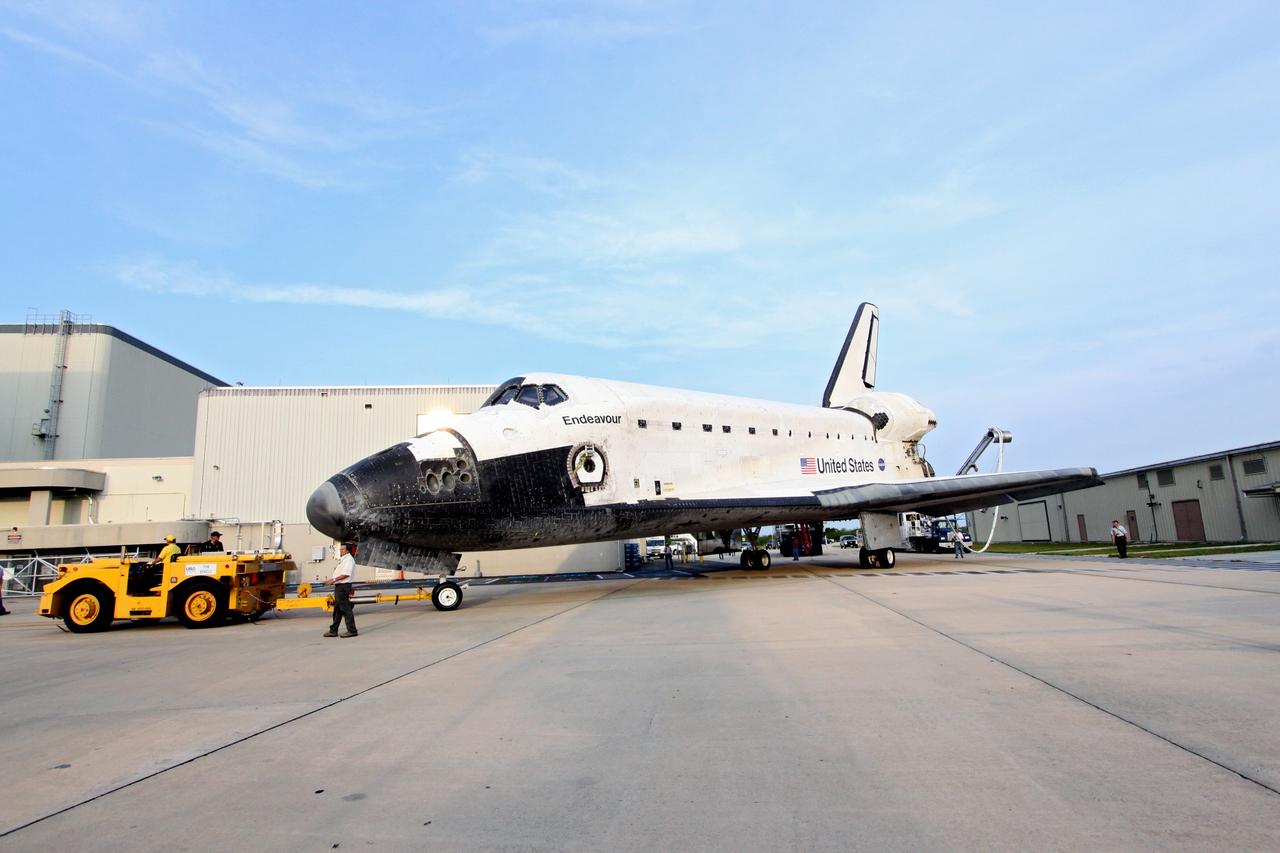
CAPE CANAVERAL, Fla. -- A "towback" vehicle slowly pulls shuttle Endeavour into Orbiter Processing Facility-1 at NASA's Kennedy Space Center in Florida. A purge unit that pumps conditioned air into a shuttle after landing is connected to Endeavour's aft end. Once inside the processing facility, Endeavour will be prepared for future public display. Endeavour's final return from space completed the 16-day, 6.5-million-mile STS-134 mission. Main gear touchdown was at 2:34:51 a.m. EDT, followed by nose gear touchdown at 2:35:04 a.m., and wheelstop at 2:35:36 a.m. Endeavour and its crew delivered the Alpha Magnetic Spectrometer-2 (AMS) and the Express Logistics Carrier-3 (ELC-3) to the International Space Station. AMS will help researchers understand the origin of the universe and search for evidence of dark matter, strange matter and antimatter from the station. ELC-3 carried spare parts that will sustain station operations once the shuttles are retired from service. STS-134 was the 25th and final flight for Endeavour, which spent 299 days in space, orbited Earth 4,671 times and traveled 122,883,151 miles. Photo credit: NASA/Jack Pfaller

On August 31, 2012 a long filament of solar material that had been hovering in the sun's atmosphere, the corona, erupted out into space at 4:36 p.m. EDT. The coronal mass ejection, or CME, traveled at over 900 miles per second. The CME did not travel directly toward Earth, but did connect with Earth's magnetic environment, or magnetosphere, causing aurora to appear on the night of Monday, September 3. This is a a lighten blended version of the 304 and 171 angstrom wavelengths. Credit: NASA/GSFC/SDO <b><a href="http://www.nasa.gov/audience/formedia/features/MP_Photo_Guidelines.html" rel="nofollow">NASA image use policy.</a></b> <b><a href="http://www.nasa.gov/centers/goddard/home/index.html" rel="nofollow">NASA Goddard Space Flight Center</a></b> enables NASA’s mission through four scientific endeavors: Earth Science, Heliophysics, Solar System Exploration, and Astrophysics. Goddard plays a leading role in NASA’s accomplishments by contributing compelling scientific knowledge to advance the Agency’s mission. <b>Follow us on <a href="http://twitter.com/NASAGoddardPix" rel="nofollow">Twitter</a></b> <b>Like us on <a href="http://www.facebook.com/pages/Greenbelt-MD/NASA-Goddard/395013845897?ref=tsd" rel="nofollow">Facebook</a></b> <b>Find us on <a href="http://instagrid.me/nasagoddard/?vm=grid" rel="nofollow">Instagram</a></b>
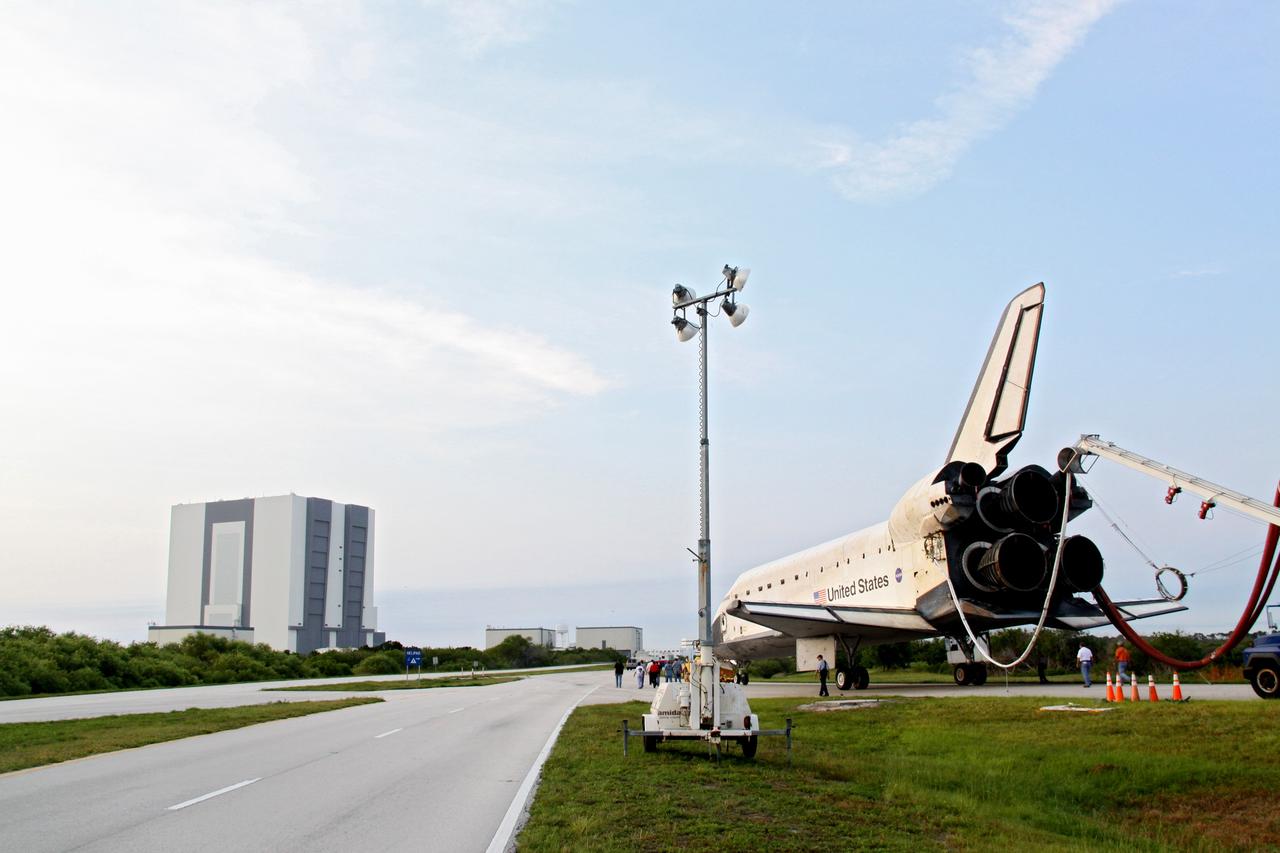
CAPE CANAVERAL, Fla. -- A "towback" vehicle slowly pulls shuttle Endeavour from the Shuttle Landing Facility to Orbiter Processing Facility-1 at NASA's Kennedy Space Center in Florida. A purge unit that pumps conditioned air into a shuttle after landing is connected to Endeavour's aft end. In the background is the massive Vehicle Assembly Building. Once inside the processing facility, Endeavour will be prepared for future public display. Endeavour's final return from space completed the 16-day, 6.5-million-mile STS-134 mission. Main gear touchdown was at 2:34:51 a.m. EDT, followed by nose gear touchdown at 2:35:04 a.m., and wheelstop at 2:35:36 a.m. Endeavour and its crew delivered the Alpha Magnetic Spectrometer-2 (AMS) and the Express Logistics Carrier-3 (ELC-3) to the International Space Station. AMS will help researchers understand the origin of the universe and search for evidence of dark matter, strange matter and antimatter from the station. ELC-3 carried spare parts that will sustain station operations once the shuttles are retired from service. STS-134 was the 25th and final flight for Endeavour, which spent 299 days in space, orbited Earth 4,671 times and traveled 122,883,151 miles. Photo credit: NASA/Jack Pfaller
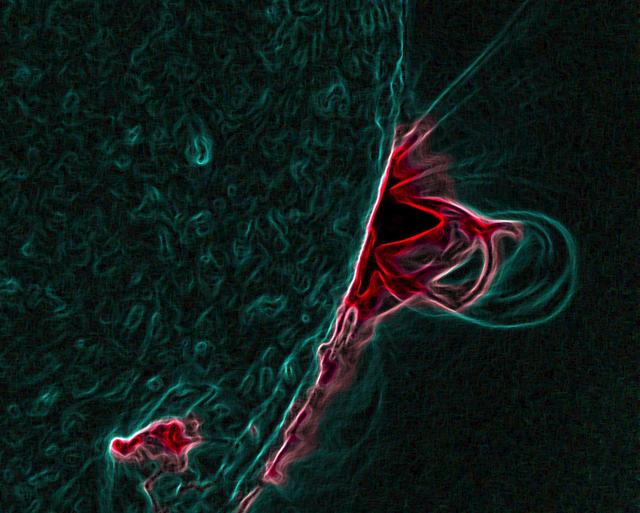
Caption: This is an image of magnetic loops on the sun, captured by NASA's Solar Dynamics Observatory on July 18, 2012. It has been processed to highlight the edges of each loop to make the structure more clear. A series of loops such as this is known as a flux rope, and these lie at the heart of eruptions on the sun known as coronal mass ejections (CMEs.) This is the first time scientists were able to discern the timing of a flux rope's formation. Credit: NASA/Goddard Space Flight Center/SDO ---- On July 18, 2012, a fairly small explosion of light burst off the lower right limb of the sun. Such flares often come with an associated eruption of solar material, known as a coronal mass ejection or CME – but this one did not. Something interesting did happen, however. Magnetic field lines in this area of the sun's atmosphere, the corona, began to twist and kink, generating the hottest solar material – a charged gas called plasma – to trace out the newly-formed slinky shape. The plasma glowed brightly in extreme ultraviolet images from the Atmospheric Imaging Assembly (AIA) aboard NASA’s Solar Dynamics Observatory (SDO) and scientists were able to watch for the first time the very formation of something they had long theorized was at the heart of many eruptive events on the sun: a flux rope. Eight hours later, on July 19, the same region flared again. This time the flux rope's connection to the sun was severed, and the magnetic fields escaped into space, dragging billions of tons of solar material along for the ride -- a classic CME. "Seeing this structure was amazing," says Angelos Vourlidas, a solar scientist at the Naval Research Laboratory in Washington, D.C. "It looks exactly like the cartoon sketches theorists have been drawing of flux ropes since the 1970s. It was a series of figure eights lined up to look like a giant slinky on the sun." <b>To read more about this new discovery go to: <a href="http://1.usa.gov/14UHsTt" rel="nofollow">1.usa.gov/14UHsTt</a> </b> <b><a href="http://www.nasa.gov/audience/formedia/features/MP_Photo_Guidelines.html" rel="nofollow">NASA image use policy.</a></b> <b><a href="http://www.nasa.gov/centers/goddard/home/index.html" rel="nofollow">NASA Goddard Space Flight Center</a></b> enables NASA’s mission through four scientific endeavors: Earth Science, Heliophysics, Solar System Exploration, and Astrophysics. Goddard plays a leading role in NASA’s accomplishments by contributing compelling scientific knowledge to advance the Agency’s mission. <b>Follow us on <a href="http://twitter.com/NASA_GoddardPix" rel="nofollow">Twitter</a></b> <b>Like us on <a href="http://www.facebook.com/pages/Greenbelt-MD/NASA-Goddard/395013845897?ref=tsd" rel="nofollow">Facebook</a></b> <b>Find us on <a href="http://instagram.com/nasagoddard?vm=grid" rel="nofollow">Instagram</a></b>
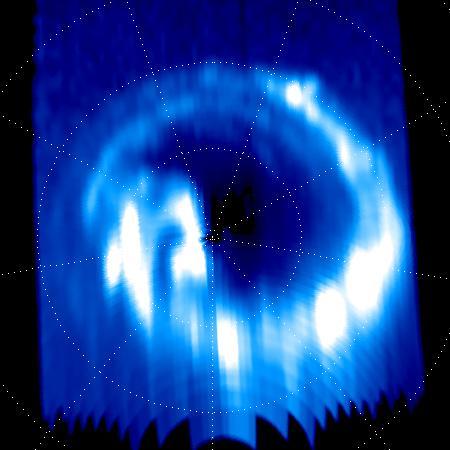
On Sept. 14, 2017, one day before making its final plunge into Saturn's atmosphere, NASA's Cassini spacecraft used its Ultraviolet Imaging Spectrograph, or UVIS, instrument to capture this final view of ultraviolet auroral emissions in the planet's north polar region. The view is centered on the north pole of Saturn, with lines of latitude visible for 80, 70 and 60 degrees. Lines of longitude are spaced 40 degrees apart. The planet's day side is at bottom, while the night side is at top. A sequence of images from this observation has also been assembled into a movie sequence. The last image in the movie was taken about an hour before the still image, which was the actual final UVIS auroral image. Auroral emissions are generated by charged particles traveling along the invisible lines of Saturn's magnetic field. These particles precipitate into the atmosphere, releasing light when they strike gas molecules there. Several individual auroral structures are visible here, despite that this UVIS view was acquired at a fairly large distance from the planet (about 424,000 miles or 683,000 kilometers). Each of these features is connected to a particular phenomenon in Saturn's magnetosphere. For instance, it is possible to identify auroral signatures here that are related to the injection of hot plasma from the dayside magnetosphere, as well as auroral features associated with a change in the magnetic field's shape on the magnetosphere's night side. Several possible scenarios have been postulated over the years to explain Saturn's changing auroral emissions, but researchers are still far from a complete understanding of this complicated puzzle. Researchers will continue to analyze the hundreds of image sequences UVIS obtained of Saturn's auroras during Cassini's 13-year mission, with many new discoveries likely to be made. This image and movie sequence were produced by the Laboratory for Planetary and Atmospheric Physics (LPAP) of the STAR Institute of the University of Liege in Belgium, in collaboration with the UVIS Team. The animation is available at https://photojournal.jpl.nasa.gov/catalog/PIA21899
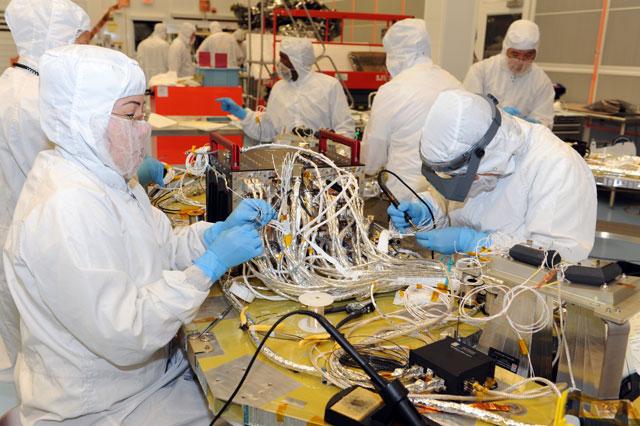
Electrical technicians work diligently to build the connector harnessing for the Command and Data Handling (C&DH) unit, (black box with two red handles) that is installed on spacecraft Deck for MMS #4. Learn more about MMS at <a href="http://www.nasa.gov/mms" rel="nofollow">www.nasa.gov/mms</a> Credit NASA/Goddard The Magnetospheric Multiscale, or MMS, will study how the sun and the Earth's magnetic fields connect and disconnect, an explosive process that can accelerate particles through space to nearly the speed of light. This process is called magnetic reconnection and can occur throughout all space. <b><a href="http://www.nasa.gov/audience/formedia/features/MP_Photo_Guidelines.html" rel="nofollow">NASA image use policy.</a></b> <b><a href="http://www.nasa.gov/centers/goddard/home/index.html" rel="nofollow">NASA Goddard Space Flight Center</a></b> enables NASA’s mission through four scientific endeavors: Earth Science, Heliophysics, Solar System Exploration, and Astrophysics. Goddard plays a leading role in NASA’s accomplishments by contributing compelling scientific knowledge to advance the Agency’s mission. <b>Follow us on <a href="http://twitter.com/NASAGoddardPix" rel="nofollow">Twitter</a></b> <b>Like us on <a href="http://www.facebook.com/pages/Greenbelt-MD/NASA-Goddard/395013845897?ref=tsd" rel="nofollow">Facebook</a></b> <b>Find us on <a href="http://instagram.com/nasagoddard?vm=grid" rel="nofollow">Instagram</a></b>
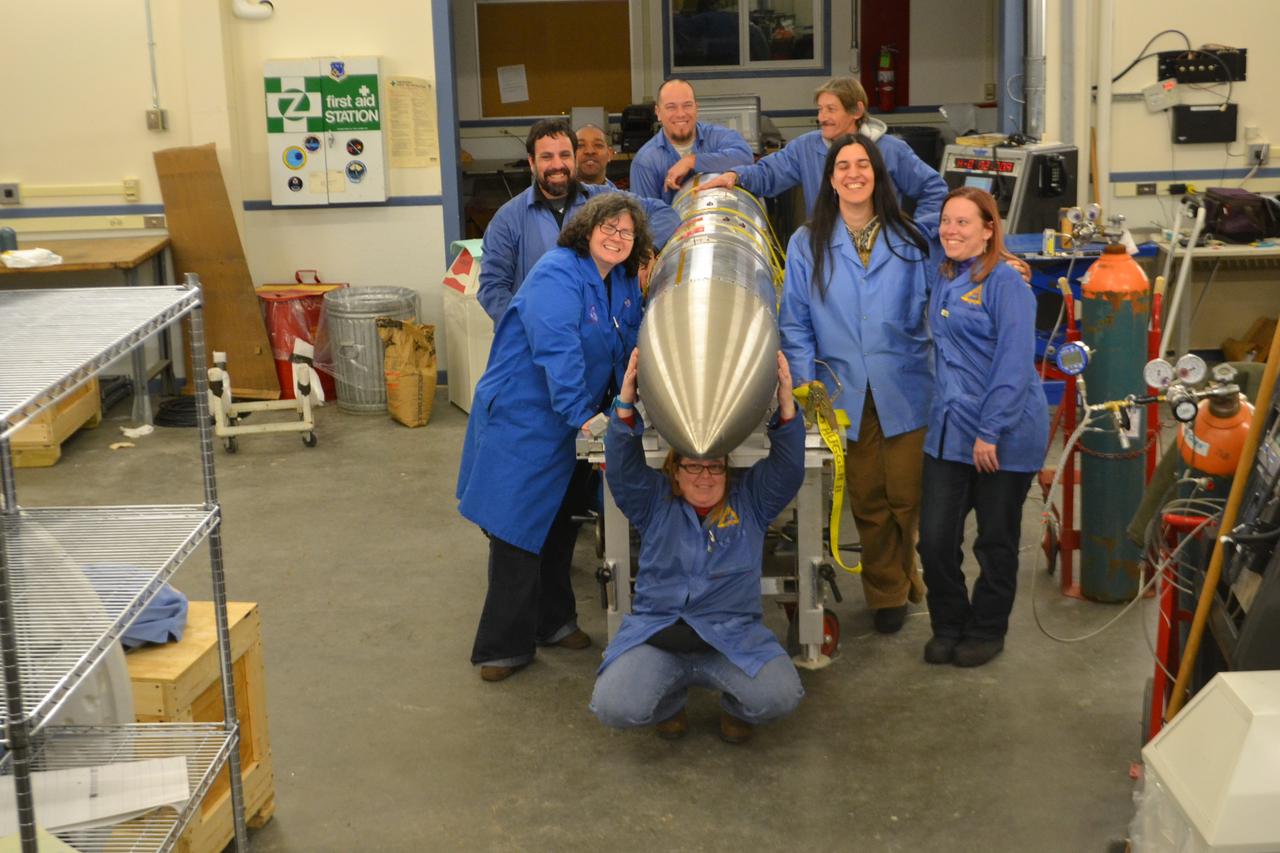
The NASA-funded Ground-to-Rocket Electron-Electrodynamics Correlative Experiment, or GREECE, wants to understand aurora. Specifically, it will study classic auroral curls that swirl through the sky like cream in a cup of coffee. The GREECE instruments travel on a sounding rocket that launches for a ten-minute ride right through the heart of the aurora reaching its zenith over the native village of Venetie, Alaska. To study the curl structures, GREECE consists of two parts: ground-based imagers located in Venetie to track the aurora from the ground and the rocket to take measurements from the middle of the aurora itself. At their simplest, auroras are caused when particles from the sun funnel over to Earth's night side, generate electric currents, and trigger a shower of particles that strike oxygen and nitrogen some 60 to 200 miles up in Earth's atmosphere, releasing a flash of light. But the details are always more complicated, of course. Researchers wish to understand the aurora, and movement of plasma in general, at much smaller scales including such things as how different structures are formed there. This is a piece of information, which in turn, helps paint a picture of the sun-Earth connection and how energy and particles from the sun interact with Earth's own magnetic system, the magnetosphere. GREECE is a collaborative effort between SWRI, which developed particle instruments and the ground-based imaging, and the University of California, Berkeley, measuring the electric and magnetic fields. The launch is supported by a sounding rocket team from NASA’s Wallops Flight Facility, Wallops Island, Va. The Poker Flat Research Range is operated by the University of Alaska, Fairbanks. Credit: NASA Goddard <b><a href="http://www.nasa.gov/audience/formedia/features/MP_Photo_Guidelines.html" rel="nofollow">NASA image use policy.</a></b> <b><a href="http://www.nasa.gov/centers/goddard/home/index.html" rel="nofollow">NASA Goddard Space Flight Center</a></b> enables NASA’s mission through four scientific endeavors: Earth Science, Heliophysics, Solar System Exploration, and Astrophysics. Goddard plays a leading role in NASA’s accomplishments by contributing compelling scientific knowledge to advance the Agency’s mission. <b>Follow us on <a href="http://twitter.com/NASAGoddardPix" rel="nofollow">Twitter</a></b> <b>Like us on <a href="http://www.facebook.com/pages/Greenbelt-MD/NASA-Goddard/395013845897?ref=tsd" rel="nofollow">Facebook</a></b> <b>Find us on <a href="http://instagram.com/nasagoddard?vm=grid" rel="nofollow">Instagram</a></b>
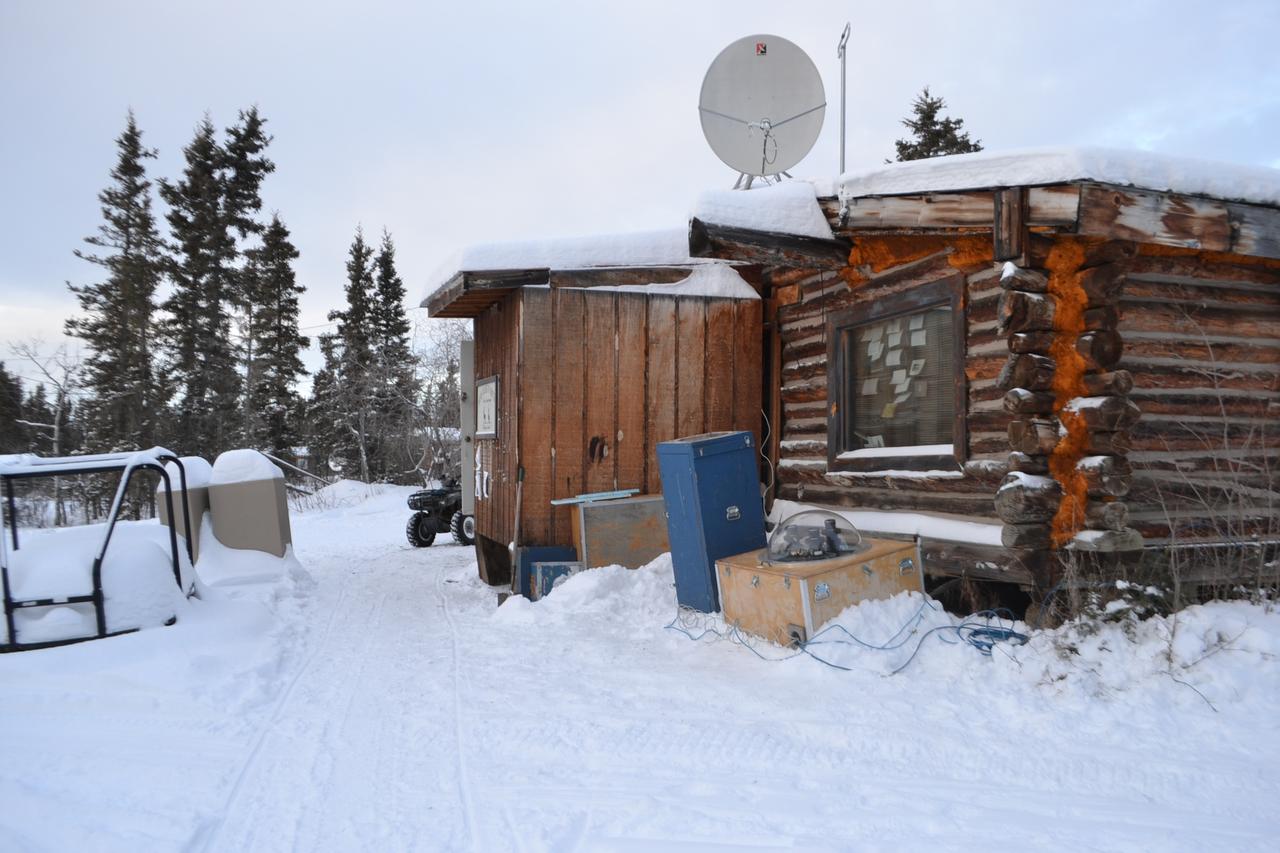
The NASA-funded Ground-to-Rocket Electron-Electrodynamics Correlative Experiment, or GREECE, wants to understand aurora. Specifically, it will study classic auroral curls that swirl through the sky like cream in a cup of coffee. The GREECE instruments travel on a sounding rocket that launches for a ten-minute ride right through the heart of the aurora reaching its zenith over the native village of Venetie, Alaska. To study the curl structures, GREECE consists of two parts: ground-based imagers located in Venetie to track the aurora from the ground and the rocket to take measurements from the middle of the aurora itself. At their simplest, auroras are caused when particles from the sun funnel over to Earth's night side, generate electric currents, and trigger a shower of particles that strike oxygen and nitrogen some 60 to 200 miles up in Earth's atmosphere, releasing a flash of light. But the details are always more complicated, of course. Researchers wish to understand the aurora, and movement of plasma in general, at much smaller scales including such things as how different structures are formed there. This is a piece of information, which in turn, helps paint a picture of the sun-Earth connection and how energy and particles from the sun interact with Earth's own magnetic system, the magnetosphere. GREECE is a collaborative effort between SWRI, which developed particle instruments and the ground-based imaging, and the University of California, Berkeley, measuring the electric and magnetic fields. The launch is supported by a sounding rocket team from NASA’s Wallops Flight Facility, Wallops Island, Va. The Poker Flat Research Range is operated by the University of Alaska, Fairbanks. Credit: NASA Goddard <b><a href="http://www.nasa.gov/audience/formedia/features/MP_Photo_Guidelines.html" rel="nofollow">NASA image use policy.</a></b> <b><a href="http://www.nasa.gov/centers/goddard/home/index.html" rel="nofollow">NASA Goddard Space Flight Center</a></b> enables NASA’s mission through four scientific endeavors: Earth Science, Heliophysics, Solar System Exploration, and Astrophysics. Goddard plays a leading role in NASA’s accomplishments by contributing compelling scientific knowledge to advance the Agency’s mission. <b>Follow us on <a href="http://twitter.com/NASAGoddardPix" rel="nofollow">Twitter</a></b> <b>Like us on <a href="http://www.facebook.com/pages/Greenbelt-MD/NASA-Goddard/395013845897?ref=tsd" rel="nofollow">Facebook</a></b> <b>Find us on <a href="http://instagram.com/nasagoddard?vm=grid" rel="nofollow">Instagram</a></b>

Solar Flare Extremely energetic objects permeate the universe. But close to home, the sun produces its own dazzling lightshow, producing the largest explosions in our solar system and driving powerful solar storms.. When solar activity contorts and realigns the sun’s magnetic fields, vast amounts of energy can be driven into space. This phenomenon can create a sudden flash of light—a solar flare. Flares typically last a few minutes and unleash energies equivalent to millions of hydrogen bombs. The above picture features a filament eruption on the sun, accompanied by solar flares. To learn more about solar flares, go to NASA’s SDO mission: <a href="http://www.nasa.gov/sdo" rel="nofollow">www.nasa.gov/sdo</a> --------------------------------- Original caption: <b>Click here to view an image showing the size of this CME compared to the size of Earth: <a href="http://bit.ly/RkYr7z" rel="nofollow">bit.ly/RkYr7z</a> </b> On August 31, 2012 a long filament of solar material that had been hovering in the sun's atmosphere, the corona, erupted out into space at 4:36 p.m. EDT. The coronal mass ejection, or CME, traveled at over 900 miles per second. The CME did not travel directly toward Earth, but did connect with Earth's magnetic environment, or magnetosphere, causing aurora to appear on the night of Monday, September 3. Pictured here is a lighten blended version of the 304 and 171 angstrom wavelengths. Cropped Credit: NASA/GSFC/SDO <b><a href="http://www.nasa.gov/audience/formedia/features/MP_Photo_Guidelines.html" rel="nofollow">NASA image use policy.</a></b> <b><a href="http://www.nasa.gov/centers/goddard/home/index.html" rel="nofollow">NASA Goddard Space Flight Center</a></b> enables NASA’s mission through four scientific endeavors: Earth Science, Heliophysics, Solar System Exploration, and Astrophysics. Goddard plays a leading role in NASA’s accomplishments by contributing compelling scientific knowledge to advance the Agency’s mission. <b>Follow us on <a href="http://twitter.com/NASA_GoddardPix" rel="nofollow">Twitter</a></b> <b>Like us on <a href="http://www.facebook.com/pages/Greenbelt-MD/NASA-Goddard/395013845897?ref=tsd" rel="nofollow">Facebook</a></b> <b>Find us on <a href="http://instagrid.me/nasagoddard/?vm=grid" rel="nofollow">Instagram</a></b>

<b>To view a video of the Gradient Sun go to: <a href="http://www.flickr.com/photos/gsfc/8103212817">www.flickr.com/photos/gsfc/8103212817</a></b> Looking at a particularly beautiful image of the sun helps show how the lines between science and art can sometimes blur. But there is more to the connection between the two disciplines: science and art techniques are often quite similar, indeed one may inform the other or be improved based on lessons from the other arena. One such case is a technique known as a "gradient filter" – recognizable to many people as an option available on a photo-editing program. Gradients are, in fact, a mathematical description that highlights the places of greatest physical change in space. A gradient filter, in turn, enhances places of contrast, making them all the more obviously different, a useful tool when adjusting photos. Scientists, too, use gradient filters to enhance contrast, using them to accentuate fine structures that might otherwise be lost in the background noise. On the sun, for example, scientists wish to study a phenomenon known as coronal loops, which are giant arcs of solar material constrained to travel along that particular path by the magnetic fields in the sun's atmosphere. Observations of the loops, which can be more or less tangled and complex during different phases of the sun's 11-year activity cycle, can help researchers understand what's happening with the sun's complex magnetic fields, fields that can also power great eruptions on the sun such as solar flares or coronal mass ejections. The still here shows an unfiltered image from the sun next to one that has been processed using a gradient filter. Note how the coronal loops are sharp and defined, making them all the more easy to study. On the other hand, gradients also make great art. NASA/Goddard Space Flight Center To download this video go to: <a href="http://svs.gsfc.nasa.gov/goto?11112" rel="nofollow">svs.gsfc.nasa.gov/goto?11112</a> <b><a href="http://www.nasa.gov/audience/formedia/features/MP_Photo_Guidelines.html" rel="nofollow">NASA image use policy.</a></b> <b><a href="http://www.nasa.gov/centers/goddard/home/index.html" rel="nofollow">NASA Goddard Space Flight Center</a></b> enables NASA’s mission through four scientific endeavors: Earth Science, Heliophysics, Solar System Exploration, and Astrophysics. Goddard plays a leading role in NASA’s accomplishments by contributing compelling scientific knowledge to advance the Agency’s mission. <b>Follow us on <a href="http://twitter.com/NASA_GoddardPix" rel="nofollow">Twitter</a></b> <b>Like us on <a href="http://www.facebook.com/pages/Greenbelt-MD/NASA-Goddard/395013845897?ref=tsd" rel="nofollow">Facebook</a></b> <b>Find us on <a href="http://instagrid.me/nasagoddard/?vm=grid" rel="nofollow">Instagram</a></b>
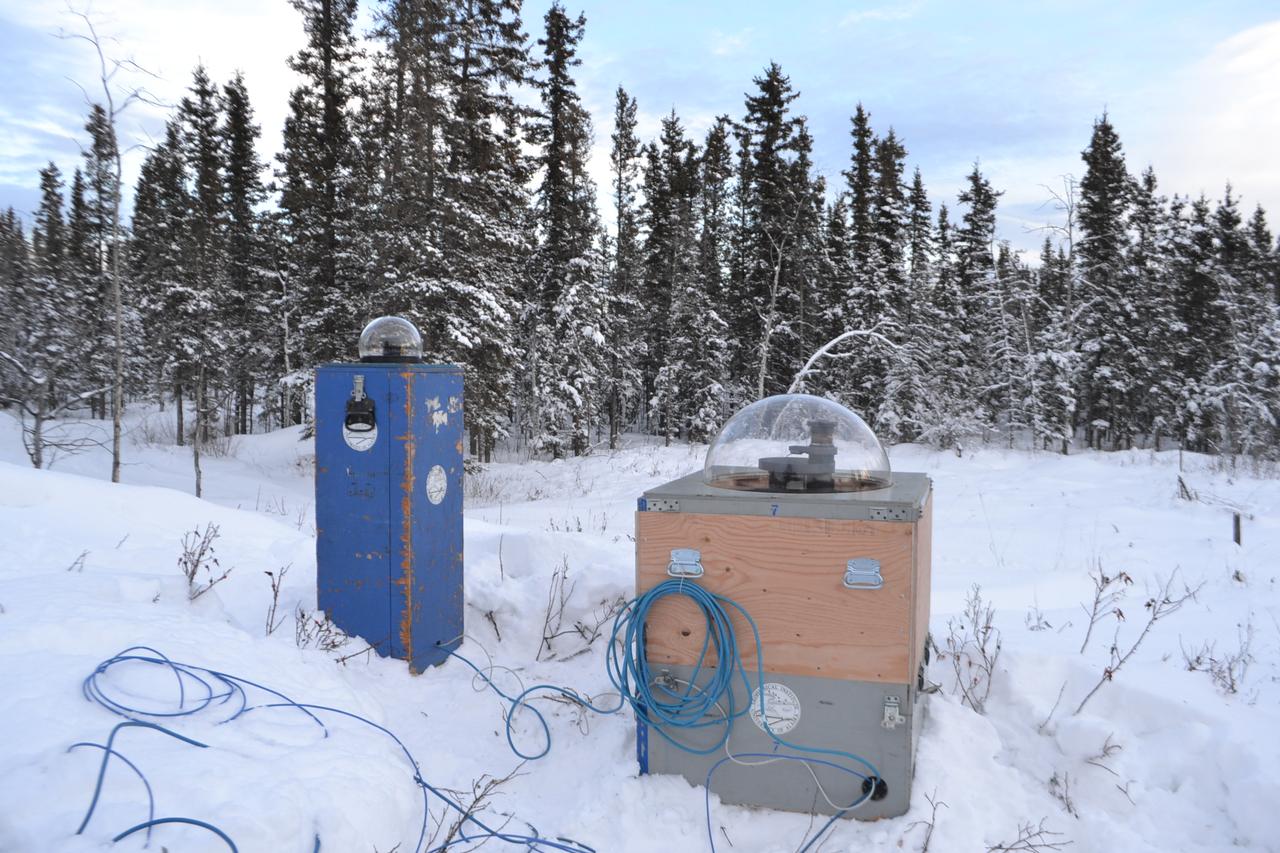
The NASA-funded Ground-to-Rocket Electron-Electrodynamics Correlative Experiment, or GREECE, wants to understand aurora. Specifically, it will study classic auroral curls that swirl through the sky like cream in a cup of coffee. The GREECE instruments travel on a sounding rocket that launches for a ten-minute ride right through the heart of the aurora reaching its zenith over the native village of Venetie, Alaska. To study the curl structures, GREECE consists of two parts: ground-based imagers located in Venetie to track the aurora from the ground and the rocket to take measurements from the middle of the aurora itself. At their simplest, auroras are caused when particles from the sun funnel over to Earth's night side, generate electric currents, and trigger a shower of particles that strike oxygen and nitrogen some 60 to 200 miles up in Earth's atmosphere, releasing a flash of light. But the details are always more complicated, of course. Researchers wish to understand the aurora, and movement of plasma in general, at much smaller scales including such things as how different structures are formed there. This is a piece of information, which in turn, helps paint a picture of the sun-Earth connection and how energy and particles from the sun interact with Earth's own magnetic system, the magnetosphere. GREECE is a collaborative effort between SWRI, which developed particle instruments and the ground-based imaging, and the University of California, Berkeley, measuring the electric and magnetic fields. The launch is supported by a sounding rocket team from NASA’s Wallops Flight Facility, Wallops Island, Va. The Poker Flat Research Range is operated by the University of Alaska, Fairbanks. Credit: NASA Goddard <b><a href="http://www.nasa.gov/audience/formedia/features/MP_Photo_Guidelines.html" rel="nofollow">NASA image use policy.</a></b> <b><a href="http://www.nasa.gov/centers/goddard/home/index.html" rel="nofollow">NASA Goddard Space Flight Center</a></b> enables NASA’s mission through four scientific endeavors: Earth Science, Heliophysics, Solar System Exploration, and Astrophysics. Goddard plays a leading role in NASA’s accomplishments by contributing compelling scientific knowledge to advance the Agency’s mission. <b>Follow us on <a href="http://twitter.com/NASAGoddardPix" rel="nofollow">Twitter</a></b> <b>Like us on <a href="http://www.facebook.com/pages/Greenbelt-MD/NASA-Goddard/395013845897?ref=tsd" rel="nofollow">Facebook</a></b> <b>Find us on <a href="http://instagram.com/nasagoddard?vm=grid" rel="nofollow">Instagram</a></b>
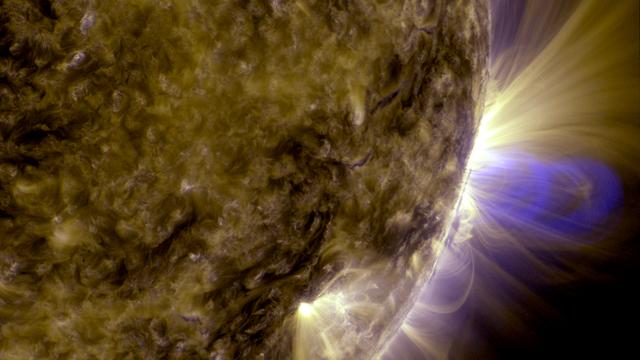
Caption: This is an image of magnetic loops on the sun, captured by NASA's Solar Dynamics Observatory (SDO). It has been processed to highlight the edges of each loop to make the structure more clear. A series of loops such as this is known as a flux rope, and these lie at the heart of eruptions on the sun known as coronal mass ejections (CMEs.) This is the first time scientists were able to discern the timing of a flux rope's formation. (Blended 131 Angstrom and 171 Angstrom images of July 19, 2012 flare and CME.) Credit: NASA/Goddard Space Flight Center/SDO ---- On July 18, 2012, a fairly small explosion of light burst off the lower right limb of the sun. Such flares often come with an associated eruption of solar material, known as a coronal mass ejection or CME – but this one did not. Something interesting did happen, however. Magnetic field lines in this area of the sun's atmosphere, the corona, began to twist and kink, generating the hottest solar material – a charged gas called plasma – to trace out the newly-formed slinky shape. The plasma glowed brightly in extreme ultraviolet images from the Atmospheric Imaging Assembly (AIA) aboard NASA’s Solar Dynamics Observatory (SDO) and scientists were able to watch for the first time the very formation of something they had long theorized was at the heart of many eruptive events on the sun: a flux rope. Eight hours later, on July 19, the same region flared again. This time the flux rope's connection to the sun was severed, and the magnetic fields escaped into space, dragging billions of tons of solar material along for the ride -- a classic CME. "Seeing this structure was amazing," says Angelos Vourlidas, a solar scientist at the Naval Research Laboratory in Washington, D.C. "It looks exactly like the cartoon sketches theorists have been drawing of flux ropes since the 1970s. It was a series of figure eights lined up to look like a giant slinky on the sun." <b>To read more about this new discovery go to: <a href="http://1.usa.gov/14UHsTt" rel="nofollow">1.usa.gov/14UHsTt</a> </b> <b><a href="http://www.nasa.gov/audience/formedia/features/MP_Photo_Guidelines.html" rel="nofollow">NASA image use policy.</a></b> <b><a href="http://www.nasa.gov/centers/goddard/home/index.html" rel="nofollow">NASA Goddard Space Flight Center</a></b> enables NASA’s mission through four scientific endeavors: Earth Science, Heliophysics, Solar System Exploration, and Astrophysics. Goddard plays a leading role in NASA’s accomplishments by contributing compelling scientific knowledge to advance the Agency’s mission. <b>Follow us on <a href="http://twitter.com/NASA_GoddardPix" rel="nofollow">Twitter</a></b> <b>Like us on <a href="http://www.facebook.com/pages/Greenbelt-MD/NASA-Goddard/395013845897?ref=tsd" rel="nofollow">Facebook</a></b> <b>Find us on <a href="http://instagram.com/nasagoddard?vm=grid" rel="nofollow">Instagram</a></b>
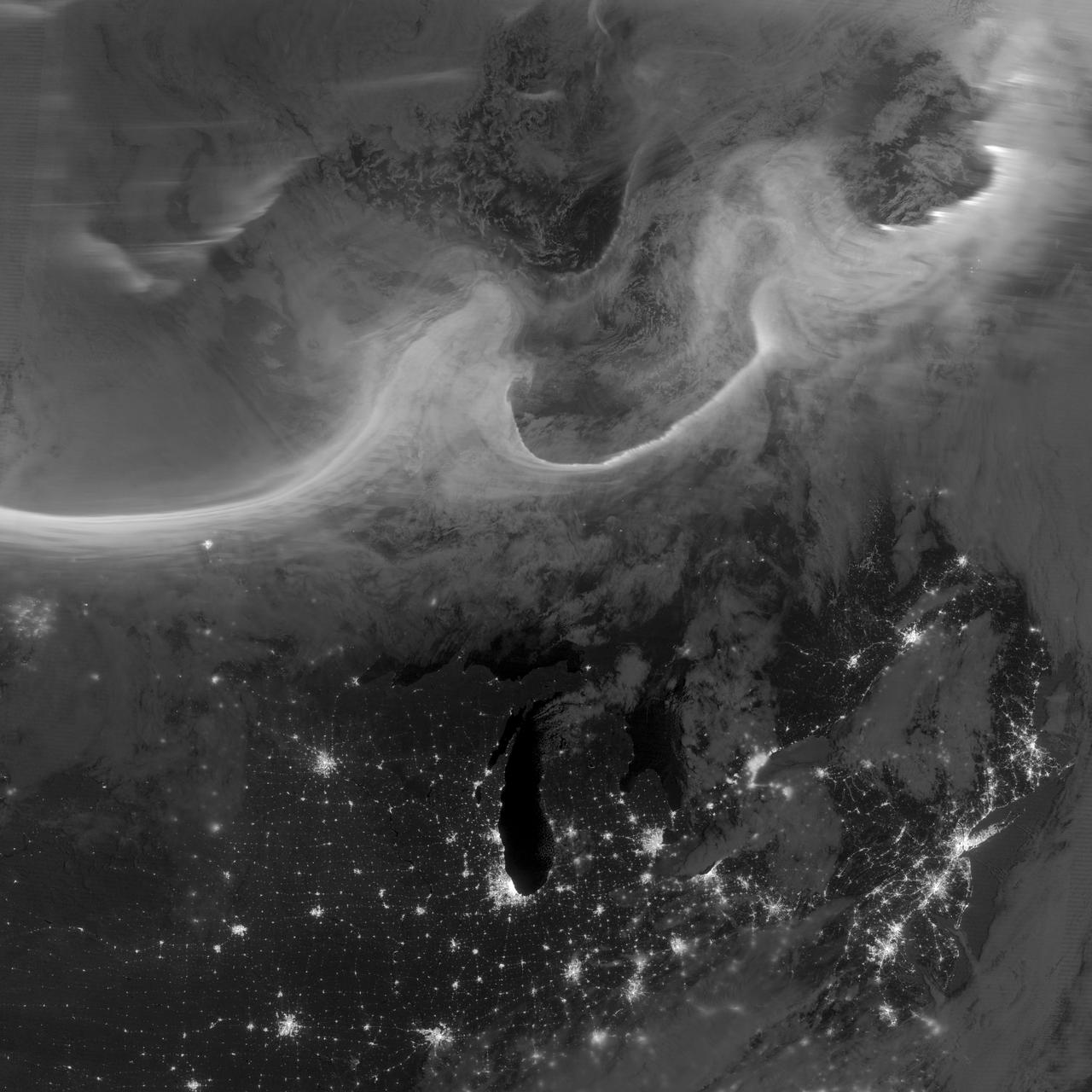
Overnight on October 4-5, 2012, a mass of energetic particles from the atmosphere of the Sun were flung out into space, a phenomenon known as a coronal mass ejection. Three days later, the storm from the Sun stirred up the magnetic field around Earth and produced gorgeous displays of northern lights. NASA satellites track such storms from their origin to their crossing of interplanetary space to their arrival in the atmosphere of Earth. Using the “day-night band” (DNB) of the Visible Infrared Imaging Radiometer Suite (VIIRS), the Suomi National Polar-orbiting Partnership (Suomi NPP) satellite acquired this view of the aurora borealis early on the morning of October 8, 2012. The northern lights stretch across Canada’s Quebec and Ontario provinces in the image, and are part of the auroral oval that expanded to middle latitudes because of a geomagnetic storm. The DNB sensor detects dim light signals such as auroras, airglow, gas flares, city lights, and reflected moonlight. In the case of the image above, the sensor detected the visible light emissions as energetic particles rained down from Earth’s magnetosphere and into the gases of the upper atmosphere. The images are similar to those collected by the Operational Linescan System flown on U.S. Defense Meteorological Satellite Program (DMSP) satellites for the past three decades. “When I first saw images like this as a graduate student, I was immediately struck by the fluid dynamic characteristics of the aurora,” said Tom Moore, a space physicist at NASA's Goddard Space Flight Center. “Viewing the aurora in this way makes it immediately clear that space weather is an interaction of fluids from the Sun with those of the Earth's upper atmosphere. The electrodynamics make for important differences between plasmas and ordinary fluids, but familiar behaviors (for example, waves and vortices) are still very apparent. It makes me wonder at the ability of apparently empty space to behave like a fluid.” Auroras typically occur when solar flares and coronal mass ejections—or even an active solar wind stream—disturb and distort the magnetosphere, the cocoon of space protected by Earth’s magnetic field. The collision of solar particles and pressure into our planet’s magnetosphere accelerates particles trapped in the space around Earth (such as in the radiation belts). Those particles are sent crashing down into Earth’s upper atmosphere—at altitudes of 100 to 400 kilometers (60 to 250 miles)—where they excite oxygen and nitrogen molecules and release photons of light. The results are rays, sheets, and curtains of dancing light in the sky. Auroras are a beautiful expression of the connection between Sun and Earth, but not all of the connections are benign. Auroras are connected to geomagnetic storms, which can distort radio communications (particularly high frequencies), disrupt electric power systems on the ground, and give slight but detectable doses of radiation to flight crews and passengers on high-latitude airplane flights and on spacecraft. The advantage of images like those from VIIRS and DMSP is resolution, according to space physicist Patrick Newell of the Johns Hopkins University Applied Physics Laboratory. “You can see very fine detail in the aurora because of the low altitude and the high resolution of the camera,” he said. Most aurora scientists prefer to use images from missions dedicated to aurora studies (such as Polar, IMAGE, and ground-based imagers), which can offer many more images of a storm (rather than one per orbit) and can allow researchers to calculate the energy moving through the atmosphere. There are no science satellites flying right now that provide such a view, though astronauts regularly photograph and film auroras from the International Space Station. NASA Earth Observatory image by Jesse Allen and Robert Simmon, using VIIRS Day-Night Band data from the Suomi National Polar-orbiting Partnership (Suomi NPP) and the University of Wisconsin's Community Satellite Processing Package. Suomi NPP is the result of a partnership between NASA, the National Oceanic and Atmospheric Administration, and the Department of Defense. Caption by Mike Carlowicz. Instrument: Suomi NPP - VIIRS Credit: <b><a href="http://www.earthobservatory.nasa.gov/" rel="nofollow"> NASA Earth Observatory</a></b> <b><a href="http://www.nasa.gov/audience/formedia/features/MP_Photo_Guidelines.html" rel="nofollow">NASA image use policy.</a></b> <b><a href="http://www.nasa.gov/centers/goddard/home/index.html" rel="nofollow">NASA Goddard Space Flight Center</a></b> enables NASA’s mission through four scientific endeavors: Earth Science, Heliophysics, Solar System Exploration, and Astrophysics. Goddard plays a leading role in NASA’s accomplishments by contributing compelling scientific knowledge to advance the Agency’s mission. <b>Follow us on <a href="http://twitter.com/NASA_GoddardPix" rel="nofollow">Twitter</a></b> <b>Like us on <a href="http://www.facebook.com/pages/Greenbelt-MD/NASA-Goddard/395013845897?ref=tsd" rel="nofollow">Facebook</a></b> <b>Find us on <a href="http://instagrid.me/nasagoddard/?vm=grid" rel="nofollow">Instagram</a></b>
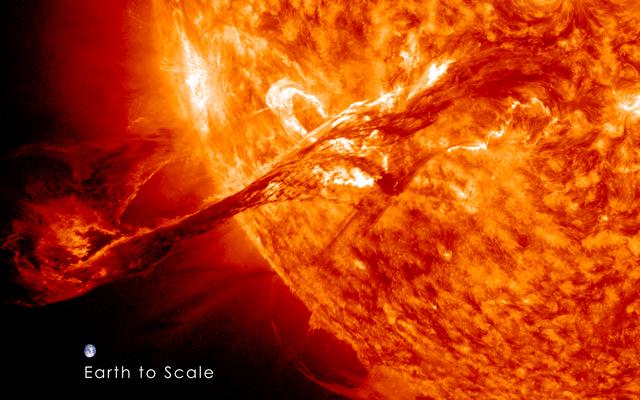
On August 31, 2012 a long filament of solar material that had been hovering in the sun's atmosphere, the corona, erupted out into space at 4:36 p.m. EDT. The coronal mass ejection, or CME, traveled at over 900 miles per second. The CME did not travel directly toward Earth, but did connect with Earth's magnetic environment, or magnetosphere, causing aurora to appear on the night of Monday, September 3. The image above includes an image of Earth to show the size of the CME compared to the size of Earth. Credit: NASA/GSFC/SDO <b><a href="http://www.nasa.gov/audience/formedia/features/MP_Photo_Guidelines.html" rel="nofollow">NASA image use policy.</a></b> <b><a href="http://www.nasa.gov/centers/goddard/home/index.html" rel="nofollow">NASA Goddard Space Flight Center</a></b> enables NASA’s mission through four scientific endeavors: Earth Science, Heliophysics, Solar System Exploration, and Astrophysics. Goddard plays a leading role in NASA’s accomplishments by contributing compelling scientific knowledge to advance the Agency’s mission. <b>Follow us on <a href="http://twitter.com/NASAGoddardPix" rel="nofollow">Twitter</a></b> <b>Like us on <a href="http://www.facebook.com/pages/Greenbelt-MD/NASA-Goddard/395013845897?ref=tsd" rel="nofollow">Facebook</a></b> <b>Find us on <a href="http://instagrid.me/nasagoddard/?vm=grid" rel="nofollow">Instagram</a></b>