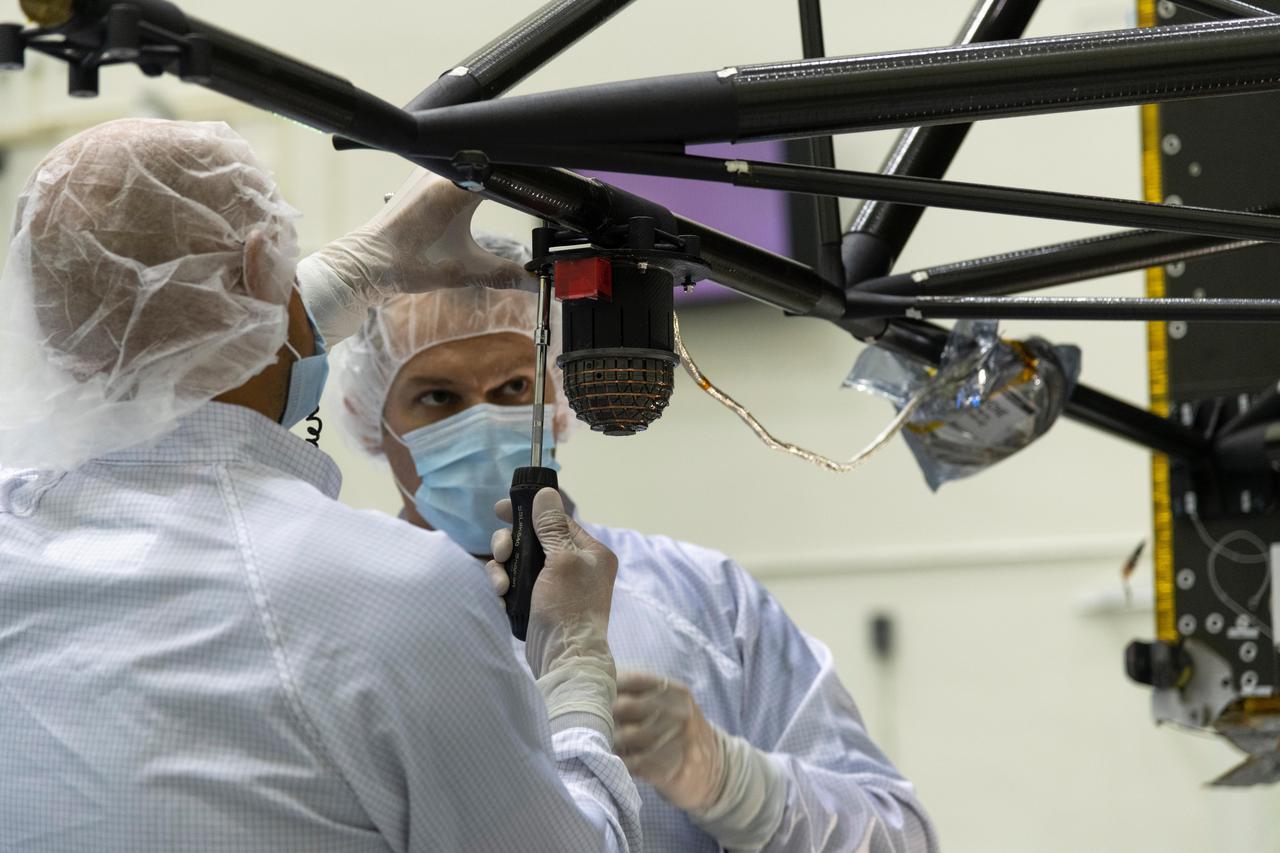
Engineers at NASA's Jet Propulsion Laboratory in Southern California integrate the magnetometer instrument into the agency's Psyche spacecraft on June 28, 2021. Psyche, set to launch in August 2022, will investigate a metal-rich asteroid of the same name, which lies in the main asteroid belt between Mars and Jupiter. Scientists believe the asteroid could be part or all of the iron-rich interior of an early planetary building block that was stripped of its outer rocky shell as it repeatedly collided with other large bodies during the early formation of the solar system. Scientists know that the asteroid doesn't generate a magnetic field the way Earth does; but if Psyche had a magnetic field in the past, that magnetic field could still be recorded in Psyche's material today. With sensors mounted onto a 6-foot (2-meter) boom, the magnetometer can determine if Psyche is still magnetized. If so, that would confirm that the asteroid is part of the core of a planetesimal, the building block of an early planet. This photo shows one of the magnetometer's sensors. https://photojournal.jpl.nasa.gov/catalog/PIA24893
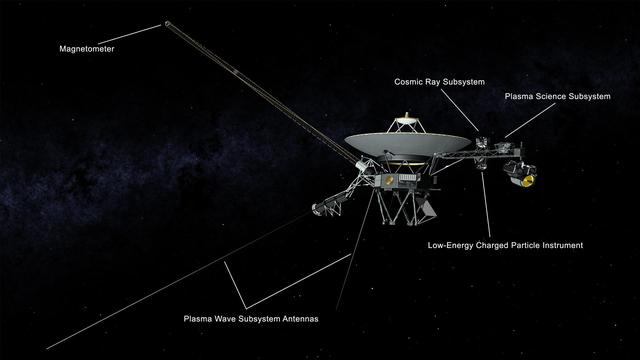
This illustration of NASA's Voyager 2 spacecraft shows the location of the onboard science instruments that are still operating: the magnetometer, the cosmic ray subsystem, the plasma science experiment, the low-energy charged particle instrument and the antennas used by the plasma wave subsystem. https://photojournal.jpl.nasa.gov/catalog/PIA22915
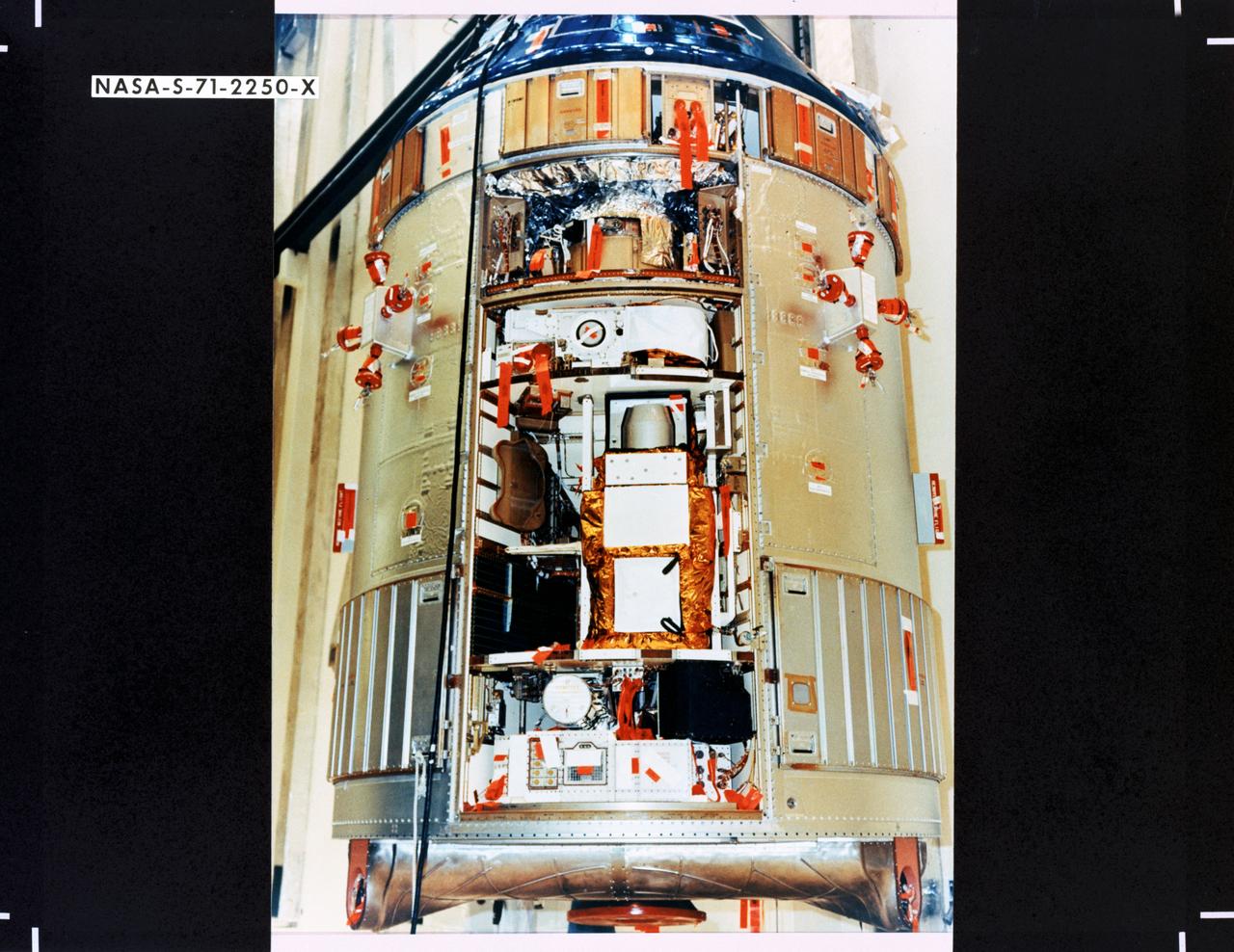
S71-2250X (June 1971) --- A close-up view of the Scientific Instrument Module (SIM) to be flown for the first time on the Apollo 15 lunar landing mission. Mounted in a previously vacant sector of the Apollo Service Module (SM), the SIM carries specialized cameras and instrumentation for gathering lunar orbit scientific data. SIM equipment includes a laser altimeter for accurate measurement of height above the lunar surface; a large-format panoramic camera for mapping, correlated with a metric camera and the laser altimeter for surface mapping; a gamma ray spectrometer on a 25-feet extendible boom; a mass spectrometer on a 21-feet extendible boom; X-ray and alpha particle spectrometers; and a subsatellite which will be injected into lunar orbit carrying a particle and magnetometer, and the S-Band transponder.
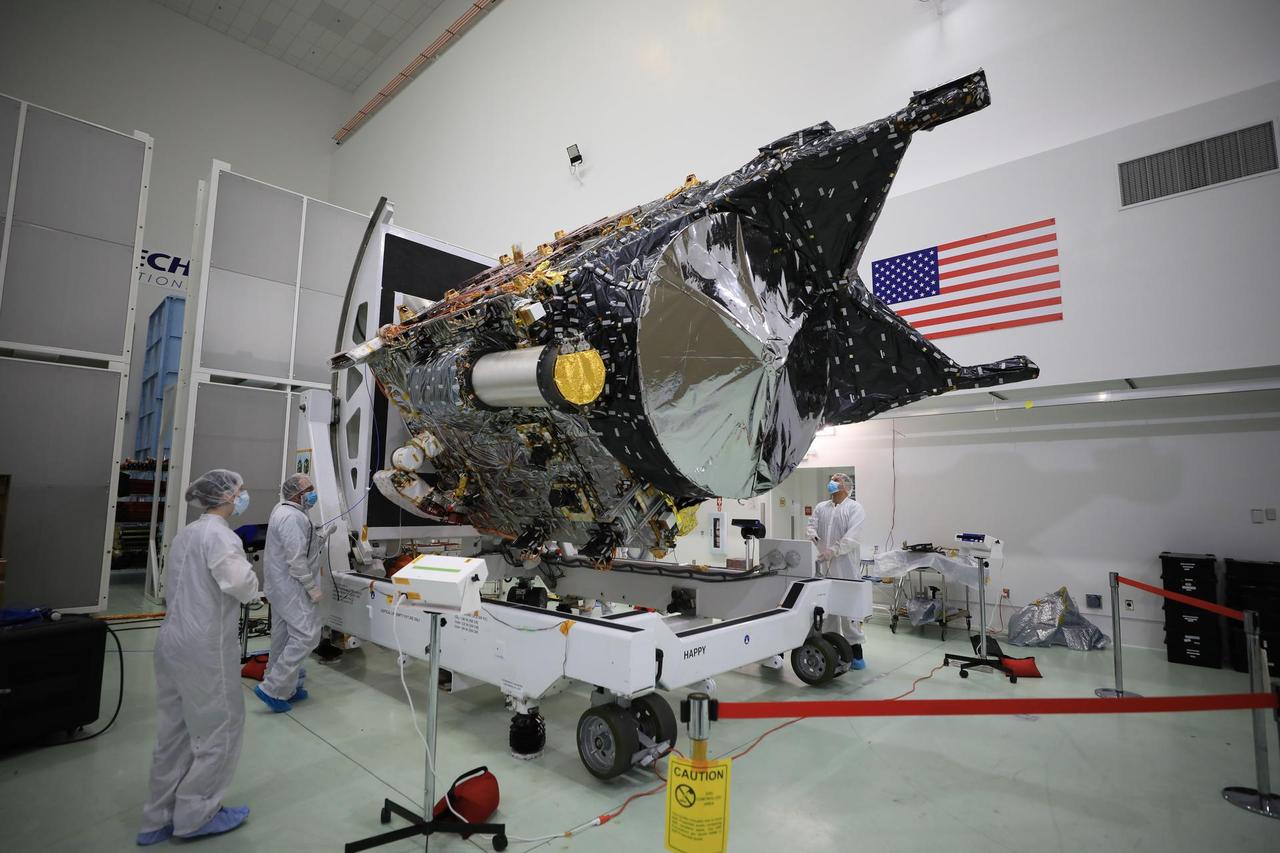
NASA's Psyche spacecraft is shown in a clean room on Dec. 8, 2022, at Astrotech Space Operations Facility near the agency's Kennedy Space Center in Florida. The spacecraft was powered on and connected to ground support equipment, enabling engineers and technicians to prepare it for launch in 2023. Teams working at Astrotech and at NASA's Jet Propulsion Laboratory in Southern California continue to monitor the health of its systems. After a one-year delay to complete critical testing, the Psyche project is targeting an October 2023 launch on a SpaceX Falcon Heavy rocket. NASA's Deep Space Optical Communications (DSOC) technology demonstration, testing high-data-rate laser communications, is integrated into Psyche and will travel with it when it launches to its target, a metal-rich asteroid, also named Psyche, that lies in the main asteroid belt. The silver-colored cylinder shown in the photo is the sunshade for DSOC, and the gold blanketing is the aperture cover for the DSOC payload. The spacecraft's target may be the partial core of a planetesimal, a building block of rocky planets in our solar system. Researchers will study Psyche using a suite of instruments including multispectral cameras, a Gamma Ray and Neutron Spectrometer (GRNS) and a magnetometer. The GRNS and magnetometer sensors are visible in the photo as the tips of the two black protrusions at the far end of the spacecraft. Also visible is the large, disc-shaped high-gain antenna, which will enable the spacecraft to communicate with Earth. https://photojournal.jpl.nasa.gov/catalog/PIA25664
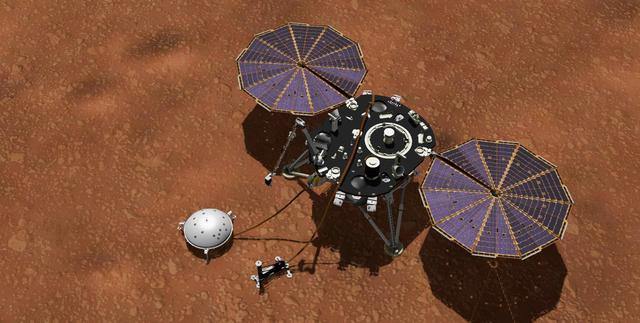
This artist's concept shows NASA's InSight lander with its instruments deployed on the Martian surface. InSight's package of weather sensors, called the Auxiliary Payload Subsystem (APSS), includes an air pressure sensor inside the lander -- its inlet is visible on InSight's deck -- and two air temperature and wind sensors on the deck. Under the deck's edge is a magnetometer, provided by UCLA, to measure changes in the local magnetic field that could also influence SEIS. InSight's air temperature and wind sensors are actually refurbished spares built for Curiosity's Rover Environmental Monitoring Station (REMS). Called Temperature and Wind for InSight, or TWINS, these two east- and west-facing booms sit on the lander's deck and were provided by Spain's Centro de Astrobiología (CAB). https://photojournal.jpl.nasa.gov/catalog/PIA22957
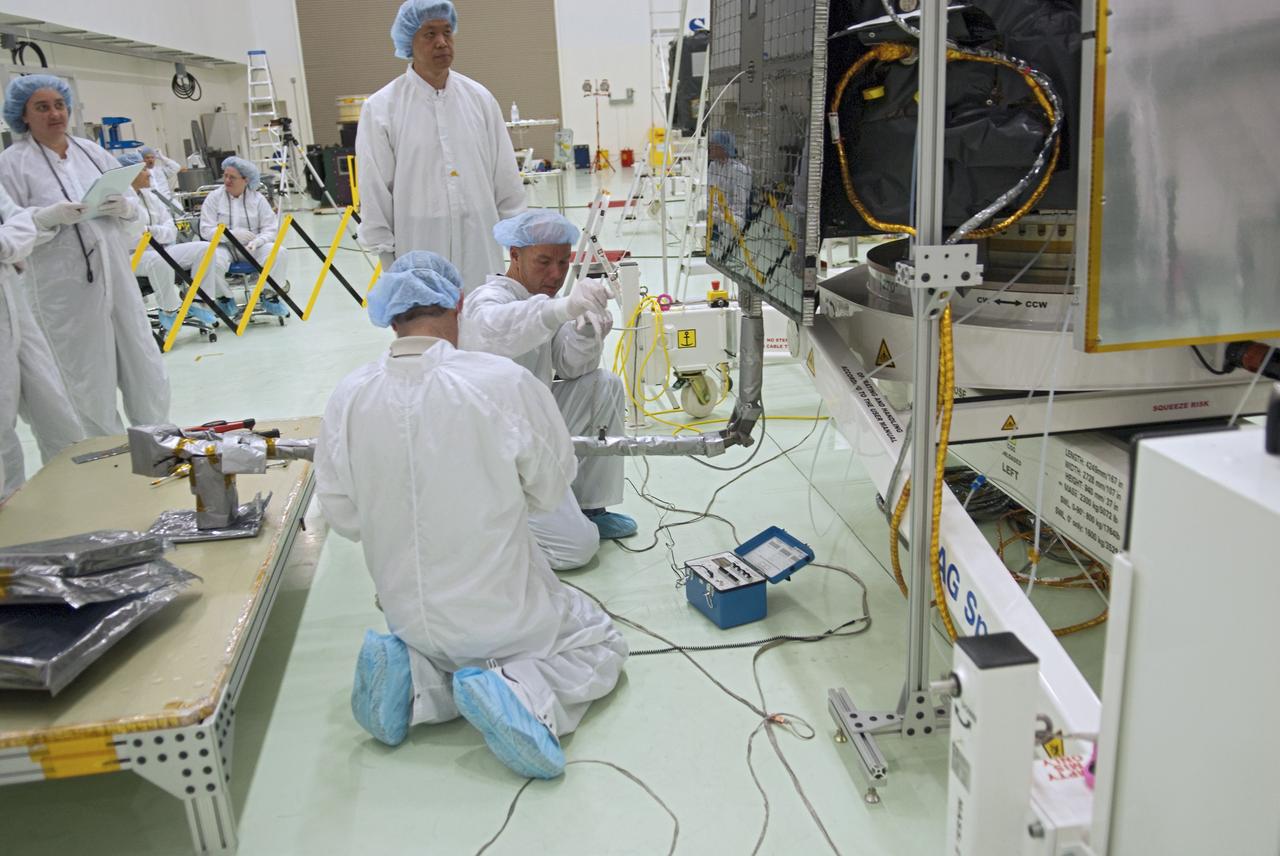
CAPE CANAVERAL, Fla. - Inside the Astrotech payload processing facility near NASA’s Kennedy Space Center in Florida, technicians deploy the magnetometer boom of the Radiation Belt Storm Probes, or RBSP, spacecraft A. Deploying this instrument is standard procedure to ensure it will work properly on Earth before it heads into space. NASA’s RBSP mission will help us understand the sun’s influence on Earth and near-Earth space by studying the Earth’s radiation belts on various scales of space and time. The boom will provide data of the electric fields that energize radiation particles and modify the structure of the inner magnetosphere. RBSP will begin its mission of exploration of Earth’s Van Allen radiation belts and the extremes of space weather after its launch aboard a United Launch Alliance Atlas V rocket. Launch is targeted for Aug. 23. For more information, visit http://www.nasa.gov/rbsp. Photo credit: NASA/Charisse Nahser
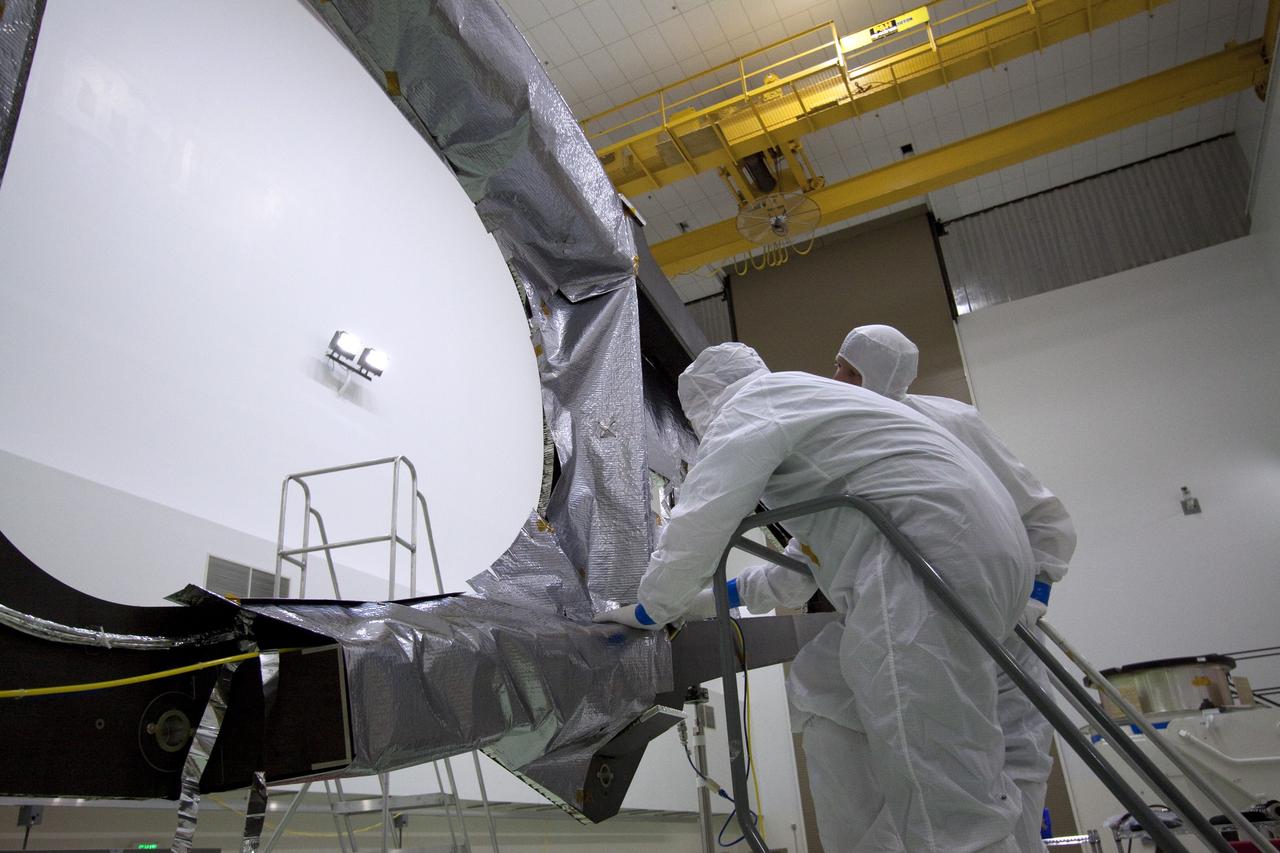
CAPE CANAVERAL, Fla. -- Technicians in the Astrotech payload processing facility in Titusville, Fla., install insulating blankets around a magnetometer boom. The boom structure is attached to Juno's solar array #1 that will help power the NASA spacecraft on its mission to Jupiter. Juno is scheduled to launch aboard an Atlas V rocket from Cape Canaveral, Fla., on Aug. 5, 2011, reaching Jupiter in July 2016. The spacecraft will orbit the giant planet more than 30 times, skimming to within 3,000 miles above its cloud tops, for about one year. With its suite of science instruments, the spacecraft will investigate the existence of a solid planetary core, map Jupiter's intense magnetic field, measure the amount of water and ammonia in the deep atmosphere, and observe the planet's auroras. For more information visit, www.nasa.gov/juno. Photo credit: NASA/Jack Pfaller
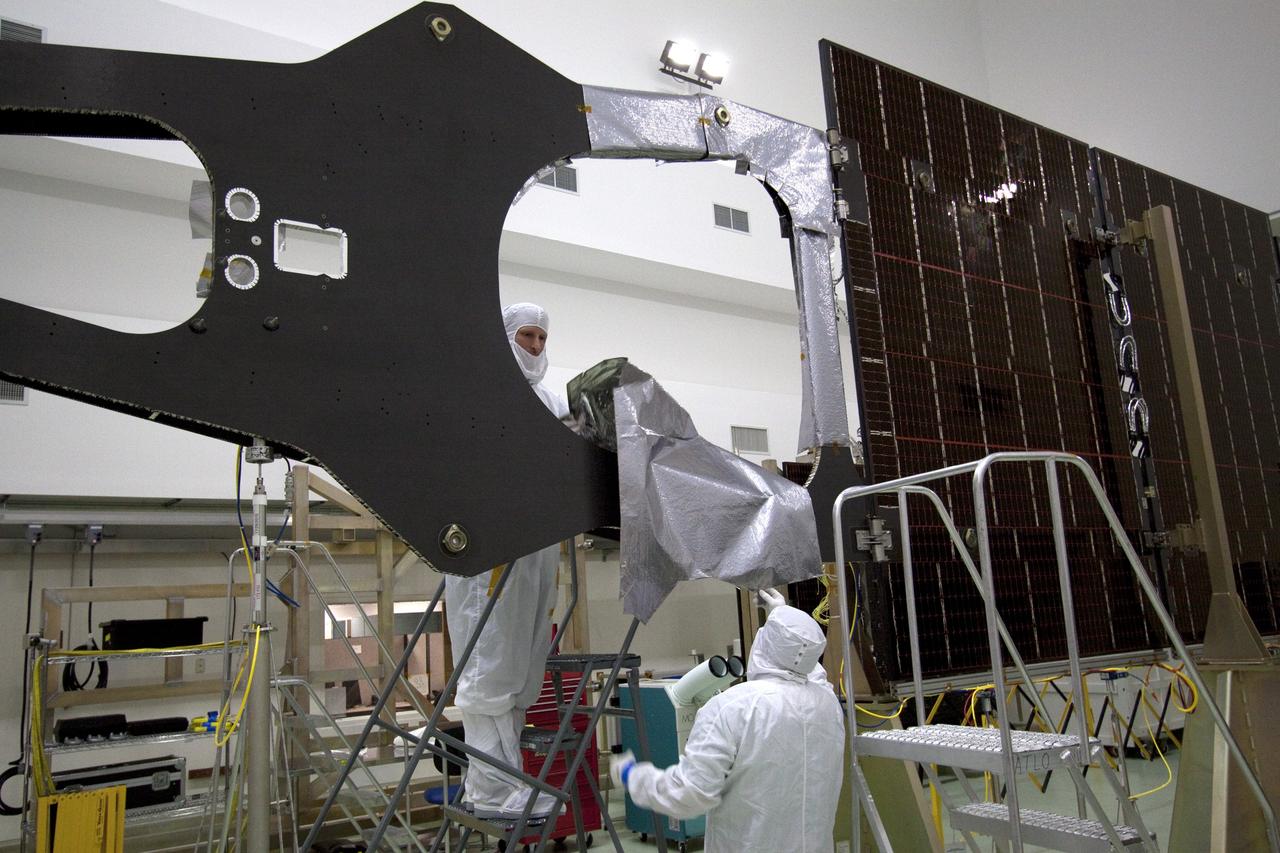
CAPE CANAVERAL, Fla. -- Technicians in the Astrotech payload processing facility in Titusville, Fla., begin installing insulating blankets around the magnetometer boom. The boom structure is attached to Juno's solar array #1 that will help power the NASA spacecraft on its mission to Jupiter. Juno is scheduled to launch aboard an Atlas V rocket from Cape Canaveral, Fla., on Aug. 5, 2011, reaching Jupiter in July 2016. The spacecraft will orbit the giant planet more than 30 times, skimming to within 3,000 miles above its cloud tops, for about one year. With its suite of science instruments, the spacecraft will investigate the existence of a solid planetary core, map Jupiter's intense magnetic field, measure the amount of water and ammonia in the deep atmosphere, and observe the planet's auroras. For more information visit, www.nasa.gov/juno. Photo credit: NASA/Jack Pfaller

CAPE CANAVERAL, Fla. -- Technicians in the Astrotech payload processing facility in Titusville, Fla., prepare an insulating a blanket for installation onto the magnetometer boom. The boom structure is attached to Juno's solar array #1 that will help power the NASA spacecraft on its mission to Jupiter. Juno is scheduled to launch aboard an Atlas V rocket from Cape Canaveral, Fla., on Aug. 5, 2011, reaching Jupiter in July 2016. The spacecraft will orbit the giant planet more than 30 times, skimming to within 3,000 miles above its cloud tops, for about one year. With its suite of science instruments, the spacecraft will investigate the existence of a solid planetary core, map Jupiter's intense magnetic field, measure the amount of water and ammonia in the deep atmosphere, and observe the planet's auroras. For more information visit, www.nasa.gov/juno. Photo credit: NASA/Jack Pfaller
CAPE CANAVERAL, Fla. -- Technicians in the Astrotech payload processing facility in Titusville, Fla., install insulating blankets around the magnetometer boom. The boom structure is attached to Juno's solar array #1 that will help power the NASA spacecraft on its mission to Jupiter. Juno is scheduled to launch aboard an Atlas V rocket from Cape Canaveral, Fla., on Aug. 5, 2011, reaching Jupiter in July 2016. The spacecraft will orbit the giant planet more than 30 times, skimming to within 3,000 miles above its cloud tops, for about one year. With its suite of science instruments, the spacecraft will investigate the existence of a solid planetary core, map Jupiter's intense magnetic field, measure the amount of water and ammonia in the deep atmosphere, and observe the planet's auroras. For more information visit, www.nasa.gov/juno. Photo credit: NASA/Jack Pfaller
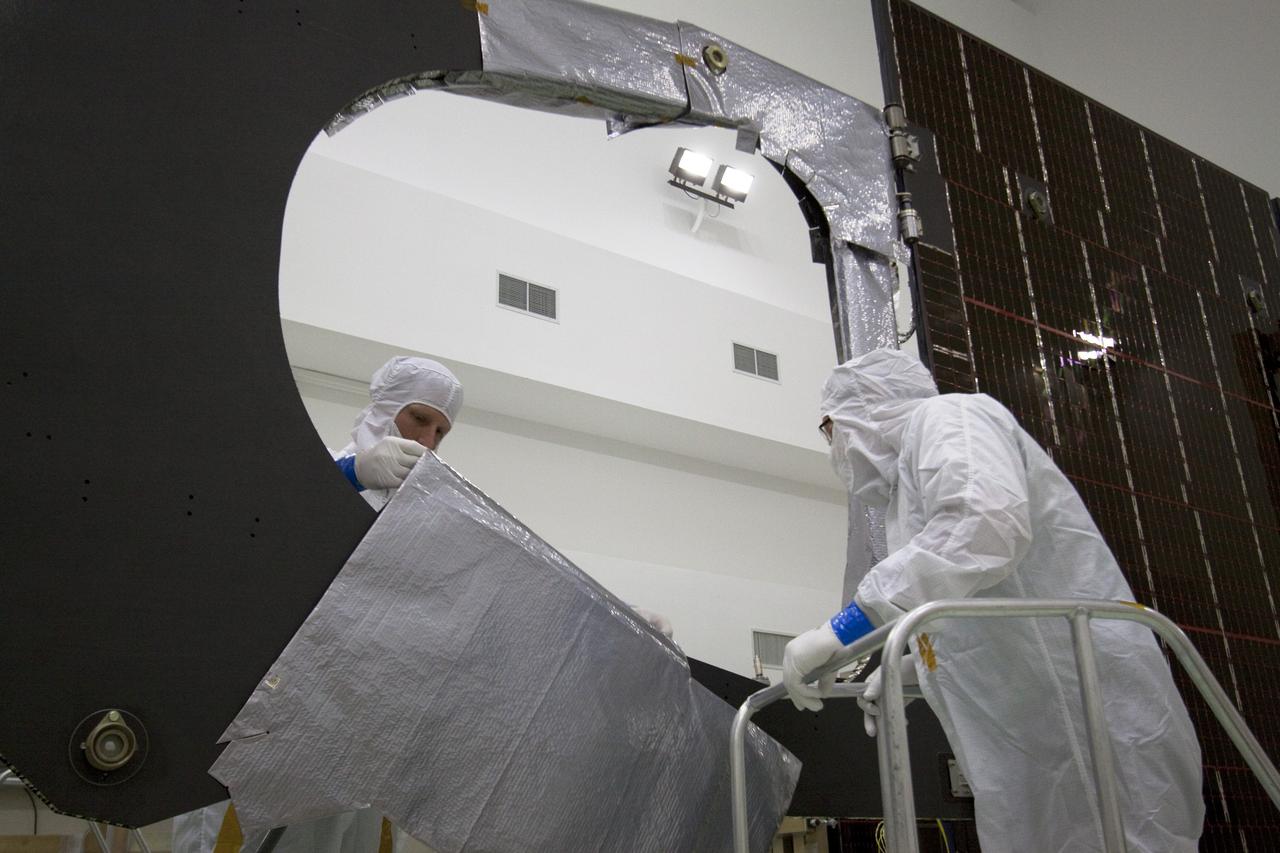
CAPE CANAVERAL, Fla. -- Technicians in the Astrotech payload processing facility in Titusville, Fla., begin installing insulating blankets around the magnetometer boom. The boom structure is attached to Juno's solar array #1 that will help power the NASA spacecraft on its mission to Jupiter. Juno is scheduled to launch aboard an Atlas V rocket from Cape Canaveral, Fla., on Aug. 5, 2011, reaching Jupiter in July 2016. The spacecraft will orbit the giant planet more than 30 times, skimming to within 3,000 miles above its cloud tops, for about one year. With its suite of science instruments, the spacecraft will investigate the existence of a solid planetary core, map Jupiter's intense magnetic field, measure the amount of water and ammonia in the deep atmosphere, and observe the planet's auroras. For more information visit, www.nasa.gov/juno. Photo credit: NASA/Jack Pfaller
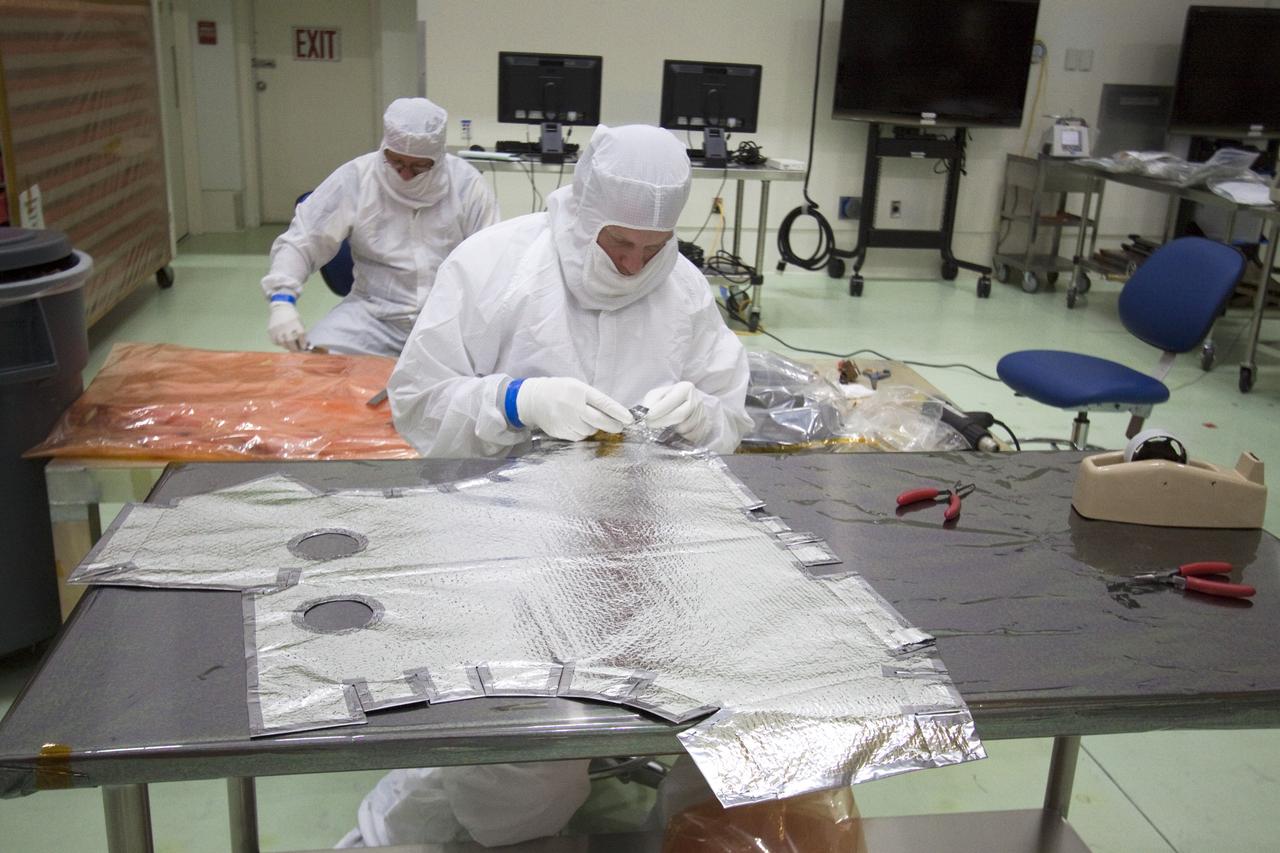
CAPE CANAVERAL, Fla. -- A technician in the Astrotech payload processing facility in Titusville, Fla., inspects one of the insulating blanket sections that will be installed on the magnetometer boom. The boom structure is attached to Juno's solar array #1 that will help power the NASA spacecraft on its mission to Jupiter. Juno is scheduled to launch aboard an Atlas V rocket from Cape Canaveral, Fla., on Aug. 5, 2011, reaching Jupiter in July 2016. The spacecraft will orbit the giant planet more than 30 times, skimming to within 3,000 miles above its cloud tops, for about one year. With its suite of science instruments, the spacecraft will investigate the existence of a solid planetary core, map Jupiter's intense magnetic field, measure the amount of water and ammonia in the deep atmosphere, and observe the planet's auroras. For more information visit, www.nasa.gov/juno. Photo credit: NASA/Jack Pfaller
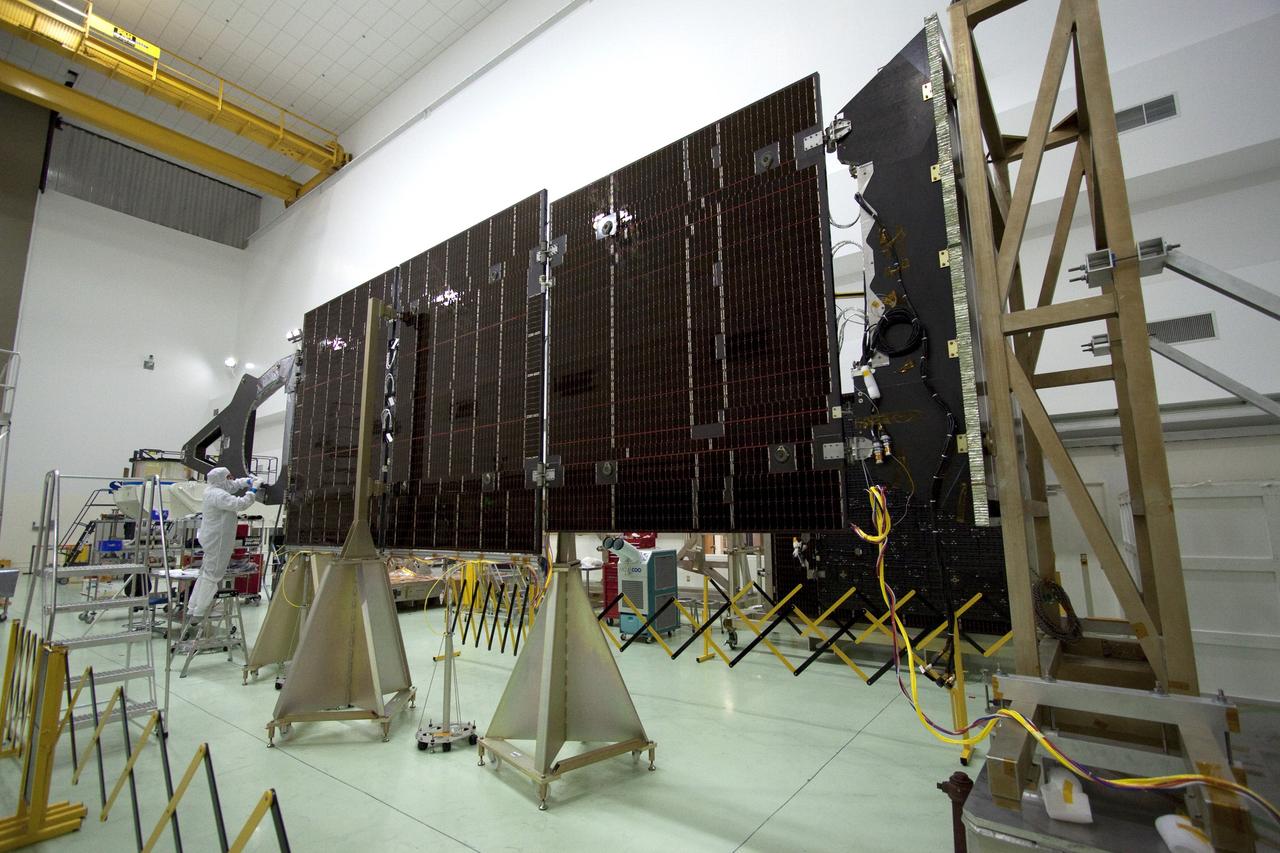
CAPE CANAVERAL, Fla. -- Technicians in the Astrotech payload processing facility in Titusville, Fla., install insulating blankets around the magnetometer boom. The boom structure is attached to Juno's solar array #1 that will help power the NASA spacecraft on its mission to Jupiter. Juno is scheduled to launch aboard an Atlas V rocket from Cape Canaveral, Fla., on Aug. 5, 2011, reaching Jupiter in July 2016. The spacecraft will orbit the giant planet more than 30 times, skimming to within 3,000 miles above its cloud tops, for about one year. With its suite of science instruments, the spacecraft will investigate the existence of a solid planetary core, map Jupiter's intense magnetic field, measure the amount of water and ammonia in the deep atmosphere, and observe the planet's auroras. For more information visit, www.nasa.gov/juno. Photo credit: NASA/Jack Pfaller
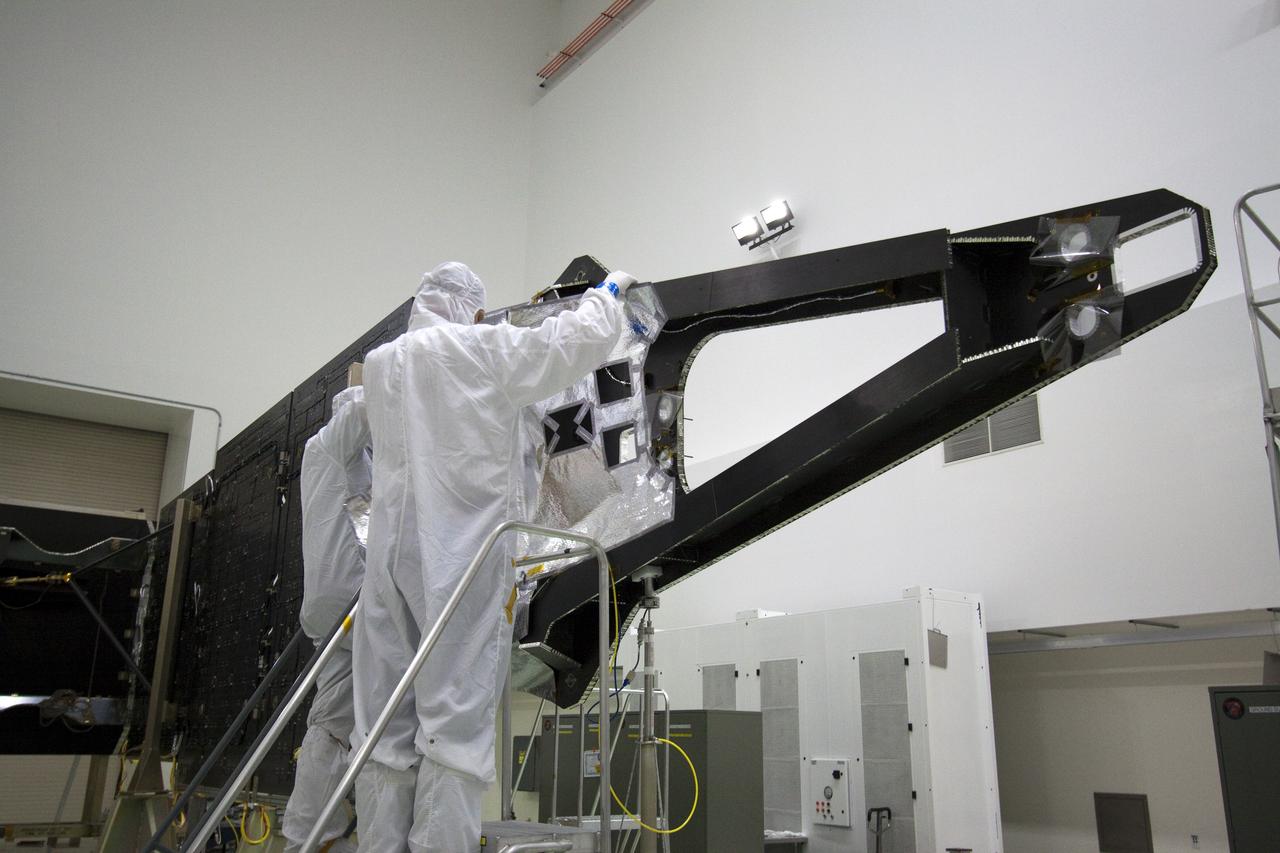
CAPE CANAVERAL, Fla. -- Technicians in the Astrotech payload processing facility in Titusville, Fla., install insulating blankets around a magnetometer boom. The boom structure is attached to Juno's solar array #1 that will help power the NASA spacecraft on its mission to Jupiter. Juno is scheduled to launch aboard an Atlas V rocket from Cape Canaveral, Fla., on Aug. 5, 2011, reaching Jupiter in July 2016. The spacecraft will orbit the giant planet more than 30 times, skimming to within 3,000 miles above its cloud tops, for about one year. With its suite of science instruments, the spacecraft will investigate the existence of a solid planetary core, map Jupiter's intense magnetic field, measure the amount of water and ammonia in the deep atmosphere, and observe the planet's auroras. For more information visit, www.nasa.gov/juno. Photo credit: NASA/Jack Pfaller
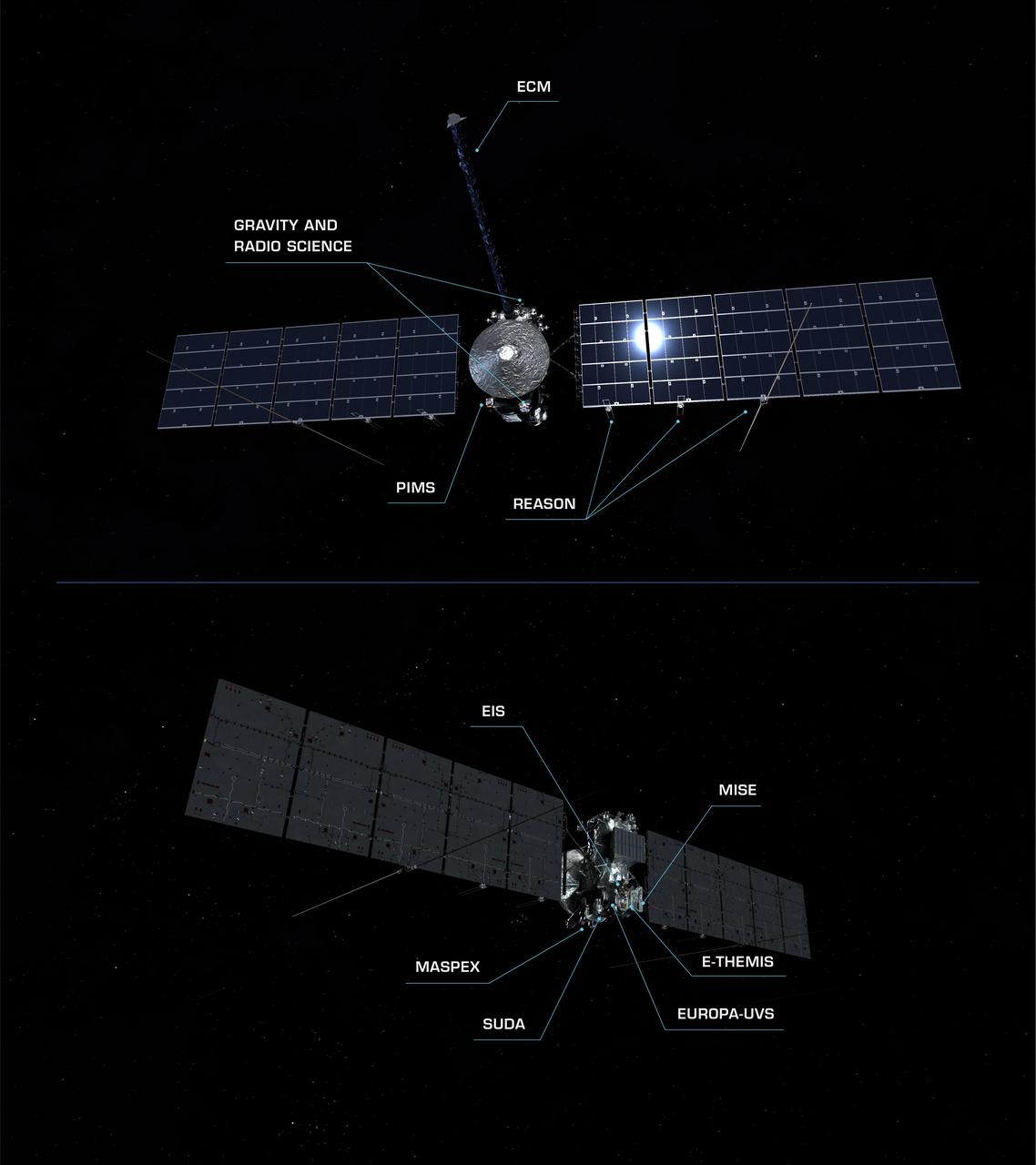
To conduct its detailed investigations of Jupiter's icy moon Europa, NASA's Europa Clipper spacecraft carries a suite of nine science instruments and a gravity experiment that uses its telecommunications system. These components are depicted in this pair of artist's concepts showing each side of the spacecraft, and include: Europa Imaging System (EIS) Europa Thermal Emission Imaging System (E-THEMIS) Europa Ultraviolet Spectrograph (Europa-UVS) Mapping Imaging Spectrometer for Europa (MISE) Europa Clipper Magnetometer (ECM) Plasma Instrument for Magnetic Sounding (PIMS) Radar for Europa Assessment and Sounding: Ocean to Near-surface (REASON) MAss Spectrometer for Planetary EXploration/Europa (MASPEX) Surface Dust Analyzer (SUDA) Gravity and Radio Science Experiment (G/RS) Europa Clipper's three main science objectives are to determine the thickness of the moon's icy shell and its interactions with the ocean below, to investigate its composition, and to characterize its geology. The mission's detailed exploration of Europa will help scientists better understand the astrobiological potential for habitable worlds beyond our planet. https://photojournal.jpl.nasa.gov/catalog/PIA26439
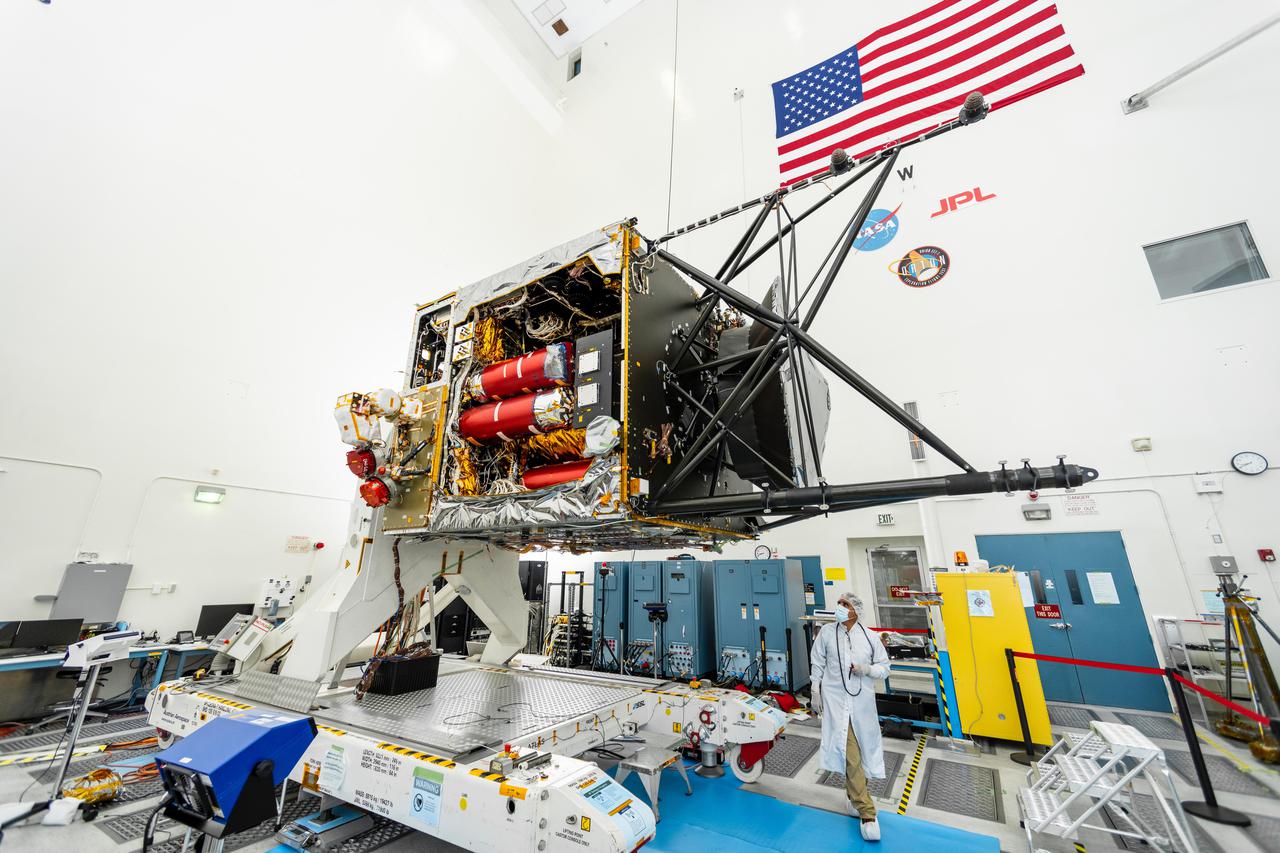
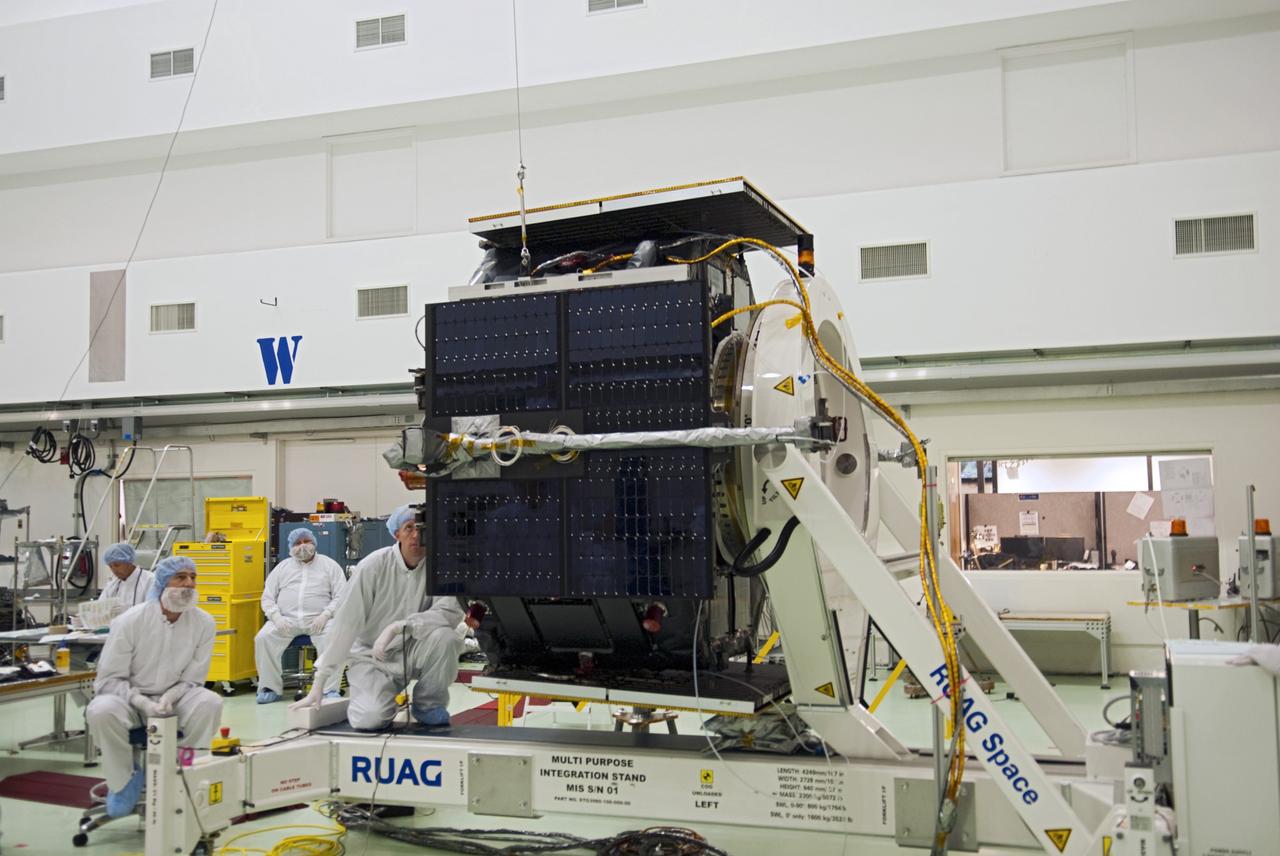
NASA's Psyche spacecraft is captured here on August 18, 2021, in a clean room at the agency's Jet Propulsion Laboratory in Southern California – in the midst of system integration and test. The mission's launch period opens August 1, 2022. The nitrogen tanks are visible in the center of the spacecraft chassis, encased in red protective "remove before flight" covers. Mounted on the right is the strut tower, which will host the sensors for two of the science instruments – the magnetometer and the Gamma Ray and Neutron Spectrometer (GRNS). By spring of 2022, the fully assembled Psyche spacecraft will ship from JPL to NASA's Kennedy Space Center for launch. In early 2026, the spacecraft will arrive at its target, an asteroid of the same name in the main asteroid belt between Mars and Jupiter. Scientists believe asteroid Psyche, which is about 140 miles (226 kilometers) wide, is made largely of iron and nickel and could be the core of an early planet. The spacecraft will spend 21 months orbiting the asteroid and gathering science data. Besides the magnetometer and the GRNS, Psyche will carry a multispectral imager. The mission also will test a sophisticated new laser communications technology, recently completed by JPL, called Deep Space Optical Communications (DSOC). The technology demonstration will focus on using lasers to enhance communications speeds and prepare for data-intensive transmissions, which could potentially include livestream videos for future missions. Arizona State University leads the mission. JPL is responsible for the mission's overall management, system engineering, integration and testing, and mission operations. Maxar Technologies is providing a high-power solar electric propulsion spacecraft chassis. Psyche is the 14th mission selected as part of NASA's Discovery Program. https://photojournal.jpl.nasa.gov/catalog/PIA24787
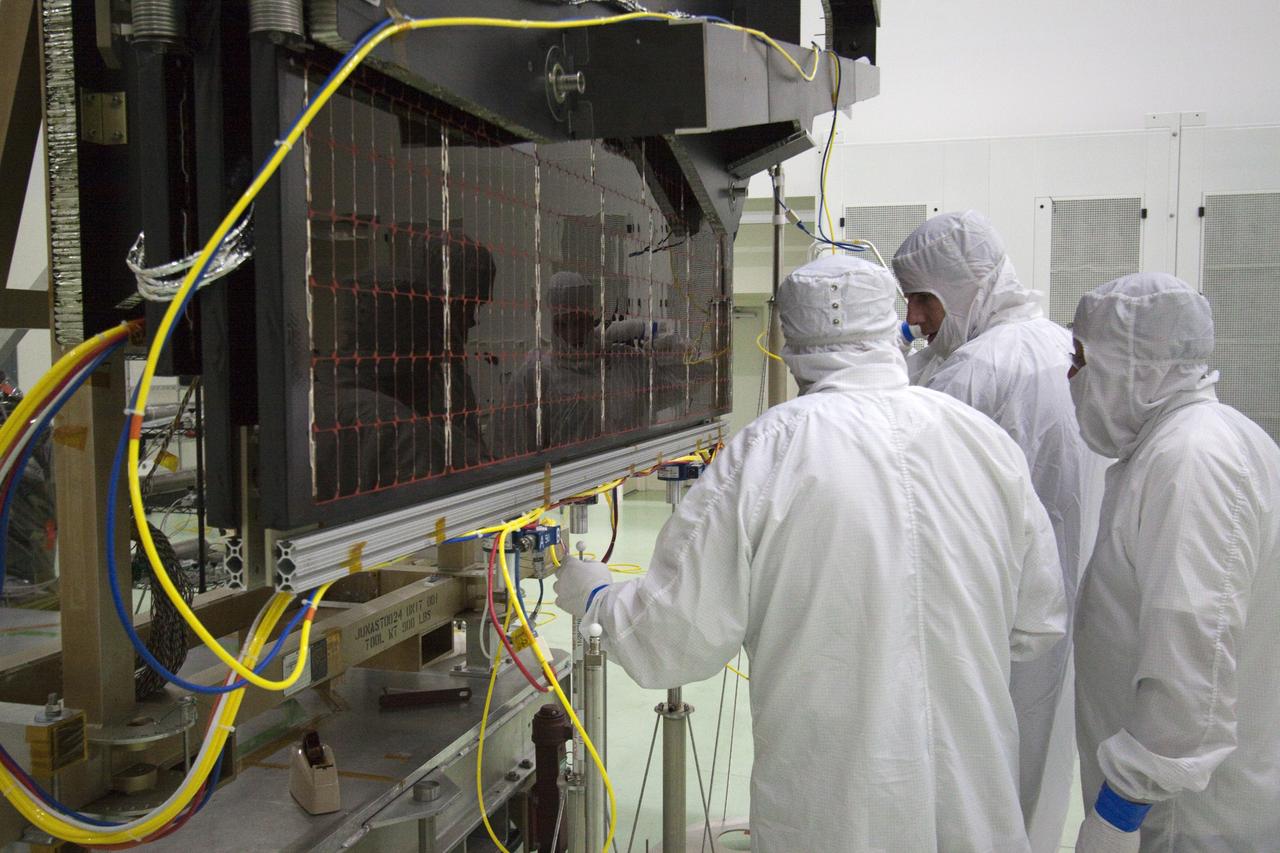
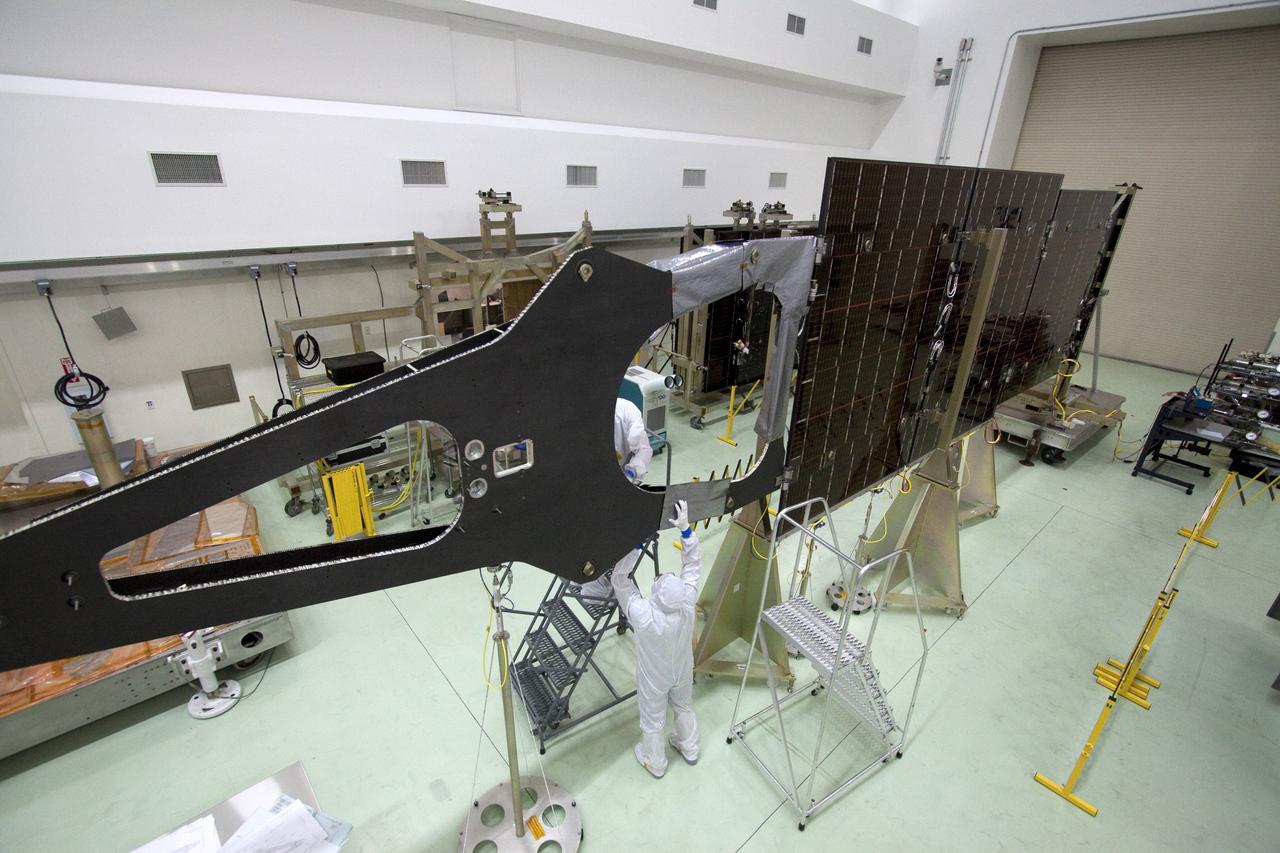
CAPE CANAVERAL, Fla. -- Technicians in the Astrotech payload processing facility in Titusville, Fla., begin to unfurl solar array No. 1 with a magnetometer boom that will help power NASA's Juno spacecraft on a mission to Jupiter. Power-generating panels on three sets of solar arrays will extend outward from Juno’s hexagonal body, giving the overall spacecraft a span of more than 66 feet in order to operate at such a great distance from the sun. Juno is scheduled to launch aboard an Atlas V rocket from Cape Canaveral, Fla., on Aug. 5, 2011, reaching Jupiter in July 2016. The spacecraft will orbit the giant planet more than 30 times, skimming to within 3,000 miles above its cloud tops, for about one year. With its suite of science instruments, the spacecraft will investigate the existence of a solid planetary core, map Jupiter's intense magnetic field, measure the amount of water and ammonia in the deep atmosphere, and observe the planet's auroras. For more information visit, www.nasa.gov/juno. Photo credit: NASA/Jack Pfaller
CAPE CANAVERAL, Fla. - Inside the Astrotech payload processing facility near NASA’s Kennedy Space Center in Florida, technicians prepare to deploy the solar arrays and magnetometer boom of the Radiation Belt Storm Probes, or RBSP, spacecraft A. Deploying these components are standard procedure to ensure they work properly on Earth before they head into space. NASA’s RBSP mission will help us understand the sun’s influence on Earth and near-Earth space by studying the Earth’s radiation belts on various scales of space and time. As the spacecraft orbits Earth, the four solar panels will continuously face the sun to provide constant power to its instruments. The boom will provide data of the electric fields that energize radiation particles and modify the structure of the inner magnetosphere. RBSP will begin its mission of exploration of Earth’s Van Allen radiation belts and the extremes of space weather after its launch aboard a United Launch Alliance Atlas V rocket. Launch is targeted for Aug. 23. For more information, visit http://www.nasa.gov/rbsp. Photo credit: NASA/Charisse Nahser
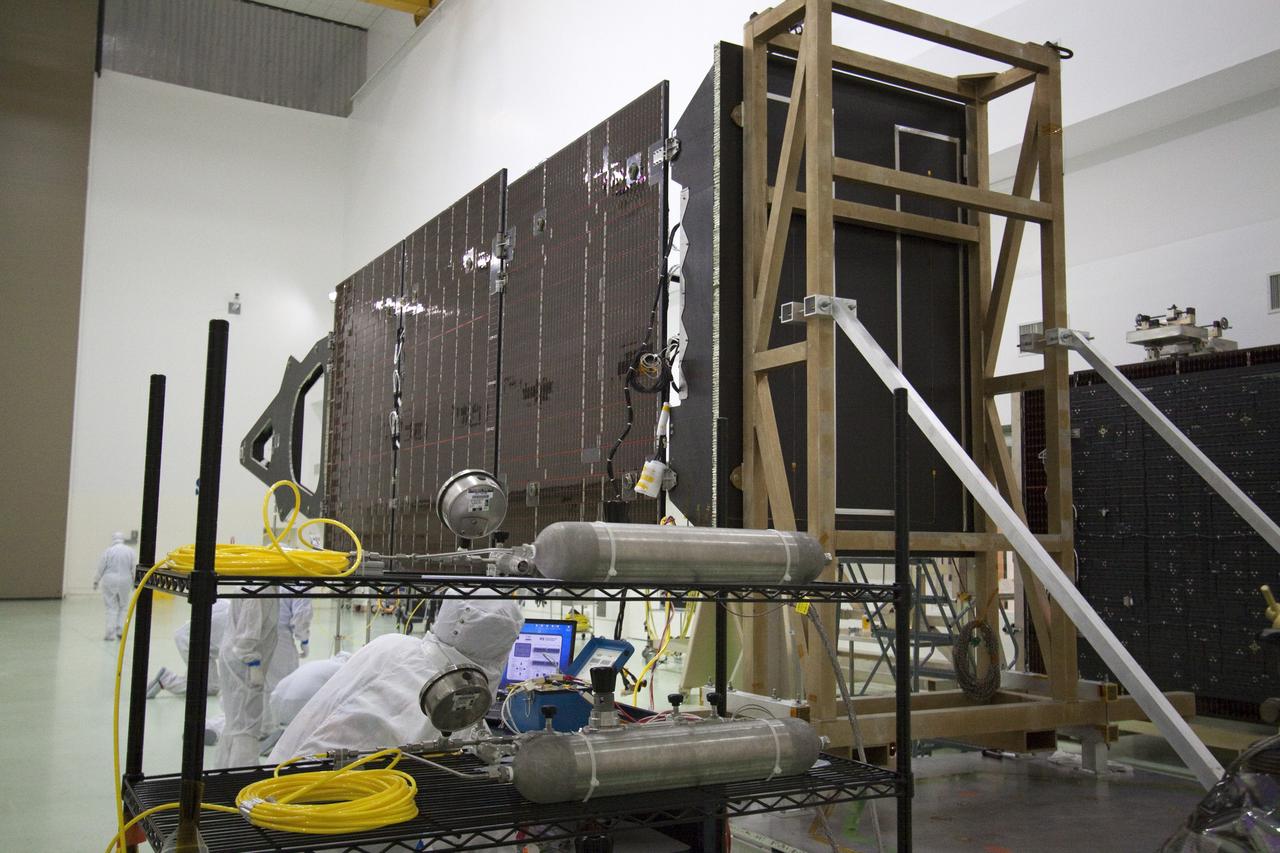
CAPE CANAVERAL, Fla. -- Technicians in the Astrotech payload processing facility in Titusville, Fla., check out solar array No. 1 with a magnetometer boom that will help power NASA's Juno spacecraft on a mission to Jupiter. Power-generating panels on three sets of solar arrays will extend outward from Juno’s hexagonal body, giving the overall spacecraft a span of more than 66 feet in order to operate at such a great distance from the sun. Juno is scheduled to launch aboard an Atlas V rocket from Cape Canaveral, Fla., on Aug. 5, 2011, reaching Jupiter in July 2016. The spacecraft will orbit the giant planet more than 30 times, skimming to within 3,000 miles above its cloud tops, for about one year. With its suite of science instruments, the spacecraft will investigate the existence of a solid planetary core, map Jupiter's intense magnetic field, measure the amount of water and ammonia in the deep atmosphere, and observe the planet's auroras. For more information visit, www.nasa.gov/juno. Photo credit: NASA/Jack Pfaller
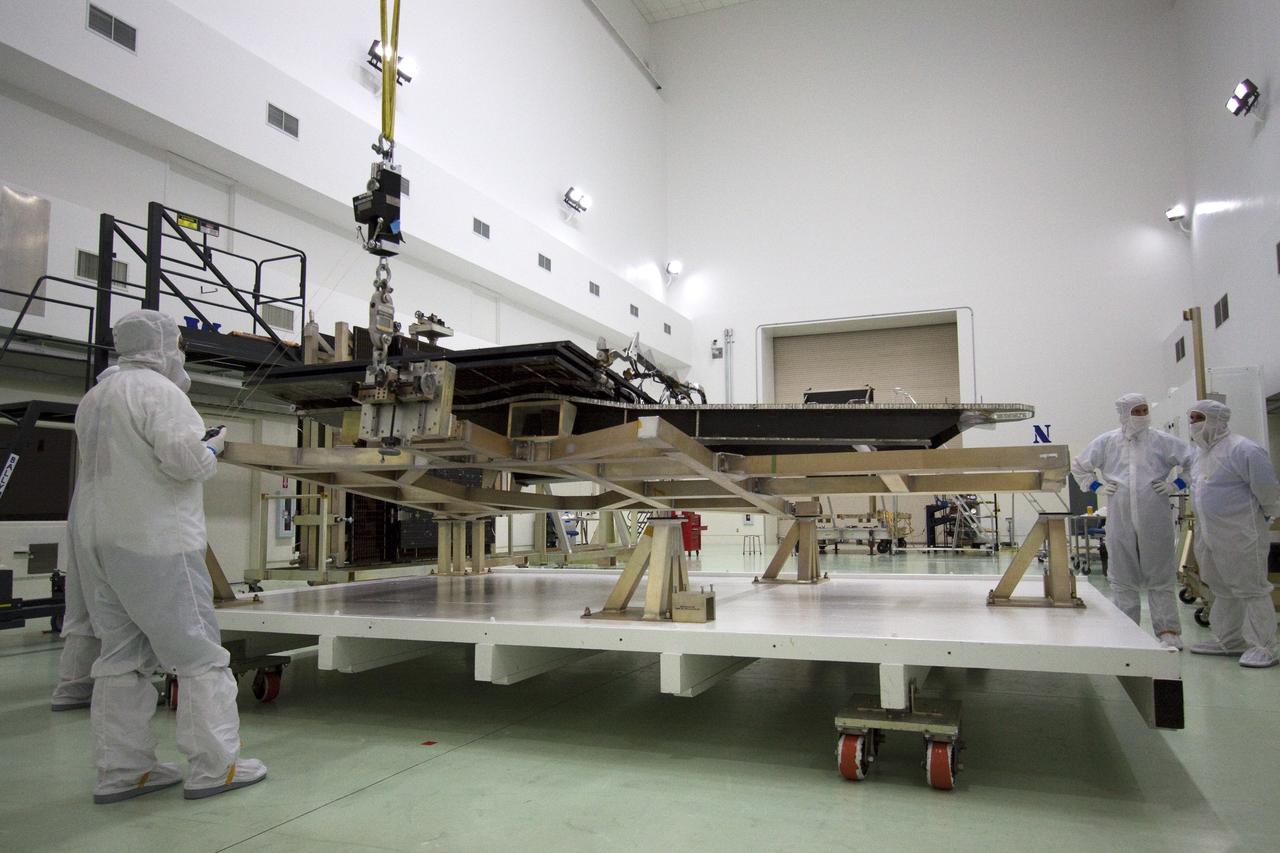
CAPE CANAVERAL, Fla. -- Technicians in the Astrotech payload processing facility in Titusville, Fla., prepare to unfurl solar array No. 1 with a magnetometer boom that will help power NASA's Juno spacecraft on a mission to Jupiter. Power-generating panels on three sets of solar arrays will extend outward from Juno’s hexagonal body, giving the overall spacecraft a span of more than 66 feet in order to operate at such a great distance from the sun. Juno is scheduled to launch aboard an Atlas V rocket from Cape Canaveral, Fla., on Aug. 5, 2011, reaching Jupiter in July 2016. The spacecraft will orbit the giant planet more than 30 times, skimming to within 3,000 miles above its cloud tops, for about one year. With its suite of science instruments, the spacecraft will investigate the existence of a solid planetary core, map Jupiter's intense magnetic field, measure the amount of water and ammonia in the deep atmosphere, and observe the planet's auroras. For more information visit, www.nasa.gov/juno. Photo credit: NASA/Jack Pfaller
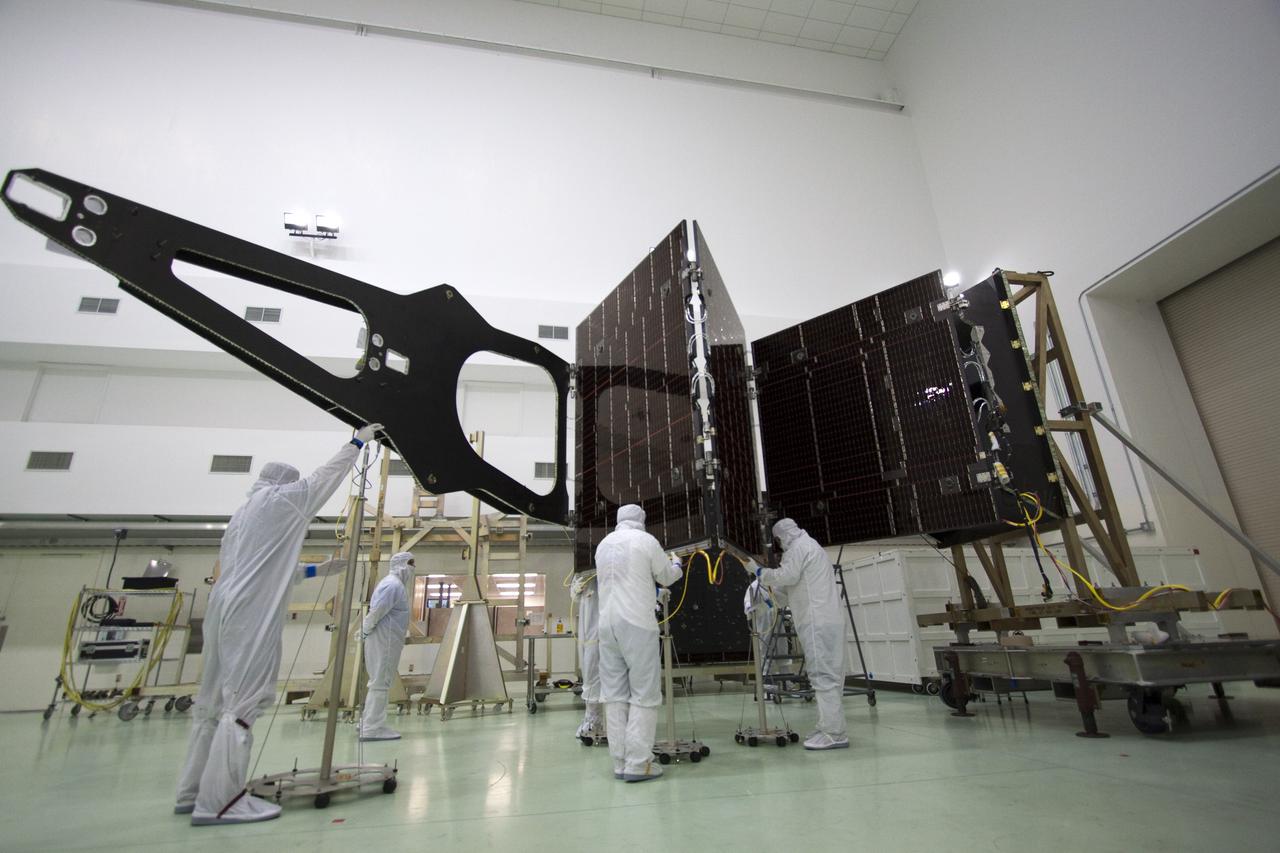
CAPE CANAVERAL, Fla. -- Technicians in the Astrotech payload processing facility in Titusville, Fla., unfurl solar array No. 1 with a magnetometer boom that will help power NASA's Juno spacecraft on a mission to Jupiter. Power-generating panels on three sets of solar arrays will extend outward from Juno’s hexagonal body, giving the overall spacecraft a span of more than 66 feet in order to operate at such a great distance from the sun. Juno is scheduled to launch aboard an Atlas V rocket from Cape Canaveral, Fla., on Aug. 5, 2011, reaching Jupiter in July 2016. The spacecraft will orbit the giant planet more than 30 times, skimming to within 3,000 miles above its cloud tops, for about one year. With its suite of science instruments, the spacecraft will investigate the existence of a solid planetary core, map Jupiter's intense magnetic field, measure the amount of water and ammonia in the deep atmosphere, and observe the planet's auroras. For more information visit, www.nasa.gov/juno. Photo credit: NASA/Jack Pfaller
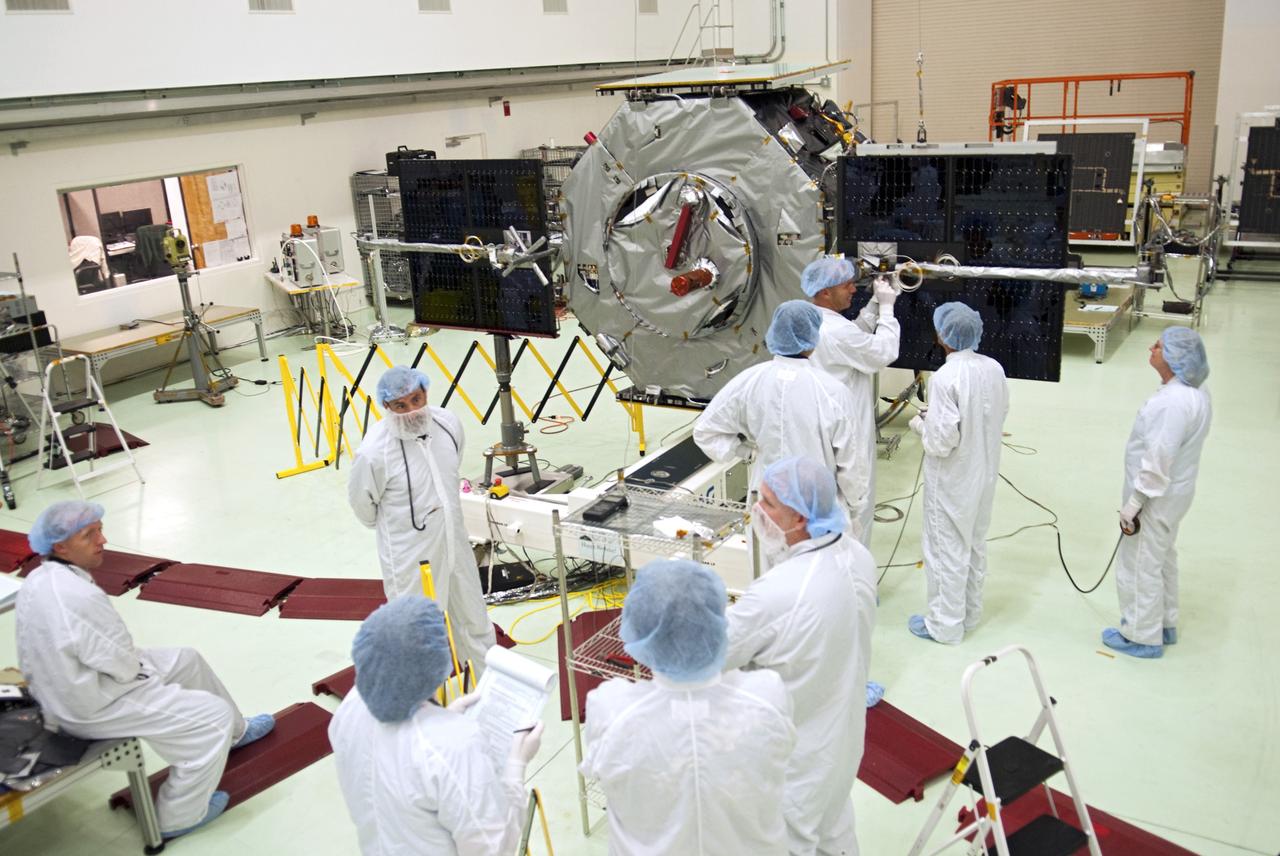
CAPE CANAVERAL, Fla. - Inside the Astrotech payload processing facility near NASA’s Kennedy Space Center in Florida, technicians deploy the solar arrays and magnetometer boom of the Radiation Belt Storm Probes, or RBSP, spacecraft A. Deploying these components are standard procedure to ensure they work properly on Earth before they head into space. NASA’s RBSP mission will help us understand the sun’s influence on Earth and near-Earth space by studying the Earth’s radiation belts on various scales of space and time. As the spacecraft orbits Earth, the four solar panels will continuously face the sun to provide constant power to its instruments. The boom will provide data of the electric fields that energize radiation particles and modify the structure of the inner magnetosphere. RBSP will begin its mission of exploration of Earth’s Van Allen radiation belts and the extremes of space weather after its launch aboard a United Launch Alliance Atlas V rocket. Launch is targeted for Aug. 23. For more information, visit http://www.nasa.gov/rbsp. Photo credit: NASA/Charisse Nahser
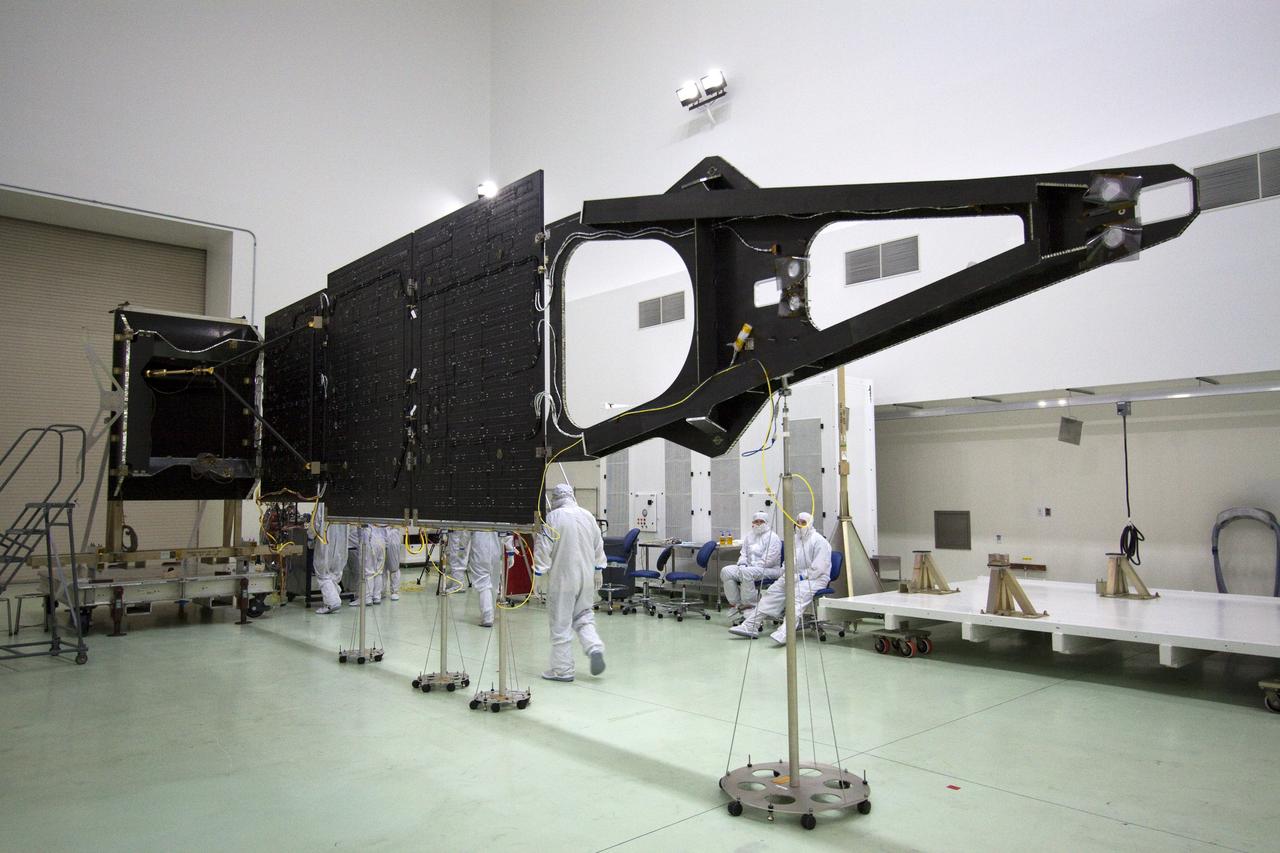
CAPE CANAVERAL, Fla. - Inside the Astrotech payload processing facility near NASA’s Kennedy Space Center in Florida, technicians deploy the solar arrays and magnetometer boom of the Radiation Belt Storm Probes, or RBSP, spacecraft A. Deploying these components is standard procedure to ensure they work properly on Earth before they head into space. NASA’s RBSP mission will help us understand the sun’s influence on Earth and near-Earth space by studying the Earth’s radiation belts on various scales of space and time. As the spacecraft orbits Earth, the four solar panels will continuously face the sun to provide constant power to its instruments. The boom will provide data of the electric fields that energize radiation particles and modify the structure of the inner magnetosphere. RBSP will begin its mission of exploration of Earth’s Van Allen radiation belts and the extremes of space weather after its launch aboard a United Launch Alliance Atlas V rocket. Launch is targeted for Aug. 23. For more information, visit http://www.nasa.gov/rbsp. Photo credit: NASA/Charisse Nahser
CAPE CANAVERAL, Fla. -- Technicians in the Astrotech payload processing facility in Titusville, Fla., unfurl solar array No. 1 with a magnetometer boom that will help power NASA's Juno spacecraft on a mission to Jupiter. Power-generating panels on three sets of solar arrays will extend outward from Juno’s hexagonal body, giving the overall spacecraft a span of more than 66 feet in order to operate at such a great distance from the sun. Juno is scheduled to launch aboard an Atlas V rocket from Cape Canaveral, Fla., on Aug. 5, 2011, reaching Jupiter in July 2016. The spacecraft will orbit the giant planet more than 30 times, skimming to within 3,000 miles above its cloud tops, for about one year. With its suite of science instruments, the spacecraft will investigate the existence of a solid planetary core, map Jupiter's intense magnetic field, measure the amount of water and ammonia in the deep atmosphere, and observe the planet's auroras. For more information visit, www.nasa.gov/juno. Photo credit: NASA/Jack Pfaller

CAPE CANAVERAL, Fla. - Inside the Astrotech payload processing facility near NASA’s Kennedy Space Center in Florida, technicians prepare to deploy the solar arrays and magnetometer boom of the Radiation Belt Storm Probes, or RBSP, spacecraft A. Deploying these components are standard procedure to ensure they work properly on Earth before they head into space. NASA’s RBSP mission will help us understand the sun’s influence on Earth and near-Earth space by studying the Earth’s radiation belts on various scales of space and time. As the spacecraft orbits Earth, the four solar panels will continuously face the sun to provide constant power to its instruments. The boom will provide data of the electric fields that energize radiation particles and modify the structure of the inner magnetosphere. RBSP will begin its mission of exploration of Earth’s Van Allen radiation belts and the extremes of space weather after its launch aboard a United Launch Alliance Atlas V rocket. Launch is targeted for Aug. 23. For more information, visit http://www.nasa.gov/rbsp. Photo credit: NASA/Charisse Nahser

CAPE CANAVERAL, Fla. - Inside the Astrotech payload processing facility near NASA’s Kennedy Space Center in Florida, technicians prepare to deploy the solar arrays and magnetometer boom of the Radiation Belt Storm Probes, or RBSP, spacecraft A. Deploying these components are standard procedure to ensure they work properly on Earth before they head into space. NASA’s RBSP mission will help us understand the sun’s influence on Earth and near-Earth space by studying the Earth’s radiation belts on various scales of space and time. As the spacecraft orbits Earth, the four solar panels will continuously face the sun to provide constant power to its instruments. The boom will provide data of the electric fields that energize radiation particles and modify the structure of the inner magnetosphere. RBSP will begin its mission of exploration of Earth’s Van Allen radiation belts and the extremes of space weather after its launch aboard a United Launch Alliance Atlas V rocket. Launch is targeted for Aug. 23. For more information, visit http://www.nasa.gov/rbsp. Photo credit: NASA/Charisse Nahser
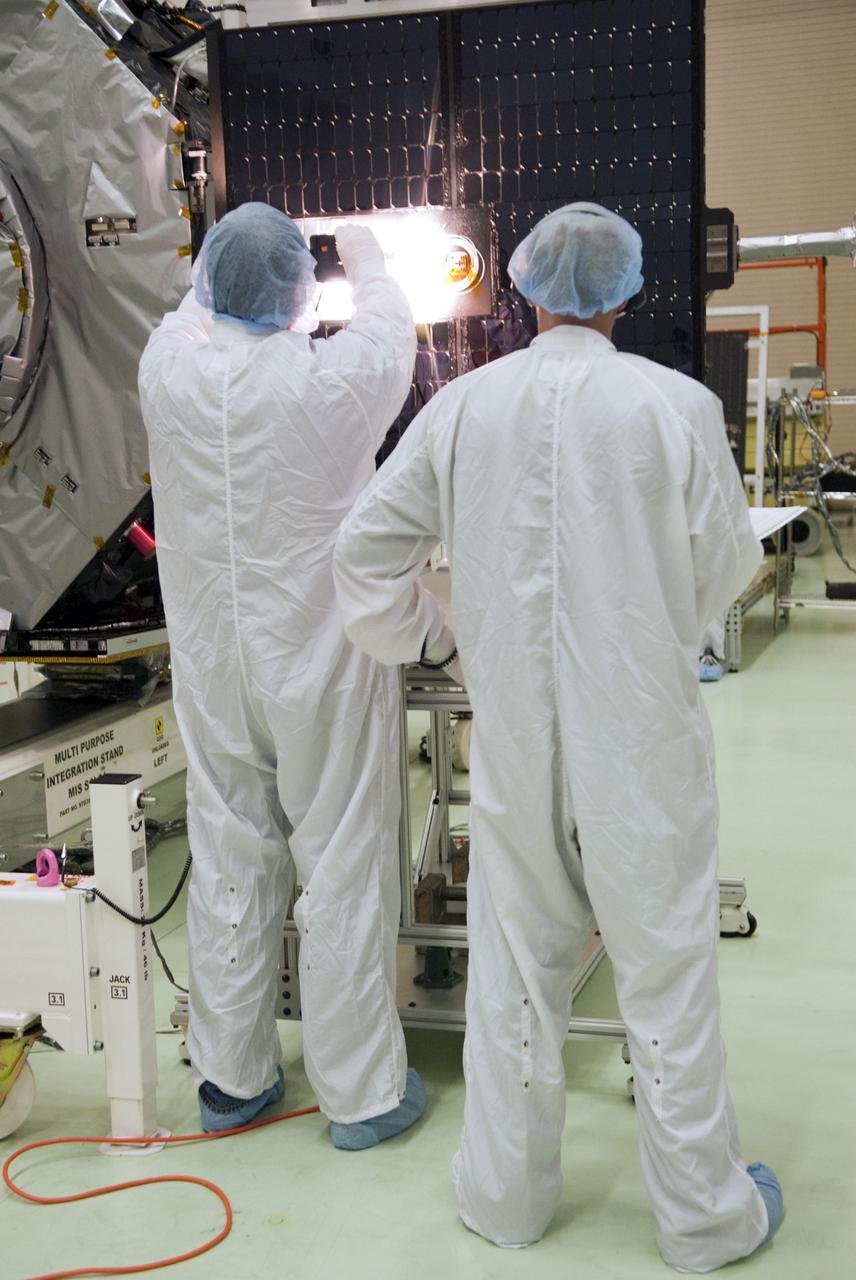
CAPE CANAVERAL, Fla. - Inside the Astrotech payload processing facility near NASA’s Kennedy Space Center in Florida, technicians perform a solar array illumination test after the solar arrays and magnetometer boom were deployed on the Radiation Belt Storm Probes, or RBSP, spacecraft A. Deploying these components are a standard procedure to ensure they work properly on Earth before they head into space. NASA’s RBSP mission will help us understand the sun’s influence on Earth and near-Earth space by studying the Earth’s radiation belts on various scales of space and time. As the spacecraft orbits Earth, the four solar panels will continuously face the sun to provide constant power to its instruments. The boom will provide data of the electric fields that energize radiation particles and modify the structure of the inner magnetosphere. RBSP will begin its mission of exploration of Earth’s Van Allen radiation belts and the extremes of space weather after its launch aboard a United Launch Alliance Atlas V rocket. Launch is targeted for Aug. 23. For more information, visit http://www.nasa.gov/rbsp. Photo credit: NASA/Charisse Nahser
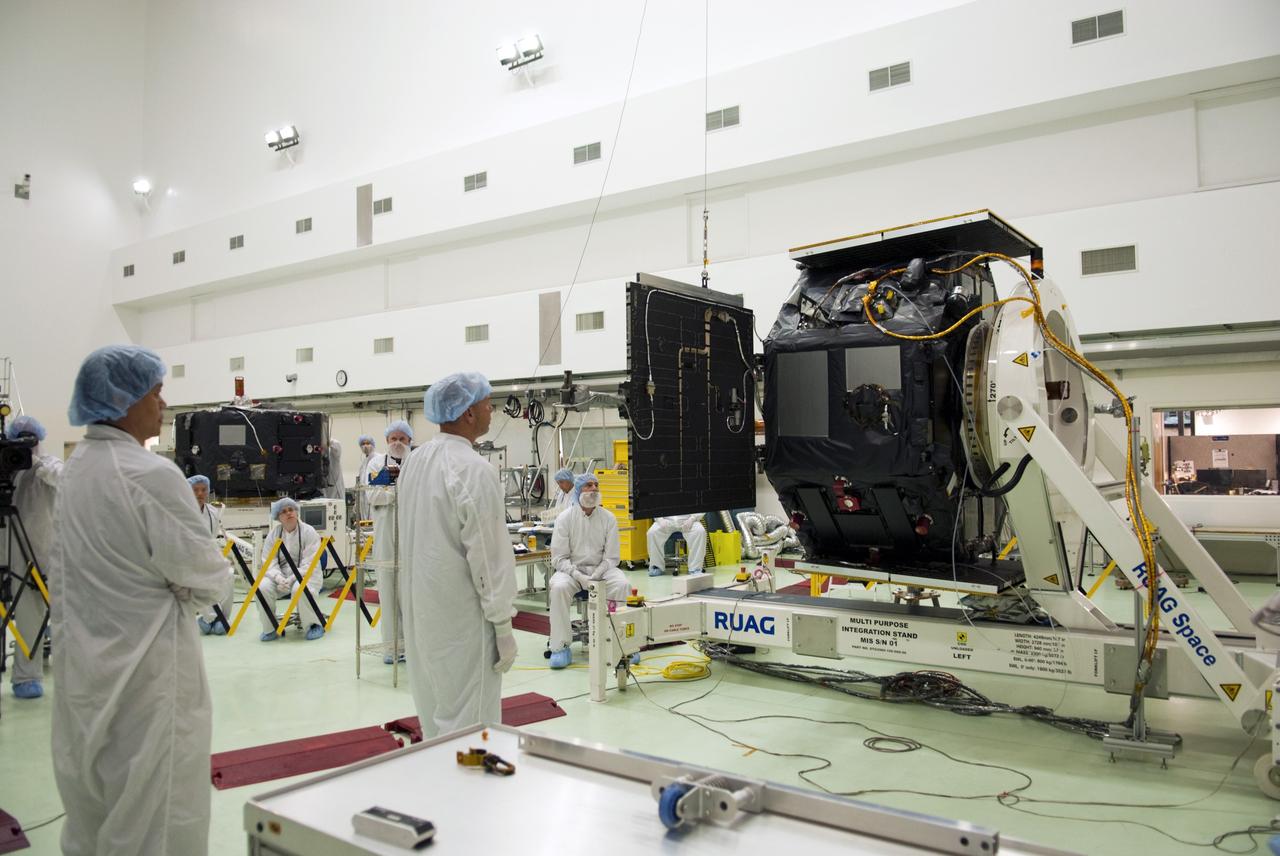
CAPE CANAVERAL, Fla. - Inside the Astrotech payload processing facility near NASA’s Kennedy Space Center in Florida, technicians begin to deploy the solar arrays and magnetometer boom of the Radiation Belt Storm Probes, or RBSP, spacecraft A. Deploying these components are standard procedure to ensure they work properly on Earth before they head into space. NASA’s RBSP mission will help us understand the sun’s influence on Earth and near-Earth space by studying the Earth’s radiation belts on various scales of space and time. As the spacecraft orbits Earth, the four solar panels will continuously face the sun to provide constant power to its instruments. The boom will provide data of the electric fields that energize radiation particles and modify the structure of the inner magnetosphere. RBSP will begin its mission of exploration of Earth’s Van Allen radiation belts and the extremes of space weather after its launch aboard a United Launch Alliance Atlas V rocket. Launch is targeted for Aug. 23. For more information, visit http://www.nasa.gov/rbsp. Photo credit: NASA/Charisse Nahser
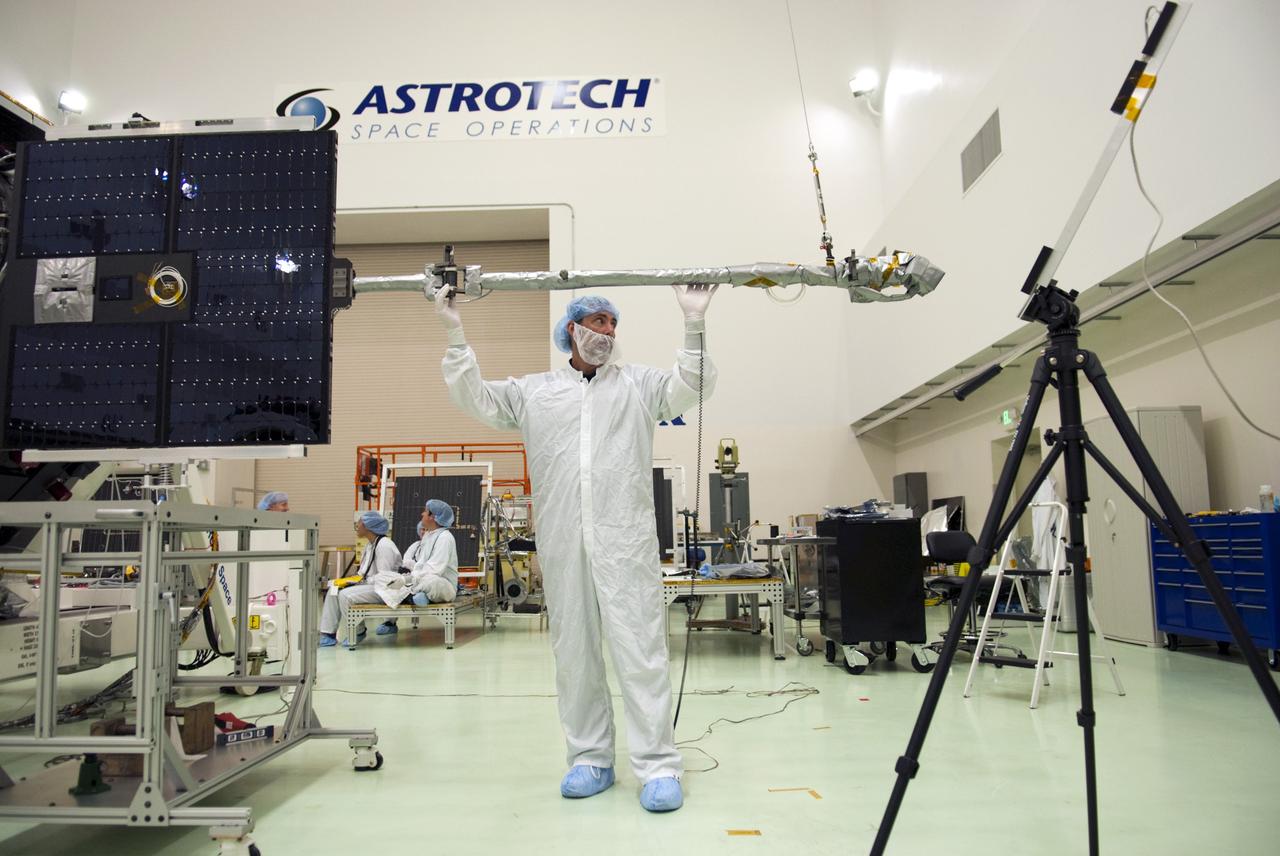
CAPE CANAVERAL, Fla. - Inside the Astrotech payload processing facility near NASA’s Kennedy Space Center in Florida, a technician inspects the Radiation Belt Storm Probes, or RBSP, spacecraft A solar arrays and magnetometer boom after they were deployed. Deploying these components is a standard procedure to ensure they work properly on Earth before they head into space. NASA’s RBSP mission will help us understand the sun’s influence on Earth and near-Earth space by studying the Earth’s radiation belts on various scales of space and time. As the spacecraft orbits Earth, the four solar panels will continuously face the sun to provide constant power to its instruments. The boom will provide data of the electric fields that energize radiation particles and modify the structure of the inner magnetosphere. RBSP will begin its mission of exploration of Earth’s Van Allen radiation belts and the extremes of space weather after its launch aboard a United Launch Alliance Atlas V rocket. Launch is targeted for Aug. 23. For more information, visit http://www.nasa.gov/rbsp. Photo credit: NASA/Charisse Nahser
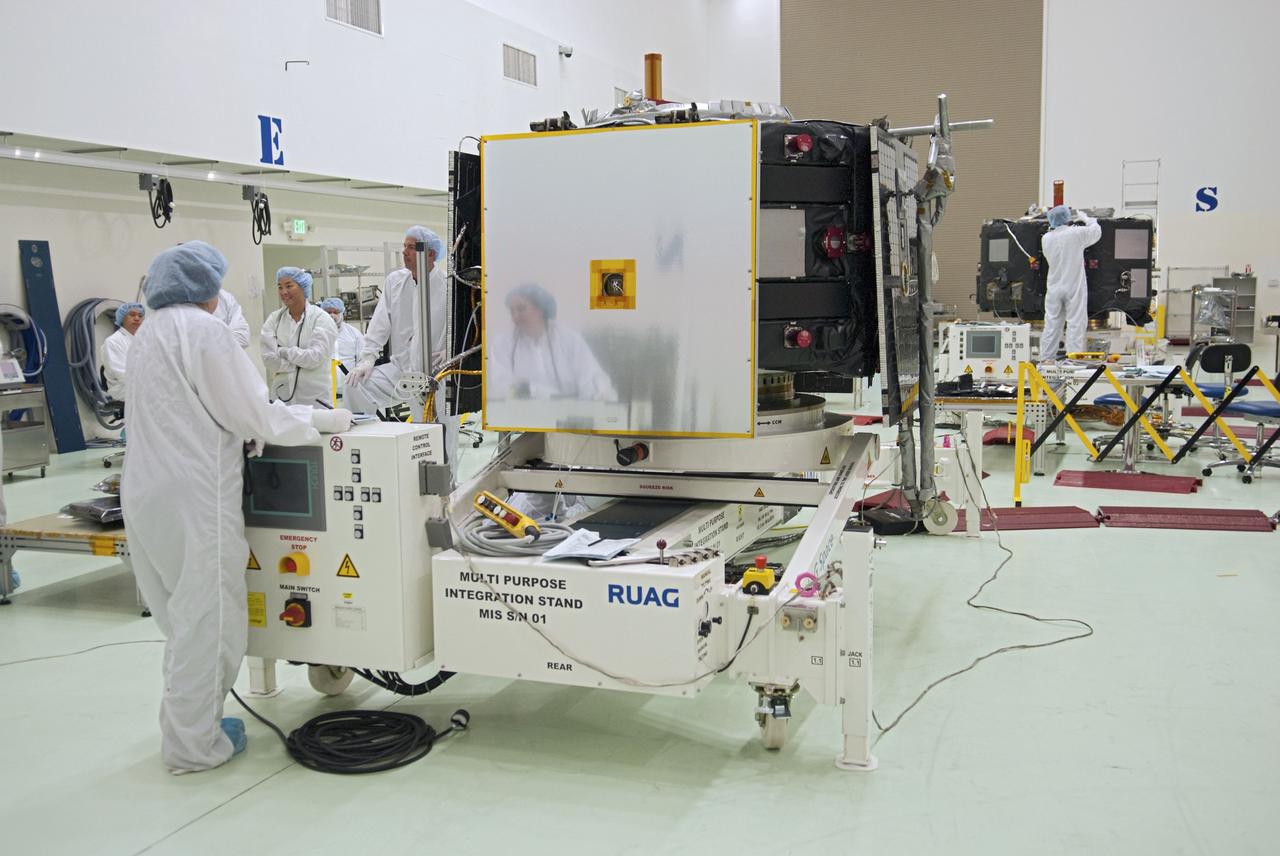
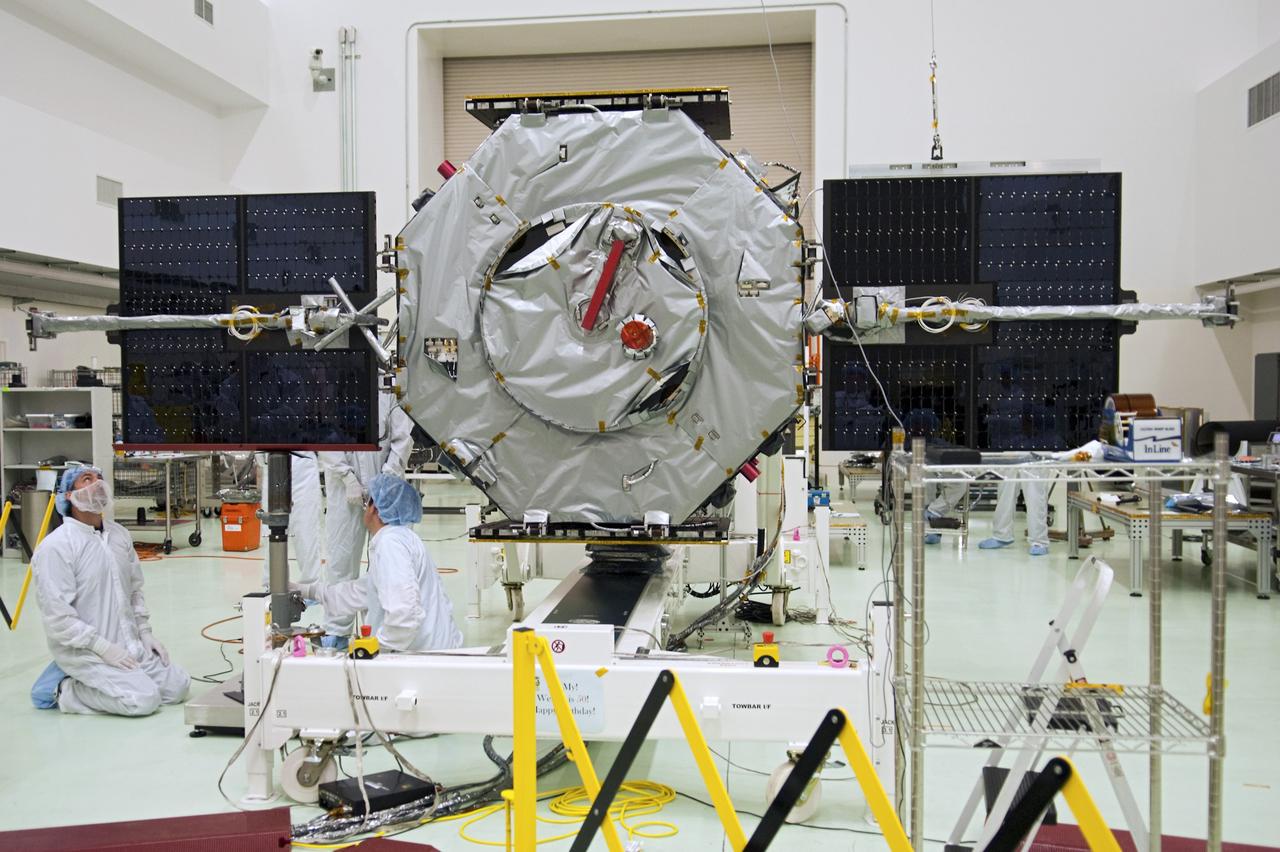
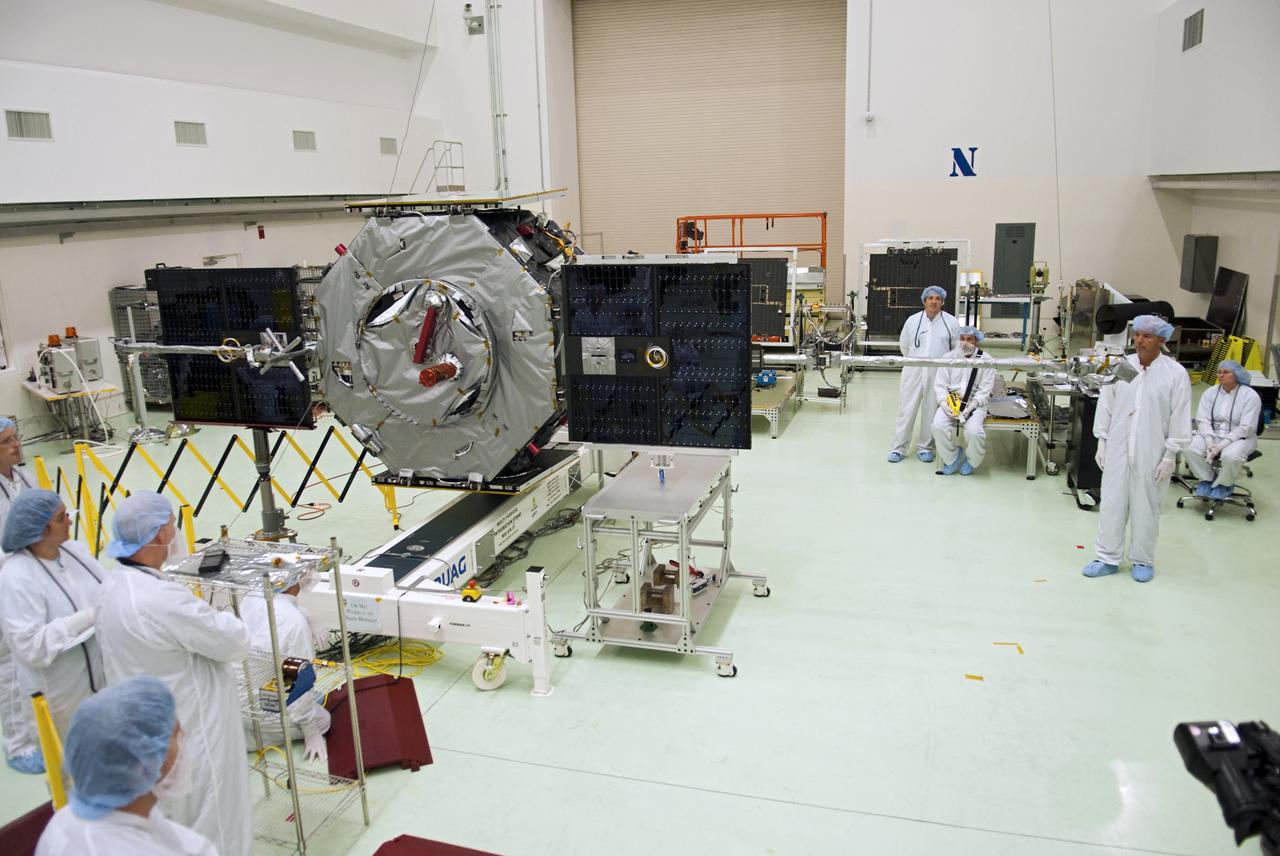
CAPE CANAVERAL, Fla. - Inside the Astrotech payload processing facility near NASA’s Kennedy Space Center in Florida, technicians prepare to deploy the magnetometer boom of the Radiation Belt Storm Probes, or RBSP, spacecraft A. Deploying this instrument is standard procedure to ensure it will work properly on Earth before it heads into space. In the back right of the facility, is spacecraft B, which is identical to spacecraft A. Together, NASA’s two RBSP spacecraft will help us understand the sun’s influence on Earth and near-Earth space by studying the Earth’s radiation belts on various scales of space and time. The boom will provide data of the electric fields that energize radiation particles and modify the structure of the inner magnetosphere. RBSP will begin its mission of exploration of Earth’s Van Allen radiation belts and the extremes of space weather after its launch aboard a United Launch Alliance Atlas V rocket. Launch is targeted for Aug. 23. For more information, visit http://www.nasa.gov/rbsp. Photo credit: NASA/Charisse Nahser
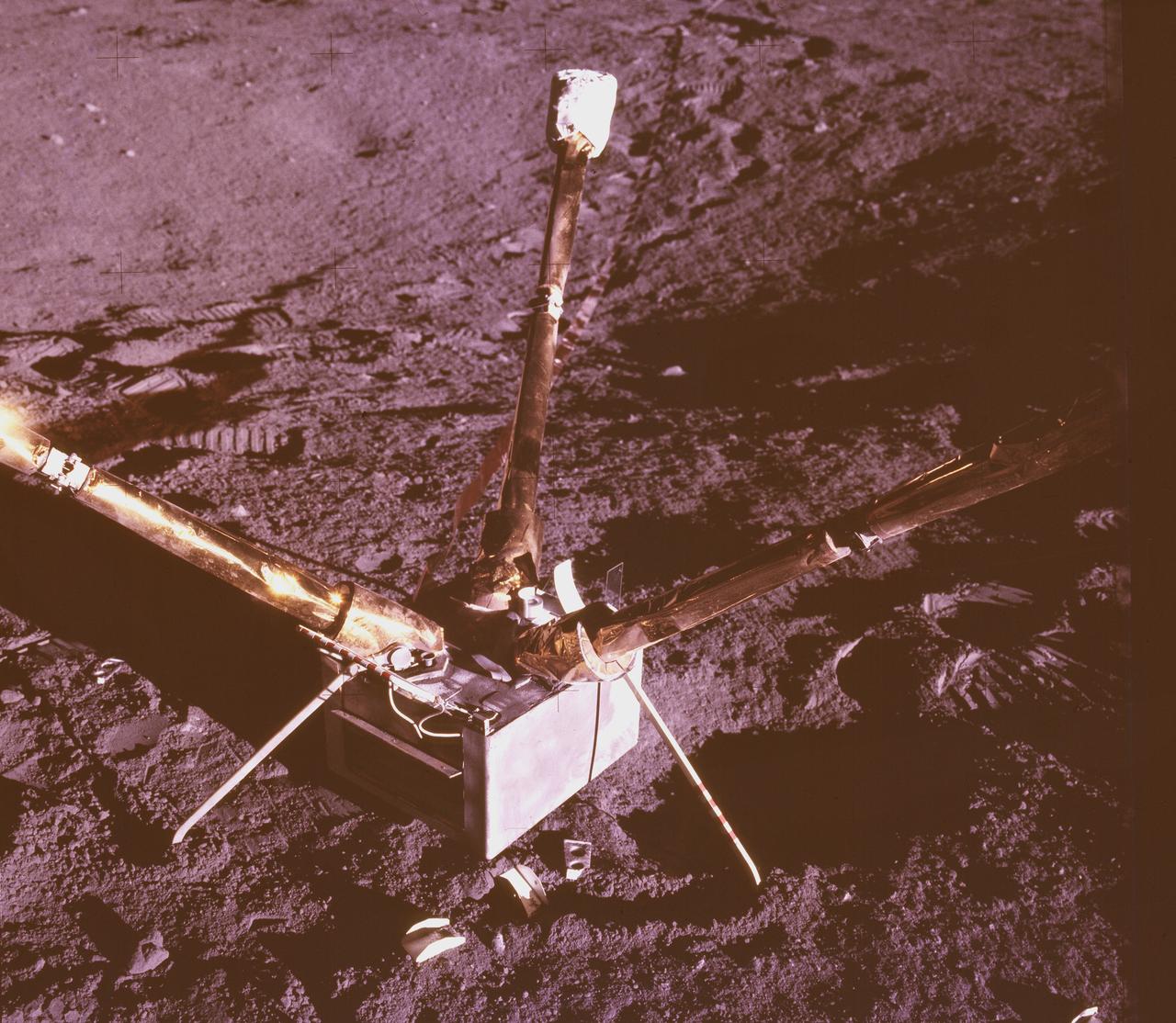
Sitting on the lunar surface, this magnetometer provided new data on the Moon’s magnetic field. This was one of the instruments used during the Apollo 12 mission. The second manned lunar landing mission, Apollo 12 launched from launch pad 39-A at Kennedy Space Center in Florida on November 14, 1969 via a Saturn V launch vehicle. The Saturn V vehicle was developed by the Marshall Space Flight Center (MSFC) under the direction of Dr. Wernher von Braun. Aboard Apollo 12 was a crew of three astronauts: Alan L. Bean, pilot of the Lunar Module (LM), Intrepid; Richard Gordon, pilot of the Command Module (CM), Yankee Clipper; and Spacecraft Commander Charles Conrad. The LM, Intrepid, landed astronauts Conrad and Bean on the lunar surface in what’s known as the Ocean of Storms while astronaut Richard Gordon piloted the CM, Yankee Clipper, in a parking orbit around the Moon. Lunar soil activities included the deployment of the Apollo Lunar Surface Experiments Package (ALSEP), finding the unmanned Surveyor 3 that landed on the Moon on April 19, 1967, and collecting 75 pounds (34 kilograms) of rock samples. Apollo 12 safely returned to Earth on November 24, 1969.
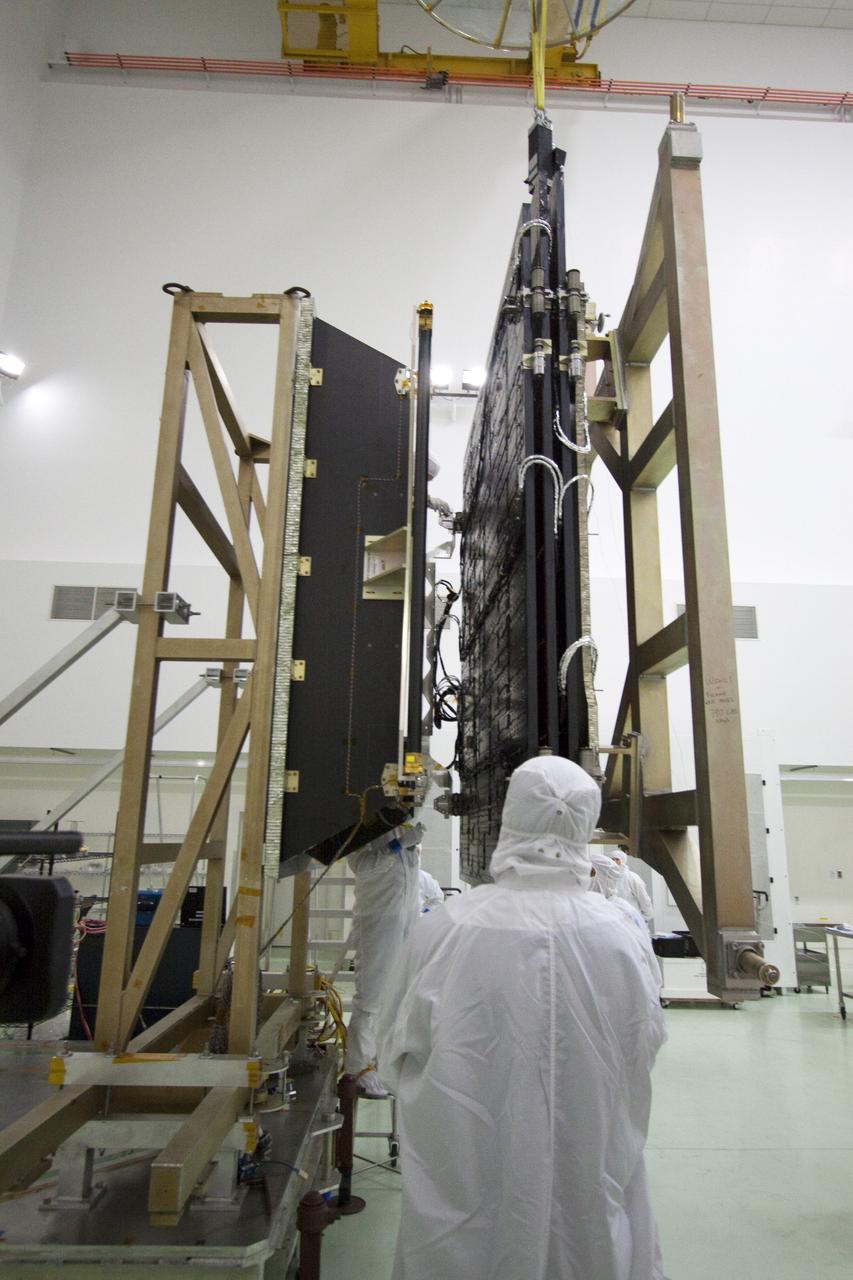
CAPE CANAVERAL, Fla. -- Technicians in the Astrotech payload processing facility in Titusville, Fla., prepare to unfurl solar array No. 1 with a magnetometer boom that will help power NASA's Juno spacecraft on a mission to Jupiter. Power-generating panels on three sets of solar arrays will extend outward from Juno’s hexagonal body, giving the overall spacecraft a span of more than 66 feet in order to operate at such a great distance from the sun. Juno is scheduled to launch aboard an Atlas V rocket from Cape Canaveral, Fla., on Aug. 5, 2011, reaching Jupiter in July 2016. The spacecraft will orbit the giant planet more than 30 times, skimming to within 3,000 miles above its cloud tops, for about one year. With its suite of science instruments, the spacecraft will investigate the existence of a solid planetary core, map Jupiter's intense magnetic field, measure the amount of water and ammonia in the deep atmosphere, and observe the planet's auroras. For more information visit, www.nasa.gov/juno. Photo credit: NASA/Jack Pfaller
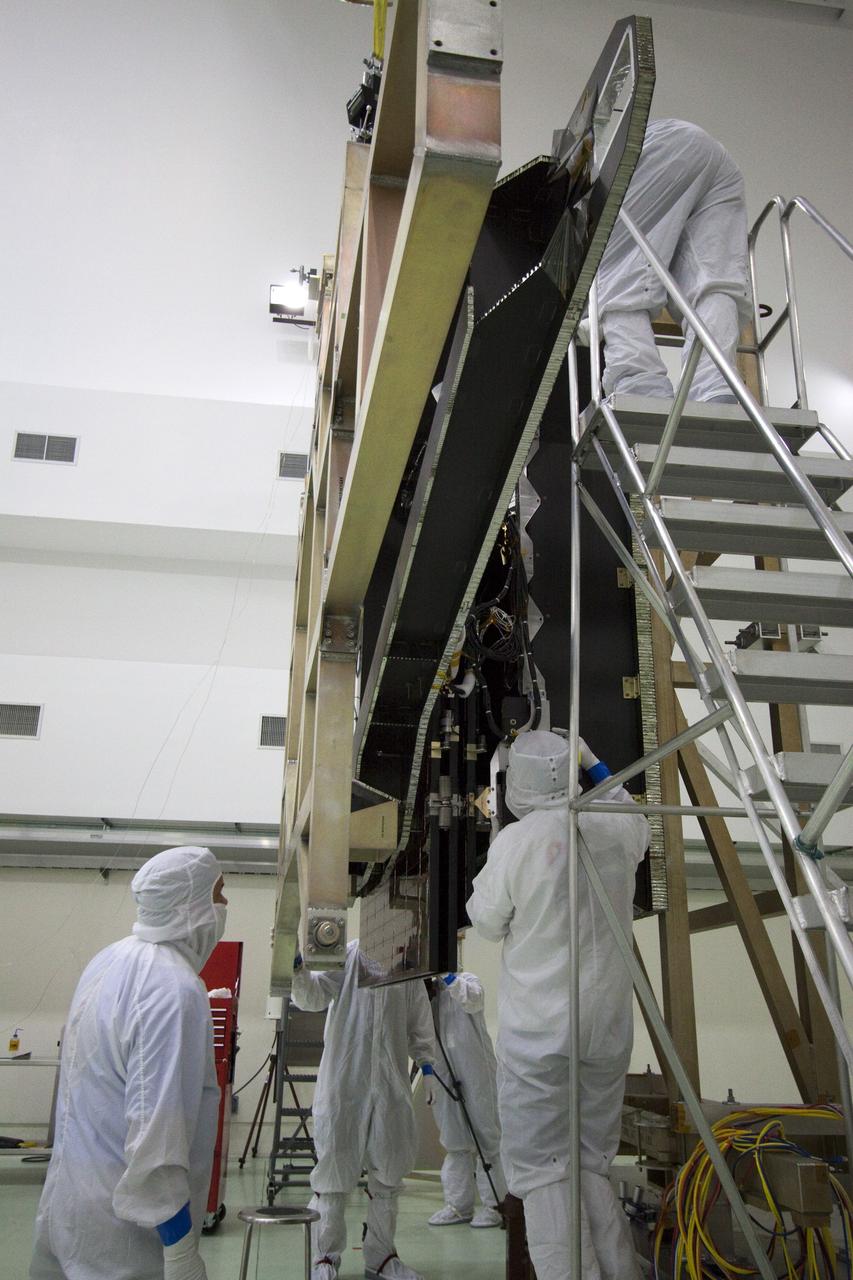
CAPE CANAVERAL, Fla. -- Technicians in the Astrotech payload processing facility in Titusville, Fla., prepare to unfurl solar array No. 1 with a magnetometer boom that will help power NASA's Juno spacecraft on a mission to Jupiter. Power-generating panels on three sets of solar arrays will extend outward from Juno’s hexagonal body, giving the overall spacecraft a span of more than 66 feet in order to operate at such a great distance from the sun. Juno is scheduled to launch aboard an Atlas V rocket from Cape Canaveral, Fla., on Aug. 5, 2011, reaching Jupiter in July 2016. The spacecraft will orbit the giant planet more than 30 times, skimming to within 3,000 miles above its cloud tops, for about one year. With its suite of science instruments, the spacecraft will investigate the existence of a solid planetary core, map Jupiter's intense magnetic field, measure the amount of water and ammonia in the deep atmosphere, and observe the planet's auroras. For more information visit, www.nasa.gov/juno. Photo credit: NASA/Jack Pfaller
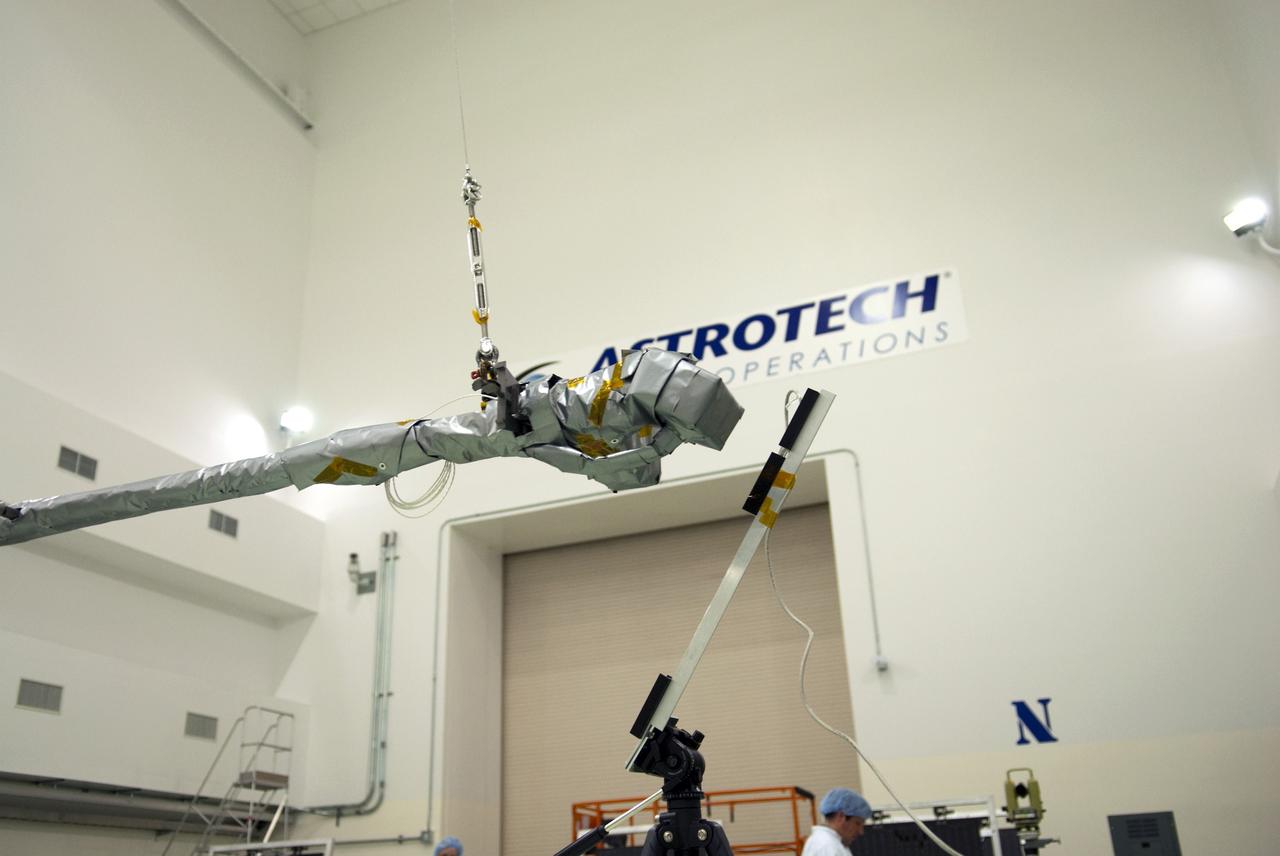
CAPE CANAVERAL, Fla. - Inside the Astrotech payload processing facility near NASA’s Kennedy Space Center in Florida, the magnetometer boom has been deployed on the Radiation Belt Storm Probes, or RBSP, spacecraft A. Deploying the solar arrays and boom are a standard procedure to ensure they work properly on Earth before they head into space. NASA’s RBSP mission will help us understand the sun’s influence on Earth and near-Earth space by studying the Earth’s radiation belts on various scales of space and time. As the spacecraft orbits Earth, the four solar panels will continuously face the sun to provide constant power to its instruments. The boom will provide data of the electric fields that energize radiation particles and modify the structure of the inner magnetosphere. RBSP will begin its mission of exploration of Earth’s Van Allen radiation belts and the extremes of space weather after its launch aboard a United Launch Alliance Atlas V rocket. Launch is targeted for Aug. 23. For more information, visit http://www.nasa.gov/rbsp. Photo credit: NASA/Charisse Nahser
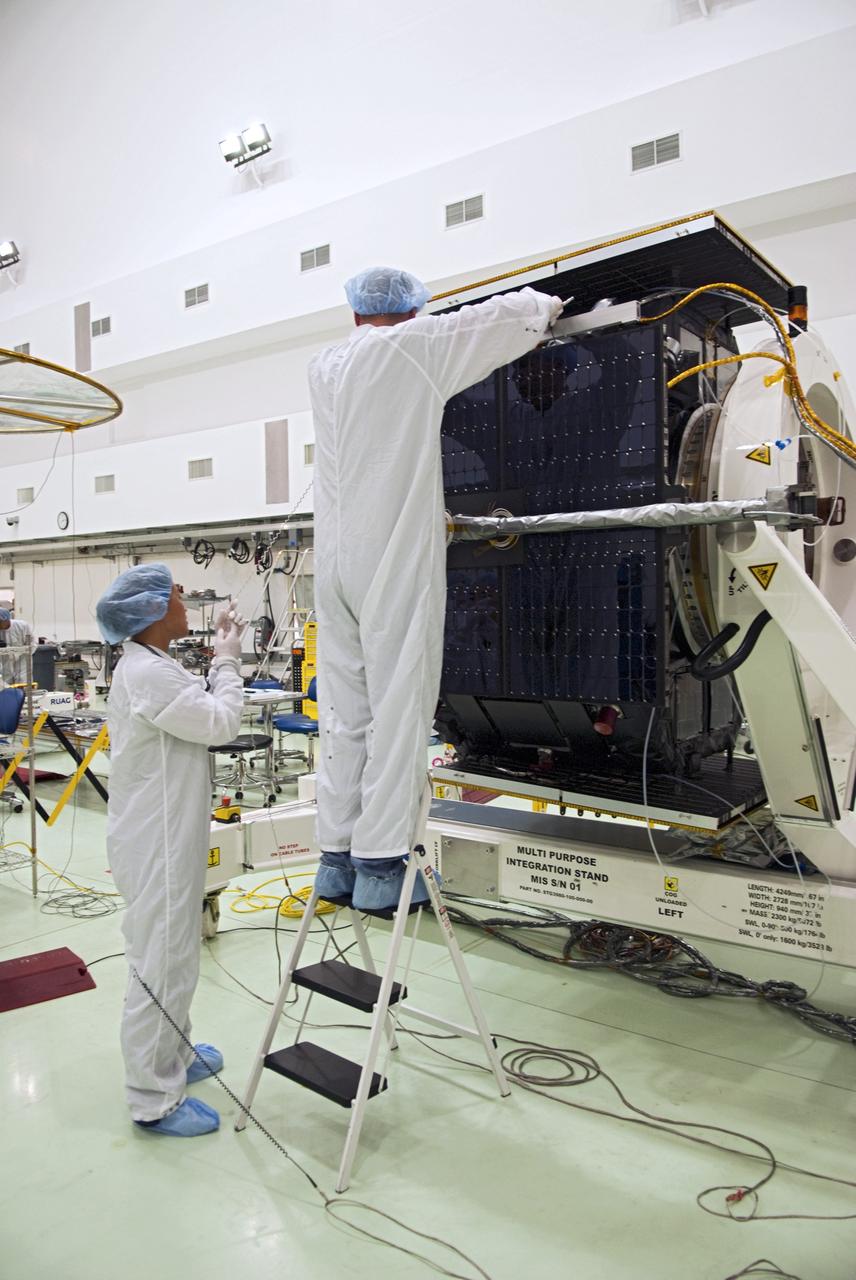
CAPE CANAVERAL, Fla. - Inside the Astrotech payload processing facility near NASA’s Kennedy Space Center in Florida, technicians prepare to deploy the solar arrays and magnetometer boom of the Radiation Belt Storm Probes, or RBSP, spacecraft A. Deploying these components are standard procedure to ensure they work properly on Earth before they head into space. NASA’s RBSP mission will help us understand the sun’s influence on Earth and near-Earth space by studying the Earth’s radiation belts on various scales of space and time. As the spacecraft orbits Earth, the four solar panels will continuously face the sun to provide constant power to its instruments. The boom will provide data of the electric fields that energize radiation particles and modify the structure of the inner magnetosphere. RBSP will begin its mission of exploration of Earth’s Van Allen radiation belts and the extremes of space weather after its launch aboard a United Launch Alliance Atlas V rocket. Launch is targeted for Aug. 23. For more information, visit http://www.nasa.gov/rbsp. Photo credit: NASA/Charisse Nahser
CAPE CANAVERAL, Fla. - Inside the Astrotech payload processing facility near NASA’s Kennedy Space Center in Florida, technicians deploy the solar arrays and magnetometer boom of the Radiation Belt Storm Probes, or RBSP, spacecraft A. Deploying these components is standard procedure to ensure they work properly on Earth before they head into space. NASA’s RBSP mission will help us understand the sun’s influence on Earth and near-Earth space by studying the Earth’s radiation belts on various scales of space and time. As the spacecraft orbits Earth, the four solar panels will continuously face the sun to provide constant power to its instruments. The boom will provide data of the electric fields that energize radiation particles and modify the structure of the inner magnetosphere. RBSP will begin its mission of exploration of Earth’s Van Allen radiation belts and the extremes of space weather after its launch aboard a United Launch Alliance Atlas V rocket. Launch is targeted for Aug. 23. For more information, visit http://www.nasa.gov/rbsp. Photo credit: NASA/Charisse Nahser

CAPE CANAVERAL, Fla. - Inside the Astrotech payload processing facility near NASA’s Kennedy Space Center in Florida, technicians deploy the solar arrays and magnetometer boom of the Radiation Belt Storm Probes, or RBSP, spacecraft A. Deploying these components is standard procedure to ensure they work properly on Earth before they head into space. NASA’s RBSP mission will help us understand the sun’s influence on Earth and near-Earth space by studying the Earth’s radiation belts on various scales of space and time. As the spacecraft orbits Earth, the four solar panels will continuously face the sun to provide constant power to its instruments. The boom will provide data of the electric fields that energize radiation particles and modify the structure of the inner magnetosphere. RBSP will begin its mission of exploration of Earth’s Van Allen radiation belts and the extremes of space weather after its launch aboard a United Launch Alliance Atlas V rocket. Launch is targeted for Aug. 23. For more information, visit http://www.nasa.gov/rbsp. Photo credit: NASA/Charisse Nahser

CAPE CANAVERAL, Fla. - Inside the Astrotech payload processing facility near NASA’s Kennedy Space Center in Florida, technicians perform a solar array illumination test after the solar arrays and magnetometer boom were deployed on the Radiation Belt Storm Probes, or RBSP, spacecraft A. Deploying these components are a standard procedure to ensure they work properly on Earth before they head into space. NASA’s RBSP mission will help us understand the sun’s influence on Earth and near-Earth space by studying the Earth’s radiation belts on various scales of space and time. As the spacecraft orbits Earth, the four solar panels will continuously face the sun to provide constant power to its instruments. The boom will provide data of the electric fields that energize radiation particles and modify the structure of the inner magnetosphere. RBSP will begin its mission of exploration of Earth’s Van Allen radiation belts and the extremes of space weather after its launch aboard a United Launch Alliance Atlas V rocket. Launch is targeted for Aug. 23. For more information, visit http://www.nasa.gov/rbsp. Photo credit: NASA/Charisse Nahser

CAPE CANAVERAL, Fla. -- Technicians in the Astrotech payload processing facility in Titusville, Fla., prepare to unfurl solar array No. 1 with a magnetometer boom that will help power NASA's Juno spacecraft on a mission to Jupiter. Power-generating panels on three sets of solar arrays will extend outward from Juno’s hexagonal body, giving the overall spacecraft a span of more than 66 feet in order to operate at such a great distance from the sun. Juno is scheduled to launch aboard an Atlas V rocket from Cape Canaveral, Fla., on Aug. 5, 2011, reaching Jupiter in July 2016. The spacecraft will orbit the giant planet more than 30 times, skimming to within 3,000 miles above its cloud tops, for about one year. With its suite of science instruments, the spacecraft will investigate the existence of a solid planetary core, map Jupiter's intense magnetic field, measure the amount of water and ammonia in the deep atmosphere, and observe the planet's auroras. For more information visit, www.nasa.gov/juno. Photo credit: NASA/Jack Pfaller
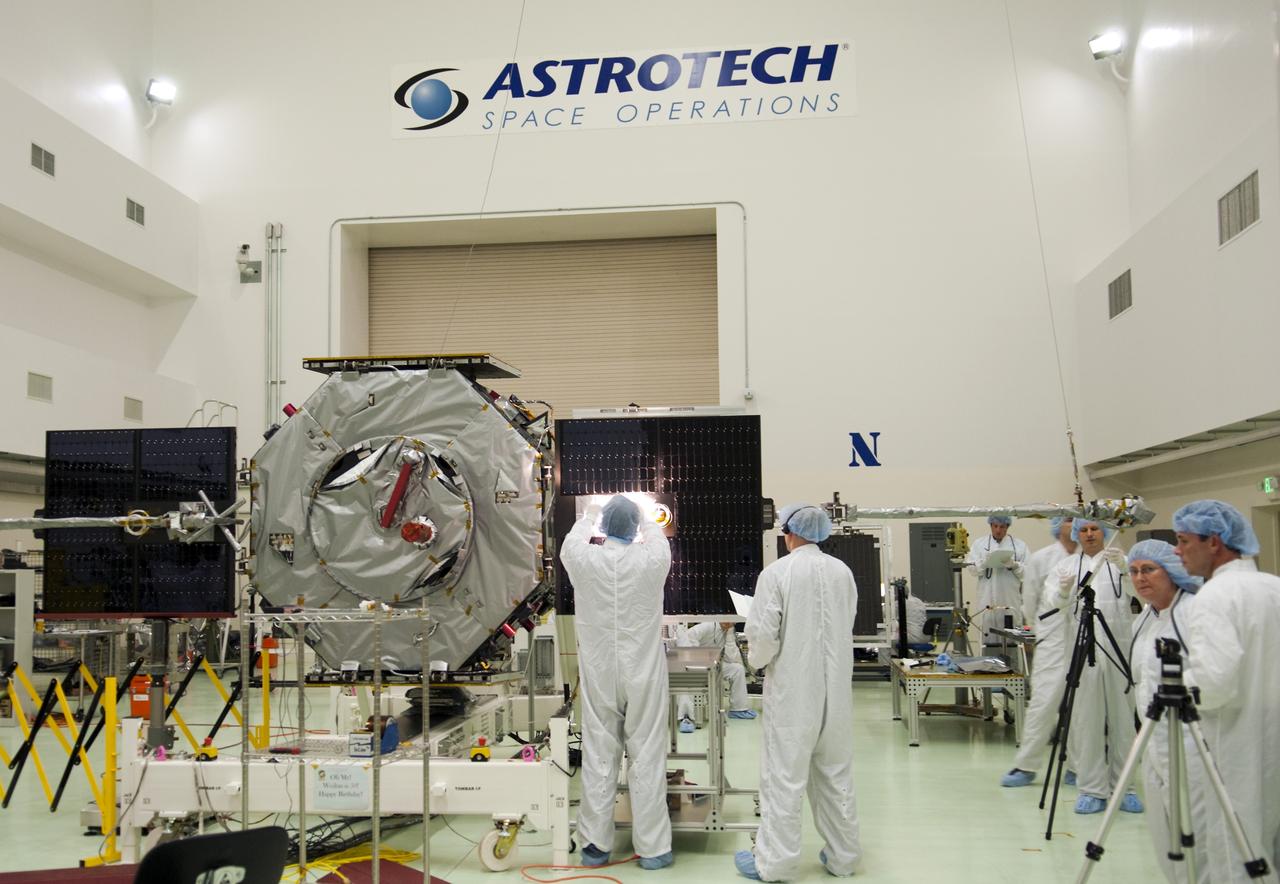
CAPE CANAVERAL, Fla. - Inside the Astrotech payload processing facility near NASA’s Kennedy Space Center in Florida, technicians perform a solar array illumination test after the Radiation Belt Storm Probes, or RBSP, spacecraft A solar arrays and magnetometer boom were deployed. Deploying these components is a standard procedure to ensure they work properly on Earth before they head into space. NASA’s RBSP mission will help us understand the sun’s influence on Earth and near-Earth space by studying the Earth’s radiation belts on various scales of space and time. As the spacecraft orbits Earth, the four solar panels will continuously face the sun to provide constant power to its instruments. The boom will provide data of the electric fields that energize radiation particles and modify the structure of the inner magnetosphere. RBSP will begin its mission of exploration of Earth’s Van Allen radiation belts and the extremes of space weather after its launch aboard a United Launch Alliance Atlas V rocket. Launch is targeted for Aug. 23. For more information, visit http://www.nasa.gov/rbsp. Photo credit: NASA/Charisse Nahser
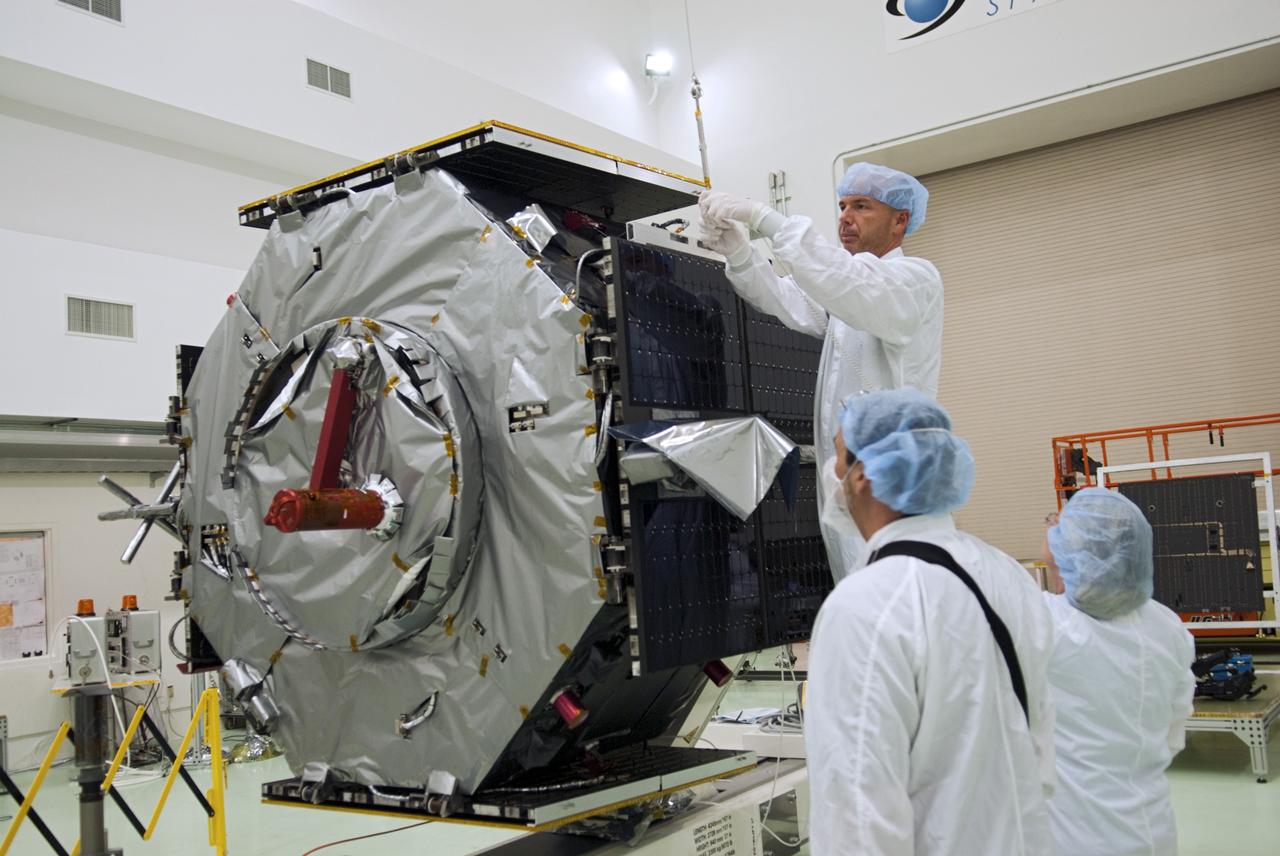
CAPE CANAVERAL, Fla. - Inside the Astrotech payload processing facility near NASA’s Kennedy Space Center in Florida, technicians prepare to deploy the solar arrays and magnetometer boom of the Radiation Belt Storm Probes, or RBSP, spacecraft A. Deploying these components are standard procedure to ensure they work properly on Earth before they head into space. NASA’s RBSP mission will help us understand the sun’s influence on Earth and near-Earth space by studying the Earth’s radiation belts on various scales of space and time. As the spacecraft orbits Earth, the four solar panels will continuously face the sun to provide constant power to its instruments. The boom will provide data of the electric fields that energize radiation particles and modify the structure of the inner magnetosphere. RBSP will begin its mission of exploration of Earth’s Van Allen radiation belts and the extremes of space weather after its launch aboard a United Launch Alliance Atlas V rocket. Launch is targeted for Aug. 23. For more information, visit http://www.nasa.gov/rbsp. Photo credit: NASA/Charisse Nahser

CAPE CANAVERAL, Fla. -- Technicians in the Astrotech payload processing facility in Titusville, Fla., unfurl solar array No. 1 with a magnetometer boom that will help power NASA's Juno spacecraft on a mission to Jupiter. Power-generating panels on three sets of solar arrays will extend outward from Juno’s hexagonal body, giving the overall spacecraft a span of more than 66 feet in order to operate at such a great distance from the sun. Juno is scheduled to launch aboard an Atlas V rocket from Cape Canaveral, Fla., on Aug. 5, 2011, reaching Jupiter in July 2016. The spacecraft will orbit the giant planet more than 30 times, skimming to within 3,000 miles above its cloud tops, for about one year. With its suite of science instruments, the spacecraft will investigate the existence of a solid planetary core, map Jupiter's intense magnetic field, measure the amount of water and ammonia in the deep atmosphere, and observe the planet's auroras. For more information visit, www.nasa.gov/juno. Photo credit: NASA/Jack Pfaller
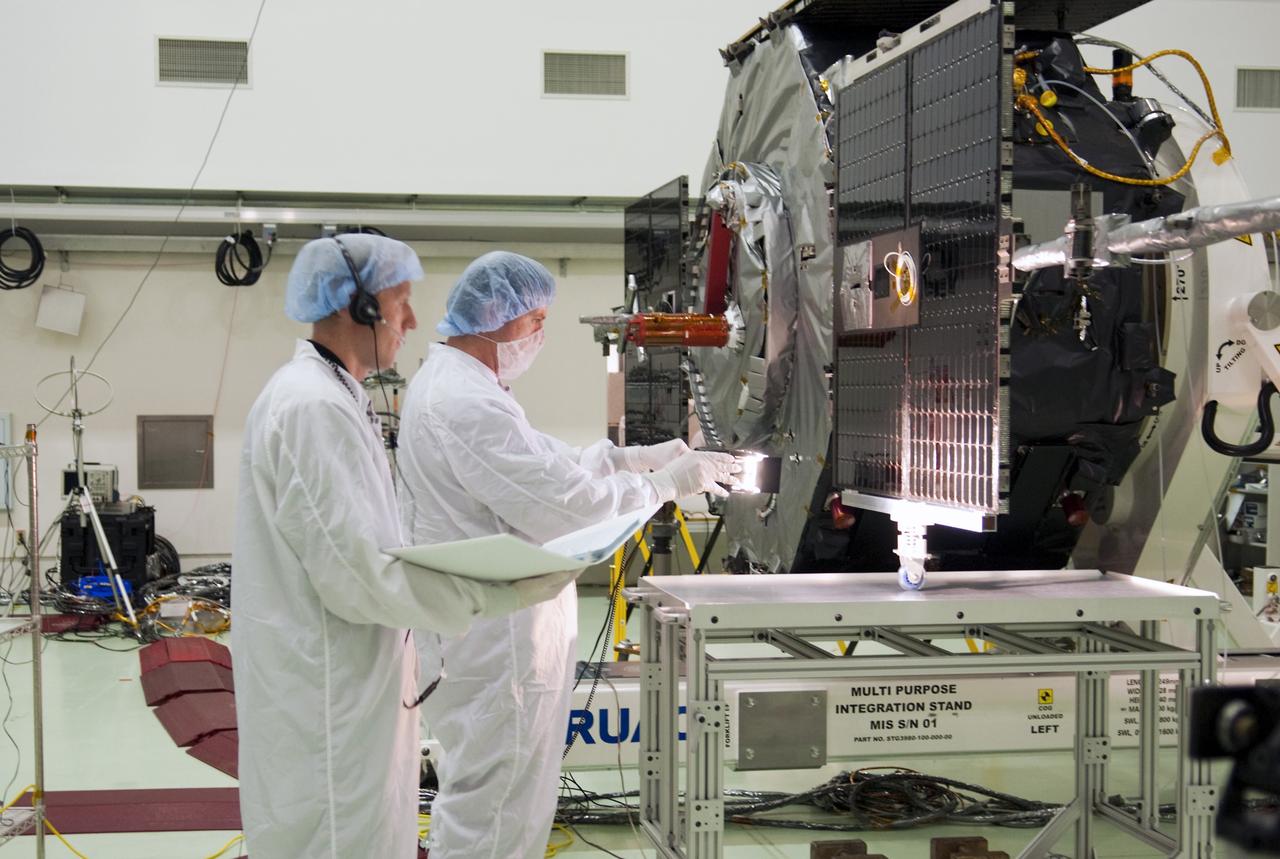
CAPE CANAVERAL, Fla. - Inside the Astrotech payload processing facility near NASA’s Kennedy Space Center in Florida, technicians perform a solar array illumination test after the solar arrays and magnetometer boom were deployed on the Radiation Belt Storm Probes, or RBSP, spacecraft A. Deploying these components are a standard procedure to ensure they work properly on Earth before they head into space. NASA’s RBSP mission will help us understand the sun’s influence on Earth and near-Earth space by studying the Earth’s radiation belts on various scales of space and time. As the spacecraft orbits Earth, the four solar panels will continuously face the sun to provide constant power to its instruments. The boom will provide data of the electric fields that energize radiation particles and modify the structure of the inner magnetosphere. RBSP will begin its mission of exploration of Earth’s Van Allen radiation belts and the extremes of space weather after its launch aboard a United Launch Alliance Atlas V rocket. Launch is targeted for Aug. 23. For more information, visit http://www.nasa.gov/rbsp. Photo credit: NASA/Charisse Nahser
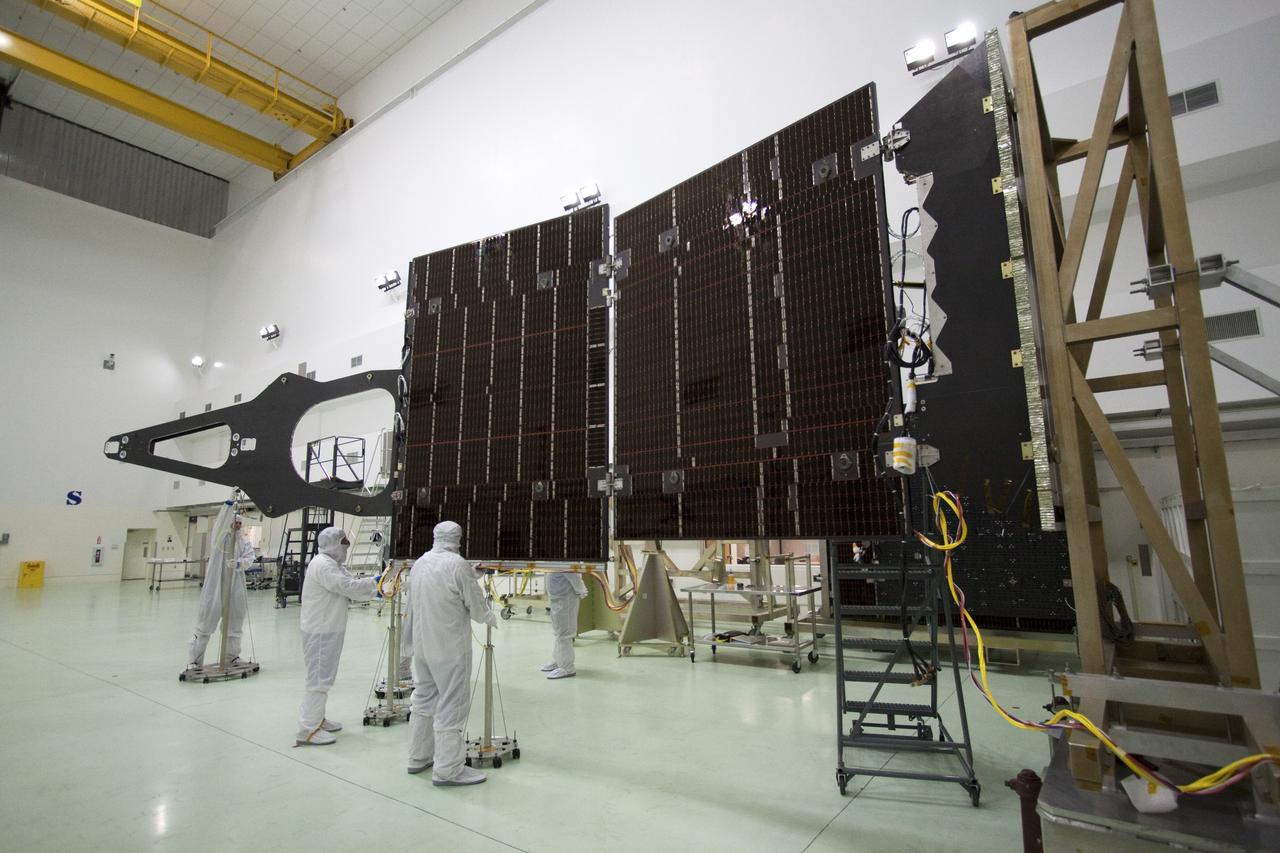
CAPE CANAVERAL, Fla. -- Technicians in the Astrotech payload processing facility in Titusville, Fla., unfurl solar array No. 1 with a magnetometer boom that will help power NASA's Juno spacecraft on a mission to Jupiter. Power-generating panels on three sets of solar arrays will extend outward from Juno’s hexagonal body, giving the overall spacecraft a span of more than 66 feet in order to operate at such a great distance from the sun. Juno is scheduled to launch aboard an Atlas V rocket from Cape Canaveral, Fla., on Aug. 5, 2011, reaching Jupiter in July 2016. The spacecraft will orbit the giant planet more than 30 times, skimming to within 3,000 miles above its cloud tops, for about one year. With its suite of science instruments, the spacecraft will investigate the existence of a solid planetary core, map Jupiter's intense magnetic field, measure the amount of water and ammonia in the deep atmosphere, and observe the planet's auroras. For more information visit, www.nasa.gov/juno. Photo credit: NASA/Jack Pfaller
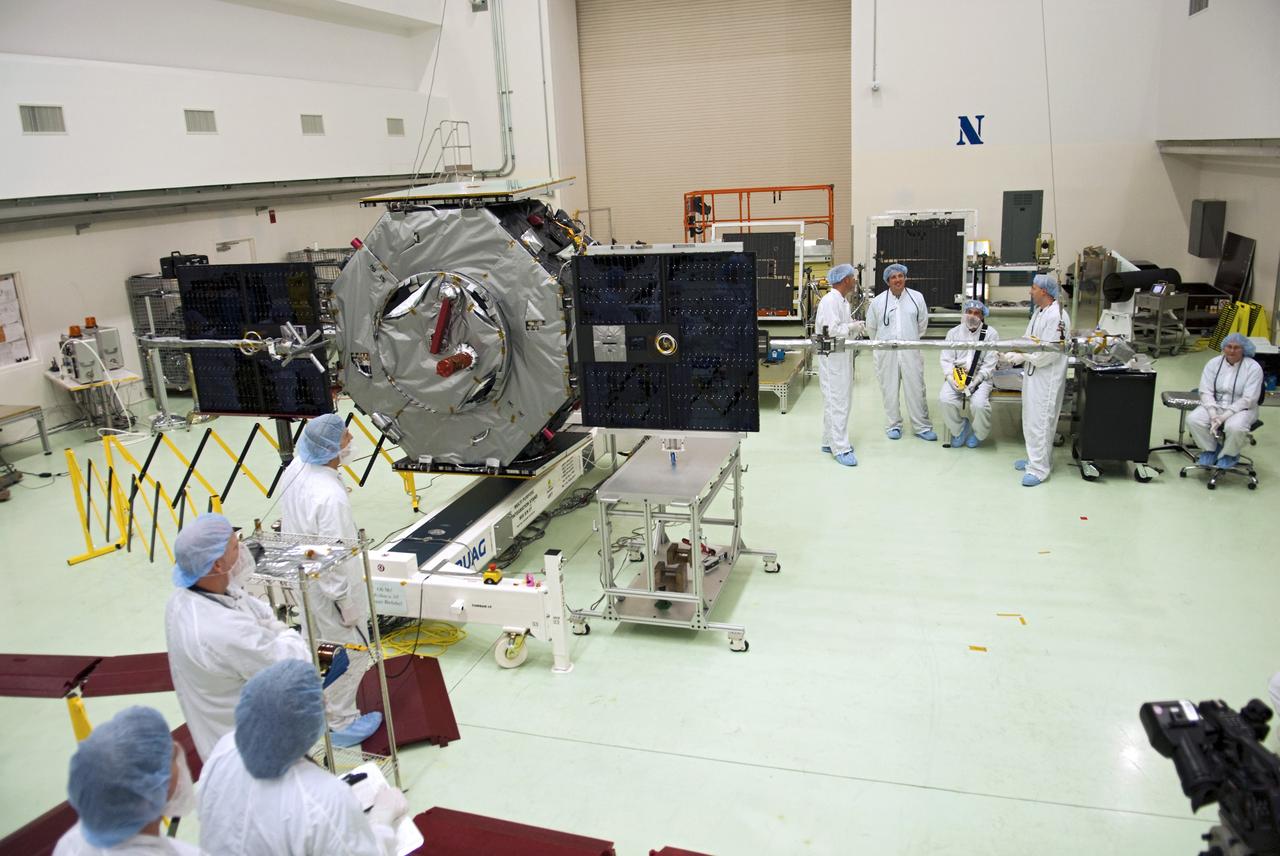
CAPE CANAVERAL, Fla. - Inside the Astrotech payload processing facility near NASA’s Kennedy Space Center in Florida, technicians deploy the solar arrays and magnetometer boom of the Radiation Belt Storm Probes, or RBSP, spacecraft A. Deploying these components is standard procedure to ensure they work properly on Earth before they head into space. NASA’s RBSP mission will help us understand the sun’s influence on Earth and near-Earth space by studying the Earth’s radiation belts on various scales of space and time. As the spacecraft orbits Earth, the four solar panels will continuously face the sun to provide constant power to its instruments. The boom will provide data of the electric fields that energize radiation particles and modify the structure of the inner magnetosphere. RBSP will begin its mission of exploration of Earth’s Van Allen radiation belts and the extremes of space weather after its launch aboard a United Launch Alliance Atlas V rocket. Launch is targeted for Aug. 23. For more information, visit http://www.nasa.gov/rbsp. Photo credit: NASA/Charisse Nahser
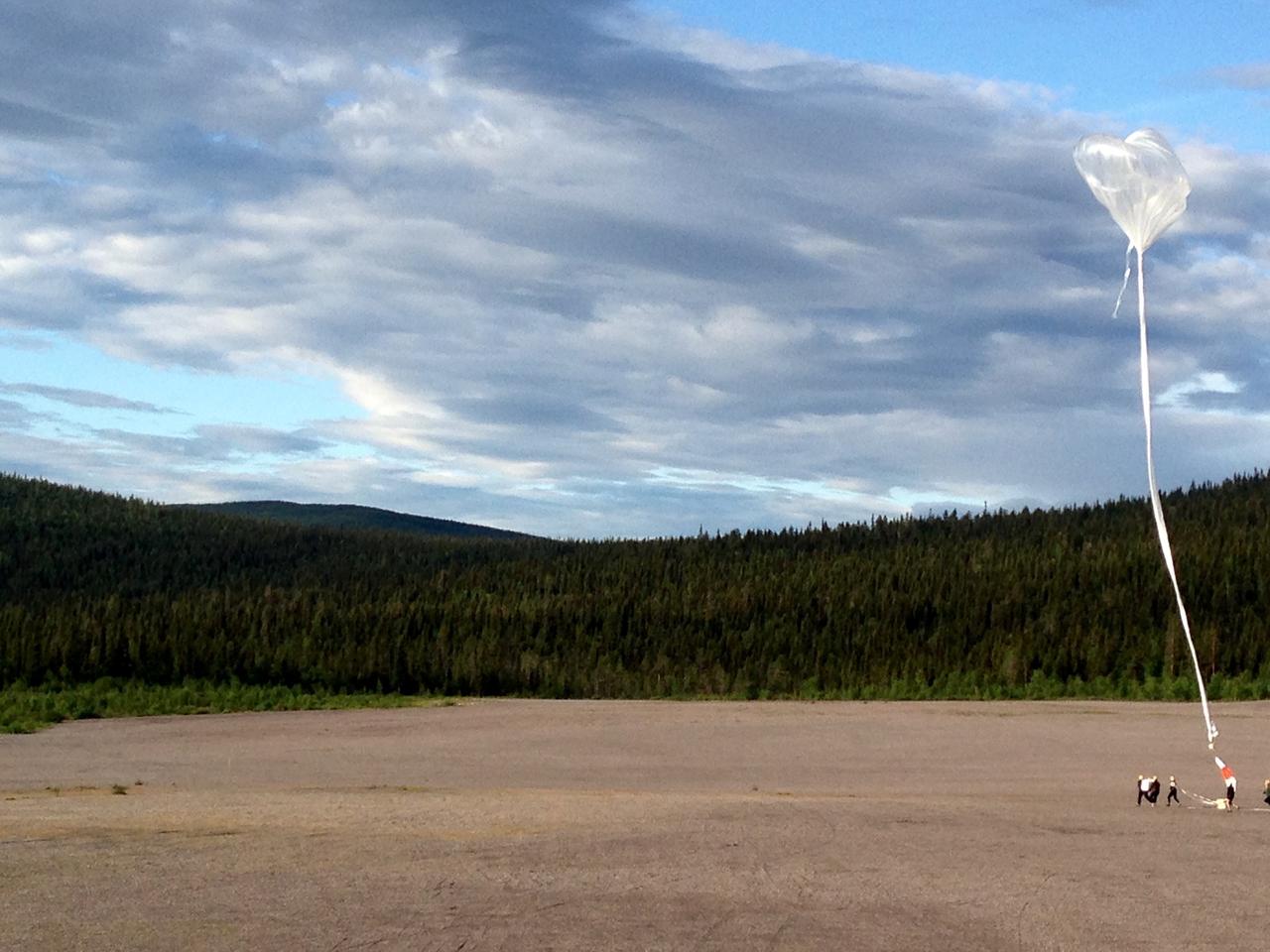
The BARREL team prepares to release the second scientific balloon in its Sweden campaign on Aug. 13, 2015. In addition to the instruments used in previous BARREL campaigns, this second balloon launched from the Esrange Space Center in Kiruna is carrying one of two instruments designed by a team from the University of Houston. With funding from the Undergraduate Student Instrument Program, or USIP, at NASA Goddard Space Flight Center’s Wallops Flight Facility, the team of 12 students, under the direction of Edgar Bering at the University of Houston, developed a magnetometer -- which measures magnetic fields -- and an instrument to measure electrons, which flew on this launch. To collect their data, the University of Houston team needs to recover their instrument after the balloon comes down. After this launch, the balloon began to drift toward the mountains, which would have impeded recovery. So the team terminated the flight at 1:18 pm EDT to bring the payload slowly and safely to the ground. The NASA-funded BARREL – which stands for Balloon Array for Radiation-belt Relativistic Electron Losses – measures electrons in the atmosphere near the poles. Such electrons rain down into the atmosphere from two giant radiation belts surrounding Earth, called the Van Allen belts. For its third campaign, BARREL is launching six balloons from the Esrange Space Center in Kiruna, Sweden. BARREL is led by Dartmouth College in Hanover, New Hampshire. Credit: NASA/University of Houston/Edgar Bering <b><a href="http://www.nasa.gov/audience/formedia/features/MP_Photo_Guidelines.html" rel="nofollow">NASA image use policy.</a></b> <b><a href="http://www.nasa.gov/centers/goddard/home/index.html" rel="nofollow">NASA Goddard Space Flight Center</a></b> enables NASA’s mission through four scientific endeavors: Earth Science, Heliophysics, Solar System Exploration, and Astrophysics. Goddard plays a leading role in NASA’s accomplishments by contributing compelling scientific knowledge to advance the Agency’s mission. <b>Follow us on <a href="http://twitter.com/NASAGoddardPix" rel="nofollow">Twitter</a></b> <b>Like us on <a href="http://www.facebook.com/pages/Greenbelt-MD/NASA-Goddard/395013845897?ref=tsd" rel="nofollow">Facebook</a></b> <b>Find us on <a href="http://instagrid.me/nasagoddard/?vm=grid" rel="nofollow">Instagram</a></b>

Leah Martin, NASA Communications, participates in a social panel on Monday, June 24, 2024, at NASA’s Kennedy Space Center in Florida to discuss National Oceanic and Atmospheric Administration (NOAA) GOES-U (Geostationary Operational Environmental Satellite U) mission. The GOES-U satellite is the final addition to GOES-R series, which serves a critical role in providing continuous coverage of the Western Hemisphere, including monitoring tropical systems in the eastern Pacific and Atlantic oceans. The two-hour launch window opens at 5:16 p.m. EDT Tuesday, June 25, for the satellite’s launch on a SpaceX Falcon Heavy rocket from Launch Complex 39A at NASA’s Kennedy Space Center in Florida.
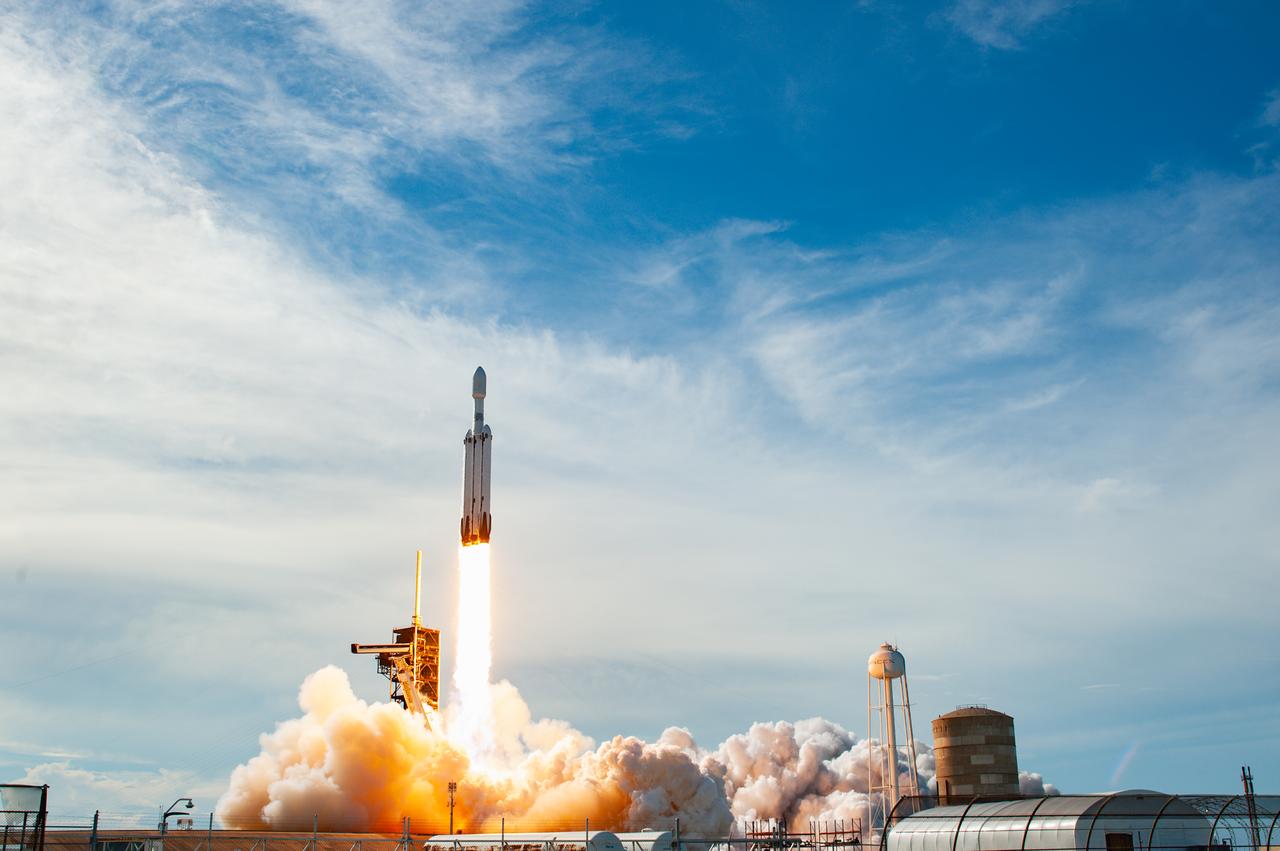
A SpaceX Falcon Heavy rocket carrying the National Oceanic and Atmospheric Administration (NOAA) GOES-U (Geostationary Operational Environmental Satellite U) lifts off from Launch Complex 39A at NASA’s Kennedy Space Center in Florida on Tuesday, June 25, 2024. The GOES-U satellite is the final satellite in the GOES-R series, which serves a critical role in providing continuous coverage of the Western Hemisphere, including monitoring tropical systems in the eastern Pacific and Atlantic oceans.
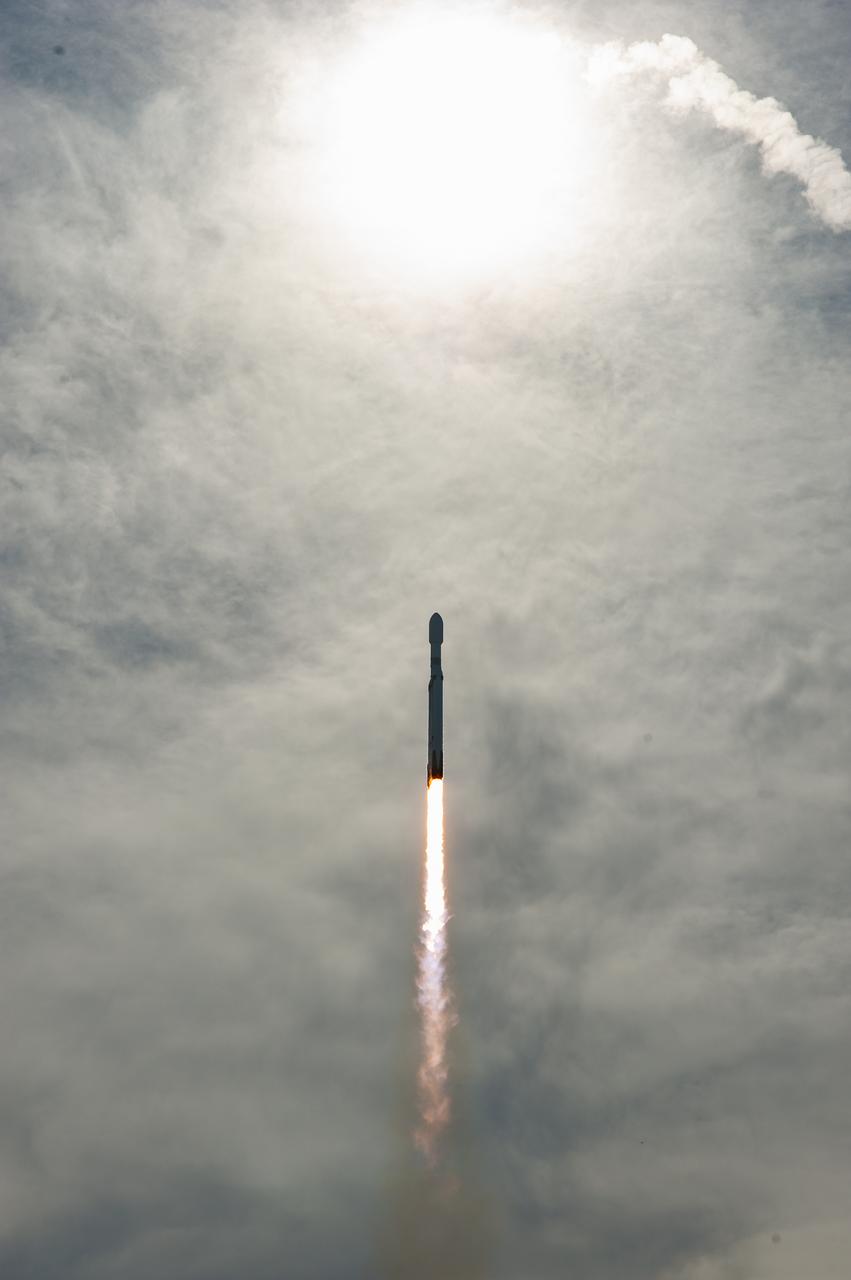
A SpaceX Falcon Heavy rocket carrying the National Oceanic and Atmospheric Administration (NOAA) GOES-U (Geostationary Operational Environmental Satellite U) lifts off from Launch Complex 39A at NASA’s Kennedy Space Center in Florida on Tuesday, June 25, 2024. The GOES-U satellite is the final satellite in the GOES-R series, which serves a critical role in providing continuous coverage of the Western Hemisphere, including monitoring tropical systems in the eastern Pacific and Atlantic oceans.
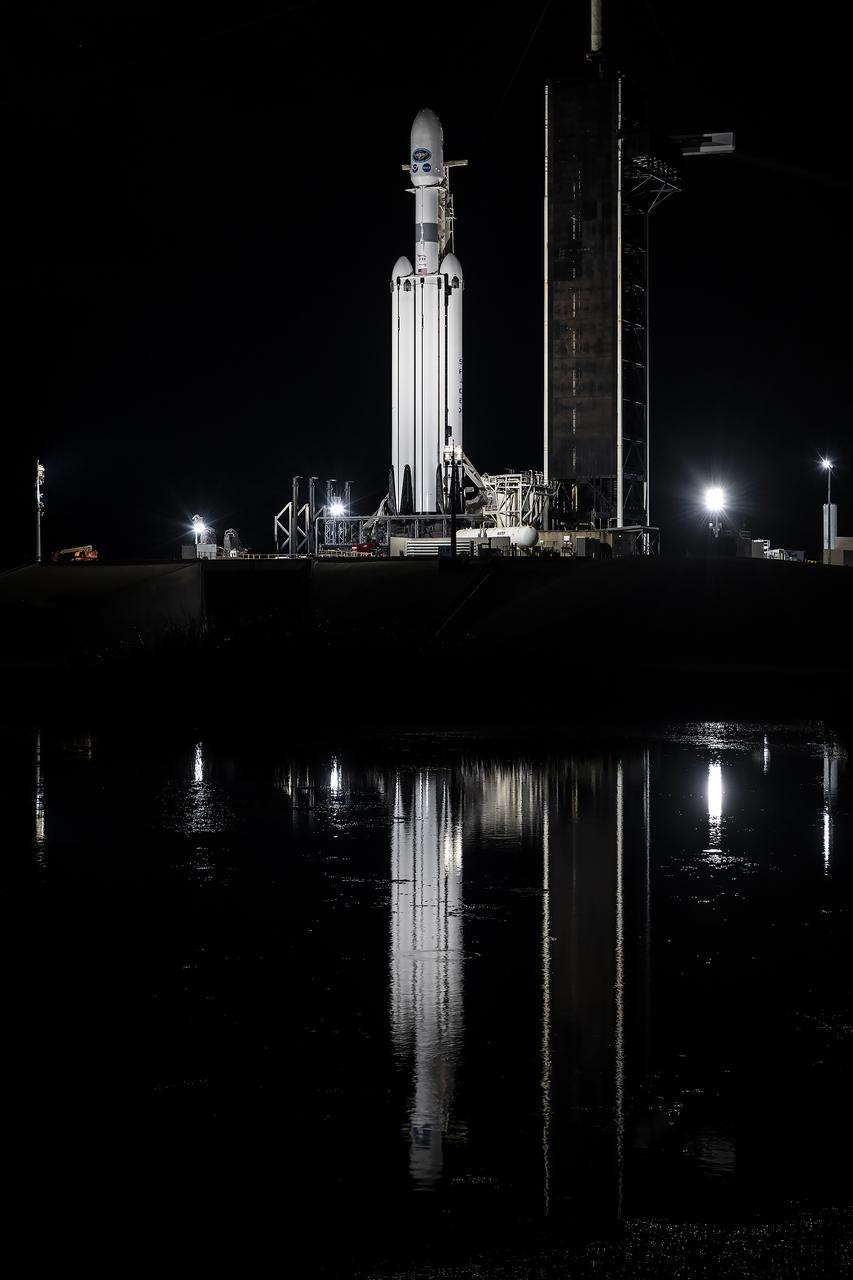
A SpaceX Falcon Heavy rocket carrying the National Oceanic and Atmospheric Administration (NOAA) GOES-U (Geostationary Operational Environmental Satellite U) stands vertical at Launch Complex 39A at NASA’s Kennedy Space Center in Florida on Monday, June 24, 2024. The GOES-U satellite is the final satellite in the GOES-R series, which serves a critical role in providing continuous coverage of the Western Hemisphere, including monitoring tropical systems in the eastern Pacific and Atlantic oceans. The two-hour launch window opens at 5:16 p.m. EDT. on Tuesday, June 25, 2024.
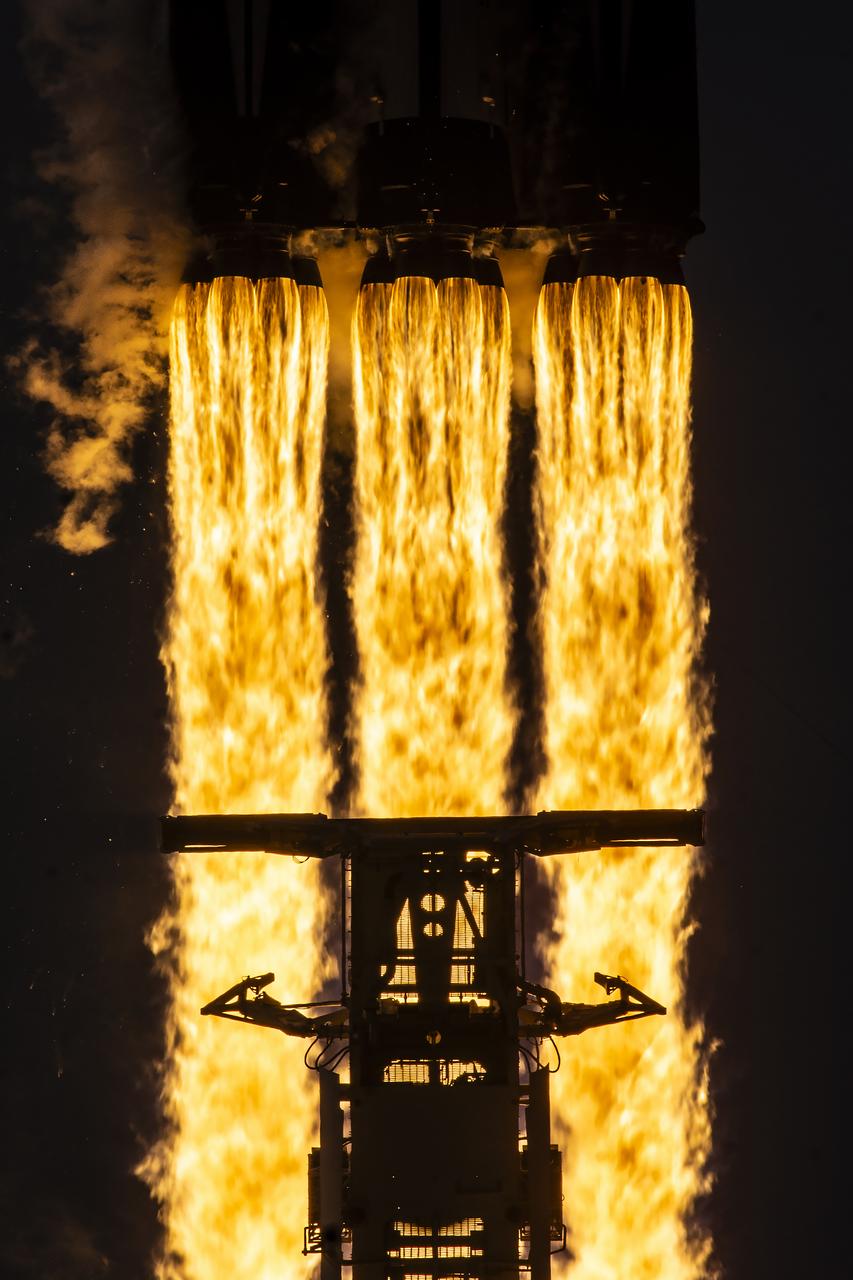
A SpaceX Falcon Heavy rocket carrying the National Oceanic and Atmospheric Administration (NOAA) GOES-U (Geostationary Operational Environmental Satellite U) lifts off from Launch Complex 39A at NASA’s Kennedy Space Center in Florida on Tuesday, June 25, 2024. The GOES-U satellite is the final satellite in the GOES-R series, which serves a critical role in providing continuous coverage of the Western Hemisphere, including monitoring tropical systems in the eastern Pacific and Atlantic oceans.
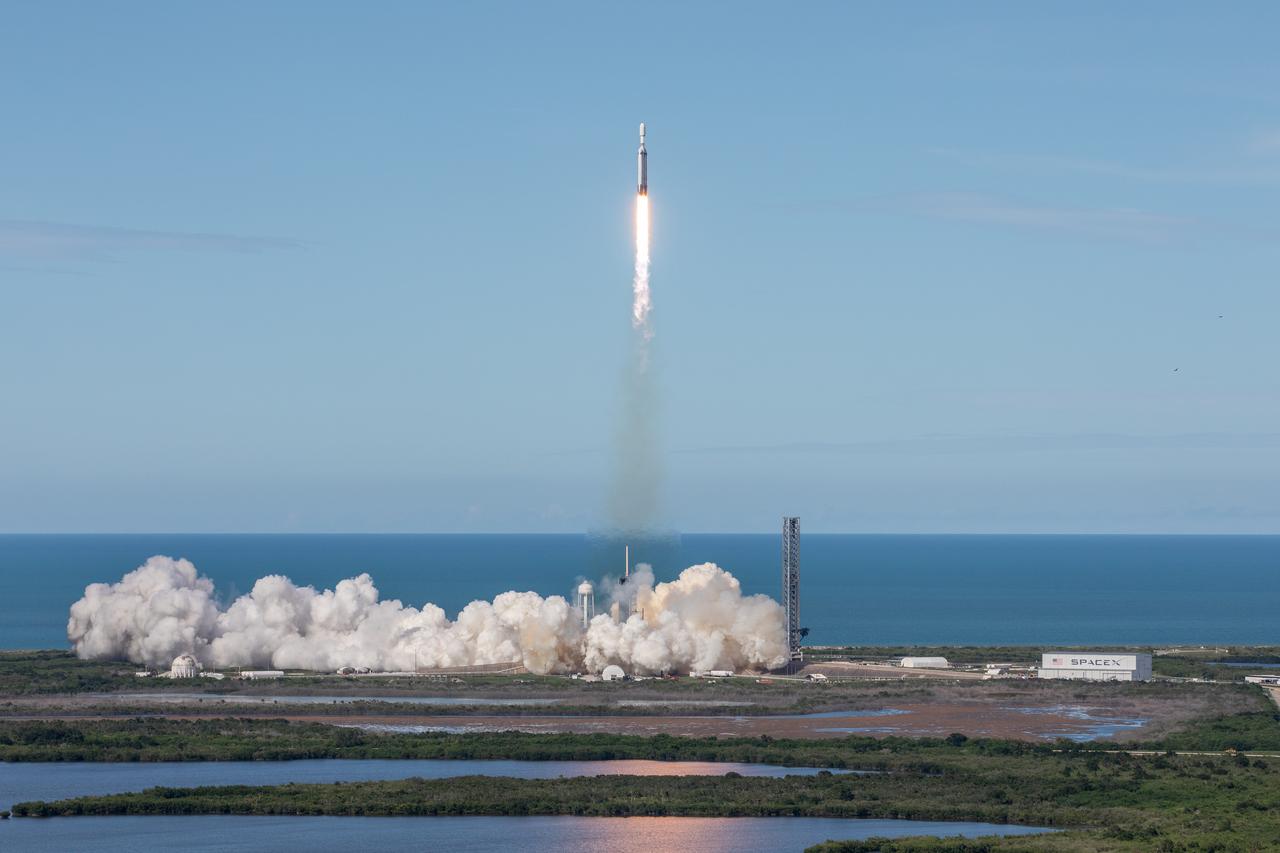
A SpaceX Falcon Heavy rocket carrying the National Oceanic and Atmospheric Administration (NOAA) GOES-U (Geostationary Operational Environmental Satellite U) lifts off from Launch Complex 39A at NASA’s Kennedy Space Center in Florida on Tuesday, June 25, 2024. The GOES-U satellite is the final satellite in the GOES-R series, which serves a critical role in providing continuous coverage of the Western Hemisphere, including monitoring tropical systems in the eastern Pacific and Atlantic oceans.

Allana Nepomuceno, senior manager, GOES-U Assembly, Test, and Launch Operations, Lockheed Martin, participates in a social panel on Monday, June 24, 2024, at NASA’s Kennedy Space Center in Florida to discuss National Oceanic and Atmospheric Administration (NOAA) GOES-U (Geostationary Operational Environmental Satellite U) mission. The GOES-U satellite is the final addition to GOES-R series, which serves a critical role in providing continuous coverage of the Western Hemisphere, including monitoring tropical systems in the eastern Pacific and Atlantic oceans. The two-hour launch window opens at 5:16 p.m. EDT Tuesday, June 25, for the satellite’s launch on a SpaceX Falcon Heavy rocket from Launch Complex 39A at NASA’s Kennedy Space Center in Florida.
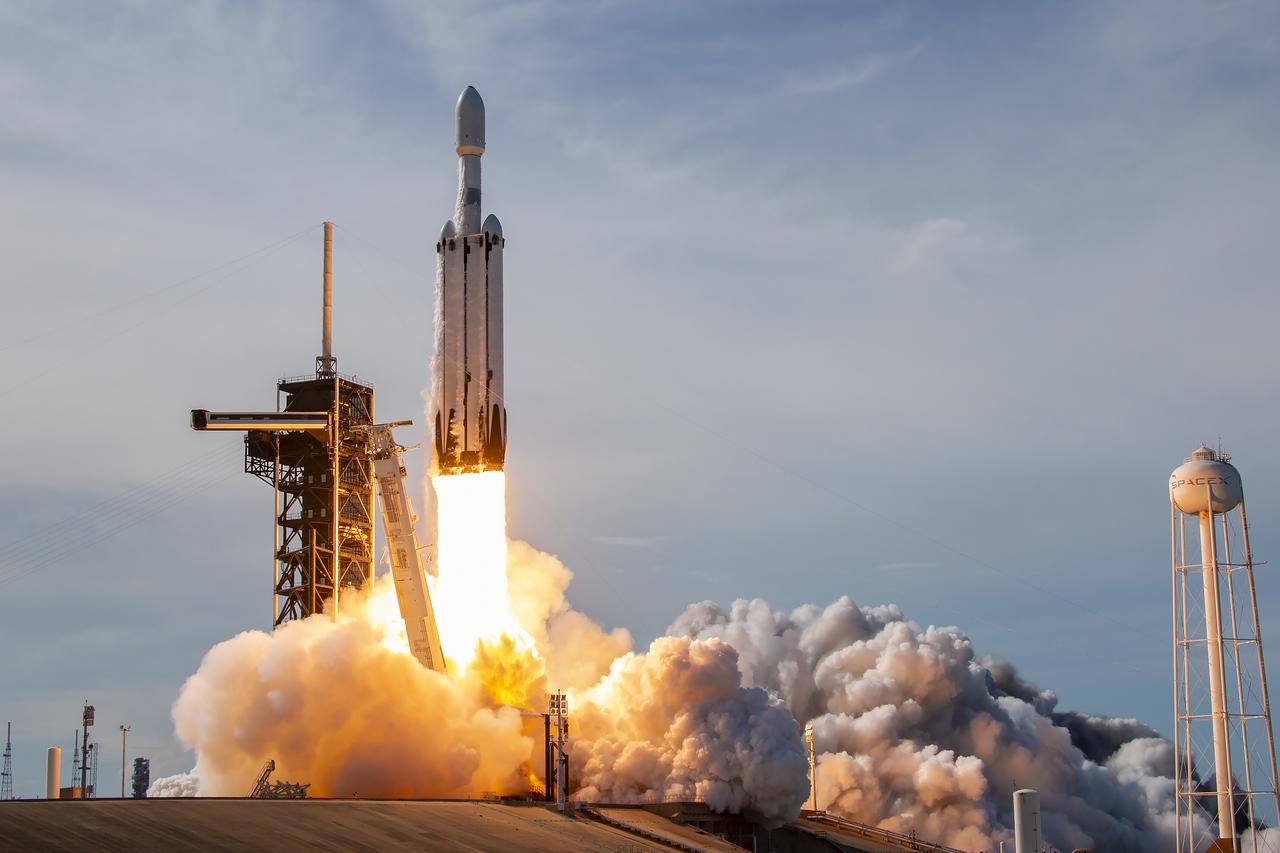
A SpaceX Falcon Heavy rocket carrying the National Oceanic and Atmospheric Administration (NOAA) GOES-U (Geostationary Operational Environmental Satellite U) lifts off from Launch Complex 39A at NASA’s Kennedy Space Center in Florida on Tuesday, June 25, 2024. The GOES-U satellite is the final satellite in the GOES-R series, which serves a critical role in providing continuous coverage of the Western Hemisphere, including monitoring tropical systems in the eastern Pacific and Atlantic oceans.
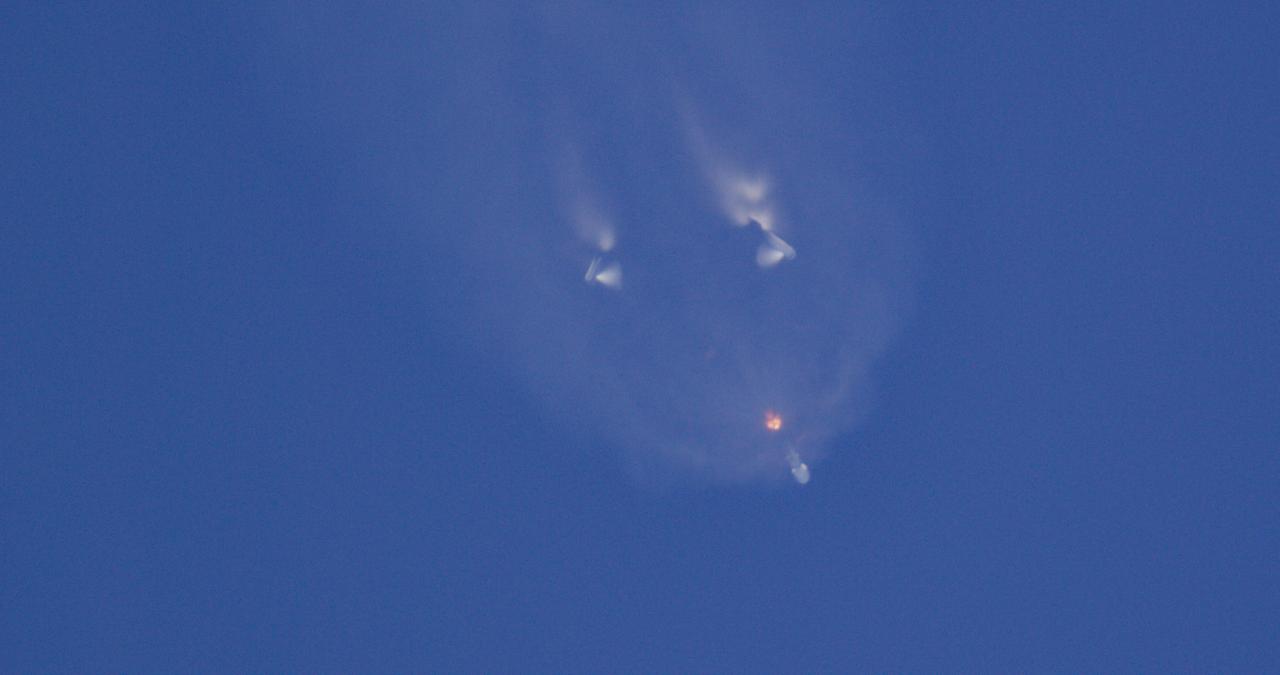
Side boosters separate from the center core on the SpaceX Falcon Heavy rocket carrying the National Oceanic and Atmospheric Administration (NOAA) GOES-U (Geostationary Operational Environmental Satellite U) after it lifts off from Launch Complex 39A at NASA’s Kennedy Space Center in Florida on Tuesday, June 25, 2024. The GOES-U satellite is the final satellite in the GOES-R series, which serves a critical role in providing continuous coverage of the Western Hemisphere, including monitoring tropical systems in the eastern Pacific and Atlantic oceans.
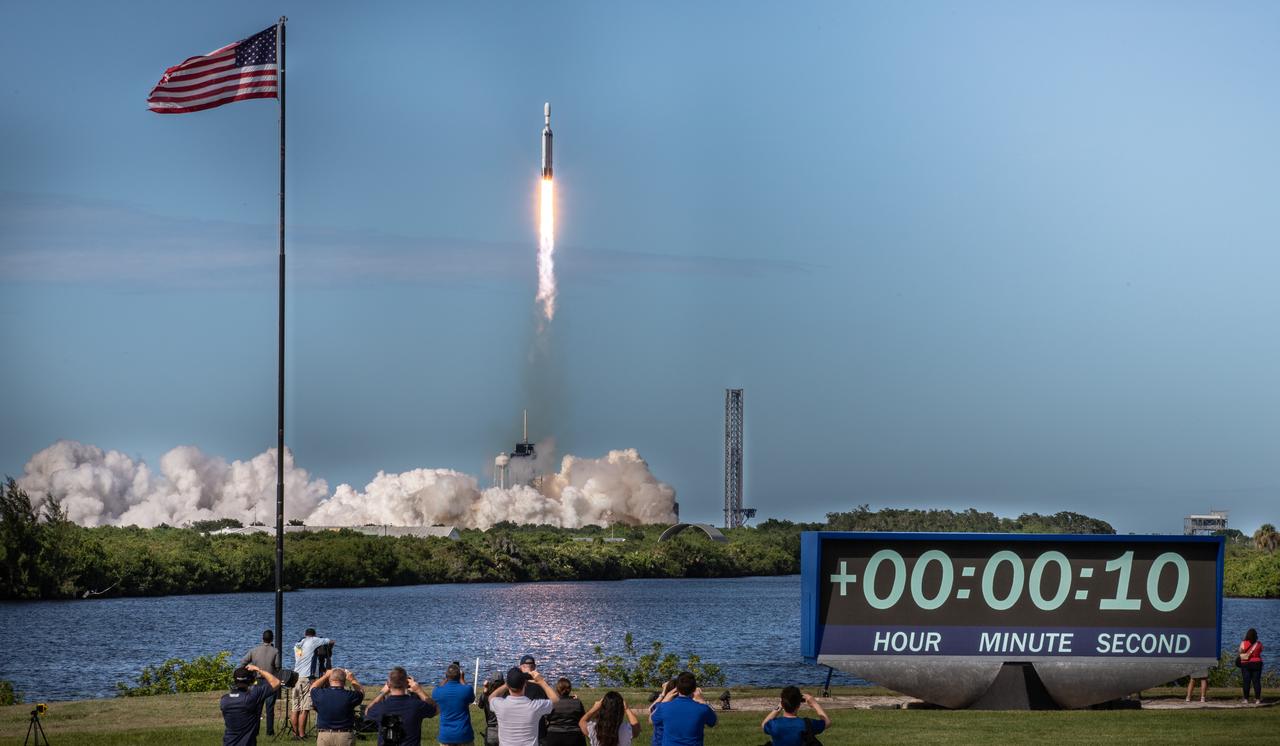
A SpaceX Falcon Heavy rocket carrying the National Oceanic and Atmospheric Administration (NOAA) GOES-U (Geostationary Operational Environmental Satellite U) lifts off from Launch Complex 39A at NASA’s Kennedy Space Center in Florida on Tuesday, June 25, 2024. The GOES-U satellite is the final satellite in the GOES-R series, which serves a critical role in providing continuous coverage of the Western Hemisphere, including monitoring tropical systems in the eastern Pacific and Atlantic oceans.
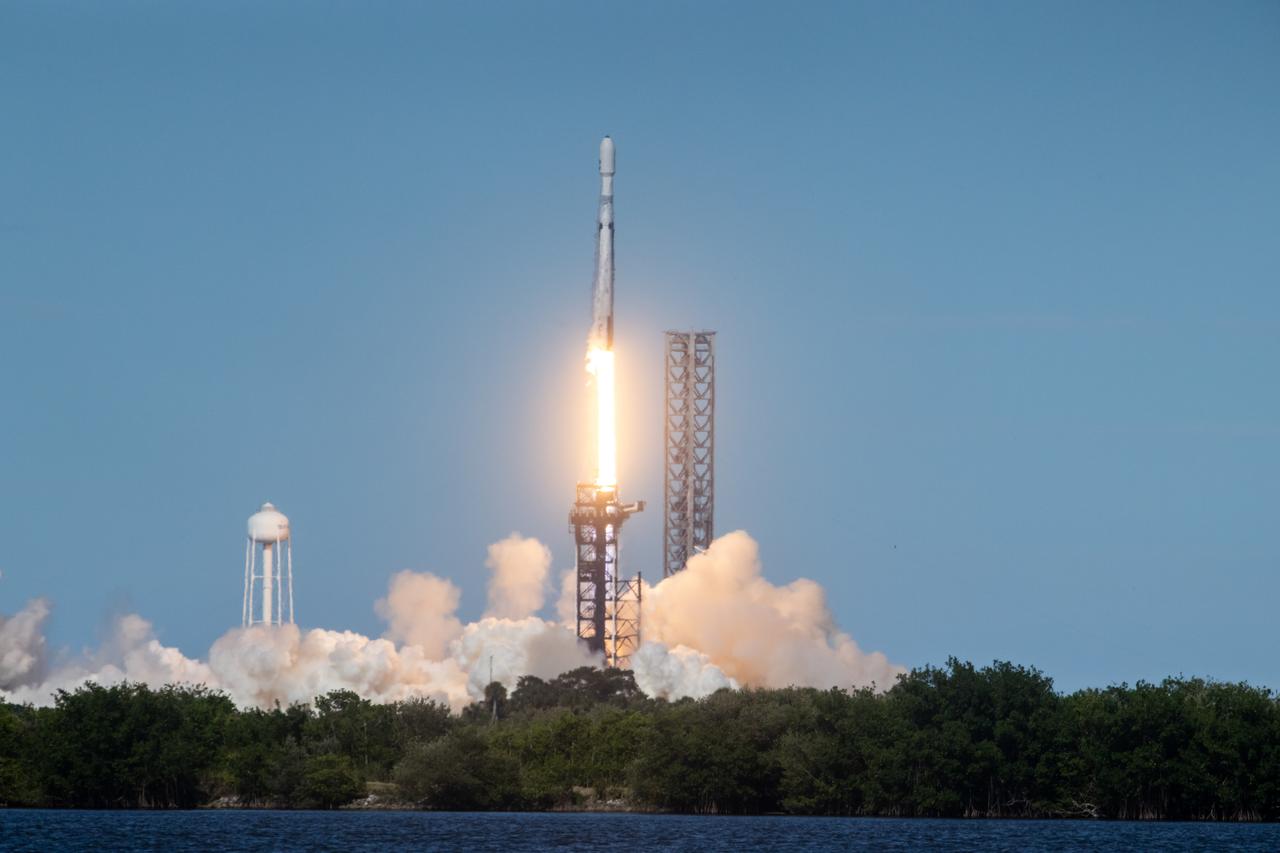
A SpaceX Falcon Heavy rocket carrying the National Oceanic and Atmospheric Administration (NOAA) GOES-U (Geostationary Operational Environmental Satellite U) lifts off from Launch Complex 39A at NASA’s Kennedy Space Center in Florida on Tuesday, June 25, 2024. The GOES-U satellite is the final satellite in the GOES-R series, which serves a critical role in providing continuous coverage of the Western Hemisphere, including monitoring tropical systems in the eastern Pacific and Atlantic oceans.

Brian Cizek, launch weather officer, 45th Weather Squadron, U.S. Space Force, participates in a prelaunch news conference on Monday, June 24, 2024, at NASA’s Kennedy Space Center in Florida to discuss National Oceanic and Atmospheric Administration (NOAA) GOES-U (Geostationary Operational Environmental Satellite U) mission. The GOES-U satellite is the final addition to GOES-R series, which serves a critical role in providing continuous coverage of the Western Hemisphere, including monitoring tropical systems in the eastern Pacific and Atlantic oceans. The two-hour launch window opens at 5:16 p.m. EDT Tuesday, June 25, for the satellite’s launch on a SpaceX Falcon Heavy rocket from Launch Complex 39A at NASA’s Kennedy Space Center in Florida.
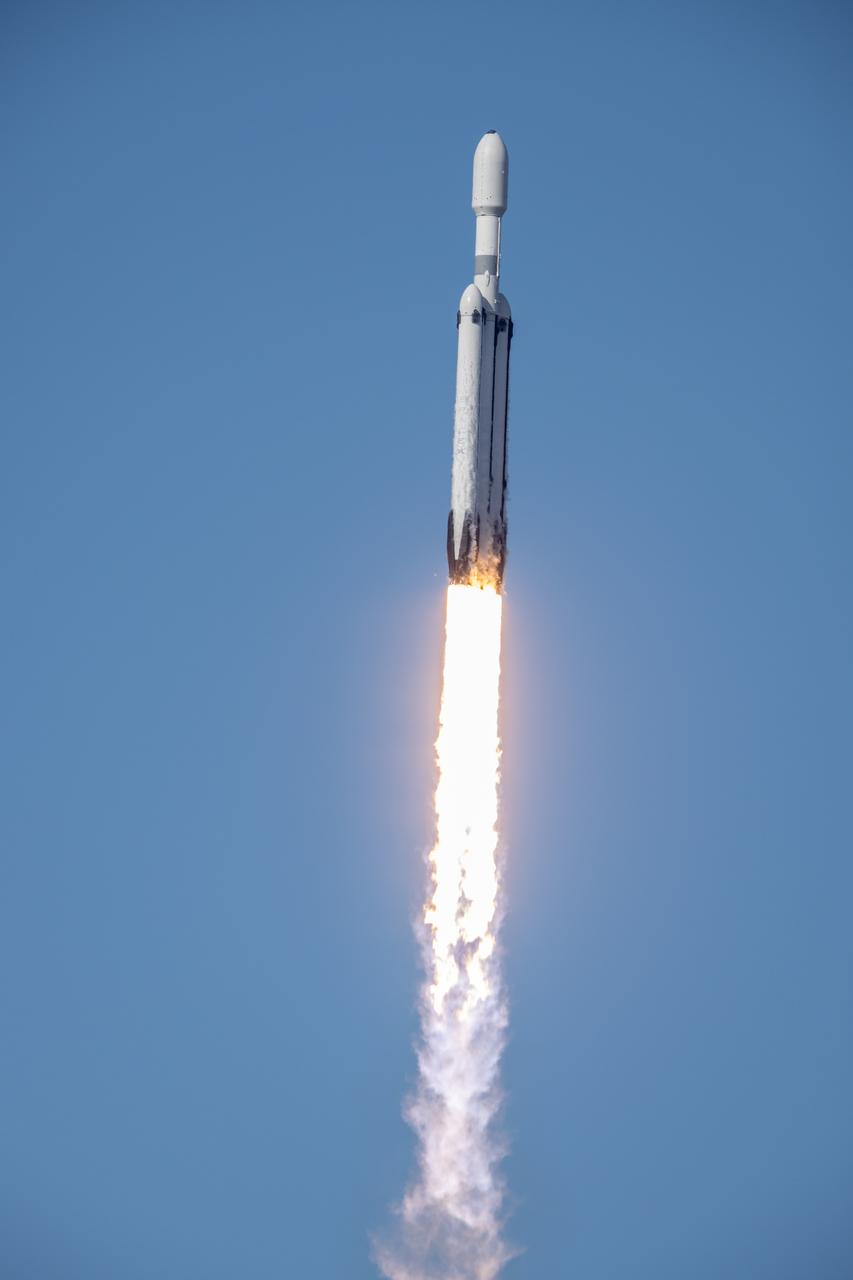
A SpaceX Falcon Heavy rocket carrying the National Oceanic and Atmospheric Administration (NOAA) GOES-U (Geostationary Operational Environmental Satellite U) lifts off from Launch Complex 39A at NASA’s Kennedy Space Center in Florida on Tuesday, June 25, 2024. The GOES-U satellite is the final satellite in the GOES-R series, which serves a critical role in providing continuous coverage of the Western Hemisphere, including monitoring tropical systems in the eastern Pacific and Atlantic oceans.
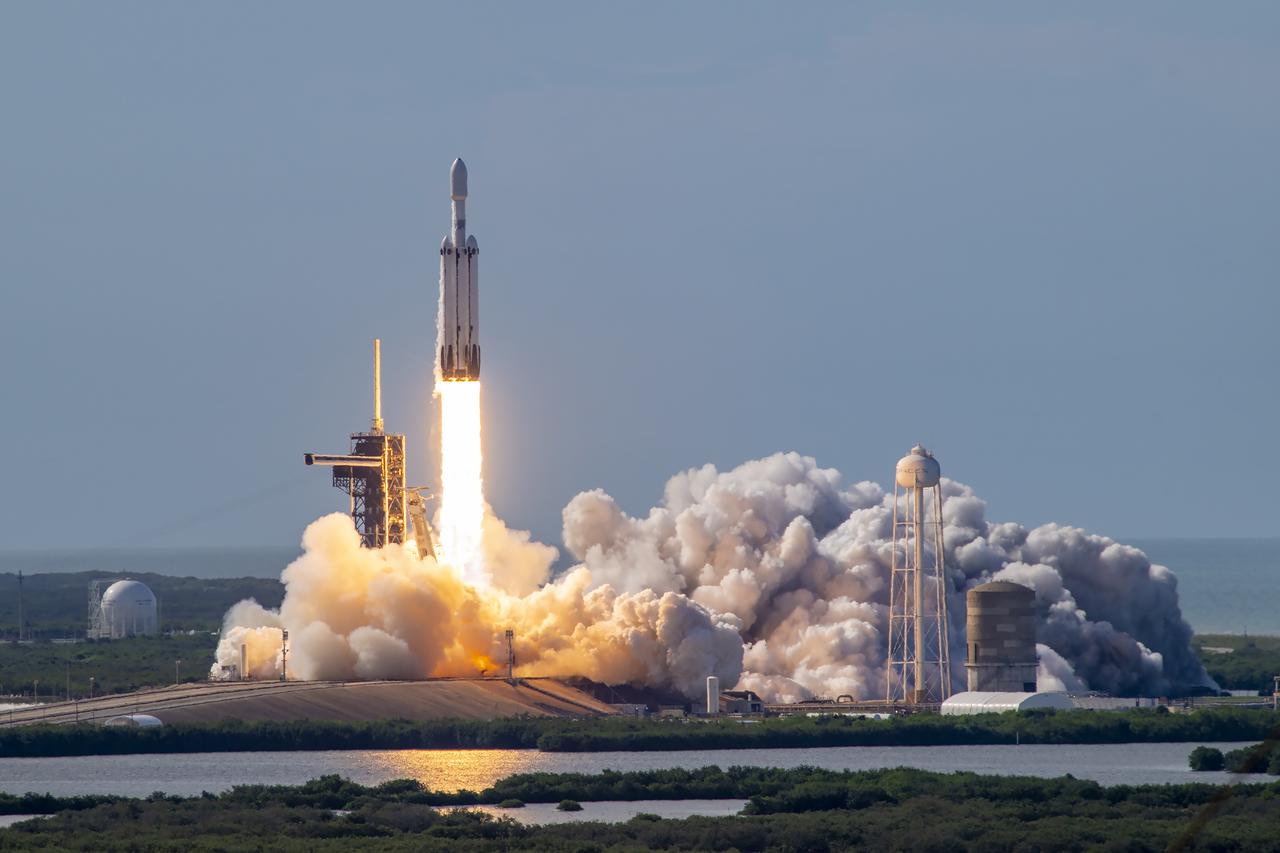
A SpaceX Falcon Heavy rocket carrying the National Oceanic and Atmospheric Administration (NOAA) GOES-U (Geostationary Operational Environmental Satellite U) lifts off from Launch Complex 39A at NASA’s Kennedy Space Center in Florida on Tuesday, June 25, 2024. The GOES-U satellite is the final satellite in the GOES-R series, which serves a critical role in providing continuous coverage of the Western Hemisphere, including monitoring tropical systems in the eastern Pacific and Atlantic oceans.
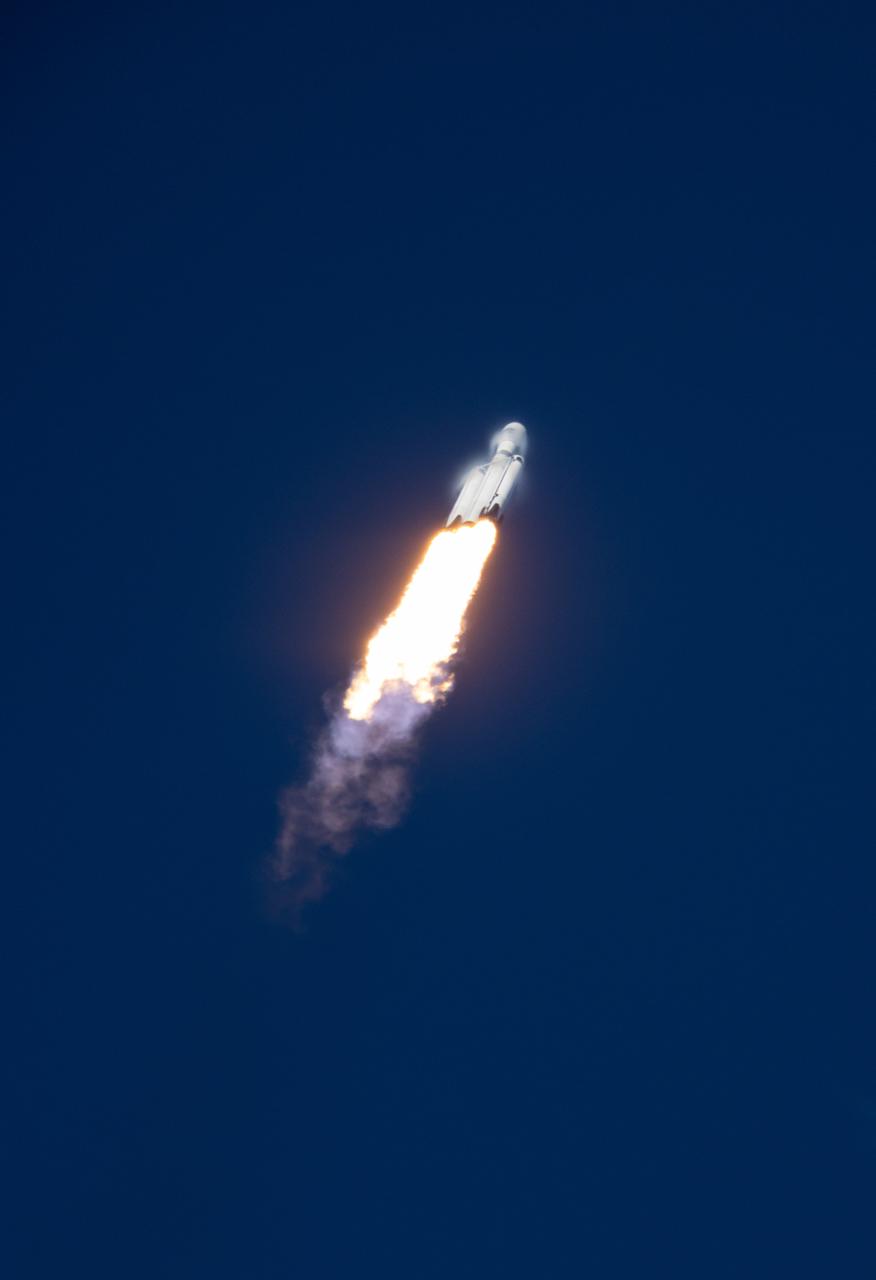
A SpaceX Falcon Heavy rocket carrying the National Oceanic and Atmospheric Administration (NOAA) GOES-U (Geostationary Operational Environmental Satellite U) launches from Launch Complex 39A at NASA’s Kennedy Space Center in Florida on Tuesday, June 25, 2024. The GOES-U satellite is the final satellite in the GOES-R series, which serves a critical role in providing continuous coverage of the Western Hemisphere, including monitoring tropical systems in the eastern Pacific and Atlantic oceans.

Steve Volz, assistant administrator, NOAA’s Satellite and Information Service, participates in a prelaunch news conference on Monday, June 24, 2024, at NASA’s Kennedy Space Center in Florida to discuss National Oceanic and Atmospheric Administration (NOAA) GOES-U (Geostationary Operational Environmental Satellite U) mission. The GOES-U satellite is the final addition to GOES-R series, which serves a critical role in providing continuous coverage of the Western Hemisphere, including monitoring tropical systems in the eastern Pacific and Atlantic oceans. The two-hour launch window opens at 5:16 p.m. EDT Tuesday, June 25, for the satellite’s launch on a SpaceX Falcon Heavy rocket from Launch Complex 39A at NASA’s Kennedy Space Center in Florida.
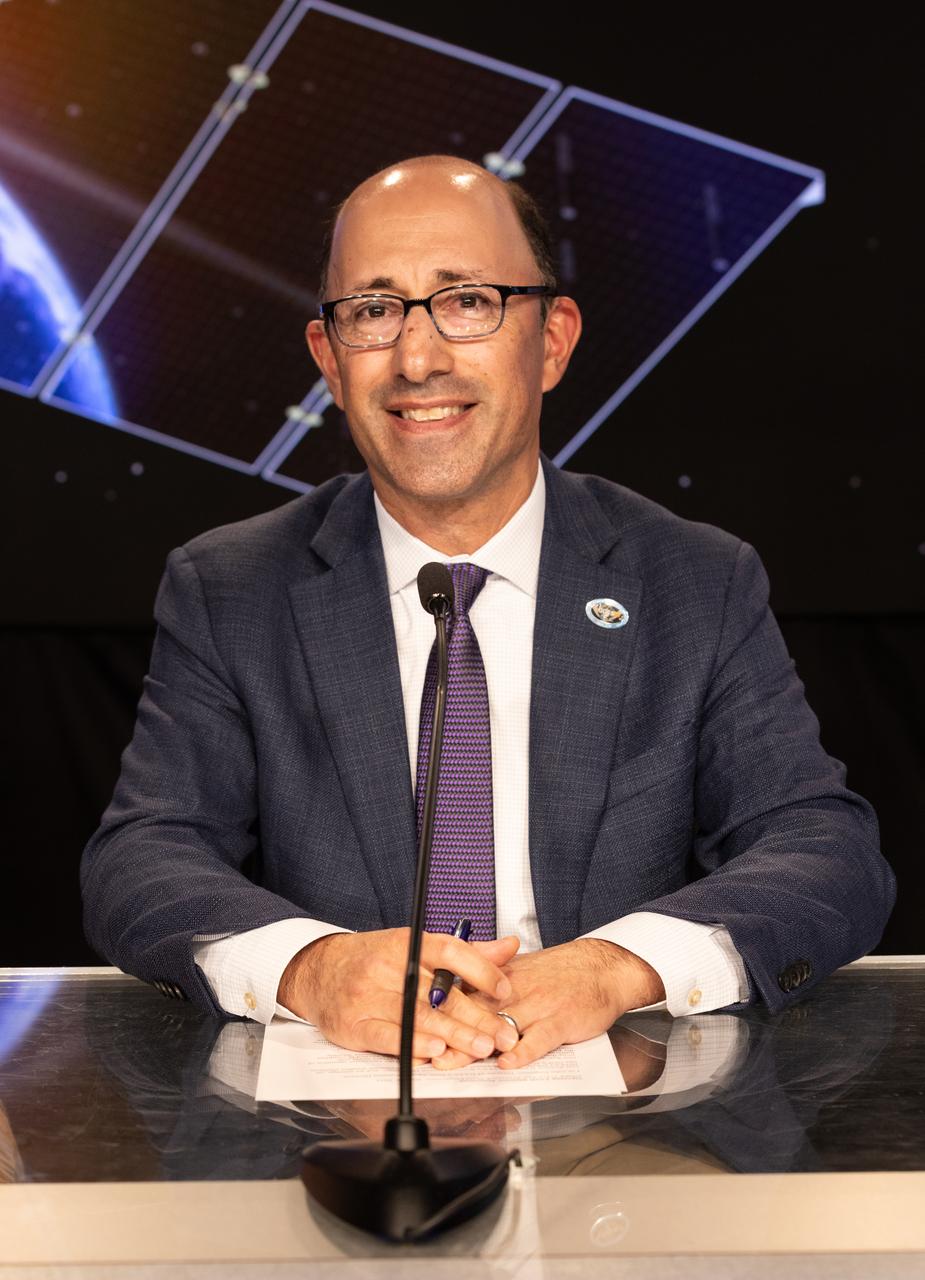
John Gagosian, director, Joint Agency Satellite Division, participates in a prelaunch news conference on Monday, June 24, 2024, at NASA’s Kennedy Space Center in Florida to discuss National Oceanic and Atmospheric Administration (NOAA) GOES-U (Geostationary Operational Environmental Satellite U) mission. The GOES-U satellite is the final addition to GOES-R series, which serves a critical role in providing continuous coverage of the Western Hemisphere, including monitoring tropical systems in the eastern Pacific and Atlantic oceans. The two-hour launch window opens at 5:16 p.m. EDT Tuesday, June 25, for the satellite’s launch on a SpaceX Falcon Heavy rocket from Launch Complex 39A at NASA’s Kennedy Space Center in Florida.
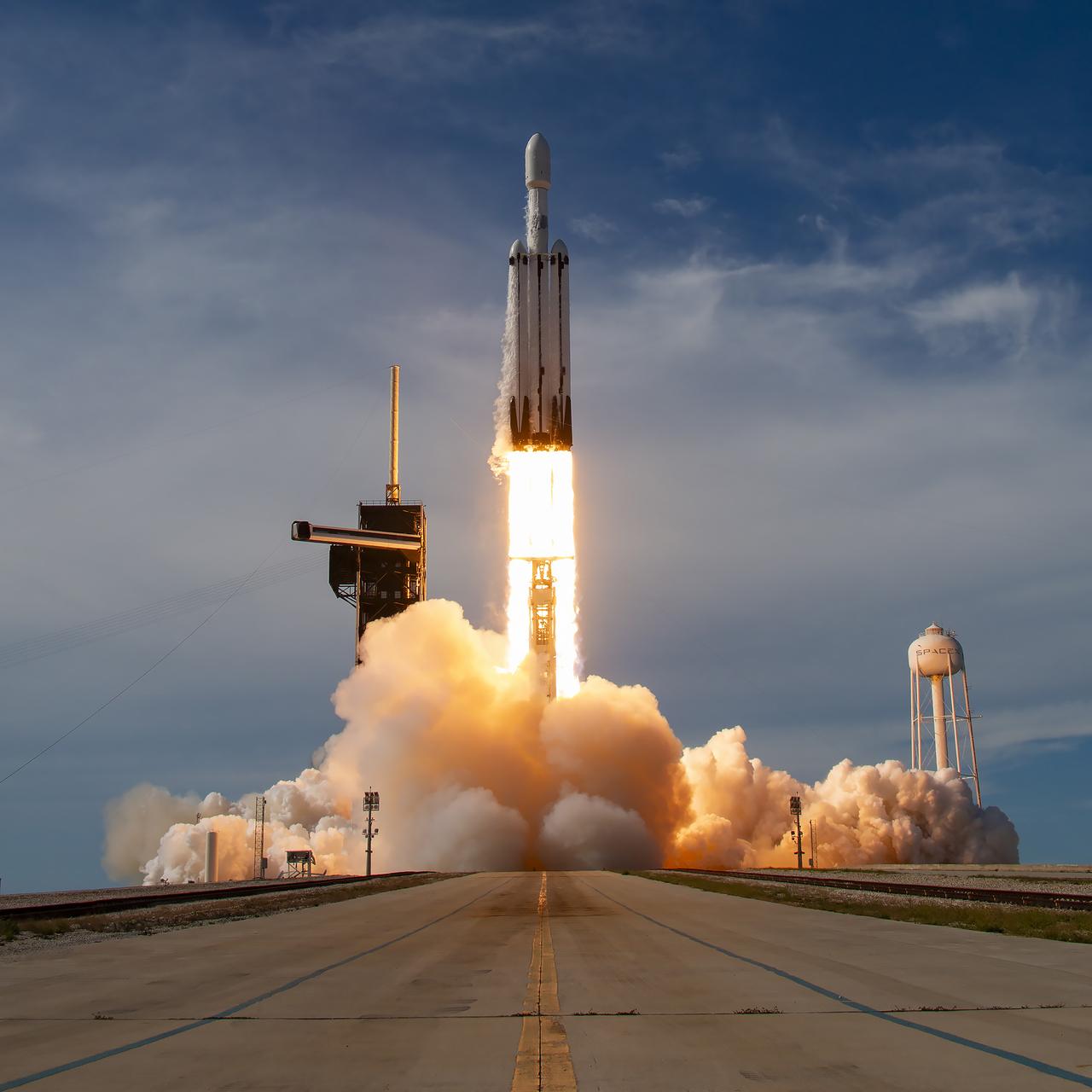
A SpaceX Falcon Heavy rocket carrying the National Oceanic and Atmospheric Administration (NOAA) GOES-U (Geostationary Operational Environmental Satellite U) lifts off from Launch Complex 39A at NASA’s Kennedy Space Center in Florida on Tuesday, June 25, 2024. The GOES-U satellite is the final satellite in the GOES-R series, which serves a critical role in providing continuous coverage of the Western Hemisphere, including monitoring tropical systems in the eastern Pacific and Atlantic oceans.

A SpaceX Falcon Heavy rocket carrying the National Oceanic and Atmospheric Administration (NOAA) GOES-U (Geostationary Operational Environmental Satellite U) lifts off from Launch Complex 39A at NASA’s Kennedy Space Center in Florida on Tuesday, June 25, 2024. The GOES-U satellite is the final satellite in the GOES-R series, which serves a critical role in providing continuous coverage of the Western Hemisphere, including monitoring tropical systems in the eastern Pacific and Atlantic oceans.
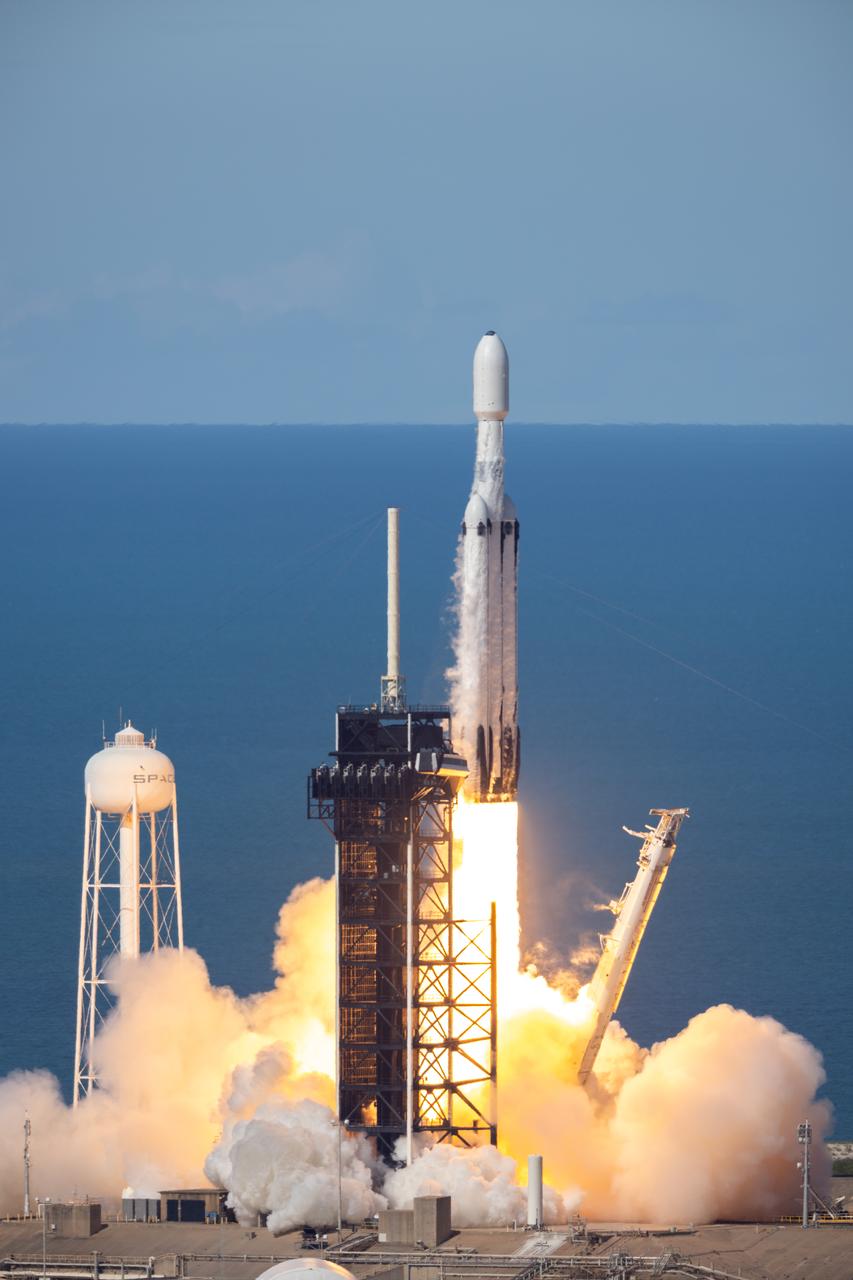
A SpaceX Falcon Heavy rocket carrying the National Oceanic and Atmospheric Administration (NOAA) GOES-U (Geostationary Operational Environmental Satellite U) lifts off from Launch Complex 39A at NASA’s Kennedy Space Center in Florida on Tuesday, June 25, 2024. The GOES-U satellite is the final satellite in the GOES-R series, which serves a critical role in providing continuous coverage of the Western Hemisphere, including monitoring tropical systems in the eastern Pacific and Atlantic oceans.
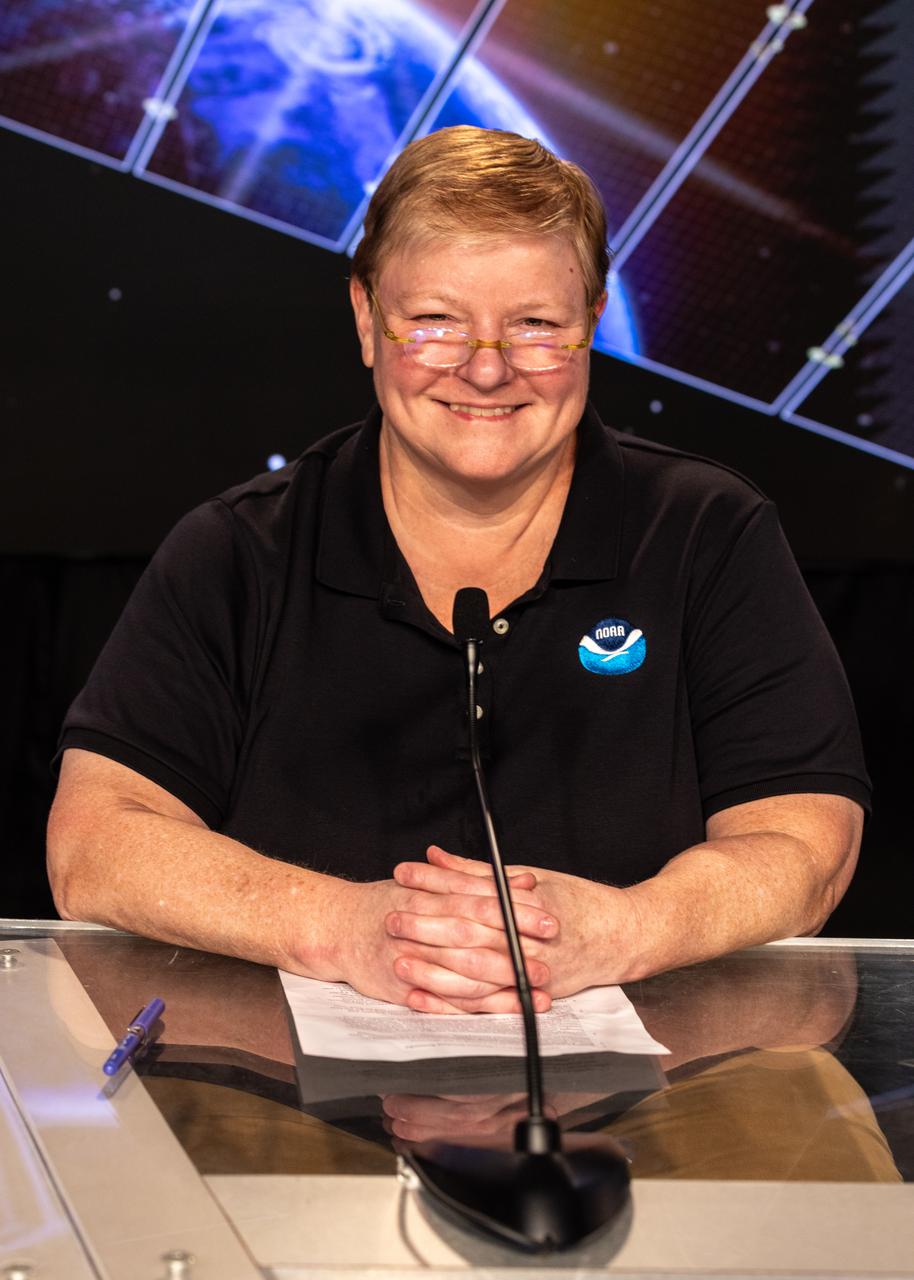
Pam Sullivan, director, GOES-R Program, NOAA, participates in a prelaunch news conference on Monday, June 24, 2024, at NASA’s Kennedy Space Center in Florida to discuss National Oceanic and Atmospheric Administration (NOAA) GOES-U (Geostationary Operational Environmental Satellite U) mission. The GOES-U satellite is the final addition to GOES-R series, which serves a critical role in providing continuous coverage of the Western Hemisphere, including monitoring tropical systems in the eastern Pacific and Atlantic oceans. The two-hour launch window opens at 5:16 p.m. EDT Tuesday, June 25, for the satellite’s launch on a SpaceX Falcon Heavy rocket from Launch Complex 39A at NASA’s Kennedy Space Center in Florida.
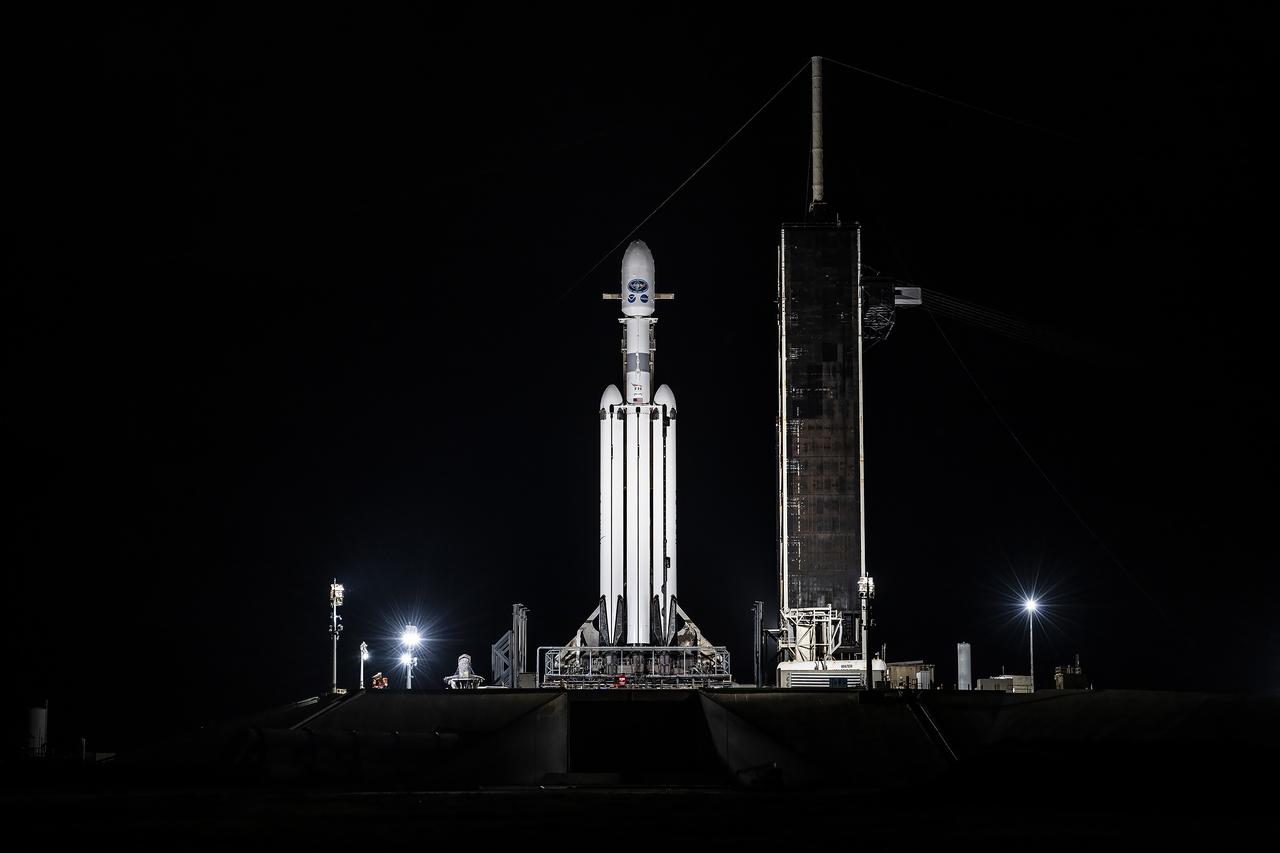
A SpaceX Falcon Heavy rocket carrying the National Oceanic and Atmospheric Administration (NOAA) GOES-U (Geostationary Operational Environmental Satellite U) stands vertical at Launch Complex 39A at NASA’s Kennedy Space Center in Florida on Monday, June 24, 2024. The GOES-U satellite is the final satellite in the GOES-R series, which serves a critical role in providing continuous coverage of the Western Hemisphere, including monitoring tropical systems in the eastern Pacific and Atlantic oceans. The two-hour launch window opens at 5:16 p.m. EDT. on Tuesday, June 25, 2024.
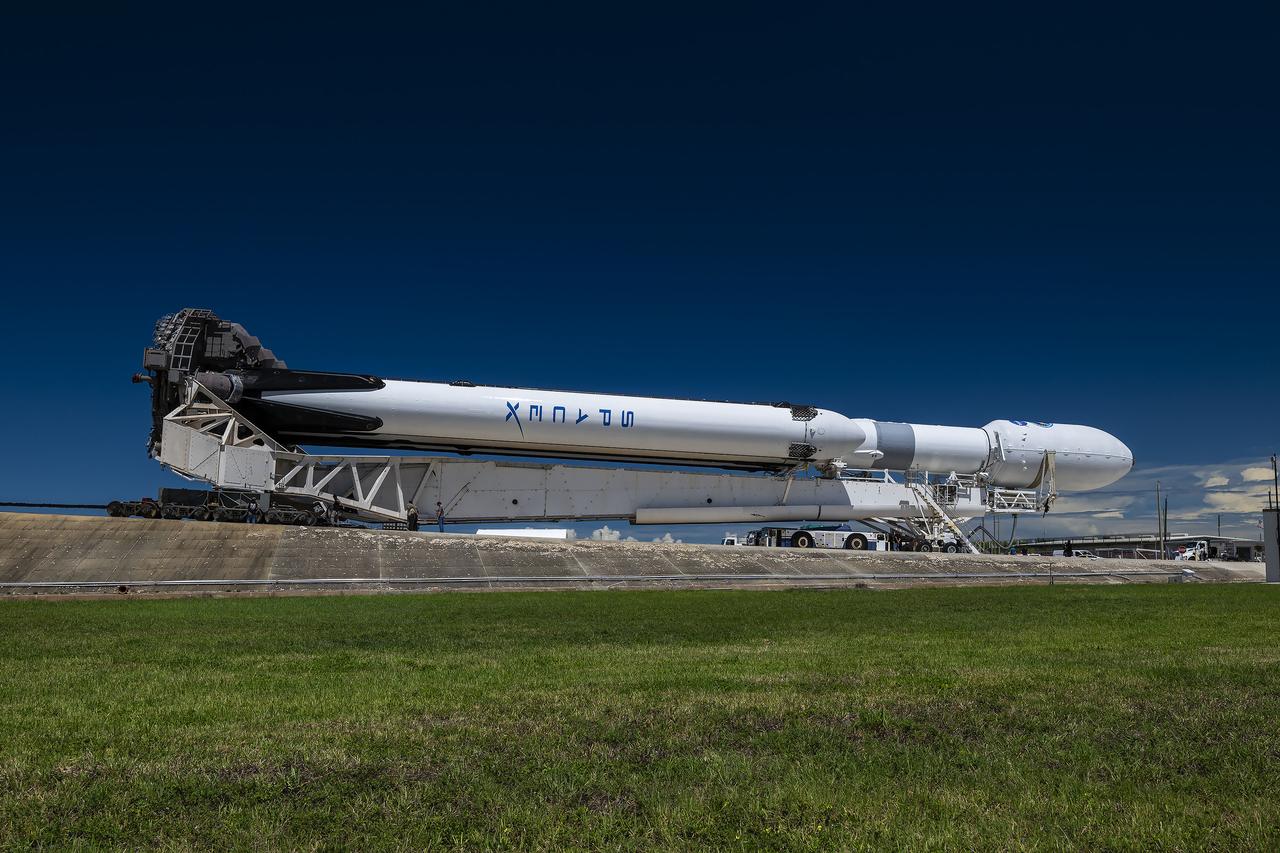
A SpaceX Falcon Heavy rocket carrying the National Oceanic and Atmospheric Administration (NOAA) GOES-U (Geostationary Operational Environmental Satellite U) moves from the hangar to the launch pad at Space Launch Complex 39A at NASA’s Kennedy Space Center in Florida on Monday, June 24, 2024. The GOES-U satellite is the final satellite in the GOES-R series, which serves a critical role in providing continuous coverage of the Western Hemisphere, including monitoring tropical systems in the eastern Pacific and Atlantic oceans. The two-hour launch window opens at 5:16 p.m. EDT Tuesday, June 25.
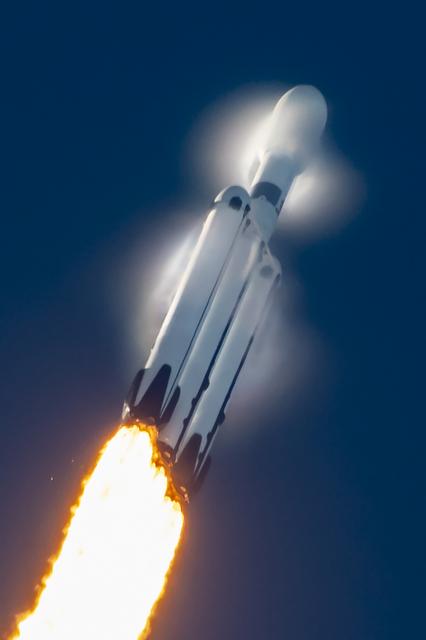
A SpaceX Falcon Heavy rocket carrying the National Oceanic and Atmospheric Administration (NOAA) GOES-U (Geostationary Operational Environmental Satellite U) lifts off from Launch Complex 39A at NASA’s Kennedy Space Center in Florida on Tuesday, June 25, 2024. The GOES-U satellite is the final satellite in the GOES-R series, which serves a critical role in providing continuous coverage of the Western Hemisphere, including monitoring tropical systems in the eastern Pacific and Atlantic oceans.
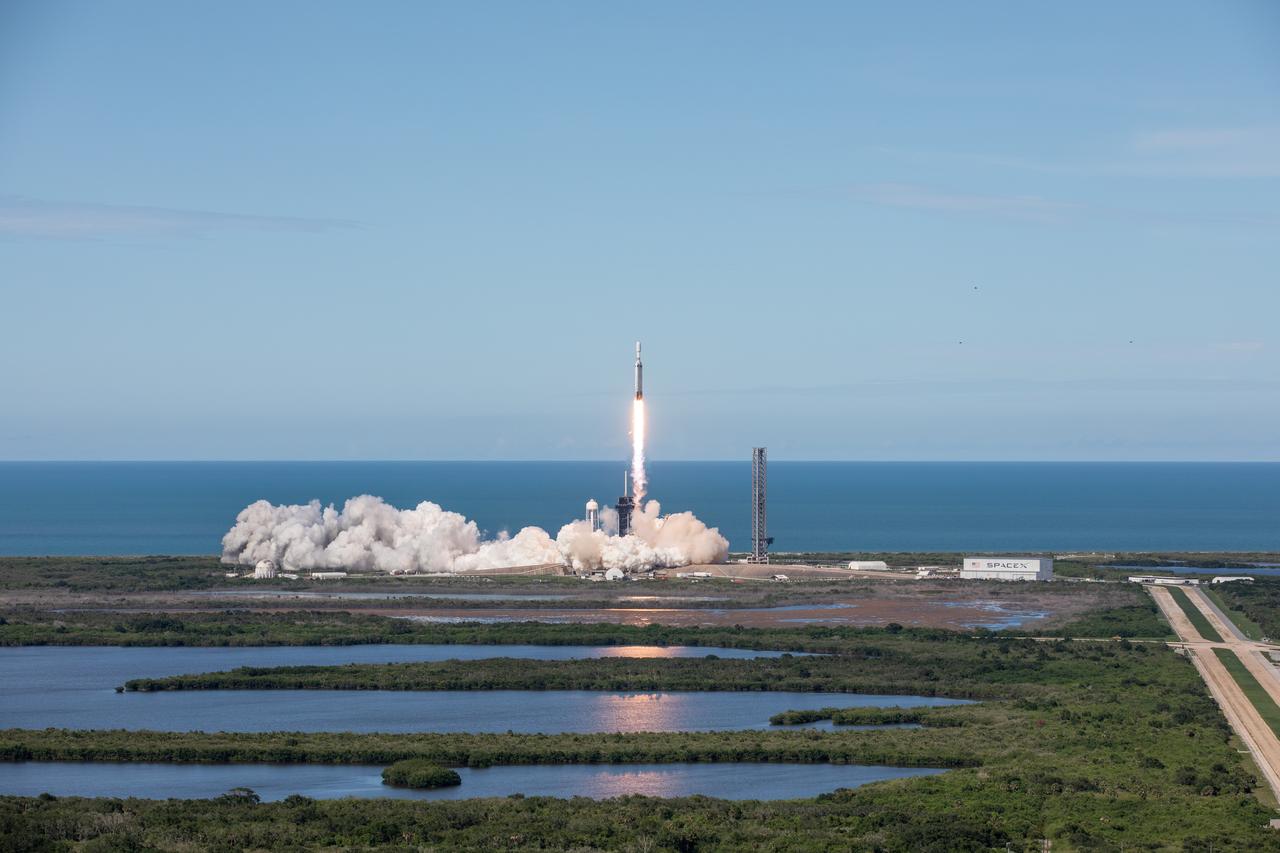
A SpaceX Falcon Heavy rocket carrying the National Oceanic and Atmospheric Administration (NOAA) GOES-U (Geostationary Operational Environmental Satellite U) lifts off from Launch Complex 39A at NASA’s Kennedy Space Center in Florida on Tuesday, June 25, 2024. The GOES-U satellite is the final satellite in the GOES-R series, which serves a critical role in providing continuous coverage of the Western Hemisphere, including monitoring tropical systems in the eastern Pacific and Atlantic oceans.
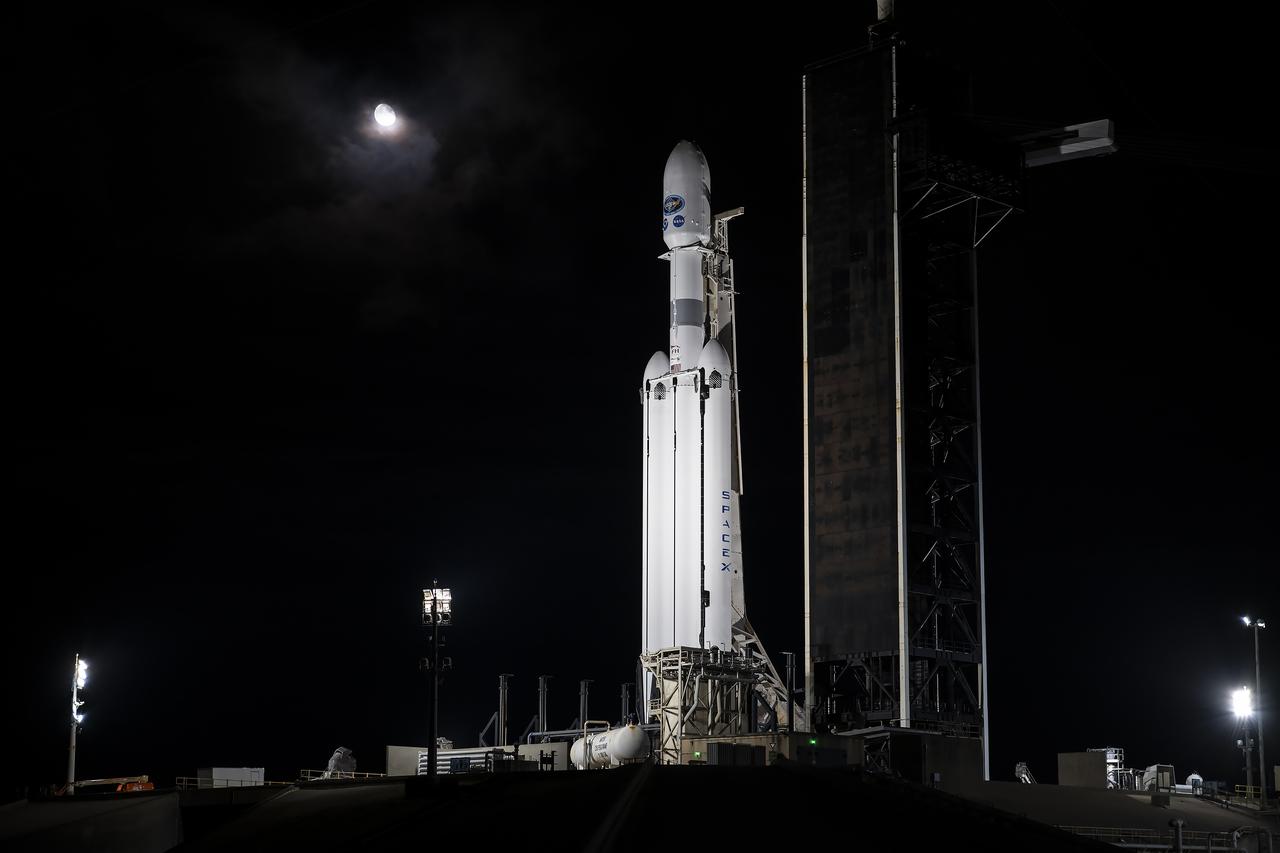
A SpaceX Falcon Heavy rocket carrying the National Oceanic and Atmospheric Administration (NOAA) GOES-U (Geostationary Operational Environmental Satellite U) stands vertical at Launch Complex 39A at NASA’s Kennedy Space Center in Florida on Monday, June 24, 2024. The GOES-U satellite is the final satellite in the GOES-R series, which serves a critical role in providing continuous coverage of the Western Hemisphere, including monitoring tropical systems in the eastern Pacific and Atlantic oceans. The two-hour launch window opens at 5:16 p.m. EDT. on Tuesday, June 25, 2024.
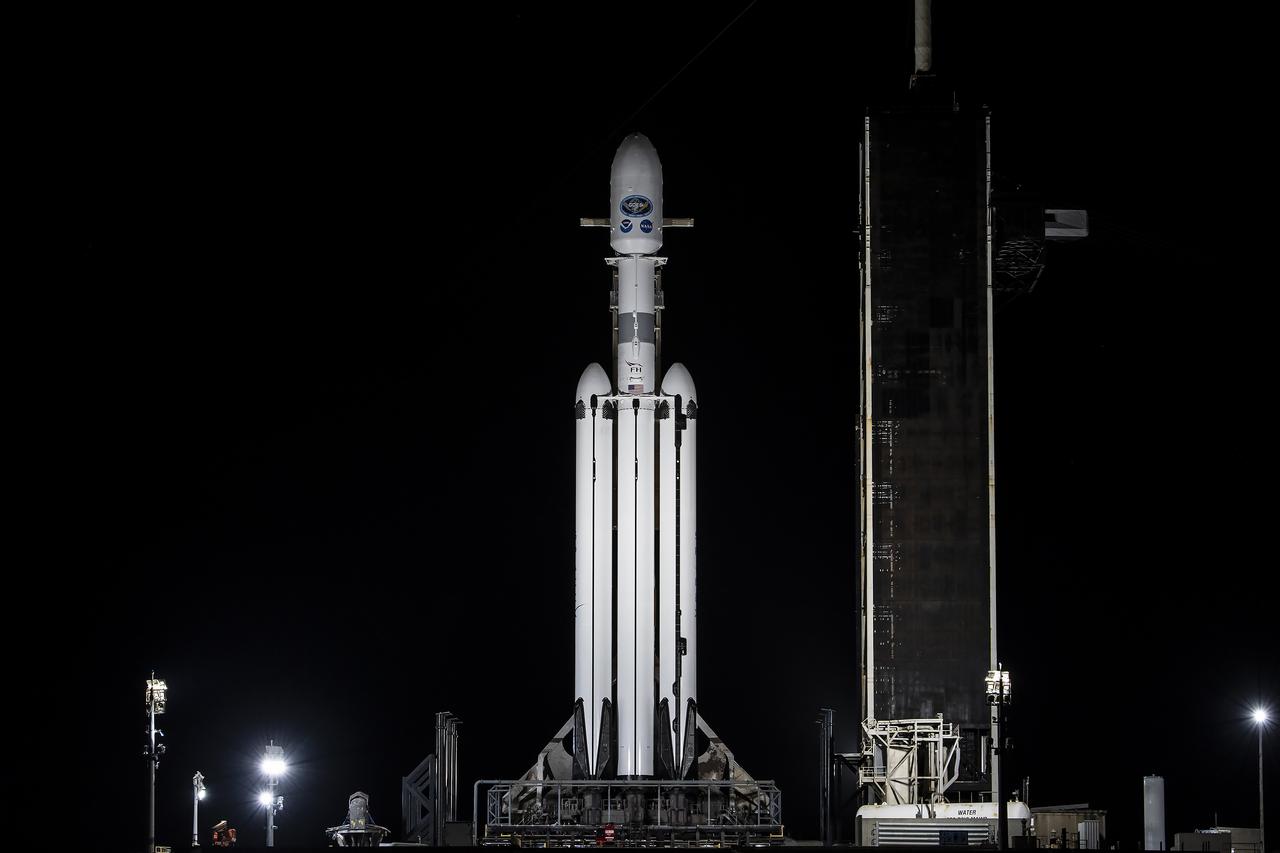
A SpaceX Falcon Heavy rocket carrying the National Oceanic and Atmospheric Administration (NOAA) GOES-U (Geostationary Operational Environmental Satellite U) stands vertical at Launch Complex 39A at NASA’s Kennedy Space Center in Florida on Monday, June 24, 2024. The GOES-U satellite is the final satellite in the GOES-R series, which serves a critical role in providing continuous coverage of the Western Hemisphere, including monitoring tropical systems in the eastern Pacific and Atlantic oceans. The two-hour launch window opens at 5:16 p.m. EDT. on Tuesday, June 25, 2024.

Dakota Smith, satellite analyst and communicator, NOAA’s Cooperative Institute for Research in the Atmosphere, participates in a social panel on Monday, June 24, 2024, at NASA’s Kennedy Space Center in Florida to discuss National Oceanic and Atmospheric Administration (NOAA) GOES-U (Geostationary Operational Environmental Satellite U) mission. The GOES-U satellite is the final addition to GOES-R series, which serves a critical role in providing continuous coverage of the Western Hemisphere, including monitoring tropical systems in the eastern Pacific and Atlantic oceans. The two-hour launch window opens at 5:16 p.m. EDT Tuesday, June 25, for the satellite’s launch on a SpaceX Falcon Heavy rocket from Launch Complex 39A at NASA’s Kennedy Space Center in Florida.

Chris Reith, program manager, Advanced Baseline Imager, L3Harris Technologies, participates in a social panel on Monday, June 24, 2024, at NASA’s Kennedy Space Center in Florida to discuss National Oceanic and Atmospheric Administration (NOAA) GOES-U (Geostationary Operational Environmental Satellite U) mission. The GOES-U satellite is the final addition to GOES-R series, which serves a critical role in providing continuous coverage of the Western Hemisphere, including monitoring tropical systems in the eastern Pacific and Atlantic oceans. The two-hour launch window opens at 5:16 p.m. EDT Tuesday, June 25, for the satellite’s launch on a SpaceX Falcon Heavy rocket from Launch Complex 39A at NASA’s Kennedy Space Center in Florida.
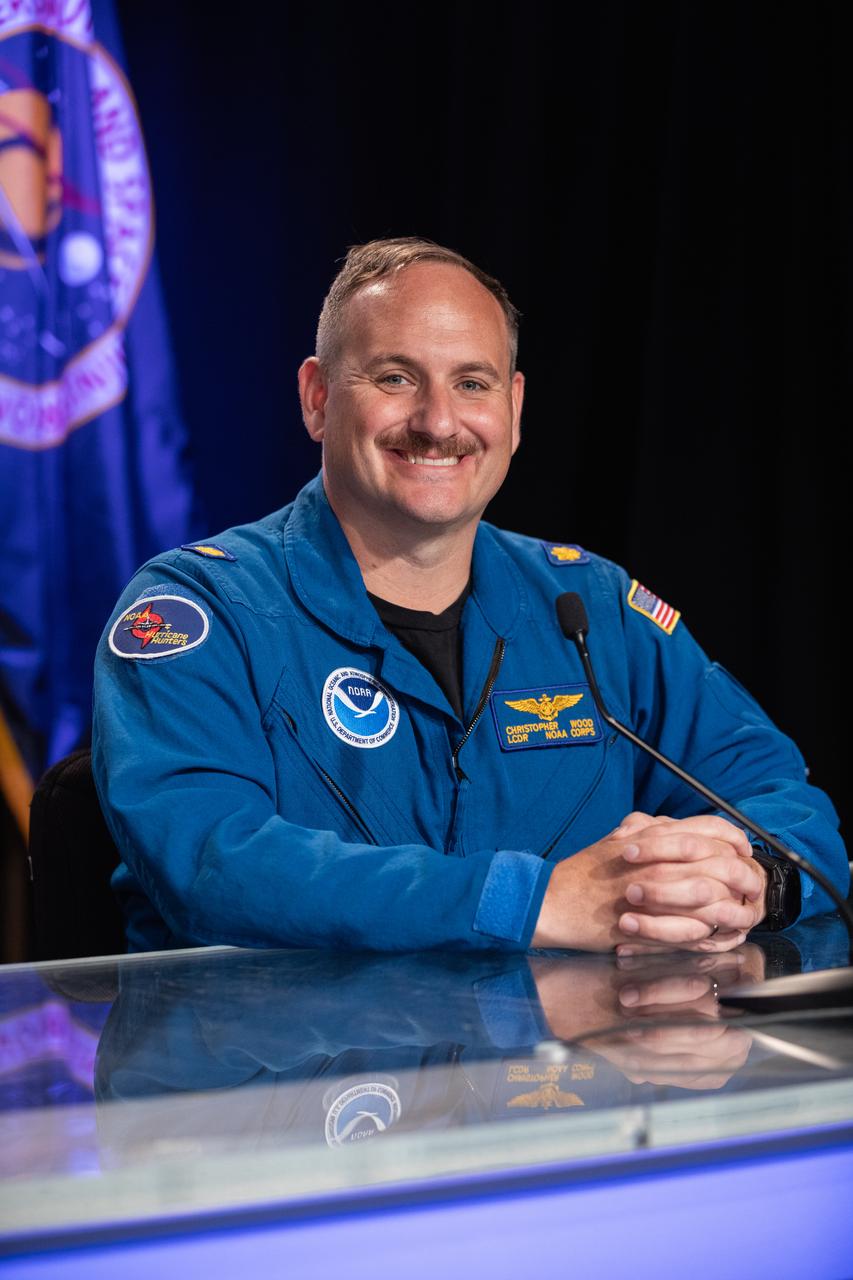
Chris Wood, NOAA Hurricane Hunter pilot, participates in a science briefing on Monday, June 24, 2024, at NASA’s Kennedy Space Center in Florida to discuss National Oceanic and Atmospheric Administration (NOAA) GOES-U (Geostationary Operational Environmental Satellite U) mission. The GOES-U satellite is the final addition to GOES-R series, which serves a critical role in providing continuous coverage of the Western Hemisphere, including monitoring tropical systems in the eastern Pacific and Atlantic oceans. The two-hour launch window opens at 5:16 p.m. EDT Tuesday, June 25, for the satellite’s launch on a SpaceX Falcon Heavy rocket from Launch Complex 39A at NASA’s Kennedy Space Center in Florida.
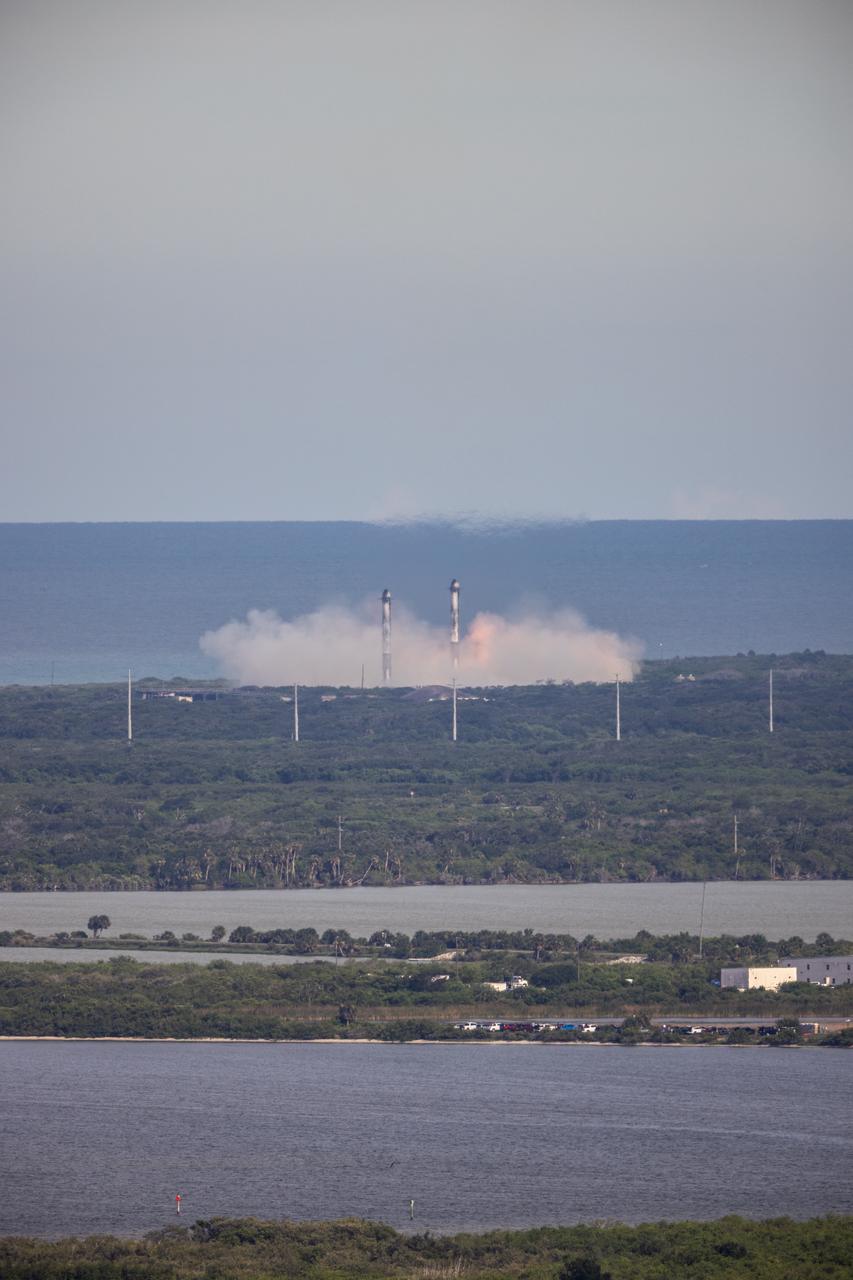
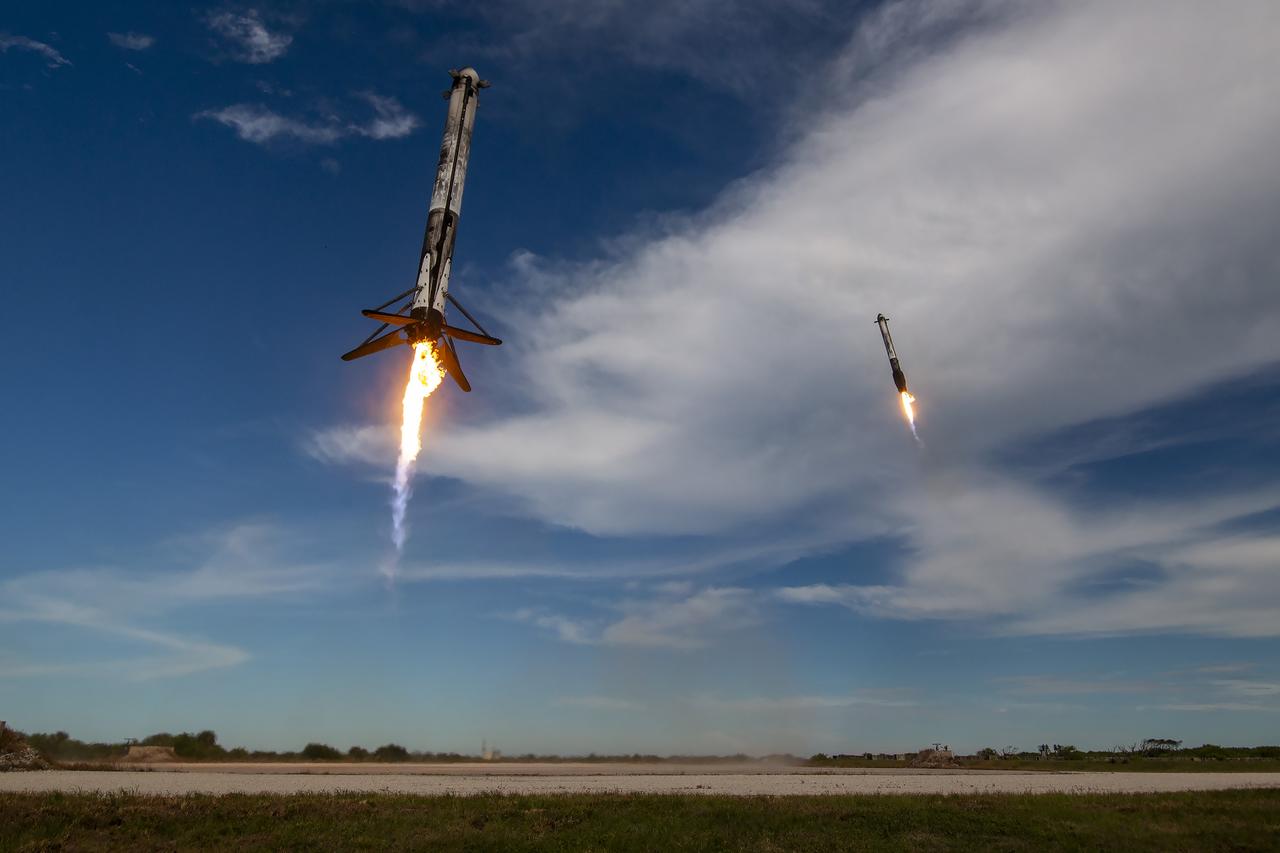
The SpaceX Falcon Heavy dual side boosters land on SpaceX Landing Zones 1 and 2 at Cape Canaveral Space Force Station in Florida. The rocket carrying NOAA’s (National Oceanic and Atmospheric Administration) Geostationary Operational Environmental Satellite (GOES-U) launched from NASA’s Kennedy Space Center in Florida on Tuesday, June 25, 2024.

Denton Gibson, launch director, Launch Services Program, NASA, participates in a prelaunch news conference on Monday, June 24, 2024, at NASA’s Kennedy Space Center in Florida to discuss National Oceanic and Atmospheric Administration (NOAA) GOES-U (Geostationary Operational Environmental Satellite U) mission. The GOES-U satellite is the final addition to GOES-R series, which serves a critical role in providing continuous coverage of the Western Hemisphere, including monitoring tropical systems in the eastern Pacific and Atlantic oceans. The two-hour launch window opens at 5:16 p.m. EDT Tuesday, June 25, for the satellite’s launch on a SpaceX Falcon Heavy rocket from Launch Complex 39A at NASA’s Kennedy Space Center in Florida.
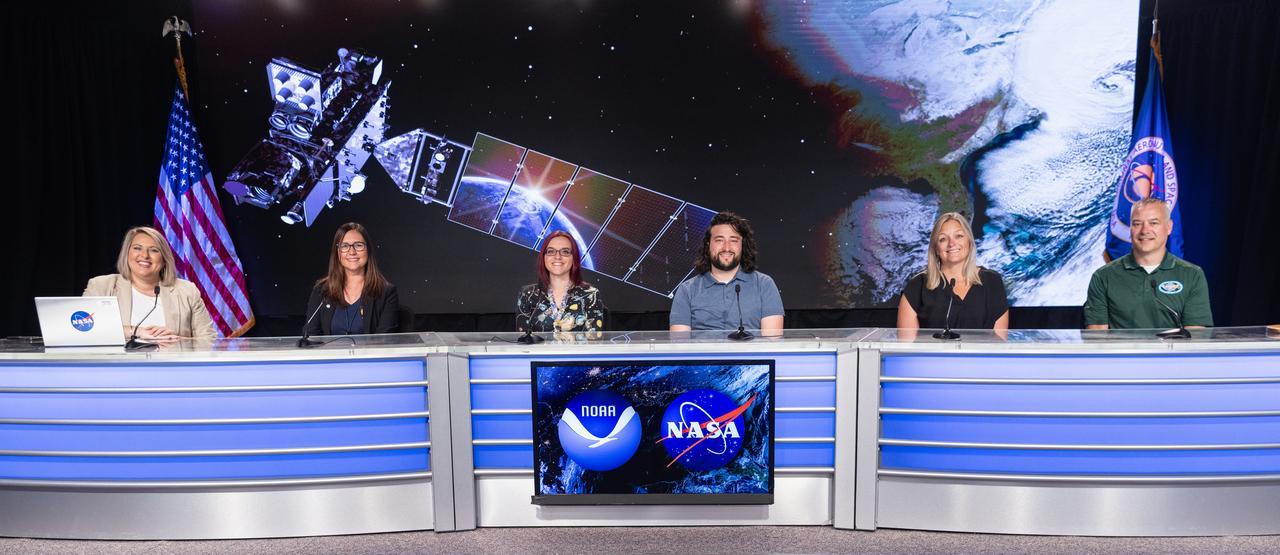
Officials from NASA, National Oceanic and Atmospheric Administration (NOAA), and other mission managers participate in a social panel on Monday, June 24, 2024, at NASA’s Kennedy Space Center in Florida for the launch of GOES-U (Geostationary Operational Environmental Satellite U) mission. From left to right, Leah Martin, NASA Communications; Ellen Ramirez, deputy division chief, Mission Operations Division, National Environmental Satellite, Data, and Information Service Office of Satellite and Product Operations, NOAA; Jade Zsiros, telemetry engineer, NASA’s Launch Services Program; Dakota Smith, satellite analyst and communicator, NOAA’s Cooperative Institute for Research in the Atmosphere; Allana Nepomuceno, senior manager, GOES-U Assembly, Test, and Launch Operations, Lockheed Martin; Chris Reith, program manager, Advanced Baseline Imager, L3Harris Technologies. The two-hour launch window opens at 5:16 p.m. EDT Tuesday, June 25, for the satellite’s launch on a SpaceX Falcon Heavy rocket from Launch Complex 39A at NASA’s Kennedy Space Center in Florida.

Officials from NASA, National Oceanic and Atmospheric Administration (NOAA), SpaceX participate in a prelaunch news conference on Monday, June 24, 2024, at NASA’s Kennedy Space Center in Florida for the launch of GOES-U (Geostationary Operational Environmental Satellite U) mission. From left to right, Steve Volz, assistant administrator, NOAA’s Satellite and Information Service; Pam Sullivan, director, GOES-R Program, NOAA; John Gagosian, director, Joint Agency Satellite Division; Denton Gibson, launch director, Launch Services Program, NASA; Julianna Scheiman, director, NASA Science Missions, SpaceX; Brian Cizek, launch weather officer, 45th Weather Squadron, U.S. Space Force
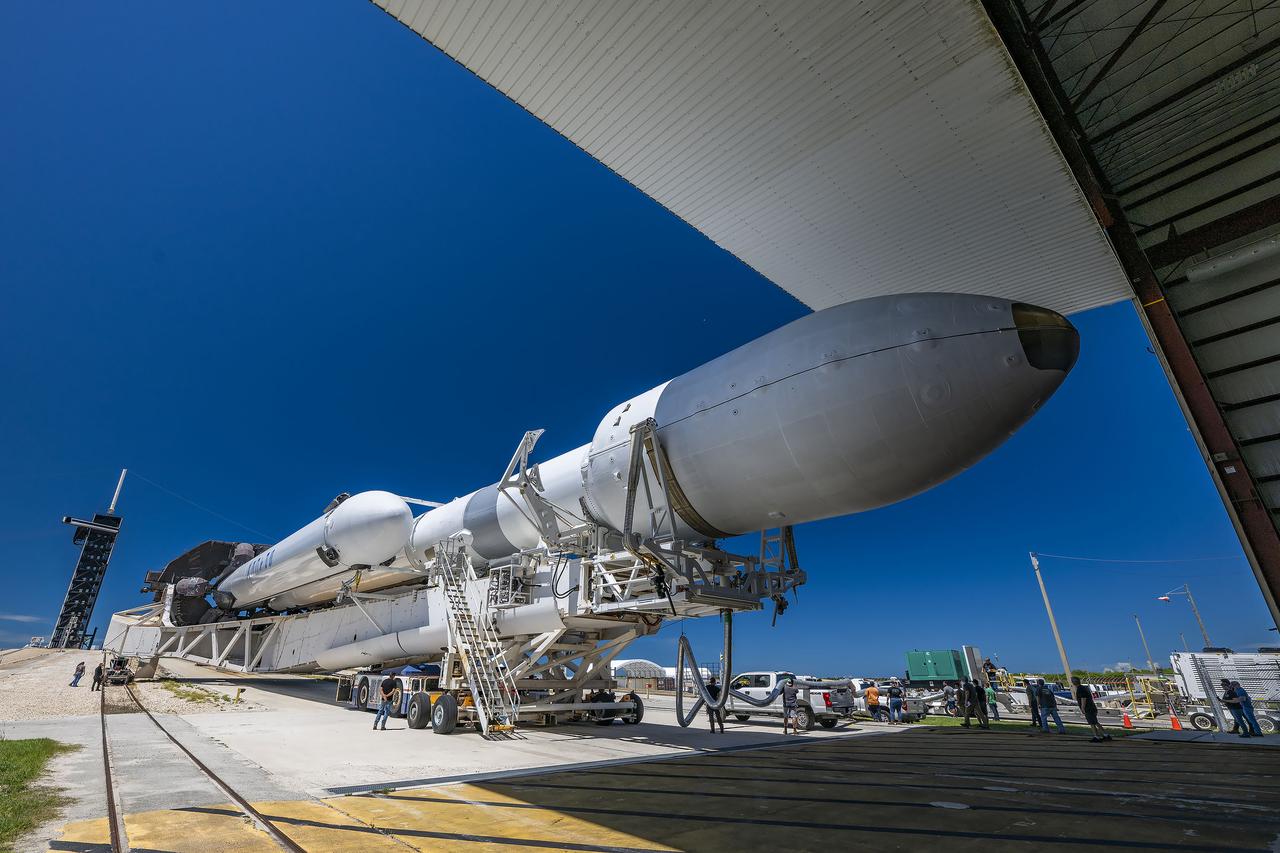
A SpaceX Falcon Heavy rocket carrying the National Oceanic and Atmospheric Administration (NOAA) GOES-U (Geostationary Operational Environmental Satellite U) moves from the hangar to the launch pad at Space Launch Complex 39A at NASA’s Kennedy Space Center in Florida on Monday, June 24, 2024. The GOES-U satellite is the final satellite in the GOES-R series, which serves a critical role in providing continuous coverage of the Western Hemisphere, including monitoring tropical systems in the eastern Pacific and Atlantic oceans. The two-hour launch window opens at 5:16 p.m. EDT Tuesday, June 25.

Officials from NASA, National Oceanic and Atmospheric Administration (NOAA), SpaceX participate in a prelaunch news conference on Monday, June 24, 2024, at NASA’s Kennedy Space Center in Florida for the launch of GOES-U (Geostationary Operational Environmental Satellite U) mission. From left to right, Steve Volz, assistant administrator, NOAA’s Satellite and Information Service; Pam Sullivan, director, GOES-R Program, NOAA; John Gagosian, director, Joint Agency Satellite Division; Denton Gibson, launch director, Launch Services Program, NASA; Julianna Scheiman, director, NASA Science Missions, SpaceX; Brian Cizek, launch weather officer, 45th Weather Squadron, U.S. Space Force
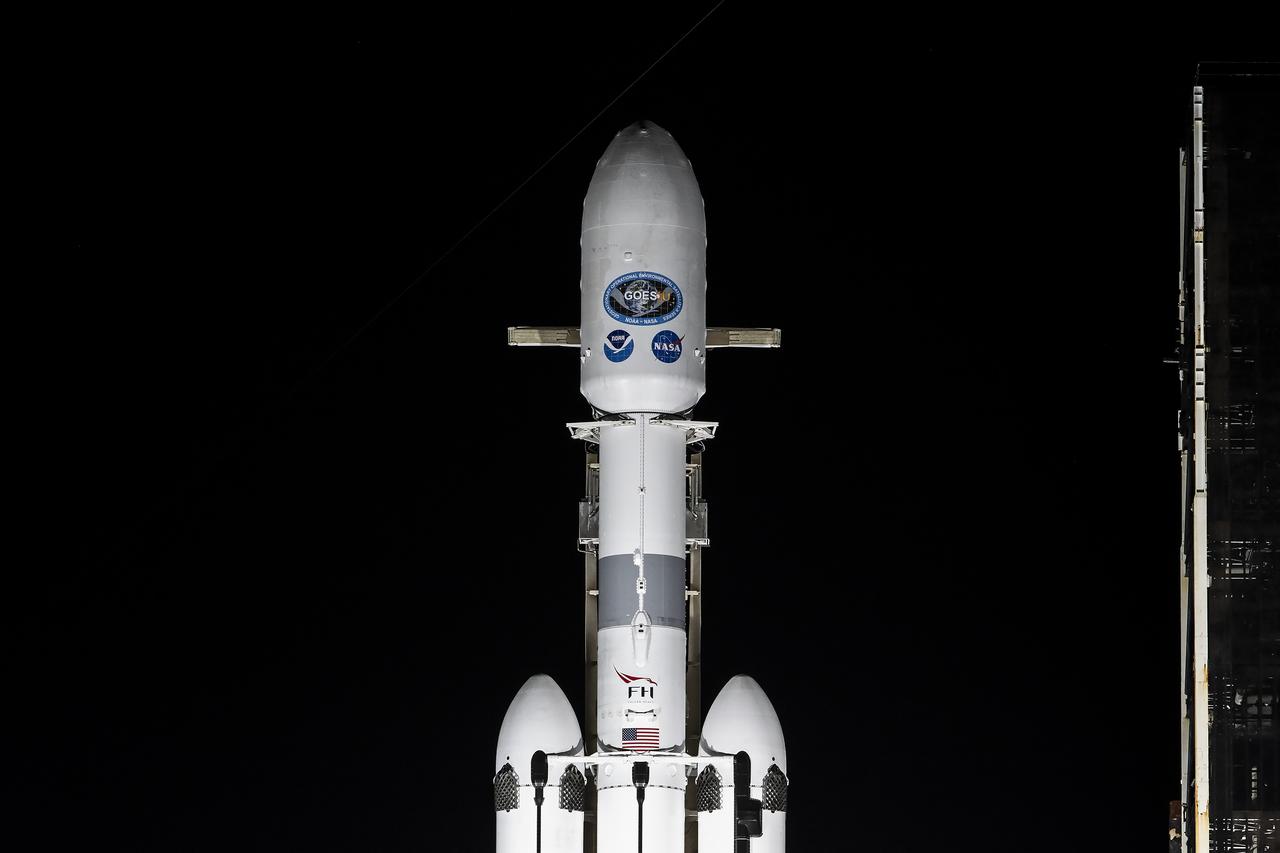
A SpaceX Falcon Heavy rocket carrying the National Oceanic and Atmospheric Administration (NOAA) GOES-U (Geostationary Operational Environmental Satellite U) stands vertical at Launch Complex 39A at NASA’s Kennedy Space Center in Florida on Monday, June 24, 2024. The GOES-U satellite is the final satellite in the GOES-R series, which serves a critical role in providing continuous coverage of the Western Hemisphere, including monitoring tropical systems in the eastern Pacific and Atlantic oceans. The two-hour launch window opens at 5:16 p.m. EDT. on Tuesday, June 25, 2024.
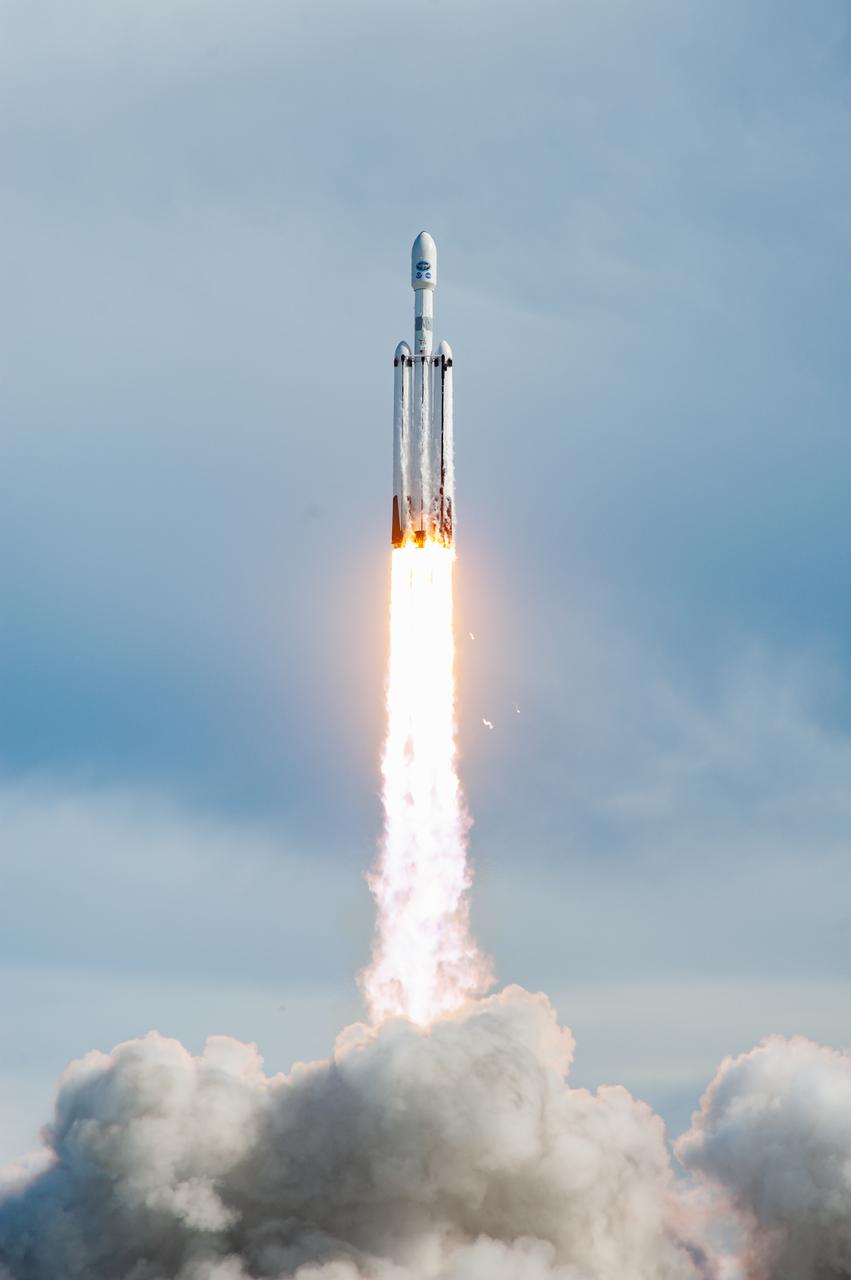
A SpaceX Falcon Heavy rocket carrying the National Oceanic and Atmospheric Administration (NOAA) GOES-U (Geostationary Operational Environmental Satellite U) lifts off from Launch Complex 39A at NASA’s Kennedy Space Center in Florida on Tuesday, June 25, 2024. The GOES-U satellite is the final satellite in the GOES-R series, which serves a critical role in providing continuous coverage of the Western Hemisphere, including monitoring tropical systems in the eastern Pacific and Atlantic oceans.

Charles Webb, deputy director, Joint Agency Satellite Division, NASA, participates in a science briefing on Monday, June 24, 2024, at NASA’s Kennedy Space Center in Florida to discuss National Oceanic and Atmospheric Administration (NOAA) GOES-U (Geostationary Operational Environmental Satellite U) mission. The GOES-U satellite is the final addition to GOES-R series, which serves a critical role in providing continuous coverage of the Western Hemisphere, including monitoring tropical systems in the eastern Pacific and Atlantic oceans. The two-hour launch window opens at 5:16 p.m. EDT Tuesday, June 25, for the satellite’s launch on a SpaceX Falcon Heavy rocket from Launch Complex 39A at NASA’s Kennedy Space Center in Florida.
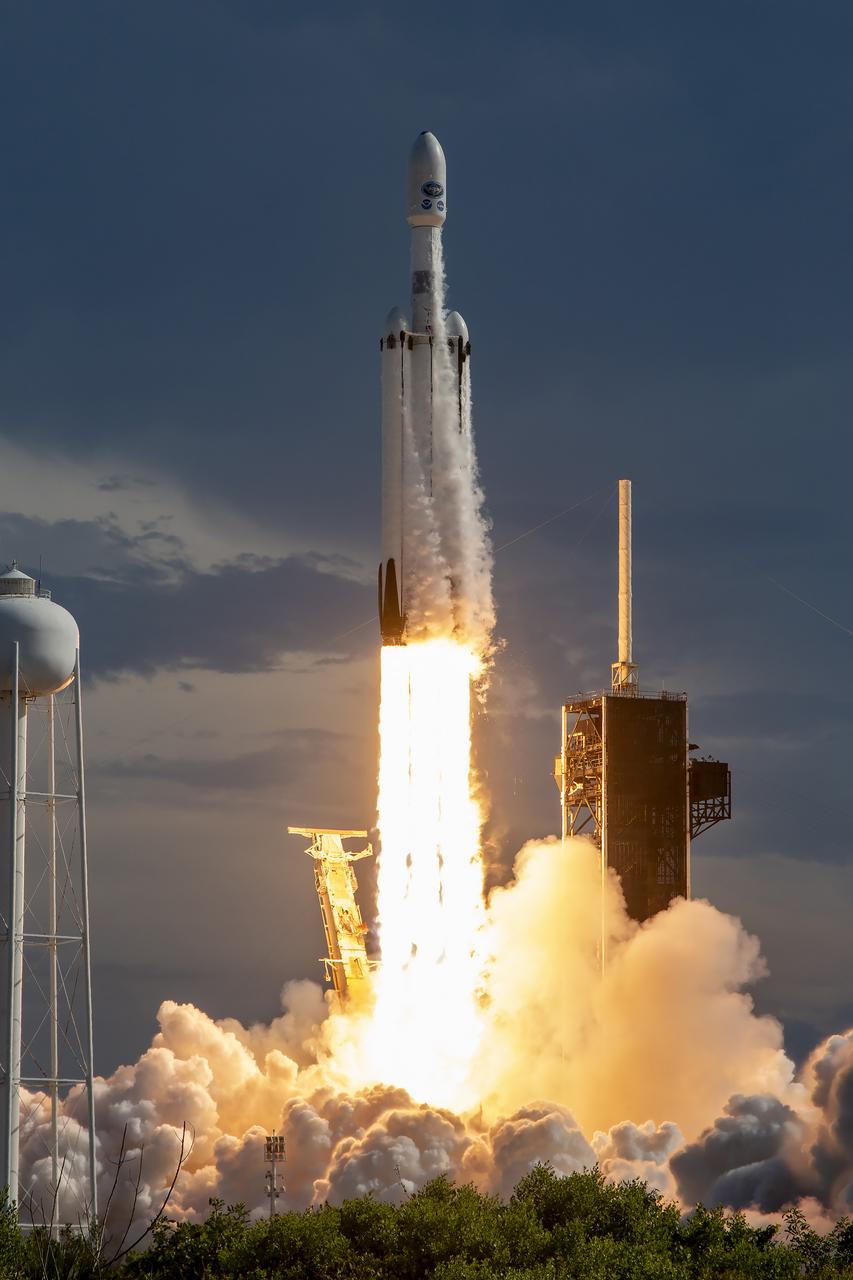
A SpaceX Falcon Heavy rocket carrying the National Oceanic and Atmospheric Administration (NOAA) GOES-U (Geostationary Operational Environmental Satellite U) lifts off from Launch Complex 39A at NASA’s Kennedy Space Center in Florida on Tuesday, June 25, 2024. The GOES-U satellite is the final satellite in the GOES-R series, which serves a critical role in providing continuous coverage of the Western Hemisphere, including monitoring tropical systems in the eastern Pacific and Atlantic oceans.
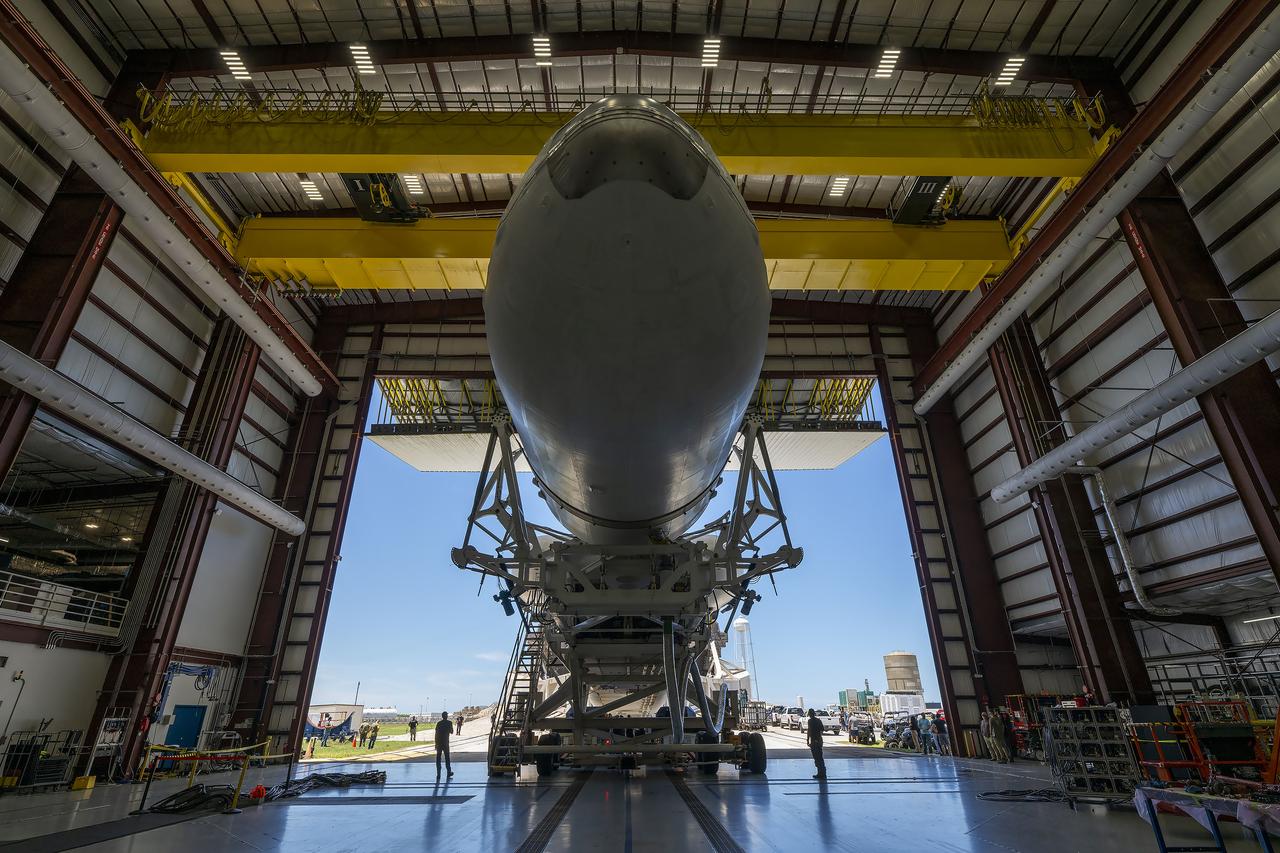
A SpaceX Falcon Heavy rocket carrying the National Oceanic and Atmospheric Administration (NOAA) GOES-U (Geostationary Operational Environmental Satellite U) moves from the hangar to the launch pad at Space Launch Complex 39A at NASA’s Kennedy Space Center in Florida on Monday, June 24, 2024. The GOES-U satellite is the final satellite in the GOES-R series, which serves a critical role in providing continuous coverage of the Western Hemisphere, including monitoring tropical systems in the eastern Pacific and Atlantic oceans. The two-hour launch window opens at 5:16 p.m. EDT Tuesday, June 25.
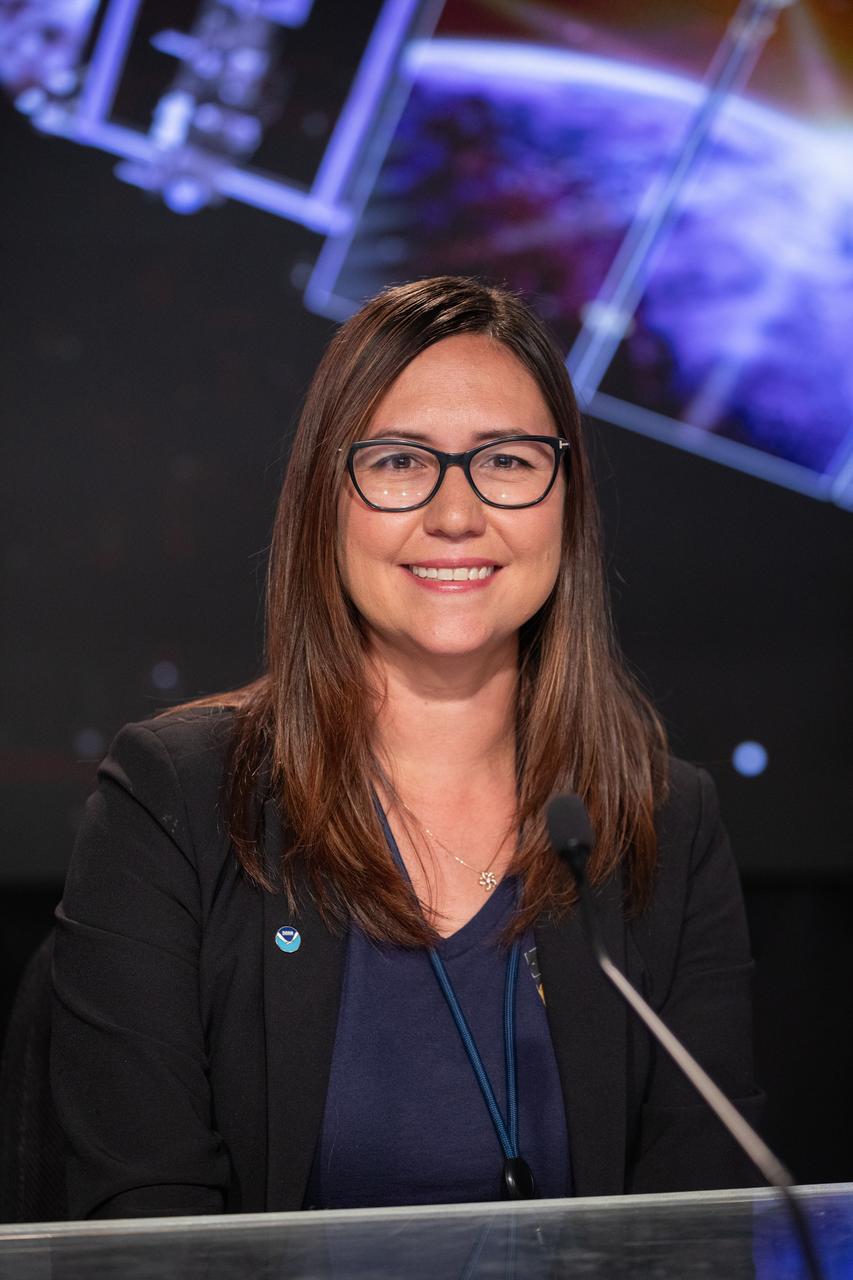
Ellen Ramirez, deputy division chief, Mission Operations Division, National Environmental Satellite, Data, and Information Service Office of Satellite and Product Operations, NOAA, participates in a social panel on Monday, June 24, 2024, at NASA’s Kennedy Space Center in Florida to discuss National Oceanic and Atmospheric Administration (NOAA) GOES-U (Geostationary Operational Environmental Satellite U) mission. The GOES-U satellite is the final addition to GOES-R series, which serves a critical role in providing continuous coverage of the Western Hemisphere, including monitoring tropical systems in the eastern Pacific and Atlantic oceans. The two-hour launch window opens at 5:16 p.m. EDT Tuesday, June 25, for the satellite’s launch on a SpaceX Falcon Heavy rocket from Launch Complex 39A at NASA’s Kennedy Space Center in Florida.
A SpaceX Falcon Heavy rocket carrying the National Oceanic and Atmospheric Administration (NOAA) GOES-U (Geostationary Operational Environmental Satellite U) lifts off from Launch Complex 39A at NASA’s Kennedy Space Center in Florida on Tuesday, June 25, 2024. The GOES-U satellite is the final satellite in the GOES-R series, which serves a critical role in providing continuous coverage of the Western Hemisphere, including monitoring tropical systems in the eastern Pacific and Atlantic oceans.
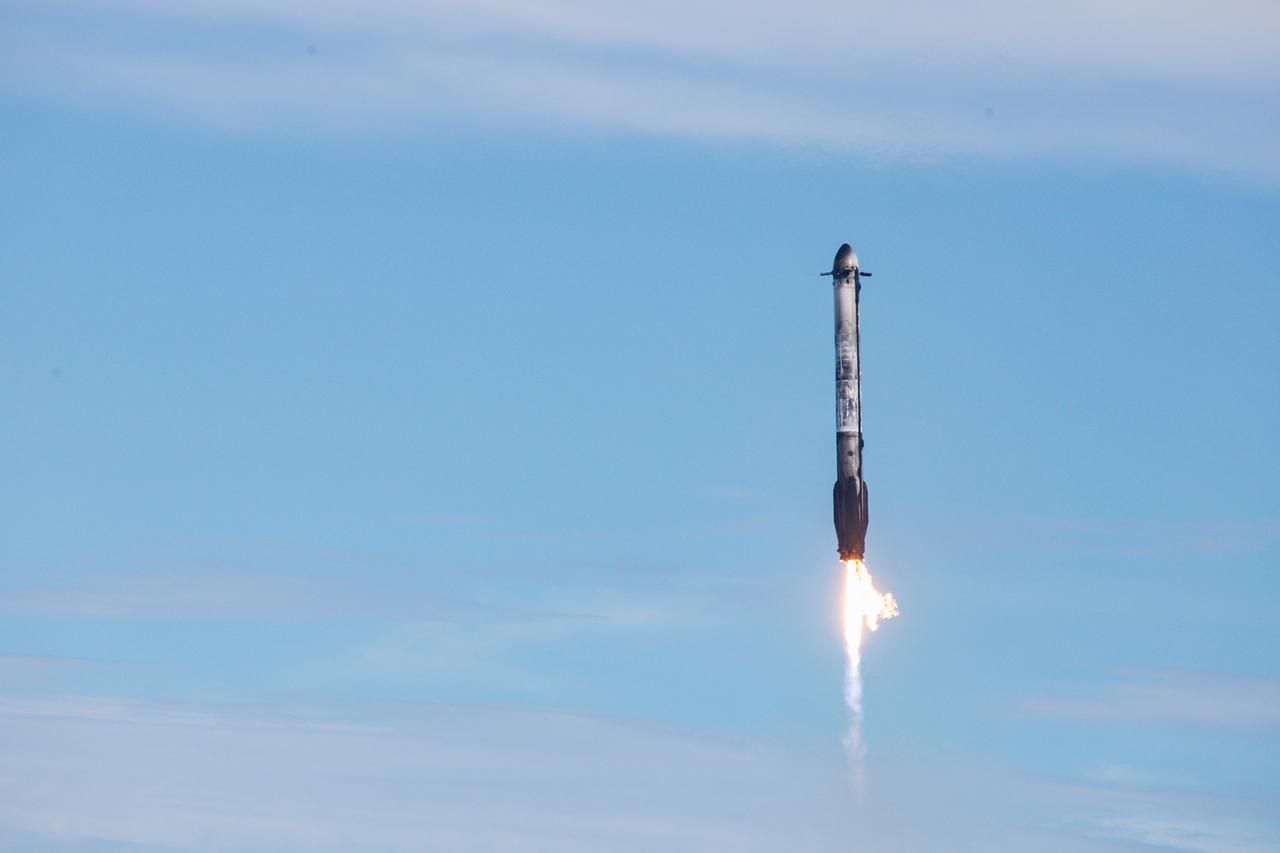
A SpaceX Falcon Heavy side booster lands at Cape Canaveral Space Force Station in Florida after the rocket launched NOAA’s (National Oceanic and Atmospheric Administration) Geostationary Operational Environmental Satellite (GOES-U) from NASA’s Kennedy Space Center in Florida on Tuesday, June 25, 2024.
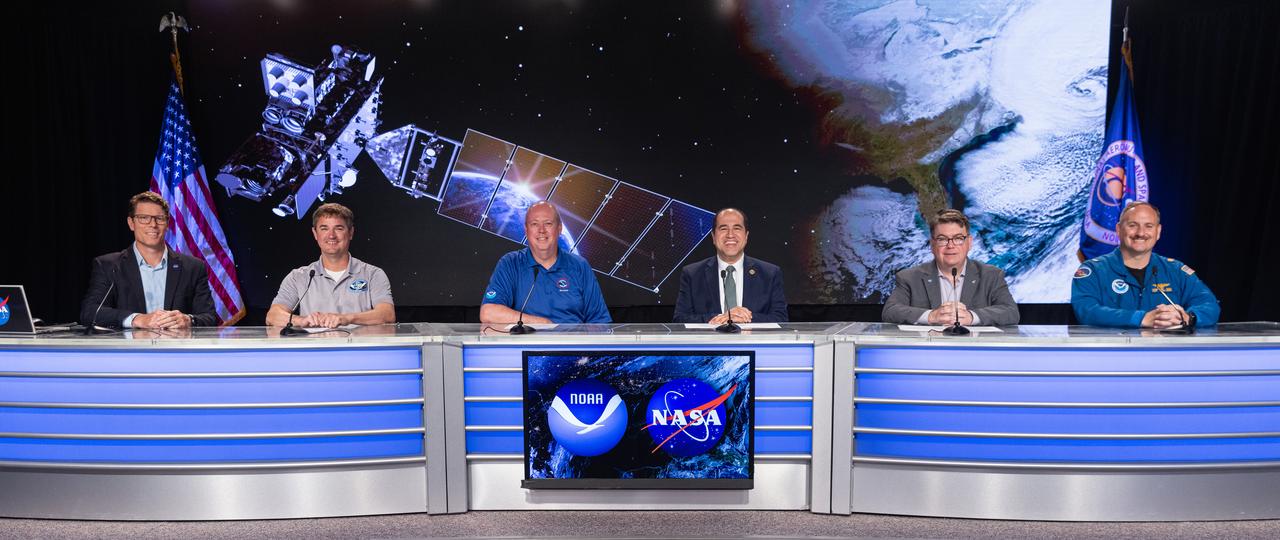
Officials from NASA and National Oceanic and Atmospheric Administration (NOAA) participate in a science briefing on Monday, June 24, 2024, at NASA’s Kennedy Space Center in Florida for the launch of GOES-U (Geostationary Operational Environmental Satellite U) mission. From left to right, Derrol Nail, NASA Communications; Dan Lindsey, chief scientist, GOES-R Program, NOAA; Ken Graham, director, NOAA’s National Weather Service; Elsayed Talaat, director, NOAA’s Office of Space Weather Observations; Charles Webb, deputy director, Joint Agency Satellite Division, NASA; Chris Wood, NOAA Hurricane Hunter pilot. The two-hour launch window opens at 5:16 p.m. EDT Tuesday, June 25, for the satellite’s launch on a SpaceX Falcon Heavy rocket from Launch Complex 39A at NASA’s Kennedy Space Center in Florida.

Derrol Nail, NASA Communications, participates in a science briefing on Monday, June 24, 2024, at NASA’s Kennedy Space Center in Florida to discuss National Oceanic and Atmospheric Administration (NOAA) GOES-U (Geostationary Operational Environmental Satellite U) mission. The GOES-U satellite is the final addition to GOES-R series, which serves a critical role in providing continuous coverage of the Western Hemisphere, including monitoring tropical systems in the eastern Pacific and Atlantic oceans. The two-hour launch window opens at 5:16 p.m. EDT Tuesday, June 25, for the satellite’s launch on a SpaceX Falcon Heavy rocket from Launch Complex 39A at NASA’s Kennedy Space Center in Florida.
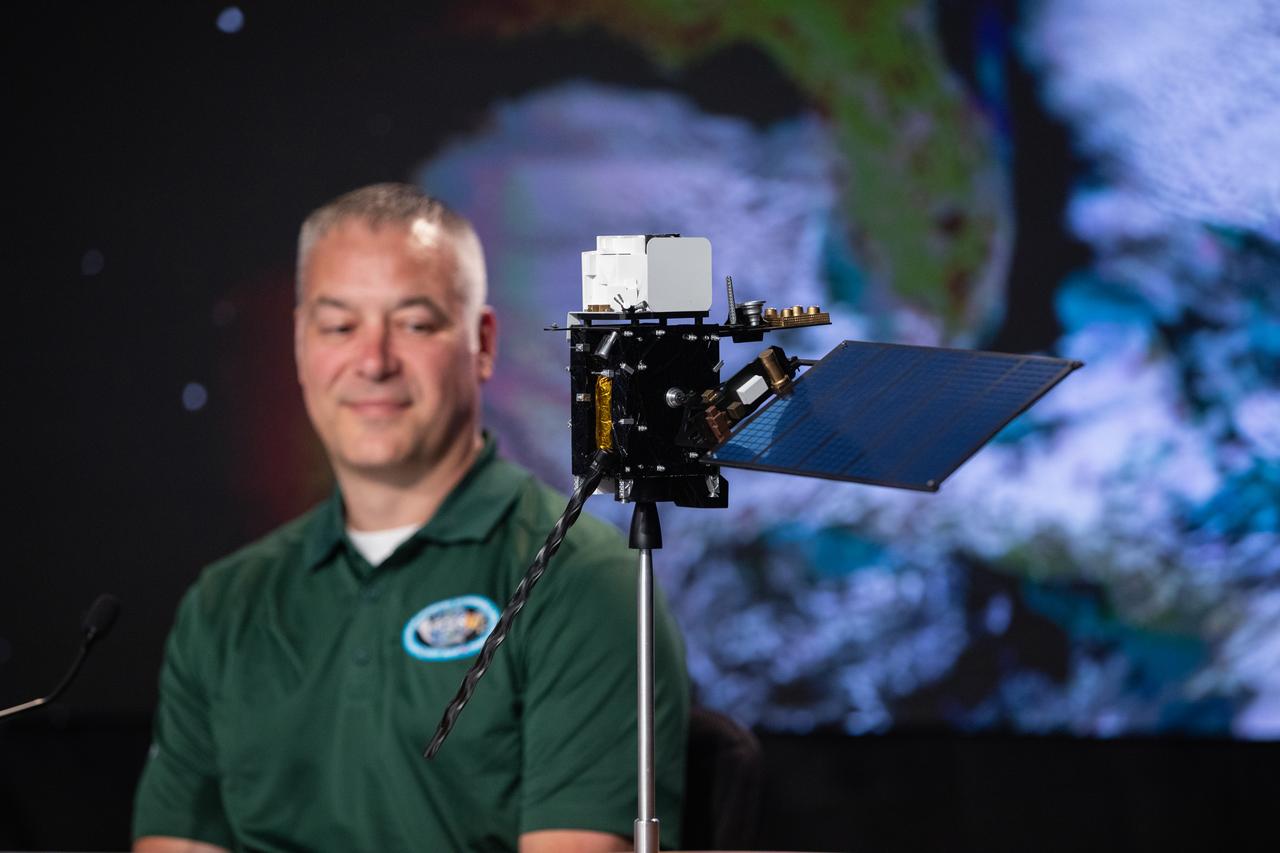
Chris Reith, program manager, Advanced Baseline Imager, L3Harris Technologies, participates in a social panel on Monday, June 24, 2024, at NASA’s Kennedy Space Center in Florida to discuss National Oceanic and Atmospheric Administration (NOAA) GOES-U (Geostationary Operational Environmental Satellite U) mission. The GOES-U satellite is the final addition to GOES-R series, which serves a critical role in providing continuous coverage of the Western Hemisphere, including monitoring tropical systems in the eastern Pacific and Atlantic oceans. The two-hour launch window opens at 5:16 p.m. EDT Tuesday, June 25, for the satellite’s launch on a SpaceX Falcon Heavy rocket from Launch Complex 39A at NASA’s Kennedy Space Center in Florida.
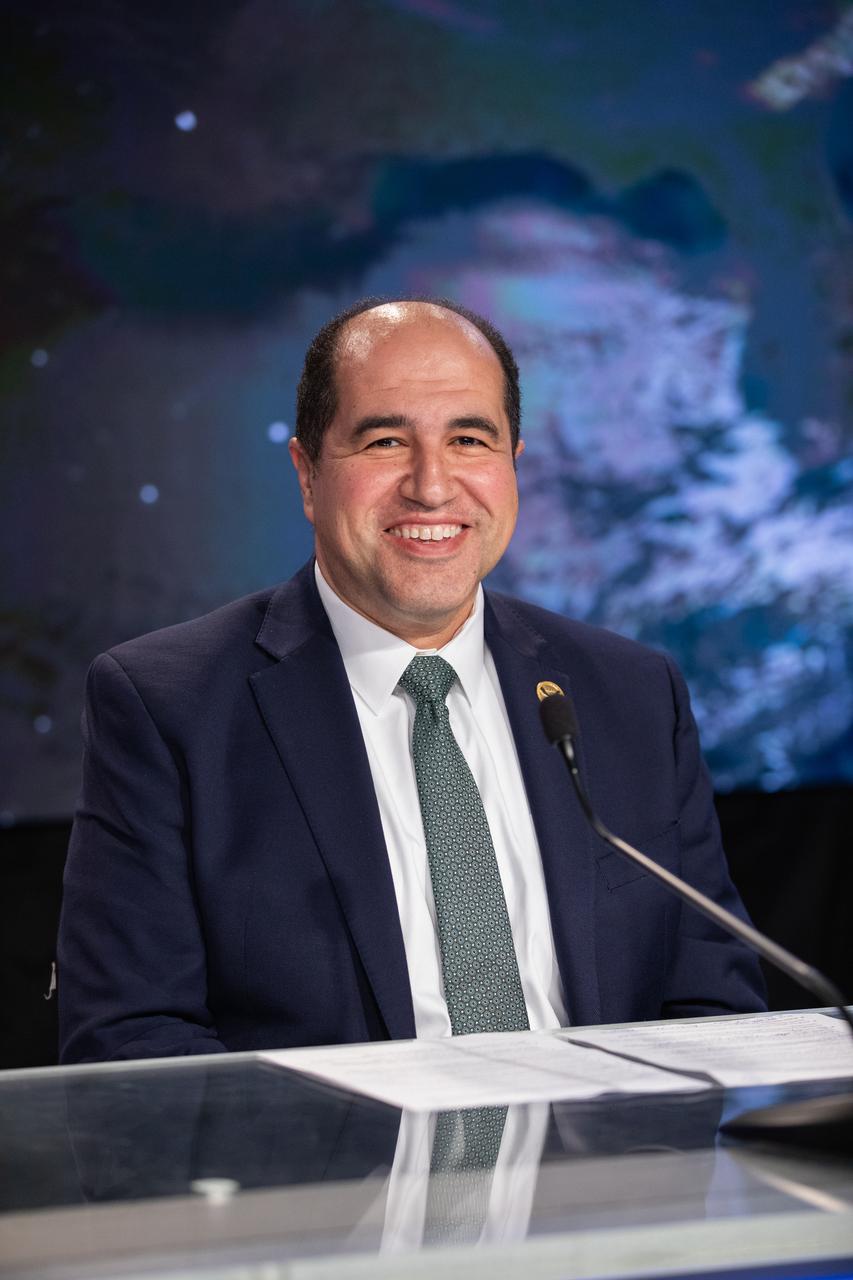
Elsayed Talaat, director, NOAA’s Office of Space Weather Observations, participates in a science briefing on Monday, June 24, 2024, at NASA’s Kennedy Space Center in Florida to discuss National Oceanic and Atmospheric Administration (NOAA) GOES-U (Geostationary Operational Environmental Satellite U) mission. The GOES-U satellite is the final addition to GOES-R series, which serves a critical role in providing continuous coverage of the Western Hemisphere, including monitoring tropical systems in the eastern Pacific and Atlantic oceans. The two-hour launch window opens at 5:16 p.m. EDT Tuesday, June 25, for the satellite’s launch on a SpaceX Falcon Heavy rocket from Launch Complex 39A at NASA’s Kennedy Space Center in Florida.
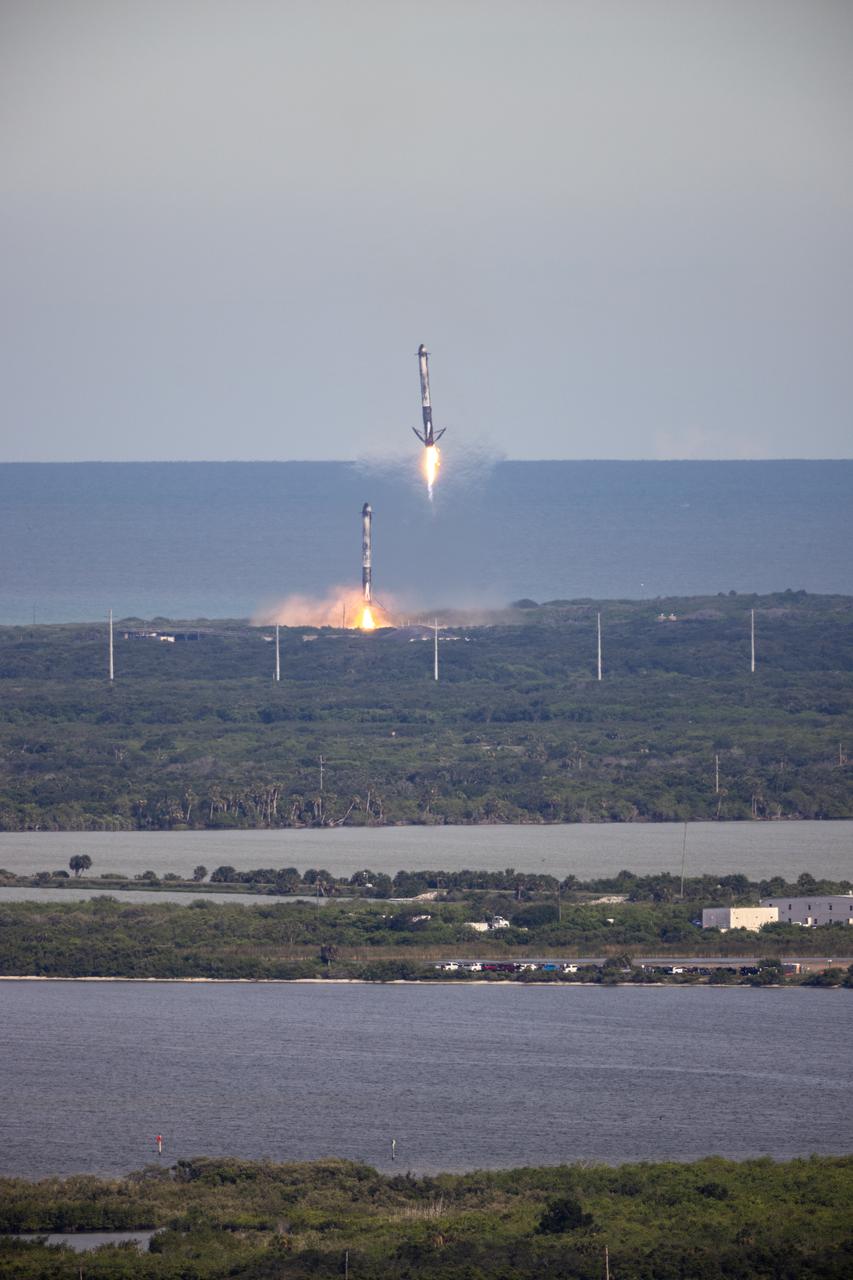
The SpaceX Falcon Heavy dual side boosters return to SpaceX Landing Zones 1 and 2 at Cape Canaveral Space Force Station in Florida. The rocket carrying NOAA’s (National Oceanic and Atmospheric Administration) Geostationary Operational Environmental Satellite (GOES-U) launched from NASA’s Kennedy Space Center in Florida on Tuesday, June 25, 2024.
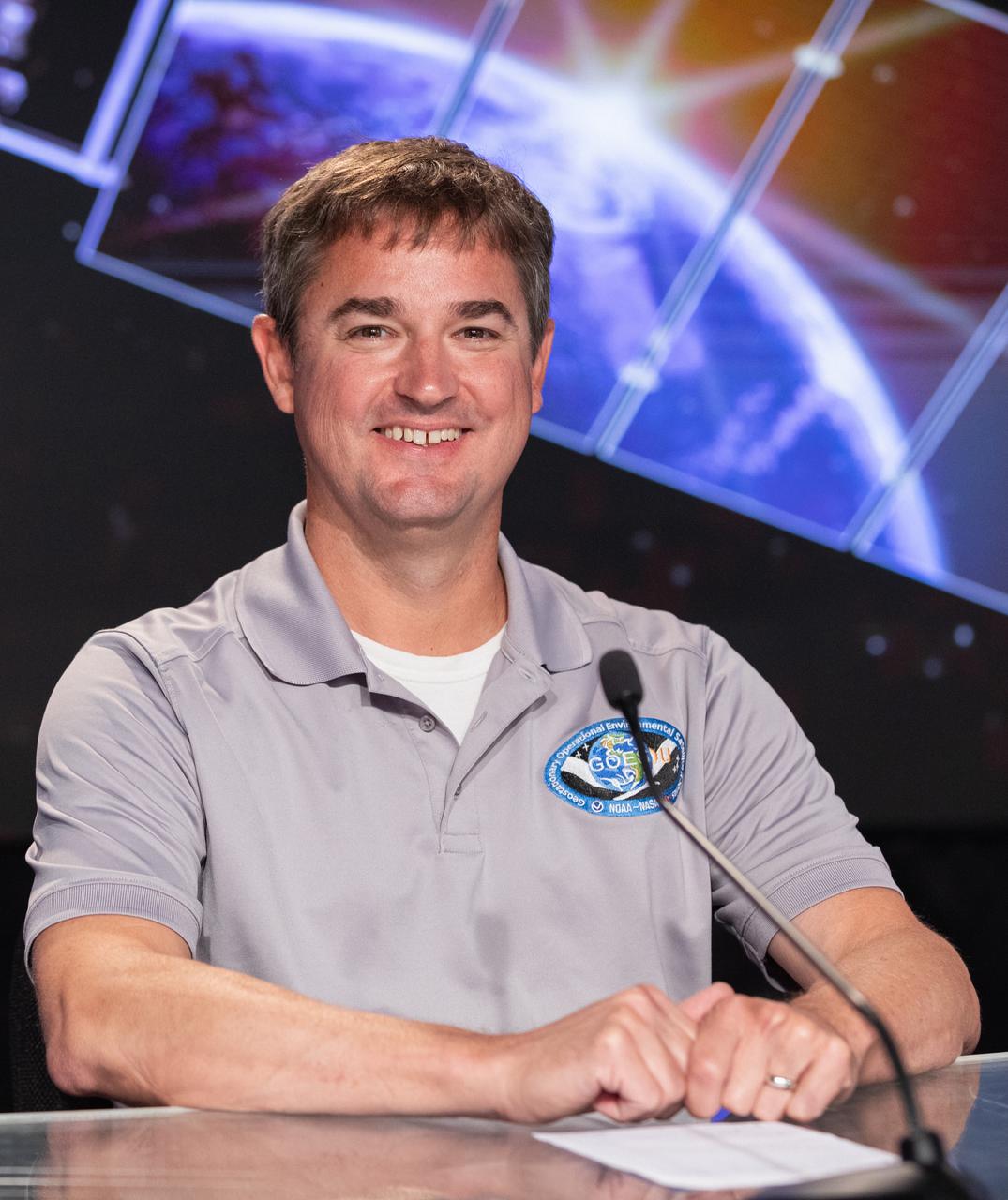
Dan Lindsey, chief scientist, GOES-R Program, NOAA, participates in a science briefing on Monday, June 24, 2024, at NASA’s Kennedy Space Center in Florida to discuss National Oceanic and Atmospheric Administration (NOAA) GOES-U (Geostationary Operational Environmental Satellite U) mission. The GOES-U satellite is the final addition to GOES-R series, which serves a critical role in providing continuous coverage of the Western Hemisphere, including monitoring tropical systems in the eastern Pacific and Atlantic oceans. The two-hour launch window opens at 5:16 p.m. EDT Tuesday, June 25, for the satellite’s launch on a SpaceX Falcon Heavy rocket from Launch Complex 39A at NASA’s Kennedy Space Center in Florida.
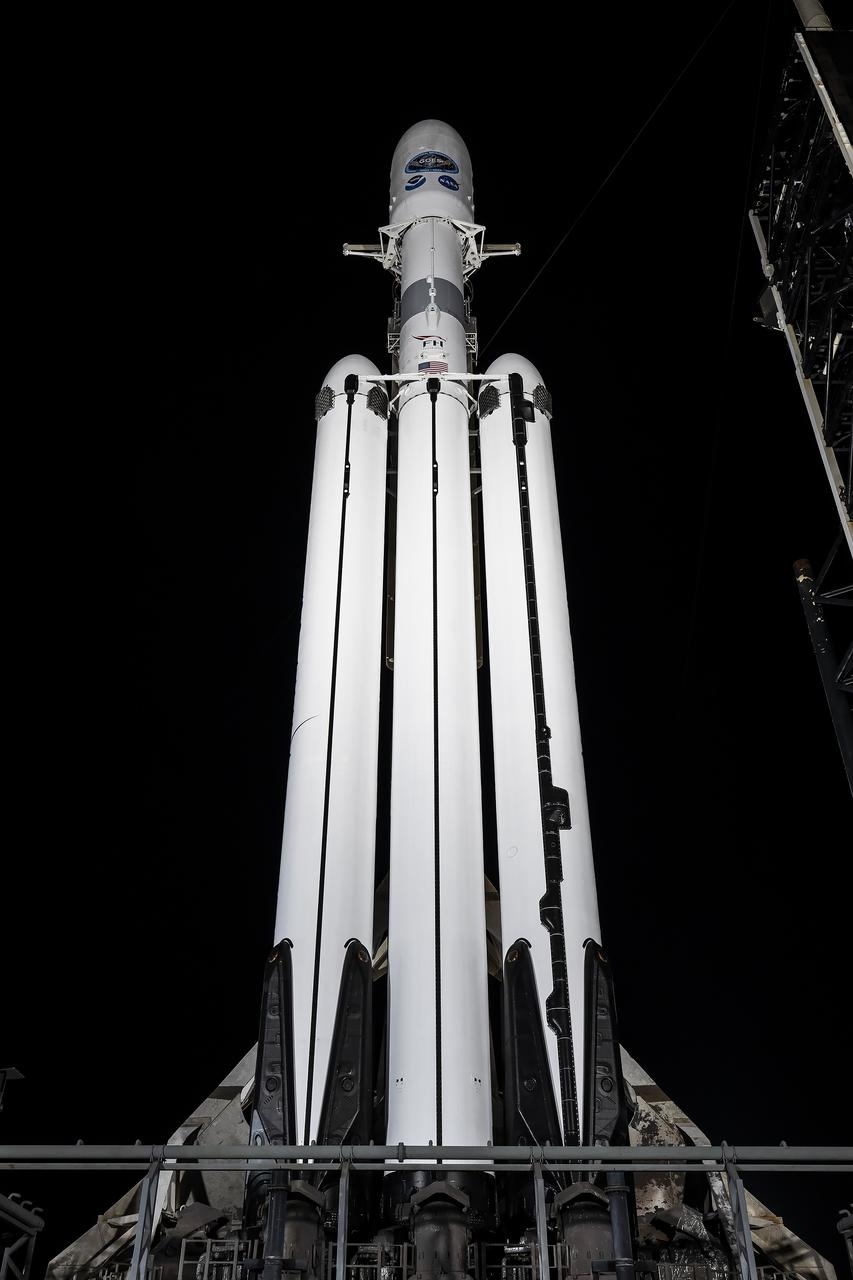
A SpaceX Falcon Heavy rocket carrying the National Oceanic and Atmospheric Administration (NOAA) GOES-U (Geostationary Operational Environmental Satellite U) stands vertical at Launch Complex 39A at NASA’s Kennedy Space Center in Florida on Monday, June 24, 2024. The GOES-U satellite is the final satellite in the GOES-R series, which serves a critical role in providing continuous coverage of the Western Hemisphere, including monitoring tropical systems in the eastern Pacific and Atlantic oceans. The two-hour launch window opens at 5:16 p.m. EDT. on Tuesday, June 25, 2024.
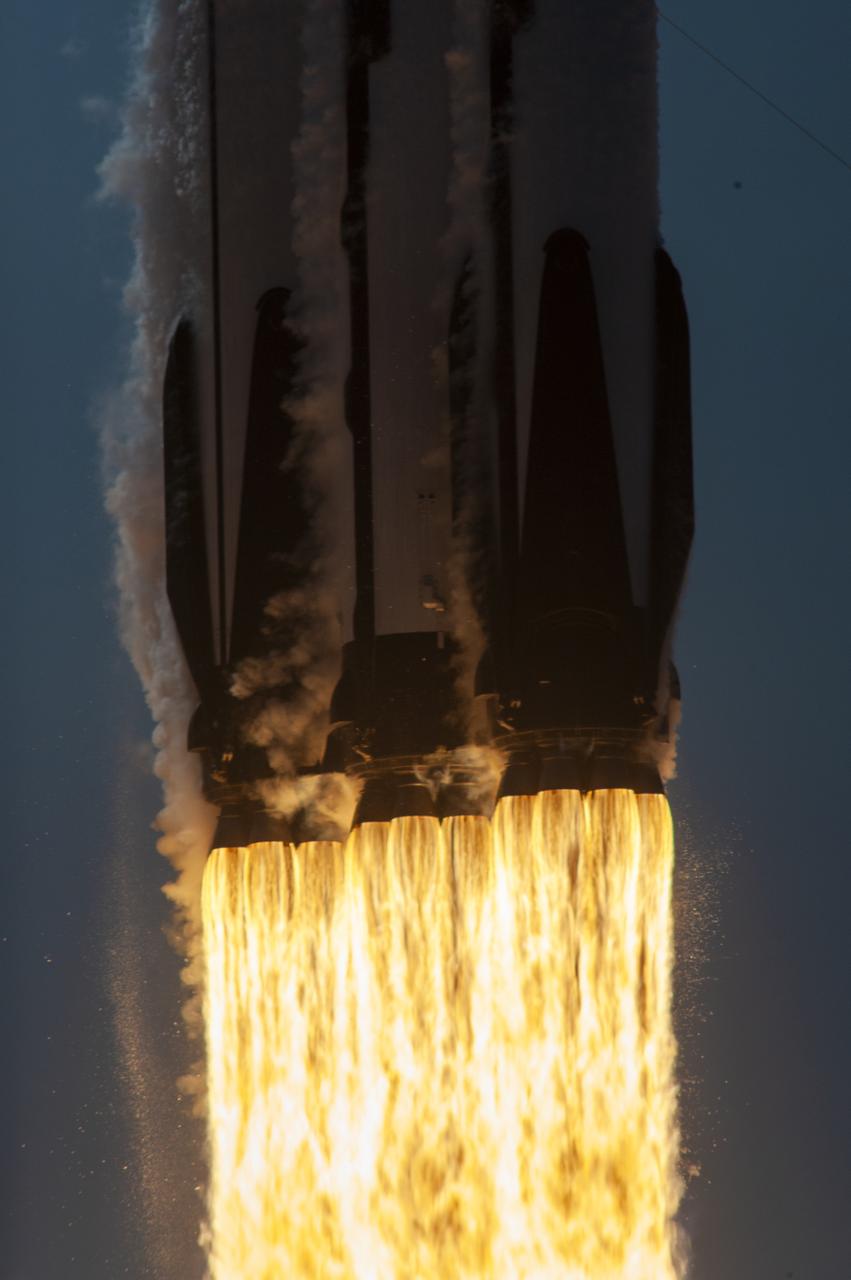
A SpaceX Falcon Heavy rocket carrying the National Oceanic and Atmospheric Administration (NOAA) GOES-U (Geostationary Operational Environmental Satellite U) lifts off from Launch Complex 39A at NASA’s Kennedy Space Center in Florida on Tuesday, June 25, 2024. The GOES-U satellite is the final satellite in the GOES-R series, which serves a critical role in providing continuous coverage of the Western Hemisphere, including monitoring tropical systems in the eastern Pacific and Atlantic oceans.
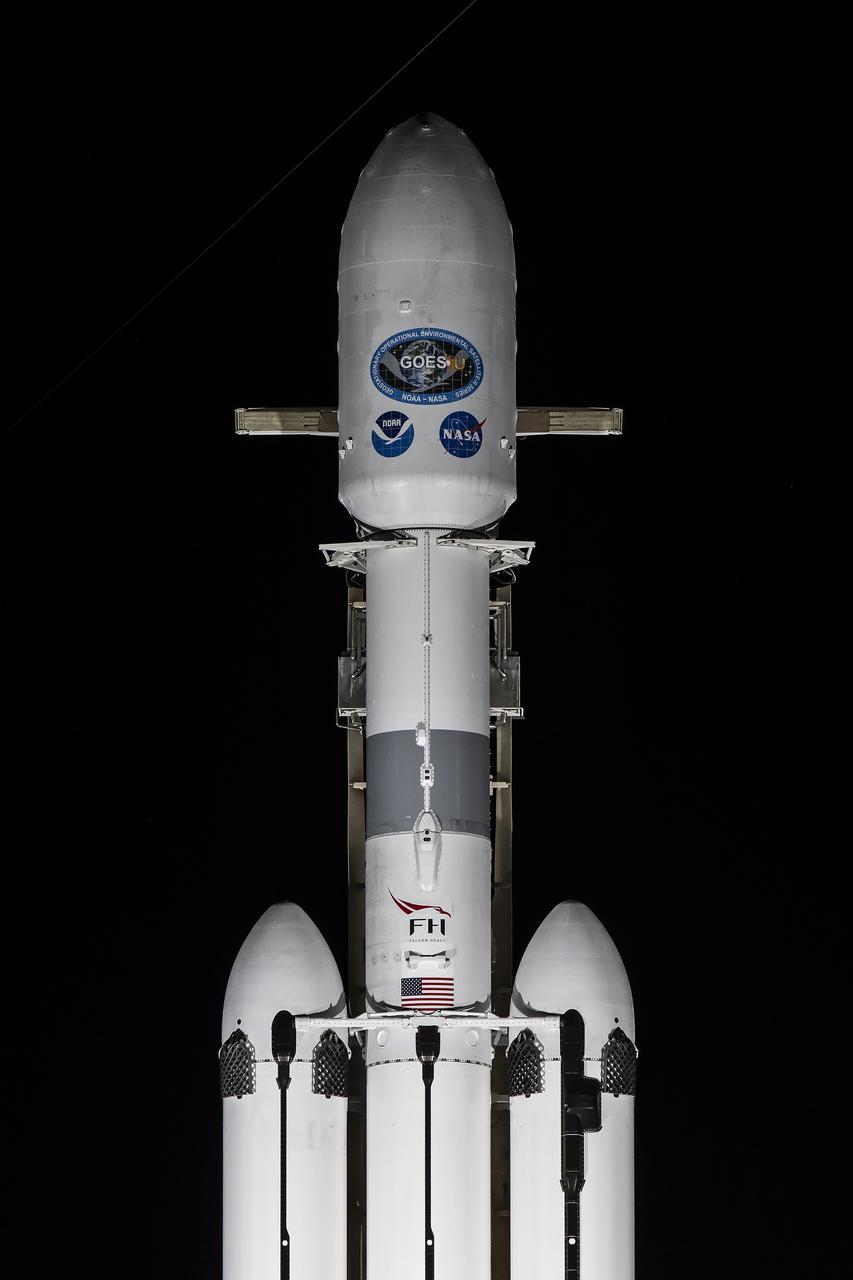
A SpaceX Falcon Heavy rocket carrying the National Oceanic and Atmospheric Administration (NOAA) GOES-U (Geostationary Operational Environmental Satellite U) stands vertical at Launch Complex 39A at NASA’s Kennedy Space Center in Florida on Monday, June 24, 2024. The GOES-U satellite is the final satellite in the GOES-R series, which serves a critical role in providing continuous coverage of the Western Hemisphere, including monitoring tropical systems in the eastern Pacific and Atlantic oceans. The two-hour launch window opens at 5:16 p.m. EDT. on Tuesday, June 25, 2024.
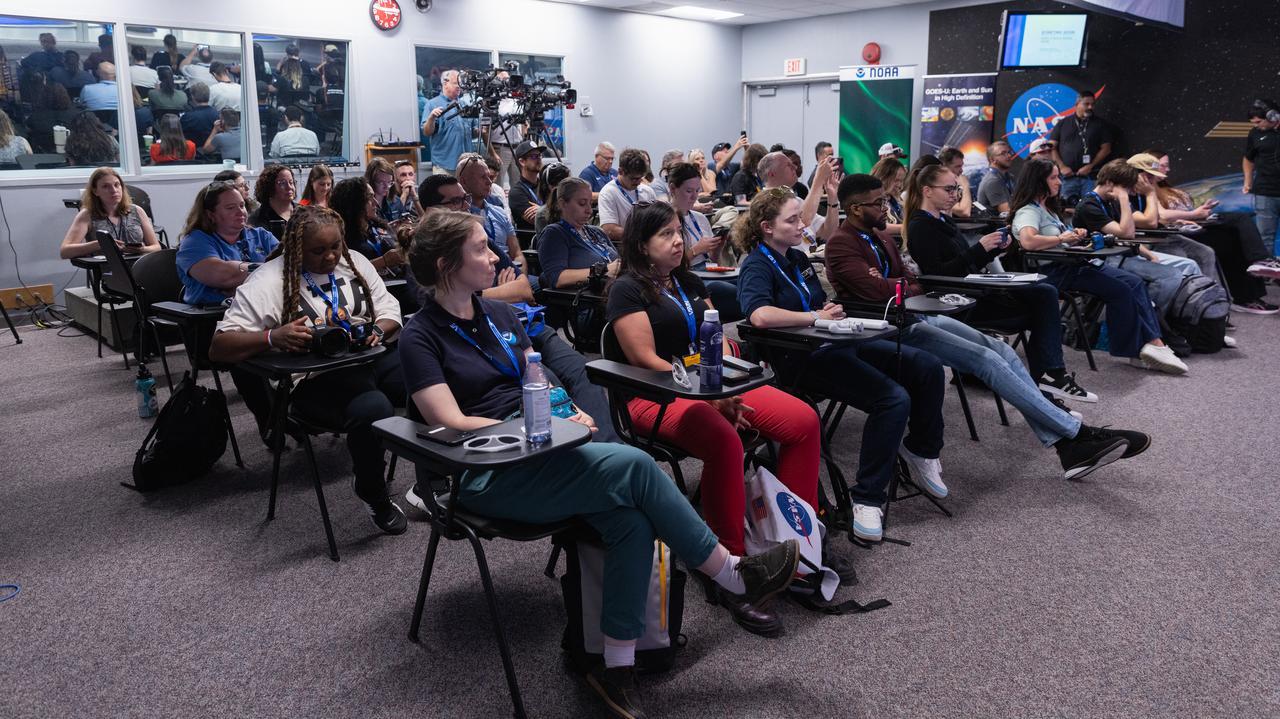
Officials from NASA, National Oceanic and Atmospheric Administration (NOAA), and other mission managers participate in a social panel on Monday, June 24, 2024, at NASA’s Kennedy Space Center in Florida for the launch of GOES-U (Geostationary Operational Environmental Satellite U) mission. The two-hour launch window opens at 5:16 p.m. EDT Tuesday, June 25, for the satellite’s launch on a SpaceX Falcon Heavy rocket from Launch Complex 39A at NASA’s Kennedy Space Center in Florida.