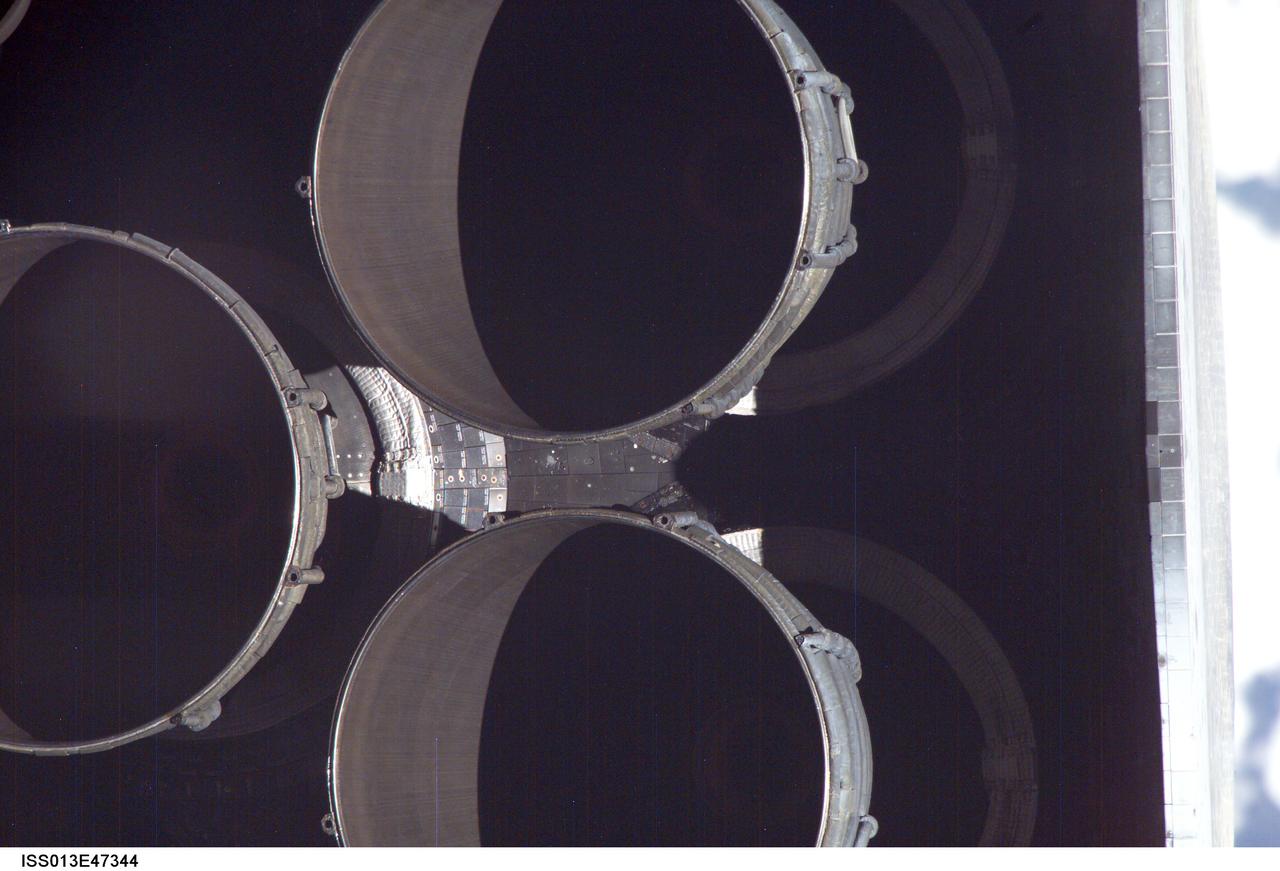
The nozzles for Discovery's three main engines are visible in this close-up image photographed by one of the Expedition 13 crew members onboard the International Space Station (ISS) during the STS-121 Rotating Pitch Maneuver (RPM) survey prior to docking of the two spacecraft. The Marshall Space Flight Center (MSFC) has management responsibility for development of the space shuttle main engines (SSME).
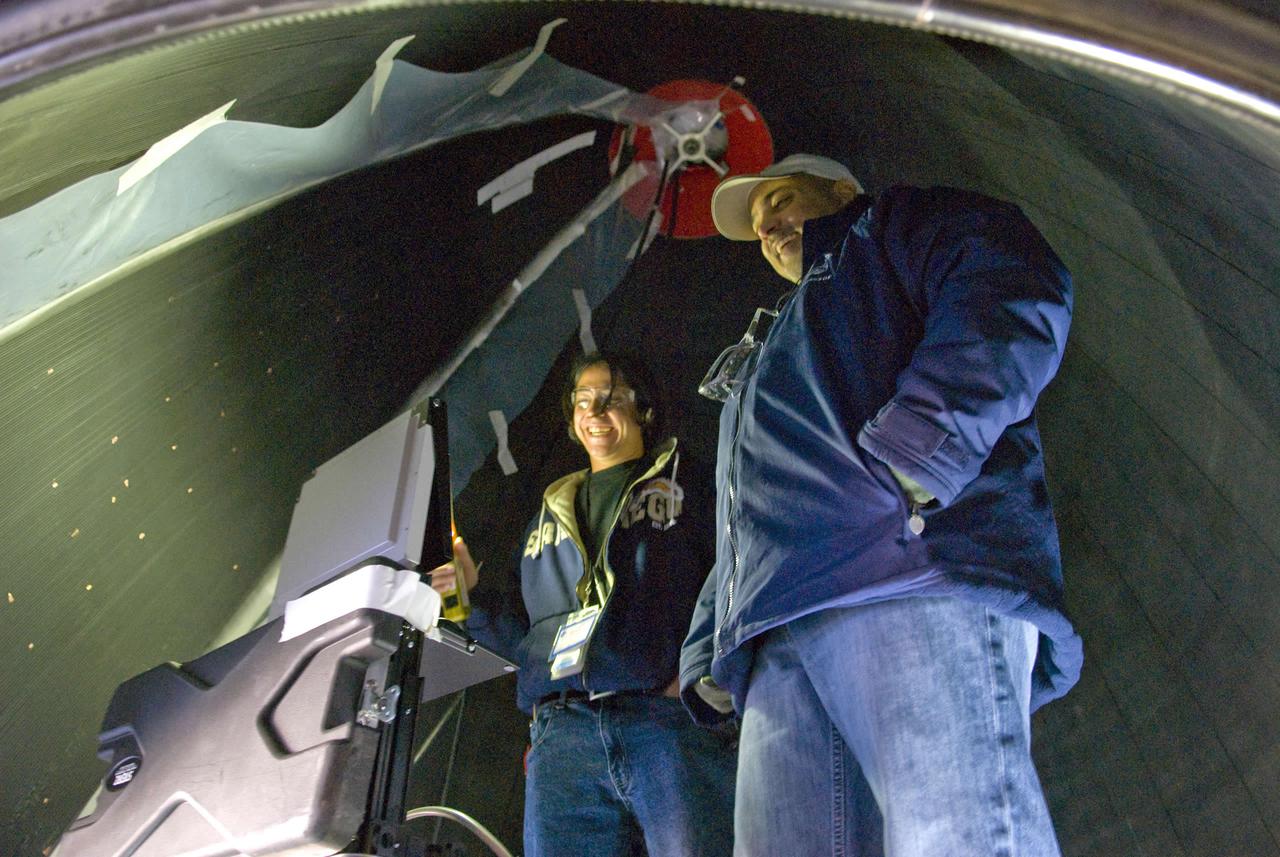
Joel Perez (left) and Jay Labat, both of Pratt & Whitney Rocketdyne, are in close quarters as they check for leaks inside the nozzle of a space shuttle main engine mounted on the A-2 Test Stand.
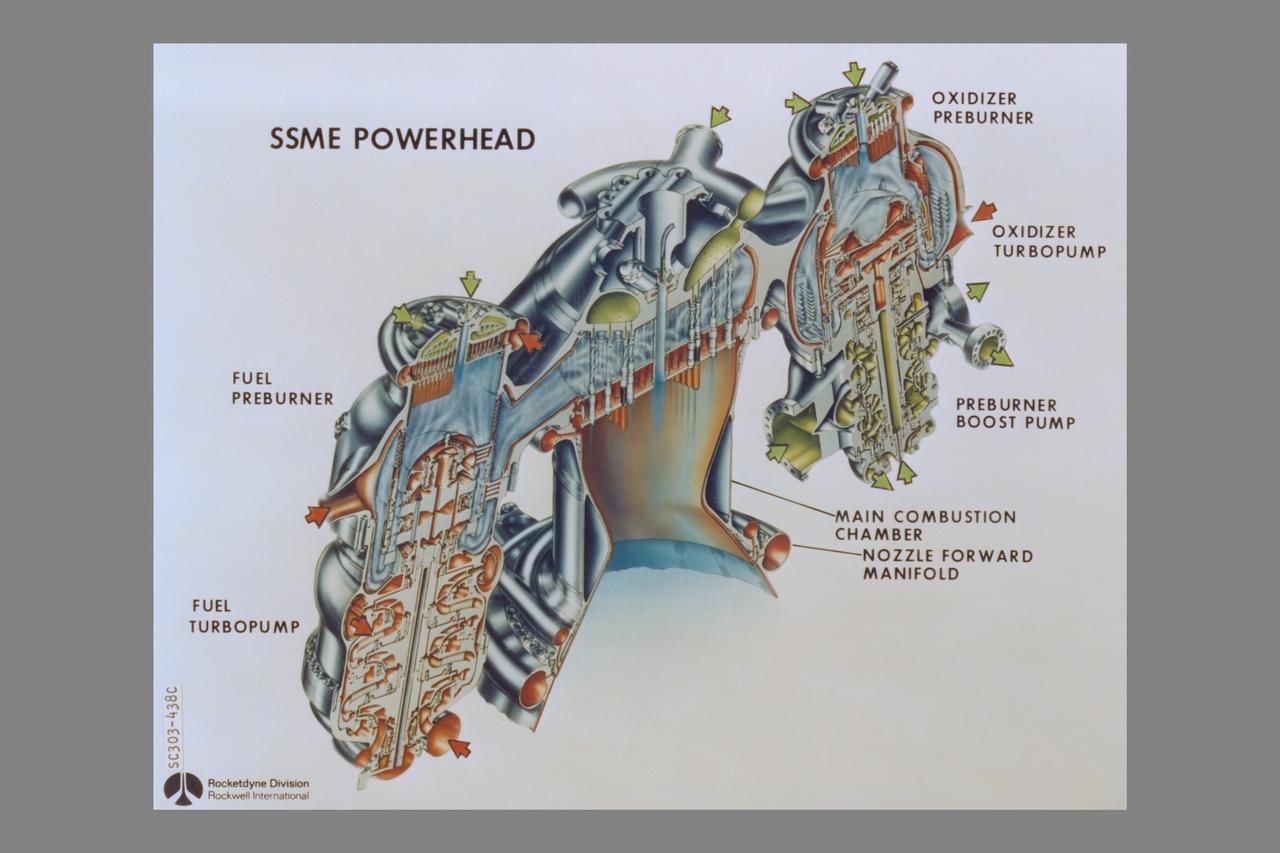
cutaway Rockwell International Space Shuttle Main Engines: Powerhead (Left side - fuel preburner, fuel trubopump - Center - Main Combustion Chamber, nozzle forward manifold - Right side - oxidizer preburner, oxidizer turbopump, preburner boost pump)

KENNEDY SPACE CENTER, FLA. - In the Orbiter Processing Facility bay 1, the main engine is in place on Discovery. The main engine configuration is manufactured by Boeing Rocketdyne in Canoga Park, Calif., and includes a Pratt & Whitney high-pressure fuel turbo pump. Each space shuttle main engine is 14 feet (4.3 meters) long, weighs about 6,700 pounds (3,039 kilograms), and is 7.5 feet (2.3 meters) in diameter at the end of the nozzle. Discovery is being processed for the second return-to-flight mission STS-121.

KENNEDY SPACE CENTER, FLA. -- An upgraded Space Shuttle main engine (block 2 engine) sits in the Space Shuttle Main Engine Processing Facility. The new engine will be installed for its first flight on the orbiter Atlantis, on mission STS-104. The Block II Main Engine configuration is manufactured by Boeing Rocketdyne in Canoga Park, Calif., and includes a new Pratt & Whitney high-pressure fuel turbo pump. Engine improvements are managed by NASA’s Marshall Space Flight Center in Huntsville, Ala. Each Space Shuttle Main Engine is 14 feet (4.3 meters) long, weighs about 7,000 pounds (3,175 kilograms), and is 7.5 feet (2.3 meters) in diameter at the end of the nozzle
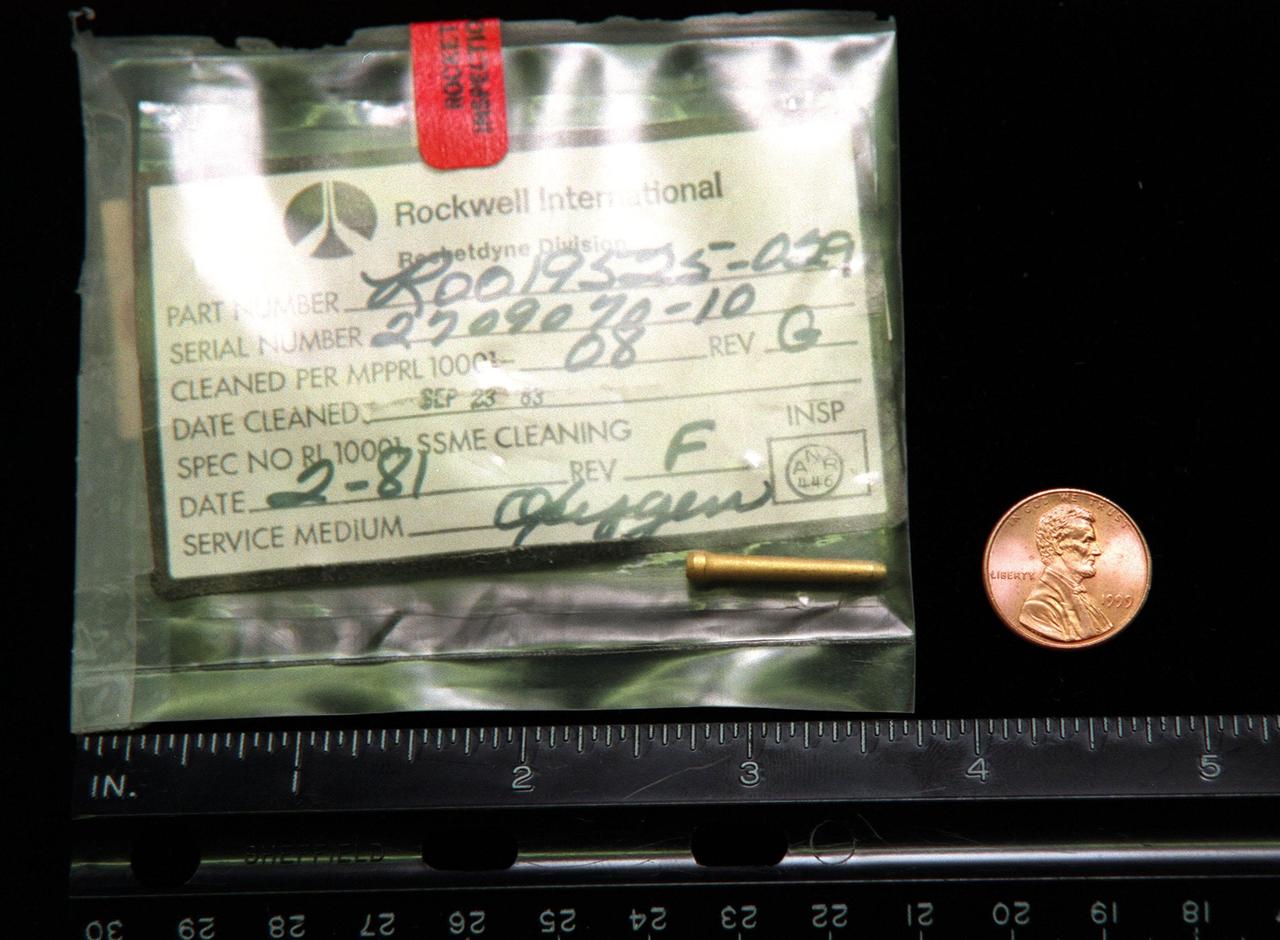
Engineers are investigating the possibility that a 7/8" gold-plated liquid oxygen post plug became dislodged and created three small holes in the liquid hydrogen tubes inside the nozzle on main engine No. 3 on Space Shuttle Columbia. The holes caused a hydrogen leak during the STS-93 launch of Columbia on July 23
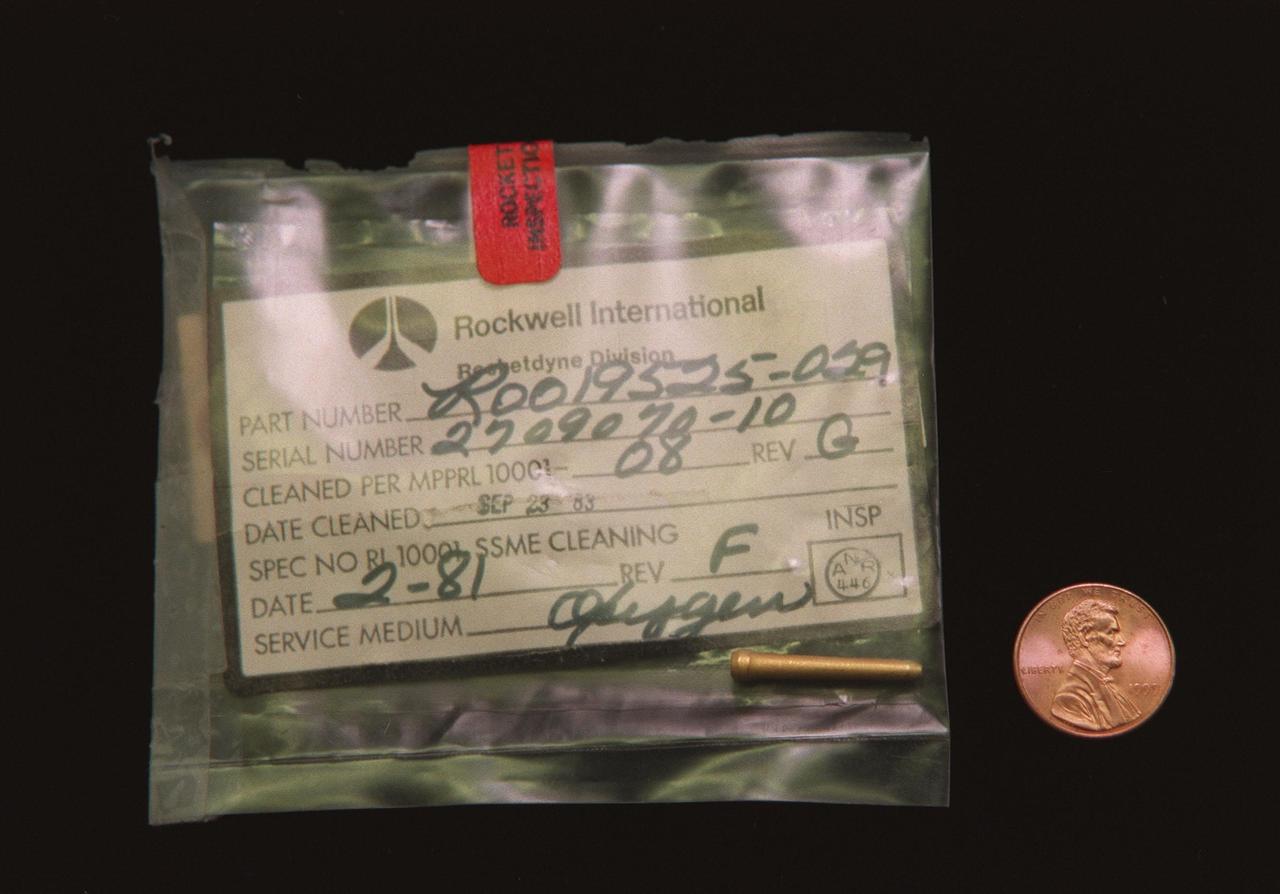
Engineers are investigating the possibility that a 7/8" gold-plated liquid oxygen post plug became dislodged and created three small holes in the liquid hydrogen tubes inside the nozzle on main engine No. 3 on Space Shuttle Columbia. The holes caused a hydrogen leak during the STS-93 launch of Columbia on July 23
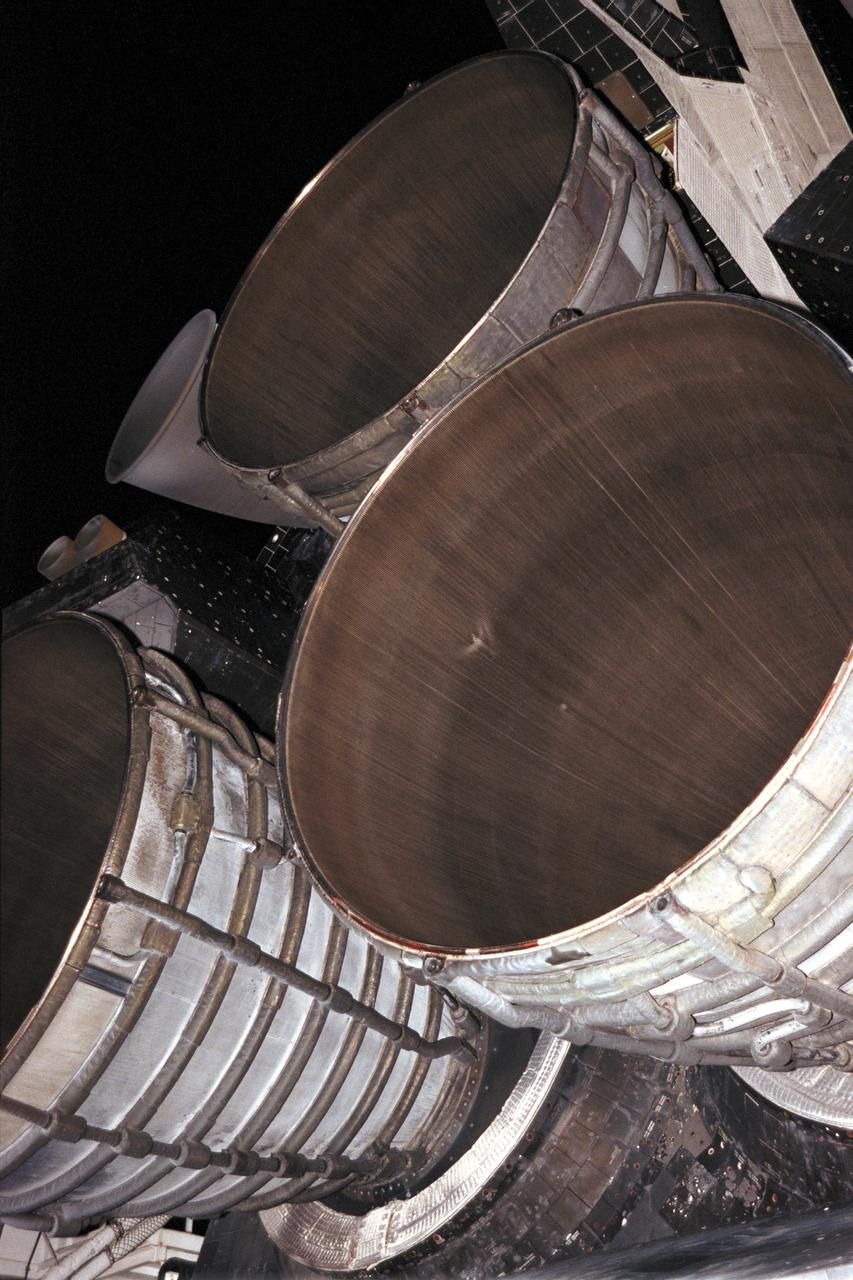
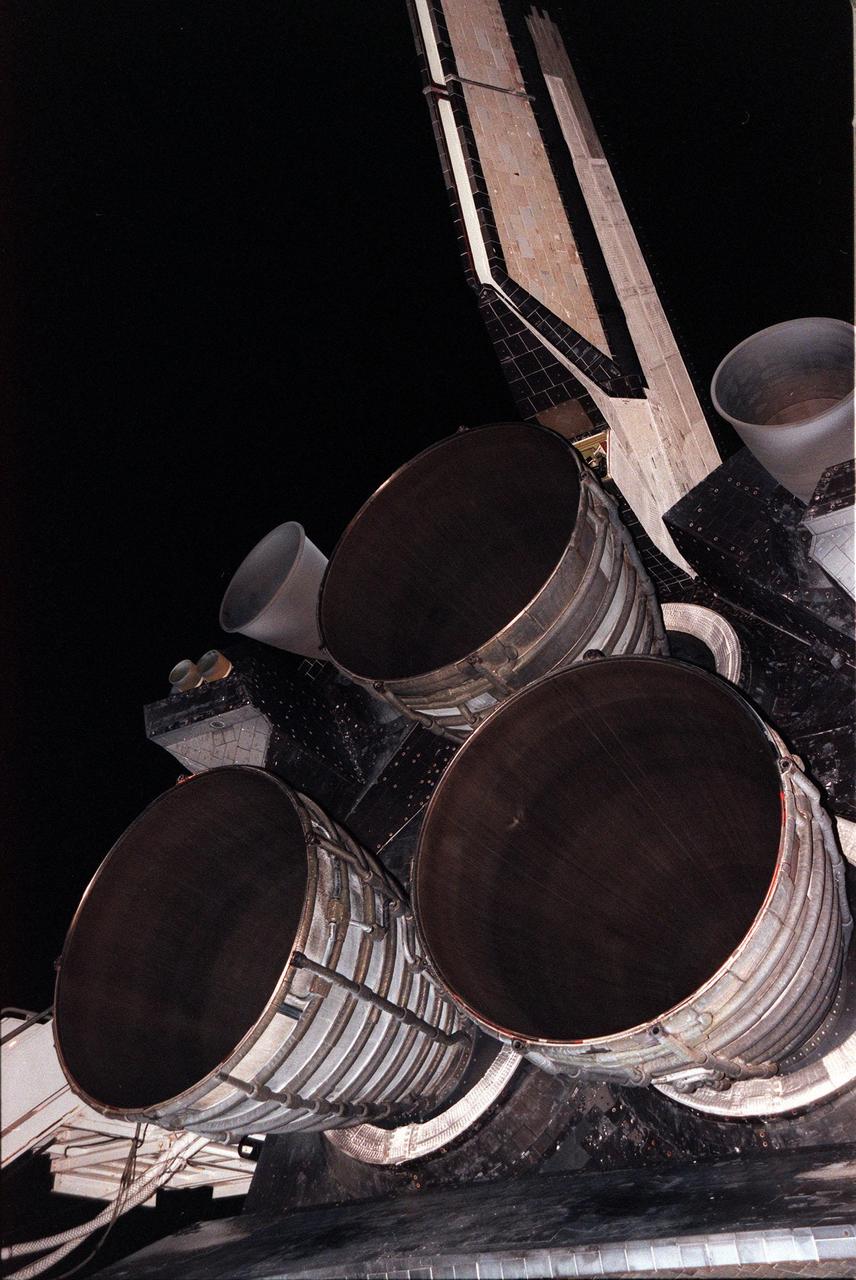
STS093-(S)-015 (28 July 1999) --- Following the landing of the Space Shuttle Columbia on July 27, 1999, this medium close-up low-angle view of the three main engines shows what appears to be three small holes in the liquid hydrogen tubes inside the nozzle on main engine No. 3. Engineers will examine the engine to determine if a possible hydrogen leak occurred during the STS-93 launch on July 23.
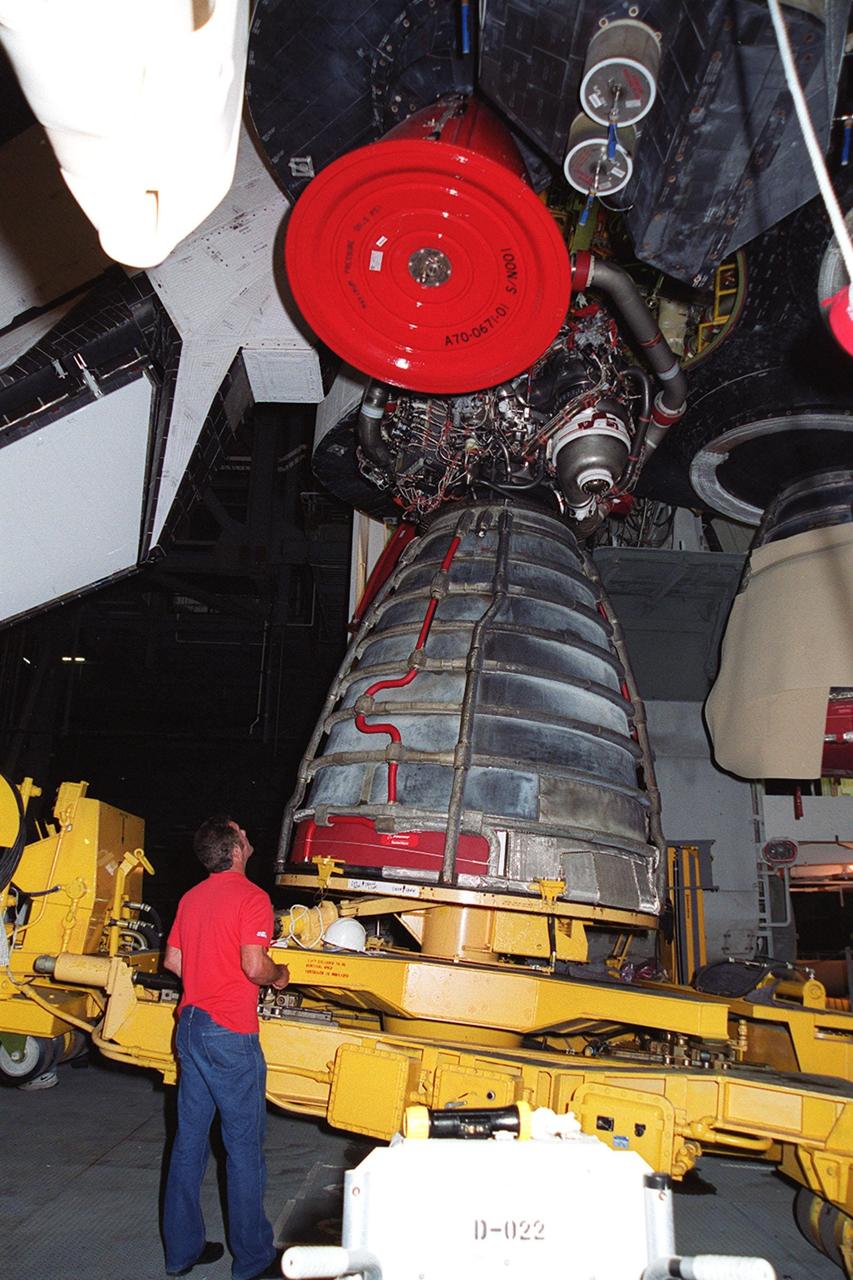
KENNEDY SPACE CENTER, FLA. -- In the Vehicle Assembly Building, Space Shuttle Atlantis' Main Engine No. 1 is lowered onto a transporter. The engine was removed because an inventory review concerning defective main engine fuel pump tip seals indicated that defective seals may be present on the fuel pump for the engine. The decision was made to replace the suspect engine with one originally slated for Discovery. The main engine nozzle, visible in the photo, is 7.8 feet across and 9.4 feet high. Space Shuttle Atlantis is scheduled to launch no earlier than April 17, 2000, on mission STS-101 to resupply the International Space Station for the arrival of the next pressurized module, the Russian-built Zvezda
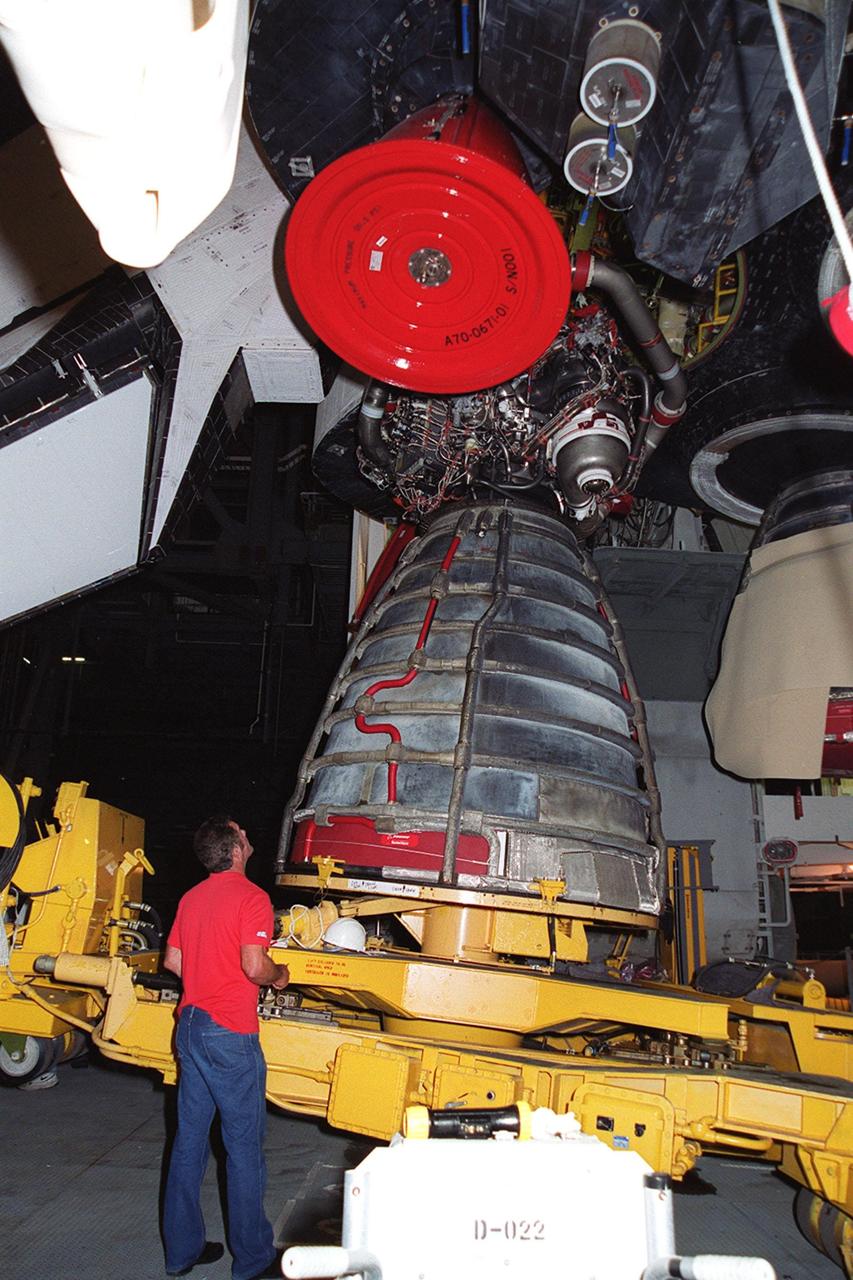
KENNEDY SPACE CENTER, FLA. -- In the Vehicle Assembly Building, Space Shuttle Atlantis' Main Engine No. 1 is lowered onto a transporter. The engine was removed because an inventory review concerning defective main engine fuel pump tip seals indicated that defective seals may be present on the fuel pump for the engine. The decision was made to replace the suspect engine with one originally slated for Discovery. The main engine nozzle, visible in the photo, is 7.8 feet across and 9.4 feet high. Space Shuttle Atlantis is scheduled to launch no earlier than April 17, 2000, on mission STS-101 to resupply the International Space Station for the arrival of the next pressurized module, the Russian-built Zvezda
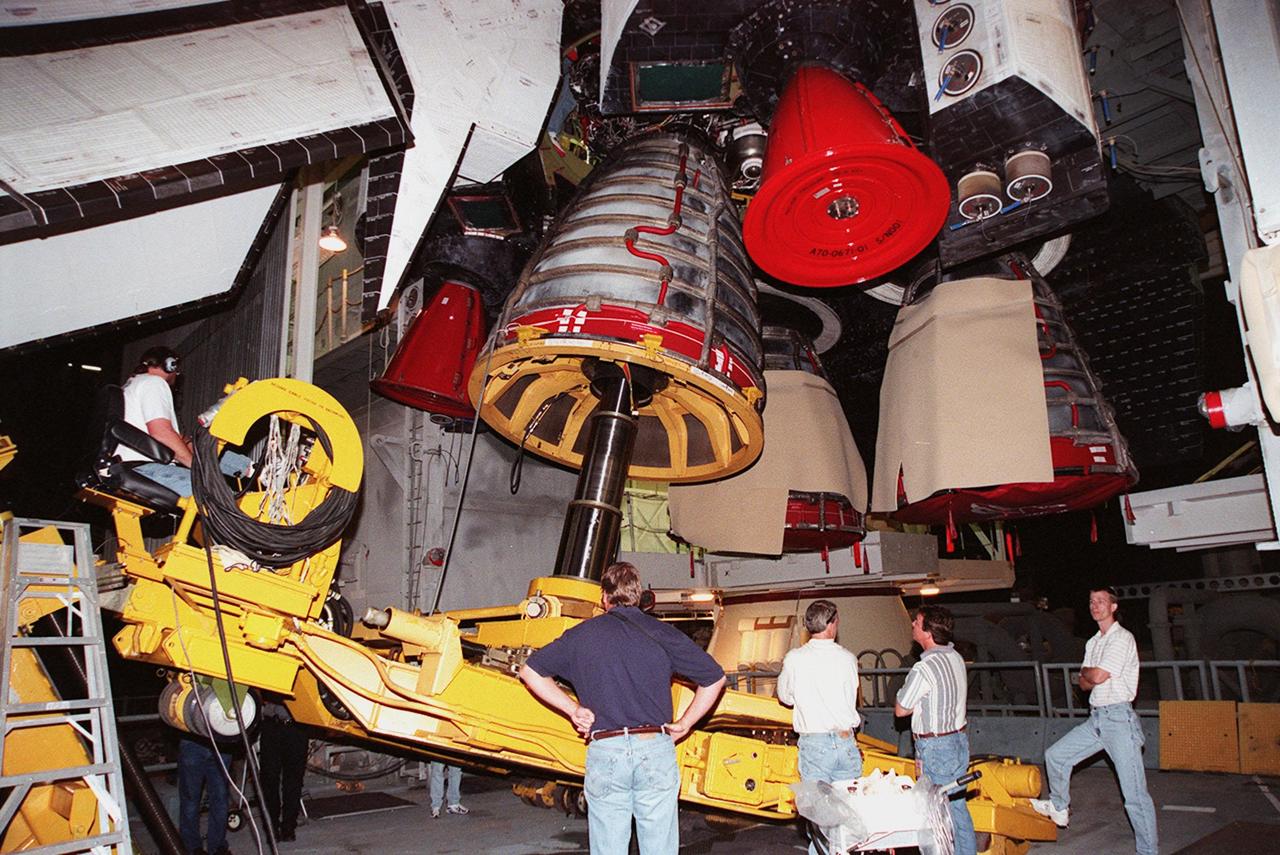
KENNEDY SPACE CENTER, FLA. -- A replacement engine is installed in Space Shuttle Atlantis. Main Engine No. 1 was removed after an inventory review concerning defective main engine fuel pump tip seals indicated that defective seals might be present on the previous fuel pump for the engine. The decision was made to replace the suspect engine with one originally slated for Discovery. The main engine nozzle, visible in the photo, is 7.8 feet across and 9.4 feet high. Space Shuttle Atlantis is scheduled to launch no earlier than April 17, 2000, on mission STS-101 to resupply the International Space Station for the arrival of the next pressurized module, the Russian-built Zvezda

KENNEDY SPACE CENTER, FLA. -- A replacement engine is installed in Space Shuttle Atlantis. Main Engine No. 1 was removed after an inventory review concerning defective main engine fuel pump tip seals indicated that defective seals might be present on the previous fuel pump for the engine. The decision was made to replace the suspect engine with one originally slated for Discovery. The main engine nozzle, visible in the photo, is 7.8 feet across and 9.4 feet high. Space Shuttle Atlantis is scheduled to launch no earlier than April 17, 2000, on mission STS-101 to resupply the International Space Station for the arrival of the next pressurized module, the Russian-built Zvezda
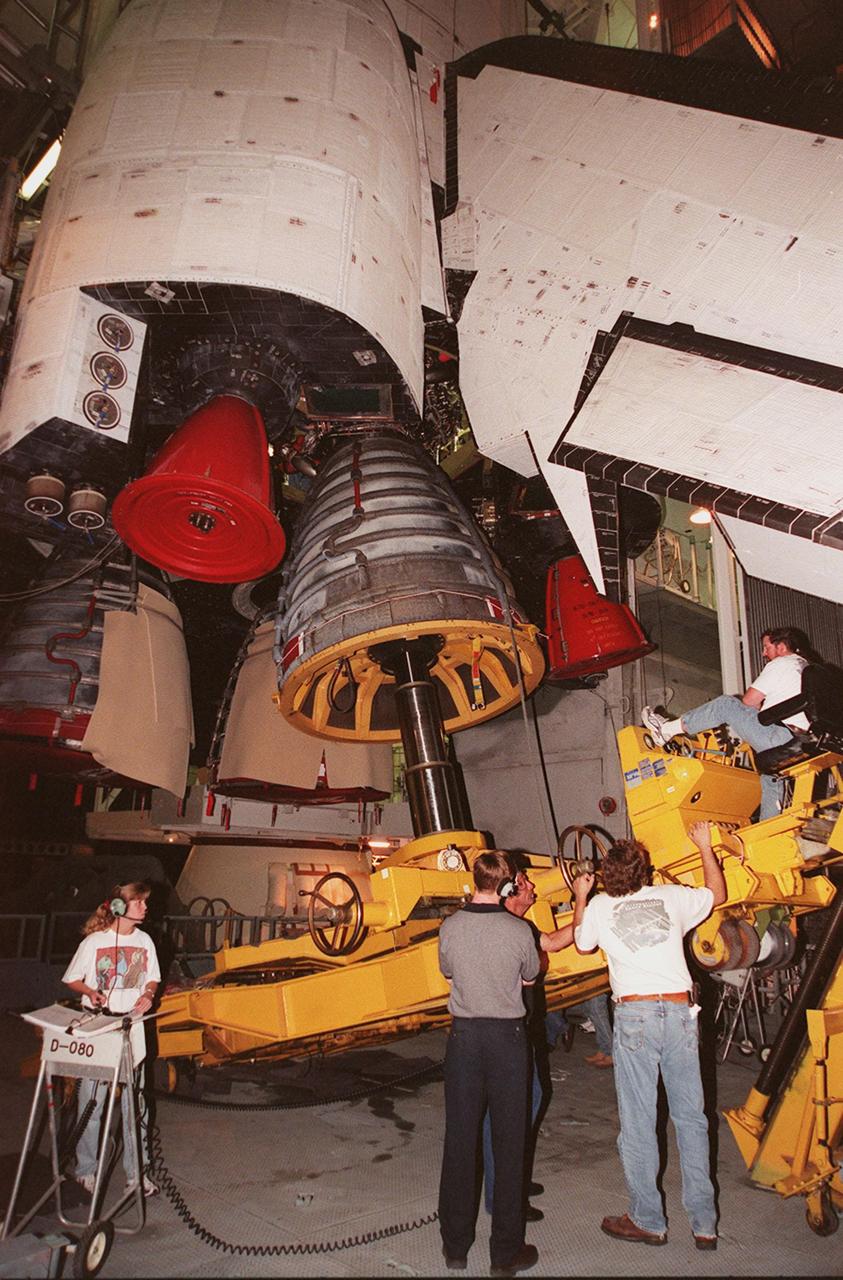
KENNEDY SPACE CENTER, FLA. -- Workers in the Vehicle Assembly Building oversee the replacement of Main Engine No. 1 in Space Shuttle Atlantis (overhead). An inventory review concerning defective main engine fuel pump tip seals indicated that defective seals might be present on the previous fuel pump for the engine. The decision was made to replace the suspect engine with one originally slated for Discovery. The main engine nozzle, visible in the photo, is 7.8 feet across and 9.4 feet high. Space Shuttle Atlantis is scheduled to launch no earlier than April 17, 2000, on mission STS-101 to resupply the International Space Station for the arrival of the next pressurized module, the Russian-built Zvezda
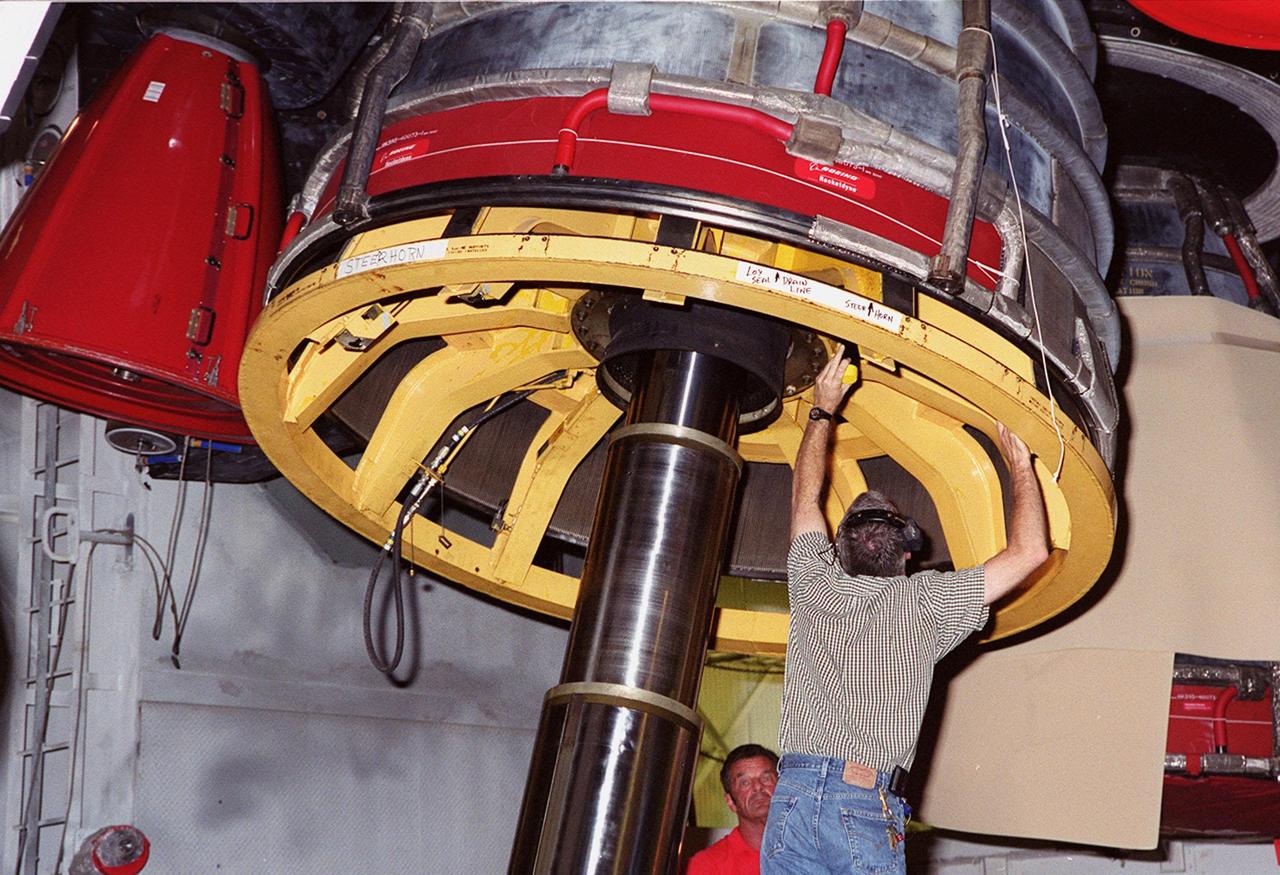
KENNEDY SPACE CENTER, FLA. -- A worker in the Vehicle Assembly Building adjusts the equipment being used for the removal of Main Engine No. 1 on Space Shuttle Atlantis. An inventory review concerning defective main engine fuel pump tip seals indicated that defective seals may be present on the fuel pump for the engine. The decision was made to replace the suspect engine with one originally slated for Discovery. The main engine nozzle, visible in the photo, is 7.8 feet across and 9.4 feet high. Space Shuttle Atlantis is scheduled to launch no earlier than April 17, 2000, on mission STS-101 to resupply the International Space Station for the arrival of the next pressurized module, the Russian-built Zvezda

KENNEDY SPACE CENTER, FLA. -- Workers in the Vehicle Assembly Building oversee the replacement of Main Engine No. 1 in Space Shuttle Atlantis (overhead). An inventory review concerning defective main engine fuel pump tip seals indicated that defective seals might be present on the previous fuel pump for the engine. The decision was made to replace the suspect engine with one originally slated for Discovery. The main engine nozzle, visible in the photo, is 7.8 feet across and 9.4 feet high. Space Shuttle Atlantis is scheduled to launch no earlier than April 17, 2000, on mission STS-101 to resupply the International Space Station for the arrival of the next pressurized module, the Russian-built Zvezda
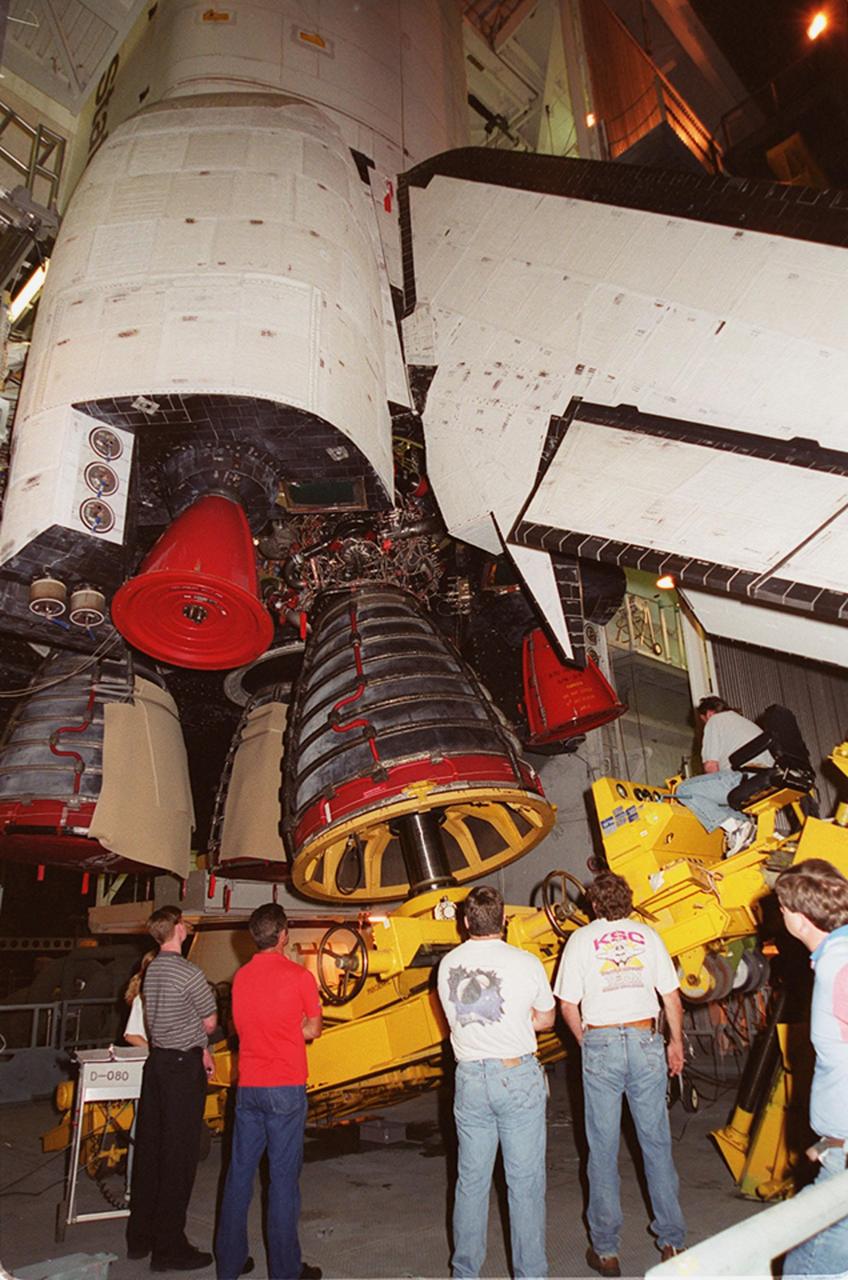
KENNEDY SPACE CENTER, FLA. -- Workers in the Vehicle Assembly Building watch as Space Shuttle Atlantis' Main Engine No. 1 is being removed. An inventory review concerning defective main engine fuel pump tip seals indicated that defective seals may be present on the fuel pump for the engine. The decision was made to replace the suspect engine with one originally slated for Discovery. The main engine nozzle, visible in the photo, is 7.8 feet across and 9.4 feet high. Space Shuttle Atlantis is scheduled to launch no earlier than April 17, 2000, on mission STS-101 to resupply the International Space Station for the arrival of the next pressurized module, the Russian-built Zvezda

KENNEDY SPACE CENTER, FLA. -- In the Vehicle Assembly Building, Space Shuttle Atlantis' Main Engine No. 1 is lowered after its removal. An inventory review concerning defective main engine fuel pump tip seals indicated that defective seals may be present on the fuel pump for the engine. The decision was made to replace the suspect engine with one originally slated for Discovery. The main engine nozzle, visible in the photo, is 7.8 feet across and 9.4 feet high. Space Shuttle Atlantis is scheduled to launch no earlier than April 17, 2000, on mission STS-101 to resupply the International Space Station for the arrival of the next pressurized module, the Russian-built Zvezda
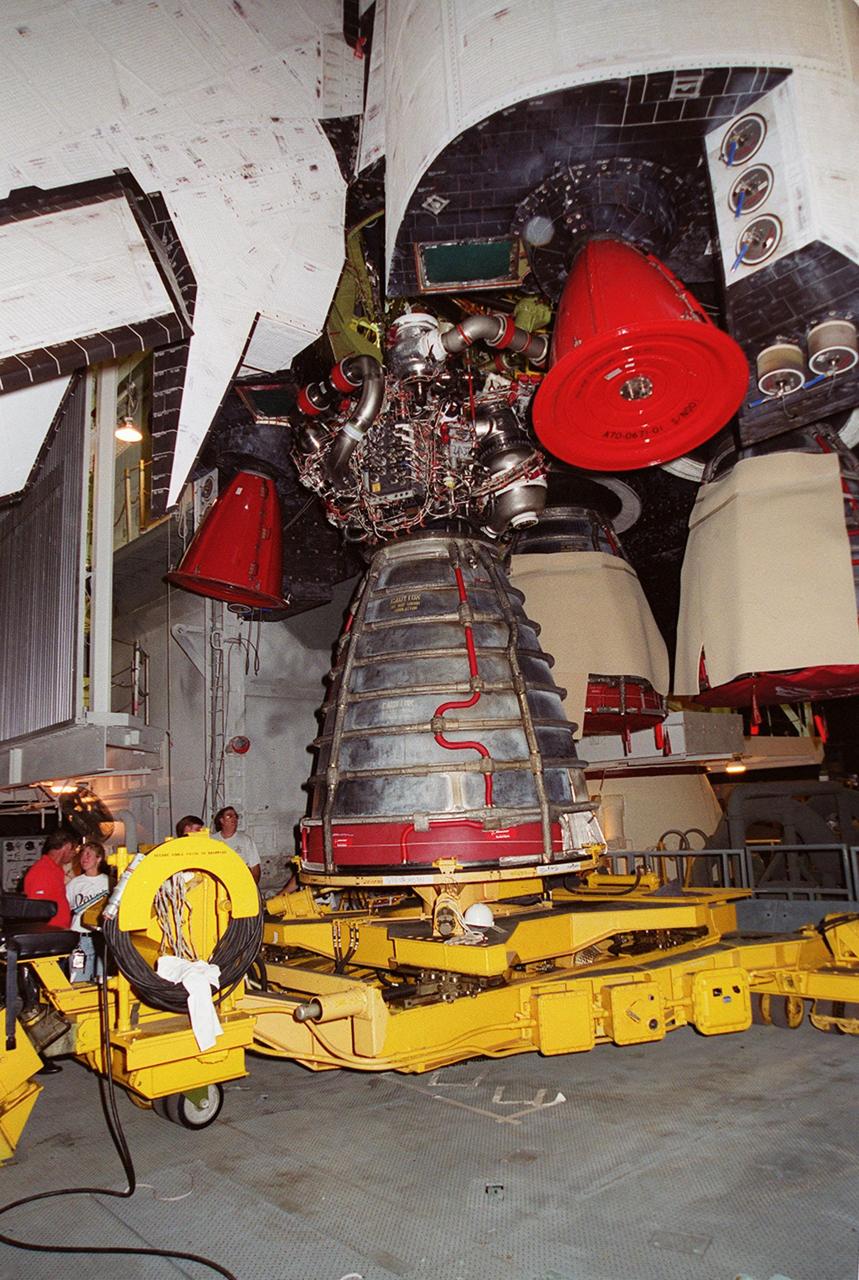
KENNEDY SPACE CENTER, FLA. -- In the Vehicle Assembly Building, Space Shuttle Atlantis' Main Engine No. 1 sits on a transporter after being removed. An inventory review concerning defective main engine fuel pump tip seals indicated that defective seals may be present on the fuel pump for the engine. The decision was made to replace the suspect engine with one originally slated for Discovery. The main engine nozzle, visible in the photo, is 7.8 feet across and 9.4 feet high. Space Shuttle Atlantis is scheduled to launch no earlier than April 17, 2000, on mission STS-101 to resupply the International Space Station for the arrival of the next pressurized module, the Russian-built Zvezda
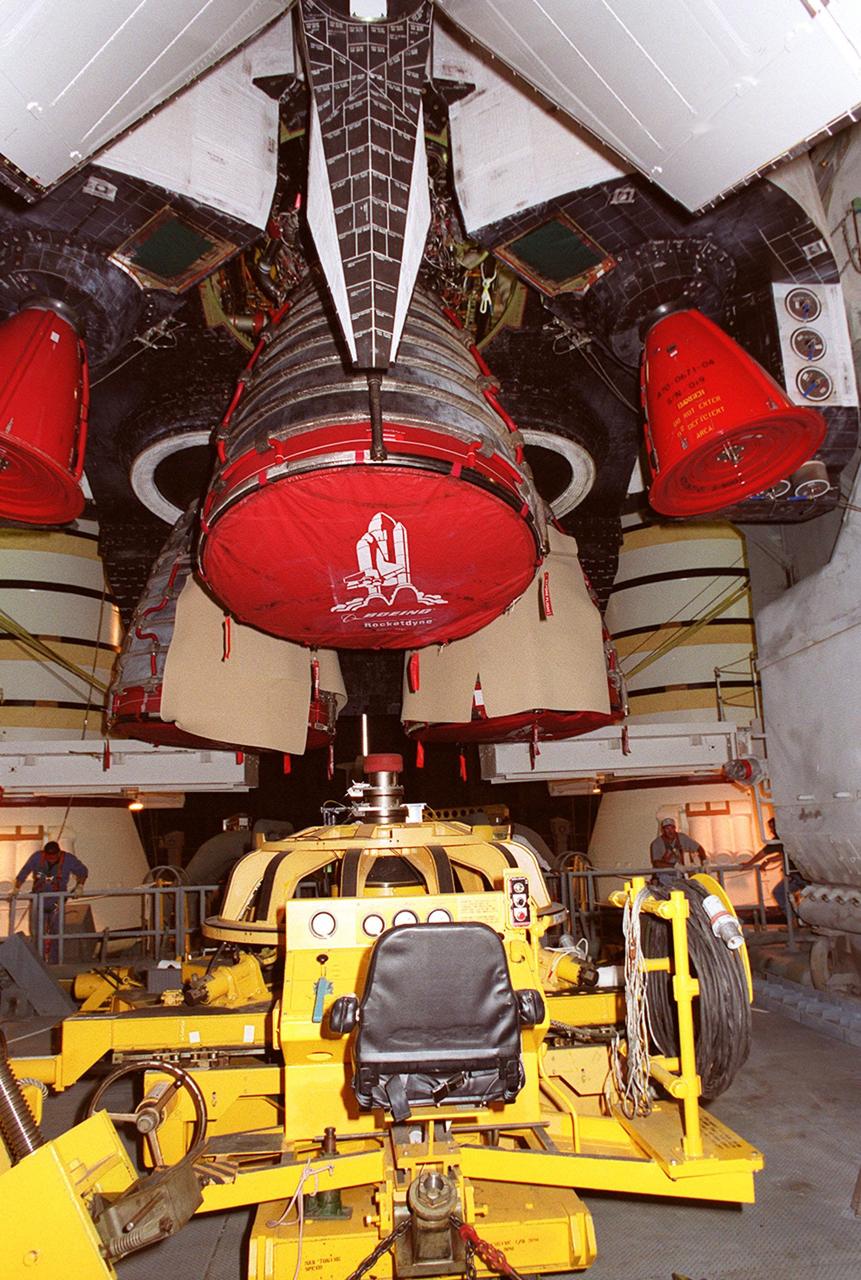
KENNEDY SPACE CENTER, FLA. -- The equipment is in place to remove Main Engine No. 1 from Space Shuttle Atlantis in the Vehicle Assembly Building. An inventory review concerning defective main engine fuel pump tip seals indicated that defective seals may be present on the fuel pump for the engine. The decision was made to replace the suspect engine with one originally slated for Discovery. The main engine nozzles, visible in the photo, are 7.8 feet across and 9.4 feet high. Space Shuttle Atlantis is scheduled to launch no earlier than April 17, 2000, on mission STS-101 to resupply the International Space Station for the arrival of the next pressurized module, the Russian-built Zvezda
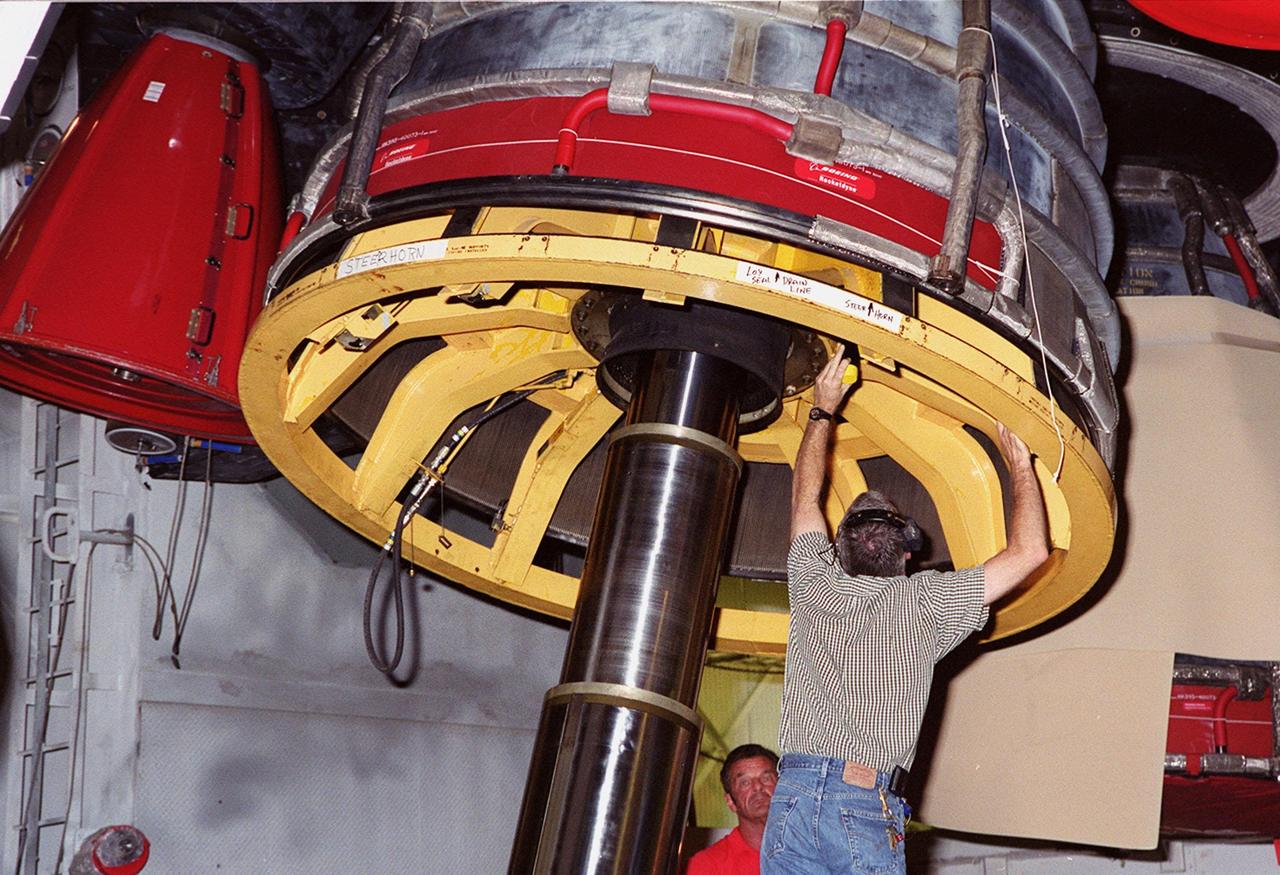
KENNEDY SPACE CENTER, FLA. -- A worker in the Vehicle Assembly Building adjusts the equipment being used for the removal of Main Engine No. 1 on Space Shuttle Atlantis. An inventory review concerning defective main engine fuel pump tip seals indicated that defective seals may be present on the fuel pump for the engine. The decision was made to replace the suspect engine with one originally slated for Discovery. The main engine nozzle, visible in the photo, is 7.8 feet across and 9.4 feet high. Space Shuttle Atlantis is scheduled to launch no earlier than April 17, 2000, on mission STS-101 to resupply the International Space Station for the arrival of the next pressurized module, the Russian-built Zvezda
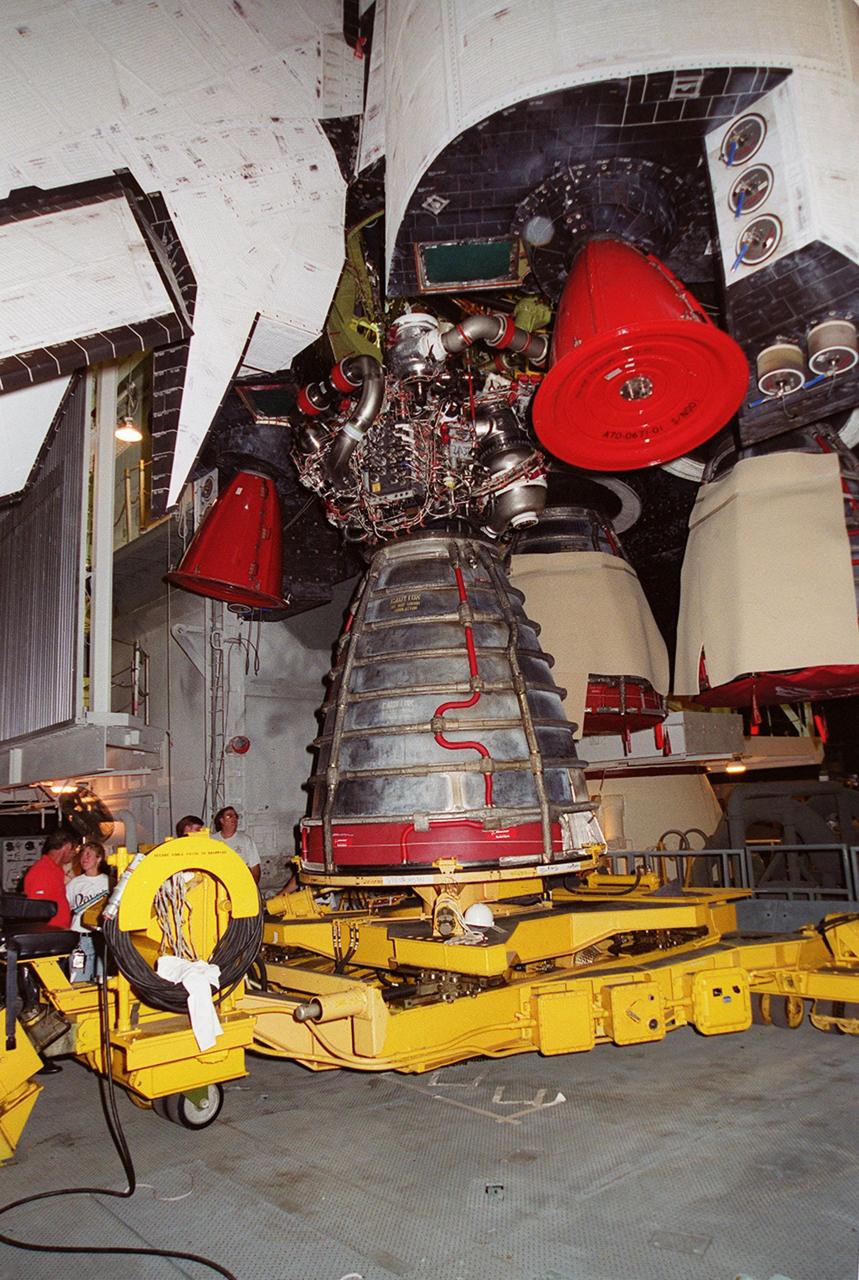
KENNEDY SPACE CENTER, FLA. -- In the Vehicle Assembly Building, Space Shuttle Atlantis' Main Engine No. 1 sits on a transporter after being removed. An inventory review concerning defective main engine fuel pump tip seals indicated that defective seals may be present on the fuel pump for the engine. The decision was made to replace the suspect engine with one originally slated for Discovery. The main engine nozzle, visible in the photo, is 7.8 feet across and 9.4 feet high. Space Shuttle Atlantis is scheduled to launch no earlier than April 17, 2000, on mission STS-101 to resupply the International Space Station for the arrival of the next pressurized module, the Russian-built Zvezda
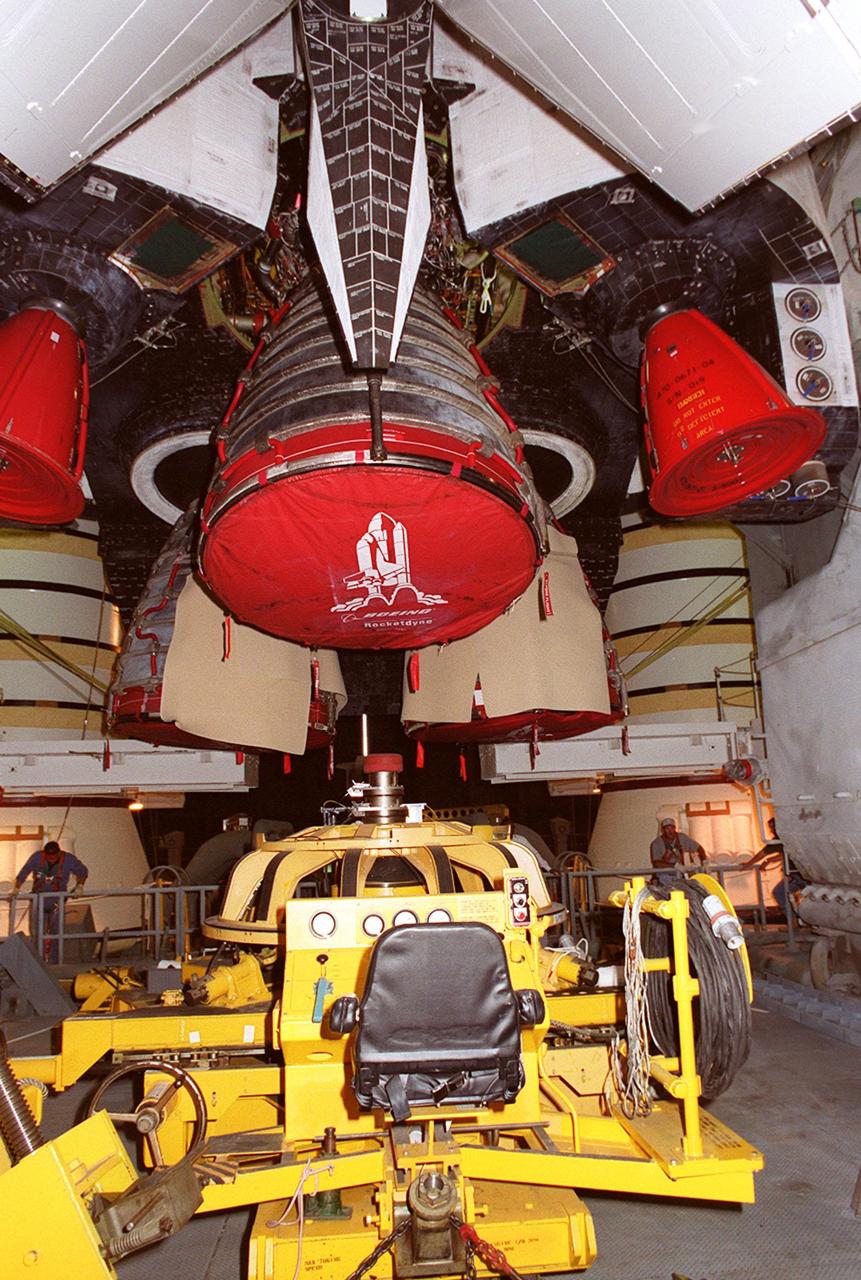
KENNEDY SPACE CENTER, FLA. -- The equipment is in place to remove Main Engine No. 1 from Space Shuttle Atlantis in the Vehicle Assembly Building. An inventory review concerning defective main engine fuel pump tip seals indicated that defective seals may be present on the fuel pump for the engine. The decision was made to replace the suspect engine with one originally slated for Discovery. The main engine nozzles, visible in the photo, are 7.8 feet across and 9.4 feet high. Space Shuttle Atlantis is scheduled to launch no earlier than April 17, 2000, on mission STS-101 to resupply the International Space Station for the arrival of the next pressurized module, the Russian-built Zvezda
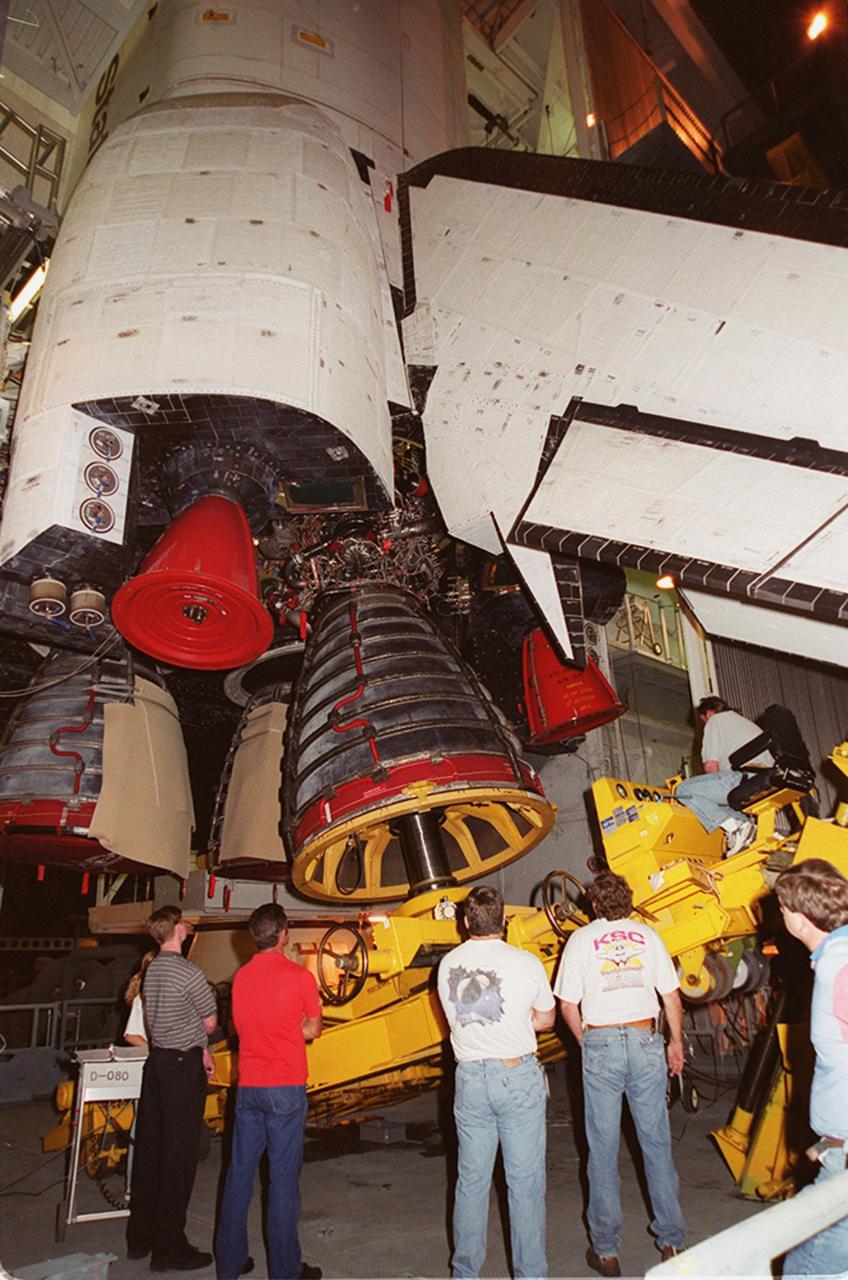
KENNEDY SPACE CENTER, FLA. -- Workers in the Vehicle Assembly Building watch as Space Shuttle Atlantis' Main Engine No. 1 is being removed. An inventory review concerning defective main engine fuel pump tip seals indicated that defective seals may be present on the fuel pump for the engine. The decision was made to replace the suspect engine with one originally slated for Discovery. The main engine nozzle, visible in the photo, is 7.8 feet across and 9.4 feet high. Space Shuttle Atlantis is scheduled to launch no earlier than April 17, 2000, on mission STS-101 to resupply the International Space Station for the arrival of the next pressurized module, the Russian-built Zvezda

KENNEDY SPACE CENTER, FLA. -- In the Vehicle Assembly Building, Space Shuttle Atlantis' Main Engine No. 1 is lowered after its removal. An inventory review concerning defective main engine fuel pump tip seals indicated that defective seals may be present on the fuel pump for the engine. The decision was made to replace the suspect engine with one originally slated for Discovery. The main engine nozzle, visible in the photo, is 7.8 feet across and 9.4 feet high. Space Shuttle Atlantis is scheduled to launch no earlier than April 17, 2000, on mission STS-101 to resupply the International Space Station for the arrival of the next pressurized module, the Russian-built Zvezda
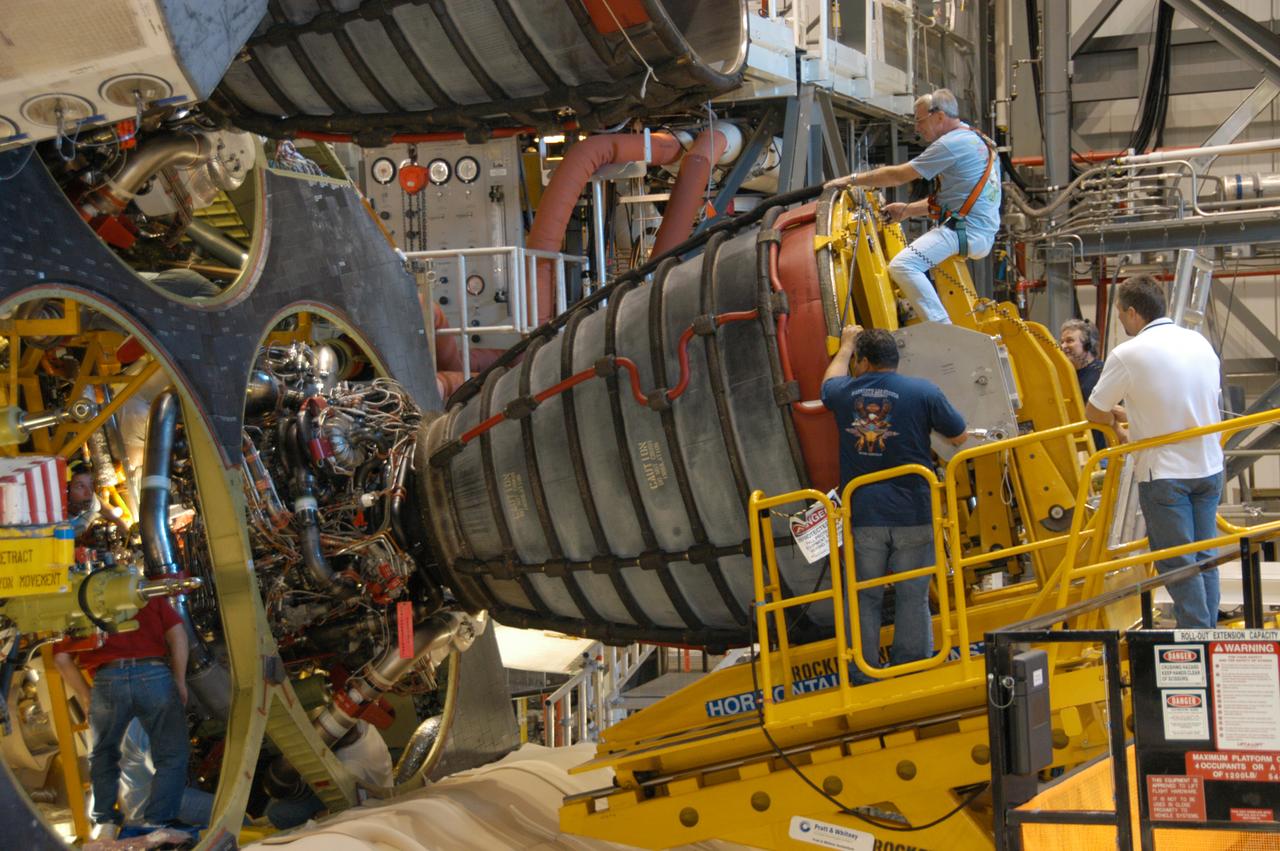
In Orbiter Processing Facility bay 2, technicians on a Hyster forklift maneuver space shuttle main engine no. 3 into place on Endeavour. Each space shuttle main engine is 14 feet long, weighs about 6,700 pounds, and is 7.5 feet in diameter at the end of the nozzle. The orbiter is scheduled for mission STS-118, targeted for launch on June 28. The mission will be the 22nd flight to the International Space Station, carrying another starboard array, S5, for installation.
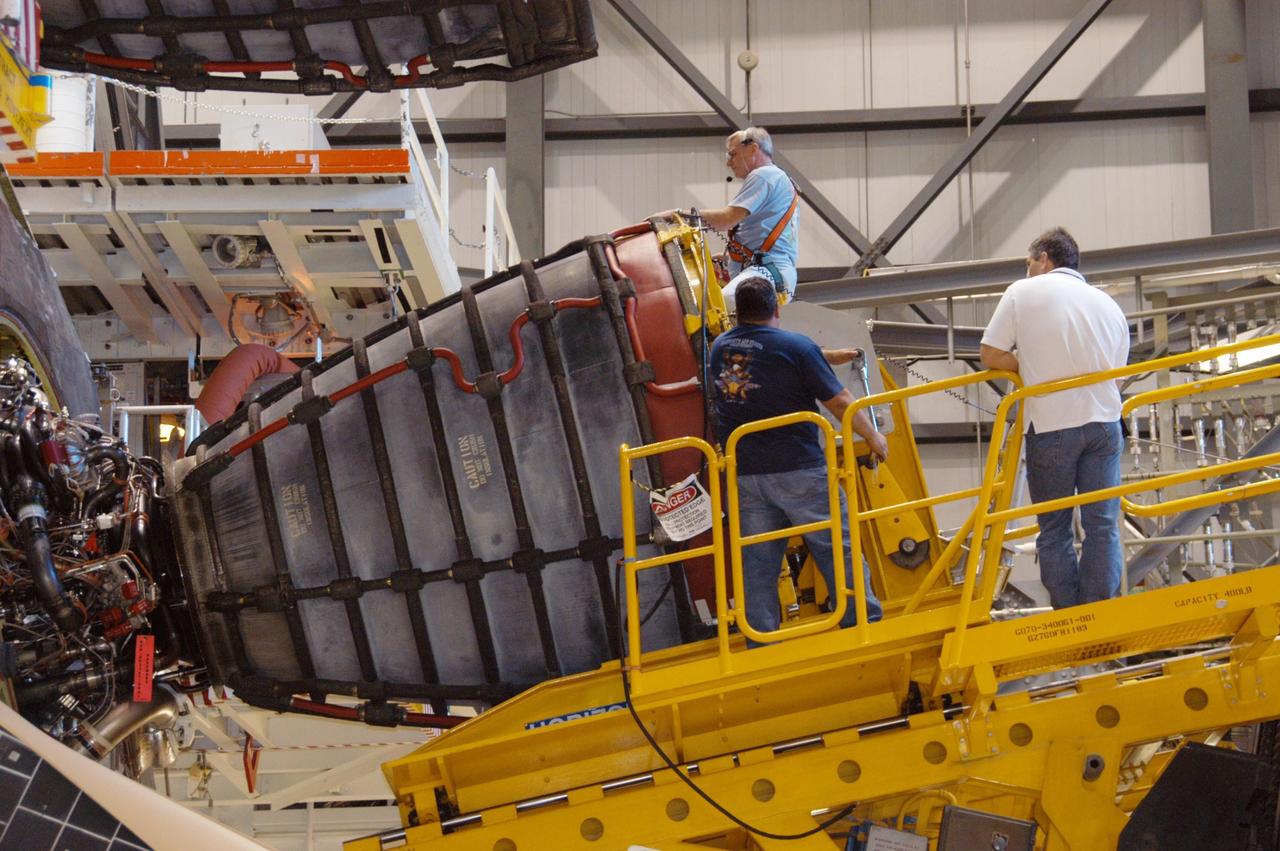
KENNEDY SPACE CENTER, FLA. -- In Orbiter Processing Facility bay 2, technicians on a Hyster forklift maneuver space shuttle main engine no. 3 into place on Endeavour. Each space shuttle main engine is 14 feet long, weighs about 6,700 pounds, and is 7.5 feet in diameter at the end of the nozzle. The orbiter is scheduled for mission STS-118, targeted for launch on June 28. The mission will be the 22nd flight to the International Space Station, carrying another starboard array, S5, for installation. Photo credit: NASA/George Shelton
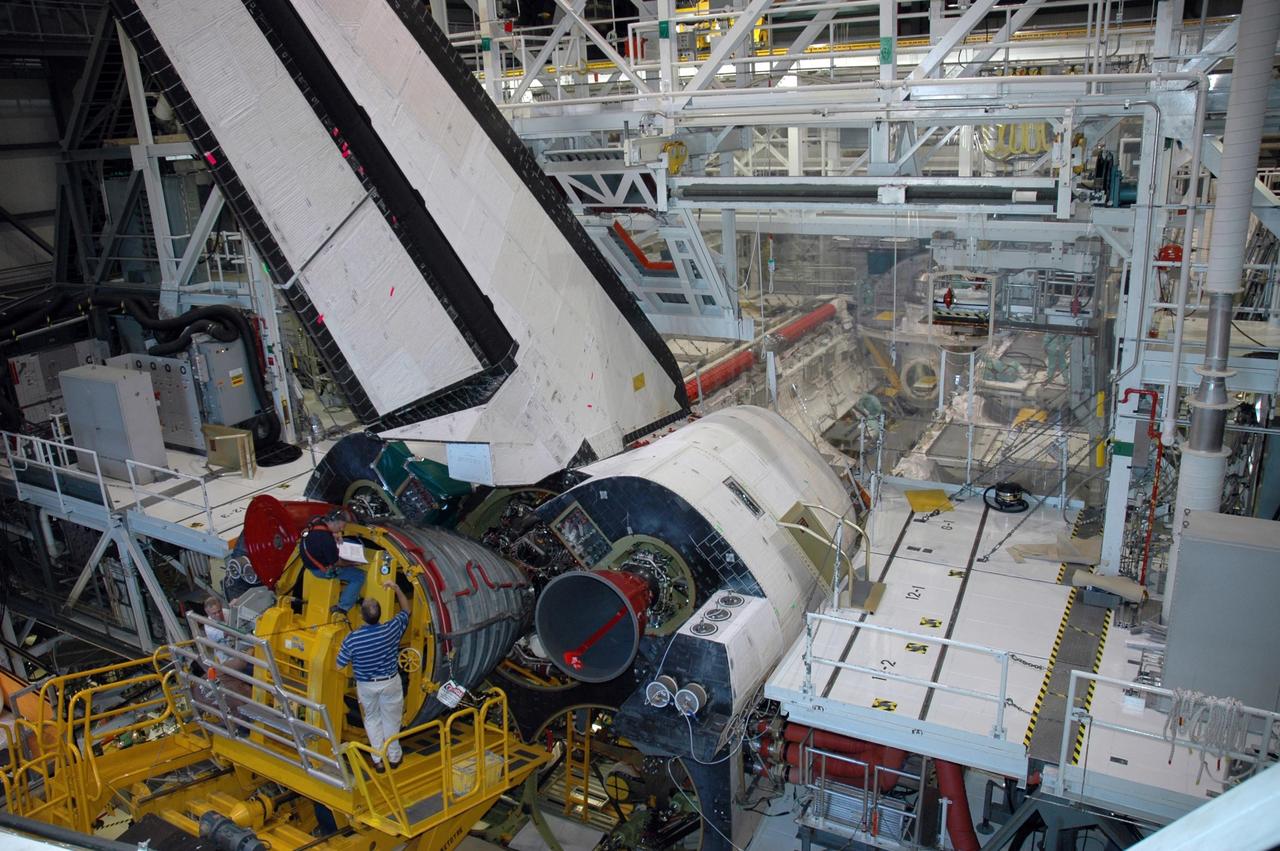
KENNEDY SPACE CENTER, FLA. -- In Orbiter Processing Facility bay 3 at NASA's Kennedy Space Center, technicians on a Hyster forklift maneuver space shuttle main engine no. 1 into place on Endeavour. Each space shuttle main engine is 14 feet long, weighs about 6,700 pounds, and is 7.5 feet in diameter at the end of the nozzle. The orbiter is targeted for launch on Feb. 14 for mission STS-123 to the International Space Station. Photo credit: NASA/Jack Pfaller

KENNEDY SPACE CENTER, FLA. -- In Orbiter Processing Facility bay 3 at NASA's Kennedy Space Center, technicians on a Hyster forklift move space shuttle main engine no. 1 toward Endeavour for installation. Each space shuttle main engine is 14 feet long, weighs about 6,700 pounds, and is 7.5 feet in diameter at the end of the nozzle. The orbiter is targeted for launch on Feb. 14 for mission STS-123 to the International Space Station. Photo credit: NASA/Jack Pfaller

In Orbiter Processing Facility bay 2, technicians on a Hyster forklift maneuver space shuttle main engine no. 3 into place on Endeavour. Each space shuttle main engine is 14 feet long, weighs about 6,700 pounds, and is 7.5 feet in diameter at the end of the nozzle. The orbiter is scheduled for mission STS-118, targeted for launch on June 28. The mission will be the 22nd flight to the International Space Station, carrying another starboard array, S5, for installation.
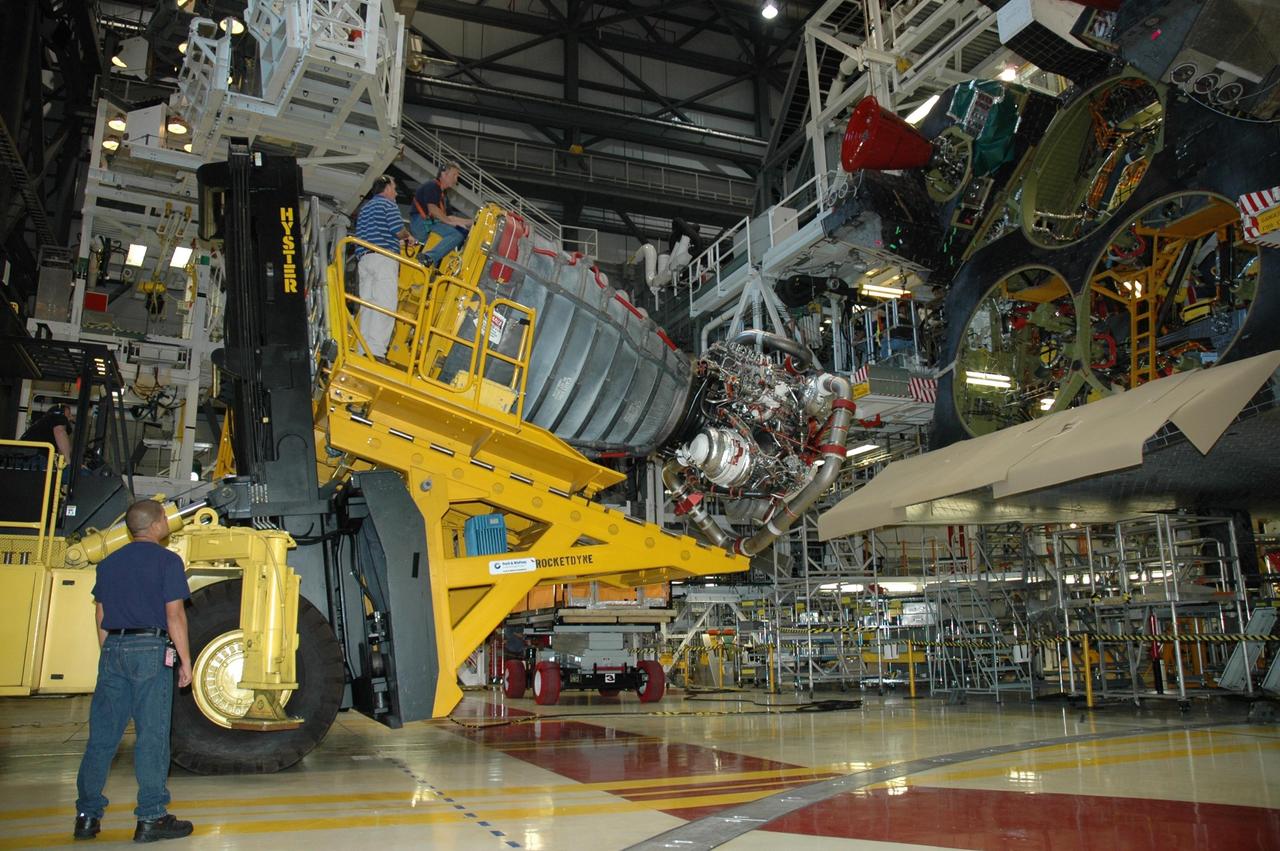
KENNEDY SPACE CENTER, FLA. -- In Orbiter Processing Facility bay 3 at NASA's Kennedy Space Center, technicians on a Hyster forklift move space shuttle main engine no. 1 toward Endeavour for installation. Each space shuttle main engine is 14 feet long, weighs about 6,700 pounds, and is 7.5 feet in diameter at the end of the nozzle. The orbiter is targeted for launch on Feb. 14 for mission STS-123 to the International Space Station. Photo credit: NASA/Jack Pfaller

KENNEDY SPACE CENTER, FLA. -- In Orbiter Processing Facility bay 2, technicians on a Hyster forklift install space shuttle main engine no. 3 into Endeavour. Each space shuttle main engine is 14 feet long, weighs about 6,700 pounds, and is 7.5 feet in diameter at the end of the nozzle. The orbiter is scheduled for mission STS-118, targeted for launch on June 28. The mission will be the 22nd flight to the International Space Station, carrying another starboard array, S5, for installation. Photo credit: NASA/George Shelton
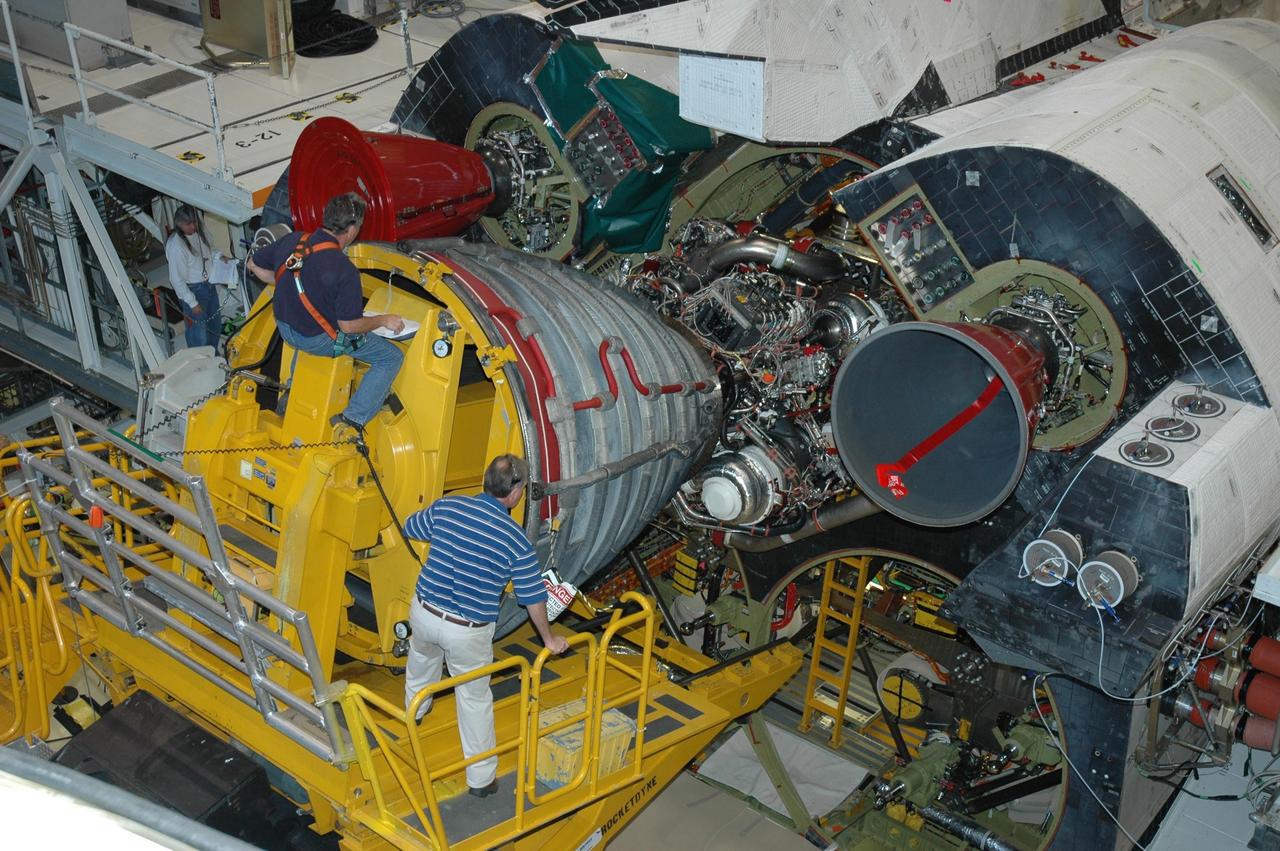
KENNEDY SPACE CENTER, FLA. -- In Orbiter Processing Facility bay 3 at NASA's Kennedy Space Center, technicians on a Hyster forklift maneuver space shuttle main engine no. 1 into place on Endeavour. Each space shuttle main engine is 14 feet long, weighs about 6,700 pounds, and is 7.5 feet in diameter at the end of the nozzle. The orbiter is targeted for launch on Feb. 14 for mission STS-123 to the International Space Station. Photo credit: NASA/Jack Pfaller
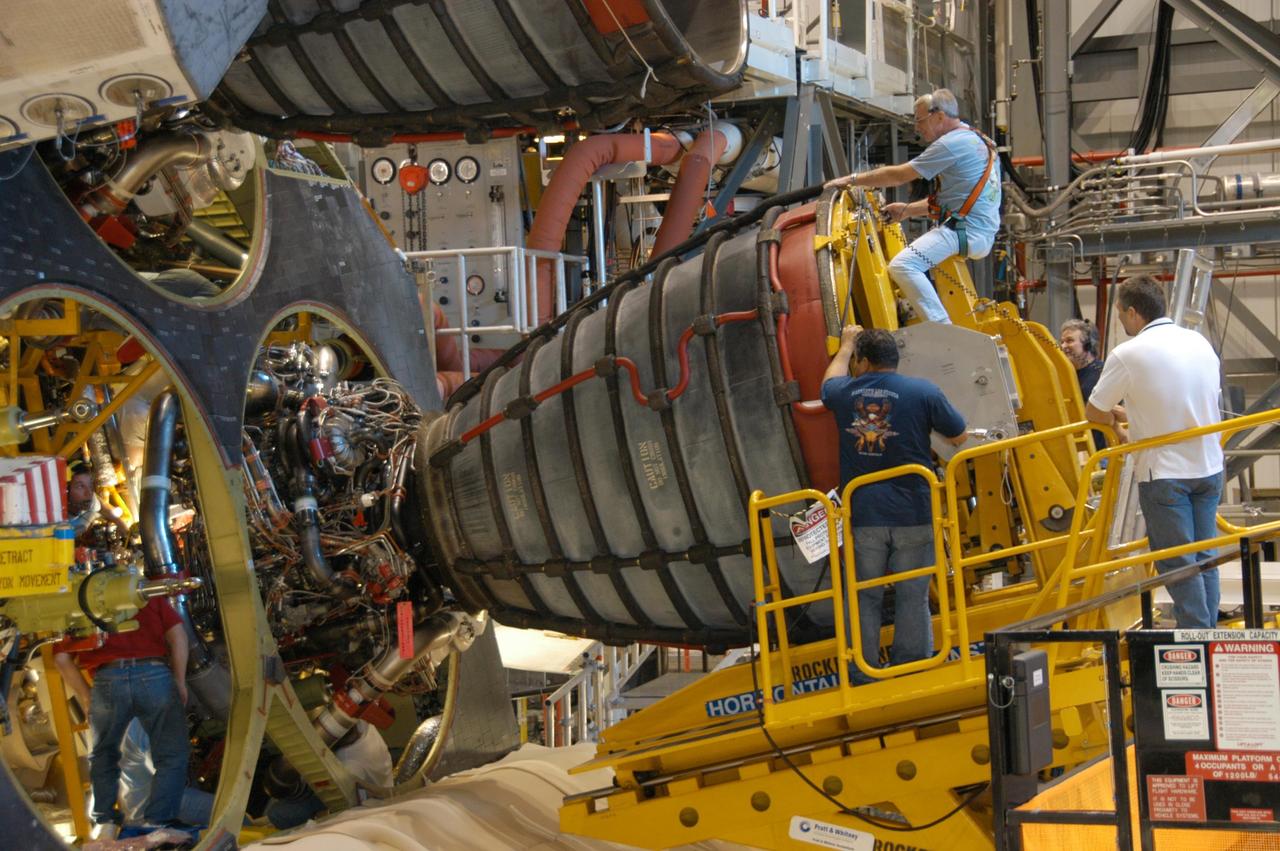
KENNEDY SPACE CENTER, FLA. -- In Orbiter Processing Facility bay 2, technicians on a Hyster forklift maneuver space shuttle main engine no. 3 into place on Endeavour. Each space shuttle main engine is 14 feet long, weighs about 6,700 pounds, and is 7.5 feet in diameter at the end of the nozzle. The orbiter is scheduled for mission STS-118, targeted for launch on June 28. The mission will be the 22nd flight to the International Space Station, carrying another starboard array, S5, for installation. Photo credit: NASA/George Shelton
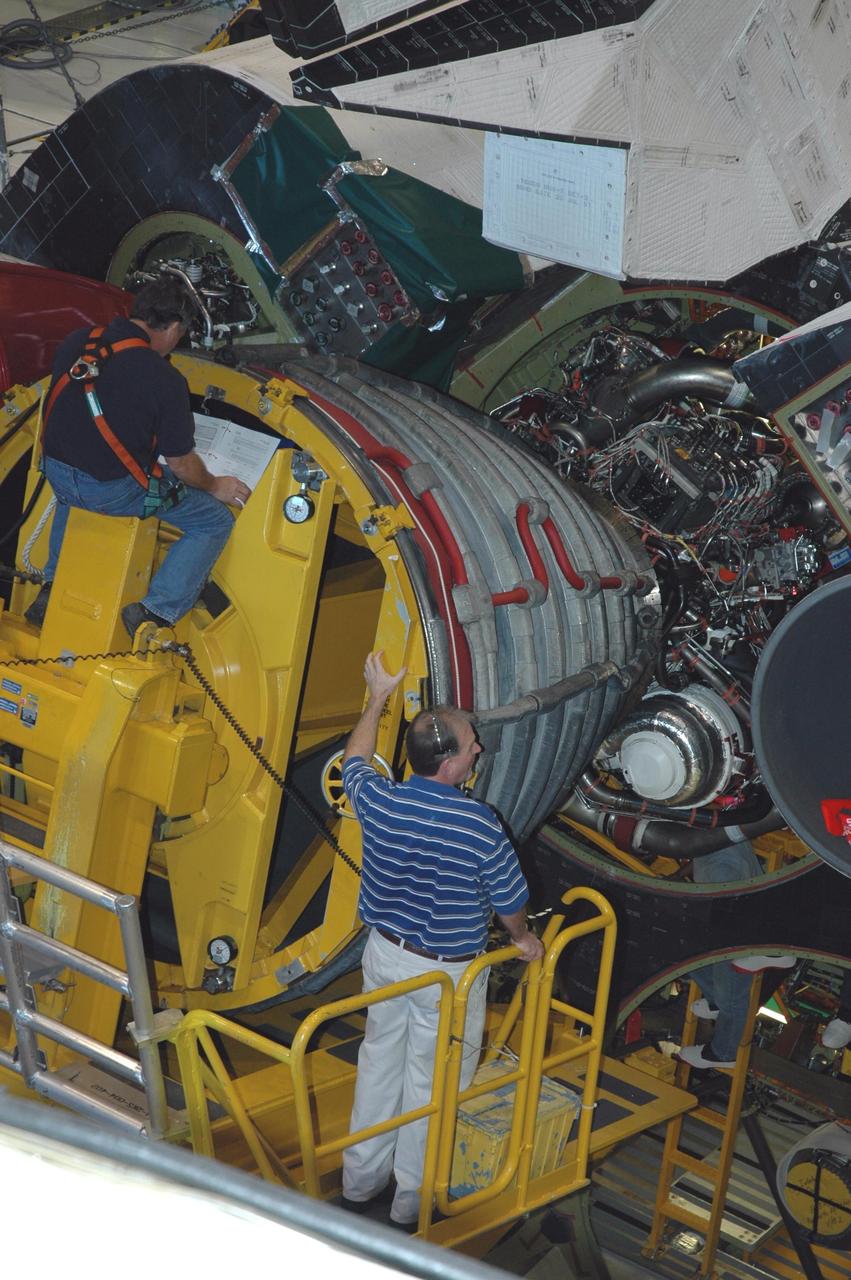
KENNEDY SPACE CENTER, FLA. -- In Orbiter Processing Facility bay 3 at NASA's Kennedy Space Center, technicians on a Hyster forklift maneuver space shuttle main engine no. 1 into place on Endeavour. Each space shuttle main engine is 14 feet long, weighs about 6,700 pounds, and is 7.5 feet in diameter at the end of the nozzle. The orbiter is targeted for launch on Feb. 14 for mission STS-123 to the International Space Station. Photo credit: NASA/Jack Pfaller
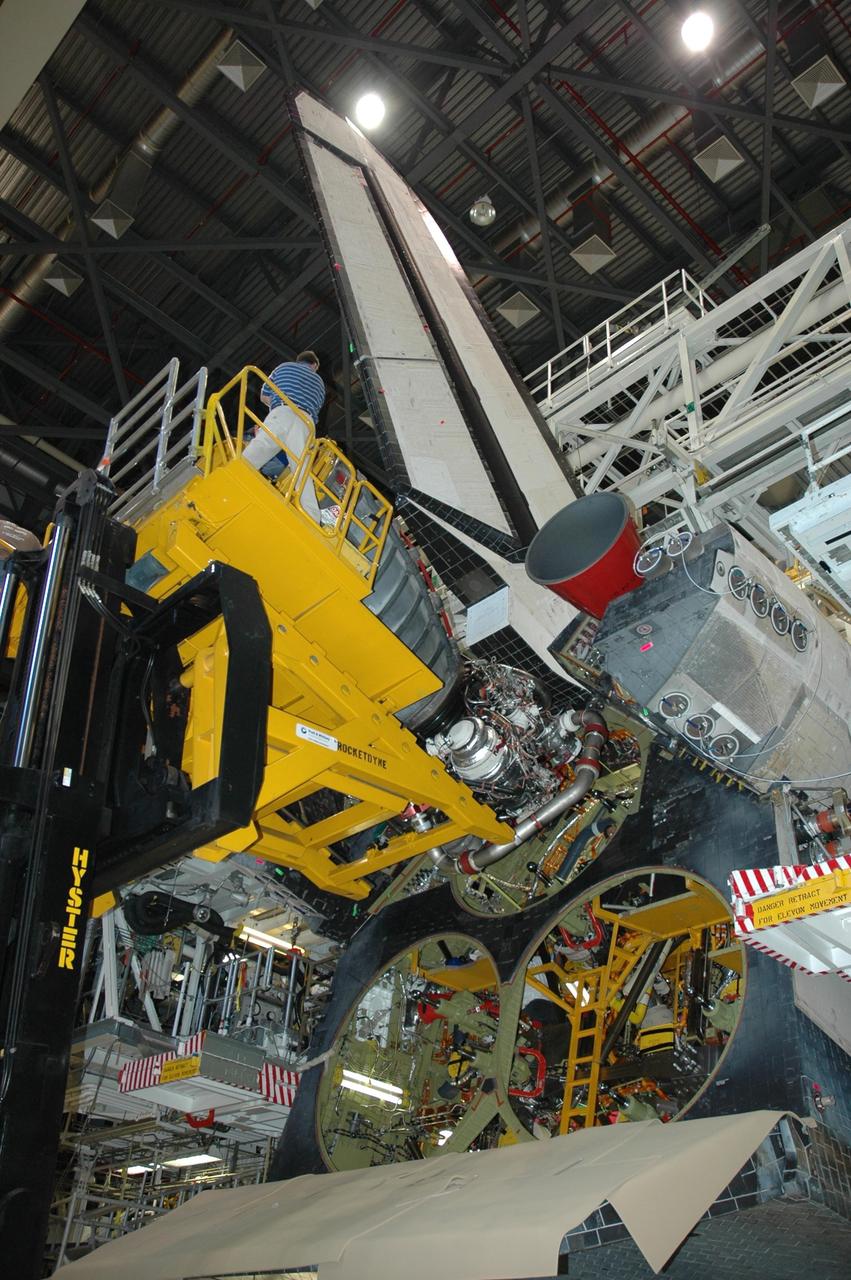
KENNEDY SPACE CENTER, FLA. -- In Orbiter Processing Facility bay 3 at NASA's Kennedy Space Center, technicians on a Hyster forklift maneuver space shuttle main engine no. 1 into place on Endeavour. Each space shuttle main engine is 14 feet long, weighs about 6,700 pounds, and is 7.5 feet in diameter at the end of the nozzle. The orbiter is targeted for launch on Feb. 14 for mission STS-123 to the International Space Station. Photo credit: NASA/Jack Pfaller
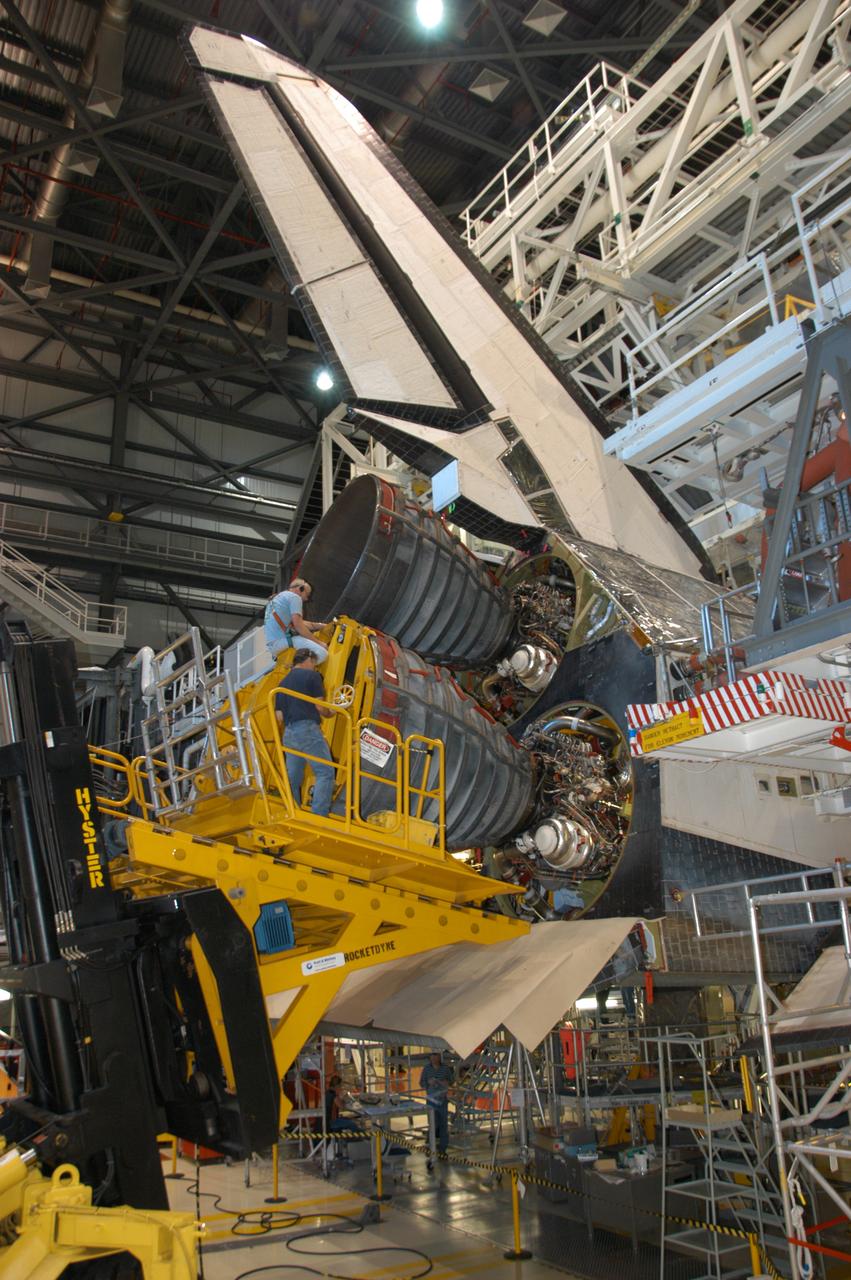
In Orbiter Processing Facility bay 2, technicians on a Hyster forklift install space shuttle main engine no. 3 into Endeavour. Each space shuttle main engine is 14 feet long, weighs about 6,700 pounds, and is 7.5 feet in diameter at the end of the nozzle. The orbiter is scheduled for mission STS-118, targeted for launch on June 28. The mission will be the 22nd flight to the International Space Station, carrying another starboard array, S5, for installation.
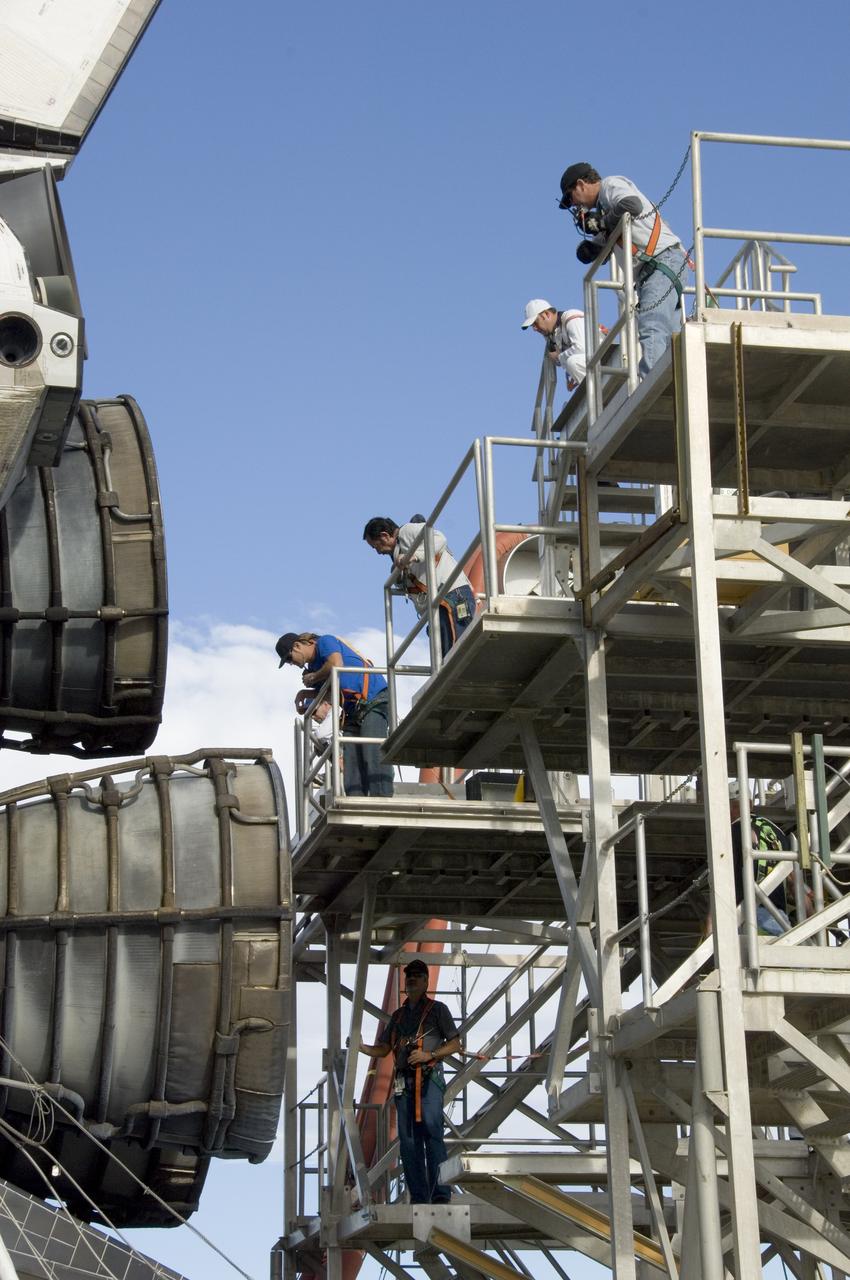
Technicians monitor the positioning of a large workstand as it is carefully moved into place around the main engine nozzles of Space Shuttle Endeavour during deservicing and ferry flight preparations at NASA's Dryden Flight Research Center at Edwards Air Force Base.
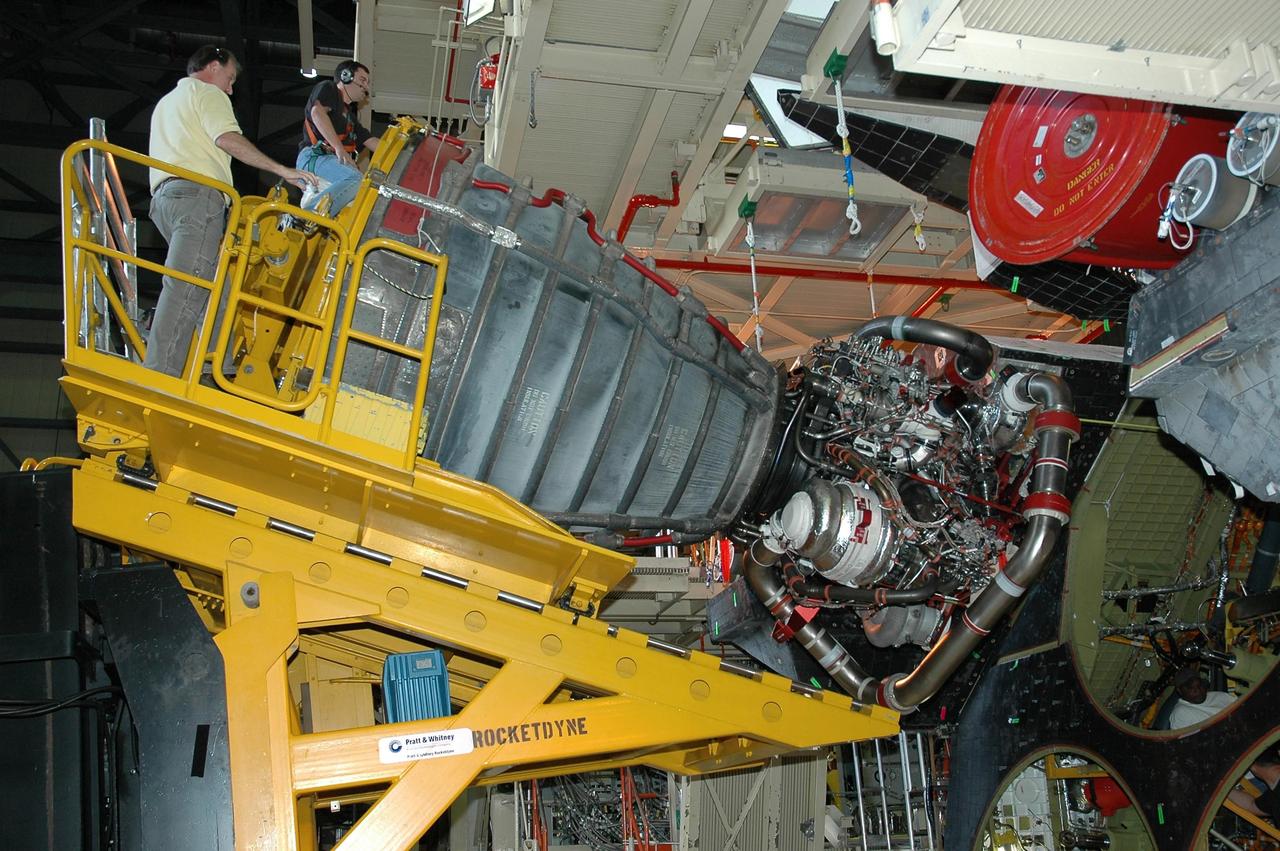
KENNEDY SPACE CENTER, FLA. - In In the Orbiter Processing Facility bay 1, a Hyster forklift maneuvers a main engine into position for installation into Discovery. The main engine configuration is manufactured by Boeing Rocketdyne in Canoga Park, Calif., and includes a Pratt & Whitney high-pressure fuel turbo pump. Each space shuttle main engine is 14 feet (4.3 meters) long, weighs about 6,700 pounds (3,039 kilograms), and is 7.5 feet (2.3 meters) in diameter at the end of the nozzle. Discovery is being processed for the second return-to-flight mission STS-121.
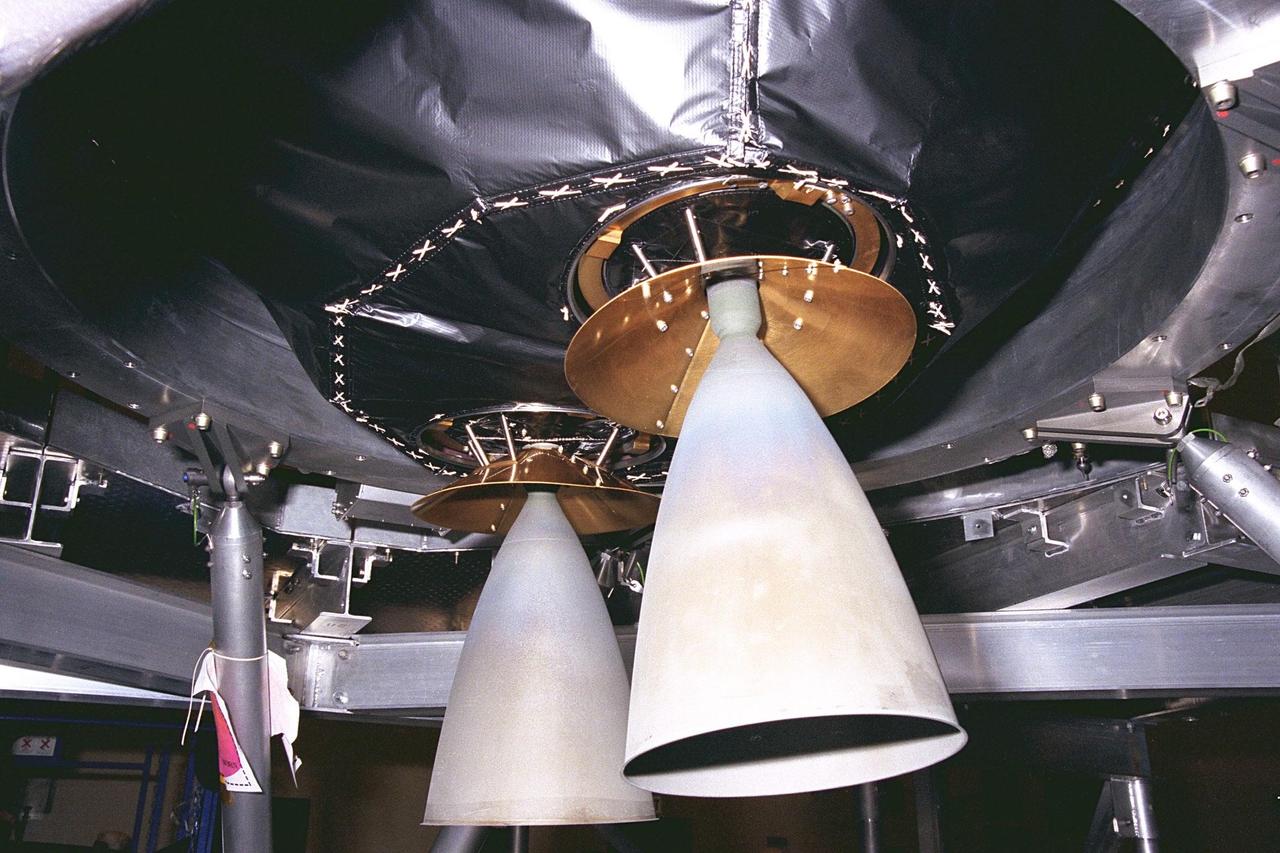
The main engine thruster nozzles of the Cassini spacecraft have their covers removed prior to the securing of the craft to its launch vehicle adapter in KSC’s Payload Hazardous Servicing Facility. The main engines of Cassini will be used for Deep Space Maneuver burns, which will be performed periodically throughout its cruise to Saturn to keep the spacecraft on the correct trajectory. Large maneuvers (such as a change in spacecraft speed of about one meter per second or higher) will be done with the main engine, whereas smaller maneuvers will be performed by the thrusters and/or reaction wheels. Scheduled for launch in October, the Cassini mission seeks insight into the origins and evolution of the early solar system. It will take seven years for the spacecraft to reach Saturn
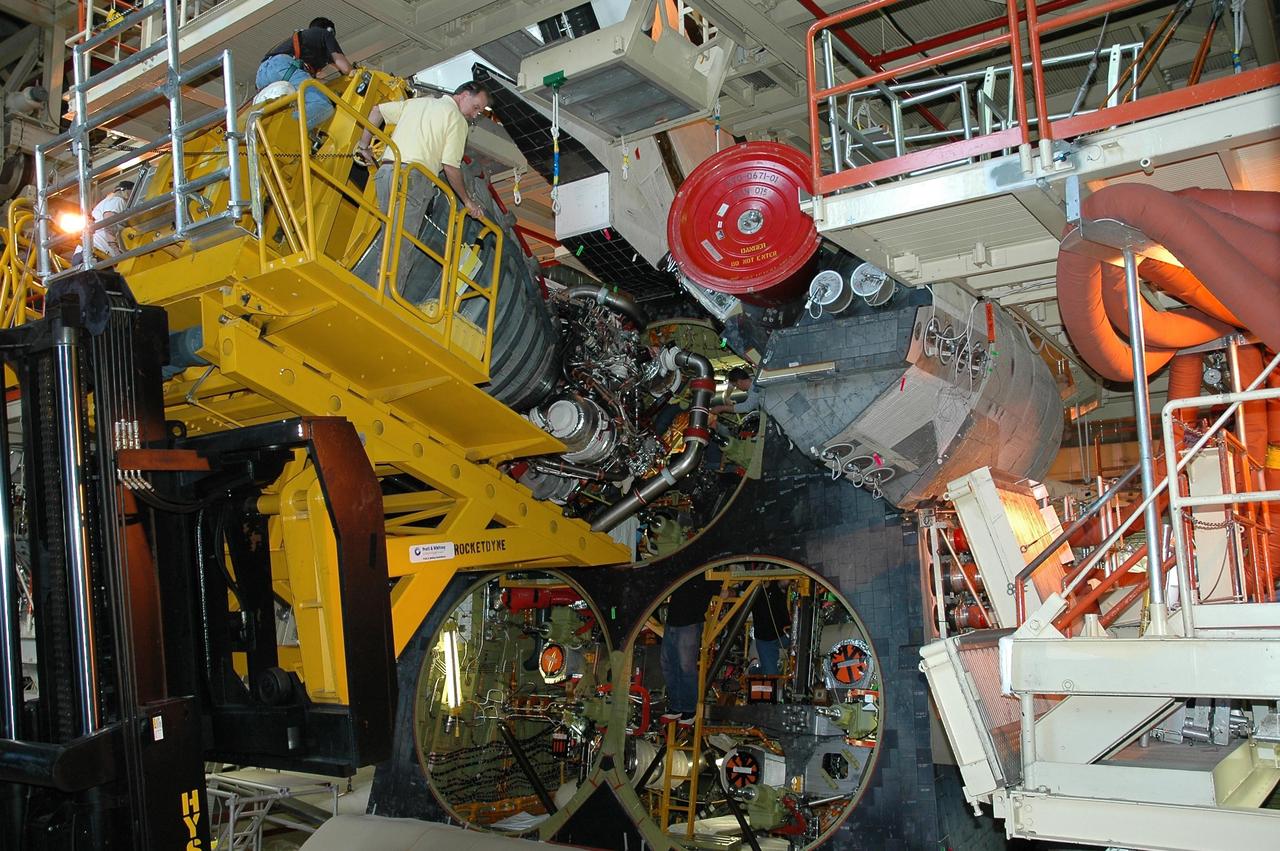
KENNEDY SPACE CENTER, FLA. - In the Orbiter Processing Facility bay 1, technicians on the Hyster forklift move a main engine into place on Discovery. The main engine configuration is manufactured by Boeing Rocketdyne in Canoga Park, Calif., and includes a Pratt & Whitney high-pressure fuel turbo pump. Each space shuttle main engine is 14 feet (4.3 meters) long, weighs about 6,700 pounds (3,039 kilograms), and is 7.5 feet (2.3 meters) in diameter at the end of the nozzle. Discovery is being processed for the second return-to-flight mission STS-121.
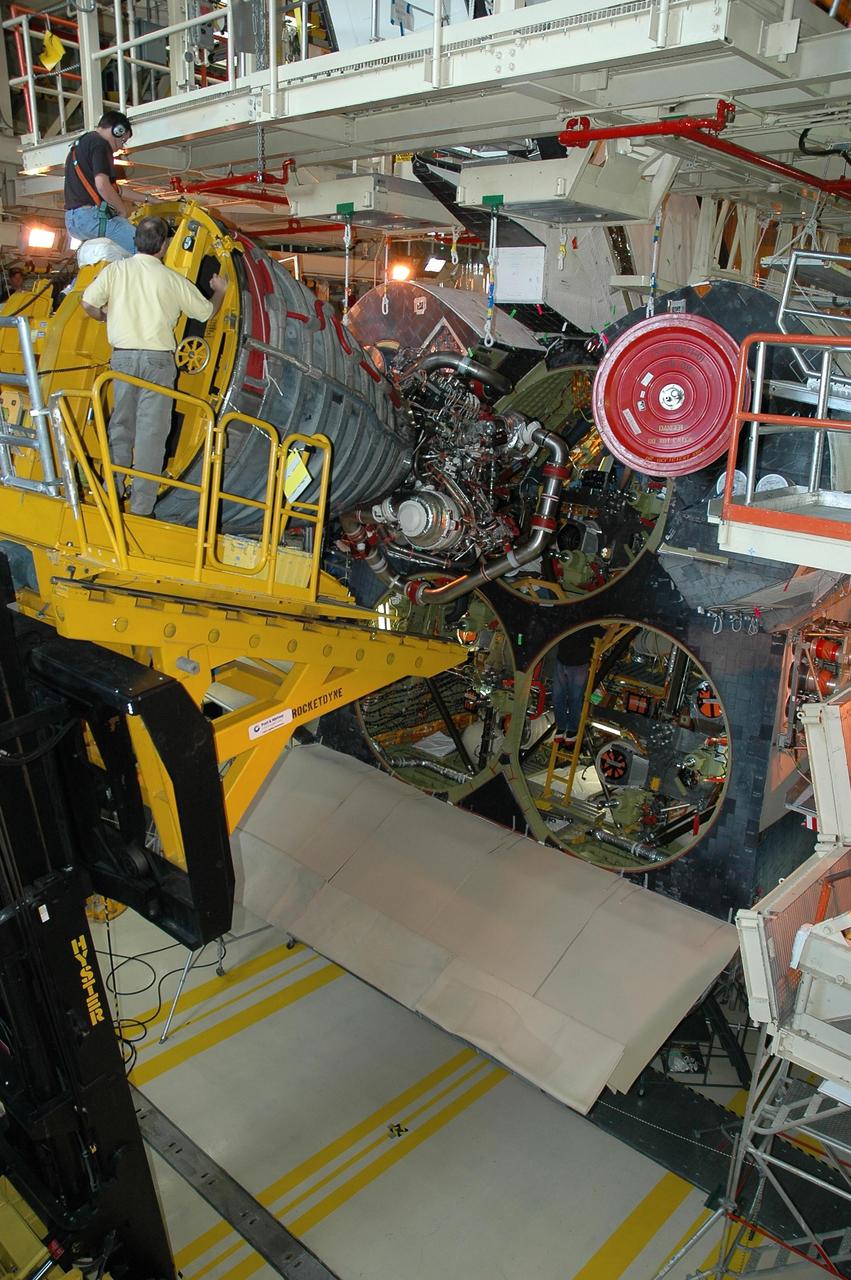
KENNEDY SPACE CENTER, FLA. - In the Orbiter Processing Facility bay 1, a Hyster forklift moves a main engine into position for installation into Discovery. The main engine configuration is manufactured by Boeing Rocketdyne in Canoga Park, Calif., and includes a Pratt & Whitney high-pressure fuel turbo pump. Each space shuttle main engine is 14 feet (4.3 meters) long, weighs about 6,700 pounds (3,039 kilograms), and is 7.5 feet (2.3 meters) in diameter at the end of the nozzle. Discovery is being processed for the second return-to-flight mission STS-121.
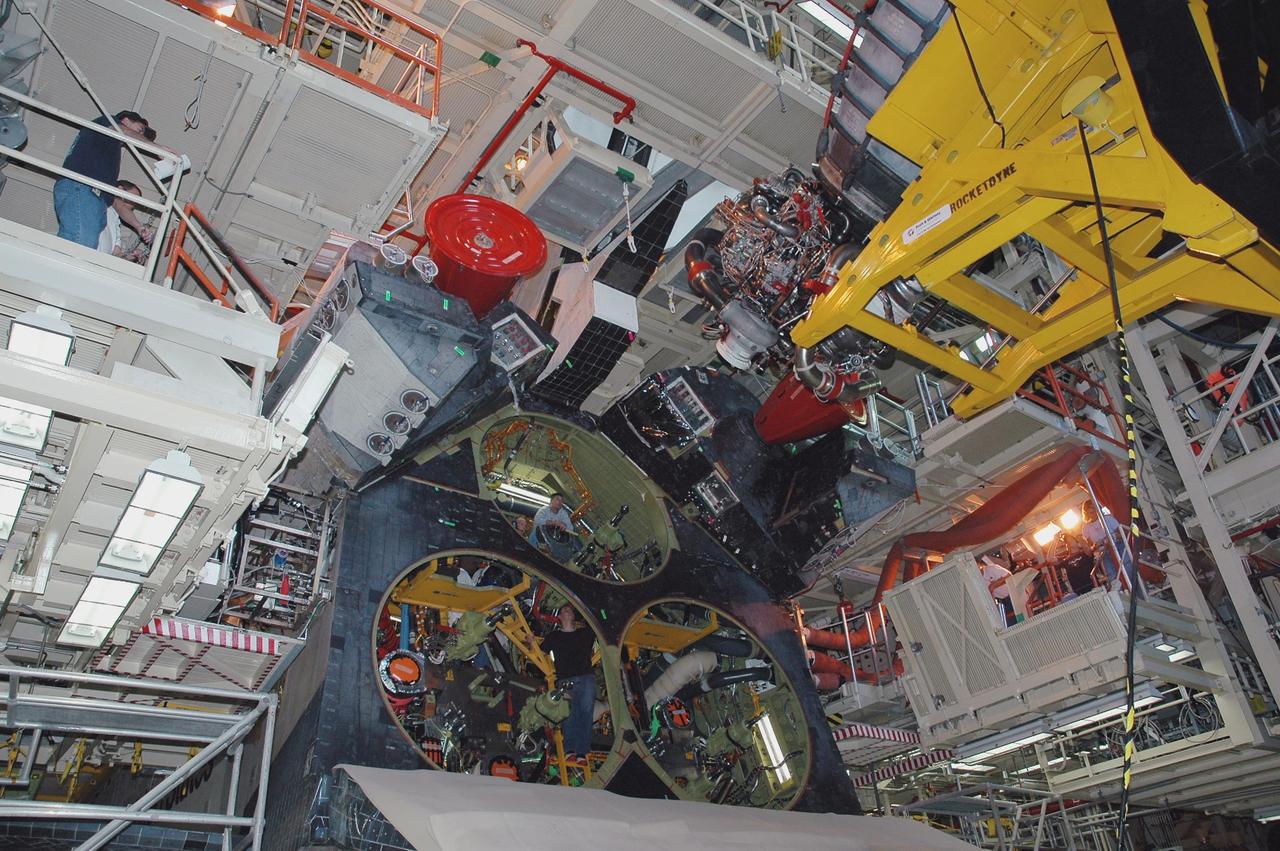
KENNEDY SPACE CENTER, FLA. - In the Orbiter Processing Facility bay 1, a Hyster forklift moves a main engine toward the aft of Discovery as technicians stand by for insertion and installation. The main engine configuration is manufactured by Boeing Rocketdyne in Canoga Park, Calif., and includes a Pratt & Whitney high-pressure fuel turbo pump. Each space shuttle main engine is 14 feet (4.3 meters) long, weighs about 6,700 pounds (3,039 kilograms), and is 7.5 feet (2.3 meters) in diameter at the end of the nozzle. Discovery is being processed for the second return-to-flight mission STS-121.
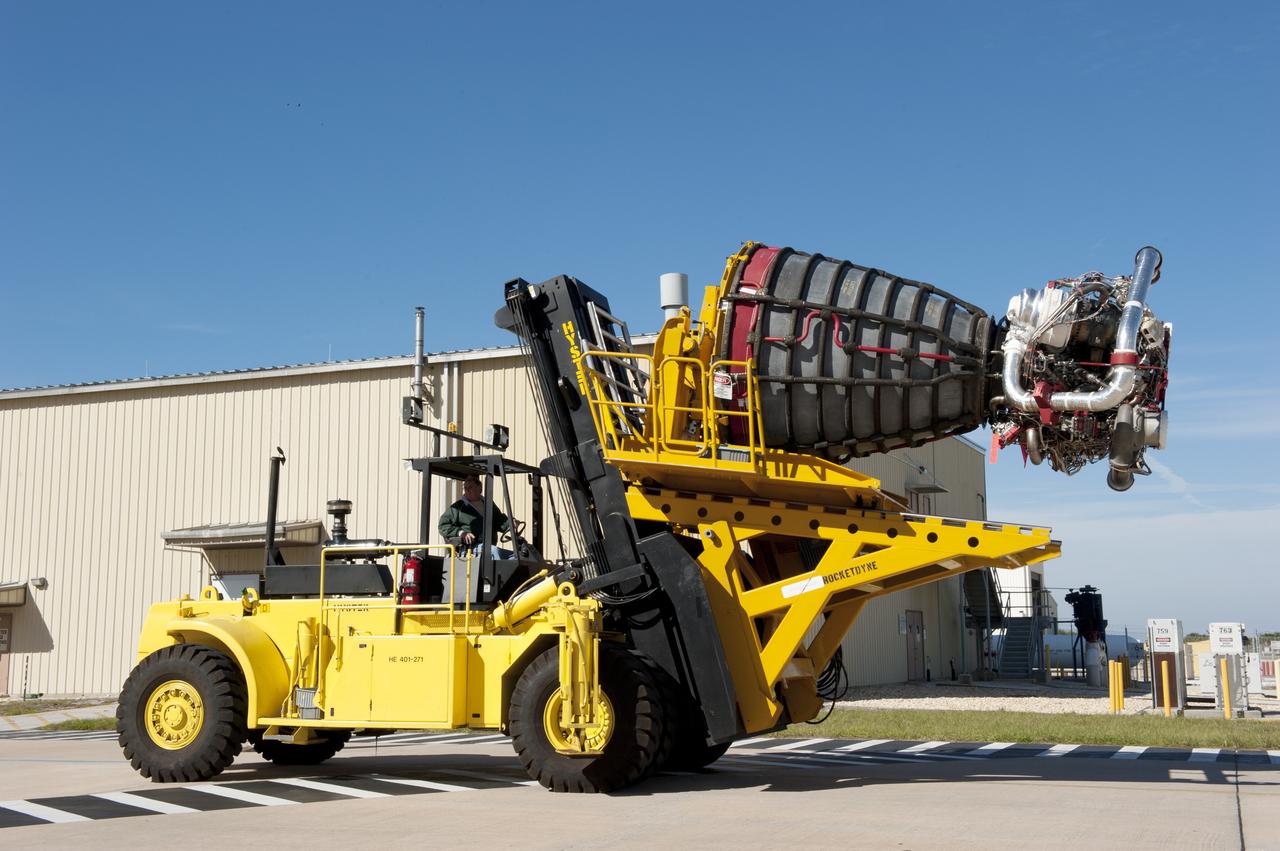
CAPE CANAVERAL, Fla. -- A Hyster forklift transports engine #2, the last of shuttle Atlantis' three main engines, from the Space Shuttle Main Engine (SSME) Shop to Orbiter Processing Facility-1 at NASA's Kennedy Space Center in Florida. Inside the processing facility, the engine will be installed in the shuttle. Each engine is 14 feet long, weighs about 6,700 pounds, and is 7.5 feet in diameter at the end of the nozzle. This is the final planned engine installation for the Space Shuttle Program. Atlantis is being prepared for the "launch on need," or potential rescue mission, for the final planned shuttle flight, Endeavour's STS-134 mission. For more information, visit www.nasa.gov/shuttle. Photo credit: NASA/Kim Shiflett
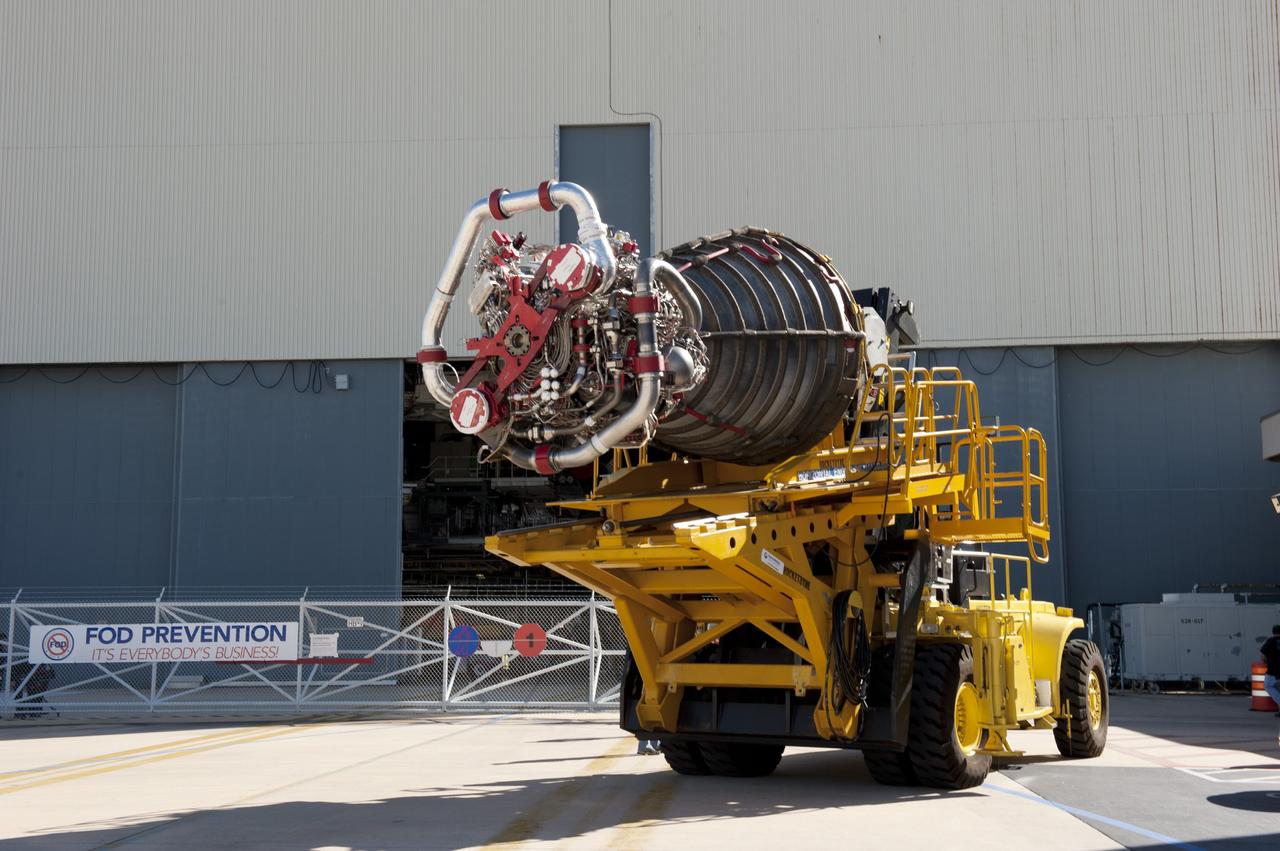
CAPE CANAVERAL, Fla. -- A Hyster forklift transports engine #2, the last of shuttle Atlantis' three main engines, from the Space Shuttle Main Engine (SSME) Shop to Orbiter Processing Facility-1 at NASA's Kennedy Space Center in Florida. Inside the processing facility, the engine will be installed in the shuttle. Each engine is 14 feet long, weighs about 6,700 pounds, and is 7.5 feet in diameter at the end of the nozzle. This is the final planned engine installation for the Space Shuttle Program. Atlantis is being prepared for the "launch on need," or potential rescue mission, for the final planned shuttle flight, Endeavour's STS-134 mission. For more information, visit www.nasa.gov/shuttle. Photo credit: NASA/Kim Shiflett
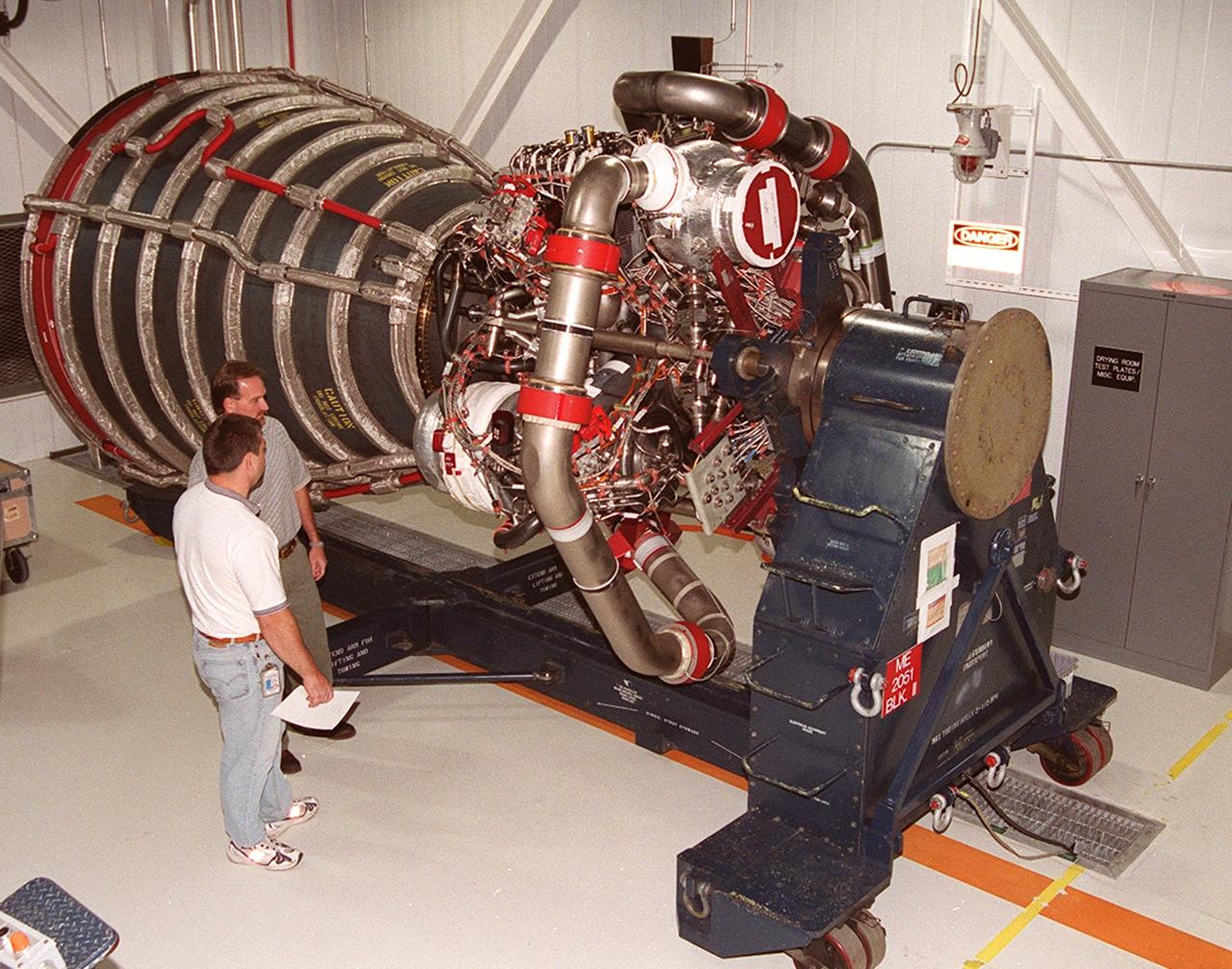
KENNEDY SPACE CENTER, FLA. -- Mike Cosgrove (front) and Bob Petrie (behind), both with Boeing/Rocketdyne, look over the upgraded Space Shuttle main engine (block 2 engine) as it sits in the Space Shuttle Main Engine Processing Facility. The new engine will be installed for its first flight on the orbiter Atlantis, on mission STS-104. The Block II Main Engine configuration is manufactured by Boeing Rocketdyne in Canoga Park, Calif., and includes a new Pratt & Whitney high-pressure fuel turbo pump. Engine improvements are managed by NASA’s Marshall Space Flight Center in Huntsville, Ala. Each Space Shuttle Main Engine is 14 feet (4.3 meters) long, weighs about 7,000 pounds (3,175 kilograms), and is 7.5 feet (2.3 meters) in diameter at the end of the nozzle
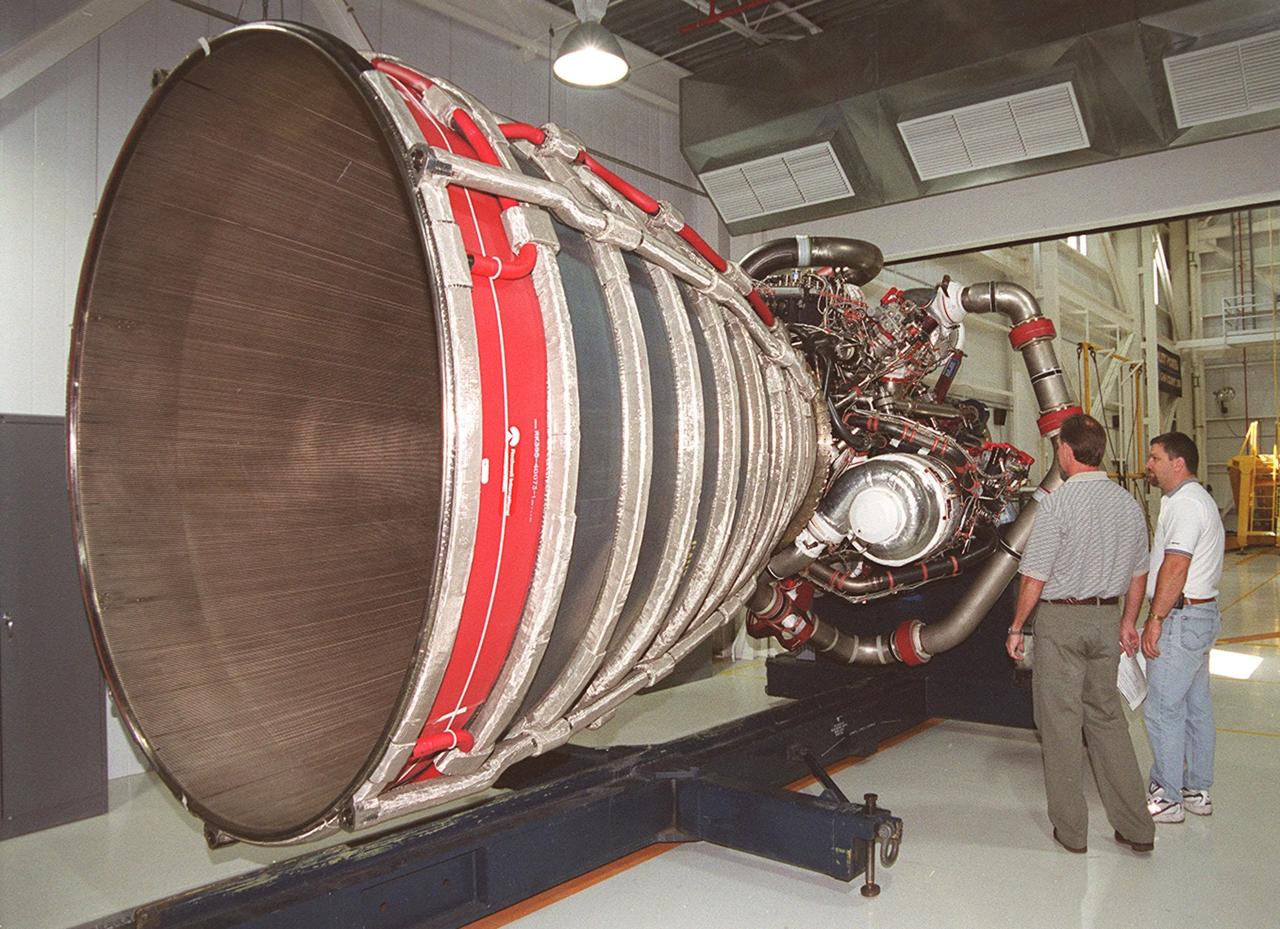
KENNEDY SPACE CENTER, FLA. -- Looking over the upgraded Space Shuttle main engine (block 2 engine) in the Space Shuttle Main Engine Processing Facility are Bob Petrie (left) and Mike Cosgrove (right). Both are with Boeing/Rocketdyne. The new engine will be installed for its first flight on the orbiter Atlantis, on mission STS-104. The Block II Main Engine configuration is manufactured by Boeing Rocketdyne in Canoga Park, Calif., and includes a new Pratt & Whitney high-pressure fuel turbo pump. Engine improvements are managed by NASA’s Marshall Space Flight Center in Huntsville, Ala. Each Space Shuttle Main Engine is 14 feet (4.3 meters) long, weighs about 7,000 pounds (3,175 kilograms), and is 7.5 feet (2.3 meters) in diameter at the end of the nozzle
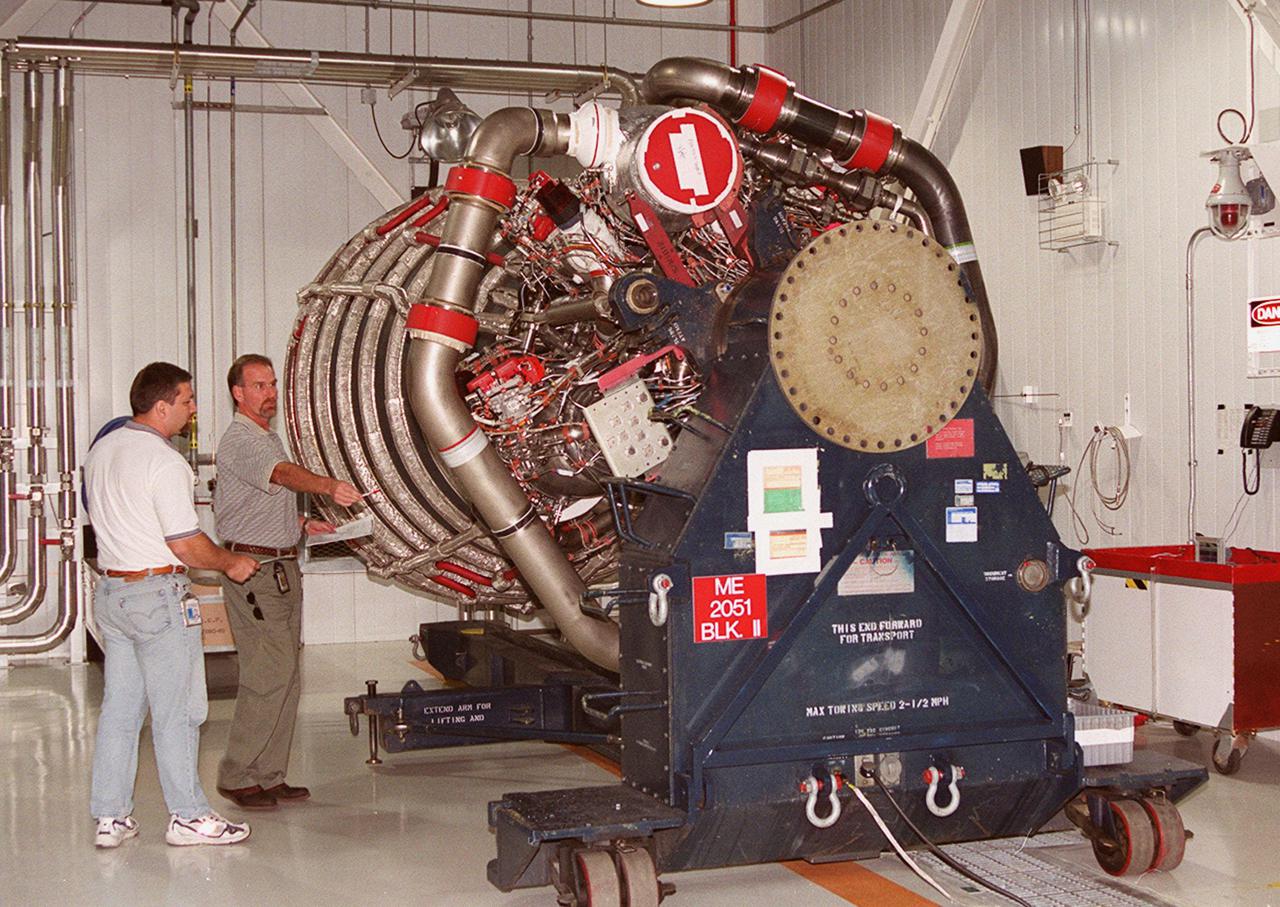
KENNEDY SPACE CENTER, FLA. -- Mike Cosgrove (left) and Bob Petrie (right), both with Boeing_Rocketdyne, look over the upgraded Space Shuttle main engine (block 2 engine) as it sits in the Space Shuttle Main Engine Processing Facility. The new engine will be installed for its first flight on the orbiter Atlantis, on mission STS-104. The Block II Main Engine configuration is manufactured by Boeing Rocketdyne in Canoga Park, Calif., and includes a new Pratt and Whitney high-pressure fuel turbo pump. Engine improvements are managed by NASA’s Marshall Space Flight Center in Huntsville, Ala. Each Space Shuttle Main Engine is 14 feet (4.3 meters) long, weighs about 7,000 pounds (3,175 kilograms), and is 7.5 feet (2.3 meters) in diameter at the end of the nozzle
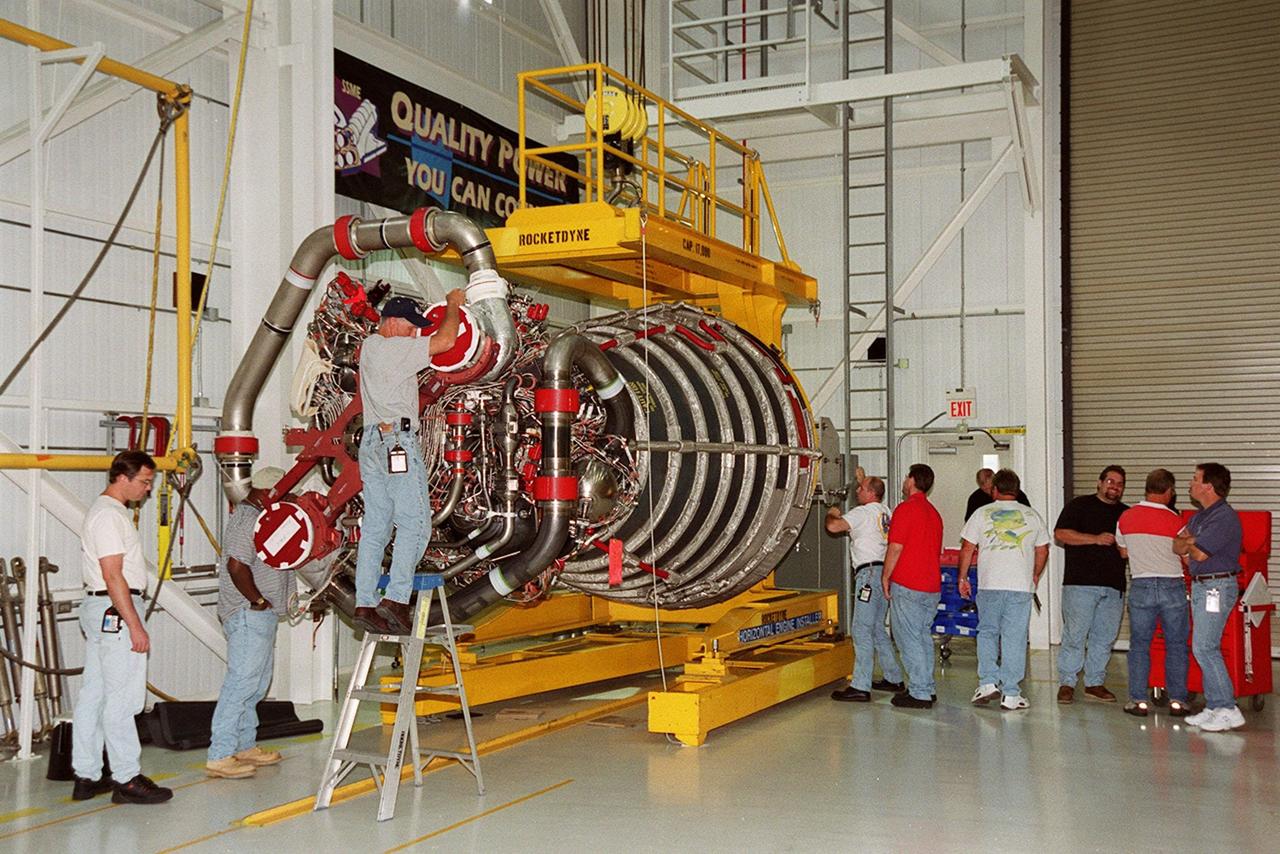
Workers in the Space Shuttle Main Engine Processing Facility prepare a new Space Shuttle main engine (block 2 engine) for its move to the Orbiter Processing Facility. The engine will be installed for its first flight on the orbiter Atlantis, on mission STS-104. The Block II Main Engine configuration is manufactured by Boeing Rocketdyne in Canoga Park, Calif., and includes a new Pratt & Whitney high-pressure fuel turbo pump. Engine improvements are managed by NASA’s Marshall Space Flight Center in Huntsville, Ala. Each Space Shuttle Main Engine is 14 feet (4.3 meters) long, weighs about 7,000 pounds (3,175 kilograms), and is 7.5 feet (2.3 meters) in diameter at the end of the nozzle. <font
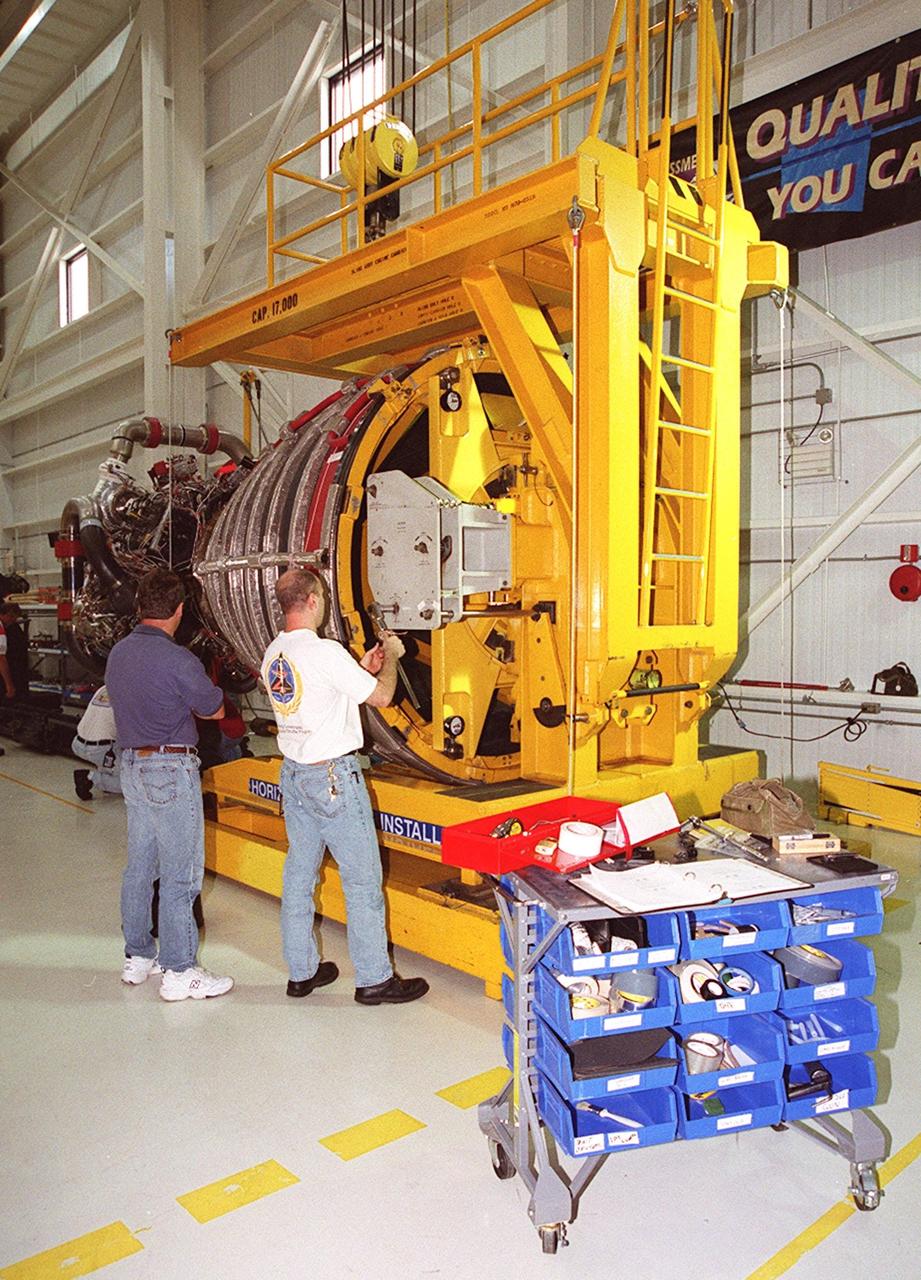
Workers in the Space Shuttle Main Engine Processing Facility get a new Space Shuttle main engine (block 2 engine) ready to move to the Orbiter Processing Facility. The engine will be installed for its first flight on the orbiter Atlantis, on mission STS-104. The Block II Main Engine configuration is manufactured by Boeing Rocketdyne in Canoga Park, Calif., and includes a new Pratt & Whitney high-pressure fuel turbo pump. Engine improvements are managed by NASA’s Marshall Space Flight Center in Huntsville, Ala. Each Space Shuttle Main Engine is 14 feet (4.3 meters) long, weighs about 7,000 pounds (3,175 kilograms), and is 7.5 feet (2.3 meters) in diameter at the end of the nozzle
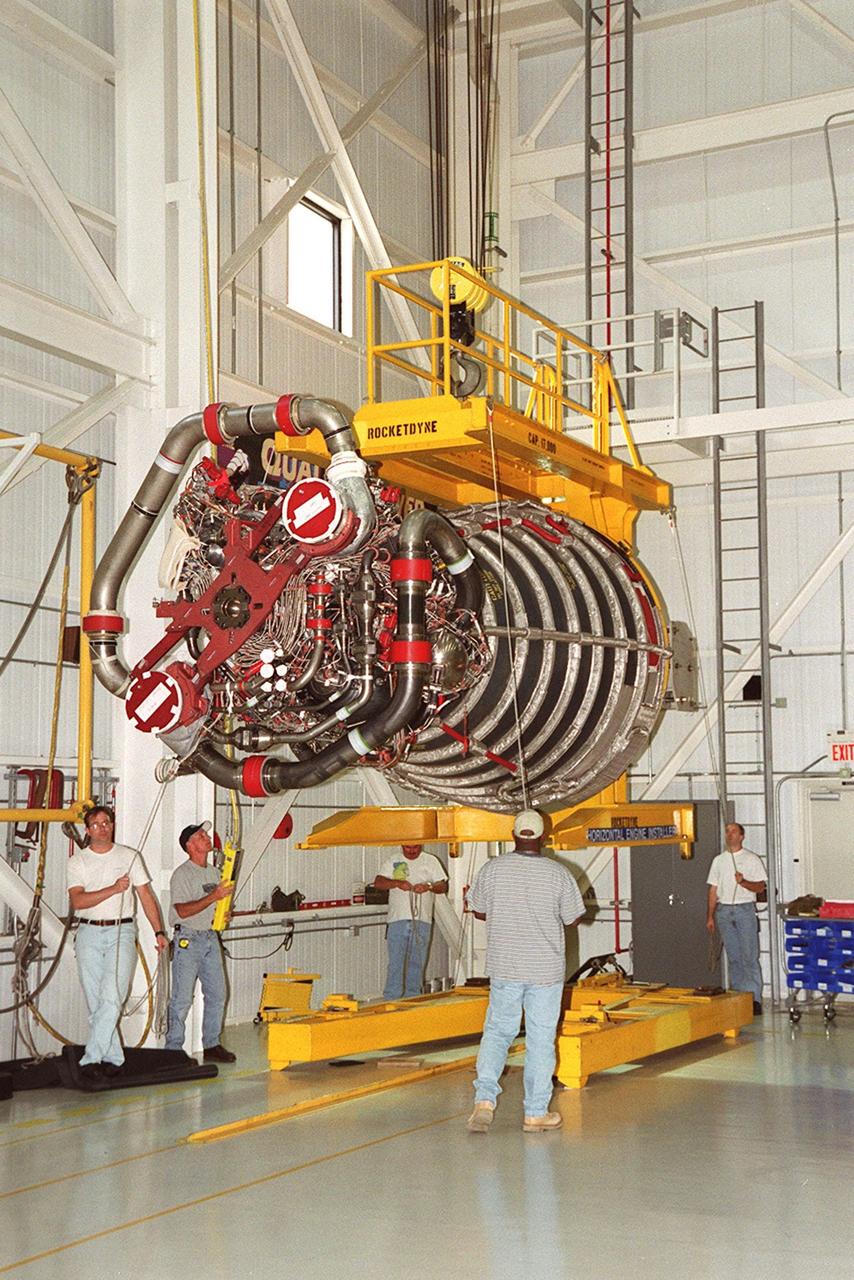
KENNEDY SPACE CENTER, FLA. -- Workers in the Space Shuttle Main Engine Processing Facility oversee lifting a new Space Shuttle main engine (block 2 engine) off its stand. The engine will be moved to the Orbiter Processing Facility and installed for its first flight on the orbiter Atlantis, on mission STS-104. The Block II Main Engine configuration is manufactured by Boeing Rocketdyne in Canoga Park, Calif., and includes a new Pratt & Whitney high-pressure fuel turbo pump. Engine improvements are managed by NASA’s Marshall Space Flight Center in Huntsville, Ala. Each Space Shuttle Main Engine is 14 feet (4.3 meters) long, weighs about 7,000 pounds (3,175 kilograms), and is 7.5 feet (2.3 meters) in diameter at the end of the nozzle
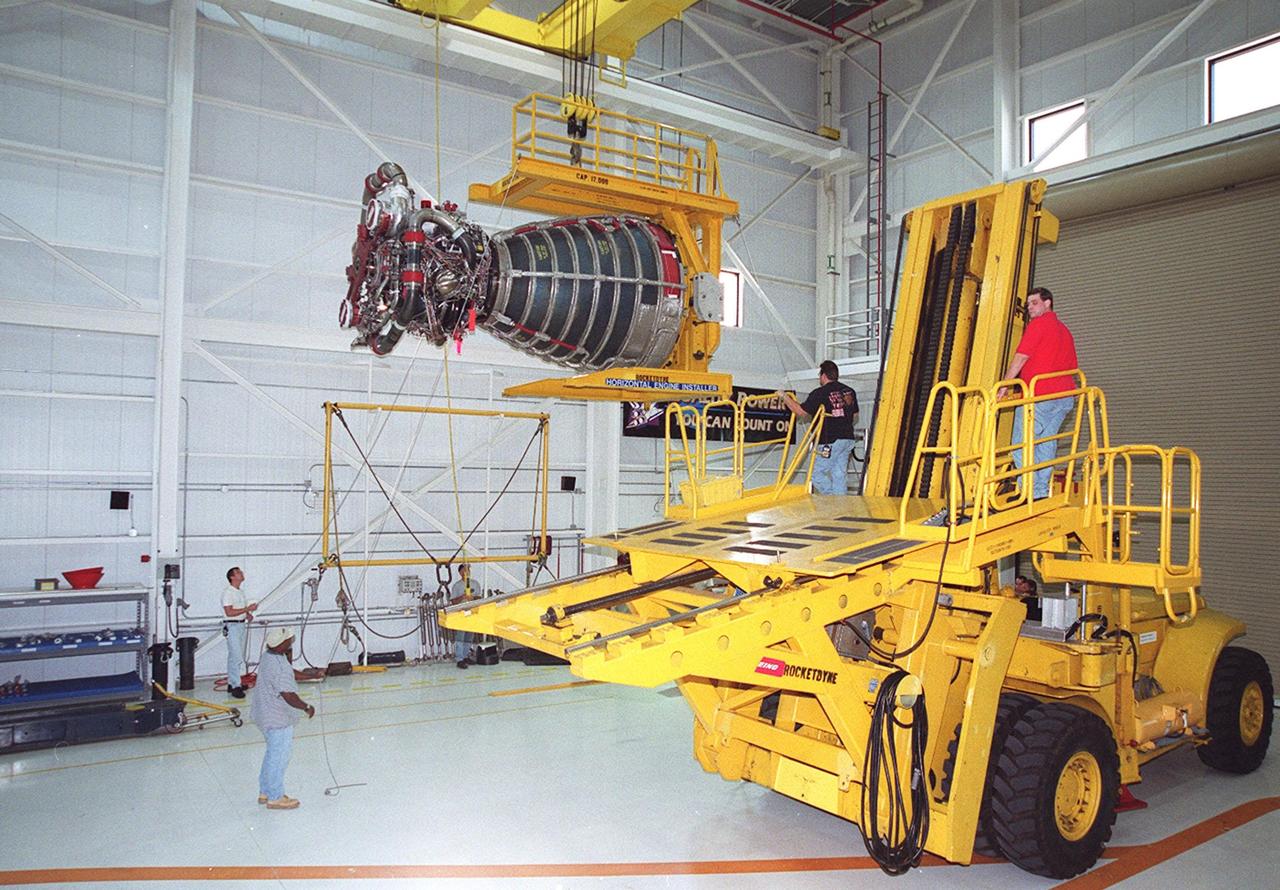
Workers in the Space Shuttle Main Engine Processing Facility oversee the movement of a new Space Shuttle main engine (block 2 engine) toward the transport vehicle in the foreground. The engine will be moved to the Orbiter Processing Facility and installed for its first flight on the orbiter Atlantis, on mission STS-104. The Block II Main Engine configuration is manufactured by Boeing Rocketdyne in Canoga Park, Calif., and includes a new Pratt & Whitney high-pressure fuel turbo pump. Engine improvements are managed by NASA’s Marshall Space Flight Center in Huntsville, Ala. Each Space Shuttle Main Engine is 14 feet (4.3 meters) long, weighs about 7,000 pounds (3,175 kilograms), and is 7.5 feet (2.3 meters) in diameter at the end of the nozzle. <font
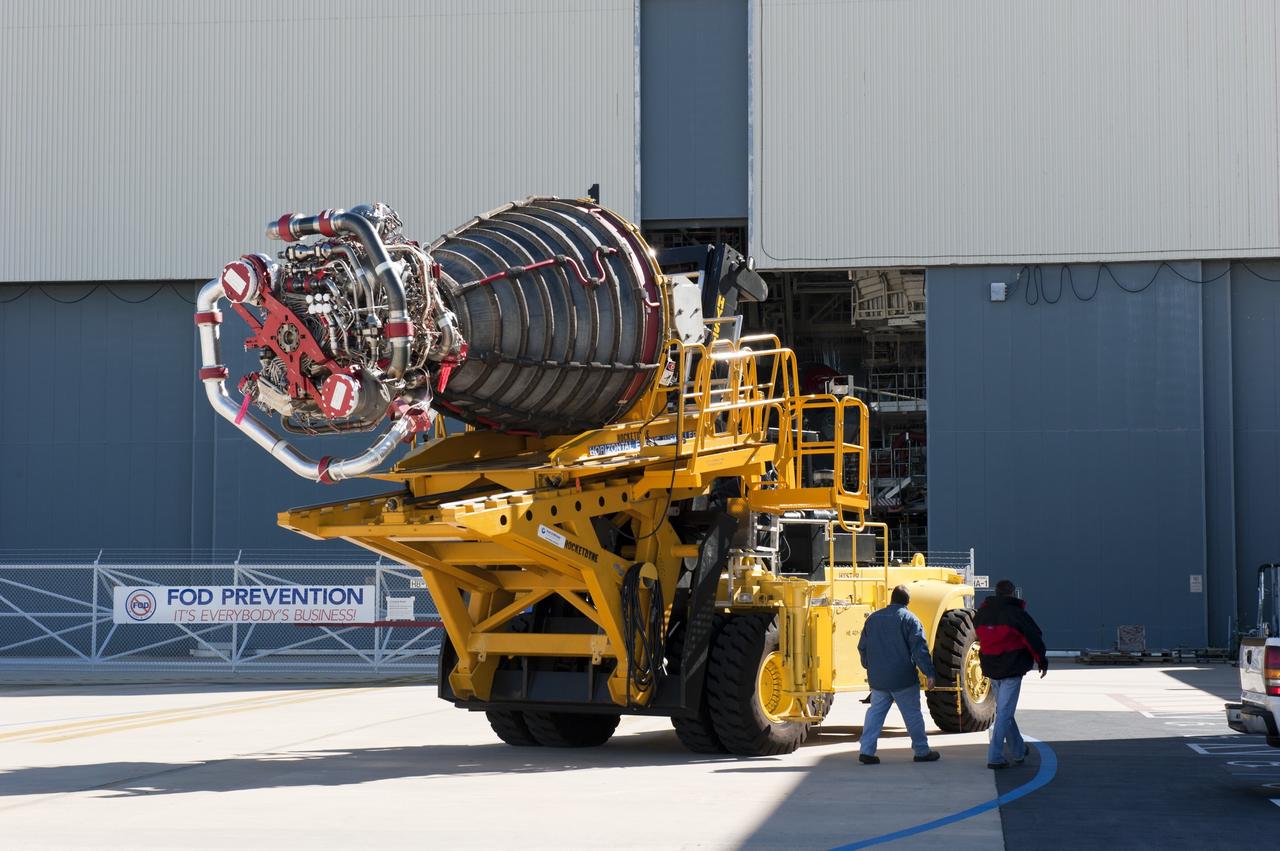
CAPE CANAVERAL, Fla. -- A Hyster forklift transports the second of shuttle Atlantis' three main engines from the Space Shuttle Main Engine (SSME) Shop to Orbiter Processing Facility-1 at NASA's Kennedy Space Center in Florida. Once inside the processing facility, the engine will be installed in the shuttle. Each engine is 14 feet long, weighs about 6,700 pounds, and is 7.5 feet in diameter at the end of the nozzle. This is the final planned engine installation for the Space Shuttle Program. Atlantis is being prepared for the "launch on need," or potential rescue mission, for the final planned shuttle flight, Endeavour's STS-134 mission. For more information, visit www.nasa.gov/shuttle. Photo credit: NASA/Kim Shiflett
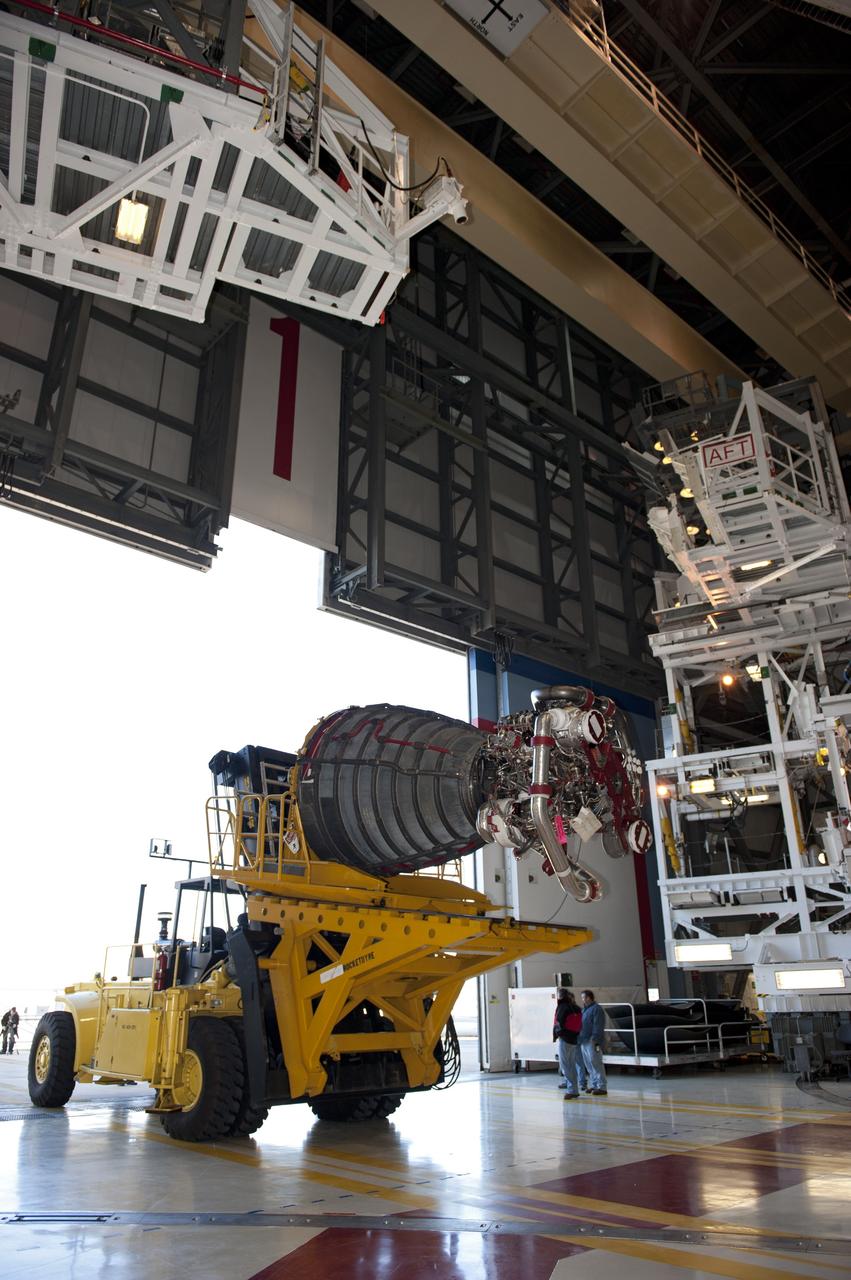
CAPE CANAVERAL, Fla. -- A Hyster forklift transporting the second of shuttle Atlantis' three main engines arrives at Orbiter Processing Facility-1 from the Space Shuttle Main Engine (SSME) Shop at NASA's Kennedy Space Center in Florida. There, the engine will be installed in the shuttle. Each engine is 14 feet long, weighs about 6,700 pounds, and is 7.5 feet in diameter at the end of the nozzle. This is the final planned engine installation for the Space Shuttle Program. Atlantis is being prepared for the "launch on need," or potential rescue mission, for the final planned shuttle flight, Endeavour's STS-134 mission. For more information, visit www.nasa.gov/shuttle. Photo credit: NASA/Kim Shiflett
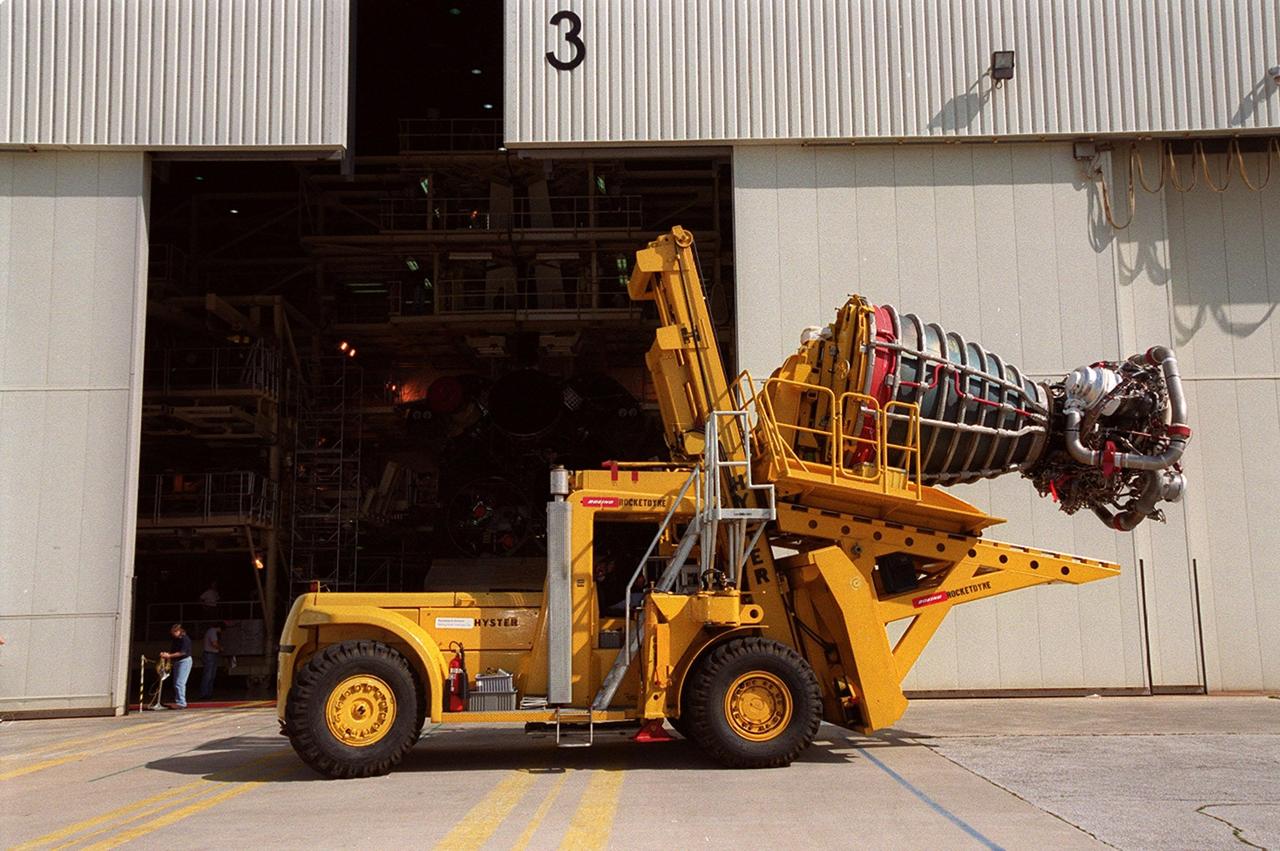
KENNEDY SPACE CENTER, FLA. -- The transport vehicle carrying a new block 2 engine arrives at Orbiter Processing Facility bay 3. There the new engine will be installed on the orbiter Atlantis, on mission STS-104, for its first flight. The Block II Main Engine configuration is manufactured by Boeing Rocketdyne in Canoga Park, Calif., and includes a new Pratt & Whitney high-pressure fuel turbo pump. Engine improvements are managed by NASA’s Marshall Space Flight Center in Huntsville, Ala. Each Space Shuttle Main Engine is 14 feet (4.3 meters) long, weighs about 7,000 pounds (3,175 kilograms), and is 7.5 feet (2.3 meters) in diameter at the end of the nozzle
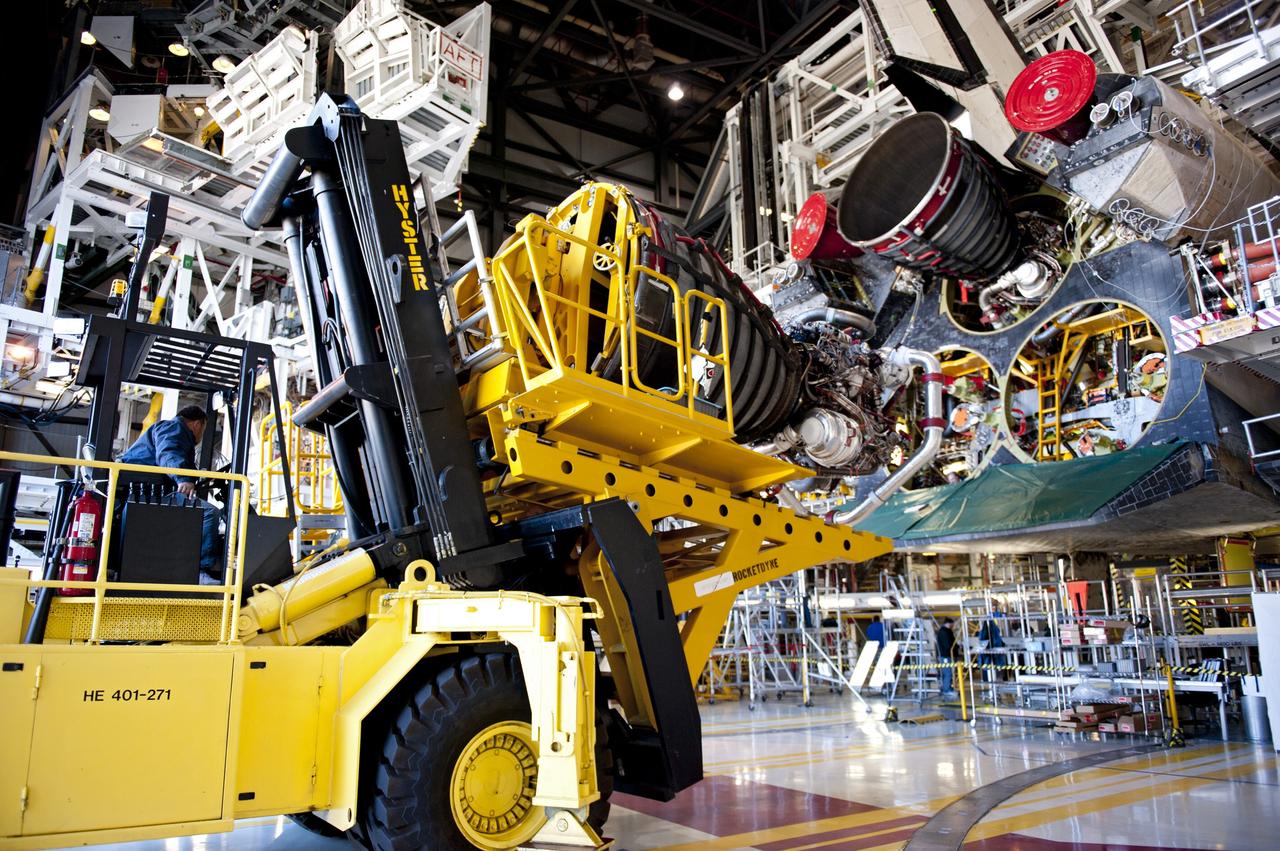
CAPE CANAVERAL, Fla. -- A Hyster forklift transporting the second of shuttle Atlantis' three main engines arrives at Orbiter Processing Facility-1 from the Space Shuttle Main Engine (SSME) Shop at NASA's Kennedy Space Center in Florida. There, the engine will be installed in the shuttle. Each engine is 14 feet long, weighs about 6,700 pounds, and is 7.5 feet in diameter at the end of the nozzle. This is the final planned engine installation for the Space Shuttle Program. Atlantis is being prepared for the "launch on need," or potential rescue mission, for the final planned shuttle flight, Endeavour's STS-134 mission. For more information, visit www.nasa.gov/shuttle. Photo credit: NASA/Kim Shiflett
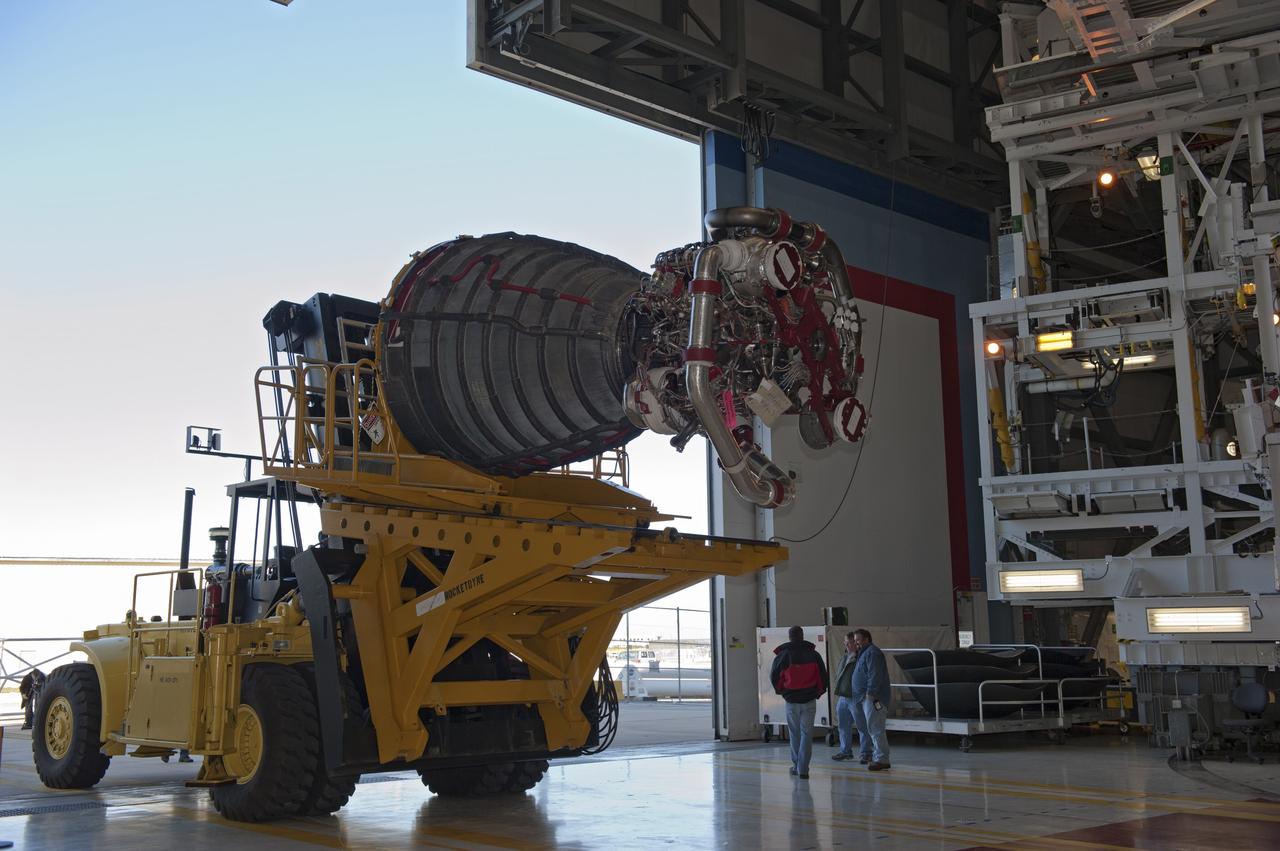
CAPE CANAVERAL, Fla. -- A Hyster forklift transporting the second of shuttle Atlantis' three main engines arrives at Orbiter Processing Facility-1 from the Space Shuttle Main Engine (SSME) Shop at NASA's Kennedy Space Center in Florida. There, the engine will be installed in the shuttle. Each engine is 14 feet long, weighs about 6,700 pounds, and is 7.5 feet in diameter at the end of the nozzle. This is the final planned engine installation for the Space Shuttle Program. Atlantis is being prepared for the "launch on need," or potential rescue mission, for the final planned shuttle flight, Endeavour's STS-134 mission. For more information, visit www.nasa.gov/shuttle. Photo credit: NASA/Kim Shiflett
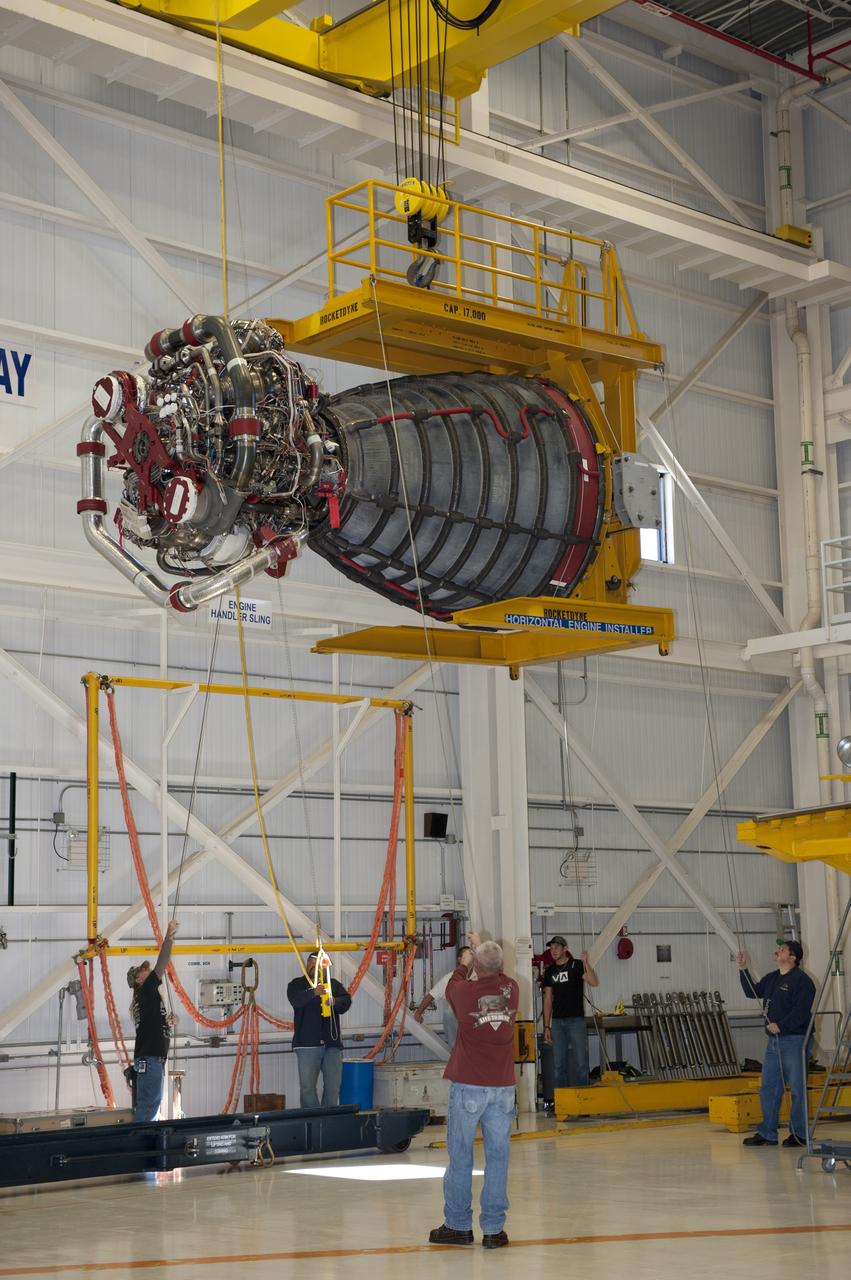
CAPE CANAVERAL, Fla. -- Workers in the Space Shuttle Main Engine (SSME) Shop at NASA's Kennedy Space Center in Florida raise the second of shuttle Atlantis' three main engines so it can be attached to a Hyster forklift. Then, the engine will be transported to Orbiter Processing Facility-1 where it will be installed in the shuttle. Each engine is 14 feet long, weighs about 6,700 pounds, and is 7.5 feet in diameter at the end of the nozzle. This is the final planned engine installation for the Space Shuttle Program. Atlantis is being prepared for the "launch on need," or potential rescue mission, for the final planned shuttle flight, Endeavour's STS-134 mission. For more information, visit www.nasa.gov/shuttle. Photo credit: NASA/Kim Shiflett
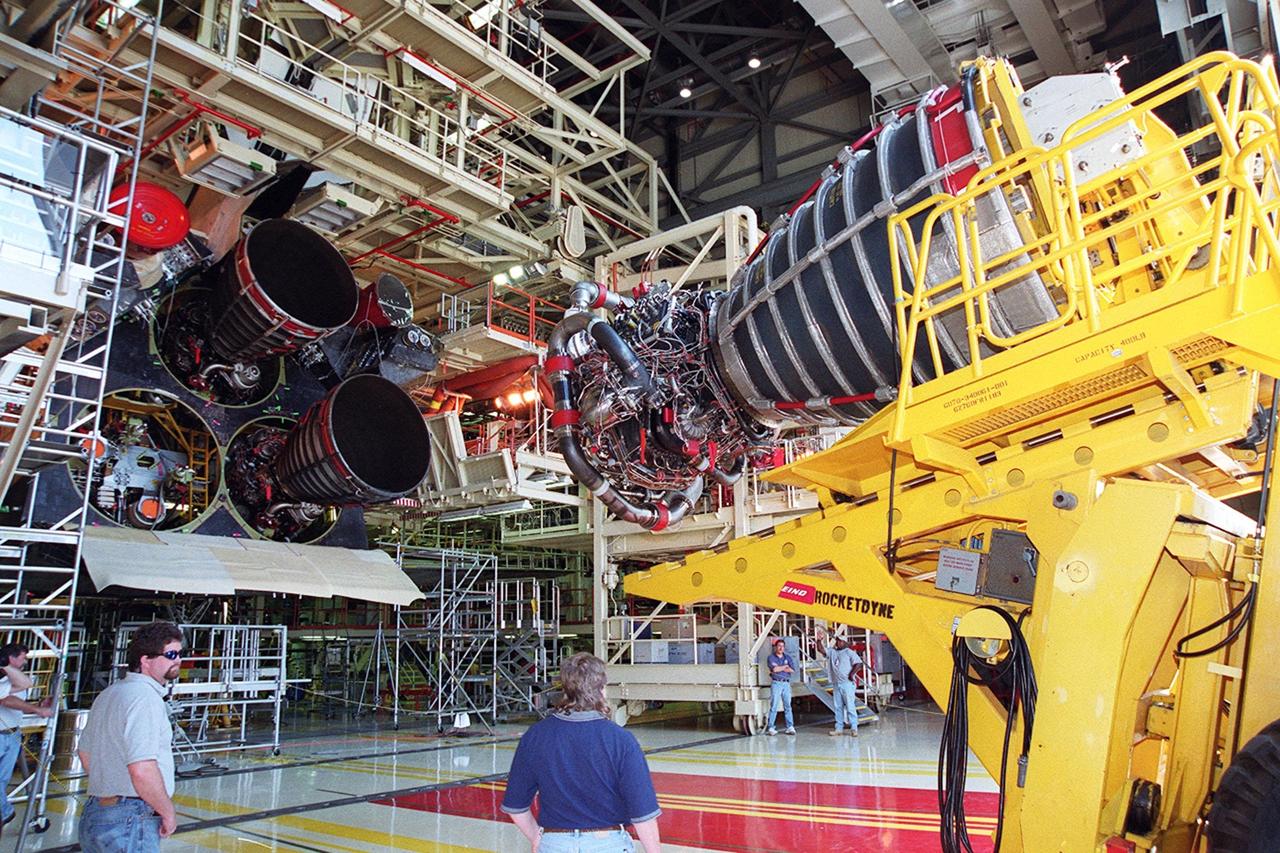
KENNEDY SPACE CENTER, FLA. -- A new block 2 engine heads toward Atlantis in Orbiter Processing Facility bay 3. There the new engine will be installed for its first flight on Atlantis, for mission STS-104. The Block II Main Engine configuration is manufactured by Boeing Rocketdyne in Canoga Park, Calif., and includes a new Pratt & Whitney high-pressure fuel turbo pump. Engine improvements are managed by NASA’s Marshall Space Flight Center in Huntsville, Ala. Each Space Shuttle Main Engine is 14 feet (4.3 meters) long, weighs about 7,000 pounds (3,175 kilograms), and is 7.5 feet (2.3 meters) in diameter at the end of the nozzle
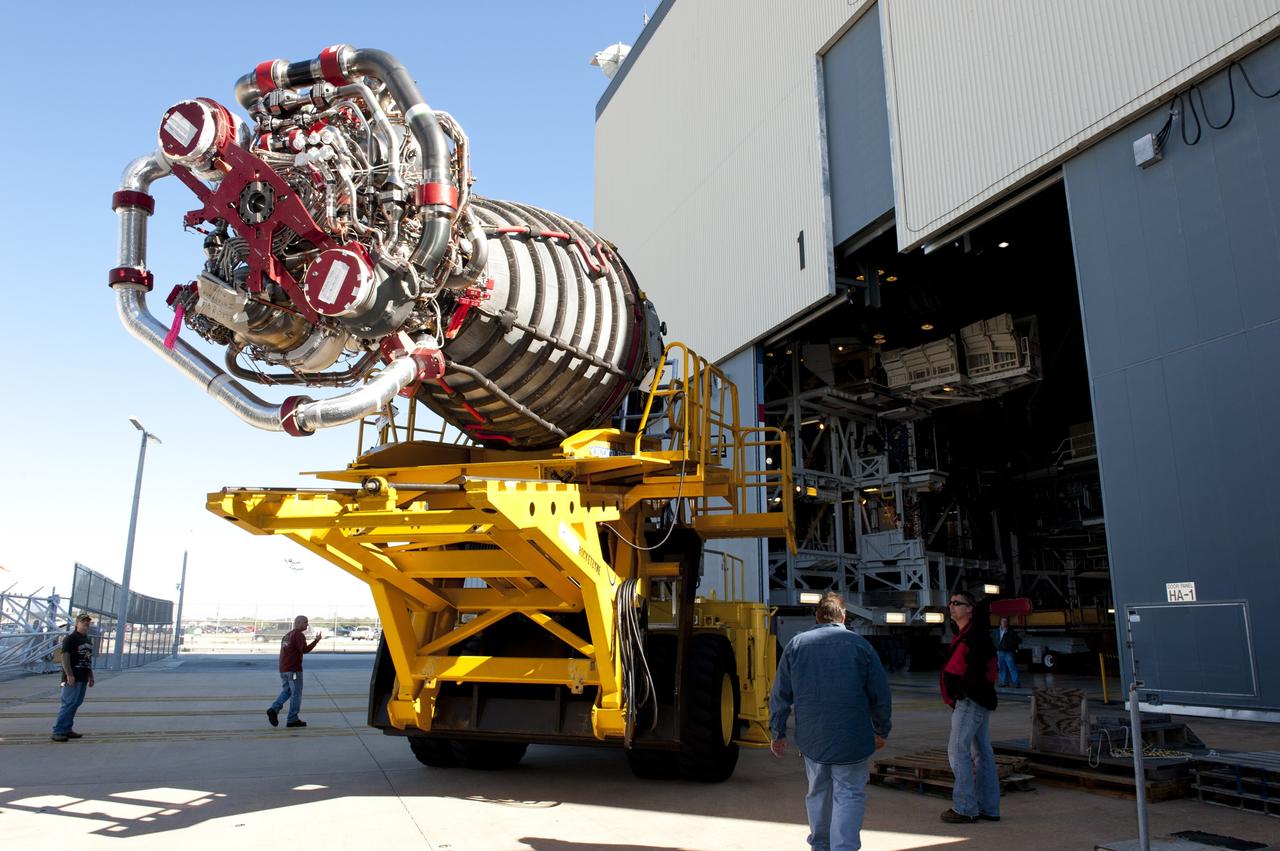
CAPE CANAVERAL, Fla. -- A Hyster forklift transports the second of shuttle Atlantis' three main engines from the Space Shuttle Main Engine (SSME) Shop to Orbiter Processing Facility-1 at NASA's Kennedy Space Center in Florida. Once inside the processing facility, the engine will be installed in the shuttle. Each engine is 14 feet long, weighs about 6,700 pounds, and is 7.5 feet in diameter at the end of the nozzle. This is the final planned engine installation for the Space Shuttle Program. Atlantis is being prepared for the "launch on need," or potential rescue mission, for the final planned shuttle flight, Endeavour's STS-134 mission. For more information, visit www.nasa.gov/shuttle. Photo credit: NASA/Kim Shiflett
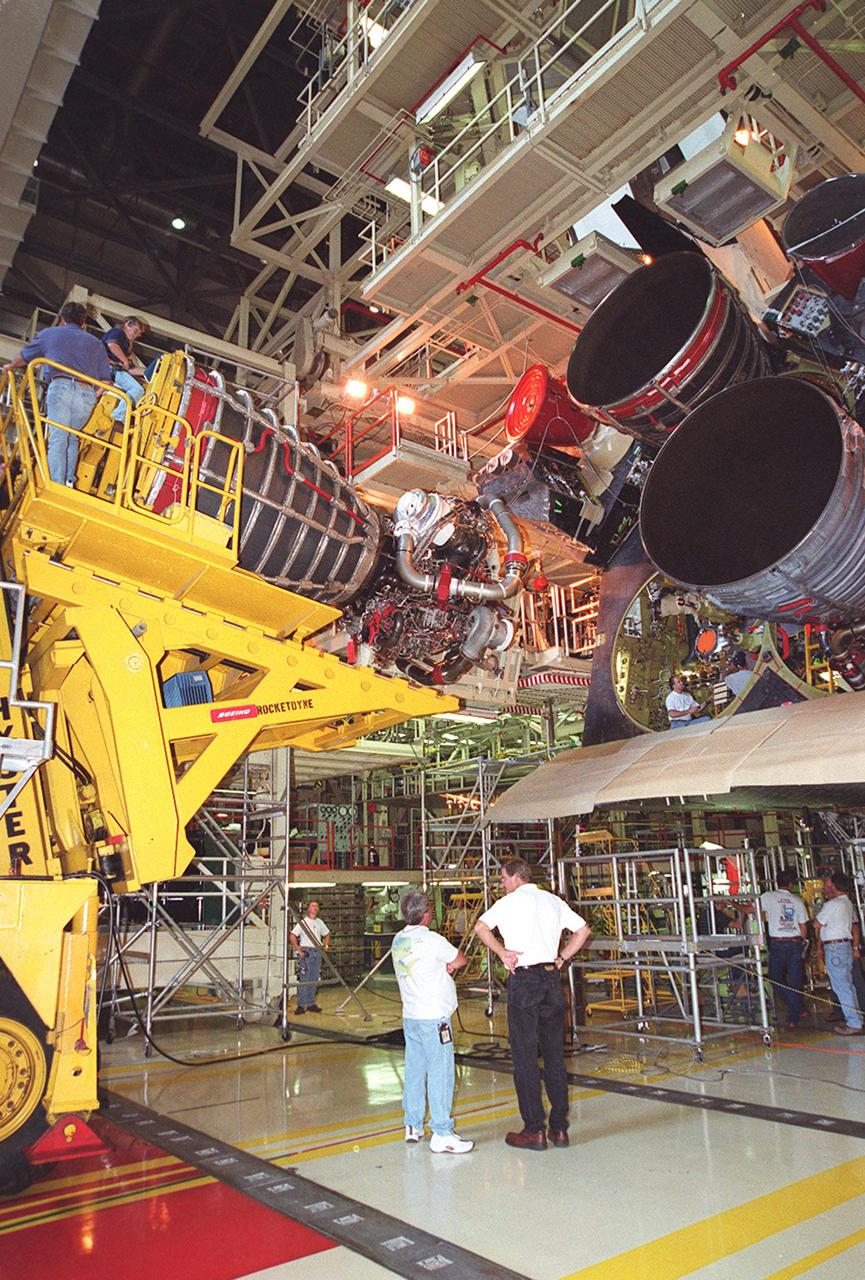
KENNEDY SPACE CENTER, FLA. -- In Orbiter Processing Facility bay 3, a new block 2 engine, at left, is moved into position for installation on Atlantis. The engine will have its first flight on mission STS-104, scheduled for launch June 14. The Block II Main Engine configuration is manufactured by Boeing Rocketdyne in Canoga Park, Calif., and includes a new Pratt and Whitney high-pressure fuel turbo pump. Engine improvements are managed by NASA’s Marshall Space Flight Center in Huntsville, Ala. Each Space Shuttle Main Engine is 14 feet (4.3 meters) long, weighs about 7,000 pounds (3,175 kilograms), and is 7.5 feet (2.3 meters) in diameter at the end of the nozzle
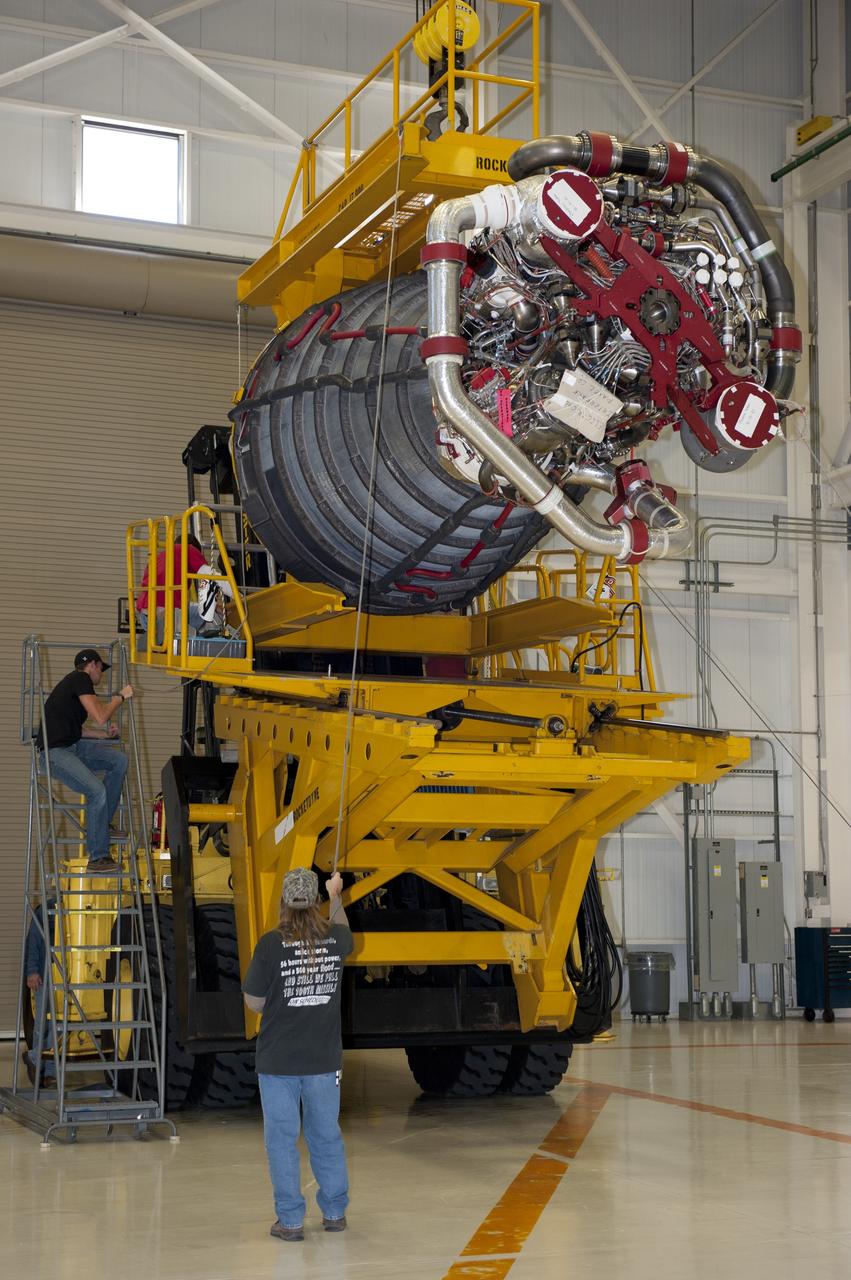
CAPE CANAVERAL, Fla. -- Workers in the Space Shuttle Main Engine (SSME) Shop at NASA's Kennedy Space Center in Florida attached the second of shuttle Atlantis' three main engines to a Hyster forklift. Next, the engine will be transported to Orbiter Processing Facility-1 where it will be installed in the shuttle. Each engine is 14 feet long, weighs about 6,700 pounds, and is 7.5 feet in diameter at the end of the nozzle. This is the final planned engine installation for the Space Shuttle Program. Atlantis is being prepared for the "launch on need," or potential rescue mission, for the final planned shuttle flight, Endeavour's STS-134 mission. For more information, visit www.nasa.gov/shuttle. Photo credit: NASA/Kim Shiflett
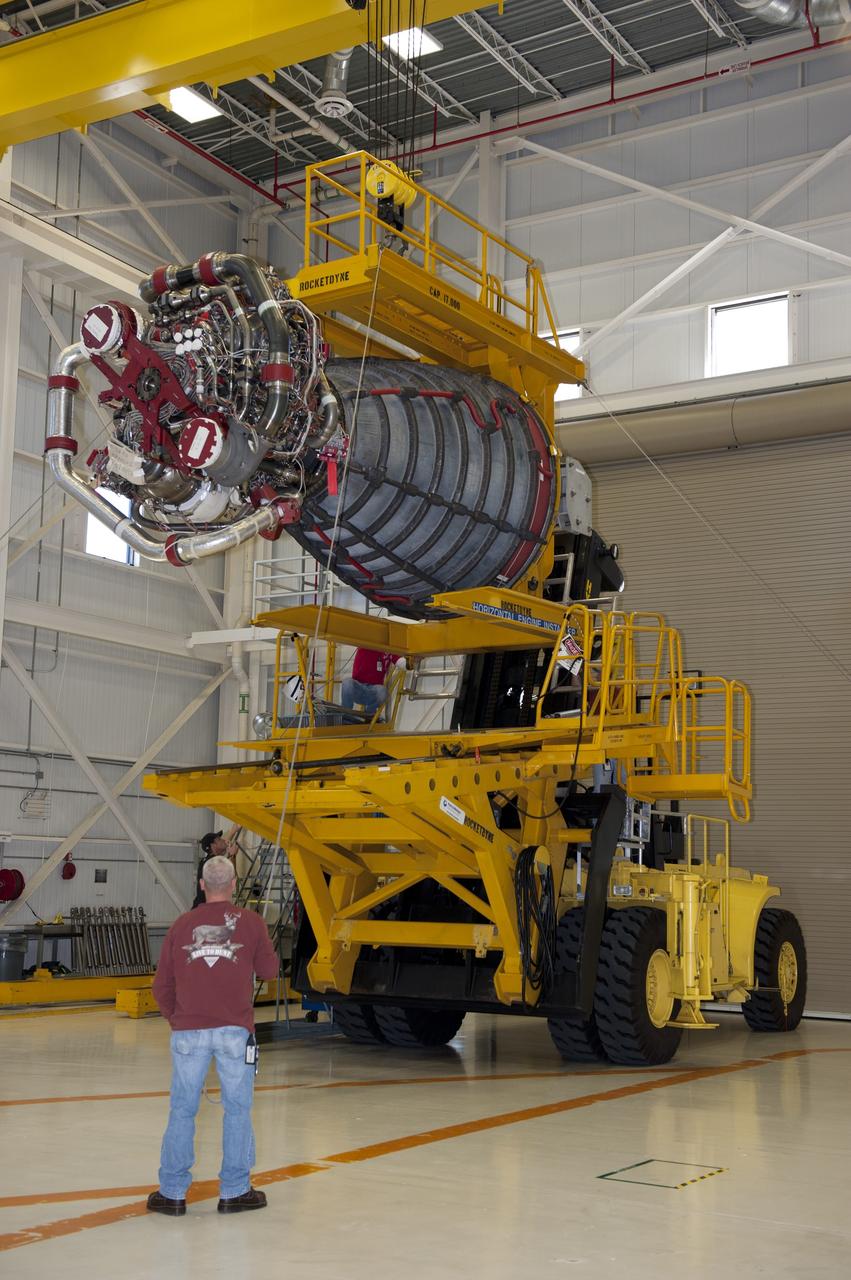
CAPE CANAVERAL, Fla. -- Workers in the Space Shuttle Main Engine (SSME) Shop at NASA's Kennedy Space Center in Florida attached the second of shuttle Atlantis' three main engines to a Hyster forklift. Next, the engine will be transported to Orbiter Processing Facility-1 where it will be installed in the shuttle. Each engine is 14 feet long, weighs about 6,700 pounds, and is 7.5 feet in diameter at the end of the nozzle. This is the final planned engine installation for the Space Shuttle Program. Atlantis is being prepared for the "launch on need," or potential rescue mission, for the final planned shuttle flight, Endeavour's STS-134 mission. For more information, visit www.nasa.gov/shuttle. Photo credit: NASA/Kim Shiflett
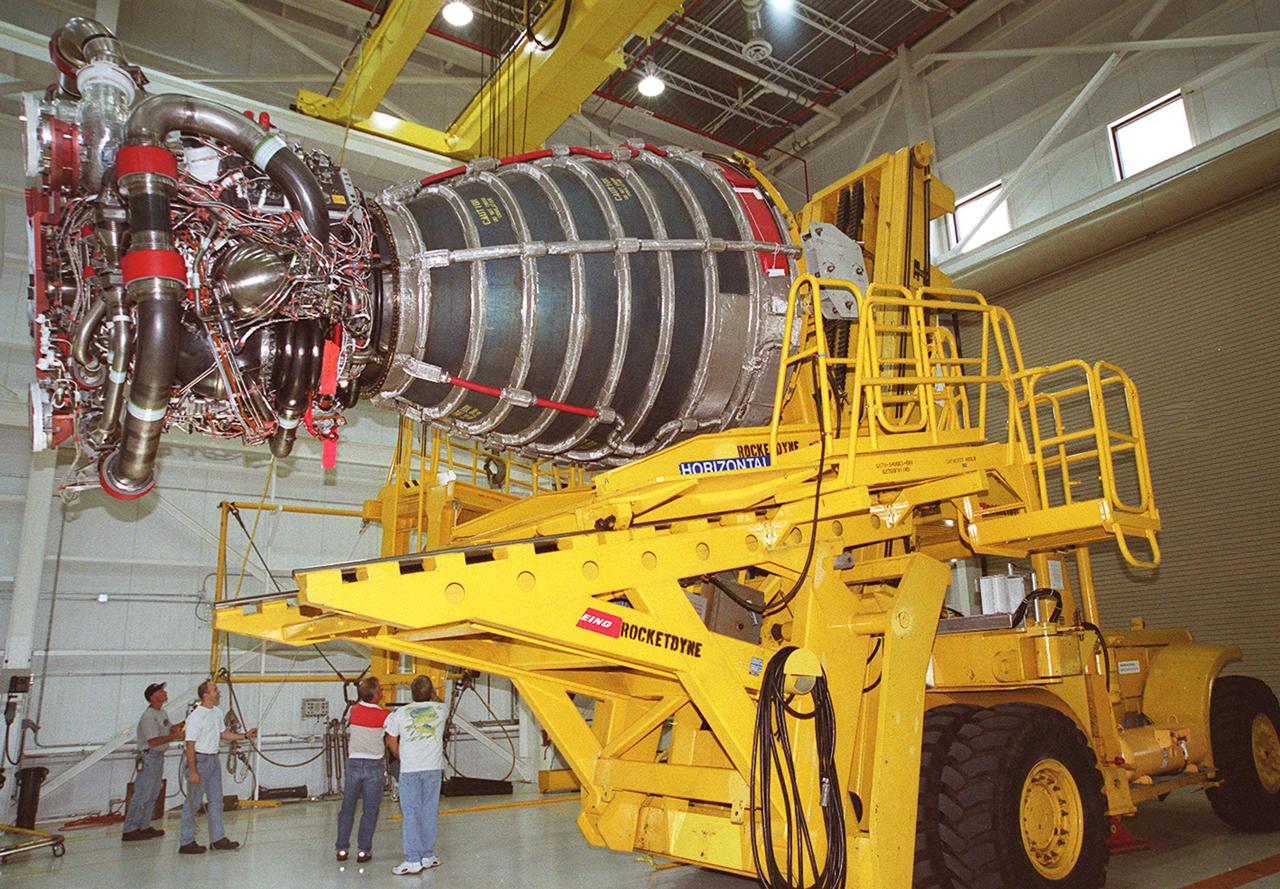
KENNEDY SPACE CENTER, FLA. -- A new block 2 engine is ready for its move to Orbiter Processing Facility bay 3. There it will be installed on the orbiter Atlantis, on mission STS-104, for its first flight. The Block II Main Engine configuration is manufactured by Boeing Rocketdyne in Canoga Park, Calif., and includes a new Pratt and Whitney high-pressure fuel turbo pump. Engine improvements are managed by NASA’s Marshall Space Flight Center in Huntsville, Ala. Each Space Shuttle Main Engine is 14 feet (4.3 meters) long, weighs about 7,000 pounds (3,175 kilograms), and is 7.5 feet (2.3 meters) in diameter at the end of the nozzle

A new block 2 engine is lowered onto a transport vehicle for a move to the Orbiter Processing Facility. There it will be installed for its first flight on the orbiter Atlantis, on mission STS-104. The Block II Main Engine configuration is manufactured by Boeing Rocketdyne in Canoga Park, Calif., and includes a new Pratt & Whitney high-pressure fuel turbo pump. Engine improvements are managed by NASA’s Marshall Space Flight Center in Huntsville, Ala. Each Space Shuttle Main Engine is 14 feet (4.3 meters) long, weighs about 7,000 pounds (3,175 kilograms), and is 7.5 feet (2.3 meters) in diameter at the end of the nozzle
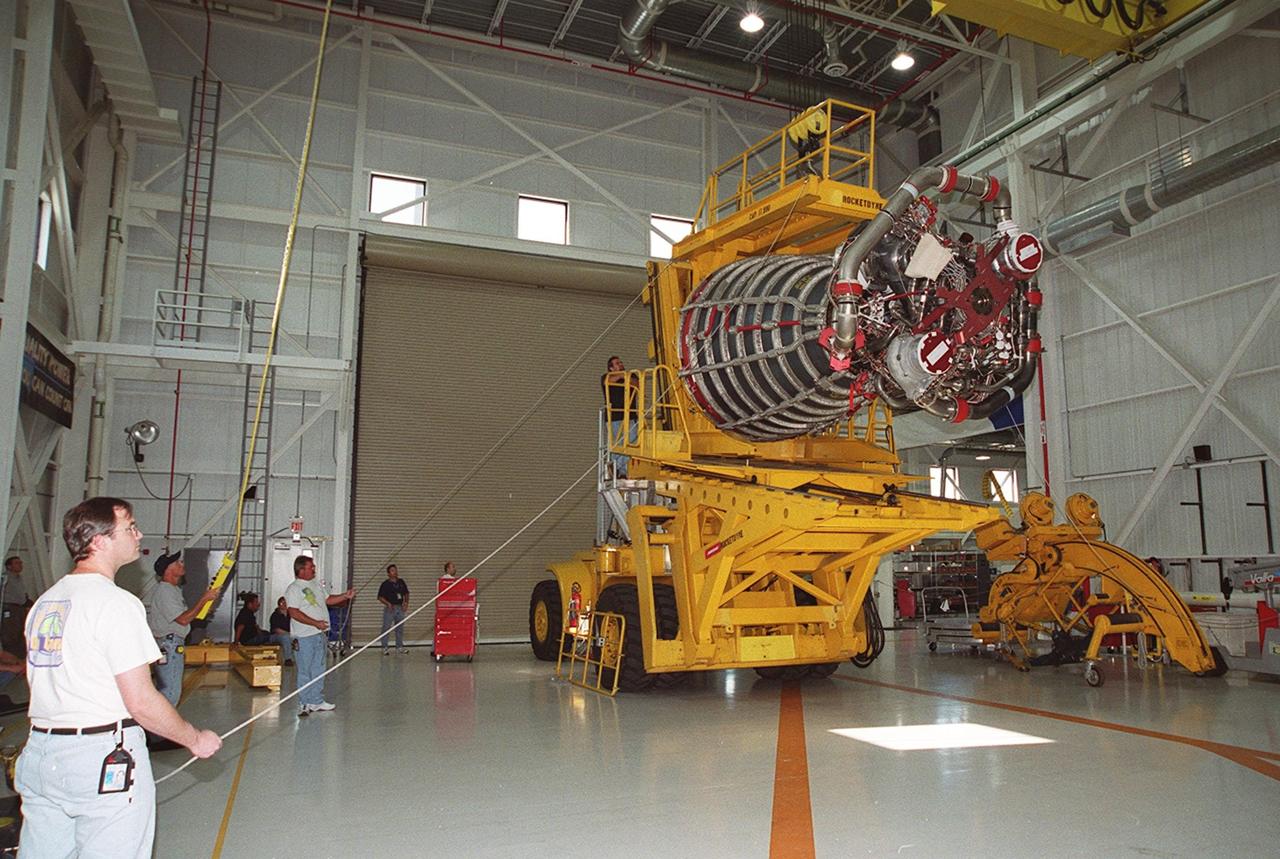
A new block 2 engine is lowered onto a transport vehicle for a move to the Orbiter Processing Facility. There it will be installed for its first flight on the orbiter Atlantis, on mission STS-104. The Block II Main Engine configuration is manufactured by Boeing Rocketdyne in Canoga Park, Calif., and includes a new Pratt & Whitney high-pressure fuel turbo pump. Engine improvements are managed by NASA’s Marshall Space Flight Center in Huntsville, Ala. Each Space Shuttle Main Engine is 14 feet (4.3 meters) long, weighs about 7,000 pounds (3,175 kilograms), and is 7.5 feet (2.3 meters) in diameter at the end of the nozzle
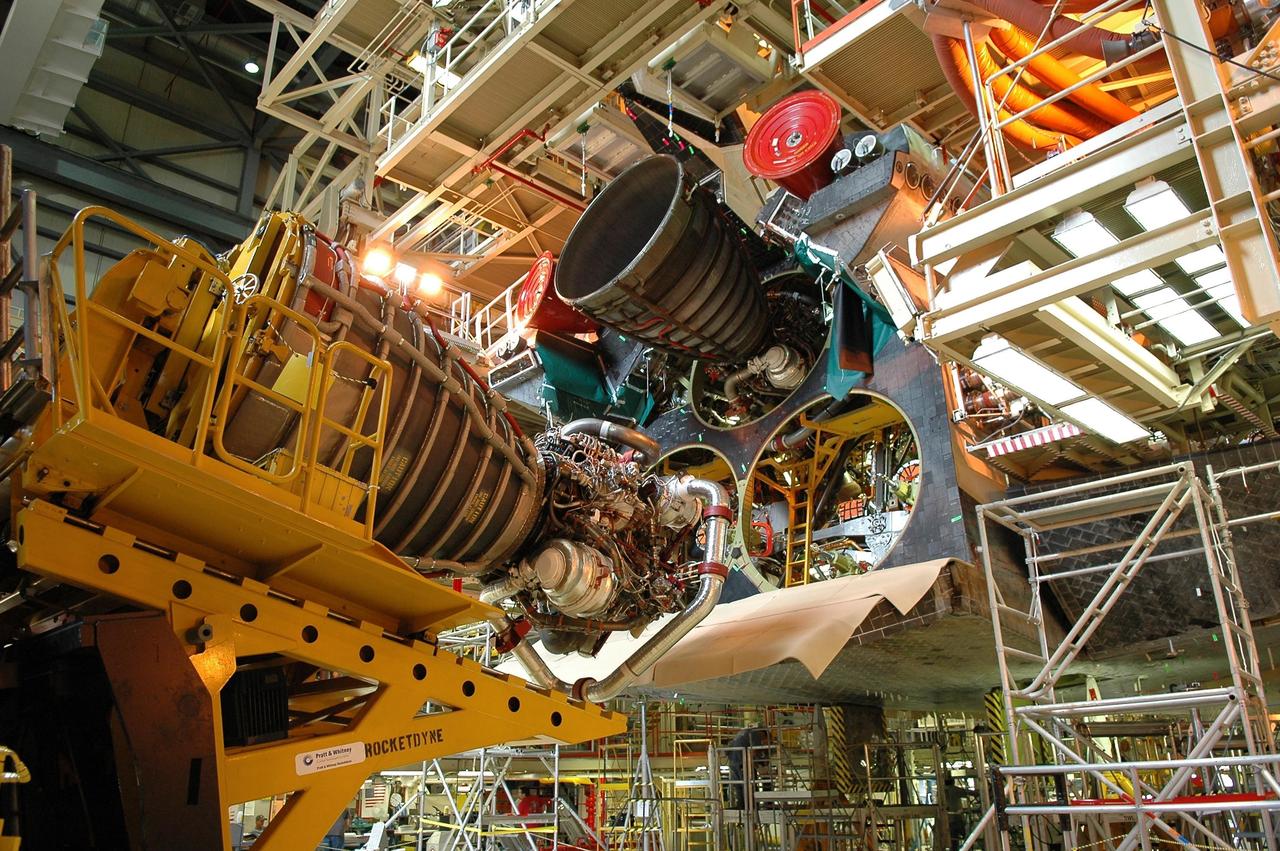
KENNEDY SPACE CENTER, FLA. - Engine No. 3 is ready to be installed on Discovery in the Orbiter Processing Facility bay 3. The main engine configuration is manufactured by Pratt & Whitney Rocketdyne in Canoga Park, Calif., and includes a Pratt & Whitney high-pressure fuel turbo pump. Each space shuttle main engine is 14 feet long, weighs about 6,700 pounds, and is 7.5 feet in diameter at the end of the nozzle. Discovery is being processed for its next mission, STS-116 (12A.1), to deliver a third truss segment, a SPACEHAB module and other key components to the International Space Station. The launch is currently scheduled no earlier than Dec. 14. Photo credit: NASA/Kim Shiflett
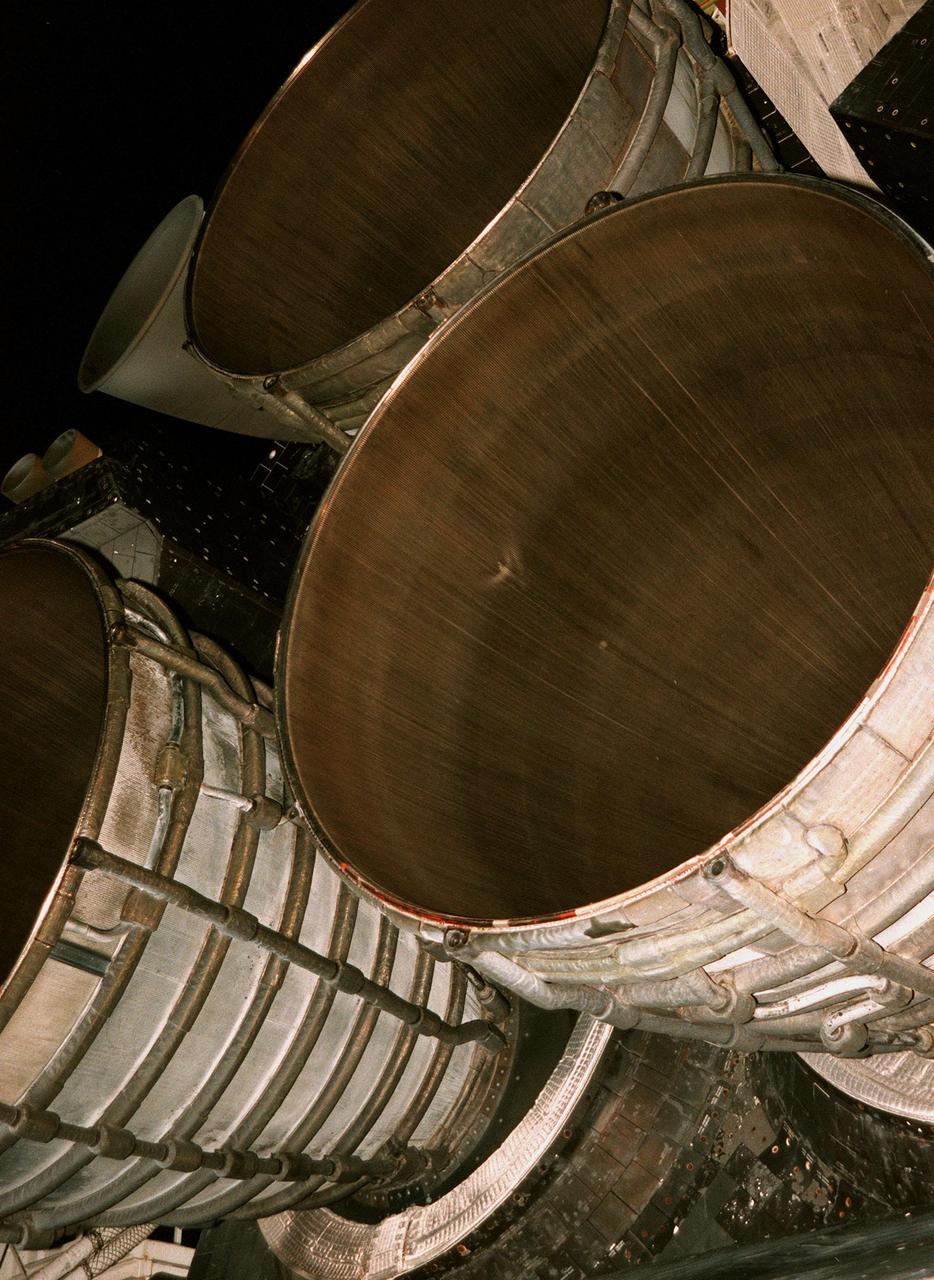
KENNEDY SPACE CENTER, FLA. -- Following the landing of Space Shuttle Columbia on July 27, this close-up view shows what appear to be three small holes in the liquid hydrogen tubes inside the nozzle on main engine No. 3. Engineers will examine the engine to determine if a possible hydrogen leak occurred during the STS-93 launch on July 23
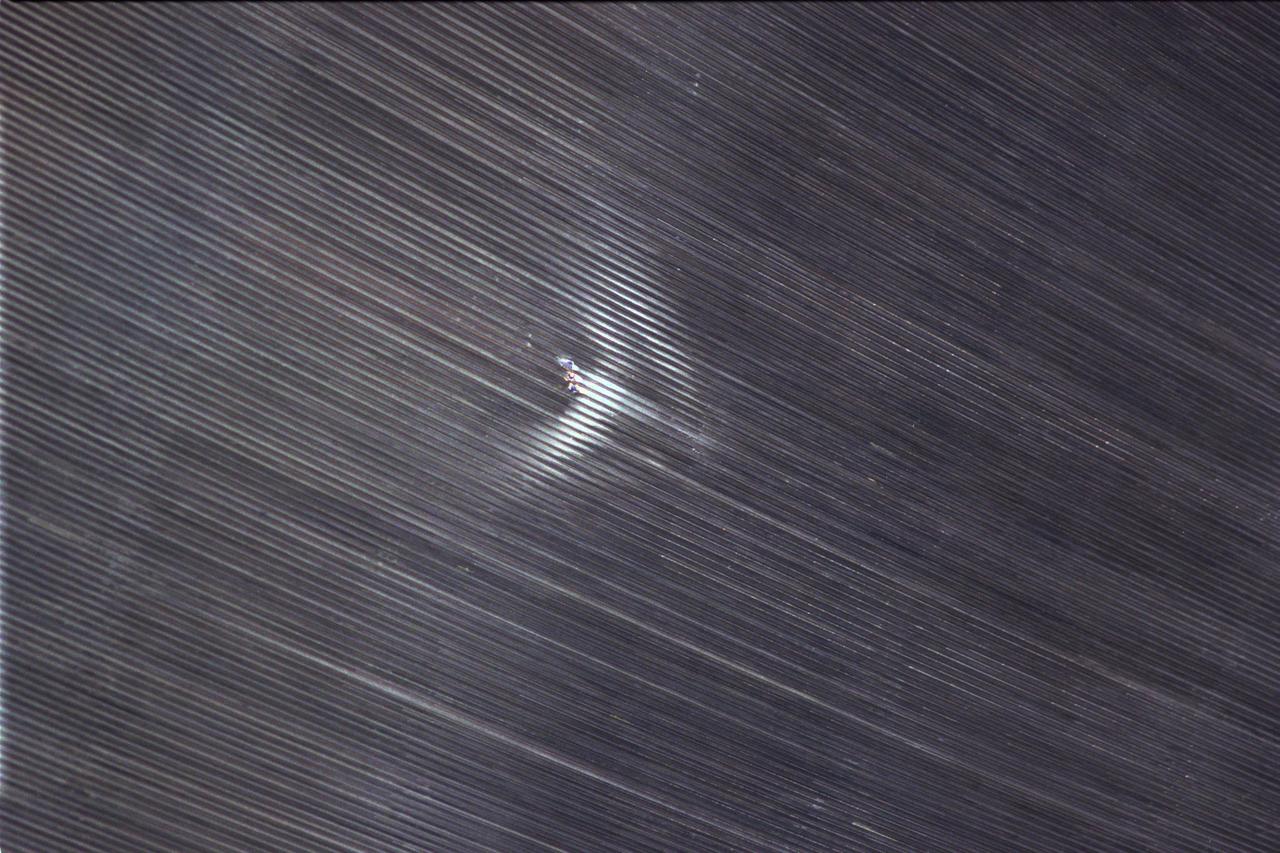
STS093-(S)-014 (28 July 1999) --- Following the landing of the Space Shuttle Columbia on July 27, 1999, this close-up view shows what appears to be three small holes in the liquid hydrogen tubes inside the nozzle on main engine No. 3. Engineers will examine the engine to determine if a possible hydrogen leak occurred during the STS-93 launch on July 23.
KENNEDY SPACE CENTER, FLA. -- Following the landing of Space Shuttle Columbia on July 27, this close-up view shows what appear to be three small holes in the liquid hydrogen tubes inside the nozzle on main engine No. 3. Engineers will examine the engine to determine if a possible hydrogen leak occurred during the STS-93 launch on July 23
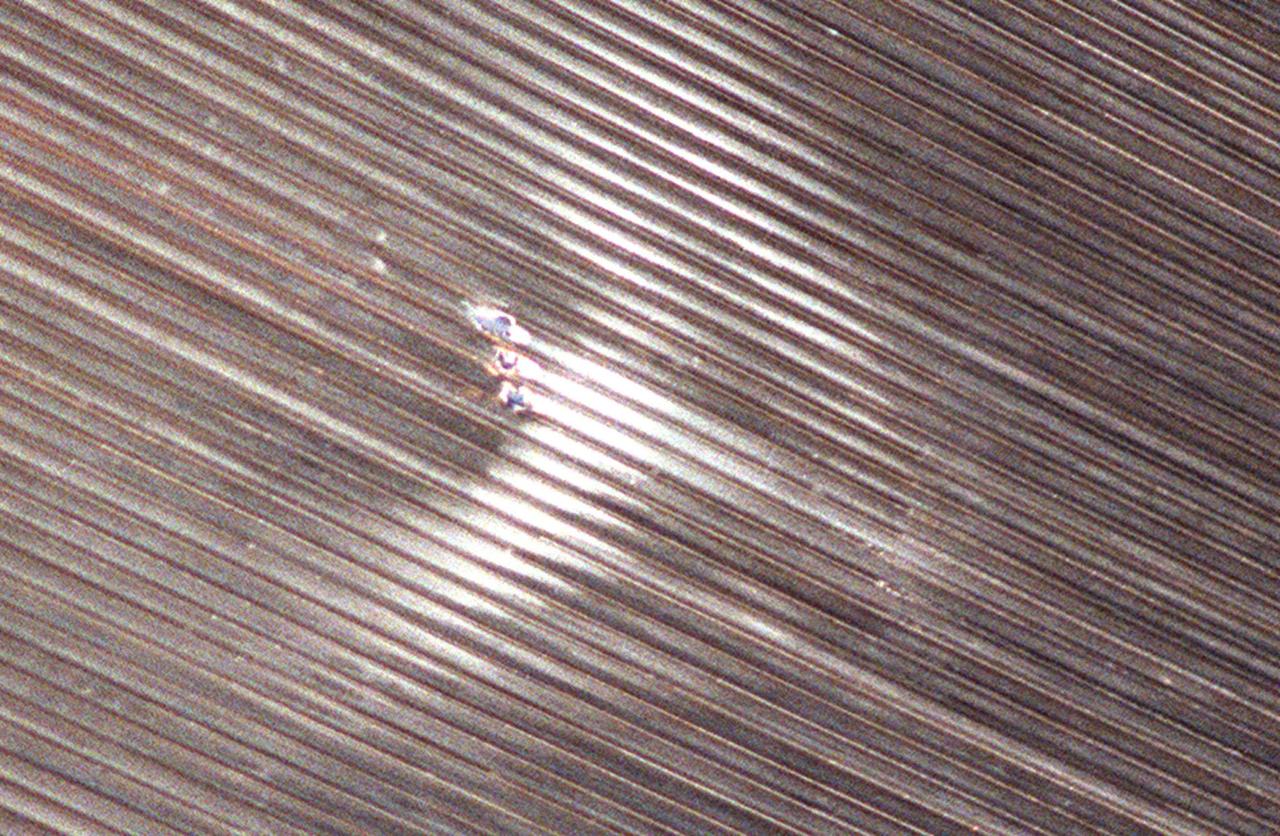
KENNEDY SPACE CENTER, FLA. -- Following the landing of Space Shuttle Columbia on July 27, this close-up view shows what appear to be three small holes in the liquid hydrogen tubes inside the nozzle on main engine No. 3. Engineers will examine the engine to determine if a possible hydrogen leak occurred during the STS-93 launch on July 23
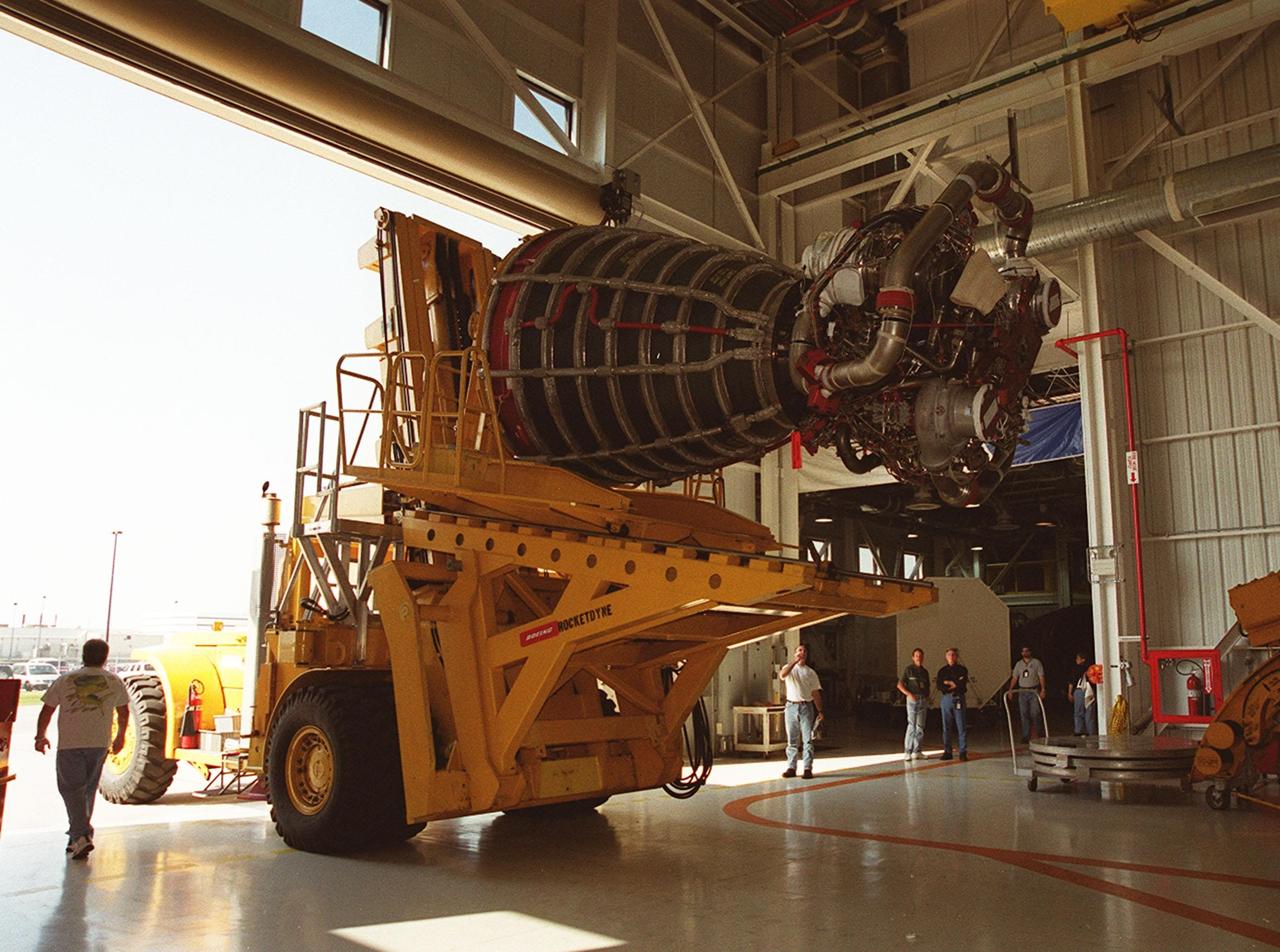
KENNEDY SPACE CENTER, FLA. -- The transport vehicle carrying a new block 2 engine leaves the Space Station Main Engine Processing Facility for a short trip to Orbiter Processing Facility bay 3. The new engine will be installed on the orbiter Atlantis, on mission STS-104, for its first flight. The Block II Main Engine configuration is manufactured by Boeing Rocketdyne in Canoga Park, Calif., and includes a new Pratt & Whitney high-pressure fuel turbo pump. Engine improvements are managed by NASA’s Marshall Space Flight Center in Huntsville, Ala. Each Space Shuttle Main Engine is 14 feet (4.3 meters) long, weighs about 7,000 pounds (3,175 kilograms), and is 7.5 feet (2.3 meters) in diameter at the end of the nozzle
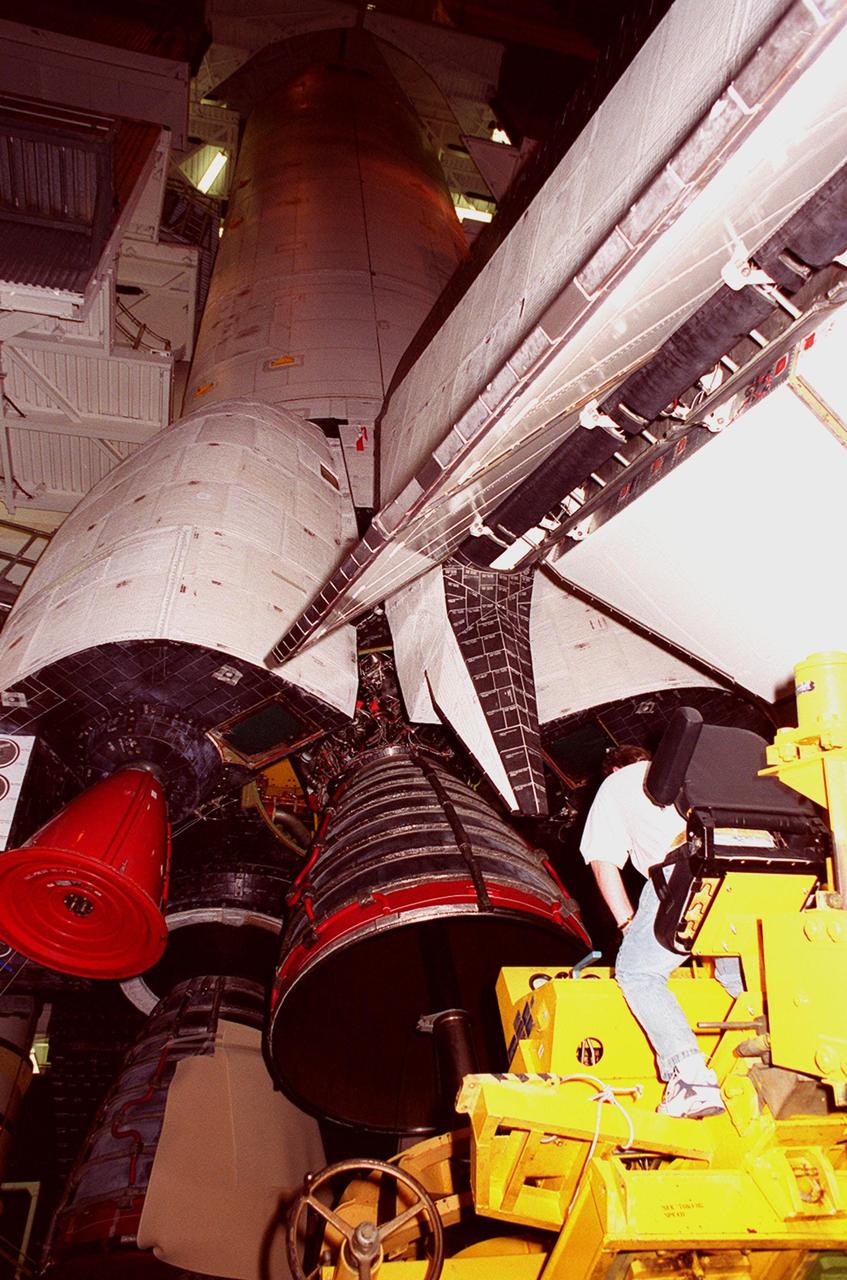
KENNEDY SPACE CENTER, FLA. -- Underneath the 26.3-foot vertical tail structure of Space Shuttle Atlantis, a worker in the Vehicle Assembly Building maneuvers equipment under Main Engine No. 1 in order to remove it. An inventory review concerning defective main engine fuel pump tip seals indicated that defective seals may be present on the fuel pump for the engine. The decision was made to replace the suspect engine with one originally slated for Discovery. The main engine nozzles, visible in the photo, are 7.8 feet across and 9.4 feet high. Space Shuttle Atlantis is scheduled to launch no earlier than April 17, 2000, on mission STS-101 to resupply the International Space Station for the arrival of the next pressurized module, the Russian-built Zvezda
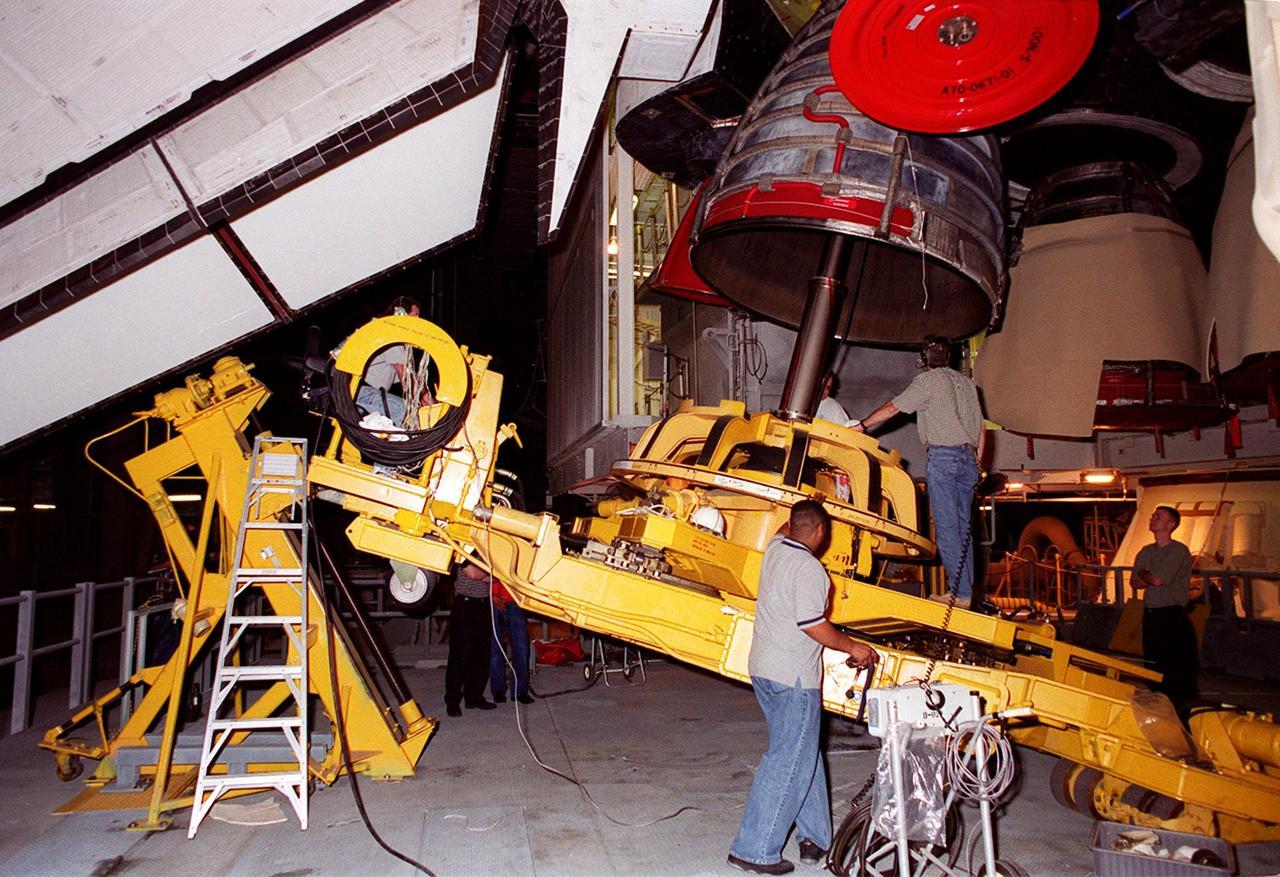
KENNEDY SPACE CENTER, FLA. -- Workers in the Vehicle Assembly Building maneuver equipment in place to remove Main Engine No. 1 from Space Shuttle Atlantis in the Vehicle Assembly Building. An inventory review concerning defective main engine fuel pump tip seals indicated that defective seals may be present on the fuel pump for the engine. The decision was made to replace the suspect engine with one originally slated for Discovery. The main engine nozzles, visible in the photo, are 7.8 feet across and 9.4 feet high. Space Shuttle Atlantis is scheduled to launch no earlier than April 17, 2000, on mission STS-101 to resupply the International Space Station for the arrival of the next pressurized module, the Russian-built Zvezda
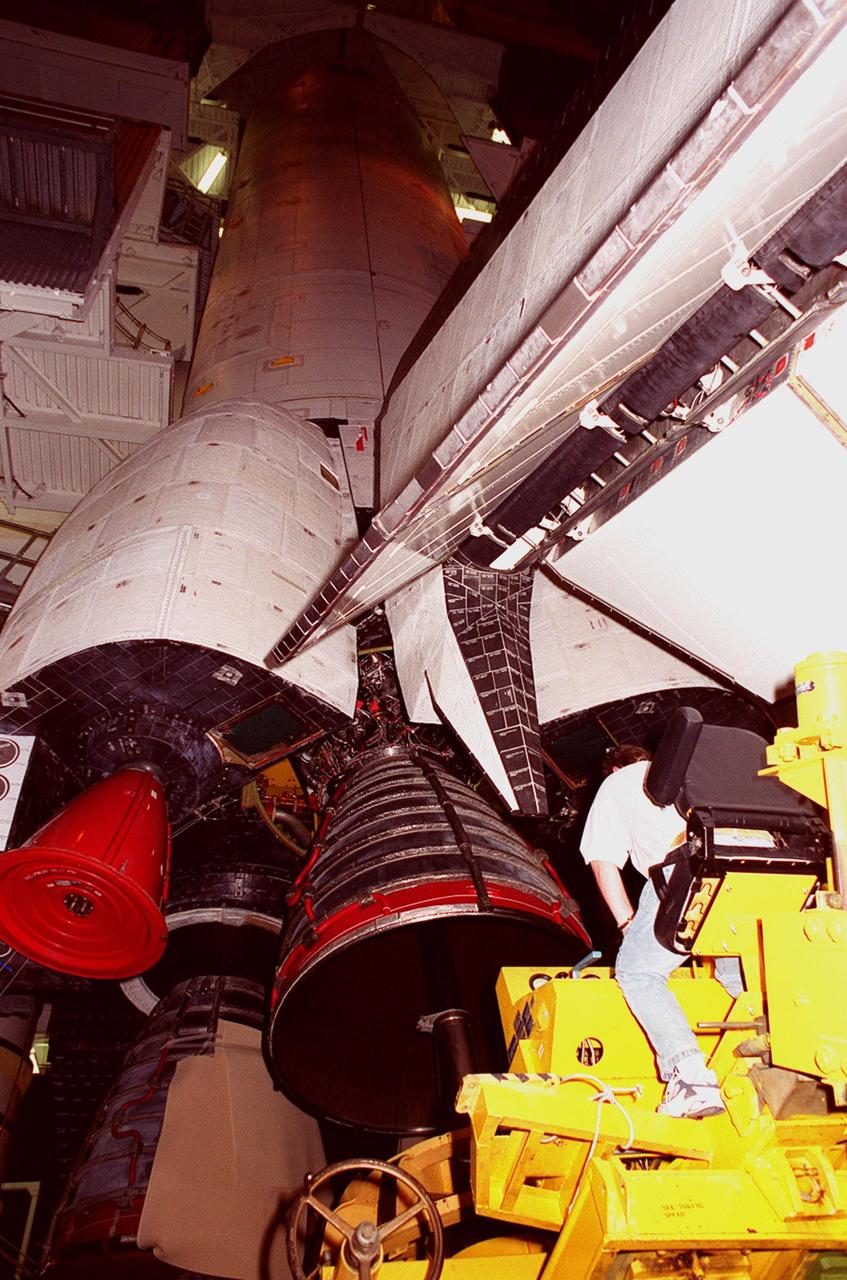
KENNEDY SPACE CENTER, FLA. -- Underneath the 26.3-foot vertical tail structure of Space Shuttle Atlantis, a worker in the Vehicle Assembly Building maneuvers equipment under Main Engine No. 1 in order to remove it. An inventory review concerning defective main engine fuel pump tip seals indicated that defective seals may be present on the fuel pump for the engine. The decision was made to replace the suspect engine with one originally slated for Discovery. The main engine nozzles, visible in the photo, are 7.8 feet across and 9.4 feet high. Space Shuttle Atlantis is scheduled to launch no earlier than April 17, 2000, on mission STS-101 to resupply the International Space Station for the arrival of the next pressurized module, the Russian-built Zvezda
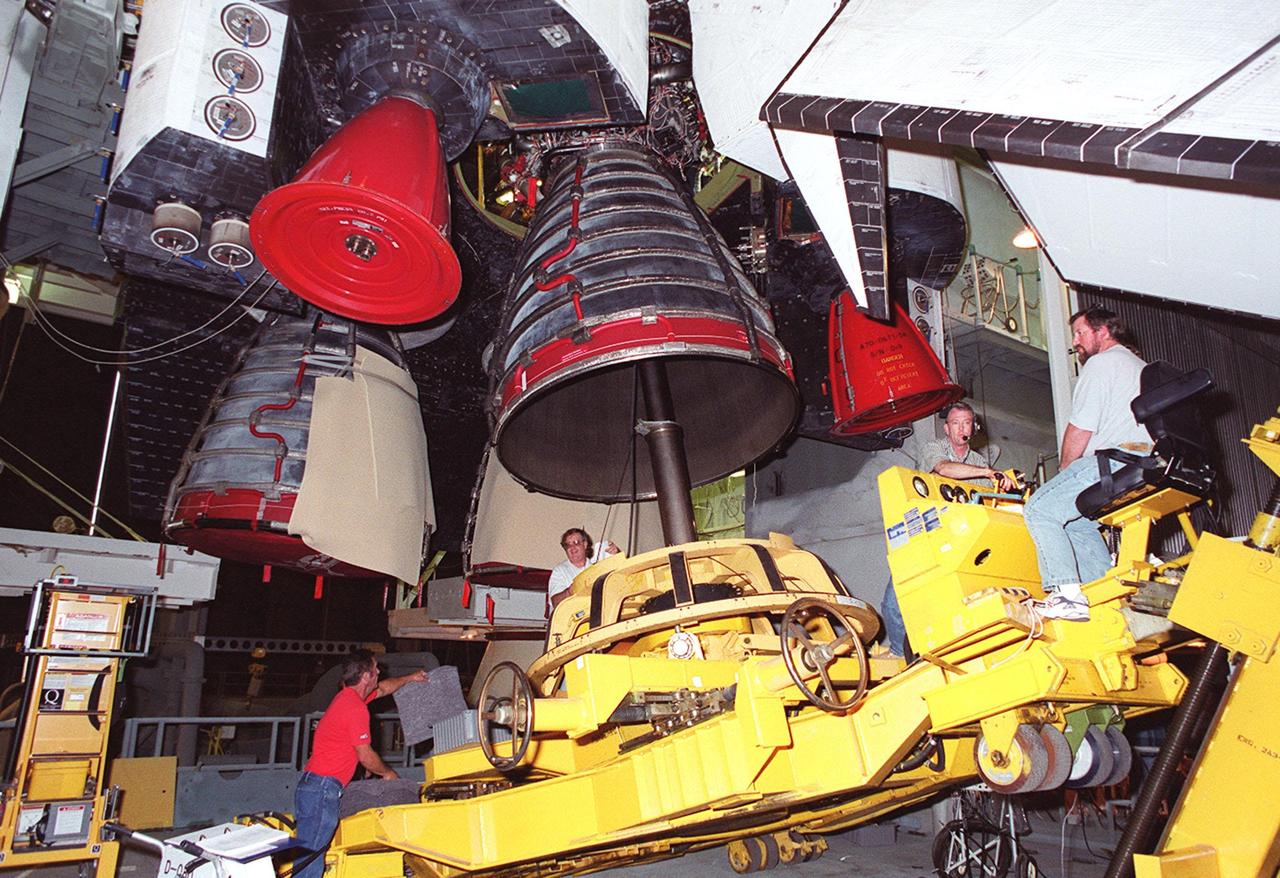
KENNEDY SPACE CENTER, FLA. -- Underneath the 26.3-foot vertical tail structure of Space Shuttle Atlantis (above right) in the Vehicle Assembly Building, workers place equipment to be used for the removal of Main Engine No. 1. An inventory review concerning defective main engine fuel pump tip seals indicated that defective seals may be present on the fuel pump for the engine. The decision was made to replace the suspect engine with one originally slated for Discovery. The main engine nozzles, visible in the photo, are 7.8 feet across and 9.4 feet high. Space Shuttle Atlantis is scheduled to launch no earlier than April 17, 2000, on mission STS-101 to resupply the International Space Station for the arrival of the next pressurized module, the Russian-built Zvezda
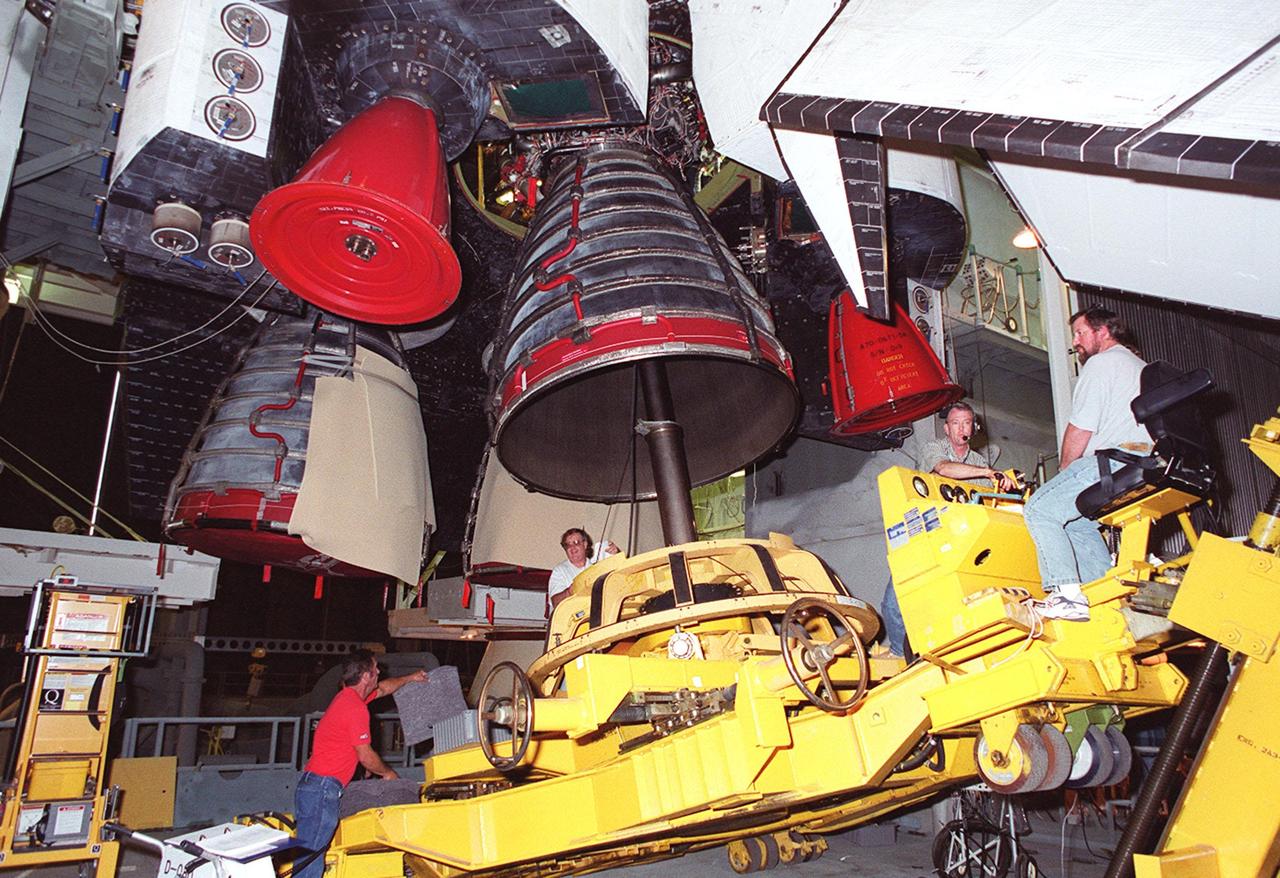
KENNEDY SPACE CENTER, FLA. -- Underneath the 26.3-foot vertical tail structure of Space Shuttle Atlantis (above right) in the Vehicle Assembly Building, workers place equipment to be used for the removal of Main Engine No. 1. An inventory review concerning defective main engine fuel pump tip seals indicated that defective seals may be present on the fuel pump for the engine. The decision was made to replace the suspect engine with one originally slated for Discovery. The main engine nozzles, visible in the photo, are 7.8 feet across and 9.4 feet high. Space Shuttle Atlantis is scheduled to launch no earlier than April 17, 2000, on mission STS-101 to resupply the International Space Station for the arrival of the next pressurized module, the Russian-built Zvezda
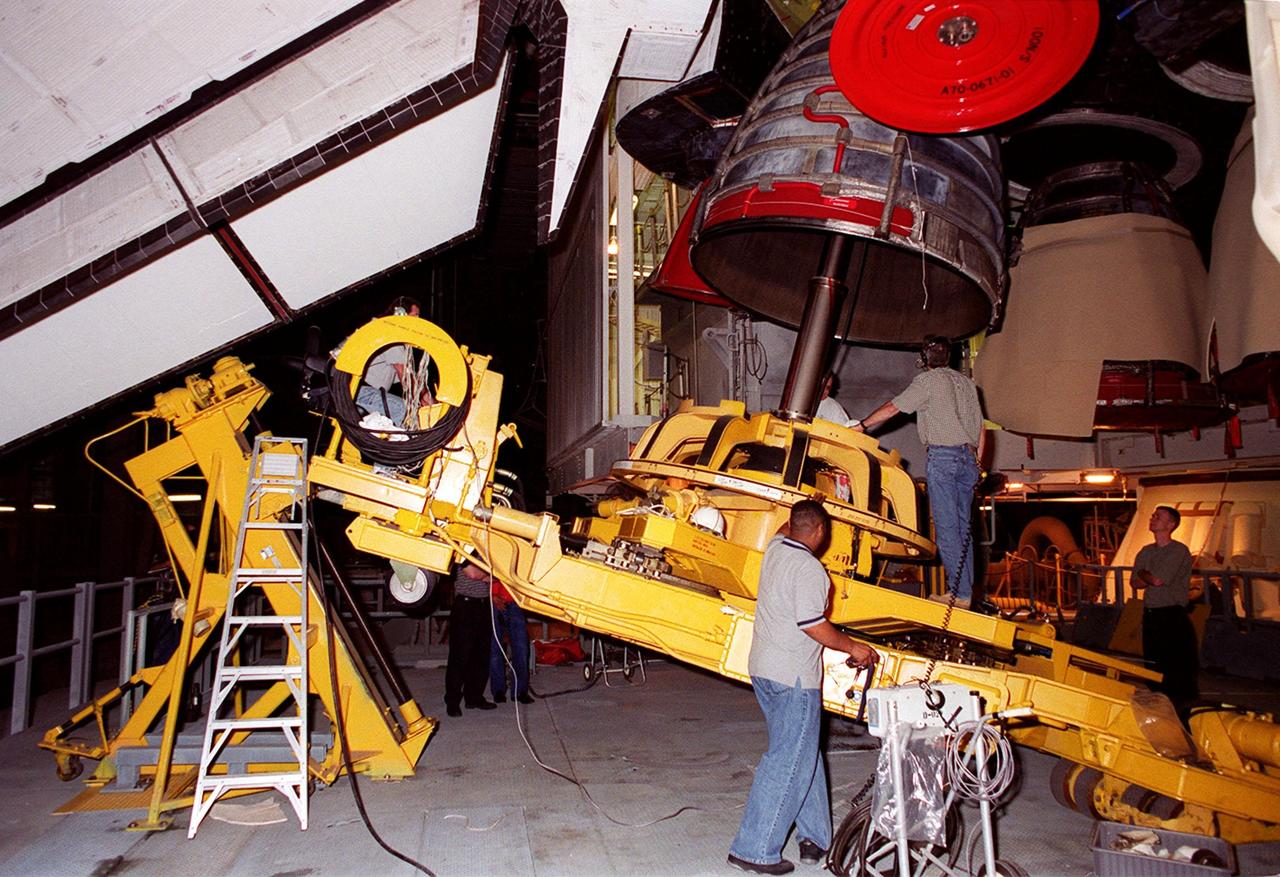
KENNEDY SPACE CENTER, FLA. -- Workers in the Vehicle Assembly Building maneuver equipment in place to remove Main Engine No. 1 from Space Shuttle Atlantis in the Vehicle Assembly Building. An inventory review concerning defective main engine fuel pump tip seals indicated that defective seals may be present on the fuel pump for the engine. The decision was made to replace the suspect engine with one originally slated for Discovery. The main engine nozzles, visible in the photo, are 7.8 feet across and 9.4 feet high. Space Shuttle Atlantis is scheduled to launch no earlier than April 17, 2000, on mission STS-101 to resupply the International Space Station for the arrival of the next pressurized module, the Russian-built Zvezda
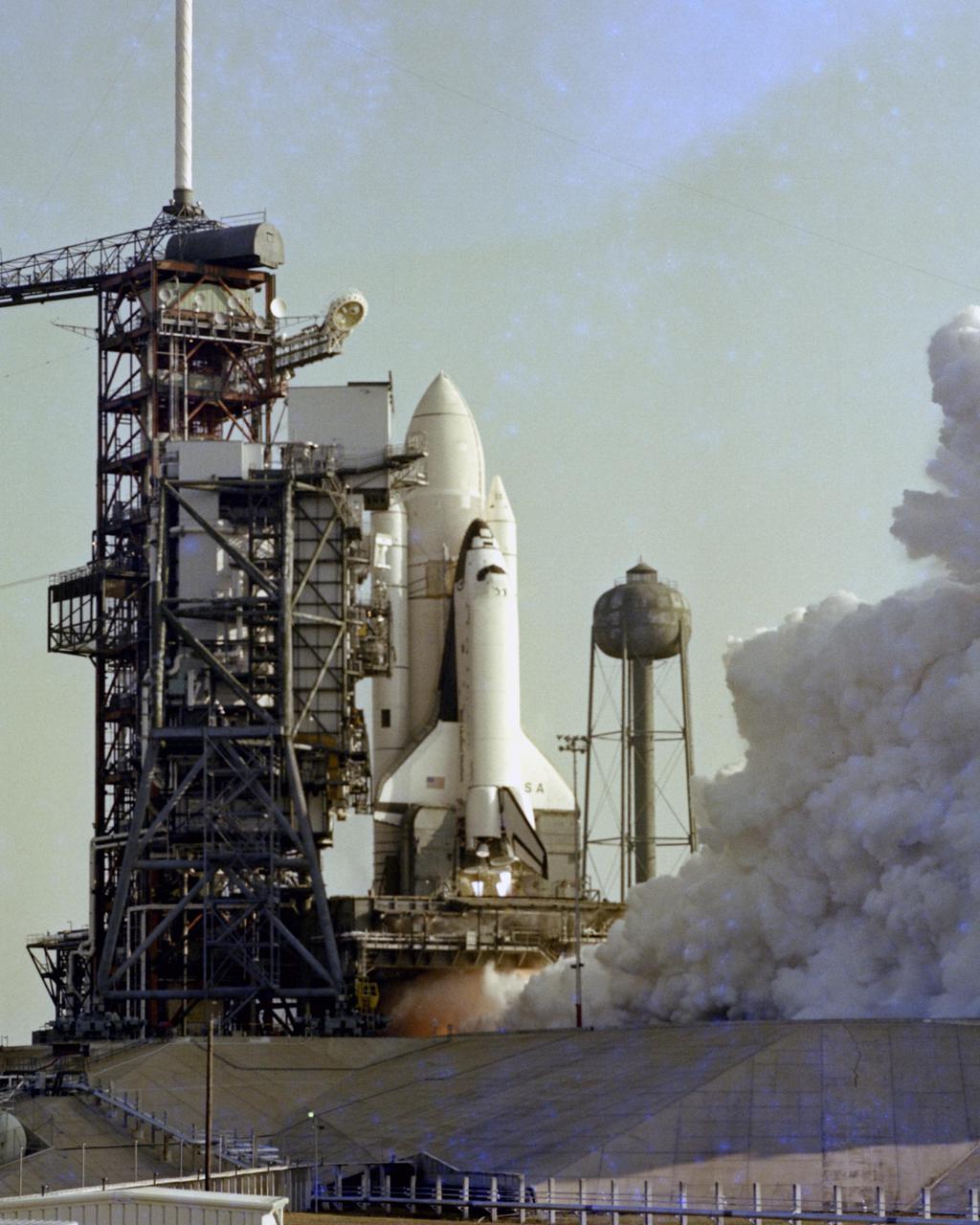
KENNEDY SPACE CENTER, FLA. - Flames shoot from the nozzles of Space Shuttle Columbia's three main engines during the successful 20-second static firing which capped a formal rehearsal for the maiden flight of Columbia, scheduled for early April. Remotely-operated cameras inside the pad perimeter snapped closeup views of the milestone event, which took place at 8:45 a.m. on February 20, 1981. The three main engines reach 100 percent power -- over 1 million pounds of thrust -- during the test. Hold-down bolts secured the vehicle to its mobile launcher platform.
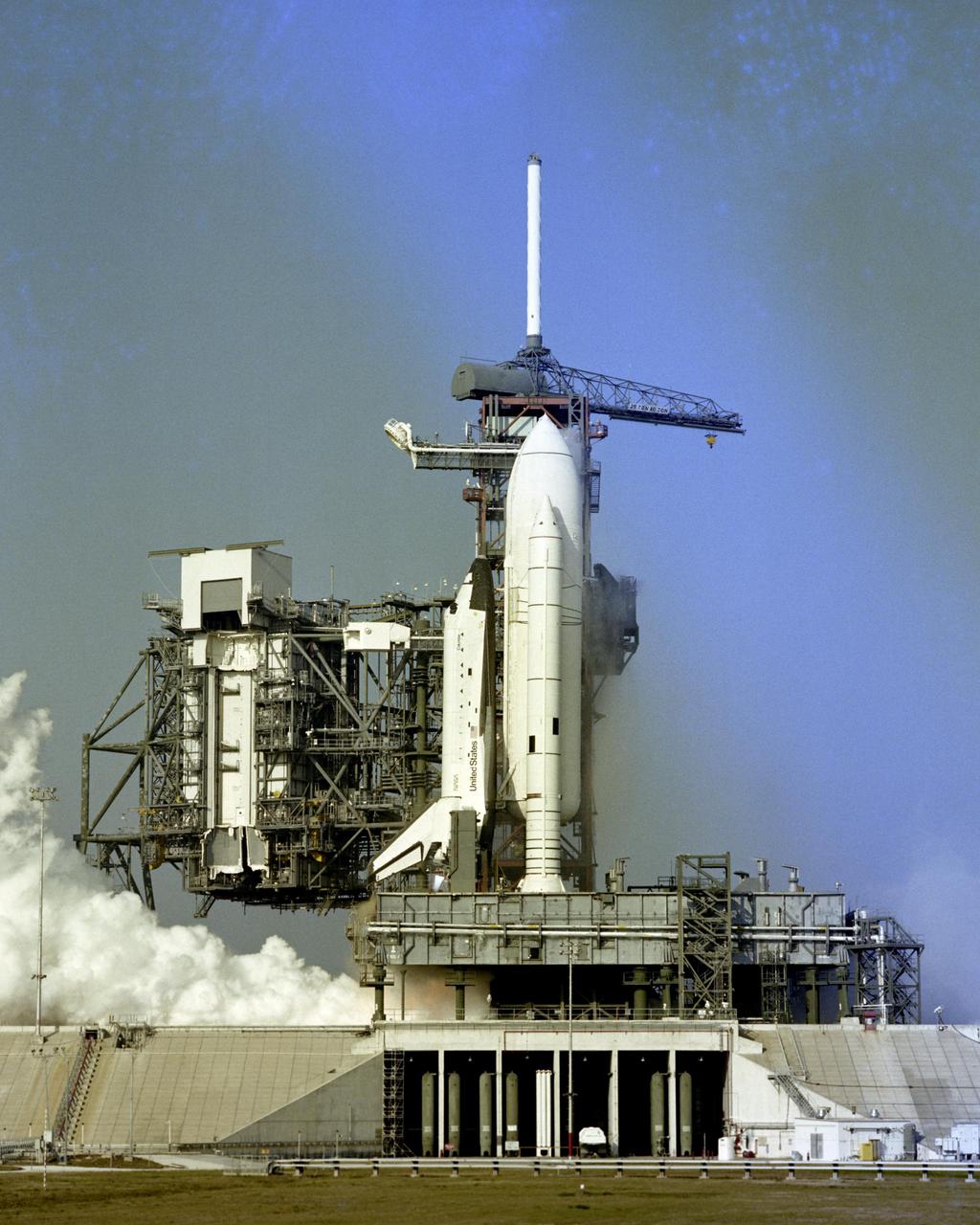
KENNEDY SPACE CENTER, FLA. - Flames shoot from the nozzles of Space Shuttle Columbia's three main engines during the successful 20-second static firing which capped a formal rehearsal for the maiden flight of Columbia, scheduled for early April. Remotely operated cameras inside the pad perimeter snapped closeup views of the milestone event, which took place at 8:45 a.m. on February 20, 1981. The three main engines reached 100 percent power -- over 1 million pounds of thrust -- during the test. Hold-down bolts secured the vehicle to its mobile launcher platform.
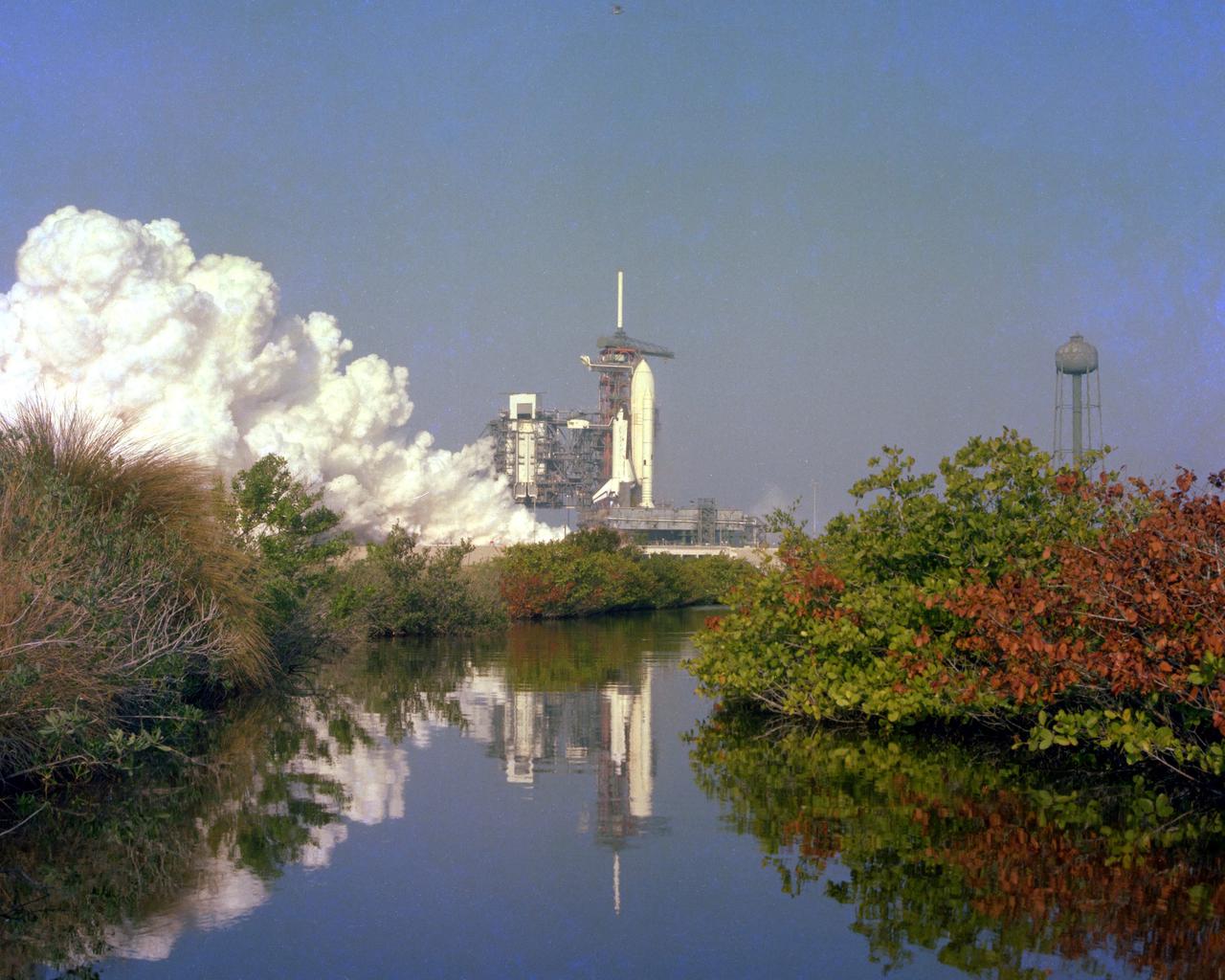
KENNEDY SPACE CENTER, FLA. - Flames shot from the nozzles of the Space Shuttle's three engines during the successful 20-second static firing, which capped a formal rehearsal for the maiden flight of Columbia, scheduled for early April. The milestone event took place at 8:45 a.m. on Feb. 20, 1981. The three main engines reached 100 percent power - over 1 million pounds of thrust - during the test. Holddown bolts secured the vehicle to its mobile launcher platform.
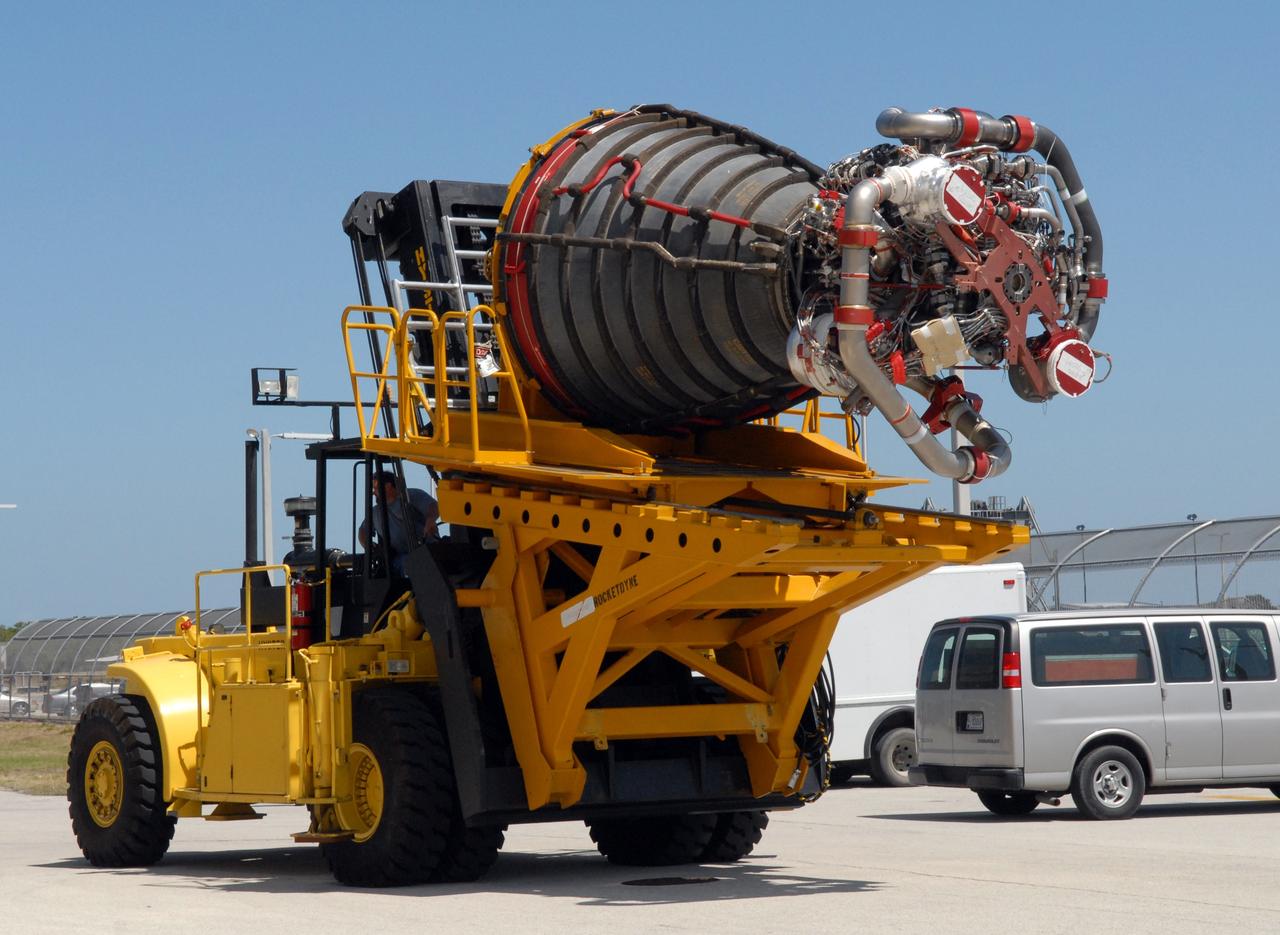
CAPE CANAVERAL, Fla. – After removal from space shuttle Discovery, the third and final main engine, carried by the Hyster forklift, has left Orbiter Processing Facility 3 at NASA's Kennedy Space Center in Florida. Each engine is 14 feet long, weighs about 6,700 pounds, and is 7.5 feet in diameter at the end of the nozzle. Discovery next will be used on the STS-128 mission to deliver supplies and equipment to the International Space Station. The launch is targeted for Aug. 6. Photo credit: NASA/Tim Jacobs
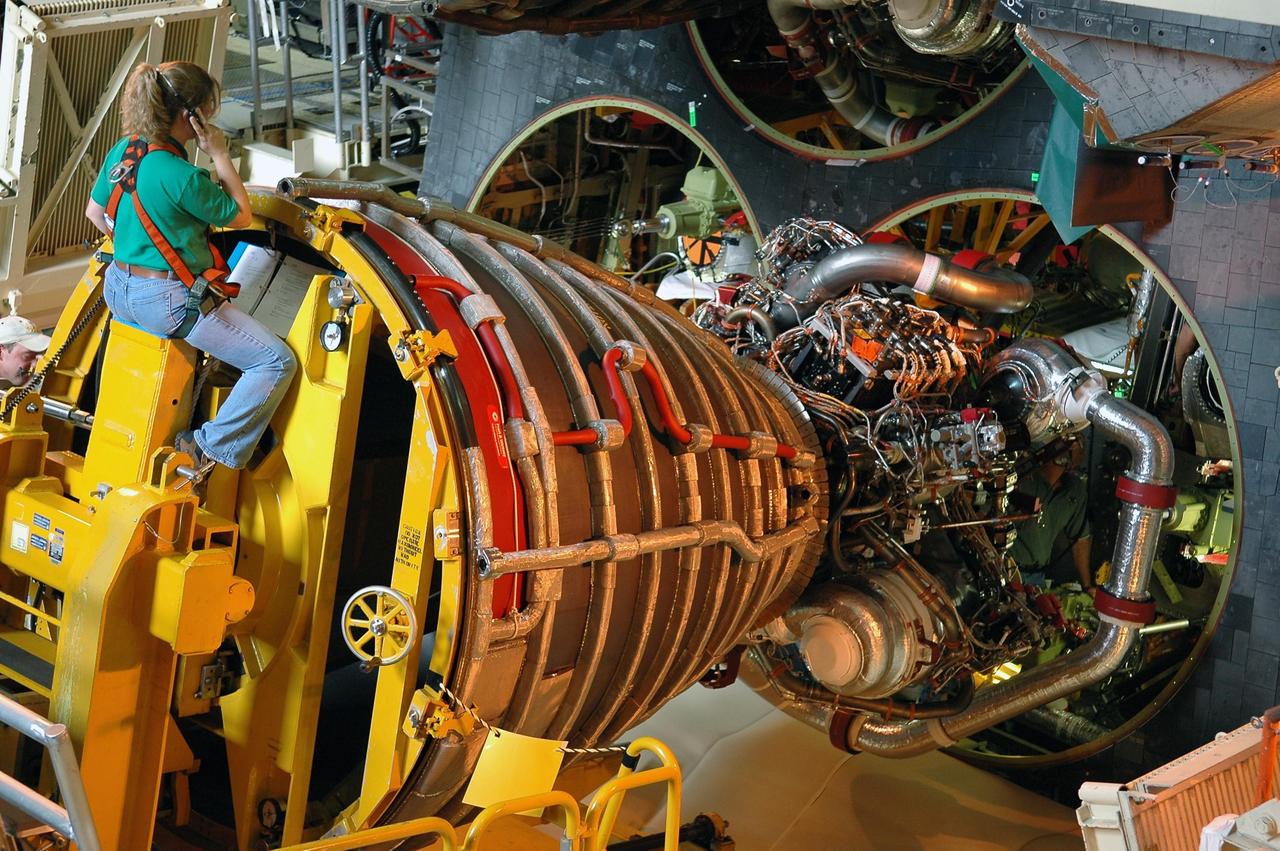
KENNEDY SPACE CENTER, FLA. - In the Orbiter Processing Facility bay 3, technicians on the Hyster forklift maneuver main engine No. 3 into place in Discovery. The main engine configuration is manufactured by Pratt & Whitney Rocketdyne in Canoga Park, Calif., and includes a Pratt & Whitney high-pressure fuel turbo pump. Each space shuttle main engine is 14 feet long, weighs about 6,700 pounds, and is 7.5 feet in diameter at the end of the nozzle. Discovery is being processed for its next mission, STS-116 (12A.1), to deliver a third truss segment, a SPACEHAB module and other key components to the International Space Station. The launch is currently scheduled no earlier than Dec. 14. Photo credit: NASA/Kim Shiflett
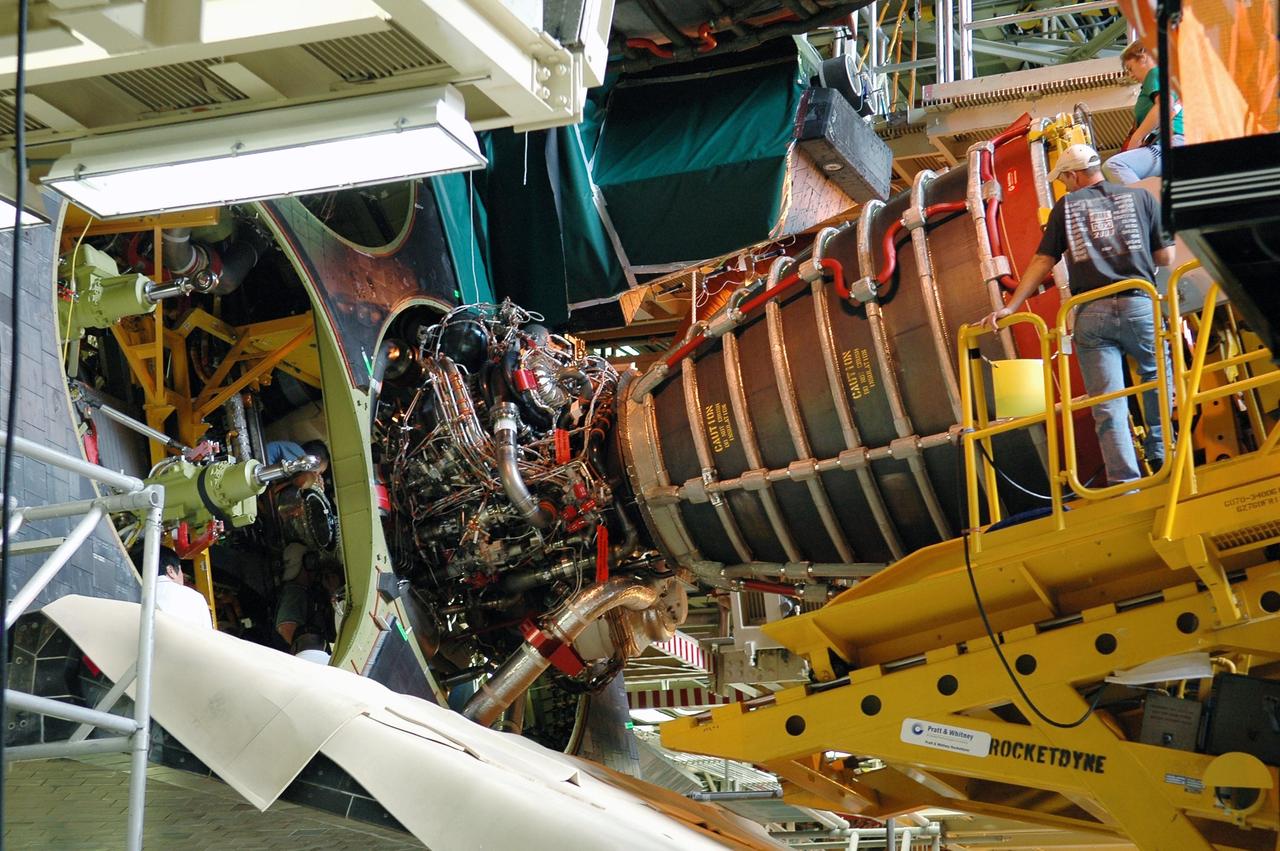
KENNEDY SPACE CENTER, FLA. - In the Orbiter Processing Facility bay 3, technicians on the Hyster forklift maneuver main engine No. 3 into place in Discovery. The main engine configuration is manufactured by Pratt & Whitney Rocketdyne in Canoga Park, Calif., and includes a Pratt & Whitney high-pressure fuel turbo pump. Each space shuttle main engine is 14 feet long, weighs about 6,700 pounds, and is 7.5 feet in diameter at the end of the nozzle. Discovery is being processed for its next mission, STS-116 (12A.1), to deliver a third truss segment, a SPACEHAB module and other key components to the International Space Station. The launch is currently scheduled no earlier than Dec. 14. Photo credit: NASA/Kim Shiflett
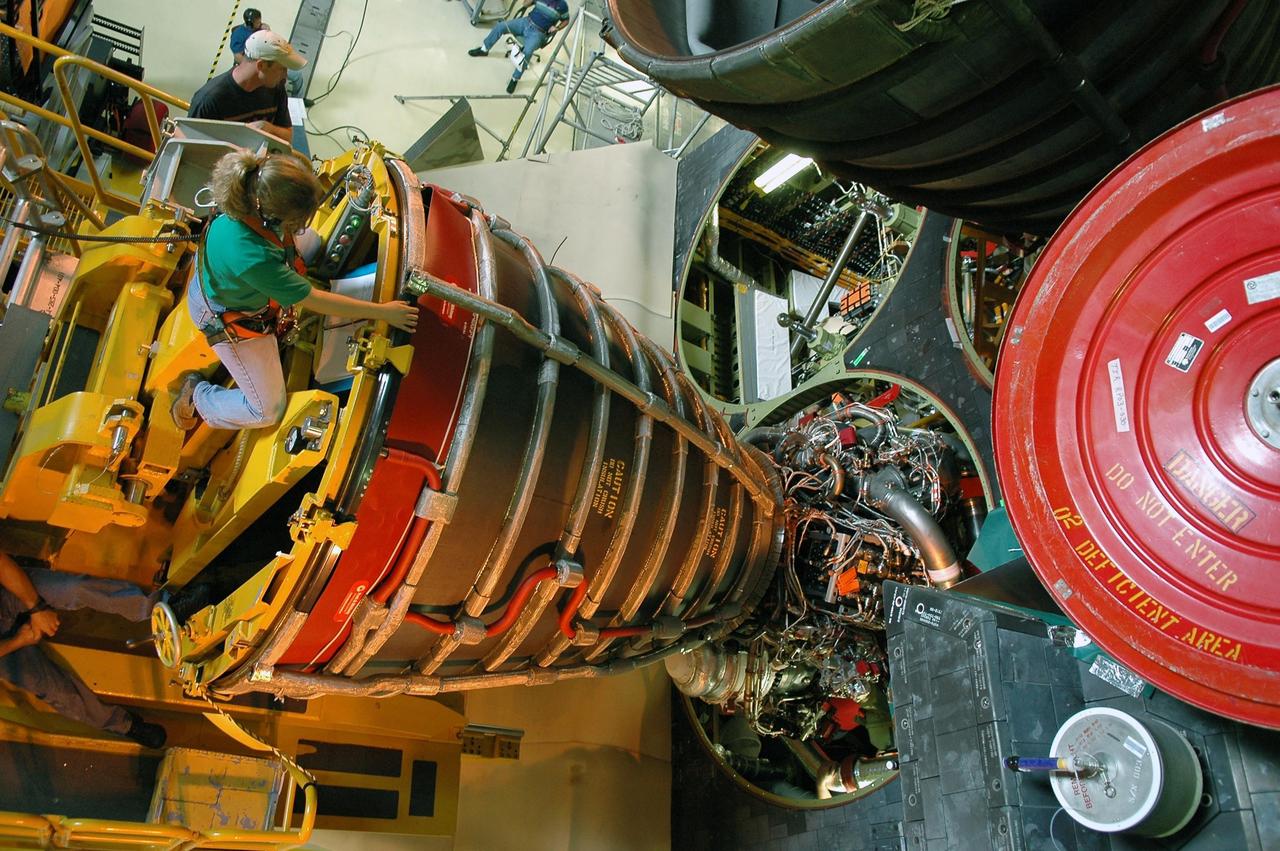
KENNEDY SPACE CENTER, FLA. - In the Orbiter Processing Facility bay 3, technicians on the Hyster forklift maneuver main engine No. 3 into place in Discovery. The main engine configuration is manufactured by Pratt & Whitney Rocketdyne in Canoga Park, Calif., and includes a Pratt & Whitney high-pressure fuel turbo pump. Each space shuttle main engine is 14 feet long, weighs about 6,700 pounds, and is 7.5 feet in diameter at the end of the nozzle. Discovery is being processed for its next mission, STS-116 (12A.1), to deliver a third truss segment, a SPACEHAB module and other key components to the International Space Station. The launch is currently scheduled no earlier than Dec. 14. Photo credit: NASA/Kim Shiflett
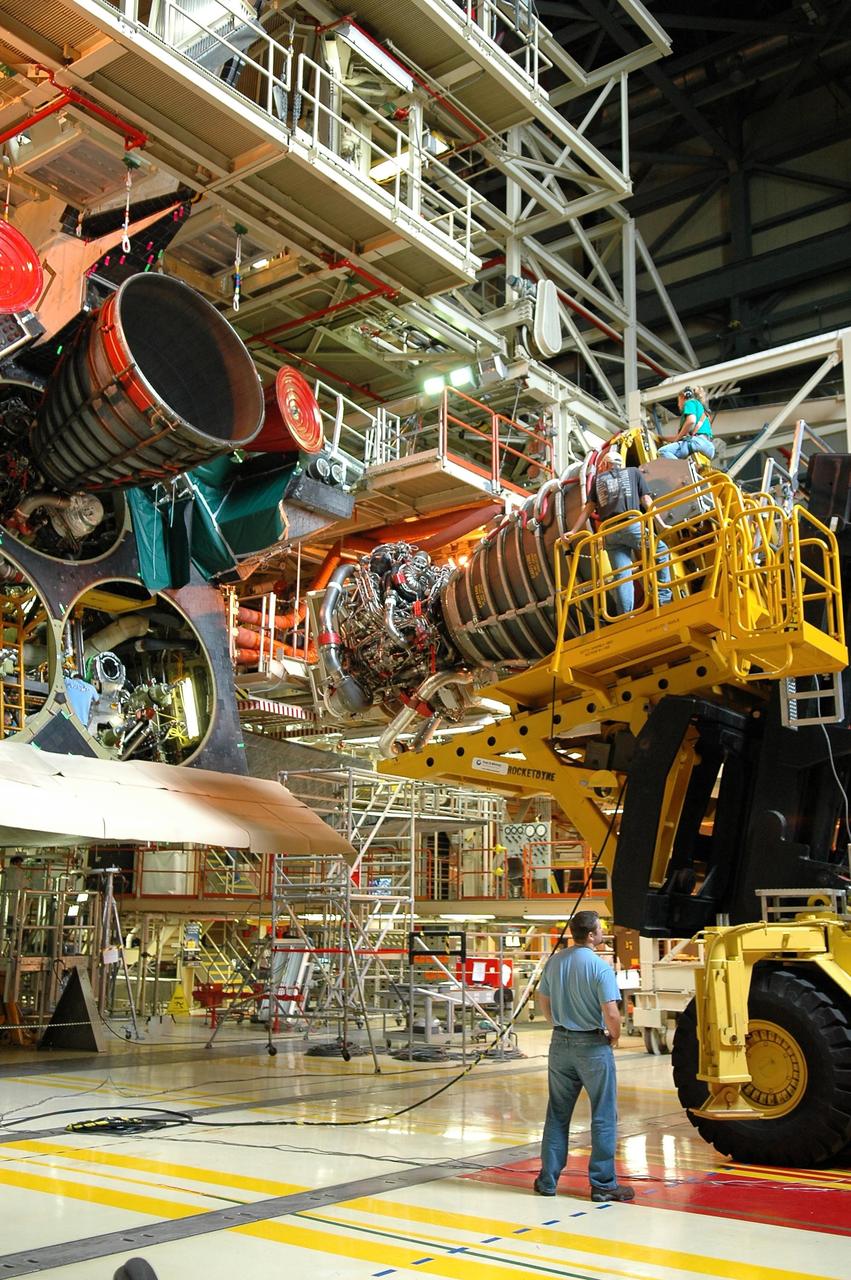
KENNEDY SPACE CENTER, FLA. - In the Orbiter Processing Facility bay 3, technicians on the Hyster forklift are ready to install main engine No. 3 on Discovery. The main engine configuration is manufactured by Pratt & Whitney Rocketdyne in Canoga Park, Calif., and includes a Pratt & Whitney high-pressure fuel turbo pump. Each space shuttle main engine is 14 feet long, weighs about 6,700 pounds, and is 7.5 feet in diameter at the end of the nozzle. Discovery is being processed for its next mission, STS-116 (12A.1), to deliver a third truss segment, a SPACEHAB module and other key components to the International Space Station. The launch is currently scheduled no earlier than Dec. 14. Photo credit: NASA/Kim Shiflett
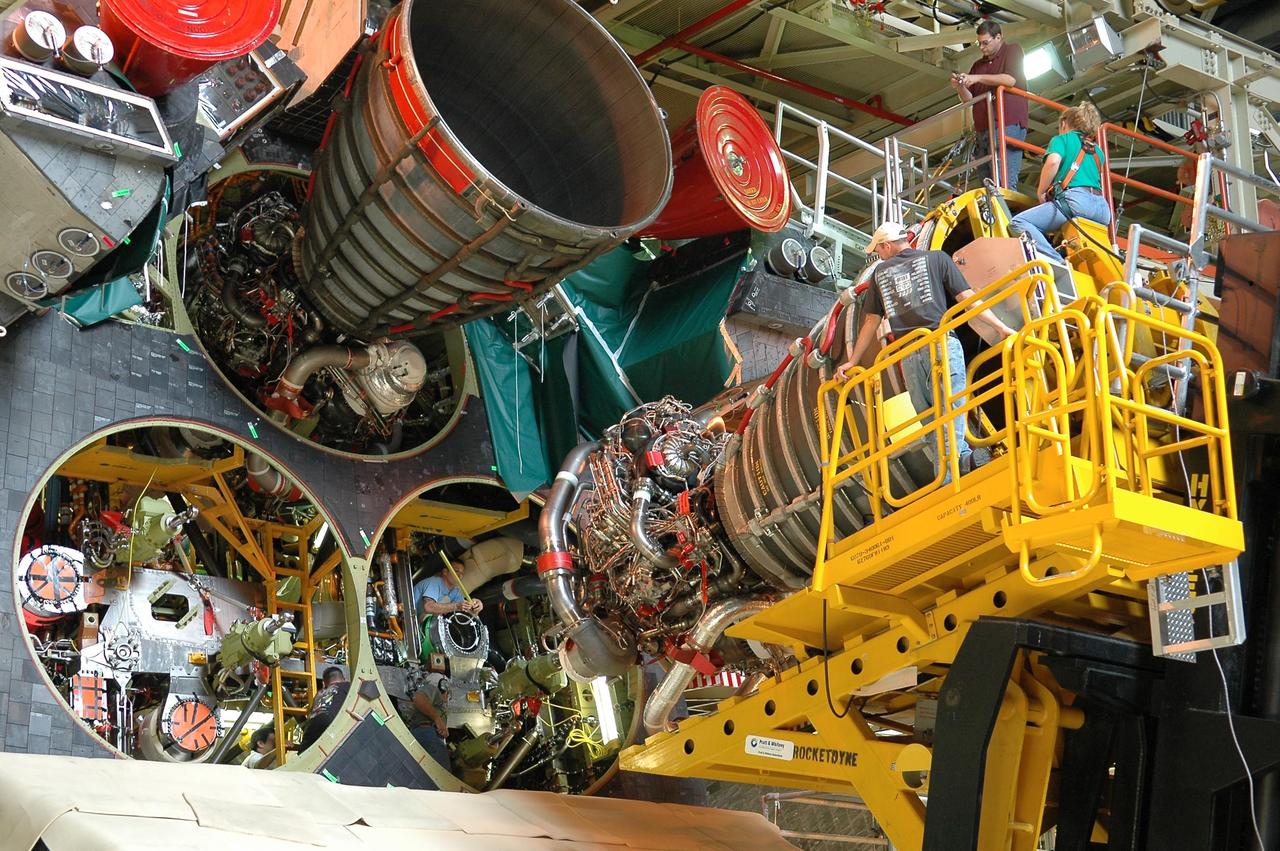
KENNEDY SPACE CENTER, FLA. - In the Orbiter Processing Facility bay 3, technicians on the Hyster forklift maneuver main engine No. 3 into place in Discovery. The main engine configuration is manufactured by Pratt & Whitney Rocketdyne in Canoga Park, Calif., and includes a Pratt & Whitney high-pressure fuel turbo pump. Each space shuttle main engine is 14 feet long, weighs about 6,700 pounds, and is 7.5 feet in diameter at the end of the nozzle. Discovery is being processed for its next mission, STS-116 (12A.1), to deliver a third truss segment, a SPACEHAB module and other key components to the International Space Station. The launch is currently scheduled no earlier than Dec. 14. Photo credit: NASA/Kim Shiflett
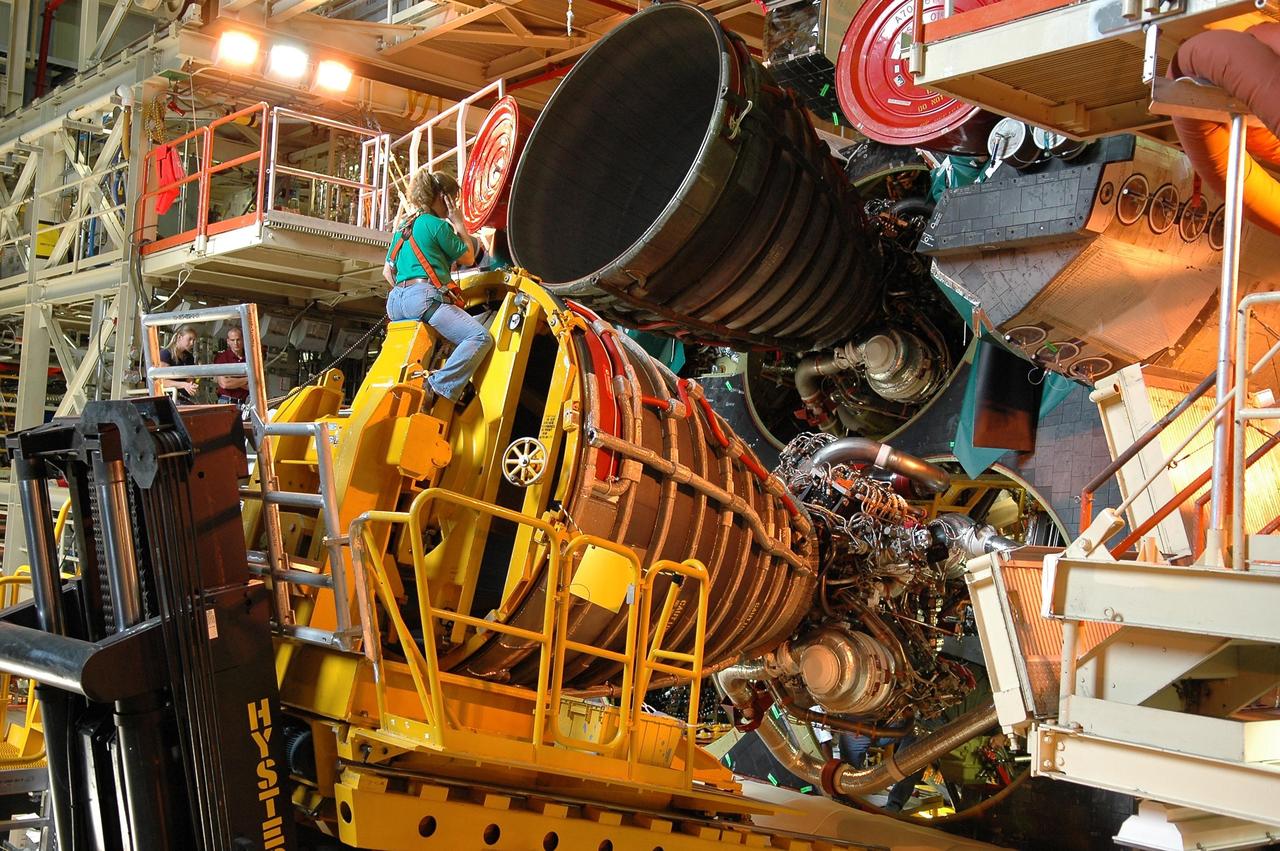
KENNEDY SPACE CENTER, FLA. - In the Orbiter Processing Facility bay 3, technicians on the Hyster forklift maneuver main engine No. 3 into place in Discovery. The main engine configuration is manufactured by Pratt & Whitney Rocketdyne in Canoga Park, Calif., and includes a Pratt & Whitney high-pressure fuel turbo pump. Each space shuttle main engine is 14 feet long, weighs about 6,700 pounds, and is 7.5 feet in diameter at the end of the nozzle. Discovery is being processed for its next mission, STS-116 (12A.1), to deliver a third truss segment, a SPACEHAB module and other key components to the International Space Station. The launch is currently scheduled no earlier than Dec. 14. Photo credit: NASA/Kim Shiflett

CAPE CANAVERAL, Fla. -- A Hyster forklift transporting engine #2, the last of shuttle Atlantis' three main engines from the Space Shuttle Main Engine (SSME) Shop, enters Orbiter Processing Facility-1 at NASA's Kennedy Space Center in Florida. Inside the processing facility, the engine will be installed in the shuttle. Each engine is 14 feet long, weighs about 6,700 pounds, and is 7.5 feet in diameter at the end of the nozzle. This is the final planned engine installation for the Space Shuttle Program. Atlantis is being prepared for the "launch on need," or potential rescue mission, for the final planned shuttle flight, Endeavour's STS-134 mission. For more information, visit www.nasa.gov/shuttle. Photo credit: NASA/Kim Shiflett
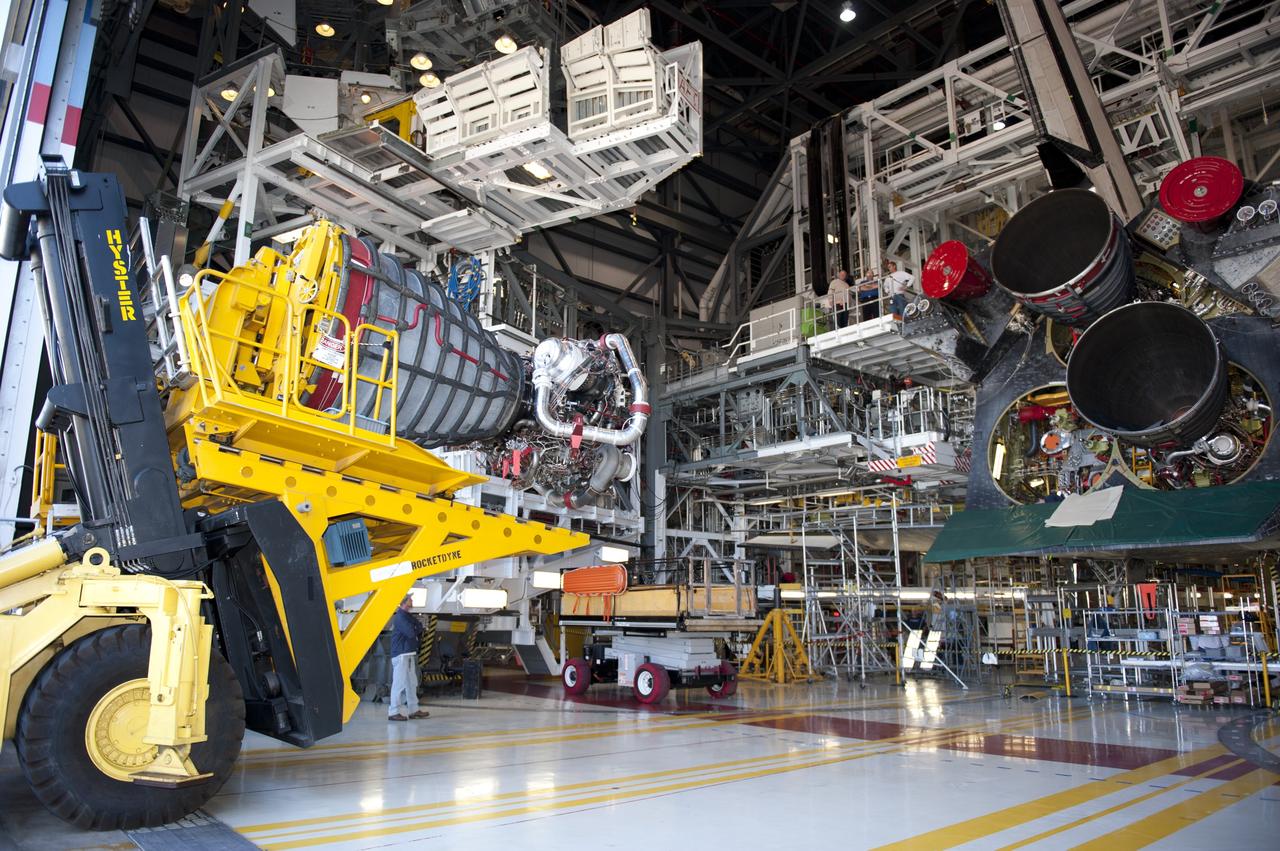
CAPE CANAVERAL, Fla. -- A Hyster forklift transporting engine #2, the last of shuttle Atlantis' three main engines from the Space Shuttle Main Engine (SSME) Shop, enters Orbiter Processing Facility-1 at NASA's Kennedy Space Center in Florida. Inside the processing facility, the engine will be installed in the shuttle. Each engine is 14 feet long, weighs about 6,700 pounds, and is 7.5 feet in diameter at the end of the nozzle. This is the final planned engine installation for the Space Shuttle Program. Atlantis is being prepared for the "launch on need," or potential rescue mission, for the final planned shuttle flight, Endeavour's STS-134 mission. For more information, visit www.nasa.gov/shuttle. Photo credit: NASA/Kim Shiflett
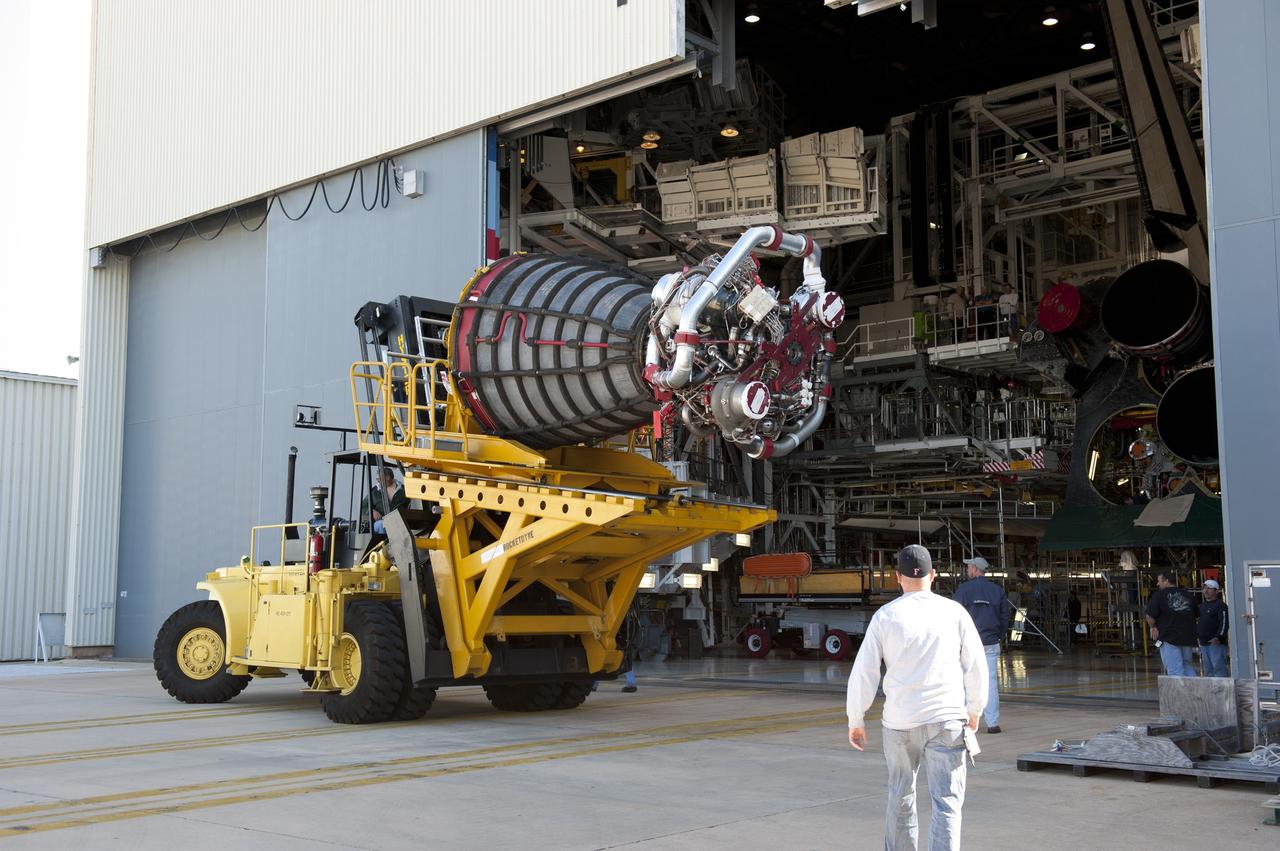
CAPE CANAVERAL, Fla. -- A Hyster forklift transporting engine #2, the last of shuttle Atlantis' three main engines from the Space Shuttle Main Engine (SSME) Shop, arrives at Orbiter Processing Facility-1 at NASA's Kennedy Space Center in Florida. Inside the processing facility, the engine will be installed in the shuttle. Each engine is 14 feet long, weighs about 6,700 pounds, and is 7.5 feet in diameter at the end of the nozzle. This is the final planned engine installation for the Space Shuttle Program. Atlantis is being prepared for the "launch on need," or potential rescue mission, for the final planned shuttle flight, Endeavour's STS-134 mission. For more information, visit www.nasa.gov/shuttle. Photo credit: NASA/Kim Shiflett
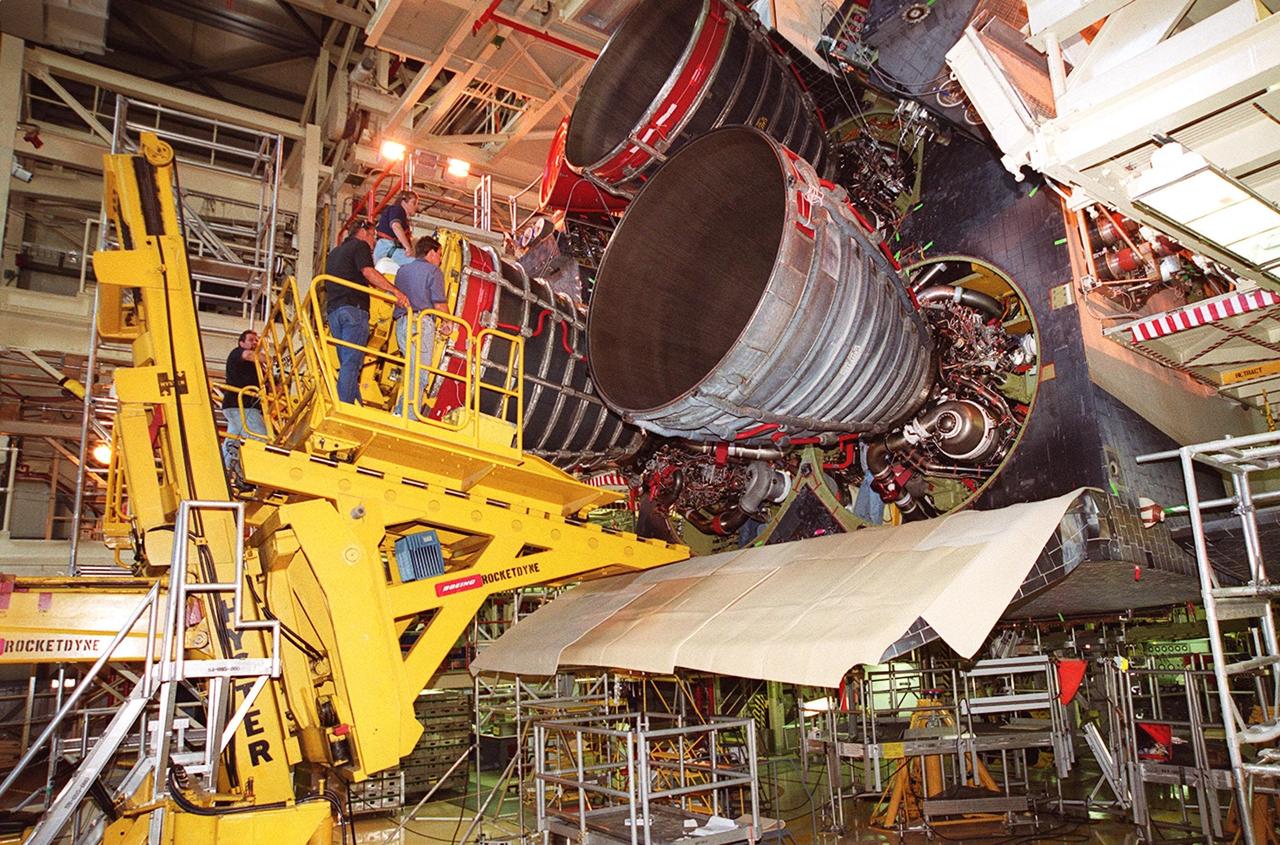
KENNEDY SPACE CENTER, FLA. -- The new block 2 engine for the orbiter Atlantis is moved into place next to the other two engines. The work is being done in the Orbiter Processing Facility bay 3. The engine will have its first flight on mission STS-104, scheduled for launch June 14. The Block II Main Engine configuration is manufactured by Boeing Rocketdyne in Canoga Park, Calif., and includes a new Pratt & Whitney high-pressure fuel turbo pump. Engine improvements are managed by NASA’s Marshall Space Flight Center in Huntsville, Ala. Each Space Shuttle Main Engine is 14 feet (4.3 meters) long, weighs about 7,000 pounds (3,175 kilograms), and is 7.5 feet (2.3 meters) in diameter at the end of the nozzle

KENNEDY SPACE CENTER, FLA. -- The new block 2 engine for the orbiter Atlantis is moved into place next to the other two engines. The work is being done in the Orbiter Processing Facility bay 3. The engine will have its first flight on mission STS-104, scheduled for launch June 14. The Block II Main Engine configuration is manufactured by Boeing Rocketdyne in Canoga Park, Calif., and includes a new Pratt and Whitney high-pressure fuel turbo pump. Engine improvements are managed by NASA’s Marshall Space Flight Center in Huntsville, Ala. Each Space Shuttle Main Engine is 14 feet (4.3 meters) long, weighs about 7,000 pounds (3,175 kilograms), and is 7.5 feet (2.3 meters) in diameter at the end of the nozzle

KENNEDY SPACE CENTER, FLA. -- A new block 2 engine, situated on a giant forklift, is moved toward the aft of Atlantis where it will be installed. The work is being done in the Orbiter Processing Facility bay 3. The engine will have its first flight on mission STS-104, scheduled for launch June 14. The Block II Main Engine configuration is manufactured by Boeing Rocketdyne in Canoga Park, Calif., and includes a new Pratt & Whitney high-pressure fuel turbo pump. Engine improvements are managed by NASA’s Marshall Space Flight Center in Huntsville, Ala. Each Space Shuttle Main Engine is 14 feet (4.3 meters) long, weighs about 7,000 pounds (3,175 kilograms), and is 7.5 feet (2.3 meters) in diameter at the end of the nozzle
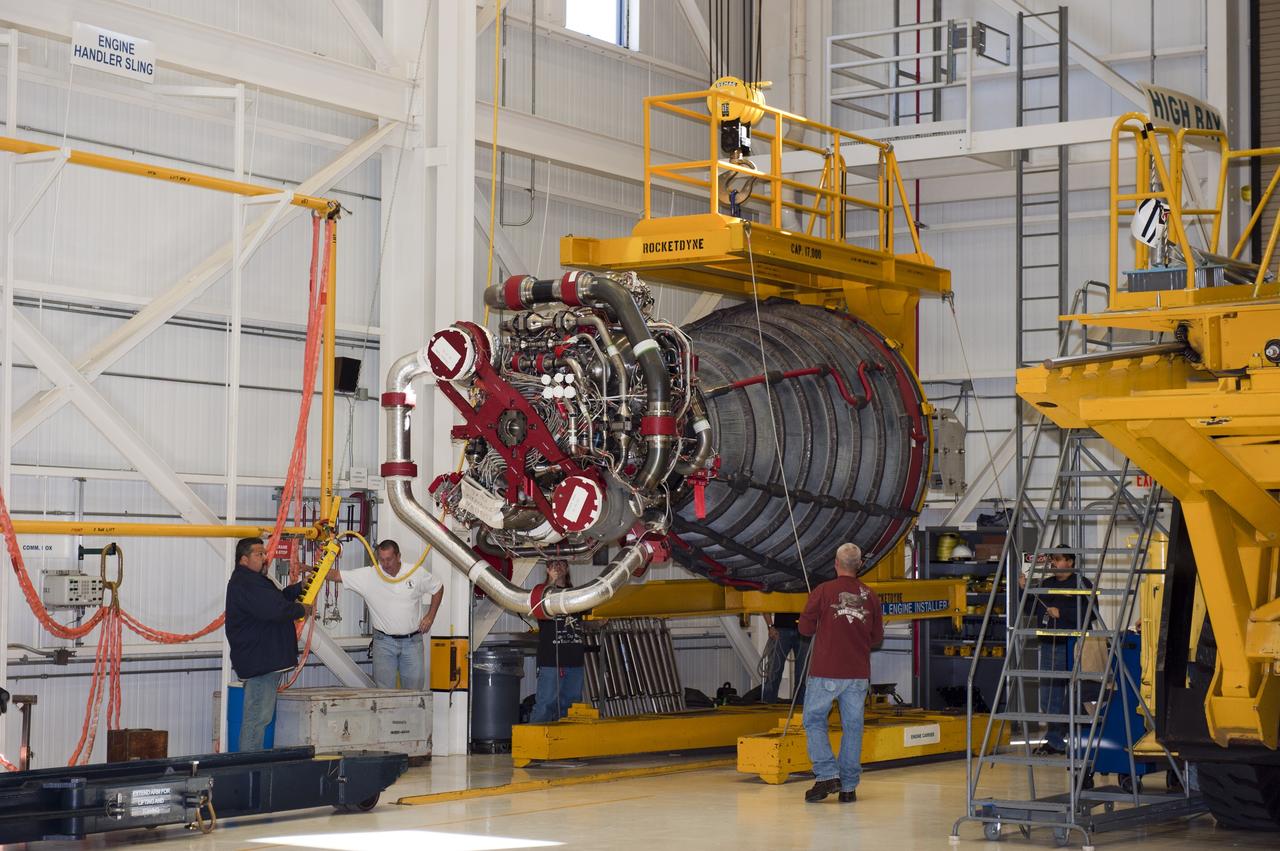
CAPE CANAVERAL, Fla. -- Workers in the Space Shuttle Main Engine (SSME) Shop at NASA's Kennedy Space Center in Florida get ready to raise the second of shuttle Atlantis' three main engines so it can be attached to a Hyster forklift. Then, the engine will be transported to Orbiter Processing Facility-1 where it will be installed in the shuttle. Each engine is 14 feet long, weighs about 6,700 pounds, and is 7.5 feet in diameter at the end of the nozzle. This is the final planned engine installation for the Space Shuttle Program. Atlantis is being prepared for the "launch on need," or potential rescue mission, for the final planned shuttle flight, Endeavour's STS-134 mission. For more information, visit www.nasa.gov/shuttle. Photo credit: NASA/Kim Shiflett

KENNEDY SPACE CENTER, FLA. -- As the giant forklift moves closer to Atlantis, workers keep watch as the new block 2 engine nears its installation point. The work is being done in the Orbiter Processing Facility bay 3. The engine will have its first flight on mission STS-104, scheduled for launch June 14. The Block II Main Engine configuration is manufactured by Boeing Rocketdyne in Canoga Park, Calif., and includes a new Pratt & Whitney high-pressure fuel turbo pump. Engine improvements are managed by NASA’s Marshall Space Flight Center in Huntsville, Ala. Each Space Shuttle Main Engine is 14 feet (4.3 meters) long, weighs about 7,000 pounds (3,175 kilograms), and is 7.5 feet (2.3 meters) in diameter at the end of the nozzle
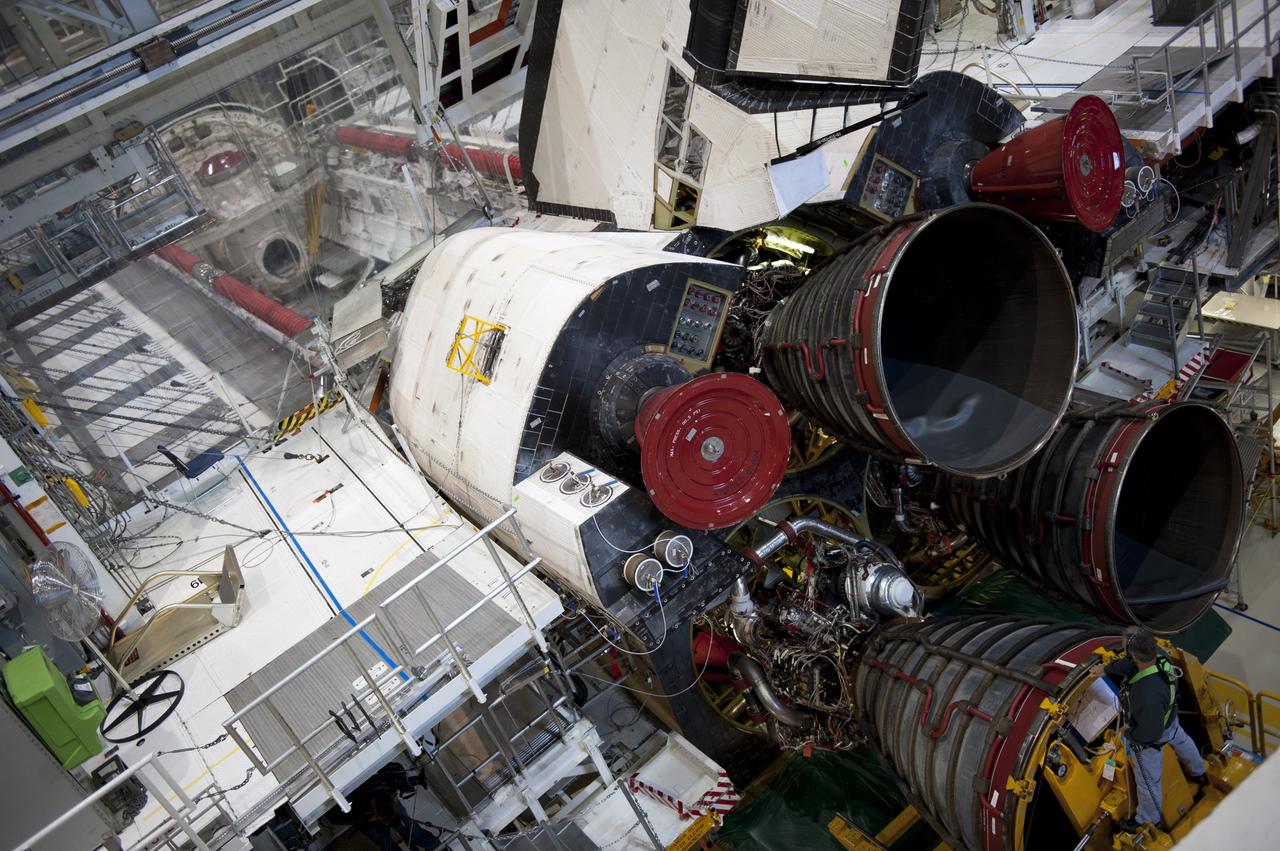
CAPE CANAVERAL, Fla. -- In Orbiter Processing Facility-1 at NASA's Kennedy Space Center in Florida, engine #2, the last of three space shuttle main engines is installed in shuttle Atlantis. Each engine is 14 feet long, weighs about 6,700 pounds, and is 7.5 feet in diameter at the end of the nozzle. This is the final planned engine installation for the Space Shuttle Program. Atlantis is being prepared for the "launch on need," or potential rescue mission, for the final planned shuttle flight, Endeavour's STS-134 mission. For more information, visit www.nasa.gov/shuttle. Photo credit: NASA/Kim Shiflett
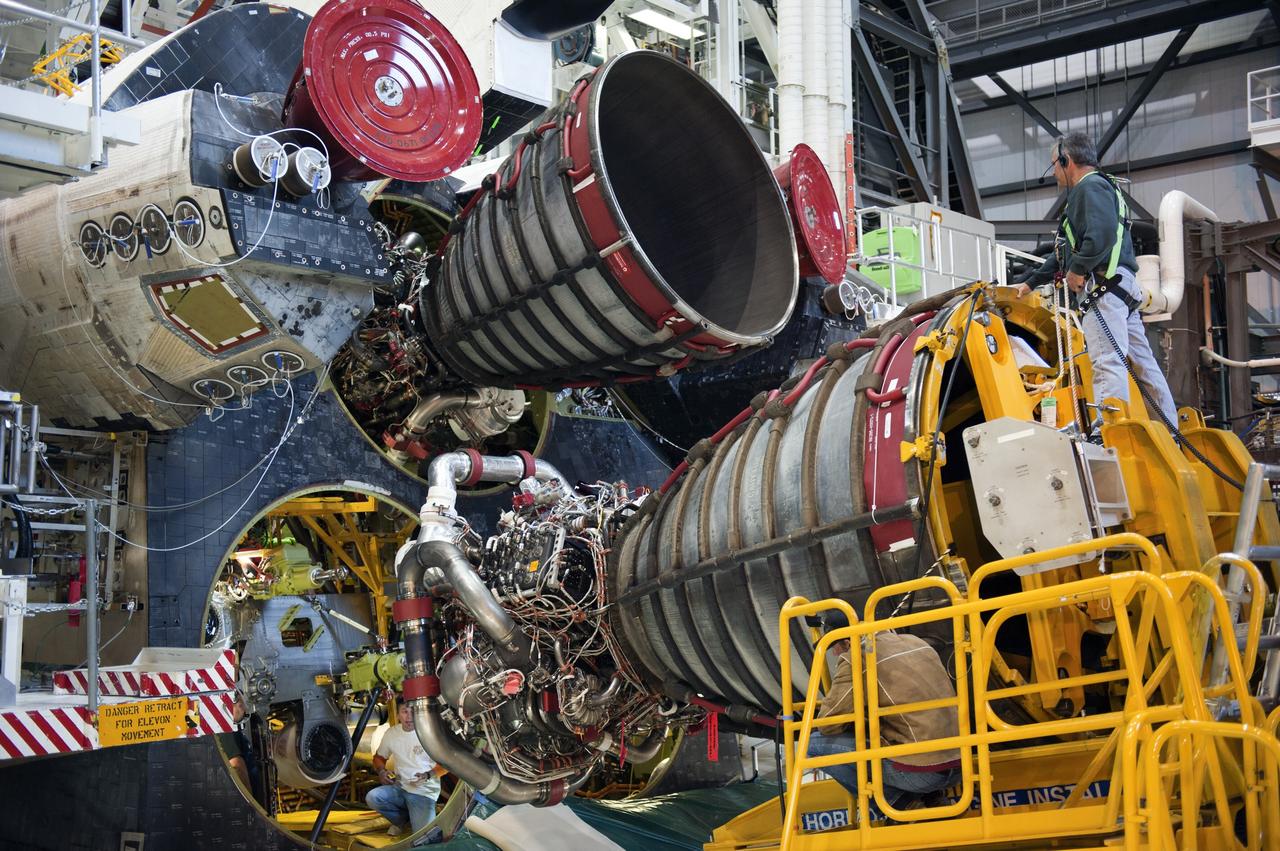
CAPE CANAVERAL, Fla. -- In Orbiter Processing Facility-1 at NASA's Kennedy Space Center in Florida, a Hyster forklift moves engine #2, the last of three space shuttle main engines, into position for installation on shuttle Atlantis. Each engine is 14 feet long, weighs about 6,700 pounds, and is 7.5 feet in diameter at the end of the nozzle. This is the final planned engine installation for the Space Shuttle Program. Atlantis is being prepared for the "launch on need," or potential rescue mission, for the final planned shuttle flight, Endeavour's STS-134 mission. For more information, visit www.nasa.gov/shuttle. Photo credit: NASA/Kim Shiflett
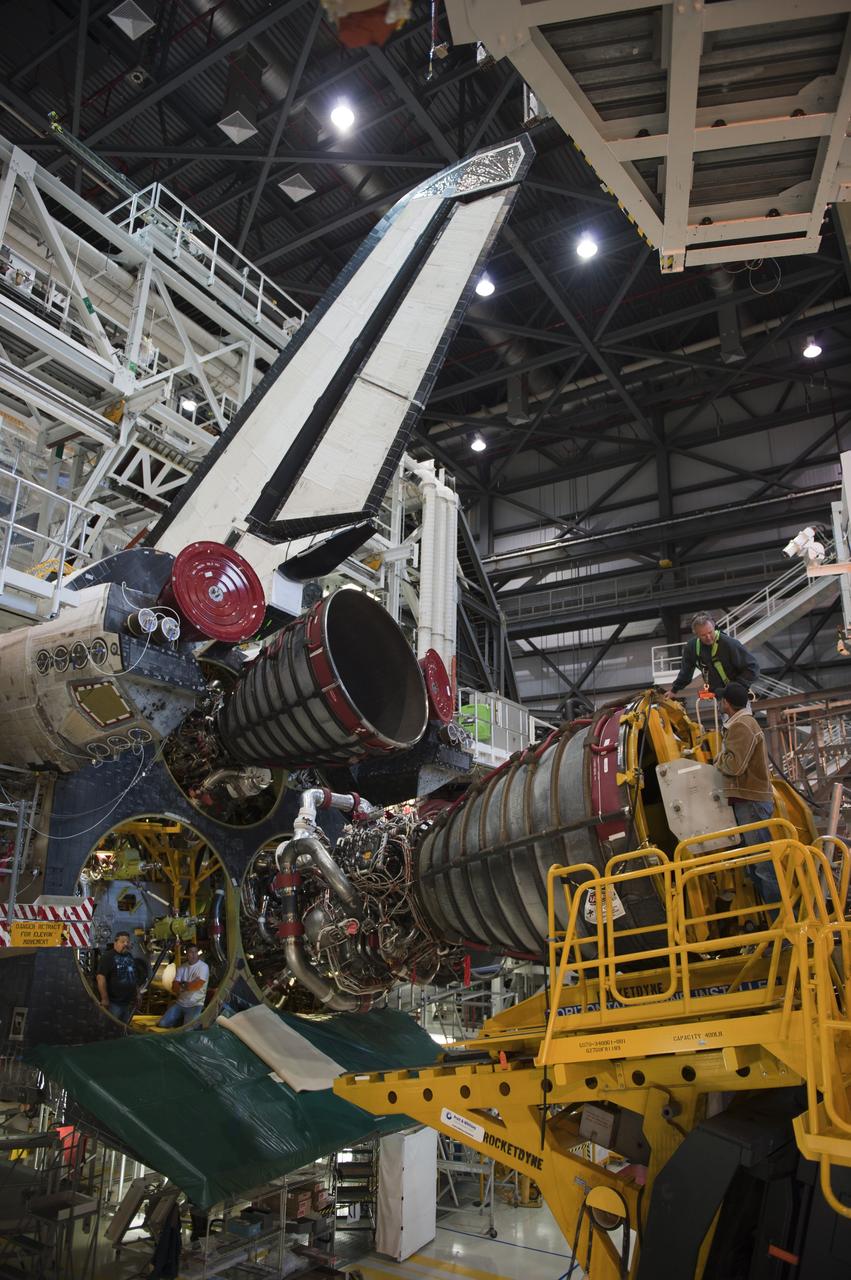
CAPE CANAVERAL, Fla. -- In Orbiter Processing Facility-1 at NASA's Kennedy Space Center in Florida, a Hyster forklift moves engine #2, the last of three space shuttle main engines, into position for installation on shuttle Atlantis. Each engine is 14 feet long, weighs about 6,700 pounds, and is 7.5 feet in diameter at the end of the nozzle. This is the final planned engine installation for the Space Shuttle Program. Atlantis is being prepared for the "launch on need," or potential rescue mission, for the final planned shuttle flight, Endeavour's STS-134 mission. For more information, visit www.nasa.gov/shuttle. Photo credit: NASA/Kim Shiflett
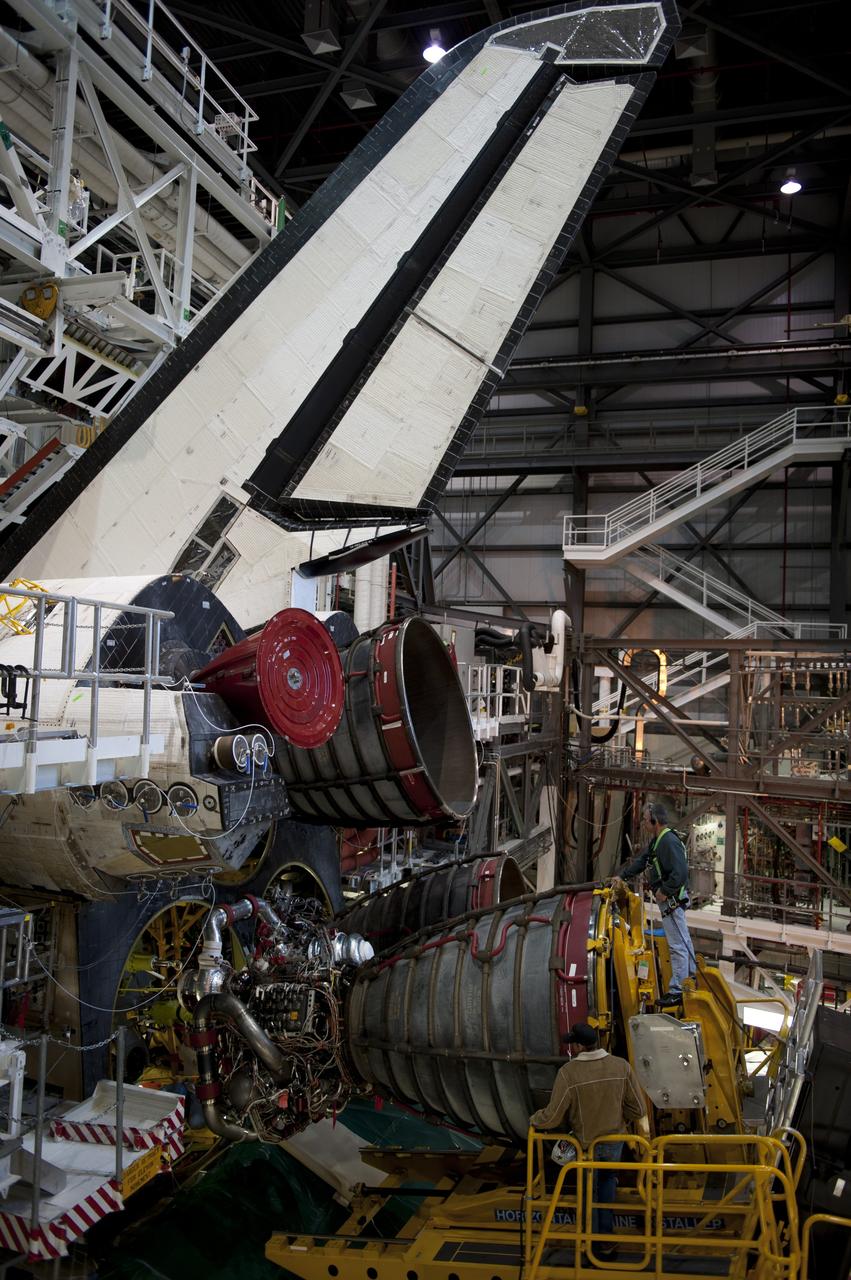
CAPE CANAVERAL, Fla. -- In Orbiter Processing Facility-1 at NASA's Kennedy Space Center in Florida, a Hyster forklift moves engine #2, the last of three space shuttle main engines, into position for installation on shuttle Atlantis. Each engine is 14 feet long, weighs about 6,700 pounds, and is 7.5 feet in diameter at the end of the nozzle. This is the final planned engine installation for the Space Shuttle Program. Atlantis is being prepared for the "launch on need," or potential rescue mission, for the final planned shuttle flight, Endeavour's STS-134 mission. For more information, visit www.nasa.gov/shuttle. Photo credit: NASA/Kim Shiflett
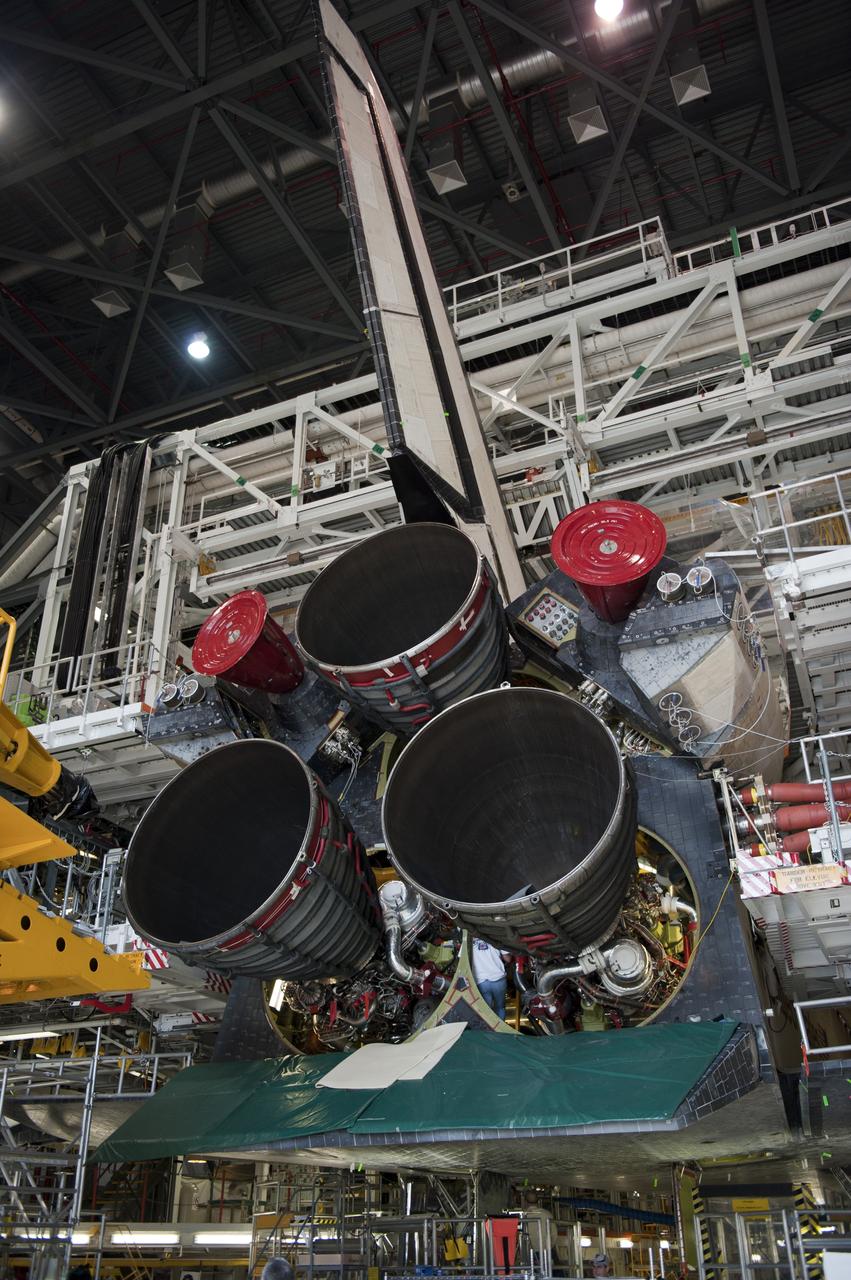
CAPE CANAVERAL, Fla. -- In Orbiter Processing Facility-1 at NASA's Kennedy Space Center in Florida, engine #2, the last of three space shuttle main engines is installed in shuttle Atlantis. Each engine is 14 feet long, weighs about 6,700 pounds, and is 7.5 feet in diameter at the end of the nozzle. This is the final planned engine installation for the Space Shuttle Program. Atlantis is being prepared for the "launch on need," or potential rescue mission, for the final planned shuttle flight, Endeavour's STS-134 mission. For more information, visit www.nasa.gov/shuttle. Photo credit: NASA/Kim Shiflett