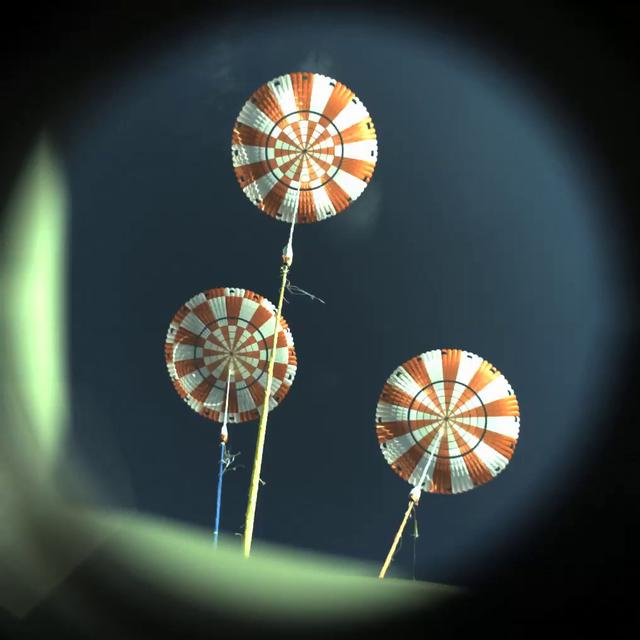
The main parachutes deploy on Orion's first flight test, Exploration Flight Test-1 (EFT-1), on December 5, 2014.
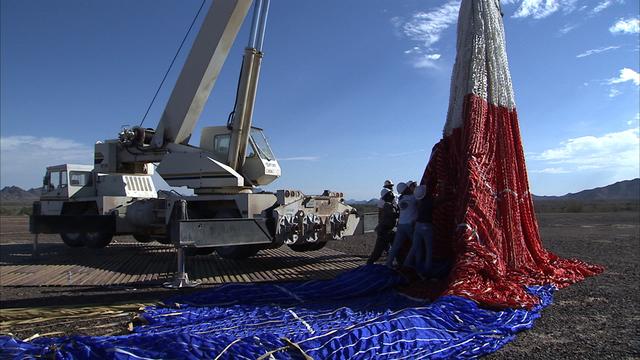
Shown is the testing of the Main Parachute for the Ares/CLV first stage in support of the Ares/Constellation program at the Yuma Proving Ground, Arizona. This image is extracted from high definition video and is the highest resolution available.
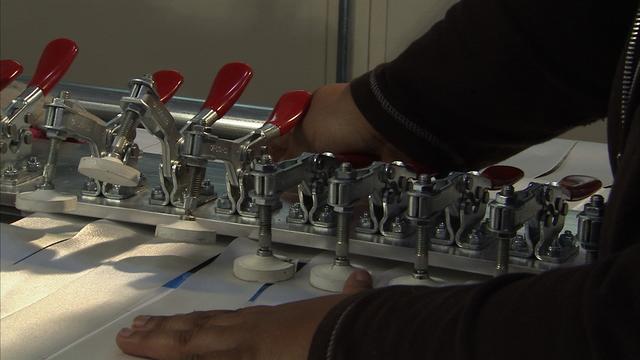
Shown is the fabrication of the First Stage Main Parachute in support of Ares/CLV at the Pioneer Zodiac Facility in Mississippi in support of the Constellation/Ares project. This image is extracted from a high definition video file and is the highest resolution available
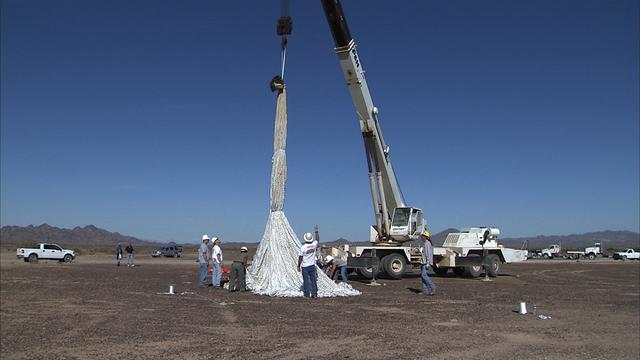
Shown is the testing of the Main Parachute for the Ares/CLV first stage in support of the Ares/Constellation program at the Yuma Proving Ground, Arizona. This image is extracted from high definition video and is the highest resolution available.
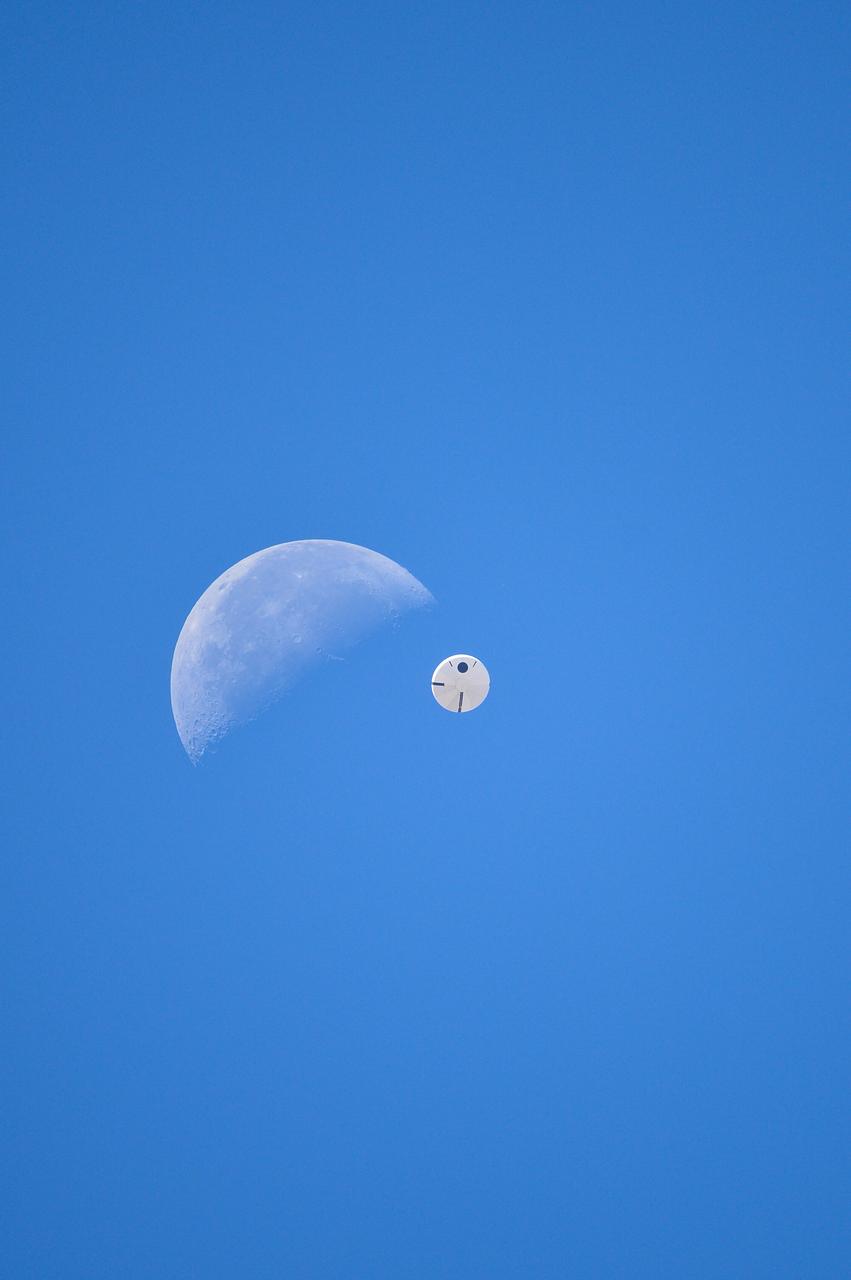
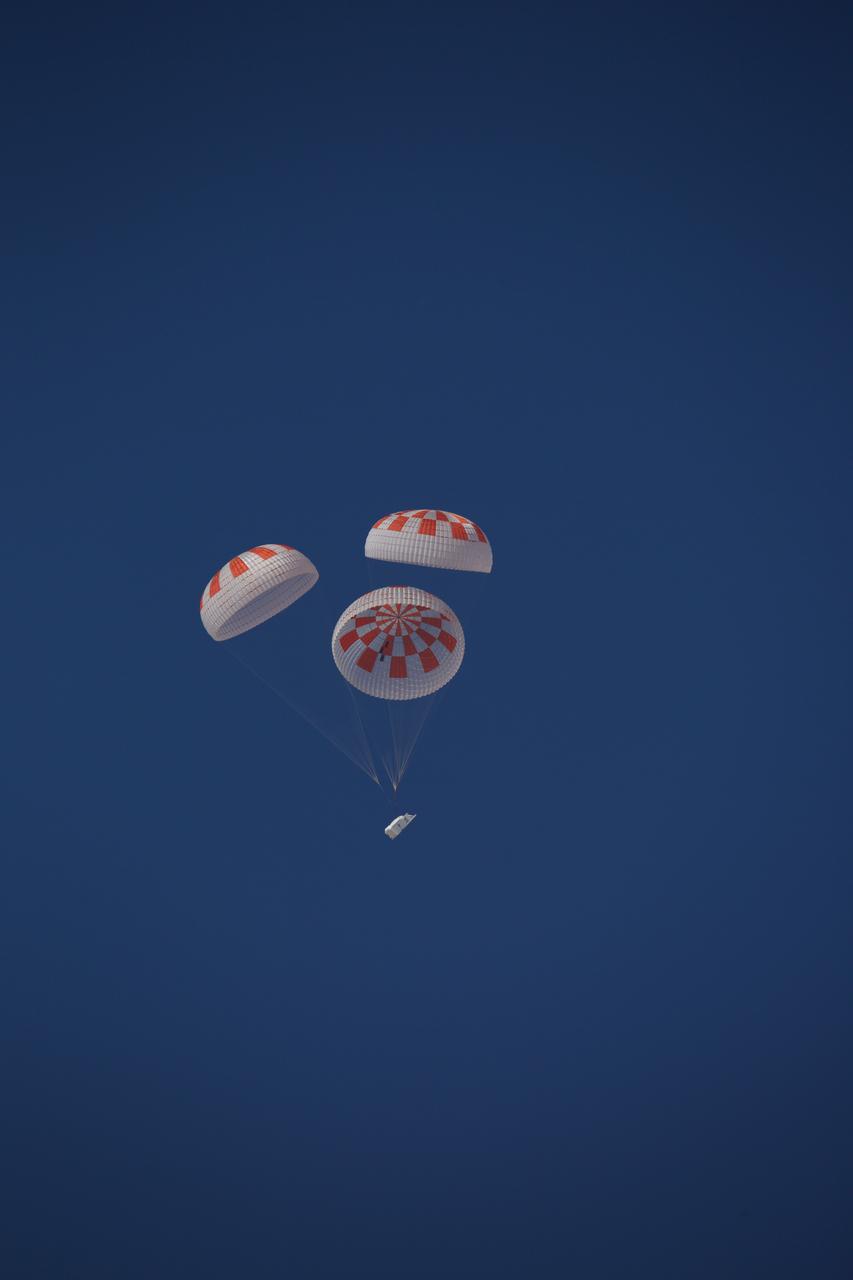
Orion’s three main orange and white parachutes help a representative model of the spacecraft descend through sky above Arizona, where NASA engineers tested the parachute system on Sept. 13, 2017 at the U.S. Army Proving Ground in Yuma. NASA is qualifying Orion’s parachutes for missions with astronauts.. .During this test, engineers replicated a situation in which Orion must abort off the Space Launch System rocket and bypasses part of its normal parachute deployment sequence that typically helps the spacecraft slow down during its descent to Earth after deep space missions. The capsule was dropped out of a C-17 aircraft at more than 4.7 miles in altitude and allowed to free fall for 20 seconds, longer than ever before, to produce high aerodynamic pressure before only its pilot and main parachutes were deployed, testing whether they could perform as expected under extreme loads. Orion’s full parachute system includes 11 total parachutes -- three forward bay cover parachutes and two drogue parachutes, along with three pilot parachutes that help pull out the spacecraft’s three mains.
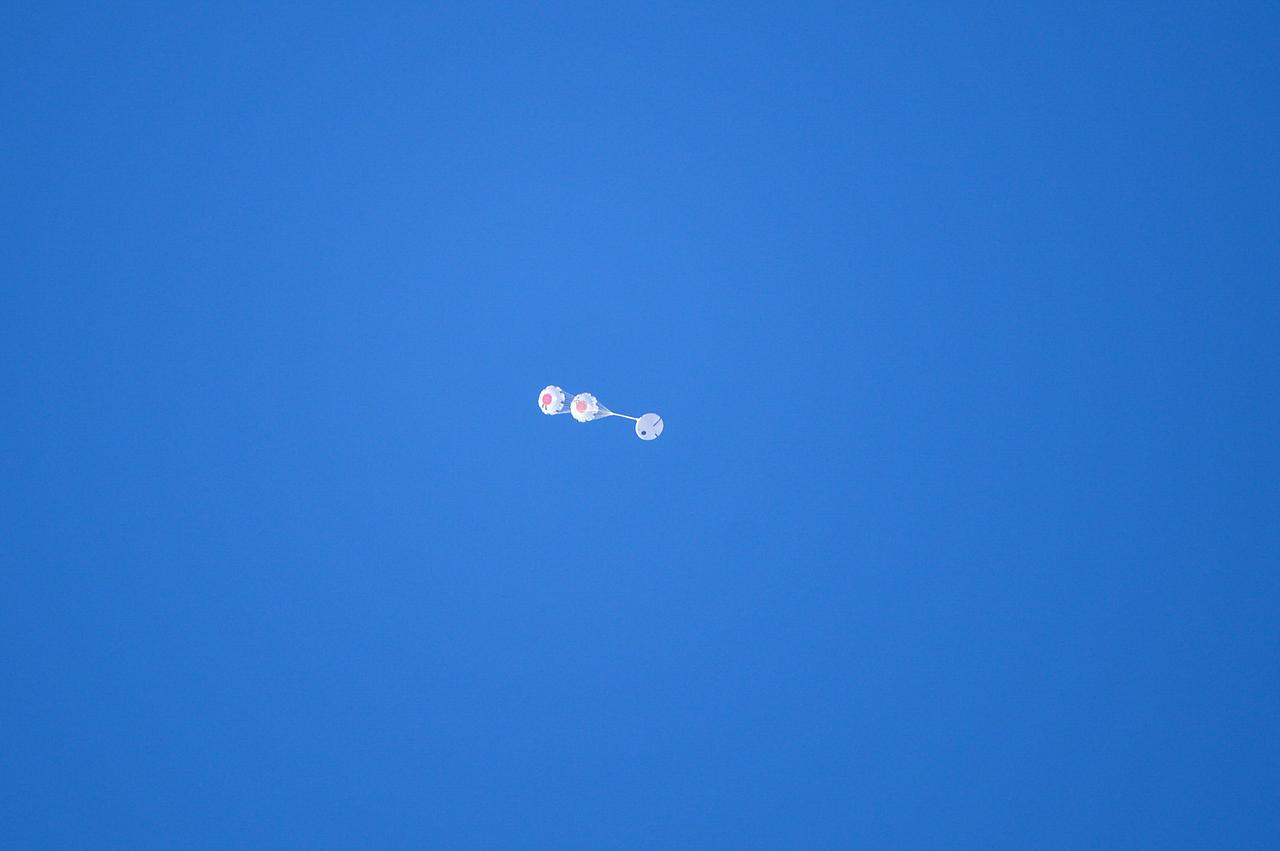
Orion’s three main orange and white parachutes help a representative model of the spacecraft descend through sky above Arizona, where NASA engineers tested the parachute system on Sept. 13, 2017 at the U.S. Army Proving Ground in Yuma. NASA is qualifying Orion’s parachutes for missions with astronauts.. .During this test, engineers replicated a situation in which Orion must abort off the Space Launch System rocket and bypasses part of its normal parachute deployment sequence that typically helps the spacecraft slow down during its descent to Earth after deep space missions. The capsule was dropped out of a C-17 aircraft at more than 4.7 miles in altitude and allowed to free fall for 20 seconds, longer than ever before, to produce high aerodynamic pressure before only its pilot and main parachutes were deployed, testing whether they could perform as expected under extreme loads. Orion’s full parachute system includes 11 total parachutes -- three forward bay cover parachutes and two drogue parachutes, along with three pilot parachutes that help pull out the spacecraft’s three mains.

Orion’s three main orange and white parachutes help a representative model of the spacecraft descend through sky above Arizona, where NASA engineers tested the parachute system on Sept. 13, 2017 at the U.S. Army Proving Ground in Yuma. NASA is qualifying Orion’s parachutes for missions with astronauts.. .During this test, engineers replicated a situation in which Orion must abort off the Space Launch System rocket and bypasses part of its normal parachute deployment sequence that typically helps the spacecraft slow down during its descent to Earth after deep space missions. The capsule was dropped out of a C-17 aircraft at more than 4.7 miles in altitude and allowed to free fall for 20 seconds, longer than ever before, to produce high aerodynamic pressure before only its pilot and main parachutes were deployed, testing whether they could perform as expected under extreme loads. Orion’s full parachute system includes 11 total parachutes -- three forward bay cover parachutes and two drogue parachutes, along with three pilot parachutes that help pull out the spacecraft’s three mains.
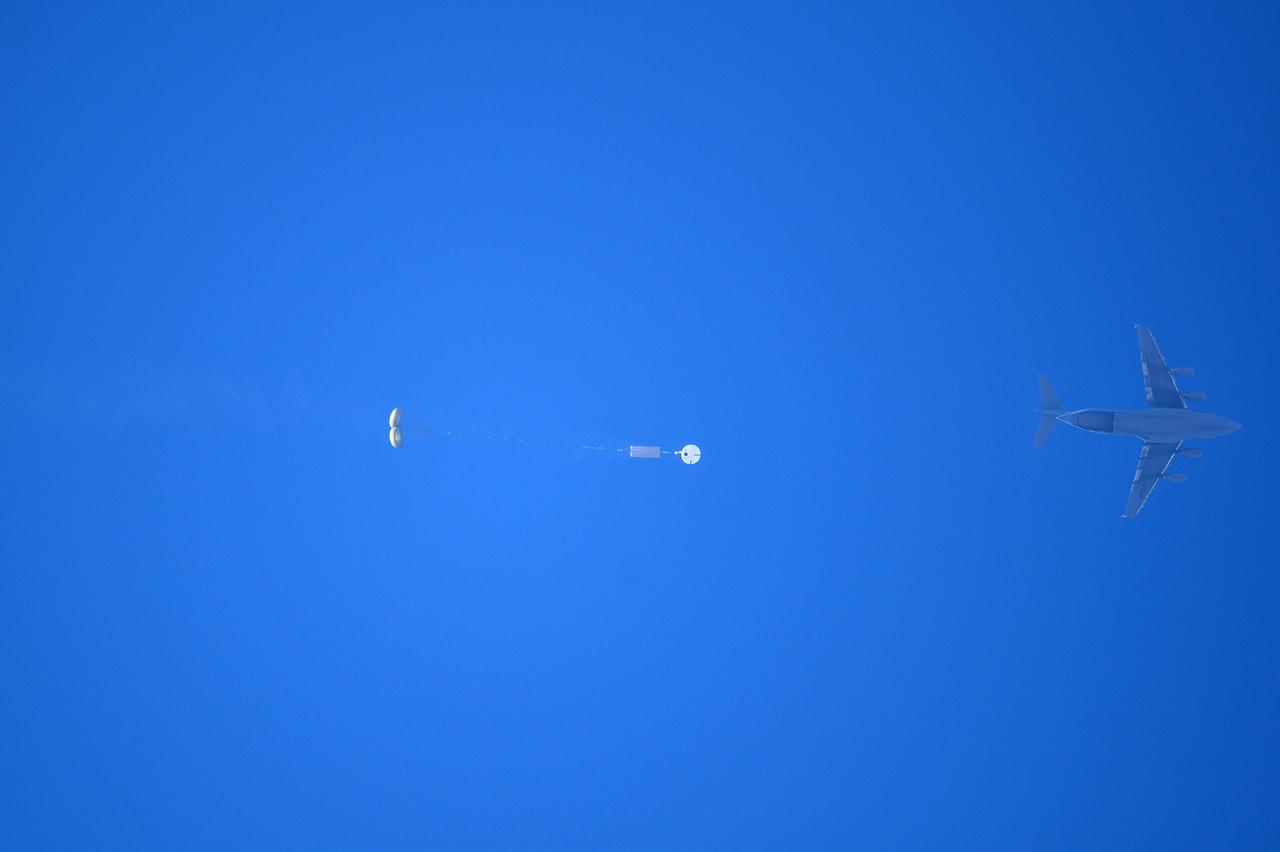
Orion’s three main orange and white parachutes help a representative model of the spacecraft descend through sky above Arizona, where NASA engineers tested the parachute system on Sept. 13, 2017 at the U.S. Army Proving Ground in Yuma. NASA is qualifying Orion’s parachutes for missions with astronauts.. .During this test, engineers replicated a situation in which Orion must abort off the Space Launch System rocket and bypasses part of its normal parachute deployment sequence that typically helps the spacecraft slow down during its descent to Earth after deep space missions. The capsule was dropped out of a C-17 aircraft at more than 4.7 miles in altitude and allowed to free fall for 20 seconds, longer than ever before, to produce high aerodynamic pressure before only its pilot and main parachutes were deployed, testing whether they could perform as expected under extreme loads. Orion’s full parachute system includes 11 total parachutes -- three forward bay cover parachutes and two drogue parachutes, along with three pilot parachutes that help pull out the spacecraft’s three mains.
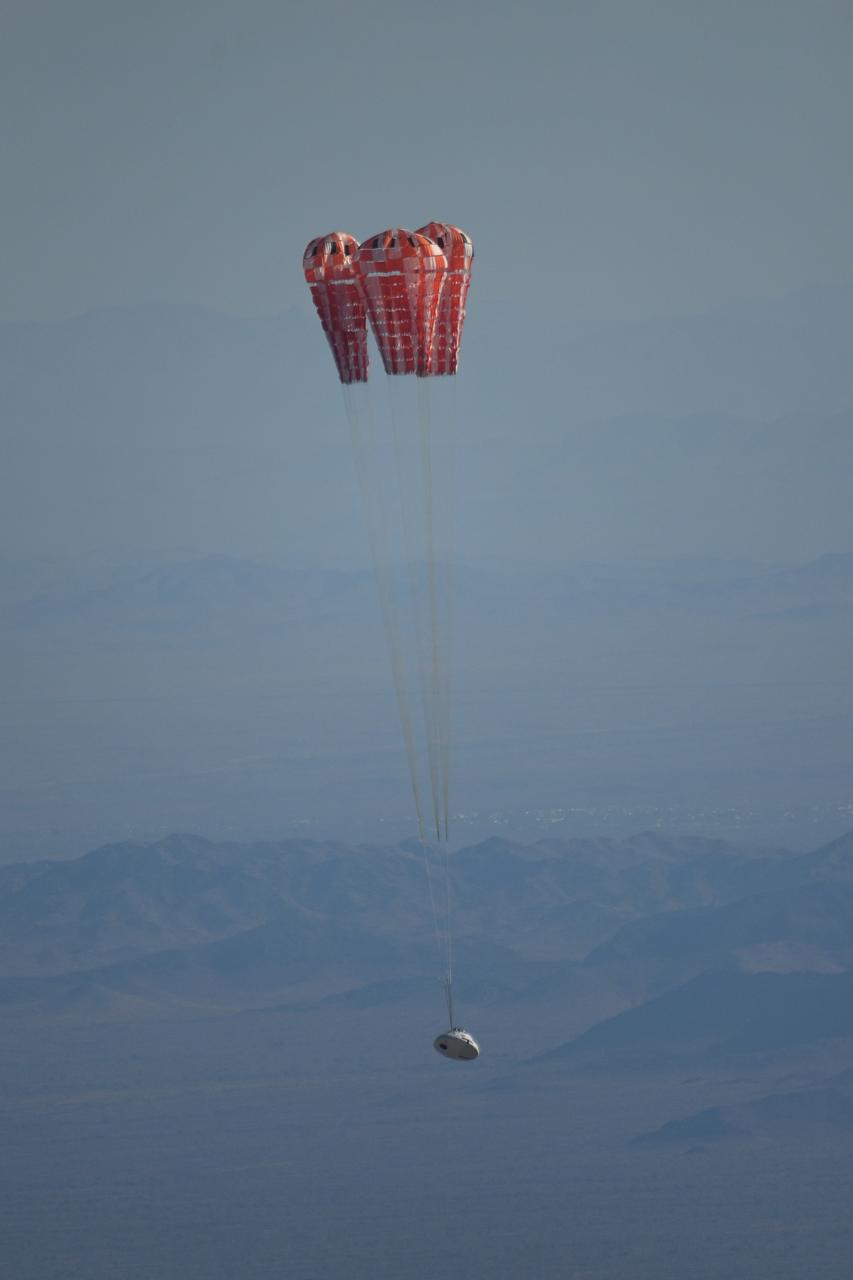
Orion’s three main orange and white parachutes help a representative model of the spacecraft descend through sky above Arizona, where NASA engineers tested the parachute system on Sept. 13, 2017 at the U.S. Army Proving Ground in Yuma. NASA is qualifying Orion’s parachutes for missions with astronauts.. .During this test, engineers replicated a situation in which Orion must abort off the Space Launch System rocket and bypasses part of its normal parachute deployment sequence that typically helps the spacecraft slow down during its descent to Earth after deep space missions. The capsule was dropped out of a C-17 aircraft at more than 4.7 miles in altitude and allowed to free fall for 20 seconds, longer than ever before, to produce high aerodynamic pressure before only its pilot and main parachutes were deployed, testing whether they could perform as expected under extreme loads. Orion’s full parachute system includes 11 total parachutes -- three forward bay cover parachutes and two drogue parachutes, along with three pilot parachutes that help pull out the spacecraft’s three mains.
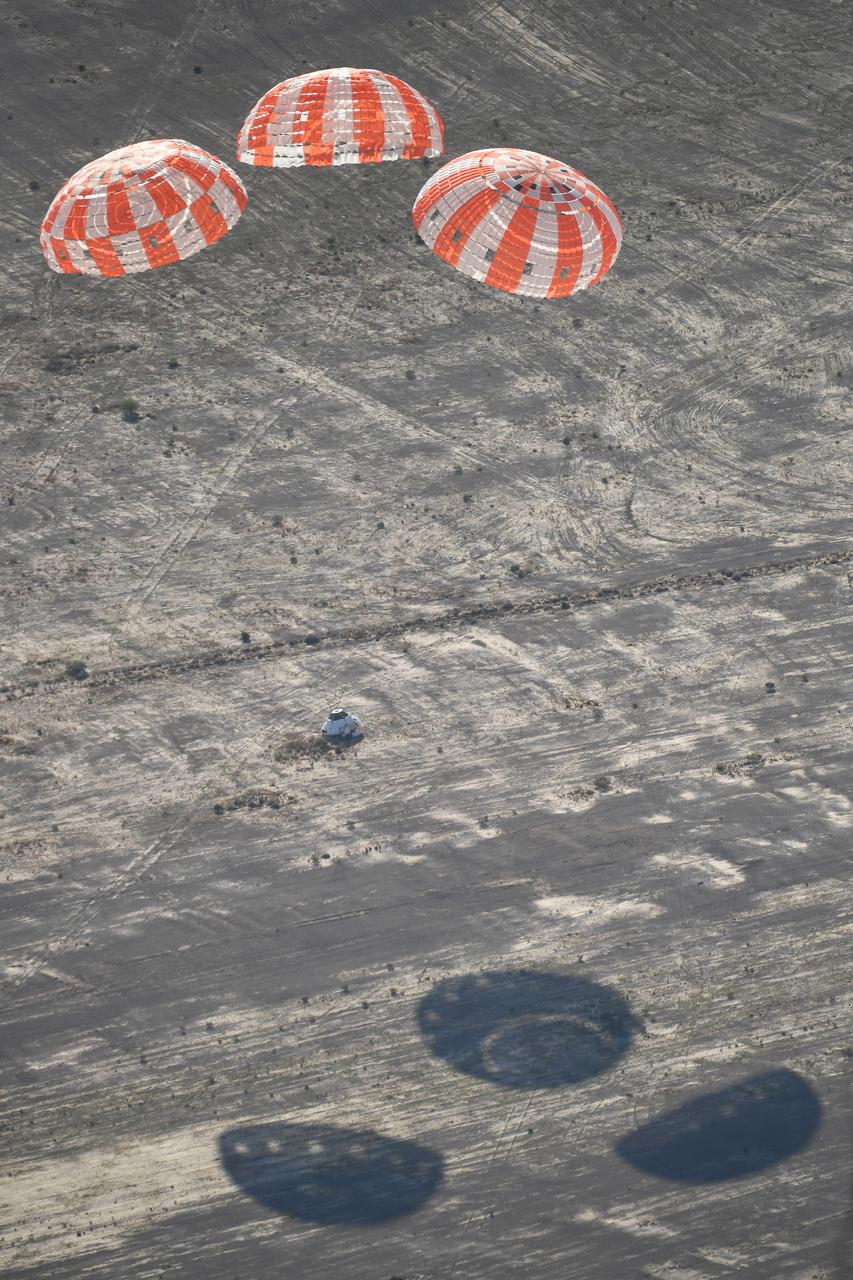
Orion’s three main orange and white parachutes help a representative model of the spacecraft descend through sky above Arizona, where NASA engineers tested the parachute system on Sept. 13, 2017 at the U.S. Army Proving Ground in Yuma. NASA is qualifying Orion’s parachutes for missions with astronauts.. .During this test, engineers replicated a situation in which Orion must abort off the Space Launch System rocket and bypasses part of its normal parachute deployment sequence that typically helps the spacecraft slow down during its descent to Earth after deep space missions. The capsule was dropped out of a C-17 aircraft at more than 4.7 miles in altitude and allowed to free fall for 20 seconds, longer than ever before, to produce high aerodynamic pressure before only its pilot and main parachutes were deployed, testing whether they could perform as expected under extreme loads. Orion’s full parachute system includes 11 total parachutes -- three forward bay cover parachutes and two drogue parachutes, along with three pilot parachutes that help pull out the spacecraft’s three mains.
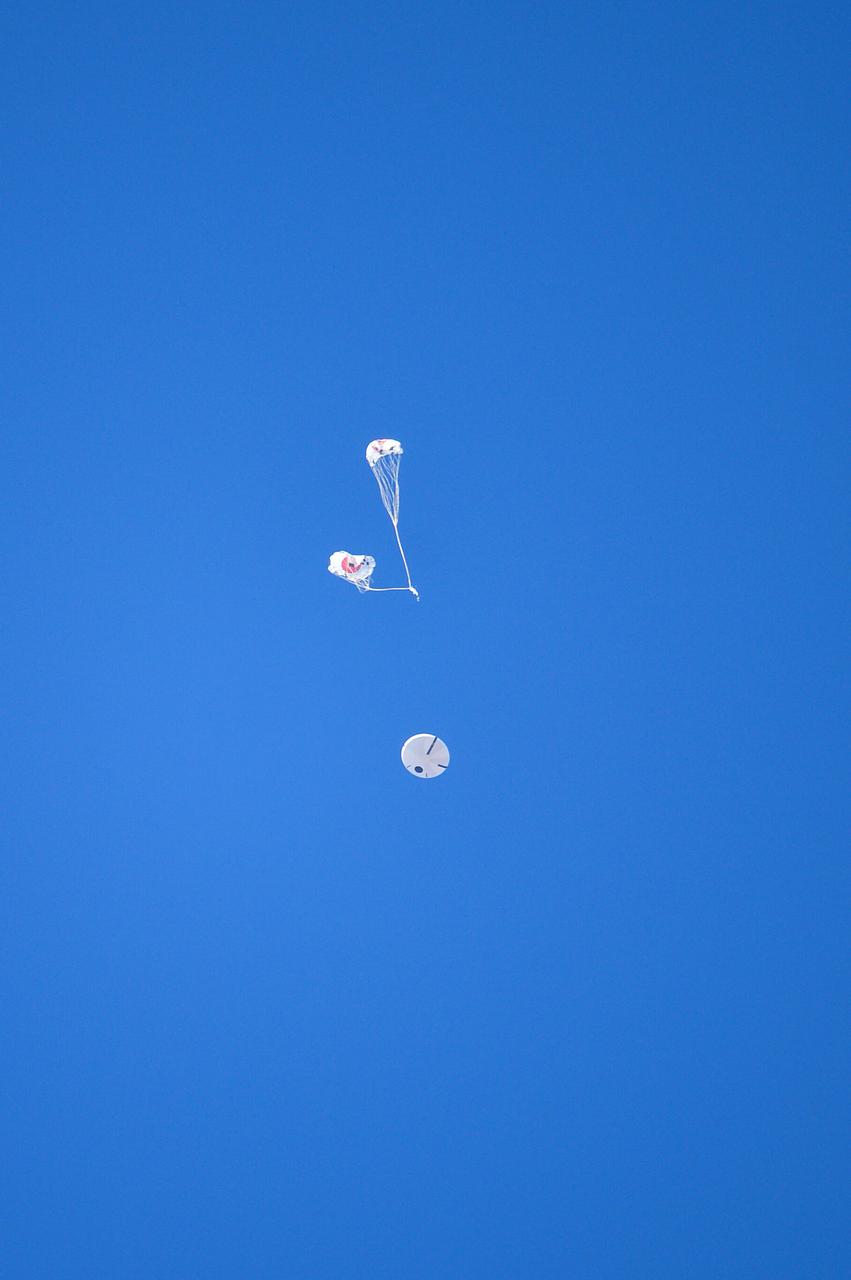
Orion’s three main orange and white parachutes help a representative model of the spacecraft descend through sky above Arizona, where NASA engineers tested the parachute system on Sept. 13, 2017 at the U.S. Army Proving Ground in Yuma. NASA is qualifying Orion’s parachutes for missions with astronauts.. .During this test, engineers replicated a situation in which Orion must abort off the Space Launch System rocket and bypasses part of its normal parachute deployment sequence that typically helps the spacecraft slow down during its descent to Earth after deep space missions. The capsule was dropped out of a C-17 aircraft at more than 4.7 miles in altitude and allowed to free fall for 20 seconds, longer than ever before, to produce high aerodynamic pressure before only its pilot and main parachutes were deployed, testing whether they could perform as expected under extreme loads. Orion’s full parachute system includes 11 total parachutes -- three forward bay cover parachutes and two drogue parachutes, along with three pilot parachutes that help pull out the spacecraft’s three mains.
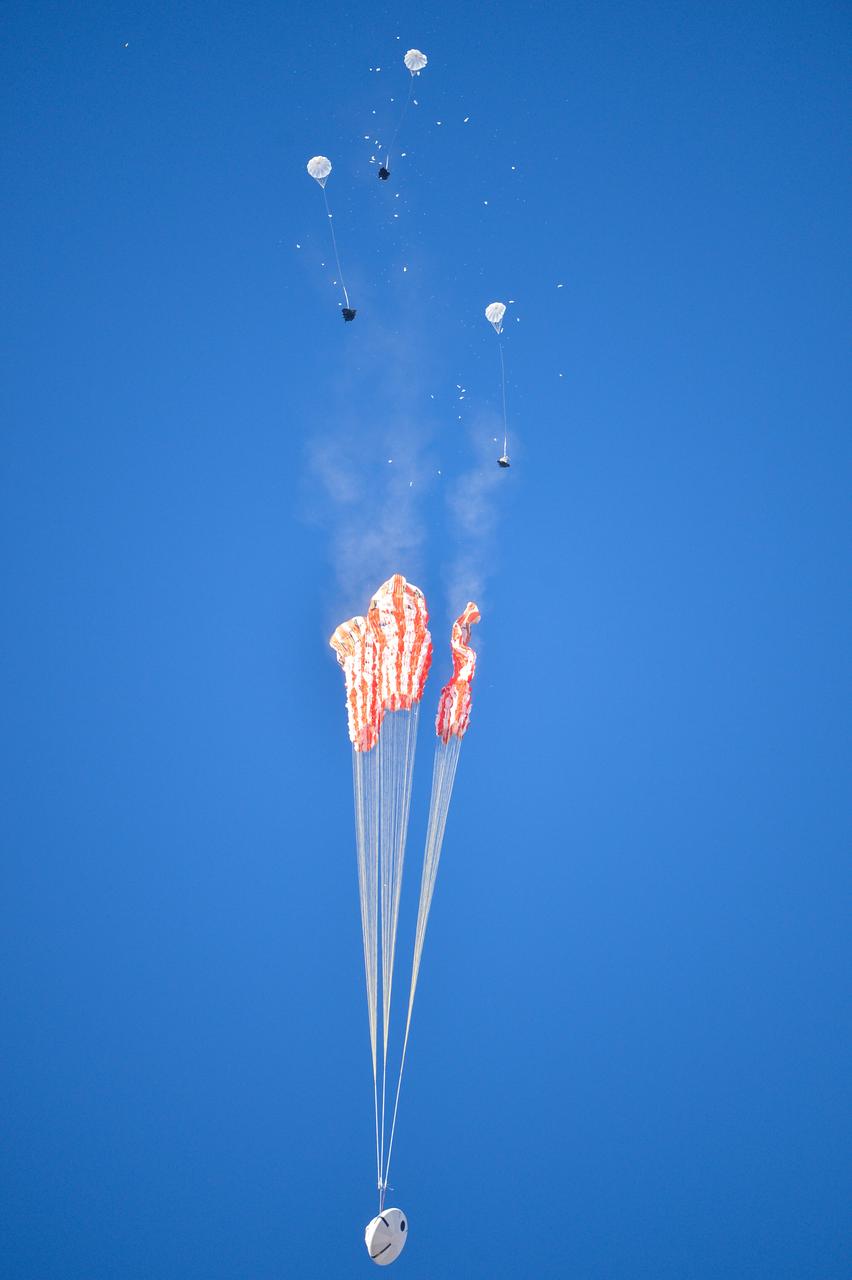
Orion’s three main orange and white parachutes help a representative model of the spacecraft descend through sky above Arizona, where NASA engineers tested the parachute system on Sept. 13, 2017 at the U.S. Army Proving Ground in Yuma. NASA is qualifying Orion’s parachutes for missions with astronauts.. .During this test, engineers replicated a situation in which Orion must abort off the Space Launch System rocket and bypasses part of its normal parachute deployment sequence that typically helps the spacecraft slow down during its descent to Earth after deep space missions. The capsule was dropped out of a C-17 aircraft at more than 4.7 miles in altitude and allowed to free fall for 20 seconds, longer than ever before, to produce high aerodynamic pressure before only its pilot and main parachutes were deployed, testing whether they could perform as expected under extreme loads. Orion’s full parachute system includes 11 total parachutes -- three forward bay cover parachutes and two drogue parachutes, along with three pilot parachutes that help pull out the spacecraft’s three mains.
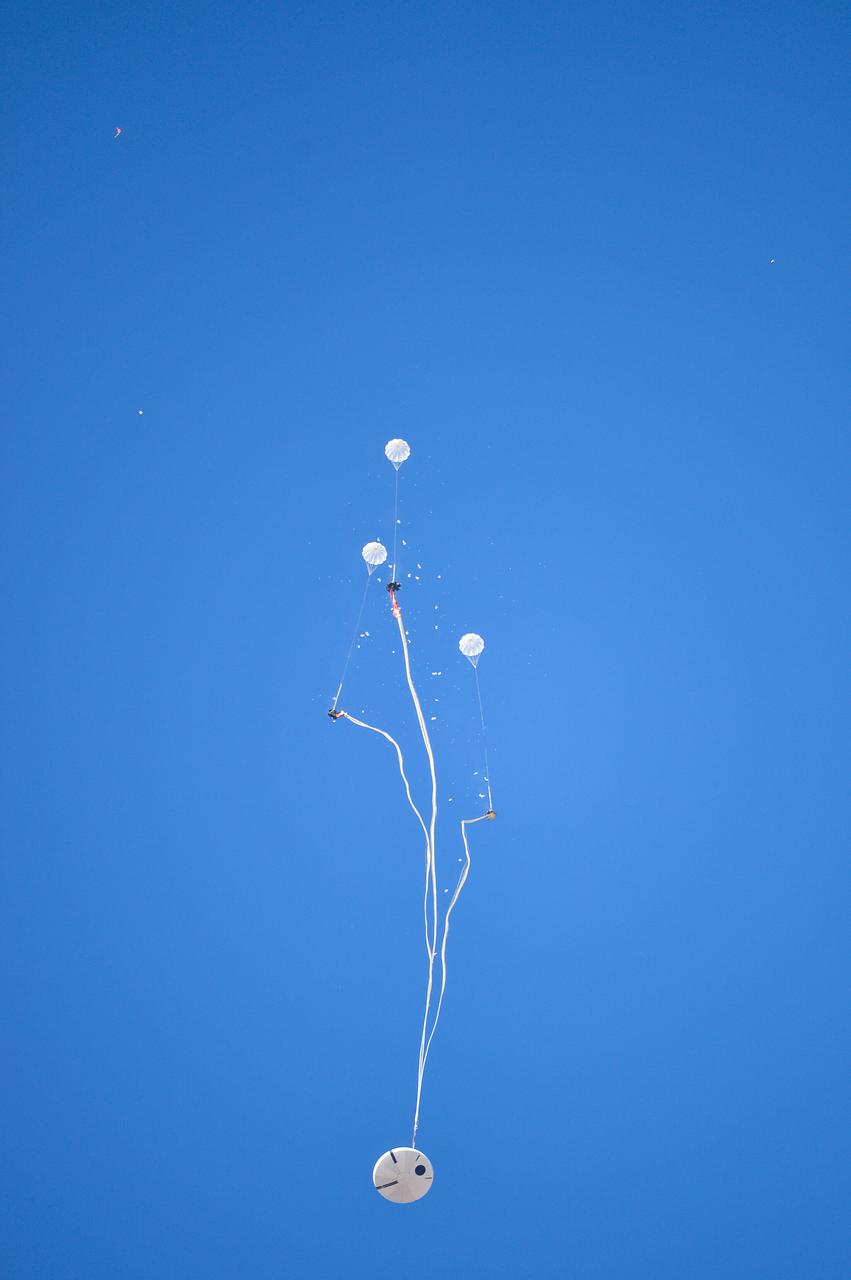
Orion’s three main orange and white parachutes help a representative model of the spacecraft descend through sky above Arizona, where NASA engineers tested the parachute system on Sept. 13, 2017 at the U.S. Army Proving Ground in Yuma. NASA is qualifying Orion’s parachutes for missions with astronauts.. .During this test, engineers replicated a situation in which Orion must abort off the Space Launch System rocket and bypasses part of its normal parachute deployment sequence that typically helps the spacecraft slow down during its descent to Earth after deep space missions. The capsule was dropped out of a C-17 aircraft at more than 4.7 miles in altitude and allowed to free fall for 20 seconds, longer than ever before, to produce high aerodynamic pressure before only its pilot and main parachutes were deployed, testing whether they could perform as expected under extreme loads. Orion’s full parachute system includes 11 total parachutes -- three forward bay cover parachutes and two drogue parachutes, along with three pilot parachutes that help pull out the spacecraft’s three mains.
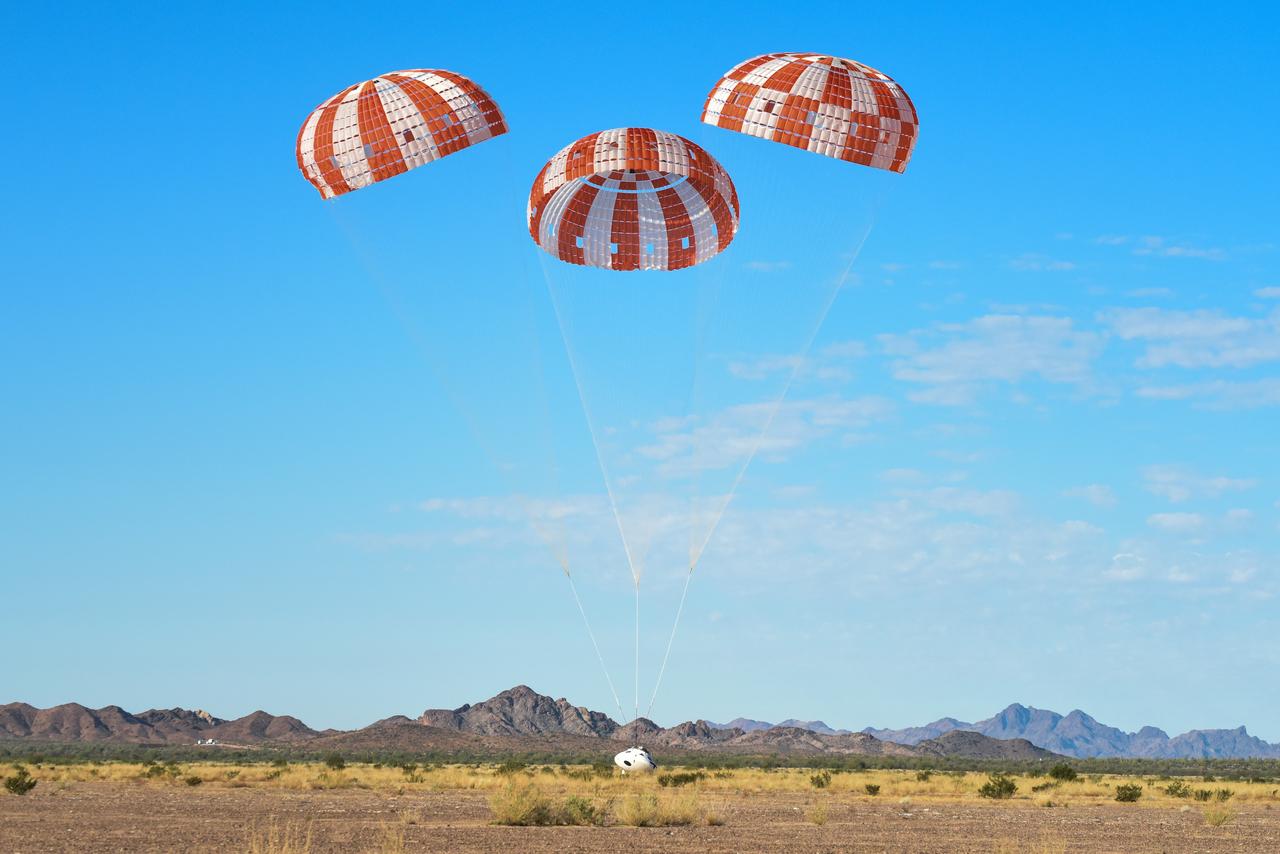
Orion’s three main orange and white parachutes help a representative model of the spacecraft descend through sky above Arizona, where NASA engineers tested the parachute system on Sept. 13, 2017 at the U.S. Army Proving Ground in Yuma. NASA is qualifying Orion’s parachutes for missions with astronauts.. .During this test, engineers replicated a situation in which Orion must abort off the Space Launch System rocket and bypasses part of its normal parachute deployment sequence that typically helps the spacecraft slow down during its descent to Earth after deep space missions. The capsule was dropped out of a C-17 aircraft at more than 4.7 miles in altitude and allowed to free fall for 20 seconds, longer than ever before, to produce high aerodynamic pressure before only its pilot and main parachutes were deployed, testing whether they could perform as expected under extreme loads. Orion’s full parachute system includes 11 total parachutes -- three forward bay cover parachutes and two drogue parachutes, along with three pilot parachutes that help pull out the spacecraft’s three mains.
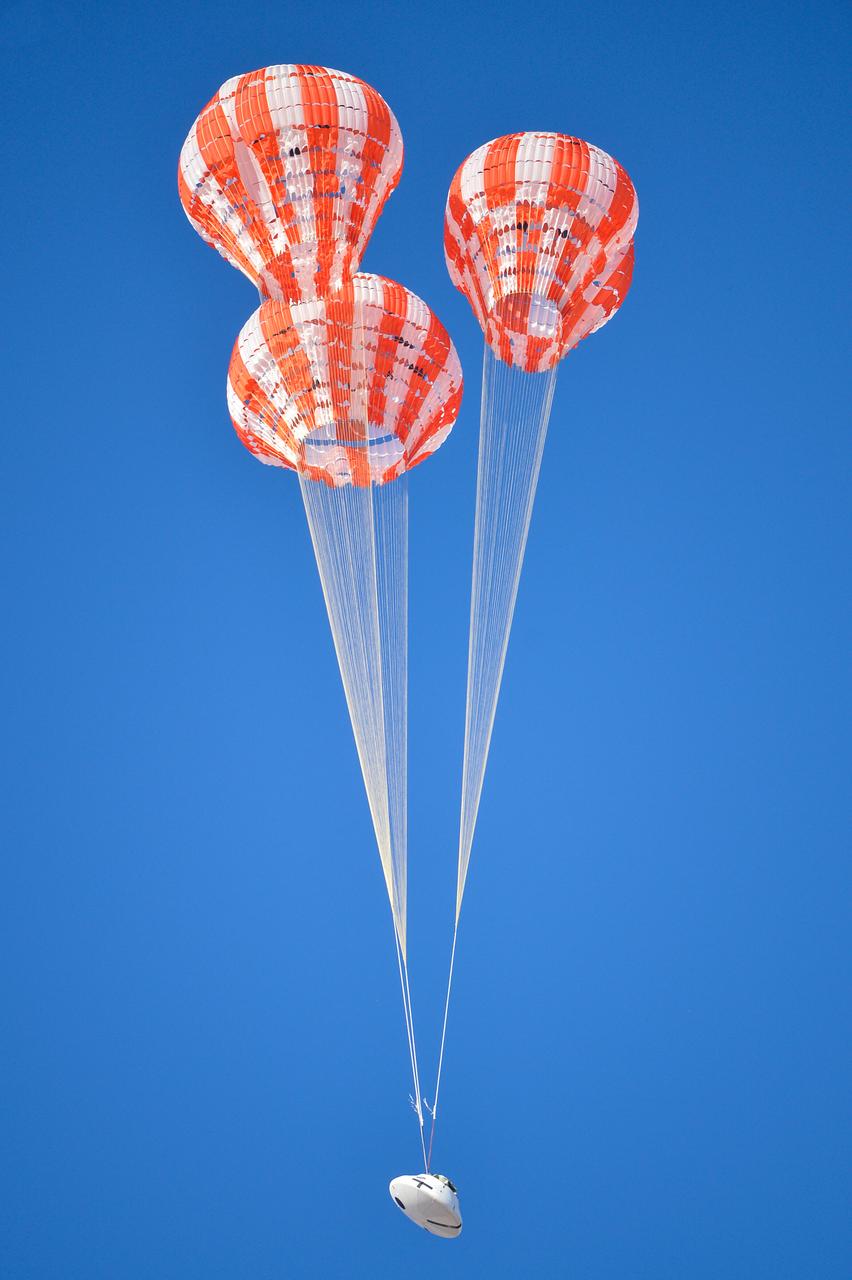
Orion’s three main orange and white parachutes help a representative model of the spacecraft descend through sky above Arizona, where NASA engineers tested the parachute system on Sept. 13, 2017 at the U.S. Army Proving Ground in Yuma. NASA is qualifying Orion’s parachutes for missions with astronauts.. .During this test, engineers replicated a situation in which Orion must abort off the Space Launch System rocket and bypasses part of its normal parachute deployment sequence that typically helps the spacecraft slow down during its descent to Earth after deep space missions. The capsule was dropped out of a C-17 aircraft at more than 4.7 miles in altitude and allowed to free fall for 20 seconds, longer than ever before, to produce high aerodynamic pressure before only its pilot and main parachutes were deployed, testing whether they could perform as expected under extreme loads. Orion’s full parachute system includes 11 total parachutes -- three forward bay cover parachutes and two drogue parachutes, along with three pilot parachutes that help pull out the spacecraft’s three mains.
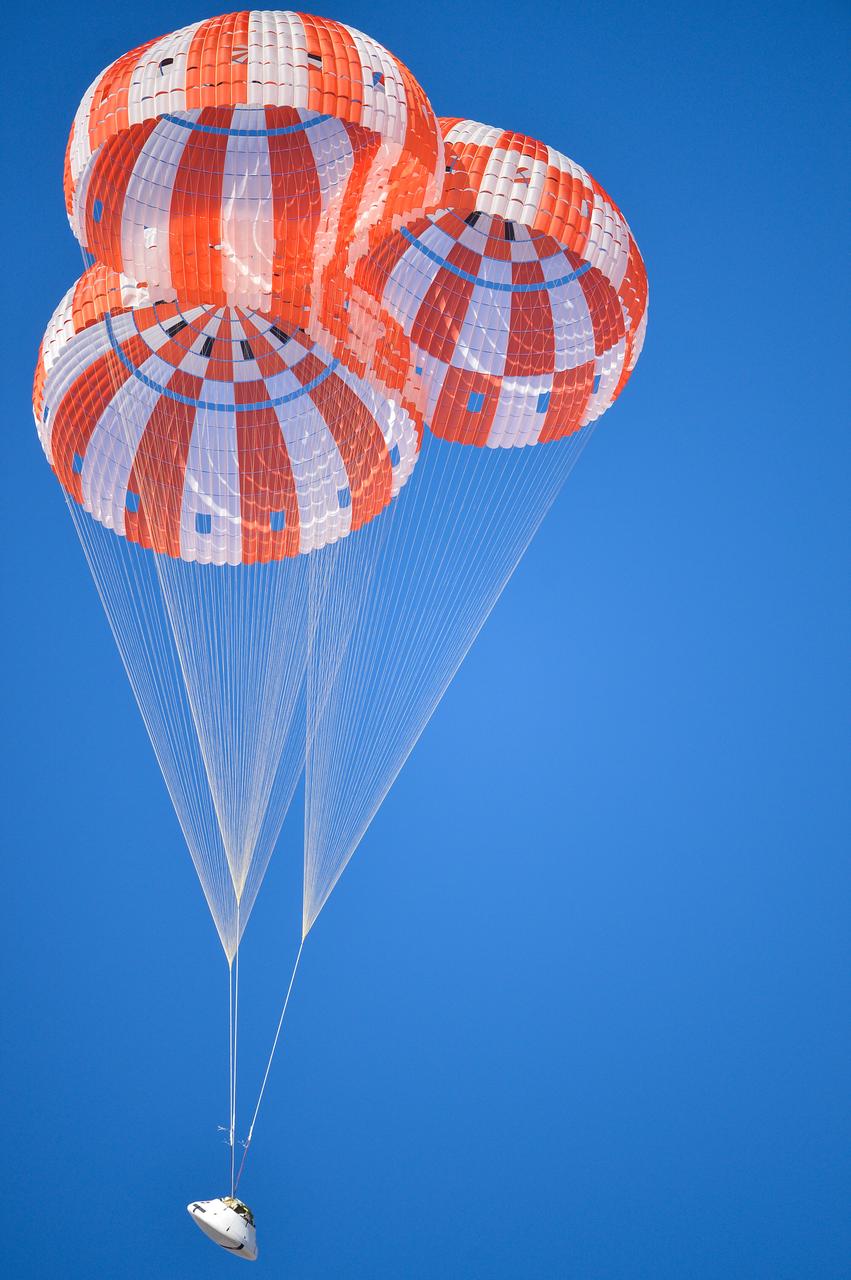
Orion’s three main orange and white parachutes help a representative model of the spacecraft descend through sky above Arizona, where NASA engineers tested the parachute system on Sept. 13, 2017 at the U.S. Army Proving Ground in Yuma. NASA is qualifying Orion’s parachutes for missions with astronauts.. .During this test, engineers replicated a situation in which Orion must abort off the Space Launch System rocket and bypasses part of its normal parachute deployment sequence that typically helps the spacecraft slow down during its descent to Earth after deep space missions. The capsule was dropped out of a C-17 aircraft at more than 4.7 miles in altitude and allowed to free fall for 20 seconds, longer than ever before, to produce high aerodynamic pressure before only its pilot and main parachutes were deployed, testing whether they could perform as expected under extreme loads. Orion’s full parachute system includes 11 total parachutes -- three forward bay cover parachutes and two drogue parachutes, along with three pilot parachutes that help pull out the spacecraft’s three mains.
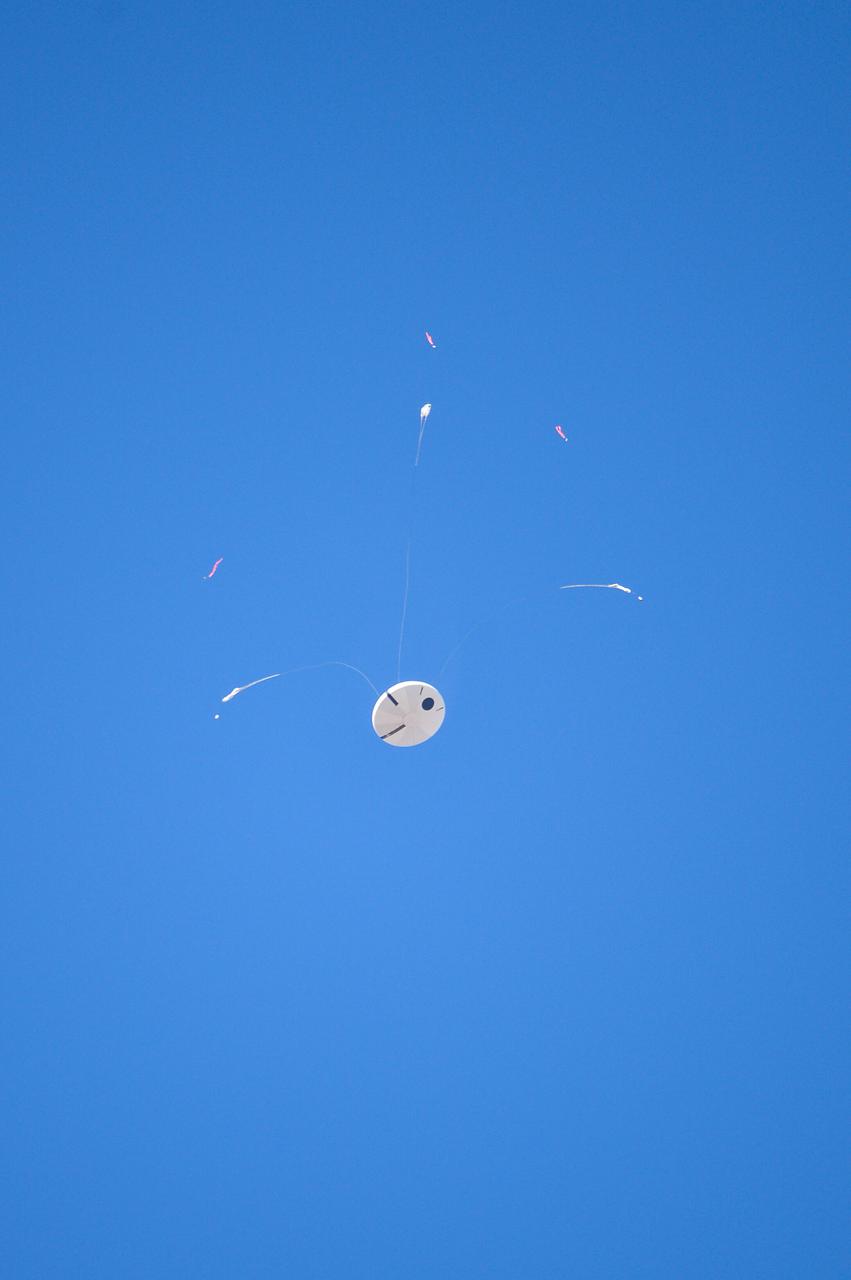
Orion’s three main orange and white parachutes help a representative model of the spacecraft descend through sky above Arizona, where NASA engineers tested the parachute system on Sept. 13, 2017 at the U.S. Army Proving Ground in Yuma. NASA is qualifying Orion’s parachutes for missions with astronauts.. .During this test, engineers replicated a situation in which Orion must abort off the Space Launch System rocket and bypasses part of its normal parachute deployment sequence that typically helps the spacecraft slow down during its descent to Earth after deep space missions. The capsule was dropped out of a C-17 aircraft at more than 4.7 miles in altitude and allowed to free fall for 20 seconds, longer than ever before, to produce high aerodynamic pressure before only its pilot and main parachutes were deployed, testing whether they could perform as expected under extreme loads. Orion’s full parachute system includes 11 total parachutes -- three forward bay cover parachutes and two drogue parachutes, along with three pilot parachutes that help pull out the spacecraft’s three mains.
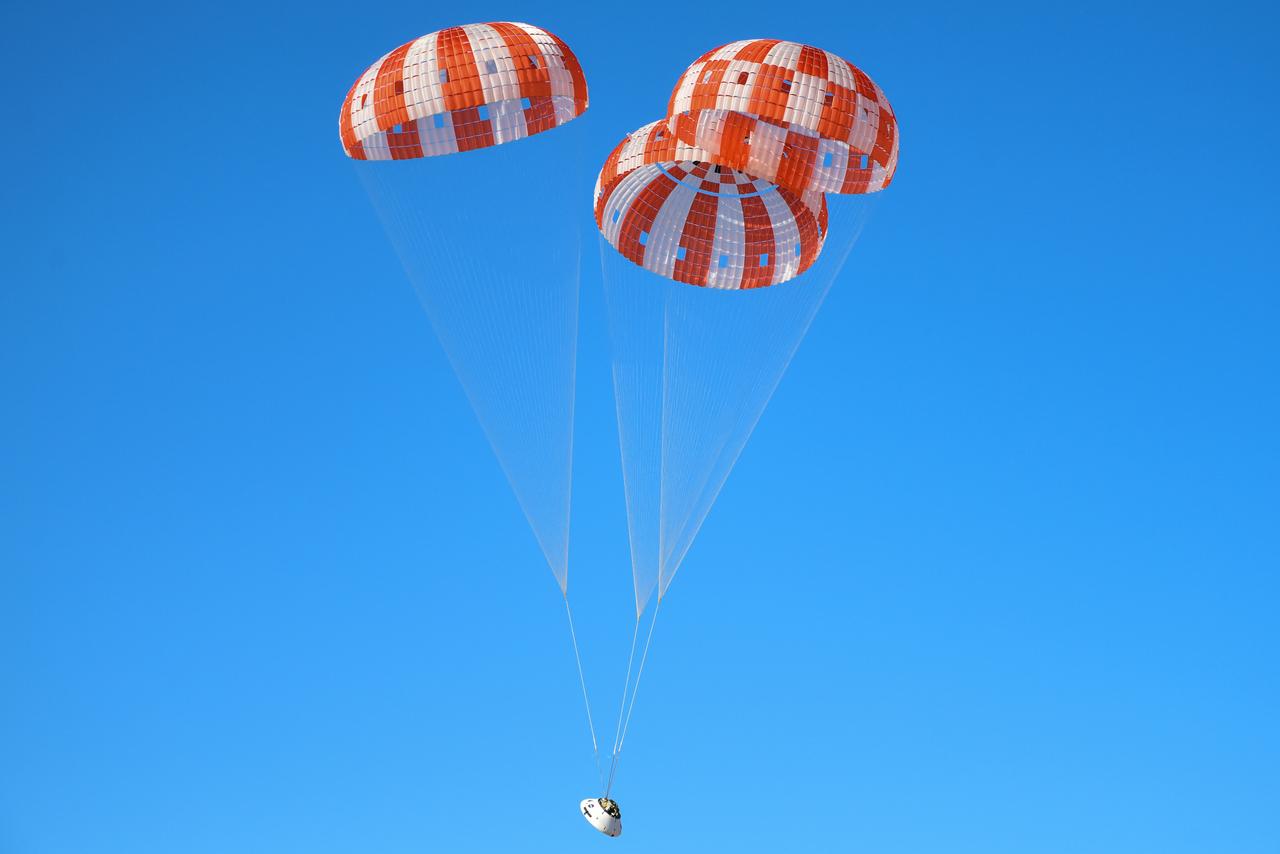
Orion’s three main orange and white parachutes help a representative model of the spacecraft descend through sky above Arizona, where NASA engineers tested the parachute system on Sept. 13, 2017 at the U.S. Army Proving Ground in Yuma. NASA is qualifying Orion’s parachutes for missions with astronauts.. .During this test, engineers replicated a situation in which Orion must abort off the Space Launch System rocket and bypasses part of its normal parachute deployment sequence that typically helps the spacecraft slow down during its descent to Earth after deep space missions. The capsule was dropped out of a C-17 aircraft at more than 4.7 miles in altitude and allowed to free fall for 20 seconds, longer than ever before, to produce high aerodynamic pressure before only its pilot and main parachutes were deployed, testing whether they could perform as expected under extreme loads. Orion’s full parachute system includes 11 total parachutes -- three forward bay cover parachutes and two drogue parachutes, along with three pilot parachutes that help pull out the spacecraft’s three mains.

Orion’s three main orange and white parachutes help a representative model of the spacecraft descend through sky above Arizona, where NASA engineers tested the parachute system on Sept. 13, 2017 at the U.S. Army Proving Ground in Yuma. NASA is qualifying Orion’s parachutes for missions with astronauts.. .During this test, engineers replicated a situation in which Orion must abort off the Space Launch System rocket and bypasses part of its normal parachute deployment sequence that typically helps the spacecraft slow down during its descent to Earth after deep space missions. The capsule was dropped out of a C-17 aircraft at more than 4.7 miles in altitude and allowed to free fall for 20 seconds, longer than ever before, to produce high aerodynamic pressure before only its pilot and main parachutes were deployed, testing whether they could perform as expected under extreme loads. Orion’s full parachute system includes 11 total parachutes -- three forward bay cover parachutes and two drogue parachutes, along with three pilot parachutes that help pull out the spacecraft’s three mains.
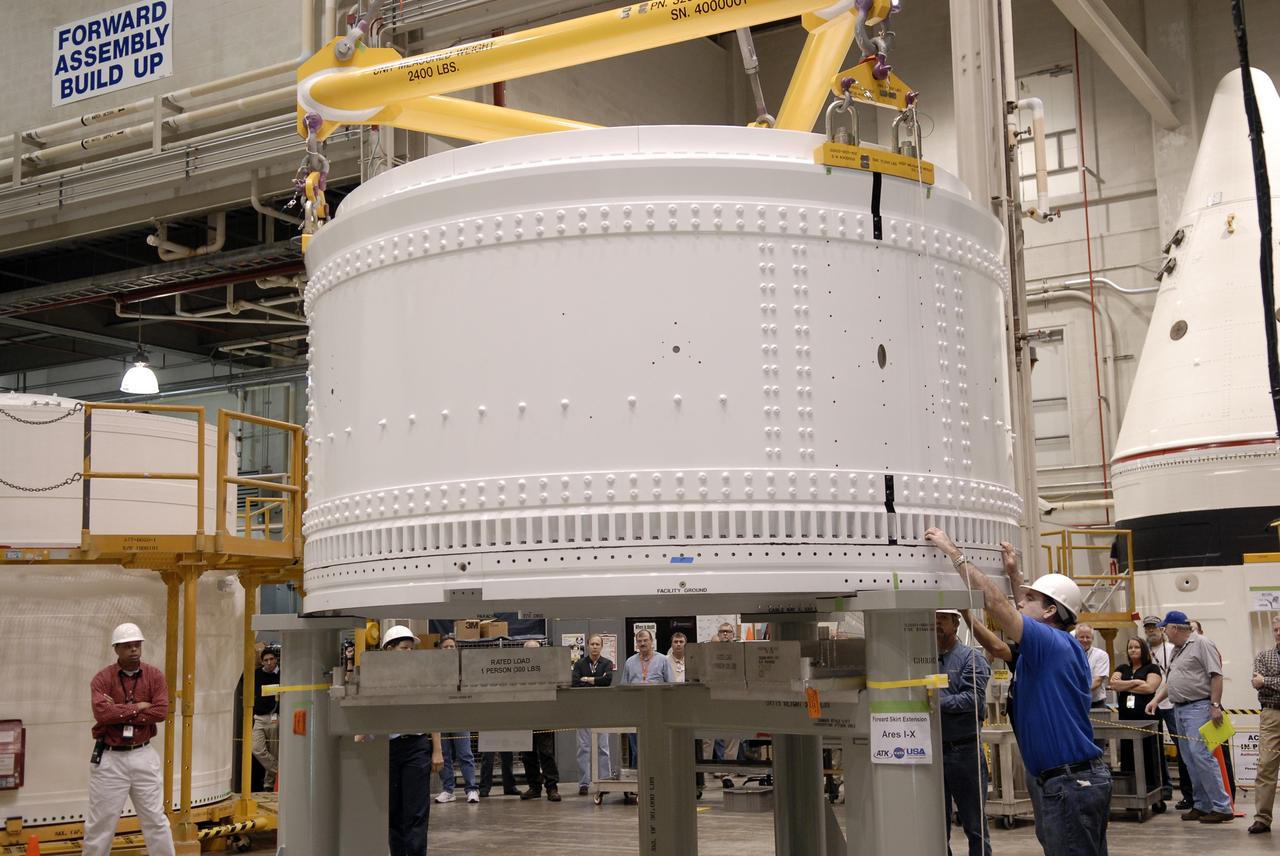
CAPE CANAVERAL, Fla. -- In the Assembly and Refurbishment Facility at NASA's Kennedy Space Center in Florida, the forward skirt extension of the Ares I-X first stage is lowered onto a work stand. The extension will house new, larger parachutes. The three main parachutes each have a 150-foot diameter, compared to the shuttle booster main parachutes, which are 136 feet across. Photo credit: NASA/Kim Shiflett
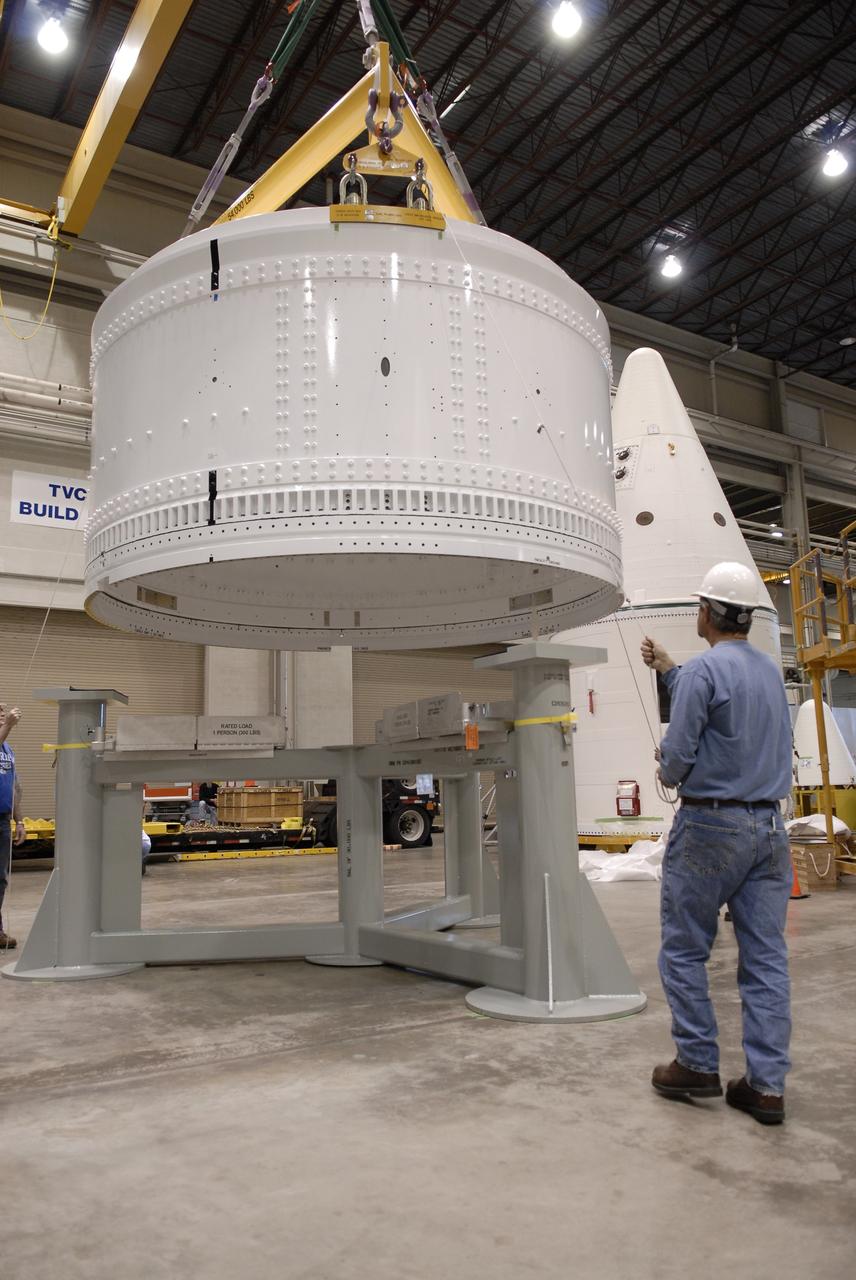
CAPE CANAVERAL, Fla. -- In the Assembly and Refurbishment Facility at NASA's Kennedy Space Center in Florida, the forward skirt extension of the Ares I-X first stage is moved to a work stand. The extension will house new, larger parachutes. The three main parachutes each have a 150-foot diameter, compared to the shuttle booster main parachutes, which are 136 feet across. Photo credit: NASA/Kim Shiflett
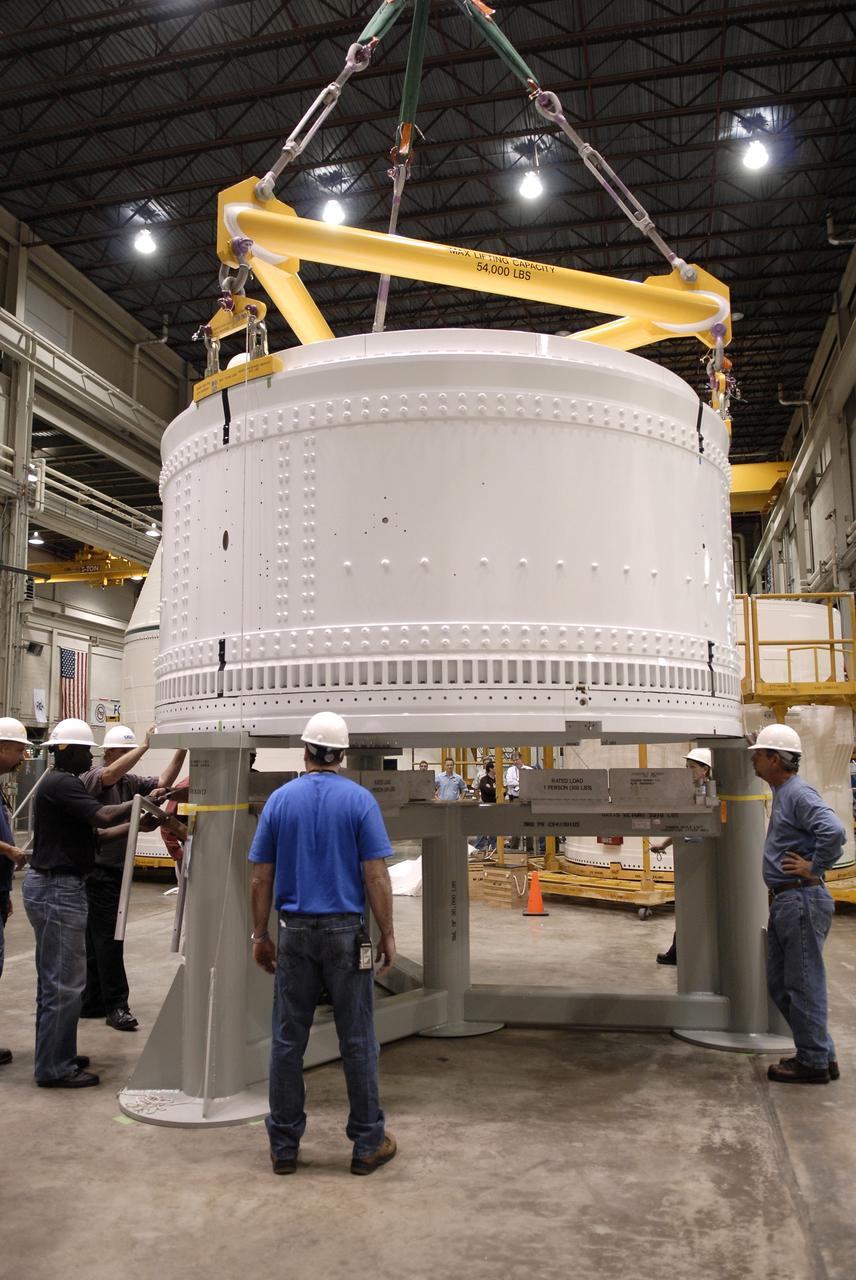
CAPE CANAVERAL, Fla. -- In the Assembly and Refurbishment Facility at NASA's Kennedy Space Center in Florida, the forward skirt extension of the Ares I-X first stage is lowered onto a work stand. The extension will house new, larger parachutes. The three main parachutes each have a 150-foot diameter, compared to the shuttle booster main parachutes, which are 136 feet across. Photo credit: NASA/Kim Shiflett
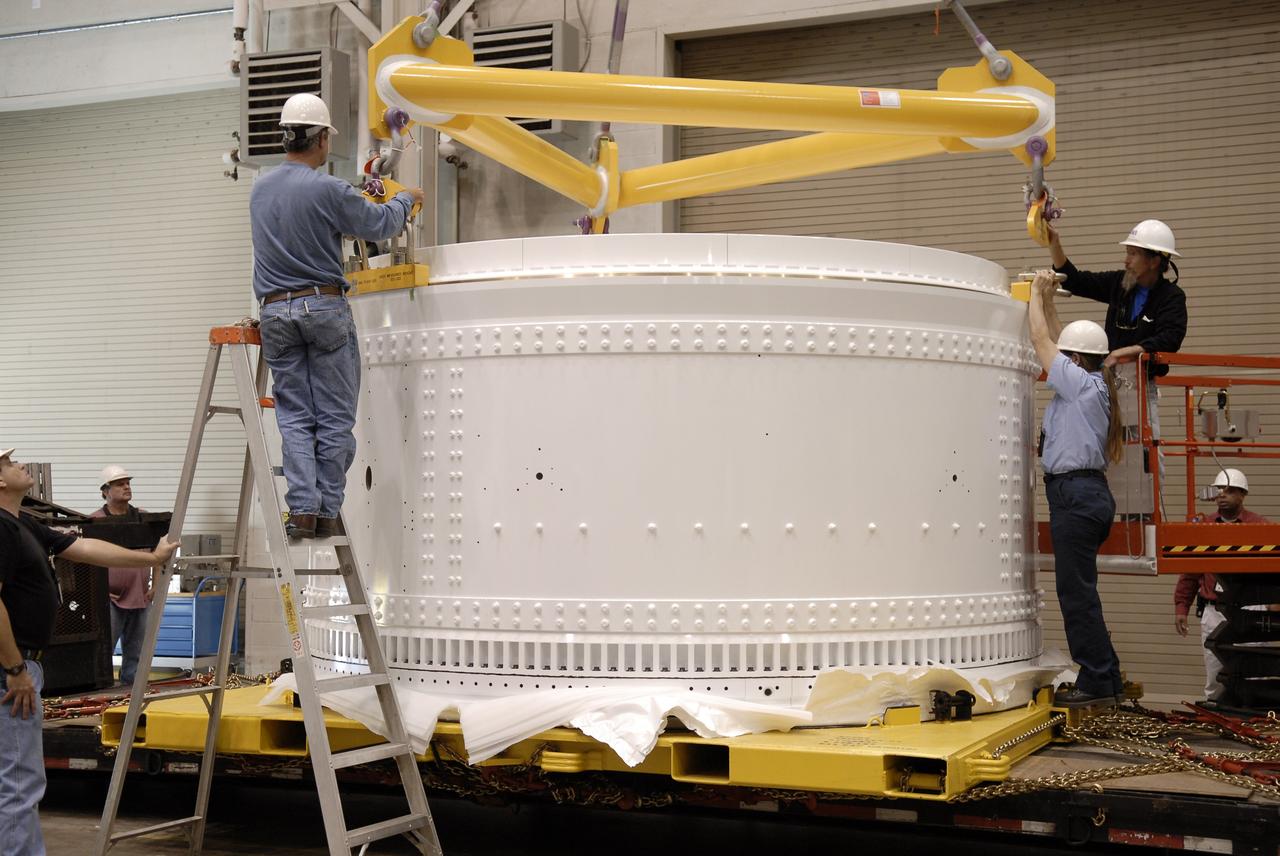
CAPE CANAVERAL, Fla. -- In the Assembly and Refurbishment Facility at NASA's Kennedy Space Center in Florida, the forward skirt extension of the Ares I-X first stage is lowered onto a work stand. The extension will house new, larger parachutes. The three main parachutes each have a 150-foot diameter, compared to the shuttle booster main parachutes, which are 136 feet across. Photo credit: NASA/Kim Shiflett
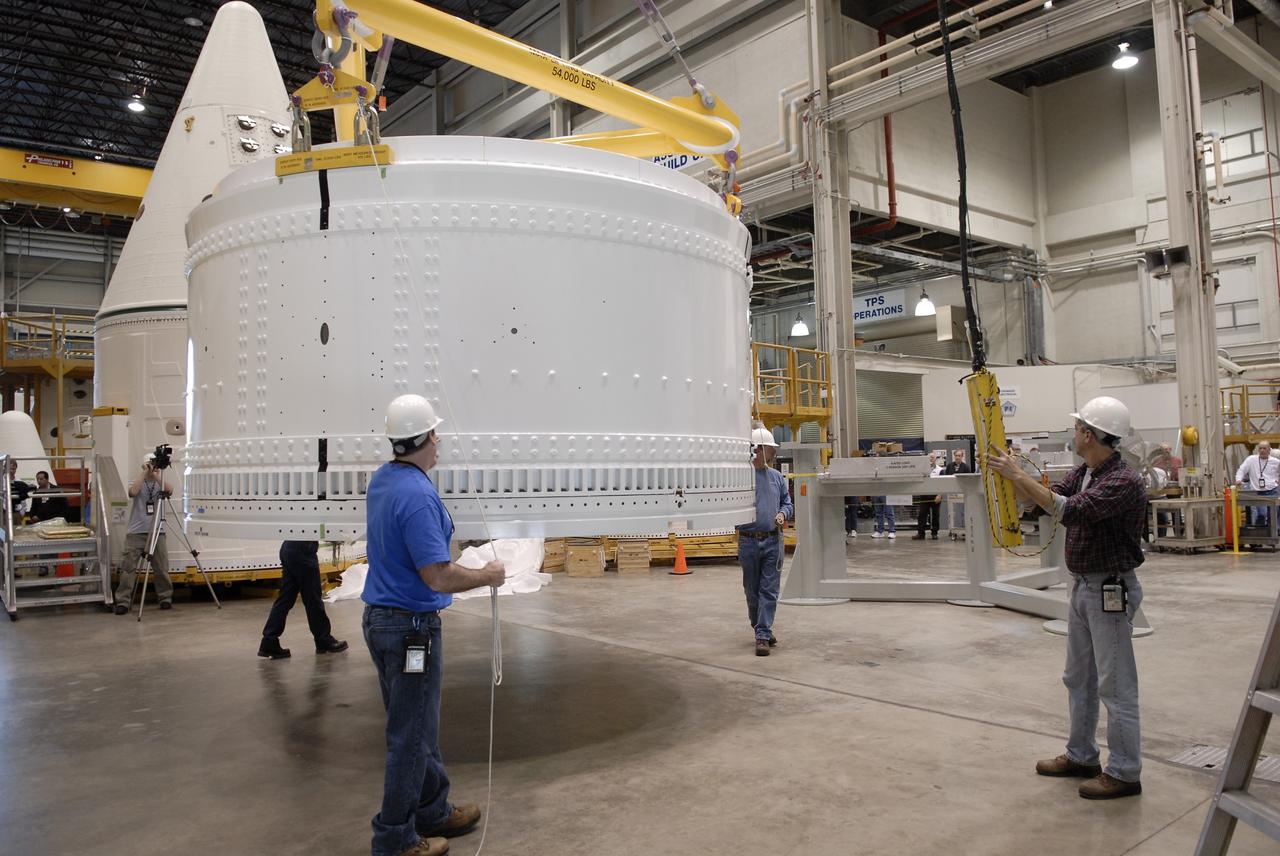
CAPE CANAVERAL, Fla. -- In the Assembly and Refurbishment Facility at NASA's Kennedy Space Center in Florida, the forward skirt extension of the Ares I-X first stage is moved. The extension will house new, larger parachutes. The three main parachutes each have a 150-foot diameter, compared to the shuttle booster main parachutes, which are 136 feet across. Photo credit: NASA/Kim Shiflett
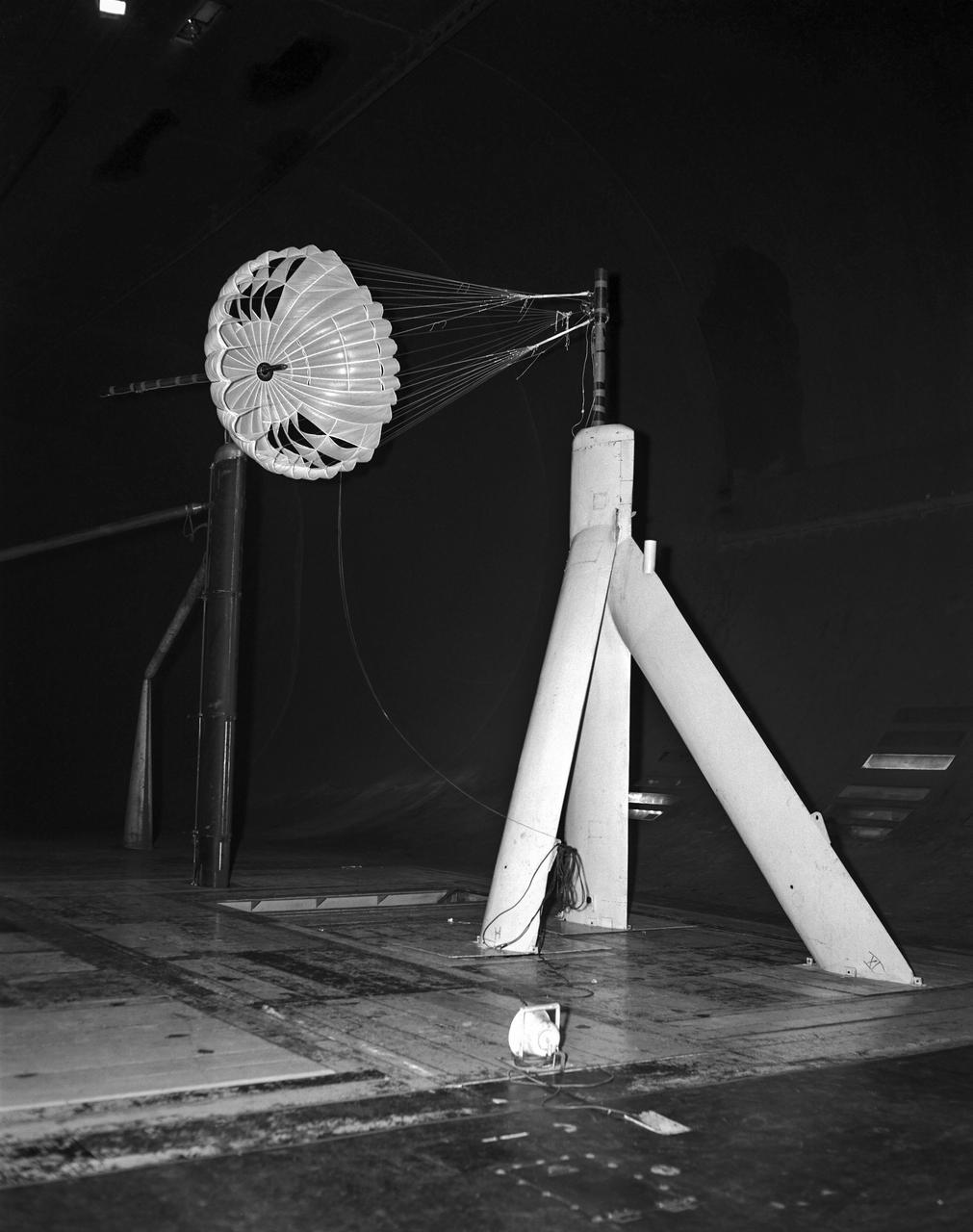
Gliding parachute test in 40x80 foot Wind Tunnel, mounted on main strut flying horizontally.
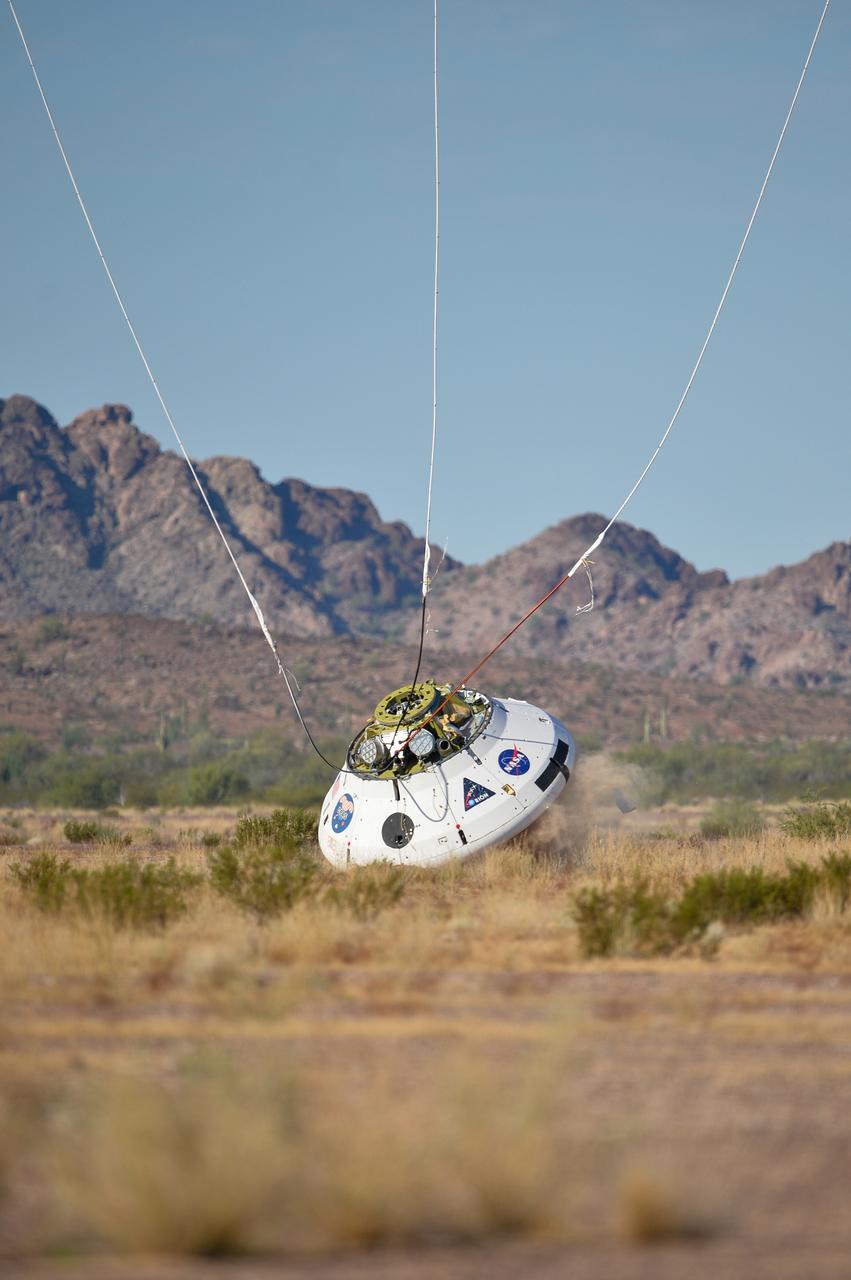
Engineers testing the parachute system for Orion during a Sept. 13, 2017 evaluation at the U.S. Army Proving Ground in Yuma.. .During this test, engineers replicated a situation in which Orion must abort off the Space Launch System rocket and bypasses part of its normal parachute deployment sequence that typically helps the spacecraft slow down during its descent to Earth after deep space missions. The capsule was dropped out of a C-17 aircraft at more than 4.7 miles in altitude and allowed to free fall for 20 seconds, longer than ever before, to produce high aerodynamic pressure before only its pilot and main parachutes were deployed, testing whether they could perform as expected under extreme loads. Orion’s full parachute system includes 11 total parachutes -- three forward bay cover parachutes and two drogue parachutes, along with three pilot parachutes that help pull out the spacecraft’s three mains.
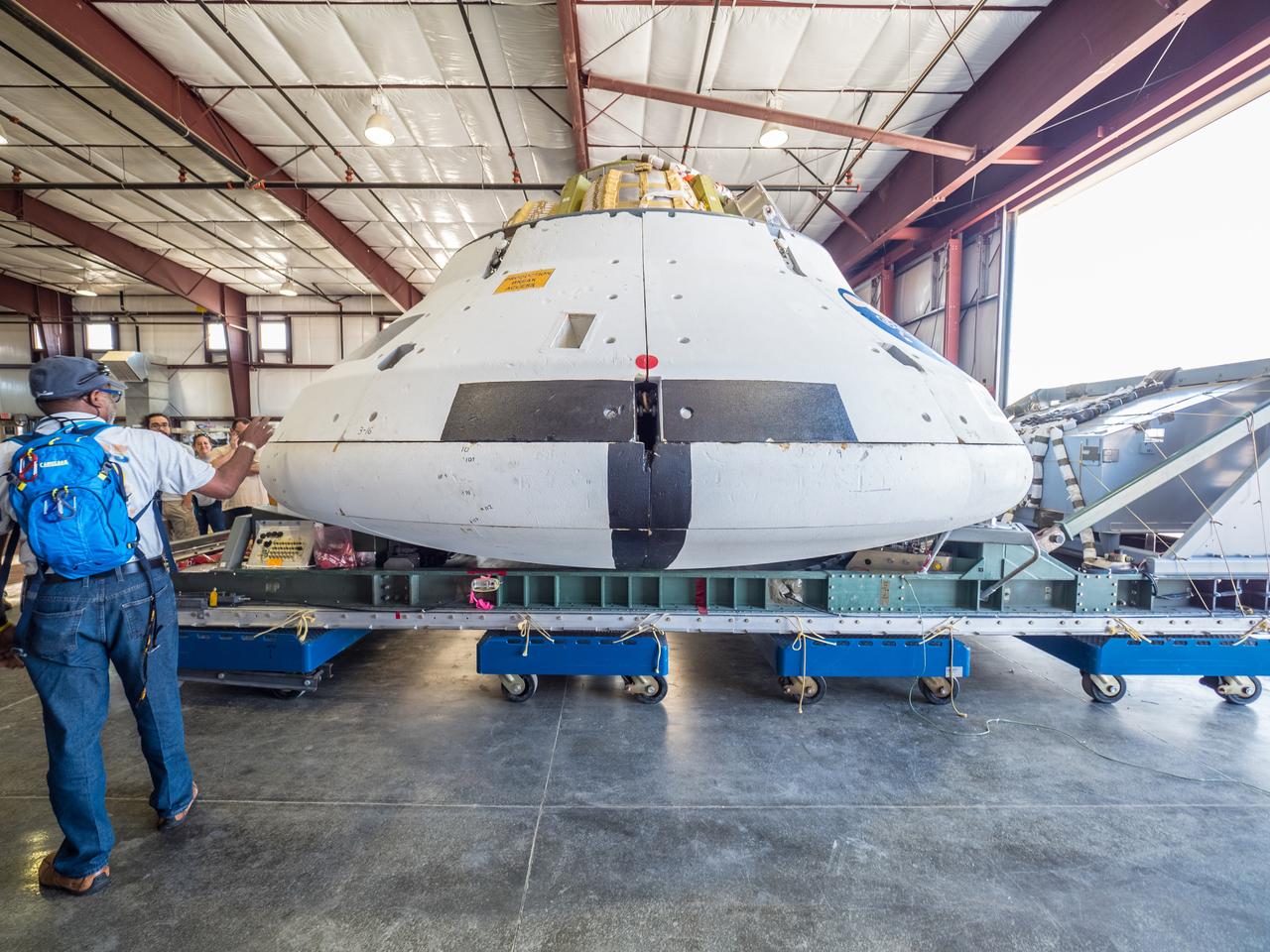
NASA engineers prepare for the test of the Orion spacecraft’s parachutes on Wednesday, Aug. 26 at the U.S. Army’s Yuma Proving Ground in Arizona on Aug. 24, 2015. An engineering model of the spacecraft will drop from an airplane 35,000 feet up to evaluate how it fares when the parachute system does not perform as expected...During the test, Orion engineers will carry out a scenario in which one of the spacecraft’s two drogue parachutes and one of its three main parachutes fail. This high-risk assessment is the penultimate drop test of the scheduled engineering evaluations leading up to next year’s tests to qualify the parachute system for crewed flights. Part of Batch image transfer from Flickr.
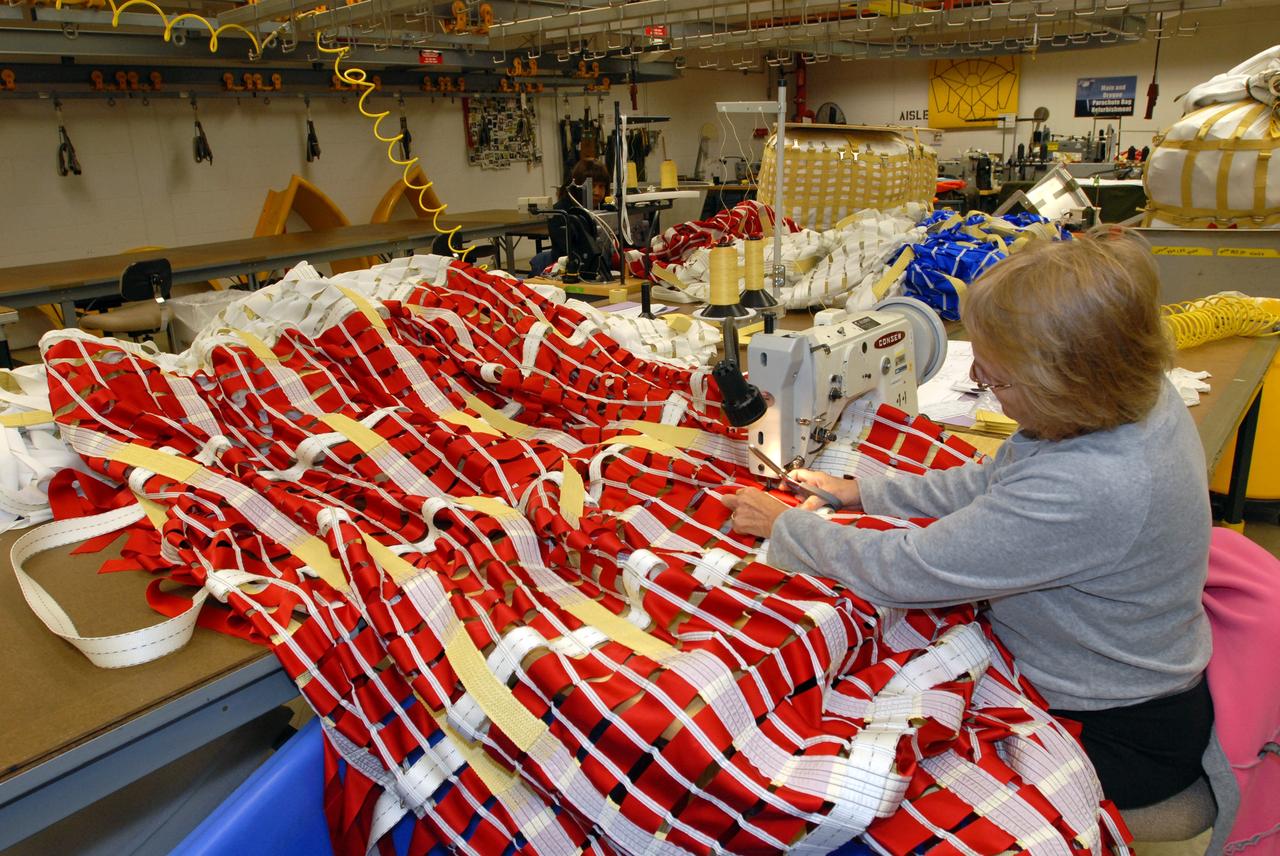
CAPE CANAVERAL, Fla. – In the Parachute Refurbishment Facility at NASA's Kennedy Space Center in Florida, workers repair the parachutes recovered from sea after the launch of space shuttle Endeavour on the STS-126 mission. Typically, each main canopy requires hundreds of repairs after each use. The smaller chutes and the parachute deployment bags they are packed in also require repairs. The parachutes are used to slow the descent of the solid rocket boosters that are jettisoned during liftoff. One pilot, one drogue and three main canopies per booster slow the booster’s fall from about 360 mph to 50 mph. After the chutes are cleaned and repaired, they must be carefully packed into their bags so they will deploy correctly the next time they are used. Photo credit: NASA/Jim Grossmann
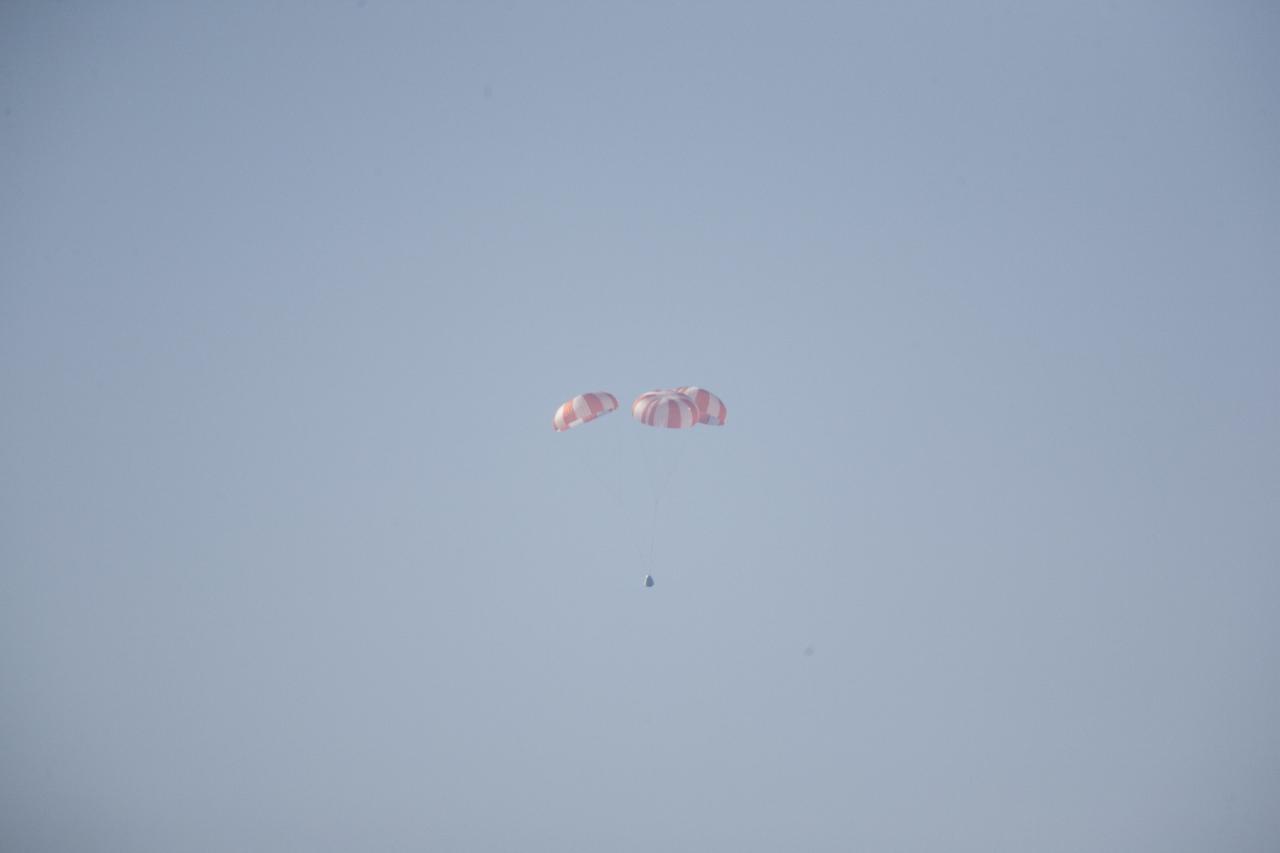
MORRO BAY, Calif. – The SpaceX main parachutes control the descent of the Dragon test article following a test over the Pacific Ocean, off the coast of Morro Bay, Calif. The test enabled SpaceX engineers to evaluate the spacecraft's parachute deployment system as part of a milestone under its Commercial Crew Integrated Capability agreement with NASA's Commercial Crew Program. The parachute test took place at Marro Bay, Calif. Photo credit: NASA/Kim Shiflett

MORRO BAY, Calif. – The SpaceX main parachutes control the descent of the Dragon test article following a test over the Pacific Ocean, off the coast of Morro Bay, Calif. The test enabled SpaceX engineers to evaluate the spacecraft's parachute deployment system as part of a milestone under its Commercial Crew Integrated Capability agreement with NASA's Commercial Crew Program. The parachute test took place at Marro Bay, Calif. Photo credit: NASA/Kim Shiflett
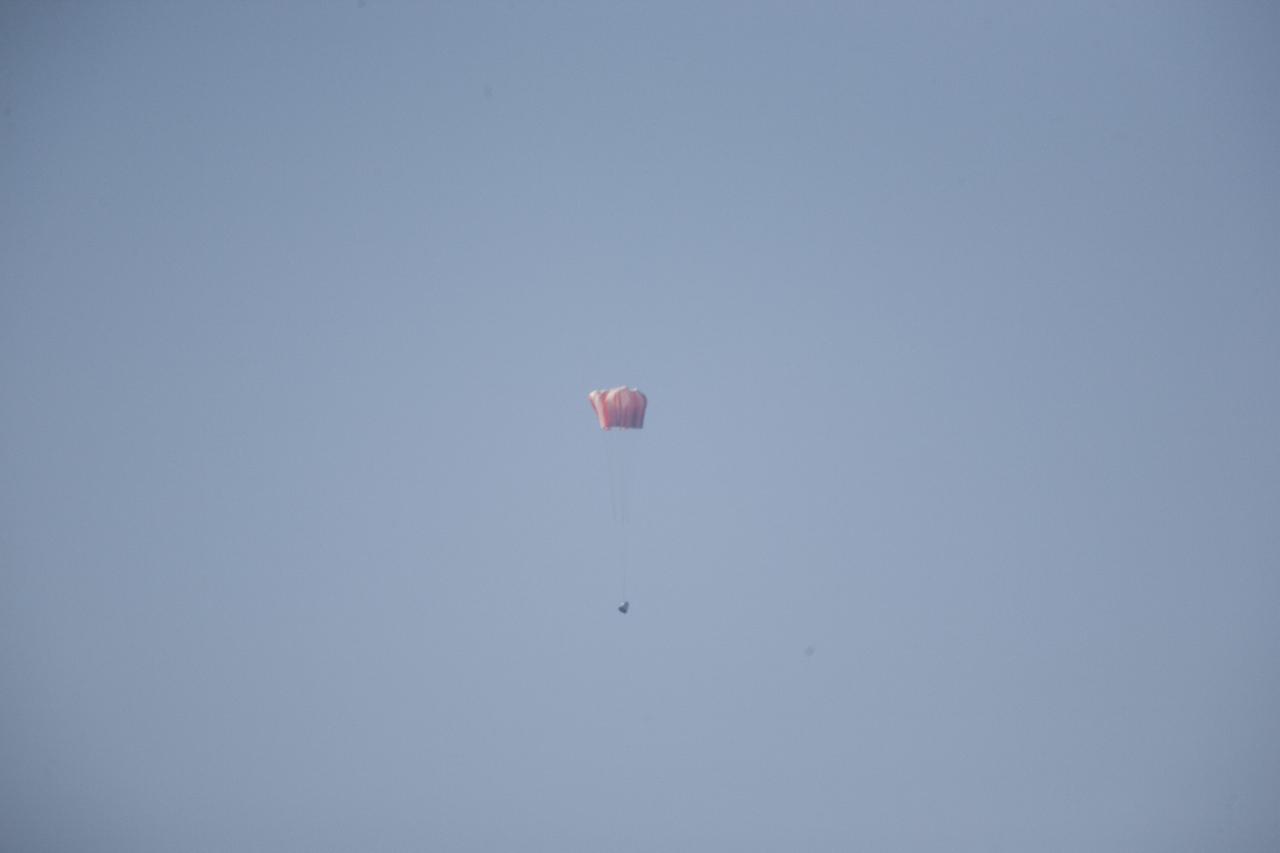
MORRO BAY, Calif. – The main parachutes open above a the Dragon test article during a test over the Pacific Ocean, off the coast of Morro Bay, Calif. The test enabled SpaceX engineers to evaluate the spacecraft's parachute deployment system as part of a milestone under its Commercial Crew Integrated Capability agreement with NASA's Commercial Crew Program. The parachute test took place at Marro Bay, Calif. Photo credit: NASA/Kim Shiflett
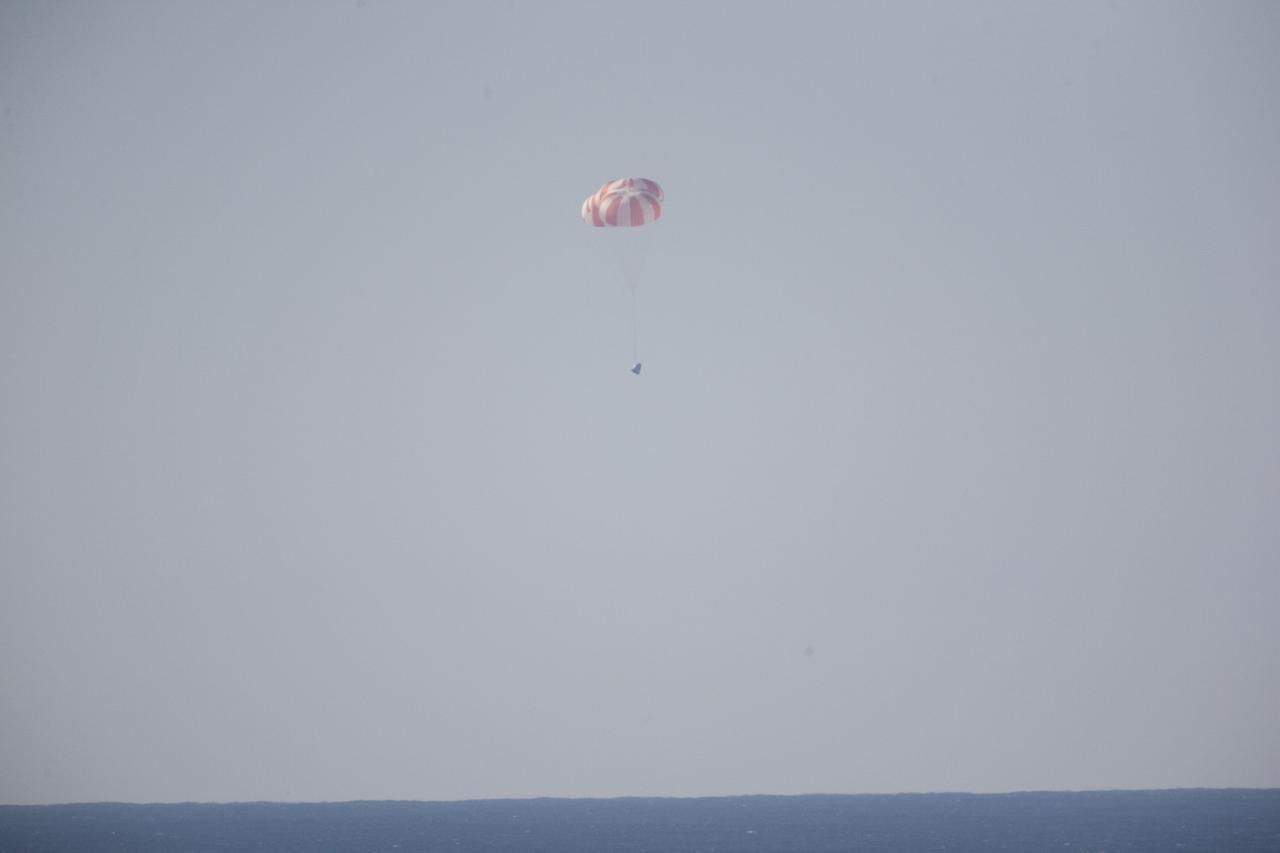
MORRO BAY, Calif. – The SpaceX main parachutes control the descent of the Dragon test article following a test over the Pacific Ocean, off the coast of Morro Bay, Calif. The test enabled SpaceX engineers to evaluate the spacecraft's parachute deployment system as part of a milestone under its Commercial Crew Integrated Capability agreement with NASA's Commercial Crew Program. The parachute test took place at Marro Bay, Calif. Photo credit: NASA/Kim Shiflett
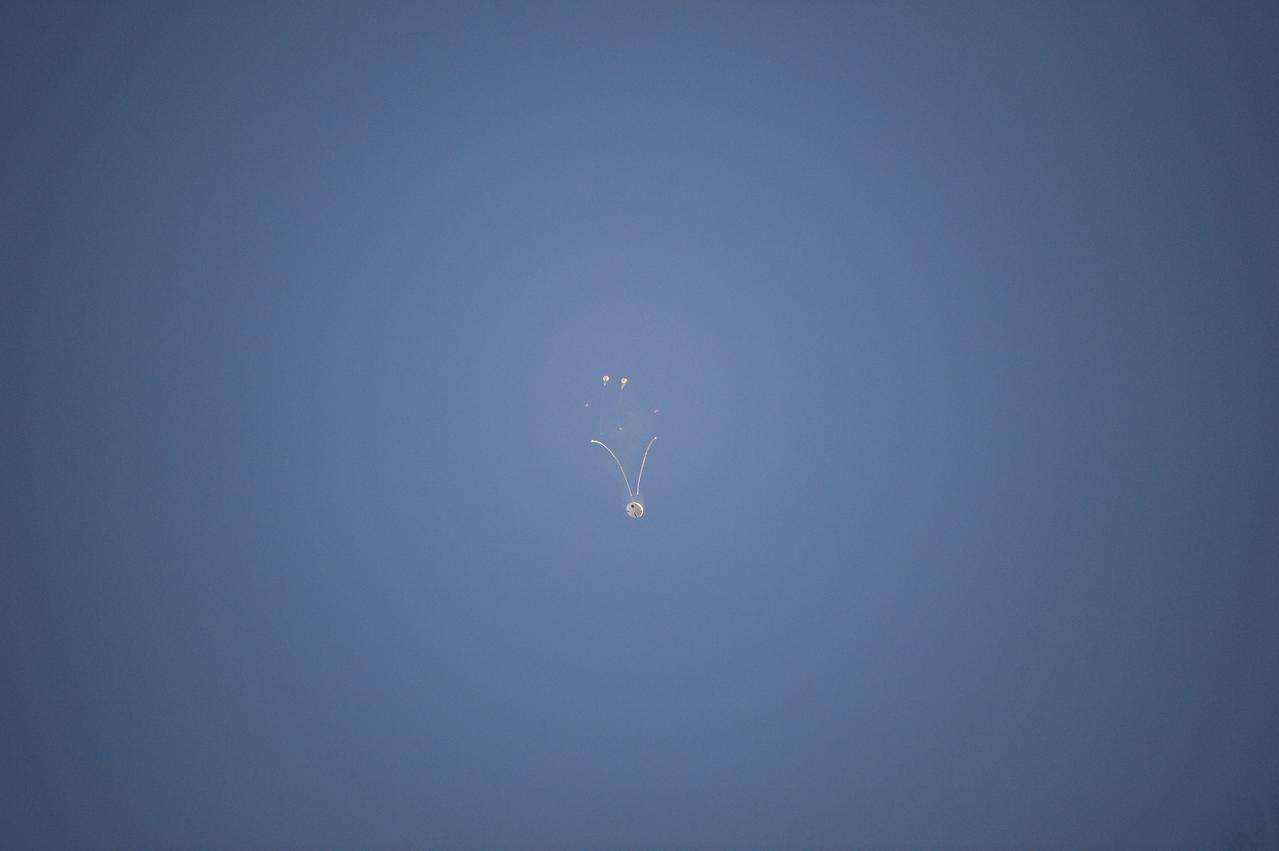
Engineers successfully evaluated a failure scenario of Orion’s parachute system in which only two of the system’s three orange and white main parachutes deploy after several other parachutes in the system used to slow and stabilize Orion endure high aerodynamic stresses ahead of a safe landing. The test occurred Dec. 15, 2017 at the U.S. Army Proving Ground in Yuma, Arizona. A mock capsule was dropped from a C-17 aircraft at 35,000 feet in altitude to enable the right conditions for the test. It was the fifth of eight tests to qualify Orion’s parachute system for flights with astronauts beginning with Artemis II.

Engineers successfully evaluated a failure scenario of Orion’s parachute system in which only two of the system’s three orange and white main parachutes deploy after several other parachutes in the system used to slow and stabilize Orion endure high aerodynamic stresses ahead of a safe landing. The test occurred Dec. 15, 2017 at the U.S. Army Proving Ground in Yuma, Arizona. A mock capsule was dropped from a C-17 aircraft at 35,000 feet in altitude to enable the right conditions for the test. It was the fifth of eight tests to qualify Orion’s parachute system for flights with astronauts beginning with Artemis II.

Engineers successfully evaluated a failure scenario of Orion’s parachute system in which only two of the system’s three orange and white main parachutes deploy after several other parachutes in the system used to slow and stabilize Orion endure high aerodynamic stresses ahead of a safe landing. The test occurred Dec. 15, 2017 at the U.S. Army Proving Ground in Yuma, Arizona. A mock capsule was dropped from a C-17 aircraft at 35,000 feet in altitude to enable the right conditions for the test. It was the fifth of eight tests to qualify Orion’s parachute system for flights with astronauts beginning with Artemis II.

Engineers successfully evaluated a failure scenario of Orion’s parachute system in which only two of the system’s three orange and white main parachutes deploy after several other parachutes in the system used to slow and stabilize Orion endure high aerodynamic stresses ahead of a safe landing. The test occurred Dec. 15, 2017 at the U.S. Army Proving Ground in Yuma, Arizona. A mock capsule was dropped from a C-17 aircraft at 35,000 feet in altitude to enable the right conditions for the test. It was the fifth of eight tests to qualify Orion’s parachute system for flights with astronauts beginning with Artemis II.
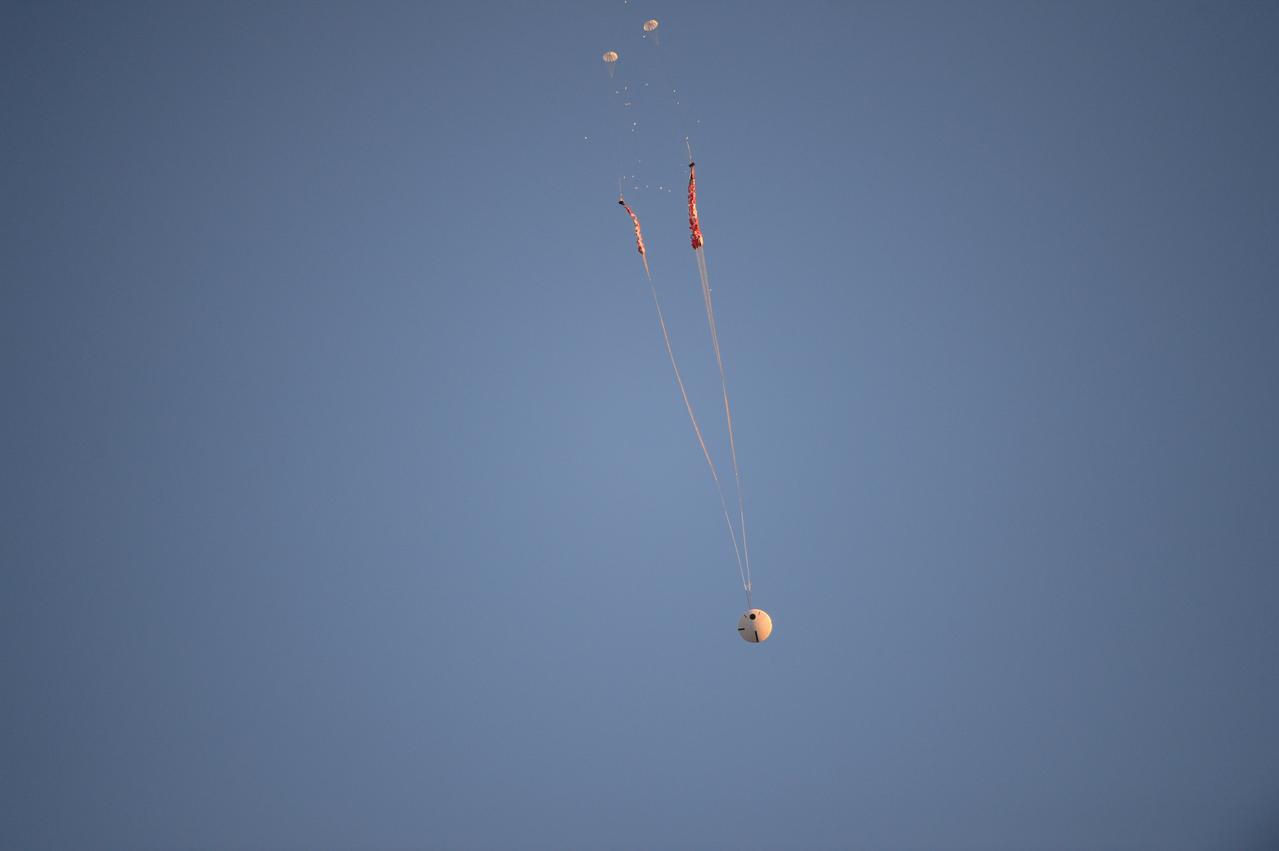
Engineers successfully evaluated a failure scenario of Orion’s parachute system in which only two of the system’s three orange and white main parachutes deploy after several other parachutes in the system used to slow and stabilize Orion endure high aerodynamic stresses ahead of a safe landing. The test occurred Dec. 15, 2017 at the U.S. Army Proving Ground in Yuma, Arizona. A mock capsule was dropped from a C-17 aircraft at 35,000 feet in altitude to enable the right conditions for the test. It was the fifth of eight tests to qualify Orion’s parachute system for flights with astronauts beginning with Artemis II.
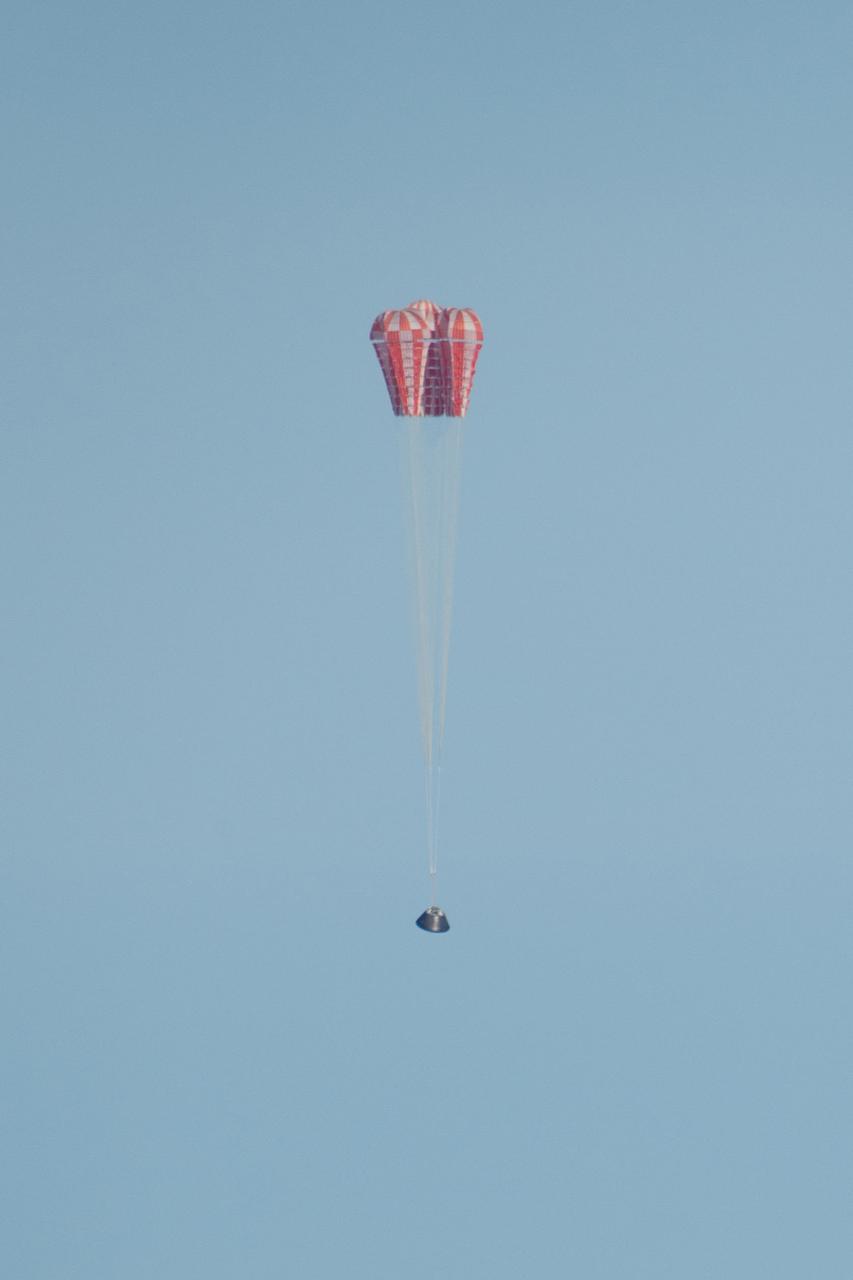
Orion's main parachutes begin to unfurl as it returns to Earth during Exploration Flight Test-1 (EFT-1) on Dec. 5, 2014. Part of Batch image transfer from Flickr.

Caption: Off the pad abort shot at Wallops using Langley PARD designed full scale capsule with Recruit rocket and extended skirt main parachute. Shows sequential images of launch and capsule splashdown.
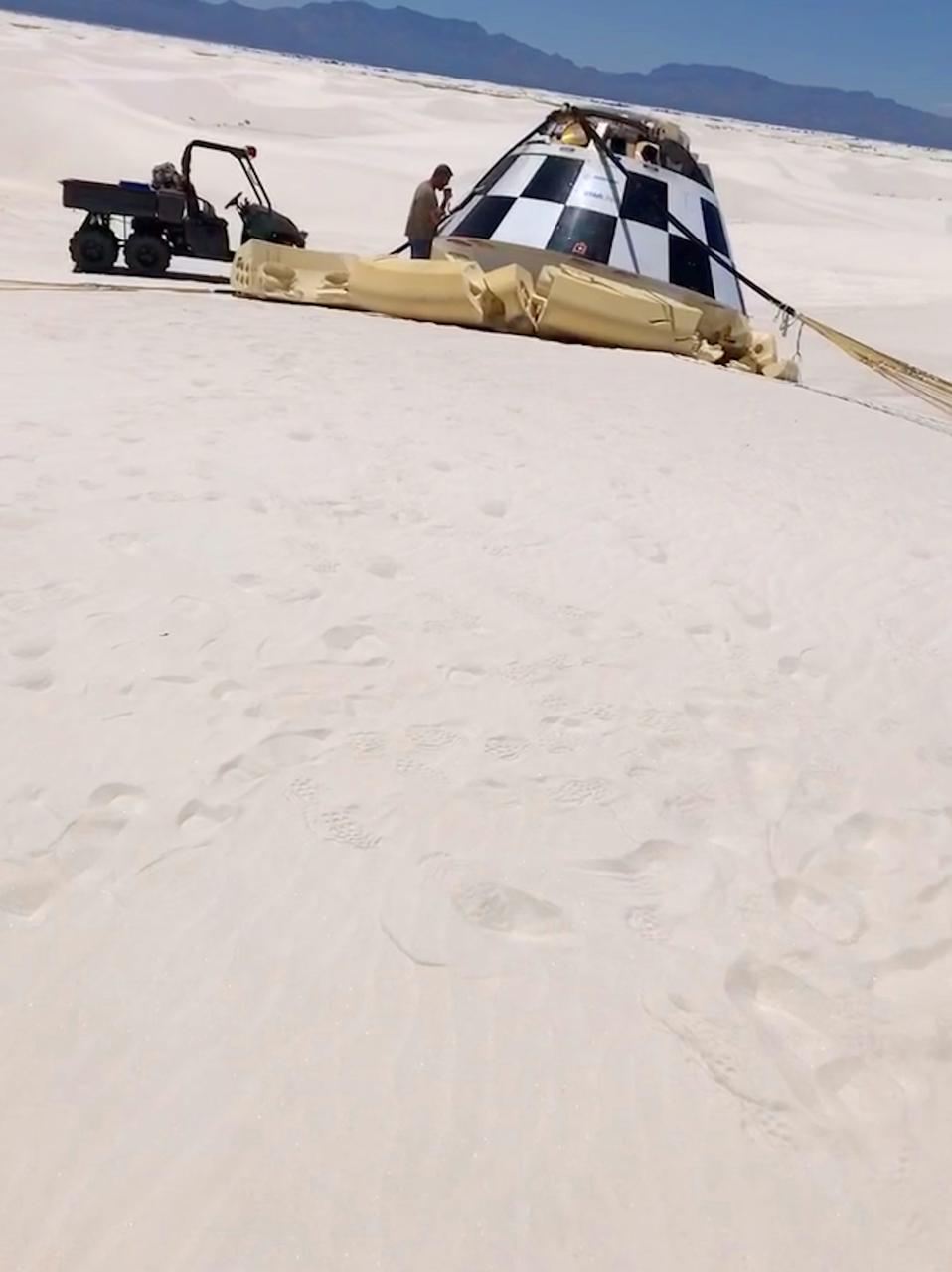
A full-scale Boeing CST-100 Starliner test article, known as a boiler plate, successfully lands at the U.S. Army’s White Sands Missile Range in New Mexico during parachute system testing on June 24, 2019. Boeing conducted the test, which involved intentionally disabling one of the parachute system’s two drogue parachutes and one of the three main parachutes to evaluate how the remaining parachutes handled the additional loads during deployment and descent. This was one of a series of important parachute tests to validate the system is safe to carry astronauts to and from the International Space Station as part of NASA’s Commercial Crew Program. Boeing is targeting an uncrewed Orbital Flight Test to the space station this summer, followed by its Crew Flight Test. Starliner will launch atop a United Launch Alliance Atlas V rocket from Space Launch Complex 41 at Cape Canaveral Air Force Station in Florida.
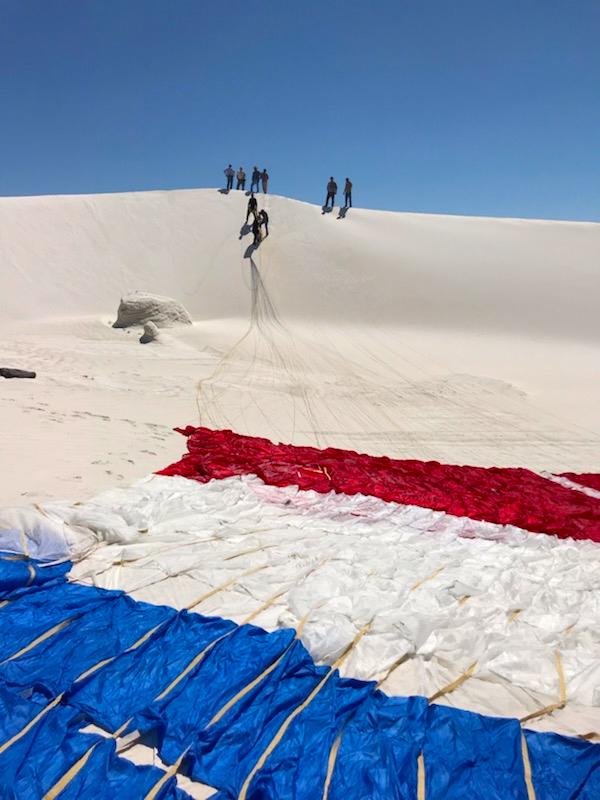
Boeing’s CST-100 Starliner’s parachute systems are successfully tested at the U.S. Army’s White Sands Missile Range in New Mexico on June 24, 2019. Boeing conducted the test using a full-scale Starliner test article, known as a boiler plate, designed to simulate the actual spacecraft. The test involved intentionally disabling one of the parachute system’s two drogue parachutes and one of the three main parachutes to evaluate how the remaining parachutes handled the additional loads during deployment and descent. This was one of a series of important parachute tests to validate the system is safe to carry astronauts to and from the International Space Station as part of NASA’s Commercial Crew Program. Boeing is targeting an uncrewed Orbital Flight Test to the space station this summer, followed by its Crew Flight Test. Starliner will launch atop a United Launch Alliance Atlas V rocket from Space Launch Complex 41 at Cape Canaveral Air Force Station in Florida.
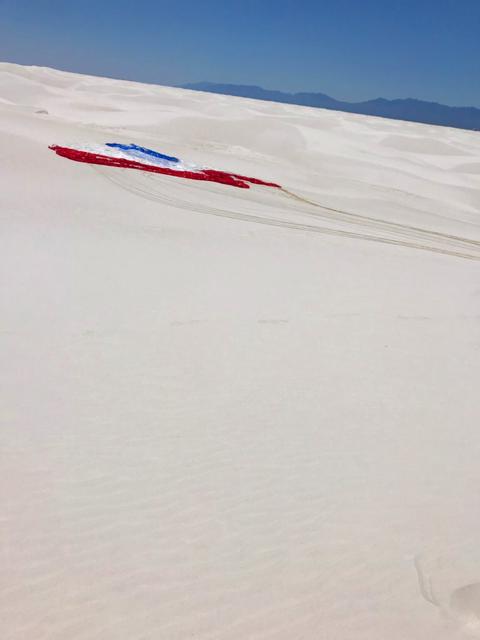
Boeing’s CST-100 Starliner’s parachute systems are successfully tested at the U.S. Army’s White Sands Missile Range in New Mexico on June 24, 2019. Boeing conducted the test using a full-scale Starliner test article, known as a boiler plate, designed to simulate the actual spacecraft. The test involved intentionally disabling one of the parachute system’s two drogue parachutes and one of the three main parachutes to evaluate how the remaining parachutes handled the additional loads during deployment and descent. This was one of a series of important parachute tests to validate the system is safe to carry astronauts to and from the International Space Station as part of NASA’s Commercial Crew Program. Boeing is targeting an uncrewed Orbital Flight Test to the space station this summer, followed by its Crew Flight Test. Starliner will launch atop a United Launch Alliance Atlas V rocket from Space Launch Complex 41 at Cape Canaveral Air Force Station in Florida.
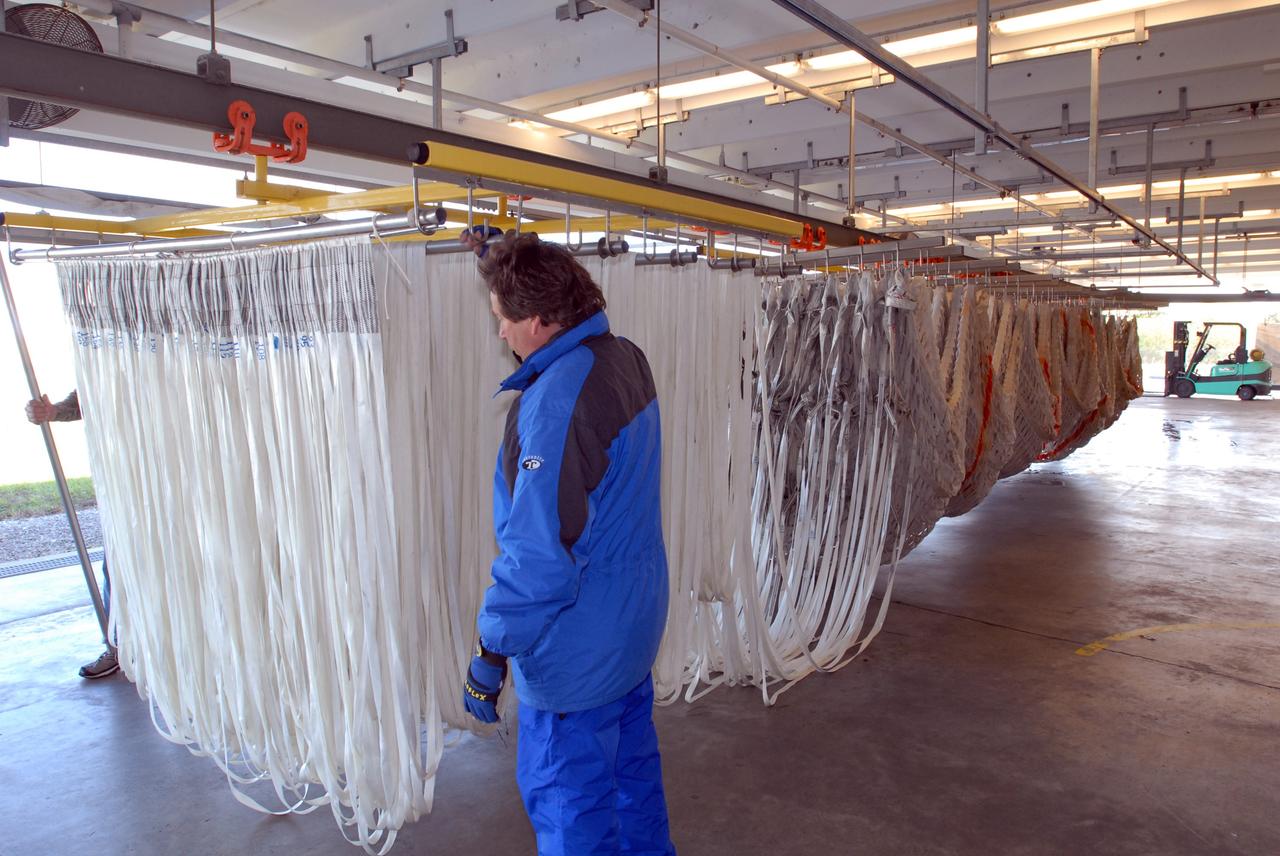
CAPE CANAVERAL, Fla. – At the Parachute Refurbishment Facility at NASA's Kennedy Space Center in Florida, a worker checks the parachute lines suspended from the monorail system. The parachutes were recovered from sea after the launch of space shuttle Endeavour on the STS-126 mission The parachutes are used to slow the descent of the solid rocket boosters that are jettisoned during liftoff. The monorail will transport each parachute into a 30,000-gallon washer and a huge dryer heated with 140-degree air at 13,000 cubic feet per minute. One pilot, one drogue and three main canopies per booster slow the booster’s fall from about 360 mph to 50 mph. After the chutes are cleaned and repaired, they must be carefully packed into their bags so they will deploy correctly the next time they are used. Photo credit: NASA/Jim Grossmann
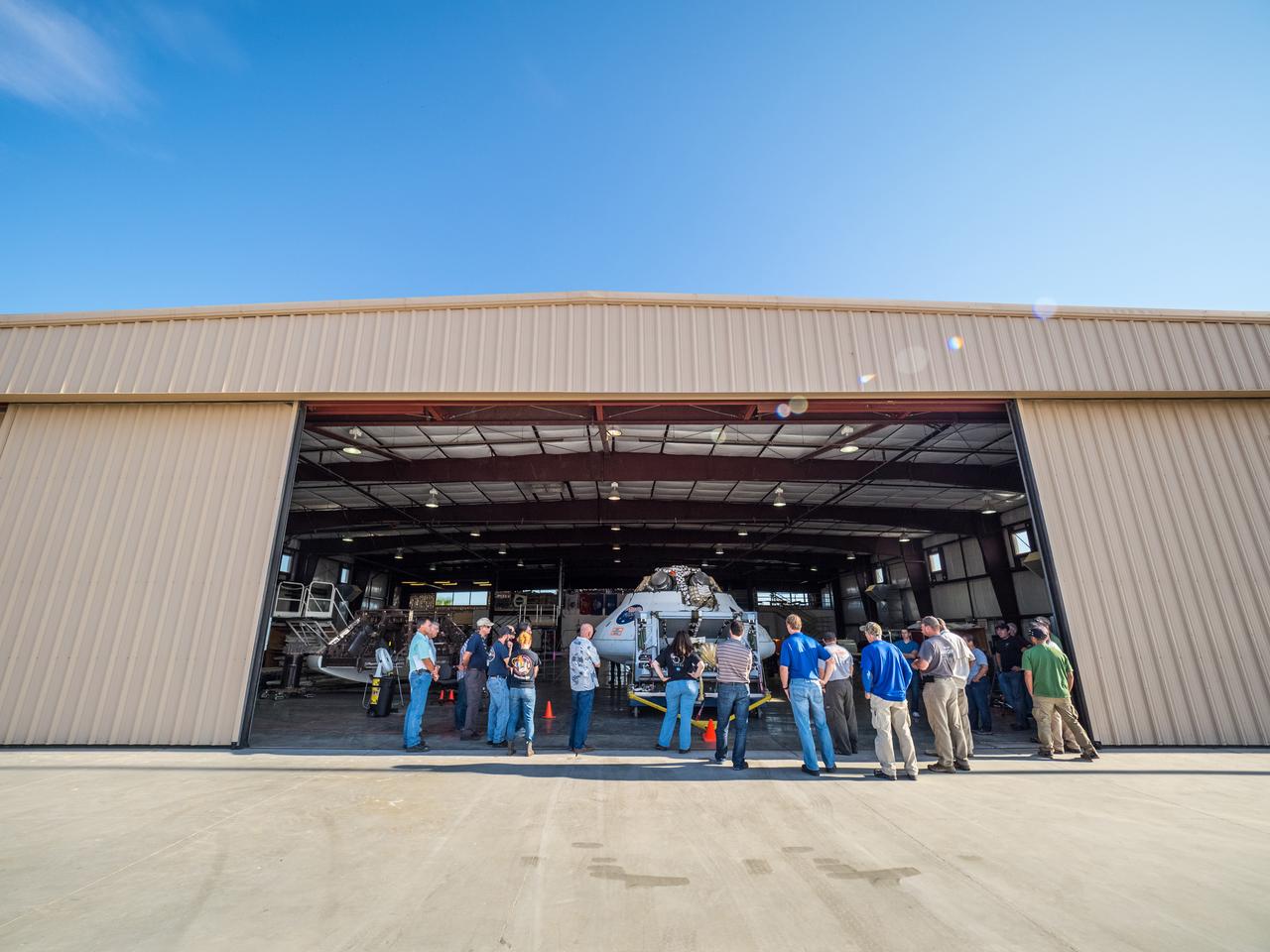
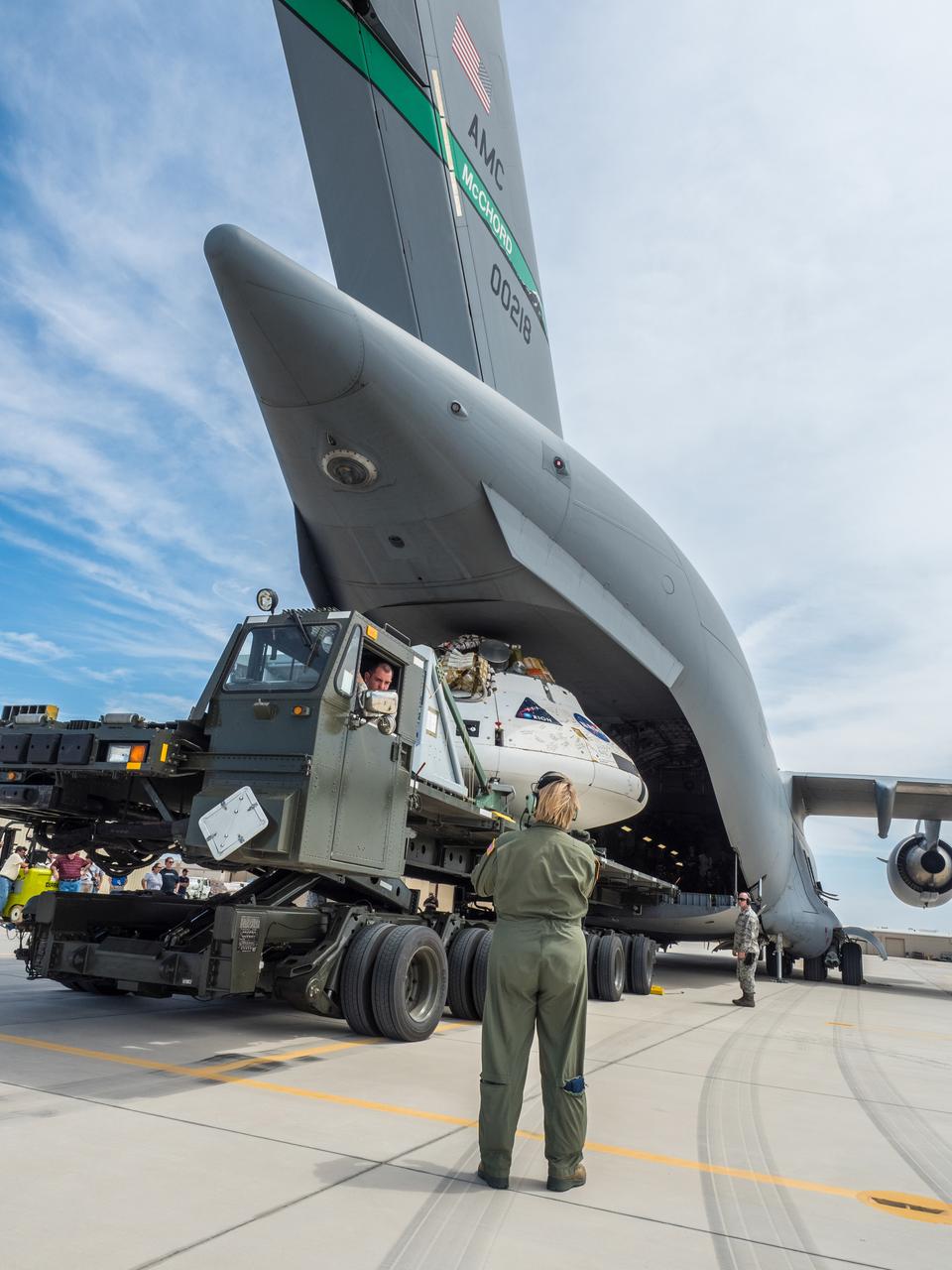
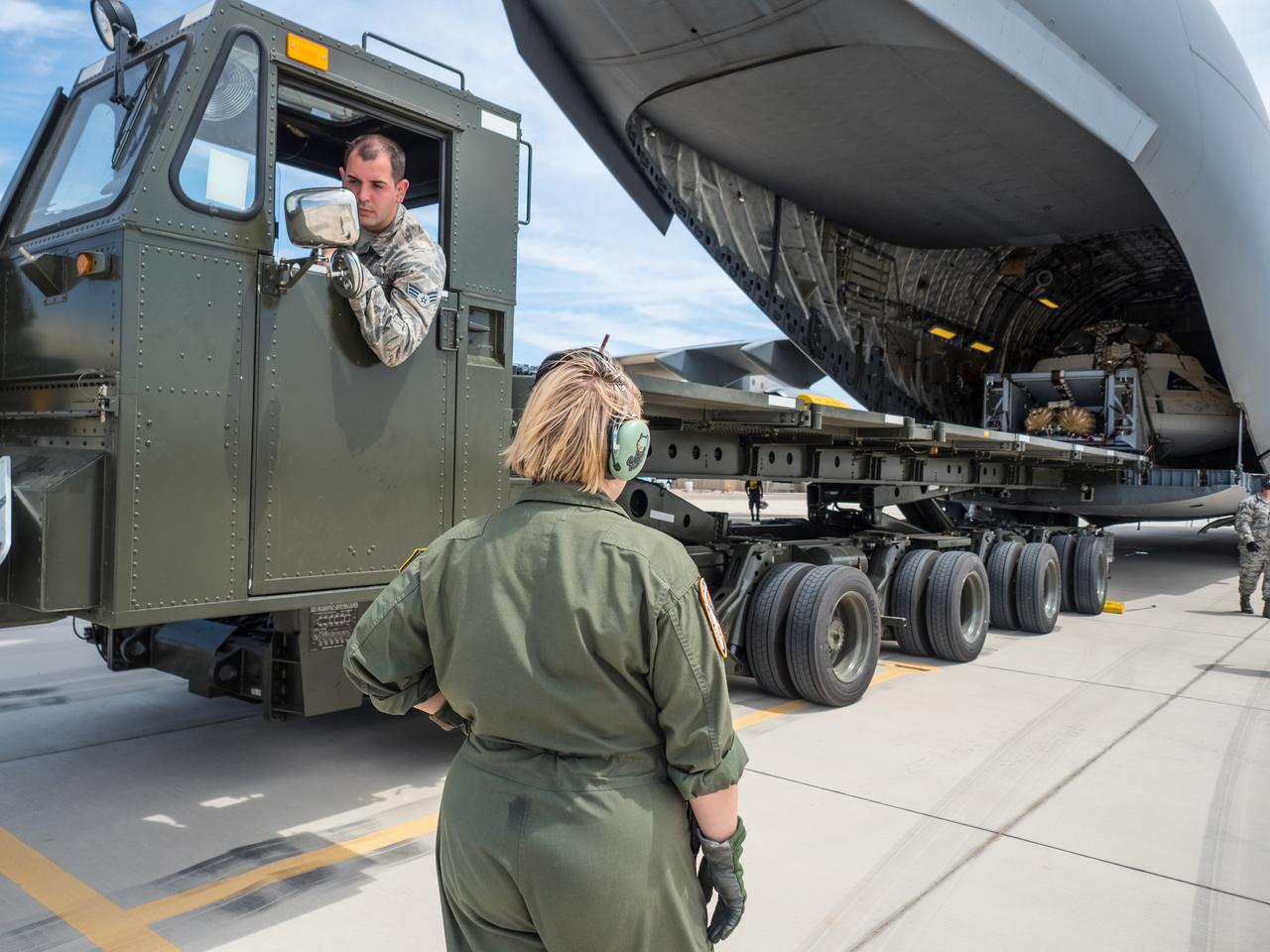
Engineers prepare to test the parachute system for NASA’s Orion spacecraft at the U.S. Army Yuma Proving Ground in Yuma, Arizona on Aug. 24, 2015. During the test, planned for Wednesday, Aug. 26, a C-17 aircraft will carry a representative Orion capsule to 35,000 feet in altitude and then drop it from its cargo bay. Engineers will test a scenario in which one of Orion’s two drogue parachutes, used to stabilize it in the air, does not deploy, and one of its three main parachutes, used to slow the capsule during the final stage of descent, also does not deploy. The risky test will provide data engineers will use as they gear up to qualify Orion’s parachutes for missions with astronauts. On Aug. 24, a C-17 was loaded with the test version of Orion, which has a similar mass and interfaces with the parachutes as the Orion being developed for deep space missions but is shorter on top to fit inside the aircraft. Part of Batch image transfer from Flickr.
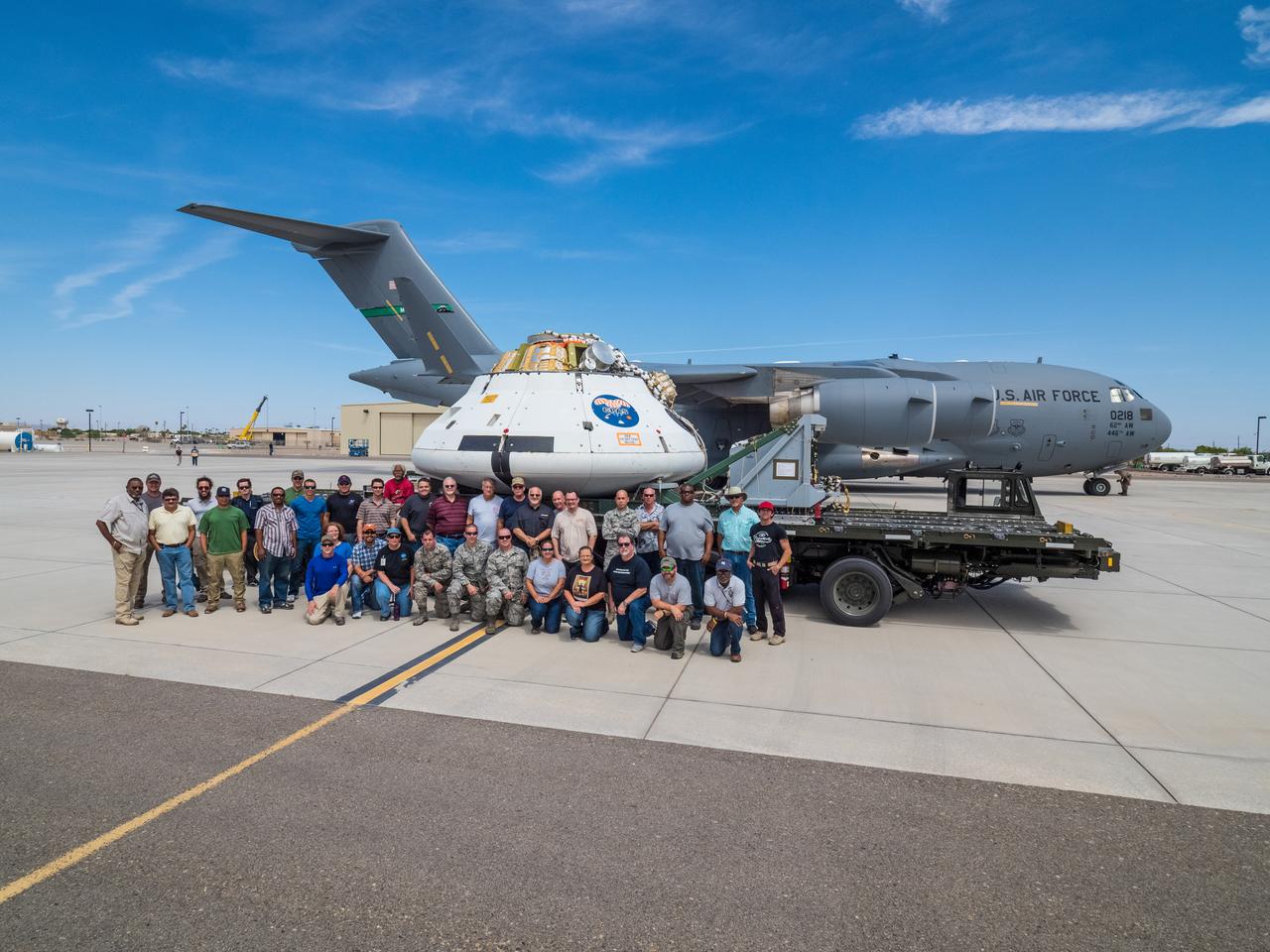
Engineers prepare to test the parachute system for NASA’s Orion spacecraft at the U.S. Army Yuma Proving Ground in Yuma, Arizona on Aug. 24, 2015. During the test, planned for Wednesday, Aug. 26, a C-17 aircraft will carry a representative Orion capsule to 35,000 feet in altitude and then drop it from its cargo bay. Engineers will test a scenario in which one of Orion’s two drogue parachutes, used to stabilize it in the air, does not deploy, and one of its three main parachutes, used to slow the capsule during the final stage of descent, also does not deploy. The risky test will provide data engineers will use as they gear up to qualify Orion’s parachutes for missions with astronauts. On Aug. 24, a C-17 was loaded with the test version of Orion, which has a similar mass and interfaces with the parachutes as the Orion being developed for deep space missions but is shorter on top to fit inside the aircraft. Part of Batch image transfer from Flickr.

Engineers prepare to test the parachute system for NASA’s Orion spacecraft at the U.S. Army Yuma Proving Ground in Yuma, Arizona on Aug. 24, 2015. During the test, planned for Wednesday, Aug. 26, a C-17 aircraft will carry a representative Orion capsule to 35,000 feet in altitude and then drop it from its cargo bay. Engineers will test a scenario in which one of Orion’s two drogue parachutes, used to stabilize it in the air, does not deploy, and one of its three main parachutes, used to slow the capsule during the final stage of descent, also does not deploy. The risky test will provide data engineers will use as they gear up to qualify Orion’s parachutes for missions with astronauts. On Aug. 24, a C-17 was loaded with the test version of Orion, which has a similar mass and interfaces with the parachutes as the Orion being developed for deep space missions but is shorter on top to fit inside the aircraft. Part of Batch image transfer from Flickr.
Engineers prepare to test the parachute system for NASA’s Orion spacecraft at the U.S. Army Yuma Proving Ground in Yuma, Arizona on Aug. 24, 2015. During the test, planned for Wednesday, Aug. 26, a C-17 aircraft will carry a representative Orion capsule to 35,000 feet in altitude and then drop it from its cargo bay. Engineers will test a scenario in which one of Orion’s two drogue parachutes, used to stabilize it in the air, does not deploy, and one of its three main parachutes, used to slow the capsule during the final stage of descent, also does not deploy. The risky test will provide data engineers will use as they gear up to qualify Orion’s parachutes for missions with astronauts. On Aug. 24, a C-17 was loaded with the test version of Orion, which has a similar mass and interfaces with the parachutes as the Orion being developed for deep space missions but is shorter on top to fit inside the aircraft. Part of Batch image transfer from Flickr.
Engineers prepare to test the parachute system for NASA’s Orion spacecraft at the U.S. Army Yuma Proving Ground in Yuma, Arizona on Aug. 24, 2015. During the test, planned for Wednesday, Aug. 26, a C-17 aircraft will carry a representative Orion capsule to 35,000 feet in altitude and then drop it from its cargo bay. Engineers will test a scenario in which one of Orion’s two drogue parachutes, used to stabilize it in the air, does not deploy, and one of its three main parachutes, used to slow the capsule during the final stage of descent, also does not deploy. The risky test will provide data engineers will use as they gear up to qualify Orion’s parachutes for missions with astronauts. On Aug. 24, a C-17 was loaded with the test version of Orion, which has a similar mass and interfaces with the parachutes as the Orion being developed for deep space missions but is shorter on top to fit inside the aircraft. Part of Batch image transfer from Flickr.
SpaceX performed its fourteenth overall parachute test supporting Crew Dragon development. This most recent exercise was the first of several planned parachute system qualification tests ahead of the spacecraft’s first crewed flight and resulted in the successful touchdown of Crew Dragon’s parachute system. During this test, a C-130 aircraft transported the parachute test vehicle, designed to achieve the maximum speeds that Crew Dragon could experience on re-entry, over the Mojave Desert in Southern California and dropped the vehicle from an altitude of 25,000 feet. The test demonstrated an off-nominal situation, deploying only one of the two drogue chutes and intentionally skipping a reefing stage on one of the four main parachutes, proving a safe landing in such a contingency scenario.
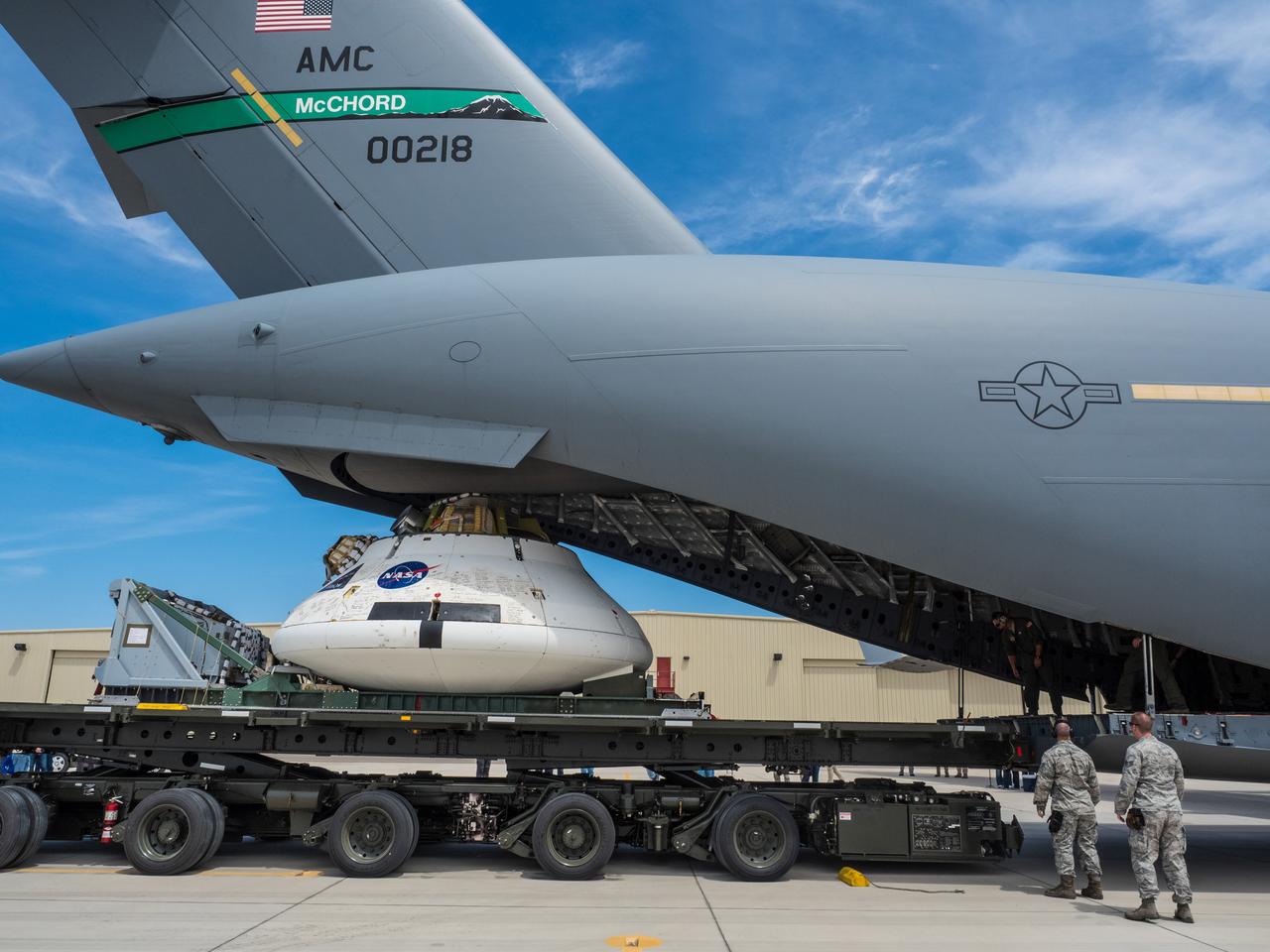
Engineers prepare to test the parachute system for NASA’s Orion spacecraft at the U.S. Army Yuma Proving Ground in Yuma, Arizona on Aug. 24, 2015. During the test, planned for Wednesday, Aug. 26, a C-17 aircraft will carry a representative Orion capsule to 35,000 feet in altitude and then drop it from its cargo bay. Engineers will test a scenario in which one of Orion’s two drogue parachutes, used to stabilize it in the air, does not deploy, and one of its three main parachutes, used to slow the capsule during the final stage of descent, also does not deploy. The risky test will provide data engineers will use as they gear up to qualify Orion’s parachutes for missions with astronauts. On Aug. 24, a C-17 was loaded with the test version of Orion, which has a similar mass and interfaces with the parachutes as the Orion being developed for deep space missions but is shorter on top to fit inside the aircraft. Part of Batch image transfer from Flickr.
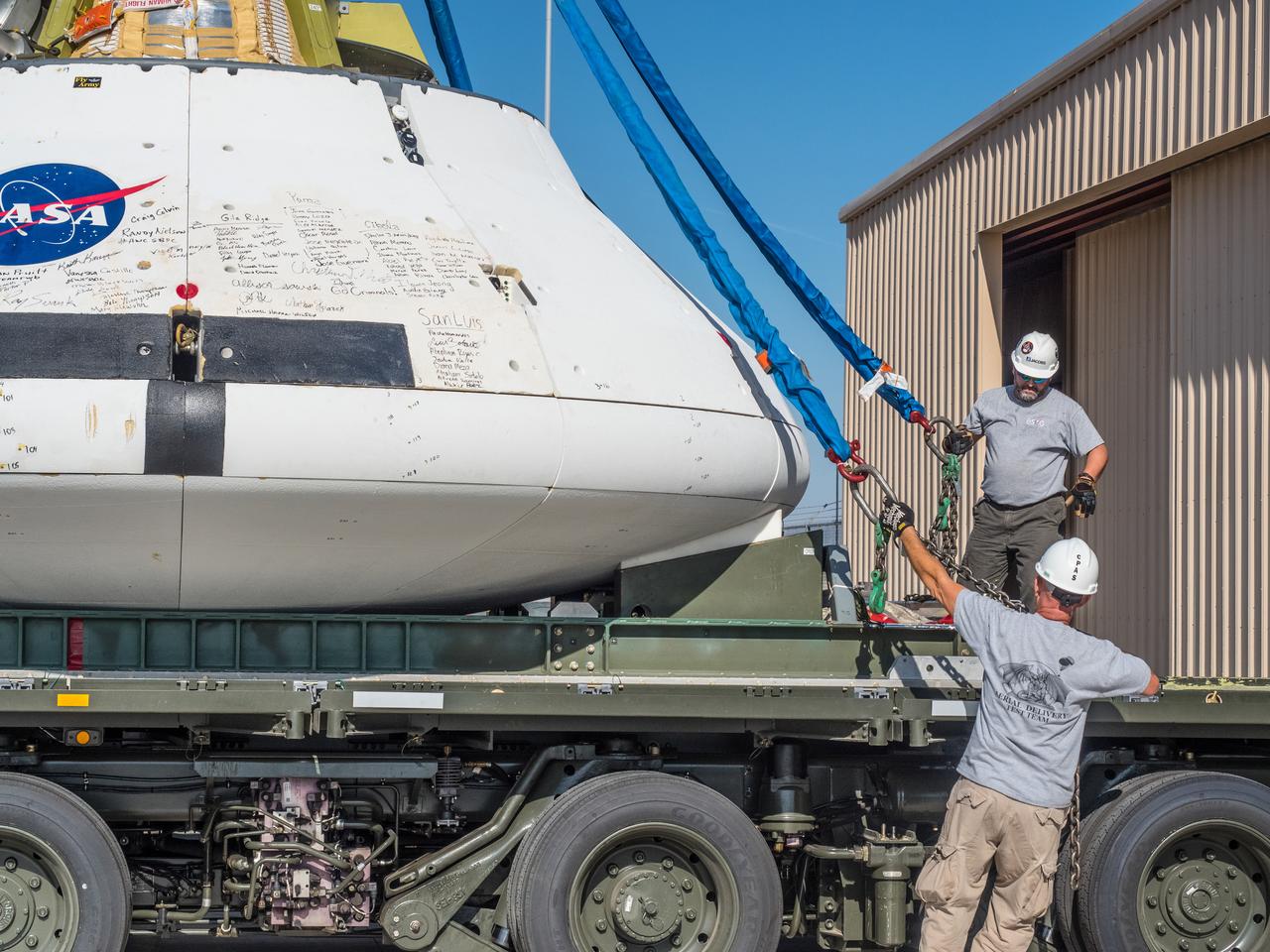
Engineers prepare to test the parachute system for NASA’s Orion spacecraft at the U.S. Army Yuma Proving Ground in Yuma, Arizona on Aug. 24, 2015. During the test, planned for Wednesday, Aug. 26, a C-17 aircraft will carry a representative Orion capsule to 35,000 feet in altitude and then drop it from its cargo bay. Engineers will test a scenario in which one of Orion’s two drogue parachutes, used to stabilize it in the air, does not deploy, and one of its three main parachutes, used to slow the capsule during the final stage of descent, also does not deploy. The risky test will provide data engineers will use as they gear up to qualify Orion’s parachutes for missions with astronauts. On Aug. 24, a C-17 was loaded with the test version of Orion, which has a similar mass and interfaces with the parachutes as the Orion being developed for deep space missions but is shorter on top to fit inside the aircraft. Part of Batch image transfer from Flickr.
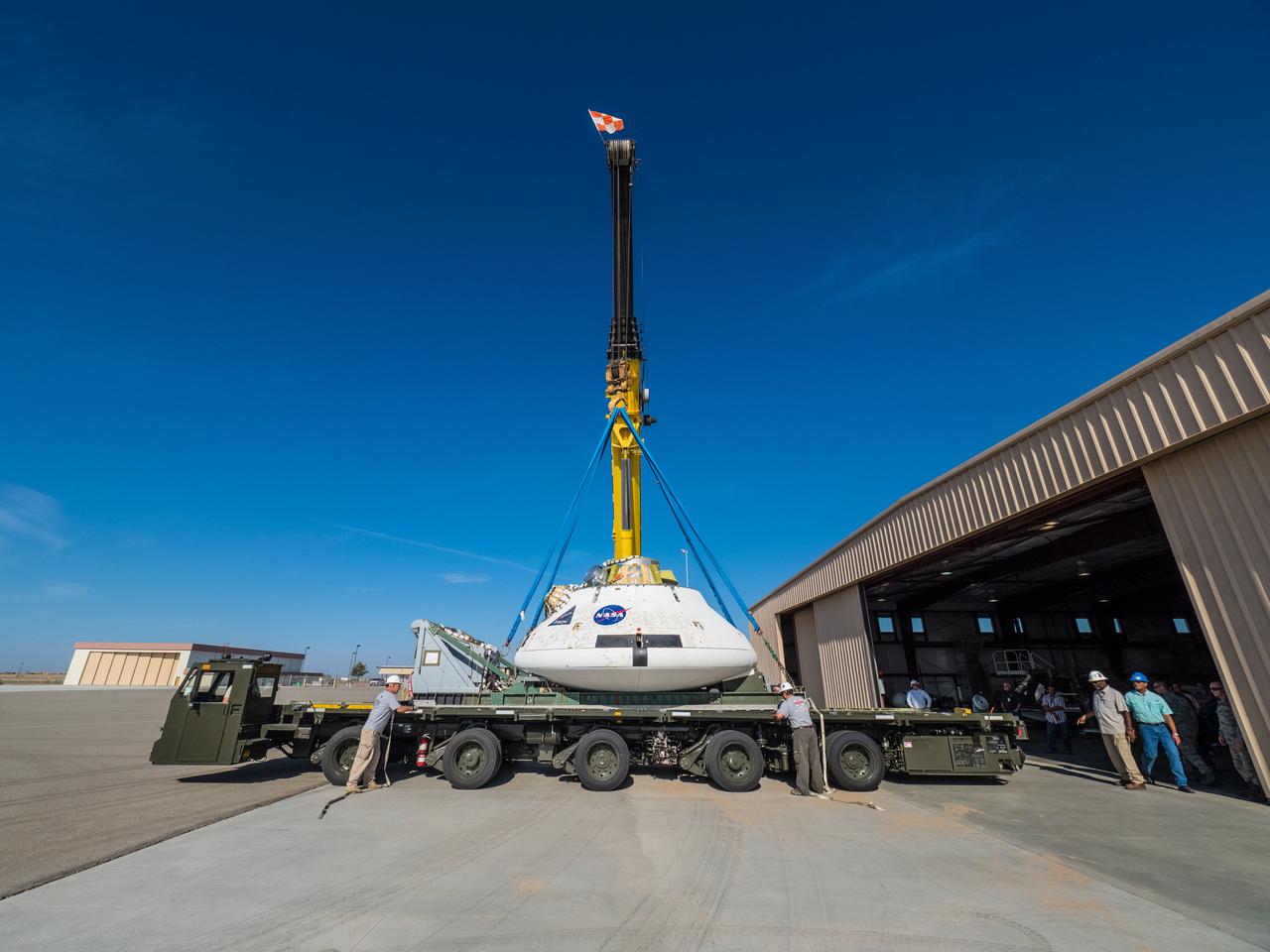
Engineers prepare to test the parachute system for NASA’s Orion spacecraft at the U.S. Army Yuma Proving Ground in Yuma, Arizona on Aug. 24, 2015. During the test, planned for Wednesday, Aug. 26, a C-17 aircraft will carry a representative Orion capsule to 35,000 feet in altitude and then drop it from its cargo bay. Engineers will test a scenario in which one of Orion’s two drogue parachutes, used to stabilize it in the air, does not deploy, and one of its three main parachutes, used to slow the capsule during the final stage of descent, also does not deploy. The risky test will provide data engineers will use as they gear up to qualify Orion’s parachutes for missions with astronauts. On Aug. 24, a C-17 was loaded with the test version of Orion, which has a similar mass and interfaces with the parachutes as the Orion being developed for deep space missions but is shorter on top to fit inside the aircraft. Part of Batch image transfer from Flickr.
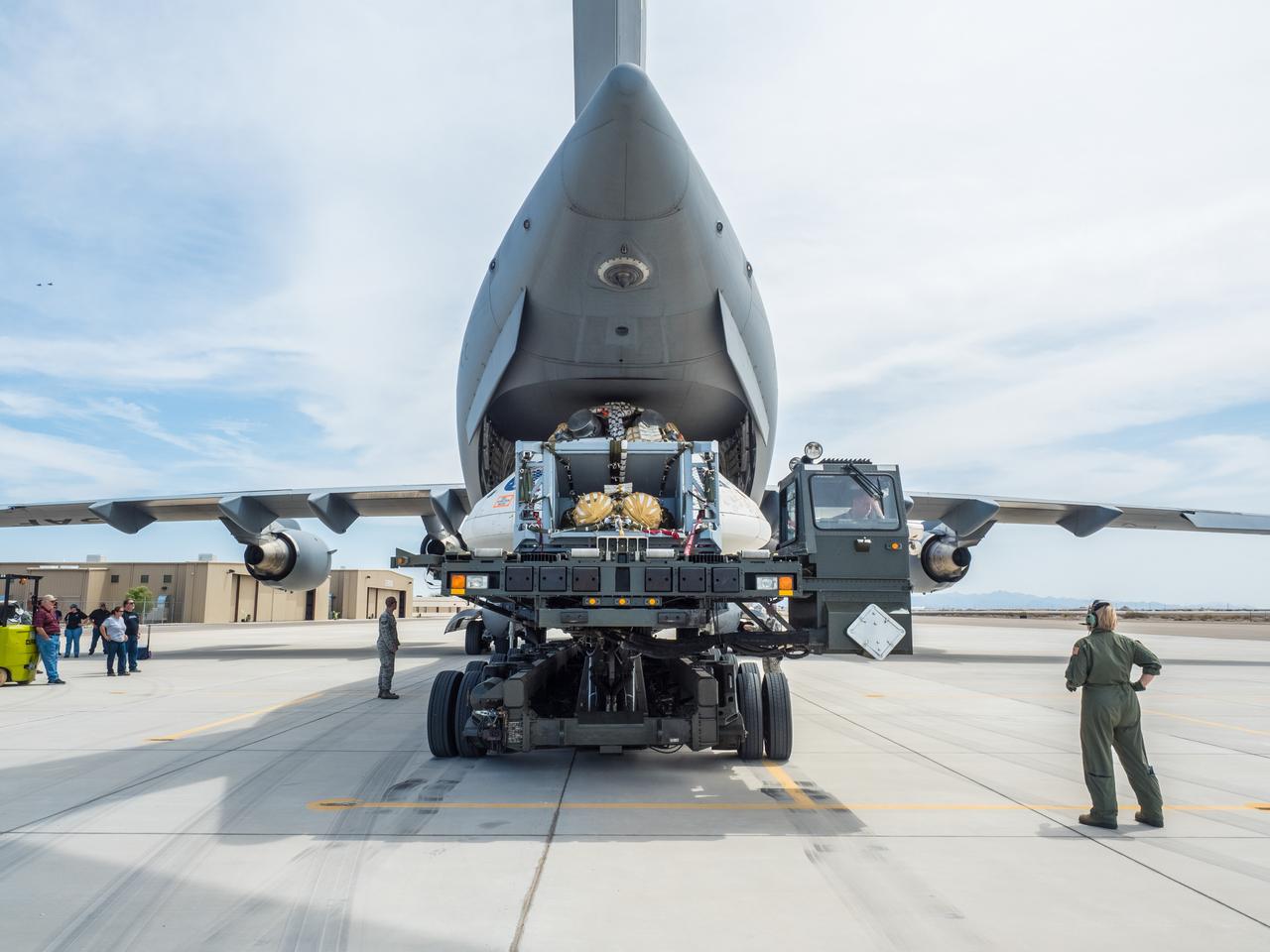
Engineers prepare to test the parachute system for NASA’s Orion spacecraft at the U.S. Army Yuma Proving Ground in Yuma, Arizona on Aug. 24, 2015. During the test, planned for Wednesday, Aug. 26, a C-17 aircraft will carry a representative Orion capsule to 35,000 feet in altitude and then drop it from its cargo bay. Engineers will test a scenario in which one of Orion’s two drogue parachutes, used to stabilize it in the air, does not deploy, and one of its three main parachutes, used to slow the capsule during the final stage of descent, also does not deploy. The risky test will provide data engineers will use as they gear up to qualify Orion’s parachutes for missions with astronauts. On Aug. 24, a C-17 was loaded with the test version of Orion, which has a similar mass and interfaces with the parachutes as the Orion being developed for deep space missions but is shorter on top to fit inside the aircraft. Part of Batch image transfer from Flickr.
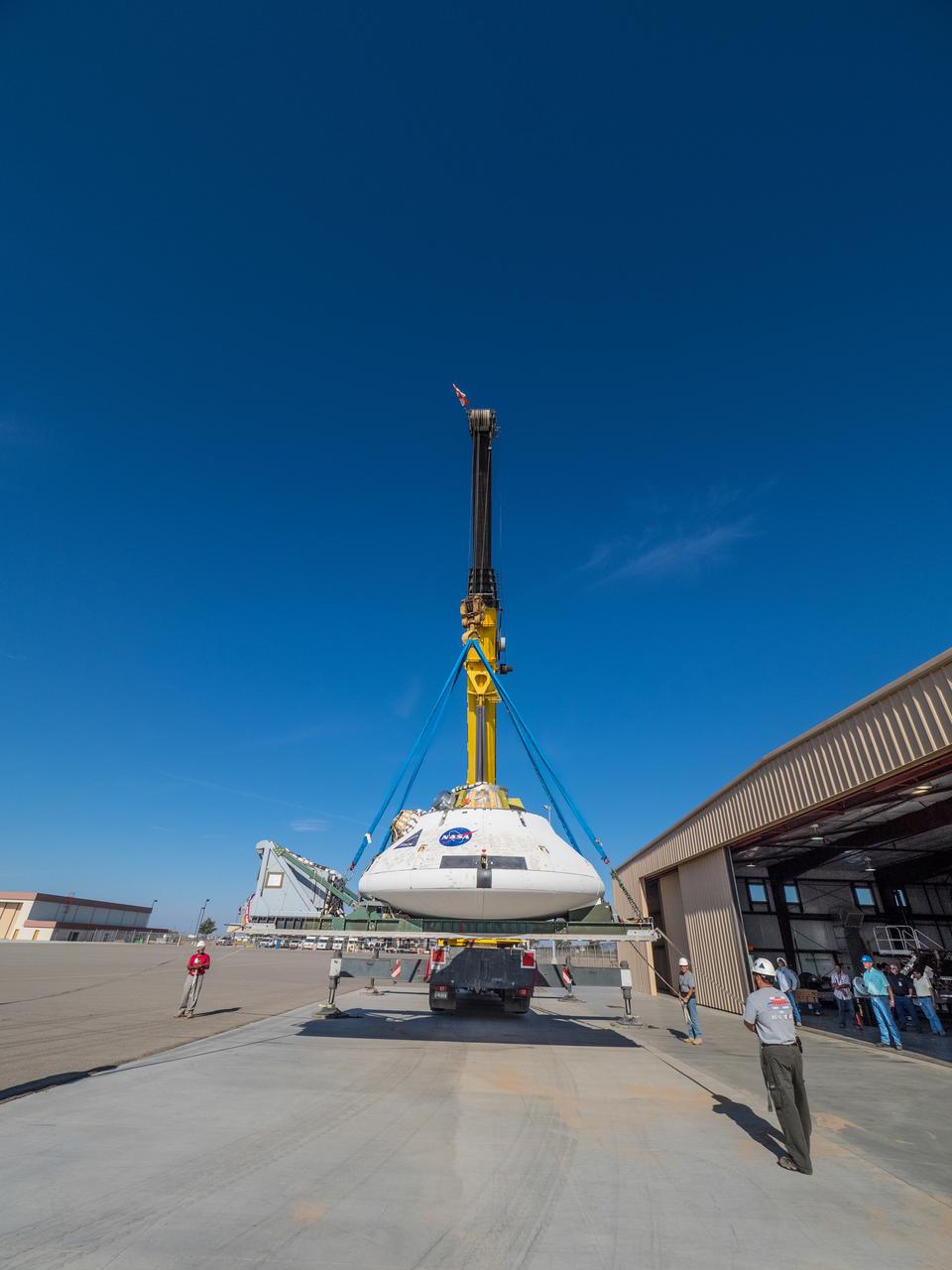
Engineers prepare to test the parachute system for NASA’s Orion spacecraft at the U.S. Army Yuma Proving Ground in Yuma, Arizona on Aug. 24, 2015. During the test, planned for Wednesday, Aug. 26, a C-17 aircraft will carry a representative Orion capsule to 35,000 feet in altitude and then drop it from its cargo bay. Engineers will test a scenario in which one of Orion’s two drogue parachutes, used to stabilize it in the air, does not deploy, and one of its three main parachutes, used to slow the capsule during the final stage of descent, also does not deploy. The risky test will provide data engineers will use as they gear up to qualify Orion’s parachutes for missions with astronauts. On Aug. 24, a C-17 was loaded with the test version of Orion, which has a similar mass and interfaces with the parachutes as the Orion being developed for deep space missions but is shorter on top to fit inside the aircraft. Part of Batch image transfer from Flickr.
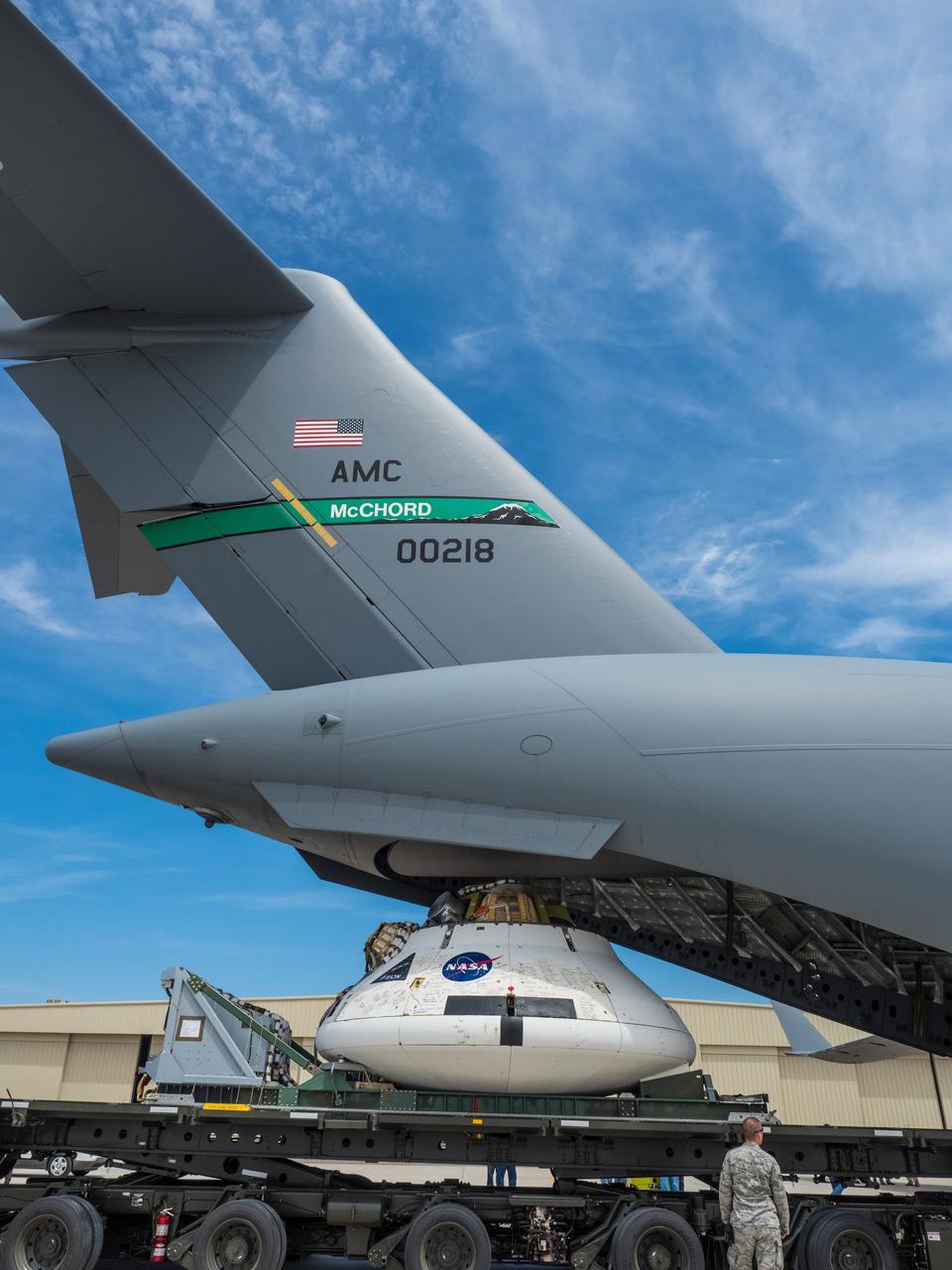
Engineers prepare to test the parachute system for NASA’s Orion spacecraft at the U.S. Army Yuma Proving Ground in Yuma, Arizona on Aug. 24, 2015. During the test, planned for Wednesday, Aug. 26, a C-17 aircraft will carry a representative Orion capsule to 35,000 feet in altitude and then drop it from its cargo bay. Engineers will test a scenario in which one of Orion’s two drogue parachutes, used to stabilize it in the air, does not deploy, and one of its three main parachutes, used to slow the capsule during the final stage of descent, also does not deploy. The risky test will provide data engineers will use as they gear up to qualify Orion’s parachutes for missions with astronauts. On Aug. 24, a C-17 was loaded with the test version of Orion, which has a similar mass and interfaces with the parachutes as the Orion being developed for deep space missions but is shorter on top to fit inside the aircraft. Part of Batch image transfer from Flickr.
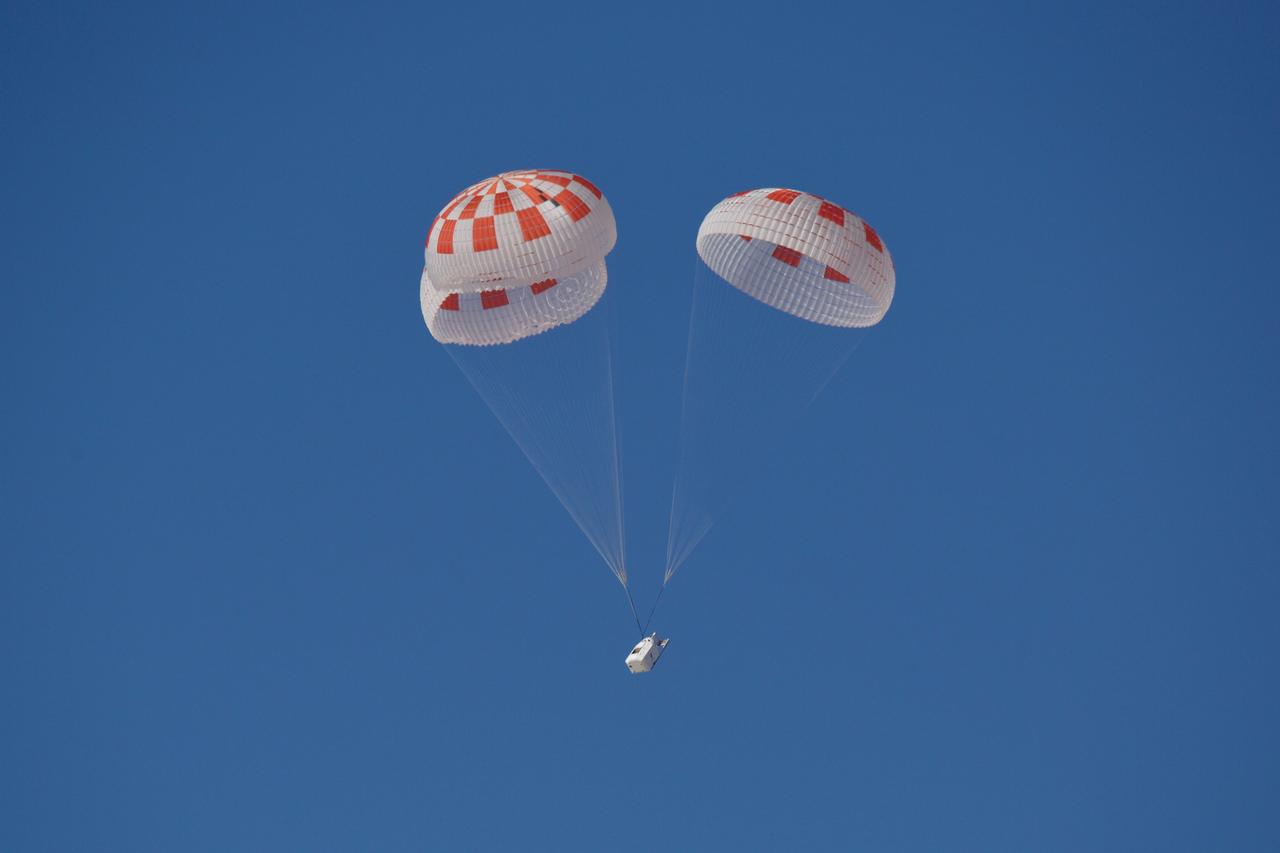
SpaceX performed its fourteenth overall parachute test supporting Crew Dragon development. This most recent exercise was the first of several planned parachute system qualification tests ahead of the spacecraft’s first crewed flight and resulted in the successful touchdown of Crew Dragon’s parachute system. During this test, a C-130 aircraft transported the parachute test vehicle, designed to achieve the maximum speeds that Crew Dragon could experience on re-entry, over the Mojave Desert in Southern California and dropped the vehicle from an altitude of 25,000 feet. The test demonstrated an off-nominal situation, deploying only one of the two drogue chutes and intentionally skipping a reefing stage on one of the four main parachutes, proving a safe landing in such a contingency scenario.
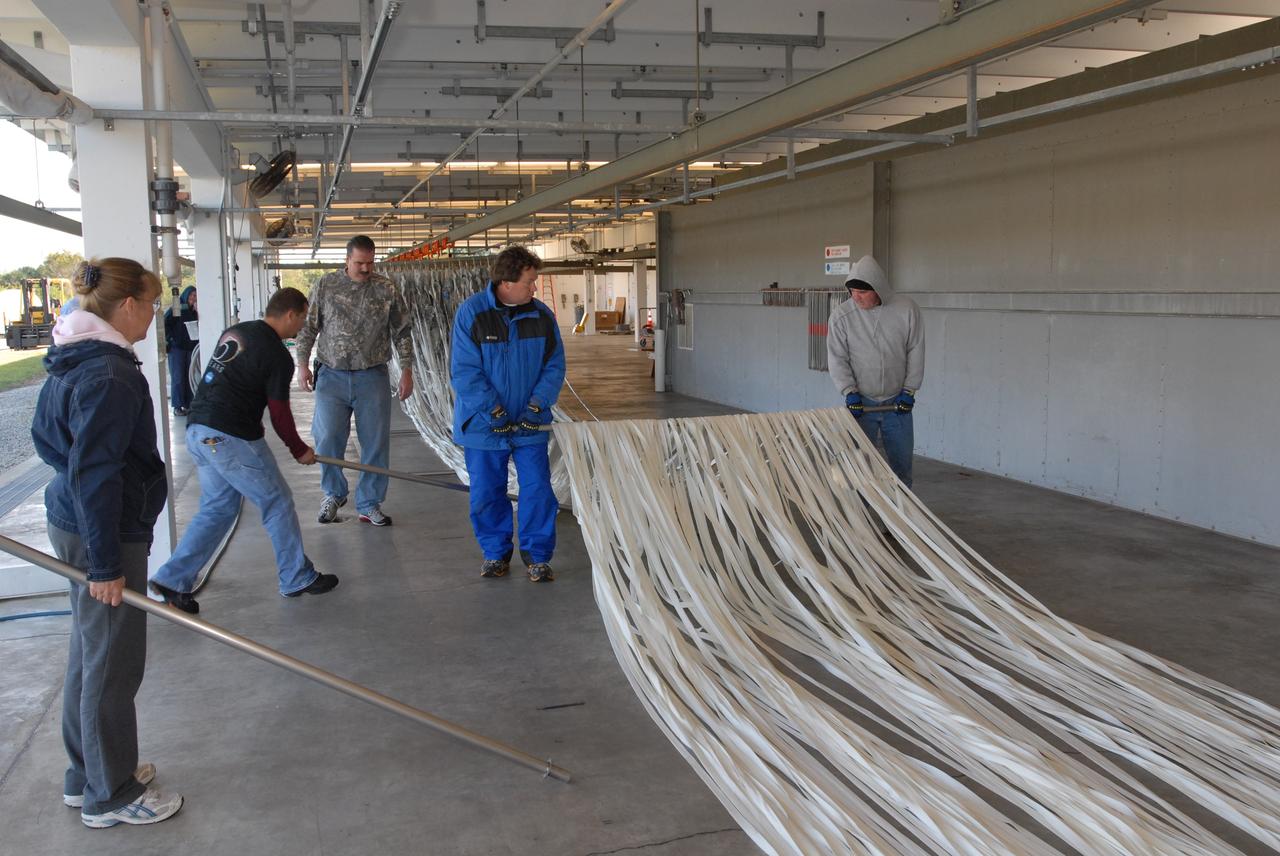
CAPE CANAVERAL, Fla. – At the Parachute Refurbishment Facility at NASA's Kennedy Space Center in Florida, workers place rods under the lines of the parachutes recovered from sea after the launch of space shuttle Endeavour on the STS-126 mission to hang them on a monorail system. Behind them, the parachutes are suspended from the monorail. The parachutes are used to slow the descent of the solid rocket boosters that are jettisoned during liftoff. The monorail will transport each parachute into a 30,000-gallon washer and a huge dryer heated with 140-degree air at 13,000 cubic feet per minute. One pilot, one drogue and three main canopies per booster slow the booster’s fall from about 360 mph to 50 mph. After the chutes are cleaned and repaired, they must be carefully packed into their bags so they will deploy correctly the next time they are used. Photo credit: NASA/Jim Grossmann
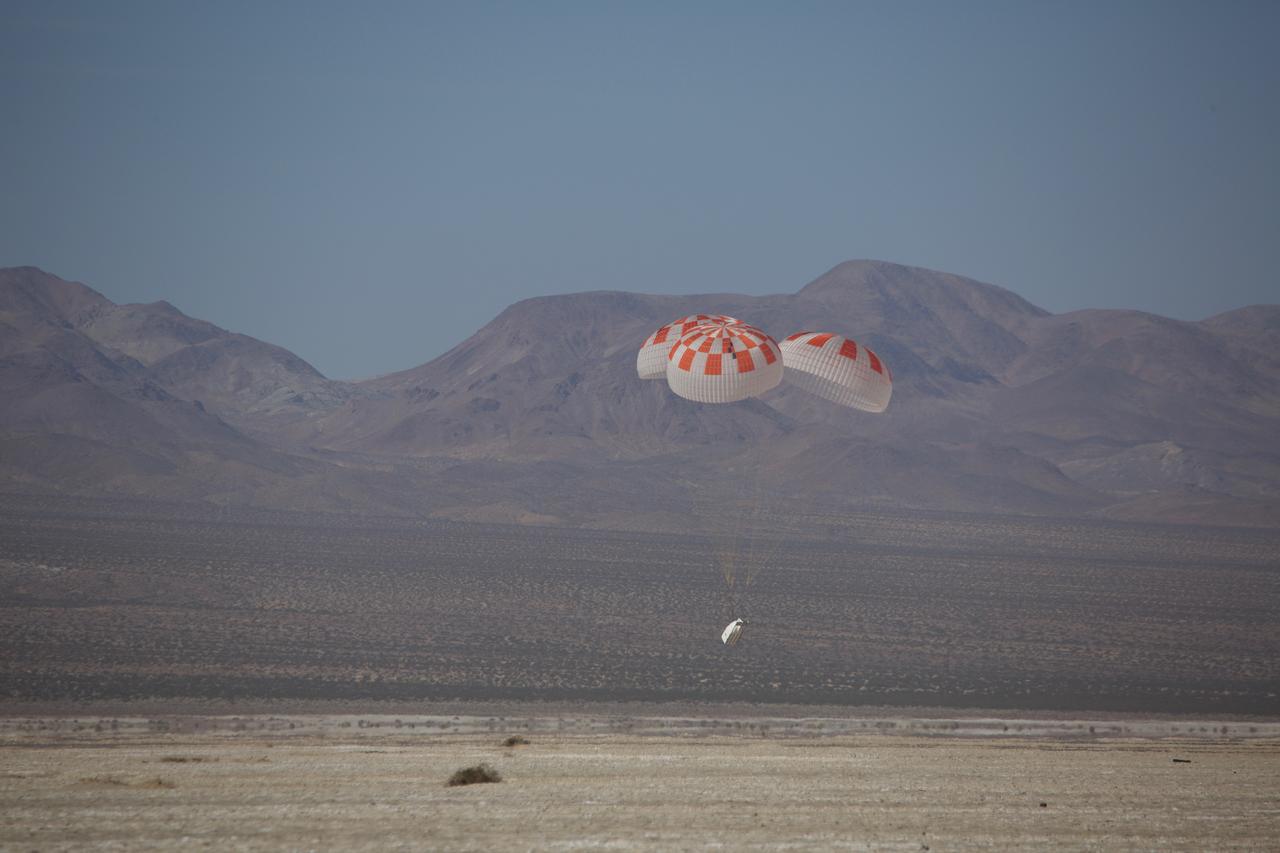
SpaceX performed its fourteenth overall parachute test supporting Crew Dragon development. This most recent exercise was the first of several planned parachute system qualification tests ahead of the spacecraft’s first crewed flight and resulted in the successful touchdown of Crew Dragon’s parachute system. During this test, a C-130 aircraft transported the parachute test vehicle, designed to achieve the maximum speeds that Crew Dragon could experience on re-entry, over the Mojave Desert in Southern California and dropped the vehicle from an altitude of 25,000 feet. The test demonstrated an off-nominal situation, deploying only one of the two drogue chutes and intentionally skipping a reefing stage on one of the four main parachutes, proving a safe landing in such a contingency scenario.
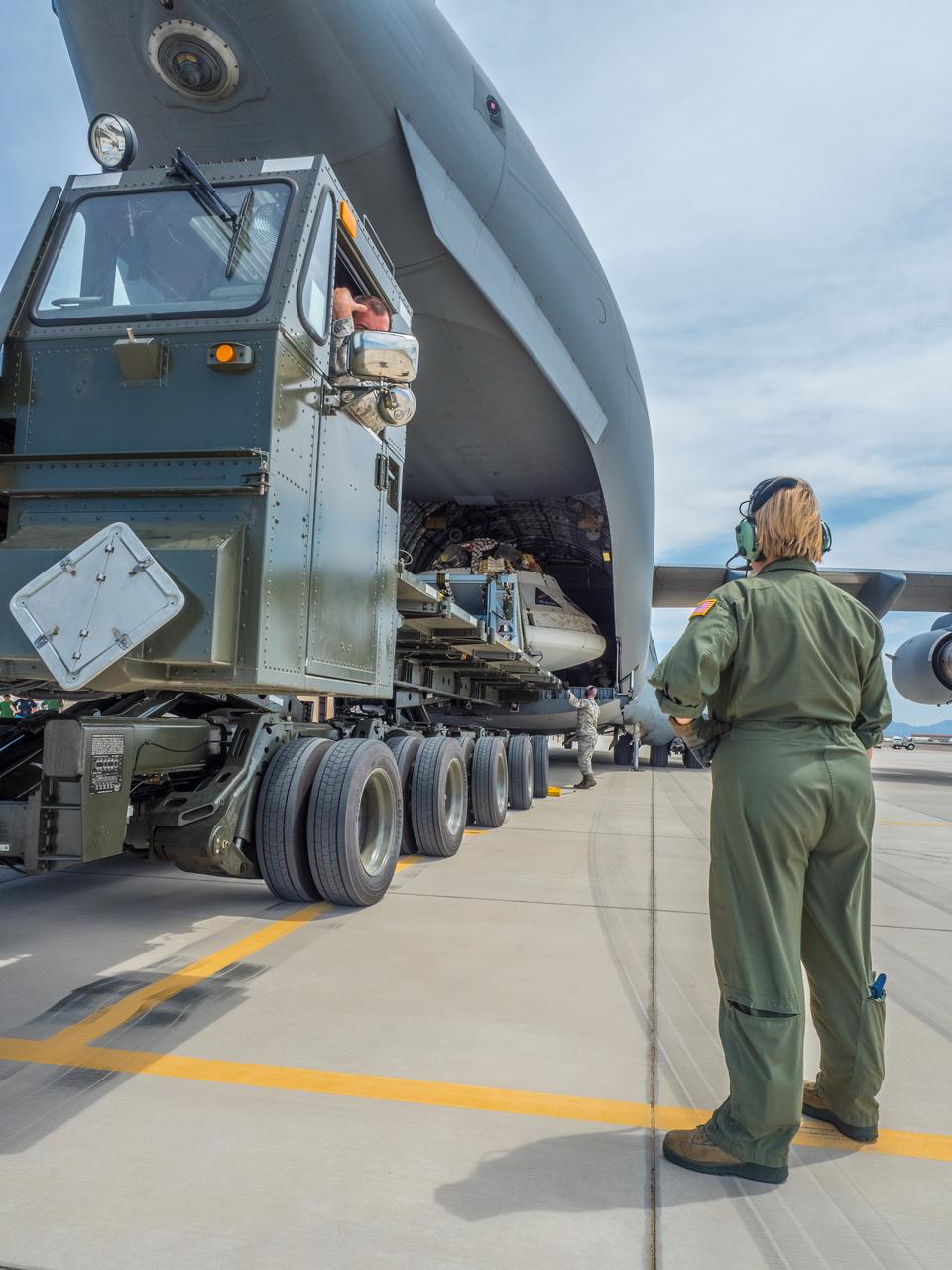
Engineers prepare to test the parachute system for NASA’s Orion spacecraft at the U.S. Army Yuma Proving Ground in Yuma, Arizona on Aug. 24, 2015. During the test, planned for Wednesday, Aug. 26, a C-17 aircraft will carry a representative Orion capsule to 35,000 feet in altitude and then drop it from its cargo bay. Engineers will test a scenario in which one of Orion’s two drogue parachutes, used to stabilize it in the air, does not deploy, and one of its three main parachutes, used to slow the capsule during the final stage of descent, also does not deploy. The risky test will provide data engineers will use as they gear up to qualify Orion’s parachutes for missions with astronauts. On Aug. 24, a C-17 was loaded with the test version of Orion, which has a similar mass and interfaces with the parachutes as the Orion being developed for deep space missions but is shorter on top to fit inside the aircraft. Part of Batch image transfer from Flickr.
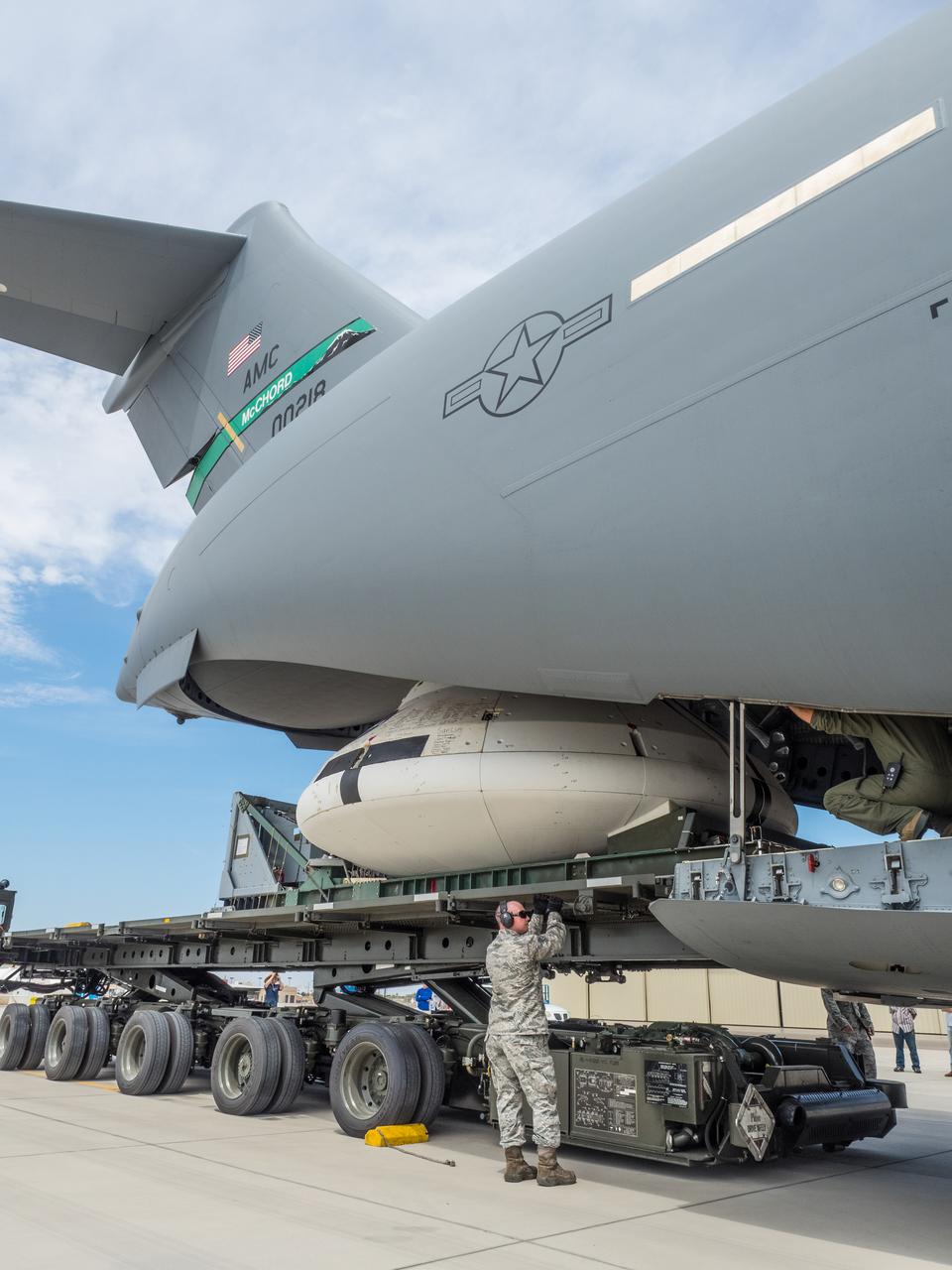
Engineers prepare to test the parachute system for NASA’s Orion spacecraft at the U.S. Army Yuma Proving Ground in Yuma, Arizona on Aug. 24, 2015. During the test, planned for Wednesday, Aug. 26, a C-17 aircraft will carry a representative Orion capsule to 35,000 feet in altitude and then drop it from its cargo bay. Engineers will test a scenario in which one of Orion’s two drogue parachutes, used to stabilize it in the air, does not deploy, and one of its three main parachutes, used to slow the capsule during the final stage of descent, also does not deploy. The risky test will provide data engineers will use as they gear up to qualify Orion’s parachutes for missions with astronauts. On Aug. 24, a C-17 was loaded with the test version of Orion, which has a similar mass and interfaces with the parachutes as the Orion being developed for deep space missions but is shorter on top to fit inside the aircraft. Part of Batch image transfer from Flickr.
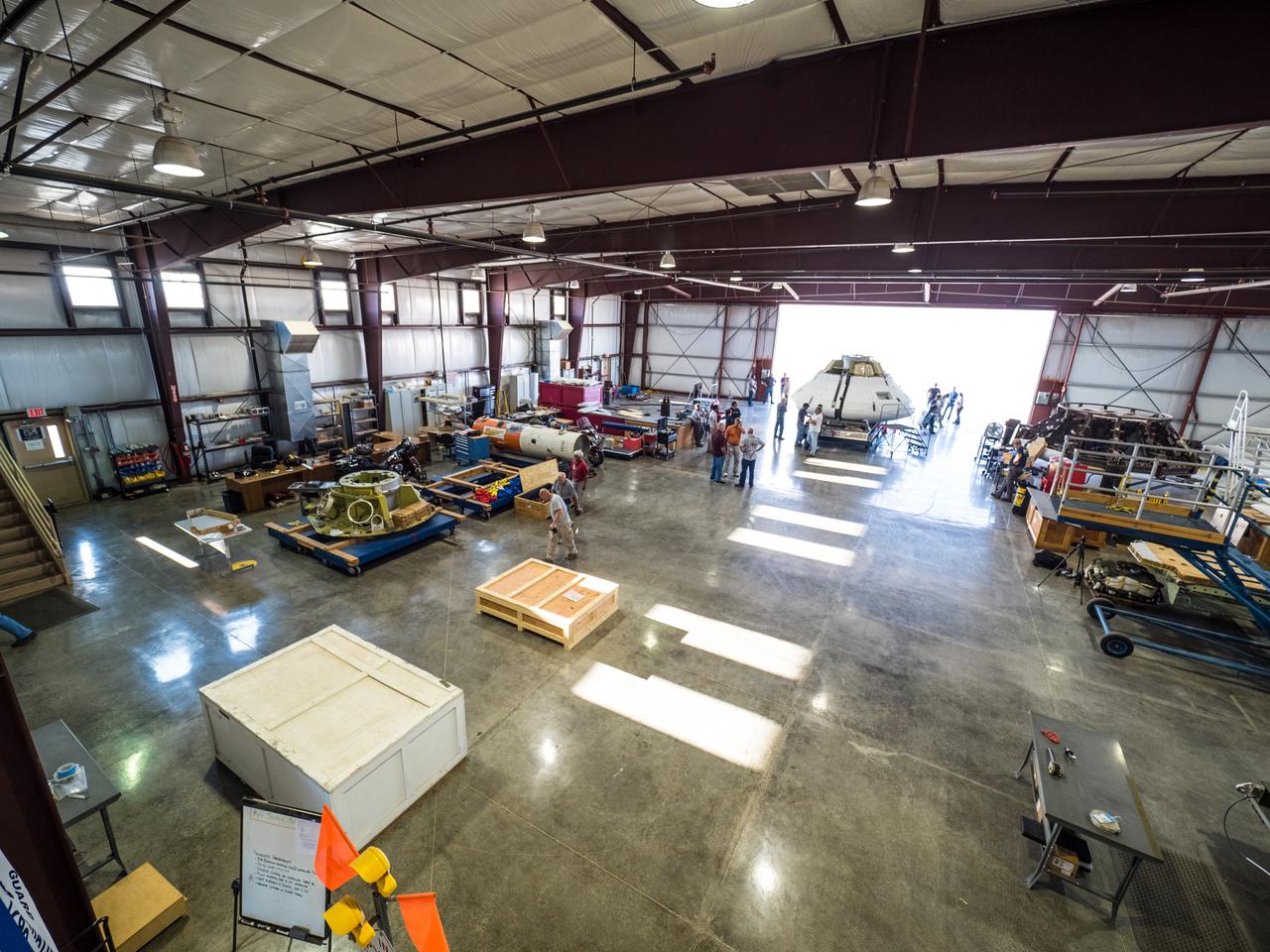
Engineers prepare to test the parachute system for NASA’s Orion spacecraft at the U.S. Army Yuma Proving Ground in Yuma, Arizona on Aug. 24, 2015. During the test, planned for Wednesday, Aug. 26, a C-17 aircraft will carry a representative Orion capsule to 35,000 feet in altitude and then drop it from its cargo bay. Engineers will test a scenario in which one of Orion’s two drogue parachutes, used to stabilize it in the air, does not deploy, and one of its three main parachutes, used to slow the capsule during the final stage of descent, also does not deploy. The risky test will provide data engineers will use as they gear up to qualify Orion’s parachutes for missions with astronauts. On Aug. 24, a C-17 was loaded with the test version of Orion, which has a similar mass and interfaces with the parachutes as the Orion being developed for deep space missions but is shorter on top to fit inside the aircraft. Part of Batch image transfer from Flickr.
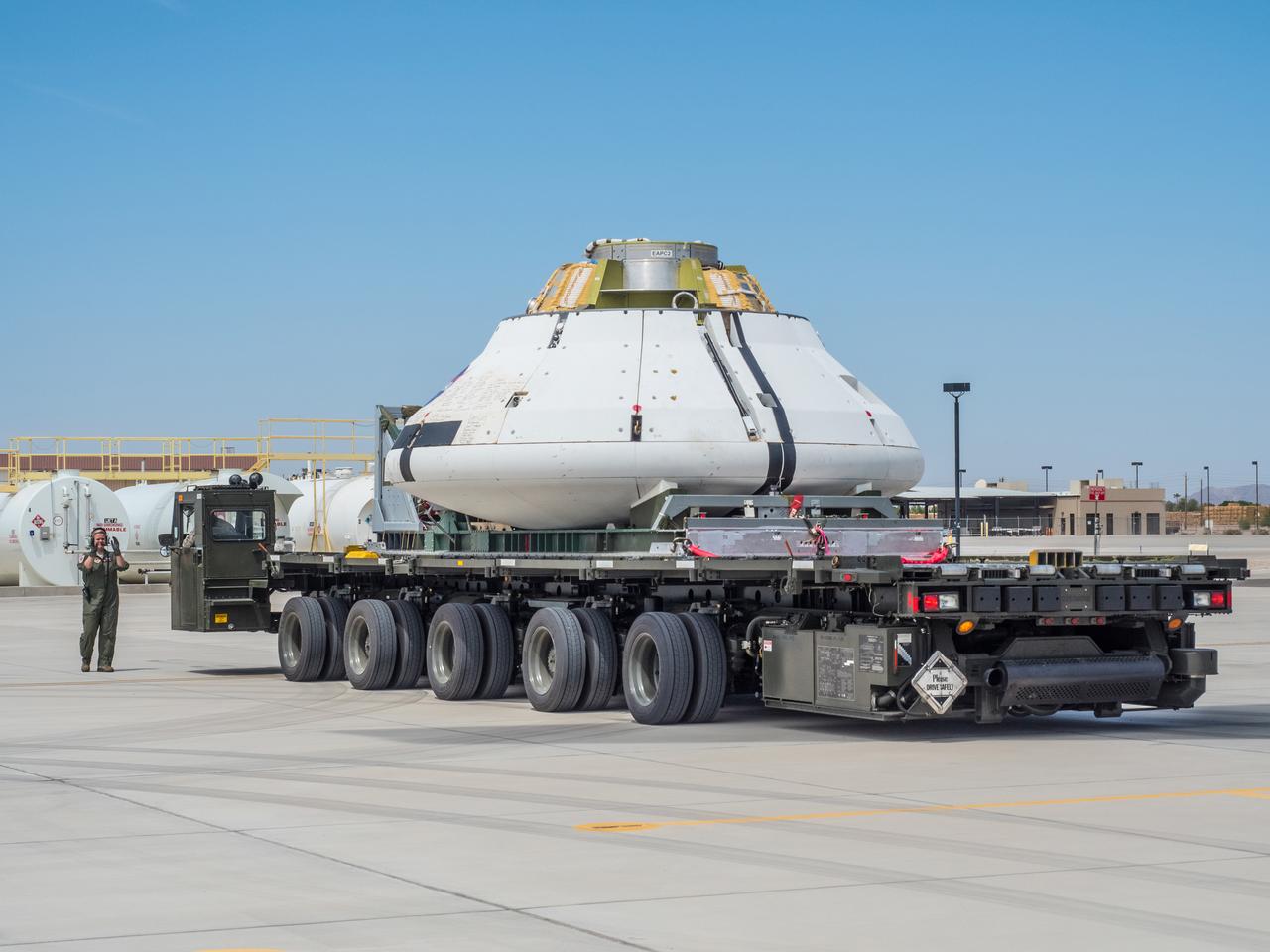
Engineers prepare to test the parachute system for NASA’s Orion spacecraft at the U.S. Army Yuma Proving Ground in Yuma, Arizona on Aug. 24, 2015. During the test, planned for Wednesday, Aug. 26, a C-17 aircraft will carry a representative Orion capsule to 35,000 feet in altitude and then drop it from its cargo bay. Engineers will test a scenario in which one of Orion’s two drogue parachutes, used to stabilize it in the air, does not deploy, and one of its three main parachutes, used to slow the capsule during the final stage of descent, also does not deploy. The risky test will provide data engineers will use as they gear up to qualify Orion’s parachutes for missions with astronauts. On Aug. 24, a C-17 was loaded with the test version of Orion, which has a similar mass and interfaces with the parachutes as the Orion being developed for deep space missions but is shorter on top to fit inside the aircraft. Part of Batch image transfer from Flickr.
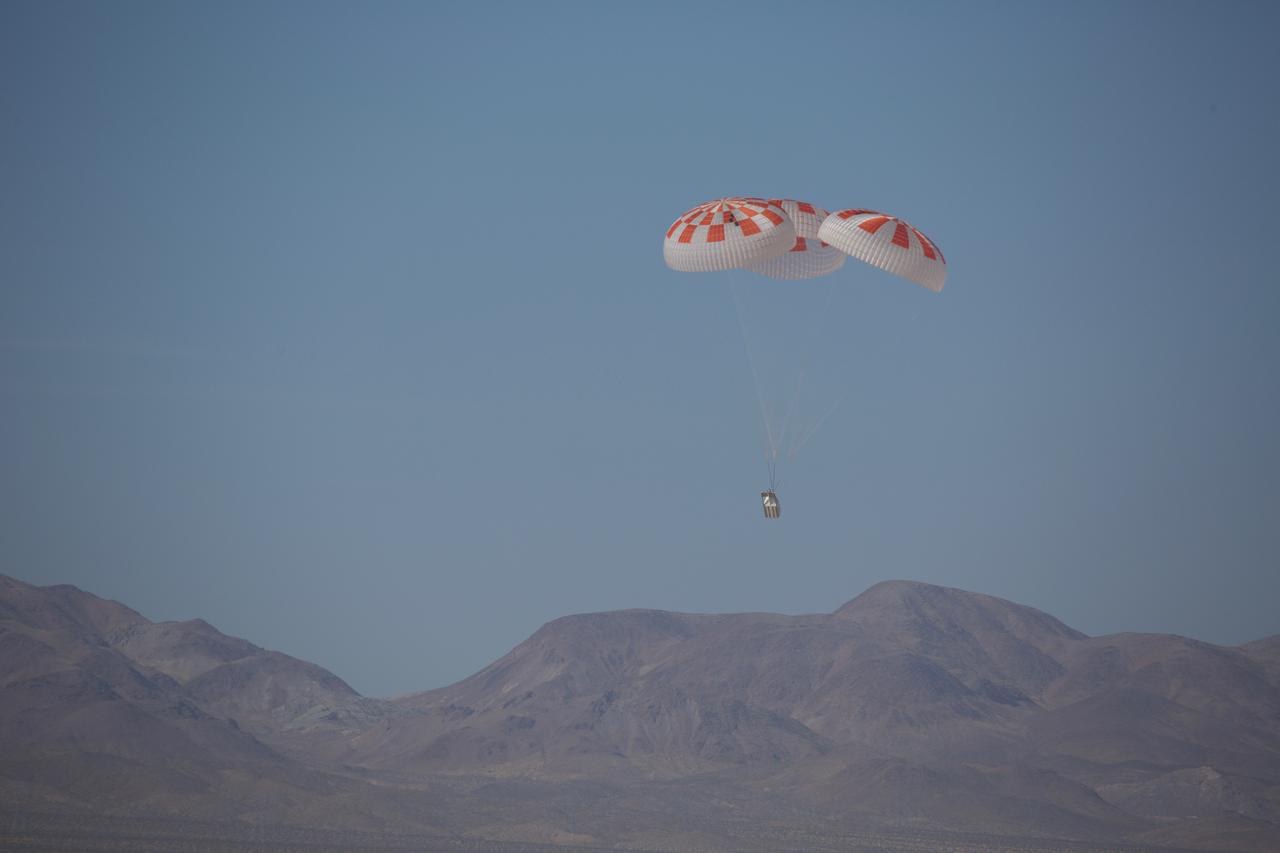
SpaceX performed its fourteenth overall parachute test supporting Crew Dragon development. This most recent exercise was the first of several planned parachute system qualification tests ahead of the spacecraft’s first crewed flight and resulted in the successful touchdown of Crew Dragon’s parachute system. During this test, a C-130 aircraft transported the parachute test vehicle, designed to achieve the maximum speeds that Crew Dragon could experience on re-entry, over the Mojave Desert in Southern California and dropped the vehicle from an altitude of 25,000 feet. The test demonstrated an off-nominal situation, deploying only one of the two drogue chutes and intentionally skipping a reefing stage on one of the four main parachutes, proving a safe landing in such a contingency scenario.
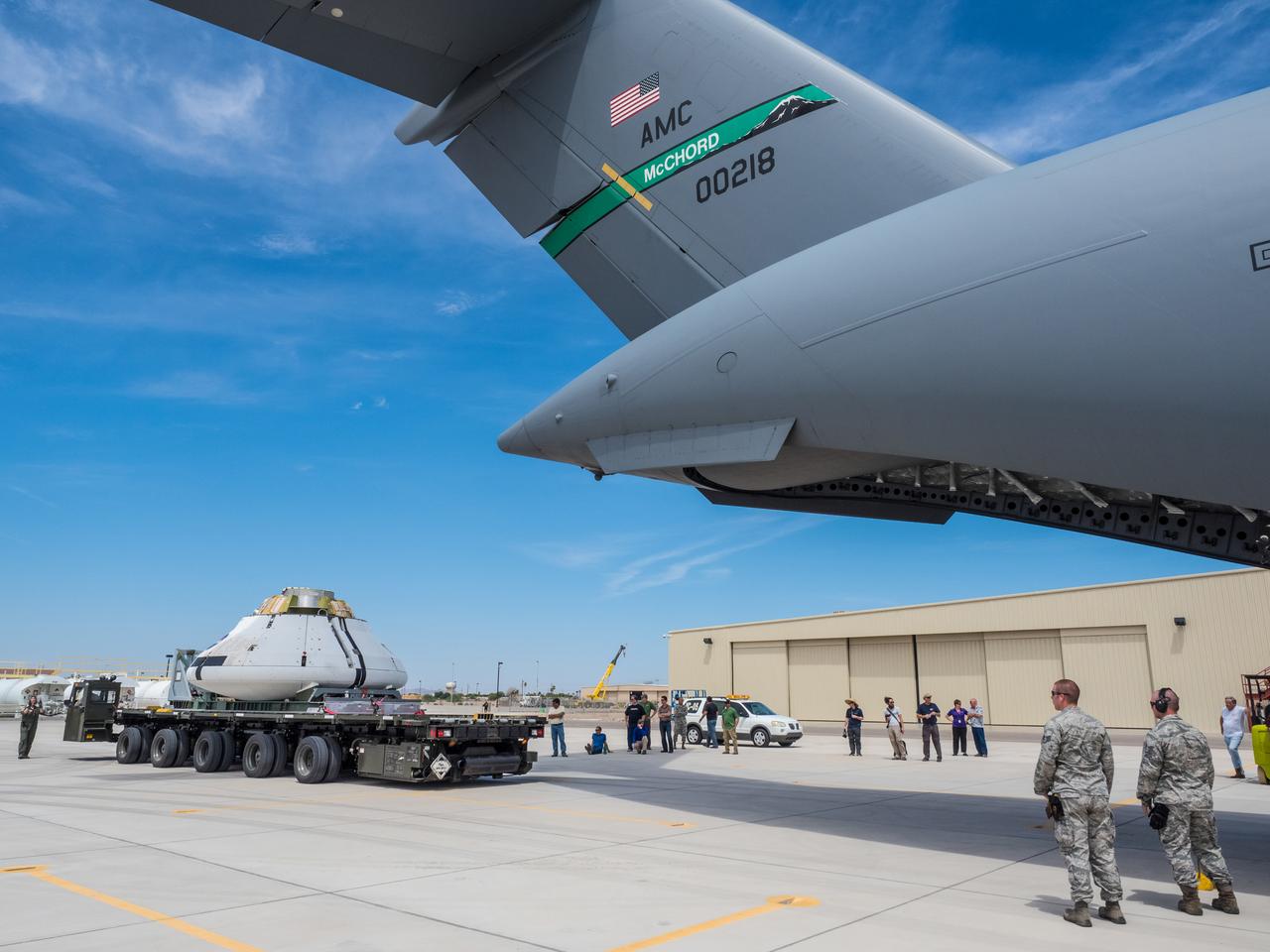
Engineers prepare to test the parachute system for NASA’s Orion spacecraft at the U.S. Army Yuma Proving Ground in Yuma, Arizona on Aug. 24, 2015. During the test, planned for Wednesday, Aug. 26, a C-17 aircraft will carry a representative Orion capsule to 35,000 feet in altitude and then drop it from its cargo bay. Engineers will test a scenario in which one of Orion’s two drogue parachutes, used to stabilize it in the air, does not deploy, and one of its three main parachutes, used to slow the capsule during the final stage of descent, also does not deploy. The risky test will provide data engineers will use as they gear up to qualify Orion’s parachutes for missions with astronauts. On Aug. 24, a C-17 was loaded with the test version of Orion, which has a similar mass and interfaces with the parachutes as the Orion being developed for deep space missions but is shorter on top to fit inside the aircraft. Part of Batch image transfer from Flickr.
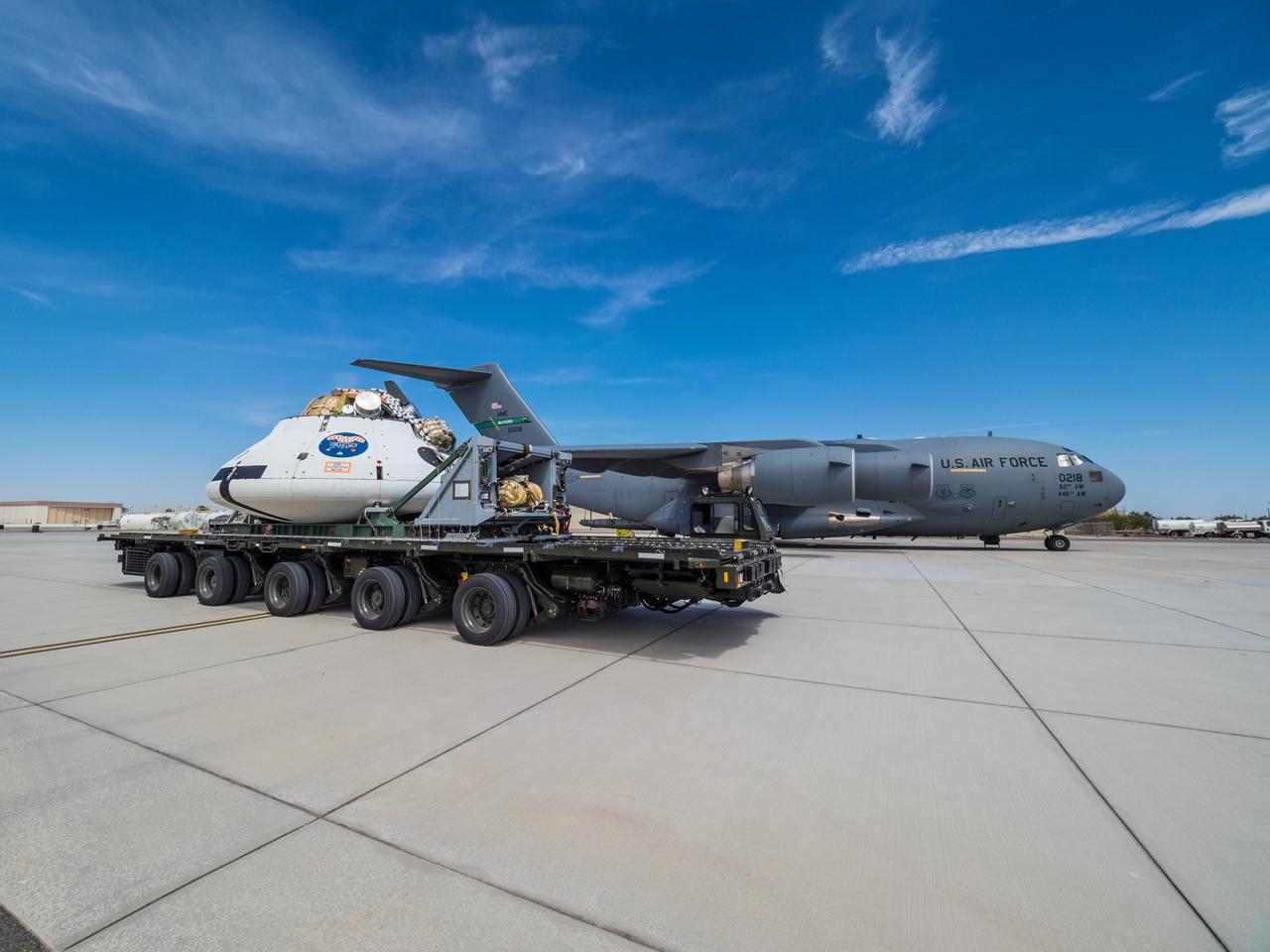
Engineers prepare to test the parachute system for NASA’s Orion spacecraft at the U.S. Army Yuma Proving Ground in Yuma, Arizona on Aug. 24, 2015. During the test, planned for Wednesday, Aug. 26, a C-17 aircraft will carry a representative Orion capsule to 35,000 feet in altitude and then drop it from its cargo bay. Engineers will test a scenario in which one of Orion’s two drogue parachutes, used to stabilize it in the air, does not deploy, and one of its three main parachutes, used to slow the capsule during the final stage of descent, also does not deploy. The risky test will provide data engineers will use as they gear up to qualify Orion’s parachutes for missions with astronauts. On Aug. 24, a C-17 was loaded with the test version of Orion, which has a similar mass and interfaces with the parachutes as the Orion being developed for deep space missions but is shorter on top to fit inside the aircraft. Part of Batch image transfer from Flickr.
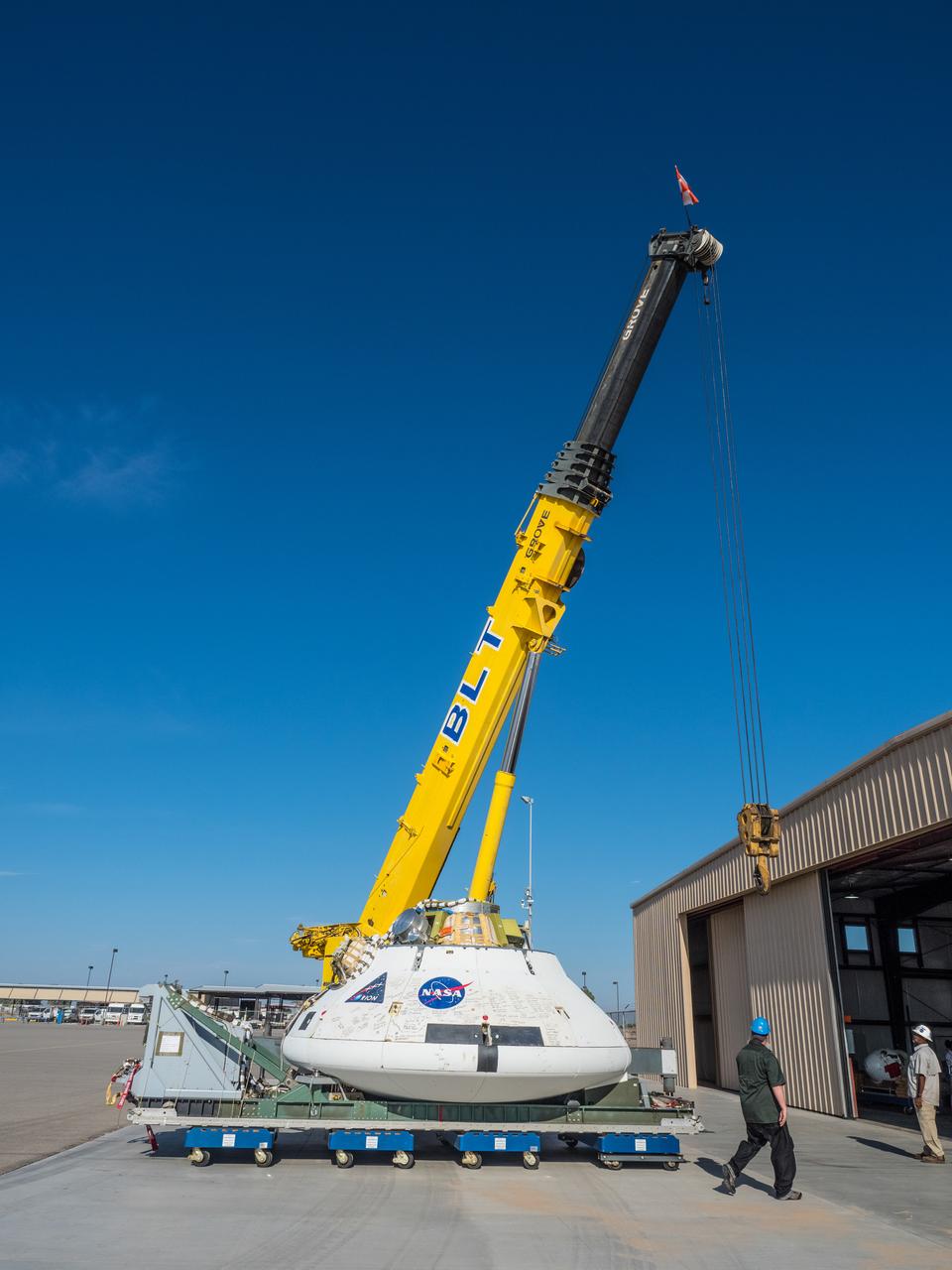
Engineers prepare to test the parachute system for NASA’s Orion spacecraft at the U.S. Army Yuma Proving Ground in Yuma, Arizona on Aug. 24, 2015. During the test, planned for Wednesday, Aug. 26, a C-17 aircraft will carry a representative Orion capsule to 35,000 feet in altitude and then drop it from its cargo bay. Engineers will test a scenario in which one of Orion’s two drogue parachutes, used to stabilize it in the air, does not deploy, and one of its three main parachutes, used to slow the capsule during the final stage of descent, also does not deploy. The risky test will provide data engineers will use as they gear up to qualify Orion’s parachutes for missions with astronauts. On Aug. 24, a C-17 was loaded with the test version of Orion, which has a similar mass and interfaces with the parachutes as the Orion being developed for deep space missions but is shorter on top to fit inside the aircraft. Part of Batch image transfer from Flickr.
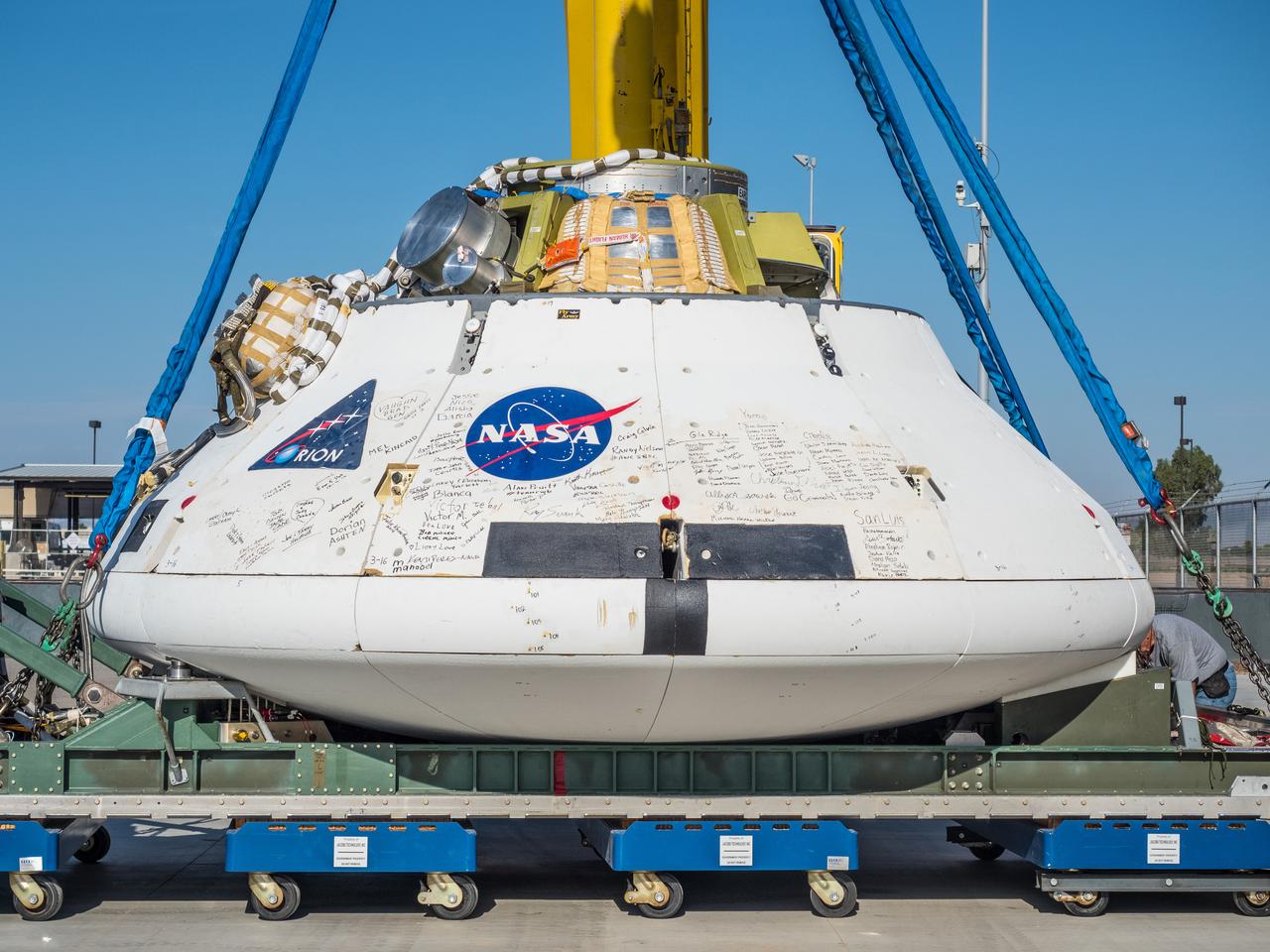
Engineers prepare to test the parachute system for NASA’s Orion spacecraft at the U.S. Army Yuma Proving Ground in Yuma, Arizona on Aug. 24, 2015. During the test, planned for Wednesday, Aug. 26, a C-17 aircraft will carry a representative Orion capsule to 35,000 feet in altitude and then drop it from its cargo bay. Engineers will test a scenario in which one of Orion’s two drogue parachutes, used to stabilize it in the air, does not deploy, and one of its three main parachutes, used to slow the capsule during the final stage of descent, also does not deploy. The risky test will provide data engineers will use as they gear up to qualify Orion’s parachutes for missions with astronauts. On Aug. 24, a C-17 was loaded with the test version of Orion, which has a similar mass and interfaces with the parachutes as the Orion being developed for deep space missions but is shorter on top to fit inside the aircraft. Part of Batch image transfer from Flickr.
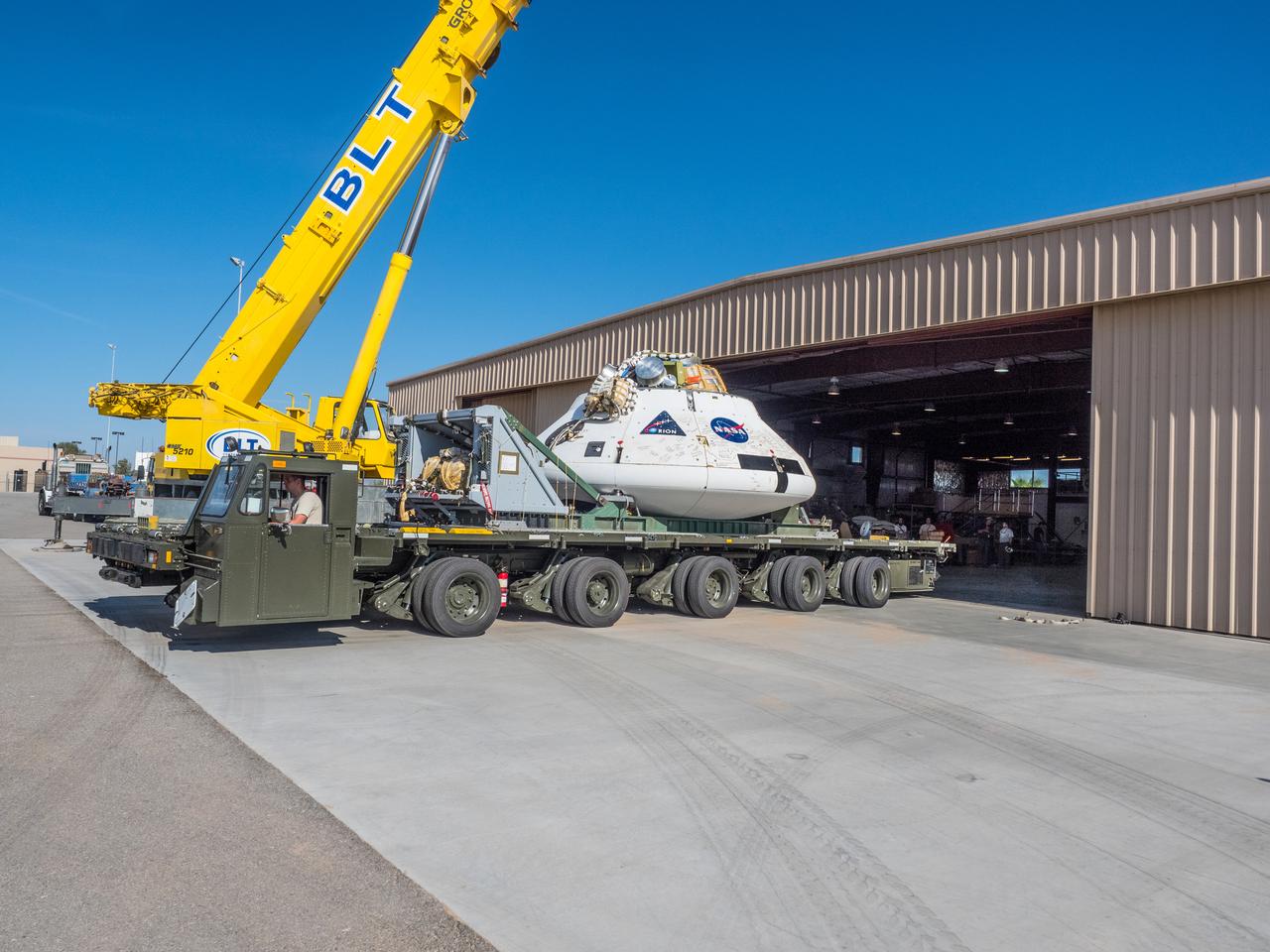
Engineers prepare to test the parachute system for NASA’s Orion spacecraft at the U.S. Army Yuma Proving Ground in Yuma, Arizona on Aug. 24, 2015. During the test, planned for Wednesday, Aug. 26, a C-17 aircraft will carry a representative Orion capsule to 35,000 feet in altitude and then drop it from its cargo bay. Engineers will test a scenario in which one of Orion’s two drogue parachutes, used to stabilize it in the air, does not deploy, and one of its three main parachutes, used to slow the capsule during the final stage of descent, also does not deploy. The risky test will provide data engineers will use as they gear up to qualify Orion’s parachutes for missions with astronauts. On Aug. 24, a C-17 was loaded with the test version of Orion, which has a similar mass and interfaces with the parachutes as the Orion being developed for deep space missions but is shorter on top to fit inside the aircraft. Part of Batch image transfer from Flickr.

CAPE CANAVERAL, Fla. – In the Parachute Refurbishment Facility at NASA's Kennedy Space Center, Deborah Coombs, senior parachute technician, measures suspension lines for the Ares-I main canopy. Ares I is an in-line, two-stage rocket that will transport the Orion crew exploration vehicle to low-Earth orbit. The Ares I first stage will be a five-segment solid rocket booster based on the four-segment design used for the shuttle. As with the shuttle, this booster will fall away when spent, lowered by parachute into the Atlantic Ocean where it can be retrieved for re-use. Photo credit: NASA/Dimitri Gerondidakis
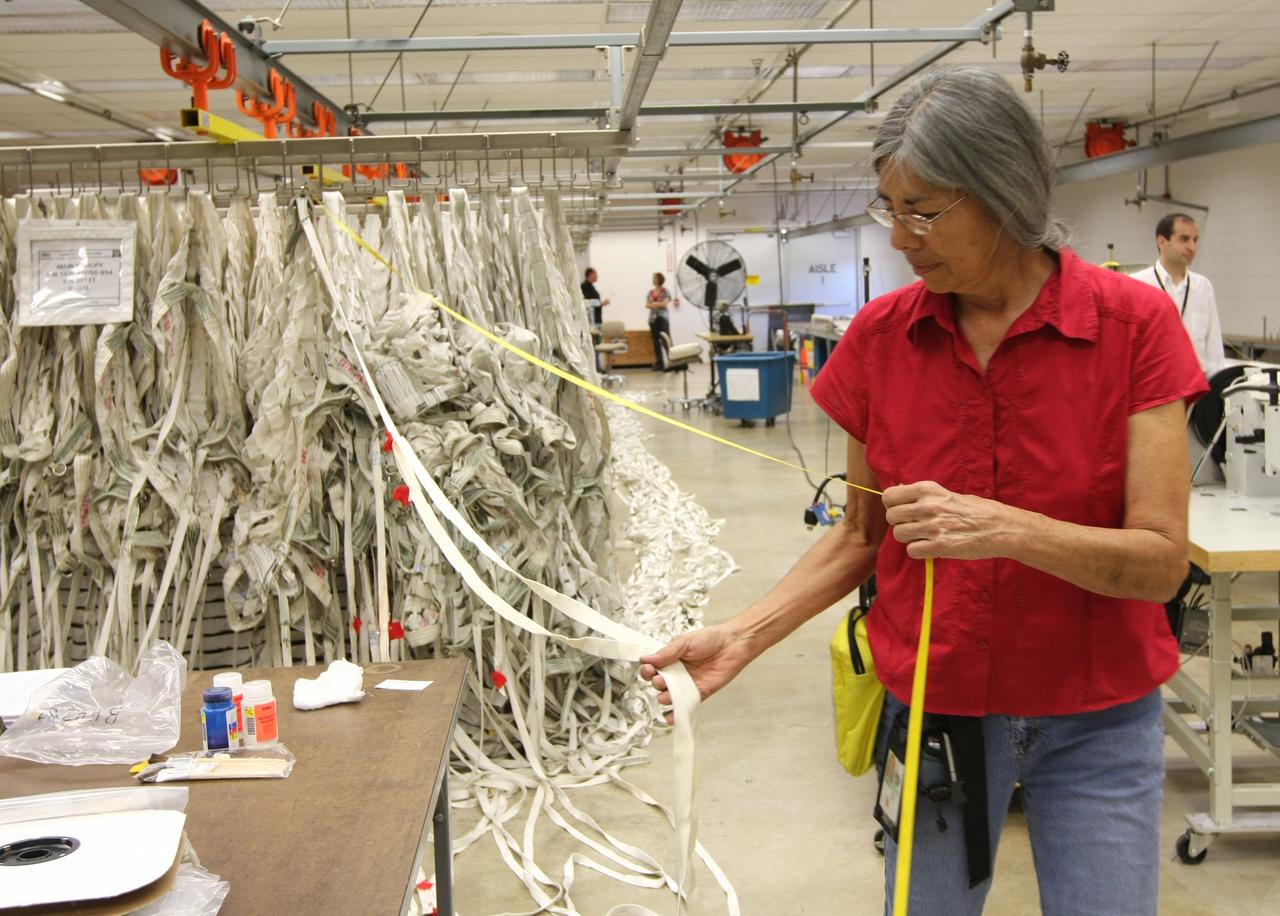
CAPE CANAVERAL, Fla. – In the Parachute Refurbishment Facility at NASA's Kennedy Space Center, Deborah Coombs, senior parachute technician, measures suspension lines for the Ares-I main canopy. Ares I is an in-line, two-stage rocket that will transport the Orion crew exploration vehicle to low-Earth orbit. The Ares I first stage will be a five-segment solid rocket booster based on the four-segment design used for the shuttle. As with the shuttle, this booster will fall away when spent, lowered by parachute into the Atlantic Ocean where it can be retrieved for re-use. Photo credit: NASA/Dimitri Gerondidakis
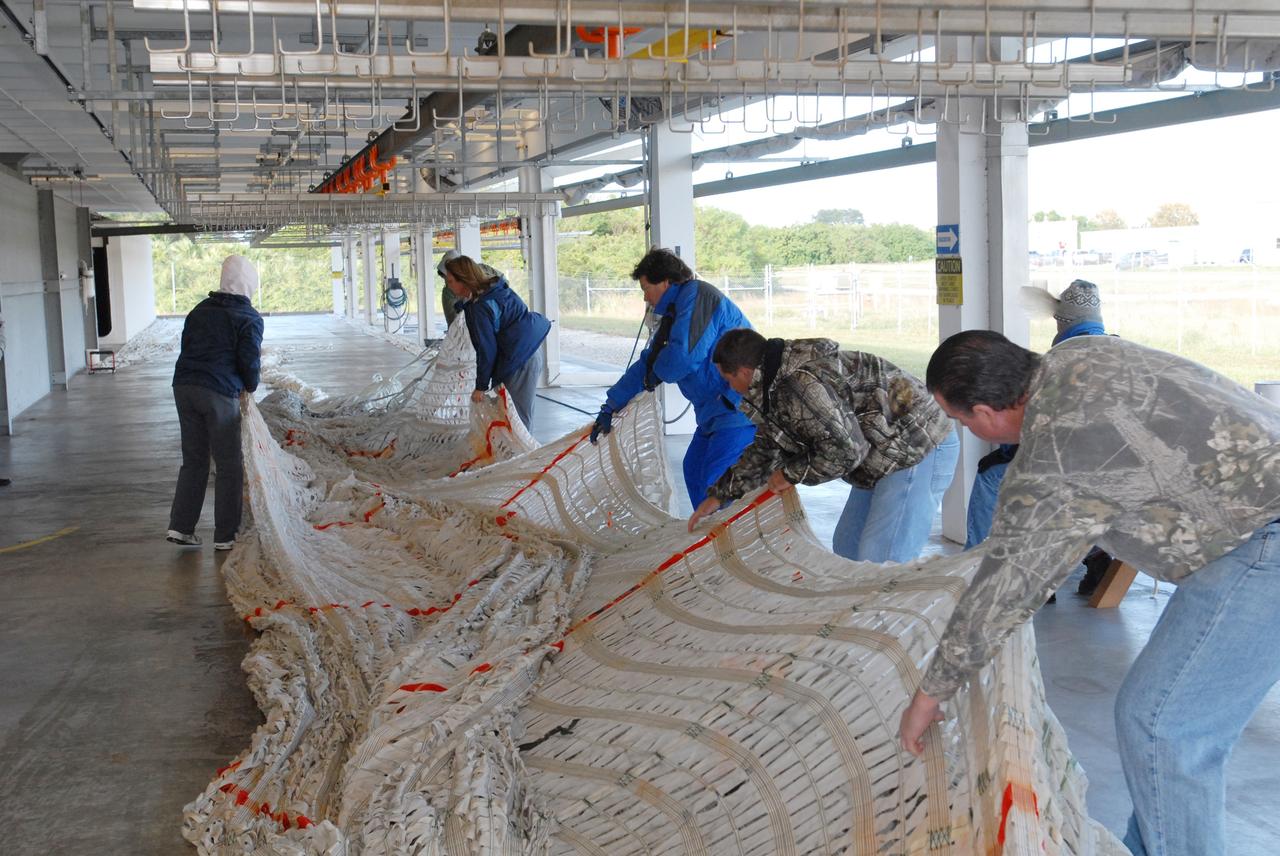
CAPE CANAVERAL, Fla. – At the Parachute Refurbishment Facility at NASA's Kennedy Space Center in Florida, workers spread out the parachutes recovered from sea after the launch of space shuttle Endeavour on the STS-126 mission to detangle them. The parachutes are used to slow the descent of the solid rocket boosters that are jettisoned during liftoff. One pilot, one drogue and three main canopies per booster slow the booster’s fall from about 360 mph to 50 mph. After the chutes are cleaned and repaired, they must be carefully packed into their bags so they will deploy correctly the next time they are used. Photo credit: NASA/Jim Grossmann
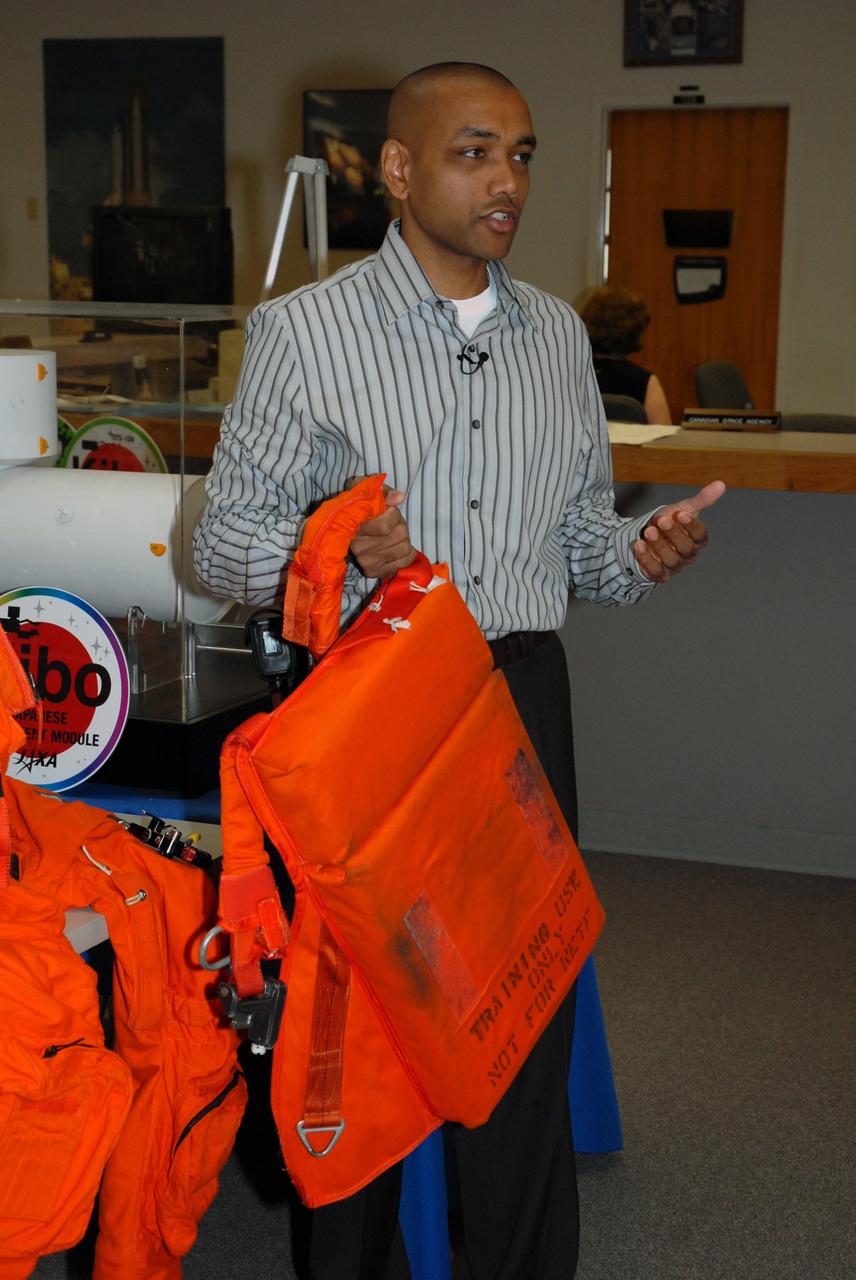
CAPE CANAVERAL, Fla. -- In the NASA News Center at NASA's Kennedy Space Center, Shuttle Crew Escape System Manager KC Chhipwadia describes for the media the components of the parachute worn by shuttle crews during launch and landing. On top is a pilot and drag chute. In the middle is the main chute. At bottom is a survival life raft. The elements of the suit and parachute provide safety elements in the event of an emergency. Photo credit: NASA/Amanda Diller
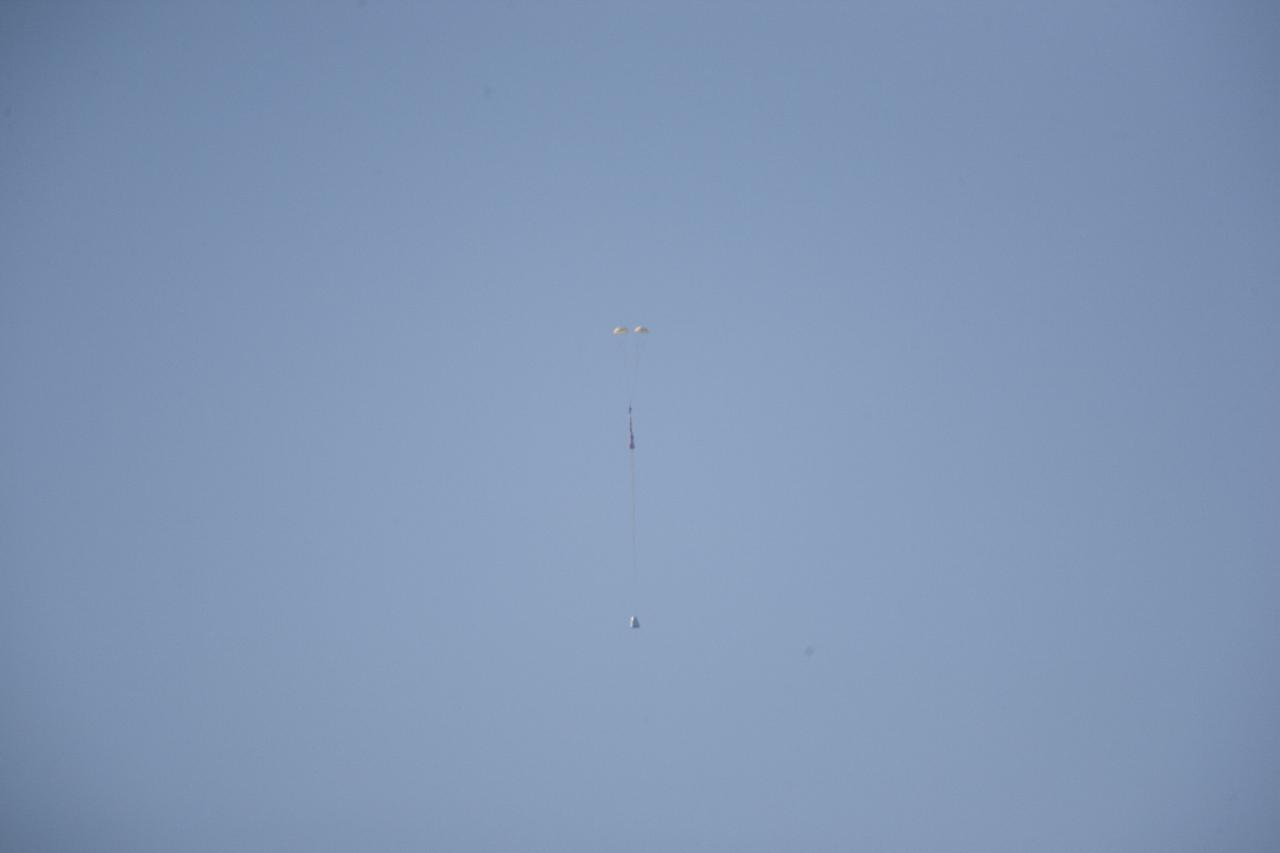
MORRO BAY, Calif. – The main parachutes begin to unfurl above mockup Dragon test article during a test over the Pacific Ocean, off the coast of Morro Bay, Calif., to evaluate the spacecraft's parachute deployment system. The test was part of a milestone under SpaceX's Commercial Crew Integrated Capability agreement with NASA's Commercial Crew Program. Photo credit: NASA/Kim Shiflett
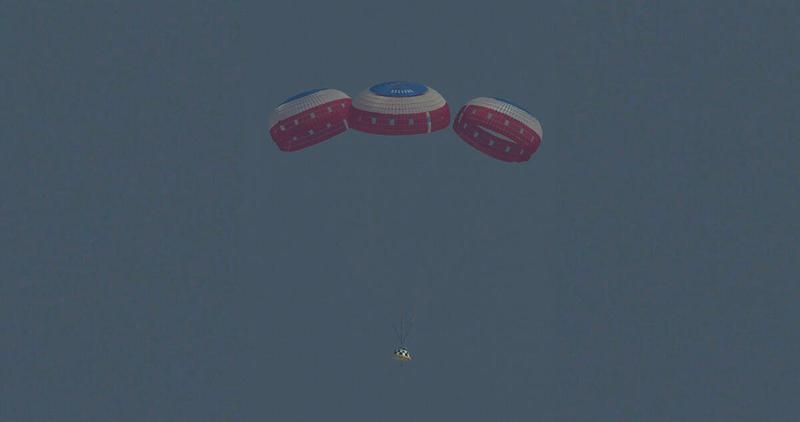
Boeing’s CST-100 Starliner's three main parachutes slow the test article to a safe and soft landing during the final balloon drop parachute test Sept. 19, 2020, at White Sands, New Mexico. The test is part of a reliability campaign that will help strengthen the spacecraft’s landing system ahead of crewed flights to and from the International Space Station as part of NASA’s Commercial Crew Program.
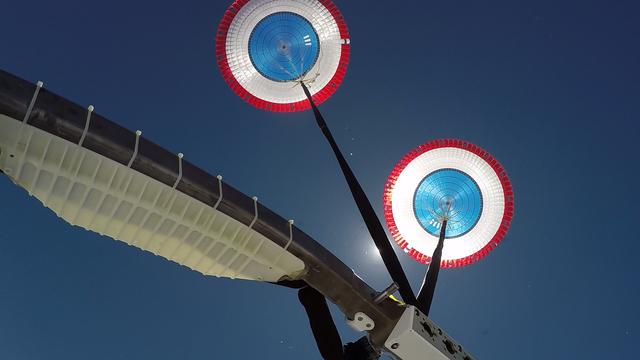
In this view looking up, Boeing’s CST-100 Starliner’s parachutes deploy above the U.S. Army’s White Sands Missile Range in New Mexico during parachute system testing on June 24, 2019. Boeing conducted the test using a full-scale Starliner test article, known as a boiler plate, designed to simulate the actual spacecraft. The test involved intentionally disabling one of the parachute system’s two drogue parachutes and one of the three main parachutes to evaluate how the remaining parachutes handled the additional loads during deployment and descent. This was one of a series of important parachute tests to validate the system is safe to carry astronauts to and from the International Space Station as part of NASA’s Commercial Crew Program. Boeing is targeting an uncrewed Orbital Flight Test to the space station this summer, followed by its Crew Flight Test. Starliner will launch atop a United Launch Alliance Atlas V rocket from Space Launch Complex 41 at Cape Canaveral Air Force Station in Florida.
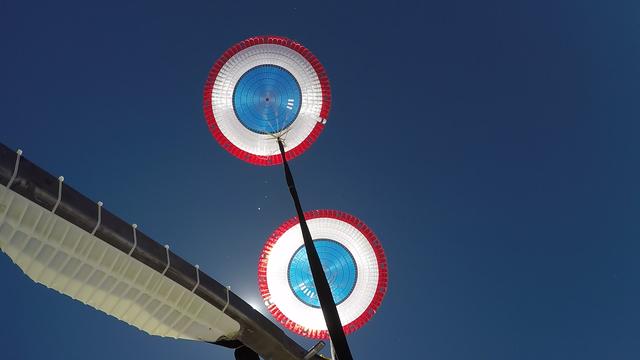
In this view looking up, Boeing’s CST-100 Starliner’s parachutes deploy above the U.S. Army’s White Sands Missile Range in New Mexico during parachute system testing on June 24, 2019. Boeing conducted the test using a full-scale Starliner test article, known as a boiler plate, designed to simulate the actual spacecraft. The test involved intentionally disabling one of the parachute system’s two drogue parachutes and one of the three main parachutes to evaluate how the remaining parachutes handled the additional loads during deployment and descent. This was one of a series of important parachute tests to validate the system is safe to carry astronauts to and from the International Space Station as part of NASA’s Commercial Crew Program. Boeing is targeting an uncrewed Orbital Flight Test to the space station this summer, followed by its Crew Flight Test. Starliner will launch atop a United Launch Alliance Atlas V rocket from Space Launch Complex 41 at Cape Canaveral Air Force Station in Florida.
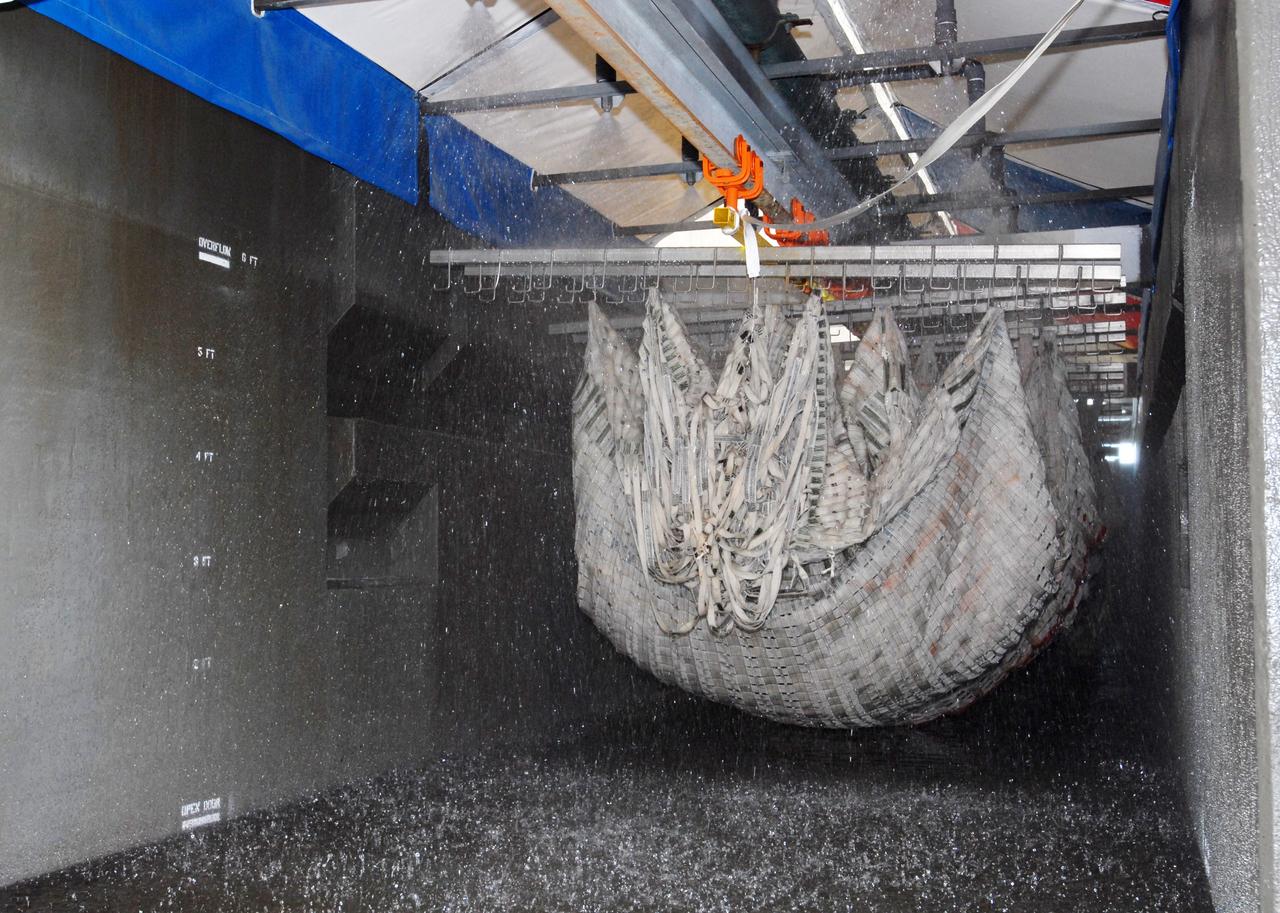
CAPE CANAVERAL, Fla. – At the Parachute Refurbishment Facility at NASA's Kennedy Space Center in Florida, the parachutes recovered from sea after the launch of space shuttle Endeavour on the STS-126 mission are moved through the 30,000-gallon washer. The parachutes are used to slow the descent of the solid rocket boosters that are jettisoned during liftoff. After washing, the monorail will move the parachutes into a huge dryer heated with 140-degree air at 13,000 cubic feet per minute. One pilot, one drogue and three main canopies per booster slow the booster’s fall from about 360 mph to 50 mph. After the chutes are cleaned and repaired, they must be carefully packed into their bags so they will deploy correctly the next time they are used. Photo credit: NASA/Jim Grossmann
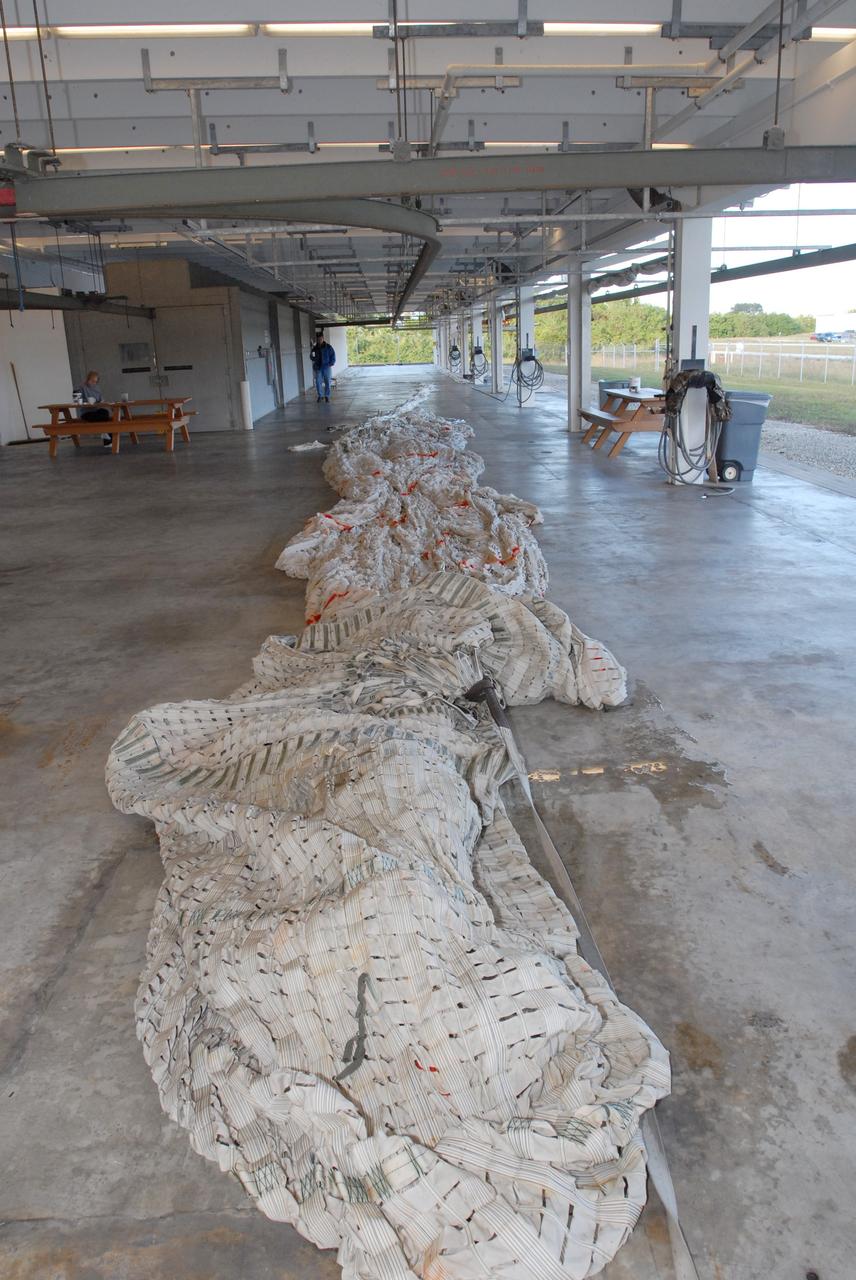
CAPE CANAVERAL, Fla. – Parachutes recovered from sea after the launch of space shuttle Endeavour on the STS-126 mission are stretched out at the Parachute Refurbishment Facility at NASA's Kennedy Space Center in Florida to detangle them. The parachutes are used to slow the descent of the solid rocket boosters that are jettisoned during liftoff. After the chutes are returned to the facility following launch, a hanging monorail system is used to transport each parachute into a 30,000-gallon washer and then into a huge dryer heated with 140-de¬gree air at 13,000 cubic feet per minute. One pilot, one drogue and three main canopies per booster slow the booster’s fall from about 360 mph to 50 mph. After the chutes are cleaned and repaired, they must be care¬fully packed into their bags so they will deploy correctly the next time they are used. Photo credit: NASA/Jim Grossmann
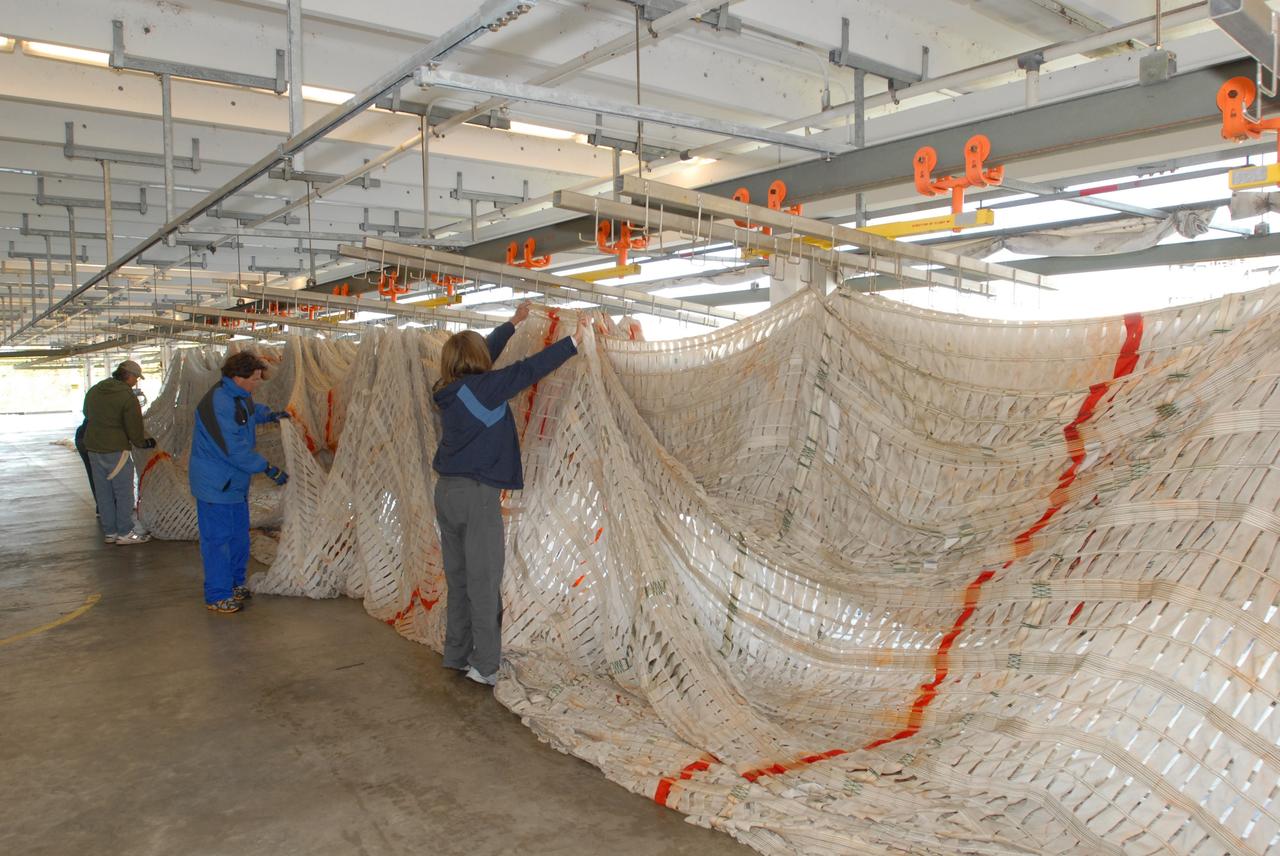
CAPE CANAVERAL, Fla. – At the Parachute Refurbishment Facility at NASA's Kennedy Space Center in Florida, workers begin hanging the parachutes recovered from sea after the launch of space shuttle Endeavour on the STS-126 mission onto a monorail system. The parachutes are used to slow the descent of the solid rocket boosters that are jettisoned during liftoff. The monorail will transport each parachute into a 30,000-gallon washer and a huge dryer heated with 140-degree air at 13,000 cubic feet per minute One pilot, one drogue and three main canopies per booster slow the booster’s fall from about 360 mph to 50 mph. After the chutes are cleaned and repaired, they must be carefully packed into their bags so they will deploy correctly the next time they are used. Photo credit: NASA/Jim Grossmann
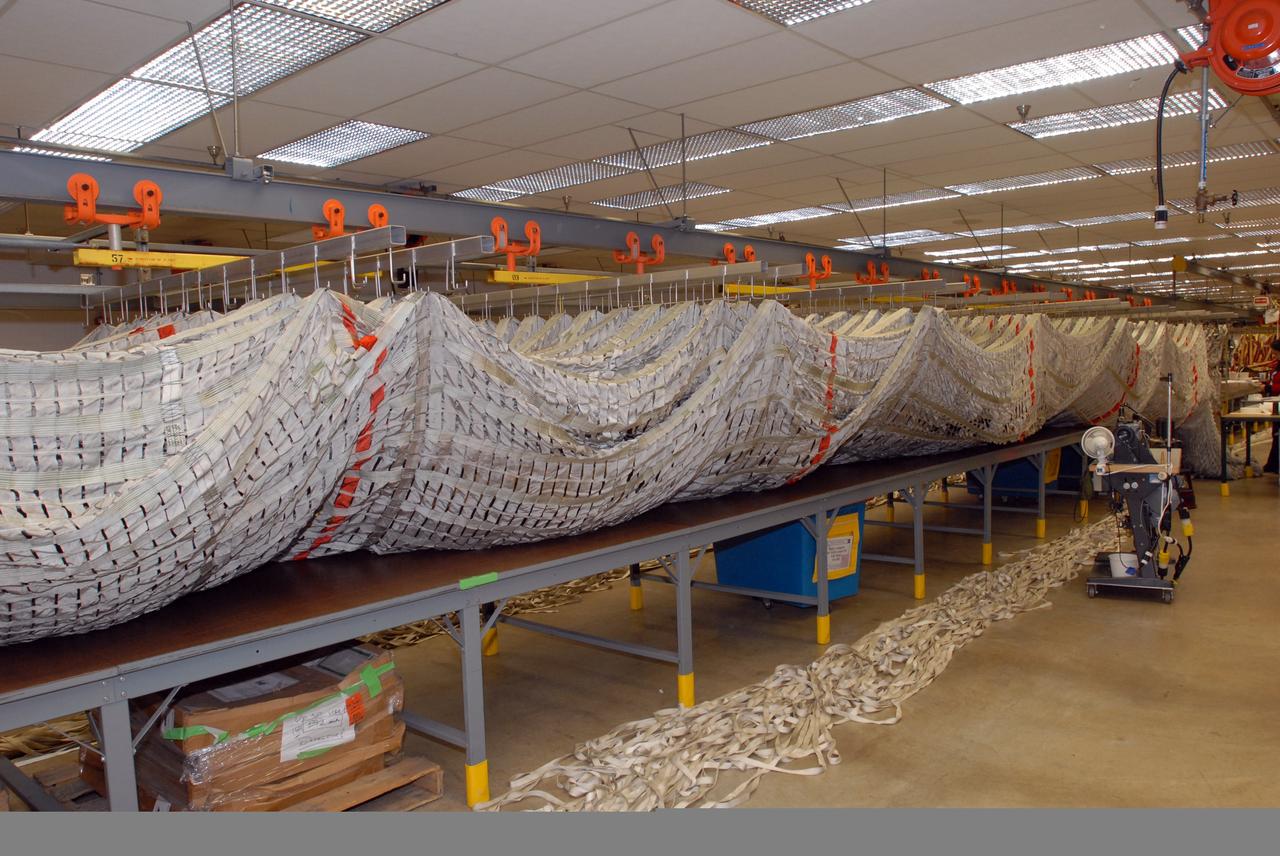
CAPE CANAVERAL, Fla. – Parachutes recovered from sea after the launch of space shuttle Endeavour on the STS-126 mission are suspended from a hanging monorail system at the Parachute Refurbishment Facility at NASA's Kennedy Space Center in Florida. The parachutes are used to slow the descent of the solid rocket boosters that are jettisoned during liftoff. The monorail will transport each parachute into a 30,000-gallon washer and a huge dryer heated with 140-degree air at 13,000 cubic feet per minute. One pilot, one drogue and three main canopies per booster slow the booster’s fall from about 360 mph to 50 mph. After the chutes are cleaned and repaired, they must be carefully packed into their bags so they will deploy correctly the next time they are used. Photo credit: NASA/Jim Grossmann
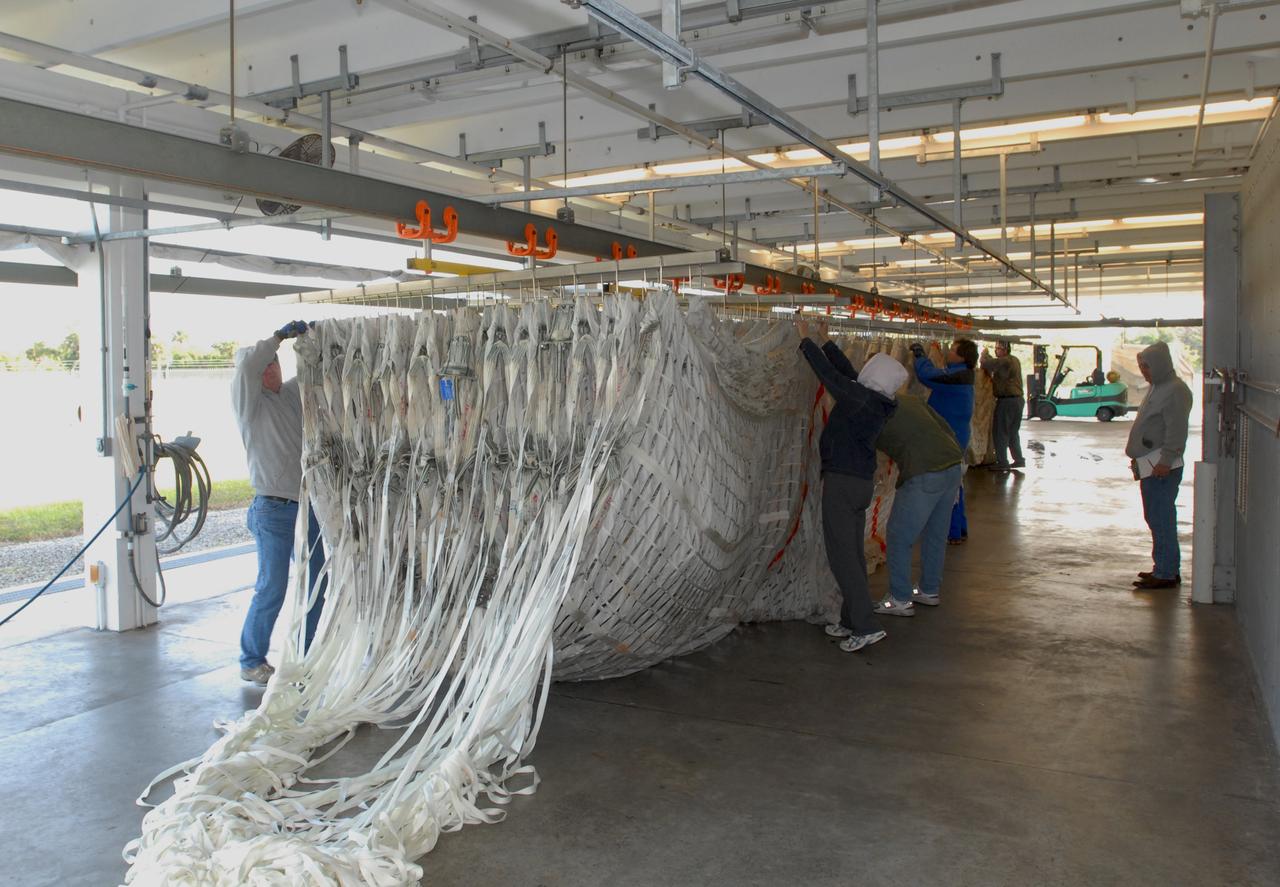
CAPE CANAVERAL, Fla. – At the Parachute Refurbishment Facility at NASA's Kennedy Space Center in Florida, workers begin hanging the parachutes recovered from sea after the launch of space shuttle Endeavour on the STS-126 mission onto a monorail system. The parachutes are used to slow the descent of the solid rocket boosters that are jettisoned during liftoff. The monorail will transport each parachute into a 30,000-gallon washer and a huge dryer heated with 140-degree air at 13,000 cubic feet per minute. One pilot, one drogue and three main canopies per booster slow the booster’s fall from about 360 mph to 50 mph. After the chutes are cleaned and repaired, they must be carefully packed into their bags so they will deploy correctly the next time they are used. Photo credit: NASA/Jim Grossmann

CAPE CANAVERAL, Fla. – At the Parachute Refurbishment Facility at NASA's Kennedy Space Center in Florida, a worker checks the parachute lines, recovered from sea after the launch of space shuttle Endeavour on the STS-126 mission, as they move into the 30,000-gallon washer. The parachutes are used to slow the descent of the solid rocket boosters that are jettisoned during liftoff. After washing, the monorail will move the parachutes into a huge dryer heated with 140-degree air at 13,000 cubic feet per minute. One pilot, one drogue and three main canopies per booster slow the booster’s fall from about 360 mph to 50 mph. After the chutes are cleaned and repaired, they must be carefully packed into their bags so they will deploy correctly the next time they are used. Photo credit: NASA/Jim Grossmann
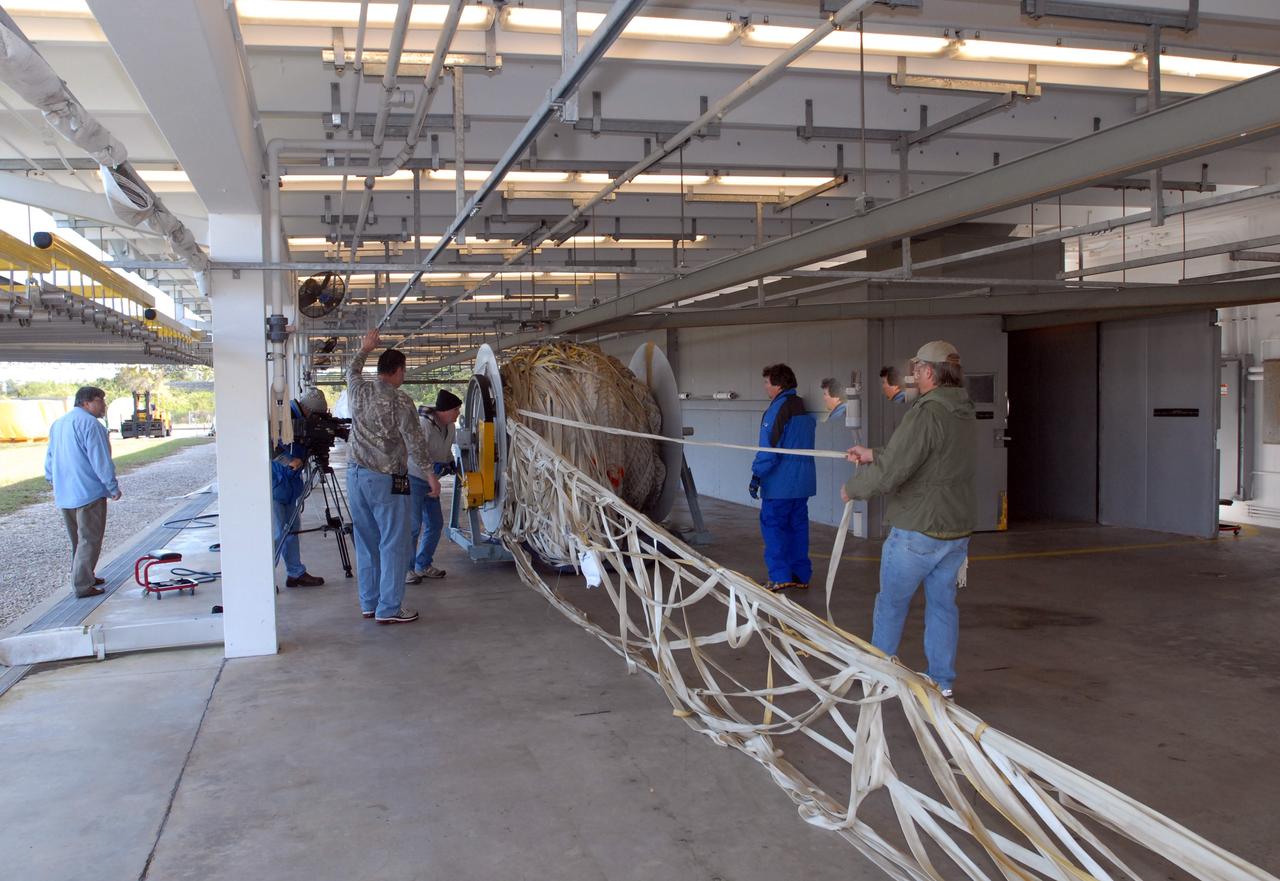
CAPE CANAVERAL, Fla. – At the Parachute Refurbishment Facility at NASA's Kennedy Space Center in Florida, another parachute recovered from sea after the launch of space shuttle Endeavour on the STS-126 mission is unwound from a large turnstile. After their recovery, the parachutes are untangled, hung on a monorail system and transported into a 30,000-gallon washer and a huge dryer heated with 140-degree air at 13,000 cubic feet per minute. The parachutes are used to slow the descent of the solid rocket boosters that are jettisoned during liftoff. One pilot, one drogue and three main canopies per booster slow the booster’s fall from about 360 mph to 50 mph. After the chutes are cleaned and repaired, they must be carefully packed into their bags so they will deploy correctly the next time they are used. Photo credit: NASA/Jim Grossmann

KENNEDY SPACE CENTER, FLA. - The media tour the Parachute Refurbishment Facility, which cleans and repairs the Solid Rocket Booster (SRB) parachutes after a Space Shuttle launch. The stop was part of a day-long event that featured the movement of the first SRB segments to the Vehicle Assembly Building for stacking for Return to Flight mission STS-114. Two SRBs support the liftoff of the Space Shuttle on a launch. The twin 149-foot tall, 12-foot diameter SRBs provide the main propulsion system during launch to place the orbiters in the proper orbit around the Earth. They operate parallel with the Space Shuttle main engines for the first two minutes of flight and jettison away from the orbiter, with help from the Booster Separation Motors, about 26.3 nautical miles above the Earth’s surface.
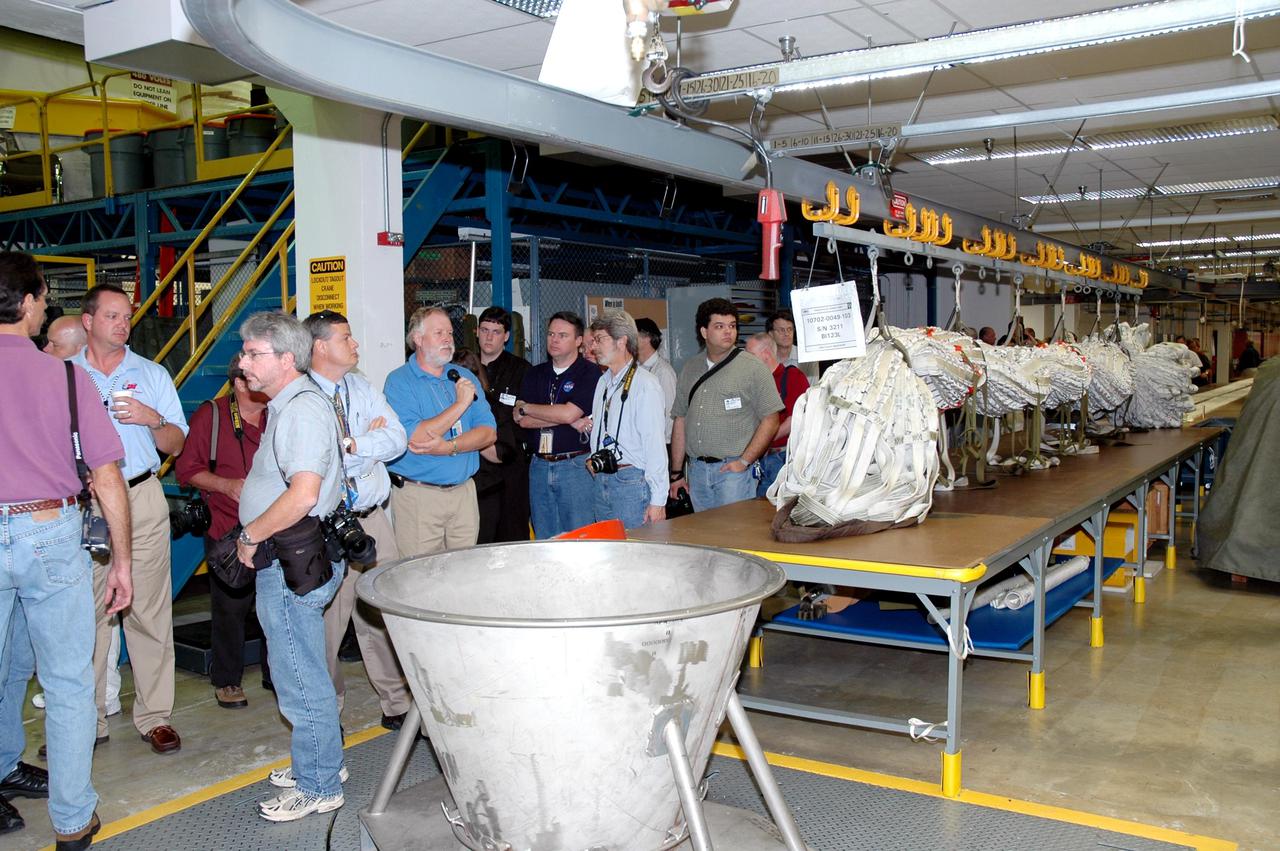
KENNEDY SPACE CENTER, FLA. - The media tour the Parachute Refurbishment Facility, which cleans and repairs the Solid Rocket Booster (SRB) parachutes after a Space Shuttle launch. The stop was part of a day-long event that featured the movement of the first SRB segments to the Vehicle Assembly Building for stacking for Return to Flight mission STS-114. Two SRBs support the liftoff of the Space Shuttle on a launch. The twin 149-foot tall, 12-foot diameter SRBs provide the main propulsion system during launch to place the orbiters in the proper orbit around the Earth. They operate parallel with the Space Shuttle main engines for the first two minutes of flight and jettison away from the orbiter, with help from the Booster Separation Motors, about 26.3 nautical miles above the Earth’s surface.
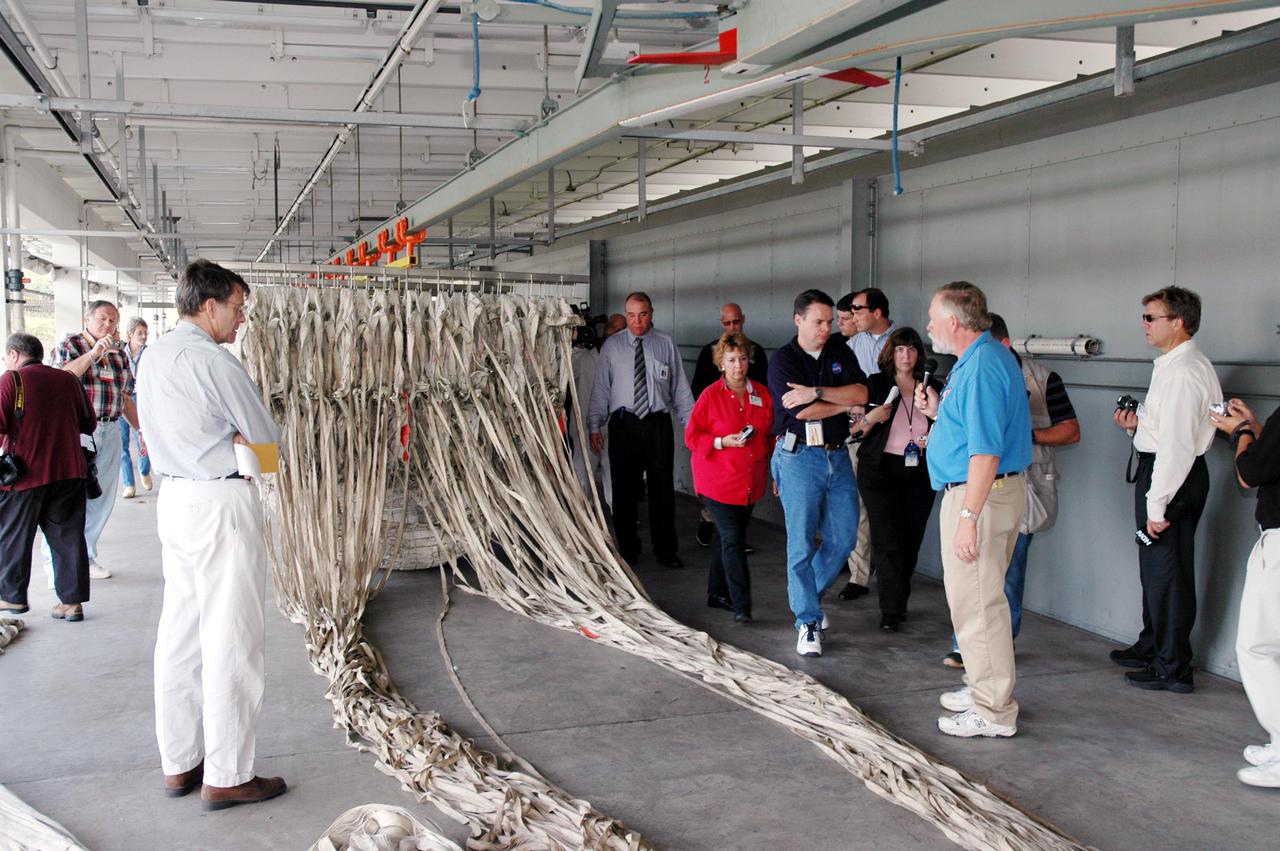
KENNEDY SPACE CENTER, FLA. - The media tour the Parachute Refurbishment Facility, which cleans and repairs the Solid Rocket Booster (SRB) parachutes after a Space Shuttle launch. The stop was part of a day-long event that featured the movement of the first SRB segments to the Vehicle Assembly Building for stacking for Return to Flight mission STS-114. Two SRBs support the liftoff of the Space Shuttle on a launch. The twin 149-foot tall, 12-foot diameter SRBs provide the main propulsion system during launch to place the orbiters in the proper orbit around the Earth. They operate parallel with the Space Shuttle main engines for the first two minutes of flight and jettison away from the orbiter, with help from the Booster Separation Motors, about 26.3 nautical miles above the Earth’s surface.
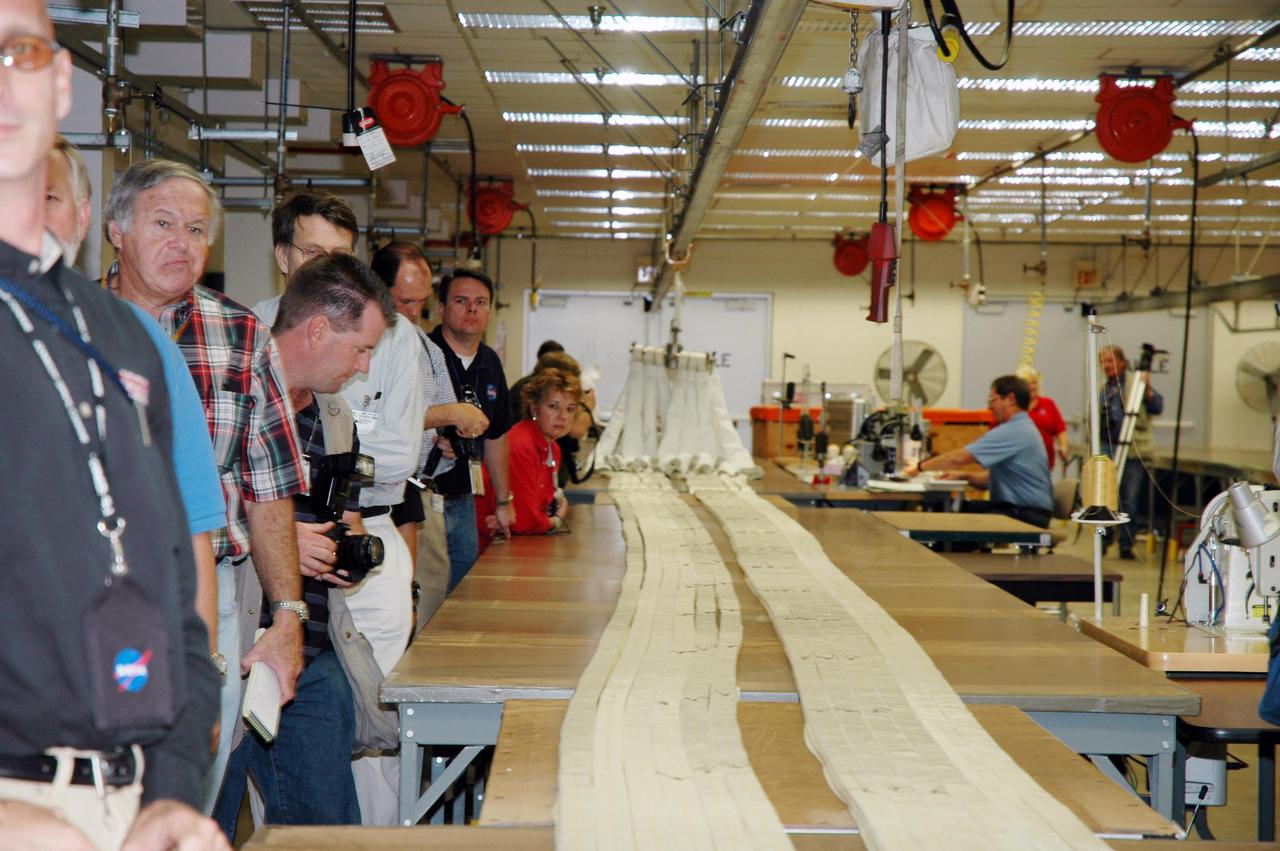
KENNEDY SPACE CENTER, FLA. - The media tour the Parachute Refurbishment Facility, which cleans and repairs the Solid Rocket Booster (SRB) parachutes after a Space Shuttle launch. The stop was part of a day-long event that featured the movement of the first SRB segments to the Vehicle Assembly Building for stacking for Return to Flight mission STS-114. Two SRBs support the liftoff of the Space Shuttle on a launch. The twin 149-foot tall, 12-foot diameter SRBs provide the main propulsion system during launch to place the orbiters in the proper orbit around the Earth. They operate parallel with the Space Shuttle main engines for the first two minutes of flight and jettison away from the orbiter, with help from the Booster Separation Motors, about 26.3 nautical miles above the Earth’s surface.

Inside the Vehicle Assembly Building, an overhead crane moves the forward section of a solid rocket booster (SRB) toward the previously stacked elements at lower left in the photo. The forward section of each booster, from nose cap to forward skirt contains avionics, a sequencer, forward separation motors, a nose cone separation system, drogue and main parachutes, a recovery beacon, a recovery light, a parachute camera on selected flights and a range safety system. Each SRB weighs approximately 1.3 million pounds at launch. The SRB is part of the stack for Space Shuttle Discovery and the STS-92 mission, scheduled for launch Oct. 5, from Launch Pad 39A, on the fifth flight to the International Space Station
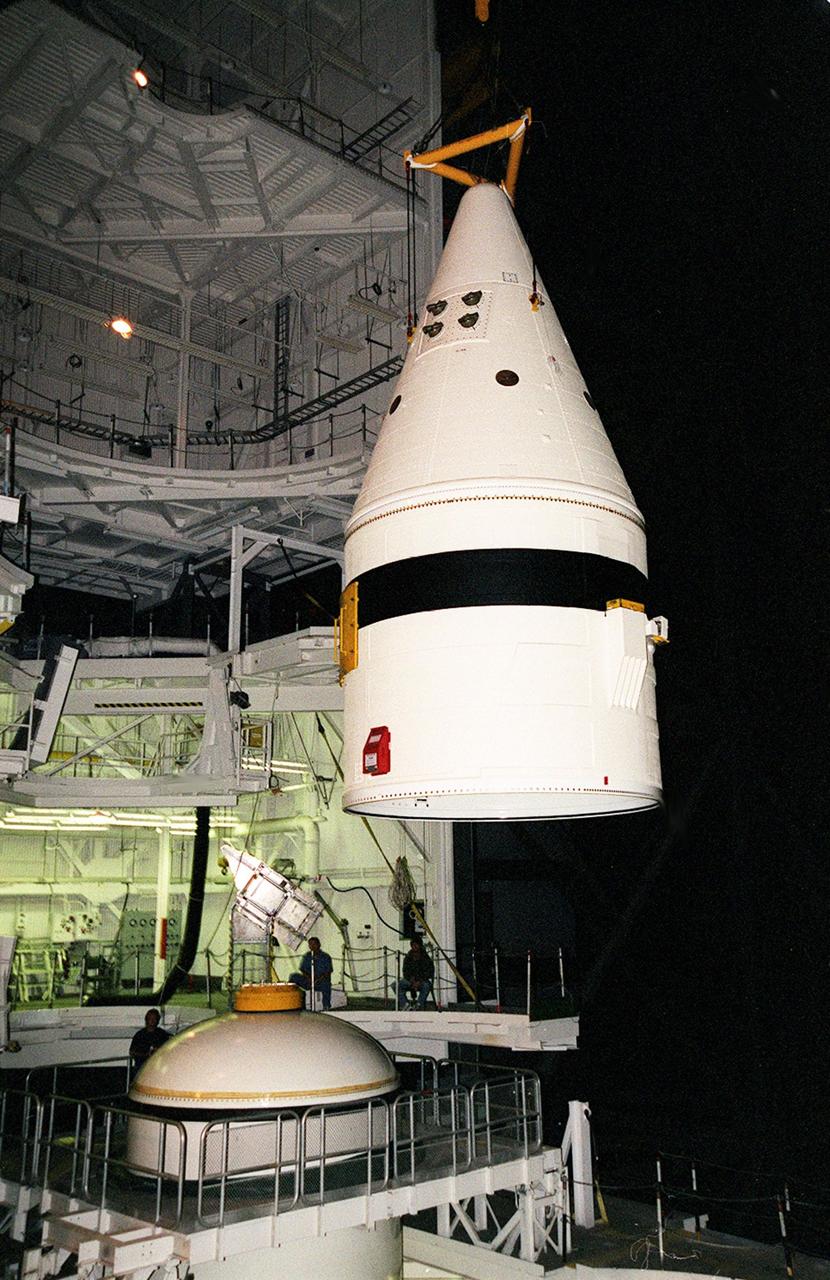
Inside the Vehicle Assembly Building, an overhead crane moves the forward section of a solid rocket booster (SRB) toward the previously stacked elements at lower left in the photo. The forward section of each booster, from nose cap to forward skirt contains avionics, a sequencer, forward separation motors, a nose cone separation system, drogue and main parachutes, a recovery beacon, a recovery light, a parachute camera on selected flights and a range safety system. Each SRB weighs approximately 1.3 million pounds at launch. The SRB is part of the stack for Space Shuttle Discovery and the STS-92 mission, scheduled for launch Oct. 5, from Launch Pad 39A, on the fifth flight to the International Space Station
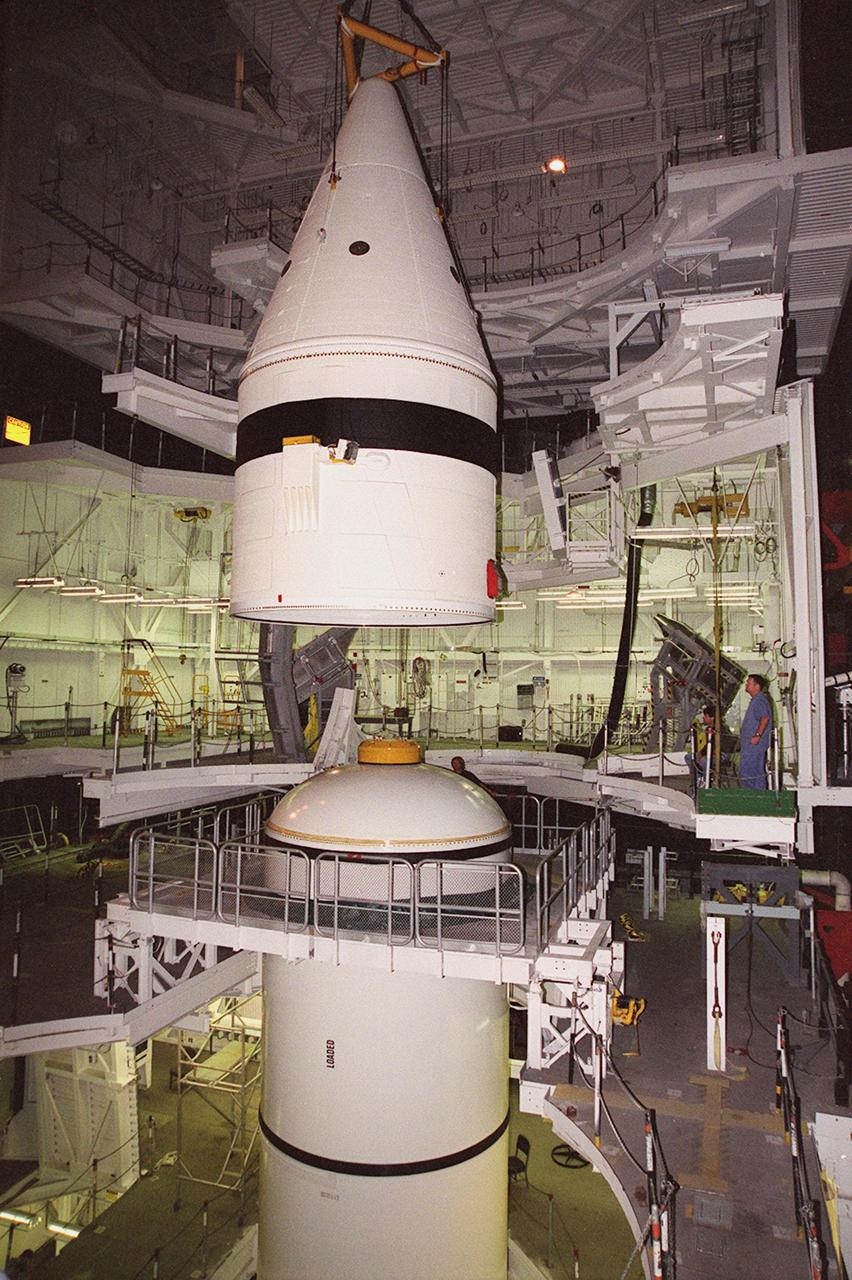
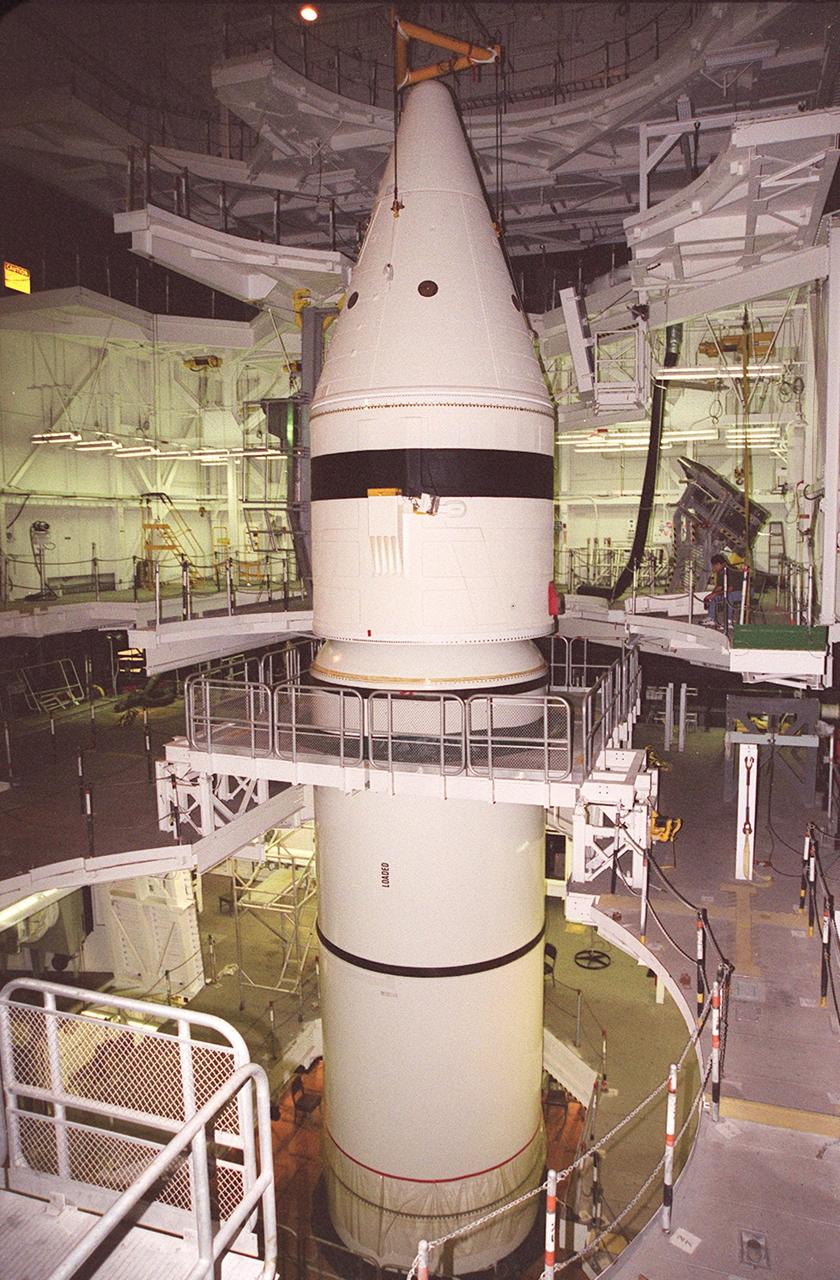
Inside the Vehicle Assembly Building, an overhead crane centers the forward section of a solid rocket booster (SRB) above the rest of the stack it will be mated to. The forward section of each booster, from nose cap to forward skirt contains avionics, a sequencer, forward separation motors, a nose cone separation system, drogue and main parachutes, a recovery beacon, a recovery light, a parachute camera on selected flights and a range safety system. Each SRB weighs approximately 1.3 million pounds at launch. The SRB is part of the stack for Space Shuttle Discovery and the STS-92 mission, scheduled for launch Oct. 5, from Launch Pad 39A, on the fifth flight to the International Space Station
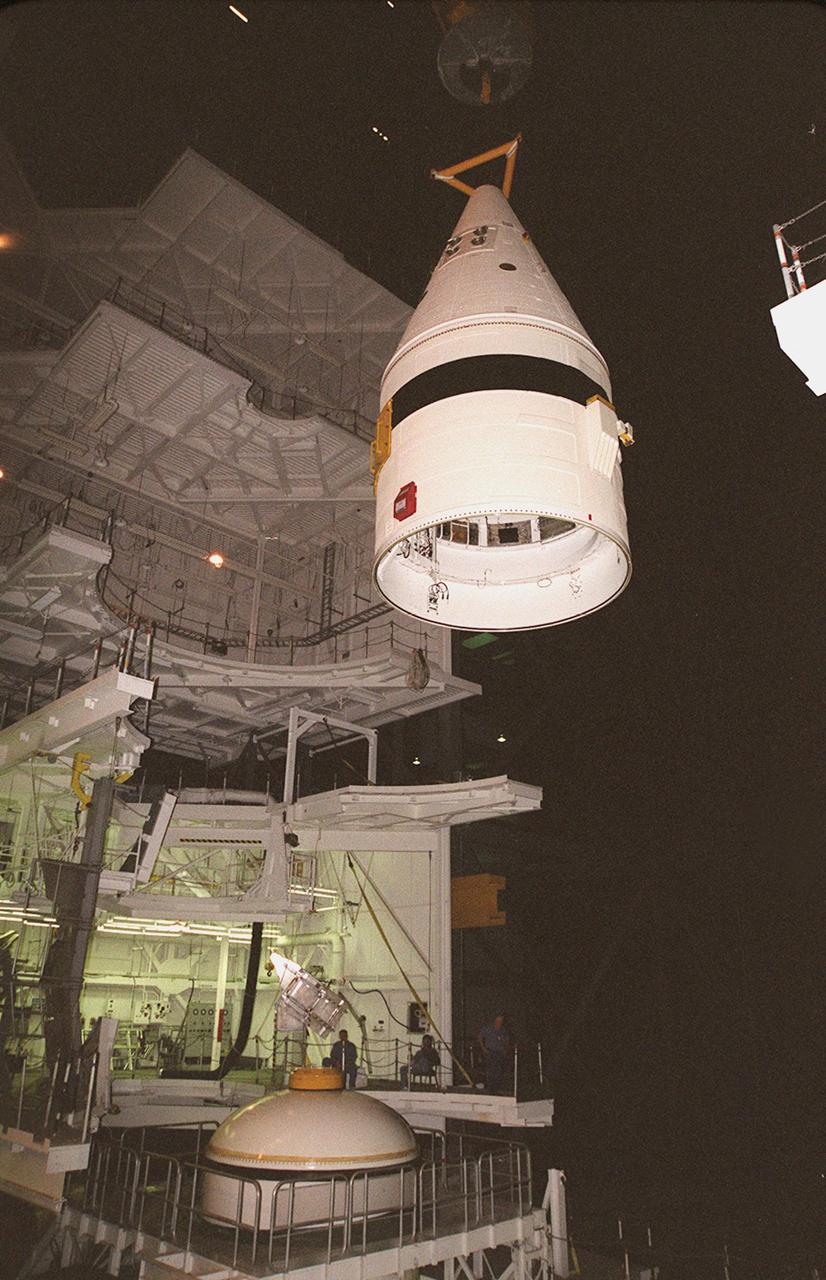
Inside the Vehicle Assembly Building, an overhead crane lifts the forward section of a solid rocket booster (SRB) to mate it with the components seen at lower left in the photo. The forward section of each booster, from nose cap to forward skirt contains avionics, a sequencer, forward separation motors, a nose cone separation system, drogue and main parachutes, a recovery beacon, a recovery light, a parachute camera on selected flights and a range safety system. Each SRB weighs approximately 1.3 million pounds at launch. The SRB is part of the stack for Space Shuttle Discovery and the STS-92 mission, scheduled for launch Oct. 5, from Launch Pad 39A, on the fifth flight to the International Space Station
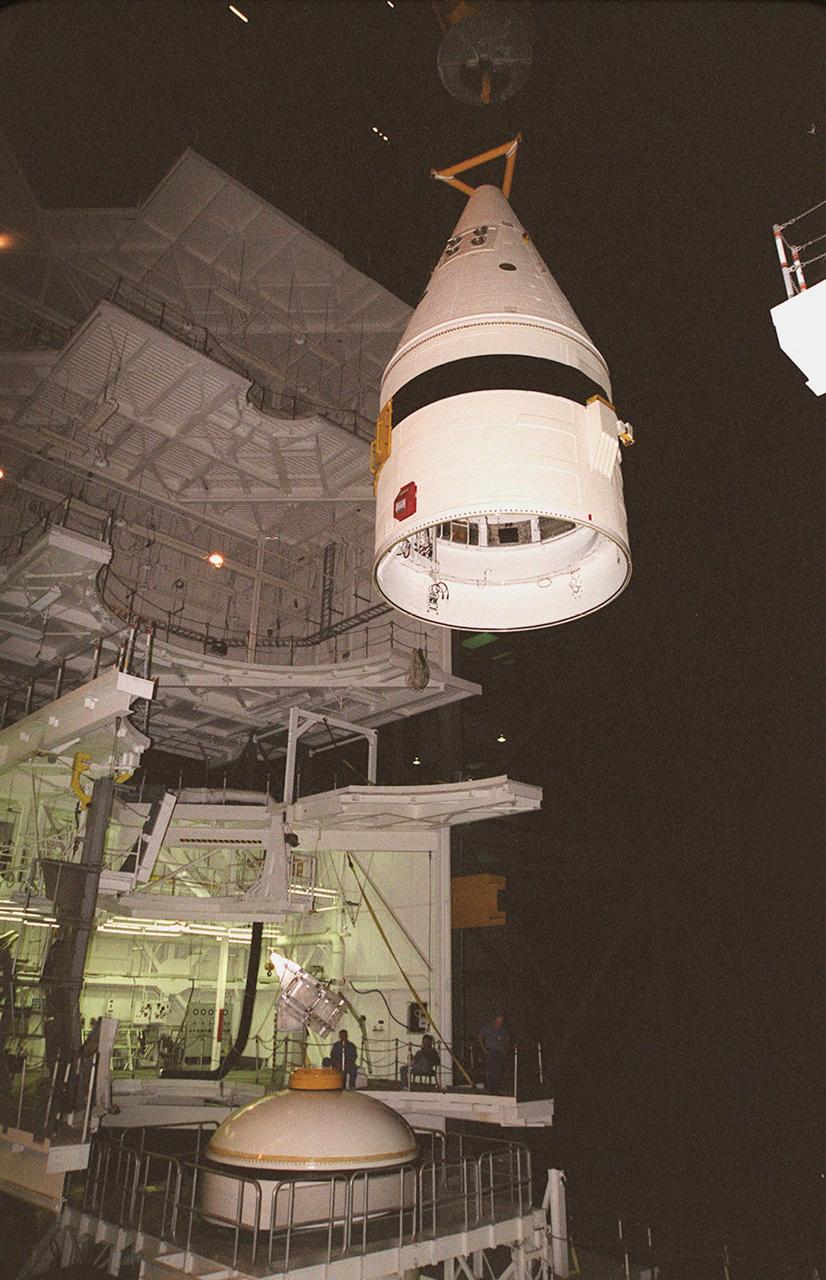
Inside the Vehicle Assembly Building, an overhead crane lifts the forward section of a solid rocket booster (SRB) to mate it with the components seen at lower left in the photo. The forward section of each booster, from nose cap to forward skirt contains avionics, a sequencer, forward separation motors, a nose cone separation system, drogue and main parachutes, a recovery beacon, a recovery light, a parachute camera on selected flights and a range safety system. Each SRB weighs approximately 1.3 million pounds at launch. The SRB is part of the stack for Space Shuttle Discovery and the STS-92 mission, scheduled for launch Oct. 5, from Launch Pad 39A, on the fifth flight to the International Space Station
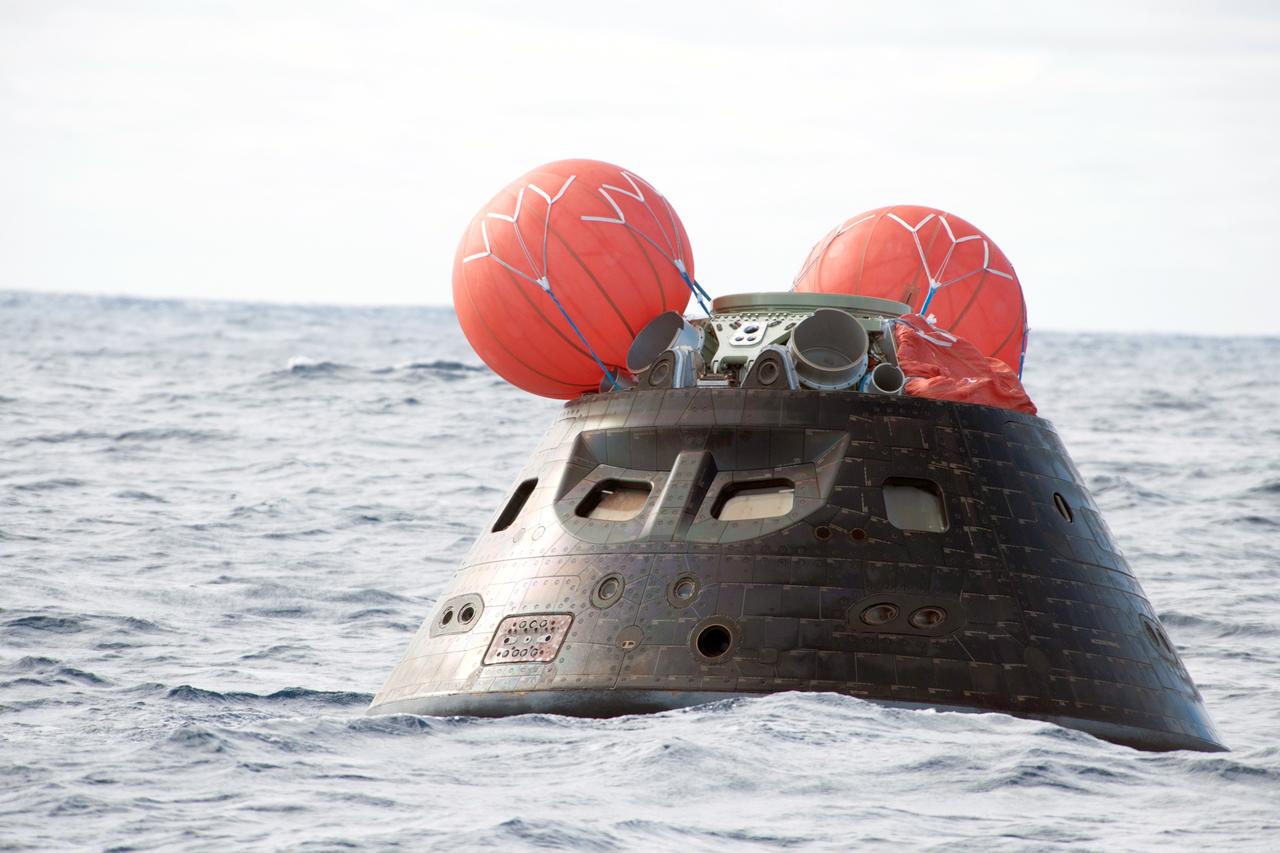
SAN DIEGO, Calif. -- NASA's Orion spacecraft floats in the Pacific Ocean after splashdown from its first flight test in Earth orbit. The spacecraft completed a two-orbit, four-and-a-half-hour mission in Earth orbit. NASA, the U.S. Navy and Lockheed Martin are coordinating efforts to recover Orion, the forward bay cover and main parachutes. Orion will be towed in and secure in the well deck of the nearby USS Anchorage. Orion's mission tested systems critical to crew safety, including the launch abort system, the heat shield and the parachute system. The Ground Systems Development and Operations Program is leading the recovery efforts. For more information, visit www.nasa.gov/orion Photo credit: NASA/Tony Gray
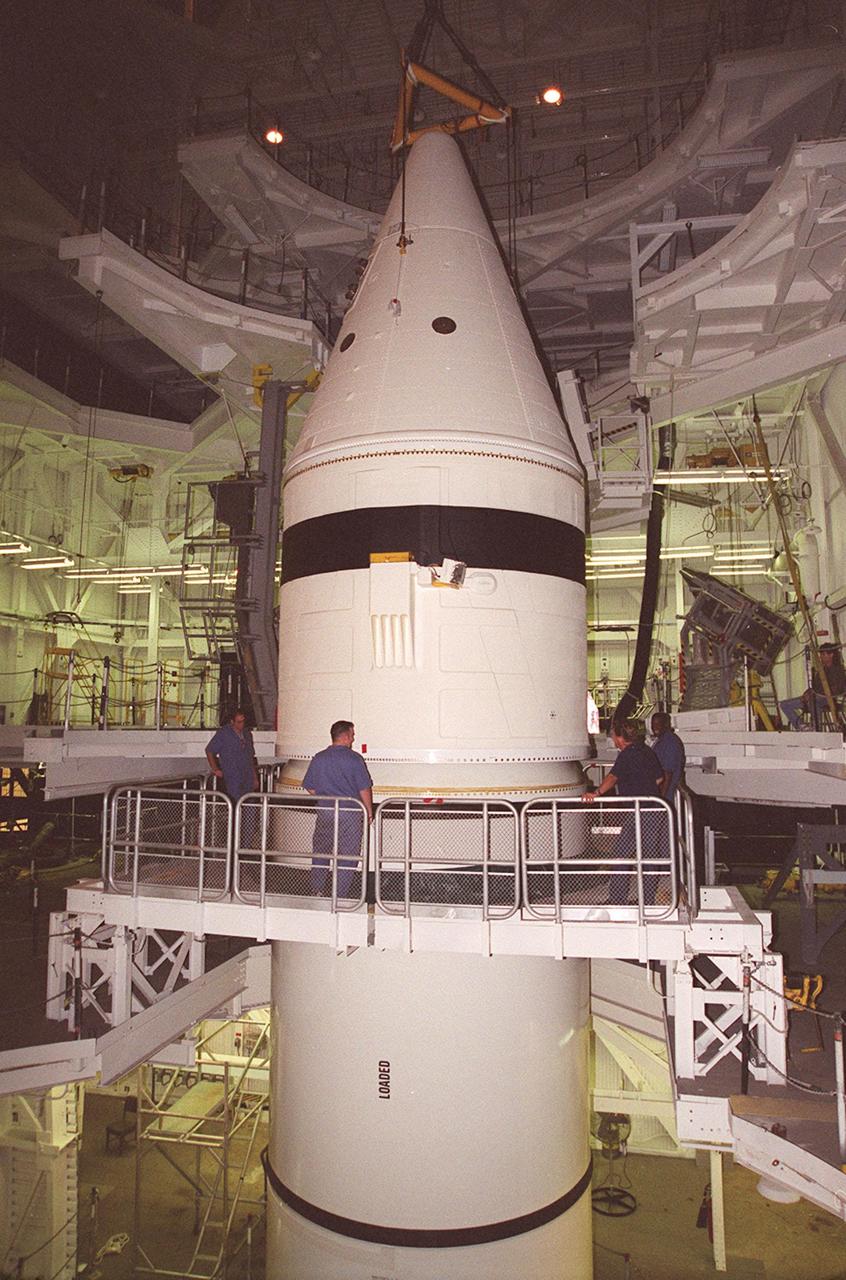
Inside the Vehicle Assembly Building, the forward section of a solid rocket booster (SRB) sits on top of the rest of the stack for mating. The forward section of each booster, from nose cap to forward skirt contains avionics, a sequencer, forward separation motors, a nose cone separation system, drogue and main parachutes, a recovery beacon, a recovery light, a parachute camera on selected flights and a range safety system. Each SRB weighs approximately 1.3 million pounds at launch. The SRB is part of the stack for Space Shuttle Discovery and the STS-92 mission, scheduled for launch Oct. 5, from Launch Pad 39A, on the fifth flight to the International Space Station
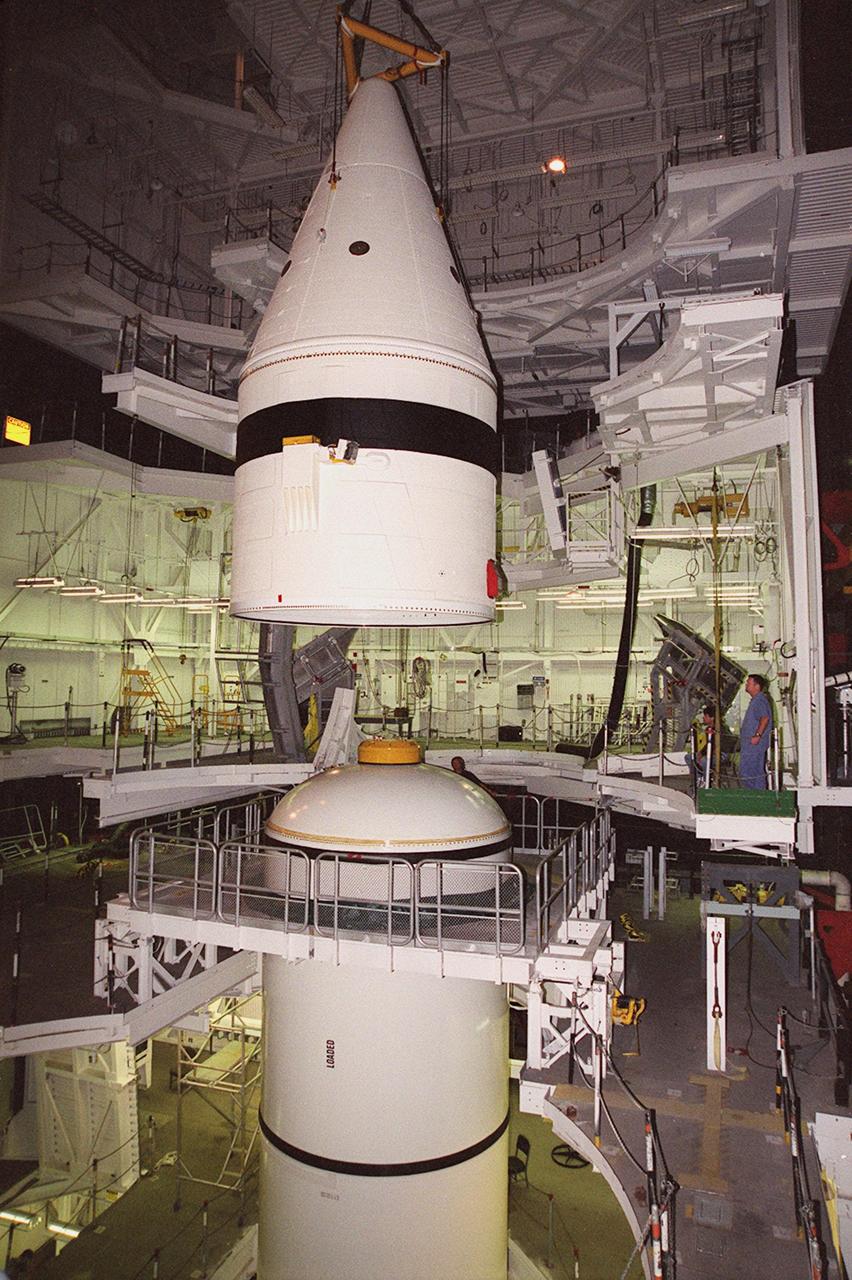
Inside the Vehicle Assembly Building, the forward section of a solid rocket booster (SRB) is lowered onto the rest of the stack for mating. The forward section of each booster, from nose cap to forward skirt contains avionics, a sequencer, forward separation motors, a nose cone separation system, drogue and main parachutes, a recovery beacon, a recovery light, a parachute camera on selected flights and a range safety system. Each SRB weighs approximately 1.3 million pounds at launch. The SRB is part of the stack for Space Shuttle Discovery and the STS-92 mission, scheduled for launch Oct. 5, from Launch Pad 39A, on the fifth flight to the International Space Station
Inside the Vehicle Assembly Building, an overhead crane centers the forward section of a solid rocket booster (SRB) above the rest of the stack it will be mated to. The forward section of each booster, from nose cap to forward skirt contains avionics, a sequencer, forward separation motors, a nose cone separation system, drogue and main parachutes, a recovery beacon, a recovery light, a parachute camera on selected flights and a range safety system. Each SRB weighs approximately 1.3 million pounds at launch. The SRB is part of the stack for Space Shuttle Discovery and the STS-92 mission, scheduled for launch Oct. 5, from Launch Pad 39A, on the fifth flight to the International Space Station
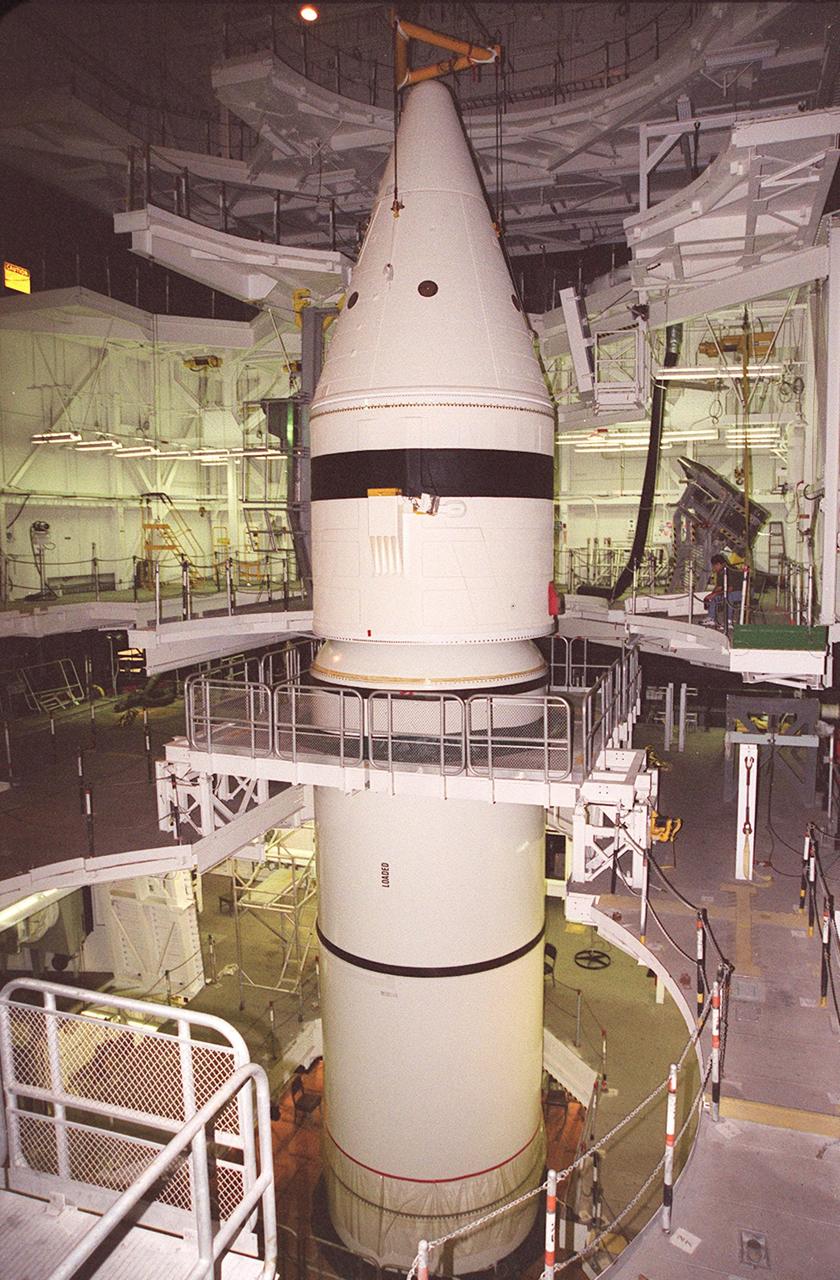
Inside the Vehicle Assembly Building, the forward section of a solid rocket booster (SRB) is lowered onto the rest of the stack for mating. The forward section of each booster, from nose cap to forward skirt contains avionics, a sequencer, forward separation motors, a nose cone separation system, drogue and main parachutes, a recovery beacon, a recovery light, a parachute camera on selected flights and a range safety system. Each SRB weighs approximately 1.3 million pounds at launch. The SRB is part of the stack for Space Shuttle Discovery and the STS-92 mission, scheduled for launch Oct. 5, from Launch Pad 39A, on the fifth flight to the International Space Station
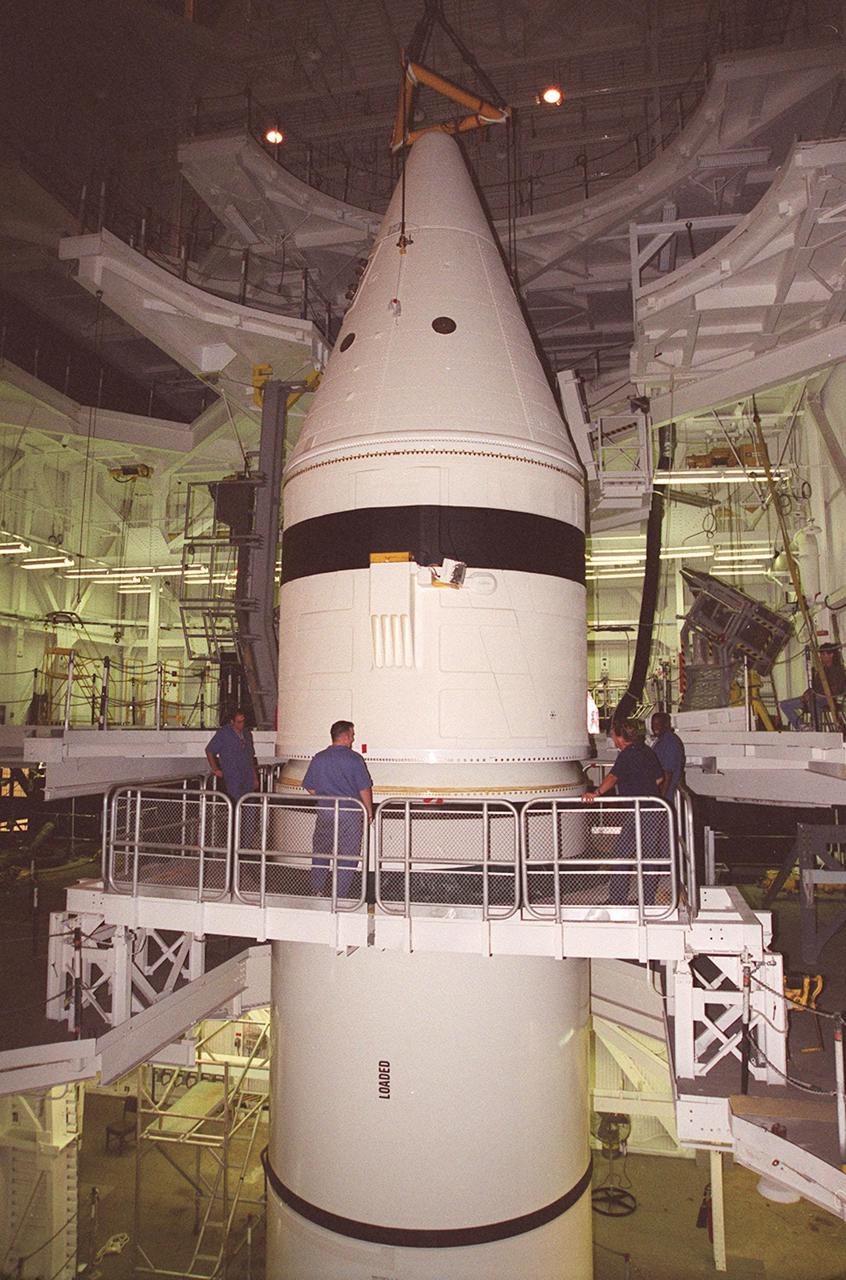
Inside the Vehicle Assembly Building, the forward section of a solid rocket booster (SRB) sits on top of the rest of the stack for mating. The forward section of each booster, from nose cap to forward skirt contains avionics, a sequencer, forward separation motors, a nose cone separation system, drogue and main parachutes, a recovery beacon, a recovery light, a parachute camera on selected flights and a range safety system. Each SRB weighs approximately 1.3 million pounds at launch. The SRB is part of the stack for Space Shuttle Discovery and the STS-92 mission, scheduled for launch Oct. 5, from Launch Pad 39A, on the fifth flight to the International Space Station
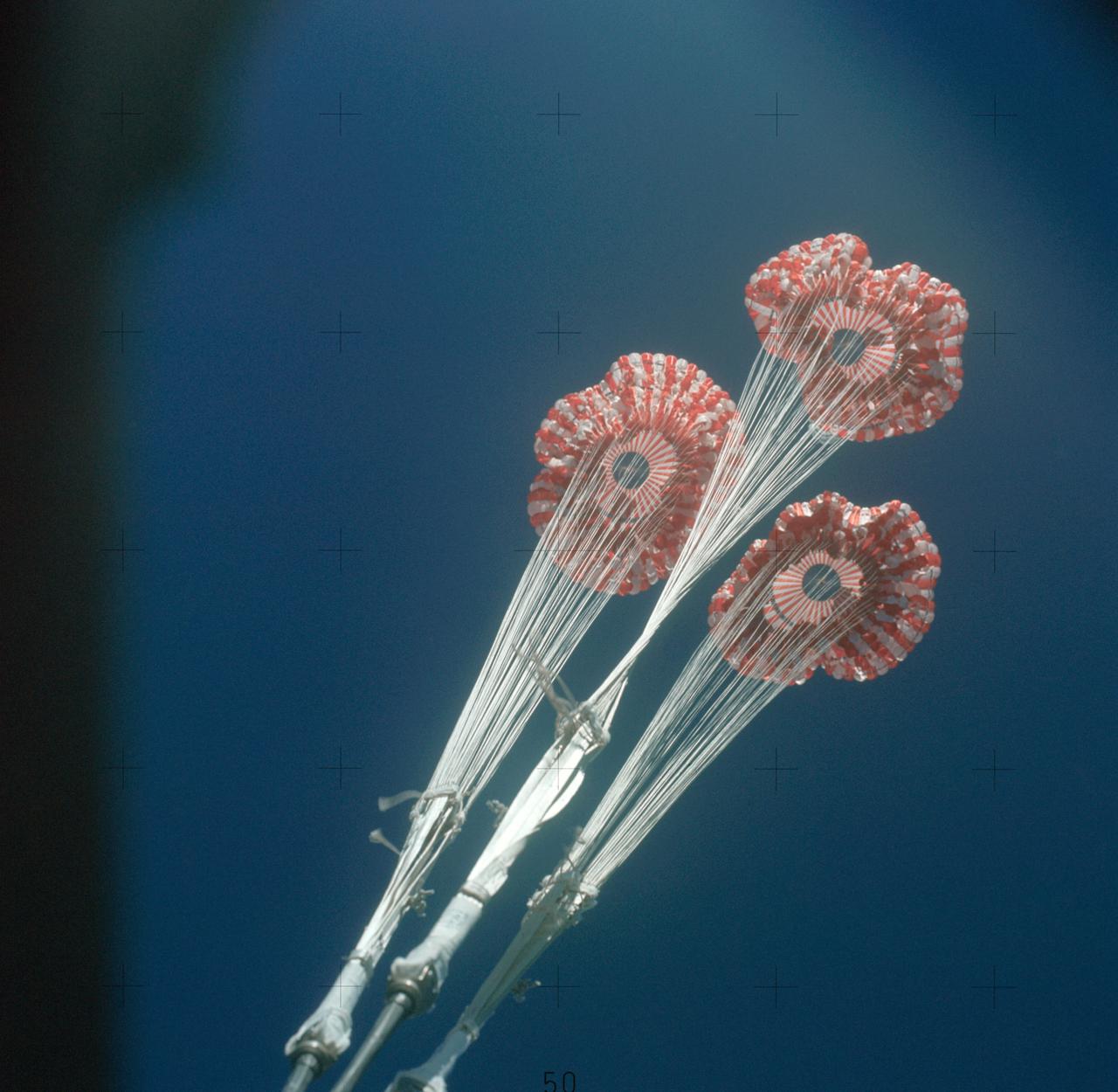
SL3-114-1760 (25 Sept. 1973) --? An excellent view of the three main ring sail parachutes of the Skylab 3 command module as they unfurl during descent to a successful splashdown in the Pacific Ocean. This picture was taken by a hand-held 70mm Hasselblad camera, looking up through a window of the command module. These parachutes open at approximately 10,000 feet altitude. Aboard the CM were astronauts Alan L. Bean, Owen K. Garriott and Jack R. Lousma, who had just completed a 59-day visit to the Skylab space station in Earth orbit. Photo credit: NASA
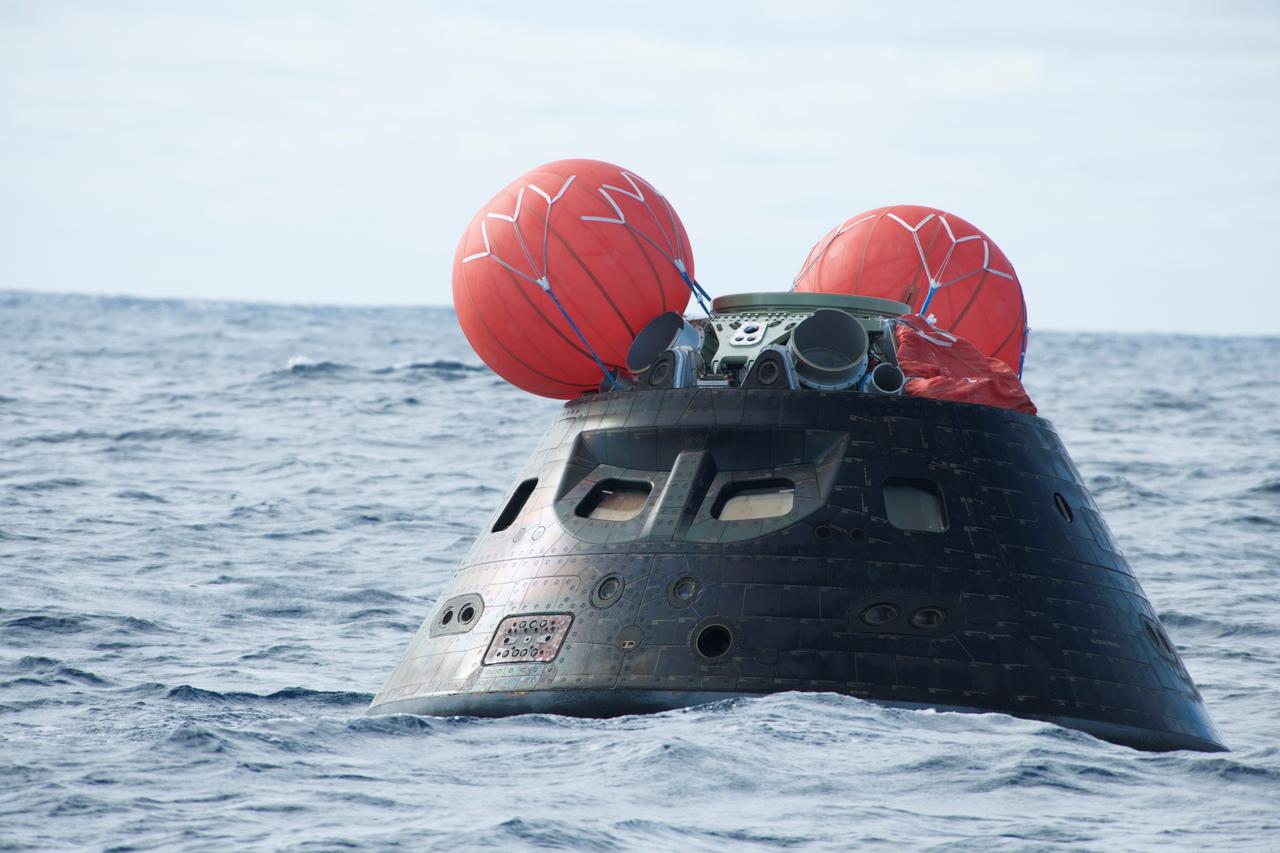
NASA's Orion spacecraft floats in the Pacific Ocean after splashdown from its first flight test in Earth orbit. The spacecraft completed a two-orbit, four-and-a-half-hour mission in Earth orbit. NASA, the U.S. Navy and Lockheed Martin are coordinating efforts to recover Orion, the forward bay cover and main parachutes. Orion will be towed in and secure in the well deck of the nearby USS Anchorage. Orion's mission tested systems critical to crew safety, including the launch abort system, the heat shield and the parachute system. The Ground Systems Development and Operations Program is leading the recovery efforts.