
Members of the space shuttle mission STS-118 crew march down Main Street at Walt Disney World in Orlando. From left are Mission Specialists Alvin Drew, Barbara R. Morgan and Dave Williams, Pilot Charlie Hobaugh, Mission Specialist Tracy Caldwell and Commander Scott Kelly. Not pictured but present is Mission Specialist Rick Mastracchio. The event also honored teacher-turned-astronaut Morgan, who dedicated a plaque outside the Mission: Space attraction. Other activities included meeting with the media and students. Mission STS-118 was the 119th shuttle program flight and the 22nd flight to the International Space Station. Space shuttle Endeavour launched from NASA's Kennedy Space Center on Aug. 8 and landed Aug. 21. The mission delivered the S5 truss, continuing the assembly of the space station.

A special event honoring the crew of space shuttle mission STS-118 was held at Walt Disney World. Here, visitors enjoy the NASA display at Epcot's Innoventions Center. The event also honored teacher-turned-astronaut Barbara R. Morgan, who dedicated a plaque outside the Mission: Space attraction. Other activities included meeting with the media and students and a parade down Main Street. Mission STS-118 was the 119th shuttle program flight and the 22nd flight to the International Space Station. Space shuttle Endeavour launched from NASA's Kennedy Space Center on Aug. 8 and landed Aug. 21. The mission delivered the S5 truss, continuing the assembly of the space station.
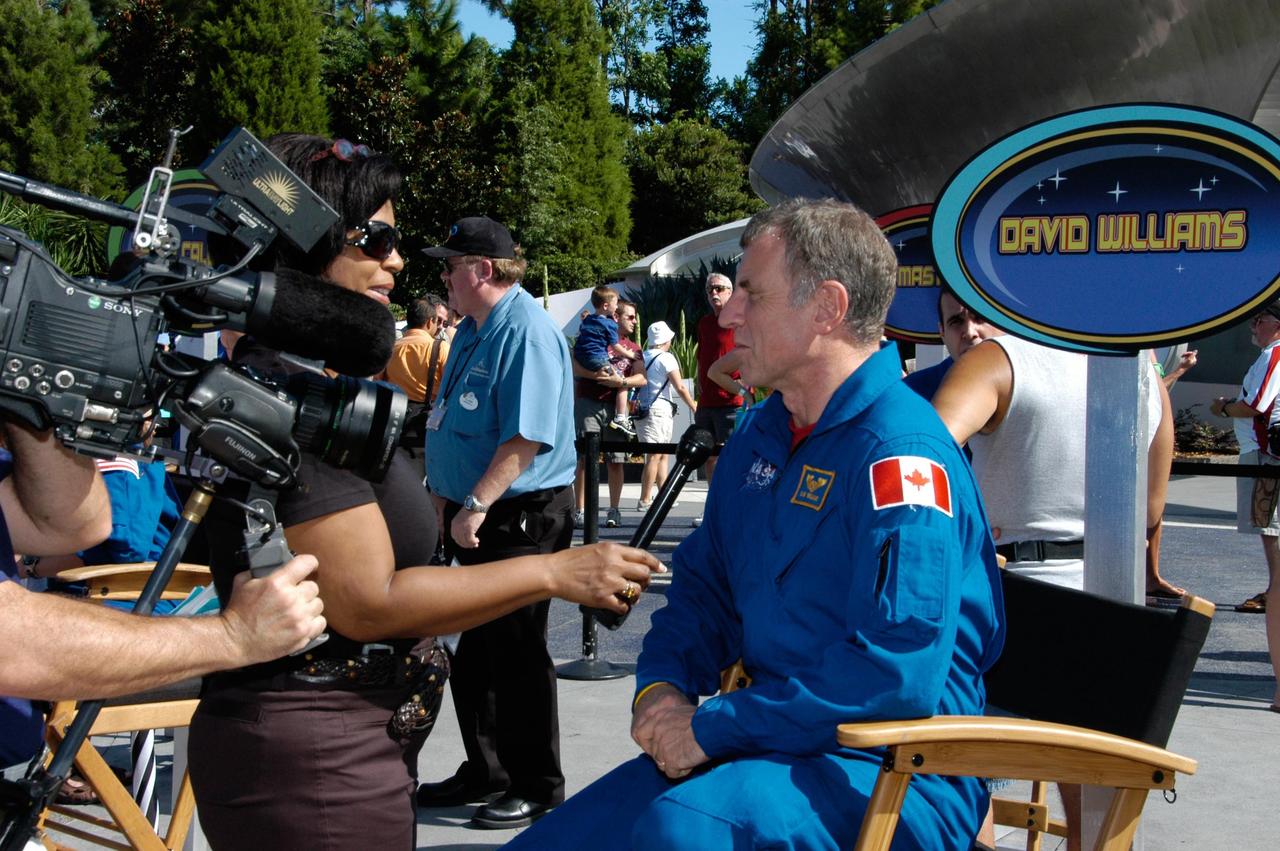
KENNEDY SPACE CENTER, FLA. -- A reporter interviews STS-118 Mission Specialist Dave Williams during a special event at Walt Disney World in Orlando . The day's events honoring the STS-118 space shuttle crew recognized the inspirational achievement of teacher-turned-astronaut Barbara R. Morgan who helped dedicate a plaque outside the Mission: Space attraction, and included meeting with students and the media and parading down Main Street to the delight of the crowds. The other crew members attending were Commander Scott Kelly, Pilot Charlie Hobaugh and Mission Specialists Tracy Caldwell, Rick Mastracchio and Alvin Drew. Mission STS-118 was the 119th shuttle program flight and the 22nd flight to the International Space Station. Space shuttle Endeavour launched from NASA's Kennedy Space Center on Aug. 8 and landed Aug. 21. The mission delivered the S5 truss, continuing the assembly of the space station. Photo credit: NASA/George Shelton

NASA's Kennedy Space Center Education Specialists Linda Scauzillo and Christopher Blair take part in a special education session with local students at Epcot's Base21 Siemens VIP Center. The event was part of the day's activities honoring the space shuttle Endeavour crew of mission STS-118. The crew met with the media and paraded down Main Street. The event also honored teacher-turned-astronaut Barbara R. Morgan, who dedicated a plaque outside the Mission: Space attraction. The other crew members attending were Commander Scott Kelly, Pilot Charlie Hobaugh and Mission Specialists Tracy Caldwell, Dave Williams, Rick Mastracchio and Alvin Drew. Mission STS-118 was the 119th shuttle program flight and the 22nd flight to the International Space Station. Space shuttle Endeavour launched from NASA's Kennedy Space Center on Aug. 8 and landed Aug. 21. The mission delivered the S5 truss, continuing the assembly of the space station.
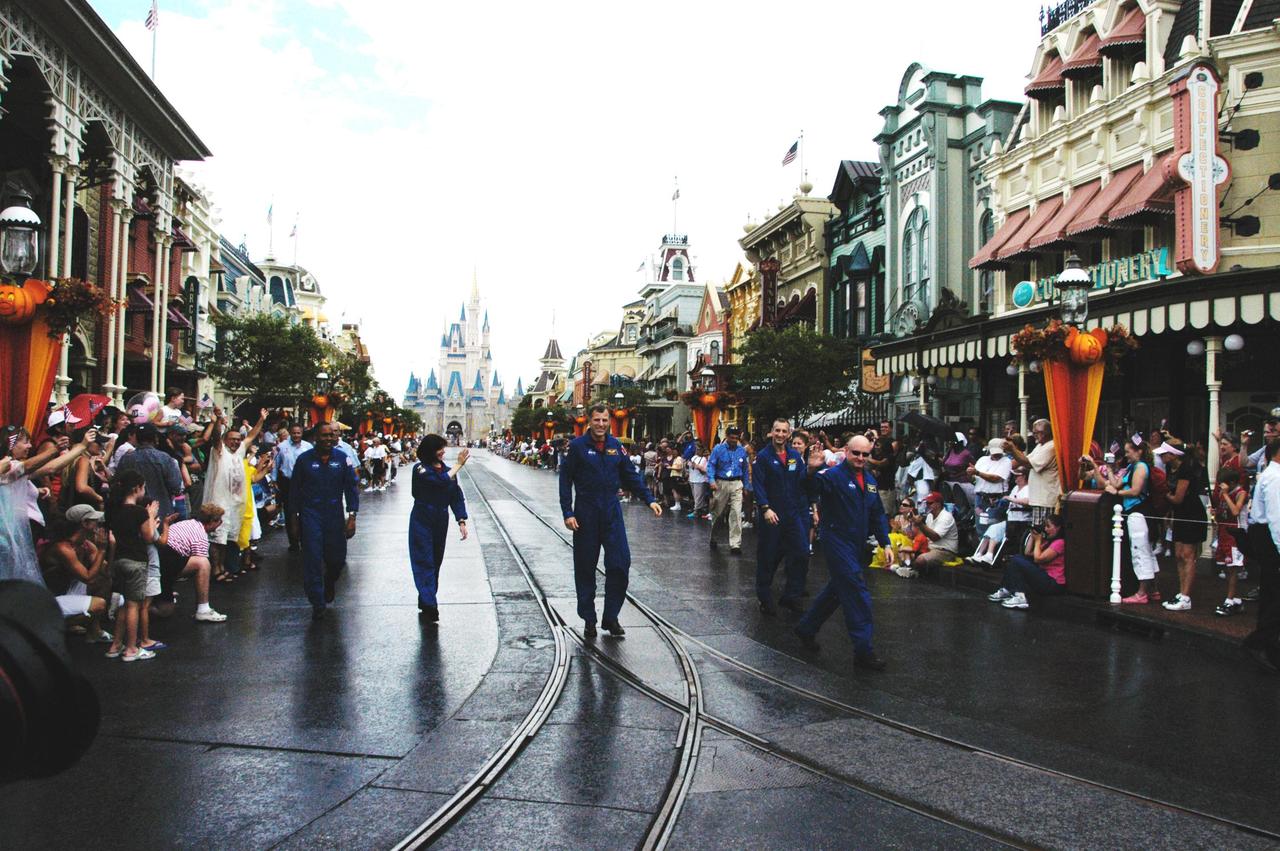
KENNEDY SPACE CENTER, FLA. -- Members of the space shuttle mission STS-118 crew march down Main Street at Walt Disney World in Orlando. From left are Mission Specialists Alvin Drew, Barbara R. Morgan and Dave Williams, Pilot Charlie Hobaugh, Mission Specialist Tracy Caldwell and Commander Scott Kelly. Not pictured but present is Mission Specialist Rick Mastracchio. The event also honored teacher-turned-astronaut Morgan, who dedicated a plaque outside the Mission: Space attraction. Other activities included meeting with the media and students. Mission STS-118 was the 119th shuttle program flight and the 22nd flight to the International Space Station. Space shuttle Endeavour launched from NASA's Kennedy Space Center on Aug. 8 and landed Aug. 21. The mission delivered the S5 truss, continuing the assembly of the space station. Photo credit: NASA/George Shelton

A reporter interviews STS-118 Mission Specialist Dave Williams during a special event at Walt Disney World in Orlando . The day's events honoring the STS-118 space shuttle crew recognized the inspirational achievement of teacher-turned-astronaut Barbara R. Morgan who helped dedicate a plaque outside the Mission: Space attraction, and included meeting with students and the media and parading down Main Street to the delight of the crowds. The other crew members attending were Commander Scott Kelly, Pilot Charlie Hobaugh and Mission Specialists Tracy Caldwell, Rick Mastracchio and Alvin Drew. Mission STS-118 was the 119th shuttle program flight and the 22nd flight to the International Space Station. Space shuttle Endeavour launched from NASA's Kennedy Space Center on Aug. 8 and landed Aug. 21. The mission delivered the S5 truss, continuing the assembly of the space station
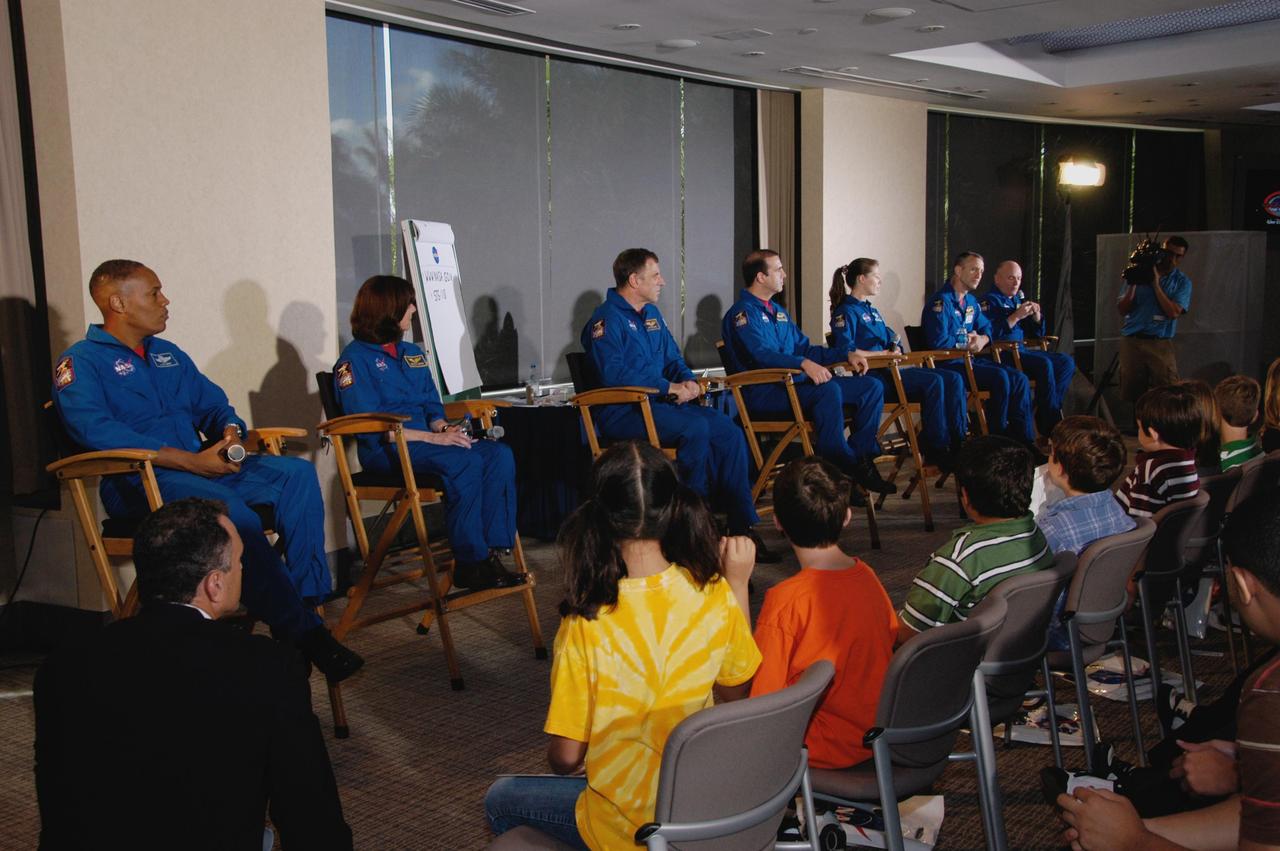
KENNEDY SPACE CENTER, FLA. -- At Walt Disney World in Orlando, the crew members of space shuttle mission STS-118 answer questions from the student audience during a special event to honor the Endeavour crew. Seated from left are Mission Specialists Alvin Drew, Barbara R. Morgan, Dave Williams, Rick Mastracchio and Tracy Caldwell; Pilot Charlie Hobaugh; and Commander Scott Kelly. The event also honored teacher-turned-astronaut Morgan, who dedicated a plaque outside the Mission: Space attraction. Other activities included meeting with the media and a parade down Main Street. Mission STS-118 was the 119th shuttle program flight and the 22nd flight to the International Space Station. Space shuttle Endeavour launched from NASA's Kennedy Space Center on Aug. 8 and landed Aug. 21. The mission delivered the S5 truss, continuing the assembly of the space station. Photo credit: NASA/George Shelton

KENNEDY SPACE CENTER, FLA. -- A special event honoring the crew of space shuttle mission STS-118 was held at Walt Disney World. Here, visitors enjoy the NASA display at Epcot's Innoventions Center. The event also honored teacher-turned-astronaut Barbara R. Morgan, who dedicated a plaque outside the Mission: Space attraction. Other activities included meeting with the media and students and a parade down Main Street. Mission STS-118 was the 119th shuttle program flight and the 22nd flight to the International Space Station. Space shuttle Endeavour launched from NASA's Kennedy Space Center on Aug. 8 and landed Aug. 21. The mission delivered the S5 truss, continuing the assembly of the space station. Photo credit: NASA/George Shelton

At Walt Disney World in Orlando, the crew members of space shuttle mission STS-118 answer questions from the student audience during a special event to honor the Endeavour crew. Seated from left are Mission Specialists Alvin Drew, Barbara R. Morgan, Dave Williams, Rick Mastracchio and Tracy Caldwell; Pilot Charlie Hobaugh; and Commander Scott Kelly. The event also honored teacher-turned-astronaut Morgan, who dedicated a plaque outside the Mission: Space attraction. Other activities included meeting with the media and a parade down Main Street. Mission STS-118 was the 119th shuttle program flight and the 22nd flight to the International Space Station. Space shuttle Endeavour launched from NASA's Kennedy Space Center on Aug. 8 and landed Aug. 21. The mission delivered the S5 truss, continuing the assembly of the space station.
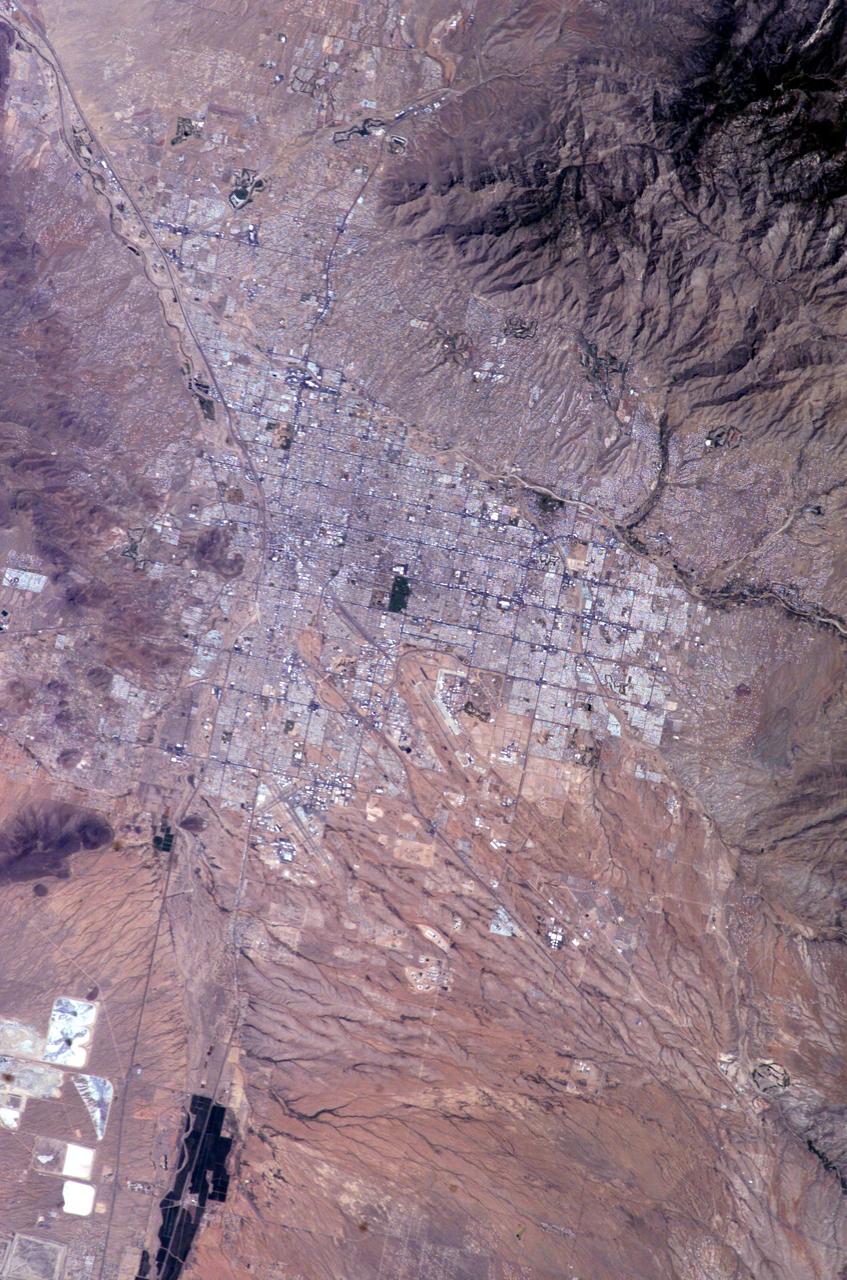
ISS009-E-10382 (7 June 2004) --- Tucson, Arizona is featured in this image photographed by an Expedition 9 crewmember on the International Space Station (ISS). Tucson lies between the forested Catalina Mountains and the Tucson Mountains (dark reddish brown at left). The typical western North American cityscape is a pattern of regular north-south aligned rectangles outlined by major streets set one mile apart. Tucson’s Randolph golf course is the large rectangular dark zone in the image center. The striking contrast between the golf course and its surroundings is due to dense grass cover maintained by frequent watering. The rectangular grid pattern disappears in the small streets of the original city center, situated along the Santa Cruz River (enters the view lower left and exits in the top left corner). Newer and less densely built-up neighborhoods in the foothills of the Catalina Mountains are designed to incorporate natural landscape features, and retain major washes with natural vegetation. This portion of the cityscape seen from space is consequently quite different from the main city grid. The foothills afford views of the city to the south and the mountains to the north and are major areas of development. Large white dots within the urban grid are the reflective rooftops of shopping malls. Tucson enjoys an important position along several major crossroads. Interstate highway I-10, which connects southern California to Florida, appears as a straight line running parallel with the Santa Cruz River northwest from Tucson in the direction of Phoenix. The I-10 traverses a well-marked alluvial fan that extends from the Santa Rita Mountains to the southeast (fine drainage pattern lower center) and exits the view lower right. Highway I-19 is the straight line (lower left) leading south from the city center, between the Santa Cruz River and rectangular spoil heaps of nearby copper mines. The I-19 connects Tucson with Nogales on the Mexican border.
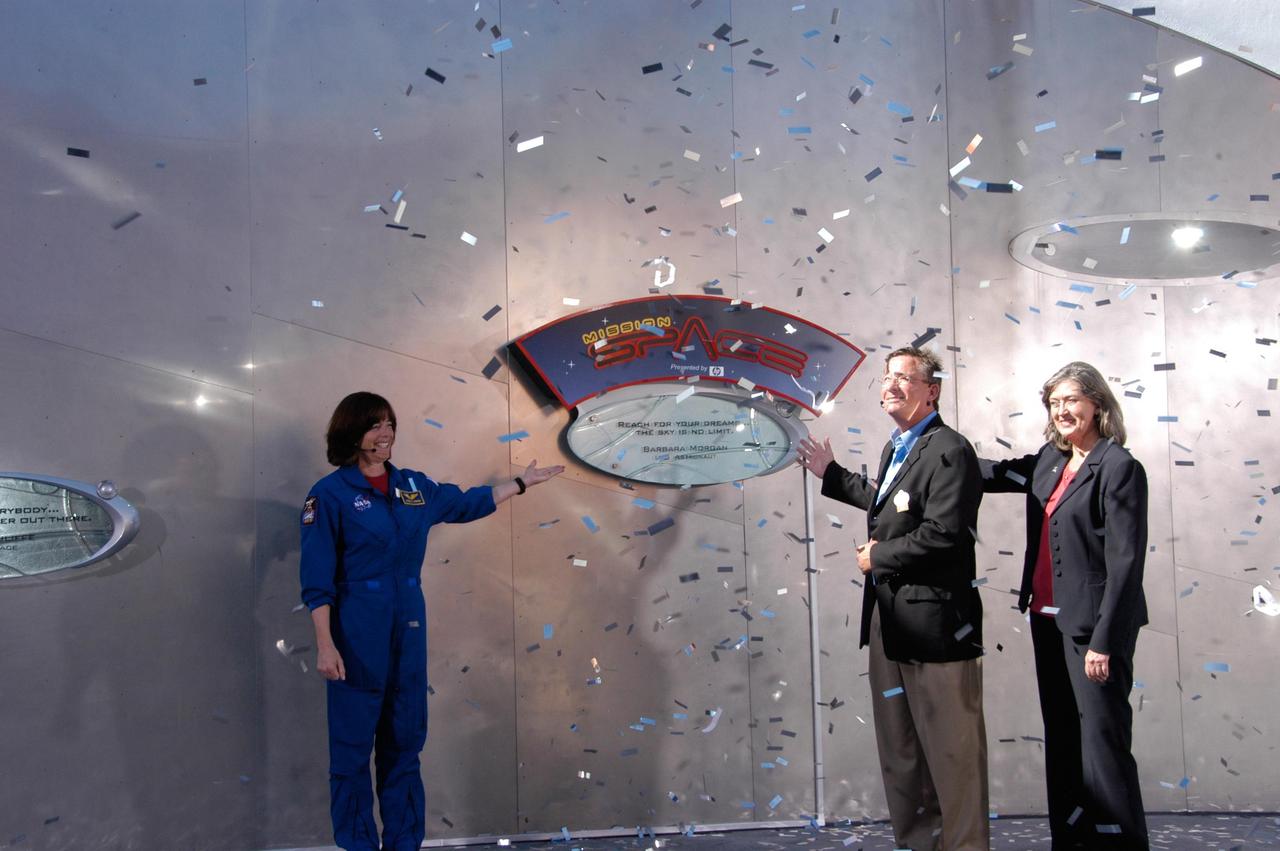
KENNEDY SPACE CENTER, FLA. -- During a special event at Walt Disney World in Orlando honoring the crew of space shuttle mission STS-118, Mission Specialist Barbara R. Morgan (left) helps dedicate a plaque outside the Mission: Space attraction. At right are Vice President of Epcot Jim MacPhee and NASA Assistant Administrator for Education Joyce Winterton. Along with the dedication, the crew met with students and media and paraded down Main Street to the delight of the crowds. The other crew members attending were Commander Scott Kelly, Pilot Charlie Hobaugh and Mission Specialists Tracy Caldwell, Rick Mastracchio, Dave Williams and Alvin Drew. Mission STS-118 was the 119th shuttle program flight and the 22nd flight to the International Space Station. Space shuttle Endeavour launched from NASA's Kennedy Space Center on Aug. 8 and landed Aug. 21. The mission delivered the S5 truss, continuing the assembly of the space station. Photo credit: NASA/George Shelton
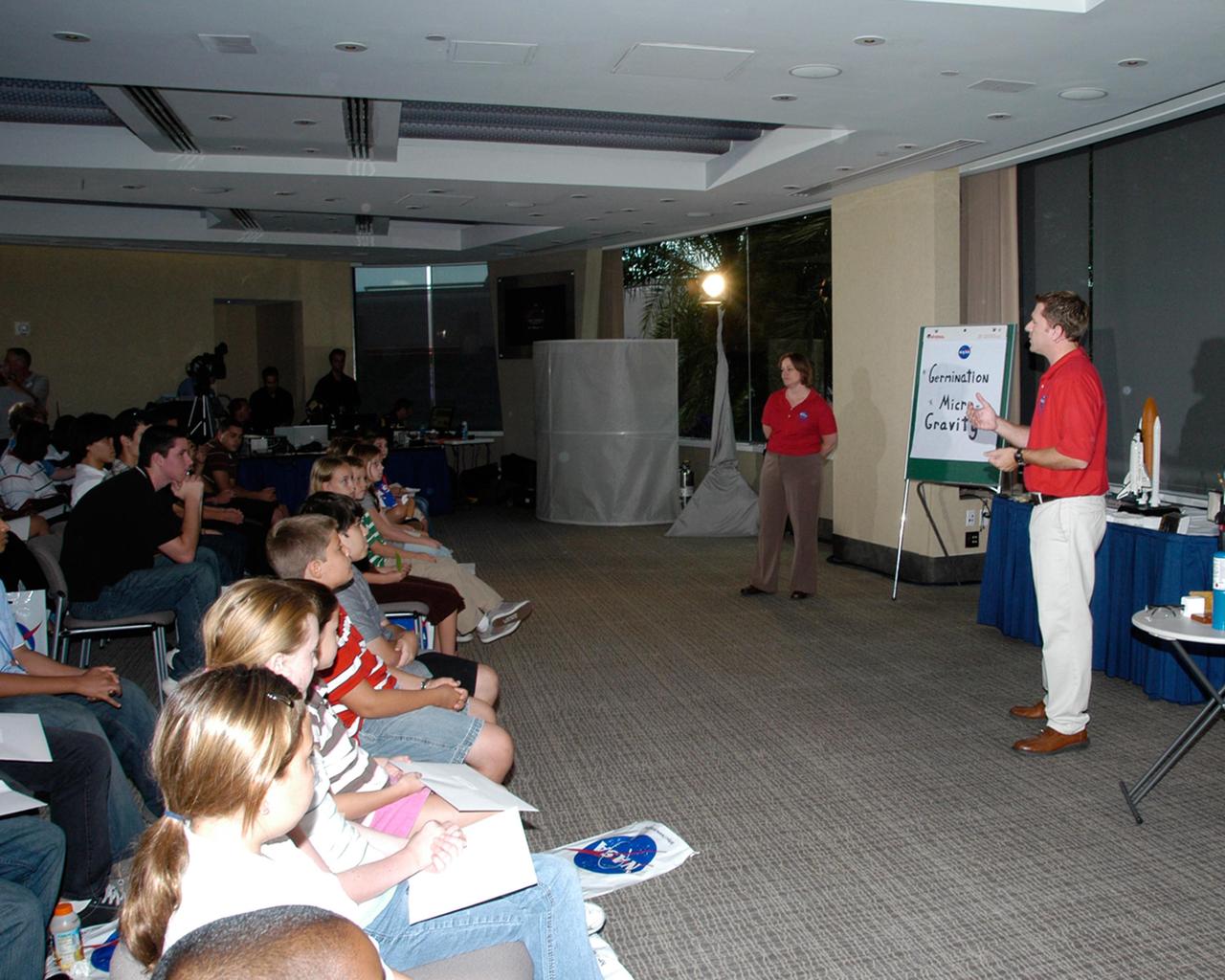
KENNEDY SPACE CENTER, FLA. -- NASA's Kennedy Space Center Education Specialists Linda Scauzillo and Christopher Blair take part in a special education session with local students at Epcot's Base21 Siemens VIP Center. The event was part of the day's activities honoring the space shuttle Endeavour crew of mission STS-118. The crew met with the media and paraded down Main Street. The event also honored teacher-turned-astronaut Barbara R. Morgan, who dedicated a plaque outside the Mission: Space attraction. The other crew members attending were Commander Scott Kelly, Pilot Charlie Hobaugh and Mission Specialists Tracy Caldwell, Dave Williams, Rick Mastracchio and Alvin Drew. Mission STS-118 was the 119th shuttle program flight and the 22nd flight to the International Space Station. Space shuttle Endeavour launched from NASA's Kennedy Space Center on Aug. 8 and landed Aug. 21. The mission delivered the S5 truss, continuing the assembly of the space station. Photo credit: NASA/George Shelton
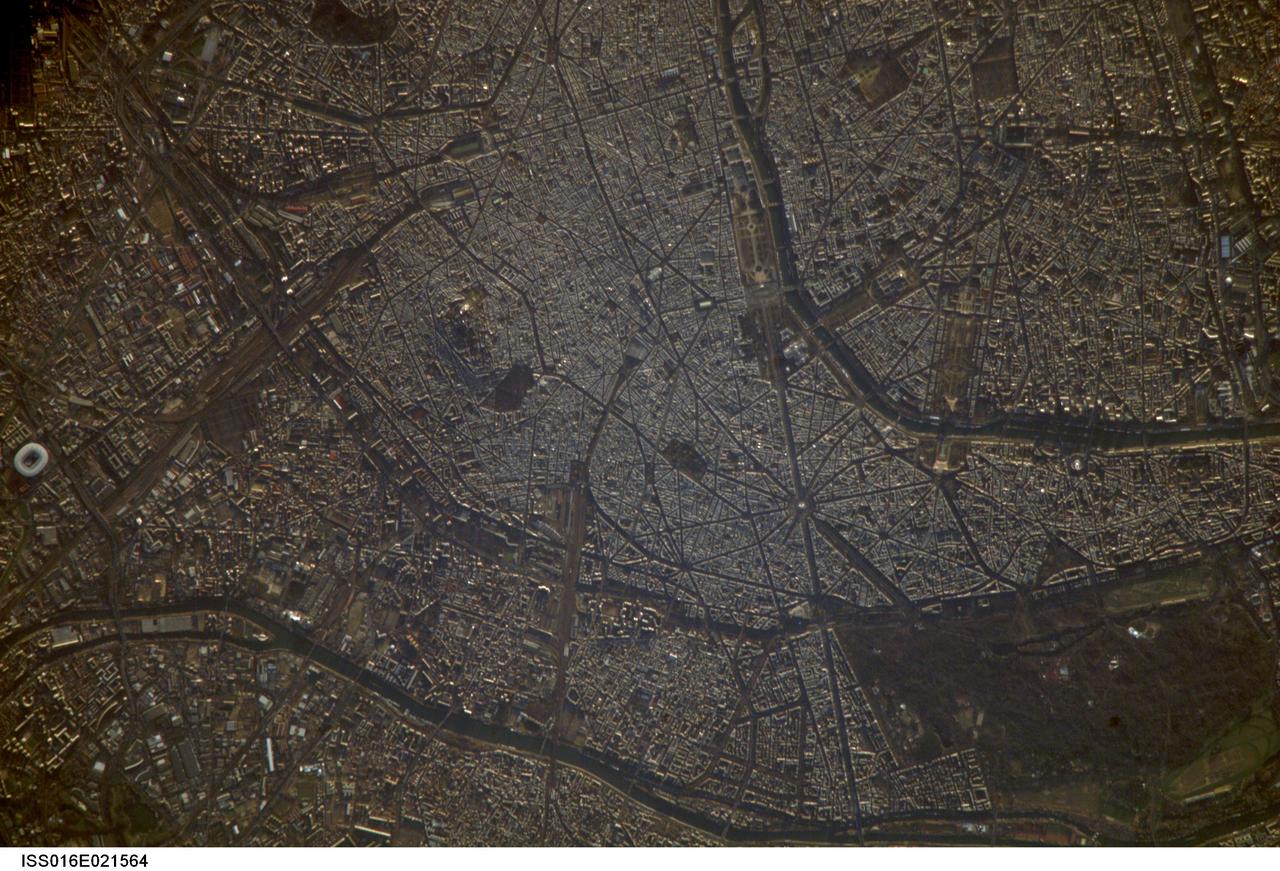
ISS016-E-021564 (7 Jan. 2008) --- Paris, France is featured in this image photographed by an Expedition 16 crewmember on the International Space Station. A crisp, clear winter day over France provided a detailed view of the city of Paris. This image shows the recognizable street pattern of the city - and some of the world's most notable landmarks - along the Seine River. One of the main avenues radiating like spokes from the Arc de Triomphe (lower right) is the Avenue des Champs-Elysees running southeast to the Garden of Tuileries (Jardin des Tuileries). The garden -- recognizable by its light green color relative to the surrounding built materials -- was originally commissioned by Catherine de Medici in 1559, and is now bounded by the Place de la Concorde to the northeast and the Louvre museum along the Seine River at the southeast end. Other, similarly colored parks and greenspaces are visible throughout the image. Farther south on the Seine is the Ile de la Cite, location of the famous Notre Dame cathedral. Perhaps most prominent is the characteristic "A" profile of the Eiffel Tower west of the Jardin des Tuileries, highlighted by morning sunlight.

ISS013-E-75141 (2 Sept. 2006) --- Erg Oriental, Algeria is featured in this image photographed by an Expedition 13 crewmember onboard the International Space Station. One of the main interests of rainless regions like the Sahara Desert to landscape science is that the work of flowing water--mainly streams and rivers--becomes less important than the work of wind. According to scientists, over millennia, and if enough sand is available, winds can generate dunes of enormous size, arranged in regular patterns. Long, generally north-south trending linear dunes stretch across much of northeast Algeria covering a vast tract (approximately 140,000 kilometers square) of the Sahara Desert known as the Erg Oriental. Erg means dune sea in Arabic, and the term has been adopted into modern geology. Spanning this image diagonally are a series of two kilometer-wide linear dunes, comprised of red sand, from a point on the southwest margin of the erg (center point 28.9N 4.8W). The dune chains are more than 100 meters high. The "streets" between the dunes are grayer areas free of sand. Linear dune chains are usually generated roughly parallel with the dominant winds. It also seems to be true that linear dunes are built by stronger winds. This detailed view shows that smaller dunes, known as star dunes, are built on top of the linear dunes. By contrast, star dunes seem to form in weak wind regimes, with winds from different directions in each season -- resulting in characteristic "arms" snaking away from a central point. Some scientists therefore think the dunes in this image were generated in two earlier climatic phases, different from that of today. (1) During a phase when winds were stronger and dominantly from one direction (the south), major linear sand masses accumulated. (2) Later, when wind strengths declined, the star dunes formed. Modern features--known as wind streaks--on the edge of the present erg (not shown), younger than either the linear or star dunes, show that present-day sand-moving winds blow from the southwest.

The U.S. National Weather Service called it a “a crippling and historic winter blizzard.” In late January 2015, transportation systems from Trenton to Portland were shut down, and more than 35 million people hunkered down for extreme snowfall and biting winds. For those in New England, it turned out to be a monstrous storm. For the Mid-Atlantic region, not so much. Vast swaths of Massachusetts, Connecticut, Rhode Island, New Hampshire, Maine, and Long Island (NY) were blanketed with 15 to 25 inches (40 to 60 centimeters) of snow as of midday on January 27, 2015, and snow was expected to continue into January 28. Sustained winds reached gale force, with hurricane-force gusts along the coastlines. Storm surges sent ice and water into the streets of Scituate and Nantucket, Massachusetts. Many New England towns, including the city of Boston, were expected to approach all-time snowfall records. The Visible Infrared Imaging Radiometer Suite on the Suomi NPP satellite acquired these nighttime images at 1:45 am US eastern standard time (06:45 Universal Time) on January 27, 2015. The top image, lit by moonlight and city lights, shows a nor'easter off the coast of the East Coast of the United States. City lights are blurred somewhat by the cloud cover. The second image shows the same scene in longwave infrared radiation, with brighter shades representing the colder temperatures of snow-producing clouds. NASA Earth Observatory image by Jesse Allen, using VIIRS data from the Suomi National Polar-orbiting Partnership. Read more: <a href="http://earthobservatory.nasa.gov/IOTD/view.php?id=85166&eocn=home&eoci=iotd_title" rel="nofollow">earthobservatory.nasa.gov/IOTD/view.php?id=85166&eocn...</a> Via: <b><a href="http://www.earthobservatory.nasa.gov/" rel="nofollow"> NASA Earth Observatory</a></b> <b><a href="http://www.nasa.gov/audience/formedia/features/MP_Photo_Guidelines.html" rel="nofollow">NASA image use policy.</a></b> <b><a href="http://www.nasa.gov/centers/goddard/home/index.html" rel="nofollow">NASA Goddard Space Flight Center</a></b> enables NASA’s mission through four scientific endeavors: Earth Science, Heliophysics, Solar System Exploration, and Astrophysics. Goddard plays a leading role in NASA’s accomplishments by contributing compelling scientific knowledge to advance the Agency’s mission. <b>Follow us on <a href="http://twitter.com/NASAGoddardPix" rel="nofollow">Twitter</a></b> <b>Like us on <a href="http://www.facebook.com/pages/Greenbelt-MD/NASA-Goddard/395013845897?ref=tsd" rel="nofollow">Facebook</a></b> <b>Find us on <a href="http://instagram.com/nasagoddard?vm=grid" rel="nofollow">Instagram</a></b>

The U.S. National Weather Service called it a “a crippling and historic winter blizzard.” In late January 2015, transportation systems from Trenton to Portland were shut down, and more than 35 million people hunkered down for extreme snowfall and biting winds. For those in New England, it turned out to be a monstrous storm. For the Mid-Atlantic region, not so much. Vast swaths of Massachusetts, Connecticut, Rhode Island, New Hampshire, Maine, and Long Island (NY) were blanketed with 15 to 25 inches (40 to 60 centimeters) of snow as of midday on January 27, 2015, and snow was expected to continue into January 28. Sustained winds reached gale force, with hurricane-force gusts along the coastlines. Storm surges sent ice and water into the streets of Scituate and Nantucket, Massachusetts. Many New England towns, including the city of Boston, were expected to approach all-time snowfall records. The Visible Infrared Imaging Radiometer Suite on the Suomi NPP satellite acquired these nighttime images at 1:45 am US eastern standard time (06:45 Universal Time) on January 27, 2015. The top image, lit by moonlight and city lights, shows a nor'easter off the coast of the East Coast of the United States. City lights are blurred somewhat by the cloud cover. The second image shows the same scene in longwave infrared radiation, with brighter shades representing the colder temperatures of snow-producing clouds. NASA Earth Observatory image by Jesse Allen, using VIIRS data from the Suomi National Polar-orbiting Partnership. Read more: <a href="http://earthobservatory.nasa.gov/IOTD/view.php?id=85166&eocn=home&eoci=iotd_title" rel="nofollow">earthobservatory.nasa.gov/IOTD/view.php?id=85166&eocn...</a> Via: <b><a href="http://www.earthobservatory.nasa.gov/" rel="nofollow"> NASA Earth Observatory</a></b> <b><a href="http://www.nasa.gov/audience/formedia/features/MP_Photo_Guidelines.html" rel="nofollow">NASA image use policy.</a></b> <b><a href="http://www.nasa.gov/centers/goddard/home/index.html" rel="nofollow">NASA Goddard Space Flight Center</a></b> enables NASA’s mission through four scientific endeavors: Earth Science, Heliophysics, Solar System Exploration, and Astrophysics. Goddard plays a leading role in NASA’s accomplishments by contributing compelling scientific knowledge to advance the Agency’s mission. <b>Follow us on <a href="http://twitter.com/NASAGoddardPix" rel="nofollow">Twitter</a></b> <b>Like us on <a href="http://www.facebook.com/pages/Greenbelt-MD/NASA-Goddard/395013845897?ref=tsd" rel="nofollow">Facebook</a></b> <b>Find us on <a href="http://instagram.com/nasagoddard?vm=grid" rel="nofollow">Instagram</a></b>