
A mangrove seedling grows amidst the rocks on the shoreline of Kennedy Athletic, Recreation, and Social (KARS) Park at Kennedy Space Center in Florida on April 12, 2023. Employees from Kennedy’s Environmental Management Branch removed over 100 mangrove seedlings from the shoreline and repotted them for protection during the final stages of a shoreline restoration project inside KARS Park. The mangrove seedlings will be replanted upon completion of the project to create a living shoreline better able to counter the effects of erosion caused by storm waves and rising sea levels.
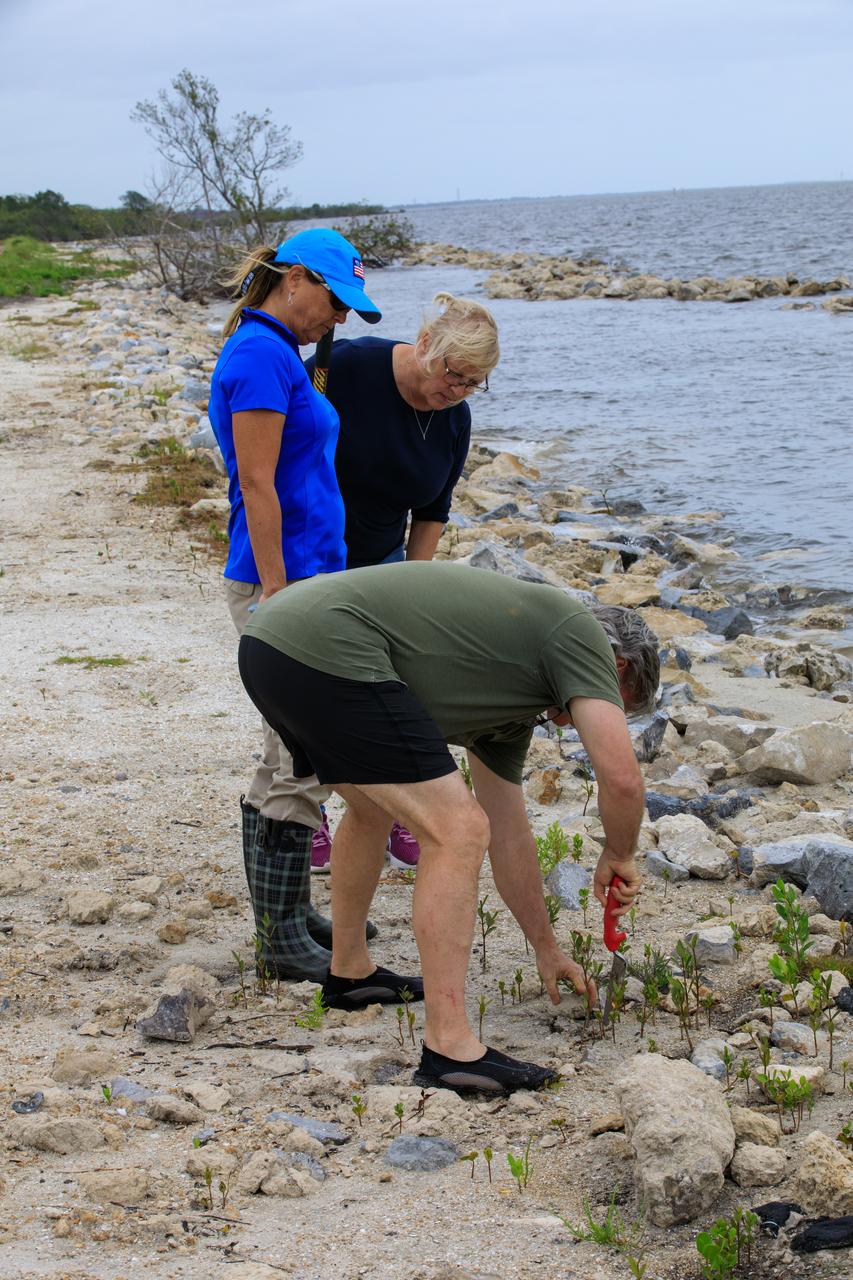
A team from Kennedy’s Environmental Management Branch works to remove a mangrove seedling on the shoreline of Kennedy Athletic, Recreation, and Social (KARS) Park at Kennedy Space Center in Florida on April 12, 2023. Employees from Kennedy’s Environmental Management Branch removed over 100 mangrove seedlings from the shoreline and repotted them for protection during the final stages of a shoreline restoration project inside KARS Park. The mangrove seedlings will be replanted upon completion of the project to create a living shoreline better able to counter the effects of erosion caused by storm waves and rising sea levels.
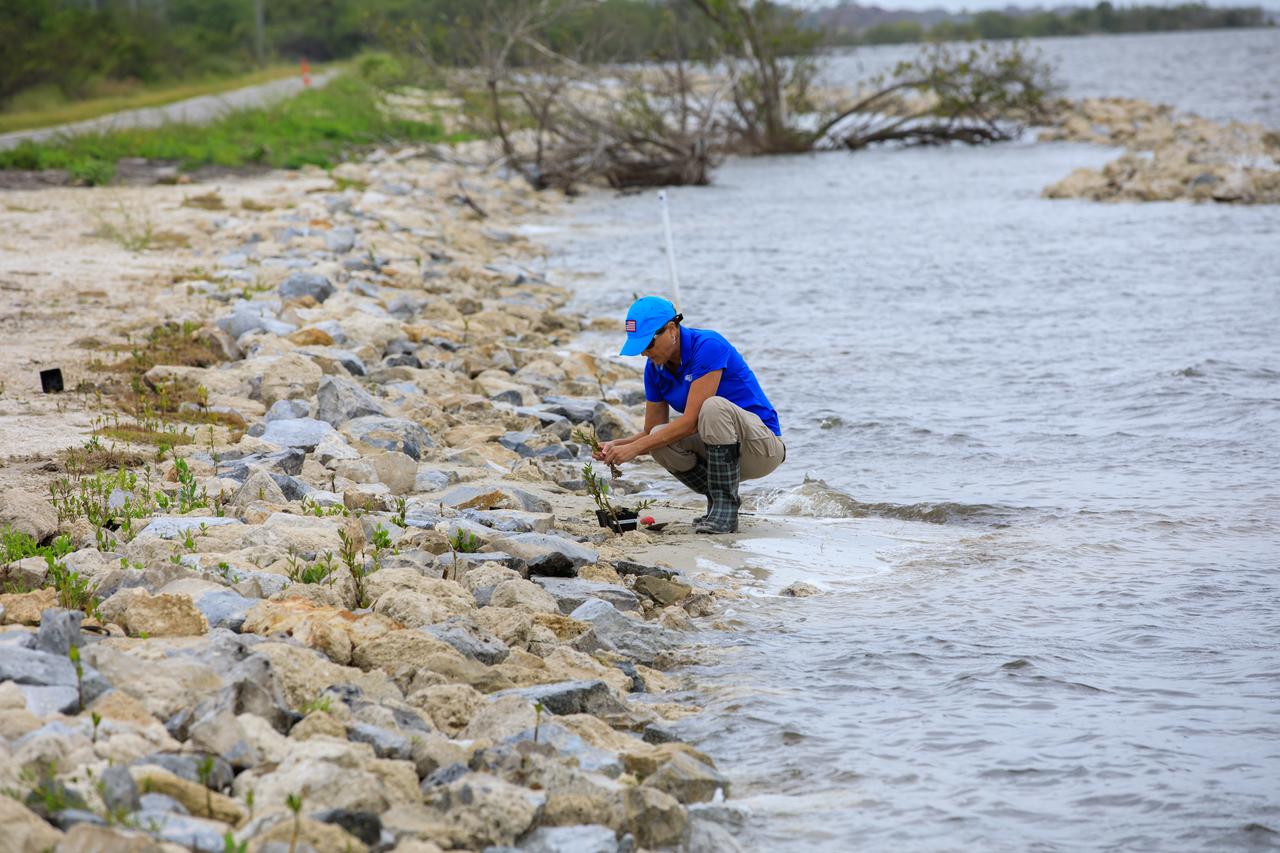
A team member from Kennedy’s Environmental Management Branch works to remove a mangrove seedling on the shoreline of Kennedy Athletic, Recreation, and Social (KARS) Park at Kennedy Space Center in Florida on April 12, 2023. Employees from Kennedy’s Environmental Management Branch removed over 100 mangrove seedlings from the shoreline and repotted them for protection during the final stages of a shoreline restoration project inside KARS Park. The mangrove seedlings will be replanted upon completion of the project to create a living shoreline better able to counter the effects of erosion caused by storm waves and rising sea levels.
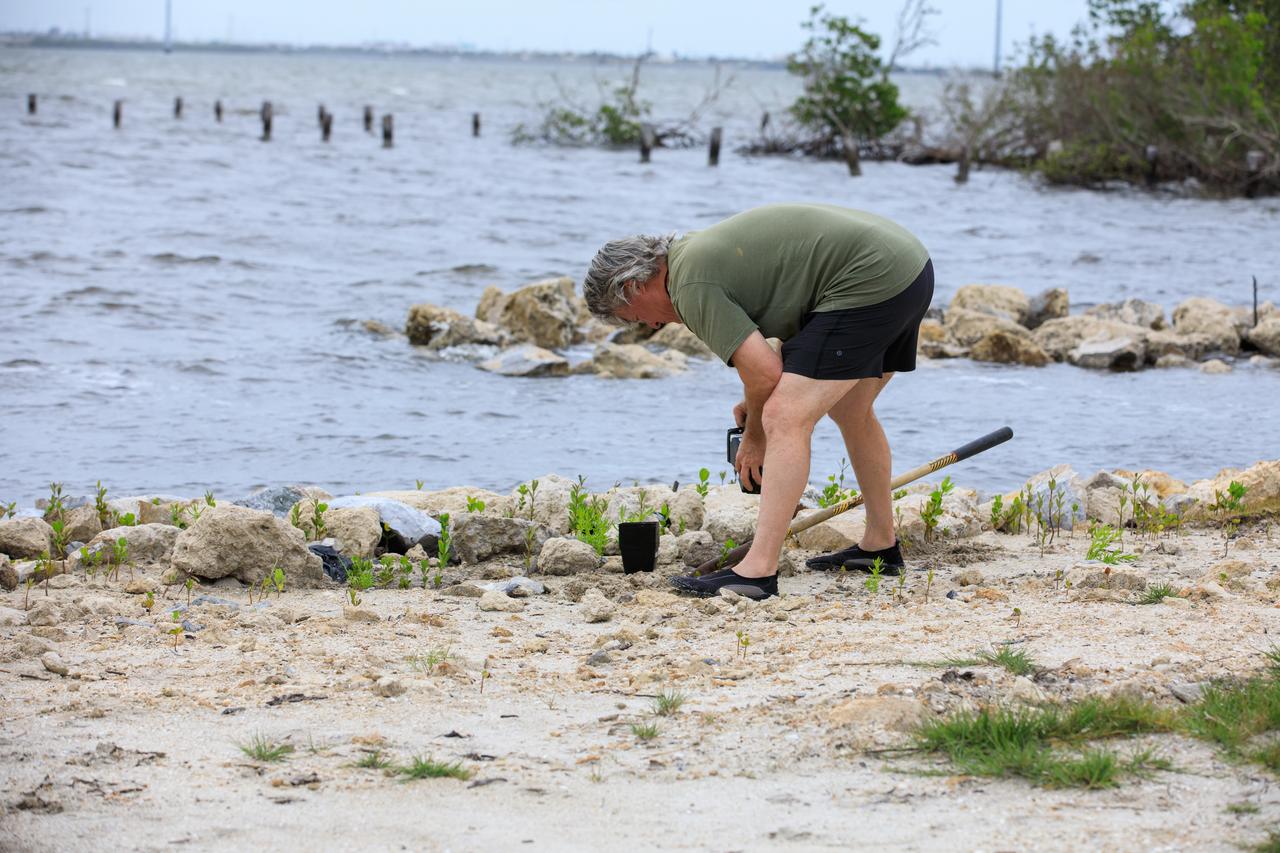
A team member from Kennedy’s Environmental Management Branch works to remove a mangrove seedling on the shoreline of Kennedy Athletic, Recreation, and Social (KARS) Park at Kennedy Space Center in Florida on April 12, 2023. Employees from Kennedy’s Environmental Management Branch removed over 100 mangrove seedlings from the shoreline and repotted them for protection during the final stages of a shoreline restoration project inside KARS Park. The mangrove seedlings will be replanted upon completion of the project to create a living shoreline better able to counter the effects of erosion caused by storm waves and rising sea levels.
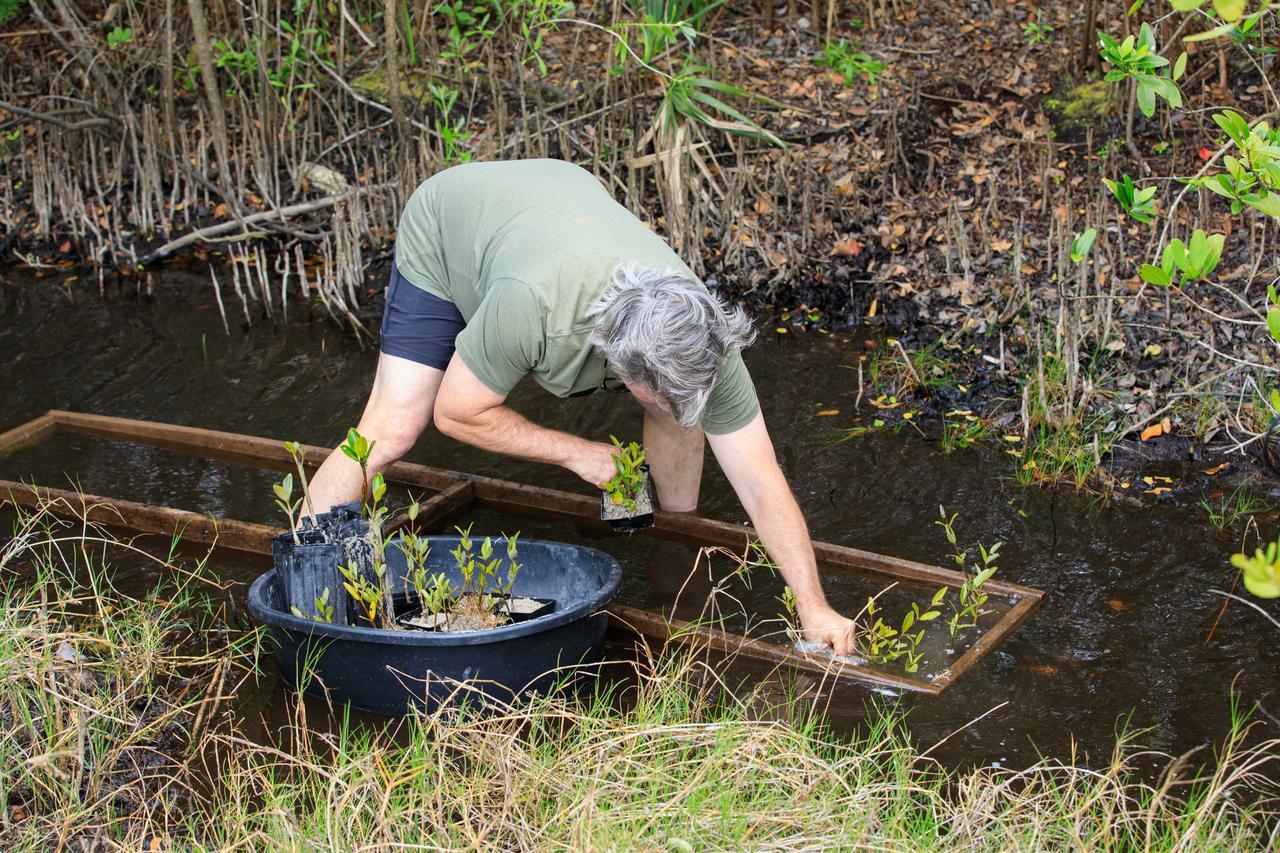
A team member from Kennedy’s Environmental Management Branch deposits repotted mangrove seedlings into a marshy channel near the shoreline of Kennedy Athletic, Recreation, and Social (KARS) Park at Kennedy Space Center in Florida on April 12, 2023. Employees from Kennedy’s Environmental Management Branch removed over 100 mangrove seedlings from the shoreline and repotted them for protection during the final stages of a shoreline restoration project inside KARS Park. The mangrove seedlings will be replanted upon completion of the project to create a living shoreline better able to counter the effects of erosion caused by storm waves and rising sea levels.
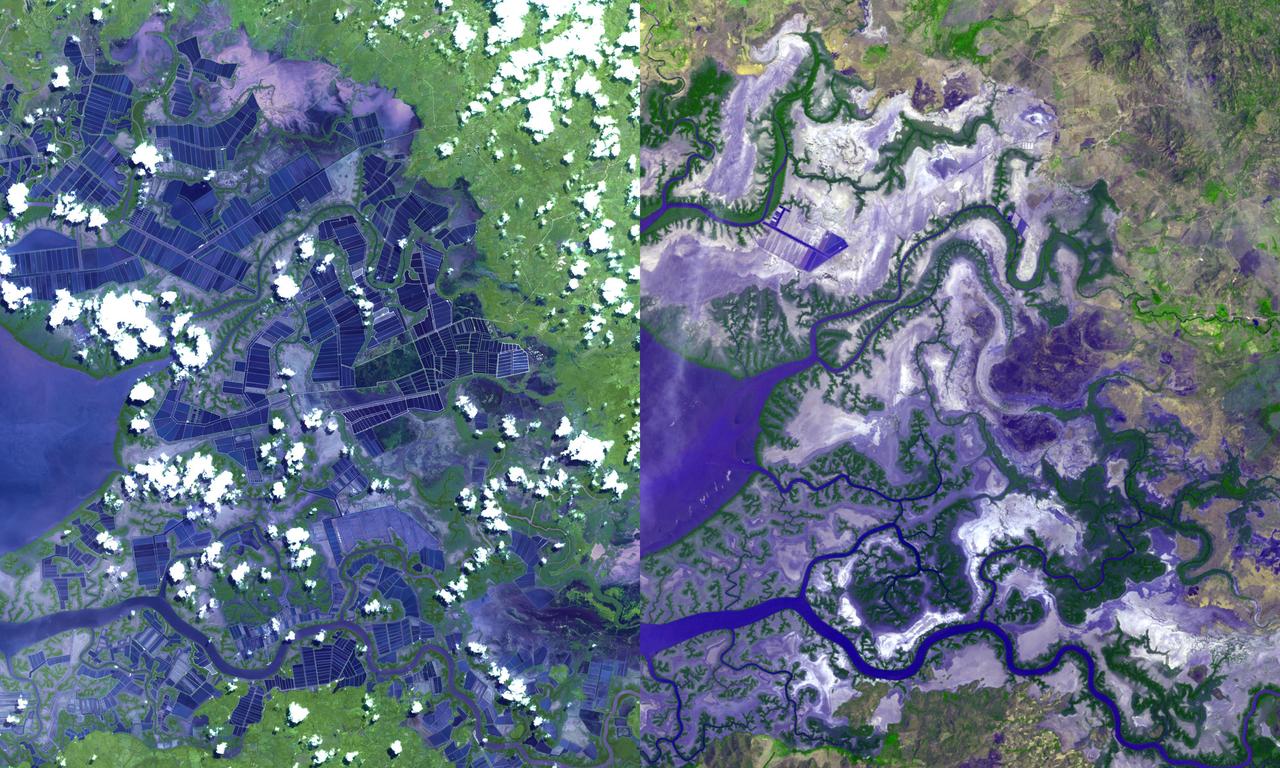
Acquired by NASA Terra spacecraft, this image shows the eastern end of the Gulf of Fonseca, in Honduras, originally the site of extensive wetlands ecosystem, dominated by six species of mangroves.
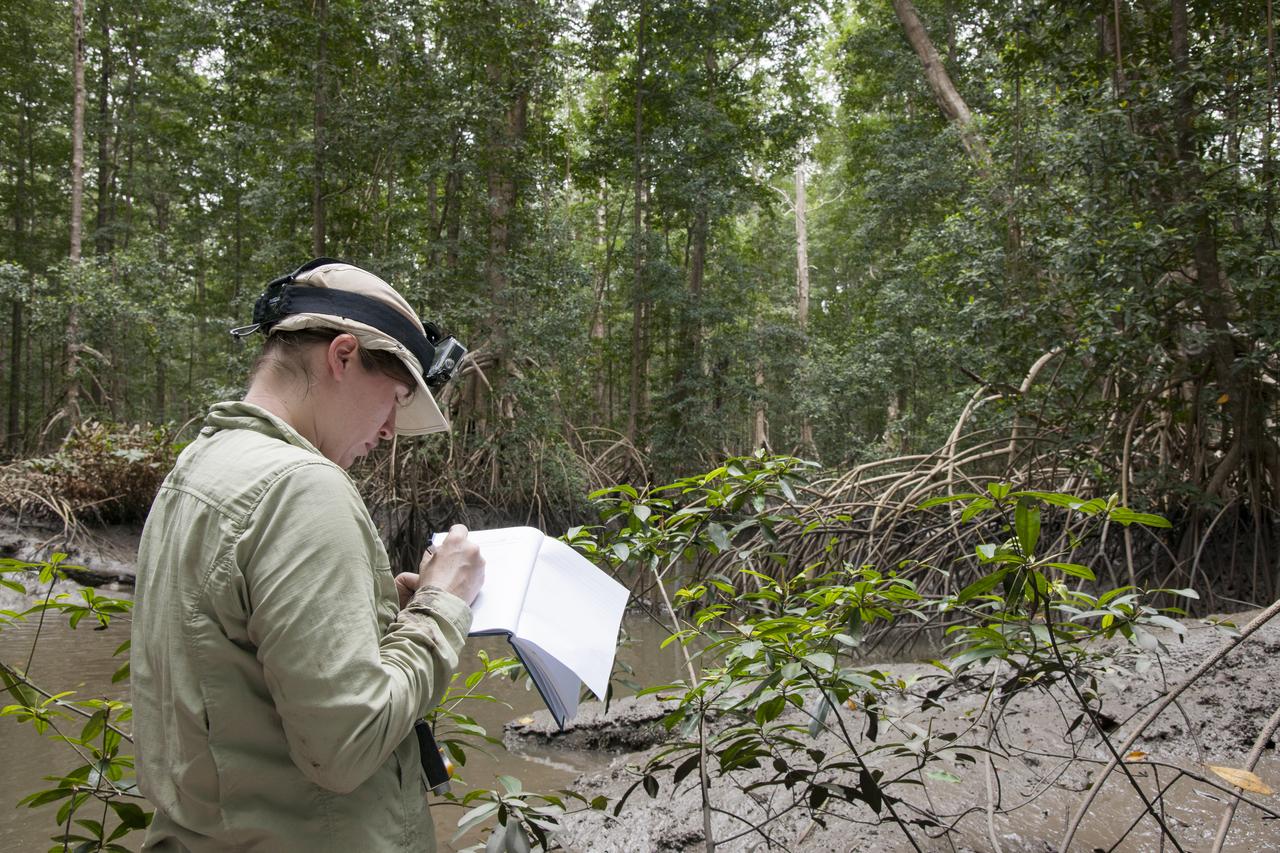
Goddard Space Center’s Laura Duncanson records global positioning satellite coordinates of the Pongara Mangrove and tree heights and diameters.
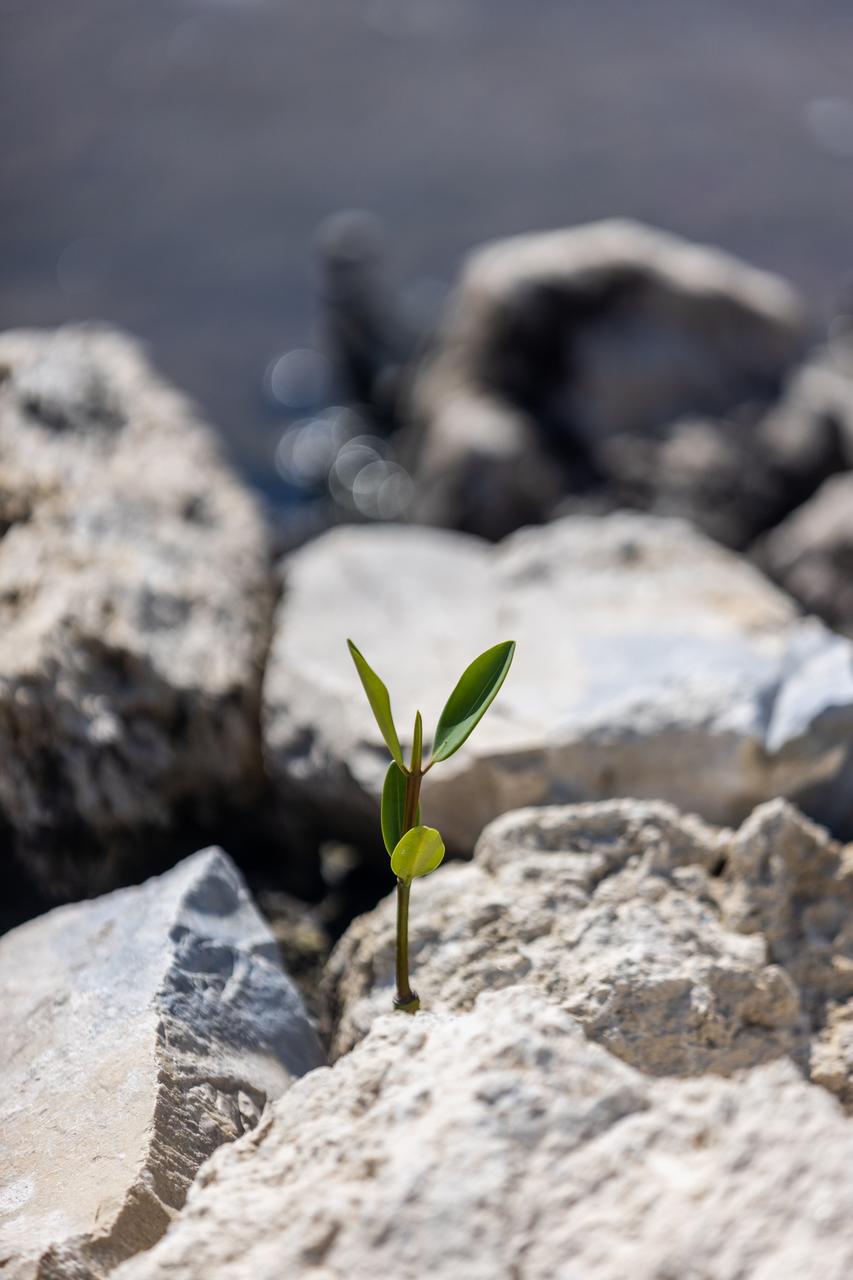
NASA Kennedy Space Center’s Spaceport Integration and Services organization is leading a restoration project at KARS Park on Hall Road in Merritt Island, Florida. As part of this project, a wavebreak is being created about 20 feet offshore to allow mangroves and other plants to propagate into the gap, providing protection for the shoreline. Shown in this photo is red mangrove starting to grow in the restoration area.
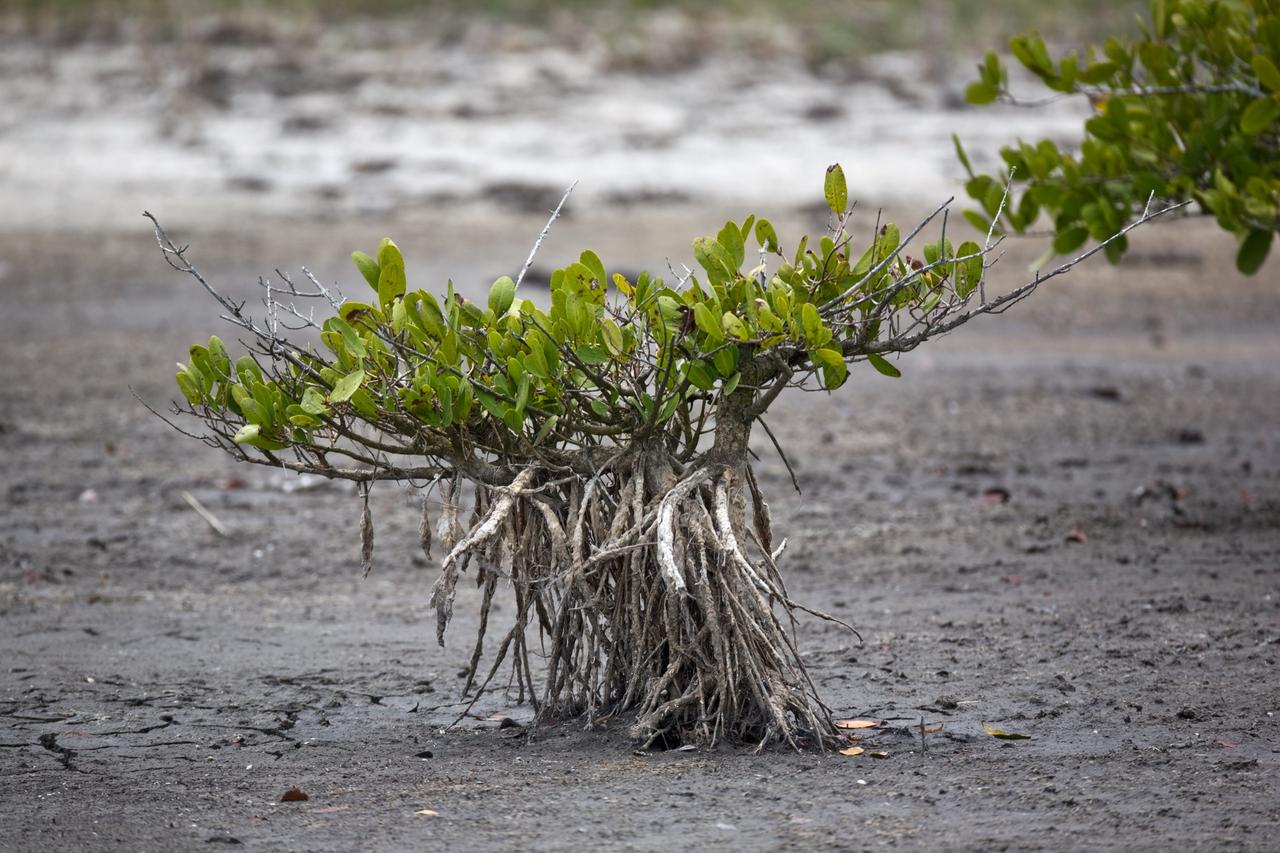
CAPE CANAVERAL, Fla. –– Mangrove roots are exposed in the drought-affected waters on NASA's Kennedy Space Center in Florida. Mangroves generally are trees and shrubs that grow in saline (brackish) coastal habitats in the tropics and subtropics. They provide food, habitat and refuge for a variety of animals, birds and sea creatures. The center shares a boundary with the Merritt Island Wildlife Nature Refuge, which is a habitat for more than 310 species of birds, 25 mammals, 117 fishes and 65 amphibians and reptiles. Photo credit: NASA/Dimitri Gerondidakis
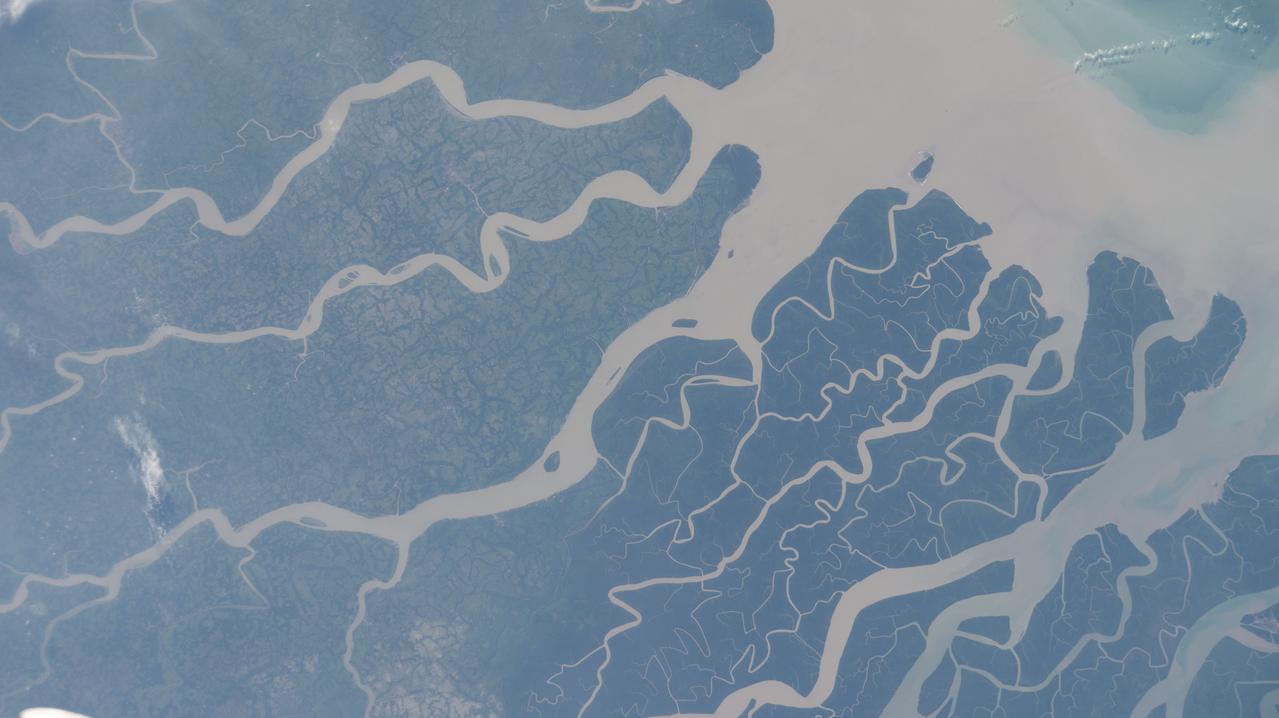
iss063e107090 (Oct. 12, 2020) --- The International Space Station was orbiting above the southern coast of Bangladesh, near the vast mangrove forest and wildlife habitat of India's Sundarban National Park, when this photograph was taken.
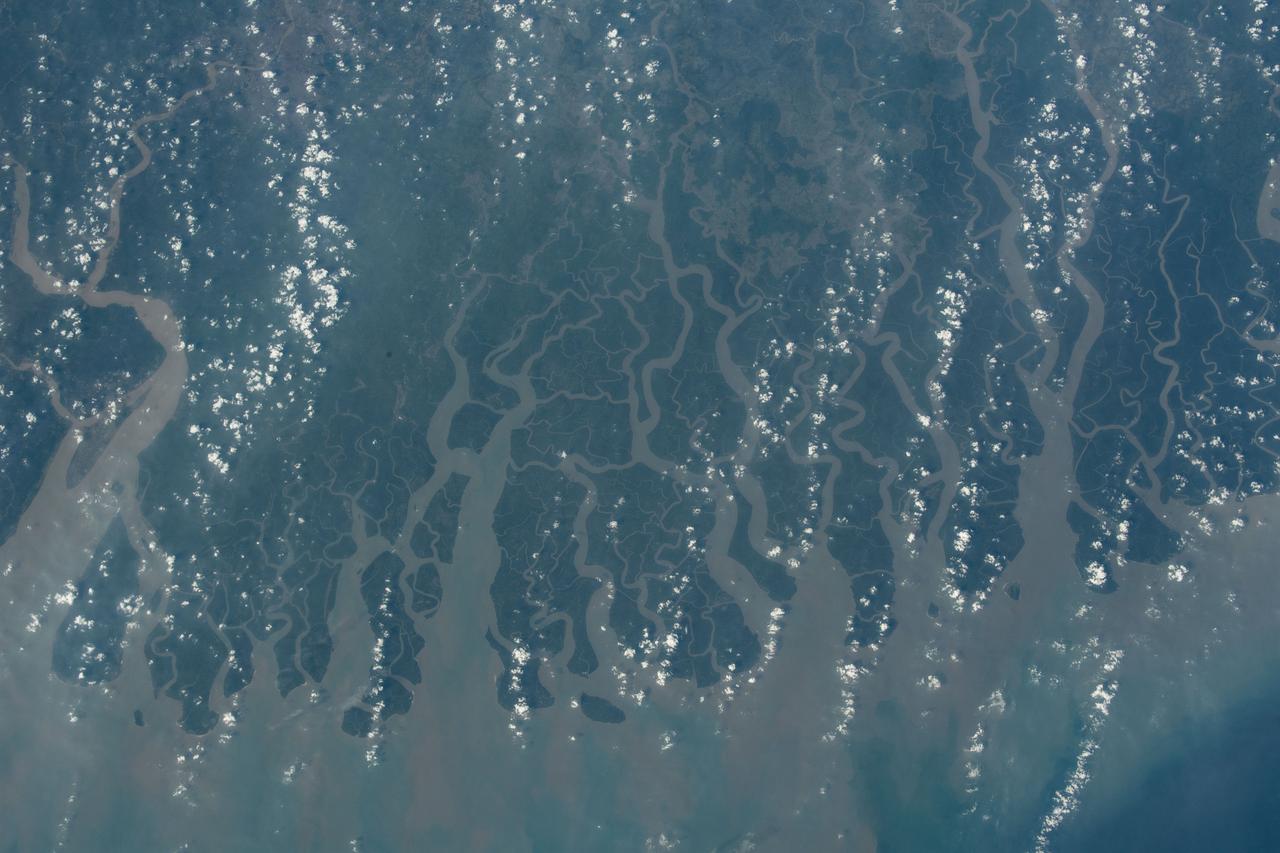
iss070e005997 (Oct. 19, 2023) --- India and Bangladesh border along the Sundarban National Park, a tiger reserve and mangrove forest, in this photograph from the International Space Station as it orbited 257 miles above the Bay of Bengal.
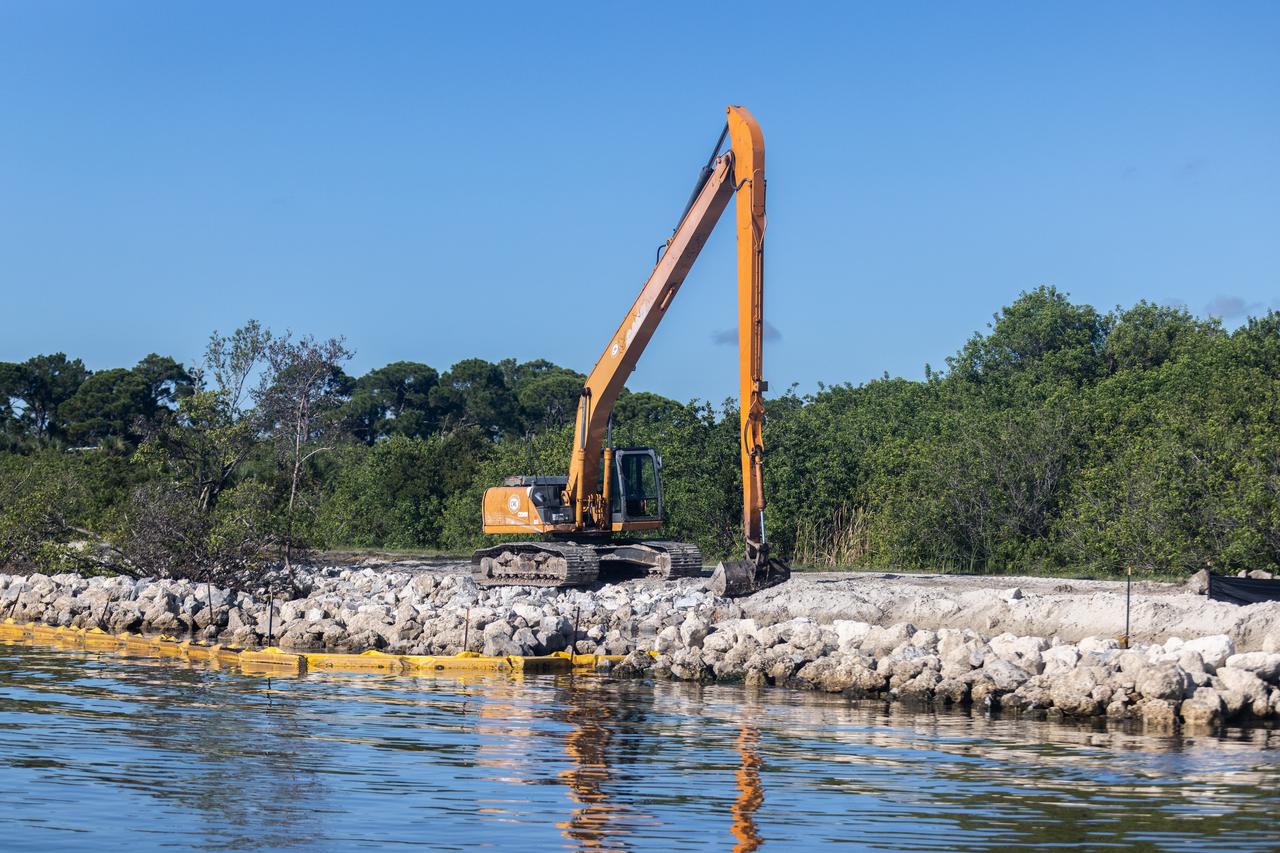
NASA Kennedy Space Center’s Spaceport Integration and Services organization is leading a restoration project at KARS Park on Hall Road in Merritt Island, Florida. As part of this project, a wavebreak is being created about 20 feet offshore to allow mangroves and other plants to propagate into the gap, providing protection for the shoreline.
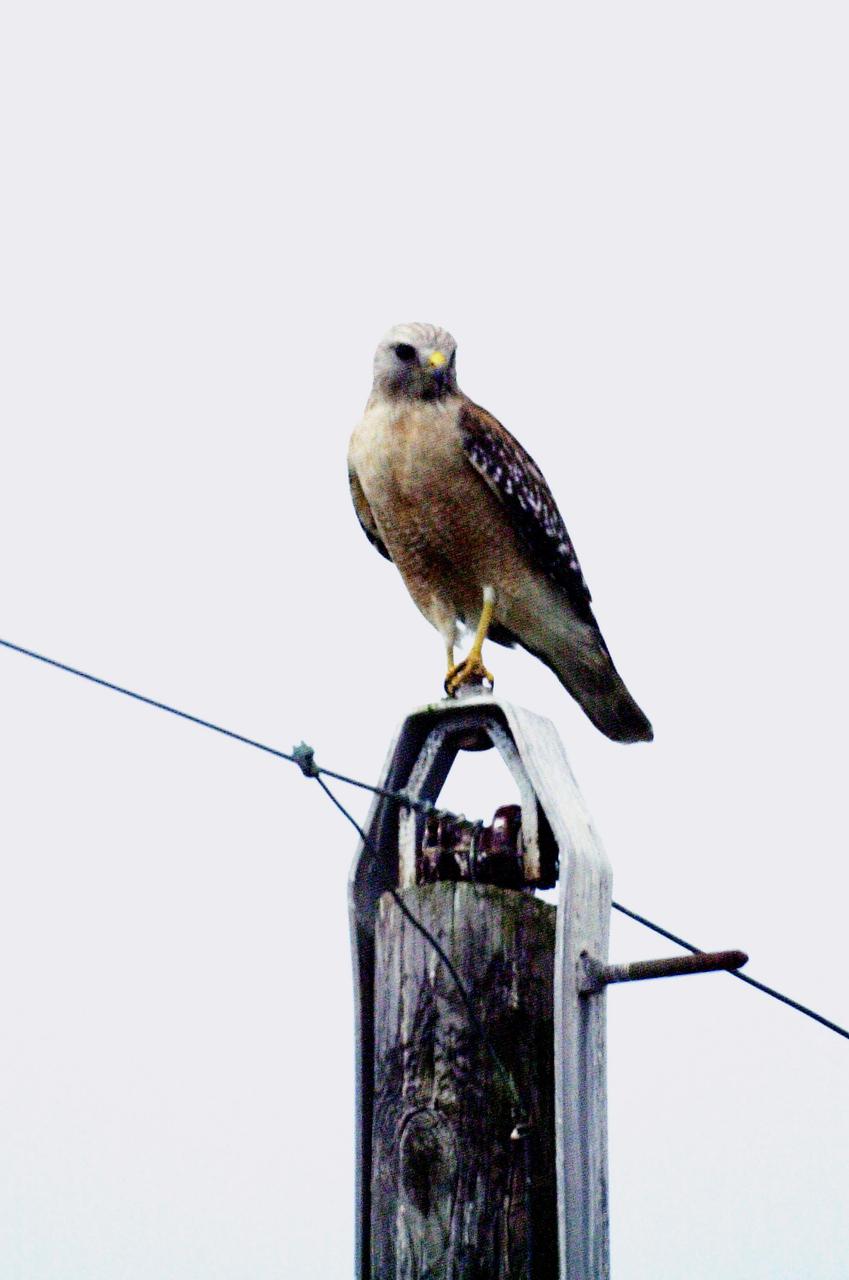
KENNEDY SPACE CENTER, FLA. -- Perched on a utility pole at Kennedy Space Center, this hawk-like bird is likely a young Short-Tailed Hawk, whose range is Central to South Florida. Its habitat is chiefly cypress and mangrove swamps. Its diet includes rodents, lizards and insects

Armstrong Pilots David Fedors and Stu Broce are at the controls of the C-20A in March 2016 as it flies a synthetic aperture radar over areas of interest in the AfriSAR mission based in Gabon, Africa. The international campaign included measurements of flora in the country’s rainforests, wetlands, mangrove forests and savanna.

iss071e378497 (July 21, 2024) -- The Quirimbas Islands lie in the western Indian Ocean off the coast of Mozambique. The archipelago consists of 32 islands, partially linked to the coastline by coral reefs, mangroves, and sand bars. As the International Space Station orbited 262 miles above, NASA astronaut Matthew Dominick captured this photo.
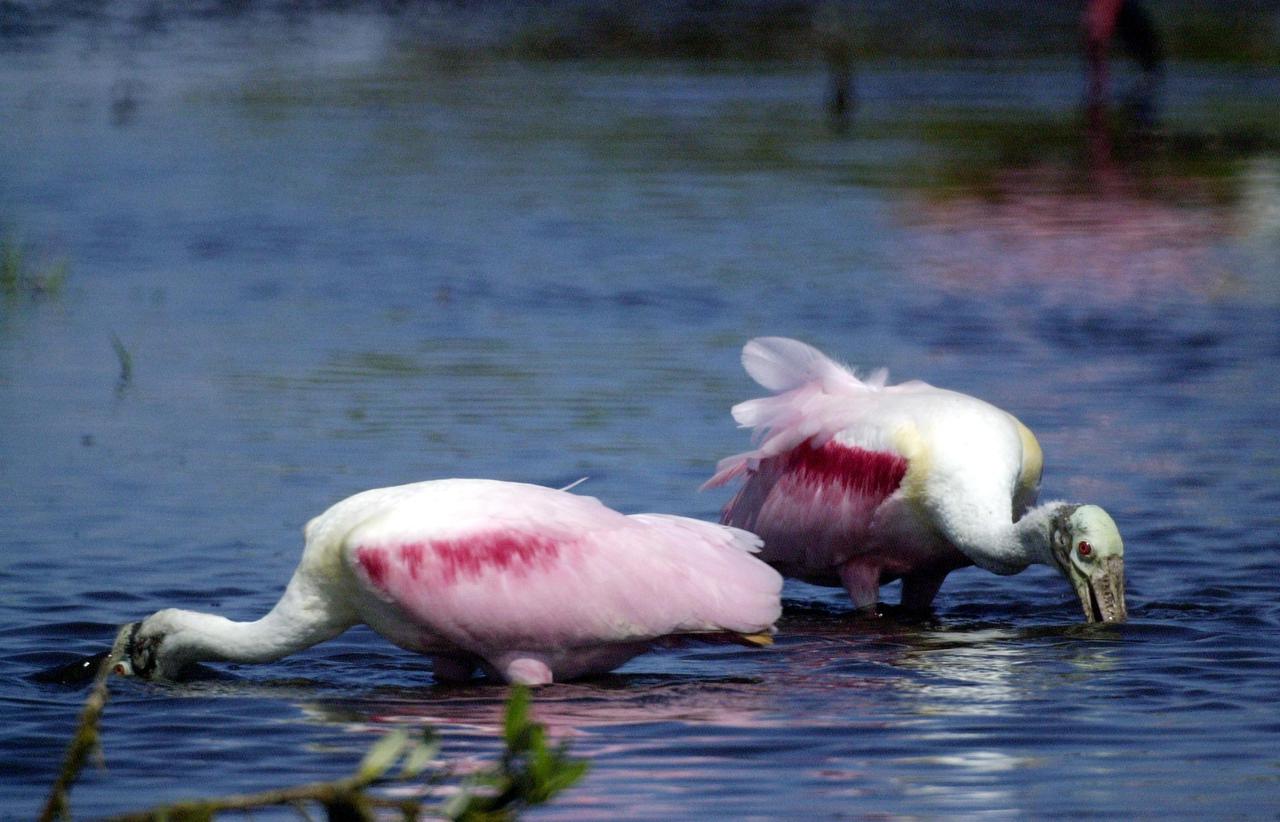
KENNEDY SPACE CENTER, FLA. -- In a lake near Kennedy Space Center, a pair of Roseate Spoonbills search the water for food. They obtain food by sweeping their broad bills from side to side. This species inhabits mangroves, ranging from the coasts of southern Florida and Texas (sometimes Louisiana), the West Indies, Mexico and Central and South America.
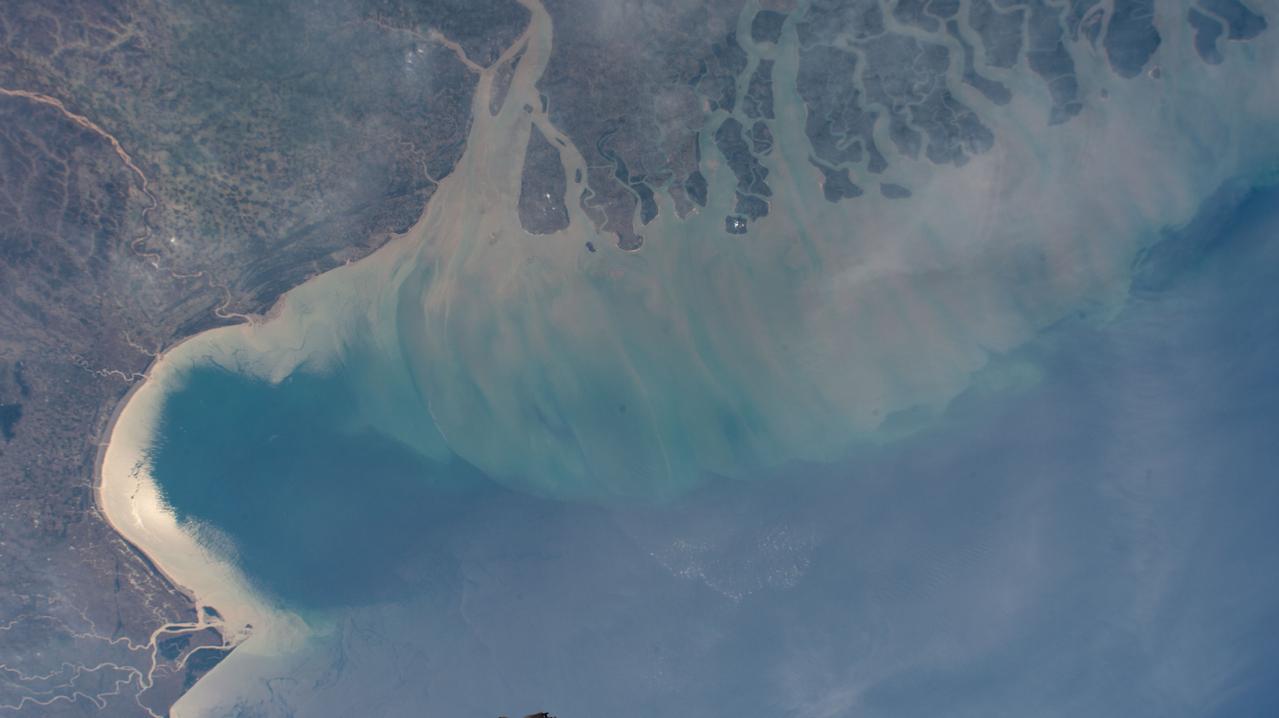
iss062e039313 (Feb. 21, 2020) --- The coasts of India and Bangladesh, pictured from the International Space Station from an altitude of 263 miles, meet at the Bay of Bengal. The area is known for its vast mangrove forests and rich variety of wildlife including monkeys, elephants and tigers.
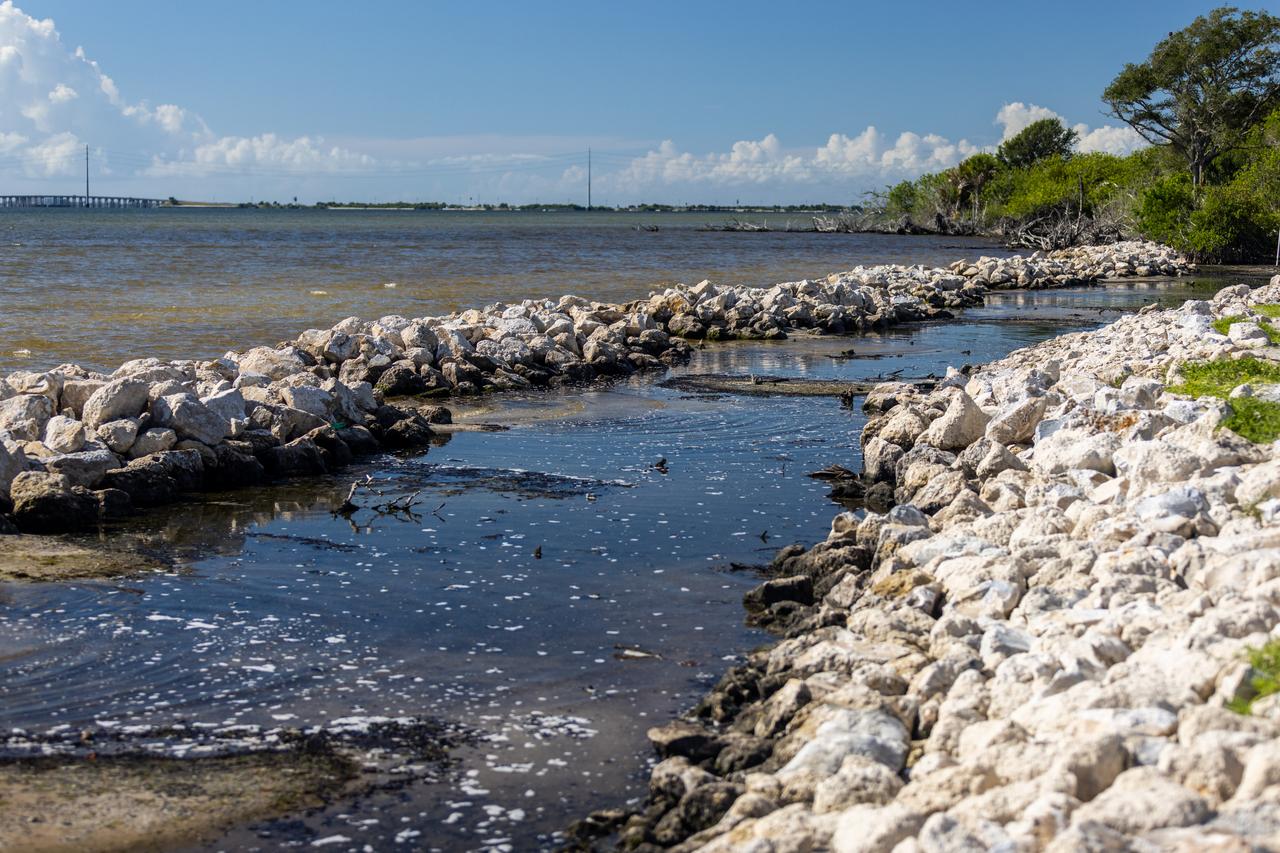
NASA Kennedy Space Center’s Spaceport Integration and Services organization is leading a restoration project at KARS Park on Hall Road in Merritt Island, Florida. As part of this project, a wavebreak is being created about 20 feet offshore to allow mangroves and other plants to propagate into the gap, providing protection for the shoreline.
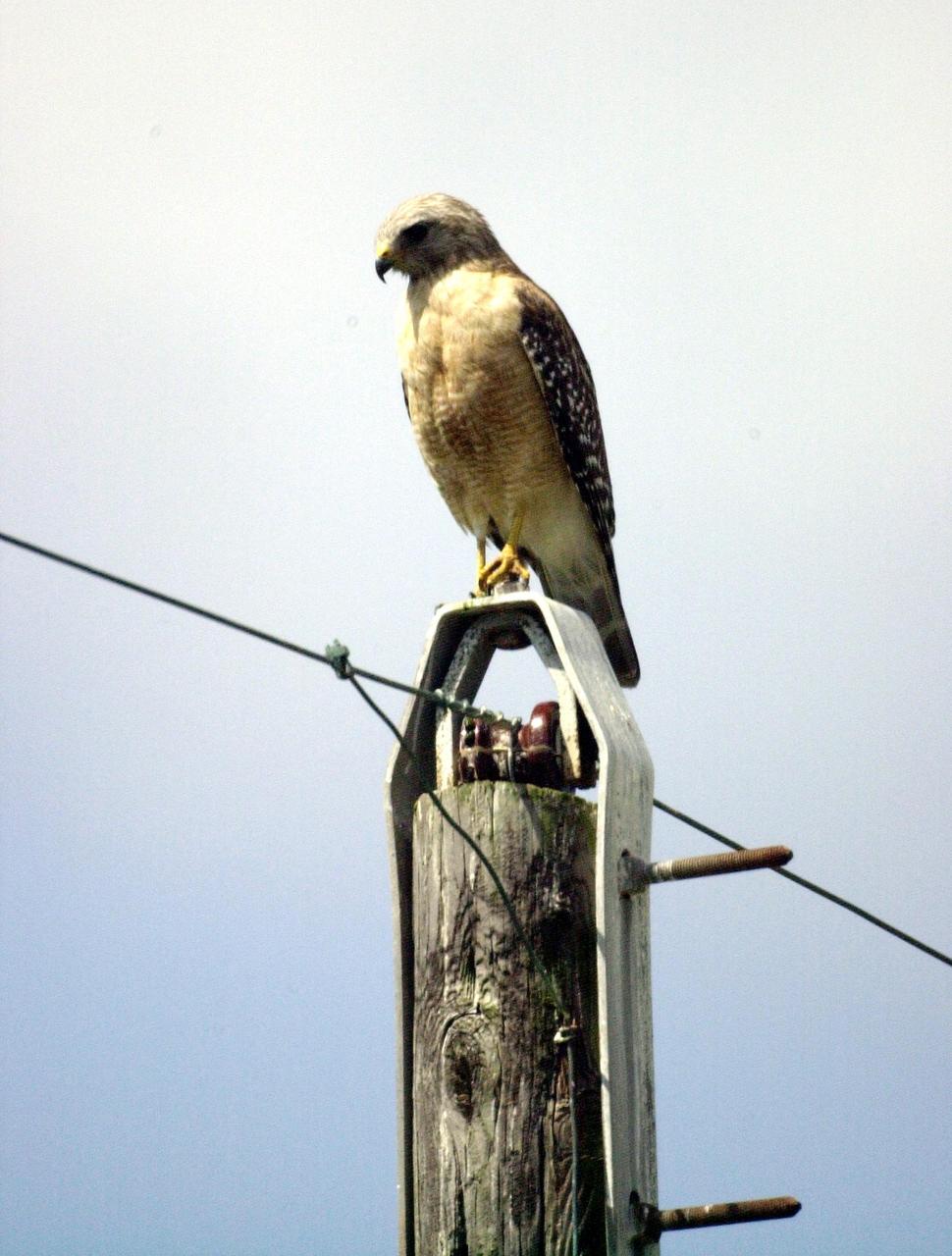
KENNEDY SPACE CENTER, FLA. -- This Red-Shouldered Hawk, perched on a utility pole at Kennedy Space Center, keeps an eye out for prey. Ranging from Central to South Florida, its diet includes rodents, lizards and insects. Its habitat is chiefly cypress and mangrove swamps
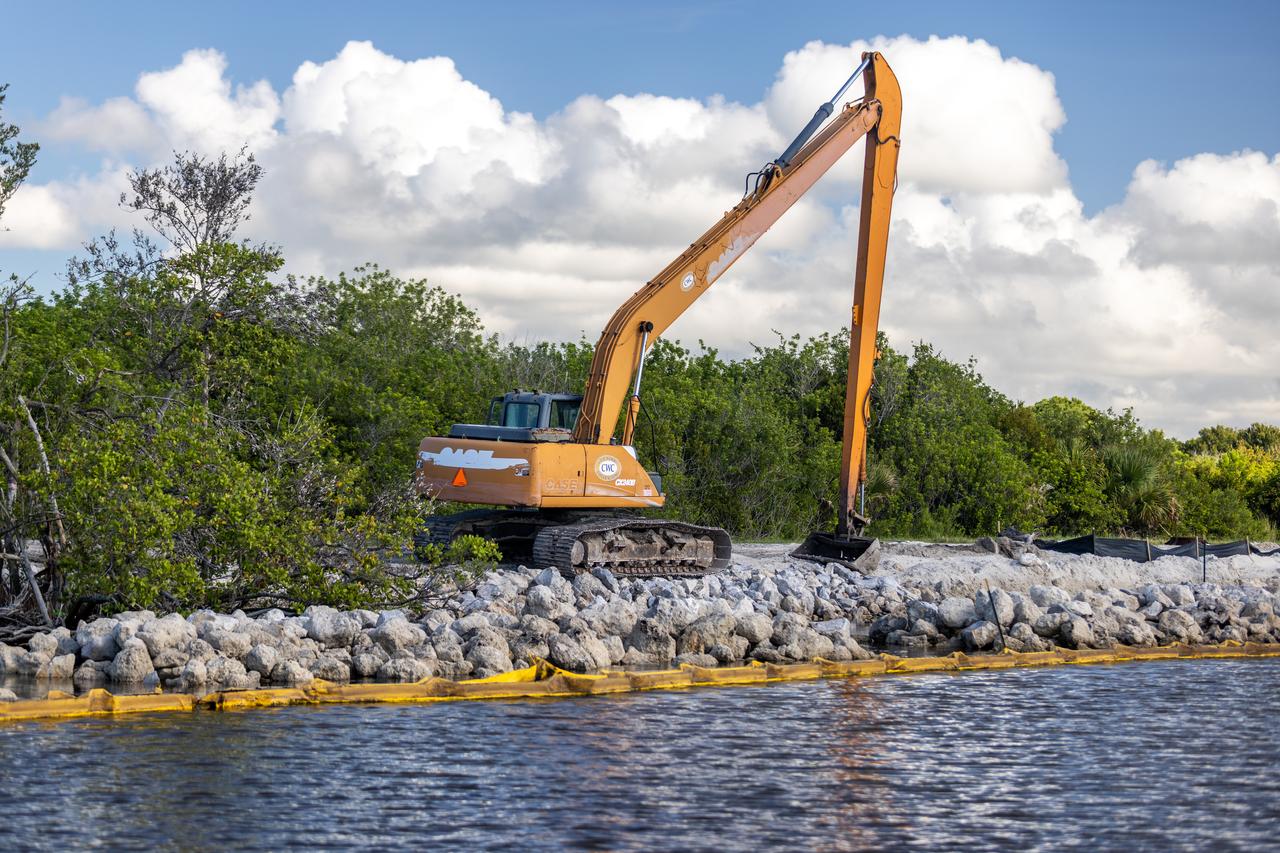
NASA Kennedy Space Center’s Spaceport Integration and Services organization is leading a restoration project at KARS Park on Hall Road in Merritt Island, Florida. As part of this project, a wavebreak is being created about 20 feet offshore to allow mangroves and other plants to propagate into the gap, providing protection for the shoreline.
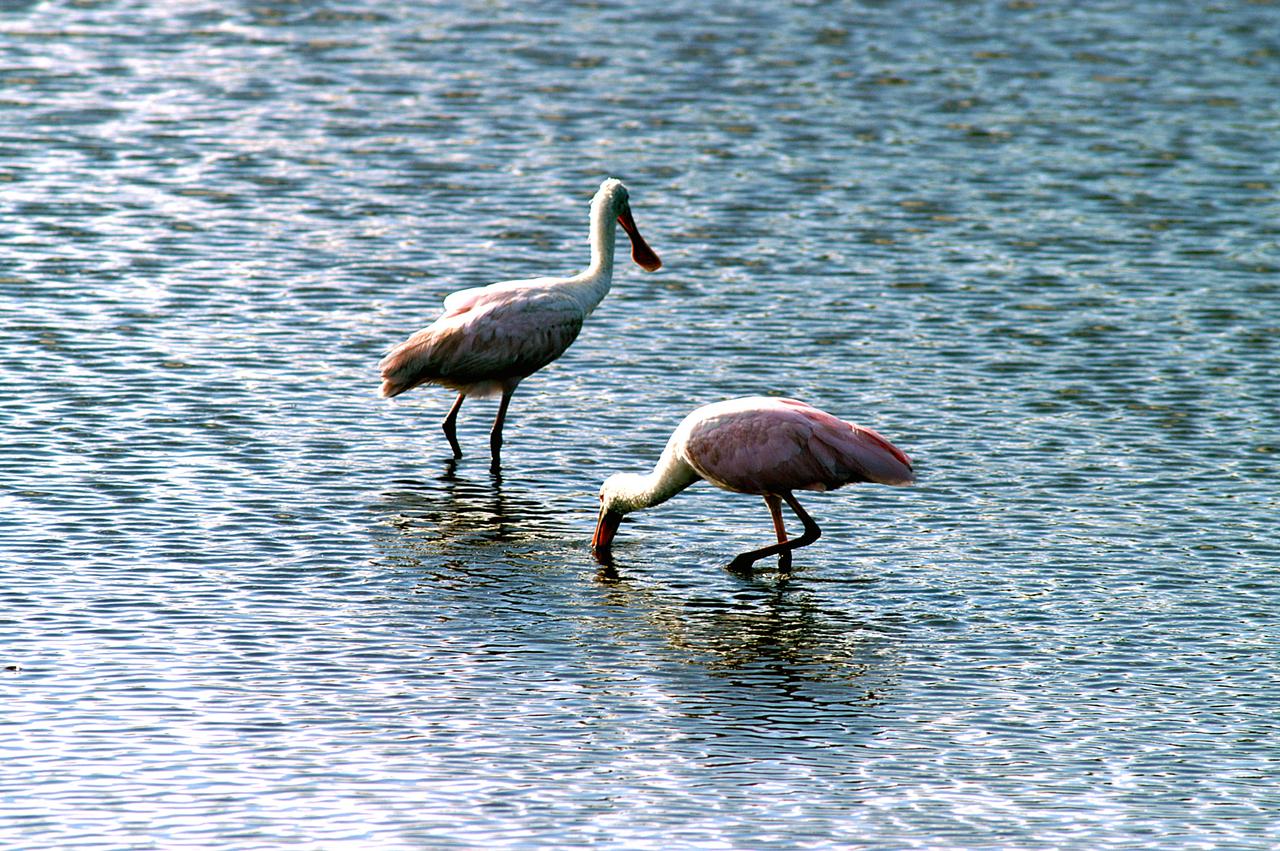
KENNEDY SPACE CENTER, FLA. -- Two roseate spoonbills hunt for their supper in the water near KSC. Spoonbills prefer to inhabit mangroves, ranging from the coasts of southern Florida, Louisiana and Texas, to the West Indies, Mexico, Central and South America. They feed on shrimps and fish in shallow waters. Spoonbills are one of 310 species of birds that inhabit the National Merritt Island Wildlife Refuge, which shares a boundary with KSC. The marshes and open water of the refuge also provide wintering areas for 23 species of migratory waterfowl, as well as a year-round home for great blue herons, great egrets, wood storks, cormorants, brown pelicans and other species of marsh and shore birds.
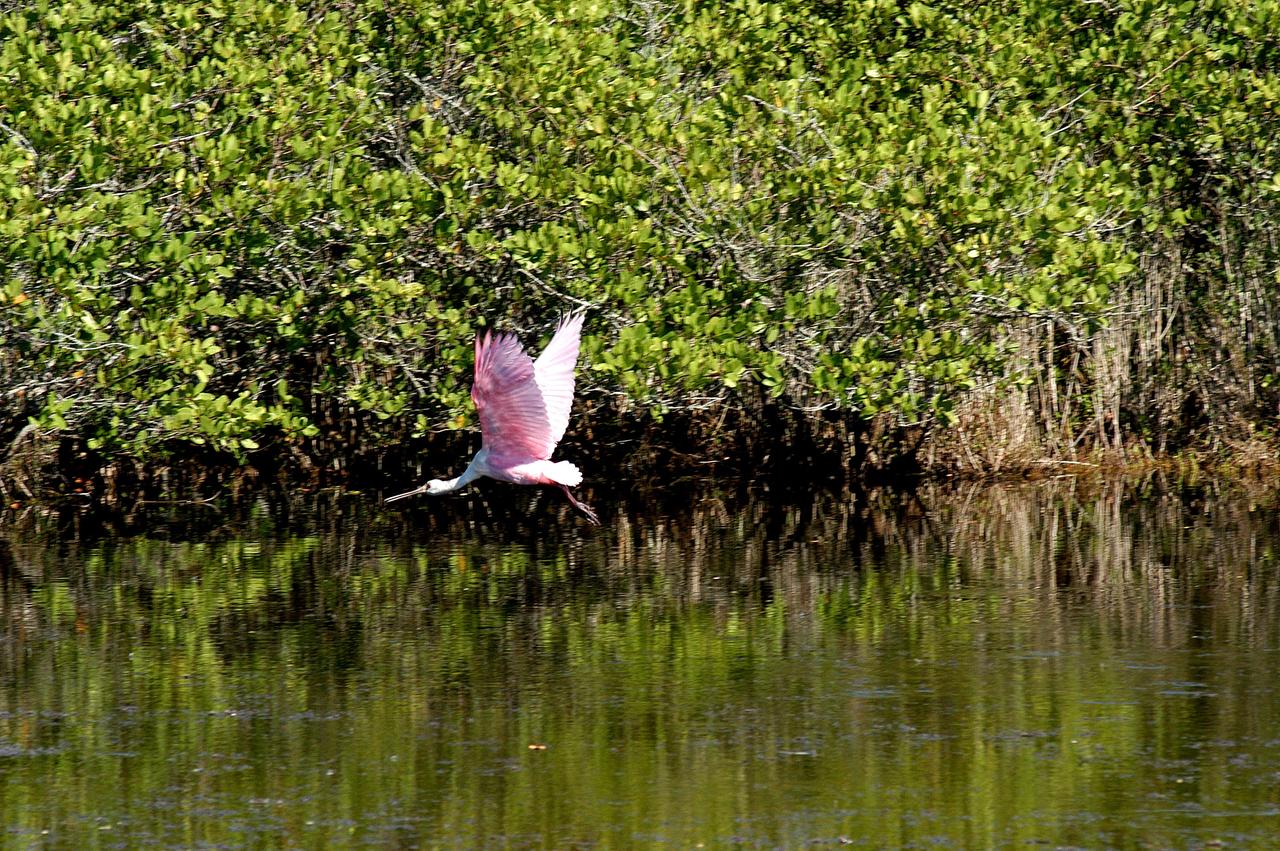
KENNEDY SPACE CENTER, FLA. - A roseate spoonbill flies across the water near KSC. Spoonbills prefer to inhabit mangroves, ranging from the coasts of southern Florida, Louisiana and Texas, to the West Indies, Mexico, Central and South America. They feed on shrimps and fish in shallow waters. Spoonbills are one of 310 species of birds that inhabit the National Merritt Island Wildlife Refuge, which shares a boundary with KSC. The marshes and open water of the refuge also provide wintering areas for 23 species of migratory waterfowl, as well as a year-round home for great blue herons, great egrets, wood storks, cormorants, brown pelicans and other species of marsh and shore birds.
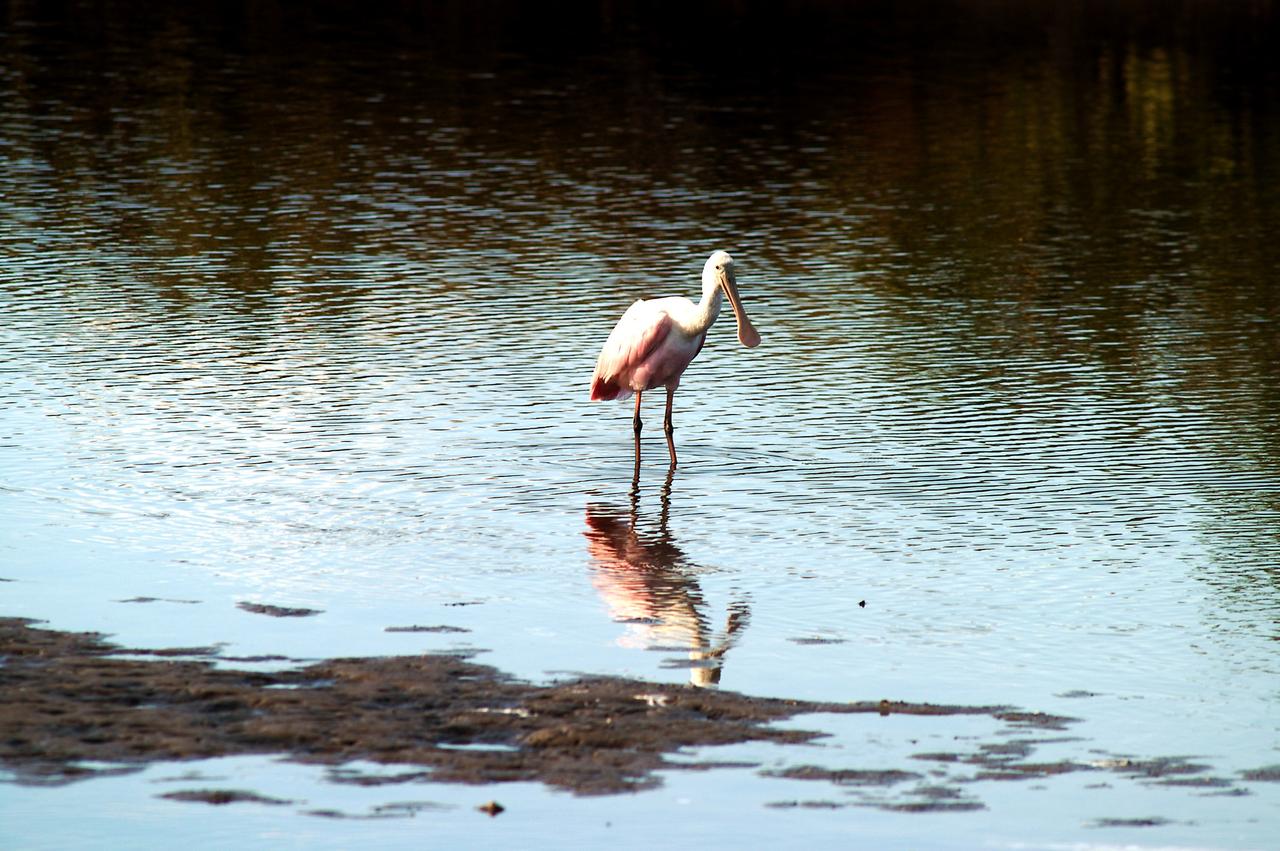
KENNEDY SPACE CENTER, FLA. -- A roseate spoonbill contemplates its reflection in the water near KSC. Spoonbills prefer to inhabit mangroves, ranging from the coasts of southern Florida, Louisiana and Texas, to the West Indies, Mexico, Central and South America. They feed on shrimps and fish in shallow waters. Spoonbills are one of 310 species of birds that inhabit the Merritt Island National Wildlife Refuge, which shares a boundary with KSC. The marshes and open water of the refuge also provide wintering areas for 23 species of migratory waterfowl, as well as a year-round home for great blue herons, great egrets, wood storks, cormorants, brown pelicans and other species of marsh and shore birds.
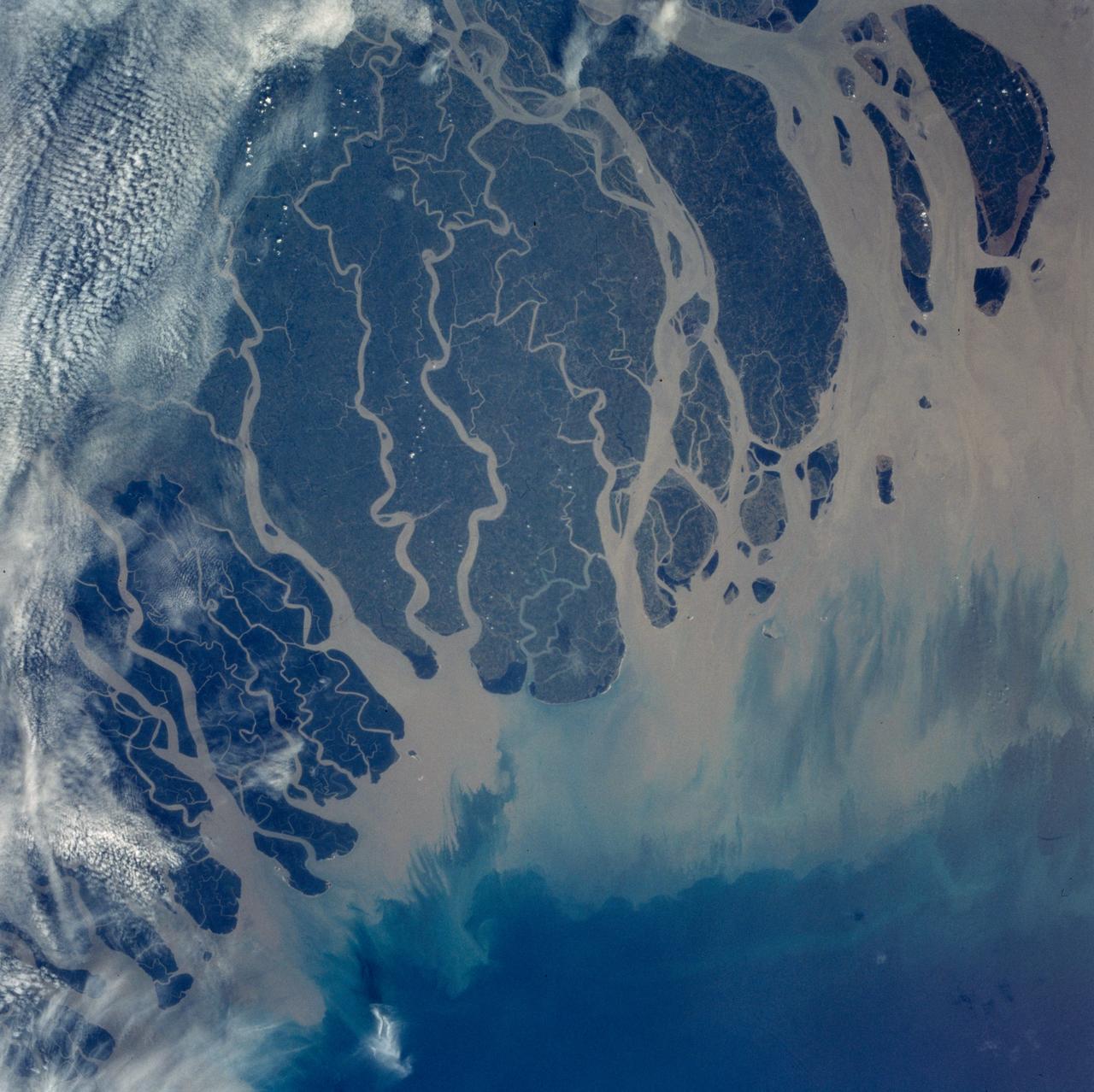
The Ganges River Delta is the largest inter-tidal delta in the world. With its extensive mangrove mud flats, swamp vegetation and sand dunes, it is characteristic of many tropical and subtropical coasts. As seen in this photograph, the tributaries and distributaries of the Ganges and Brahmaputra Rivers deposit huge amounts of silt and clay that create a shifting maze of waterways and islands in the Bay of Bengal.
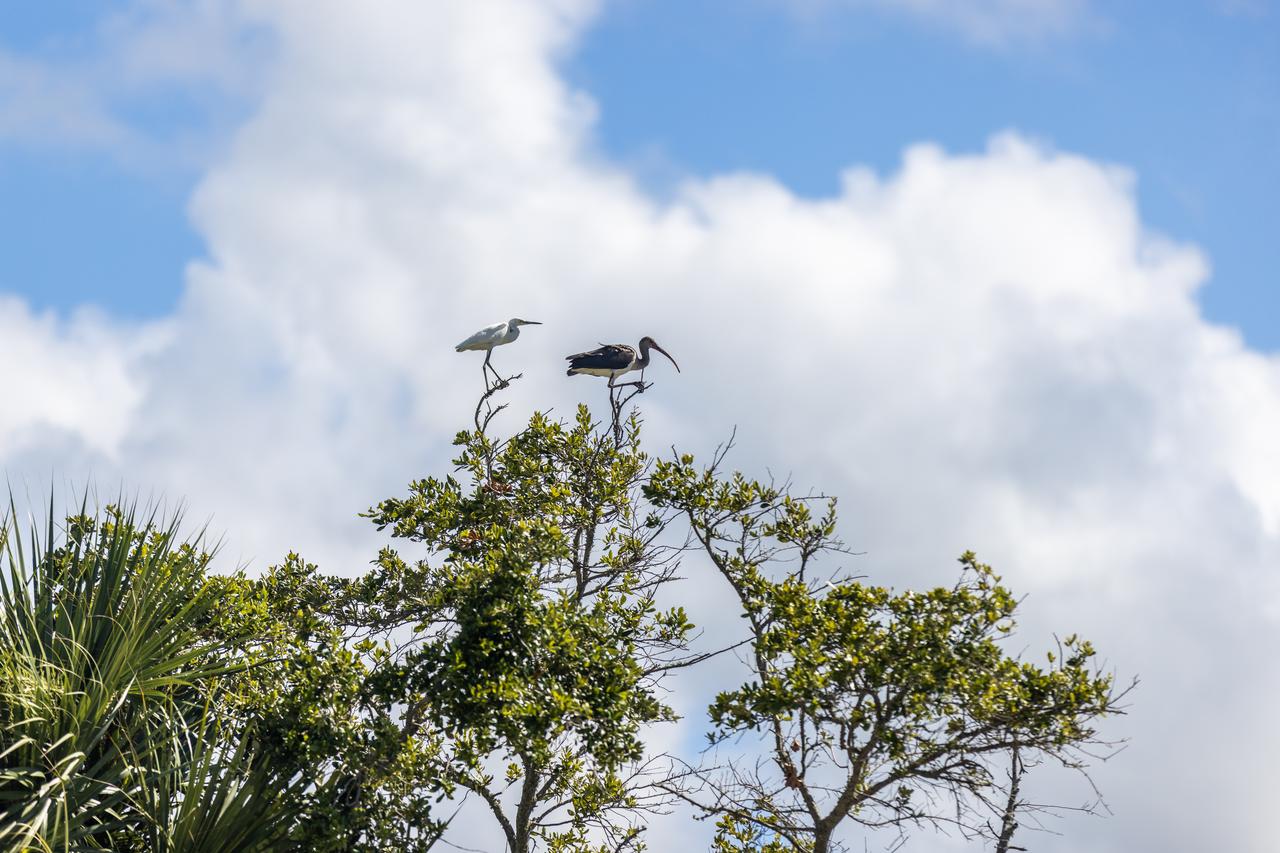
NASA Kennedy Space Center’s Spaceport Integration and Services organization is leading a restoration project at KARS Park on Hall Road in Merritt Island, Florida. As part of this project, a wavebreak is being created about 20 feet offshore to allow mangroves and other plants to propagate into the gap, providing protection for the shoreline. Show here in a tree are a snowy egret, left, and a limpkin.
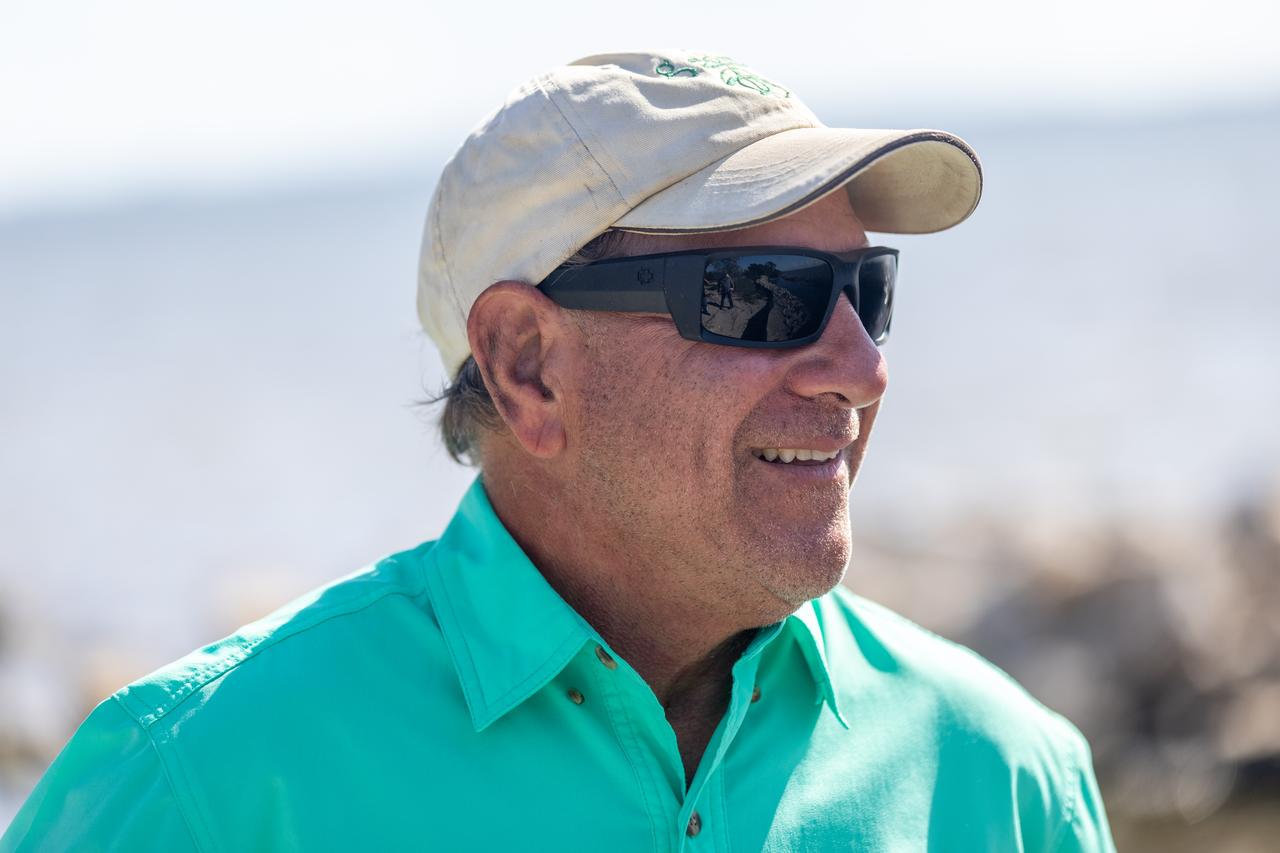
NASA Kennedy Space Center’s Spaceport Integration and Services organization is leading a restoration project at KARS Park on Hall Road in Merritt Island, Florida. As part of this project, a wavebreak is being created about 20 feet offshore to allow mangroves and other plants to propagate into the gap, providing protection for the shoreline. Shown here is Mark Mercadante, an environmental scientist at Kennedy.
![KENNEDY SPACE CENTER, FLA. -- A small flock of Roseate Spoonbills wade in the water near KSC while two others take flight. The birds, named for their brilliant pink color and paddle-shaped bill, usually feed in shallow water by swinging their bill back and forth, scooping up small fish and crustaceans. They typically inhabit mangroves on the coasts of southern Florida, Louisiana and Texas. [Photo by Mike Brown]](https://images-assets.nasa.gov/image/KSC-02pd0551/KSC-02pd0551~medium.jpg)
KENNEDY SPACE CENTER, FLA. -- A small flock of Roseate Spoonbills wade in the water near KSC while two others take flight. The birds, named for their brilliant pink color and paddle-shaped bill, usually feed in shallow water by swinging their bill back and forth, scooping up small fish and crustaceans. They typically inhabit mangroves on the coasts of southern Florida, Louisiana and Texas. [Photo by Mike Brown]
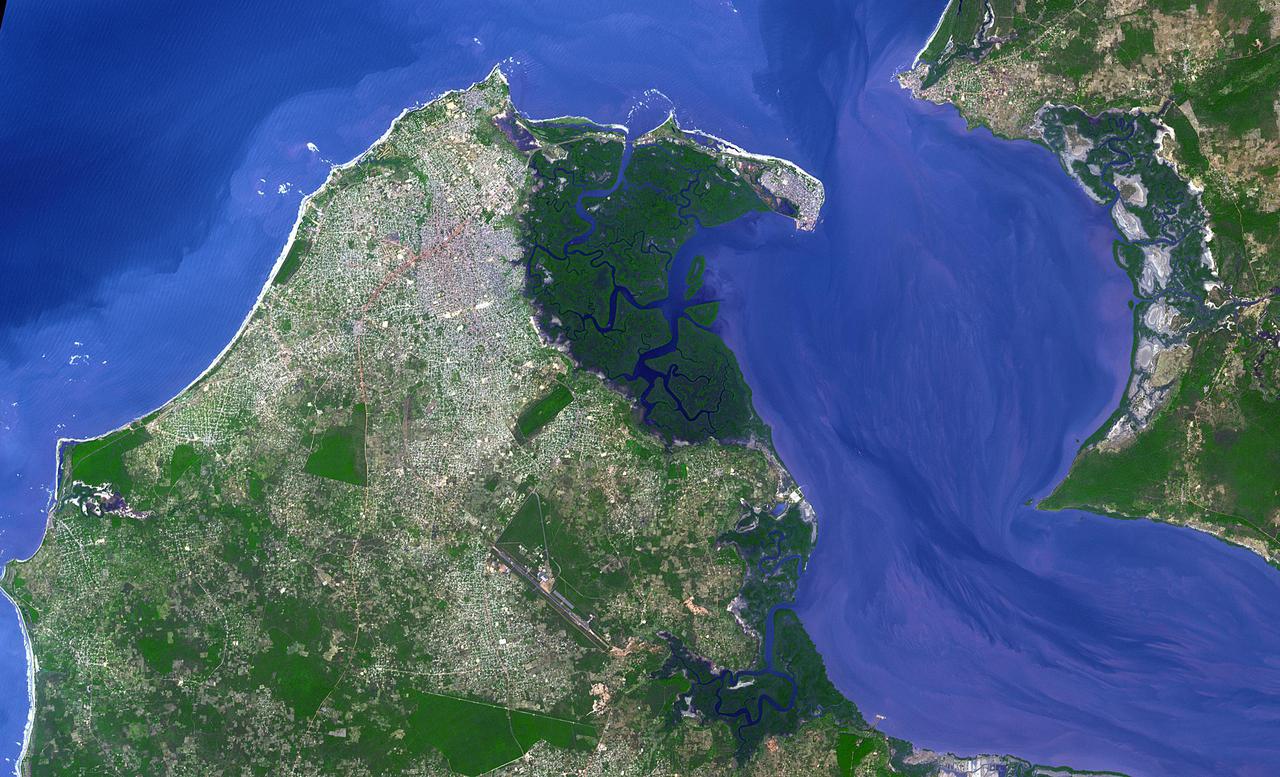
Banjul is the capital of The Gambia; it is located on St. Mary's Island, where the Gambia River enters the Atlantic Ocean in western Africa. The small city is surrounded by mangroves and water; it is connected to the rest of the country by ferries and a bridge. Peanut processing is the country's principal industry (Wikipedia). The image was acquired December 17, 2009, covers an area of 27.4 by 43.2 km, and is located at 13.5 degrees north, 16.6 degrees west. https://photojournal.jpl.nasa.gov/catalog/PIA24416
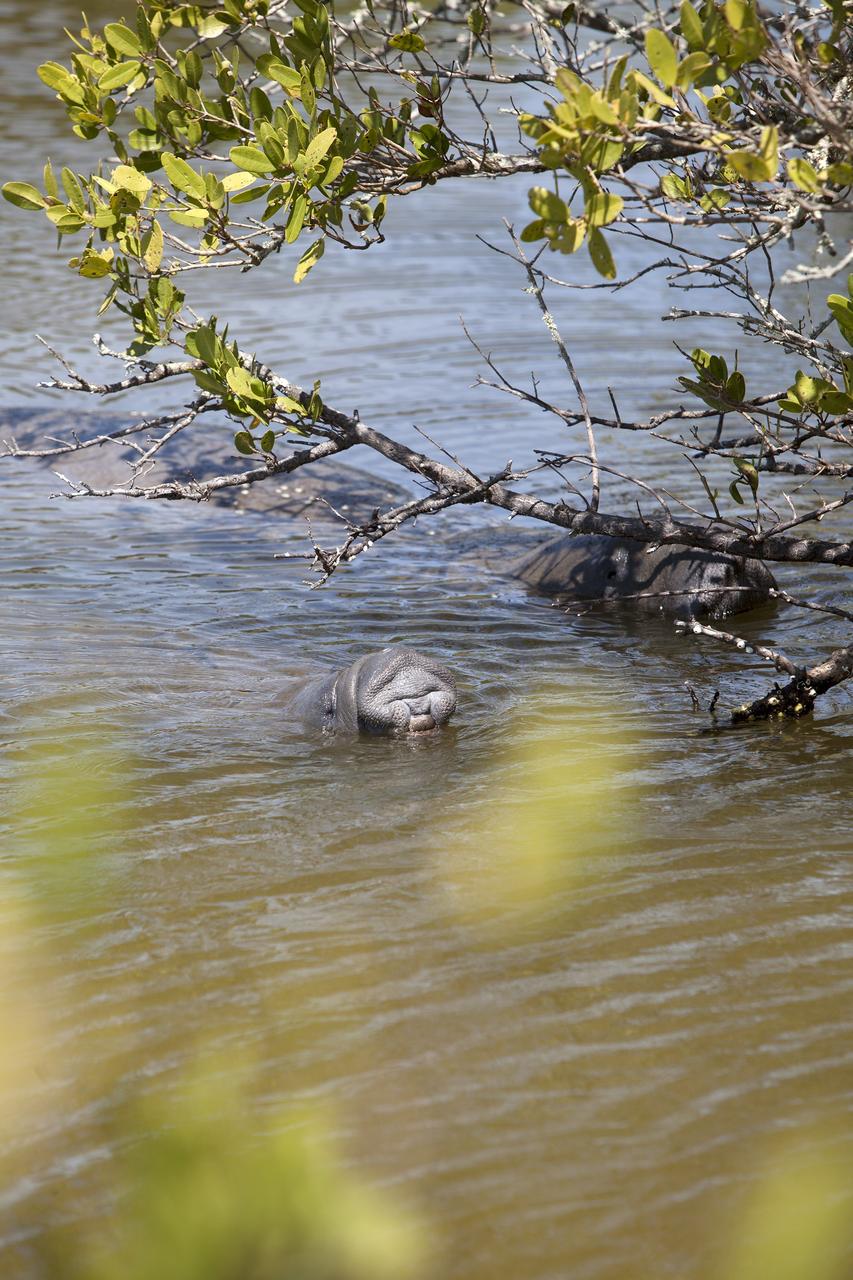
CAPE CANAVERAL, Fla. – A parent and a baby manatee come up for air beneath the branches of a mangrove in a creek at NASA's Kennedy Space Center in Florida. The center shares a boundary with the Merritt Island National Wildlife Refuge, which encompasses 140,000 acres that provide a habitat for more than 330 species of birds, 31 mammals, 117 fishes, and 65 amphibians and reptiles. Photo credit: NASA/Daniel Casper
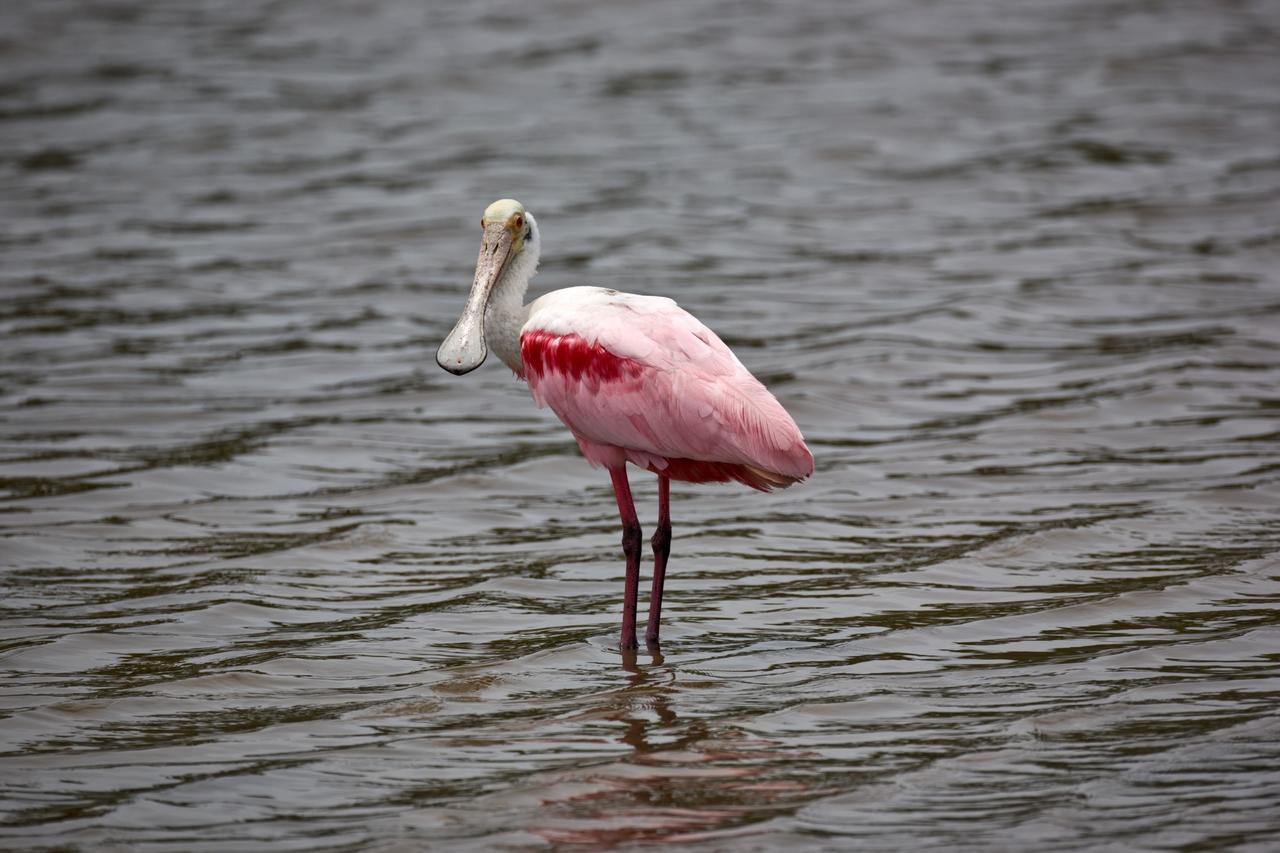
CAPE CANAVERAL, Fla. –– On NASA's Kennedy Space Center in Florida, the scarlet-feathered roseate spoonbill eyes the camera. Spoonbills inhabit areas of mangrove such as on the coasts of southern Florida and Texas. These birds feed on shrimps and fish in the shallow water, sweeping their bills from side to side. This and other wildlife abound throughout Kennedy as the center shares a boundary with the Merritt Island National Wildlife Refuge. Photo credit: NASA/Dimitri Gerondidakis
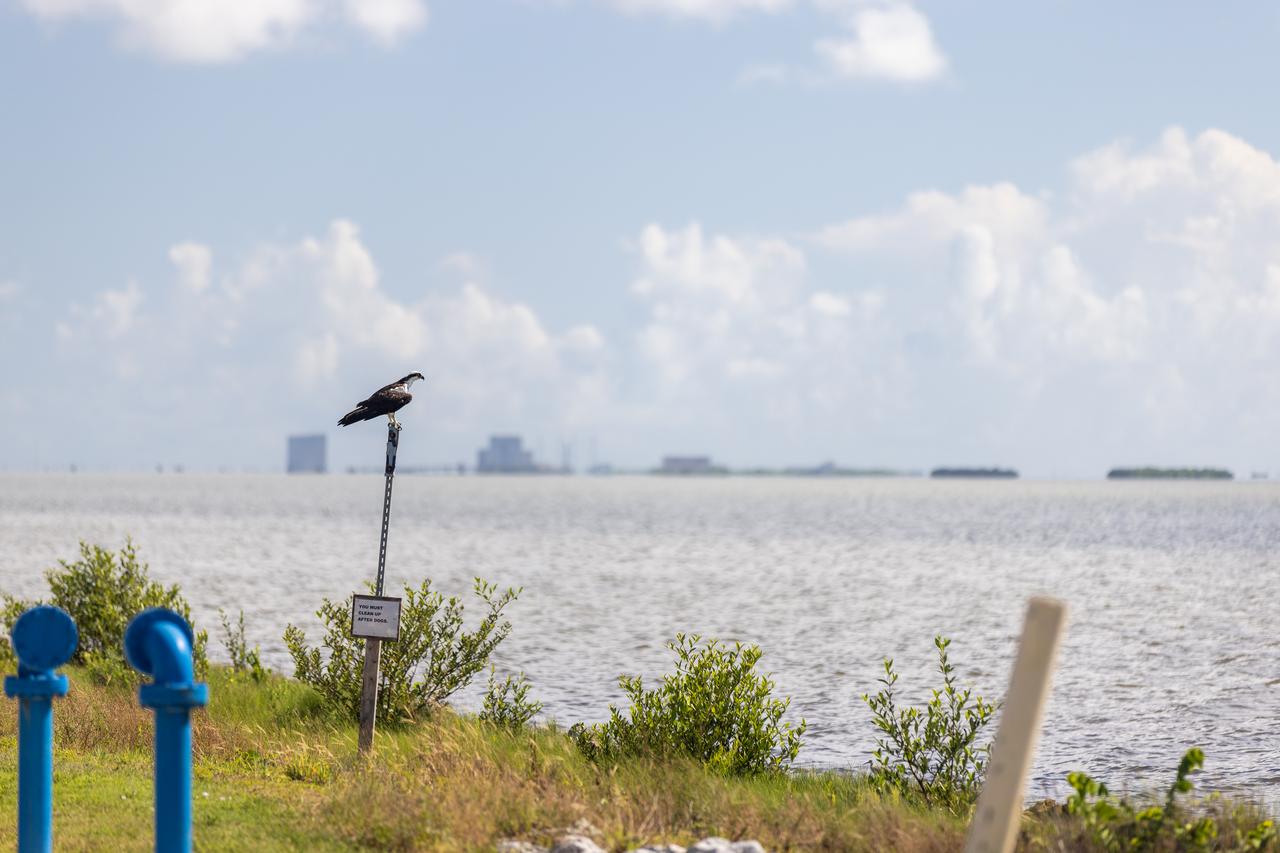
NASA Kennedy Space Center’s Spaceport Integration and Services organization is leading a restoration project at KARS Park on Hall Road in Merritt Island, Florida. As part of this project, a wavebreak is being created about 20 feet offshore to allow mangroves and other plants to propagate into the gap, providing protection for the shoreline. Shown here is an osprey overlooking the water.
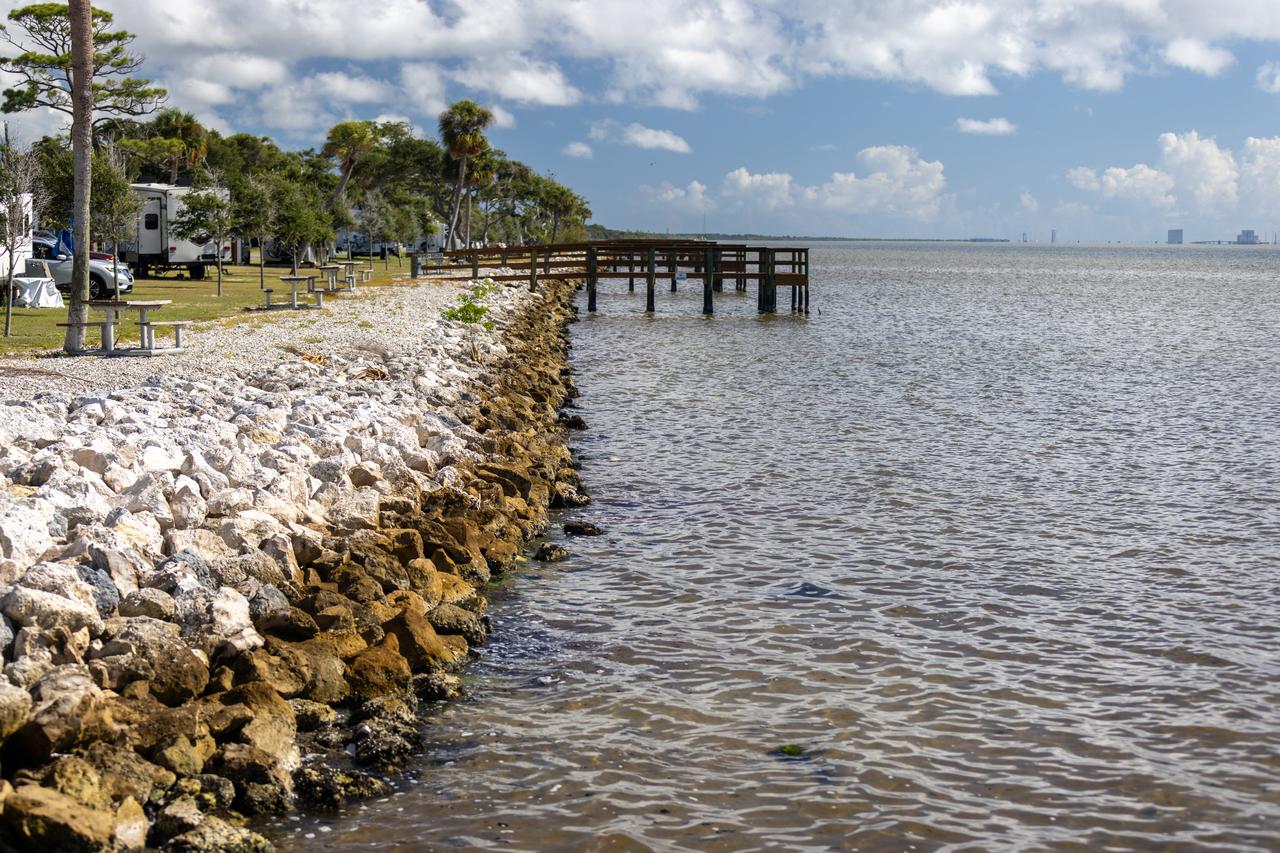
NASA Kennedy Space Center’s Spaceport Integration and Services organization is leading a restoration project at KARS Park on Hall Road in Merritt Island, Florida. As part of this project, a wavebreak is being created about 20 feet offshore to allow mangroves and other plants to propagate into the gap, providing protection for the shoreline. Shown here is the section of KARS park that was first completed during the project.
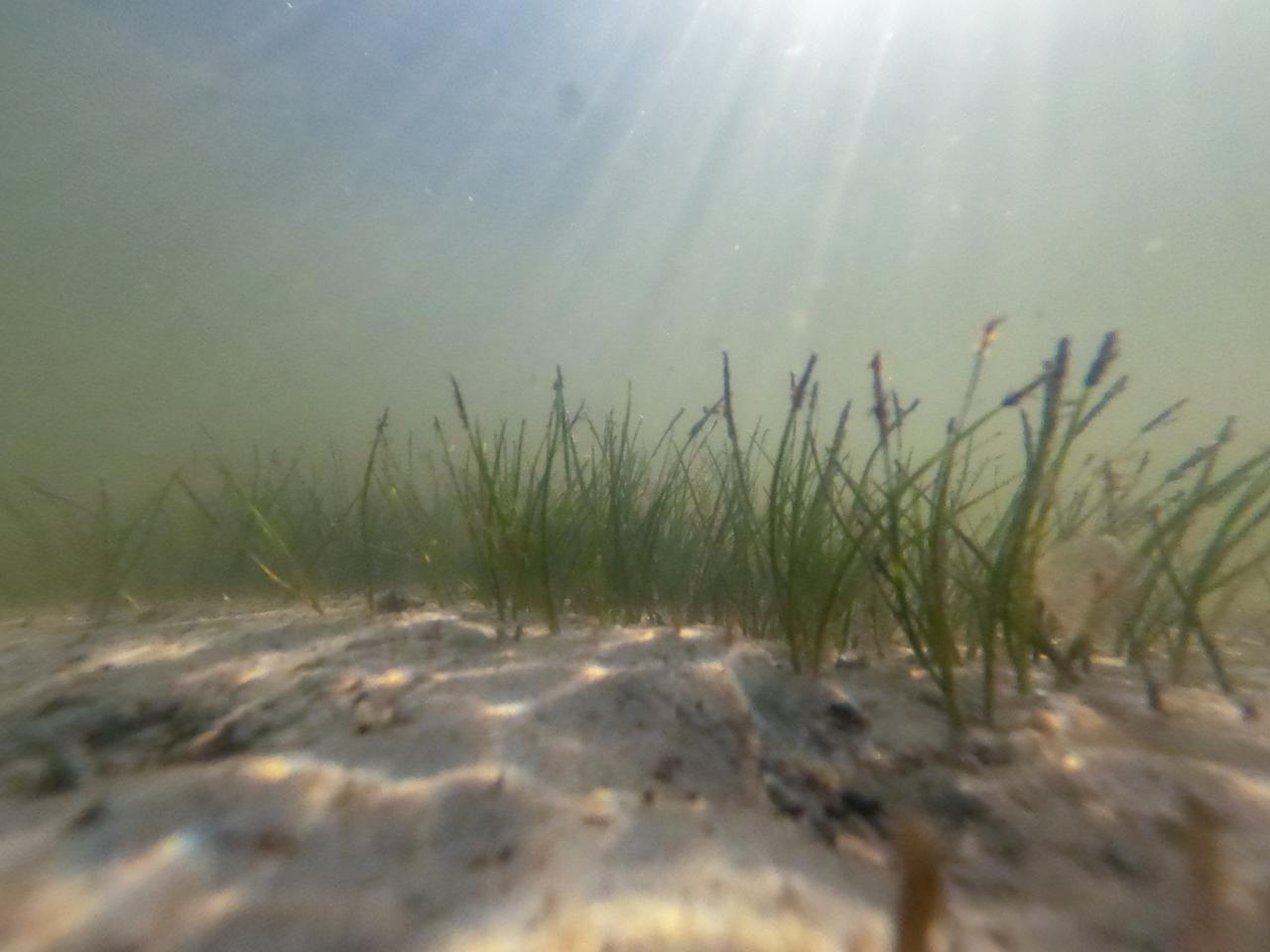
NASA Kennedy Space Center’s Spaceport Integration and Services organization is leading a restoration project at KARS Park on Hall Road in Merritt Island, Florida. As part of this project, a wavebreak is being created about 20 feet offshore to allow mangroves and other plants to propagate into the gap, providing protection for the shoreline. Shown here is shoalgrass taking hold in the restoration area.
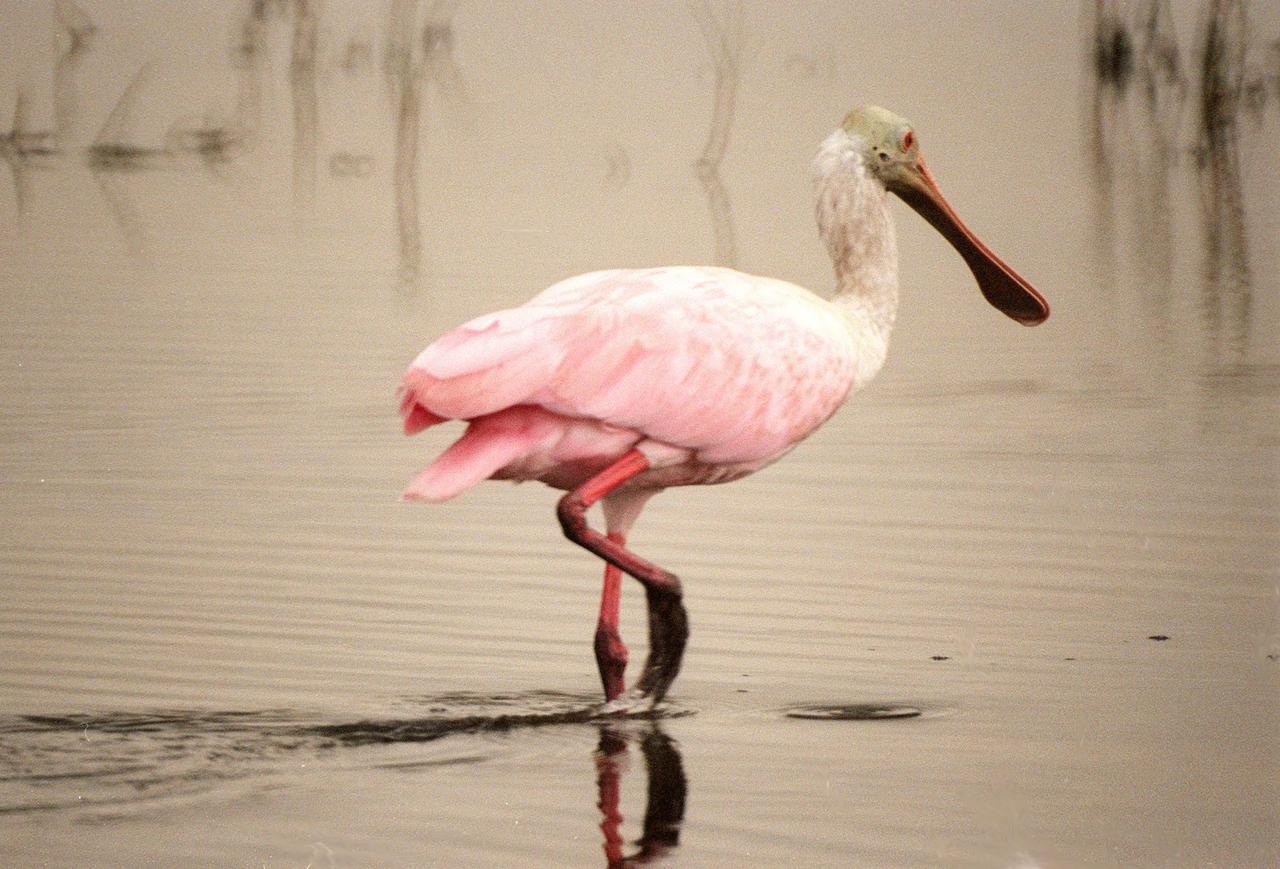
KENNEDY SPACE CENTER, FLA. -- This roseate spoonbill seems to pause midstride as it searches for food in a canal in the Merritt Island National Wildlife Refuge. The birds, named for their brilliant pink color and paddle-shaped bill, feed in shallow water by swinging their bill back and forth, scooping up small fish and crustaceans. They typically inhabit mangroves on the coasts of southern Florida, Louisiana and Texas
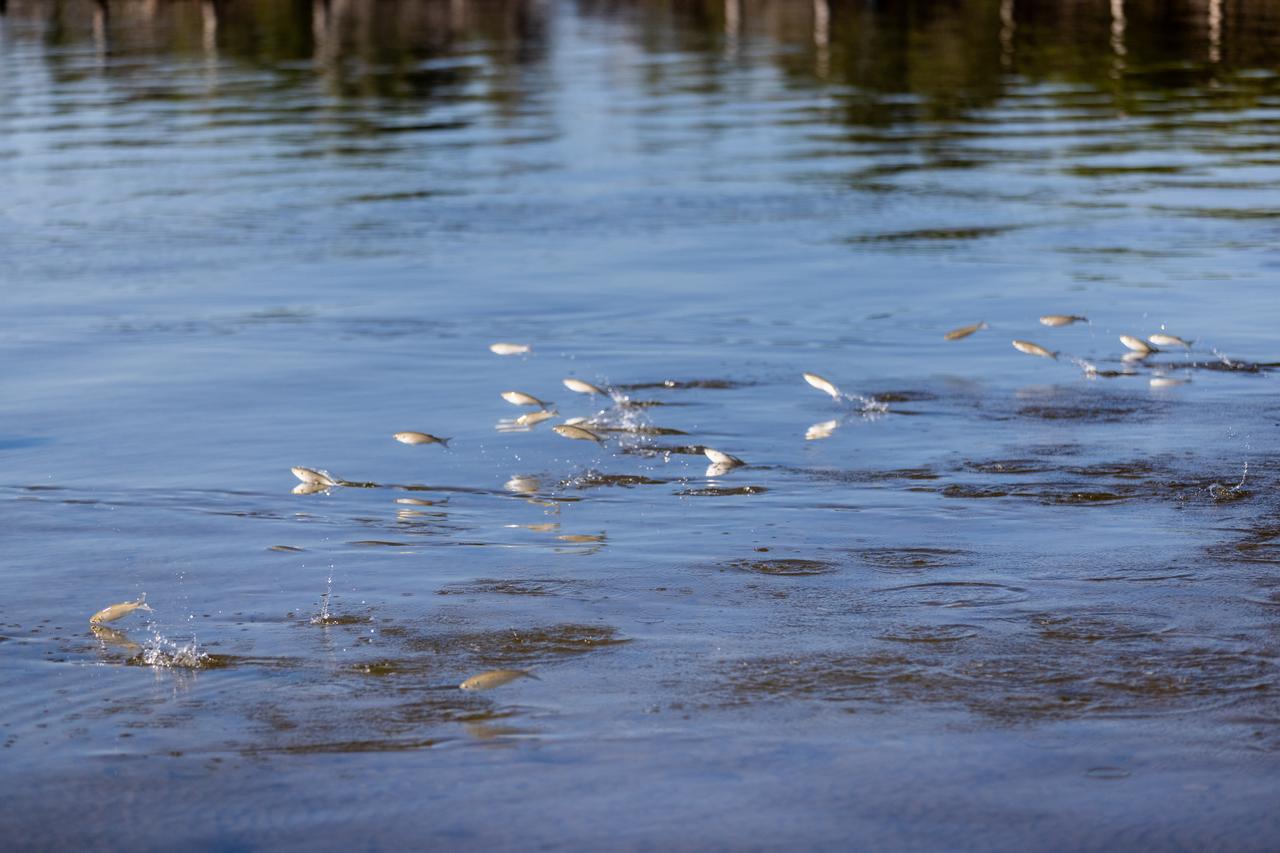
NASA Kennedy Space Center’s Spaceport Integration and Services organization is leading a restoration project at KARS Park on Hall Road in Merritt Island, Florida. As part of this project, a wavebreak is being created about 20 feet offshore to allow mangroves and other plants to propagate into the gap, providing protection for the shoreline. Shown here are mullet swimming at the location.
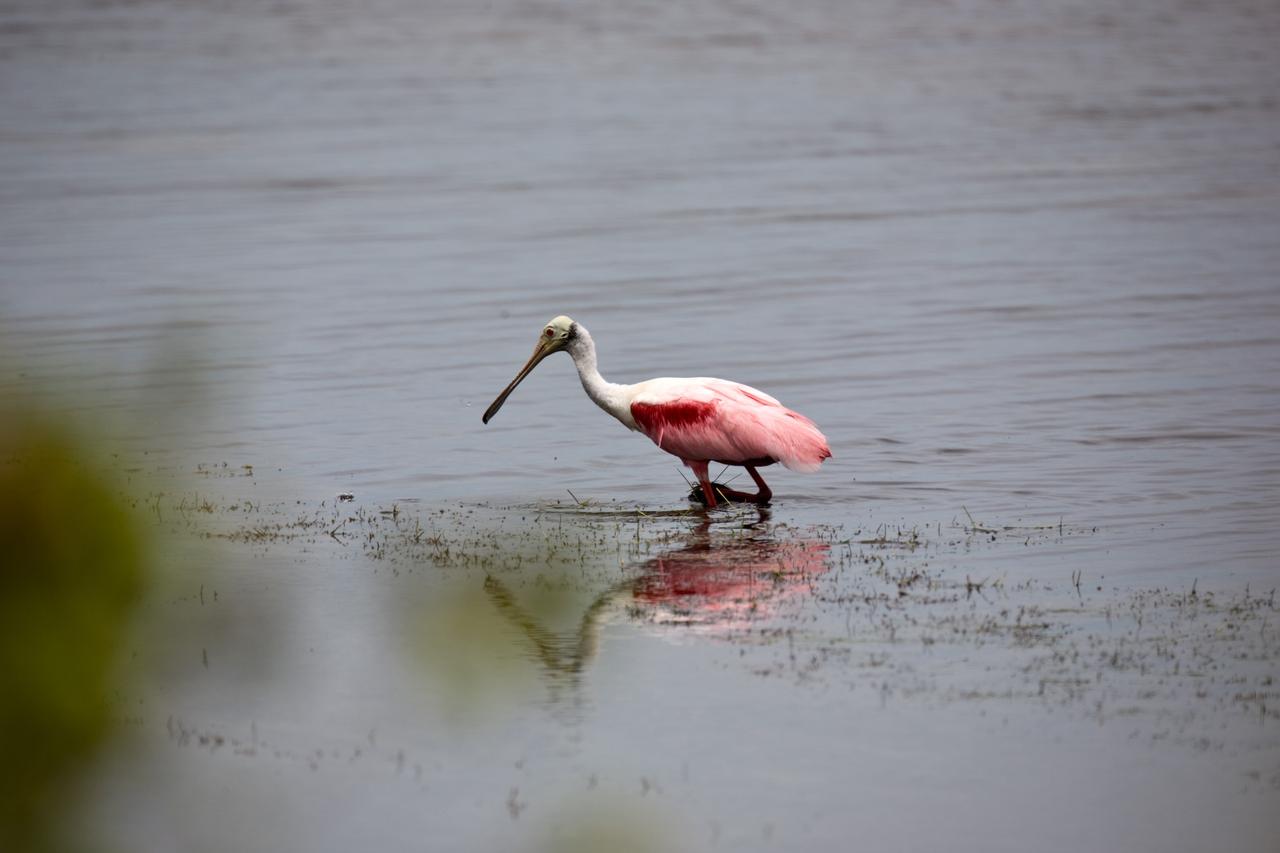
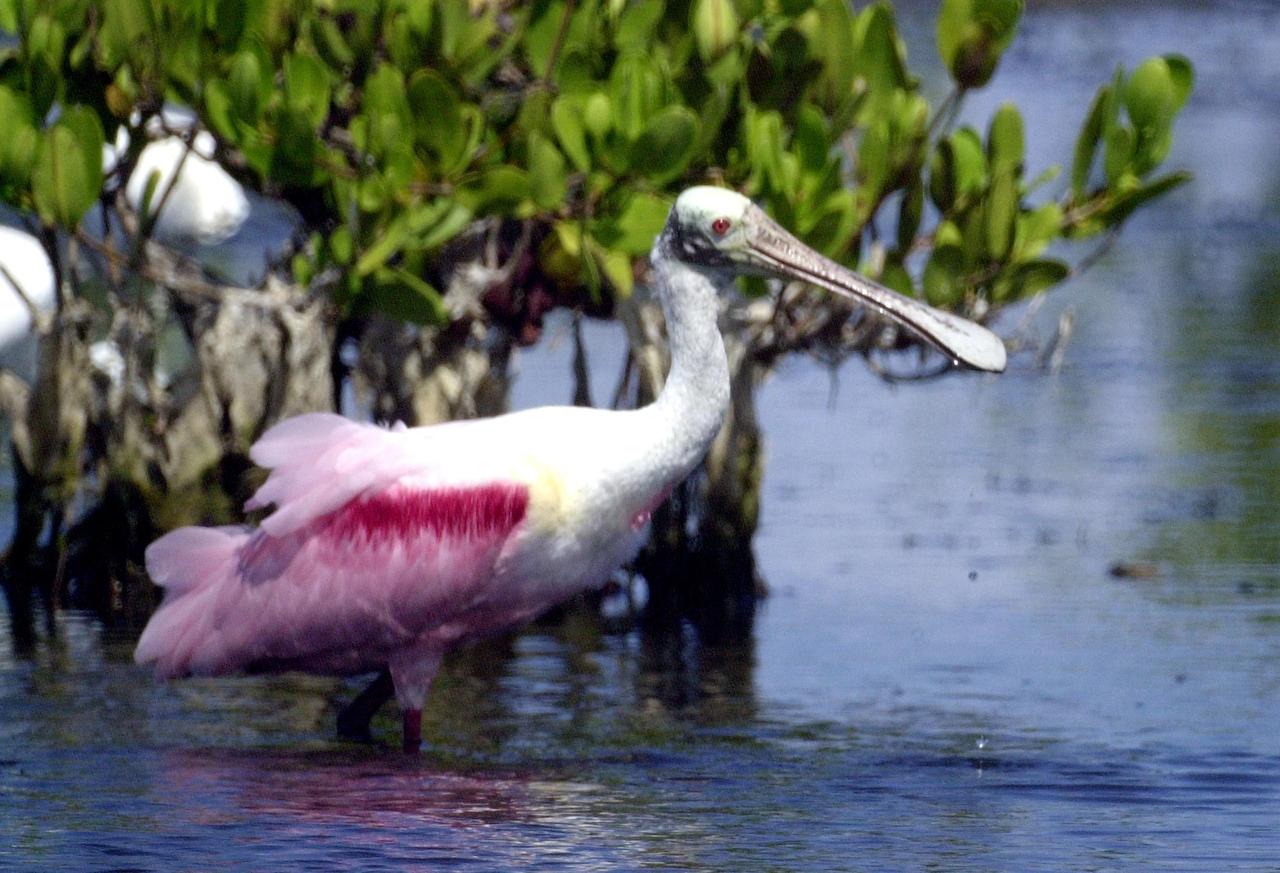
CAPE CANAVERAL, Fla. –– The scarlet-feathered roseate spoonbill wades through water on NASA's Kennedy Space Center in Florida. Spoonbills inhabit areas of mangrove such as on the coasts of southern Florida and Texas. These birds feed on shrimps and fish in the shallow water, sweeping their bills from side to side. This and other wildlife abound throughout Kennedy as the center shares a boundary with the Merritt Island National Wildlife Refuge. Photo credit: NASA/Dimitri Gerondidakis
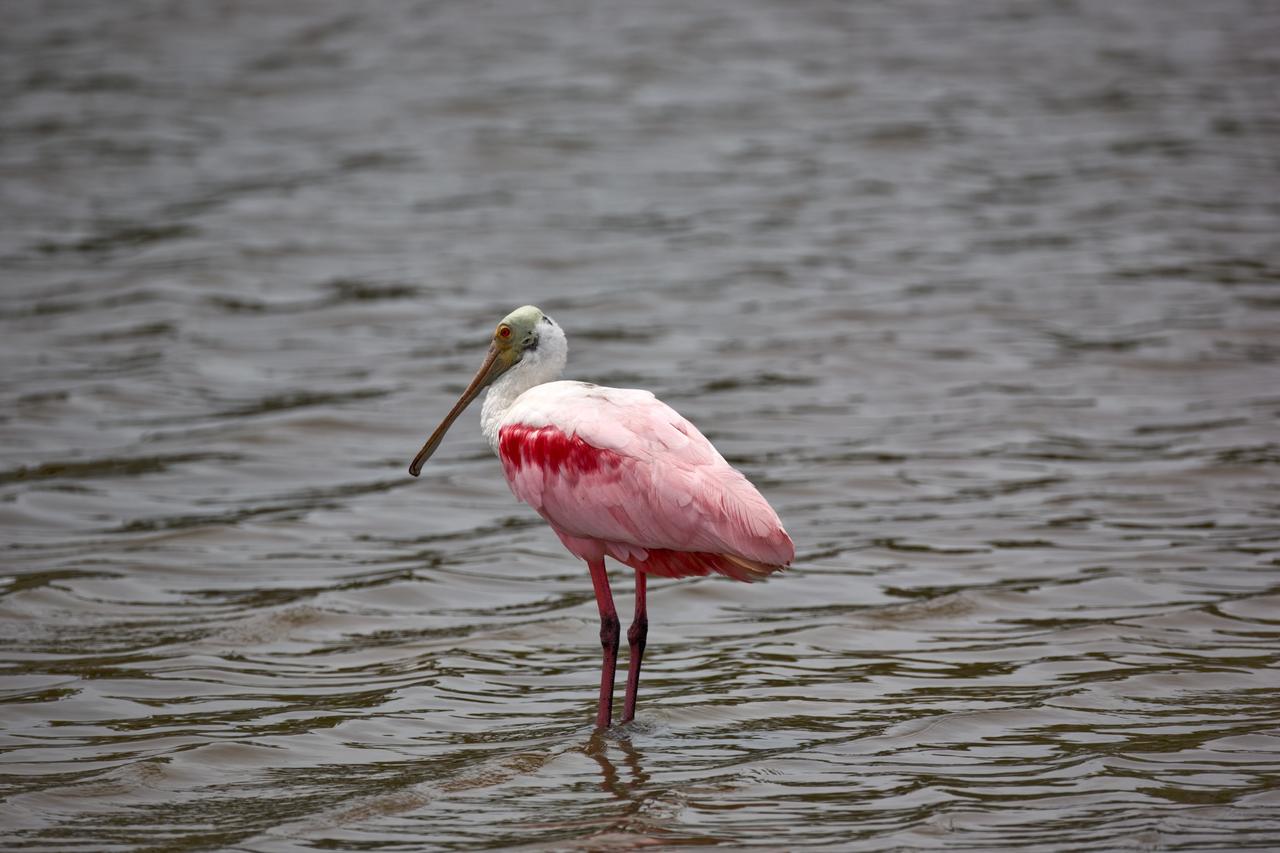
CAPE CANAVERAL, Fla. –– On NASA's Kennedy Space Center in Florida, the scarlet-feathered roseate spoonbill waits in the water for a tempting meal . Spoonbills inhabit areas of mangrove such as on the coasts of southern Florida and Texas. These birds feed on shrimps and fish in the shallow water, sweeping their bills from side to side. This and other wildlife abound throughout Kennedy as the center shares a boundary with the Merritt Island National Wildlife Refuge. Photo credit: NASA/Dimitri Gerondidakis
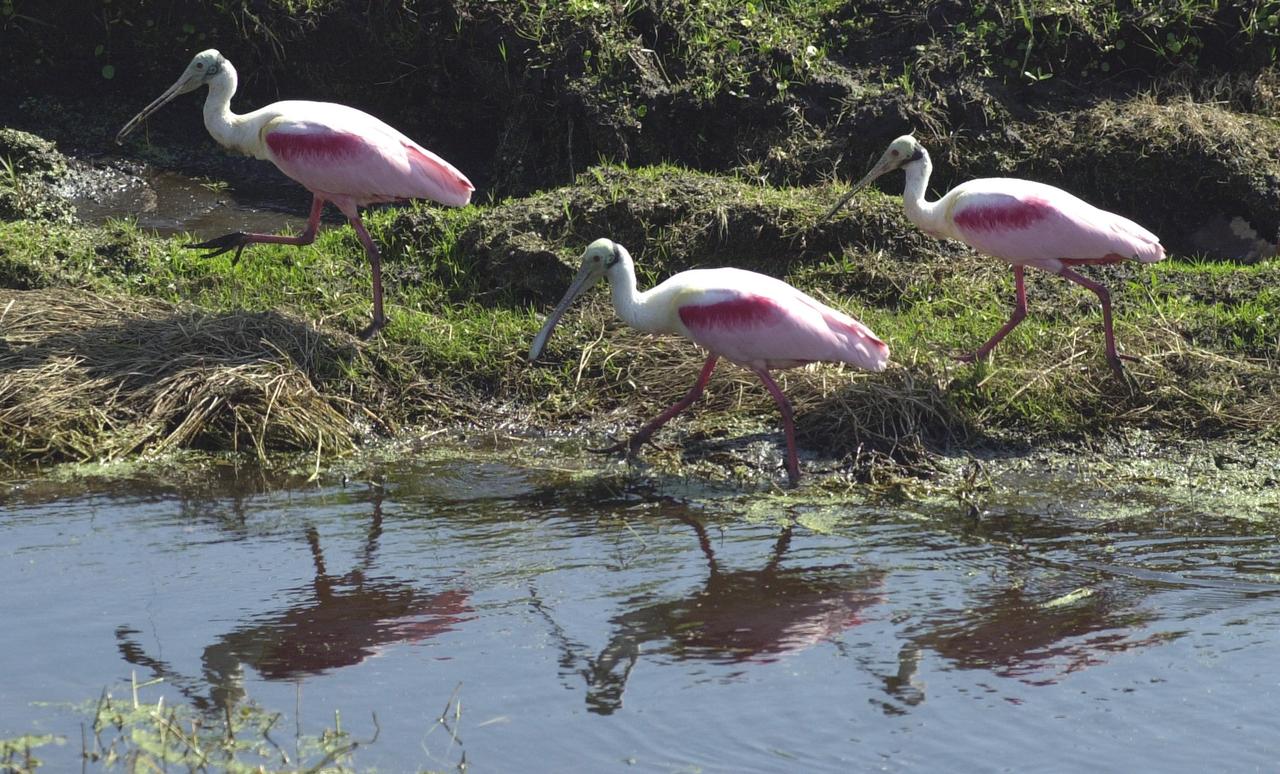
KENNEDY SPACE CENTER, FLA. -- Roseate Spoonbills march alongside a pool of water near KSC. The birds, named for their brilliant pink color and paddle-shaped bill, usually feed in shallow water by swinging their bill back and forth, scooping up small fish and crustaceans. They typically inhabit mangroves on the coasts of southern Florida, Louisiana and Texas. [Photo by Mike Brown
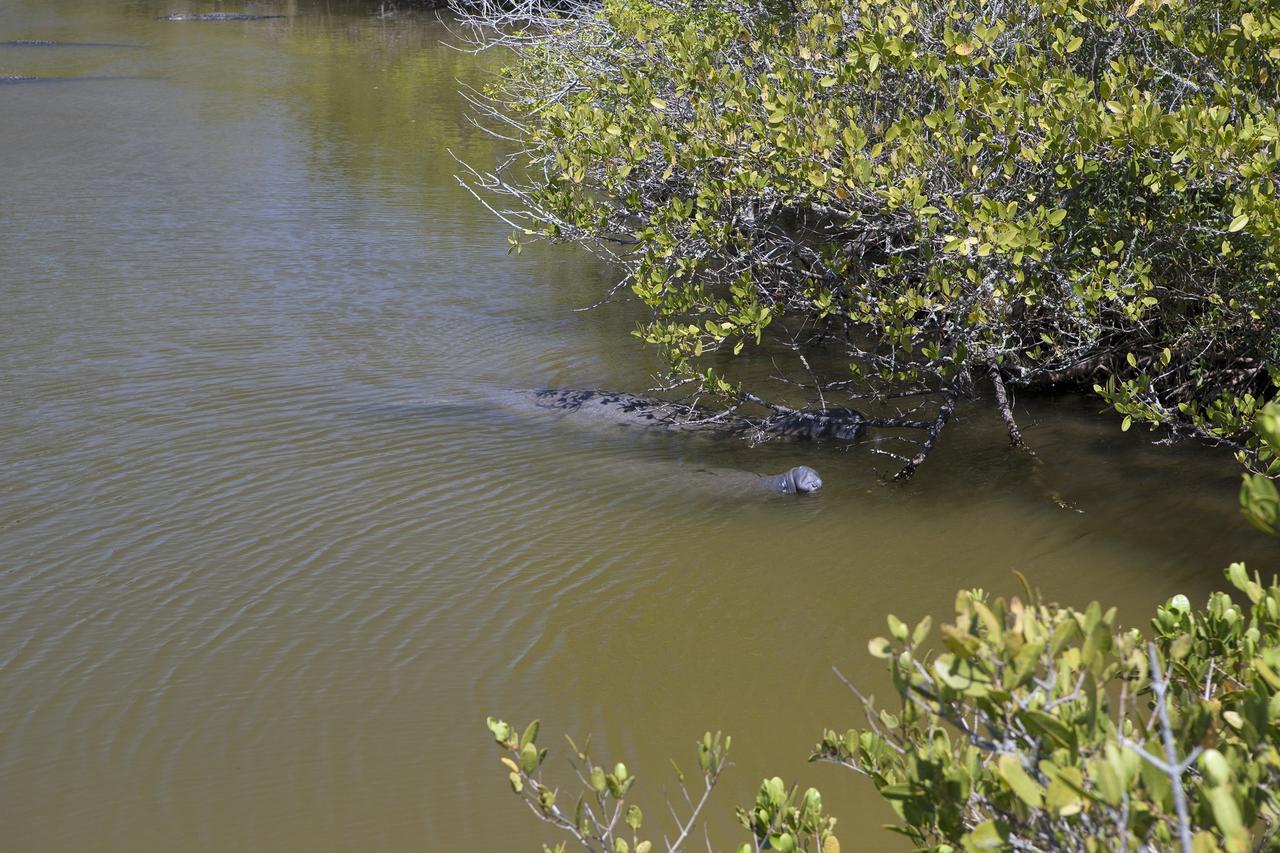
CAPE CANAVERAL, Fla. – A parent and a baby manatee come up for air beneath the branches of a mangrove in a creek at NASA's Kennedy Space Center in Florida. The center shares a boundary with the Merritt Island National Wildlife Refuge, which encompasses 140,000 acres that provide a habitat for more than 330 species of birds, 31 mammals, 117 fishes, and 65 amphibians and reptiles. Photo credit: NASA/Daniel Casper
![KENNEDY SPACE CENTER, FLA. -- A Roseate Spoonbill takes flight. The colorful birds are seen often throughout KSC and nearby wetlands. The birds, named for their brilliant pink color and paddle-shaped bill, usually feed in shallow water by swinging their bill back and forth, scooping up small fish and crustaceans. They typically inhabit mangroves on the coasts of southern Florida, Louisiana and Texas. [Photo by Mike Brown]](https://images-assets.nasa.gov/image/KSC-02pd0550/KSC-02pd0550~medium.jpg)
KENNEDY SPACE CENTER, FLA. -- A Roseate Spoonbill takes flight. The colorful birds are seen often throughout KSC and nearby wetlands. The birds, named for their brilliant pink color and paddle-shaped bill, usually feed in shallow water by swinging their bill back and forth, scooping up small fish and crustaceans. They typically inhabit mangroves on the coasts of southern Florida, Louisiana and Texas. [Photo by Mike Brown]
![KENNEDY SPACE CENTER, FLA. -- Several Roseate Spoonbills take flight from a pond near KSC. The birds, named for their brilliant pink color and paddle-shaped bill, usually feed in shallow water by swinging their bill back and forth, scooping up small fish and crustaceans. They typically inhabit mangroves on the coasts of southern Florida, Louisiana and Texas. [Photo by Mike Brown]](https://images-assets.nasa.gov/image/02pd0552/02pd0552~medium.jpg)
KENNEDY SPACE CENTER, FLA. -- Several Roseate Spoonbills take flight from a pond near KSC. The birds, named for their brilliant pink color and paddle-shaped bill, usually feed in shallow water by swinging their bill back and forth, scooping up small fish and crustaceans. They typically inhabit mangroves on the coasts of southern Florida, Louisiana and Texas. [Photo by Mike Brown]
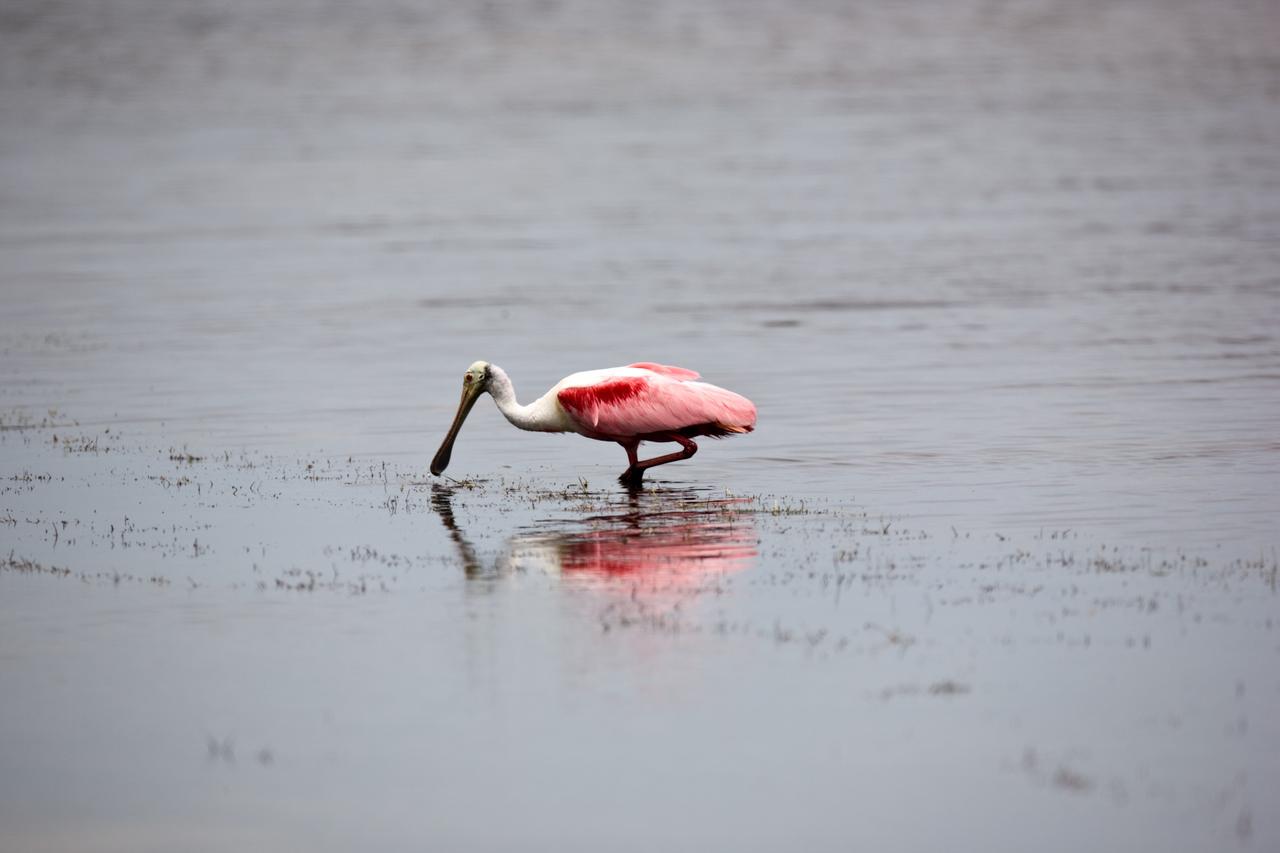
CAPE CANAVERAL, Fla. –– The scarlet-feathered roseate spoonbill searches for food in the water on NASA's Kennedy Space Center in Florida. Spoonbills inhabit areas of mangrove such as on the coasts of southern Florida and Texas. These birds feed on shrimps and fish in the shallow water, sweeping their bills from side to side. This and other wildlife abound throughout Kennedy as the center shares a boundary with the Merritt Island National Wildlife Refuge. Photo credit: NASA/Dimitri Gerondidakis
KENNEDY SPACE CENTER, FLA. - Water droplets fall from the broad bill of a Roseate Spoonbill after lifting its head from the water. The site is near Kennedy Space Center. Spoonbills obtain food by sweeping their broad bills from side to side. They inhabit mangroves, ranging from the coasts of southern Florida and Texas (sometimes Louisiana), the West Indies, Mexico and Central and South America.
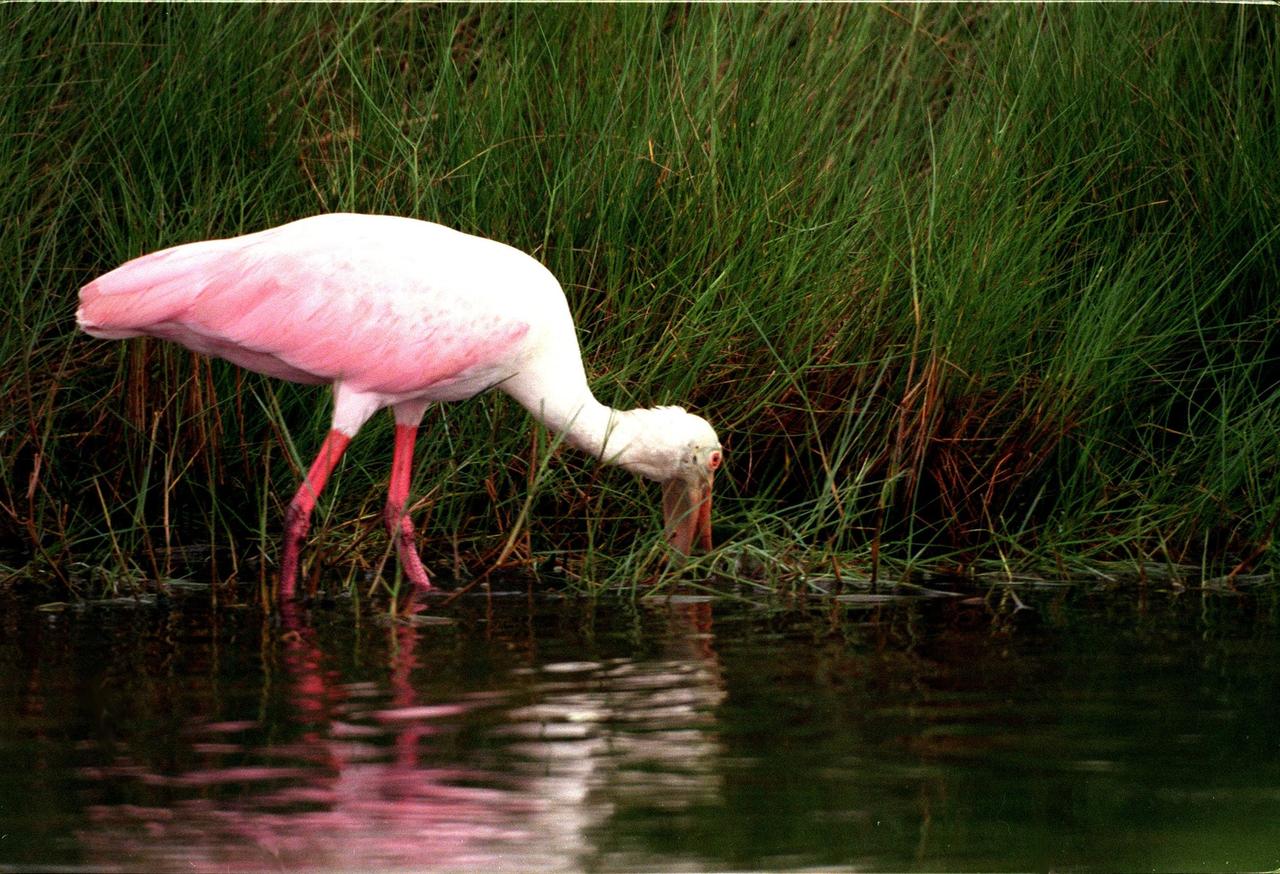
KENNEDY SPACE CENTER, FLA. -- A roseate spoonbill feeds alongside a canal in the Merritt Island National Wildlife Refuge. The birds are named for their brilliant pink color and paddle-shaped bill and feed in shallow water by swinging their bill back and forth, scooping up small fish and crustaceans. They typically inhabit mangroves on the coasts of southern Florida, Louisiana and Texas
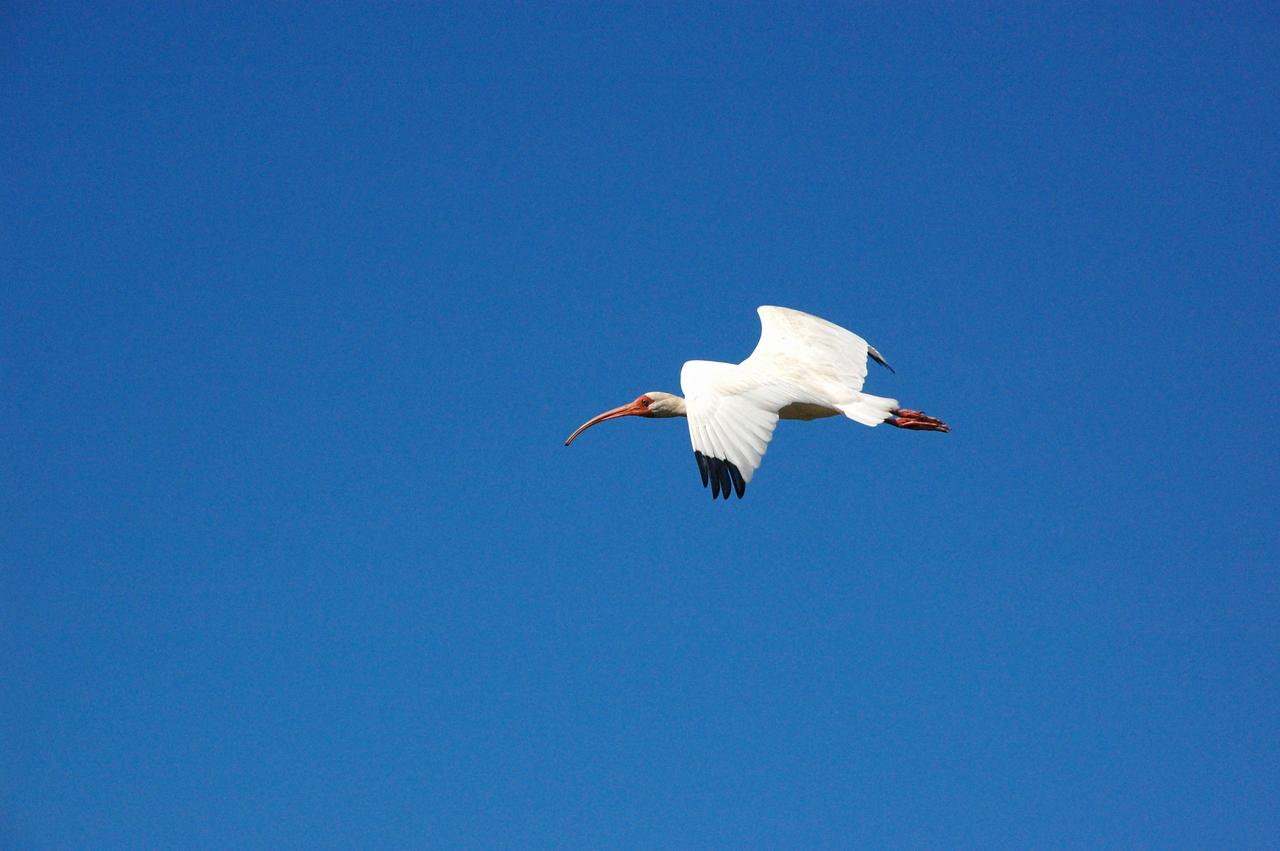
CAPE CANAVERAL, Fla. – The beauty of the wood stork in flight is captured against the intense blue Florida sky over NASA's Kennedy Space Center in Florida. This is a young stork, still showing its yellow beak. Wood storks are found primarily in Florida, wandering to South Carolina and Texas, preferring cypress and mangrove swamps. Kennedy shares a boundary with the Merritt Island National Wildlife Refuge, which is a habitat for more than 310 species of birds, 25 mammals, 117 fishes and 65 amphibians and reptiles. Photo credit: NASA/Ben Smegelsky
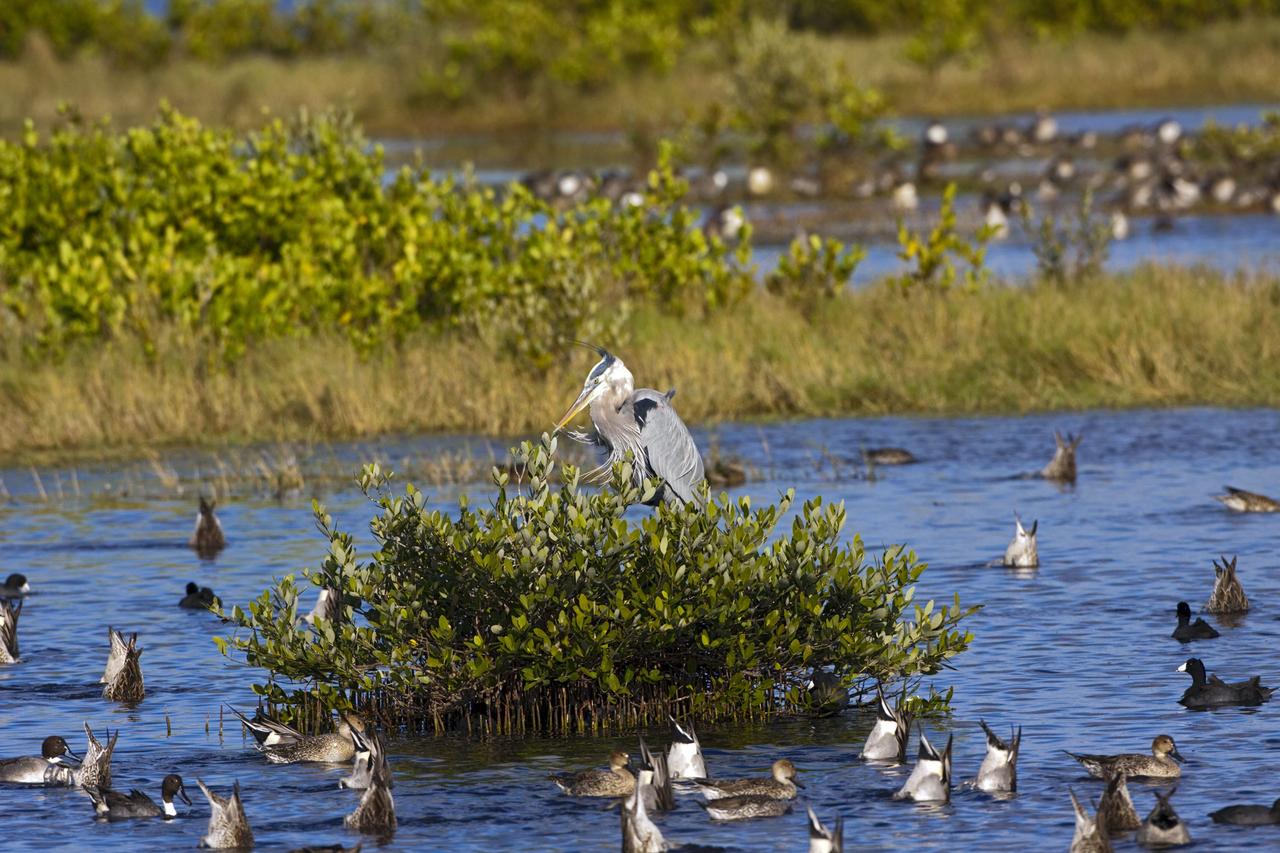
CAPE CANAVERAL, Fla. -- From its perch atop a mangrove, this great blue heron appears to oversee the activities of the assortment of birds in the surrounding waters at NASA's Kennedy Space Center in Florida. The birds gathered in this particular group include coots, shovelbills and pintails. The center shares a boundary with the Merritt Island National Wildlife Refuge, consisting of 140,000 acres. The refuge provides a wide variety of habitats -- coastal dunes, saltwater estuaries and marshes, freshwater impoundments, scrub, pine flatwoods, and hardwood hammocks -- that provide sanctuary for more than 1,500 species of plants and animals, including about 331 species of birds. Photo credit: NASA/Jim Grossmann

S129-E-007324 (21 Nov. 2009) --- One of the crew members onboard the space shuttle Atlantis recorded this still image of the Bahamas' lengthy narrow Eleuthra Island. Like most of the Bahama Islands, Eleuthra is composed mainly of limestone and coral, and rises from a vast submarine plateau. The island, 80 miles (133 kilometers) long, about two miles (three kilometers) wide and covering an area of 164 square miles (425 square kilometers), is generally low and flat, has many mangrove swamps, brackish lakes, coral reefs and shoals, and many miles of sandy beaches.
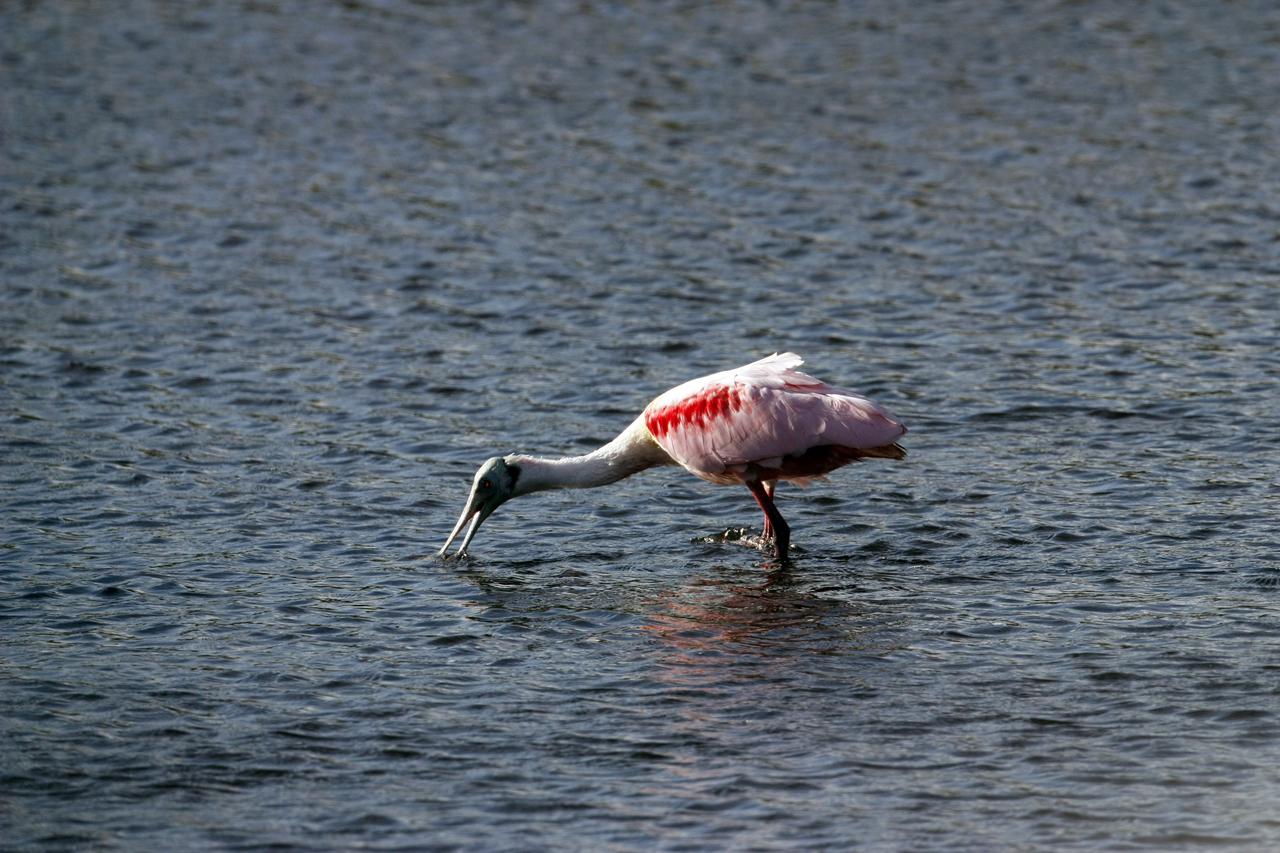
CAPE CANAVERAL, Fla. – A roseate spoonbill is feeding on a pond in the Merritt island National Wildlife Refuge, which borders NASA's Kennedy Space Center in Florida. Spoonbills inhabit areas of mangroves such as on the coasts of southern Florida and Texas. These birds feed on shrimp and fish in the shallow water, sweeping their bills from side to side. The center shares a boundary with the refuge that includes salt-water estuaries, brackish marshes, hardwood hammocks and pine flatwoods. The diverse landscape provides habitat for more than 310 species of birds, 25 mammals, 117 fishes and 65 amphibians and reptiles. Photo credit: NASA/Jim Grossmann
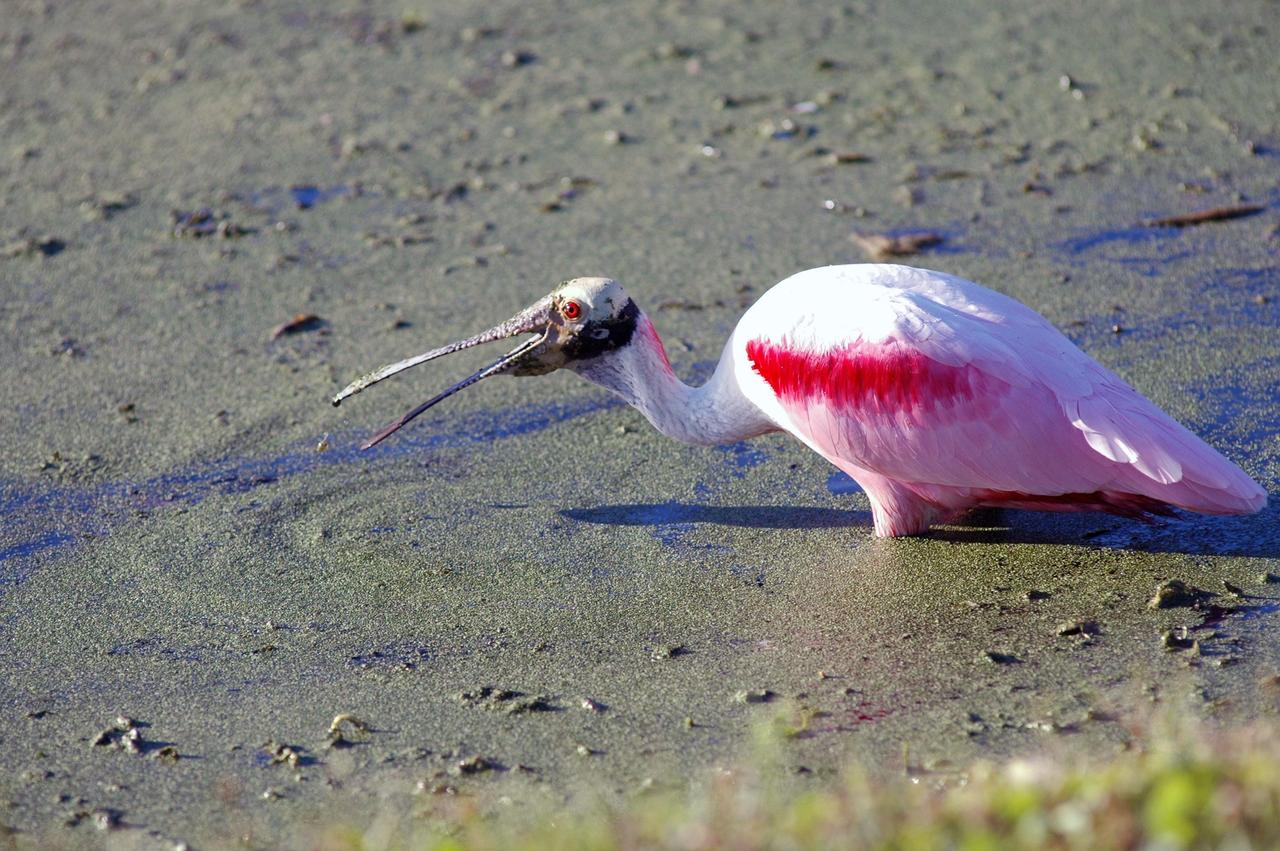
KENNEDY SPACE CENTER, FLA. - At NASA Kennedy Space Center, a roseate spoonbill searches the murky canal for food. Spoonbills inhabit areas of mangroves such as on the coasts of southern Florida and Texas. These birds feed on shrimp and fish in the shallow water, sweeping their bills from side to side. The Center shares a boundary with the Merritt Island National Wildlife Refuge, which is a habitat for more than 310 species of birds, 25 mammals, 117 fishes and 65 amphibians and reptiles. In addition, the Refuge supports 19 endangered or threatened wildlife species on Federal or State lists, more than any other single refuge in the U.S. Photo credit: NASA/Jim Grossmann
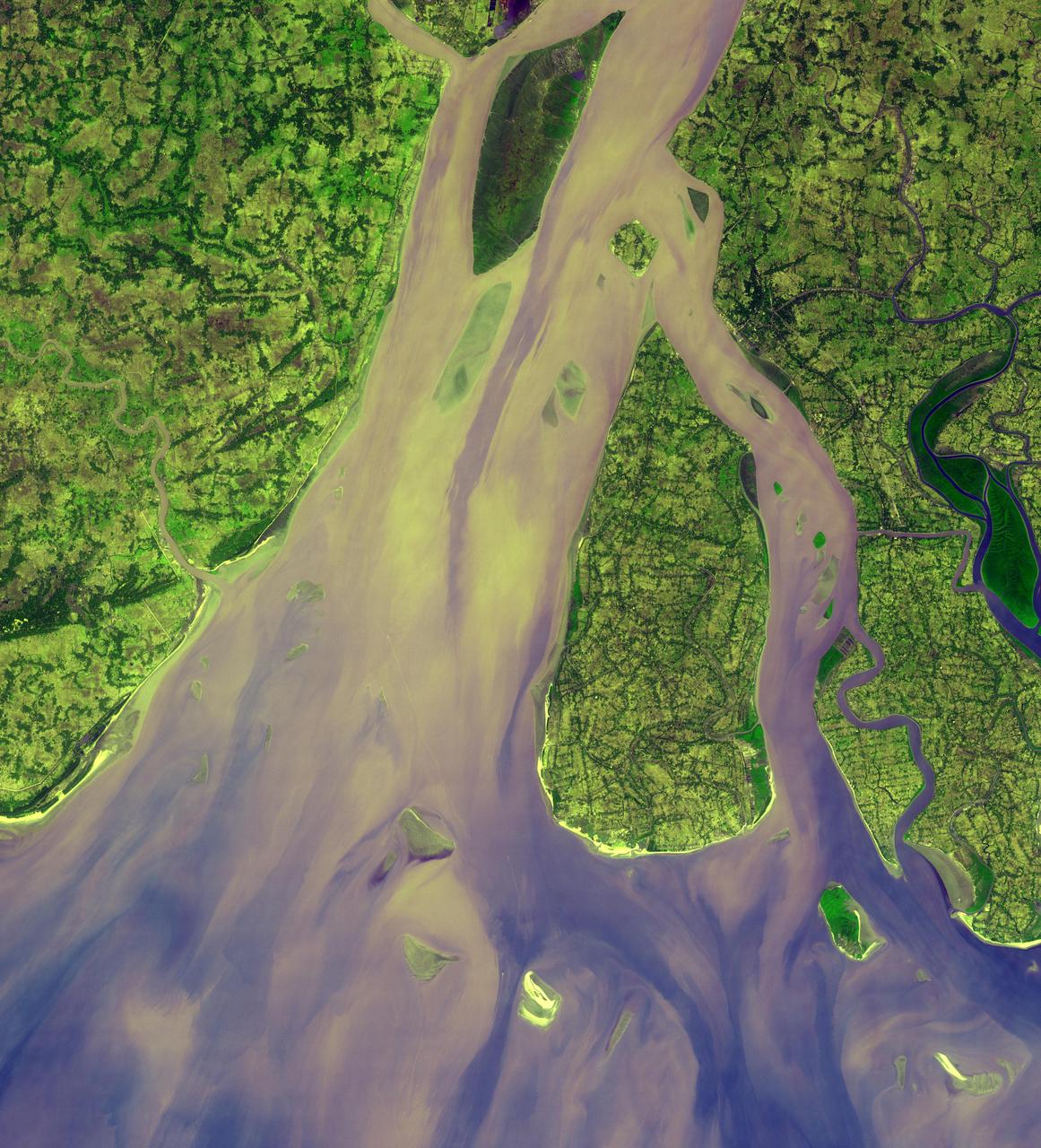
The western-most part of the Ganges Delta is seen in this 54.5 by 60 km ASTER sub-scene acquired on January 6, 2005. The Hugli River branches off from the Ganges River 300 km to the north, and flows by the city of Calcutta before emptying into the Bay of Bengal. High sediment load is evident by the light tan colors in the water, particularly downstream from off-shore islands. The deep green colors of some of these islands are mangrove swamps. The image is centered at 21.9 degrees north latitude, 88 degrees east longitude. http://photojournal.jpl.nasa.gov/catalog/PIA11158
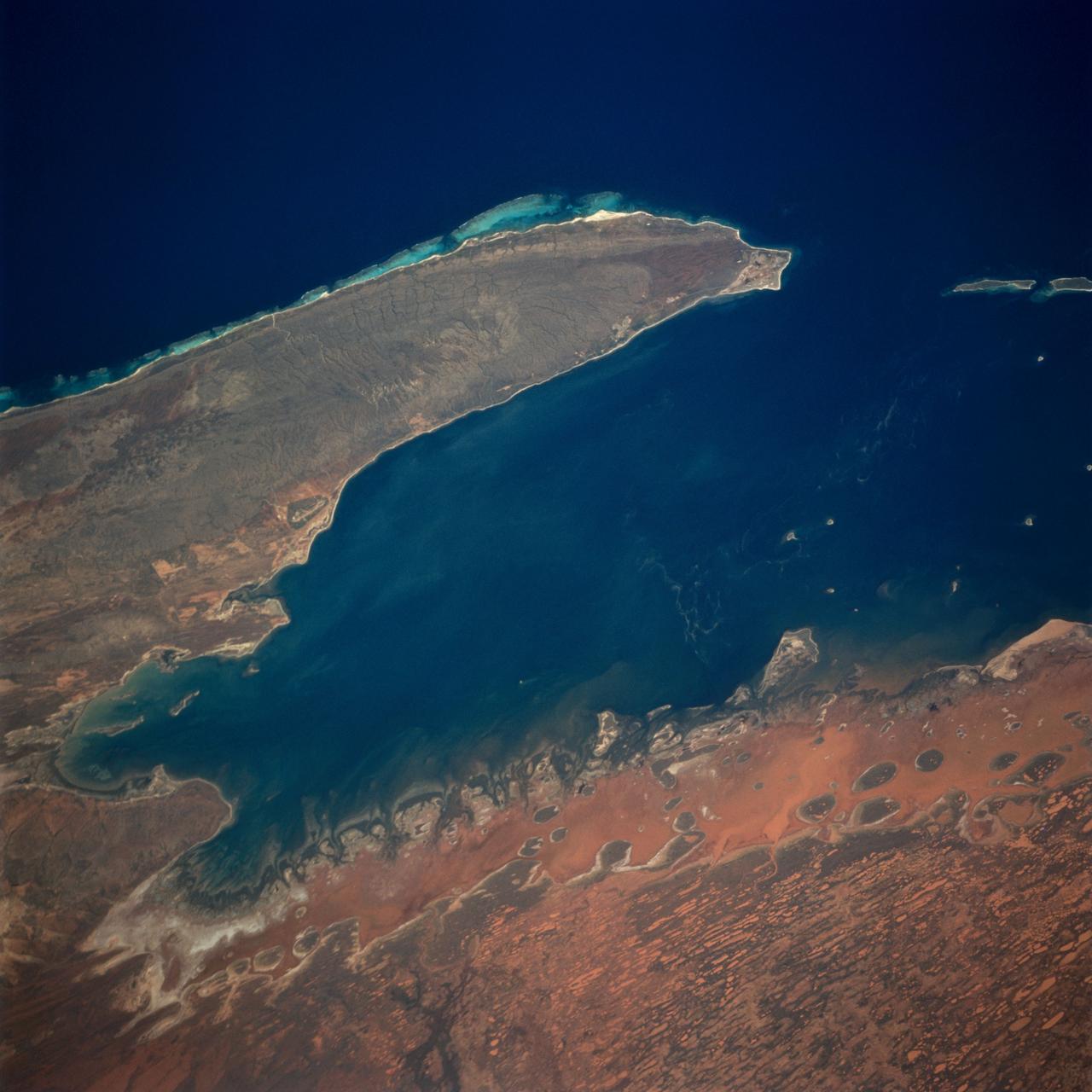
The Exmouth Gulf, western Australia, is bounded on the west by the Cape Ranges; near the base of the peninsula the Learmonth Airfield, site of a solar observatory, can be seen. Spit-accretion ridges formed on ancient beaches extend along the western edge of the peninsula, which today is lined by the Ningaloo Reef. Red mud carried by floodwaters, the result of Hurricane Bobby the previous week, cover flat coastal land along the eastern side of the gulf. The mud is mixing slowly with marine water as it filters through passes between mangrove-covered islands. A filamentous pattern in the gulf probably indicates a plankton bloom. Island paleodunes stretching from south to north cover the landscape.
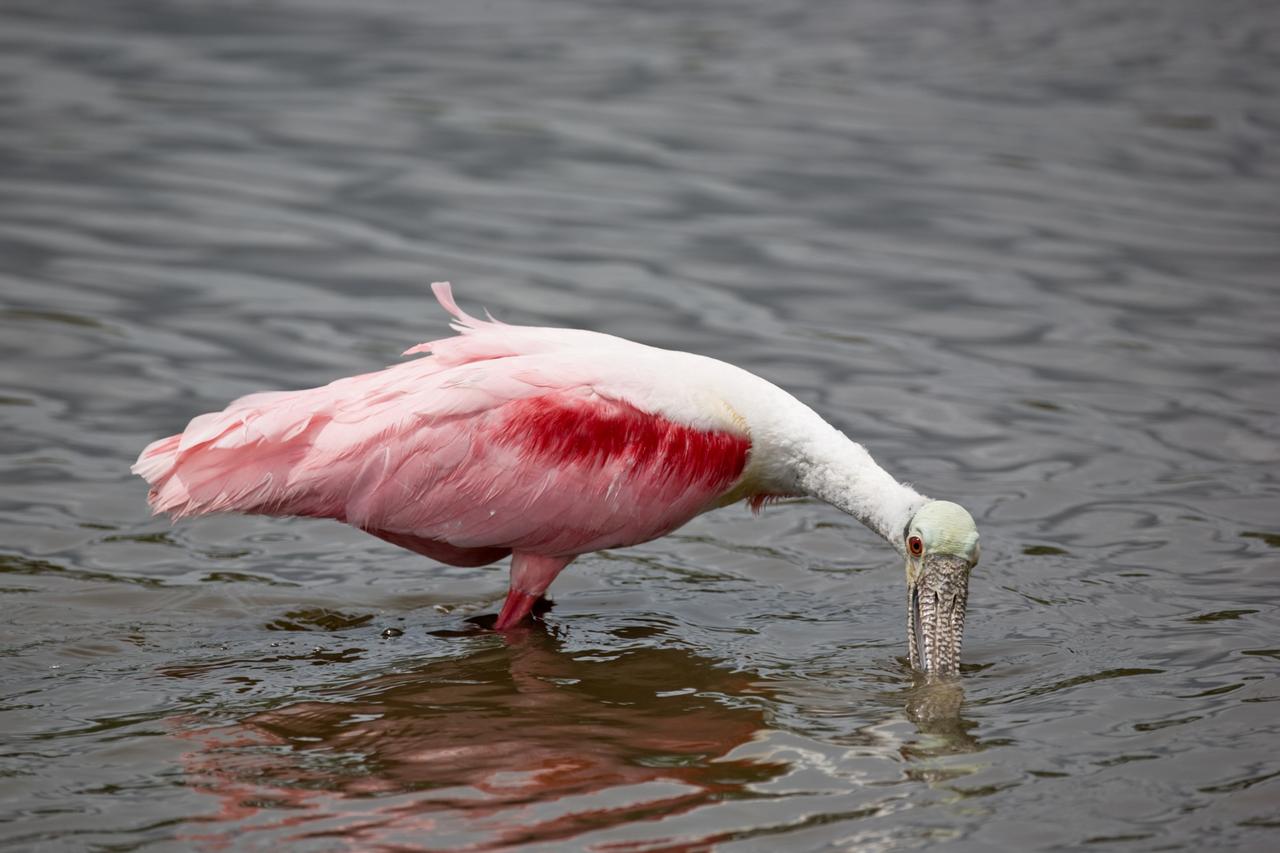
CAPE CANAVERAL, Fla. –– On NASA's Kennedy Space Center in Florida, the scarlet-feathered roseate spoonbill feeds in the water. Spoonbills inhabit areas of mangrove such as on the coasts of southern Florida and Texas. These birds feed on shrimps and fish in the shallow water, sweeping their bills from side to side. This and other wildlife abound throughout Kennedy as the center shares a boundary with the Merritt Island National Wildlife Refuge. The marshes and open water of the refuge provide wintering areas for 23 species of migratory waterfowl, as well as a year-round home for great blue herons, great egrets, wood storks, cormorants, brown pelicans and other species of marsh and shore birds. Photo credit: NASA/Dimitri Gerondidakis
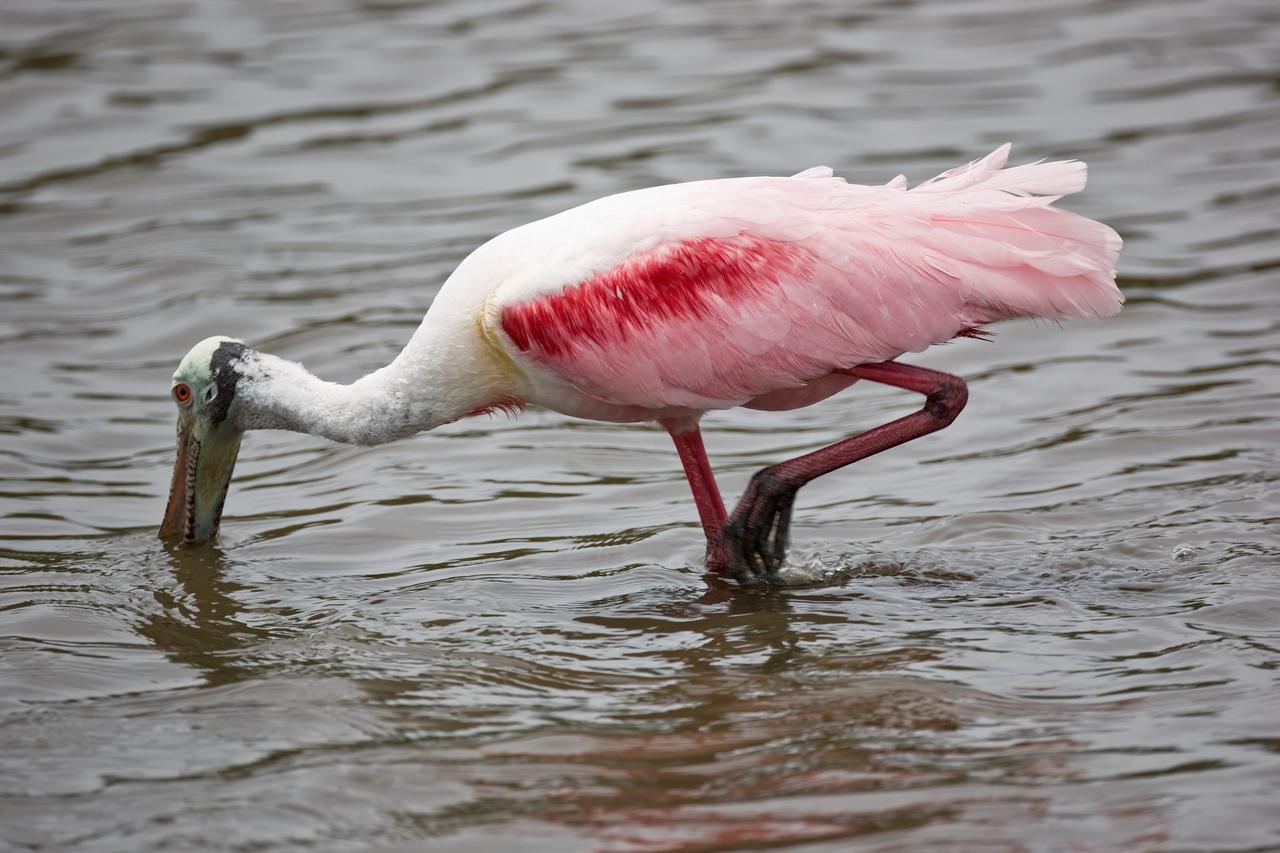
CAPE CANAVERAL, Fla. –– On NASA's Kennedy Space Center in Florida, the scarlet-feathered roseate spoonbill feeds in the water. Spoonbills inhabit areas of mangrove such as on the coasts of southern Florida and Texas. These birds feed on shrimps and fish in the shallow water, sweeping their bills from side to side. This and other wildlife abound throughout Kennedy as the center shares a boundary with the Merritt Island National Wildlife Refuge. The marshes and open water of the refuge provide wintering areas for 23 species of migratory waterfowl, as well as a year-round home for great blue herons, great egrets, wood storks, cormorants, brown pelicans and other species of marsh and shore birds. Photo credit: NASA/Dimitri Gerondidakis
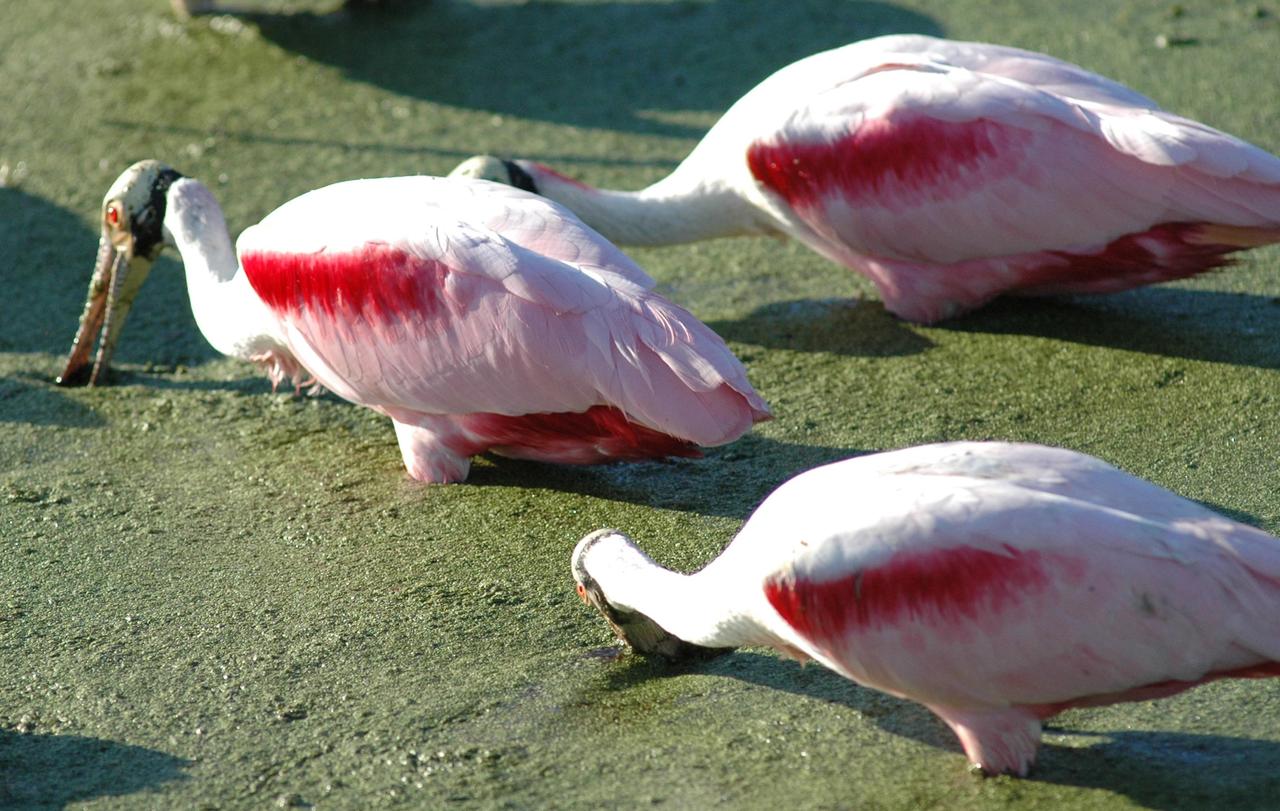
KENNEDY SPACE CENTER, FLA. - At NASA Kennedy Space Center, roseate spoonbills search the murky canal for food. Spoonbills inhabit areas of mangroves such as on the coasts of southern Florida and Texas. These birds feed on shrimp and fish in the shallow water, sweeping their bills from side to side. The Center shares a boundary with the Merritt Island National Wildlife Refuge, which is a habitat for more than 310 species of birds, 25 mammals, 117 fishes and 65 amphibians and reptiles. In addition, the Refuge supports 19 endangered or threatened wildlife species on Federal or State lists, more than any other single refuge in the U.S. Photo credit: NASA/Jim Grossmann
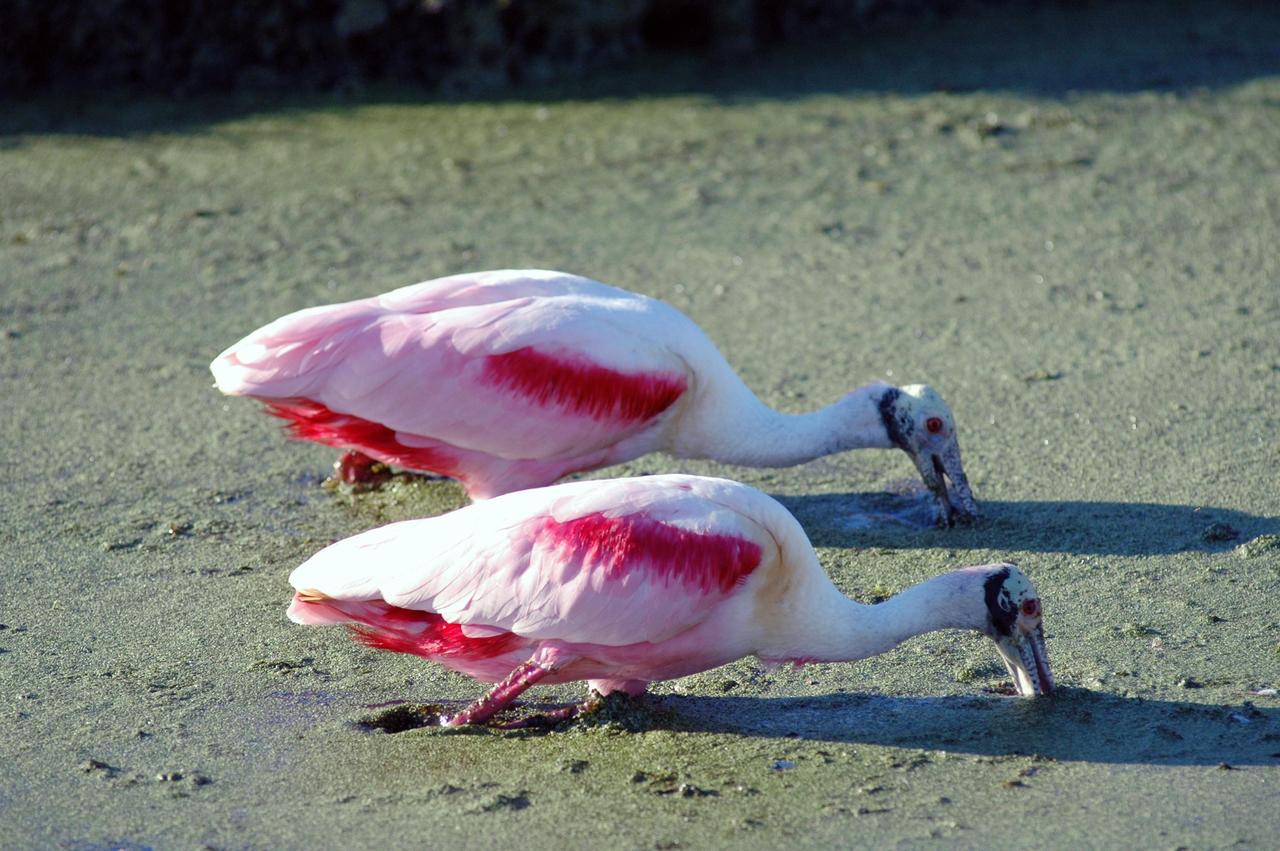
KENNEDY SPACE CENTER, FLA. - At NASA Kennedy Space Center, two roseate spoonbills search the murky canal for food. Spoonbills inhabit areas of mangroves such as on the coasts of southern Florida and Texas. These birds feed on shrimp and fish in the shallow water, sweeping their bills from side to side. The Center shares a boundary with the Merritt Island National Wildlife Refuge, which is a habitat for more than 310 species of birds, 25 mammals, 117 fishes and 65 amphibians and reptiles. In addition, the Refuge supports 19 endangered or threatened wildlife species on Federal or State lists, more than any other single refuge in the U.S. Photo credit: NASA/Jim Grossmann
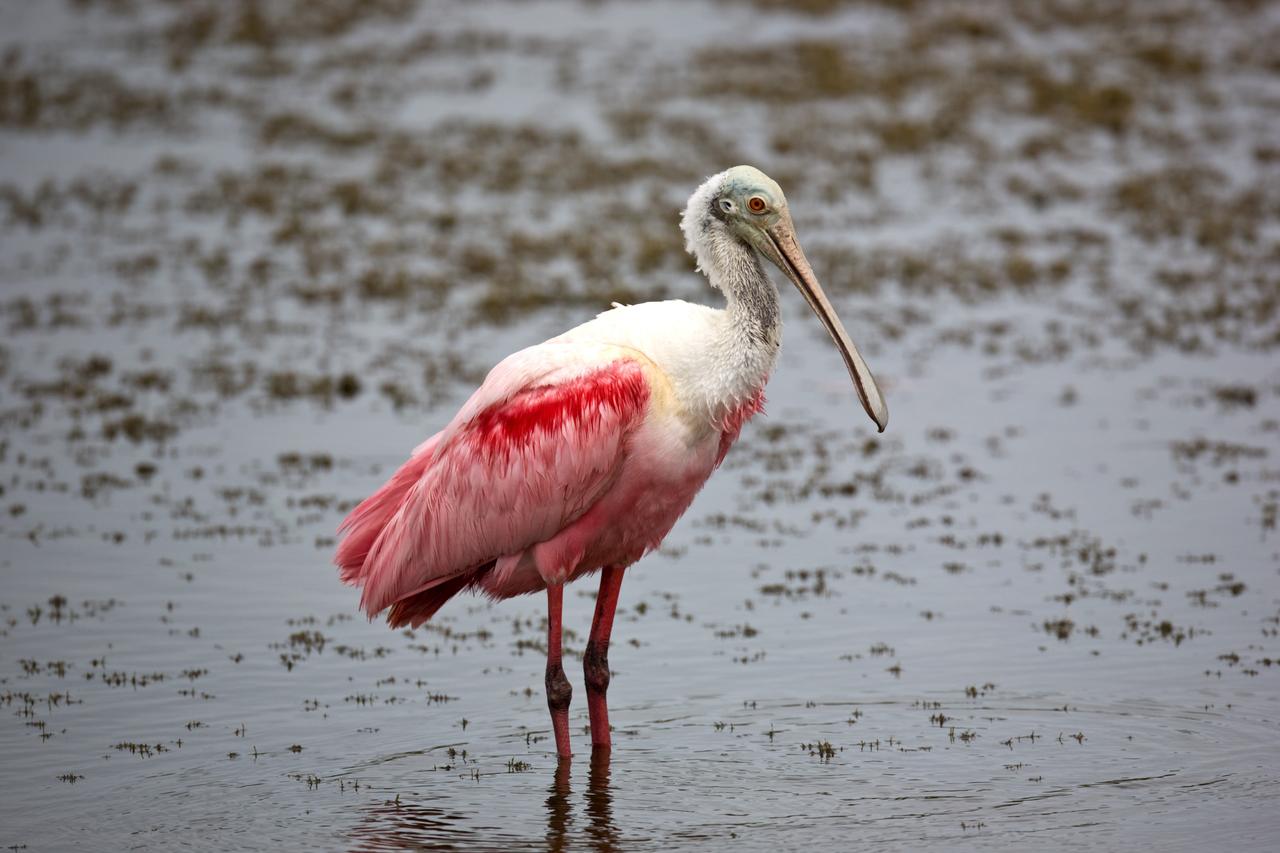
CAPE CANAVERAL, Fla. –– On NASA's Kennedy Space Center in Florida, the scarlet-feathered roseate spoonbill eyes the camera. Spoonbills inhabit areas of mangrove such as on the coasts of southern Florida and Texas. These birds feed on shrimps and fish in the shallow water, sweeping their bills from side to side. This and other wildlife abound throughout Kennedy as the center shares a boundary with the Merritt Island National Wildlife Refuge. The marshes and open water of the refuge provide wintering areas for 23 species of migratory waterfowl, as well as a year-round home for great blue herons, great egrets, wood storks, cormorants, brown pelicans and other species of marsh and shore birds. Photo credit: NASA/Dimitri Gerondidakis
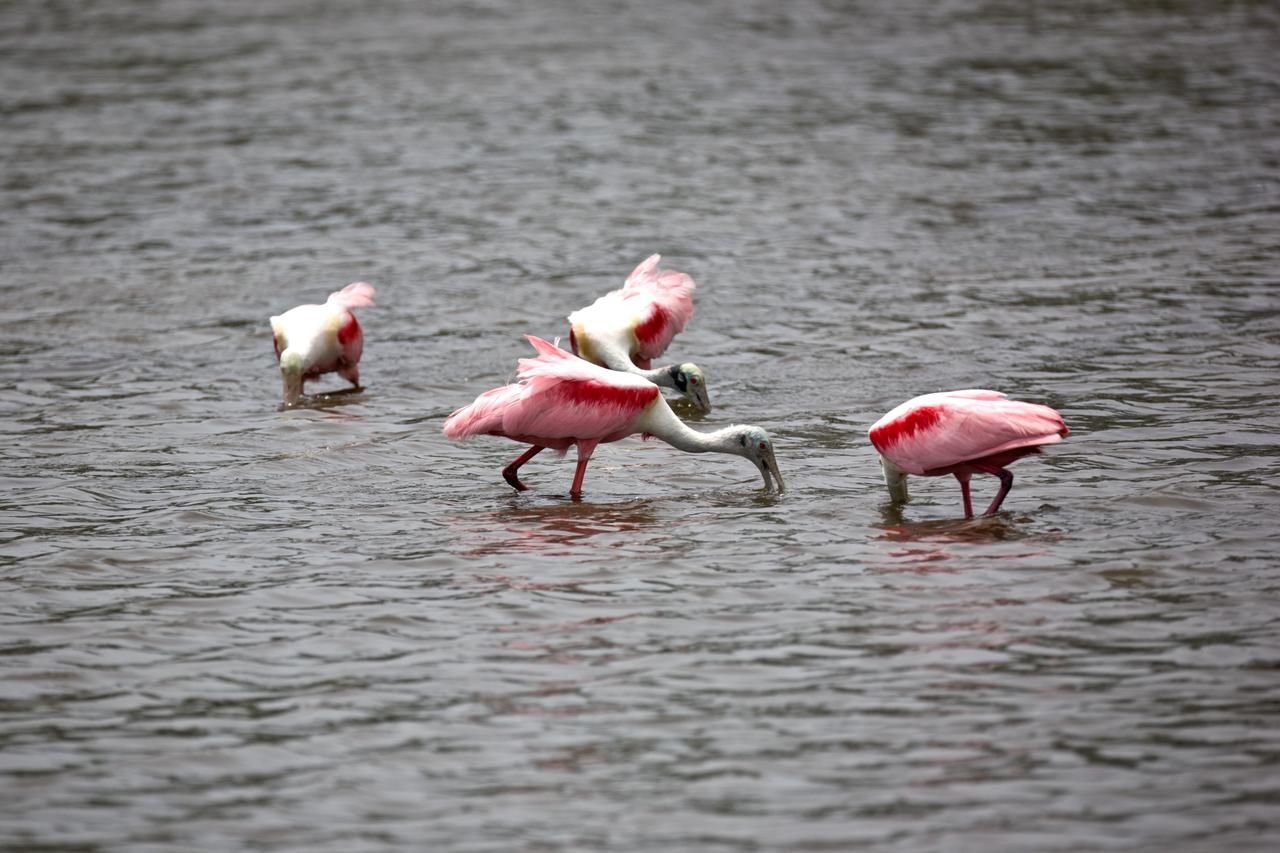
CAPE CANAVERAL, Fla. –– On NASA's Kennedy Space Center in Florida, scarlet-feathered roseate spoonbills feed in the water. Spoonbills inhabit areas of mangrove such as on the coasts of southern Florida and Texas. These birds feed on shrimps and fish in the shallow water, sweeping their bills from side to side. This and other wildlife abound throughout Kennedy as the center shares a boundary with the Merritt Island National Wildlife Refuge. The marshes and open water of the refuge provide wintering areas for 23 species of migratory waterfowl, as well as a year-round home for great blue herons, great egrets, wood storks, cormorants, brown pelicans and other species of marsh and shore birds. Photo credit: NASA/Dimitri Gerondidakis
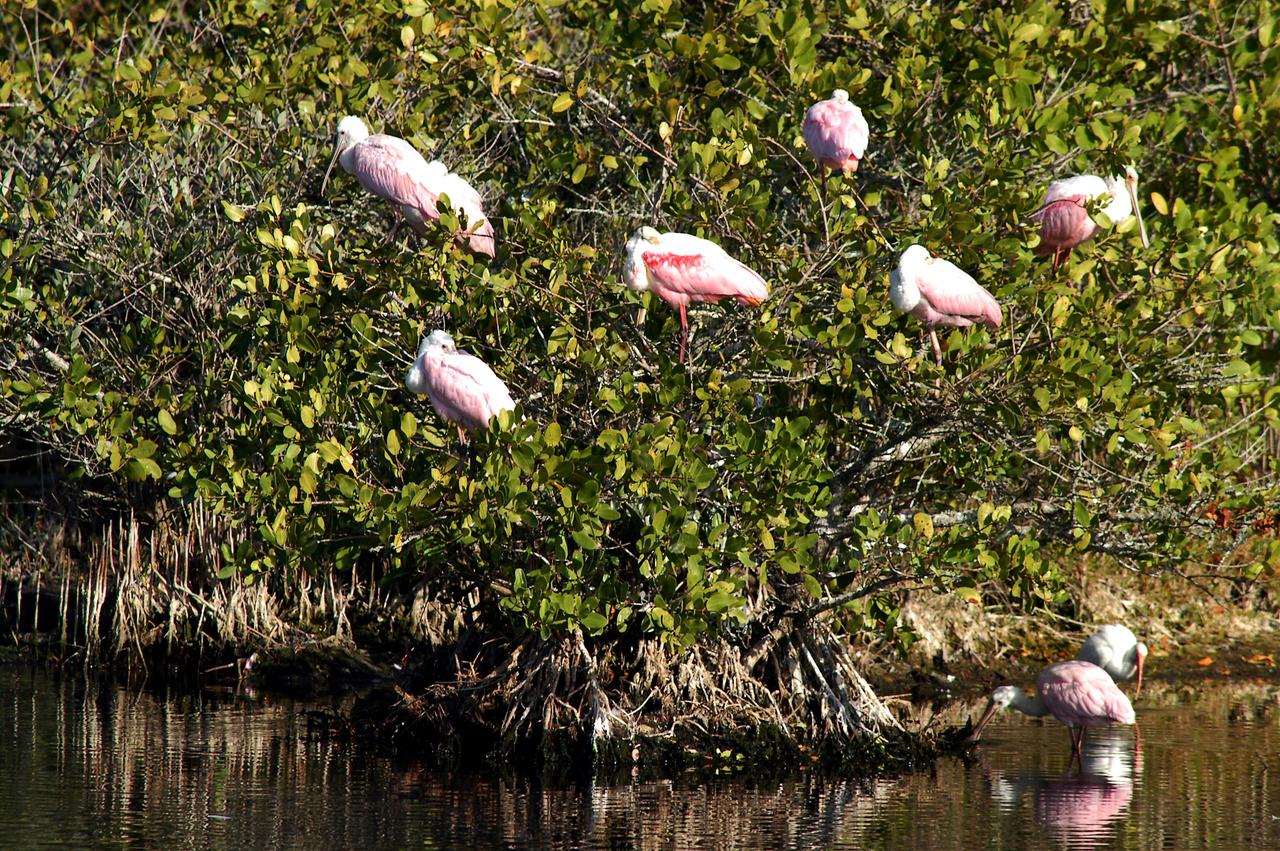
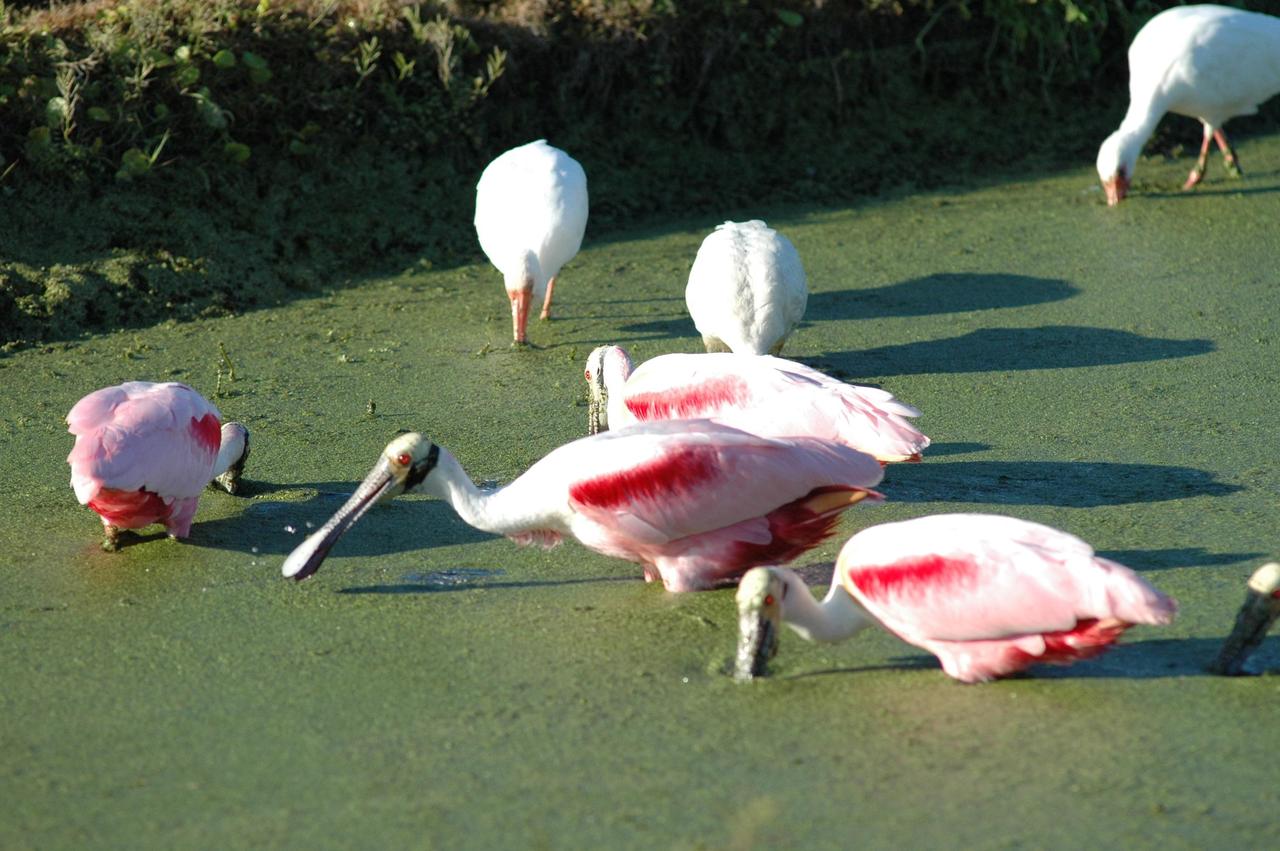
KENNEDY SPACE CENTER, FLA. -- A group of roseate spoonbills share their watery hunting ground with a lone white ibis near KSC. Spoonbills prefer to inhabit mangroves, ranging from the coasts of southern Florida, Louisiana and Texas, to the West Indies, Mexico, Central and South America. They feed on shrimps and fish in shallow waters. Spoonbills are one of 310 species of birds that inhabit the Merritt Island National Wildlife Refuge, which shares a boundary with KSC. The marshes and open water of the refuge also provide wintering areas for 23 species of migratory waterfowl, as well as a year-round home for great blue herons, great egrets, wood storks, cormorants, brown pelicans and other species of marsh and shore birds.
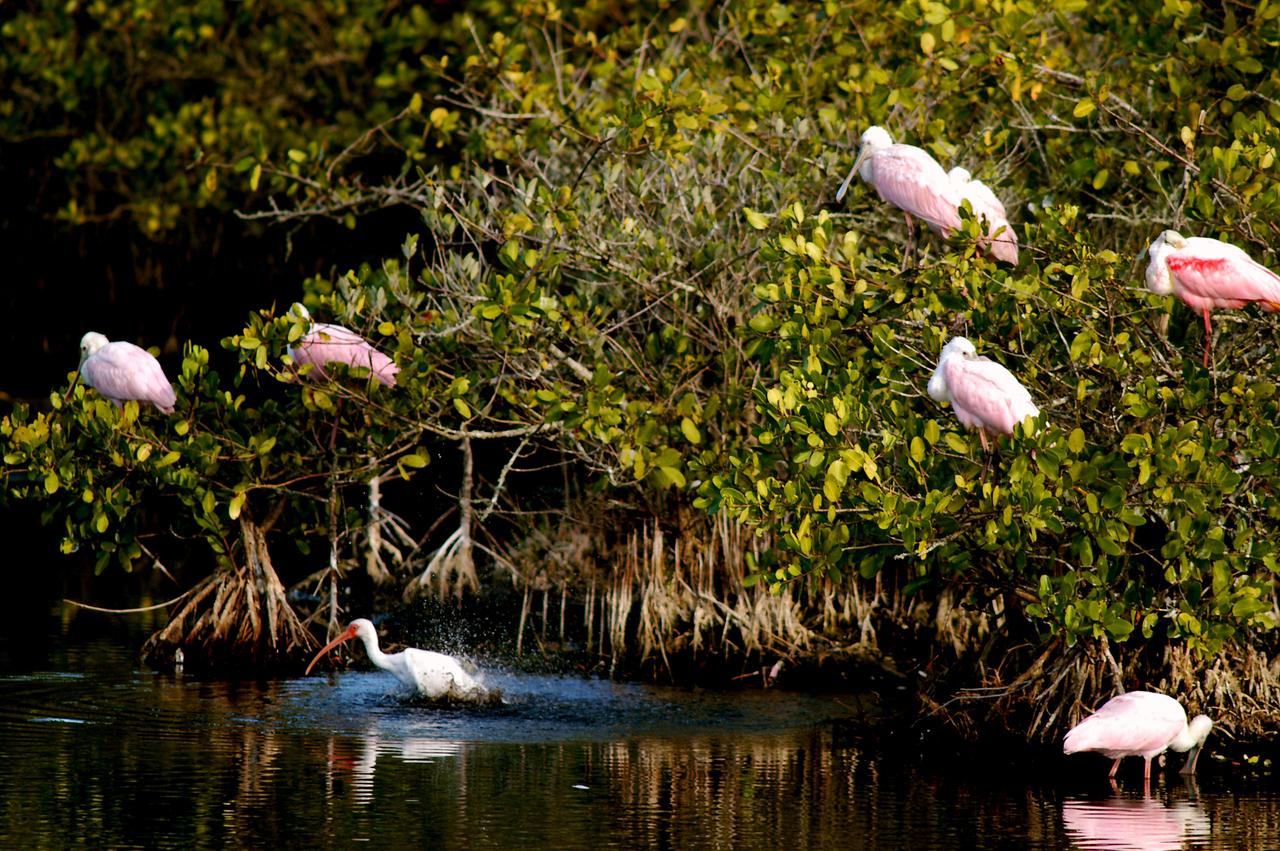
KENNEDY SPACE CENTER, FLA. -- A lone white ibis shares its watery hunting ground with a group of roseate spoonbills near KSC. Spoonbills prefer to inhabit mangroves, ranging from the coasts of southern Florida, Louisiana and Texas, to the West Indies, Mexico, Central and South America. They feed on shrimps and fish in shallow waters. Spoonbills are one of 310 species of birds that inhabit the Merritt Island National Wildlife Refuge, which shares a boundary with KSC. The marshes and open water of the refuge also provide wintering areas for 23 species of migratory waterfowl, as well as a year-round home for great blue herons, great egrets, wood storks, cormorants, brown pelicans and other species of marsh and shore birds.

KENNEDY SPACE CENTER, FLA. -- Two roseate spoonbills wade in the waters of the Merritt Island National Wildlife Refuge, which shares a boundary with Kennedy Space Center. The birds, named for their brilliant pink color and paddle-shaped bill, feed in shallow water by swinging their bill back and forth, scooping up small fish and crustaceans. They typically inhabit mangroves on the coasts of southern Florida, Louisiana and Texas. The 92,000-acre wildlife refuge is a habitat for more than 310 species of birds, 25 mammals, 117 fishes and 65 amphibians and reptiles. The marshes and open water of the refuge also provide wintering areas for 23 species of migratory waterfowl, as well as a year-round home for great blue herons, great egrets, wood storks, cormorants, brown pelicans and other species of marsh and shore birds
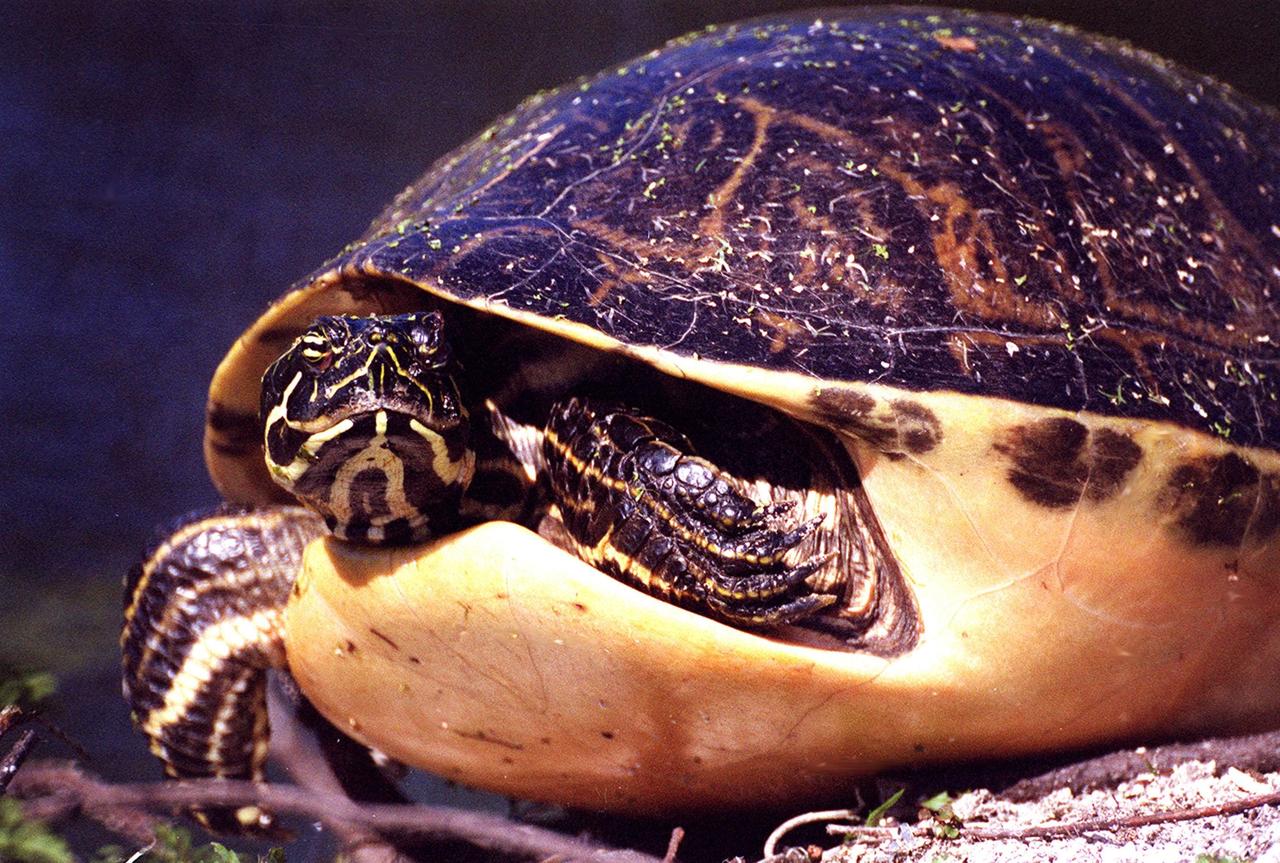
KENNEDY SPACE CENTER, FLA. -- A Florida Redbelly Turtle casts a suspicious look as he is being photographed on the grounds of Kennedy Space Center. The Redbelly turtle inhabits ponds, lakes, sloughs, marshes and mangrove-bordered creeks, in a range that encompasses Florida from the southern tip north to the Apalachicola area of the panhandle. Active year-round, it is often seen basking on logs or floating mats of vegetation. Adults prefer a diet of aquatic plants. The Center shares a boundary with the Merritt Island National Wildlife Refuge, which encompasses 92,000 acres that are a habitat for more than 331 species of birds, 31 mammals, 117 fishes, and 65 amphibians and reptiles. The marshes and open water of the refuge provide wintering areas for 23 species of migratory waterfowl, as well as a year-round home for great blue herons, great egrets, wood storks, cormorants, brown pelicans and other species of marsh and shore birds, as well as a variety of insects
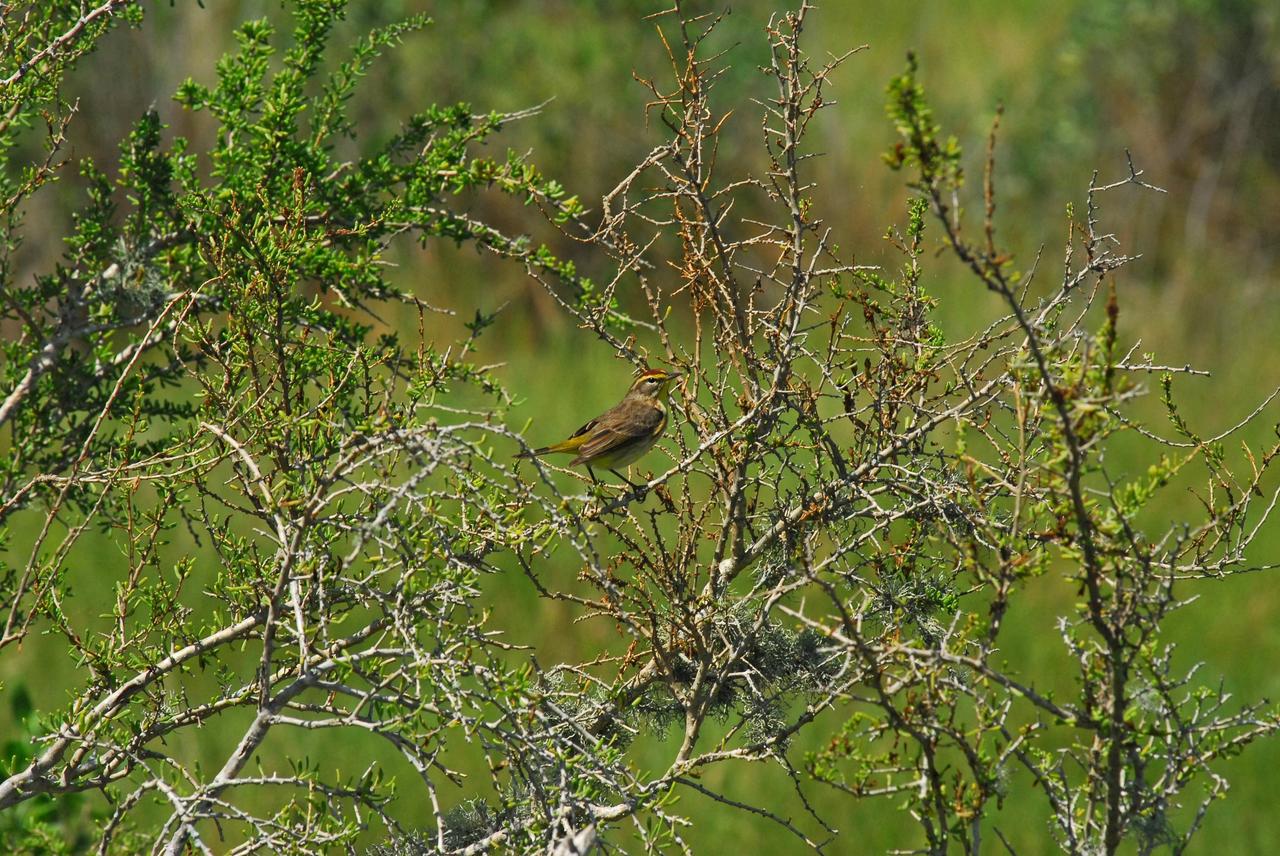
KENNEDY SPACE CENTER, FLA. -- A palm warbler looks for seeds among the branches of a tree on Kennedy Space Center. Palm warblers breed far to the north in Canada, and winter primarily in the southern United States and northern Caribbean. They breed in bogs, open boreal coniferous forest, and partly open situations with scattered trees and heavy undergrowth, usually near water. They are found in migration and winter in a variety of woodland, second growth and thicket habitats, on the ground in savanna and open fields, and in mangroves. Their diet consists of insects, some seeds and fruits in fall and winter. KSC shares a boundary with the Merritt Island Wildlife Nature Refuge. The refuge is a habitat for more than 310 species of birds, 25 mammals, 117 fishes and 65 amphibians and reptiles. In addition, the Refuge supports 19 endangered or threatened wildlife species on Federal or State lists, more than any other single refuge in the U.S. Photo credit: NASA/Dimitri Gerondidakis
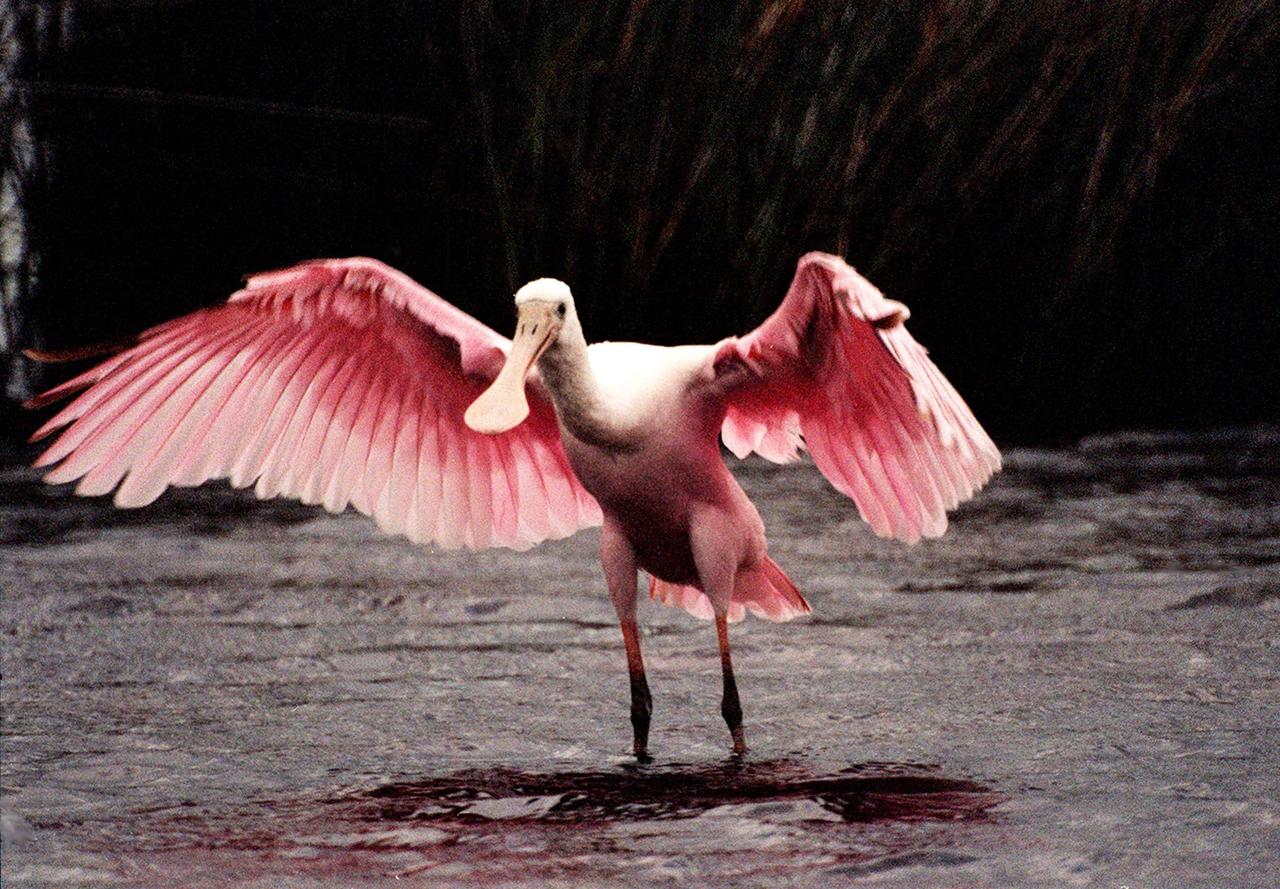
KENNEDY SPACE CENTER, FLA. -- A female roseate spoonbill displays her colorful wings in a mating ritual in Merritt Island National Wildlife Refuge. The birds, named for their brilliant pink color and paddle-shaped bill, feed in shallow water by swinging their bill back and forth, scooping up small fish and crustaceans. They typically inhabit mangroves on the coasts of southern Florida, Louisiana and Texas. The 92,000-acre refuge, which shares a boundary with Kennedy Space Center, is a habitat for more than 330 species of birds, 31 mammals, 117 fishes and 65 amphibians and reptiles. The marshes and open water of the refuge provide wintering areas for 23 species of migratory waterfowl, as well as a year-round home for great blue herons, great egrets, wood storks, cormorants, brown pelicans and other species of marsh and shore birds
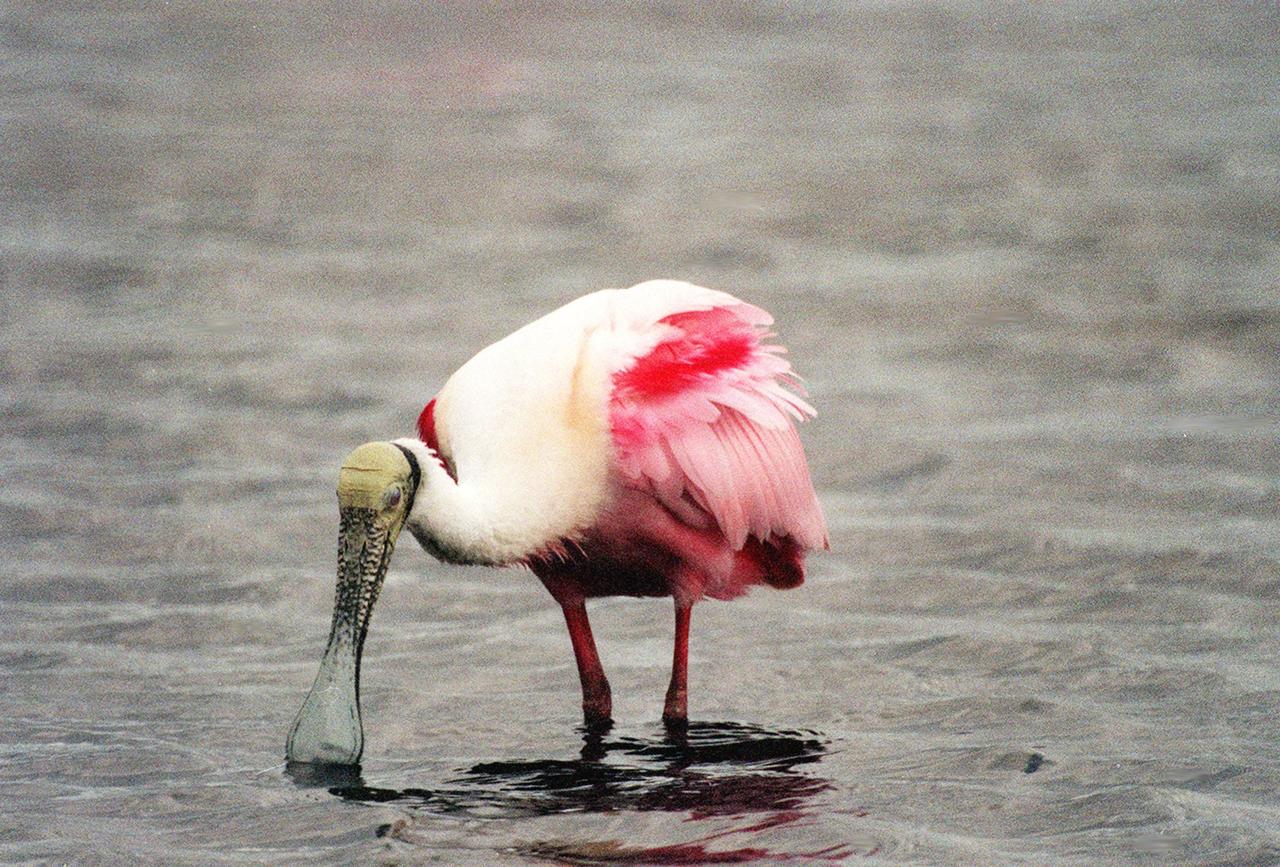
KENNEDY SPACE CENTER, FLA. -- In the Merritt Island National Wildlife Refuge, a roseate spoonbill searches the water for food. The birds, named for their brilliant pink color and paddle-shaped bill, feed in shallow water by swinging their bill back and forth, scooping up small fish and crustaceans. They typically inhabit mangroves on the coasts of southern Florida, Louisiana and Texas. The 92,000-acre refuge, which shares a boundary with Kennedy Space Center, is a habitat for more than 330 species of birds, 31 mammals, 117 fishes and 65 amphibians and reptiles. The marshes and open water of the refuge provide wintering areas for 23 species of migratory waterfowl, as well as a year-round home for great blue herons, great egrets, wood storks, cormorants, brown pelicans and other species of marsh and shore birds
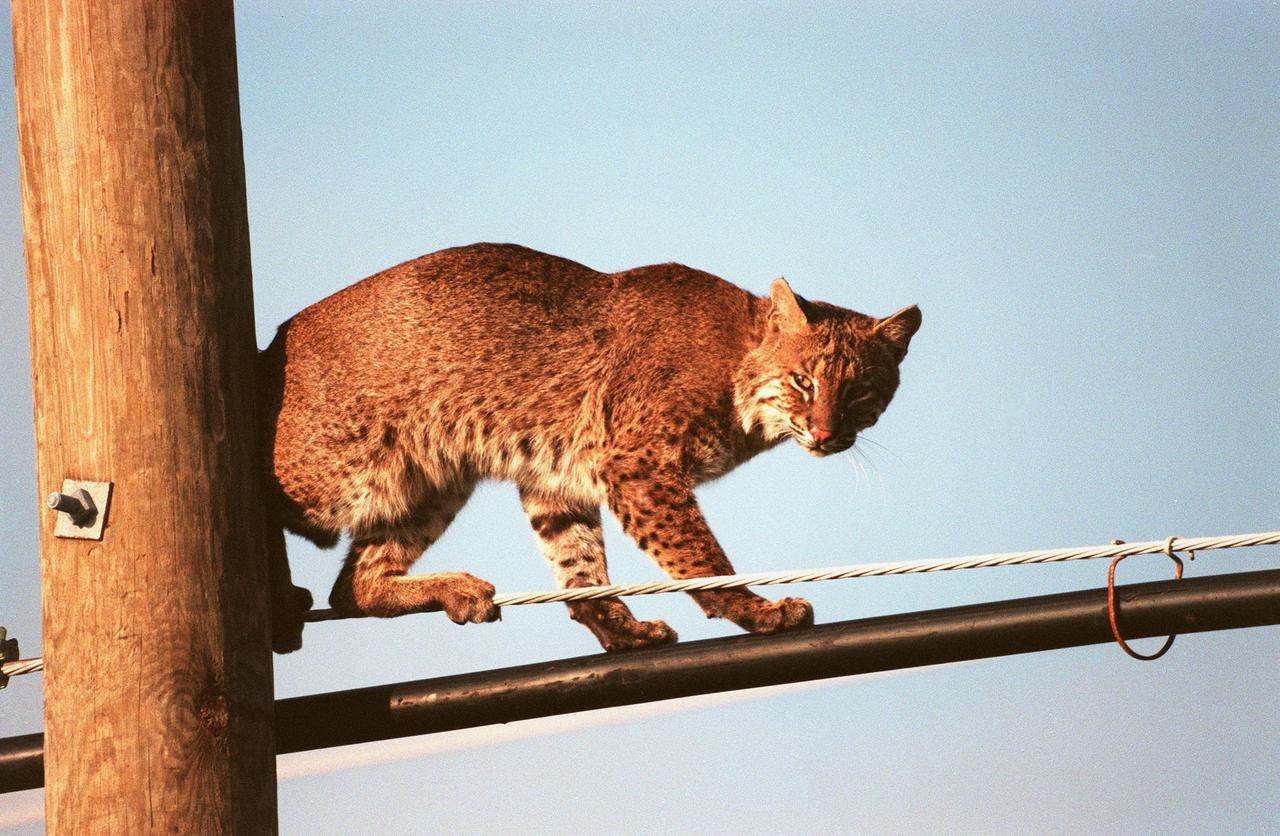
KENNEDY SPACE CENTER, FLA. -- A young, male bobcat balances gingerly on telephone pole cables next to the south-bound lane of Kennedy Parkway. The cat is nocturnal and is seldom observed during the day unless scared from its daytime shelter in the grass or beneath a shrub. Usually found in broken sections of heavily wooded or brushy country, bobcats are reported as common in scrub strand and roadside or weedy grass habitats at KSC. The bobcat is known to inhabit mangrove habitats and will readily swim across small bodies of water. The bobcat occurs across southern Canada then south over the entire United States, except for the midwestern corn belt, to southern Mexico. It is the last large mammalian predator remaining on KSC. The Merritt Island National Wildlife Refuge, which is located on Kennedy Space Center property, is home to many species of wild animals, including the bobcat.
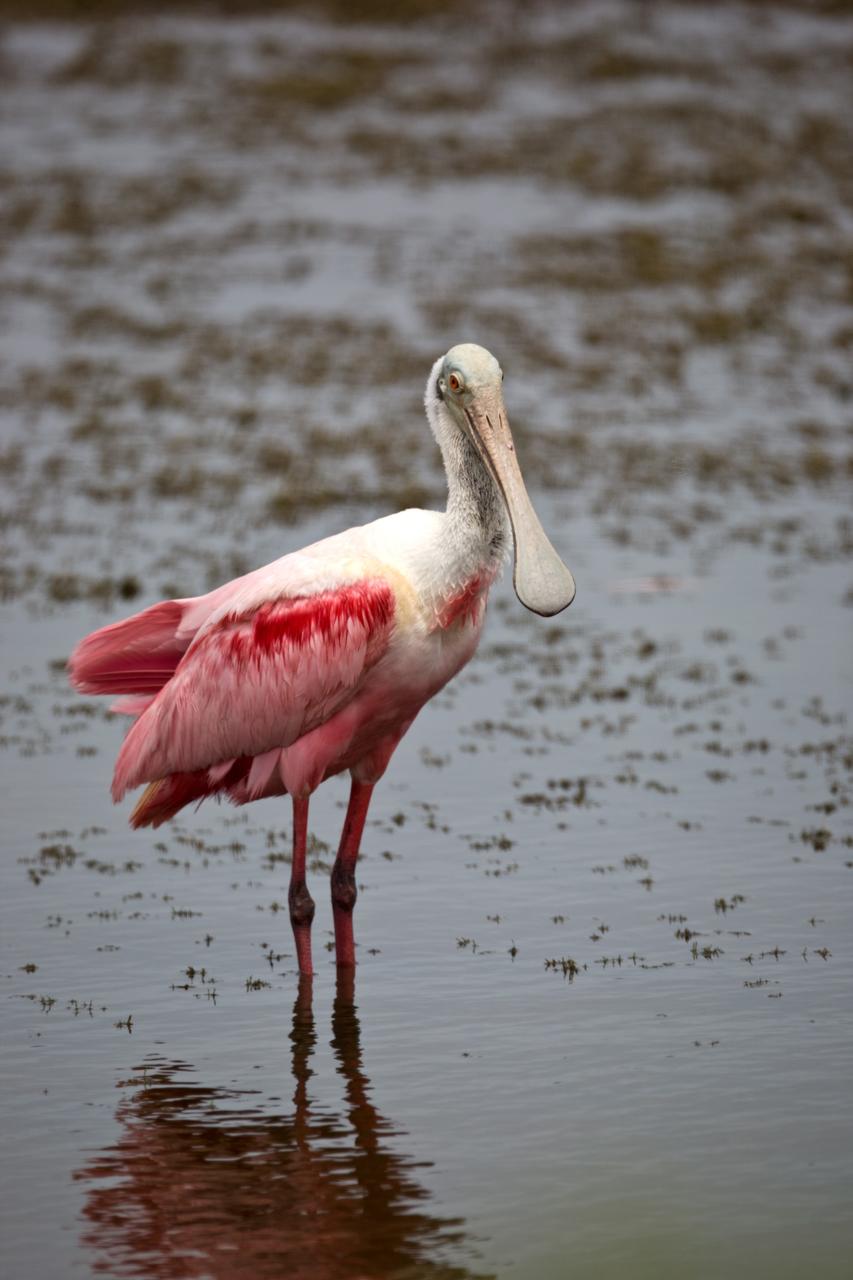
CAPE CANAVERAL, Fla. –– On NASA's Kennedy Space Center in Florida, the scarlet-feathered roseate spoonbill eyes the camera during its search for food. Spoonbills inhabit areas of mangrove such as on the coasts of southern Florida and Texas. These birds feed on shrimps and fish in the shallow water, sweeping their bills from side to side. This and other wildlife abound throughout Kennedy as the center shares a boundary with the Merritt Island National Wildlife Refuge. The marshes and open water of the refuge provide wintering areas for 23 species of migratory waterfowl, as well as a year-round home for great blue herons, great egrets, wood storks, cormorants, brown pelicans and other species of marsh and shore birds. Photo credit: NASA/Dimitri Gerondidakis
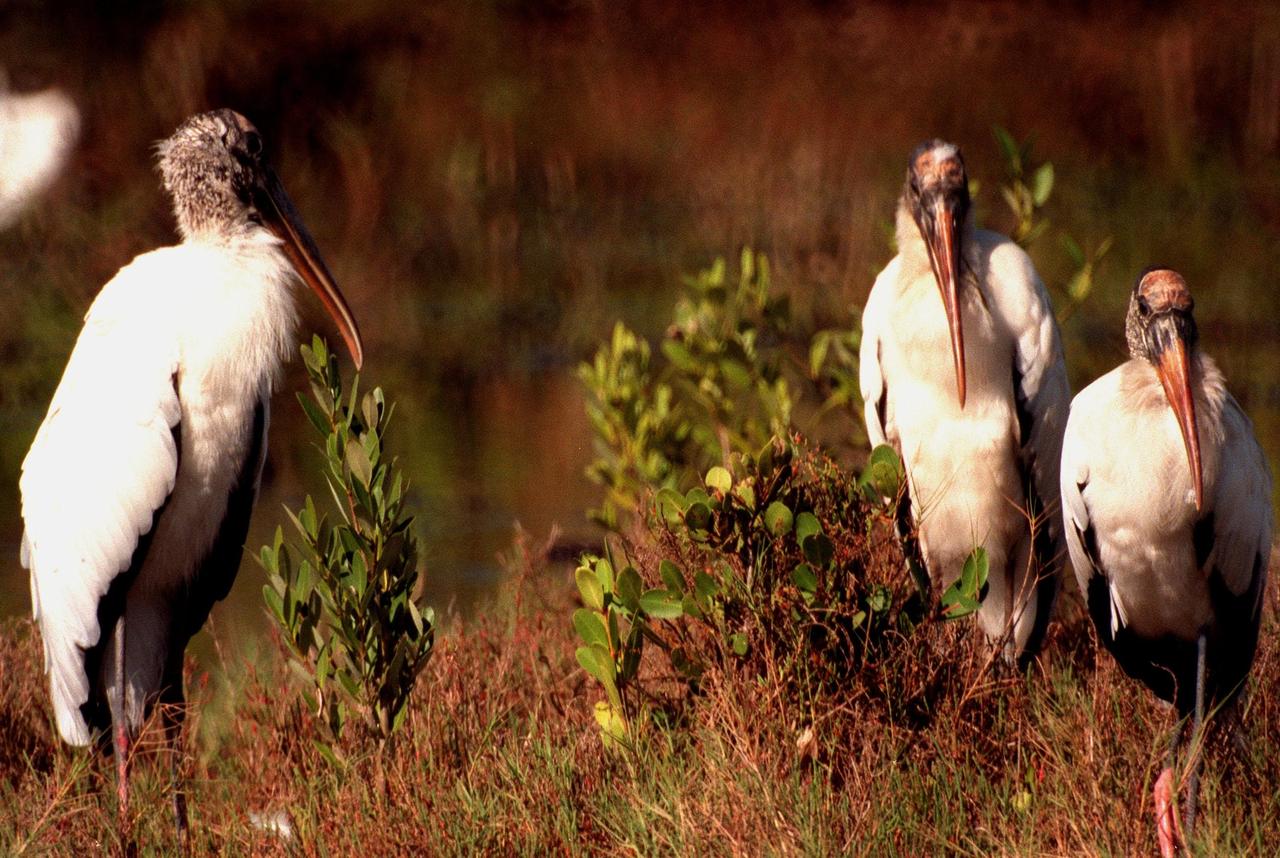
KENNEDY SPACE CENTER, FLA. -- These wood storks stand in grassy patches near the waters of the Merritt Island National Wildlife Refuge at Kennedy Space Center. Known as "flint heads" and "gourd heads" because of their naked crowns, the wood stork is found throughout Florida and occasionally South Carolina and Texas, breeding in cypress and mangrove swamps. The refuge is a year-round home for wood storks, plus great blue herons, great egrets, cormorants, brown pelicans and other species of marsh and shore birds, as well as a wintering area for 23 species of migratory waterfowl. The 92,000-acre refuge is also habitat for more than 310 species of birds, 25 mammals, 117 fishes and 65 amphibians and reptiles
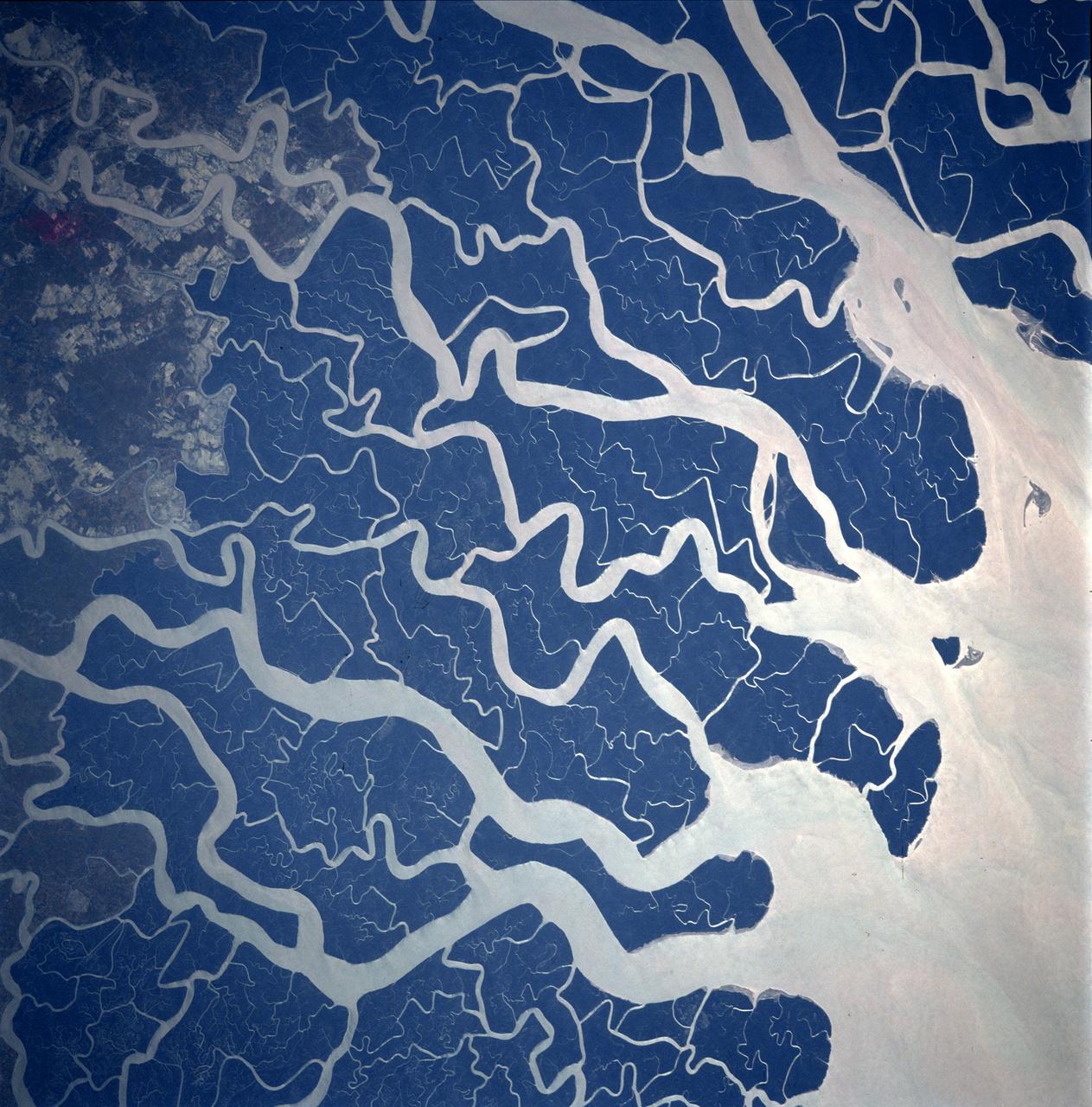
STS087-707-092 (19 November – 5 December 1997) --- Featured in this view is the Ganges River delta. A glacier at about 22,100 feet in the Himalayas is the source of the Ganges River. Hundreds of miles later and joined by other tributaries the Ganges delta enters the Bay of Bengal. The delta, at 200 miles wide (320 kilometers) is one of the most fertile and densely populated regions of the world. The eastern side of the delta changes rapidly and forms new land because of rapid sedimentation. The southern part of the delta has a darker appearance because of tidal forests, swampland, and mangroves. The Sundarbans is the name of this forested area and it is the site of a tiger preservation project for the governments of India and Bangladesh. This picture is one of the 70mm Earth observations visuals used by the crew at its post flight presentation events.
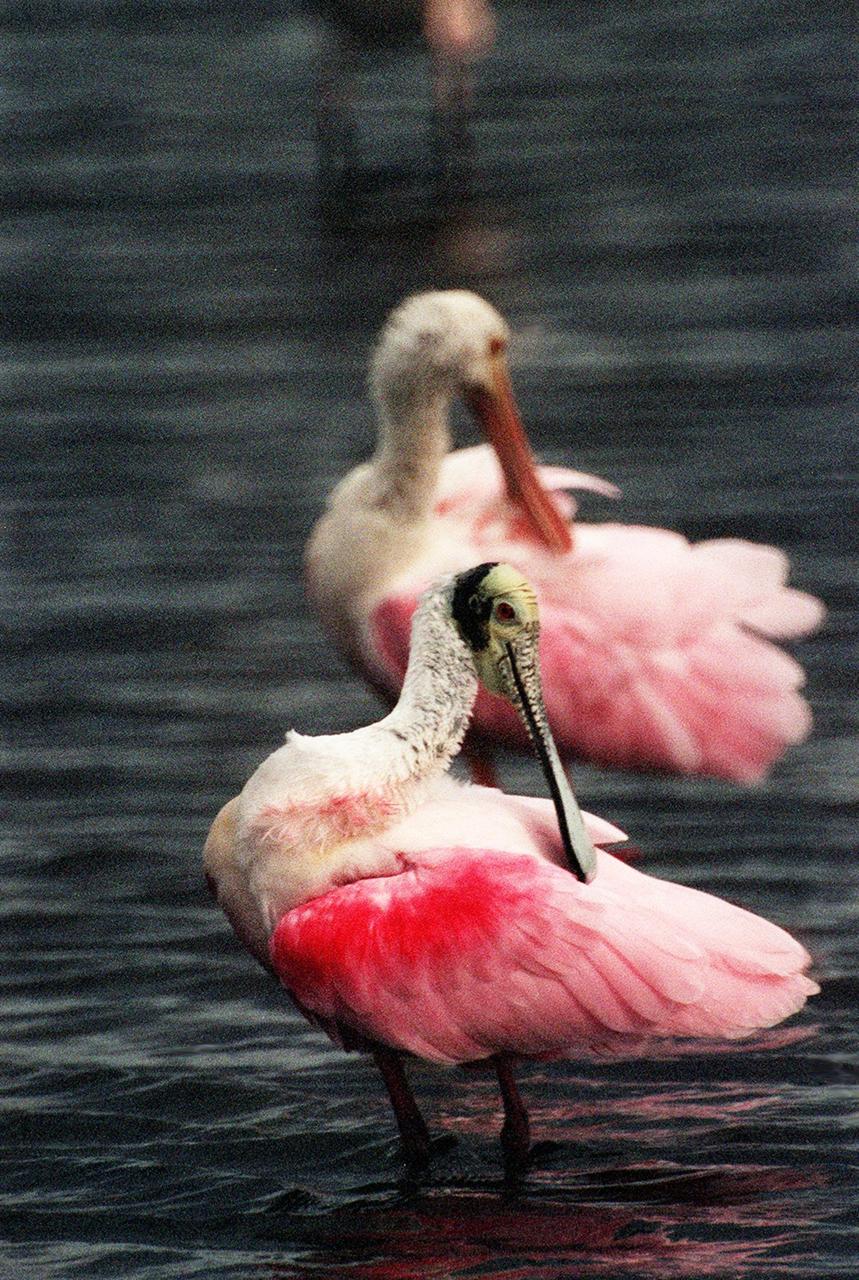
KENNEDY SPACE CENTER, FLA. -- In the Merritt Island National Wildlife Refuge, two roseate spoonbills mirror each other as they preen their lipstick-colored feathers. The birds, named for their brilliant pink color and paddle-shaped bill, feed in shallow water by swinging their bill back and forth, scooping up small fish and crustaceans. They typically inhabit mangroves on the coasts of southern Florida, Louisiana and Texas. The 92,000-acre refuge, which shares a boundary with Kennedy Space Center, is a habitat for more than 330 species of birds, 31 mammals, 117 fishes and 65 amphibians and reptiles. The marshes and open water of the refuge provide wintering areas for 23 species of migratory waterfowl, as well as a year-round home for great blue herons, great egrets, wood storks, cormorants, brown pelicans and other species of marsh and shore birds
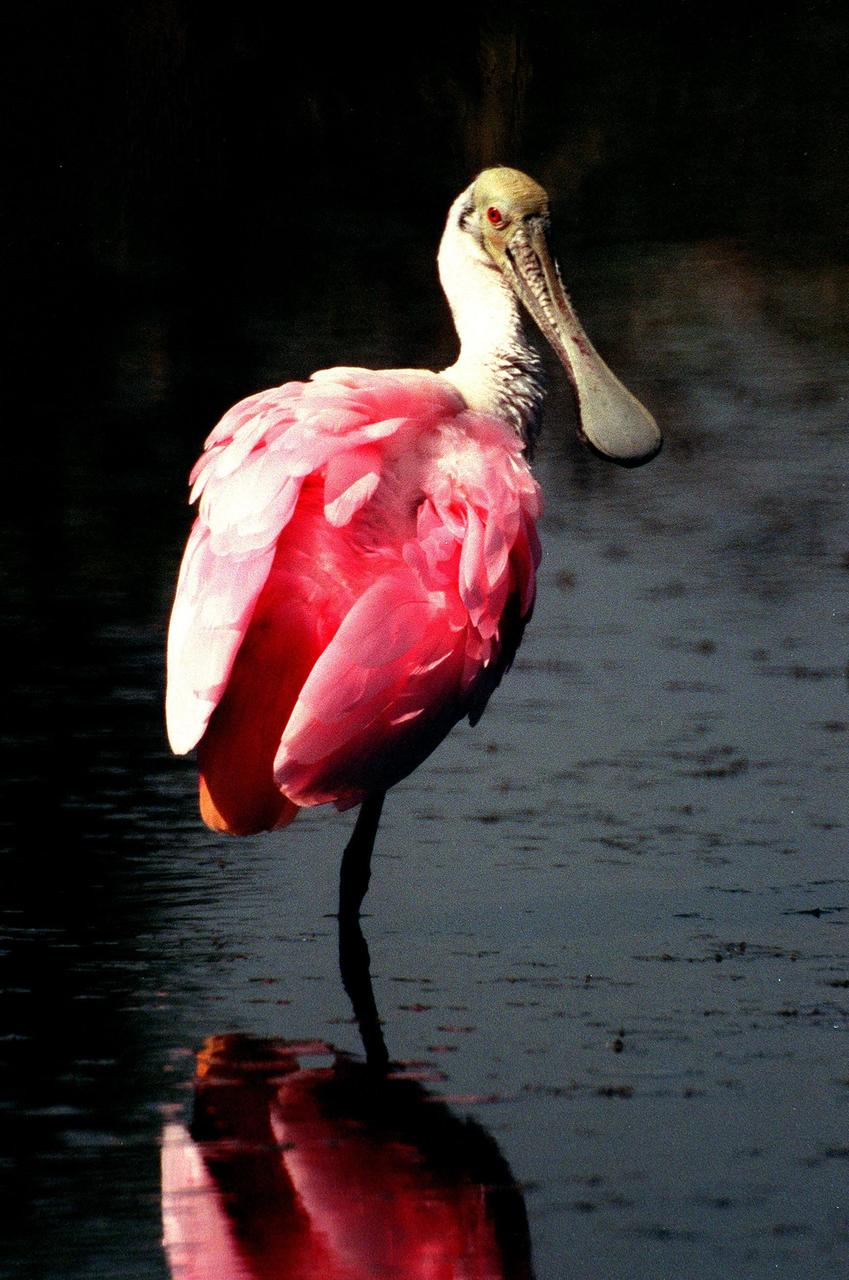
KENNEDY SPACE CENTER, FLA. -- A roseate spoonbill balancing on one leg is reflected in the waters of the Merritt Island National Wildlife Refuge, which shares a boundary with Kennedy Space Center. The birds, named for their brilliant pink color and paddle-shaped bill, feed in shallow water by swinging their bill back and forth, scooping up small fish and crustaceans. They typically inhabit mangroves on the coasts of southern Florida, Louisiana and Texas. The 92,000-acre refuge is a habitat for more than 310 species of birds, 25 mammals, 117 fishes and 65 amphibians and reptiles. The marshes and open water of the refuge also provide wintering areas for 23 species of migratory waterfowl, as well as a year-round home for great blue herons, great egrets, wood storks, cormorants, brown pelicans and other species of marsh and shore birds

KENNEY SPACE CENTER, FLA. -- A female roseate spoonbill (left) displays her colorful wings to the male at right in a mating ritual in Merritt Island National Wildlife Refuge. The birds, named for their brilliant pink color and paddle-shaped bill, feed in shallow water by swinging their bill back and forth, scooping up small fish and crustaceans. They typically inhabit mangroves on the coasts of southern Florida, Louisiana and Texas. The 92,000-acre refuge, which shares a boundary with Kennedy Space Center, is a habitat for more than 330 species of birds, 31 mammals, 117 fishes and 65 amphibians and reptiles. The marshes and open water of the refuge provide wintering areas for 23 species of migratory waterfowl, as well as a year-round home for great blue herons, great egrets, wood storks, cormorants, brown pelicans and other species of marsh and shore birds
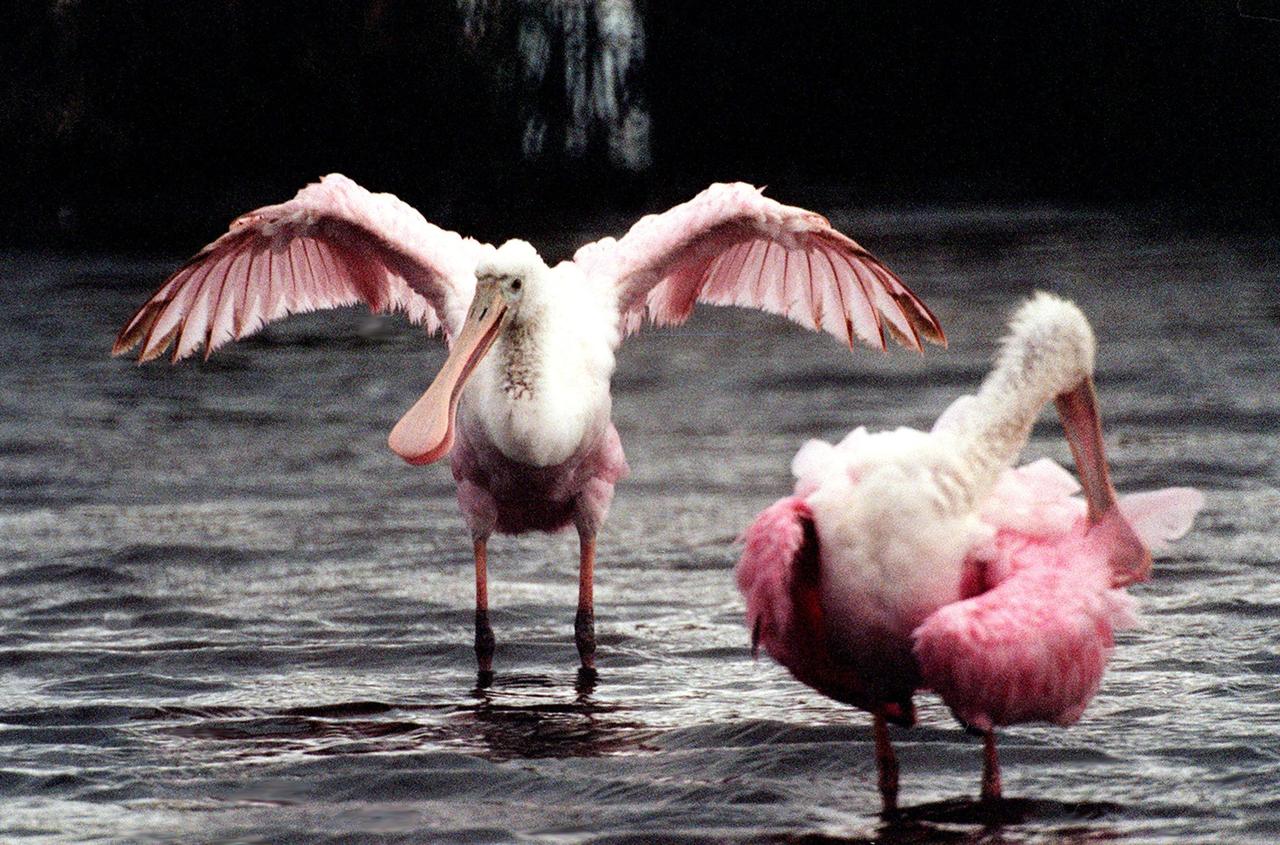
KENNEY SPACE CENTER, FLA. -- A female roseate spoonbill (left) displays her colorful wings to the male at right in a mating ritual in Merritt Island National Wildlife Refuge. The birds, named for their brilliant pink color and paddle-shaped bill, feed in shallow water by swinging their bill back and forth, scooping up small fish and crustaceans. They typically inhabit mangroves on the coasts of southern Florida, Louisiana and Texas. The 92,000-acre refuge, which shares a boundary with Kennedy Space Center, is a habitat for more than 330 species of birds, 31 mammals, 117 fishes and 65 amphibians and reptiles. The marshes and open water of the refuge provide wintering areas for 23 species of migratory waterfowl, as well as a year-round home for great blue herons, great egrets, wood storks, cormorants, brown pelicans and other species of marsh and shore birds
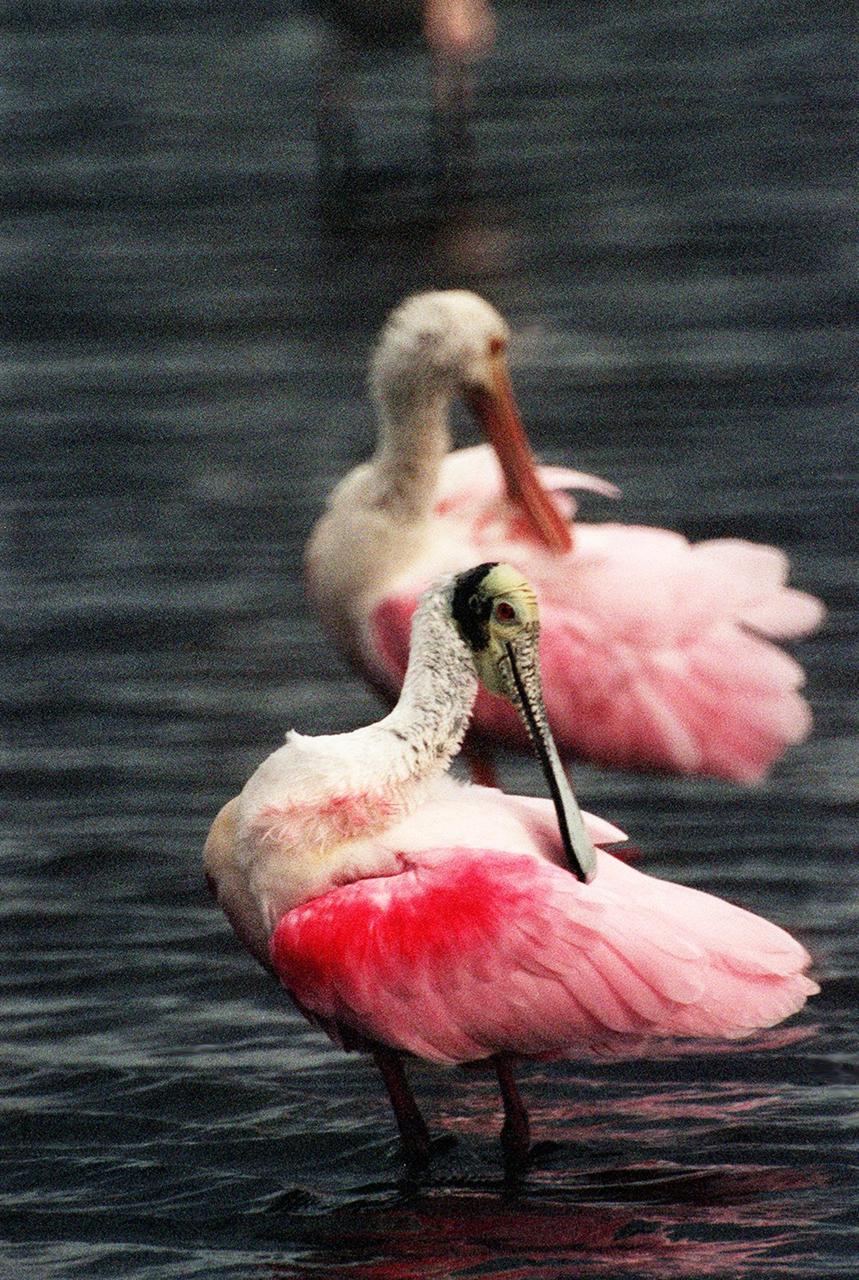
KENNEDY SPACE CENTER, FLA. -- In the Merritt Island National Wildlife Refuge, two roseate spoonbills mirror each other as they preen their lipstick-colored feathers. The birds, named for their brilliant pink color and paddle-shaped bill, feed in shallow water by swinging their bill back and forth, scooping up small fish and crustaceans. They typically inhabit mangroves on the coasts of southern Florida, Louisiana and Texas. The 92,000-acre refuge, which shares a boundary with Kennedy Space Center, is a habitat for more than 330 species of birds, 31 mammals, 117 fishes and 65 amphibians and reptiles. The marshes and open water of the refuge provide wintering areas for 23 species of migratory waterfowl, as well as a year-round home for great blue herons, great egrets, wood storks, cormorants, brown pelicans and other species of marsh and shore birds
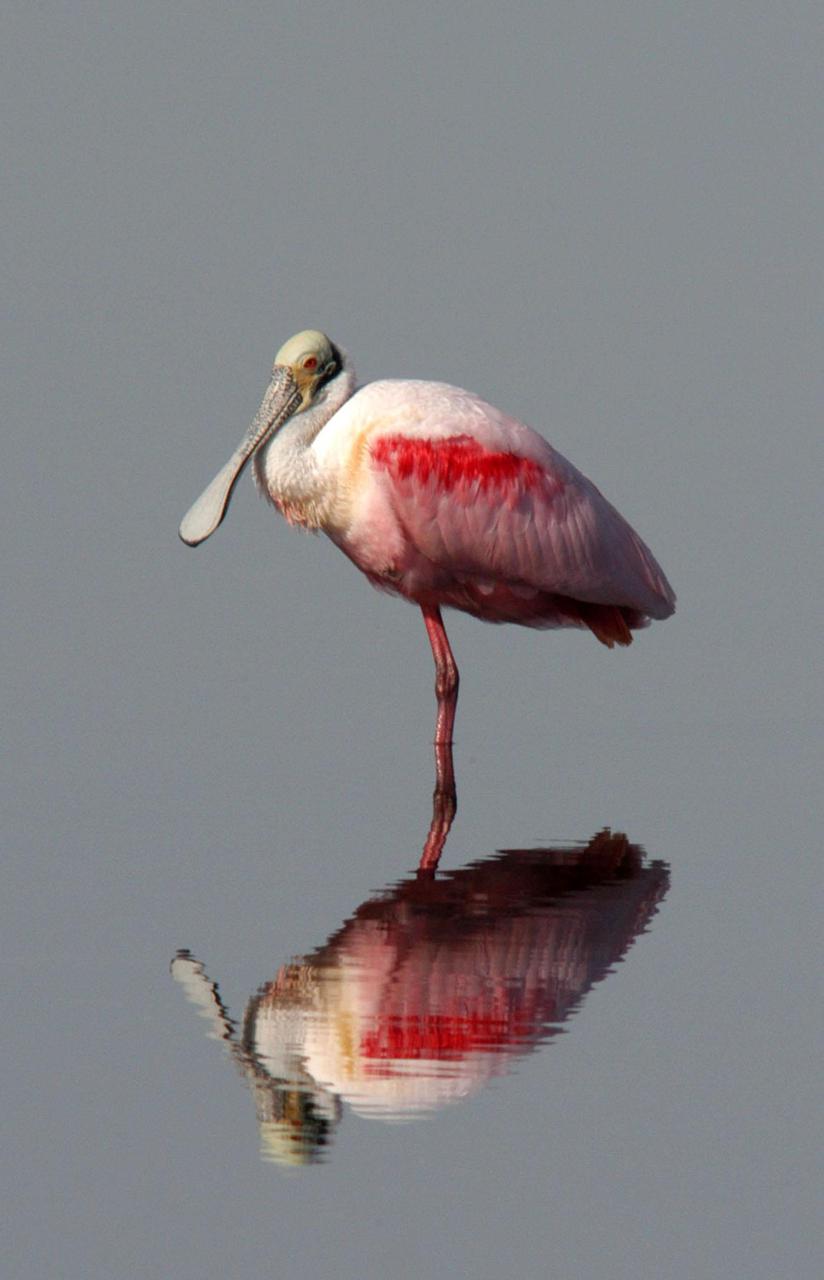
KENNEDY SPACE CENTER, FLA. — The striated reflection of a roseate spoonbill is the only sign of the water it stands in. The bird was spotted on Blackpoint Wildlife Drive in the Merritt Island National Wildlife Refuge, northwest of NASA Kennedy Space Center. Spoonbills inhabit areas of mangrove such as on the coasts of southern Florida and Texas. These birds feed on shrimps and fish in the shallow water, sweeping their bills from side to side. This and other wildlife abound throughout KSC as it shares a boundary with the Wildlife Refuge, home to some of the nation’s rarest and most unusual species of wildlife. The wildlife refuge is a habitat for more than 310 species of birds, 25 mammals, 117 fishes and 65 amphibians and reptiles. In addition, the Refuge supports 19 endangered or threatened wildlife species on Federal or State lists, more than any other single refuge in the U.S.
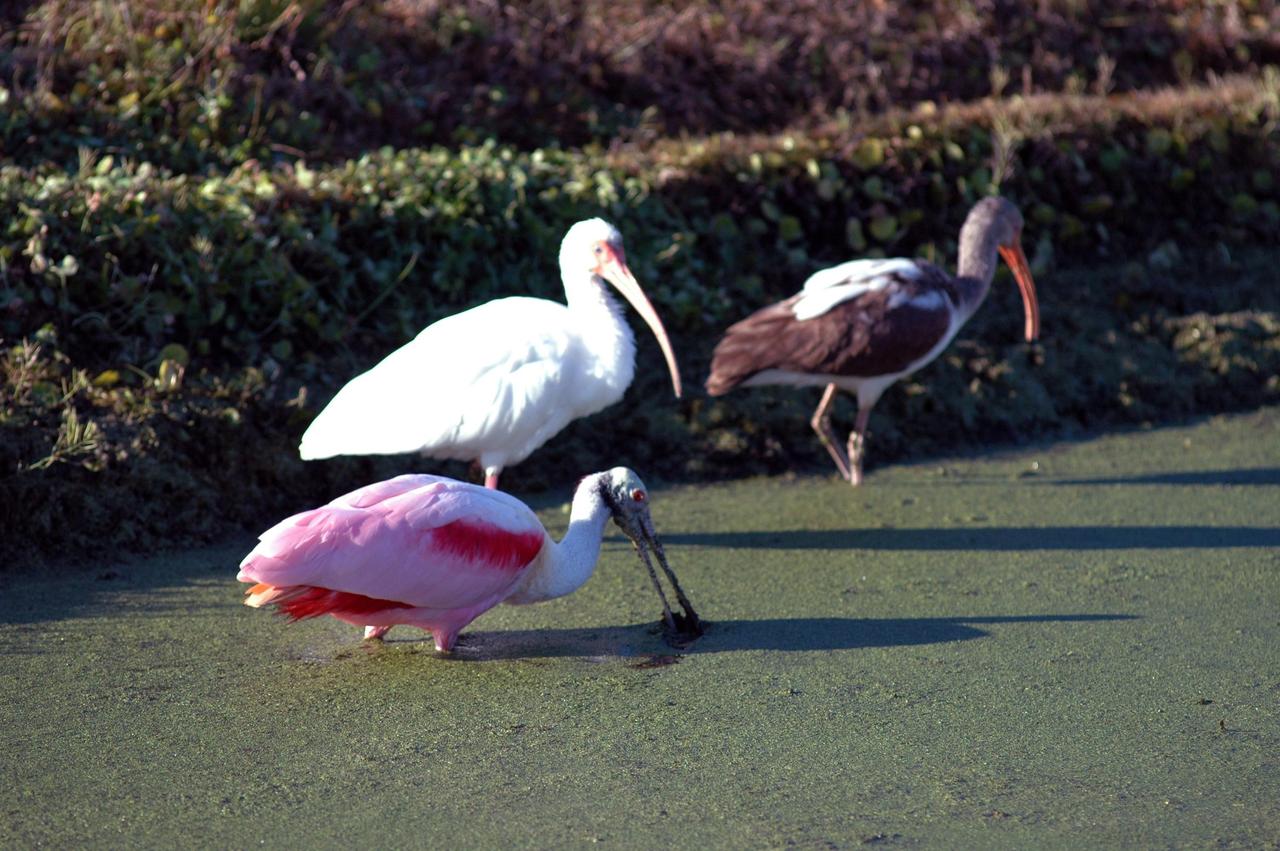
KENNEDY SPACE CENTER, FLA. - At NASA Kennedy Space Center, a roseate spoonbill (front) and white ibis search the murky canal for food. Spoonbills inhabit areas of mangrove such as on the coasts of southern Florida and Texas. These birds feed on shrimps and fish in the shallow water, sweeping their bills from side to side. White ibis inhabit marshy sloughs, mud flats, lagoons and swamp forests along the coast from South Carolina to Florida and Texas and south to northern South America. The ibis with the brown wings is an immature ibis. The Center shares a boundary with the Merritt Island National Wildlife Refuge, which is a habitat for more than 310 species of birds, 25 mammals, 117 fishes and 65 amphibians and reptiles. In addition, the Refuge supports 19 endangered or threatened wildlife species on Federal or State lists, more than any other single refuge in the U.S. Photo credit: NASA/Jim Grossmann
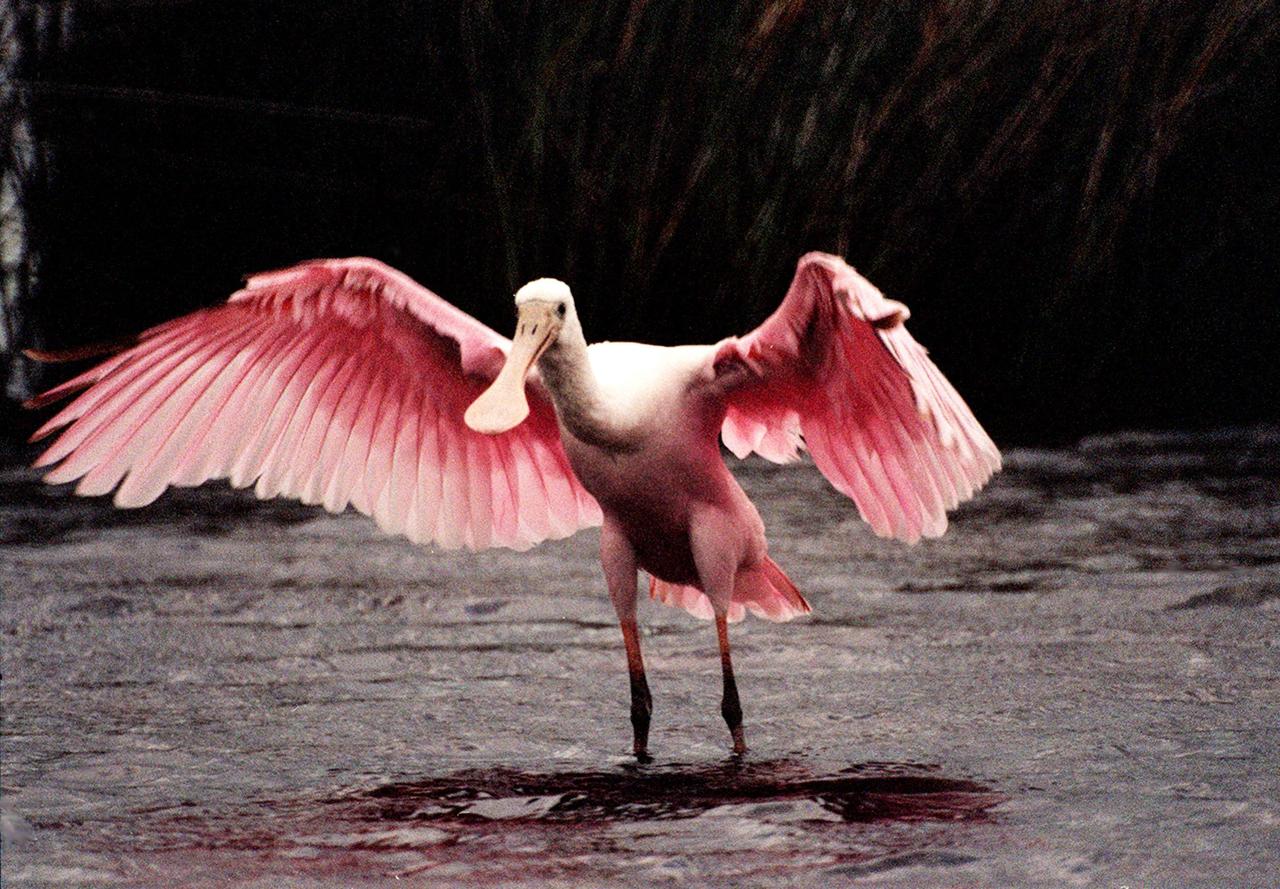
KENNEDY SPACE CENTER, FLA. -- A female roseate spoonbill displays her colorful wings in a mating ritual in Merritt Island National Wildlife Refuge. The birds, named for their brilliant pink color and paddle-shaped bill, feed in shallow water by swinging their bill back and forth, scooping up small fish and crustaceans. They typically inhabit mangroves on the coasts of southern Florida, Louisiana and Texas. The 92,000-acre refuge, which shares a boundary with Kennedy Space Center, is a habitat for more than 330 species of birds, 31 mammals, 117 fishes and 65 amphibians and reptiles. The marshes and open water of the refuge provide wintering areas for 23 species of migratory waterfowl, as well as a year-round home for great blue herons, great egrets, wood storks, cormorants, brown pelicans and other species of marsh and shore birds
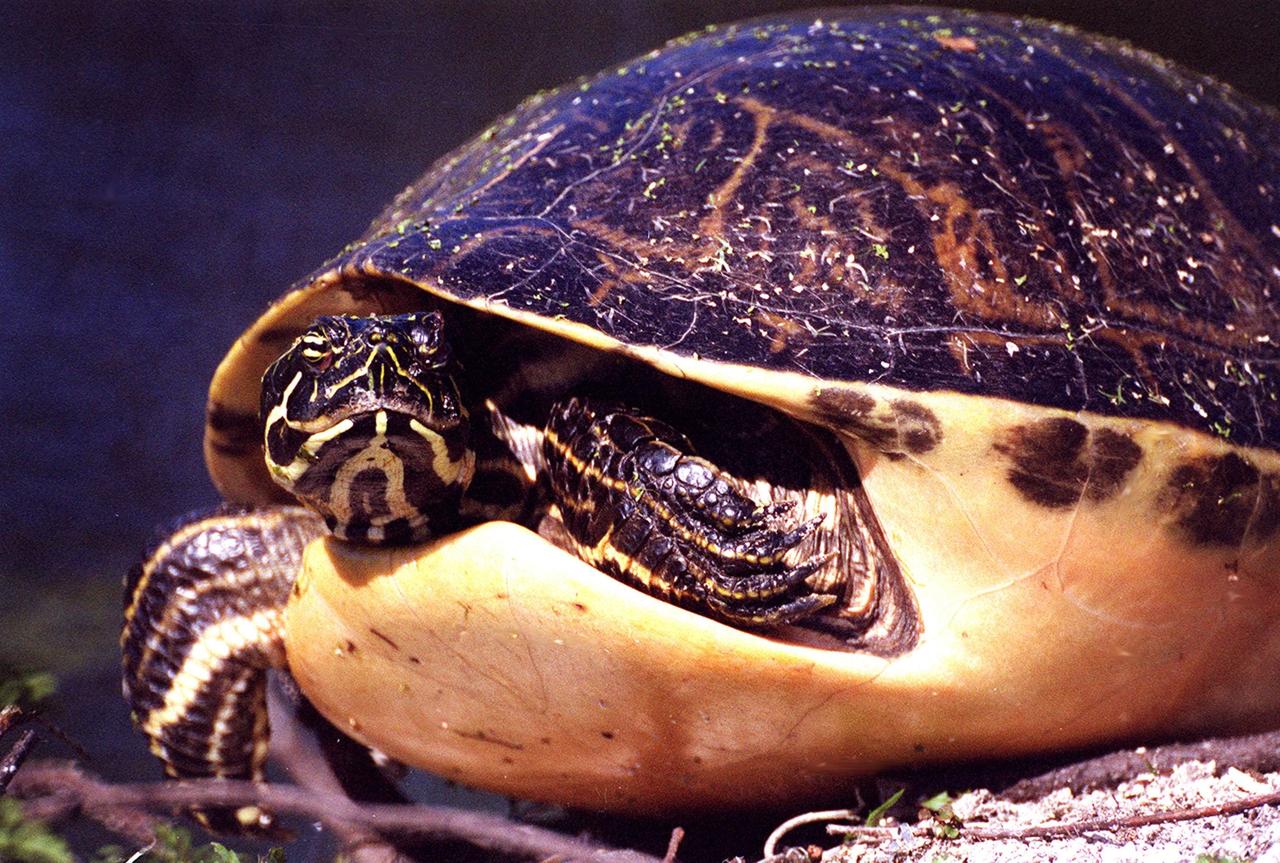
KENNEDY SPACE CENTER, FLA. -- A Florida Redbelly Turtle casts a suspicious look as he is being photographed on the grounds of Kennedy Space Center. The Redbelly turtle inhabits ponds, lakes, sloughs, marshes and mangrove-bordered creeks, in a range that encompasses Florida from the southern tip north to the Apalachicola area of the panhandle. Active year-round, it is often seen basking on logs or floating mats of vegetation. Adults prefer a diet of aquatic plants. The Center shares a boundary with the Merritt Island National Wildlife Refuge, which encompasses 92,000 acres that are a habitat for more than 331 species of birds, 31 mammals, 117 fishes, and 65 amphibians and reptiles. The marshes and open water of the refuge provide wintering areas for 23 species of migratory waterfowl, as well as a year-round home for great blue herons, great egrets, wood storks, cormorants, brown pelicans and other species of marsh and shore birds, as well as a variety of insects
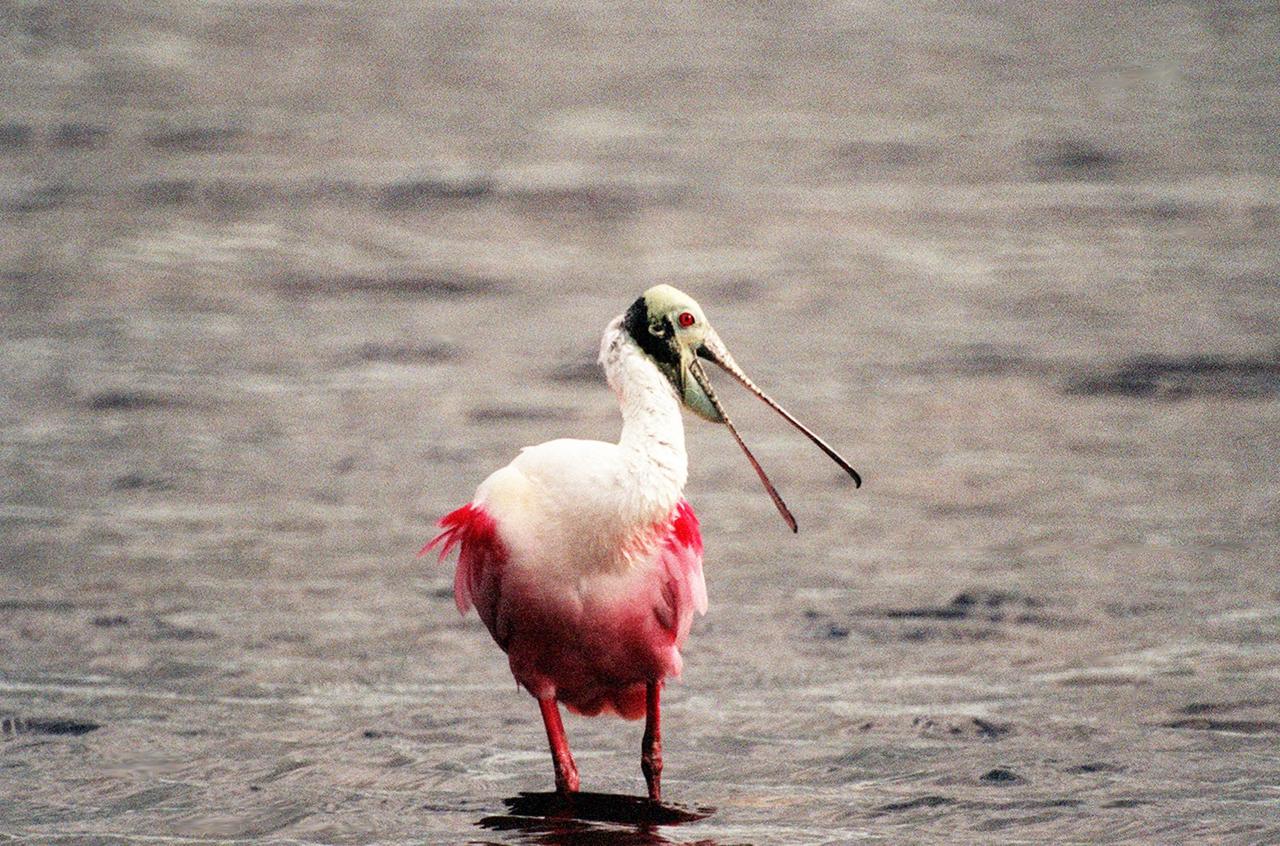
KENNEDY SPACE CENTER, FLA. -- In the shallow waters of the Merritt Island National Wildlife Refuge, a roseate spoonbill squawks at nearby intruders. The birds, named for their brilliant pink color and paddle-shaped bill, feed in shallow water by swinging their bill back and forth, scooping up small fish and crustaceans. They typically inhabit mangroves on the coasts of southern Florida, Louisiana and Texas. The 92,000-acre refuge, which shares a boundary with Kennedy Space Center, is a habitat for more than 330 species of birds, 31 mammals, 117 fishes and 65 amphibians and reptiles. The marshes and open water of the refuge provide wintering areas for 23 species of migratory waterfowl, as well as a year-round home for great blue herons, great egrets, wood storks, cormorants, brown pelicans and other species of marsh and shore birds
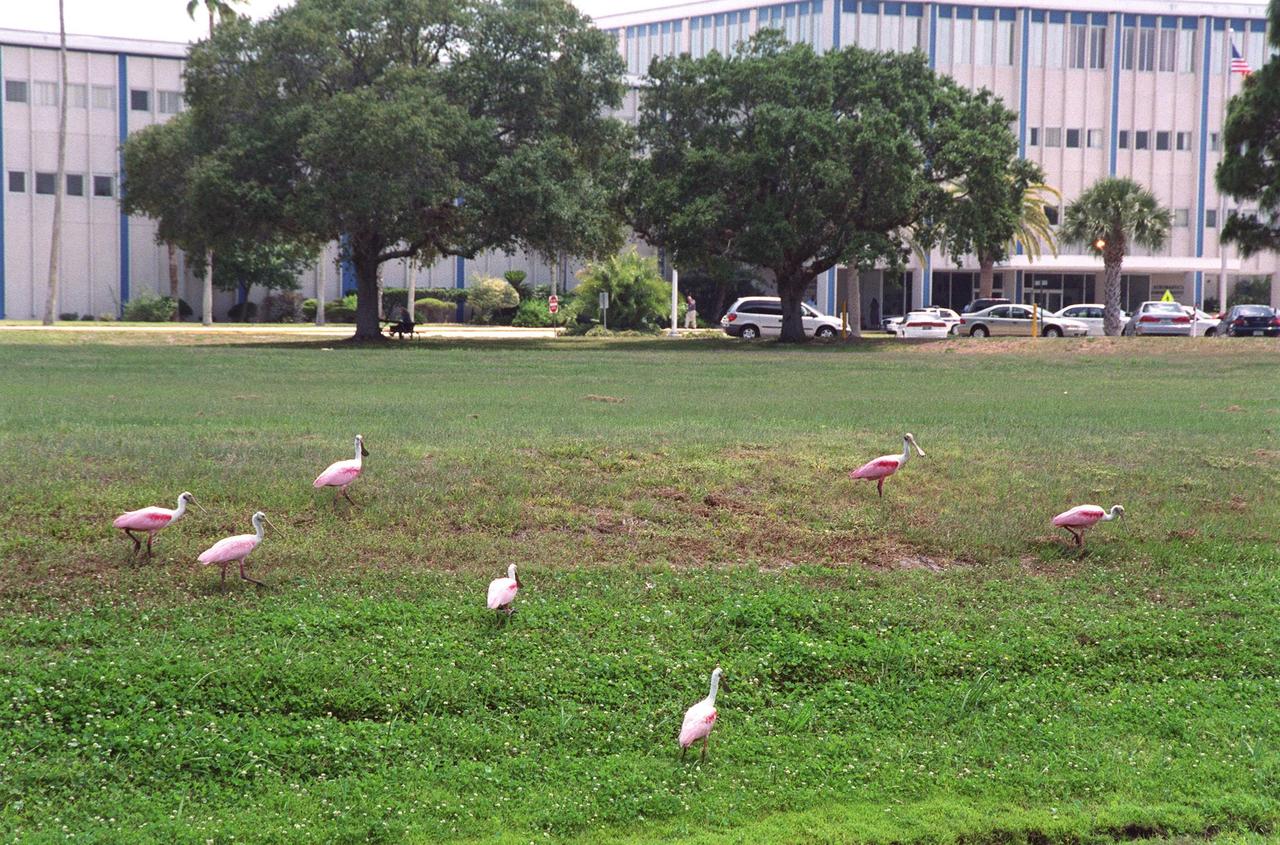
KENNEDY SPACE CENTER, FLA. -- Roseate Spoonbills stride across the lawn in front of the KSC Headquarters building. The birds, named for their brilliant pink color and paddle-shaped bill, usually feed in shallow water by swinging their bill back and forth, scooping up small fish and crustaceans. They typically inhabit mangroves on the coasts of southern Florida, Louisiana and Texas. Kennedy Space Center shares a boundary with the Merritt Island National Wildlife Refuge. The Refuge encompasses 92,000 acres that are a habitat for more than 331 species of birds, 31 mammals, 117 fishes, and 65 amphibians and reptiles. The marshes and open water of the refuge provide wintering areas for 23 species of migratory waterfowl, as well as a year-round home for great blue herons, great egrets, wood storks, cormorants, brown pelicans and other species of marsh and shore birds, as well as a variety of insects
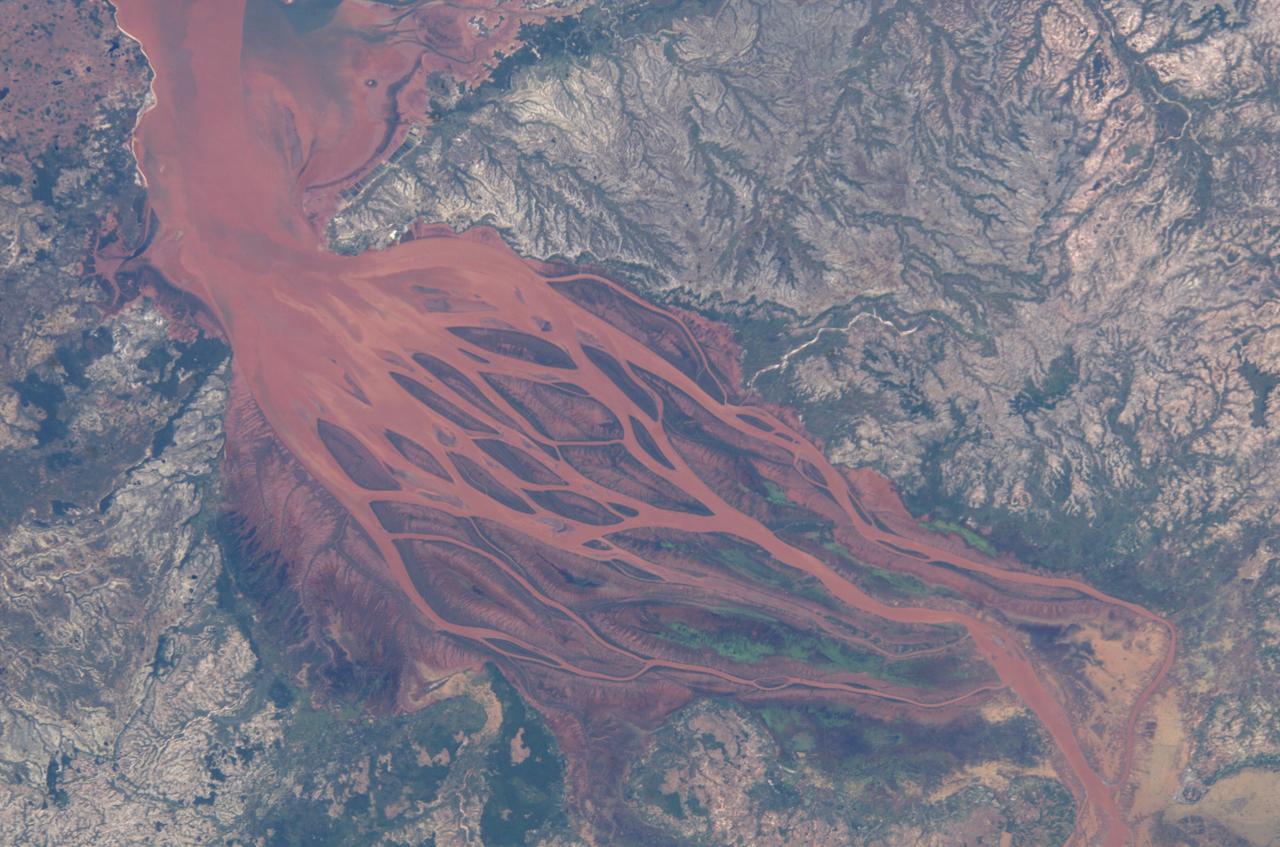
ISS008-E-19233 (25 March 2004) --- This image featuring the Betsiboka estuary on the northwest coast of Madagascar was taken by an Expedition 8 crewmember on the International Space Station (ISS). The Betsiboka estuary is the mouth of Madagascar’s largest river and one of the world’s fast-changing coastlines. Nearly a century of extensive logging of Madagascar’s rainforests and coastal mangroves has resulted in nearly complete clearing of the land and fantastic rates of erosion. After every heavy rain, the bright red soils are washed from the hillsides into the streams and rivers to the coast. Astronauts describe their view of Madagascar as “bleeding into the ocean”. One impact of the extensive 20th century erosion is the filling and clogging of coastal waterways with sediment – a process that is well illustrated in the Betsiboka estuary. In fact, ocean-going ships were once able to travel up the Betsiboka estuary, but must now berth at the coast.
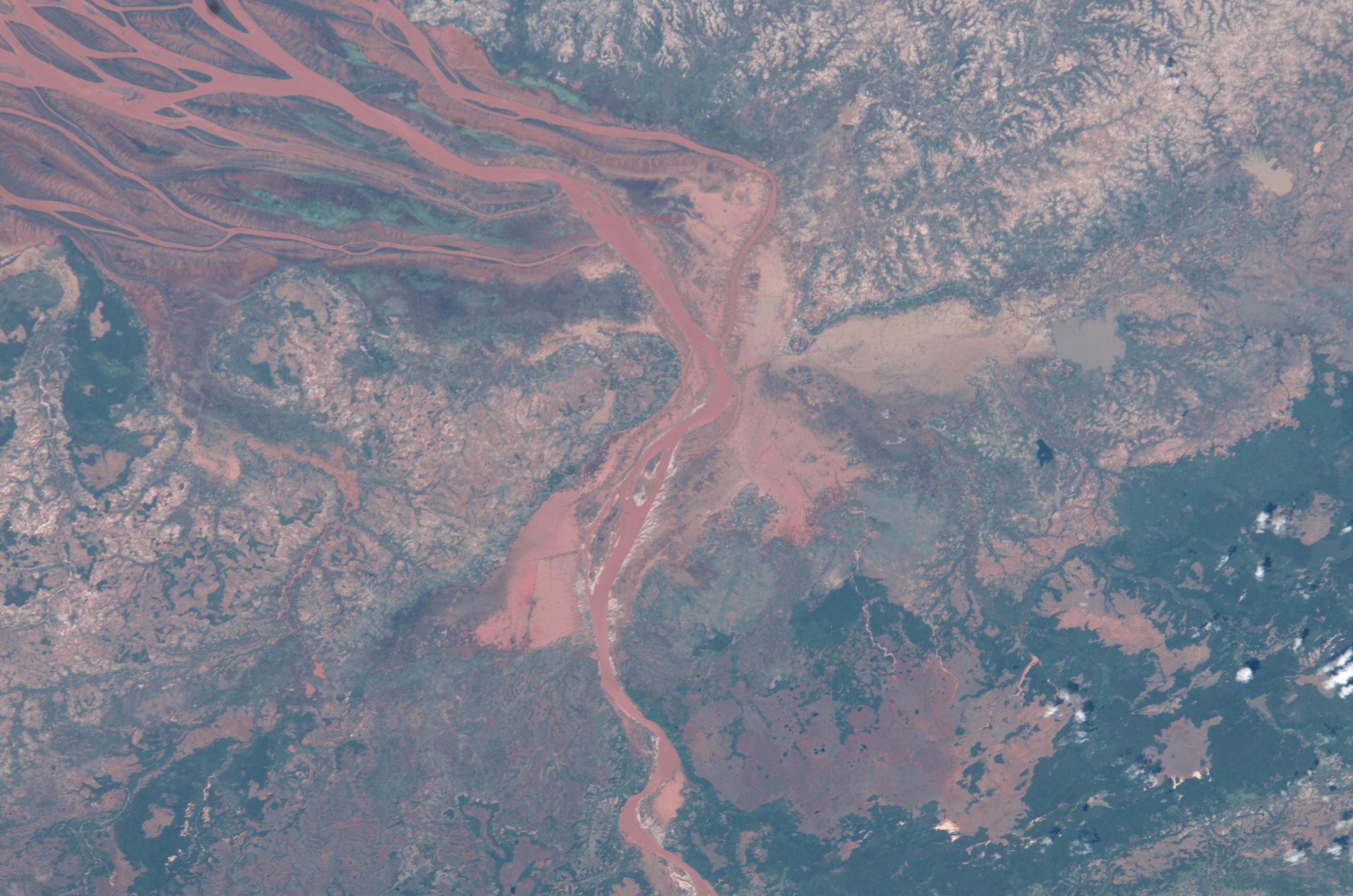
ISS008-E-19236 (25 March 2004) --- This image featuring the Betsiboka estuary on the northwest coast of Madagascar was taken by an Expedition 8 crewmember on the International Space Station (ISS). The Betsiboka estuary is the mouth of Madagascar’s largest river and one of the world’s fast-changing coastlines. Nearly a century of extensive logging of Madagascar’s rainforests and coastal mangroves has resulted in nearly complete clearing of the land and fantastic rates of erosion. After every heavy rain, the bright red soils are washed from the hillsides into the streams and rivers to the coast. Astronauts describe their view of Madagascar as “bleeding into the ocean”. One impact of the extensive 20th century erosion is the filling and clogging of coastal waterways with sediment – a process that is well illustrated in the Betsiboka estuary. In fact, ocean-going ships were once able to travel up the Betsiboka estuary, but must now berth at the coast.
KENNEDY SPACE CENTER, FLA. - At NASA Kennedy Space Center, roseate spoonbills (front) and white ibis search the murky canal for food. Spoonbills inhabit areas of mangroves such as on the coasts of southern Florida and Texas. These birds feed on shrimp and fish in the shallow water, sweeping their bills from side to side. White ibis inhabit marshy sloughs, mud flats, lagoons and swamp forests along the coast from South Carolina to Florida and Texas and south to northern South America. The Center shares a boundary with the Merritt Island National Wildlife Refuge, which is a habitat for more than 310 species of birds, 25 mammals, 117 fishes and 65 amphibians and reptiles. In addition, the Refuge supports 19 endangered or threatened wildlife species on Federal or State lists, more than any other single refuge in the U.S. Photo credit: NASA/Jim Grossmann
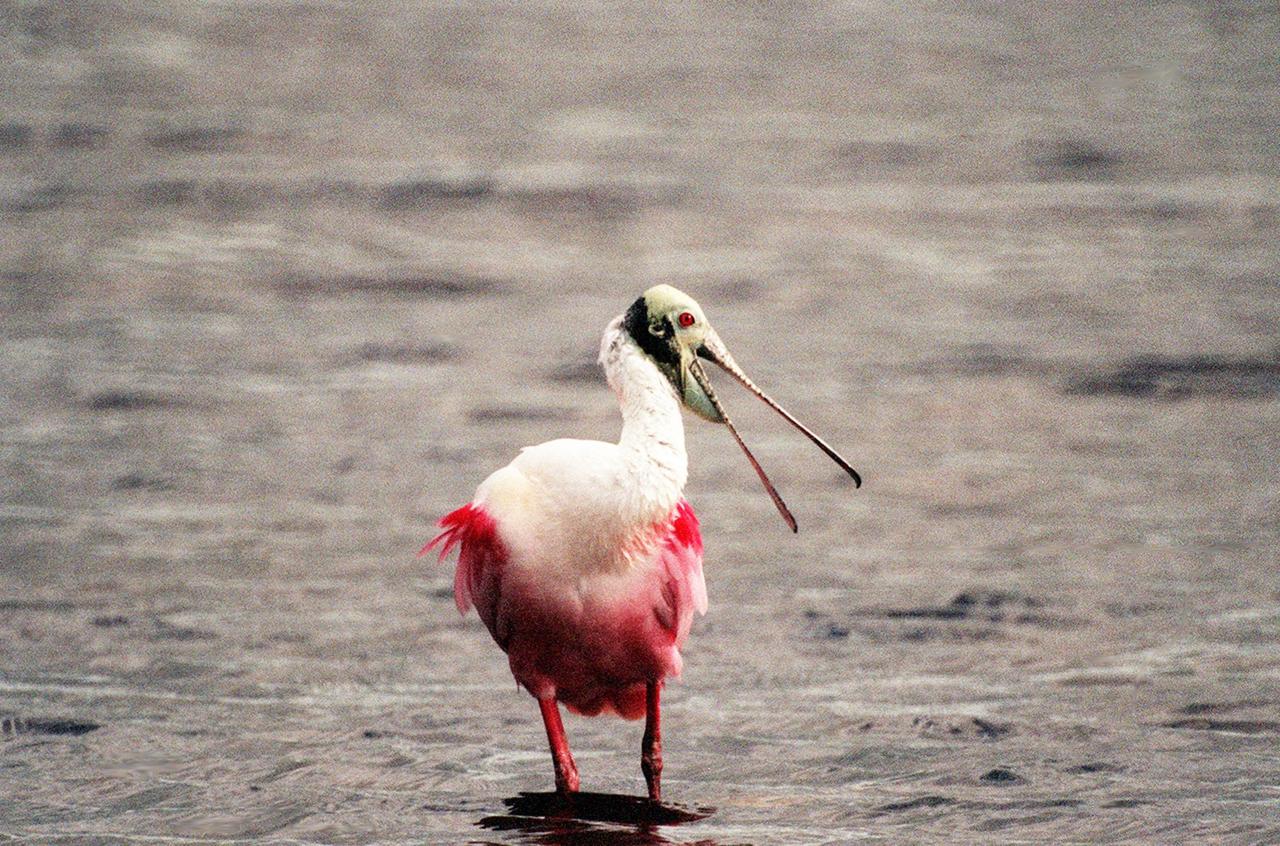
KENNEDY SPACE CENTER, FLA. -- In the shallow waters of the Merritt Island National Wildlife Refuge, a roseate spoonbill squawks at nearby intruders. The birds, named for their brilliant pink color and paddle-shaped bill, feed in shallow water by swinging their bill back and forth, scooping up small fish and crustaceans. They typically inhabit mangroves on the coasts of southern Florida, Louisiana and Texas. The 92,000-acre refuge, which shares a boundary with Kennedy Space Center, is a habitat for more than 330 species of birds, 31 mammals, 117 fishes and 65 amphibians and reptiles. The marshes and open water of the refuge provide wintering areas for 23 species of migratory waterfowl, as well as a year-round home for great blue herons, great egrets, wood storks, cormorants, brown pelicans and other species of marsh and shore birds
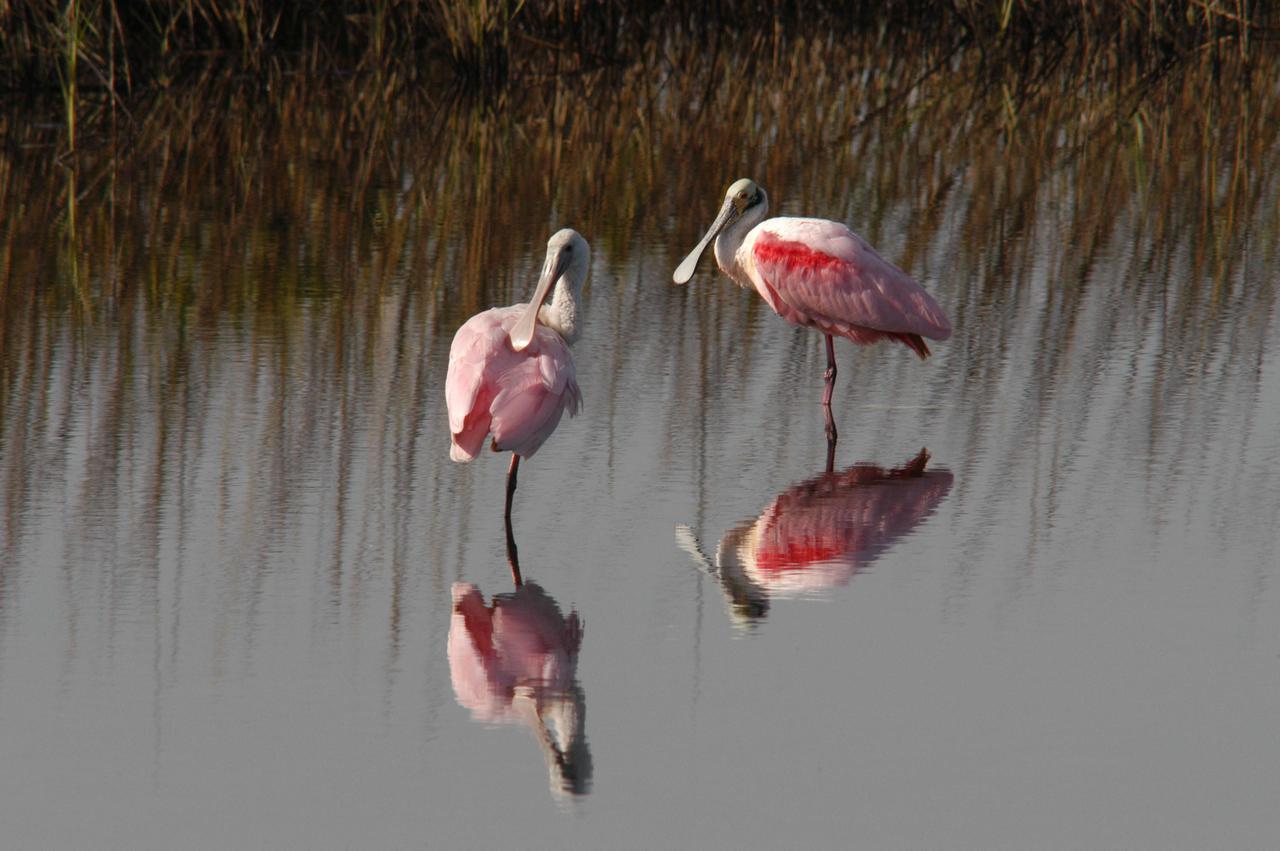
KENNEDY SPACE CENTER, FLA. — A female (left) and a male roseate spoonbill get together near the tall grasses at the edge of a pond in the Merritt Island National Wildlife Refuge, northwest of NASA Kennedy Space Center. Spoonbills inhabit areas of mangrove such as on the coasts of southern Florida and Texas. These birds feed on shrimps and fish in the shallow water, sweeping their bills from side to side. This and other wildlife abound throughout KSC as it shares a boundary with the Wildlife Refuge, home to some of the nation’s rarest and most unusual species of wildlife. The wildlife refuge is a habitat for more than 310 species of birds, 25 mammals, 117 fishes and 65 amphibians and reptiles. In addition, the Refuge supports 19 endangered or threatened wildlife species on Federal or State lists, more than any other single refuge in the U.S.
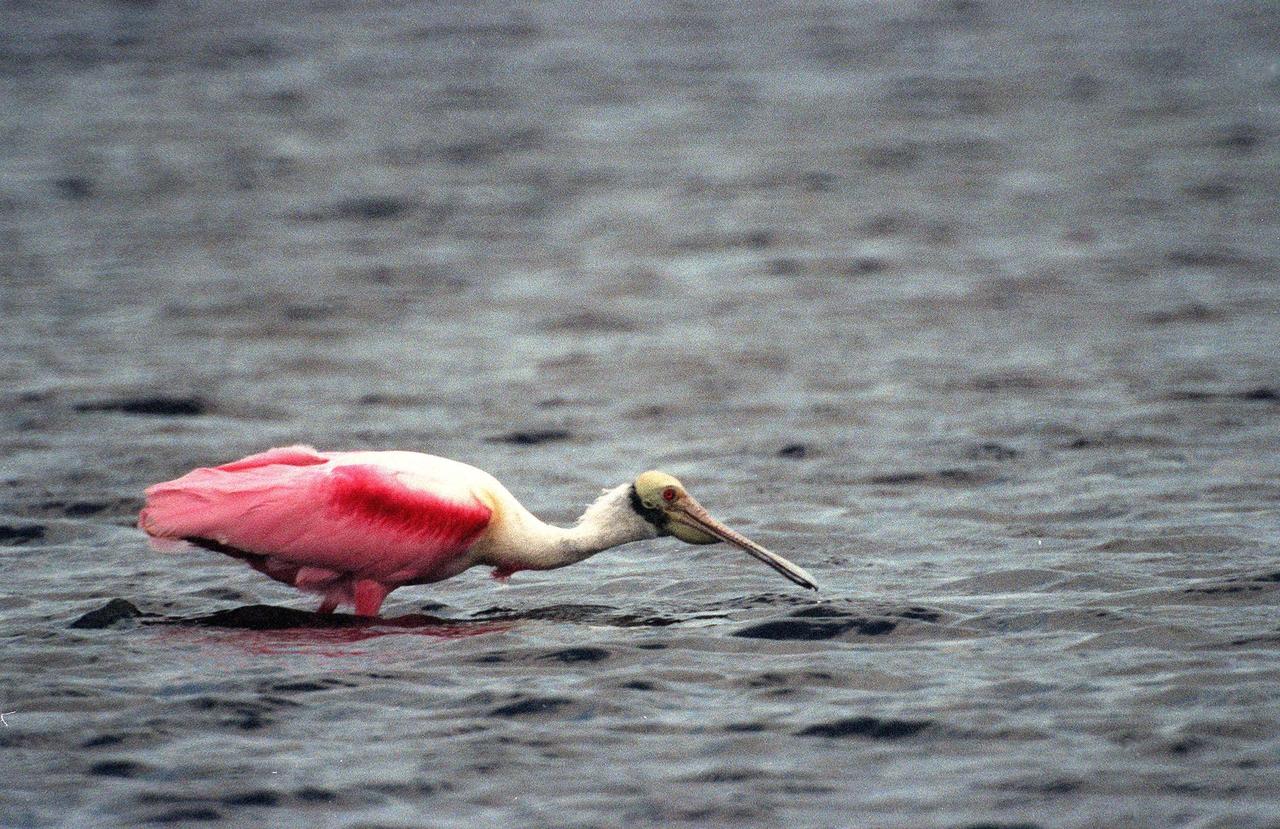
KENNEDY SPACE CENTER, FLA. -- A Roseate Spoonbill sweeps the water for food in the Merritt Island National Wildlife Refuge, which shares a boundary with Kennedy Space Center. The brilliant pink bird is named for its straight bill with the broad spatulate tip. Preferring a habitat of mangroves, it is usually found on the coasts of southern Florida and Texas, occasionally in Louisiana., in the West Indies, Mexico and Central and South America. Spoonbills feed on shrimps and fish in shallow waters, sweeping their bills from side to side and scooping up whatever they encounter. The 92,000-acre refuge is a habitat for more than 310 species of birds, 25 mammals, 117 fishes and 65 amphibians and reptiles. The marshes and open water of the refuge also provide wintering areas for 23 species of migratory waterfowl, as well as a year-round home for great blue herons, great egrets, wood storks, cormorants, brown pelicans and other species of marsh and shore birds
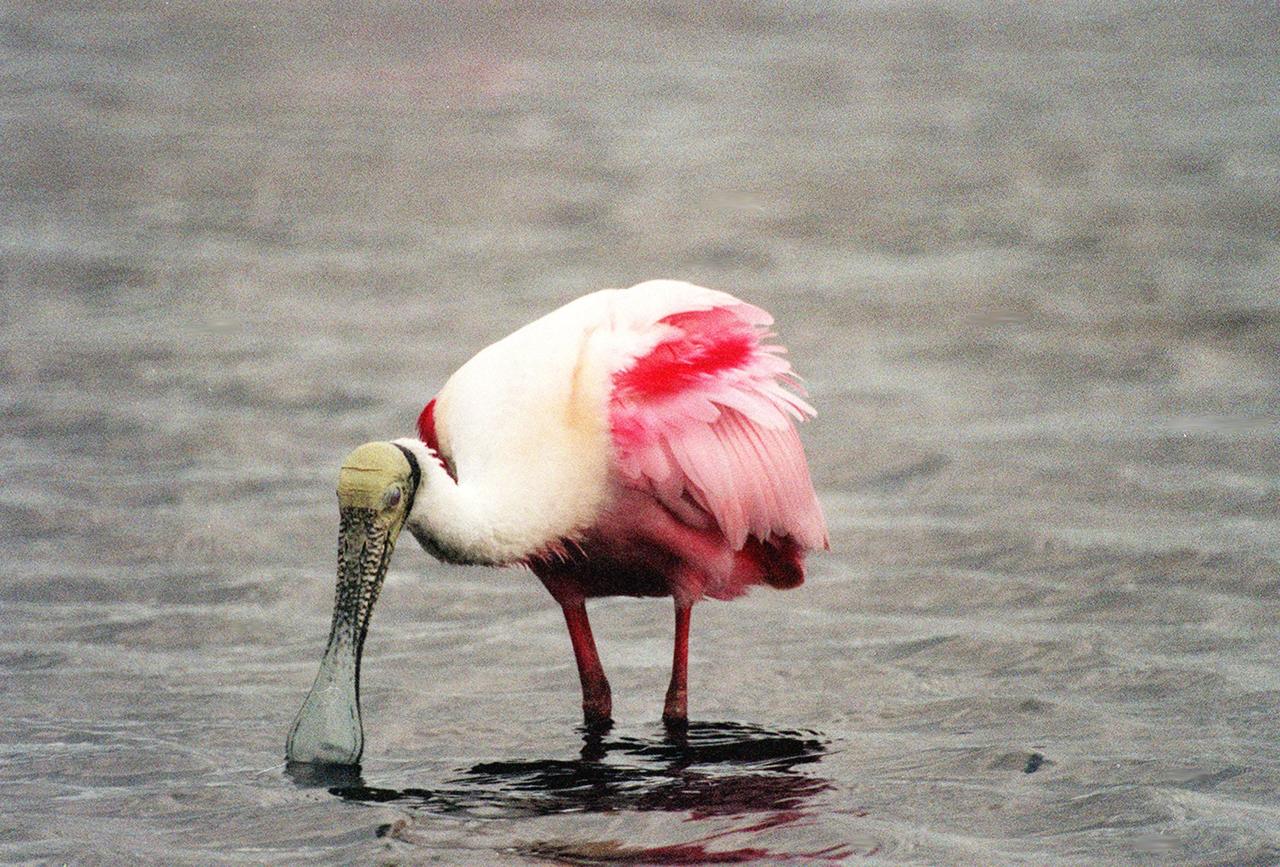
KENNEDY SPACE CENTER, FLA. -- In the Merritt Island National Wildlife Refuge, a roseate spoonbill searches the water for food. The birds, named for their brilliant pink color and paddle-shaped bill, feed in shallow water by swinging their bill back and forth, scooping up small fish and crustaceans. They typically inhabit mangroves on the coasts of southern Florida, Louisiana and Texas. The 92,000-acre refuge, which shares a boundary with Kennedy Space Center, is a habitat for more than 330 species of birds, 31 mammals, 117 fishes and 65 amphibians and reptiles. The marshes and open water of the refuge provide wintering areas for 23 species of migratory waterfowl, as well as a year-round home for great blue herons, great egrets, wood storks, cormorants, brown pelicans and other species of marsh and shore birds
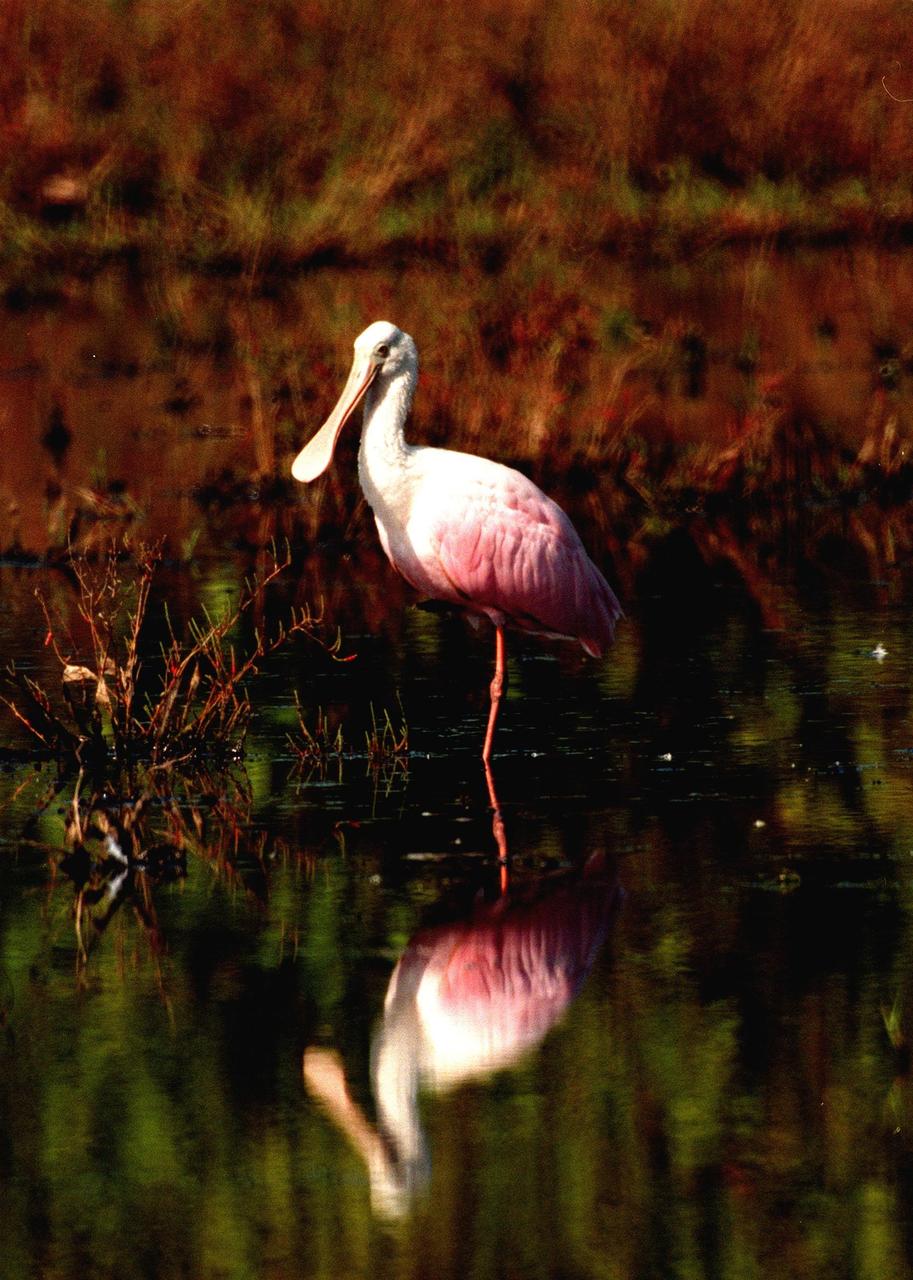
KENNEDY SPACE CENTER, FLA. -- Balancing on one leg, a roseate spoonbill is reflected in the waters of the Merritt Island National Wildlife Refuge at Kennedy Space Center. The birds, named for their brilliant pink color and paddle-shaped bill, feed in shallow water by swinging their bill back and forth, scooping up small fish and crustaceans. They typically inhabit mangroves on the coasts of southern Florida, Louisiana and Texas. The refuge provides wintering areas for 23 species of migratory waterfowl, as well as a year-round home for great blue herons, great egrets, wood storks, cormorants, brown pelicans and other species of marsh and shore birds. The 92,000-acre refuge is also habitat for more than 310 species of birds, 25 mammals, 117 fishes and 65 amphibians and reptiles
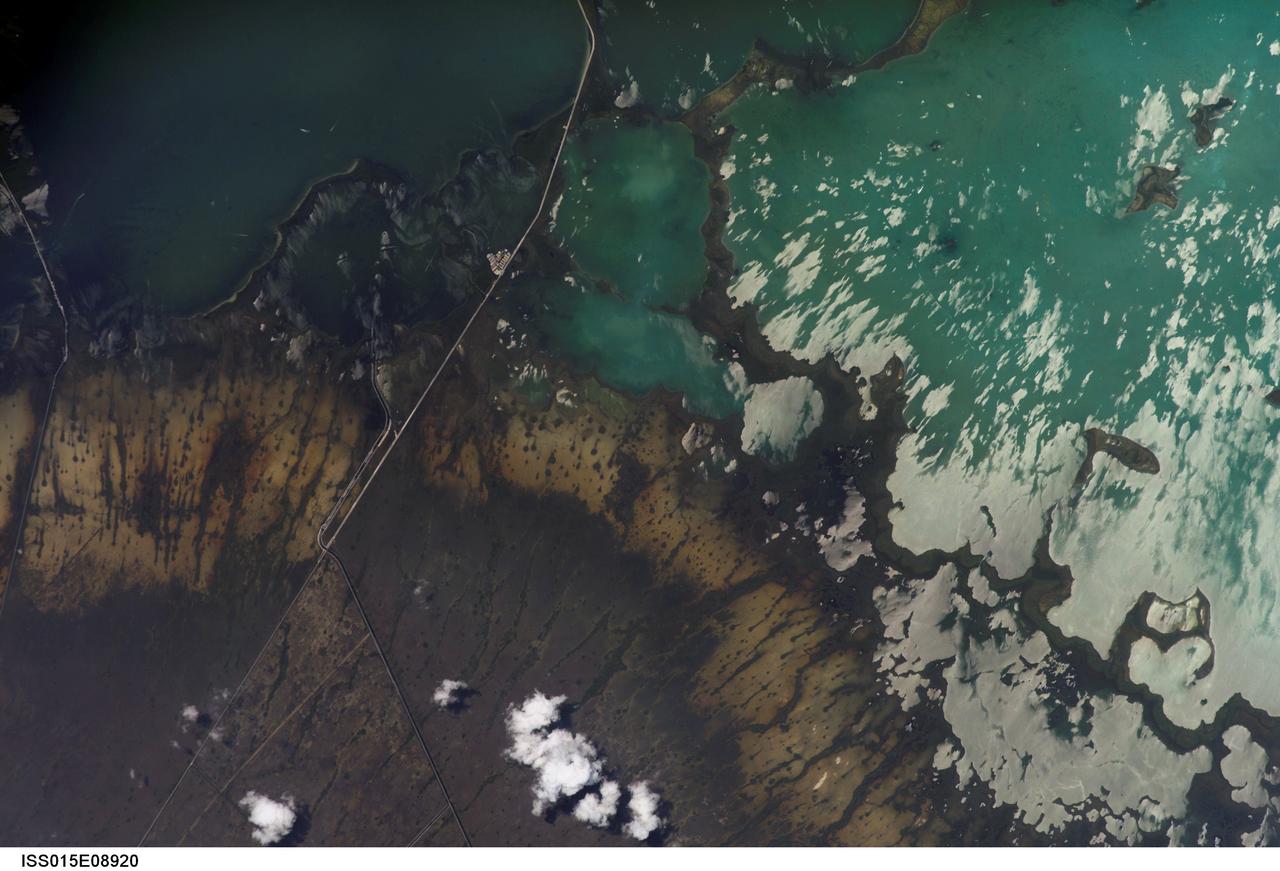
ISS015-E-08920 (19 May 2007) --- Southern Everglades National Park, Florida is featured in this image photographed by an Expedition 15 crewmember on the International Space Station. Everglades National Park in southern Florida is the largest subtropical wilderness in the United States. Known as the "river of grass", the Everglades wetlands and wooded uplands host a variety of endangered species including crocodiles, manatees, and panthers. During the late 19th and 20th centuries, the original 11,000 square miles of wetlands were viewed as useless swampland in need of reclamation. The success of reclamation efforts -- for agriculture and urban expansion in southern Florida -- has led to the loss of approximately 50 per cent of the original wetlands and 90 per cent of wading bird species. Today, an extensive restoration effort is underway to return portions of the Everglades to a more natural state and prevent further ecosystem degradation. This view highlights the southern Everglades estuarine ecosystem where the wetlands meet Florida Bay. Thin fingers of land and small islands (keys) host mangrove, hardwood hammocks, marsh and prairie (mainly dark to light green in the image). The tan and grayish-brown areas are dominantly scrub, marshland and prairie; small green "dots" and narrow lines in this region are isolated mangrove and hardwood stands indicating the general direction of slow water flow toward the bay. The silver-gray regions are water surfaces highlighted by sunglint. The roadway forming the western boundary of the National Park is US Route 1 connecting the Miami metropolitan area to the north (not shown) with the Florida Keys to the south (not shown). A small built feature visible along the roadway is a fishing camp.
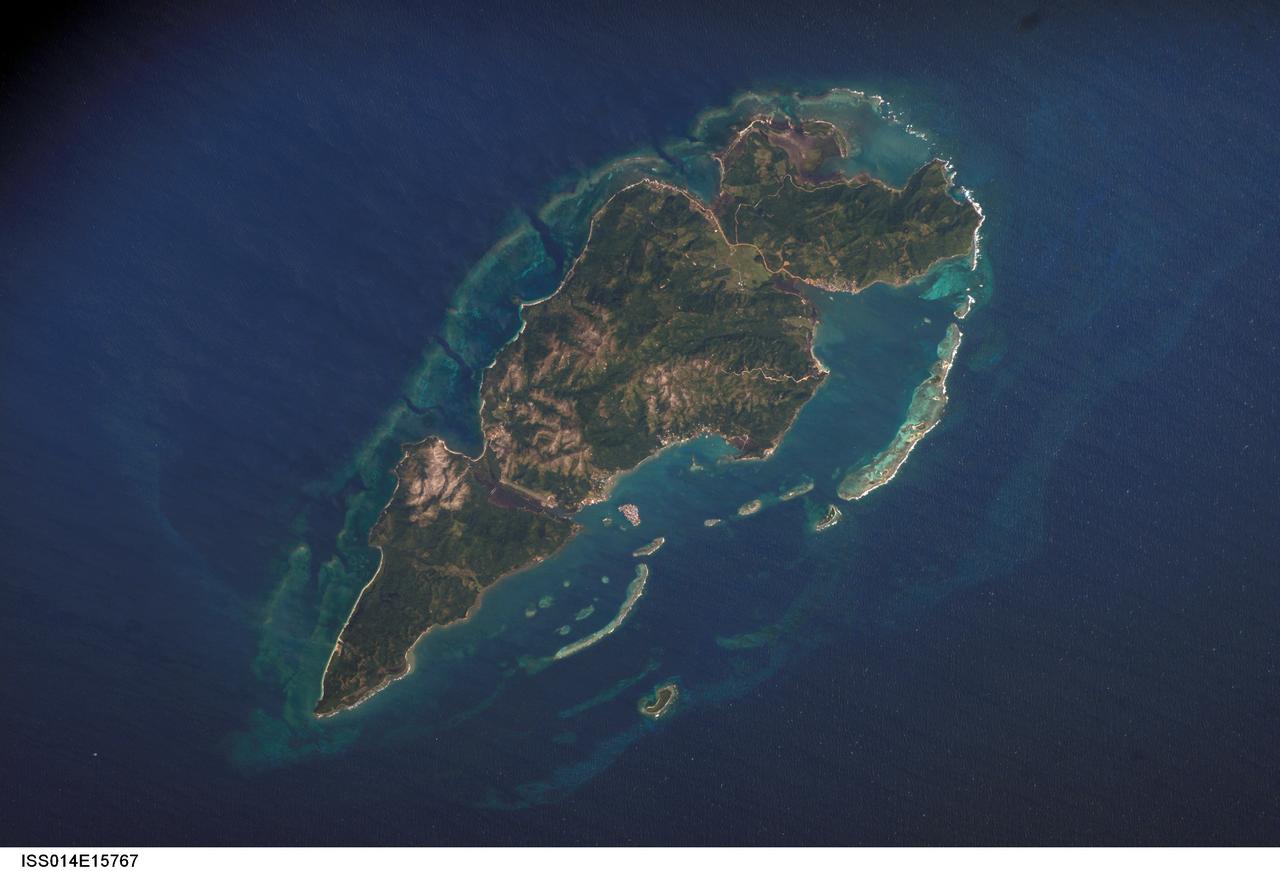
ISS014-E-15767 (1 March 2007) --- Guanaja Island, Honduras is featured in this image photographed by an Expedition 14 crewmember on the International Space Station. Guanaja Island is located along the southwestern margin of the Gulf of Mexico, approximately 60 kilometers north of mainland Honduras. The island is situated near the western edge of the Cayman Ridge, a topographic feature comprised of rock types indicative of ancient volcanic islands, sedimentary layers, and ocean crust. The Ridge formed as a result of tectonic interactions between the North American, South American, and Caribbean Plates. Guanaja and the nearby islands of Roatan and Utila (not shown) comprise the only portions of the western Cayman Ridge currently exposed above water. The island is also notable for its largely undeveloped character -- the exception being highly concentrated development on Bonacca Cay, a small island (roughly 0.5 kilometers by 0.3 kilometers) located along the southeastern coastline of the main island. The main island has little in the way of roads or other infrastructure -- a canal is the major means of traversing the island - making it an attractive destination for hikers and eco-tourists. The clear waters and reefs that almost completely encircle Guanaja also attract divers. In 1998, hurricane Mitch destroyed almost all (97 percent) of the island's mangrove forests, impacting coastal habitats and resulting in soil erosion. Regeneration of mangroves is slow and active reseeding efforts have been suggested as the only means to restore the forests.
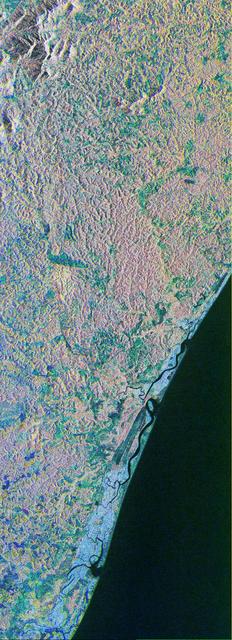
This is a color composite image of southern Bahia, Brazil, centered at 15.22 degree south latitude and 39.07 degrees west longitude. The image was acquired by the Spaceborne Imaging Radar-C/X-band Synthetic Aperture Radar aboard the space shuttle Endeavour on its 38th orbit of Earth on October 2, 1994. The image covers an area centered over the Una Biological Reserve, one the largest protected areas in northeastern Brazil. The 7,000-hectare reserve is administered by the Brazilian Institute for the Environment and is part of the larger Atlantic coastal forest, a narrow band of rain forest extending along the eastern coast of Brazil. The Atlantic coastal forest of southern Bahia is one of the world's most threatened and diverse ecosystems. Due to widespread settlement, only 2 to 5 percent of the original forest cover remains. Yet the region still contains an astounding variety of plants and animals, including a large number of endemic species. More than half of the region's tree species and 80 percent of its animal species are indigenous and found nowhere else on Earth. The Una Reserve is also the only federally protected habitat for the golden-headed lion tamarin, the yellow-breasted capuchin monkey and many other endangered species. In the past few years, scientists from Brazilian and international conservation organizations have coordinated efforts to study the biological diversity of this region and to develop practical and economically viable options for preserving the remaining primary forests in southern Bahia. The shuttle imaging radar is used in this study to identify various land uses and vegetation types, including remaining patches of primary forest, cabruca forest (cacao planted in the understory of the native forest), secondary forest, pasture and coastal mangrove. Standard remote-sensing technology that relies on light reflected from the forest canopy cannot accurately distinguish between cabruca and undisturbed forest. Optical remote sensing is also limited by the nearly continuous cloud cover in the region and heavy rainfall, which occurs more than 150 days each year. The ability of the shuttle radars to "see" through the forest canopy to the cultivated cacao below -- independent of weather or sunlight conditions --will allow researchers to distinguish forest from cabruca in unprecedented detail. This SIR-C/X-SAR image was produced by assigning red to the L-band, green to the C-band and blue to the X-band. The Una Reserve is located in the middle of the image west of the coastline and slightly northwest of Comandatuba River. The reserve's primary forests are easily detected by the pink areas in the image. The intensity of red in these areas is due to the high density of forest vegetation (biomass) detected by the radar's L-band (horizontally transmitted and vertically received) channel. Secondary forest is visible along the reserve's eastern border. The Serrado Mar mountain range is located in the top left portion of the image. Cabruca forest to the west of Una Reserve has a different texture and a yellow color. The removal of understory in cabruca forest reduces its biomass relative to primary forest, which changes the L-band and C-band penetration depth and returns, and produces a different texture and color in the image. The region along the Atlantic is mainly mangrove swamp, agricultural fields and urban areas. The high intensity of blue in this region is a result of increasing X-band return in areas covered with swamp and low vegetation. The image clearly separates the mangrove region (east of coastal Highway 001, shown in blue) from the taller and dryer forest west of the highway. The high resolution capability of SIR-C/X-SAR imaging and the sensitivity of its frequency and polarization channels to various land covers will be used for monitoring and mapping areas of importance for conservation. http://photojournal.jpl.nasa.gov/catalog/PIA01764

CAPE CANAVERAL, Fla. - A colony of brown pelicans takes advantage of a respite from winter temperatures to sun themselves along the edges of the Turn Basin in Launch Complex 39 at NASA's Kennedy Space Center in Florida. The brown pelican is found along the coast in California and from North Carolina to Texas, Mexico, the West Indies and many Caribbean Islands, as well as Guyana and Venezuela in South America. It is listed as endangered only in Louisiana, Mississippi, and in the Caribbean. The species is considered to be long-lived. One pelican captured in Edgewater, Fla., in November 1964, was found to have been banded in September 1933, over 31 years previously. Individuals can weigh up to eight pounds, with larger pelicans having wing spreads of over seven feet. Their nests are usually built in mangrove trees, but ground nesting may also occur. Nesting takes place mostly in early spring or summer with the male carrying nesting materials to the female. Although the female builds the nest, both share in incubation and rearing duties. The Merritt Island National Wildlife Refuge coexists with Kennedy Space Center and provides a habitat for 330 species of birds including brown pelicans. Photo credit: NASA/Jack Pfaller

CAPE CANAVERAL, Fla. - Brown pelicans sun themselves along the edges of the Turn Basin in Launch Complex 39 at NASA's Kennedy Space Center in Florida. Docked nearby is the Pegasus barge, often enlisted to bring the space shuttle's external tanks to the basin. The brown pelican is found along the coast in California and from North Carolina to Texas, Mexico, the West Indies and many Caribbean Islands, as well as Guyana and Venezuela in South America. It is listed as endangered only in Louisiana, Mississippi, and in the Caribbean. The species is considered to be long-lived. One pelican captured in Edgewater, Fla., in November 1964, was found to have been banded in September 1933, over 31 years previously. Individuals can weigh up to eight pounds, with larger pelicans having wing spreads of over seven feet. Their nests are usually built in mangrove trees, but ground nesting may also occur. Nesting takes place mostly in early spring or summer with the male carrying nesting materials to the female. Although the female builds the nest, both share in incubation and rearing duties. The Merritt Island National Wildlife Refuge coexists with Kennedy Space Center and provides a habitat for 330 species of birds including brown pelicans. Photo credit: NASA/Jack Pfaller
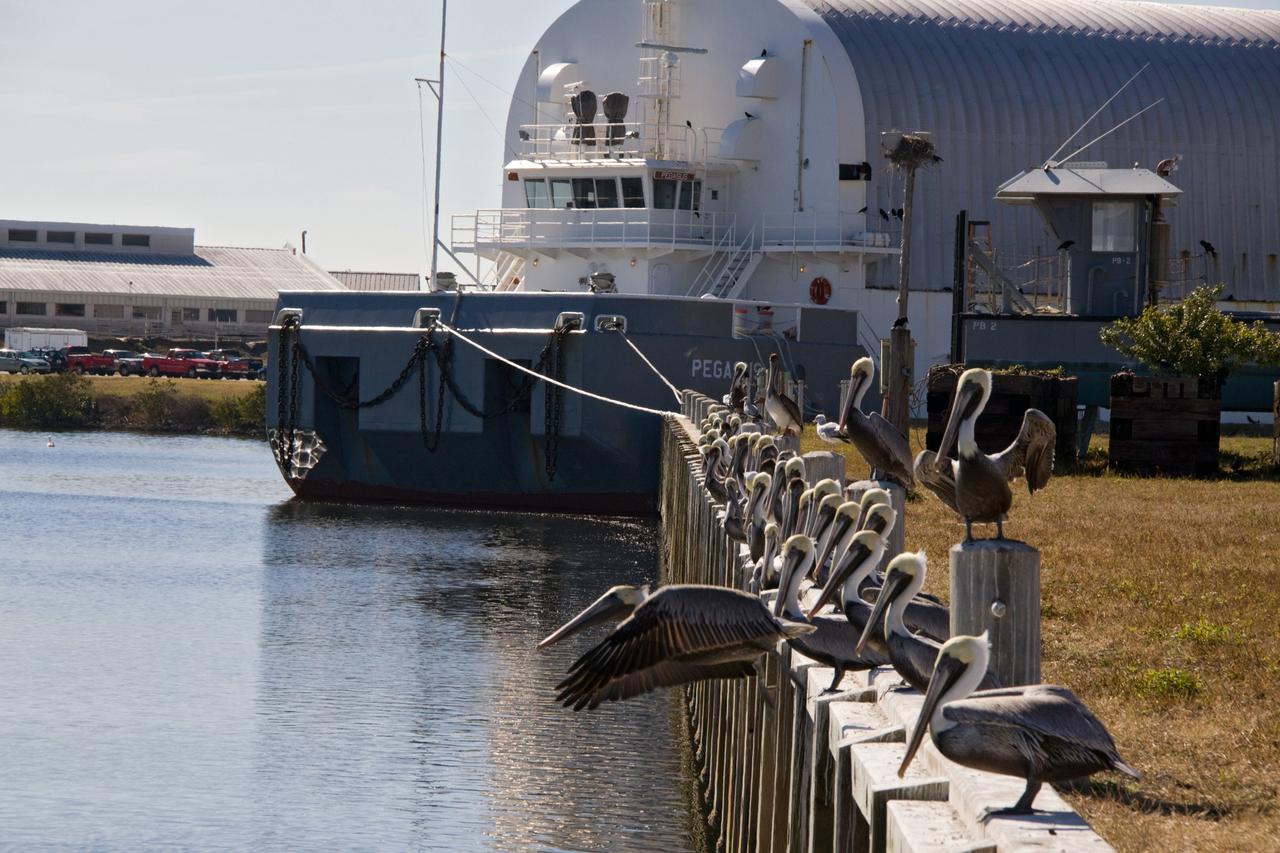
CAPE CANAVERAL, Fla. - Brown pelicans make unlikely companions for the Pegasus barge in the Turn Basin in Launch Complex 39 at NASA's Kennedy Space Center in Florida. The barge often transports the space shuttle's external tanks into the basin. The brown pelican is found along the coast in California and from North Carolina to Texas, Mexico, the West Indies and many Caribbean Islands, as well as Guyana and Venezuela in South America. It is listed as endangered only in Louisiana, Mississippi, and in the Caribbean. The species is considered to be long-lived. One pelican captured in Edgewater, Fla., in November 1964, was found to have been banded in September 1933, over 31 years previously. Individuals can weigh up to eight pounds, with larger pelicans having wing spreads of over seven feet. Their nests are usually built in mangrove trees, but ground nesting may also occur. Nesting takes place mostly in early spring or summer with the male carrying nesting materials to the female. Although the female builds the nest, both share in incubation and rearing duties. The Merritt Island National Wildlife Refuge coexists with Kennedy Space Center and provides a habitat for 330 species of birds including brown pelicans. Photo credit: NASA/Jack Pfaller
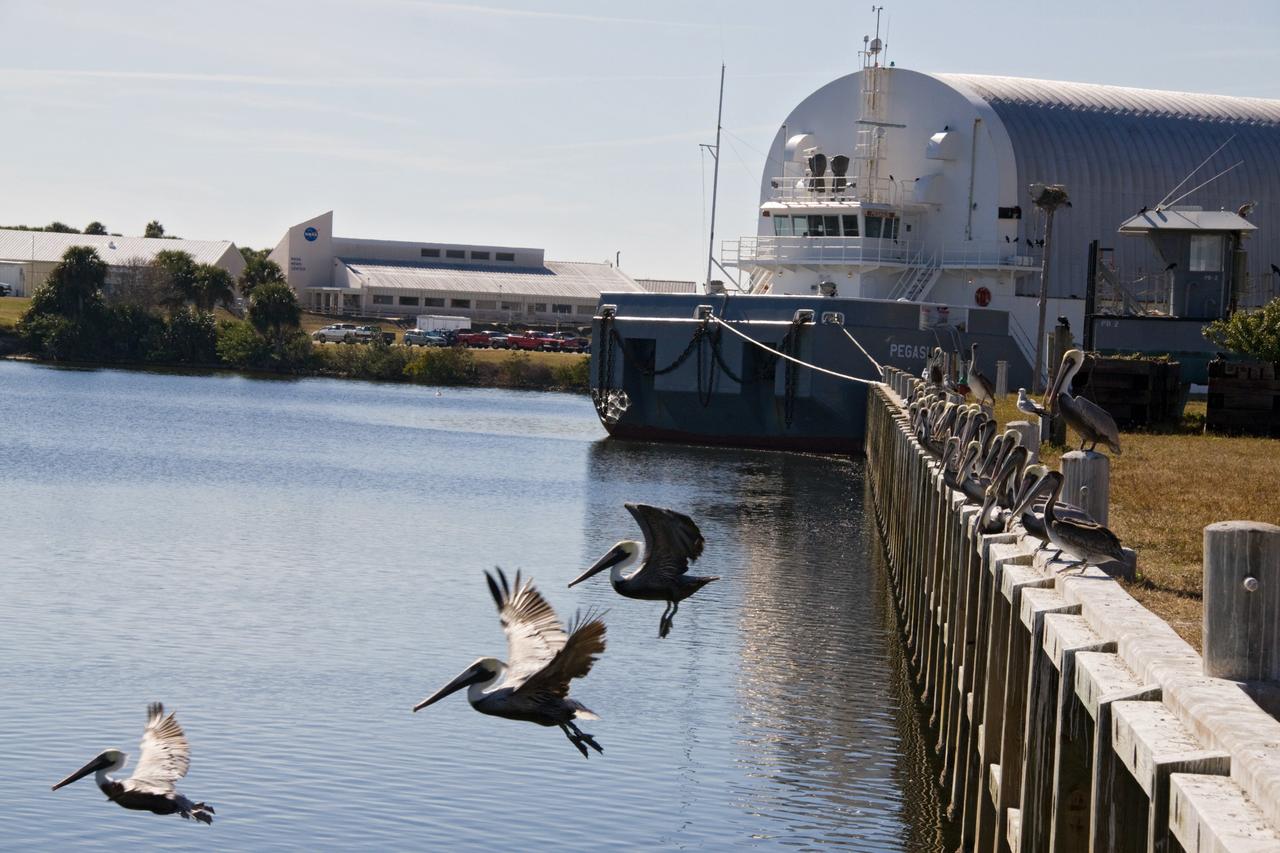
CAPE CANAVERAL, Fla. - Brown pelicans enjoy a respite from the winter temperatures at the Turn Basin in Launch Complex 39 at NASA's Kennedy Space Center in Florida. Behind them is the Pegasus barge, often used to transport the space shuttle's external tanks into the basin, and NASA's News Center. The brown pelican is found along the coast in California and from North Carolina to Texas, Mexico, the West Indies and many Caribbean Islands, as well as Guyana and Venezuela in South America. It is listed as endangered only in Louisiana, Mississippi, and in the Caribbean. The species is considered to be long-lived. One pelican captured in Edgewater, Fla., in November 1964, was found to have been banded in September 1933, over 31 years previously. Individuals can weigh up to eight pounds, with larger pelicans having wing spreads of over seven feet. Their nests are usually built in mangrove trees, but ground nesting may also occur. Nesting takes place mostly in early spring or summer with the male carrying nesting materials to the female. Although the female builds the nest, both share in incubation and rearing duties. The Merritt Island National Wildlife Refuge coexists with Kennedy Space Center and provides a habitat for 330 species of birds including brown pelicans. Photo credit: NASA/Jack Pfaller
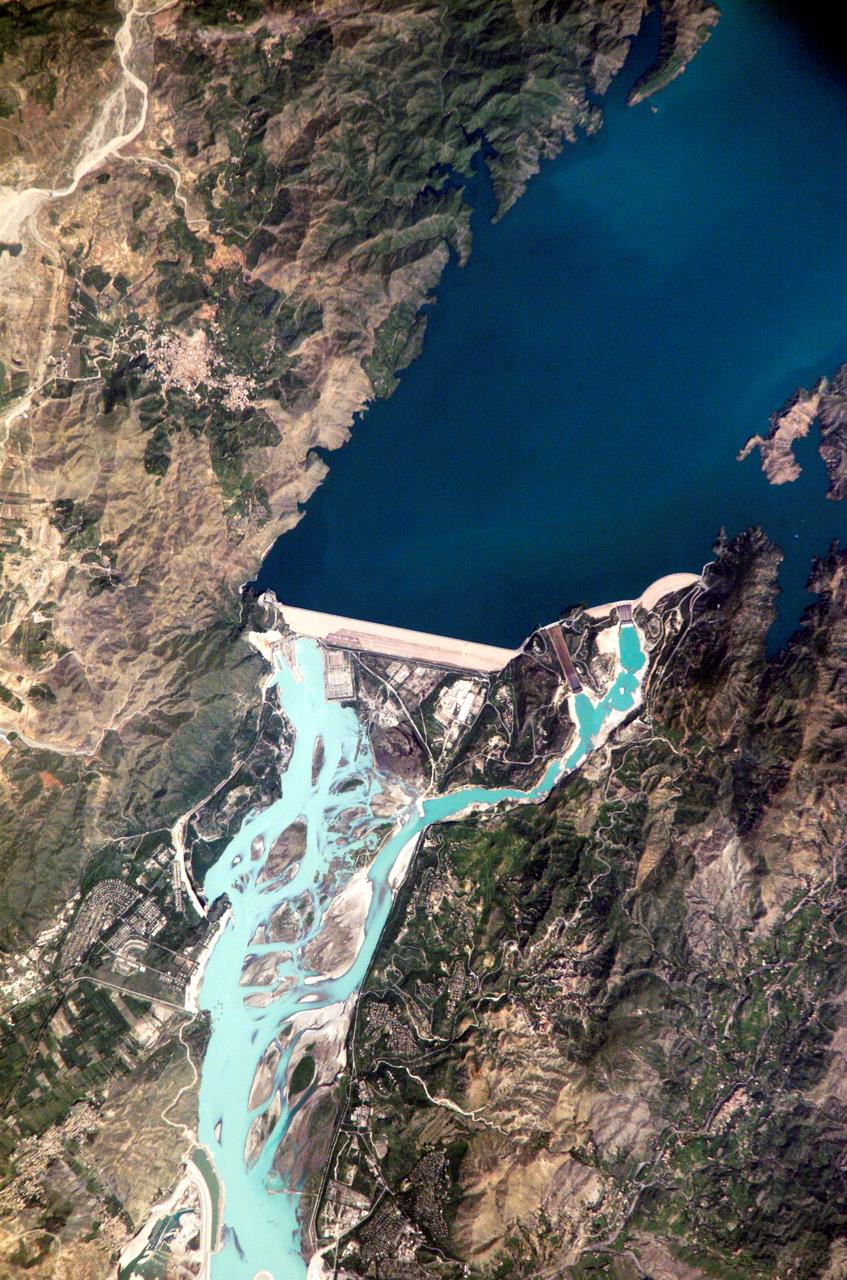
ISS005-E-12804 (6 September 2002) --- Tarbela Dam, Pakistan is featured in this image photographed by an Expedition 5 crewmember on the International Space Station (ISS). The Indus River basin extends from the Himalaya mountain ranges forming the northeastern boundary of Pakistan, to the alluvial plains of Sindh near the Arabian Sea coastline. Tarbela Dam is part of the Indus Basin Project that resulted from a water treaty signed in 1960 between India and Pakistan. This treaty guaranteed Pakistan water supplies independent of upstream control by India. Designed primarily for water storage rather than power generation, the dam was completed in 1977. Turquoise waters of the Indus River (to the south of the dam) reflect the high proportion of silt and clay suspended in waters released by the spillways (chutes on either of side of the main dam). With a volume of 142,000,000 cubic meters, the Tarbela Dam is the largest earth and rockfill dam in the world and stands 147 meters above the Indus riverbed. Its reservoir occupies an area of 37 square kilometers. While the dam has fulfilled its purpose in storing water for agricultural use in Pakistan, there have been environmental consequences to the Indus river delta, according to NASA scientists who are studying the Space Station photography. Reduction of seasonal flooding and reduced water flows to the delta have resulted in decrease of mangrove stands and abundance of some fish species.
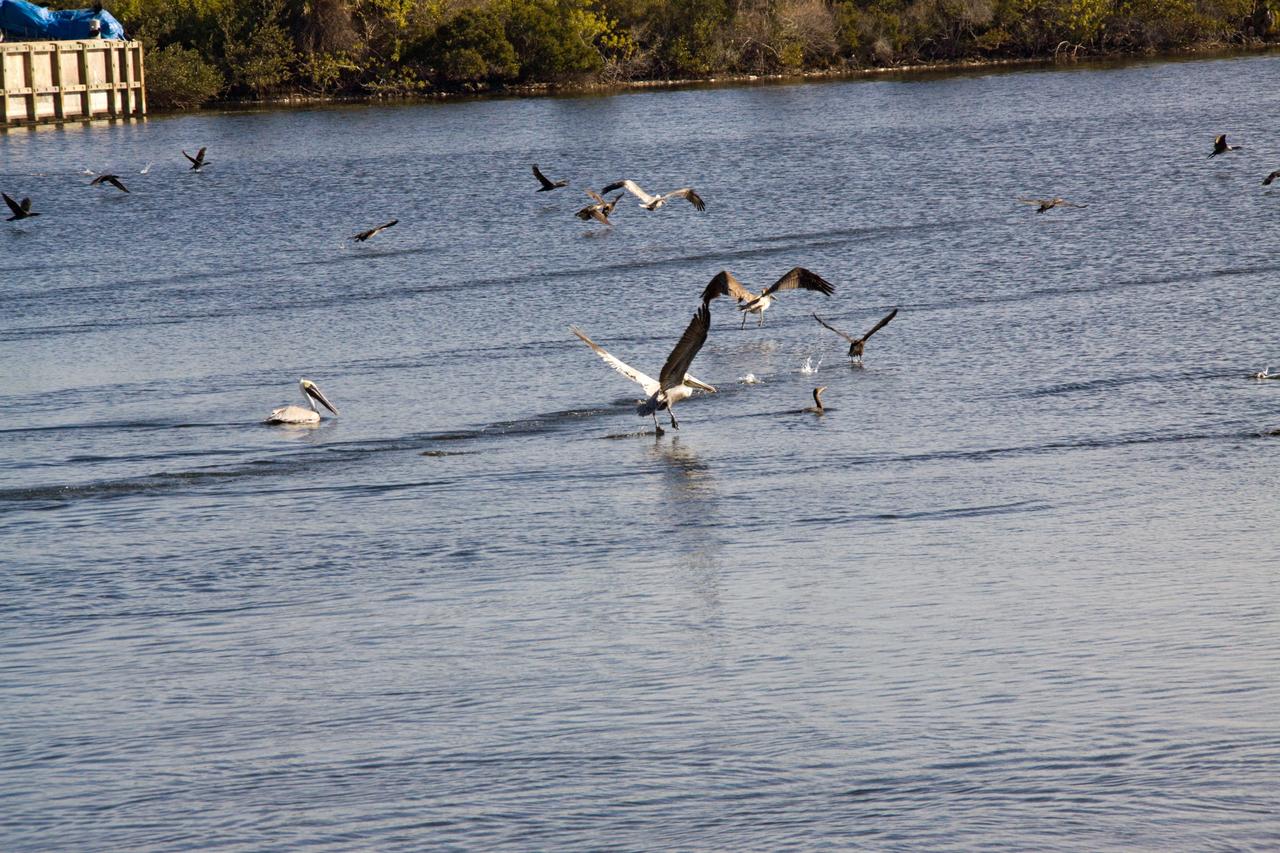
CAPE CANAVERAL, Fla. - A colony of brown pelicans enjoys a respite from the winter temperatures with a dip in the Turn Basin in Launch Complex 39 at NASA's Kennedy Space Center in Florida. The brown pelican is found along the coast in California and from North Carolina to Texas, Mexico, the West Indies and many Caribbean Islands, as well as Guyana and Venezuela in South America. It is listed as endangered only in Louisiana, Mississippi, and in the Caribbean. The species is considered to be long-lived. One pelican captured in Edgewater, Fla., in November 1964, was found to have been banded in September 1933, over 31 years previously. Individuals can weigh up to eight pounds, with larger pelicans having wing spreads of over seven feet. Their nests are usually built in mangrove trees, but ground nesting may also occur. Nesting takes place mostly in early spring or summer with the male carrying nesting materials to the female. Although the female builds the nest, both share in incubation and rearing duties. The Merritt Island National Wildlife Refuge coexists with Kennedy Space Center and provides a habitat for 330 species of birds including brown pelicans. Photo credit: NASA/Jack Pfaller
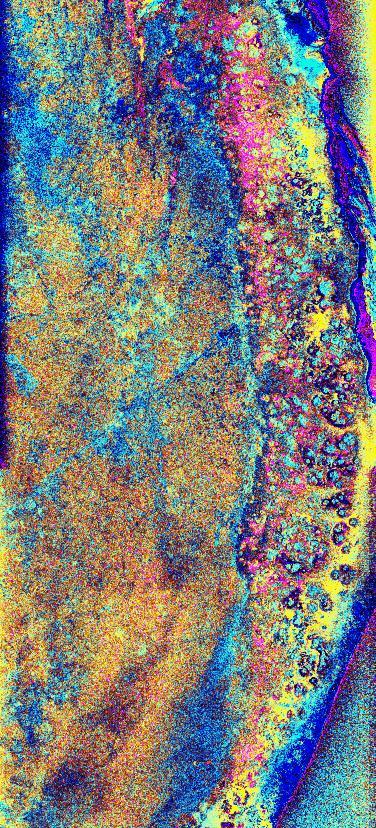
This is a radar image of the southwest portion of the buried Chicxulub impact crater in the Yucatan Peninsula, Mexico. The radar image was acquired on orbit 81 of space shuttle Endeavour on April 14, 1994 by the Spaceborne Imaging Radar C/X-Band Synthetic Aperture Radar (SIR-C/X-SAR). The image is centered at 20 degrees north latitude and 90 degrees west longitude. Scientists believe the crater was formed by an asteroid or comet which slammed into the Earth more than 65 million years ago. It is this impact crater that has been linked to a major biological catastrophe where more than 50 percent of the Earth's species, including the dinosaurs, became extinct. The 180-to 300-kilometer-diameter (110- to 180-mile) crater is buried by 300 to 1,000 meters (1,000 to 3,000 feet) of limestone. The exact size of the crater is currently being debated by scientists. This is a total power radar image with L-band in red, C-band in green, and the difference between C-band L-band in blue. The 10-kilometer-wide (6-mile) band of yellow and pink with blue patches along the top left (northwestern side) of the image is a mangrove swamp. The blue patches are islands of tropical forests created by freshwater springs that emerge through fractures in the limestone bedrock and are most abundant in the vicinity of the buried crater rim. The fracture patterns and wetland hydrology in this region are controlled by the structure of the buried crater. Scientists are using the SIR-C/X-SAR imagery to study wetland ecology and help determine the exact size of the impact crater. http://photojournal.jpl.nasa.gov/catalog/PIA01723
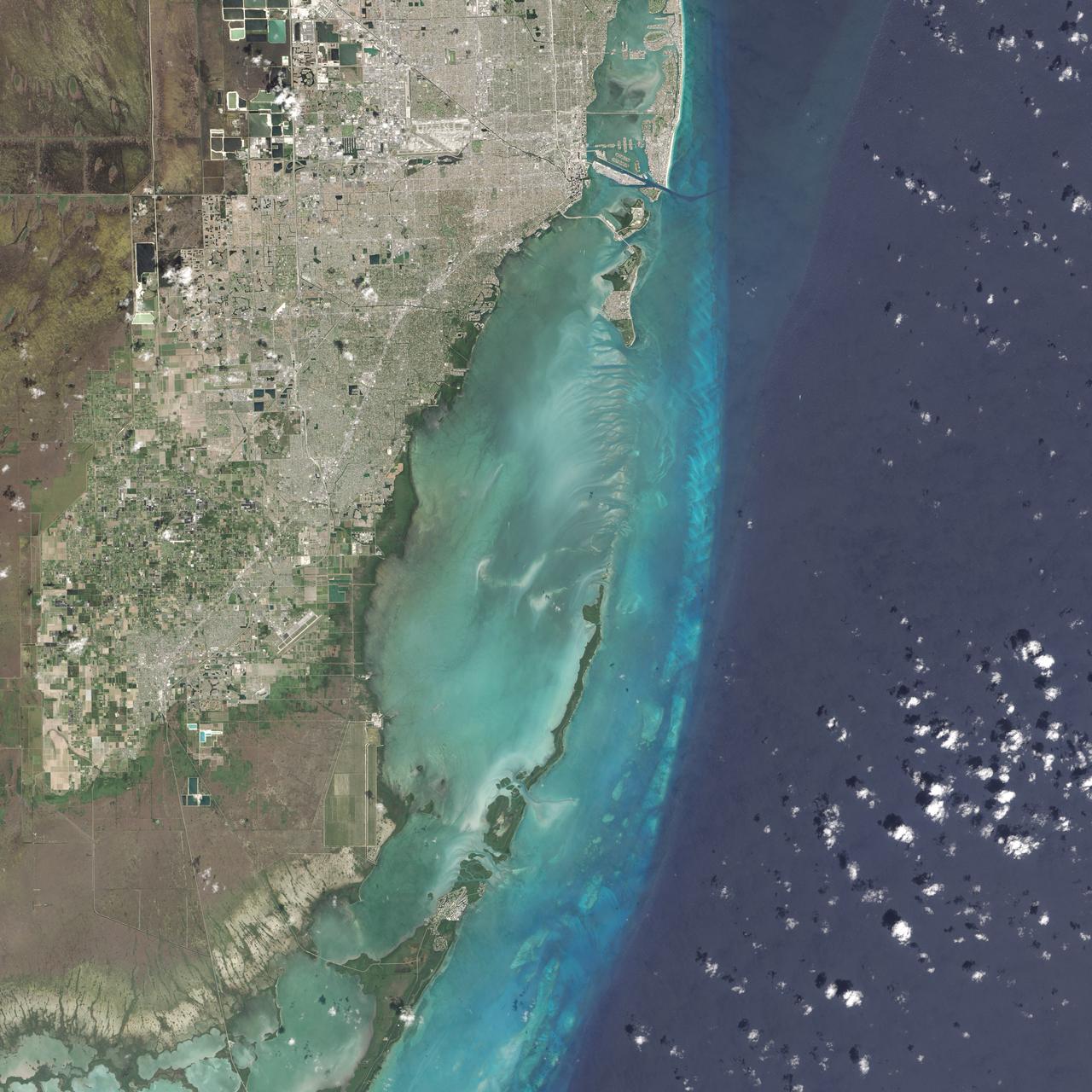
On February 25, 2016, the Operational Land Imager (OLI) on the Landsat 8 satellite acquired this natural-color image of Biscayne National Park. The park encompasses the northernmost Florida Keys, starting from Miami to just north of Key Largo. The keys run like a spine through the center of the park, with Biscayne Bay to the west and the Atlantic Ocean to the east. The water-covered areas span more than 660 square kilometers (250 square miles) of the park, making it the largest marine park in the U.S. National Park System. Biscayne protects the longest stretch of mangrove forest on the U.S. East Coast, and one of the most extensive stretches of coral reef in the world. Read more: <a href="http://go.nasa.gov/1SWs1a3" rel="nofollow">go.nasa.gov/1SWs1a3</a> Credit: NASA/Landsat8 <b><a href="http://www.nasa.gov/audience/formedia/features/MP_Photo_Guidelines.html" rel="nofollow">NASA image use policy.</a></b> <b><a href="http://www.nasa.gov/centers/goddard/home/index.html" rel="nofollow">NASA Goddard Space Flight Center</a></b> enables NASA’s mission through four scientific endeavors: Earth Science, Heliophysics, Solar System Exploration, and Astrophysics. Goddard plays a leading role in NASA’s accomplishments by contributing compelling scientific knowledge to advance the Agency’s mission. <b>Follow us on <a href="http://twitter.com/NASAGoddardPix" rel="nofollow">Twitter</a></b> <b>Like us on <a href="http://www.facebook.com/pages/Greenbelt-MD/NASA-Goddard/395013845897?ref=tsd" rel="nofollow">Facebook</a></b> <b>Find us on <a href="http://instagrid.me/nasagoddard/?vm=grid" rel="nofollow">Instagram</a></b>
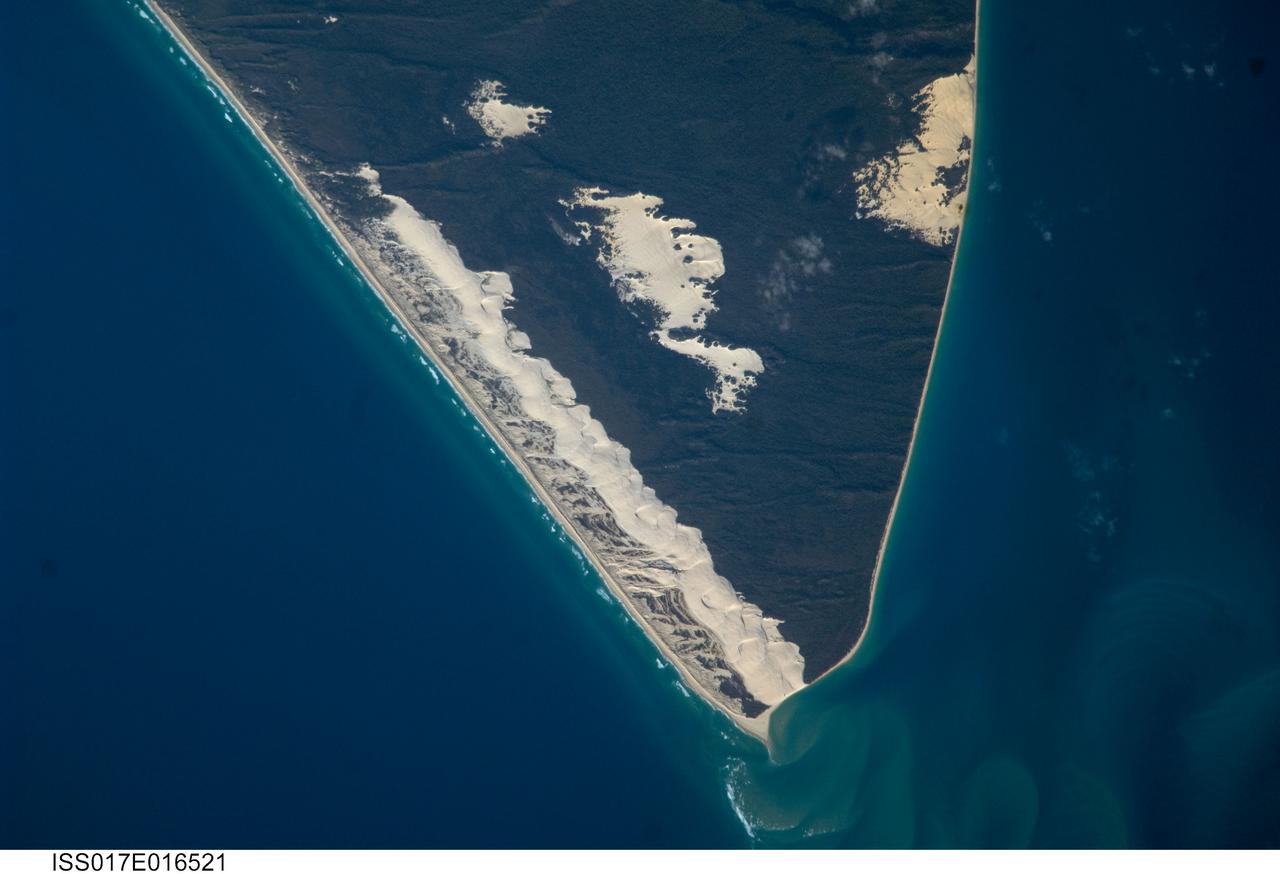
ISS017-E-016521 (15 Sept. 2008) --- Sandy Cape and Fraser Island, Australia are featured in this image photographed by an Expedition 17 crewmember on the International Space Station. Fraser Island, the world's largest sand island, includes Great Sandy National Park and is located along the coastline of Queensland, Australia. The island was designated a World Heritage site in 1992, in part due to its outstanding preservation of geological processes related to sand dune formation. According to scientists, the island's dune fields preserve a record of sand deposition and movement related to sea level rise and fall extending back over 700,000 years. In addition to sand dunes, the island also preserves an interesting range of vegetation -- including vine rainforest, stands of eucalypt trees, and mangroves -- and diverse fauna including crabs, parrots, sugar gliders and flying foxes. This view highlights the northernmost portion of the island, known as Sandy Cape. Active white sand dunes contrast with dark green vegetation that anchors older dune sets. Irregular patches of sand dunes surrounded by vegetation are known as sand blows (or blowouts), formed when the vegetation cover is disturbed -- by wind, fire, or human activities. The exposed underlying sand can then move and form new dunes, sometimes at rates of up to one meter per year. Coastal sand dune fields -- such as the one located along the eastern side of Sandy Cape (center) -- will remain active until anchored by vegetation, or until no more sand is available to form new dunes.
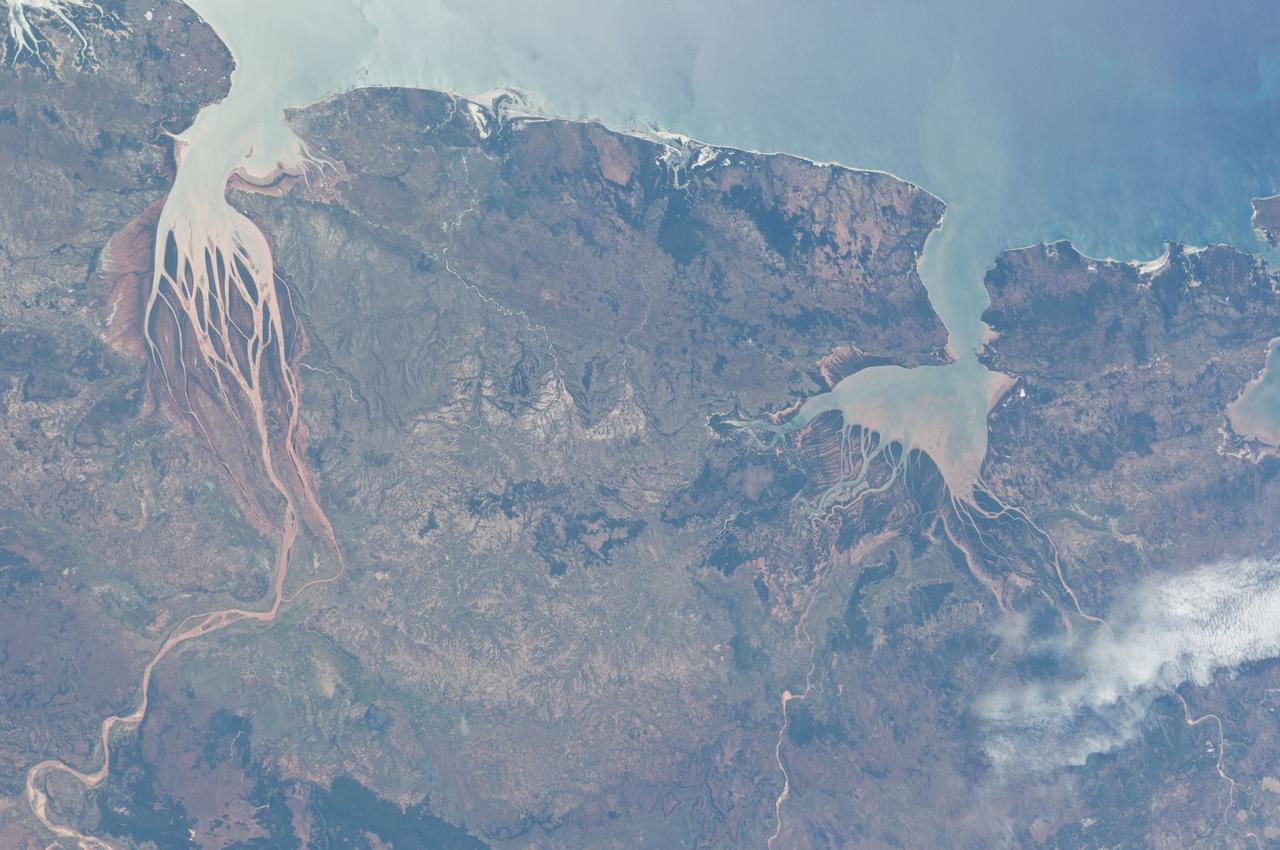
ISS028-E-006687 (2 June 2011) --- Estuaries on the northwestern coast of Madagascar are featured in this image photographed by an Expedition 28 crew member on the International Space Station. Regions where fresh water flowing in rivers and salt water from the seas and oceans mix are called estuaries, and they are among the most biologically productive ecosystems on Earth. This photograph highlights two estuaries located along the northwestern coastline of the island of Madagascar. The Mozambique Channel (top) separates Madagascar from the southeastern coast of Africa. Bombetoka Bay (upper left) is fed by the Betsiboka River and is a frequent subject of astronaut photography due to its striking red floodplain sediments. Mahajamba Bay (right) is fed by several rivers including the Mahajamba and Sofia Rivers; like the Betsiboka, the floodplains of these rivers also contain reddish sediments eroded from their basins upstream. The brackish (mix of fresh and salty water) conditions found in most estuaries host unique plant and animal species adapted to live in such environments. Mangroves in particular are a common plant species found in and around Madagascar estuaries, and Bombetoka Bay contains some of the largest remaining stands. Estuaries also host abundant fish and shellfish species ? many of which need access to freshwater for a portion of their life cycles ? and these in turn support local and migratory bird species that prey on them. However, human activities such as urban development, overfishing, and increased sediment loading from erosion of upriver highlands threaten the ecosystem health of the estuaries. In particular, the silt deposits in Bombetoka Bay at the mouth of the Betsiboka River have been filling in the bay.