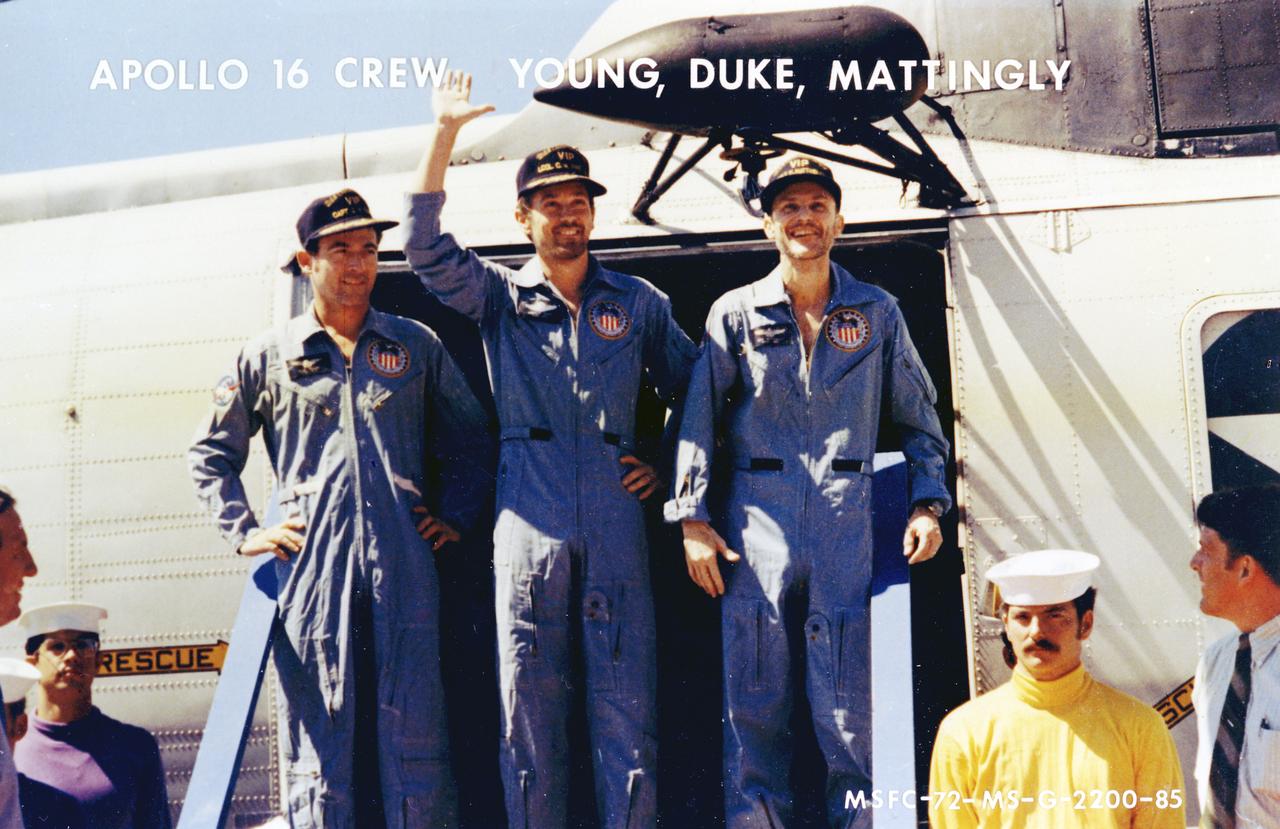
The Apollo 16 Command Module splashed down in the Pacific Ocean on April 27, 1972 after an 11-day moon exploration mission. The 3-man crew is shown here aboard the rescue ship, USS Horton. From left to right are: Mission Commander John W. Young, Lunar Module pilot Charles M. Duke, and Command Module pilot Thomas K. Mattingly II. The sixth manned lunar landing mission, the Apollo 16 (SA-511) lifted off on April 16, 1972. The Apollo 16 mission continued the broad-scale geological, geochemical, and geophysical mapping of the Moon’s crust, begun by the Apollo 15, from lunar orbit. This mission marked the first use of the Moon as an astronomical observatory by using the ultraviolet camera/spectrograph which photographed ultraviolet light emitted by Earth and other celestial objects. The Lunar Roving Vehicle, developed by the Marshall Space Flight Center, was also used.
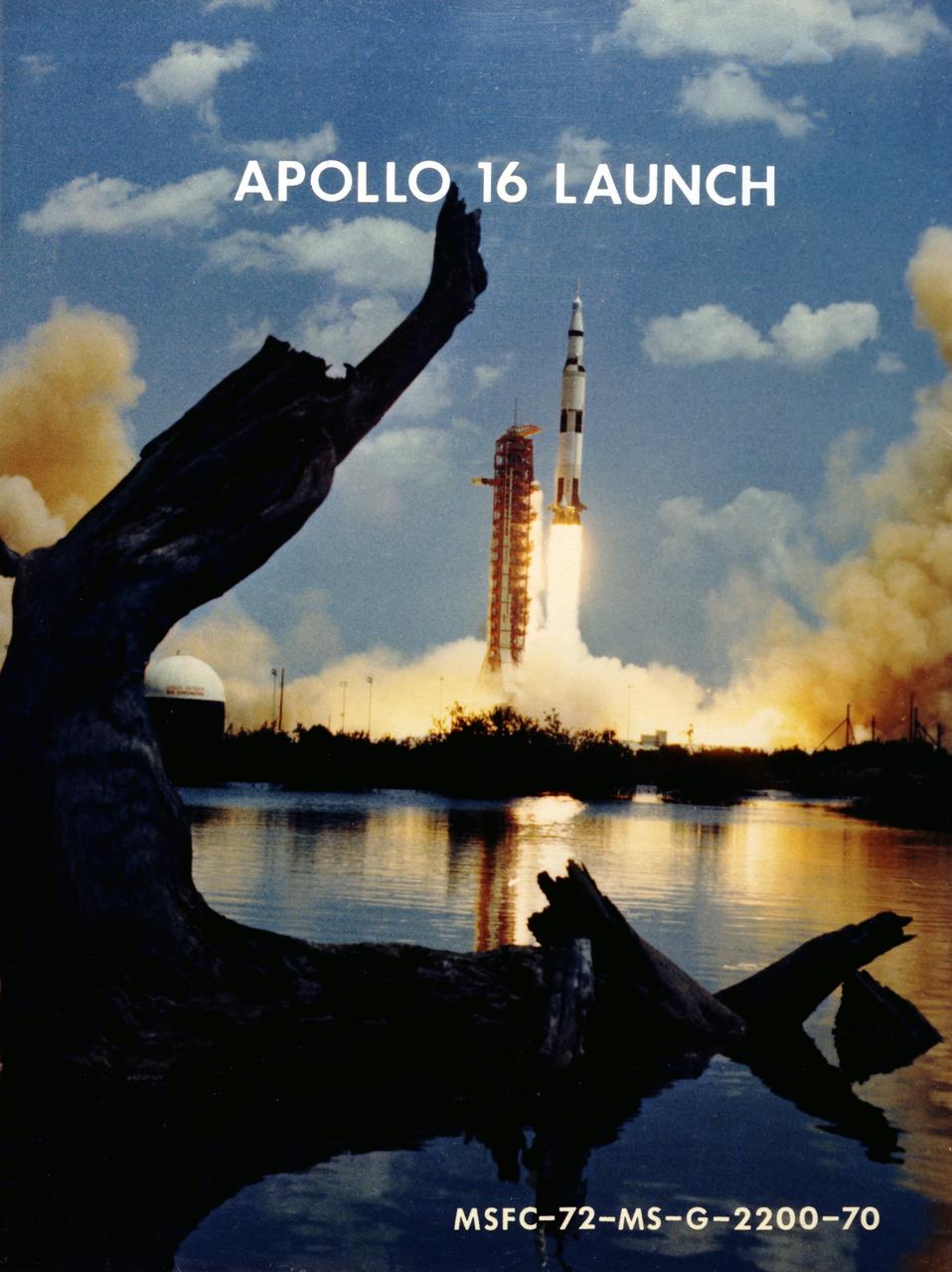
The sixth manned lunar landing mission, the Apollo 16 (SA-511), carrying three astronauts: Mission Commander John W. Young, Command Module pilot Thomas K. Mattingly II, and Lunar Module pilot Charles M. Duke, lifted off on April 16, 1972. The Apollo 16 mission continued the broad-scale geological, geochemical, and geophysical mapping of the Moon’s crust, begun by the Apollo 15, from lunar orbit. This mission marked the first use of the Moon as an astronomical observatory by using the ultraviolet camera/spectrograph which photographed ultraviolet light emitted by Earth and other celestial objects. The Lunar Roving Vehicle, developed by the Marshall Space Flight Center, was also used. The mission ended on April 27, 1972.
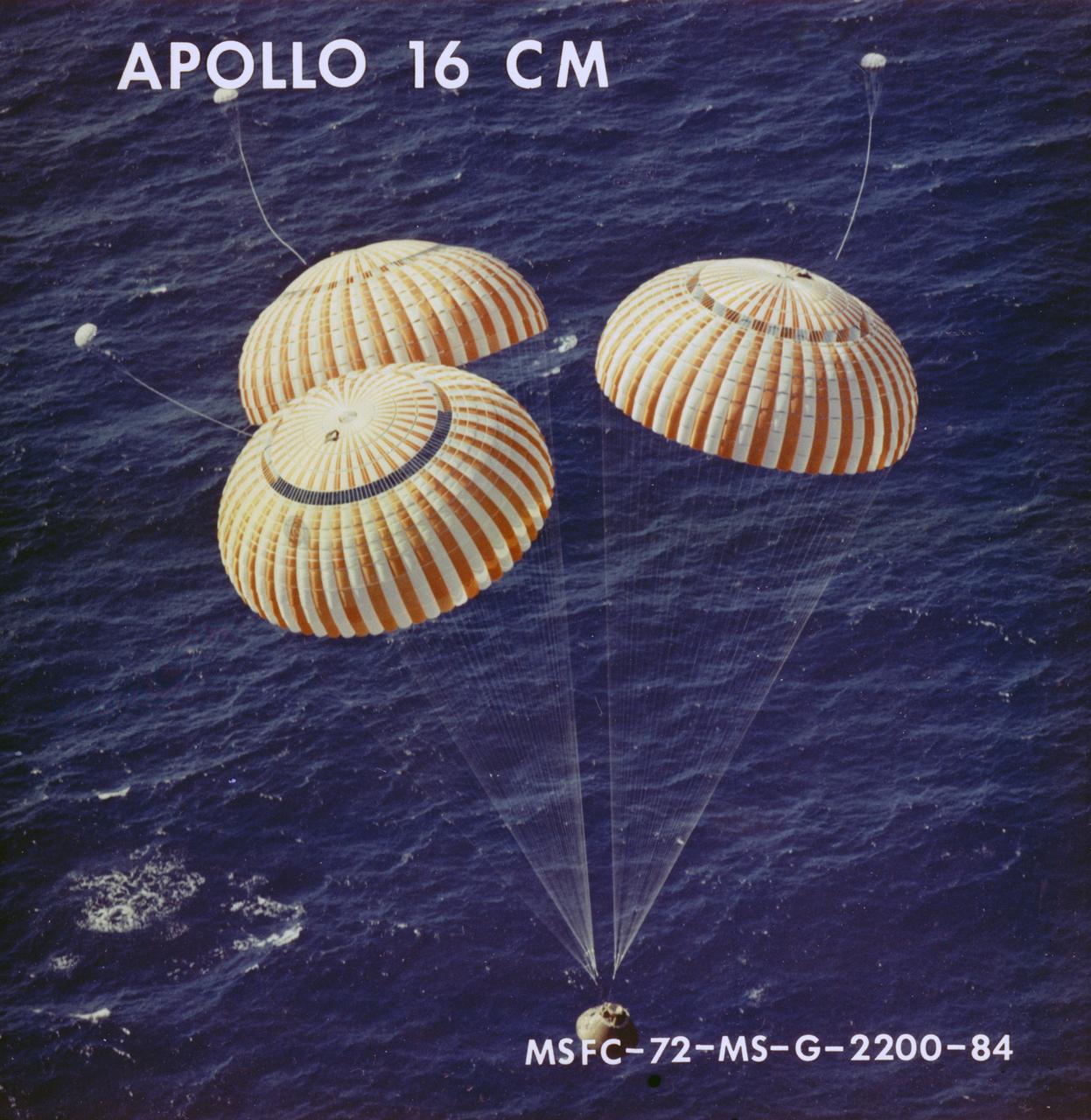
The Apollo 16 Command Module splashed down in the Pacific Ocean on April 27, 1972 after an 11-day moon exploration mission. The sixth manned lunar landing mission, the Apollo 16 (SA-511), carrying three astronauts: Mission Commander John W. Young, Command Module pilot Thomas K. Mattingly II, and Lunar Module pilot Charles M. Duke, lifted off on April 16, 1972. The Apollo 16 continued the broad-scale geological, geochemical, and geophysical mapping of the Moon’s crust, begun by the Apollo 15, from lunar orbit. This mission marked the first use of the Moon as an astronomical observatory by using the ultraviolet camera/spectrograph which photographed ultraviolet light emitted by Earth and other celestial objects. The Lunar Roving Vehicle, developed by the Marshall Space Flight Center, was also used.
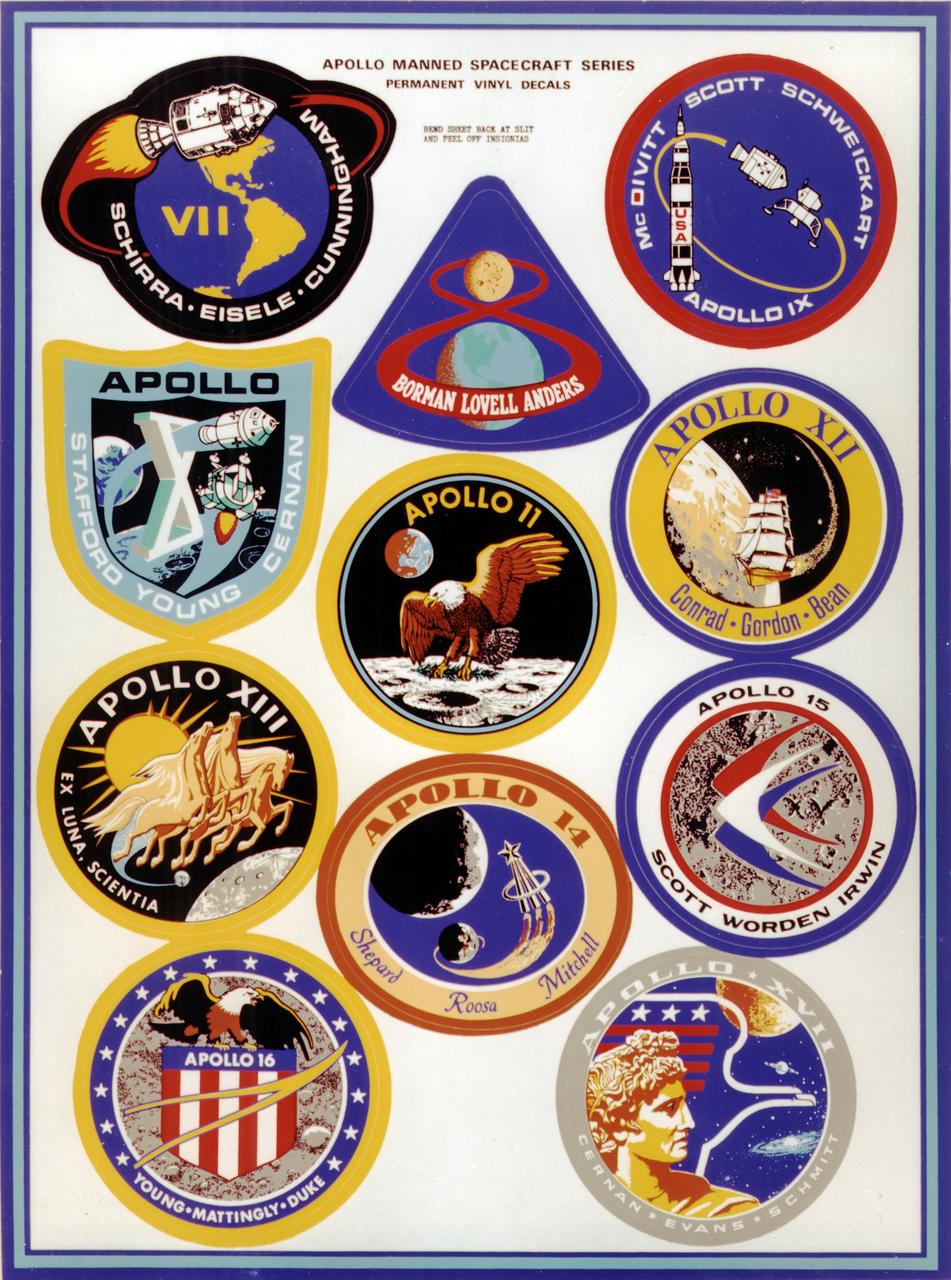
This montage depicts the flight crew patches for the manned Apollo 7 thru Apollo 17 missions. The Apollo 7 through 10 missions were basically manned test flights that paved the way for lunar landing missions. Primary objectives met included the demonstration of the Command Service Module (CSM) crew performance; crew/space vehicle/mission support facilities performance and testing during a manned CSM mission; CSM rendezvous capability; translunar injection demonstration; the first manned Apollo docking, the first Apollo Extra Vehicular Activity (EVA), performance of the first manned flight of the lunar module (LM); the CSM-LM docking in translunar trajectory, LM undocking in lunar orbit, LM staging in lunar orbit, and manned LM-CSM docking in lunar orbit. Apollo 11 through 17 were lunar landing missions with the exception of Apollo 13 which was forced to circle the moon without landing due to an onboard explosion. The craft was,however, able to return to Earth safely. Apollo 11 was the first manned lunar landing mission and performed the first lunar surface EVA. Landing site was the Sea of Tranquility. A message for mankind was delivered, the U.S. flag was planted, experiments were set up and 47 pounds of lunar surface material was collected for analysis back on Earth. Apollo 12, the 2nd manned lunar landing mission landed in the Ocean of Storms and retrieved parts of the unmanned Surveyor 3, which had landed on the Moon in April 1967. The Apollo Lunar Surface Experiments Package (ALSEP) was deployed, and 75 pounds of lunar material was gathered. Apollo 14, the 3rd lunar landing mission landed in Fra Mauro. ALSEP and other instruments were deployed, and 94 pounds of lunar materials were gathered, using a hand cart for first time to transport rocks. Apollo 15, the 4th lunar landing mission landed in the Hadley-Apennine region. With the first use of the Lunar Roving Vehicle (LRV), the crew was bale to gather 169 pounds of lunar material. Apollo 16, the 5th lunar landing mission, landed in the Descartes Highlands for the first study of highlands area. Selected surface experiments were deployed, the ultraviolet camera/spectrograph was used for first time on the Moon, and the LRV was used for second time for a collection of 213 pounds of lunar material. The Apollo program came to a close with Apollo 17, the 6th and final manned lunar landing mission that landed in the Taurus-Littrow highlands and valley area. This mission hosted the first scientist-astronaut, Schmitt, to land on the Moon. The 6th automated research station was set up, and 243 ponds of lunar material was gathered using the LRV.
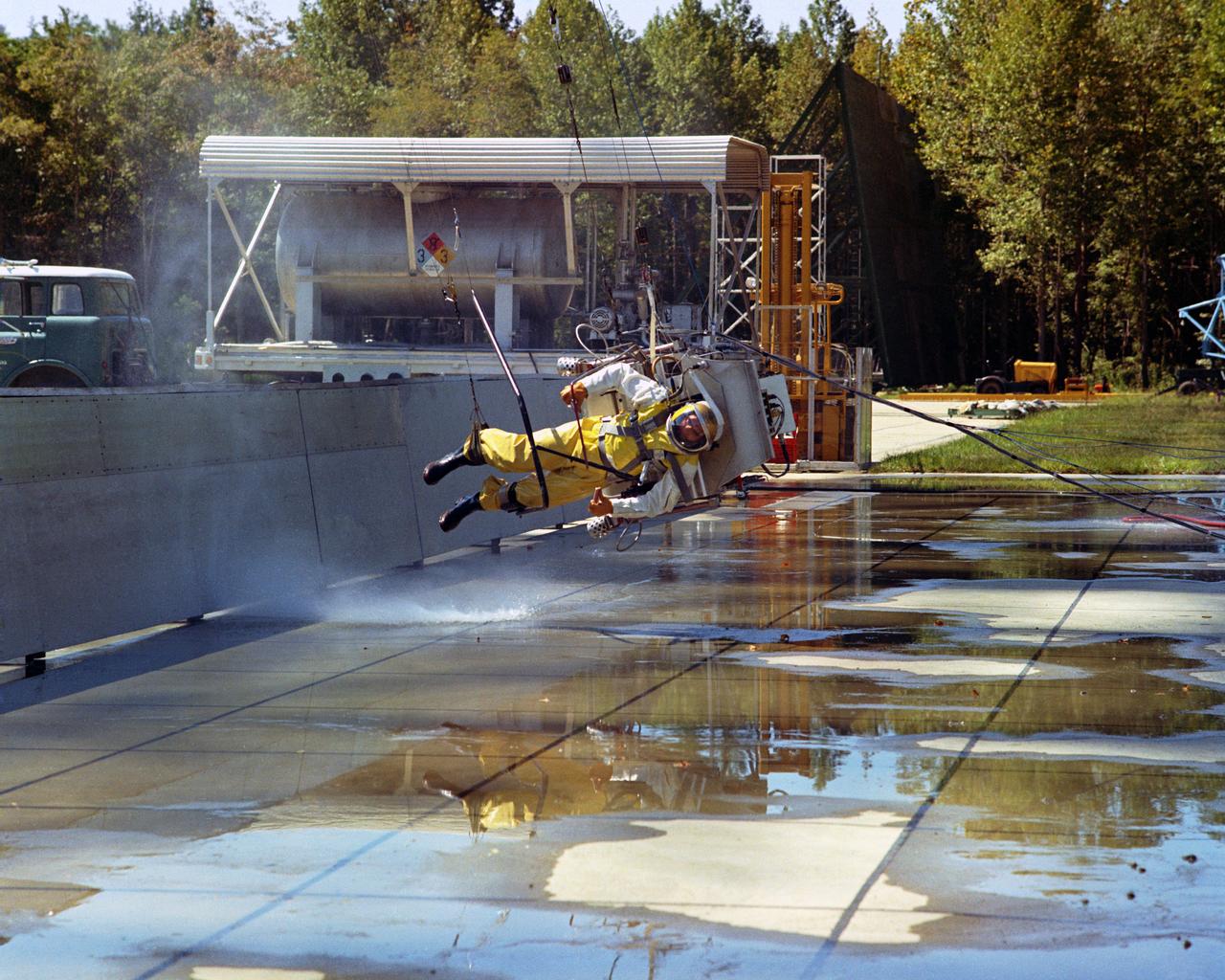
Icarus Lunar Walker,Lunar Landing Research Facility. Langley study of the backpack propulsion unit, by Bell Aerosystems. Icarus full scale test at Lunar Landing Research Facility - low gravity simulator. A NASA Langley researcher moon walks under the Lunar Landing Research Facility's gantry. More information on this can be read in the Document. "STUDIES OF PILOTING PROBLEMS OF ONE-MAN FLYING UNITS OPERATED IN SIMULATED LUNAR GRAVITY" BY Donald E. Hewes
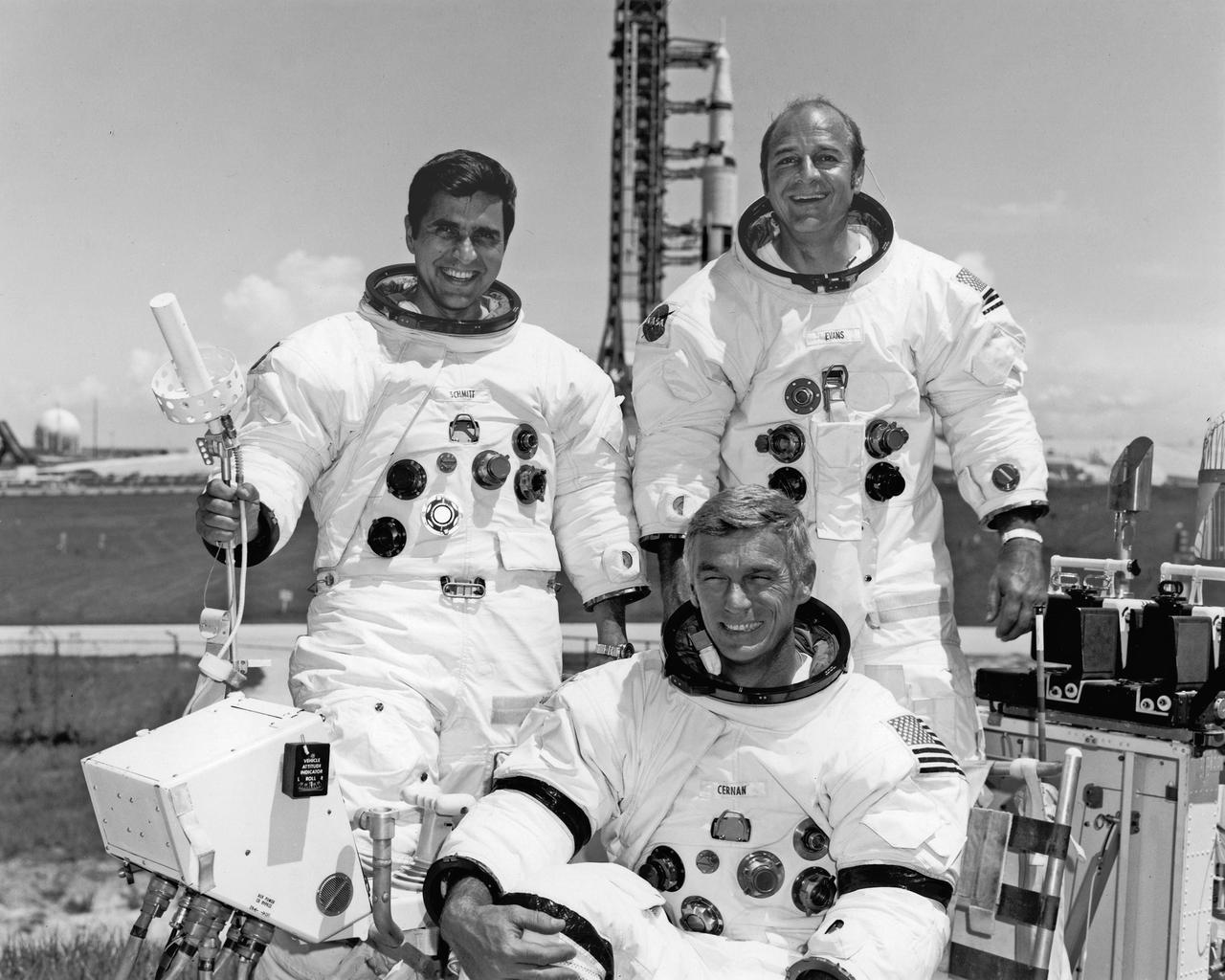
CAPE CANAVERAL, Fla. -- The Apollo 17 crew took time out from training to pose for the press after the Space Vehicle for their Manned Lunar Landing Mission was moved to Pad A, Complex 39 today. Apollo 17 Commander Eugene A Cernan sits at the controls of the One-G Lunar Roving Vehicle Simulator used to simulate operations on the Moon’s surface. With Cernan are Lunar Module Pilot Dr. Harrison H. “Jack” Schmitt, left and Command Module Plot Ronald A. Evans. The Apollo 17 Space Vehicle, scheduled for launch from KSC on the sixth U.S. Manned Lunar Landing Mission on December 6, 1972 is in the background. Photo credit: NASA
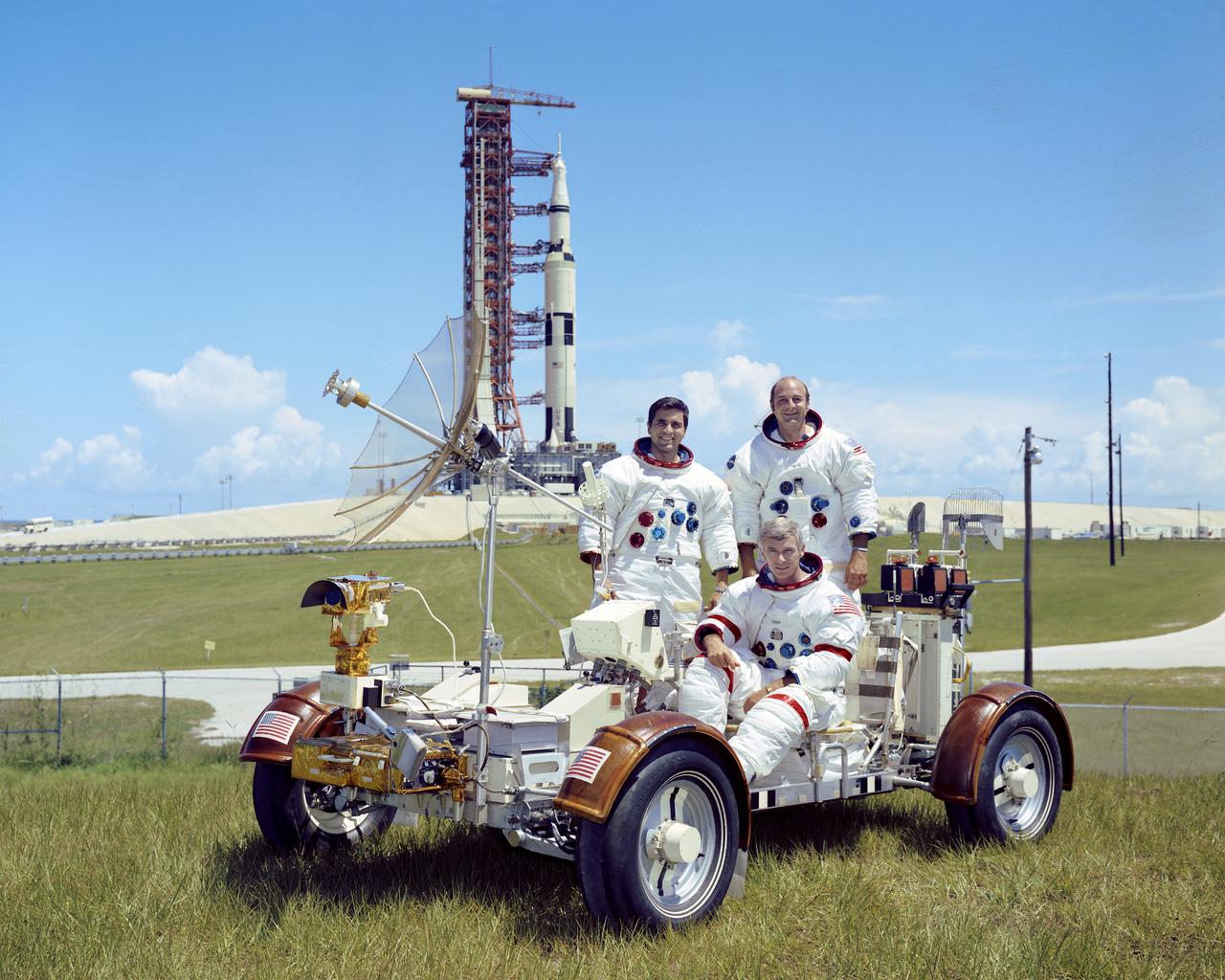
CAPE CANAVERAL, Fla. -- The Apollo 17 crew took time out from training to pose for the press after the Space Vehicle for their Manned Lunar Landing Mission was moved to Pad A, Complex 39 today. Apollo 17 Commander Eugene A Cernan sits at the controls of the One-G Lunar Roving Vehicle Simulator used to simulate operations on the Moon’s surface. With Cernan are Lunar Module Pilot Dr. Harrison H. “Jack” Schmitt, left and Command Module Plot Ronald A. Evans. The Apollo 17 Space Vehicle, scheduled for launch from KSC on the sixth U.S. Manned Lunar Landing Mission on December 6, 1972 is in the background. Photo credit: NASA
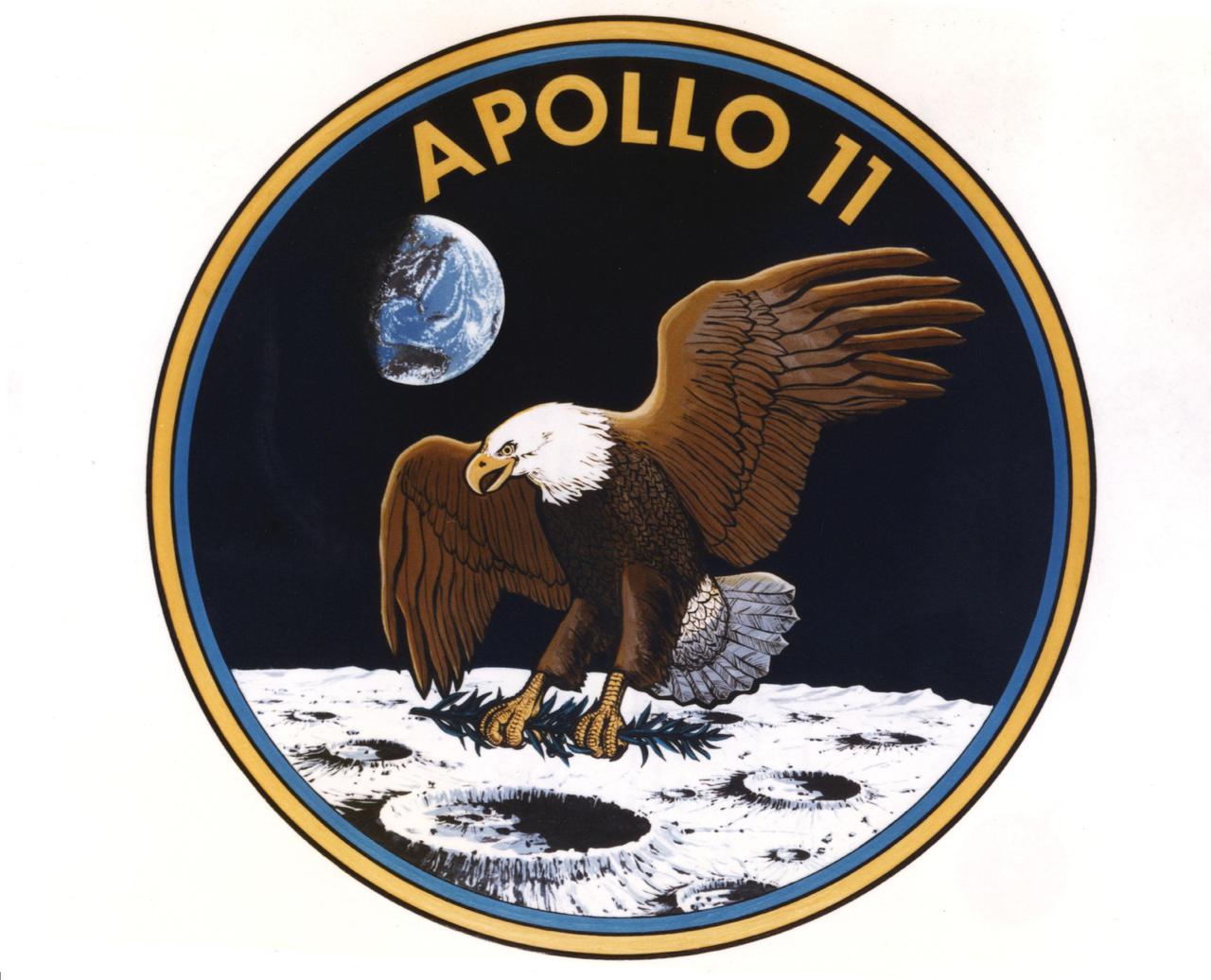
JOHNSON SPACE CENTER, HOUSTON, TEXAS - The official Apollo 11 mission patch. Apollo 11 is the first manned lunar landing by the Apollo_Saturn V.
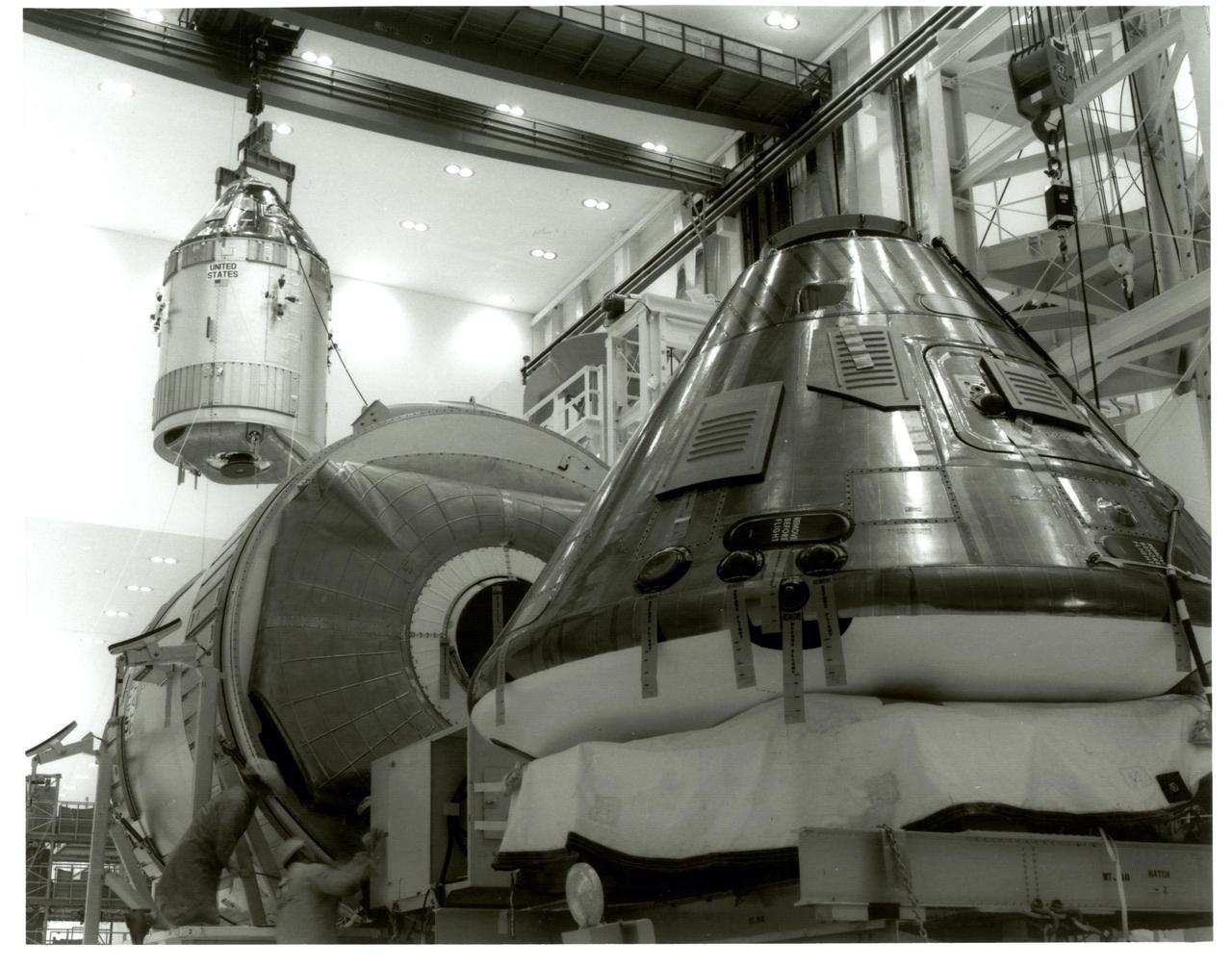
KENNEDY SPACE CENTER, FLA. - The Command Module 107 and Service Module, which are going to be used for the Apollo 11 mission, are moved from Chamber "L" to the work stand in preparation for the first manned lunar landing. Also shown in the background is the Command Module 108, which is going to be used for the Apollo 12 lunar landing mission.
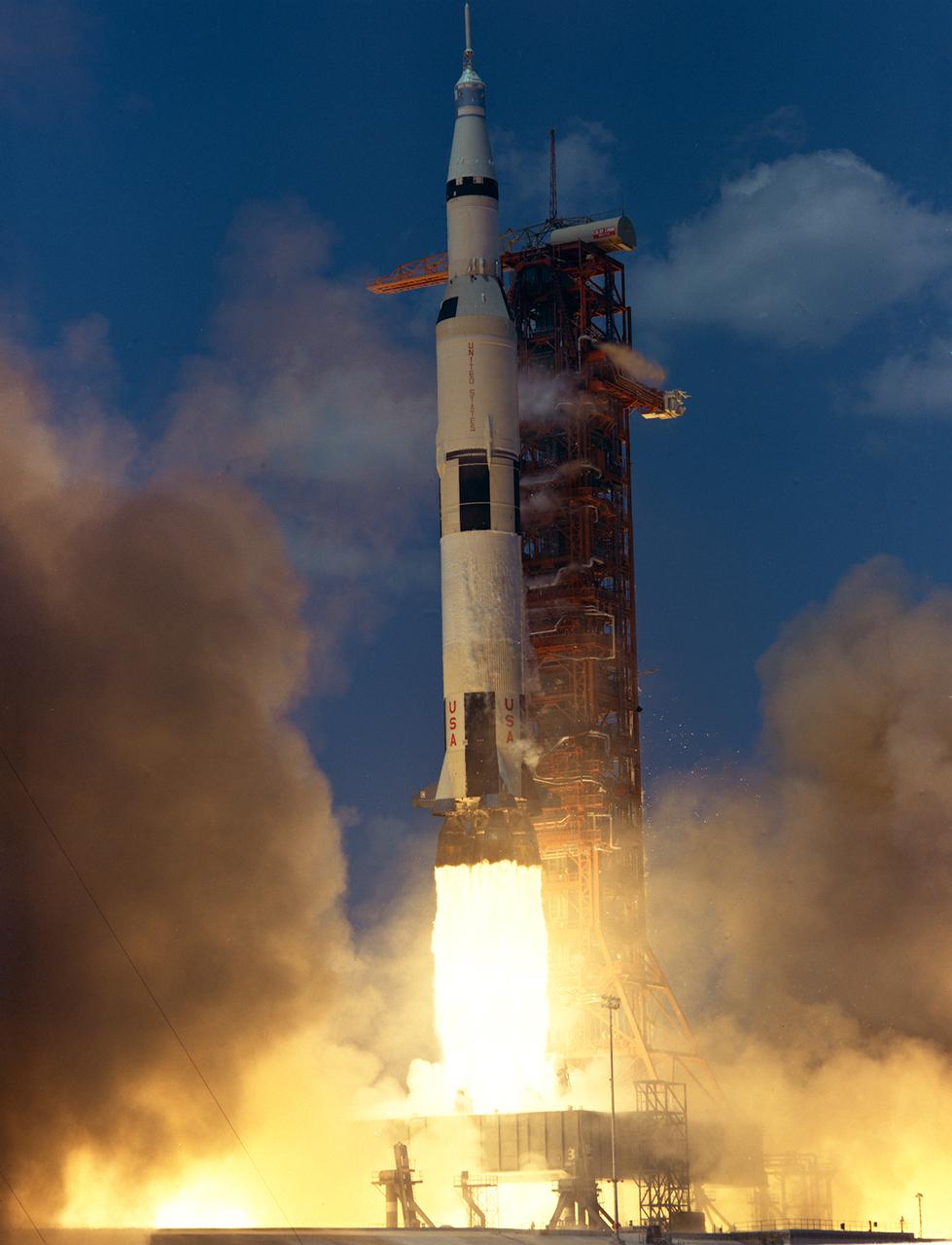
The sixth marned lunar landing mission, the Apollo 16 (SA-511), carrying three astronauts: Mission commander John W. Young, Command Module pilot Thomas K. Mattingly II, and Lunar Module pilot Charles M. Duke, lifted off on April 16, 1972. The Apollo 16 continued the broad-scale geological, geochemical, and geophysical mapping of the Moon's crust, begun by the Apollo 15, from lunar orbit. This mission marked the first use of the Moon as an astronomical observatory by using the ultraviolet camera/spectrograph. It photographed ultraviolet light emitted by Earth and other celestial objects. The Lunar Roving Vehicle was also used. The mission ended on April 27, 1972.
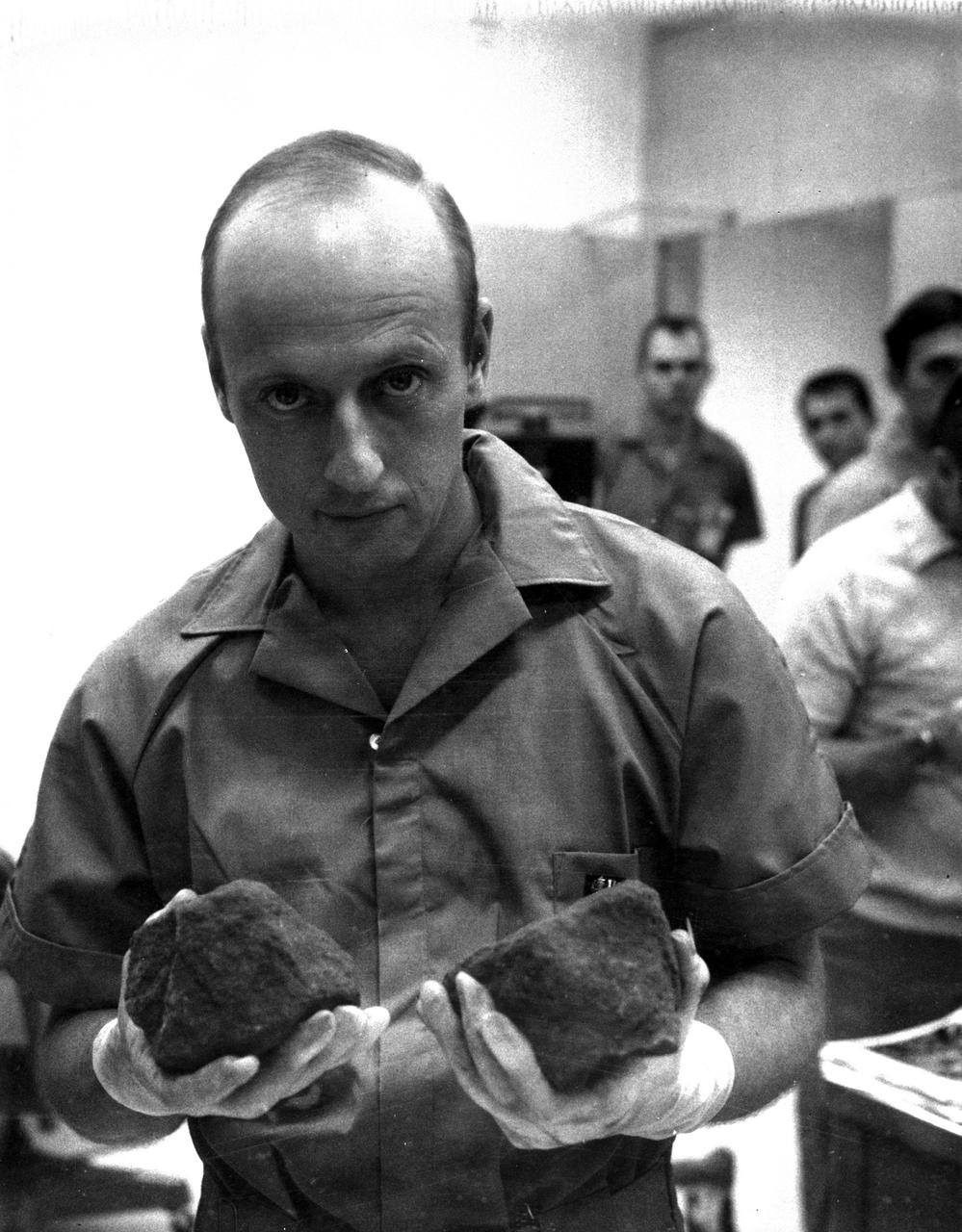
S69-60424 (29 Nov. 1969) --- Astronaut Charles Conrad Jr., commander of the Apollo 12 lunar landing mission, holds two lunar rocks which were among the samples brought back from the moon by the Apollo 12 astronauts. The samples are under scientific examination in the Manned Spacecraft Center's Lunar Receiving Laboratory.
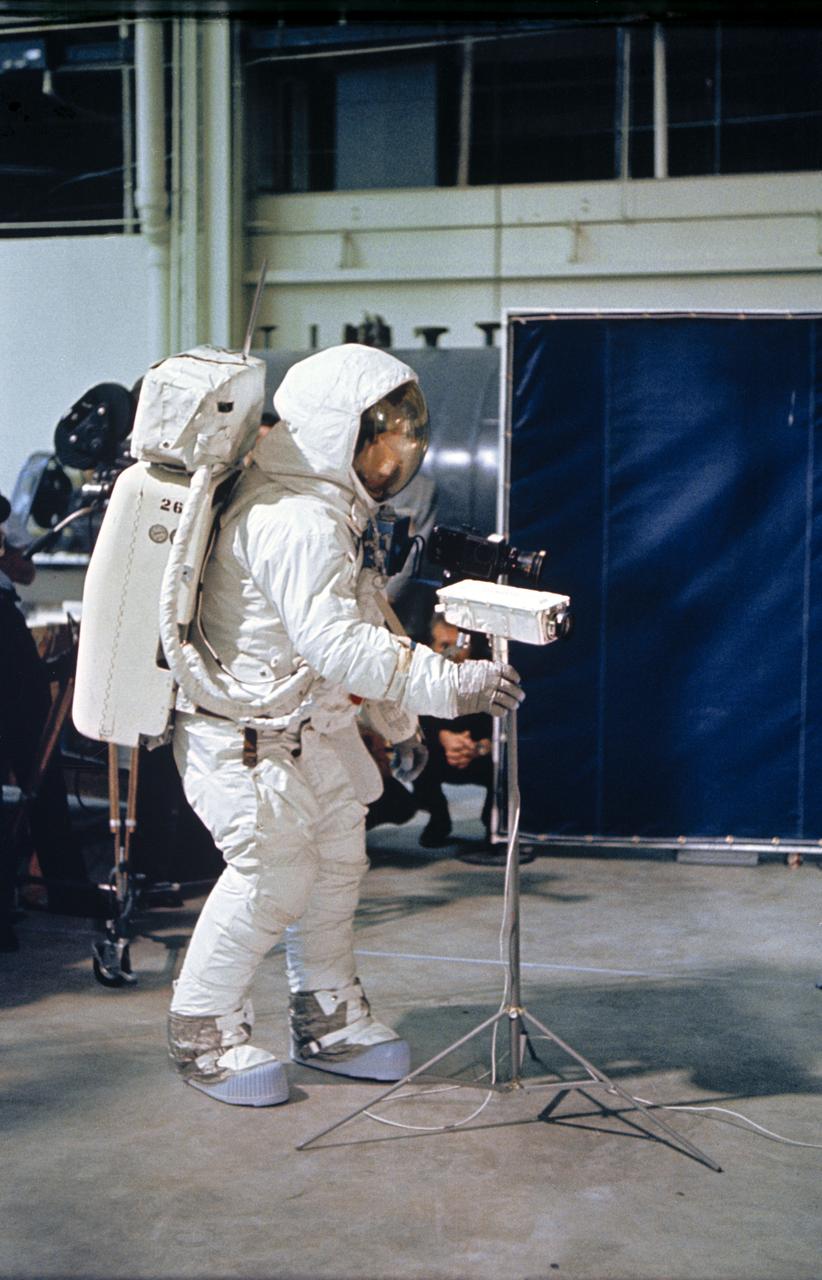
S69-33923 (April 1969) --- Astronaut Neil A. Armstrong, wearing an Extravehicular Mobility Unit (EMU), deploys a lunar surface television camera during lunar surface simulation training in Building 9, Manned Spacecraft Center (MSC). Armstrong is the prime crew commander of the Apollo 11 lunar landing mission.
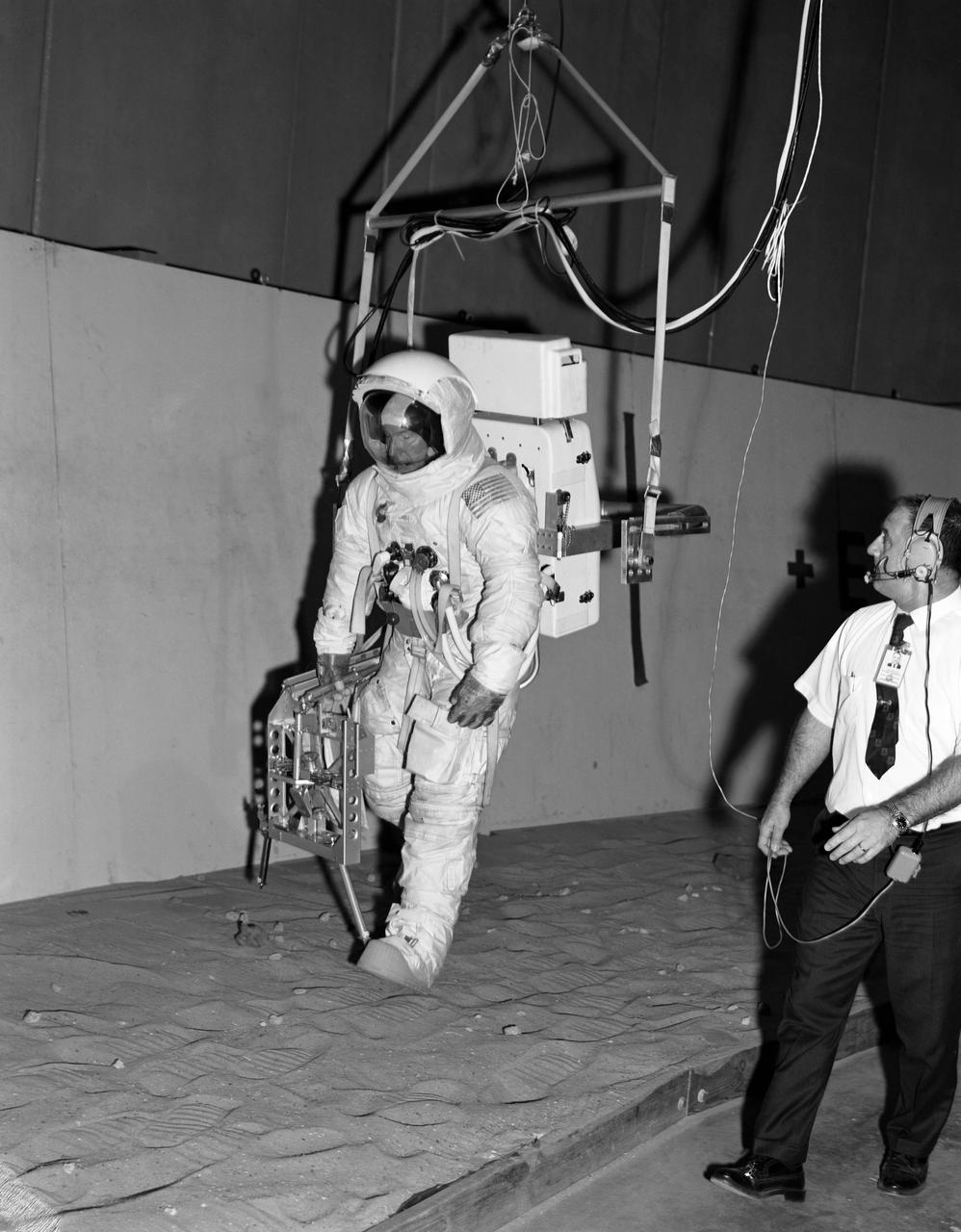
S70-28229 (16 Jan. 1970) --- Astronaut James A. Lovell Jr., commander of the Apollo 13 lunar landing mission, participates in lunar surface simulation training at the Manned Spacecraft Center. Lovell is attached to a Six Degrees of Freedom Simulator. He is carrying an Apollo Lunar Hand Tools carrier in his right hand.
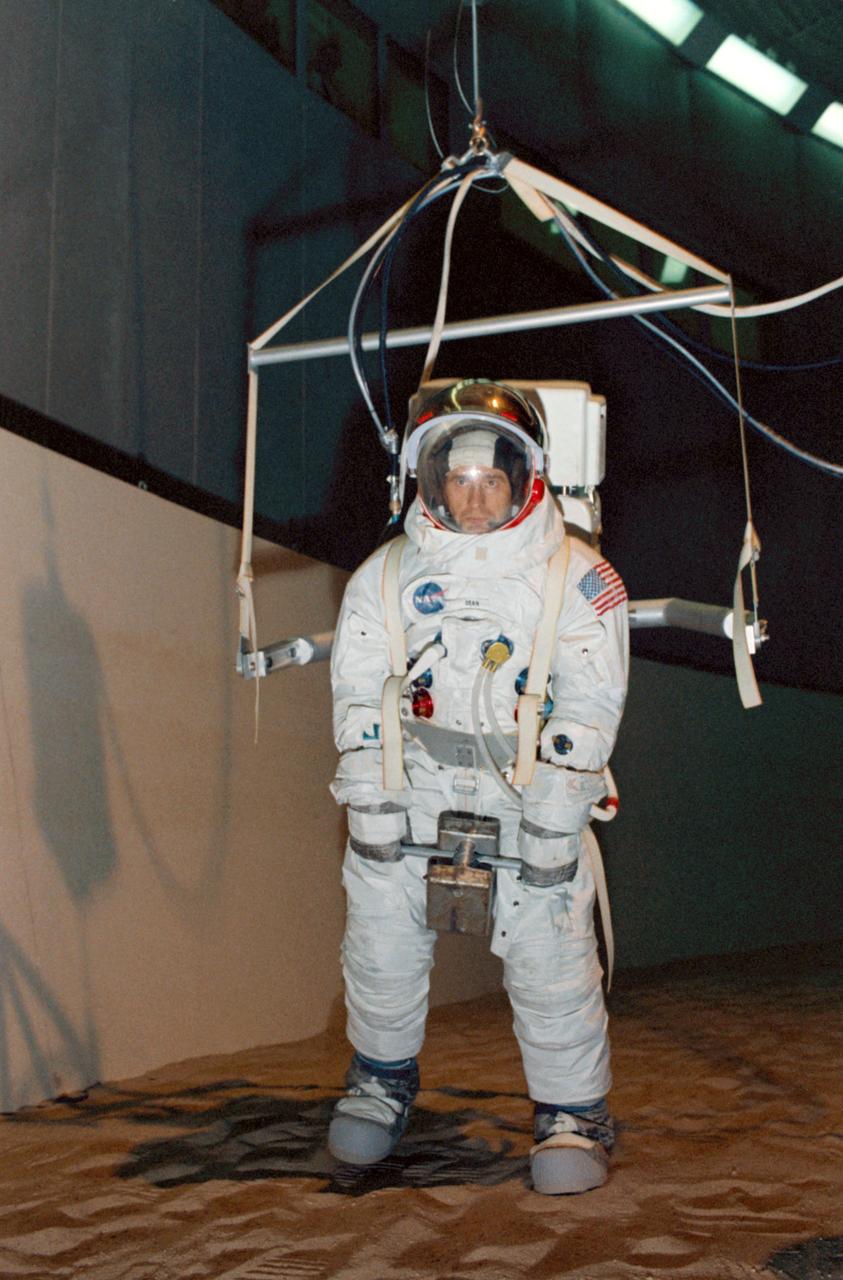
S69-56059 (24 Oct. 1969) --- Astronaut Alan L. Bean, lunar module pilot of the Apollo 12 lunar landing mission, participates in lunar surface simulation training in Building 29 at the Manned Spacecraft Center (MSC). Bean is strapped to a one-sixth gravity simulator.
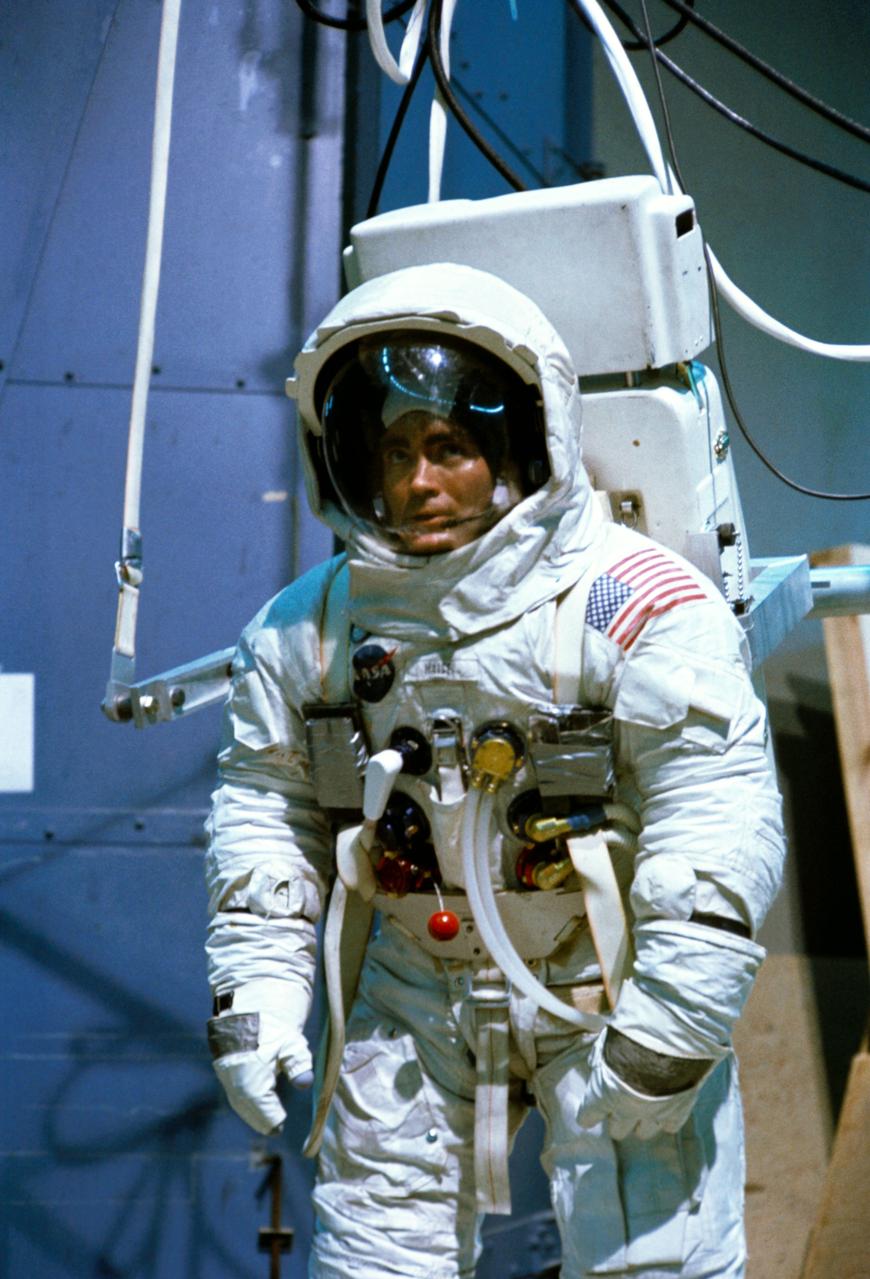
S70-24012 (19 Jan. 1970) --- Astronaut Fred W. Haise Jr., lunar module pilot of the Apollo 13 lunar landing mission, participates in lunar surface simulation training at the Manned Spacecraft Center (MSC). Haise is attached to a Six Degrees of Freedom Simulator.
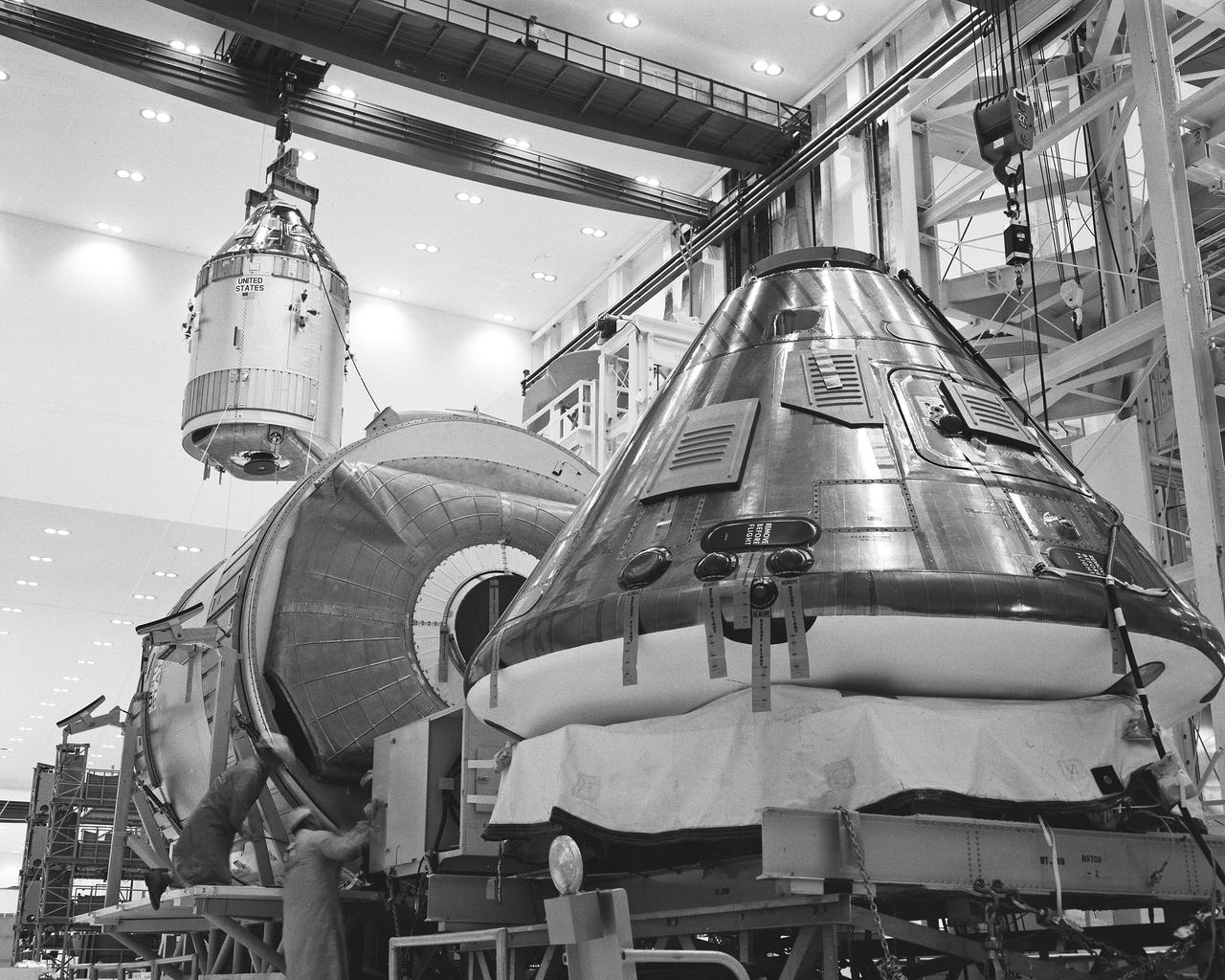
CAPE CANAVERAL, Fla. – Apollo command and service modules scheduled for manned landing missions on the moon cross paths in the Manned Spacecraft Operations Building at the spaceport. The meeting occurred last night when the CSM for Apollo 11 was being hoisted out of a test chamber and the CSM for Apollo 12, which recently arrived at Kennedy Space Center, was getting its initial checkouts in the aisle. Apollo 11 is scheduled for the first manned lunar landing mission this summer. Photo credit: NASA
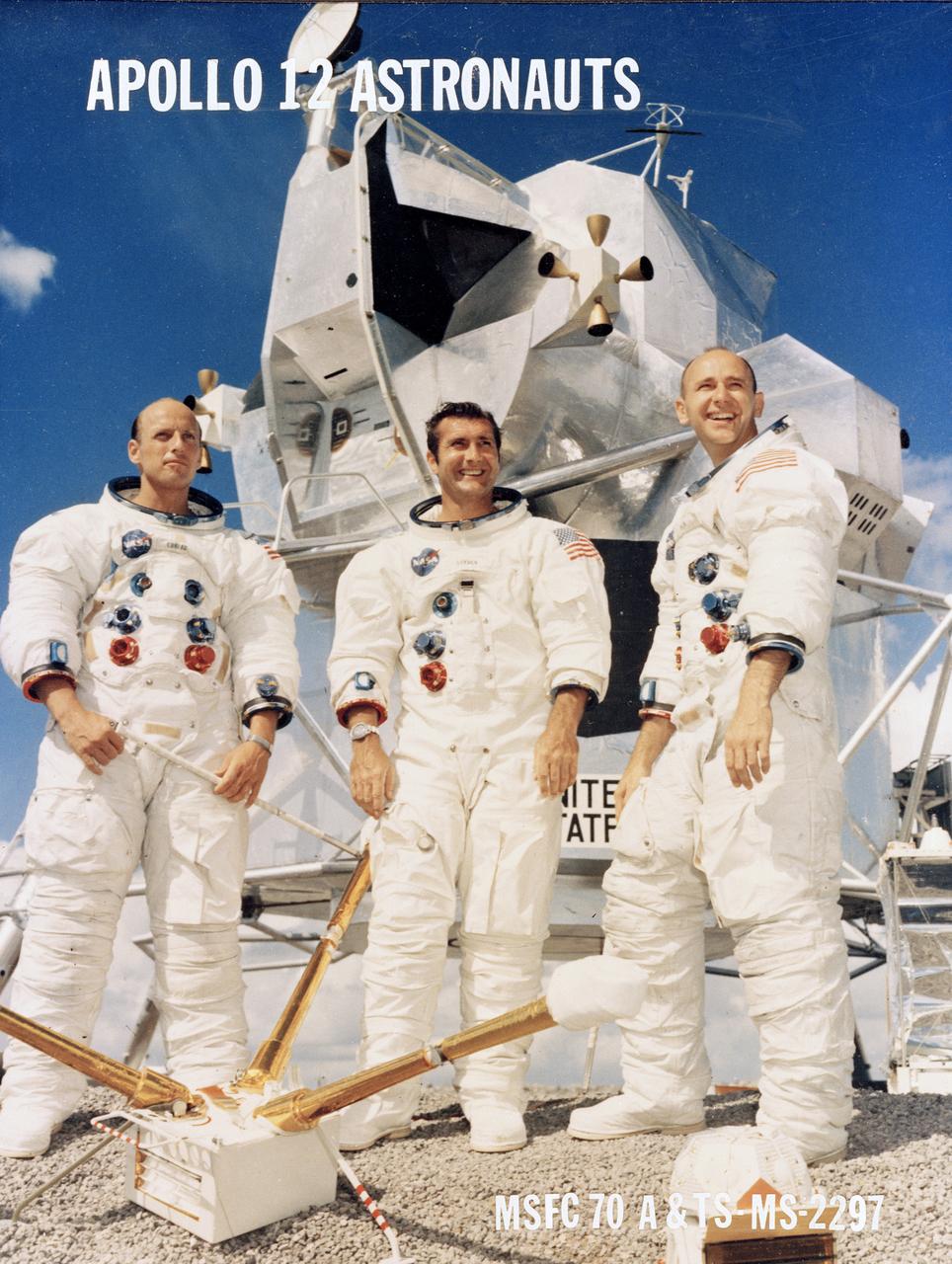
The Apollo 12 three-man crew pictured left to right are: Astronauts Charles Conrad, Spacecraft Commander; Richard F. Gordon, pilot of the Command Module `Yankee Clipper'; and Alan L. Bean, pilot of the Lunar Module `Intrepid'. Activities of astronauts Conrad and Bean on the lunar soil included setting out experiments, finding the unmarned Surveyor 3 that landed on the Moon on April 19, 1967, and collecting 75 pounds (34 kilograms) of rock samples. The second mission of the manned lunar landing and return to Earth, Apollo 12 lifted off on November 14, 1969.
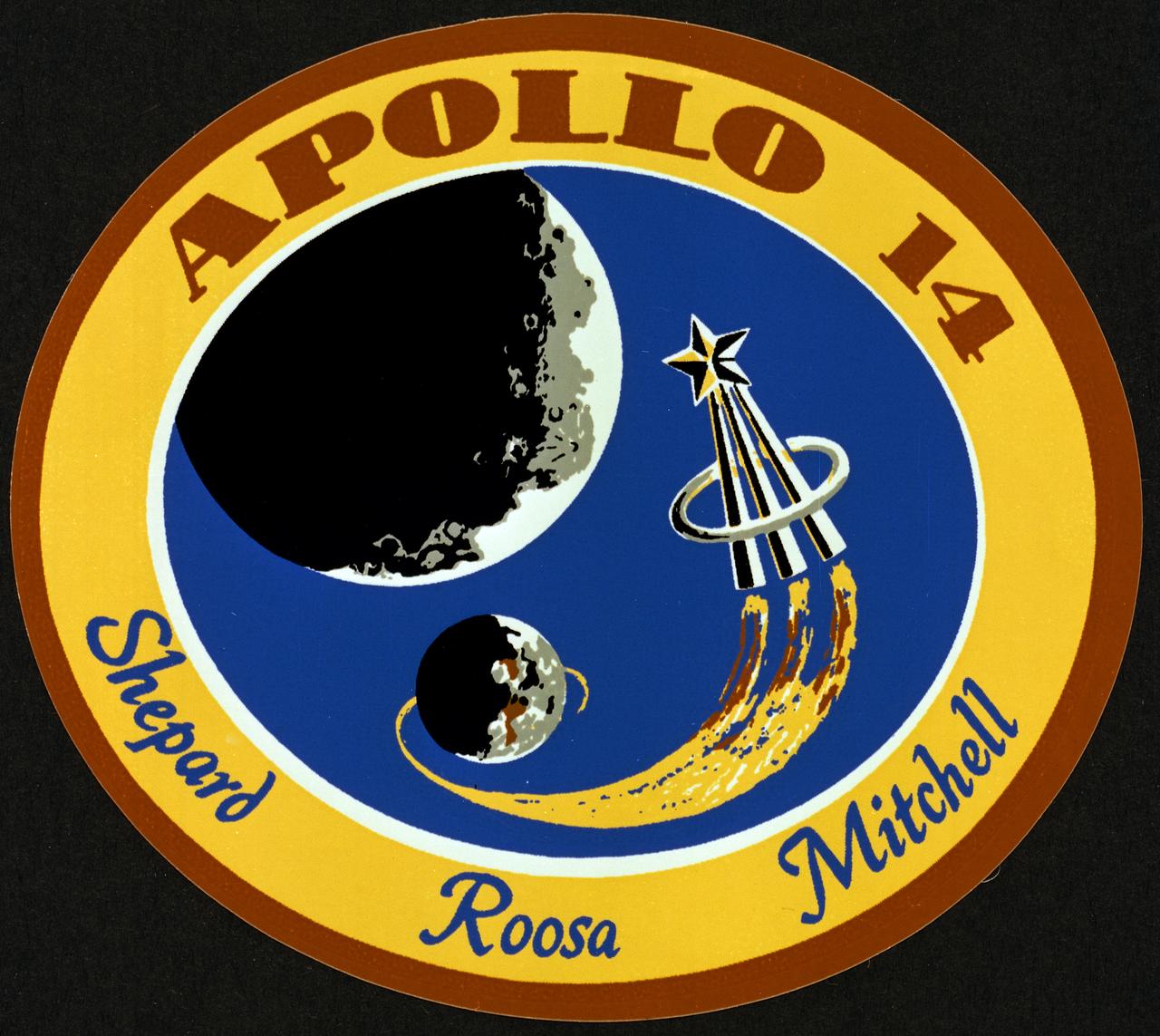
This is the Apollo 14 mission insignia or logo. The Apollo 14, carrying a crew of three astronauts: Stuart A. Roosa, Command Module pilot; Alan B. Shepard, Jr., mission commander; and Edgar D. Mitchell, Lunar Module pilot, lifted off from launch complex 39A at KSC on January 31, 1971. It was the third manned lunar landing, the first manned landing in exploration of the lunar highlands, and it demonstrated pinpoint landing capability. The major goal of Apollo 14 was the scientific exploration of the Moon in the foothills of the rugged Fra Mauro region. The lunar surface extravehicular activity (EVA) of astronauts Shepard and Mitchell included setting up an automated scientific laboratory called Apollo Lunar Scientific Experiments Package (ALSEP), and collecting a total of about 95 pounds (43 kilograms) of Moon rock and soil for a geological investigation back on the Earth. Apollo 14 safely returned to Earth on February 9, 1971.

Stuart A. Roosa, Apollo 14 Command Module pilot, undergoes a final space suit check prior to liftoff. The Apollo 14, carrying a crew of three astronauts: Roosa; Alan B. Shepard, Jr., Mission Commander; and Edgar D. Mitchell, Lunar Module pilot, lifted off from launch complex 39A at KSC on January 31, 1971. It was the third manned lunar landing, the first manned landing in exploration of the lunar highlands, and it demonstrated pinpoint landing capability. The major goal of Apollo 14 was the scientific exploration of the Moon in the foothills of the rugged Fra Mauro region. The lunar surface extravehicular activity (EVA) of astronauts Shepard and Mitchell included setting up an automated scientific laboratory called Apollo Lunar Scientific Experiments Package (ALSEP), and collecting a total of about 95 pounds (43 kilograms) of Moon rock and soil for a geological investigation back on the Earth. Apollo 14 safely returned to Earth on February 9, 1971.
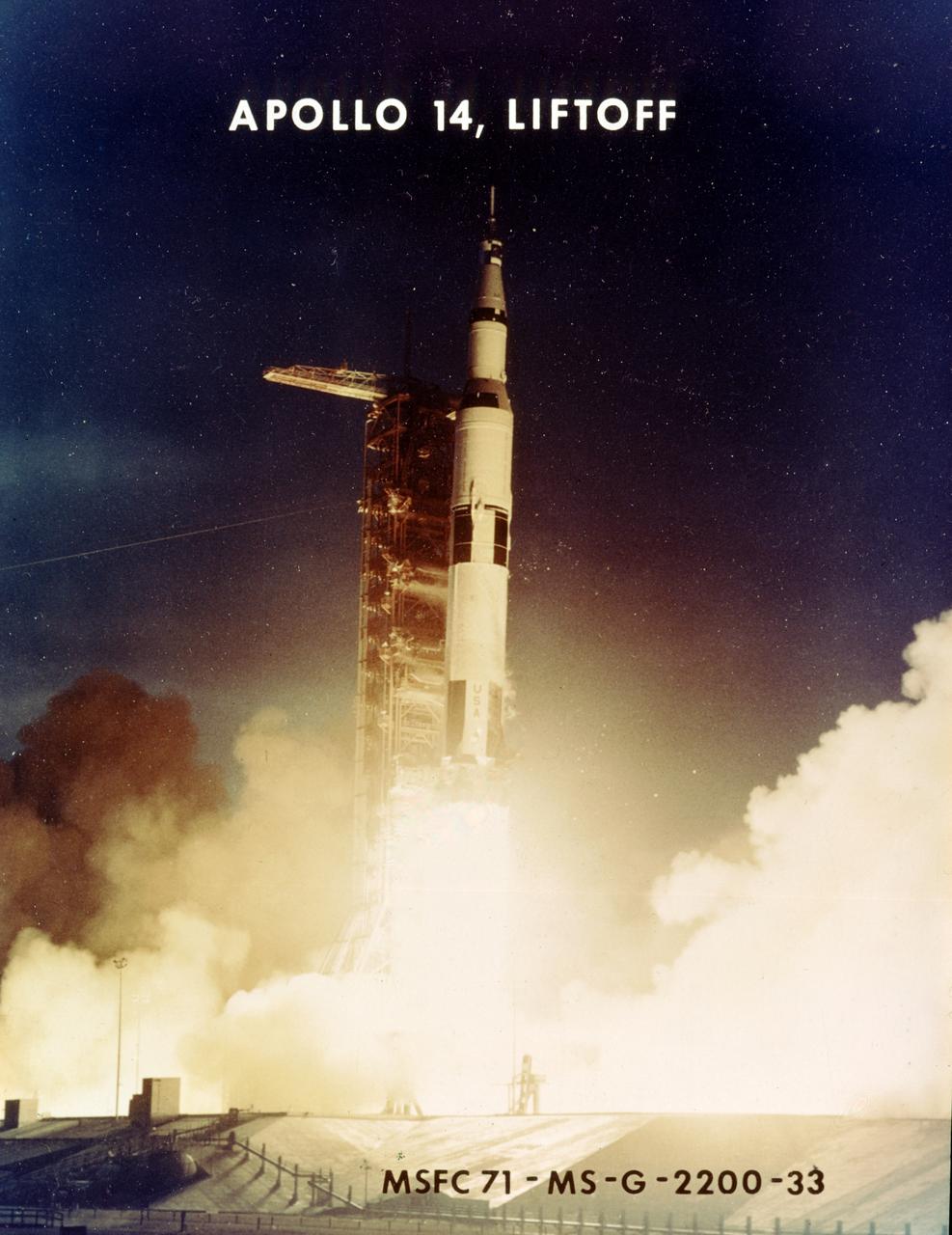
The moon bound Apollo 14, carrying a crew of three astronauts: Mission commander Alan B. Shepard Jr., Command Module pilot Stuart A. Roosa, and Lunar Module pilot Edgar D. Mitchell, lifted off from launch complex 39A at the Kennedy Space Center on January 31, 1971. It was the third manned lunar landing, the first manned landing in exploration of the lunar highlands, and it demonstrated pinpoint landing capability. The major goal of Apollo 14 was the scientific exploration of the Moon in the foothills of the rugged Fra Mauro region. The lunar surface extravehicular activity (EVA) of astronauts Shepard and Mitchell included setting up an automated scientific laboratory called Apollo Lunar Scientific Experiments Package (ALSEP), and collecting a total of about 95 pounds (43 kilograms) of Moon rock and soil for a geological investigation back on the Earth. The mission safely returned to Earth on February 9, 1971.
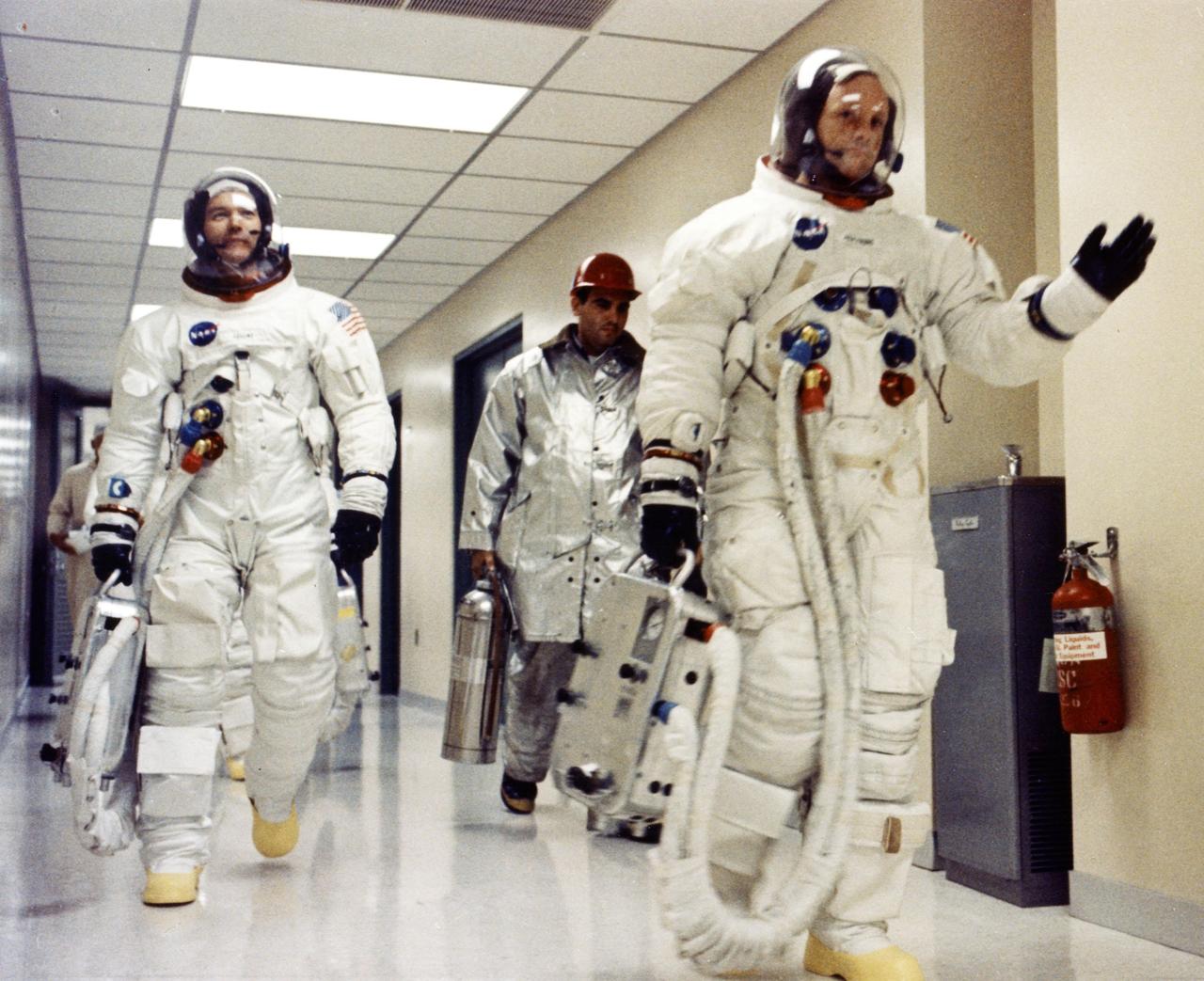
KENNEDY SPACE CENTER, FLA. -- Apollo 11 Commander Neil A. Armstrong waves to well-wishers in the hallway of the Manned Spacecraft Operations Building as he and Michael Collins and Edwin E. Aldrin Jr. prepare to be transported to Launch Complex 39A for the first manned lunar landing mission

The moon bound Apollo 14, carrying a crew of three astronauts: Mission commander Alan B. Shepard Jr., Command Module pilot Stuart A. Roosa, and Lunar Module pilot Edgar D. Mitchell, lifted off from launch complex 39A at the Kennedy Space Center on January 31, 1971, and safely returned to Earth on February 9, 1971. It was the third manned lunar landing, the first manned landing in exploration of the lunar highlands, and it demonstrated pinpoint landing capability. The major goal of Apollo 14 was the scientific exploration of the Moon in the foothills of the rugged Fra Mauro region. The extravehicular activity (EVA) of astronauts Shepard and Mitchell included setting up an automated scientific laboratory called Apollo Lunar Scientific Experiments Package (ALSEP), shown here fully deployed. In addition, they collected a total of about 95 pounds (43 kilograms) of Moon rock and soil for a geological investigation back on the Earth.
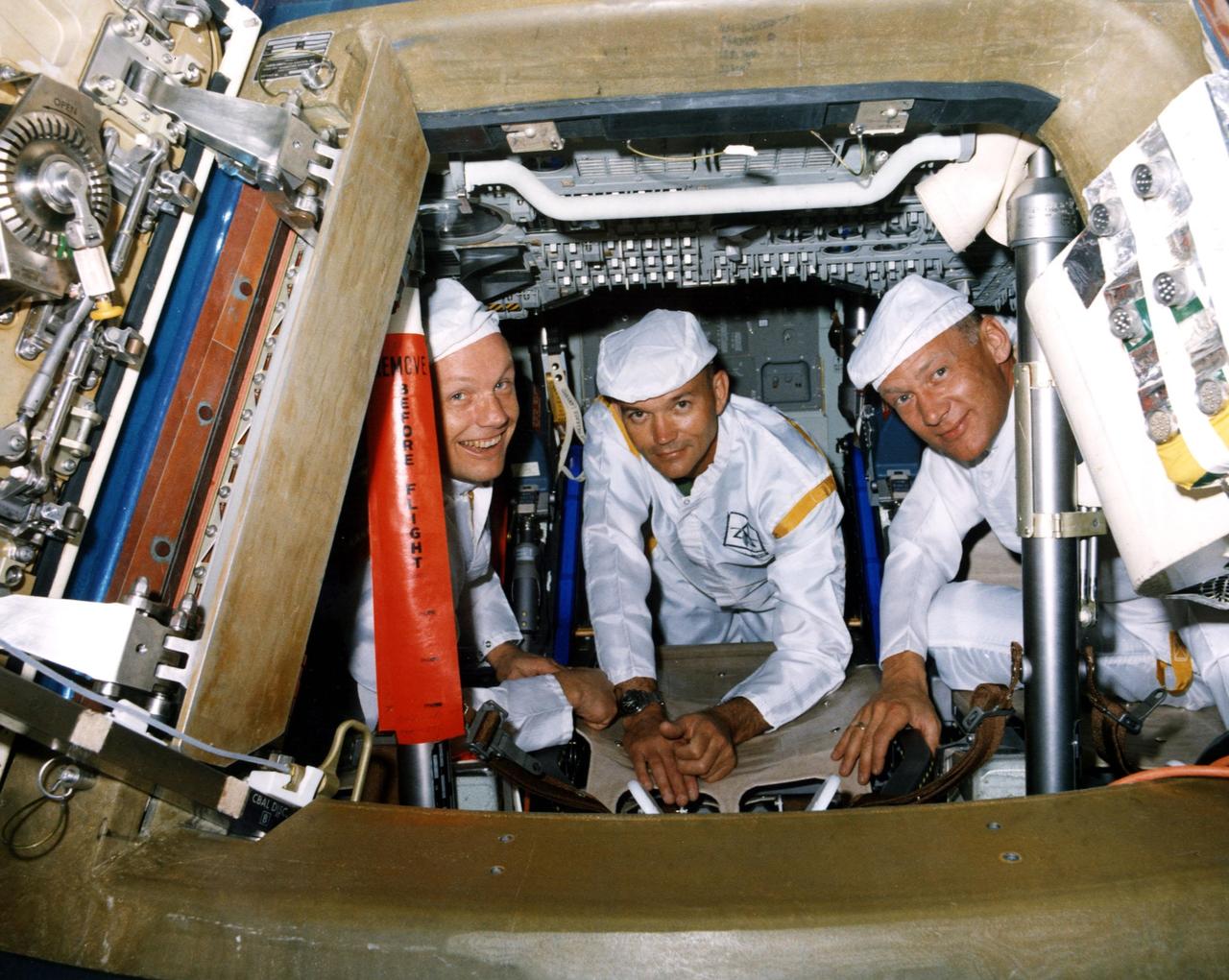
KENNEDY SPACE CENTER, FLA. -- The Apollo 11 prime crew poses for a photograph during a walk-through egress test. The hands-on test is in preparation for the first manned lunar landing mission scheduled for liftoff in July
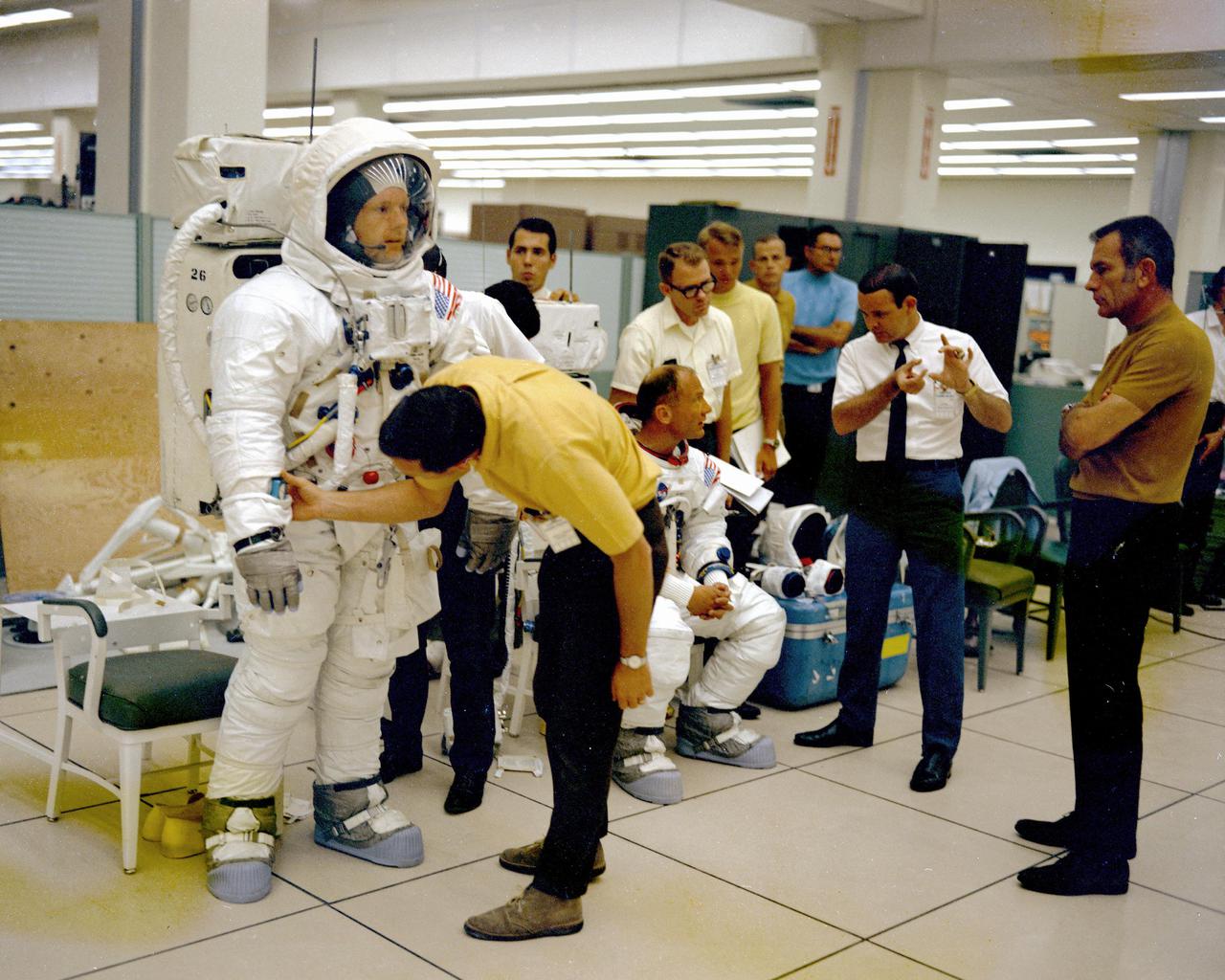
KENNEDY SPACE CENTER, FLA. - The Apollo 11 flight crew are given instructions by technicians and management while undergoing the Extravehicular Activity (EVA) training and the Lunar Module walk-through in preparation for the first manned landing on the Moon.
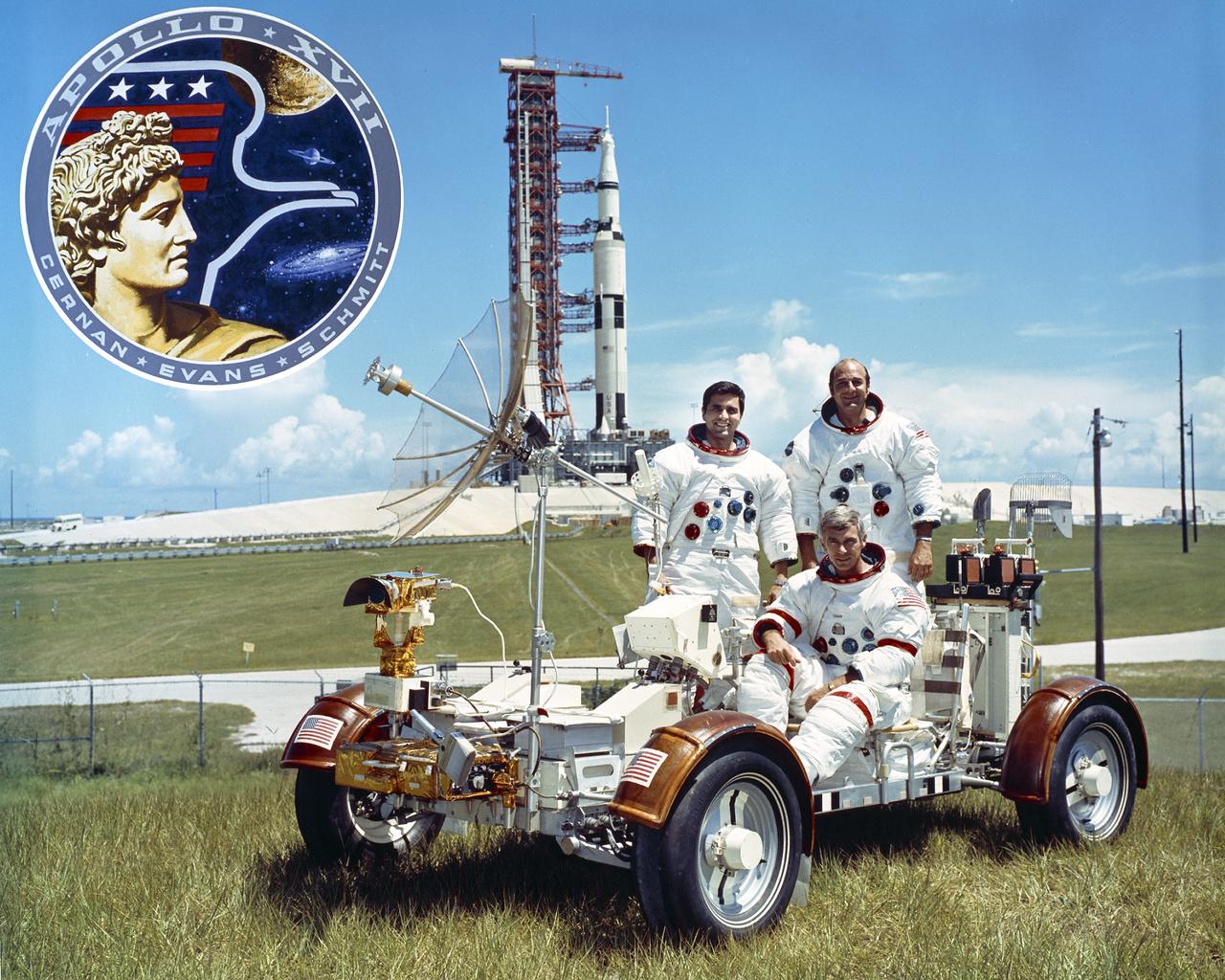
The Apollo 17 crew took time out from training for the press after the Space Vehicle for their Manned Lunar Landing Mission was moved to Complex 39A. Seated, Eugene A. Cernan, Commander standing, left to right, Dr. Harrison H. “Jack” Schmitt, Lunar Module Pilot and Ronald A. Evans, Command Module Pilot.
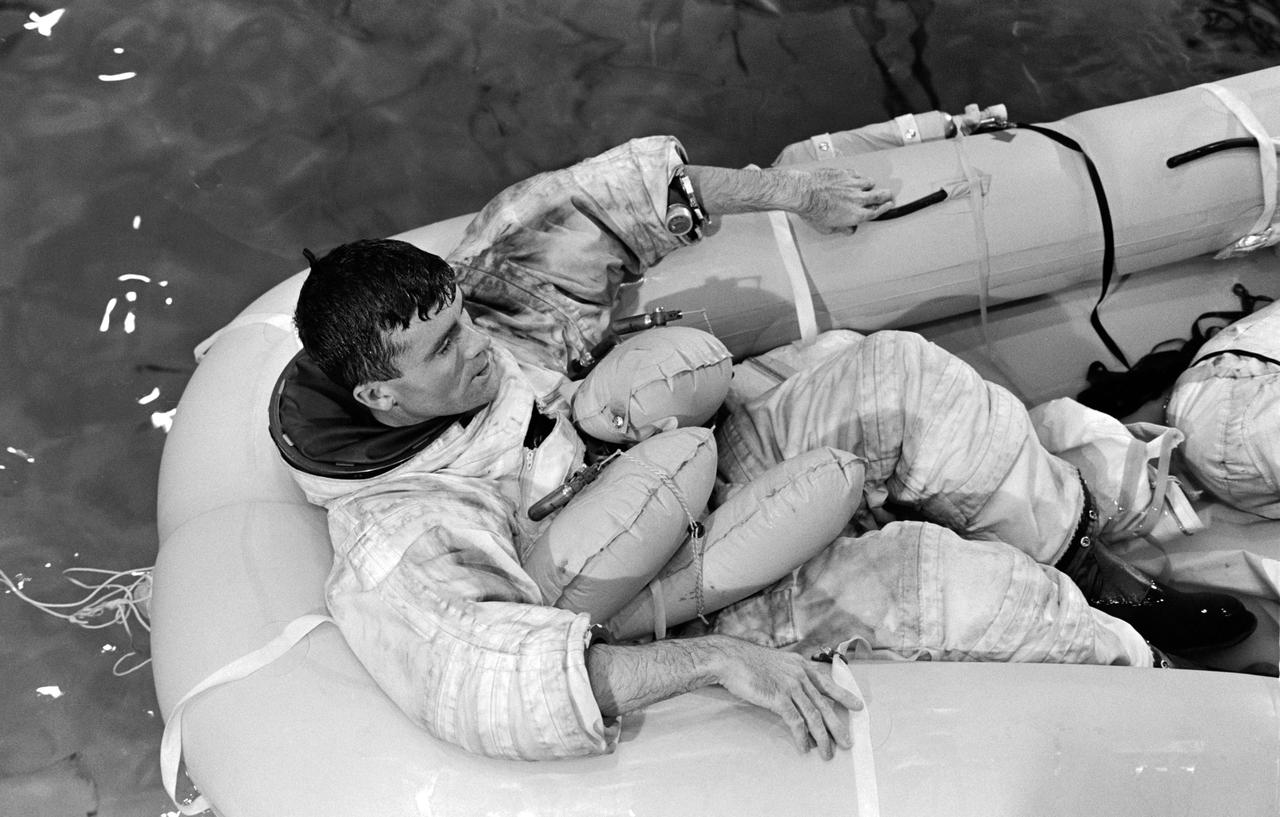
S70-31143 (17 Jan. 1970) --- Astronaut Fred W. Haise Jr., lunar module pilot of the Apollo 13 lunar landing mission, participates in water egress training in a water tank in Building 260 at the Manned Spacecraft Center.
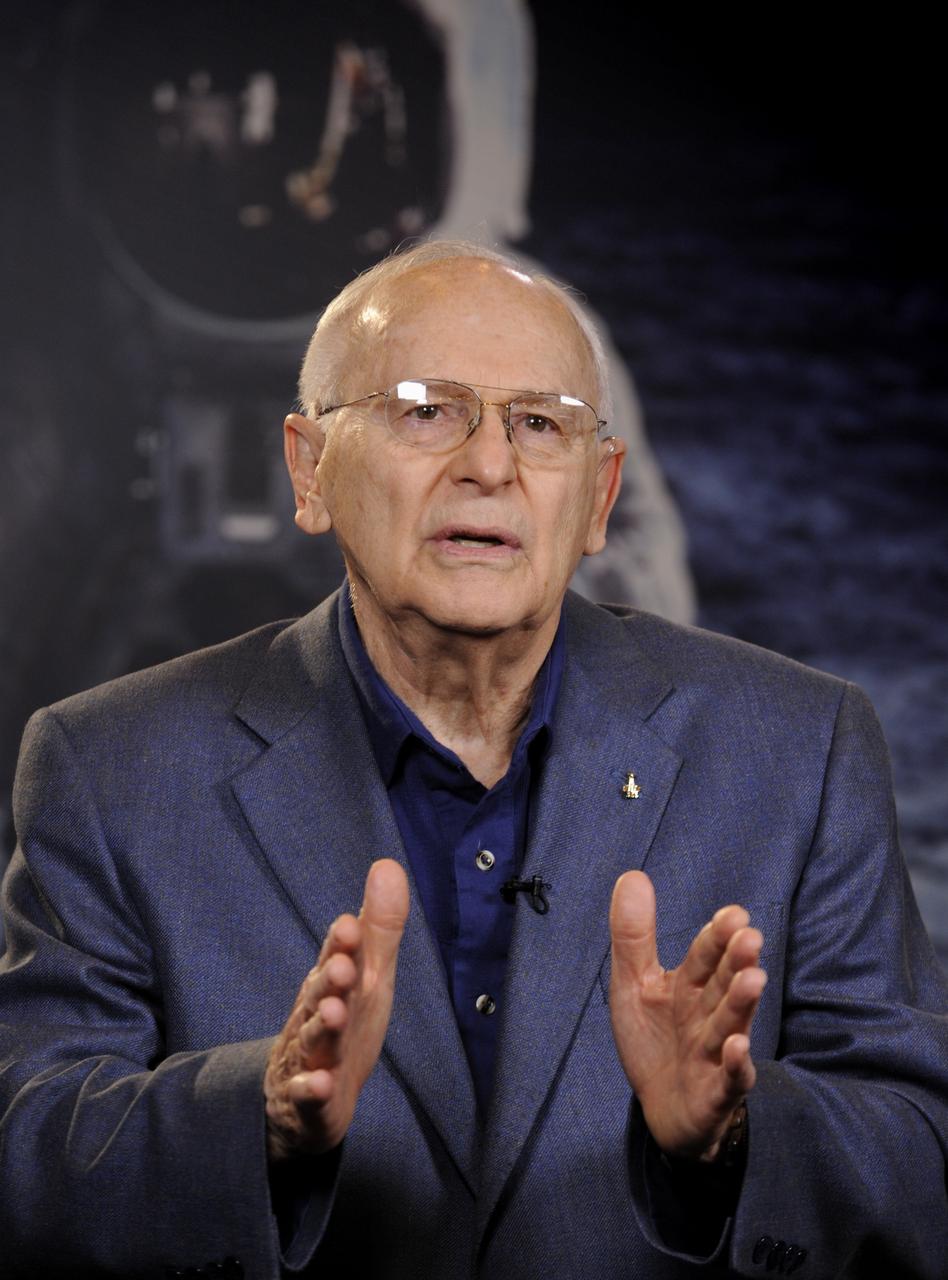
Apollo 12 astronaut Alan Bean responds to a question during a live television interview on Monday, July 20, 2009, at NASA Headquarters in Washington. Bean was lunar module pilot on Apollo 12, man's second lunar landing. Photo Credit: (NASA/Paul E. Alers)
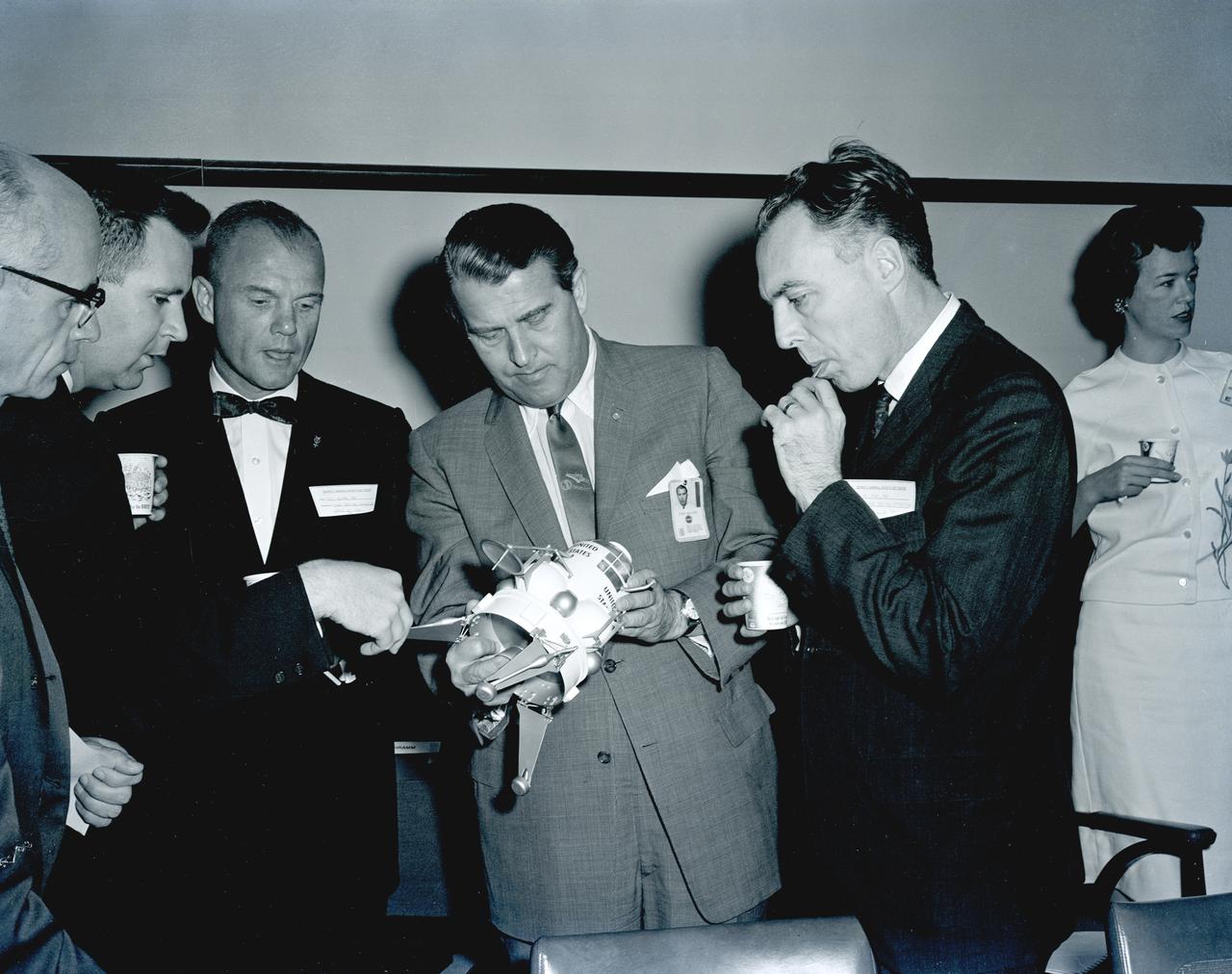
Dr. von Braun (right) and Astronaut John Glenn examine a model of a lunar landing stage during a talk on the manned lunar exploration program by about sixty key officials of the nation's space program at the Marshall Space Flight Center (MSFC).
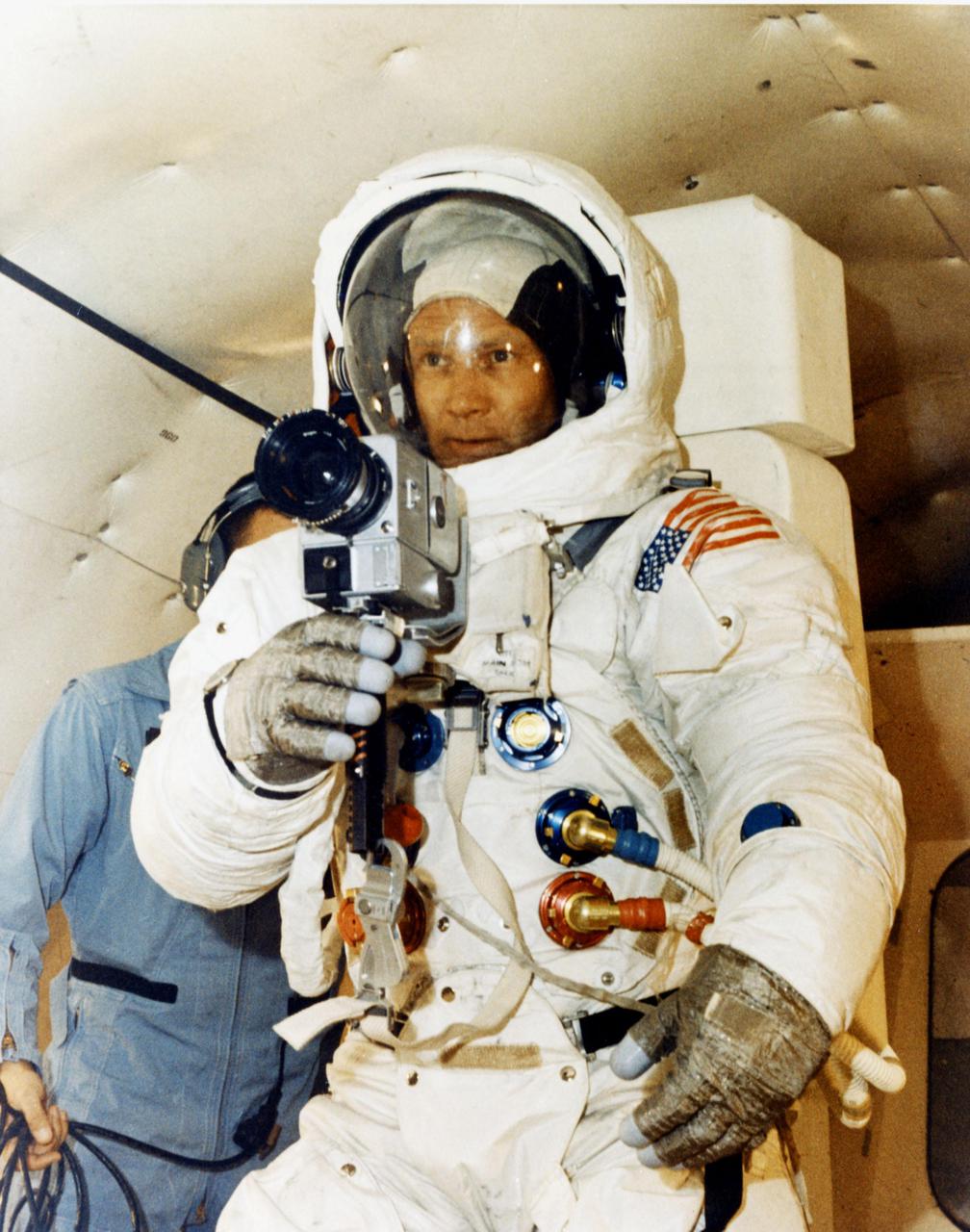
JOHNSON SPACE CENTER, HOUSTON, TEXAS - Flying in a KC-135 aircraft, Apollo 11 Lunar Module Pilot Edwin E. Aldrin Jr. takes pictures during training for the upcoming first manned lunar landing with astronauts Neil A. Armstrong Jr. and Michael Collins.
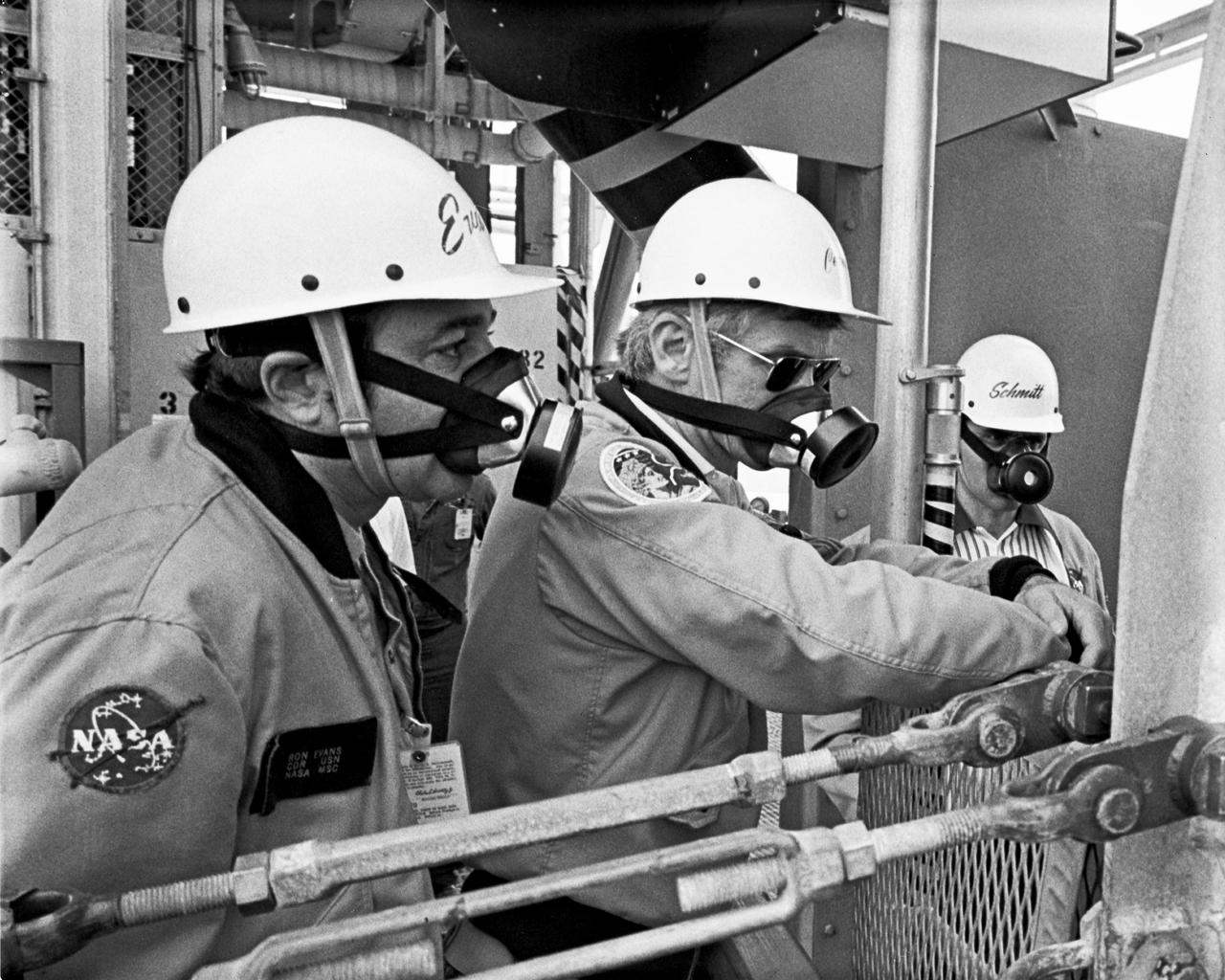
Apollo 17 Mission commander, Eugene A. Cernan, in center is flanked by Command Module Pilot Ronald E. Evans and lunar Module Pilot Harrison H. Schmitt as they participate in emergency egress test on the mobile launcher at Complex 39A. They will be launched to the Moon December 6, 1972 on NASA's last manned lunar landing scheduled for this decade.
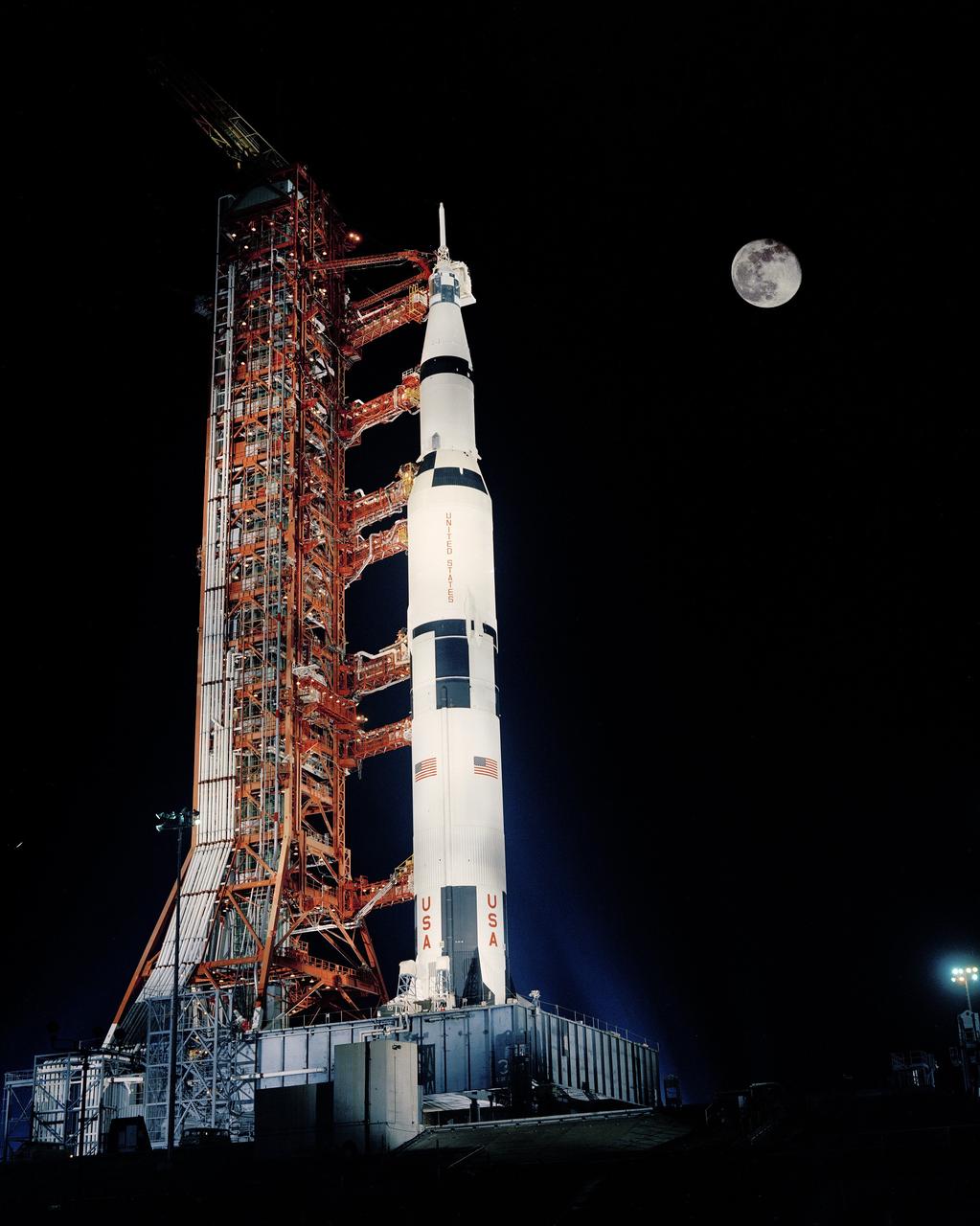
The Apollo 17 Space Vehicle sits poised beneath a full moon on Launch Pad 39A during launch countdown. Astronauts Eugene A. Cernan, Commander Ronald Evans, Command Module Pilot and Dr. Harrison "Jack" Schmitt, Lunar Module Pilot, will be the crew for the sixth U.S. manned Lunar landing mission.
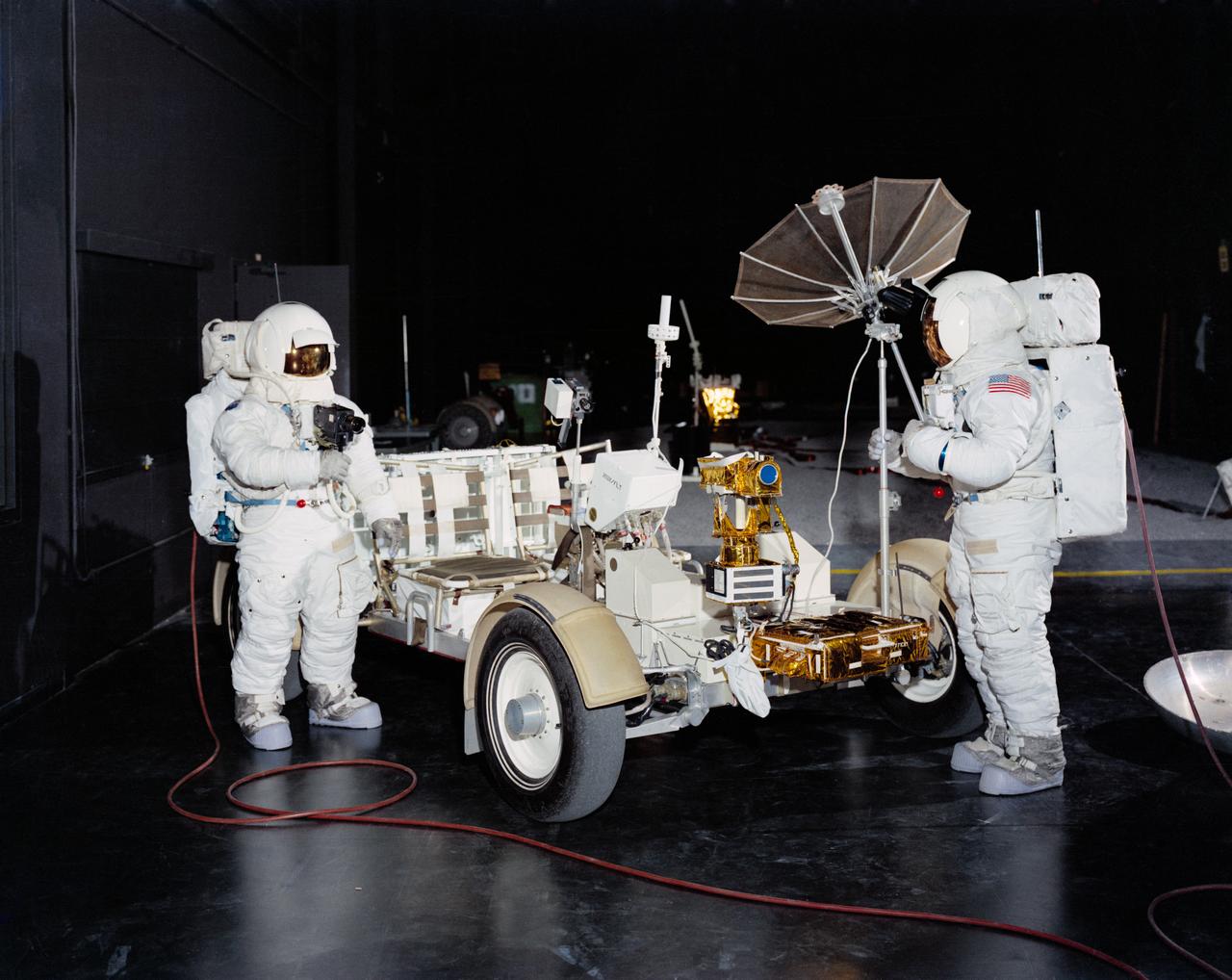
S71-16722 (January 1971) --- Two members of the prime crew of the Apollo 15 lunar landing mission are shown with the Lunar Roving Vehicle "one G" trainer in Building 5, Mission Simulation and Training Facility, Manned Spacecraft Center. Astronaut David R. Scott (on right) is the Apollo 15 commander; and astronaut James B. Irwin is the lunar module pilot. A Lunar Roving Vehicle similar to this trainer will be used by Scott and Irwin during their Apollo 15 lunar surface extravehicular activity.
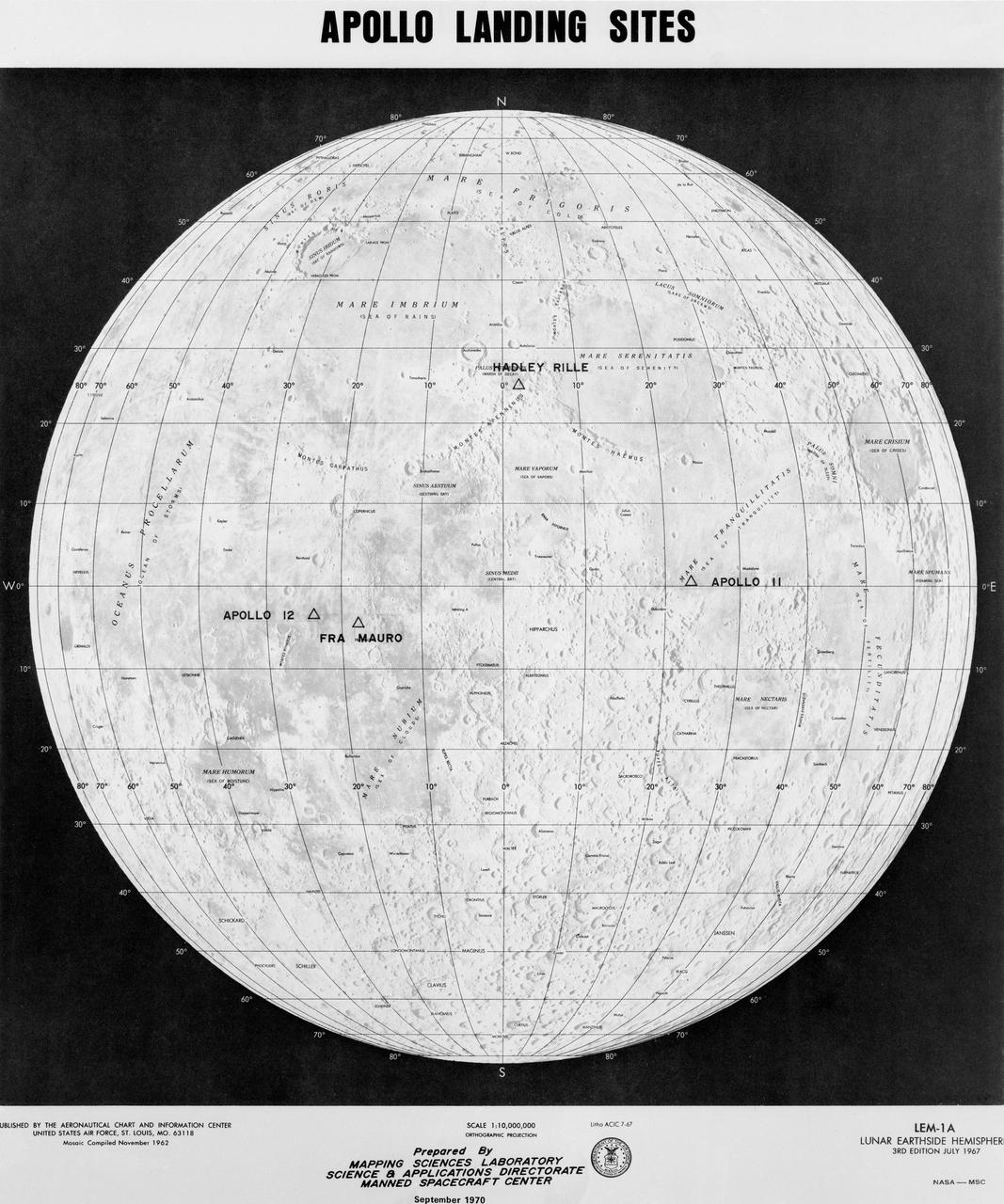
S70-50761 (September 1970) --- This map prepared by Mapping Sciences Laboratory, Science & Applications Directorate at the Manned Spacecraft Center, shows the projected Apollo landing sites. Apollo 11 completed a successful lunar landing mission in the Sea of Tranquility in July 1969. Apollo 12 completed a successful lunar landing mission in the Ocean of Storms in November 1969.
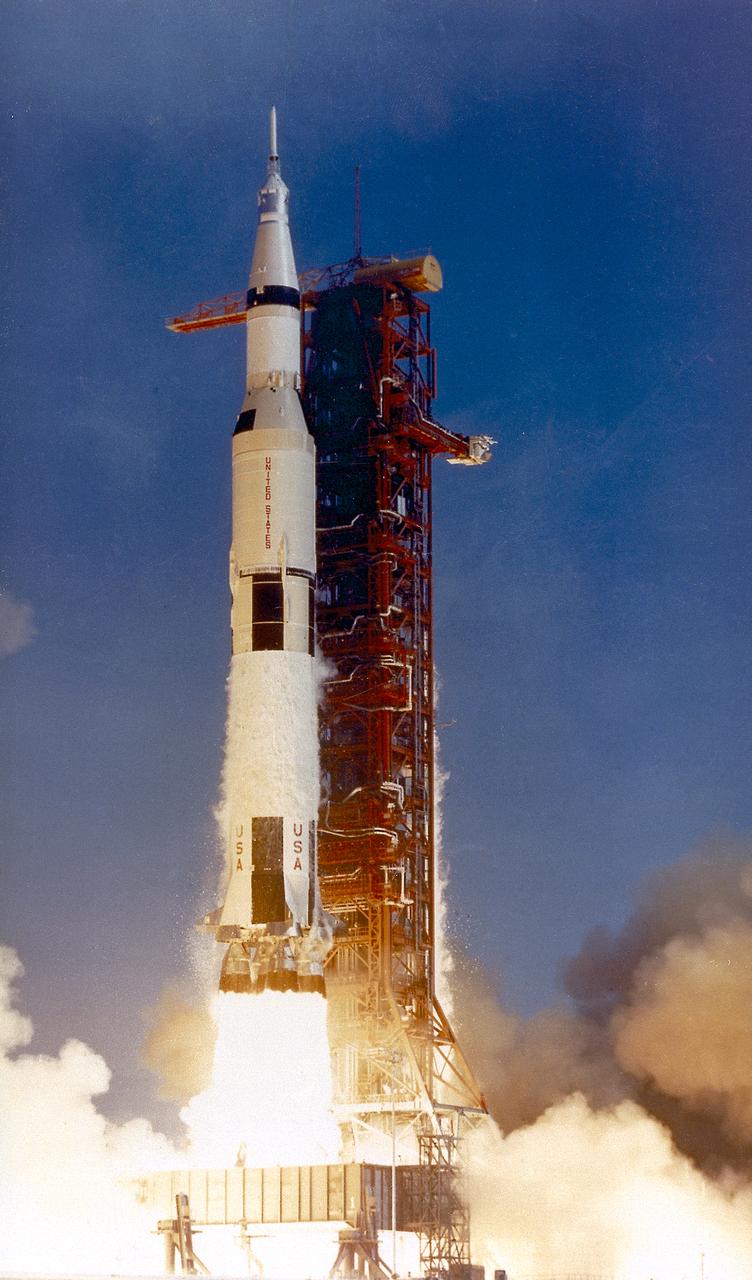
This photograph shows the Saturn V launch vehicle (SA-506) for the Apollo 11 mission liftoff at 8:32 am CDT, July 16, 1969, from launch complex 39A at the Kennedy Space Center. Apollo 11 was the first manned lunar landing mission with a crew of three astronauts: Mission commander Neil A. Armstrong, Command Module pilot Michael Collins, and Lunar Module pilot Edwin E. Aldrin, Jr. It placed the first humans on the surface of the moon and returned them back to Earth. Astronaut Armstrong became the first man on the lunar surface, and astronaut Aldrin became the second. Astronaut Collins piloted the Command Module in a parking orbit around the Moon.
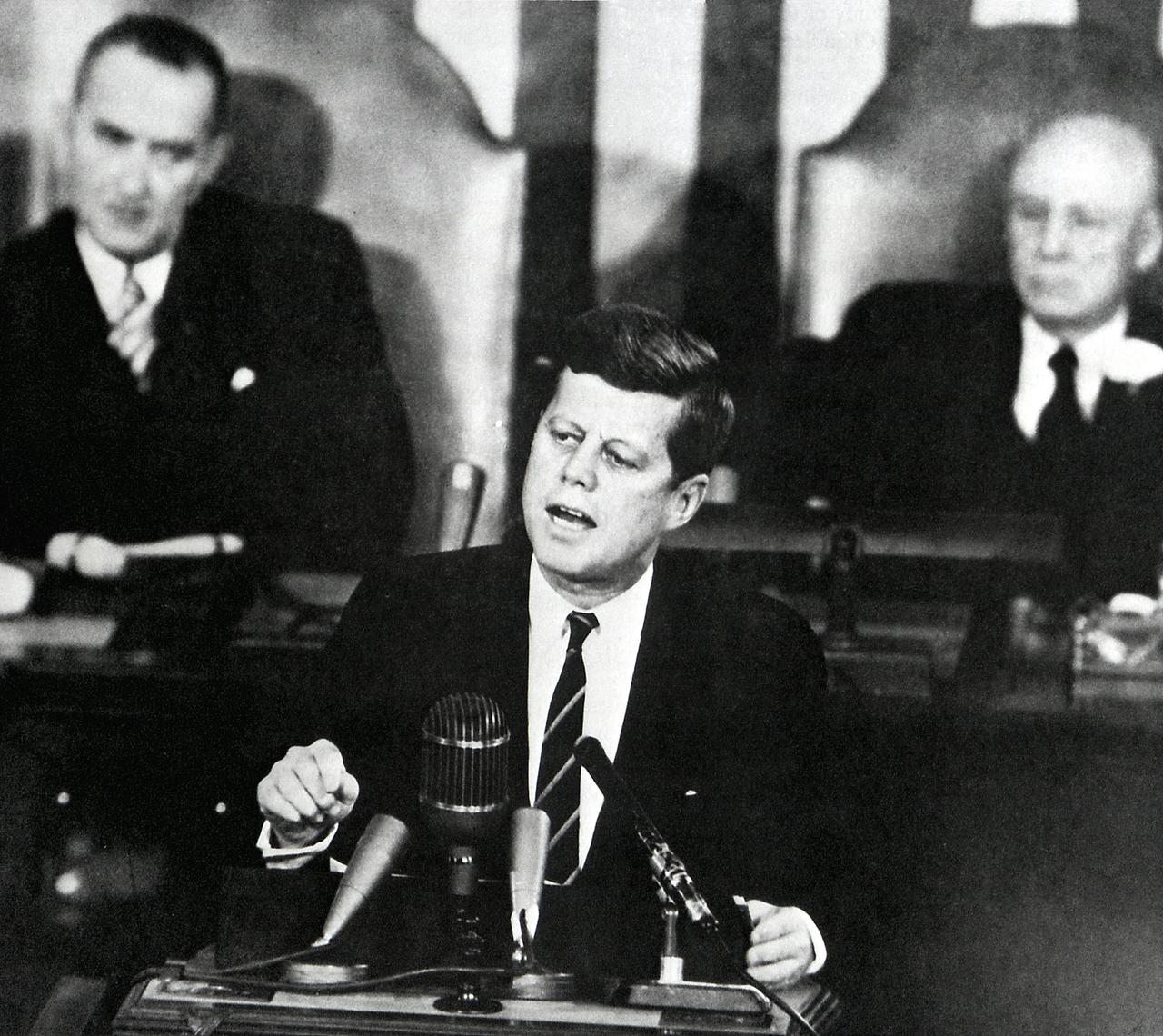
Speaking to Congress and the Nation at the joint session of Congress on May 25, 1961, President Kennedy said : "I believe that this Nation should commit itself to achieving the goal, before this decade is out, of landing a man on the Moon and returning him safely to Earth." National Aeronautic and Space Administration (NASA) achieved the goal of the first manned lunar landing on July 20, 1969.
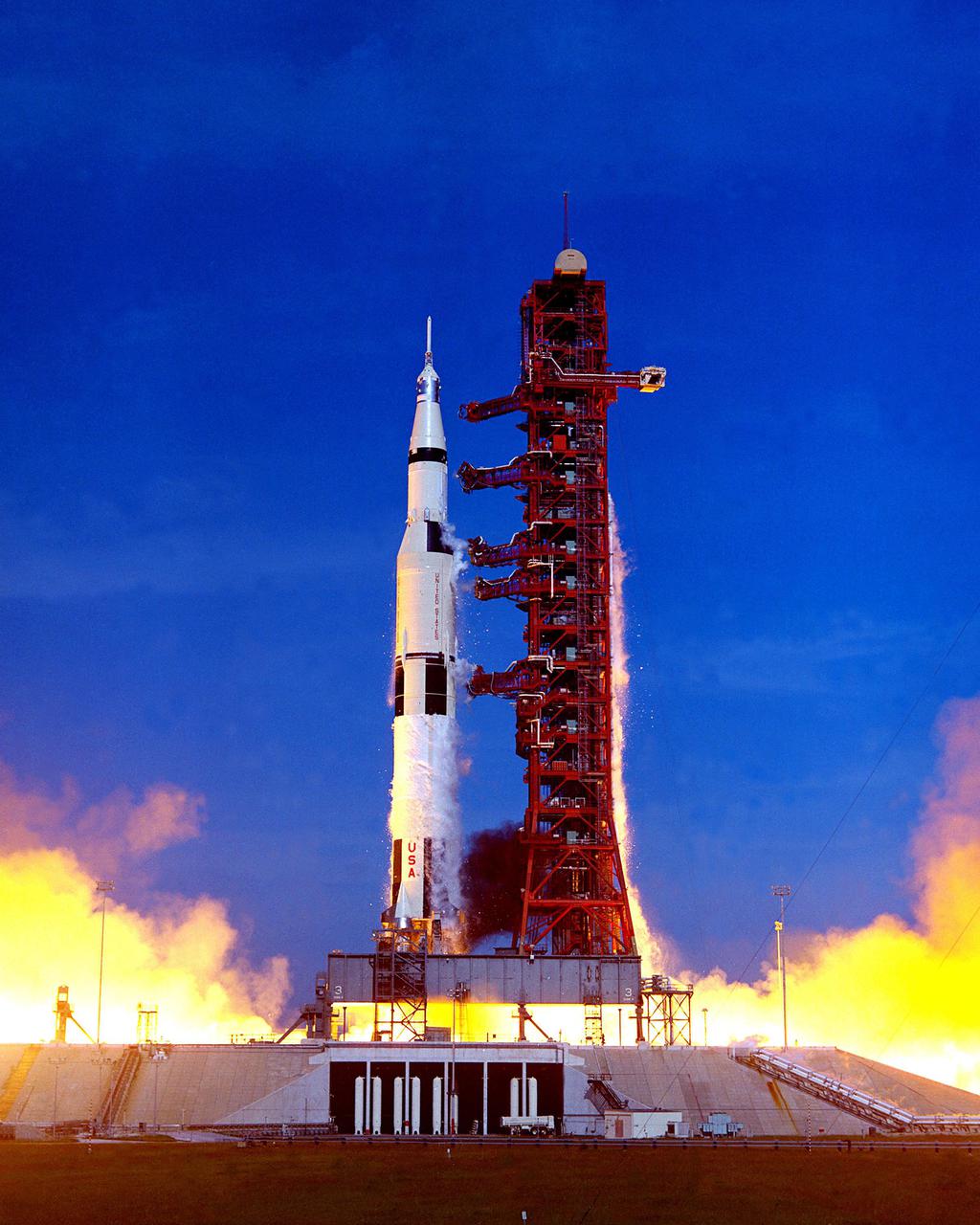
KENNEDY SPACE CENTER, FLA. -- The Apollo 15 Saturn V Space Vehicle soars into the skies after liftoff at Launch Pad 39A marking the beginning of NASA's fourth Manned Lunar Landing Mission. The astronauts aboard are David R. Scott, commander; James B. Irwin, Lunar Module pilot; and Alfred M. Worden Jr., Command Module pilot. The landing site for the Lunar Module is the Hadley-Apennine area of the Moon, about 465 miles north of the Lunar Equator. The Lunar Roving Vehicle (LRV) will be used for the first time.
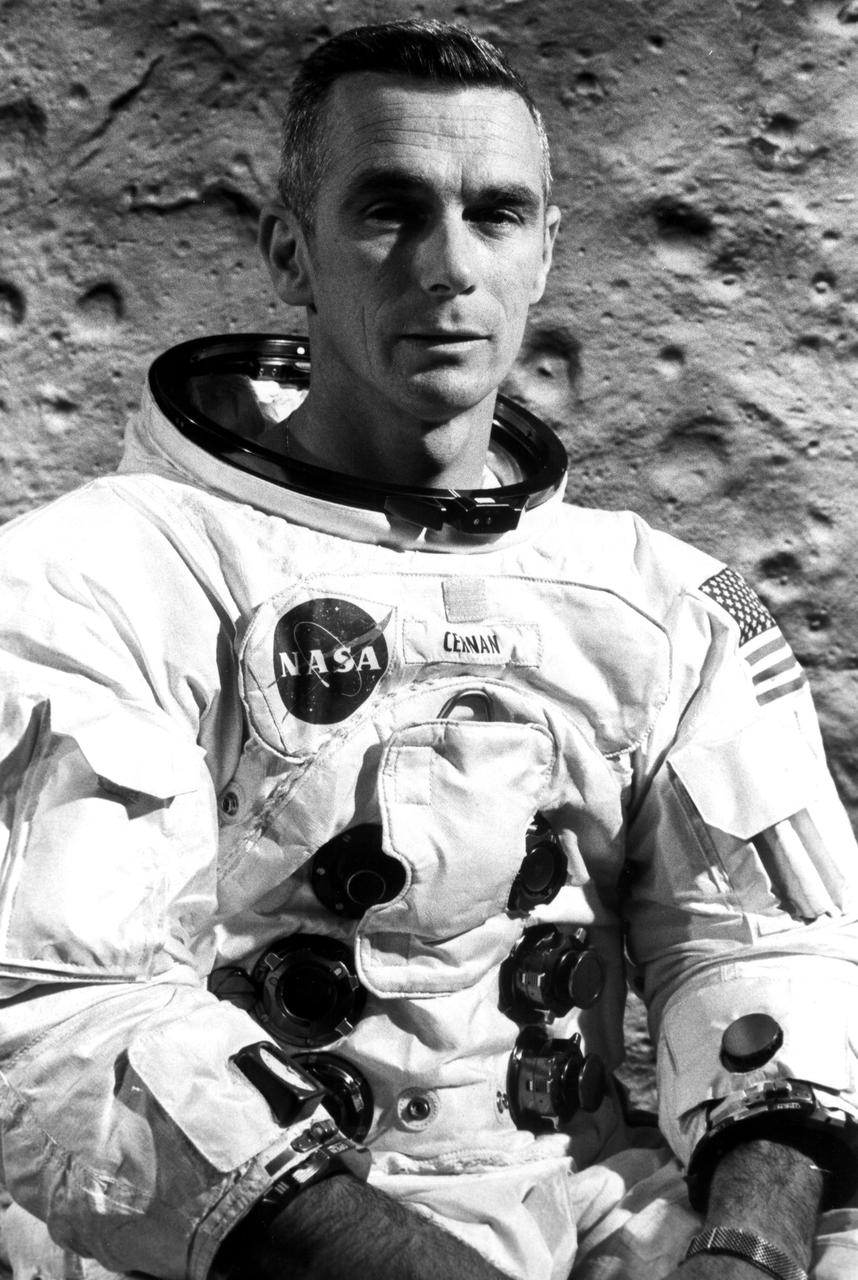
KENNEDY SPACE CENTER, FLA. -- Astronaut Eugene A. Cernan is lunar module pilot for Apollo 10, scheduled for launch from the nation's spaceport on May 18. Cernan and Apollo 10 Commander Thomas P. Stafford are to detach the lunar module after the spacecraft enters lunar orbit and drop down to within 10 miles of the Moon's pockmarked surface before rejoining John W. Young, command module pilot, orbiting the Moon in the command_service module. The Apollo 10 mission is a dress rehearsal for a manned lunar landing later this year.
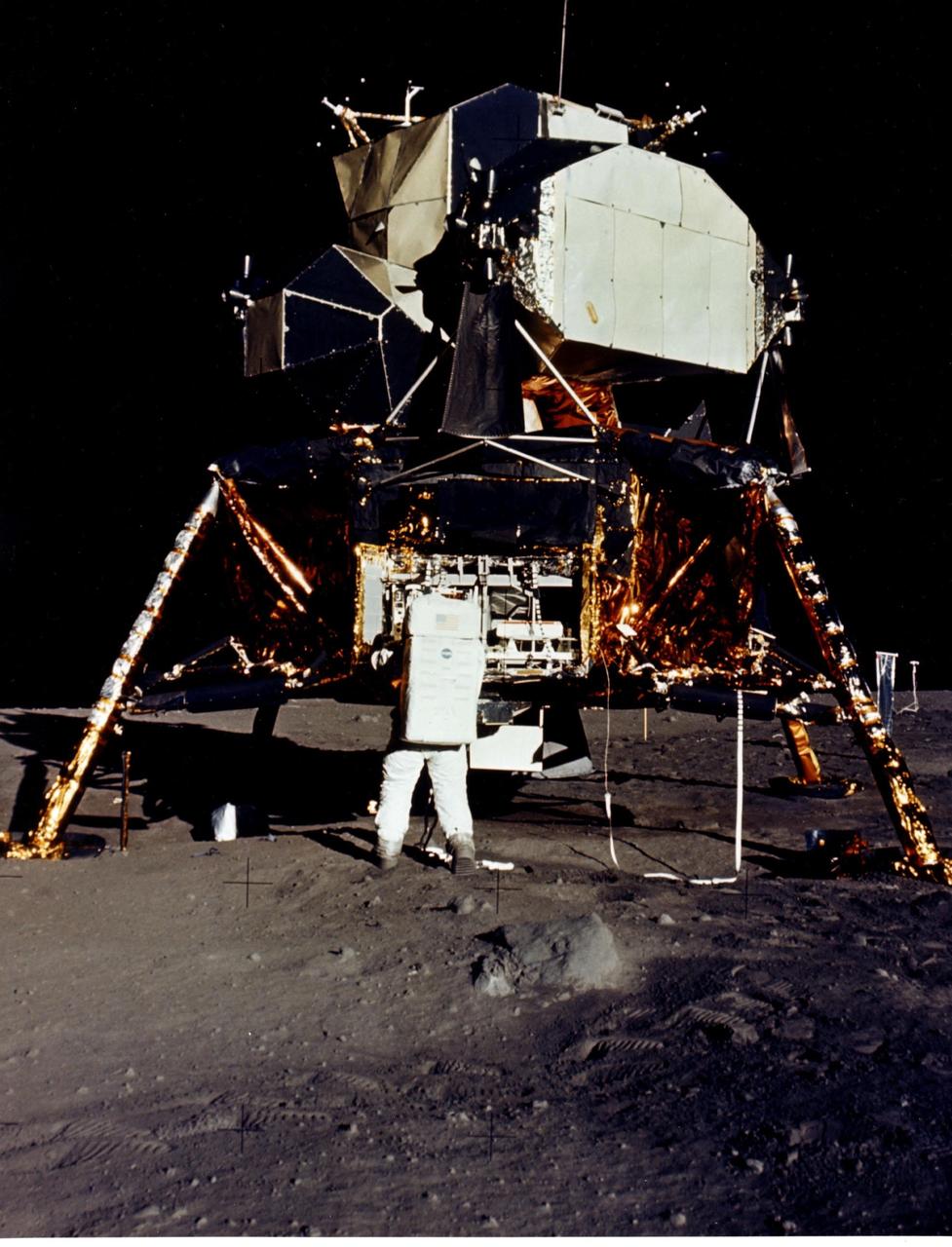
JOHNSON SPACE CENTER, HOUSTON, TEXAS - Man's first landing on the Moon was accomplished at 4:17 p.m. today as Lunar Module "Eagle" touched down gently on the Sea of Tranquility on the east side of the Moon. Astronaut Edwin E. Aldrin Jr., Lunar Module Pilot, removes scientific experiment packages from a stowage area in the Lunar Module's descent stage. Left behind on the lunar surface by Aldrin and Neil A. Armstrong, Apollo 11 commander, were a Passive Seismic Experiments Package and a Laser-Ranging Retro-Reflector.
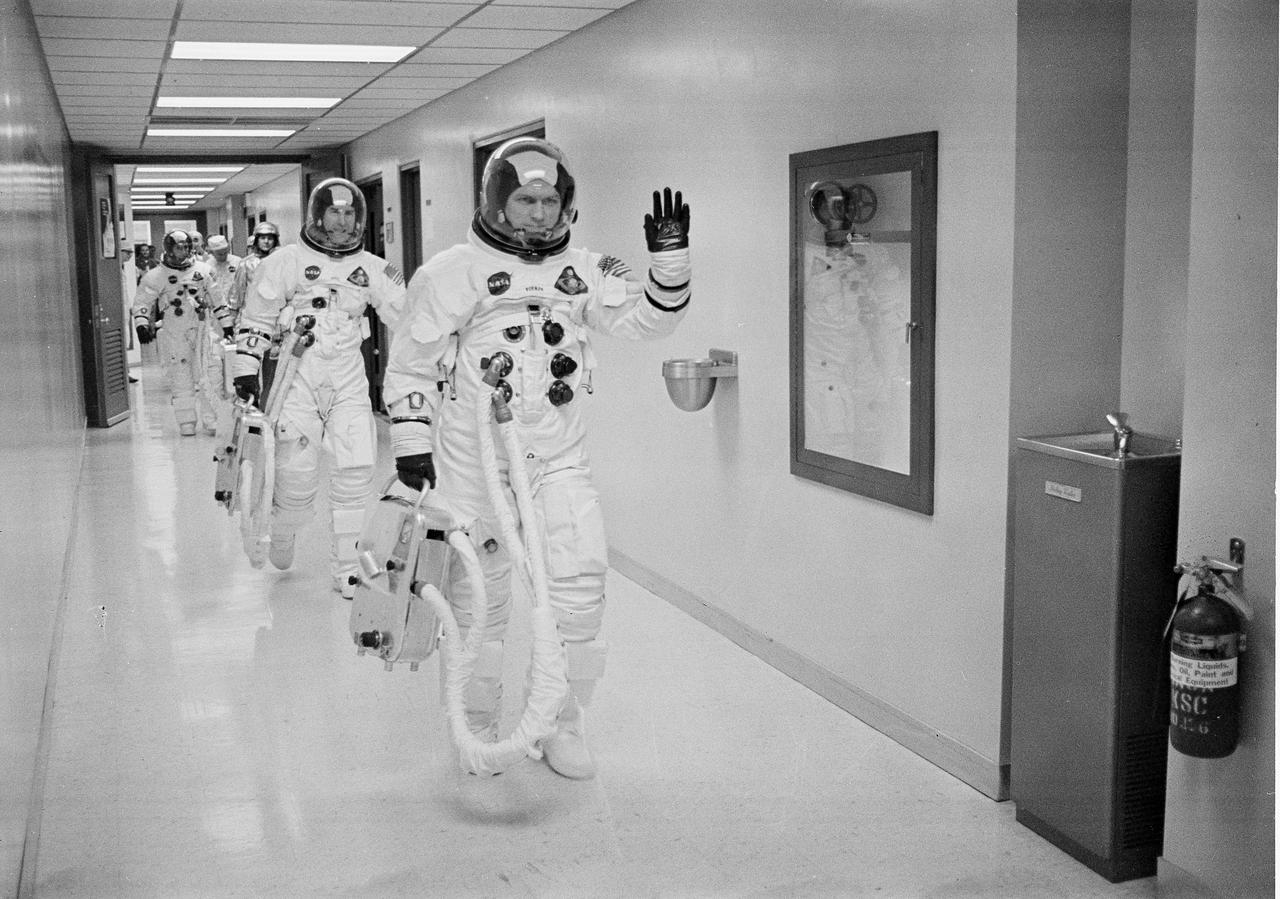
Apollo 8 Astronaut and commander Frank Borman leads the way as he and James Lovell, Command Module (CM) pilot; and William Anders, Lunar Module (LM) Pilot head out to the launch pad for the historical first manned Apollo mission to travel to the lunar vicinity, and first manned mission launched via the Saturn V vehicle. Liftoff occurred on December 21, 1968 and returned safely to Earth on December 27, 1968. The mission achieved operational experience and tested the Apollo command module systems, including communications, tracking, and life-support, in cis-lunar space and lunar orbit, and allowed evaluation of crew performance on a lunar orbiting mission. The crew photographed the lunar surface, both far side and near side, obtaining information on topography and landmarks as well as other scientific information necessary for future Apollo landings. All systems operated within allowable parameters and all objectives of the mission were achieved.
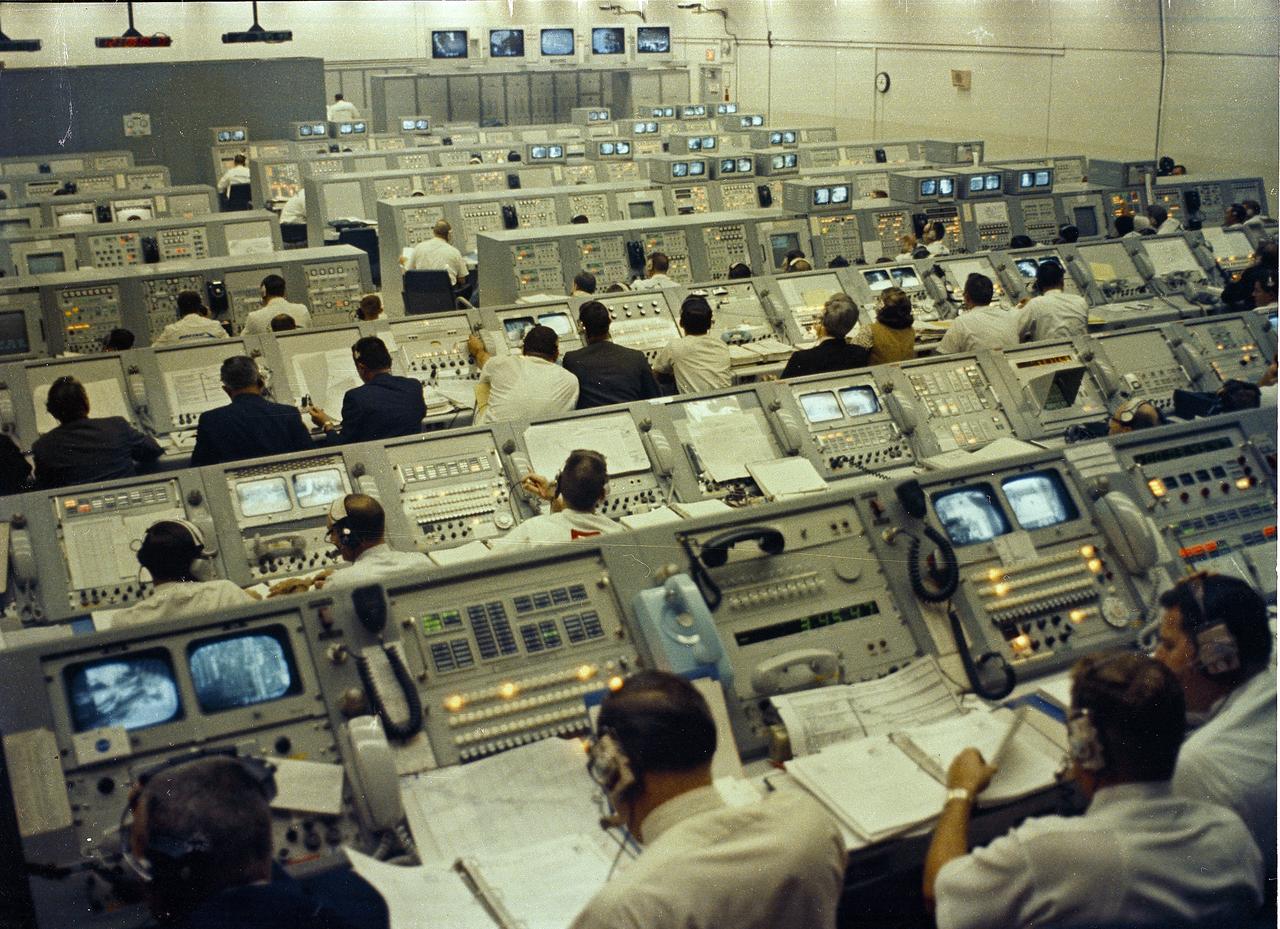
This photograph depicts a busy Launch Control Center at Kennedy Space Center during the Apollo 8 mission launch activities. Apollo 8 served as the first manned lunar orbit mission. Liftoff occurred on December 21, 1968 with a three man crew consiting of astronauts Frank Borman, commander; William Anders, Lunar Module (LM) Pilot; and James Lovell, Command Module (CM) pilot. The three safely returned to Earth on December 27, 1968. The mission achieved operational experience and tested the Apollo command module systems, including communications, tracking, and life-support, in cis-lunar space and lunar orbit, and allowed evaluation of crew performance on a lunar orbiting mission. The crew photographed the lunar surface, both far side and near side, obtaining information on topography and landmarks as well as other scientific information necessary for future Apollo landings. All systems operated within allowable parameters and all objectives of the mission were achieved.
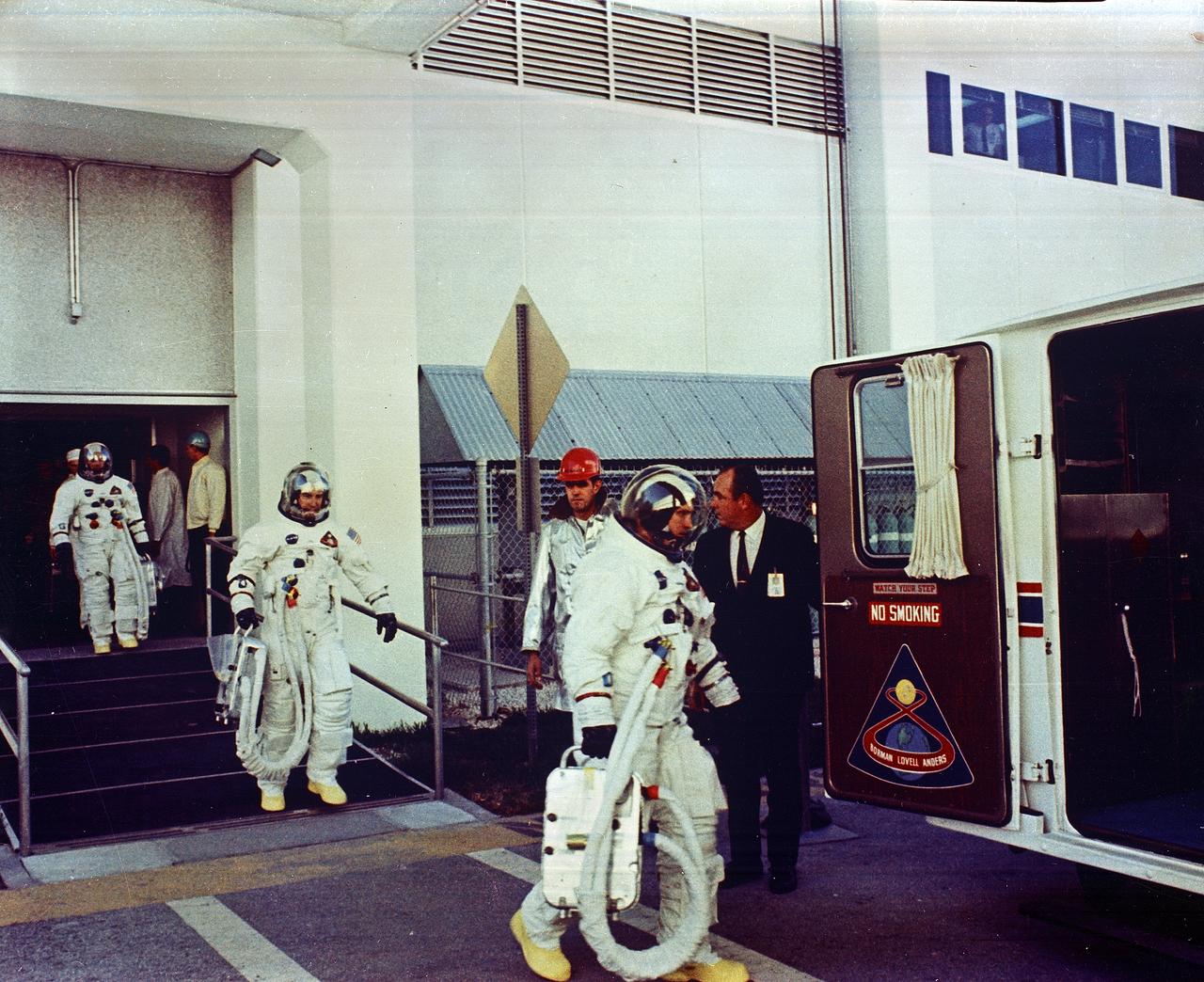
Apollo 8 Astronauts William Anders, Lunar Module (LM) Pilot; James Lovell, Command Module (CM) pilot; and Frank Borman, commander, transfer to the astronaut van for the trip to the launch pad. The first manned Apollo mission launched aboard the Saturn V and first manned Apollo craft to enter lunar orbit, the SA-503, Apollo 8 mission liftoff occurred on December 21, 1968 and returned safely to Earth on December 27, 1968. The mission achieved operational experience and tested the Apollo command module systems, including communications, tracking, and life-support, in cis-lunar space and lunar orbit, and allowed evaluation of crew performance on a lunar orbiting mission. The crew photographed the lunar surface, both far side and near side, obtaining information on topography and landmarks as well as other scientific information necessary for future Apollo landings. All systems operated within allowable parameters and all objectives of the mission were achieved.
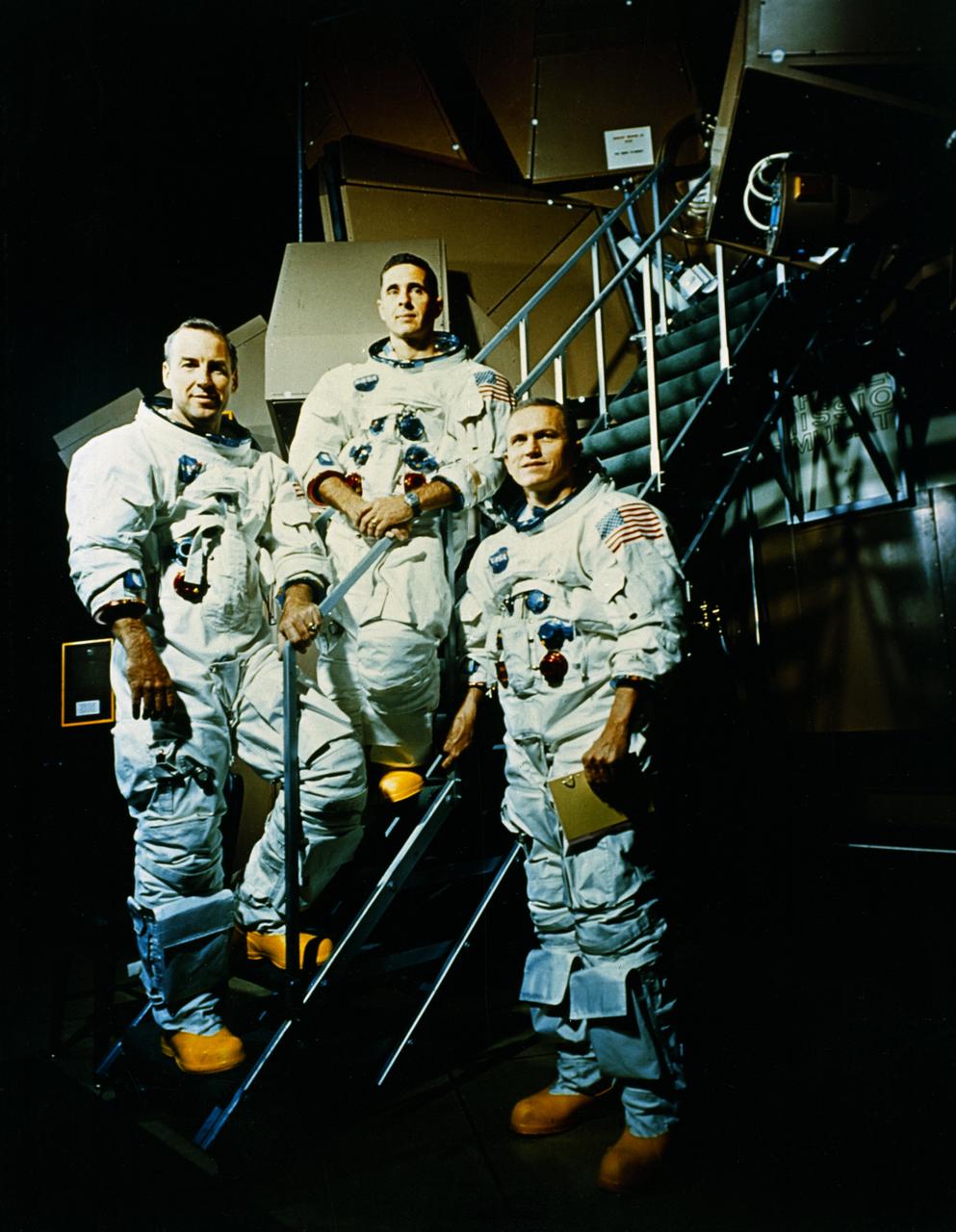
The Apollo 8 Crew included (L to R) James Lovell, Command Module (CM) pilot; William Anders, Lunar Module (LM) Pilot; and Frank Borman, Commander. The first manned Apollo mission launched aboard the Saturn V and first manned Apollo craft to enter lunar orbit, the SA-503, Apollo 8 mission liftoff occurred on December 21, 1968 and returned safely to Earth on December 27, 1968. The mission achieved operational experience and tested the Apollo command module systems, including communications, tracking, and life-support, in cis-lunar space and lunar orbit, and allowed evaluation of crew performance on a lunar orbiting mission. The crew photographed the lunar surface, both far side and near side, obtaining information on topography and landmarks as well as other scientific information necessary for future Apollo landings. All systems operated within allowable parameters and all objectives of the mission were achieved.
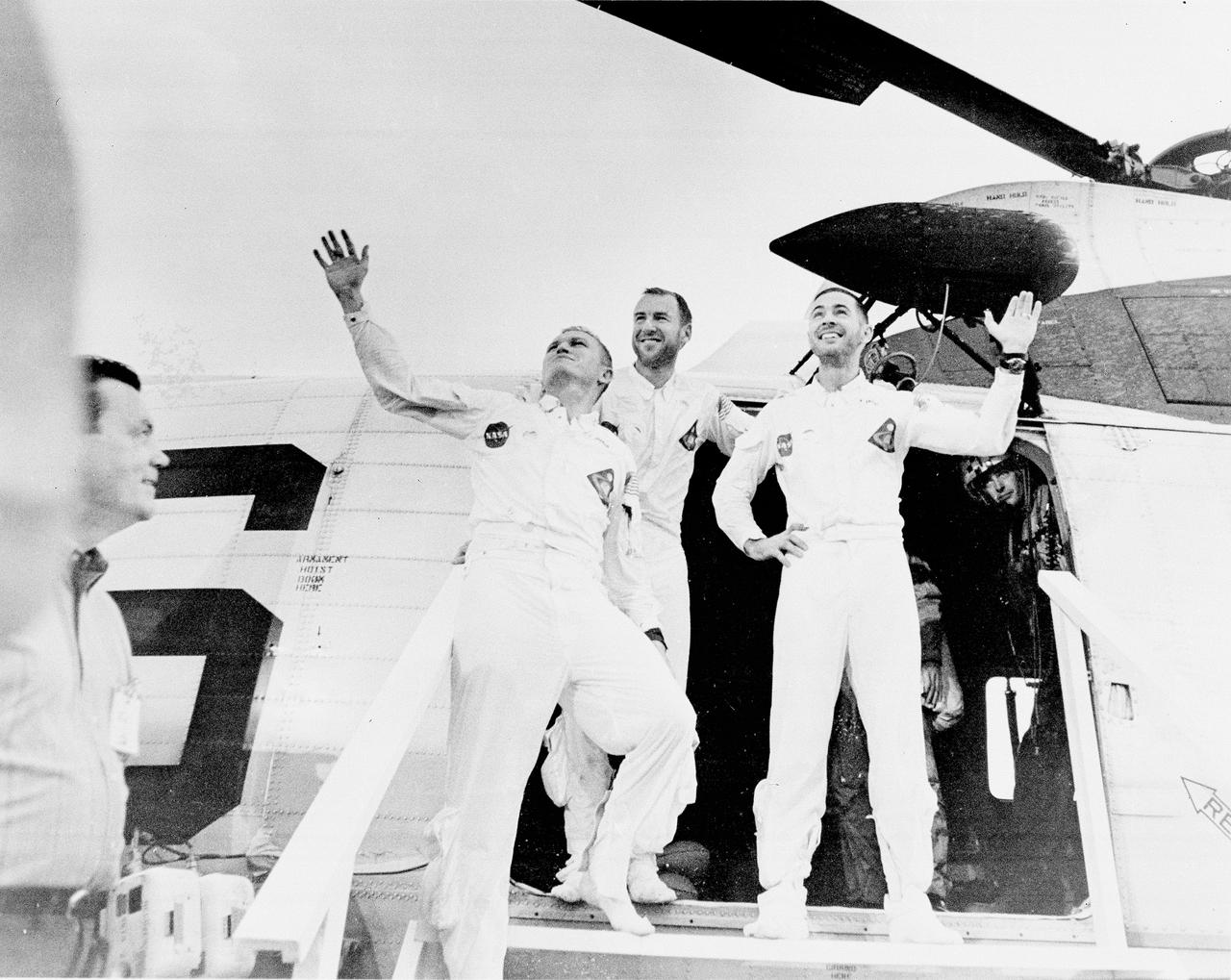
Apollo 8 served as the first manned lunar orbit mission. Liftoff occurred on December 21, 1968, carrying a three man crew consisting of astronauts Frank Borman, commander; William Anders, Lunar Module (LM) Pilot; and James Lovell, Command Module (CM) pilot. The three safely returned to Earth on December 27, 1968. In this photograph, the crew members are waving as they leave the recovery helicopter. The mission achieved operational experience and tested the Apollo command module systems, including communications, tracking, and life-support, in cis-lunar space and lunar orbit, and allowed evaluation of crew performance on a lunar orbiting mission. The crew photographed the lunar surface, both far side and near side, obtaining information on topography and landmarks as well as other scientific information necessary for future Apollo landings. All systems operated within allowable parameters and all objectives of the mission were achieved.
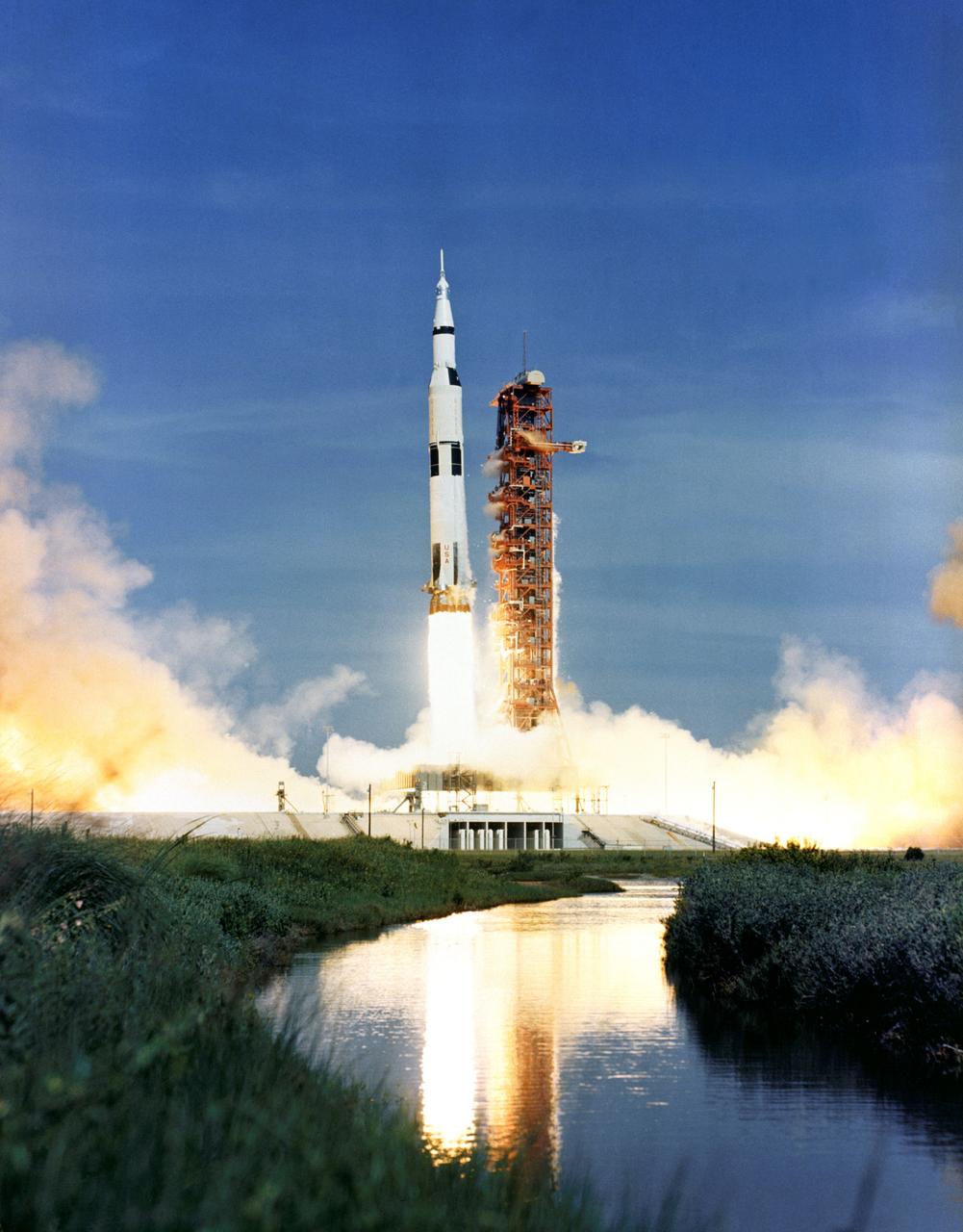
S71-41810 (26 July 1971) --- The 363-feet tall Apollo 15 (Spacecraft 112/Lunar Module 10/Saturn 510) space vehicle is launched from Pad A, Launch Complex 39, Kennedy Space Center, Florida, at 9:34:00.79 a.m., July 26, 1971, on a lunar landing mission. Aboard the Apollo 15 spacecraft were astronauts David R. Scott, commander; Alfred M. Worden, commander module pilot; and James B. Irwin, lunar module pilot. Apollo 15 is the National Aeronautics and Space Administration's (NASA) fourth manned lunar landing mission.
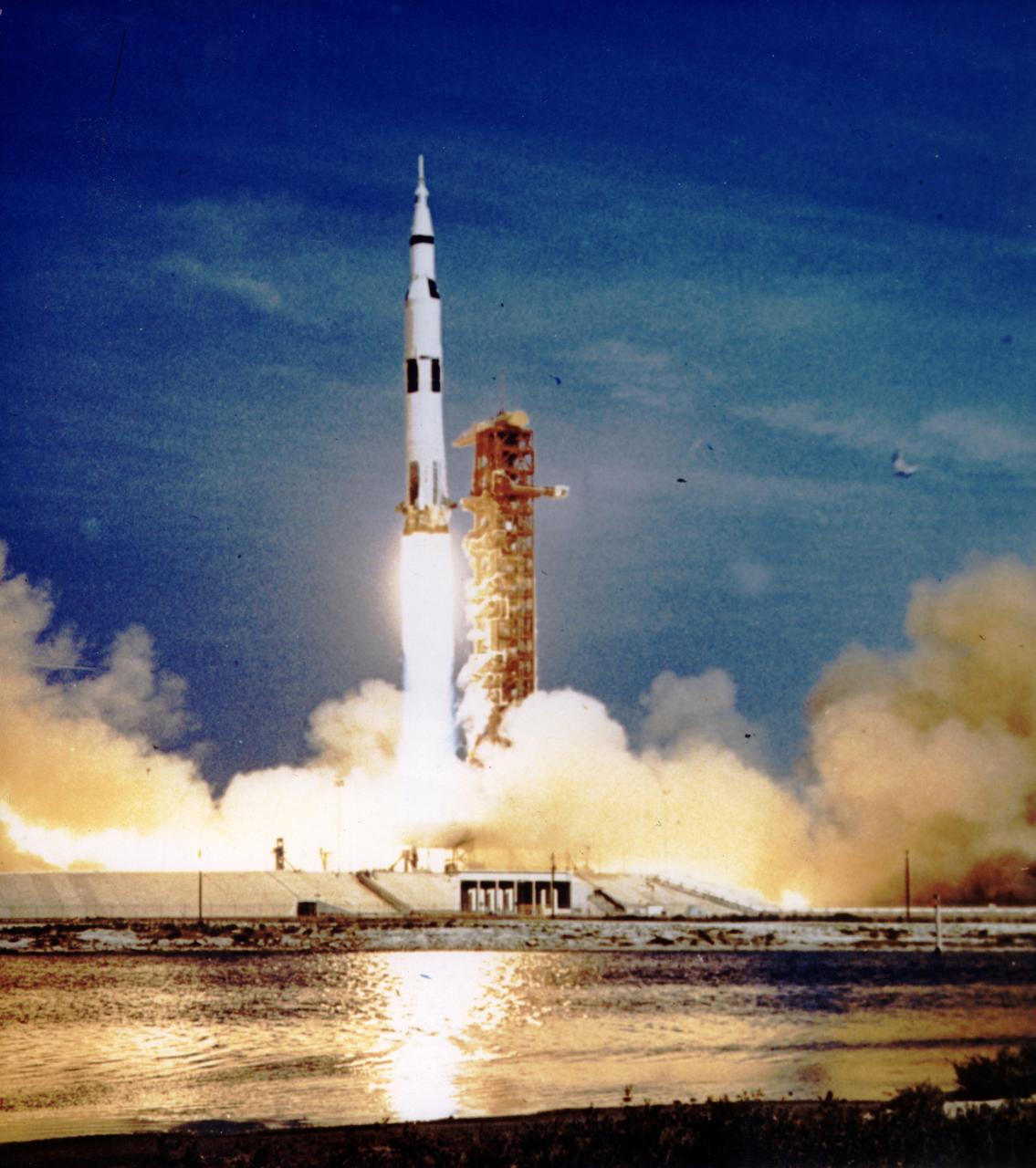
The Apollo 11 mission, the first manned lunar mission, launched from the Kennedy Space Center, Florida via the Marshall Space Flight Center (MSFC) developed Saturn V launch vehicle on July 16, 1969 and safely returned to Earth on July 24, 1969. The Saturn V vehicle produced a holocaust of flames as it rose from its pad at Launch complex 39. The 363 foot tall, 6,400,000 pound rocket hurled the spacecraft into Earth parking orbit and then placed it on the trajectory to the moon for man’s first lunar landing. Aboard the space craft were astronauts Neil A. Armstrong, commander; Michael Collins, Command Module pilot; and Edwin E. Aldrin Jr., Lunar Module pilot. With the success of Apollo 11, the national objective to land men on the Moon and return them safely to Earth had been accomplished.
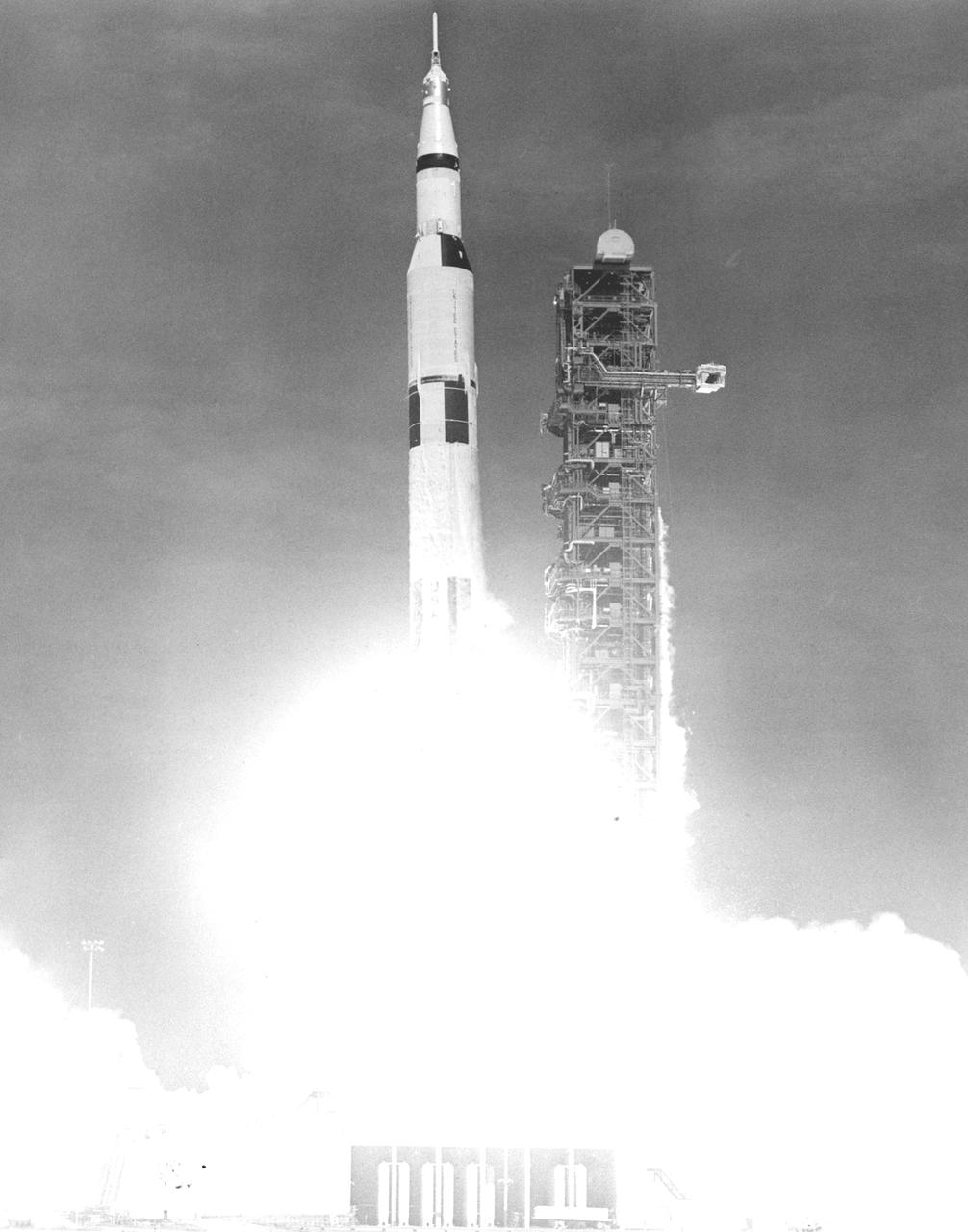
The Apollo 11 mission, the first manned lunar mission, launched from the Kennedy Space Center, Florida via the Saturn V launch vehicle on July 16, 1969 and safely returned to Earth on July 24, 1969. The Saturn V vehicle produced a holocaust of flames as it rose from its pad at Launch complex 39. The 363 foot tall, 6,400,000 pound rocket hurled the spacecraft into Earth parking orbit and then placed it on the trajectory to the moon for man’s first lunar landing. The Saturn V was developed by the Marshall Space Flight Center (MSFC) under the direction of Dr. Wernher von Braun. Aboard the spacecraft were astronauts Neil A. Armstrong, commander; Michael Collins, Command Module pilot; and Edwin E. Aldrin Jr., Lunar Module pilot. With the success of Apollo 11, the national objective to land men on the Moon and return them safely to Earth had been accomplished.
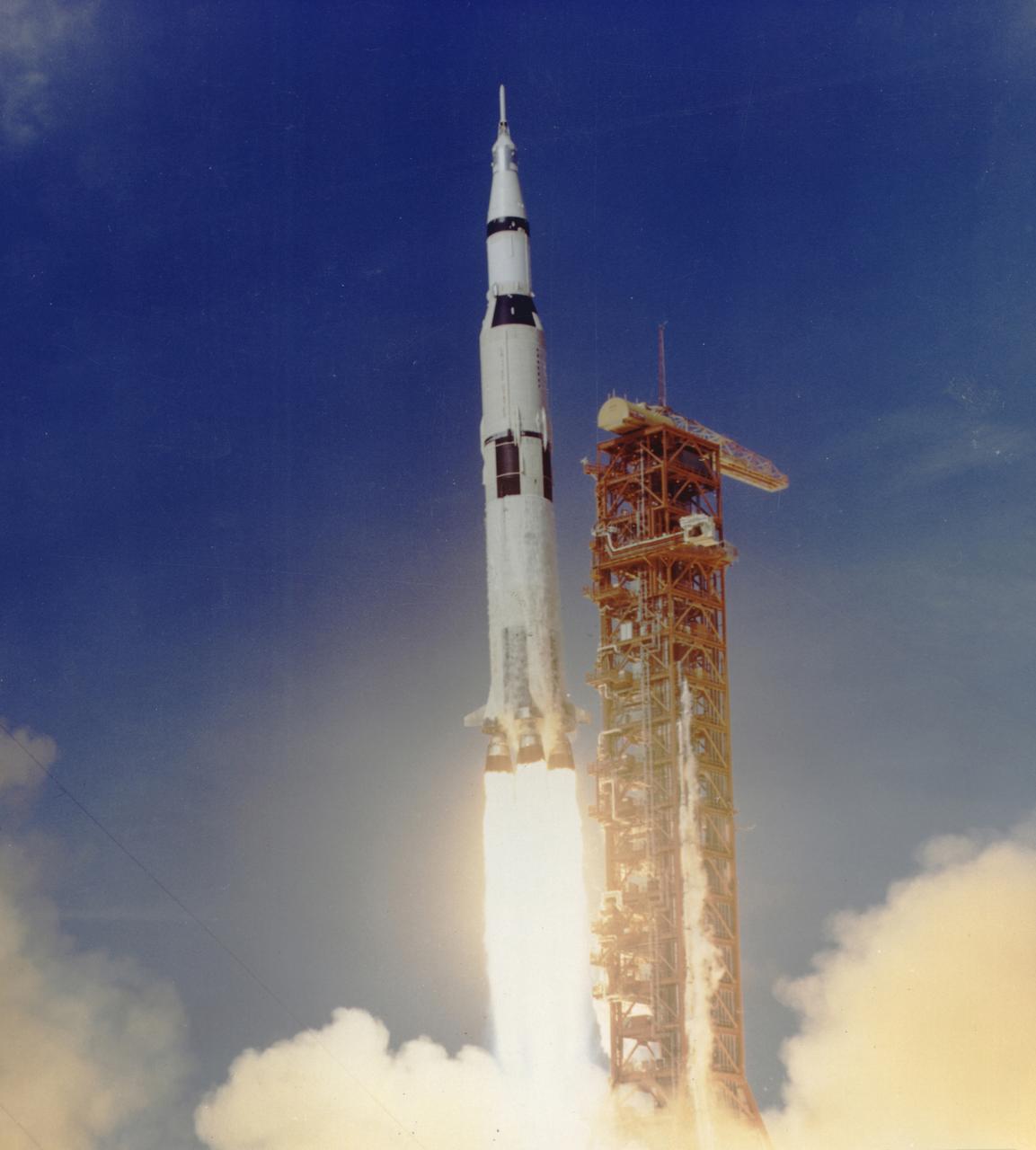
The Apollo 11 mission, the first manned lunar mission, launched from the Kennedy Space Center, Florida via the Marshall Space Flight Center (MSFC) developed Saturn V launch vehicle on July 16, 1969 and safely returned to Earth on July 24, 1969. The Saturn V vehicle produced a holocaust of flames as it rose from its pad at Launch complex 39. The 363 foot tall, 6,400,000 pound rocket hurled the spacecraft into Earth parking orbit and then placed it on the trajectory to the moon for man’s first lunar landing. Aboard the space craft were astronauts Neil A. Armstrong, commander; Michael Collins, Command Module pilot; and Edwin E. Aldrin Jr., Lunar Module pilot. With the success of Apollo 11, the national objective to land men on the Moon and return them safely to Earth had been accomplished.

S69-53894 (October 1969) --- Dr. Charles H. Walkinshaw, Jr., Spaceflight Biotechnology Branch botanist, Preventive Medicine Division, Manned Spacecraft Center (MSC), examines sorghum and tobacco plants in lunar (germ free) soil in the Plant Laboratory of the MSC’s Lunar Receiving Laboratory. The soil was brought back from the moon by the crew of the Apollo 11 lunar landing mission.
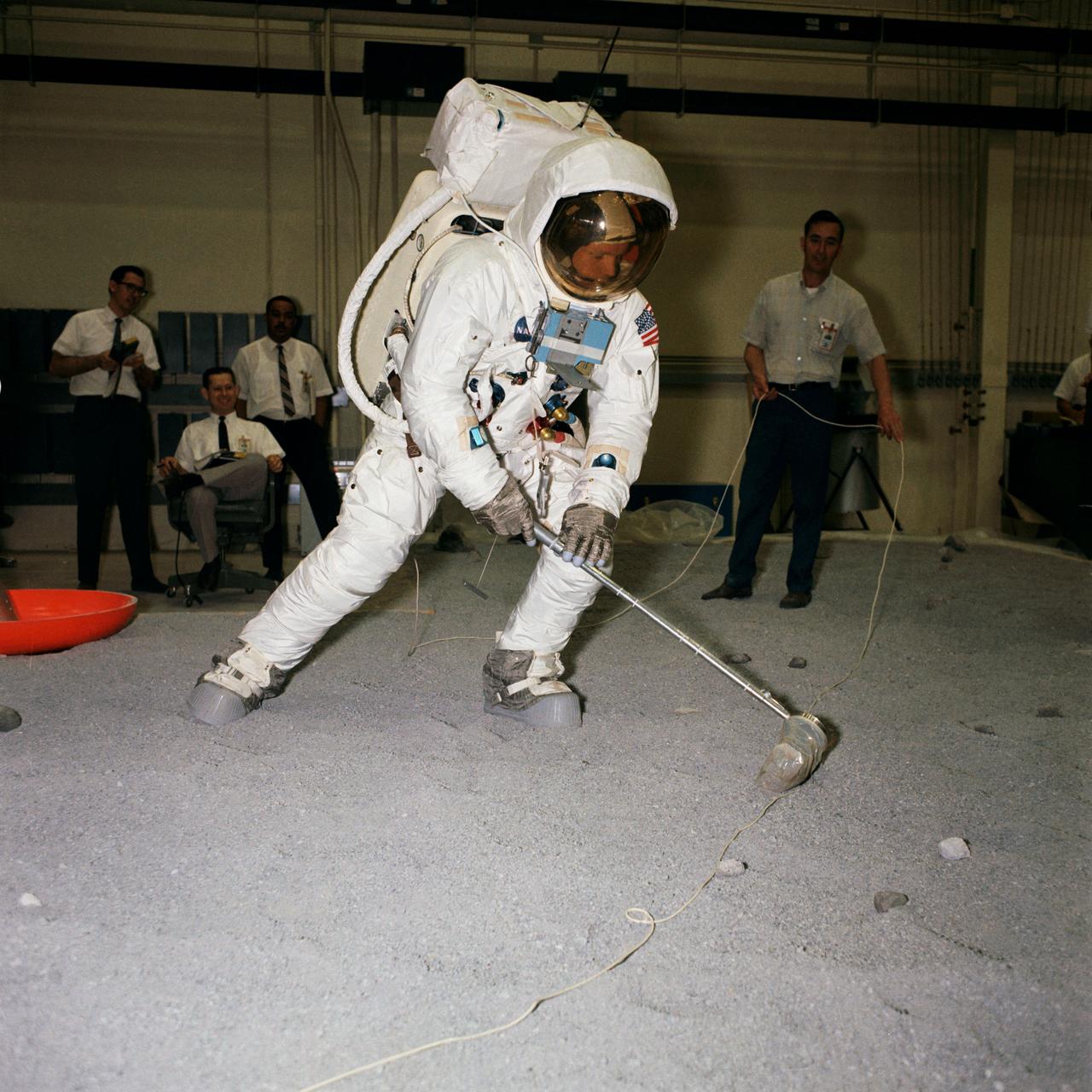
S69-31048 (18 April 1969) --- Suited astronaut Neil A. Armstrong, wearing an Extravehicular Mobility Unit (EMU), participates in lunar surface simulation training on April 18, 1969, in Building 9, Manned Spacecraft Center. Armstrong is the prime crew commander of the Apollo 11 lunar landing mission. Here, he practices scooping up a lunar sample.

S69-40205 (27 July 1969) --- The crewmen of the Apollo 11 lunar landing mission go through their post flight debriefing session on Sunday, July 27, 1969. Left to right, are astronauts Edwin E. Aldrin Jr., lunar module pilot; Michael Collins, command module pilot; and Neil A. Armstrong, commander. They are seated in the debriefing room of the Crew Reception Area of the Lunar Receiving Laboratory at the Manned Spacecraft Center.
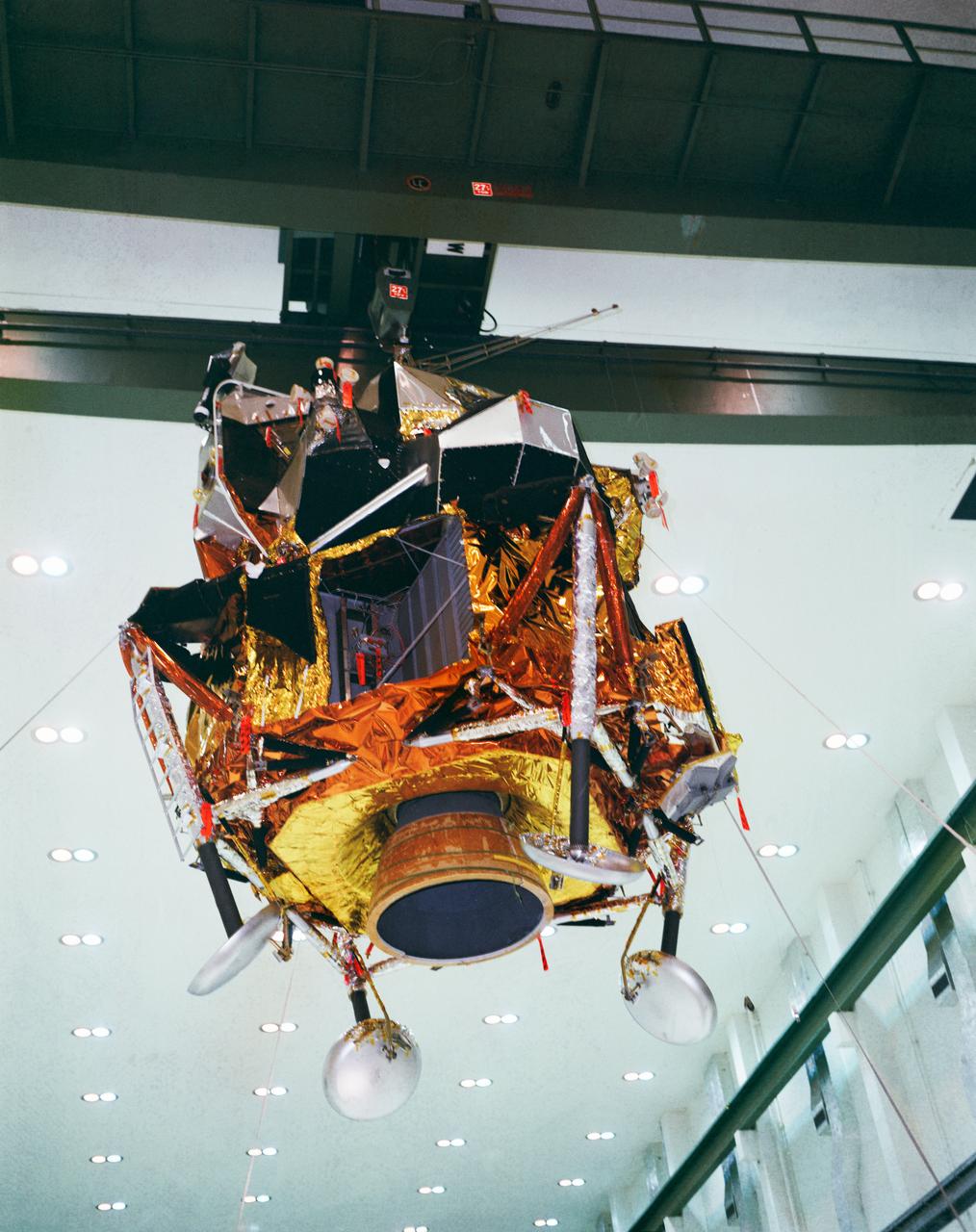
S69-32396 (4 April 1969) --- Interior view of the Kennedy Space Center's (KSC) Manned Spacecraft Operations Building showing Lunar Module (LM) 5 being moved from work stand for mating with its Spacecraft Lunar Module Adapter (SLA). LM-5 is scheduled to be flown on the Apollo 11 lunar landing mission.
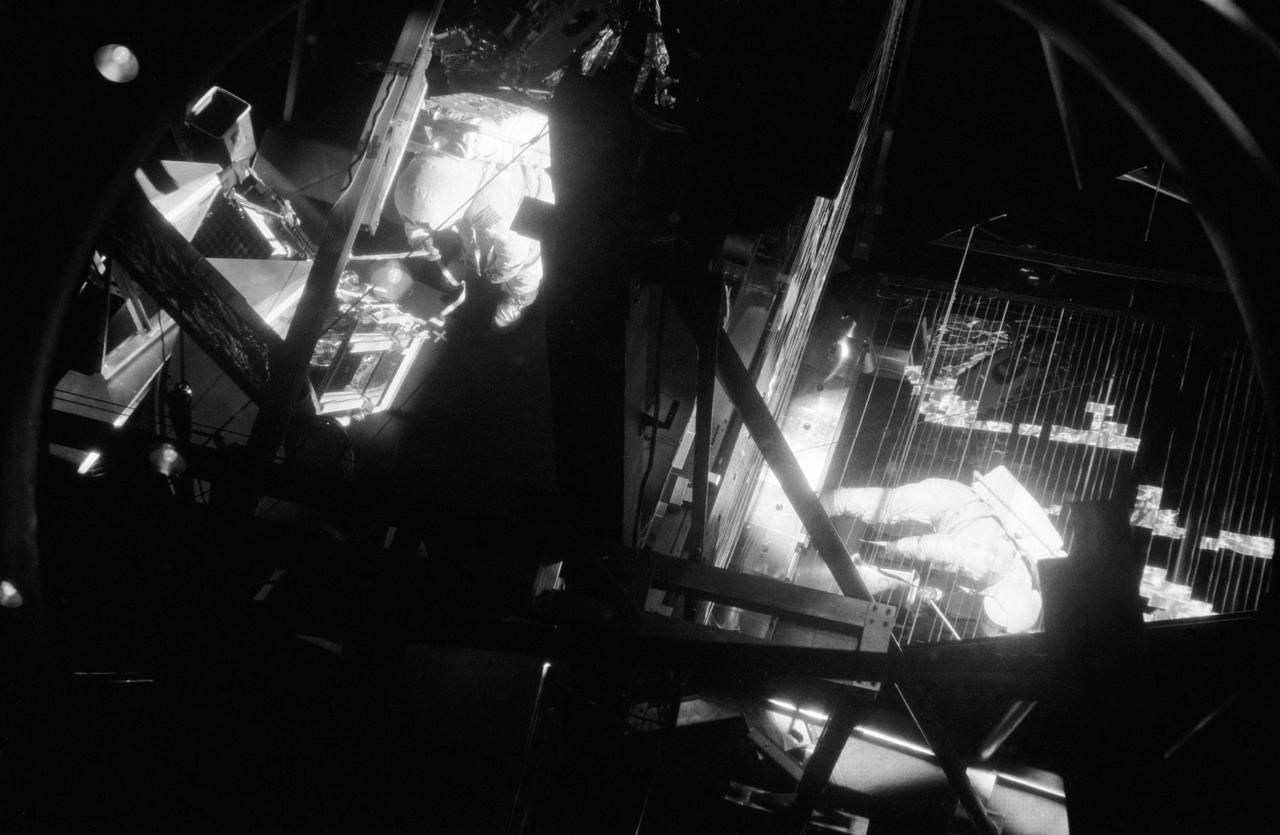
Astronaut Neil A. Armstrong, commander of the Apollo 11 lunar landing mission, is photographed during thermovacuum training in Chamber B of the Space Environment Simulation Laboratory, Building 32, Manned Spacecraft Center. He is wearing an Extravehicular Mobility Unit. The training simulated lunar surface vacuum and thermal conditions during astronaut operations outside the Lunar Module on the moon's surface. The mirror was used to reflect solar light.
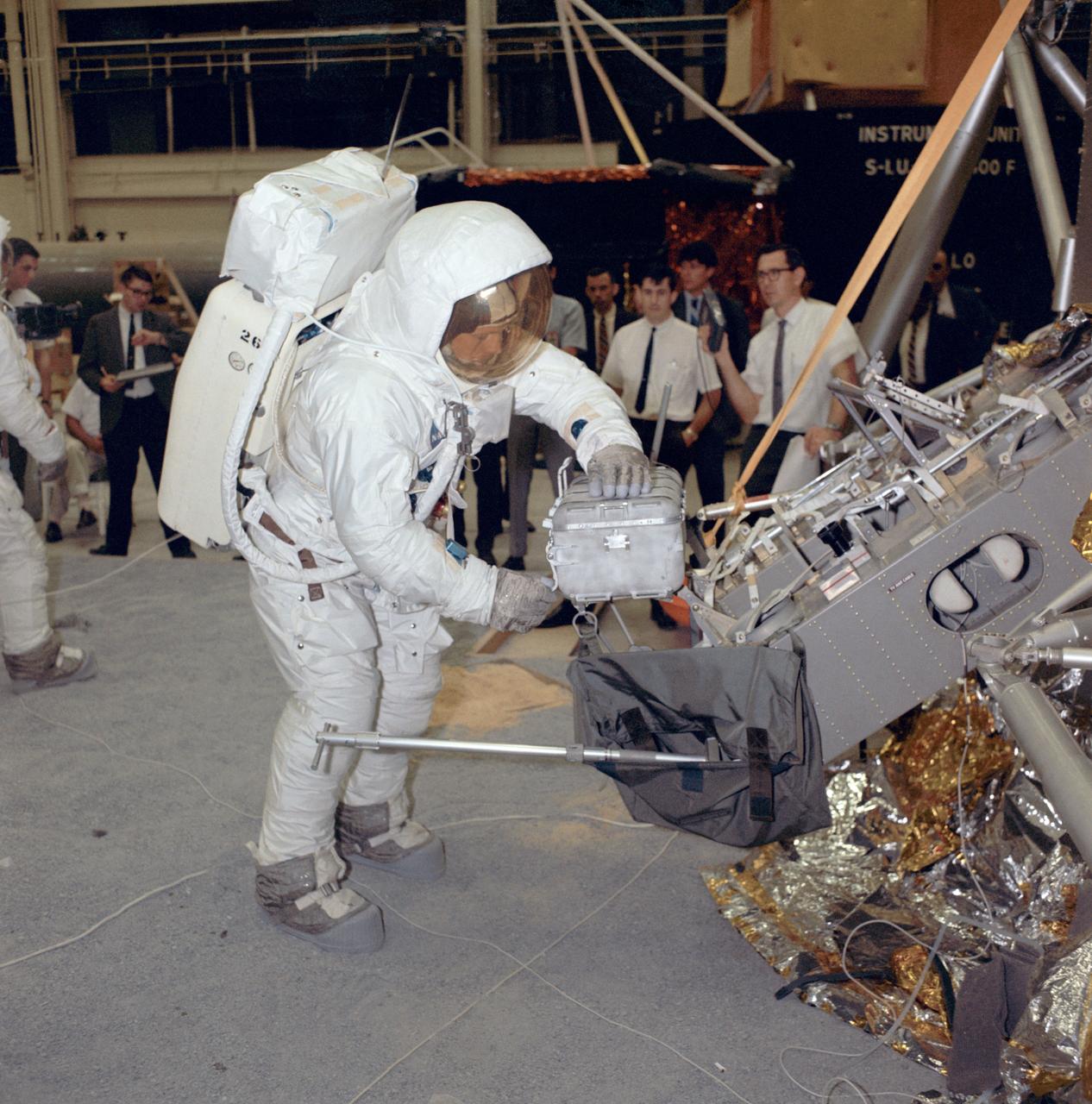
S69-31080 (18 April 1969) --- Suited astronaut Neil A. Armstrong, wearing an Extravehicular Mobility Unit (EMU), participates in lunar surface simulation training on April 18, 1969 in building 9, Manned Spacecraft Center (MSC). Armstrong is prime crew commander of the Apollo 11 lunar landing mission. Here, he is opening a sample return container. On the right is the Modular Equipment Stowage Assembly (MESA) and the Lunar Module (LM) mock-up.
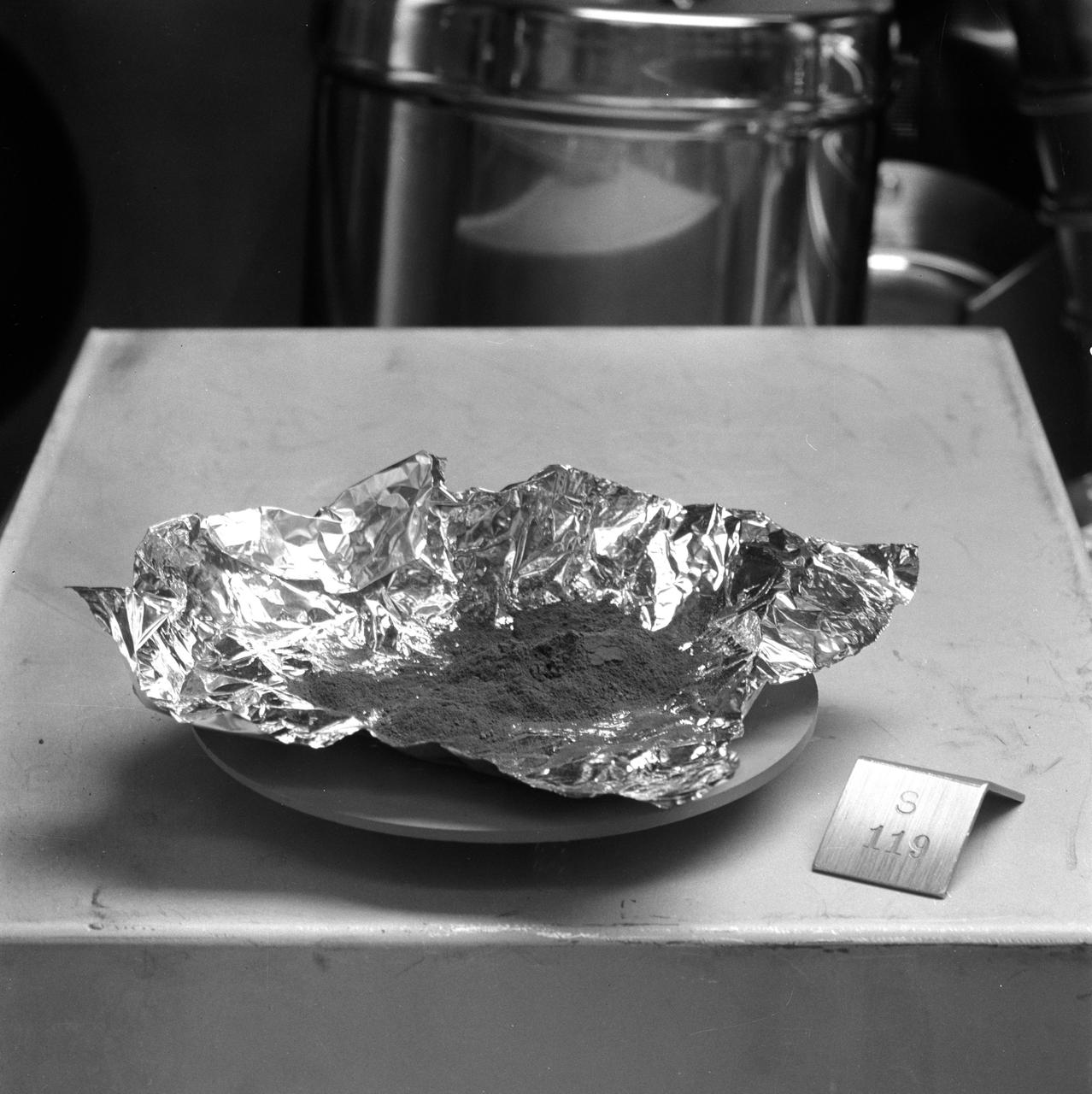
S71-19269 (12 Feb. 1971) --- A close-up view of Apollo 14 sample number 14414 & 14412, a fine lunar powder-like material under examination in the Sterile Nitrogen Atmospheric Processing (SNAP) line in the Lunar Receiving Laboratory (LRL) at the Manned Spacecraft Center (MSC). Scientists are currently making preliminary analyses of material brought back from the moon by the crew of Apollo 14 lunar landing mission.
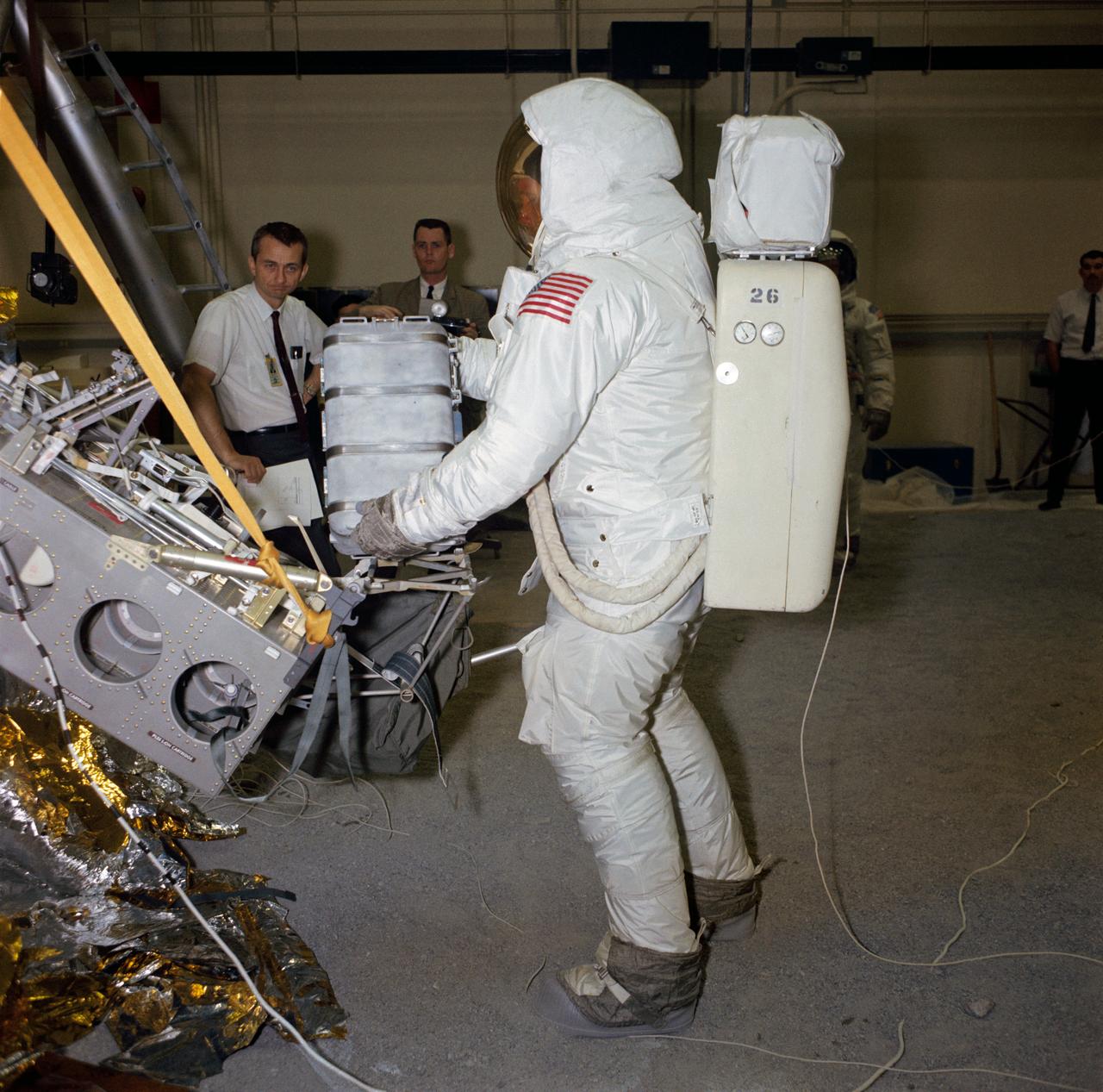
S69-31075 (18 April 1969) --- Suited astronaut Neil A. Armstrong, wearing an Extravehicular Mobility Unit (EMU), participates in lunar surface simulation training on April 18, 1969 in building 9, Manned Spacecraft Center (MSC). Armstrong is prime crew commander of the Apollo 11 lunar landing mission. Here, he is opening a sample return container. On the right is the Modular Equipment Stowage Assembly (MESA) and the Lunar Module (LM) mockup.
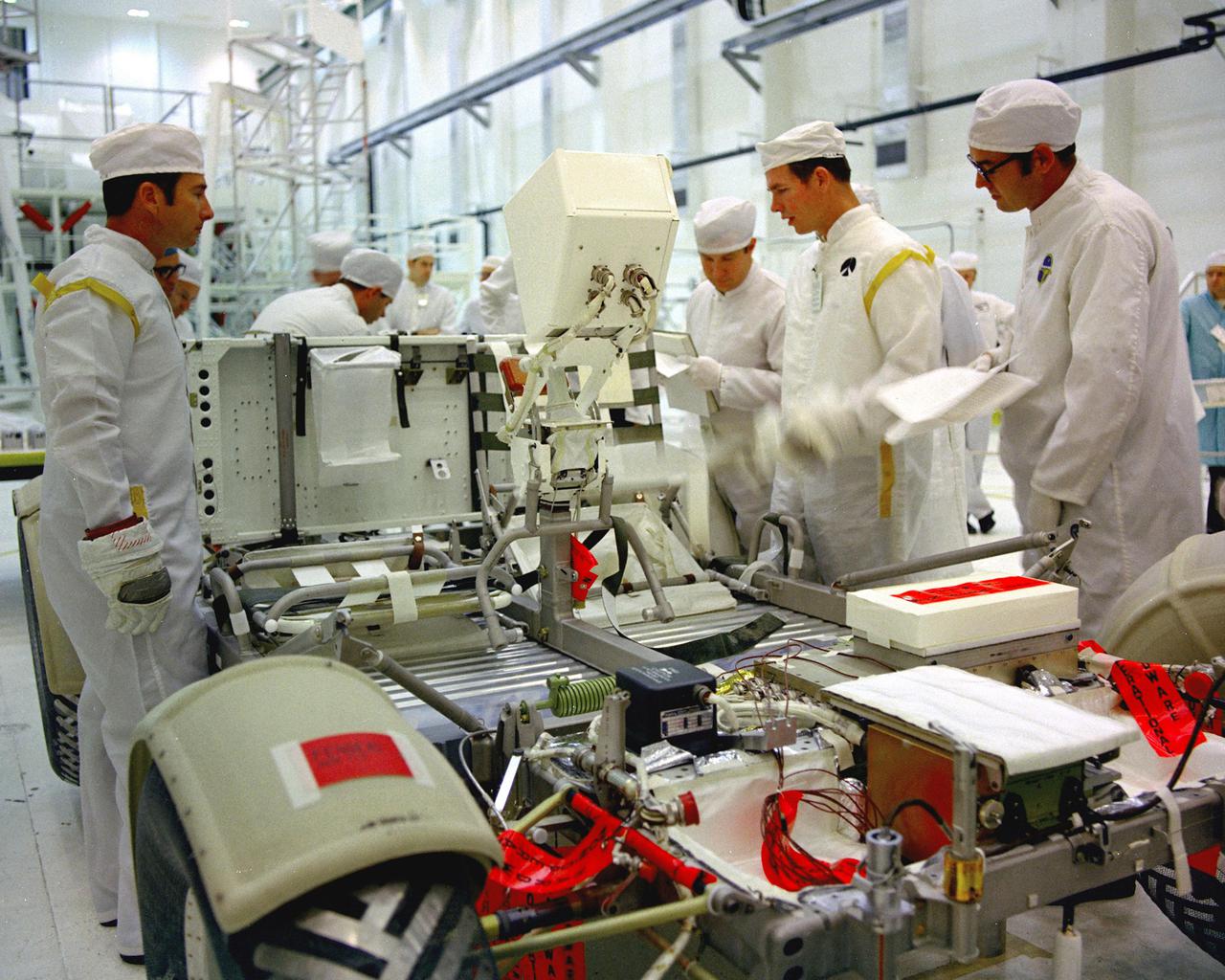
KENNEDY SPACE CENTER, FLA. - The Apollo 15 astronauts that will be involved in the first time use of the Lunar Roving Vehicle, participate in a Crew Fit and Functional Test in the Manned Spacecraft Operations Building. Commander James B. Irwin and Command Module Pilot Alfred M. Worden, Jr., will drive the Lunar Roving Vehicle for the first time on the Moon's surface. The landing site for the Lunar Module is the Hadley-Apennine area of the Moon.
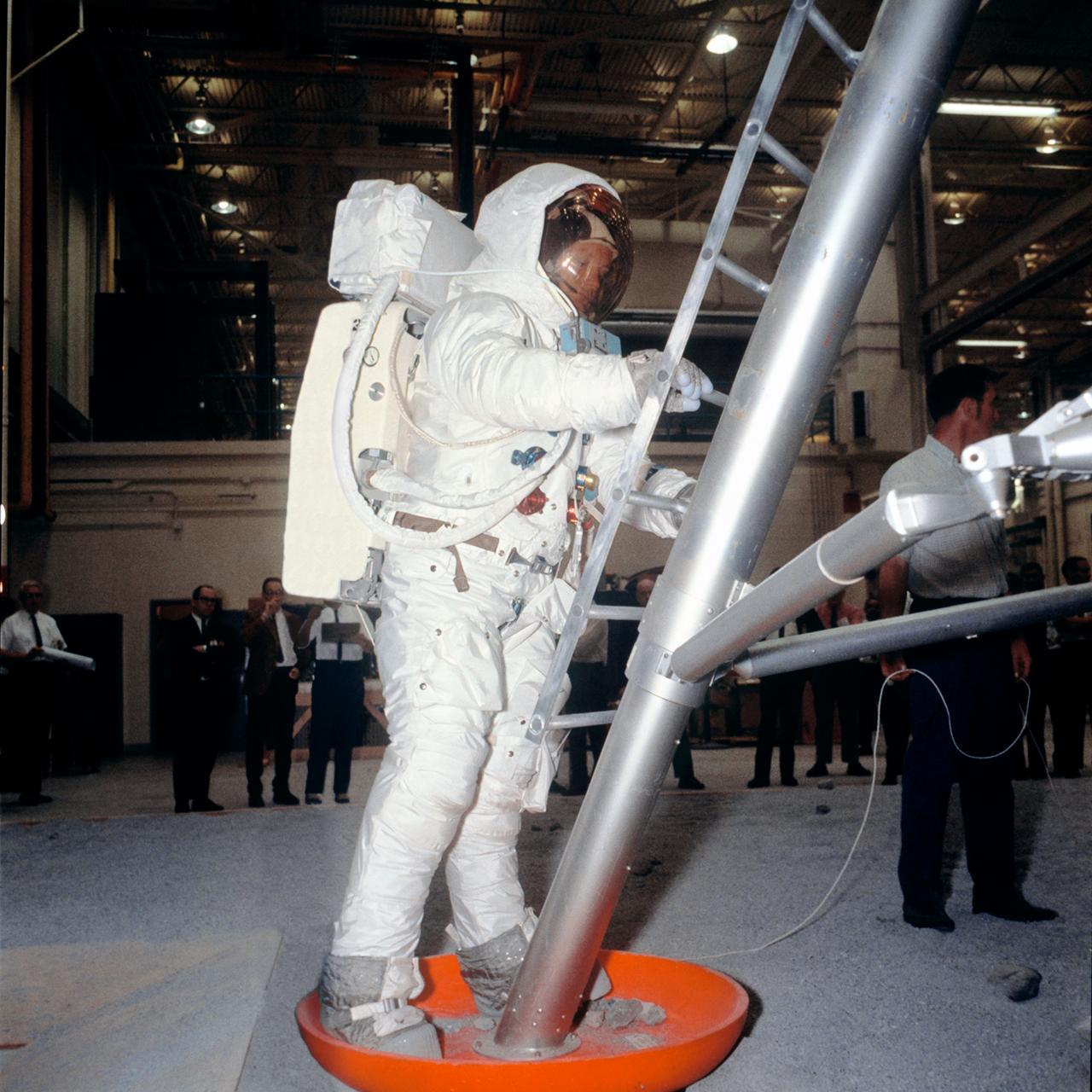
S69-31042 (18 April 1969) --- Suited astronaut Neil A. Armstrong, wearing an Extravehicular Mobility Unit (EMU), participates in lunar surface simulation training on April 18, 1969, in Building 9, Manned Spacecraft Center (MSC). Armstrong is the prime crew commander of the Apollo 11 lunar landing mission. Here, he is standing on Lunar Module (LM) mockup foot pad preparing to ascend steps.

S69-52990 (20 Sept. 1969) --- The three prime crew men of the Apollo 12 lunar landing mission participate in water egress training in the Gulf of Mexico. They have just egressed the Apollo Command Module (CM) trainer. The man standing at left is a Manned Spacecraft Center's (MSC) swimmer. The crew men await in life raft for helicopter pickup. All four persons are wearing biological isolation garments. Participating in the training exercise were astronauts Charles Conrad Jr., commander; Richard F. Gordon Jr., command module pilot; and Alan L. Bean, lunar module pilot.
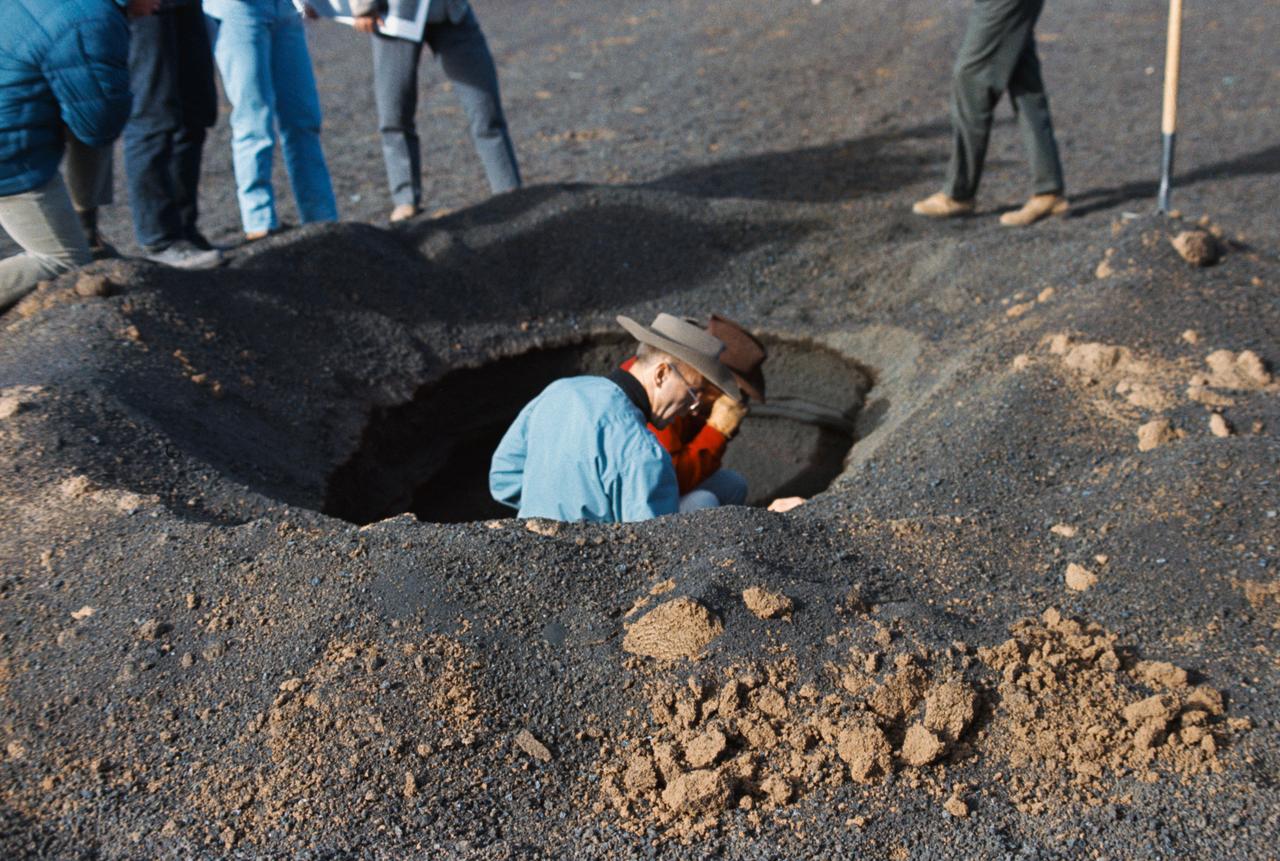
S69-55662 (10 Oct. 1969) --- Astronauts Alan L. Bean (left) and Charles Conrad Jr., the two crewmen of the Apollo 12 lunar landing mission who are scheduled to participate in two lengthy periods of extravehicular activity (EVA) on the lunar surface, are pictured during a geological field trip and training at a simulated lunar surface area near Flagstaff, Arizona. Here Conrad, the Apollo 12 commander, gets a close look through hand lens at the stratigraphy (study of strata or layers beneath the surface) of a man-dug hole, while Bean, the Apollo 12 mission's lunar module pilot, looks on. The topography in this area, with several man-made modifications, resembles very closely much of the topography found on the lunar surface. While Conrad and Bean explore the lunar surface (plans call for Apollo 12 spacecraft to land in the Sea of Storms), astronaut Richard F. Gordon Jr., command module pilot for the Apollo 12 mission, will remain with the Command and Service Modules (CSM) in lunar orbit. The Apollo 12 mission is scheduled to lift off from Cape Kennedy on Nov. 14, 1969.
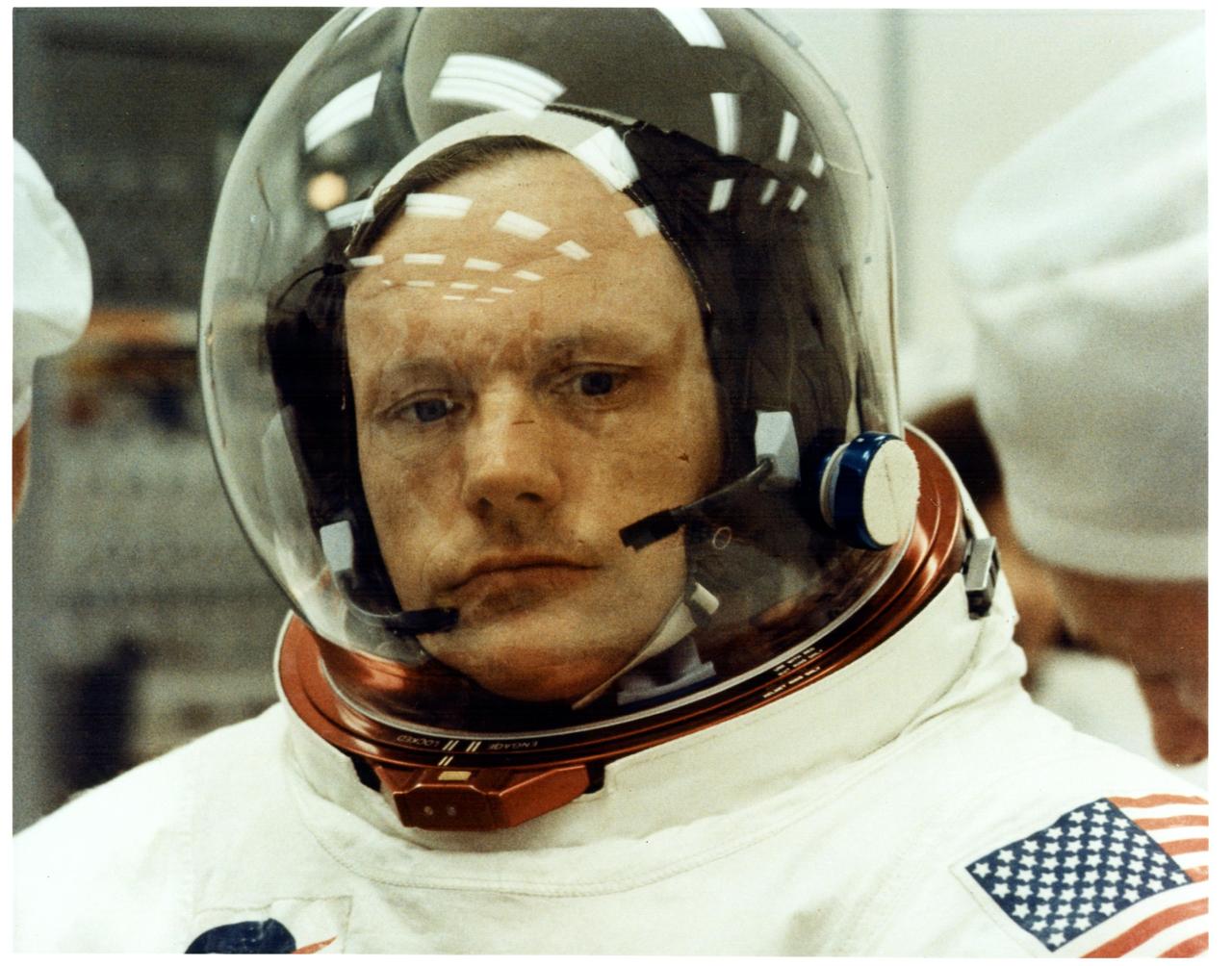
KENNEDY SPACE CENTER, FLA. - Technicians make the final adjustments to Apollo 11 Commander Neil A. Armstrong's spacesuit as he prepares to take part in a space vehicle Countdown Demonstration Test (CDDT). Astronauts Armstrong, Aldrin and Collins are practicing for ther mission, the first manned Lunar landing.
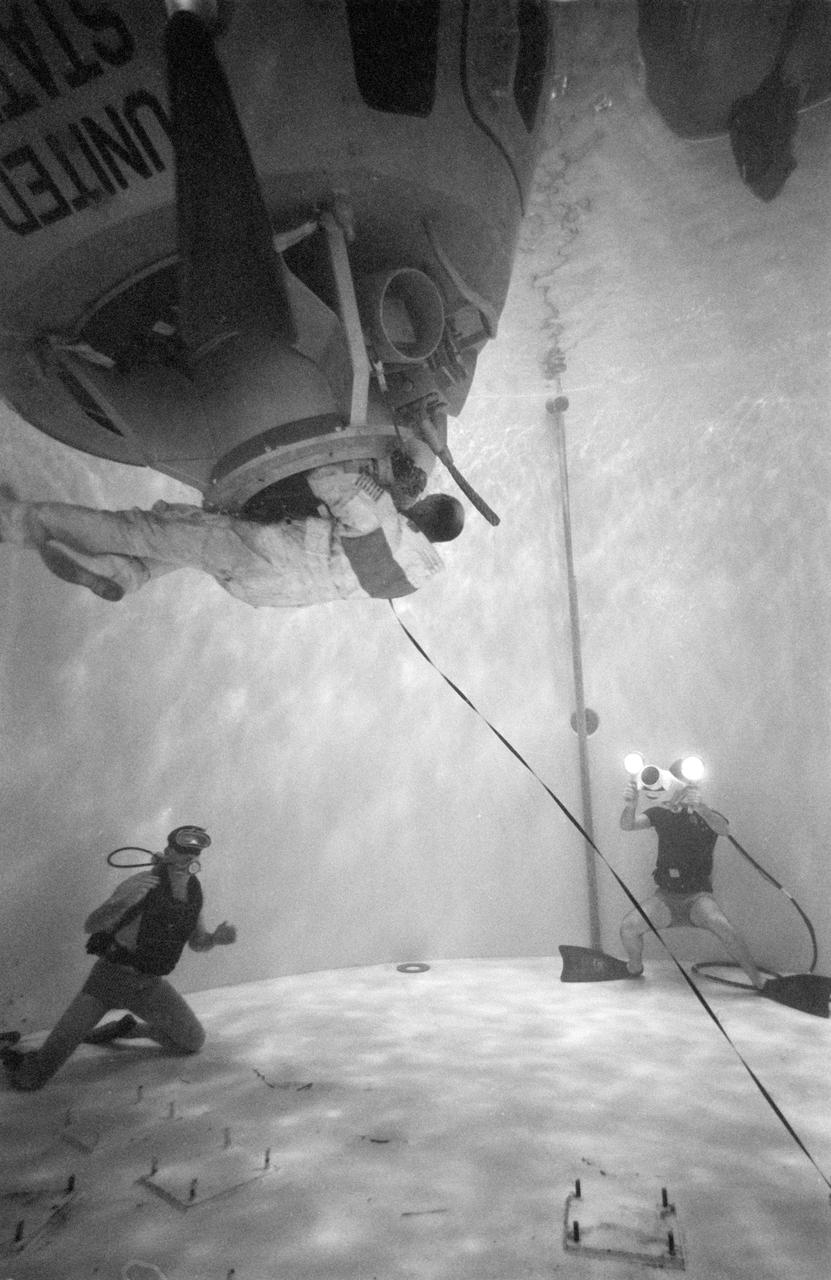
S70-24016 (17 Jan. 1970) --- Astronaut Thomas K. Mattingly II, command module pilot of the Apollo 13 lunar landing mission, participates in water egress training in a water tank in Building 260 at the Manned Spacecraft Center.
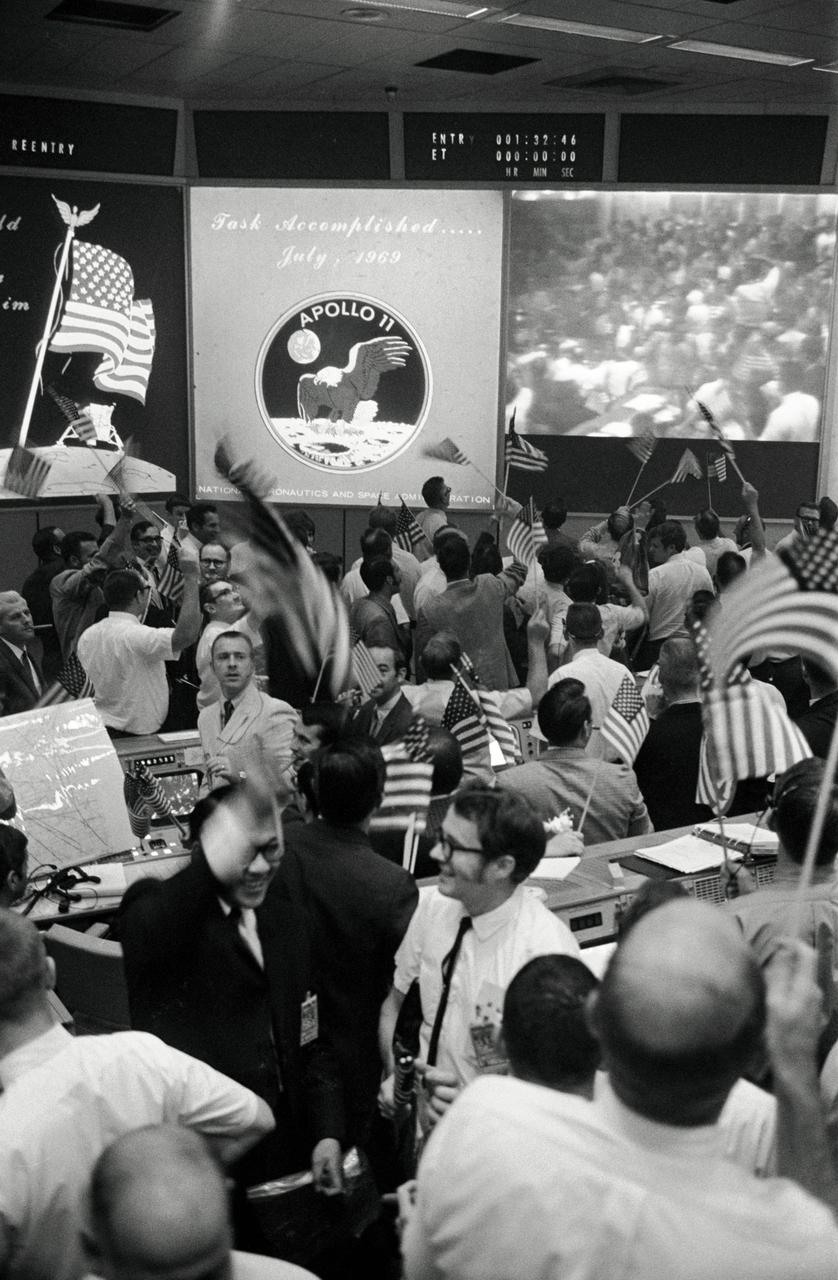
S69-40023 (24 July 1969) --- Overall view of the Mission Operations Control Room (MOCR) in the Mission Control Center (MCC), Building 30, Manned Spacecraft Center (MSC), showing the flight controllers celebrating the successful conclusion of the Apollo 11 lunar landing mission.
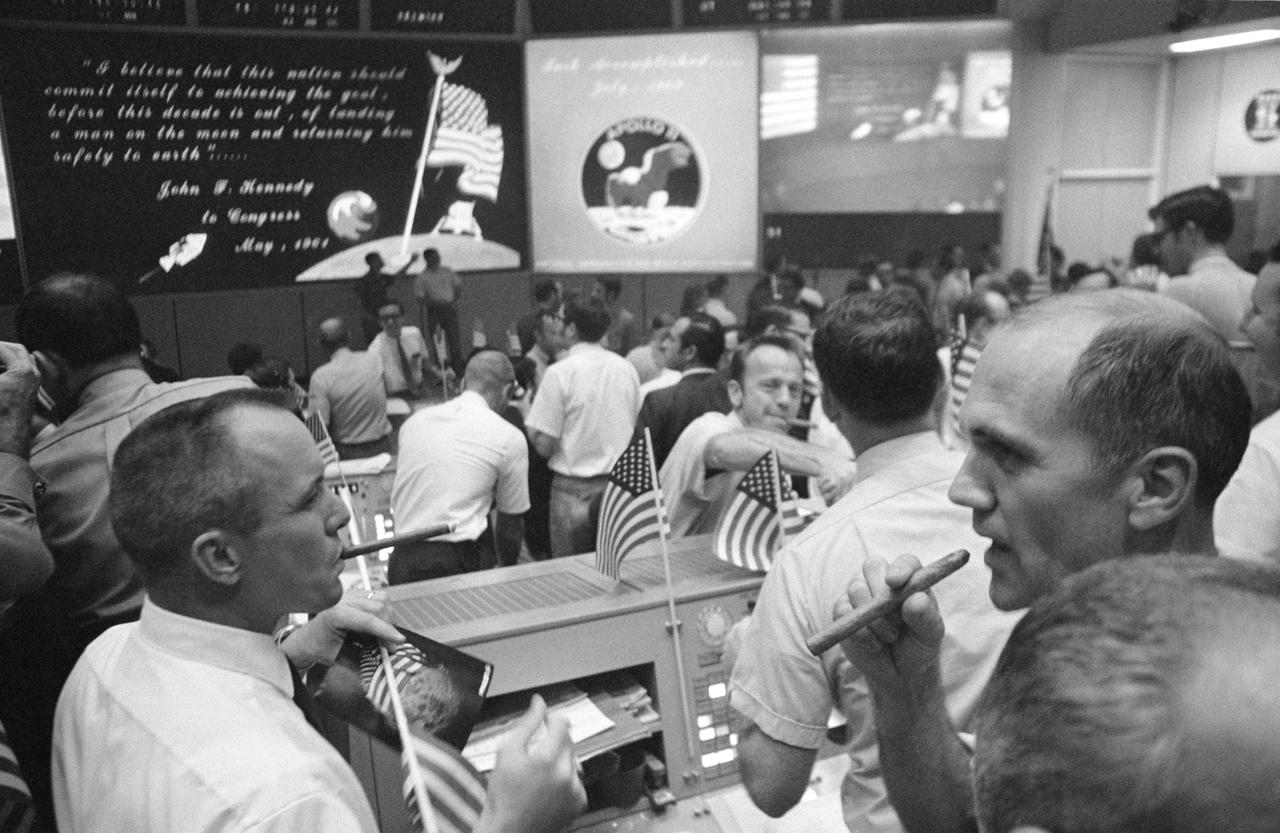
S69-40025 (24 July 1969) --- Overall view of the Mission Operations Control Room (MOCR) in the Mission Control Center (MCC), Building 30, Manned Spacecraft Center (MSC), showing the flight controllers celebrating the successful conclusion of the Apollo 11 lunar landing mission.

S69-40022 (24 July 1969) --- Overall view of the Mission Operations Control Room (MOCR) in the Mission Control Center (MCC), Building 30, Manned Spacecraft Center (MSC), showing the flight controllers celebrating the successful conclusion of the Apollo 11 lunar landing mission.
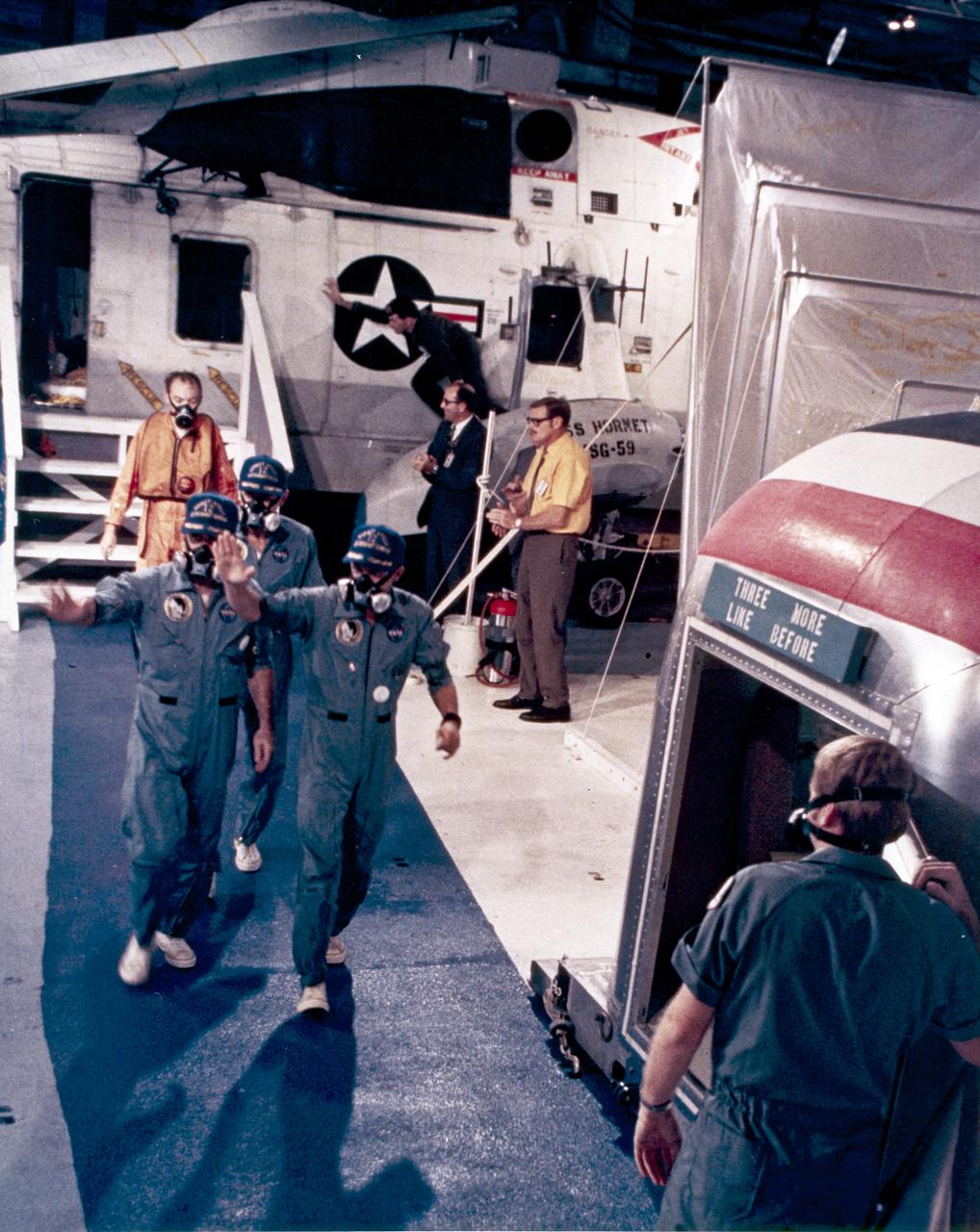
Aboard the recovery ship, USS Hornet, Apollo 12 astronauts wave to the crowd as they enter the mobile quarantine facility. The recovery operation took place in the Pacific Ocean after the splashdown of the Command Module capsule. Navy para-rescue men recovered the capsule housing the 3-man Apollo 12 crew. The second manned lunar landing mission, Apollo 12 launched from launch pad 39-A at Kennedy Space Center in Florida on November 14, 1969 via a Saturn V launch vehicle. The Saturn V was developed by the Marshall Space Flight Center (MSFC) under the direction of Dr. Wernher von Braun. Aboard Apollo 12 was a crew of three astronauts: Alan L. Bean, pilot of the Lunar Module (LM), Intrepid; Richard Gordon, pilot of the Command Module (CM), Yankee Clipper; and Spacecraft Commander Charles Conrad. The LM, Intrepid, landed astronauts Conrad and Bean on the lunar surface in what’s known as the Ocean of Storms while astronaut Richard Gordon piloted the CM, Yankee Clipper, in a parking orbit around the Moon. Lunar soil activities included the deployment of the Apollo Lunar Surface Experiments Package (ALSEP), finding the unmanned Surveyor 3 that landed on the Moon on April 19, 1967, and collecting 75 pounds (34 kilograms) of rock samples. Apollo 12 safely returned to Earth on November 24, 1969.
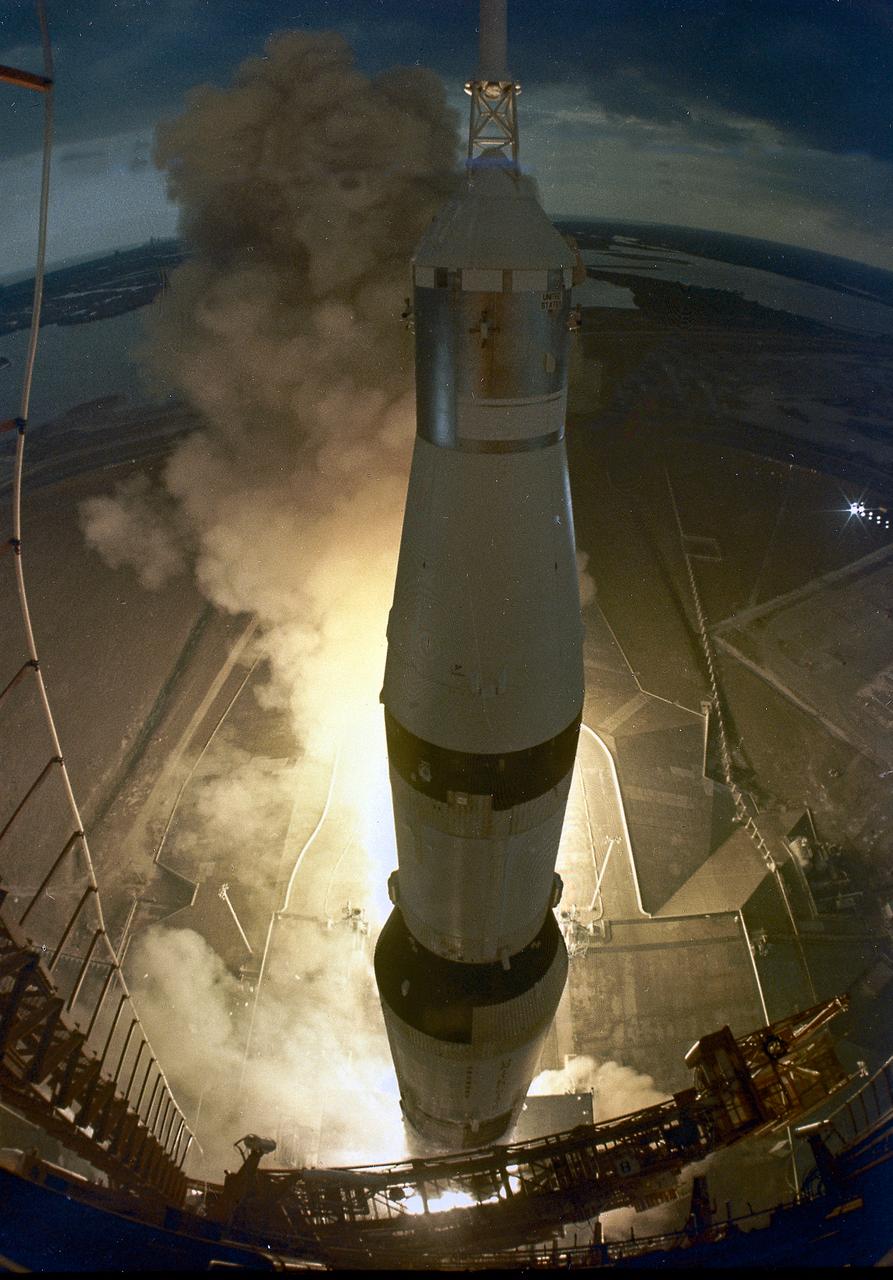
This is a view from sequential photographs of the Apollo 14 liftoff taken by a remote camera atop the 360-foot gantry level of Launch Complex 39A. The Apollo 14, carrying a crew of three astronauts: Mission commander Alan B. Shepard Jr., Command Module pilot Stuart A. Roosa, and Lunar Module pilot Edgar D. Mitchell, lifted off from launch complex 39A at the Kennedy Space Center on January 31, 1971. It was the third manned lunar landing, the first manned landing in exploration of the lunar highlands, and it demonstrated pinpoint landing capability. The major goal of Apollo 14 was the scientific exploration of the Moon in the foothills of the rugged Fra Mauro region. Activities of astronauts Shepard and Mitchell, during extravehicular activity (EVA) on the lunar surface, included setting up an automated scientific laboratory called Apollo Lunar Scientific Experiments Package (ALSEP), and collecting a total of about 95 pounds (43 kilograms) of Moon rock and soil for a geological investigation back on the Earth.
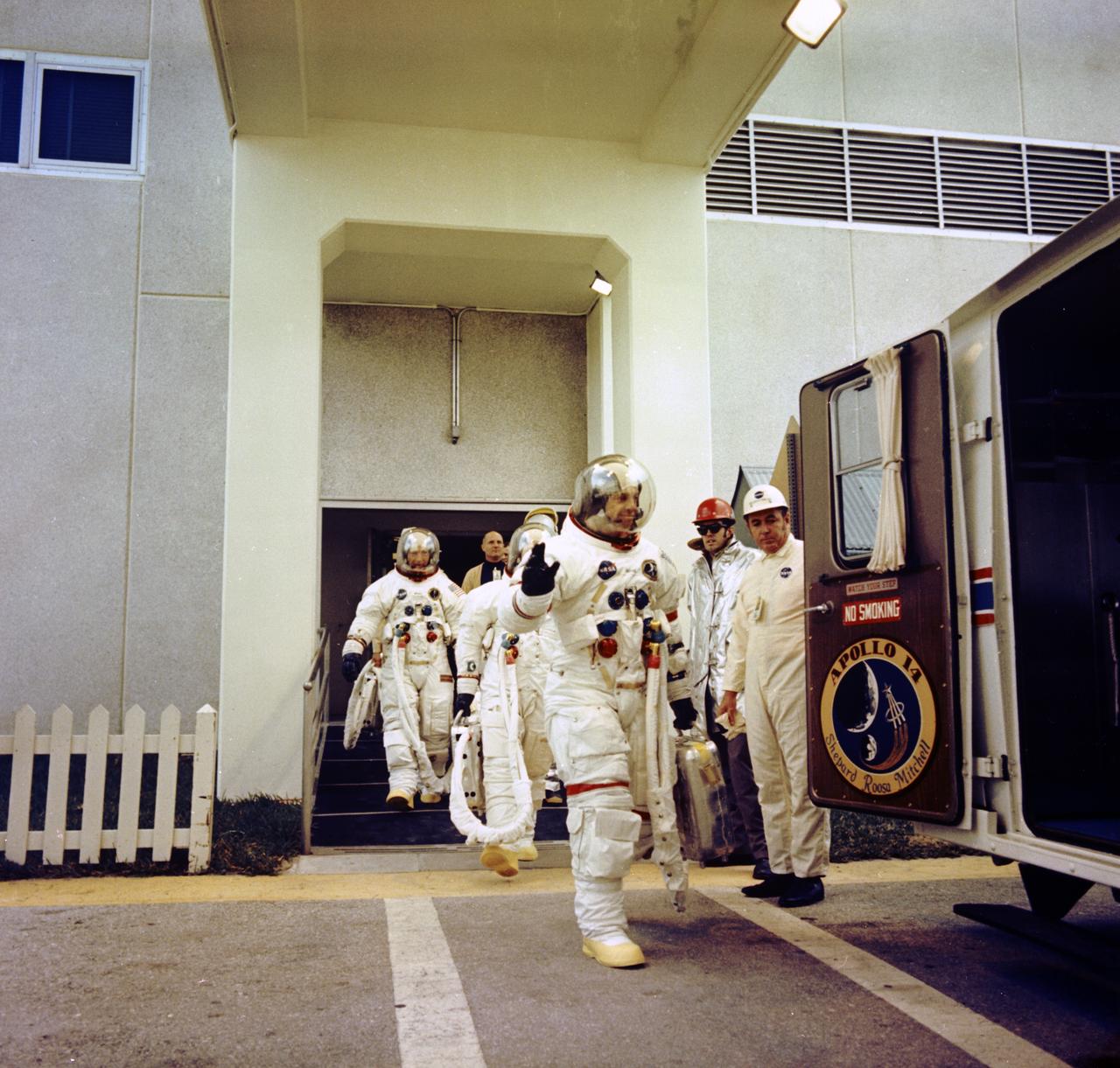
Apollo 14 Mission Commander, Alan B. Shepard, Jr., waves to well-wishers as he and astronauts Stuart A. Roosa, Command Module pilot; and Edgar D. Mitchell, Lunar Module pilot, walk to the transfer van during the countdown demonstration test. The Apollo 14, carrying the crew of three lifted off from launch complex 39A at KSC on January 31, 1971. It was the third manned lunar landing, the first manned landing in exploration of the lunar highlands, and it demonstrated pinpoint landing capability. The major goal of Apollo 14 was the scientific exploration of the Moon in the foothills of the rugged Fra Mauro region. The lunar surface extravehicular activity (EVA) of astronauts Shepard and Mitchell included setting up an automated scientific laboratory called Apollo Lunar Scientific Experiments Package (ALSEP), and collecting a total of about 95 pounds (43 kilograms) of Moon rock and soil for a geological investigation back on the Earth. Apollo 14 safely returned to Earth on February 9, 1971.
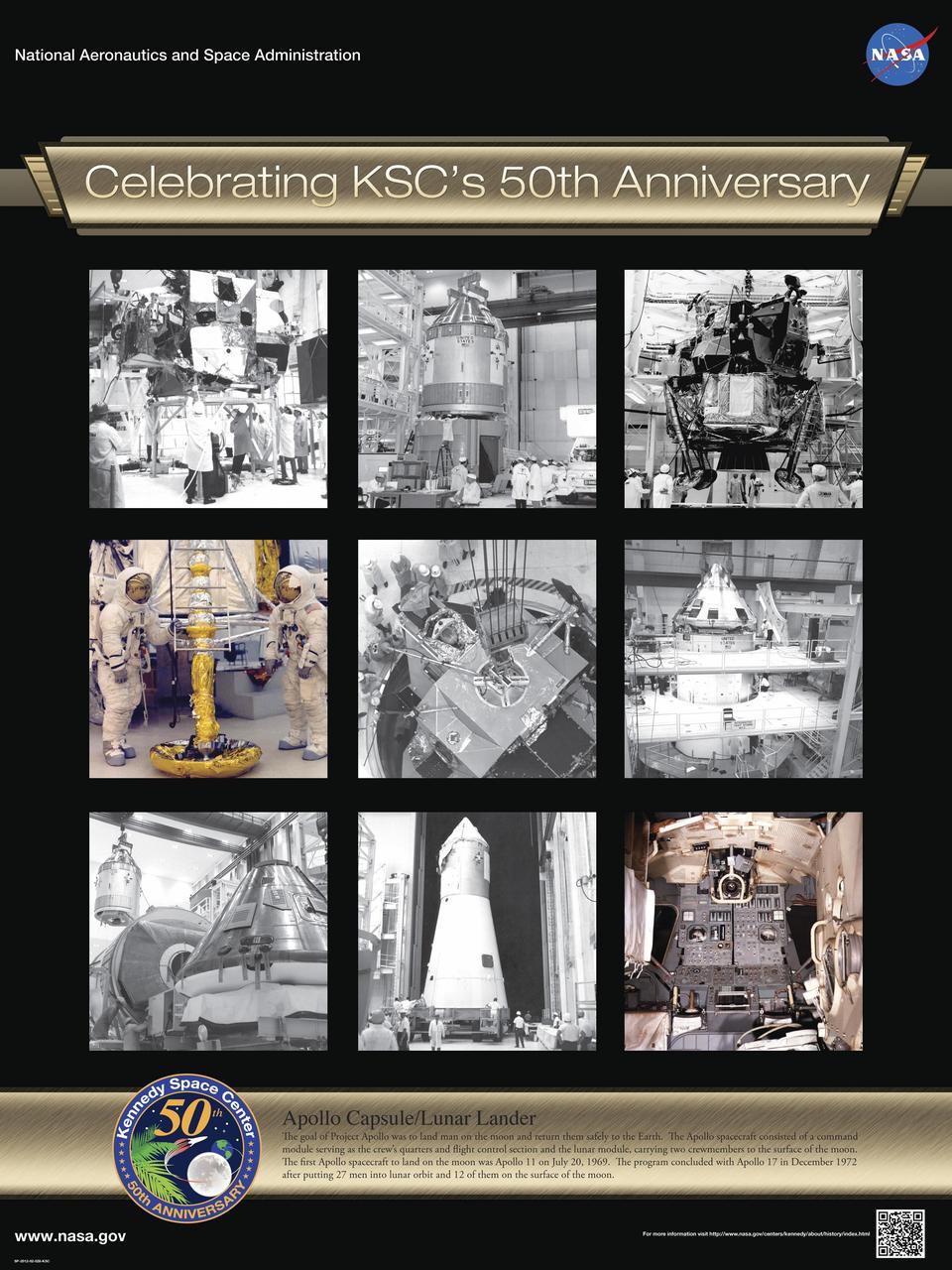
Apollo Capsule/Lunar Lander: The goal of Project Apollo was to land man on the moon and return them safely to the Earth. The Apollo spacecraft consisted of a command module serving as the crew’s quarters and flight control section and the lunar module, carrying two crewmembers to the surface of the moon. The first Apollo spacecraft to land on the moon was Apollo 11 on July 20, 1969. The program concluded with Apollo 17 in December 1972 after putting 27 men into lunar orbit and 12 of them on the surface of the moon. Poster designed by Kennedy Space Center Graphics Department/Greg Lee. Credit: NASA
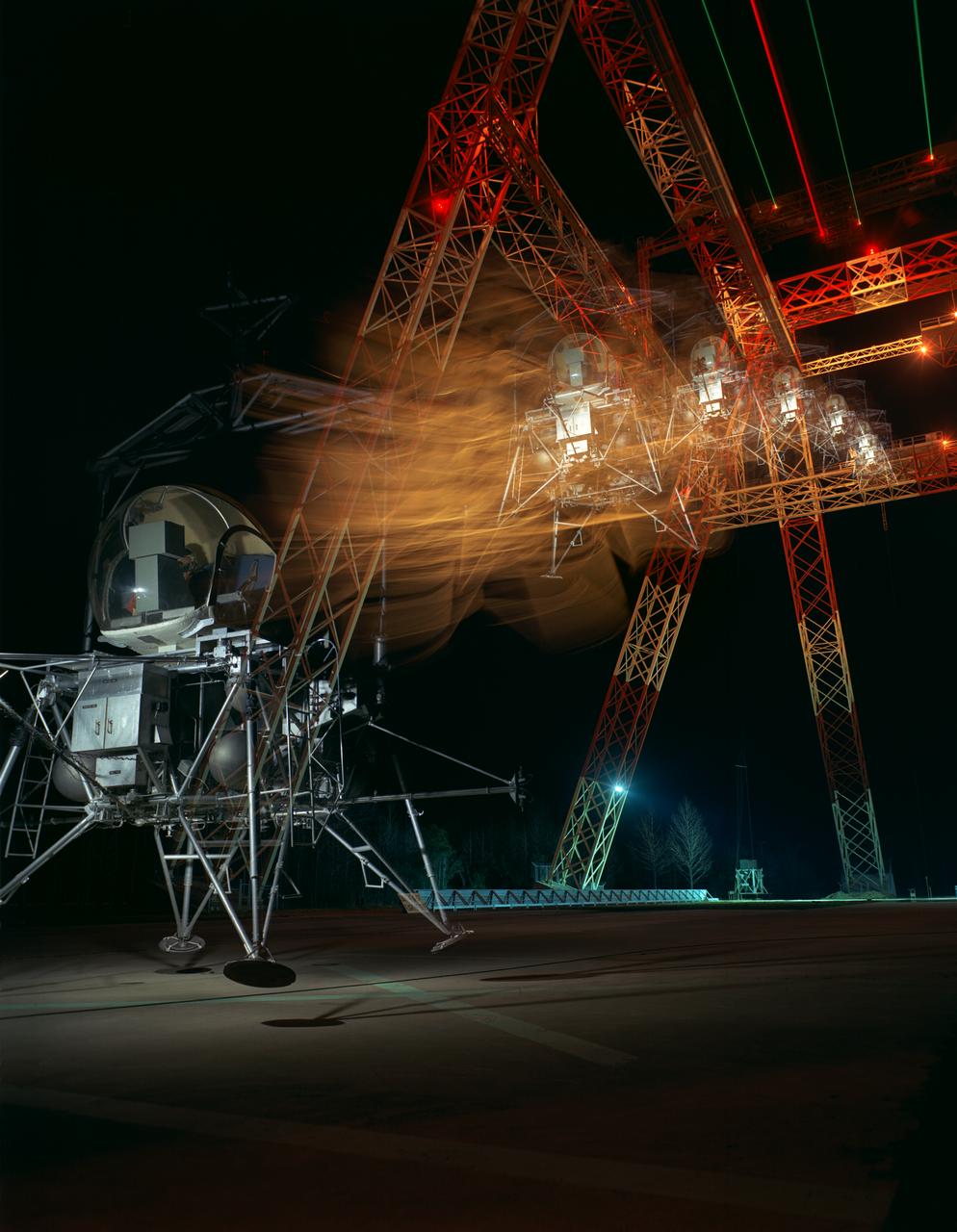
During a nighttime training session, a multiple exposure captures the movement of the Lunar Excursion Module Simulator (LEMS). The LEMS was a manned vehicle used to familiarize the Apollo astronauts with the handling characteristics of lunar-landing type vehicle. The Apollo Program is best known for the astronaut Neal Armstrong s first step on the Moon July 20, 1969. In its earliest test period, the LEMS featured a helicopter crew cabin atop the lunar landing module. Later, the helicopter crew cabin was replaced with a stand-up rectangular cabin which was more efficient for controlling maneuvers and for better viewing by the pilot. The vehicle was designed at Langley Research Center in Hampton, VA. This multiple exposure shows a simulated Moon landing of the (LEMS) trainer at Langley s Lunar Landing Research Facility. -- Photograph published in Winds of Change, 75th Anniversary NASA publication (page 70), by James Shultz. Also published in " A Century at Langley" by Joseph Chambers, pg. 93.
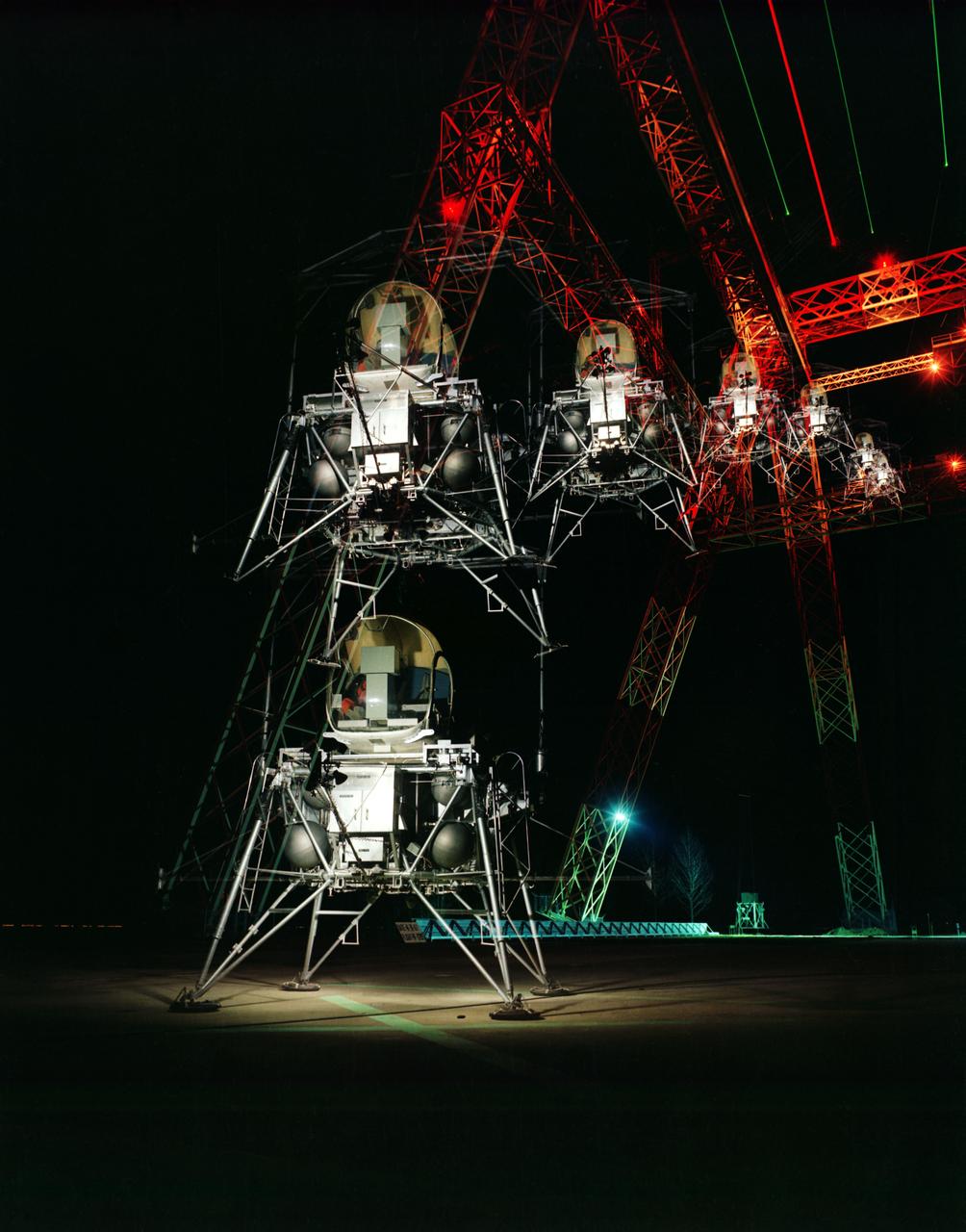
During a nighttime training session, a multiple exposure captures the movement of the Lunar Excursion Module Simulator (LEMS). The LEMS was a manned vehicle used to familiarize the Apollo astronauts with the handling characteristics of lunar-landing type vehicle. The Apollo Program is best known for the astronaut Neal Armstrong s first step on the Moon July 20, 1969. In its earliest test period, the LEMS featured a helicopter crew cabin atop the lunar landing module. Later, the helicopter crew cabin was replaced with a stand-up rectangular cabin which was more efficient for controlling maneuvers and for better viewing by the pilot. The vehicle was designed at Langley Research Center in Hampton, VA. This multiple exposure shows a simulated Moon landing of the (LEMS) trainer at Langley s Lunar Landing Research Facility. -- Photograph published in Winds of Change, 75th Anniversary NASA publication (page 70), by James Shultz. Also published in " A Century at Langley" by Joseph Chambers, pg. 93.

The two moon-exploring crewmen of the Apollo 14 lunar landing mission show off some of the largest of the lunar rocks they collected on their mission, during a through-the-glass meeting with newsmen in the Crew Reception Area of the Lunar Receiving Laboratory (LRL) at the Manned Spacecraft Center (MSC). Astronaut Edgar D. Mitchell (left), lunar module pilot, holds up a tote bag in which some of the lunar samples were stowed, while astronaut Alan B. Shepard Jr., commander, looks on. The largest sample brought back on the mission, a basketball-size rock (nicknamed "Big Bertha"), is said to be the largest lunar rock collected in three lunar landing missions for the National Aeronautics and Space Administration (NASA).
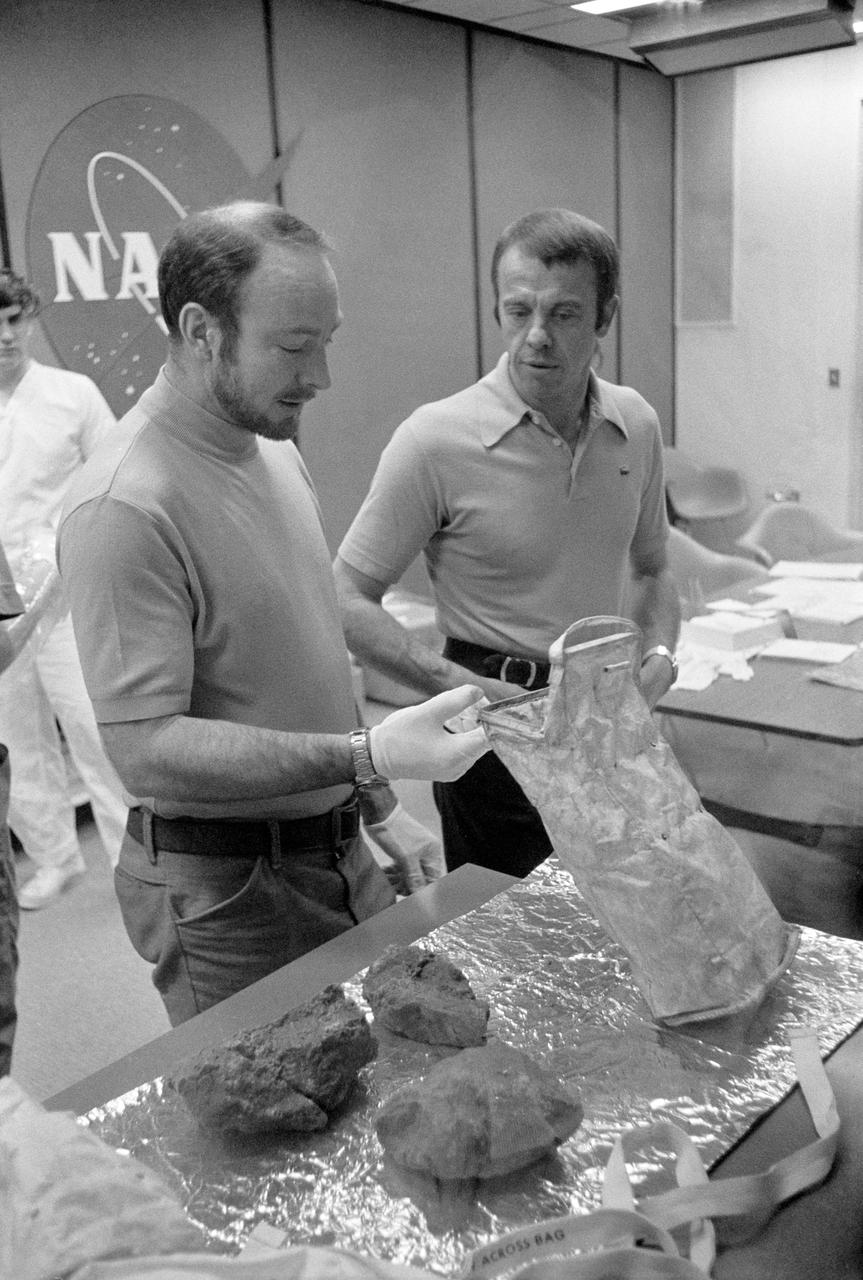
S71-20375 (19 Feb. 1971) --- The two moon-exploring crewmen of the Apollo 14 lunar landing mission show off some of the largest of the lunar rocks they collected on their mission, during a through-the-glass meeting with newsmen in the Crew Reception Area of the Lunar Receiving Laboratory (LRL) at the Manned Spacecraft Center (MSC). Astronaut Edgar D. Mitchell (left), lunar module pilot, holds up a tote bag in which some of the lunar samples were stowed, while astronaut Alan B. Shepard Jr., commander, looks on. The largest sample brought back on the mission, a basketball-size rock (nicknamed "Big Bertha"), is said to be the largest lunar rock collected in three lunar landing missions for the National Aeronautics and Space Administration (NASA).
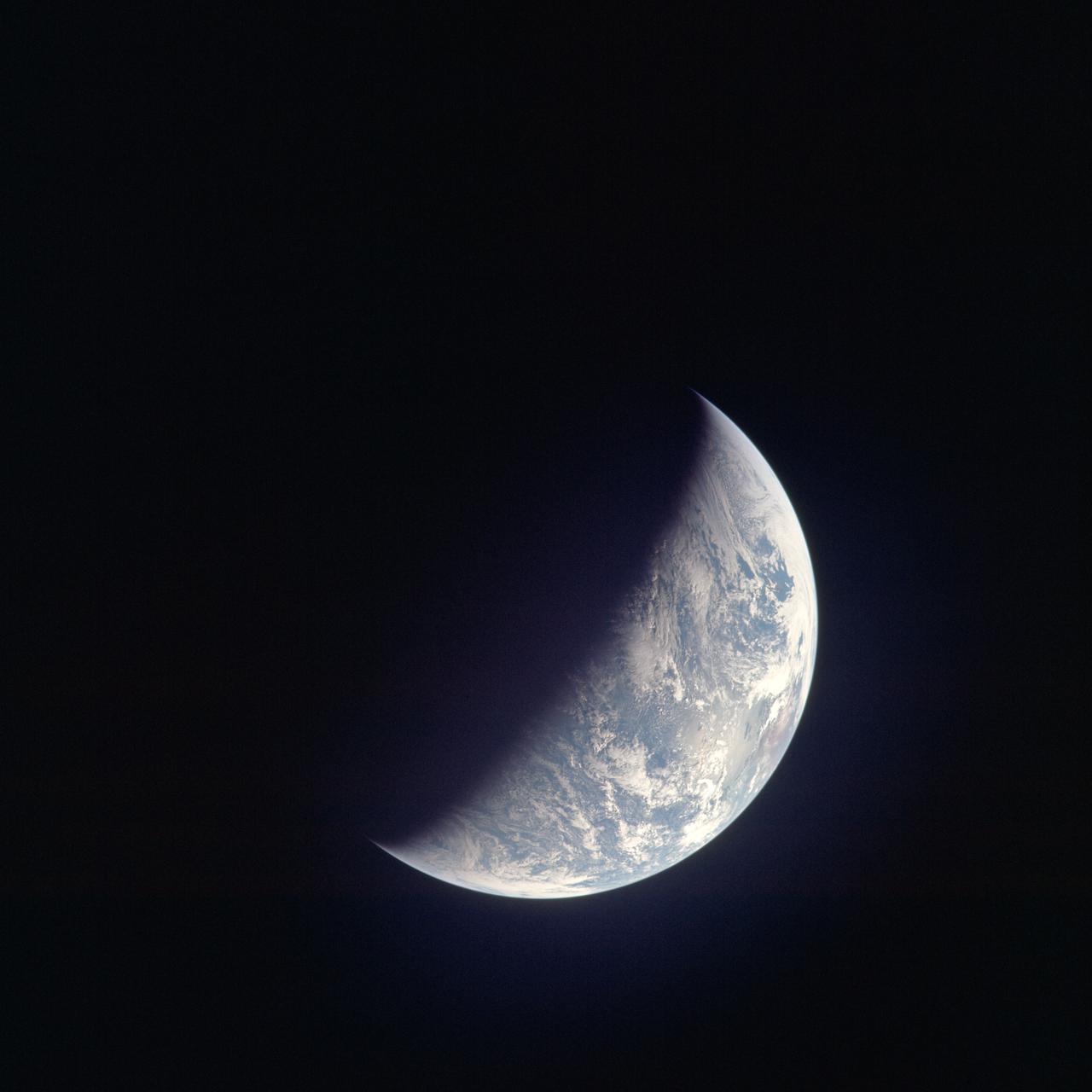
AS12-50-7362 (14 Nov. 1969) --- A view of one-third of Earth, with Australia on the horizon, as photographed by the three-man crew of Apollo 12. The Command and Service Modules, mated to the Lunar Module (yet to be removed and transpositioned for landing) were en route to the moon for man's second mission there. Onboard the spacecraft were astronauts Charles Conrad Jr., Richard F. Gordon Jr. and Alan L. Bean. Photo credit: NASA
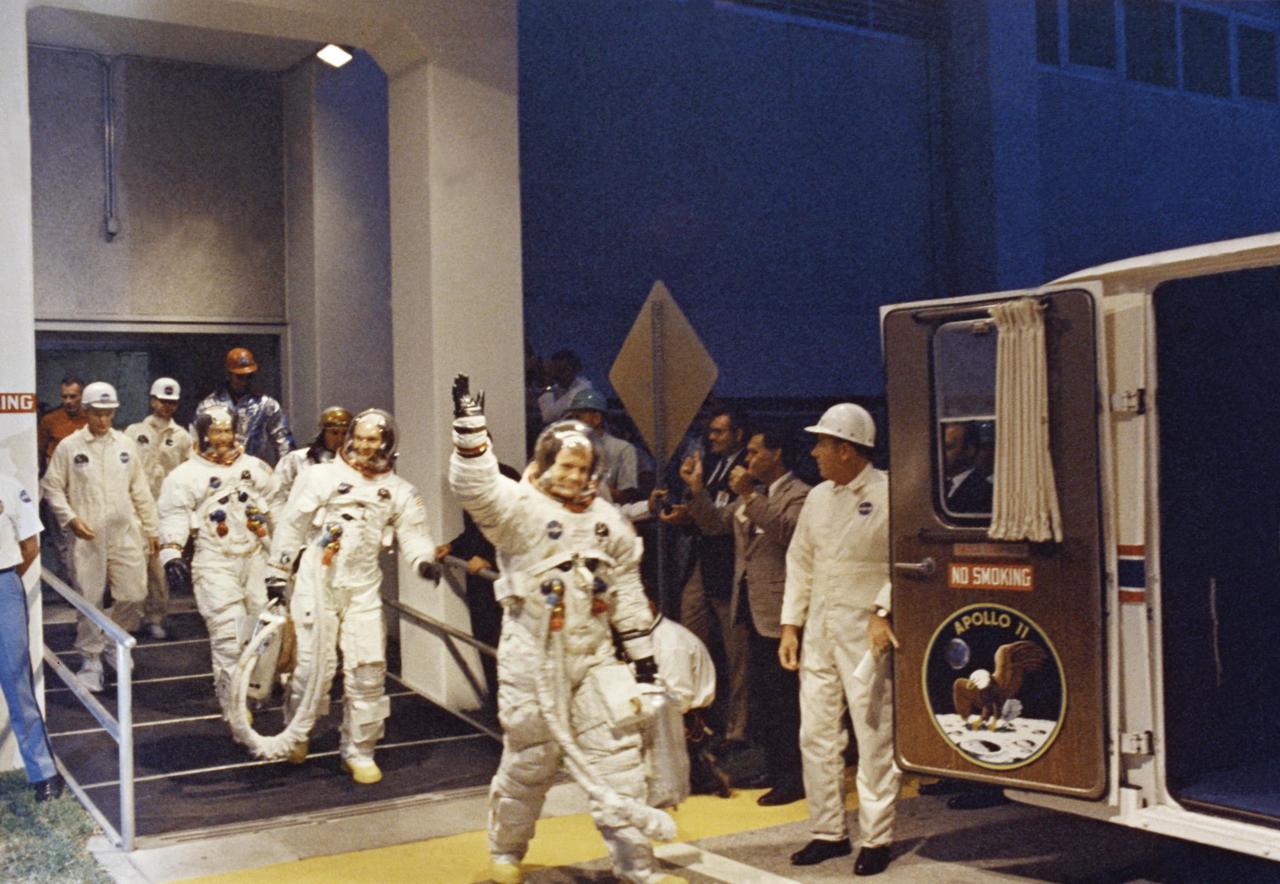
KENNEDY SPACE CENTER, FLA. -- Apollo 11 Commander Neil A. Armstrong leads Astronauts Michael Collins and Edwin E. Aldrin, Jr., from the Manned Spacecraft Operations Building to the transfer van for the eight mile trip to Pad 39A. Liftoff of Apollo 11 is scheduled at 9:32 a.m. EDT, which will begin man’s first lunar landing mission.
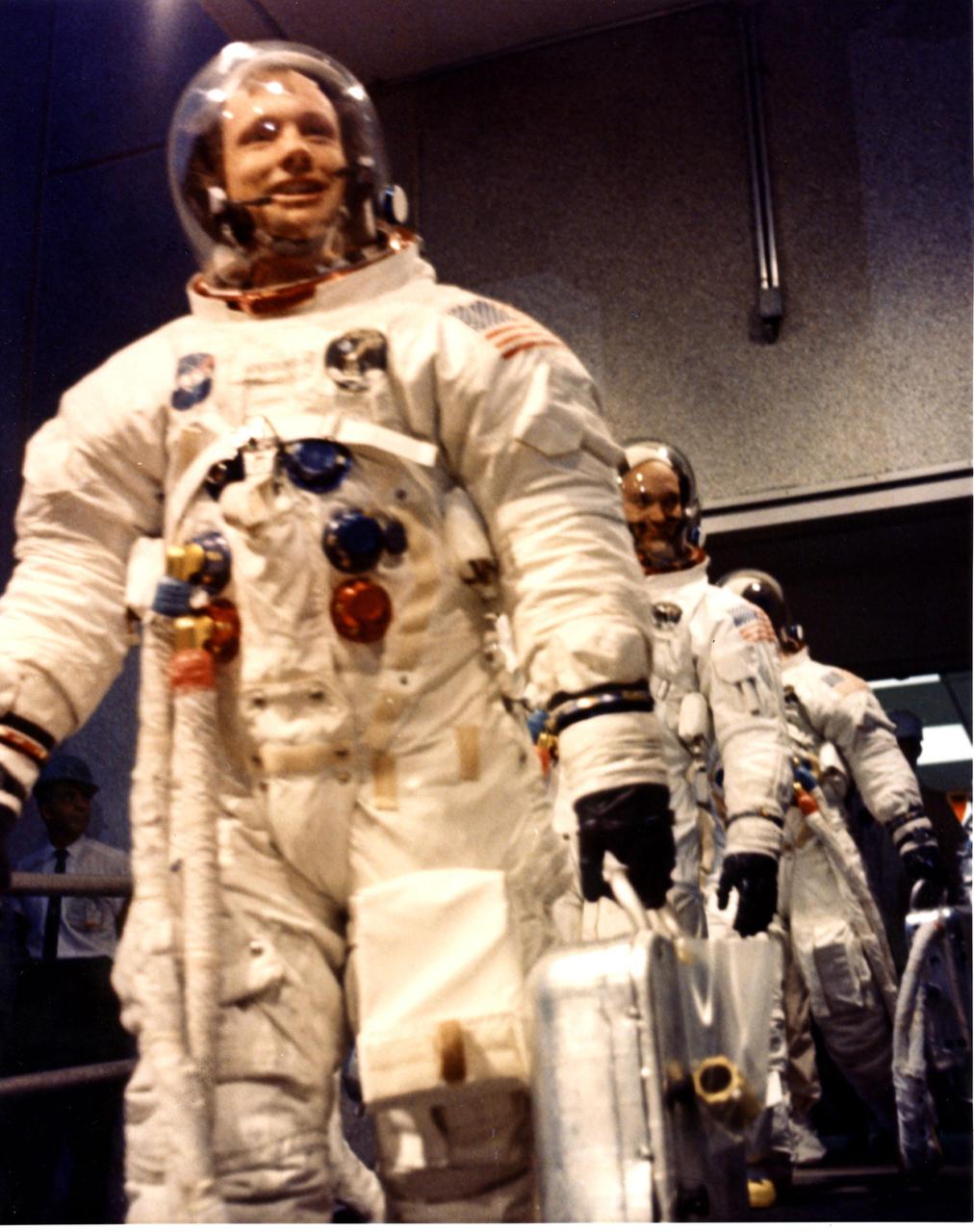
KENNEDY SPACE CENTER, FLA. - Apollo 11 Commander Neil A. Armstrong leads astronauts Michael Collins and Edwin E. Aldrin Jr. from the Manned Spacecraft Operations Building to the transfer van for the eight-mile trip to Pad 39A. Liftoff of Apollo 11 is scheduled at 9:32 a.m. EDT, which will begin man's first lunar landing mission.
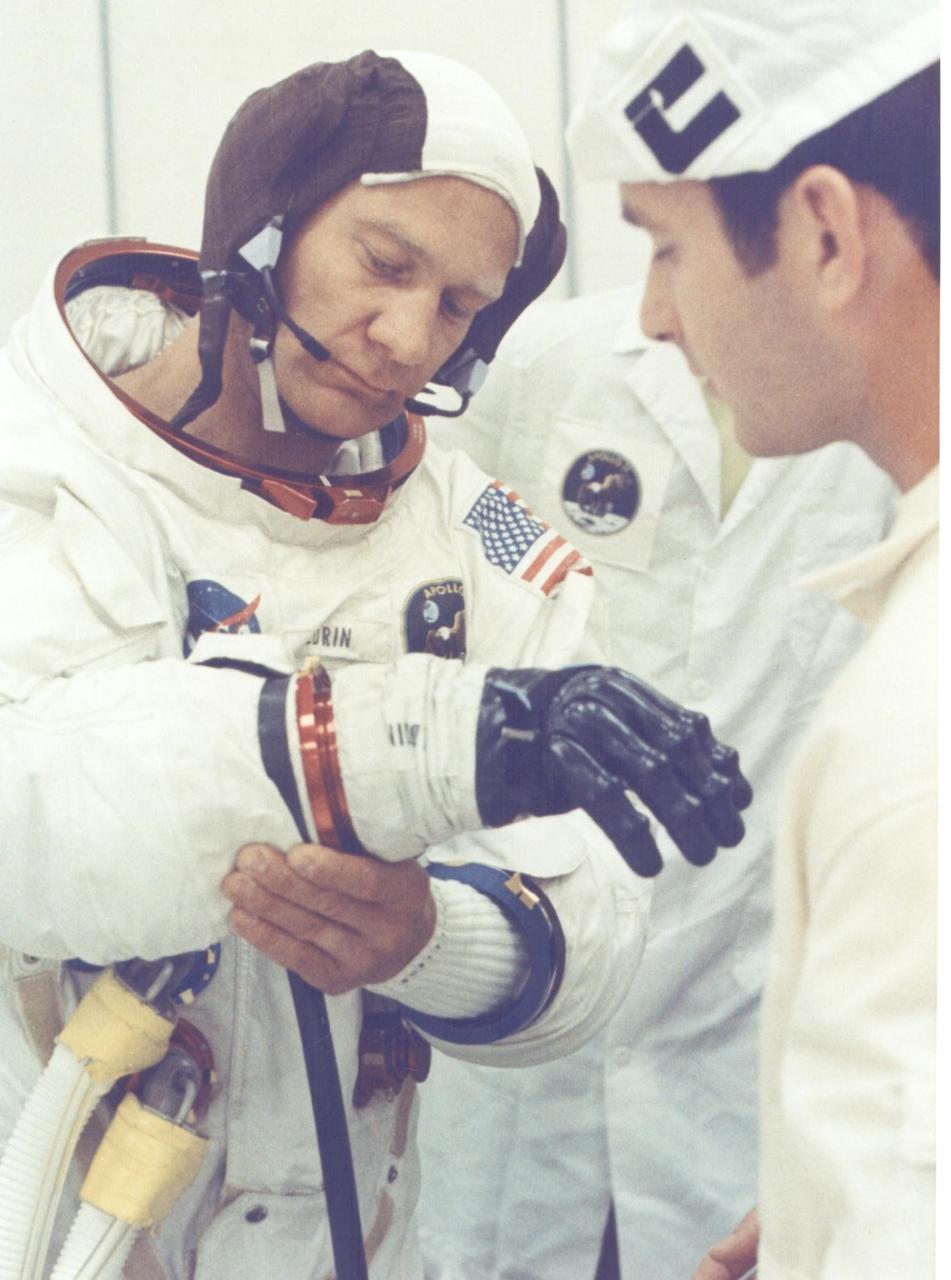
KENNEDY SPACE CENTER, FLA. - Apollo 11 astronaut Edwin E. Aldrin Jr. is being assisted by a spacesuit technician during suiting operations in the Manned Spacecraft Operations Building prior to the astronauts' departure to Launch Pad 39A. The three astronauts, Edwin E. Aldrin Jr., Neil A Armstrong and Michael Collins, will then board the Saturn V launch vehicle, scheduled for a 9:32 a.m. EDT liftoff for the first manned lunar landing mission.
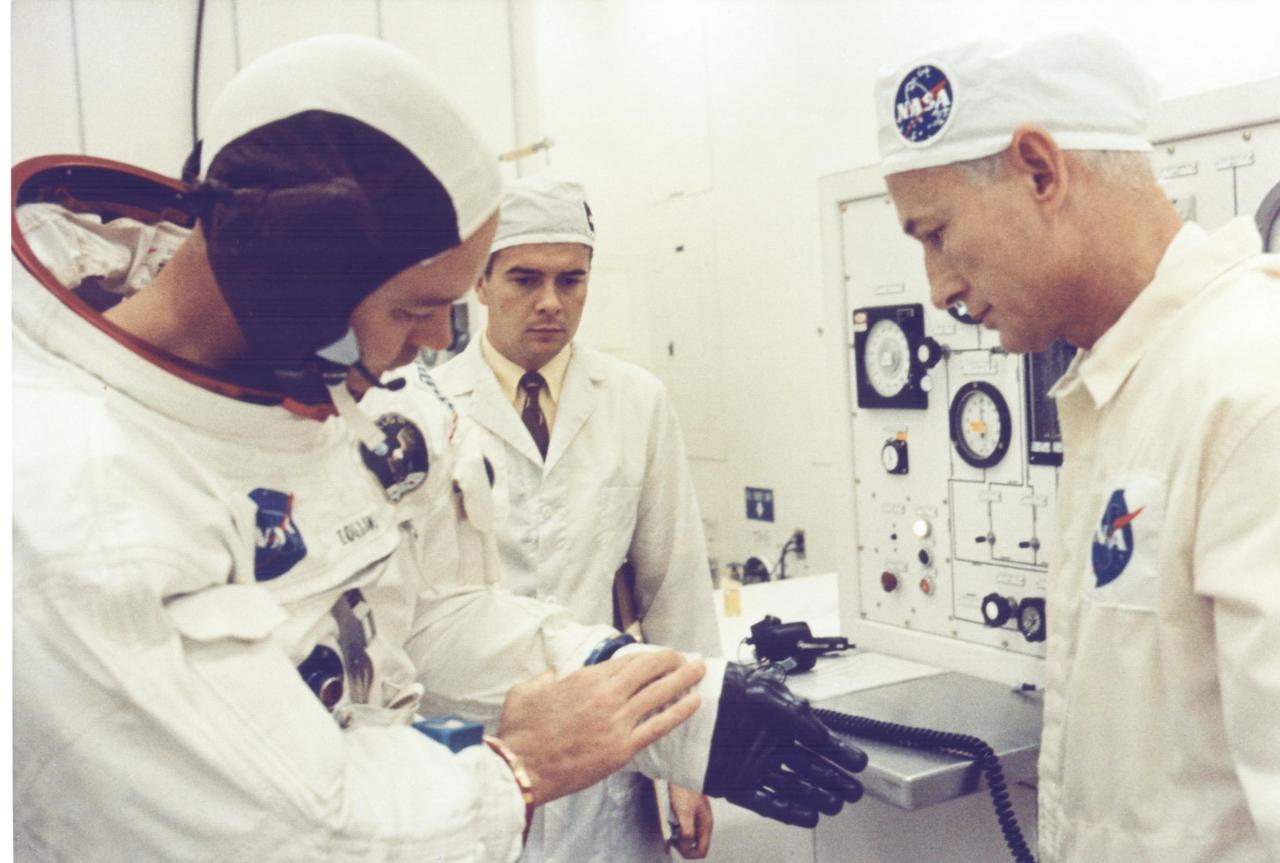
KENNEDY SPACE CENTER, FLA. - Apollo 11 Command Module Pilot Michael Collins appears to be explaining a point about his spacesuit glove to technician Joe Schmitt during suiting operations in the Manned Spacecraft Operations Building prior to the astronauts' departure to Launch Pad 39A. The three astronauts, Edwin E. Aldrin Jr., Neil A. Armstrong and Michael Collins will then board the Saturn V launch vehicle, scheduled for a 9:32 a.m. EDT liftoff for the first manned lunar landing.
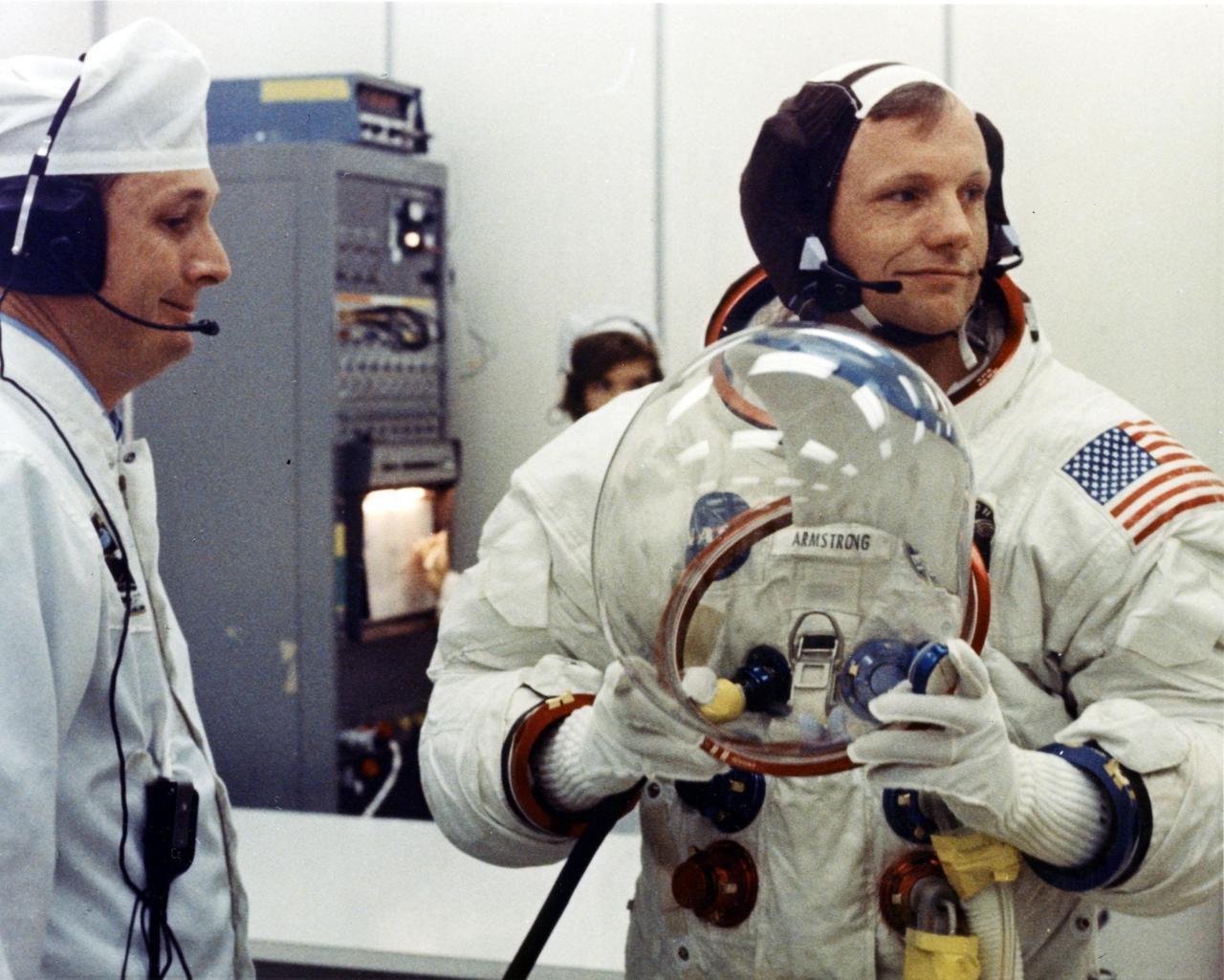
Apollo 11 Commander Neil Armstrong prepares to put on his helmet with the assistance of a spacesuit technician during suiting operations in the Manned Spacecraft Operations Building (MSOB) prior to the astronauts' departure to Launch Pad 39A. The three astronauts, Edwin E. Aldrin Jr., Neil A Armstrong and Michael Collins, will then board the Saturn V launch vehicle, scheduled for a 9:32 a.m. EDT liftoff, for the first manned lunar landing mission
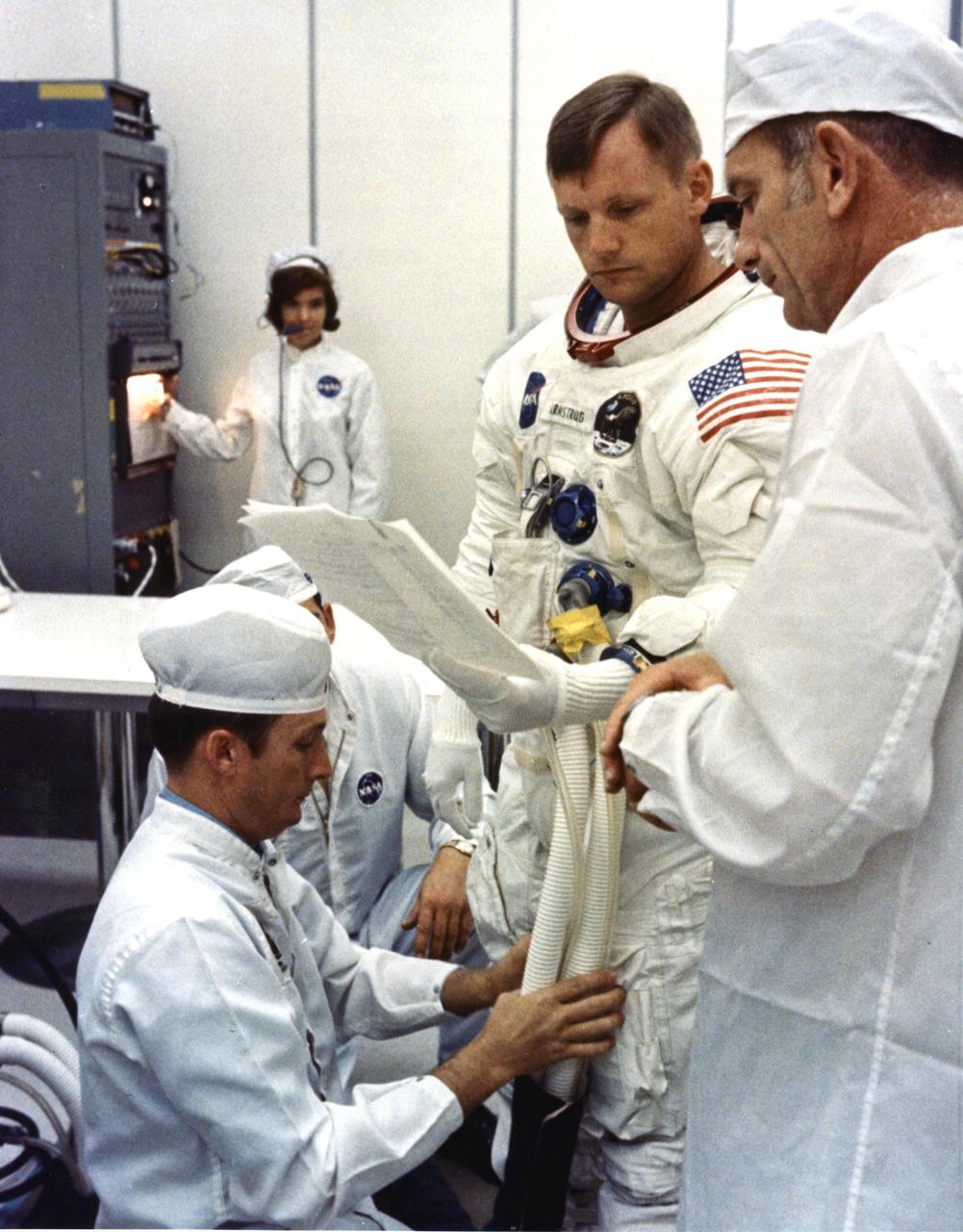
Apollo 11 Commander Neil Armstrong is looking over flight plans while being assisted by a spacesuit technician during suiting operations in the Manned Spacecraft Operations Building (MSOB) prior to the astronauts' departure to Launch Pad 39A. The three astronauts, Edwin E. Aldrin Jr., Neil A. Armstrong and Michael Collins will then board the Saturn V launch vehicle, scheduled for a 9:32 a.m. EDT liftoff, for the first manned lunar landing mission
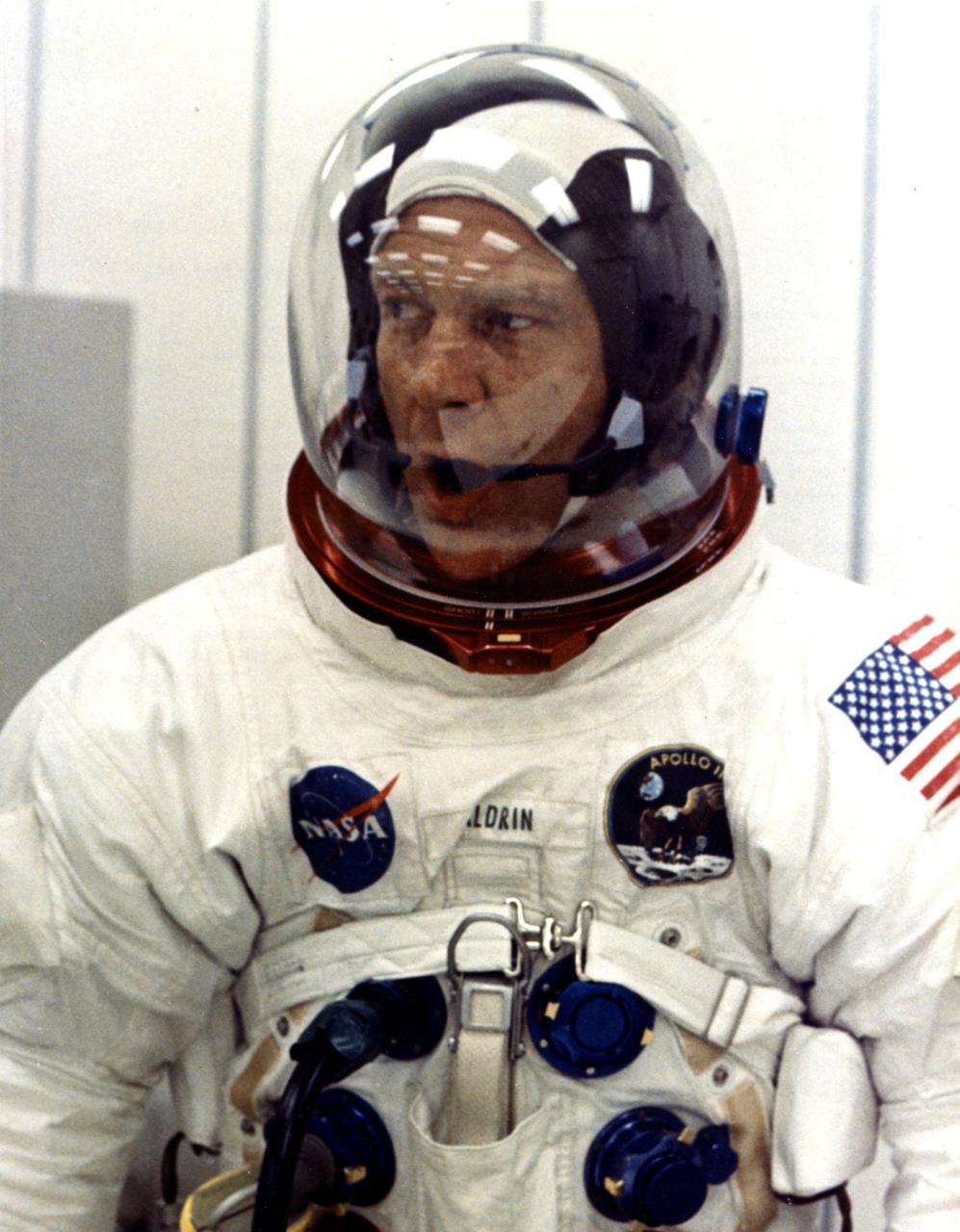
KENNEDY SPACE CENTER, FLA. -- Apollo 11 astronaut Edwin E. Aldrin Jr. appears to be relaxed during suiting operations in the Manned Spacecraft Operations Building (MSOB) prior to the astronauts' departure to Launch Pad 39A. The three astronauts, Edwin E. Aldrin Jr., Neil A. Armstrong and Michael Collins, will then board the Saturn V launch vehicle, scheduled for a 9:32 a.m. EDT liftoff, for the first manned lunar landing mission
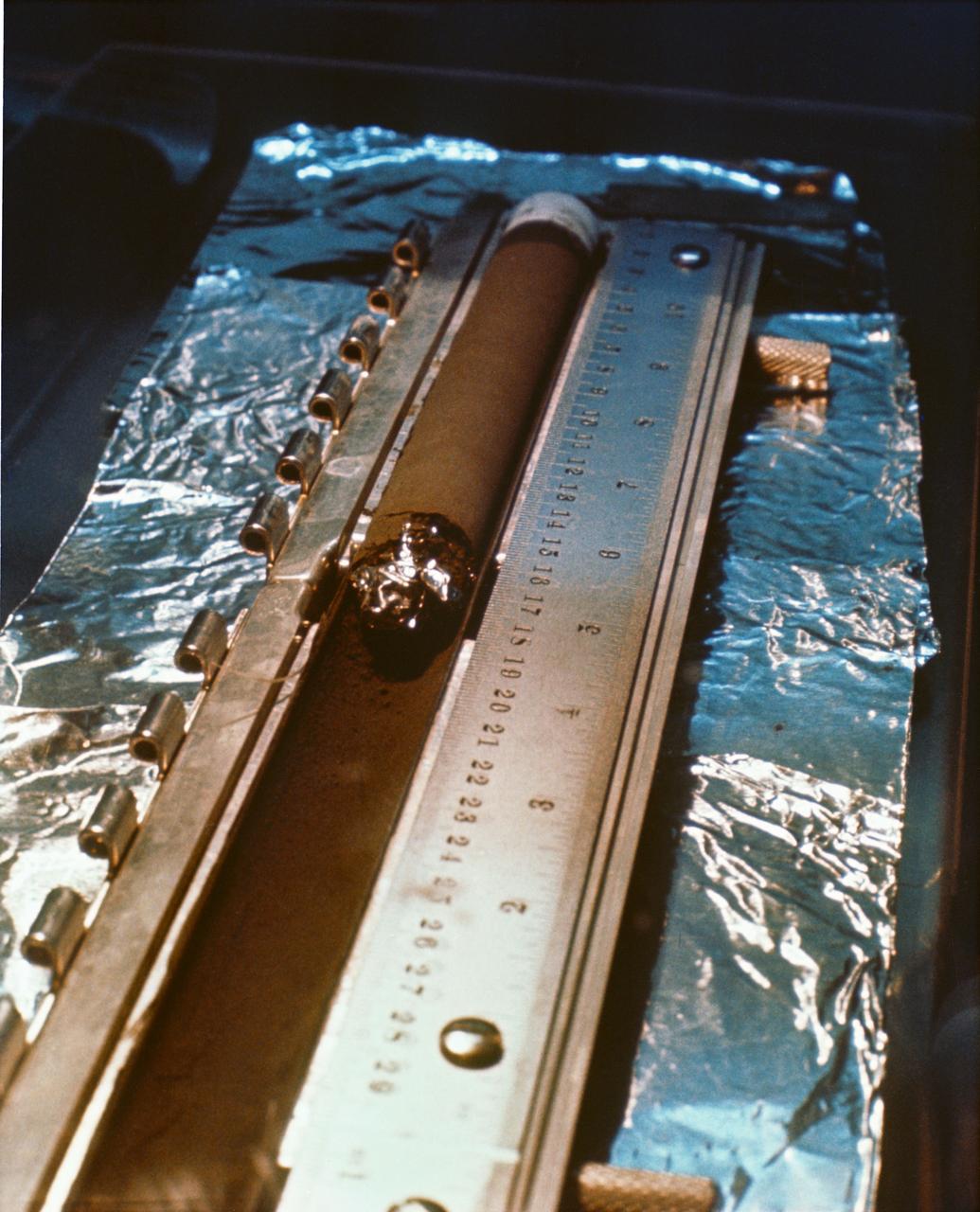
S69-40945 (August 1969) --- This is a core tube sample under study and examination in the Manned Spacecraft Center?s (MSC) Lunar Receiving Laboratory (LRL). The sample was among lunar soil and rock samples collected by astronauts Neil A. Armstrong and Edwin E. Aldrin Jr. during their extravehicular activity (EVA) on July 20, 1969. While astronauts Armstrong, commander; and Aldrin, lunar module pilot; descended in the Apollo 11 Lunar Module (LM) "Eagle" to explore the Sea of Tranquility landing site on the moon. Astronaut Michael Collins, command module pilot, remained with the Command and Service Modules (CSM) "Columbia" in lunar orbit.
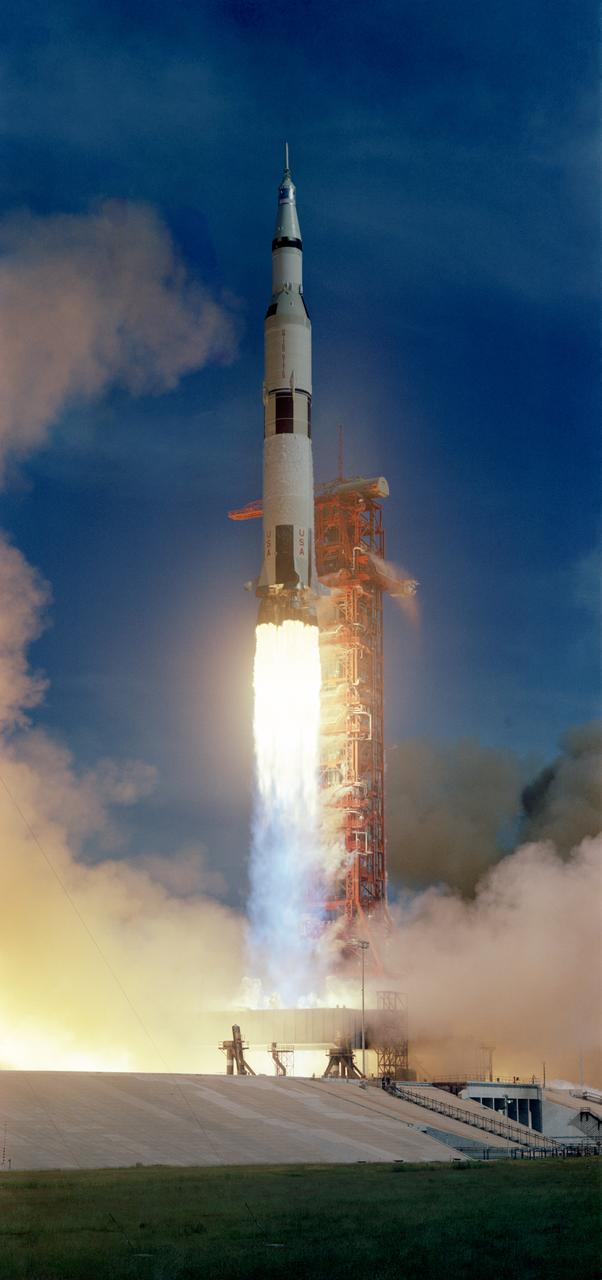
S71-41356 (26 July 1971) --- The huge, 363-feet tall Apollo 15 (Spacecraft 112/Lunar Module 10/Saturn 510) space vehicle is launched from Pad A, Launch Complex 39, Kennedy Space Center (KSC), Florida, at 9:34:00:79 a.m. (EDT), July 26, 1971, on a lunar landing mission. Aboard the Apollo 15 spacecraft were astronauts David R. Scott, commander; Alfred M. Worden, command module pilot; and James B. Irwin, lunar module pilot. Apollo 15 is the National Aeronautics and Space Administration's (NASA) fourth manned lunar landing mission. While astronauts Scott and Irwin will descend in the Lunar Module (LM) to explore the moon, astronaut Worden will remain with the Command and Service Modules (CSM) in lunar orbit.
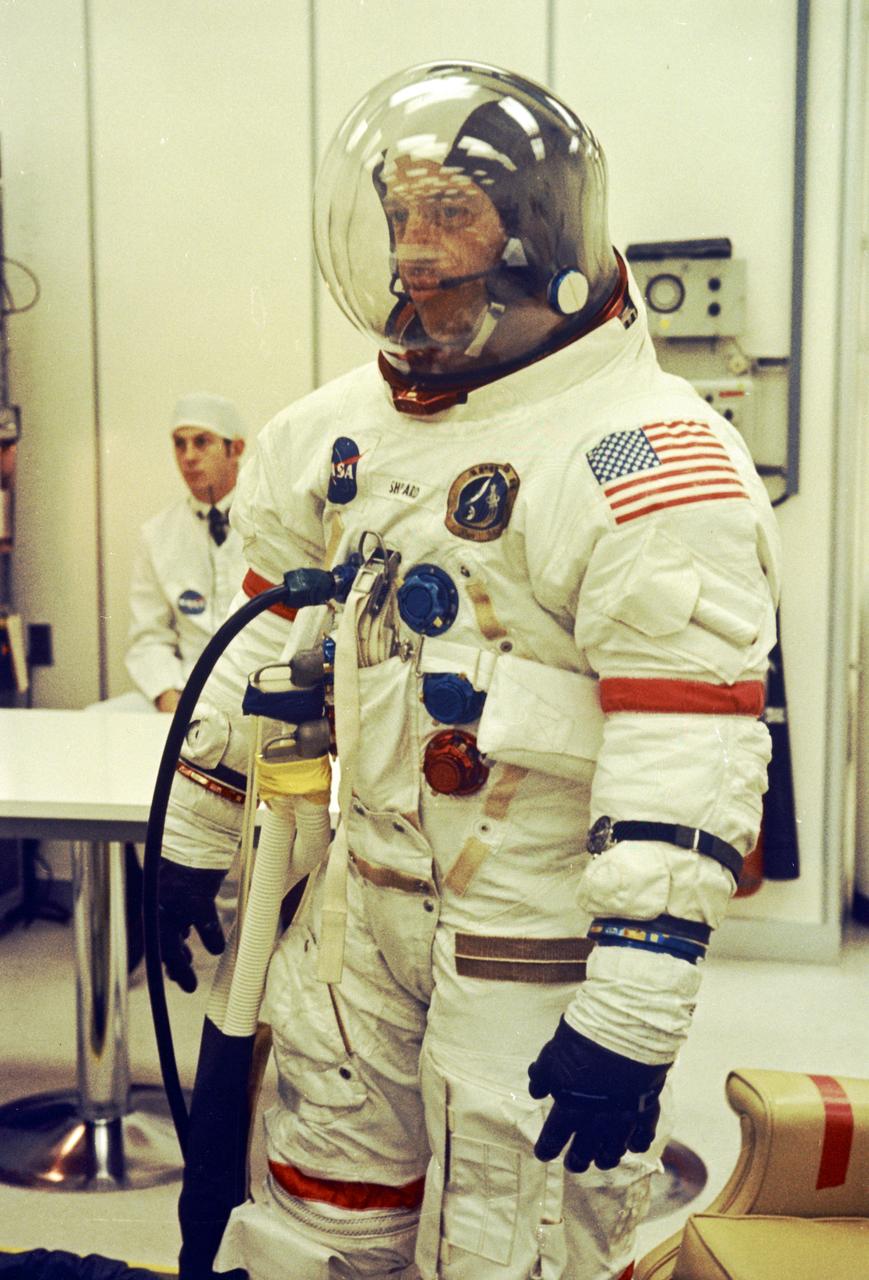
Alan B. Shepard, Jr., Apollo 14 mission commander, watches a technician conduct space suit checks during a demonstration test prior to countdown. The Apollo 14, carrying a crew of three astronauts: Shepard; Command Module pilot Stuart A. Roosa, and Lunar Module pilot Edgar D. Mitchell, lifted off from launch complex 39A at KSC on January 31, 1971. It was the third manned lunar landing, the first manned landing in exploration of the lunar highlands, and it demonstrated pinpoint landing capability. The major goal of Apollo 14 was the scientific exploration of the Moon in the foothills of the rugged Fra Mauro region. The extravehicular activities (EVA) of astronauts Shepard and Mitchell included setting up an automated scientific laboratory called Apollo Lunar Scientific Experiments Package (ALSEP), and collecting a total of about 95 pounds (43 kilograms) of Moon rock and soil for a geological investigation back on the Earth. Apollo 14 safely returned to Earth on February 9, 1971.
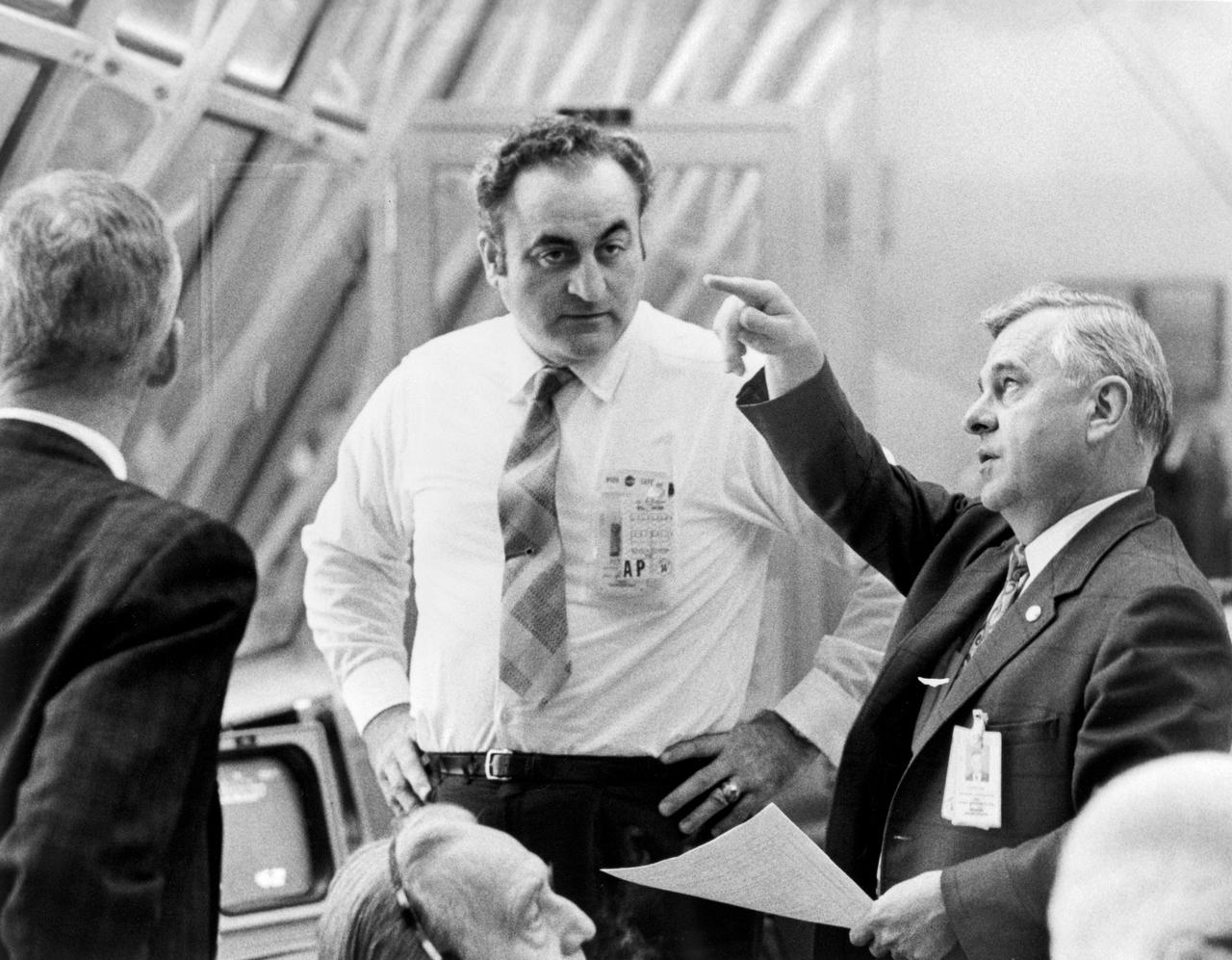
In the launch control center at Kennedy Space Flight Center (KSC), Walter J. Kapryan, Director of Launch Operations (center), discusses an aspect of the Apollo 14 flight with Marshall Space Flight Center’s (MSFC) Dr. Rocco A. Petrone, Apollo Program Director (right). The Apollo 14, carrying a crew of three astronauts: Mission commander Alan B. Shepard Jr., Command Module pilot Stuart A. Roosa, and Lunar Module pilot Edgar D. Mitchell, lifted off from launch complex 39A at KSC on January 31, 1971. It was the third manned lunar landing, the first manned landing in exploration of the lunar highlands, and it demonstrated pinpoint landing capability. The major goal of Apollo 14 was the scientific exploration of the Moon in the foothills of the rugged Fra Mauro region. The extravehicular activity (EVA) of astronauts Shepard and Mitchell included setting up an automated scientific laboratory called Apollo Lunar Scientific Experiments Package (ALSEP), and collecting a total of about 95 pounds (43 kilograms) of Moon rock and soil for a geological investigation back on the Earth. Apollo 14 safely returned to Earth on February 9, 1971.
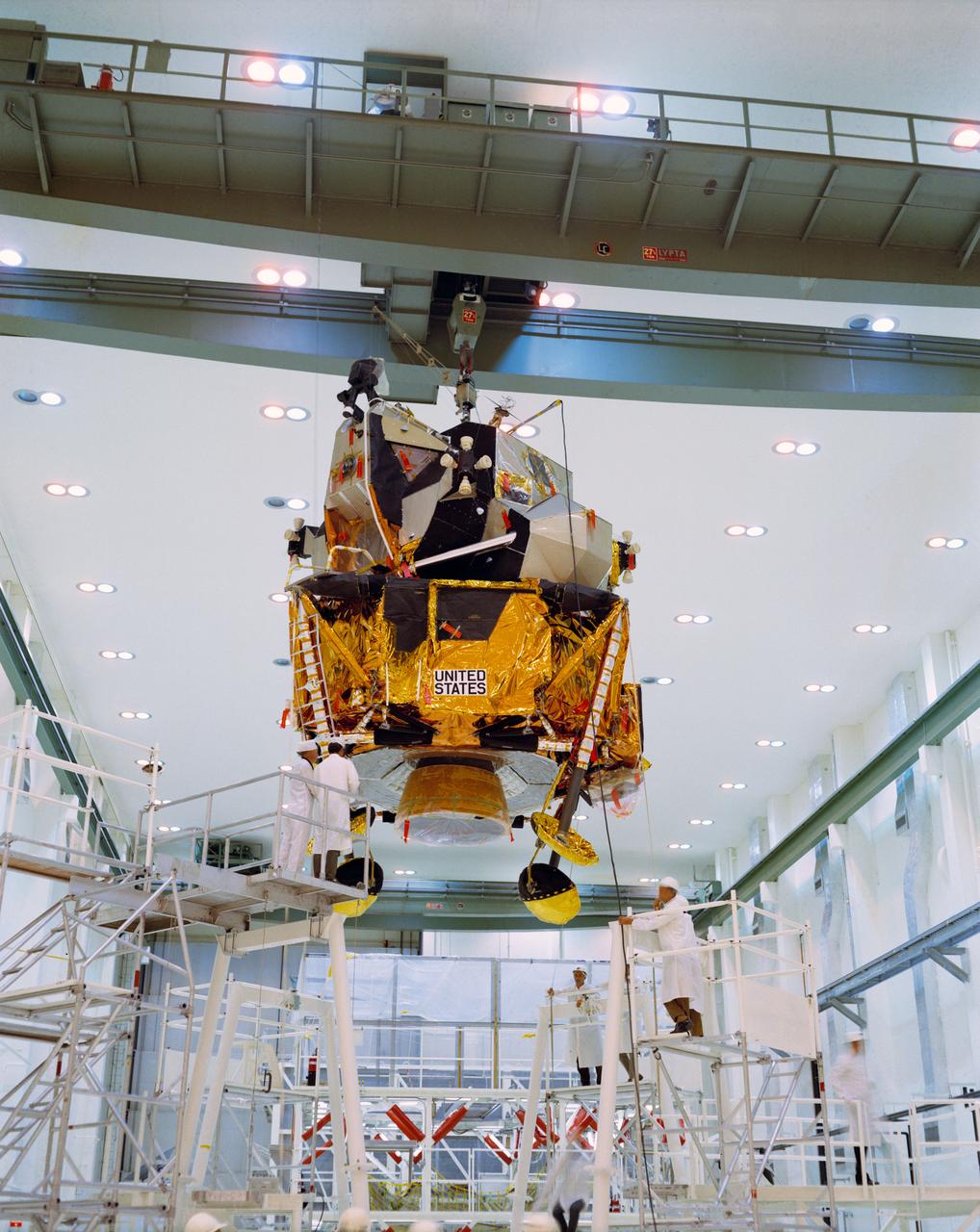
S69-39262 (23 June 1969) --- Lunar Module (LM) 6, scheduled for the Apollo 12 lunar landing mission in November 1969, is being moved to an integration work stand in the Kennedy Space Center's (KSC) Manned Spacecraft Operations Building. The two prime crew members scheduled to use the LM-6 to descend to the lunar surface following separation from the Command and Service Modules (CSM) and to later return to the CSM are astronauts Charles Conrad Jr., commander, and Alan L. Bean, lunar module pilot. Astronaut Richard F. Gordon Jr. is the prime crew's command module pilot.
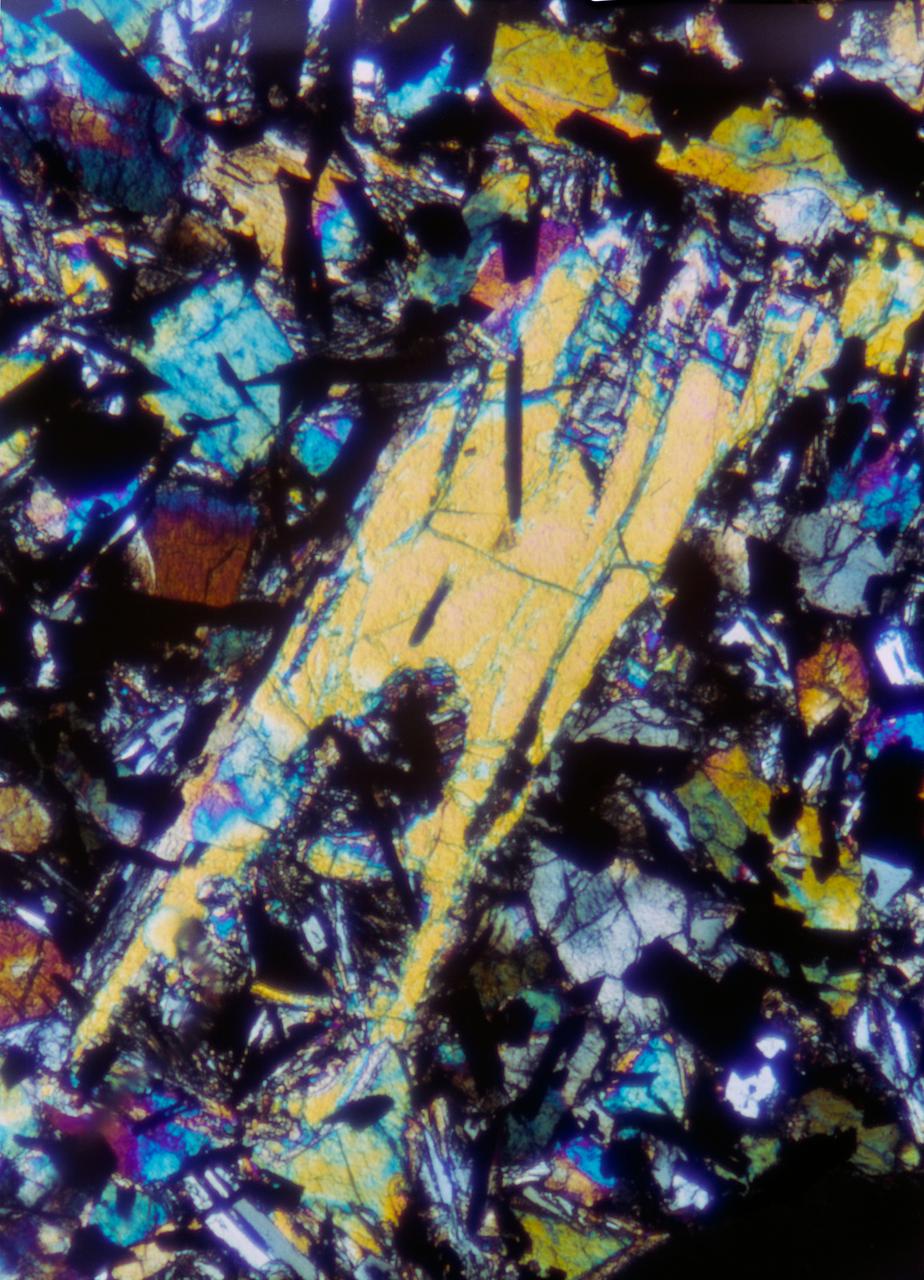
S69-47900 (September 1969) --- This is a photo micrograph of lunar sample 10022. Magnification one inch equals one-tenth millimeter. The light blue and white mineral is plagioclase. The black is ilmenite, and the blue and/or green and/or orange and/or yellow and/or red mineral is pyroxene. The large pyroxene is a phenocryst that had been partially resorbed. The lunar samples collected by astronauts Neil A. Armstrong and Edwin E. Aldrin Jr. during the Apollo 11 lunar landing mission have been subjected to extensive tests and examinations at the Manned Spacecraft Center’s Lunar Receiving Laboratory.
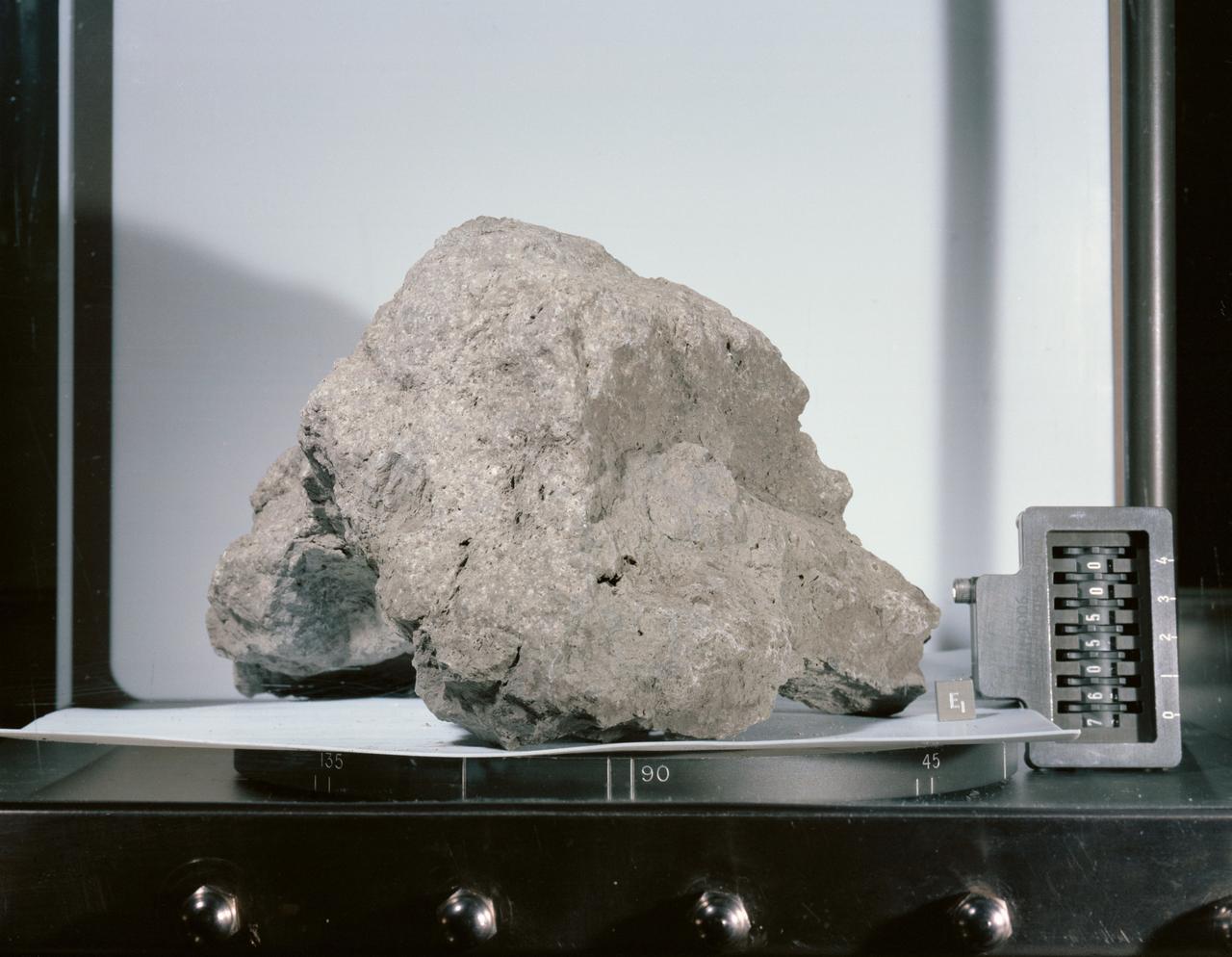
S73-15713 (January 1973) --- A close-up view of Apollo 17 lunar rock sample No. 76055 being studied and analyzed in the Lunar Receiving Laboratory at the Manned Spacecraft Center. This tan-gray irregular, rounded breccia was among many lunar samples brought back from the Taurus-Littrow landing site by the Apollo 17 crew. The rock measures 18 x 20 x 25 centimeters (7.09 x 7.87 x 9.84 inches) and weighs 6,389 grams (14.2554 pounds). The rock was collected from the south side of the lunar roving vehicle while the Apollo 17 astronauts were at Station 7 (base of North Massif).
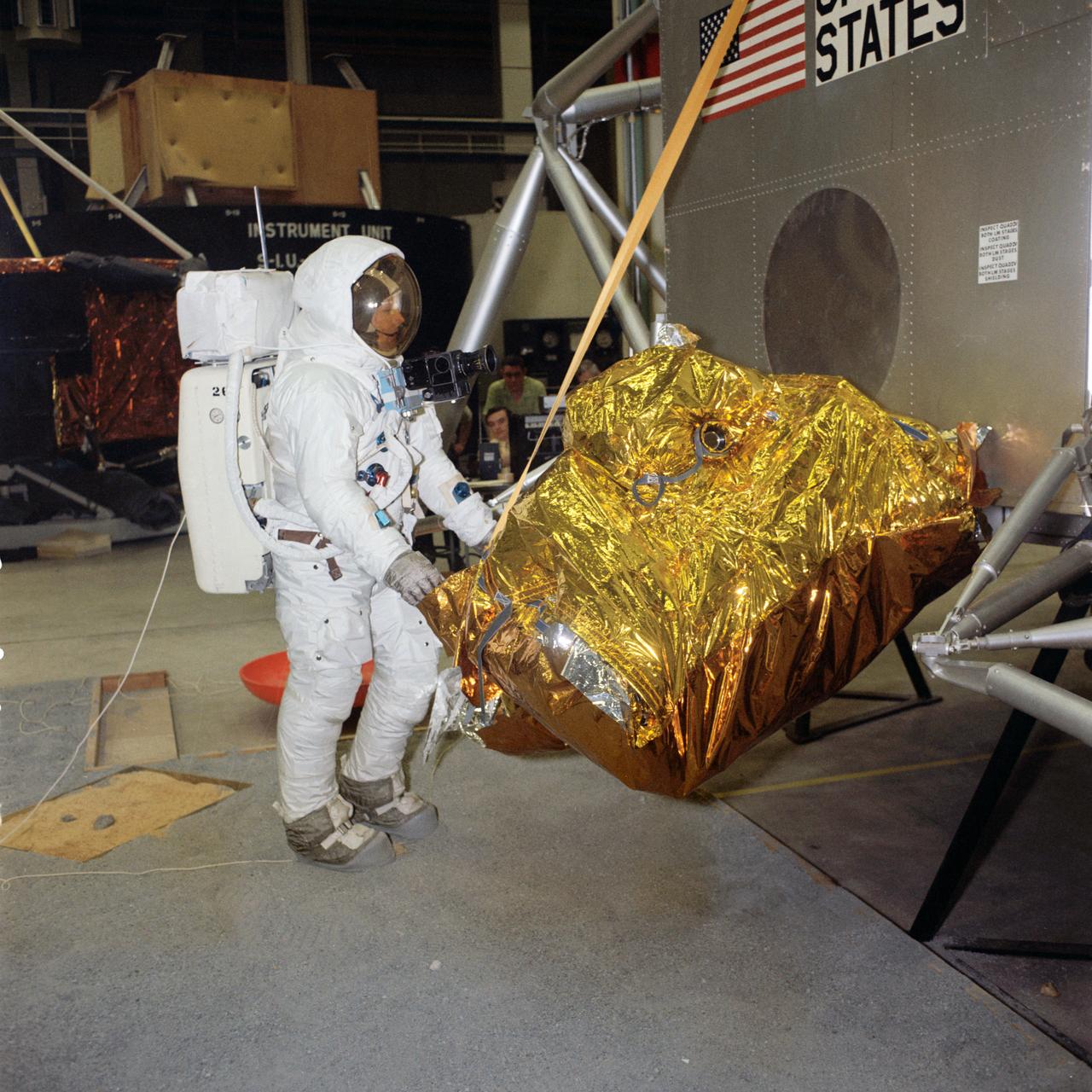
S69-31060 (18 April 1969) --- Suited astronaut Neil A. Armstrong, wearing an Extravehicular Mobility Unit (EMU), participates in lunar surface simulation training on April 18, 1969 in building 9, Manned Spacecraft Center (MSC). Armstrong is prime crew commander of the Apollo 11 lunar landing mission. Here, he is opening the Modularized Equipment Stowage Assembly ( MESA).
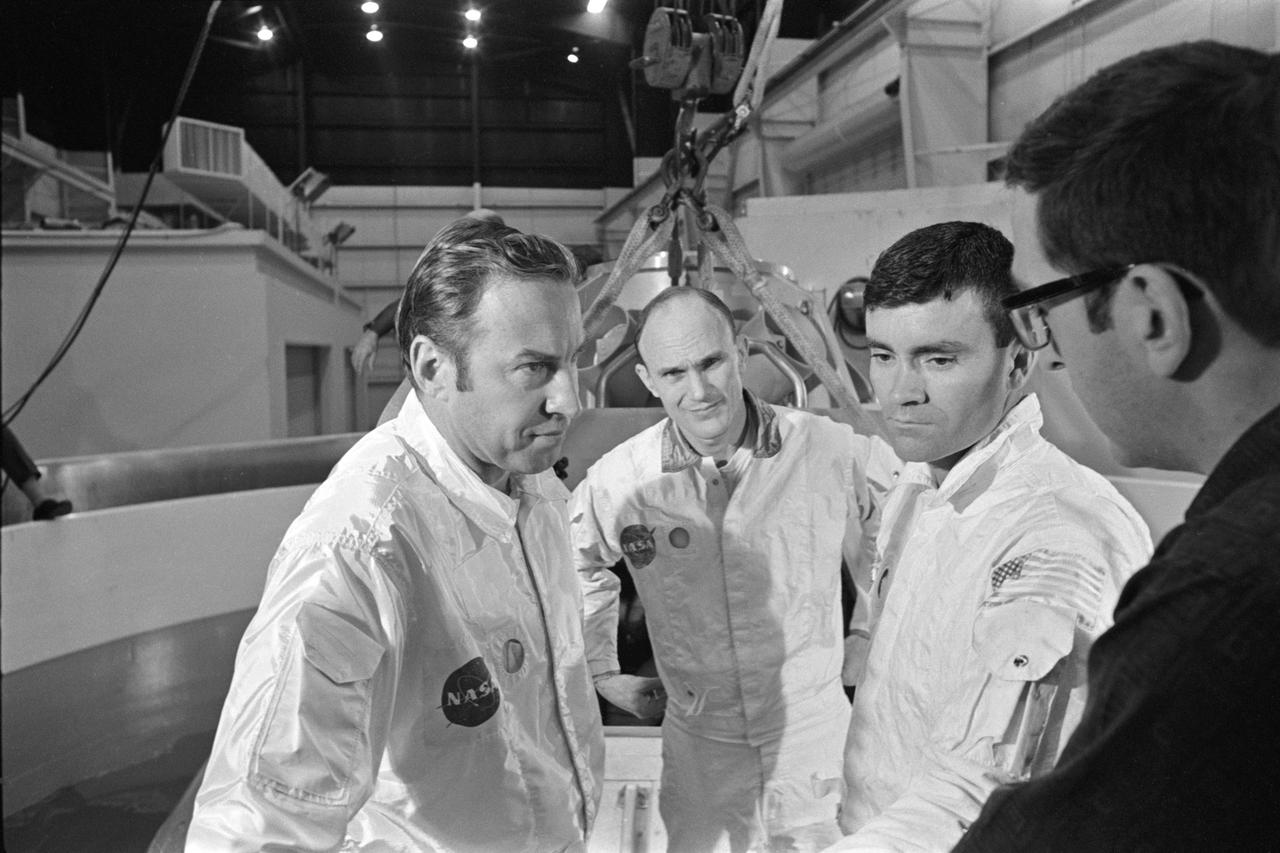
S70-24014 (17 Jan. 1970) --- The three prime crewmen of the Apollo 13 lunar landing mission stand by to participate in water egress training in a water tank in Building 260 at the Manned Spacecraft Center. They were (left to right) astronauts James A. Lovell Jr., commander; Thomas K. Mattingly II, command module pilot; and Fred W. Haise Jr., lunar module pilot.
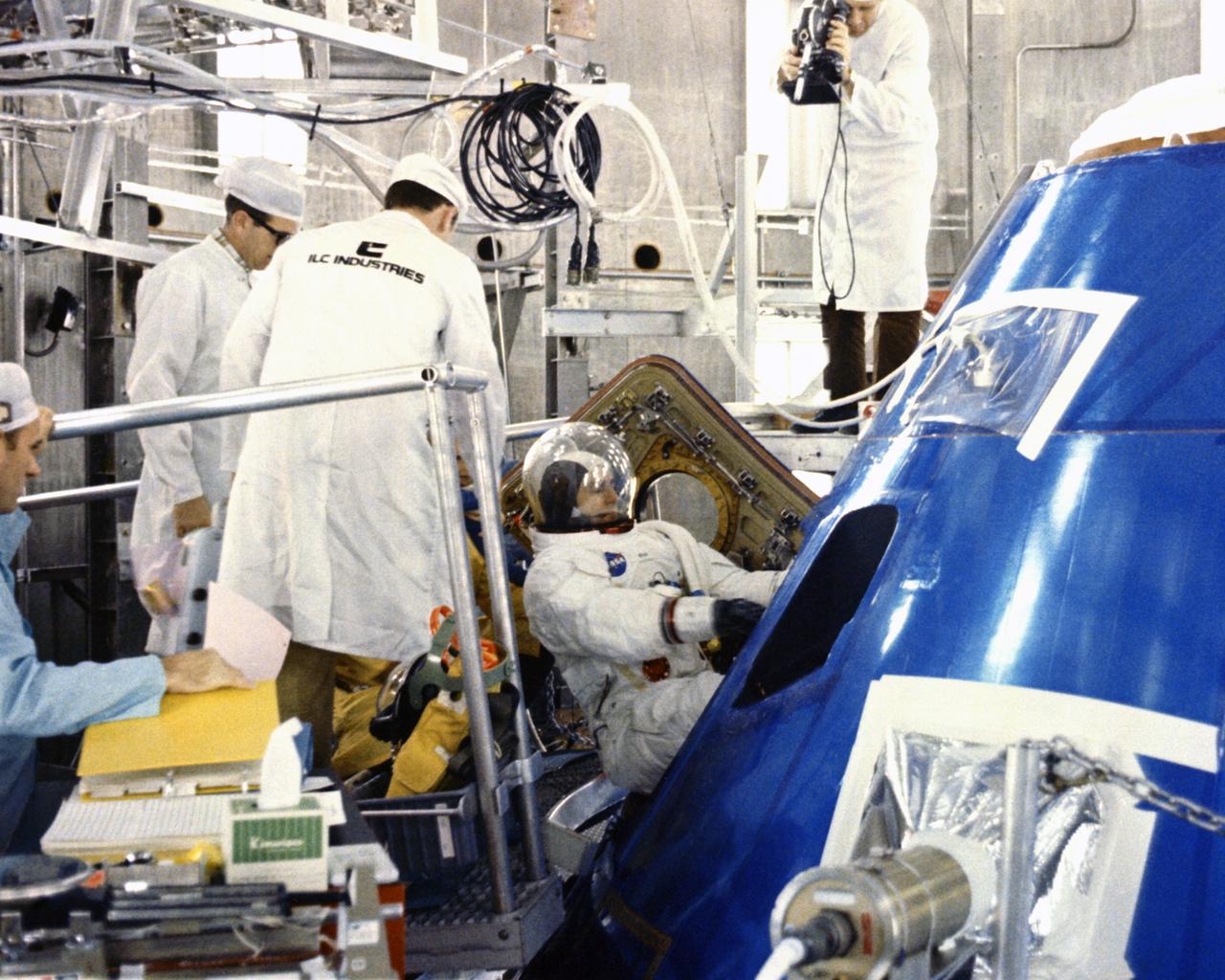
CAPE CANAVERAL, Fla. -- Apollo 12 Lunar Module pilot Alan L. Bean enters spacecraft in preparation for altitude chamber test with mission commander Charles Conrad Jr. and Richard F. Gordon Jr., command module pilot. Air was pumped out of the chamber to simulate a space environment. The Apollo 12 astronauts are scheduled to perform the nation’s second manned lunar landing. Photo credit: NASA
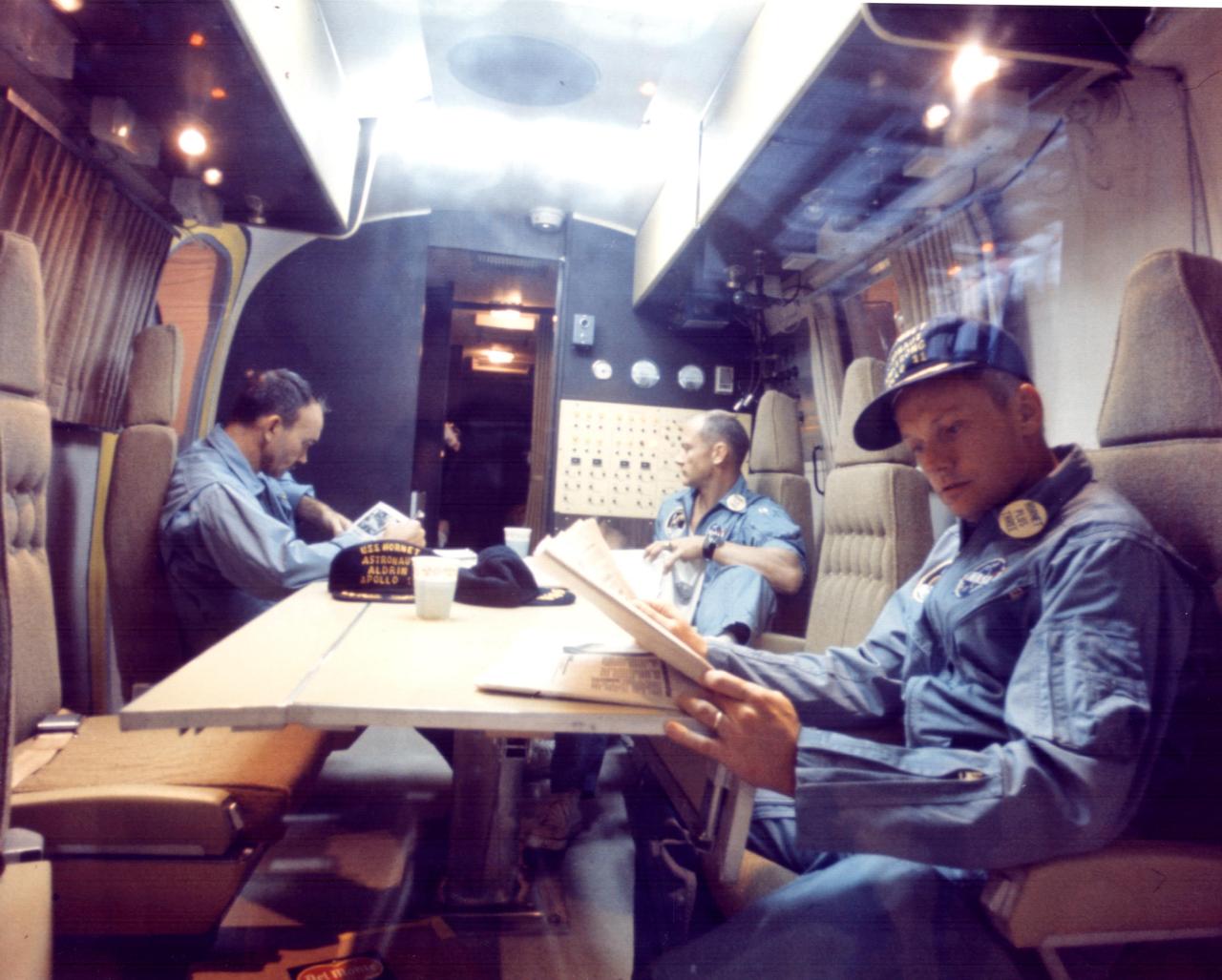
KENNEDY SPACE CENTER, FLA. - Within the Mobile Quarantine Facility, Apollo 11 astronauts (left to right) Michael Collins, Edwin E. Aldrin Jr. and Neil A. Armstrong relax following their successful lunar landing mission. They spent two-and-one-half days in the quarantine trailer enroute from the USS Hornet, prime recovery ship, to the Lunar Receiving Laboratory at the Manned Spacecraft Center in Houston. The Hornet docked at Pearl Harbor where the trailer was transferred to a jet aircraft for the flight to Houston.
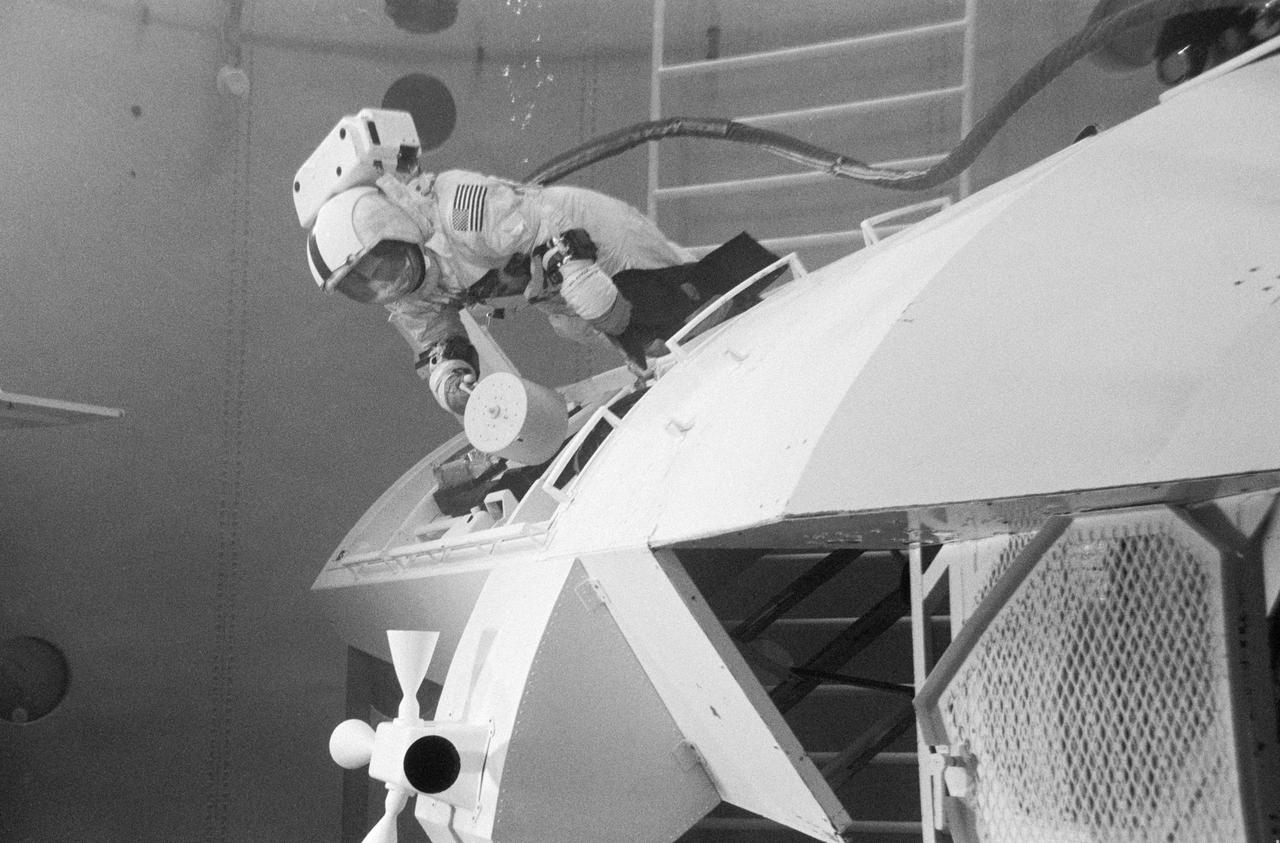
S72-49971 (29 Sept. 1972) --- Astronaut Ronald E. Evans, command module pilot of the Apollo 17 lunar landing mission, participates in extravehicular activity training in a water tank in Building 5 at the Manned Spacecraft Center. Evans is scheduled to perform trans-Earth extravehicular activity after the Apollo 17 spacecraft leaves lunar orbit on its way back home. The structure in the picture simulates the Scientific Instrument Module (SIM) bay of the Apollo 17 Service Module.
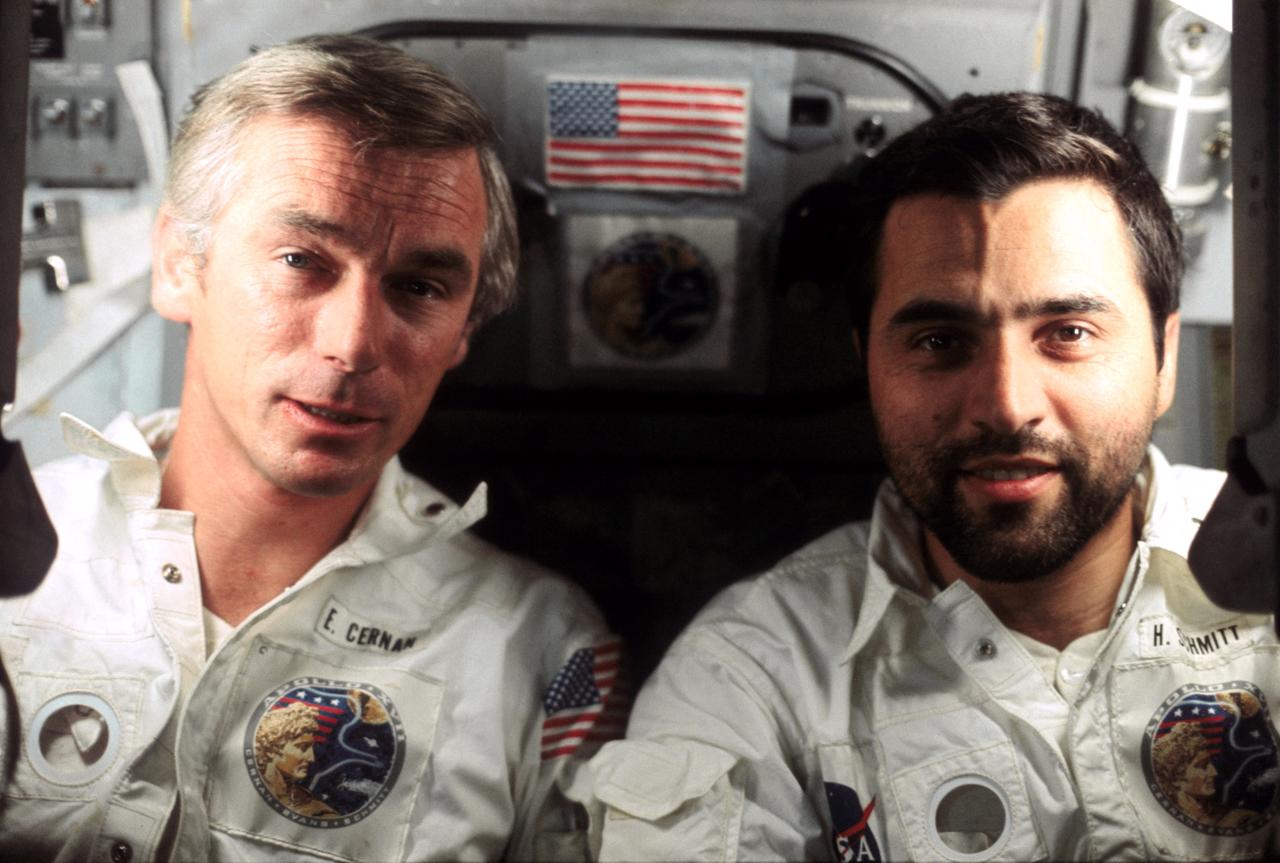
AS17-163-24148 (7-19 Dec. 1972) --- Astronaut Eugene A. Cernan (left) and scientist-astronaut Harrison H. "Jack" Schmitt are photographed by the third crew man aboard the Apollo 17 spacecraft during the final lunar landing mission in NASA's Apollo program. Astronaut Ronald E. Evans, command module pilot, took this picture. Cernan was the mission commander. Schmitt served as the lunar module pilot.
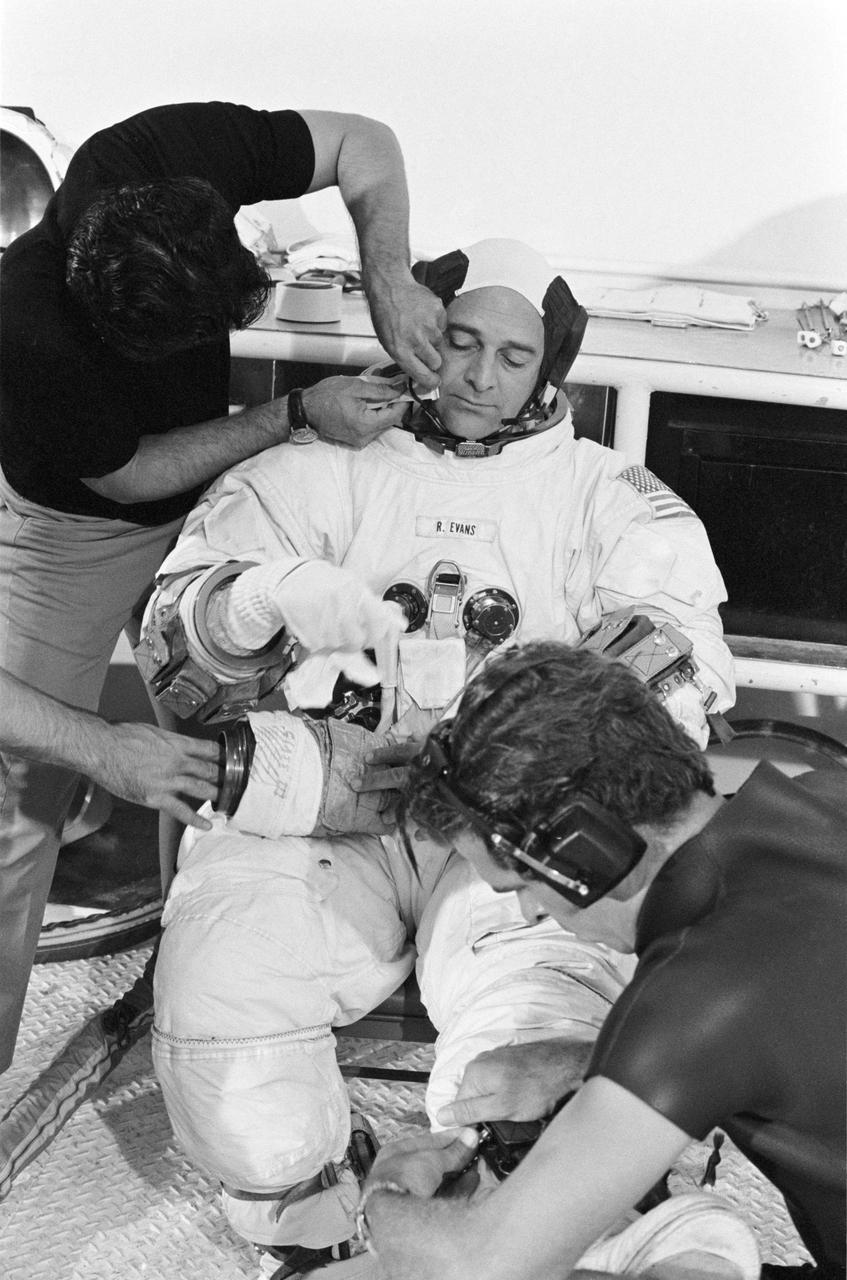
S72-49970 (29 Sept. 1972) --- Astronaut Ronald E. Evans, command module pilot of the Apollo 17 lunar landing mission, is suited up in preparation for extravehicular activity training in a water tank in Building 5 at the Manned Spacecraft Center. Evans is scheduled to perform trans-Earth extravehicular activity after the Apollo 17 spacecraft leaves lunar orbit on its way back home.

S69-40307 (30 July 1969) --- The crewmen of the historic Apollo 11 lunar landing mission stand in the serving line as they prepare to dine in the Crew Reception Area of the Lunar Receiving Laboratory, Building 37, Manned Spacecraft Center. Left to right, are astronauts Edwin E. Aldrin Jr., Michael Collins, and Neil A. Armstrong. They are continuing their postflight debriefings. The three astronauts will be released from quarantine on Aug. 11, 1969.
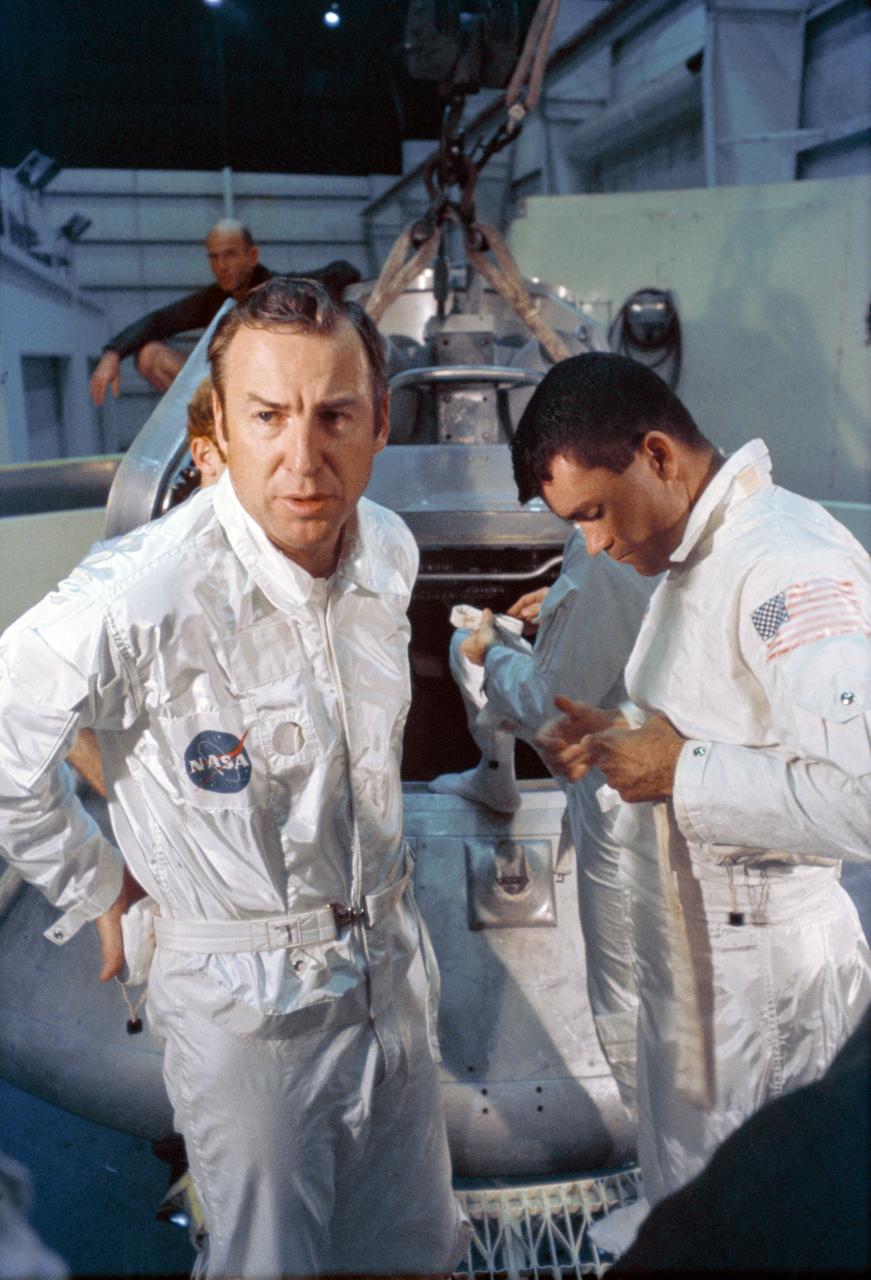
S70-24010 (17 Jan. 1970) --- The three prime crew members of the Apollo 13 lunar landing mission stand by to participate in water egress training in a water tank in Building 260 at the Manned Spacecraft Center (MSC). They are astronauts James A. Lovell Jr., (left) commander; Fred W. Haise Jr., (right) lunar module pilot; and Thomas K. Mattingly II (in background, obscured by Haise), command module pilot.
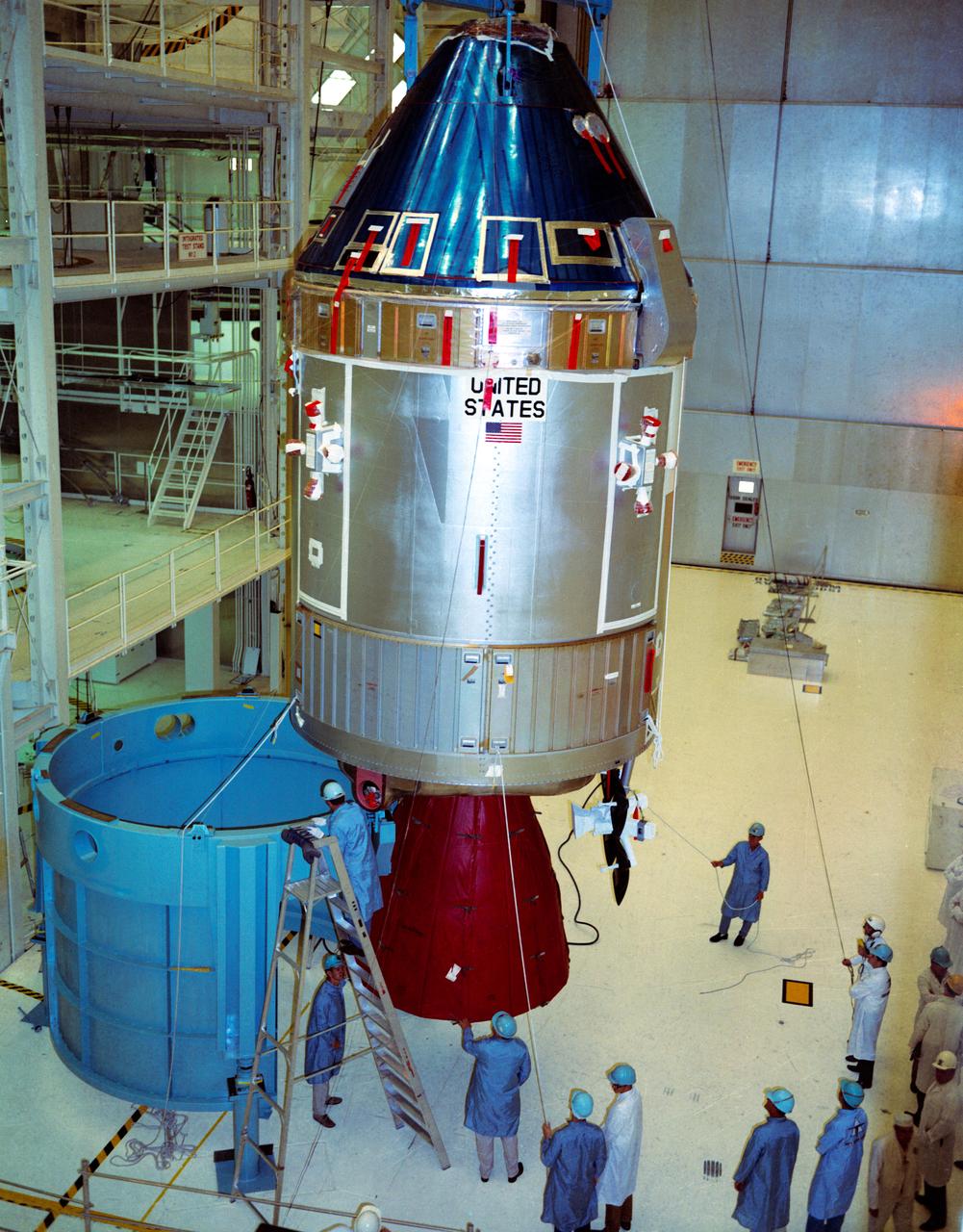
S69-32370 (11 April 1969) --- Interior view of the Kennedy Space Center's (KSC) Manned Spacecraft Operations Building showing Apollo Spacecraft 107 Command and Service Modules (CSM) being moved from work stand 134 for mating to Spacecraft Lunar Module Adapter (SLA) 14. S/C 107 is scheduled to be flown on the Apollo 11 lunar landing mission.
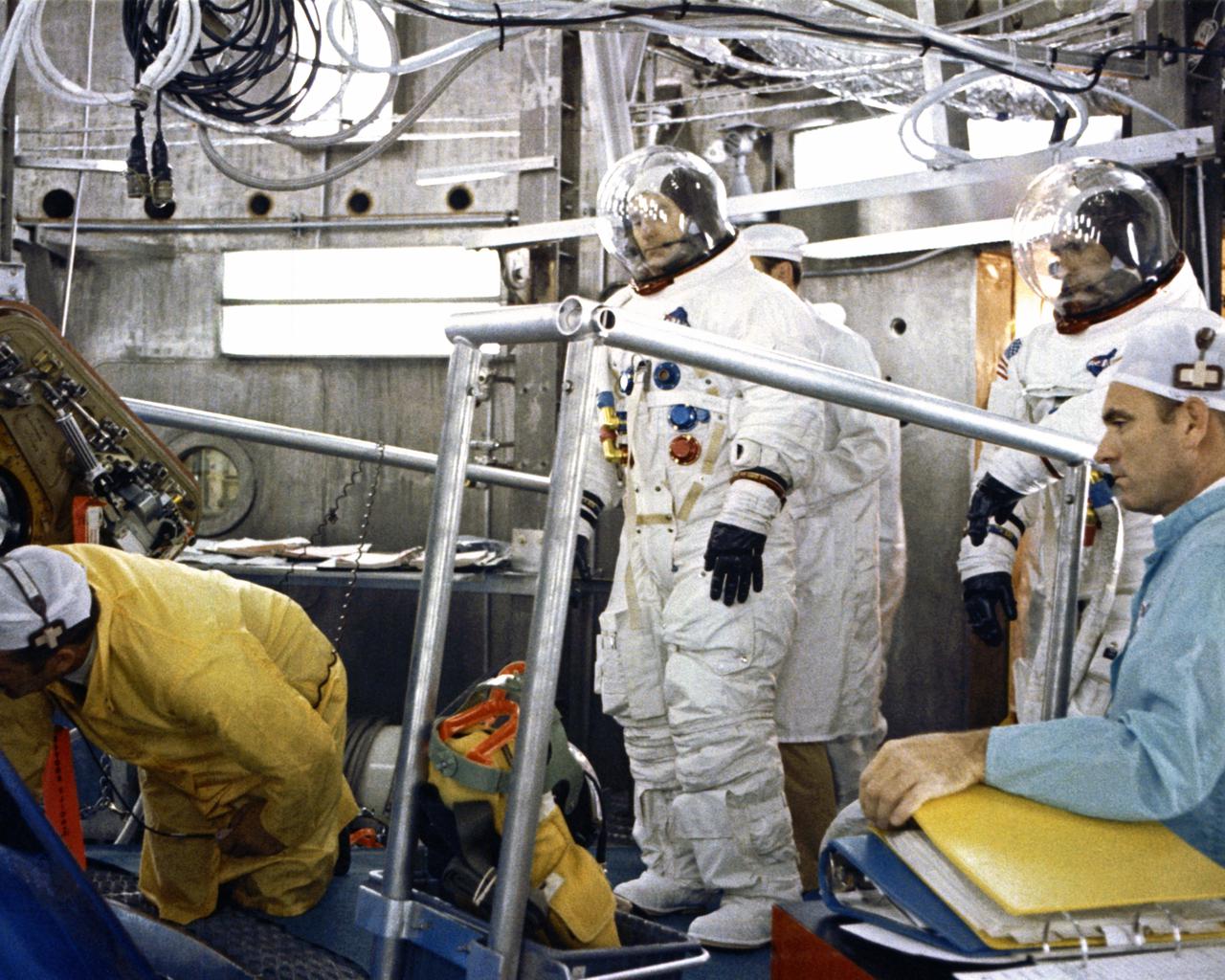
CAPE CANAVERAL, Fla. -- Apollo 12 lunar module pilot Alan L. Bean enters spacecraft in preparation for altitude chamber test with mission commander Charles Conrad Jr. and Richard F. Gordon Jr., command module pilot. Air was pumped out of the chamber to simulate a space environment. The Apollo 12 astronauts are scheduled to perform the nation’s second manned lunar landing. Photo credit: NASA
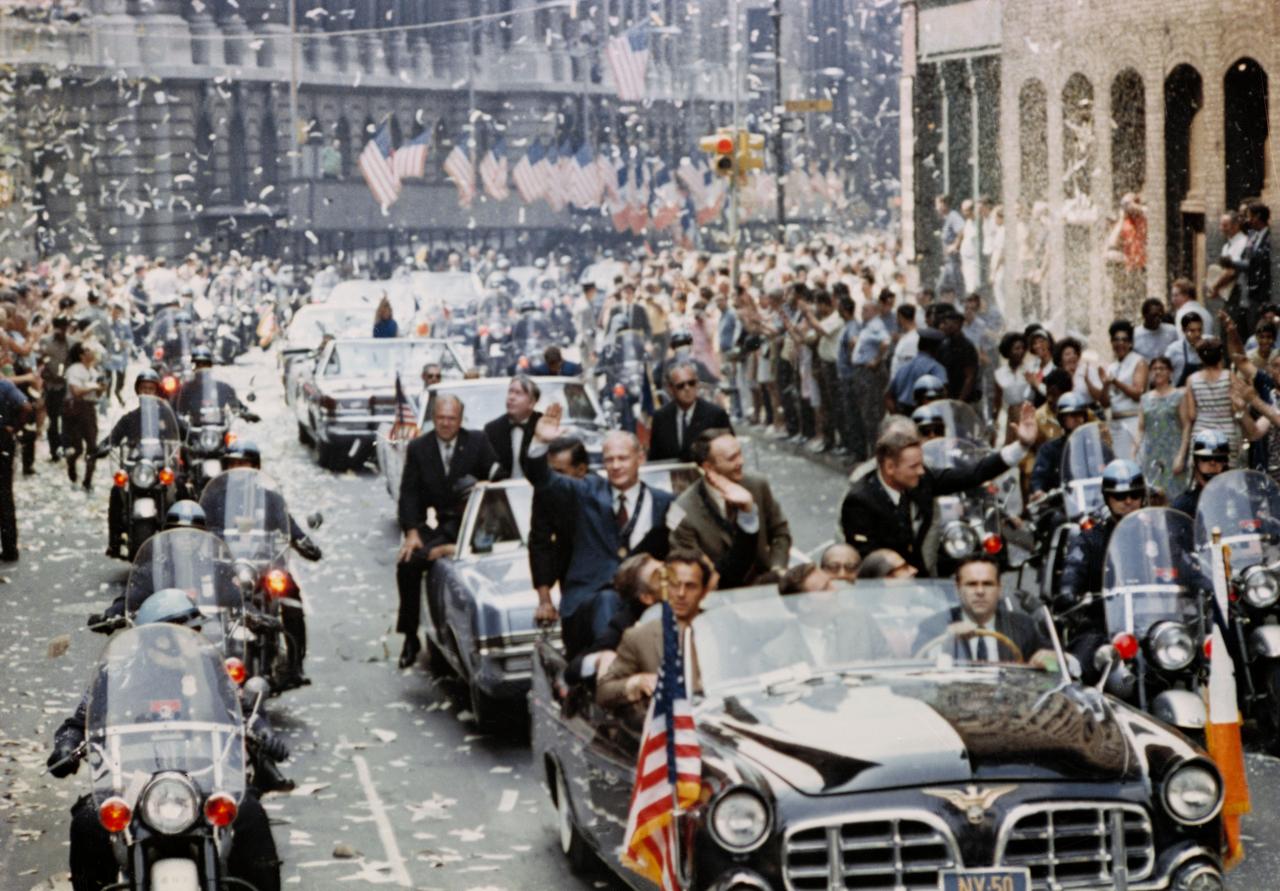
S70-17433 (13 Aug. 1969) --- New York City welcomes Apollo 11 crewmen in a showering of ticker tape down Broadway and Park Avenue in a parade termed as the largest in the city's history. Pictured in the lead car, from the right, are astronauts Neil A. Armstrong, commander; Michael Collins, command module pilot; and Edwin E. Aldrin Jr., lunar module pilot. The three astronauts teamed for the first manned lunar landing, on July 20, 1969.
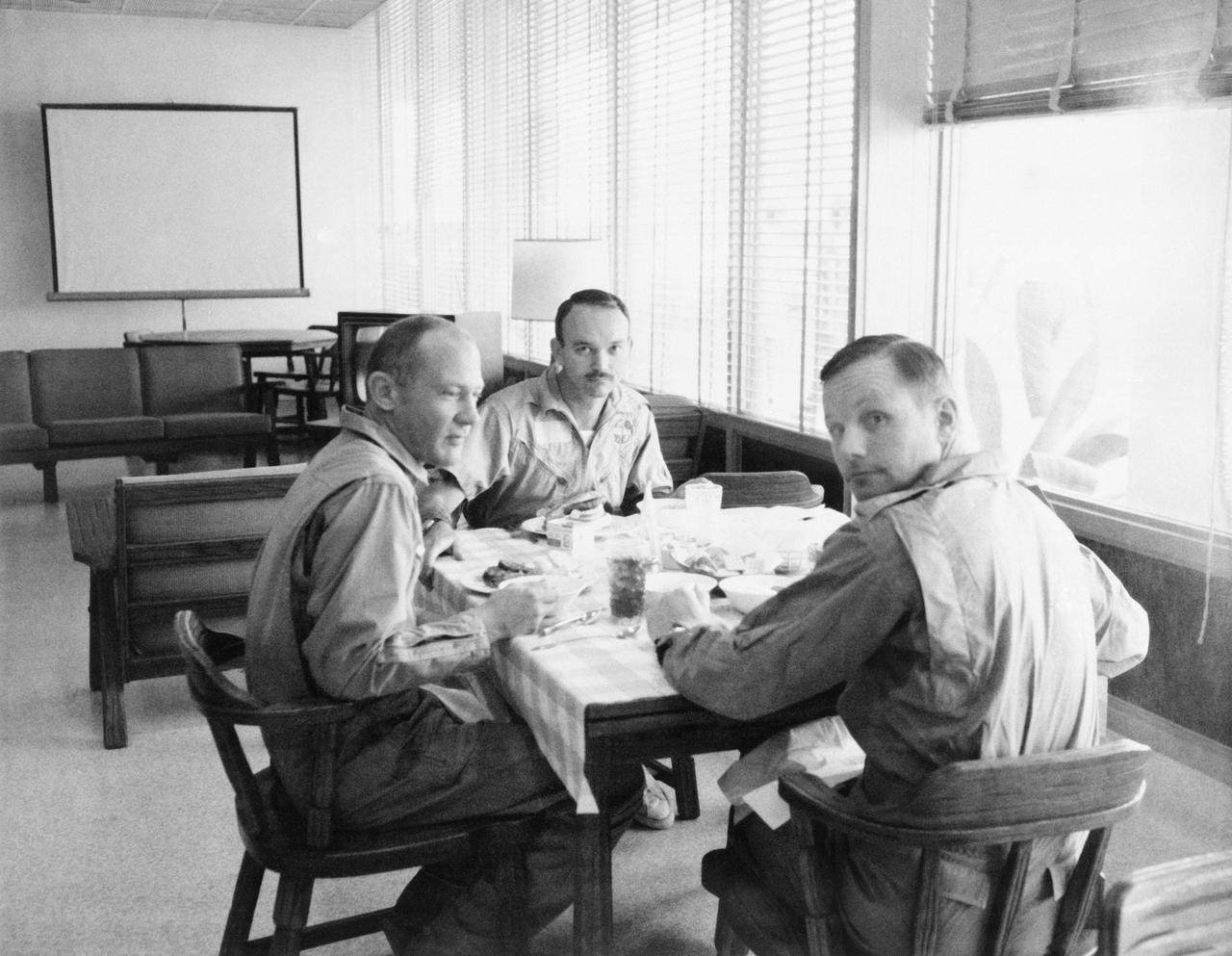
S69-40306 (30 July 1969) --- The crewmen of the historic Apollo 11 lunar landing mission are seen dining in the Crew Reception Area of the Lunar Receiving Laboratory, Building 37, Manned Spacecraft Center. Left to right, are astronauts Edwin E. Aldrin Jr., Michael Collins, and Neil A. Armstrong. They are continuing their postflight debriefings. The astronauts will be released from quarantine on Aug. 11, 1969.