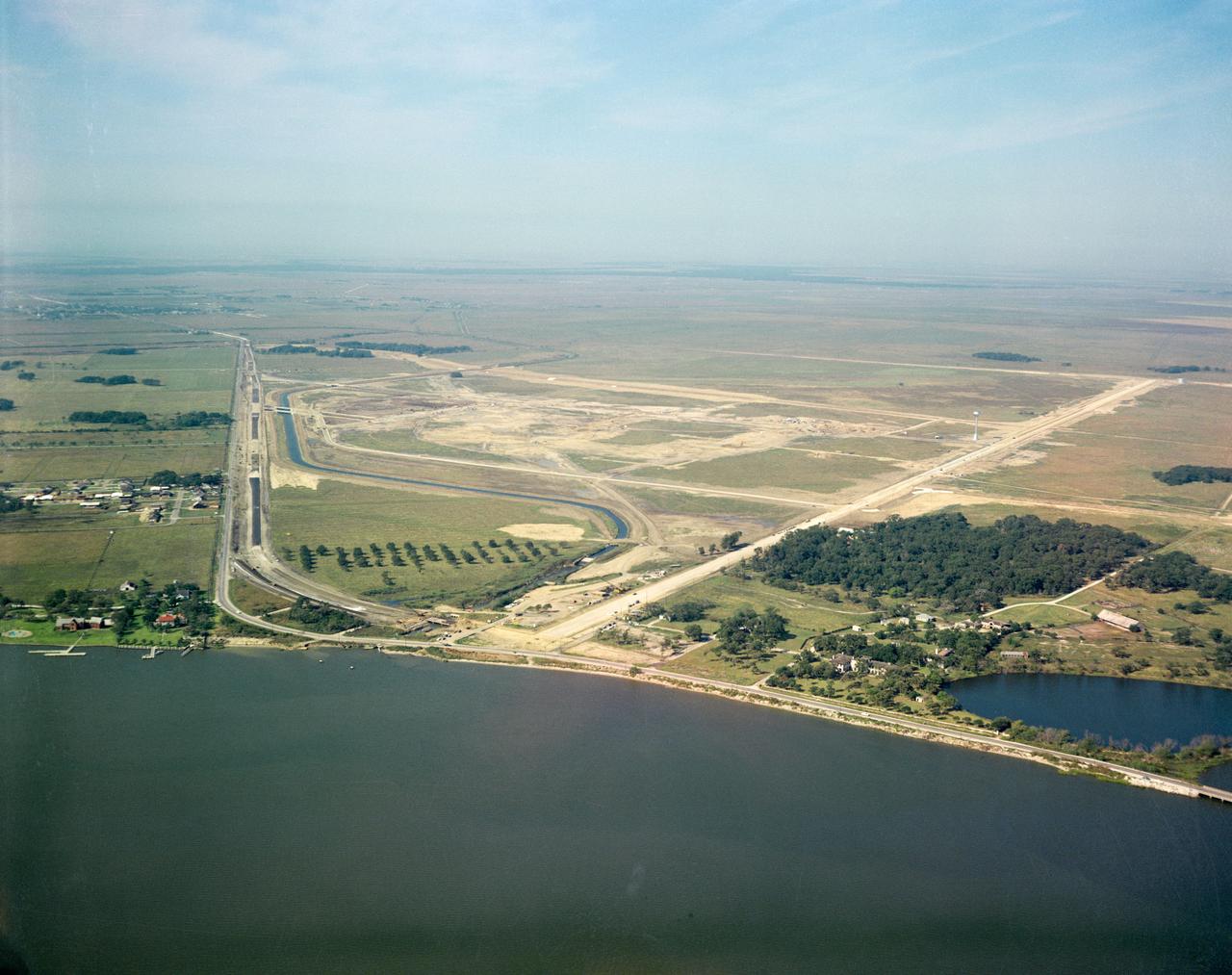
S62-08046 (1961) --- Aerial view of the future site of the Manned Spacecraft Center, Houston, Texas. NOTE: The Manned Spacecraft Center was named Lyndon B. Johnson Space Center in memory of the late President following his death.
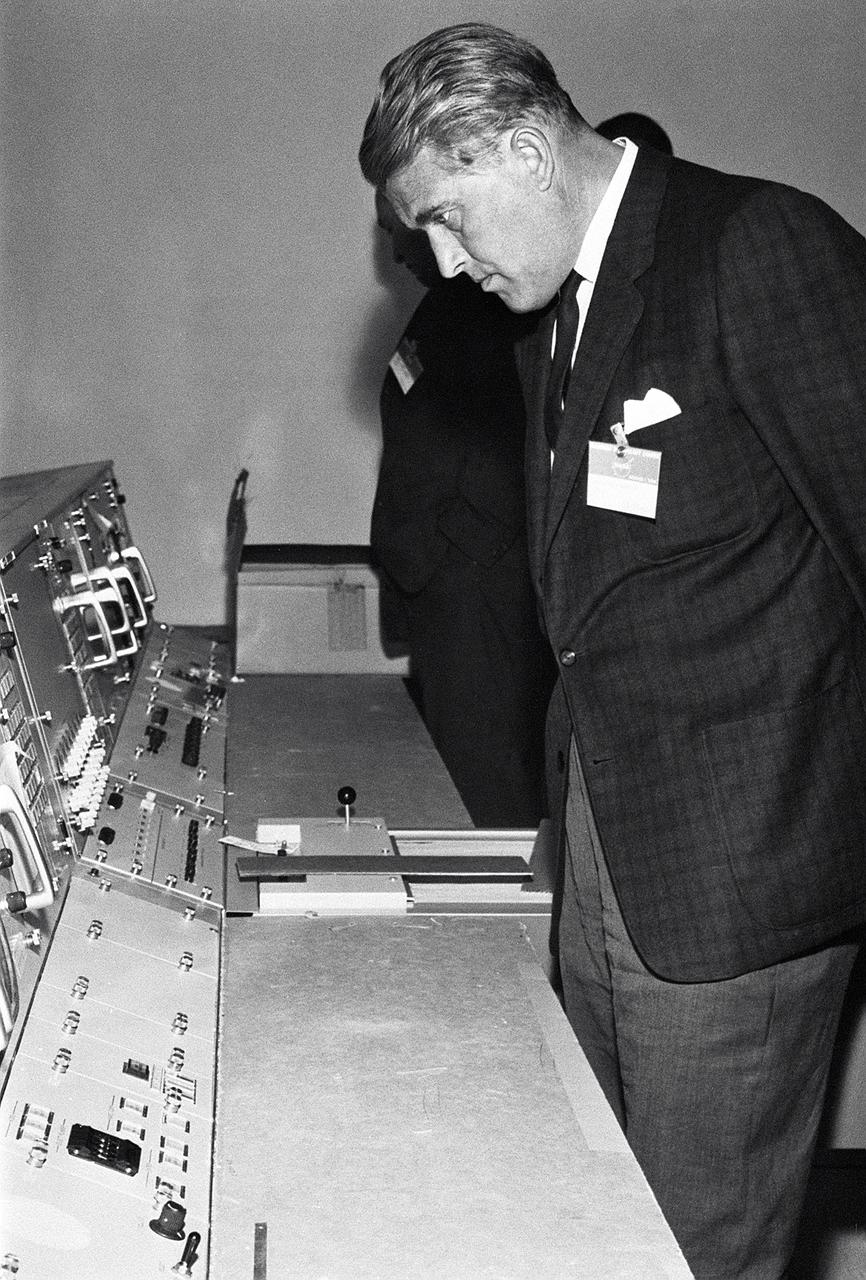
This photograph, dated October 14, 1964, was taken at the Marned Spacecraft Center, now the Johnson Space Center in Houston, Texas. Dr. von Braun is shown looking over consoles in the Manned Spaceflight Control Center.
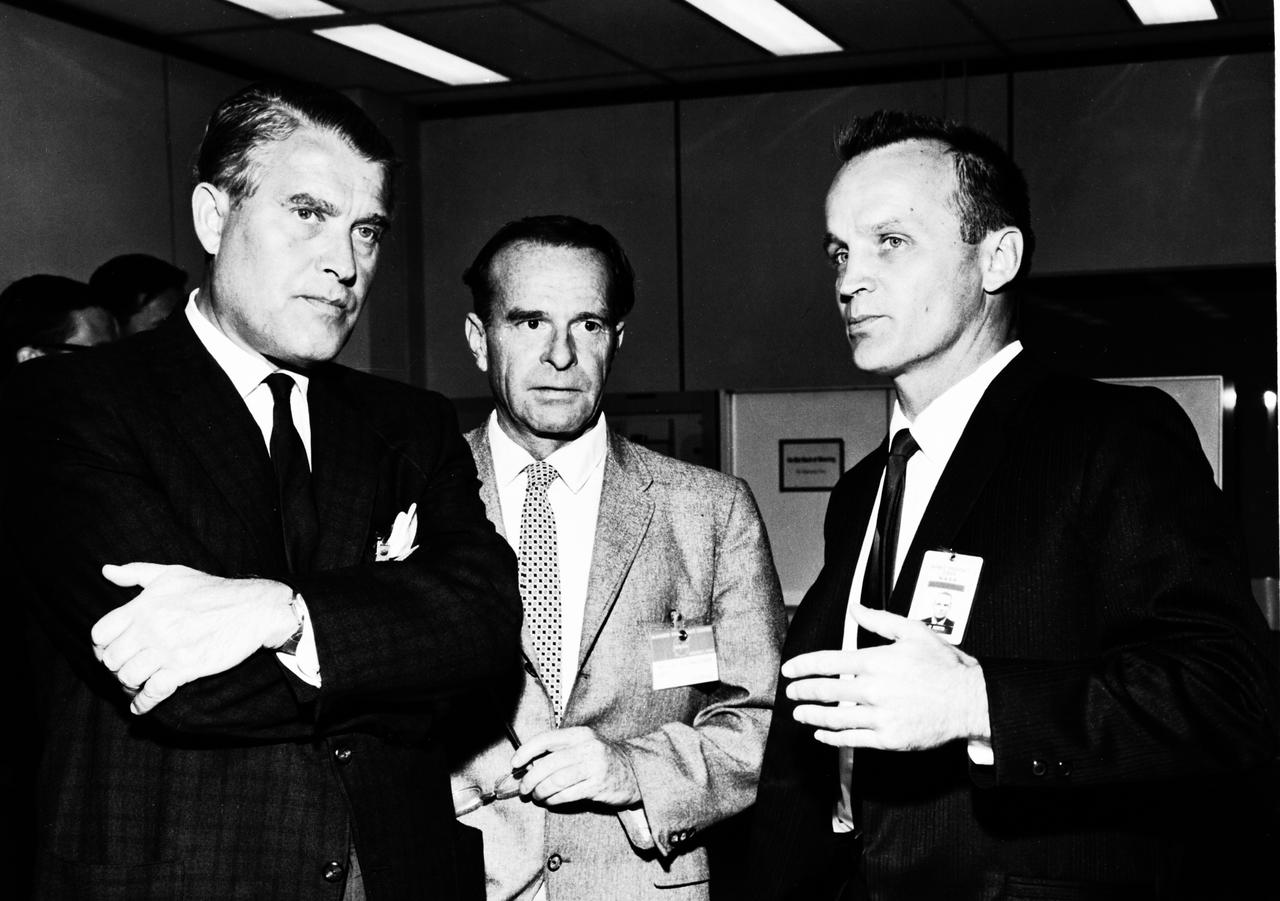
This photograph is dated October 14, 1964, and shows Dr. von Braun, left, during a tour of the NASA Marned Spacecraft Center, now the Johnson Space Center. He is with Dr. J.P. Kuettner, center, from the Marshall Space Flight Center, and Warren J. North from the Manned Spacecraft Center.
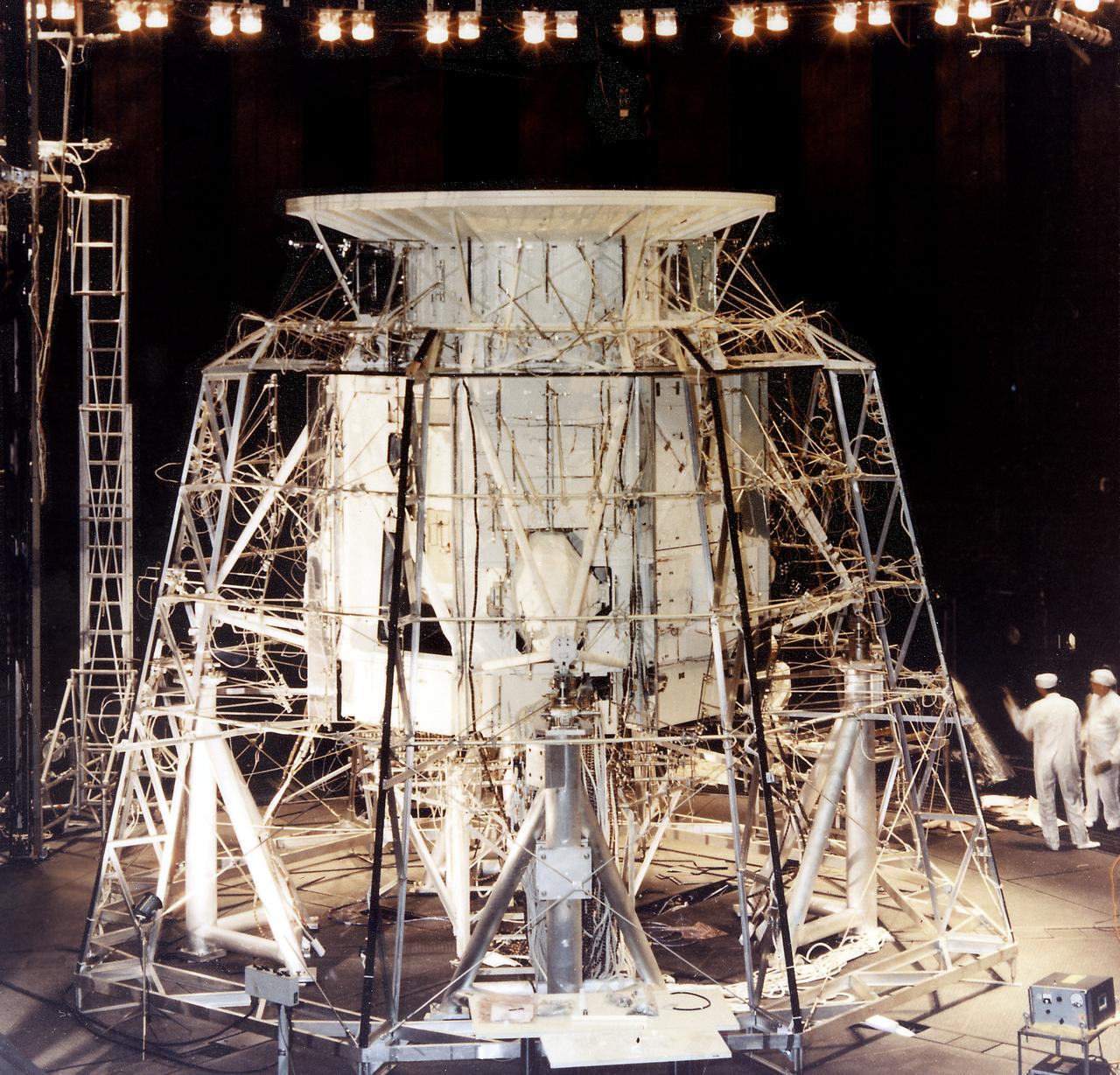
The Apollo Telescope Mount (ATM), designed and developed by the Marshall Space Flight Center, was one of four major components comprising the Skylab (1973-1979). The ATM housed the first manned scientific telescope in space. This photograph is of the ATM thermal systems unit undergoing testing in the Space Environment Simulation Laboratory of the Manned Spacecraft Center (MSC). The ATM thermal systems unit was used to control the temperatures of space instrument's subsystems during a mission. The MSC was renamed the Johnson Space Center (JSC) in early 1973.
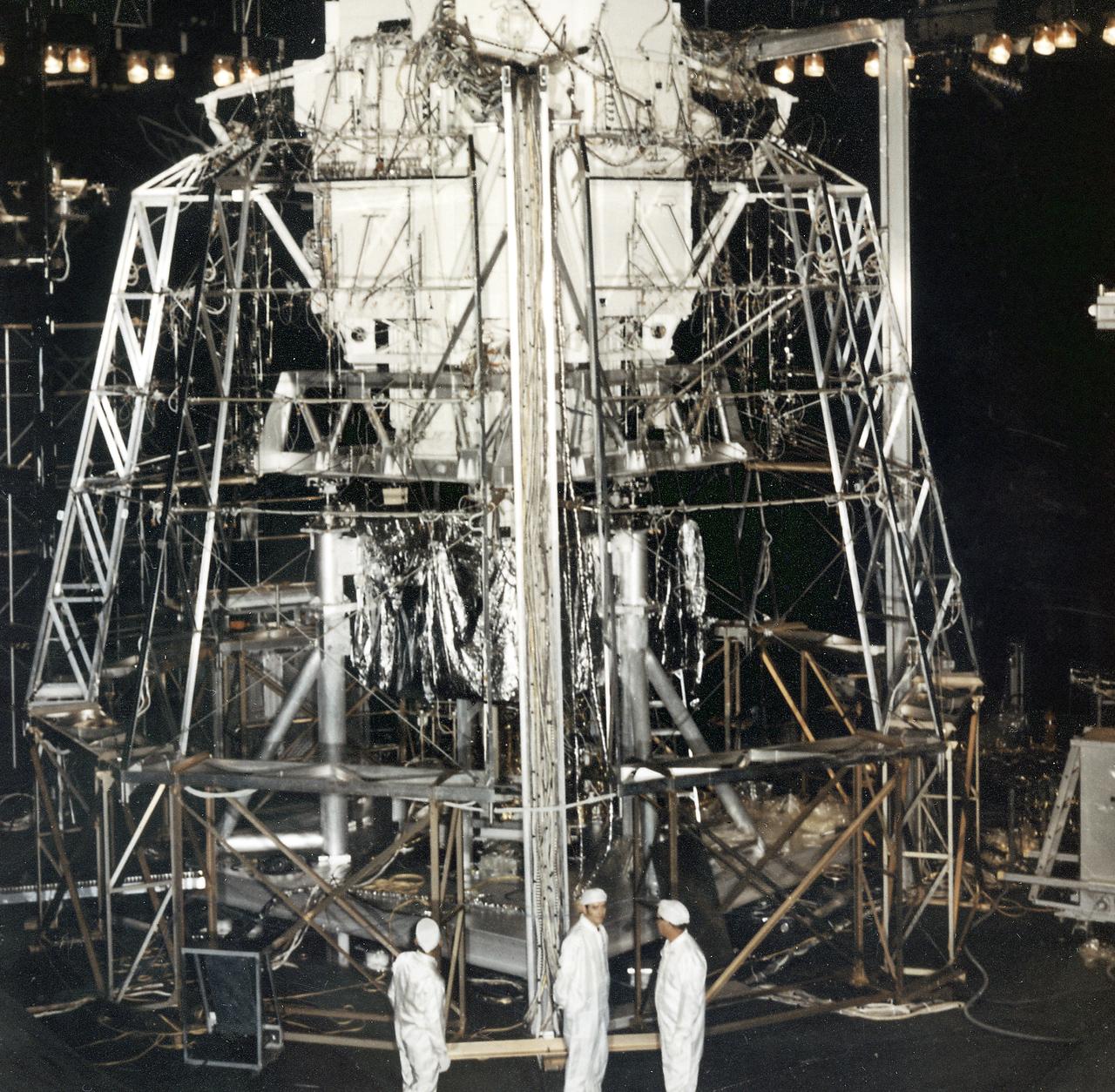
The Apollo Telescope Mount (ATM), designed and developed by the Marshall Space Flight Center, was one of four major components comprising the Skylab (1973-1979). The ATM housed the first manned scientific telescope in space. This photograph shows the ATM rigged for altitude and space simulation tests at the Space Environment Simulation Laboratory of the Manned Spacecraft Center (MSC). The MSC was renamed the Johnson Space Center (JSC) in early 1973.
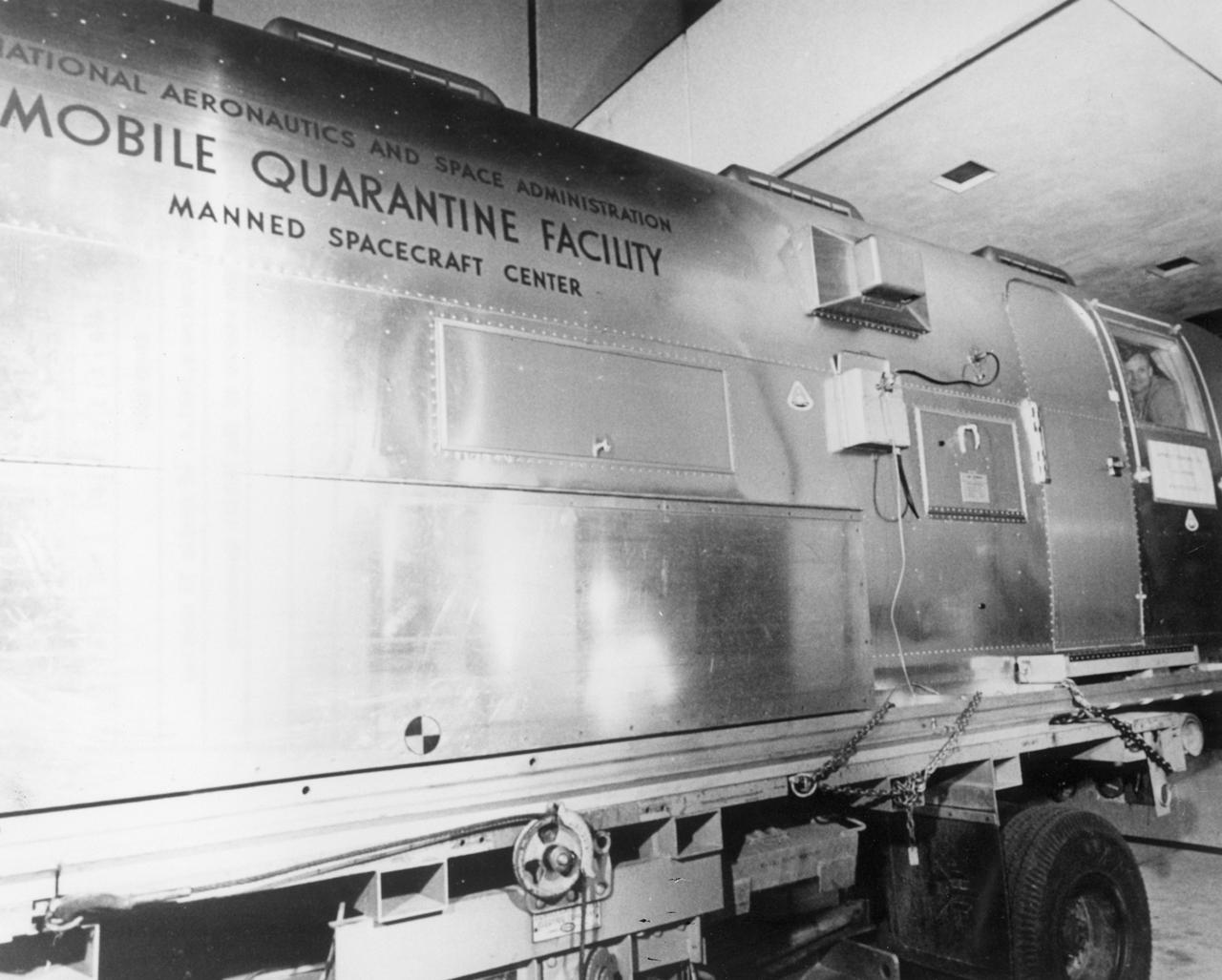
The Apollo 11 mission, the first manned lunar mission, launched from the Kennedy Space Center, Florida via the Marshall Space Flight Center (MSFC) developed Saturn V launch vehicle on July 16, 1969 and safely returned to Earth on July 24, 1969. Aboard the space craft were astronauts Neil A. Armstrong, commander; Michael Collins, Command Module (CM) pilot; and Edwin E. Aldrin Jr., Lunar Module (LM) pilot. The CM, piloted by Michael Collins remained in a parking orbit around the Moon while the LM, named “Eagle’’, carrying astronauts Neil Armstrong and Edwin Aldrin, landed on the Moon. During 2½ hours of surface exploration, the crew collected 47 pounds of lunar surface material for analysis back on Earth. The recovery operation took place in the Pacific Ocean where Navy para-rescue men recovered the capsule housing the 3-man Apollo 11 crew. The crew was airlifted to safety aboard the U.S.S. Hornet, where they were quartered in a Mobile Quarantine Facility (MQF) which served as their home until they reached the NASA Manned Spacecraft Center (MSC) Lunar Receiving Laboratory in Houston, Texas. In this close up of the MQF, commander Armstrong can be seen through the facility window after its arrival at the MSC.
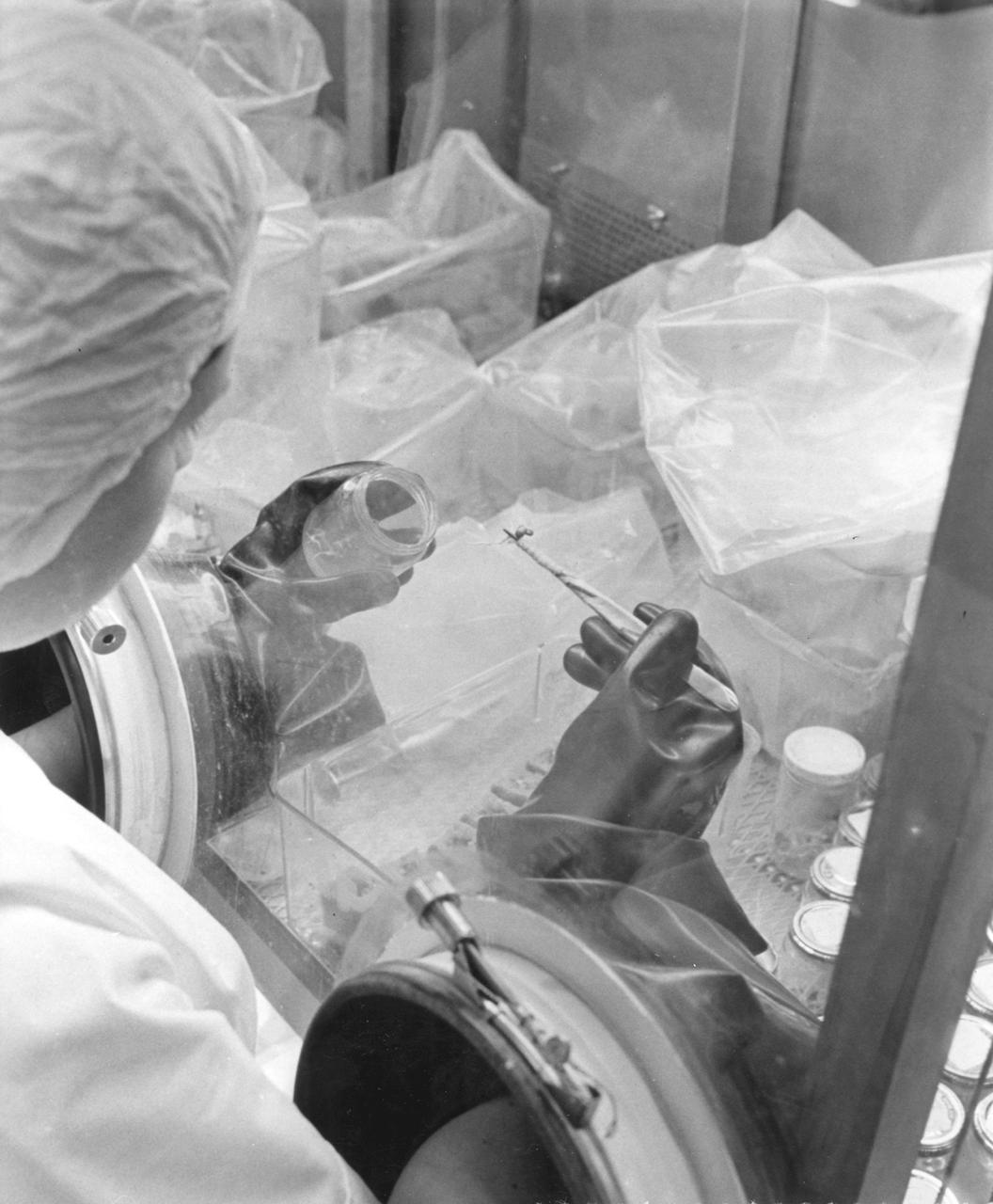
In this photograph, a laboratory technician handles a portion of the more than 20 different plant lines that were used within the Lunar Receiving Laboratory, Building 37 of the Manned Spacecraft Center (MSC) in Houston, Texas. This laboratory was part of the overall physical, chemical, and biological test program of the Apollo 11 returned lunar samples. Aboard the Marshall Space Flight Center (MSFC) developed Saturn V launch vehicle, the Apollo 11 mission launched from The Kennedy Space Center, Florida on July 16, 1969 and safely returned to Earth on July 24, 1969. The 3-man crew aboard the flight consisted of astronauts Neil A. Armstrong, commander; Edwin Aldrin, Lunar Module (LM) pilot; and Michael Collins, Command Module (CM) pilot. The CM, piloted by Michael Collins remained in a parking orbit around the Moon while the LM, named “Eagle’’, carrying astronauts Neil Armstrong and Edwin Aldrin, landed on the Moon. In 2 1/2 hours, the crew collected 47 pounds of lunar surface material which was returned to Earth for analysis.
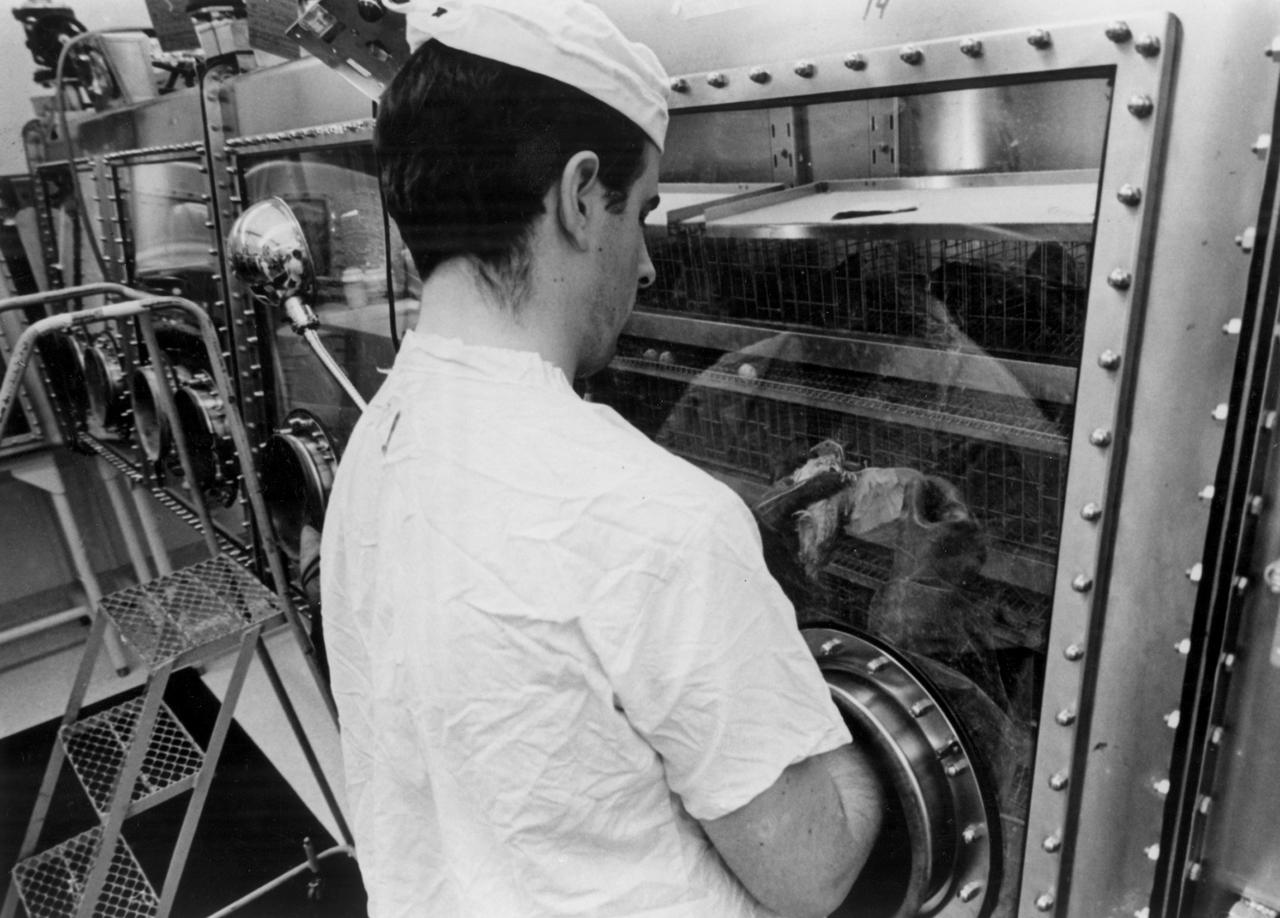
In this photograph, laboratory technician Bart Ruark visually inspects a Japanese Qail confined within a class III cabinet in the Intervertebrae, Aves, and Fish Laboratory of the Lunar Receiving Laboratory, Building 37 of the Manned Spacecraft Center (MSC) in Houston, Texas. This laboratory was part of the overall physical, chemical, and biological test program of the Apollo 11 returned lunar samples. Aboard the Marshall Space Flight Center (MSFC) developed Saturn V launch vehicle, the Apollo 11 mission launched from The Kennedy Space Center, Florida on July 16, 1969 and safely returned to Earth on July 24, 1969. The 3-man crew aboard the flight consisted of astronauts Neil A. Armstrong, commander; Edwin Aldrin, Lunar Module (LM) pilot; and Michael Collins, Command Module (CM) pilot. The CM, piloted by Michael Collins remained in a parking orbit around the Moon while the LM, named “Eagle’’, carrying astronauts Neil Armstrong and Edwin Aldrin, landed on the Moon. In 2 1/2 hours, the crew collected 47 pounds of lunar surface material which was returned to Earth for analysis.
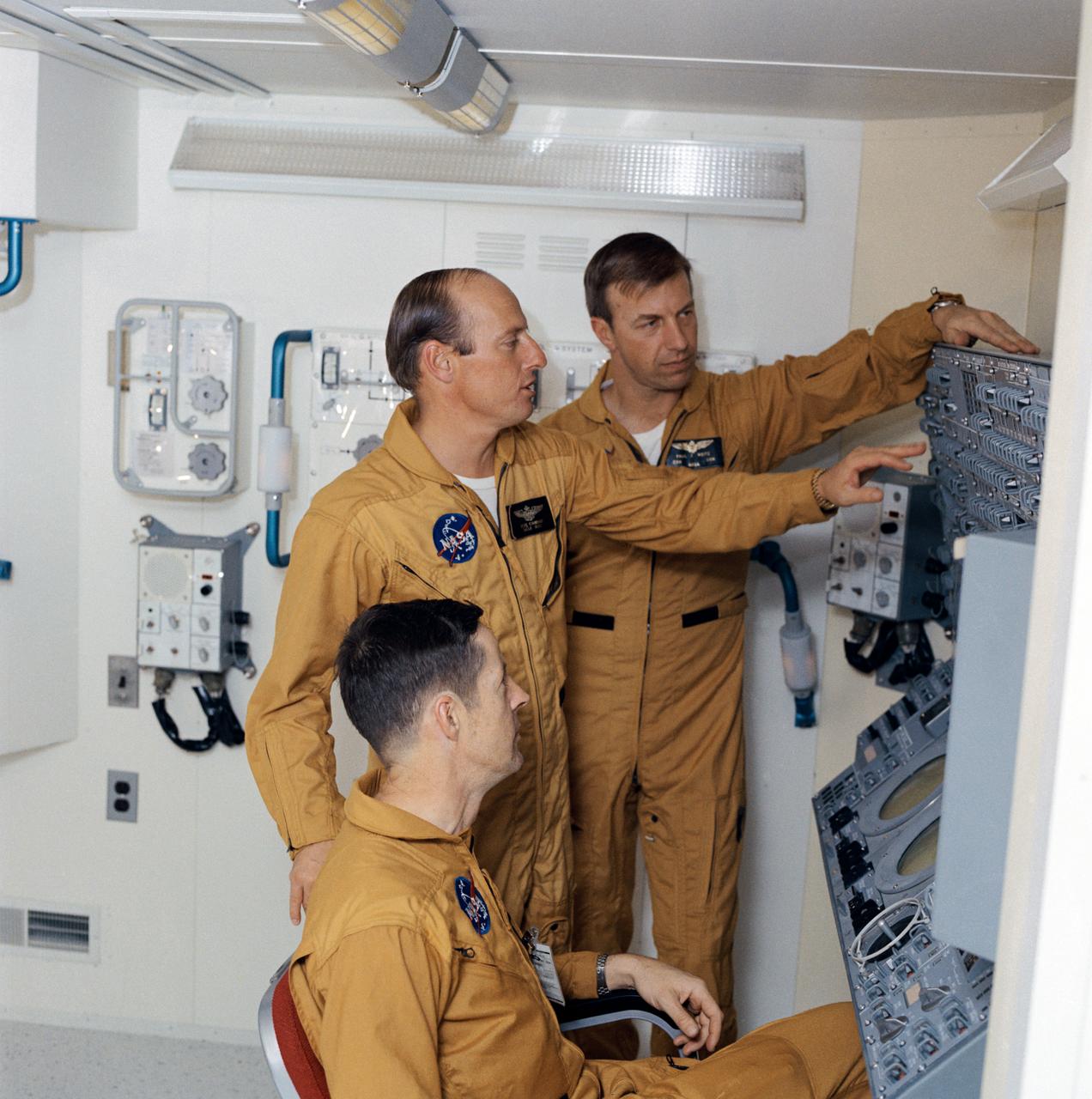
S72-17509 (19 Jan. 1972) --- These three men are the crewmen for the first manned Skylab mission. They are astronaut Charles Conrad Jr., commander, standing left; scientist-astronaut Joseph P. Kerwin, seated; and astronaut Paul J. Weitz, pilot. They were photographed and interviewed during an "open house" press day in the realistic atmosphere of the Multiple Docking Adapter (MDA) trainer in the Mission Simulation and Training Facility at the Manned Spacecraft Center (MSC). The control and display panel for the Apollo Telescope Mount (ATM) is at right. Photo credit: NASA
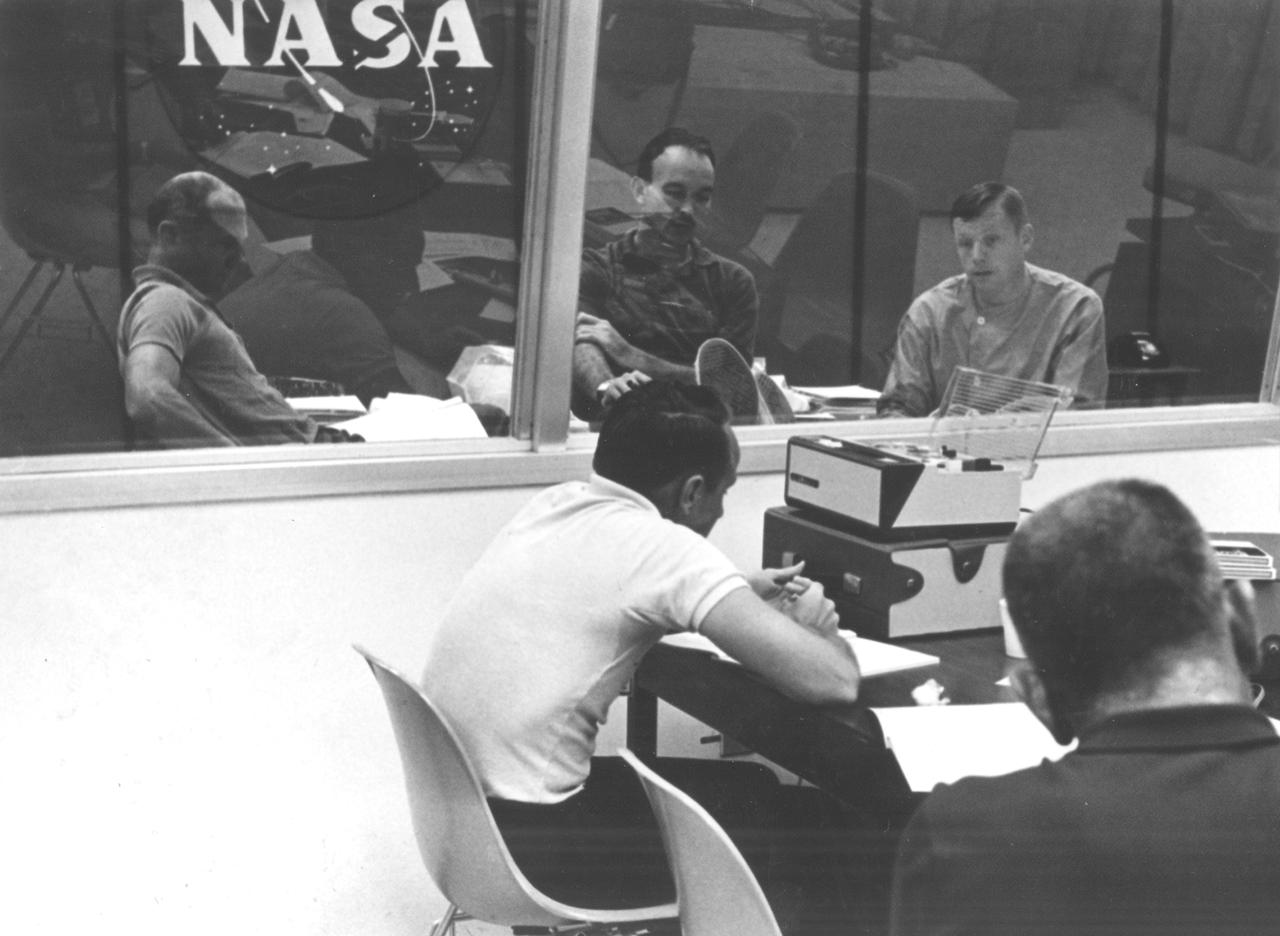
The Apollo 11 mission, the first manned lunar mission, launched from the Kennedy Space Center, Florida via the Marshall Space Flight Center (MSFC) developed Saturn V launch vehicle on July 16, 1969 and safely returned to Earth on July 24, 1969. Aboard the space craft were astronauts Neil A. Armstrong, commander; Michael Collins, Command Module (CM) pilot; and Edwin E. Aldrin Jr., Lunar Module (LM) pilot. The CM, piloted by Michael Collins remained in a parking orbit around the Moon while the LM, named “Eagle’’, carrying astronauts Neil Armstrong and Edwin Aldrin, landed on the Moon. During 2½ hours of surface exploration, the crew collected 47 pounds of lunar surface material for analysis back on Earth. The recovery operation took place in the Pacific Ocean where Navy para-rescue men recovered the capsule housing the 3-man Apollo 11 crew. The crew was airlifted to safety aboard the U.S.S. Hornet, where they were quartered in a Mobile Quarantine Facility (MQF) which served as their home until they reached the NASA Manned Spacecraft Center (MSC) Lunar Receiving Laboratory in Houston, Texas. The three are seen here at the MSC, still inside the MQF, undergoing their first debriefing on Sunday, August 3, 1969. Behind the glass are (L-R): Edwin Aldrin, Michael Collins, and Neil Armstrong.
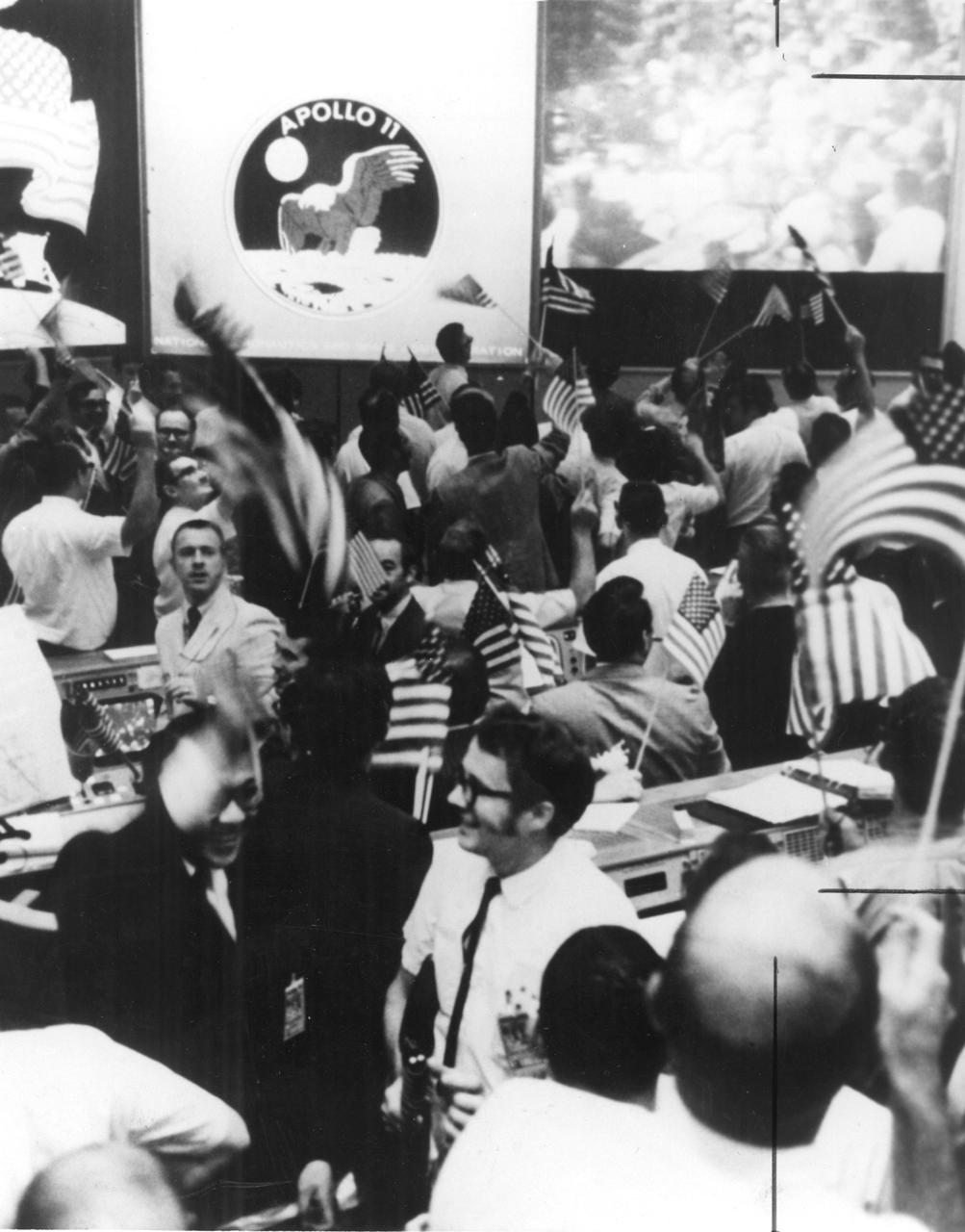
The Apollo 11 mission, the first manned lunar mission, launched from the Kennedy Space Center, Florida via the Marshall Space Flight Center (MSFC) developed Saturn V launch vehicle on July 16, 1969 and safely returned to Earth on July 24, 1969. Aboard he space craft were astronauts Neil A. Armstrong, commander; Michael Collins, Command Module (CM) pilot; and Edwin E. Aldrin Jr., Lunar Module (LM) pilot. The CM, piloted by Michael Collins remained in a parking orbit around the Moon while the LM, named “Eagle’’, carrying astronauts Neil Armstrong and Edwin Aldrin, landed on the Moon. During 2½ hours of surface exploration, the crew collected 47 pounds of lunar surface material for analysis back on Earth. Splashdown occurred in the Pacific Ocean on July 24, 1969. This overall view of the Mission Operations Control Room in the Mission Control Center at the NASA Manned Spacecraft Center (MSC) in Houston Texas shows the jubilation of the celebration of mission success. Mission controllers wave their American flags just after Apollo 11 had been recovered from the Pacific Ocean.
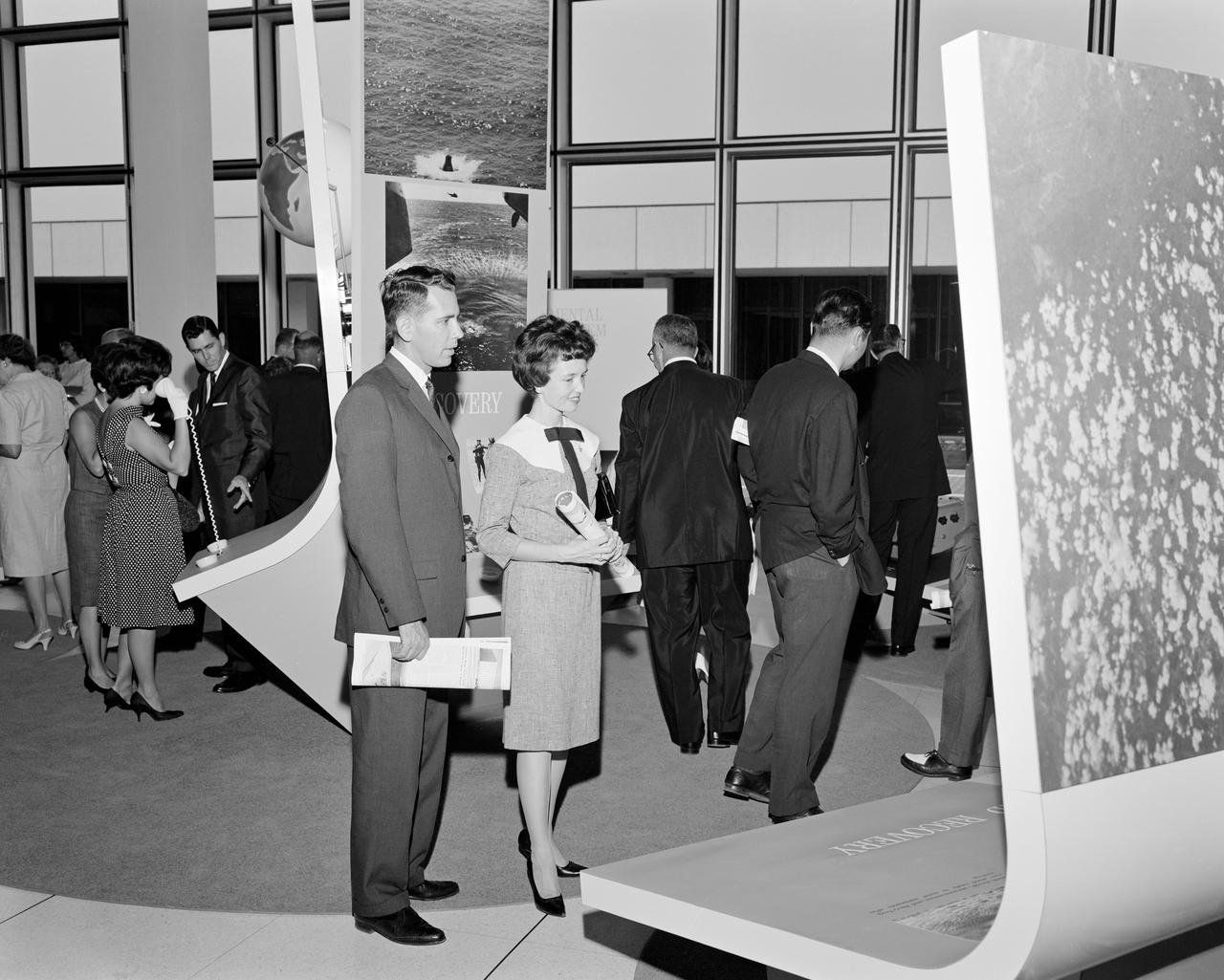
Open House - Visitiors to the MSC Open House view the many exhibits found in Bldg. 1
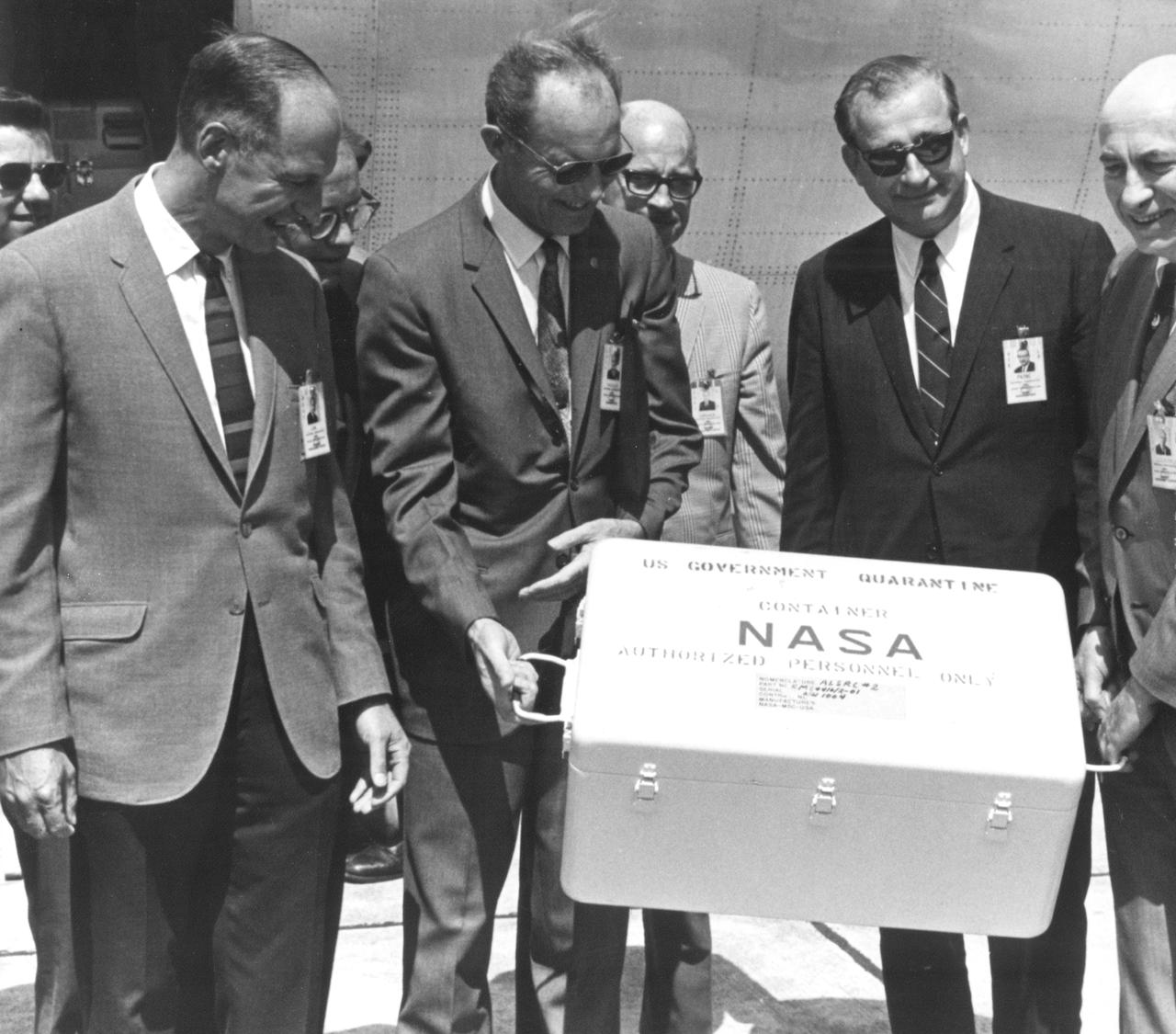
The Apollo 11 mission, the first manned lunar mission, launched from the Kennedy Space Center, Florida via the Marshall Space Flight Center (MSFC) developed Saturn V launch vehicle on July 16, 1969 and safely returned to Earth on July 24, 1969. Aboard the space craft were astronauts Neil A. Armstrong, commander; Michael Collins, Command Module (CM) pilot; and Edwin E. Aldrin Jr., Lunar Module (LM) pilot. The CM, piloted by Michael Collins remained in a parking orbit around the Moon while the LM, named “Eagle’’, carrying astronauts Neil Armstrong and Edwin Aldrin, landed on the Moon. During 2½ hours of surface exploration, the crew collected 47 pounds of lunar surface material for analysis back on Earth. This photograph was taken as the mission’s first loaded sample return container arrived at Ellington Air Force Base by air from the Pacific recovery area. The rock box was immediately taken to the Lunar Receiving Laboratory at the Manned Spacecraft Center (MSC) in Houston, Texas. Happily posing for the photograph with the rock container are (L-R) Richard S. Johnston (back), special assistant to the MSC Director; George M. Low, MSC Apollo Spacecraft Program manager; George S. Trimble (back), MSC Deputy Director; Lt. General Samuel C. Phillips, Apollo Program Director, Office of Manned Spaceflight at NASA headquarters; Eugene G. Edmonds, MSC Photographic Technology Laboratory; Dr. Thomas O. Paine, NASA Administrator; and Dr. Robert R. Gilruth, MSC Director.
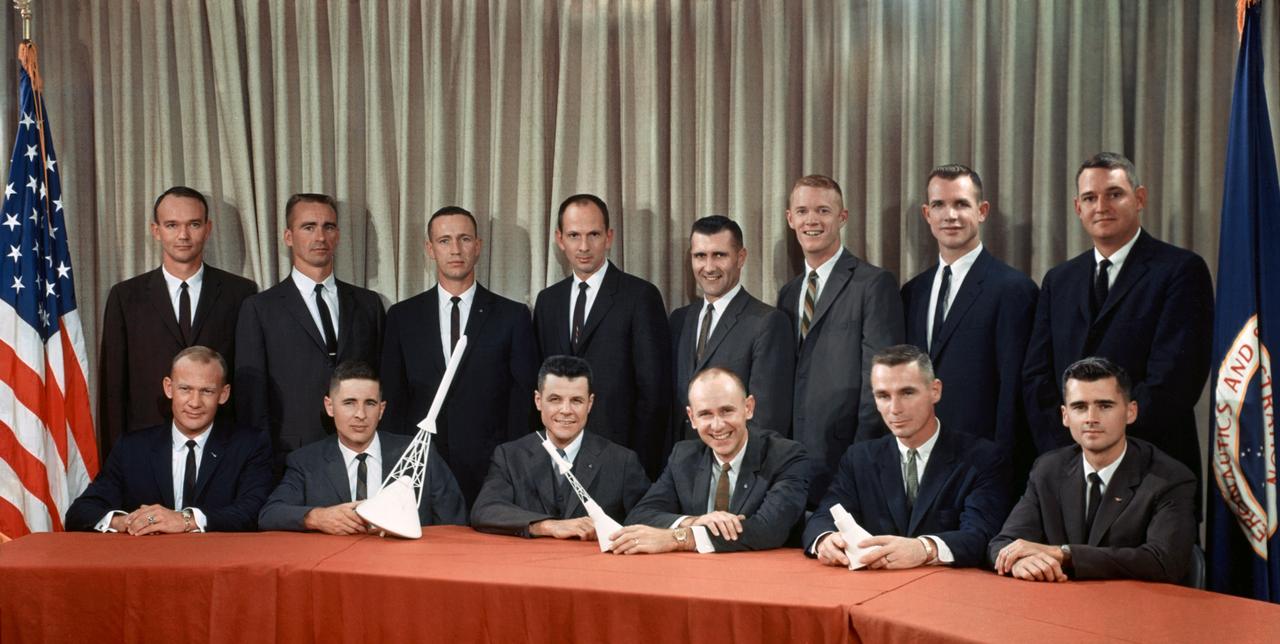
S63-18765 (October 1963) --- These fourteen pilots have been assigned to begin training for astronaut positions with the National Aeronautics and Space Administration (NASA). Front row, from the left, Edwin E. Aldrin Jr., William A. Anders, Charles A. Bassett II, Alan L. Bean, Eugene A. Cernan and Roger B. Chaffee. Back row, from the left, Michael Collins, Walter Cunningham, Donn F. Eisele, Theodore C. Freeman, Richard F. Gordon Jr., Russell L. Scweickart, David R. Scott and Clifton C. Williams Jr. Photo credit: NASA or National Aeronautics and Space Administration
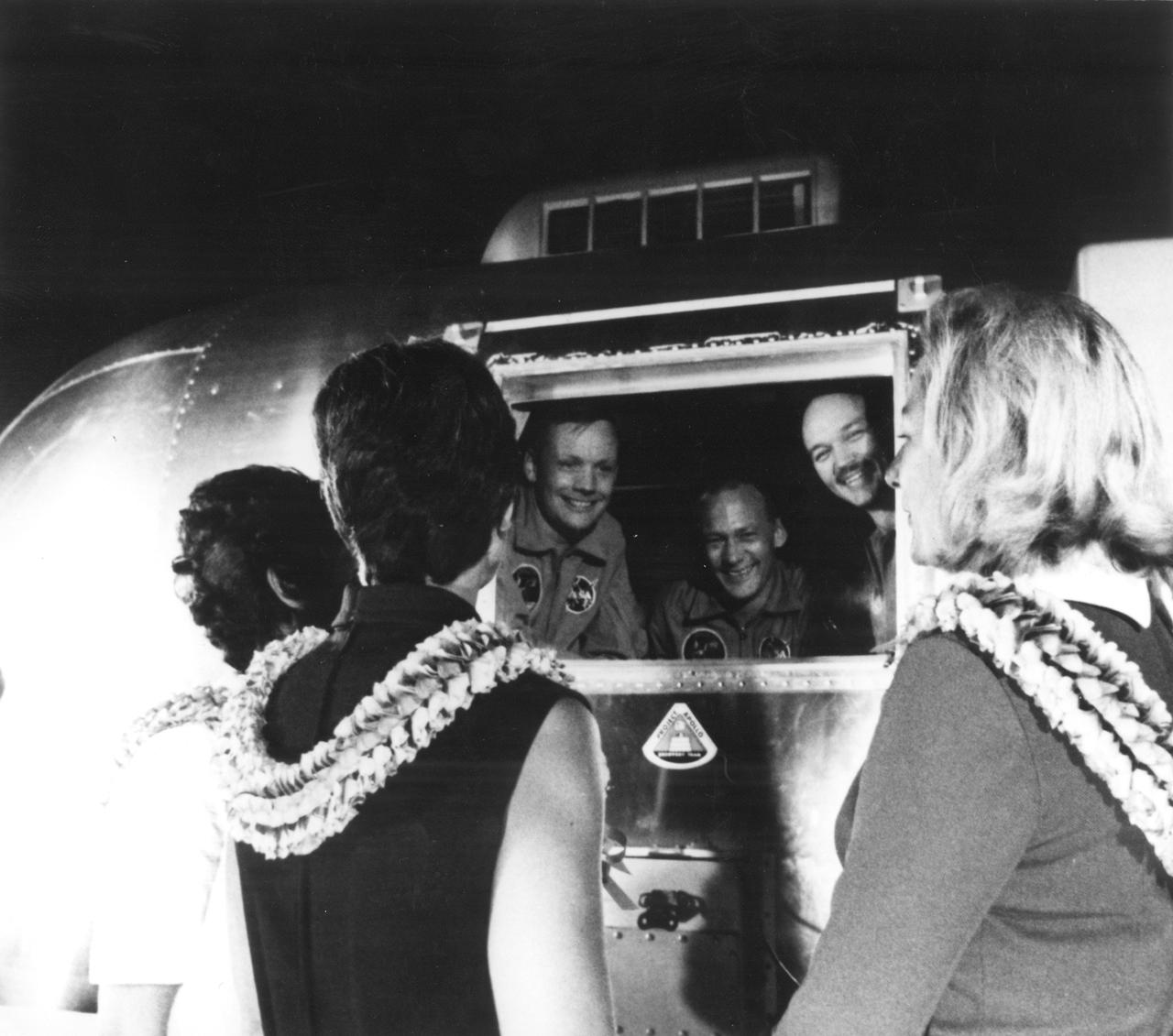
The Apollo 11 mission, the first manned lunar mission, launched from the Kennedy Space Center, Florida via the Marshall Space Flight Center (MSFC) developed Saturn V launch vehicle on July 16, 1969 and safely returned to Earth on July 24, 1969. Aboard the space craft were astronauts Neil A. Armstrong, commander; Michael Collins, Command Module (CM) pilot; and Edwin E. Aldrin Jr., Lunar Module (LM) pilot. The CM, piloted by Michael Collins remained in a parking orbit around the Moon while the LM, named “Eagle’’, carrying astronauts Neil Armstrong and Edwin Aldrin, landed on the Moon. During 2½ hours of surface exploration, the crew collected 47 pounds of lunar surface material for analysis back on Earth. The recovery operation took place in the Pacific Ocean where Navy para-rescue men recovered the capsule housing the 3-man Apollo 11 crew. The crew was airlifted to safety aboard the U.S.S. Hornet, where they were quartered in a Mobile Quarantine Facility (MQF) which served as their home until they reached the NASA Manned Spacecraft Center (MSC) Lunar Receiving Laboratory in Houston, Texas. On arrival at Ellington Air Force base near the MSC, the crew, still under a 21 day quarantine in the MQF are greeted by their wives. Looking out of the facility are (L-R) Armstrong, Aldrin, and Collins. Wives are (L-R) Pat Collins, Jan Armstrong, and Joan Aldrin.
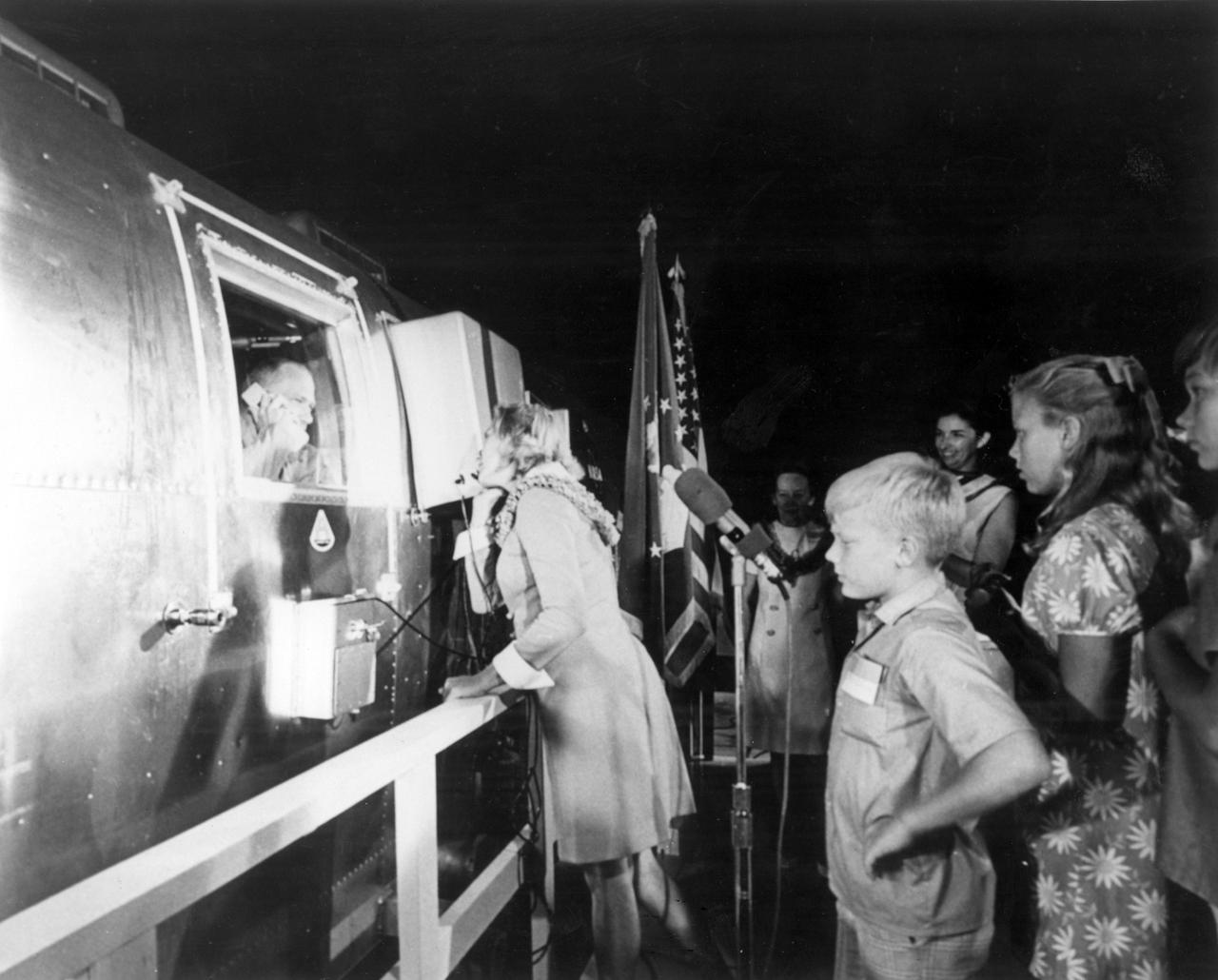
The Apollo 11 mission, the first manned lunar mission, launched from the Kennedy Space Center, Florida via the Marshall Space Flight Center (MSFC) developed Saturn V launch vehicle on July 16, 1969 and safely returned to Earth on July 24, 1969. Aboard the space craft were astronauts Neil A. Armstrong, commander; Michael Collins, Command Module (CM) pilot; and Edwin E. (Buzz) Aldrin Jr., Lunar Module (LM) pilot. The CM, piloted by Michael Collins remained in a parking orbit around the Moon while the LM, named “Eagle’’, carrying astronauts Neil Armstrong and Edwin Aldrin, landed on the Moon. During 2½ hours of surface exploration, the crew collected 47 pounds of lunar surface material for analysis back on Earth. The recovery operation took place in the Pacific Ocean where Navy para-rescue men recovered the capsule housing the 3-man Apollo 11 crew. The crew was airlifted to safety aboard the U.S.S. Hornet, where they were quartered in a Mobile Quarantine Facility (MQF) which served as their home until they reached the NASA Manned Spacecraft Center (MSC) Lunar Receiving Laboratory in Houston, Texas. On arrival at Ellington Air Force base near the MSC, the crew, still under a 21 day quarantine in the MQF, were greeted by their wives. Pictured here is Joan Aldrin, wife of Buzz Aldrin, speaking with her husband via telephone patch.
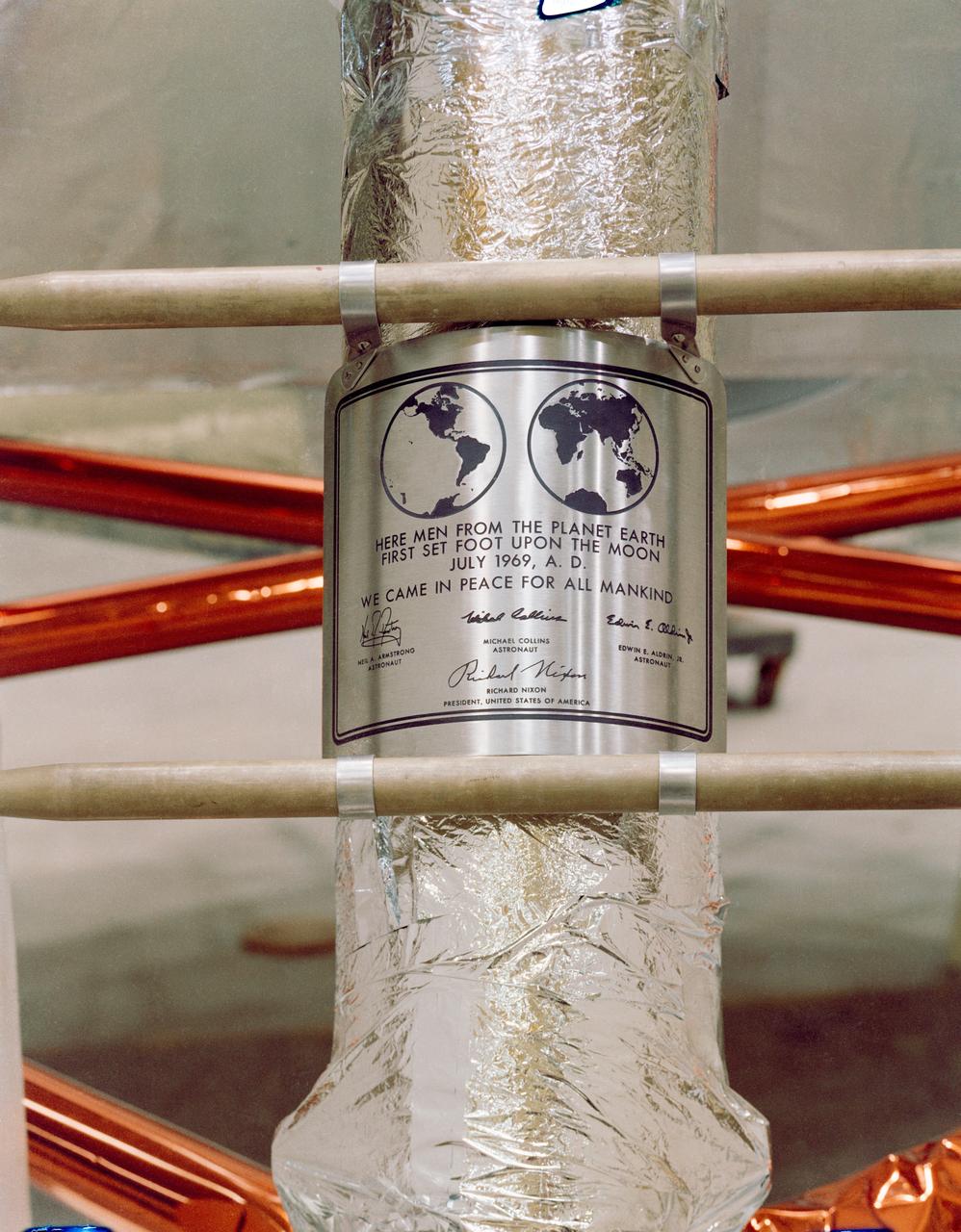
S69-38749 (July 1969) --- Close-up view of the plaque which the Apollo 11 astronauts will leave behind on the moon in commemoration of the historic event. The plaque is made of stainless steel measuring nine by seven and five-eighths inches, and one-sixteenth inch thick. The plaque will be attached to the ladder on the landing gear strut on the descent stage of the Apollo 11 Lunar Module (LM). Covering the plaque during flight will be a thin sheet of stainless steel which will be removed on the lunar surface.
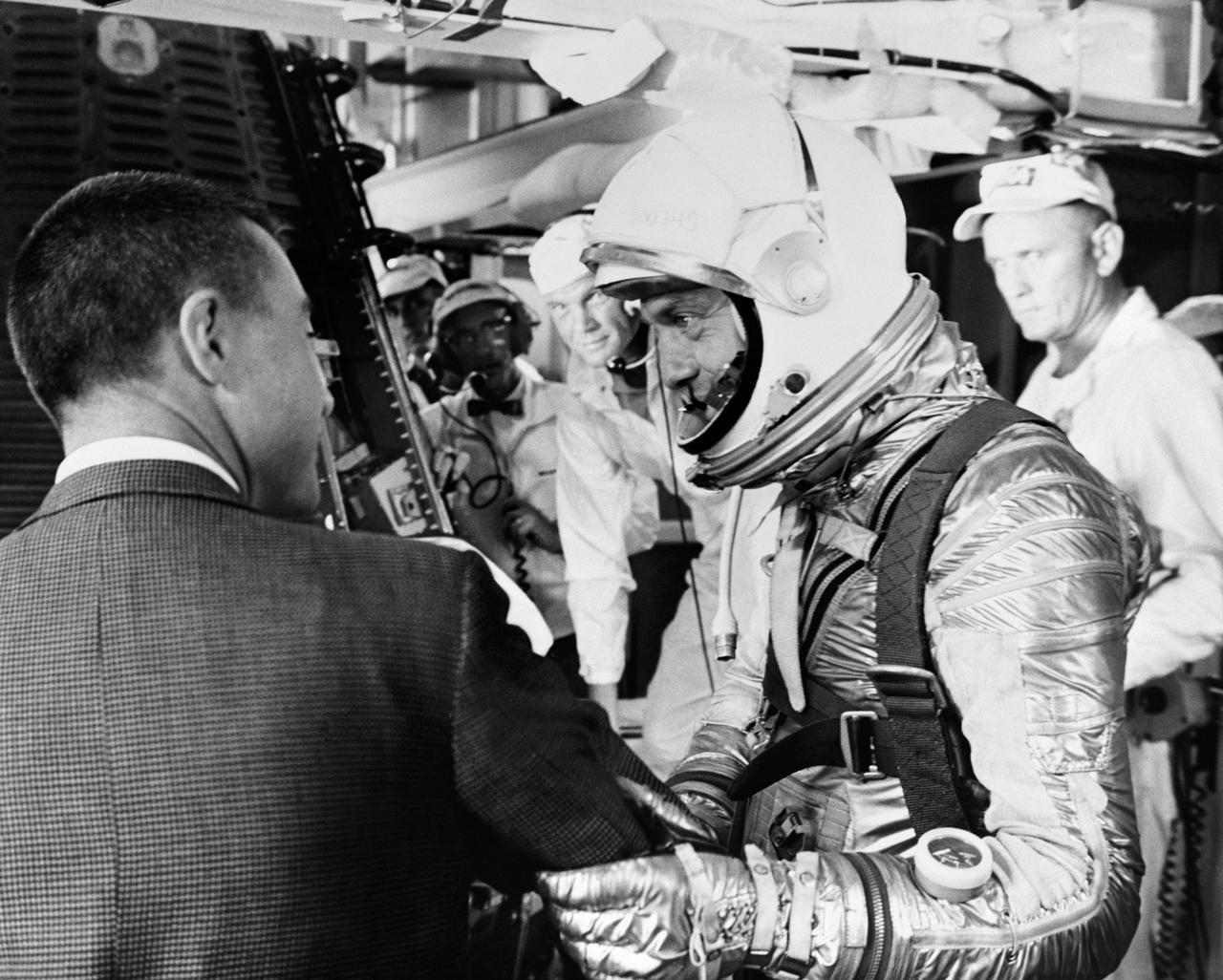
S61-02794 (5 May 1961) --- Astronaut Alan B. Shepard Jr., shakes hands with fellow astronaut Virgil I. Grissom (on left, back to camera), prior to ingressing the capsule for his Mercury-Redstone 3 (MR-3) spaceflight. Astronaut John H. Glenn Jr. (center background in white cap) looks on along with Gunter Wendt (to the left of Glenn) and two unidentified technicians. Photo credit: NASA or National Aeronautics and Space Administration
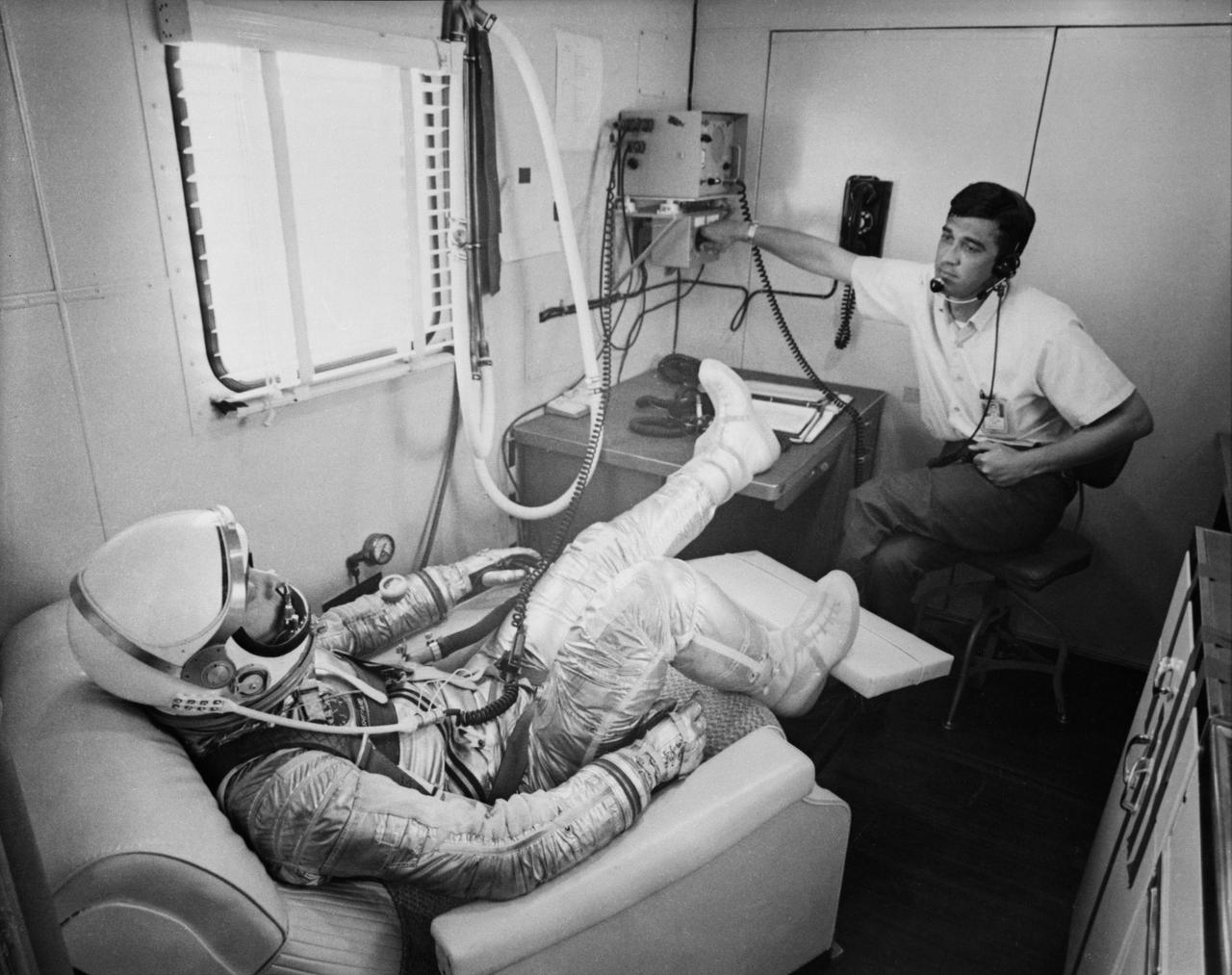
S61-02785 (5 May 1961) --- Astronaut Alan B. Shepard Jr. in his pressure suit is seated in a reclining chair while a technician checks communications equipment in his helmet. He is in the suiting trailer before the Mercury-Redstone 3 (MR-3) flight, the first American manned spaceflight. Photo credit: NASA or National Aeronautics and Space Administration
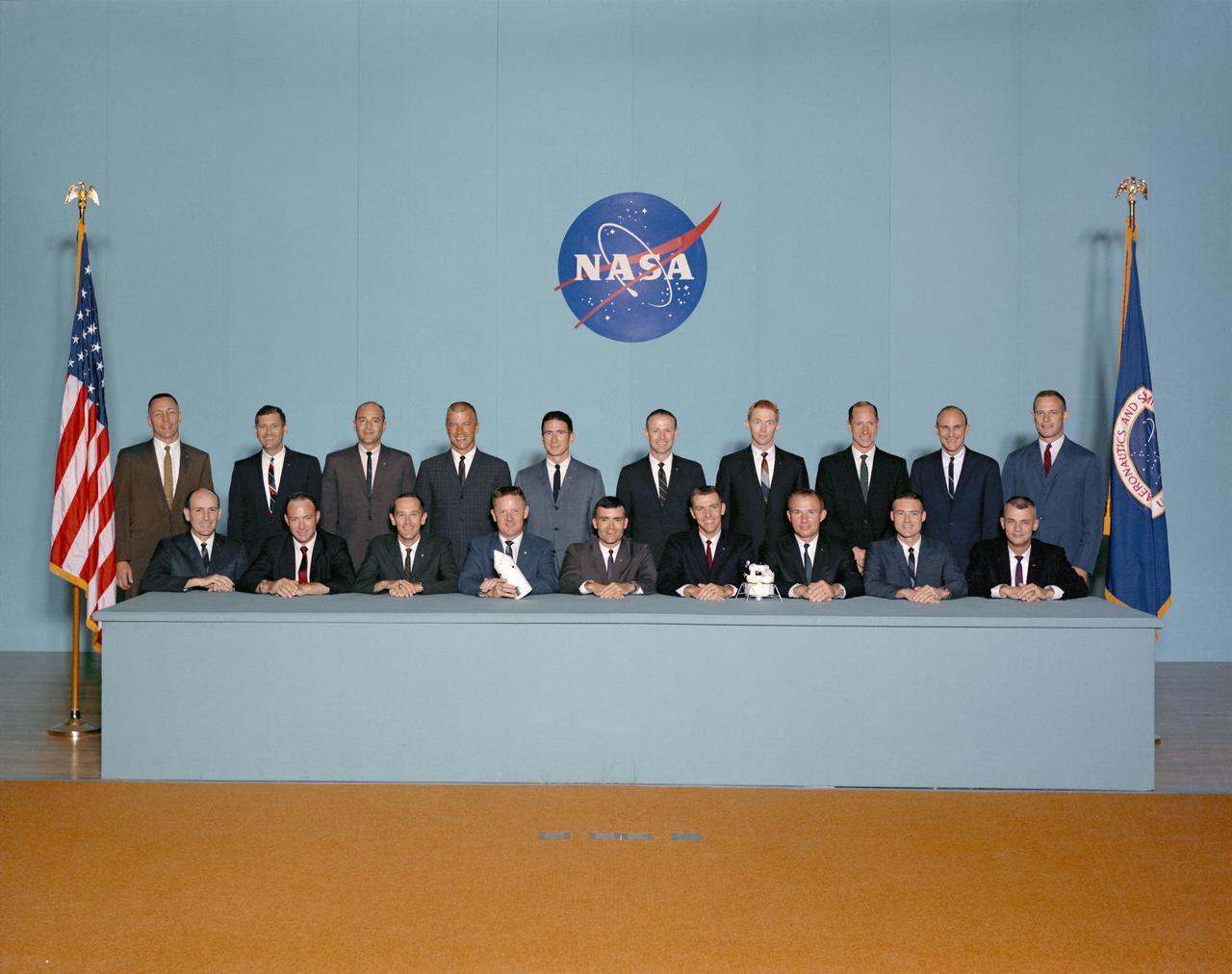
S67-30404 (May 1967) --- Portrait of astronaut group selected April 4, 1966. Seated, left to right, are Edward G. Givens Jr., Edgar D. Mitchell, Charles M. Duke Jr., Don L. Lind, Fred W. Haise Jr., Joe H. Engle, Vance D. Brand, John S. Bull and Bruce McCandless II. Standing, left to right, are John L. Swigert Jr., William R. Pogue, Ronald E. Evans, Paul J. Weitz, James B. Irwin, Gerald P. Carr, Stuart A. Roosa, Alfred M. Worden, Thomas K. Mattingly and Jack R. Lousma. Photo credit: NASA or National Aeronautics and Space Administration
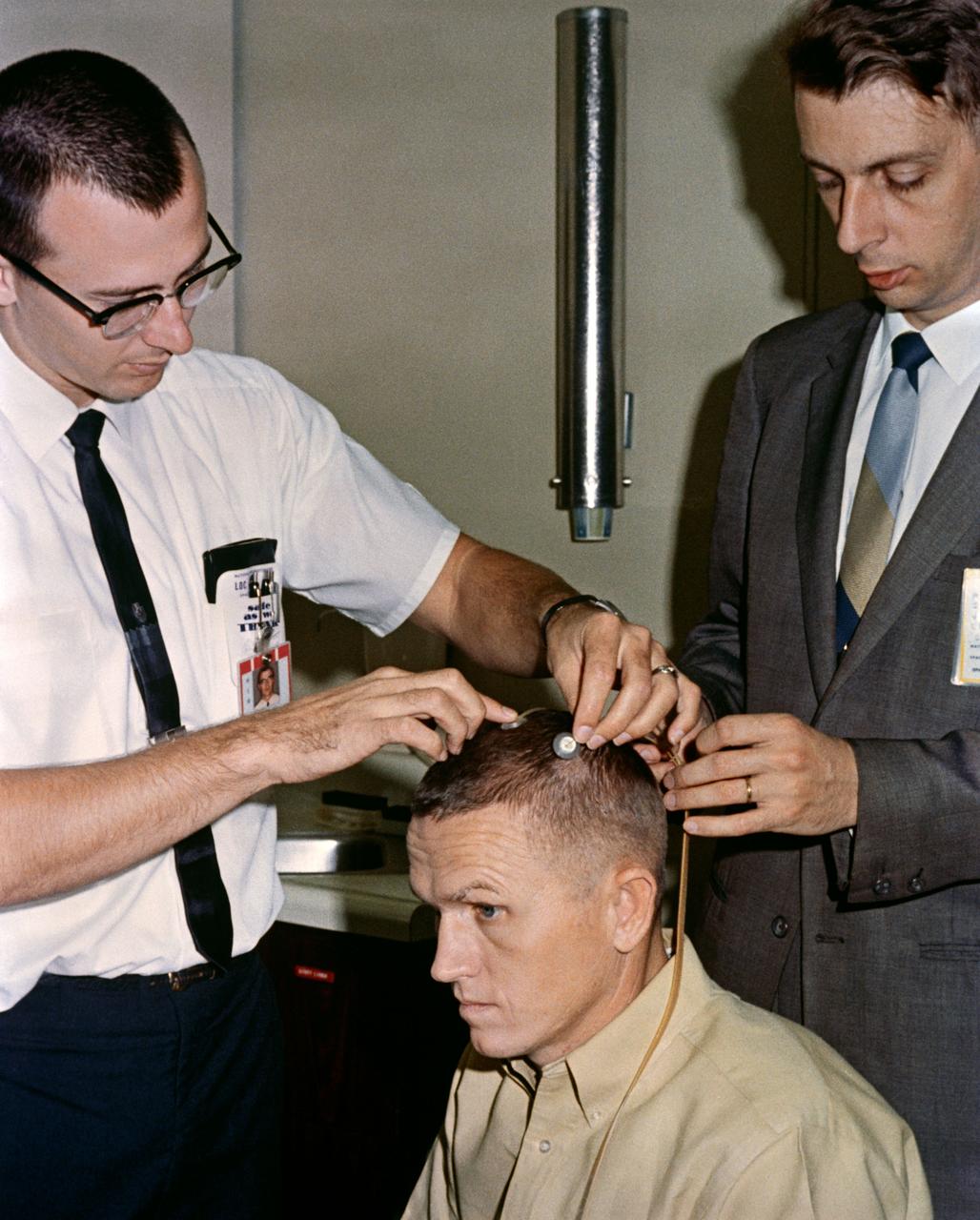
S65-60603 (2 Dec. 1965) --- Astronaut Frank Borman, Gemini-7 command pilot, sits attentively as two scalp electrodes are attached to his head. The electrodes will allow doctors to record electrical activity of the astronaut's cerebral cortex during periods of weightlessness. The objectives of this in-flight experiment are to assess state of alertness, levels of consciousness, and depth of sleep. Photo credit: NASA
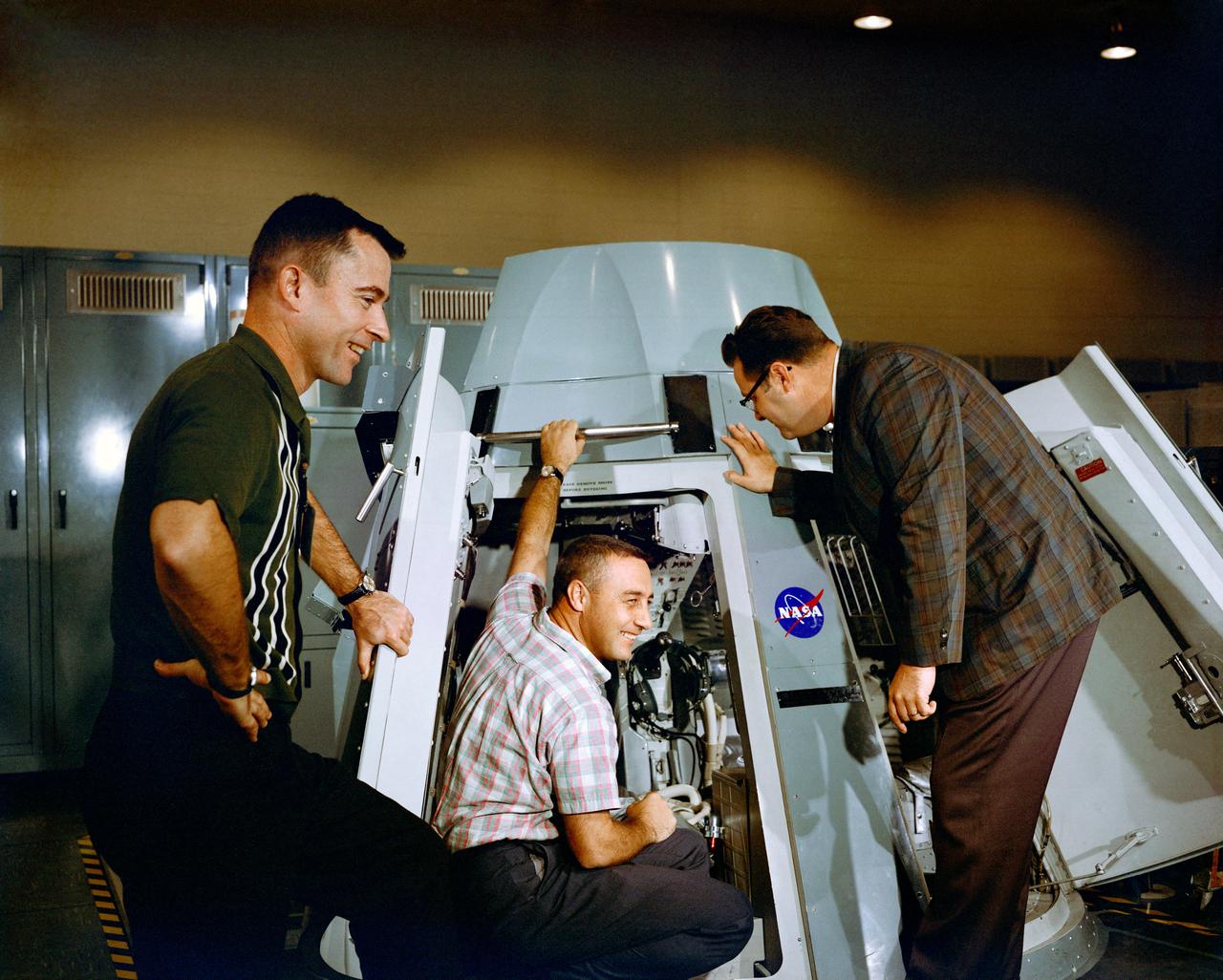
S64-40294 (19 Nov. 1964) --- Astronauts Virgil I. Grissom (center) and John W. Young (left), prime crew for the Gemini-Titan 3 mission, are shown inspecting the inside of Gemini spacecraft at the Mission Control Center at Cape Kennedy, Florida. Riley D. McCafferty is at right. Photo credit: NASA
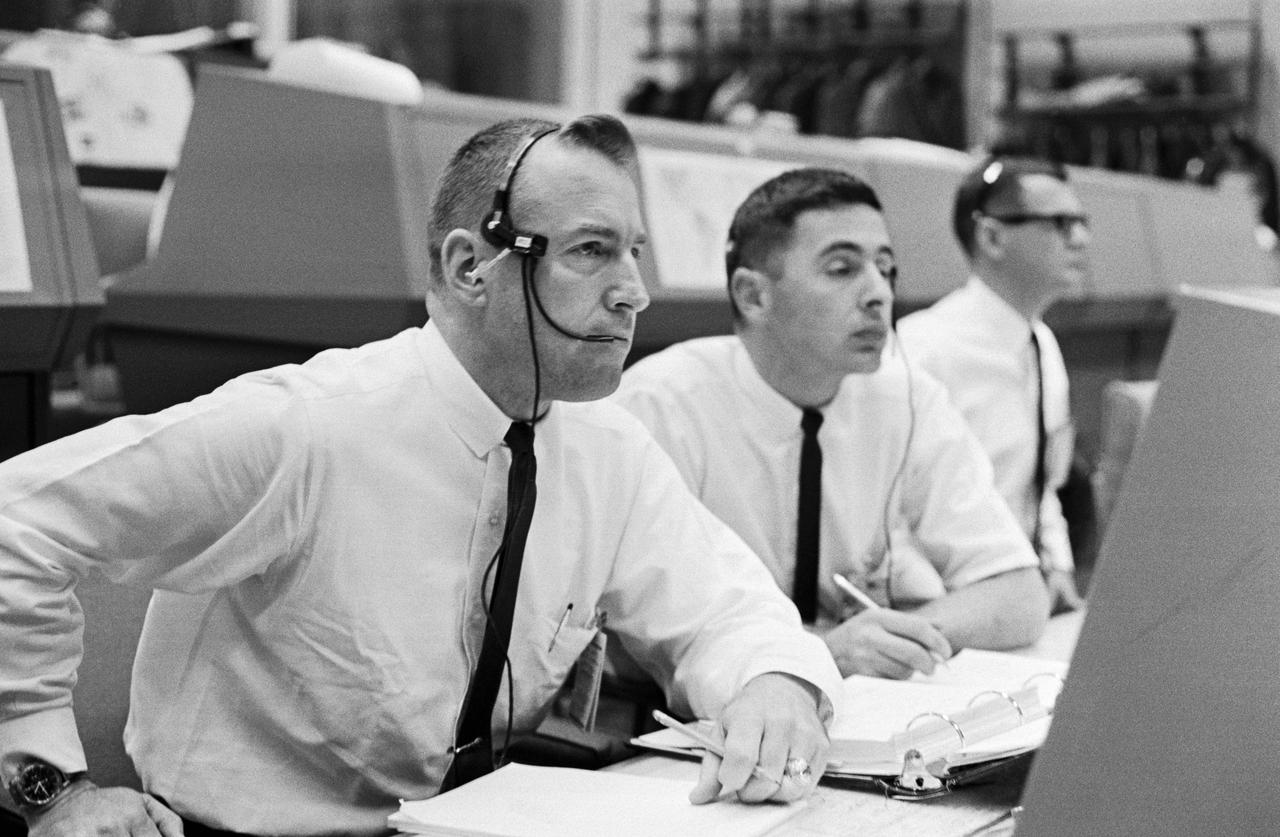
S66-24805 (16 March 1966) --- Personnel in Mission Control watch Gemini-8 launch on their screens. Photo credit: NASA
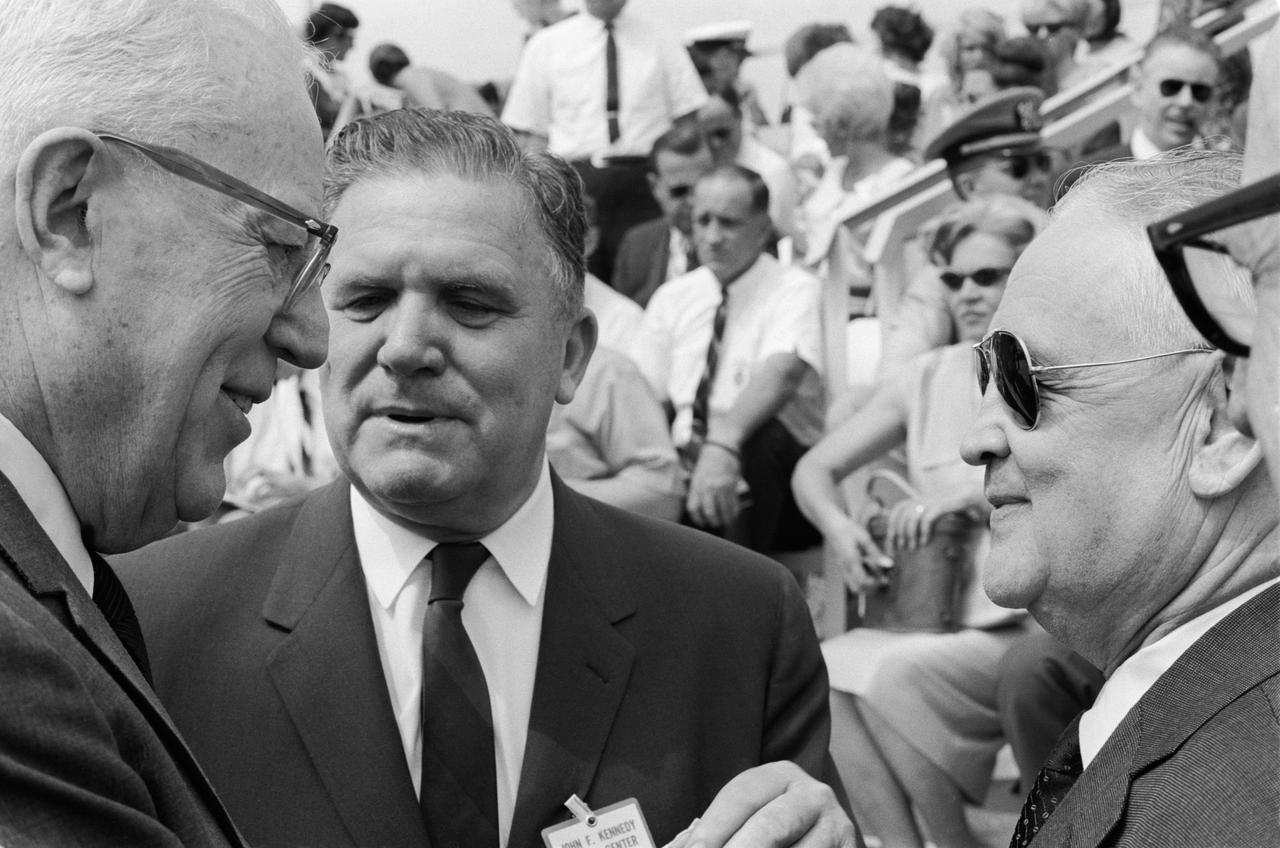
S66-32045 (17 May 1966) --- Earl Warren, Chief Justice of the U.S. Supreme Court, and James Webb, NASA Administrator, converse while waiting for Gemini-9 liftoff. Photo credit: NASA
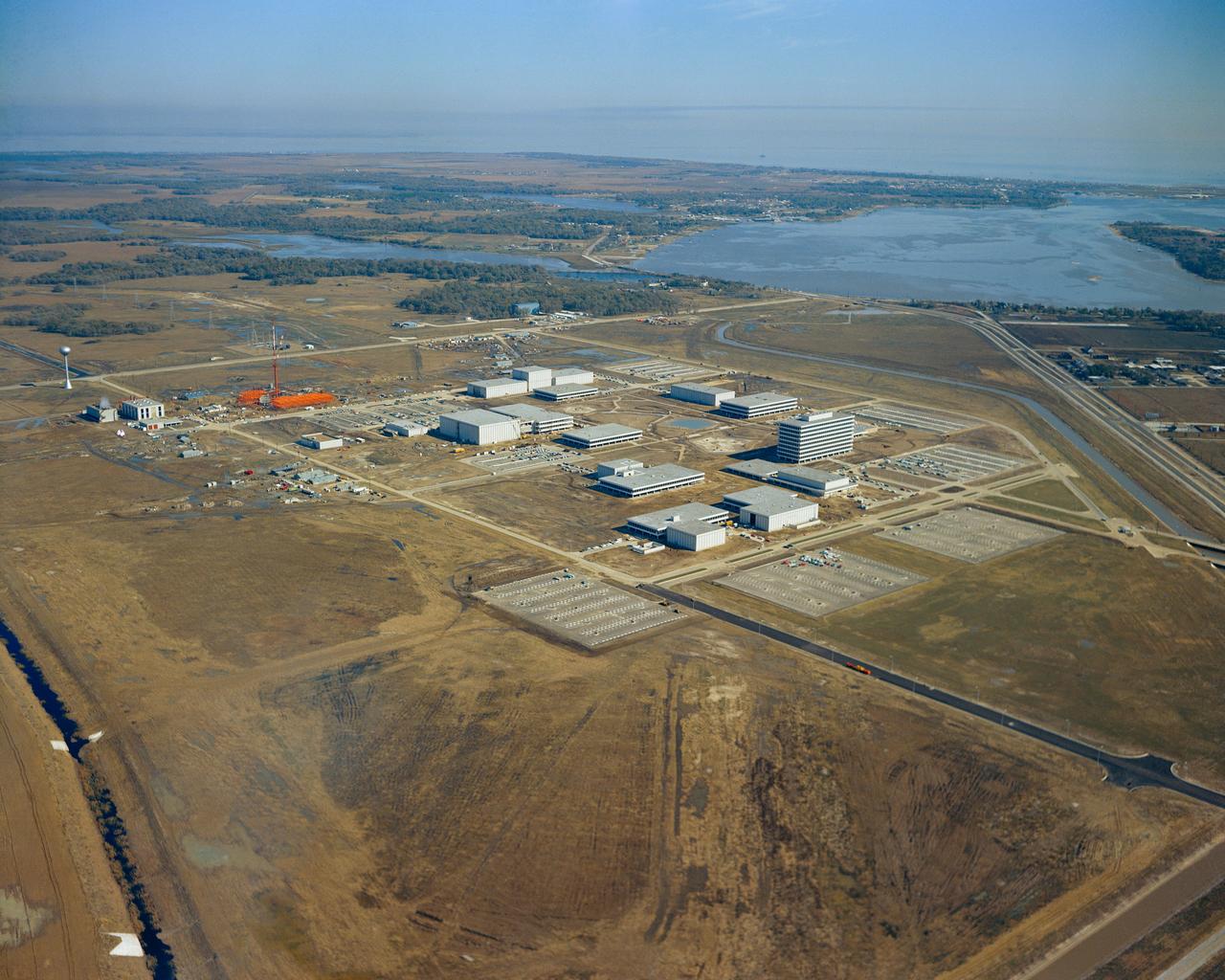
S63-23656 (1963) --- Aerial view of construction progress at the Manned Spacecraft Center, Houston, Texas. NOTE: The Manned Spacecraft Center was named Lyndon B. Johnson Space Center in memory of the late President following his death.
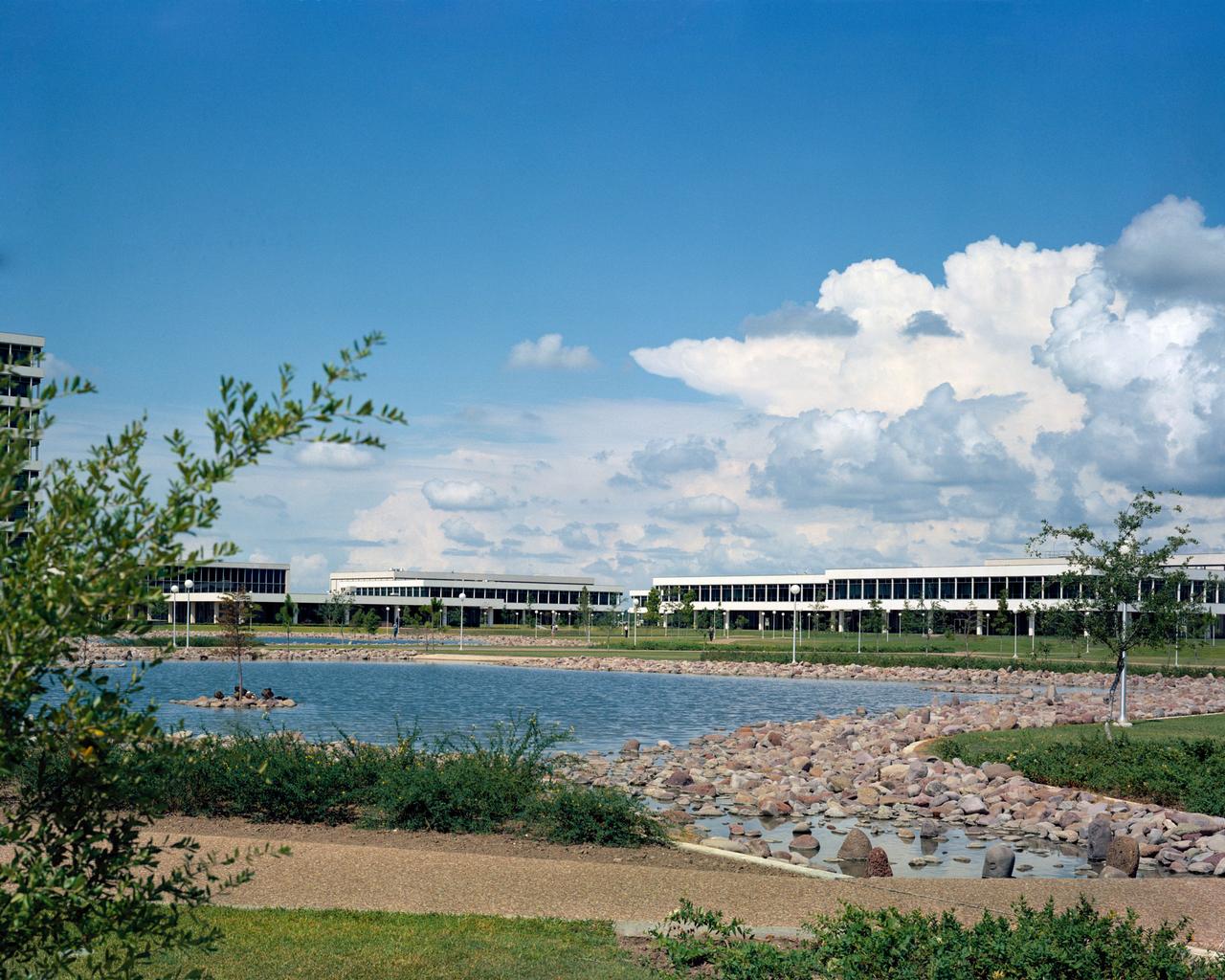
S65-41769 (1965) --- View of facilities at the Manned Spacecraft Center, Houston, Texas. Photo is taken from across the fish pond. NOTE: The Manned Spacecraft Center was named Lyndon B. Johnson Space Center in memory of the late President following his death.
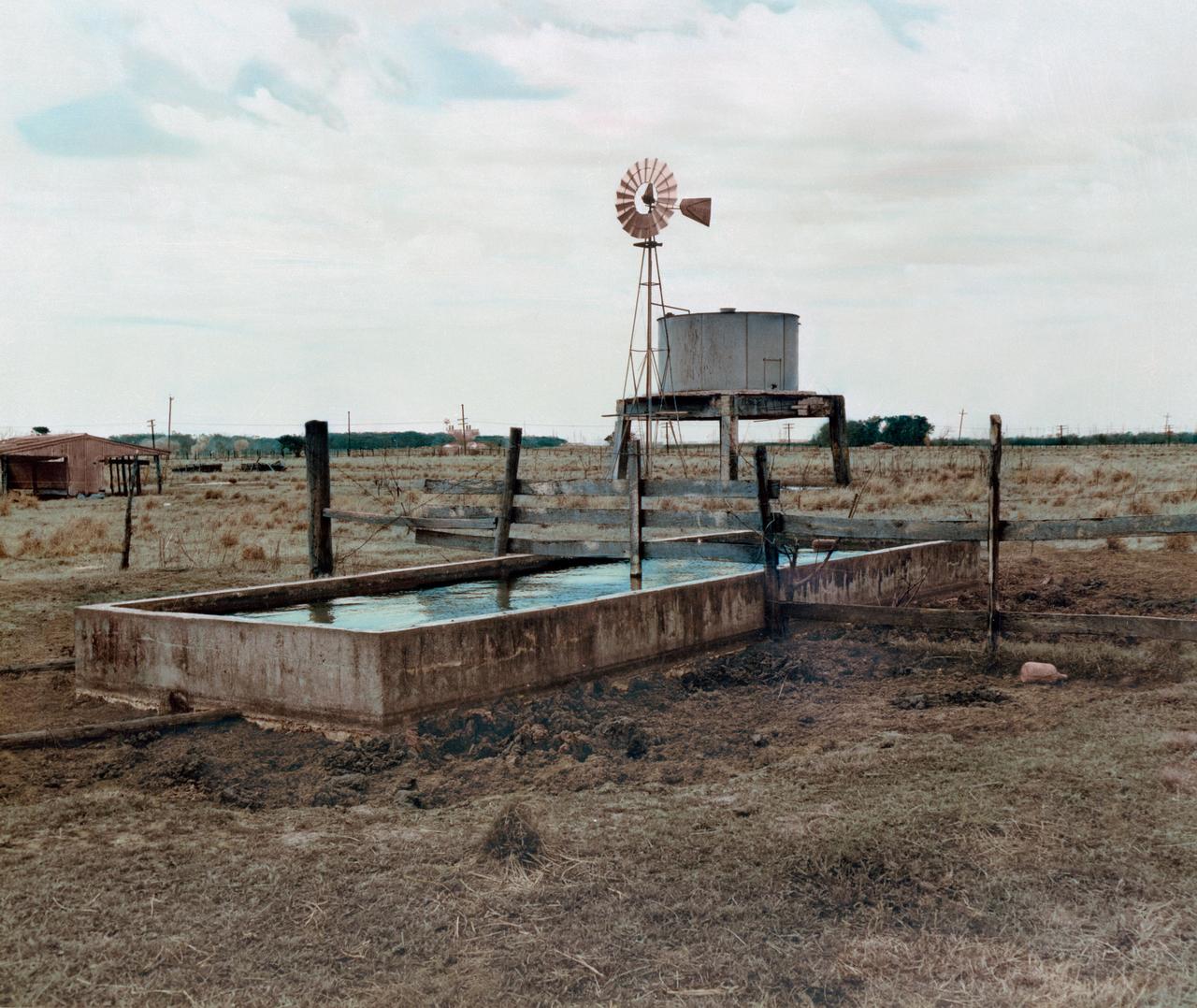
S76-32986 (March 1962) --- A color enhancement of a black and white photograph of a water trough, windmill, grazing area and feed lot on the future site of the Manned Spacecraft Center, Houston, Texas. NOTE: The Manned Spacecraft Center was named Lyndon B. Johnson Space Center in memory of the late President following his death.
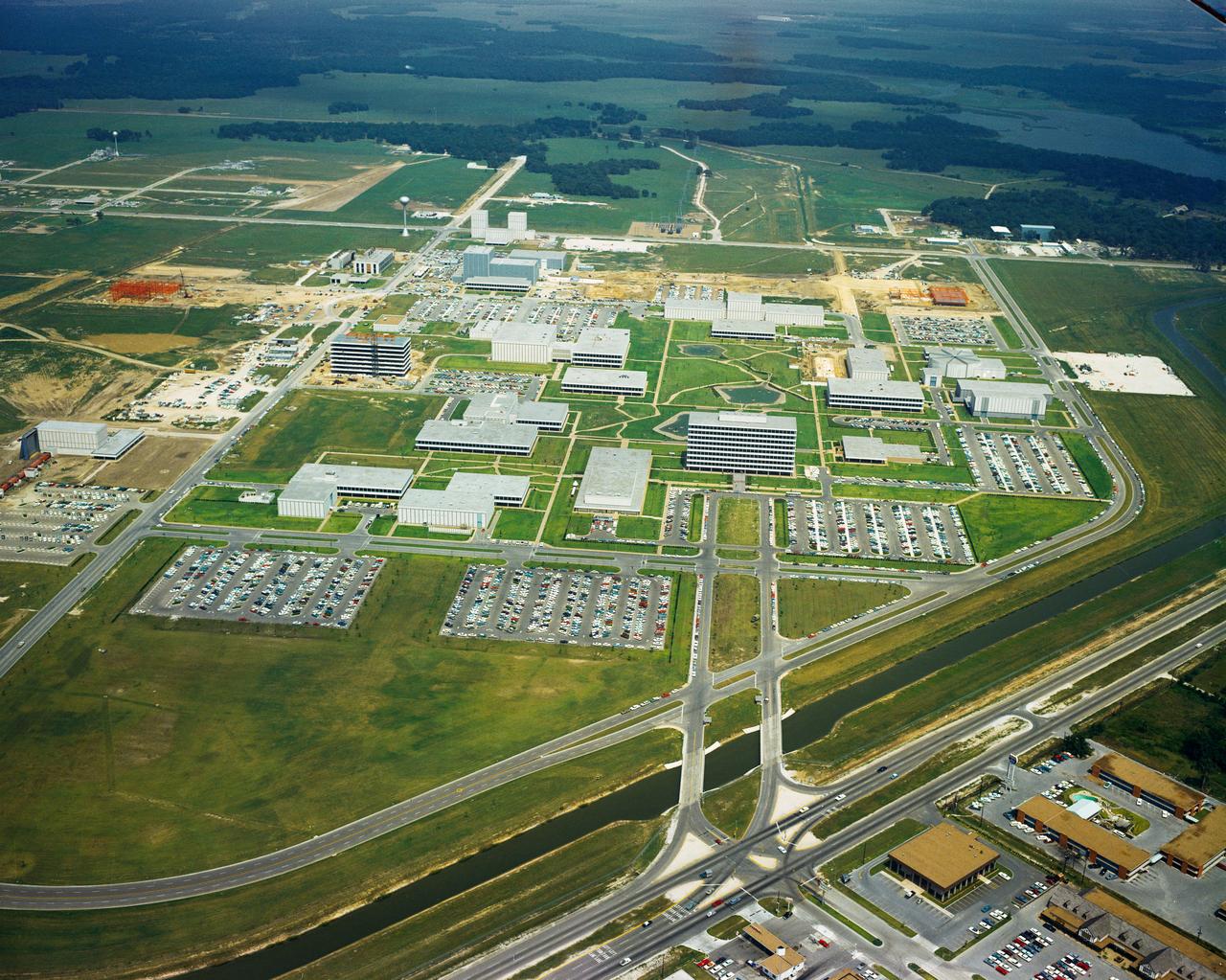
S65-51530 (September 1965) --- Aerial view of Manned Spacecraft Center, Site 1, Houston, Texas, looking north. NOTE: The Manned Spacecraft Center was named Lyndon B. Johnson Space Center in memory of the late President following his death.
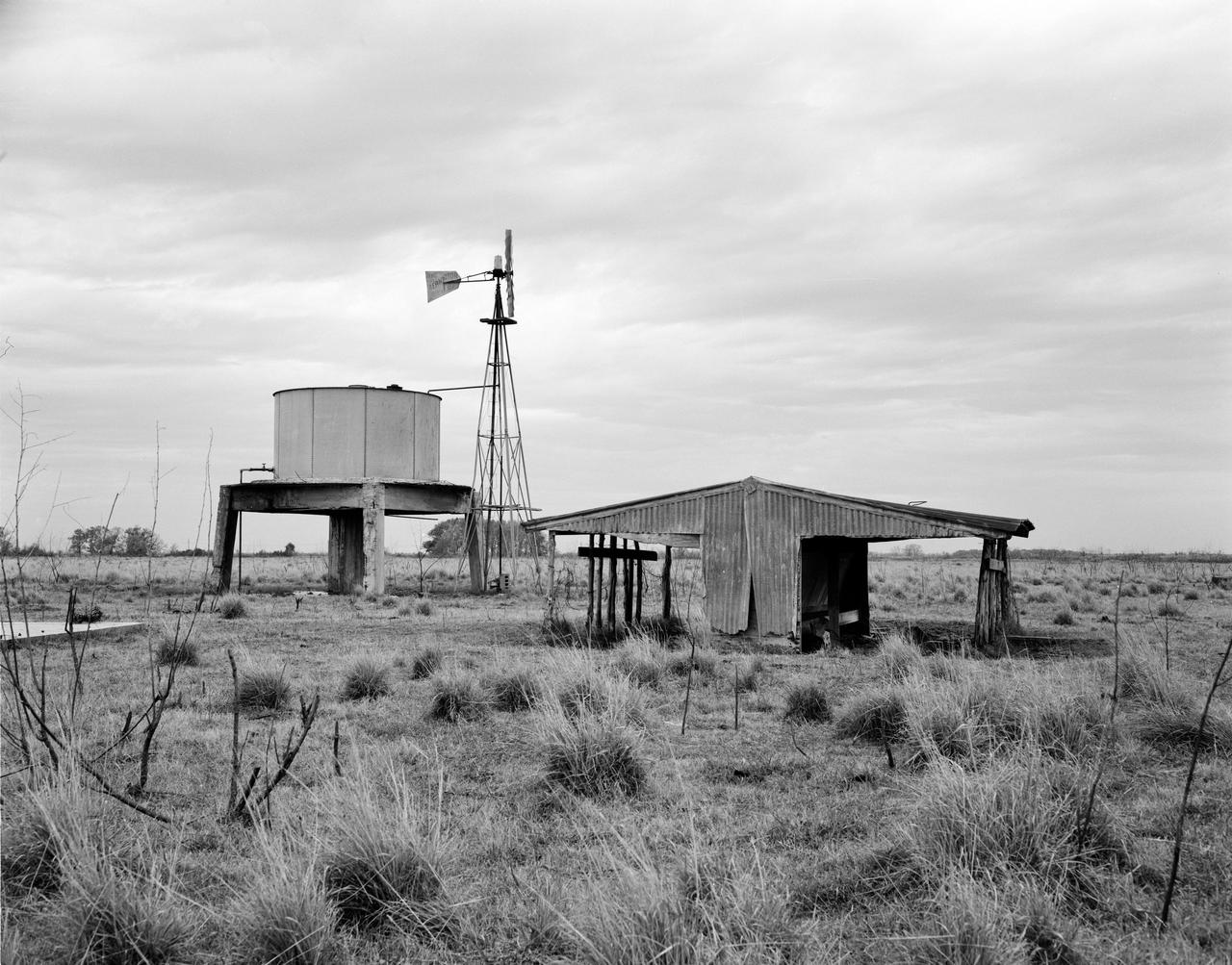
S62-00631 (March 1962) --- Area photograph of Site 1, Manned Spacecraft Center, at Clear Lake, prior to start of construction.
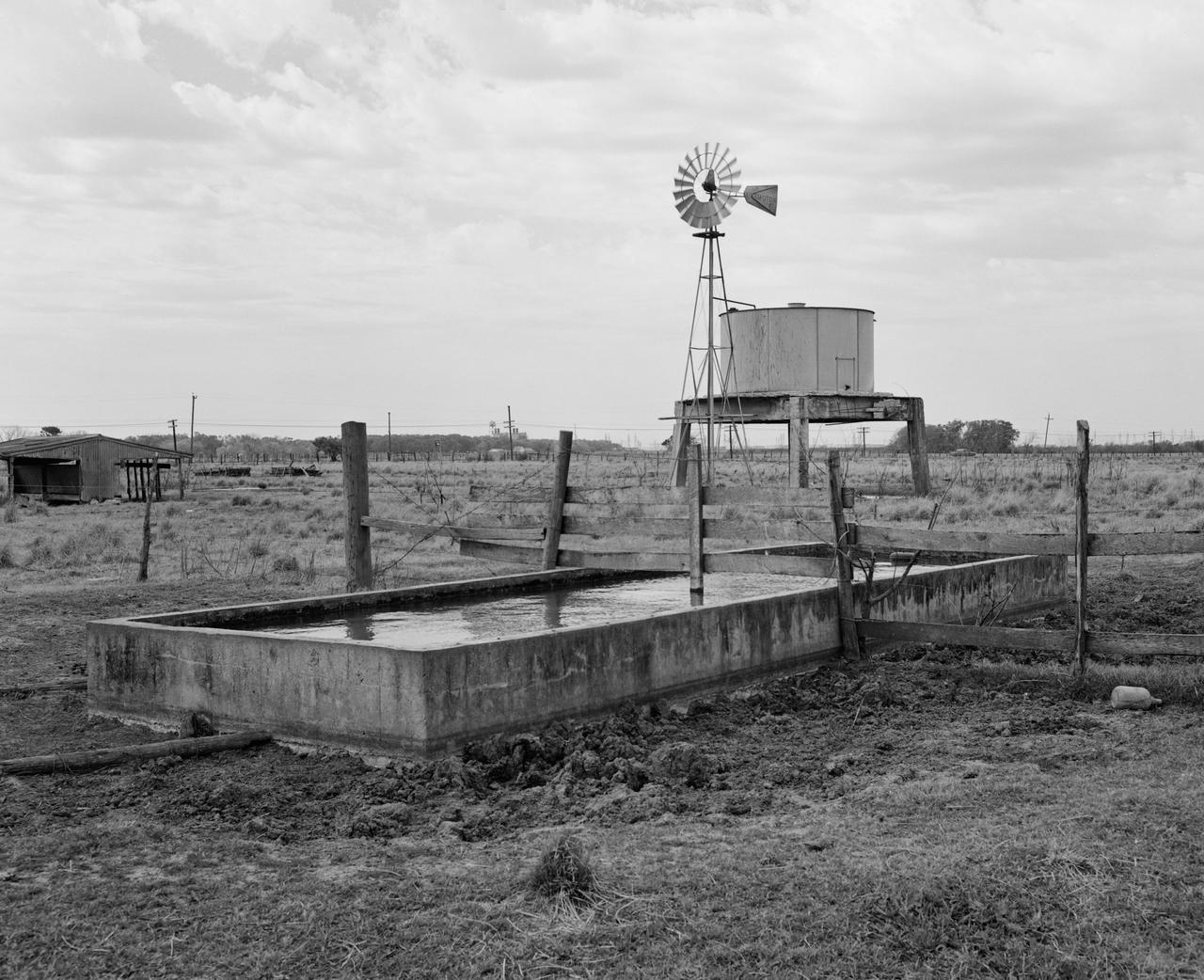
S62-00632 (March 1962) --- Area photograph of Site 1, Manned Spacecraft Center, at Clear Lake, prior to start of construction.
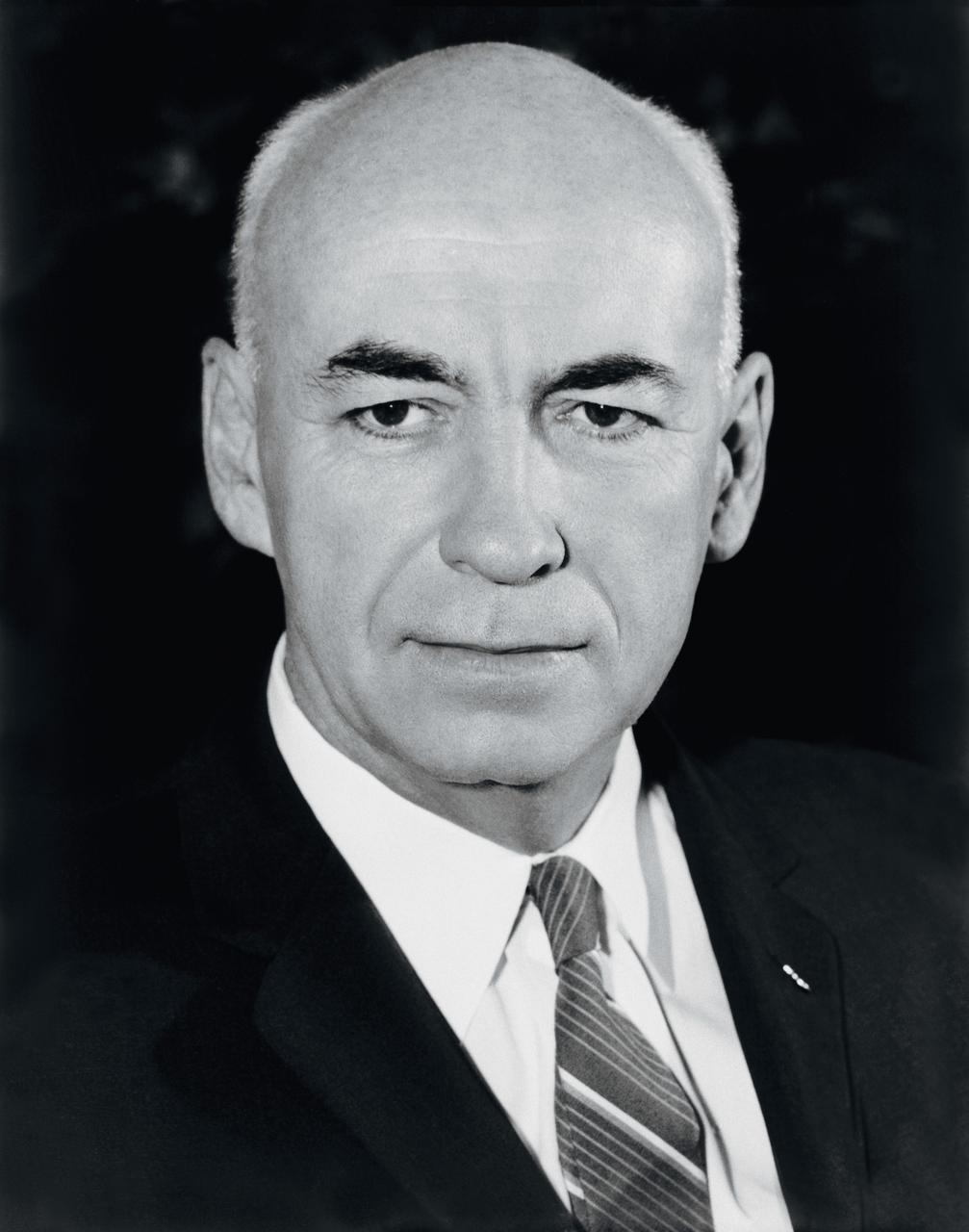
S65-45100 (Jan. 1965) --- Portrait of Dr. Robert R. Gilruth, Director of the Manned Spacecraft Center. Photo credit: NASA
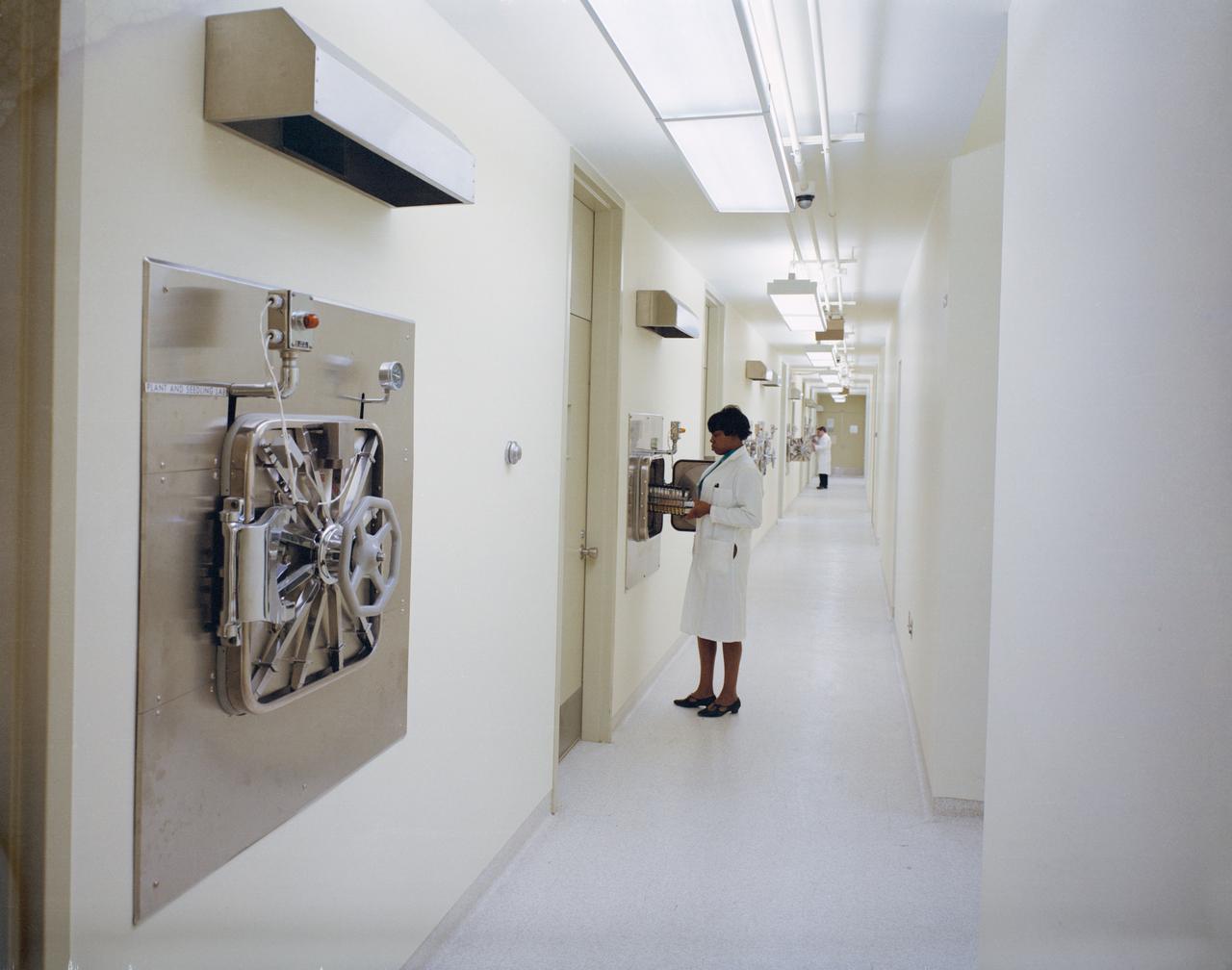
Biological Test Laboratory, Sample Operations Area, Lunar Receiving Laboratory, bldg 37, Manned Spacecraft Center, Houston, Texas.
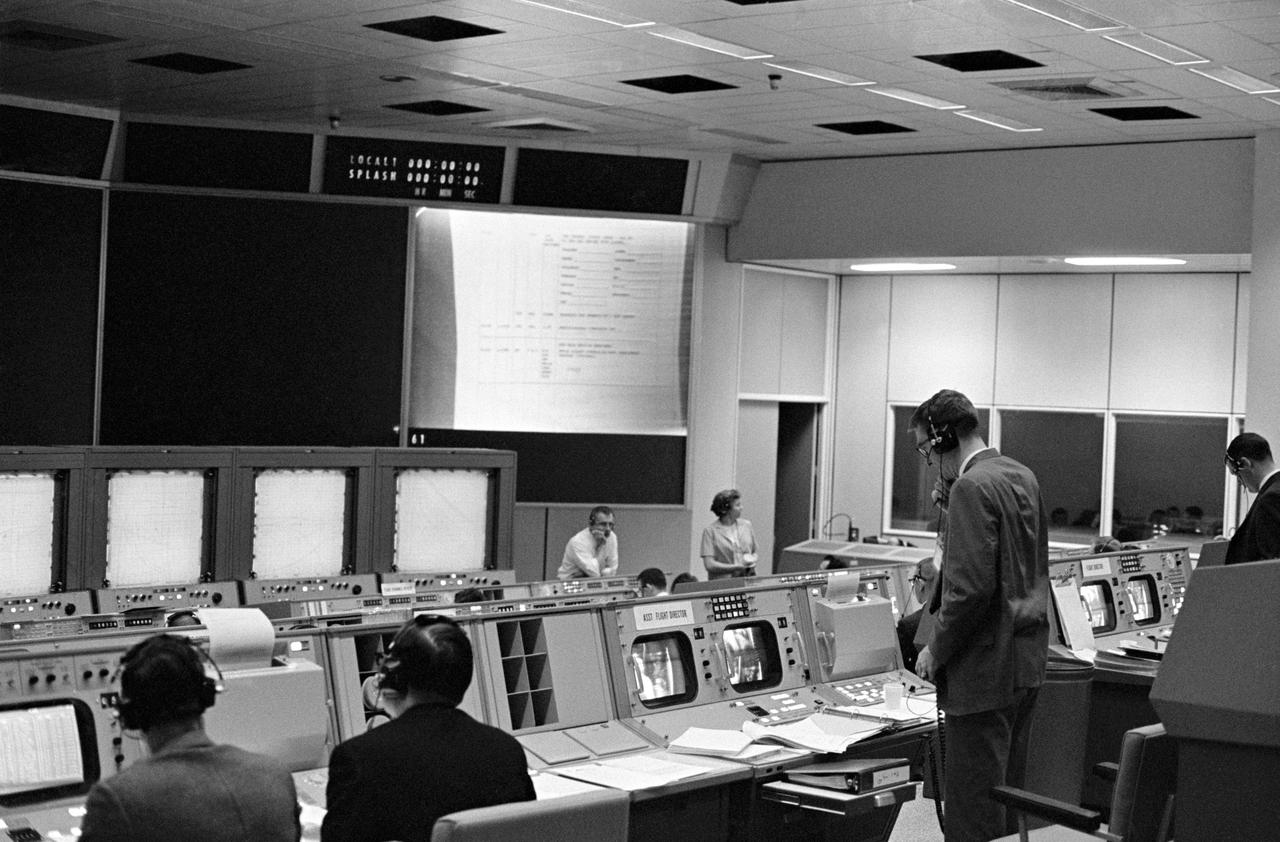
S65-18200 (23 March 1965) --- Overall view of the Mission Control Center at the Manned Spacecraft Center in Houston, Texas during the Gemini-Titan 3 flight.
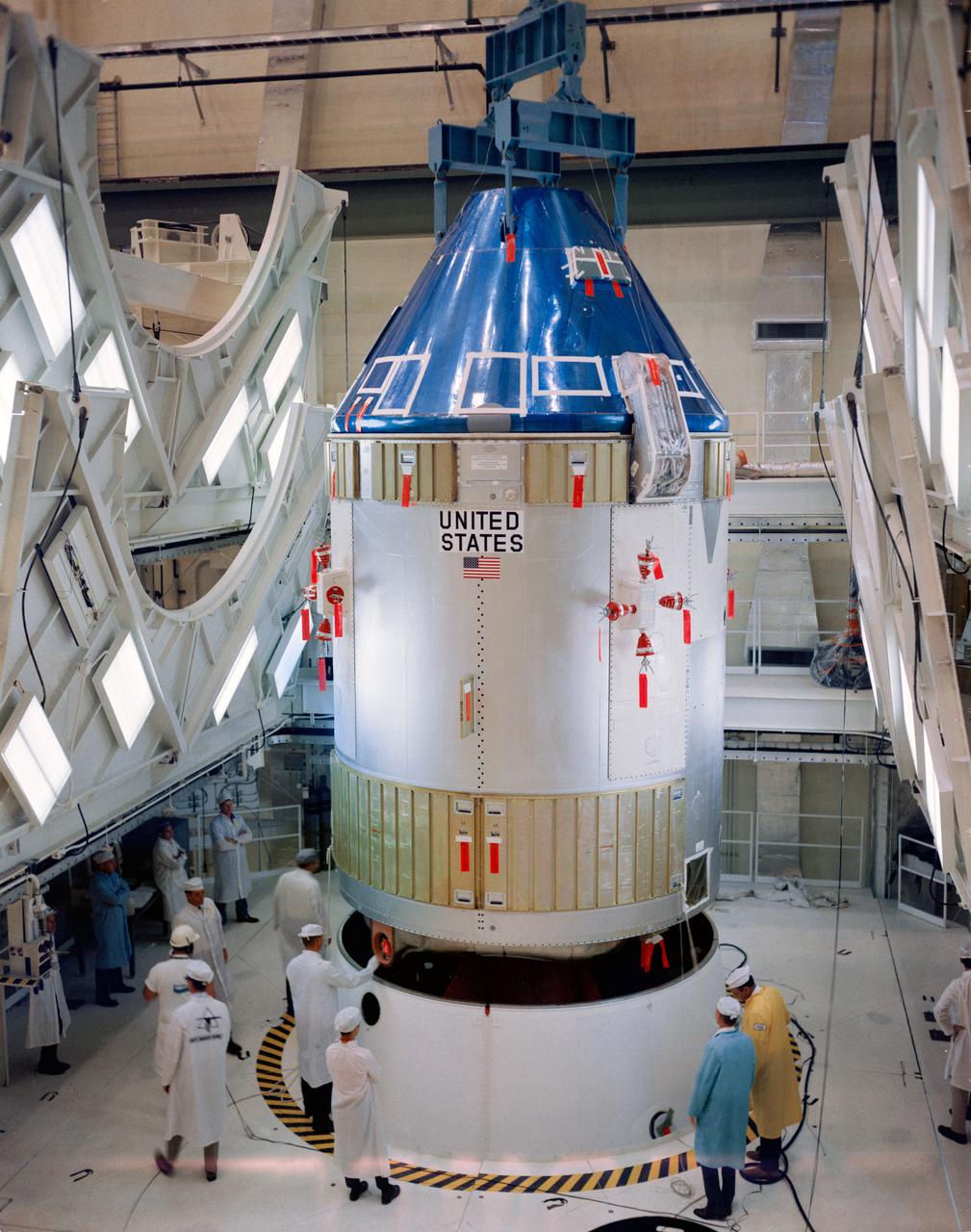
S68-42513 (5 Aug. 1968) --- Apollo Spacecraft 101 Command/Service Modules being moved into position for mating with Spacecraft Lunar Module Adapter (SLA)-5 in the Kennedy Space Center's Manned Spacecraft Operations Building. Apollo Spacecraft 101 will be flown on the first manned Apollo space mission, Apollo 7 (Spacecraft 101/Saturn 205).
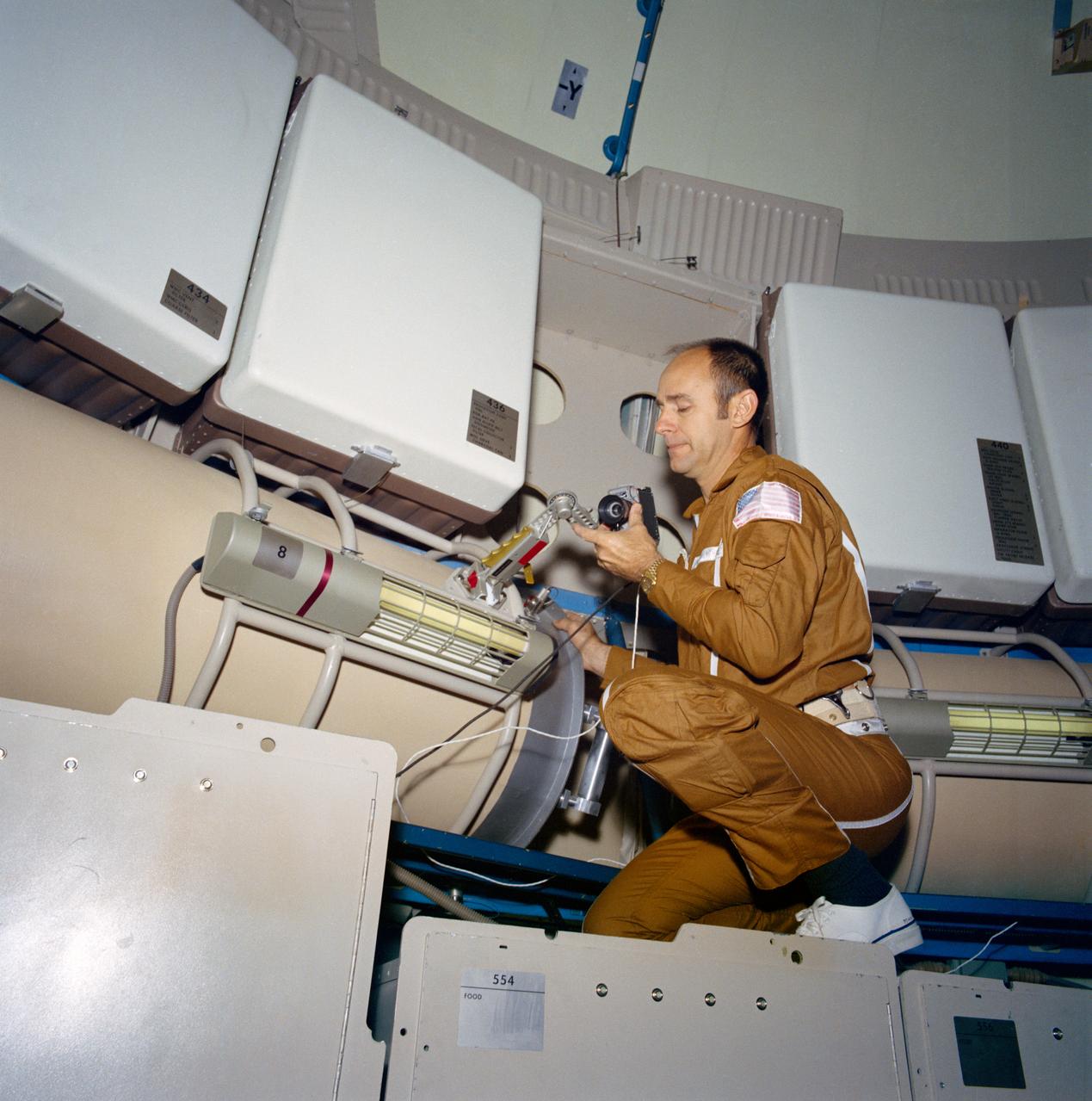
S72-39256 (1972) --- Astronaut Alan L. Bean, commander for Skylab 3, the second manned Skylab mission, looks over the data acquisition camera mounted on the water tank in the upper level of the Orbital Workshop (OWS) one-G trainer at the Manned Spacecraft Center (MSC). Photo credit: NASA
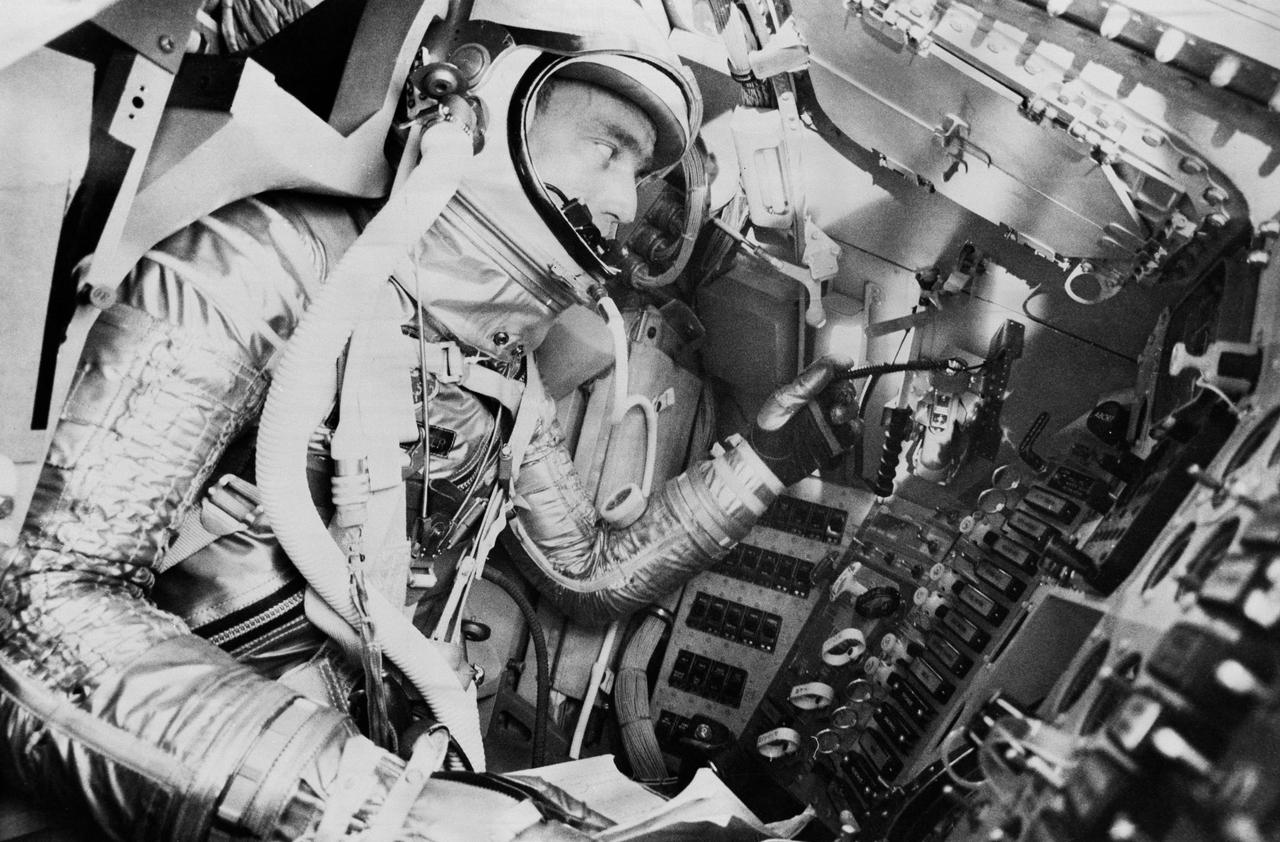
S62-01033 (1961) --- Project Mercury astronaut M. Scott Carpenter, prime pilot for the United States second manned orbital flight, undergoes a simulated mission in the procedures trainer at Langley Air Force Base, Virginia, headquarters for the National Aeronautics and Space Administration?s Manned Spacecraft Center. Photo credit: NASA
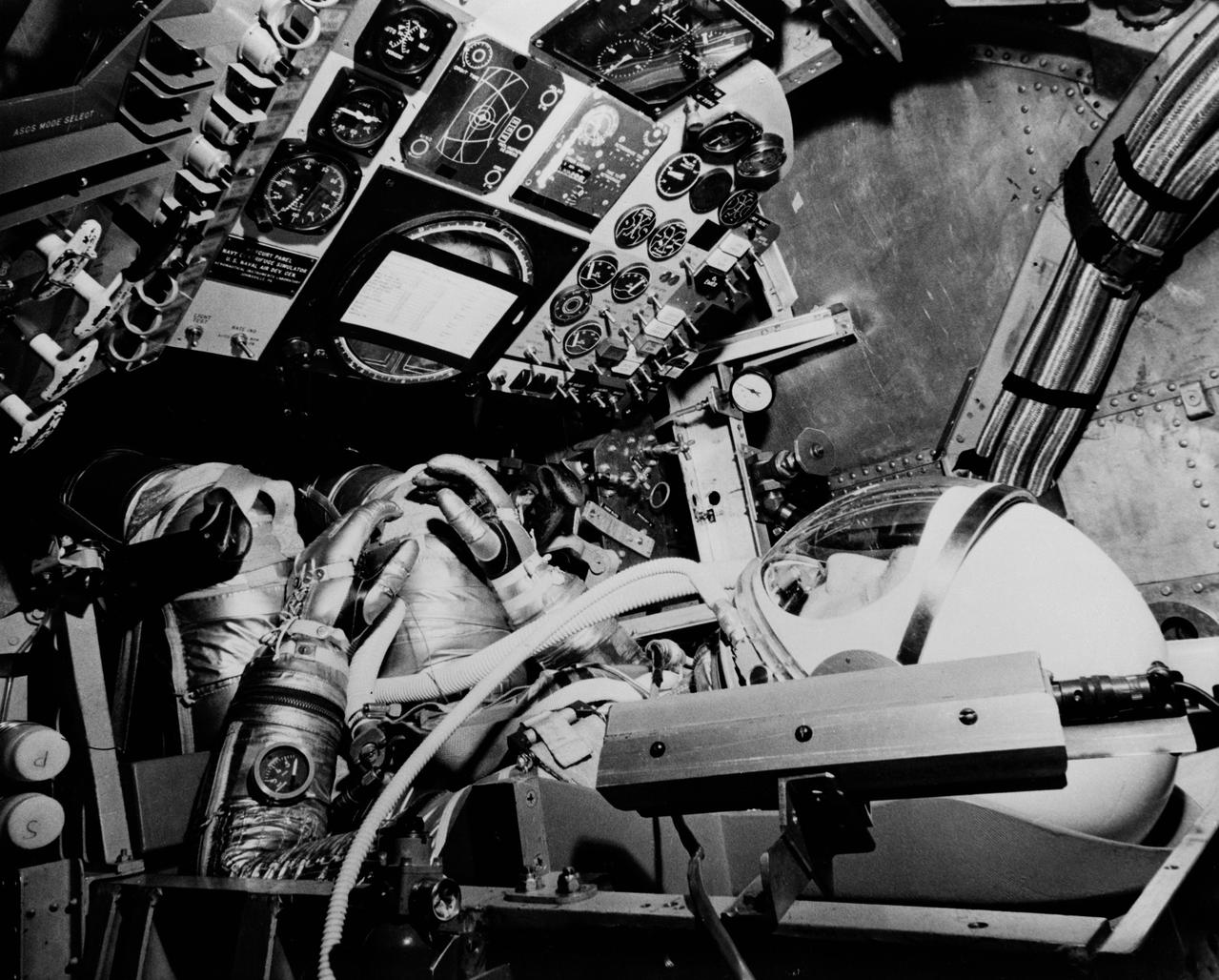
S61-03506 (1961) --- Project Mercury astronaut M. Scott Carpenter, prime pilot for the United States second manned orbital flight, undergoes a simulated mission in the procedures trainer at Langley Air Force Base, Virginia, headquarters for the National Aeronautics and Space Administration?s Manned Spacecraft Center. Photo credit: NASA

S73-18667 (January 1973) --- Astronaut Paul J. Weitz, pilot for the Skylab 2 first manned mission, is suited up for Skylab training activity in the mission simulation and training facility at the Manned Spacecraft Center. Photo credit: NASA
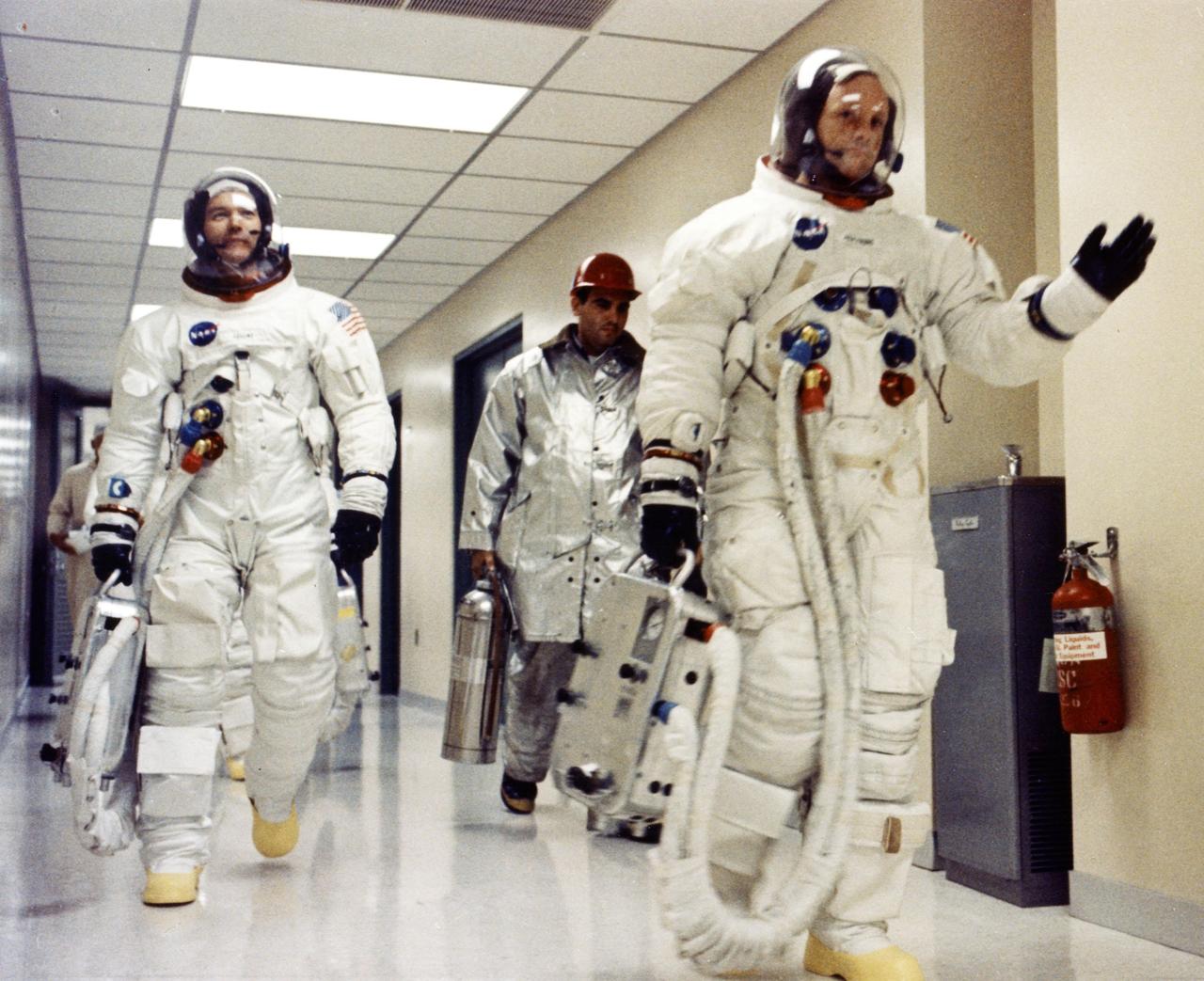
KENNEDY SPACE CENTER, FLA. -- Apollo 11 Commander Neil A. Armstrong waves to well-wishers in the hallway of the Manned Spacecraft Operations Building as he and Michael Collins and Edwin E. Aldrin Jr. prepare to be transported to Launch Complex 39A for the first manned lunar landing mission
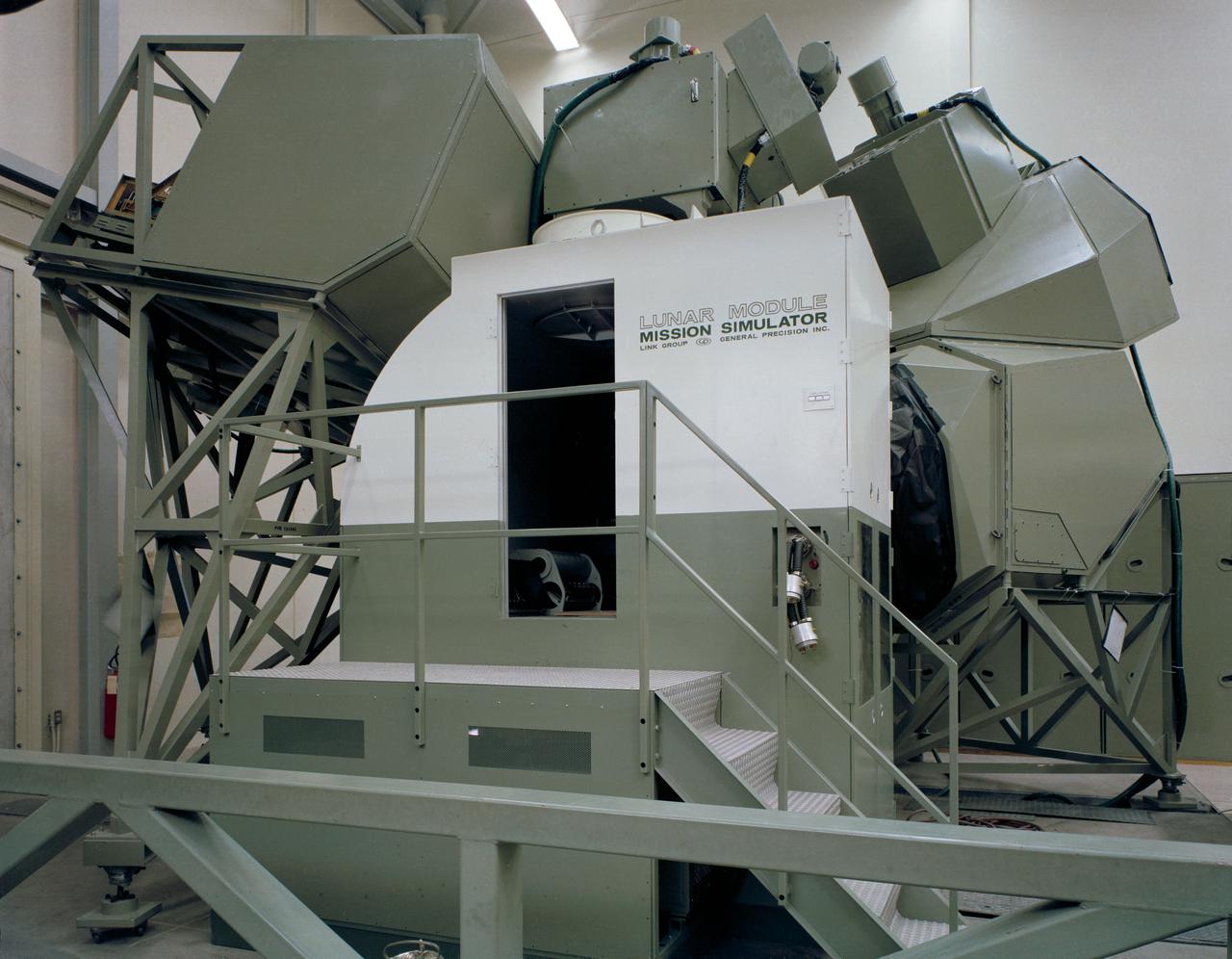
S67-15795 (1967) --- Overall view of the Lunar Module Mission Simulator, Bldg. 5, Manned Spacecraft Center, Houston, Texas. Photo credit: NASA
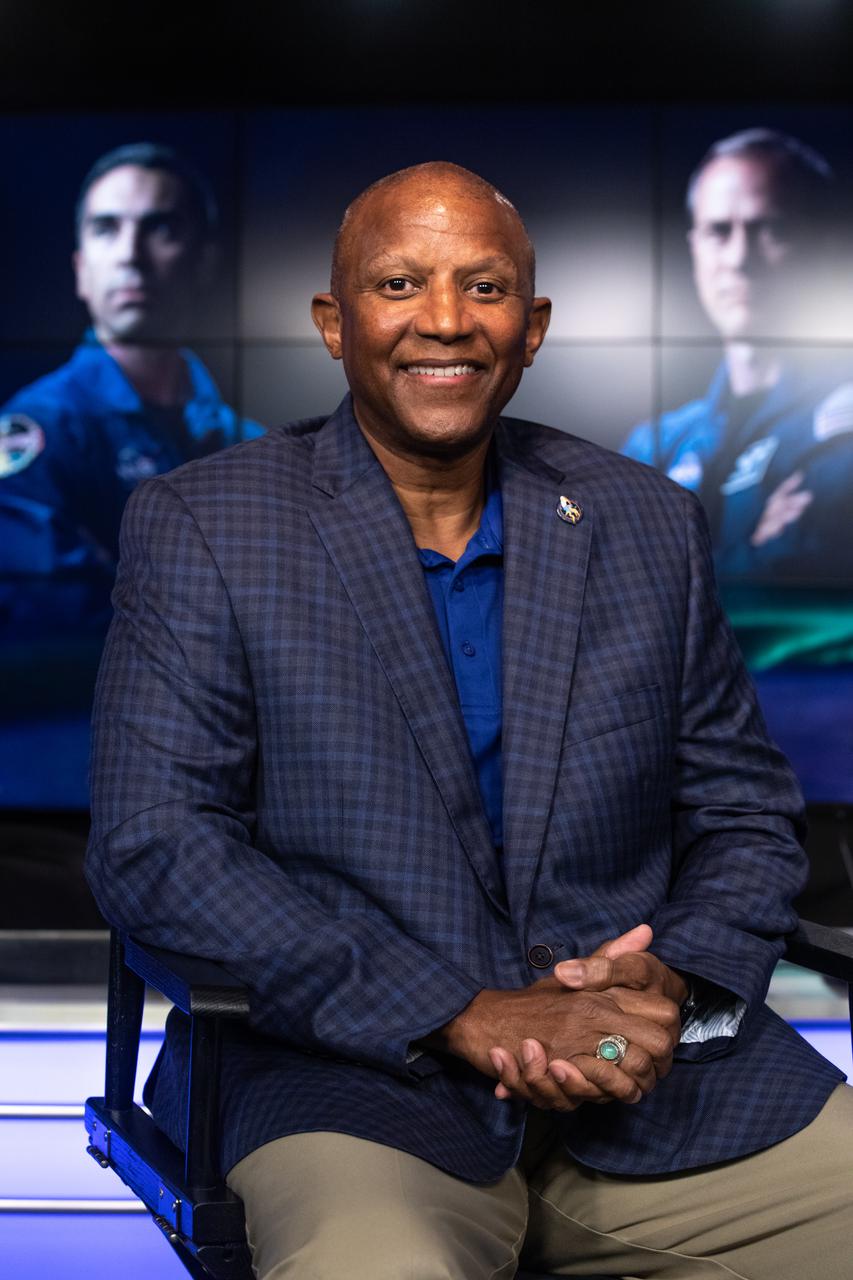
Kennedy Space Center Deputy Director Kelvin Manning participates in a NASA Social Live event at the center in Florida on Oct. 29, in advance of NASA’s SpaceX Crew-3 mission to the International Space Station as part of NASA’s Commercial Crew Program. Launch is currently targeted for 2:21 a.m. EDT Sunday, Oct. 31. The SpaceX Dragon spacecraft, named Endurance by the Crew-3 astronauts, will launch on a Falcon 9 rocket from Launch Complex 39A at Kennedy Space Center. The Crew-3 flight will carry NASA astronauts Raja Chari, mission commander, Tom Marshburn, pilot, and Kayla Barron, mission specialist and ESA (European Space Agency) astronaut Matthias Maurer, also a mission specialist, to the space station for a six-month science mission.
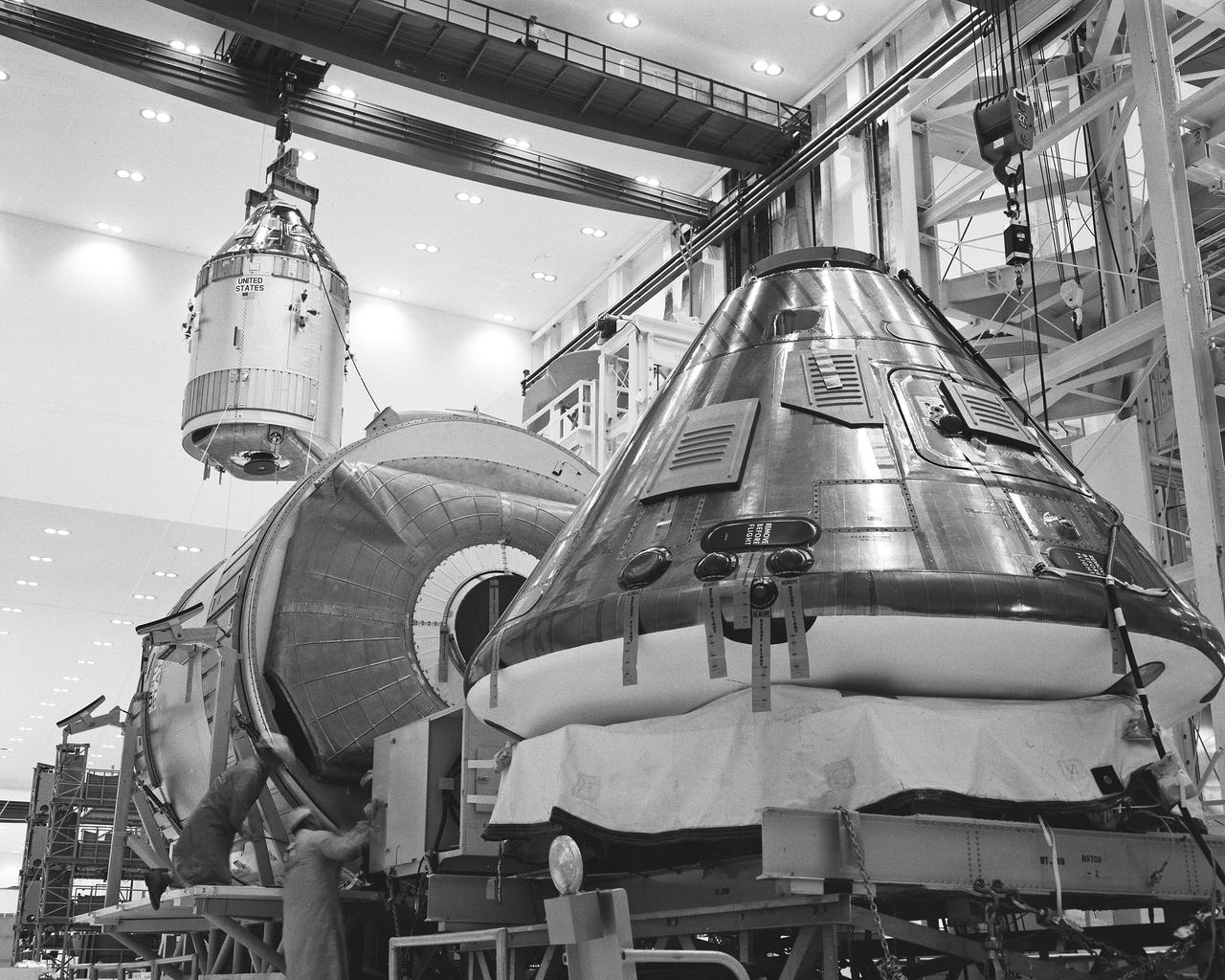
CAPE CANAVERAL, Fla. – Apollo command and service modules scheduled for manned landing missions on the moon cross paths in the Manned Spacecraft Operations Building at the spaceport. The meeting occurred last night when the CSM for Apollo 11 was being hoisted out of a test chamber and the CSM for Apollo 12, which recently arrived at Kennedy Space Center, was getting its initial checkouts in the aisle. Apollo 11 is scheduled for the first manned lunar landing mission this summer. Photo credit: NASA
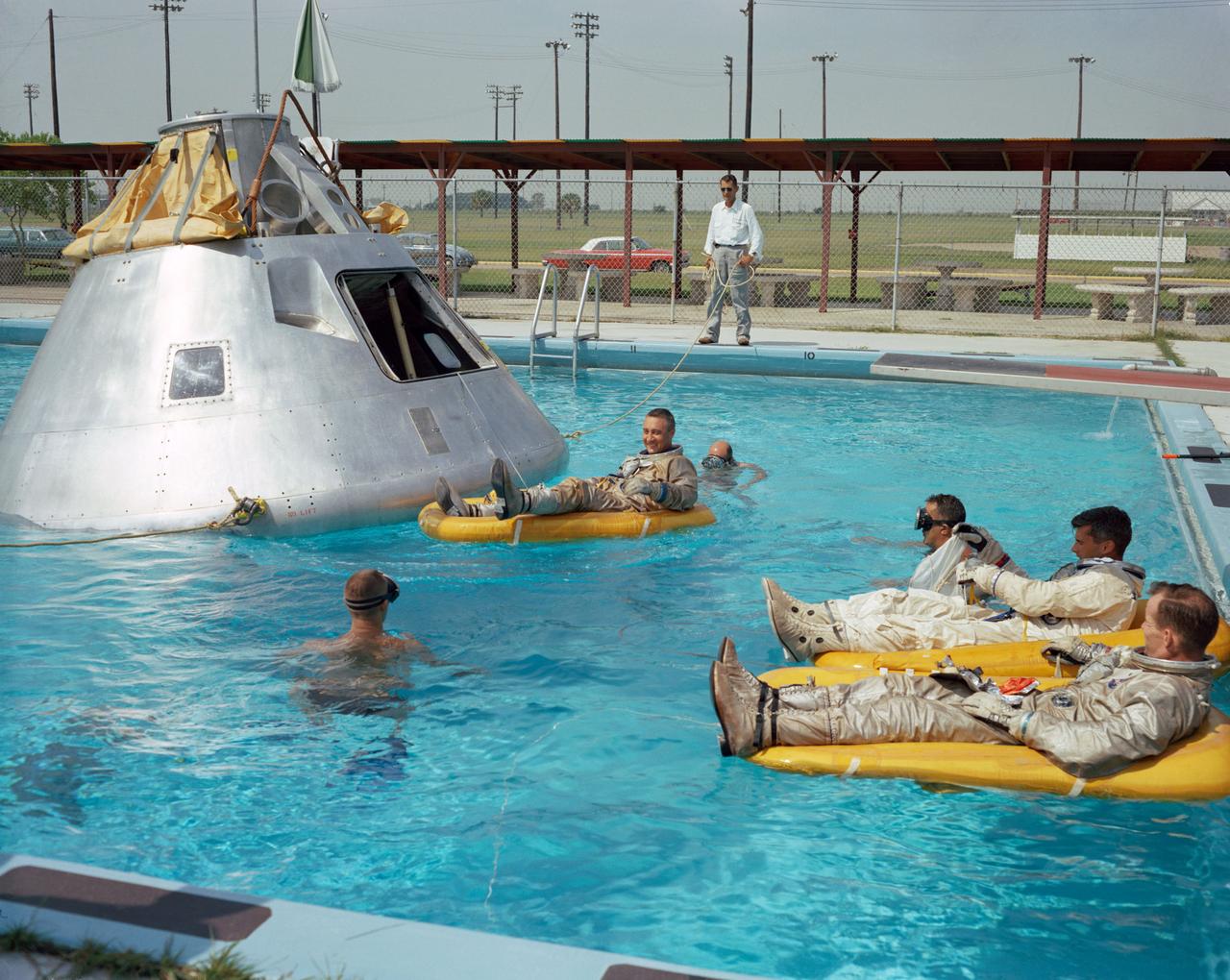
S66-51581 (June 1966) --- Prime crew for the first manned Apollo mission practice water egress procedures with full scale boilerplate model of their spacecraft. In the water at right is astronaut Edward H. White (foreground) and astronaut Roger B. Chaffee. In raft near the spacecraft is astronaut Virgil I. Grissom. NASA swimmers are in the water to assist in the practice session that took place at Ellington AFB, near the Manned Spacecraft Center, Houston.
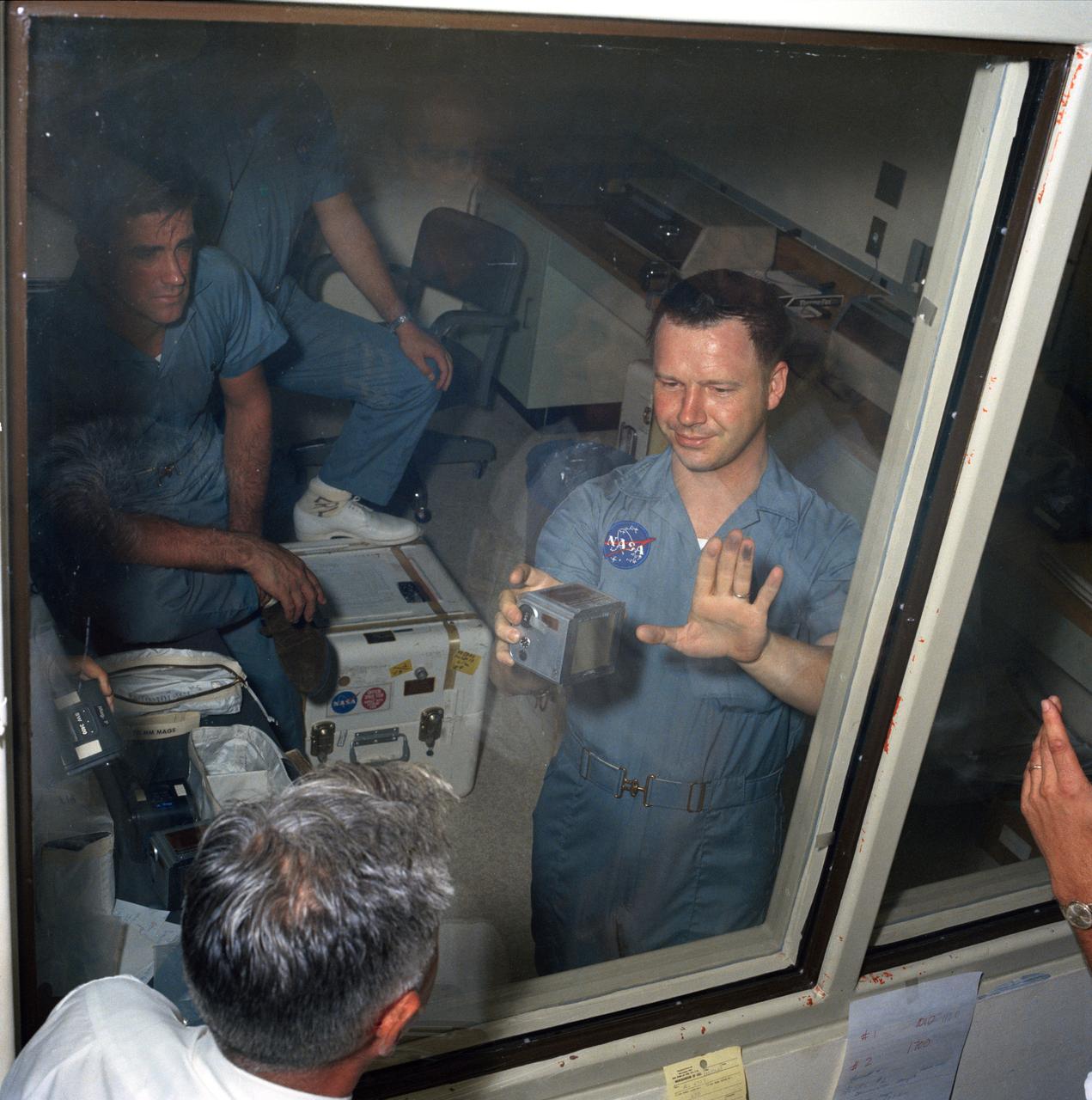
The first direct exposure to Lunar material for Crew Reception Personnel probably happened late Friday, 07/25/1969. Terry Slezak (displaying Moon dust on his left hand fingers), MSC photographic technician, was removing film magazines from the first of two (2) containers when the incident occurred. As he removed the plastic seal from Magazine "S", one of the 70mm magazines taken during Apollo XI Extravehicular Activity (EVA), it was apparent that the exterior of the cassette displayed traces of a black powdery substance. Apollo XI Commander Neil Armstrong reported during the mission that he had retrieved a 70mm cassette which had dropped to the Lunar surface. Seen in the backgound is John H. Boynton. ( S69-40054 ) MSC, Houston, TX
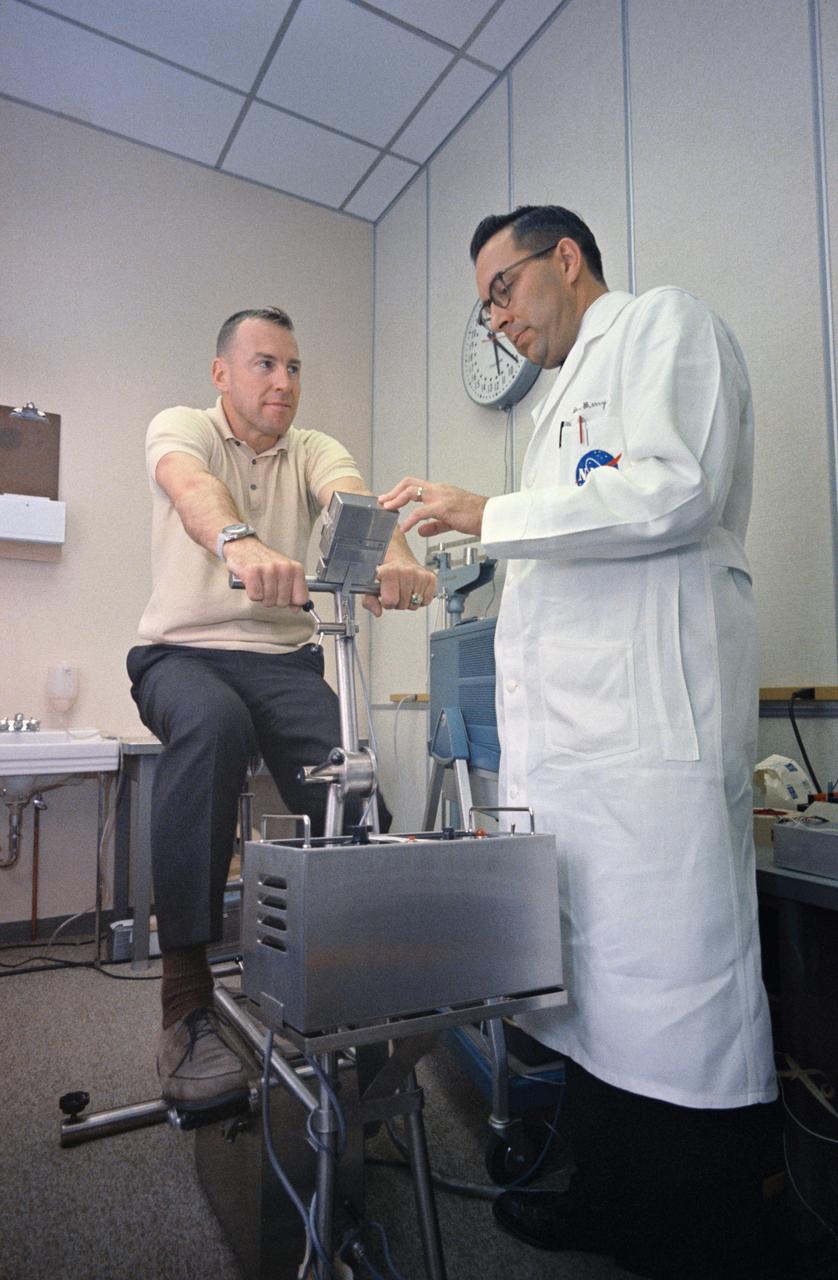
S65-60602 (2 Dec. 1965) --- Dr. Charles A. Berry checks astronaut James A. Lovell Jr., Gemini-7 prime crew pilot, following a workout on an exercise machine. Results will be compared with those obtained during spaceflight for evaluation. Lovell and astronaut Frank Borman (not pictured), command pilot, will pilot the Gemini-7 spacecraft on a planned 14-day mission. Dr. Berry is chief, MSC Center Medical Programs. Photo credit: NASA
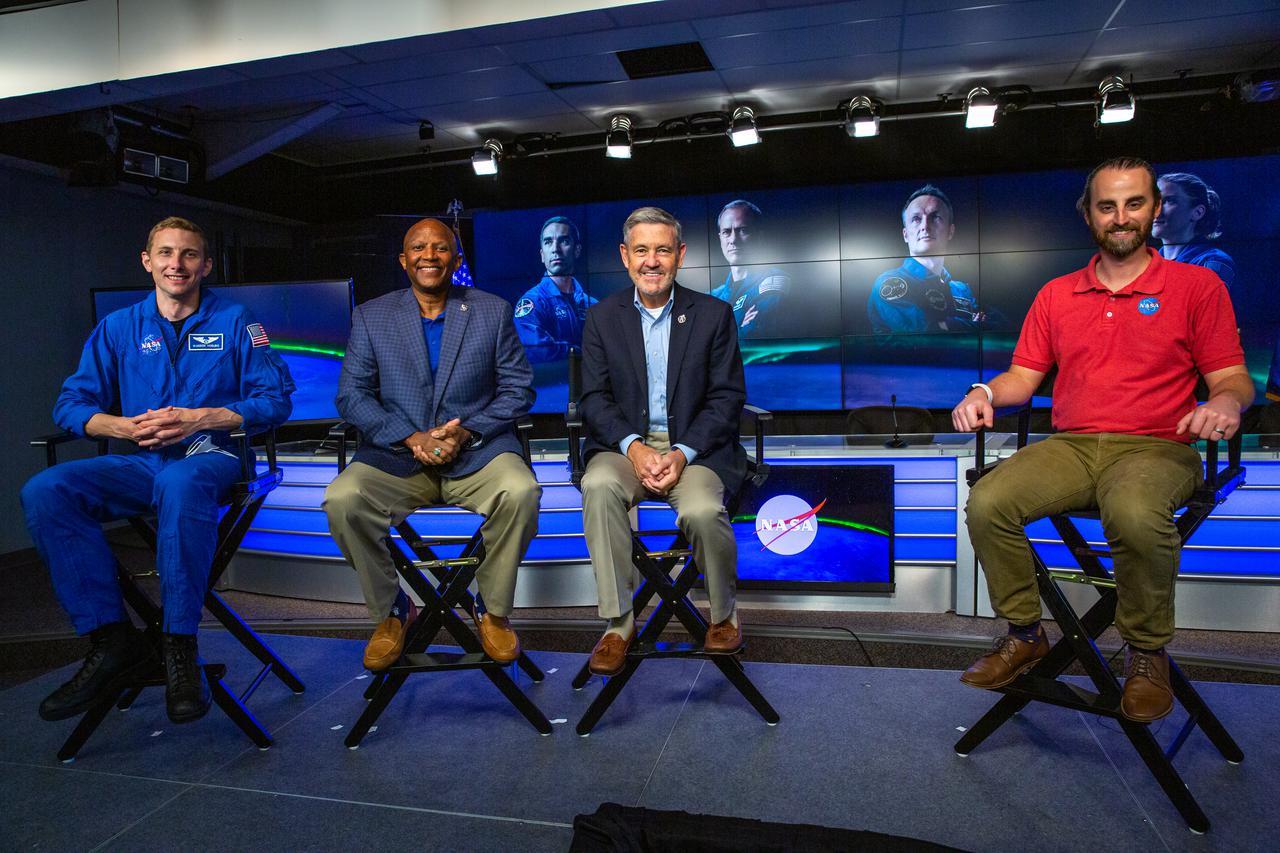
Representatives from NASA participate in a NASA Social Live event at the agency’s Kennedy Space Center in Florida on Oct. 29, in advance of NASA’s SpaceX Crew-3 mission to the International Space Station as part of NASA’s Commercial Crew Program. Participants are, from left, NASA astronaut Woody Hoburg, Kennedy Deputy Director Kelvin Manning, NASA Associate Administrator Bob Cabana, and moderator Joshua Santora, NASA Communications. Launch is currently targeted for 2:21 a.m. EDT Sunday, Oct. 31. The SpaceX Dragon spacecraft, named Endurance by the Crew-3 astronauts, will launch on a Falcon 9 rocket from Launch Complex 39A at Kennedy Space Center. The Crew-3 flight will carry NASA astronauts Raja Chari, mission commander, Tom Marshburn, pilot, and Kayla Barron, mission specialist and ESA (European Space Agency) astronaut Matthias Maurer, also a mission specialist, to the space station for a six-month science mission.
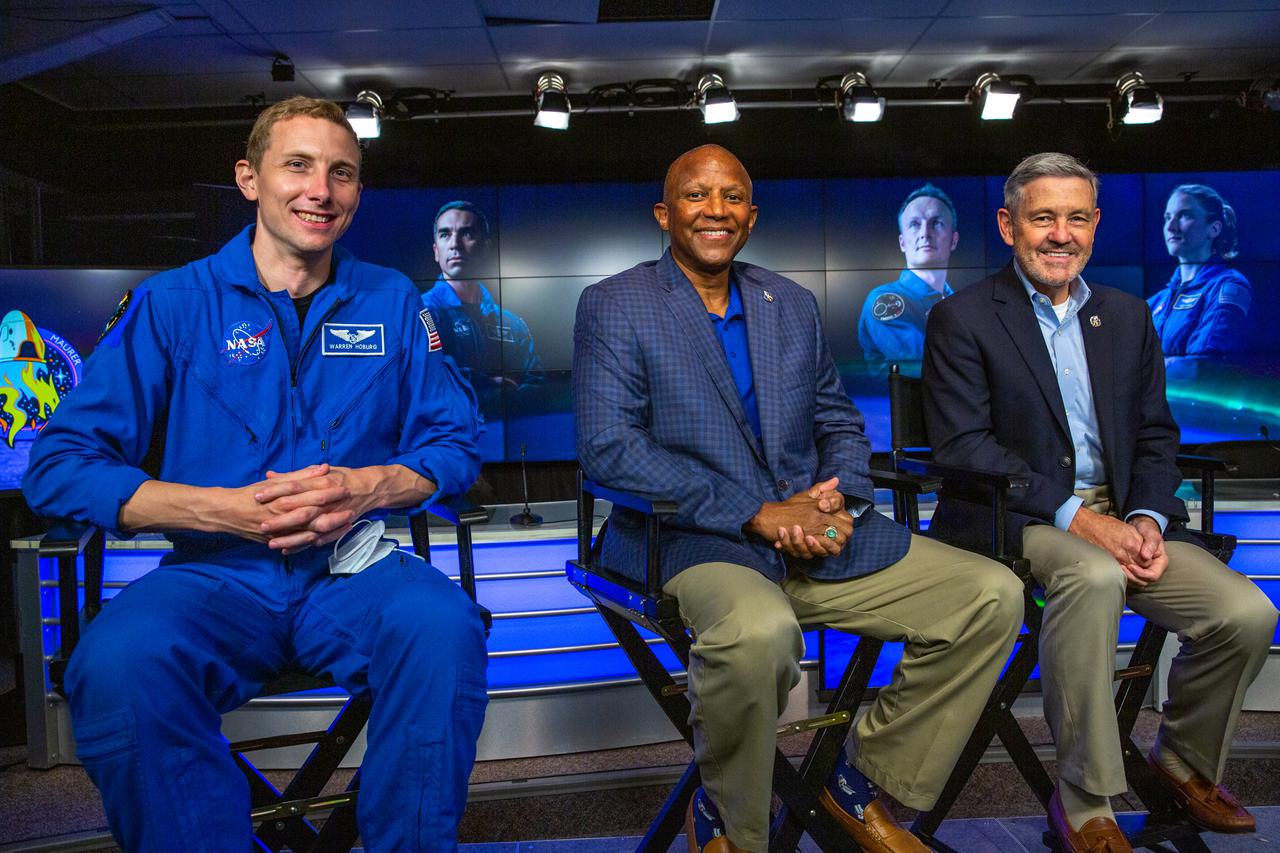
Representatives from NASA participate in a NASA Social Live event at the agency’s Kennedy Space Center in Florida on Oct. 29, in advance of NASA’s SpaceX Crew-3 mission to the International Space Station as part of NASA’s Commercial Crew Program. Participants are, from left, NASA astronaut Woody Hoburg, Kennedy Deputy Director Kelvin Manning, and NASA Associate Administrator Bob Cabana. Launch is currently targeted for 2:21 a.m. EDT Sunday, Oct. 31. The SpaceX Dragon spacecraft, named Endurance by the Crew-3 astronauts, will launch on a Falcon 9 rocket from Launch Complex 39A at Kennedy Space Center. The Crew-3 flight will carry NASA astronauts Raja Chari, mission commander, Tom Marshburn, pilot, and Kayla Barron, mission specialist and ESA (European Space Agency) astronaut Matthias Maurer, also a mission specialist, to the space station for a six-month science mission.
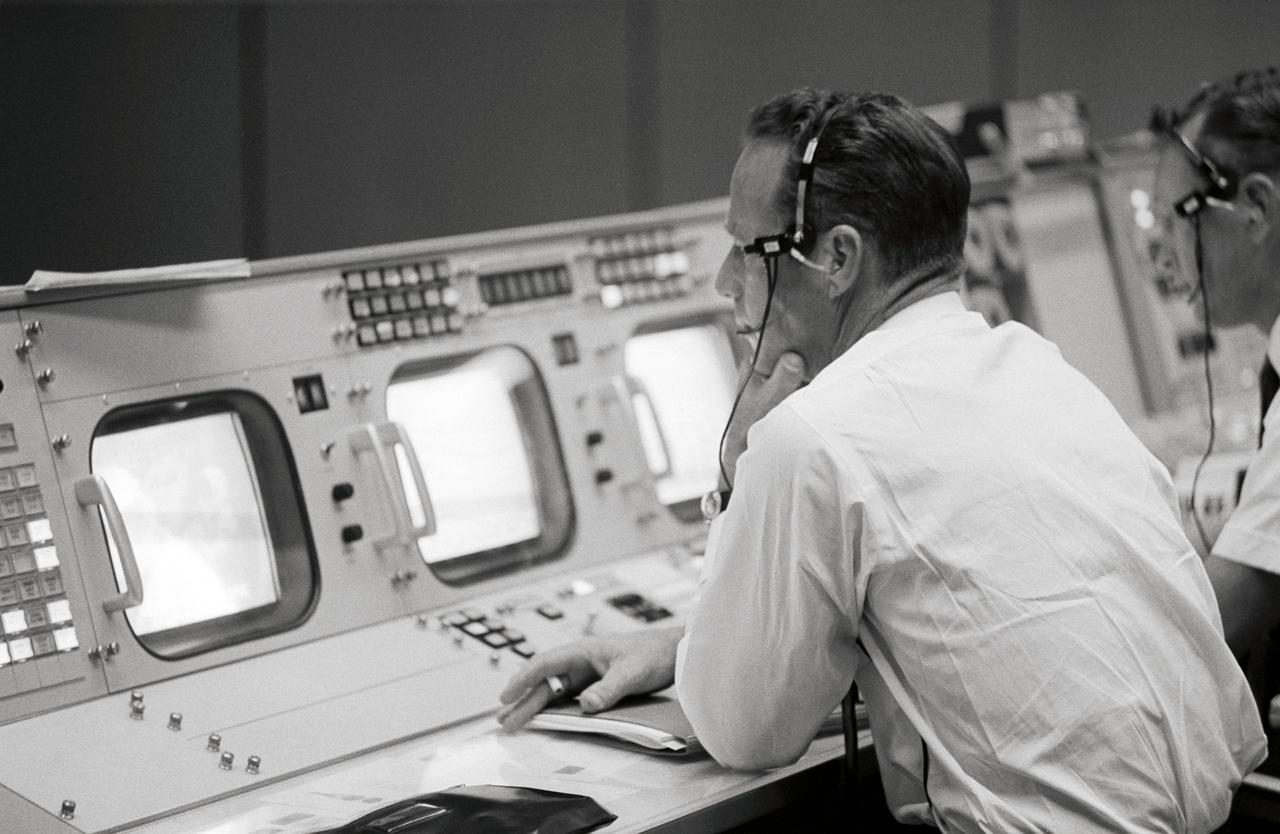
S66-51794 (12 Sept. 1966) --- Astronaut M. Scott Carpenter monitors the Booster Systems Console in the Manned Spacecraft Center (MSC) Mission Control Center during launch of the Gemini-11 spaceflight. Photo credit: NASA
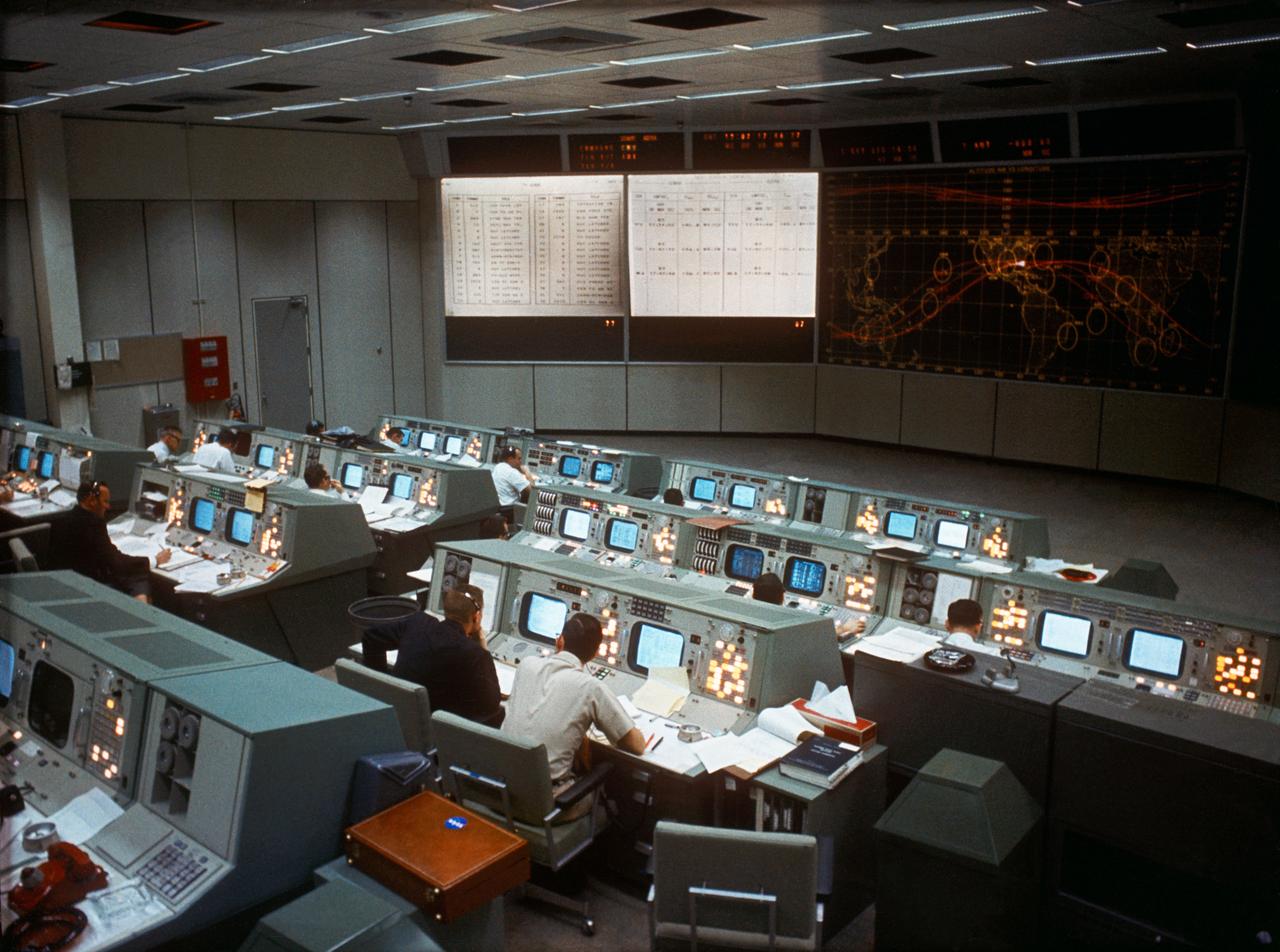
S65-60037 (7 Dec. 1965) --- An overall view of the Manned Spacecraft Center's Mission Control Center, during the National Aeronautics and Space Administration's Gemini-7 spaceflight. Photo credit: NASA
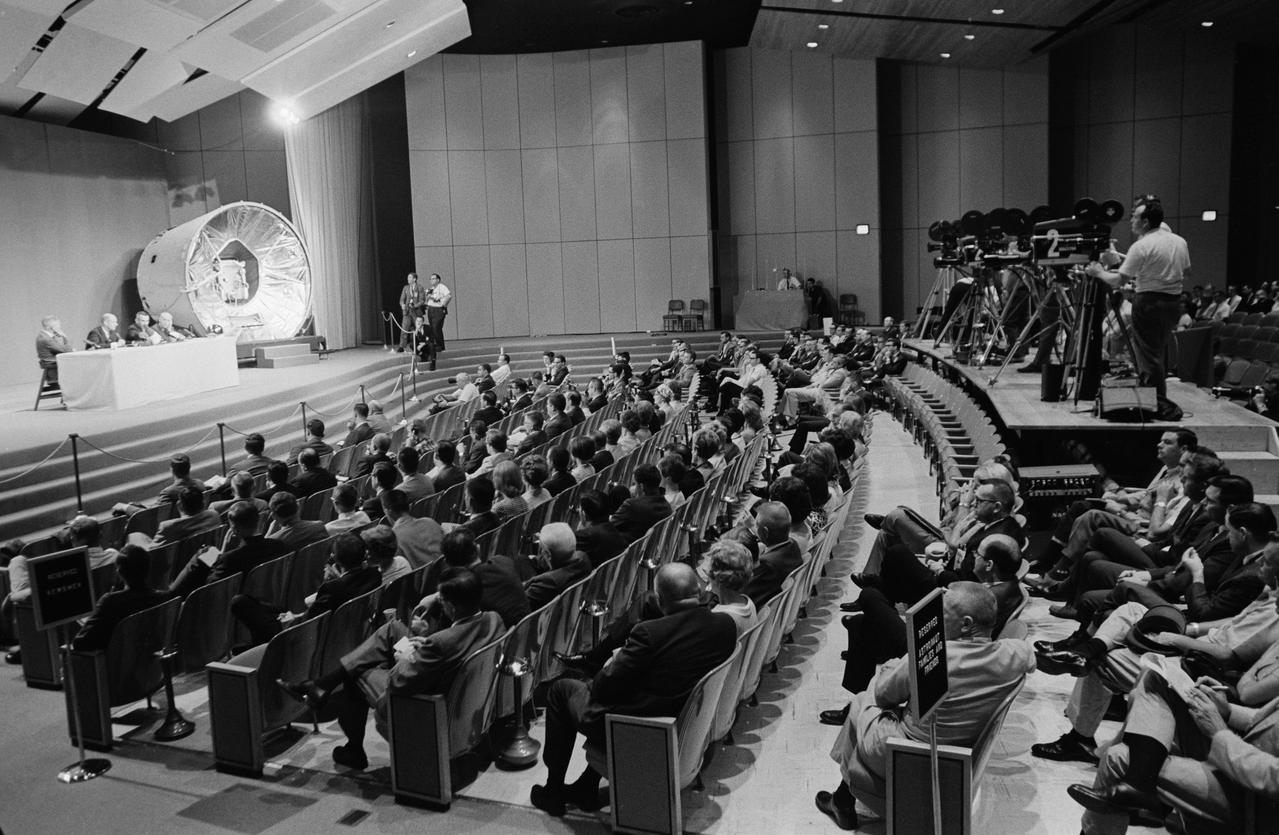
S66-39436 (17 June 1966) --- Wide-angle view of the Manned Spacecraft Center's news center main auditorium during a Gemini-9 press conference. Photo credit:NASA
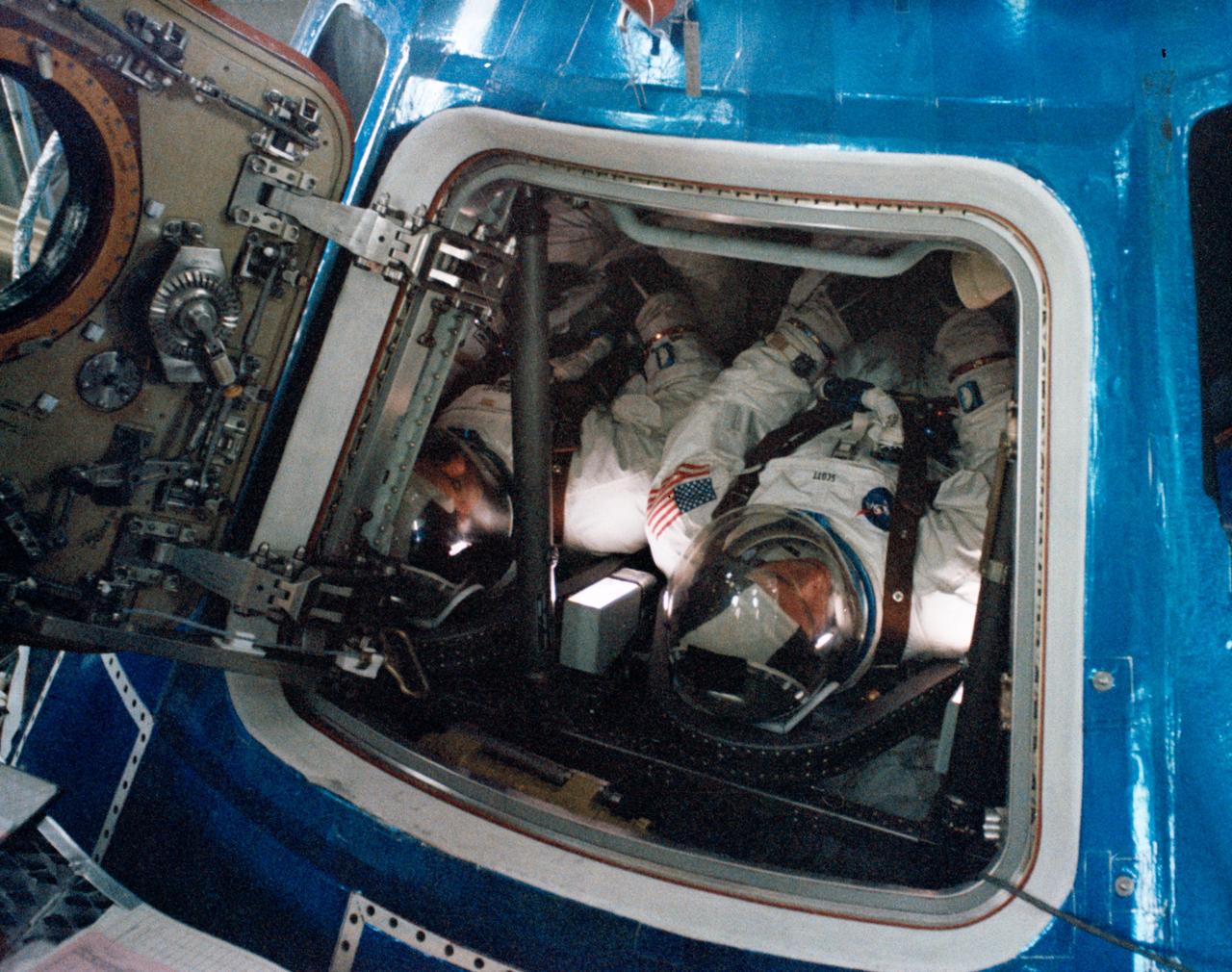
S68-55272 (15 Nov. 1968) --- The Apollo 9 prime crew is seen inside the Apollo 9 spacecraft in the Kennedy Space Center's Manned Spacecraft Operations Building during manned altitude chamber test activity. Left to right, are astronauts James A. McDivitt, commander; David R. Scott, command module pilot; and Russell L. Schweickart (out of view to far right), lunar module pilot.
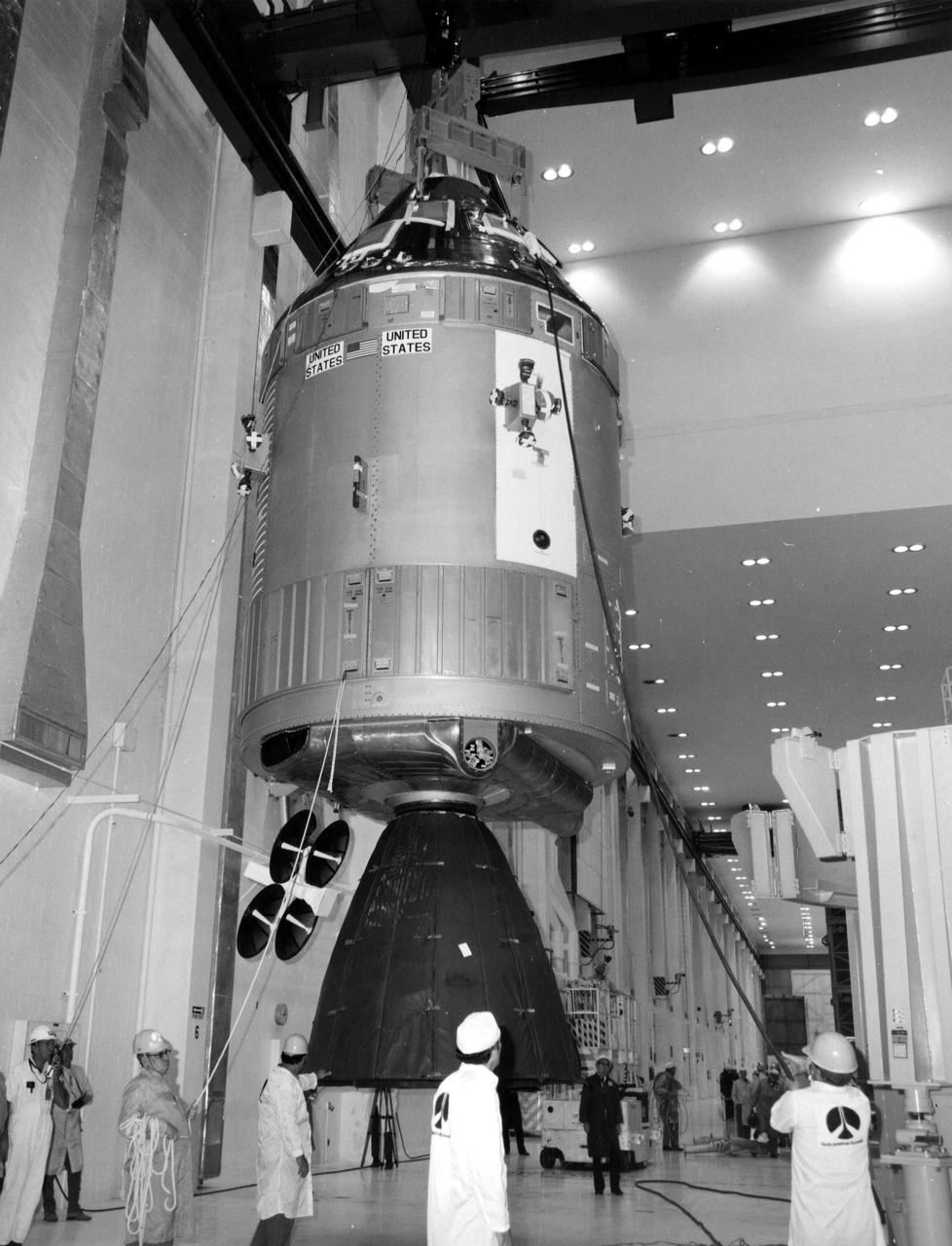
KENNEDY SPACE CENTER, FLA. -- The Apollo spacecraft, which will be flown in this summer's joint mission with the Soviet Union, was mated with its Spacecraft Launcher Adapter (SLA) in the Manned Spacecraft Operations Building today. The spacecraft has been undergoing checkout in the MSOB since it arrived at KSC last September.
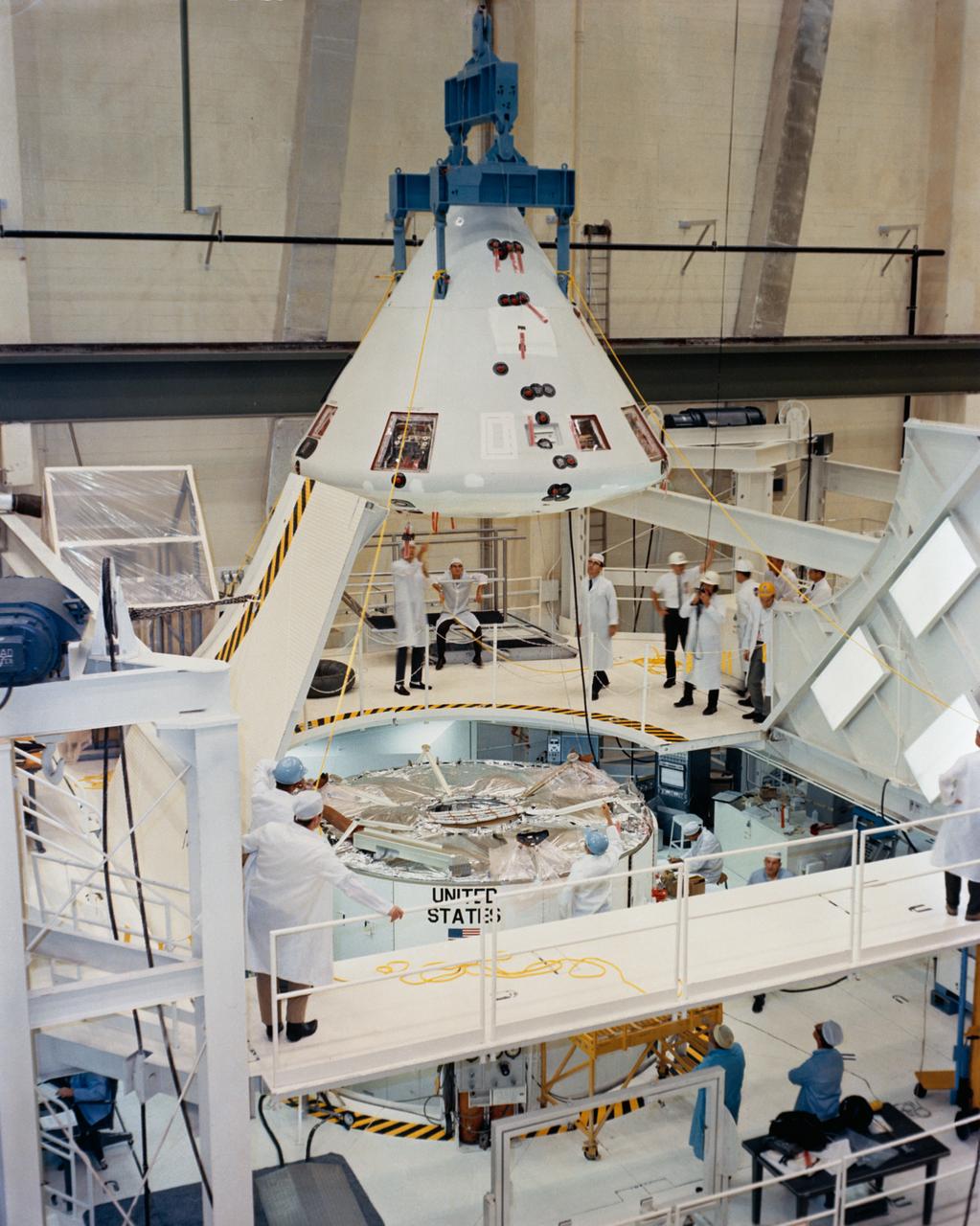
S68-17301 (6 Dec. 1967) --- Apollo Spacecraft 020 Command Module is hoisted into position for mating with Service Module in the Kennedy Space Center's Manned Spacecraft Operations Building. Spacecraft 020 will be flown on the Apollo 6 (Spacecraft 020/Saturn 502) unmanned, Earth-orbital space mission.
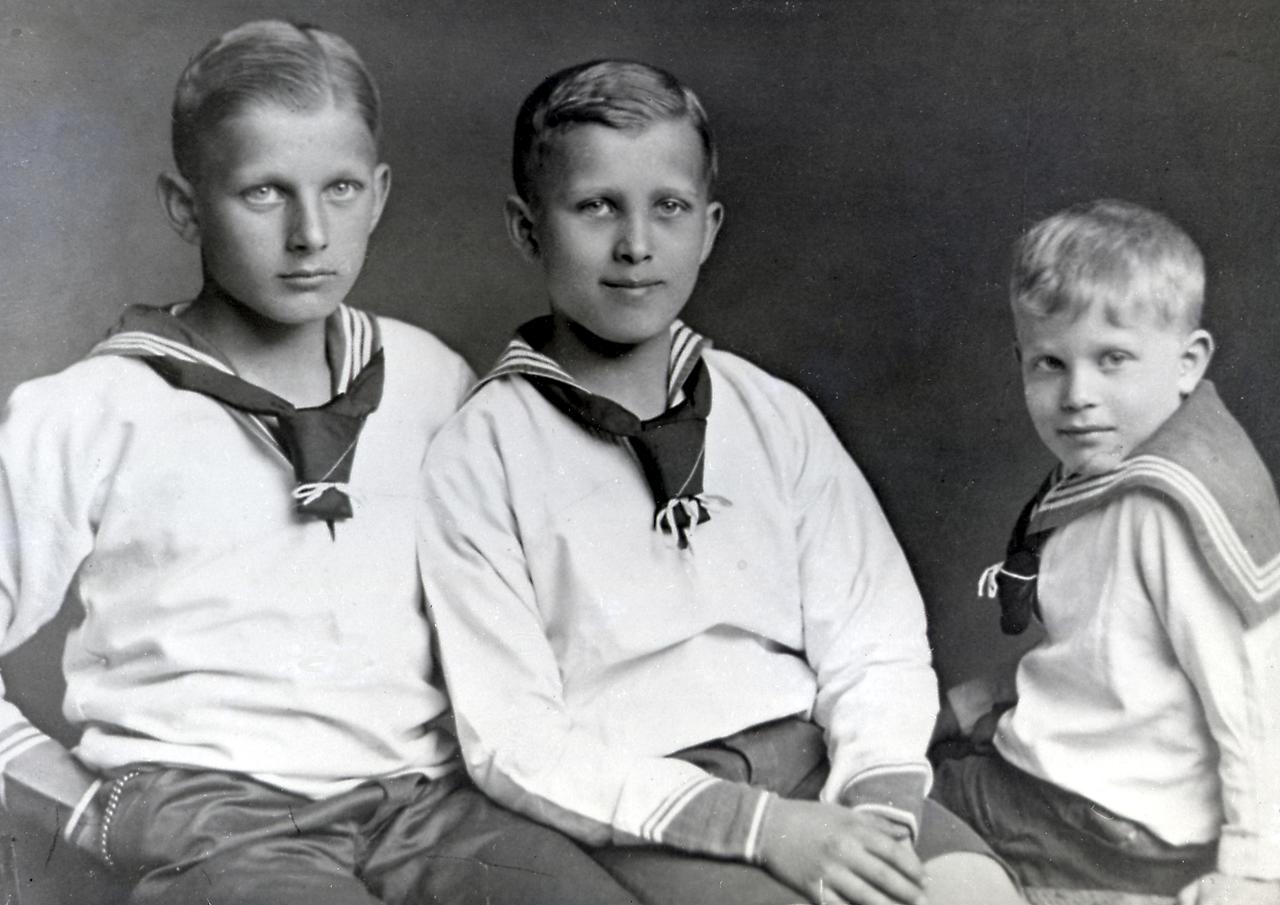
This is a childhood picture of Dr. von Braun (center) with his brothers. Dr. Wernher von Braun was born in Wirsitz, Germany, March 23, 1912. His childhood dreams of marned space flight were fulfilled when giant Saturn rockets, developed under his direction at NASA's Marshall Space Flight Center, boosted the manned Apollo spacecraft to the Moon. His life was dedicated to expanding man's knowledge through the exploration of space.
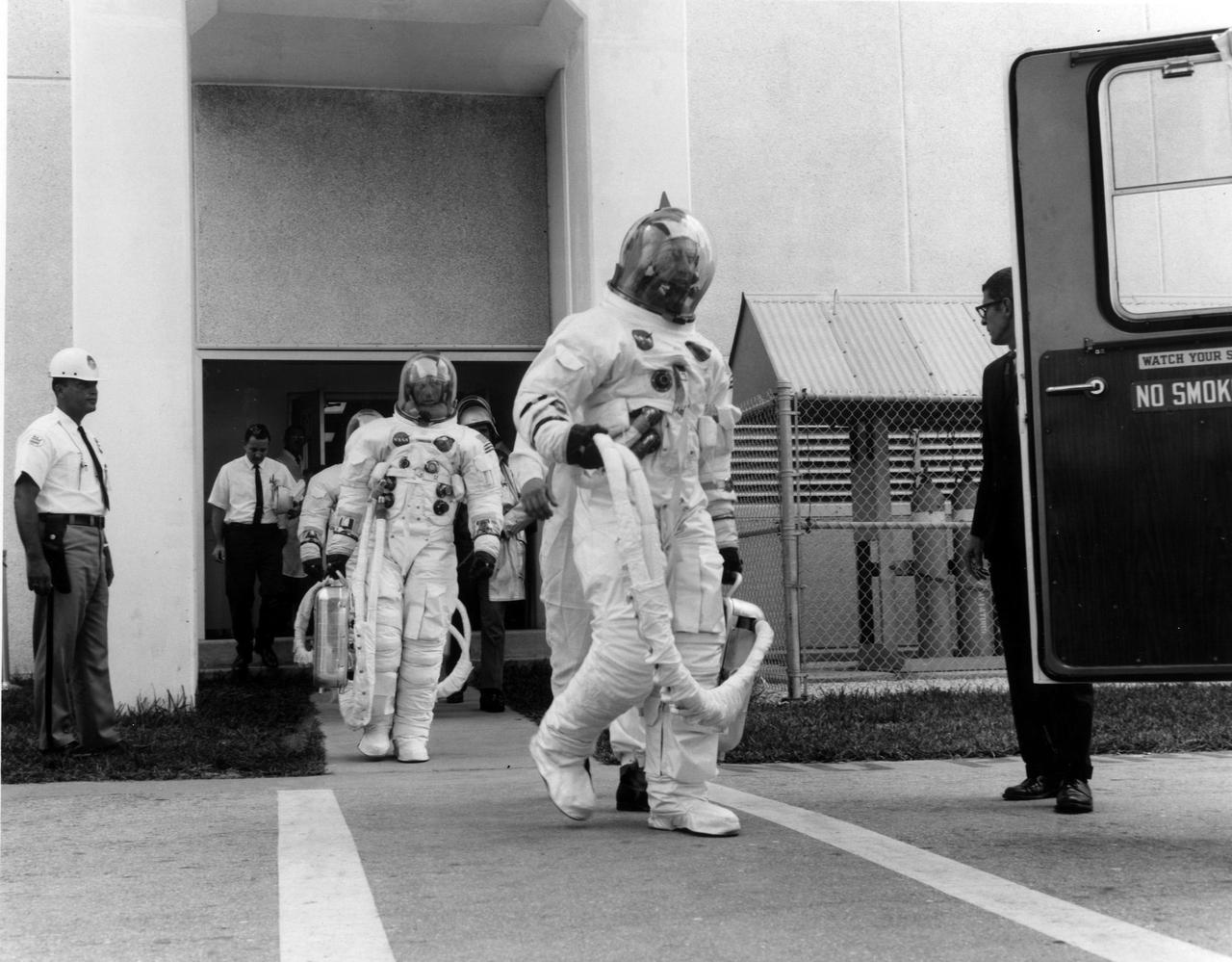
KENNEDY SPACE CENTER, FLA. -- Apollo 7 prime crew members, front to back, Donn F. Eisele, Walter M. Schirra Jr. and Walter Cunningham, leave the Kennedy Space Center's Manned Spacecraft Operations Building for a 20-minute ride in a transfer van to Cape Kennedy's Launch Complex 34, where they participated in a Space Vehicle Emergency Egress Test. The trio will pilot the National Aeronautics and Space Administration's first manned Apollo mission.
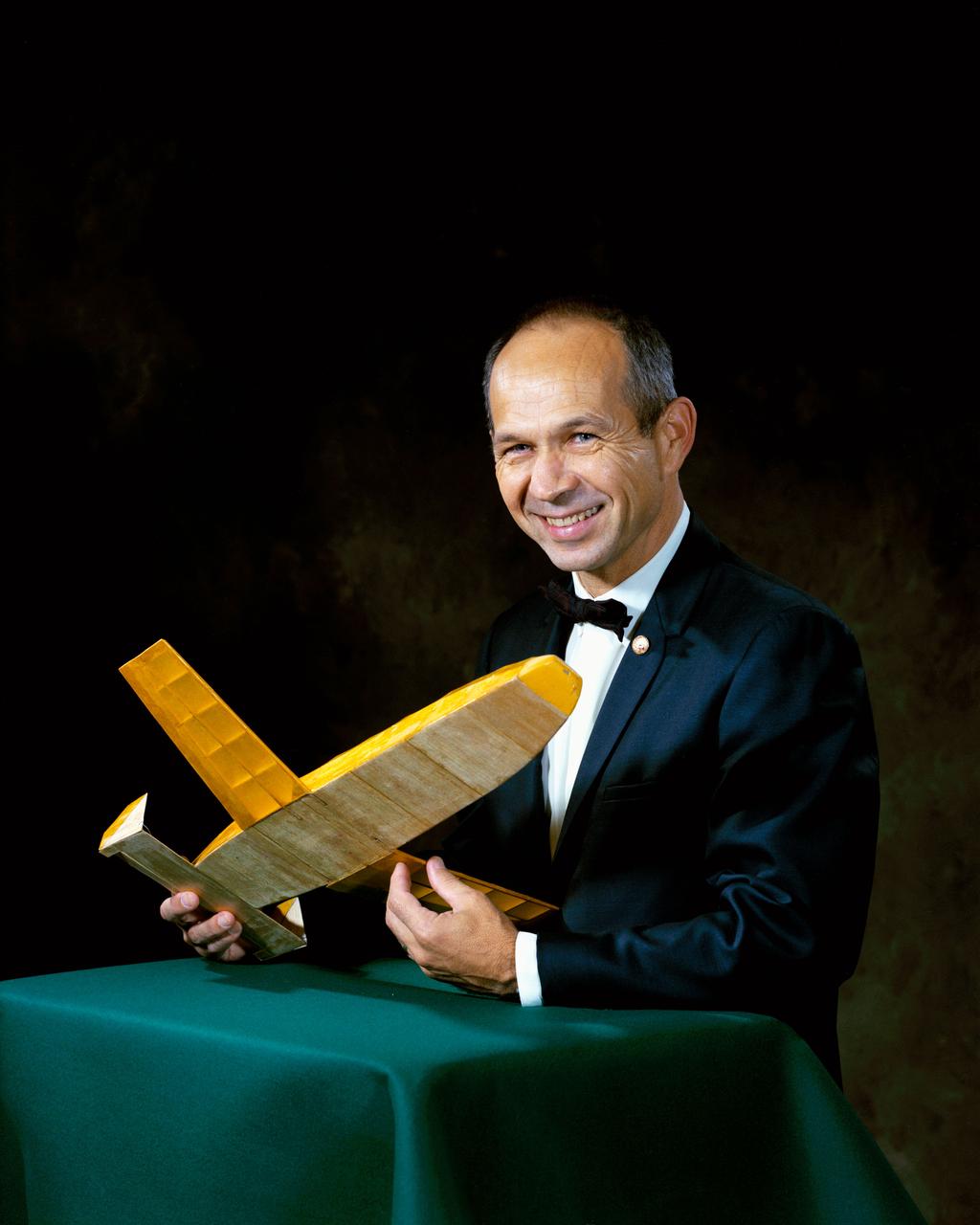
S69-64137 (1969) --- Maxime A. Faget, Director of Engineering and Development, Manned Spacecraft Center, Houston, Texas, holds a model of an early space shuttle vehicle. Photo credit: NASA
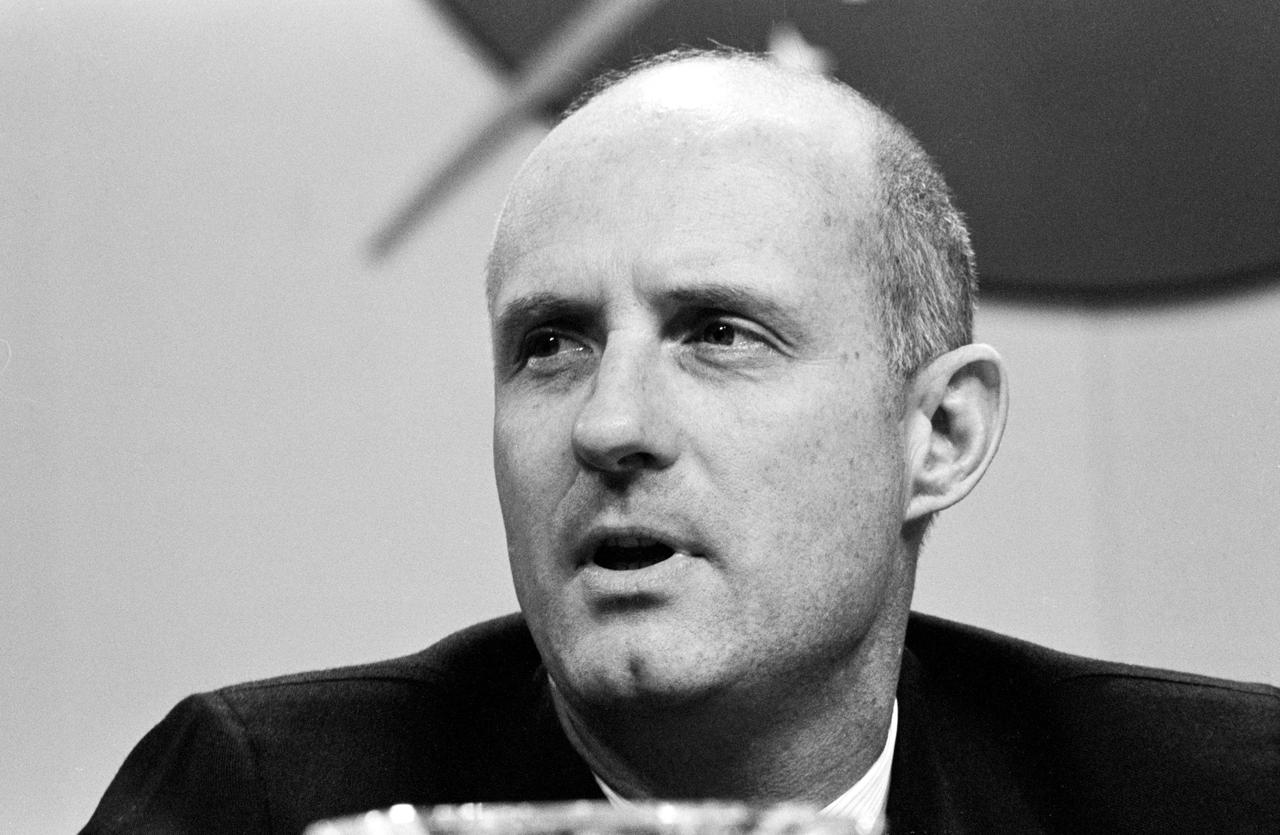
S69-32036 (26 April 1969) --- Astronaut Thomas P. Stafford, commander of the Apollo 10 prime crew, is seen at a press conference held at the Manned Spacecraft Center on April 26, 1969.
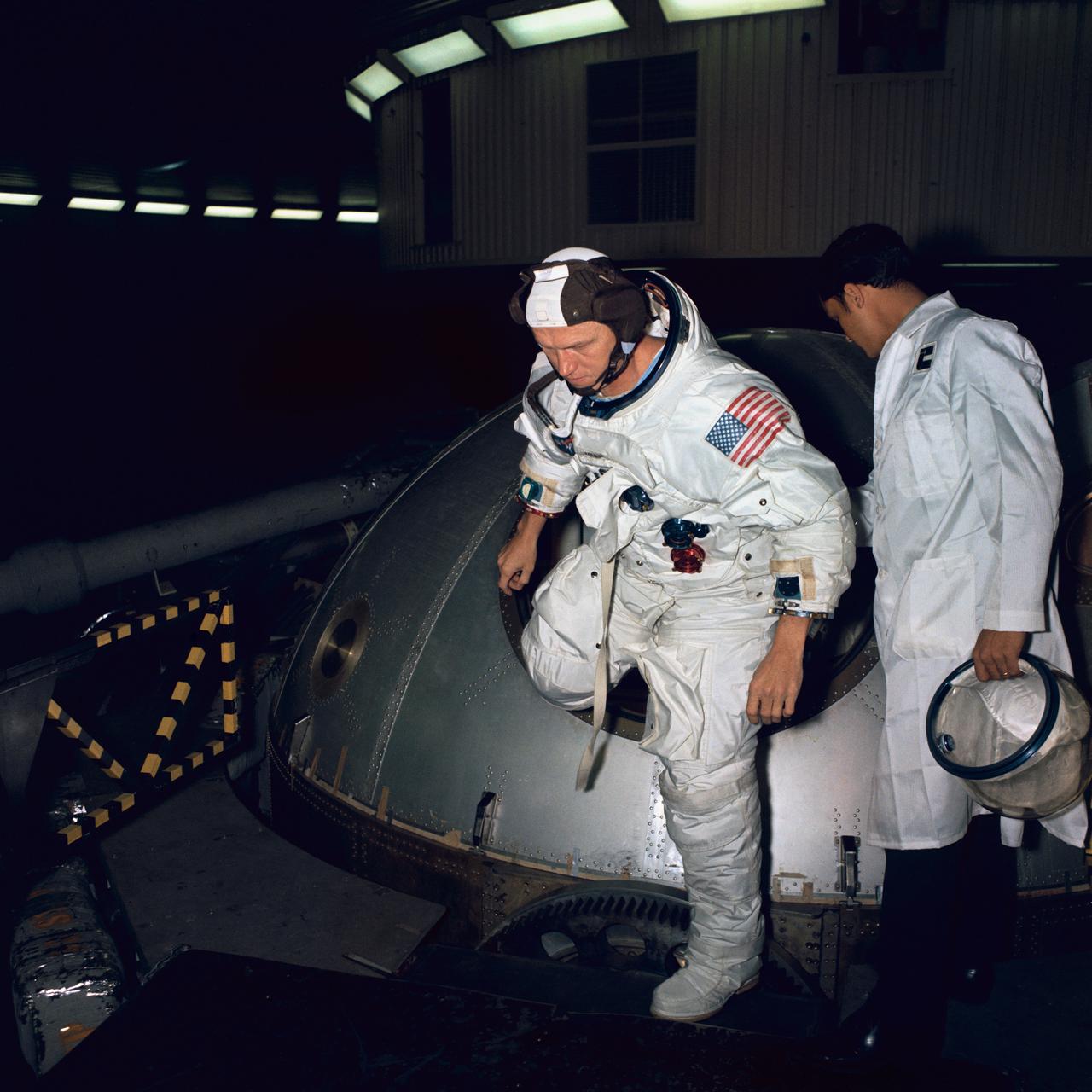
S68-53186 (1 Nov. 1968) --- Astronaut Frank Borman, Apollo 8 commander, egresses the gondola in Building 29 after centrifuge training in the Manned Spacecraft Center's (MSC) Flight Acceleration Facility (FAF).
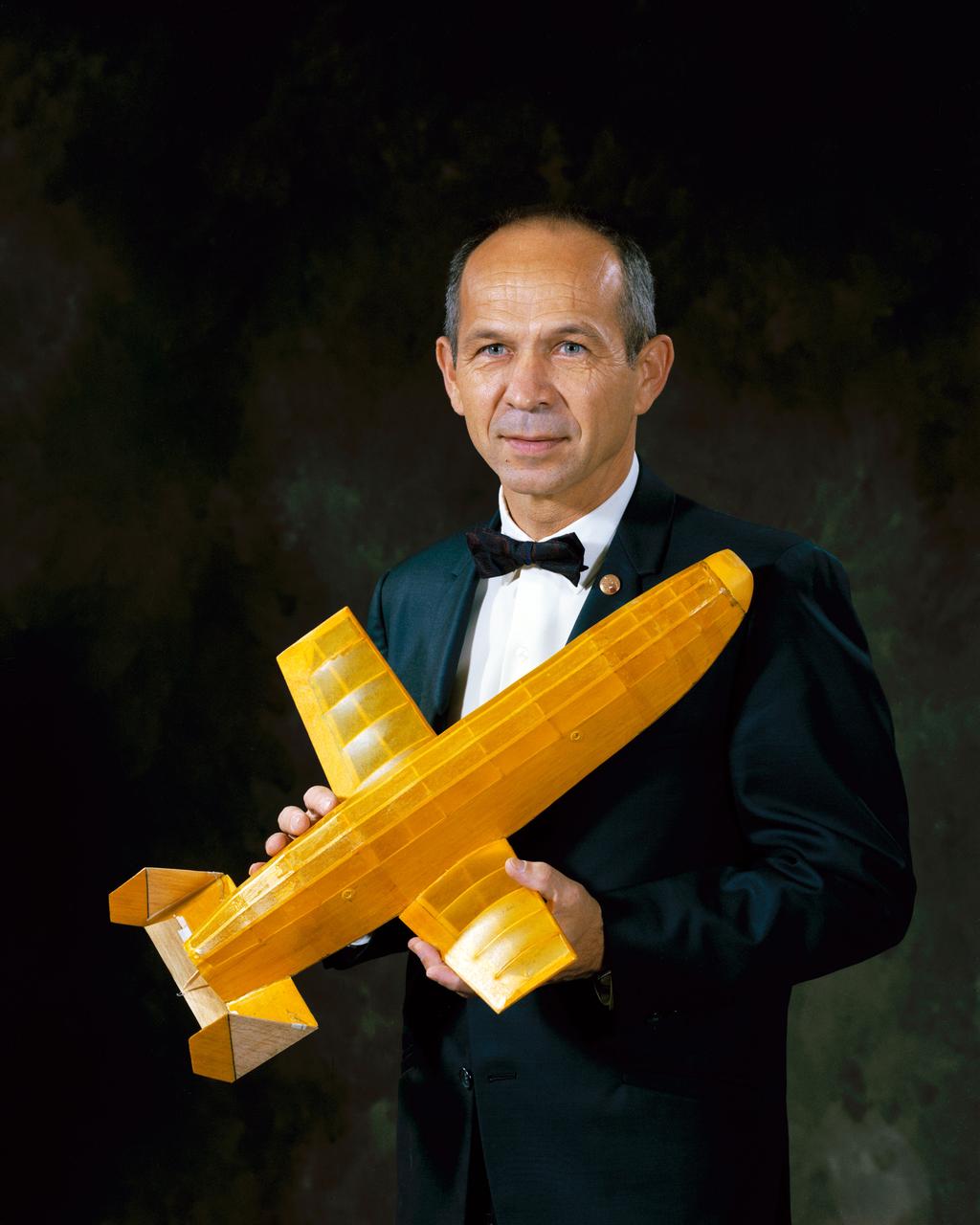
S69-64132 (1969) --- Maxime A. Faget, Director of Engineering and Development, Manned Spacecraft Center, Houston, Texas, holds a model of an early space shuttle vehicle. Photo credit: NASA
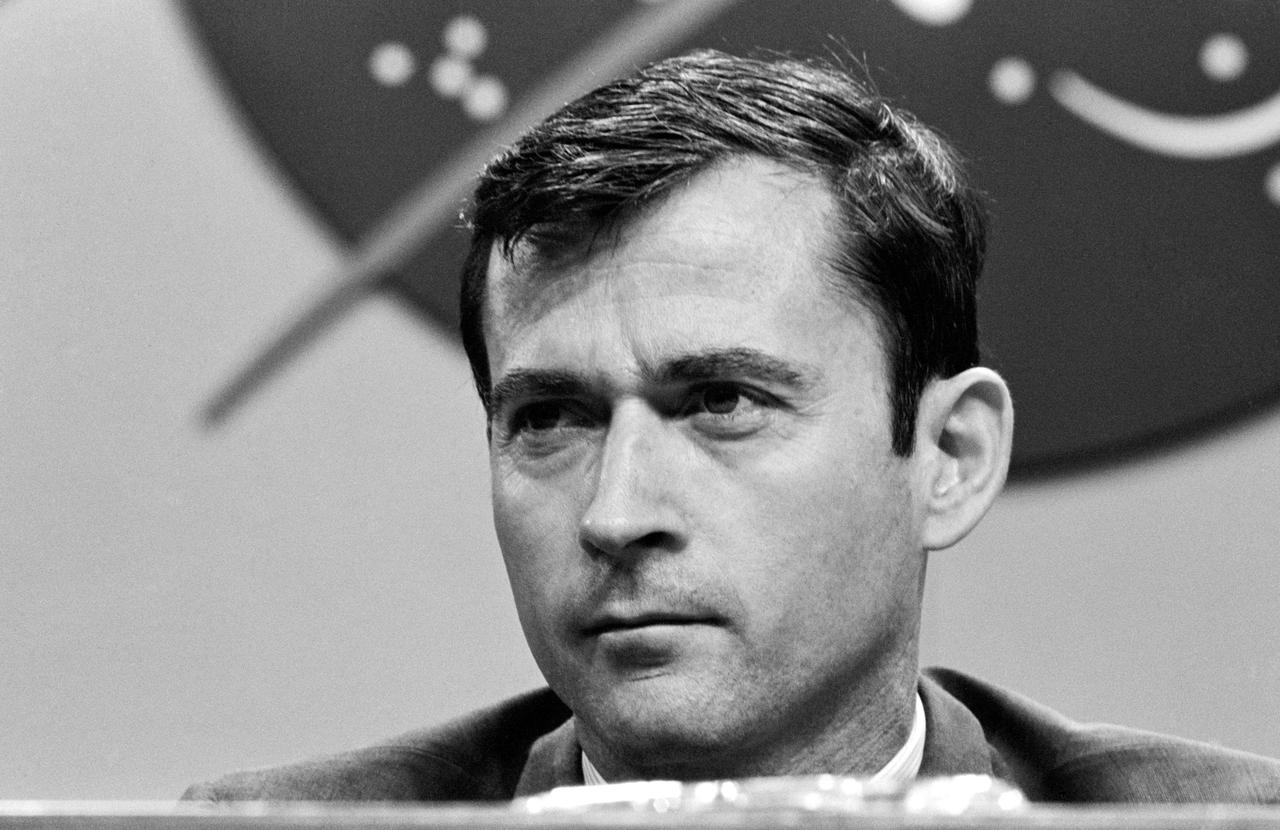
S69-32035 (26 April 1969) --- Astronaut John W. Young, command module pilot of the Apollo 10 prime crew, is seen at a press conference held at the Manned Spacecraft Center on April 26, 1969.
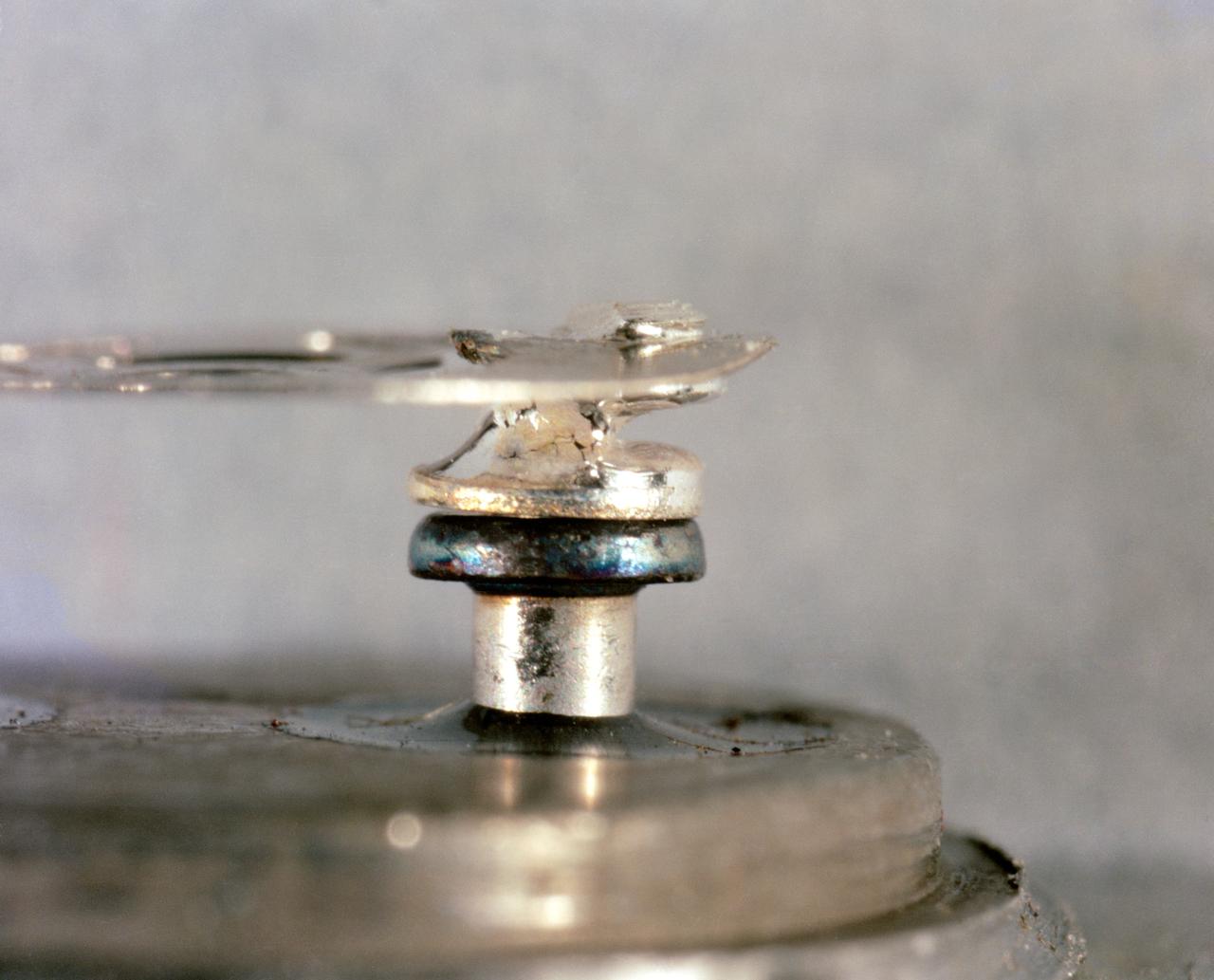
S70-40850 (June 1970) --- Fused thermal switch from Apollo Service Module (SM) oxygen tank after test at the NASA Manned Spacecraft Center (MSC) simulating Apollo 13 de-tanking procedures.
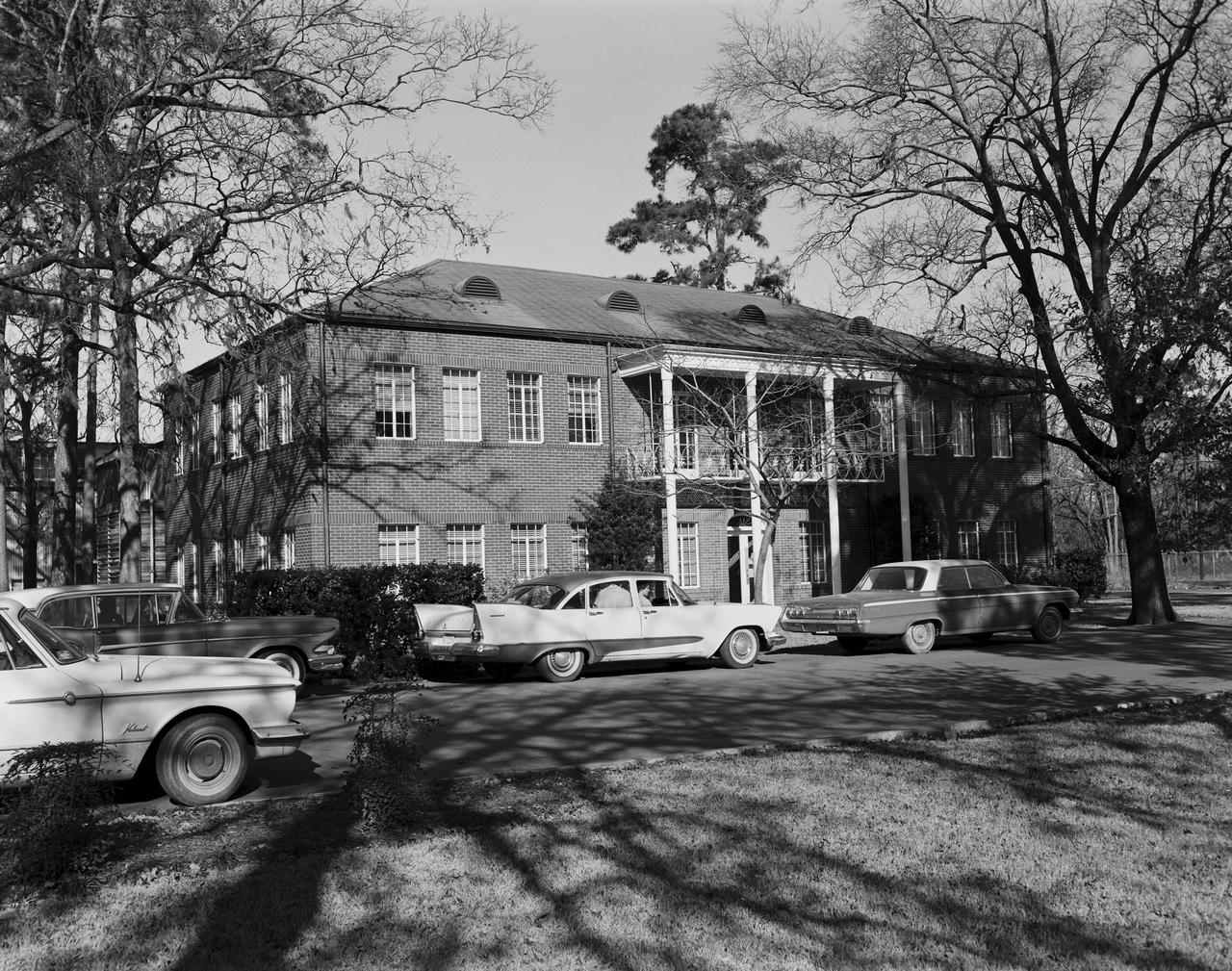
S62-00518 (1962) --- Exterior view of the Lane Wells Building, rented to the National Aeronautics and Space Administration as part of the temporary quarters for the Houston Manned Spacecraft Center (MSC). Photo credit: NASA
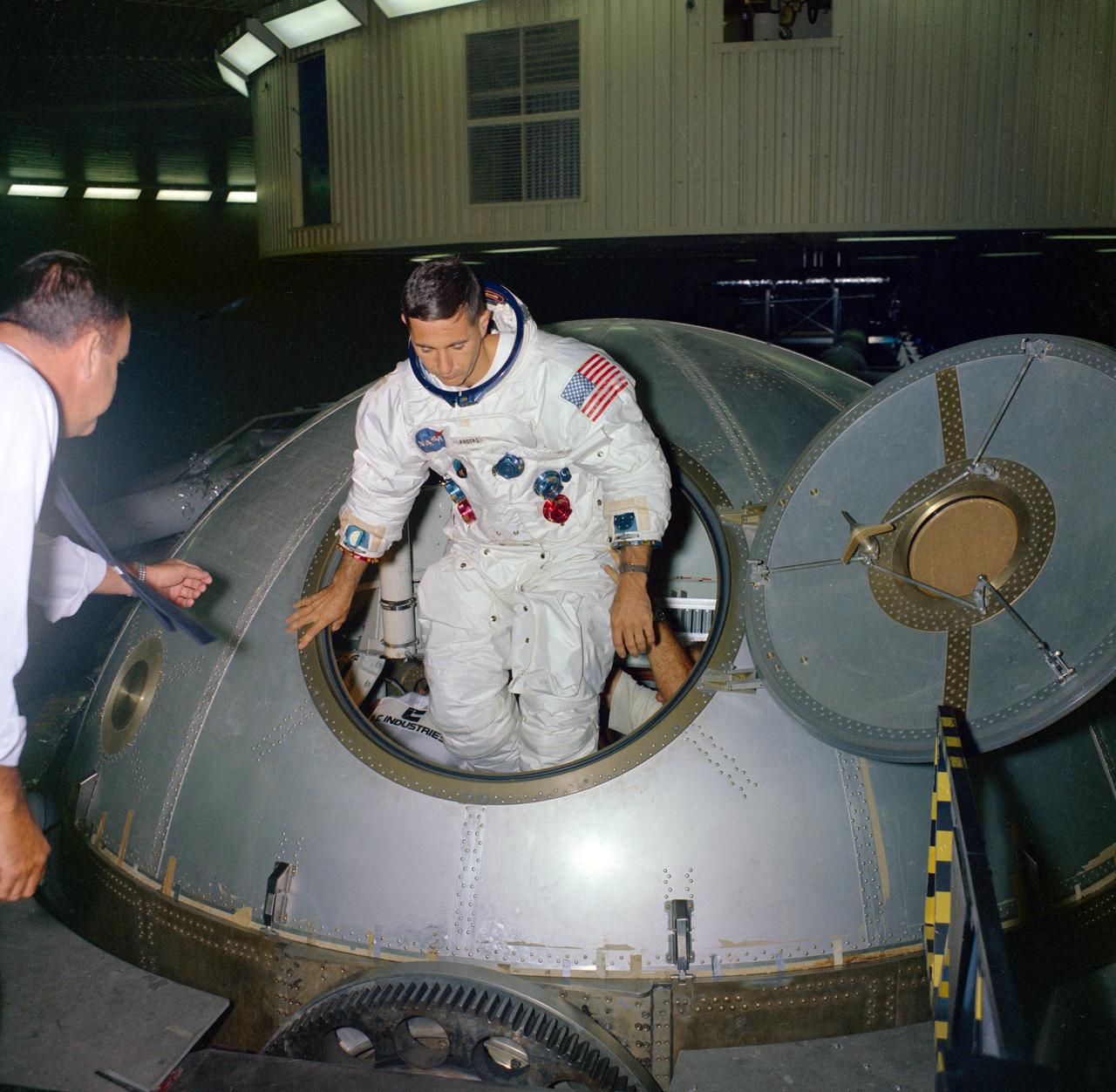
Apollo 8 astronaut William A. Anders, lunar module pilot, steps out of the centrifuge gondola in bldg 29 during centrifuge training in the Manned Spacecraft Center's (MSC) Flight Acceleration Facility.
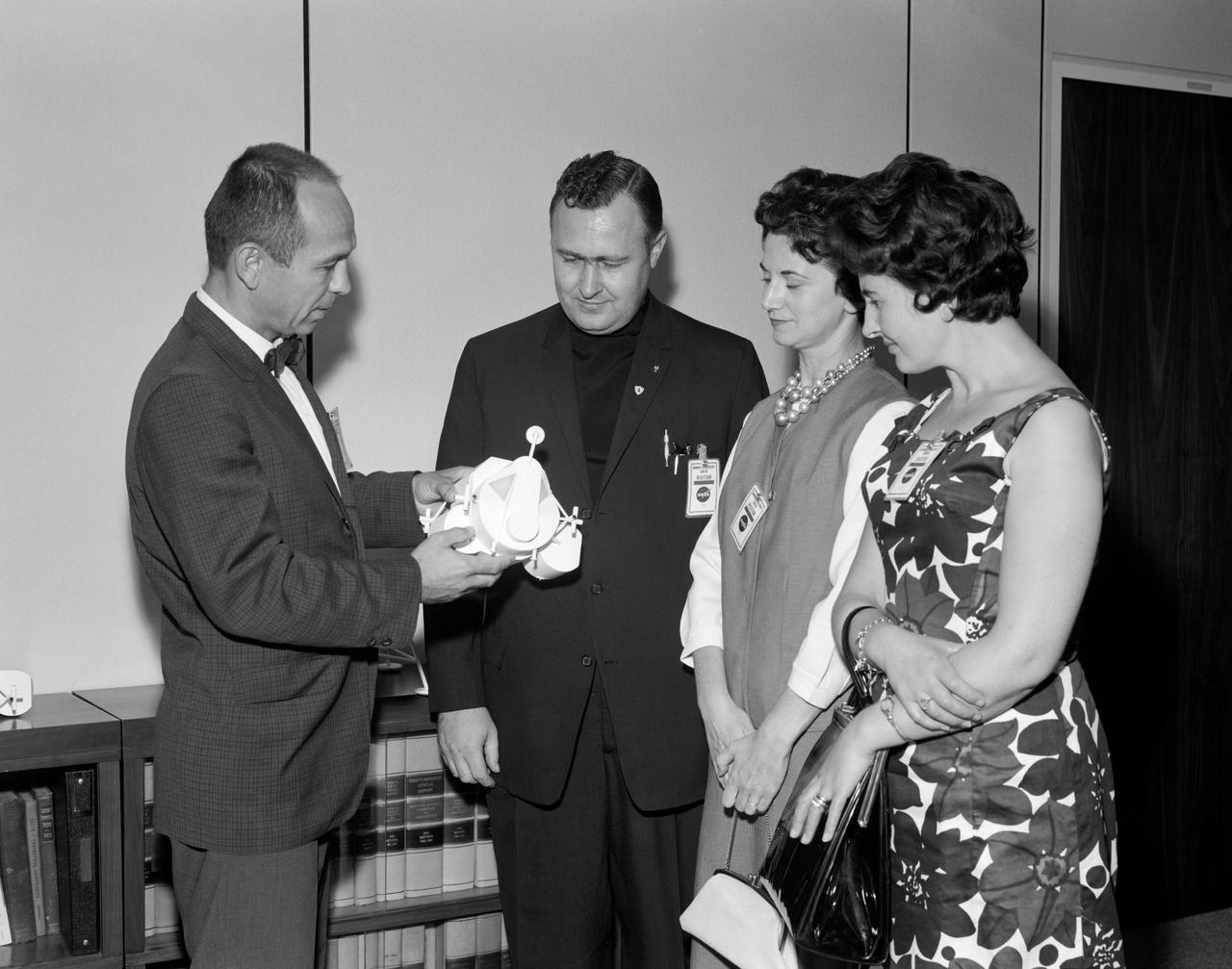
S64-31226 (1964) --- Maxime A. Faget, Assistant Director for Engineering and Development, at Manned Spacecraft Center, explains the function of the Lunar Module to Father Patrick J. OBrien, sister-in-law to Father O
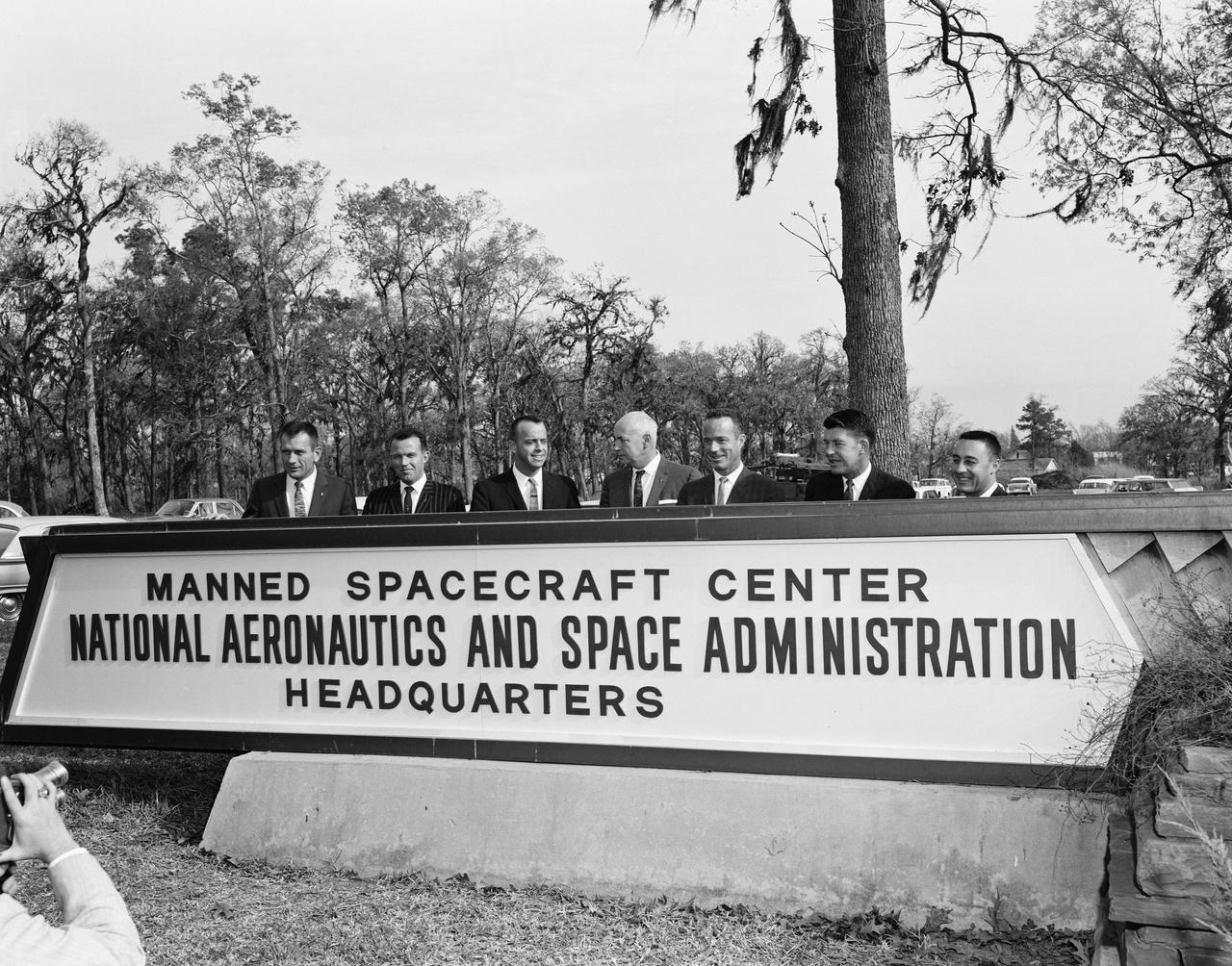
Astronaut Alan Shepard with Gilruth, and Astronauts Slayton, Cooper, Carpenter, Schirra, Grissom around the Manned Spacecraft Center (MSC) sign at the Farnsworth-Chambers Bldg. FARNSWORTH-CHAMBERS BLDG., HOUSTON, TX B&W

Astronaut Richard F. Gordon Jr., Apollo 12 command module pilot, suits up in the Kennedy Space Center's Manned Spacecraft Operations Building during the Apollo 12 prelaunch countdown.
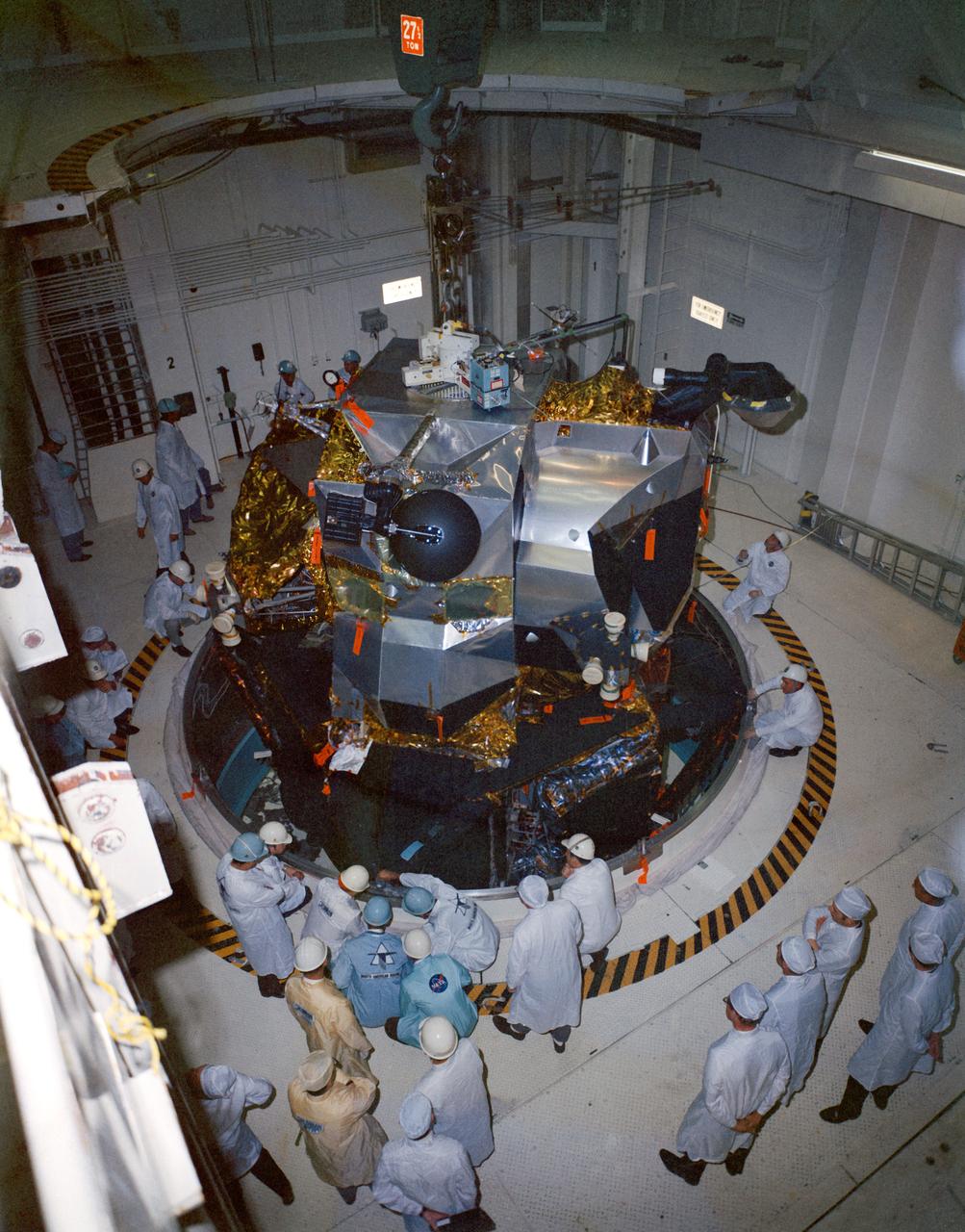
S69-17809 (13 Jan. 1969) --- Lunar Module 4 in the Kennedy Space Center's Manned Spacecraft Operations Building being moved into position for mating with Spacecraft Lunar Module Adapter (SLA) 13. Lunar Module 4 will be flown on the Apollo 10 (Spacecraft 106/Saturn 505) lunar orbit mission.
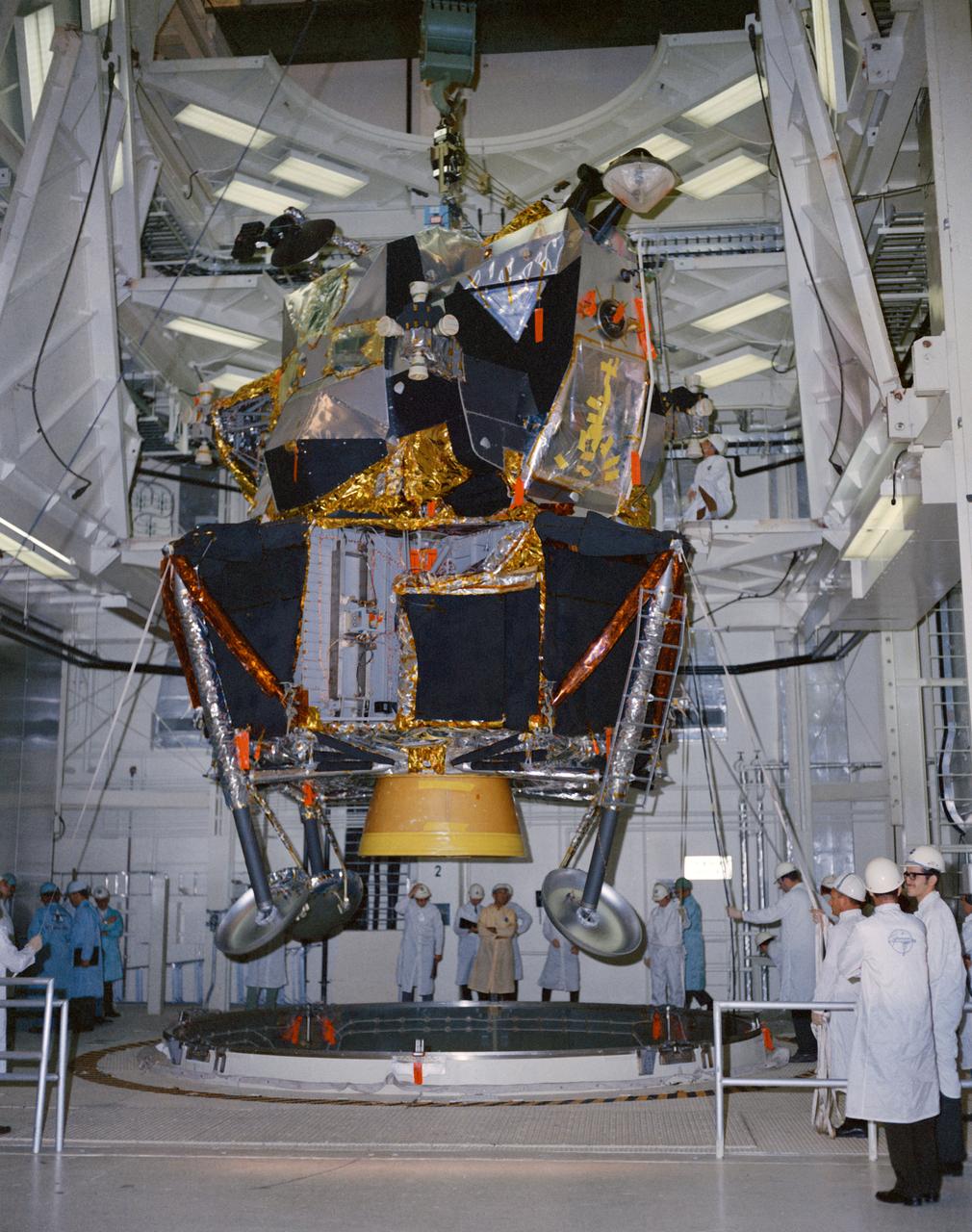
S69-17807 (13 Jan. 1969) --- Lunar Module 4 in the Kennedy Space Center's Manned Spacecraft Operations Building being moved into position for mating with Spacecraft Lunar Module Adapter (SLA) 13. Lunar Module 4 will be flown on the Apollo 10 (Spacecraft 106/Saturn 505) space mission.
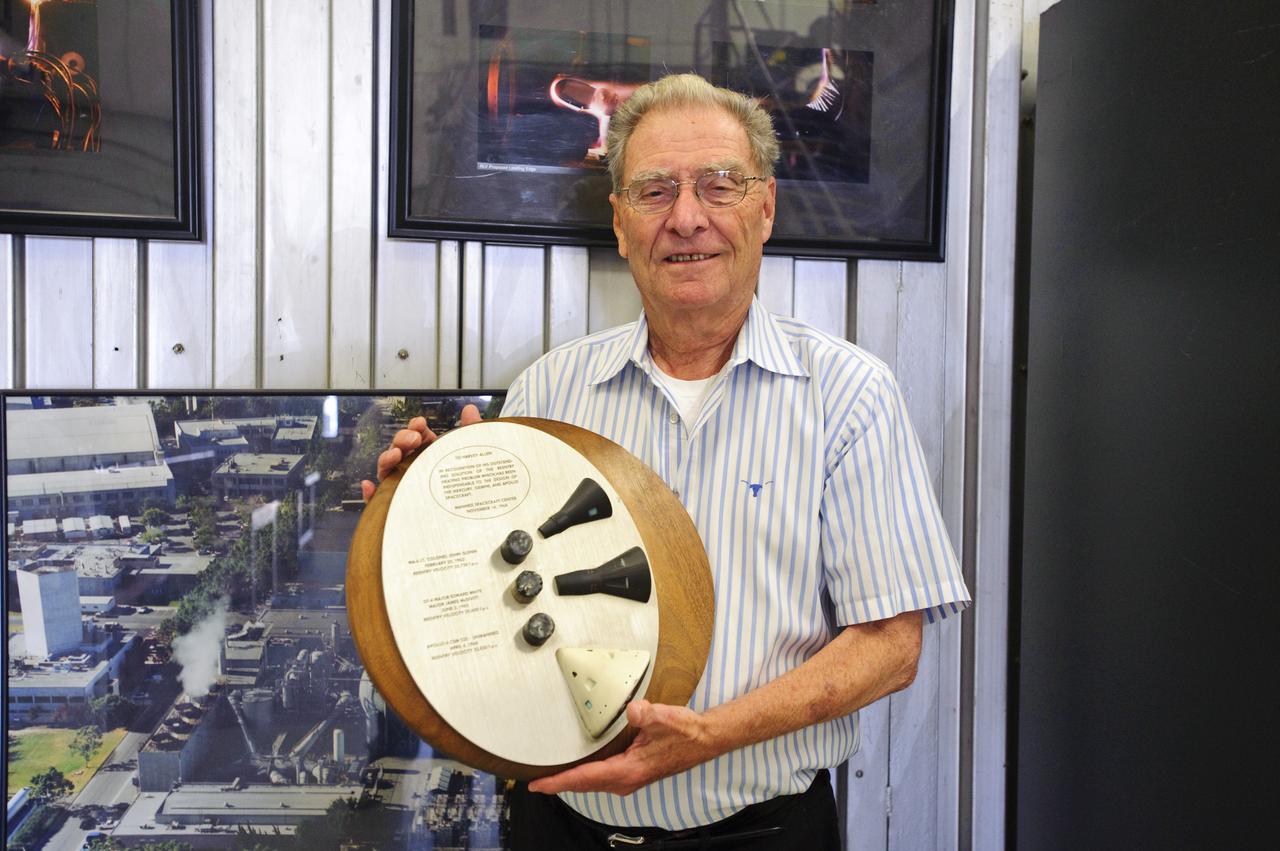
John W. 'Jack Boyd holds a plaque presented to Harvey Allen in recognition of his outstanding solution of the reentry heating problem which has been indispensable to the design of the Mercury, Gemini, and Apollo spacecraft (Manned Spacecraft Center, November 14, 1968) Plaque contains samples of tested materials and models of spacecraft.
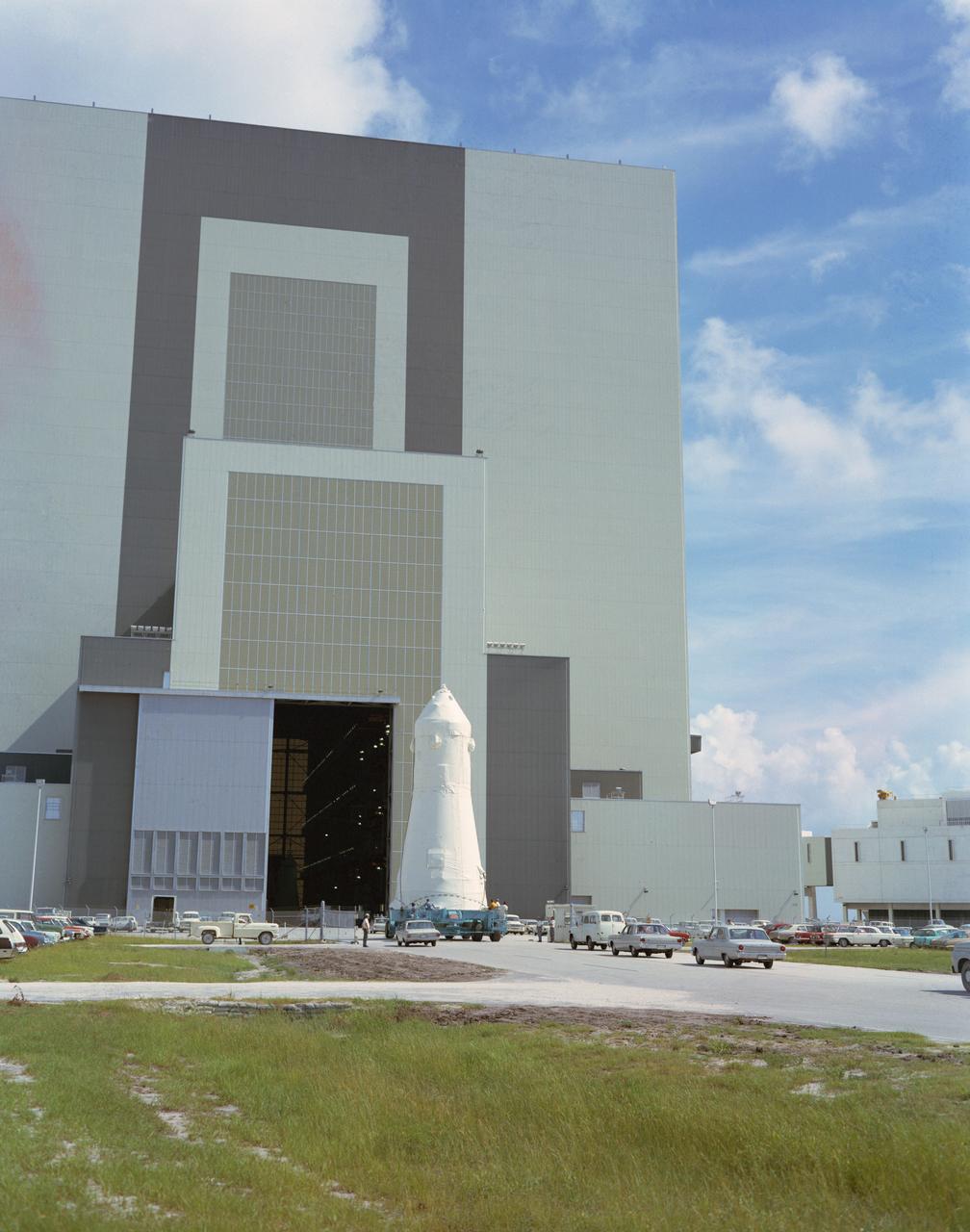
S69-39323 (1969) --- The Apollo 12 spacecraft (Command and Service Modules 108/Lunar Module 6) arrives at the Kennedy Space Center's Vehicle Assembly Building (VAB) during preflight preparations. The spacecraft had just been moved from the Manned Spacecraft Operations Building.
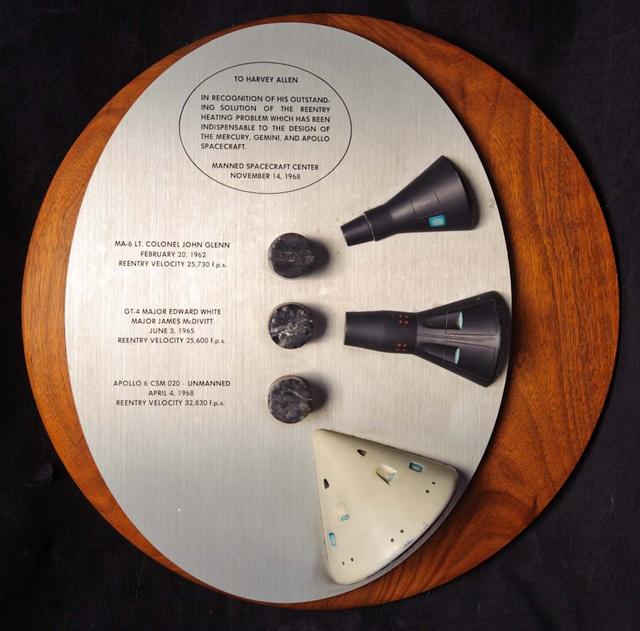
A plaque presented to Harvey Allen in recognition of his outstanding solution of the reentry heating problem which has been indispensable to the design of the Mercury, Gemini, and Apollo spacecraft (Manned Spacecraft Center, November 14, 1968) Plaque contains samples of tested materials and models of spacecraft.
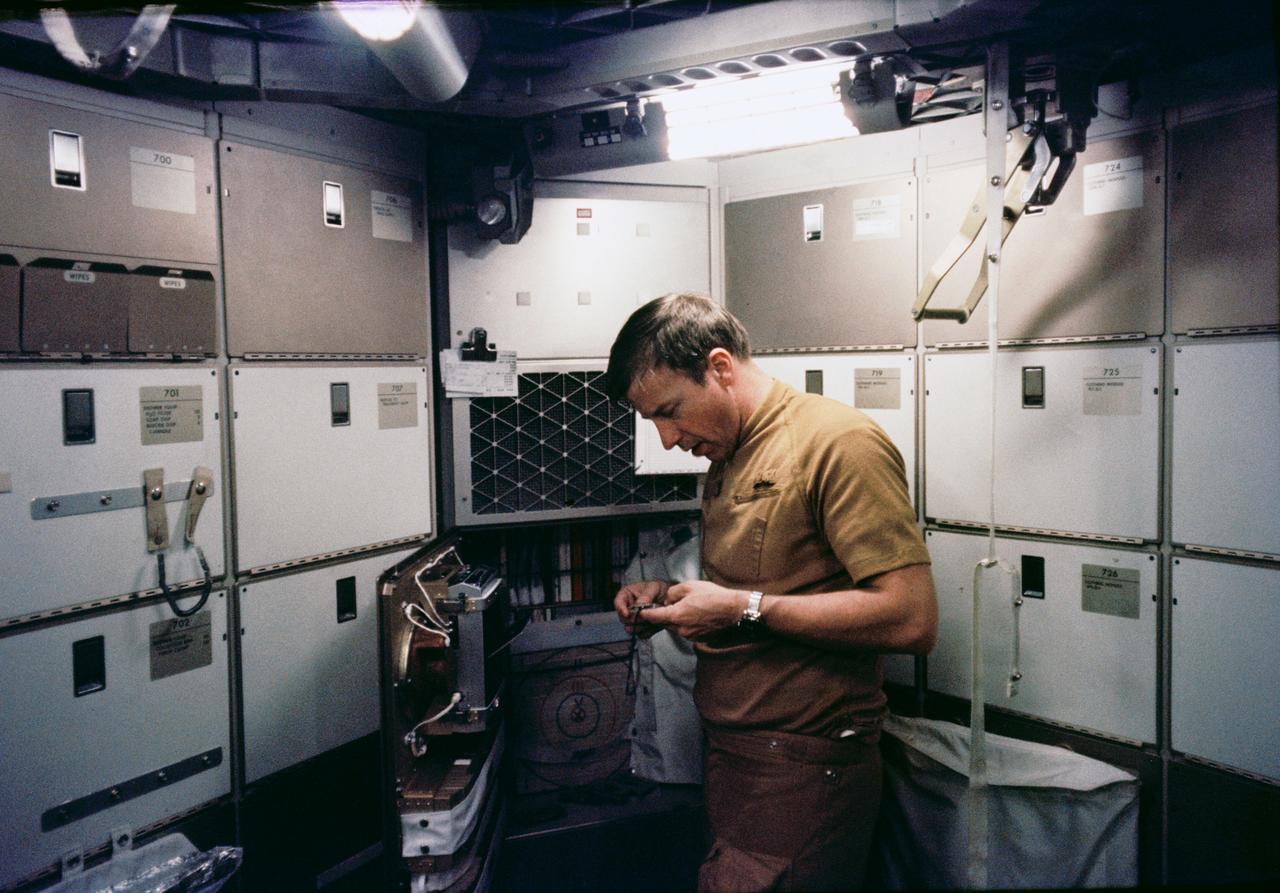
S73-17859 (January 1973) --- Astronaut Paul J. Weitz, pilot for Skylab 2 (first Skylab manned) mission, looks over off-duty recreational equipment in the crew quarters of the Skylab Orbital Workshop (OWS) trainer during Skylab simulation activity at the Manned Spacecraft Center. The equipment includes such items as tape decks and stereo music equipment, playing cards, darts, etc. The OWS is a component of the Skylab space station cluster which will be launched unmanned aboard a Saturn V in summer of 1973, and will be visited three times by three-man crews over an eight month period. Photo credit: NASA
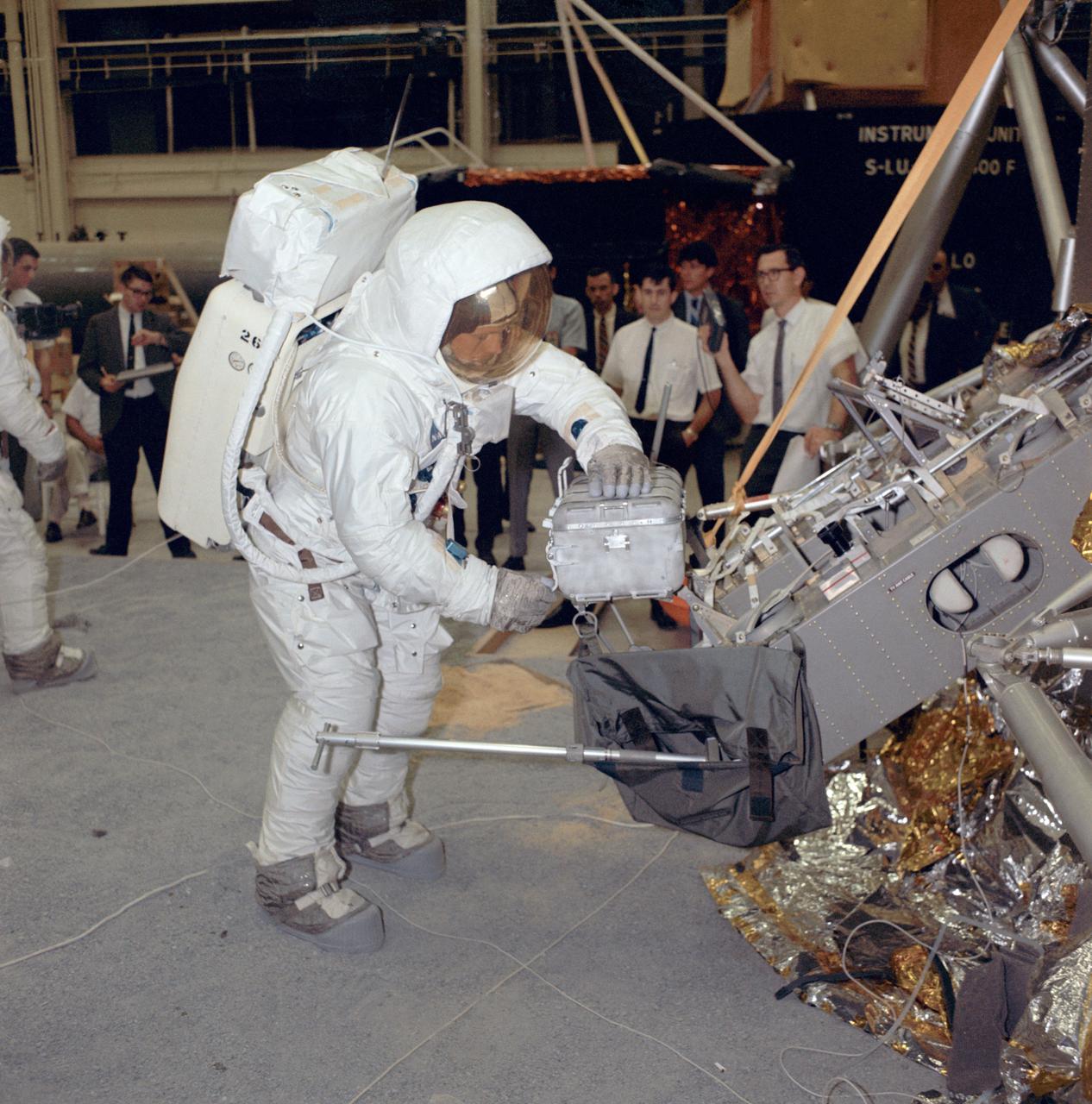
Apollo 11 commander Neil Armstrong works with an Apollo Lunar Sample Return Container during a two-and-a-half-hour lunar surface simulation training exercise. The image was taken on Apr. 18, 1969, in Building 9 at the Manned Spacecraft Center in Houston, Texas. The sample tubes carried by NASA's Mars 2020 Perseverance rover are destined to carry the first samples in history from another planet back to Earth. Future scientists will use these carefully selected representatives of Martian rock and regolith (broken rock and dust), to look for evidence of potential microbial life present in Mars' ancient past and to answer other key questions about Mars and its history. Perseverance will land at Mars' Jezero Crater on Feb. 18, 2021. https://photojournal.jpl.nasa.gov/catalog/PIA24297
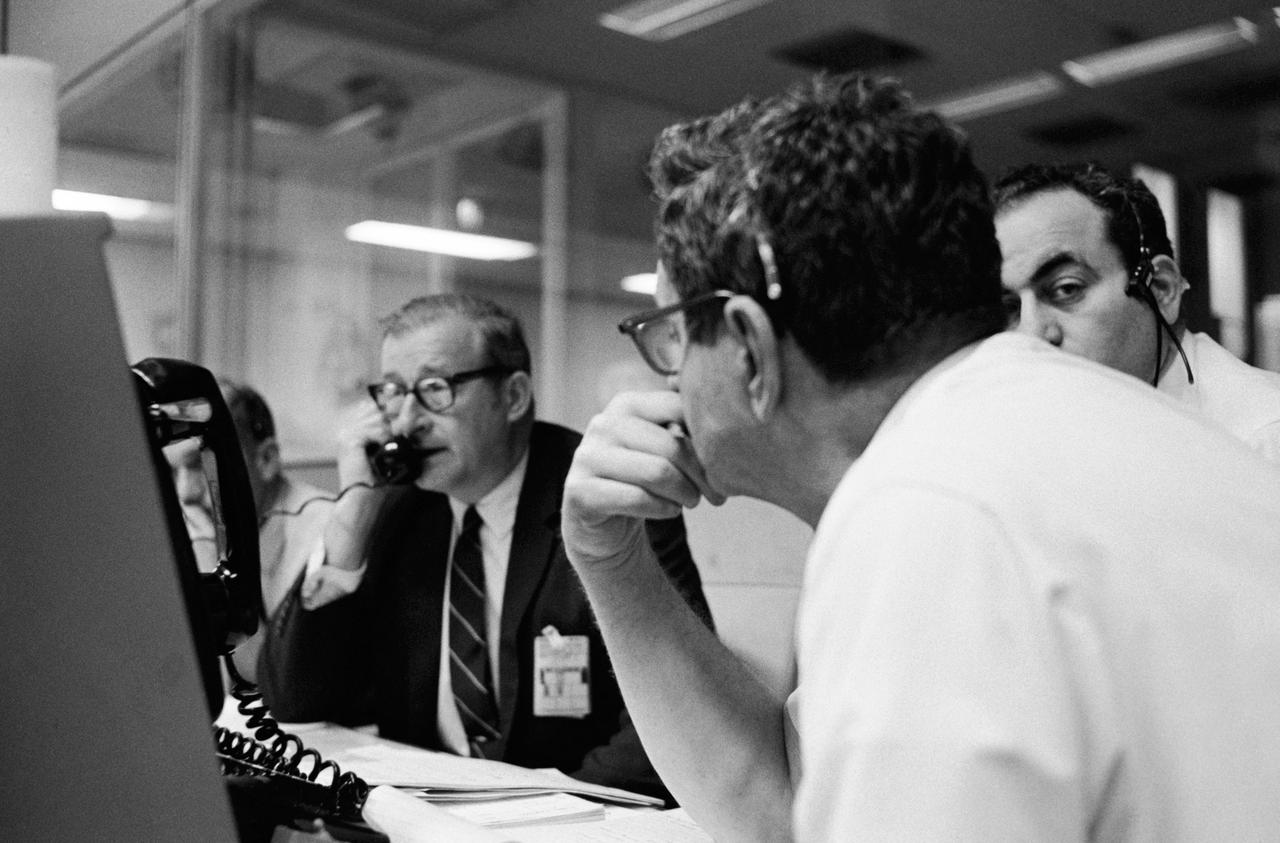
S70-34903 (14 April 1970) --- Dr. Thomas O. Paine, Administrator, National Aeronautics and Space Administration (NASA), talks on the telephone to President Richard M. Nixon. Dr. Paine is seated at his console in the Mission Operations Control Room (MOCR) at the Mission Control Center (MCC), Manned Spacecraft Center (MSC). Also pictured are Dr. Rocco Petrone, Apollo program director, Office Manned Spaceflight, NASA Headquarters (facing camera); and Chester M. Lee, Apollo mission director, Office of Manned Spaceflight, NASA Headquarters (HQ). Dr. Paine and the President were discussing the revised Apollo 13 flight plan following discovery of an oxygen cell failure in the Apollo 13 spacecraft several hours earlier.
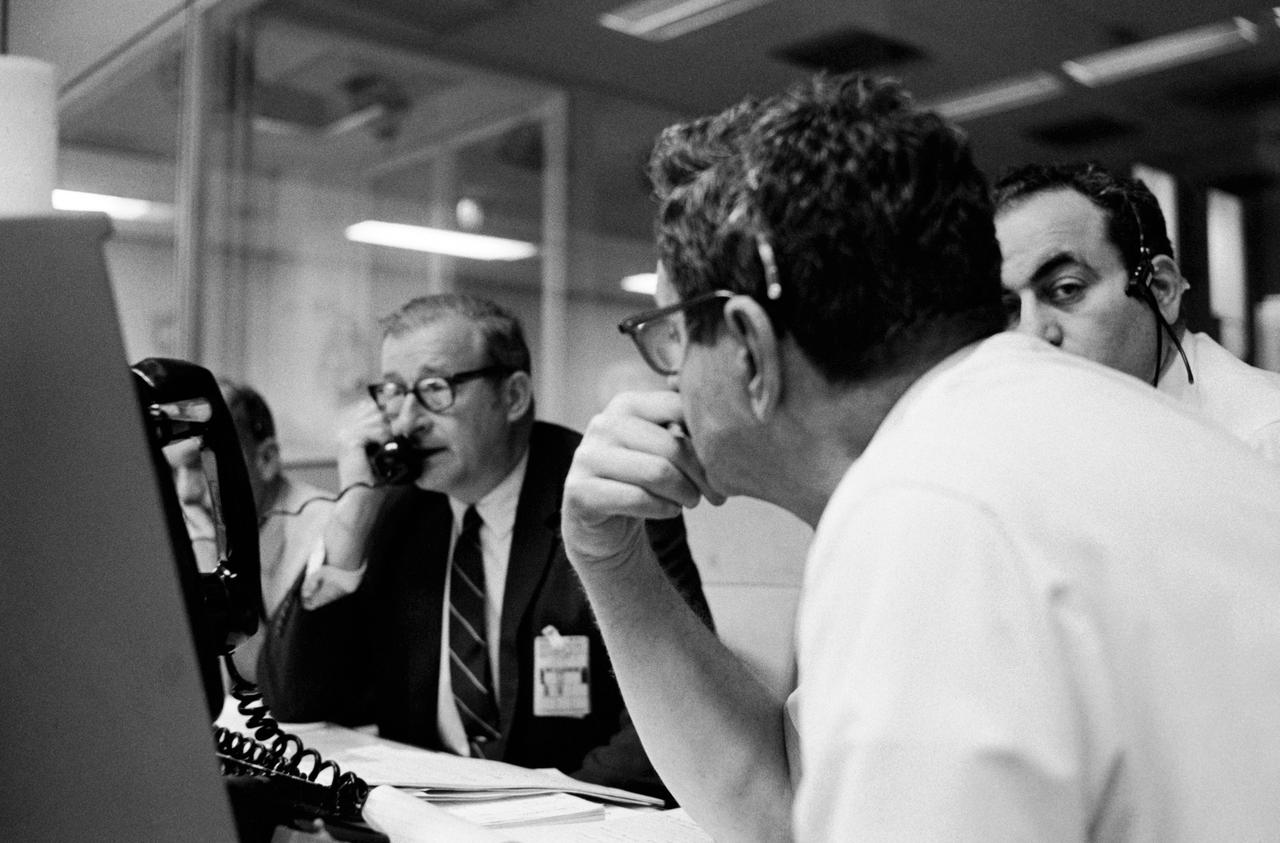
S70-34903 (14 April 1970) --- Dr. Thomas O. Paine, Administrator, National Aeronautics and Space Administration (NASA), talks on the telephone to President Richard M. Nixon. Dr. Paine is seated at his console in the Mission Operations Control Room (MOCR) at the Mission Control Center (MCC), Manned Spacecraft Center (MSC). Also pictured are Dr. Rocco Petrone, Apollo program director, Office Manned Spaceflight, NASA Headquarters (facing camera); and Chester M. Lee, Apollo mission director, Office of Manned Spaceflight, NASA Headquarters (HQ). Dr. Paine and the President were discussing the revised Apollo 13 flight plan following discovery of an oxygen cell failure in the Apollo 13 spacecraft several hours earlier.
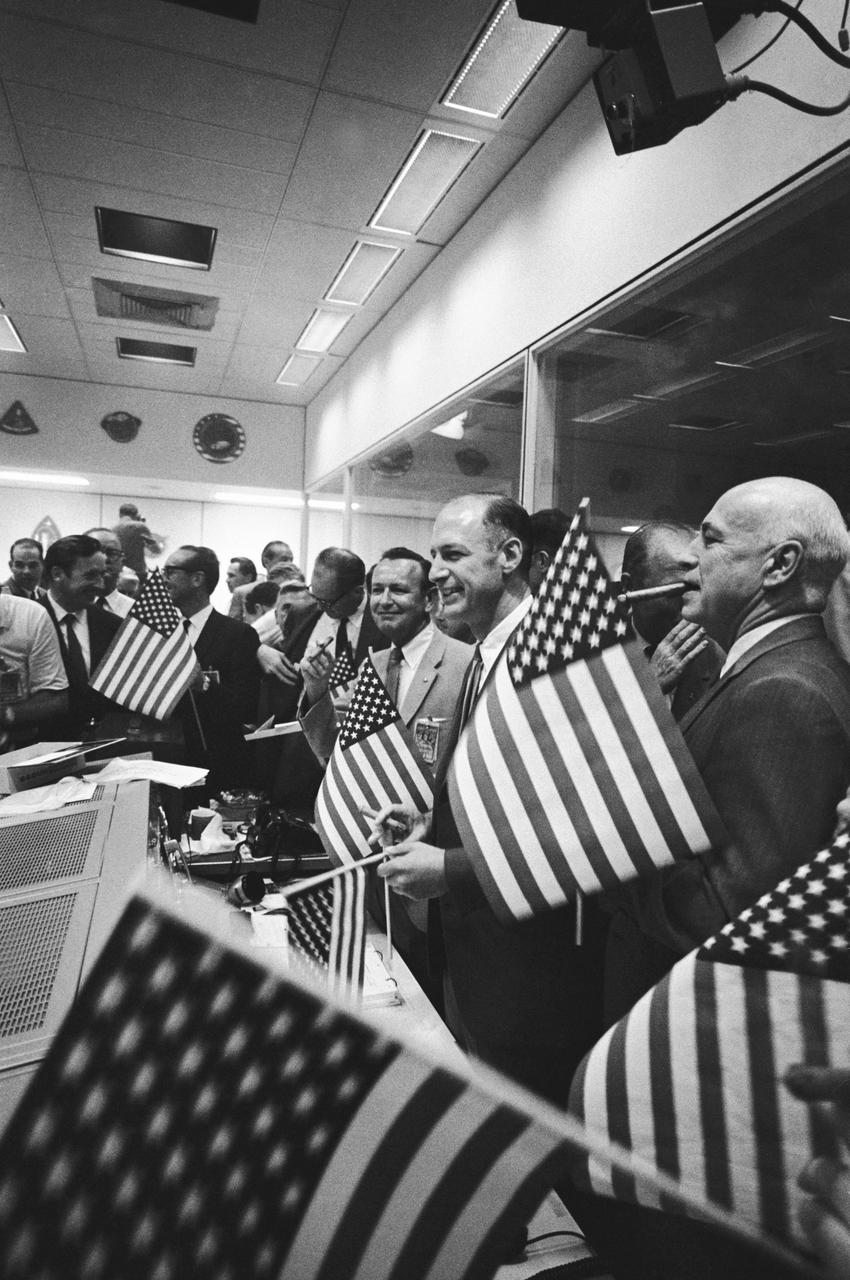
S69-40024 (24 July 1969) --- NASA and Manned Spacecraft Center (MSC) officials join in with the flight controllers, in the Mission Operations Control Room (MOCR) in the Mission Control Center (MCC), in celebrating the successful conclusion of the Apollo 11 lunar landing mission. Identifiable in the picture, starting in foreground, are Dr. Robert R. Gilruth, MSC Director; George M. Low, Manager, Apollo Spacecraft Program, MSC; Dr. Christopher C. Kraft Jr., MSC Director of Flight Operation; U.S. Air Force Lt. Gen. Samuel C. Phillips (with glasses, looking downward), Apollo Program Director, Office of Manned Space Flight, NASA Headquarters; and Dr. George E. Mueller (with glasses, looking toward left), Associate Administrator, Office of Manned Space Flight, NASA Headquarters. Former astronaut John H. Glenn Jr. is standing behind Mr. Low.
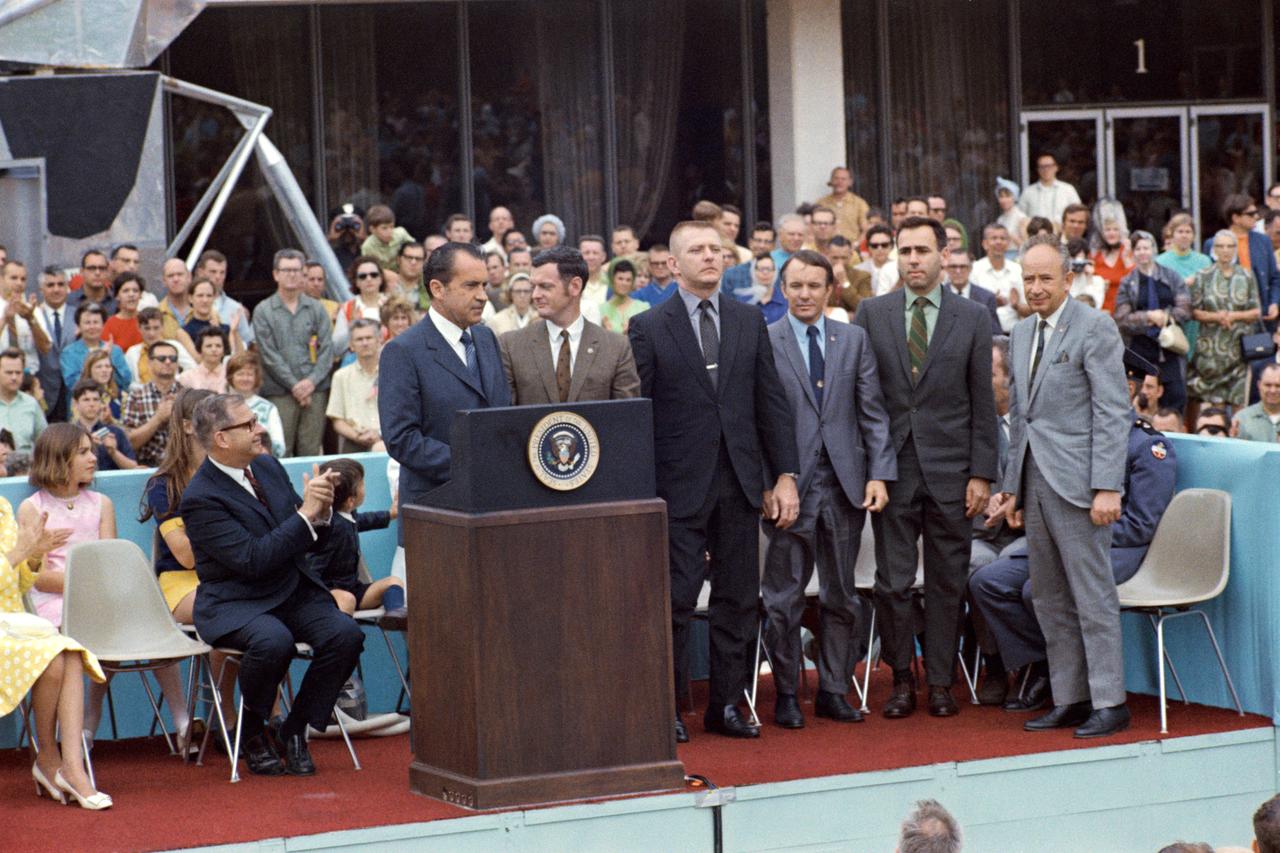
S70-35600 (18 April 1970) --- President Richard M. Nixon introduces Sigurd A. Sjoberg (far right), director of Flight Operations at Manned Spacecraft Center, and the four Apollo 13 flight directors during the President?s post-mission visit to the Manned Spacecraft Center. The flight directors are, from left to right, Glynn S. Lunney, Eugene A. Kranz, Gerald D. Griffin and Milton L. Windler. Dr. Thomas O. Paine, Administrator, National Aeronautics and Space Administration, is seated at left. President Nixon was on the site to present the Presidential Medal of Freedom - the nation?s highest civilian honor -to the Apollo 13 Mission Operations Team.
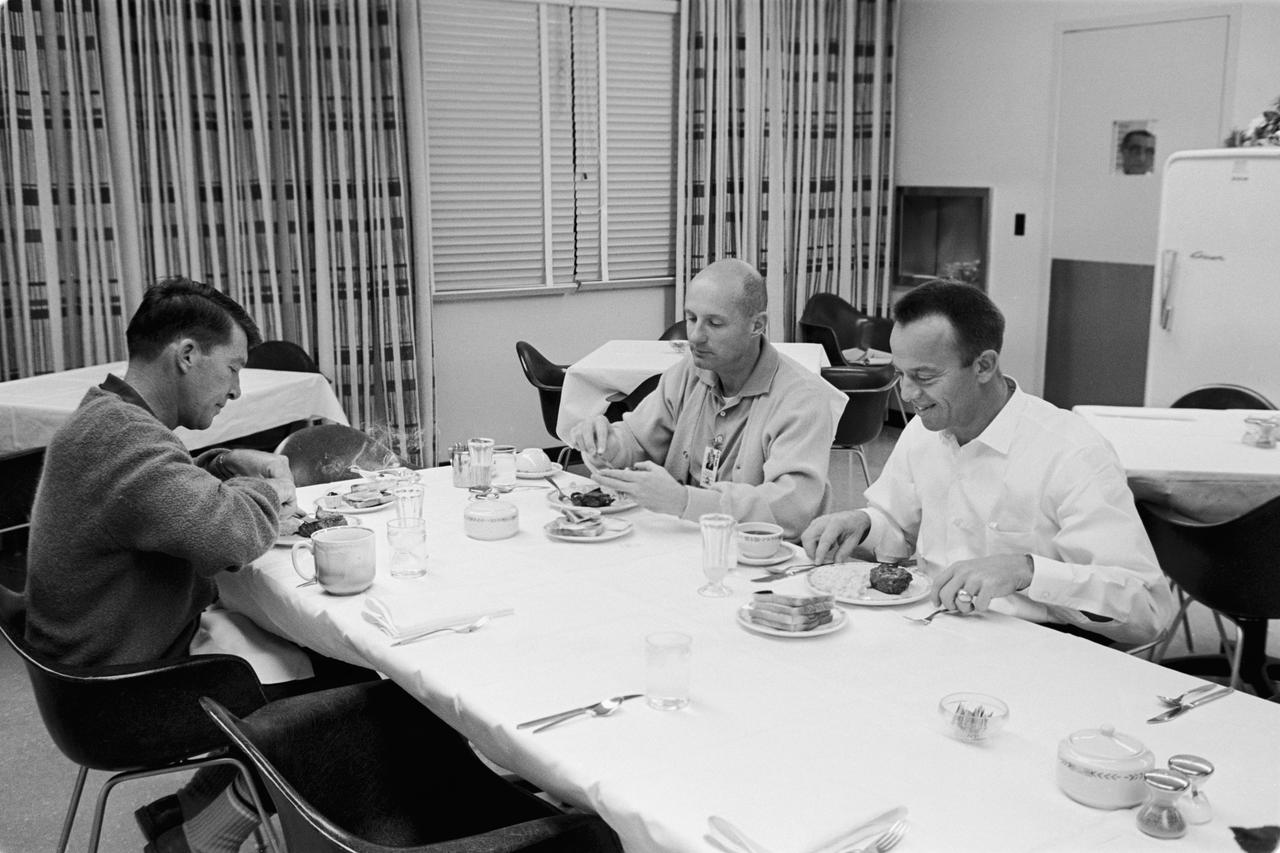
S65-61880 (15 Dec. 1965) --- Astronauts Walter M. Schirra Jr. (left), command pilot; and Thomas P. Stafford (center), pilot, enjoy a breakfast of steak and eggs in the Manned Spacecraft Operations Building, Merritt Island, during the Gemini-6 prelaunch countdown. Seated at right is astronaut Alan B. Shepard Jr., chief, Astronaut Office, Manned Spacecraft Center, Houston, Texas. Gemini-6 was successfully launched from Pad 19 at 8:37 a.m. (EST), Dec. 15, 1965. Photo credit: NASA or National Aeronautics and Space Administration
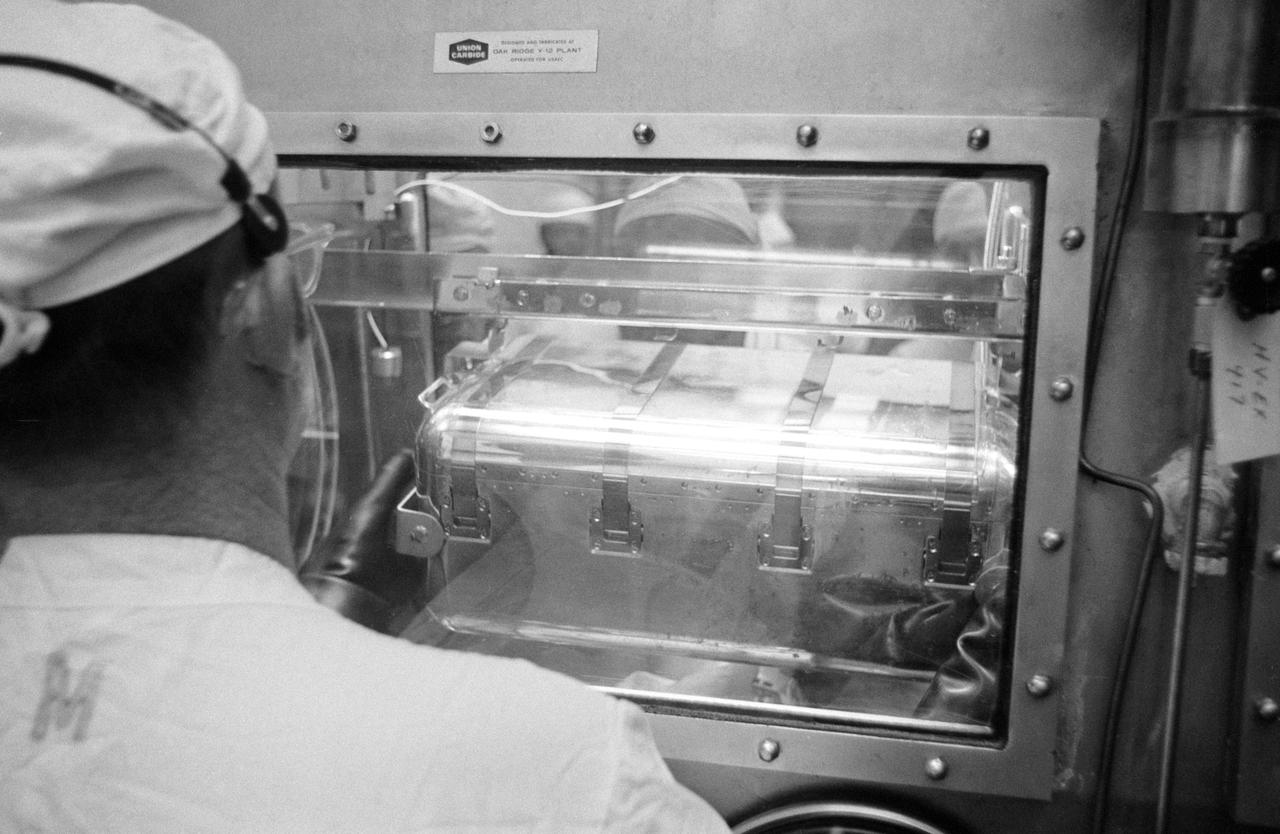
S69-40110 (25 July 1969) --- The first Apollo 11 sample return container, containing lunar surface material, is photographed just after it arrives at the Lunar Receiving Laboratory (LRL), Building 37, Manned Spacecraft Center (MSC). The box arrived by air at Ellington Air Force Base just before noon on Friday, July 25, 1969, from the Pacific recovery area. It was taken immediately to the Manned Spacecraft Center. The lunar samples were collected by astronauts Neil A. Armstrong and Edwin E. Aldrin Jr. during their lunar surface extravehicular activity (EVA).
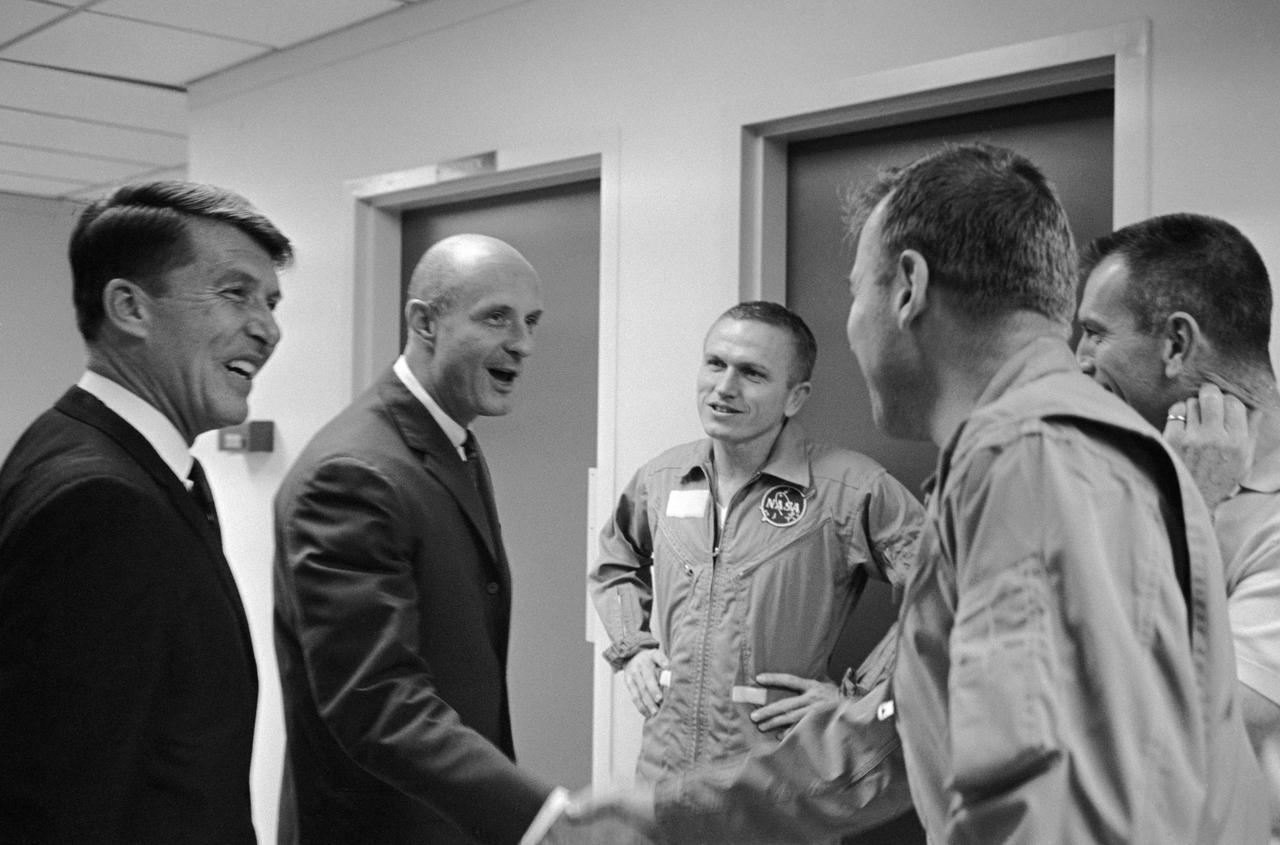
S65-66728 (19 Dec. 1965) --- This happy round of handshakes took place in the Manned Spacecraft Operations Building crew quarters, Merritt Island, as the Gemini-6 crew (left) welcomed the Gemini-7 crew back to the Kennedy Space Center. Left to right, are astronauts Walter M. Schirra Jr., Gemini-6 command pilot; Thomas P. Stafford, Gemini-6 pilot; Frank Borman, Gemini-7 command pilot; James A. Lovell Jr., Gemini-7 pilot; and Donald K. Slayton (partially hidden behind Lovell), assistant director for Flight Crew Operations, Manned Spacecraft Center, Houston. Photo credit: NASA
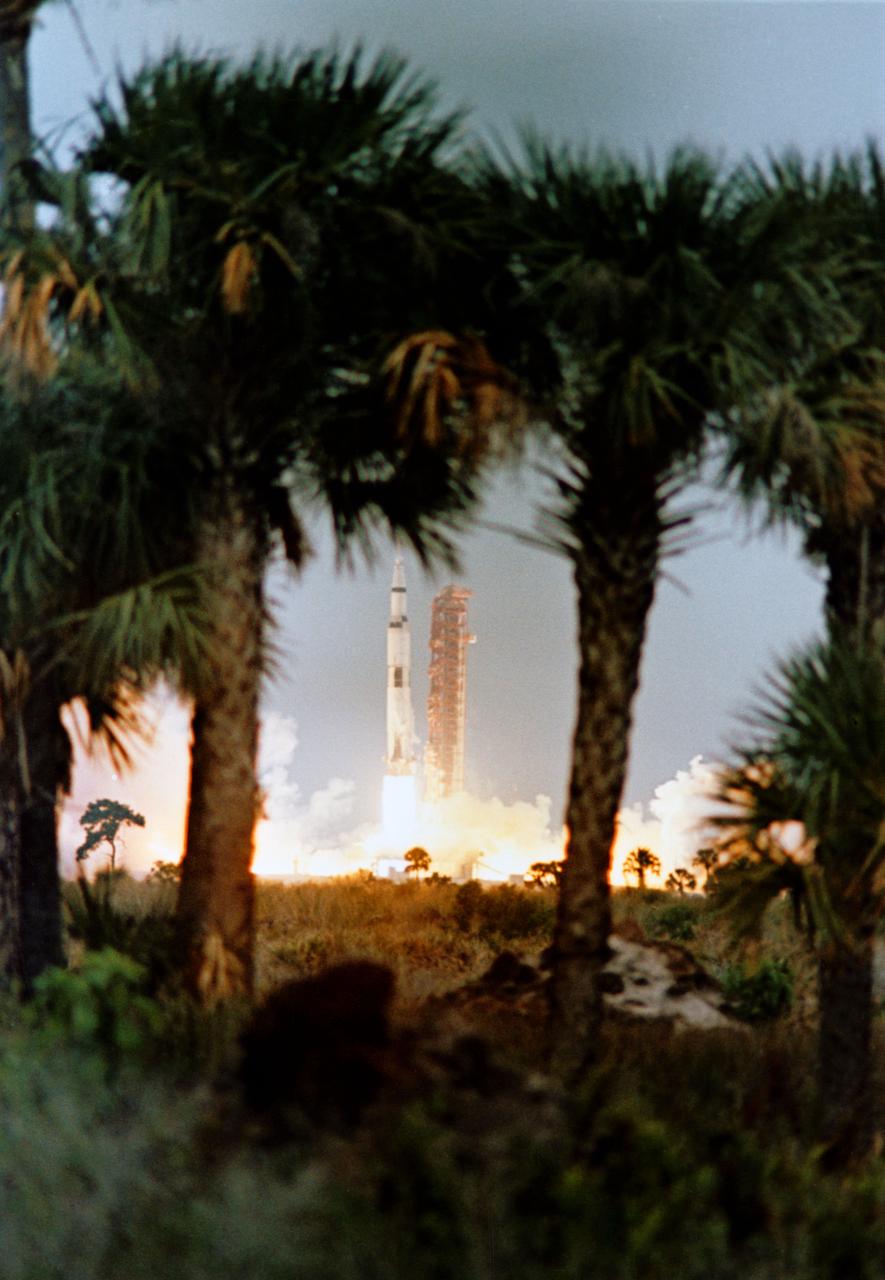
S69-25862 (3 March 1969) --- Framed by palm trees in the foreground, the Apollo 9 (Spacecraft 104/Lunar Module 3/ Saturn 504) space vehicle is launched from Pad A, Launch Complex 39, Kennedy Space Center (KSC) at 11 a.m. (EST), March 3, 1969. Aboard the spacecraft are astronauts James A. McDivitt, commander; David R. Scott, command module pilot; and Russell L. Schweickart, lunar module pilot. The Apollo 9 mission will evaluate spacecraft lunar module systems performance during manned Earth-orbital flight. Apollo 9 is the second manned Saturn V mission.
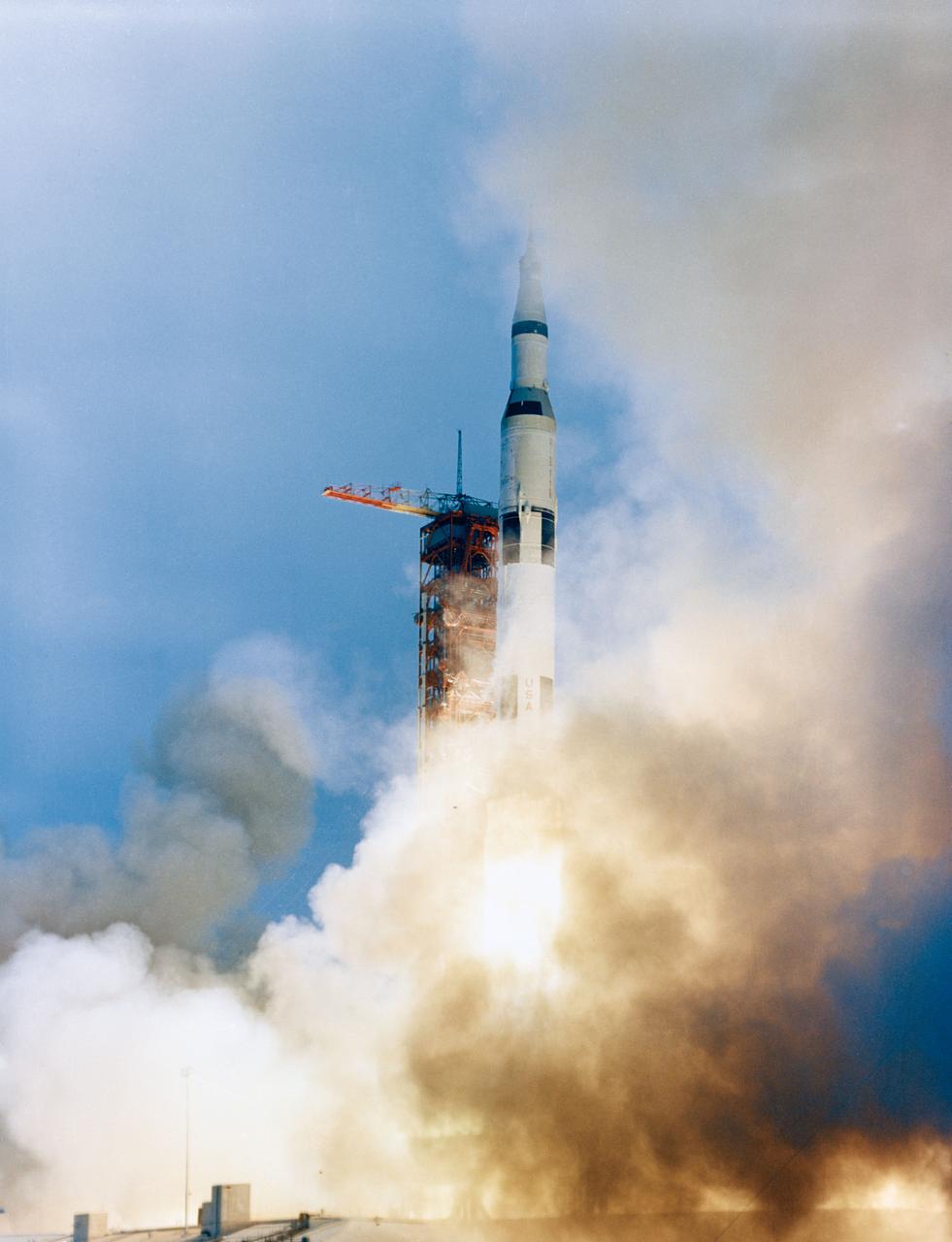
S69-25864 (3 March 1969) --- The Apollo 9 (Spacecraft 104/Lunar Module 3/Saturn 504) space vehicle is launched from Pad A, Launch Complex 39, Kennedy Space Center (KSC) at 11 a.m. (EST), March 3, 1969. Aboard the spacecraft are astronauts James A. McDivitt, commander; David R. Scott, command module pilot; and Russell L. Schweickart, lunar module pilot. The Apollo 9 mission will evaluate spacecraft lunar module systems performance during manned Earth-orbital flight. Apollo 9 is the second manned Saturn V mission.
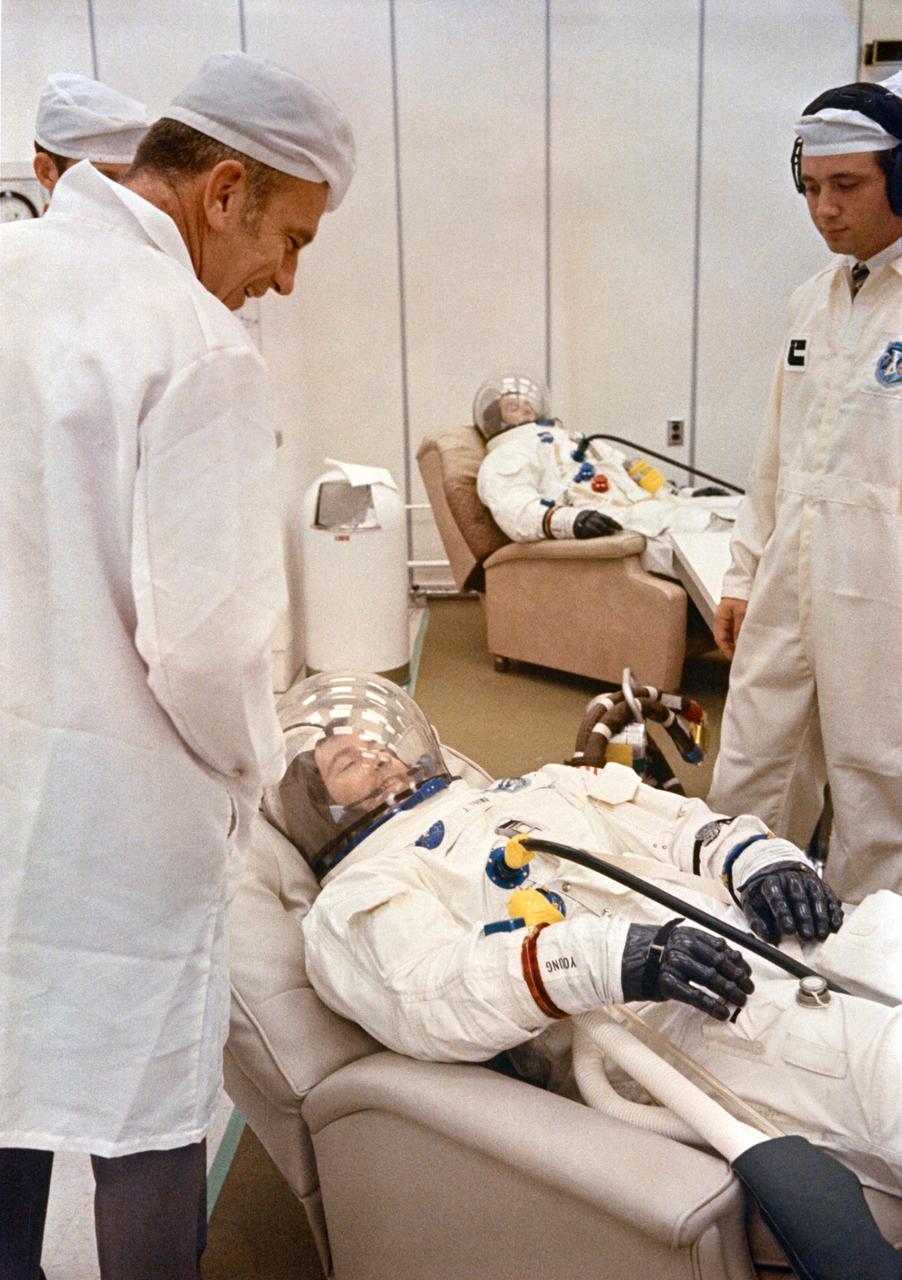
S69-34482 (18 May 1969) --- Astronaut John W. Young, Apollo 10 command module pilot, jokes with Donald K. Slayton (standing left), director of Flight Crew Operations, Manned Spacecraft Center, during Apollo 10 suiting up operations. On couch in background is astronaut Eugene A. Cernan, lunar module pilot. Astronauts Young; Cernan; and Thomas P. Stafford, commander, rode a transfer van from the Manned Spacecraft Operations Building over to Pad B, Launch Complex 39 where their spacecraft awaited them. Liftoff was at 12:49 p.m. (EDT), May 18, 1969.
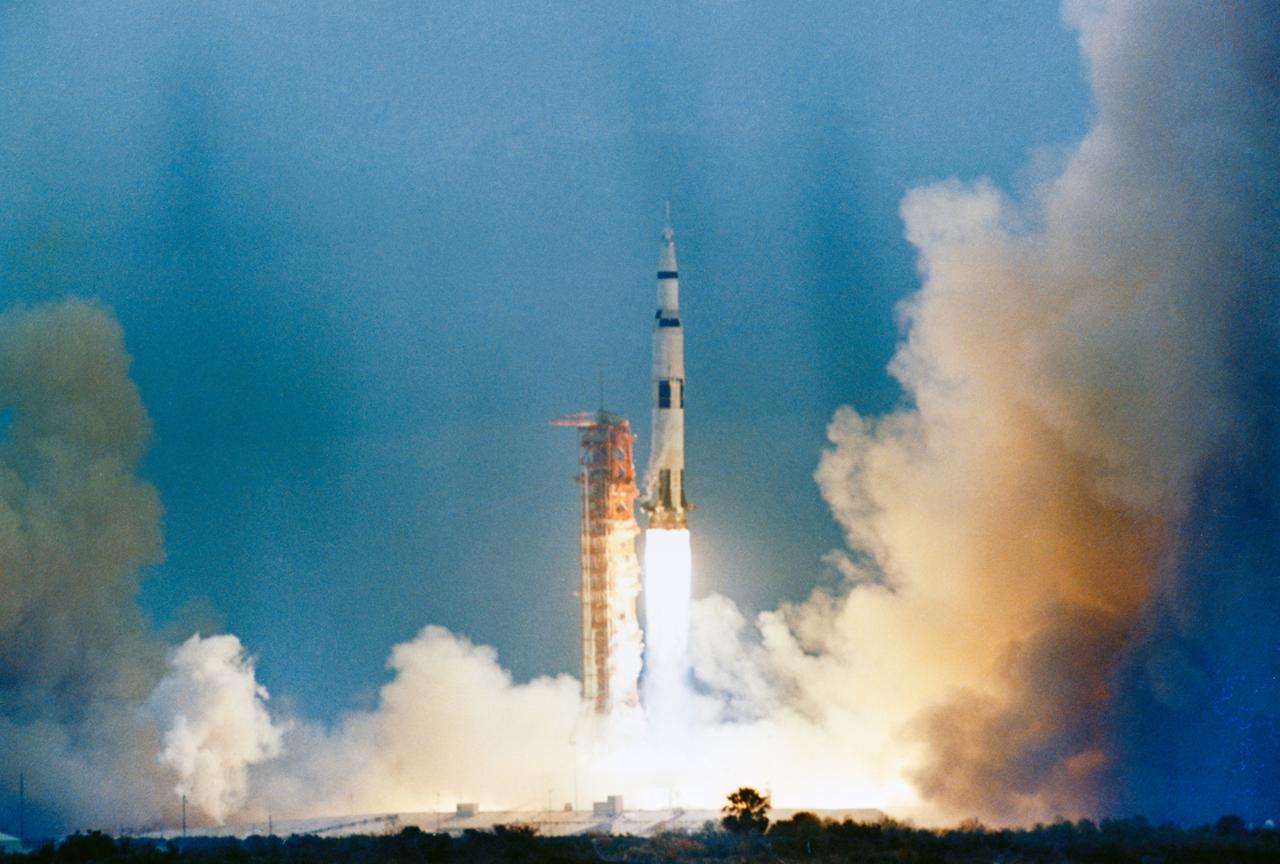
S69-25861 (3 March 1969) --- The Apollo 9 (Spacecraft 104/Lunar Module 3/ Saturn 504) space vehicle is launched from Pad A, Launch Complex 39, Kennedy Space Center (KSC) at 11 a.m. (EST), March 3, 1969. Aboard the spacecraft are astronauts James A. McDivitt, commander; David R. Scott, command module pilot; and Russell L. Schweickart, lunar module pilot. The Apollo 9 mission will evaluate spacecraft lunar module systems performance during manned Earth-orbital flight. Apollo 9 is the second manned Saturn V mission.
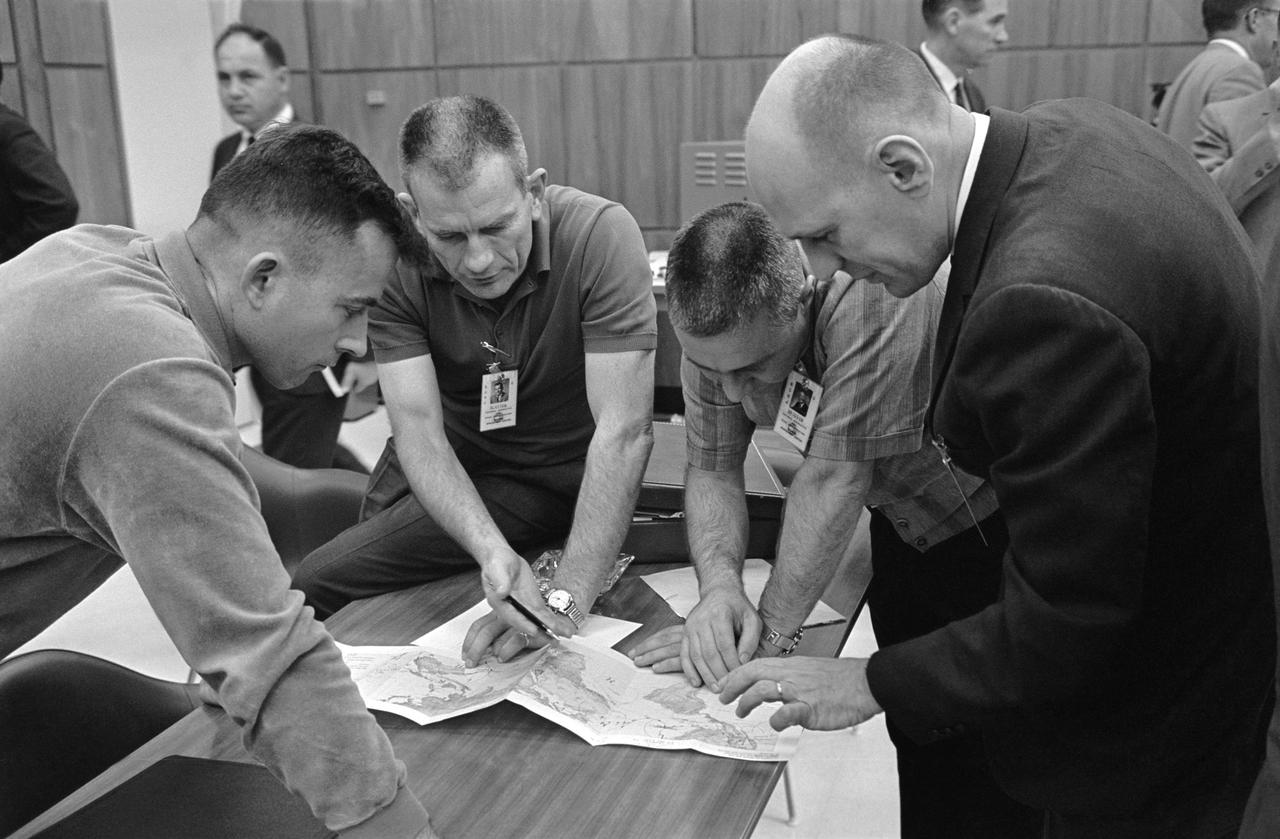
S65-20627 (20 March 1965) --- Crew members for the NASA Gemini-Titan 3 mission go over the map of the orbital track with Donald K. Slayton, assistant director for Flight Crew Operations, Manned Spacecraft Center. Shown (left to right) are astronauts John W. Young, pilot; Slayton; Virgil I. Grissom, command pilot; and Ken Nagler, U.S. Weather Bureau. The group got together at the GT-3 mission review meeting on March 20, 1965, in the Manned Spacecraft Operations Building on Merritt Island, Florida. Items covered at the review included mission description, spacecraft, launch vehicle, experiments, world-wide tracking network, recovery and weather.
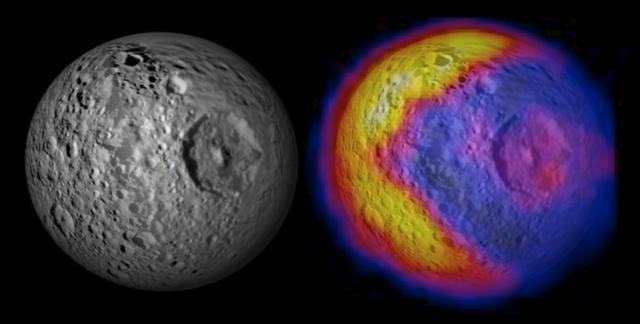
NASA release date March 29, 2010 The highest-resolution-yet temperature map and images of Saturn’s icy moon Mimas obtained by NASA’s Cassini spacecraft reveal surprising patterns on the surface of the small moon, including unexpected hot regions that resemble “Pac-Man” eating a dot, and striking bands of light and dark in crater walls. The left portion of this image shows Mimas in visible light, an image that has drawn comparisons to the "Star Wars" Death Star. The right portion shows the new temperature map, which resembles 1980s video game icon "Pac Man." To learn more about this image go to: <a href="http://www.nasa.gov/centers/goddard/news/features/2010/pac-man-mimas.html" rel="nofollow">www.nasa.gov/centers/goddard/news/features/2010/pac-man-m...</a> Credit: NASA/JPL/Goddard/SWRI/SSI <b><a href="http://www.nasa.gov/centers/goddard/home/index.html" rel="nofollow">NASA Goddard Space Flight Center</a></b> is home to the nation's largest organization of combined scientists, engineers and technologists that build spacecraft, instruments and new technology to study the Earth, the sun, our solar system, and the universe.
![Apollo spacecraft 017 leaves the Manned Spacecraft Operations Building at Kennedy Space Center on its way to the Vehicle Assembly Building where it will be mated with the Saturn 501 launch vehicle. The first flight of the Saturn V [AS-501], an unmanned mission, is scheduled for this fall.](https://images-assets.nasa.gov/image/KSC-67P-0259/KSC-67P-0259~medium.jpg)
Apollo spacecraft 017 leaves the Manned Spacecraft Operations Building at Kennedy Space Center on its way to the Vehicle Assembly Building where it will be mated with the Saturn 501 launch vehicle. The first flight of the Saturn V [AS-501], an unmanned mission, is scheduled for this fall.
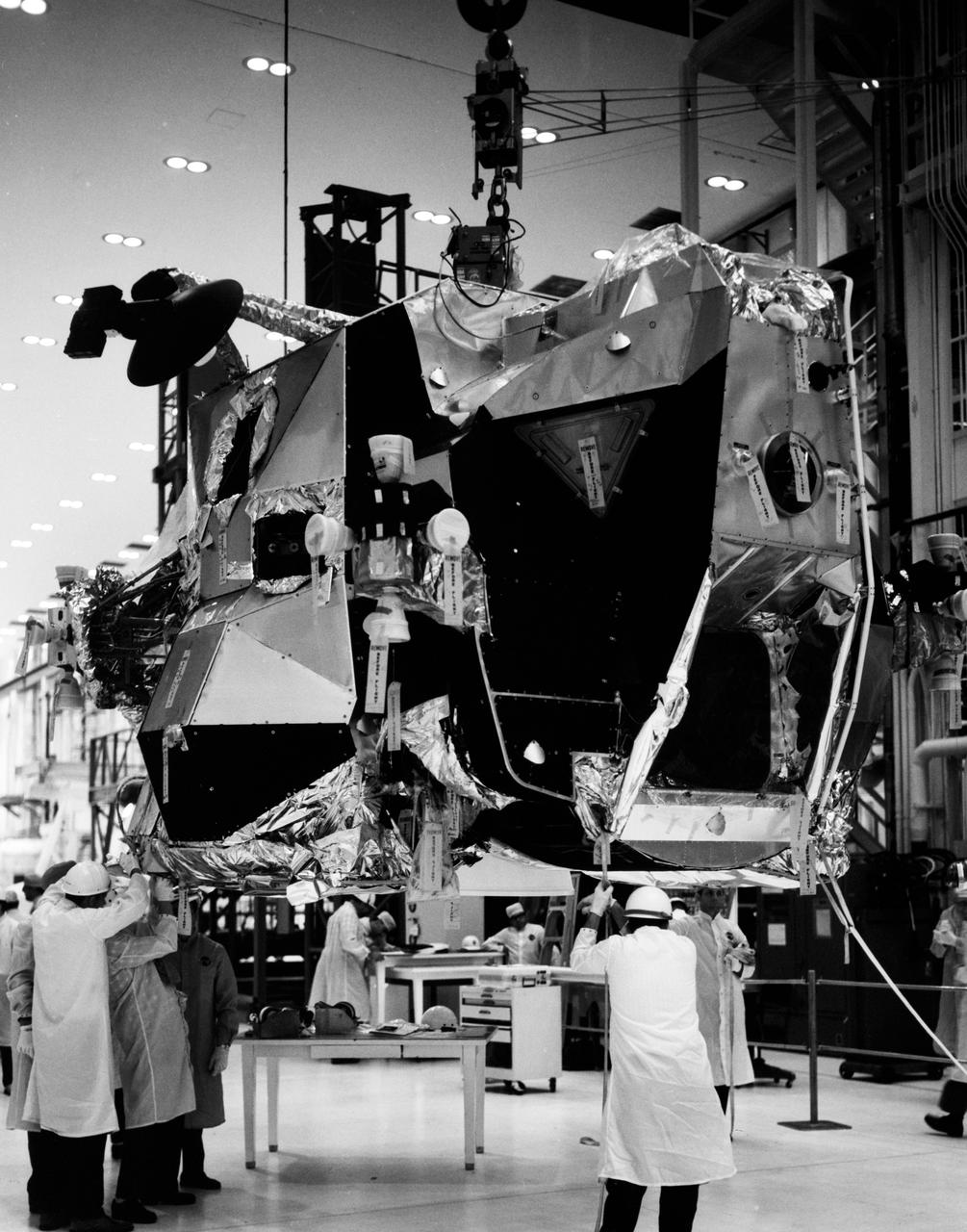
S69-25979 (December 1968) --- The ascent stage of Lunar Module-4 is moved from work stand into altitude chamber in the Kennedy Space Center's Manned Spacecraft Operations Building. Lunar Module-4 will be flown on the Apollo 10 (Spacecraft 106/Saturn 505) lunar orbit mission.
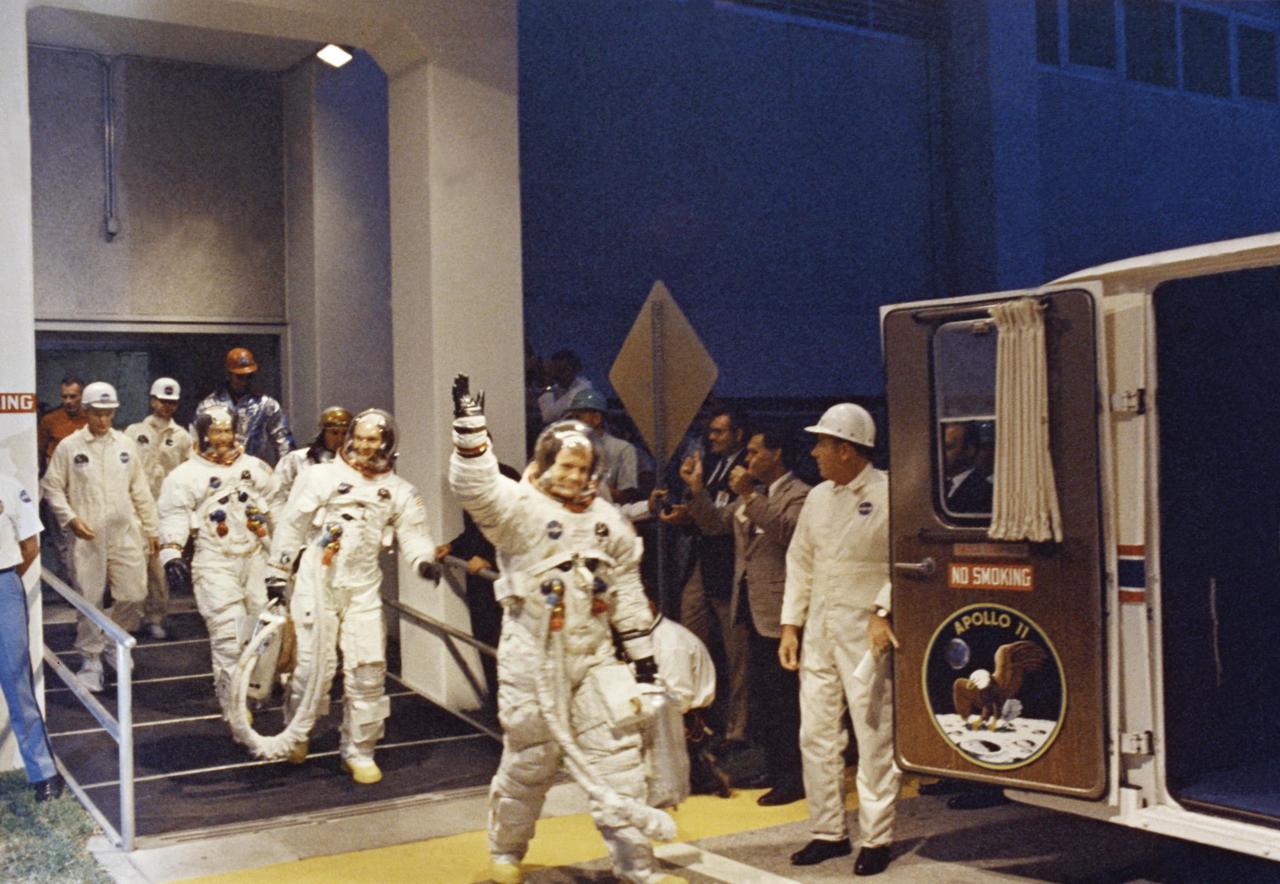
KENNEDY SPACE CENTER, FLA. -- Apollo 11 Commander Neil A. Armstrong leads Astronauts Michael Collins and Edwin E. Aldrin, Jr., from the Manned Spacecraft Operations Building to the transfer van for the eight mile trip to Pad 39A. Liftoff of Apollo 11 is scheduled at 9:32 a.m. EDT, which will begin man’s first lunar landing mission.
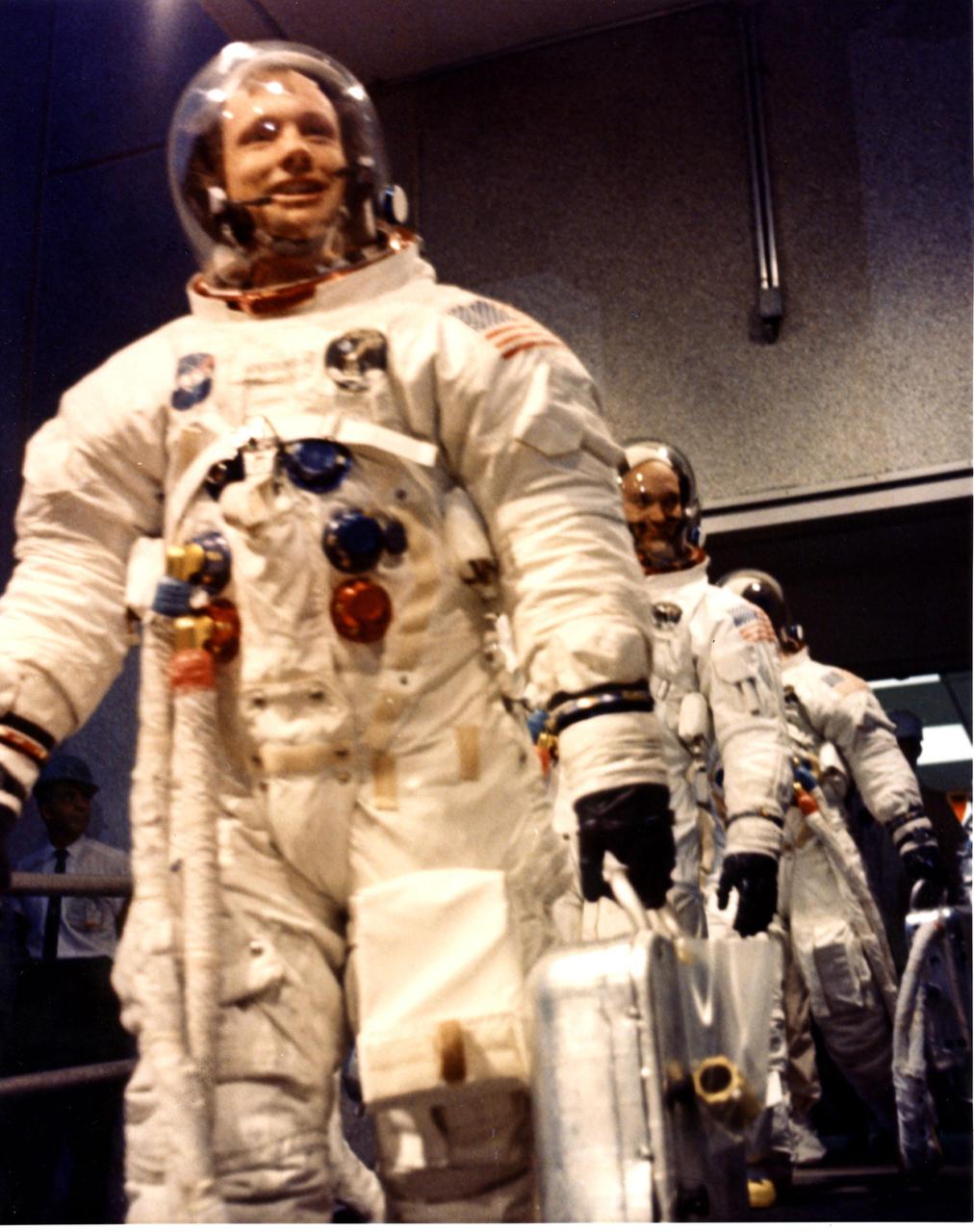
KENNEDY SPACE CENTER, FLA. - Apollo 11 Commander Neil A. Armstrong leads astronauts Michael Collins and Edwin E. Aldrin Jr. from the Manned Spacecraft Operations Building to the transfer van for the eight-mile trip to Pad 39A. Liftoff of Apollo 11 is scheduled at 9:32 a.m. EDT, which will begin man's first lunar landing mission.
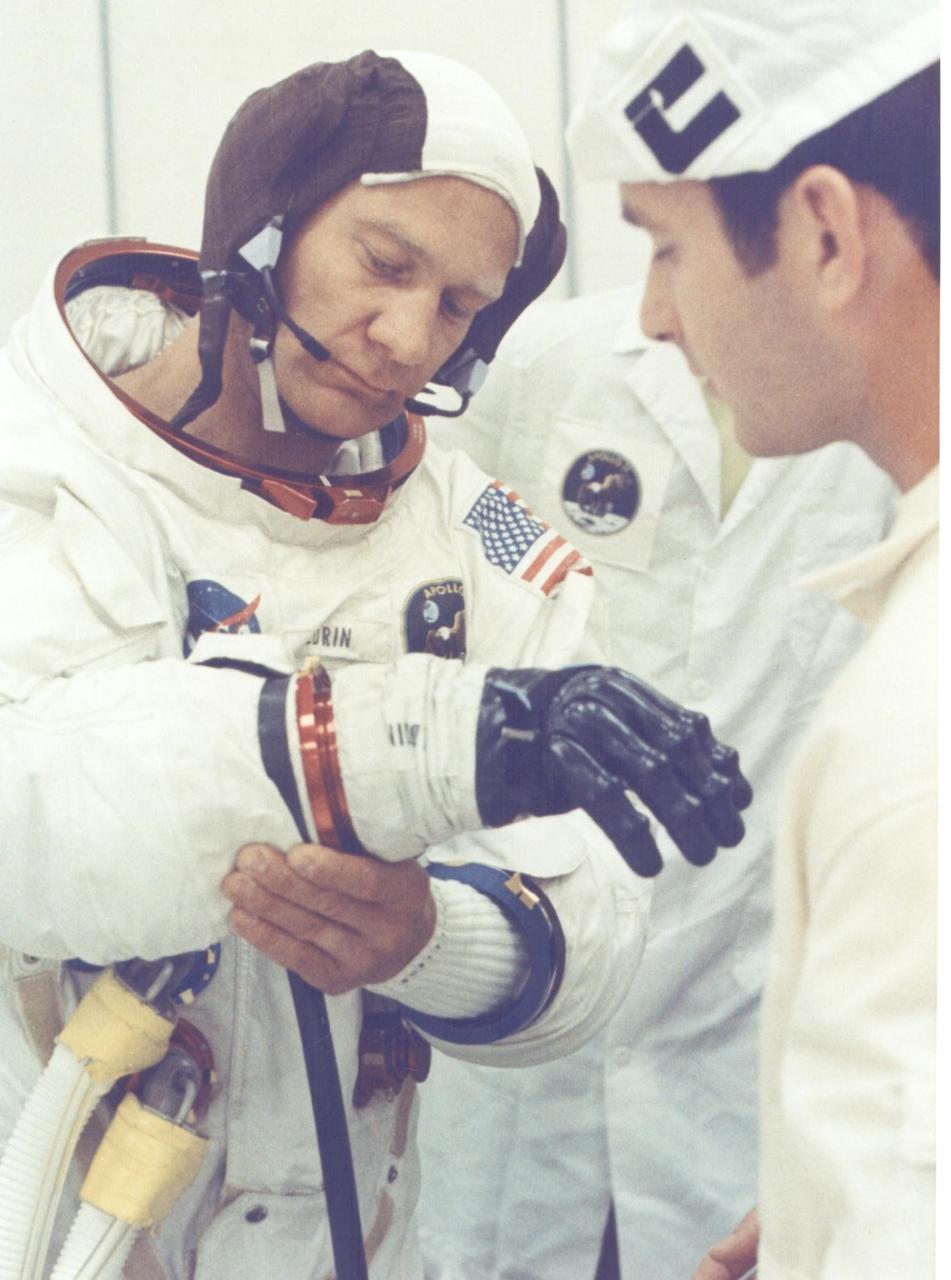
KENNEDY SPACE CENTER, FLA. - Apollo 11 astronaut Edwin E. Aldrin Jr. is being assisted by a spacesuit technician during suiting operations in the Manned Spacecraft Operations Building prior to the astronauts' departure to Launch Pad 39A. The three astronauts, Edwin E. Aldrin Jr., Neil A Armstrong and Michael Collins, will then board the Saturn V launch vehicle, scheduled for a 9:32 a.m. EDT liftoff for the first manned lunar landing mission.
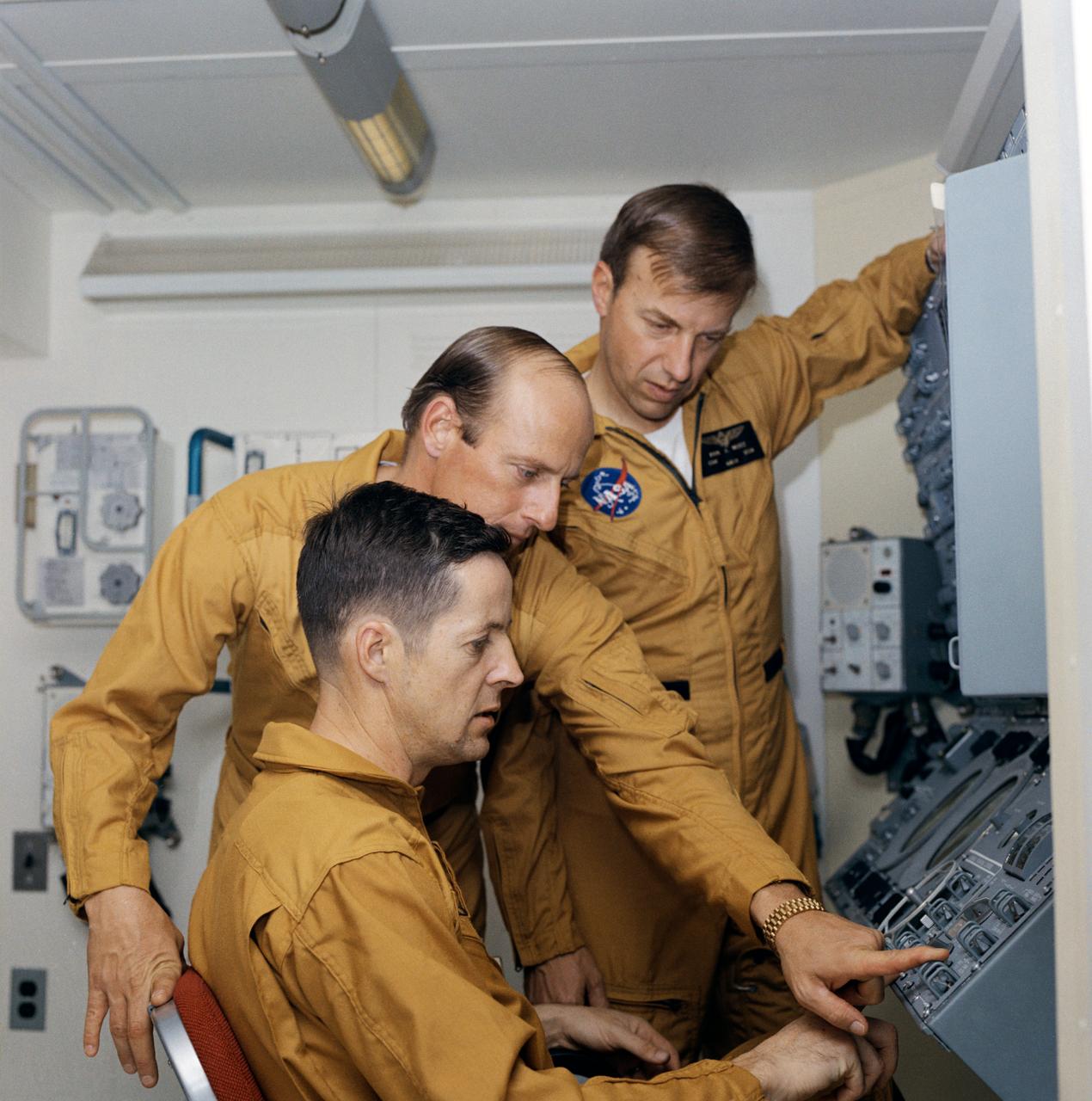
S72-17512 (19 Jan. 1972) --- These three men are the crewmen for the first manned Skylab mission. They are astronaut Charles Conrad Jr., commander, standing left; scientist-astronaut Joseph P. Kerwin, seated; and astronaut Paul J. Weitz, pilot. They were photographed and interviewed during an "open house" press day in the realistic atmosphere of the Multiple Docking Adapter (MDA) trainer in the Mission Simulation and Training Facility at the Manned Spacecraft Center (MSC). The control and display panel for the Apollo Telescope Mount (ATM) is at right. Photo credit: NASA
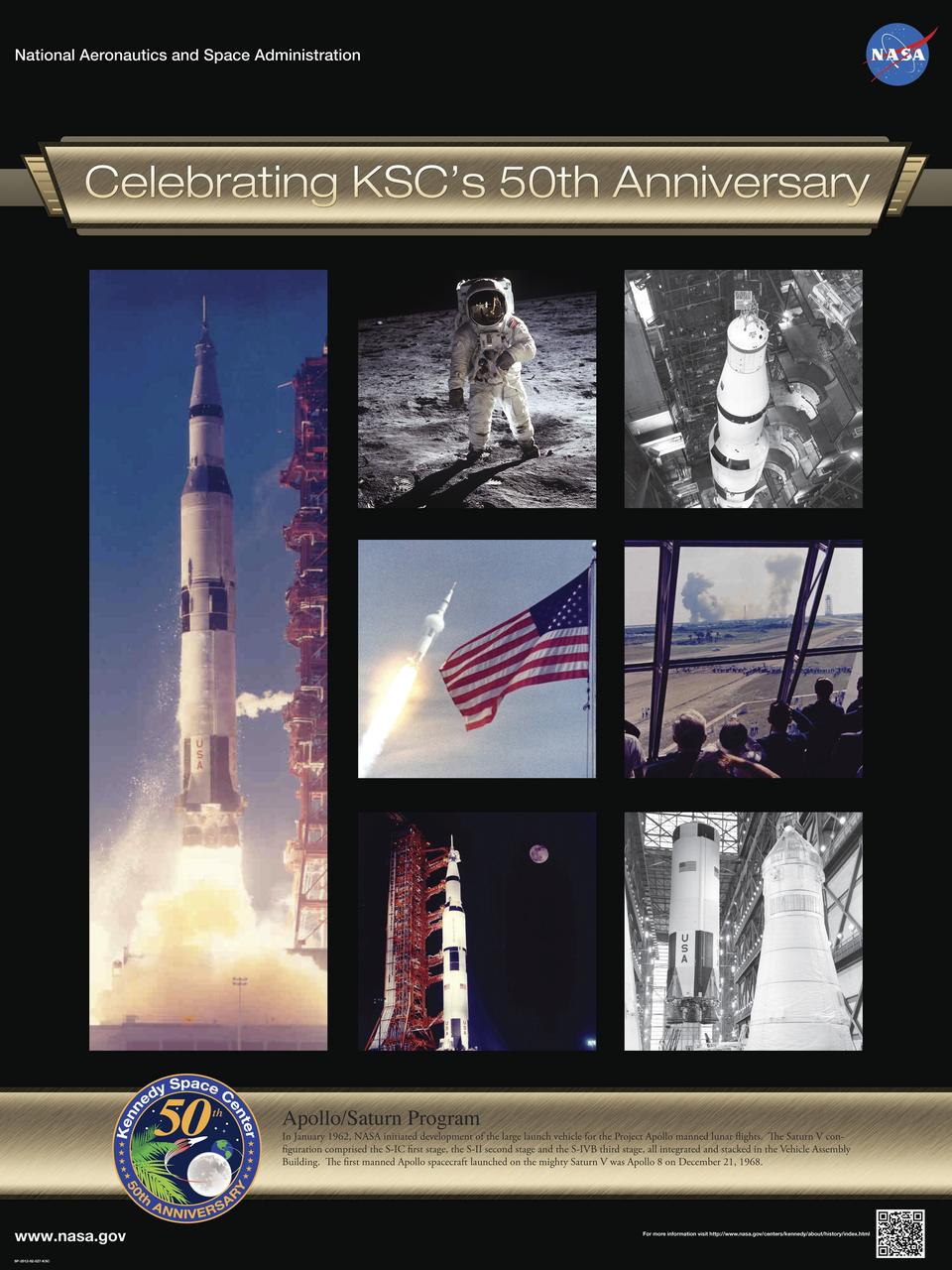
Apollo/Saturn Program: In January 1962, NASA initiated development of the large launch vehicle for the Project Apollo manned lunar flights. The Saturn V configuration comprised the S-IC first stage, the S-II second stage and the S-IVB third stage, all integrated and stacked in the Vehicle Assembly Building. The first manned Apollo spacecraft launched on the mighty Saturn V was Apollo 8 on December 21, 1968. Poster designed by Kennedy Space Center Graphics Department/Greg Lee. Credit: NASA
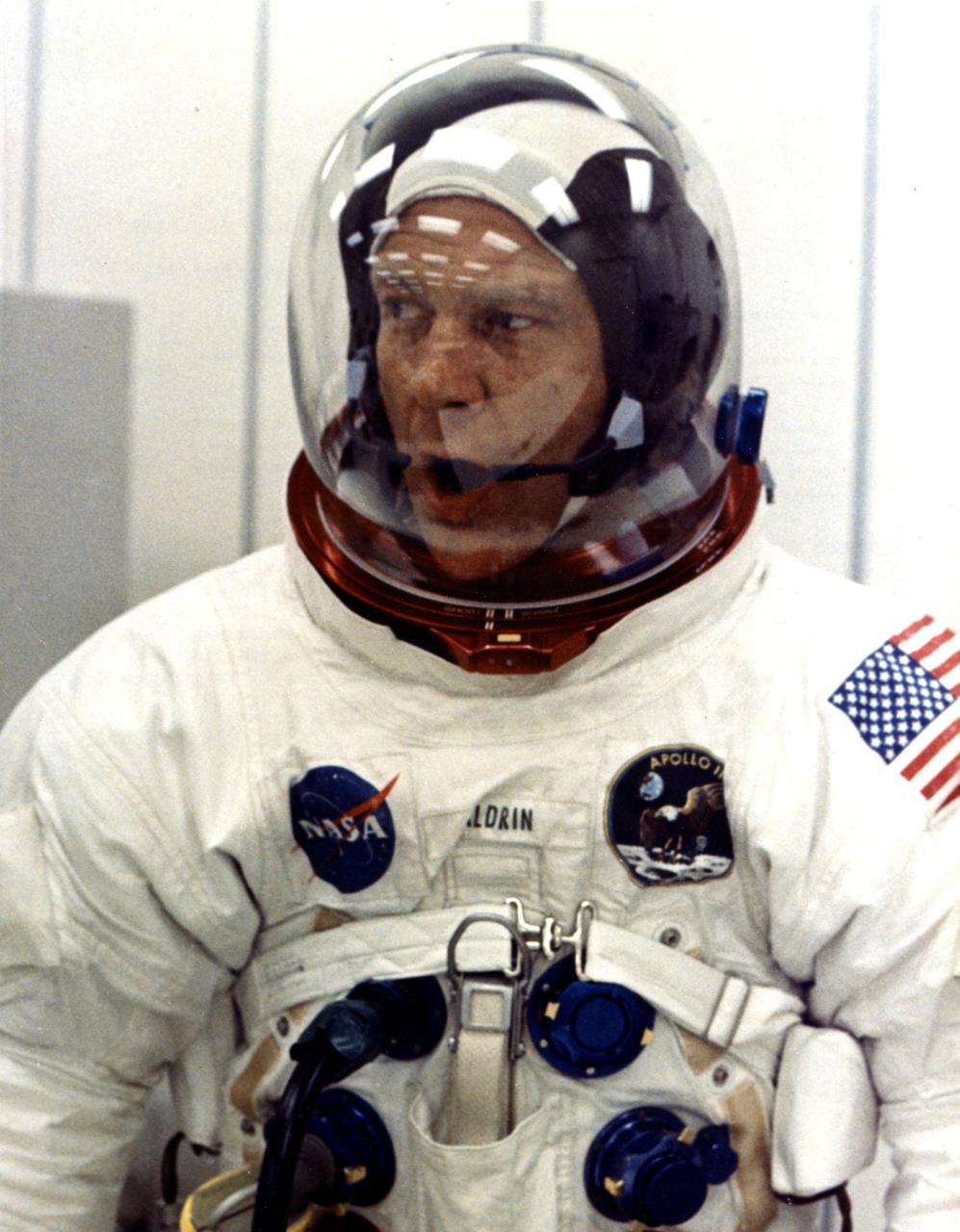
KENNEDY SPACE CENTER, FLA. -- Apollo 11 astronaut Edwin E. Aldrin Jr. appears to be relaxed during suiting operations in the Manned Spacecraft Operations Building (MSOB) prior to the astronauts' departure to Launch Pad 39A. The three astronauts, Edwin E. Aldrin Jr., Neil A. Armstrong and Michael Collins, will then board the Saturn V launch vehicle, scheduled for a 9:32 a.m. EDT liftoff, for the first manned lunar landing mission
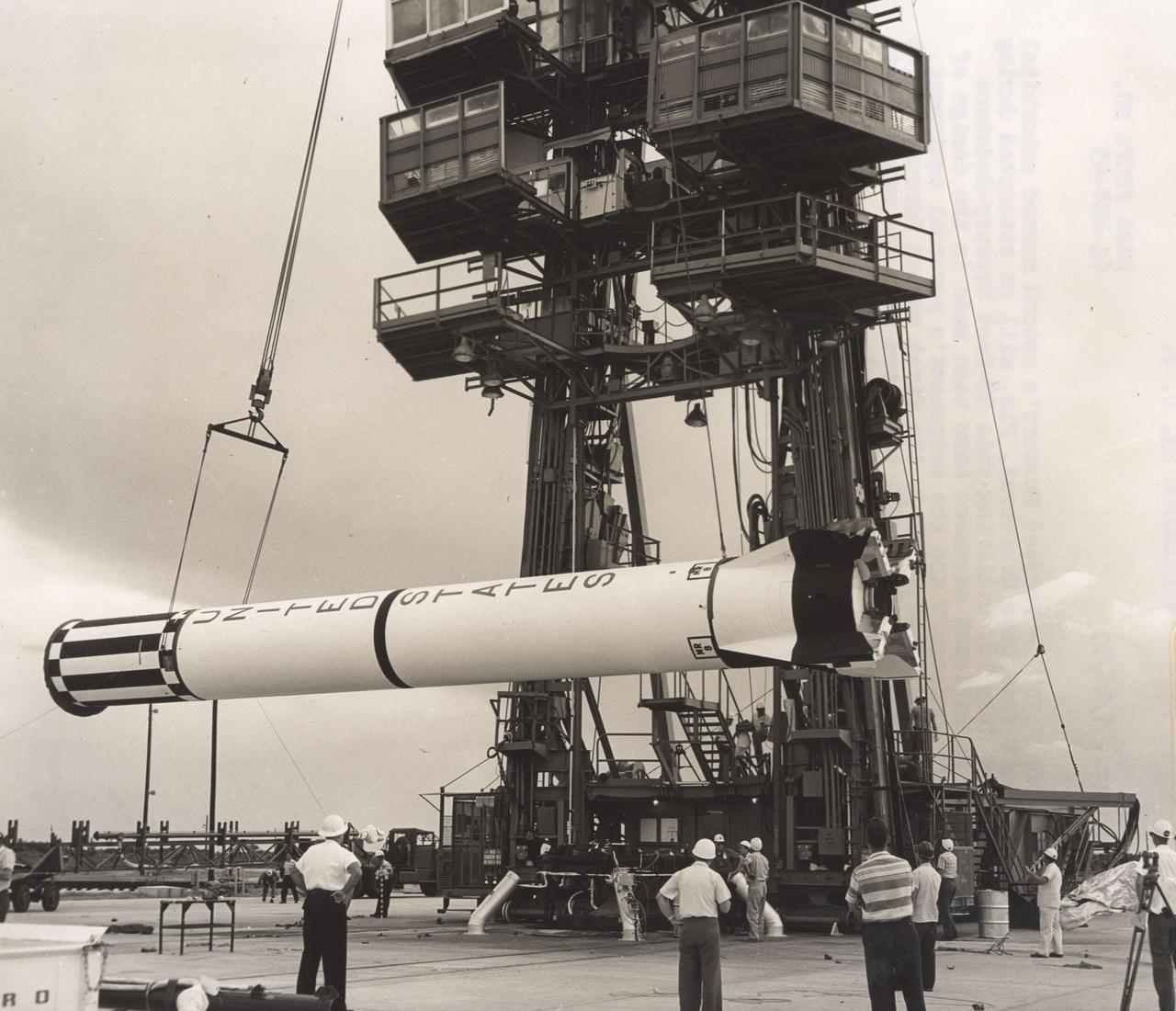
KENNEDY SPACE CENTER, FLA. -- READIED FOR FLIGHT - Project Mercury's second manned suborbital space flight, Liberty Bell 7, from Cape Canaveral, Fla., will be attempted during the week of July 16, utilizing this 58-foot Mercury-Redstone vehicle. Significant advances have been made in the design of the Mercury spacecraft and the astronaut's personal equipment. Flight will be similar to MR-3, the first manned Mercury flight May 5, 1961; however, the pilot will have more time for making Earth and celestial observations. (NASA Photo)
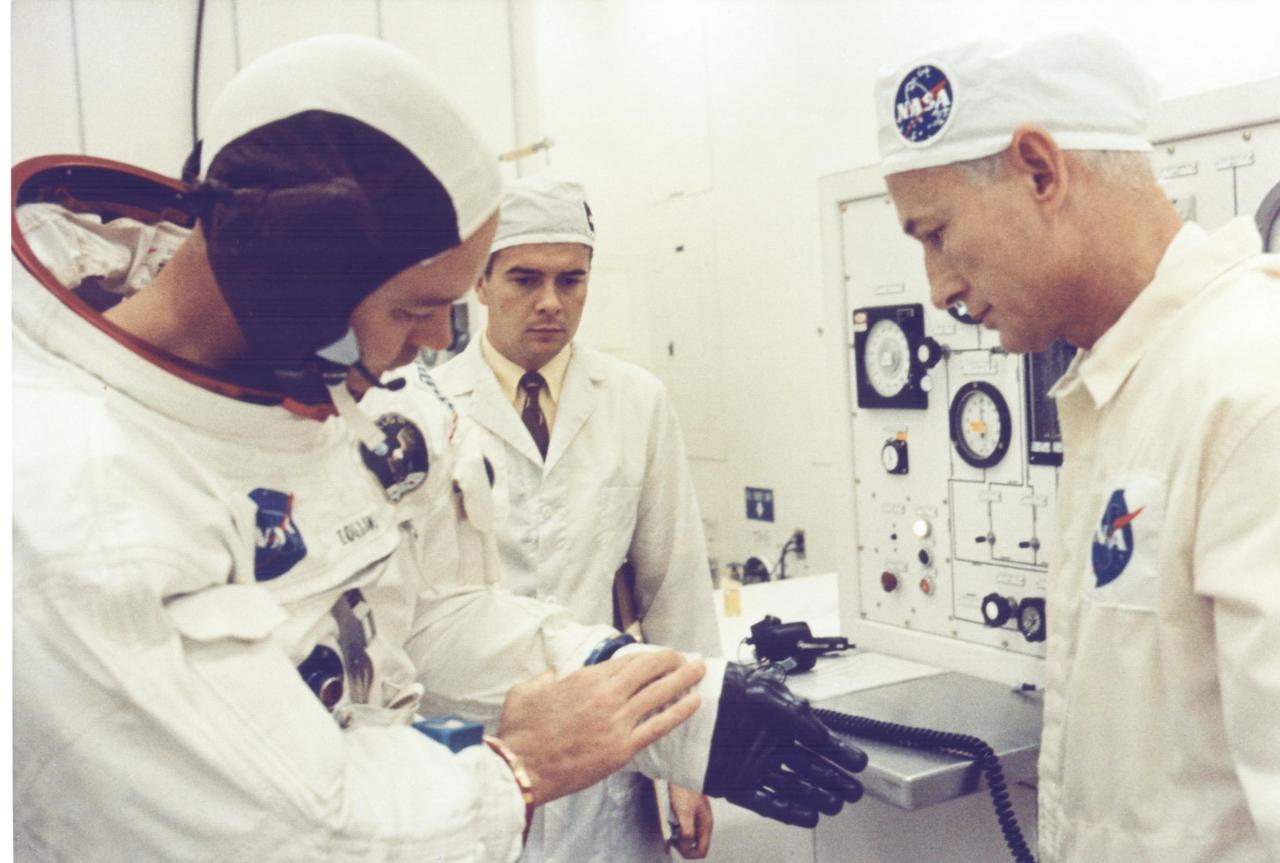
KENNEDY SPACE CENTER, FLA. - Apollo 11 Command Module Pilot Michael Collins appears to be explaining a point about his spacesuit glove to technician Joe Schmitt during suiting operations in the Manned Spacecraft Operations Building prior to the astronauts' departure to Launch Pad 39A. The three astronauts, Edwin E. Aldrin Jr., Neil A. Armstrong and Michael Collins will then board the Saturn V launch vehicle, scheduled for a 9:32 a.m. EDT liftoff for the first manned lunar landing.
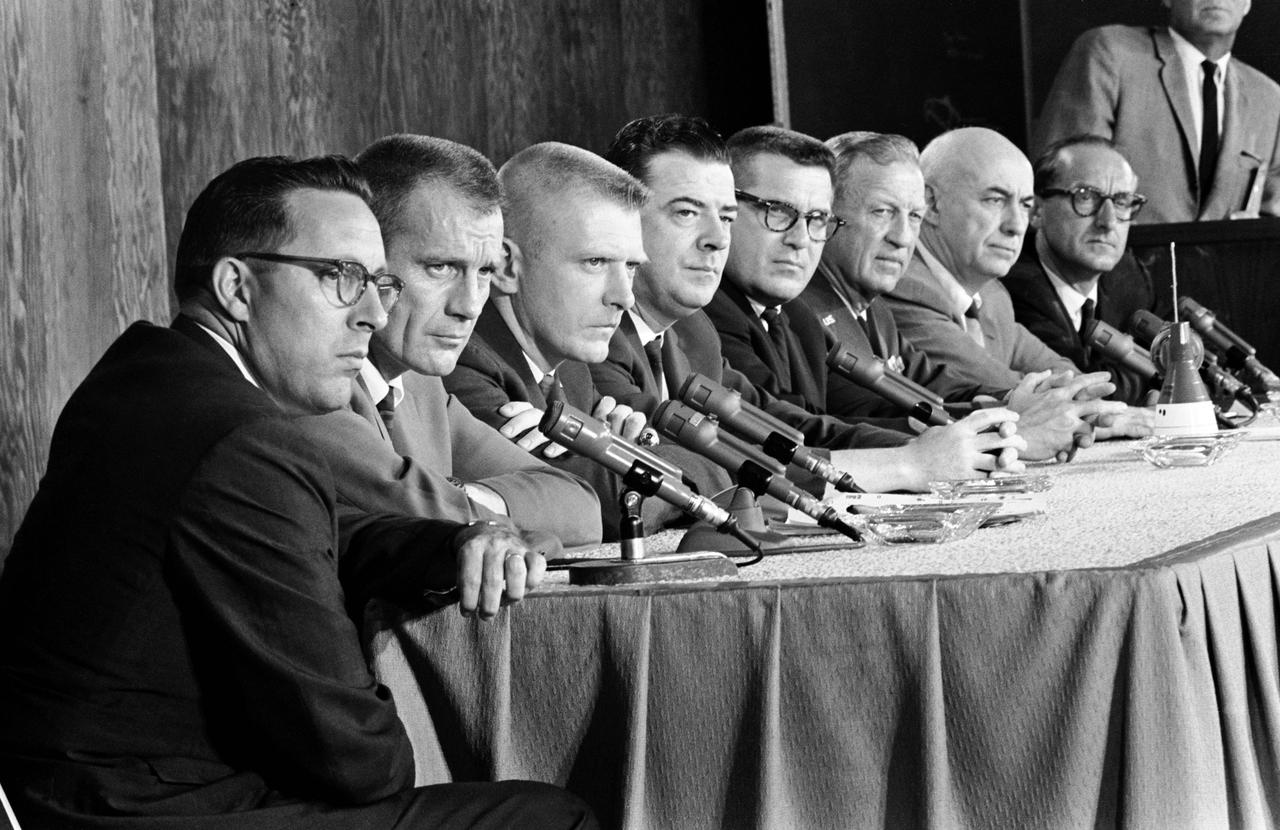
S66-32629 (1966) --- Left to right are Dr. Charles A. Berry, MSC Medical Director; Dr. Donald K. (Deke) Slayton, Director of Flight Crew Operations; Eugene F. Kranz, Flight Director; Charles W. Mathews, Gemini Program Manager, Manned Spacecraft Center; William C. Schneider, Gemini Mission Manager, NASA Headquarters; General Leighton Davis; Dr. Robert R. Gilruth, MSC Director; and Dr. George E. Mueller, Associate Administrator for Manned Space Flight, NASA Headquarters.
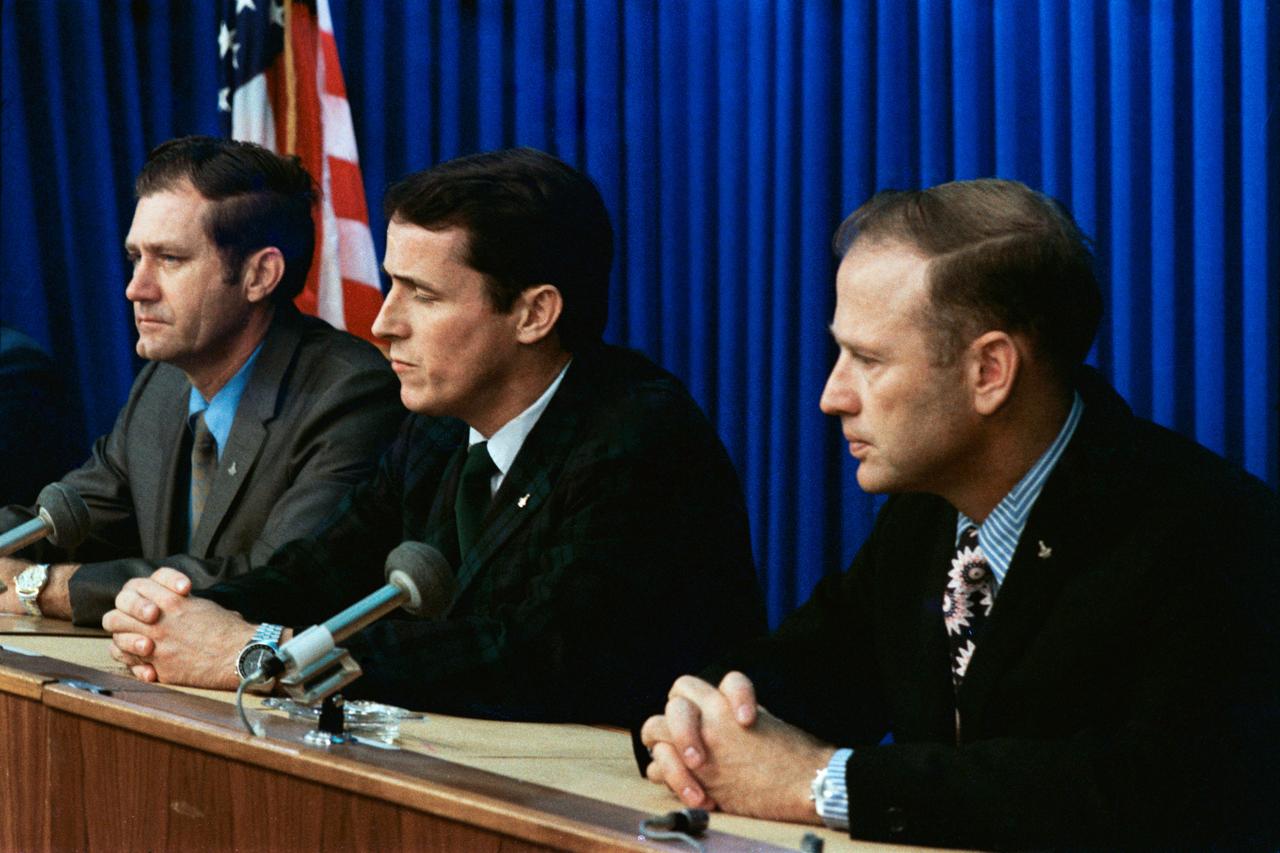
S72-46702 (December 1972) --- The three members of the prime crew of the third of three scheduled manned Skylab missions (Skylab 4) appear before a gathering of news media representatives at a press conference held at the Manned Spacecraft Center. They are, left to right, astronaut William R. Pogue, pilot; scientist-astronaut Edward G. Gibson, science pilot; and astronaut Gerald P. Carr, commander. Photo credit: NASA
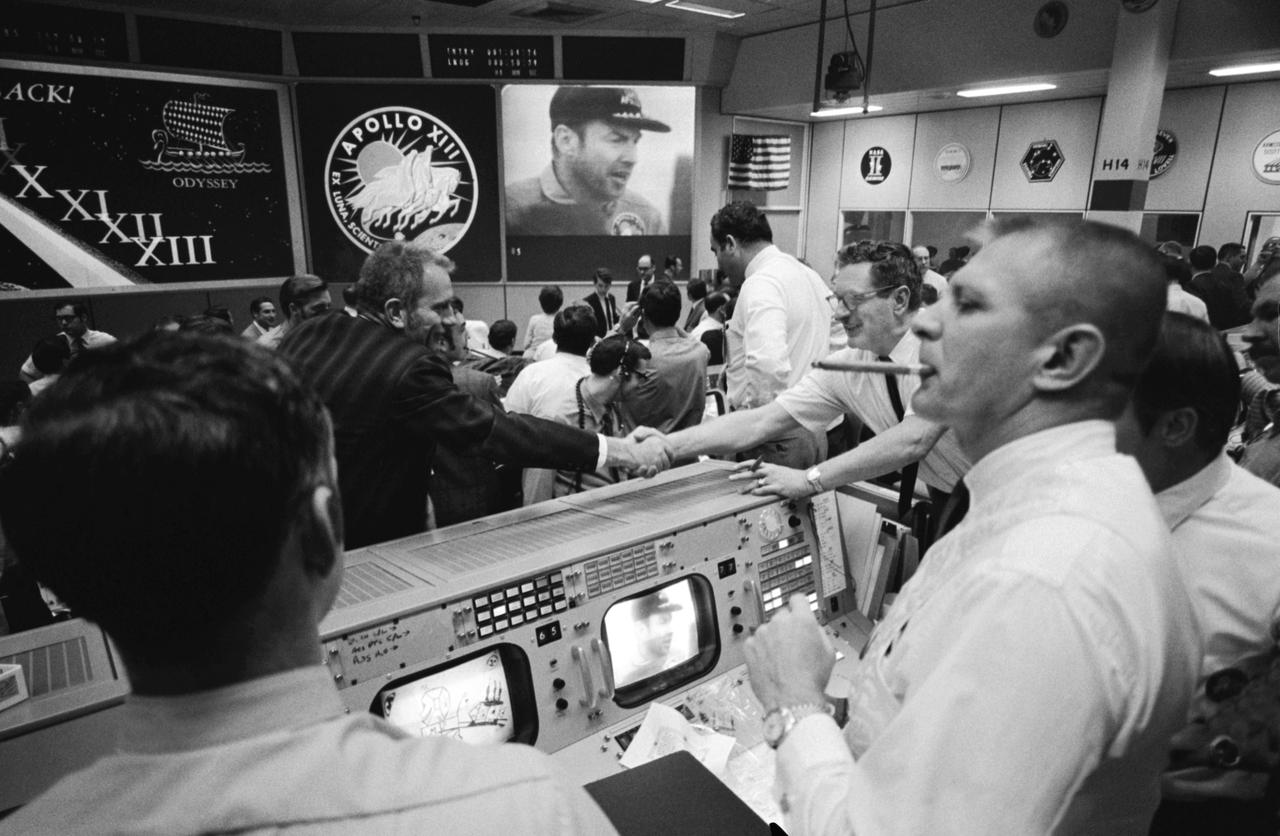
S70-35145 (17 April 1970) --- Overall view of Mission Operations Control Room in Mission Control Center at the Manned Spacecraft Center (MSC) during the ceremonies aboard the USS Iwo Jima, prime recovery ship for the Apollo 13 mission. Dr. Donald K. Slayton (in black shirt, left of center), director of Flight Crew Operations at MSC, and Chester M. Lee of the Apollo Program Directorate, Office of Manned Space Flight, NASA Headquarters, shake hands, while Dr. Rocco A. Petrone, Apollo program director, Office of Manned Space Flight, NASA Headquarters (standing, near Lee), watches the large screen showing astronaut James A. Lovell Jr., Apollo 13 commander, during the onboard ceremonies. In the foreground, Glynn S. Lunney (extreme left) and Eugene F. Kranz (smoking a cigar), two Apollo 13 flight directors, view the activity from their consoles.
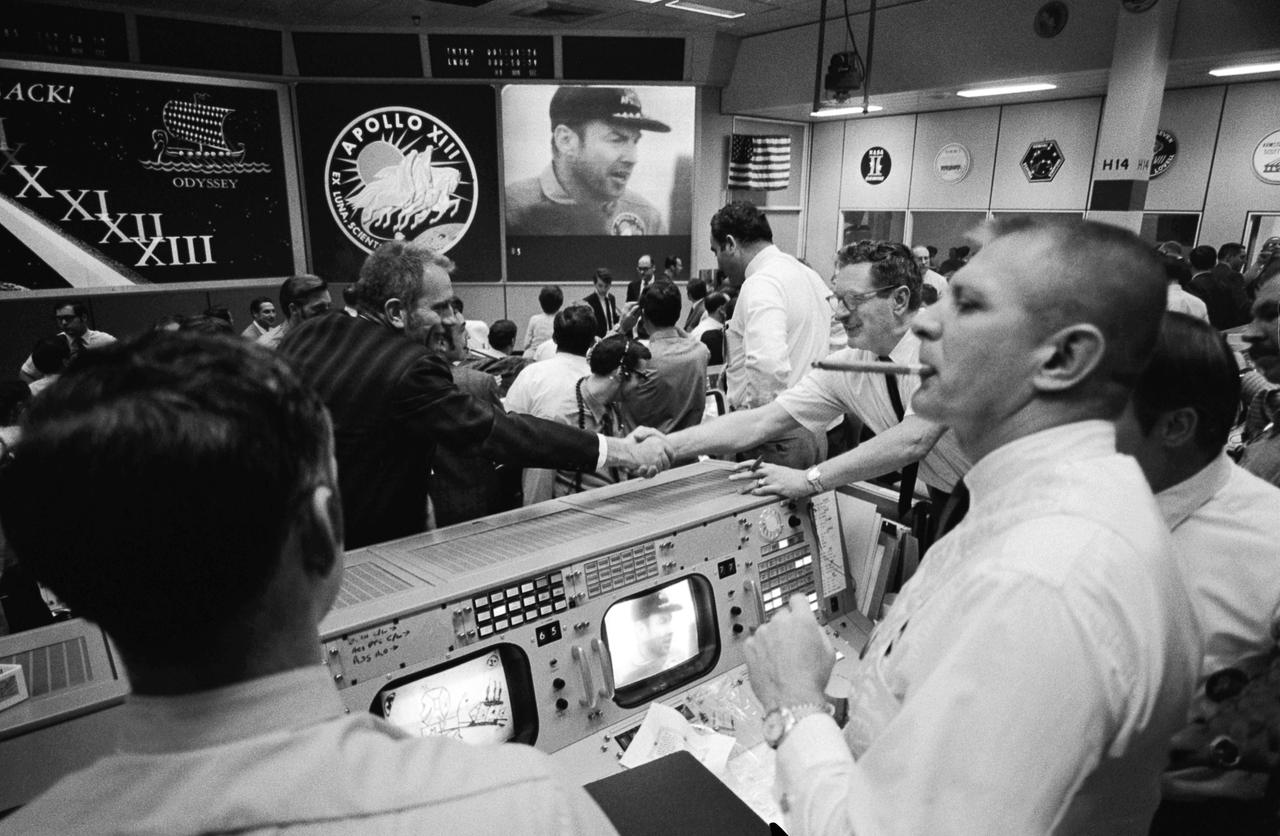
S70-35145 (17 April 1970) --- Overall view of Mission Operations Control Room in Mission Control Center at the Manned Spacecraft Center (MSC) during the ceremonies aboard the USS Iwo Jima, prime recovery ship for the Apollo 13 mission. Dr. Donald K. Slayton (in black shirt, left of center), director of Flight Crew Operations at MSC, and Chester M. Lee of the Apollo Program Directorate, Office of Manned Space Flight, NASA Headquarters, shake hands, while Dr. Rocco A. Petrone, Apollo program director, Office of Manned Space Flight, NASA Headquarters (standing, near Lee), watches the large screen showing astronaut James A. Lovell Jr., Apollo 13 commander, during the onboard ceremonies. In the foreground, Glynn S. Lunney (extreme left) and Eugene F. Kranz (smoking a cigar), two Apollo 13 flight directors, view the activity from their consoles.