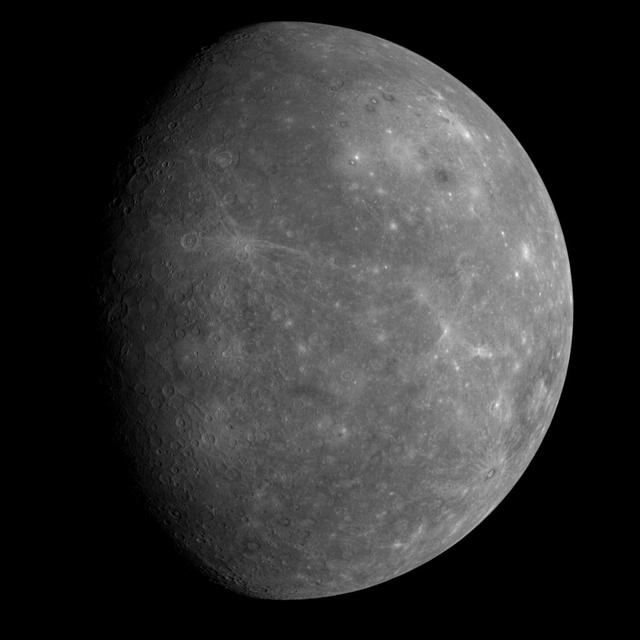
On January 14, 2008, NASA MESSENGER spacecraft observed about half of the hemisphere missed by Mariner 10.
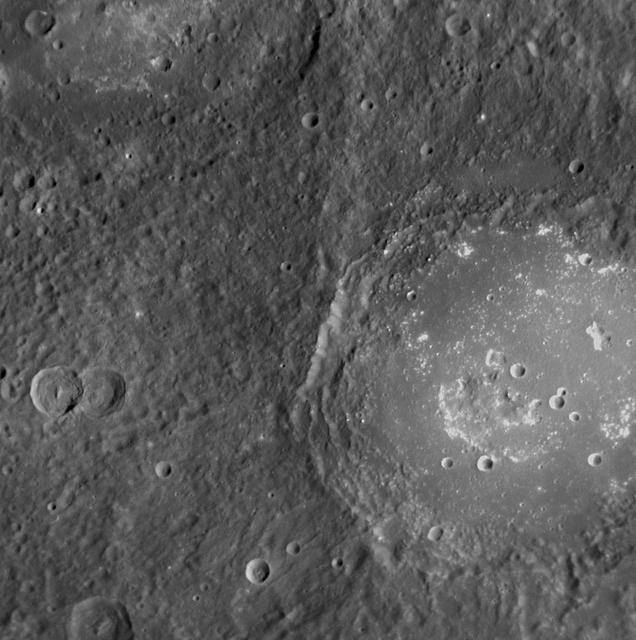
Lermontov crater was first observed by Mariner 10 and seen here by MESSENGER during its second flyby of Mercury. The crater floor is somewhat brighter than the exterior surface and is smooth with several irregularly shaped depressions.
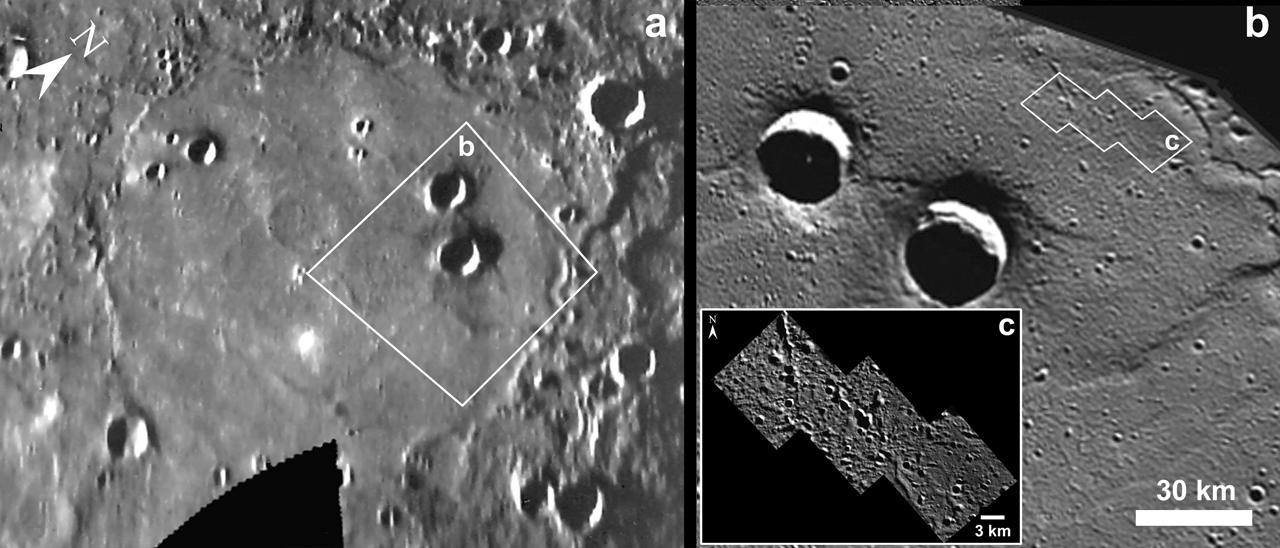
Goethe - Then and Now
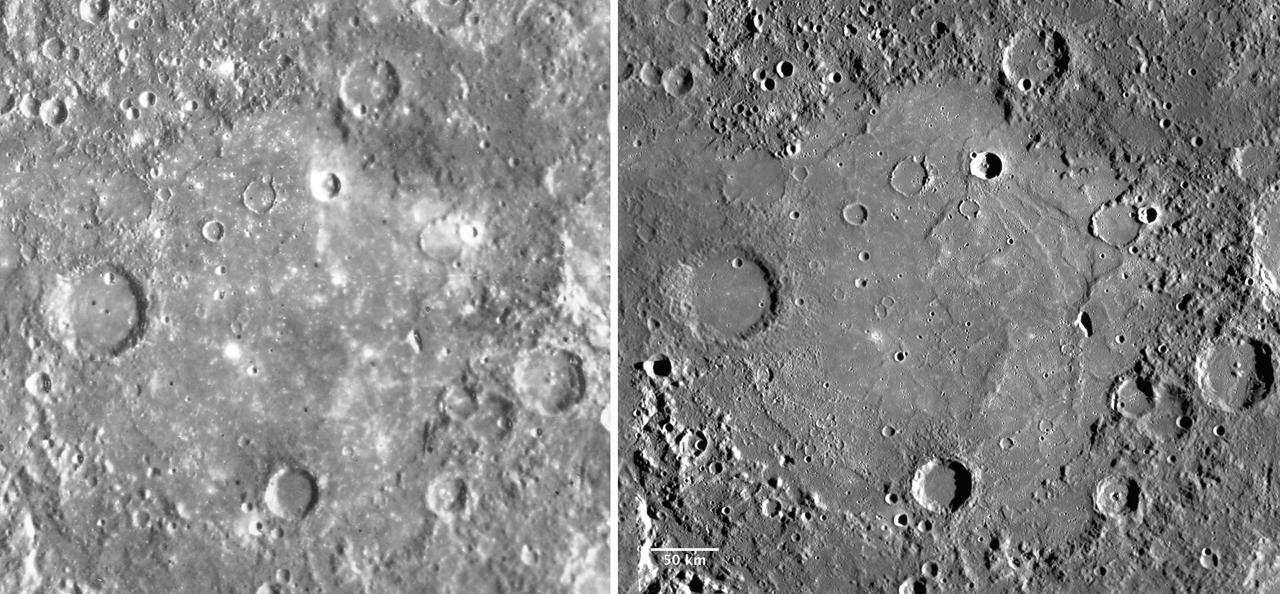
The Tolstoj Impact Basin
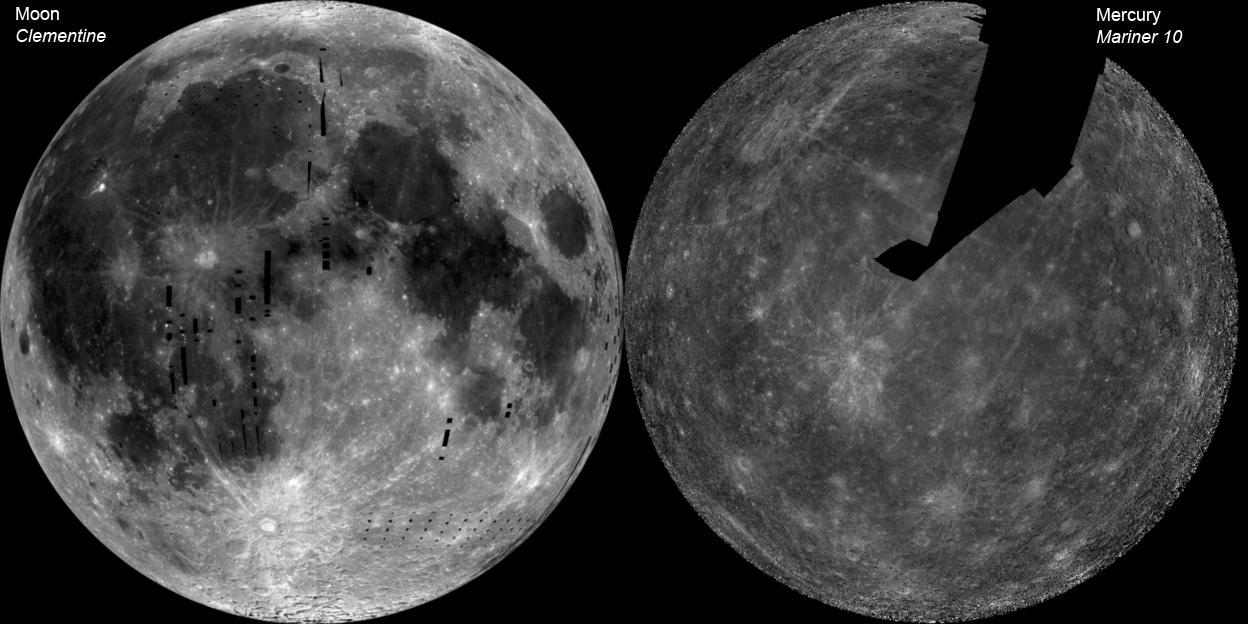
The image of the Moon left is a mosaic of images from NASA Clementine. The Mercury image right is a NASA Mariner 10 mosaic.
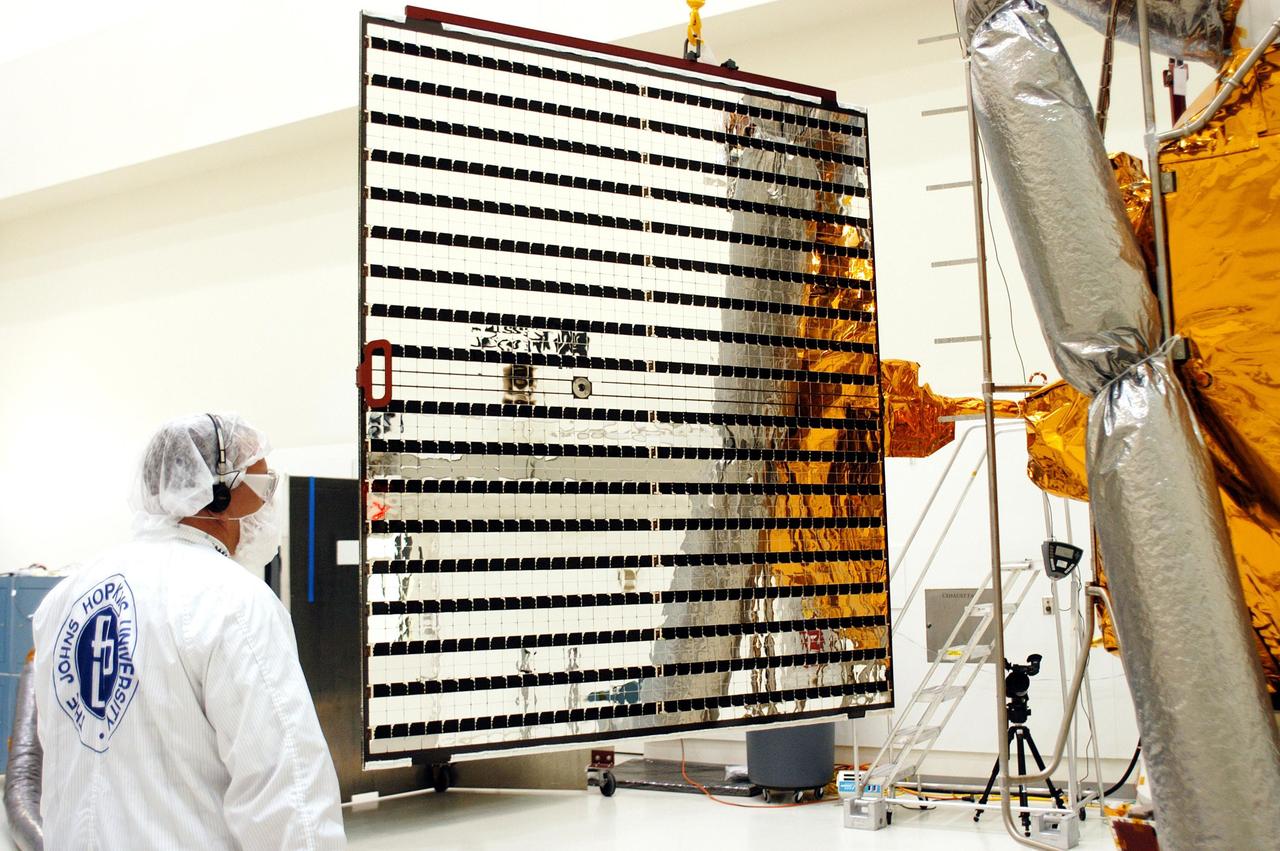
KENNEDY SPACE CENTER, FLA. - At Astrotech in Titusville, Fla., a technician with The Johns Hopkins University Applied Physics Laboratory (APL) watches as one of the solar array panels on the MESSENGER spacecraft is deployed. The two panels will provide MESSENGER’s power on its journey to Mercury. MESSENGER is scheduled to launch Aug. 2 aboard a Boeing Delta II rocket from Pad 17-B, Cape Canaveral Air Force Station, Fla. It will return to Earth for a gravity boost in July 2005, then fly past Venus twice, in October 2006 and June 2007. The spacecraft uses the tug of Venus’ gravity to resize and rotate its trajectory closer to Mercury’s orbit. Three Mercury flybys, each followed about two months later by a course-correction maneuver, put MESSENGER in position to enter Mercury orbit in March 2011. During the flybys, MESSENGER will map nearly the entire planet in color, image most of the areas unseen by Mariner 10, and measure the composition of the surface, atmosphere and magnetosphere. It will be the first new data from Mercury in more than 30 years - and invaluable for planning MESSENGER’s year-long orbital mission. MESSENGER was built for NASA by APL in Laurel, Md.
KENNEDY SPACE CENTER, FLA. - Technicians at Astrotech in Titusville, Fla., maneuver a solar panel into place for installation on NASA’s MESSENGER spacecraft. It is one of two large solar panels, supplemented with a nickel-hydrogen battery, that will provide MESSENGER’s power. MESSENGER is scheduled to launch Aug. 2 aboard a Boeing Delta II rocket from Pad 17-B, Cape Canaveral Air Force Station, Fla. It will return to Earth for a gravity boost in July 2005, then fly past Venus twice, in October 2006 and June 2007. The spacecraft uses the tug of Venus’ gravity to resize and rotate its trajectory closer to Mercury’s orbit. Three Mercury flybys, each followed about two months later by a course-correction maneuver, put MESSENGER in position to enter Mercury orbit in March 2011. During the flybys, MESSENGER will map nearly the entire planet in color, image most of the areas unseen by Mariner 10, and measure the composition of the surface, atmosphere and magnetosphere. It will be the first new data from Mercury in more than 30 years - and invaluable for planning MESSENGER’s year-long orbital mission. MESSENGER was built for NASA by the Johns Hopkins University Applied Physics Laboratory in Laurel, Md.

KENNEDY SPACE CENTER, FLA. - Technicians at Astrotech in Titusville, Fla., attach a bar to a solar panel in order to lift it and move it to NASA’s MESSENGER spacecraft for installation. The two large solar panels, supplemented with a nickel-hydrogen battery, will provide MESSENGER’s power. MESSENGER is scheduled to launch Aug. 2 aboard a Boeing Delta II rocket from Pad 17-B, Cape Canaveral Air Force Station, Fla. It will return to Earth for a gravity boost in July 2005, then fly past Venus twice, in October 2006 and June 2007. The spacecraft uses the tug of Venus’ gravity to resize and rotate its trajectory closer to Mercury’s orbit. Three Mercury flybys, each followed about two months later by a course-correction maneuver, put MESSENGER in position to enter Mercury orbit in March 2011. During the flybys, MESSENGER will map nearly the entire planet in color, image most of the areas unseen by Mariner 10, and measure the composition of the surface, atmosphere and magnetosphere. It will be the first new data from Mercury in more than 30 years - and invaluable for planning MESSENGER’s year-long orbital mission. MESSENGER was built for NASA by the Johns Hopkins University Applied Physics Laboratory in Laurel, Md.
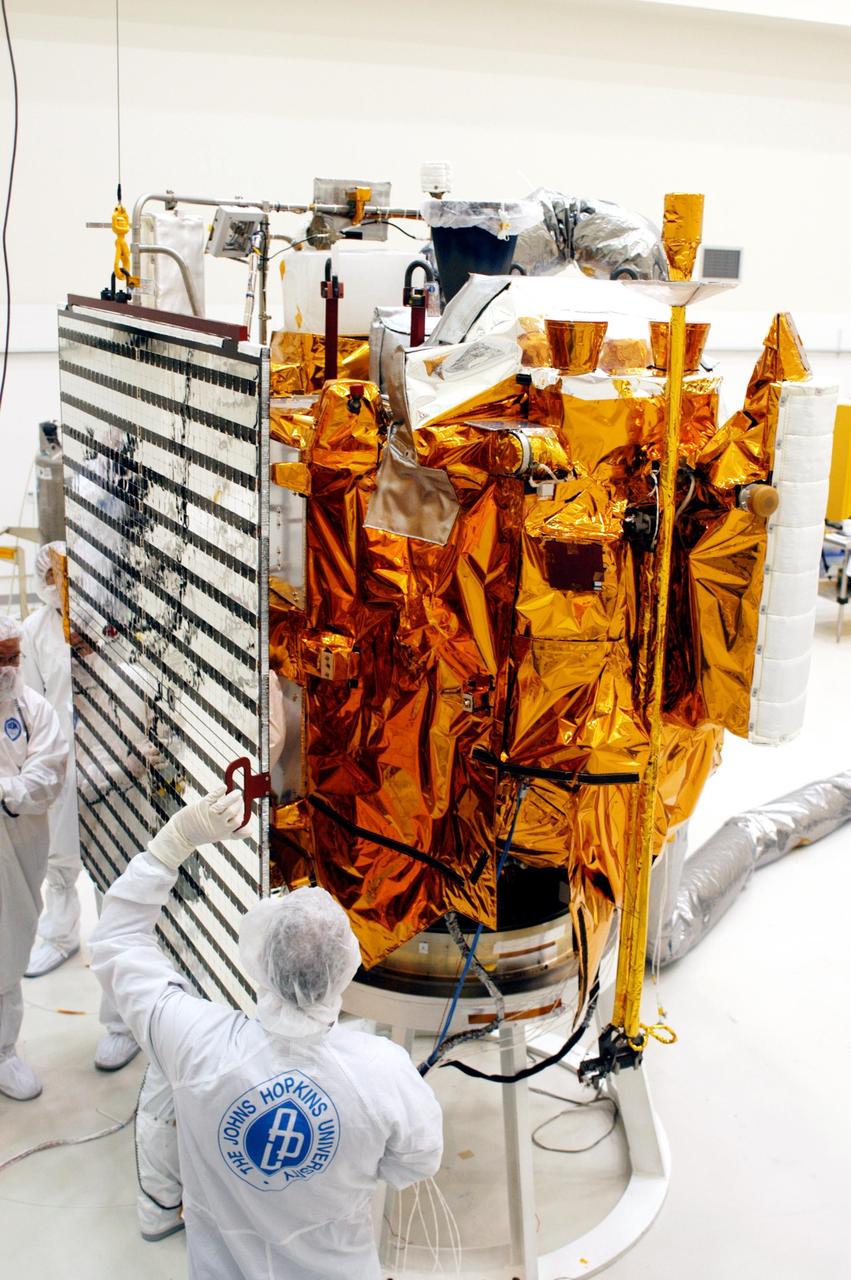
KENNEDY SPACE CENTER, FLA. - At Astrotech in Titusville, Fla., technicians with The Johns Hopkins University Applied Physics Laboratory (APL) prepare one of two solar array panels on the MESSENGER spacecraft for deployment. The panels will provide MESSENGER’s power on its journey to Mercury. MESSENGER is scheduled to launch Aug. 2 aboard a Boeing Delta II rocket from Pad 17-B, Cape Canaveral Air Force Station, Fla. It will return to Earth for a gravity boost in July 2005, then fly past Venus twice, in October 2006 and June 2007. The spacecraft uses the tug of Venus’ gravity to resize and rotate its trajectory closer to Mercury’s orbit. Three Mercury flybys, each followed about two months later by a course-correction maneuver, put MESSENGER in position to enter Mercury orbit in March 2011. During the flybys, MESSENGER will map nearly the entire planet in color, image most of the areas unseen by Mariner 10, and measure the composition of the surface, atmosphere and magnetosphere. It will be the first new data from Mercury in more than 30 years - and invaluable for planning MESSENGER’s year-long orbital mission. MESSENGER was built for NASA by APL in Laurel, Md.
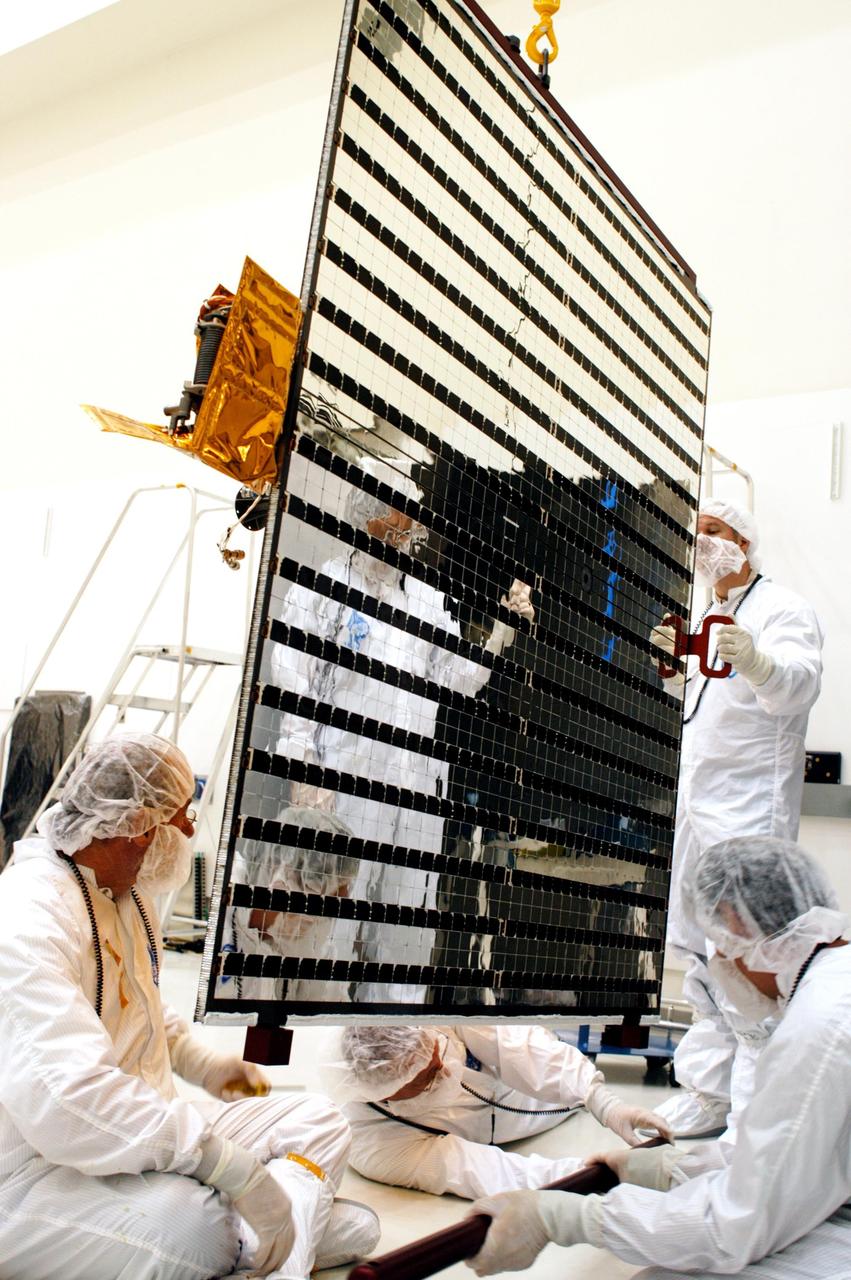
KENNEDY SPACE CENTER, FLA. - Technicians at Astrotech in Titusville, Fla., adjust a solar panel suspended from above for installation on NASA’s MESSENGER spacecraft. It is one of two large solar panels, supplemented with a nickel-hydrogen battery, that will provide MESSENGER’s power. MESSENGER is scheduled to launch Aug. 2 aboard a Boeing Delta II rocket from Pad 17-B, Cape Canaveral Air Force Station, Fla. It will return to Earth for a gravity boost in July 2005, then fly past Venus twice, in October 2006 and June 2007. The spacecraft uses the tug of Venus’ gravity to resize and rotate its trajectory closer to Mercury’s orbit. Three Mercury flybys, each followed about two months later by a course-correction maneuver, put MESSENGER in position to enter Mercury orbit in March 2011. During the flybys, MESSENGER will map nearly the entire planet in color, image most of the areas unseen by Mariner 10, and measure the composition of the surface, atmosphere and magnetosphere. It will be the first new data from Mercury in more than 30 years - and invaluable for planning MESSENGER’s year-long orbital mission. MESSENGER was built for NASA by the Johns Hopkins University Applied Physics Laboratory in Laurel, Md.

KENNEDY SPACE CENTER, FLA. - At Astrotech in Titusville, Fla., technicians secure guide wires on the second solar panel to be installed on NASA’s MESSENGER spacecraft. The two large solar panels, supplemented with a nickel-hydrogen battery, will provide MESSENGER’s power. MESSENGER is scheduled to launch Aug. 2 aboard a Boeing Delta II rocket from Pad 17-B, Cape Canaveral Air Force Station, Fla. It will return to Earth for a gravity boost in July 2005, then fly past Venus twice, in October 2006 and June 2007. The spacecraft uses the tug of Venus’ gravity to resize and rotate its trajectory closer to Mercury’s orbit. Three Mercury flybys, each followed about two months later by a course-correction maneuver, put MESSENGER in position to enter Mercury orbit in March 2011. During the flybys, MESSENGER will map nearly the entire planet in color, image most of the areas unseen by Mariner 10, and measure the composition of the surface, atmosphere and magnetosphere. It will be the first new data from Mercury in more than 30 years - and invaluable for planning MESSENGER’s year-long orbital mission. MESSENGER was built for NASA by the Johns Hopkins University Applied Physics Laboratory in Laurel, Md.
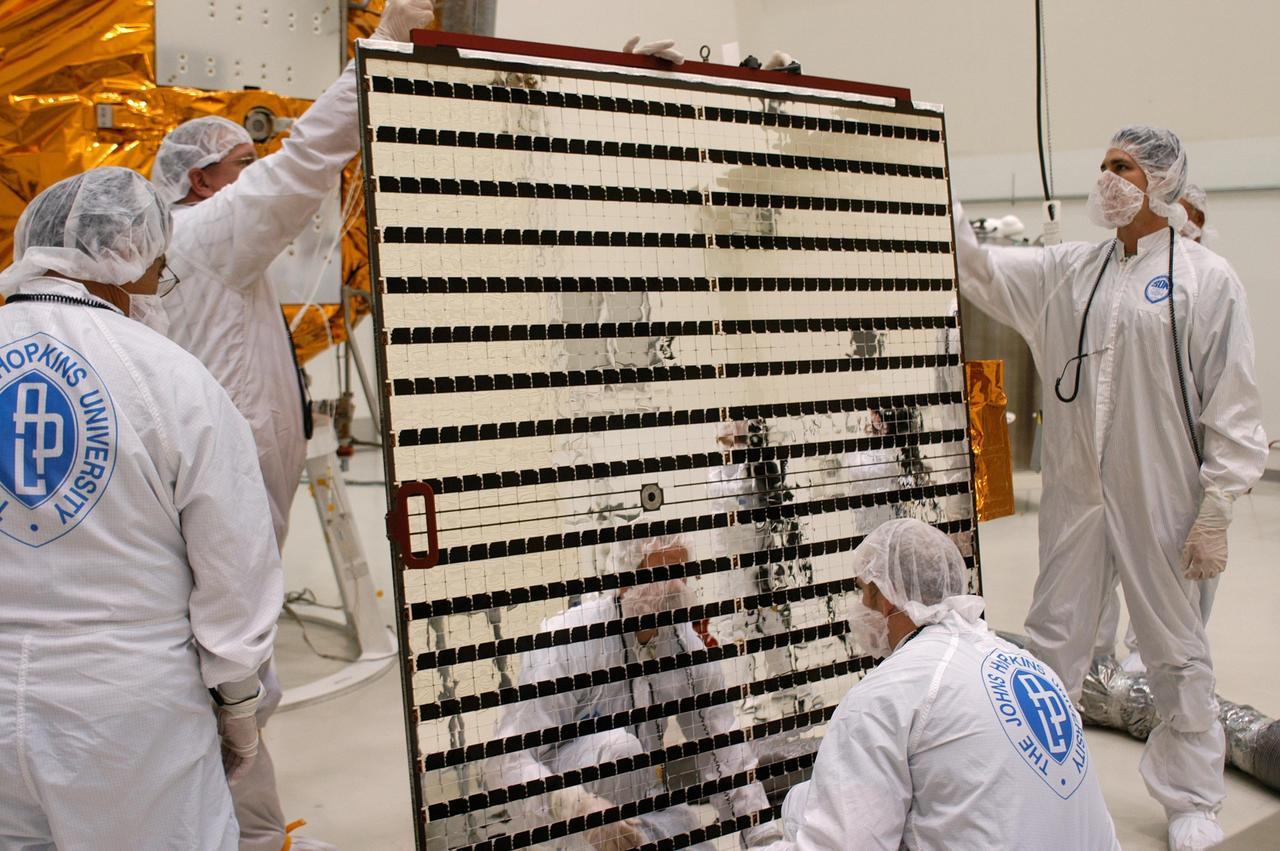
KENNEDY SPACE CENTER, FLA. - At Astrotech in Titusville, Fla., technicians check the second solar panel that will be installed on NASA’s MESSENGER spacecraft. The two large solar panels, supplemented with a nickel-hydrogen battery, will provide MESSENGER’s power. MESSENGER is scheduled to launch Aug. 2 aboard a Boeing Delta II rocket from Pad 17-B, Cape Canaveral Air Force Station, Fla. It will return to Earth for a gravity boost in July 2005, then fly past Venus twice, in October 2006 and June 2007. The spacecraft uses the tug of Venus’ gravity to resize and rotate its trajectory closer to Mercury’s orbit. Three Mercury flybys, each followed about two months later by a course-correction maneuver, put MESSENGER in position to enter Mercury orbit in March 2011. During the flybys, MESSENGER will map nearly the entire planet in color, image most of the areas unseen by Mariner 10, and measure the composition of the surface, atmosphere and magnetosphere. It will be the first new data from Mercury in more than 30 years - and invaluable for planning MESSENGER’s year-long orbital mission. MESSENGER was built for NASA by the Johns Hopkins University Applied Physics Laboratory in Laurel, Md.
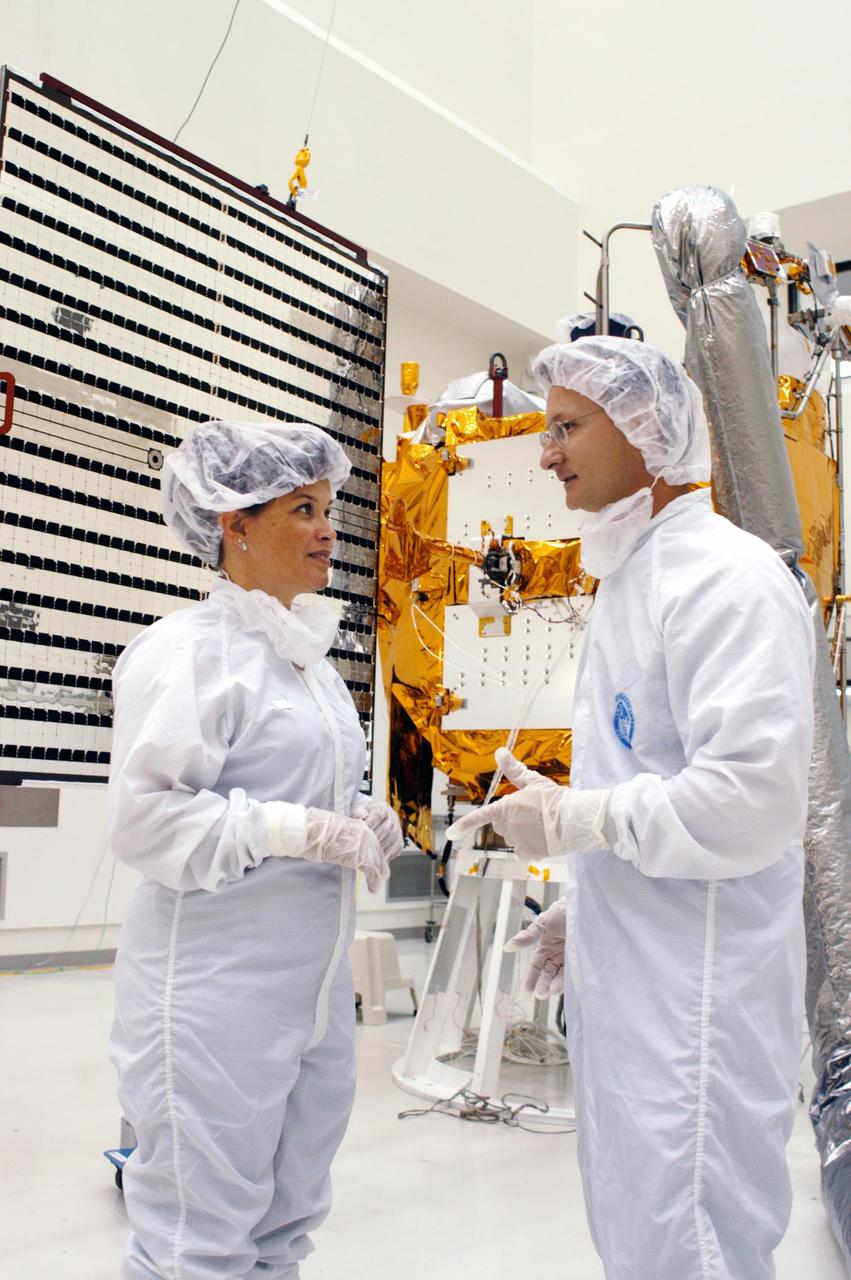
KENNEDY SPACE CENTER, FLA. - At Astrotech in Titusville, Fla., NASA Mission Integration Manager Cheryle Mako and NASA Launch Site Integration Manager John Hueckel talk before the deployment of the solar array panels on the MESSENGER spacecraft behind them. The solar arrays will provide MESSENGER’s power on its journey to Mercury. MESSENGER is scheduled to launch Aug. 2 aboard a Boeing Delta II rocket from Pad 17-B, Cape Canaveral Air Force Station, Fla. It will return to Earth for a gravity boost in July 2005, then fly past Venus twice, in October 2006 and June 2007. The spacecraft uses the tug of Venus’ gravity to resize and rotate its trajectory closer to Mercury’s orbit. Three Mercury flybys, each followed about two months later by a course-correction maneuver, put MESSENGER in position to enter Mercury orbit in March 2011. During the flybys, MESSENGER will map nearly the entire planet in color, image most of the areas unseen by Mariner 10, and measure the composition of the surface, atmosphere and magnetosphere. It will be the first new data from Mercury in more than 30 years - and invaluable for planning MESSENGER’s year-long orbital mission. MESSENGER was built for NASA by the Johns Hopkins University Applied Physics Laboratory in Laurel, Md.
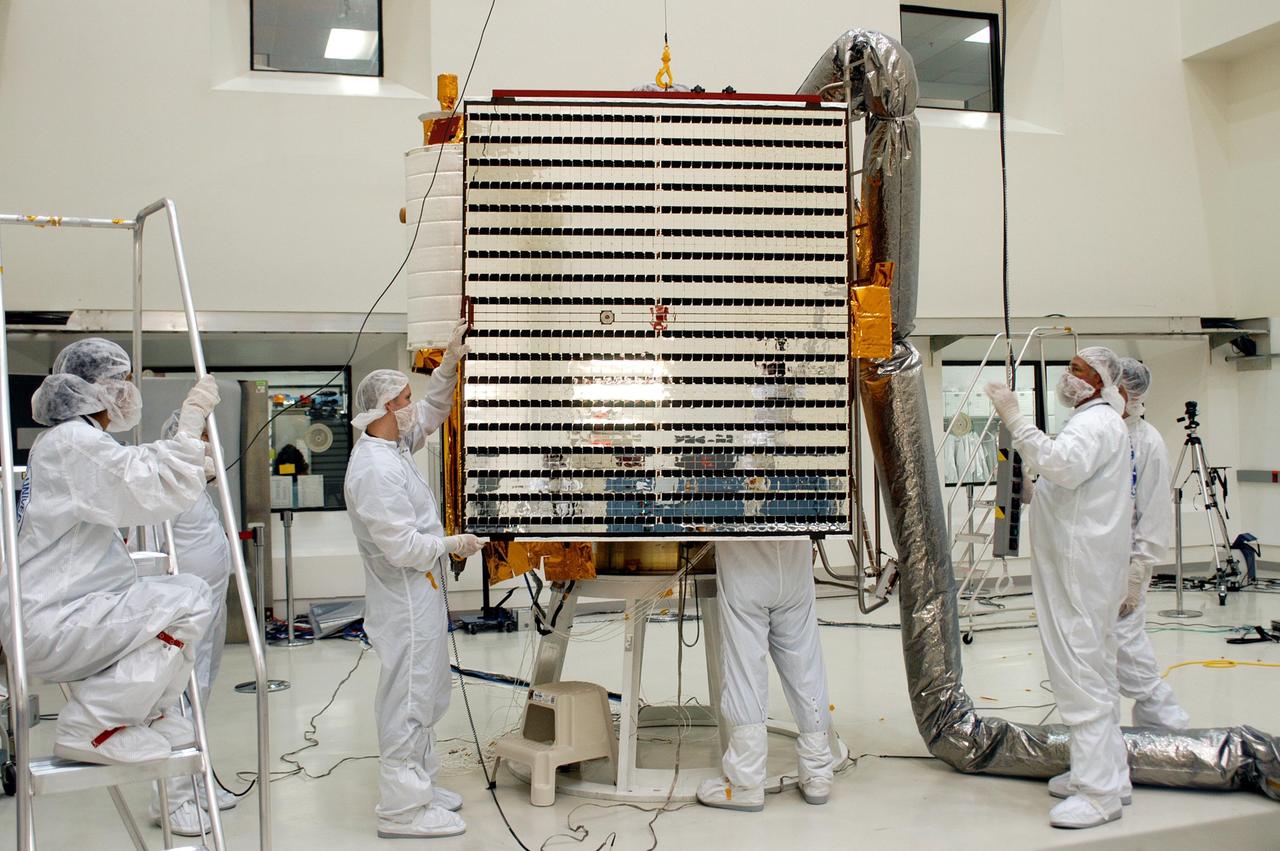
KENNEDY SPACE CENTER, FLA. - Technicians at Astrotech in Titusville, Fla., hold steady the second solar panel being installed on NASA’s MESSENGER spacecraft. At left is the first panel already installed. The two large solar panels, supplemented with a nickel-hydrogen battery, will provide MESSENGER’s power. MESSENGER is scheduled to launch Aug. 2 aboard a Boeing Delta II rocket from Pad 17-B, Cape Canaveral Air Force Station, Fla. It will return to Earth for a gravity boost in July 2005, then fly past Venus twice, in October 2006 and June 2007. The spacecraft uses the tug of Venus’ gravity to resize and rotate its trajectory closer to Mercury’s orbit. Three Mercury flybys, each followed about two months later by a course-correction maneuver, put MESSENGER in position to enter Mercury orbit in March 2011. During the flybys, MESSENGER will map nearly the entire planet in color, image most of the areas unseen by Mariner 10, and measure the composition of the surface, atmosphere and magnetosphere. It will be the first new data from Mercury in more than 30 years - and invaluable for planning MESSENGER’s year-long orbital mission. MESSENGER was built for NASA by the Johns Hopkins University Applied Physics Laboratory in Laurel, Md.
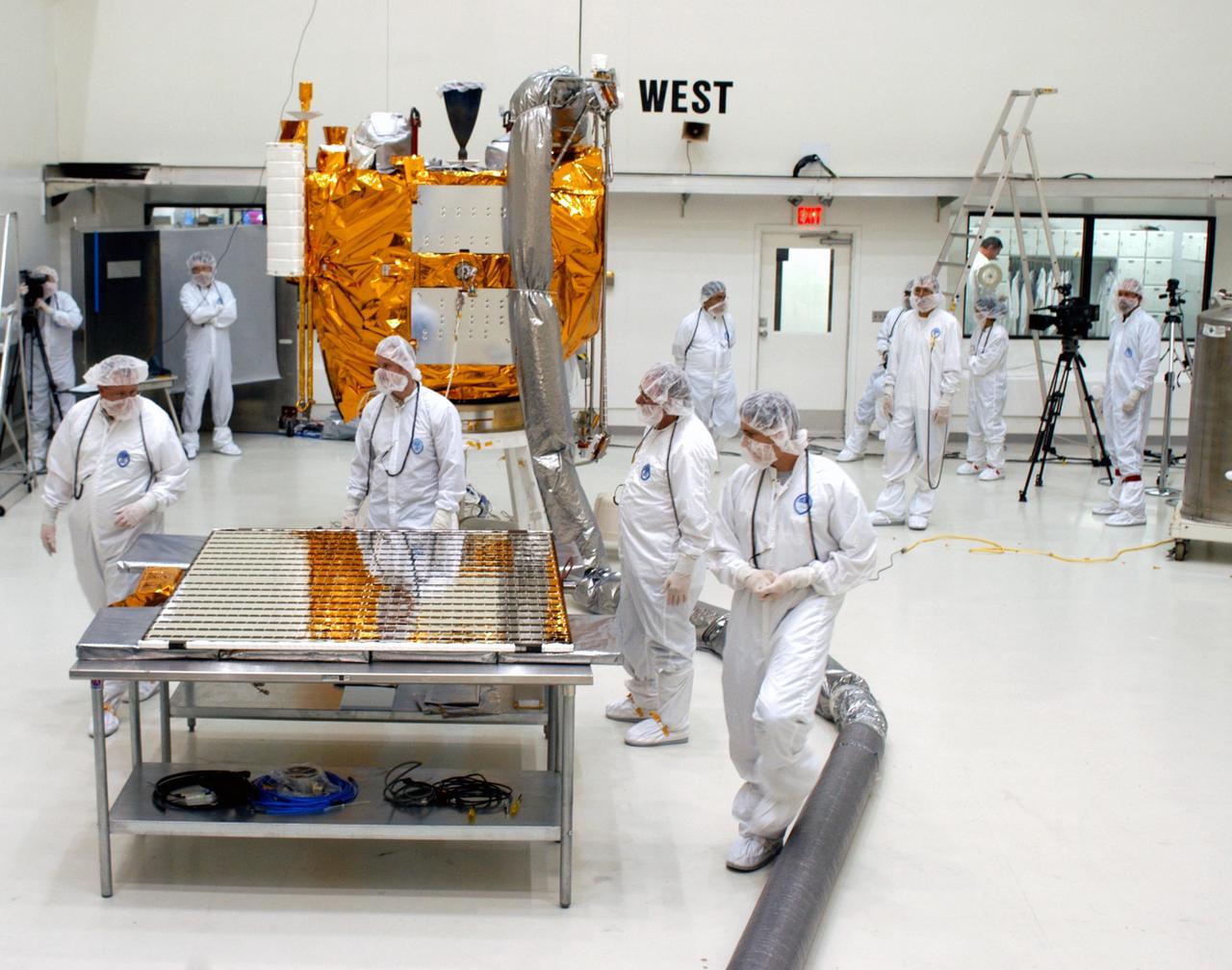
KENNEDY SPACE CENTER, FLA. - Technicians at Astrotech in Titusville, Fla., look over a solar panel ready to be installed on NASA’s MESSENGER spacecraft. It is one of two large solar panels, supplemented with a nickel-hydrogen battery, that will provide MESSENGER’s power. MESSENGER is scheduled to launch Aug. 2 aboard a Boeing Delta II rocket from Pad 17-B, Cape Canaveral Air Force Station, Fla. It will return to Earth for a gravity boost in July 2005, then fly past Venus twice, in October 2006 and June 2007. The spacecraft uses the tug of Venus’ gravity to resize and rotate its trajectory closer to Mercury’s orbit. Three Mercury flybys, each followed about two months later by a course-correction maneuver, put MESSENGER in position to enter Mercury orbit in March 2011. During the flybys, MESSENGER will map nearly the entire planet in color, image most of the areas unseen by Mariner 10, and measure the composition of the surface, atmosphere and magnetosphere. It will be the first new data from Mercury in more than 30 years - and invaluable for planning MESSENGER’s year-long orbital mission. MESSENGER was built for NASA by the Johns Hopkins University Applied Physics Laboratory in Laurel, Md.
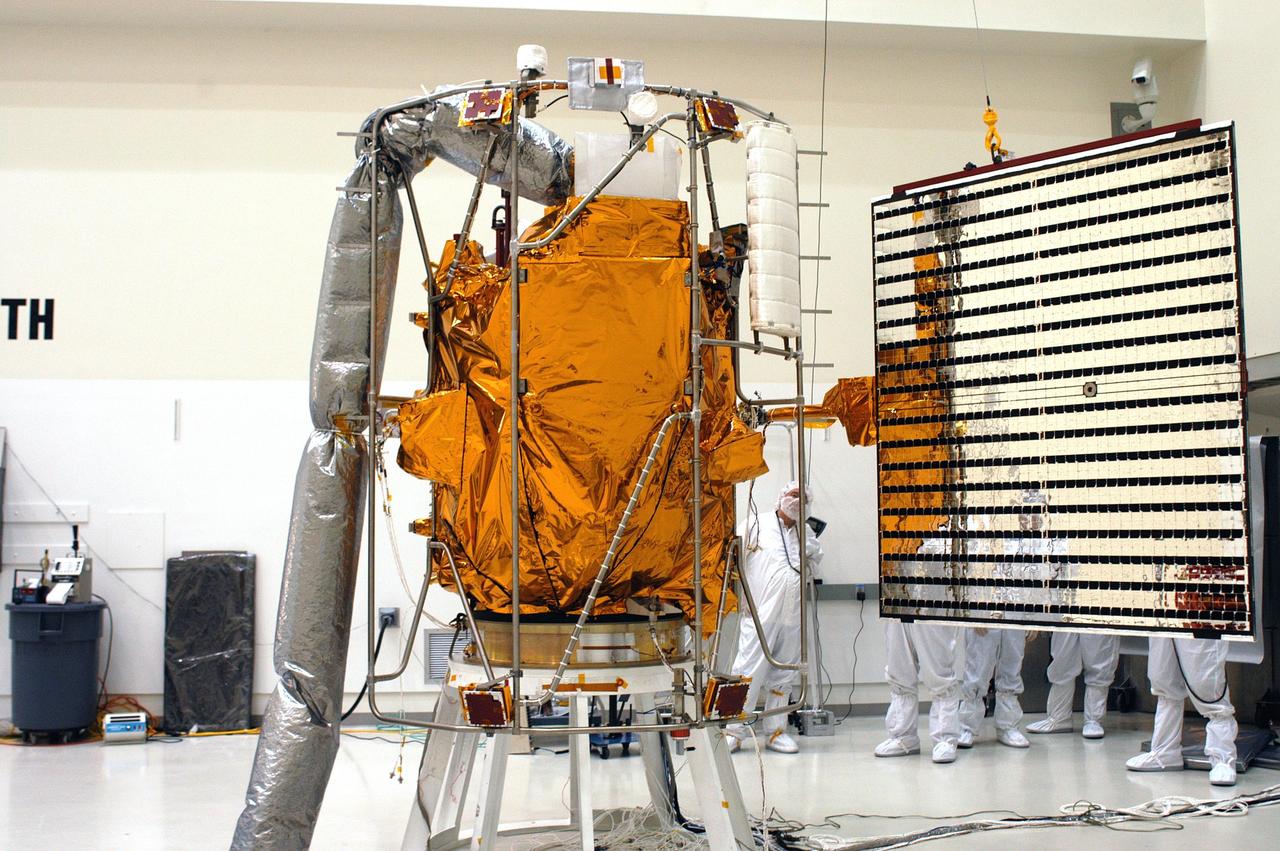
KENNEDY SPACE CENTER, FLA. - Technicians at Astrotech in Titusville, Fla., help guide a solar panel toward NASA’s MESSENGER spacecraft for installation. It is one of two large solar panels, supplemented with a nickel-hydrogen battery, that will provide MESSENGER’s power. MESSENGER is scheduled to launch Aug. 2 aboard a Boeing Delta II rocket from Pad 17-B, Cape Canaveral Air Force Station, Fla. It will return to Earth for a gravity boost in July 2005, then fly past Venus twice, in October 2006 and June 2007. The spacecraft uses the tug of Venus’ gravity to resize and rotate its trajectory closer to Mercury’s orbit. Three Mercury flybys, each followed about two months later by a course-correction maneuver, put MESSENGER in position to enter Mercury orbit in March 2011. During the flybys, MESSENGER will map nearly the entire planet in color, image most of the areas unseen by Mariner 10, and measure the composition of the surface, atmosphere and magnetosphere. It will be the first new data from Mercury in more than 30 years - and invaluable for planning MESSENGER’s year-long orbital mission. MESSENGER was built for NASA by the Johns Hopkins University Applied Physics Laboratory in Laurel, Md.
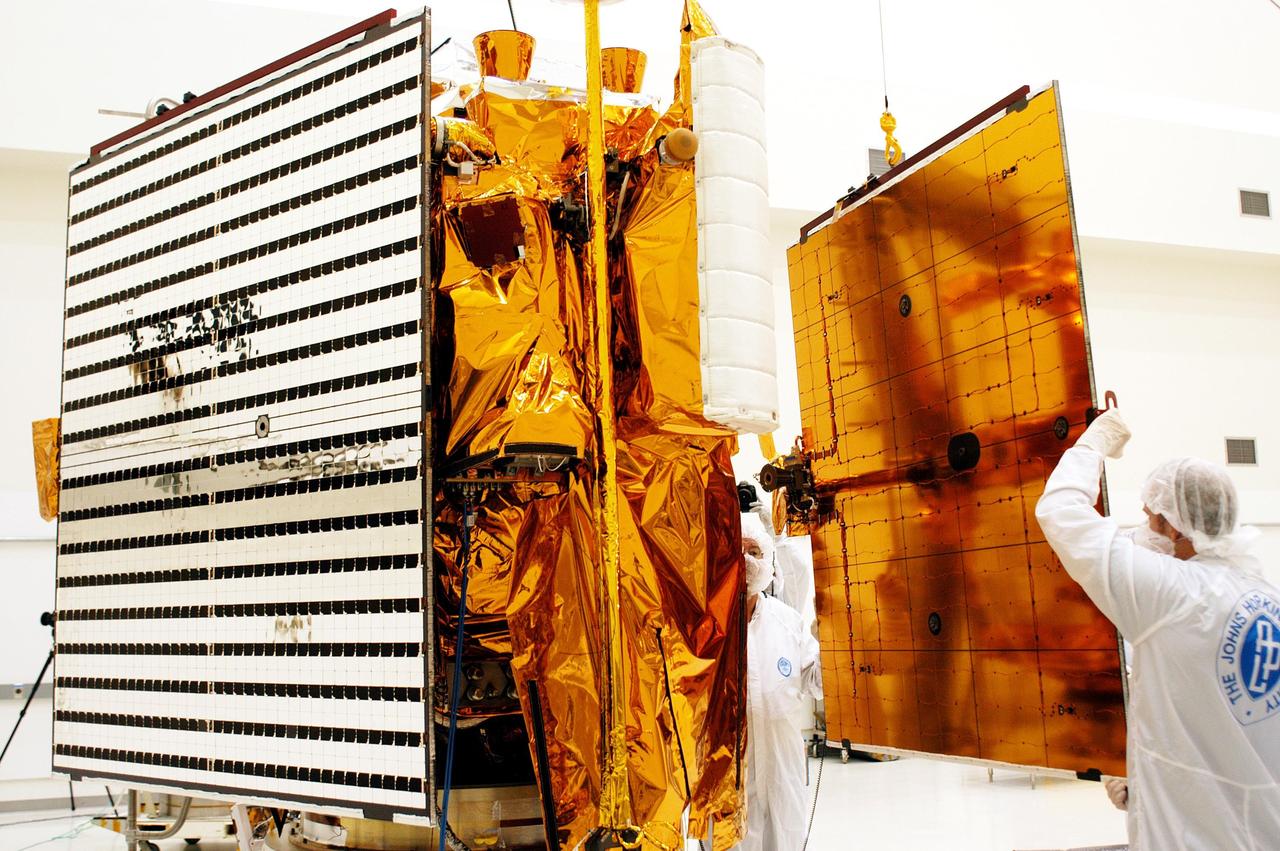
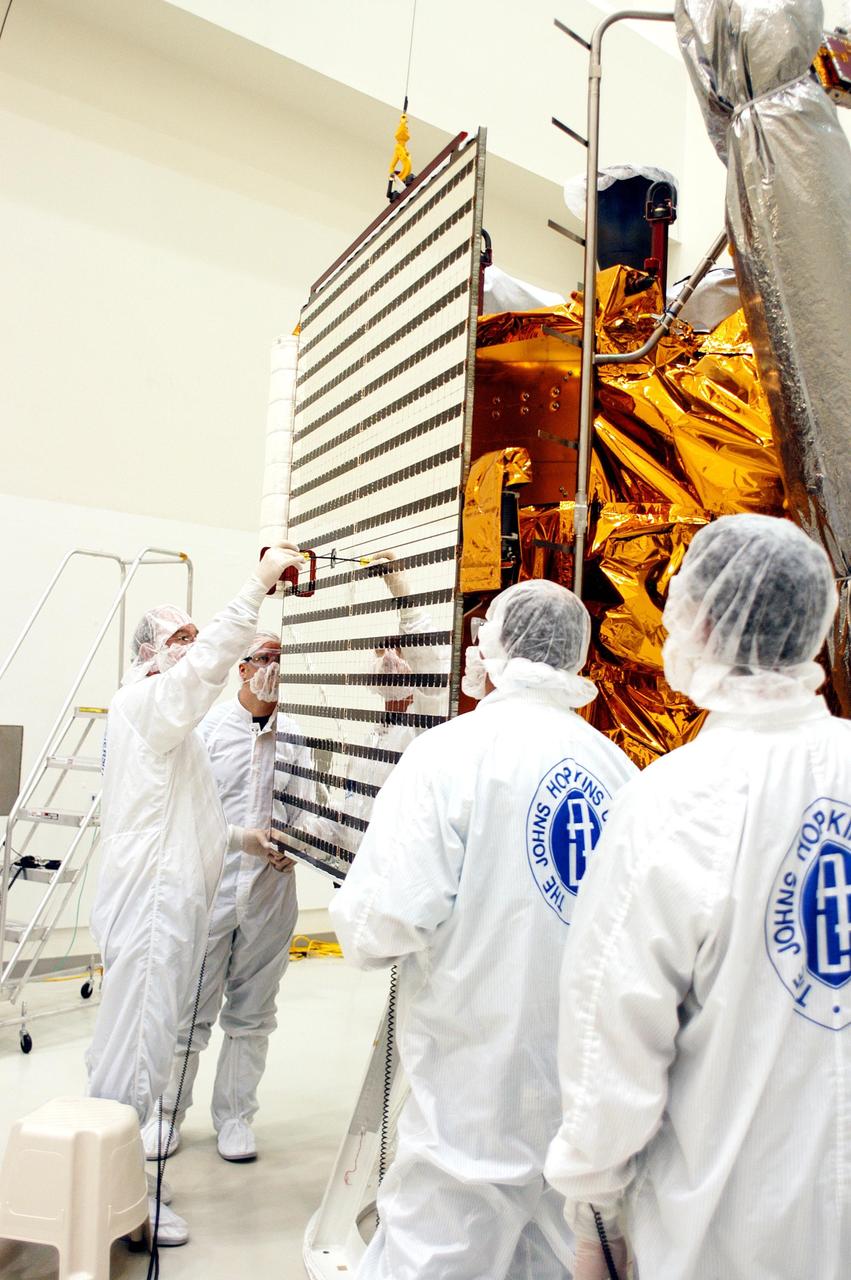
KENNEDY SPACE CENTER, FLA. - At right, technicians at Astrotech in Titusville, Fla., guide into place the second solar panel to be installed on NASA’s MESSENGER spacecraft. At left is the first panel already installed. The two large solar panels, supplemented with a nickel-hydrogen battery, will provide MESSENGER’s power. MESSENGER is scheduled to launch Aug. 2 aboard a Boeing Delta II rocket from Pad 17-B, Cape Canaveral Air Force Station, Fla. It will return to Earth for a gravity boost in July 2005, then fly past Venus twice, in October 2006 and June 2007. The spacecraft uses the tug of Venus’ gravity to resize and rotate its trajectory closer to Mercury’s orbit. Three Mercury flybys, each followed about two months later by a course-correction maneuver, put MESSENGER in position to enter Mercury orbit in March 2011. During the flybys, MESSENGER will map nearly the entire planet in color, image most of the areas unseen by Mariner 10, and measure the composition of the surface, atmosphere and magnetosphere. It will be the first new data from Mercury in more than 30 years - and invaluable for planning MESSENGER’s year-long orbital mission. MESSENGER was built for NASA by the Johns Hopkins University Applied Physics Laboratory in Laurel, Md.
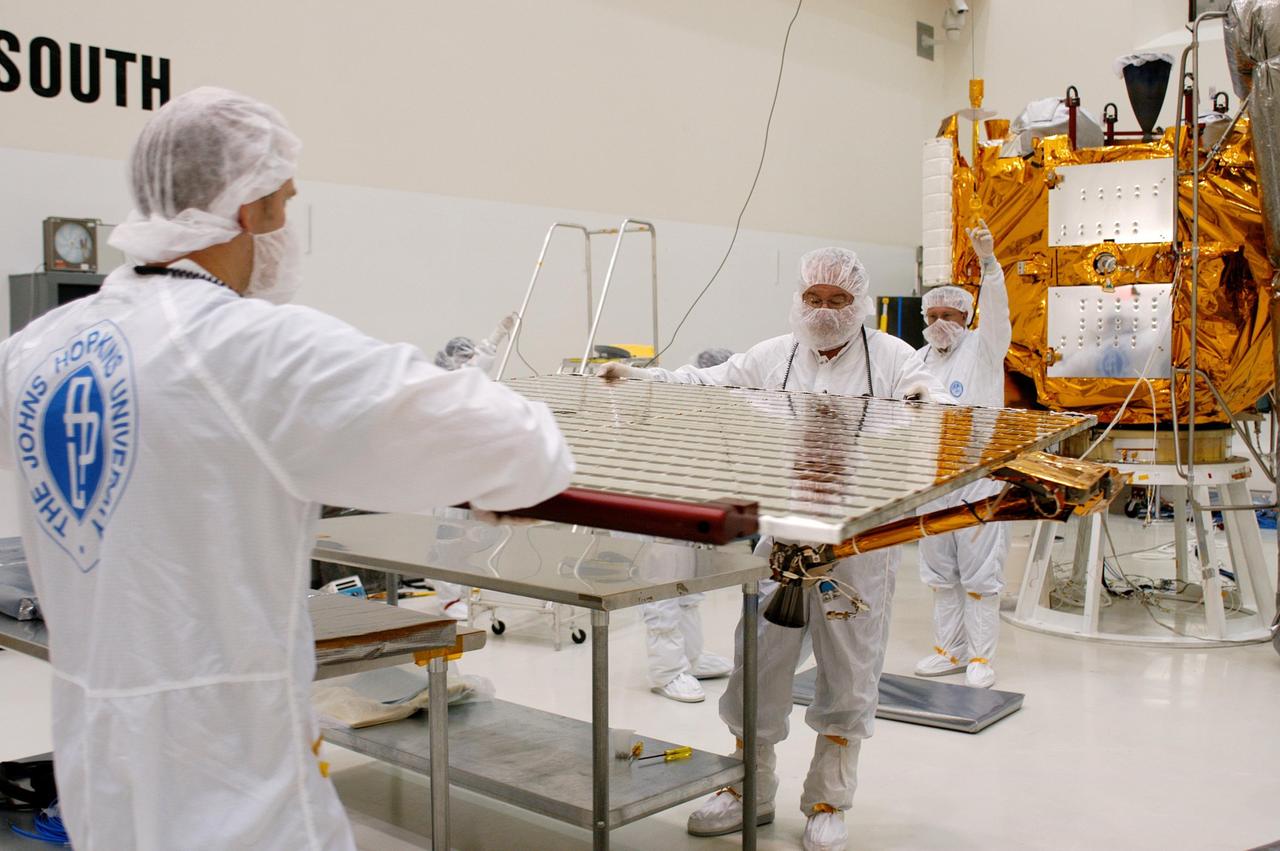
KENNEDY SPACE CENTER, FLA. - At Astrotech in Titusville, Fla., technicians maneuver a second solar panel to a vertical position to move it toward NASA’s MESSENGER spacecraft for installation. The two large solar panels, supplemented with a nickel-hydrogen battery, will provide MESSENGER’s power. MESSENGER is scheduled to launch Aug. 2 aboard a Boeing Delta II rocket from Pad 17-B, Cape Canaveral Air Force Station, Fla. It will return to Earth for a gravity boost in July 2005, then fly past Venus twice, in October 2006 and June 2007. The spacecraft uses the tug of Venus’ gravity to resize and rotate its trajectory closer to Mercury’s orbit. Three Mercury flybys, each followed about two months later by a course-correction maneuver, put MESSENGER in position to enter Mercury orbit in March 2011. During the flybys, MESSENGER will map nearly the entire planet in color, image most of the areas unseen by Mariner 10, and measure the composition of the surface, atmosphere and magnetosphere. It will be the first new data from Mercury in more than 30 years - and invaluable for planning MESSENGER’s year-long orbital mission. MESSENGER was built for NASA by the Johns Hopkins University Applied Physics Laboratory in Laurel, Md.
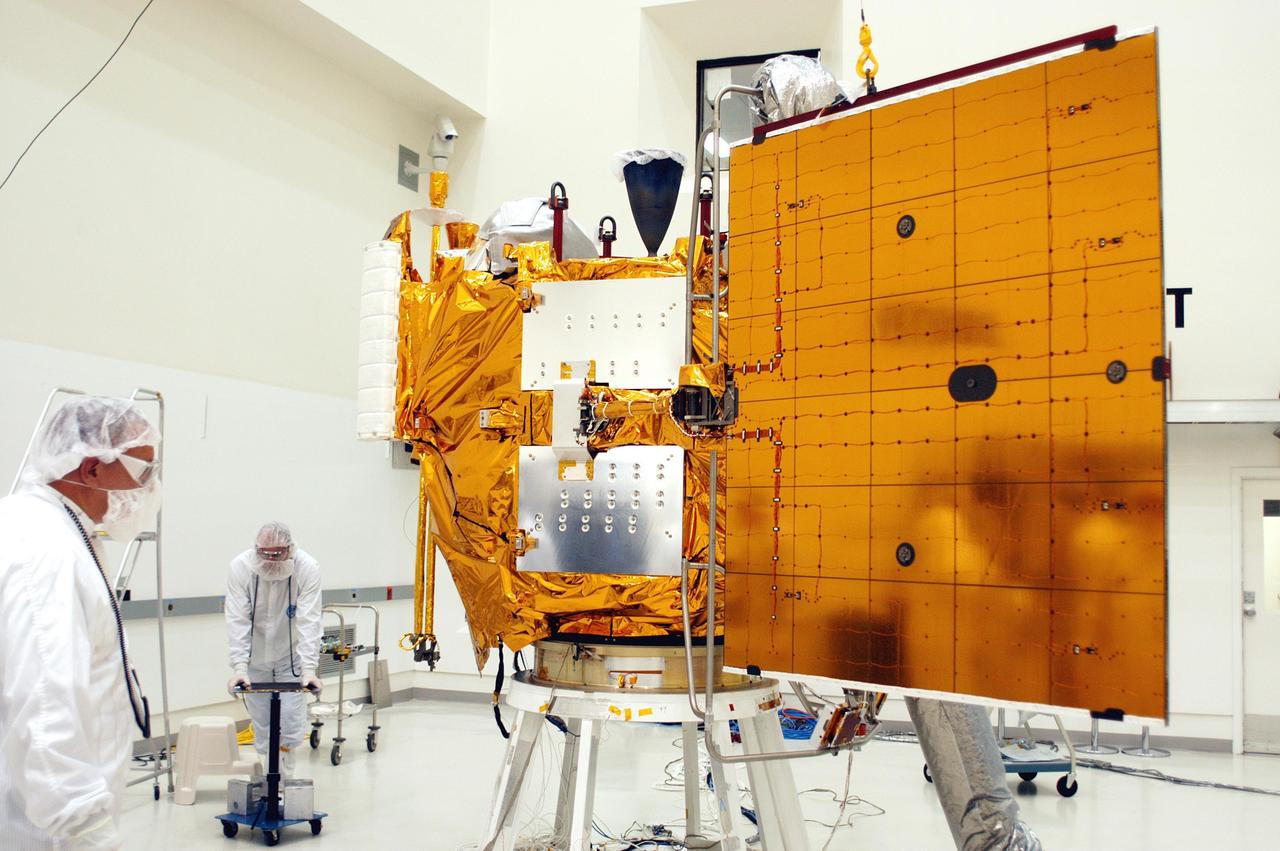
KENNEDY SPACE CENTER, FLA. - At Astrotech in Titusville, Fla., technicians with The Johns Hopkins University Applied Physics Laboratory (APL) monitor the progress of the solar array deployment on the MESSENGER spacecraft. The two panels will provide MESSENGER’s power on its journey to Mercury. MESSENGER is scheduled to launch Aug. 2 aboard a Boeing Delta II rocket from Pad 17-B, Cape Canaveral Air Force Station, Fla. It will return to Earth for a gravity boost in July 2005, then fly past Venus twice, in October 2006 and June 2007. The spacecraft uses the tug of Venus’ gravity to resize and rotate its trajectory closer to Mercury’s orbit. Three Mercury flybys, each followed about two months later by a course-correction maneuver, put MESSENGER in position to enter Mercury orbit in March 2011. During the flybys, MESSENGER will map nearly the entire planet in color, image most of the areas unseen by Mariner 10, and measure the composition of the surface, atmosphere and magnetosphere. It will be the first new data from Mercury in more than 30 years - and invaluable for planning MESSENGER’s year-long orbital mission. MESSENGER was built for NASA by APL in Laurel, Md.
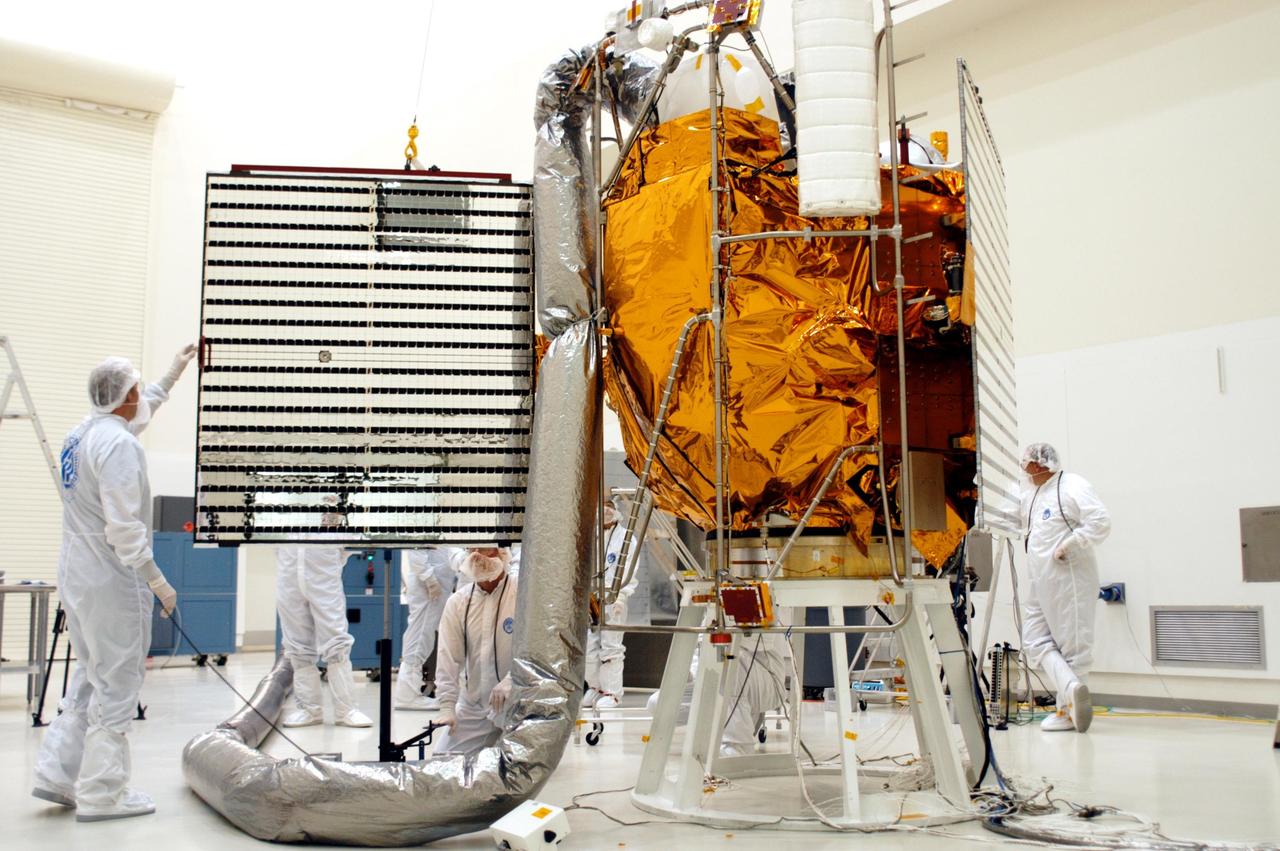
KENNEDY SPACE CENTER, FLA. - At Astrotech in Titusville, Fla., technicians with The Johns Hopkins University Applied Physics Laboratory (APL) check one of two solar panels on the MESSENGER spacecraft after a deployment test. The other panel is at right, undeployed. The solar arrays will provide MESSENGER’s power on its journey to Mercury. MESSENGER is scheduled to launch Aug. 2 aboard a Boeing Delta II rocket from Pad 17-B, Cape Canaveral Air Force Station, Fla. It will return to Earth for a gravity boost in July 2005, then fly past Venus twice, in October 2006 and June 2007. The spacecraft uses the tug of Venus’ gravity to resize and rotate its trajectory closer to Mercury’s orbit. Three Mercury flybys, each followed about two months later by a course-correction maneuver, put MESSENGER in position to enter Mercury orbit in March 2011. During the flybys, MESSENGER will map nearly the entire planet in color, image most of the areas unseen by Mariner 10, and measure the composition of the surface, atmosphere and magnetosphere. It will be the first new data from Mercury in more than 30 years - and invaluable for planning MESSENGER’s year-long orbital mission. MESSENGER was built for NASA by APL in Laurel, Md.
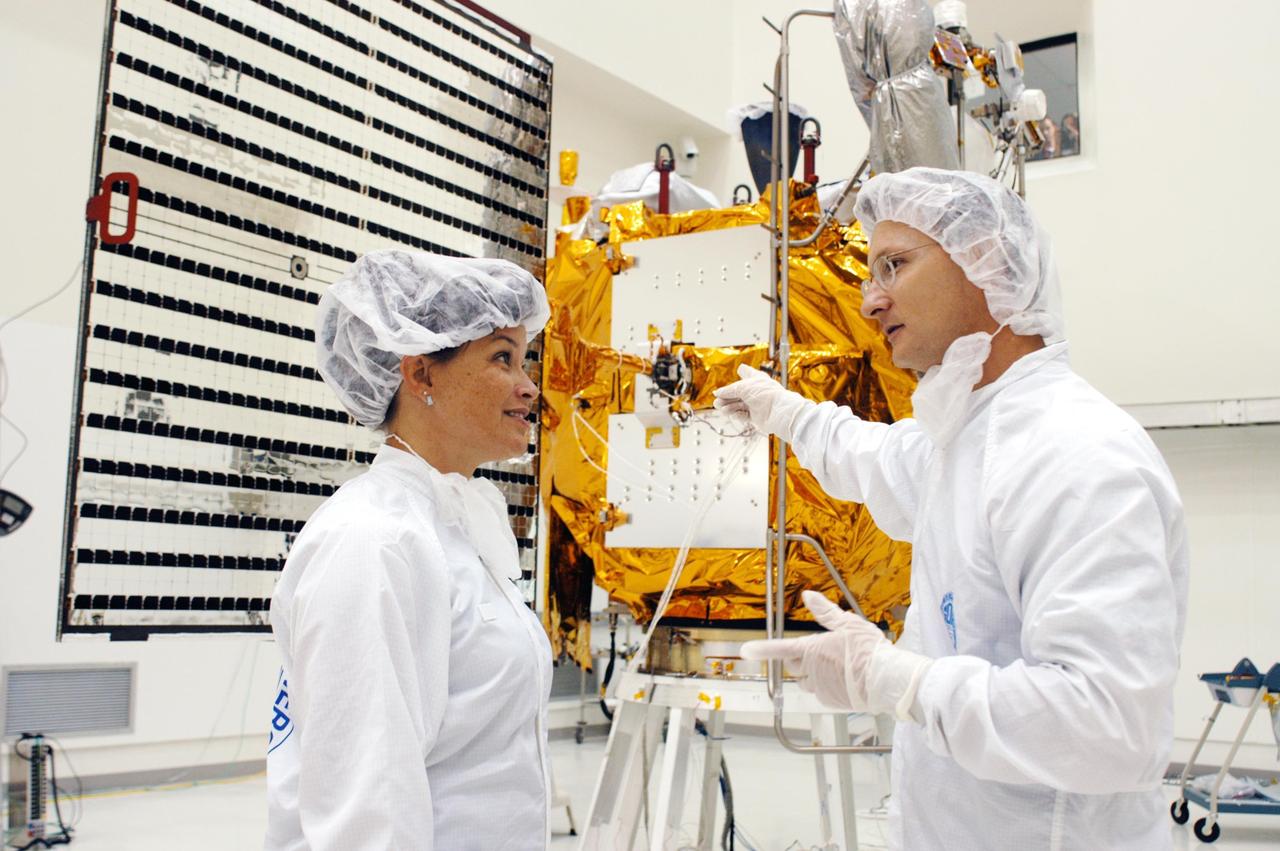
KENNEDY SPACE CENTER, FLA. - At Astrotech in Titusville, Fla., NASA Mission Integration Manager Cheryle Mako and NASA Launch Site Integration Manager John Hueckel talk before the deployment of the solar array panels on the MESSENGER spacecraft behind them. The solar arrays will provide MESSENGER’s power on its journey to Mercury. MESSENGER is scheduled to launch Aug. 2 aboard a Boeing Delta II rocket from Pad 17-B, Cape Canaveral Air Force Station, Fla. It will return to Earth for a gravity boost in July 2005, then fly past Venus twice, in October 2006 and June 2007. The spacecraft uses the tug of Venus’ gravity to resize and rotate its trajectory closer to Mercury’s orbit. Three Mercury flybys, each followed about two months later by a course-correction maneuver, put MESSENGER in position to enter Mercury orbit in March 2011. During the flybys, MESSENGER will map nearly the entire planet in color, image most of the areas unseen by Mariner 10, and measure the composition of the surface, atmosphere and magnetosphere. It will be the first new data from Mercury in more than 30 years - and invaluable for planning MESSENGER’s year-long orbital mission. MESSENGER was built for NASA by APL in Laurel, Md.
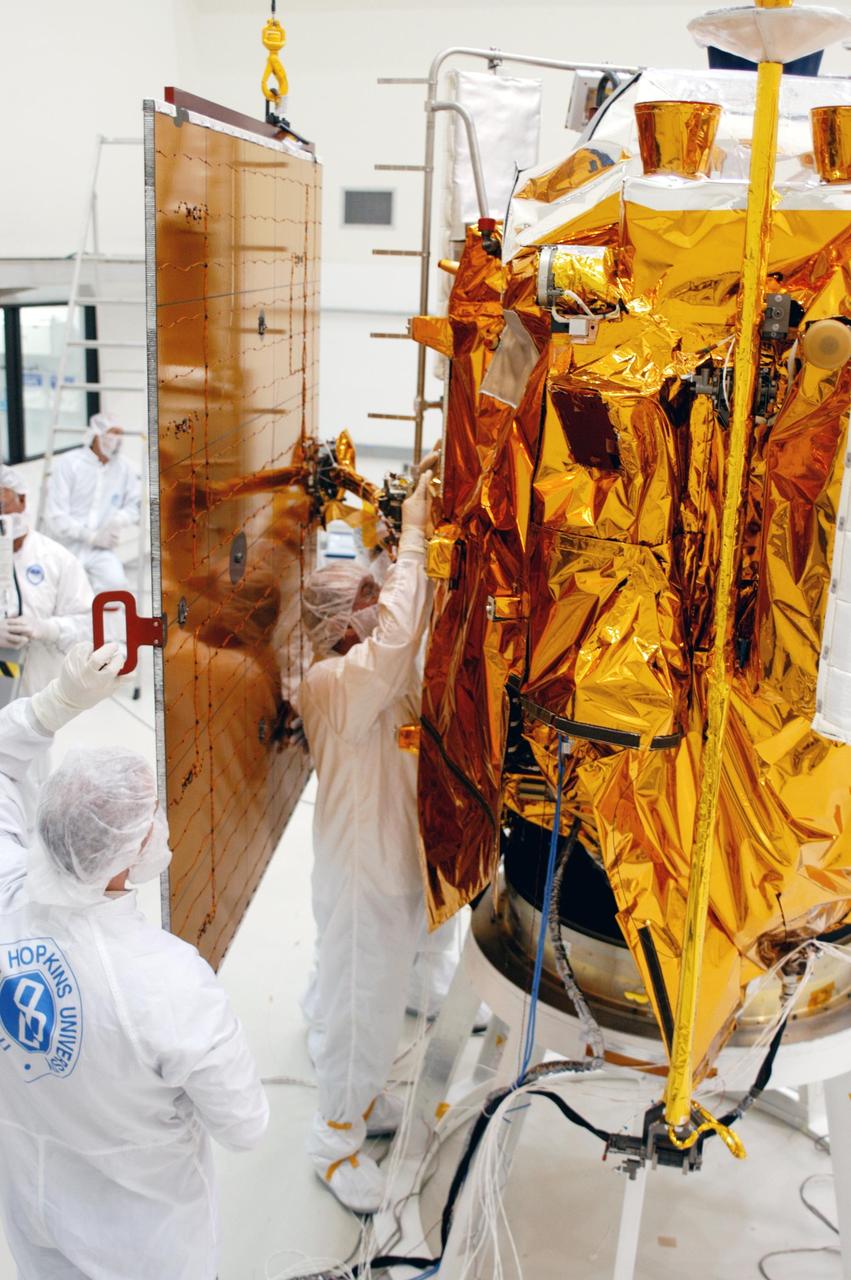
KENNEDY SPACE CENTER, FLA. - Technicians at Astrotech in Titusville, Fla., steady a solar panel suspended from above as others prepare to install it on NASA’s MESSENGER spacecraft. It is one of two large solar panels, supplemented with a nickel-hydrogen battery, that will provide MESSENGER’s power. MESSENGER is scheduled to launch Aug. 2 aboard a Boeing Delta II rocket from Pad 17-B, Cape Canaveral Air Force Station, Fla. It will return to Earth for a gravity boost in July 2005, then fly past Venus twice, in October 2006 and June 2007. The spacecraft uses the tug of Venus’ gravity to resize and rotate its trajectory closer to Mercury’s orbit. Three Mercury flybys, each followed about two months later by a course-correction maneuver, put MESSENGER in position to enter Mercury orbit in March 2011. During the flybys, MESSENGER will map nearly the entire planet in color, image most of the areas unseen by Mariner 10, and measure the composition of the surface, atmosphere and magnetosphere. It will be the first new data from Mercury in more than 30 years - and invaluable for planning MESSENGER’s year-long orbital mission. MESSENGER was built for NASA by the Johns Hopkins University Applied Physics Laboratory in Laurel, Md.
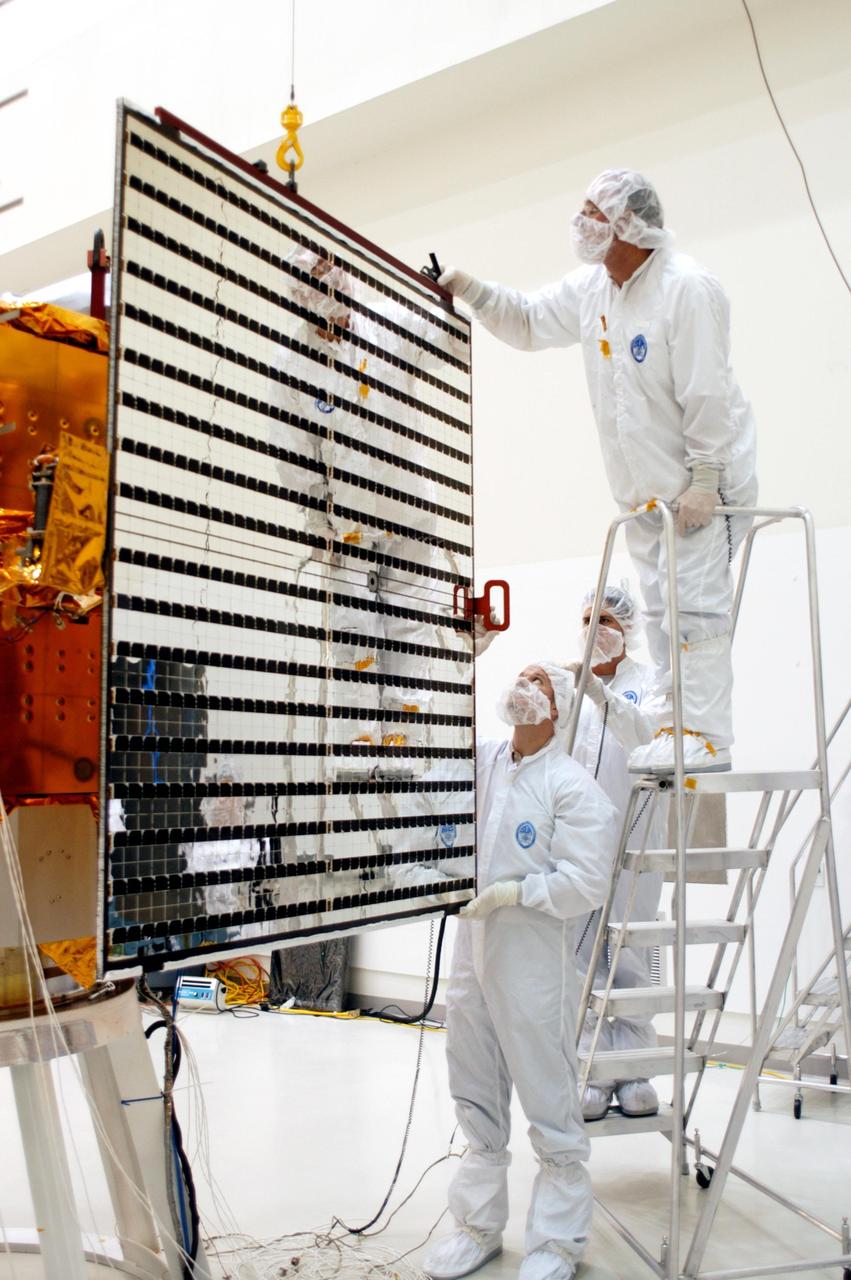
KENNEDY SPACE CENTER, FLA. - Technicians at Astrotech in Titusville, Fla., guide a solar panel closer to NASA’s MESSENGER spacecraft for installation. It is one of two large solar panels, supplemented with a nickel-hydrogen battery, that will provide MESSENGER’s power. MESSENGER is scheduled to launch Aug. 2 aboard a Boeing Delta II rocket from Pad 17-B, Cape Canaveral Air Force Station, Fla. It will return to Earth for a gravity boost in July 2005, then fly past Venus twice, in October 2006 and June 2007. The spacecraft uses the tug of Venus’ gravity to resize and rotate its trajectory closer to Mercury’s orbit. Three Mercury flybys, each followed about two months later by a course-correction maneuver, put MESSENGER in position to enter Mercury orbit in March 2011. During the flybys, MESSENGER will map nearly the entire planet in color, image most of the areas unseen by Mariner 10, and measure the composition of the surface, atmosphere and magnetosphere. It will be the first new data from Mercury in more than 30 years - and invaluable for planning MESSENGER’s year-long orbital mission. MESSENGER was built for NASA by the Johns Hopkins University Applied Physics Laboratory in Laurel, Md.
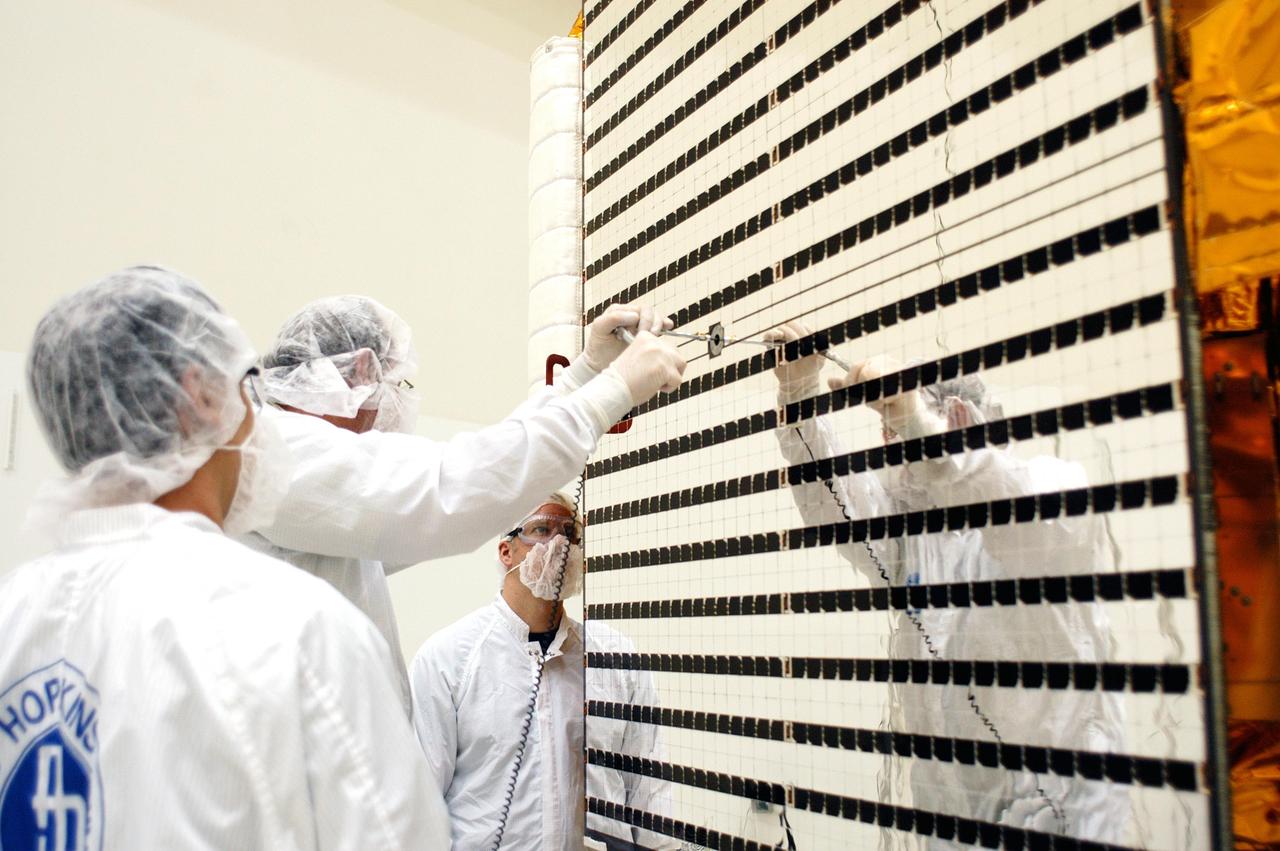
KENNEDY SPACE CENTER, FLA. - At Astrotech in Titusville, Fla., technicians with The Johns Hopkins University Applied Physics Laboratory (APL) prepare one of two solar array panels on the MESSENGER spacecraft for deployment. The panels will provide MESSENGER’s power on its journey to Mercury. MESSENGER is scheduled to launch Aug. 2 aboard a Boeing Delta II rocket from Pad 17-B, Cape Canaveral Air Force Station, Fla. It will return to Earth for a gravity boost in July 2005, then fly past Venus twice, in October 2006 and June 2007. The spacecraft uses the tug of Venus’ gravity to resize and rotate its trajectory closer to Mercury’s orbit. Three Mercury flybys, each followed about two months later by a course-correction maneuver, put MESSENGER in position to enter Mercury orbit in March 2011. During the flybys, MESSENGER will map nearly the entire planet in color, image most of the areas unseen by Mariner 10, and measure the composition of the surface, atmosphere and magnetosphere. It will be the first new data from Mercury in more than 30 years - and invaluable for planning MESSENGER’s year-long orbital mission. MESSENGER was built for NASA by APL in Laurel, Md.
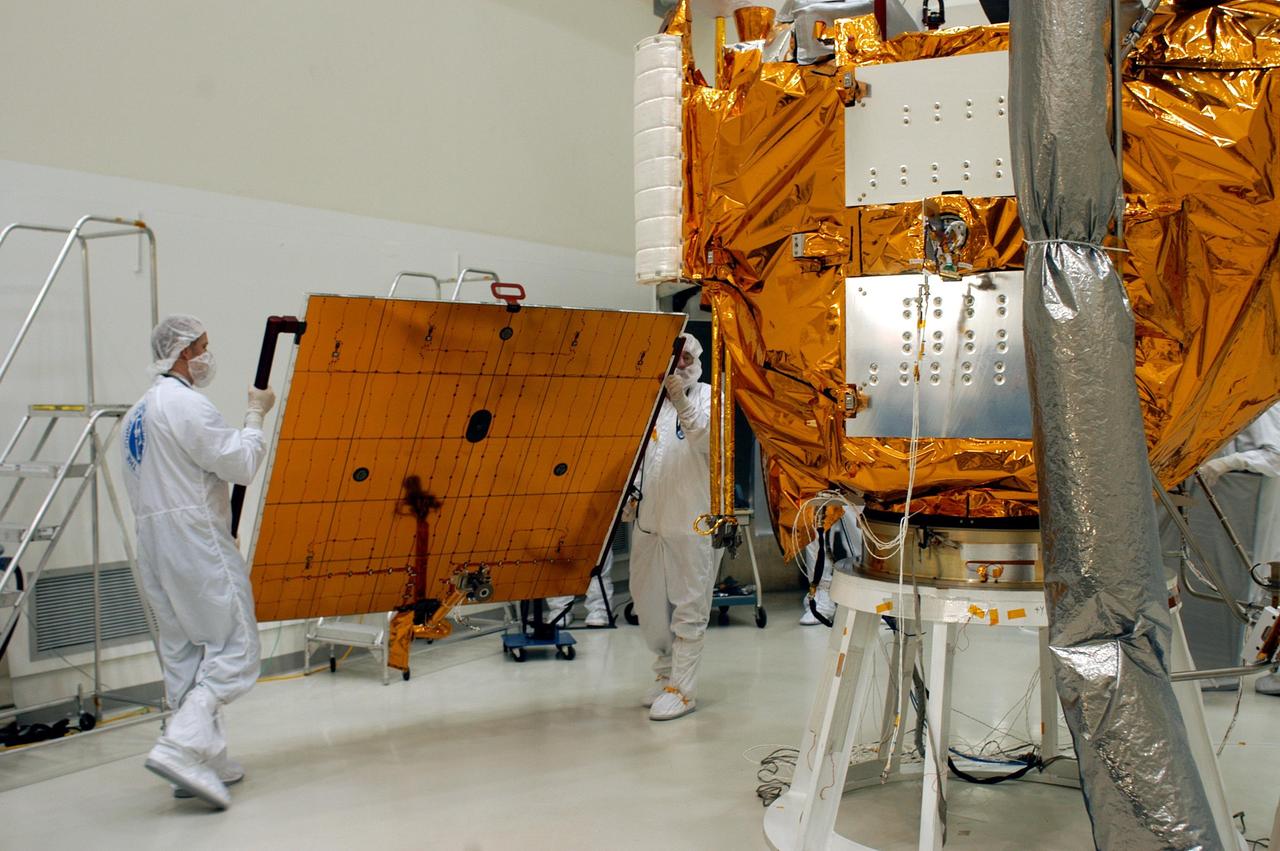
KENNEDY SPACE CENTER, FLA. - Technicians at Astrotech in Titusville, Fla., carry a solar panel toward NASA’s MESSENGER spacecraft for installation. It is one of two large solar panels, supplemented with a nickel-hydrogen battery, that will provide MESSENGER’s power. MESSENGER is scheduled to launch Aug. 2 aboard a Boeing Delta II rocket from Pad 17-B, Cape Canaveral Air Force Station, Fla. It will return to Earth for a gravity boost in July 2005, then fly past Venus twice, in October 2006 and June 2007. The spacecraft uses the tug of Venus’ gravity to resize and rotate its trajectory closer to Mercury’s orbit. Three Mercury flybys, each followed about two months later by a course-correction maneuver, put MESSENGER in position to enter Mercury orbit in March 2011. During the flybys, MESSENGER will map nearly the entire planet in color, image most of the areas unseen by Mariner 10, and measure the composition of the surface, atmosphere and magnetosphere. It will be the first new data from Mercury in more than 30 years - and invaluable for planning MESSENGER’s year-long orbital mission. MESSENGER was built for NASA by the Johns Hopkins University Applied Physics Laboratory in Laurel, Md.

KENNEDY SPACE CENTER, FLA. - - After the deployment test of two solar panels at Astrotech in Titusville, Fla., technicians with The Johns Hopkins University Applied Physics Laboratory (APL) prepare the MESSESNGER spacecraft for a move to a hazardous processing facility in preparation for loading the spacecraft’s complement of hypergolic propellants. The solar arrays will provide MESSENGER’s power on its journey to Mercury. MESSENGER is scheduled to launch Aug. 2 aboard a Boeing Delta II rocket from Pad 17-B, Cape Canaveral Air Force Station, Fla. It will return to Earth for a gravity boost in July 2005, then fly past Venus twice, in October 2006 and June 2007. The spacecraft uses the tug of Venus’ gravity to resize and rotate its trajectory closer to Mercury’s orbit. Three Mercury flybys, each followed about two months later by a course-correction maneuver, put MESSENGER in position to enter Mercury orbit in March 2011. During the flybys, MESSENGER will map nearly the entire planet in color, image most of the areas unseen by Mariner 10, and measure the composition of the surface, atmosphere and magnetosphere. It will be the first new data from Mercury in more than 30 years - and invaluable for planning MESSENGER’s year-long orbital mission. MESSENGER was built for NASA by APL in Laurel, Md.
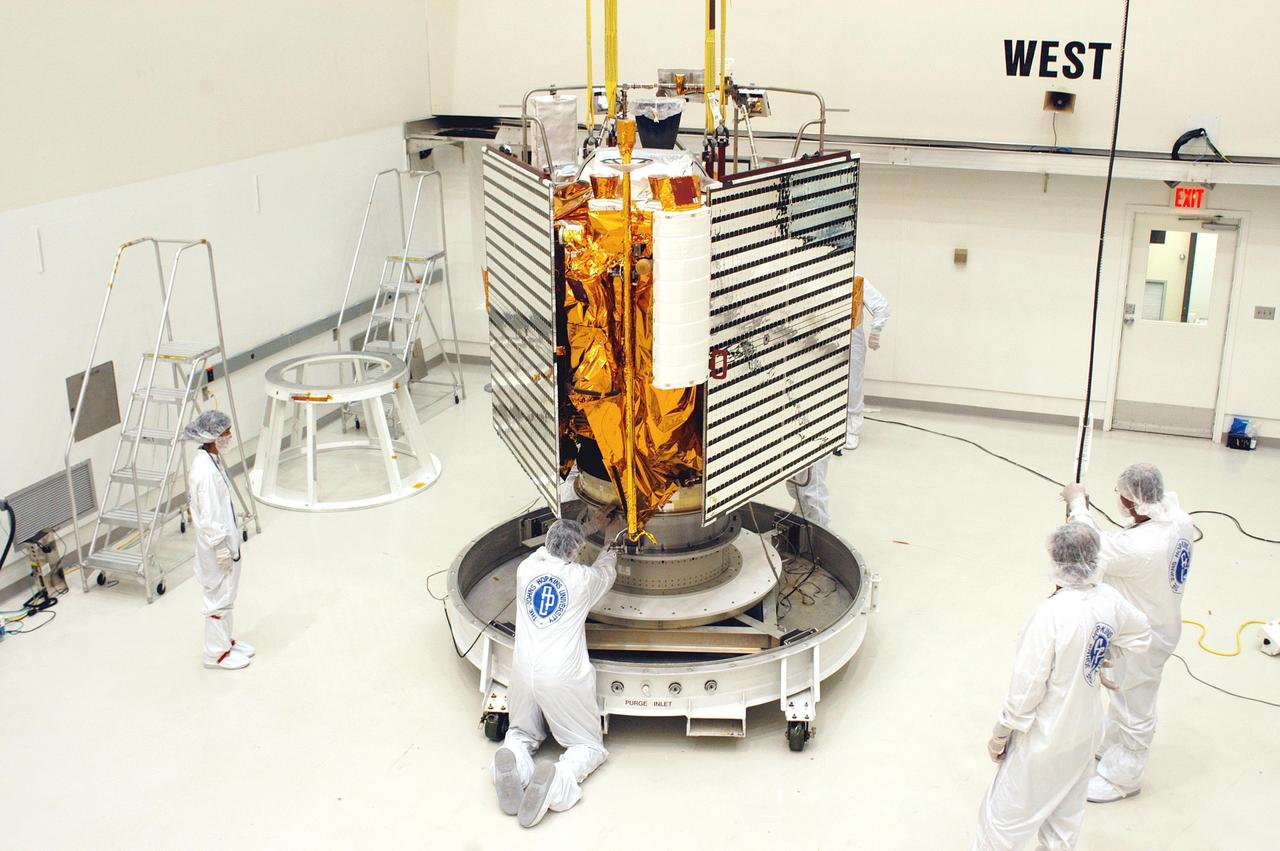
KENNEDY SPACE CENTER, FLA. - At Astrotech in Titusville, Fla., technicians with The Johns Hopkins University Applied Physics Laboratory (APL) prepare the MESSESNGER spacecraft for a move to a hazardous processing facility in preparation for loading the spacecraft’s complement of hypergolic propellants. MESSENGER is scheduled to launch Aug. 2 aboard a Boeing Delta II rocket from Pad 17-B, Cape Canaveral Air Force Station, Fla., on a journey to Mercury. It will return to Earth for a gravity boost in July 2005, then fly past Venus twice, in October 2006 and June 2007. The spacecraft uses the tug of Venus’ gravity to resize and rotate its trajectory closer to Mercury’s orbit. Three Mercury flybys, each followed about two months later by a course-correction maneuver, put MESSENGER in position to enter Mercury orbit in March 2011. During the flybys, MESSENGER will map nearly the entire planet in color, image most of the areas unseen by Mariner 10, and measure the composition of the surface, atmosphere and magnetosphere. It will be the first new data from Mercury in more than 30 years - and invaluable for planning MESSENGER’s year-long orbital mission. MESSENGER was built for NASA by APL in Laurel, Md.
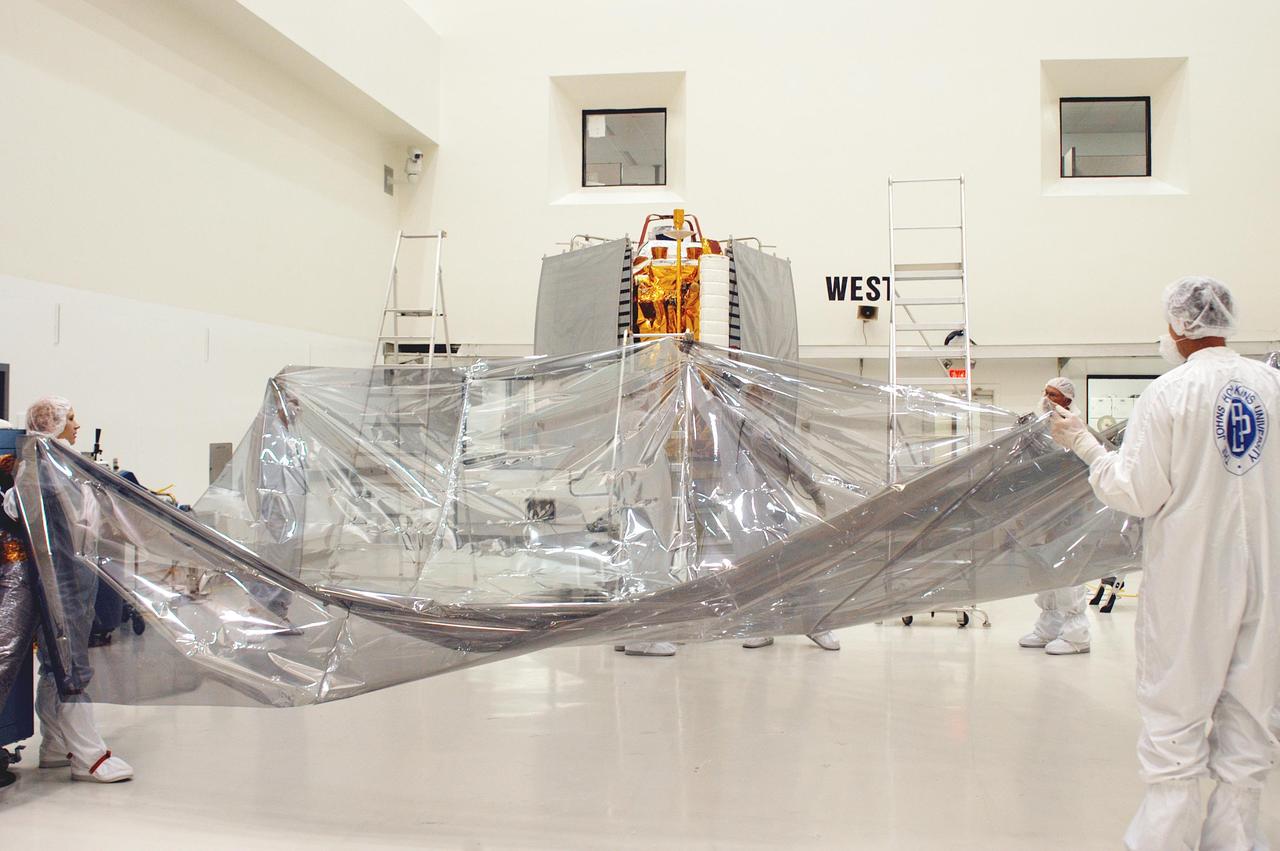
KENNEDY SPACE CENTER, FLA. - At Astrotech in Titusville, Fla., technicians with The Johns Hopkins University Applied Physics Laboratory (APL) prepare to cover the MESSESNGER spacecraft for a move to a hazardous processing facility in preparation for loading the spacecraft’s complement of hypergolic propellants. MESSENGER is scheduled to launch Aug. 2 aboard a Boeing Delta II rocket from Pad 17-B, Cape Canaveral Air Force Station, Fla., on a journey to Mercury. It will return to Earth for a gravity boost in July 2005, then fly past Venus twice, in October 2006 and June 2007. The spacecraft uses the tug of Venus’ gravity to resize and rotate its trajectory closer to Mercury’s orbit. Three Mercury flybys, each followed about two months later by a course-correction maneuver, put MESSENGER in position to enter Mercury orbit in March 2011. During the flybys, MESSENGER will map nearly the entire planet in color, image most of the areas unseen by Mariner 10, and measure the composition of the surface, atmosphere and magnetosphere. It will be the first new data from Mercury in more than 30 years - and invaluable for planning MESSENGER’s year-long orbital mission. MESSENGER was built for NASA by APL in Laurel, Md.
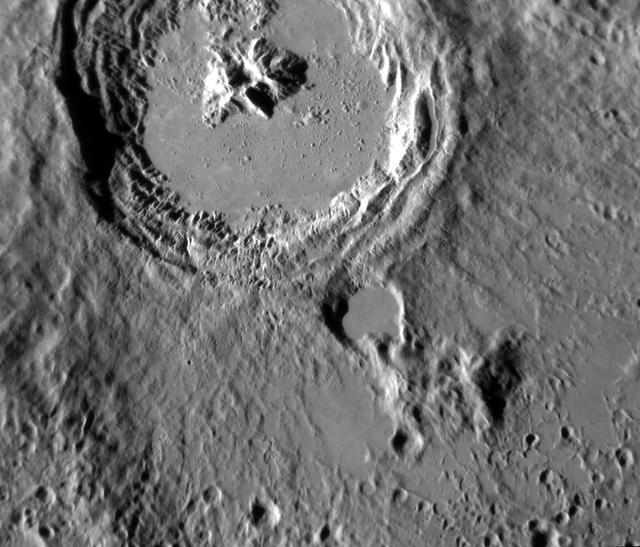
Date acquired: April 05, 2013 This striking image of Kuiper shows the crater in a new perspective. This image highlights the crater's smooth impact melt and central peaks. Kuiper, first seen by Mariner 10, is an easily identifiable feature on Mercury's surface due to its bright rays, similar to Hokusai. This image was acquired as a high-resolution targeted observation. Targeted observations are images of a small area on Mercury's surface at resolutions much higher than the 200-meter/pixel morphology base map. It is not possible to cover all of Mercury's surface at this high resolution, but typically several areas of high scientific interest are imaged in this mode each week. The MESSENGER spacecraft is the first ever to orbit the planet Mercury, and the spacecraft's seven scientific instruments and radio science investigation are unraveling the history and evolution of the Solar System's innermost planet. During the first two years of orbital operations, MESSENGER acquired over 150,000 images and extensive other data sets. MESSENGER is capable of continuing orbital operations until early 2015. Credit: NASA/Johns Hopkins University Applied Physics Laboratory/Carnegie Institution of Washington
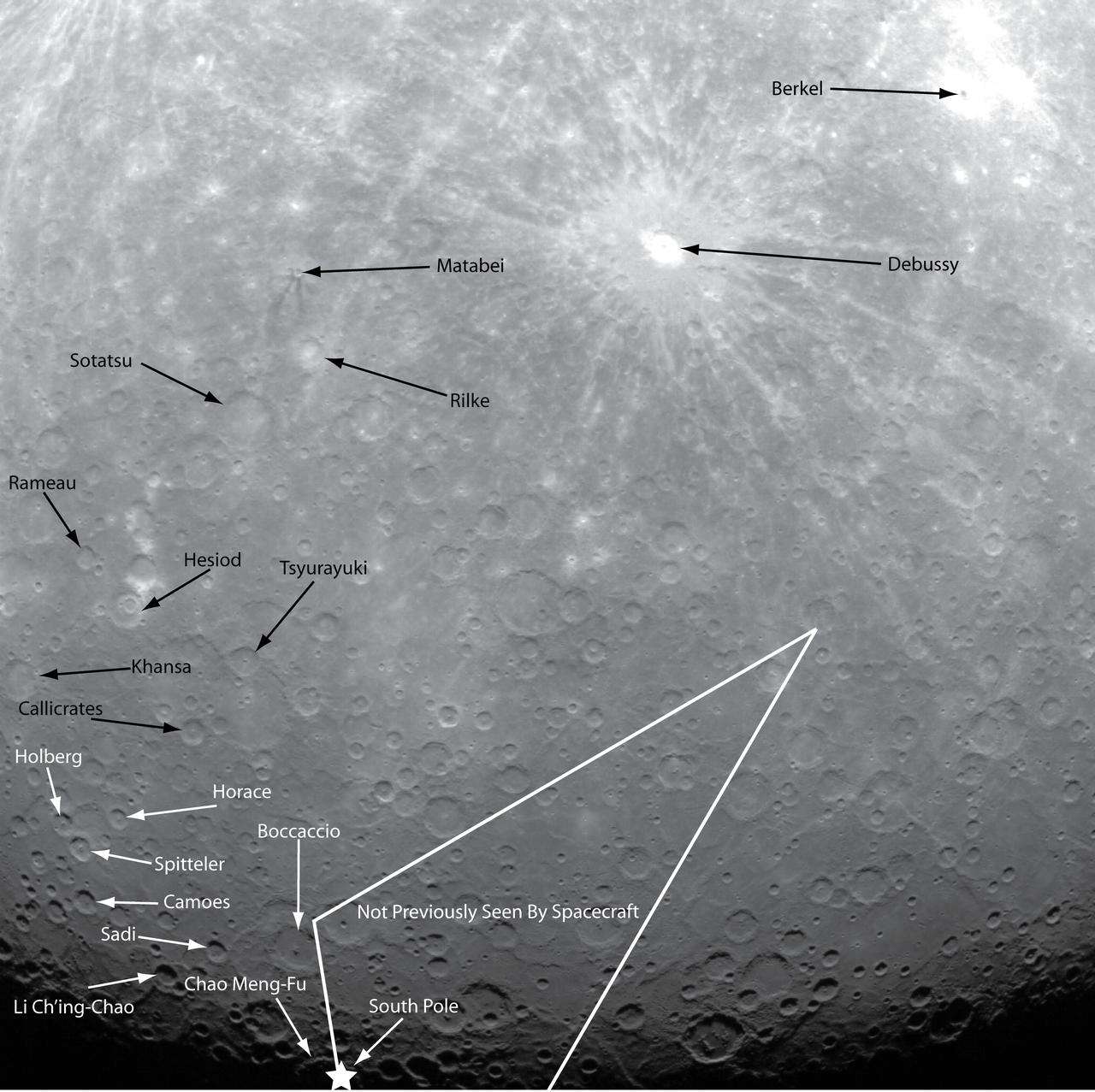
NASA image acquired: March 29, 2011 This historic first orbital image of Mercury was acquired 37 years to the day after Mariner 10’s historic first flyby of the innermost planet. Labels have been added to indicate several craters that were named based on Mariner 10 images, as well as Debussy, Matabei, and Berkel, which were named based on MESSENGER flyby images. The surface contained in the white lines is terrain previously unseen by spacecraft, and the star indicates the location of the south pole. On March 17, 2011 (March 18, 2011, UTC), MESSENGER became the first spacecraft to orbit the planet Mercury. The mission is currently in its commissioning phase, during which spacecraft and instrument performance are verified through a series of specially designed checkout activities. In the course of the one-year primary mission, the spacecraft's seven scientific instruments and radio science investigation will unravel the history and evolution of the Solar System's innermost planet. Visit the Why Mercury? section of this website to learn more about the science questions that the MESSENGER mission has set out to answer. Credit: NASA/Johns Hopkins University Applied Physics Laboratory/Carnegie Institution of Washington <b><a href="http://www.nasa.gov/centers/goddard/home/index.html" rel="nofollow">NASA Goddard Space Flight Center</a></b> enables NASA’s mission through four scientific endeavors: Earth Science, Heliophysics, Solar System Exploration, and Astrophysics. Goddard plays a leading role in NASA’s accomplishments by contributing compelling scientific knowledge to advance the Agency’s mission. <b>Follow us on <a href="http://twitter.com/NASA_GoddardPix" rel="nofollow">Twitter</a></b> <b>Join us on <a href="http://www.facebook.com/pages/Greenbelt-MD/NASA-Goddard/395013845897?ref=tsd" rel="nofollow">Facebook</a></b>
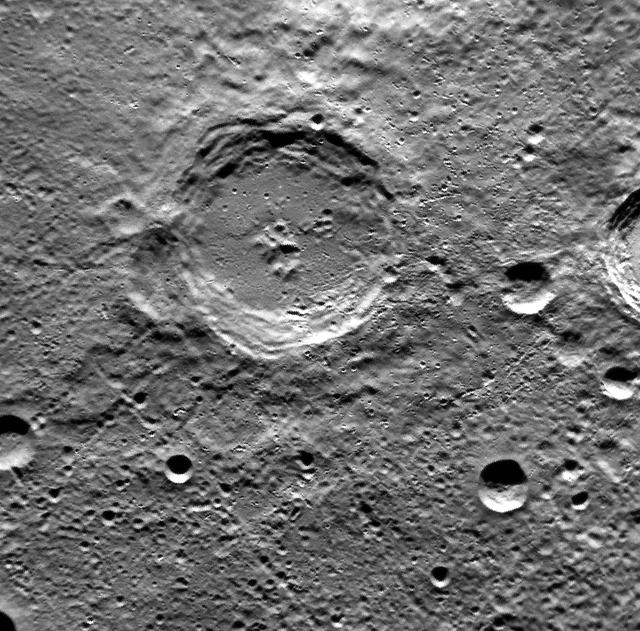
Release Date: December 21, 2011 The crater at the center of this image is named Dickens, after Charles Dickens, the English novelist who lived from 1812 to 1870. Among Dickens' famous works is A Christmas Carol, the story of Bob Cratchit, his family, and horrible boss Mr. Scrooge. Scientists studying Mercury might consider the Mariner 10 mission to be Christmas Past, MESSENGER to be Christmas Present, and the European Bepi-Colombo mission to be Christmas Yet To Come. This image was acquired as part of MDIS's high-resolution surface morphology base map. The surface morphology base map will cover more than 90% of Mercury's surface with an average resolution of 250 meters/pixel (0.16 miles/pixel or 820 feet/pixel). Images acquired for the surface morphology base map typically have off-vertical Sun angles (i.e., high incidence angles) and visible shadows so as to reveal clearly the topographic form of geologic features. The MESSENGER spacecraft is the first ever to orbit the planet Mercury, and the spacecraft's seven scientific instruments and radio science investigation are unraveling the history and evolution of the Solar System's innermost planet. Visit the Why Mercury? section of this website to learn more about the key science questions that the MESSENGER mission is addressing. During the one-year primary mission, MDIS is scheduled to acquire more than 75,000 images in support of MESSENGER's science goals. Credit: NASA/Johns Hopkins University Applied Physics Laboratory/Carnegie Institution of Washington <b><a href="http://www.nasa.gov/audience/formedia/features/MP_Photo_Guidelines.html" rel="nofollow">NASA image use policy.</a></b> <b><a href="http://www.nasa.gov/centers/goddard/home/index.html" rel="nofollow">NASA Goddard Space Flight Center</a></b> enables NASA’s mission through four scientific endeavors: Earth Science, Heliophysics, Solar System Exploration, and Astrophysics. Goddard plays a leading role in NASA’s accomplishments by contributing compelling scientific knowledge to advance the Agency’s mission. <b>Follow us on <a href="http://twitter.com/NASA_GoddardPix" rel="nofollow">Twitter</a></b> <b>Like us on <a href="http://www.facebook.com/pages/Greenbelt-MD/NASA-Goddard/395013845897?ref=tsd" rel="nofollow">Facebook</a></b> <b>Find us on <a href="http://instagrid.me/nasagoddard/?vm=grid" rel="nofollow">Instagram</a></b>
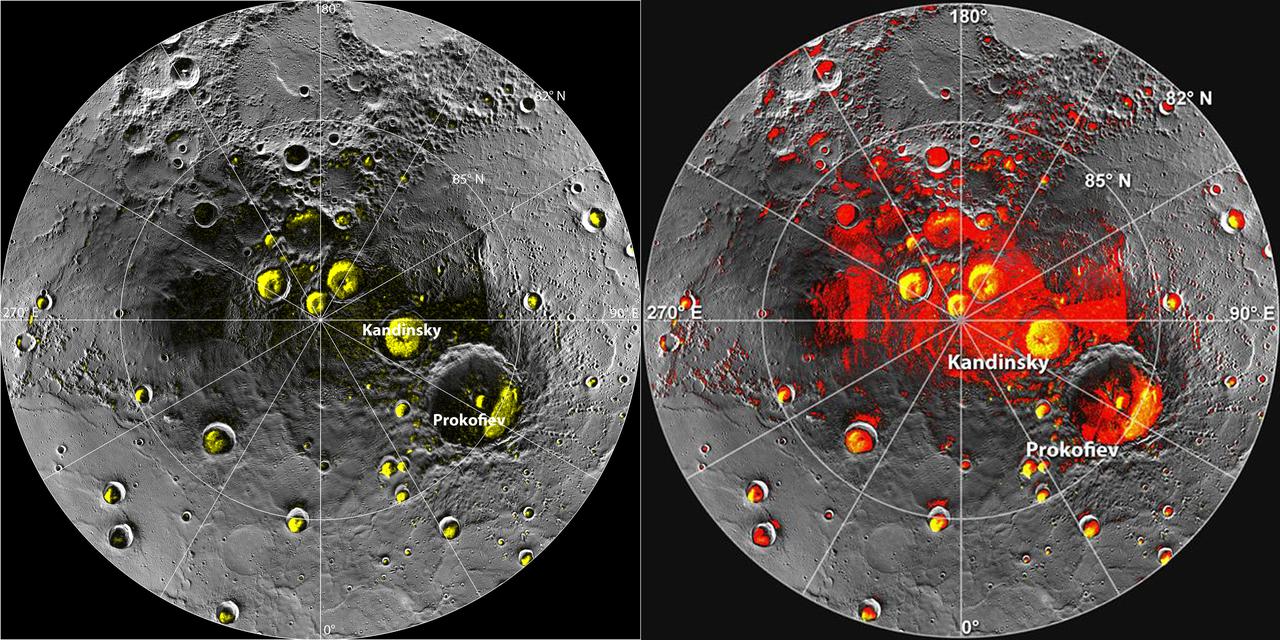
New observations by the MESSENGER spacecraft provide compelling support for the long-held hypothesis that Mercury harbors abundant water ice and other frozen volatile materials in its permanently shadowed polar craters. Three independent lines of evidence support this conclusion: the first measurements of excess hydrogen at Mercury's north pole with MESSENGER's Neutron Spectrometer, the first measurements of the reflectance of Mercury's polar deposits at near-infrared wavelengths with the Mercury Laser Altimeter (MLA), and the first detailed models of the surface and near-surface temperatures of Mercury's north polar regions that utilize the actual topography of Mercury's surface measured by the MLA. These findings are presented in three papers published online today in Science Express. Given its proximity to the Sun, Mercury would seem to be an unlikely place to find ice. But the tilt of Mercury's rotational axis is almost zero — less than one degree — so there are pockets at the planet's poles that never see sunlight. Scientists suggested decades ago that there might be water ice and other frozen volatiles trapped at Mercury's poles. The idea received a boost in 1991, when the Arecibo radio telescope in Puerto Rico detected unusually radar-bright patches at Mercury's poles, spots that reflected radio waves in the way one would expect if there were water ice. Many of these patches corresponded to the location of large impact craters mapped by the Mariner 10 spacecraft in the 1970s. But because Mariner saw less than 50 percent of the planet, planetary scientists lacked a complete diagram of the poles to compare with the images. MESSENGER's arrival at Mercury last year changed that. Images from the spacecraft's Mercury Dual Imaging System taken in 2011 and earlier this year confirmed that radar-bright features at Mercury's north and south poles are within shadowed regions on Mercury's surface, findings that are consistent with the water-ice hypothesis. To read more go to: <a href="http://1.usa.gov/TtNwM2" rel="nofollow">1.usa.gov/TtNwM2</a> Image Credit: NASA/Johns Hopkins University Applied Physics Laboratory/Carnegie Institution of Washington/National Astronomy and Ionosphere Center, Arecibo Observatory <b><a href="http://www.nasa.gov/audience/formedia/features/MP_Photo_Guidelines.html" rel="nofollow">NASA image use policy.</a></b> <b><a href="http://www.nasa.gov/centers/goddard/home/index.html" rel="nofollow">NASA Goddard Space Flight Center</a></b> enables NASA’s mission through four scientific endeavors: Earth Science, Heliophysics, Solar System Exploration, and Astrophysics. Goddard plays a leading role in NASA’s accomplishments by contributing compelling scientific knowledge to advance the Agency’s mission. <b>Follow us on <a href="http://twitter.com/NASA_GoddardPix" rel="nofollow">Twitter</a></b> <b>Like us on <a href="http://www.facebook.com/pages/Greenbelt-MD/NASA-Goddard/395013845897?ref=tsd" rel="nofollow">Facebook</a></b> <b>Find us on <a href="http://instagram.com/nasagoddard?vm=grid" rel="nofollow">Instagram</a></b>