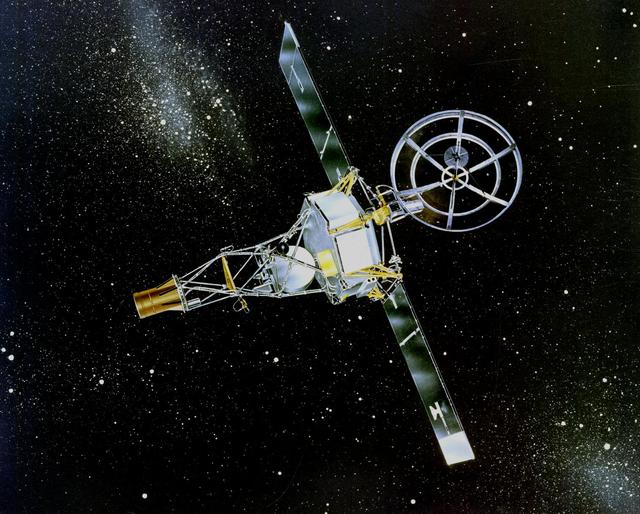
NASA Mariner 2 was the world first successful interplanetary spacecraft. Launched August 27, 1962, on an Atlas-Agena rocket, Mariner 2 passed within about 34,000 kilometers 21,000 miles of Venus.

JPL's Spacecraft Assembly Facility looks more like a hangar in this photo of two engineers standing with Mariner 1 on May 2, 1962. However, the gowning procedures were far less rigorous than they are today. Mariner 1 was destroyed during its attempted launch to Venus. https://photojournal.jpl.nasa.gov/catalog/PIA23310
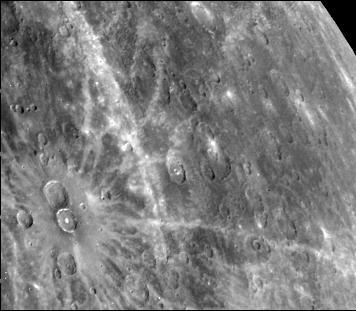
This photograph of Mercury, taken by NASA Mariner 10, shows two prominent rayed craters. Bright halos extend as far as 2 crater diameters beyond crater rims. Individual rays extend from halo.
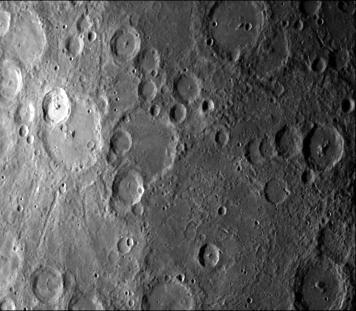
NASA Mariner 10 took this picture some 2 1/2 hours before it passed Mercury on March 29, 1974. The bright-floored crater is the center of a very large bright area which could be seen in pictures from more than two million miles distant
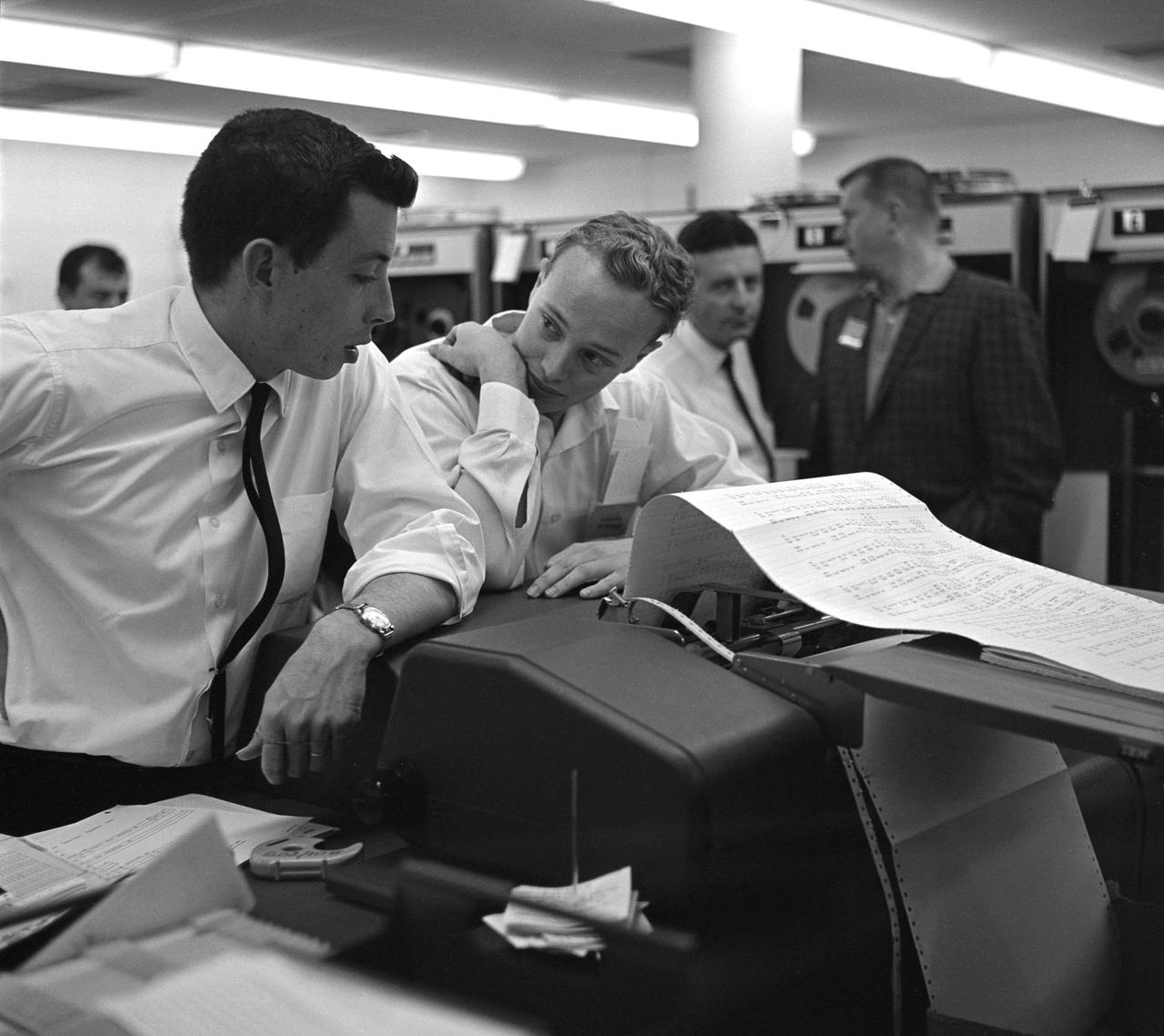
This archival image was released as part of a gallery comparing JPL's past and present, commemorating the 80th anniversary of NASA's Jet Propulsion Laboratory on Oct. 31, 2016. This image shows engineers at NASA's Jet Propulsion Laboratory looking at data related to the Venus flyby of Mariner 2 on Dec. 14, 1962. This was the first successful flyby of another planet. http://photojournal.jpl.nasa.gov/catalog/PIA21117
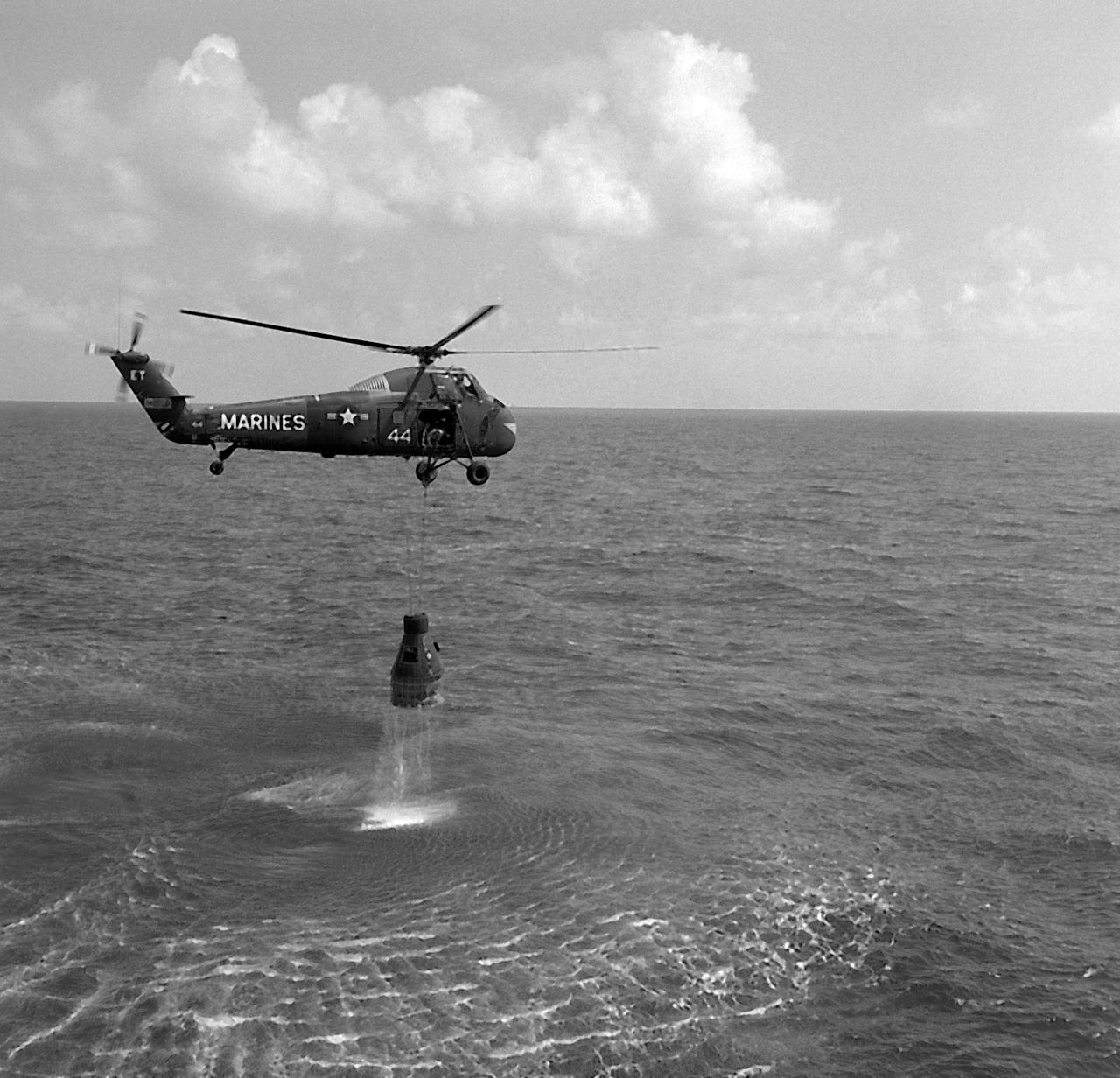
This photo depicts the recovery of the Freedom 7 (MR-3) capsule by a U.S. Marine helicopter. The MR-3 mission successfully placed the first American astronaut, Alan Shepard, in space for 15-1/2 minutes and returned safely to Earth on May 5, 1961.
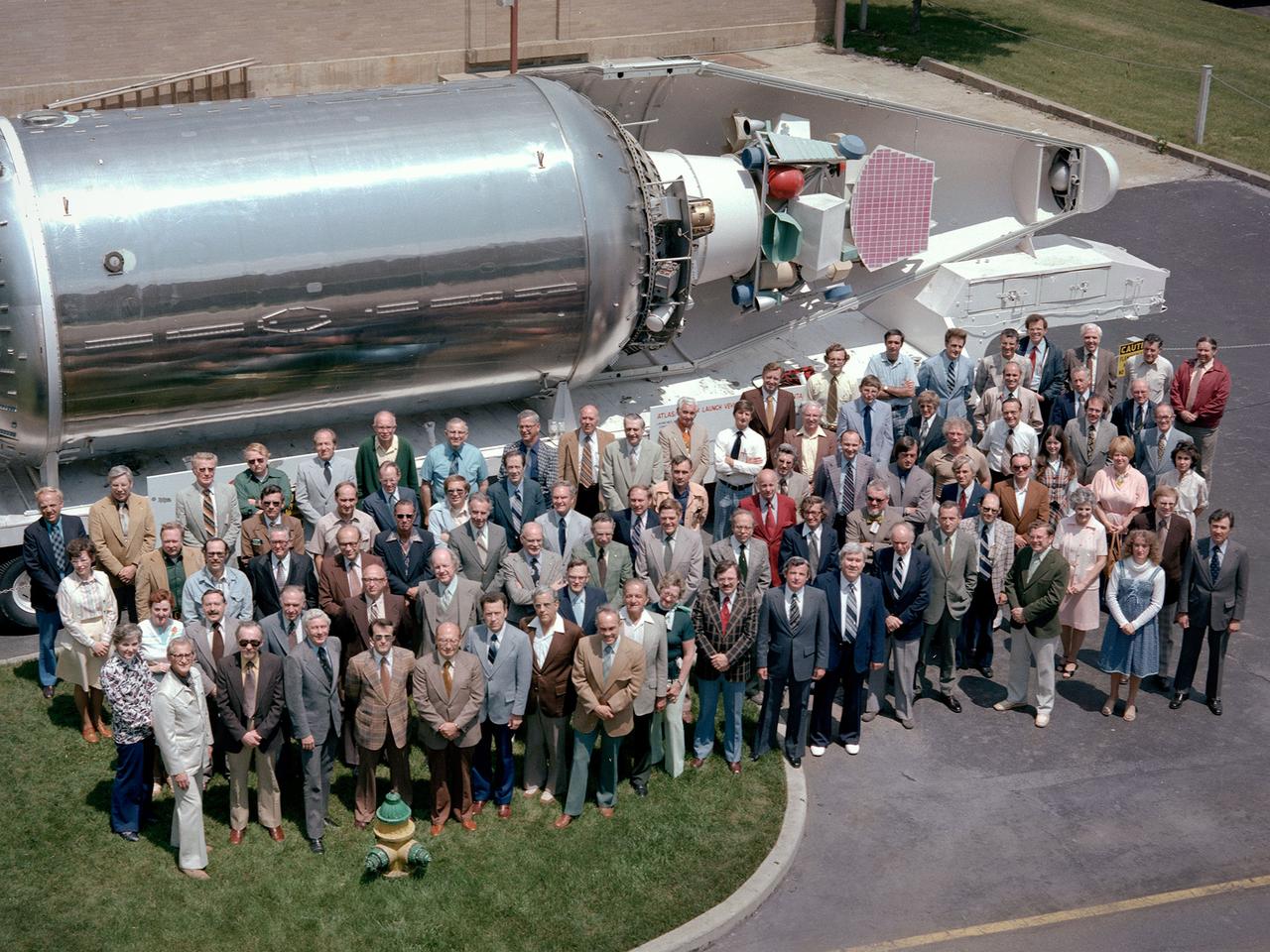
The National Aeronautics and Space Administration (NASA) Lewis Research Center’s Launch Vehicle Directorate in front of a full-scale model of the Centaur second-stage rocket. The photograph was taken to mark Centaur’s fiftieth launch. NASA Lewis managed the Centaur Program since 1962. At that time, the only prior launch attempt ended in failure. Lewis improved the spacecraft and tested it extensively throughout the early 1960s. In May 1966 an Atlas-Centaur sent the Surveyor spacecraft to the moon. It was the first successful soft landing on another planet. The Launch Vehicles Division was formed in 1969 to handle the increasing number of Centaur launches. The Lewis team became experts at integrating the payload with the Centaur and calculating proper trajectories for the missions. Centaur’s first 50 missions included Orbiting Astronomical Observatories, the Mariner 6 and 7 flybys of Mars, Mariner 9 which was the first spacecraft to orbit around another planet, the Pioneer 10 and 11 missions to the outer solar system, the Mariner 10 flyby of Venus and Mercury, the Viking 1 and 2 Mars landers, Voyagers 1 and 2 missions to Jupiter, Saturn, Uranus, and Neptune, and the Pioneer 12 and 13 flights to Venus.
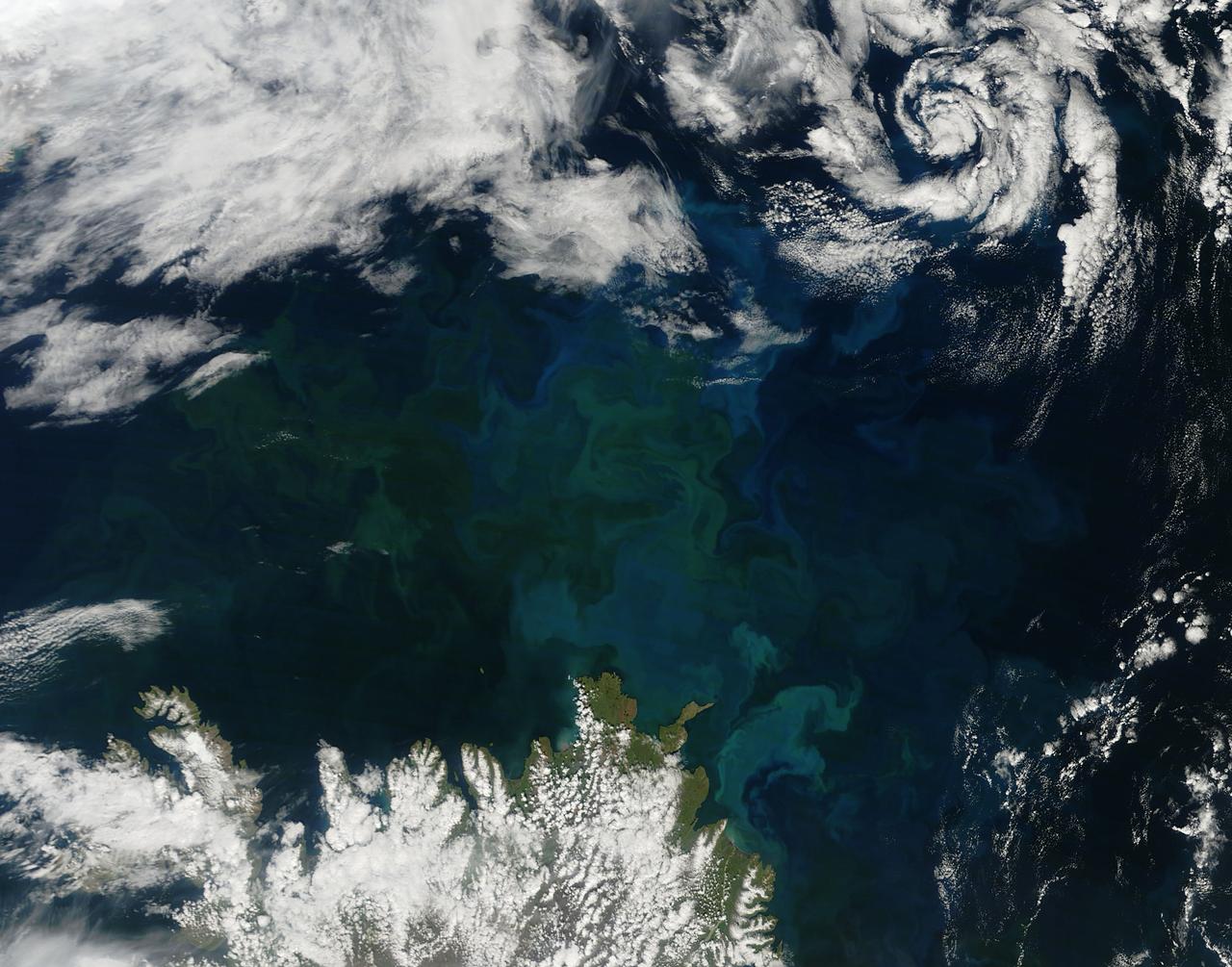
A massive phytoplankton bloom stained the waters of the Atlantic Ocean north of Iceland with brilliant jewel tones in late summer, 2014. The Moderate Resolution Imaging Spectroradiometer (MODIS) aboard NASA’s Aqua satellite captured this true-color image on August 2. Huge colonies of the floating, plant-like organisms create swirls of green, teal and turquoise and cover over 80% of the visible ocean off the northeast coast of Iceland. Marine phytoplankton require just the right amount of sunlight, dissolved nutrients and water temperatures which are not too hot, nor too cold to spark explosive reproduction and result in blooms which can cover hundreds of square kilometers. Phytoplankton form the base of the marine food chain, and are a rich food source for zooplankton, fish and other marine species. Some species, however, can deplete the water of oxygen and may become toxic to marine life. Credit: NASA/GSFC/Jeff Schmaltz/MODIS Land Rapid Response Team <b><a href="http://www.nasa.gov/audience/formedia/features/MP_Photo_Guidelines.html" rel="nofollow">NASA image use policy.</a></b> <b><a href="http://www.nasa.gov/centers/goddard/home/index.html" rel="nofollow">NASA Goddard Space Flight Center</a></b> enables NASA’s mission through four scientific endeavors: Earth Science, Heliophysics, Solar System Exploration, and Astrophysics. Goddard plays a leading role in NASA’s accomplishments by contributing compelling scientific knowledge to advance the Agency’s mission. <b>Follow us on <a href="http://twitter.com/NASAGoddardPix" rel="nofollow">Twitter</a></b> <b>Like us on <a href="http://www.facebook.com/pages/Greenbelt-MD/NASA-Goddard/395013845897?ref=tsd" rel="nofollow">Facebook</a></b> <b>Find us on <a href="http://instagram.com/nasagoddard?vm=grid" rel="nofollow">Instagram</a></b>
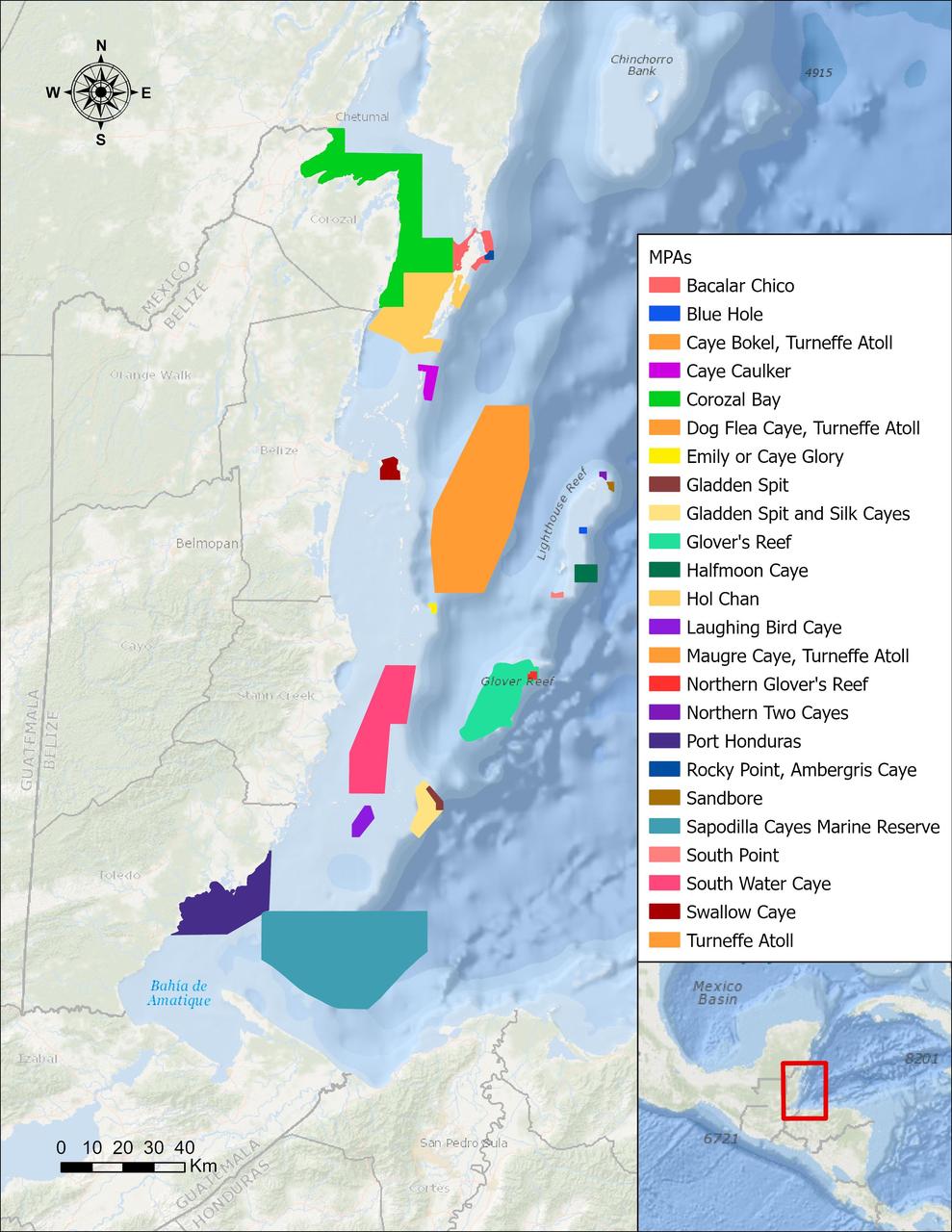
In a paper published in November 2022 in Frontiers in Remote Sensing, researchers at NASA's Jet Propulsion Laboratory, with colleagues in Belize, used data from the Moderate Resolution Imaging Spectroradiometer (MODIS) instrument aboard NASA's Aqua satellite to rank 24 protected marine areas off the Belizean coast based on the risks coral face from murky water and rising temperatures. All the areas are part of the 185-mile-long (298-kilometer-long) Belize Barrier Reef Reserve System, which encompasses a vibrant network of marine environments that supports thousands of animal and plant species and drives the Central American country's largest industry, tourism. The system is one of about 1,200 UNESCO World Heritage sites around the world. Analyzing imagery from 2002 to 2022, researchers developed a coral vulnerability index – a score between 2 and 12 that characterizes the risk to coral, with higher scores signifying greater risk. Their findings could help management authorities protect the reefs from human impacts such as development, overfishing, pollution, and climate change. Port Honduras Marine Reserve, a 156-square-mile (40,000-hectare) protected area in southern Belize, showed the highest coral vulnerability score: 10 out of 12. Based on the index, the study flags Port Honduras, Swallow Caye Wildlife Sanctuary, Sapodilla Cayes Marine Reserve, and Corozal Bay Wildlife Sanctuary as areas for concern. https://photojournal.jpl.nasa.gov/catalog/PIA25862
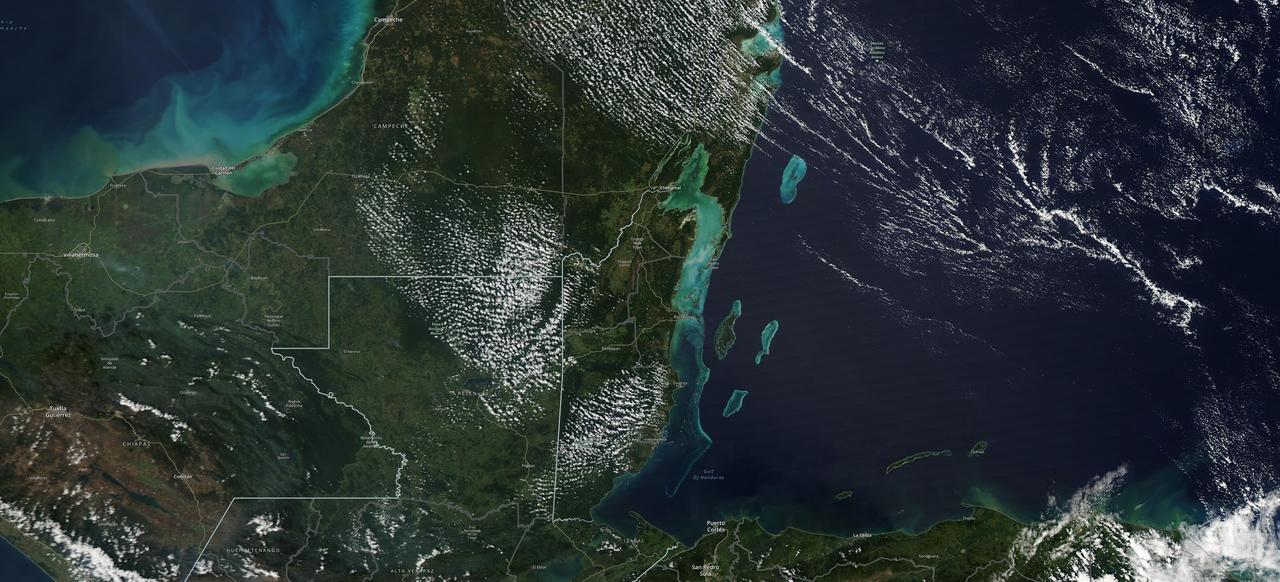
The Moderate Resolution Imaging Spectroradiometer (MODIS) instrument aboard NASA's Aqua satellite captured this image of the Yucatán Peninsula on Feb. 3, 2022. At the center is Belize, a country whose Caribbean coast is home to the Belize Barrier Reef Reserve System, which encompasses a vibrant network of marine environments that supports thousands of animal and plant species and drives Belize's largest industry, tourism. The barrier reef system is among about 1,200 UNESCO World Heritage sites around the world. In a paper published in November 2022 in Frontiers in Remote Sensing, researchers used data from Aqua MODIS to rank 24 protected marine areas off the Belizean coast based on the risks coral face from murky water and rising temperatures. The research also outlined how researchers at NASA's Jet Propulsion Laboratory in Southern California and counterparts in Belize used free, cloud-based data on Google Earth Engine in their analysis. Analyzing imagery from 2002 to 2022, researchers developed a coral vulnerability index – a score between 2 and 12 that characterizes the risk to coral, with higher scores signifying greater risk. Their findings could help management authorities protect the reefs from human impacts such as development, overfishing, pollution, and climate change. https://photojournal.jpl.nasa.gov/catalog/PIA25861

As it sped away from Venus, NASA's Mariner 10 spacecraft captured this seemingly peaceful view of a planet the size of Earth, wrapped in a dense, global cloud layer. But, contrary to its serene appearance, the clouded globe of Venus is a world of intense heat, crushing atmospheric pressure and clouds of corrosive acid. This newly processed image revisits the original data with modern image processing software. A contrast-enhanced version of this view, also provided here, makes features in the planet's thick cloud cover visible in greater detail. The clouds seen here are located about 40 miles (60 kilometers) above the planet's surface, at altitudes where Earth-like atmospheric pressures and temperatures exist. They are comprised of sulfuric acid particles, as opposed to water droplets or ice crystals, as on Earth. These cloud particles are mostly white in appearance; however, patches of red-tinted clouds also can be seen. This is due to the presence of a mysterious material that absorbs light at blue and ultraviolet wavelengths. Many chemicals have been suggested for this mystery component, from sulfur compounds to even biological materials, but a consensus has yet to be reached among researchers. The clouds of Venus whip around the planet at nearly over 200 miles per hour (100 meters per second), circling the globe in about four and a half days. That these hurricane-force winds cover nearly the entire planet is another unexplained mystery, especially given that the solid planet itself rotates at a very slow 4 mph (less than 2 meters per second) — much slower than Earth's rotation rate of about 1,000 mph (450 meters per second). The winds and clouds also blow to the west, not to the east as on the Earth. This is because the planet itself rotates to the west, backward compared to Earth and most of the other planets. As the clouds travel westward, they also typically progress toward the poles; this can be seen in the Mariner 10 view as a curved spiral pattern at mid latitudes. Near the equator, instead of long streaks, areas of more clumpy, discrete clouds can be seen, indicating enhanced upwelling and cloud formation in the equatorial region, spurred on by the enhanced power of sunlight there. This view is a false color composite created by combining images taken using orange and ultraviolet spectral filters on the spacecraft's imaging camera. These were used for the red and blue channels of the color image, respectively, with the green channel synthesized by combining the other two images. Flying past Venus en route to the first-ever flyby of Mercury, Mariner 10 became the first spacecraft to use a gravity assist to change its flight path in order to reach another planet. The images used to create this view were acquired by Mariner 10 on Feb. 7 and 8, 1974, a couple of days after the spacecraft's closest approach to Venus on Feb. 5. Despite their many differences, comparisons between Earth and Venus are valuable for helping to understand their distinct climate histories. Nearly 50 years after this view was obtained, many fundamental questions about Venus remain unanswered. Did Venus have oceans long ago? How has its atmosphere evolved over time, and when did its runaway greenhouse effect begin? How does Venus lose its heat? How volcanically and tectonically active has Venus been over the last billion years? This image was processed from archived Mariner 10 data by JPL engineer Kevin M. Gill. The Mariner 10 mission was managed by NASA's Jet Propulsion Laboratory. https://photojournal.jpl.nasa.gov/catalog/PIA23791
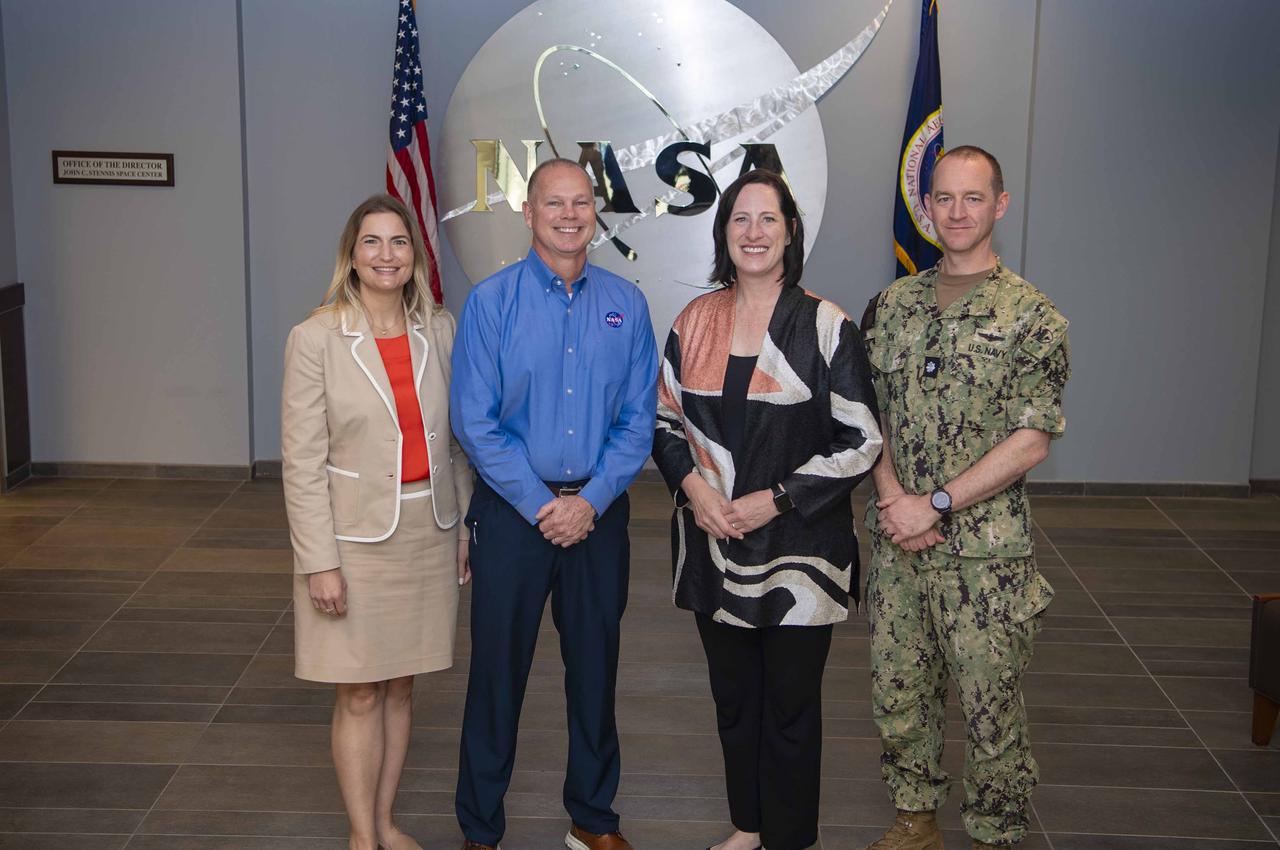
Heide Fulton, U.S. Ambassador to the Oriental Republic of Uruguay, visits NASA Stennis on Oct. 8 to meet with site leadership and tour test complex facilities. During her visit, Fulton met with NASA Stennis Director John Bailey and other leaders of the center and the NASA Shared Services Center located onsite. She also toured the rocket propulsion test complex, visiting the B-2 side of the Thad Cochran Test Stand, where she was briefed by B-2 Stand Director Ryan Roberts about NASA Stennis testing for the SLS (Space Launch System) rocket and NASA’s Artemis missions to the Moon and beyond. Uruguay is one of 45 nations who have signed the Artemis Accords, which establish a practical set of principles to guide space exploration cooperation among nations. The country became the 36th nation to sign the Artemis Accords during a Washington, D.C. ceremony in February. Ambassador Fulton was joined on the visit by Cmdr. Brendan Rok, chief of the U.S. Navy Office of Defense Cooperation at the U.S. Embassy in Montevideo, Uruguay; and Leah Thorstenson, foreign policy advisor with the U.S. Marines Corps. Forces South.
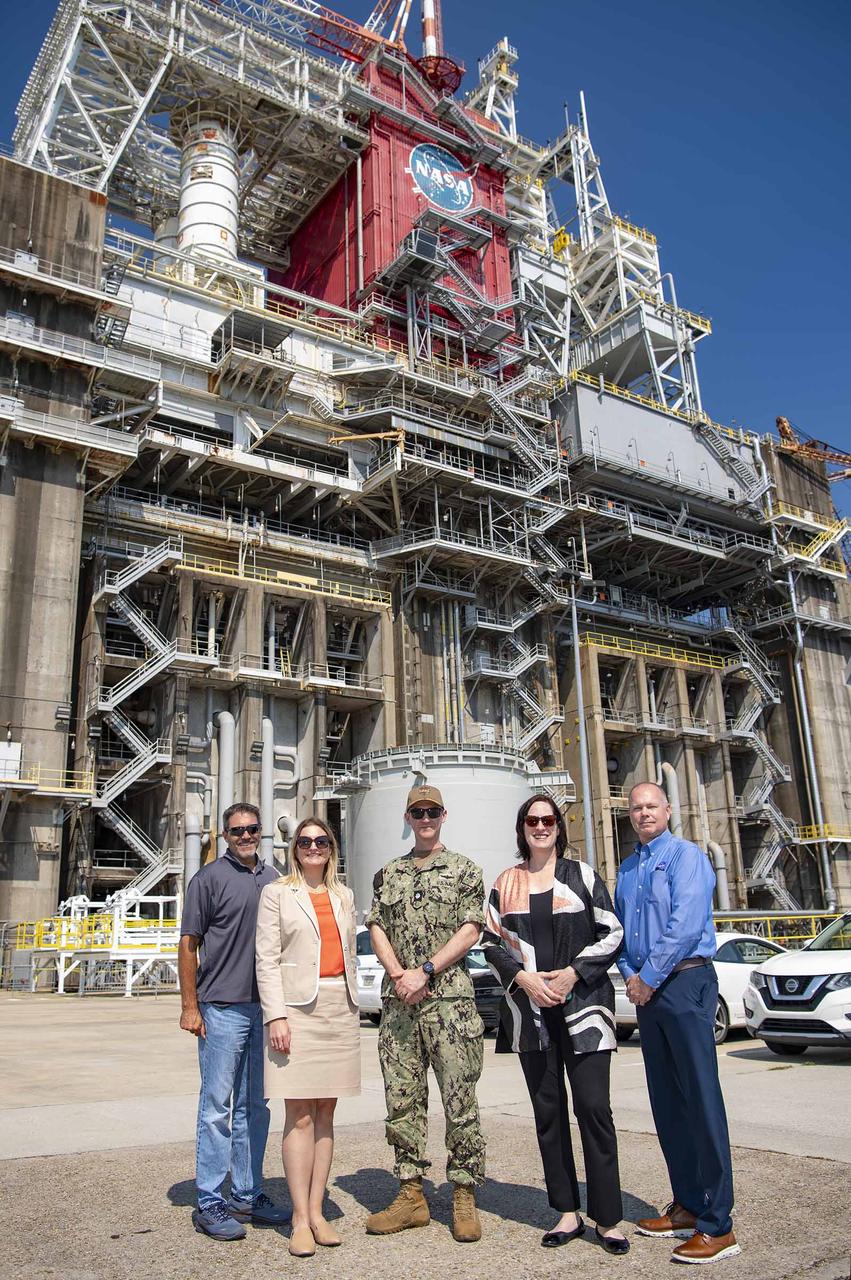
Heide Fulton, U.S. Ambassador to the Oriental Republic of Uruguay, visits NASA Stennis on Oct. 8 to meet with site leadership and tour test complex facilities. During her visit, Fulton met with NASA Stennis Director John Bailey and other leaders of the center and the NASA Shared Services Center located onsite. She also toured the rocket propulsion test complex, visiting the B-2 side of the Thad Cochran Test Stand, where she was briefed by B-2 Stand Director Ryan Roberts about NASA Stennis testing for the SLS (Space Launch System) rocket and NASA’s Artemis missions to the Moon and beyond. Uruguay is one of 45 nations who have signed the Artemis Accords, which establish a practical set of principles to guide space exploration cooperation among nations. The country became the 36th nation to sign the Artemis Accords during a Washington, D.C. ceremony in February. Ambassador Fulton was joined on the visit by Cmdr. Brendan Rok, chief of the U.S. Navy Office of Defense Cooperation at the U.S. Embassy in Montevideo, Uruguay; and Leah Thorstenson, foreign policy advisor with the U.S. Marines Corps. Forces South.
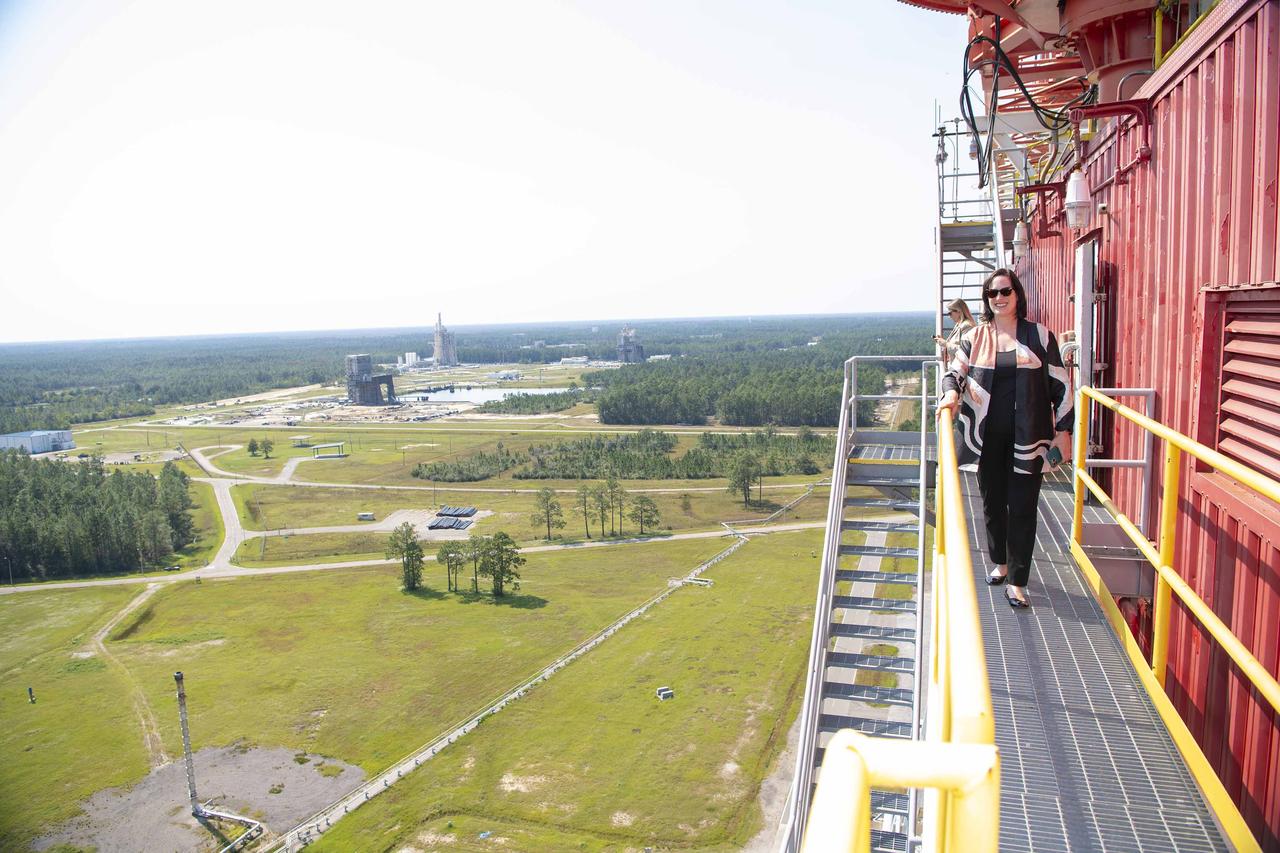
Heide Fulton, U.S. Ambassador to the Oriental Republic of Uruguay, visits NASA Stennis on Oct. 8 to meet with site leadership and tour test complex facilities. During her visit, Fulton met with NASA Stennis Director John Bailey and other leaders of the center and the NASA Shared Services Center located onsite. She also toured the rocket propulsion test complex, visiting the B-2 side of the Thad Cochran Test Stand, where she was briefed by B-2 Stand Director Ryan Roberts about NASA Stennis testing for the SLS (Space Launch System) rocket and NASA’s Artemis missions to the Moon and beyond. Uruguay is one of 45 nations who have signed the Artemis Accords, which establish a practical set of principles to guide space exploration cooperation among nations. The country became the 36th nation to sign the Artemis Accords during a Washington, D.C. ceremony in February. Ambassador Fulton was joined on the visit by Cmdr. Brendan Rok, chief of the U.S. Navy Office of Defense Cooperation at the U.S. Embassy in Montevideo, Uruguay; and Leah Thorstenson, foreign policy advisor with the U.S. Marines Corps. Forces South.
![This image from NASA's Mars Reconnaissance Orbiter (MRO) shows Mars' surface in detail. Mars has captured the imagination of astronomers for thousands of years, but it wasn't until the last half a century that we were able to capture images of its surface in detail. This particular site on Mars was first imaged in 1965 by the Mariner 4 spacecraft during the first successful fly-by mission to Mars. From an altitude of around 10,000 kilometers, this image (the ninth frame taken) achieved a resolution of approximately 1.25 kilometers per pixel. Since then, this location has been observed by six other visible cameras producing images with varying resolutions and sizes. This includes HiRISE (highlighted in yellow), which is the highest-resolution and has the smallest "footprint." This compilation, spanning Mariner 4 to HiRISE, shows each image at full-resolution. Beginning with Viking 1 and ending with our HiRISE image, this animation documents the historic imaging of a particular site on another world. In 1976, the Viking 1 orbiter began imaging Mars in unprecedented detail, and by 1980 had successfully mosaicked the planet at approximately 230 meters per pixel. In 1999, the Mars Orbiter Camera onboard the Mars Global Surveyor (1996) also imaged this site with its Wide Angle lens, at around 236 meters per pixel. This was followed by the Thermal Emission Imaging System on Mars Odyssey (2001), which also provided a visible camera producing the image we see here at 17 meters per pixel. Later in 2012, the High-Resolution Stereo Camera on the Mars Express orbiter (2003) captured this image of the surface at 25 meters per pixel. In 2010, the Context Camera on the Mars Reconnaissance Orbiter (2005) imaged this site at about 5 meters per pixel. Finally, in 2017, HiRISE acquired the highest resolution image of this location to date at 50 centimeters per pixel. When seen at this unprecedented scale, we can discern a crater floor strewn with small rocky deposits, boulders several meters across, and wind-blown deposits in the floors of small craters and depressions. This compilation of Mars images spanning over 50 years gives us a visual appreciation of the evolution of orbital Mars imaging over a single site. The map is projected here at a scale of 50 centimeters (19.7 inches) per pixel. [The original image scale is 52.2 centimeters (20.6 inches) per pixel (with 2 x 2 binning); objects on the order of 156 centimeters (61.4 inches) across are resolved.] North is up. https://photojournal.jpl.nasa.gov/catalog/PIA22115](https://images-assets.nasa.gov/image/PIA22115/PIA22115~medium.jpg)
This image from NASA's Mars Reconnaissance Orbiter (MRO) shows Mars' surface in detail. Mars has captured the imagination of astronomers for thousands of years, but it wasn't until the last half a century that we were able to capture images of its surface in detail. This particular site on Mars was first imaged in 1965 by the Mariner 4 spacecraft during the first successful fly-by mission to Mars. From an altitude of around 10,000 kilometers, this image (the ninth frame taken) achieved a resolution of approximately 1.25 kilometers per pixel. Since then, this location has been observed by six other visible cameras producing images with varying resolutions and sizes. This includes HiRISE (highlighted in yellow), which is the highest-resolution and has the smallest "footprint." This compilation, spanning Mariner 4 to HiRISE, shows each image at full-resolution. Beginning with Viking 1 and ending with our HiRISE image, this animation documents the historic imaging of a particular site on another world. In 1976, the Viking 1 orbiter began imaging Mars in unprecedented detail, and by 1980 had successfully mosaicked the planet at approximately 230 meters per pixel. In 1999, the Mars Orbiter Camera onboard the Mars Global Surveyor (1996) also imaged this site with its Wide Angle lens, at around 236 meters per pixel. This was followed by the Thermal Emission Imaging System on Mars Odyssey (2001), which also provided a visible camera producing the image we see here at 17 meters per pixel. Later in 2012, the High-Resolution Stereo Camera on the Mars Express orbiter (2003) captured this image of the surface at 25 meters per pixel. In 2010, the Context Camera on the Mars Reconnaissance Orbiter (2005) imaged this site at about 5 meters per pixel. Finally, in 2017, HiRISE acquired the highest resolution image of this location to date at 50 centimeters per pixel. When seen at this unprecedented scale, we can discern a crater floor strewn with small rocky deposits, boulders several meters across, and wind-blown deposits in the floors of small craters and depressions. This compilation of Mars images spanning over 50 years gives us a visual appreciation of the evolution of orbital Mars imaging over a single site. The map is projected here at a scale of 50 centimeters (19.7 inches) per pixel. [The original image scale is 52.2 centimeters (20.6 inches) per pixel (with 2 x 2 binning); objects on the order of 156 centimeters (61.4 inches) across are resolved.] North is up. https://photojournal.jpl.nasa.gov/catalog/PIA22115
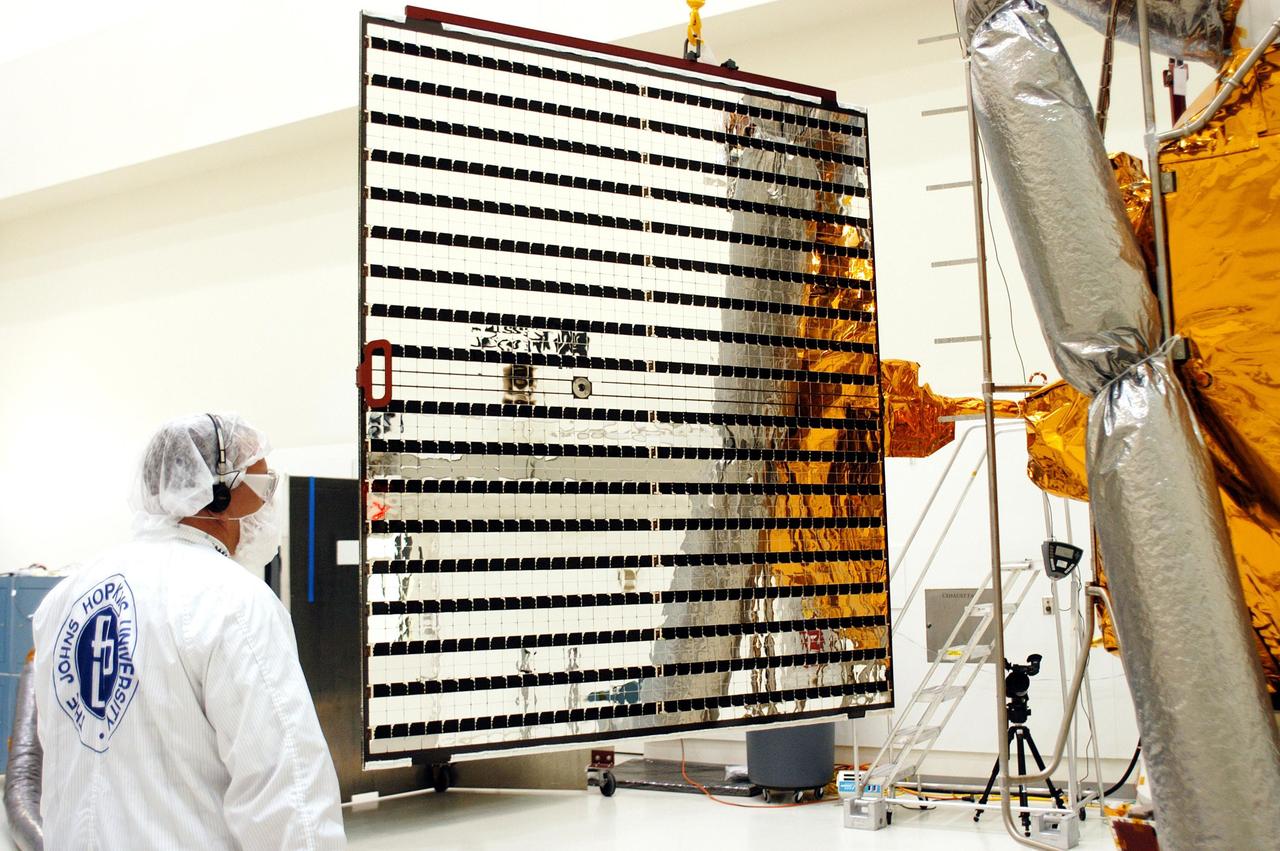
KENNEDY SPACE CENTER, FLA. - At Astrotech in Titusville, Fla., a technician with The Johns Hopkins University Applied Physics Laboratory (APL) watches as one of the solar array panels on the MESSENGER spacecraft is deployed. The two panels will provide MESSENGER’s power on its journey to Mercury. MESSENGER is scheduled to launch Aug. 2 aboard a Boeing Delta II rocket from Pad 17-B, Cape Canaveral Air Force Station, Fla. It will return to Earth for a gravity boost in July 2005, then fly past Venus twice, in October 2006 and June 2007. The spacecraft uses the tug of Venus’ gravity to resize and rotate its trajectory closer to Mercury’s orbit. Three Mercury flybys, each followed about two months later by a course-correction maneuver, put MESSENGER in position to enter Mercury orbit in March 2011. During the flybys, MESSENGER will map nearly the entire planet in color, image most of the areas unseen by Mariner 10, and measure the composition of the surface, atmosphere and magnetosphere. It will be the first new data from Mercury in more than 30 years - and invaluable for planning MESSENGER’s year-long orbital mission. MESSENGER was built for NASA by APL in Laurel, Md.
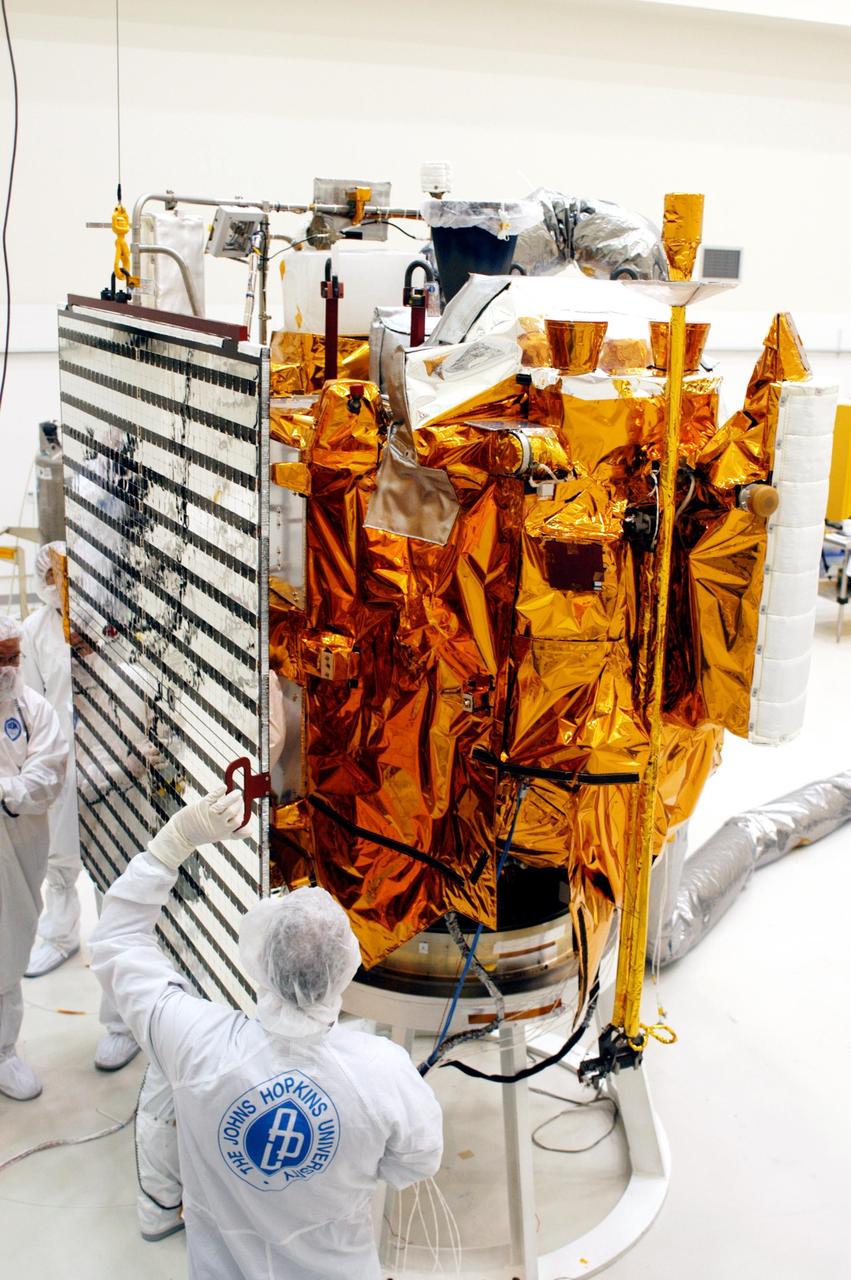
KENNEDY SPACE CENTER, FLA. - Technicians at Astrotech in Titusville, Fla., maneuver a solar panel into place for installation on NASA’s MESSENGER spacecraft. It is one of two large solar panels, supplemented with a nickel-hydrogen battery, that will provide MESSENGER’s power. MESSENGER is scheduled to launch Aug. 2 aboard a Boeing Delta II rocket from Pad 17-B, Cape Canaveral Air Force Station, Fla. It will return to Earth for a gravity boost in July 2005, then fly past Venus twice, in October 2006 and June 2007. The spacecraft uses the tug of Venus’ gravity to resize and rotate its trajectory closer to Mercury’s orbit. Three Mercury flybys, each followed about two months later by a course-correction maneuver, put MESSENGER in position to enter Mercury orbit in March 2011. During the flybys, MESSENGER will map nearly the entire planet in color, image most of the areas unseen by Mariner 10, and measure the composition of the surface, atmosphere and magnetosphere. It will be the first new data from Mercury in more than 30 years - and invaluable for planning MESSENGER’s year-long orbital mission. MESSENGER was built for NASA by the Johns Hopkins University Applied Physics Laboratory in Laurel, Md.

KENNEDY SPACE CENTER, FLA. - Technicians at Astrotech in Titusville, Fla., attach a bar to a solar panel in order to lift it and move it to NASA’s MESSENGER spacecraft for installation. The two large solar panels, supplemented with a nickel-hydrogen battery, will provide MESSENGER’s power. MESSENGER is scheduled to launch Aug. 2 aboard a Boeing Delta II rocket from Pad 17-B, Cape Canaveral Air Force Station, Fla. It will return to Earth for a gravity boost in July 2005, then fly past Venus twice, in October 2006 and June 2007. The spacecraft uses the tug of Venus’ gravity to resize and rotate its trajectory closer to Mercury’s orbit. Three Mercury flybys, each followed about two months later by a course-correction maneuver, put MESSENGER in position to enter Mercury orbit in March 2011. During the flybys, MESSENGER will map nearly the entire planet in color, image most of the areas unseen by Mariner 10, and measure the composition of the surface, atmosphere and magnetosphere. It will be the first new data from Mercury in more than 30 years - and invaluable for planning MESSENGER’s year-long orbital mission. MESSENGER was built for NASA by the Johns Hopkins University Applied Physics Laboratory in Laurel, Md.
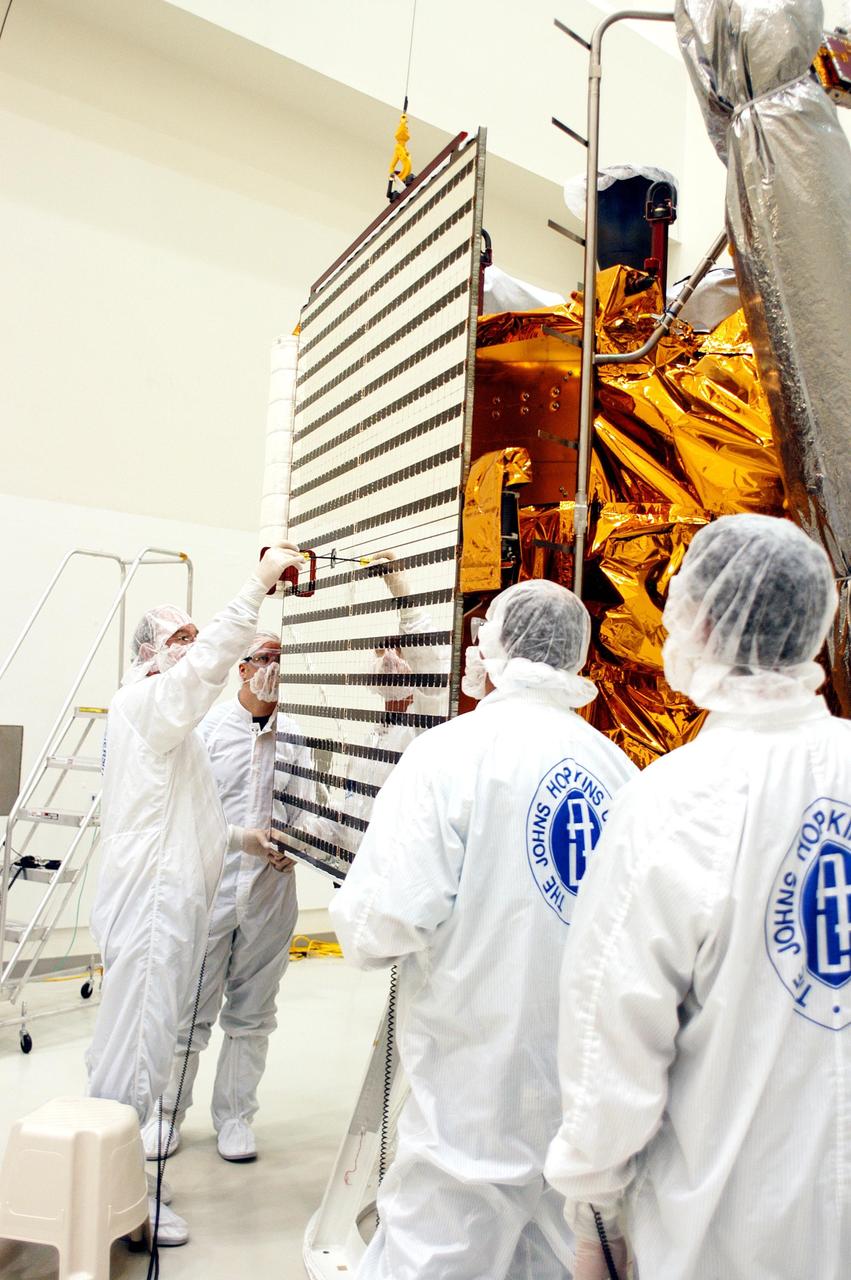
KENNEDY SPACE CENTER, FLA. - At Astrotech in Titusville, Fla., technicians with The Johns Hopkins University Applied Physics Laboratory (APL) prepare one of two solar array panels on the MESSENGER spacecraft for deployment. The panels will provide MESSENGER’s power on its journey to Mercury. MESSENGER is scheduled to launch Aug. 2 aboard a Boeing Delta II rocket from Pad 17-B, Cape Canaveral Air Force Station, Fla. It will return to Earth for a gravity boost in July 2005, then fly past Venus twice, in October 2006 and June 2007. The spacecraft uses the tug of Venus’ gravity to resize and rotate its trajectory closer to Mercury’s orbit. Three Mercury flybys, each followed about two months later by a course-correction maneuver, put MESSENGER in position to enter Mercury orbit in March 2011. During the flybys, MESSENGER will map nearly the entire planet in color, image most of the areas unseen by Mariner 10, and measure the composition of the surface, atmosphere and magnetosphere. It will be the first new data from Mercury in more than 30 years - and invaluable for planning MESSENGER’s year-long orbital mission. MESSENGER was built for NASA by APL in Laurel, Md.
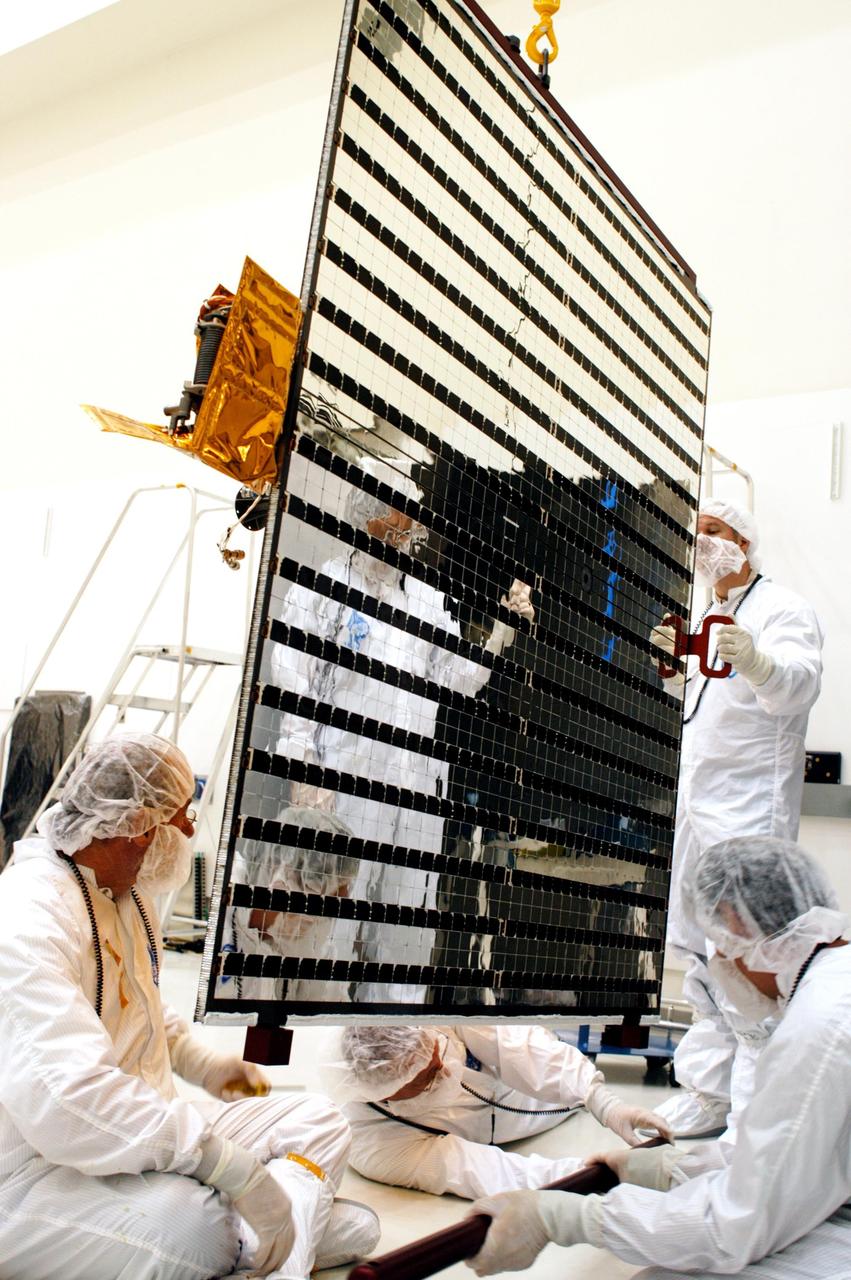
KENNEDY SPACE CENTER, FLA. - Technicians at Astrotech in Titusville, Fla., adjust a solar panel suspended from above for installation on NASA’s MESSENGER spacecraft. It is one of two large solar panels, supplemented with a nickel-hydrogen battery, that will provide MESSENGER’s power. MESSENGER is scheduled to launch Aug. 2 aboard a Boeing Delta II rocket from Pad 17-B, Cape Canaveral Air Force Station, Fla. It will return to Earth for a gravity boost in July 2005, then fly past Venus twice, in October 2006 and June 2007. The spacecraft uses the tug of Venus’ gravity to resize and rotate its trajectory closer to Mercury’s orbit. Three Mercury flybys, each followed about two months later by a course-correction maneuver, put MESSENGER in position to enter Mercury orbit in March 2011. During the flybys, MESSENGER will map nearly the entire planet in color, image most of the areas unseen by Mariner 10, and measure the composition of the surface, atmosphere and magnetosphere. It will be the first new data from Mercury in more than 30 years - and invaluable for planning MESSENGER’s year-long orbital mission. MESSENGER was built for NASA by the Johns Hopkins University Applied Physics Laboratory in Laurel, Md.

KENNEDY SPACE CENTER, FLA. - At Astrotech in Titusville, Fla., technicians secure guide wires on the second solar panel to be installed on NASA’s MESSENGER spacecraft. The two large solar panels, supplemented with a nickel-hydrogen battery, will provide MESSENGER’s power. MESSENGER is scheduled to launch Aug. 2 aboard a Boeing Delta II rocket from Pad 17-B, Cape Canaveral Air Force Station, Fla. It will return to Earth for a gravity boost in July 2005, then fly past Venus twice, in October 2006 and June 2007. The spacecraft uses the tug of Venus’ gravity to resize and rotate its trajectory closer to Mercury’s orbit. Three Mercury flybys, each followed about two months later by a course-correction maneuver, put MESSENGER in position to enter Mercury orbit in March 2011. During the flybys, MESSENGER will map nearly the entire planet in color, image most of the areas unseen by Mariner 10, and measure the composition of the surface, atmosphere and magnetosphere. It will be the first new data from Mercury in more than 30 years - and invaluable for planning MESSENGER’s year-long orbital mission. MESSENGER was built for NASA by the Johns Hopkins University Applied Physics Laboratory in Laurel, Md.
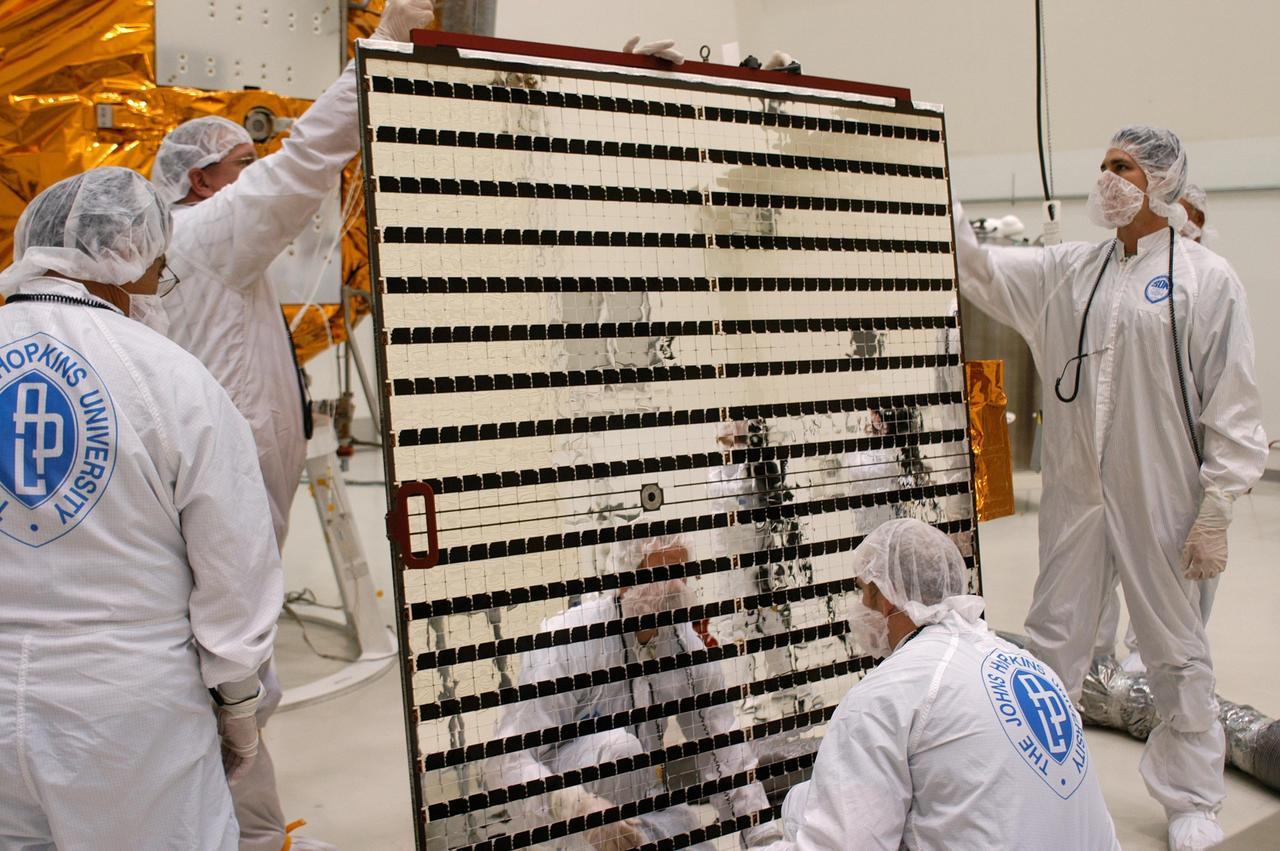
KENNEDY SPACE CENTER, FLA. - At Astrotech in Titusville, Fla., technicians check the second solar panel that will be installed on NASA’s MESSENGER spacecraft. The two large solar panels, supplemented with a nickel-hydrogen battery, will provide MESSENGER’s power. MESSENGER is scheduled to launch Aug. 2 aboard a Boeing Delta II rocket from Pad 17-B, Cape Canaveral Air Force Station, Fla. It will return to Earth for a gravity boost in July 2005, then fly past Venus twice, in October 2006 and June 2007. The spacecraft uses the tug of Venus’ gravity to resize and rotate its trajectory closer to Mercury’s orbit. Three Mercury flybys, each followed about two months later by a course-correction maneuver, put MESSENGER in position to enter Mercury orbit in March 2011. During the flybys, MESSENGER will map nearly the entire planet in color, image most of the areas unseen by Mariner 10, and measure the composition of the surface, atmosphere and magnetosphere. It will be the first new data from Mercury in more than 30 years - and invaluable for planning MESSENGER’s year-long orbital mission. MESSENGER was built for NASA by the Johns Hopkins University Applied Physics Laboratory in Laurel, Md.

Sand boil or sand volcano measuring 2 m (6.6 ft.) in length erupted in median of Interstate Highway 80 west of the Bay Bridge toll plaza when ground shaking transformed loose water-saturated deposit of subsurface sand into a sand-water slurry (liquefaction) in the October 17, 1989, Loma Prieta earthquake. Vented sand contains marine-shell fragments. Sand and soil grains have faces that can cause friction as they roll and slide against each other, or even cause sticking and form small voids between grains. This complex behavior can cause soil to behave like a liquid under certain conditions such as earthquakes or when powders are handled in industrial processes. Mechanics of Granular Materials (MGM) experiments aboard the Space Shuttle use the microgravity of space to simulate this behavior under conditions that carnot be achieved in laboratory tests on Earth. MGM is shedding light on the behavior of fine-grain materials under low effective stresses. Applications include earthquake engineering, granular flow technologies (such as powder feed systems for pharmaceuticals and fertilizers), and terrestrial and planetary geology. Nine MGM specimens have flown on two Space Shuttle flights. Another three are scheduled to fly on STS-107. The principal investigator is Stein Sture of the University of Colorado at Boulder. (Credit: J.C. Tinsley, U.S. Geological Survey)
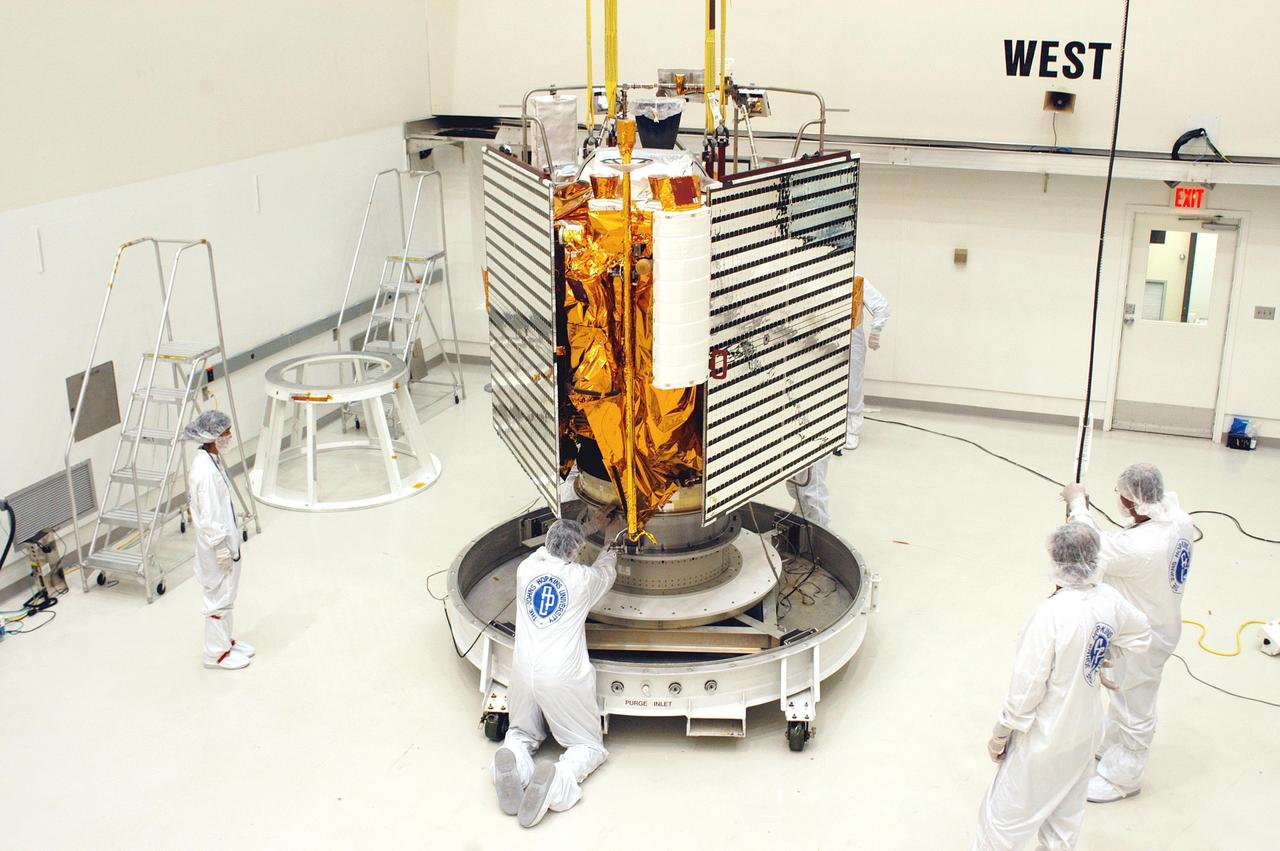
KENNEDY SPACE CENTER, FLA. - At Astrotech in Titusville, Fla., technicians with The Johns Hopkins University Applied Physics Laboratory (APL) prepare the MESSESNGER spacecraft for a move to a hazardous processing facility in preparation for loading the spacecraft’s complement of hypergolic propellants. MESSENGER is scheduled to launch Aug. 2 aboard a Boeing Delta II rocket from Pad 17-B, Cape Canaveral Air Force Station, Fla., on a journey to Mercury. It will return to Earth for a gravity boost in July 2005, then fly past Venus twice, in October 2006 and June 2007. The spacecraft uses the tug of Venus’ gravity to resize and rotate its trajectory closer to Mercury’s orbit. Three Mercury flybys, each followed about two months later by a course-correction maneuver, put MESSENGER in position to enter Mercury orbit in March 2011. During the flybys, MESSENGER will map nearly the entire planet in color, image most of the areas unseen by Mariner 10, and measure the composition of the surface, atmosphere and magnetosphere. It will be the first new data from Mercury in more than 30 years - and invaluable for planning MESSENGER’s year-long orbital mission. MESSENGER was built for NASA by APL in Laurel, Md.
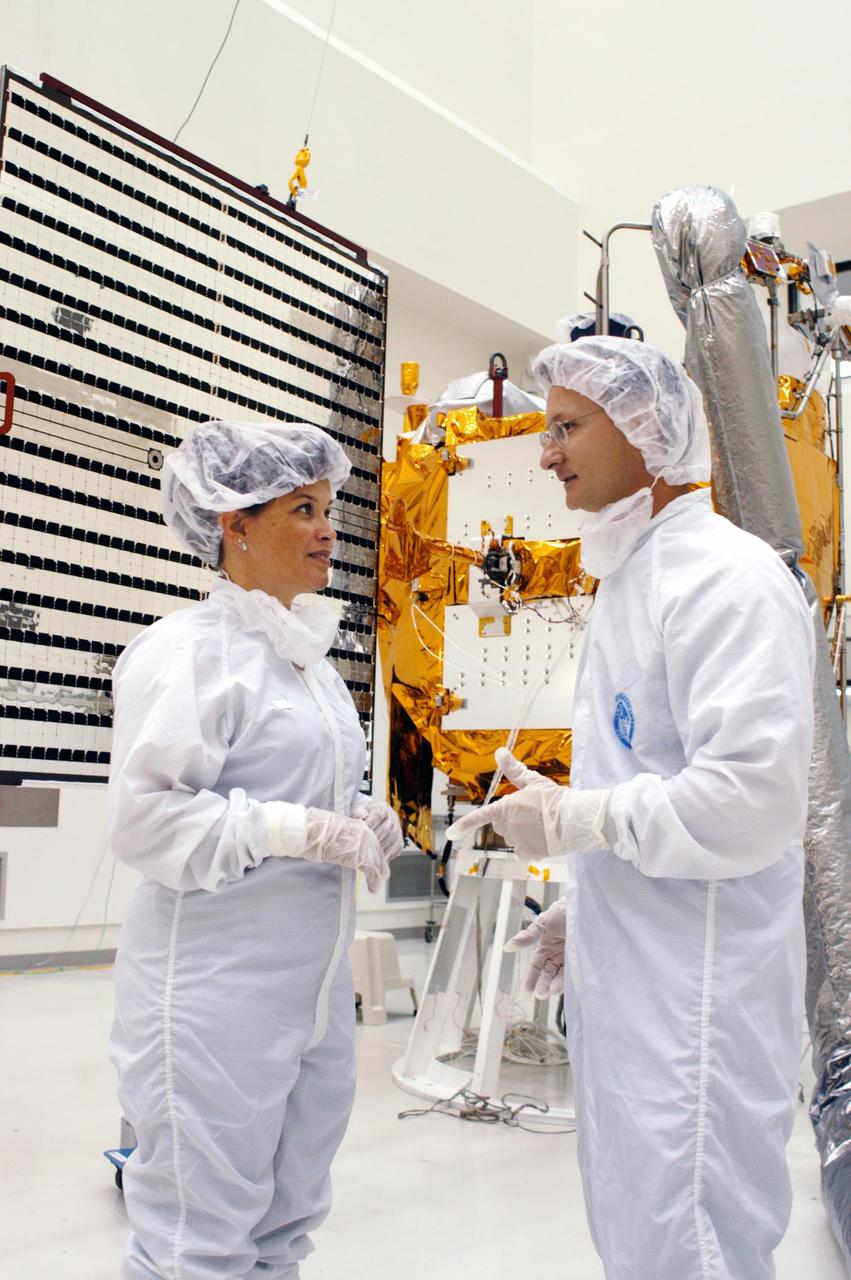
KENNEDY SPACE CENTER, FLA. - At Astrotech in Titusville, Fla., NASA Mission Integration Manager Cheryle Mako and NASA Launch Site Integration Manager John Hueckel talk before the deployment of the solar array panels on the MESSENGER spacecraft behind them. The solar arrays will provide MESSENGER’s power on its journey to Mercury. MESSENGER is scheduled to launch Aug. 2 aboard a Boeing Delta II rocket from Pad 17-B, Cape Canaveral Air Force Station, Fla. It will return to Earth for a gravity boost in July 2005, then fly past Venus twice, in October 2006 and June 2007. The spacecraft uses the tug of Venus’ gravity to resize and rotate its trajectory closer to Mercury’s orbit. Three Mercury flybys, each followed about two months later by a course-correction maneuver, put MESSENGER in position to enter Mercury orbit in March 2011. During the flybys, MESSENGER will map nearly the entire planet in color, image most of the areas unseen by Mariner 10, and measure the composition of the surface, atmosphere and magnetosphere. It will be the first new data from Mercury in more than 30 years - and invaluable for planning MESSENGER’s year-long orbital mission. MESSENGER was built for NASA by the Johns Hopkins University Applied Physics Laboratory in Laurel, Md.
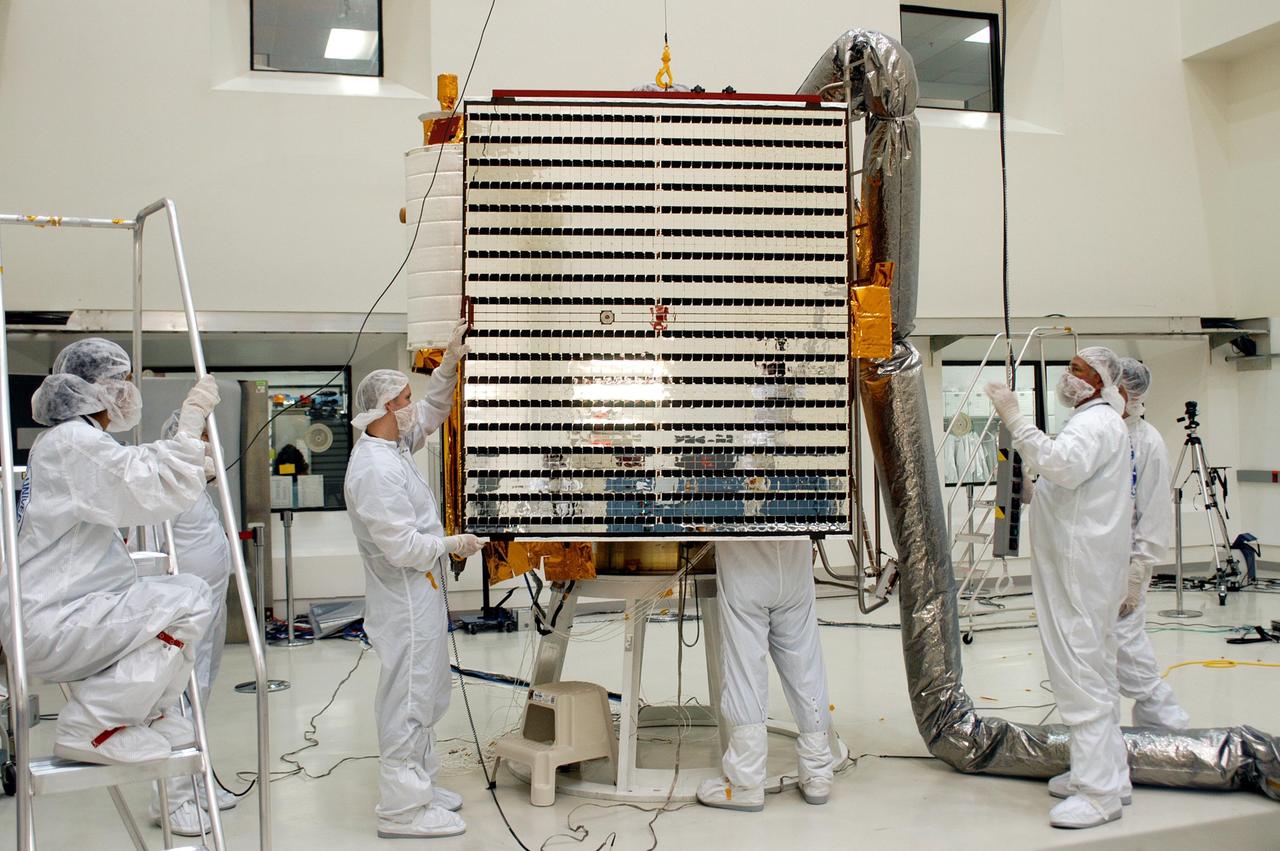
KENNEDY SPACE CENTER, FLA. - Technicians at Astrotech in Titusville, Fla., hold steady the second solar panel being installed on NASA’s MESSENGER spacecraft. At left is the first panel already installed. The two large solar panels, supplemented with a nickel-hydrogen battery, will provide MESSENGER’s power. MESSENGER is scheduled to launch Aug. 2 aboard a Boeing Delta II rocket from Pad 17-B, Cape Canaveral Air Force Station, Fla. It will return to Earth for a gravity boost in July 2005, then fly past Venus twice, in October 2006 and June 2007. The spacecraft uses the tug of Venus’ gravity to resize and rotate its trajectory closer to Mercury’s orbit. Three Mercury flybys, each followed about two months later by a course-correction maneuver, put MESSENGER in position to enter Mercury orbit in March 2011. During the flybys, MESSENGER will map nearly the entire planet in color, image most of the areas unseen by Mariner 10, and measure the composition of the surface, atmosphere and magnetosphere. It will be the first new data from Mercury in more than 30 years - and invaluable for planning MESSENGER’s year-long orbital mission. MESSENGER was built for NASA by the Johns Hopkins University Applied Physics Laboratory in Laurel, Md.
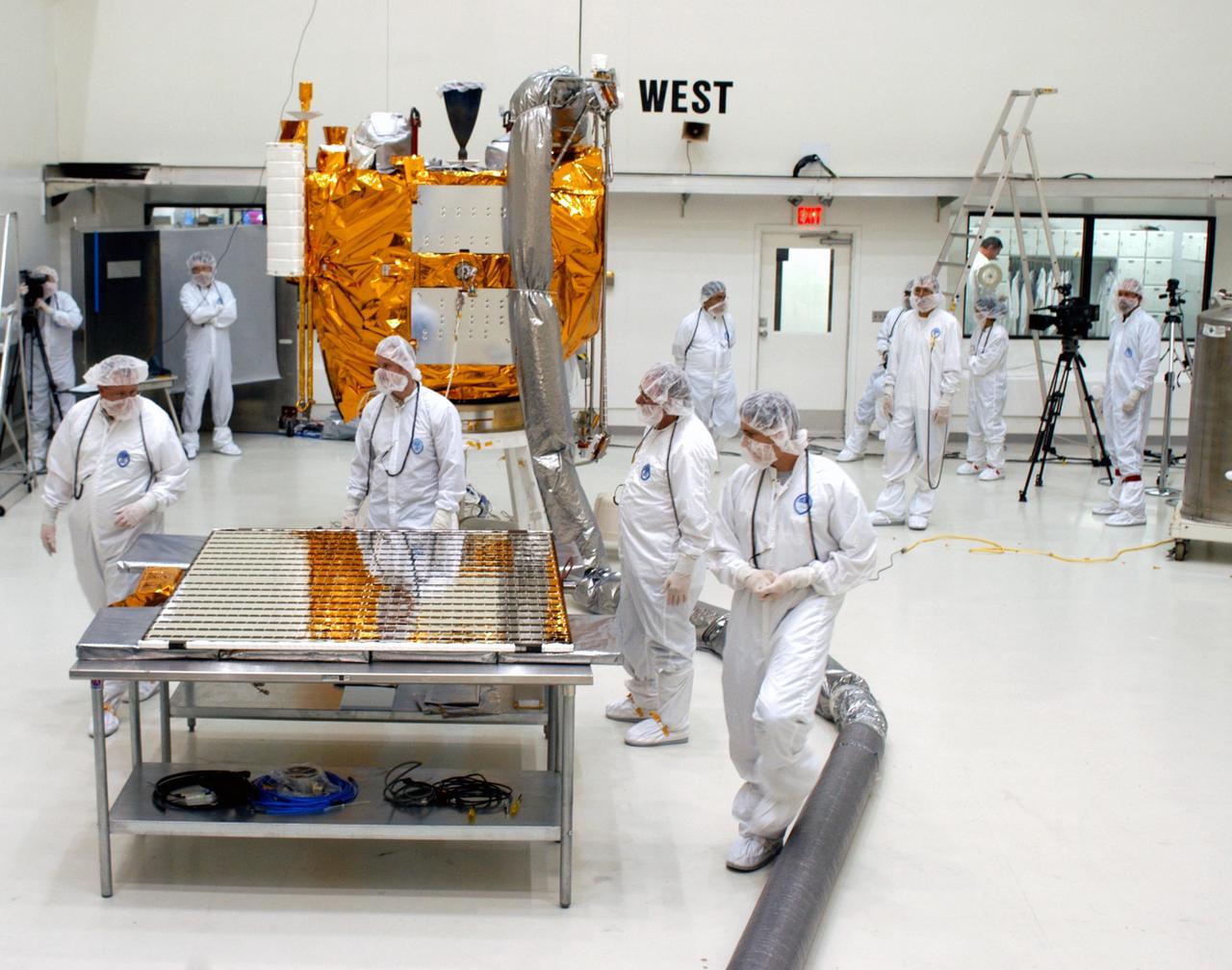
KENNEDY SPACE CENTER, FLA. - Technicians at Astrotech in Titusville, Fla., look over a solar panel ready to be installed on NASA’s MESSENGER spacecraft. It is one of two large solar panels, supplemented with a nickel-hydrogen battery, that will provide MESSENGER’s power. MESSENGER is scheduled to launch Aug. 2 aboard a Boeing Delta II rocket from Pad 17-B, Cape Canaveral Air Force Station, Fla. It will return to Earth for a gravity boost in July 2005, then fly past Venus twice, in October 2006 and June 2007. The spacecraft uses the tug of Venus’ gravity to resize and rotate its trajectory closer to Mercury’s orbit. Three Mercury flybys, each followed about two months later by a course-correction maneuver, put MESSENGER in position to enter Mercury orbit in March 2011. During the flybys, MESSENGER will map nearly the entire planet in color, image most of the areas unseen by Mariner 10, and measure the composition of the surface, atmosphere and magnetosphere. It will be the first new data from Mercury in more than 30 years - and invaluable for planning MESSENGER’s year-long orbital mission. MESSENGER was built for NASA by the Johns Hopkins University Applied Physics Laboratory in Laurel, Md.
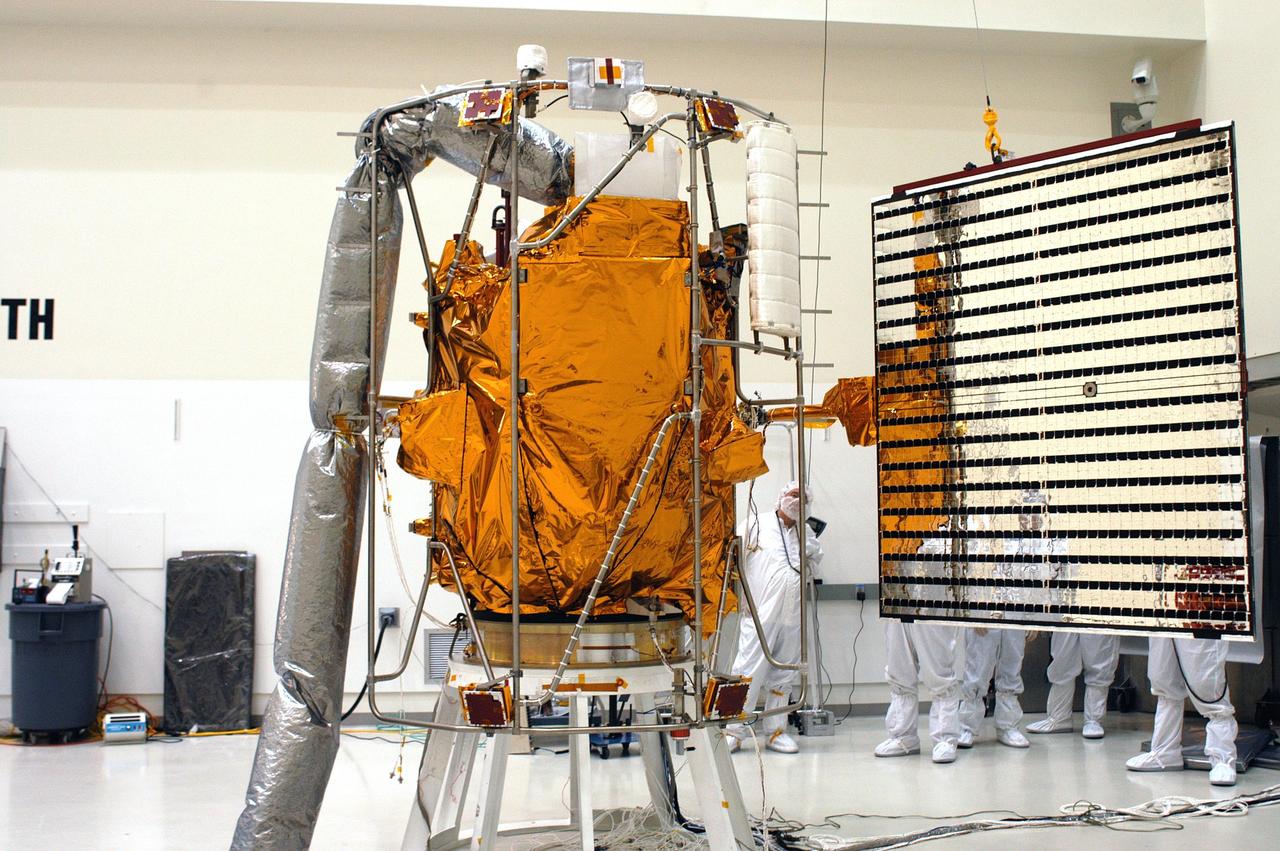
KENNEDY SPACE CENTER, FLA. - Technicians at Astrotech in Titusville, Fla., help guide a solar panel toward NASA’s MESSENGER spacecraft for installation. It is one of two large solar panels, supplemented with a nickel-hydrogen battery, that will provide MESSENGER’s power. MESSENGER is scheduled to launch Aug. 2 aboard a Boeing Delta II rocket from Pad 17-B, Cape Canaveral Air Force Station, Fla. It will return to Earth for a gravity boost in July 2005, then fly past Venus twice, in October 2006 and June 2007. The spacecraft uses the tug of Venus’ gravity to resize and rotate its trajectory closer to Mercury’s orbit. Three Mercury flybys, each followed about two months later by a course-correction maneuver, put MESSENGER in position to enter Mercury orbit in March 2011. During the flybys, MESSENGER will map nearly the entire planet in color, image most of the areas unseen by Mariner 10, and measure the composition of the surface, atmosphere and magnetosphere. It will be the first new data from Mercury in more than 30 years - and invaluable for planning MESSENGER’s year-long orbital mission. MESSENGER was built for NASA by the Johns Hopkins University Applied Physics Laboratory in Laurel, Md.

KENNEDY SPACE CENTER, FLA. - - After the deployment test of two solar panels at Astrotech in Titusville, Fla., technicians with The Johns Hopkins University Applied Physics Laboratory (APL) prepare the MESSESNGER spacecraft for a move to a hazardous processing facility in preparation for loading the spacecraft’s complement of hypergolic propellants. The solar arrays will provide MESSENGER’s power on its journey to Mercury. MESSENGER is scheduled to launch Aug. 2 aboard a Boeing Delta II rocket from Pad 17-B, Cape Canaveral Air Force Station, Fla. It will return to Earth for a gravity boost in July 2005, then fly past Venus twice, in October 2006 and June 2007. The spacecraft uses the tug of Venus’ gravity to resize and rotate its trajectory closer to Mercury’s orbit. Three Mercury flybys, each followed about two months later by a course-correction maneuver, put MESSENGER in position to enter Mercury orbit in March 2011. During the flybys, MESSENGER will map nearly the entire planet in color, image most of the areas unseen by Mariner 10, and measure the composition of the surface, atmosphere and magnetosphere. It will be the first new data from Mercury in more than 30 years - and invaluable for planning MESSENGER’s year-long orbital mission. MESSENGER was built for NASA by APL in Laurel, Md.
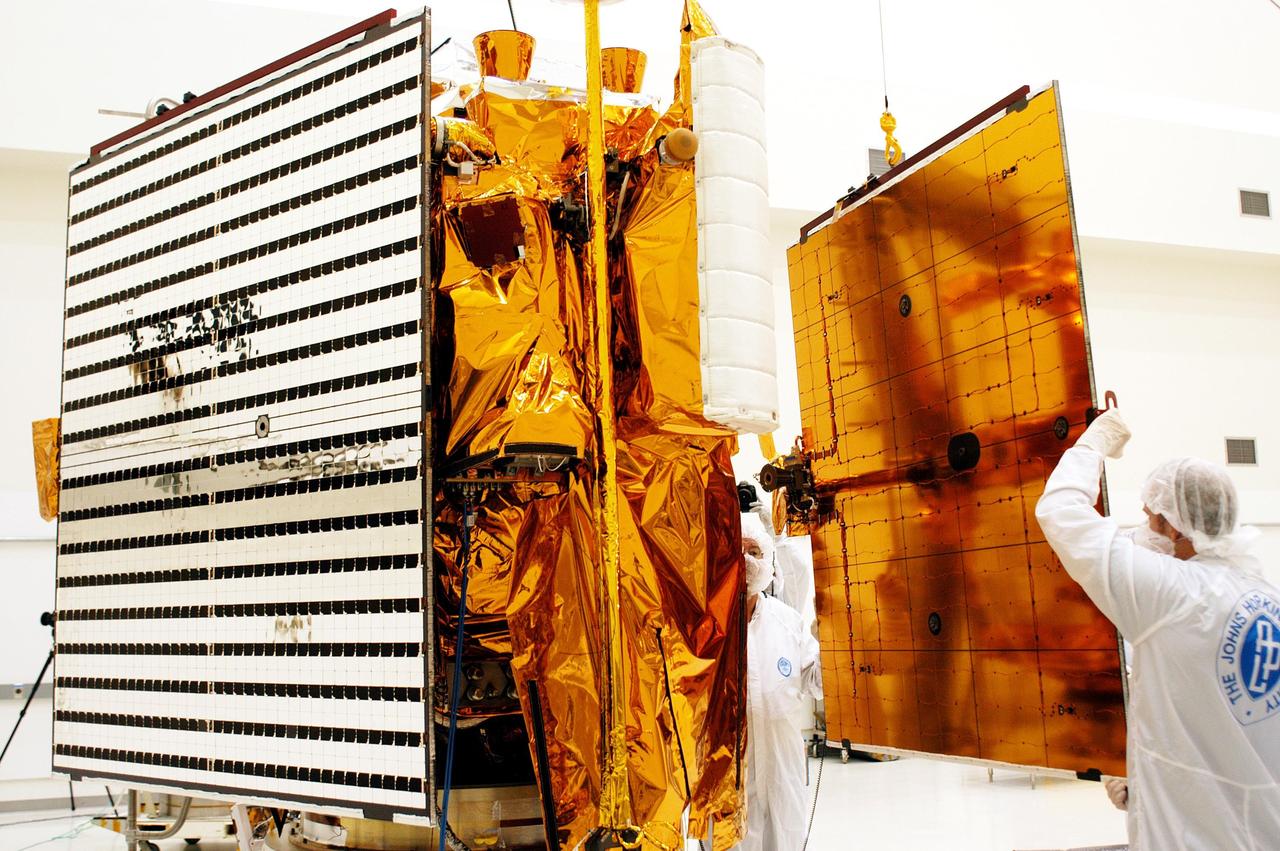
KENNEDY SPACE CENTER, FLA. - At right, technicians at Astrotech in Titusville, Fla., guide into place the second solar panel to be installed on NASA’s MESSENGER spacecraft. At left is the first panel already installed. The two large solar panels, supplemented with a nickel-hydrogen battery, will provide MESSENGER’s power. MESSENGER is scheduled to launch Aug. 2 aboard a Boeing Delta II rocket from Pad 17-B, Cape Canaveral Air Force Station, Fla. It will return to Earth for a gravity boost in July 2005, then fly past Venus twice, in October 2006 and June 2007. The spacecraft uses the tug of Venus’ gravity to resize and rotate its trajectory closer to Mercury’s orbit. Three Mercury flybys, each followed about two months later by a course-correction maneuver, put MESSENGER in position to enter Mercury orbit in March 2011. During the flybys, MESSENGER will map nearly the entire planet in color, image most of the areas unseen by Mariner 10, and measure the composition of the surface, atmosphere and magnetosphere. It will be the first new data from Mercury in more than 30 years - and invaluable for planning MESSENGER’s year-long orbital mission. MESSENGER was built for NASA by the Johns Hopkins University Applied Physics Laboratory in Laurel, Md.
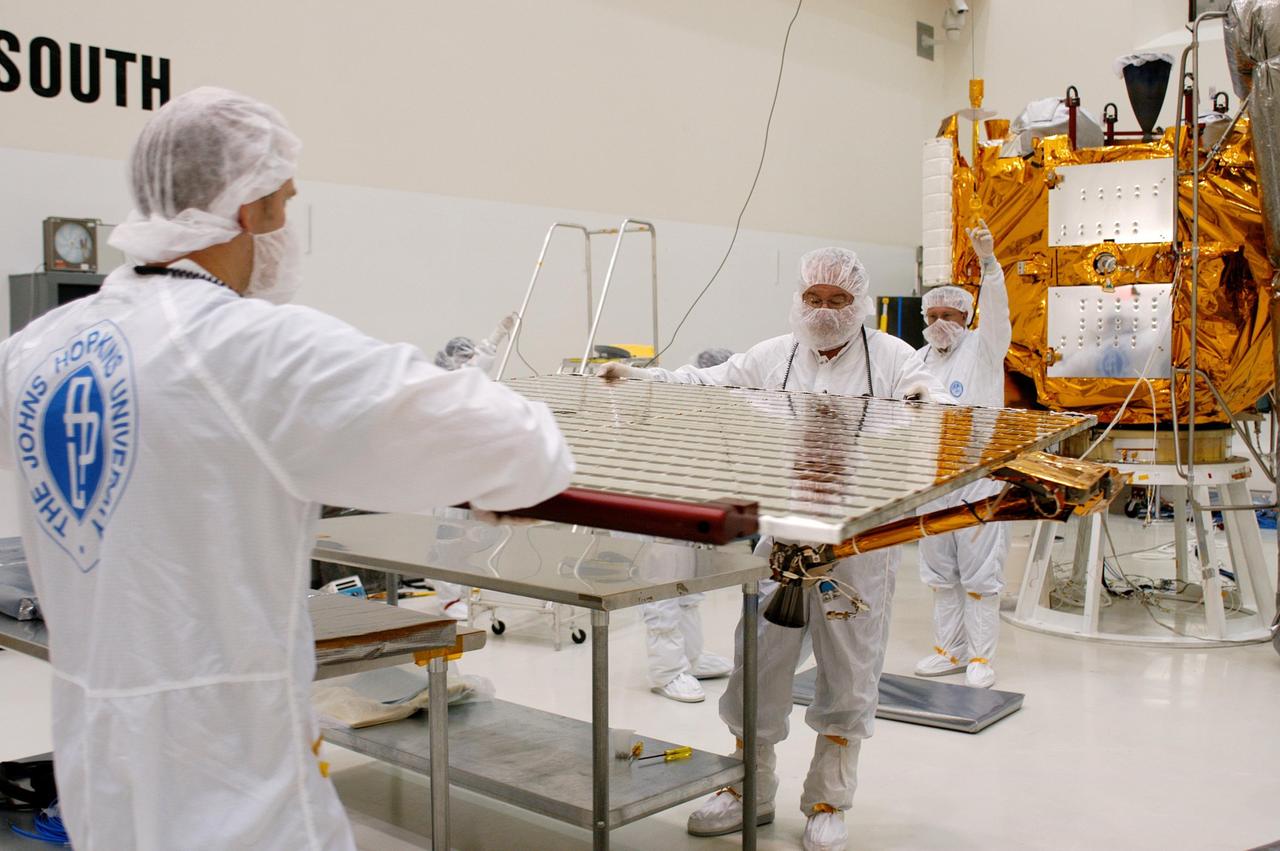
KENNEDY SPACE CENTER, FLA. - At Astrotech in Titusville, Fla., technicians maneuver a second solar panel to a vertical position to move it toward NASA’s MESSENGER spacecraft for installation. The two large solar panels, supplemented with a nickel-hydrogen battery, will provide MESSENGER’s power. MESSENGER is scheduled to launch Aug. 2 aboard a Boeing Delta II rocket from Pad 17-B, Cape Canaveral Air Force Station, Fla. It will return to Earth for a gravity boost in July 2005, then fly past Venus twice, in October 2006 and June 2007. The spacecraft uses the tug of Venus’ gravity to resize and rotate its trajectory closer to Mercury’s orbit. Three Mercury flybys, each followed about two months later by a course-correction maneuver, put MESSENGER in position to enter Mercury orbit in March 2011. During the flybys, MESSENGER will map nearly the entire planet in color, image most of the areas unseen by Mariner 10, and measure the composition of the surface, atmosphere and magnetosphere. It will be the first new data from Mercury in more than 30 years - and invaluable for planning MESSENGER’s year-long orbital mission. MESSENGER was built for NASA by the Johns Hopkins University Applied Physics Laboratory in Laurel, Md.
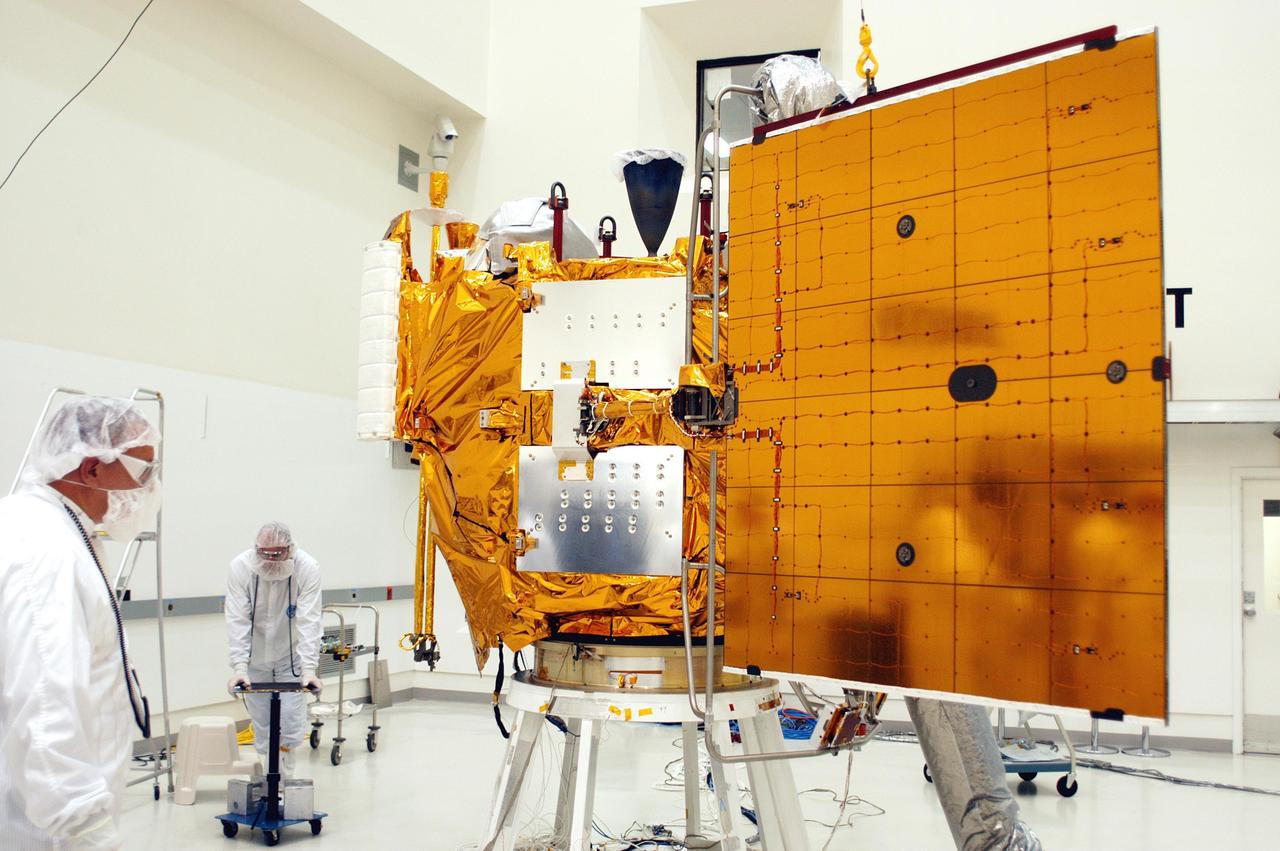
KENNEDY SPACE CENTER, FLA. - At Astrotech in Titusville, Fla., technicians with The Johns Hopkins University Applied Physics Laboratory (APL) monitor the progress of the solar array deployment on the MESSENGER spacecraft. The two panels will provide MESSENGER’s power on its journey to Mercury. MESSENGER is scheduled to launch Aug. 2 aboard a Boeing Delta II rocket from Pad 17-B, Cape Canaveral Air Force Station, Fla. It will return to Earth for a gravity boost in July 2005, then fly past Venus twice, in October 2006 and June 2007. The spacecraft uses the tug of Venus’ gravity to resize and rotate its trajectory closer to Mercury’s orbit. Three Mercury flybys, each followed about two months later by a course-correction maneuver, put MESSENGER in position to enter Mercury orbit in March 2011. During the flybys, MESSENGER will map nearly the entire planet in color, image most of the areas unseen by Mariner 10, and measure the composition of the surface, atmosphere and magnetosphere. It will be the first new data from Mercury in more than 30 years - and invaluable for planning MESSENGER’s year-long orbital mission. MESSENGER was built for NASA by APL in Laurel, Md.
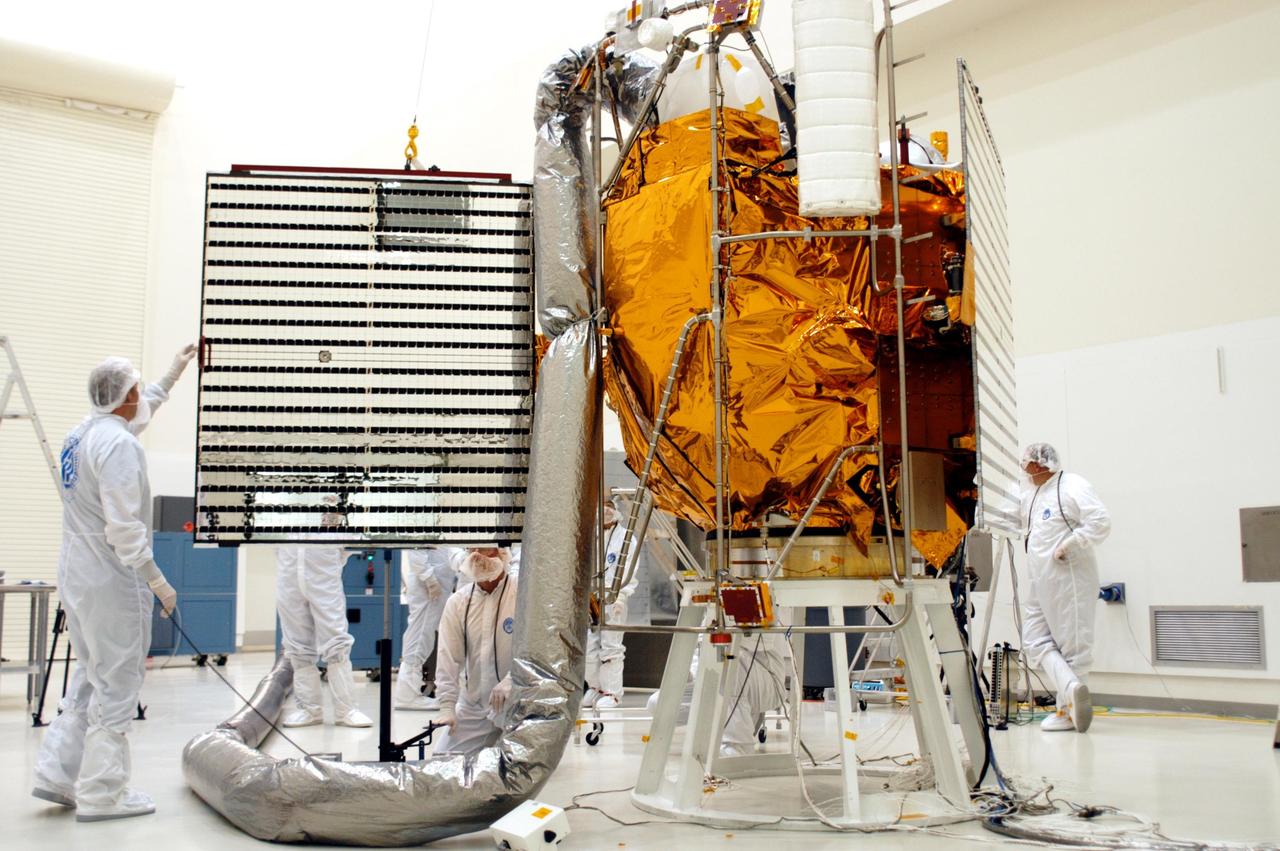
KENNEDY SPACE CENTER, FLA. - At Astrotech in Titusville, Fla., technicians with The Johns Hopkins University Applied Physics Laboratory (APL) check one of two solar panels on the MESSENGER spacecraft after a deployment test. The other panel is at right, undeployed. The solar arrays will provide MESSENGER’s power on its journey to Mercury. MESSENGER is scheduled to launch Aug. 2 aboard a Boeing Delta II rocket from Pad 17-B, Cape Canaveral Air Force Station, Fla. It will return to Earth for a gravity boost in July 2005, then fly past Venus twice, in October 2006 and June 2007. The spacecraft uses the tug of Venus’ gravity to resize and rotate its trajectory closer to Mercury’s orbit. Three Mercury flybys, each followed about two months later by a course-correction maneuver, put MESSENGER in position to enter Mercury orbit in March 2011. During the flybys, MESSENGER will map nearly the entire planet in color, image most of the areas unseen by Mariner 10, and measure the composition of the surface, atmosphere and magnetosphere. It will be the first new data from Mercury in more than 30 years - and invaluable for planning MESSENGER’s year-long orbital mission. MESSENGER was built for NASA by APL in Laurel, Md.
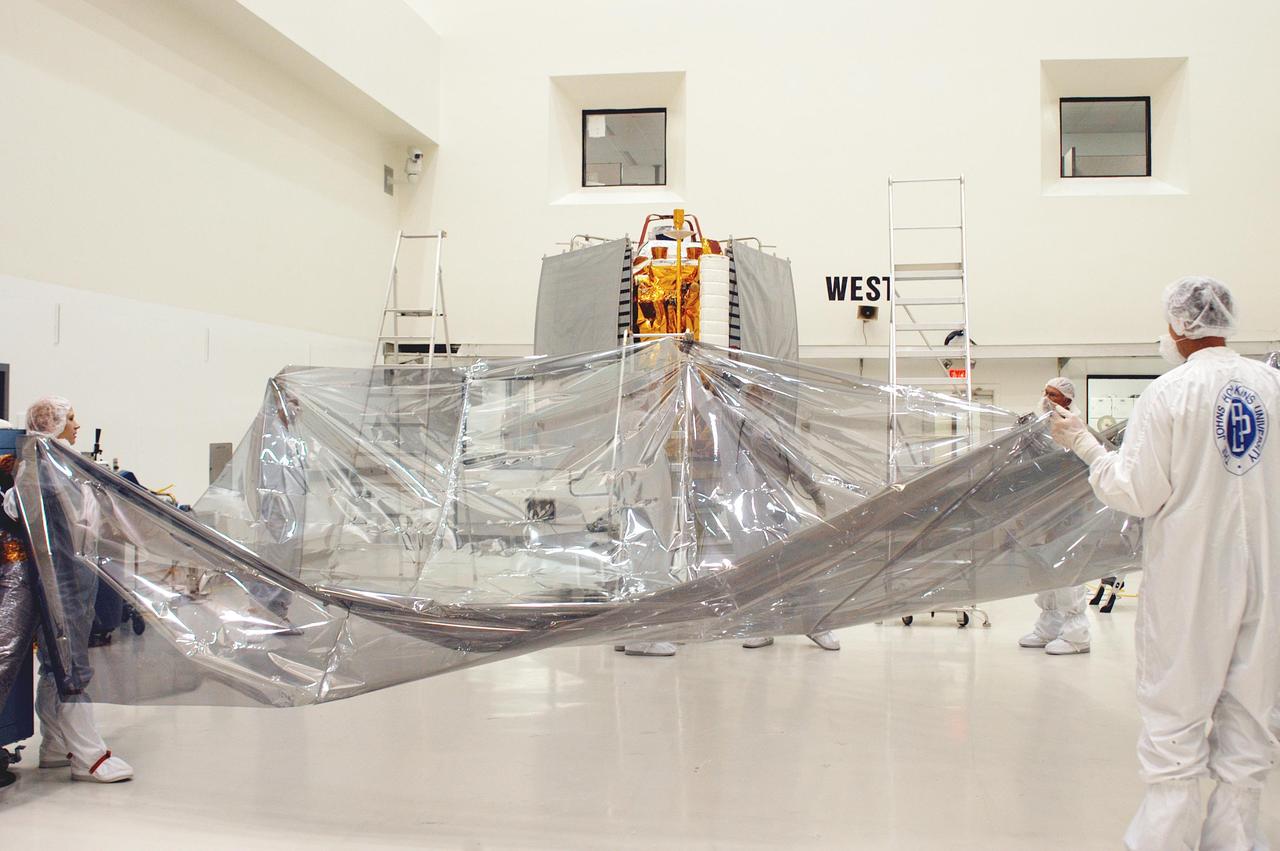
KENNEDY SPACE CENTER, FLA. - At Astrotech in Titusville, Fla., technicians with The Johns Hopkins University Applied Physics Laboratory (APL) prepare to cover the MESSESNGER spacecraft for a move to a hazardous processing facility in preparation for loading the spacecraft’s complement of hypergolic propellants. MESSENGER is scheduled to launch Aug. 2 aboard a Boeing Delta II rocket from Pad 17-B, Cape Canaveral Air Force Station, Fla., on a journey to Mercury. It will return to Earth for a gravity boost in July 2005, then fly past Venus twice, in October 2006 and June 2007. The spacecraft uses the tug of Venus’ gravity to resize and rotate its trajectory closer to Mercury’s orbit. Three Mercury flybys, each followed about two months later by a course-correction maneuver, put MESSENGER in position to enter Mercury orbit in March 2011. During the flybys, MESSENGER will map nearly the entire planet in color, image most of the areas unseen by Mariner 10, and measure the composition of the surface, atmosphere and magnetosphere. It will be the first new data from Mercury in more than 30 years - and invaluable for planning MESSENGER’s year-long orbital mission. MESSENGER was built for NASA by APL in Laurel, Md.
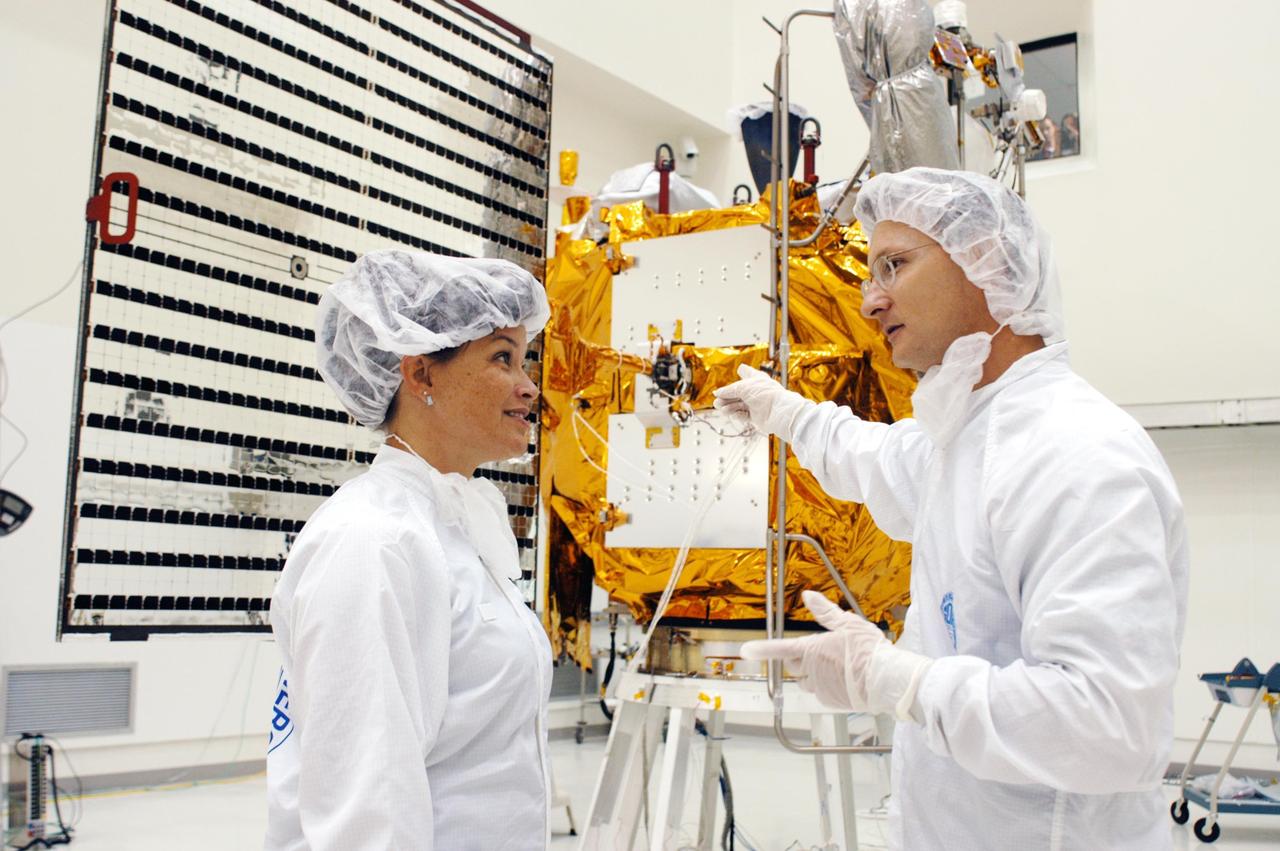
KENNEDY SPACE CENTER, FLA. - At Astrotech in Titusville, Fla., NASA Mission Integration Manager Cheryle Mako and NASA Launch Site Integration Manager John Hueckel talk before the deployment of the solar array panels on the MESSENGER spacecraft behind them. The solar arrays will provide MESSENGER’s power on its journey to Mercury. MESSENGER is scheduled to launch Aug. 2 aboard a Boeing Delta II rocket from Pad 17-B, Cape Canaveral Air Force Station, Fla. It will return to Earth for a gravity boost in July 2005, then fly past Venus twice, in October 2006 and June 2007. The spacecraft uses the tug of Venus’ gravity to resize and rotate its trajectory closer to Mercury’s orbit. Three Mercury flybys, each followed about two months later by a course-correction maneuver, put MESSENGER in position to enter Mercury orbit in March 2011. During the flybys, MESSENGER will map nearly the entire planet in color, image most of the areas unseen by Mariner 10, and measure the composition of the surface, atmosphere and magnetosphere. It will be the first new data from Mercury in more than 30 years - and invaluable for planning MESSENGER’s year-long orbital mission. MESSENGER was built for NASA by APL in Laurel, Md.
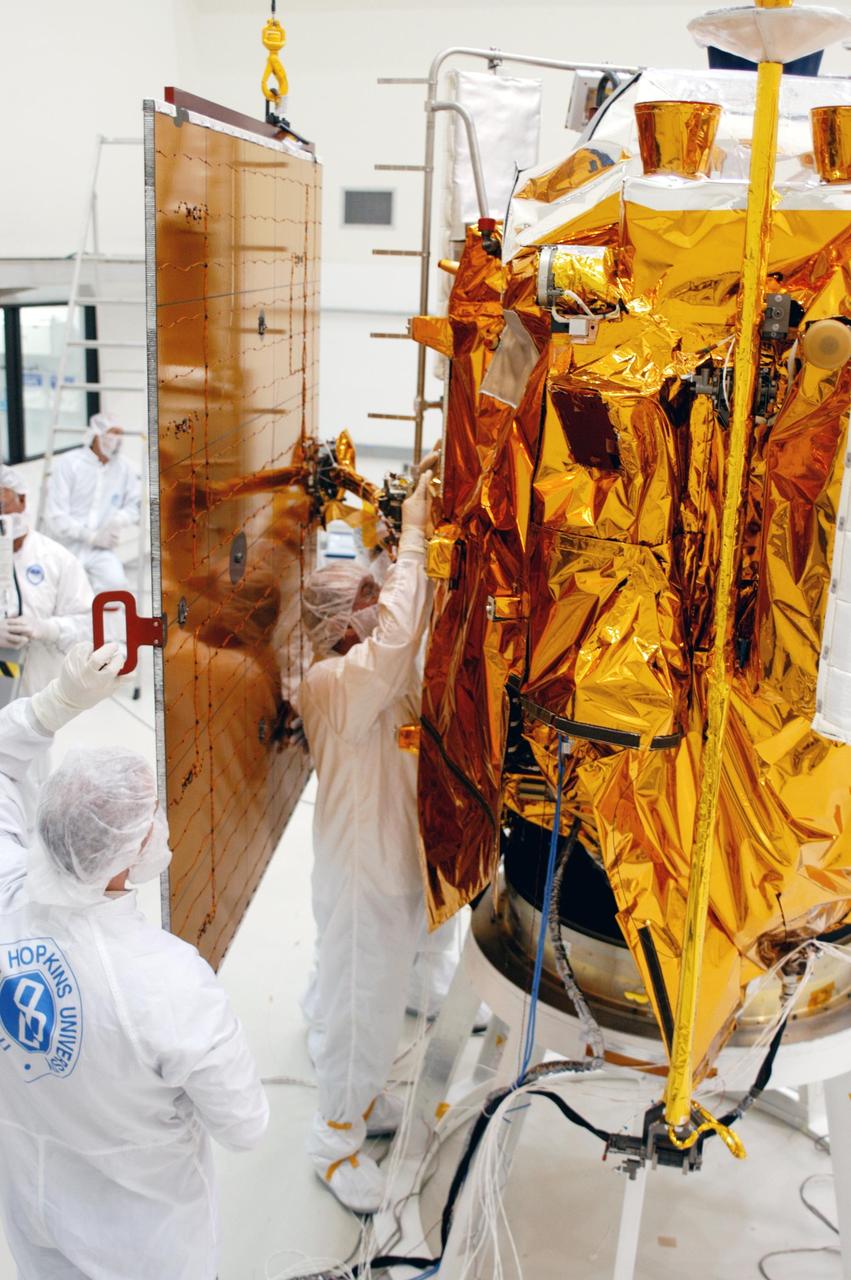
KENNEDY SPACE CENTER, FLA. - Technicians at Astrotech in Titusville, Fla., steady a solar panel suspended from above as others prepare to install it on NASA’s MESSENGER spacecraft. It is one of two large solar panels, supplemented with a nickel-hydrogen battery, that will provide MESSENGER’s power. MESSENGER is scheduled to launch Aug. 2 aboard a Boeing Delta II rocket from Pad 17-B, Cape Canaveral Air Force Station, Fla. It will return to Earth for a gravity boost in July 2005, then fly past Venus twice, in October 2006 and June 2007. The spacecraft uses the tug of Venus’ gravity to resize and rotate its trajectory closer to Mercury’s orbit. Three Mercury flybys, each followed about two months later by a course-correction maneuver, put MESSENGER in position to enter Mercury orbit in March 2011. During the flybys, MESSENGER will map nearly the entire planet in color, image most of the areas unseen by Mariner 10, and measure the composition of the surface, atmosphere and magnetosphere. It will be the first new data from Mercury in more than 30 years - and invaluable for planning MESSENGER’s year-long orbital mission. MESSENGER was built for NASA by the Johns Hopkins University Applied Physics Laboratory in Laurel, Md.
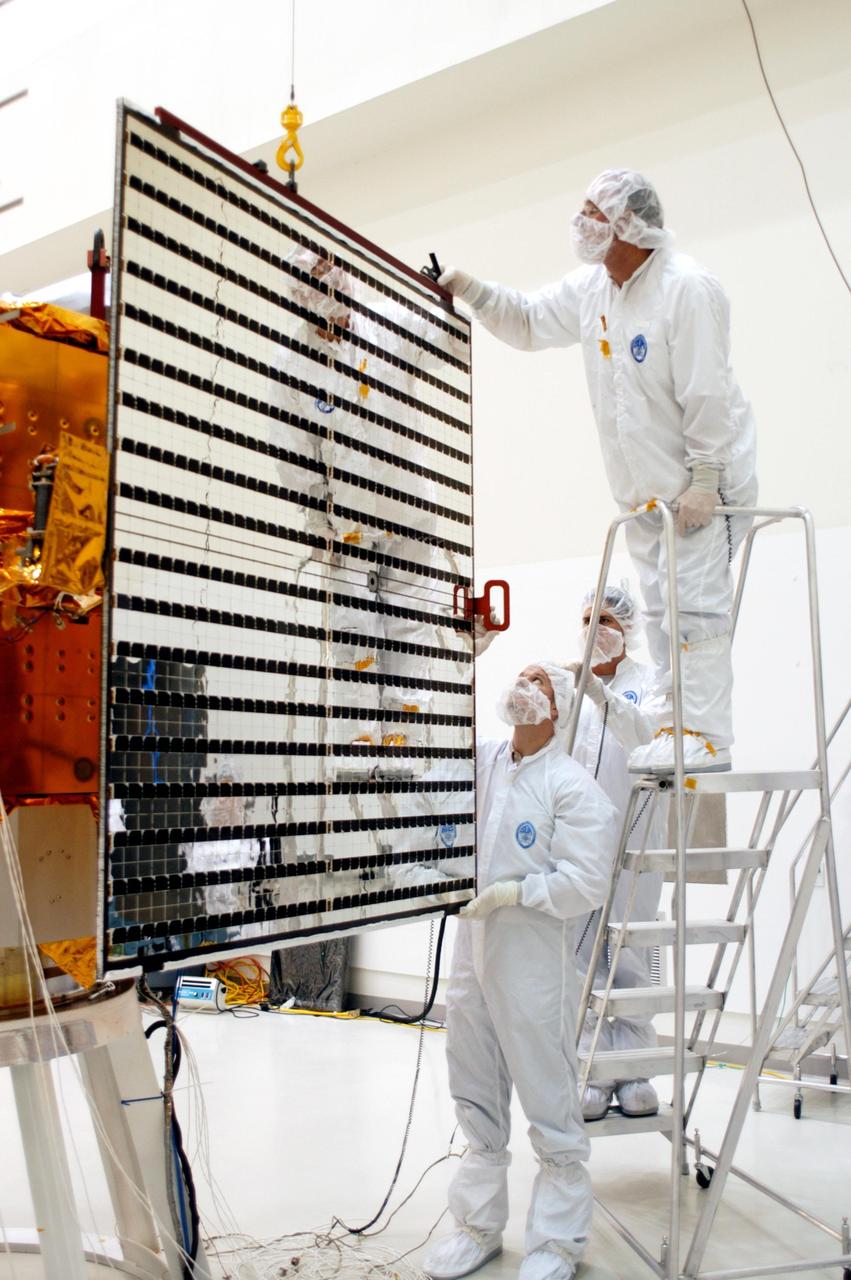
KENNEDY SPACE CENTER, FLA. - Technicians at Astrotech in Titusville, Fla., guide a solar panel closer to NASA’s MESSENGER spacecraft for installation. It is one of two large solar panels, supplemented with a nickel-hydrogen battery, that will provide MESSENGER’s power. MESSENGER is scheduled to launch Aug. 2 aboard a Boeing Delta II rocket from Pad 17-B, Cape Canaveral Air Force Station, Fla. It will return to Earth for a gravity boost in July 2005, then fly past Venus twice, in October 2006 and June 2007. The spacecraft uses the tug of Venus’ gravity to resize and rotate its trajectory closer to Mercury’s orbit. Three Mercury flybys, each followed about two months later by a course-correction maneuver, put MESSENGER in position to enter Mercury orbit in March 2011. During the flybys, MESSENGER will map nearly the entire planet in color, image most of the areas unseen by Mariner 10, and measure the composition of the surface, atmosphere and magnetosphere. It will be the first new data from Mercury in more than 30 years - and invaluable for planning MESSENGER’s year-long orbital mission. MESSENGER was built for NASA by the Johns Hopkins University Applied Physics Laboratory in Laurel, Md.
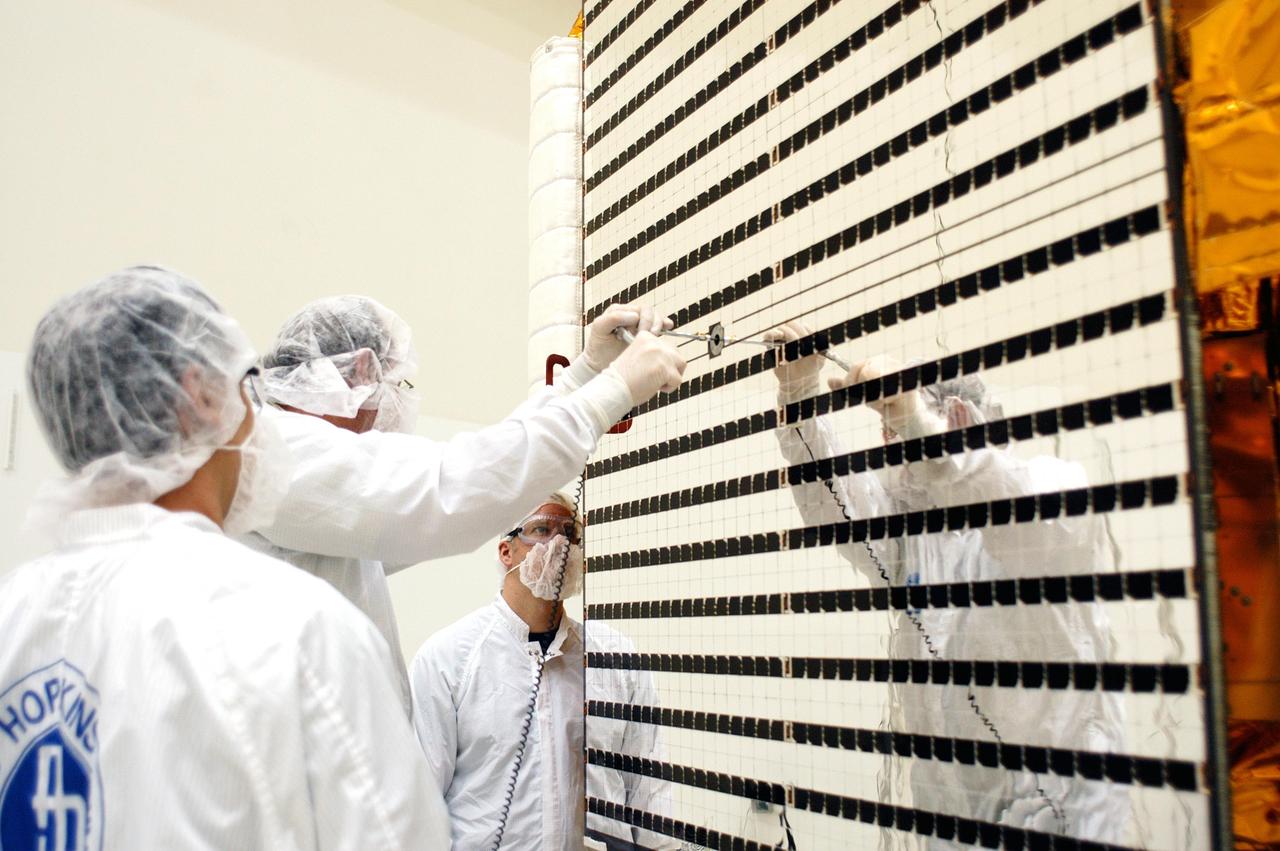
KENNEDY SPACE CENTER, FLA. - At Astrotech in Titusville, Fla., technicians with The Johns Hopkins University Applied Physics Laboratory (APL) prepare one of two solar array panels on the MESSENGER spacecraft for deployment. The panels will provide MESSENGER’s power on its journey to Mercury. MESSENGER is scheduled to launch Aug. 2 aboard a Boeing Delta II rocket from Pad 17-B, Cape Canaveral Air Force Station, Fla. It will return to Earth for a gravity boost in July 2005, then fly past Venus twice, in October 2006 and June 2007. The spacecraft uses the tug of Venus’ gravity to resize and rotate its trajectory closer to Mercury’s orbit. Three Mercury flybys, each followed about two months later by a course-correction maneuver, put MESSENGER in position to enter Mercury orbit in March 2011. During the flybys, MESSENGER will map nearly the entire planet in color, image most of the areas unseen by Mariner 10, and measure the composition of the surface, atmosphere and magnetosphere. It will be the first new data from Mercury in more than 30 years - and invaluable for planning MESSENGER’s year-long orbital mission. MESSENGER was built for NASA by APL in Laurel, Md.

ISS013-E-77351 (5 Sept. 2006) --- Floods in the Volga Delta, Russia are featured in this image photographed by an Expedition 13 crewmember on the International Space Station. This close-up view zooms in on a shipping channel in the western part of the delta. The straight channel is periodically dredged, and the dredge spoils are piled along the edge of the channel in mounds. Surrounding wetlands are partially inundated. Flood waters with muddy sediment stream from the distributaries along channel, producing long streamers along the flow direction. This image was taken a few days after heavy rains in early September 2006 flooded parts of Russia to the north, and captures the flood waters emptying into the Caspian Sea. Since 1978, the Caspian Sea level has risen over 2 meters, submerging valuable wetland habitats, flooding coastlines and both agricultural land and industrial infrastructure. Maintaining channels and coastal developments, and preserving marine and land natural habitats, have become a struggle for the nations surrounding the Caspian. Shallow coastlines like the Volga Delta are at particular risk due to the rising sea level.
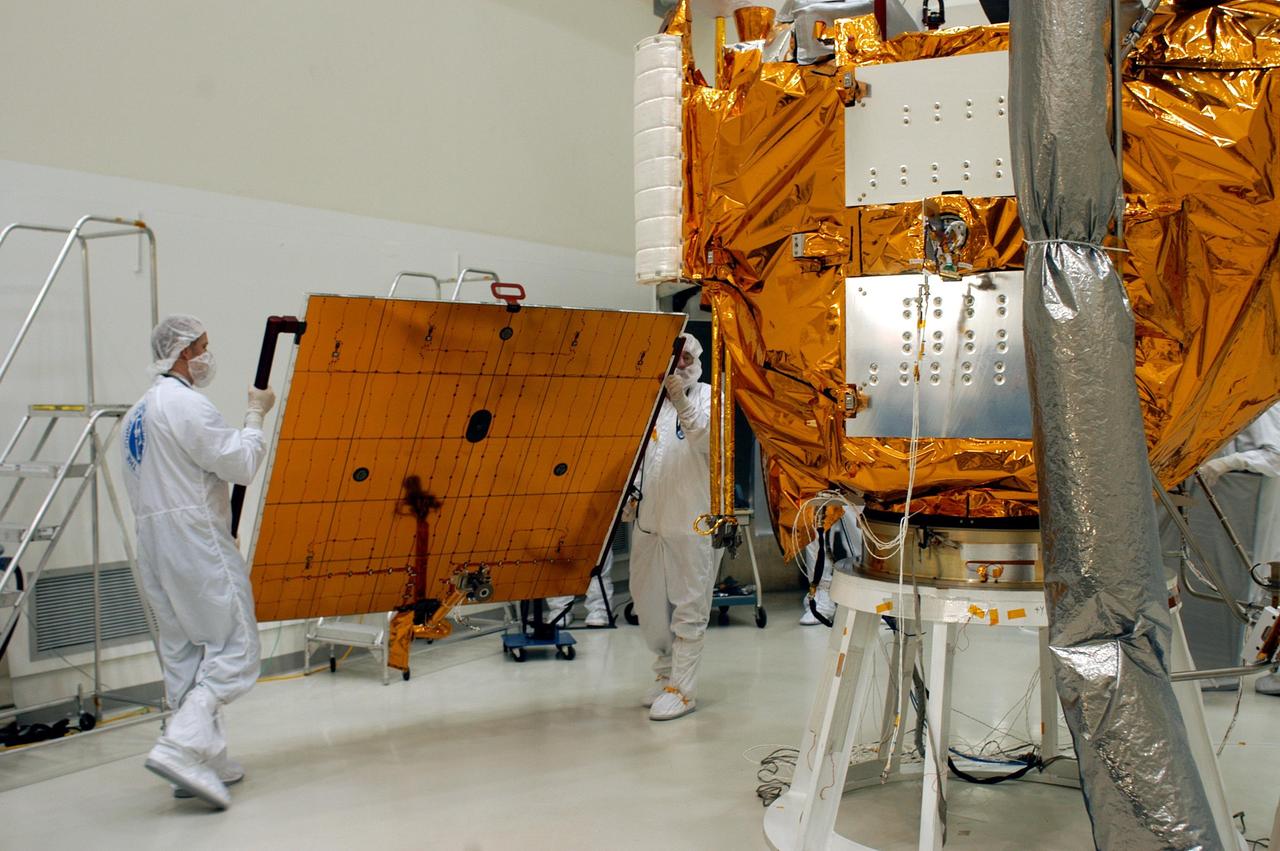
KENNEDY SPACE CENTER, FLA. - Technicians at Astrotech in Titusville, Fla., carry a solar panel toward NASA’s MESSENGER spacecraft for installation. It is one of two large solar panels, supplemented with a nickel-hydrogen battery, that will provide MESSENGER’s power. MESSENGER is scheduled to launch Aug. 2 aboard a Boeing Delta II rocket from Pad 17-B, Cape Canaveral Air Force Station, Fla. It will return to Earth for a gravity boost in July 2005, then fly past Venus twice, in October 2006 and June 2007. The spacecraft uses the tug of Venus’ gravity to resize and rotate its trajectory closer to Mercury’s orbit. Three Mercury flybys, each followed about two months later by a course-correction maneuver, put MESSENGER in position to enter Mercury orbit in March 2011. During the flybys, MESSENGER will map nearly the entire planet in color, image most of the areas unseen by Mariner 10, and measure the composition of the surface, atmosphere and magnetosphere. It will be the first new data from Mercury in more than 30 years - and invaluable for planning MESSENGER’s year-long orbital mission. MESSENGER was built for NASA by the Johns Hopkins University Applied Physics Laboratory in Laurel, Md.
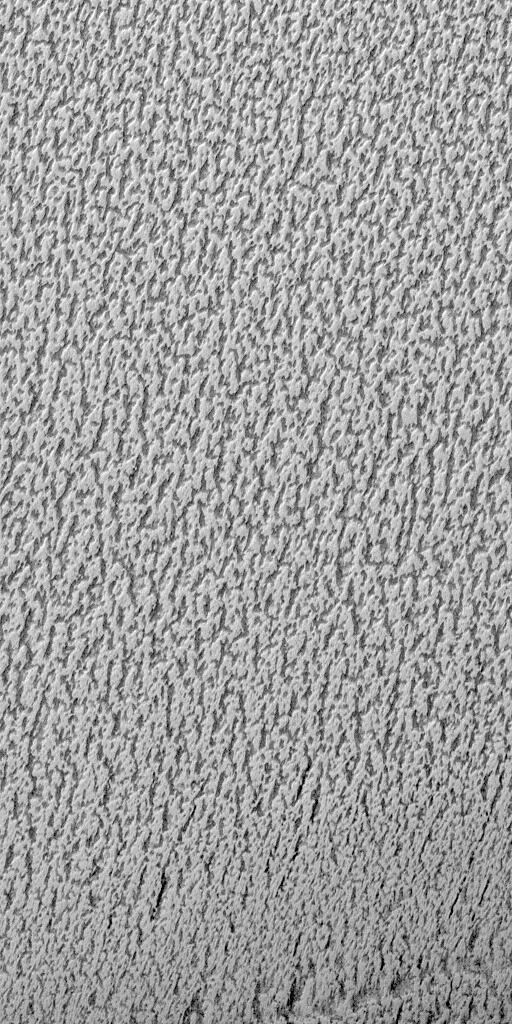
This image is illuminated by sunlight from the upper left. Martian Dairy Products? If parts of the south polar cap can look like swiss cheese (see "Martian "Swiss Cheese""), then parts of the north polar cap might as well look like some kind of cheese, too. This picture shows a cottage cheese-like texture on the surface of a part of the residual--summertime--north polar cap. The north polar cap surface is mostly covered by pits, cracks, small bumps and knobs. In this image, the cap surface appears bright and the floors of pits look dark. Based upon observations made by the Mariner 9 and Viking orbiters in the 1970s, the north polar residual cap is thought to contain mostly water ice because its summertime temperature is usually near the freezing point of water and water vapor was observed by the Vikings to be coming off the cap during summer. The south residual cap is different--its temperatures in summer remain cold enough to freeze carbon dioxide, and very little to no water vapor has been observed to come off the south cap in summer. The pits that have developed on the north polar cap surface are closely-spaced relative to the very different depressions in the south polar cap. The pits are estimated from the length of shadows cast in them to be less than about 2 meters (5.5 feet) deep. These pits probably develop slowly over thousands of years of successive spring and summer seasons. This picture was taken by the Mars Global Surveyor (MGS) Mars Orbiter Camera (MOC) during northern summer on April 5, 1999. The picture is located near 82.1°N, 329.6°W and covers an area 1.5 km wide by 3 km long (0.9 x 1.8 miles) at a resolution of 3 meters (10 ft) per pixel. http://photojournal.jpl.nasa.gov/catalog/PIA02369
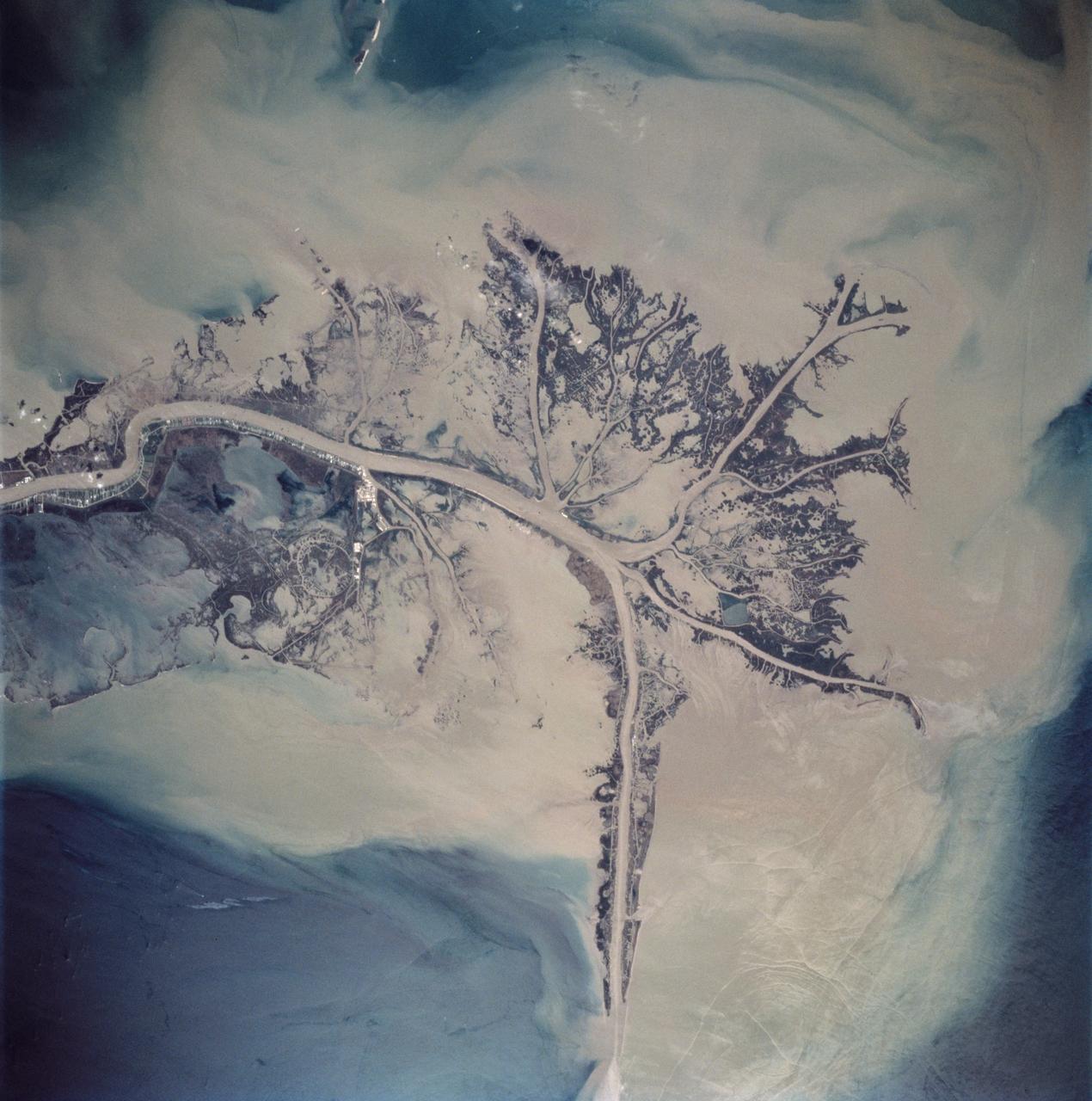
STS062-85-021 (4-18 March 1994) --- The Mississippi River is the largest river system in North America. Its delta is a typical example of the bird's foot class of river deltas. It drains nearly 3 1/2 million square kilometers of real estate and is estimated to carry 2.4 billion kilograms (more than 500 million tons) of sand, silt, and clay to the Gulf of Mexico annually. Most of this sediment is deposited as a delta at the mouth of the river where the velocity of the river water is slowed and its ability to transport sediment is accordingly diminished. Continued deposition at such a site progrades the delta or extends it seaward into the Gulf as much as 150 meters each year until such time as a flooding episode finds a shorter more efficient channel to deliver sediment-laden river waters to the Gulf. At that time the old delta is abandoned and the river begins to build a new delta. In time, compaction of the sediment in the old delta causes it to subside forming first marshes, then bays. This and the modifying effects of coastal waves eventually allow the sea to reclaim much of the temporary land area of the delta. This sequence has repeated itself over and over again at the Mississippi Delta. In this photograph, the present day active Balize delta is shown. According to NASA scientists it is the youngest of the recent delta lobes having begun its seaward pro-gradation only some 600 - 800 years ago. The main channel of the river is 2 kilometers wide and 30 - 40 meters deep. Natural levees here are almost 1 kilometer wide and 3 to 4 meters above sea level. Along the active distributaries of the lower delta, natural levees are less than 100 meters wide and generally less than 0.5 meters above sea level. The bird's foot appearance of deltas such as this is characteristic of low coastal energy conditions - that is, low levels of tidal fluctuation and generally low wave energy. The interdistributary bays are extremely shallow, usually less than a few meters, and contain brackish to normal marine waters except during times of flooding, when fresh water fills the bays. Sedimentation within the bays is very slow, occurring only during flood periods. Along the west side of the river, a highway has been built southeastward to Venice.