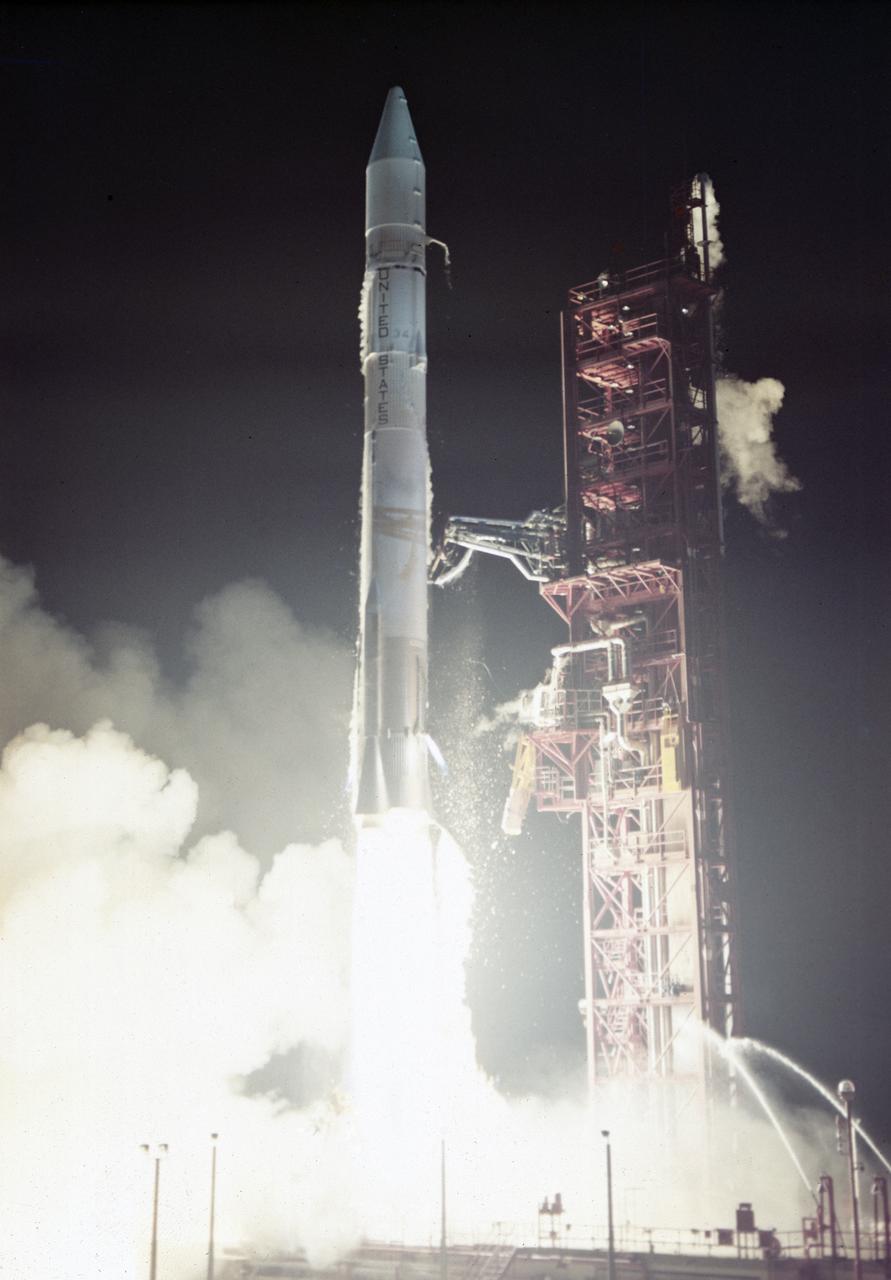
The launch of the Atlas-Centaur carrying the Mariner X spacecraft on November 3, 1973. This mission was for the exploration of the planets Venus and Mercury.
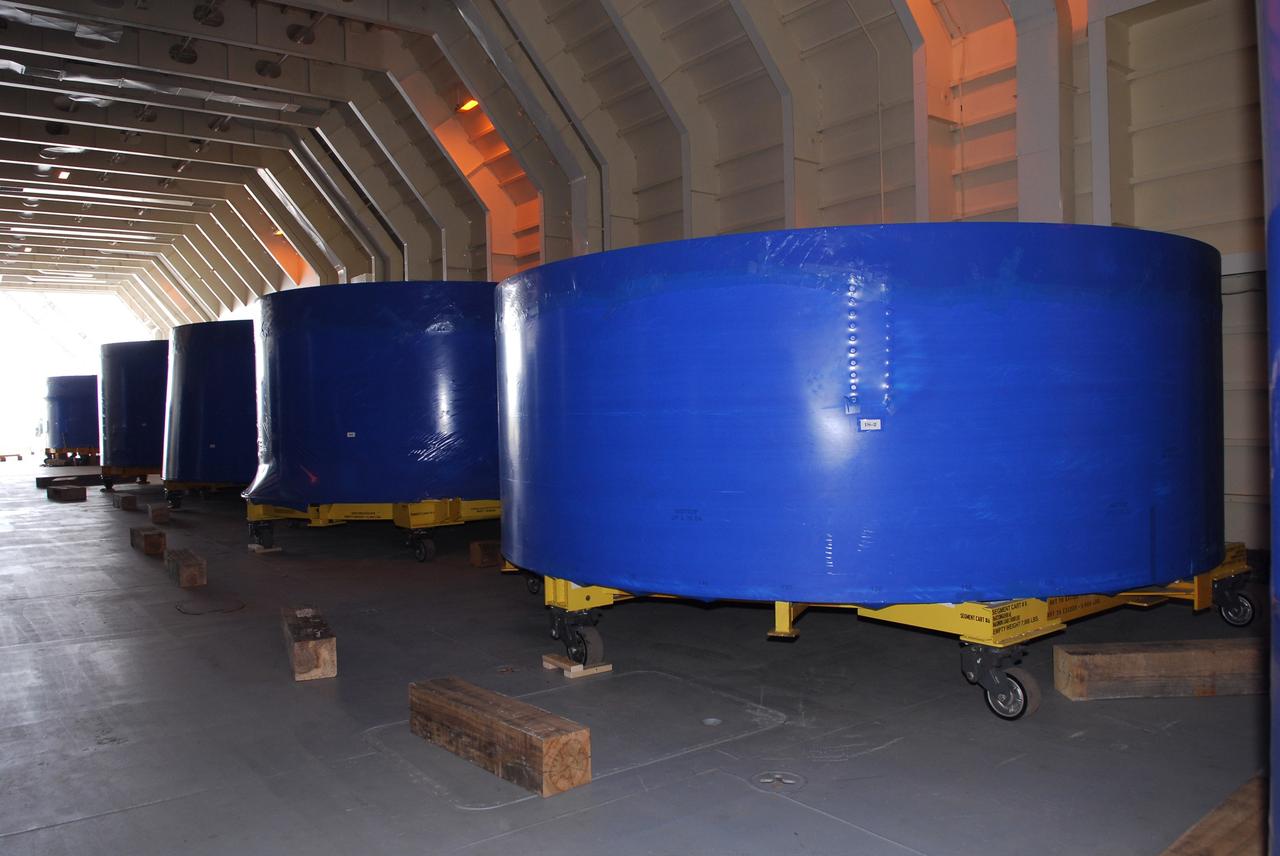
CAPE CANAVERAL, Fla. – Segments of the Ares I-X upper stage simulator are lined up in the cargo hold of the Delta Mariner, docked at Port Canaveral, Fla. The upper stage simulator will be used in the test flight identified as Ares I-X in 2009. The segments will simulate the mass and the outer mold line and will be more than 100 feet of the total vehicle height of 327 feet. The simulator comprises 11 segments that are approximately 18 feet in diameter. Most of the segments will be approximately 10 feet high, ranging in weight from 18,000 to 60,000 pounds, for a total of approximately 450,000 pounds. Photo credit: NASA/Dimitri Gerondidakis

CAPE CANAVERAL, Fla. – On the bridge of the Delta Mariner, whose cargo is the Ares I-X upper stage simulator segments. The upper stage simulator will be used in the test flight identified as Ares I-X in 2009. The segments will simulate the mass and the outer mold line and will be more than 100 feet of the total vehicle height of 327 feet. The simulator comprises 11 segments that are approximately 18 feet in diameter. Most of the segments will be approximately 10 feet high, ranging in weight from 18,000 to 60,000 pounds, for a total of approximately 450,000 pounds. Photo credit: NASA/Dimitri Gerondidakis
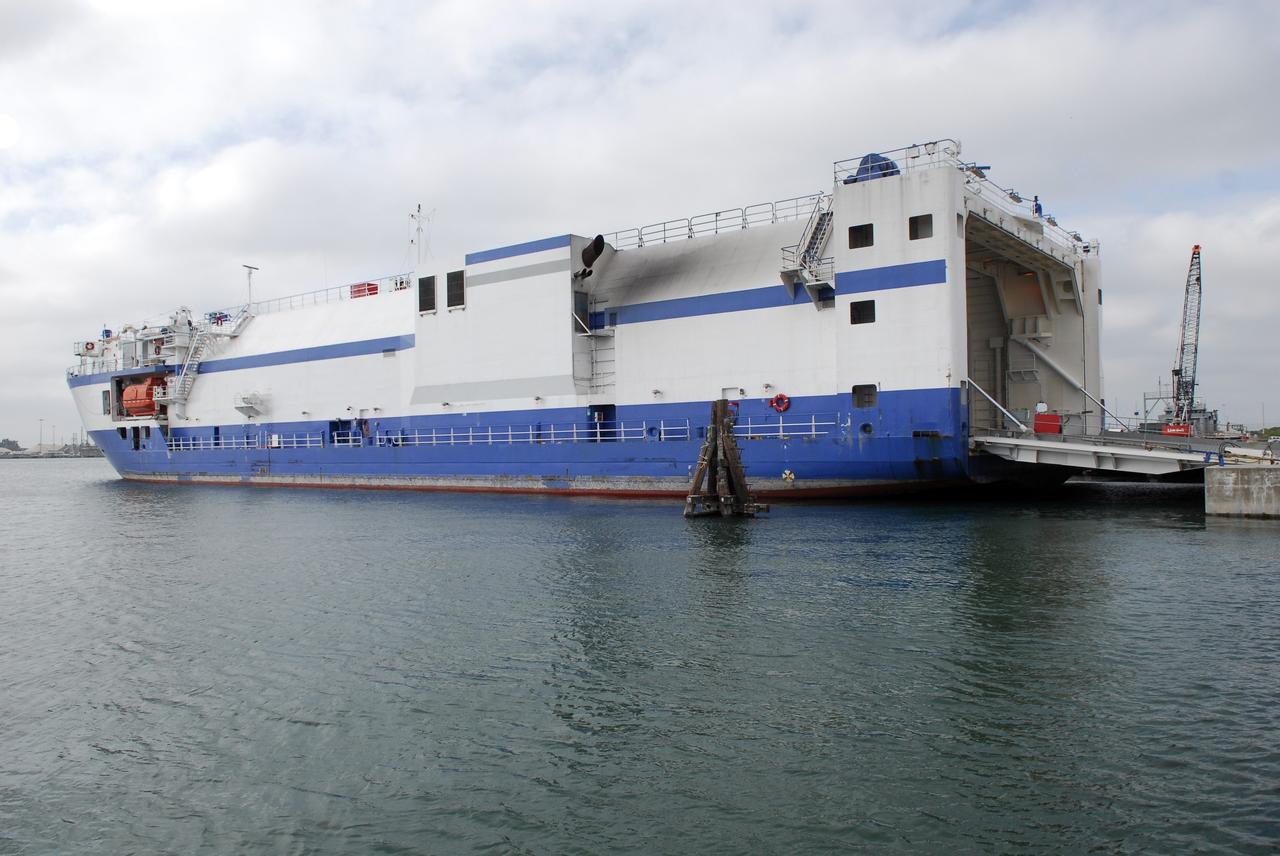
CAPE CANAVERAL, Fla. – The Delta Mariner docks at Port Canaveral, Fla., with its cargo of the Ares I-X upper stage simulator segments. The upper stage simulator will be used in the test flight identified as Ares I-X in 2009. The segments will simulate the mass and the outer mold line and will be more than 100 feet of the total vehicle height of 327 feet. The simulator comprises 11 segments that are approximately 18 feet in diameter. Most of the segments will be approximately 10 feet high, ranging in weight from 18,000 to 60,000 pounds, for a total of approximately 450,000 pounds. Photo credit: NASA/Dimitri Gerondidakis
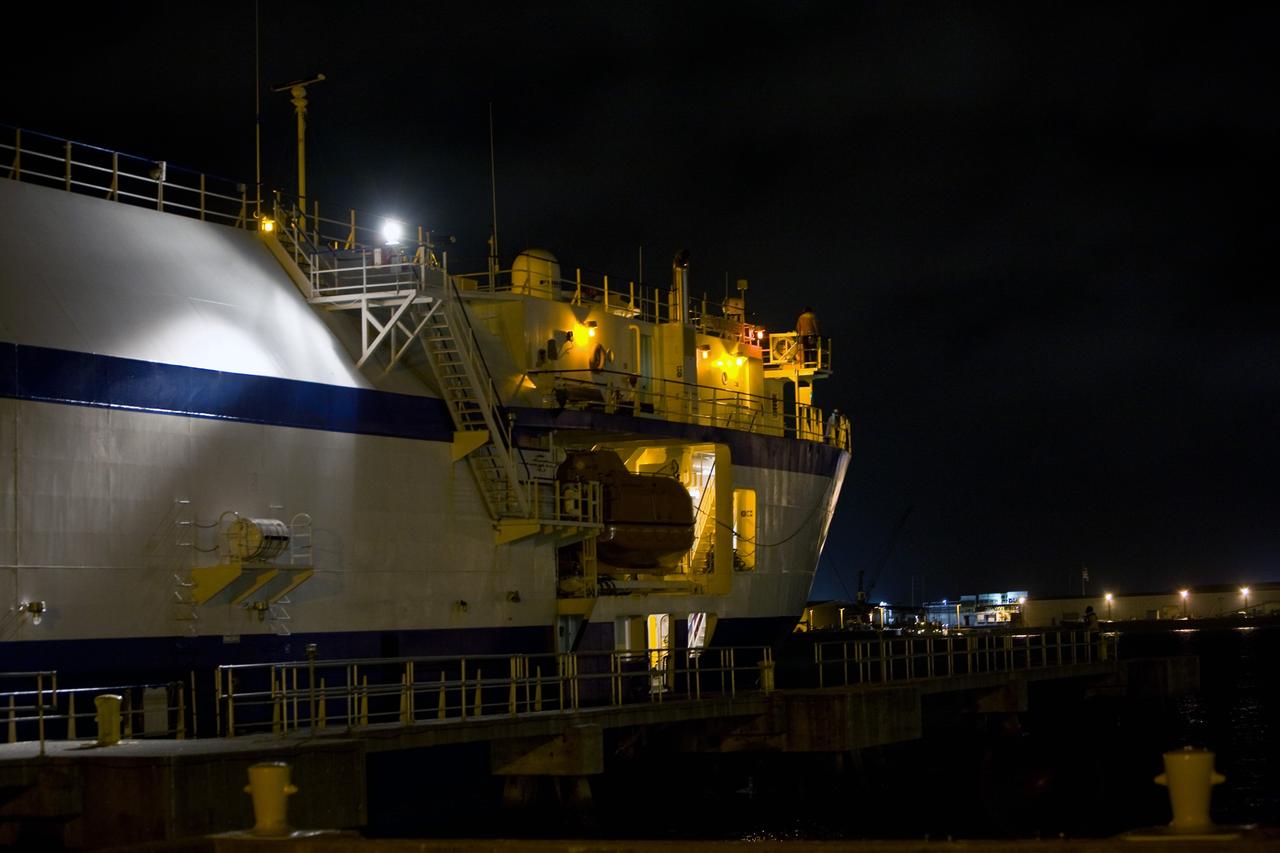
CAPE CANAVERAL, Fla. – The Delta Mariner arrives at Port Canaveral, Fla., with its cargo of the Ares I-X upper stage simulator segments. The upper stage simulator will be used in the test flight identified as Ares I-X in 2009. The segments will simulate the mass and the outer mold line and will be more than 100 feet of the total vehicle height of 327 feet. The simulator comprises 11 segments that are approximately 18 feet in diameter. Most of the segments will be approximately 10 feet high, ranging in weight from 18,000 to 60,000 pounds, for a total of approximately 450,000 pounds. Photo credit: NASA/Dimitri Gerondidakis
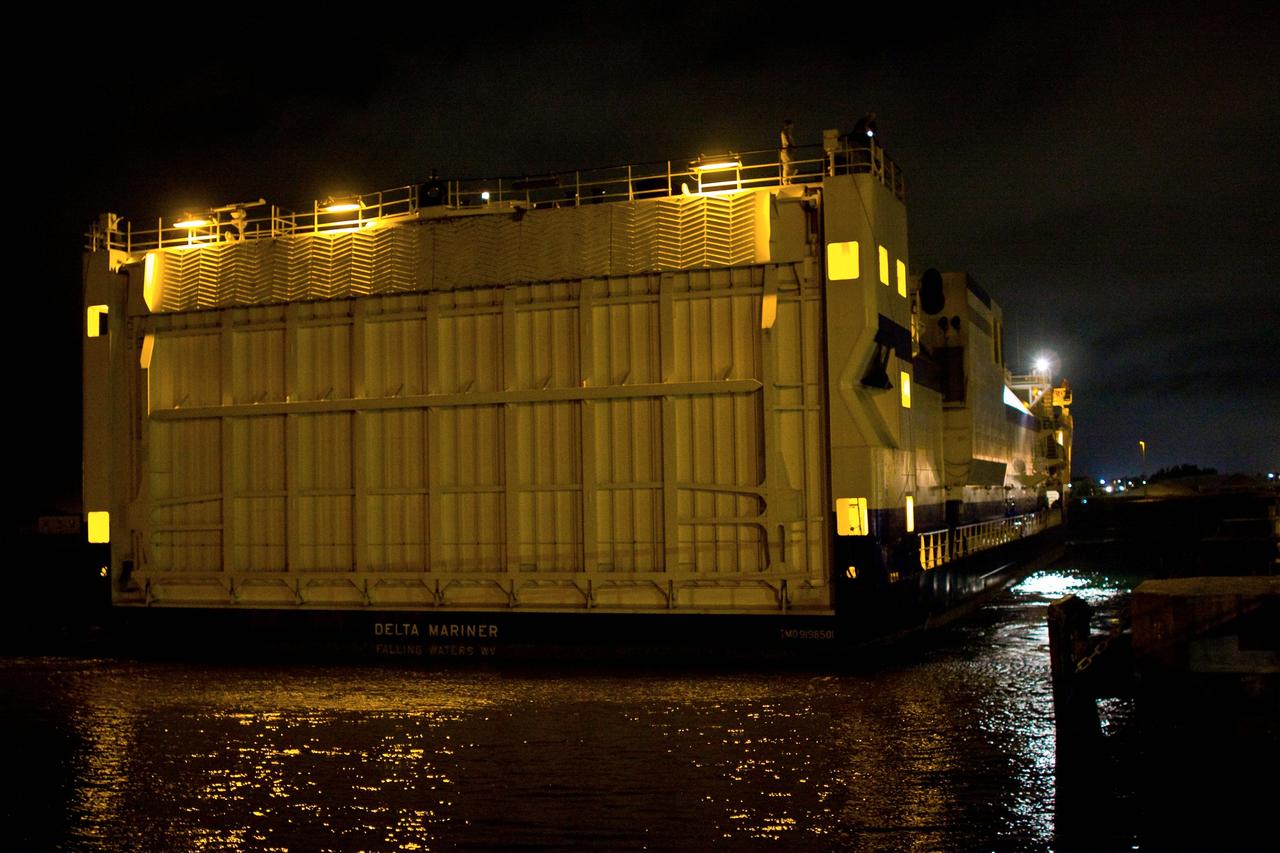
CAPE CANAVERAL, Fla. – The Delta Mariner arrives at Port Canaveral, Fla., with its cargo of the Ares I-X upper stage simulator segments. The upper stage simulator will be used in the test flight identified as Ares I-X in 2009. The segments will simulate the mass and the outer mold line and will be more than 100 feet of the total vehicle height of 327 feet. The simulator comprises 11 segments that are approximately 18 feet in diameter. Most of the segments will be approximately 10 feet high, ranging in weight from 18,000 to 60,000 pounds, for a total of approximately 450,000 pounds. Photo credit: NASA/Dimitri Gerondidakis
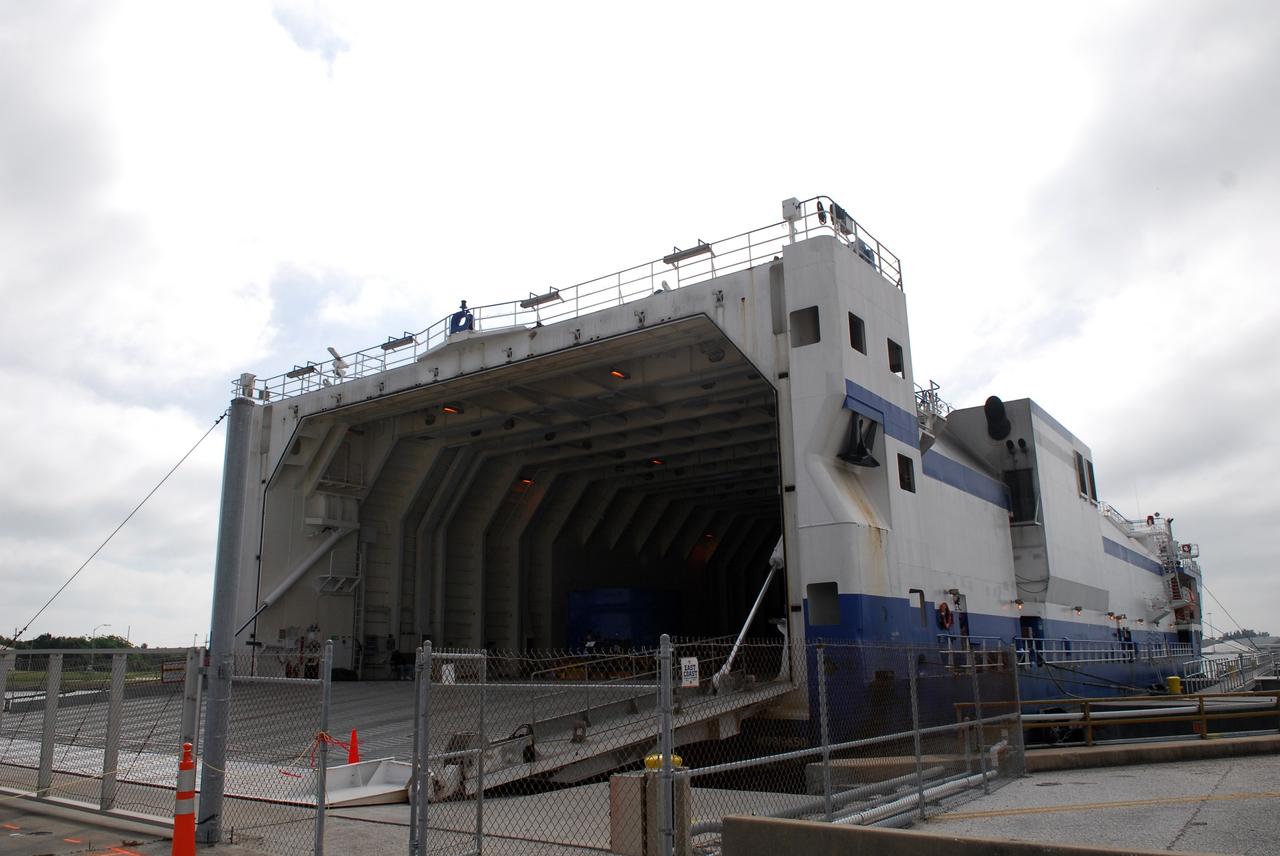
CAPE CANAVERAL, Fla. – The Delta Mariner docks at Port Canaveral, Fla., with its cargo of the Ares I-X upper stage simulator segments. The upper stage simulator will be used in the test flight identified as Ares I-X in 2009. The segments will simulate the mass and the outer mold line and will be more than 100 feet of the total vehicle height of 327 feet. The simulator comprises 11 segments that are approximately 18 feet in diameter. Most of the segments will be approximately 10 feet high, ranging in weight from 18,000 to 60,000 pounds, for a total of approximately 450,000 pounds. Photo credit: NASA/Dimitri Gerondidakis
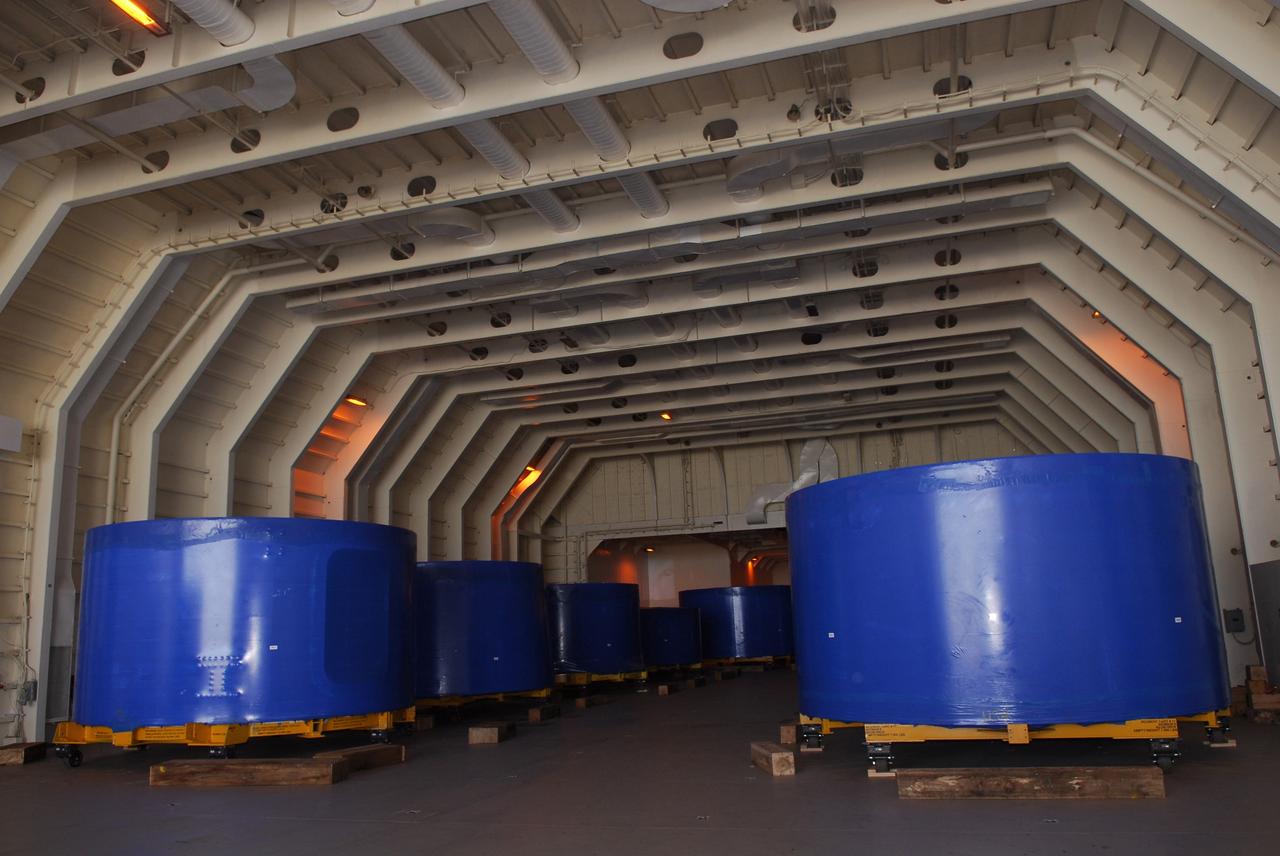
CAPE CANAVERAL, Fla. – Segments of the Ares I-X upper stage simulator are lined up in the cargo hold of the Delta Mariner, docked at Port Canaveral, Fla. The upper stage simulator will be used in the test flight identified as Ares I-X in 2009. The segments will simulate the mass and the outer mold line and will be more than 100 feet of the total vehicle height of 327 feet. The simulator comprises 11 segments that are approximately 18 feet in diameter. Most of the segments will be approximately 10 feet high, ranging in weight from 18,000 to 60,000 pounds, for a total of approximately 450,000 pounds. Photo credit: NASA/Dimitri Gerondidakis
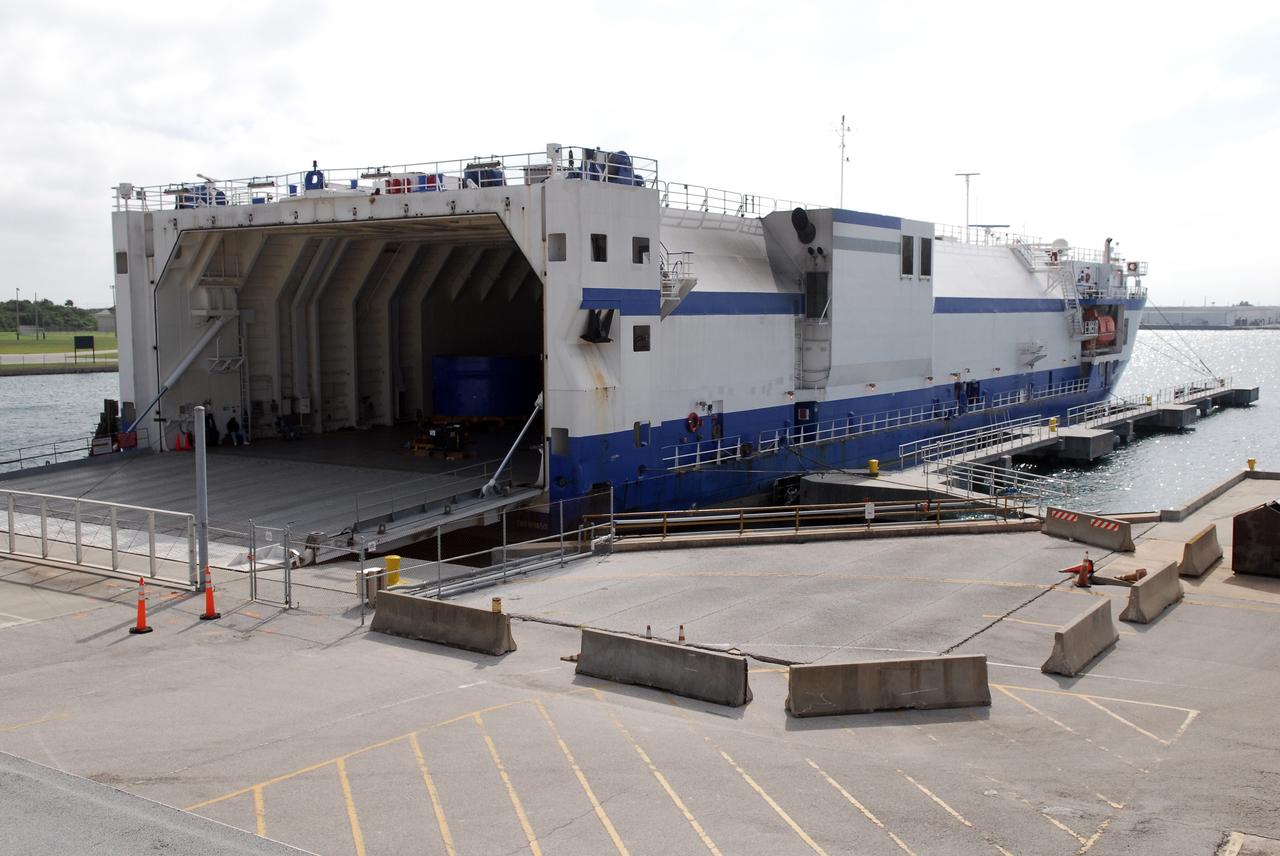
CAPE CANAVERAL, Fla. – The Delta Mariner is docked at Port Canaveral, Fla., with its cargo of the Ares I-X upper stage simulator segments. The upper stage simulator will be used in the test flight identified as Ares I-X in 2009. The segments will simulate the mass and the outer mold line and will be more than 100 feet of the total vehicle height of 327 feet. The simulator comprises 11 segments that are approximately 18 feet in diameter. Most of the segments will be approximately 10 feet high, ranging in weight from 18,000 to 60,000 pounds, for a total of approximately 450,000 pounds. Photo credit: NASA/Dimitri Gerondidakis
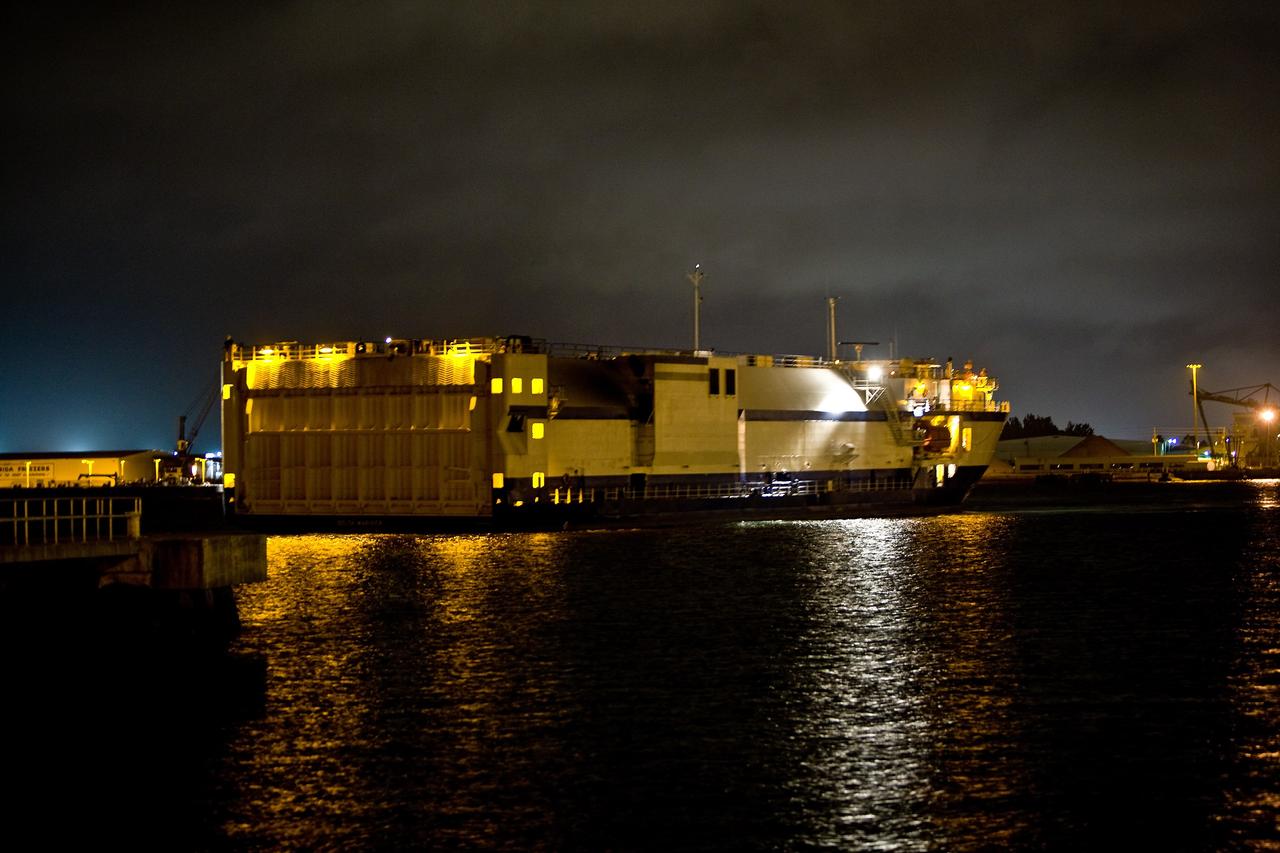
CAPE CANAVERAL, Fla. – The Delta Mariner arrives at Port Canaveral, Fla., with its cargo of the Ares I-X upper stage simulator segments. The upper stage simulator will be used in the test flight identified as Ares I-X in 2009. The segments will simulate the mass and the outer mold line and will be more than 100 feet of the total vehicle height of 327 feet. The simulator comprises 11 segments that are approximately 18 feet in diameter. Most of the segments will be approximately 10 feet high, ranging in weight from 18,000 to 60,000 pounds, for a total of approximately 450,000 pounds. Photo credit: NASA/Dimitri Gerondidakis
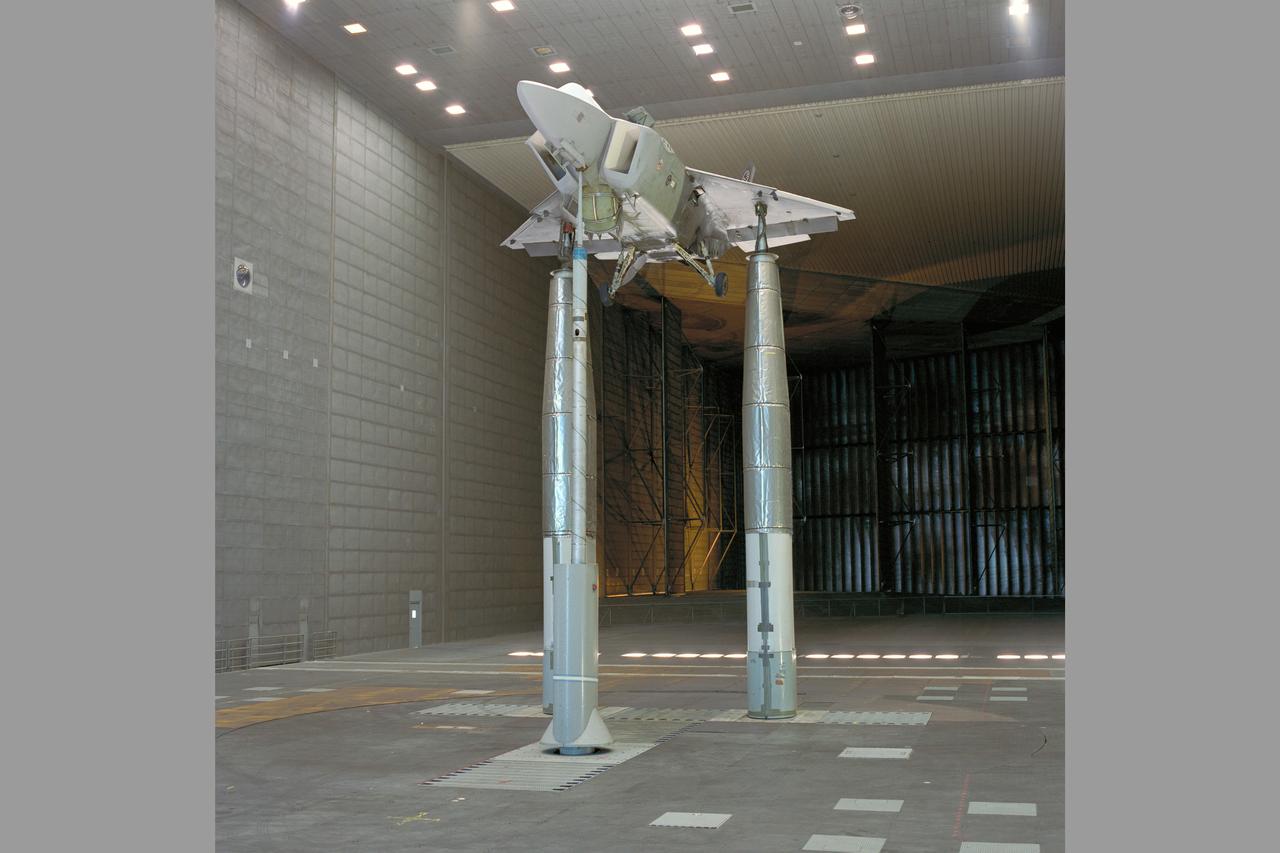
CALF/JAST X-32 test program: the LSPM (Large Scale Powered Model), Lockheed's concept for a tri-service aircraft (Air Force, Navy, Marines) CALF (Common Affordable Lightweight Fighter) as part of the Department of Defense's Joint Advanced Strike Technology (JAST) is being tested in the 80x120ft w.t. test-930 with rear horizontal stabilizer
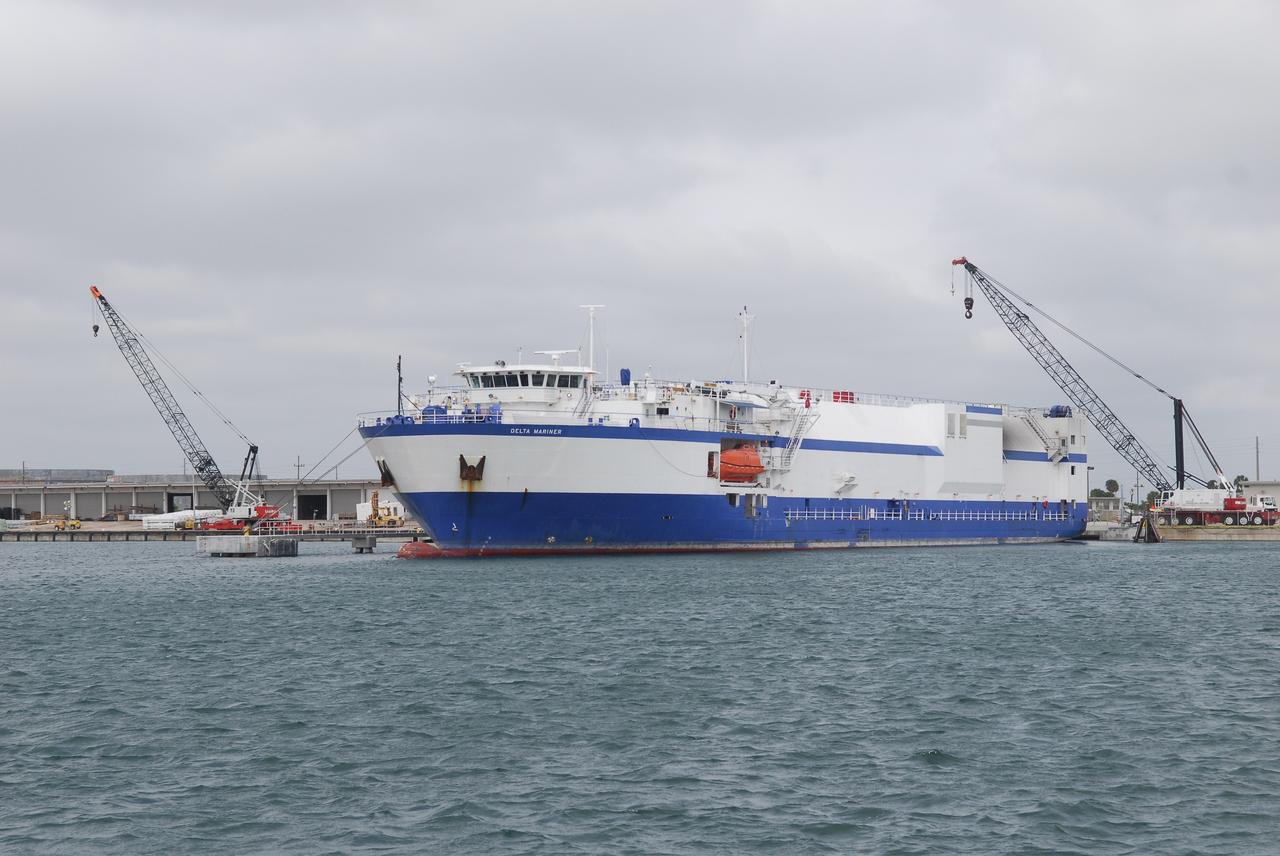
CAPE CANAVERAL, Fla. – The Delta Mariner is docked at Port Canaveral, Fla., with its cargo of the Ares I-X upper stage simulator segments. The cranes near the ship will be used to remove the segments and place them on a flatbed truck for transportation to the Vehicle Assembly Building's high bay 4 at NASA's Kennedy Space Center in Florida. The upper stage simulator will be used in the test flight identified as Ares I-X in 2009. The segments will simulate the mass and the outer mold line and will be more than 100 feet of the total vehicle height of 327 feet. The simulator comprises 11 segments that are approximately 18 feet in diameter. Most of the segments will be approximately 10 feet high, ranging in weight from 18,000 to 60,000 pounds, for a total of approximately 450,000 pounds. Photo credit: NASA/Dimitri Gerondidakis
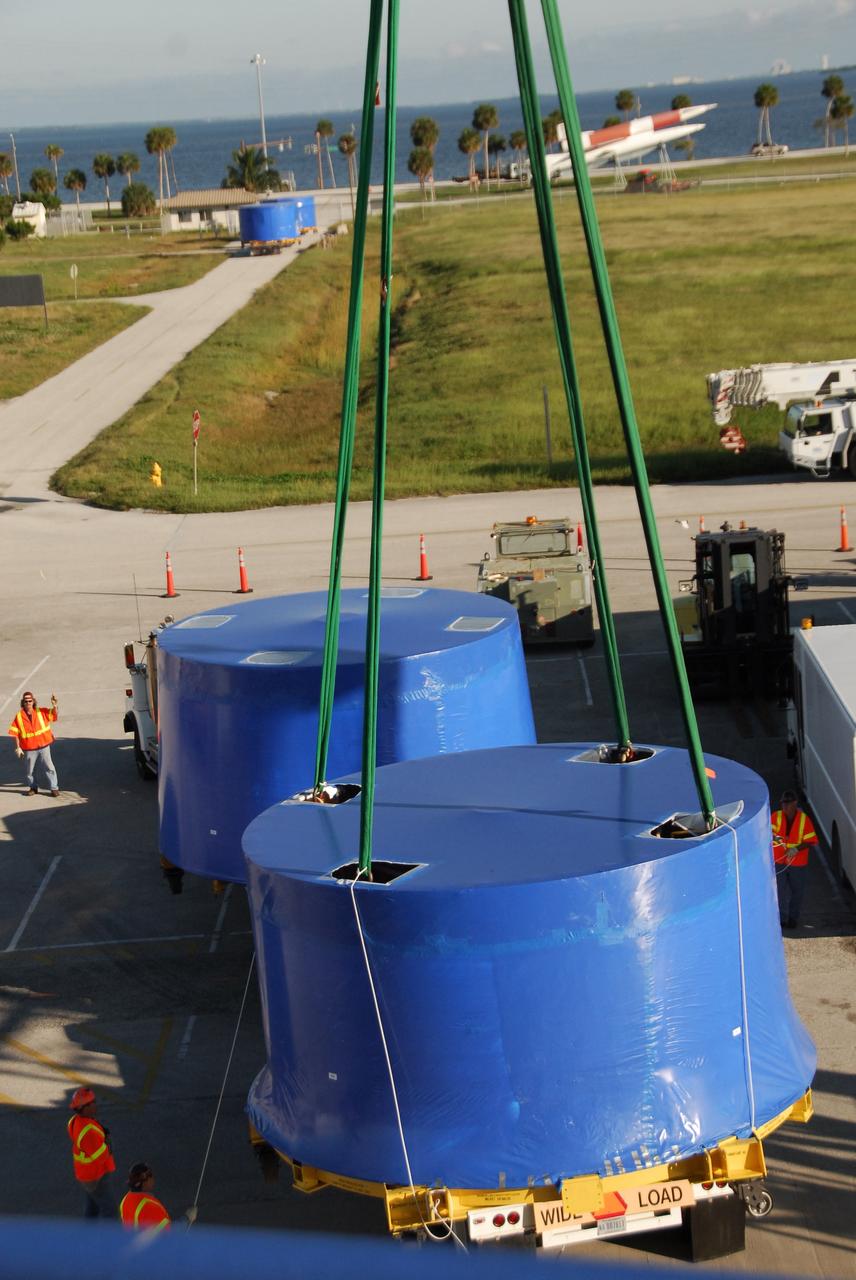
CAPE CANAVERAL, Fla. – A crane lifts and transfers Ares I-X upper stage simulator segments from the Delta Mariner at Port Canaveral, Fla., onto a flatbed truck. They will be transported to the Vehicle Assembly Building's high bay 4 at NASA's Kennedy Space Center in Florida. The upper stage simulator will be used in the test flight identified as Ares I-X in 2009. The Ares I-X test flight will provide NASA an early opportunity to test and prove hardware, facilities and ground operations associated with the Ares I crew launch vehicle. It also will allow NASA to gather critical data during ascent of the integrated Orion crew exploration vehicle and the Ares I rocket. The data will ensure the entire vehicle system is safe and fully operational before astronauts begin traveling to orbit. The simulator segments will simulate the mass and the outer mold line and will be more than 100 feet of the total vehicle height of 327 feet. The simulator comprises 11 segments that are approximately 18 feet in diameter. Most of the segments will be approximately 10 feet high, ranging in weight from 18,000 to 60,000 pounds, for a total of approximately 450,000 pounds. Photo credit: NASA/Cory Huston
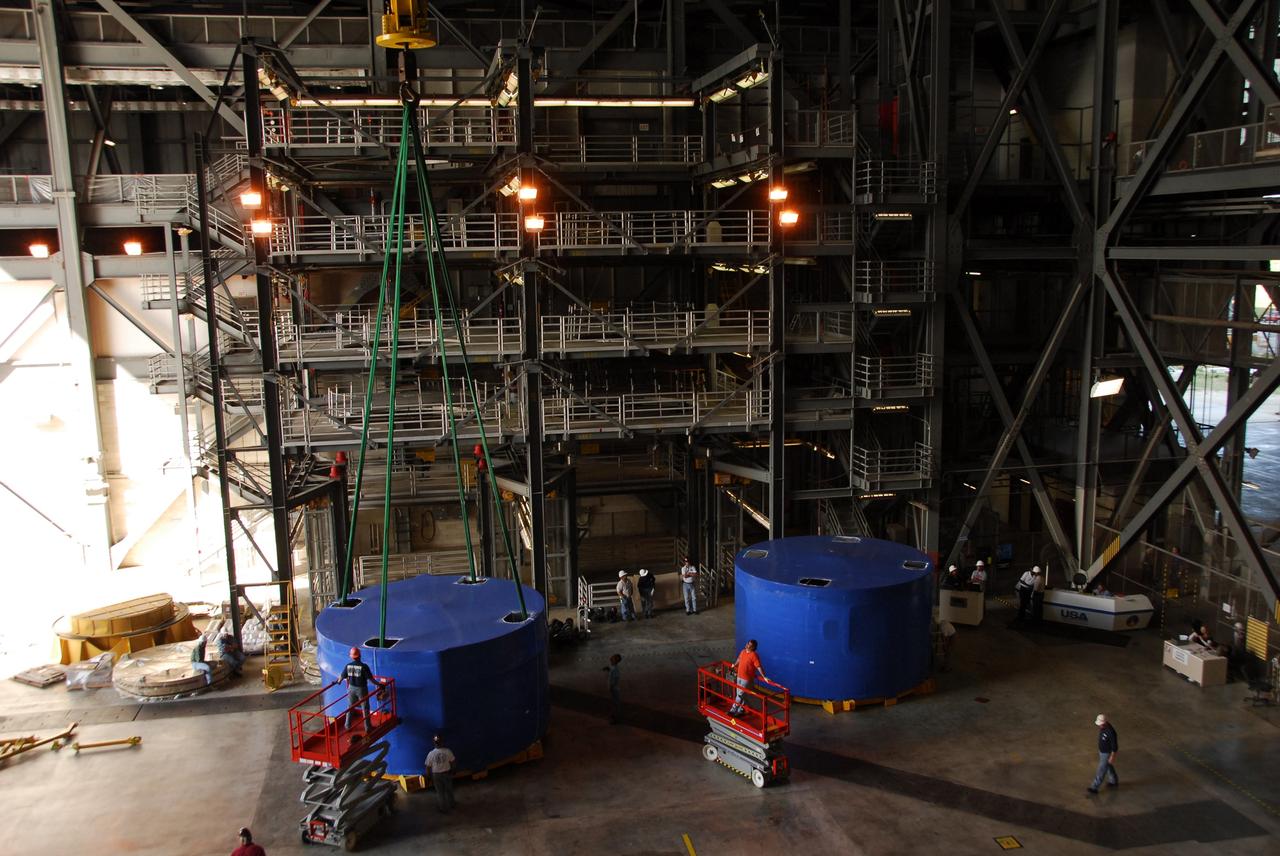
CAPE CANAVERAL, Fla. – Inside the Vehicle Assembly Building's high bay 4 at NASA's Kennedy Space Center in Florida, two of the Ares I-X upper stage simulator segments are offloaded from its transporter and placed on the floor. The segments arrived Nov. 4 at Port Canaveral, Fla., aboard the Delta Mariner. The upper stage simulators will be used in the test flight identified as Ares I-X in 2009. The Ares I-X test flight will provide NASA an early opportunity to test and prove hardware, facilities and ground operations associated with the Ares I crew launch vehicle. It also will allow NASA to gather critical data during ascent of the integrated Orion crew exploration vehicle and the Ares I rocket. The data will ensure the entire vehicle system is safe and fully operational before astronauts begin traveling to orbit. The simulator segments will simulate the mass and the outer mold line and will be more than 100 feet of the total vehicle height of 327 feet. The simulator comprises 11 segments that are approximately 18 feet in diameter. Most of the segments will be approximately 10 feet high, ranging in weight from 18,000 to 60,000 pounds, for a total of approximately 450,000 pounds. Photo credit: NASA/Cory Huston
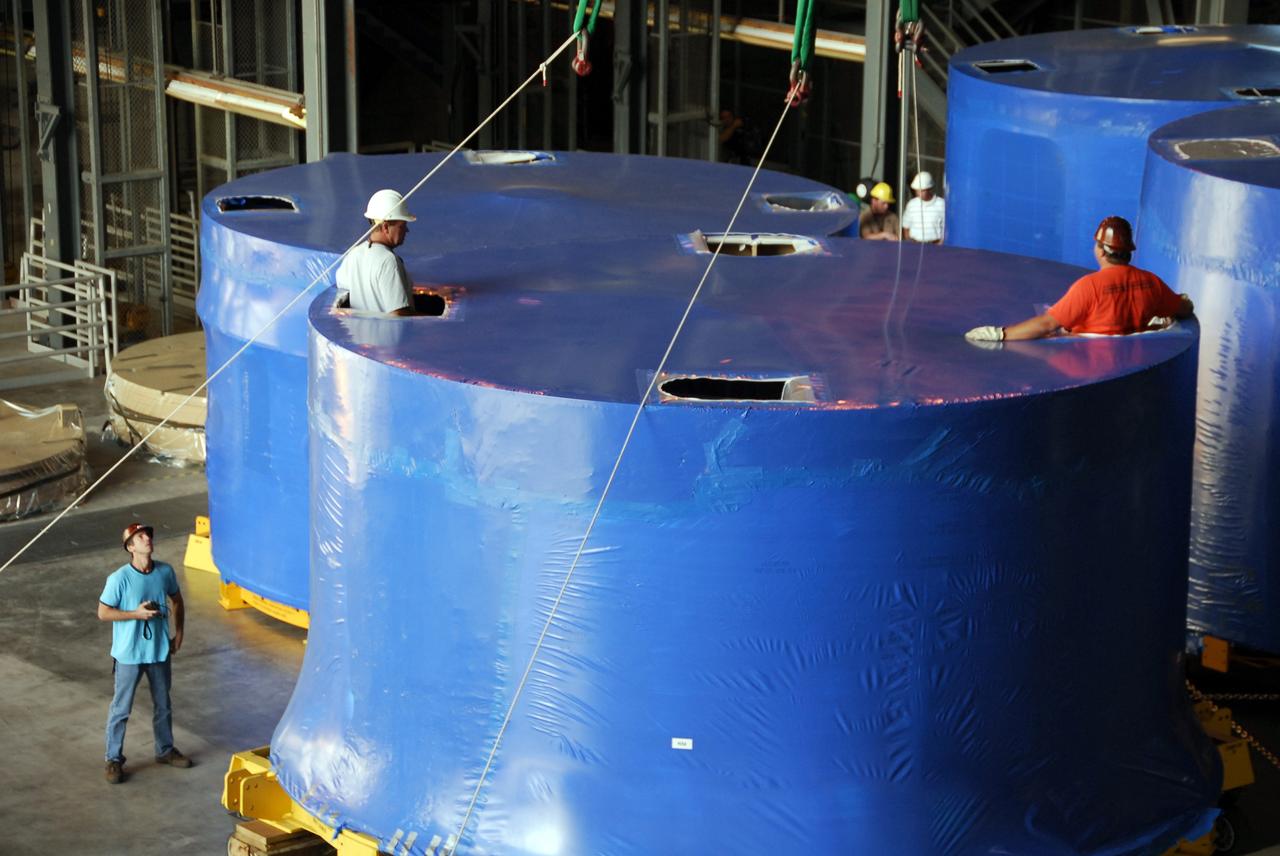
CAPE CANAVERAL, Fla. – Inside the Vehicle Assembly Building's high bay 4 at NASA's Kennedy Space Center in Florida, workers secure the cranes that are being used to offload Ares I-X upper stage simulator segments onto the floor. The segments arrived Nov. 4 at Port Canaveral, Fla., aboard the Delta Mariner. The upper simulator segments are moved inside where they will be offloaded. The upper stage simulators will be used in the test flight identified as Ares I-X in 2009. The Ares I-X test flight will provide NASA an early opportunity to test and prove hardware, facilities and ground operations associated with the Ares I crew launch vehicle. It also will allow NASA to gather critical data during ascent of the integrated Orion crew exploration vehicle and the Ares I rocket. The data will ensure the entire vehicle system is safe and fully operational before astronauts begin traveling to orbit. The simulator segments will simulate the mass and the outer mold line and will be more than 100 feet of the total vehicle height of 327 feet. The simulator comprises 11 segments that are approximately 18 feet in diameter. Most of the segments will be approximately 10 feet high, ranging in weight from 18,000 to 60,000 pounds, for a total of approximately 450,000 pounds. Photo credit: NASA/Cory Huston
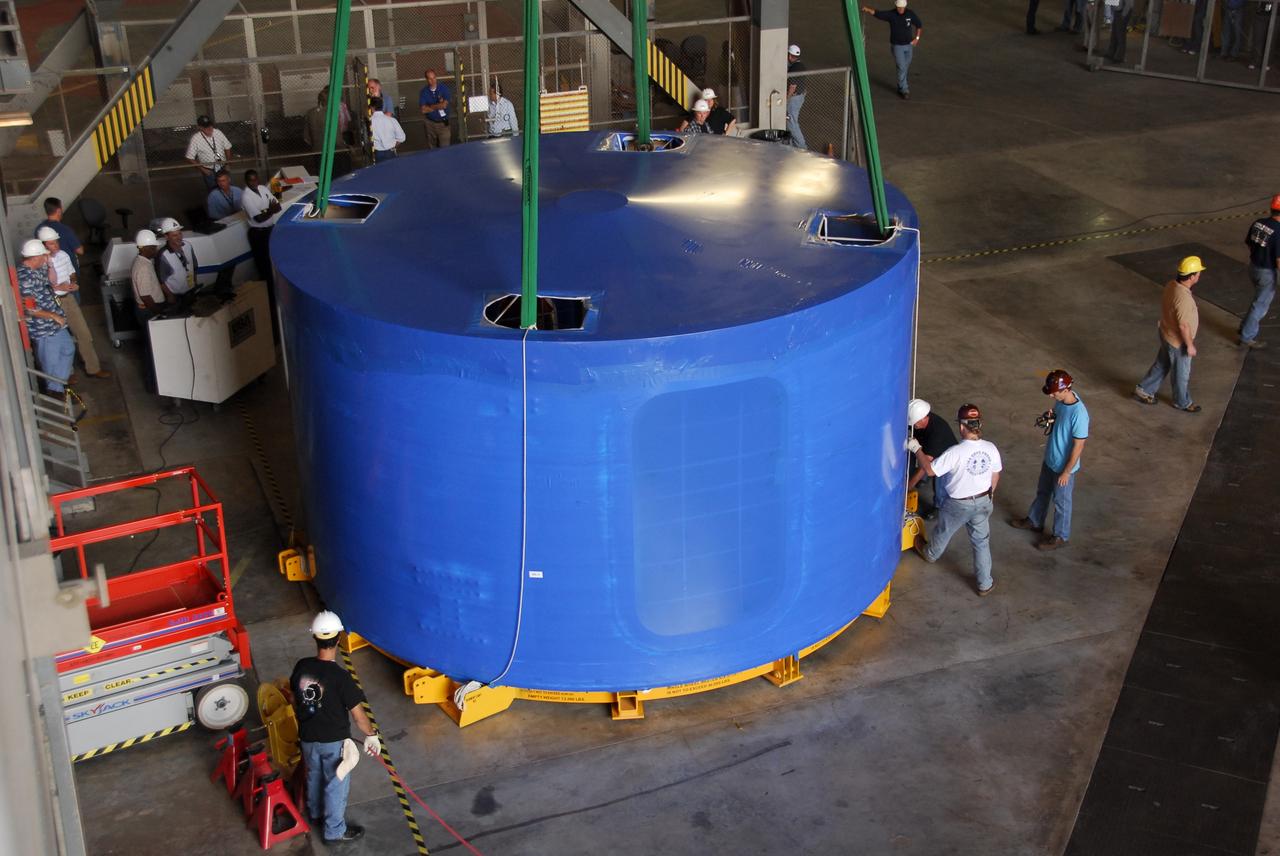
CAPE CANAVERAL, Fla. – Inside the Vehicle Assembly Building's high bay 4 at NASA's Kennedy Space Center in Florida, one of the Ares I-X upper stage simulator segments is offloaded from its transporter and placed on the floor. The segments arrived Nov. 4 at Port Canaveral, Fla., aboard the Delta Mariner. The upper stage simulators will be used in the test flight identified as Ares I-X in 2009. The Ares I-X test flight will provide NASA an early opportunity to test and prove hardware, facilities and ground operations associated with the Ares I crew launch vehicle. It also will allow NASA to gather critical data during ascent of the integrated Orion crew exploration vehicle and the Ares I rocket. The data will ensure the entire vehicle system is safe and fully operational before astronauts begin traveling to orbit. The simulator segments will simulate the mass and the outer mold line and will be more than 100 feet of the total vehicle height of 327 feet. The simulator comprises 11 segments that are approximately 18 feet in diameter. Most of the segments will be approximately 10 feet high, ranging in weight from 18,000 to 60,000 pounds, for a total of approximately 450,000 pounds. Photo credit: NASA/Cory Huston
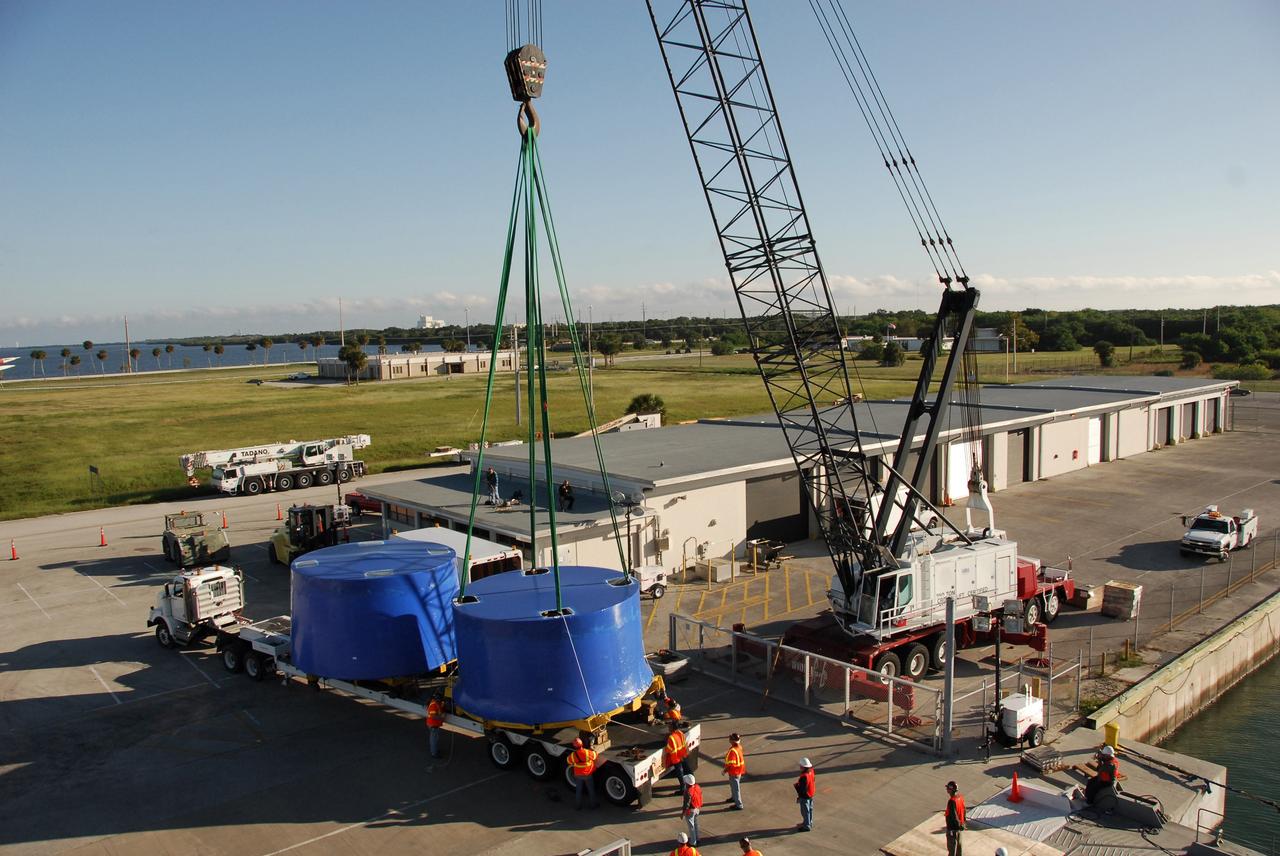
CAPE CANAVERAL, Fla. – A crane lifts and transfers Ares I-X upper stage simulator segments from the Delta Mariner at Port Canaveral, Fla., onto a flatbed truck. They will be transported to the Vehicle Assembly Building's high bay 4 at NASA's Kennedy Space Center in Florida. The upper stage simulator will be used in the test flight identified as Ares I-X in 2009. The Ares I-X test flight will provide NASA an early opportunity to test and prove hardware, facilities and ground operations associated with the Ares I crew launch vehicle. It also will allow NASA to gather critical data during ascent of the integrated Orion crew exploration vehicle and the Ares I rocket. The data will ensure the entire vehicle system is safe and fully operational before astronauts begin traveling to orbit. The simulator segments will simulate the mass and the outer mold line and will be more than 100 feet of the total vehicle height of 327 feet. The simulator comprises 11 segments that are approximately 18 feet in diameter. Most of the segments will be approximately 10 feet high, ranging in weight from 18,000 to 60,000 pounds, for a total of approximately 450,000 pounds. Photo credit: NASA/Cory Huston
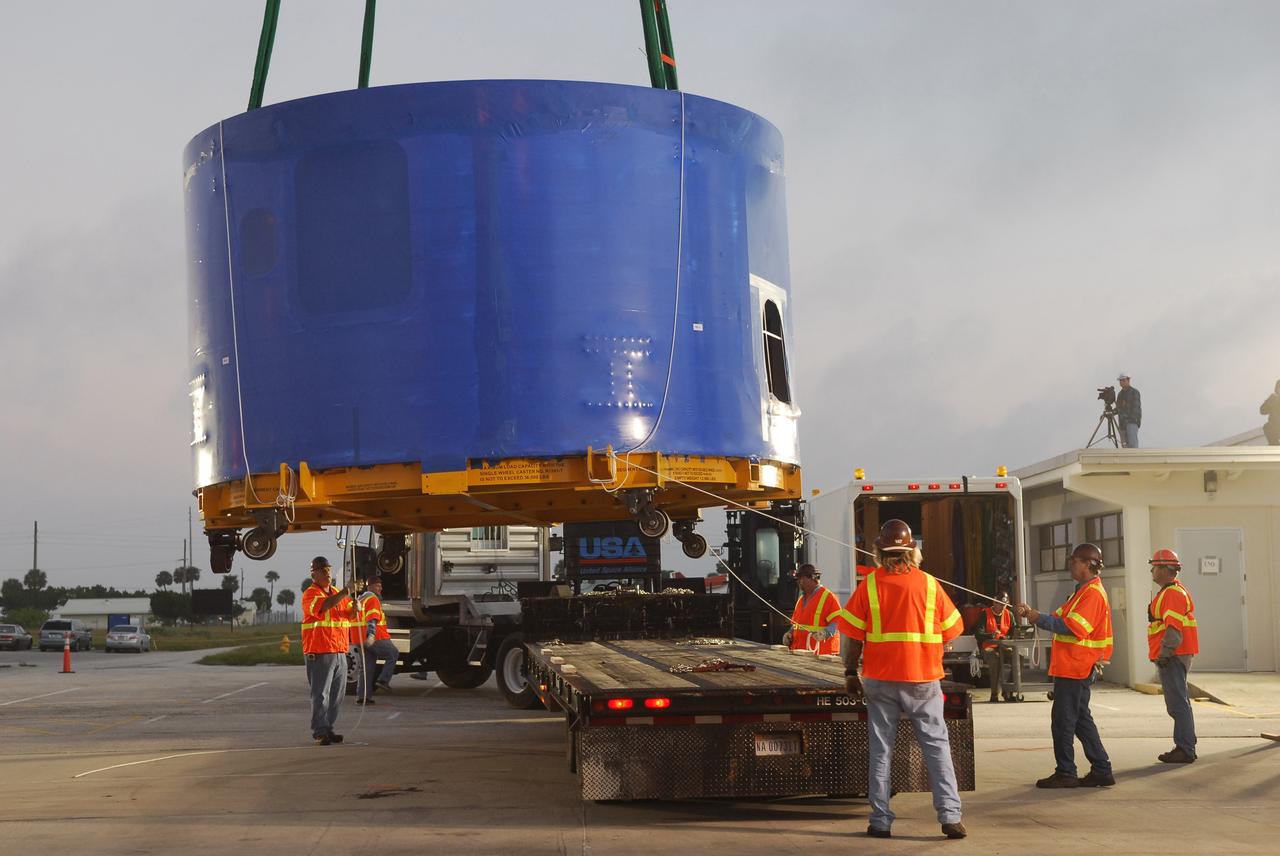
CAPE CANAVERAL, Fla. – A crane lifts and transfers an Ares I-X upper stage simulator segment from the Delta Mariner at Port Canaveral, Fla., onto a flatbed truck. They will be transported to the Vehicle Assembly Building's high bay 4 at NASA's Kennedy Space Center in Florida. The upper stage simulator will be used in the test flight identified as Ares I-X in 2009. The Ares I-X test flight will provide NASA an early opportunity to test and prove hardware, facilities and ground operations associated with the Ares I crew launch vehicle. It also will allow NASA to gather critical data during ascent of the integrated Orion crew exploration vehicle and the Ares I rocket. The data will ensure the entire vehicle system is safe and fully operational before astronauts begin traveling to orbit. The simulator segments will simulate the mass and the outer mold line and will be more than 100 feet of the total vehicle height of 327 feet. The simulator comprises 11 segments that are approximately 18 feet in diameter. Most of the segments will be approximately 10 feet high, ranging in weight from 18,000 to 60,000 pounds, for a total of approximately 450,000 pounds. Photo credit: NASA/Cory Huston
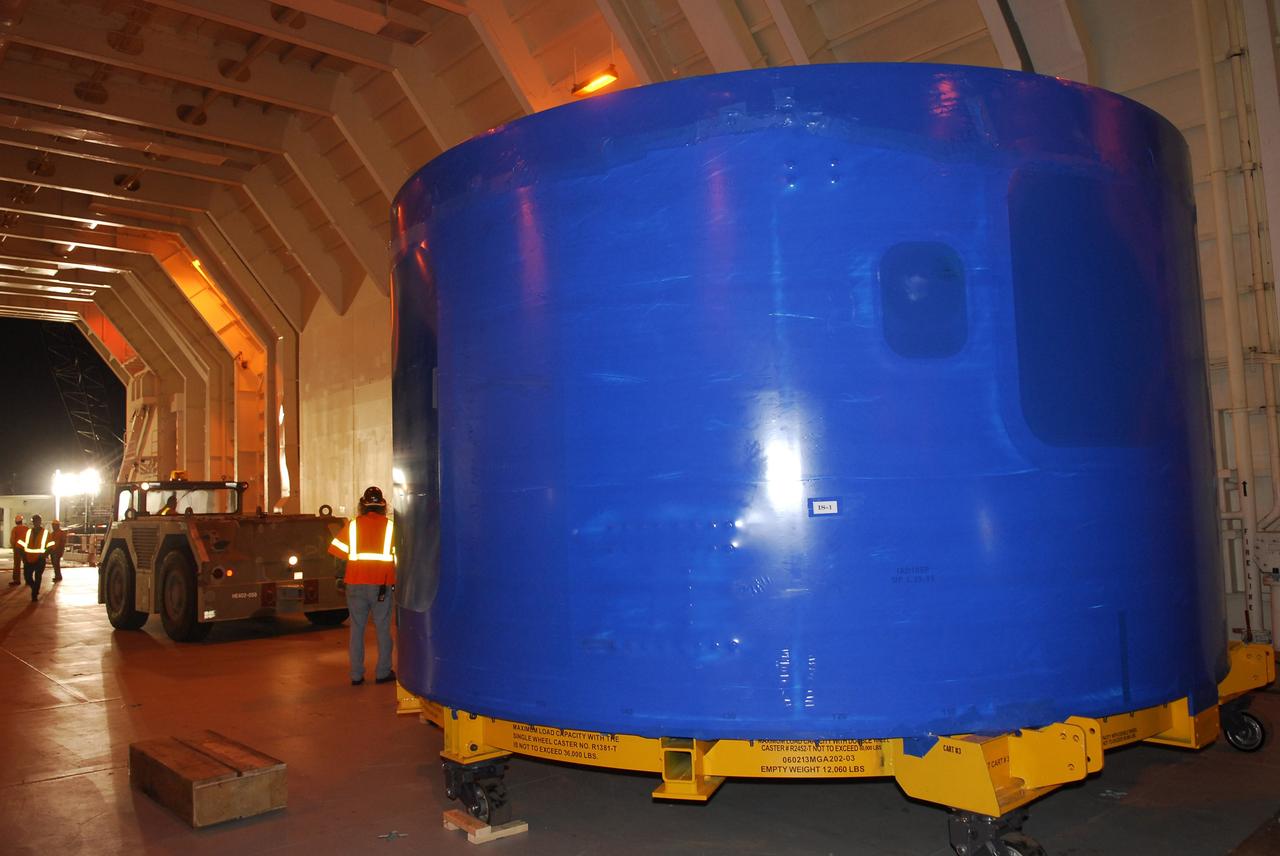
CAPE CANAVERAL, Fla. – At Port Canaveral, Fla., the Ares I-X upper stage simulator segments are being offloaded from the Delta Mariner. The segments will be placed on a flatbed truck for transportation to the Vehicle Assembly Building's high bay 4 at NASA's Kennedy Space Center in Florida. The upper stage simulator will be used in the test flight identified as Ares I-X in 2009. The Ares I-X test flight will provide NASA an early opportunity to test and prove hardware, facilities and ground operations associated with the Ares I crew launch vehicle. It also will allow NASA to gather critical data during ascent of the integrated Orion crew exploration vehicle and the Ares I rocket. The data will ensure the entire vehicle system is safe and fully operational before astronauts begin traveling to orbit. The simulator segments will simulate the mass and the outer mold line and will be more than 100 feet of the total vehicle height of 327 feet. The simulator comprises 11 segments that are approximately 18 feet in diameter. Most of the segments will be approximately 10 feet high, ranging in weight from 18,000 to 60,000 pounds, for a total of approximately 450,000 pounds. Photo credit: NASA/Cory Huston
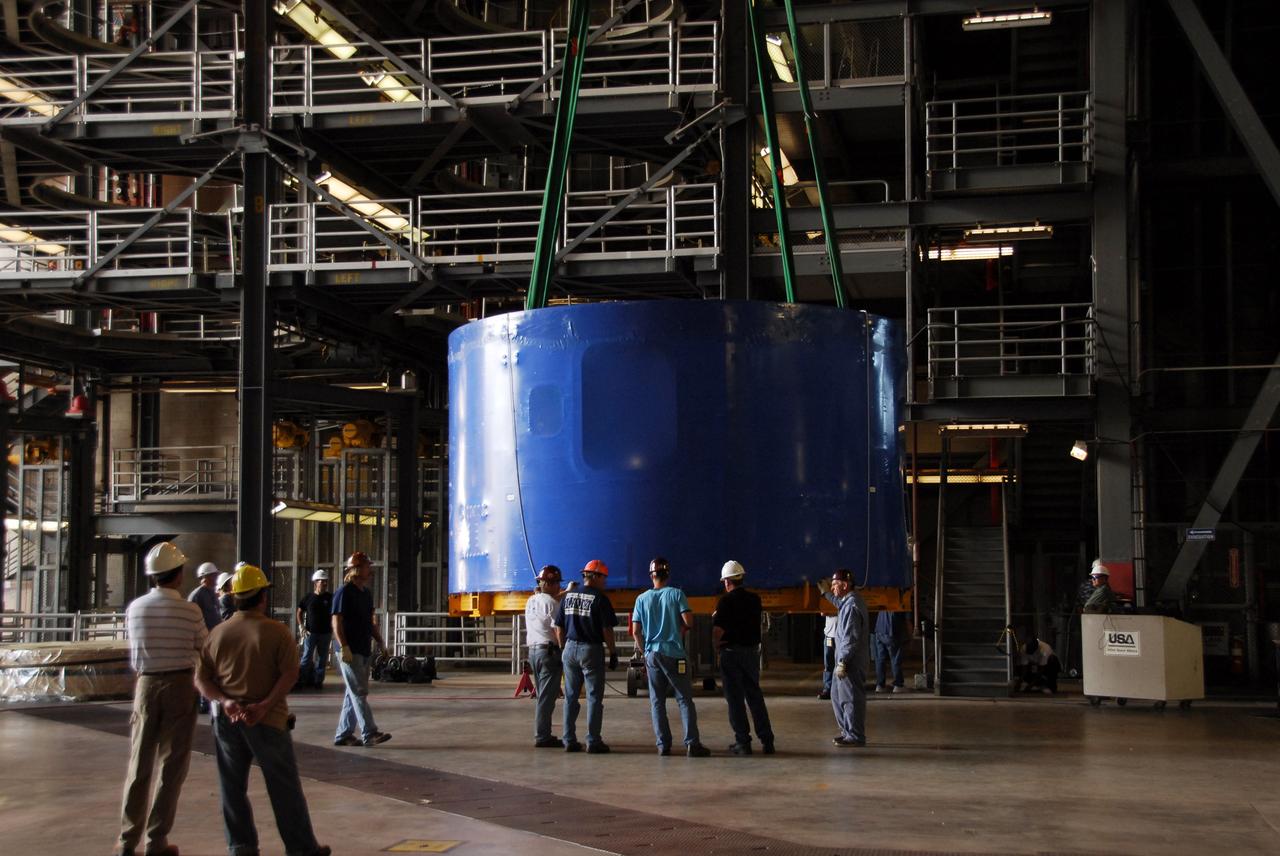
CAPE CANAVERAL, Fla. – Inside the Vehicle Assembly Building's high bay 4 at NASA's Kennedy Space Center in Florida, one of the Ares I-X upper stage simulator segments is offloaded from its transporter and placed on the floor. The segments arrived Nov. 4 at Port Canaveral, Fla., aboard the Delta Mariner. The upper stage simulators will be used in the test flight identified as Ares I-X in 2009. The Ares I-X test flight will provide NASA an early opportunity to test and prove hardware, facilities and ground operations associated with the Ares I crew launch vehicle. It also will allow NASA to gather critical data during ascent of the integrated Orion crew exploration vehicle and the Ares I rocket. The data will ensure the entire vehicle system is safe and fully operational before astronauts begin traveling to orbit. The simulator segments will simulate the mass and the outer mold line and will be more than 100 feet of the total vehicle height of 327 feet. The simulator comprises 11 segments that are approximately 18 feet in diameter. Most of the segments will be approximately 10 feet high, ranging in weight from 18,000 to 60,000 pounds, for a total of approximately 450,000 pounds. Photo credit: NASA/Cory Huston
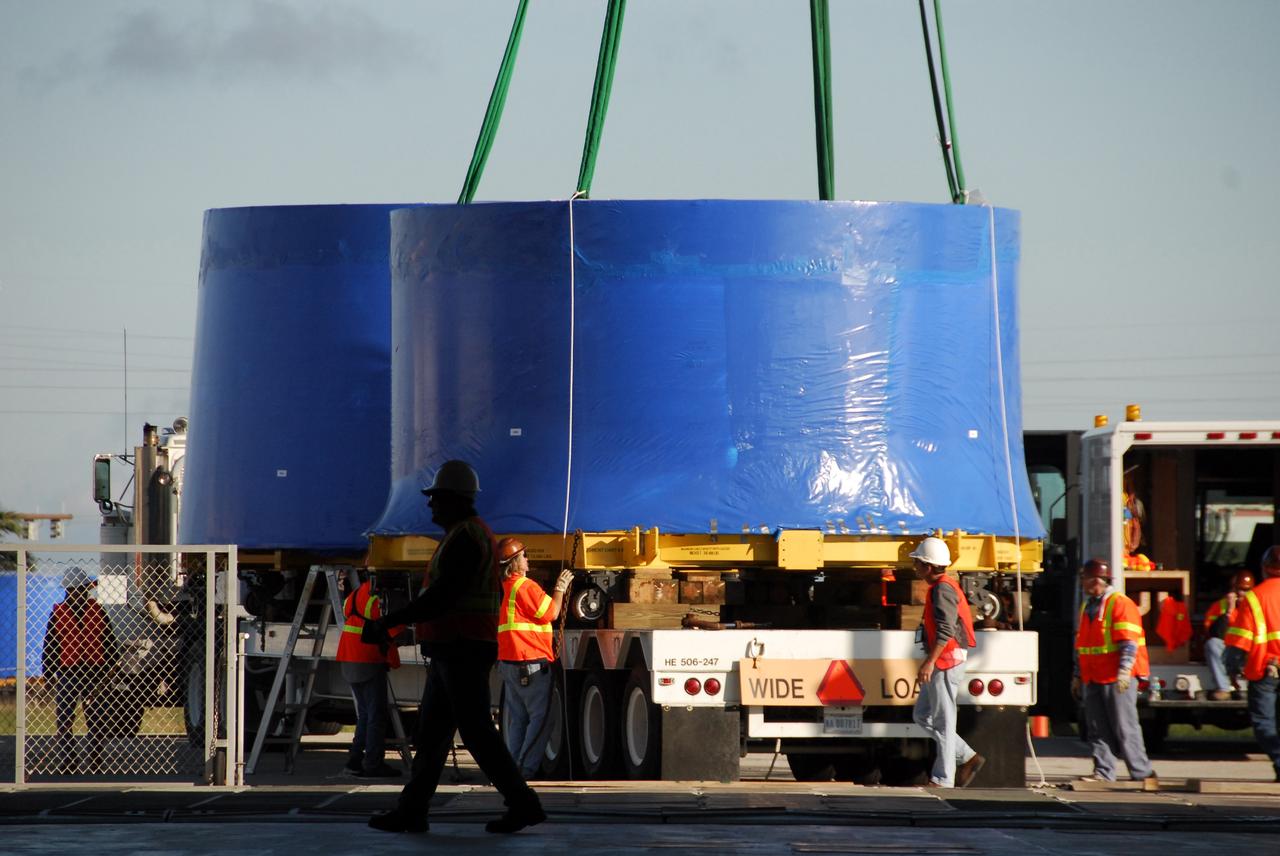
CAPE CANAVERAL, Fla. – A crane lifts and transfers an Ares I-X upper stage simulator segment from the Delta Mariner at Port Canaveral, Fla., onto a flatbed truck. They will be transported to the Vehicle Assembly Building's high bay 4 at NASA's Kennedy Space Center in Florida. The upper stage simulators will be used in the test flight identified as Ares I-X in 2009. The Ares I-X test flight will provide NASA an early opportunity to test and prove hardware, facilities and ground operations associated with the Ares I crew launch vehicle. It also will allow NASA to gather critical data during ascent of the integrated Orion crew exploration vehicle and the Ares I rocket. The data will ensure the entire vehicle system is safe and fully operational before astronauts begin traveling to orbit. The simulator segments will simulate the mass and the outer mold line and will be more than 100 feet of the total vehicle height of 327 feet. The simulator comprises 11 segments that are approximately 18 feet in diameter. Most of the segments will be approximately 10 feet high, ranging in weight from 18,000 to 60,000 pounds, for a total of approximately 450,000 pounds. Photo credit: NASA/Cory Huston
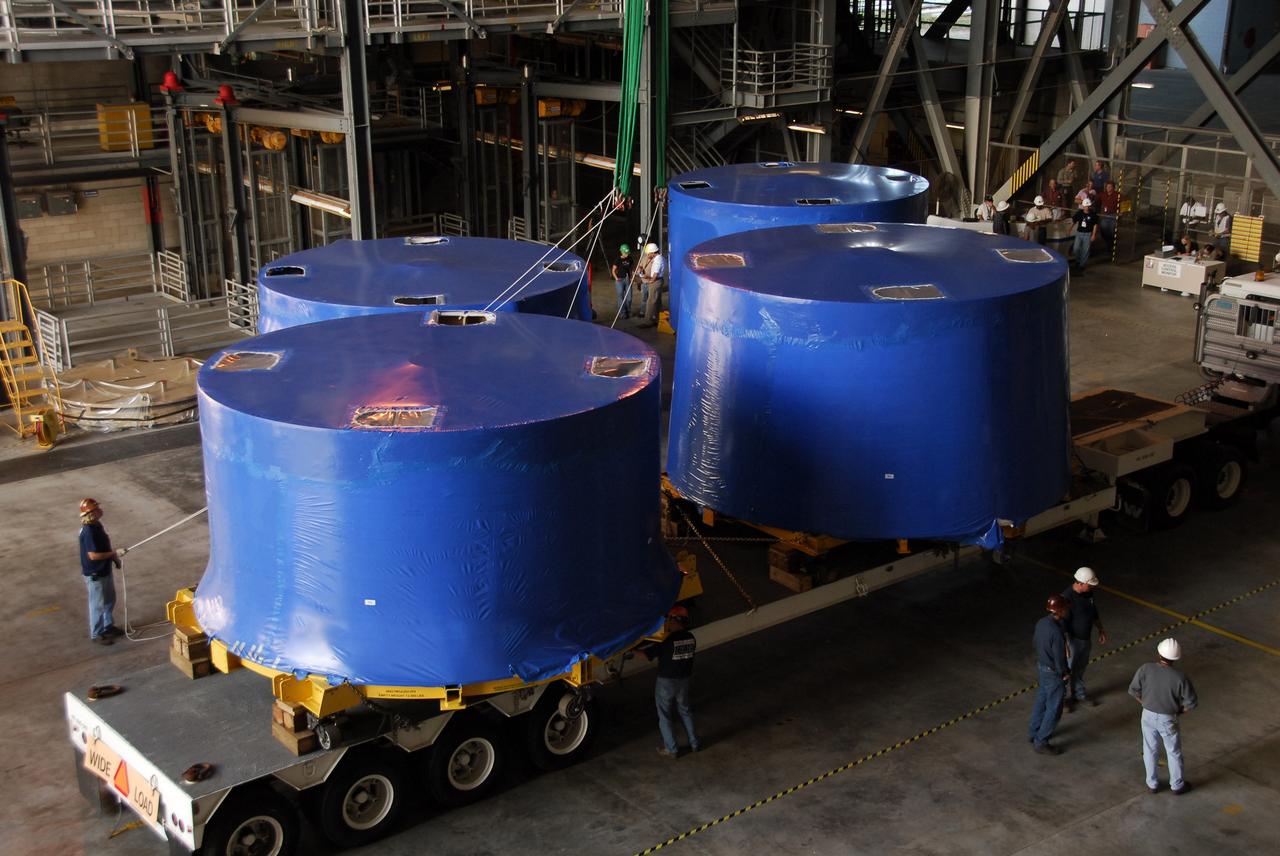
CAPE CANAVERAL, Fla. – Inside the Vehicle Assembly Building's high bay 4 at NASA's Kennedy Space Center in Florida, Ares I-X upper stage simulator segments are being offloaded onto the floor. The segments arrived Nov. 4 at Port Canaveral, Fla., aboard the Delta Mariner. The upper simulator segments are moved inside where they will be offloaded. The upper stage simulators will be used in the test flight identified as Ares I-X in 2009. The Ares I-X test flight will provide NASA an early opportunity to test and prove hardware, facilities and ground operations associated with the Ares I crew launch vehicle. It also will allow NASA to gather critical data during ascent of the integrated Orion crew exploration vehicle and the Ares I rocket. The data will ensure the entire vehicle system is safe and fully operational before astronauts begin traveling to orbit. The simulator segments will simulate the mass and the outer mold line and will be more than 100 feet of the total vehicle height of 327 feet. The simulator comprises 11 segments that are approximately 18 feet in diameter. Most of the segments will be approximately 10 feet high, ranging in weight from 18,000 to 60,000 pounds, for a total of approximately 450,000 pounds. Photo credit: NASA/Cory Huston
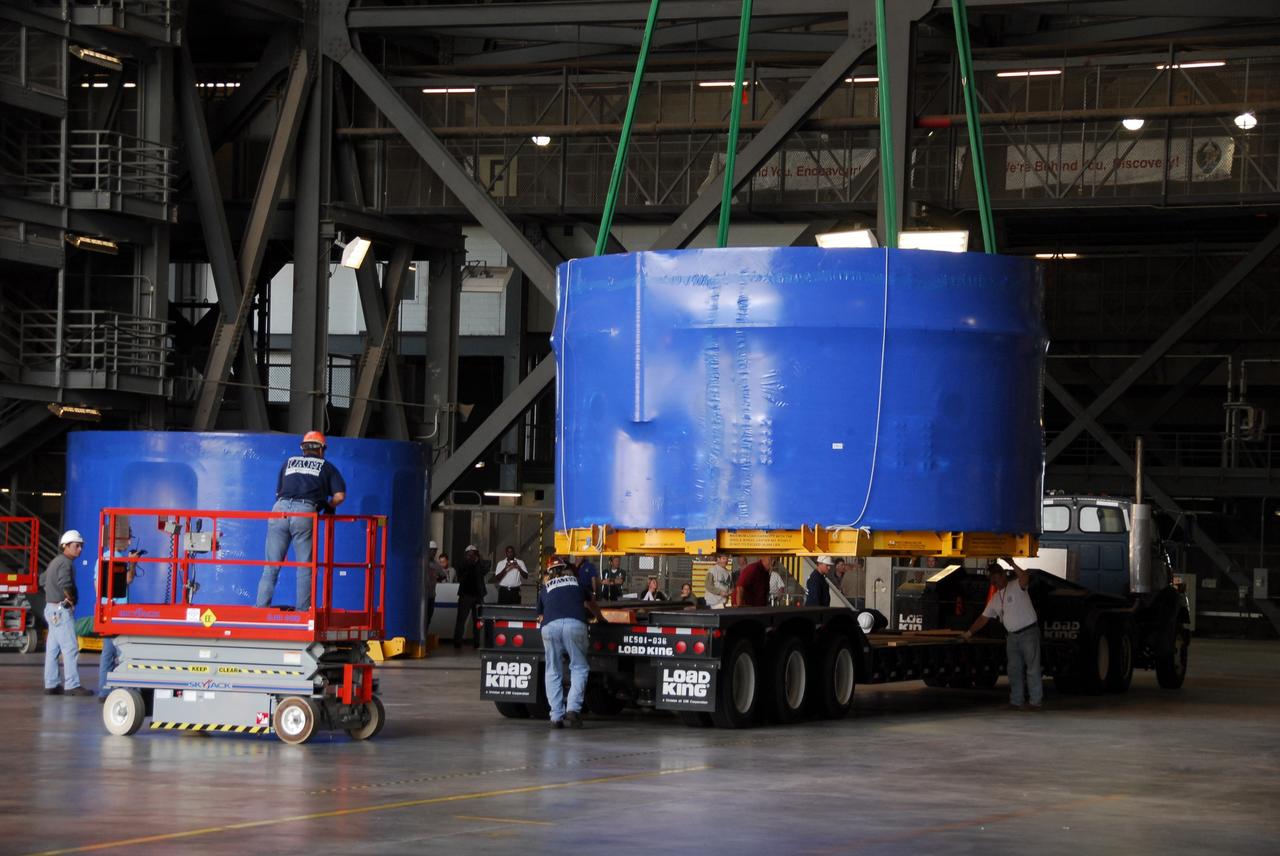
CAPE CANAVERAL, Fla. – Inside the Vehicle Assembly Building's high bay 4 at NASA's Kennedy Space Center in Florida, workers secure the crane that will lift one of the Ares I-X upper stage simulator segments from its transporter. The segments, which arrived Nov. 4 at Port Canaveral, Fla., aboard the Delta Mariner, will be placed on the floor. The upper simulator segments are moved inside where they will be offloaded. The upper stage simulators will be used in the test flight identified as Ares I-X in 2009. The Ares I-X test flight will provide NASA an early opportunity to test and prove hardware, facilities and ground operations associated with the Ares I crew launch vehicle. It also will allow NASA to gather critical data during ascent of the integrated Orion crew exploration vehicle and the Ares I rocket. The data will ensure the entire vehicle system is safe and fully operational before astronauts begin traveling to orbit. The simulator segments will simulate the mass and the outer mold line and will be more than 100 feet of the total vehicle height of 327 feet. The simulator comprises 11 segments that are approximately 18 feet in diameter. Most of the segments will be approximately 10 feet high, ranging in weight from 18,000 to 60,000 pounds, for a total of approximately 450,000 pounds. Photo credit: NASA/Cory Huston
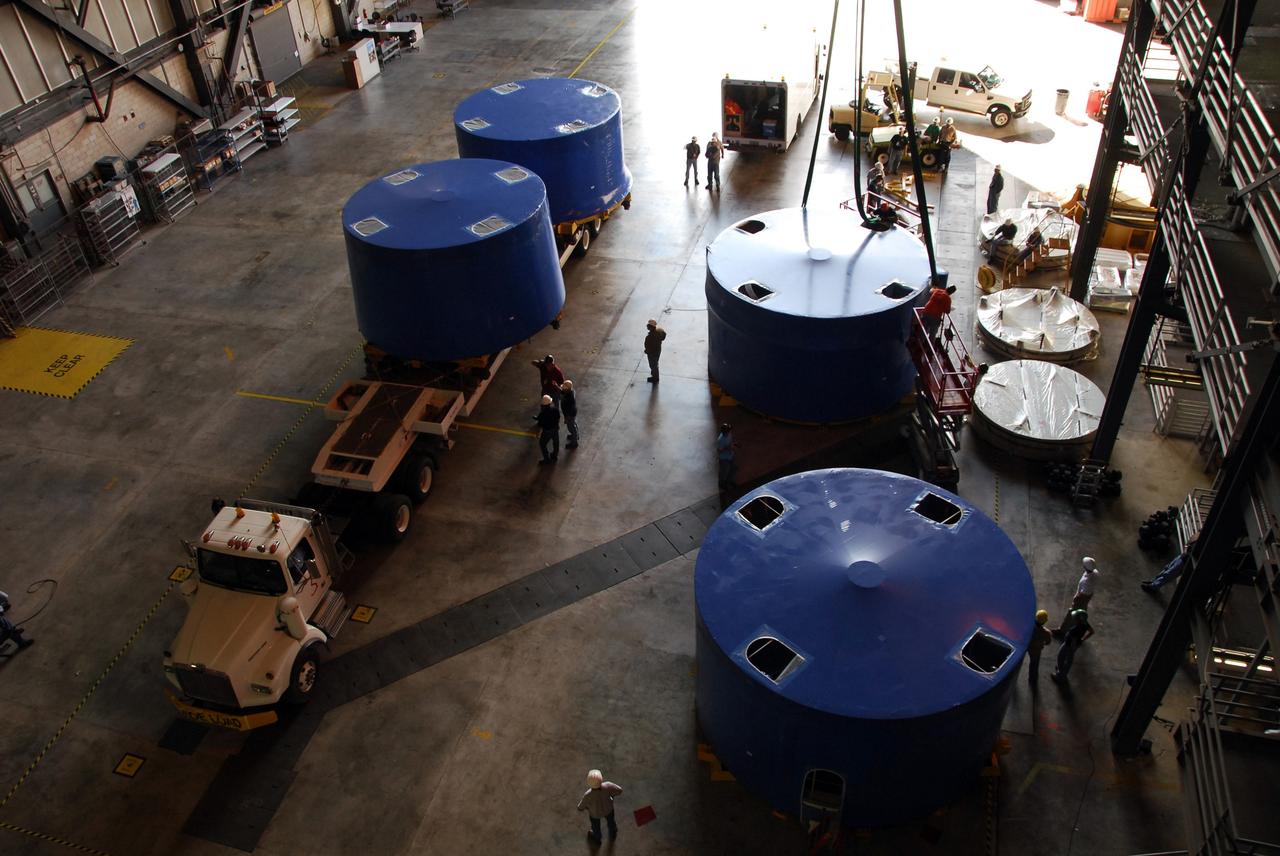
CAPE CANAVERAL, Fla. – Inside the Vehicle Assembly Building's high bay 4 at NASA's Kennedy Space Center in Florida, Ares I-X upper stage simulator segments are being offloaded onto the floor. The segments arrived Nov. 4 at Port Canaveral, Fla., aboard the Delta Mariner. The upper simulator segments are moved inside where they will be offloaded. The upper stage simulators will be used in the test flight identified as Ares I-X in 2009. The Ares I-X test flight will provide NASA an early opportunity to test and prove hardware, facilities and ground operations associated with the Ares I crew launch vehicle. It also will allow NASA to gather critical data during ascent of the integrated Orion crew exploration vehicle and the Ares I rocket. The data will ensure the entire vehicle system is safe and fully operational before astronauts begin traveling to orbit. The simulator segments will simulate the mass and the outer mold line and will be more than 100 feet of the total vehicle height of 327 feet. The simulator comprises 11 segments that are approximately 18 feet in diameter. Most of the segments will be approximately 10 feet high, ranging in weight from 18,000 to 60,000 pounds, for a total of approximately 450,000 pounds. Photo credit: NASA/Cory Huston
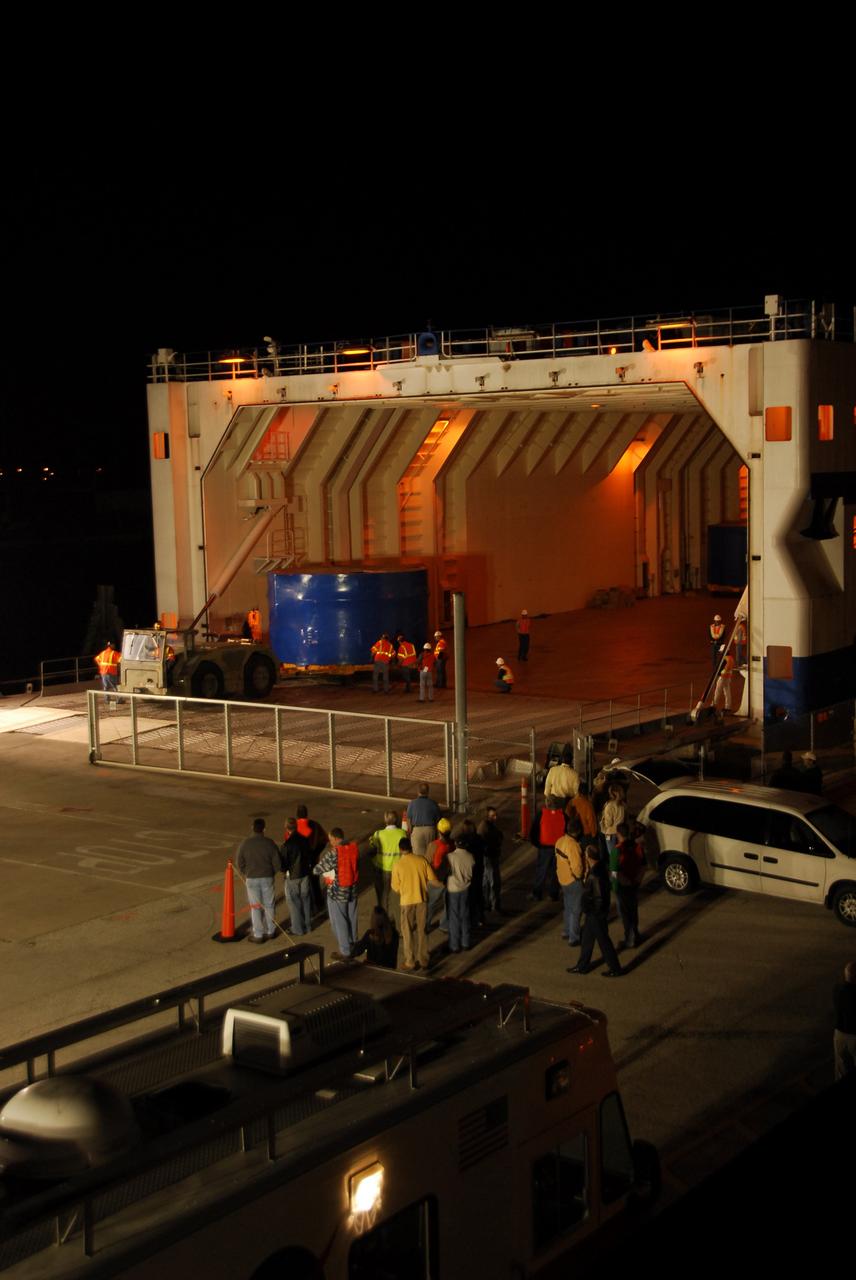
CAPE CANAVERAL, Fla. – The Ares I-X upper stage simulator segments are being offloaded from the Delta Mariner at Port Canaveral, Fla. The segments will be placed on a flatbed truck for transportation to the Vehicle Assembly Building's high bay 4 at NASA's Kennedy Space Center in Florida. The upper stage simulator will be used in the test flight identified as Ares I-X in 2009. The Ares I-X test flight will provide NASA an early opportunity to test and prove hardware, facilities and ground operations associated with the Ares I crew launch vehicle. It also will allow NASA to gather critical data during ascent of the integrated Orion crew exploration vehicle and the Ares I rocket. The data will ensure the entire vehicle system is safe and fully operational before astronauts begin traveling to orbit. The simulator segments will simulate the mass and the outer mold line and will be more than 100 feet of the total vehicle height of 327 feet. The simulator comprises 11 segments that are approximately 18 feet in diameter. Most of the segments will be approximately 10 feet high, ranging in weight from 18,000 to 60,000 pounds, for a total of approximately 450,000 pounds. Photo credit: NASA/Cory Huston
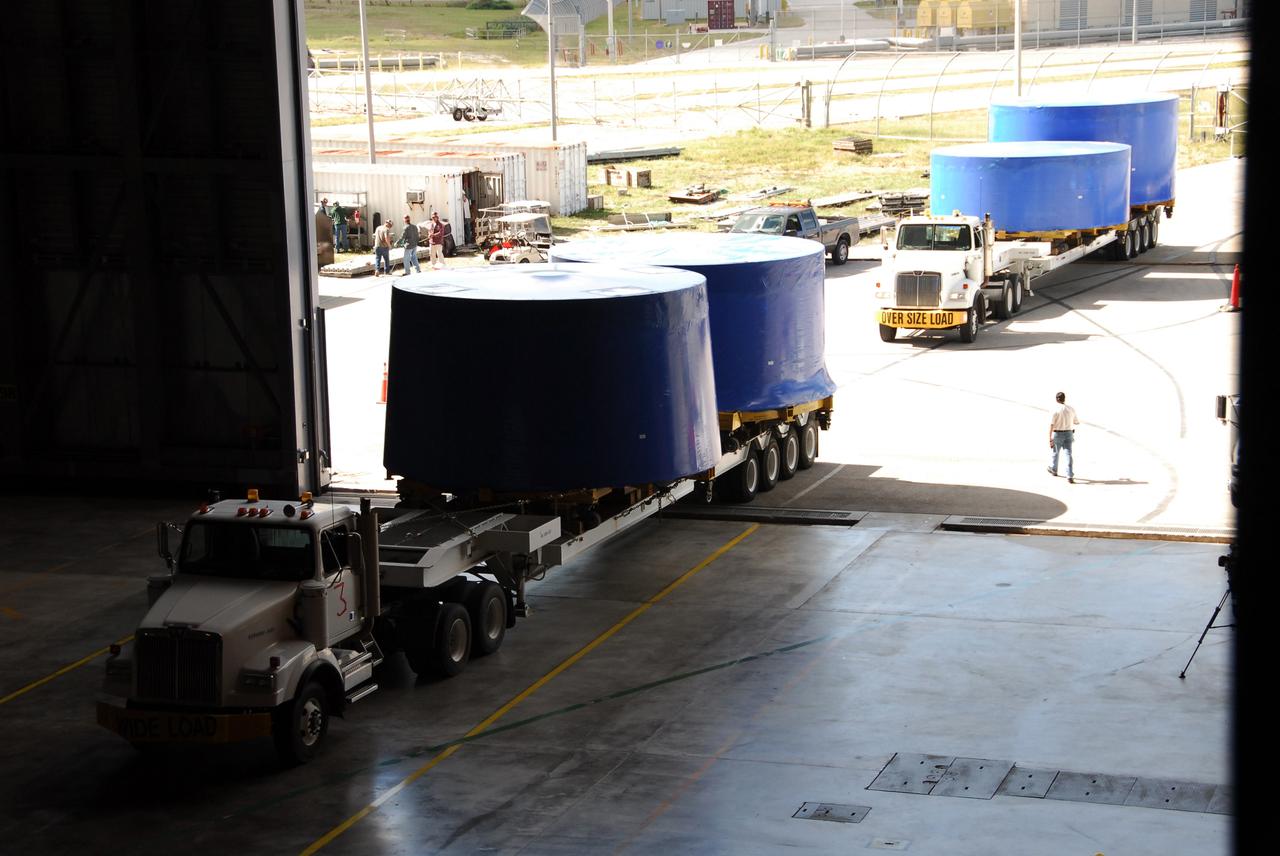
CAPE CANAVERAL, Fla. – Trucks pull into the Vehicle Assembly Building's high bay 4 at NASA's Kennedy Space Center in Florida. They carry Ares I-X upper stage simulator segments that arrived Nov. 4 at Port Canaveral, Fla., aboard the Delta Mariner. The upper stage simulators will be used in the test flight identified as Ares I-X in 2009. The Ares I-X test flight will provide NASA an early opportunity to test and prove hardware, facilities and ground operations associated with the Ares I crew launch vehicle. It also will allow NASA to gather critical data during ascent of the integrated Orion crew exploration vehicle and the Ares I rocket. The data will ensure the entire vehicle system is safe and fully operational before astronauts begin traveling to orbit. The simulator segments will simulate the mass and the outer mold line and will be more than 100 feet of the total vehicle height of 327 feet. The simulator comprises 11 segments that are approximately 18 feet in diameter. Most of the segments will be approximately 10 feet high, ranging in weight from 18,000 to 60,000 pounds, for a total of approximately 450,000 pounds. Photo credit: NASA/Cory Huston
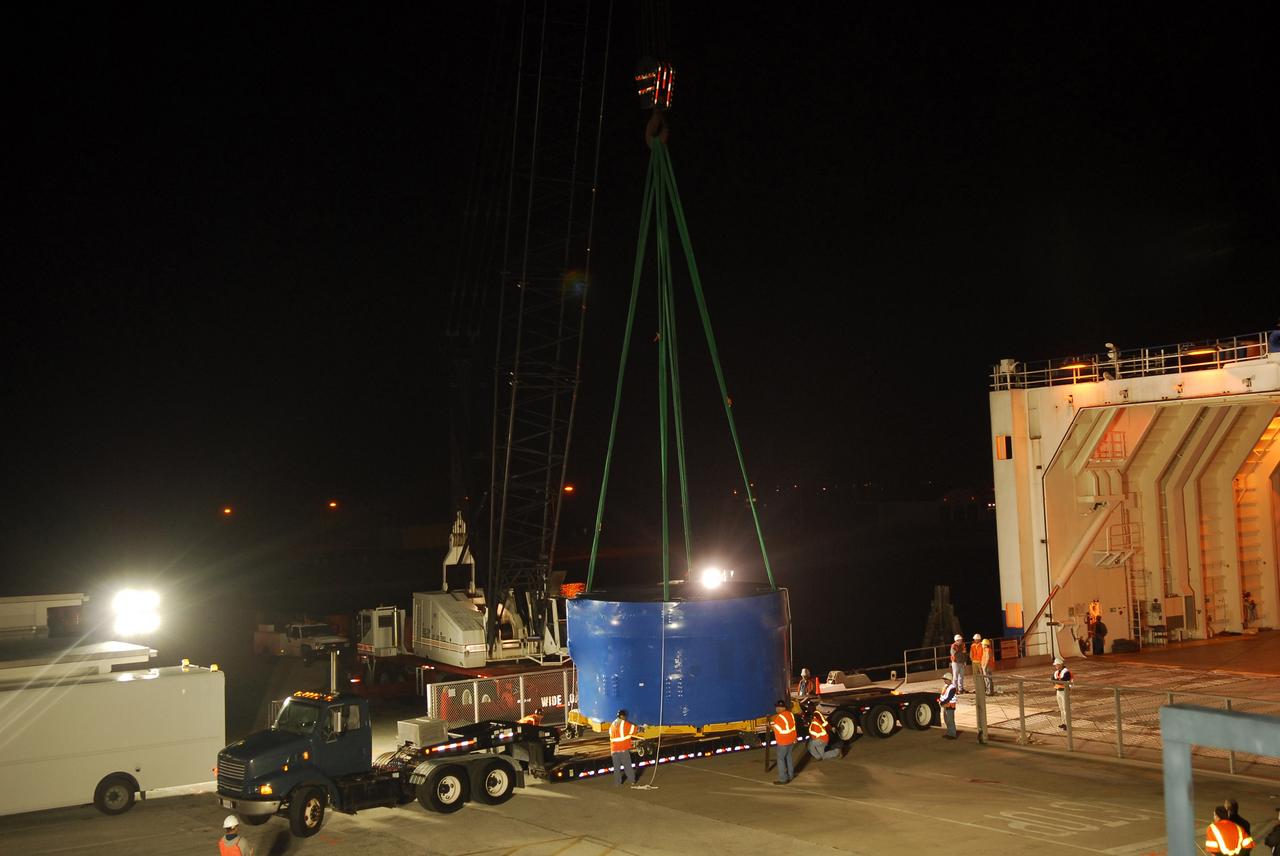
CAPE CANAVERAL, Fla. – A crane lifts and transfers an Ares I-X upper stage simulator segment from the Delta Mariner at Port Canaveral, Fla., onto a flatbed truck. They will be transported to the Vehicle Assembly Building's high bay 4 at NASA's Kennedy Space Center in Florida. The upper stage simulator will be used in the test flight identified as Ares I-X in 2009. The Ares I-X test flight will provide NASA an early opportunity to test and prove hardware, facilities and ground operations associated with the Ares I crew launch vehicle. It also will allow NASA to gather critical data during ascent of the integrated Orion crew exploration vehicle and the Ares I rocket. The data will ensure the entire vehicle system is safe and fully operational before astronauts begin traveling to orbit. The simulator segments will simulate the mass and the outer mold line and will be more than 100 feet of the total vehicle height of 327 feet. The simulator comprises 11 segments that are approximately 18 feet in diameter. Most of the segments will be approximately 10 feet high, ranging in weight from 18,000 to 60,000 pounds, for a total of approximately 450,000 pounds. Photo credit: NASA/Cory Huston
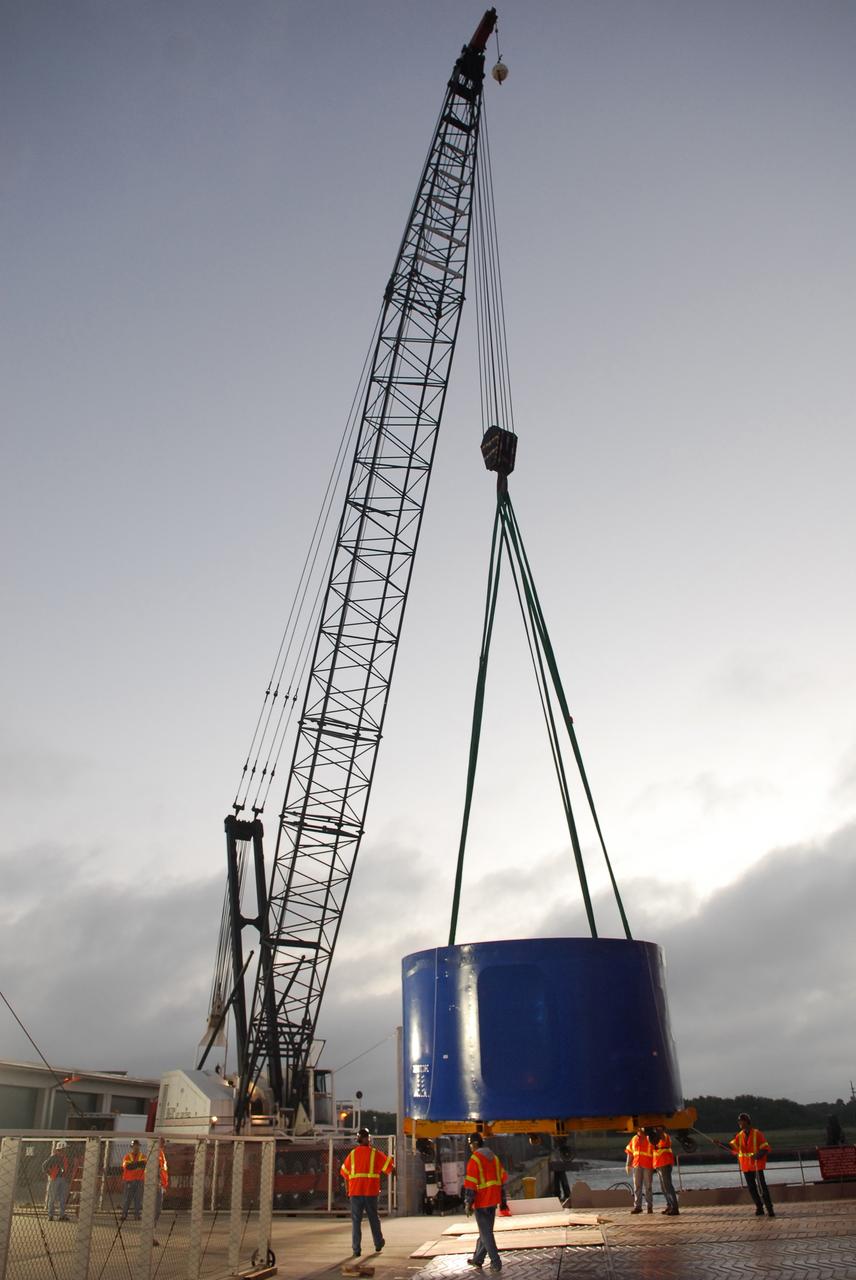
CAPE CANAVERAL, Fla. – A crane lifts and transfers an Ares I-X upper stage simulator segment from the Delta Mariner at Port Canaveral, Fla., onto a flatbed truck. They will be transported to the Vehicle Assembly Building's high bay 4 at NASA's Kennedy Space Center in Florida. The upper stage simulator will be used in the test flight identified as Ares I-X in 2009. The Ares I-X test flight will provide NASA an early opportunity to test and prove hardware, facilities and ground operations associated with the Ares I crew launch vehicle. It also will allow NASA to gather critical data during ascent of the integrated Orion crew exploration vehicle and the Ares I rocket. The data will ensure the entire vehicle system is safe and fully operational before astronauts begin traveling to orbit. The simulator segments will simulate the mass and the outer mold line and will be more than 100 feet of the total vehicle height of 327 feet. The simulator comprises 11 segments that are approximately 18 feet in diameter. Most of the segments will be approximately 10 feet high, ranging in weight from 18,000 to 60,000 pounds, for a total of approximately 450,000 pounds. Photo credit: NASA/Cory Huston

CAPE CANAVERAL, Fla. – Trucks head into the Vehicle Assembly Building's high bay 4 at NASA's Kennedy Space Center in Florida. They carry Ares I-X upper stage simulator segments that arrived Nov. 4 at Port Canaveral, Fla., aboard the Delta Mariner. The upper stage simulators will be used in the test flight identified as Ares I-X in 2009. The Ares I-X test flight will provide NASA an early opportunity to test and prove hardware, facilities and ground operations associated with the Ares I crew launch vehicle. It also will allow NASA to gather critical data during ascent of the integrated Orion crew exploration vehicle and the Ares I rocket. The data will ensure the entire vehicle system is safe and fully operational before astronauts begin traveling to orbit. The simulator segments will simulate the mass and the outer mold line and will be more than 100 feet of the total vehicle height of 327 feet. The simulator comprises 11 segments that are approximately 18 feet in diameter. Most of the segments will be approximately 10 feet high, ranging in weight from 18,000 to 60,000 pounds, for a total of approximately 450,000 pounds. Photo credit: NASA/Cory Huston
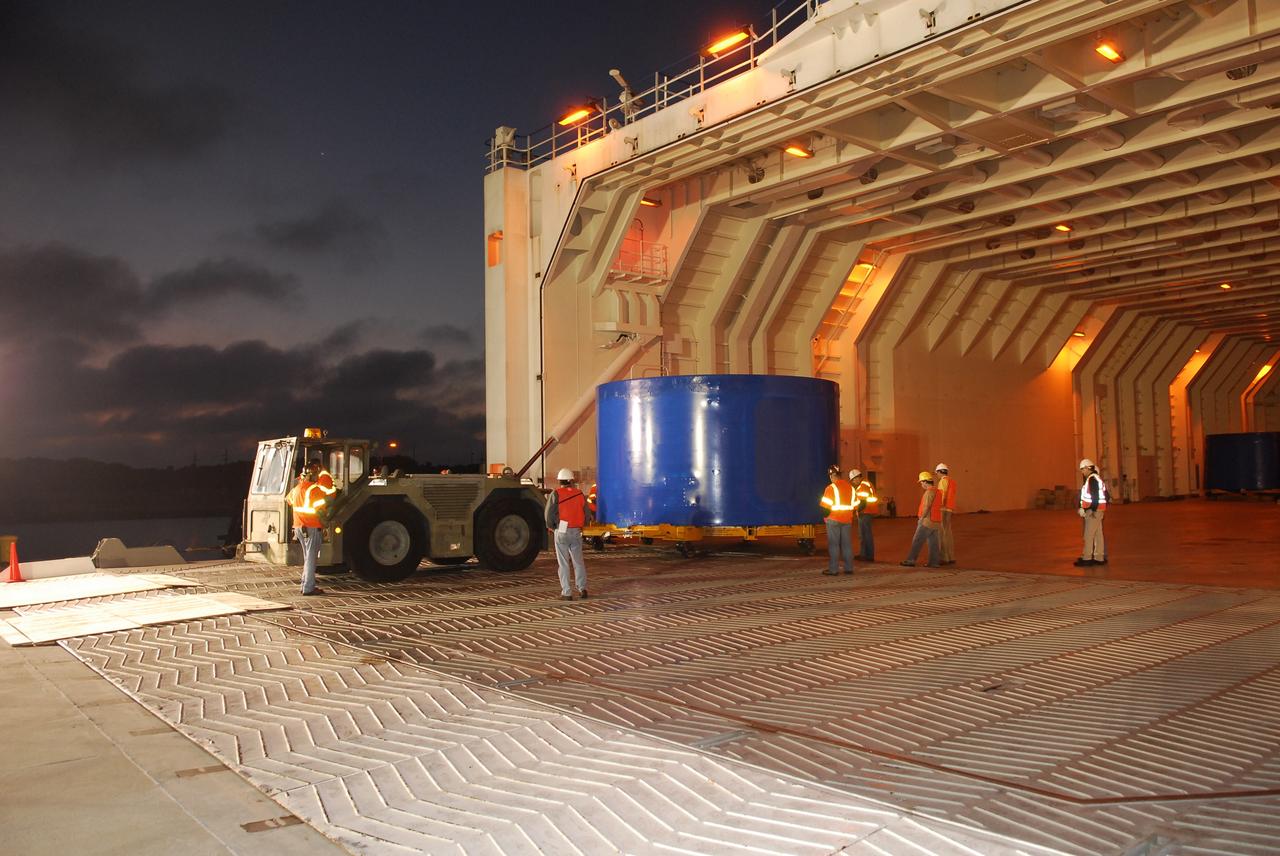
CAPE CANAVERAL, Fla. – At Port Canaveral, Fla., one of the Ares I-X upper stage simulator segments is offloaded from the Delta Mariner. The segment will be placed on a flatbed truck for transportation to the Vehicle Assembly Building's high bay 4 at NASA's Kennedy Space Center in Florida. The upper stage simulator will be used in the test flight identified as Ares I-X in 2009. The Ares I-X test flight will provide NASA an early opportunity to test and prove hardware, facilities and ground operations associated with the Ares I crew launch vehicle. It also will allow NASA to gather critical data during ascent of the integrated Orion crew exploration vehicle and the Ares I rocket. The data will ensure the entire vehicle system is safe and fully operational before astronauts begin traveling to orbit. The simulator segments will simulate the mass and the outer mold line and will be more than 100 feet of the total vehicle height of 327 feet. The simulator comprises 11 segments that are approximately 18 feet in diameter. Most of the segments will be approximately 10 feet high, ranging in weight from 18,000 to 60,000 pounds, for a total of approximately 450,000 pounds. Photo credit: NASA/Cory Huston
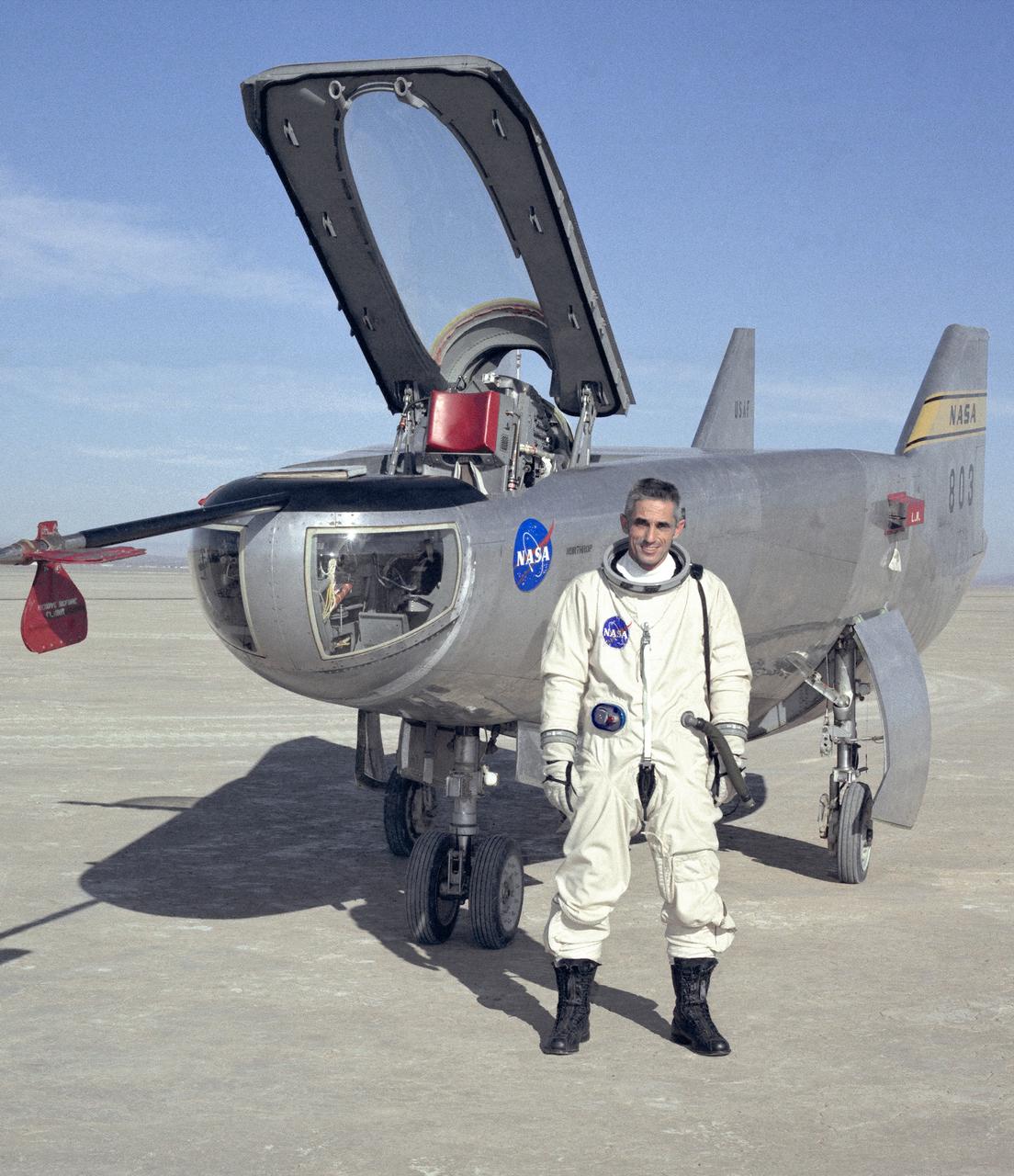
NASA research pilot John A. Manke is seen here in front of the M2-F3 Lifting Body. Manke was hired by NASA on May 25, 1962, as a flight research engineer. He was later assigned to the pilot's office and flew various support aircraft including the F-104, F5D, F-111 and C-47. After leaving the Marine Corps in 1960, Manke worked for Honeywell Corporation as a test engineer for two years before coming to NASA. He was project pilot on the X-24B and also flew the HL-10, M2-F3, and X-24A lifting bodies. John made the first supersonic flight of a lifting body and the first landing of a lifting body on a hard surface runway. Manke served as Director of the Flight Operations and Support Directorate at the Dryden Flight Research Center prior to its integration with Ames Research Center in October 1981. After this date John was named to head the joint Ames-Dryden Directorate of Flight Operations. He also served as site manager of the NASA Ames-Dryden Flight Research Facility. John is a member of the Society of Experimental Test Pilots. He retired on April 27, 1984.
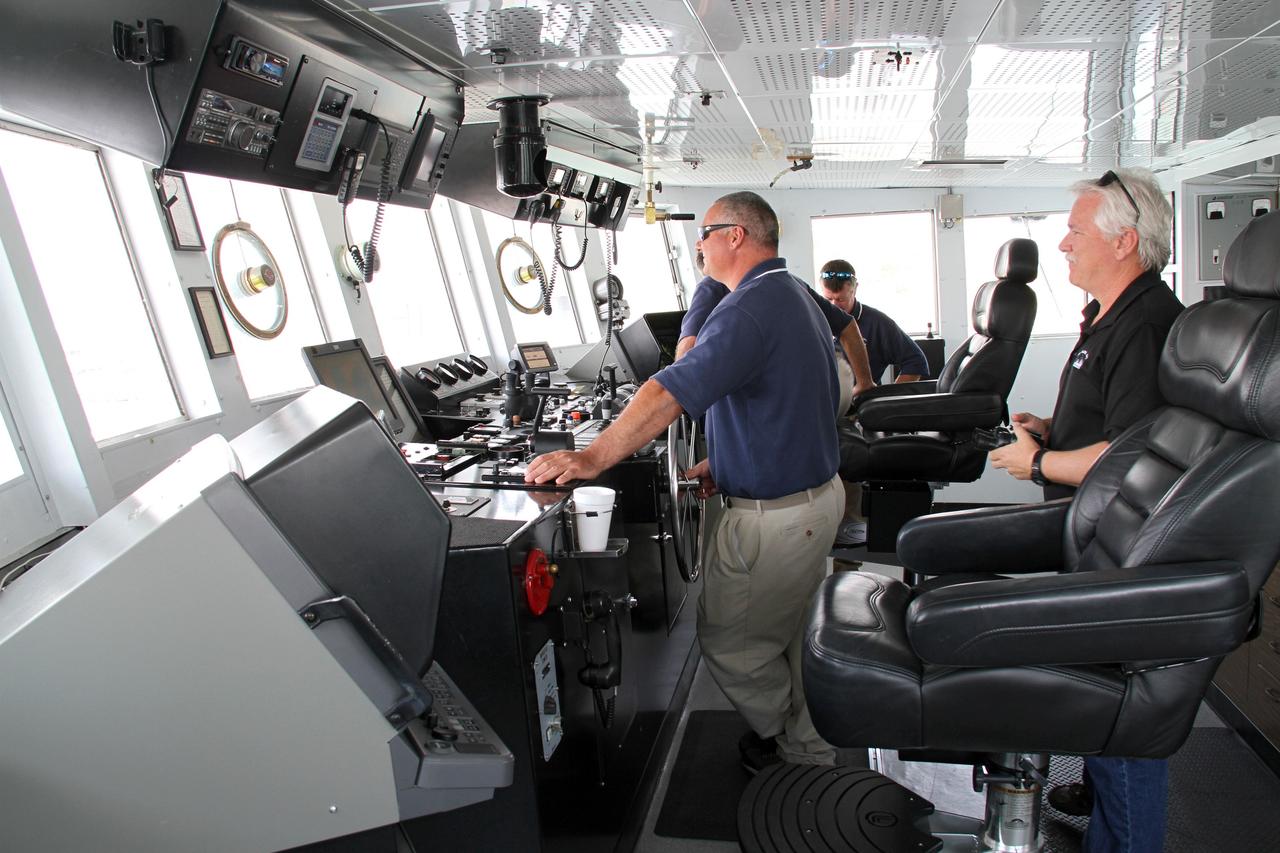
CAPE CANAVERAL, Fla. – Aboard NASA’s Freedom Star boat, from left, Boatswain Allan Gravina at the wheel, Captain Mike Nicholas hidden, Aerospace Technician Darin Schuster and Marine Operations Manager Joe Chaput, all with United Space Alliance, monitor the progress as NASA’s Mobile Aerospace Reconnaissance System, or MARS, secured on the boat, is being prepared for a day of testing in the Atlantic Ocean off the coast of Port Canaveral in Florida. MARS, run by NASA’s Langley Research Center in Hampton, Va., with its spatial, hyperspectral, thermal, and directed energy capabilities will be used for thermal imaging testing for the upcoming SpaceX Falcon 9 and Dragon capsule test flight to the International Space Station. During today’s test, the MARS X-band radar and kineto tracking mount KTM were tested to ensure that they were synchronized to receive a rocket launch feed. The radar was used to identify an object to see if the KTM could lock on to and track it. The MARS team performed maintenance on the system, confirmed communications links, and tested the design of the mounting system and environmental enclosure. Photo credit: NASA/Cory Huston
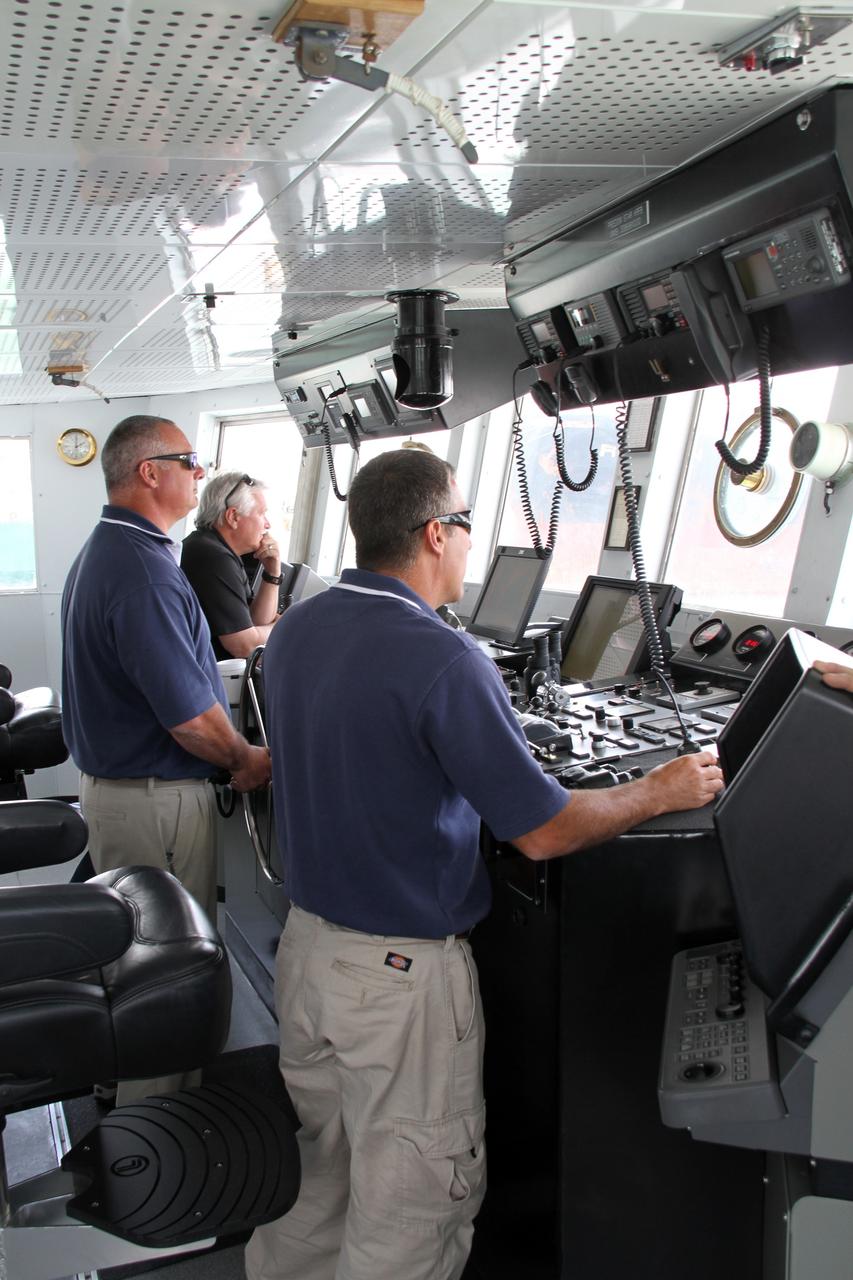
CAPE CANAVERAL, Fla. – Aboard NASA’s Freedom Star boat, Captain Mike Nicholas in foreground, Boatswain Allan Gravina at the wheel, and Marine Operations Manager Joe Chaput, all with United Space Alliance, monitor the progress as NASA’s Mobile Aerospace Reconnaissance System, or MARS, secured on the boat, is being prepared for a day of testing in the Atlantic Ocean off the coast of Port Canaveral in Florida. MARS, run by NASA’s Langley Research Center in Hampton, Va., with its spatial, hyperspectral, thermal, and directed energy capabilities will be used for thermal imaging testing for the upcoming SpaceX Falcon 9 and Dragon capsule test flight to the International Space Station. During today’s test, the MARS X-band radar and kineto tracking mount KTM were tested to ensure that they were synchronized to receive a rocket launch feed. The radar was used to identify an object to see if the KTM could lock on to and track it. The MARS team performed maintenance on the system, confirmed communications links, and tested the design of the mounting system and environmental enclosure. Photo credit: NASA/Cory Huston
![This image from NASA's Mars Reconnaissance Orbiter (MRO) shows Mars' surface in detail. Mars has captured the imagination of astronomers for thousands of years, but it wasn't until the last half a century that we were able to capture images of its surface in detail. This particular site on Mars was first imaged in 1965 by the Mariner 4 spacecraft during the first successful fly-by mission to Mars. From an altitude of around 10,000 kilometers, this image (the ninth frame taken) achieved a resolution of approximately 1.25 kilometers per pixel. Since then, this location has been observed by six other visible cameras producing images with varying resolutions and sizes. This includes HiRISE (highlighted in yellow), which is the highest-resolution and has the smallest "footprint." This compilation, spanning Mariner 4 to HiRISE, shows each image at full-resolution. Beginning with Viking 1 and ending with our HiRISE image, this animation documents the historic imaging of a particular site on another world. In 1976, the Viking 1 orbiter began imaging Mars in unprecedented detail, and by 1980 had successfully mosaicked the planet at approximately 230 meters per pixel. In 1999, the Mars Orbiter Camera onboard the Mars Global Surveyor (1996) also imaged this site with its Wide Angle lens, at around 236 meters per pixel. This was followed by the Thermal Emission Imaging System on Mars Odyssey (2001), which also provided a visible camera producing the image we see here at 17 meters per pixel. Later in 2012, the High-Resolution Stereo Camera on the Mars Express orbiter (2003) captured this image of the surface at 25 meters per pixel. In 2010, the Context Camera on the Mars Reconnaissance Orbiter (2005) imaged this site at about 5 meters per pixel. Finally, in 2017, HiRISE acquired the highest resolution image of this location to date at 50 centimeters per pixel. When seen at this unprecedented scale, we can discern a crater floor strewn with small rocky deposits, boulders several meters across, and wind-blown deposits in the floors of small craters and depressions. This compilation of Mars images spanning over 50 years gives us a visual appreciation of the evolution of orbital Mars imaging over a single site. The map is projected here at a scale of 50 centimeters (19.7 inches) per pixel. [The original image scale is 52.2 centimeters (20.6 inches) per pixel (with 2 x 2 binning); objects on the order of 156 centimeters (61.4 inches) across are resolved.] North is up. https://photojournal.jpl.nasa.gov/catalog/PIA22115](https://images-assets.nasa.gov/image/PIA22115/PIA22115~medium.jpg)
This image from NASA's Mars Reconnaissance Orbiter (MRO) shows Mars' surface in detail. Mars has captured the imagination of astronomers for thousands of years, but it wasn't until the last half a century that we were able to capture images of its surface in detail. This particular site on Mars was first imaged in 1965 by the Mariner 4 spacecraft during the first successful fly-by mission to Mars. From an altitude of around 10,000 kilometers, this image (the ninth frame taken) achieved a resolution of approximately 1.25 kilometers per pixel. Since then, this location has been observed by six other visible cameras producing images with varying resolutions and sizes. This includes HiRISE (highlighted in yellow), which is the highest-resolution and has the smallest "footprint." This compilation, spanning Mariner 4 to HiRISE, shows each image at full-resolution. Beginning with Viking 1 and ending with our HiRISE image, this animation documents the historic imaging of a particular site on another world. In 1976, the Viking 1 orbiter began imaging Mars in unprecedented detail, and by 1980 had successfully mosaicked the planet at approximately 230 meters per pixel. In 1999, the Mars Orbiter Camera onboard the Mars Global Surveyor (1996) also imaged this site with its Wide Angle lens, at around 236 meters per pixel. This was followed by the Thermal Emission Imaging System on Mars Odyssey (2001), which also provided a visible camera producing the image we see here at 17 meters per pixel. Later in 2012, the High-Resolution Stereo Camera on the Mars Express orbiter (2003) captured this image of the surface at 25 meters per pixel. In 2010, the Context Camera on the Mars Reconnaissance Orbiter (2005) imaged this site at about 5 meters per pixel. Finally, in 2017, HiRISE acquired the highest resolution image of this location to date at 50 centimeters per pixel. When seen at this unprecedented scale, we can discern a crater floor strewn with small rocky deposits, boulders several meters across, and wind-blown deposits in the floors of small craters and depressions. This compilation of Mars images spanning over 50 years gives us a visual appreciation of the evolution of orbital Mars imaging over a single site. The map is projected here at a scale of 50 centimeters (19.7 inches) per pixel. [The original image scale is 52.2 centimeters (20.6 inches) per pixel (with 2 x 2 binning); objects on the order of 156 centimeters (61.4 inches) across are resolved.] North is up. https://photojournal.jpl.nasa.gov/catalog/PIA22115
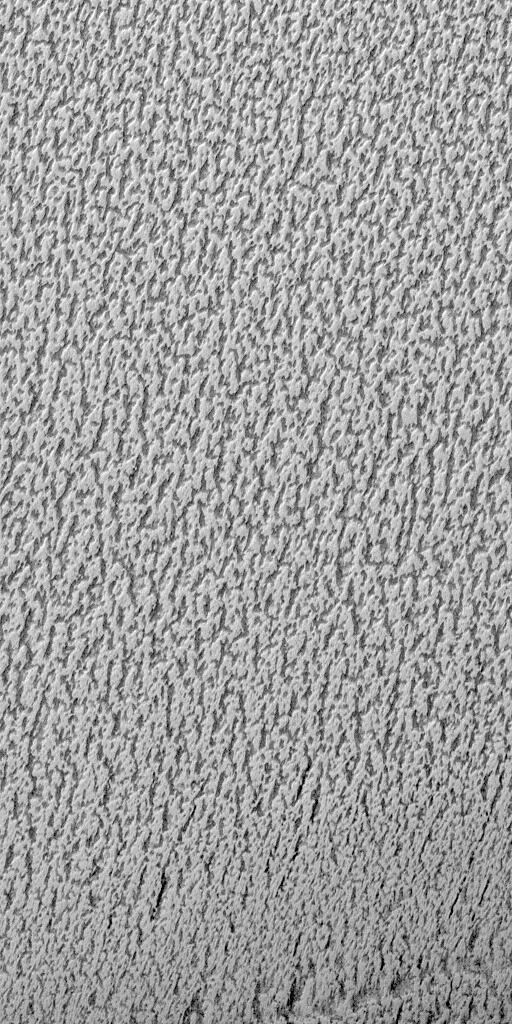
This image is illuminated by sunlight from the upper left. Martian Dairy Products? If parts of the south polar cap can look like swiss cheese (see "Martian "Swiss Cheese""), then parts of the north polar cap might as well look like some kind of cheese, too. This picture shows a cottage cheese-like texture on the surface of a part of the residual--summertime--north polar cap. The north polar cap surface is mostly covered by pits, cracks, small bumps and knobs. In this image, the cap surface appears bright and the floors of pits look dark. Based upon observations made by the Mariner 9 and Viking orbiters in the 1970s, the north polar residual cap is thought to contain mostly water ice because its summertime temperature is usually near the freezing point of water and water vapor was observed by the Vikings to be coming off the cap during summer. The south residual cap is different--its temperatures in summer remain cold enough to freeze carbon dioxide, and very little to no water vapor has been observed to come off the south cap in summer. The pits that have developed on the north polar cap surface are closely-spaced relative to the very different depressions in the south polar cap. The pits are estimated from the length of shadows cast in them to be less than about 2 meters (5.5 feet) deep. These pits probably develop slowly over thousands of years of successive spring and summer seasons. This picture was taken by the Mars Global Surveyor (MGS) Mars Orbiter Camera (MOC) during northern summer on April 5, 1999. The picture is located near 82.1°N, 329.6°W and covers an area 1.5 km wide by 3 km long (0.9 x 1.8 miles) at a resolution of 3 meters (10 ft) per pixel. http://photojournal.jpl.nasa.gov/catalog/PIA02369
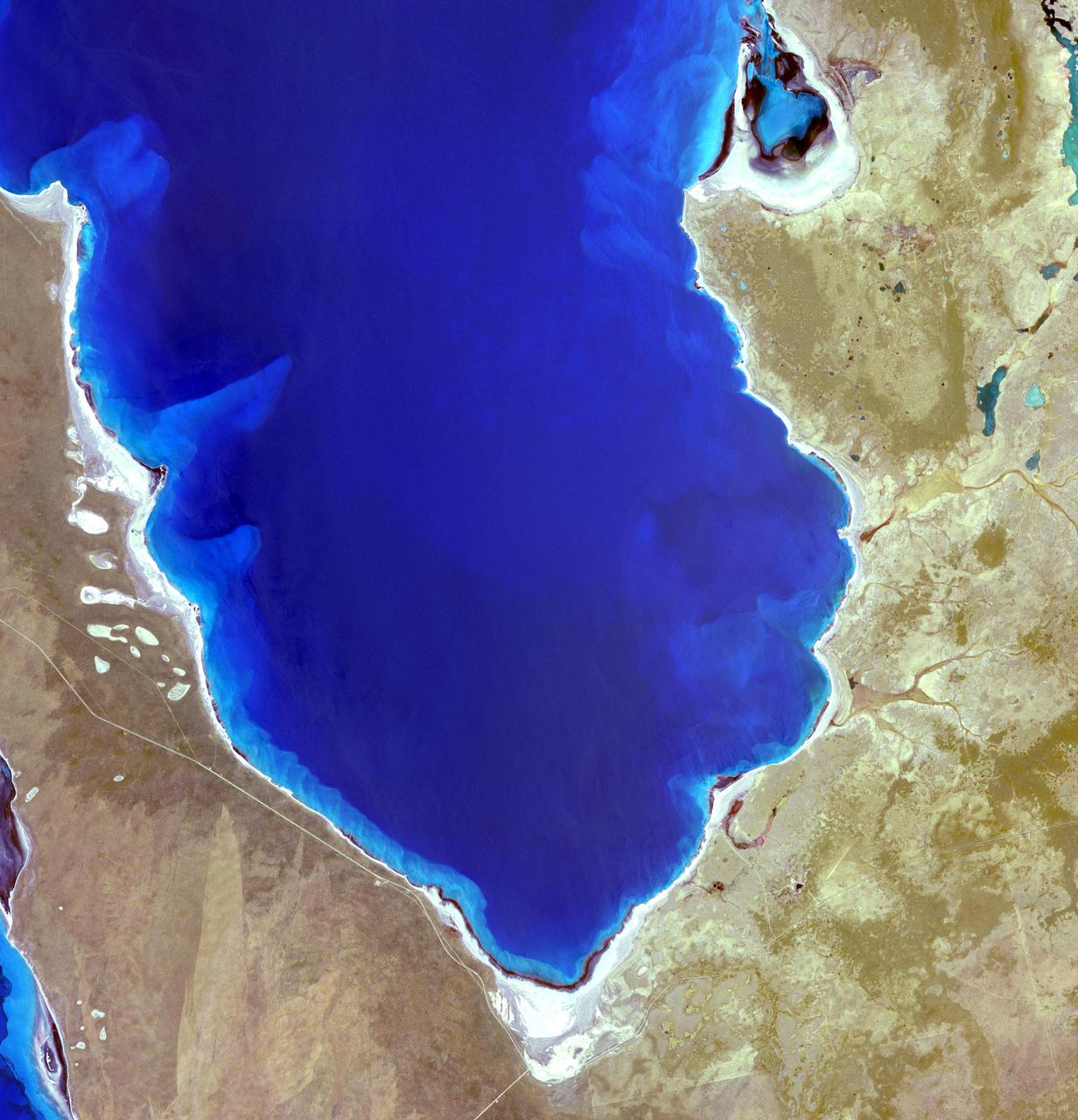
Hamelin Pool Marine Nature Reserve is located in the Shark Bay World Heritage Site in Western Australia. It is one of the very few places in the world where living stromatolites can be found. These are the first living examples of structures built by cyanobacteria. These bacteria are direct descendants of the oldest form of photosynthetic life on earth, dating back 3,500 million years (Wikipedia). The image was acquired December 30, 2010, covers an area of 34 x 46 km, and is located at 26.4 degrees south latitude, 114.1 degrees east longitude. With its 14 spectral bands from the visible to the thermal infrared wavelength region and its high spatial resolution of 15 to 90 meters (about 50 to 300 feet), ASTER images Earth to map and monitor the changing surface of our planet. ASTER is one of five Earth-observing instruments launched Dec. 18, 1999, on Terra. The instrument was built by Japan's Ministry of Economy, Trade and Industry. A joint U.S./Japan science team is responsible for validation and calibration of the instrument and data products. The broad spectral coverage and high spectral resolution of ASTER provides scientists in numerous disciplines with critical information for surface mapping and monitoring of dynamic conditions and temporal change. Example applications are: monitoring glacial advances and retreats; monitoring potentially active volcanoes; identifying crop stress; determining cloud morphology and physical properties; wetlands evaluation; thermal pollution monitoring; coral reef degradation; surface temperature mapping of soils and geology; and measuring surface heat balance. The U.S. science team is located at NASA's Jet Propulsion Laboratory, Pasadena, Calif. The Terra mission is part of NASA's Science Mission Directorate, Washington, D.C. More information about ASTER is available at <a href="http://asterweb.jpl.nasa.gov/" rel="nofollow">asterweb.jpl.nasa.gov/</a>. Credit: NASA/GSFC/METI/ERSDAC/JAROS, and U.S./Japan ASTER Science Team Image Addition Date: 2013-03-15 <b><a href="http://www.nasa.gov/audience/formedia/features/MP_Photo_Guidelines.html" rel="nofollow">NASA image use policy.</a></b> <b><a href="http://www.nasa.gov/centers/goddard/home/index.html" rel="nofollow">NASA Goddard Space Flight Center</a></b> enables NASA’s mission through four scientific endeavors: Earth Science, Heliophysics, Solar System Exploration, and Astrophysics. Goddard plays a leading role in NASA’s accomplishments by contributing compelling scientific knowledge to advance the Agency’s mission. <b>Follow us on <a href="http://twitter.com/NASA_GoddardPix" rel="nofollow">Twitter</a></b> <b>Like us on <a href="http://www.facebook.com/pages/Greenbelt-MD/NASA-Goddard/395013845897?ref=tsd" rel="nofollow">Facebook</a></b> <b>Find us on <a href="http://instagram.com/nasagoddard?vm=grid" rel="nofollow">Instagram</a></b>