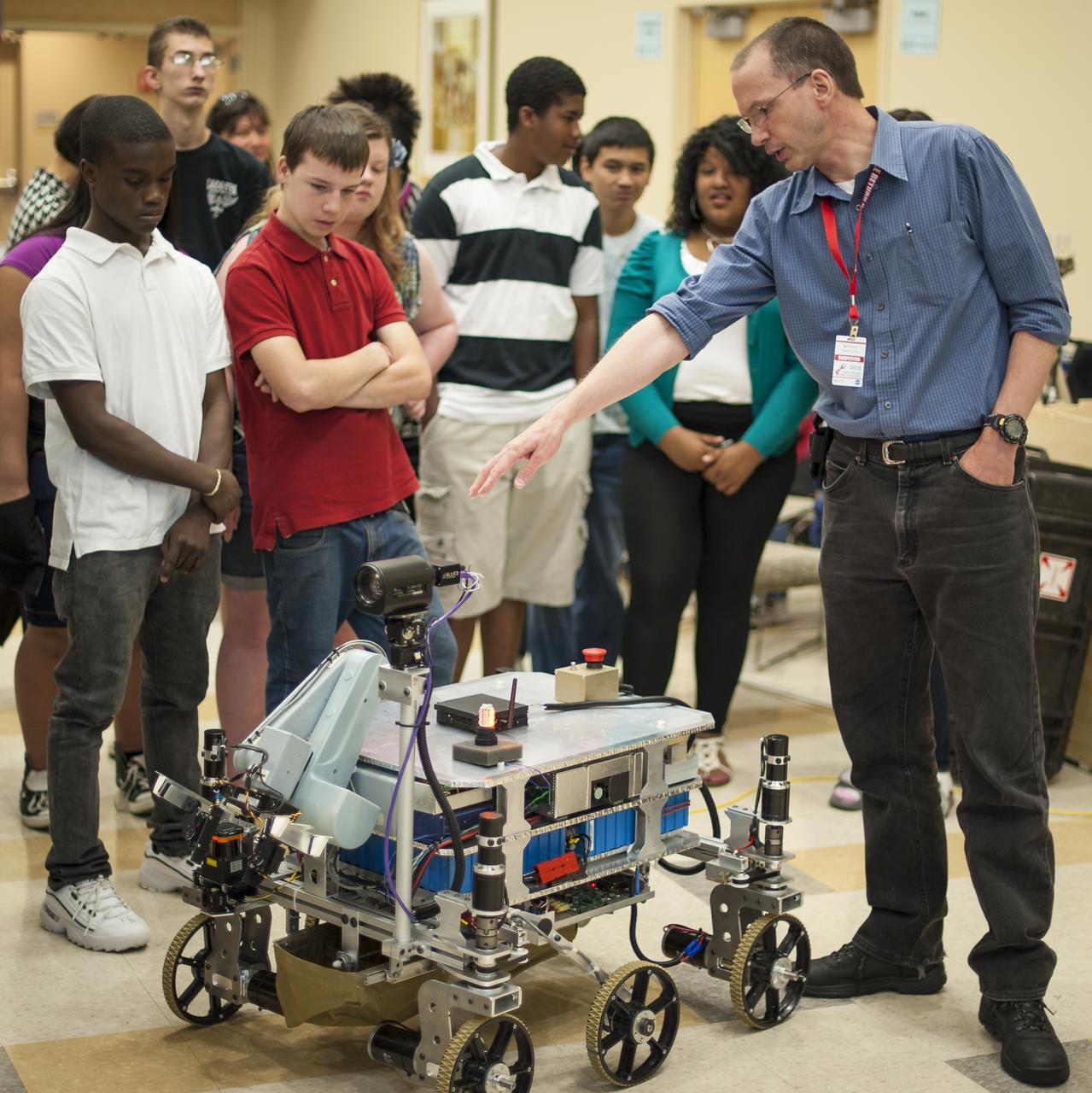
Intrepid Systems Team member Mark Curry, right, answers questions from 8th grade Sullivan Middle School (Mass.) students about his robot named "MXR - Mark's Exploration Robot" on Friday, June 15, 2012, at the Worcester Polytechnic Institute (WPI) in Worcester, Mass. Curry's robot team will compete for a $1.5 million NASA prize in the NASA-WPI Sample Return Robot Centennial Challenge at WPI. Teams have been challenged to build autonomous robots that can identify, collect and return samples. NASA needs autonomous robotic capability for future planetary exploration. Photo Credit: (NASA/Bill Ingalls)
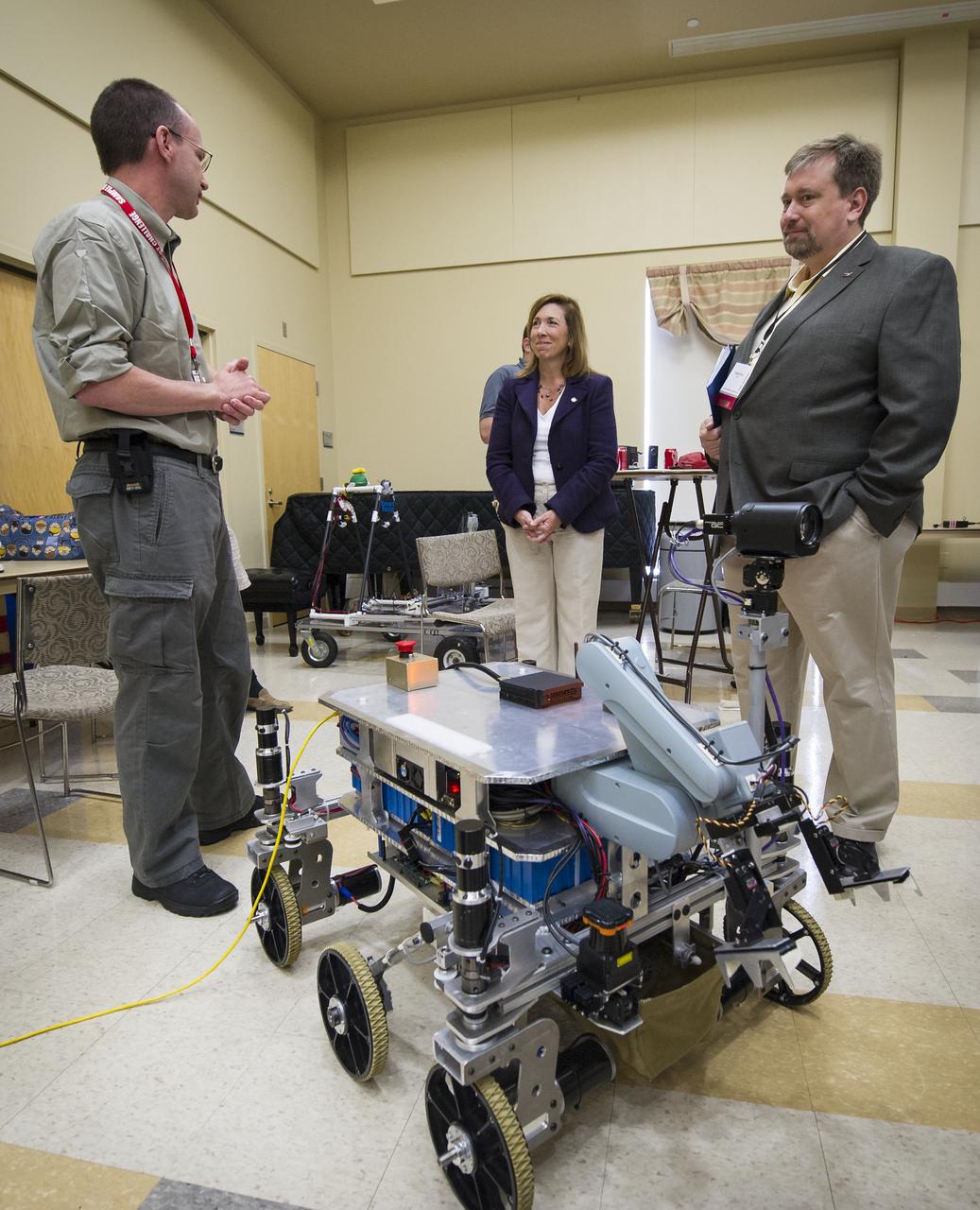
Intrepid Systems Team member Mark Curry, left, talks with NASA Deputy Administrator Lori Garver and NASA Chief Technologist Mason Peck, right, about his robot named "MXR - Mark's Exploration Robot" on Saturday, June 16, 2012 at the Worcester Polytechnic Institute (WPI) in Worcester, Mass. Curry's robot team was one of the final teams participating in the NASA-WPI Sample Return Robot Centennial Challenge at WPI. Teams were challenged to build autonomous robots that can identify, collect and return samples. NASA needs autonomous robotic capability for future planetary exploration. Photo Credit: (NASA/Bill Ingalls)
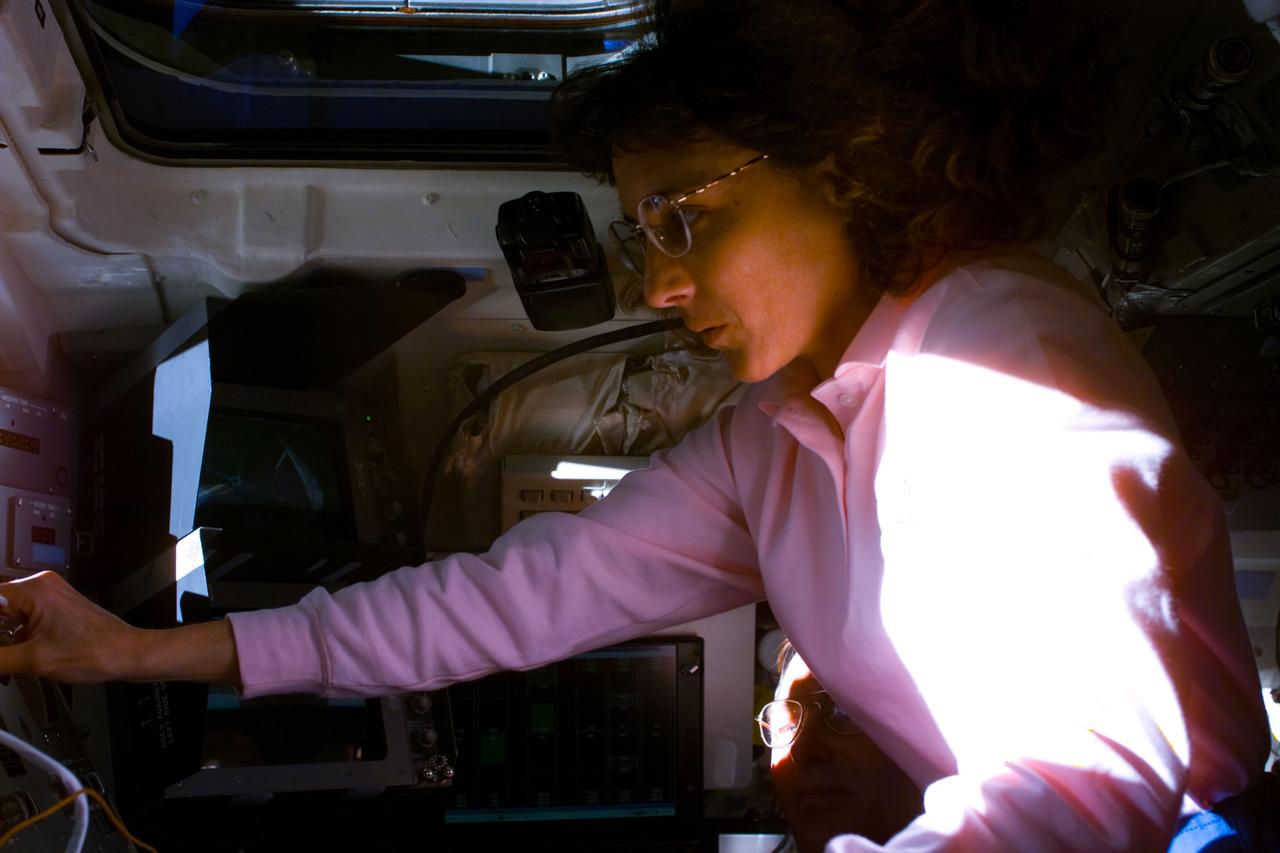
S88-E-5010 (12-05-98) --- Operating at a control panel on Endeavour's aft flight deck, astronaut Nancy J. Currie works with the robot arm prior to mating the 12.8-ton Unity connecting module to Endeavour's docking system. The mating took place on late afternoon of Dec. 5. A nearby monitor provides a view of the remote manipulator system's (RMS) movements in the cargo bay. The feat marked an important step in assembling the new International Space Station. Manipulating the shuttle's 50-foot-long robot arm, Currie placed Unity just inches above the extended outer ring on Endeavour's docking mechanism, enabling Robert D. Cabana, mission commander to fire downward maneuvering jets, locking the shuttle's docking system to one of two Pressurized Mating Adapters (PMA) attached to Unity. The mating occurred at 5:45 p.m. Central time, as Endeavour sailed over eastern China.
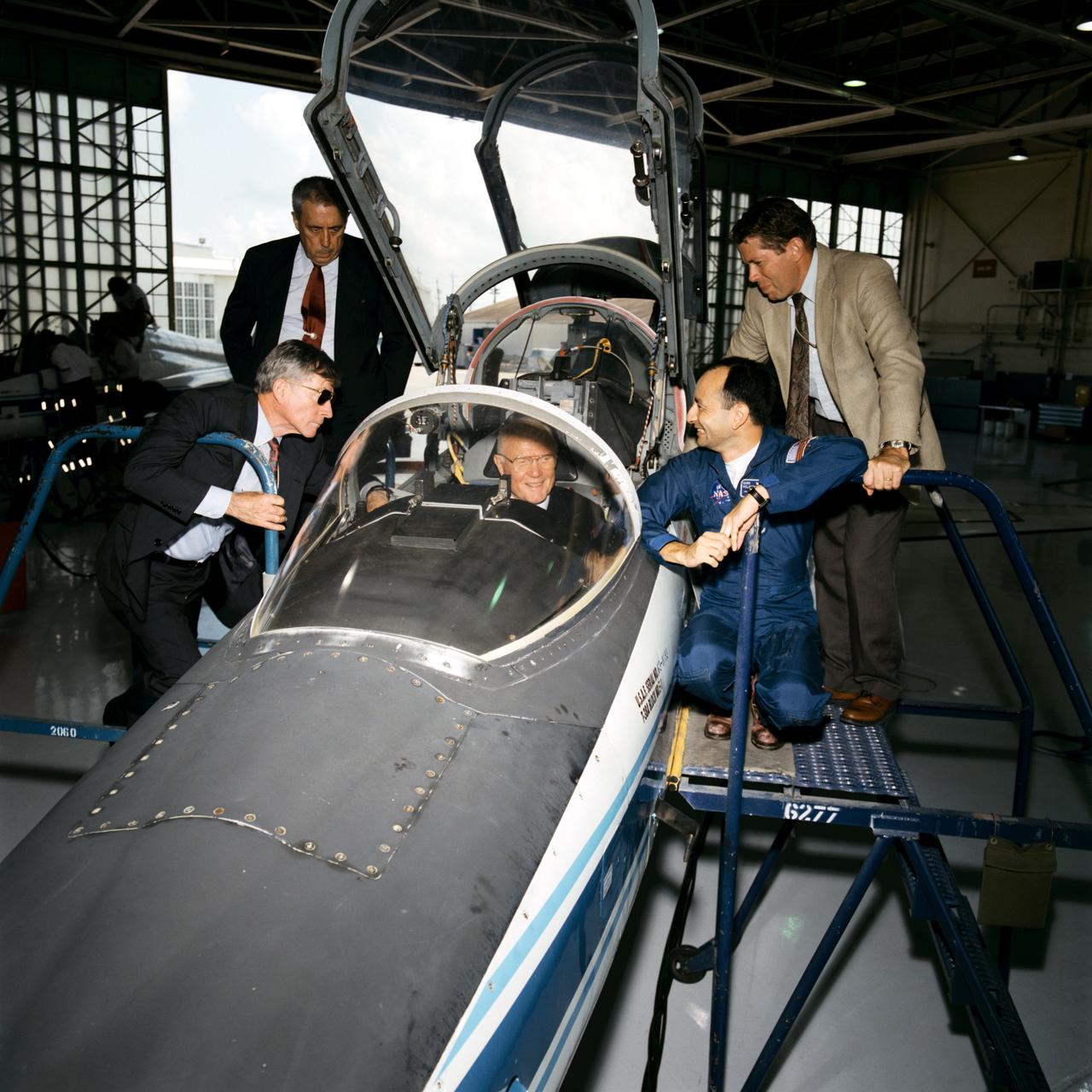
Senator John Glenn visit to Johnson Space Center (JSC). Views of Glenn sitting in cockpit of T-38 in Hangar 276 with John Young, George Abbey, David Leestma and Mark Polansky observing (11150). An engineer explains SPIFEX experiment hardware to Abby, Young and Glenn in Bldg 13 (11151, 11153). Glenn talks with astronaut Terrence T. Henricks and employees in Bldg 9C, Virtual reality lab (11152). Lunch in Bldg 17 Flight Crew support division with Dr. Ellen Baker, Robert "Hoot" Gibson and John Glenn (11154). Linda Godwin, Robert Cabana, Abbey, Young, Baker, Gibson and Glenn at lunch (11155). Astronaut Mark Lee shows Glenn and his aide how to use the virtural reality helmets (11156-7). Glenn shakes the hand of Franklin Chang-Diaz with his plasma rocket in the background in the Sonny Carter Training Facility (SCTF) (11158). Glenn in the Manipulator Development Facility (MDF) Remote Manipulator System (RMS) station mock-up in Bldg 9A with Abbey, Young and aide (11159, 11186). Glenn signs a book for Thomas D. Jones as Frederick Sturckow and Linda Godwin look on (11160). Glenn inside visual-vestibular trainer in Bldg 9B (11161). In conference room meeting with astronaut corps in Bldg 4S, Glenn shakes Robert Cabana's hand (11162). John Glenn and John Young pose for a group shot with Bldg 17 Food lab personnel (11163). Glenn thanks the food lab personnel (11164). Glenn visits Bldg 5 Fixed Base (FB) middeck simulator with astronauts Terrence Henricks and Mary Ellen Weber (11165). Glenn with Charles T. Bourland (11166). STS-70 crew Donald Thomas, Terrence Henricks, Mary Ellen Weber, Nancy Currie and Kevin Kregel with Glenn's advisor (11167). STS-70 crew Thomas, Henricks, Weber, Currie and Kregel with John Glenn (11175). Glenn with Thomas, Kregel, Weber, Henricks and trainer (11176-7). David J. Homan assists Glenn's aide with virtual reality goggles (11168) and Glenn (11174). John Young in Bldg 9C equilibrium trainer (11169). Glenn with Carl Walz in flight deck mock-up of MDF in Bldg 9NE (11170, 11187). Young, Abbey, aides, Glenn and Walz examine helium balloon in MDF (11171-2). Chang-Diaz shows Glenn's tour group the plasma rocket (11173). Glenn's presentation to astronaut corps (11178-81, 11184-5). Glenn is presented with framed picture of Sonny Carter Training Facility (SCTF) (11182) and framed picture of space station (11183).
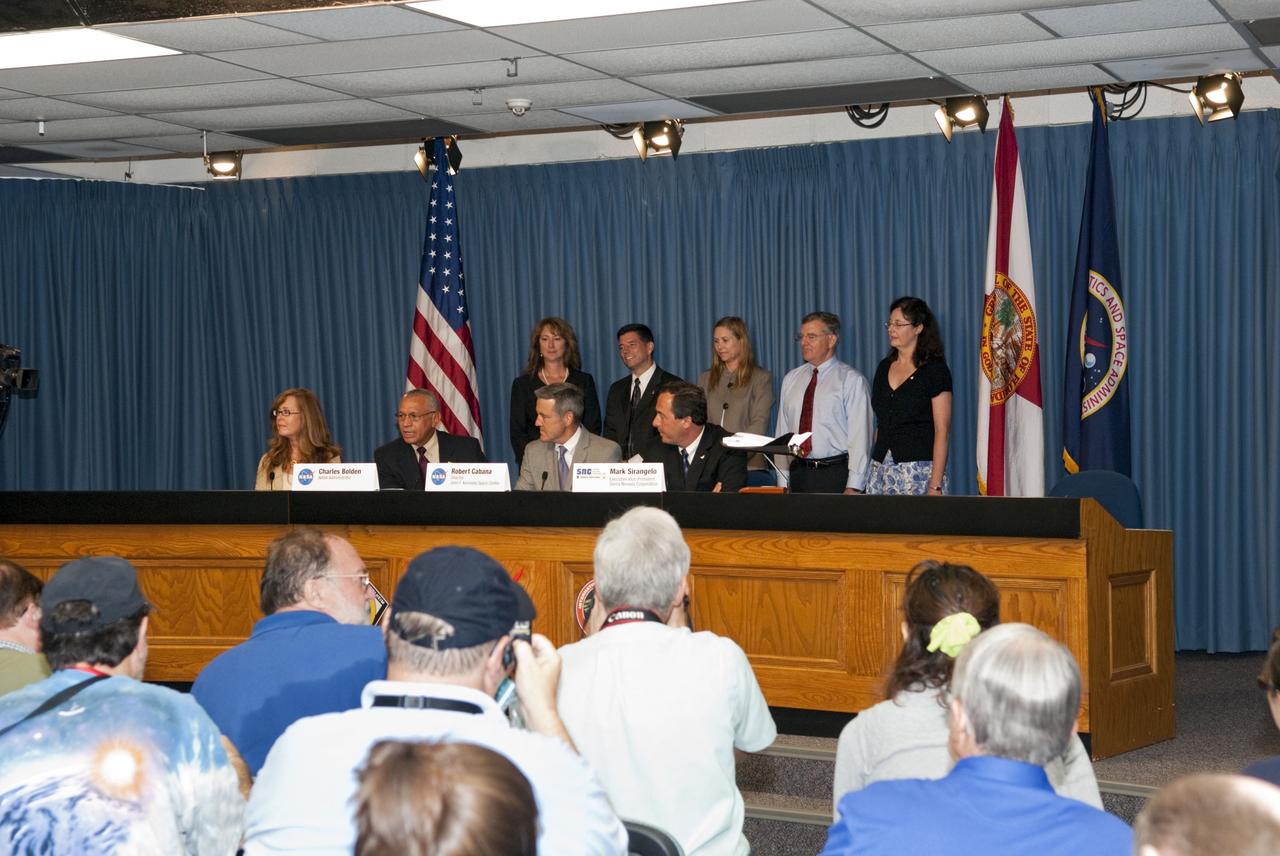
CAPE CANAVERAL, Fla. -- NASA and Sierra Nevada Space Systems (SNSS) of Sparks, Nev., prepare to sign a Space Act Agreement that will offer the company technical capabilities from Kennedy Space Center's uniquely skilled work force. Sitting, from left, are Kennedy Public Affairs Director Lisa Malone; NASA Administrator Charlie Bolden; Kennedy Center Director Bob Cabana; and Mark Sirangelo, head of Sierra Nevada. Standing, from left, are Joyce Riquelme, manager of Kennedy's Center Planning and Development Office; John Curry, director of Sierra Nevada's Systems Integration, Test and Operations; Kennedy Deputy Director Janet Petro; Jim Voss, vice president of Sierra Nevada's Space Exploration Systems; and Merri Sanchez, senior director of Sierra Nevada's Space Exploration Systems. Kennedy will help Sierra Nevada with the ground operations support of its lifting body reusable spacecraft called "Dream Chaser," which resembles a smaller version of the space shuttle orbiter. The spacecraft would carry as many as seven astronauts to the space station. Through the new agreement, Kennedy's work force will use its experience of processing the shuttle fleet for 30 years to help Sierra Nevada define and execute Dream Chaser's launch preparations and post-landing activities. In 2010 and 2011, Sierra Nevada was awarded grants as part of the initiative to stimulate the private sector in developing and demonstrating human spaceflight capabilities for NASA's Commercial Crew Program. The goal of the program, which is based in Florida at Kennedy, is to facilitate the development of a U.S. commercial crew space transportation capability by achieving safe, reliable and cost-effective access to and from the space station and future low Earth orbit destinations. Photo credit: NASA/Jim Grossmann
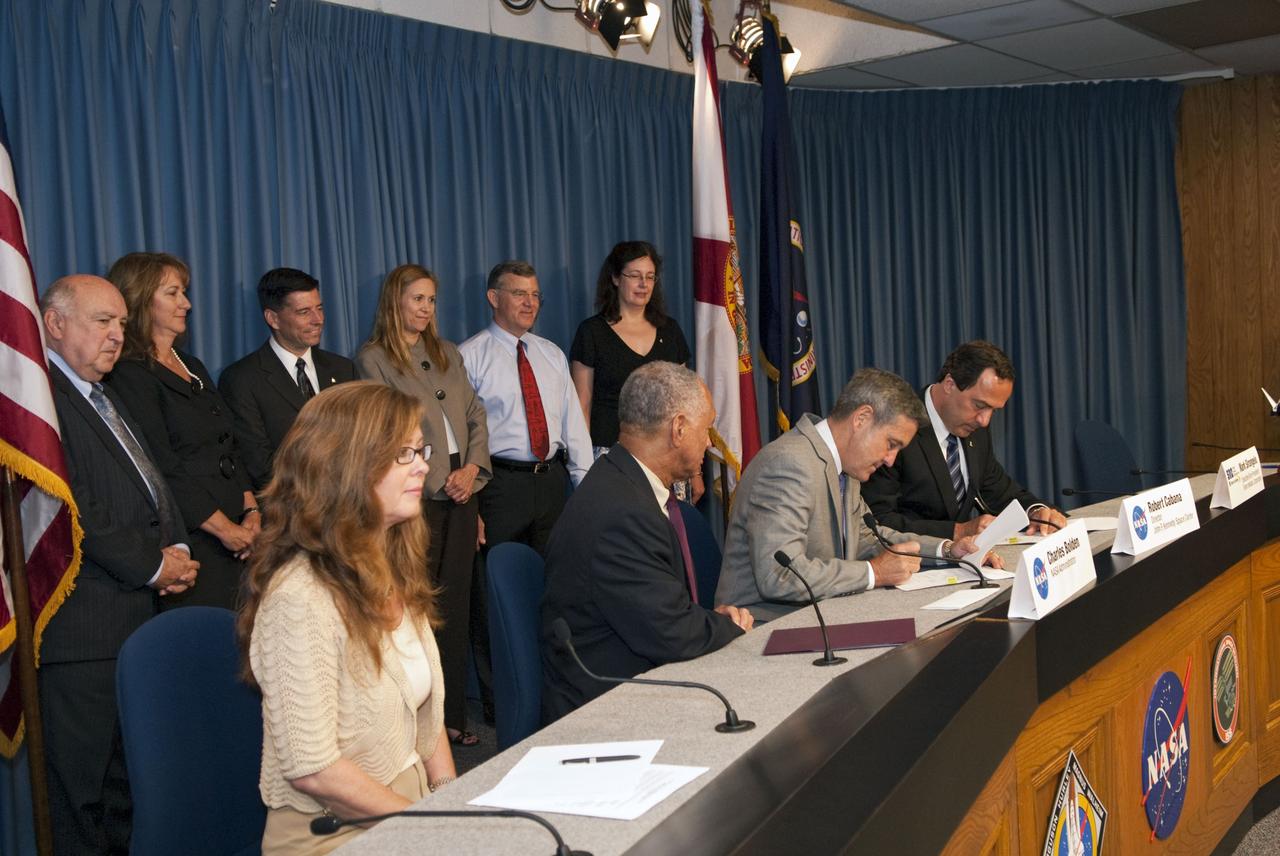
CAPE CANAVERAL, Fla. -- NASA and Sierra Nevada Space Systems (SNSS) of Sparks, Nev., sign a Space Act Agreement that will offer the company technical capabilities from Kennedy Space Center's uniquely skilled work force. Sitting, from left, are Kennedy Public Affairs Director Lisa Malone; NASA Administrator Charlie Bolden; Kennedy Center Director Bob Cabana; and Mark Sirangelo, head of Sierra Nevada. Standing, from left, are Frank DiBello, president of Space Florida; Joyce Riquelme, manager of Kennedy's Center Planning and Development Office; John Curry, director of Sierra Nevada's Systems Integration, Test and Operations; Kennedy Deputy Director Janet Petro; Jim Voss, vice president of Sierra Nevada's Space Exploration Systems; and Merri Sanchez, senior director of Sierra Nevada's Space Exploration Systems. Kennedy will help Sierra Nevada with the ground operations support of its lifting body reusable spacecraft called "Dream Chaser," which resembles a smaller version of the space shuttle orbiter. The spacecraft would carry as many as seven astronauts to the space station. Through the new agreement, Kennedy's work force will use its experience of processing the shuttle fleet for 30 years to help Sierra Nevada define and execute Dream Chaser's launch preparations and post-landing activities. In 2010 and 2011, Sierra Nevada was awarded grants as part of the initiative to stimulate the private sector in developing and demonstrating human spaceflight capabilities for NASA's Commercial Crew Program. The goal of the program, which is based in Florida at Kennedy, is to facilitate the development of a U.S. commercial crew space transportation capability by achieving safe, reliable and cost-effective access to and from the space station and future low Earth orbit destinations. Photo credit: NASA/Jim Grossmann