
John Honeycutt and Mark White compare model of SLS test stand with actual test stand
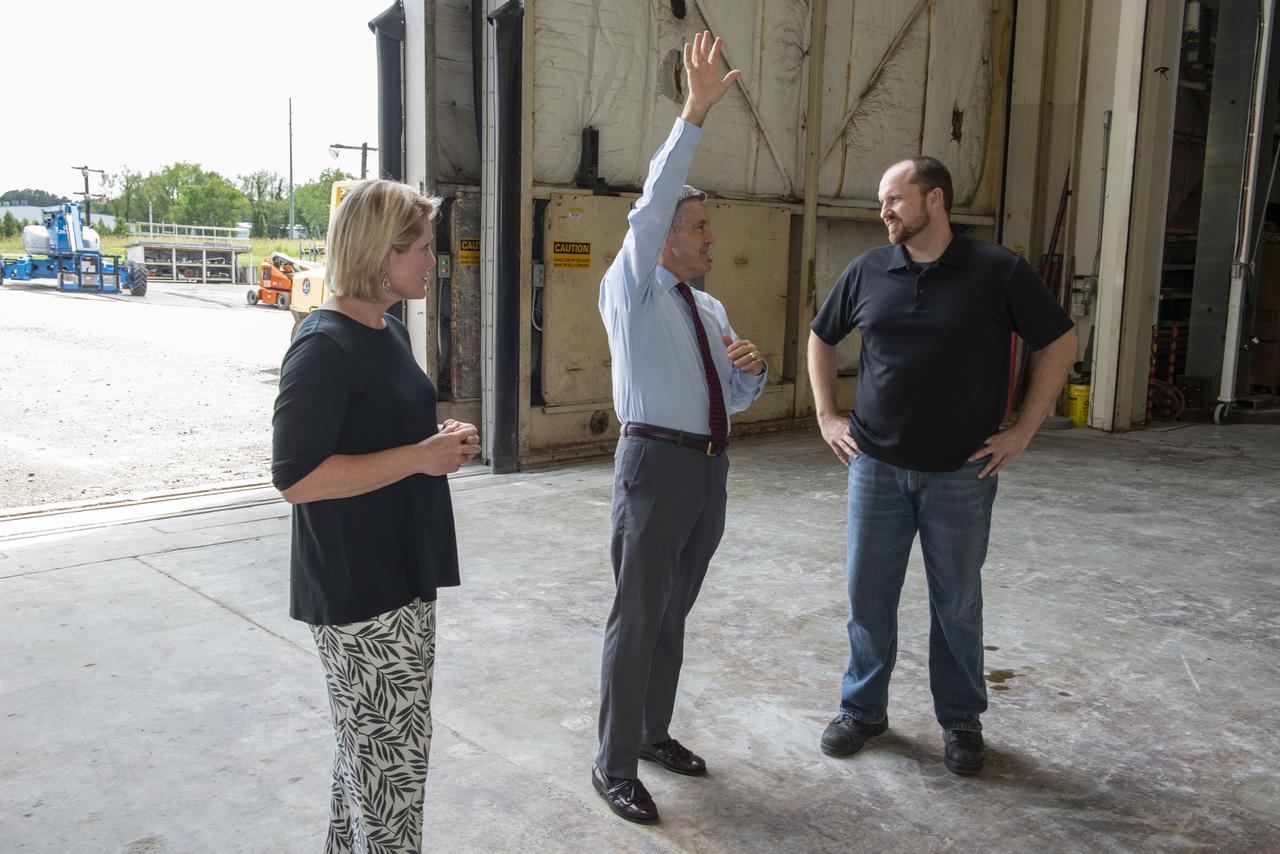
Kennedy Space Center Director Robert Cabana, center, receives an update on SLS hardware from Heather Haney, left, an engineer in the Space Launch System stages office, and Mark White, lead test engineer for the SLS core stage engine section, on July 16 in Marshall's Building 4619. Cabana, Haney and White are standing in front of a structural test version of the Intertank, the 212-foot-tall backbone of the SLS rocket. The structural test article is undergoing critical testing as engineers push, pull and bend the hardware with millions of pounds of force to ensure it can withstand the forces of launch and ascent.
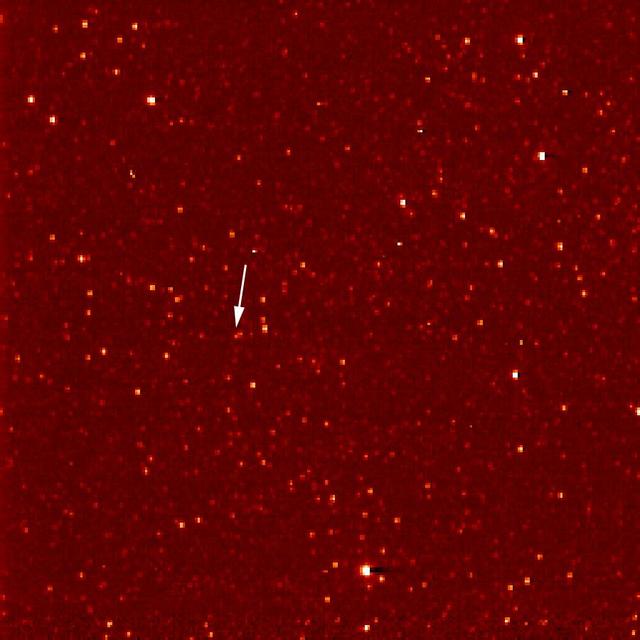
A white arrow marks Pluto in this NASA New Horizons Long Range Reconnaissance Imager picture taken Sept. 21, 2006. Pluto is little more than a faint point of light among a dense field of stars.
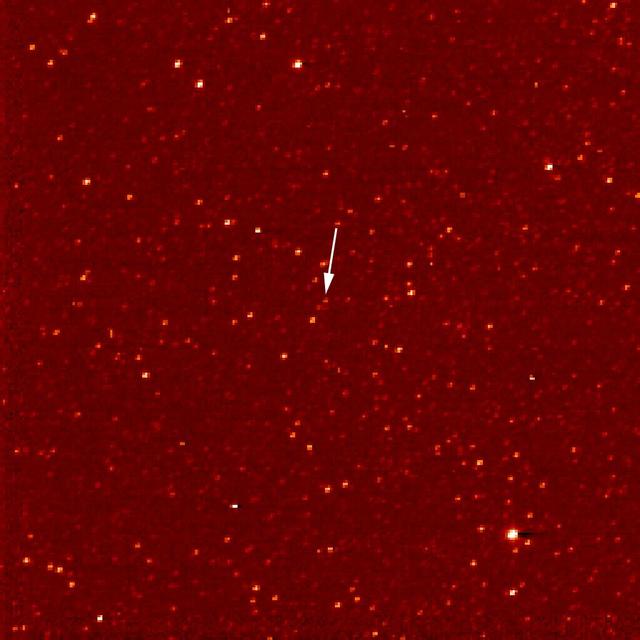
A white arrow marks Pluto in this NASA New Horizons Long Range Reconnaissance Imager picture taken Sept. 24, 2006. Pluto is little more than a faint point of light among a dense field of stars.

As white room closeout members look on, STS-82 Payload Commander Mark. C. Lee prepares to enter the Space Shuttle Discovery at Launch Pad 39A
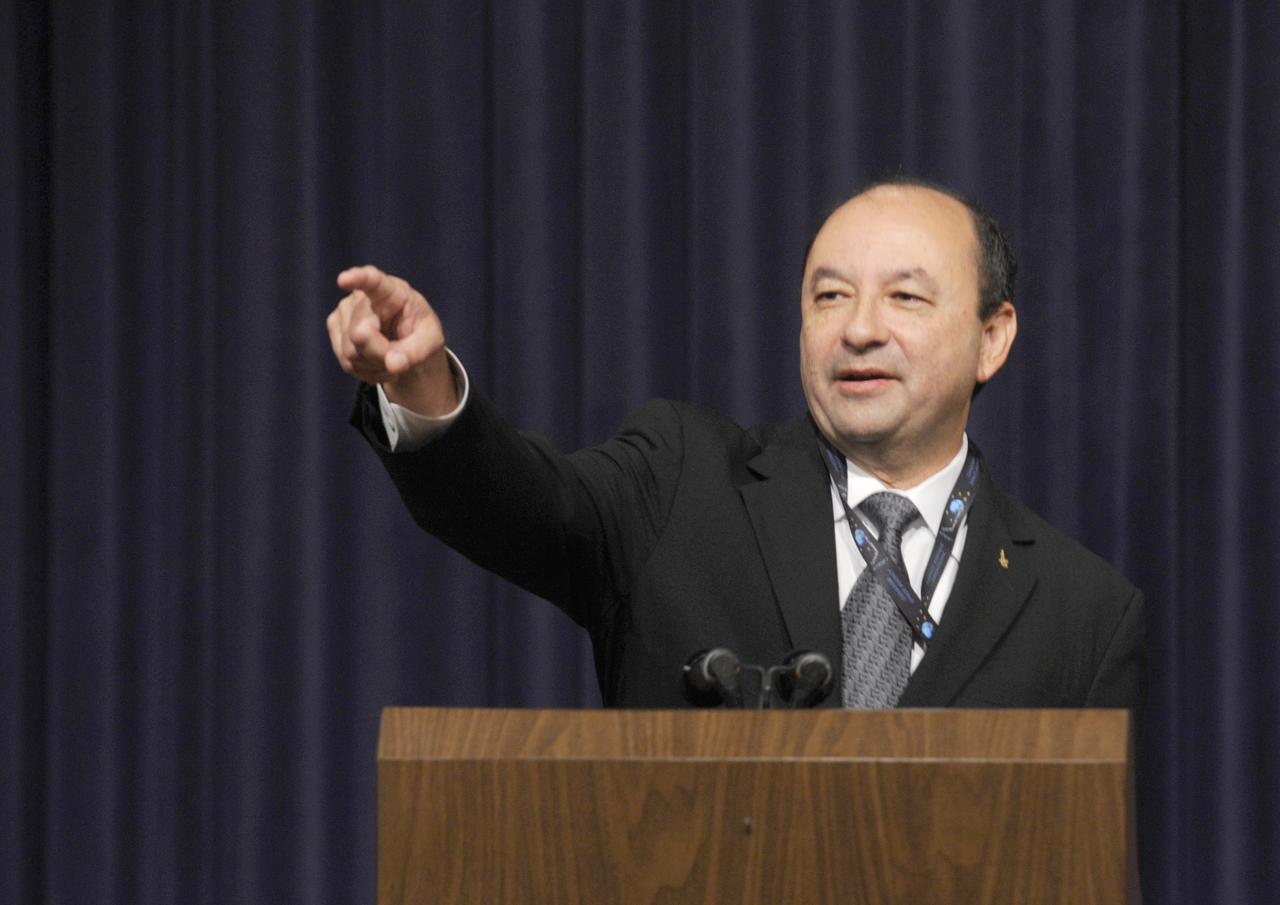
STS-127 Commander Mark Polansky speaks to White House interns at the Eisenhower Executiive Office Building in Washington, Thursday, Sept. 24, 2009. Photo Credit: (NASA/Paul E. Alers)
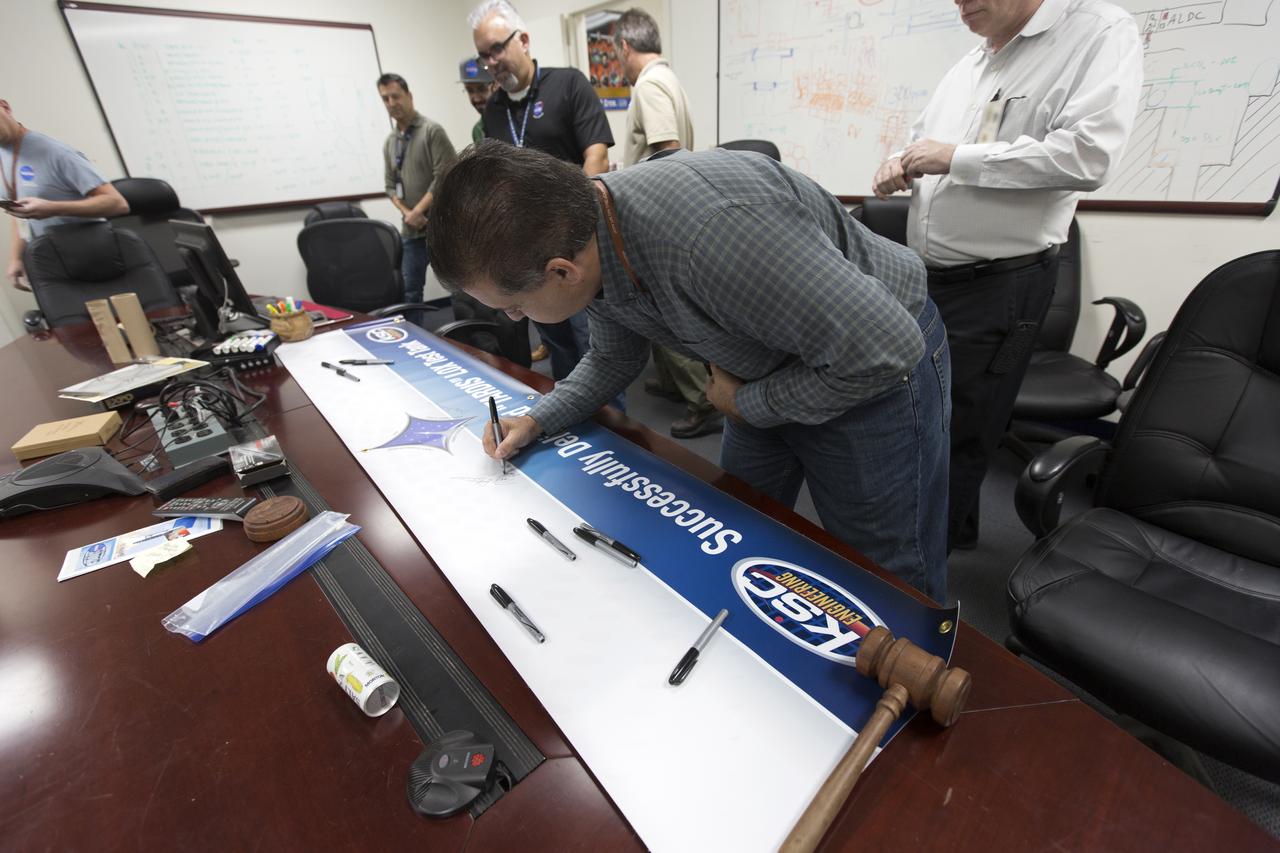
Workers sign the banner marking the successful delivery of a liquid oxygen test tank, called Tardis, in the Prototype Development Laboratory at NASA's Kennedy Space Center in Florida. Engineers and technicians worked together to develop the tank and build it at the lab to support cryogenic testing at Johnson Space Center's White Sands Test Facility in Las Cruces, New Mexico. The 12-foot-tall, 3,810-pound aluminum tank will be shipped to White Sands for testing.
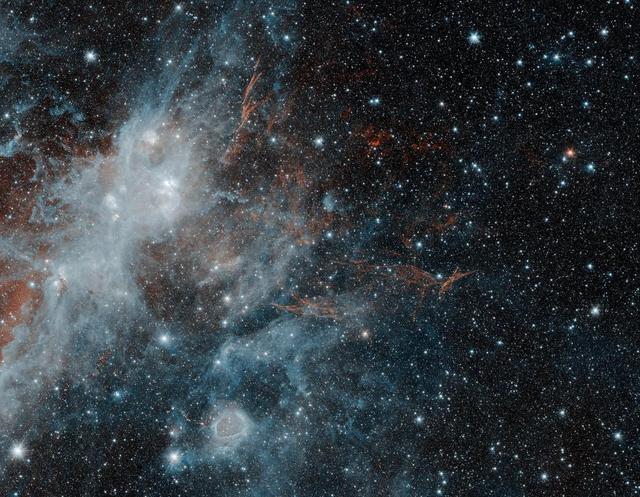
Thin, red veins of energized gas mark the location of the supernova remnant HBH 3 in this image from NASA's Spitzer Space Telescope. The puffy, white feature in the image is a portion of the star forming regions W3, W4 and W5. Infrared wavelengths of 3.6 microns have been mapped to blue, and 4.5 microns to red. The white color of the star-forming region is a combination of both wavelengths, while the HBH 3 filaments radiate only at the longer 4.5 micron wavelength. https://photojournal.jpl.nasa.gov/catalog/PIA22564

Inside the Prototype Development Laboratory at NASA's Kennedy Space Center in Florida, workers in the lab hold a banner marking the successful delivery of a liquid oxygen test tank called Tardis. Engineers and technicians worked together to develop the tank to build it at the lab to support cryogenic testing at Johnson Space Center's White Sands Test Facility in Las Cruces, New Mexico. The 12-foot-tall, 3,810-pound aluminum tank will be shipped to White Sands for testing.
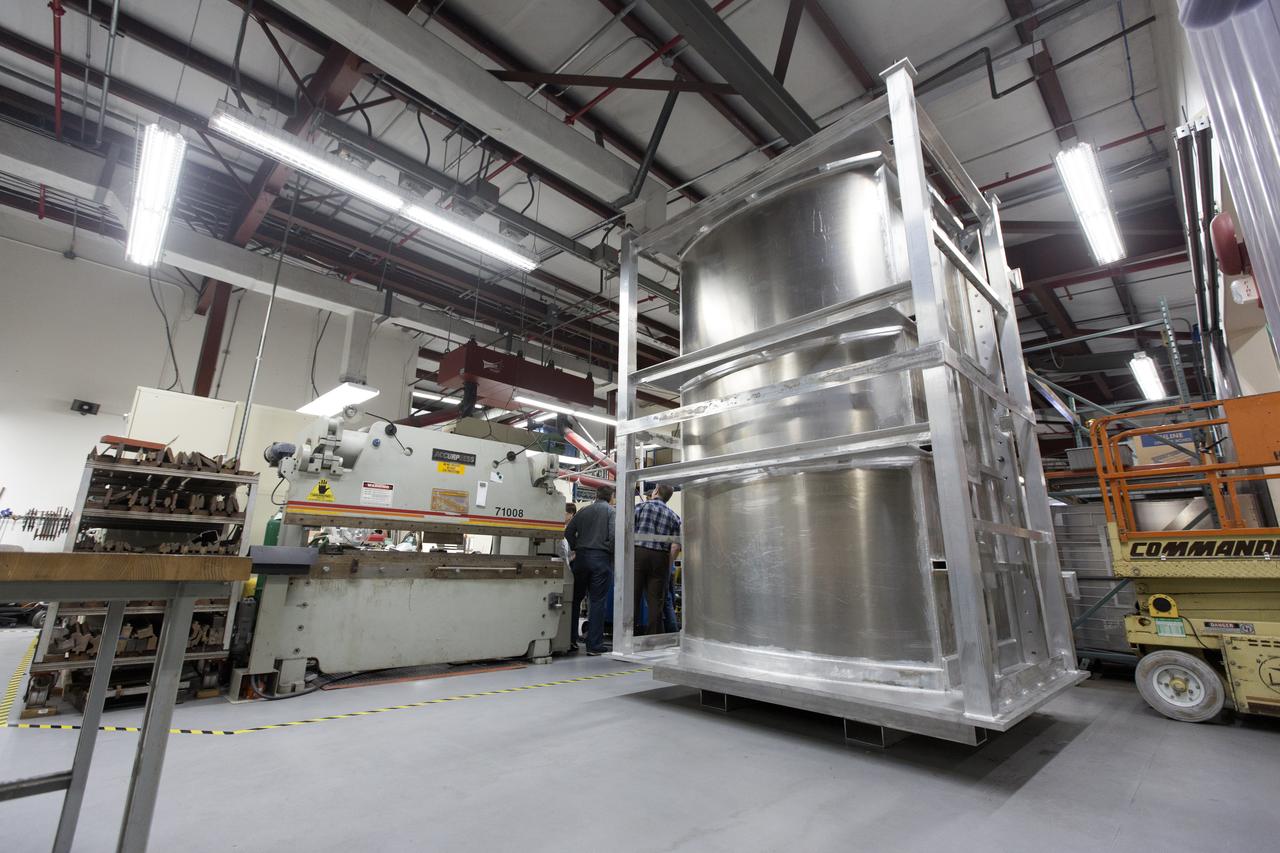
A liquid oxygen test tank was completed in the Prototype Development Laboratory at NASA's Kennedy Space Center in Florida. A banner signing event marked the successful delivery of the tank called Tardis. Engineers and technicians worked together to develop the tank and build it at the lab to support cryogenic testing at Johnson Space Center's White Sands Test Facility in Las Cruces, New Mexico. The 12-foot-tall, 3,810-pound aluminum tank will be shipped to White Sands for testing.
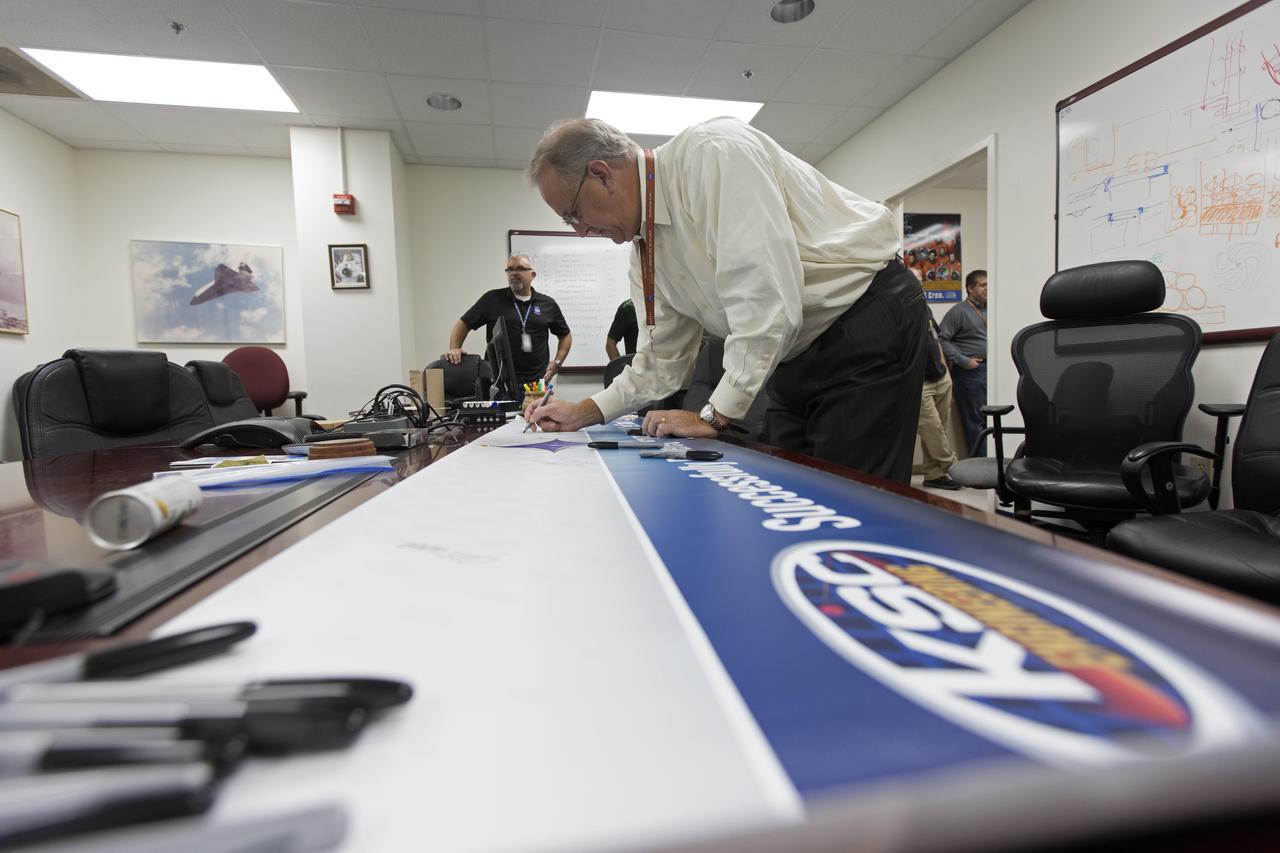
NASA Kennedy Space Center's Engineering Director Pat Simpkins signs the banner marking the successful delivery of a liquid oxygen test tank, called Tardis, in the Prototype Development Laboratory at NASA's Kennedy Space Center in Florida. Engineers and technicians worked together to develop the tank and build it to support cryogenic testing at Johnson Space Center's White Stands Test Facility in Las Cruces, New Mexico. The 12-foot-tall, 3,810-pound aluminum tank will be shipped to White Sands for testing.
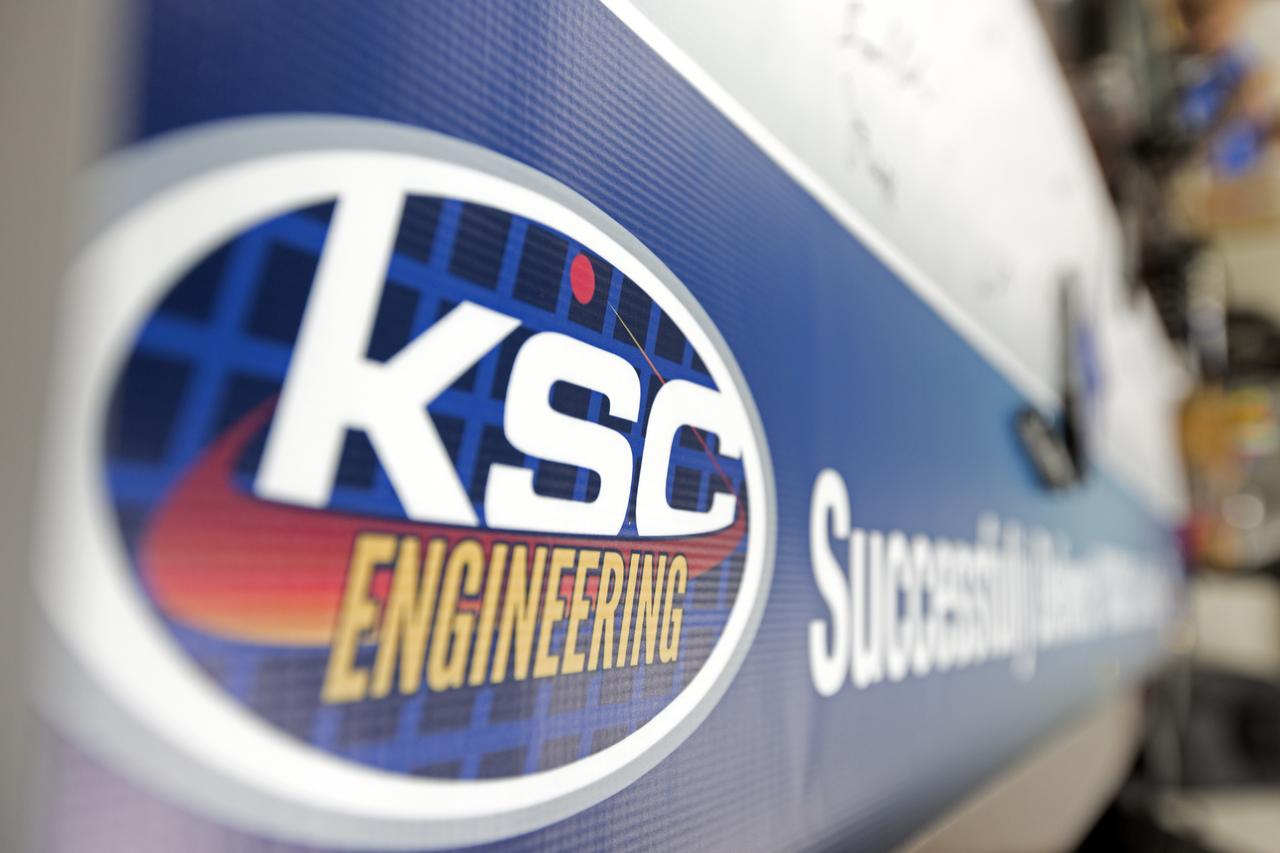
NASA Kennedy Space Center's Engineering Directorate held a banner signing event in the Prototype Development Laboratory to mark the successful delivery of a liquid oxygen test tank, called Tardis. Engineers and technicians worked together to develop the tank and build it to support cryogenic testing at Johnson Space Center's White Stands Test Facility in Las Cruces, New Mexico. The 12-foot-tall, 3,810-pound aluminum tank will be shipped to White Sands for testing.
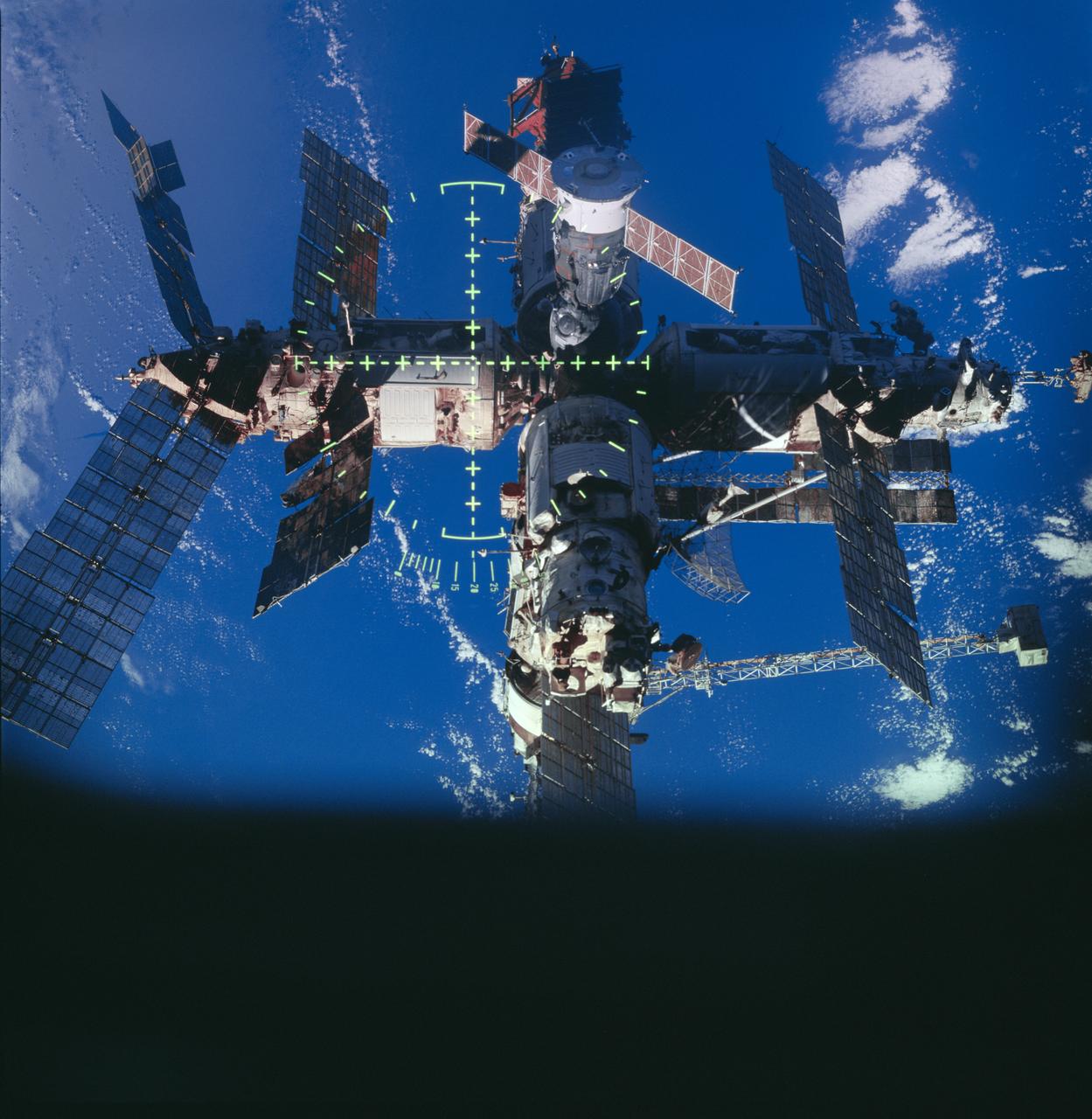
STS091-727-059 (2-12 June 1998) --- White clouds and blue ocean waters form the backdrop for this view of Russia's Mir space station during a post-undock fly-around by the Space Shuttle Discovery, from which this 70mm frame was taken. The markings in the photo are those of the Crew Optical Alignment Sight (COAS), an important instrument used normally for rendezvous and docking maneuvers. The STS-91/Mir-25 docking marked the final scheduled link-up between Mir and members of the NASA Space Shuttle fleet.
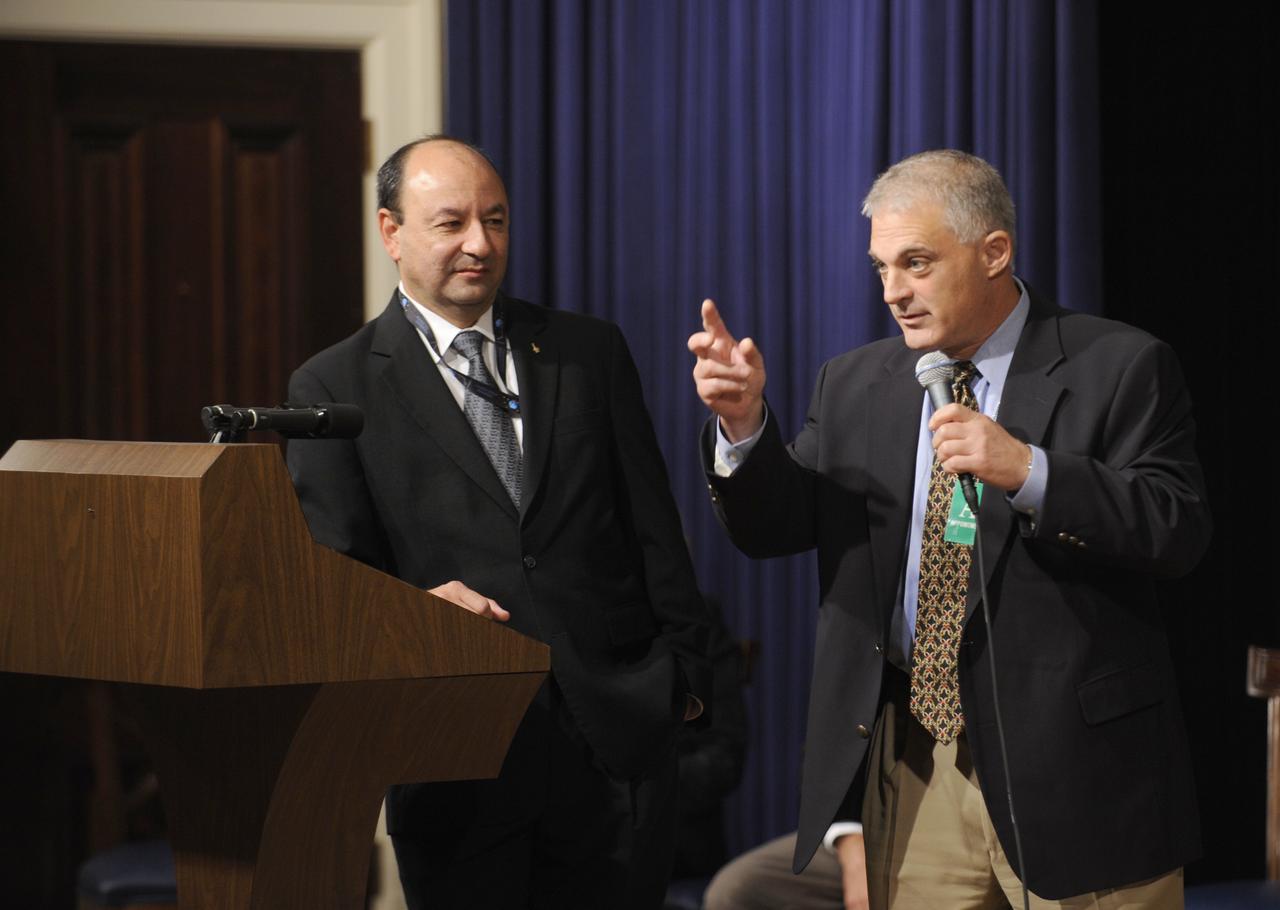
STS-127 Commander Mark Polansky, left, looks on as crew member David Wolf answer a question during a presentation to White House interns at the Eisenhower Executiive Office Building in Washington, Thursday, Sept. 24, 2009. Photo Credit: (NASA/Paul E. Alers)
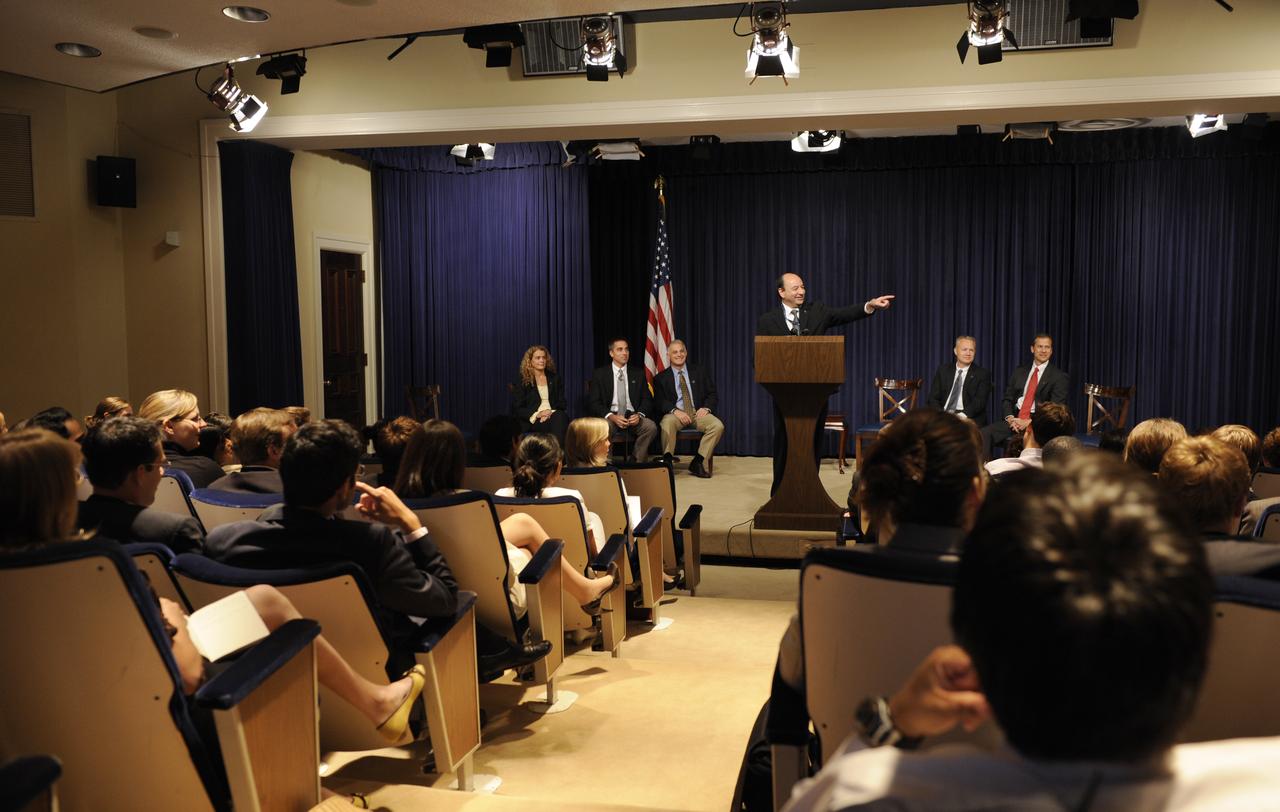
STS-127 Commander Mark Polansky, at podium, speaks to White House interns at the Eisenhower Executiive Office Building in Washington, Thursday, Sept. 24, 2009. Seated from left are crew members Christopher Cassidy, David Wolf, Julie Payette, Douglas Hurley and Thomas Marshburn. Photo Credit: (NASA/Paul E. Alers)
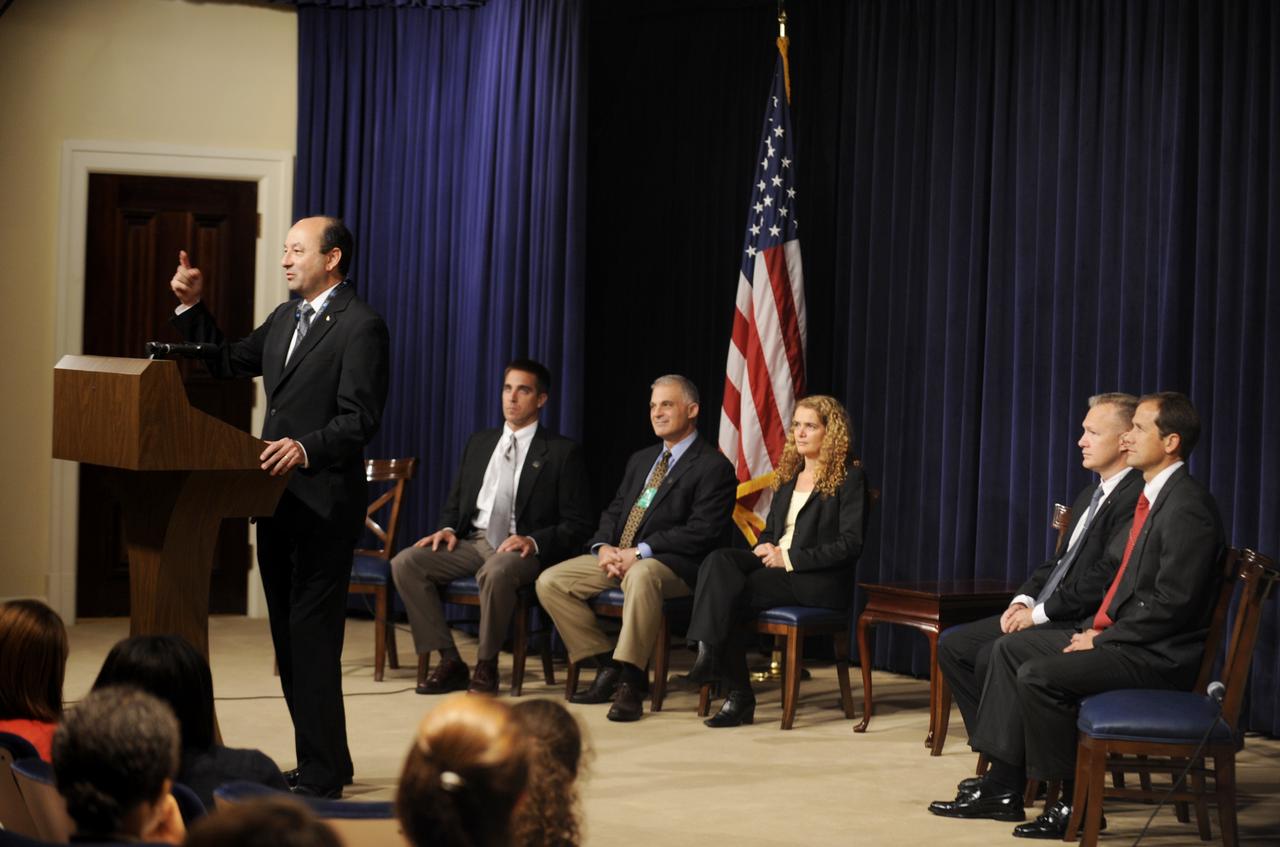
STS-127 Commander Mark Polansky, at podium, speaks to White House interns at the Eisenhower Executiive Office Building in Washington, Thursday, Sept. 24, 2009. Seated from left are crew members Christopher Cassidy, David Wolf, Julie Payette, Douglas Hurley and Thomas Marshburn. Photo Credit: (NASA/Paul E. Alers)
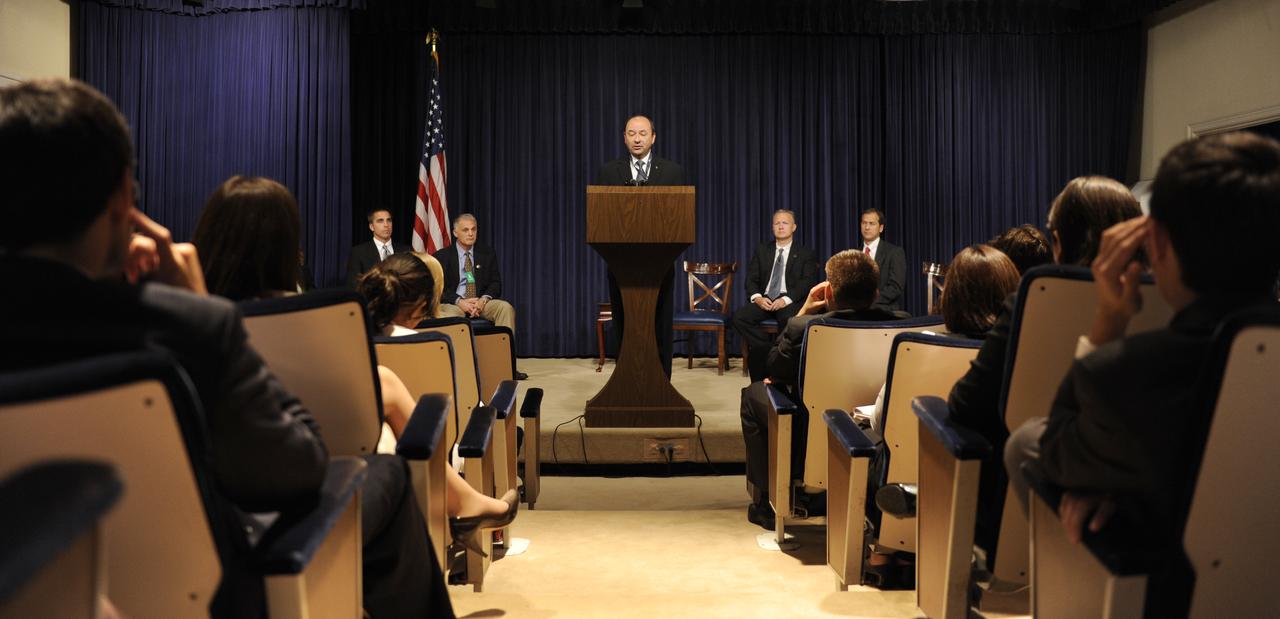
STS-127 Commander Mark Polansky, at podium, speaks to White House interns at the Eisenhower Executiive Office Building in Washington, Thursday, Sept. 24, 2009. Seated from left are crew members Christopher Cassidy, David Wolf, Douglas Hurley and Thomas Marshburn. Photo Credit: (NASA/Paul E. Alers)
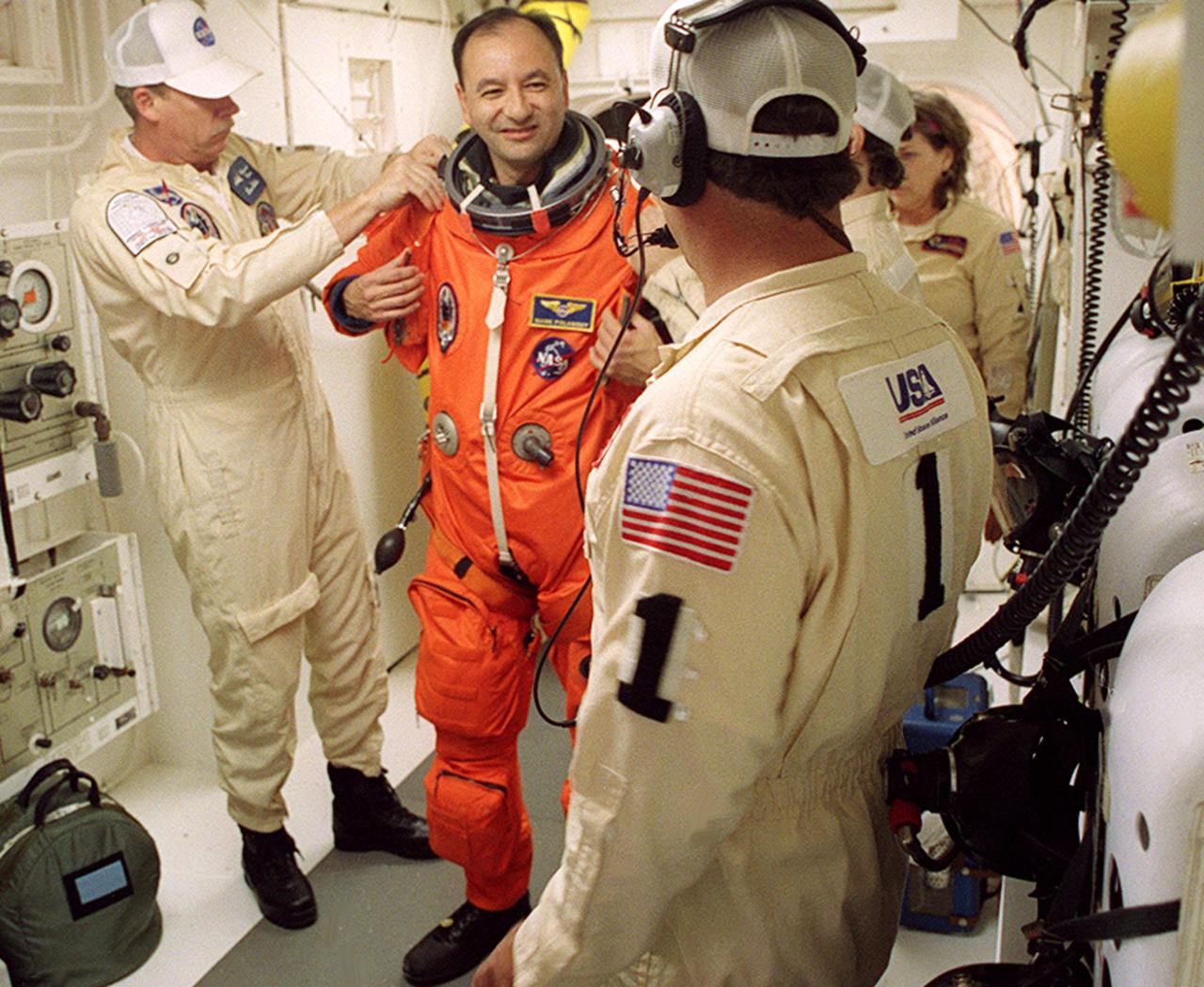
In the White Room with the closeout crew, STS-98 Pilot Mark Polansky happily undergoes final suit preparations before he enters Space Shuttle Atlantis for launch. The White Room is an environmentally controlled room at the end of the Orbiter Access Arm. Atlantis is carrying the U.S. Laboratory Destiny, a key module in the growth of the Space Station. Destiny will be attached to the Unity node on the Space Station using the Shuttle’s robotic arm. Three spacewalks are required to complete the planned construction work during the 11-day mission. This mission marks the seventh Shuttle flight to the Space Station, the 23rd flight of Atlantis and the 102nd flight overall in NASA’s Space Shuttle program. The planned landing is at KSC Feb. 18 about 1 p.m
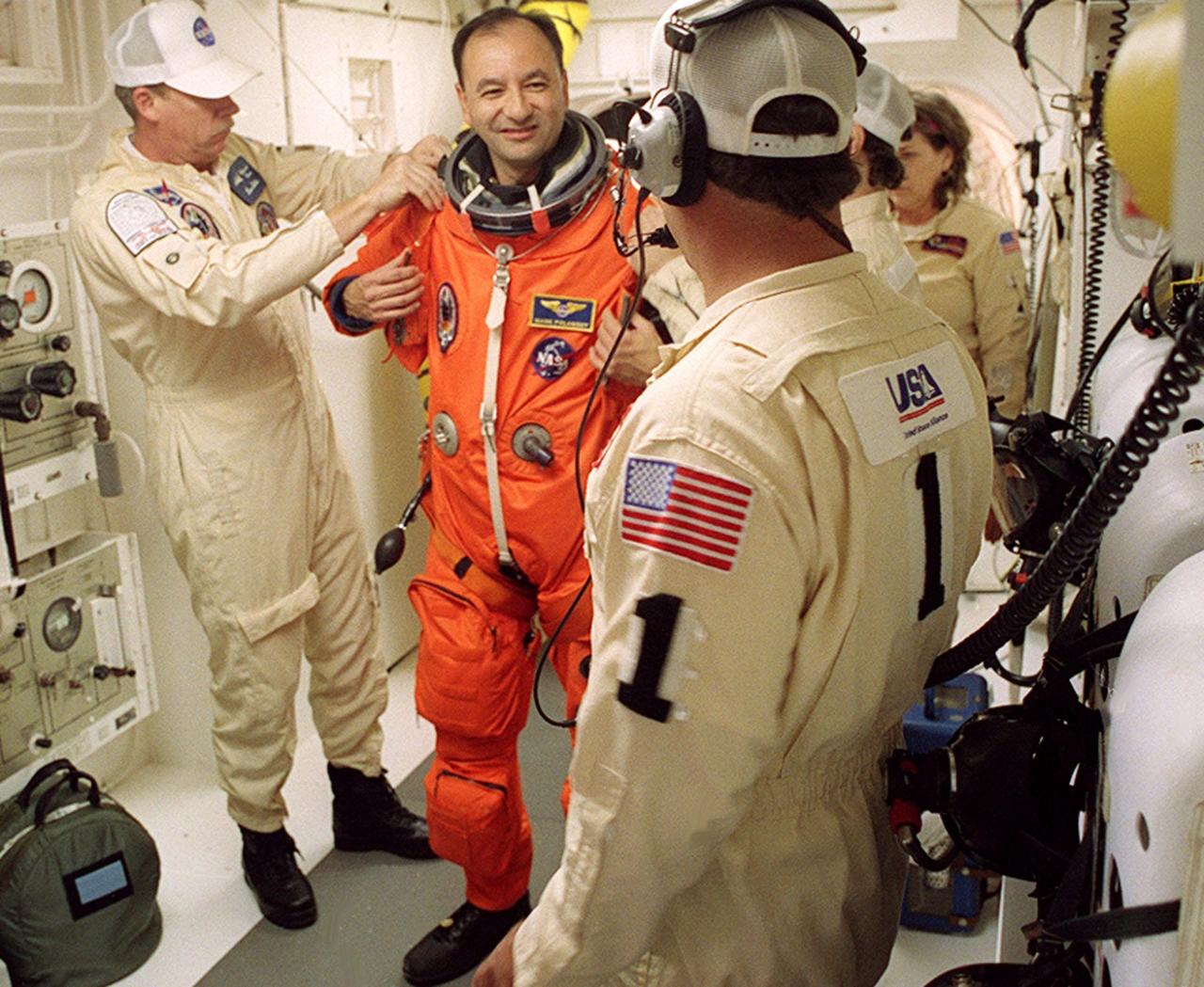
In the White Room with the closeout crew, STS-98 Pilot Mark Polansky happily undergoes final suit preparations before he enters Space Shuttle Atlantis for launch. The White Room is an environmentally controlled room at the end of the Orbiter Access Arm. Atlantis is carrying the U.S. Laboratory Destiny, a key module in the growth of the Space Station. Destiny will be attached to the Unity node on the Space Station using the Shuttle’s robotic arm. Three spacewalks are required to complete the planned construction work during the 11-day mission. This mission marks the seventh Shuttle flight to the Space Station, the 23rd flight of Atlantis and the 102nd flight overall in NASA’s Space Shuttle program. The planned landing is at KSC Feb. 18 about 1 p.m
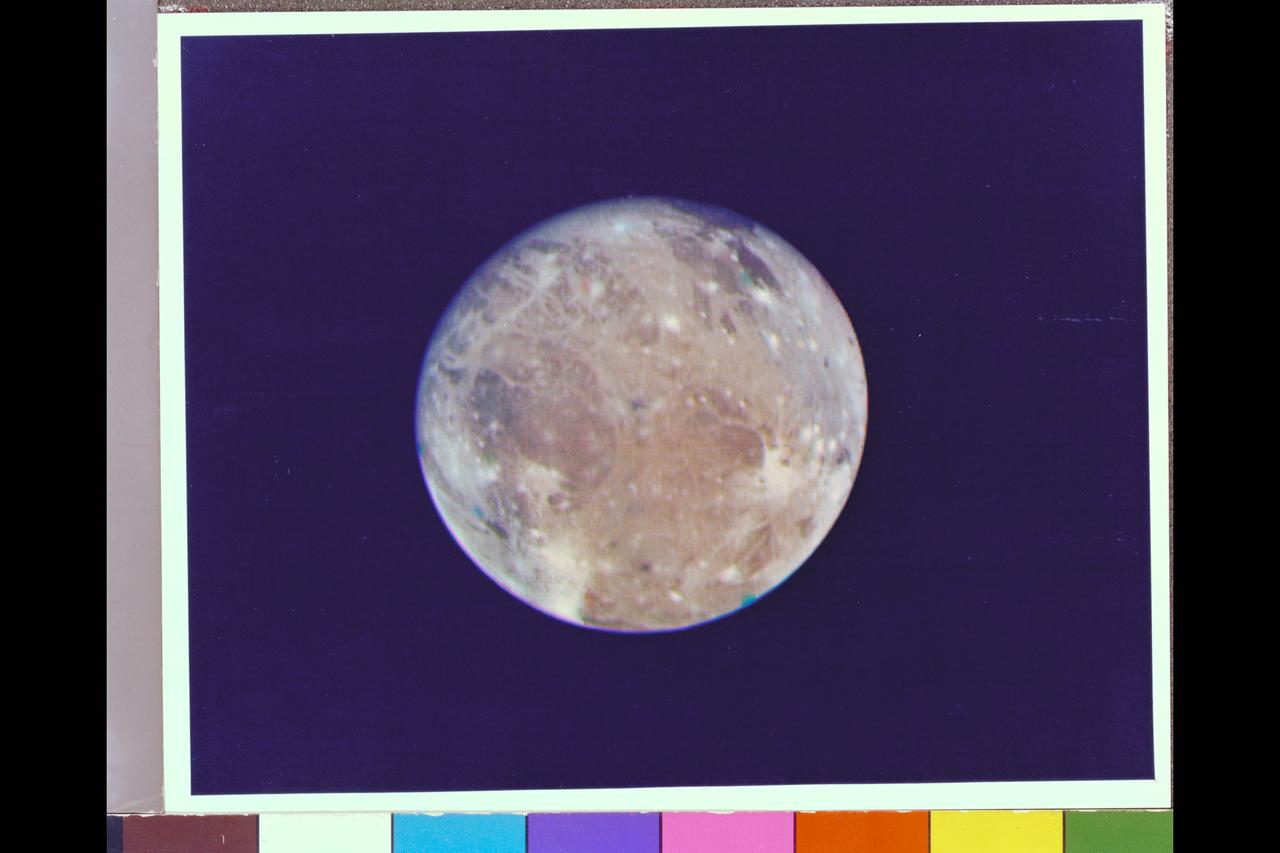
2:30 pm Photographer : JPL Range : 2.6 million km. ( 1.6 million miles ) Ganymede is Jupiter's largest satellite ( or moon ) With a radius of about 2600 km., about 1.5 times that of our moon, Ganymede has a bulk density of about 2.0 g/cc, almost half that of our moon, and is probably composed of rock and ice. The large dark regions, in the northeast quadrant, and the white spots, resemble features found on the moon, mare and impact respectively. The long white filaments resemble rays associated with impacts on the lunar surface. The various colors, other than the several blue, green, & orange dots, which are markings on the camera used for pointing determinations and are not physical markings, probably represent differing surface materials.
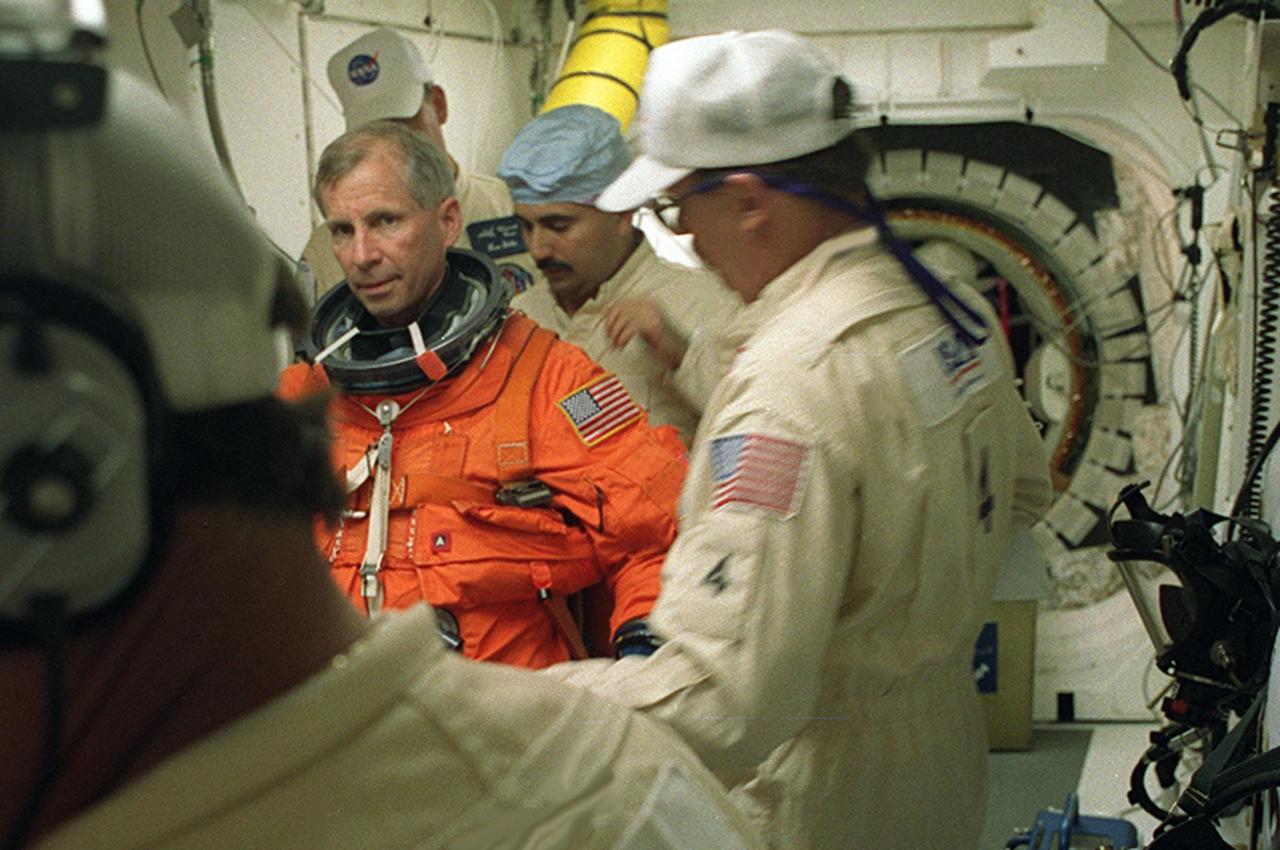
The closeout crew in the White Room help STS-98 Commander Ken Cockrell with final suitup before entering Space Shuttle Atlantis for launch. The White Room is an environmentally controlled room at the end of the Orbiter Access Arm. Atlantis is carrying the U.S. Laboratory Destiny, a key module in the growth of the Space Station. Destiny will be attached to the Unity node on the Space Station using the Shuttle’s robotic arm. Three spacewalks are required to complete the planned construction work during the 11-day mission. This mission marks the seventh Shuttle flight to the Space Station, the 23rd flight of Atlantis and the 102nd flight overall in NASA’s Space Shuttle program. The planned landing is at KSC Feb. 18 about 1 p.m
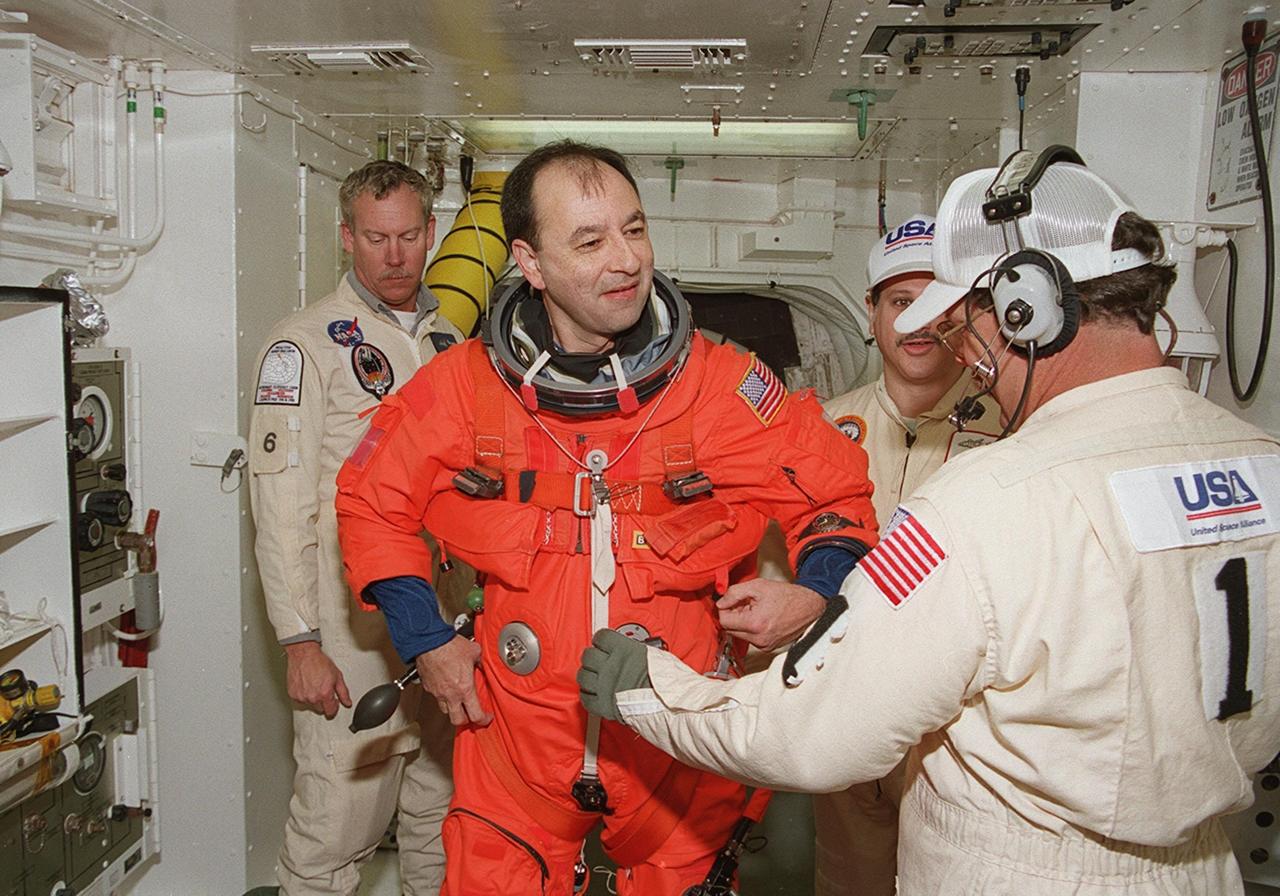
In the White Room, STS-98 Pilot Mark Polansky gets help with his launch and entry suit before entering Atlantis for a simulated launch countdown. The White Room is an environmental chamber at the end of the orbiter access arm that mates with the orbiter to allow personnel to enter the orbiter’s crew compartment. The STS-98 crew is taking part in Terminal Countdown Demonstration Test activities, which also include emergency egress training at the pad. STS-98 is the seventh construction flight to the International Space Station, carrying as payload the U.S. Lab Destiny, a key element in the construction of the ISS. Launch of STS-98 is scheduled for Jan. 19 at 2:11 a.m. EST
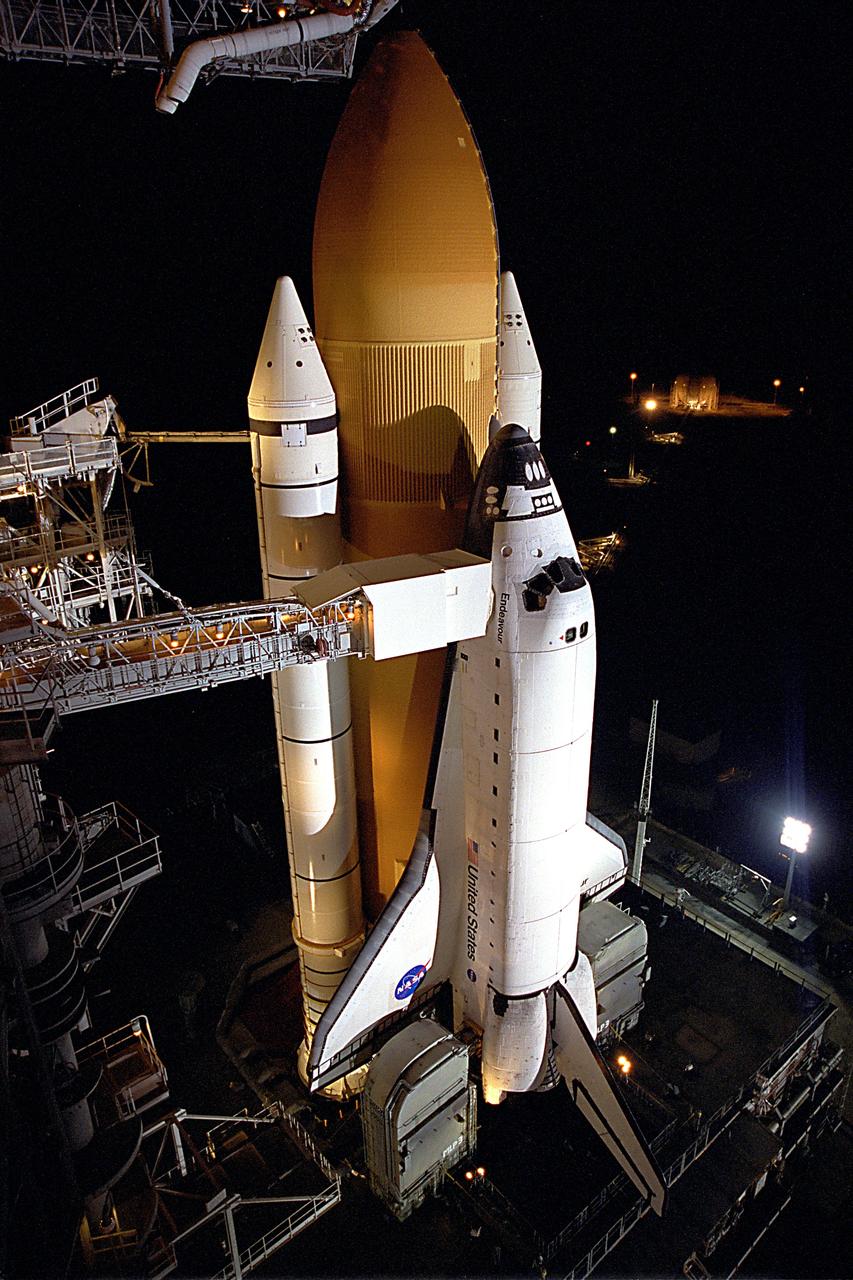
STS099-S-020 (10 February 2000) --- The Space Shuttle Endeavour awaits liftoff only hours away on Launch Pad 39A at the Kennedy Space Center (KSC). The point of view is from the Rotating Service Structure more than 225 feet above the ground. Abutting the side of Endeavour is the orbiter access arm with the environmental chamber known as the White Room at the end. The White Room provides access to the crew compartment. This flight represents the 97th in the Space Transportation System (STS) program and marks the 14th mission for the Space Shuttle Endeavour.
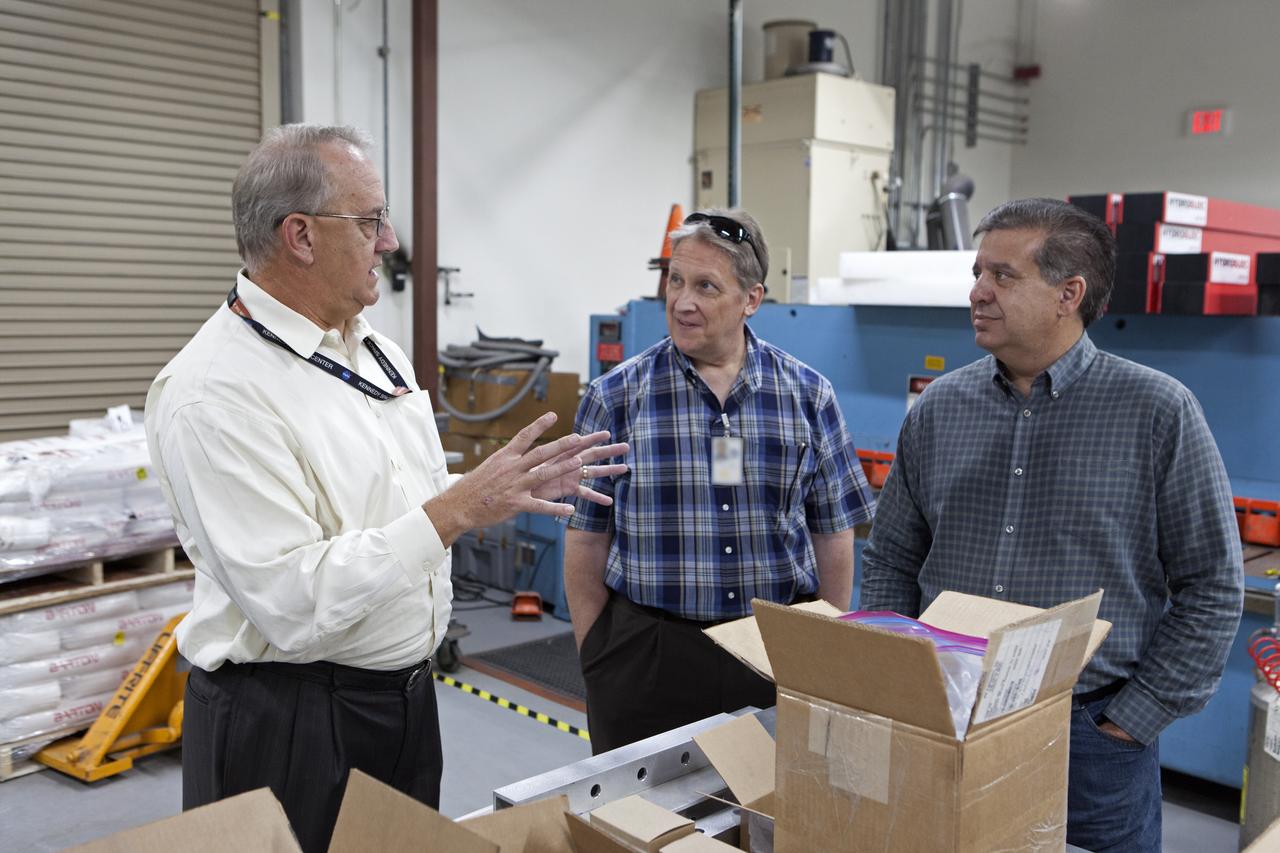
NASA Kennedy Space Center's Engineering Director Pat Simpkins, at left, talks with Michael E. Johnson, a project engineer; and Emilio Cruz, deputy division chief in the Laboratories, Development and Testing Division, inside the Prototype Development Laboratory. A banner signing event was held to mark the successful delivery of a liquid oxygen test tank, called Tardis. Engineers and technicians worked together to develop the tank and build it at the lab to support cryogenic testing at Johnson Space Center's White Sands Test Facility in Las Cruces, New Mexico. The 12-foot-tall, 3,810-pound aluminum tank will be shipped to White Sands for testing.
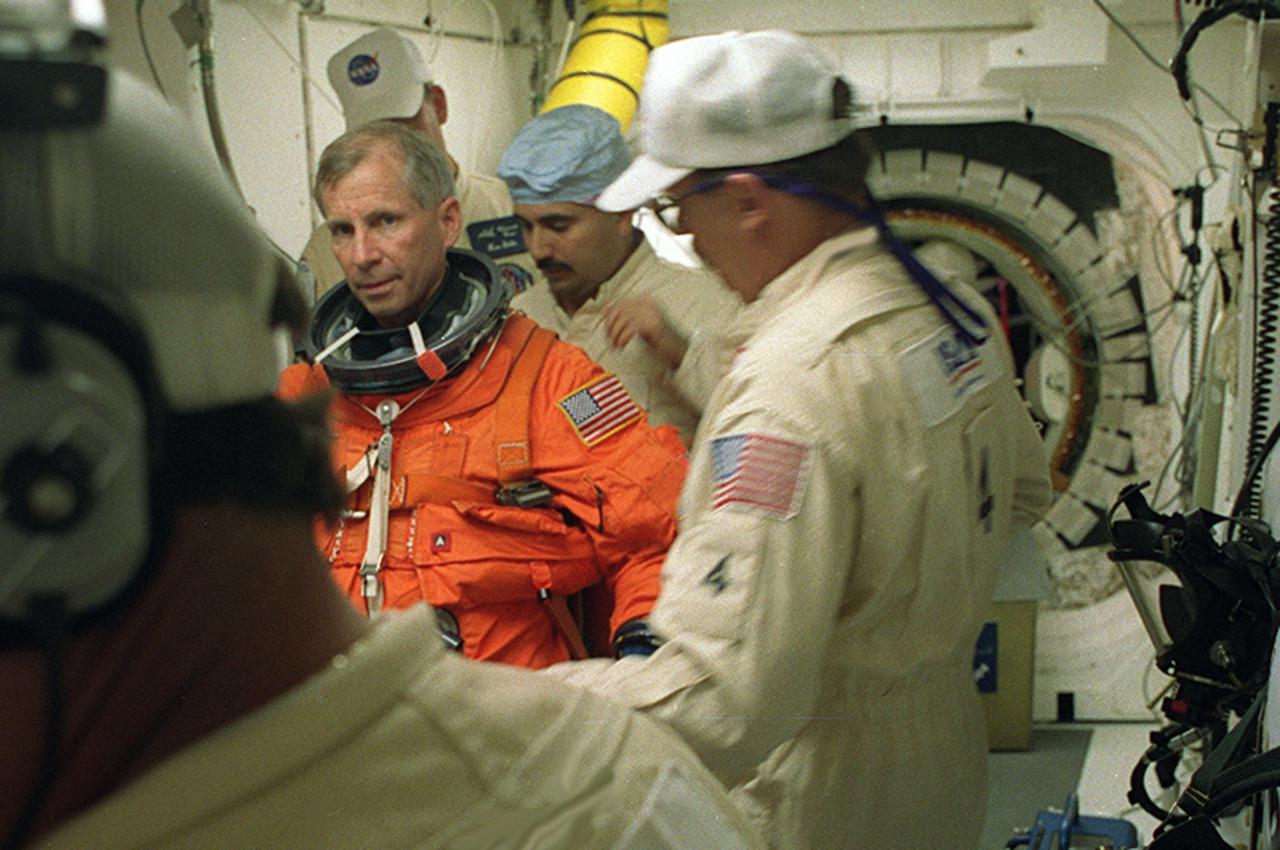
The closeout crew in the White Room help STS-98 Commander Ken Cockrell with final suitup before entering Space Shuttle Atlantis for launch. The White Room is an environmentally controlled room at the end of the Orbiter Access Arm. Atlantis is carrying the U.S. Laboratory Destiny, a key module in the growth of the Space Station. Destiny will be attached to the Unity node on the Space Station using the Shuttle’s robotic arm. Three spacewalks are required to complete the planned construction work during the 11-day mission. This mission marks the seventh Shuttle flight to the Space Station, the 23rd flight of Atlantis and the 102nd flight overall in NASA’s Space Shuttle program. The planned landing is at KSC Feb. 18 about 1 p.m
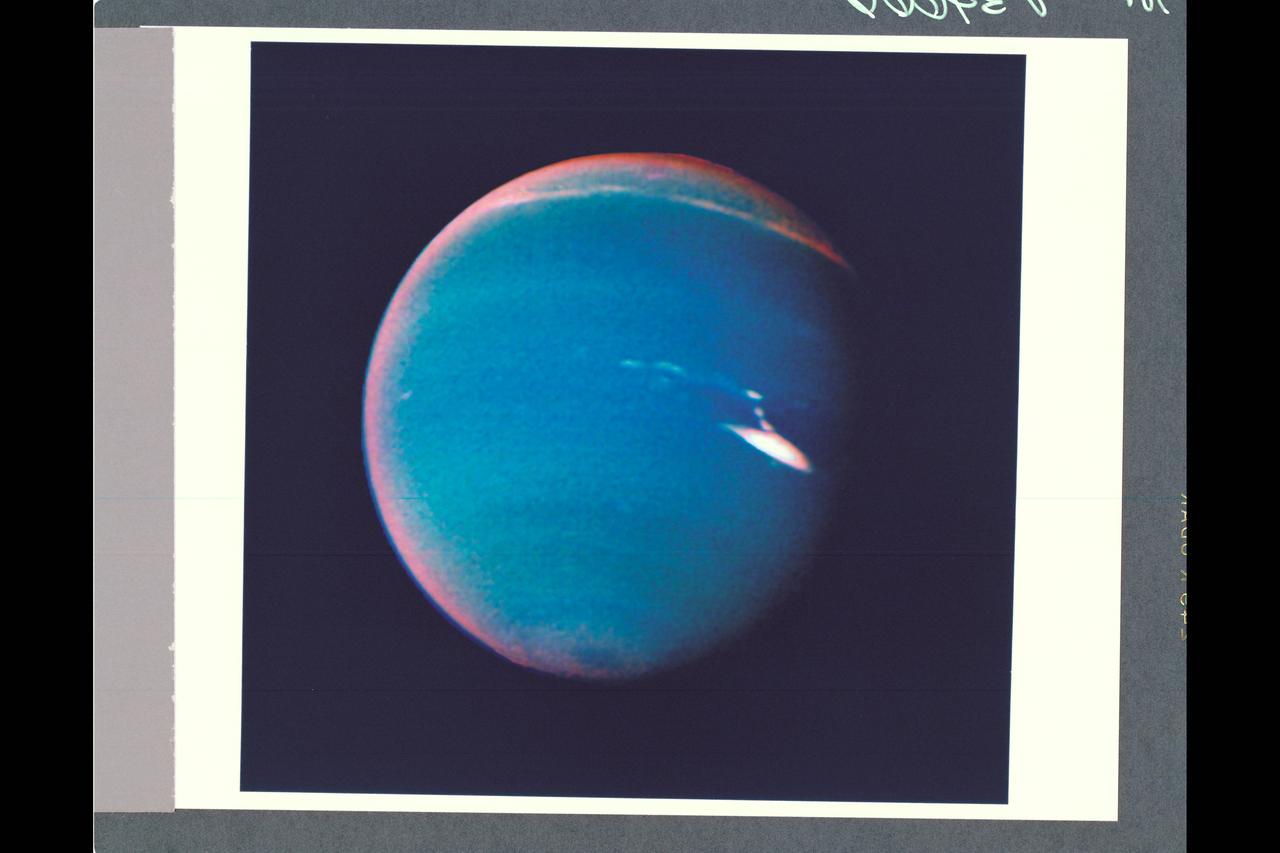
P-34666 This false color photograph of Neptune was reconstructed from two images taken by Voyager 2's wide angle camera, through the orange and two different methane filters. Objects that deep in the atmosphere are blue, while those at higher altitudes are white. Light at methane wavelengths is mostly absorbed in the deeper atmosphere. The bright, white feature is a high altitude cloud just south of the Great dark Spot. The hard, sharp inner boundary within the bright cloud is an artifact of computer processing on Earth. Other, smaller clouds associated with the Great Dark Spot are white or pink, and are also at high altitudes. Neptune's limb looks reddish because Voyager 2 is viewing it tangentially, and the sunlight is scattered back to space before it can be absorbed by methane. A long, narrow band of high-altitude clouds near the top of the image is located at 25 degrees north latitude, and faint hazes mark the equator and polor regions
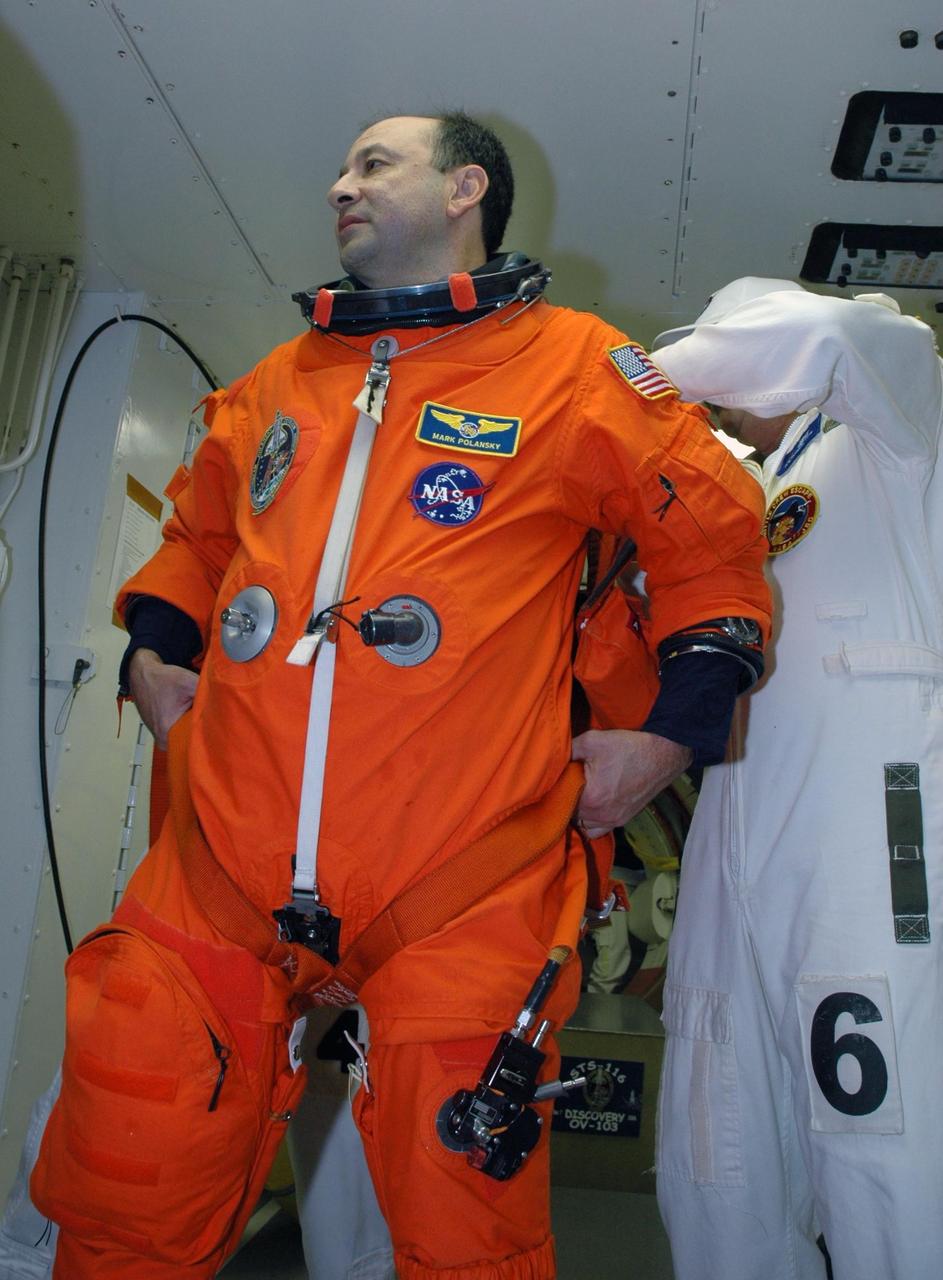
KENNEDY SPACE CENTER, FLA. -- In the white room on Launch Pad 39B, STS-116 Commander Mark Polansky is helped with his gear before entering Space Shuttle Discovery. The STS-116 mission is No. 20 to the International Space Station and construction flight 12A.1. The mission payload is the SPACEHAB module, the P5 integrated truss structure and other key components. Launch is scheduled for no earlier than Dec. 7. Photo credit: NASA/Amanda Diller
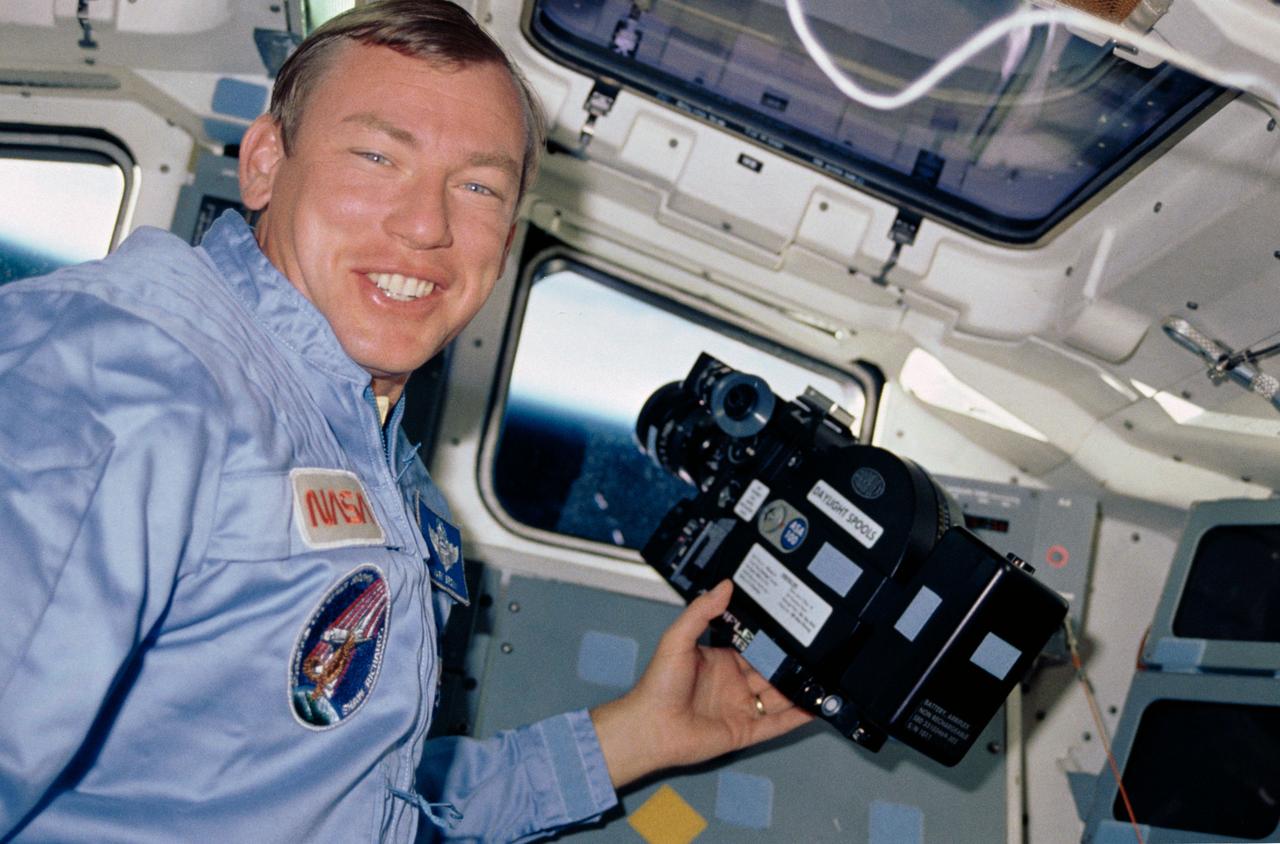
STS028-17-033 (August 1989) --- Astronaut Mark N. Brown, STS-28 mission specialist, pauses from a session of motion-picture photography conducted through one of the aft windows on the flight deck of the Earth-orbiting Space Shuttle Columbia. He is using an Arriflex camera. The horizon of the blue and white appearing Earth and its airglow are visible in the background.
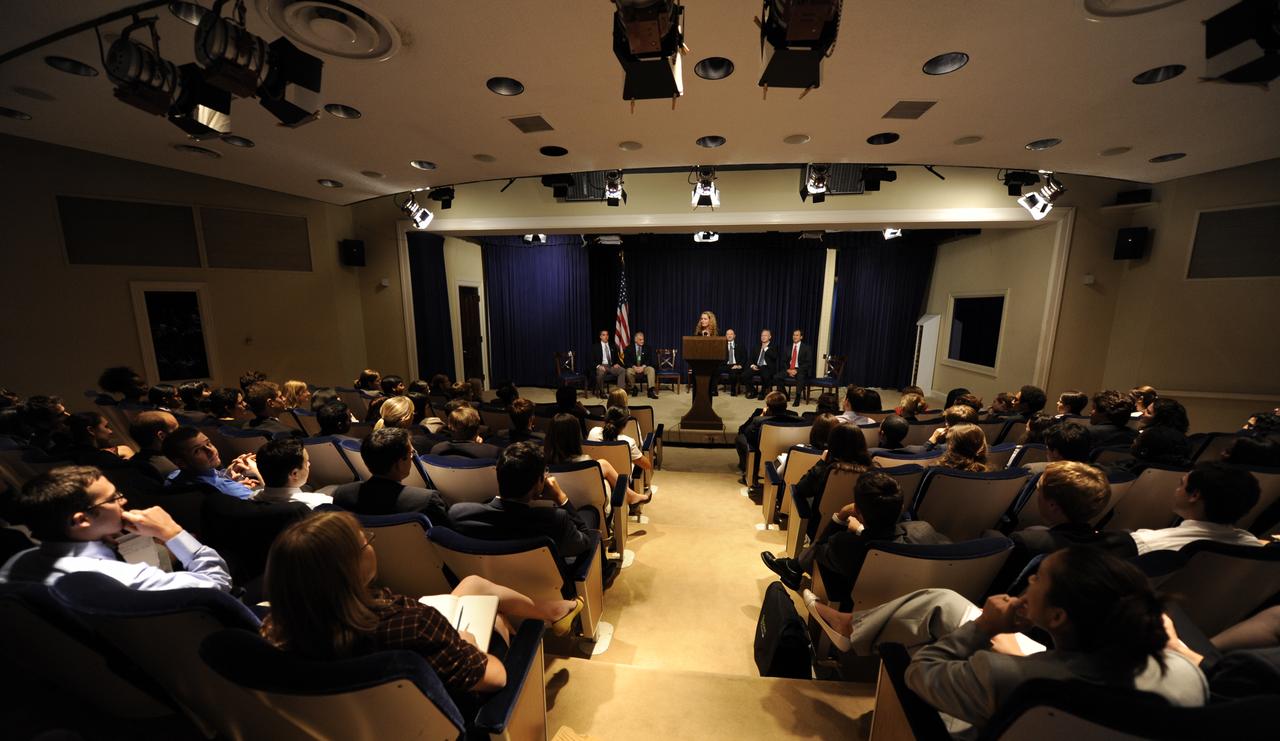
Canadian Space Agency astronaut Julie Payette, a mission specialist on STS-127, at podium, speaks to White House interns at the Eisenhower Executiive Office Building in Washington, Thursday, Sept. 24, 2009. Seated from left are crew members Christopher Cassidy, David Wolf, Mark Polansky, Douglas Hurley and Thomas Marshburn. Photo Credit: (NASA/Paul E. Alers)
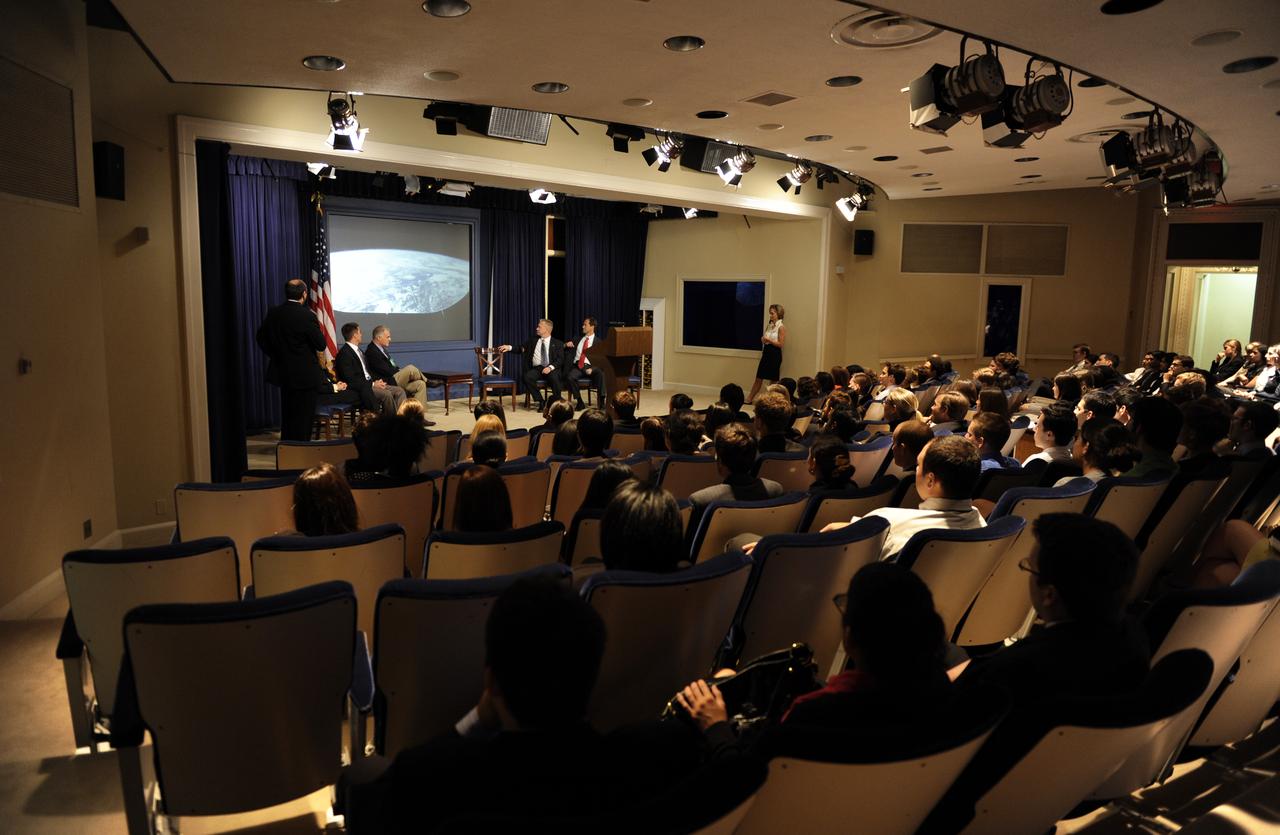
STS-127 Commander Mark Polansky, standing left, talks about the recent mission to White House interns at the Eisenhower Executiive Office Building in Washington, Thursday, Sept. 24, 2009. Seated from left are crew members Julie Payette, Christopher Cassidy, David Wolf, Douglas Hurley and Thomas Marshburn. Photo Credit: (NASA/Paul E. Alers)
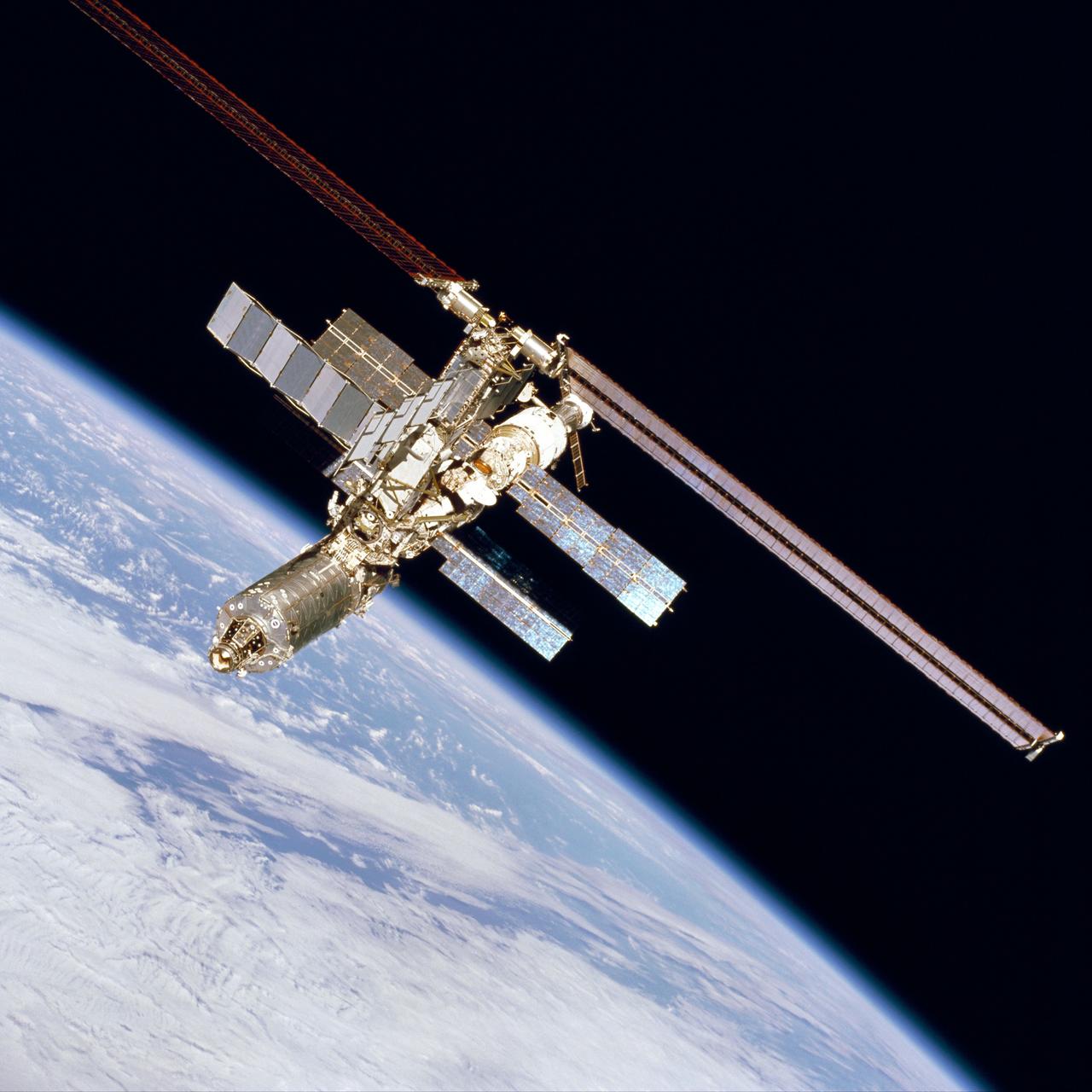
STS09-713a-004 (16 February 2001) --- With its new Destiny laboratory contrasted over a blue and white Earth, the International Space Station (ISS) was photographed by one of the STS-98 crew members aboard Atlantis following separation of the shuttle and the outpost at the end of several days of joint activities. The crews of Atlantis and the station parted company at 8:06 a.m. (CST), Feb. 16, as astronaut Mark L. Polansky, pilot, flew the shuttle halfway around the outpost and its new Destiny laboratory before moving off.
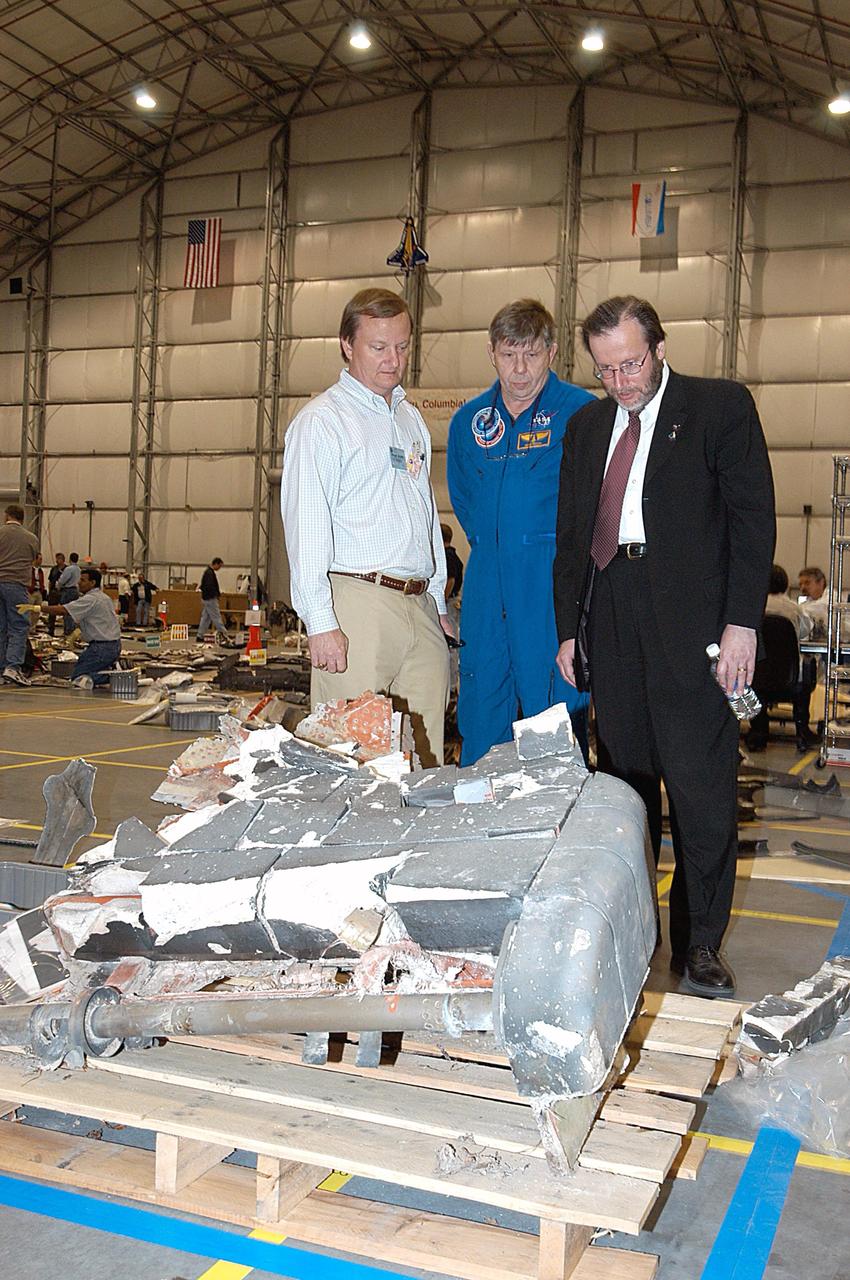
KENNEDY SPACE CENTER, FLA. - In the RLV Hangar at KSC, Shuttle Launch Director Mike Leinbach (left) shows some of the debris from Space Shuttle Columbia to former payload specialist Dr. Roger Crouch (center) and NASA Chief of Staff and White House liaison Courtney Stadd. The search of more than 500,000 acres of primary recovery area for Columbia material has passed the halfway mark. To date about 28 percent of Columbia, by weight, has been delivered to the hangar.

The Bell Aircraft Corporation X-1-2 aircraft on the ramp at NACA High Speed Flight Research Station located on the South Base of Muroc Army Air Field in 1947. The X-1-2 flew until October 23, 1951, completing 74 glide and powered flights with nine different pilots. The aircraft has white paint and the NACA tail band. The black Xs are reference markings for tracking purposes. They were widely used on NACA aircraft in the early 1950s.
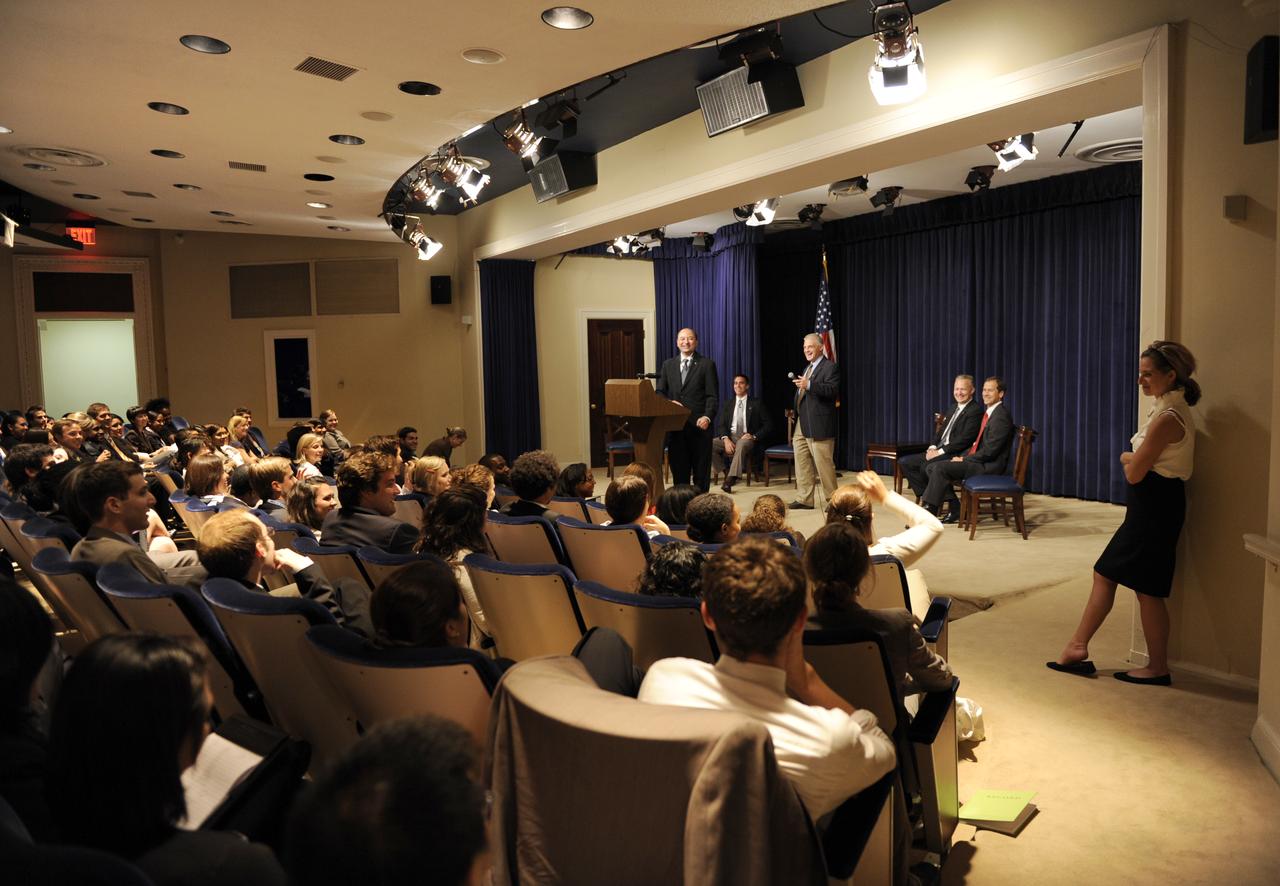
STS-127 Commander Mark Polansky, at podium, and crew member David Wolf, standing right, answer questions from White House interns at the Eisenhower Executiive Office Building in Washington, Thursday, Sept. 24, 2009. Seated from left are crew members Christopher Cassidy, Douglas Hurley and Thomas Marshburn. Photo Credit: (NASA/Paul E. Alers)
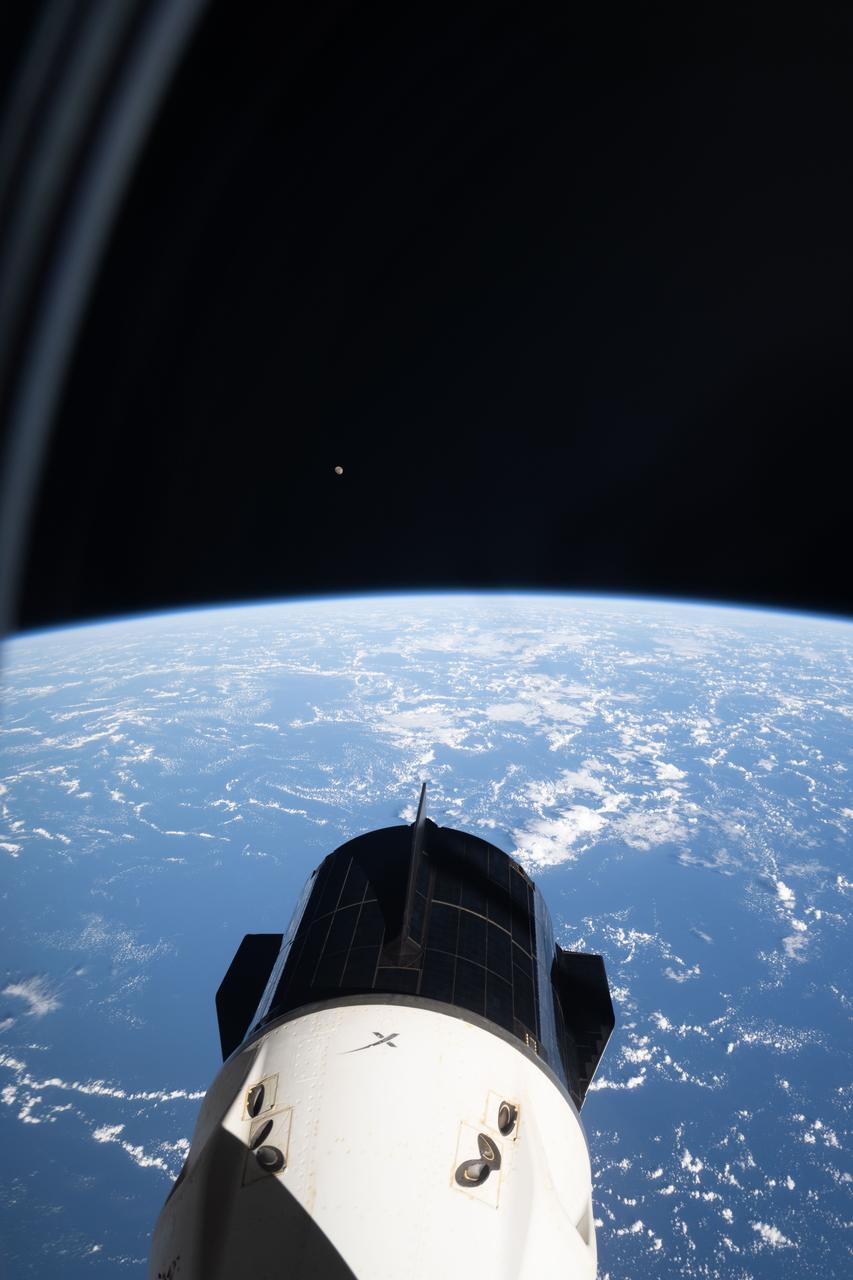
iss073e0505414 (Aug. 6, 2025) --- The SpaceX Dragon crew spacecraft that ferried NASA’s Crew-10 mission to the International Space Station is seen docked to the forward port of the Harmony module, as photographed from NASA’s SpaceX Crew-11 Dragon spacecraft attached to Harmony’s space-facing port. Just above Earth’s horizon at center left, a tiny white dot marks the Waxing Gibbous Moon. This image was captured as the orbital outpost soared 259 miles above the Atlantic Ocean.
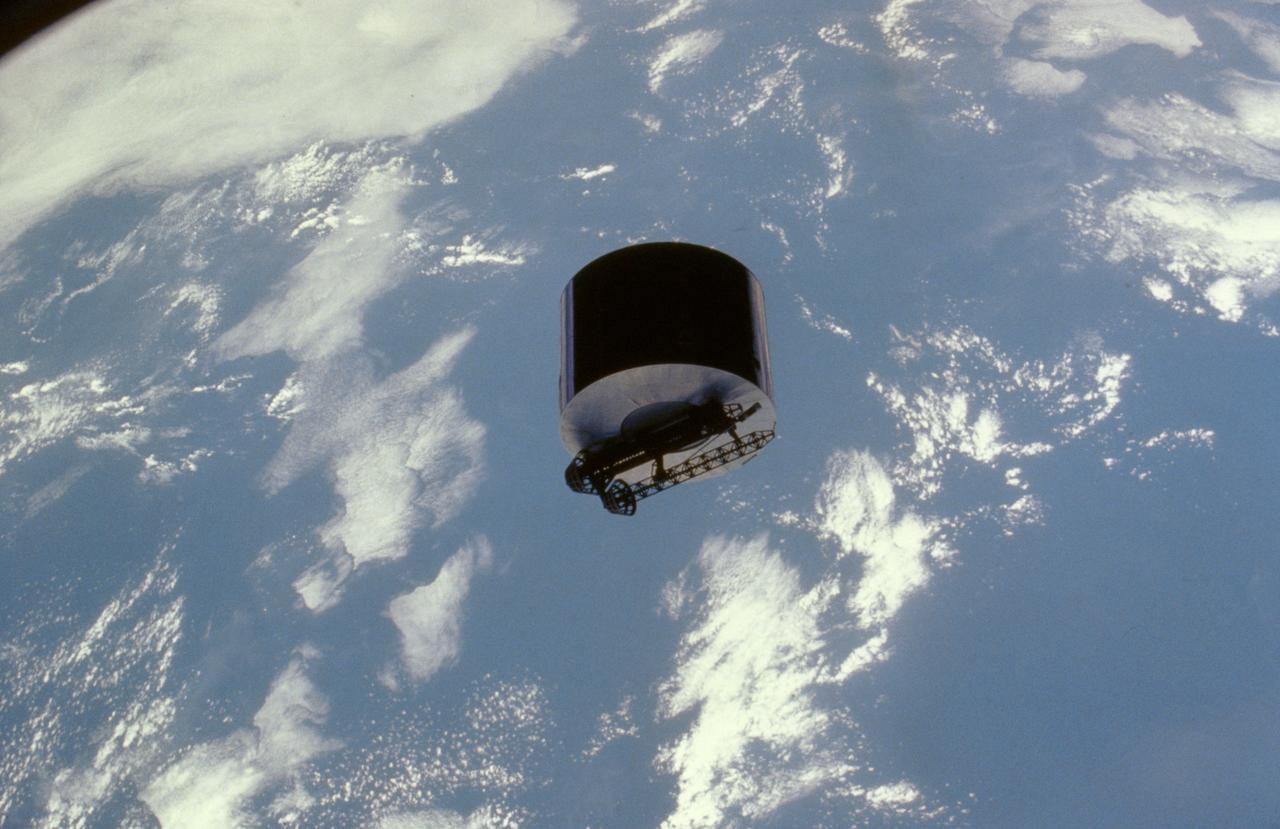
41D-02-020 (31 Aug 1984) --- The Syncom IV (Leasat-2) spacecraft stands out against white clouds above the Atlantic Ocean moments after departing the Discovery's cargo bay in a frisbee-like manner. The Syncom's deployment marked the second of three scheduled satellite placements for the six member crew of the six-day 41-D flight. A later frame (41D-32-067) shows the spacecraft after a slender antenna had been deployed.

Young people prepare model rockets during an Astro Camp activity at Keesler Air Force Base in Biloxi. Stennis hosted the camp June 28 - July 1 in support of the White House Military Families Initiative. The camp also marked the beginning of a partnership between Stennis and Keesler to provide NASA education experiences to military children and to train children and youth care-providers. It is hoped that this activity can be expanded to other military bases next summer.
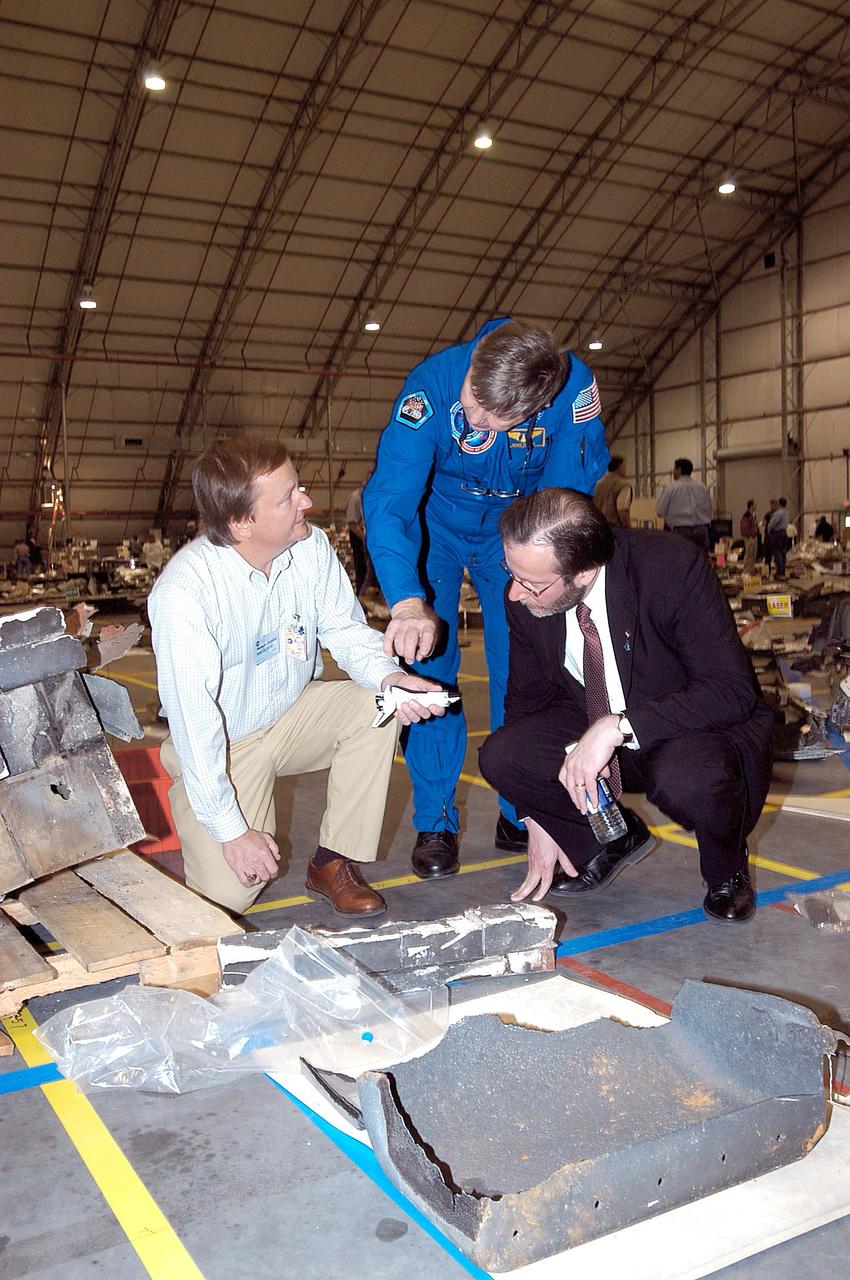
KENNEDY SPACE CENTER, FLA. - In the RLV Hangar at KSC, Shuttle Launch Director Mike Leinbach (left) shows some of the debris from Space Shuttle Columbia to former payload specialist Dr. Roger Crouch (center) and NASA Chief of Staff and White House liaison Courtney Stadd. The search of more than 500,000 acres of primary recovery area for Columbia material has passed the halfway mark. To date about 28 percent of Columbia, by weight, has been delivered to the hangar.
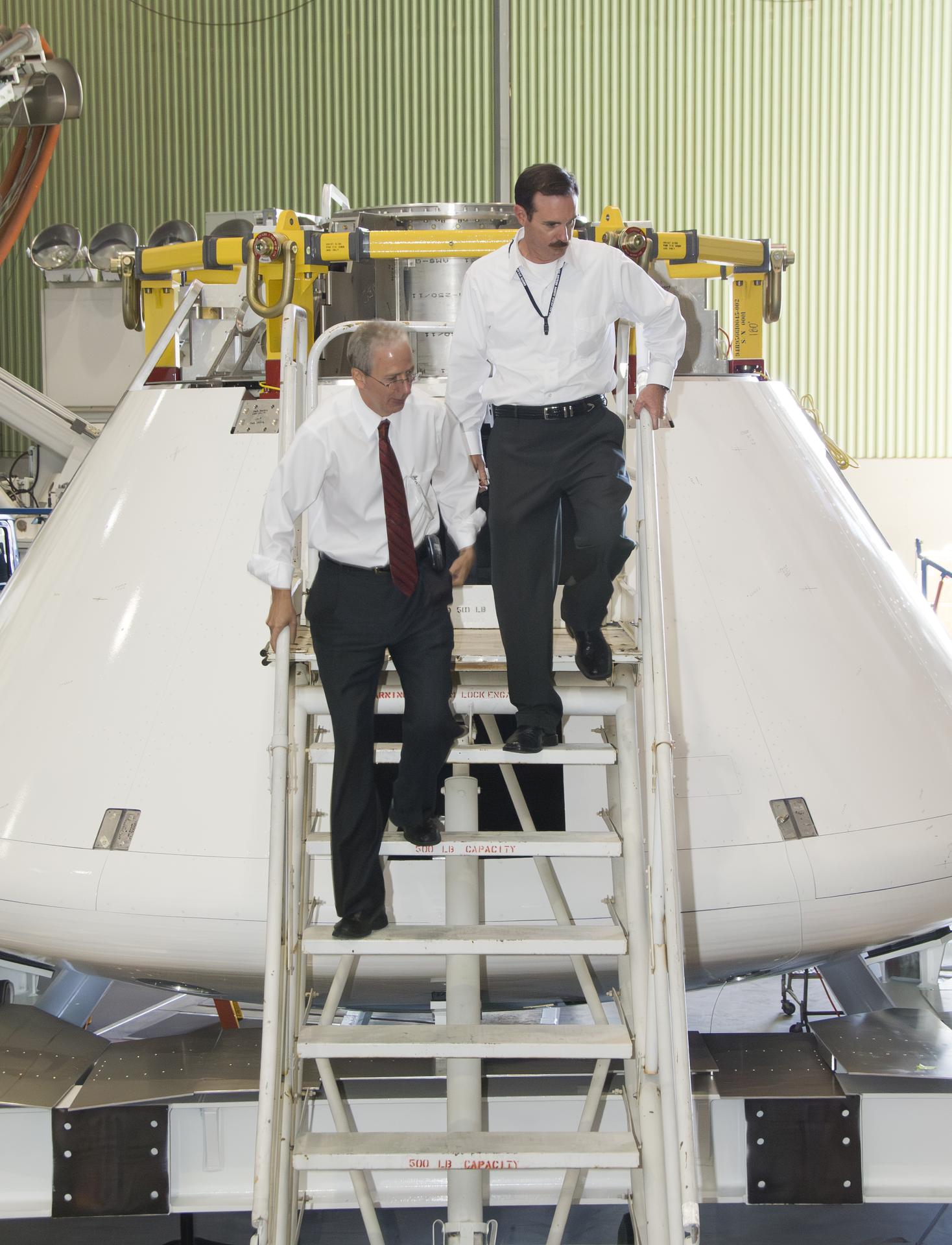
Mark Geyer, NASA’s Orion manager, visited NASA’s Armstrong Flight Research Center in Edwards, California, on April 9, 2008, to see the Pad Abort-1 test article, developed to demonstrate the Orion capsule’s emergency escape system during launch. Dave McAllister, NASA Armstrong Abort Flight Test operations lead, right, shows Geyer the Orion capsule mockup. Pad Abort-1 was later tested at the U.S. Army’s White Sands Missile Range in New Mexico, on May 6, 2010.
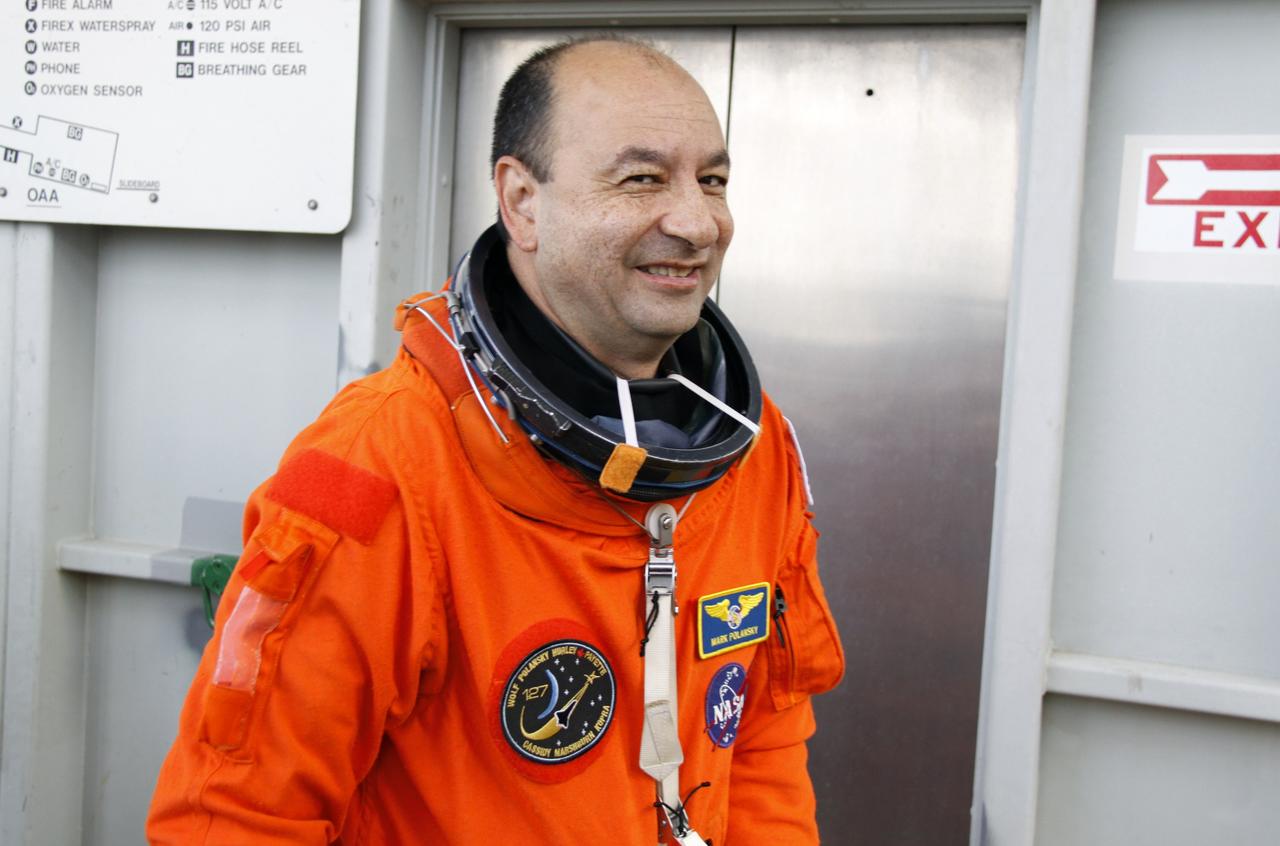
CAPE CANAVERAL, Fla. – STS-127 Commander Mark Polansky approaches the White Room on the orbiter access arm of the fixed service structure on Launch Pad 39A at NASA's Kennedy Space Center in Florida. He and other crew members will use the White Room to enter space shuttle Endeavour for the simulated launch countdown. The crew is at Kennedy for a launch dress rehearsal called the terminal countdown demonstration test, or TCDT, which includes the simulation, emergency exit training and equipment familiarization. Endeavour's STS-127 mission is the final of three flights dedicated to the assembly of the Japanese Kibo laboratory complex on the International Space Station. Endeavour's launch is scheduled for June 13 at 7:17 a.m. EDT. Photo credit: NASA/Troy Cryder
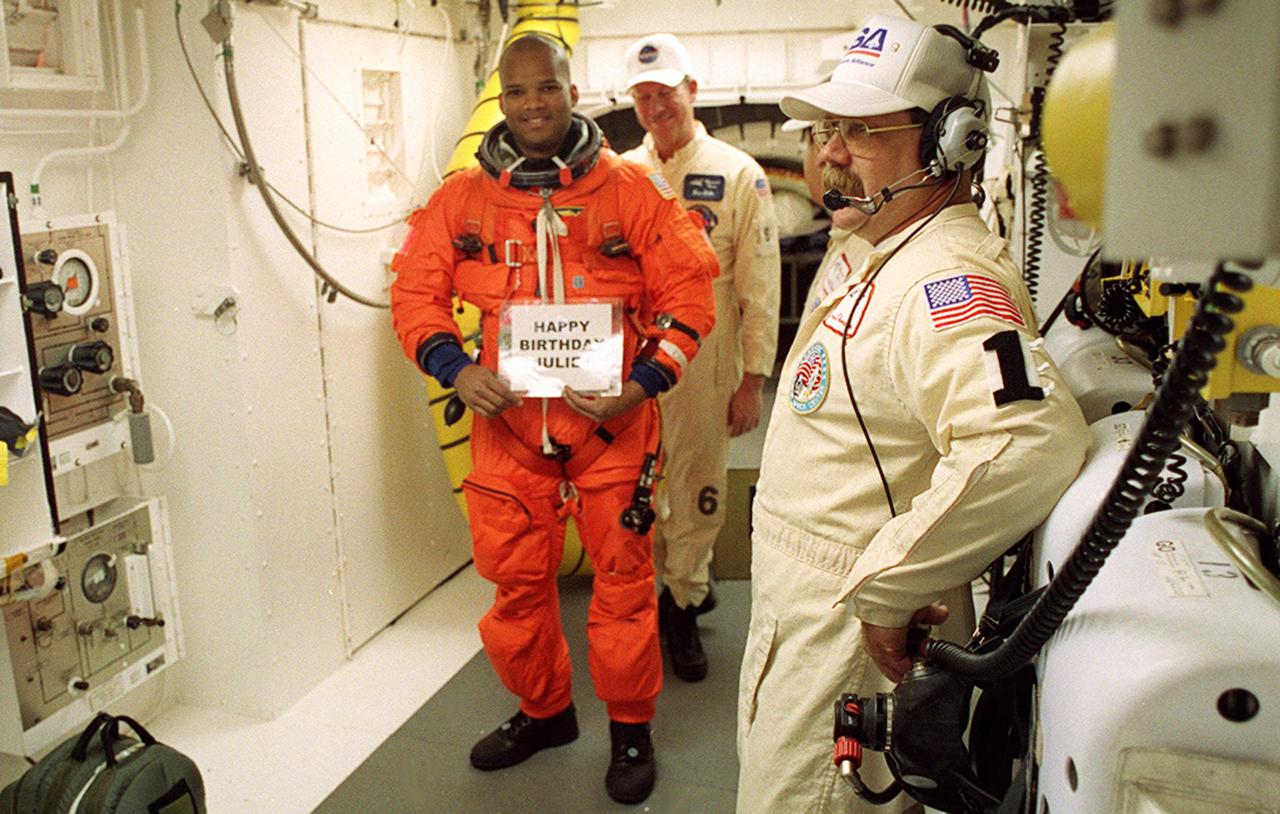
In the White Room with the closeout crew, STS-98 Mission Specialist Robert Curbeam sends a message to his wife before entering Space Shuttle Atlantis for launch. The White Room is an environmentally controlled room at the end of the Orbiter Access Arm. Atlantis is carrying the U.S. Laboratory Destiny, a key module in the growth of the Space Station. Destiny will be attached to the Unity node on the Space Station using the Shuttle’s robotic arm. Three spacewalks are required to complete the planned construction work during the 11-day mission. This mission marks the seventh Shuttle flight to the Space Station, the 23rd flight of Atlantis and the 102nd flight overall in NASA’s Space Shuttle program. The planned landing is at KSC Feb. 18 about 1 p.m
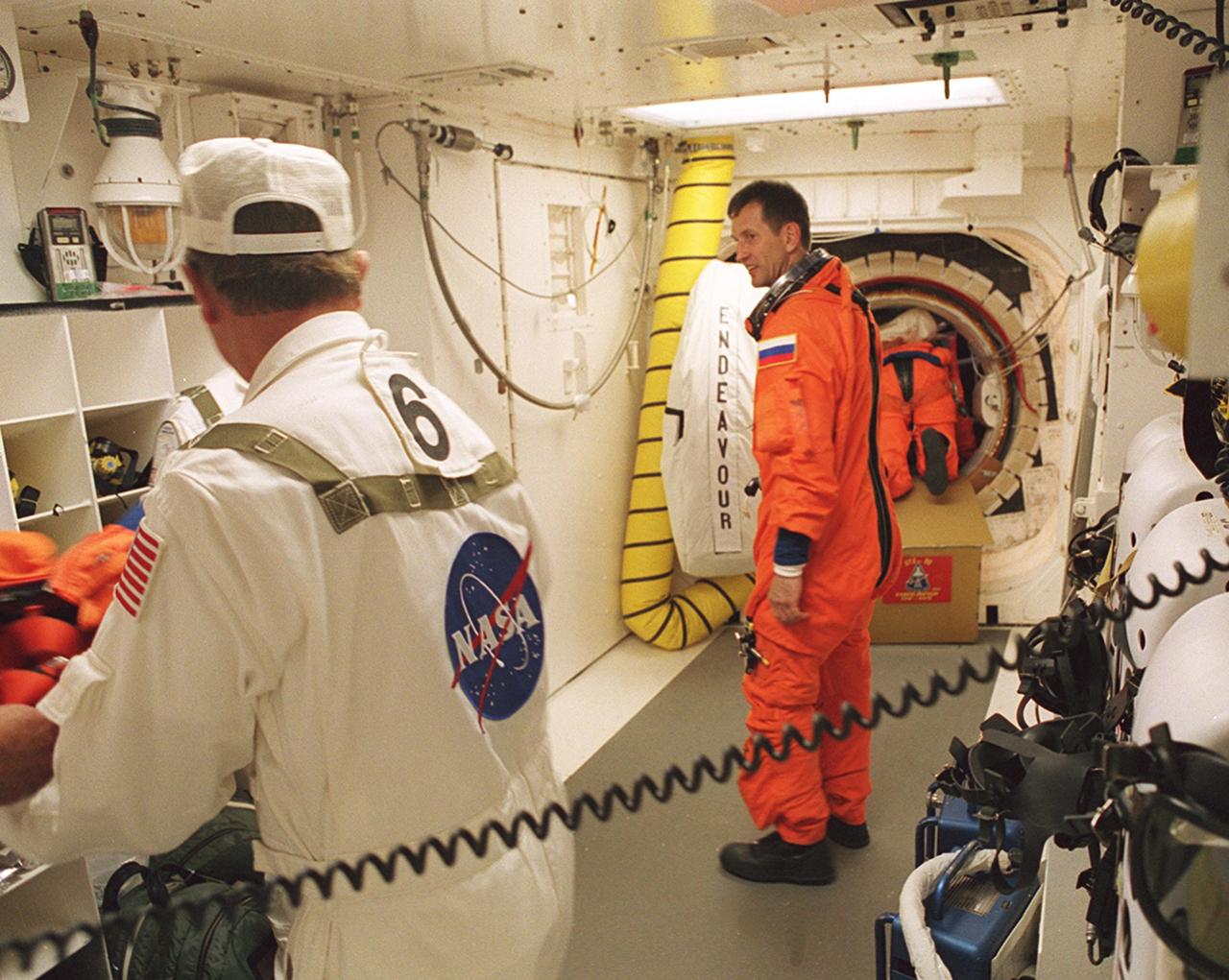
KENNEDY SPACE CENTER, FLA. -- Expedition Five cosmonaut Sergei Treschev talks to members of the Closeout Crew in the White Room before entering Space Shuttle Endeavour for launch of mission STS-111. The White Room, at the end of the Orbiter Access Arm, provides entry into the cockpit area of the orbiter. Other crew members are Commander Kenneth Cockrell, Pilot Paul Lockhart, Mission Specialists Franklin Chang-Diaz and Philippe Perrin (CNES), and Expedition Five Commander Valeri Korzun and astronaut Peggy Whitson. This mission, a utilization flight, marks the 14th Shuttle flight to the International Space Station and the third Shuttle mission this year. Mission STS-111 is the 18th flight of Endeavour and the 110th flight overall in NASA's Space Shuttle program
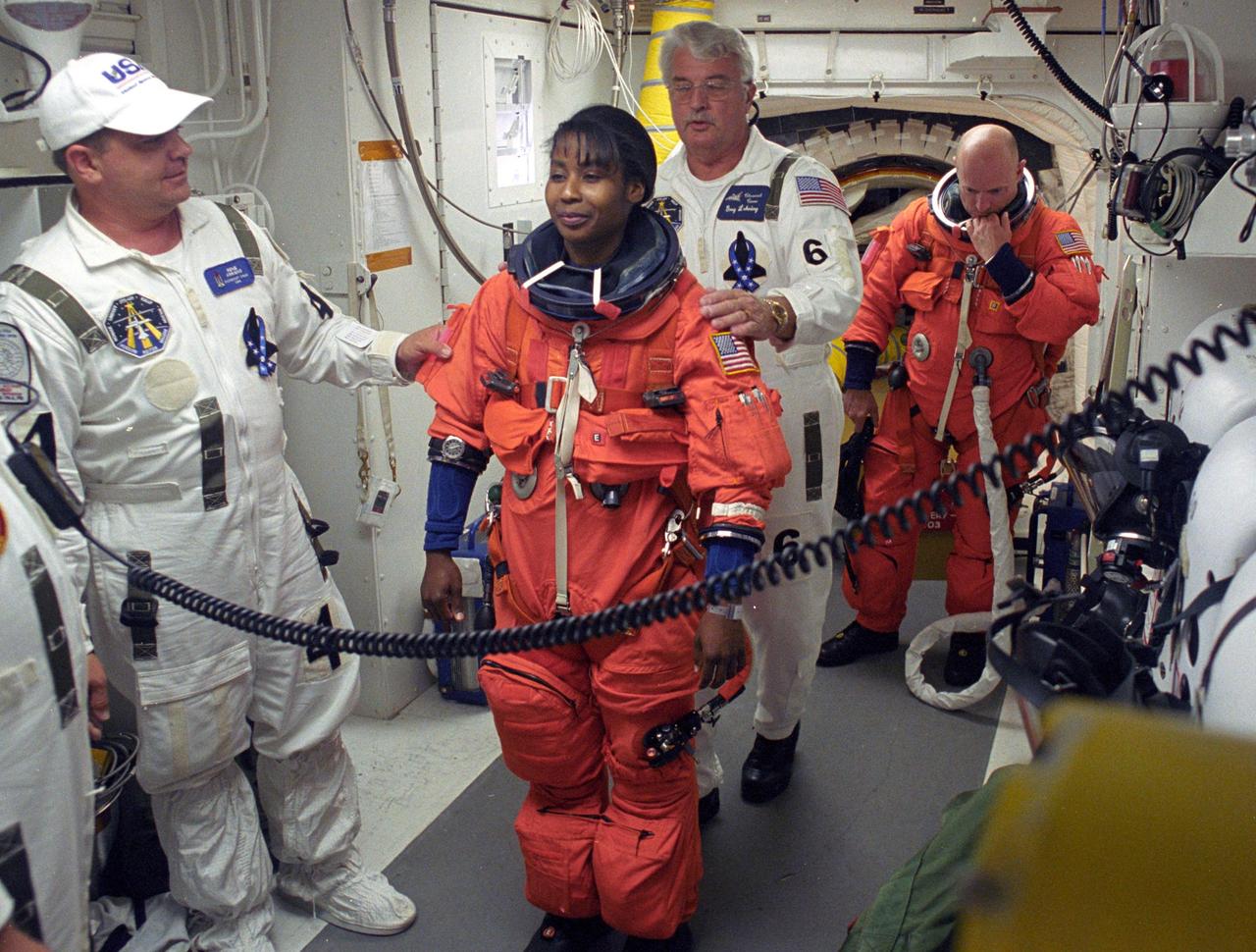
KENNEDY SPACE CENTER, FLA. - In the White Room on Launch Pad 39B, STS-121 Mission Specialist Stephanie Wilson is helped by the Closeout Crew to secure her launch suit before entering Discovery. Waiting in the back is Pilot Mark Kelly. Situated on the end of the orbiter access arm, the White Room provides access into the orbiter on the pad. The crew is preparing for the third launch attempt in four days; previous attempts were scrubbed due to weather concerns. During the 12-day mission, the STS-121 crew will test new equipment and procedures to improve shuttle safety, as well as deliver supplies and make repairs to the International Space Station. The launch of Space Shuttle Discovery on mission STS-121 is the 115th shuttle flight and the 18th U.S. flight to the International Space Station. Photo credit: NASA/Regina Mitchell-Ryall & Tony Gray

Before entering Atlantis from the White Room for a simulated launch countdown, STS-98 Pilot Mark Polansky (left) poses with Travis Thompson, who is the orbiter vehicle closeout chief. The White Room is an environmental chamber at the end of the orbiter access arm that mates with the orbiter to allow personnel to enter the orbiter’s crew compartment. Thompson is with United Space Alliance. The STS-98 crew is taking part in Terminal Countdown Demonstration Test activities, which also include emergency egress training at the pad. STS-98 is the seventh construction flight to the International Space Station, carrying as payload the U.S. Lab Destiny, a key element in the construction of the ISS. Launch of STS-98 is scheduled for Jan. 19 at 2:11 a.m. EST
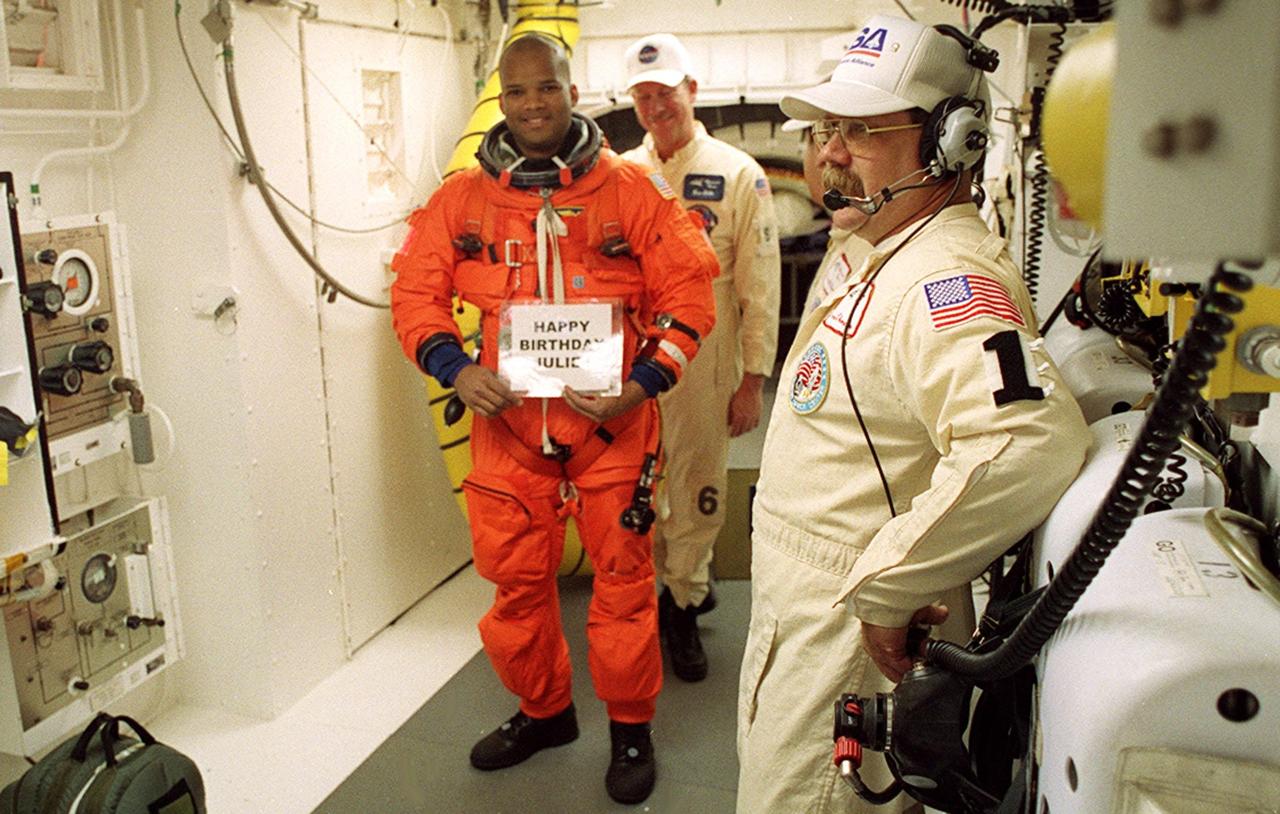
In the White Room with the closeout crew, STS-98 Mission Specialist Robert Curbeam sends a message to his wife before entering Space Shuttle Atlantis for launch. The White Room is an environmentally controlled room at the end of the Orbiter Access Arm. Atlantis is carrying the U.S. Laboratory Destiny, a key module in the growth of the Space Station. Destiny will be attached to the Unity node on the Space Station using the Shuttle’s robotic arm. Three spacewalks are required to complete the planned construction work during the 11-day mission. This mission marks the seventh Shuttle flight to the Space Station, the 23rd flight of Atlantis and the 102nd flight overall in NASA’s Space Shuttle program. The planned landing is at KSC Feb. 18 about 1 p.m
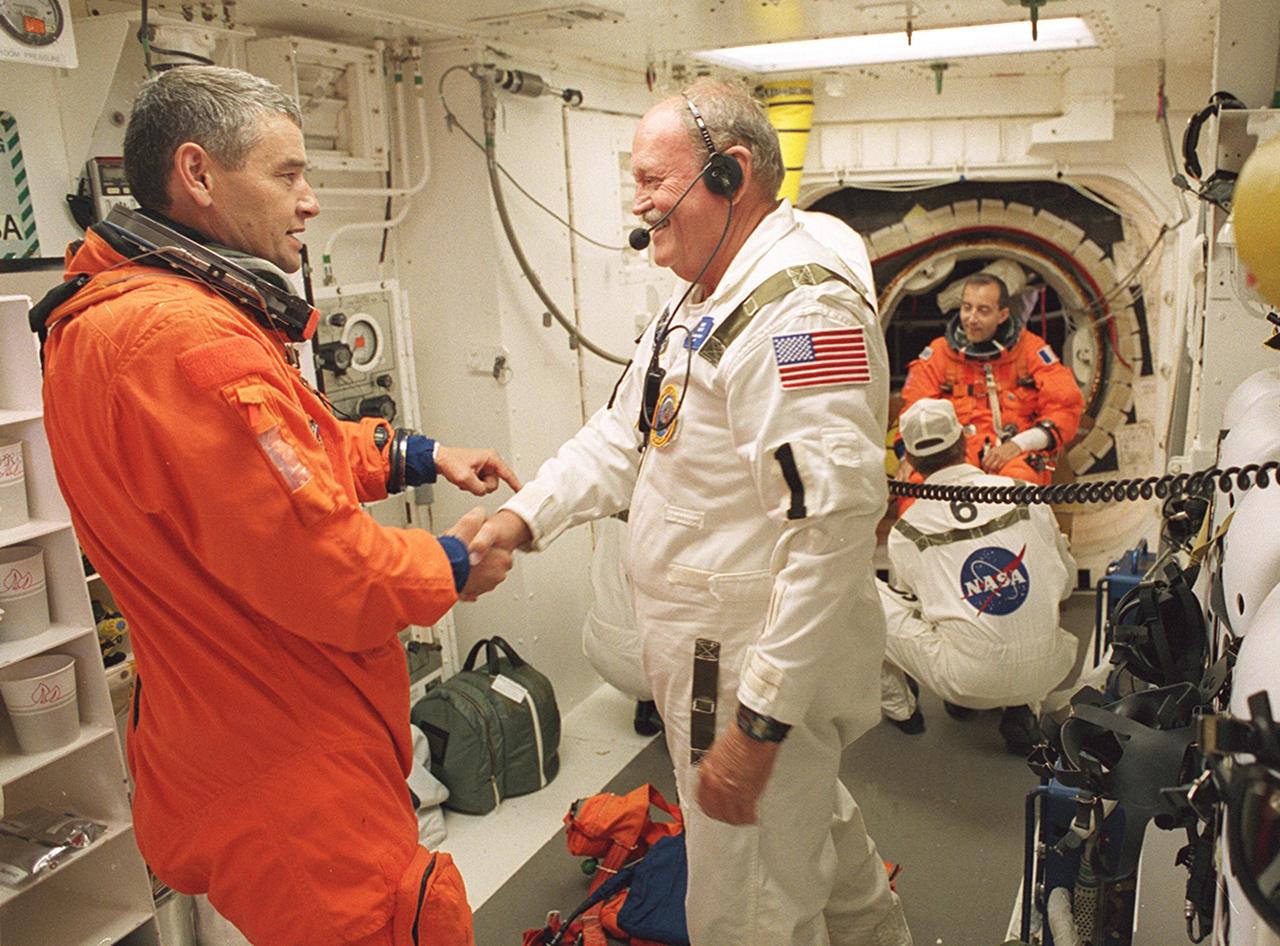
KENNEDY SPACE CENTER, FLA. -- Expedition Five Commander Valeri Korzun shakes hands with a member of the Closeout Crew in the White Room before entering Space Shuttle Endeavour for launch of mission STS-111. The White Room, at the end of the Orbiter Access Arm, provides entry into the cockpit area of the orbiter. Other crew members are Commander Kenneth Cockrell, Pilot Paul Lockhart and Mission Specialists Franklin Chang-Diaz and Philippe Perrin (CNES) , and Expedition Five astronaut Peggy Whitson and cosmonaut Sergei Treschev. This mission, a utilization flight, marks the 14th Shuttle flight to the International Space Station and the third Shuttle mission this year. Mission STS-111 is the 18th flight of Endeavour and the 110th flight overall in NASA's Space Shuttle program
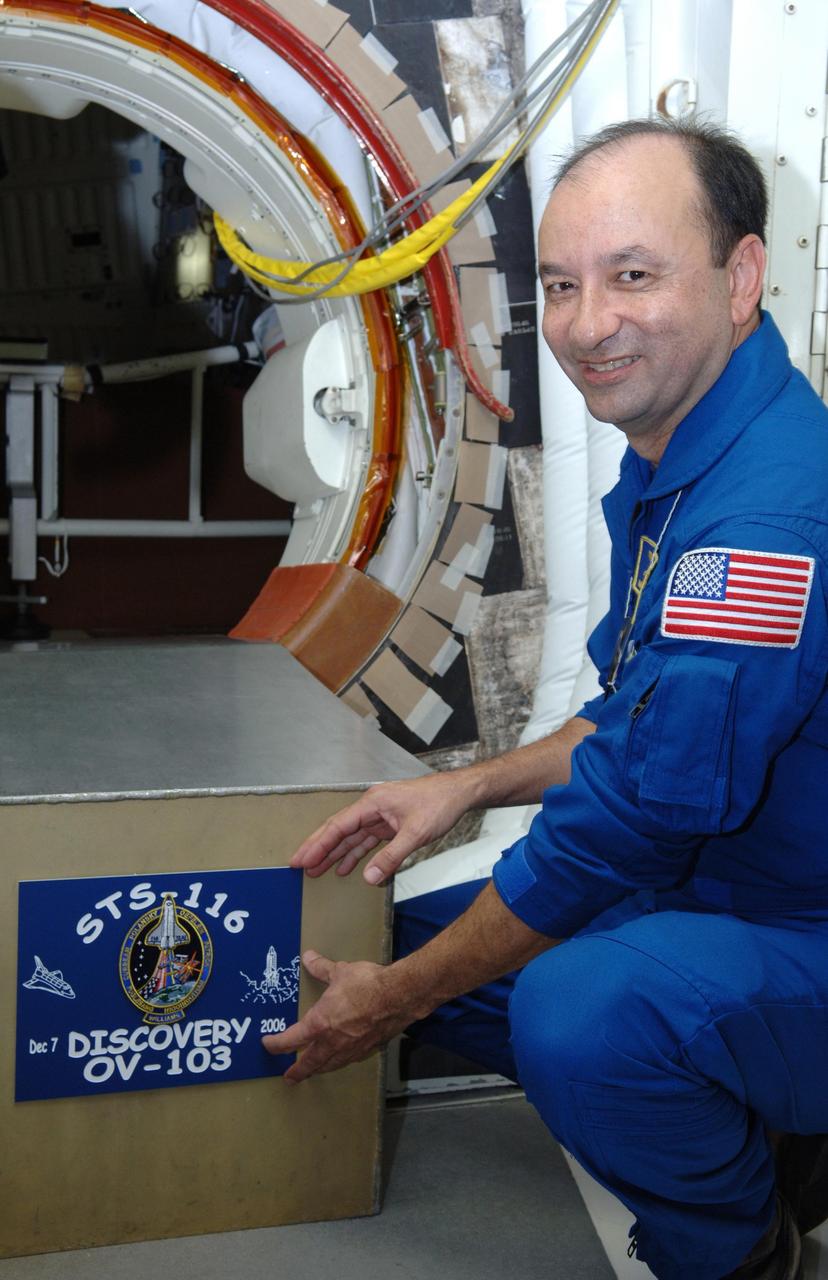
KENNEDY SPACE CENTER, FLA. -- In the White Room on Launch Pad 39B, STS-116 Commander Mark Polansky places the mission placard at the hatch opening. The White Room is the point of entry into Space Shuttle Discovery for the crew. Other crew members are Pilot William Oefelein and Mission Specialists Joan Higginbotham, Sunita Williams, Nicholas Patrick, Robert Curbeam and Christer Fuglesang, who represents the European Space Agency. The mission crew is at KSC for the TCDT, which includes a simulated launch countdown. The STS-116 mission is No. 20 to the International Space Station and construction flight 12A.1. The mission payload is the SPACEHAB module, the P5 integrated truss structure and other key components. Launch is scheduled for no earlier than Dec. 7. Photo credit: NASA/Kim Shiflett
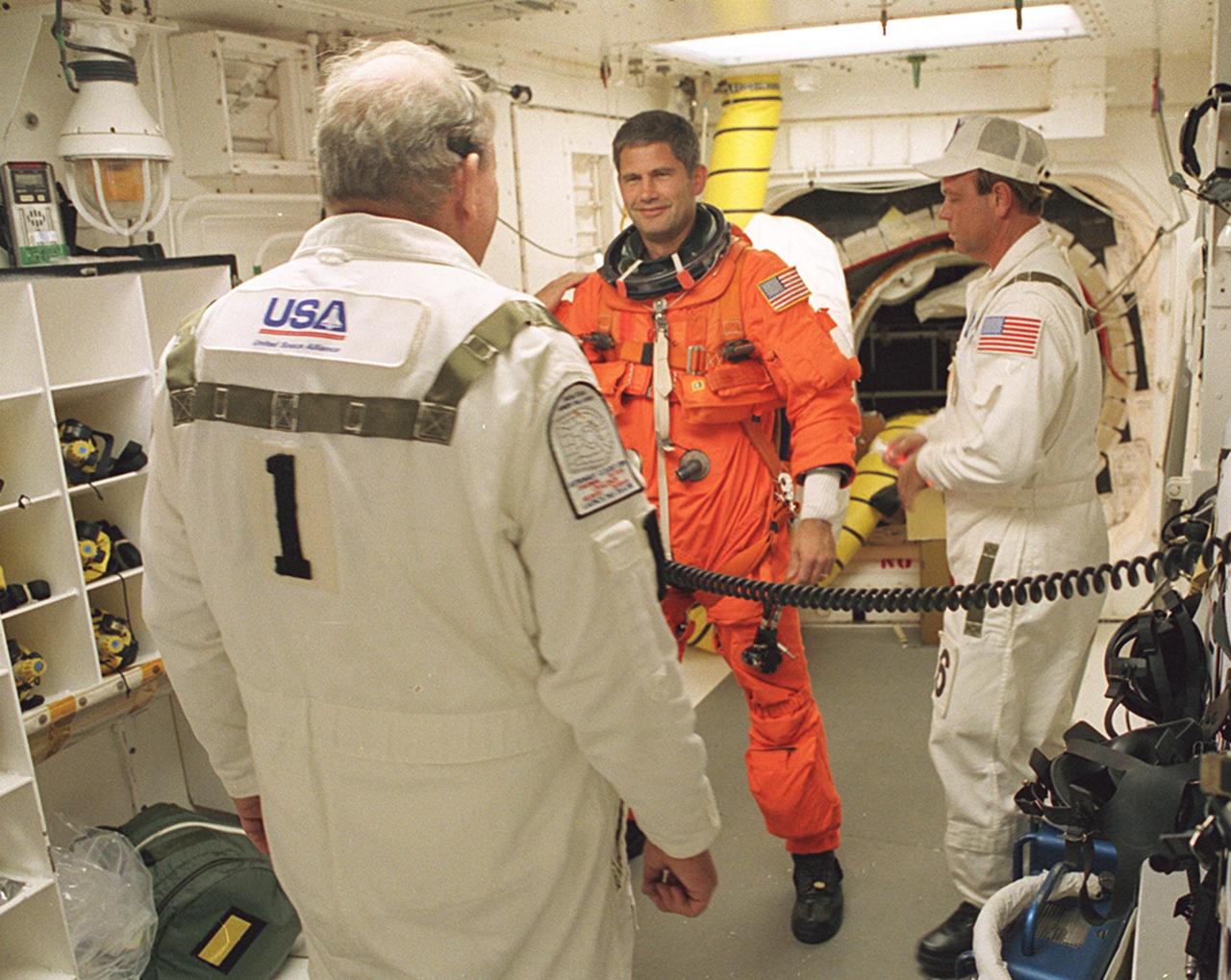
KENNEDY SPACE CENTER, FLA. -- STS-111 Pilot Paul Lockhart talks to members of the Closeout Crew in the White Room before entering Space Shuttle Endeavour for launch. The White Room, at the end of the Orbiter Access Arm, provides entry into the cockpit area of the orbiter. Other crew members are Commander Kenneth Cockrell, Mission Specialists Franklin Chang-Diaz and Philippe Perrin (CNES), and Expedition Five Commander Valeri Korzun, astronaut Peggy Whitson, and cosmonaut Sergei Treschev. This mission, a utilization flight, marks the 14th Shuttle flight to the International Space Station and the third Shuttle mission this year. Mission STS-111 is the 18th flight of Endeavour and the 110th flight overall in NASA's Space Shuttle program
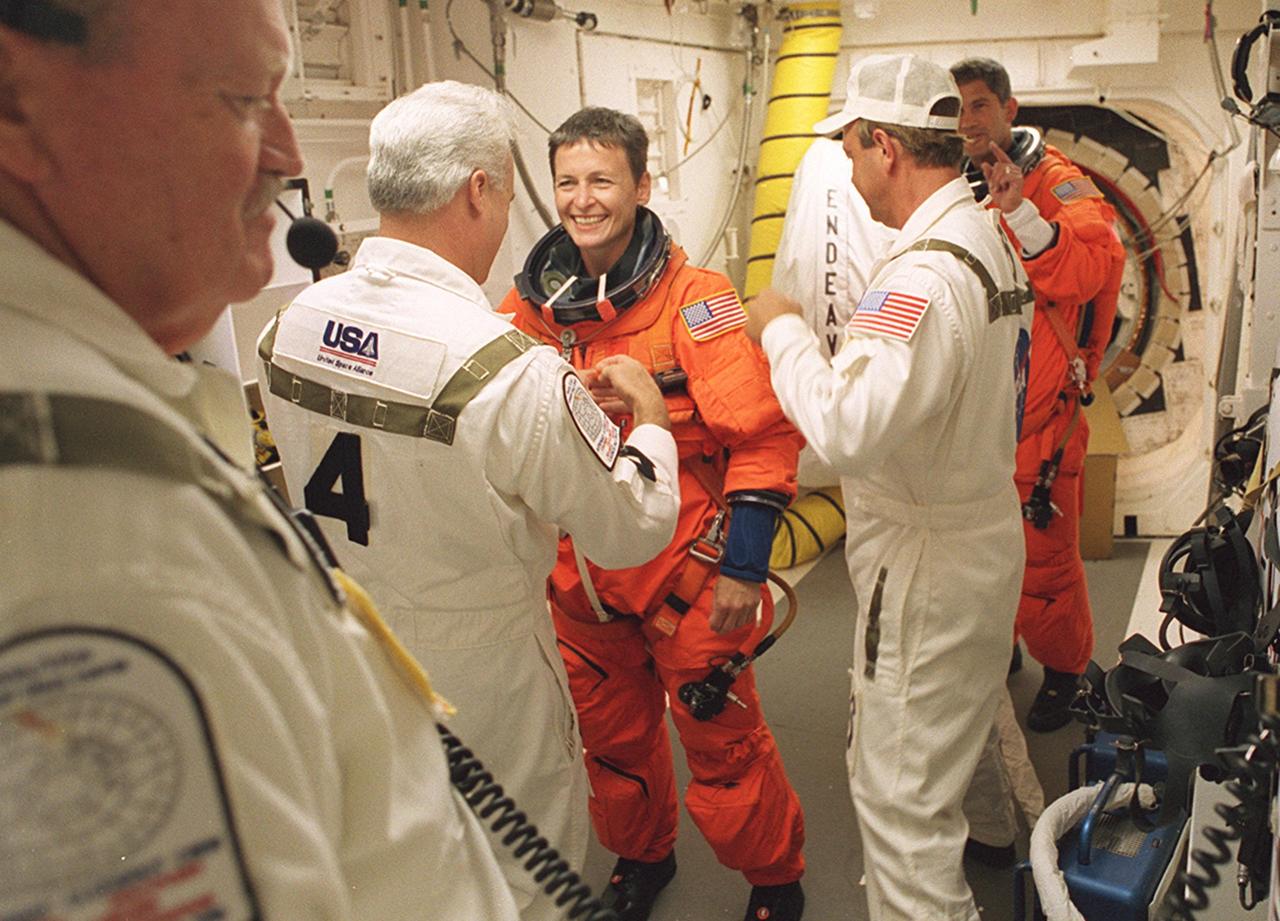
KENNEDY SPACE CENTER, FLA. -- Expedition Five astronaut Peggy Whitson talks to members of the Closeout Crew in the White Room before entering Space Shuttle Endeavour for launch of mission STS-111. STS-111 Pilot Paul Lockhart awaits his turn to enter the orbiter in the background. The White Room, at the end of the Orbiter Access Arm, provides entry into the cockpit area of the orbiter. Other crew members are Commander Kenneth Cockrell and Mission Specialists Franklin Chang-Diaz and Philippe Perrin (CNES), and Expedition Five Commander Valeri Korzun and cosmonaut Sergei Treschev. This mission, a utilization flight, marks the 14th Shuttle flight to the International Space Station and the third Shuttle mission this year. Mission STS-111 is the 18th flight of Endeavour and the 110th flight overall in NASA's Space Shuttle program
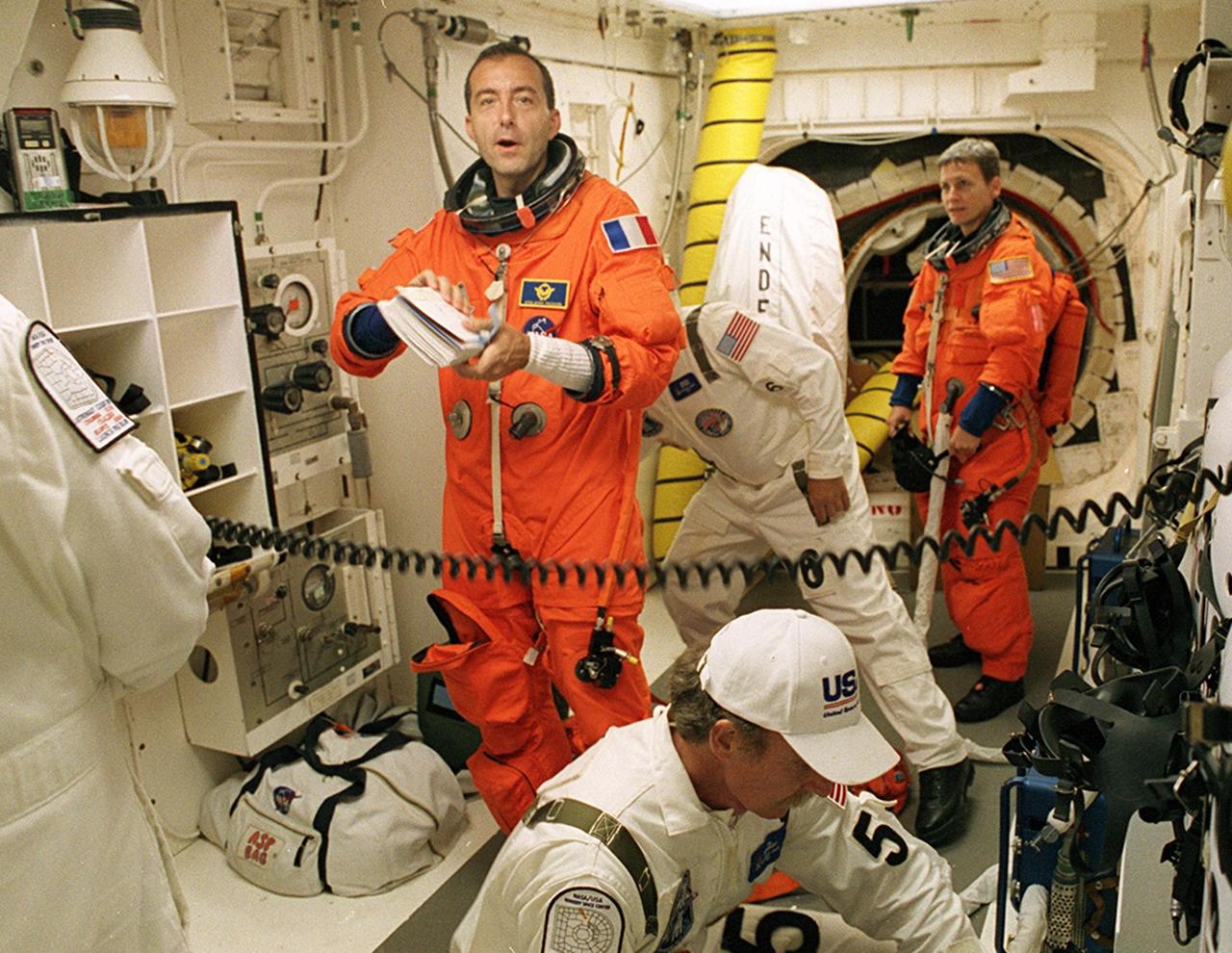
KENNEDY SPACE CENTER, FLA. -- STS-111 Mission Specialist Philippe Perrin (CNES) talks to members of the Closeout Crew in the White Room before entering Space Shuttle Endeavour for launch. Expedition Five astronaut Peggy Whitson awaits her turn to enter the orbiter in the background. The White Room, at the end of the Orbiter Access Arm, provides entry into the cockpit area of the orbiter. Other crew members are Commander Kenneth Cockrell, Pilot Paul Lockhart and Mission Specialist Franklin Chang-Diaz, and Expedition Five Commander Valeri Korzun and cosmonaut Sergei Treschev. This mission, a utilization flight, marks the 14th Shuttle flight to the International Space Station and the third Shuttle mission this year. Mission STS-111 is the 18th flight of Endeavour and the 110th flight overall in NASA's Space Shuttle program
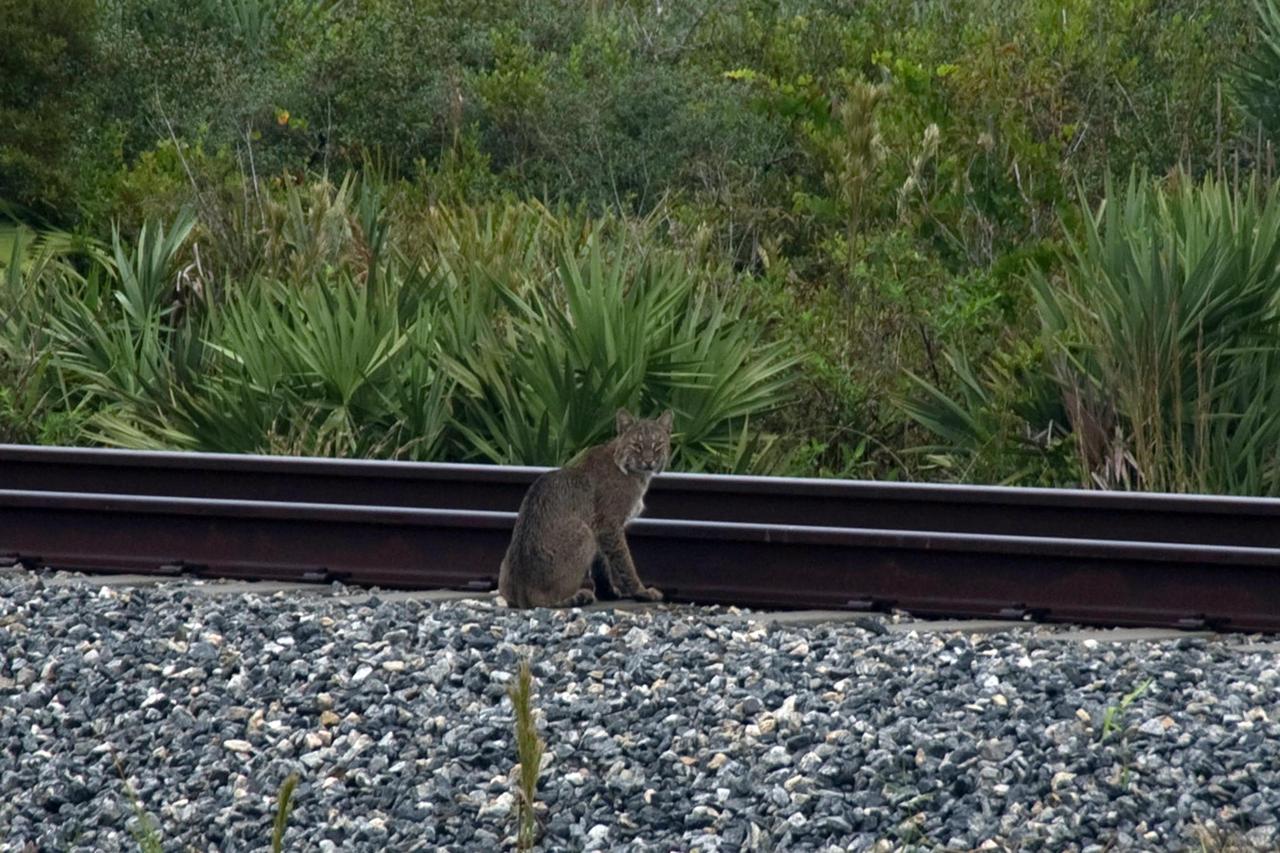
KENNEDY SPACE CENTER, FLA. -- A rare view of a bobcat, spotted near the NASA Railroad tracks on a mid-morning. The bobcat is a solitary and territorial predator mammal. They are mostly nocturnal and solitary, but will travel long distances for a mate. Not as big as a panther, but about the size of a medium-sized dog, male and female bobcats average 39 inches and 36 inches in length, and 24 pounds and 15 pounds in weight, respectively. They are most easily identified by their short tails which are about 5.5 inches long. Their fur, which is short, soft and dense, ranges from light tan to reddish or yellowish brown and markings vary from tabby stripes to spotting. They swim more than other native cats. The backs of their ears are white with a black outline. Their underparts are generally white. Bobcats can most likely be found in every county in Florida. Photo credit: NASA/Sandra Joseph
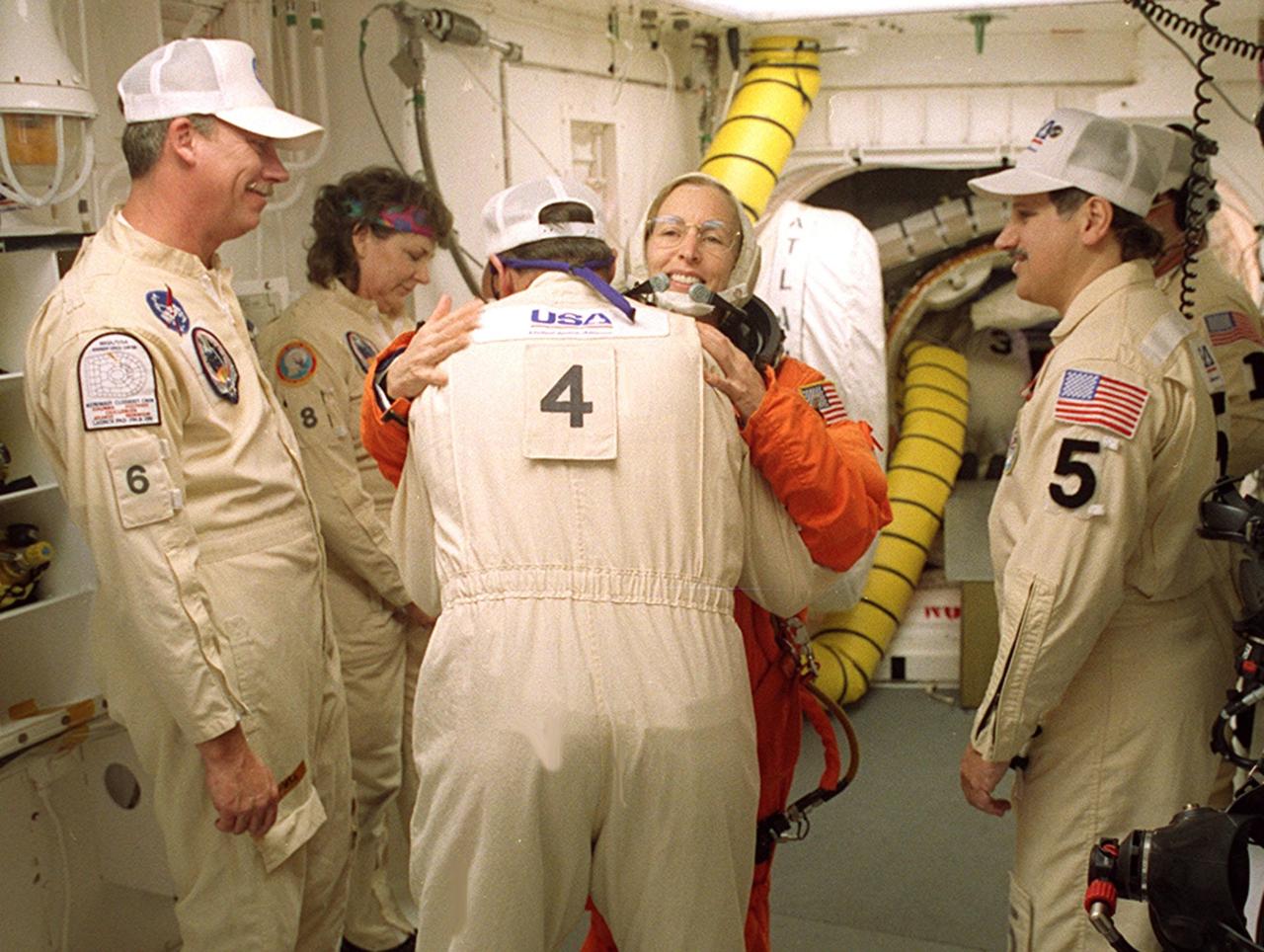
In the White Room before launch, STS-98 Mission Specialist Marsha Ivins gets a hug from a closeout crew member before she enters Space Shuttle Atlantis. The White Room is an environmentally controlled room at the end of the Orbiter Access Arm. Atlantis is carrying the U.S. Laboratory Destiny, a key module in the growth of the Space Station. Destiny will be attached to the Unity node on the Space Station using the Shuttle’s robotic arm. Three spacewalks are required to complete the planned construction work during the 11-day mission. This mission marks the seventh Shuttle flight to the Space Station, the 23rd flight of Atlantis and the 102nd flight overall in NASA’s Space Shuttle program. The planned landing is at KSC Feb. 18 about 1 p.m
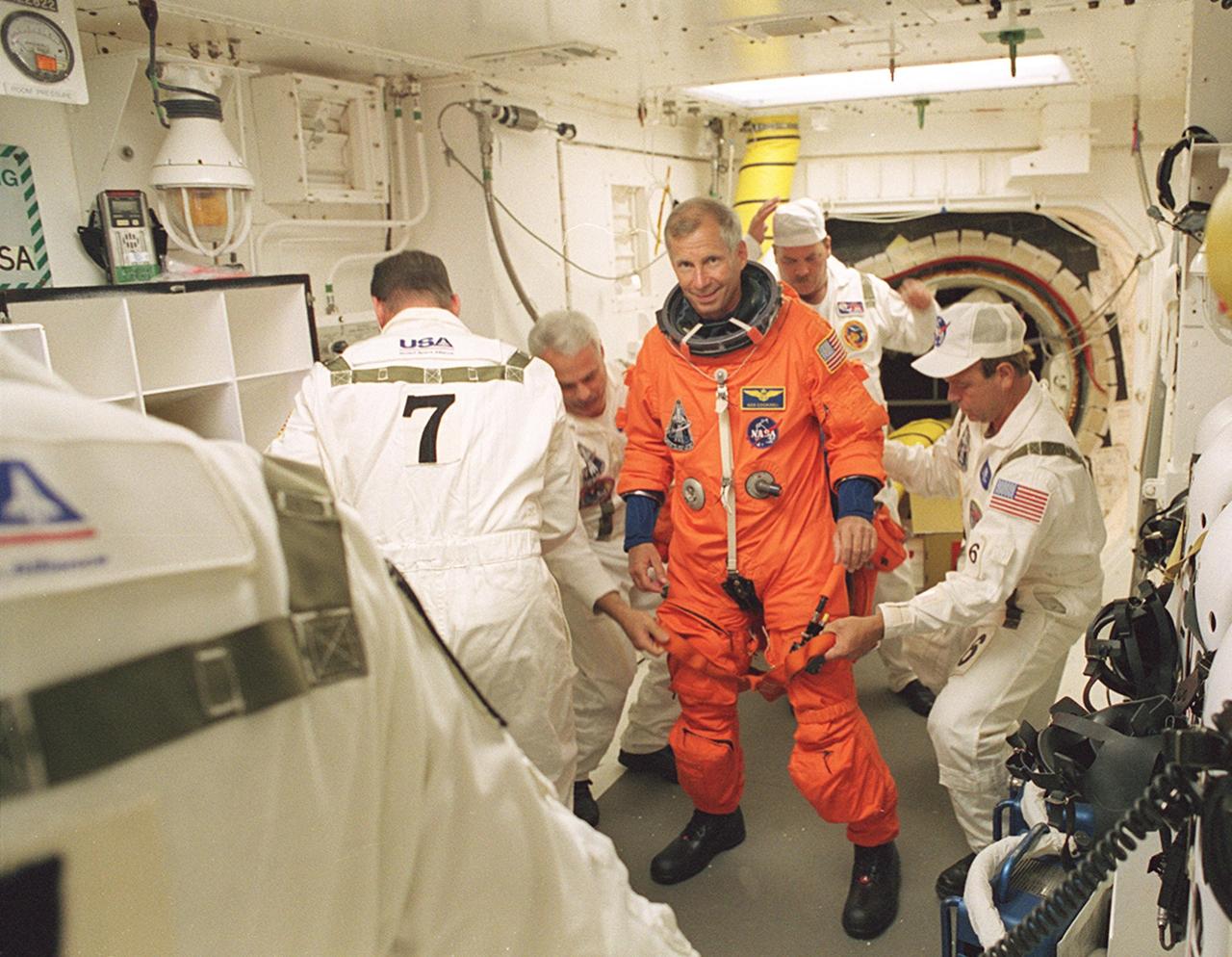
KENNEDY SPACE CENTER, FLA. -- STS-111 Commander Kenneth Cockrell is assisted by members of the Closeout Crew in the White Room before entering Space Shuttle Endeavour for launch. The White Room, at the end of the Orbiter Access Arm, provides entry into the cockpit area of the orbiter. Other crew members are Pilot Paul Lockhart, Mission Specialists Franklin Chang-Diaz and Philippe Perrin (CNES), and the Expedition Five Commander Valeri Korzun, astronaut Peggy Whitson and cosmonaut Sergei Treschev. This mission, a utilization flight, marks the 14th Shuttle flight to the International Space Station and the third Shuttle mission this year. Mission STS-111 is the 18th flight of Endeavour and the 110th flight overall in NASA's Space Shuttle program
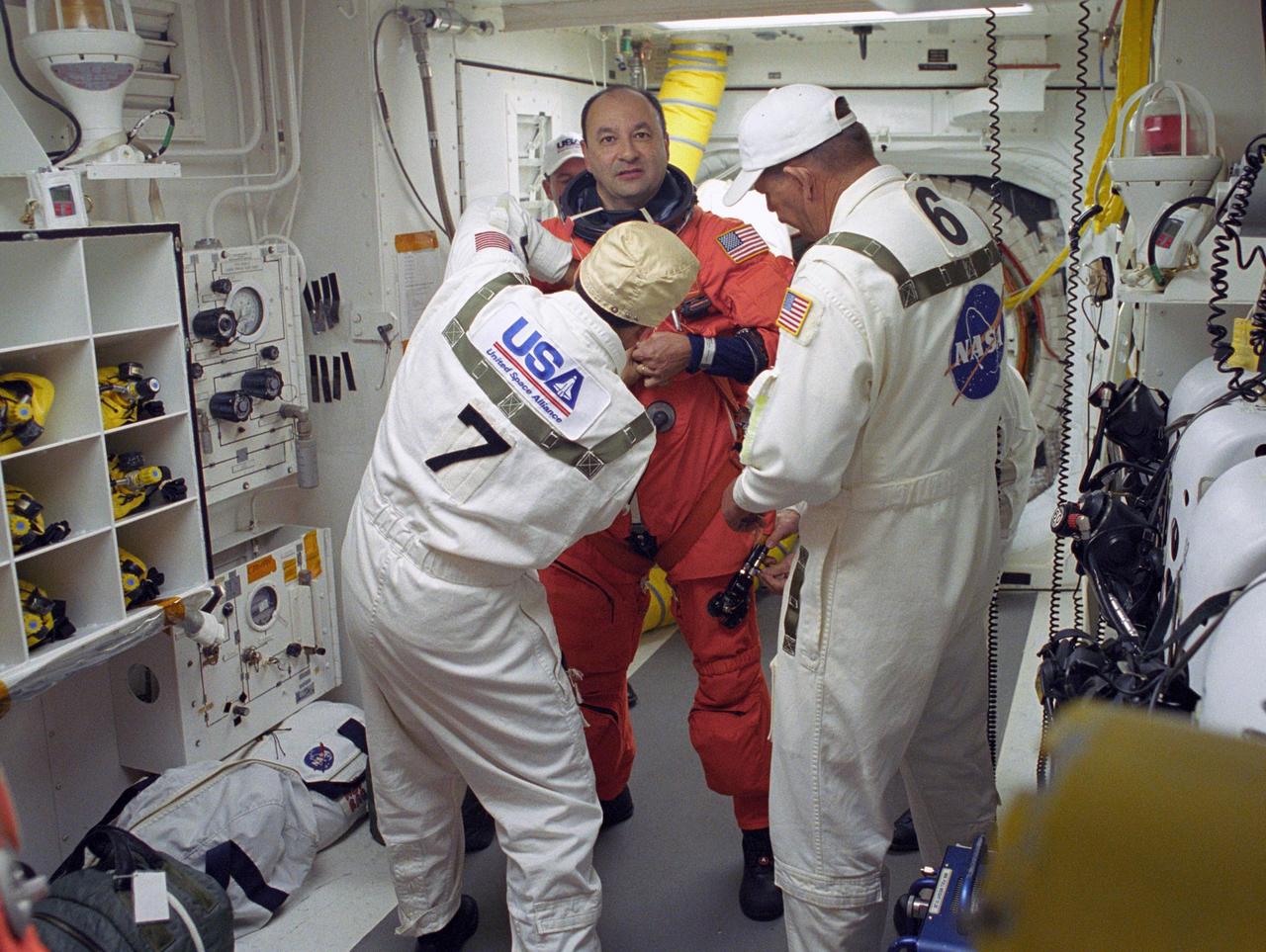
KENNEDY SPACE CENTER, FLA. -- STS-116 Commander Mark Polansky is helped by the closeout crew in the White Room to secure his launch suit before climbing into Space Shuttle Discovery. The White Room is at the end of the orbiter access arm that extends from the fixed service structure and provides entry into the orbiter. The first launch attempt of STS-116 on Dec. 7 was postponed due a low cloud ceiling over Kennedy Space Center. This second launch attempt is scheduled for 8:47 p.m. This is Discovery's 33rd mission and the first night launch since 2002. The 20th shuttle mission to the International Space Station, STS-116 carries another truss segment, P5. It will serve as a spacer, mated to the P4 truss that was attached in September. After installing the P5, the crew will reconfigure and redistribute the power generated by two pairs of U.S. solar arrays. Landing is expected Dec. 21 at KSC. Photo credit: NASA/Tony Gray & Don Kight
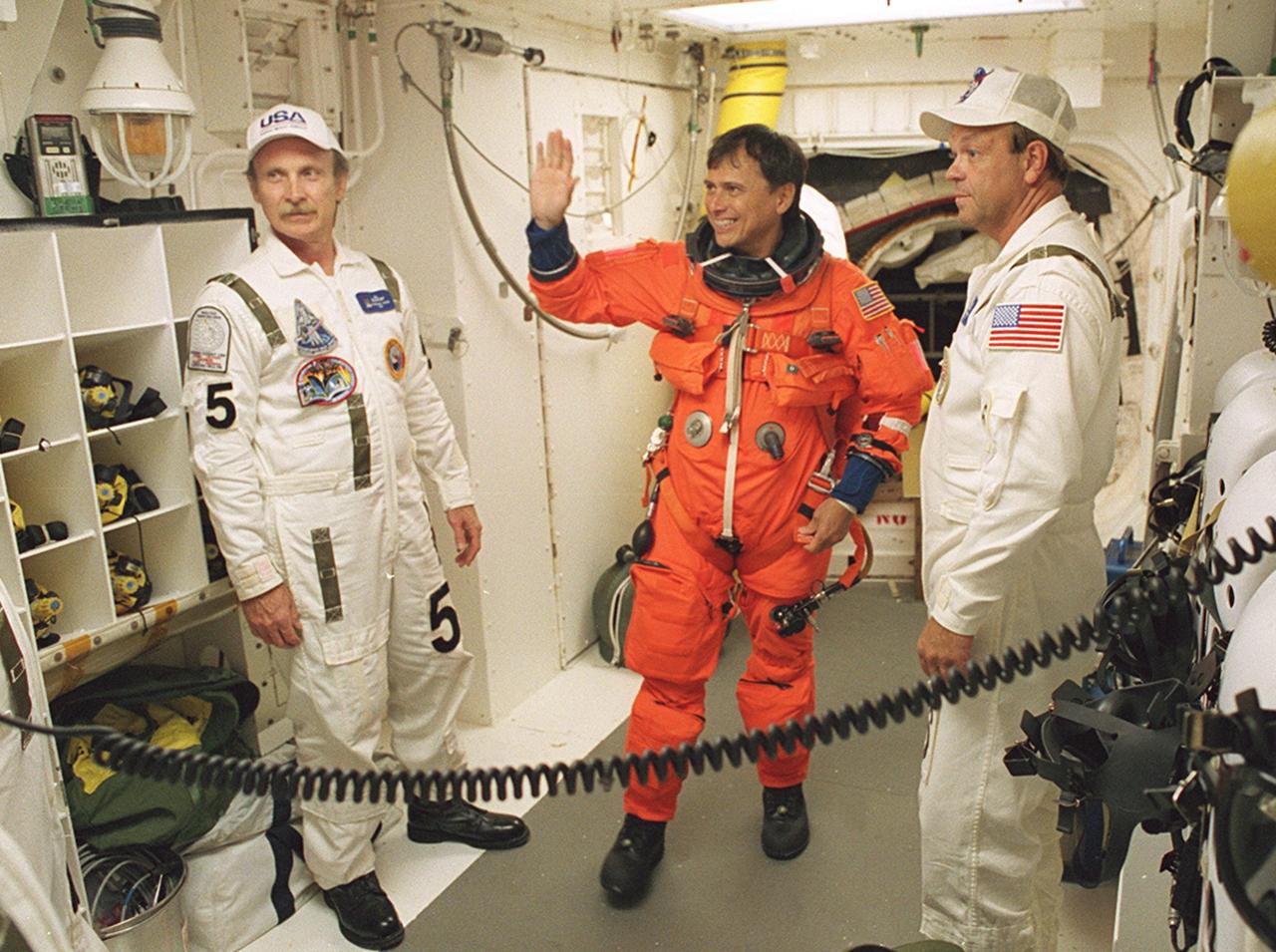
KENNEDY SPACE CENTER, FLA. -- STS-111 Mission Specialist Franklin Chang-Diaz waves to a member of the Closeout Crew in the White Room before entering Space Shuttle Endeavour for launch. The White Room, at the end of the Orbiter Access Arm, provides entry into the cockpit area of the orbiter. Other crew members are Commander Kenneth Cockrell, Pilot Paul Lockhart and Mission Specialist Philippe Perrin (CNES) , and Expedition Five Commander Valeri Korzun, astronaut Peggy Whitson and cosmonaut Sergei Treschev. This mission, a utilization flight, marks the 14th Shuttle flight to the International Space Station and the third Shuttle mission this year. Mission STS-111 is the 18th flight of Endeavour and the 110th flight overall in NASA's Space Shuttle program
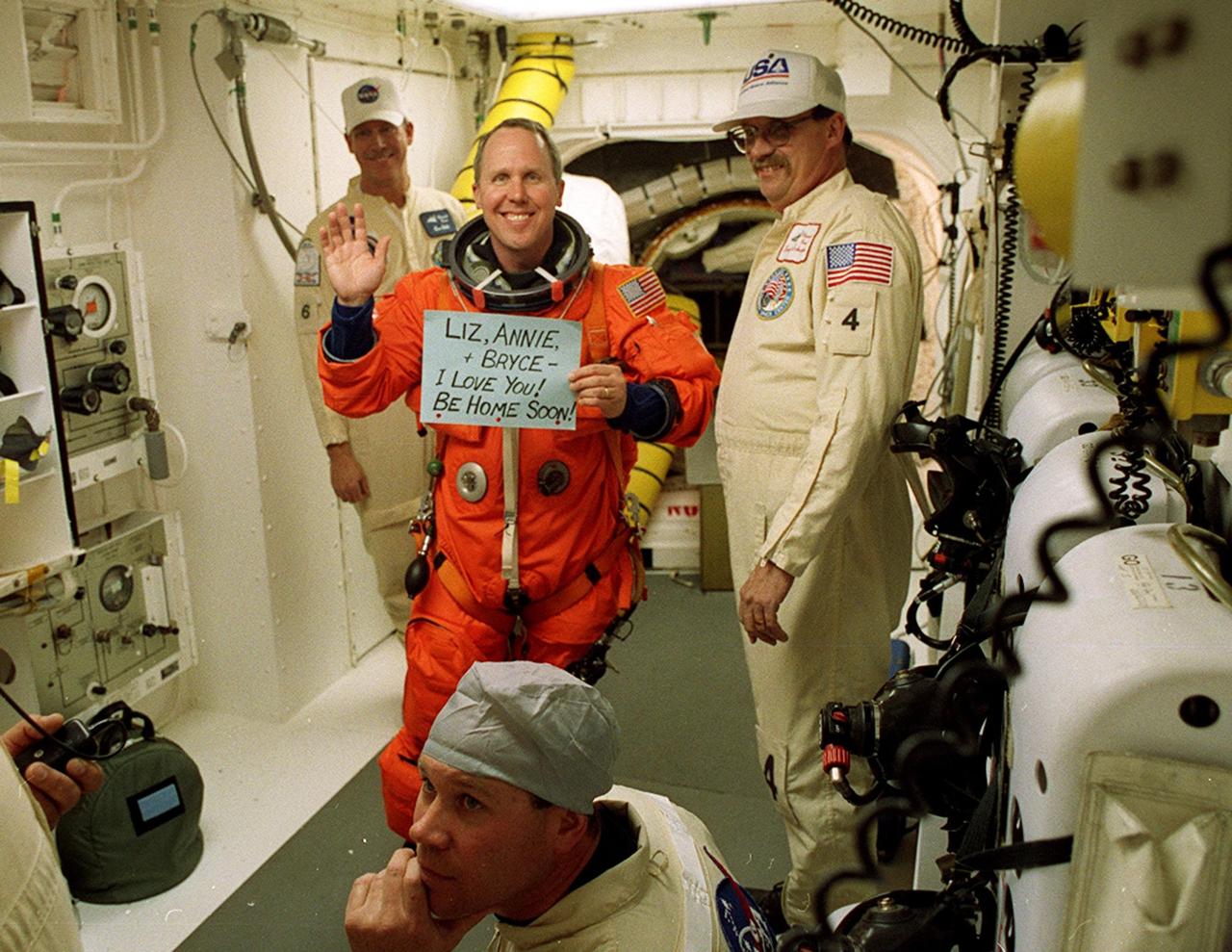
In the White Room with the closeout crew, STS-98 Mission Specialist Thomas Jones shows a message to his family before he enters Space Shuttle Atlantis for launch. The White Room is an environmentally controlled room at the end of the Orbiter Access Arm. Atlantis is carrying the U.S. Laboratory Destiny, a key module in the growth of the Space Station. Destiny will be attached to the Unity node on the Space Station using the Shuttle’s robotic arm. Three spacewalks are required to complete the planned construction work during the 11-day mission. This mission marks the seventh Shuttle flight to the Space Station, the 23rd flight of Atlantis and the 102nd flight overall in NASA’s Space Shuttle program. The planned landing is at KSC Feb. 18 about 1 p.m
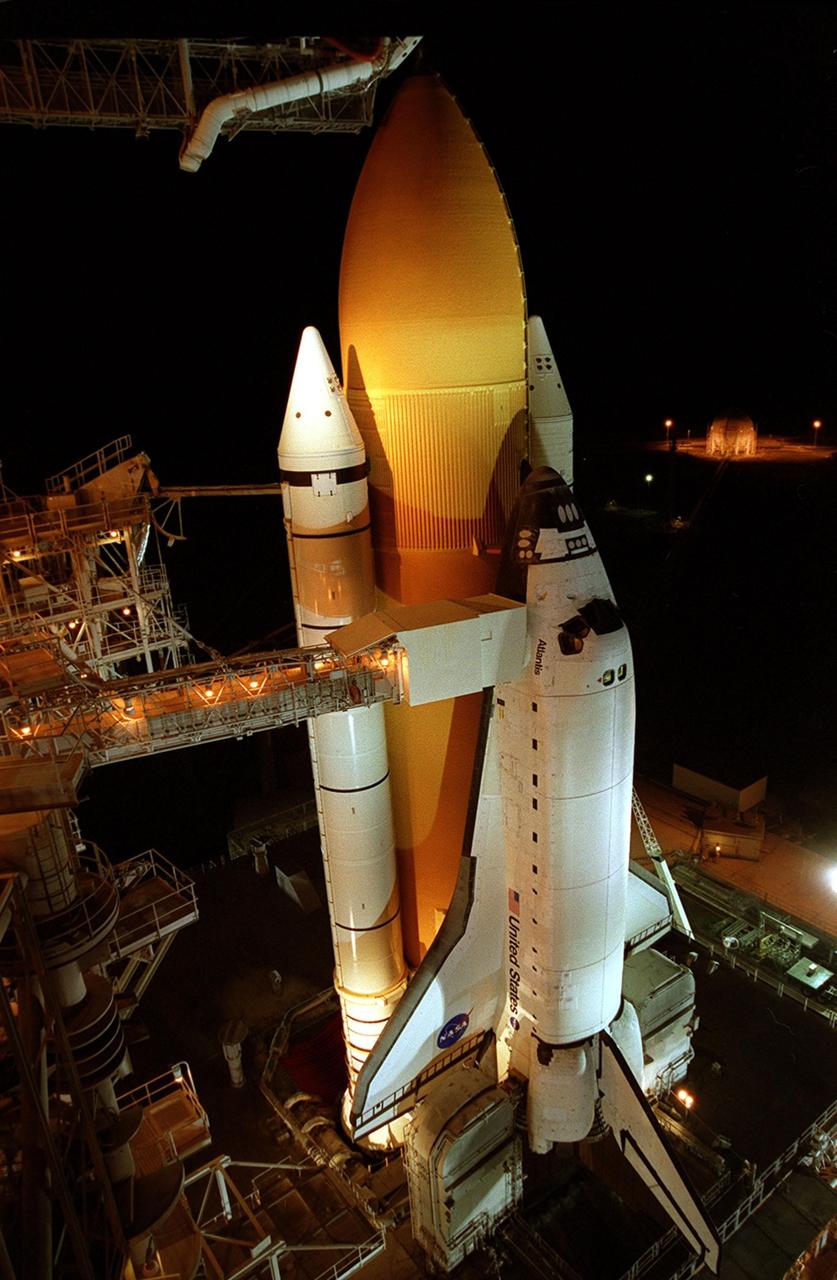
This closeup reveals Space Shuttle Atlantis after rollback of the Rotating Service Structure. Extended to the side of Atlantis is the orbiter access arm, with the White Room at its end. The White Room provides entry for the crew into Atlantis’s cockpit. Below Atlantis, on either side of the tail, are the tail service masts. They support the fluid, gas and electrical requirements of the orbiter’s liquid oxygen and liquid hydrogen aft T-0 umbilicals. Atlantis is carrying the U.S. Laboratory Destiny, a key module in the growth of the International Space Station. Destiny will be attached to the Unity node on the Space Station using the Shuttle’s robotic arm. Three spacewalks are required to complete the planned construction work during the 11-day mission. Launch is targeted for 6:11 p.m. EST and the planned landing at KSC Feb. 18 about 1:39 p.m. This mission marks the seventh Shuttle flight to the Space Station, the 23rd flight of Atlantis and the 102nd flight overall in NASA’s Space Shuttle program
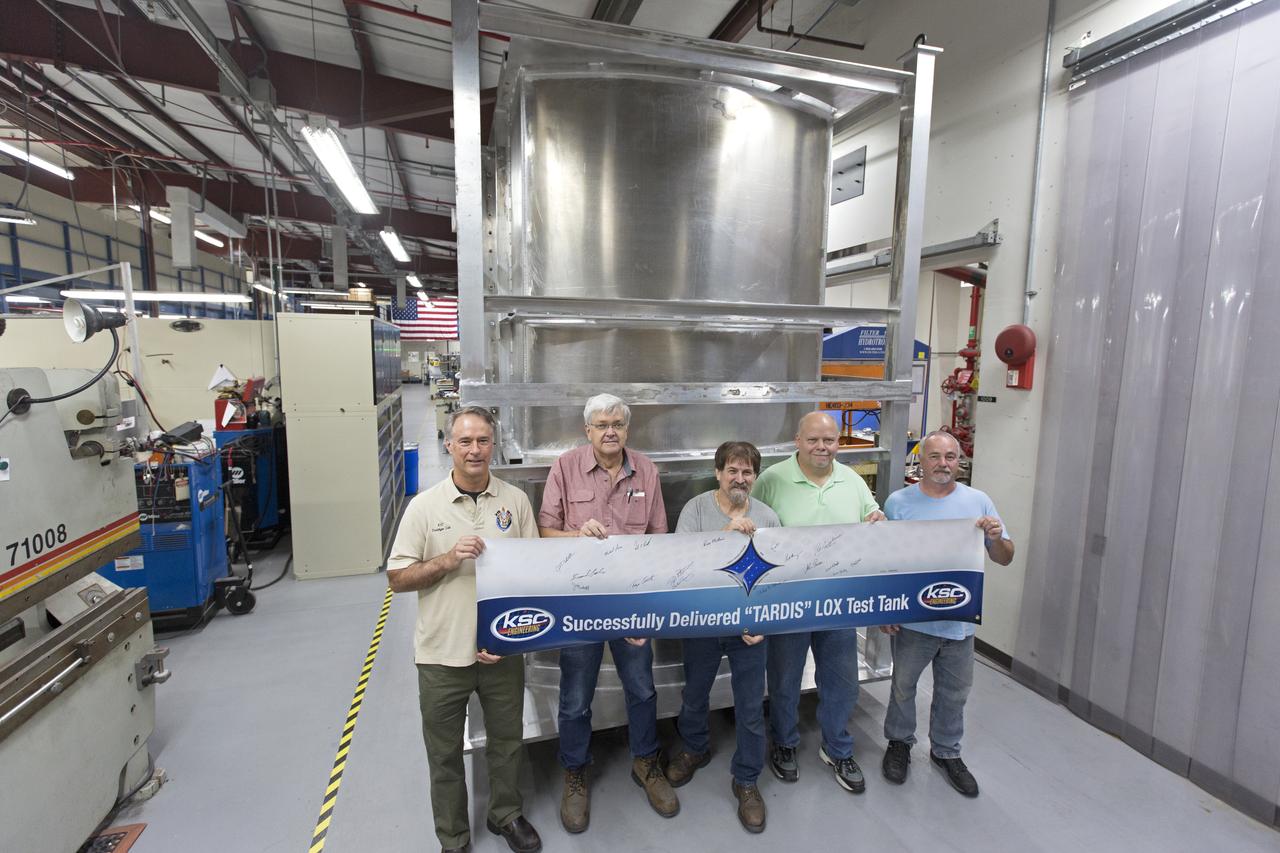
Inside the Prototype Development Laboratory at NASA's Kennedy Space Center in Florida, engineers and technicians hold a banner marking the successful delivery of a liquid oxygen test tank called Tardis. From left, are Todd Steinrock, chief, Fabrication and Development Branch, Prototype Development Lab; David McLaughlin, electrical engineering technician; Phil Stroda, mechanical engineering technician; Perry Dickey, lead electrical engineering technician; and Harold McAmis, lead mechanical engineering technician. Engineers and technicians worked together to develop the tank and build it at the lab to support cryogenic testing at Johnson Space Center's White Sands Test Facility in Las Cruces, New Mexico. The 12-foot-tall, 3,810-pound aluminum tank will be shipped to White Sands for testing.
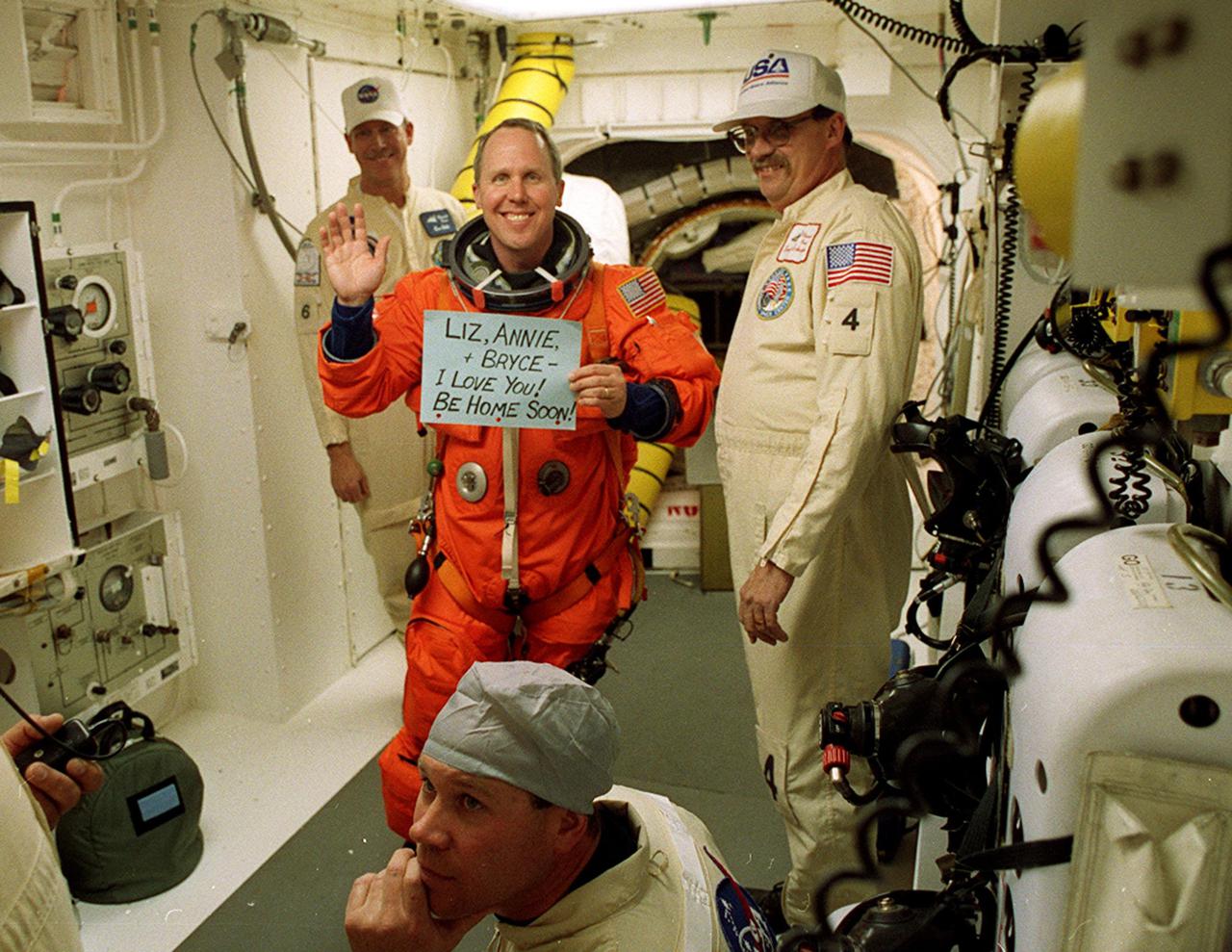
In the White Room with the closeout crew, STS-98 Mission Specialist Thomas Jones shows a message to his family before he enters Space Shuttle Atlantis for launch. The White Room is an environmentally controlled room at the end of the Orbiter Access Arm. Atlantis is carrying the U.S. Laboratory Destiny, a key module in the growth of the Space Station. Destiny will be attached to the Unity node on the Space Station using the Shuttle’s robotic arm. Three spacewalks are required to complete the planned construction work during the 11-day mission. This mission marks the seventh Shuttle flight to the Space Station, the 23rd flight of Atlantis and the 102nd flight overall in NASA’s Space Shuttle program. The planned landing is at KSC Feb. 18 about 1 p.m
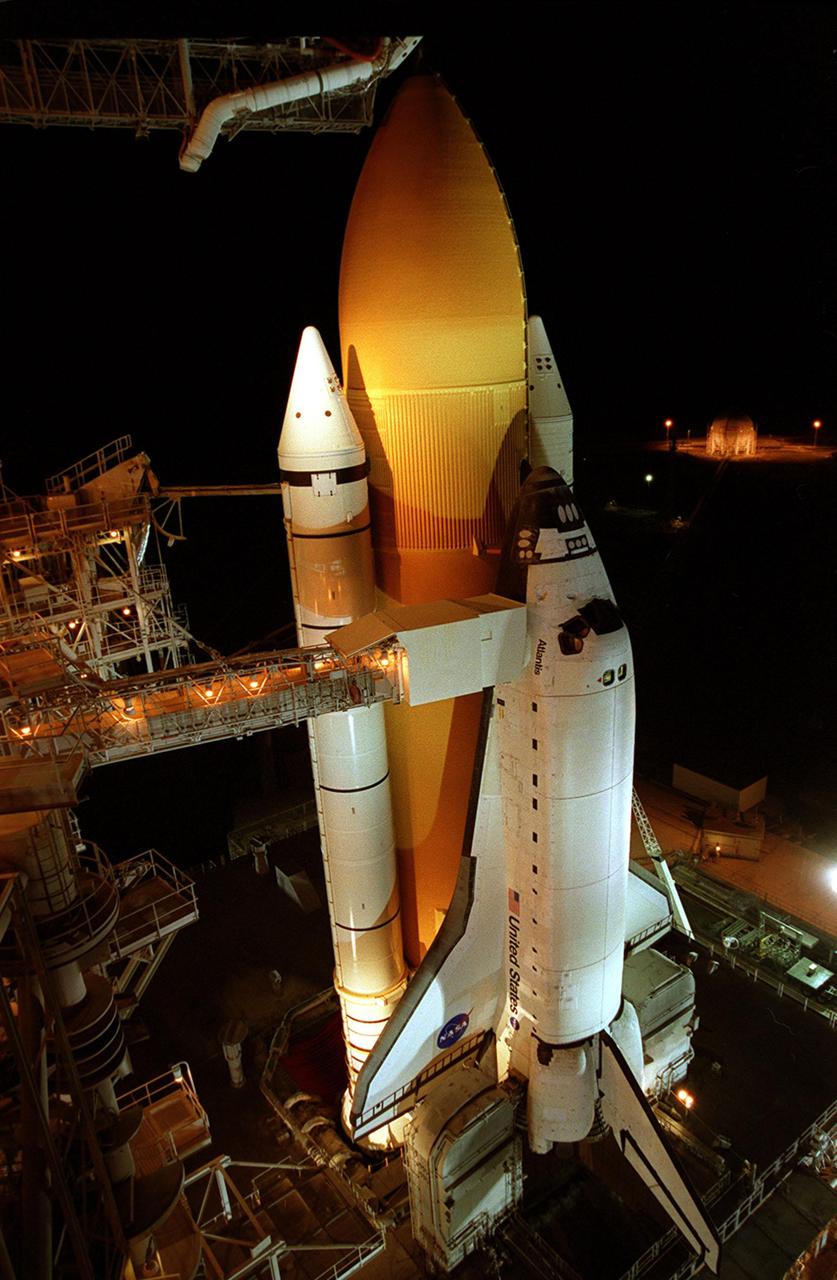
This closeup reveals Space Shuttle Atlantis after rollback of the Rotating Service Structure. Extended to the side of Atlantis is the orbiter access arm, with the White Room at its end. The White Room provides entry for the crew into Atlantis’s cockpit. Below Atlantis, on either side of the tail, are the tail service masts. They support the fluid, gas and electrical requirements of the orbiter’s liquid oxygen and liquid hydrogen aft T-0 umbilicals. Atlantis is carrying the U.S. Laboratory Destiny, a key module in the growth of the International Space Station. Destiny will be attached to the Unity node on the Space Station using the Shuttle’s robotic arm. Three spacewalks are required to complete the planned construction work during the 11-day mission. Launch is targeted for 6:11 p.m. EST and the planned landing at KSC Feb. 18 about 1:39 p.m. This mission marks the seventh Shuttle flight to the Space Station, the 23rd flight of Atlantis and the 102nd flight overall in NASA’s Space Shuttle program
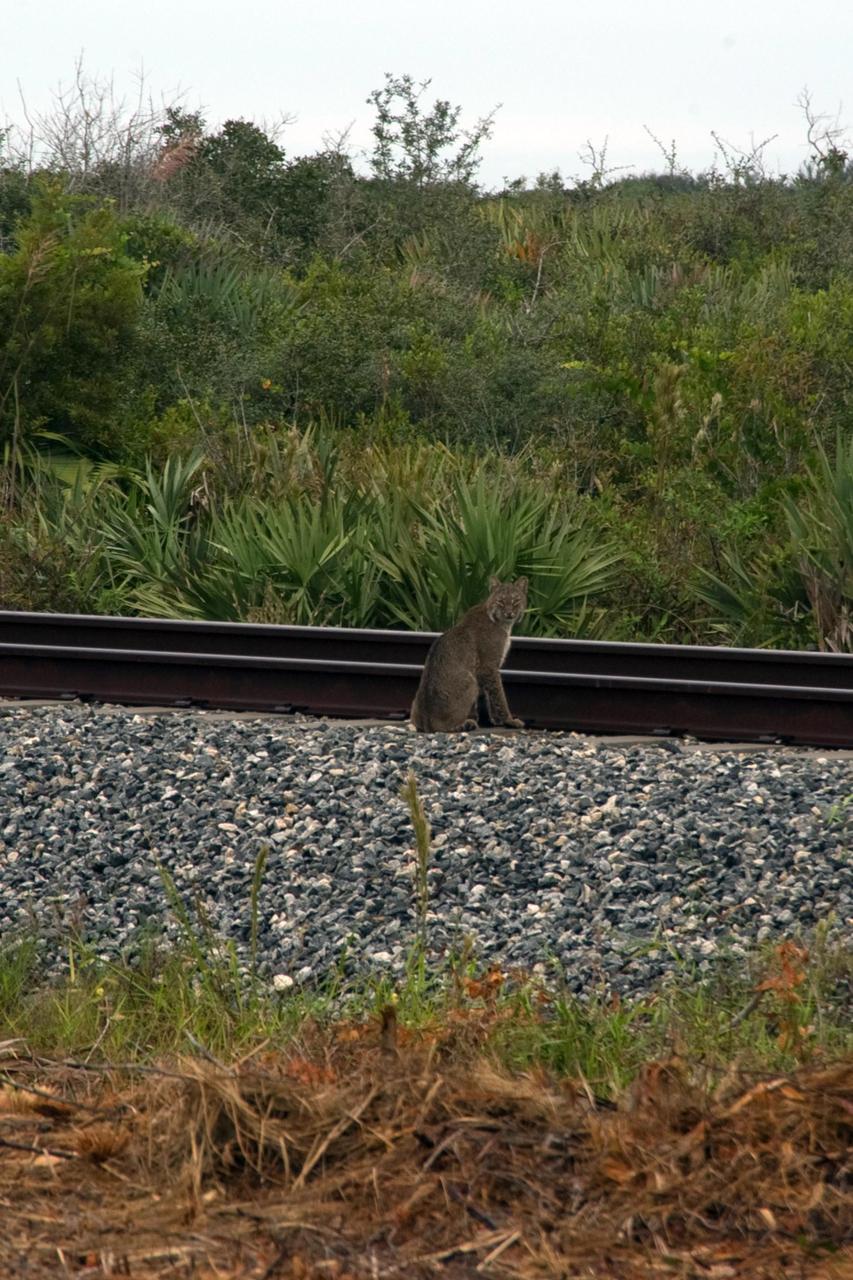
KENNEDY SPACE CENTER, FLA. -- A rare view of a bobcat, spotted near the NASA Railroad tracks on a mid-morning. The bobcat is a solitary and territorial predator mammal. They are mostly nocturnal and solitary, but will travel long distances for a mate. Not as big as a panther, but about the size of a medium-sized dog, male and female bobcats average 39 inches and 36 inches in length, and 24 pounds and 15 pounds in weight, respectively. They are most easily identified by their short tails which are about 5.5 inches long. Their fur, which is short, soft and dense, ranges from light tan to reddish or yellowish brown and markings vary from tabby stripes to spotting. They swim more than other native cats. The backs of their ears are white with a black outline. Their underparts are generally white. Bobcats can most likely be found in every county in Florida. Photo credit: NASA/Sandra Joseph
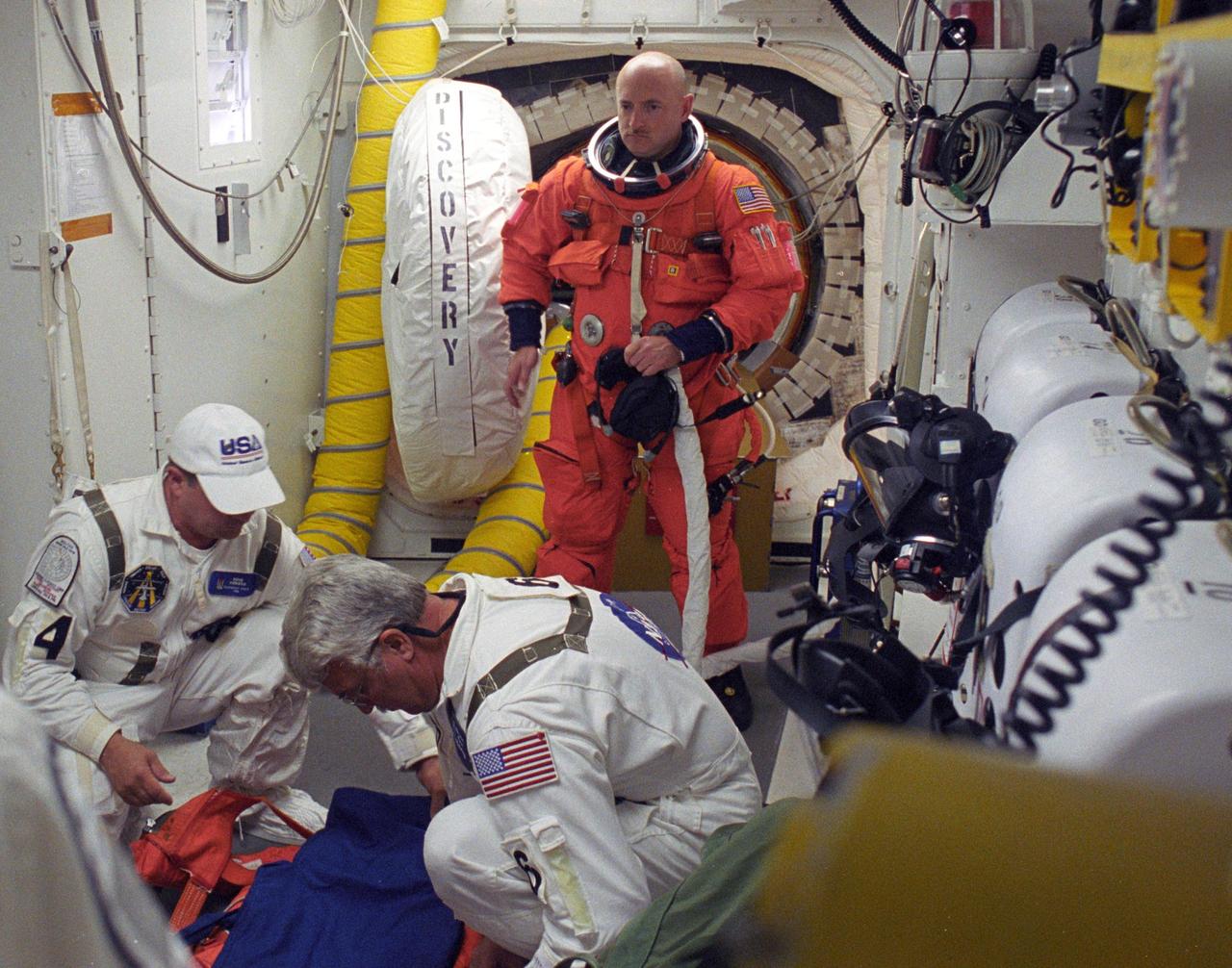
KENNEDY SPACE CENTER, FLA. - In the White Room on Launch Pad 39B, STS-121 Pilot Mark Kelly heads for the Closeout Crew who will help with final preparations on his launch suit before entering Discovery. Situated on the end of the orbiter access arm, the White Room provides access into the orbiter on the pad. The crew is preparing for the third launch attempt in four days; previous attempts were scrubbed due to weather concerns. During the 12-day mission, the STS-121 crew will test new equipment and procedures to improve shuttle safety, as well as deliver supplies and make repairs to the International Space Station. The launch of Space Shuttle Discovery on mission STS-121 is the 115th shuttle flight and the 18th U.S. flight to the International Space Station.
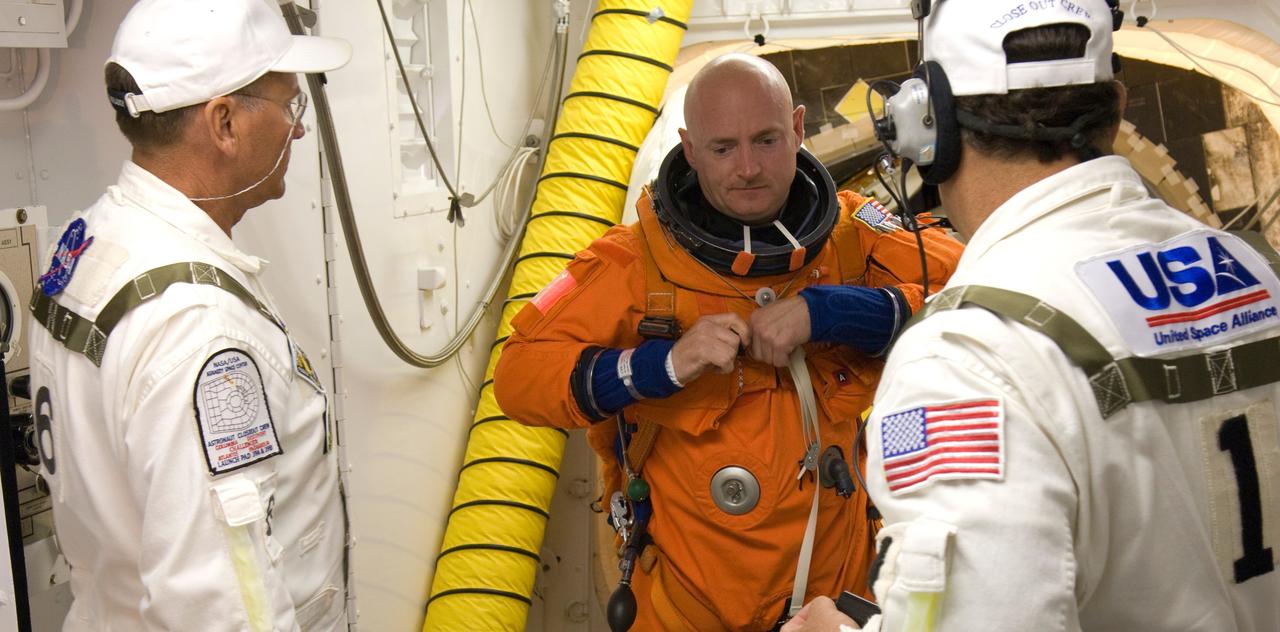
CAPE CANAVERAL, Fla. --In the White Room on Launch Pad 39A at NASA's Kennedy Space Center, STS-124 Commander Mark Kelly adjusts his harness on the launch and entry suit before entering space shuttle Discovery for launch. The White Room provides access into the shuttle. Discovery is making its 35th flight. The STS-124 mission is the 26th in the assembly of the space station. It is the second of three flights launching components to complete the Japan Aerospace Exploration Agency's Kibo laboratory. The shuttle crew will install Kibo's large Japanese Pressurized Module and its remote manipulator system, or RMS. The 14-day flight includes three spacewalks. Photo credit: NASA/Tom Farrar, Kevin O'Connell, Scott Haun
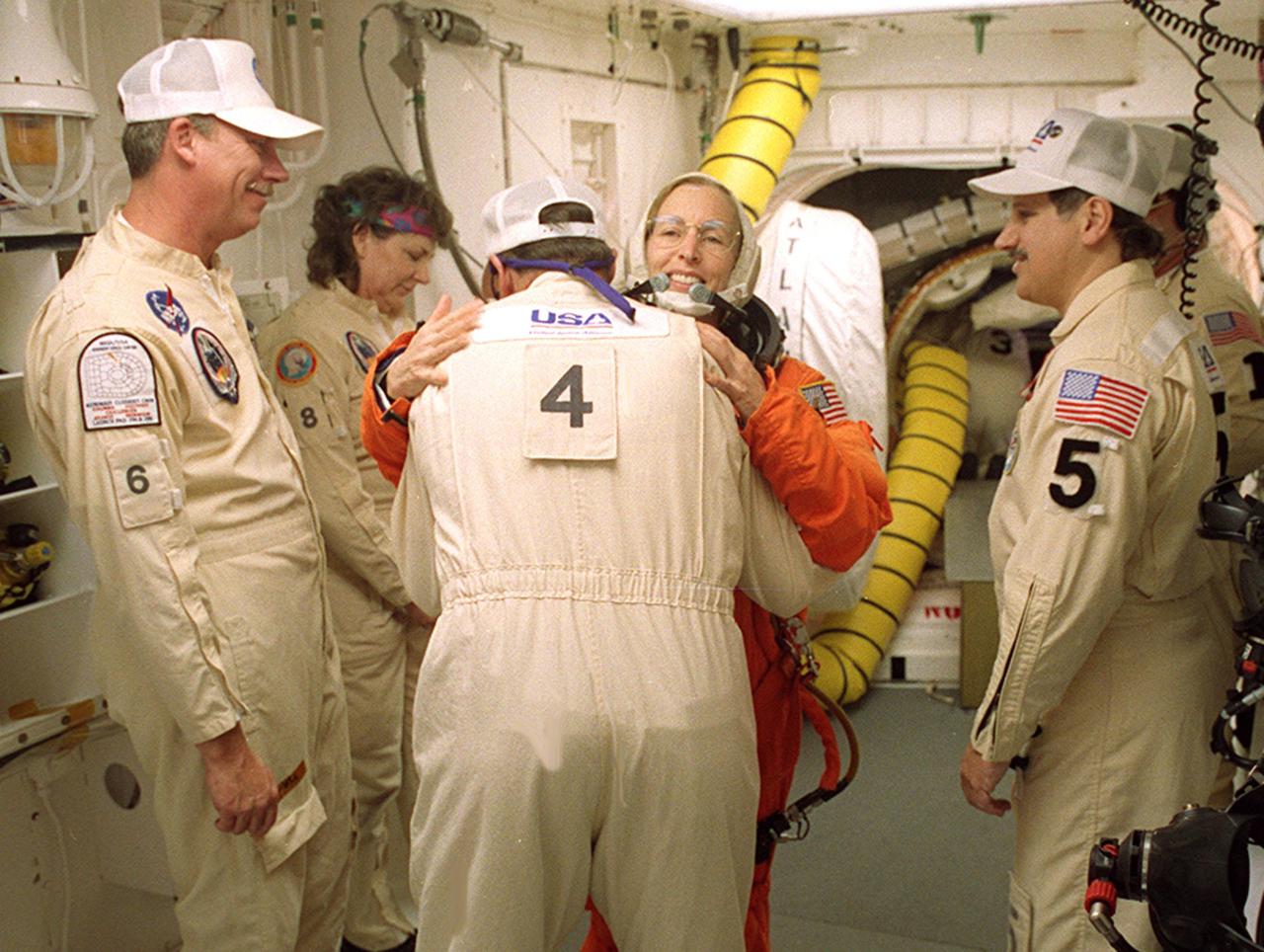
In the White Room before launch, STS-98 Mission Specialist Marsha Ivins gets a hug from a closeout crew member before she enters Space Shuttle Atlantis. The White Room is an environmentally controlled room at the end of the Orbiter Access Arm. Atlantis is carrying the U.S. Laboratory Destiny, a key module in the growth of the Space Station. Destiny will be attached to the Unity node on the Space Station using the Shuttle’s robotic arm. Three spacewalks are required to complete the planned construction work during the 11-day mission. This mission marks the seventh Shuttle flight to the Space Station, the 23rd flight of Atlantis and the 102nd flight overall in NASA’s Space Shuttle program. The planned landing is at KSC Feb. 18 about 1 p.m

This is the insignia for the STS-108 mission, which marked a major milestone in the assembly of the International Space Station (ISS) as the first designated Utilization Flight, UF-1. The crew of Endeavour delivered the Expedition Four crew to ISS and returned the Expedition Three crew to Earth. Endeavour launched with a Multi-Purpose Logistics Module (MPLM) that was berthed to the ISS and unloaded. The MPLM was returned to Endeavour for the trip home and used again on a later flight. The crew patch depicts Endeavour and the ISS in the configuration at the time of arrival and docking. The Station is shown viewed along the direction of flight as seen by the Shuttle crew during their final approach and docking along the X-axis. The three ribbons and stars on the left side of the patch signify the returning Expedition Three crew. The red, white and blue order of the ribbons represents the American commander for that mission. The three ribbons and stars on the right depict the arriving Expedition Four crew. The white, blue, and red order of the Expedition Four ribbon matches the color of the Russian flag and signifies that the commander of Expedition Four is a Russian cosmonaut. Each white star in the center of the patch represents the four Endeavour crew members. The names of the four astronauts who crewed Endeavour are shown along the top border of the patch. The three astronauts and three cosmonauts of the two expedition crews are shown on the chevron at the bottom of the patch.
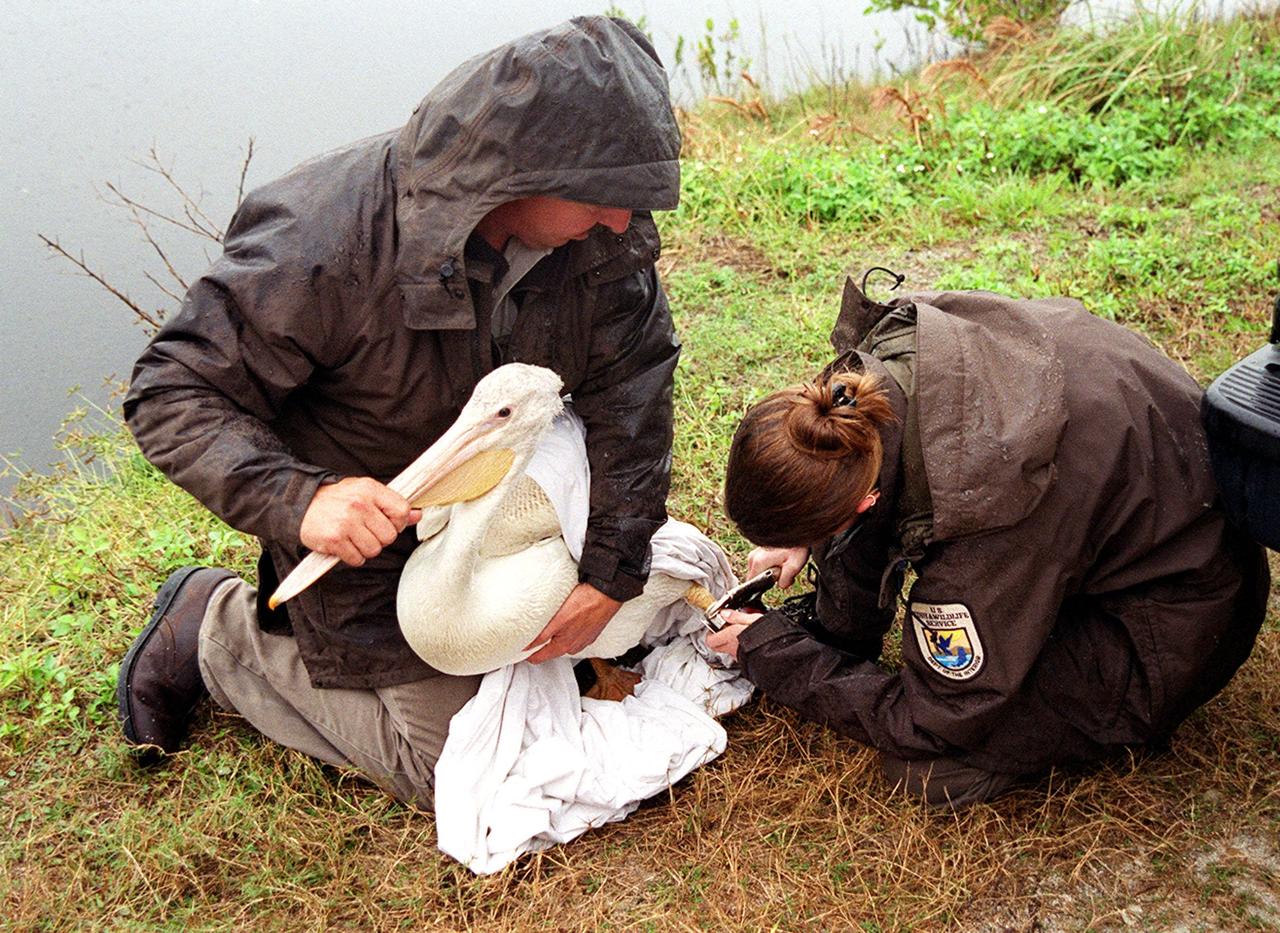
Under a rain-filled sky, Mark Epstein holds a rescued white pelican while Kat Royer fixes a leg band on it before releasing it at the Merritt Island National Wildlife Refuge. Epstein and Royer are with the U.S. Fish and Wildlife Service. The bird was found covered in crude oil from a contaminated ditch in northern Indiana in November, and was rescued by a local Police Department, treated, and flown to the Back to Nature Wildlife Refuge in Orlando, Fla. for care and rest. The pelican, dubbed "Fisheater" by its rescuers, will be let go to join a flock of about 30 other white pelicans that are wintering on the refuge. White pelicans inhabit marshy lakes and along the Pacific and Texas coasts. They winter from Florida and southern California south to Panama, chiefly in coastal lagoons. They are frequently seen flying in long lines, flapping and sailing in unison, but also ride rising air currents to soar gracefully in circles. The Merritt Island National Wildlife Refuge, which encompasses 92,000 acres that are a habitat for more than 331 species of birds, 31 mammals, 117 fishes, and 65 amphibians and reptiles. The marshes and open water of the refuge provide wintering areas for 23 species of migratory waterfowl, as well as a year-round home for great blue herons, great egrets, wood storks, cormorants, brown pelicans and other species of marsh and shore birds, as well as a variety of insects
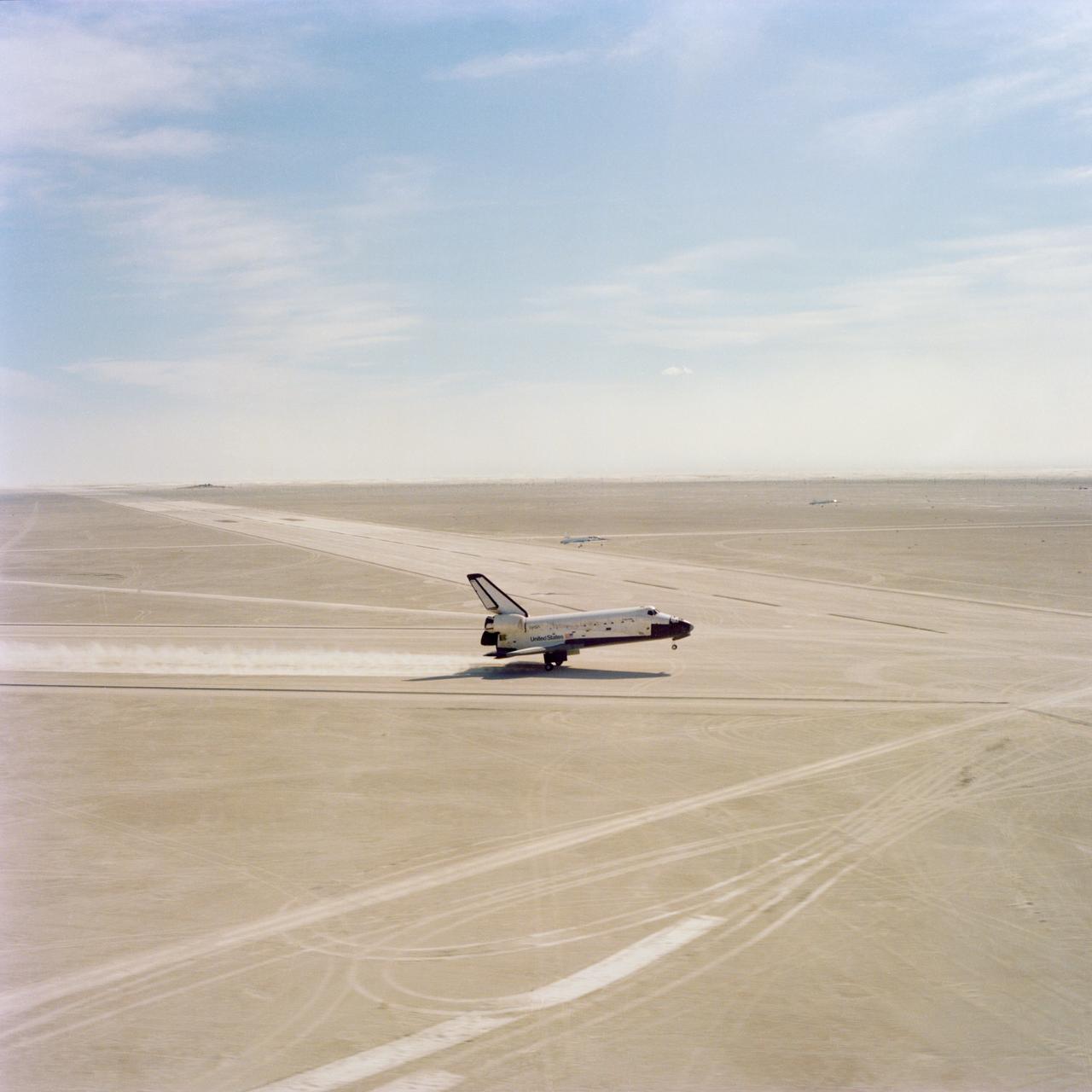
S82-28838 (30 March 1982) --- The space shuttle Columbia (STS-3) touches down on the Northrup Strip at White Sands Missile Range, New Mexico, marking the first time in its three-flight history that it has touched New Mexico soil. T-38 chase plane passenger, Mission Specialist-Astronaut Ronald E. McNair, who also shot some launch photography this flight, recorded a number of frames on 70mm film. Touchdown was shortly after 9 a.m. Mountain Standard Time, March 30, 1982. Photo credit: NASA
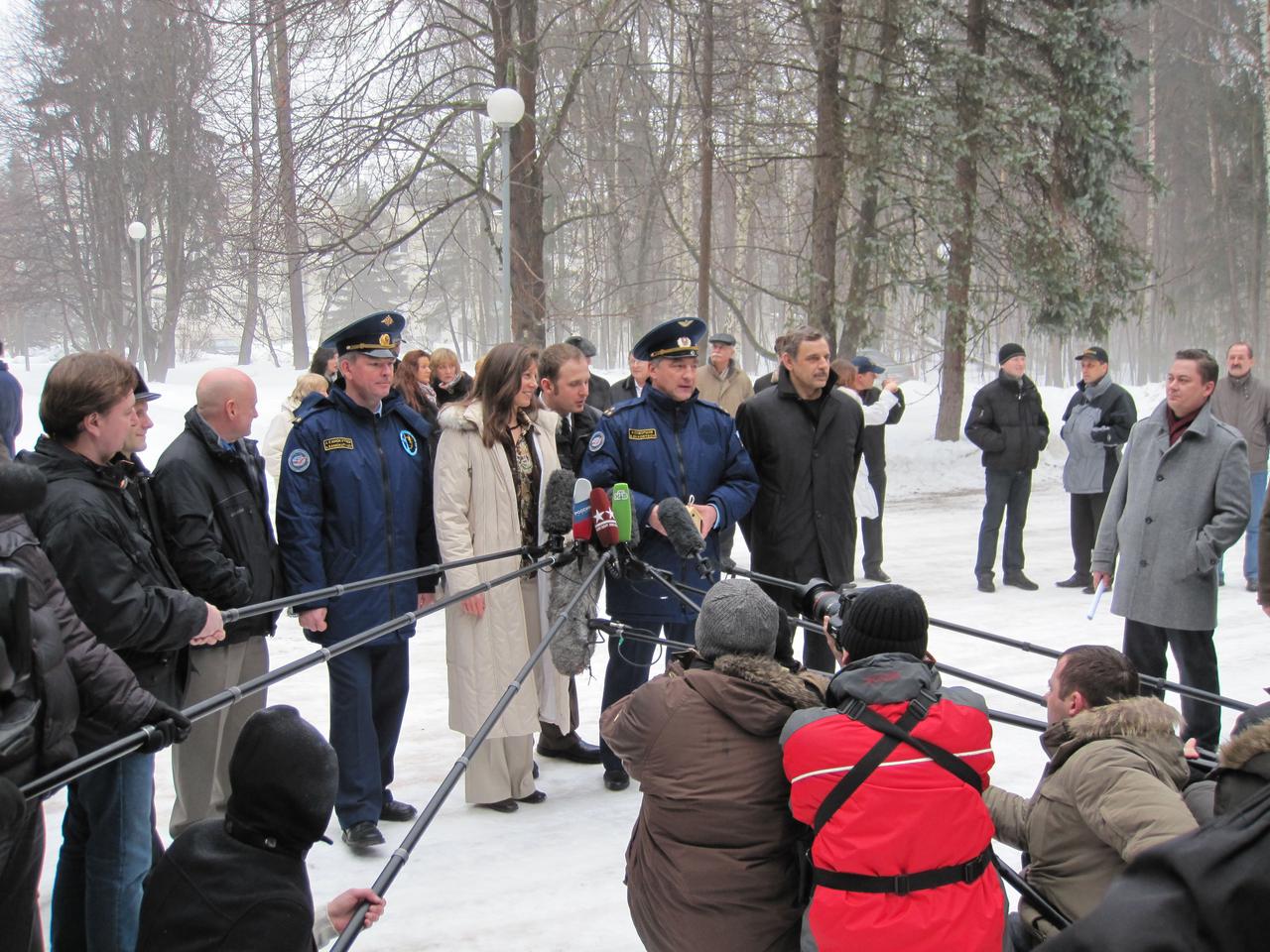
At the Gagarin Cosmonaut Training Center in Star City, Russia, Expedition 23 Flight Engineer Tracy Caldwell Dyson (c, in white coat), Soyuz Commander Alexander Skvortsov (to her left) and Flight Engineer Mikhail Kornienko (r) answer questions from reporters following a a ceremony March 21, 2010 prior to their departure for the Baikonur Cosmodrome in Kazakhstan for final training prior to their launch April 2 on the Soyuz TMA-18 spacecraft. Also attending were backup Flight Engineer Scott Kelly (without hat, third from left) and backup Soyuz Commander Alexander Samokutyayev (to Kelly’s left). Credit: NASA/Mark Bowman

STS-98 Mission Specialist Marsha Ivins waits in the White Room outside the entrance into Atlantis. The crew is at KSC to take part in Terminal Countdown Demonstration Test activities, which include emergency egress training and a simulated launch countdown. The other crew members are Pilot Mark Polansky, Mission Specialist Thomas Jones, Commander Ken Cockrell and Mission Specialist Robert Curbeam. STS-98 is the seventh construction flight to the International Space Station, carrying as payload the U.S. Lab Destiny, a key element in the construction of the ISS. Launch of STS-98 is scheduled for Jan. 19 at 2:11 a.m
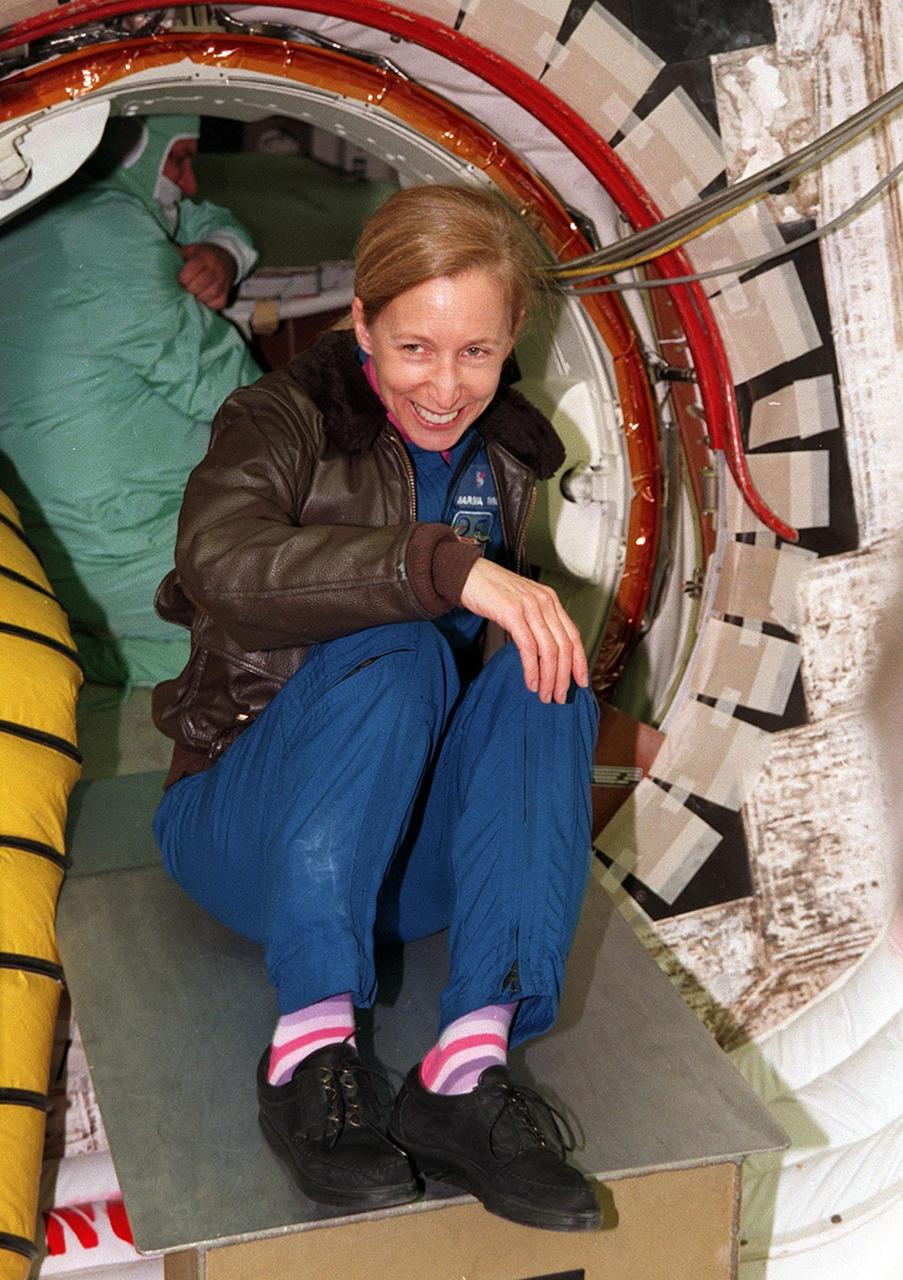
STS-98 Mission Specialist Marsha Ivins waits in the White Room outside the entrance into Atlantis. The crew is at KSC to take part in Terminal Countdown Demonstration Test activities, which include emergency egress training and a simulated launch countdown. The other crew members are Pilot Mark Polansky, Mission Specialist Thomas Jones, Commander Ken Cockrell and Mission Specialist Robert Curbeam. STS-98 is the seventh construction flight to the International Space Station, carrying as payload the U.S. Lab Destiny, a key element in the construction of the ISS. Launch of STS-98 is scheduled for Jan. 19 at 2:11 a.m
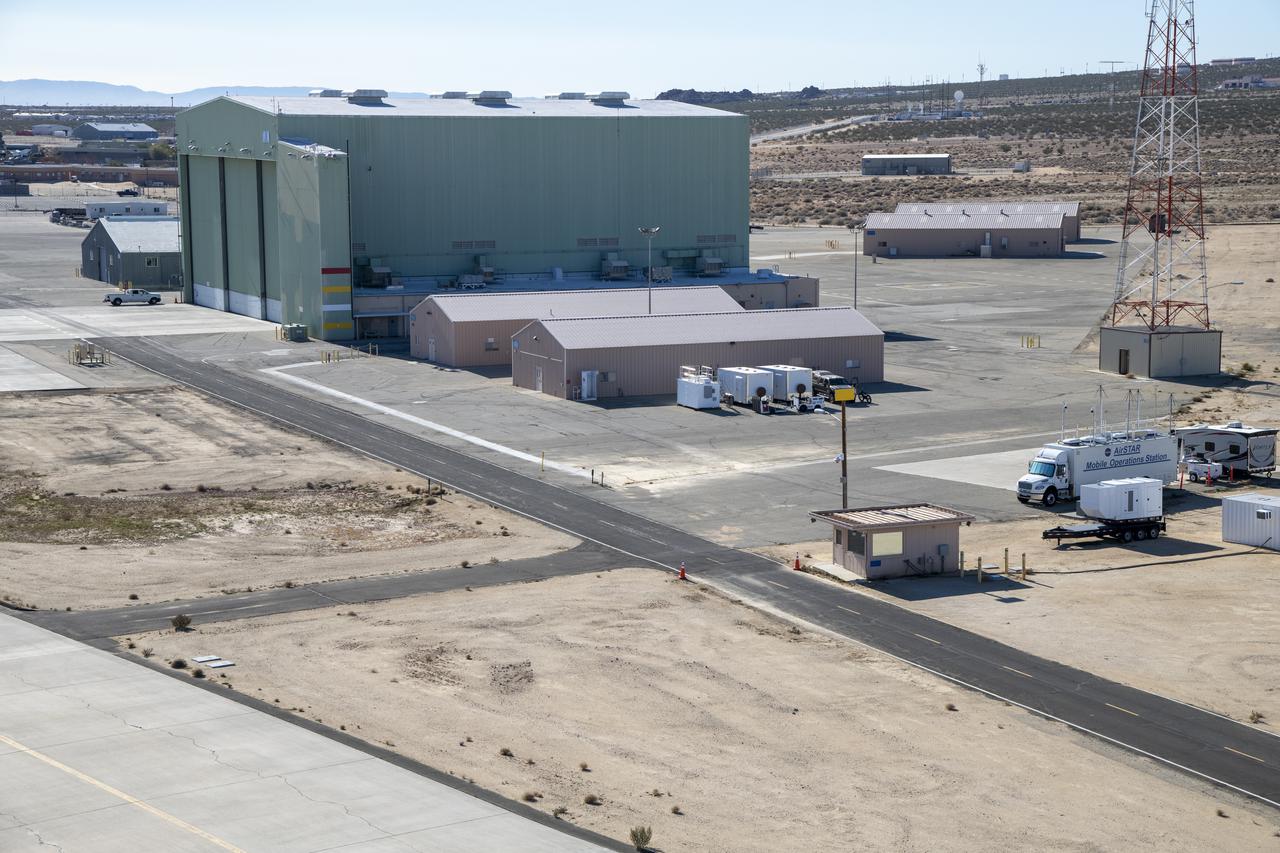
An aerial image taken by one of NASA’s photographers during recent helicopter flights shows a view of the building 4833 structure and the mobile operating facility at NASA’s Armstrong Flight Research Center in Edwards, California. NASA’s Advanced Air Mobility National Campaign uses the mobile operations facility vehicle shown in the lower right corner during test operations. The red, yellow, and white building markings applied to building 4833 are used to provide visual aids to the pilot during handling qualities testing used to research advanced air mobility flight requirements.
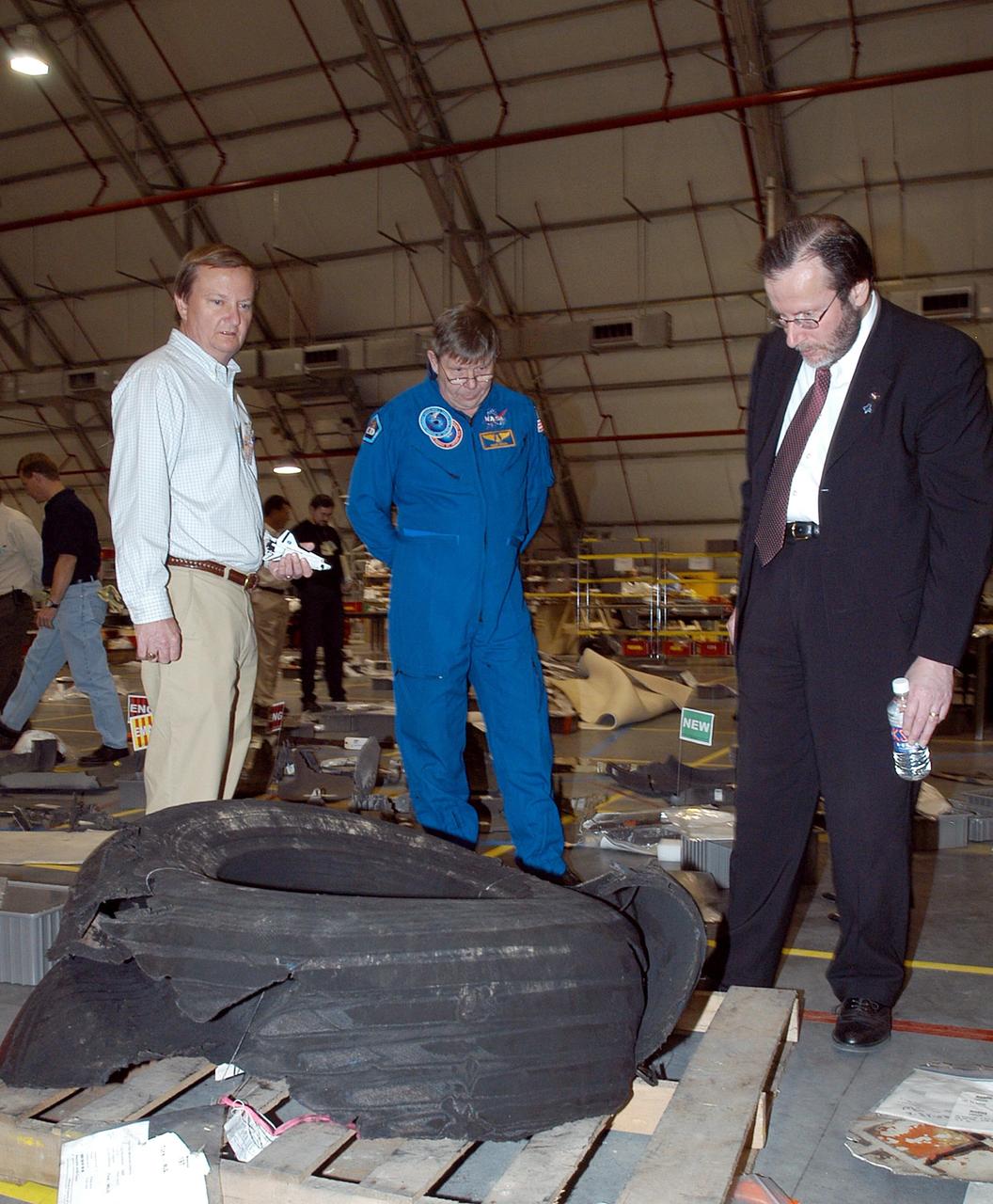
KENNEDY SPACE CENTER, FLA. - In the RLV Hangar at KSC, Shuttle Launch Director Mike Leinbach (left), former payload specialist Dr. Roger Crouch (center) and NASA Chief of Staff and White House liaison Courtney Stadd look at one of Space Shuttle Columbia's tires. The debris is one of more than 35,000 pieces collected so far. More than 1,218 pieces have been identified. The search of more than 500,000 acres of primary recovery area for Columbia material has passed the halfway mark. To date about 28 percent of Columbia, by weight, has been delivered to the hangar.
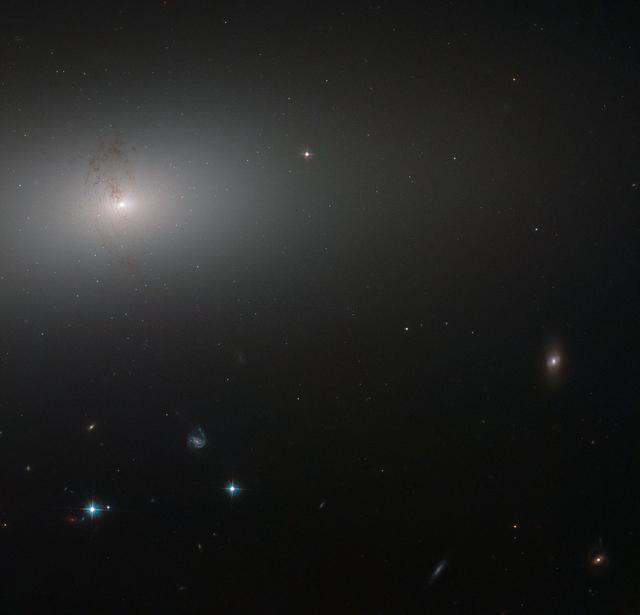
Like a lighthouse in the fog the luminous core of NGC 2768 slowly fades outwards to a dull white haze in this image taken by the NASA/ESA Hubble Space Telescope. NGC 2768 is an elliptical galaxy in the constellation of Ursa Major (The Great Bear). It is a huge bundle of stars, dominated by a bright central region, where a supermassive black hole feasts on a constant stream of gas and dust being fed to it by its galactic host. The galaxy is also marked by a prominent plume of dust reaching out from the centre and lying perpendicular to the galaxy’s plane. This dust conceals a symmetrical, s-shaped pair of jets that are being produced by the supermassive black hole as it feeds.
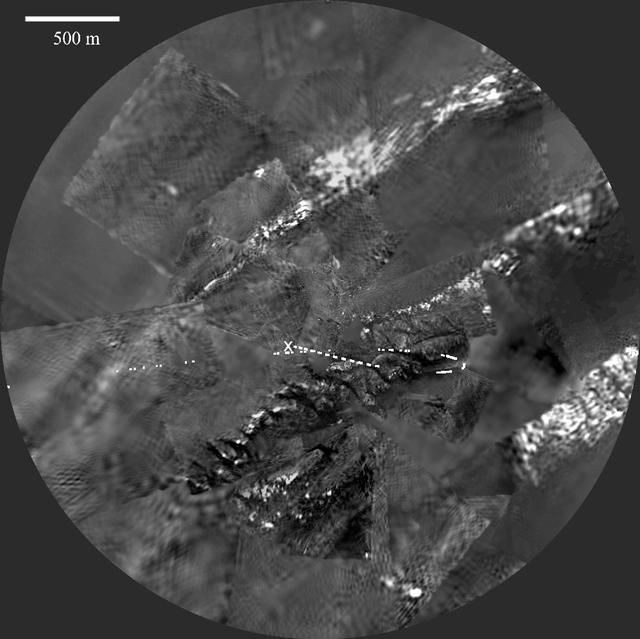
Images recorded by the European Space Agency's Huygens probe descent imager/spectral radiometer between 4 and 0.3 miles (7 and 0.5 kilometers) were assembled to produce this panoramic mosaic. The probe ground track is indicated as points in white. North is up. The ridge near the centre is cut by a dozen darker lanes or channels. The landing site is marked with an "X" near the continuation of one of the channels. The Huygens probe was delivered to Saturn's moon Titan by the Cassini spacecraft, which is managed by NASA's Jet Propulsion Laboratory, Pasadena, Calif. NASA supplied two instruments on the probe, the descent imager/spectral radiometer and the gas chromatograph mass spectrometer. http://photojournal.jpl.nasa.gov/catalog/PIA06439
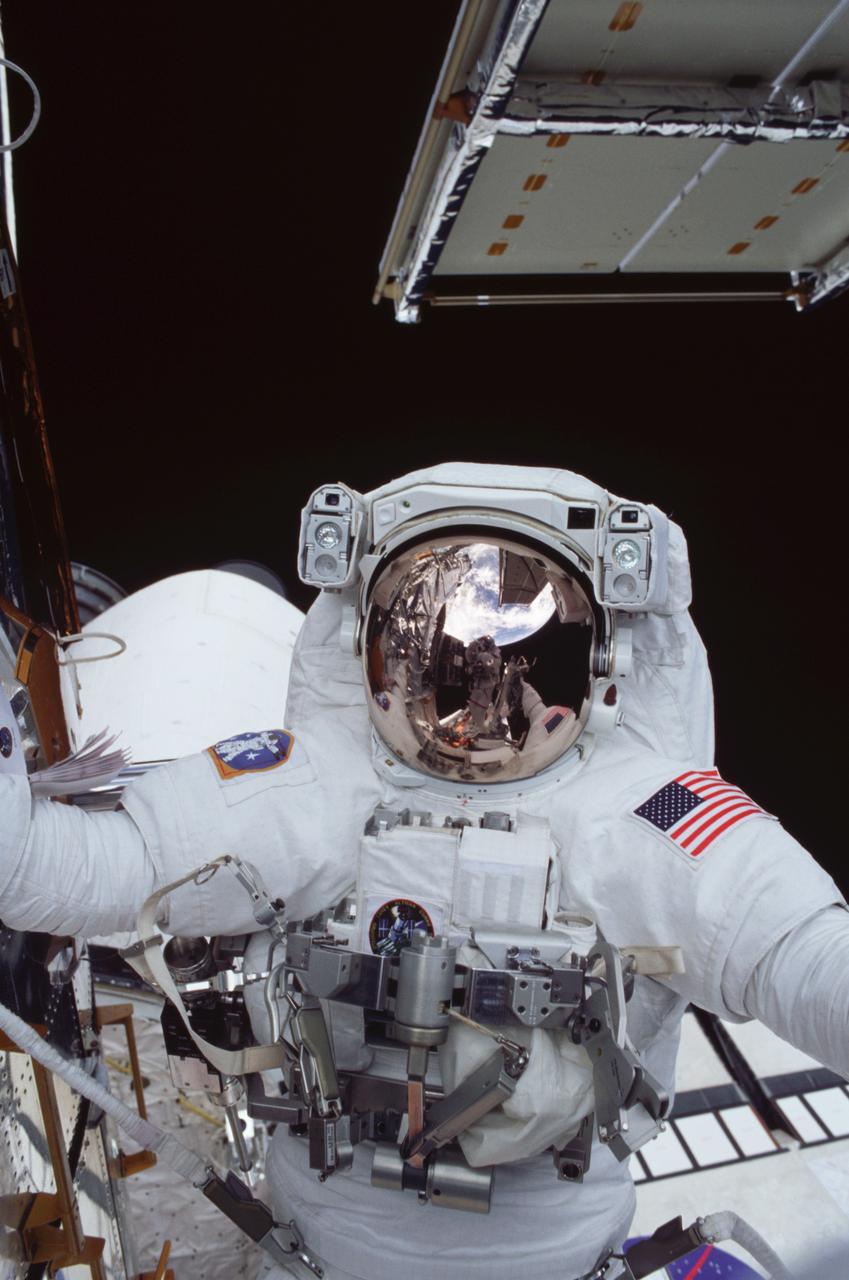
STS109-322-028 (6 March 2002) --- Astronaut Richard M. Linnehan, STS-109 mission specialist, participates in the third of five space walks to perform work on the Hubble Space Telescope (HST). Linnehan's sun shield reflects astronaut John M. Grunsfeld and the blue and white Earth's hemisphere as well as one of the telescope's new solar arrays. The third overall STS-109 extravehicular activity (EVA) marked the second of three for Linnehan and Grunsfeld, payload commander. On this particular walk, the two turned off the telescope in order to replace the power control unit or PCU--the heart of its power system. Grunsfeld took this photo with a 35mm camera.
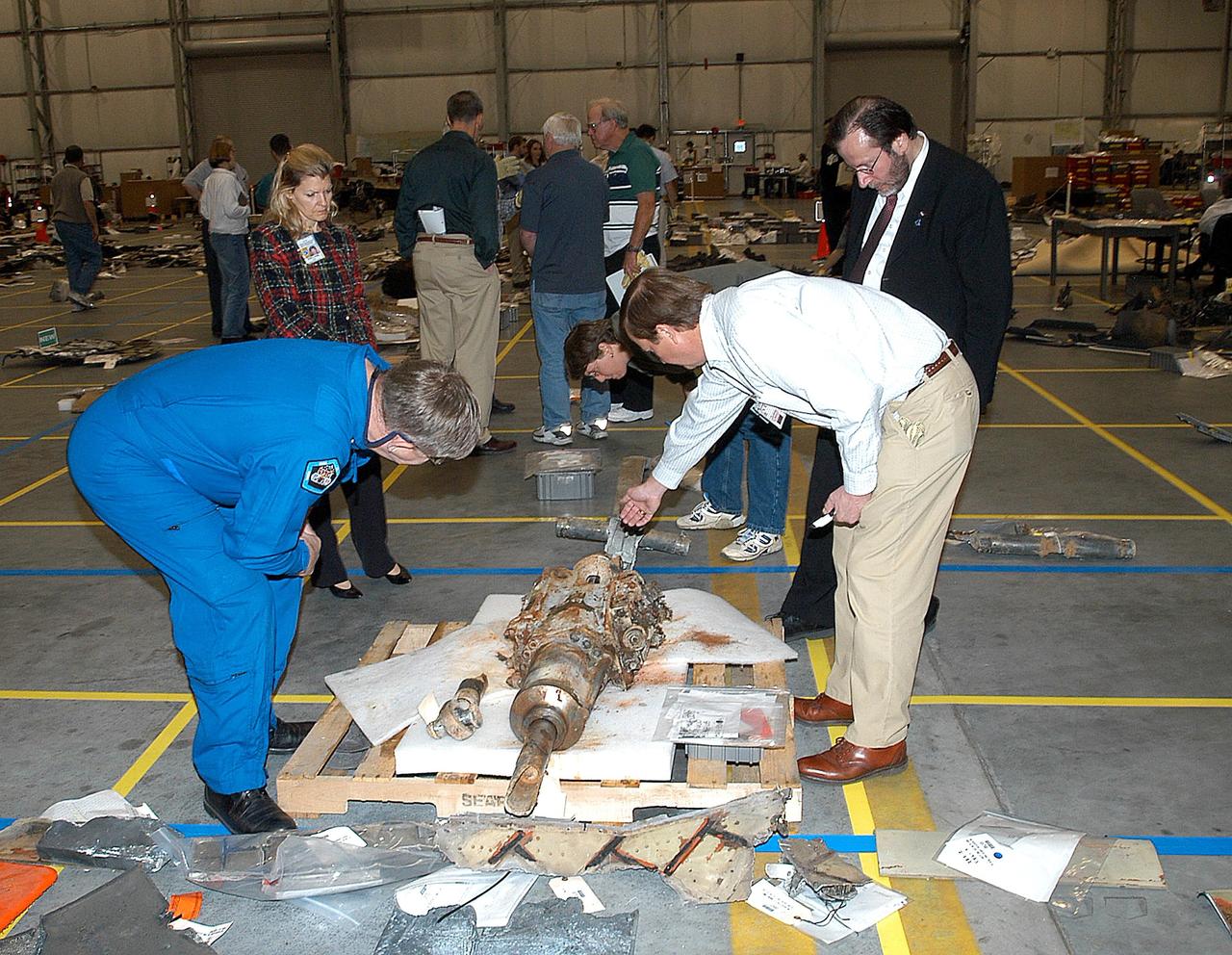
KENNEDY SPACE CENTER, FLA. - - In the RLV Hangar at KSC, examining a piece of debris from Space Shuttle Columbia are former payload specialist Dr. Roger Crouch (left), Shuttle Launch Director Mike Leinbach (right, pointing) and NASA Chief of Staff and White House liaison Courtney Stadd (right). The debris is one of more than 35,000 pieces collected so far. More than 1,218 pieces have been identified. The search of more than 500,000 acres of primary recovery area for Columbia material has passed the halfway mark. To date about 28 percent of Columbia, by weight, has been delivered to the hangar.

Intrepid Systems robot "MXR - Mark's Exploration Robot" takes to the practice field and tries to capture the white object in the foreground on Friday, June 15, 2012 at the Worcester Polytechnic Institute (WPI) in Worcester, Mass. Intrepid Systems' robot team will compete for a $1.5 million NASA prize in the NASA-WPI Sample Return Robot Centennial Challenge at WPI. Teams have been challenged to build autonomous robots that can identify, collect and return samples. NASA needs autonomous robotic capability for future planetary exploration. Photo Credit: (NASA/Bill Ingalls)
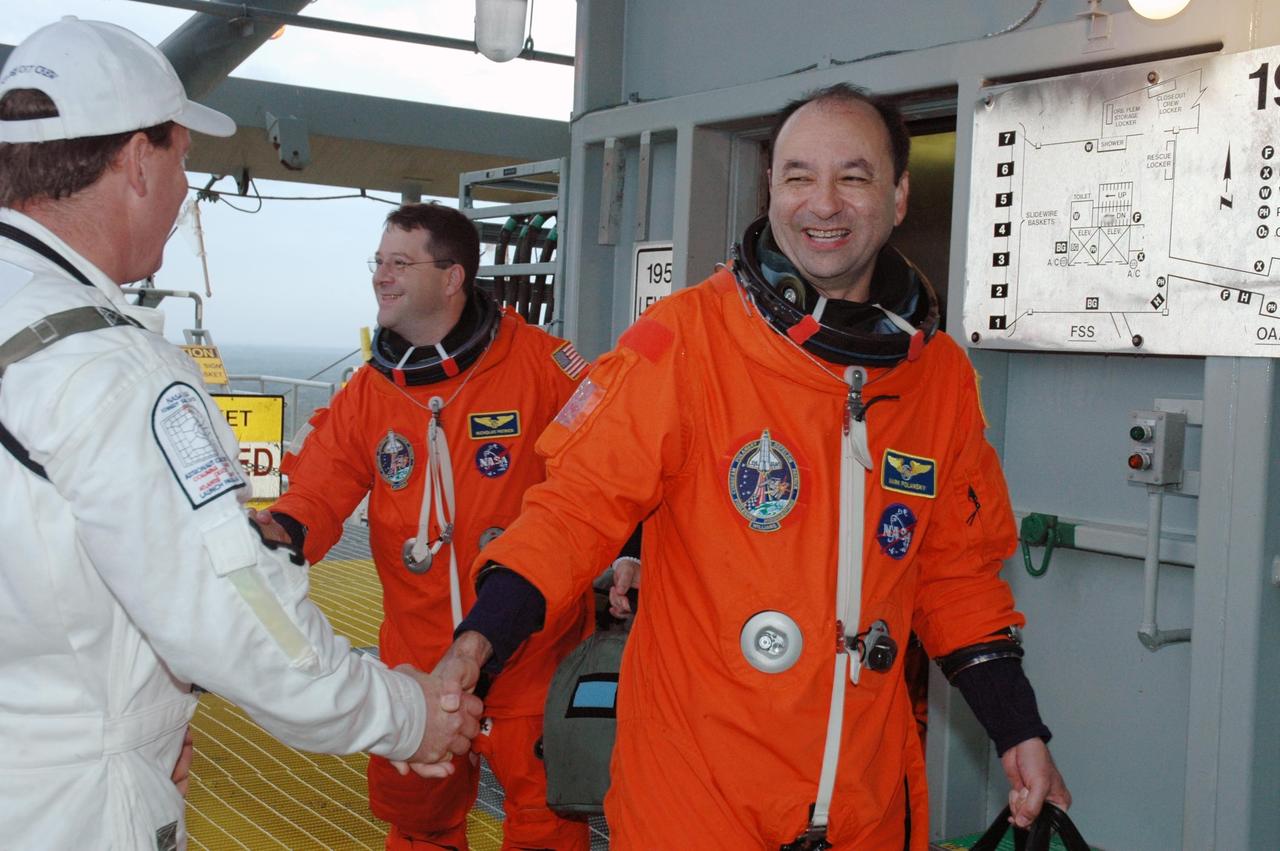
KENNEDY SPACE CENTER, FLA. -- On their way to the white room on Launch Pad 39B to enter Space Shuttle Discovery, Commander Mark Polansky (right) and Mission Specialist Nicholas Patrick are greeted by the closeout crew. The STS-116 mission crew practices for launch with a simulation of activities, from suit-up to countdown in the orbiter. The STS-116 mission is No. 20 to the International Space Station and construction flight 12A.1. The mission payload is the SPACEHAB module, the P5 integrated truss structure and other key components. Launch is scheduled for no earlier than Dec. 7. Photo credit: NASA/Amanda Diller
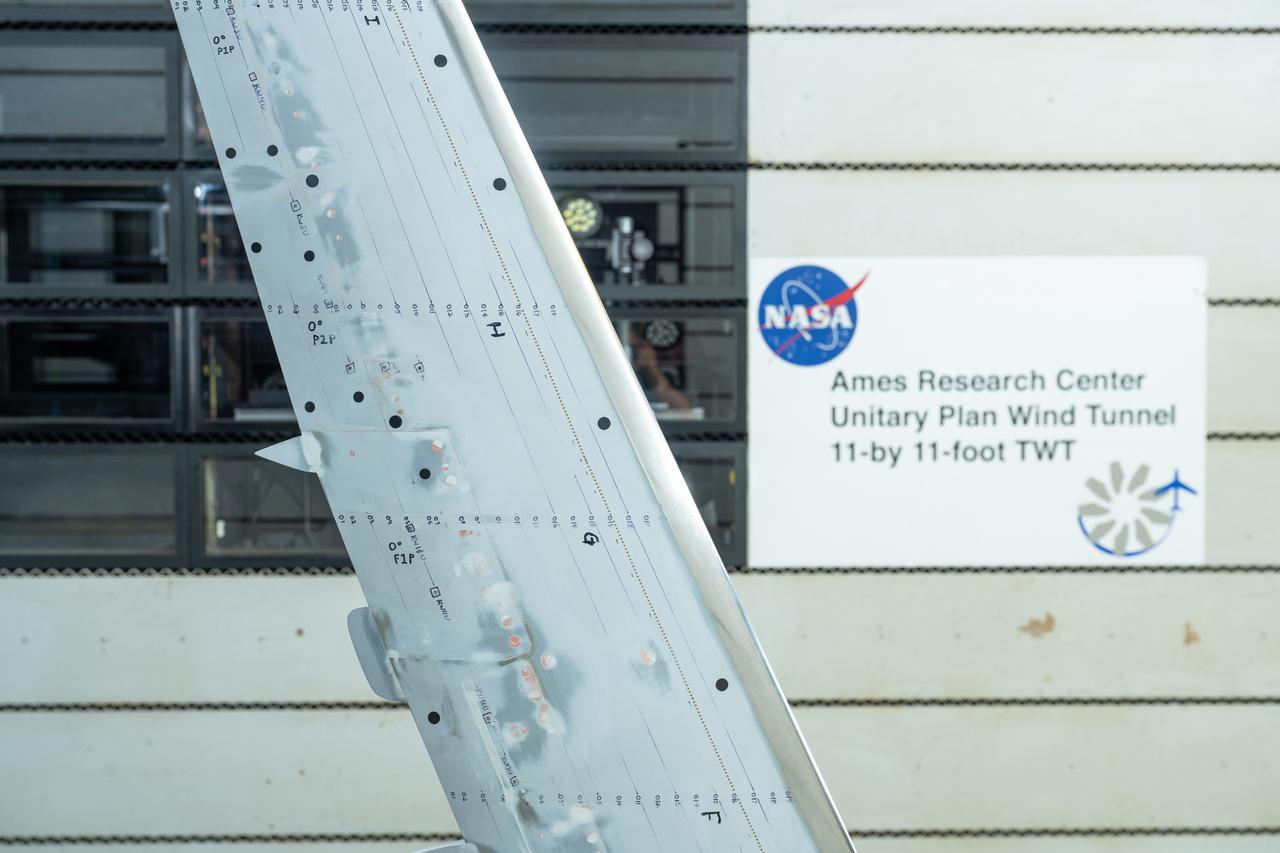
NASA’s Sustainable Flight Demonstrator project concluded wind tunnel testing in the fall of 2024. Tests on a Boeing-built X-66 model were completed at NASA’s Ames Research Center in Silicon Valley, California, in the 11-Foot Transonic Unitary Plan Facility. Pressure points, which are drilled holes with data sensors attached, are installed along the edge of the wing and allow engineers to understand the characteristics of airflow and will influence the final design of the wing.
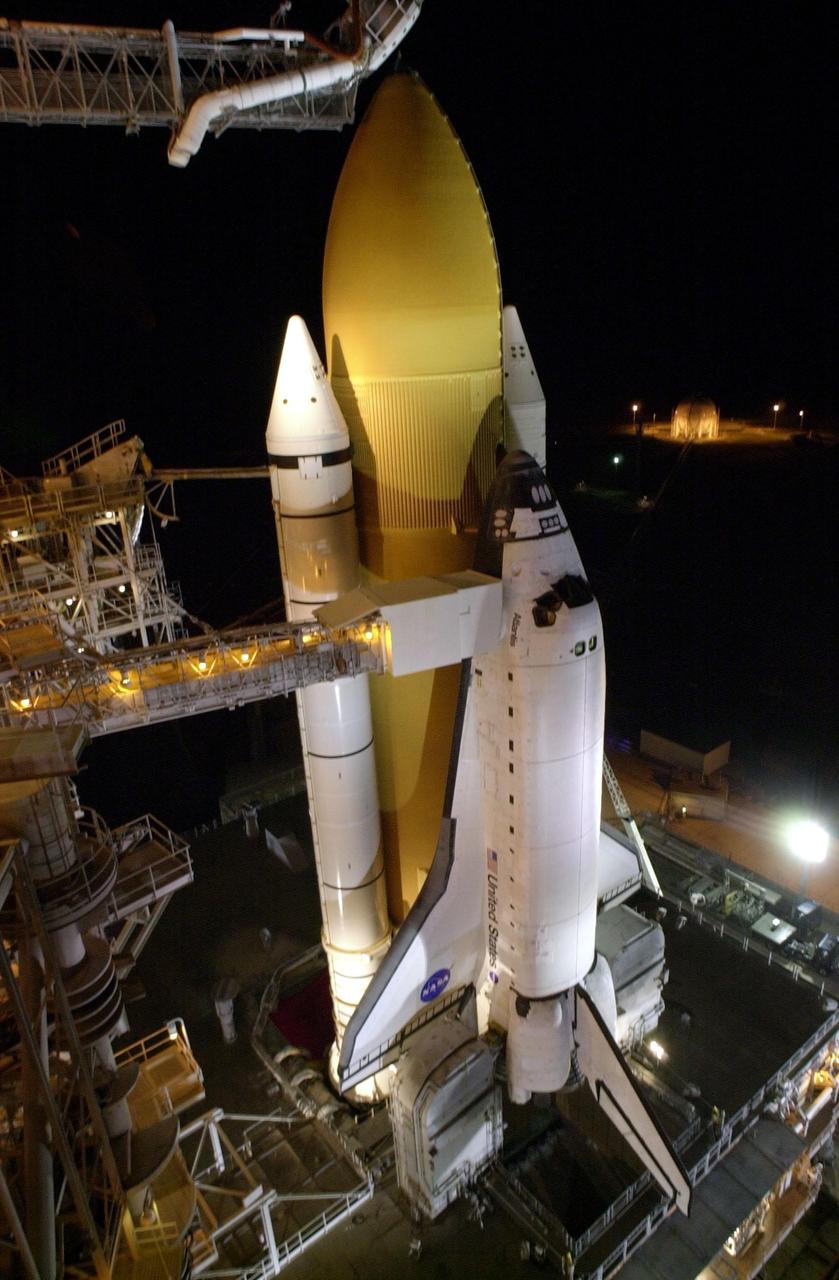
KENNEDY SPACE CENTER, Fla. -- This closeup reveals Space Shuttle Atlantis after rollback of the Rotating Service Structure. Extended to the side of Atlantis is the orbiter access arm, with the White Room at its end. The White Room provides entry for the crew into Atlantis’s cockpit. Below Atlantis, on either side of the tail are the tail service masts. They support the fluid, gas and electrical requirements of the orbiter’s liquid oxygen and liquid hydrogen aft T-0 umbilicals. Atlantis is carrying the U.S. Laboratory Destiny, a key module in the growth of the International Space Station. Destiny will be attached to the Unity node on the Space Station using the Shuttle’s robotic arm. Three spacewalks are required to complete the planned construction work during the 11-day mission. Launch is targeted for 6:11 p.m. EST and the planned landing at KSC Feb. 18 about 1:39 p.m. This mission marks the seventh Shuttle flight to the Space Station, the 23rd flight of Atlantis and the 102nd flight overall in NASA’s Space Shuttle program
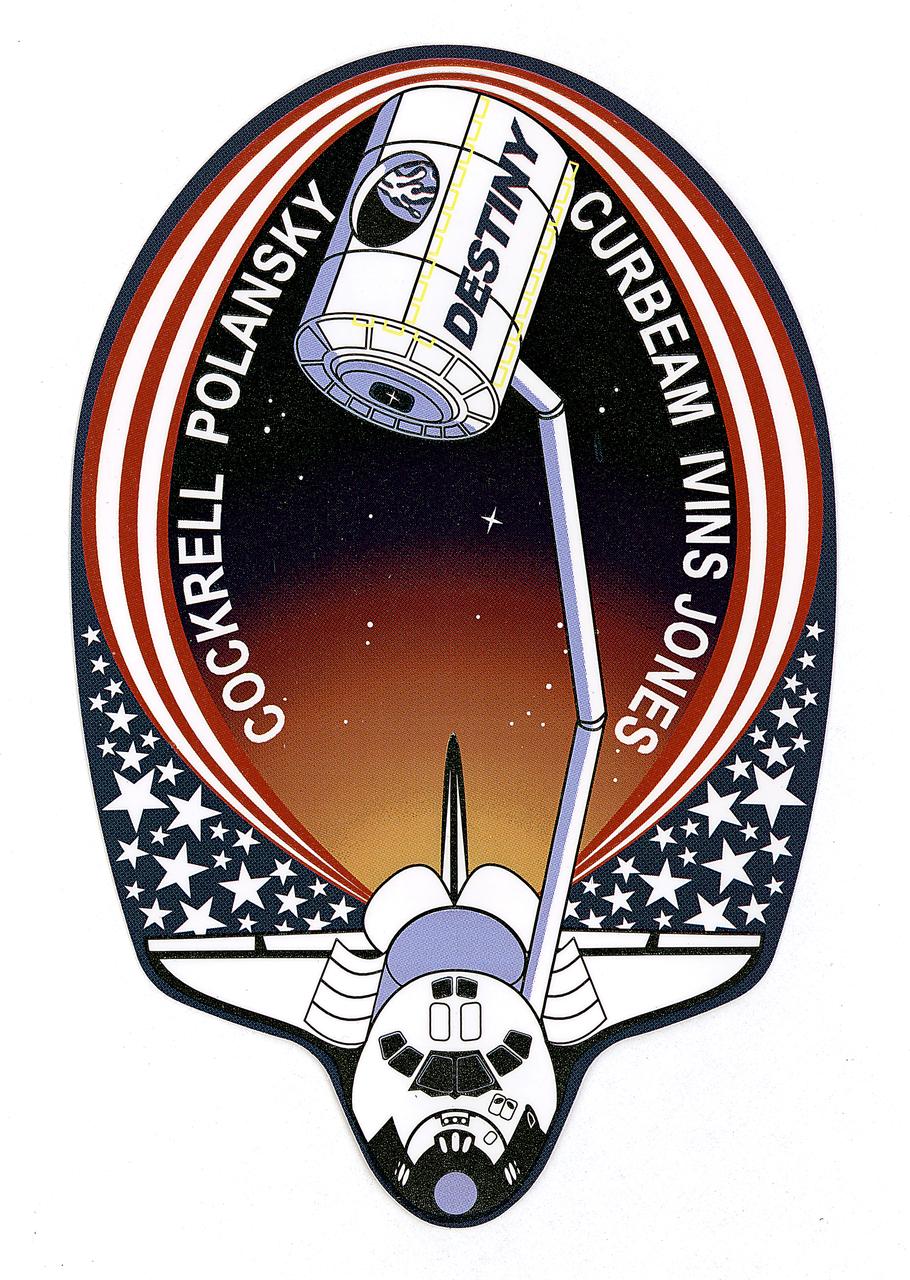
This is the insignia for STS-98, which marks a major milestone in assembly of the International Space Station (ISS). Atlantis' crew delivered the United States Laboratory, Destiny, to the ISS. Destiny will be the centerpiece of the ISS, a weightless laboratory where expedition crews will perform unprecedented research in the life sciences, materials sciences, Earth sciences, and microgravity sciences. The laboratory is also the nerve center of the Station, performing guidance, control, power distribution, and life support functions. With Destiny's arrival, the Station will begin to fulfill its promise of returning the benefits of space research to Earth's citizens. The crew patch depicts the Space Shuttle with Destiny held high above the payload bay just before its attachment to the ISS. Red and white stripes, with a deep blue field of white stars, border the Shuttle and Destiny to symbolize the continuing contribution of the United States to the ISS. The constellation Hercules, seen just below Destiny, captures the Shuttle and Station's team efforts in bringing the promise of orbital scientific research to life. The reflection of Earth in Destiny's window emphasizes the connection between space exploration and life on Earth.
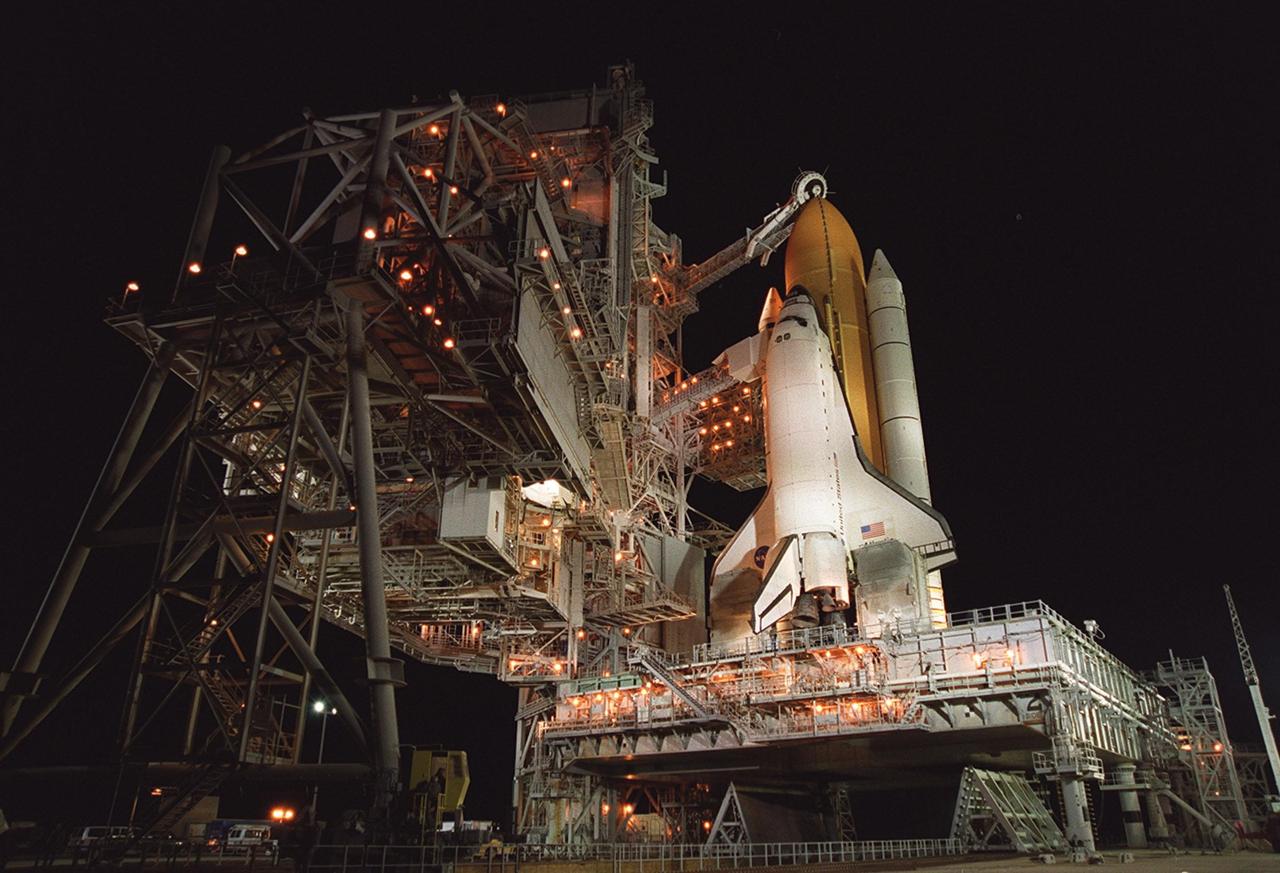
Space Shuttle Atlantis is revealed after rollback of the Rotating Service Structure. Extended to the side of Atlantis is the orbiter access arm, with the White Room at its end. The White Room is an environmentally controlled area that provides entry for the crew into Atlantis’s cockpit. Above the yellow-orange external tank is the Gaseous Oxygen Vent Arm, with the “beanie cap” vent hood raised. Before cryogenic loading, the hood will be lowered into position over the external tank vent louvers to vent gaseous oxygen vapors away from the Shuttle. Atlantis is carrying the U.S. Laboratory Destiny, a key module in the growth of the International Space Station. Destiny will be attached to the Unity node on the Space Station using the Shuttle’s robotic arm. Three spacewalks are required to complete the planned construction work during the 11-day mission. Launch is targeted for 6:11 p.m. EST and the planned landing at KSC Feb. 18 about 1:39 p.m. This mission marks the seventh Shuttle flight to the Space Station, the 23rd flight of Atlantis and the 102nd flight overall in NASA’s Space Shuttle program
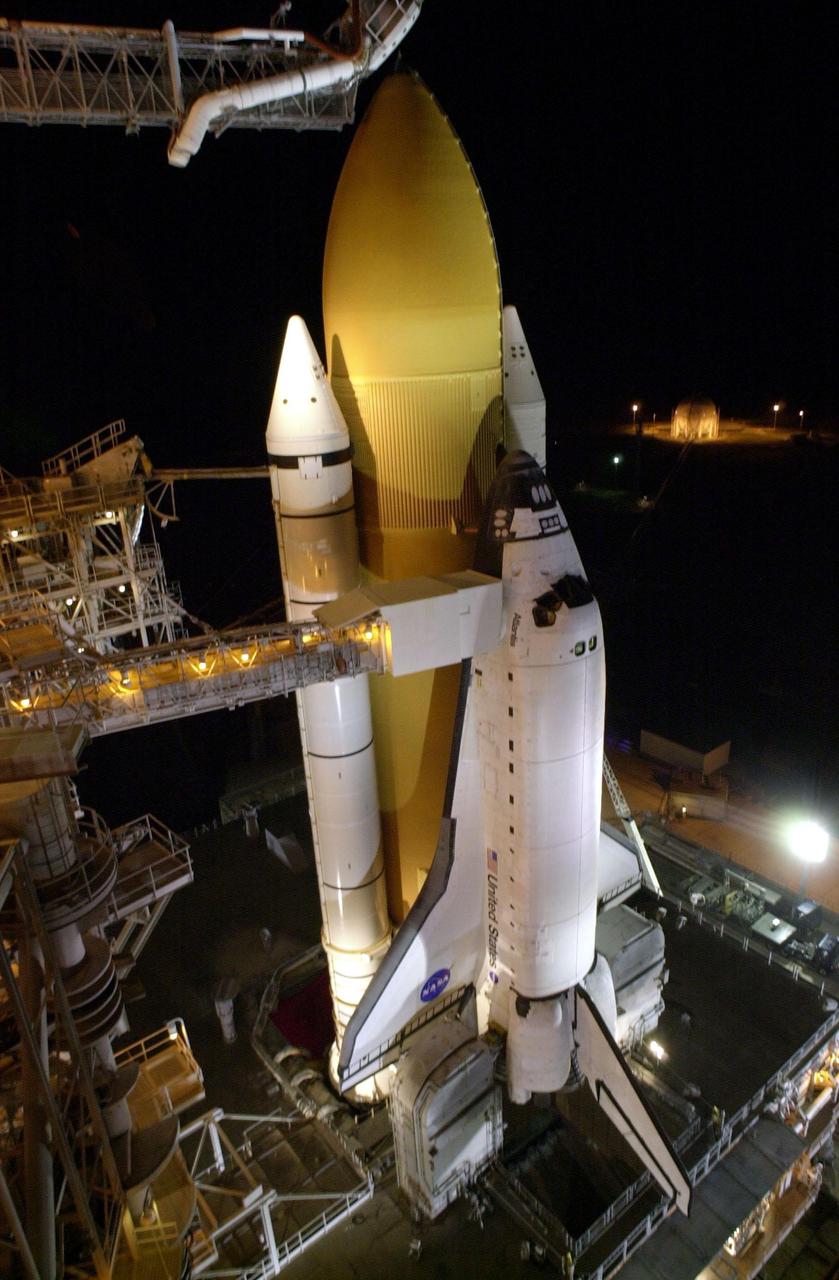
KENNEDY SPACE CENTER, Fla. -- This closeup reveals Space Shuttle Atlantis after rollback of the Rotating Service Structure. Extended to the side of Atlantis is the orbiter access arm, with the White Room at its end. The White Room provides entry for the crew into Atlantis’s cockpit. Below Atlantis, on either side of the tail are the tail service masts. They support the fluid, gas and electrical requirements of the orbiter’s liquid oxygen and liquid hydrogen aft T-0 umbilicals. Atlantis is carrying the U.S. Laboratory Destiny, a key module in the growth of the International Space Station. Destiny will be attached to the Unity node on the Space Station using the Shuttle’s robotic arm. Three spacewalks are required to complete the planned construction work during the 11-day mission. Launch is targeted for 6:11 p.m. EST and the planned landing at KSC Feb. 18 about 1:39 p.m. This mission marks the seventh Shuttle flight to the Space Station, the 23rd flight of Atlantis and the 102nd flight overall in NASA’s Space Shuttle program
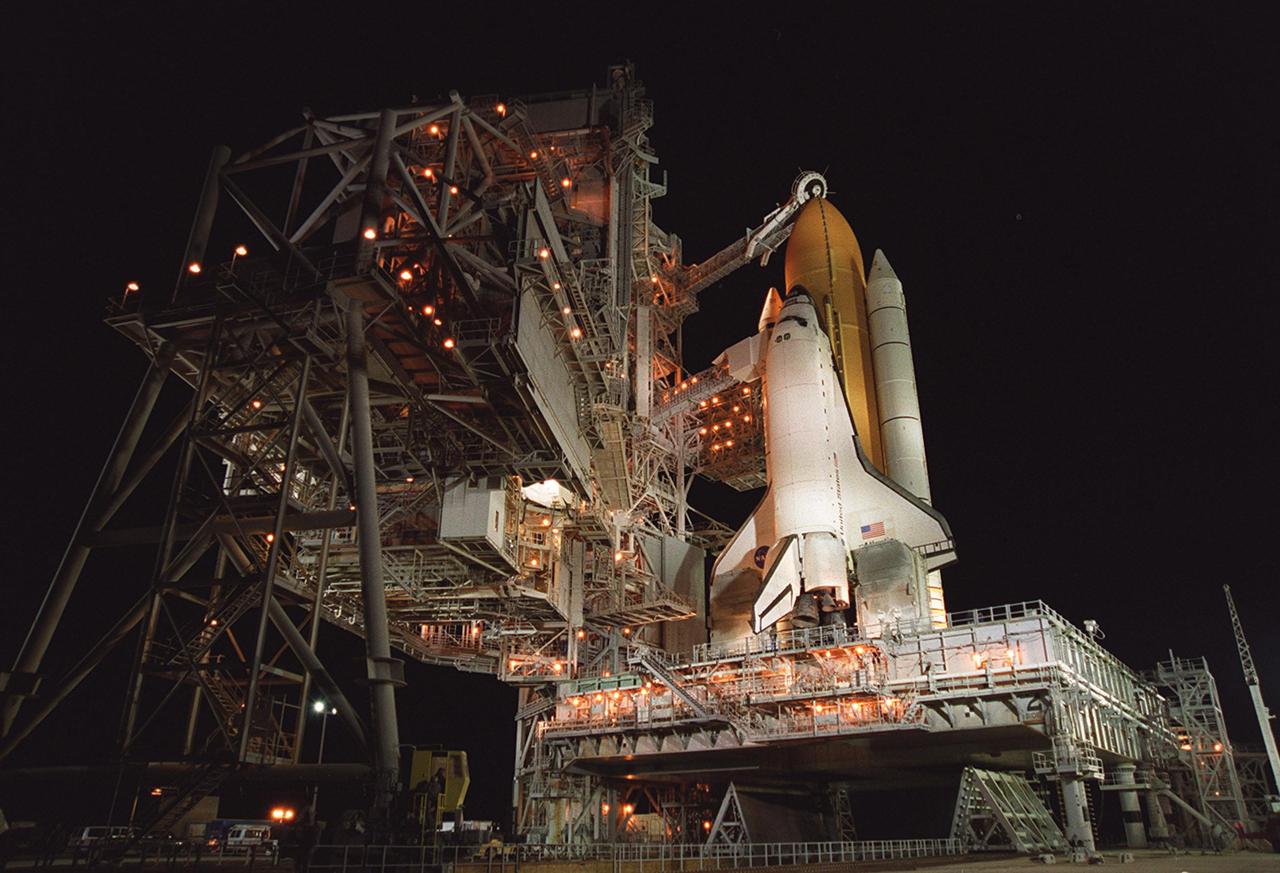
Space Shuttle Atlantis is revealed after rollback of the Rotating Service Structure. Extended to the side of Atlantis is the orbiter access arm, with the White Room at its end. The White Room is an environmentally controlled area that provides entry for the crew into Atlantis’s cockpit. Above the yellow-orange external tank is the Gaseous Oxygen Vent Arm, with the “beanie cap” vent hood raised. Before cryogenic loading, the hood will be lowered into position over the external tank vent louvers to vent gaseous oxygen vapors away from the Shuttle. Atlantis is carrying the U.S. Laboratory Destiny, a key module in the growth of the International Space Station. Destiny will be attached to the Unity node on the Space Station using the Shuttle’s robotic arm. Three spacewalks are required to complete the planned construction work during the 11-day mission. Launch is targeted for 6:11 p.m. EST and the planned landing at KSC Feb. 18 about 1:39 p.m. This mission marks the seventh Shuttle flight to the Space Station, the 23rd flight of Atlantis and the 102nd flight overall in NASA’s Space Shuttle program
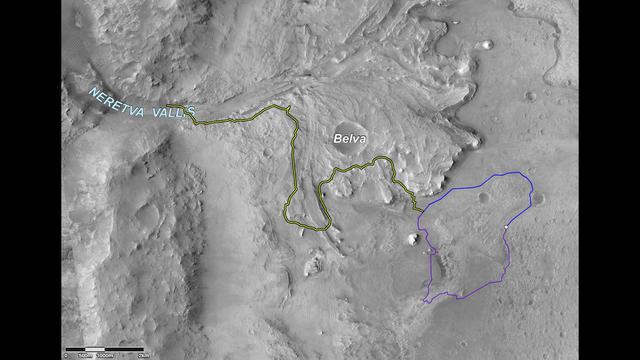
This image shows two possible routes (blue and purple) to the fan-shaped deposit of sediments known as a delta for NASA's Perseverance rover, which landed at the spot marked with a white dot in Mars' Jezero Crater. The yellow line marks a notional traverse exploring the delta. The base image is from the High Resolution Imaging Experiment (HiRISE) camera aboard NASA's Mars Reconnaissance Orbiter (MRO). MRO's mission is managed by NASA's Jet Propulsion Laboratory, a division of Caltech in Pasadena, California, for NASA's Science Mission Directorate. Lockheed Martin Space in Denver built the spacecraft. The University of Arizona in Tucson provided and operates HiRISE. A key objective for Perseverance's mission on Mars is astrobiology, including the search for signs of ancient microbial life. The rover will characterize the planet's geology and past climate, pave the way for human exploration of the Red Planet, and be the first mission to collect and cache Martian rock and regolith (broken rock and dust). Subsequent NASA missions, in cooperation with ESA (European Space Agency), would send spacecraft to Mars to collect these sealed samples from the surface and return them to Earth for in-depth analysis. The Mars 2020 Perseverance mission is part of NASA's Moon to Mars exploration approach, which includes Artemis missions to the Moon that will help prepare for human exploration of the Red Planet. https://photojournal.jpl.nasa.gov/catalog/PIA24486
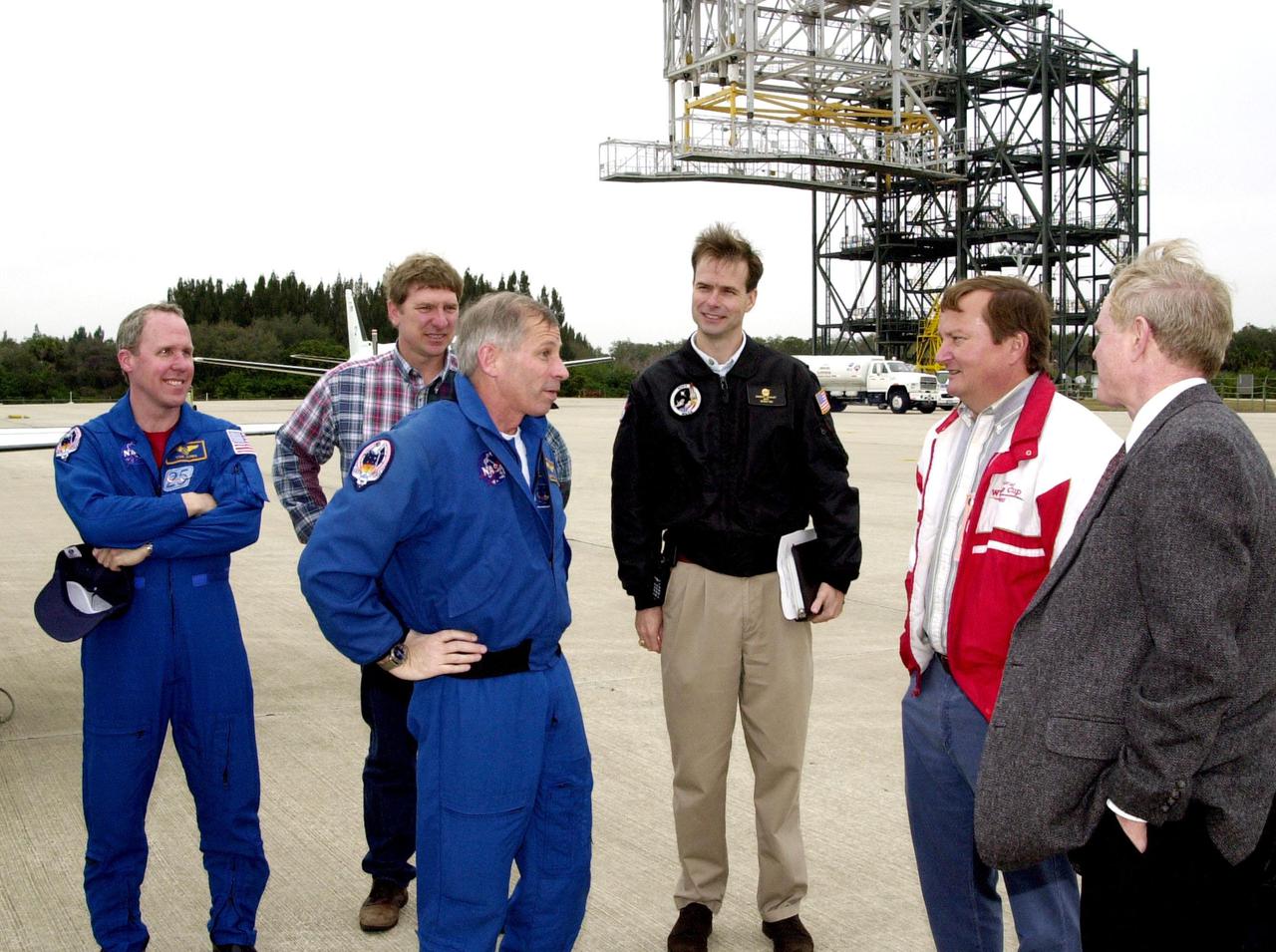
KENNEDY SPACE CENTER, FLA. -- STS-98 Mission Commander Kenneth Cockrell (center) talks with Launch Director Michael Leinbach (red and white jacket) and Center Director Roy Bridges (right) at the Shuttle Landing Facility after the crew's arrival Sunday to complete preparations for launch.; Behind him are, from left to right, Mission Specialist Thomas Jones; Tom Kwiatkowski, NASA, Johnson Space Center (JSC); and Robert Hanley, United Space Alliance, JSC.; The crew also includes Pilot Mark Polansky and Mission Specialists Marsha Ivins and Robert Curbeam.; STS-98 is the seventh construction flight to the International Space Station, carrying as payload the U.S. Lab Destiny, a key element in the construction of the ISS. Launch of STS-98 is scheduled for Feb. 7 at 6:11 p.m. EST
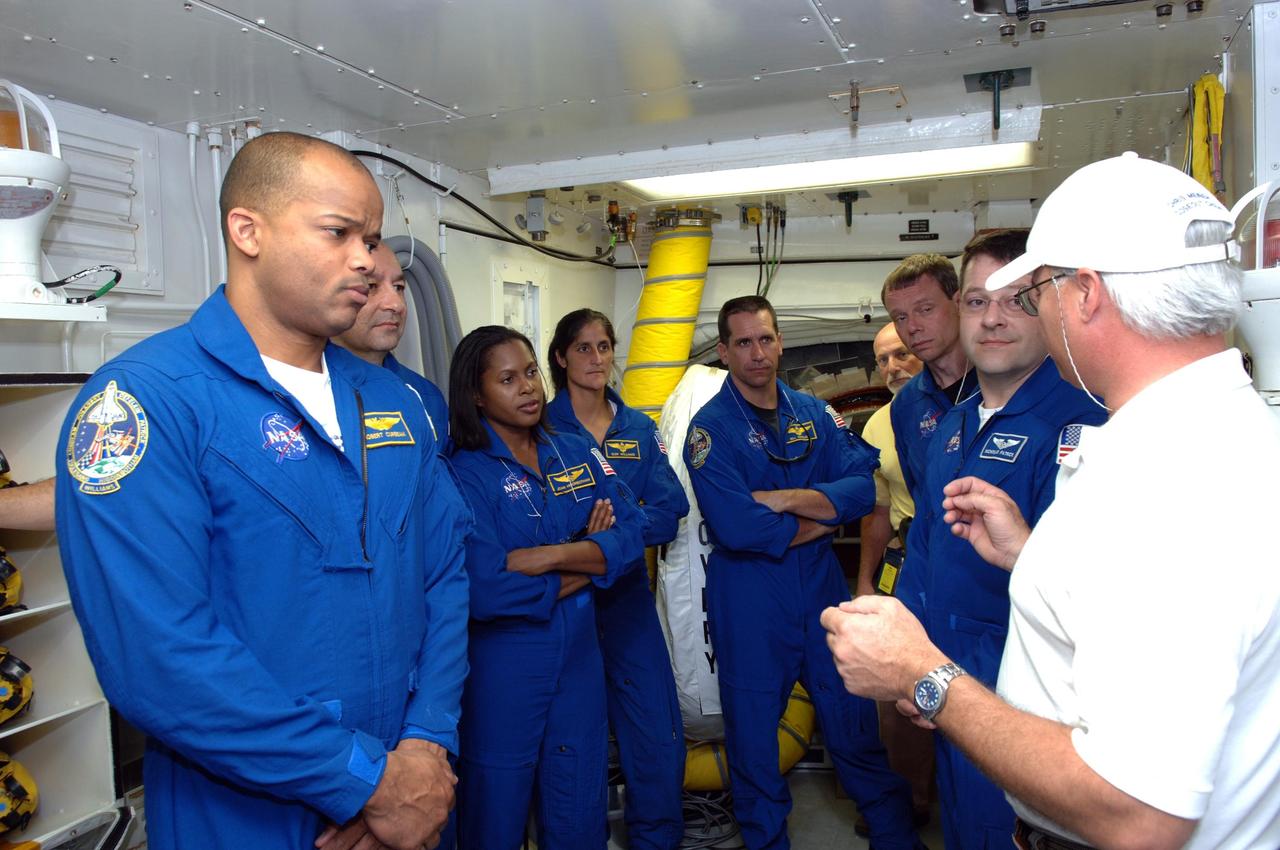
KENNEDY SPACE CENTER, FLA. -- In the White Room on Launch Pad 39B, the STS-116 crew members are told what to expect on launch day as they enter Space Shuttle Discovery from the area. From left are Mission Specialist Robert Curbeam, Commander Mark Polansky, Mission Specialists Joan Higginbotham and Sunita Williams, Pilot William Oefelein, and Mission Specialists Christer Fuglesang and Nicholas Patrick. Fuglesang represents the European Space Agency. The mission crew is at KSC for the TCDT, which includes a simulated launch countdown. The STS-116 mission is No. 20 to the International Space Station and construction flight 12A.1. The mission payload is the SPACEHAB module, the P5 integrated truss structure and other key components. Launch is scheduled for no earlier than Dec. 7. Photo credit: NASA/Kim Shiflett
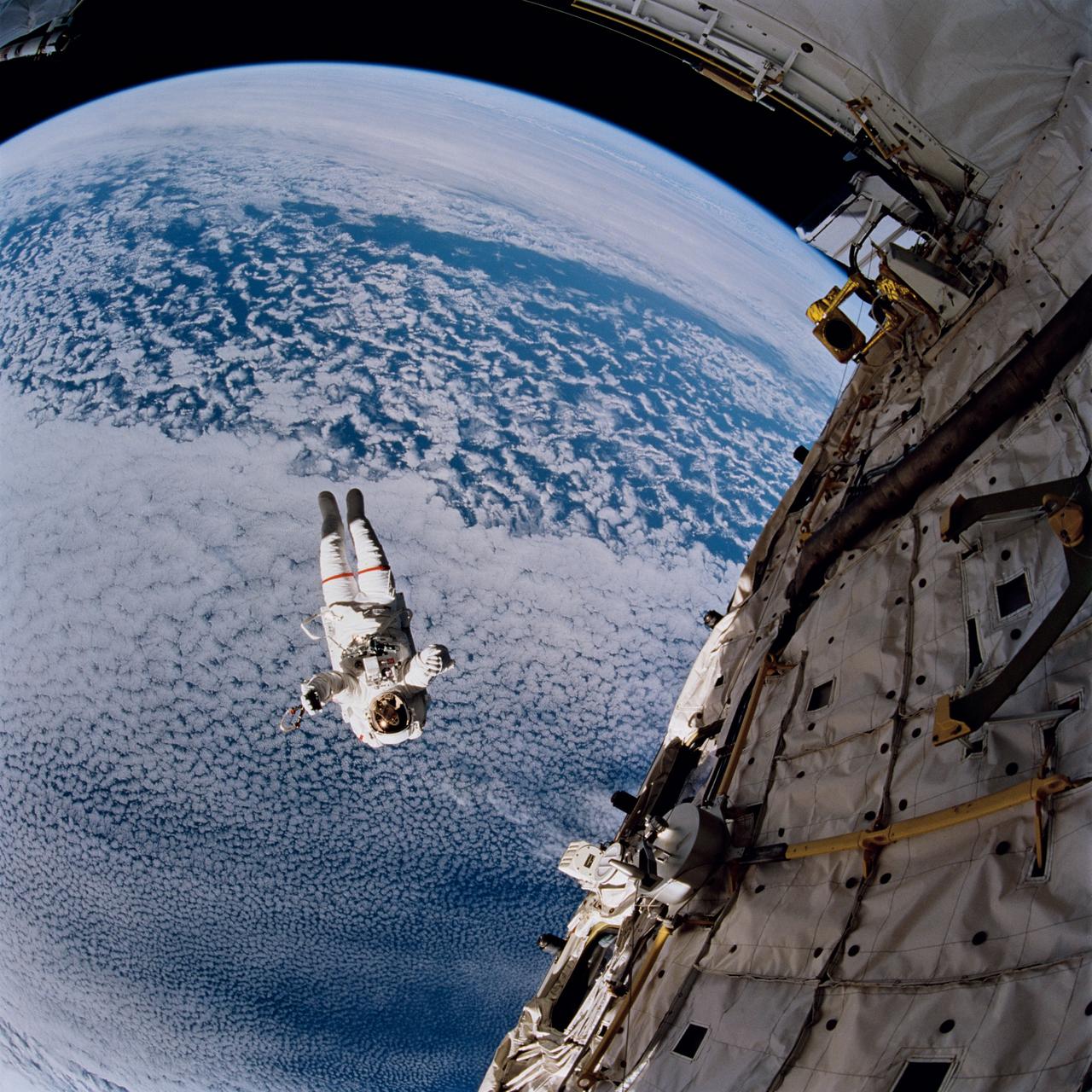
STS064-217-008 (16 Sept. 1994) --- Backdropped against the blue and white Earth, 130 nautical miles below, astronaut Mark C. Lee tests the new Simplified Aid for EVA Rescue (SAFER) system. The scene was captured with a 70mm handheld Hasselblad camera with a 30mm lens attached. Astronauts Lee and Carl J. Meade took turns using the SAFER hardware during their shared Extravehicular Activity (EVA) of Sept. 16, 1994. The test of SAFER is the first phase of a larger SAFER program whose objectives are to establish a common set of requirements for both space shuttle and space station program needs, develop a flight demonstration of SAFER, validate system performance and, finally, develop a production version of SAFER for the shuttle and station programs. Photo credit: NASA or National Aeronautics and Space Administration
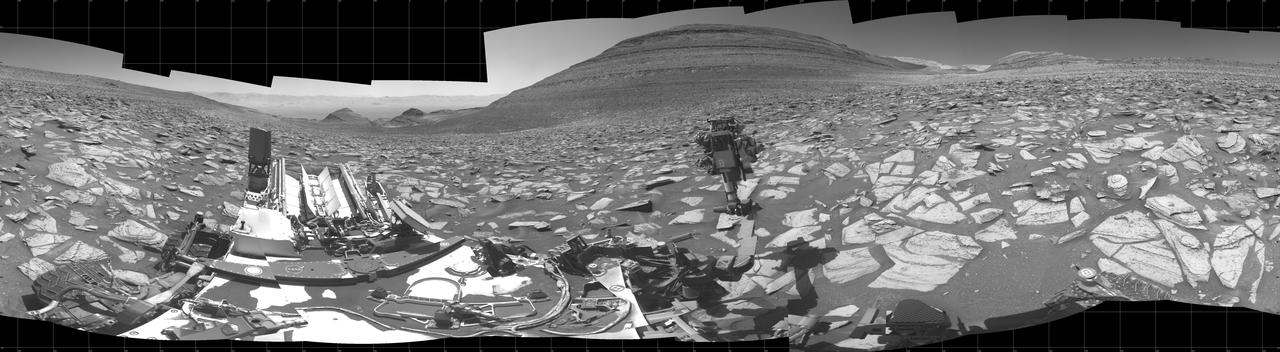
NASA's Curiosity Mars rover captured this 360-degree panorama using its black-and-white navigation cameras, or Navcams, at a location where it collected a sample from a rock nicknamed "Sequoia." This panorama was captured on Oct. 21 and 26, 2023, the 3,984th and 3,989th Martian days, or sols, of the mission. The sample from Sequoia marks the 39th hole that Curiosity drilled into the Martian surface. While the Perseverance rover collects intact rock cores, Curiosity's rock samples are powderized, then sprinkled into instruments within the rover's chassis. These instruments can provide highly detailed compositional data. Since 2014, Curiosity has been ascending the 3-mile-tall (5-kilometer-tall) Mount Sharp, a mountain with distinct layers that formed in different eras of ancient Martian history. By studying the differences between these layers, scientists are learning more about how the Martian climate – and especially its water – changed over time. https://photojournal.jpl.nasa.gov/catalog/PIA26047

KENNEDY SPACE CENTER, FLA. - In the White Room on Launch Pad 39B, STS-121 Pilot Mark Kelly gets help from the closeout crew with final adjustments to his launch suit before entering Space Shuttle Discovery. The crew is taking part in a full dress rehearsal for launch, including countdown and culminating in main engine cutoff. The rehearsal is the final part of Terminal Countdown Demonstration Test (TCDT) activities that the crew has been involved in for two days. TCDT provides the crew of each mission an opportunity to participate in various simulated countdown activities, including equipment familiarization and emergency egress training. Mission STS-121 is scheduled to be launched July 1. Photo credit: NASA/Amanda Diller
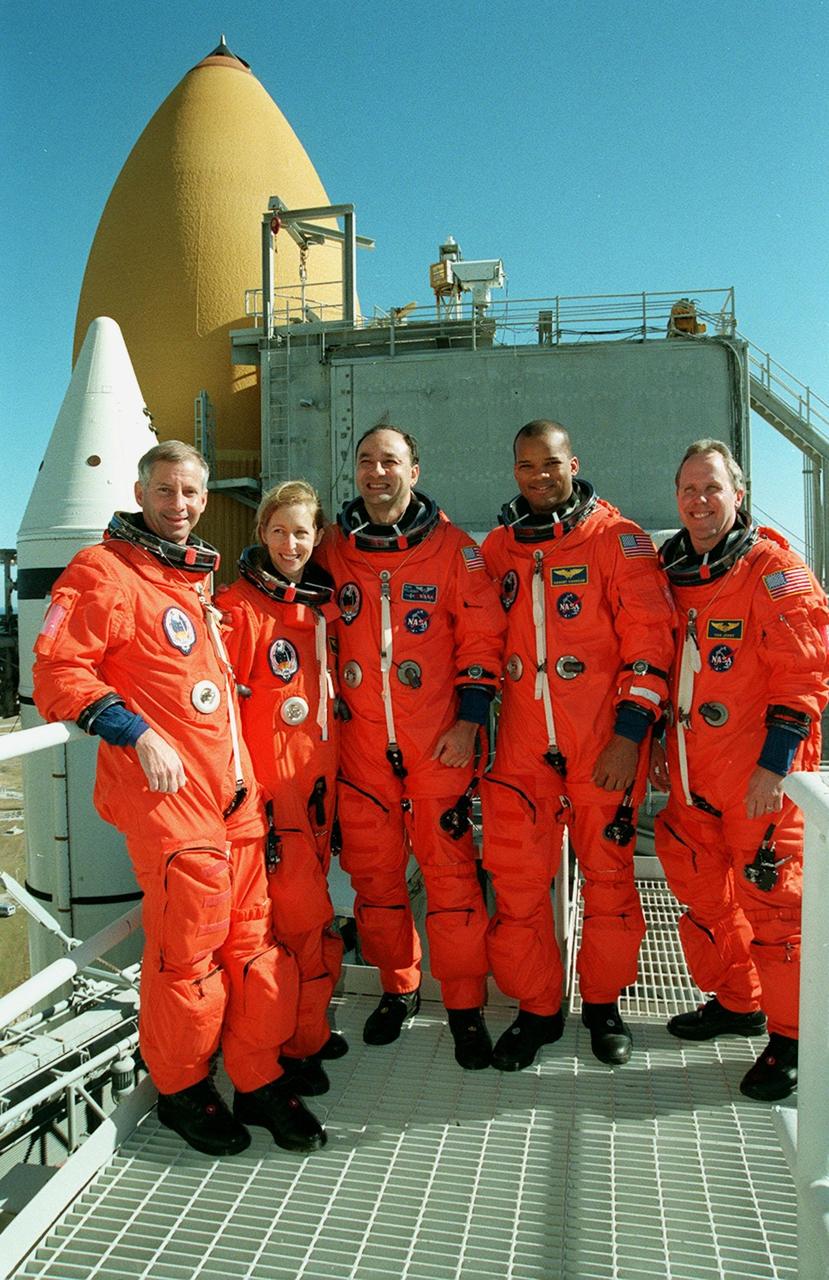
KENNEDY SPACE CENTER, FLA. -- The STS-98 crew poses for a group photo on the 215-foot level of the Fixed Service Structure at Launch Pad 39A. Dressed in their orange launch and entry suits are (left to right) Commander Ken Cockrell, Mission Specialist Marsha Ivins, Pilot Mark Polansky and Mission Specialists Robert Curbeam and Thomas Jones. Behind them can be seen the white nose cone of a solid rocket booster and the orange external tank on Space Shuttle Atlantis. The crew is taking part in emergency egress training and a simulated launch countdown as part of Terminal Countdown Demonstration Test activities. STS-98 is the seventh construction flight to the International Space Station, carrying as payload the U.S. Lab Destiny, a key element in the construction of the ISS. Launch of STS-98 is scheduled for Jan. 19 at 2:11 a.m. EST
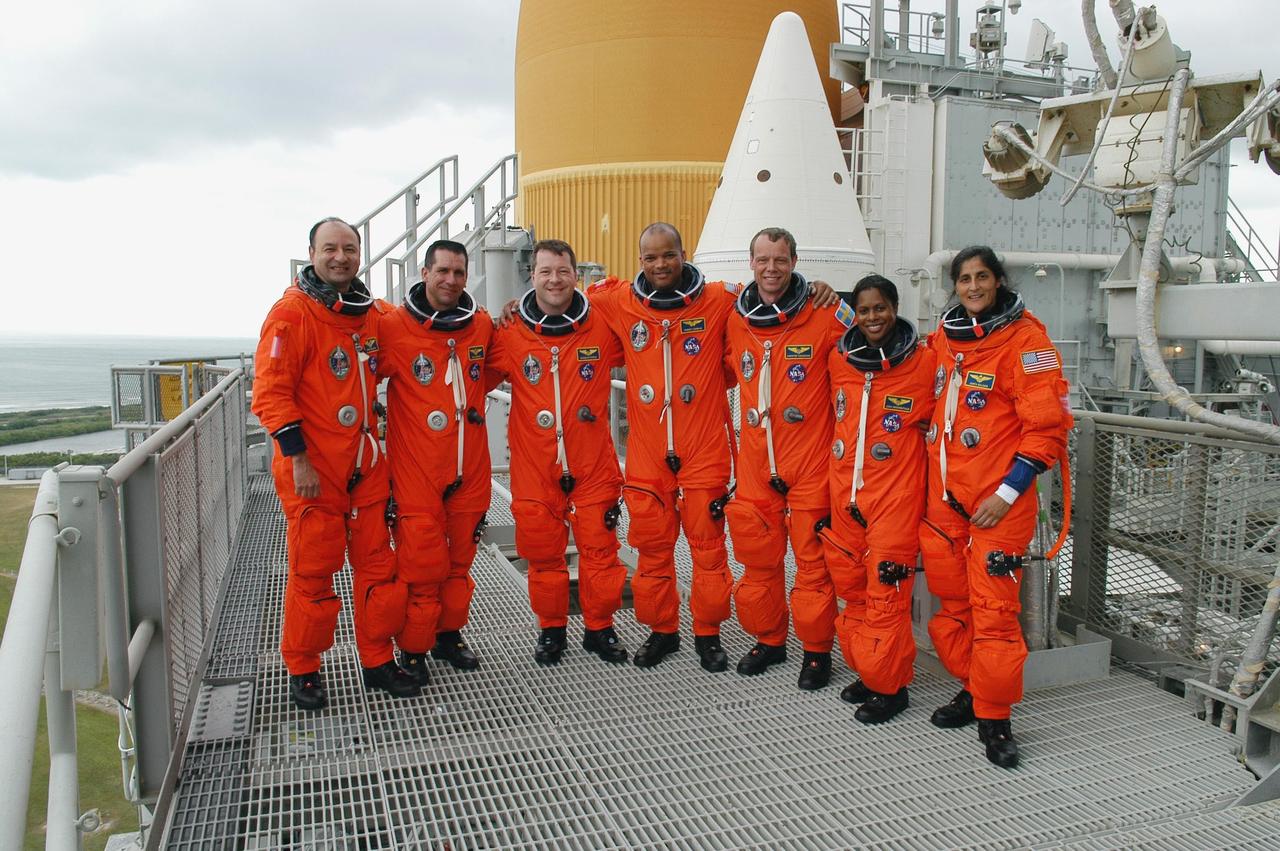
KENNEDY SPACE CENTER, FLA. -- On the 195-foot level of the fixed service structure on Launch Pad 39B, STS-116 crew members gather for a photo in front of the white solid rocket boosters and external tank of Space Shuttle Discovery. They have just completed a simulated launch countdown and emergency egress from the orbiter. From left are Commander Mark Polansky, Pilot William Oefelein and Mission Specialists Nicholas Patrick, Robert Curbeam, Christer Fuglesang, Joan Higginbotham and Sunita Williams. Fuglesang represents the European Space Agency. Williams is traveling to the International Space Station on Discovery and will remain behind as a flight engineer with the Expedition 14 crew. The STS-116 mission is No. 20 to the International Space Station and construction flight 12A.1. The mission payload is the SPACEHAB module, the P5 integrated truss structure and other key components. Launch is scheduled for no earlier than Dec. 7. Photo credit: NASA/Kim Shiflett
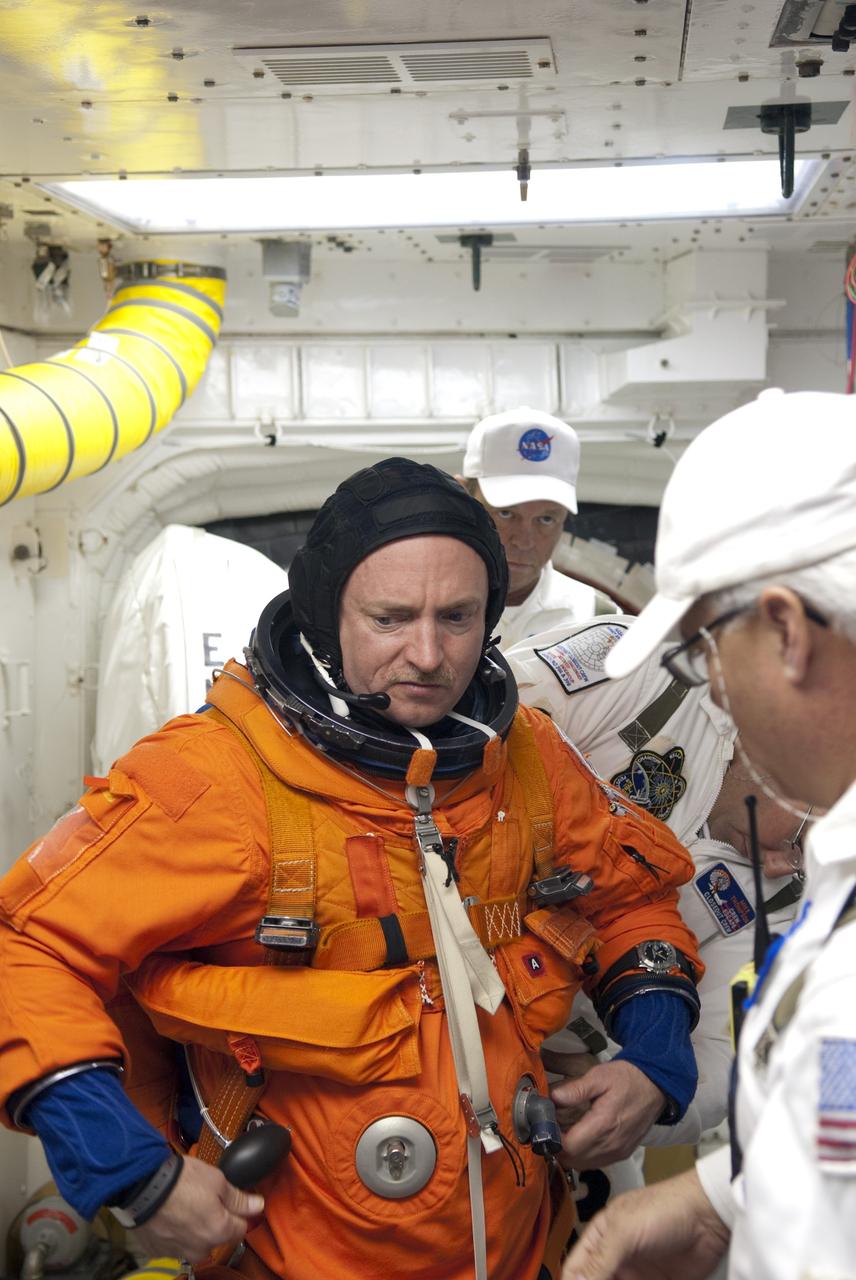
CAPE CANAVERAL, Fla. - In the White Room of Launch Pad 39A at NASA's Kennedy Space Center in Florida, STS-134 Commander Mark Kelly prepares to board space shuttle Endeavour during the Terminal Countdown Demonstration Test (TCDT). Part of TCDT includes practicing the final hours of a real launch day when astronauts put on their launch-and-entry suits, ride to the pad in the Astrovan and strap into the shuttle. Endeavour's six crew members are targeted to launch April 19 at 7:48 p.m. EDT. They will deliver the Express Logistics Carrier-3, Alpha Magnetic Spectrometer-2 (AMS), a high-pressure gas tank, additional spare parts for the Dextre robotic helper and micrometeoroid debris shields to the International Space Station. This will be the final spaceflight for Endeavour. For more information visit, www.nasa.gov/mission_pages/shuttle/shuttlemissions/sts134/index.html. Photo credit: NASA/Jim Grossmann
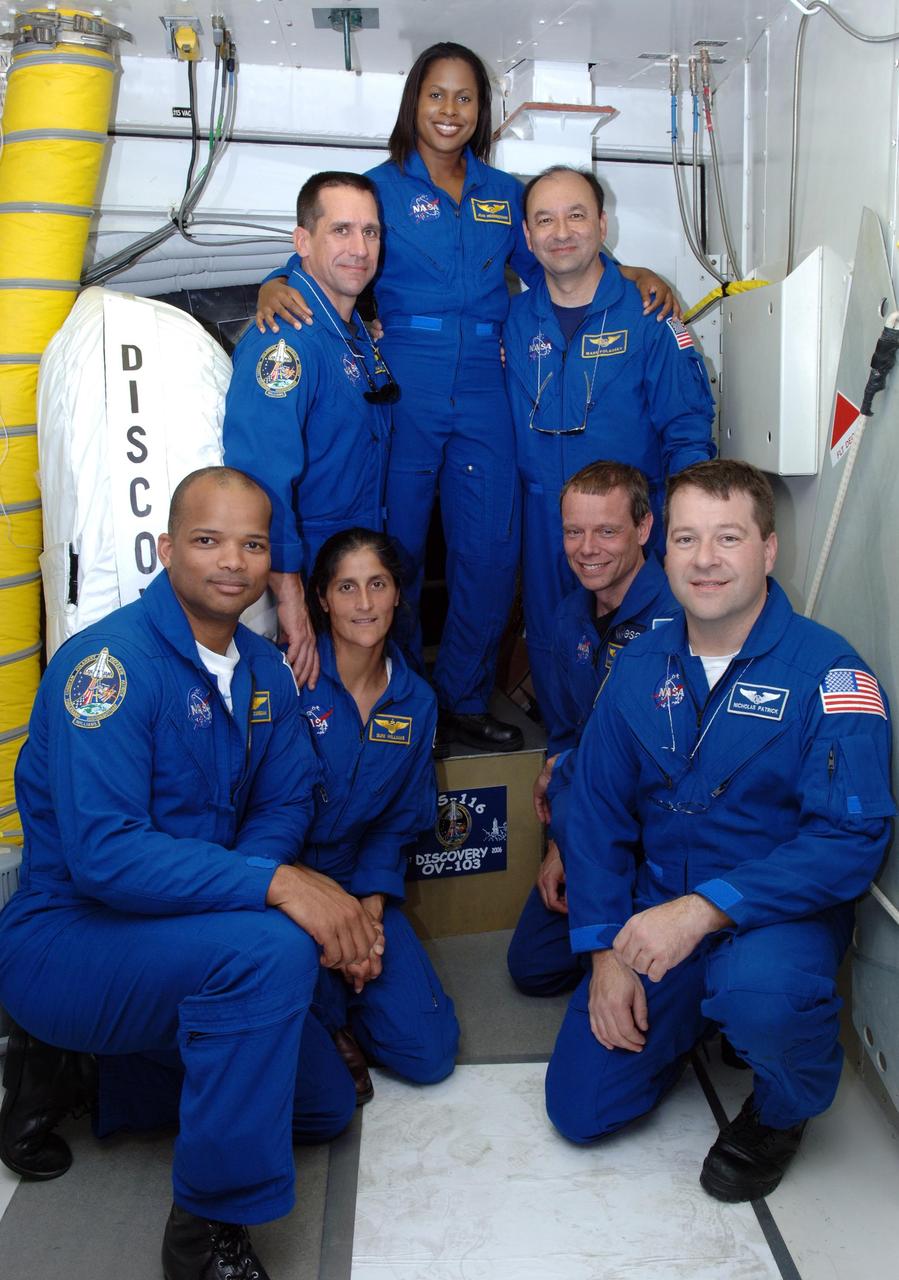
KENNEDY SPACE CENTER, FLA. -- The mission STS-116 crew poses in the White Room on Launch Pad 39B. Clockwise from left are Mission Specialists Robert Curbeam and Sunita Williams, Pilot William Oefelein, Mission Specialist Joan Higginbotham, Commander Mark Polansky, and Mission Specialists Christer Fuglesang and Nicholas Patrick. Fuglesang represents the European Space Agency. The mission crew is at KSC for the TCDT, which includes a simulated launch countdown. The STS-116 mission is No. 20 to the International Space Station and construction flight 12A.1. The mission payload is the SPACEHAB module, the P5 integrated truss structure and other key components. Launch is scheduled for no earlier than Dec. 7. Photo credit: NASA/Kim Shiflett
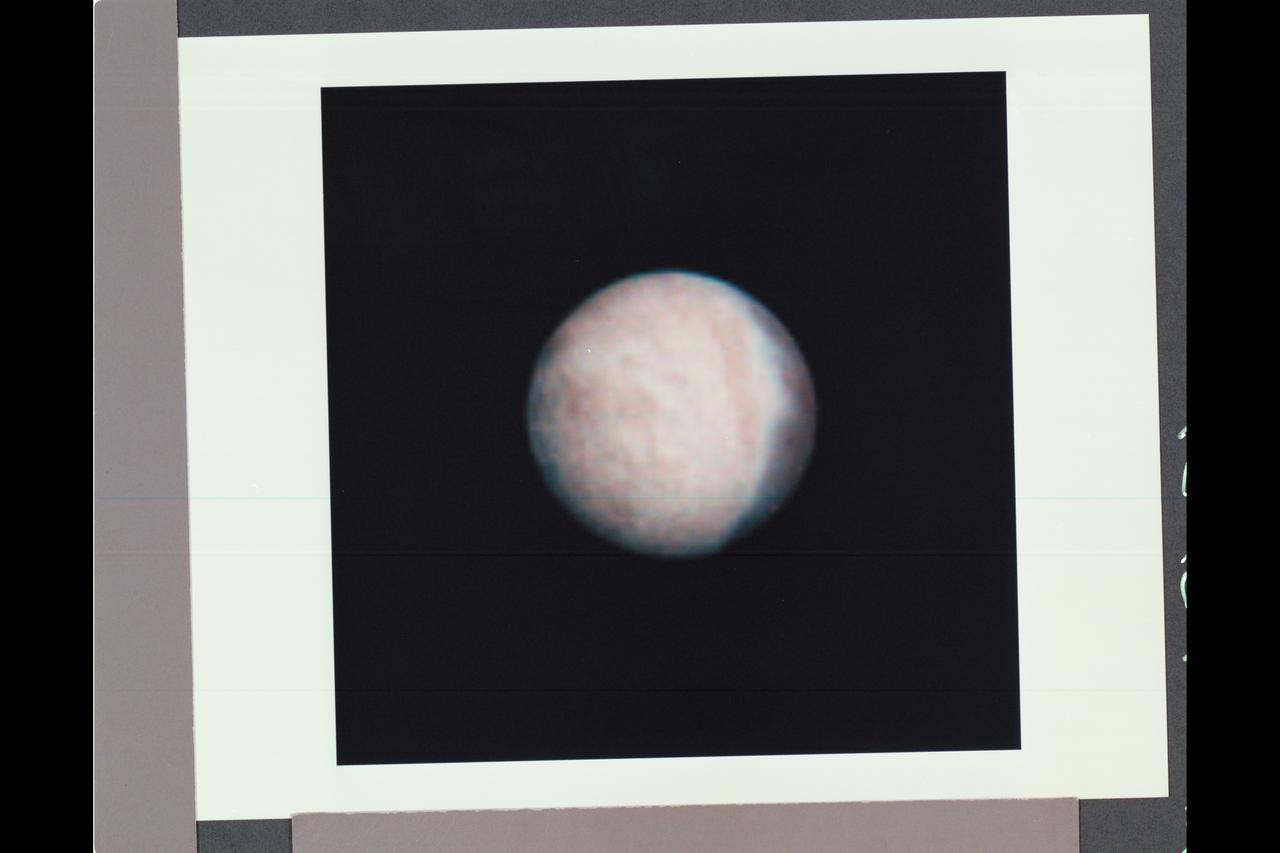
Range : 5.4 million km (3.3 million miles) Features as small as 100 km (62 miles) across can be seen in this color image of Neptune's satellite Triton, photographed by Voyager 2. Triton's overall pinkish color may be due to reddish materials produced by irradiation of methane gas and ice on the satellite. The dark areas near the top of the image seem to be part of a belt of dark markings observed near Trition's equator at different longitudes. Generally, darker areas on Triton appear to be somewhat redder in color than brighter areas. The central longitude in the image is 123 degrees. Here the south pole is at about 6 o'clock, approximately 1/6th of the way up from the bottom. The color image was made from three black-and-white frames, taken through clear, violet and green filters.
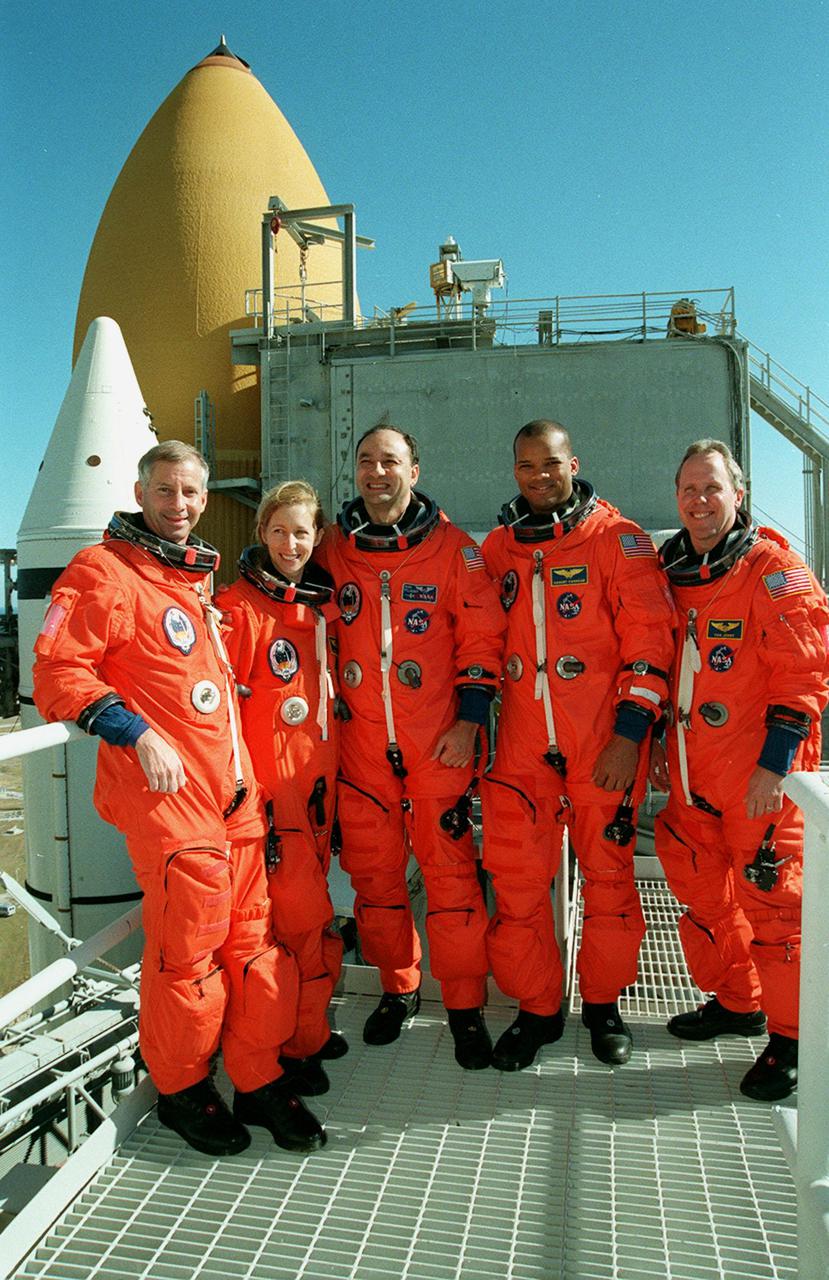
KENNEDY SPACE CENTER, FLA. -- The STS-98 crew poses for a group photo on the 215-foot level of the Fixed Service Structure at Launch Pad 39A. Dressed in their orange launch and entry suits are (left to right) Commander Ken Cockrell, Mission Specialist Marsha Ivins, Pilot Mark Polansky and Mission Specialists Robert Curbeam and Thomas Jones. Behind them can be seen the white nose cone of a solid rocket booster and the orange external tank on Space Shuttle Atlantis. The crew is taking part in emergency egress training and a simulated launch countdown as part of Terminal Countdown Demonstration Test activities. STS-98 is the seventh construction flight to the International Space Station, carrying as payload the U.S. Lab Destiny, a key element in the construction of the ISS. Launch of STS-98 is scheduled for Jan. 19 at 2:11 a.m. EST

CAPE CANAVERAL, Fla. -- In the White Room on Launch Pad 39A at NASA's Kennedy Space Center, STS-124 Commander Mark Kelly dons the parachute required for launch. He and the other crew members are taking part in a simulated launch countdown, part of the launch dress rehearsal known as the terminal countdown demonstration test. The simulation serves as a practice exercise in which both the launch team and flight crew rehearse launch day time lines and procedures. The test culminates in a simulated ignition and automated shutdown of the orbiter's main engines. On the STS-124 mission, the crew will deliver and install the Japanese Experiment Module – Pressurized Module and Japanese Remote Manipulator System. Discovery's launch is targeted for May 31. Photo credit: NASA/Amanda Diller
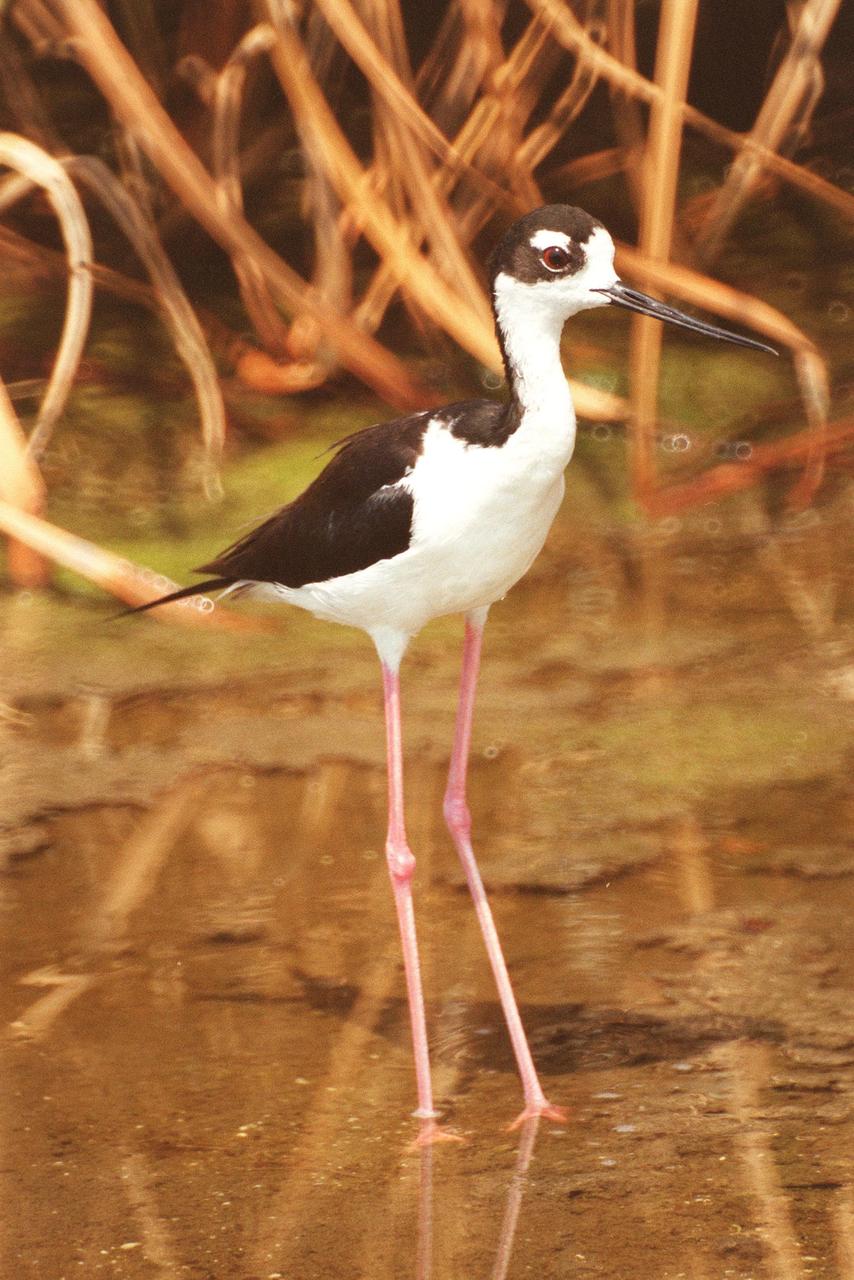
KENNEDY SPACE CENTER, FLA. -- An adult Black-necked Stilt keeps a wary eye out for intruders. The species inhabits salt marshes and shallow coastal bays in the East, as well as freshwater marshes in the West. They are found along the Atlantic Coast from Delaware to northern South America. The black and white markings, long red legs and straight, very thin bill make the stilt very recognizable. This stilt was photographed in the Merritt Island National Wildlife Refuge, which shares a boundary with Kennedy Space Center. The Refuge encompasses 92,000 acres that are a habitat for more than 331 species of birds, 31 mammals, 117 fishes, and 65 amphibians and reptiles. The marshes and open water of the refuge provide wintering areas for 23 species of migratory waterfowl, as well as a year-round home for great blue herons, great egrets, wood storks, cormorants, brown pelicans and other species of marsh and shore birds, as well as a variety of insects

ISS005-E-16729 (7 October 2002) --- Great Salt Lake, Utah, is featured in this image photographed by an Expedition 5 crewmember on the International Space Station (ISS). Great Salt Lake serves as a striking visual marker for crewmembers orbiting over North America. A sharp line across its center is caused by the restriction in water flow from the railroad causeway. The eye-catching colors of the lake stem from the fact that Great Salt Lake is hyper saline, typically 3-5 times saltier than the ocean, and the high salinities support sets of plants and animals that affect the light-absorbing qualities of the water. North of the causeway salinities are higher, and the water turns red from the pigments of halophilic bacteria. In the shallower corner of the lake, earthen dikes mark large salt evaporation works, which take on the jewel tones of turquoise, russet, tamber and pearl white.
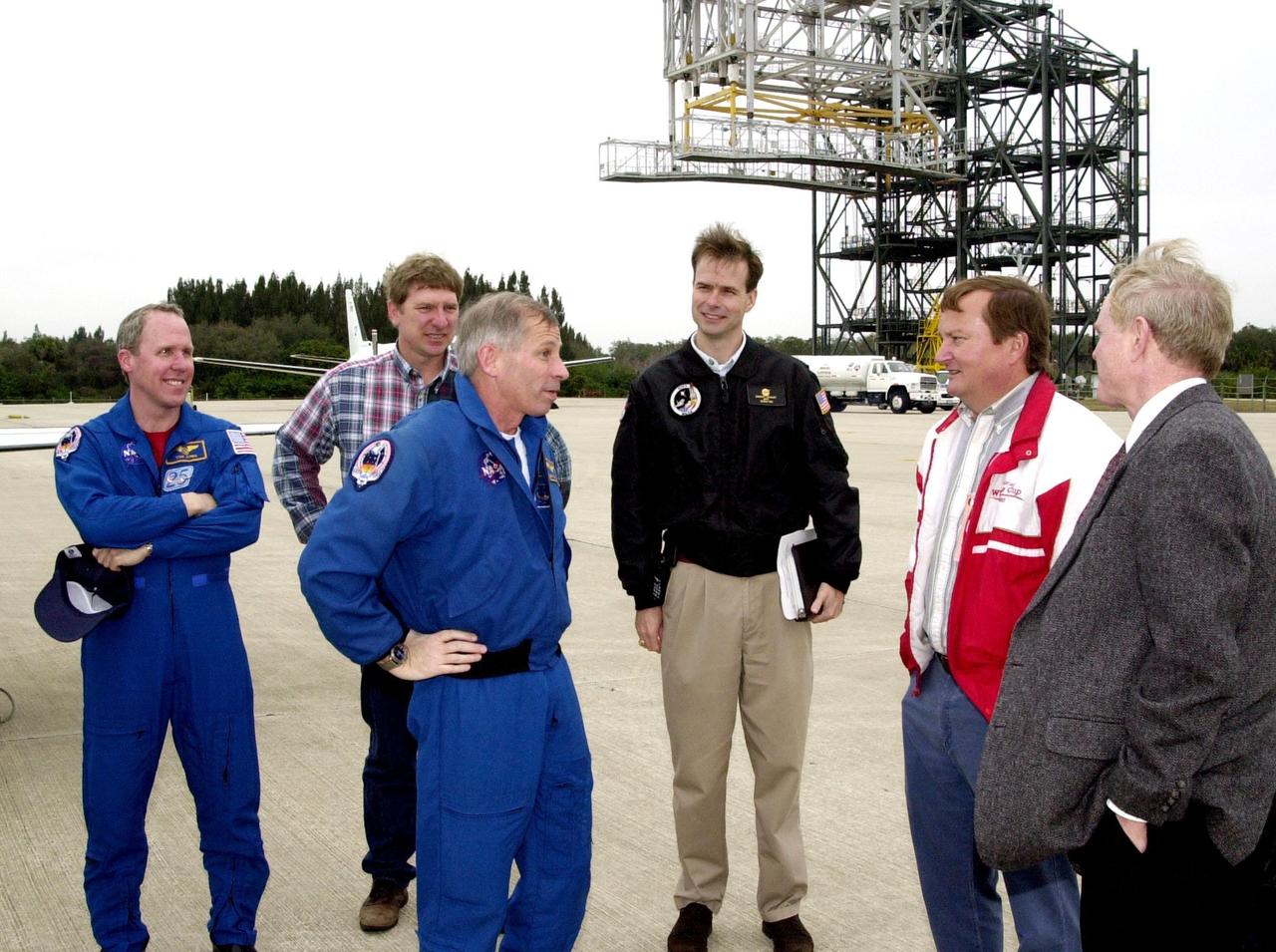
KENNEDY SPACE CENTER, FLA. -- STS-98 Mission Commander Kenneth Cockrell (center) talks with Launch Director Michael Leinbach (red and white jacket) and Center Director Roy Bridges (right) at the Shuttle Landing Facility after the crew's arrival Sunday to complete preparations for launch.; Behind him are, from left to right, Mission Specialist Thomas Jones; Tom Kwiatkowski, NASA, Johnson Space Center (JSC); and Robert Hanley, United Space Alliance, JSC.; The crew also includes Pilot Mark Polansky and Mission Specialists Marsha Ivins and Robert Curbeam.; STS-98 is the seventh construction flight to the International Space Station, carrying as payload the U.S. Lab Destiny, a key element in the construction of the ISS. Launch of STS-98 is scheduled for Feb. 7 at 6:11 p.m. EST