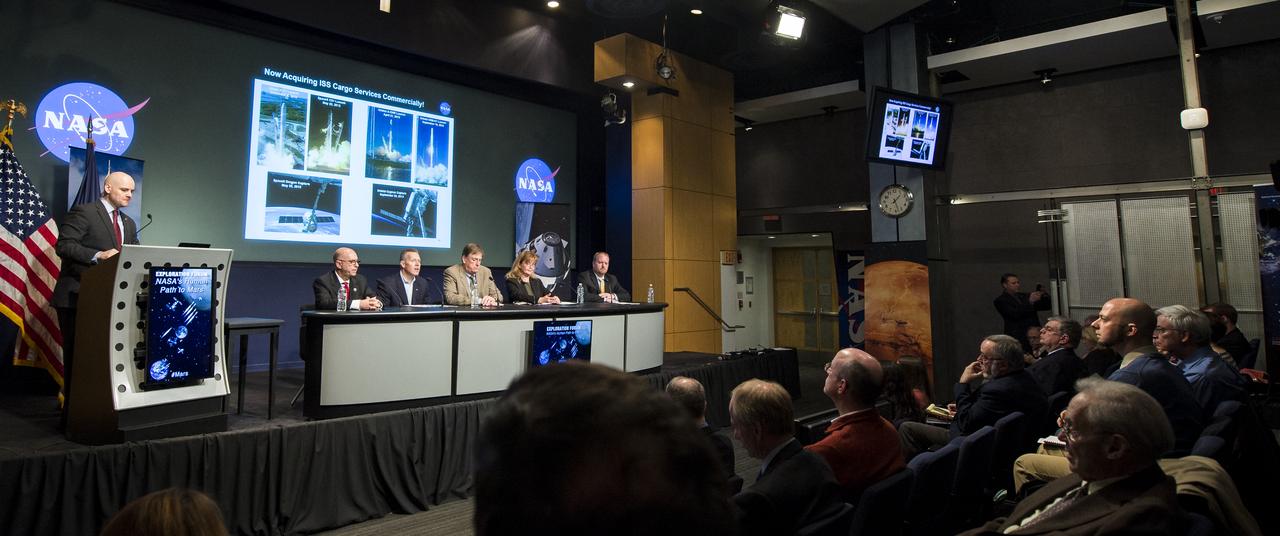
Sam Scimemi, Director of NASA's International Space Station Division, second from left, Phil McAlister, Director of NASA's Commercial Spaceflight Division, third from left, Dan Dumbacher, Deputy Associate Administrator of NASA's Exploration Systems Development, center, Michele Gates, Senior Technical Advisor of NASA's Human Exploration and Operations Mission Directorate, second from right, and Jason Crusan, Director of NASA's Advanced Exploration Systems Division, right, sit on a panel during an Exploration Forum showcasing NASA's human exploration path to Mars in the James E. Webb Auditorium at NASA Headquarters on Tuesday, April 29, 2014. Photo Credit: (NASA/Joel Kowsky)
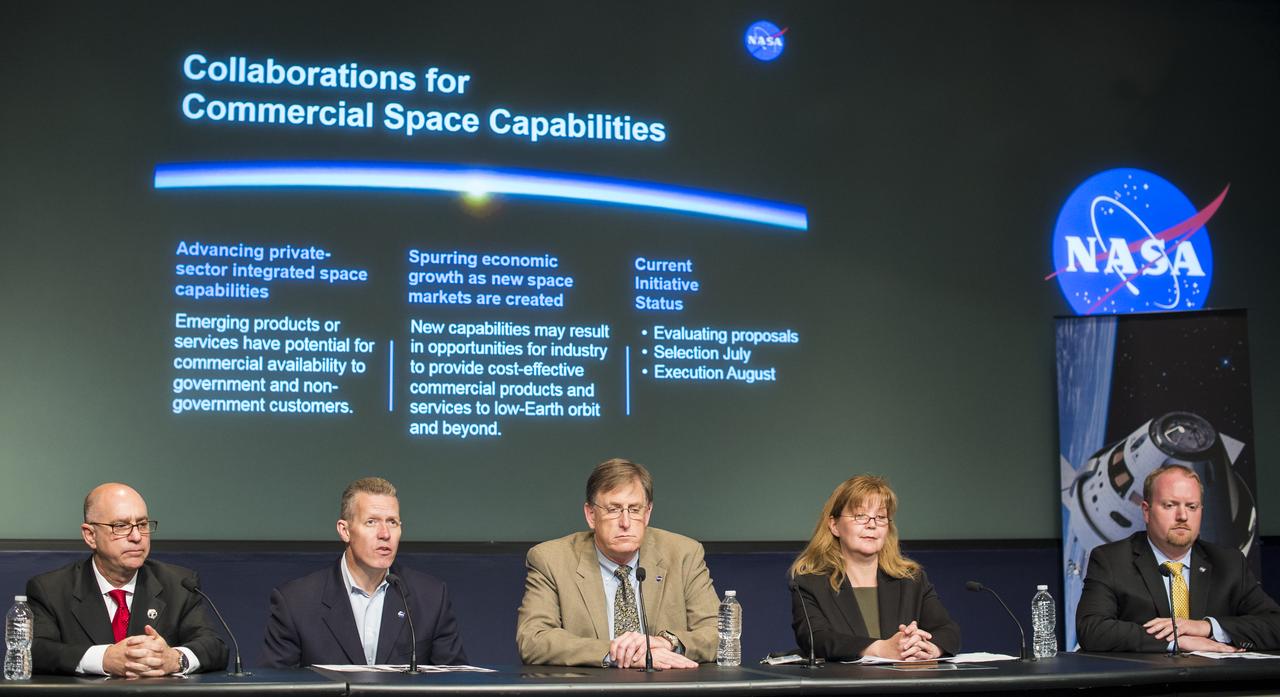
Sam Scimemi, Director of NASA's International Space Station Division, left, Phil McAlister, Director of NASA's Commercial Spaceflight Division, second from left, Dan Dumbacher, Deputy Associate Administrator of NASA's Exploration Systems Development, center, Michele Gates, Senior Technical Advisor of NASA's Human Exploration and Operations Mission Directorate, second from right, and Jason Crusan, Director of NASA's Advanced Exploration Systems Division, right, sit on a panel during an Exploration Forum showcasing NASA's human exploration path to Mars in the James E. Webb Auditorium at NASA Headquarters on Tuesday, April 29, 2014. Photo Credit: (NASA/Joel Kowsky)
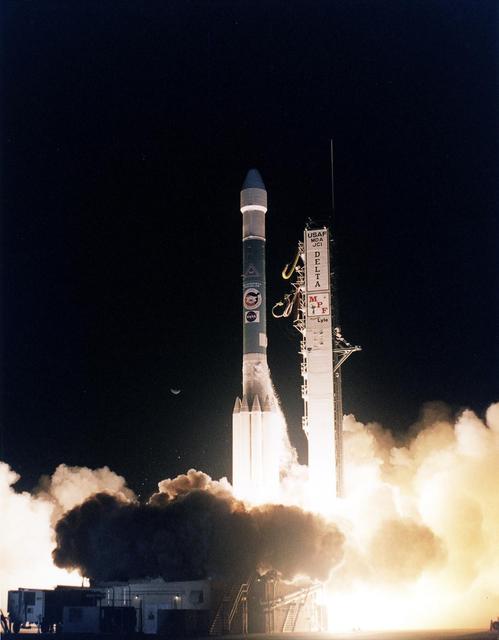
NASA Mars Pathfinder was launched on a Delta Launch Vehicle at 1:56 am on 4 December 1996 from Cape Canaveral Spaceflight Center. http://photojournal.jpl.nasa.gov/catalog/PIA04754

NASA Administrator Charles Bolden speaks during an Exploration Forum showcasing NASA's human exploration path to Mars in the James E. Webb Auditorium at NASA Headquarters on Tuesday, April 29, 2014. Photo Credit: (NASA/Joel Kowsky)

NASA Administrator Charles Bolden speaks during an Exploration Forum showcasing NASA's human exploration path to Mars in the James E. Webb Auditorium at NASA Headquarters on Tuesday, April 29, 2014. Photo Credit: (NASA/Joel Kowsky)

Randy Lillard, Program Executive for Technology Demonstration Missions of NASA's Space Technology Mission DIrectorate, speaks during an Exploration Forum showcasing NASA's human exploration path to Mars in the James E. Webb Auditorium at NASA Headquarters on Tuesday, April 29, 2014. Photo Credit: (NASA/Joel Kowsky)
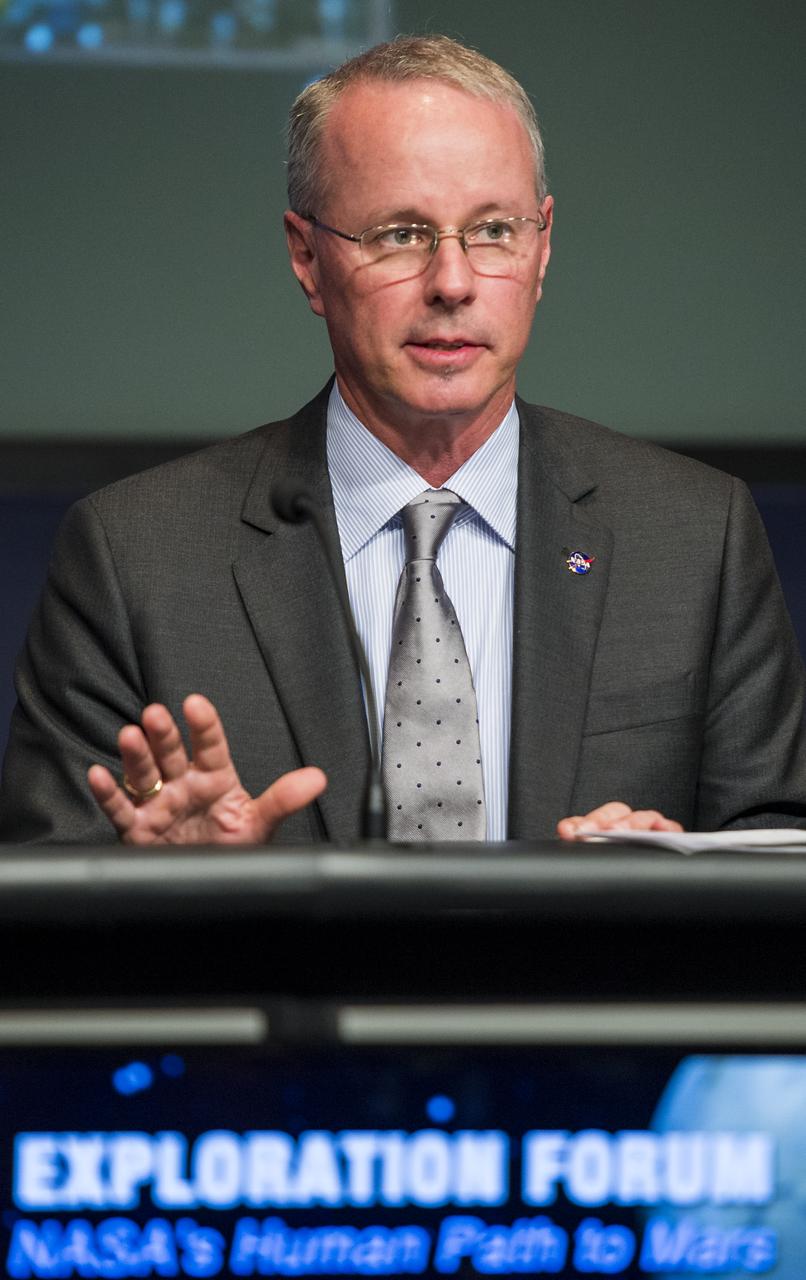
David Miller, NASA Chief Technologist, participate in a panel discussion during an Exploration Forum showcasing NASA's human exploration path to Mars in the James E. Webb Auditorium at NASA Headquarters on Tuesday, April 29, 2014. Photo Credit: (NASA/Joel Kowsky)
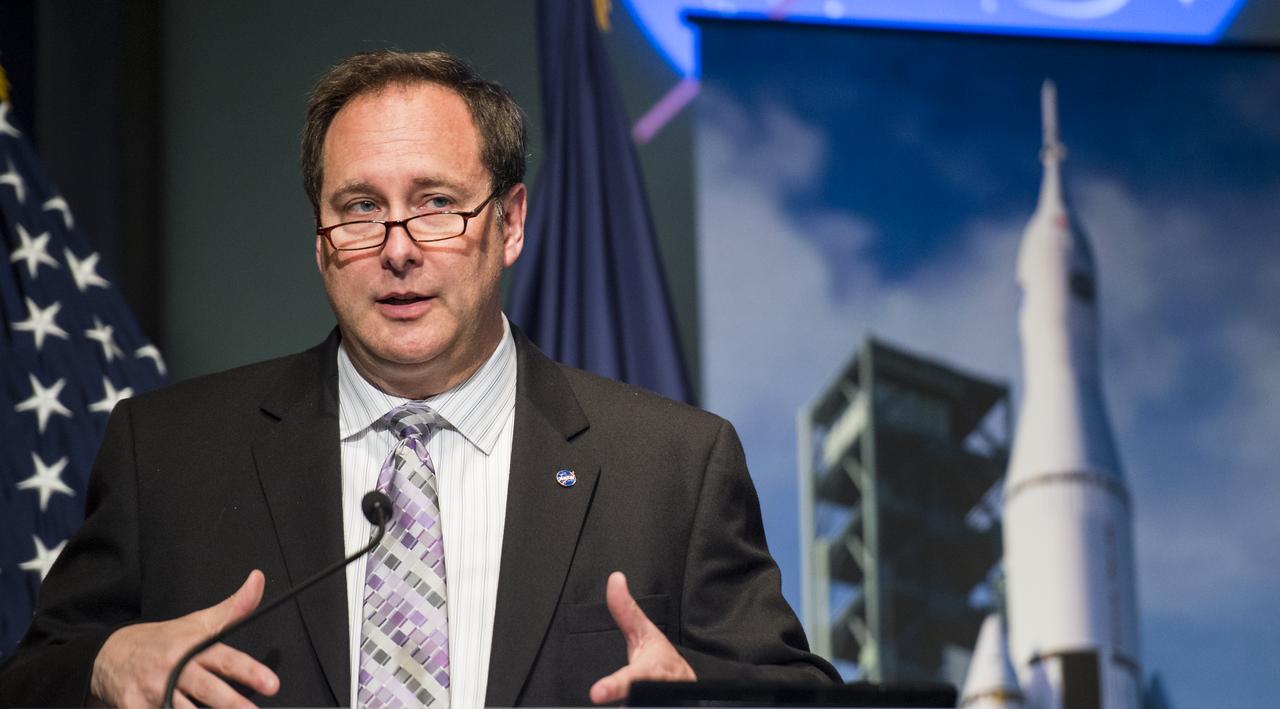
Robert Lightfoot, NASA Associate Adminstrator, delivers closing remarks at an Exploration Forum showcasing NASA's human exploration path to Mars in the James E. Webb Auditorium at NASA Headquarters on Tuesday, April 29, 2014. Photo Credit: (NASA/Joel Kowsky)
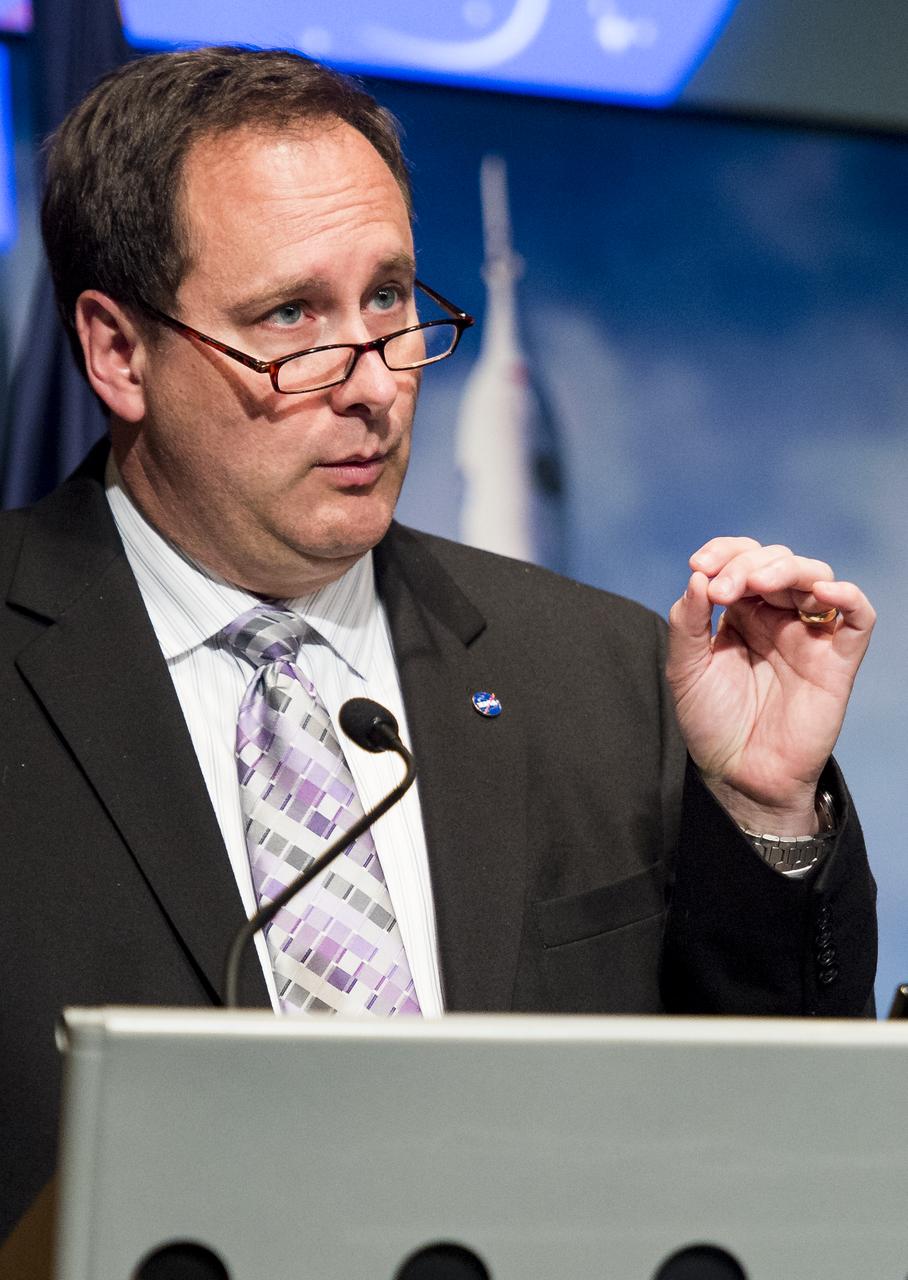
Robert Lightfoot, NASA Associate Adminstrator, delivers closing remarks at an Exploration Forum showcasing NASA's human exploration path to Mars in the James E. Webb Auditorium at NASA Headquarters on Tuesday, April 29, 2014. Photo Credit: (NASA/Joel Kowsky)
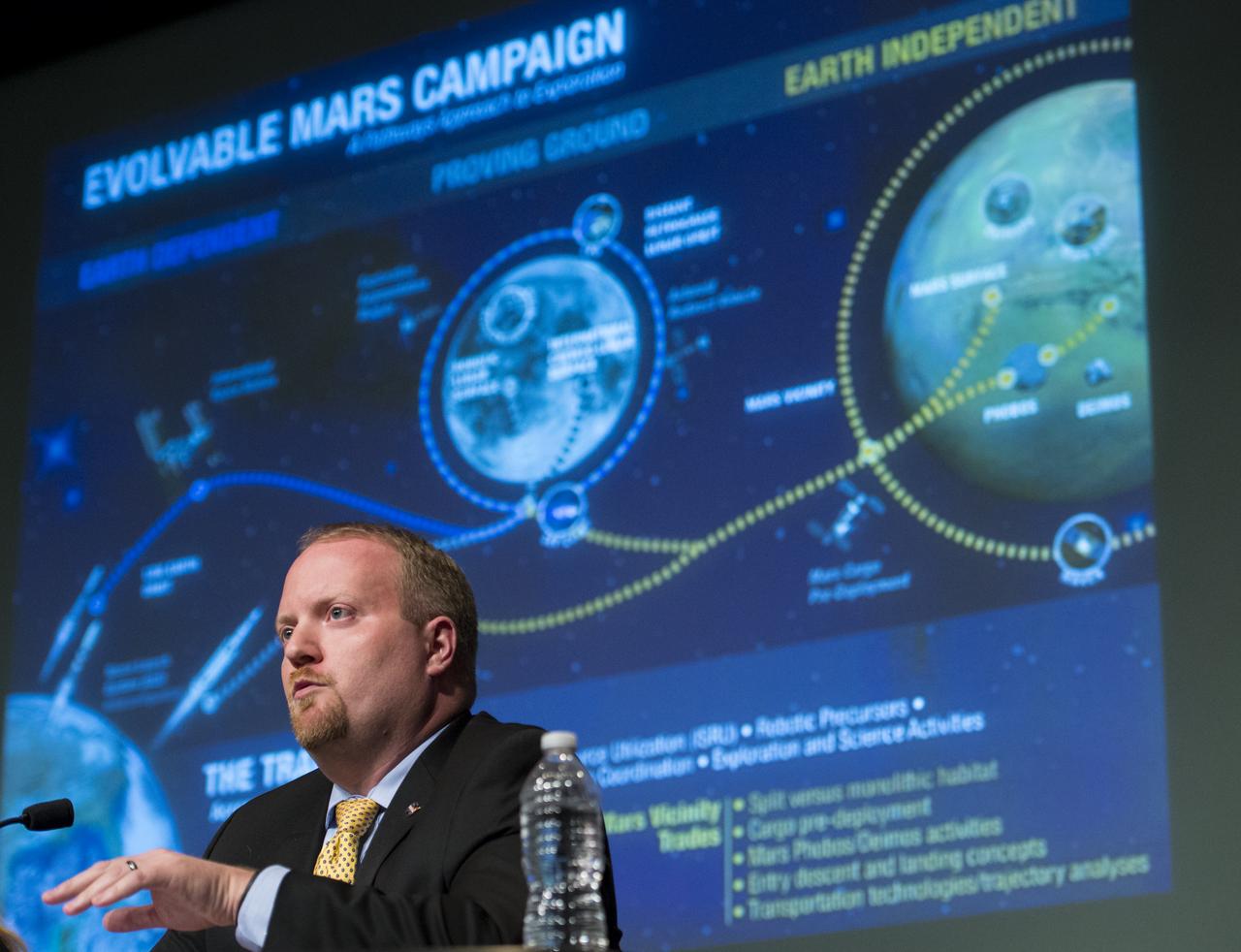
Jason Crusan, Director of NASA's Advanced Exploration Systems Division, speaks during an Exploration Forum showcasing NASA's human exploration path to Mars in the James E. Webb Auditorium at NASA Headquarters on Tuesday, April 29, 2014. Photo Credit: (NASA/Joel Kowsky)
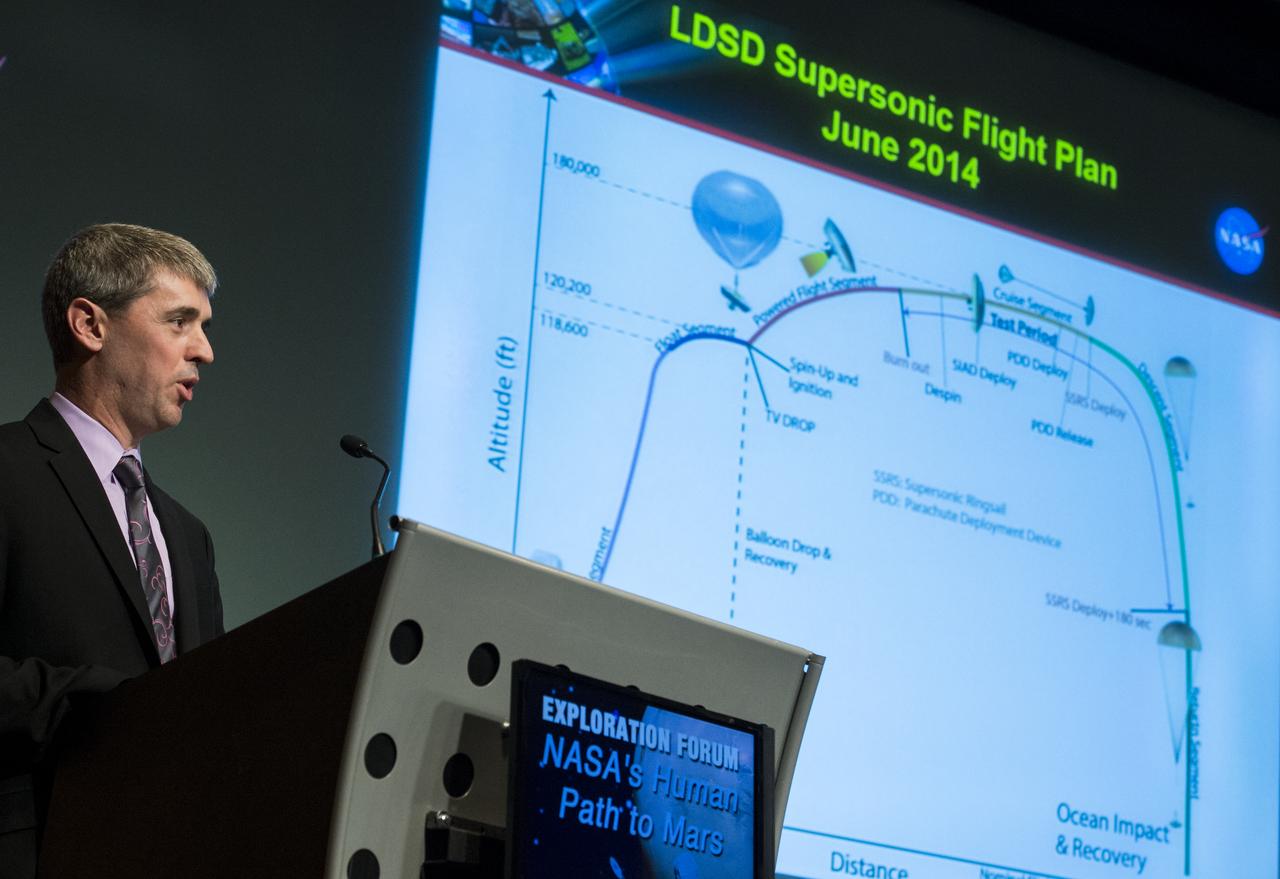
Randy Lillard, Program Executive for Technology Demonstration Missions of NASA's Space Technology Mission DIrectorate, speaks about the upcoming Low-Density Supersonic Decelerator demonstration during an Exploration Forum showcasing NASA's human exploration path to Mars in the James E. Webb Auditorium at NASA Headquarters on Tuesday, April 29, 2014. Photo Credit: (NASA/Joel Kowsky)
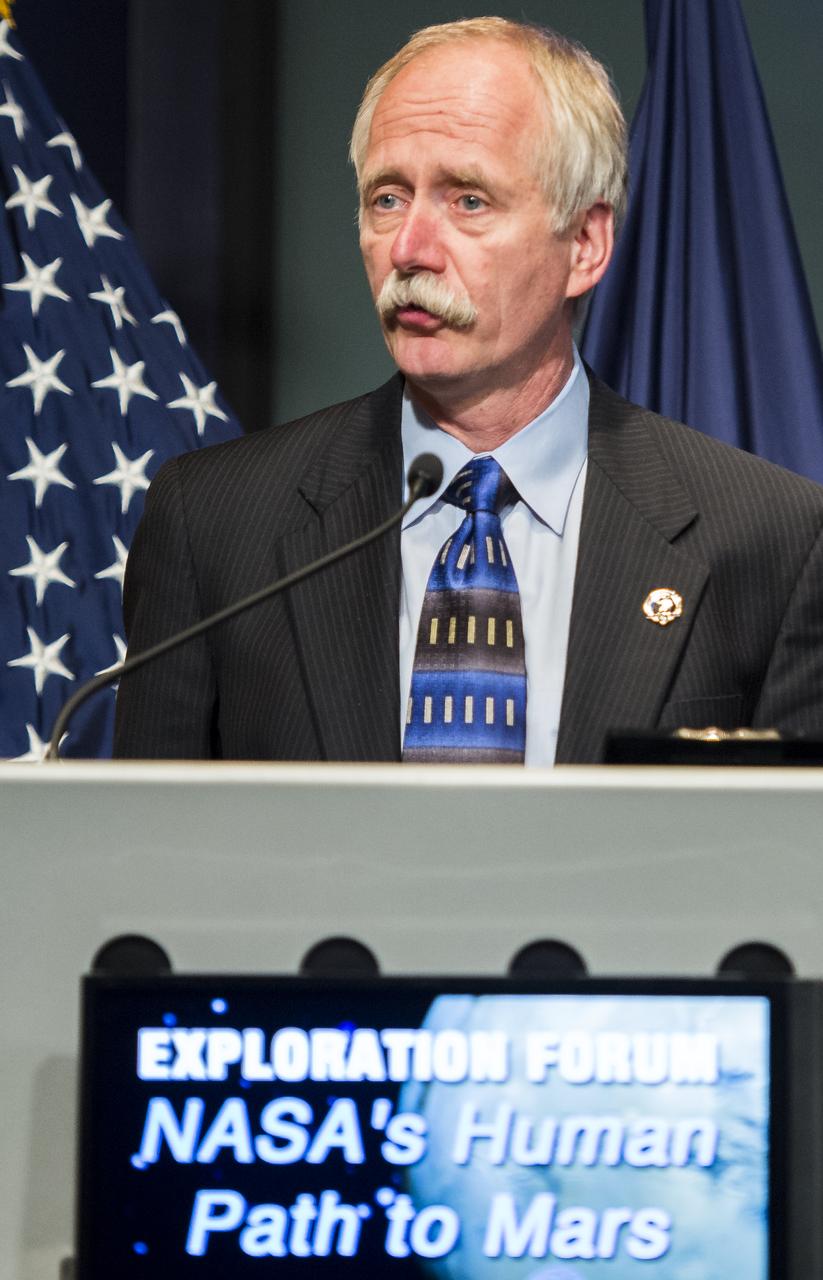
William Gerstenmaier, NASA Associate Administrator for Human Exploration and Operations, speaks during an Exploration Forum showcasing NASA's human exploration path to Mars in the James E. Webb Auditorium at NASA Headquarters on Tuesday, April 29, 2014. Photo Credit: (NASA/Joel Kowsky)
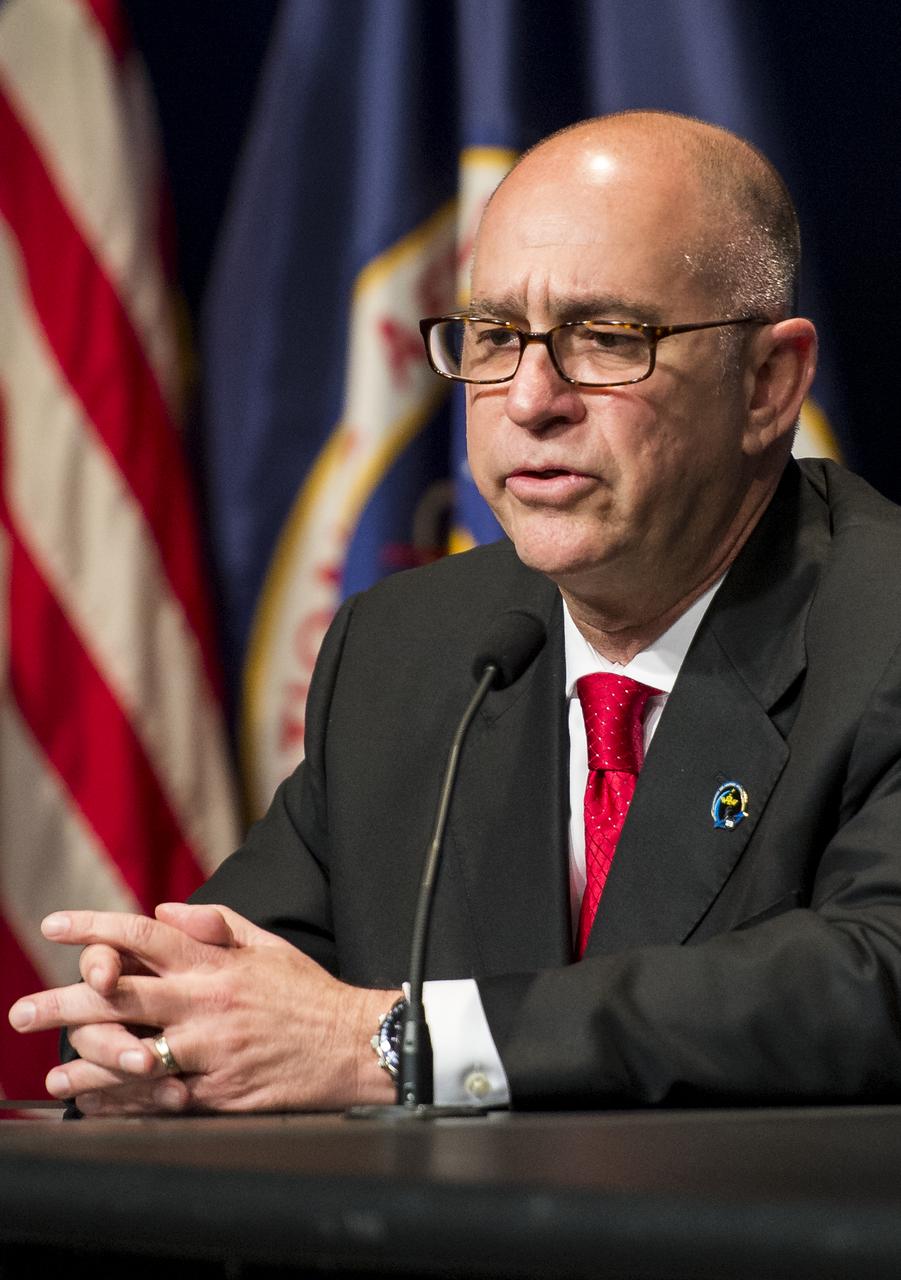
Sam Scimemi, Director of NASA's International Space Station Division, speaks during an Exploration Forum showcasing NASA's human exploration path to Mars in the James E. Webb Auditorium at NASA Headquarters on Tuesday, April 29, 2014. Photo Credit: (NASA/Joel Kowsky)
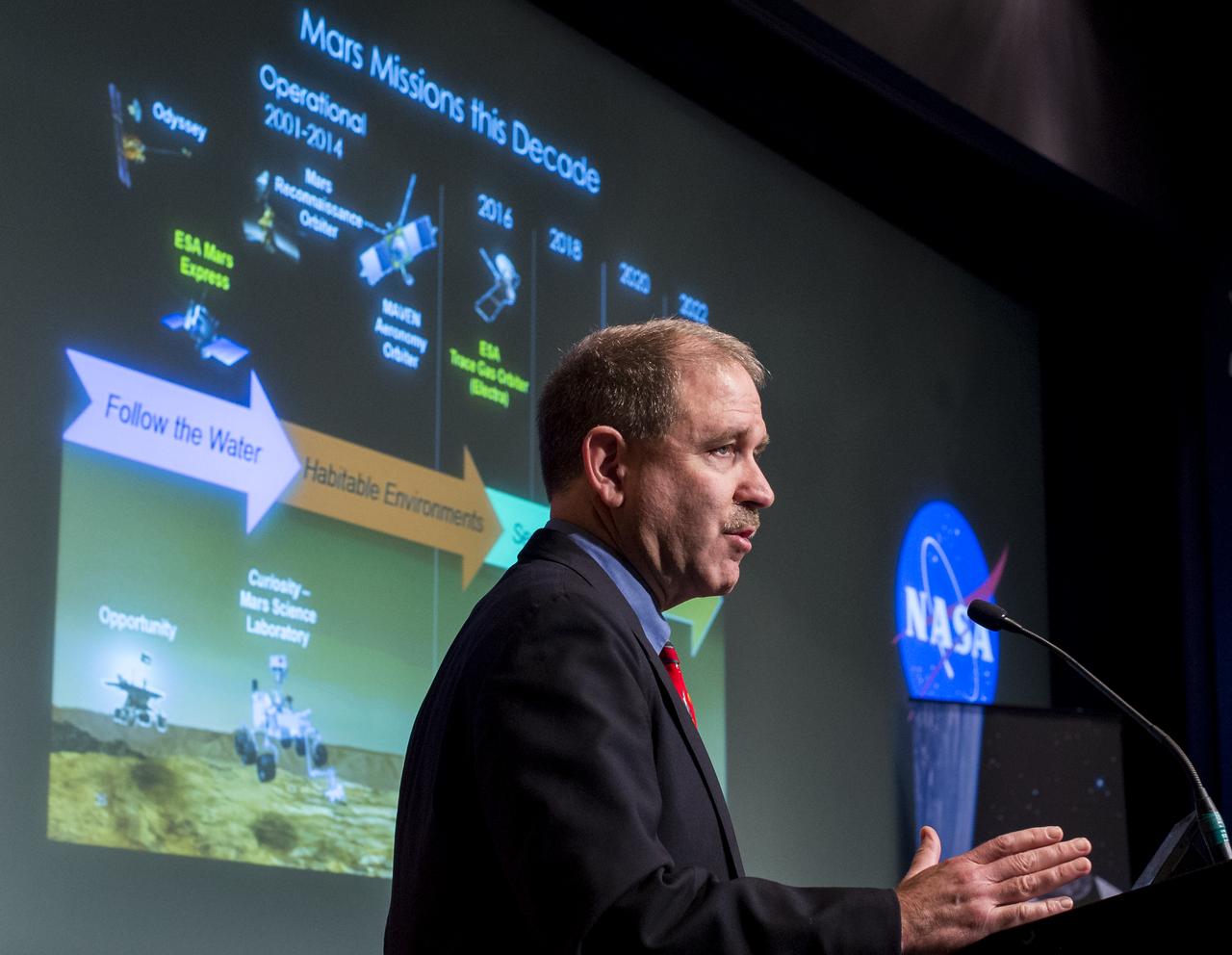
John Grunsfeld, NASA Associate Administrator for the Science Mission Directorate, speaks during an Exploration Forum showcasing NASA's human exploration path to Mars in the James E. Webb Auditorium at NASA Headquarters on Tuesday, April 29, 2014. Photo Credit: (NASA/Joel Kowsky)
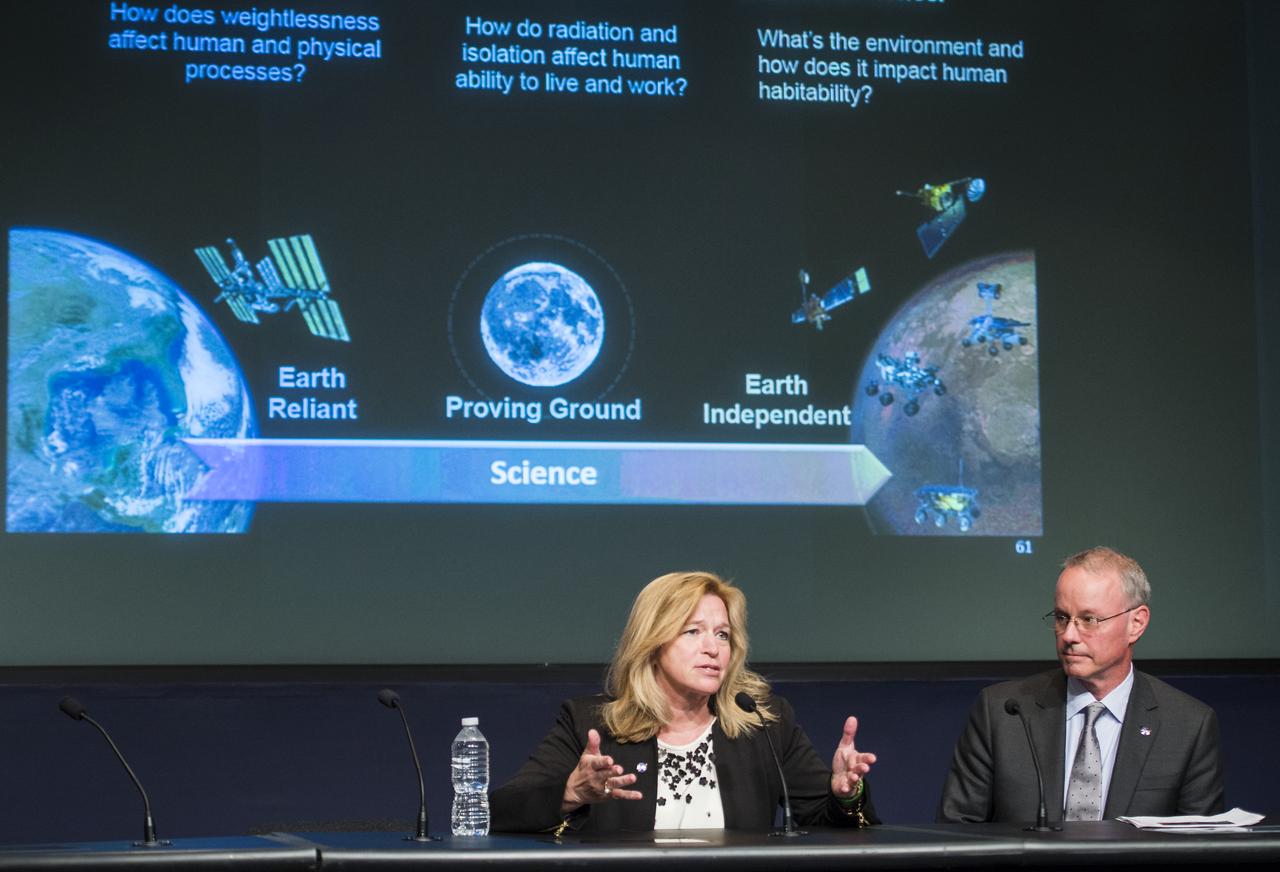
Ellen Stofan, NASA Chief Scientist, left, and David Miller, NASA Chief Technologist, right, participate in a panel discussion during an Exploration Forum showcasing NASA's human exploration path to Mars in the James E. Webb Auditorium at NASA Headquarters on Tuesday, April 29, 2014. Photo Credit: (NASA/Joel Kowsky)
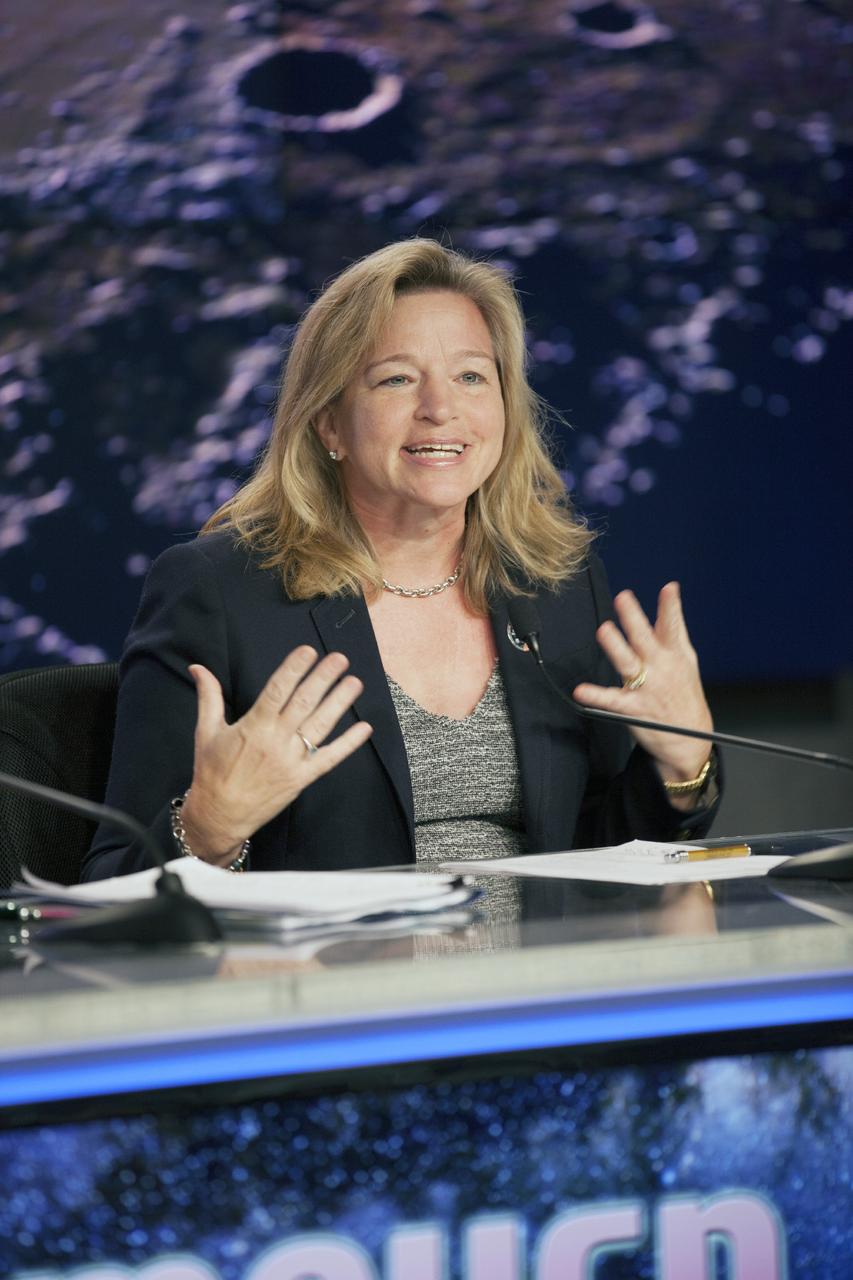
CAPE CANAVERAL, Fla. – During a news conference at NASA's Kennedy Space Center in Florida, officials outlined the agency’s plans for future human spaceflight, including an expedition to Mars. Participating in the briefing was Ellen Stofan, NASA chief scientist. The briefing took place the day prior to launch of the Mars Atmosphere and Volatile EvolutioN, or MAVEN, mission. MAVEN is being prepared for its scheduled launch on Nov 18, 2013 from Cape Canaveral Air Force Station, Fla. atop a United Launch Alliance Atlas V rocket. Positioned in an orbit above the Red Planet, MAVEN will study the upper atmosphere of Mars in unprecedented detail. For information on the MAVEN mission, visit: http://www.nasa.gov/mission_pages/maven/main/index.html. For more on NASA Human Spaceflight, visit: http://www.spaceflight.nasa.gov/home/index.html. For information on the international Space Station, visit: http://www.nasa.gov/mission_pages/station/main/index.html Photo credit: NASA/Kim Shiflett
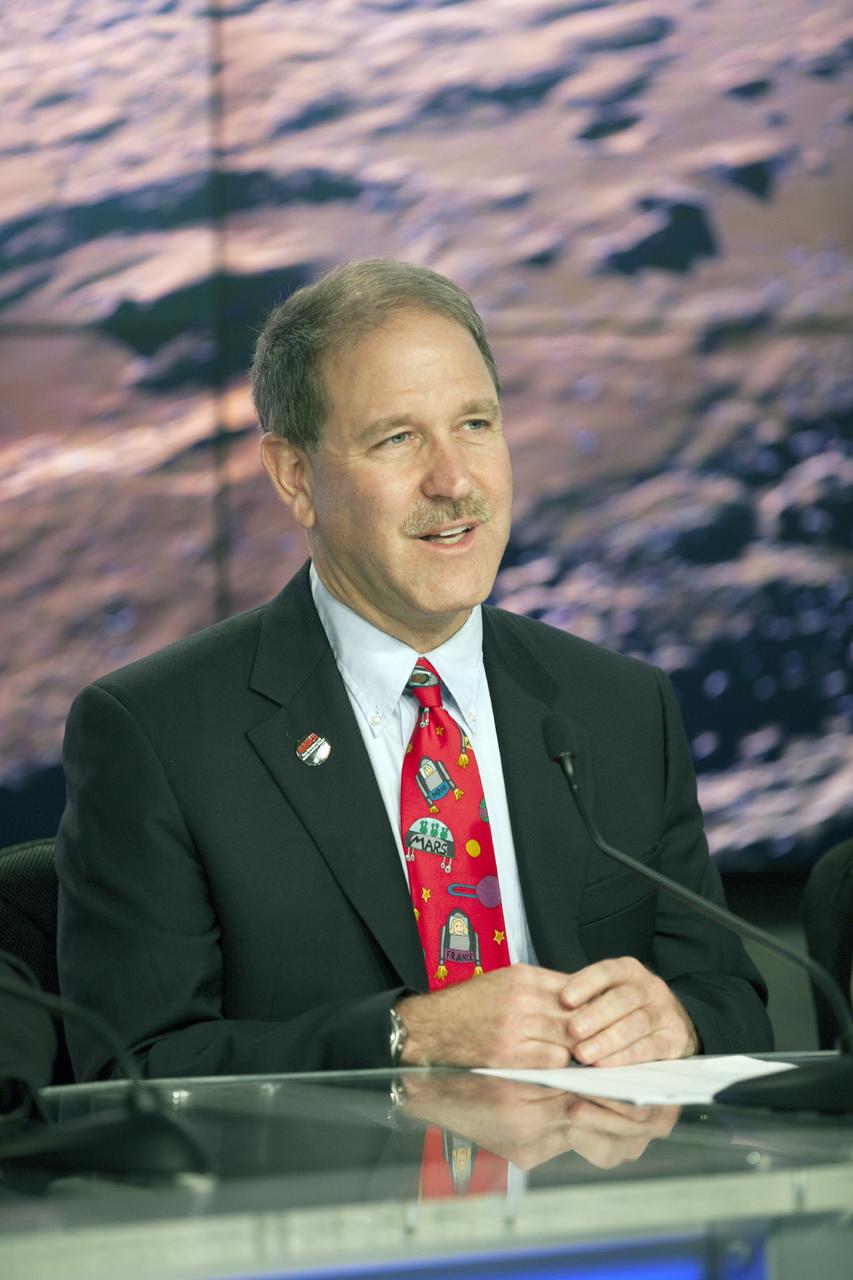
CAPE CANAVERAL, Fla. – During a news conference at NASA's Kennedy Space Center in Florida, officials outlined the agency’s plans for future human spaceflight, including and expedition to Mars. Participating in the briefing was John Grunsfeld, NASA associate administrator for the Science Mission Directorate. The briefing took place the day prior to launch of the Mars Atmosphere and Volatile EvolutioN, or MAVEN, mission. MAVEN is being prepared for its scheduled launch on Nov 18, 2013 from Cape Canaveral Air Force Station, Fla. atop a United Launch Alliance Atlas V rocket. Positioned in an orbit above the Red Planet, MAVEN will study the upper atmosphere of Mars in unprecedented detail. For information on the MAVEN mission, visit: http://www.nasa.gov/mission_pages/maven/main/index.html. For more on NASA Human Spaceflight, visit: http://www.spaceflight.nasa.gov/home/index.html. For information on the international Space Station, visit: http://www.nasa.gov/mission_pages/station/main/index.html Photo credit: NASA/Kim Shiflett
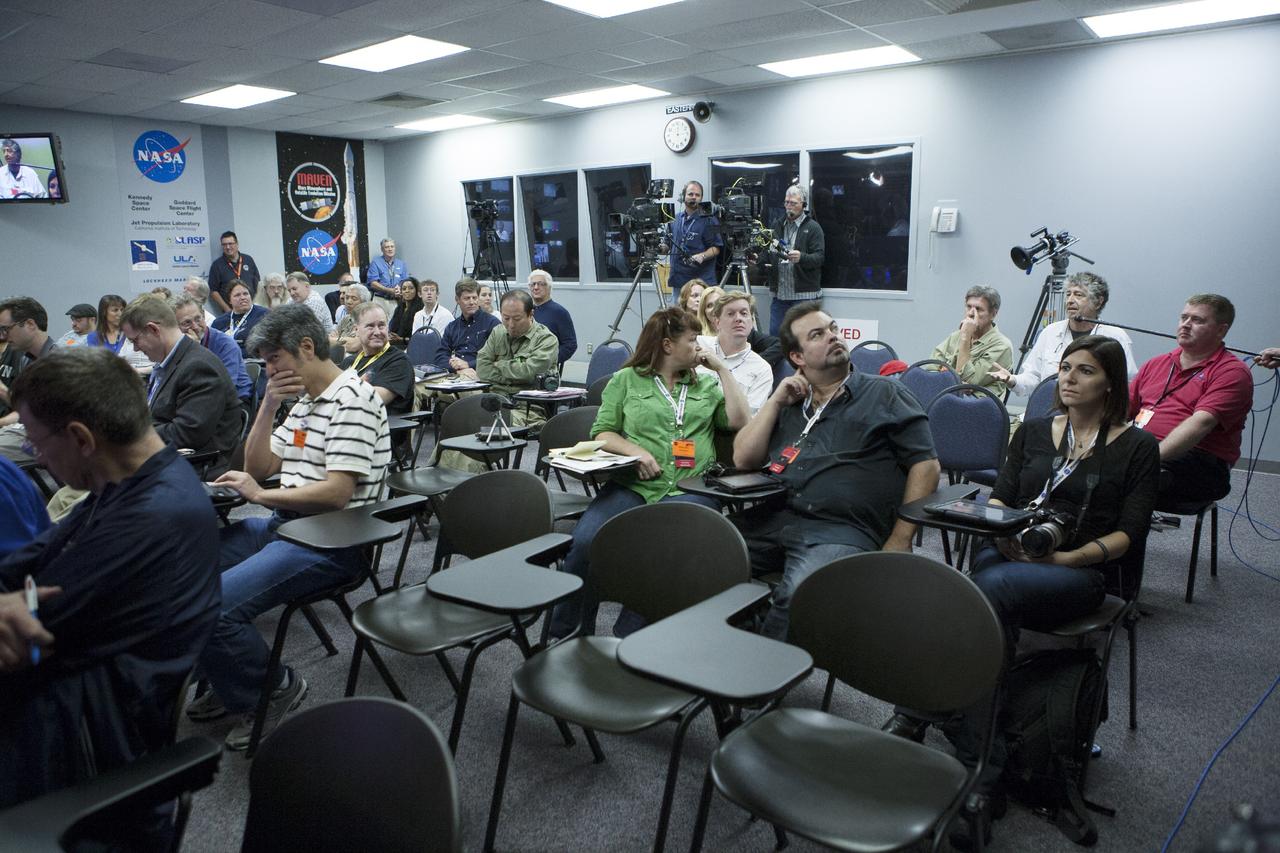
CAPE CANAVERAL, Fla. – Members of the news media ask questions during a news conference at NASA's Kennedy Space Center in Florida. Officials outlined the agency’s plans for future human spaceflight, including an expedition to Mars. The briefing took place the day prior to launch of the Mars Atmosphere and Volatile EvolutioN, or MAVEN, mission. MAVEN is being prepared for its scheduled launch on Nov 18, 2013 from Cape Canaveral Air Force Station, Fla. atop a United Launch Alliance Atlas V rocket. Positioned in an orbit above the Red Planet, MAVEN will study the upper atmosphere of Mars in unprecedented detail. For information on the MAVEN mission, visit: http://www.nasa.gov/mission_pages/maven/main/index.html. For more on NASA Human Spaceflight, visit: http://www.spaceflight.nasa.gov/home/index.html. For information on the international Space Station, visit: http://www.nasa.gov/mission_pages/station/main/index.html Photo credit: NASA/Kim Shiflett
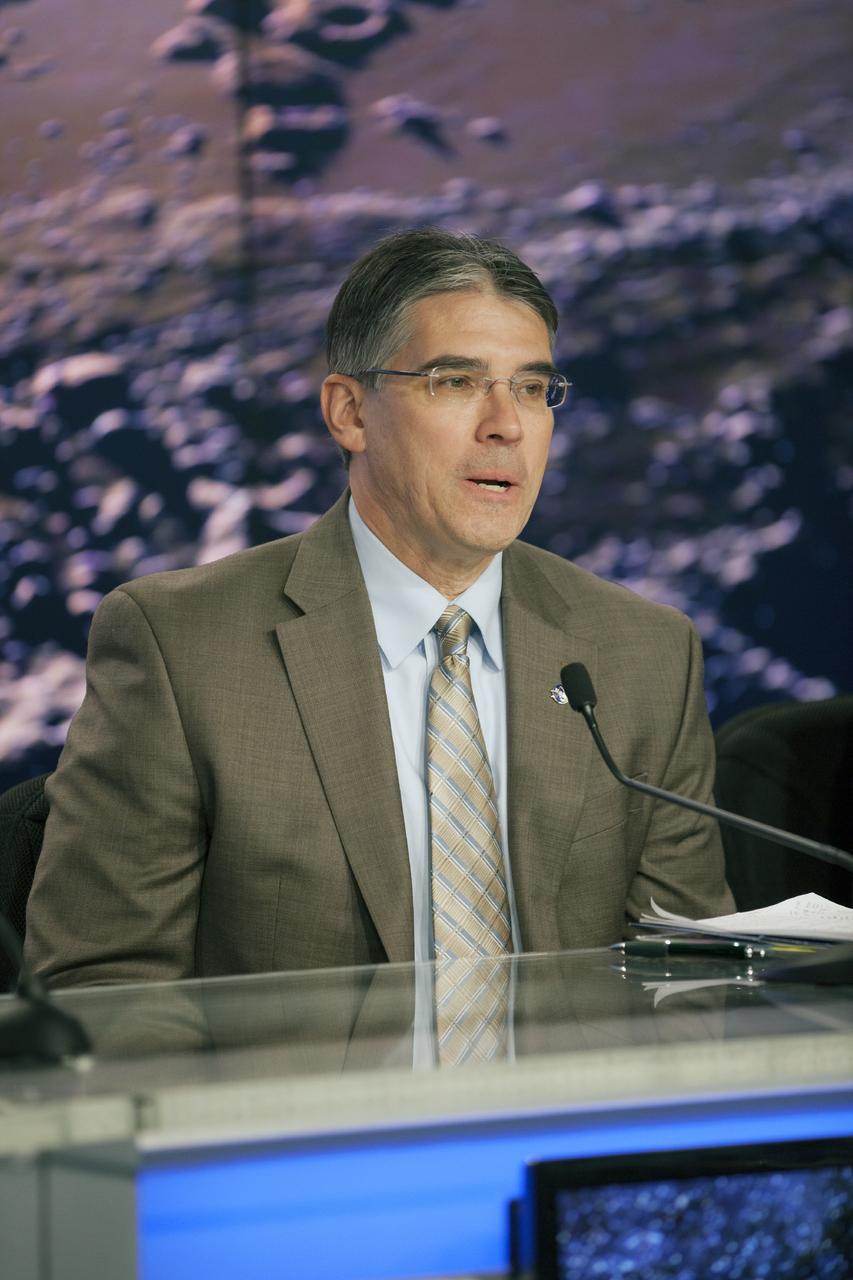
CAPE CANAVERAL, Fla. – During a news conference at NASA's Kennedy Space Center in Florida, officials outlined the agency’s plans for future human spaceflight, including an expedition to Mars. Participating in the briefing was Michael Gazarik, associate administrator for the Space Technology Mission Directorate. The briefing took place the day prior to launch of the Mars Atmosphere and Volatile EvolutioN, or MAVEN, mission. MAVEN is being prepared for its scheduled launch on Nov 18, 2013 from Cape Canaveral Air Force Station, Fla. atop a United Launch Alliance Atlas V rocket. Positioned in an orbit above the Red Planet, MAVEN will study the upper atmosphere of Mars in unprecedented detail. For information on the MAVEN mission, visit: http://www.nasa.gov/mission_pages/maven/main/index.html. For more on NASA Human Spaceflight, visit: http://www.spaceflight.nasa.gov/home/index.html. For information on the international Space Station, visit: http://www.nasa.gov/mission_pages/station/main/index.html Photo credit: NASA/Kim Shiflett

Panelists are seen during a discussion titled “ISS-Moon-Mars: Using Spaceflight Platforms to Study and Simulate Future Missions” during the the 70th International Astronautical Congress, Monday, Oct. 21, 2019 at the Walter E. Washington Convention Center in Washington. Photo Credit: (NASA/Joel Kowsky)

Michelle Rucker, Lead of the Mars Integration Group at NASA, is seen during a discussion titled “ISS-Moon-Mars: Using Spaceflight Platforms to Study and Simulate Future Missions” during the the70th International Astronautical Congress, Monday, Oct. 21, 2019 at the Walter E. Washington Convention Center in Washington. Photo Credit: (NASA/Joel Kowsky)
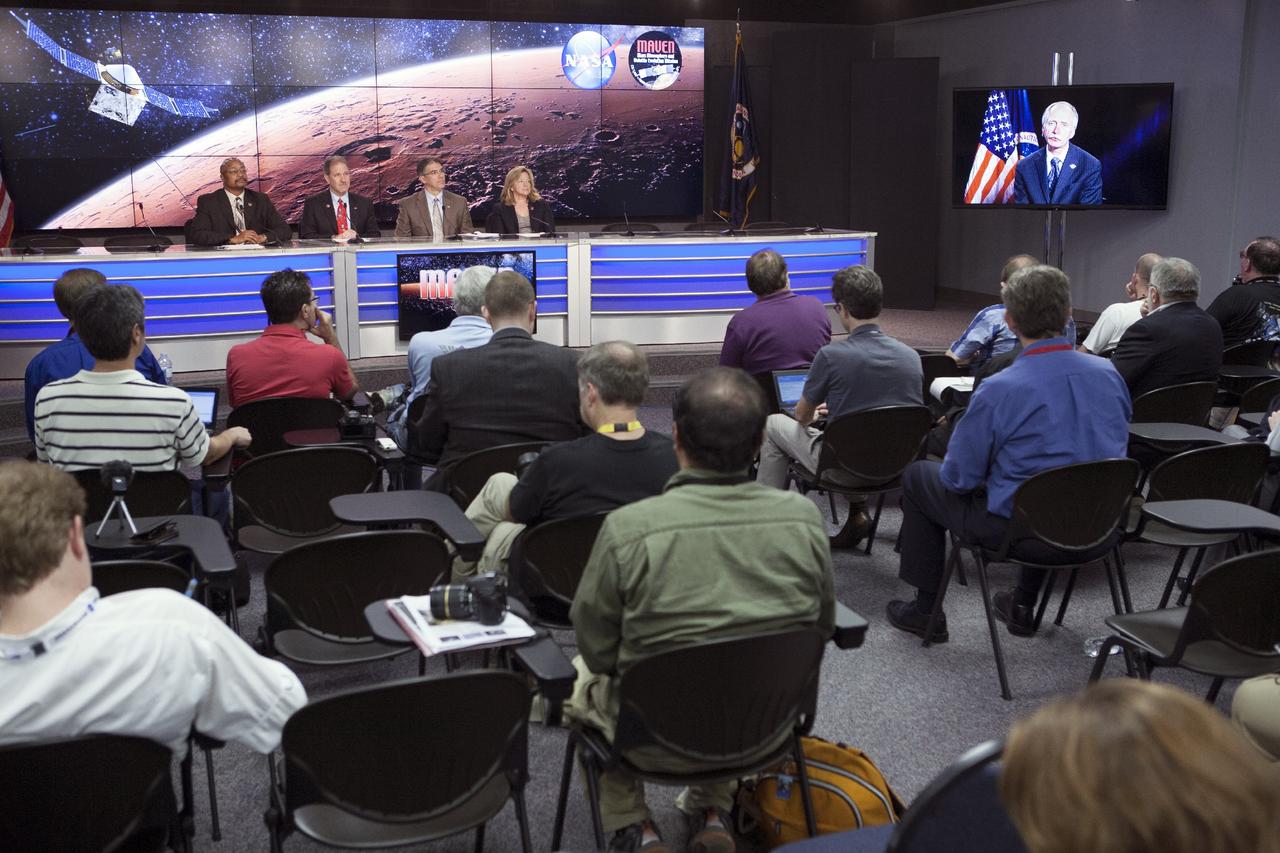
CAPE CANAVERAL, Fla. – During a news conference at NASA's Kennedy Space Center in Florida, officials outlined the agency’s plans for future human spaceflight, including an expedition to Mars. Participating in the briefing, from the left are, Dwayne Brown, NASA Public Affairs, John Grunsfeld, NASA associate administrator for the Science Mission Directorate, Michael Gazarik, associate administrator for the Space Technology Mission Directorate and Ellen Stofan, NASA chief scientist. William Gerstenmaier, associate administrator for Human Exploration and Operations participated via television from NASA Headquarters. The briefing took place the day prior to launch of the Mars Atmosphere and Volatile EvolutioN, or MAVEN, mission. MAVEN is being prepared for its scheduled launch on Nov 18, 2013 from Cape Canaveral Air Force Station, Fla. atop a United Launch Alliance Atlas V rocket. Positioned in an orbit above the Red Planet, MAVEN will study the upper atmosphere of Mars in unprecedented detail. For information on the MAVEN mission, visit: http://www.nasa.gov/mission_pages/maven/main/index.html. For more on NASA Human Spaceflight, visit: http://www.spaceflight.nasa.gov/home/index.html. For information on the international Space Station, visit: http://www.nasa.gov/mission_pages/station/main/index.html Photo credit: NASA/Kim Shiflett
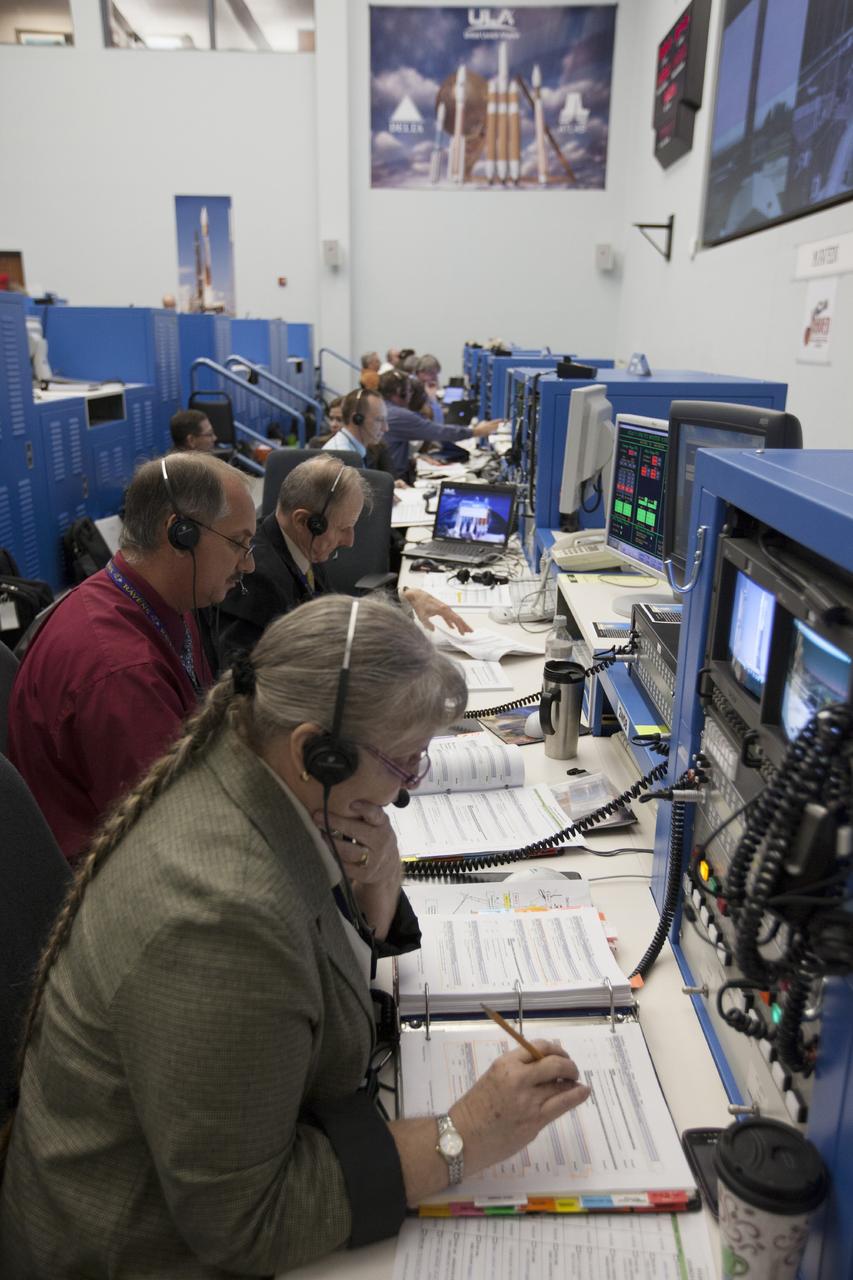
CAPE CANAVERAL, Fla. – At Cape Canaveral Air Force Station's Atlas V Spaceflight Operations Center NASA and contractor managers and engineers monitor progress of the countdown for the launch the agency's Mars Atmosphere and Volatile Evolution, or MAVEN, spacecraft. MAVEN was launched on Nov. 18, 2013 from Cape Canaveral's Space Launch Complex 41 atop a United Launch Alliance Atlas V rocket. Positioned in an orbit above the Red Planet, MAVEN will study the upper atmosphere of Mars in unprecedented detail. For more information, visit: http://www.nasa.gov/mission_pages/maven/main/index.html Photo credit: NASA/Kim Shiflett
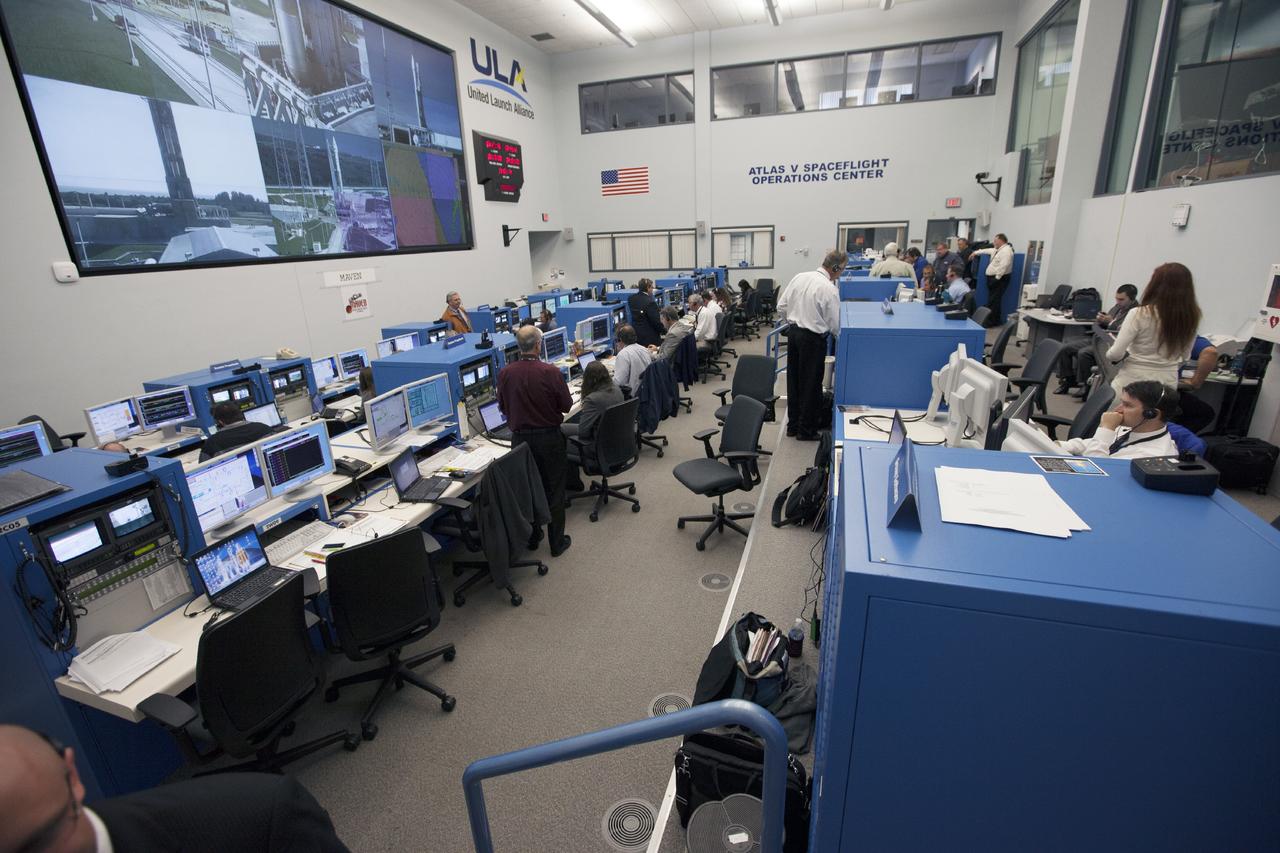
CAPE CANAVERAL, Fla. – At Cape Canaveral Air Force Station's Atlas V Spaceflight Operations Center NASA and contractor managers and engineers monitor progress of the countdown for the launch the agency's Mars Atmosphere and Volatile Evolution, or MAVEN, spacecraft. MAVEN was launched on Nov. 18, 2013 from Cape Canaveral's Space Launch Complex 41 atop a United Launch Alliance Atlas V rocket. Positioned in an orbit above the Red Planet, MAVEN will study the upper atmosphere of Mars in unprecedented detail. For more information, visit: http://www.nasa.gov/mission_pages/maven/main/index.html Photo credit: NASA/Kim Shiflett

CAPE CANAVERAL, Fla. – At Cape Canaveral Air Force Station's Atlas V Spaceflight Operations Center NASA and contractor managers and engineers monitor progress of the countdown for the launch the agency's Mars Atmosphere and Volatile Evolution, or MAVEN, spacecraft. MAVEN was launched on Nov. 18, 2013 from Cape Canaveral's Space Launch Complex 41 atop a United Launch Alliance Atlas V rocket. Positioned in an orbit above the Red Planet, MAVEN will study the upper atmosphere of Mars in unprecedented detail. For more information, visit: http://www.nasa.gov/mission_pages/maven/main/index.html Photo credit: NASA/Kim Shiflett
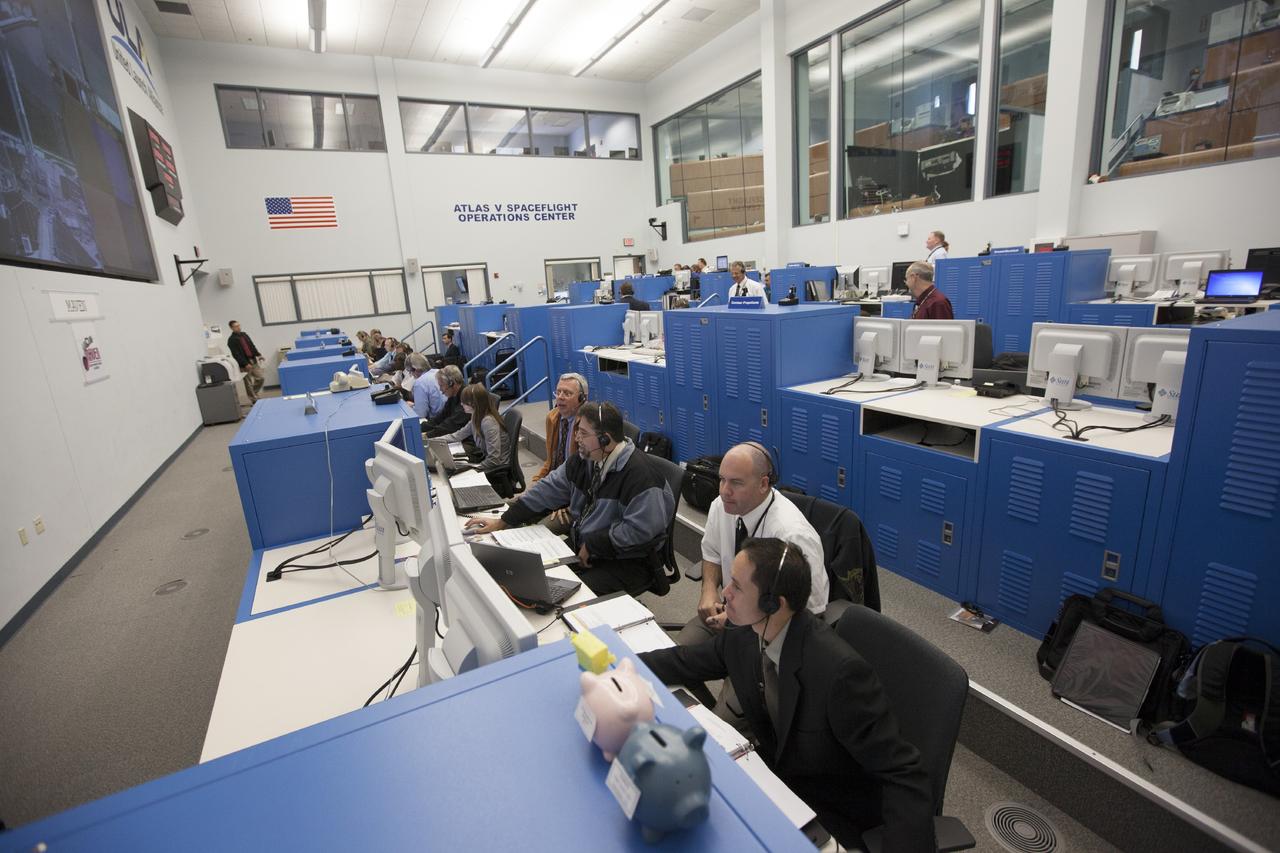
CAPE CANAVERAL, Fla. – At Cape Canaveral Air Force Station's Atlas V Spaceflight Operations Center NASA and contractor managers and engineers monitor progress of the countdown for the launch the agency's Mars Atmosphere and Volatile Evolution, or MAVEN, spacecraft. MAVEN was launched on Nov. 18, 2013 from Cape Canaveral's Space Launch Complex 41 atop a United Launch Alliance Atlas V rocket. Positioned in an orbit above the Red Planet, MAVEN will study the upper atmosphere of Mars in unprecedented detail. For more information, visit: http://www.nasa.gov/mission_pages/maven/main/index.html Photo credit: NASA/Kim Shiflett
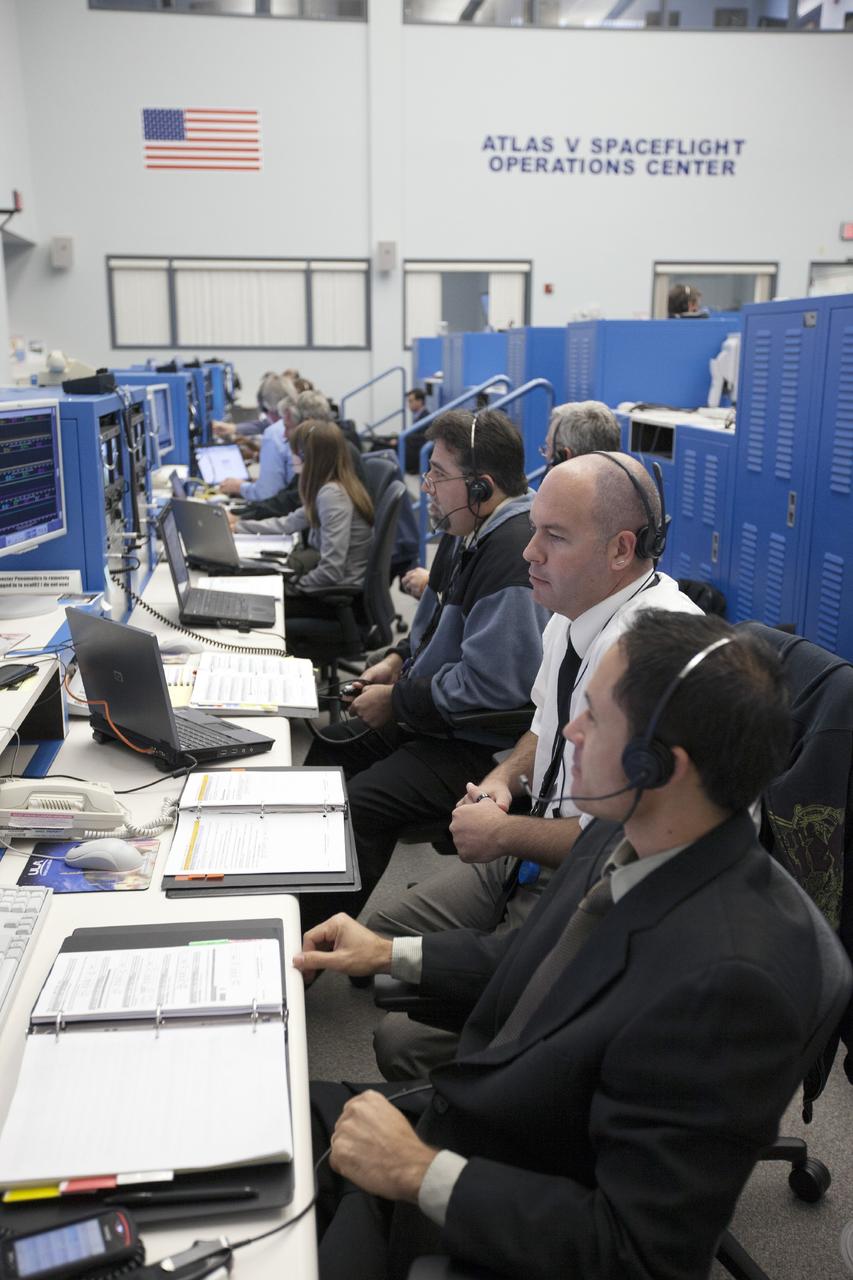
CAPE CANAVERAL, Fla. – At Cape Canaveral Air Force Station's Atlas V Spaceflight Operations Center NASA and contractor managers and engineers monitor progress of the countdown for the launch the agency's Mars Atmosphere and Volatile Evolution, or MAVEN, spacecraft. MAVEN was launched on Nov. 18, 2013 from Cape Canaveral's Space Launch Complex 41 atop a United Launch Alliance Atlas V rocket. Positioned in an orbit above the Red Planet, MAVEN will study the upper atmosphere of Mars in unprecedented detail. For more information, visit: http://www.nasa.gov/mission_pages/maven/main/index.html Photo credit: NASA/Kim Shiflett
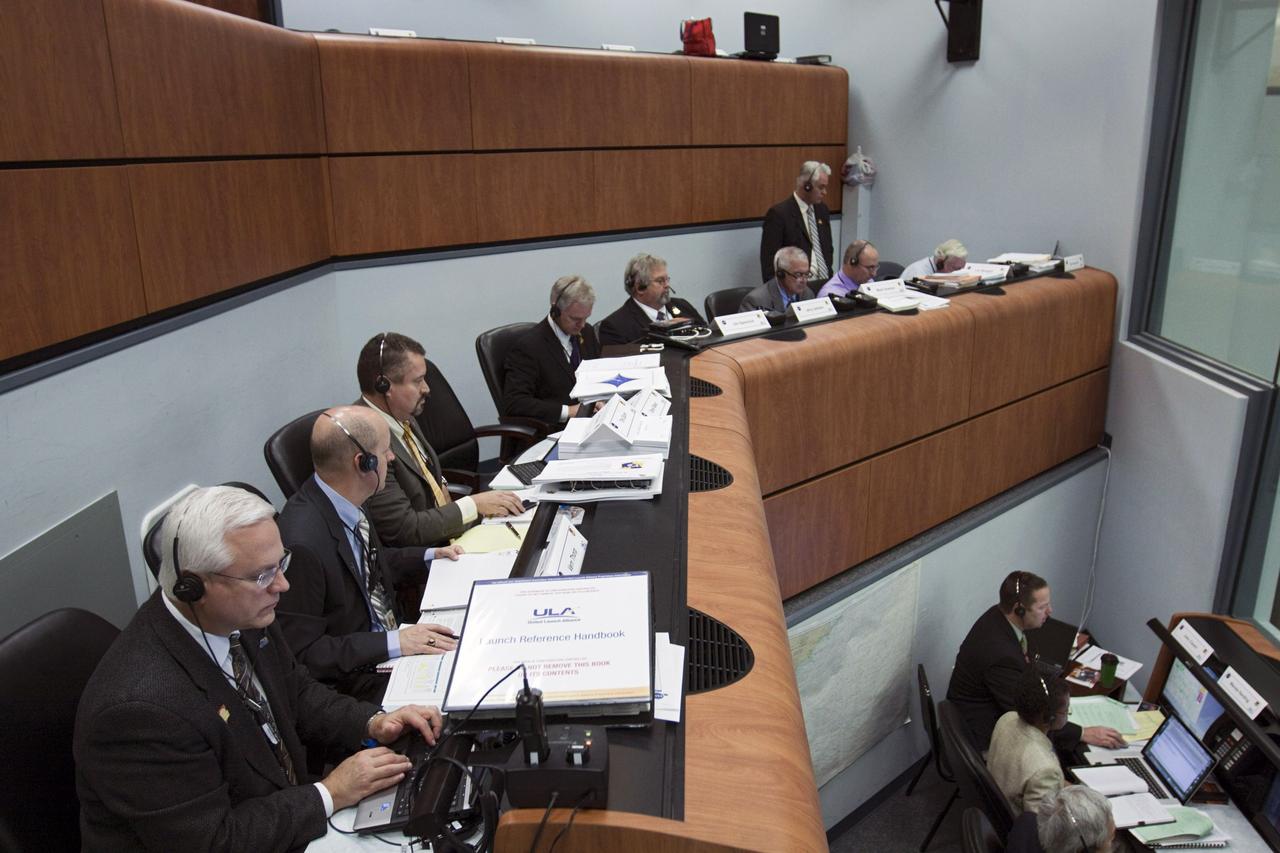
CAPE CANAVERAL – Launch managers from NASA and United Launch Alliance oversee the countdown in the Atlas V Spaceflight Operations Center (ASOC) before the launch of the Mars Science Laboratory on an Atlas V rocket. MSL lifted off at 10:02 a.m. EST Nov. 26, beginning a 9-month interplanetary cruise to Mars. MSL's components include a car-sized rover, Curiosity, which has 10 science instruments designed to search for signs of life, including methane, and help determine if the gas is from a biological or geological source. For more information, visit http://www.nasa.gov/msl. Photo credit: NASA/Kim Shiflett
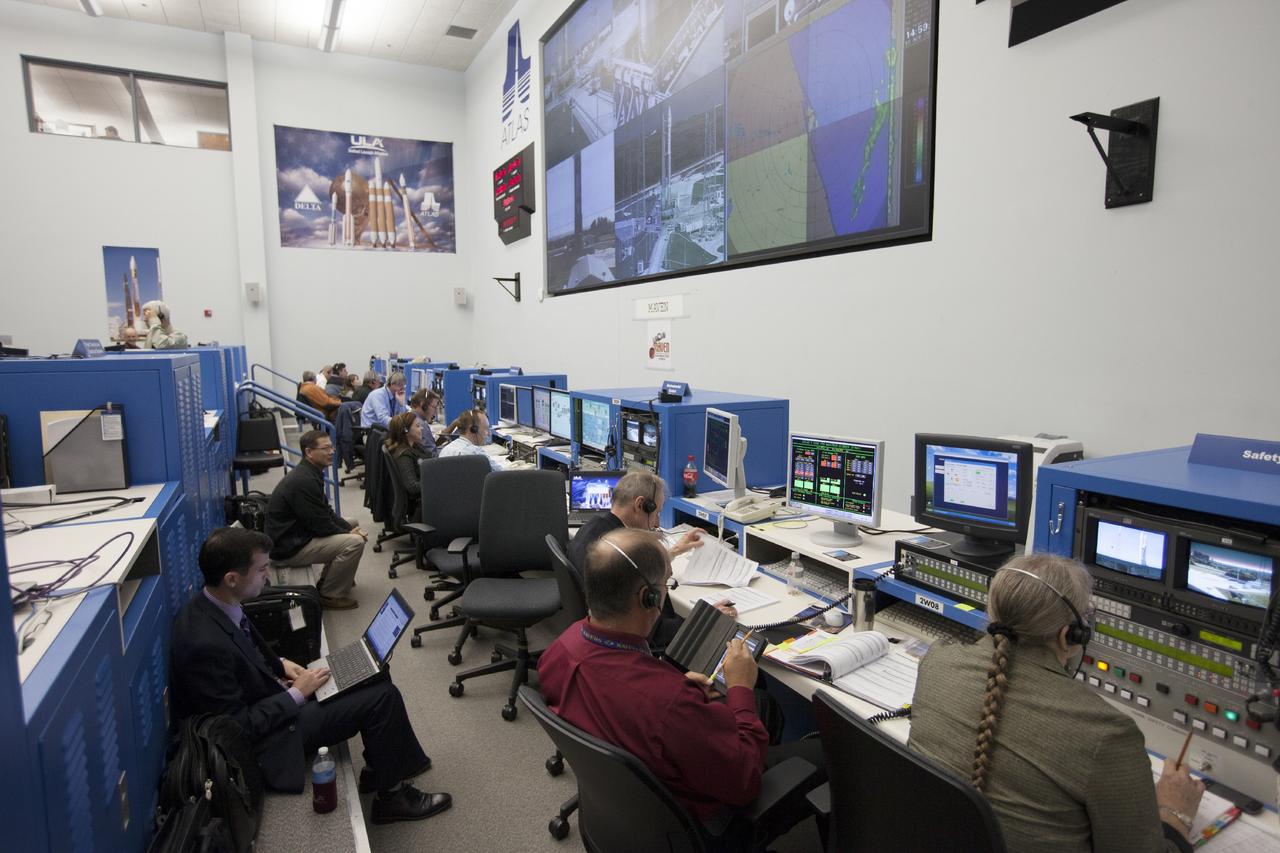
CAPE CANAVERAL, Fla. – At Cape Canaveral Air Force Station's Atlas V Spaceflight Operations Center NASA and contractor managers and engineers monitor progress of the countdown for the launch the agency's Mars Atmosphere and Volatile Evolution, or MAVEN, spacecraft. MAVEN was launched on Nov. 18, 2013 from Cape Canaveral's Space Launch Complex 41 atop a United Launch Alliance Atlas V rocket. Positioned in an orbit above the Red Planet, MAVEN will study the upper atmosphere of Mars in unprecedented detail. For more information, visit: http://www.nasa.gov/mission_pages/maven/main/index.html Photo credit: NASA/Kim Shiflett
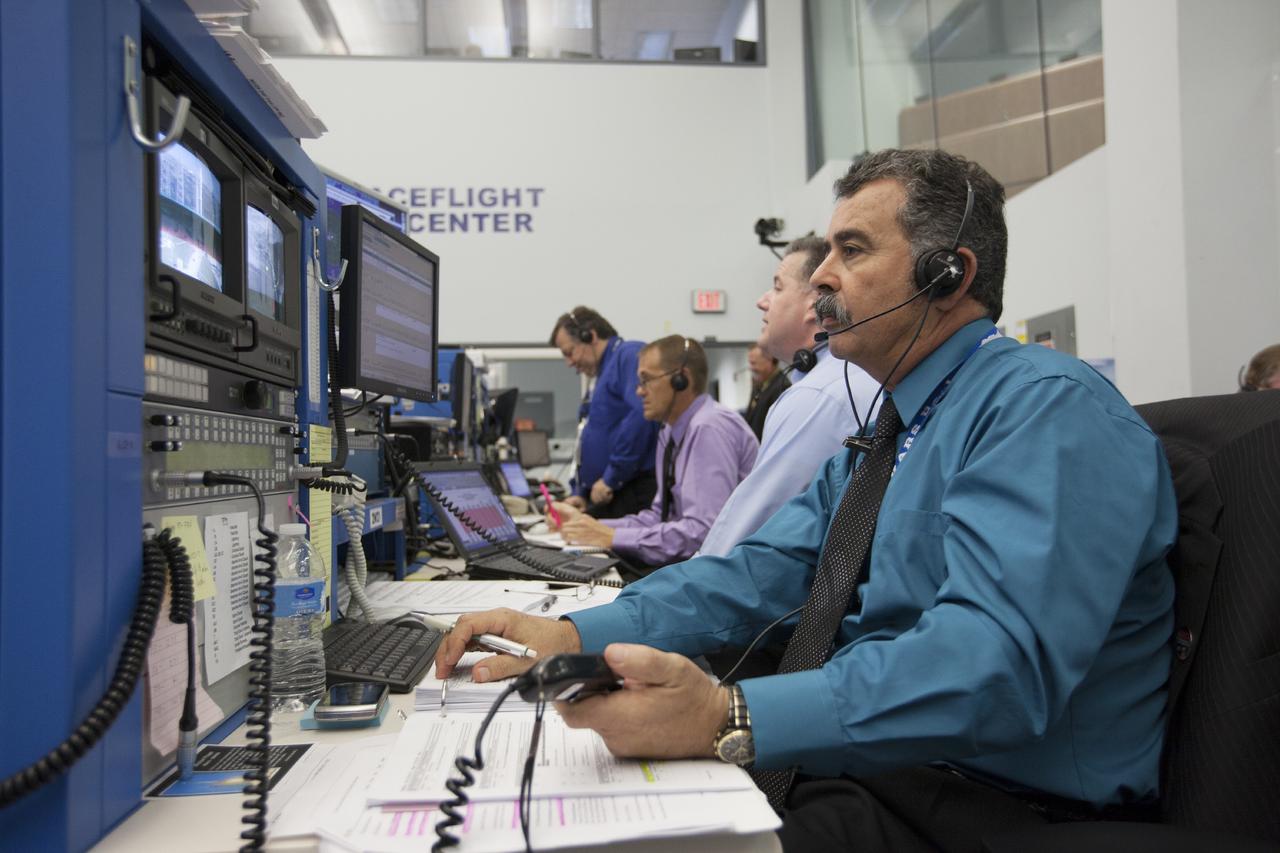
CAPE CANAVERAL, Fla. – At Cape Canaveral Air Force Station's Atlas V Spaceflight Operations Center NASA and contractor managers and engineers monitor progress of the countdown for the launch the agency's Mars Atmosphere and Volatile Evolution, or MAVEN, spacecraft. MAVEN was launched on Nov. 18, 2013 from Cape Canaveral's Space Launch Complex 41 atop a United Launch Alliance Atlas V rocket. Positioned in an orbit above the Red Planet, MAVEN will study the upper atmosphere of Mars in unprecedented detail. For more information, visit: http://www.nasa.gov/mission_pages/maven/main/index.html Photo credit: NASA/Kim Shiflett

NASA Administrator Jim Bridenstine is seen through the door of the Pourtales Library, speaking with the Director General of the United Arab Emirates Space Agency (UAESA), Dr. Mohamed Al Ahbabi, about NASA’s plans to land humans on the Moon by 2024, UAESA’S human spaceflight objectives, and prospective cooperation involving the International Space Station and exploration of the Moon and Mars, at the Space Symposium, Wednesday, April 10, 2019 in Colorado Springs, Colorado. Photo Credit: (NASA/Aubrey Gemignani)

Director General of the United Arab Emirates Space Agency (UAESA), Dr. Mohamed Al Ahbabi, is seen through the door of the Pourtales Library speaking with NASA Administrator Jim Bridenstine about NASA’s plans to land humans on the Moon by 2024, UAESA’S human spaceflight objectives, and prospective cooperation involving the International Space Station and exploration of the Moon and Mars, at the Space Symposium, Wednesday, April 10, 2019 in Colorado Springs, Colorado. Photo Credit: (NASA/Aubrey Gemignani)

NASA Administrator Jim Bridenstine, second from left, speaks with the Director General of the United Arab Emirates Space Agency (UAESA), Dr. Mohamed Al Ahbabi, second from right, about NASA’s plans to land humans on the Moon by 2024, UAESA’S human spaceflight objectives, and prospective cooperation involving the International Space Station and exploration of the Moon and Mars, at the Space Symposium, Wednesday, April 10, 2019 in Colorado Springs, Colorado. Photo Credit: (NASA/Aubrey Gemignani)

NASA Administrator Jim Bridenstine, third from left, speaks with the Director General of the United Arab Emirates Space Agency (UAESA), Dr. Mohamed Al Ahbabi, third from right, about NASA’s plans to land humans on the Moon by 2024, UAESA’S human spaceflight objectives, and prospective cooperation involving the International Space Station and exploration of the Moon and Mars, at the Space Symposium, Wednesday, April 10, 2019 in Colorado Springs, Colorado. Photo Credit: (NASA/Aubrey Gemignani)

Director General of the United Arab Emirates Space Agency (UAESA), Dr. Mohamed Al Ahbabi, is seen through the door of the Pourtales Library speaking with NASA Administrator Jim Bridenstine about NASA’s plans to land humans on the Moon by 2024, UAESA’S human spaceflight objectives, and prospective cooperation involving the International Space Station and exploration of the Moon and Mars, at the Space Symposium, Wednesday, April 10, 2019 in Colorado Springs, Colorado. Photo Credit: (NASA/Aubrey Gemignani)
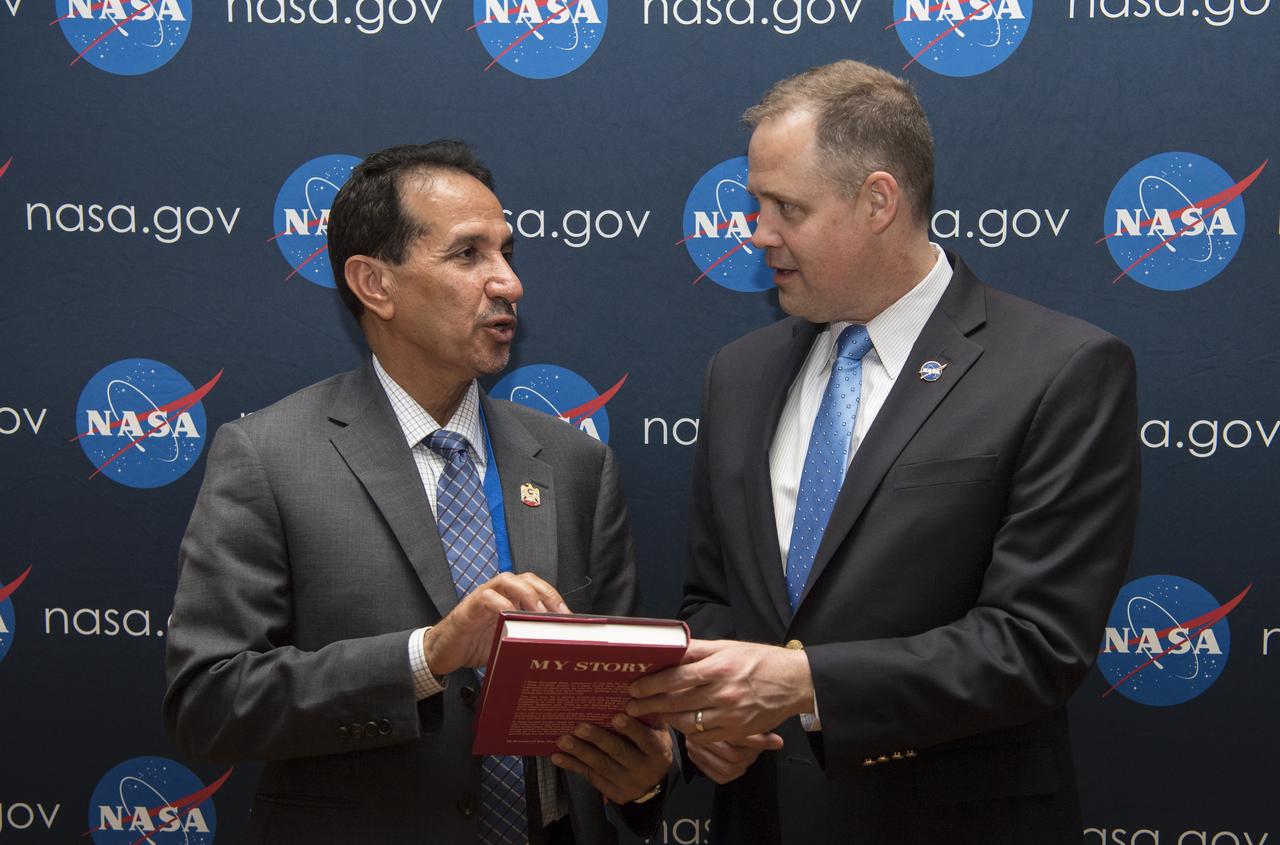
NASA Administrator Jim Bridenstine, right, speaks with the Director General of the United Arab Emirates Space Agency (UAESA), Dr. Mohamed Al Ahbabi, just after a meeting to discuss NASA’s plans to land humans on the Moon by 2024, UAESA’S human spaceflight objectives, and prospective cooperation involving the International Space Station and exploration of the Moon and Mars, at the Space Symposium, Wednesday, April 10, 2019 in Colorado Springs, Colorado. Photo Credit: (NASA/Aubrey Gemignani)
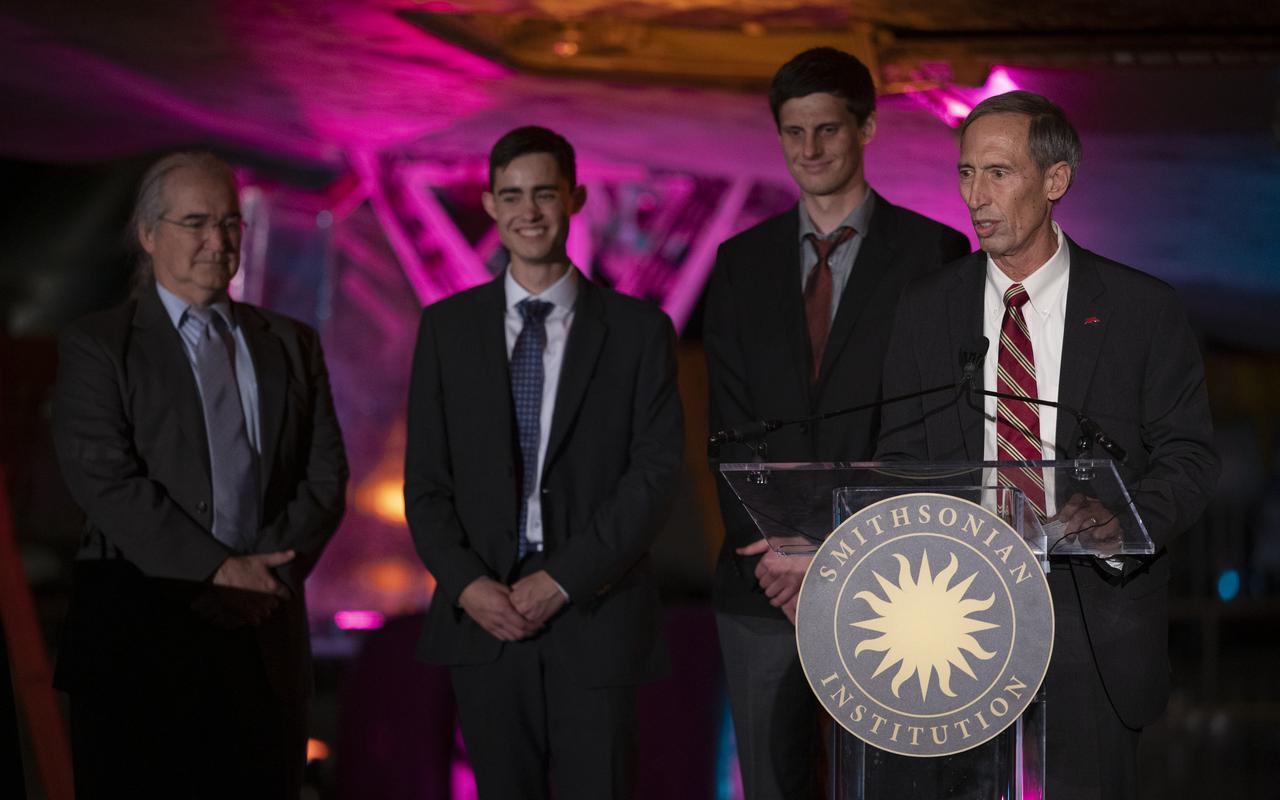
Interim director of NASA’s Jet Propulsion Laboratory Lt. Gen. Larry James, USAF (Ret.), right, delivers remarks after accepting the 2022 Michael Collins Trophy for Current Achievement on behalf of MiMi Aung and the Mars Ingenuity Helicopter Team, Thursday, March 24, 2022, at the Smithsonian National Air and Space Museum’s Steven F. Udvar-Hazy center in Chantilly, Va. Pictured with James are Dave Lavery, program executive for Solar System Exploration at NASA Headquarters, left, Joshua Anderson, Ingenuity Mars Helicopter tactical lead at NASA JPL, second from left, and Gerik Kubiak, Ingenuity Mars Helicopter flight software lead at NASA JPL, center. The Smithsonian National Air and Space Museum’s Michael Collins Trophy recognizes extraordinary accomplishments in aeronautics and spaceflight. Photo Credit: (NASA/Joel Kowsky)
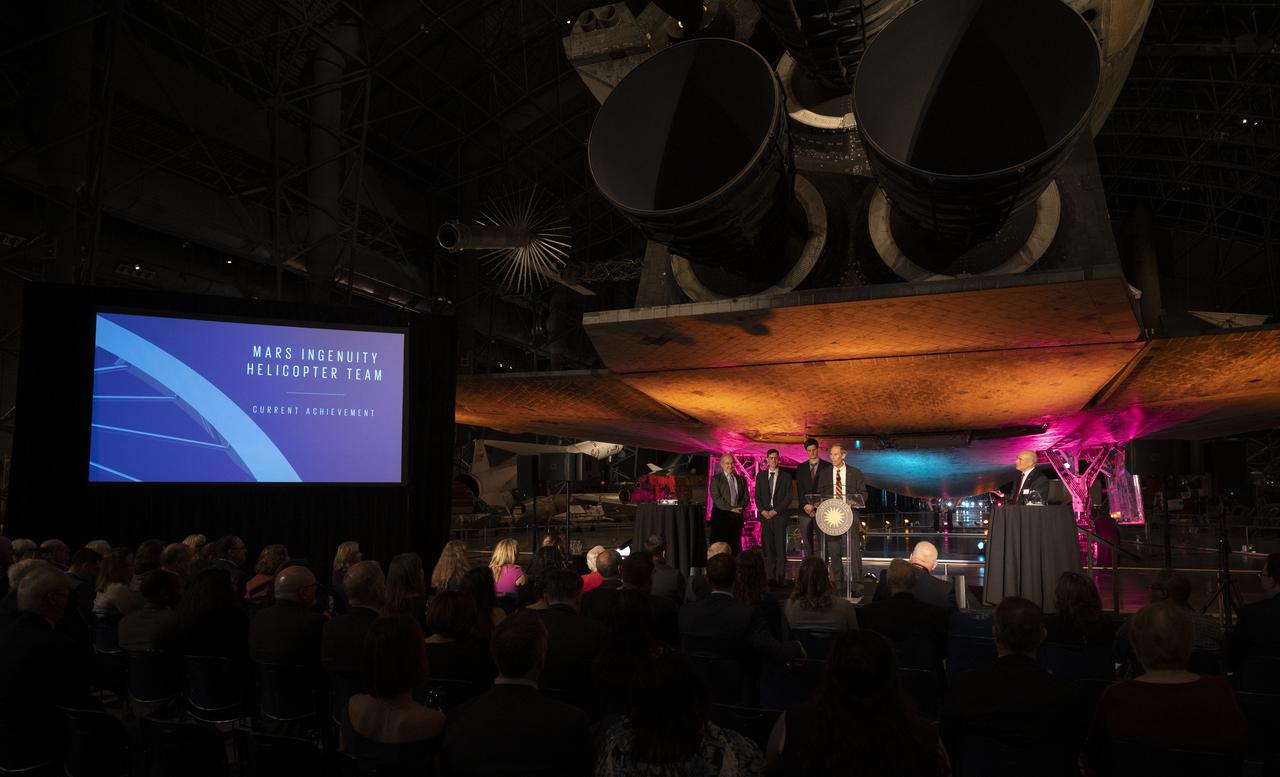
Interim director of NASA’s Jet Propulsion Laboratory Lt. Gen. Larry James, USAF (Ret.), right, delivers remarks after accepting the 2022 Michael Collins Trophy for Current Achievement on behalf of MiMi Aung and the Mars Ingenuity Helicopter Team, Thursday, March 24, 2022, at the Smithsonian National Air and Space Museum’s Steven F. Udvar-Hazy center in Chantilly, Va. Pictured with James are Dave Lavery, program executive for Solar System Exploration at NASA Headquarters, left, Joshua Anderson, Ingenuity Mars Helicopter tactical lead at NASA JPL, second from left, and Gerik Kubiak, Ingenuity Mars Helicopter flight software lead at NASA JPL, center. The Smithsonian National Air and Space Museum’s Michael Collins Trophy recognizes extraordinary accomplishments in aeronautics and spaceflight. Photo Credit: (NASA/Joel Kowsky)
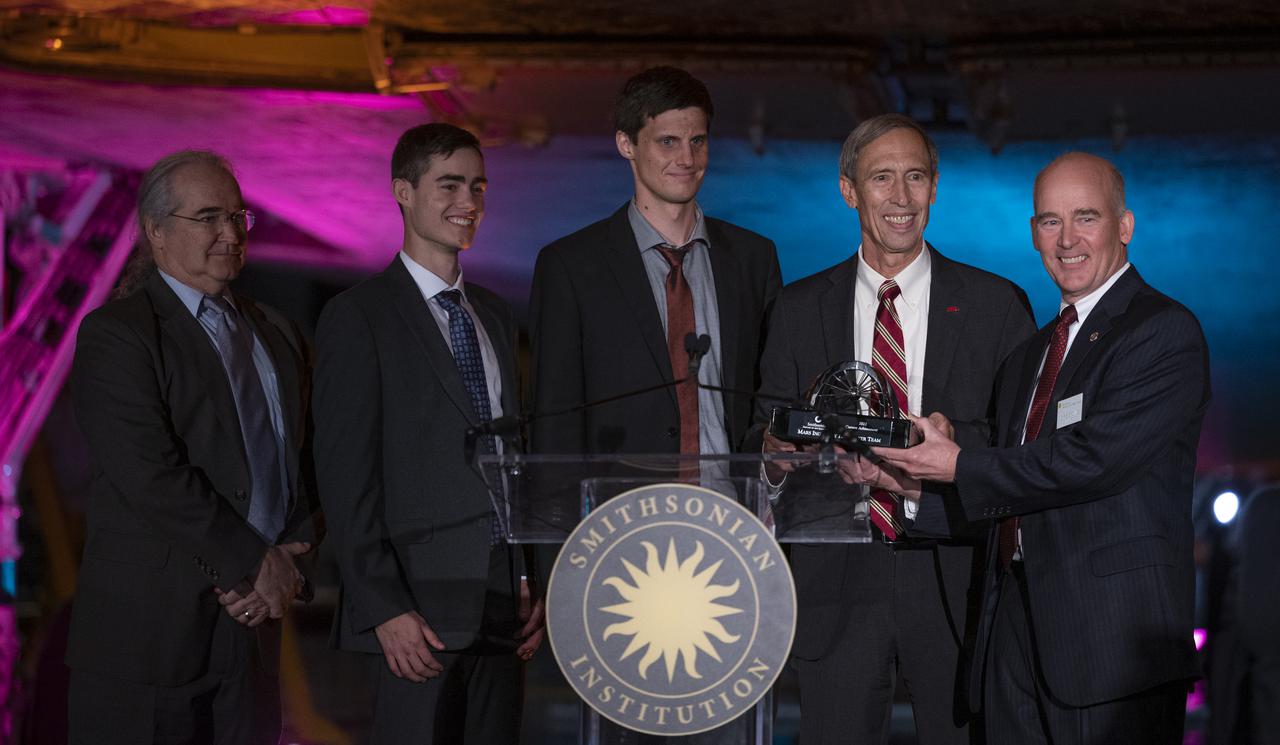
Interim director of NASA’s Jet Propulsion Laboratory Lt. Gen. Larry James, USAF (Ret.), second from right, accepts the 2022 Michael Collins Trophy for Current Achievement from Christopher Browne, acting director of the Smithsonian’s National Air and Space Museum, right, on behalf of MiMi Aung and the Mars Ingenuity Helicopter Team, Thursday, March 24, 2022, at the Smithsonian National Air and Space Museum’s Steven F. Udvar-Hazy center in Chantilly, Va. Pictured with James and Browne are Dave Lavery, program executive for Solar System Exploration at NASA Headquarters, left, Joshua Anderson, Ingenuity Mars Helicopter tactical lead at NASA JPL, second from left, and Gerik Kubiak, Ingenuity Mars Helicopter flight software lead at NASA JPL, center. The Smithsonian National Air and Space Museum’s Michael Collins Trophy recognizes extraordinary accomplishments in aeronautics and spaceflight. Photo Credit: (NASA/Joel Kowsky)
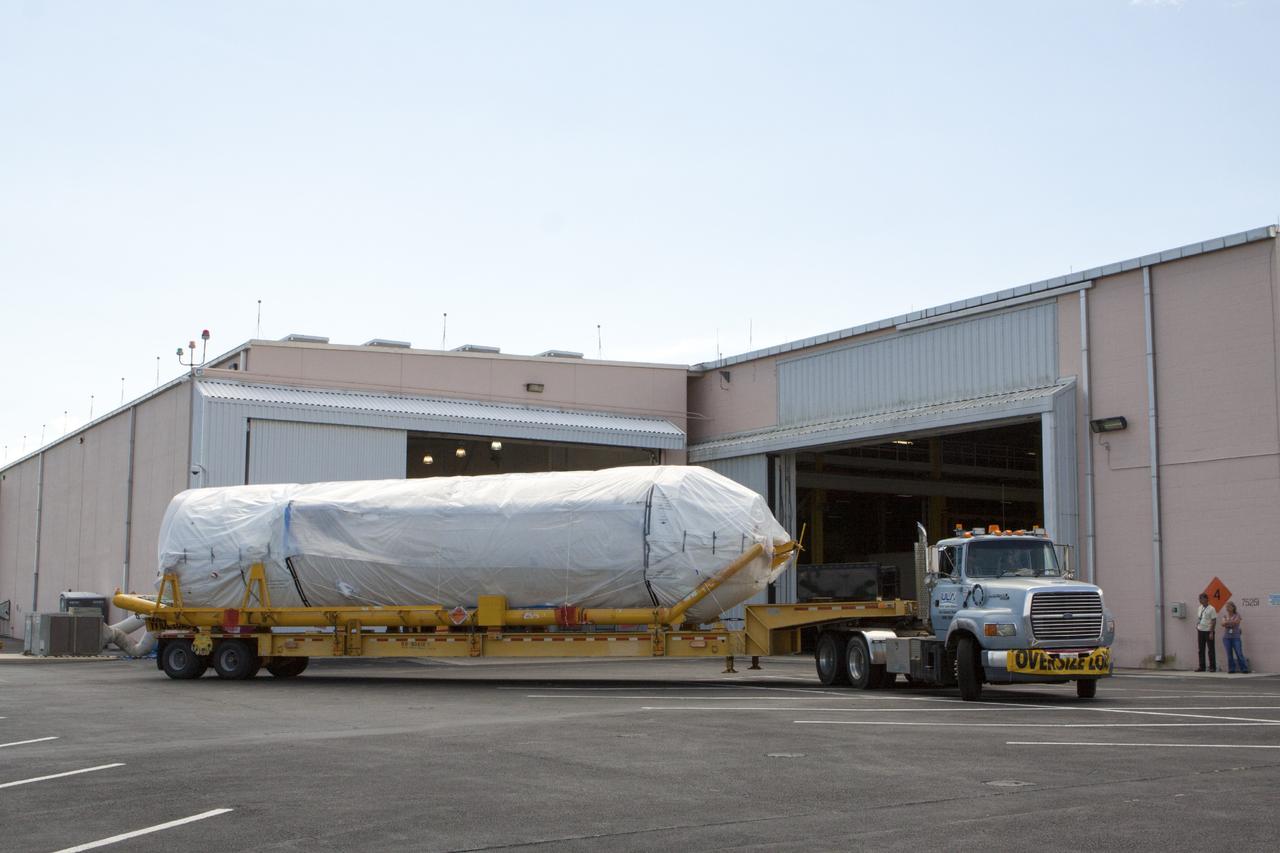
CAPE CANAVERAL, Fla. – United Launch Alliance Atlas V rocket first and second stages arrive at to the Atlas Spaceflight Operations Center, or ASOC, at Cape Canaveral Air Force Station. There, the launch vehicle will begin processing for the Mars Atmosphere and Volatile Evolution, or MAVEN, spacecraft to the Red Planet. MAVEN is being prepared for its scheduled launch in November from Cape Canaveral Air Force Station, Fla. atop a United Launch Alliance Atlas V rocket. Positioned in an orbit above the Red Planet, MAVEN will study the upper atmosphere of Mars in unprecedented detail. For more information, visit: http://www.nasa.gov/mission_pages/maven/main/index.html Photo credit: NASA/Kim Shiflett
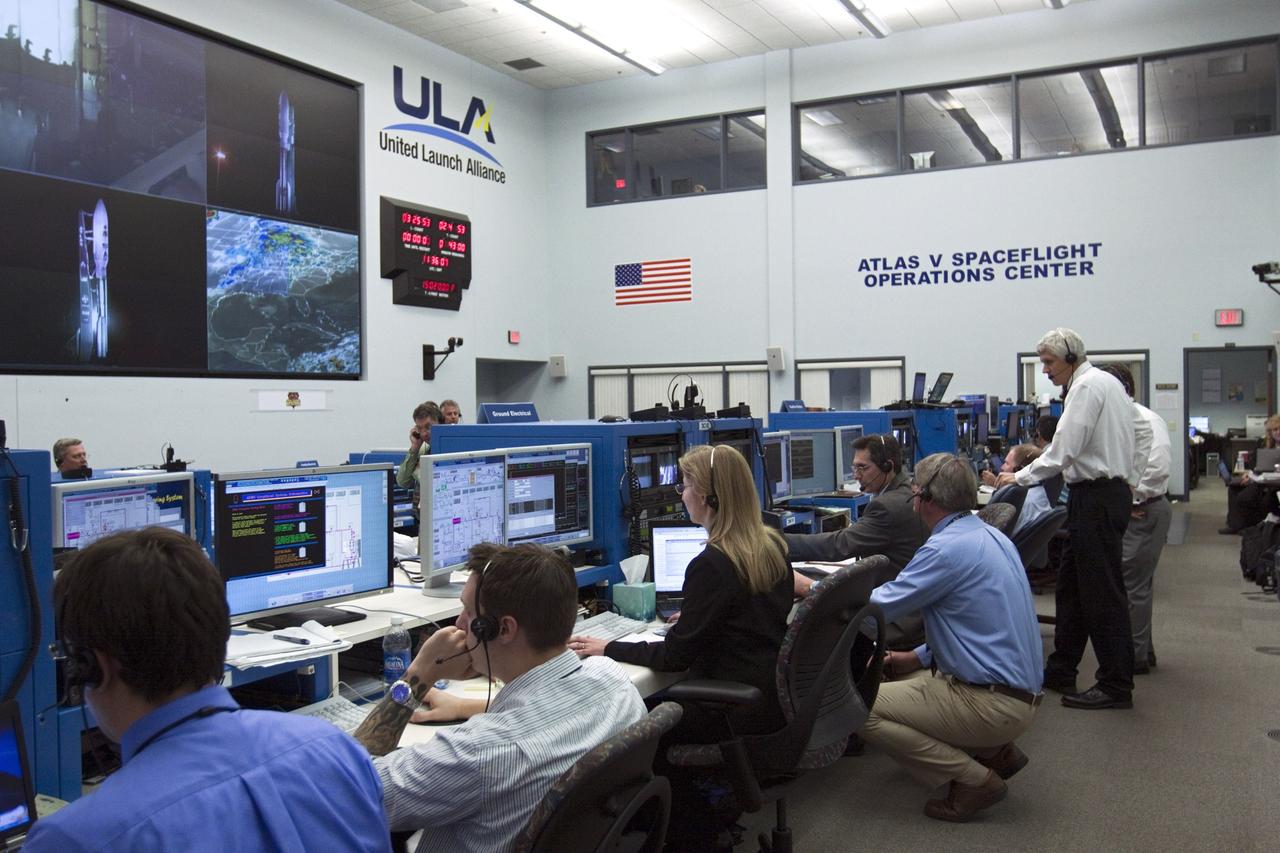
CAPE CANAVERAL – Launch controllers oversee the countdown in the Atlas V Spaceflight Operations Center (ASOC) before the launch of the Mars Science Laboratory on an Atlas V rocket. MSL lifted off at 10:02 a.m. EST Nov. 26, beginning a 9-month interplanetary cruise to Mars. MSL's components include a car-sized rover, Curiosity, which has 10 science instruments designed to search for signs of life, including methane, and help determine if the gas is from a biological or geological source. For more information, visit http://www.nasa.gov/msl. Photo credit: NASA/Kim Shiflett
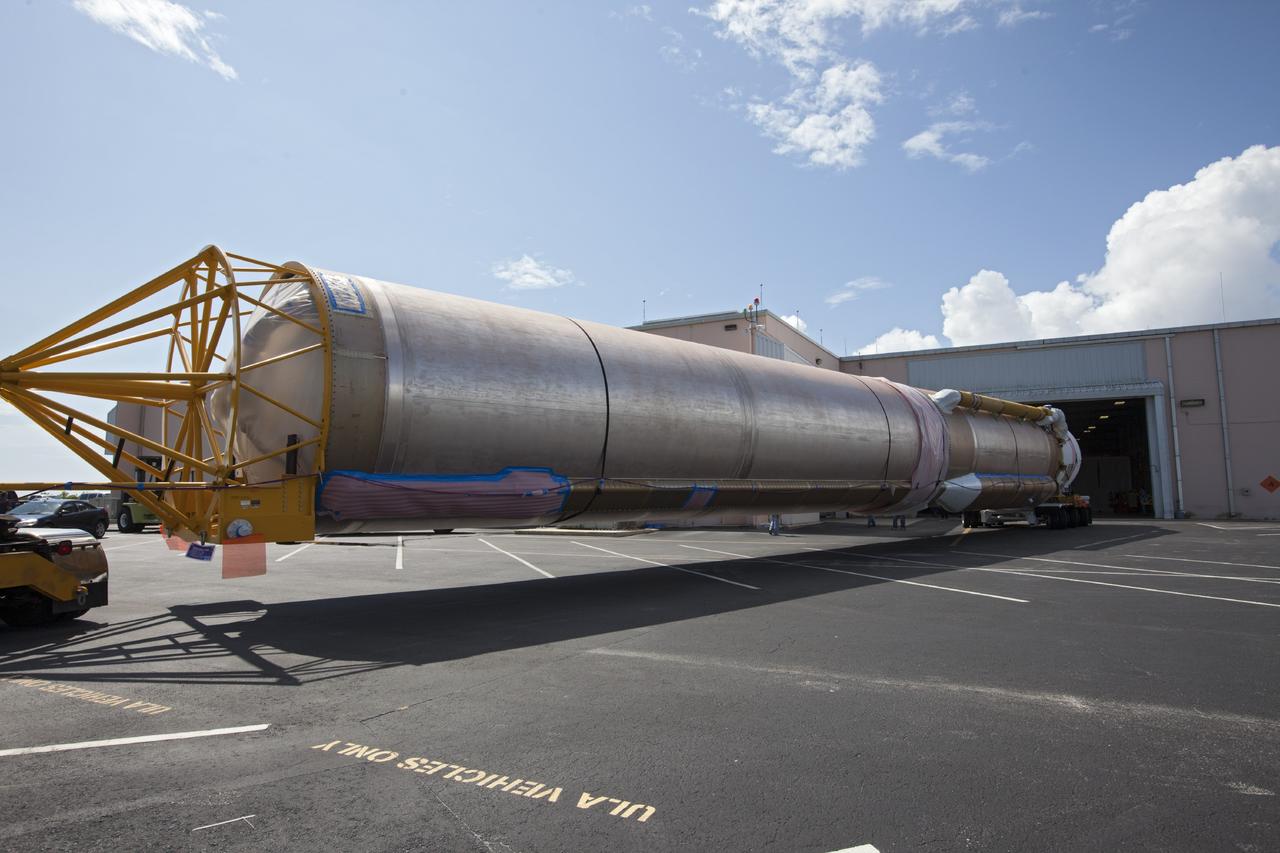
CAPE CANAVERAL, Fla. – United Launch Alliance Atlas V rocket first and second stages arrive at to the Atlas Spaceflight Operations Center, or ASOC, at Cape Canaveral Air Force Station. There, the launch vehicle will begin processing for the Mars Atmosphere and Volatile Evolution, or MAVEN, spacecraft to the Red Planet. MAVEN is being prepared for its scheduled launch in November from Cape Canaveral Air Force Station, Fla. atop a United Launch Alliance Atlas V rocket. Positioned in an orbit above the Red Planet, MAVEN will study the upper atmosphere of Mars in unprecedented detail. For more information, visit: http://www.nasa.gov/mission_pages/maven/main/index.html Photo credit: NASA/Kim Shiflett
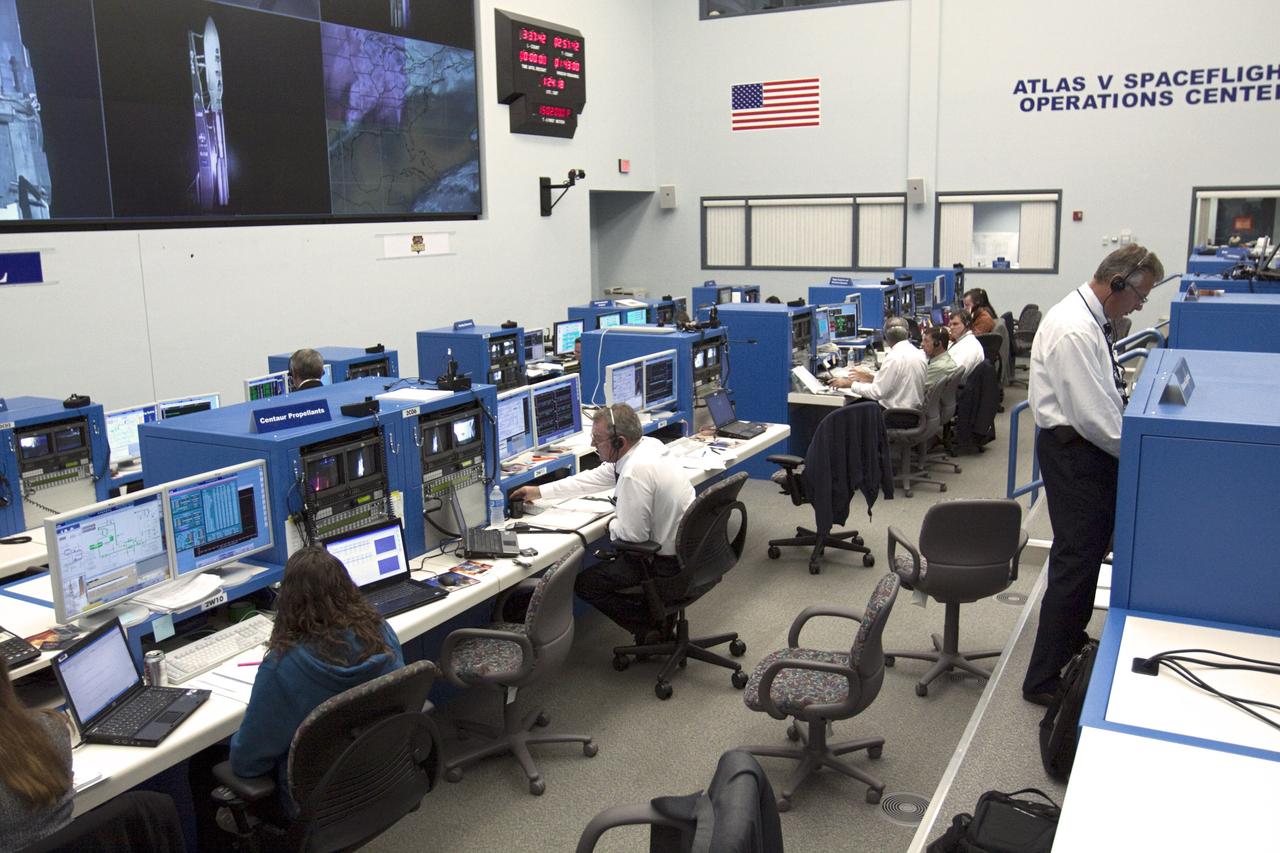
CAPE CANAVERAL – Launch controllers oversee the countdown in the Atlas V Spaceflight Operations Center (ASOC) before the launch of the Mars Science Laboratory on an Atlas V rocket. MSL lifted off at 10:02 a.m. EST Nov. 26, beginning a 9-month interplanetary cruise to Mars. MSL's components include a car-sized rover, Curiosity, which has 10 science instruments designed to search for signs of life, including methane, and help determine if the gas is from a biological or geological source. For more information, visit http://www.nasa.gov/msl. Photo credit: NASA/Kim Shiflett
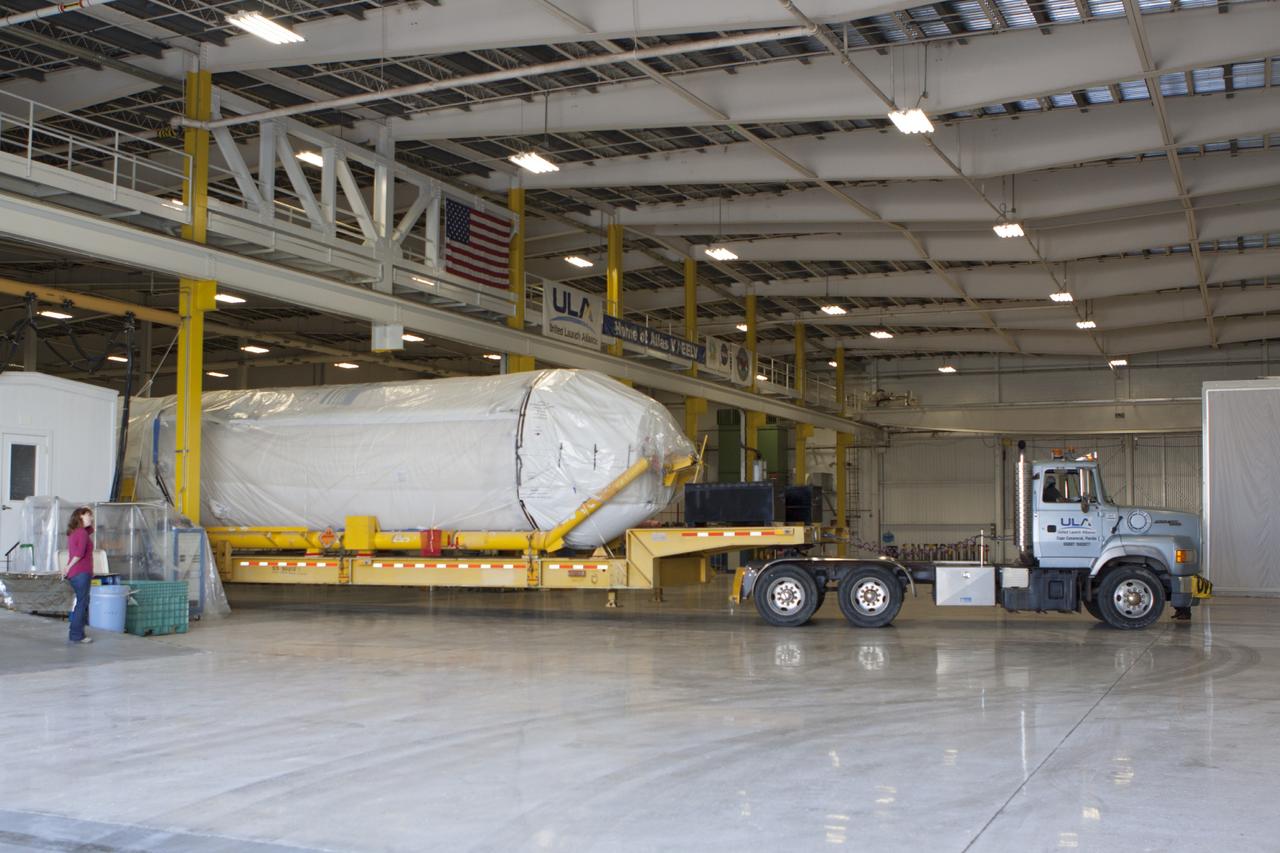
CAPE CANAVERAL, Fla. – United Launch Alliance Atlas V rocket first and second stages arrive at to the Atlas Spaceflight Operations Center, or ASOC, at Cape Canaveral Air Force Station. There, the launch vehicle will begin processing for the Mars Atmosphere and Volatile Evolution, or MAVEN, spacecraft to the Red Planet. MAVEN is being prepared for its scheduled launch in November from Cape Canaveral Air Force Station, Fla. atop a United Launch Alliance Atlas V rocket. Positioned in an orbit above the Red Planet, MAVEN will study the upper atmosphere of Mars in unprecedented detail. For more information, visit: http://www.nasa.gov/mission_pages/maven/main/index.html Photo credit: NASA/Kim Shiflett
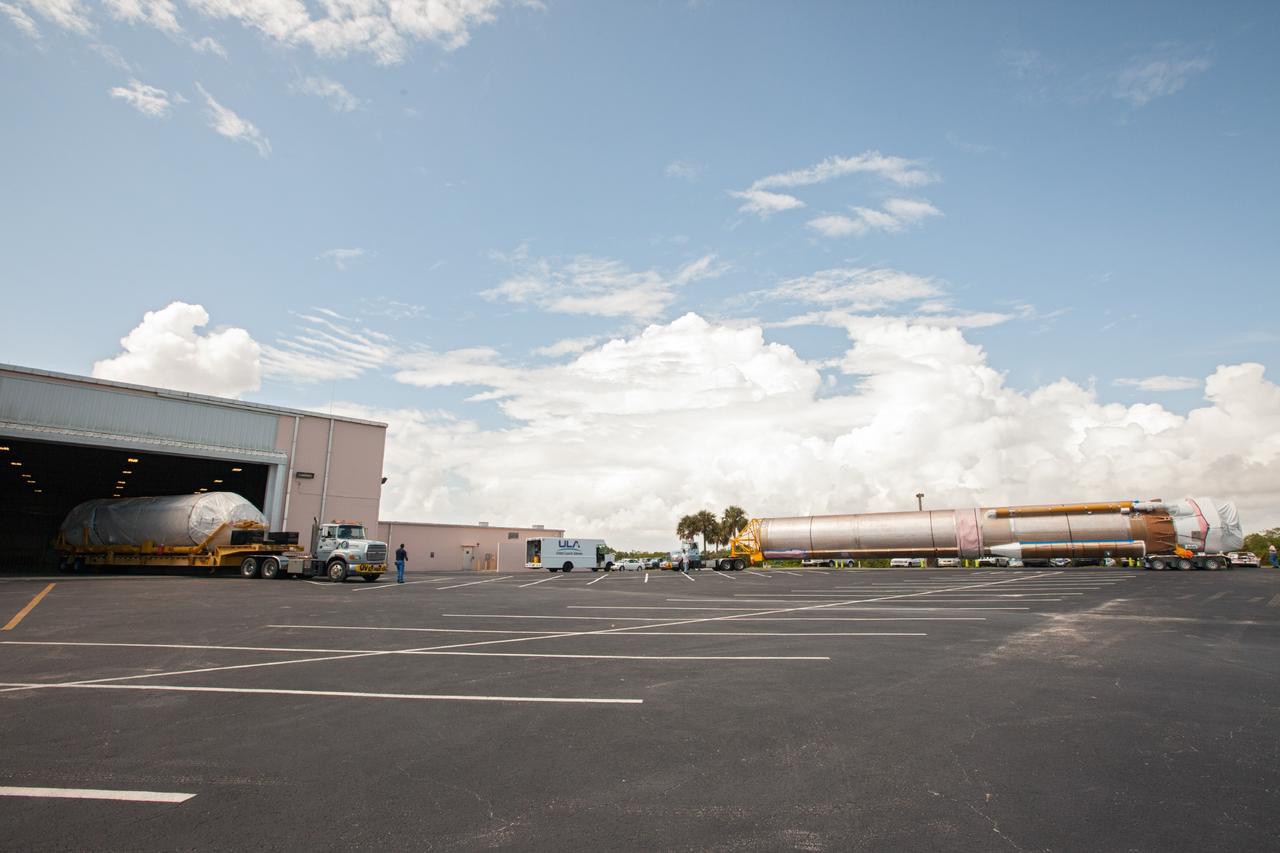
CAPE CANAVERAL, Fla. – United Launch Alliance Atlas V rocket first and second stages arrive at to the Atlas Spaceflight Operations Center, or ASOC, at Cape Canaveral Air Force Station. There, the launch vehicle will begin processing for the Mars Atmosphere and Volatile Evolution, or MAVEN, spacecraft to the Red Planet. MAVEN is being prepared for its scheduled launch in November from Cape Canaveral Air Force Station, Fla. atop a United Launch Alliance Atlas V rocket. Positioned in an orbit above the Red Planet, MAVEN will study the upper atmosphere of Mars in unprecedented detail. For more information, visit: http://www.nasa.gov/mission_pages/maven/main/index.html Photo credit: NASA/Kim Shiflett
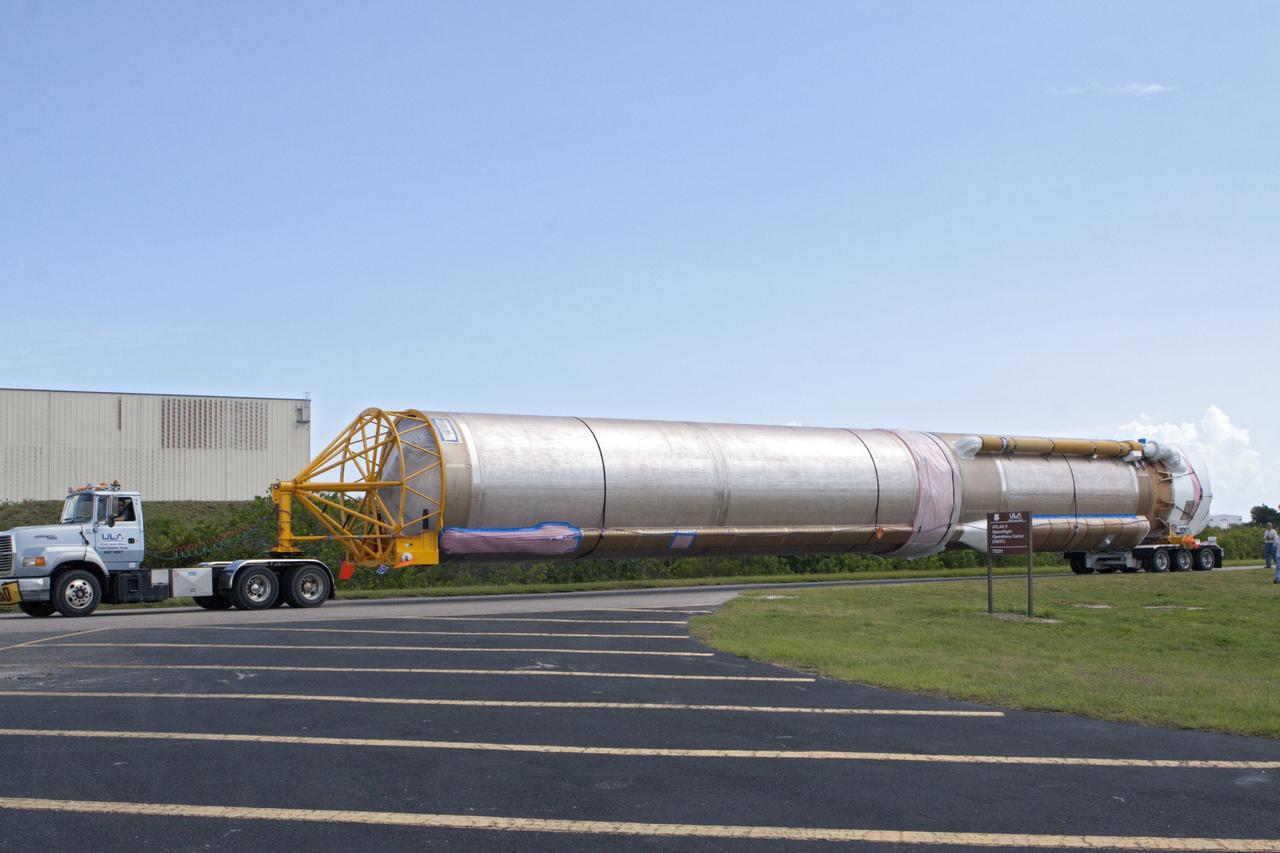
CAPE CANAVERAL, Fla. – United Launch Alliance Atlas V rocket first and second stages arrive at to the Atlas Spaceflight Operations Center, or ASOC, at Cape Canaveral Air Force Station. There, the launch vehicle will begin processing for the Mars Atmosphere and Volatile Evolution, or MAVEN, spacecraft to the Red Planet. MAVEN is being prepared for its scheduled launch in November from Cape Canaveral Air Force Station, Fla. atop a United Launch Alliance Atlas V rocket. Positioned in an orbit above the Red Planet, MAVEN will study the upper atmosphere of Mars in unprecedented detail. For more information, visit: http://www.nasa.gov/mission_pages/maven/main/index.html Photo credit: NASA/Kim Shiflett

CAPE CANAVERAL – Chuck Duvale, deputy director of the Launch Services Program, left, and Bob Cabana, Kennedy Space Center director, oversee the countdown in the Atlas V Spaceflight Operations Center (ASOC) before the launch of the Mars Science Laboratory on an Atlas V rocket. MSL lifted off at 10:02 a.m. EST Nov. 26, beginning a 9-month interplanetary cruise to Mars. MSL's components include a car-sized rover, Curiosity, which has 10 science instruments designed to search for signs of life, including methane, and help determine if the gas is from a biological or geological source. For more information, visit http://www.nasa.gov/msl. Photo credit: NASA/Kim Shiflett
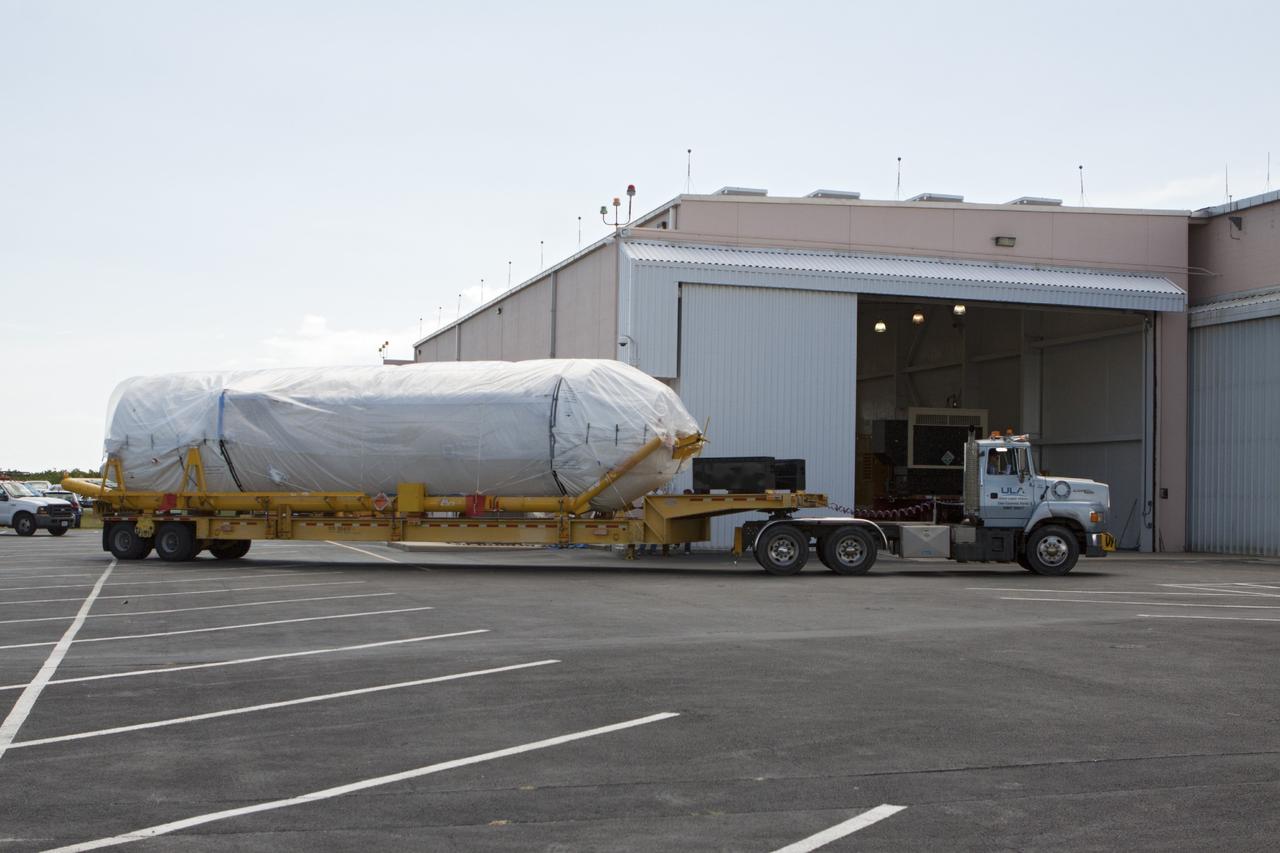
CAPE CANAVERAL, Fla. – United Launch Alliance Atlas V rocket first and second stages arrive at to the Atlas Spaceflight Operations Center, or ASOC, at Cape Canaveral Air Force Station. There, the launch vehicle will begin processing for the Mars Atmosphere and Volatile Evolution, or MAVEN, spacecraft to the Red Planet. MAVEN is being prepared for its scheduled launch in November from Cape Canaveral Air Force Station, Fla. atop a United Launch Alliance Atlas V rocket. Positioned in an orbit above the Red Planet, MAVEN will study the upper atmosphere of Mars in unprecedented detail. For more information, visit: http://www.nasa.gov/mission_pages/maven/main/index.html Photo credit: NASA/Kim Shiflett
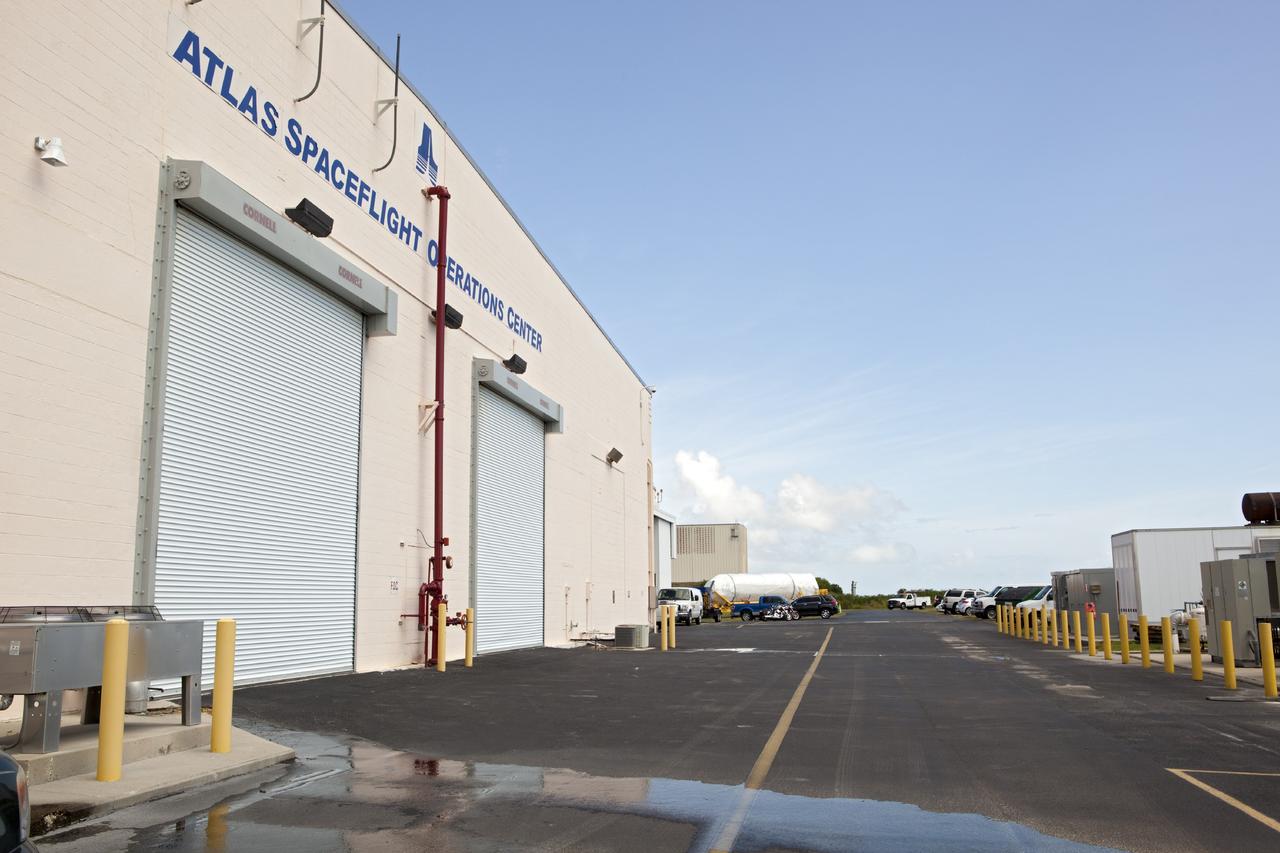
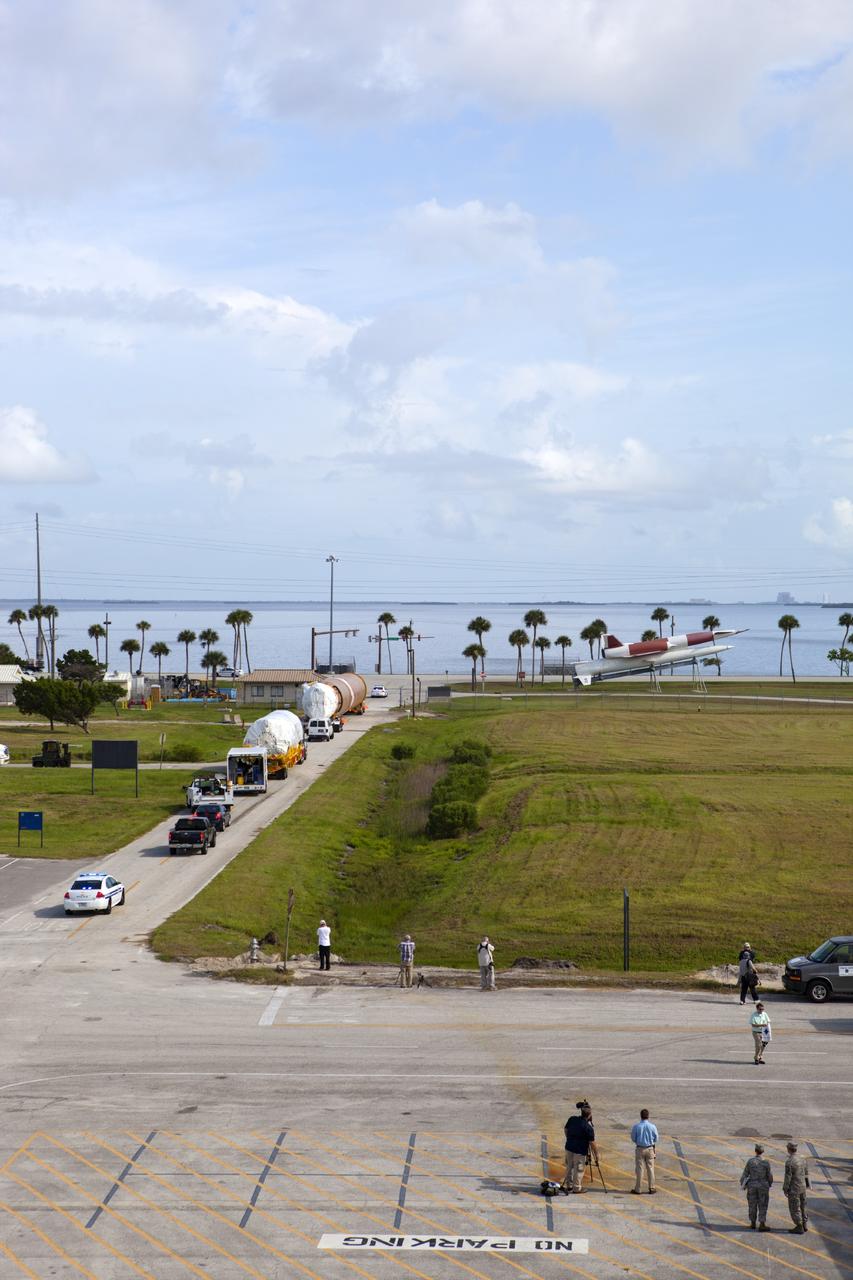
CAPE CANAVERAL, Fla. – United Launch Alliance Atlas V rocket first and second stages arrive at the Atlas Spaceflight Operations Center, or ASOC, at Cape Canaveral Air Force Station, Fla., to begin processing for the Mars Atmosphere and Volatile Evolution, or MAVEN, spacecraft to the Red Planet. MAVEN is being prepared for its scheduled launch in November from Cape Canaveral Air Force Station, Fla. atop a United Launch Alliance Atlas V rocket. Positioned in an orbit above the Red Planet, MAVEN will study the upper atmosphere of Mars in unprecedented detail. For more information, visit: http://www.nasa.gov/mission_pages/maven/main/index.html Photo credit: NASA/ Dimitri Gerondidakis
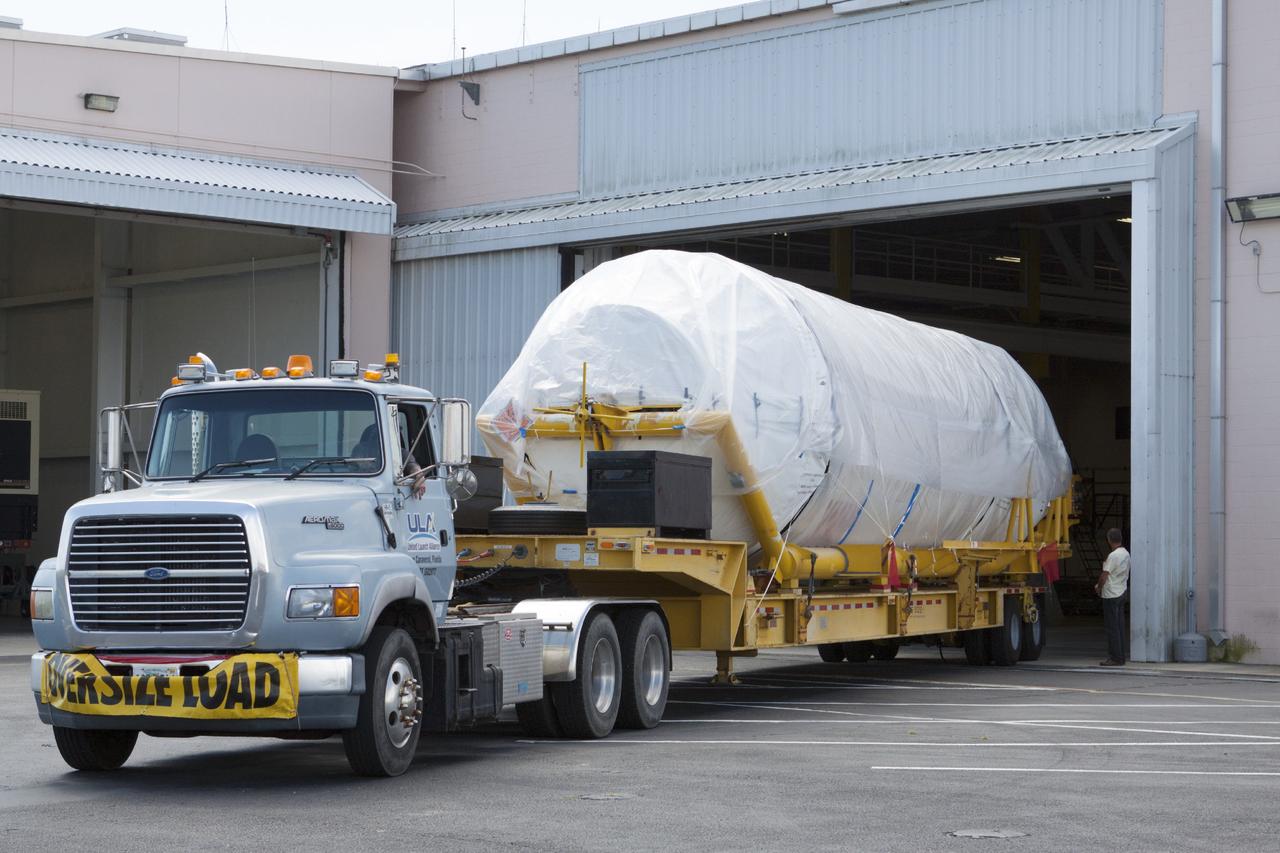
CAPE CANAVERAL, Fla. – United Launch Alliance Atlas V rocket first and second stages arrive at to the Atlas Spaceflight Operations Center, or ASOC, at Cape Canaveral Air Force Station. There, the launch vehicle will begin processing for the Mars Atmosphere and Volatile Evolution, or MAVEN, spacecraft to the Red Planet. MAVEN is being prepared for its scheduled launch in November from Cape Canaveral Air Force Station, Fla. atop a United Launch Alliance Atlas V rocket. Positioned in an orbit above the Red Planet, MAVEN will study the upper atmosphere of Mars in unprecedented detail. For more information, visit: http://www.nasa.gov/mission_pages/maven/main/index.html Photo credit: NASA/Kim Shiflett
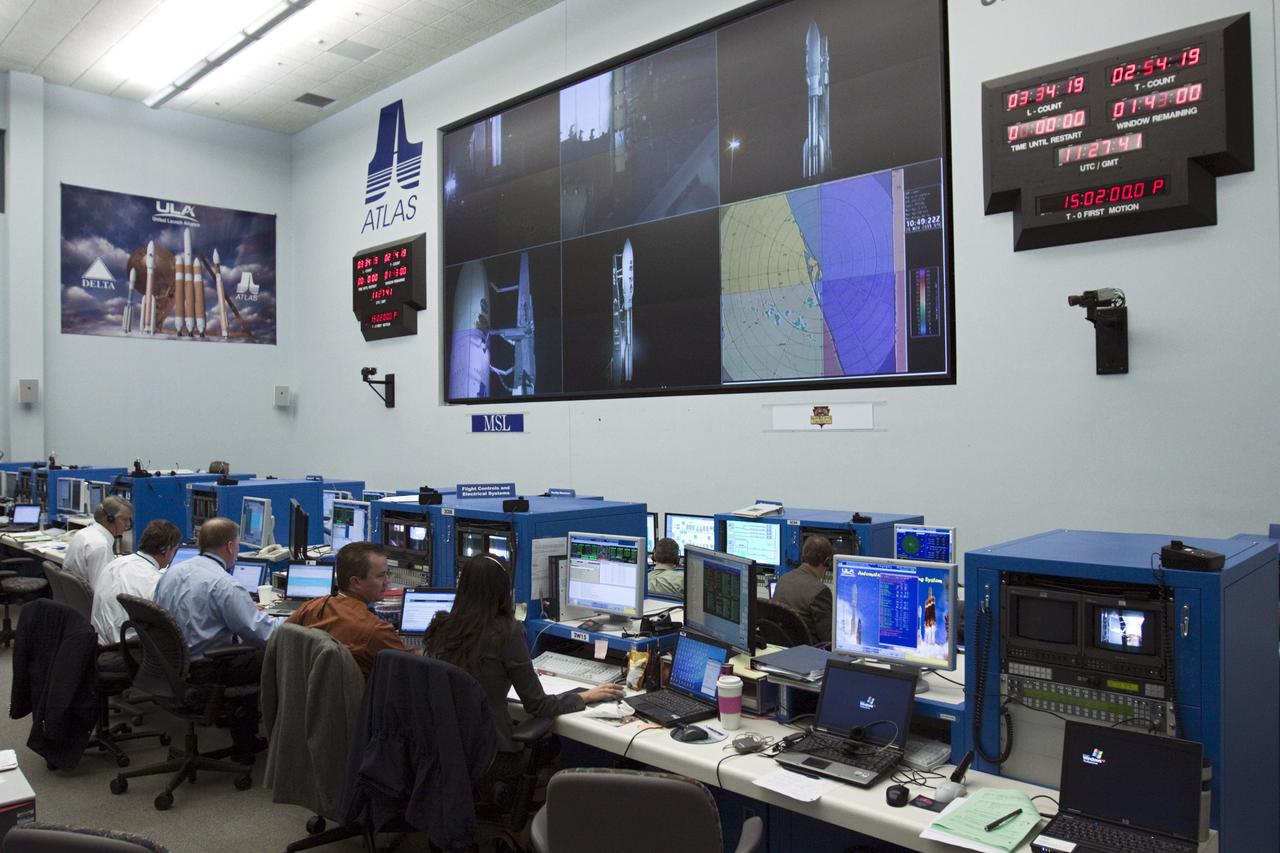
CAPE CANAVERAL – Launch controllers oversee the countdown in the Atlas V Spaceflight Operations Center (ASOC) before the launch of the Mars Science Laboratory on an Atlas V rocket. MSL lifted off at 10:02 a.m. EST Nov. 26, beginning a 9-month interplanetary cruise to Mars. MSL's components include a car-sized rover, Curiosity, which has 10 science instruments designed to search for signs of life, including methane, and help determine if the gas is from a biological or geological source. For more information, visit http://www.nasa.gov/msl. Photo credit: NASA/Kim Shiflett
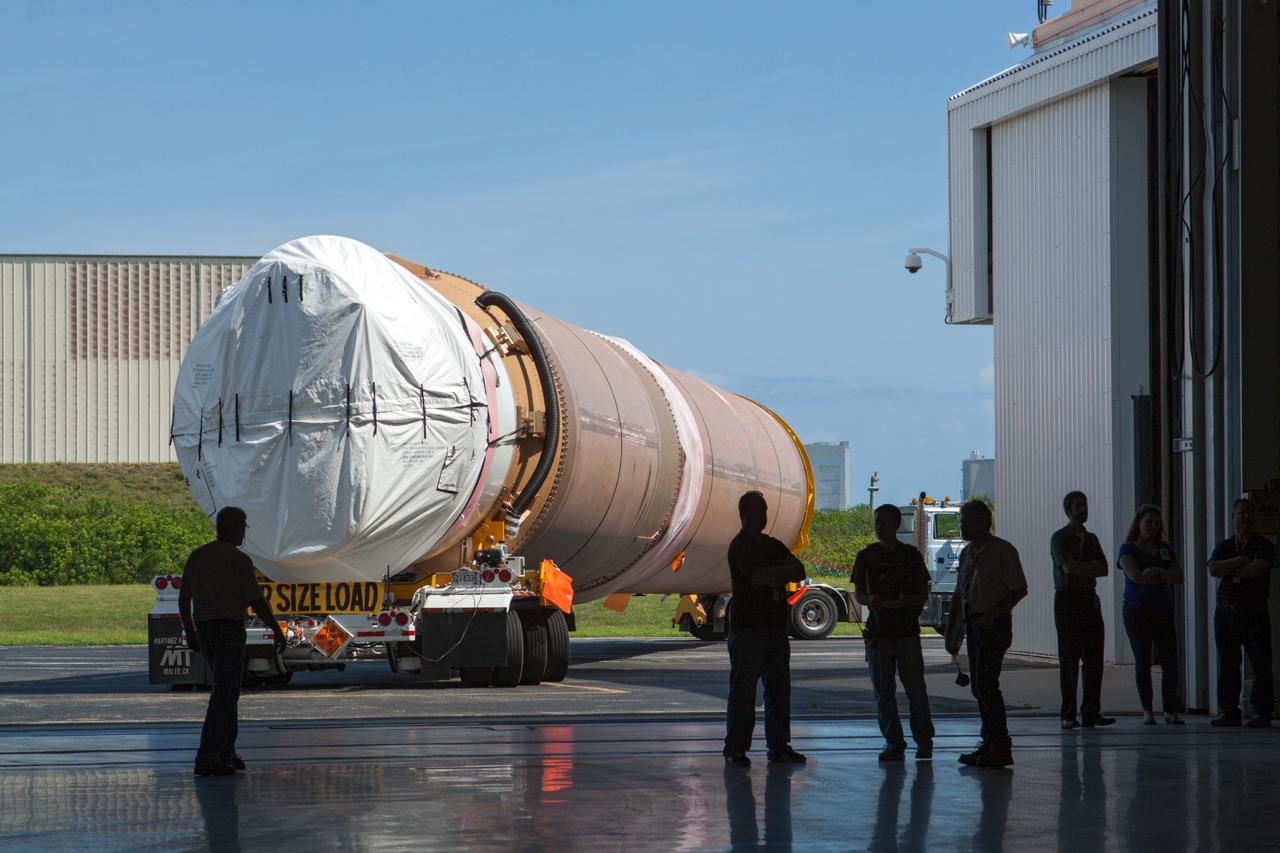
CAPE CANAVERAL, Fla. – United Launch Alliance Atlas V rocket first and second stages arrive at to the Atlas Spaceflight Operations Center, or ASOC, at Cape Canaveral Air Force Station. There, the launch vehicle will begin processing for the Mars Atmosphere and Volatile Evolution, or MAVEN, spacecraft to the Red Planet. MAVEN is being prepared for its scheduled launch in November from Cape Canaveral Air Force Station, Fla. atop a United Launch Alliance Atlas V rocket. Positioned in an orbit above the Red Planet, MAVEN will study the upper atmosphere of Mars in unprecedented detail. For more information, visit: http://www.nasa.gov/mission_pages/maven/main/index.html Photo credit: NASA/Kim Shiflett
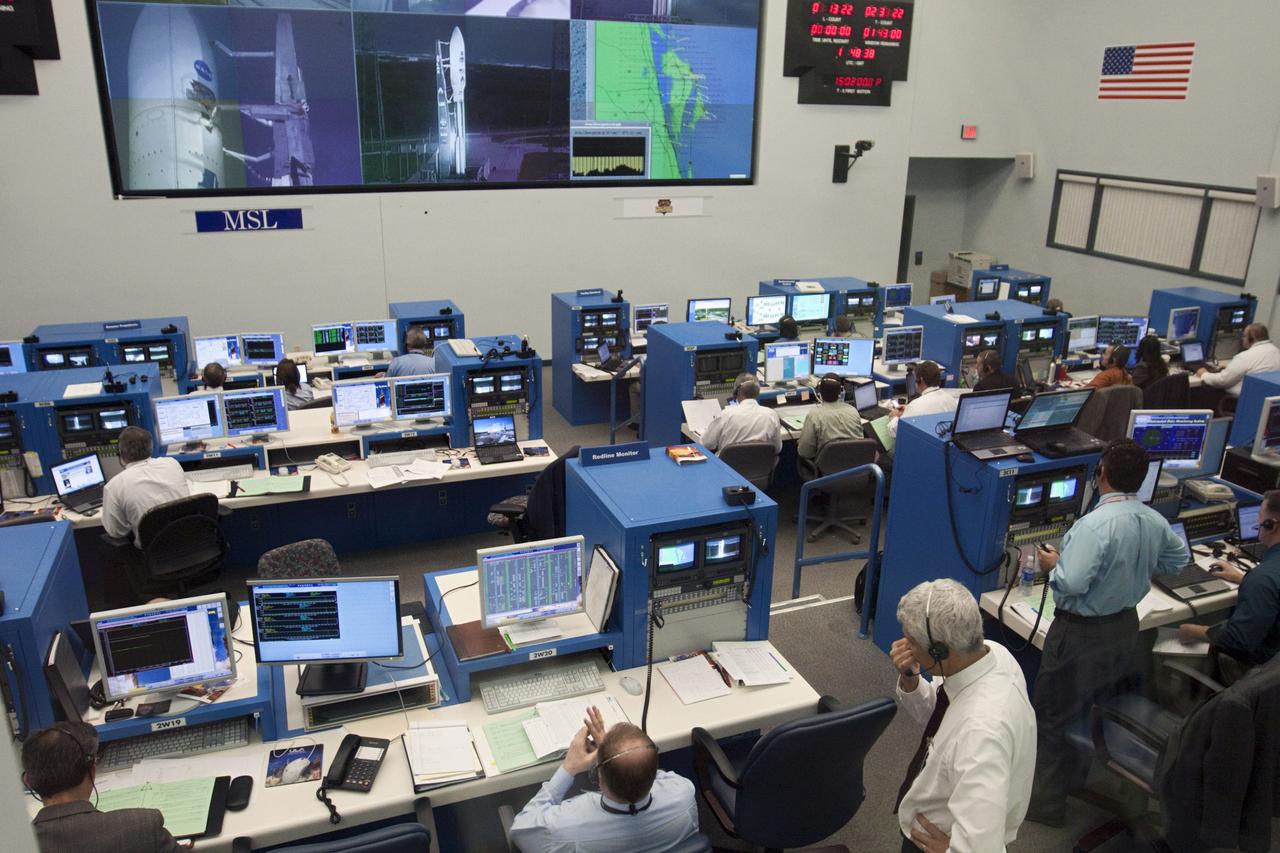
CAPE CANAVERAL – Launch controllers oversee the countdown in the Atlas V Spaceflight Operations Center (ASOC) before the launch of the Mars Science Laboratory on an Atlas V rocket. MSL lifted off at 10:02 a.m. EST Nov. 26, beginning a 9-month interplanetary cruise to Mars. MSL's components include a car-sized rover, Curiosity, which has 10 science instruments designed to search for signs of life, including methane, and help determine if the gas is from a biological or geological source. For more information, visit http://www.nasa.gov/msl. Photo credit: NASA/Kim Shiflett
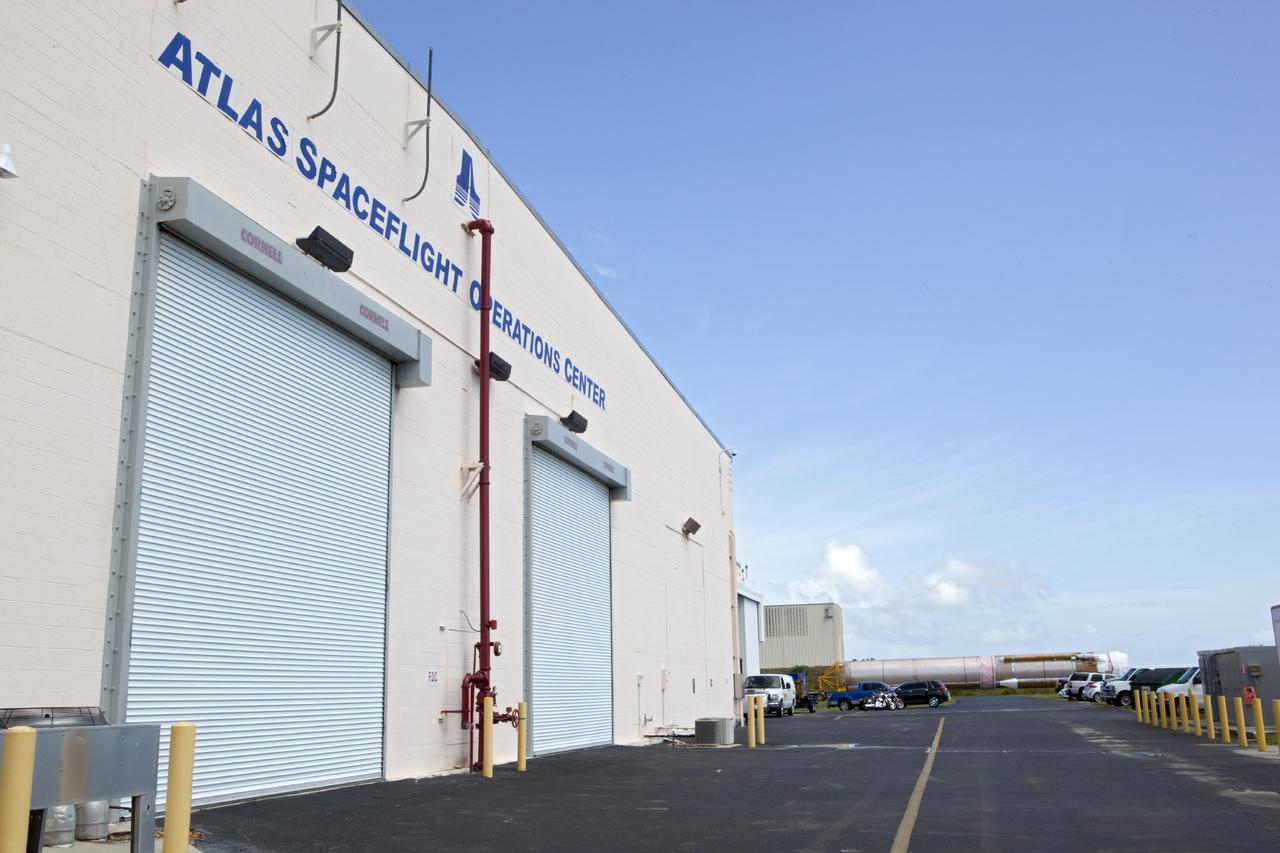
CAPE CANAVERAL, Fla. – United Launch Alliance Atlas V rocket first and second stages arrive at the Atlas Spaceflight Operations Center, or ASOC, at Cape Canaveral Air Force Station, Fla., to begin processing for the Mars Atmosphere and Volatile Evolution, or MAVEN, spacecraft to the Red Planet. MAVEN is being prepared for its scheduled launch in November from Cape Canaveral Air Force Station, Fla. atop a United Launch Alliance Atlas V rocket. Positioned in an orbit above the Red Planet, MAVEN will study the upper atmosphere of Mars in unprecedented detail. For more information, visit: http://www.nasa.gov/mission_pages/maven/main/index.html Photo credit: NASA/ Dimitri Gerondidakis
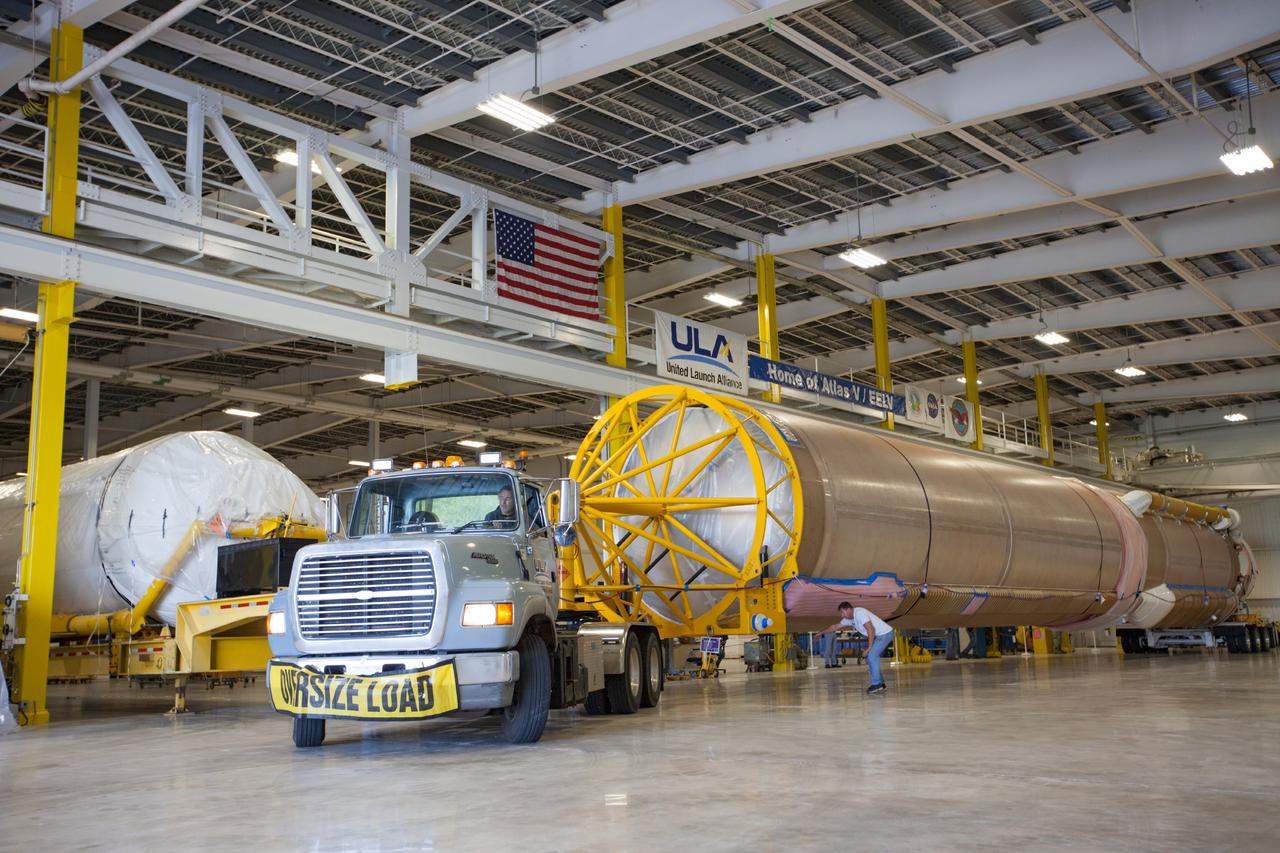
CAPE CANAVERAL, Fla. – United Launch Alliance Atlas V rocket first and second stages arrive at to the Atlas Spaceflight Operations Center, or ASOC, at Cape Canaveral Air Force Station. There, the launch vehicle will begin processing for the Mars Atmosphere and Volatile Evolution, or MAVEN, spacecraft to the Red Planet. MAVEN is being prepared for its scheduled launch in November from Cape Canaveral Air Force Station, Fla. atop a United Launch Alliance Atlas V rocket. Positioned in an orbit above the Red Planet, MAVEN will study the upper atmosphere of Mars in unprecedented detail. For more information, visit: http://www.nasa.gov/mission_pages/maven/main/index.html Photo credit: NASA/Kim Shiflett
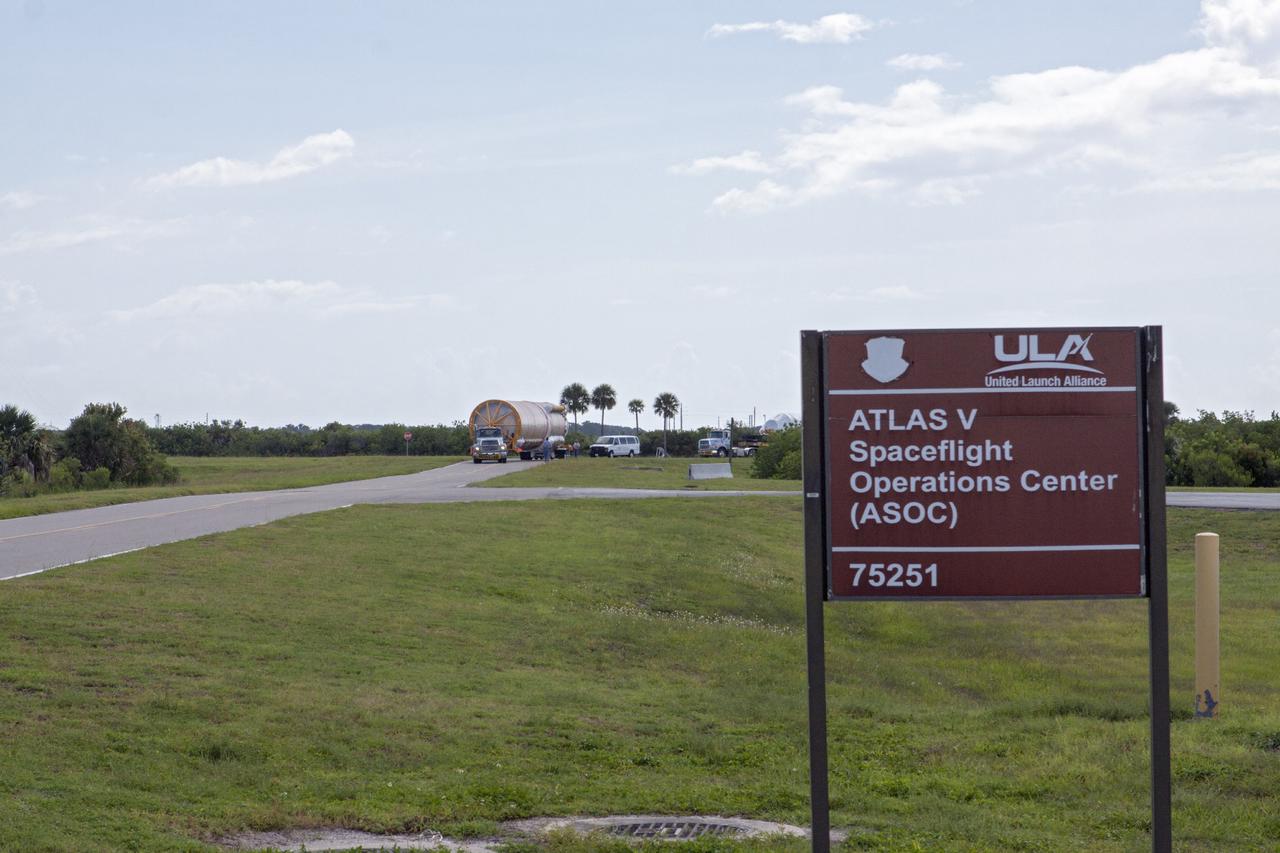
CAPE CANAVERAL, Fla. – United Launch Alliance Atlas V rocket first and second stages arrive at to the Atlas Spaceflight Operations Center, or ASOC, at Cape Canaveral Air Force Station. There, the launch vehicle will begin processing for the Mars Atmosphere and Volatile Evolution, or MAVEN, spacecraft to the Red Planet. MAVEN is being prepared for its scheduled launch in November from Cape Canaveral Air Force Station, Fla. atop a United Launch Alliance Atlas V rocket. Positioned in an orbit above the Red Planet, MAVEN will study the upper atmosphere of Mars in unprecedented detail. For more information, visit: http://www.nasa.gov/mission_pages/maven/main/index.html Photo credit: NASA/Kim Shiflett
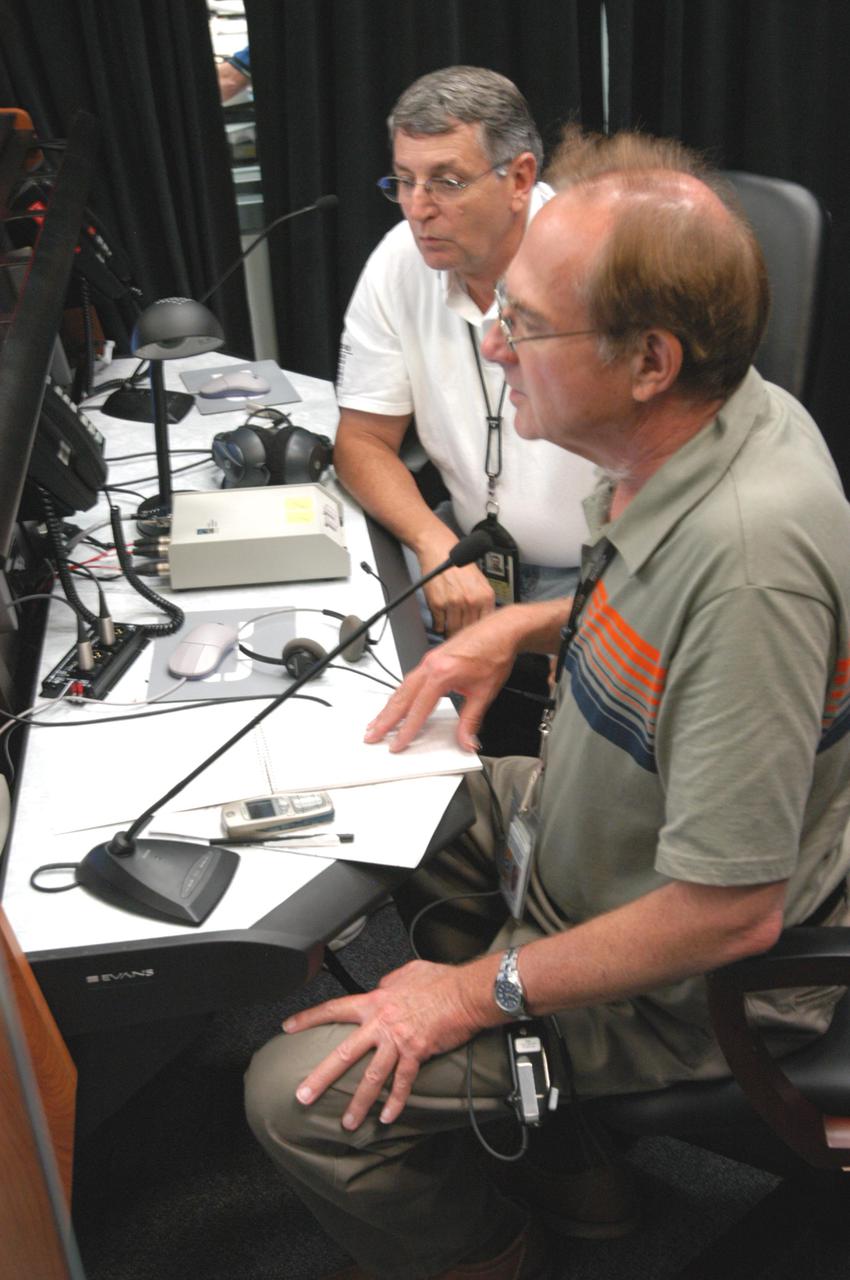
KENNEDY SPACE CENTER, FLA. - At the Atlas V Spaceflight Operations Center, the launch team goes through a wet dress rehearsal for launch of the Mars Reconnaissance Orbiter (MRO), scheduled for Aug. 10. At right, in the foreground, is NASA’s Public Information Officer George Diller, who is commentator for launches of NASA payloads on expendable launch vehicles. Launch of the MRO aboard an Atlas V rocket will be from Launch Complex 41 at Cape Canaveral Air Force Station in Florida. A wet rehearsal includes pre-liftoff operations and fueling the rocket’s engine. The MRO was built by Lockheed Martin for NASA Jet Propulsion Laboratory in California. It is the next major step in Mars exploration and scheduled for launch from Cape Canaveral Air Force Station. The MRO is an important next step in fulfilling NASA’s vision of space exploration and ultimately sending human explorers to Mars and beyond.

Julie Robinson, Chief Scientist for NASA's International Space Station Division, left, and Livio Narici, Professor of Applied Physics at the Università di Roma "Tor Vergata" and ASI, lead a discussion titled “ISS-Moon-Mars: Using Spaceflight Platforms to Study and Simulate Future Missions” during the the 70th International Astronautical Congress, Monday, Oct. 21, 2019 at the Walter E. Washington Convention Center in Washington. Photo Credit: (NASA/Joel Kowsky)

Jennifer Fogarty, Chief Scientist for NASA’s Human Research Program, is seen during a discussion titled “ISS-Moon-Mars: Using Spaceflight Platforms to Study and Simulate Future Missions” during the the 70th International Astronautical Congress, Monday, Oct. 21, 2019 at the Walter E. Washington Convention Center in Washington. Photo Credit: (NASA/Joel Kowsky)

William Paloski, Director of NASA’s Human Research Program, is seen during a discussion titled “ISS-Moon-Mars: Using Spaceflight Platforms to Study and Simulate Future Missions” during the the 70th International Astronautical Congress, Monday, Oct. 21, 2019 at the Walter E. Washington Convention Center in Washington. Photo Credit: (NASA/Joel Kowsky)

Robyn Gatens, Deputy Director of NASA’s International Space Station Program, during a discussion titled “ISS-Moon-Mars: Using Spaceflight Platforms to Study and Simulate Future Missions” during the 70th International Astronautical Congress, Monday, Oct. 21, 2019 at the Walter E. Washington Convention Center in Washington. Photo Credit: (NASA/Joel Kowsky)

Dr. Jonathan Lunine, Director, Cornell Center for Astrophysics and Planetary Science, Co-Chair of the Former Committee on Human Spaceflight, National Academies of Sciences, Engineering, and Medicine testifies during the House Subcommittee on Space and Aeronautics hearing titled "Keeping our sights on Mars: A Review of NASA's Deep Space Exploration Programs and Lunar Proposal", Wednesday, May 8, 2019 at the Rayburn House Office Building in Washington. Photo Credit: (NASA/Bill Ingalls)
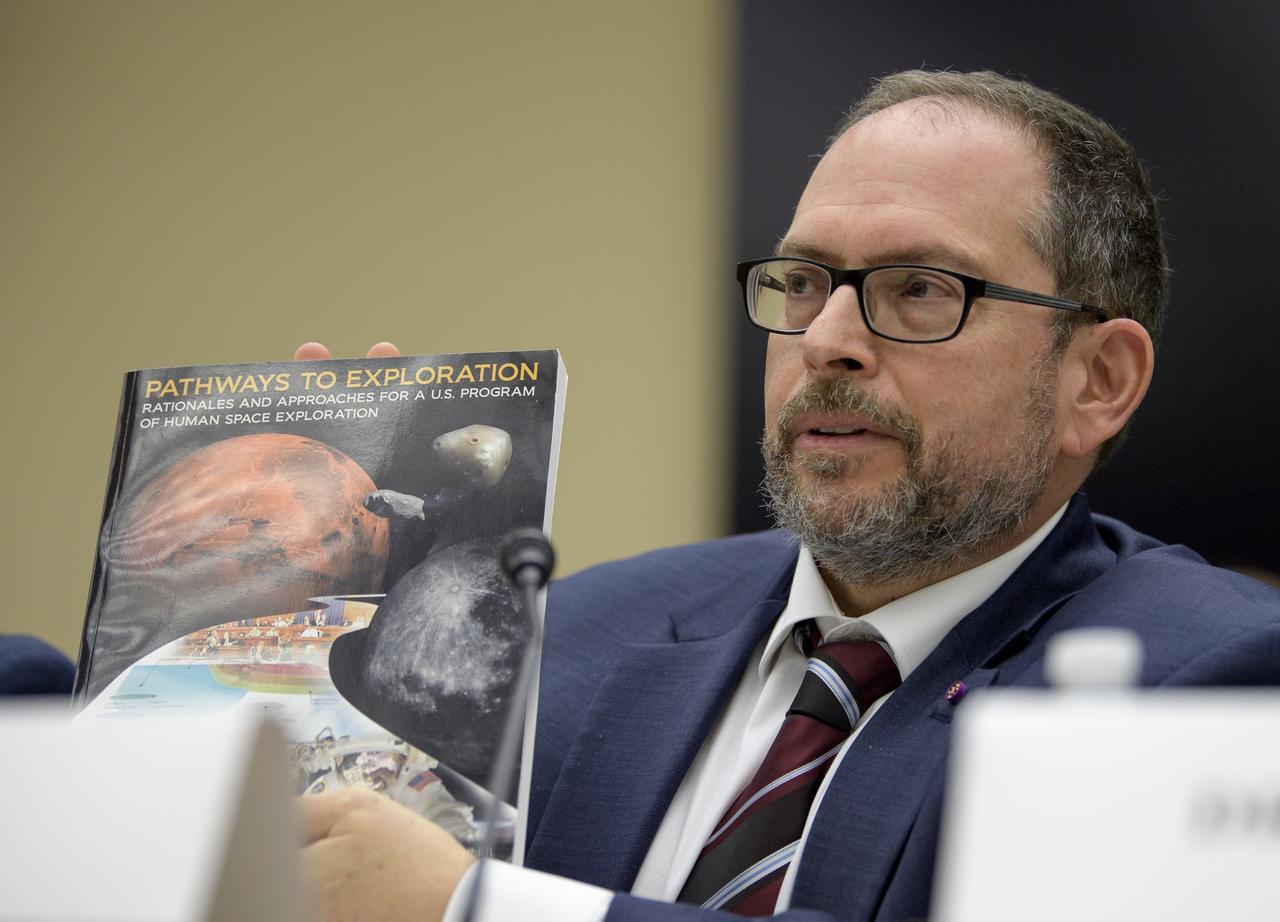
Dr. Jonathan Lunine, Director, Cornell Center for Astrophysics and Planetary Science, Co-Chair of the Former Committee on Human Spaceflight, National Academies of Sciences, Engineering, and Medicine testifies during the House Subcommittee on Space and Aeronautics hearing titled "Keeping our sights on Mars: A Review of NASA's Deep Space Exploration Programs and Lunar Proposal", Wednesday, May 8, 2019 at the Rayburn House Office Building in Washington. Photo Credit: (NASA/Bill Ingalls)
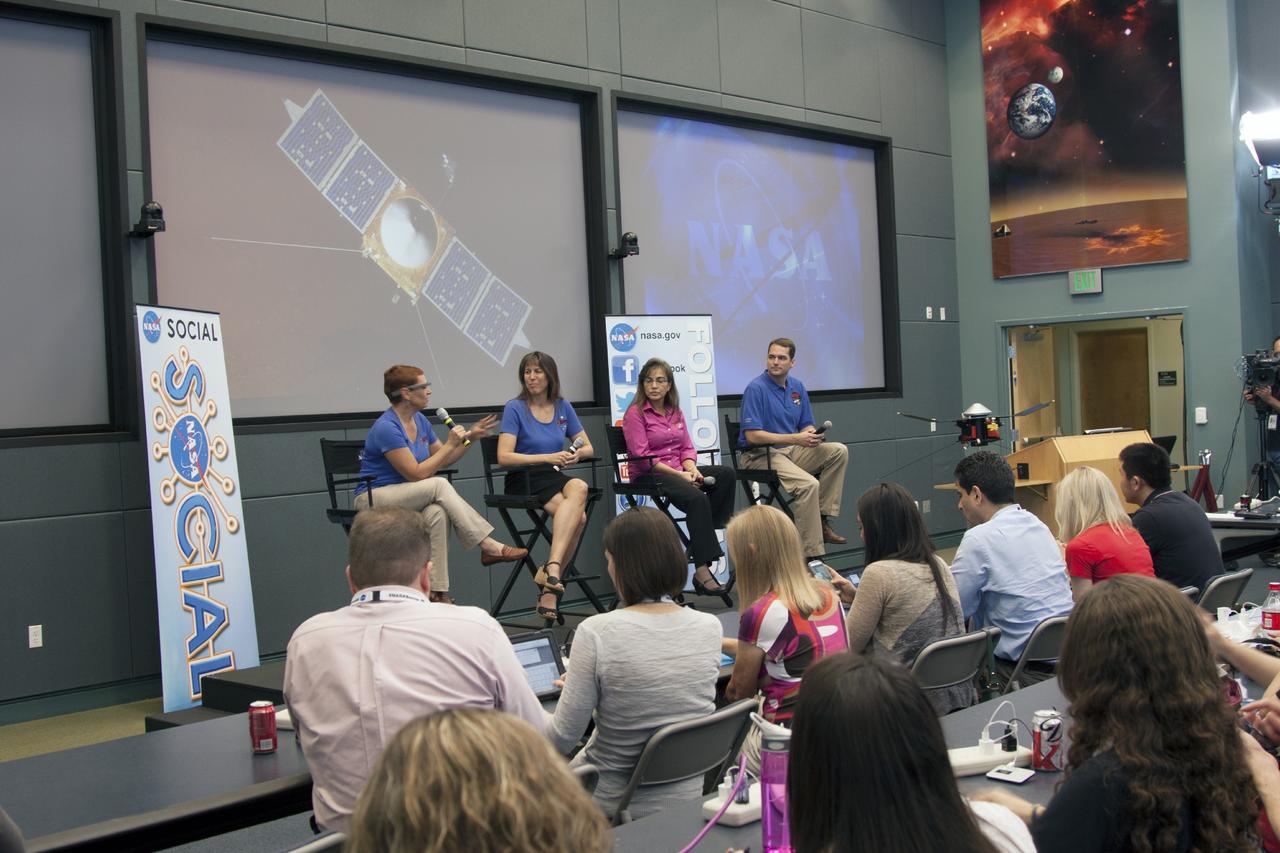
CAPE CANAVERAL, Fla. -- In the conference room of Operations Support Building II at NASA's Kennedy Space Center in Florida, social media participants listen to a briefing on the Mars Atmosphere and Volatile Evolution, or MAVEN, mission by, from the left, Lisa May, MAVEN Program executive, Kelly Fast, Mars Program scientist, Sandra Cauffman, deputy project manager at the agency's Goddard Spaceflight Center, in Greenbelt, Md., and Chris Waters, systems design team lead at Lockheed Martin. The social media participants gathered at the Florida spaceport for the launch of the Mars Atmosphere and Volatile Evolution, or MAVEN, spacecraft. Their visit included tours of key facilities and participating in presentations by key NASA leaders who updated the space agency's current efforts. Photo credit: NASA/Jim Grossman
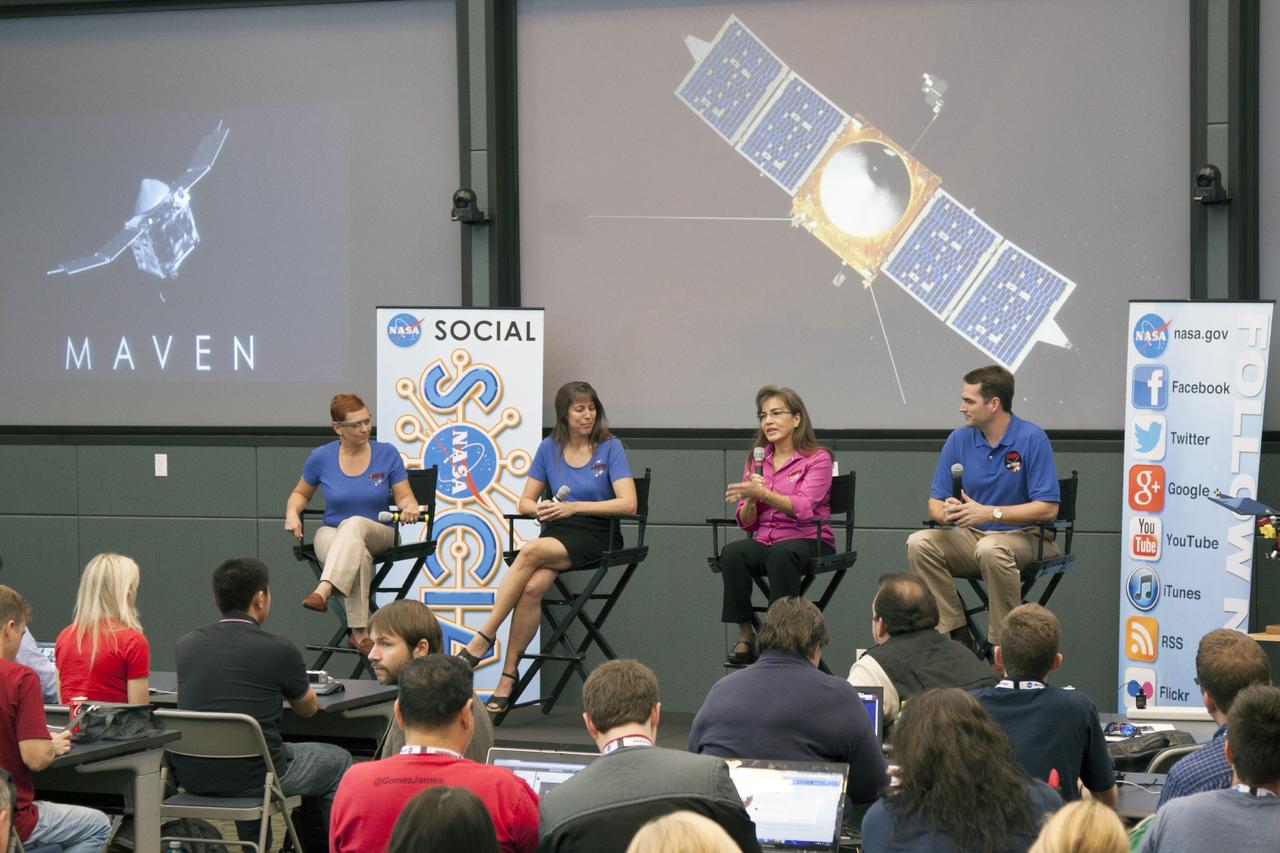
CAPE CANAVERAL, Fla. -- In the conference room of Operations Support Building II at NASA's Kennedy Space Center in Florida, social media participants listen to a briefing on the Mars Atmosphere and Volatile Evolution, or MAVEN, mission by, from the left, Lisa May, MAVEN Program executive, Kelly Fast, Mars Program scientist, Sandra Cauffman, deputy project manager at the agency's Goddard Spaceflight Center, in Greenbelt, Md., and Chris Waters, systems design team lead at Lockheed Martin. The social media participants gathered at the Florida spaceport for the launch of the Mars Atmosphere and Volatile Evolution, or MAVEN, spacecraft. Their visit included tours of key facilities and participating in presentations by key NASA leaders who updated the space agency's current efforts. Photo credit: NASA/Jim Grossman
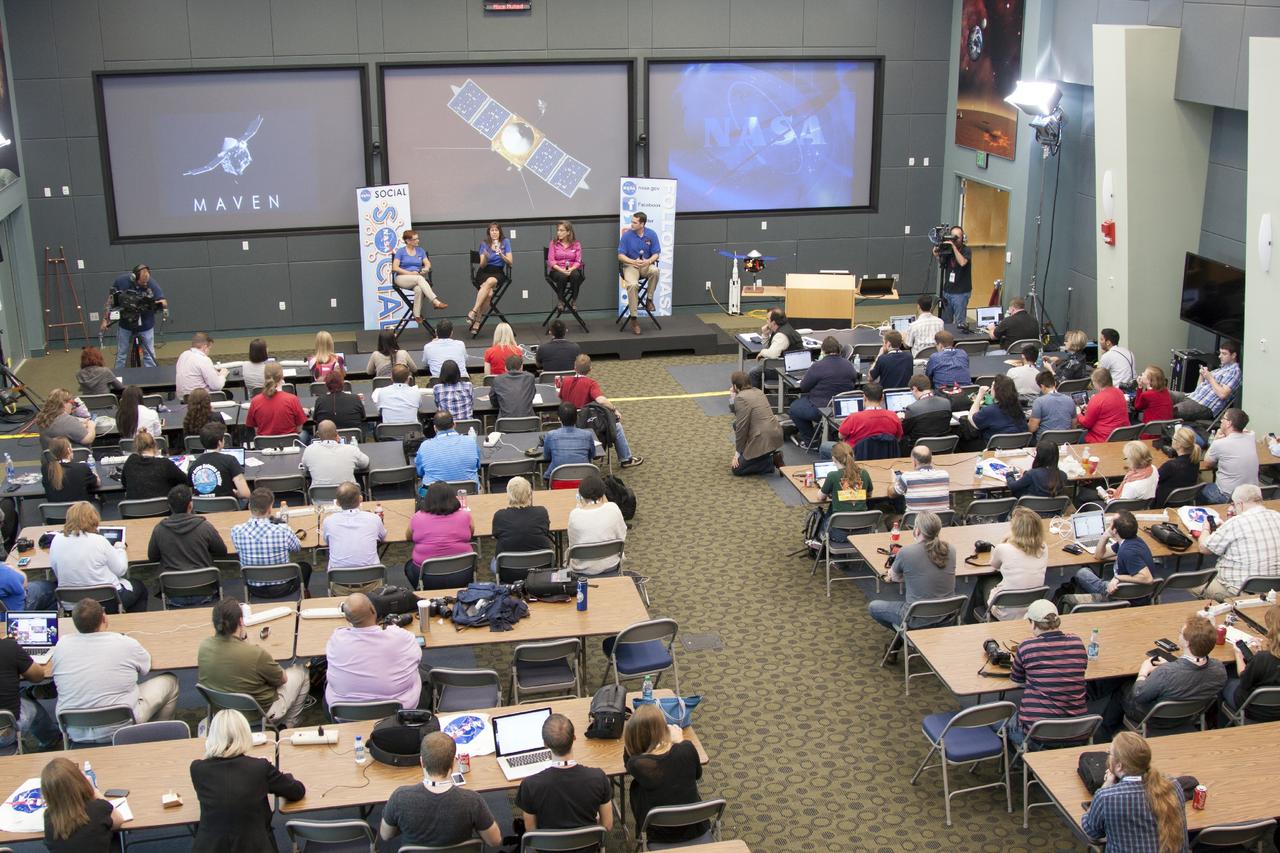
CAPE CANAVERAL, Fla. -- In the conference room of Operations Support Building II at NASA's Kennedy Space Center in Florida, social media participants listen to a briefing on the Mars Atmosphere and Volatile Evolution, or MAVEN, mission by, from the left, Lisa May, MAVEN Program executive, Kelly Fast, Mars Program scientist, Sandra Cauffman, deputy project manager at the agency's Goddard Spaceflight Center, in Greenbelt, Md., and Chris Waters, systems design team lead at Lockheed Martin. The social media participants gathered at the Florida spaceport for the launch of the Mars Atmosphere and Volatile Evolution, or MAVEN, spacecraft. Their visit included tours of key facilities and participating in presentations by key NASA leaders who updated the space agency's current efforts. Photo credit: NASA/Jim Grossman
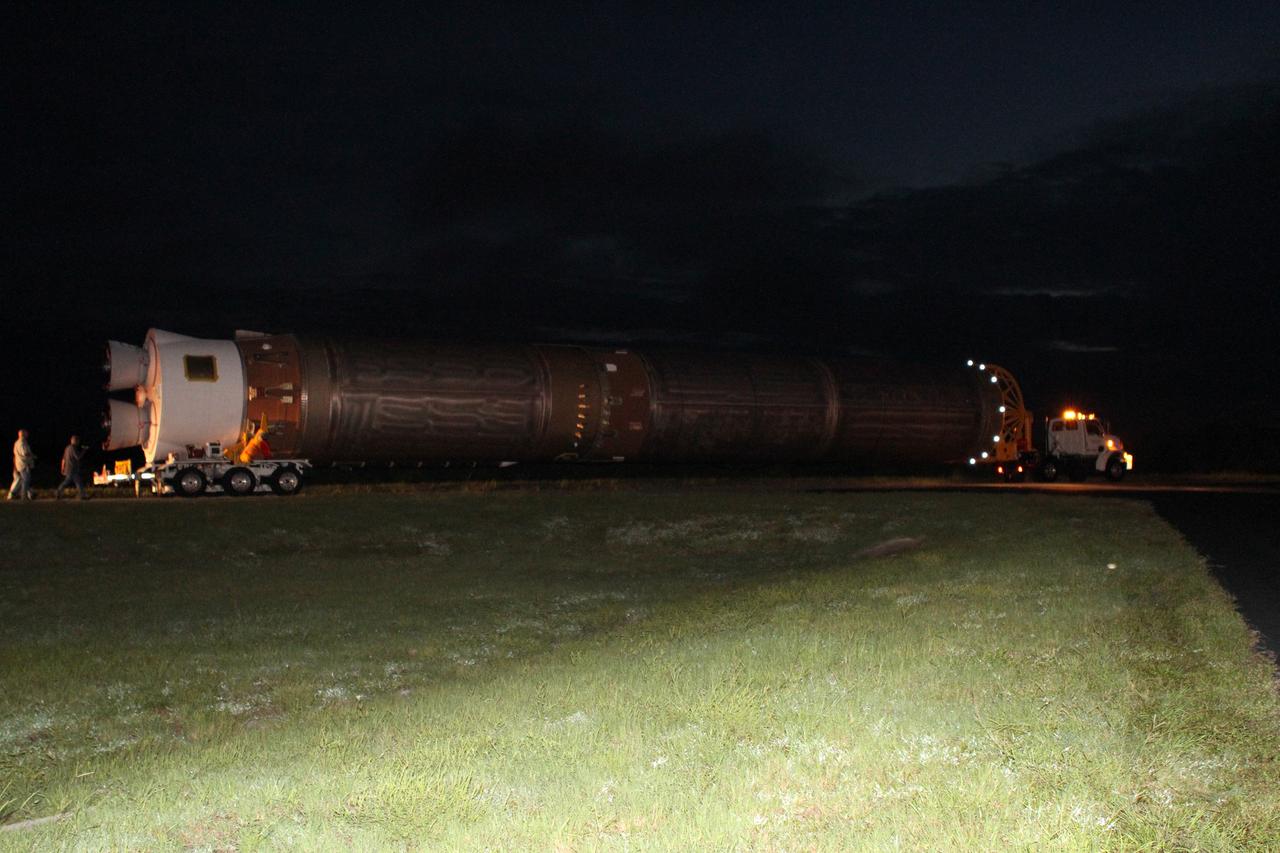
CAPE CANAVERAL, Fla. -- Workers accompany the first stage of the Atlas V rocket for NASA's Mars Science Laboratory (MSL) mission on its trip from the Atlas Spaceflight Operations Center on Cape Canaveral Air Force Station in Florida to the launch pad. A United Launch Alliance Atlas V-541 configuration will be used to loft MSL into space. Curiosity’s 10 science instruments are designed to search for evidence on whether Mars has had environments favorable to microbial life, including chemical ingredients for life. The unique rover will use a laser to look inside rocks and release its gasses so that the rover’s spectrometer can analyze and send the data back to Earth. MSL is scheduled to launch Nov. 25 with a window extending to Dec. 18 and arrival at Mars Aug. 2012. For more information, visit http://www.nasa.gov/msl. Photo credit: NASA/Cory Huston

CAPE CANAVERAL, Fla. -- The first stage of the Atlas V rocket for NASA's Mars Science Laboratory (MSL) mission begins its trip from the Atlas Spaceflight Operations Center on Cape Canaveral Air Force Station in Florida to the launch pad. A United Launch Alliance Atlas V-541 configuration will be used to loft MSL into space. Curiosity’s 10 science instruments are designed to search for evidence on whether Mars has had environments favorable to microbial life, including chemical ingredients for life. The unique rover will use a laser to look inside rocks and release its gasses so that the rover’s spectrometer can analyze and send the data back to Earth. MSL is scheduled to launch Nov. 25 with a window extending to Dec. 18 and arrival at Mars Aug. 2012. For more information, visit http://www.nasa.gov/msl. Photo credit: NASA/Cory Huston
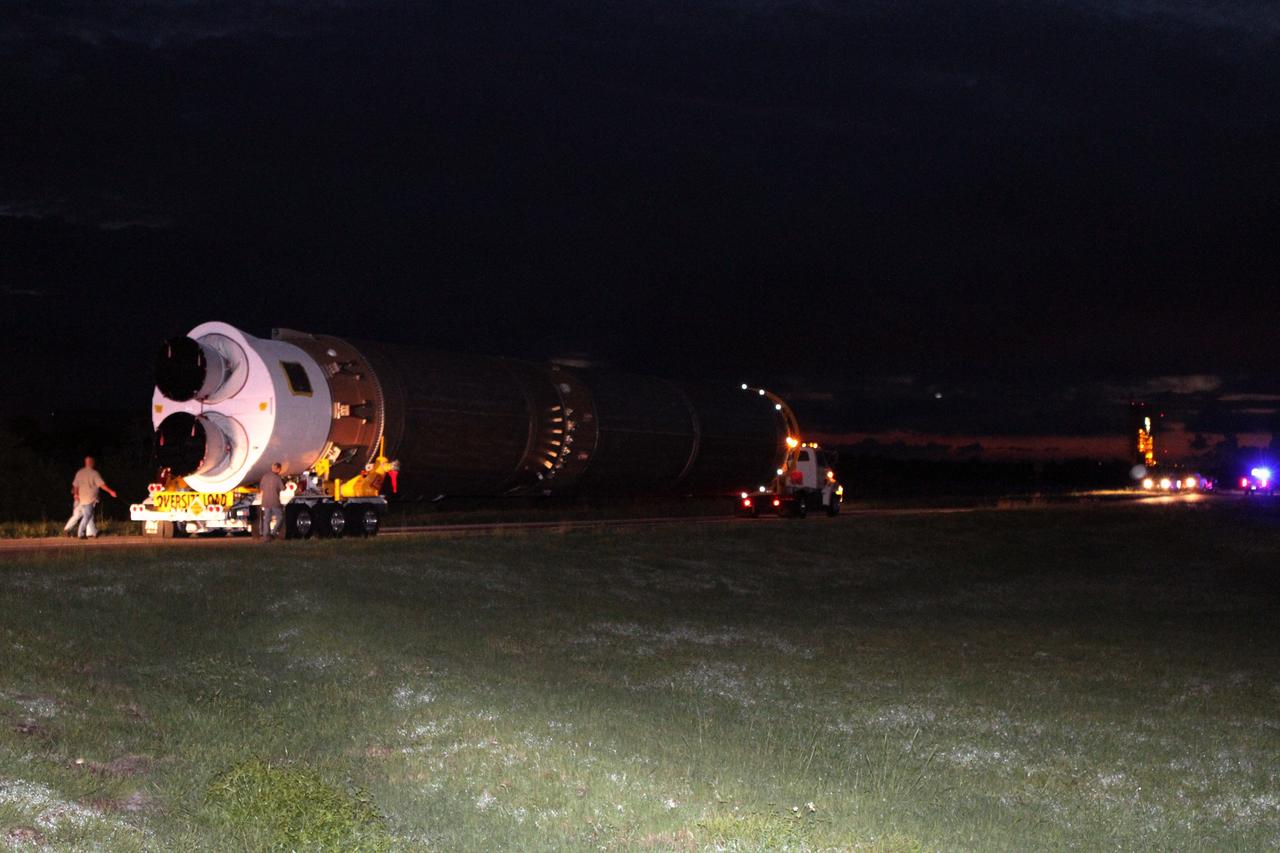
CAPE CANAVERAL, Fla. -- Early morning finds workers accompanying the first stage of the Atlas V rocket for NASA's Mars Science Laboratory (MSL) mission on its move from the Atlas Spaceflight Operations Center on Cape Canaveral Air Force Station in Florida to the launch pad. A United Launch Alliance Atlas V-541 configuration will be used to loft MSL into space. Curiosity’s 10 science instruments are designed to search for evidence on whether Mars has had environments favorable to microbial life, including chemical ingredients for life. The unique rover will use a laser to look inside rocks and release its gasses so that the rover’s spectrometer can analyze and send the data back to Earth. MSL is scheduled to launch Nov. 25 with a window extending to Dec. 18 and arrival at Mars Aug. 2012. For more information, visit http://www.nasa.gov/msl. Photo credit: NASA/Cory Huston
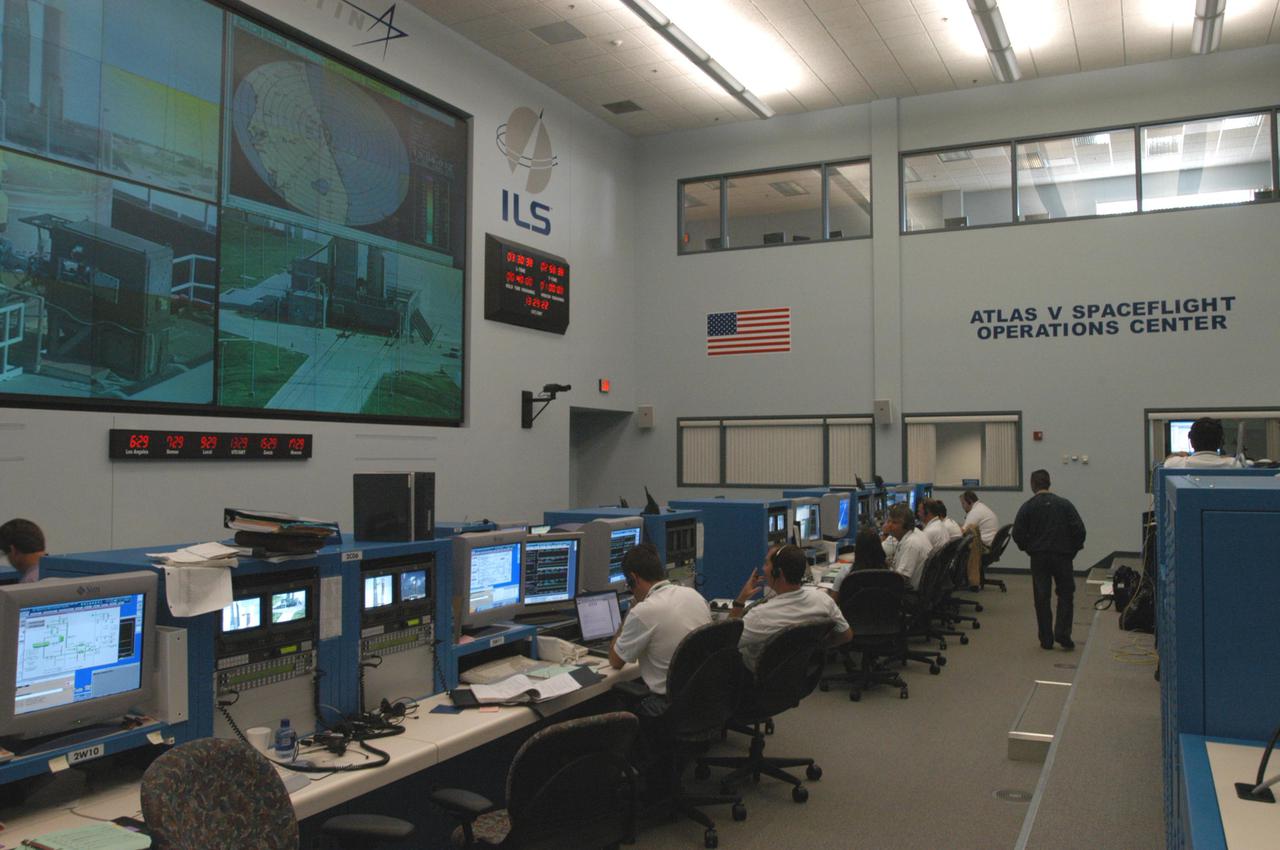
KENNEDY SPACE CENTER, FLA. - At the Atlas V Spaceflight Operations Center, the launch team goes through a wet dress rehearsal for launch of the Mars Reconnaissance Orbiter (MRO), scheduled for Aug. 10. Launch of the MRO aboard an Atlas V rocket will be from Launch Complex 41 at Cape Canaveral Air Force Station in Florida. A wet rehearsal includes pre-liftoff operations and a fueling of the rocket’s engine. The MRO was built by Lockheed Martin for NASA Jet Propulsion Laboratory in California. It is the next major step in Mars exploration and scheduled for launch from Cape Canaveral Air Force Station. The MRO is an important next step in fulfilling NASA’s vision of space exploration and ultimately sending human explorers to Mars and beyond.
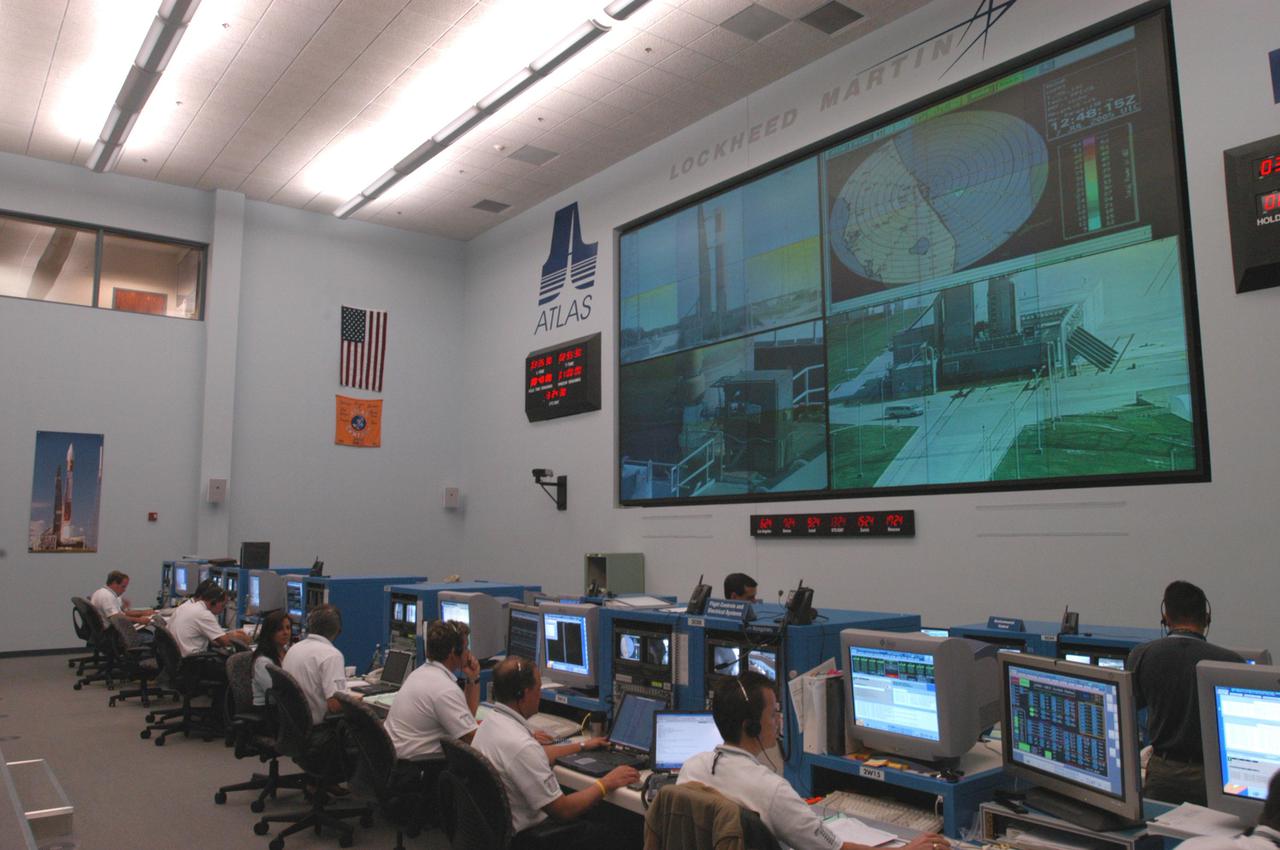
KENNEDY SPACE CENTER, FLA. - At the Atlas V Spaceflight Operations Center, the launch team goes through a wet dress rehearsal for launch of the Mars Reconnaissance Orbiter (MRO), scheduled for Aug. 10. Launch of the MRO aboard an Atlas V rocket will be from Launch Complex 41 at Cape Canaveral Air Force Station in Florida. A wet rehearsal includes pre-liftoff operations and a fueling of the rocket’s engine. The MRO was built by Lockheed Martin for NASA Jet Propulsion Laboratory in California. It is the next major step in Mars exploration and scheduled for launch from Cape Canaveral Air Force Station. The MRO is an important next step in fulfilling NASA’s vision of space exploration and ultimately sending human explorers to Mars and beyond.
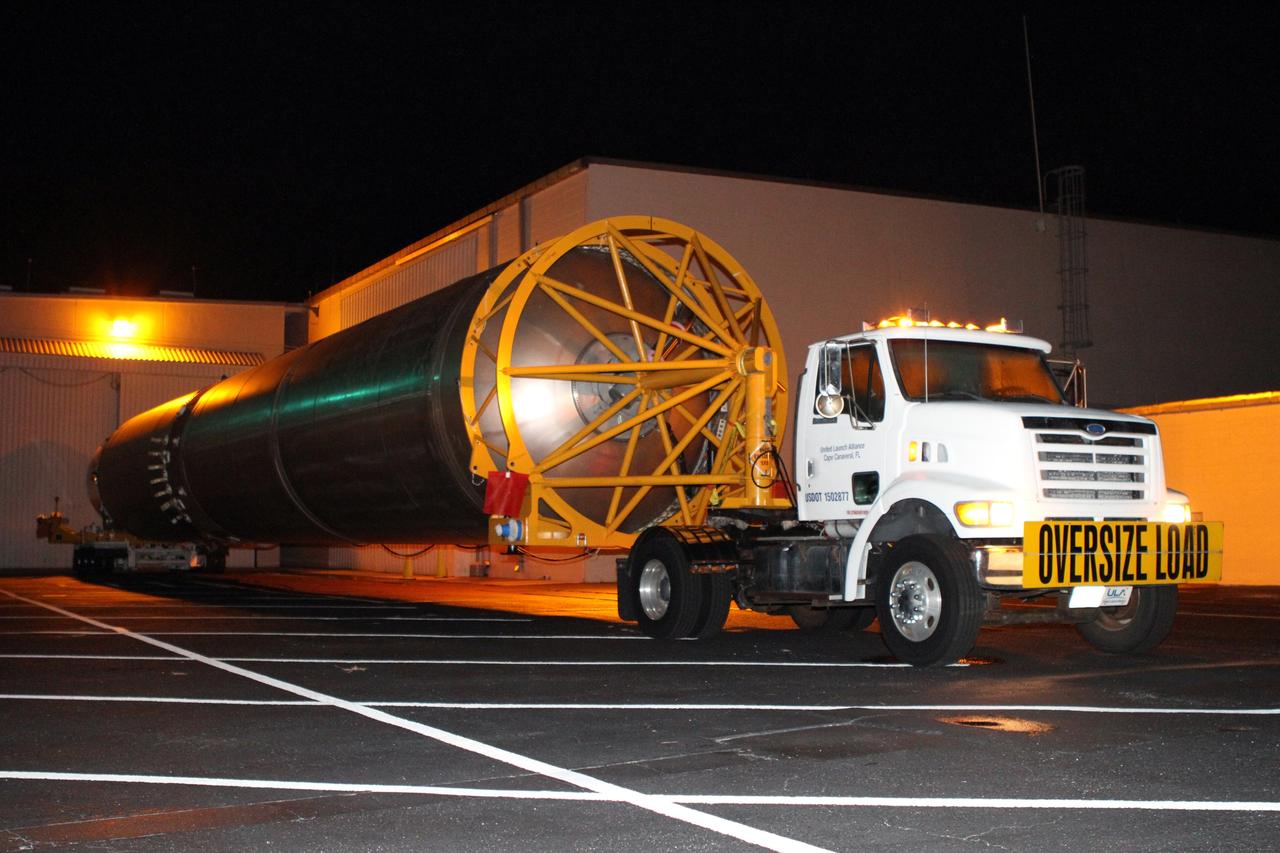
CAPE CANAVERAL, Fla. -- The first stage of the Atlas V rocket for NASA's Mars Science Laboratory (MSL) mission rolls out of the Atlas Spaceflight Operations Center on Cape Canaveral Air Force Station in Florida bound for the launch pad. A United Launch Alliance Atlas V-541 configuration will be used to loft MSL into space. Curiosity’s 10 science instruments are designed to search for evidence on whether Mars has had environments favorable to microbial life, including chemical ingredients for life. The unique rover will use a laser to look inside rocks and release its gasses so that the rover’s spectrometer can analyze and send the data back to Earth. MSL is scheduled to launch Nov. 25 with a window extending to Dec. 18 and arrival at Mars Aug. 2012. For more information, visit http://www.nasa.gov/msl. Photo credit: NASA/Cory Huston
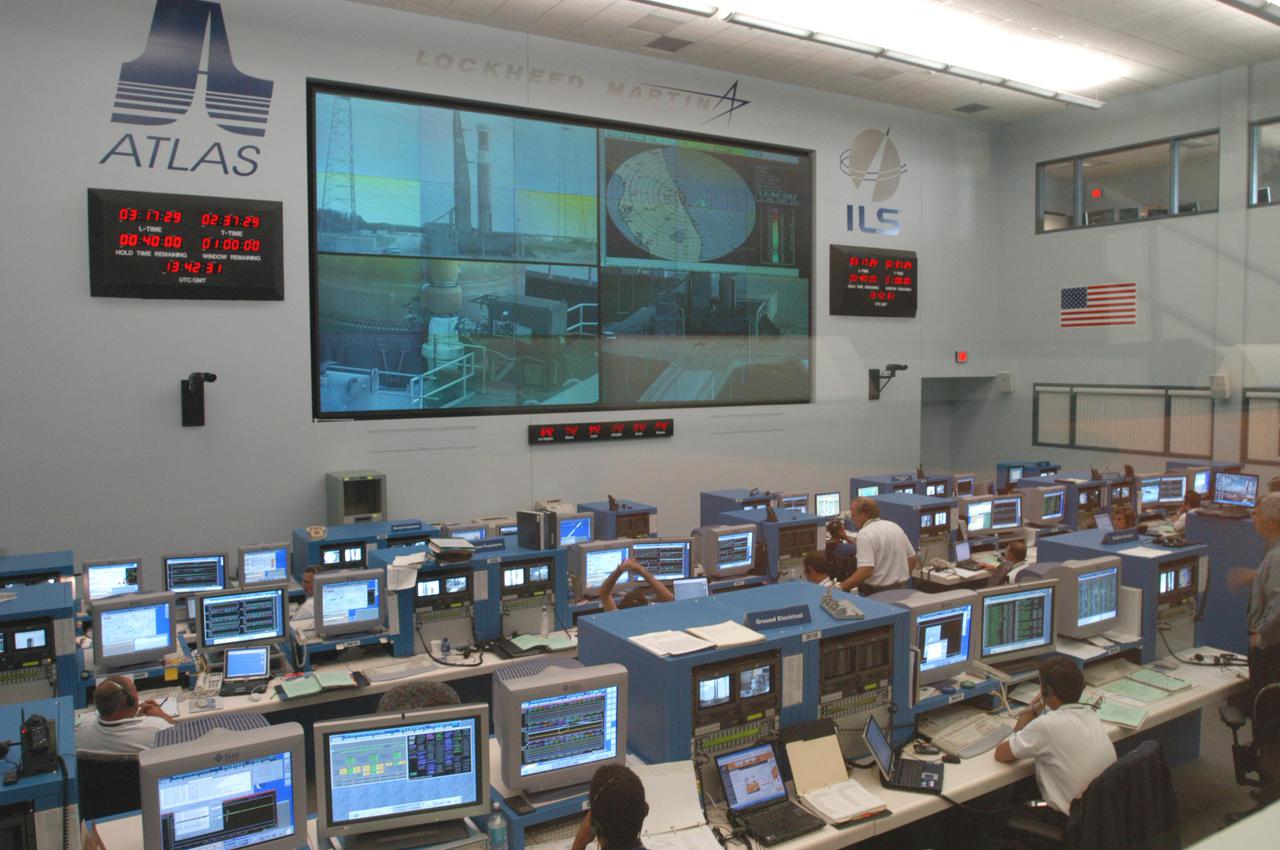
KENNEDY SPACE CENTER, FLA. - At the Atlas V Spaceflight Operations Center, the launch team goes through a wet dress rehearsal for launch of the Mars Reconnaissance Orbiter (MRO), scheduled for Aug. 10. Launch of the MRO aboard an Atlas V rocket will be from Launch Complex 41 at Cape Canaveral Air Force Station in Florida. A wet rehearsal includes pre-liftoff operations and fueling the rocket’s engine. The MRO was built by Lockheed Martin for NASA Jet Propulsion Laboratory in California. It is the next major step in Mars exploration and scheduled for launch from Cape Canaveral Air Force Station. The MRO is an important next step in fulfilling NASA’s vision of space exploration and ultimately sending human explorers to Mars and beyond.
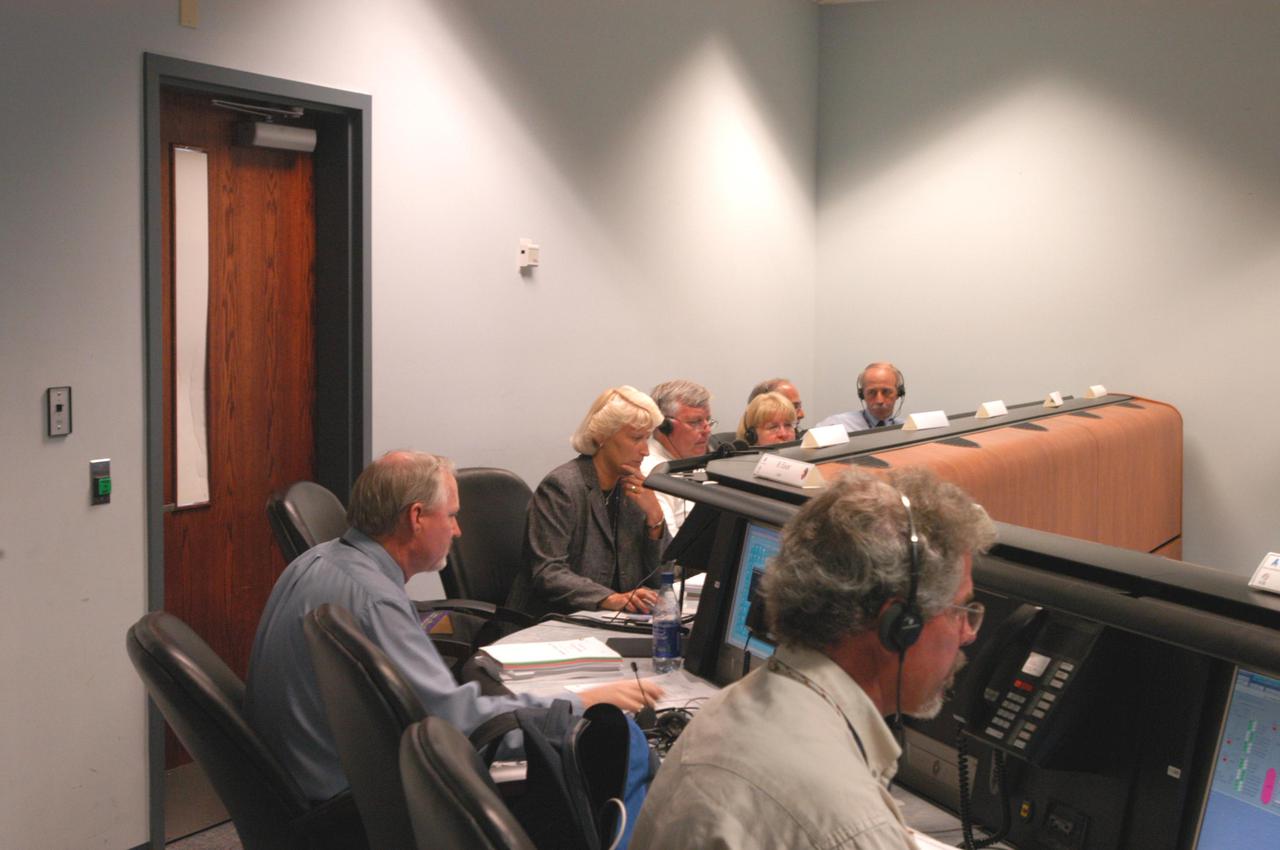
KENNEDY SPACE CENTER, FLA. - At the Atlas V Spaceflight Operations Center, the launch team goes through a wet dress rehearsal for launch of the Mars Reconnaissance Orbiter (MRO), scheduled for Aug. 10. Launch of the MRO aboard an Atlas V rocket will be from Launch Complex 41 at Cape Canaveral Air Force Station in Florida. A wet rehearsal includes pre-liftoff operations and a fueling of the rocket’s engine. The MRO was built by Lockheed Martin for NASA Jet Propulsion Laboratory in California. It is the next major step in Mars exploration and scheduled for launch from Cape Canaveral Air Force Station. The MRO is an important next step in fulfilling NASA’s vision of space exploration and ultimately sending human explorers to Mars and beyond.
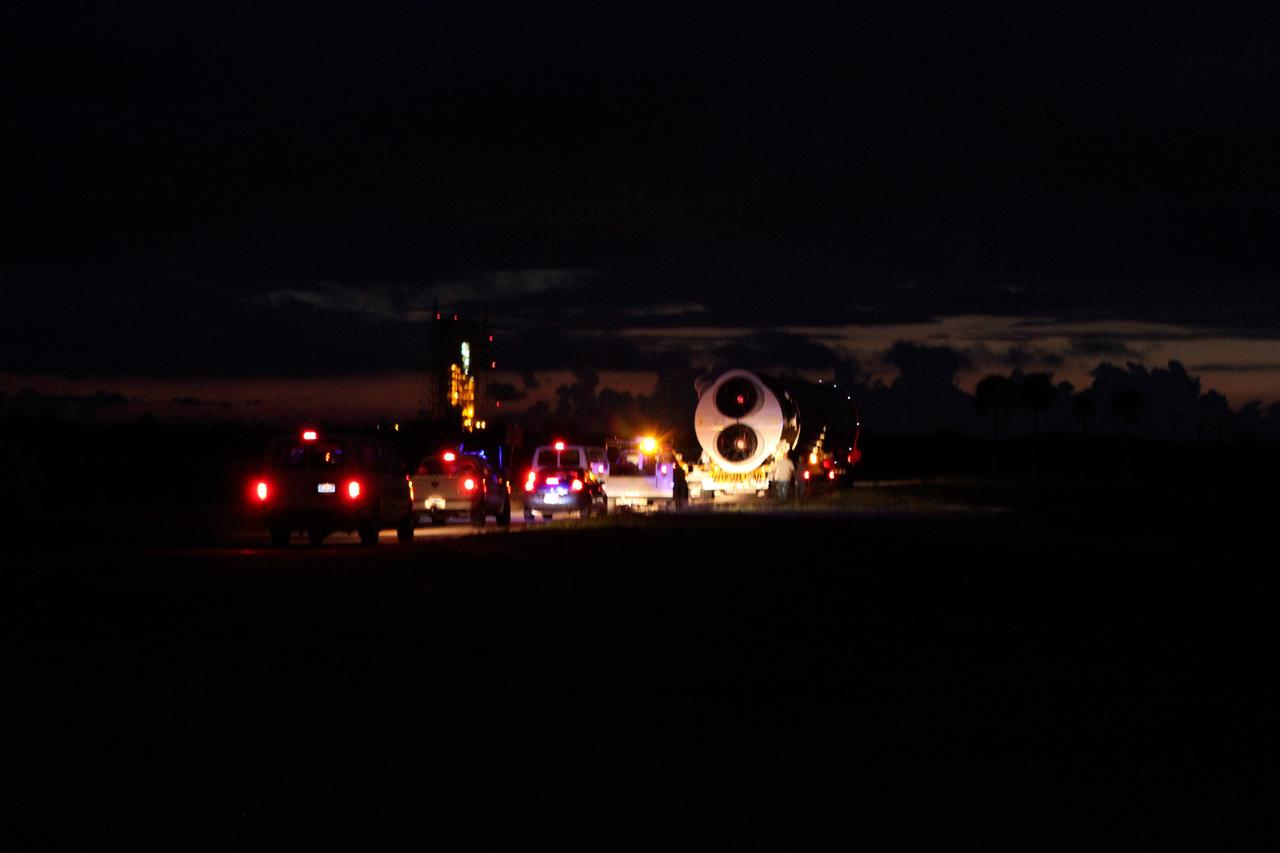
CAPE CANAVERAL, Fla. -- A convoy of support vehicles trails the first stage of the Atlas V rocket for NASA's Mars Science Laboratory (MSL) mission as it moves from the Atlas Spaceflight Operations Center on Cape Canaveral Air Force Station in Florida to the launch pad. A United Launch Alliance Atlas V-541 configuration will be used to loft MSL into space. Curiosity’s 10 science instruments are designed to search for evidence on whether Mars has had environments favorable to microbial life, including chemical ingredients for life. The unique rover will use a laser to look inside rocks and release its gasses so that the rover’s spectrometer can analyze and send the data back to Earth. MSL is scheduled to launch Nov. 25 with a window extending to Dec. 18 and arrival at Mars Aug. 2012. For more information, visit http://www.nasa.gov/msl. Photo credit: NASA/Cory Huston
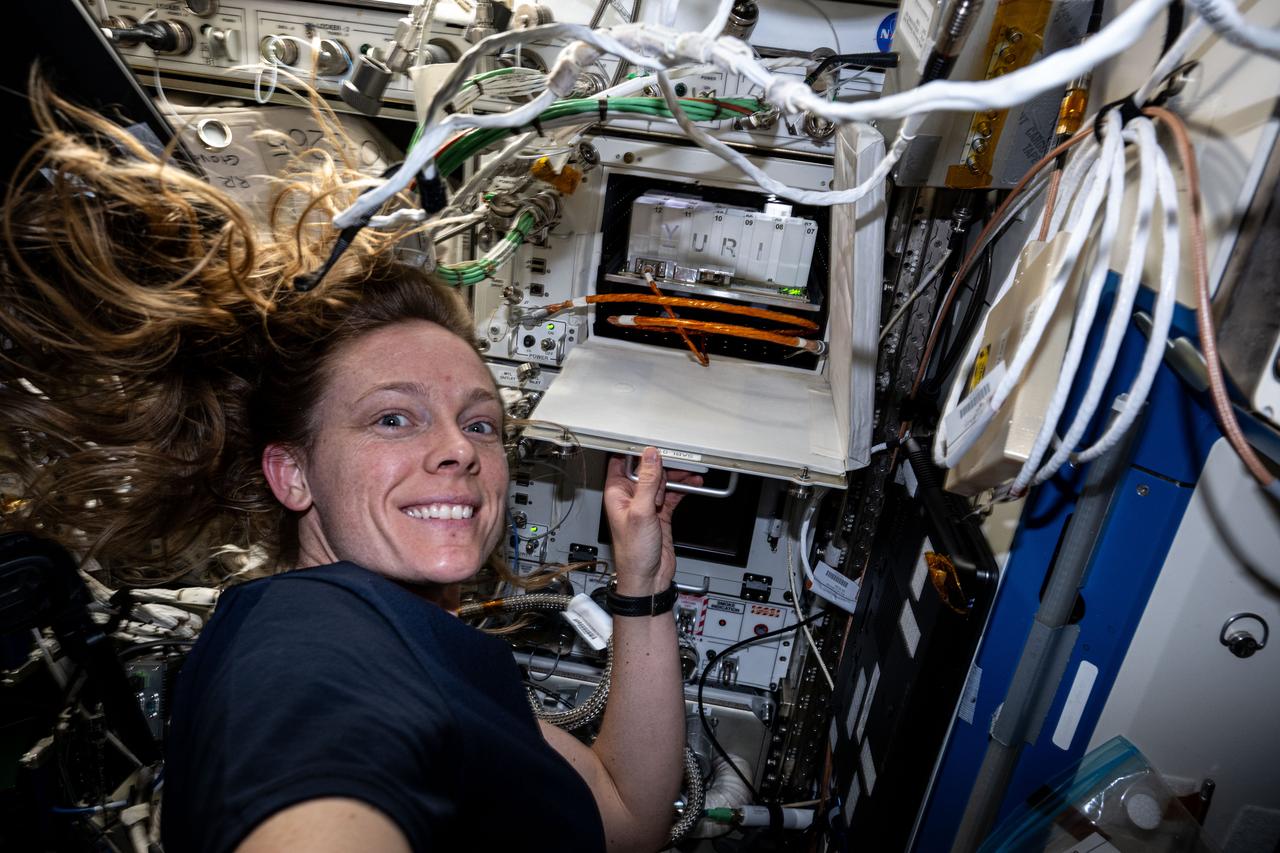
iss073e0002615 (April 28, 2025) --- NASA astronaut and Expedition 73 Flight Engineer Nichole Ayers shows off research hardware to study how microalgae grow in spaceflight conditions such as microgravity and radiation. Results from the biotechnology investigation may provide insights to support life support systems, fuel production, and food on future missions to the Moon, Mars, and beyond.
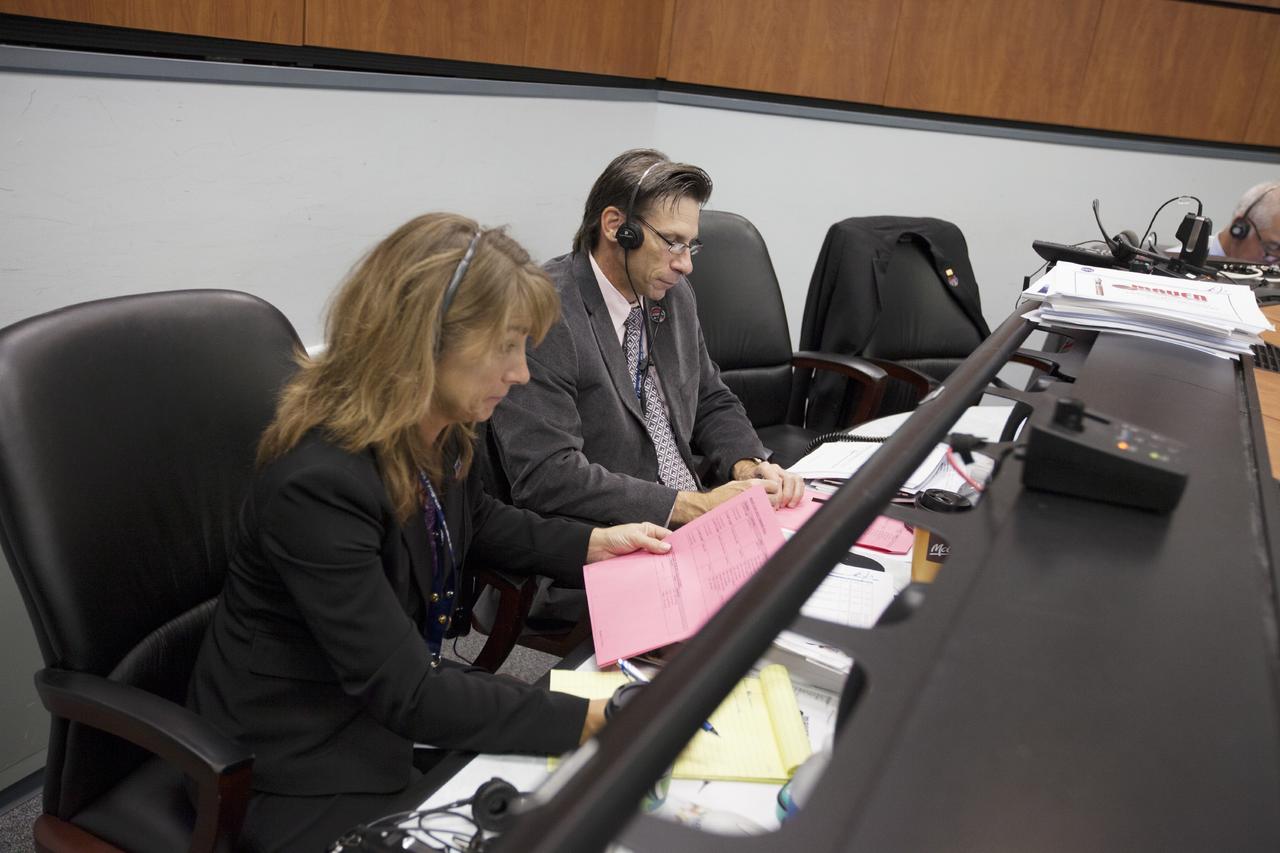
CAPE CANAVERAL, Fla. – At Cape Canaveral Air Force Station's Atlas V Spaceflight Operations Center NASA managers monitor progress of the countdown for the launch the agency's Mars Atmosphere and Volatile Evolution, or MAVEN, spacecraft. From the left are Amanda Mitskevich, program manager of NASA's Launch Services Program, or LSP, and Chuck Dovale, deputy program manager of LSP. MAVEN was launched on Nov. 18, 2013 from Cape Canaveral's Space Launch Complex 41 atop a United Launch Alliance Atlas V rocket. Positioned in an orbit above the Red Planet, MAVEN will study the upper atmosphere of Mars in unprecedented detail. For more information, visit: http://www.nasa.gov/mission_pages/maven/main/index.html Photo credit: NASA/Kim Shiflett

CAPE CANAVERAL, Fla. – At Kennedy Space Center in Florida, NASA Administrator Charlie Bolden talks to media underneath NASA’s mobile launcher (ML) support structure. Center Director Bob Cabana also attended the media event held to detail ML’s use with NASA’s Space Launch System (SLS) heavy-lift rocket, which will take astronauts into deep space on missions to asteroids, the moon or Mars. It took about two years to construct the 355-foot-tall ML structure, which will support NASA's future human spaceflight program. The ML can be outfitted with ground support equipment, such as umbilicals and access arms, for future rocket launches. Photo credit: NASA_Dimitri Gerondidakis
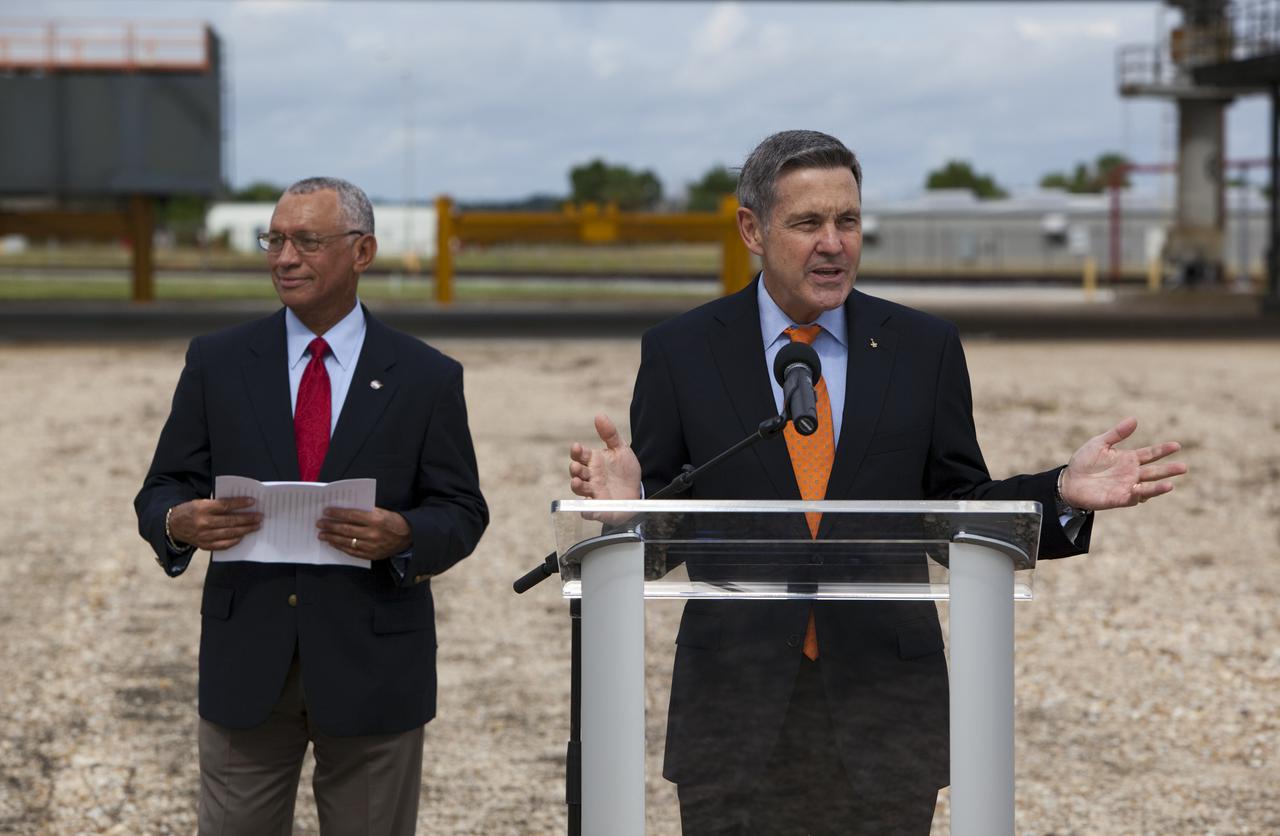
CAPE CANAVERAL, Fla. –At Kennedy Space Center in Florida, Center Director Bob Cabana talks to media near NASA’s mobile launcher (ML) support structure. The media event was held to detail ML’s use with NASA’s Space Launch System (SLS) heavy-lift rocket, which will take astronauts into deep space on missions to asteroids, the moon or Mars. Standing to the left of the podium is NASA Administrator Charlie Bolden. It took about two years to construct the 355-foot-tall ML structure, which will support NASA's future human spaceflight program. The ML can be outfitted with ground support equipment, such as umbilicals and access arms, for future rocket launches. Photo credit: NASA_Dimitri Gerondidakis

CAPE CANAVERAL, Fla. – NASA’s mobile launcher (ML) support structure at Kennedy Space Center in Florida, was the site for a media event held to detail ML’s use with NASA’s Space Launch System (SLS) heavy-lift rocket, which will take astronauts into deep space on missions to asteroids, the moon or Mars. NASA Administrator Charlie Bolden and Center Director Bob Cabana also were in attendance for the event. It took about two years to construct the 355-foot-tall ML structure, which will support NASA's future human spaceflight program. The ML can be outfitted with ground support equipment, such as umbilicals and access arms, for future rocket launches. Photo credit: NASA_Jim Grossmann
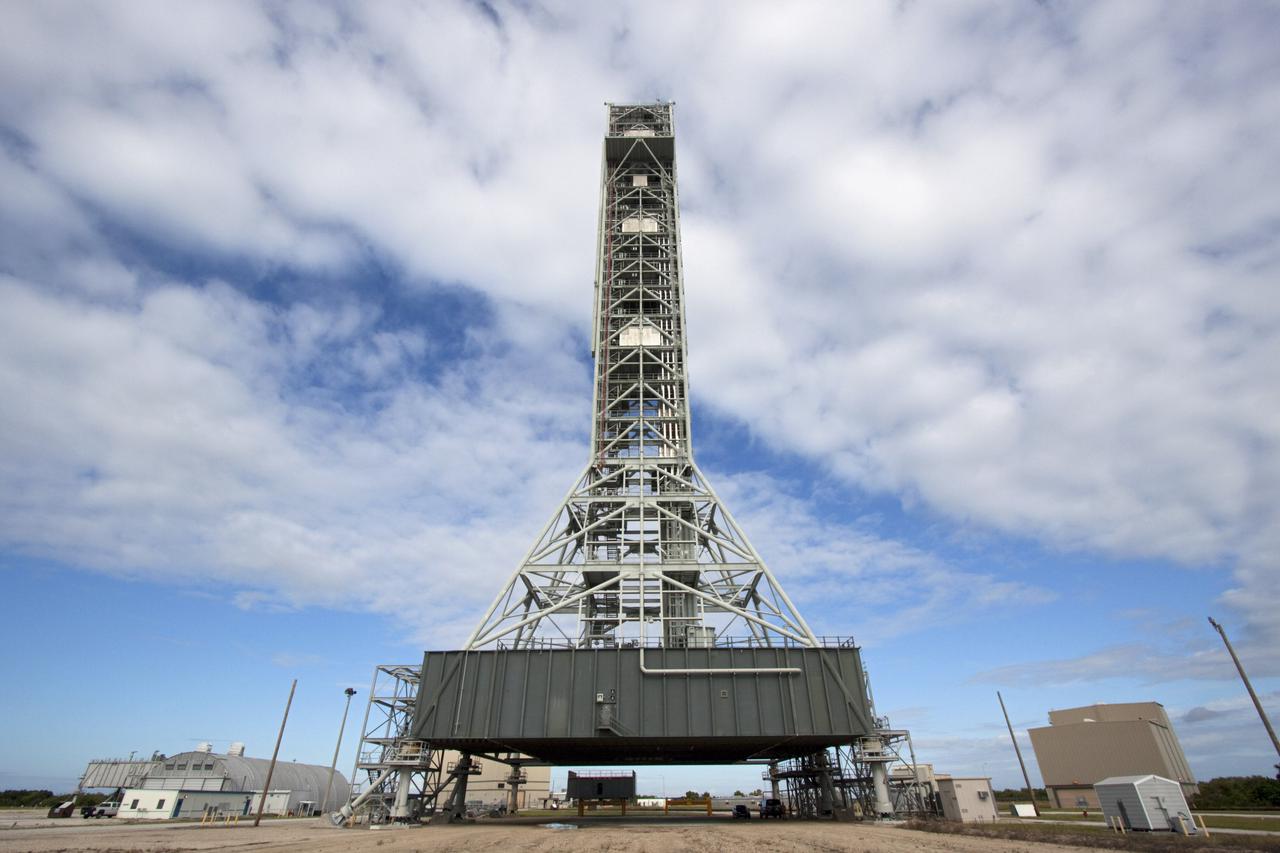
CAPE CANAVERAL, Fla. – NASA’s mobile launcher (ML) support structure at Kennedy Space Center in Florida, was the site for a media event held to detail ML’s use with NASA’s Space Launch System (SLS) heavy-lift rocket, which will take astronauts into deep space on missions to asteroids, the moon or Mars. NASA Administrator Charlie Bolden and Center Director Bob Cabana also were in attendance for the event. It took about two years to construct the 355-foot-tall ML structure, which will support NASA's future human spaceflight program. The ML can be outfitted with ground support equipment, such as umbilicals and access arms, for future rocket launches. Photo credit: NASA_Jim Grossmann
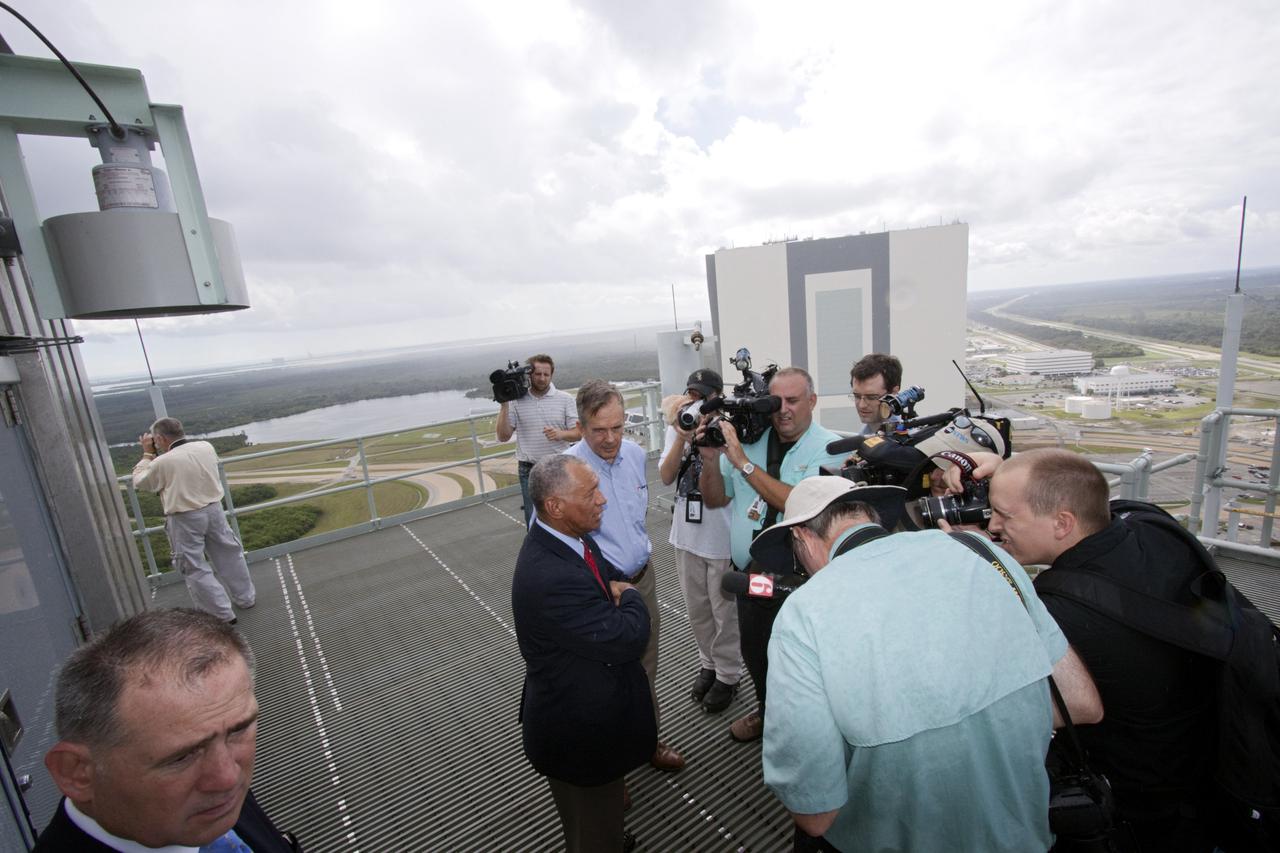
CAPE CANAVERAL, Fla. – At Kennedy Space Center in Florida, NASA Administrator Charlie Bolden talks to media on top of NASA’s mobile launcher (ML) support structure. Center Director Bob Cabana also attended the media event held to detail ML’s use with NASA’s Space Launch System (SLS) heavy-lift rocket, which will take astronauts into deep space on missions to asteroids, the moon or Mars. It took about two years to construct the 355-foot-tall ML structure, which will support NASA's future human spaceflight program. The ML can be outfitted with ground support equipment, such as umbilicals and access arms, for future rocket launches. Photo credit: NASA_Jim Grossmann
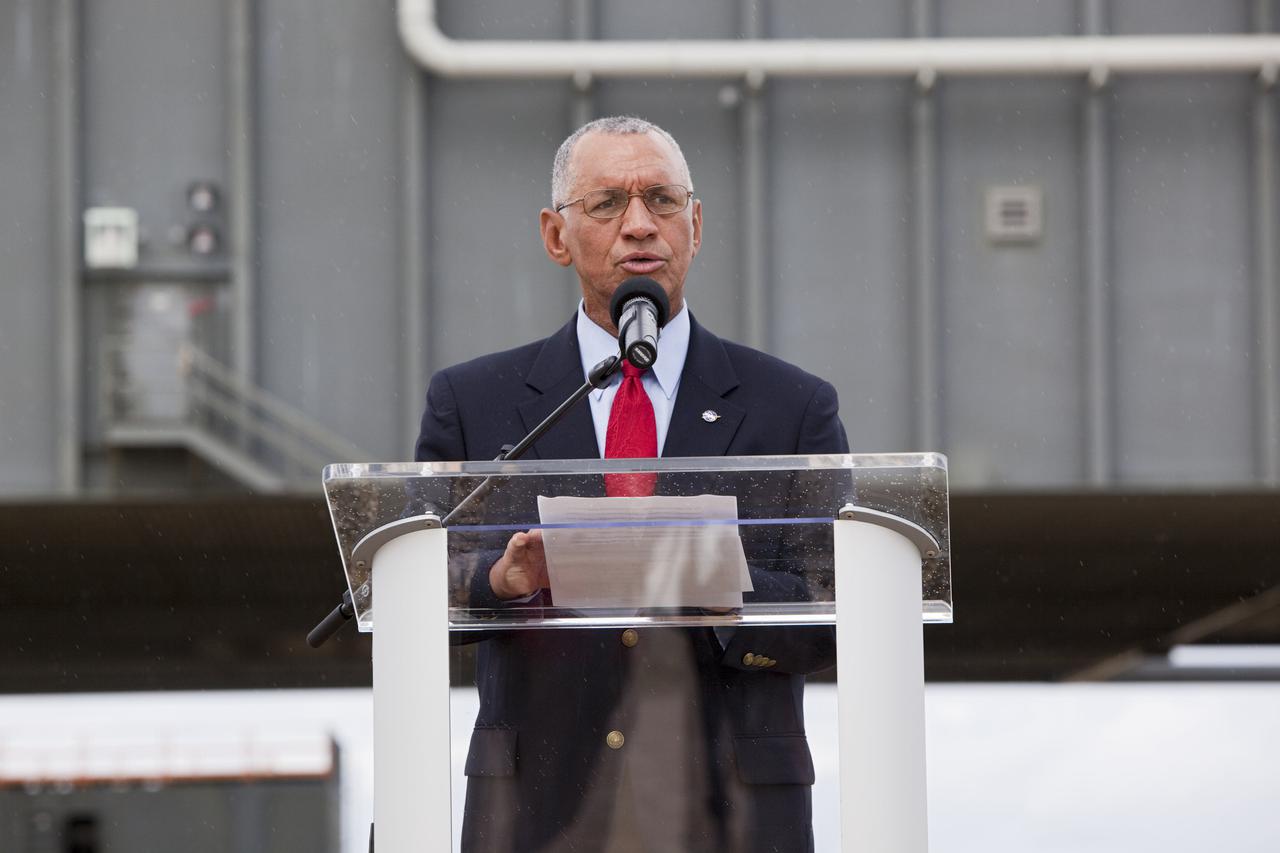
CAPE CANAVERAL, Fla. – At Kennedy Space Center in Florida, NASA Administrator Charlie Bolden talks to media in front of NASA’s mobile launcher (ML) support structure. Center Director Bob Cabana also attended the media event held to detail ML’s use with NASA’s Space Launch System (SLS) heavy-lift rocket, which will take astronauts into deep space on missions to asteroids, the moon or Mars. It took about two years to construct the 355-foot-tall ML structure, which will support NASA's future human spaceflight program. The ML can be outfitted with ground support equipment, such as umbilicals and access arms, for future rocket launches. Photo credit: NASA_Dimitri Gerondidakis

CAPE CANAVERAL, Fla. – At Kennedy Space Center in Florida, NASA Administrator Charlie Bolden talks to media underneath NASA’s mobile launcher (ML) support structure. Center Director Bob Cabana also attended the media event held to detail ML’s use with NASA’s Space Launch System (SLS) heavy-lift rocket, which will take astronauts into deep space on missions to asteroids, the moon or Mars. It took about two years to construct the 355-foot-tall ML structure, which will support NASA's future human spaceflight program. The ML can be outfitted with ground support equipment, such as umbilicals and access arms, for future rocket launches. Photo credit: NASA_Dimitri Gerondidakis
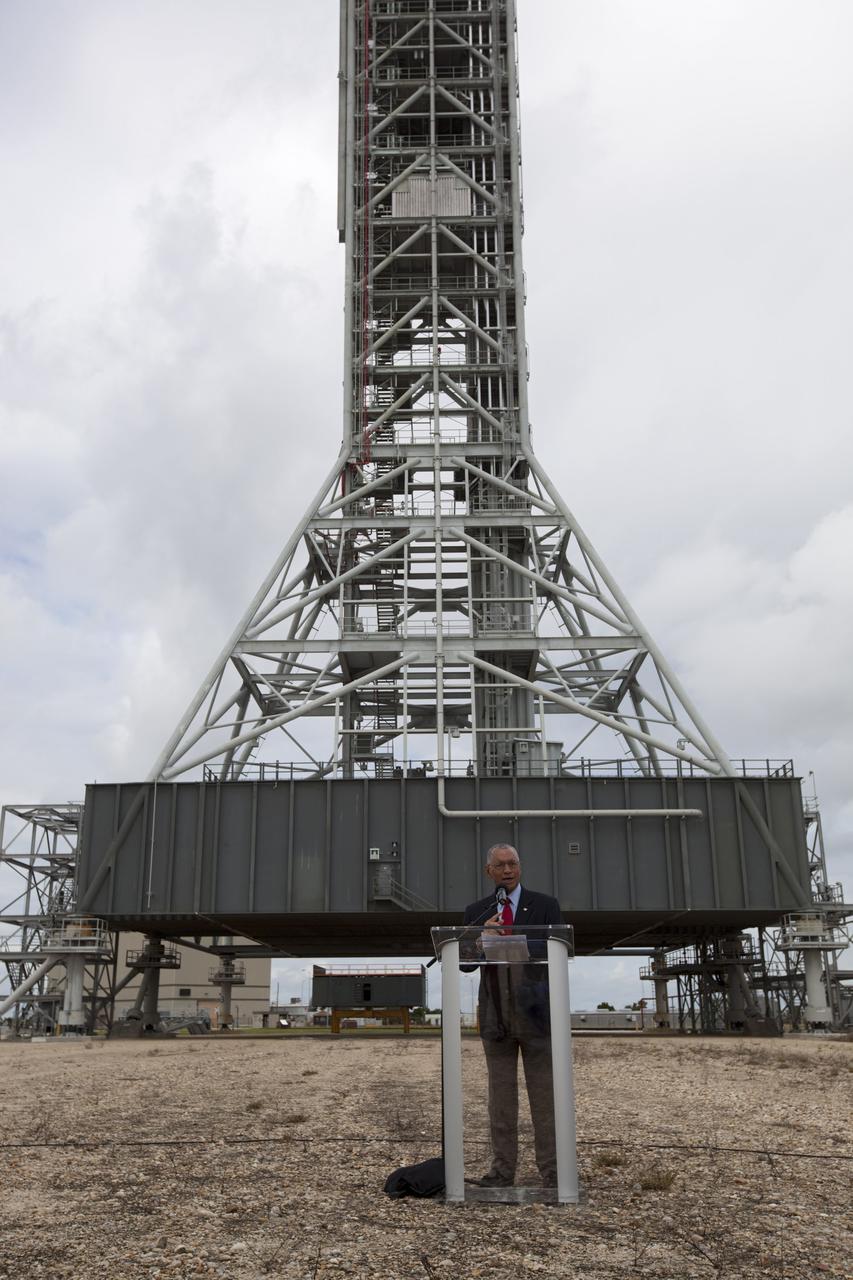
CAPE CANAVERAL, Fla. – At Kennedy Space Center in Florida, NASA Administrator Charlie Bolden talks to media in front of NASA’s mobile launcher (ML) support structure. Center Director Bob Cabana also attended the media event held to detail ML’s use with NASA’s Space Launch System (SLS) heavy-lift rocket, which will take astronauts into deep space on missions to asteroids, the moon or Mars. It took about two years to construct the 355-foot-tall ML structure, which will support NASA's future human spaceflight program. The ML can be outfitted with ground support equipment, such as umbilicals and access arms, for future rocket launches. Photo credit: NASA_Dimitri Gerondidakis
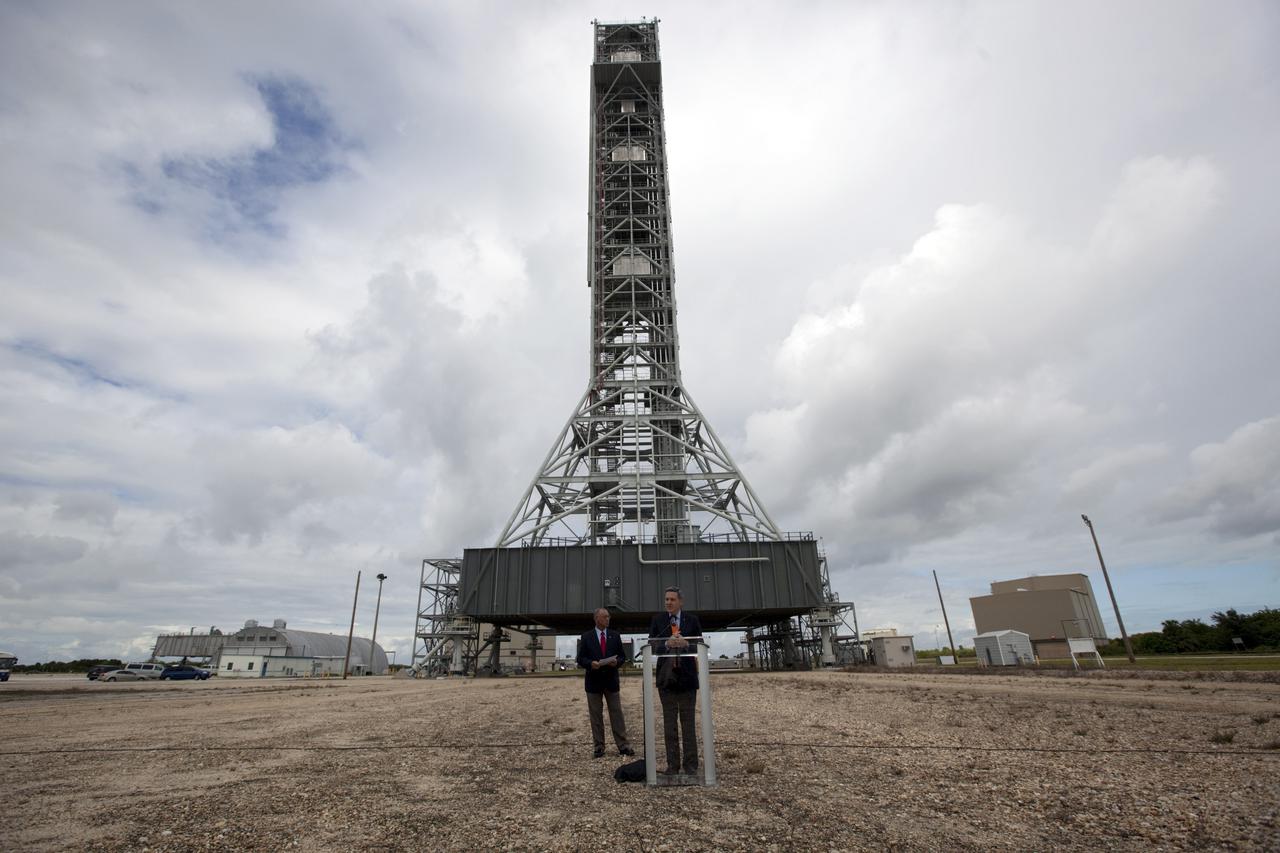
CAPE CANAVERAL, Fla. – At Kennedy Space Center in Florida, Center Director Bob Cabana talks to media in front of NASA’s mobile launcher (ML) support structure. The media event was held to detail ML’s use with NASA’s Space Launch System (SLS) heavy-lift rocket, which will take astronauts into deep space on missions to asteroids, the moon or Mars. Standing to the left of the podium is NASA Administrator Charlie Bolden. It took about two years to construct the 355-foot-tall ML structure, which will support NASA's future human spaceflight program. The ML can be outfitted with ground support equipment, such as umbilicals and access arms, for future rocket launches. Photo credit: NASA_Dimitri Gerondidakis
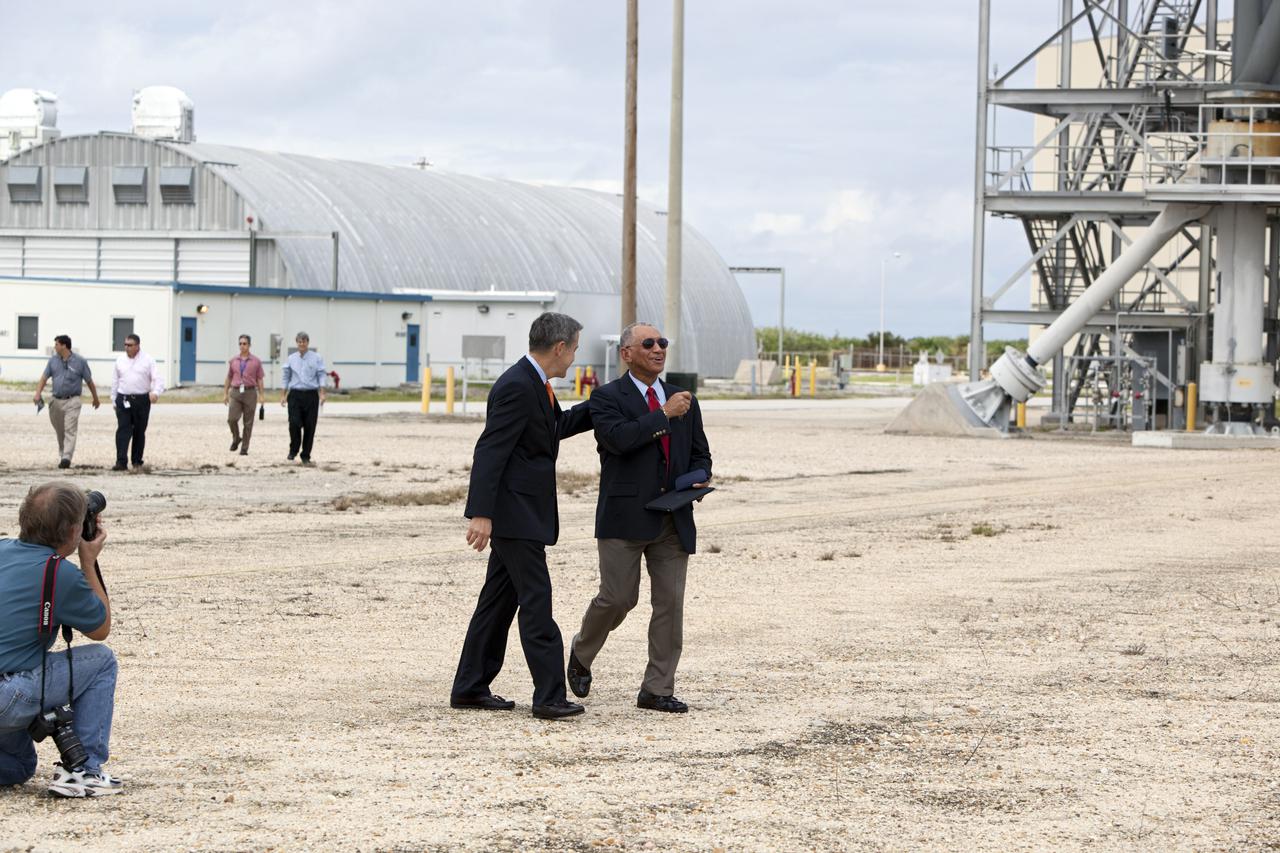
CAPE CANAVERAL, Fla. – NASA Administrator Charlie Bolden, at right, and Kennedy Space Center Director Bob Cabana walk near NASA’s mobile launcher (ML) support structure at Kennedy Space Center in Florida. A media event was held to detail ML’s use with NASA’s Space Launch System (SLS) heavy-lift rocket, which will take astronauts into deep space on missions to asteroids, the moon or Mars. It took about two years to construct the 355-foot-tall ML structure, which will support NASA's future human spaceflight program. The ML can be outfitted with ground support equipment, such as umbilicals and access arms, for future rocket launches. Photo credit: NASA_Dimitri Gerondidakis
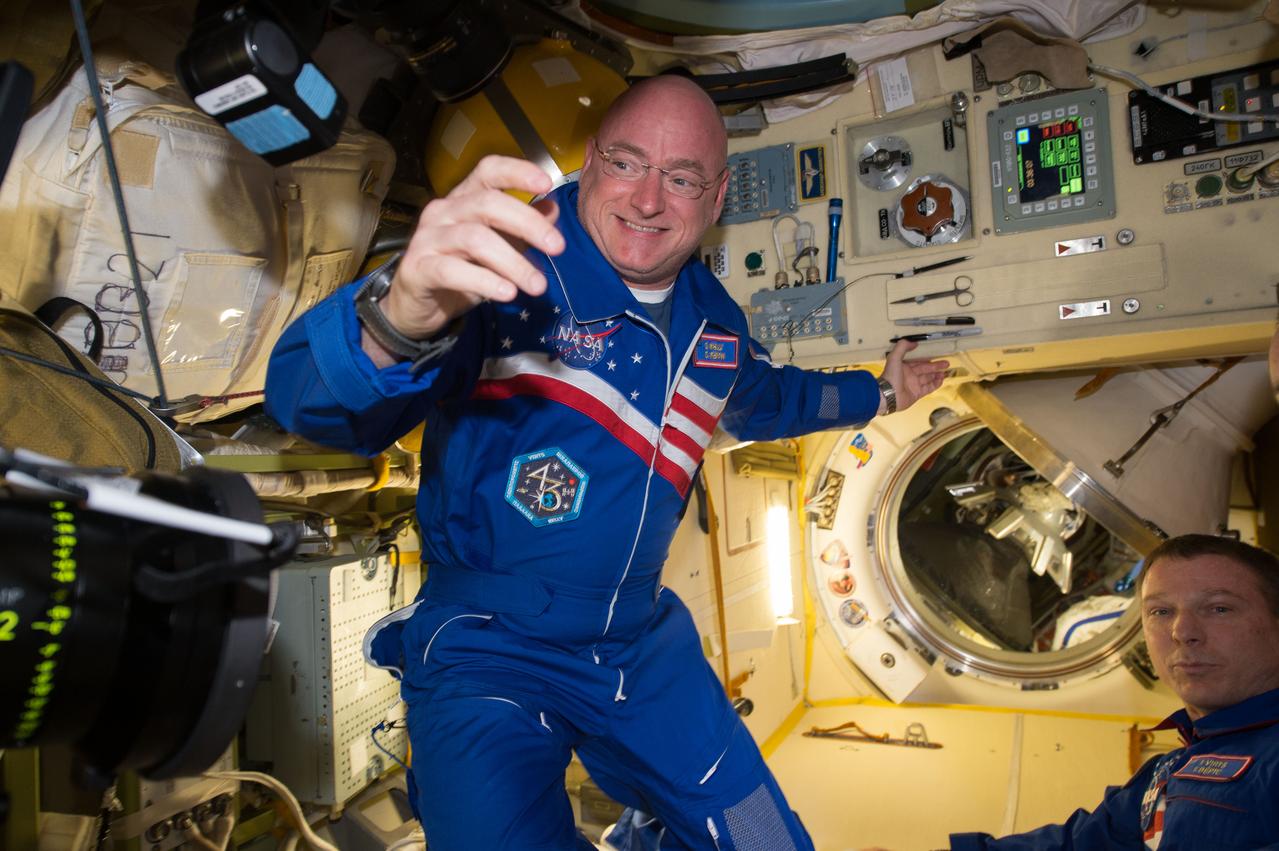
ISS043E059259 (03/28/2015) --- NASA astronaut Scott Kelly (left) is happy to be aboard the International Space Station after the hatch opening of the Soyuz spacecraft Mar. 28, 2015. Kelly traveled with Expedition 43 Russian cosmonauts Mikhail Kornienko and Gennady Padalka of the Russian Federal Space Agency (Roscosmos) on the Soyuz TMA-16M that launched Friday, March 27, 2015 from Baikonur, Kazakhstan. Kelly and Kornienko will spend a year in space and return to Earth on Soyuz TMA-18M in March 2016. Most expeditions to the space station last four to six months. By doubling the length of this mission, researchers hope to better understand how the human body reacts and adapts to long-duration spaceflight. This knowledge is critical as NASA looks toward human journeys deeper into the solar system, including to and from Mars.

jsc2026e006908 (Feb, 11, 2026) --- NASA’s SpaceX Crew-13 patch looks ardently toward the future of space exploration while honoring the legacy of those who came before. The central golden dragon harkens back to Apollo 13, embodying resilience and gazing upward to the dawn of a new era of discovery. The tail contours around Earth in an embrace, highlighting the interconnected nature of human spaceflight and celebrating the collective efforts of the teams who make it possible. The wings, outstretched to form a bridge between Earth, the International Space Station, the Moon, and Mars, reflect the continuity between low Earth orbit and destinations to come. Gold stars burn brightly, representing the crew’s families and support systems as a tribute to their immense contributions to this endeavor. All of these themes are unified within a distinctive capsule silhouette, symbolizing the limitless possibilities born out of human collaboration toward a common goal. Credit: NASA
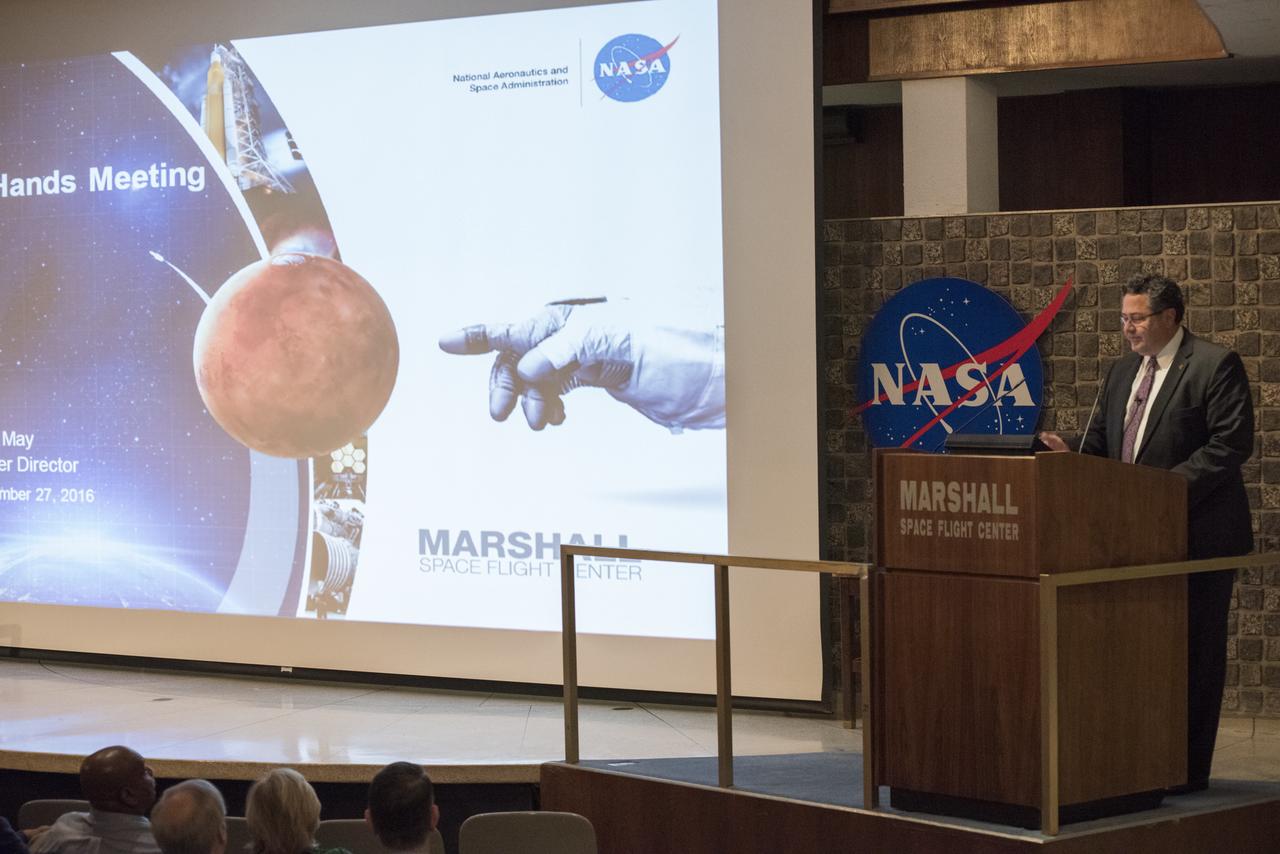
TODD MAY, DIRECTOR OF NASA’S MARSHALL SPACE FLIGHT CENTER, ADDRESSES THE WORKFORCE DURING AN ALL-HANDS MEETING SEPT. 27 IN MORRIS AUDITORIUM. HE PRAISED TEAM MEMBERS FOR THEIR MANY SUCCESSES THROUGHOUT 2016 BY TURNING MILESTONES INTO MOMENTUM, AND DELIVERING ON COMMITMENTS -- ON BUDGET AND ON TIME. MAY ALSO LOOKED AHEAD, AFFIRMING THE CENTER’S PLEDGE TO MEET THE DEMANDS OF THE 21ST CENTURY BY BEST ALIGNING THE STRUCTURE OF MARSHALL’S INTERNAL ORGANIZATIONS AND DIRECTORATES. DOING SO, HE SAID, WILL CONTINUE A RICH TRADITION OF PROVIDING THE INNOVATIVE, GAME-CHANGING WORK ESSENTIAL FOR SCIENTIFIC DISCOVERY, THE FUTURE OF HUMAN SPACEFLIGHT AND EVENTUALLY, THE FIRST HUMAN MISSION TO MARS ON NASA’S SPACE LAUNCH SYSTEM

CAPE CANAVERAL, Fla. -- The Atlas V first stage (left) and Centaur upper stage to support the Mars Science Laboratory (MSL) mission traverse the Banana River on their way to the Atlas Spaceflight Operations Center on Cape Canaveral Air Force Station in Florida. MSL's components include a compact car-sized rover, Curiosity, which has 10 science instruments designed to search for evidence on whether Mars has had environments favorable to microbial life, including chemical ingredients for life. The unique rover will use a laser to look inside rocks and release its gasses so that the rover’s spectrometer can analyze and send the data back to Earth. Launch of MSL aboard a United Launch Alliance Atlas V rocket is scheduled for Nov. 25 from Space Launch Complex 41 on Cape Canaveral Air Force Station. For more information, visit http://www.nasa.gov/msl. Photo credit: NASA/Kim Shiflett
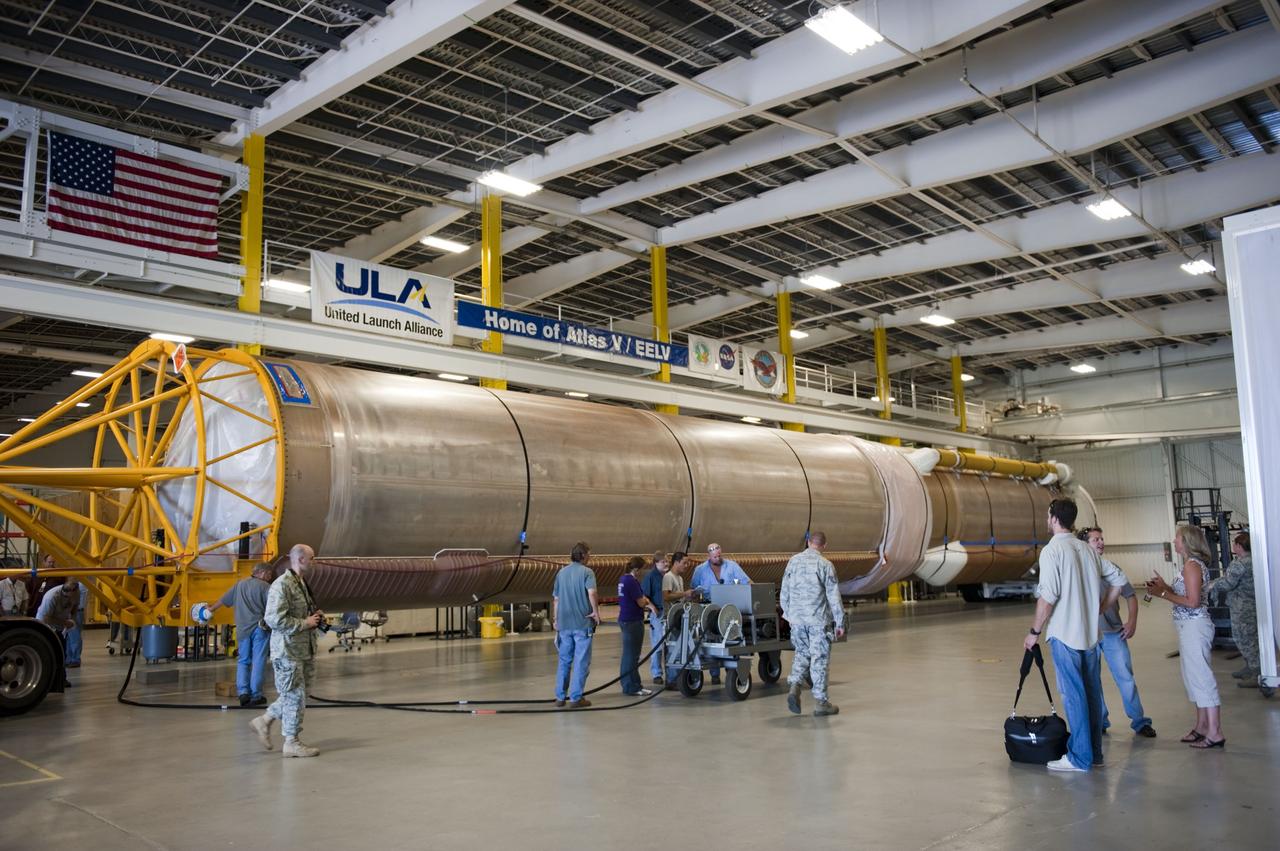
CAPE CANAVERAL, Fla. -- United Launch Alliance (ULA) workers prepare to process the first stage of the Atlas V for the Mars Science Laboratory (MSL) mission, newly arrived in the Atlas Spaceflight Operations Center on Cape Canaveral Air Force Station in Florida. MSL's components include a compact car-sized rover, Curiosity, which has 10 science instruments designed to search for evidence on whether Mars has had environments favorable to microbial life, including chemical ingredients for life. The unique rover will use a laser to look inside rocks and release its gasses so that the rover’s spectrometer can analyze and send the data back to Earth. Launch of MSL aboard a United Launch Alliance Atlas V rocket is scheduled for Nov. 25 from Space Launch Complex 41 on Cape Canaveral Air Force Station. For more information, visit http://www.nasa.gov/msl. Photo credit: NASA/Kim Shiflett
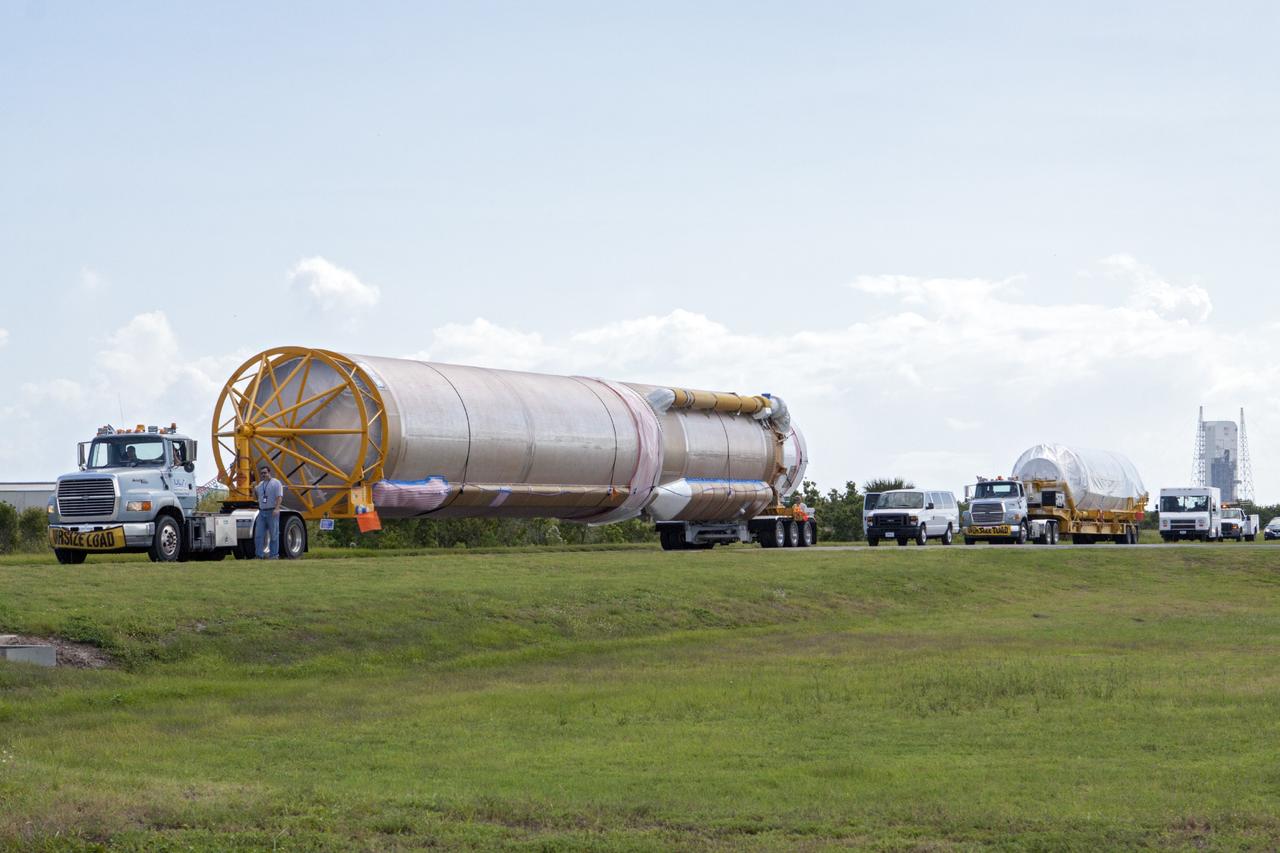
CAPE CANAVERAL, Fla. – United Launch Alliance Atlas V rocket first and second stages arrive at Cape Canaveral Air Force Station, Fla., on their way to the Atlas Spaceflight Operations Center, or ASOC. There, the launch vehicle will begin processing for the Mars Atmosphere and Volatile Evolution, or MAVEN, spacecraft to the Red Planet. MAVEN is being prepared for its scheduled launch in November from Cape Canaveral Air Force Station, Fla. atop a United Launch Alliance Atlas V rocket. Positioned in an orbit above the Red Planet, MAVEN will study the upper atmosphere of Mars in unprecedented detail. For more information, visit: http://www.nasa.gov/mission_pages/maven/main/index.html Photo credit: NASA/Kim Shiflett
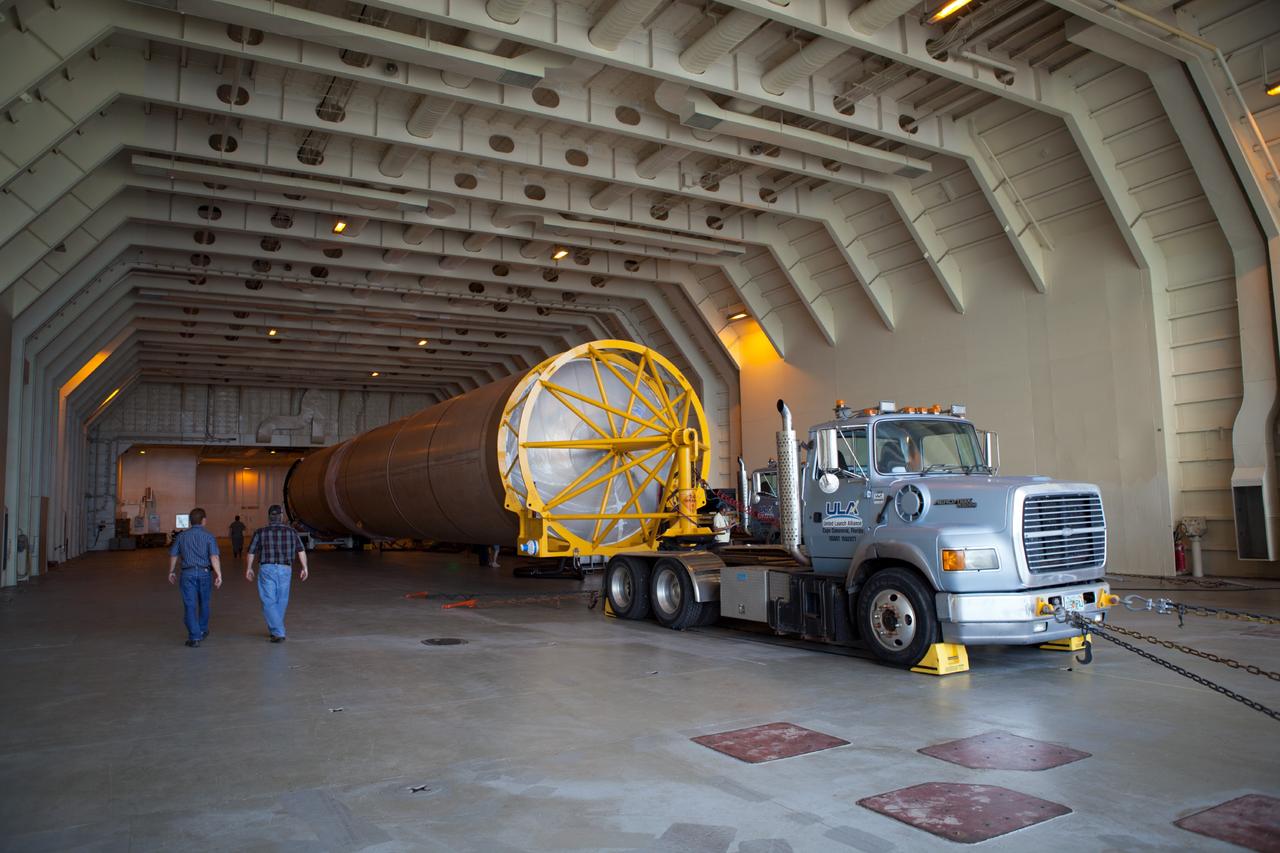
PORT CANAVERAL, Fla. – An Atlas V rocket is off loaded from the United Launch Alliance barge Delta Mariner that just arrived at Port Canaveral, Fla. The launch vehicle will boost the Mars Atmosphere and Volatile Evolution, or MAVEN, spacecraft to the Red Planet. The rocket will be transported to the Atlas Spaceflight Operations Center, or ASOC, at Cape Canaveral Air Force Station to begin processing. MAVEN is being prepared for its scheduled launch in November from Cape Canaveral Air Force Station, Fla. atop a United Launch Alliance Atlas V rocket. Positioned in an orbit above the Red Planet, MAVEN will study the upper atmosphere of Mars in unprecedented detail. For more information, visit: http://www.nasa.gov/mission_pages/maven/main/index.html Photo credit: NASA/ Dimitri Gerondidakis
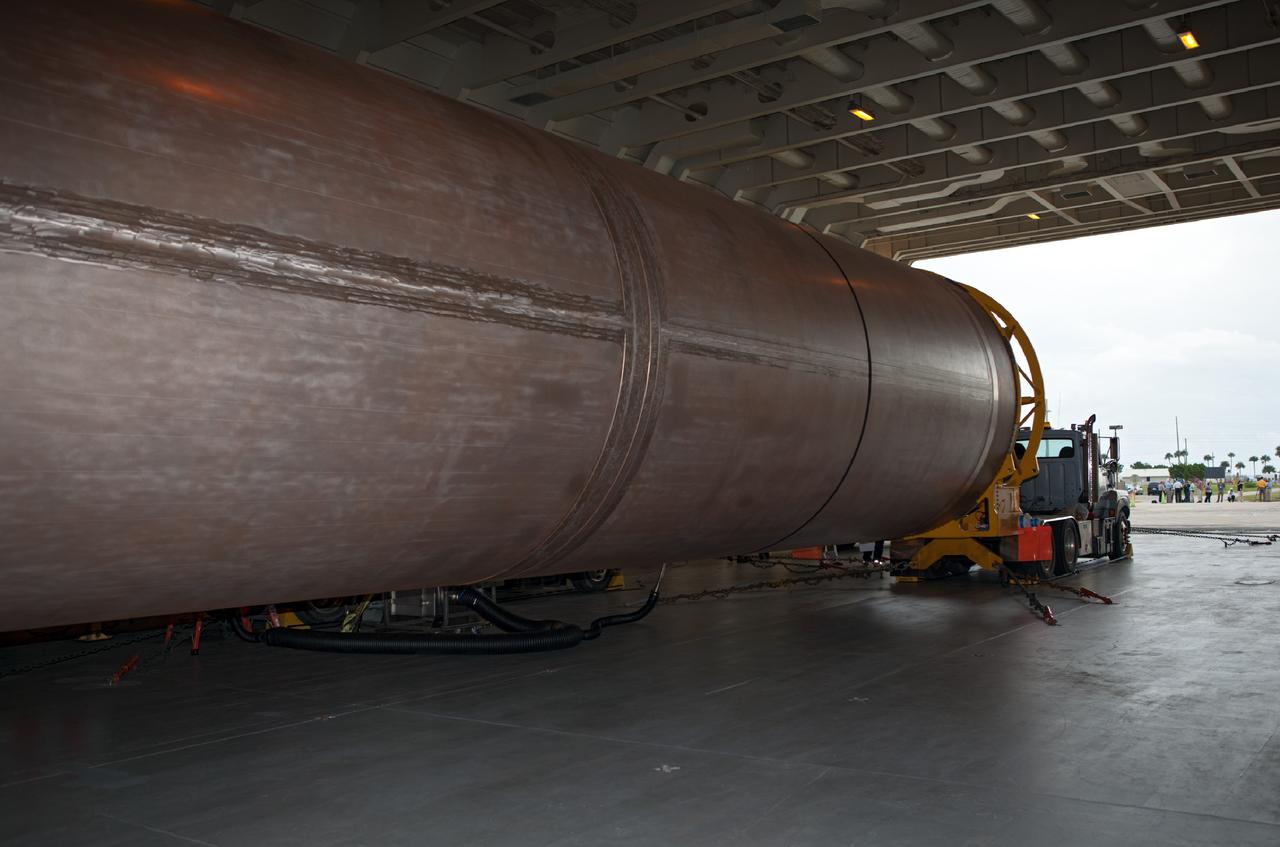
PORT CANAVERAL, Fla. – An Atlas V rocket is off loaded from the United Launch Alliance barge Delta Mariner that just arrived at Port Canaveral, Fla. The launch vehicle will boost the Mars Atmosphere and Volatile Evolution, or MAVEN, spacecraft to the Red Planet. The rocket will be transported to the Atlas Spaceflight Operations Center, or ASOC, at Cape Canaveral Air Force Station to begin processing. MAVEN is being prepared for its scheduled launch in November from Cape Canaveral Air Force Station, Fla. atop a United Launch Alliance Atlas V rocket. Positioned in an orbit above the Red Planet, MAVEN will study the upper atmosphere of Mars in unprecedented detail. For more information, visit: http://www.nasa.gov/mission_pages/maven/main/index.html Photo credit: NASA/ Dimitri Gerondidakis
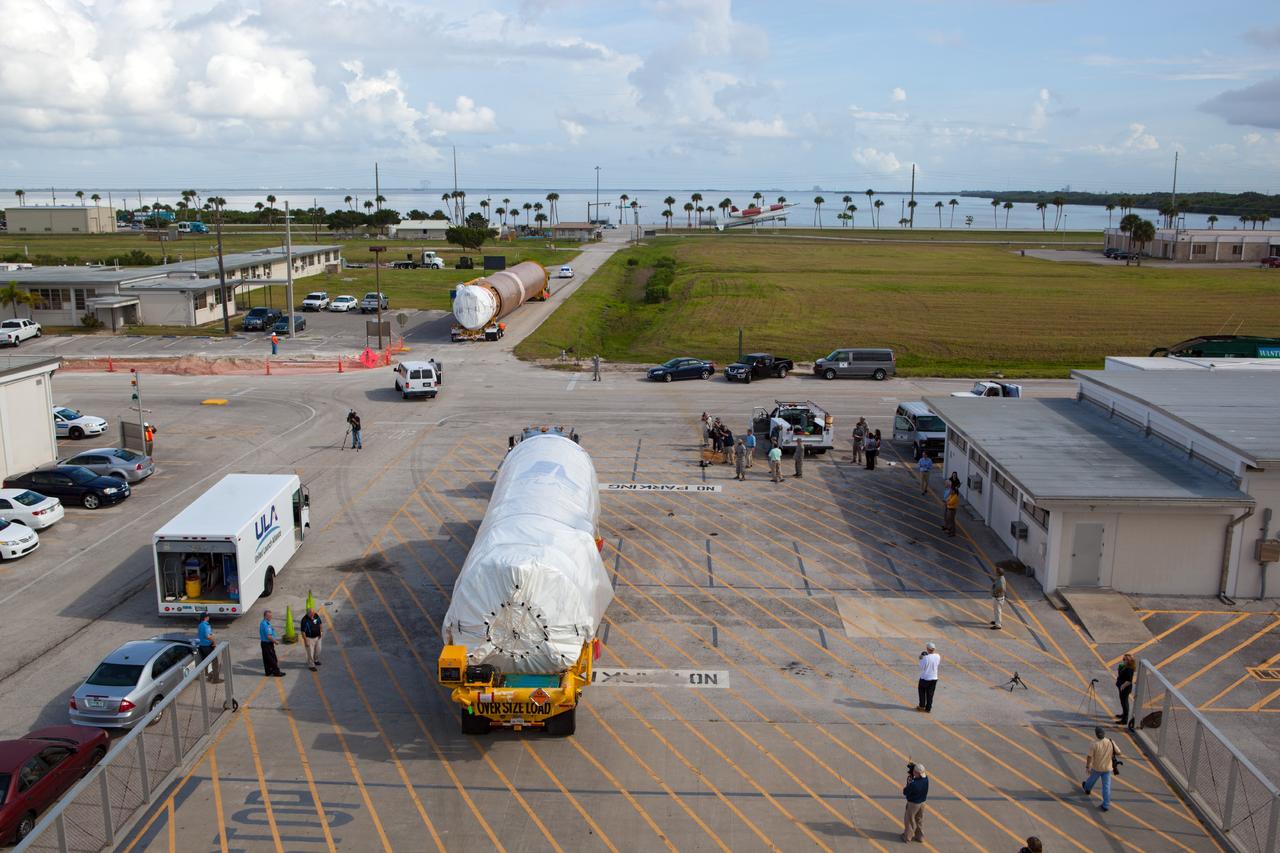
PORT CANAVERAL, Fla. – The Atlas V rocket first and second stages are off loaded from the United Launch Alliance barge Delta Mariner that just arrived at Port Canaveral, Fla. The launch vehicle will boost the Mars Atmosphere and Volatile Evolution, or MAVEN, spacecraft to the Red Planet. The rocket will be transported to the Atlas Spaceflight Operations Center, or ASOC, at Cape Canaveral Air Force Station to begin processing. MAVEN is being prepared for its scheduled launch in November from Cape Canaveral Air Force Station, Fla. atop a United Launch Alliance Atlas V rocket. Positioned in an orbit above the Red Planet, MAVEN will study the upper atmosphere of Mars in unprecedented detail. For more information, visit: http://www.nasa.gov/mission_pages/maven/main/index.html Photo credit: NASA/ Dimitri Gerondidakis
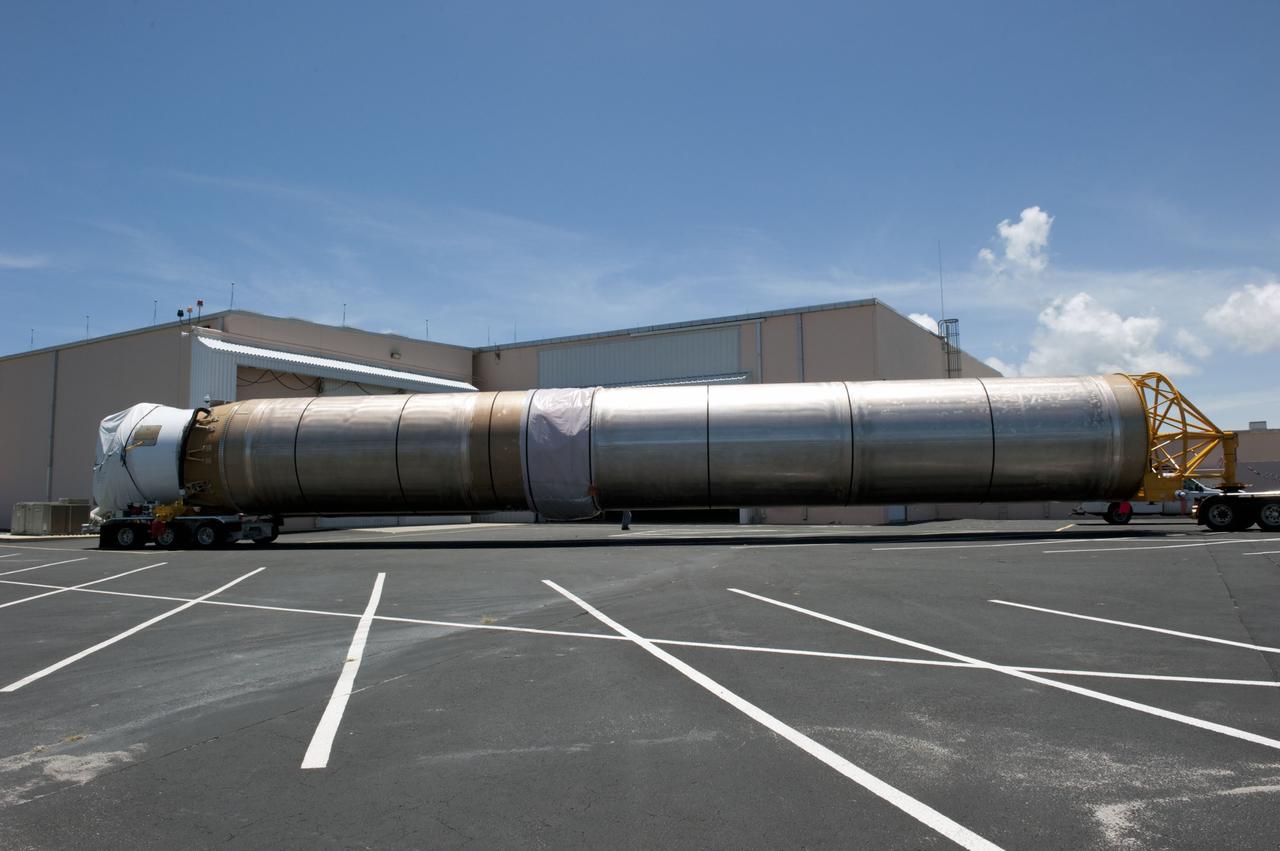
CAPE CANAVERAL, Fla. -- The Atlas V first stage to support the Mars Science Laboratory (MSL) mission arrives at the Atlas Spaceflight Operations Center on Cape Canaveral Air Force Station in Florida. MSL's components include a compact car-sized rover, Curiosity, which has 10 science instruments designed to search for evidence on whether Mars has had environments favorable to microbial life, including chemical ingredients for life. The unique rover will use a laser to look inside rocks and release its gasses so that the rover’s spectrometer can analyze and send the data back to Earth. Launch of MSL aboard a United Launch Alliance Atlas V rocket is scheduled for Nov. 25 from Space Launch Complex 41 on Cape Canaveral Air Force Station. For more information, visit http://www.nasa.gov/msl. Photo credit: NASA/Kim Shiflett
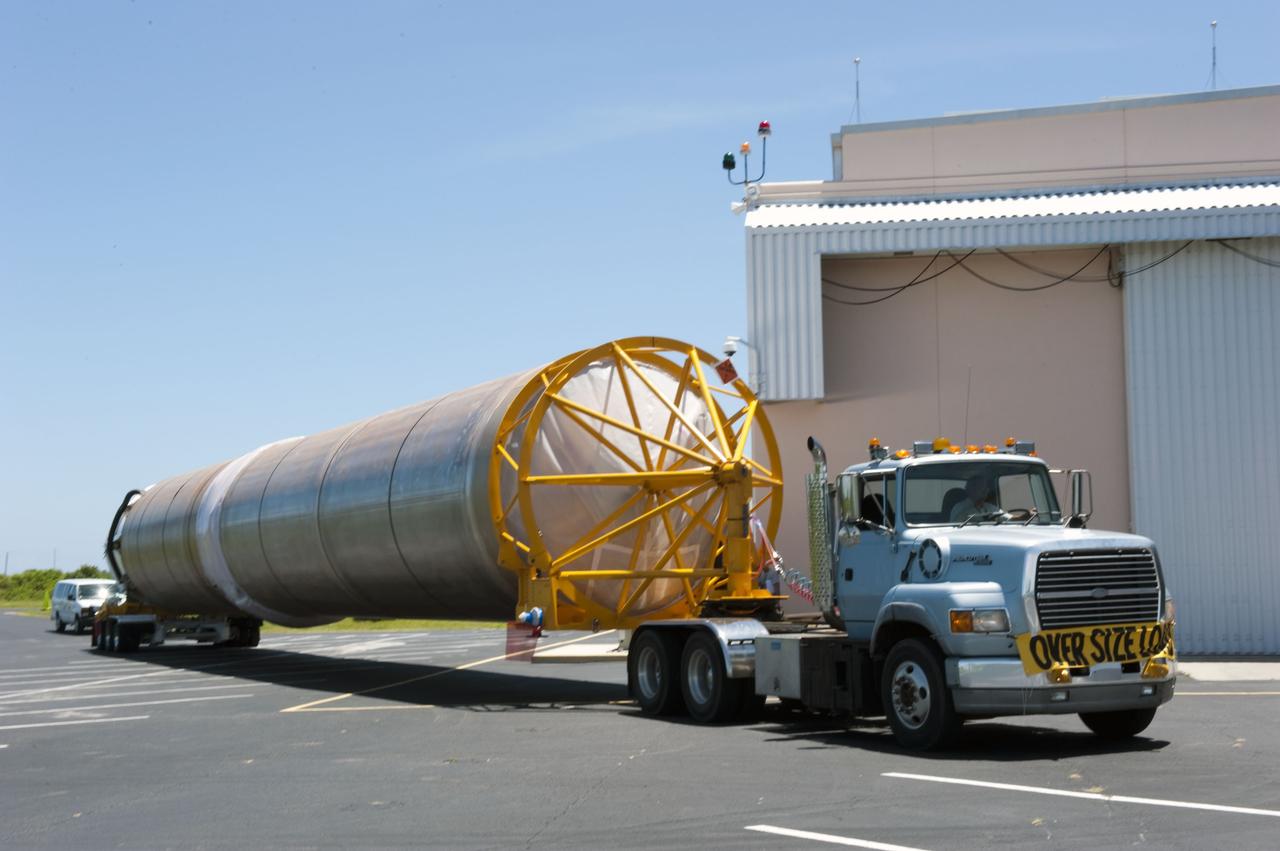
CAPE CANAVERAL, Fla. -- The Atlas V first stage to support the Mars Science Laboratory (MSL) mission approaches the Atlas Spaceflight Operations Center on Cape Canaveral Air Force Station in Florida. MSL's components include a compact car-sized rover, Curiosity, which has 10 science instruments designed to search for evidence on whether Mars has had environments favorable to microbial life, including chemical ingredients for life. The unique rover will use a laser to look inside rocks and release its gasses so that the rover’s spectrometer can analyze and send the data back to Earth. Launch of MSL aboard a United Launch Alliance Atlas V rocket is scheduled for Nov. 25 from Space Launch Complex 41 on Cape Canaveral Air Force Station. For more information, visit http://www.nasa.gov/msl. Photo credit: NASA/Kim Shiflett
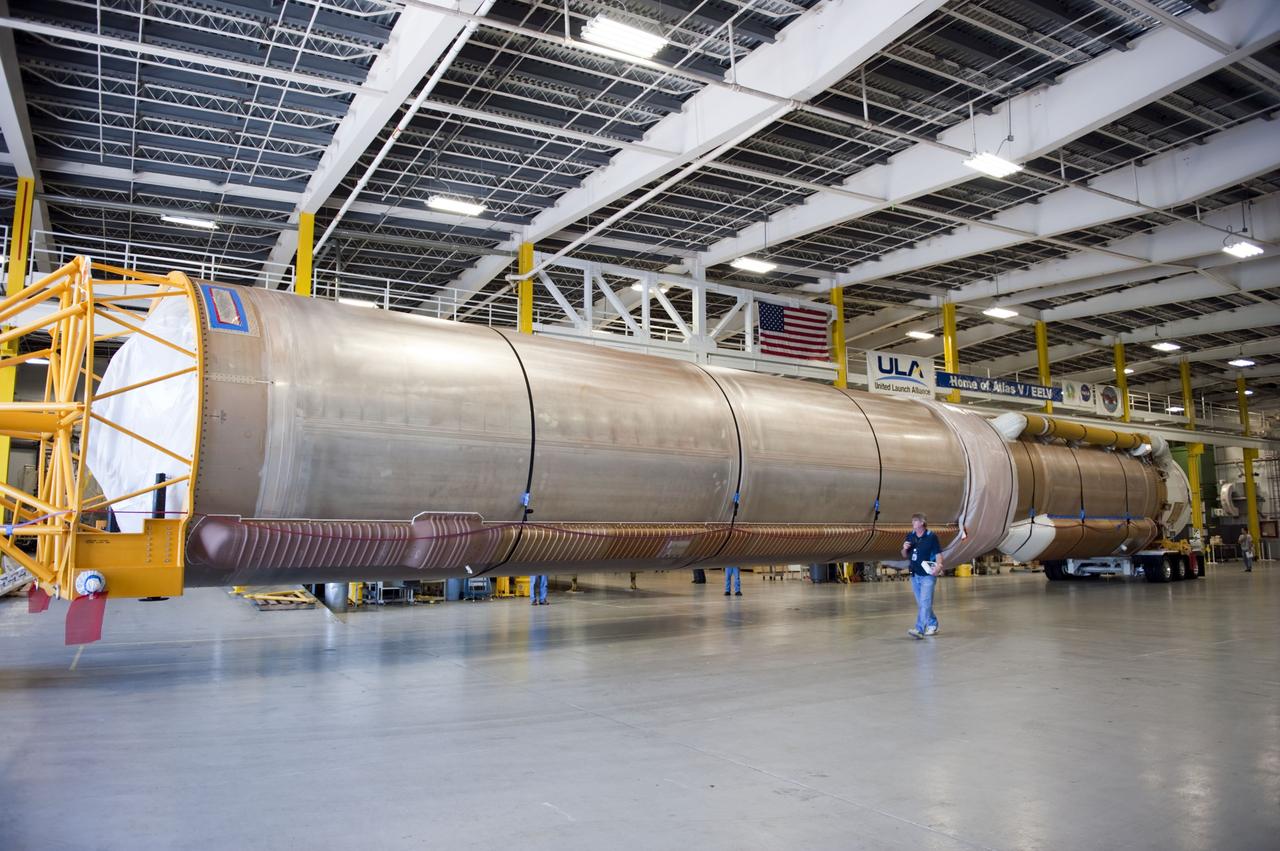
CAPE CANAVERAL, Fla. -- The Atlas V first stage to support the Mars Science Laboratory (MSL) mission is positioned inside the Atlas Spaceflight Operations Center on Cape Canaveral Air Force Station in Florida. MSL's components include a compact car-sized rover, Curiosity, which has 10 science instruments designed to search for evidence on whether Mars has had environments favorable to microbial life, including chemical ingredients for life. The unique rover will use a laser to look inside rocks and release its gasses so that the rover’s spectrometer can analyze and send the data back to Earth. Launch of MSL aboard a United Launch Alliance Atlas V rocket is scheduled for Nov. 25 from Space Launch Complex 41 on Cape Canaveral Air Force Station. For more information, visit http://www.nasa.gov/msl. Photo credit: NASA/Kim Shiflett
PORT CANAVERAL, Fla. – The Atlas V rocket first and second stages are off loaded from the United Launch Alliance barge Delta Mariner that just arrived at Port Canaveral, Fla. The launch vehicle will boost the Mars Atmosphere and Volatile Evolution, or MAVEN, spacecraft to the Red Planet. The rocket will be transported to the Atlas Spaceflight Operations Center, or ASOC, at Cape Canaveral Air Force Station to begin processing. MAVEN is being prepared for its scheduled launch in November from Cape Canaveral Air Force Station, Fla. atop a United Launch Alliance Atlas V rocket. Positioned in an orbit above the Red Planet, MAVEN will study the upper atmosphere of Mars in unprecedented detail. For more information, visit: http://www.nasa.gov/mission_pages/maven/main/index.html Photo credit: NASA/ Dimitri Gerondidakis