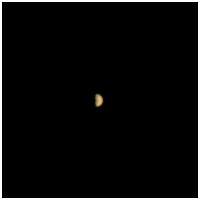
Mars Climate Orbiter MARCI Approach Image
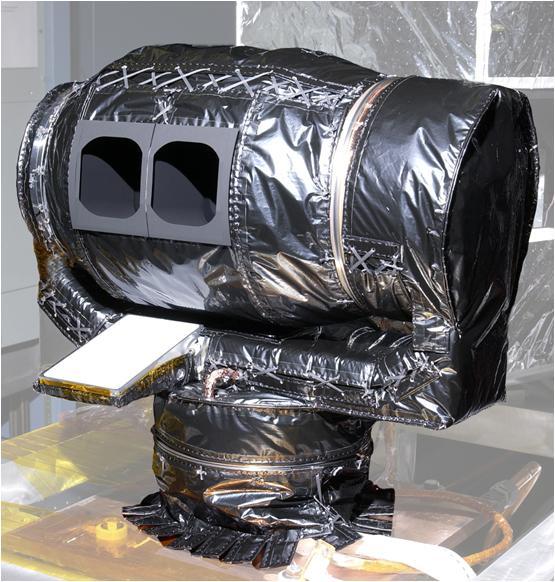
The Mars Climate Sounder instrument, shown here prior to its installation onto NASA Mars Reconnaissance Orbiter for the mission 2006 launch, will get a similar-looking sibling at Mars in 2016.
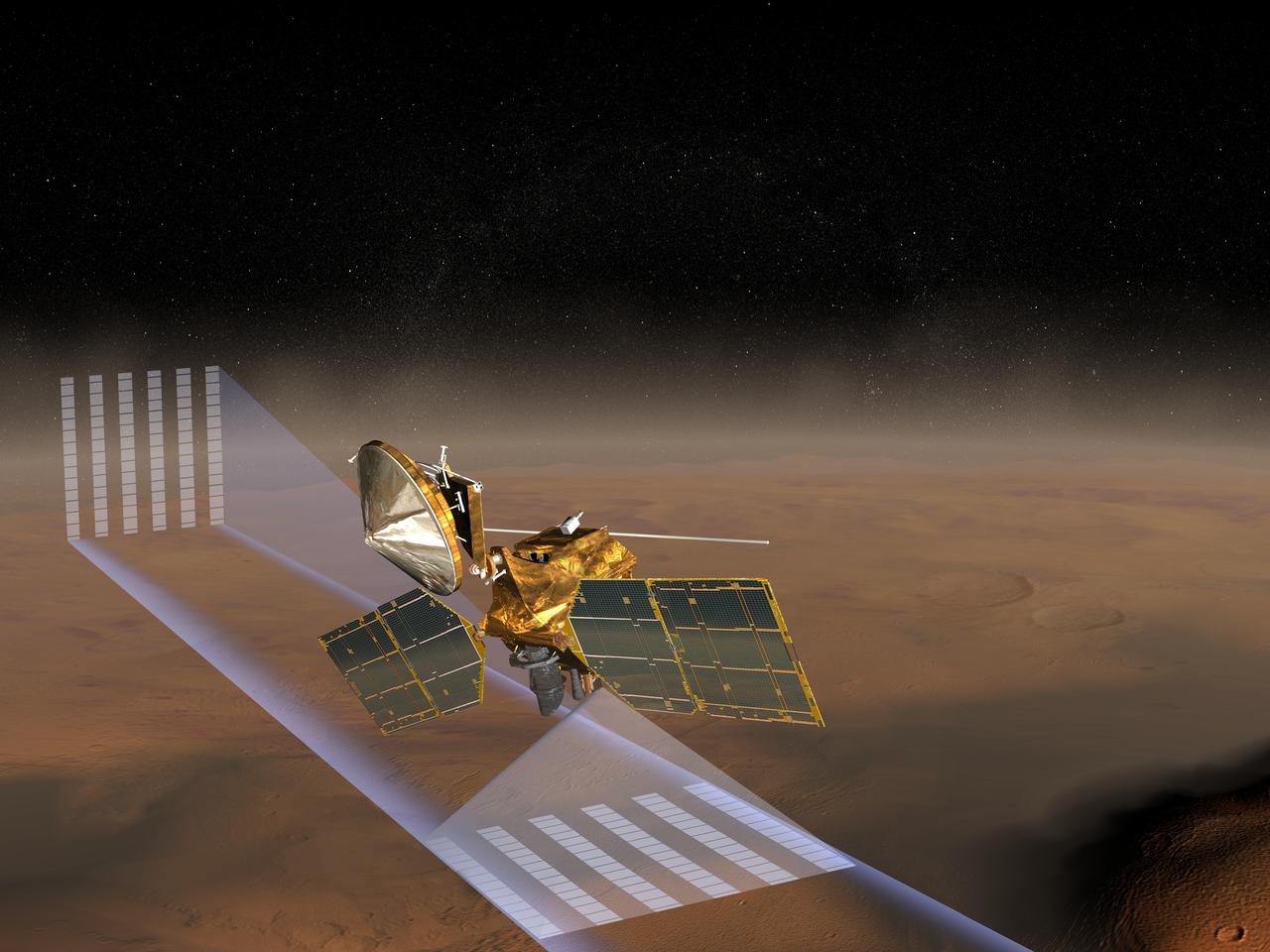
This artist concept of NASA Mars Reconnaissance Orbiter at Mars features one of its instruments -- the Mars Climate Sounder -- in action.

The Mars Climate Sounder instrument on NASA Mars Reconnaissance Orbiter maps the vertical distribution of temperatures, dust, water vapor and ice clouds in the Martian atmosphere as the orbiter flies a near-polar orbit.
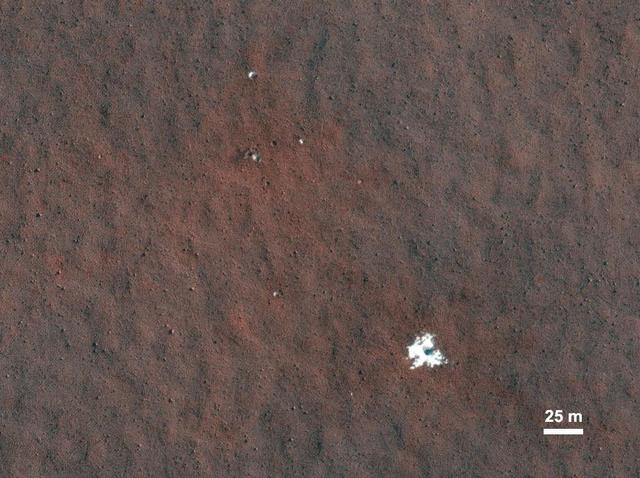
Recent small craters discovered by NASA Mars Reconnaissance Orbiter expose buried ice in the middle latitudes of Mars. This ice is a record of past climate change.
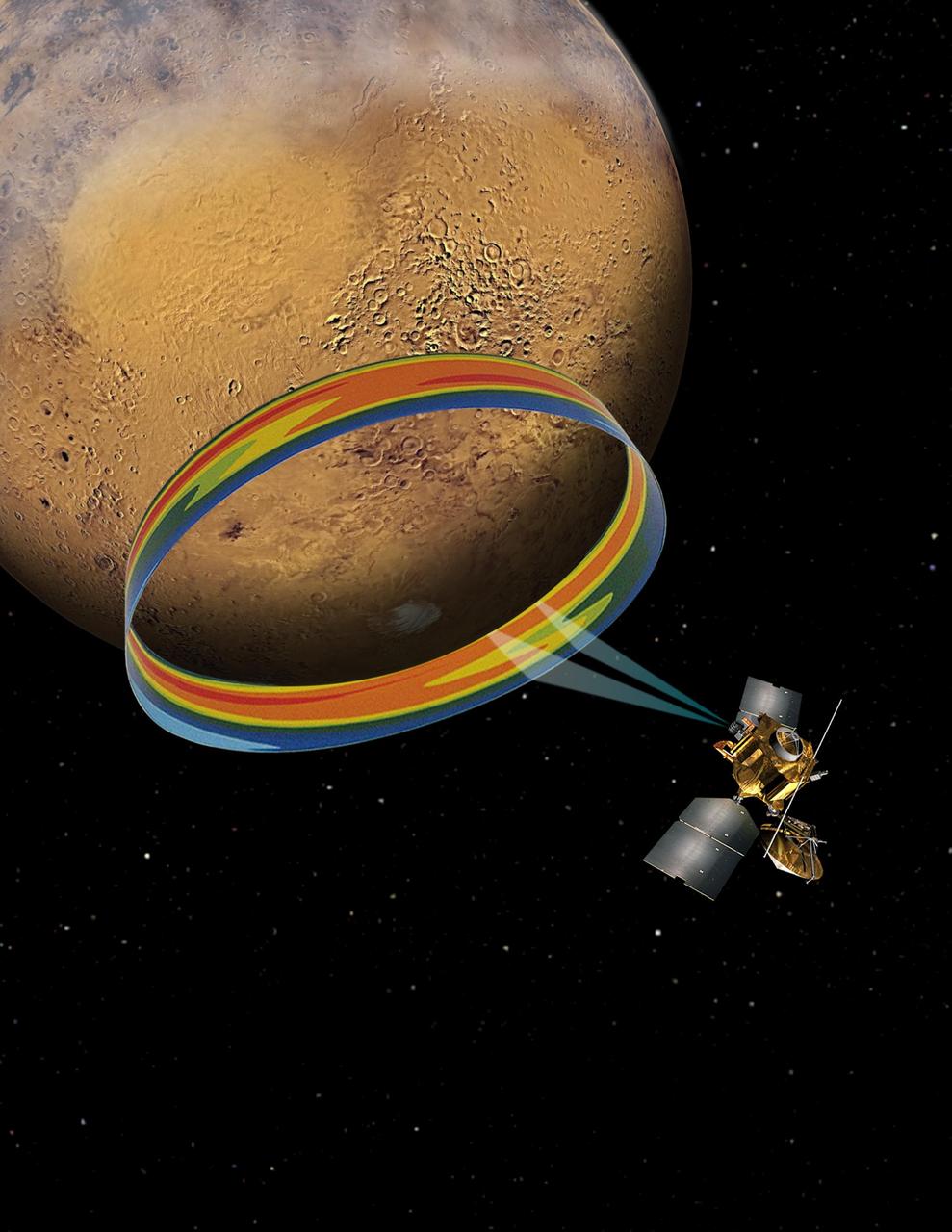
This graphic depicts the Mars Climate Sounder instrument on NASA Mars Reconnaissance Orbiter measuring the temperature of a cross section of the Martian atmosphere as the orbiter passes above the south polar region.
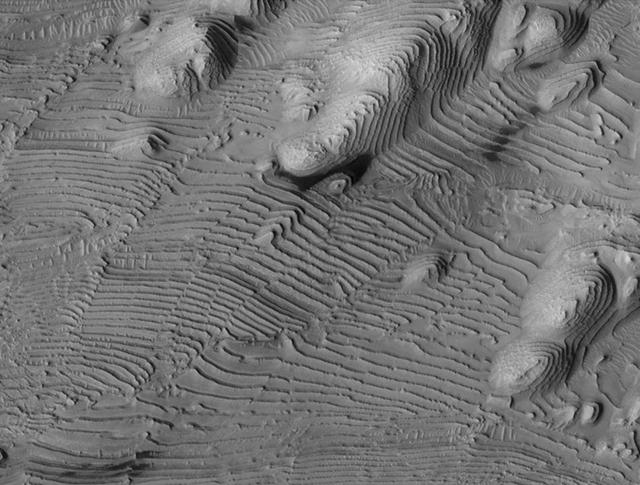
Rhythmic patterns of sedimentary layering in Danielson Crater on Mars result from periodic changes in climate related to changes in tilt of the planet in this image was taken by NASA Mars Reconnaissance Orbiter.

The North Polar layered deposits provide a record of recent climate changes on Mars as seen by NASA Mars Reconnaissance Orbiter spacecraft. Color variations between layers are due to differences in composition of the dust.
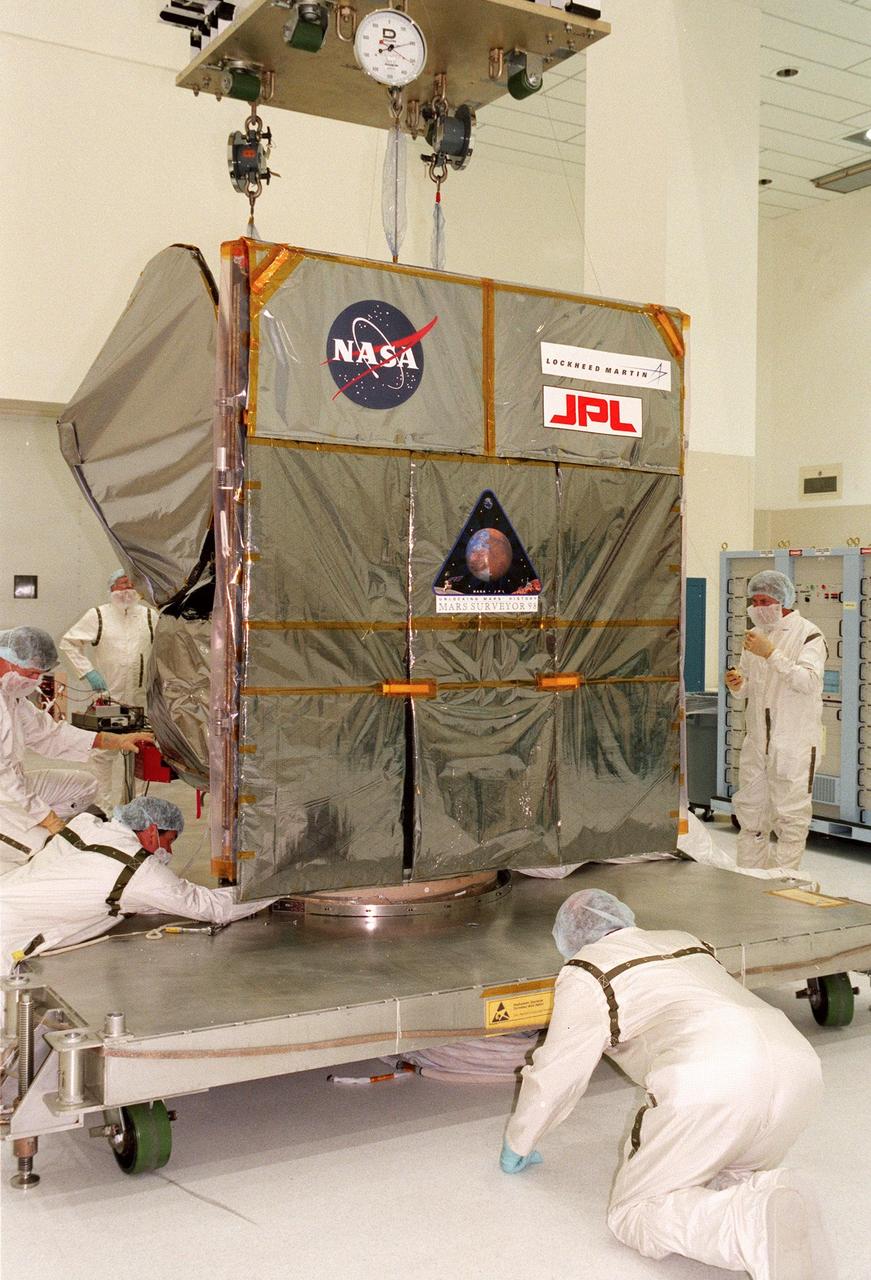
Technicians check the connections on the workstand holding the Mars Climate Orbiter in the Spacecraft Assembly and Encapsulation Facility-2 (SAEF-2). The Mars Climate Orbiter is heading for Mars where it will primarily support its companion Mars Polar Lander spacecraft, planned for launch on Jan. 3, 1999. After that, the Mars Climate Orbiter's instruments will monitor the Martian atmosphere and image the planet's surface on a daily basis for one Martian year (two Earth years). It will observe the appearance and movement of atmospheric dust and water vapor, as well as characterize seasonal changes on the surface. The detailed images of the surface features will provide important clues to the planet's early climate history and give scientists more information about possible liquid water reserves beneath the surface. The scheduled launch date for the Mars Climate Orbiter is Dec. 10, 1998, on a Boeing Delta II 7425 rocket
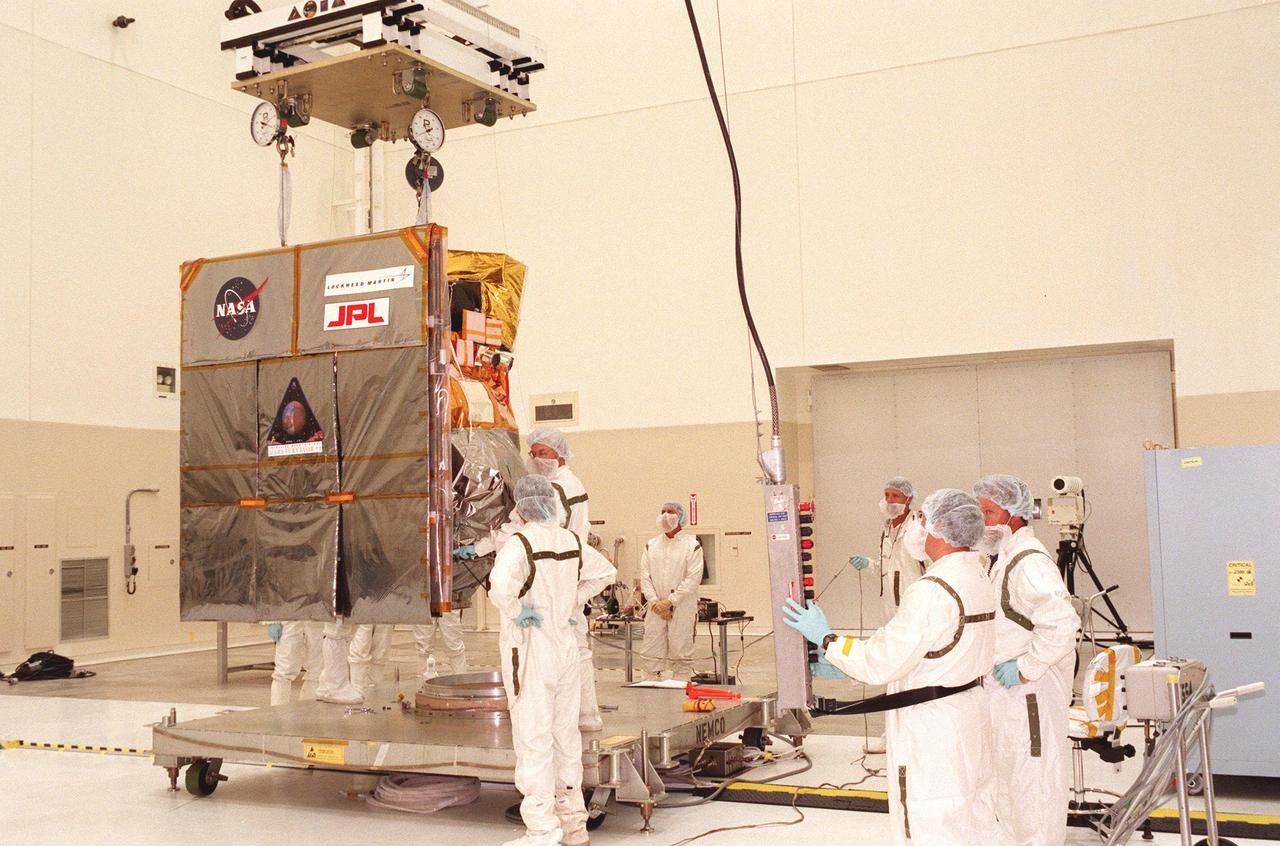
Technicians carefully maneuver the Mars Climate Orbiter toward its workstand in the Spacecraft Assembly and Encapsulation Facility-2 (SAEF-2). The Mars Climate Orbiter is heading for Mars where it will primarily support its companion Mars Polar Lander spacecraft, planned for launch on Jan. 3, 1999. After that, the Mars Climate Orbiter's instruments will monitor the Martian atmosphere and image the planet's surface on a daily basis for one Martian year (two Earth years). It will observe the appearance and movement of atmospheric dust and water vapor, as well as characterize seasonal changes on the surface. The detailed images of the surface features will provide important clues to the planet's early climate history and give scientists more information about possible liquid water reserves beneath the surface. The scheduled launch date for the Mars Climate Orbiter is Dec. 10, 1998, on a Boeing Delta II 7425 rocket
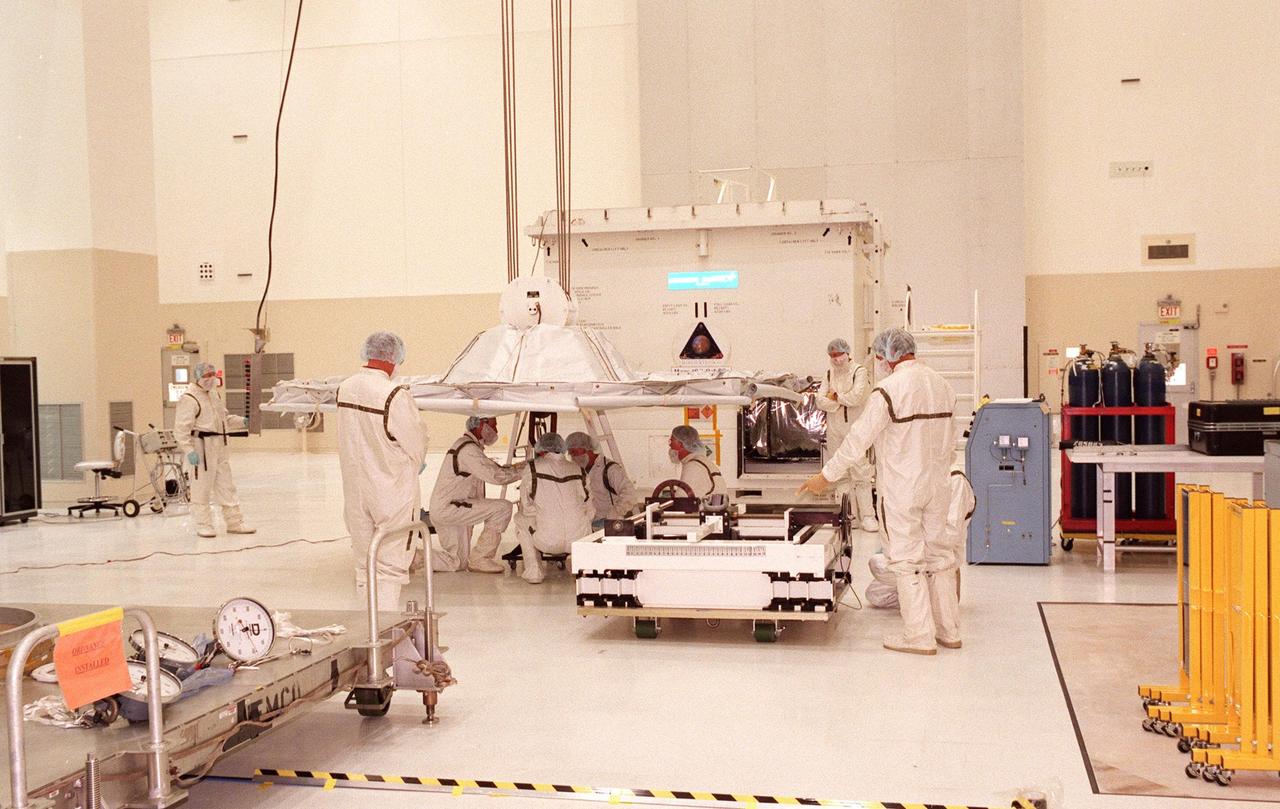
Technicians in the Spacecraft Assembly and Encapsulation Facility-2 (SAEF-2) prepare a lifting device they will use to remove the Mars Climate Orbiter from its container (behind the workers). The Mars Climate Orbiter is heading for Mars where it will primarily support its companion Mars Polar Lander spacecraft, planned for launch on Jan. 3, 1999. After that, the Mars Climate Orbiter's instruments will monitor the Martian atmosphere and image the planet's surface on a daily basis for one Martian year (two Earth years). It will observe the appearance and movement of atmospheric dust and water vapor, as well as characterize seasonal changes on the surface. The detailed images of the surface features will provide important clues to the planet's early climate history and give scientists more information about possible liquid water reserves beneath the surface. The scheduled launch date for the Mars Climate Orbiter is Dec. 10, 1998, on a Boeing Delta II 7425 rocket
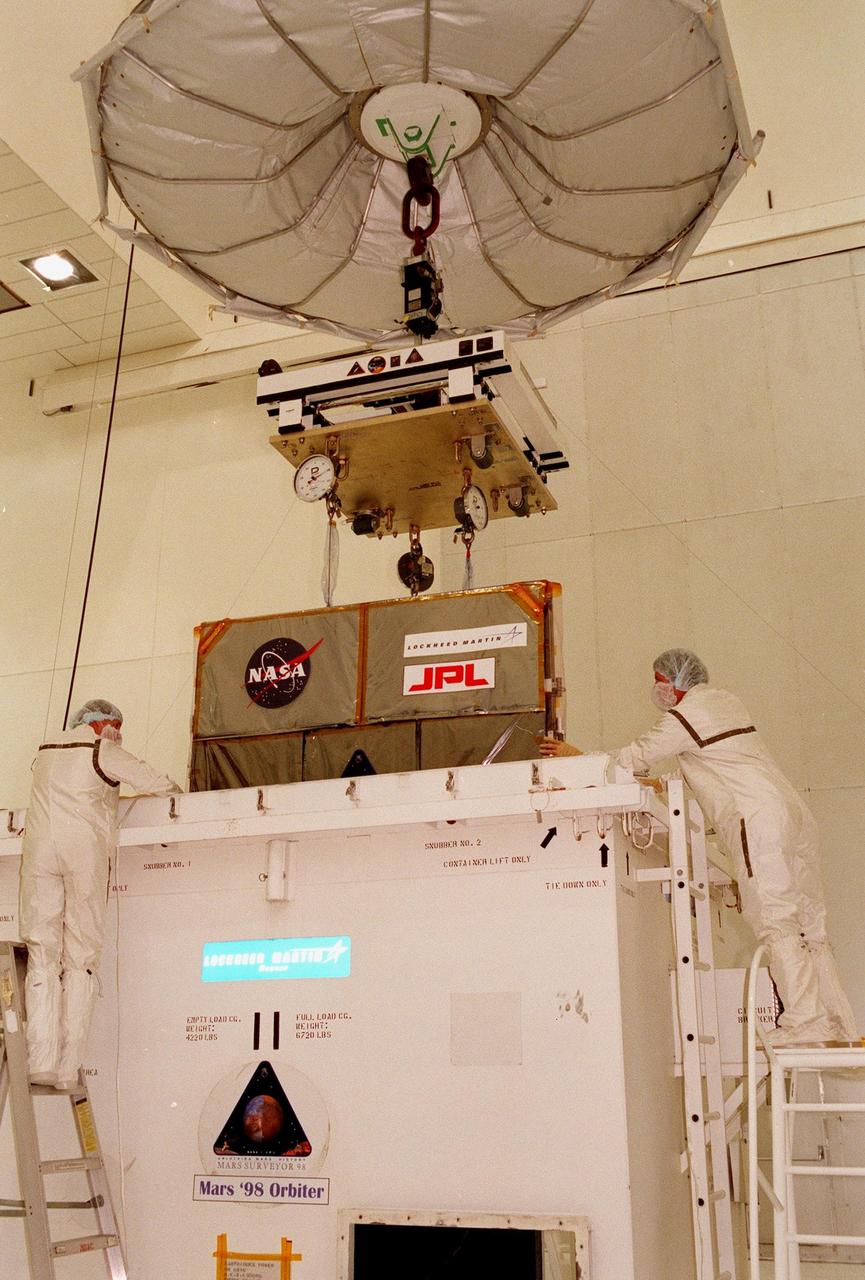
Technicians in the Spacecraft Assembly and Encapsulation Facility-2 (SAEF-2) oversee the removal of the Mars Climate Orbiter from its container. The Mars Climate Orbiter is heading for Mars where it will primarily support its companion Mars Polar Lander spacecraft, planned for launch on Jan. 3, 1999. After that, the Mars Climate Orbiter's instruments will monitor the Martian atmosphere and image the planet's surface on a daily basis for one Martian year (two Earth years). It will observe the appearance and movement of atmospheric dust and water vapor, as well as characterize seasonal changes on the surface. The detailed images of the surface features will provide important clues to the planet's early climate history and give scientists more information about possible liquid water reserves beneath the surface. The scheduled launch date for the Mars Climate Orbiter is Dec. 10, 1998, on a Boeing Delta II 7425 rocket
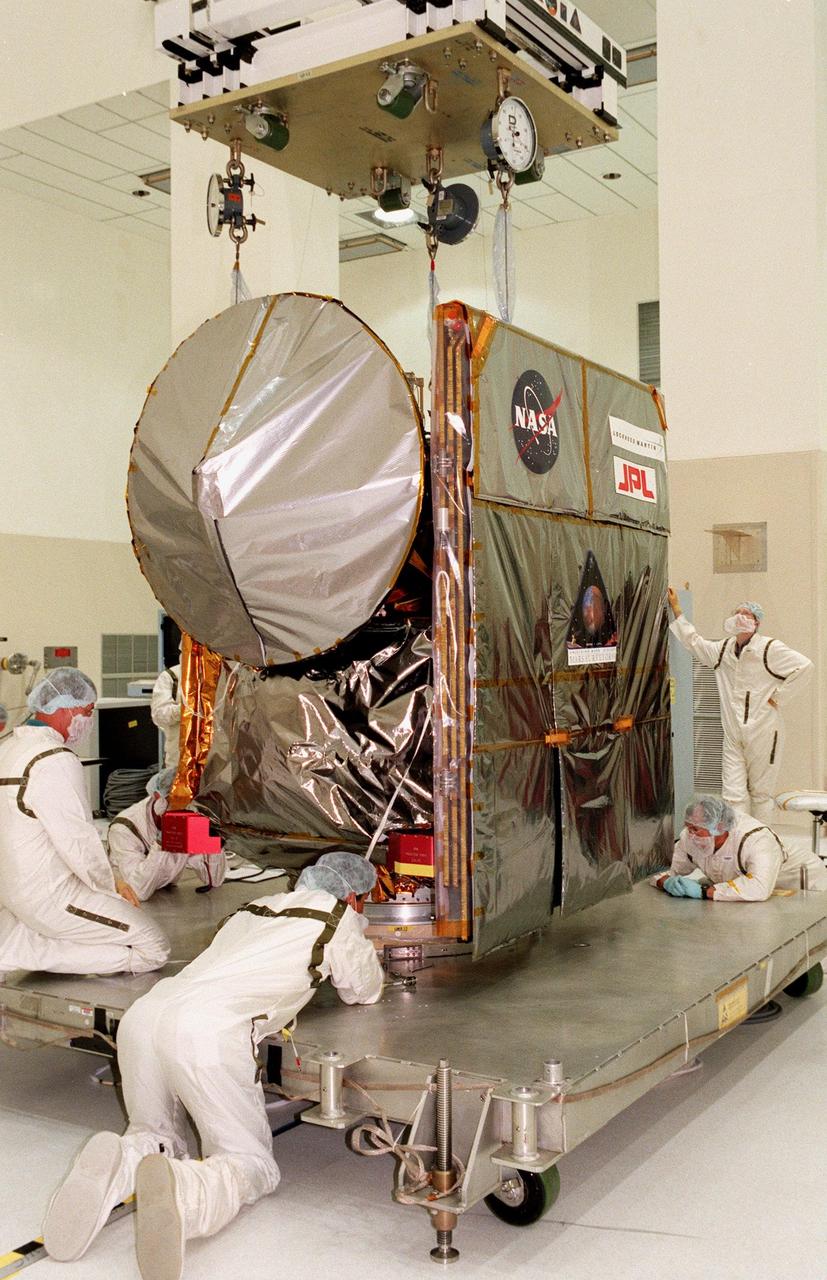
Technicians check the connections on the workstand holding the Mars Climate Orbiter in the Spacecraft Assembly and Encapsulation Facility-2 (SAEF-2). The Mars Climate Orbiter is heading for Mars where it will primarily support its companion Mars Polar Lander spacecraft, planned for launch on Jan. 3, 1999. After that, the Mars Climate Orbiter's instruments will monitor the Martian atmosphere and image the planet's surface on a daily basis for one Martian year (two Earth years). It will observe the appearance and movement of atmospheric dust and water vapor, as well as characterize seasonal changes on the surface. The detailed images of the surface features will provide important clues to the planet's early climate history and give scientists more information about possible liquid water reserves beneath the surface. The scheduled launch date for the Mars Climate Orbiter is Dec. 10, 1998, on a Boeing Delta II 7425 rocket
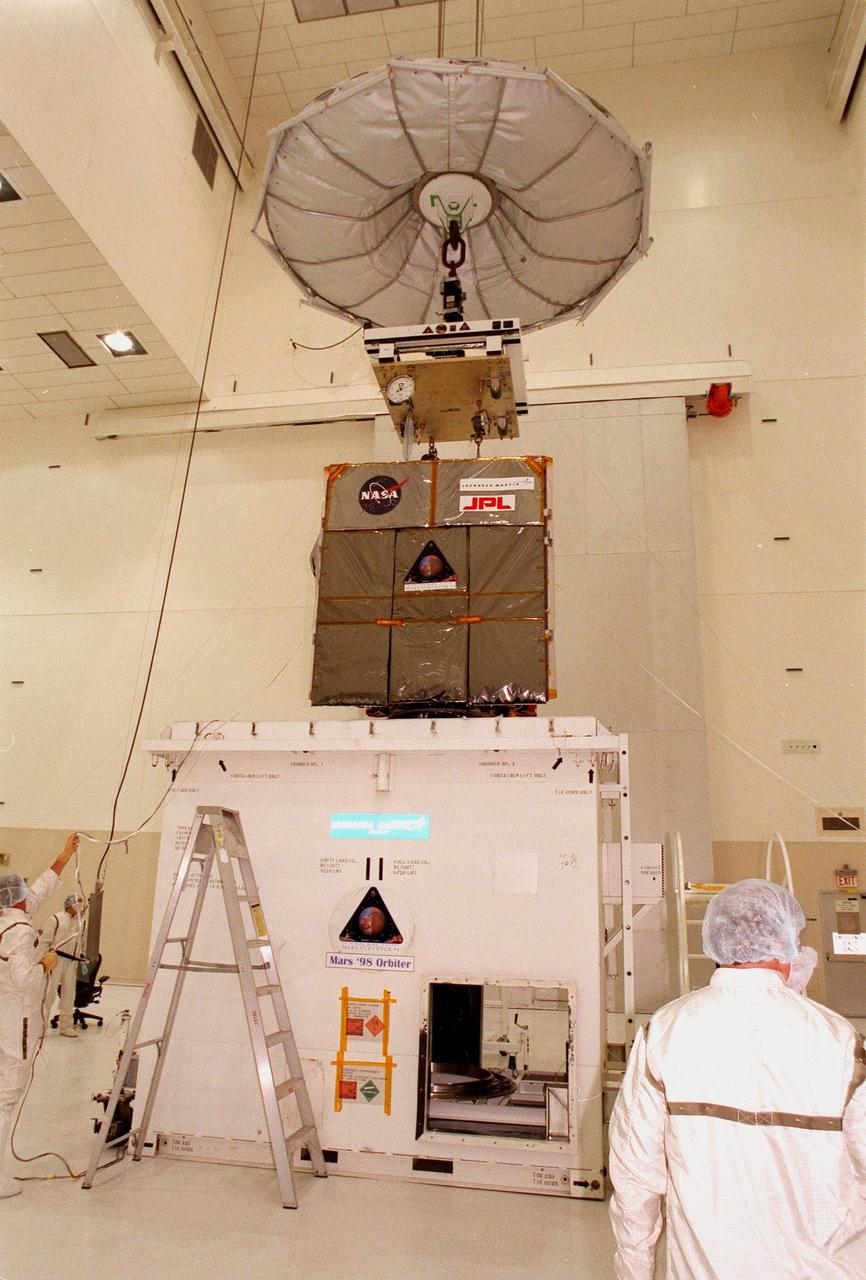
The Mars Climate Orbiter is lifted clear of the top of its container in the Spacecraft Assembly and Encapsulation Facility-2 (SAEF-2). The Mars Climate Orbiter is heading for Mars where it will primarily support its companion Mars Polar Lander spacecraft, planned for launch on Jan. 3, 1999. After that, the Mars Climate Orbiter's instruments will monitor the Martian atmosphere and image the planet's surface on a daily basis for one Martian year (two Earth years). It will observe the appearance and movement of atmospheric dust and water vapor, as well as characterize seasonal changes on the surface. The detailed images of the surface features will provide important clues to the planet's early climate history and give scientists more information about possible liquid water reserves beneath the surface. The scheduled launch date for the Mars Climate Orbiter is Dec. 10, 1998, on a Boeing Delta II 7425 rocket

In the Spacecraft Assembly and Encapsulation Facility-2 (SAEF-2), the Mars Climate Orbiter (background) is moved toward the workstand being readied by technicians (foreground). The Mars Climate Orbiter is heading for Mars where it will primarily support its companion Mars Polar Lander spacecraft, planned for launch on Jan. 3, 1999. After that, the Mars Climate Orbiter's instruments will monitor the Martian atmosphere and image the planet's surface on a daily basis for one Martian year (two Earth years). It will observe the appearance and movement of atmospheric dust and water vapor, as well as characterize seasonal changes on the surface. The detailed images of the surface features will provide important clues to the planet's early climate history and give scientists more information about possible liquid water reserves beneath the surface. The scheduled launch date for the Mars Climate Orbiter is Dec. 10, 1998, on a Boeing Delta II 7425 rocket
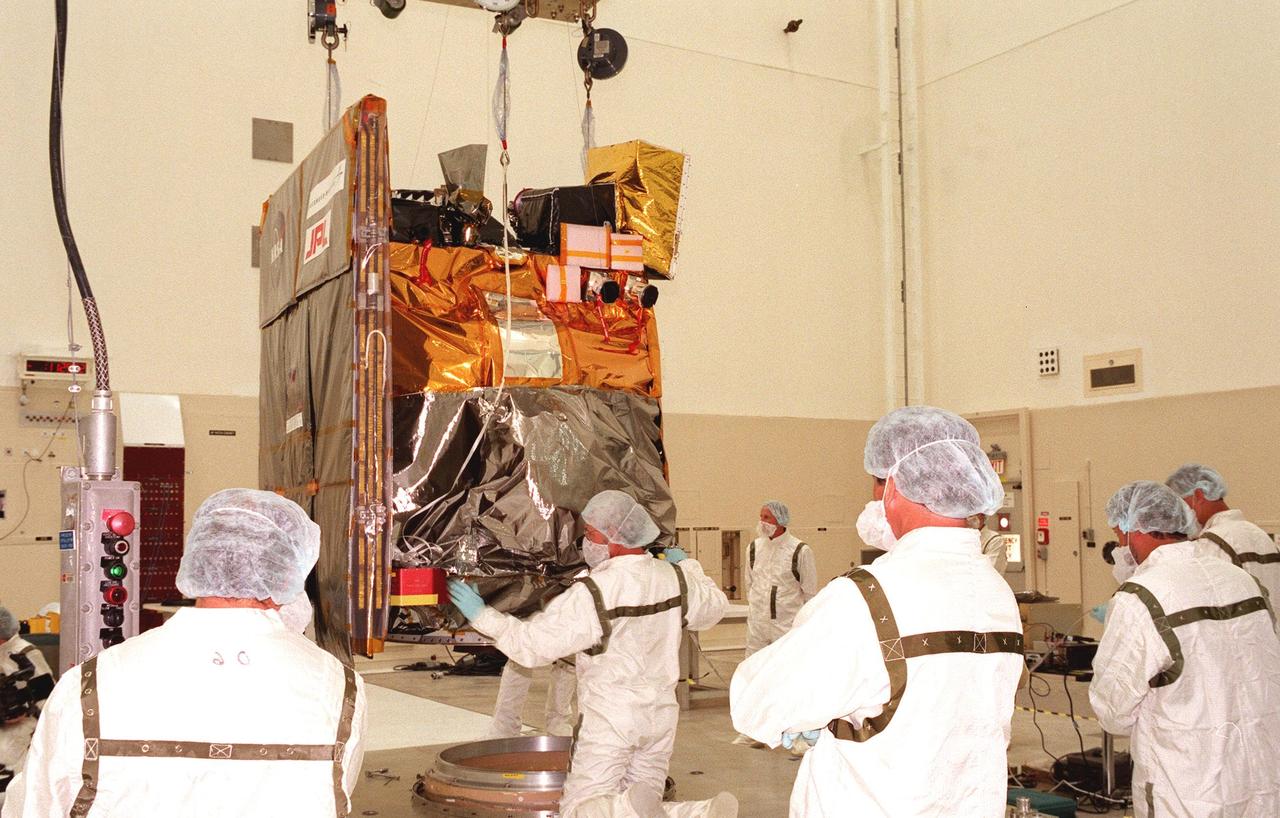
Technicians lower the Mars Climate Orbiter onto its workstand in the Spacecraft Assembly and Encapsulation Facility-2 (SAEF-2). The Mars Climate Orbiter is heading for Mars where it will primarily support its companion Mars Polar Lander spacecraft, planned for launch on Jan. 3, 1999. After that, the Mars Climate Orbiter's instruments will monitor the Martian atmosphere and image the planet's surface on a daily basis for one Martian year (two Earth years). It will observe the appearance and movement of atmospheric dust and water vapor, as well as characterize seasonal changes on the surface. The detailed images of the surface features will provide important clues to the planet's early climate history and give scientists more information about possible liquid water reserves beneath the surface. The scheduled launch date for the Mars Climate Orbiter is Dec. 10, 1998, on a Boeing Delta II 7425 rocket
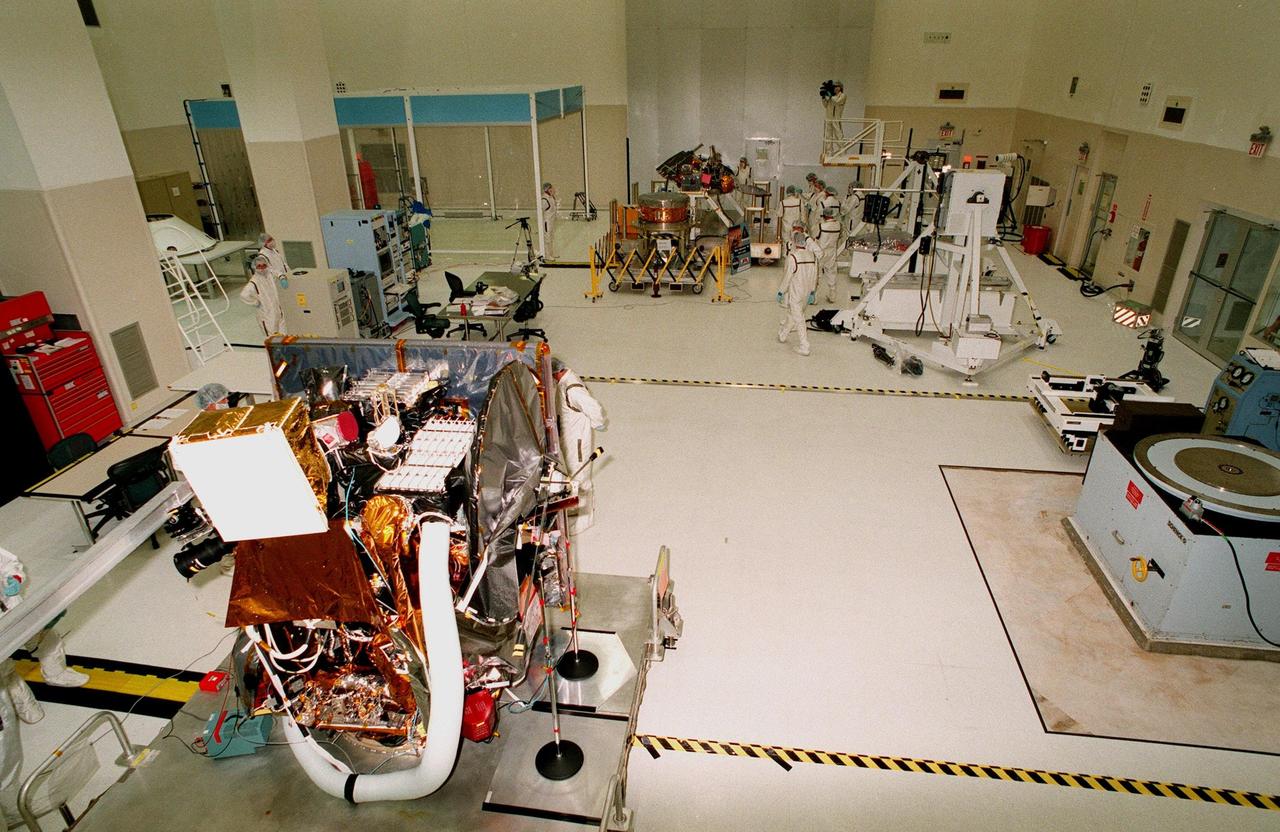
In the Spacecraft Assembly and Encapsulation Facility-2 (SAEF-2), the Mars Climate Orbiter (foreground) and the Mars Polar Lander are on display for the media. The scheduled launch date for the Mars Climate Orbiter is Dec. 10, 1998, aboard a Boeing Delta II rocket. It is heading for Mars where it will primarily support its companion Mars Polar Lander spacecraft, planned for launch on Jan. 3, 1999. After that, the Mars Climate Orbiter's instruments will monitor the Martian atmosphere and image the planet's surface on a daily basis for one Martian year (two Earth years). It will observe the appearance and movement of atmospheric dust and water vapor, as well as characterize seasonal changes on the surface. The detailed images of the surface features will provide important clues to the planet's early climate history and give scientists more information about possible liquid water reserves beneath the surface
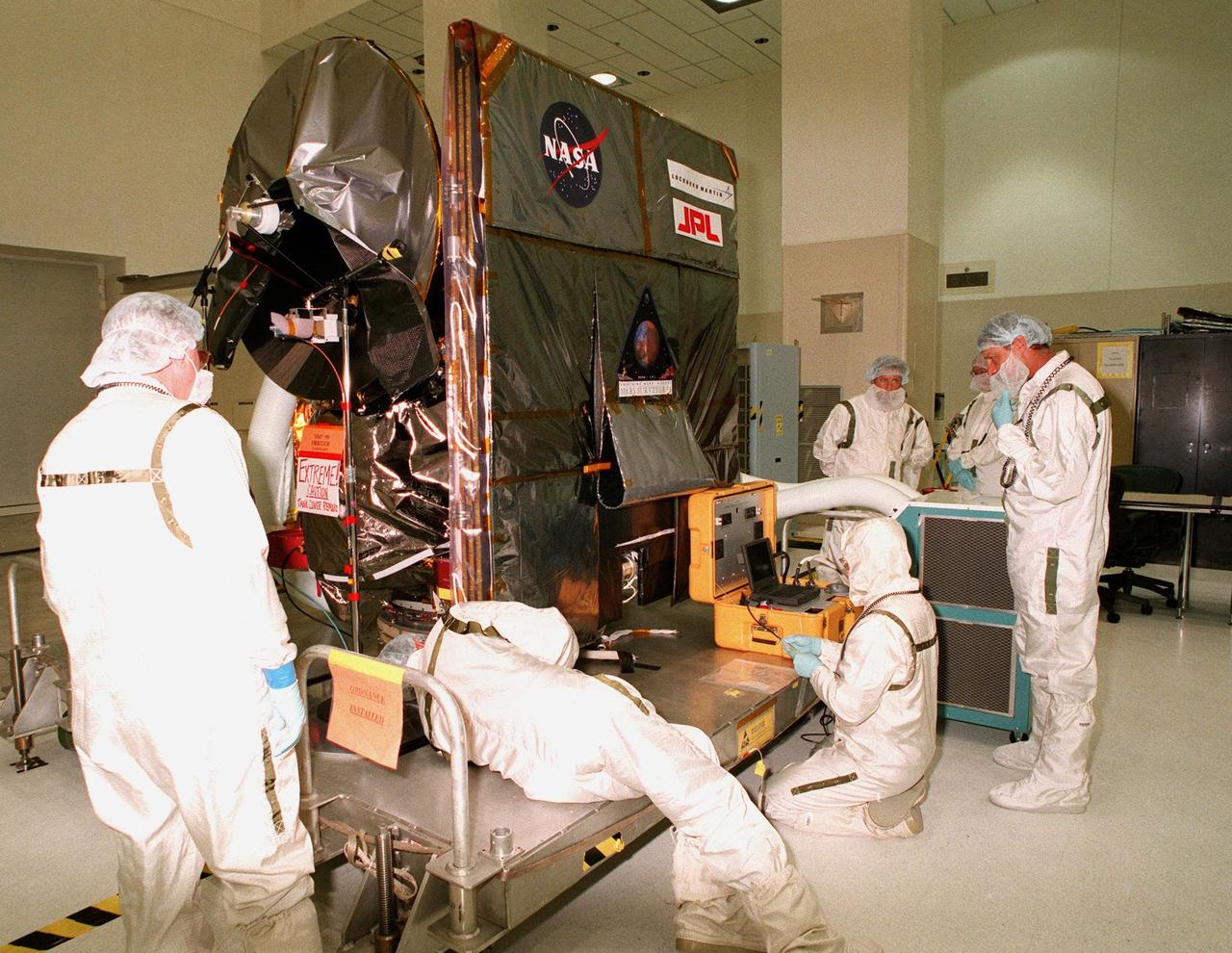
KENNEDY SPACE CENTER, FLA. -- In the Spacecraft Assembly and Encapsulation Facility-2 (SAEF-2), a technician works on the Mars Climate Orbiter which is scheduled to launch on Dec. 10, 1998, aboard a Boeing Delta II rocket. The Mars Climate Orbiter is heading for Mars where it will primarily support its companion Mars Polar Lander spacecraft, planned for launch on Jan. 3, 1999. After that, the Mars Climate Orbiter's instruments will monitor the Martian atmosphere and image the planet's surface on a daily basis for one Martian year (two Earth years). It will observe the appearance and movement of atmospheric dust and water vapor, as well as characterize seasonal changes on the surface. The detailed images of the surface features will provide important clues to the planet's early climate history and give scientists more information about possible liquid water reserves beneath the surface
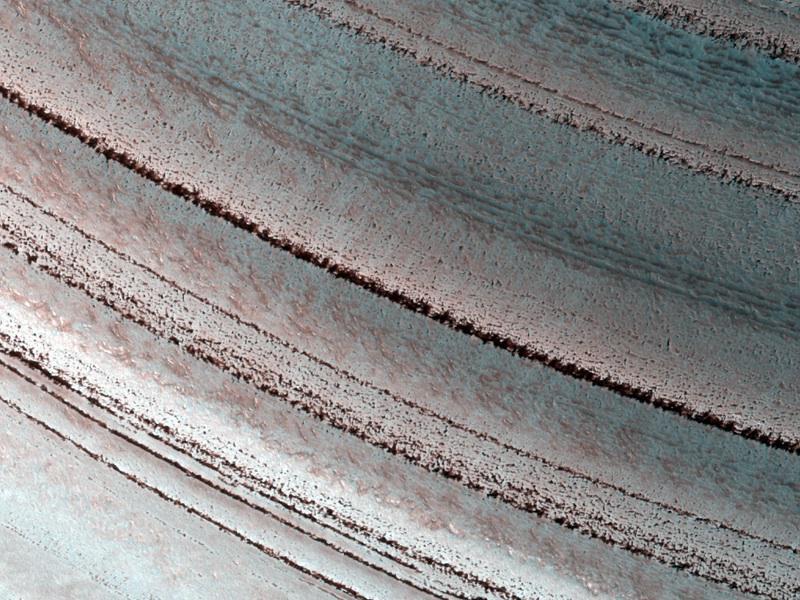
The Martian north polar layered deposits are an ice sheet much like the Greenland ice sheet on the Earth in this image from NASA Mars Reconnaissance Orbiter. This Martian ice sheet contains many layers that record variations in the Martian climate.
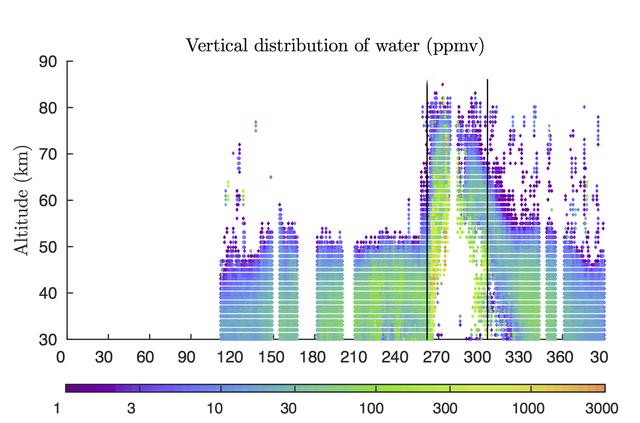
Rising air during a 2007 global dust storm on Mars lofted water vapor into the planet's middle atmosphere, researchers learned from data graphed here, derived from observations by the Mars Climate Sounder instrument on NASA's Mars Reconnaissance Orbiter. The two vertical black lines in the right half of the graph (at about 260 and 310 on the horizontal scale) mark the beginning and end of the most recent global dust storm on Mars, which burst from regional scale to globe-encircling scale in July 2007. The presence of more colored dots, particularly green ones, in the upper portion of the graph between those lines, compared to the upper portion of the graph outside those lines, documents the uplift of water vapor in connection with the global dust storm. The vertical scale is altitude, labeled at left in kilometers above the surface of Mars (50 kilometers is about 30 miles; 80 kilometers is about 50 miles). The color bar below the graph gives the key to how much water vapor each dot represents, in parts per million, by volume, in Mars' atmosphere. Note that green to yellow represents about 100 times as much water as purple does. The horizontal axis of the graph is time, from January 2006 to February 2008. It is labeled with numbers representing the 360 degrees of Mars' orbit around the Sun, from zero to 360 degrees and then further on to include the first 30 degrees of the following Martian year. (The zero point is autumnal equinox -- end of summer -- in Mars' northern hemisphere.) This graph, based on Mars Reconnaissance Orbiter observations, was used in a January 2018 paper in Nature Astronomy by Nicholas Heavens of Hampton University in Hampton, Virginia, and co-authors. The paper presents Martian dust storms' uplifting effect on water vapor as a factor in seasonal patterns that other spacecraft have detected in the rate of hydrogen escaping from the top of Mars' atmosphere. https://photojournal.jpl.nasa.gov/catalog/PIA22080
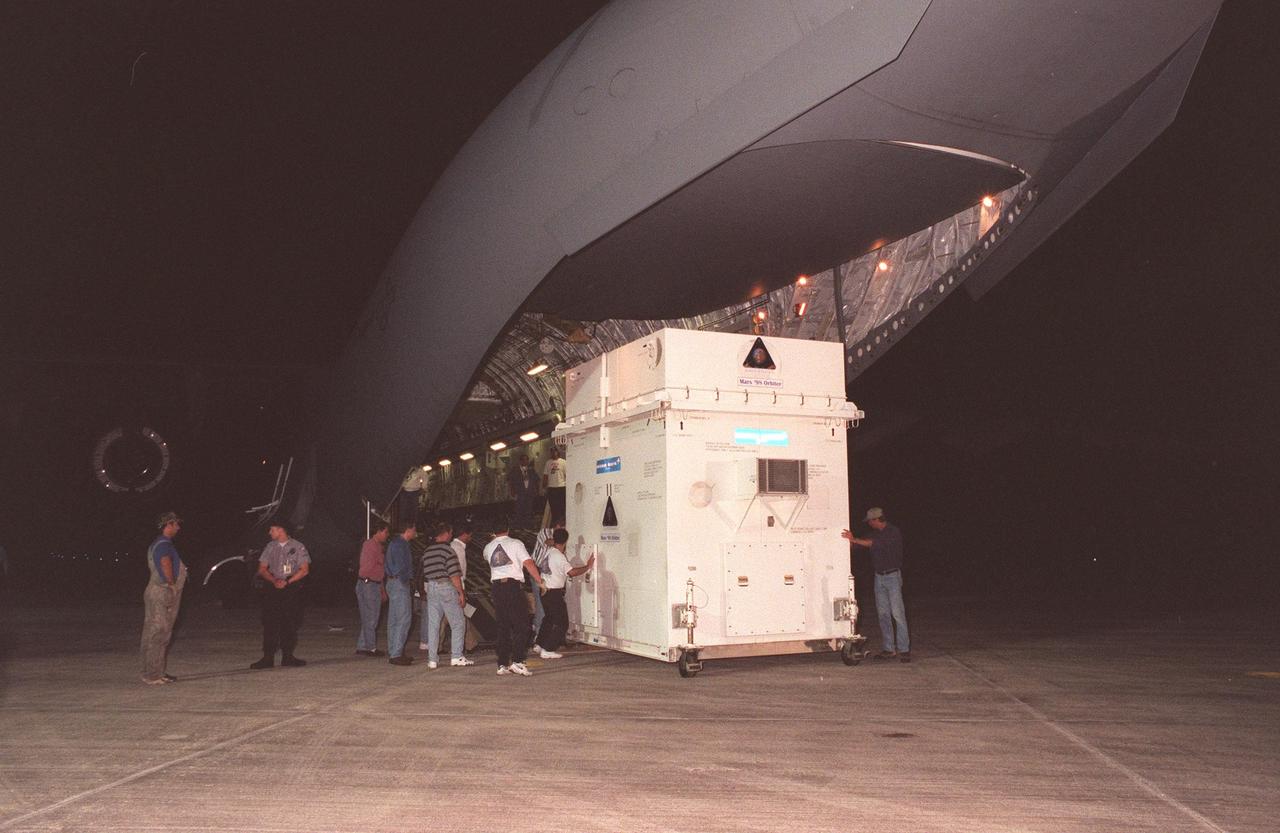
The Mars Climate Orbiter spacecraft arrives at KSC's Shuttle Landing Facility aboard an Air Force C-17 cargo plane early this morning following its flight from the Lockheed Martin Astronautics plant in Denver, Colo. When the spacecraft arrives at the red planet, it will primarily support its companion Mars Polar Lander spacecraft, planned for launch on Jan. 3, 1999. After that, the Mars Climate Orbiter's instruments will monitor the Martian atmosphere and image the planet's surface on a daily basis for one Martian year (1.8 Earth years). It will observe the appearance and movement of atmospheric dust and water vapor, as well as characterize seasonal changes on the surface. The detailed images of the surface features will provide important clues to the planet's early climate history and give scientists more information about possible liquid water reserves beneath the surface. The scheduled launch date for the Mars Climate Orbiter is Dec. 10, 1998, on a Delta II 7425 rocket
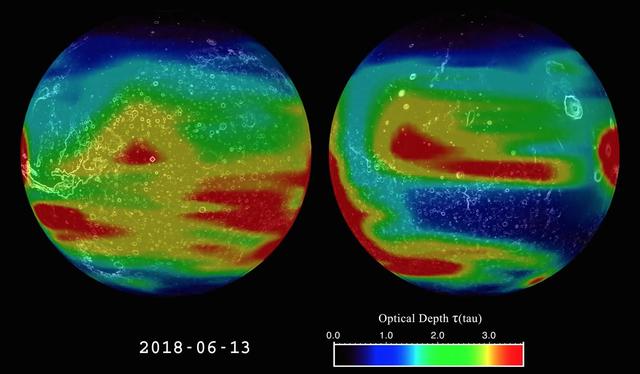
This image is from an animation that shows the evolution of the 2018 Mars global dust storm from late May to September. The animation shows the optical depth tau -- a measure of how much light is being blocked by atmospheric dust as measured by the Mars Climate Sounder instrument onboard NASA's Mars Reconnaissance Orbiter. NASA's Opportunity rover is marked with a red dot. The dust is mapped to two opposite hemispheres of Mars, giving a view of the full globe. Certain features of the Martian terrain, including Olympus Mons, the three volcanoes in the equatorial region, and Vallis Marineris, are also visible. The data shows the daily global column of dust, illustrating how the dust behaves over the course of the storm. The storm has a complex growth affecting most of Mars over the first month. It then remains near the peak for three weeks. Finally, the storm starts a multi-month decay back to regular weather. A color scale in the lower right-hand corner of the animation explains the colors in relation to approximate tau values. A tau of three indicates that only about 5 percent of the sunlight entering the atmosphere directly reaches the surface. Animation is available at https://photojournal.jpl.nasa.gov/catalog/PIA22737
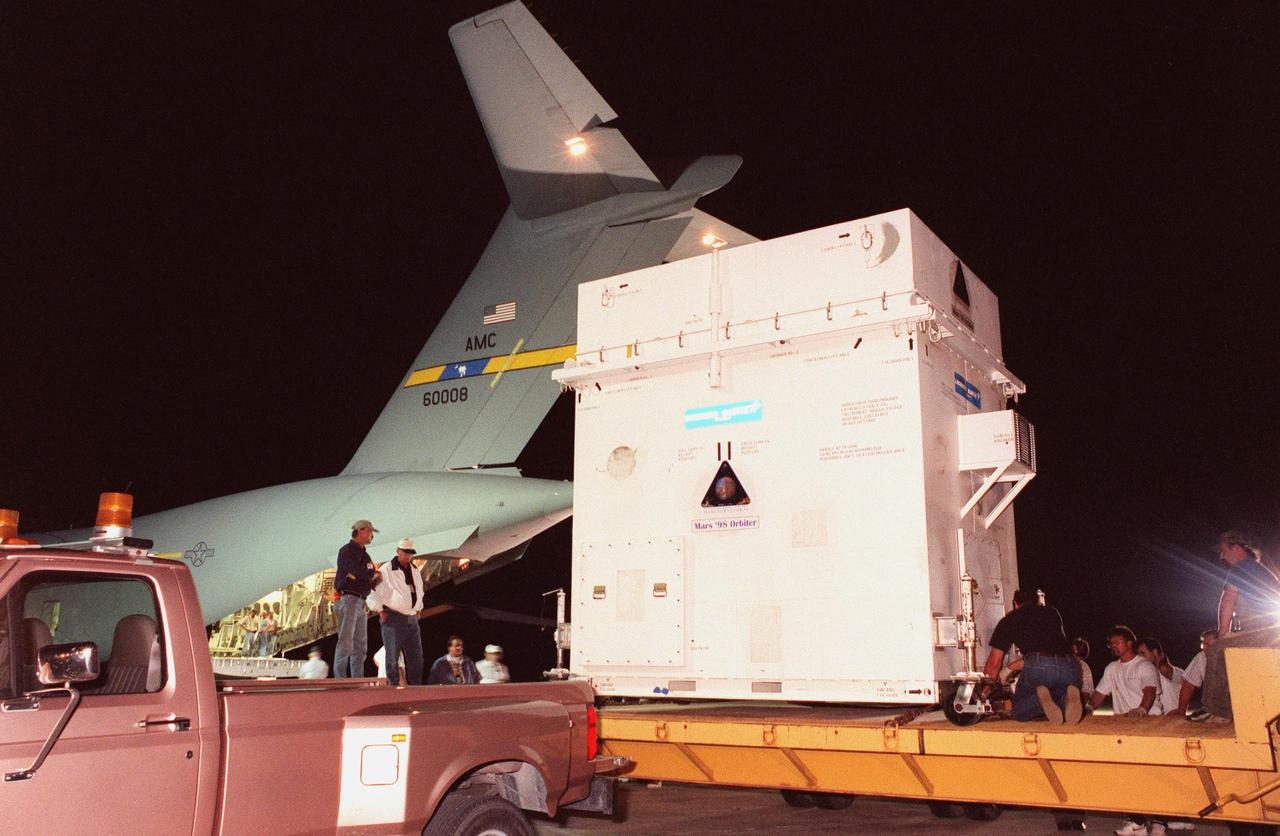
The Mars Climate Orbiter spacecraft is moved onto a flatbed for transport to the Spacecraft Assembly and Encapsulation Facility-2 (SAEF-2). It arrived at KSC's Shuttle Landing Facility aboard an Air Force C-17 cargo plane early this morning following its flight from the Lockheed Martin Astronautics plant in Denver, Colo. When it arrives at the red planet, the Mars Climate Orbiter will primarily support its companion Mars Polar Lander spacecraft, planned for launch on Jan. 3, 1999. After that, the Mars Climate Orbiter's instruments will monitor the Martian atmosphere and image the planet's surface on a daily basis for one Martian year (1.8 Earth years). It will observe the appearance and movement of atmospheric dust and water vapor, as well as characterize seasonal changes on the surface. The detailed images of the surface features will provide important clues to the planet's early climate history and give scientists more information about possible liquid water reserves beneath the surface. The scheduled launch date for the Mars Climate Orbiter is Dec. 10, 1998, on a Delta II 7425 rocket
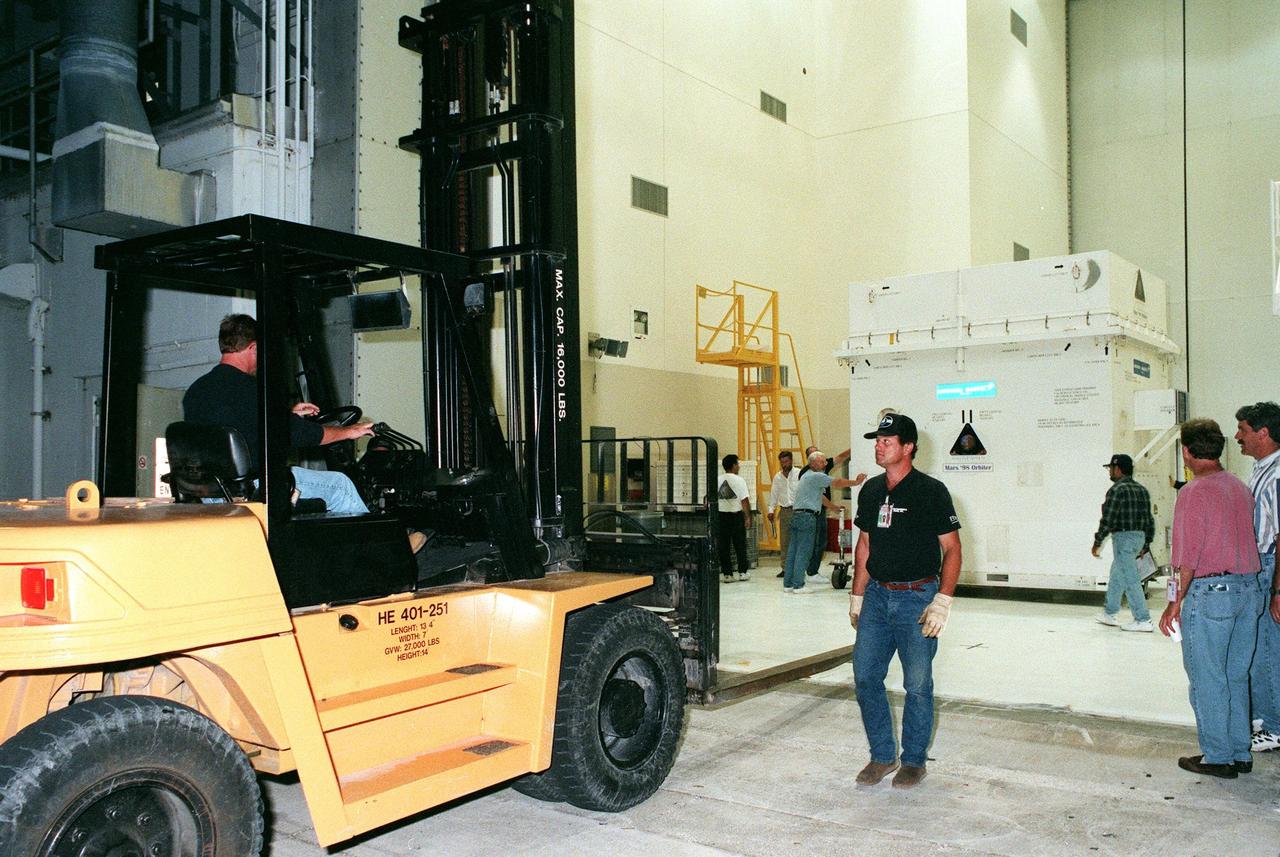
The Mars Climate Orbiter spacecraft is moved into the Spacecraft Assembly and Encapsulation Facility-2 (SAEF-2) in KSC's industrial area. It arrived at the Shuttle Landing Facility aboard an Air Force C-17 cargo plane early this morning following its flight from the Lockheed Martin Astronautics plant in Denver, Colo. When it arrives at the red planet, the Mars Climate Orbiter will primarily support its companion Mars Polar Lander spacecraft, planned for launch on Jan. 3, 1999. After that, the Mars Climate Orbiter's instruments will monitor the Martian atmosphere and image the planet's surface on a daily basis for one Martian year (1.8 Earth years). It will observe the appearance and movement of atmospheric dust and water vapor, as well as characterize seasonal changes on the surface. The detailed images of the surface features will provide important clues to the planet's early climate history and give scientists more information about possible liquid water reserves beneath the surface. The scheduled launch date for the Mars Climate Orbiter is Dec. 10, 1998, on a Delta II 7425 rocket
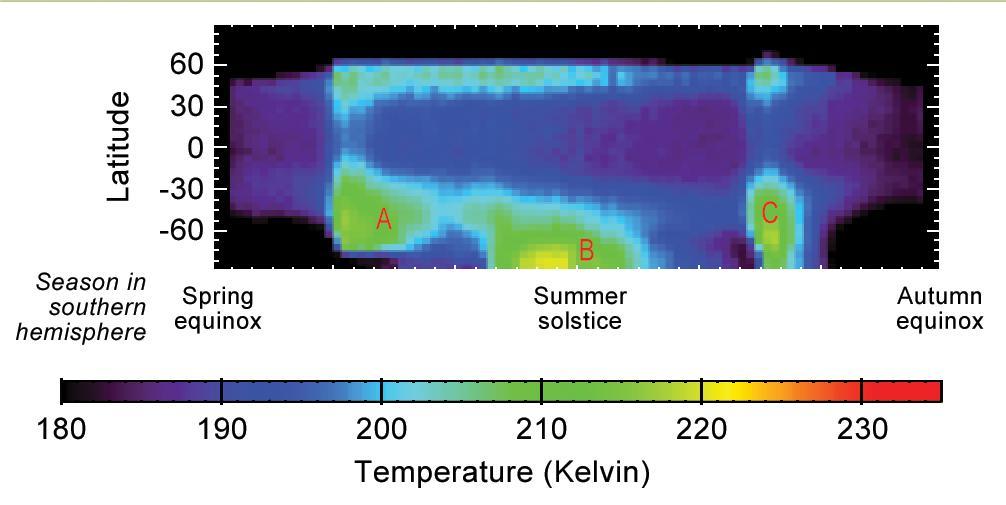
This graphic shows Martian atmospheric temperature data related to seasonal patterns in occurrence of large regional dust storms. The data shown here were collected by the Mars Climate Sounder instrument on NASA's Mars Reconnaissance Orbiter over the course of one-half of a Martian year, during 2012 and 2013. The color coding indicates daytime temperatures of a layer of the atmosphere centered about 16 miles (25 kilometers) above ground level, corresponding to the color-key bar at the bottom of the graphic. Three regional dust storms indicated by increased temperatures are labeled A, B and C. A similar sequence of three large regional dust storms has been seen in atmosphere-temperature data from five other Martian years. The vertical axis is latitude on Mars, from the north pole at the top to south pole at the bottom. Each graphed data point is an average for all Martian longitudes around the planet. The horizontal axis is the time of year, spanning from the beginning of Mars' southern-hemisphere spring (on the left) to the end of southern-hemisphere summer. This is the half of the year when large Martian dust storms are most active. http://photojournal.jpl.nasa.gov/catalog/PIA20746
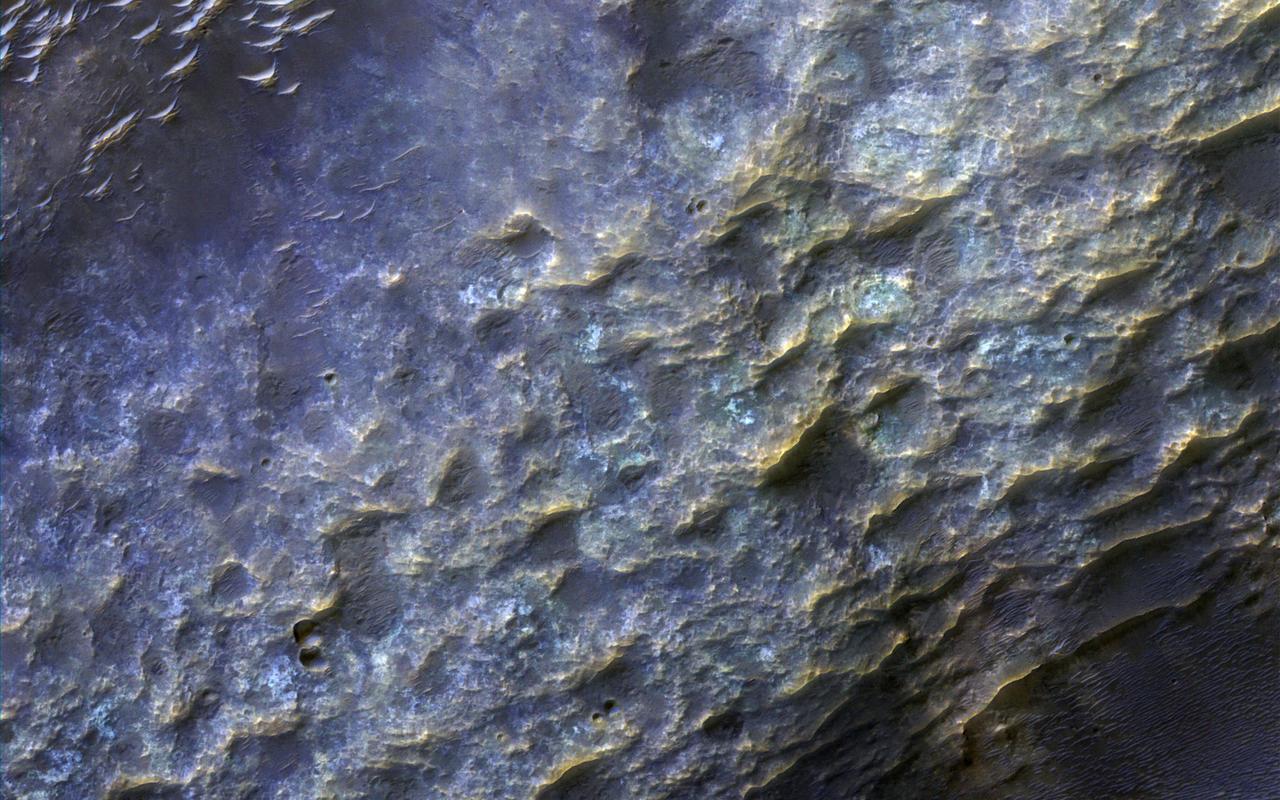
Most of the oldest terrains on Mars have eroded into branching valleys, as seen here in by NASA's Mars Reconnaisance Orbiter, much like many land regions of Earth are eroded by rain and snowmelt runoff. This is the primary evidence for major climate change on Mars billions of years ago. How the climate of Mars could have supported a warmer and wetter environment has been the subject of scientific debates for 40 years. A full-resolution enhanced color closeup reveals details in the bedrock and dunes on the valley floor (upper left). The bedrock of ancient Mars has been hardened and cemented by groundwater. https://photojournal.jpl.nasa.gov/catalog/PIA21630
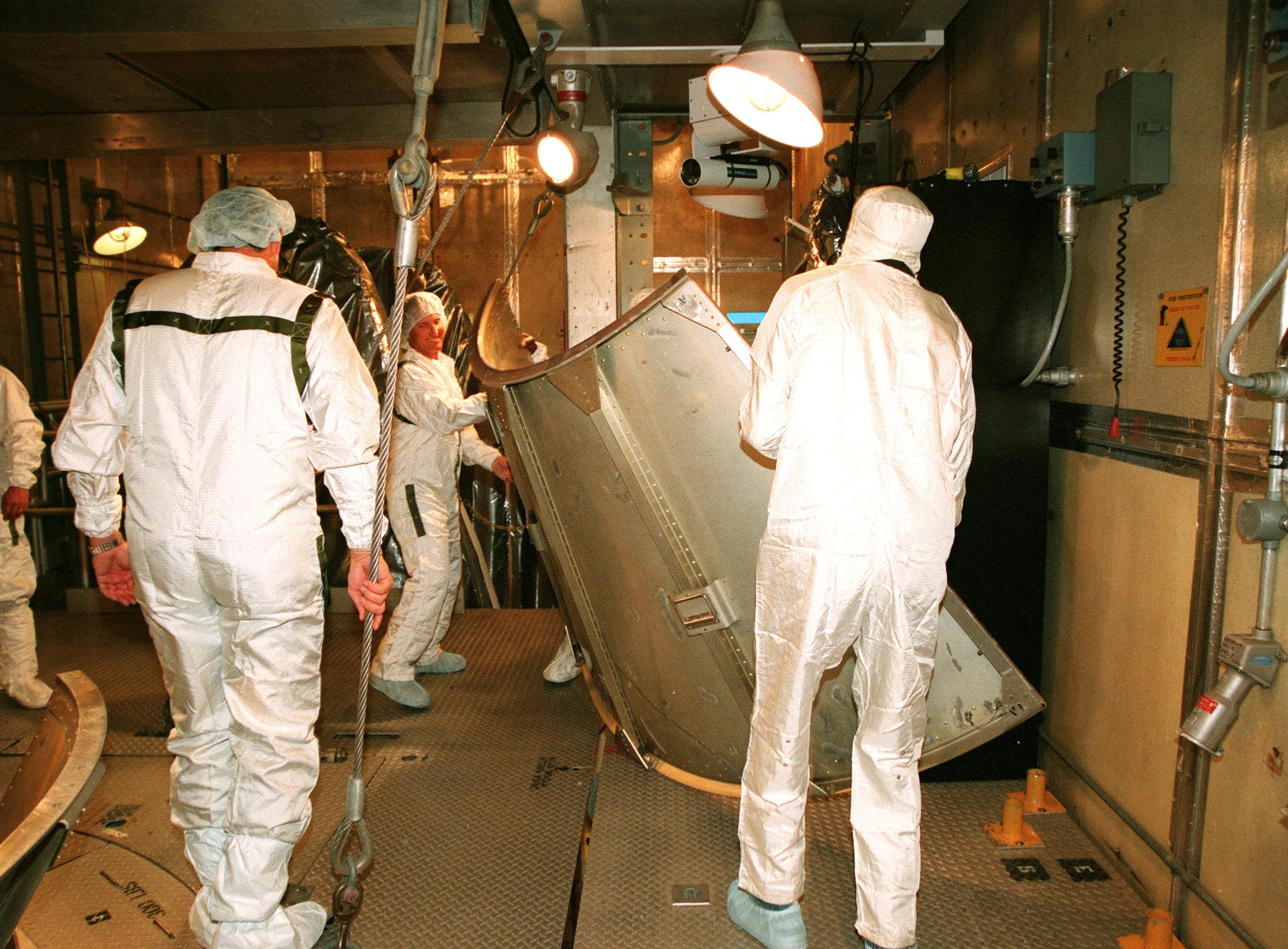
KENNEDY SPACE CENTER, FLA. -- At Launch Complex 17A, Cape Canaveral Air Station, workers place aside a piece of the canister surrounding the Mars Climate Orbiter. Targeted for liftoff on Dec. 10, 1998, aboard a Boeing Delta II (7425) rocket, the orbiter will be the first spacecraft to be launched in the pair of Mars '98 missions. After its arrival at the red planet, the Mars Climate Orbiter will be used primarily to support its companion Mars Polar Lander spacecraft, scheduled for launch on Jan. 3, 1999. The orbiter will then monitor the Martian atmosphere and image the planet's surface on a daily basis for one Martian year, the equivalent of about two Earth years. The spacecraft will observe the appearance and movement of atmospheric dust and water vapor, and characterize seasonal changes on the planet's surface
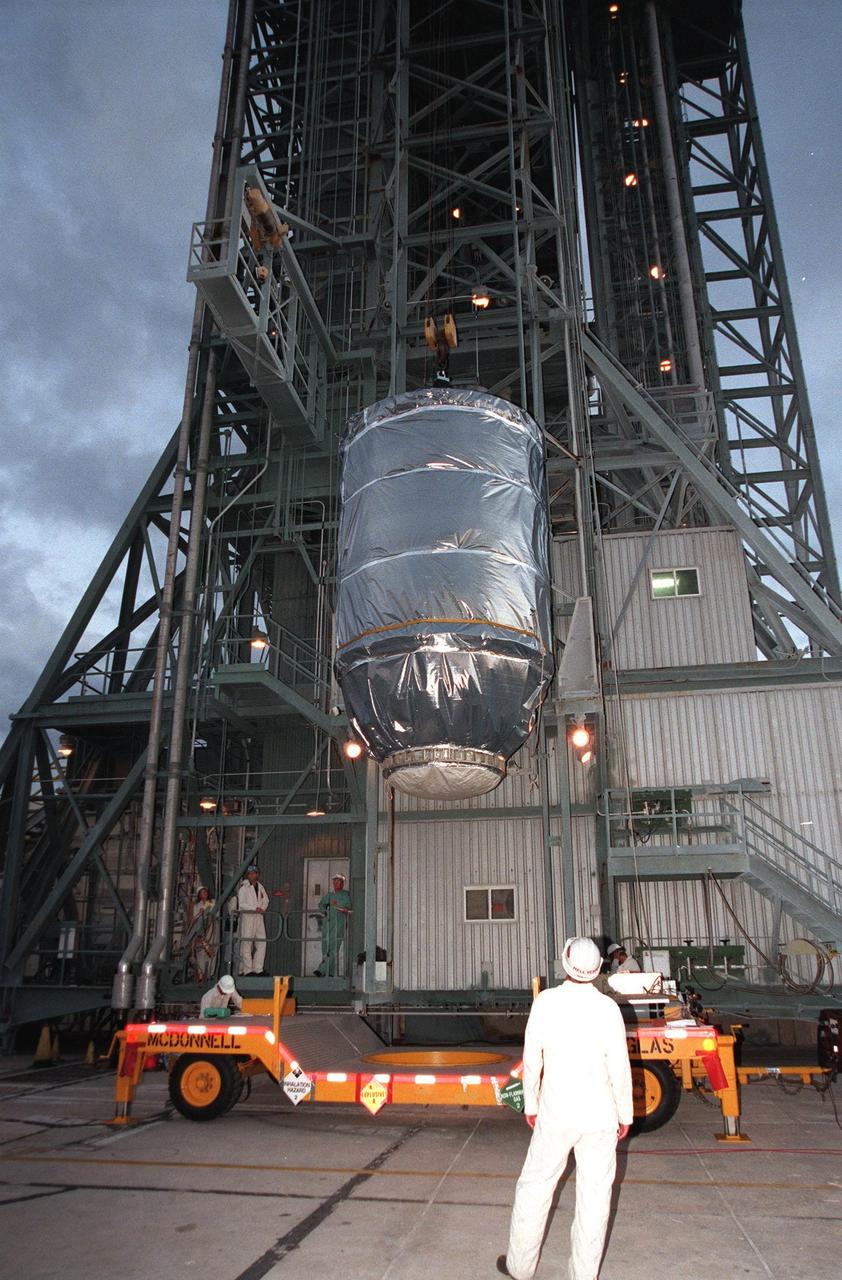
KENNEDY SPACE CENTER, FLA. -- Wrapped in a protective covering, the Mars Climate Orbiter with its upper stage booster is lifted up at Launch Complex 17, Pad A, Cape Canaveral Air Station, in preparation for mating to the second stage of a Boeing Delta II (7425) rocket. Targeted for liftoff on Dec. 10, 1998, the orbiter will be the first spacecraft to be launched in the pair of Mars ’98 missions. After its arrival at the red planet, the Mars Climate Orbiter will be used primarily to support its companion Mars Polar Lander spacecraft, scheduled for launch on Jan. 3, 1999. The orbiter will then monitor the Martian atmosphere and image the planet’s surface on a daily basis for one Martian year, the equivalent of about two Earth years. The spacecraft will observe the appearance and movement of atmospheric dust and water vapor, and characterize seasonal changes on the planet’s surface
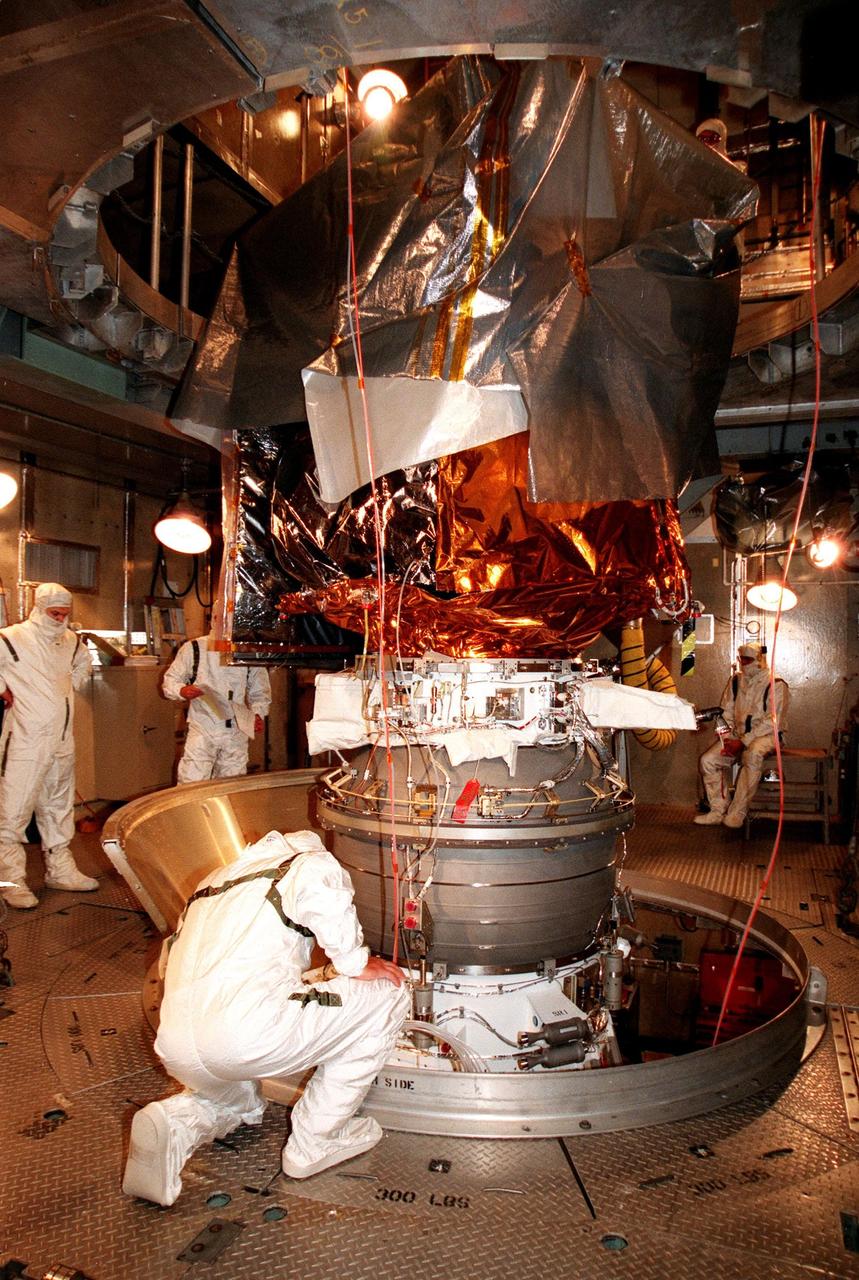
KENNEDY SPACE CENTER, FLA. -- At Launch Complex 17A, Cape Canaveral Air Station, workers get ready to remove the last piece of the canister surrounding the Mars Climate Orbiter. Targeted for liftoff on Dec. 10, 1998, aboard a Boeing Delta II (7425) rocket, the orbiter will be the first spacecraft to be launched in the pair of Mars '98 missions. After its arrival at the red planet, the Mars Climate Orbiter will be used primarily to support its companion Mars Polar Lander spacecraft, scheduled for launch on Jan. 3, 1999. The orbiter will then monitor the Martian atmosphere and image the planet's surface on a daily basis for one Martian year, the equivalent of about two Earth years. The spacecraft will observe the appearance and movement of atmospheric dust and water vapor, and characterize seasonal changes on the planet's surface
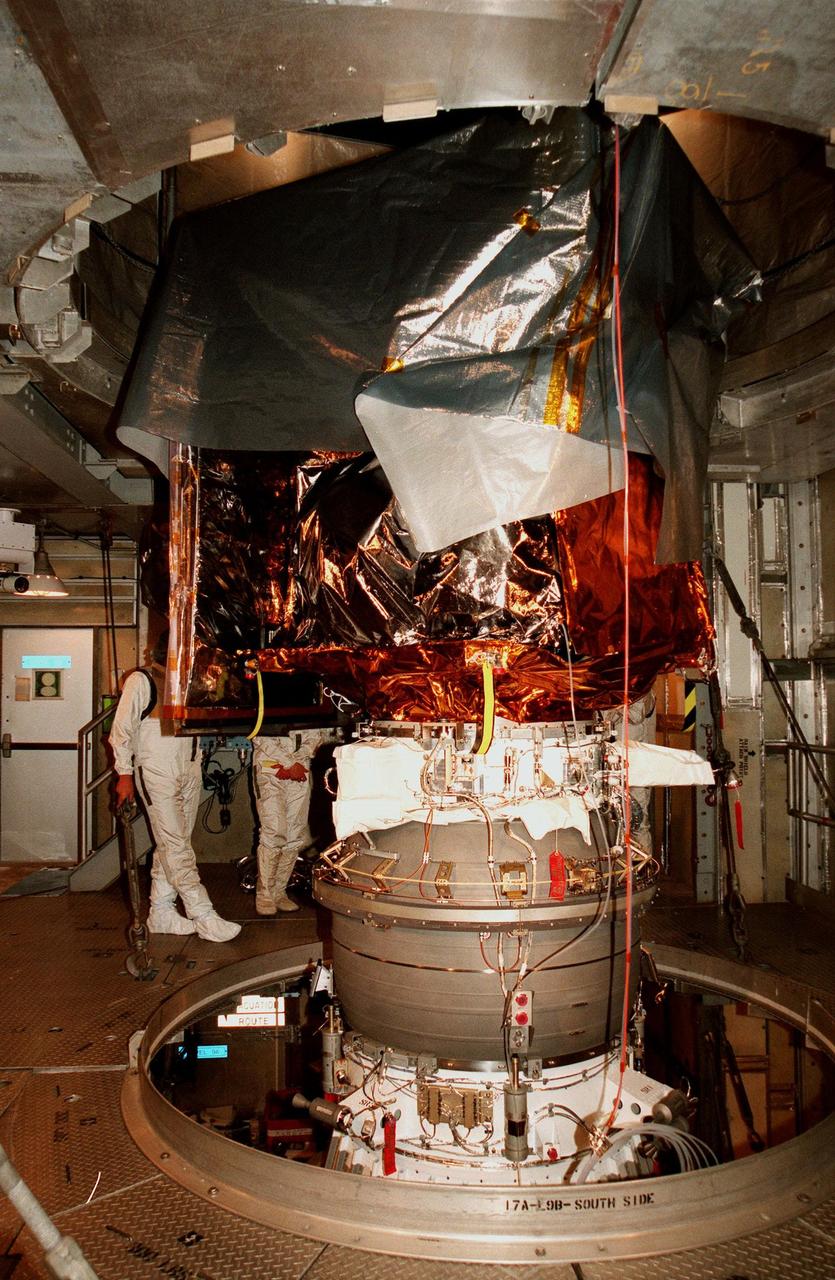
KENNEDY SPACE CENTER, FLA. -- At Launch Complex 17A, Cape Canaveral Air Station, the Mars Climate Orbiter is free of the protective canister that surrounded it during the move to the pad. Targeted for liftoff on Dec. 10, 1998, aboard a Boeing Delta II (7425) rocket, the orbiter will be the first spacecraft to be launched in the pair of Mars '98 missions. After its arrival at the red planet, the Mars Climate Orbiter will be used primarily to support its companion Mars Polar Lander spacecraft, scheduled for launch on Jan. 3, 1999. The orbiter will then monitor the Martian atmosphere and image the planet's surface on a daily basis for one Martian year, the equivalent of about two Earth years. The spacecraft will observe the appearance and movement of atmospheric dust and water vapor, and characterize seasonal changes on the planet's surface
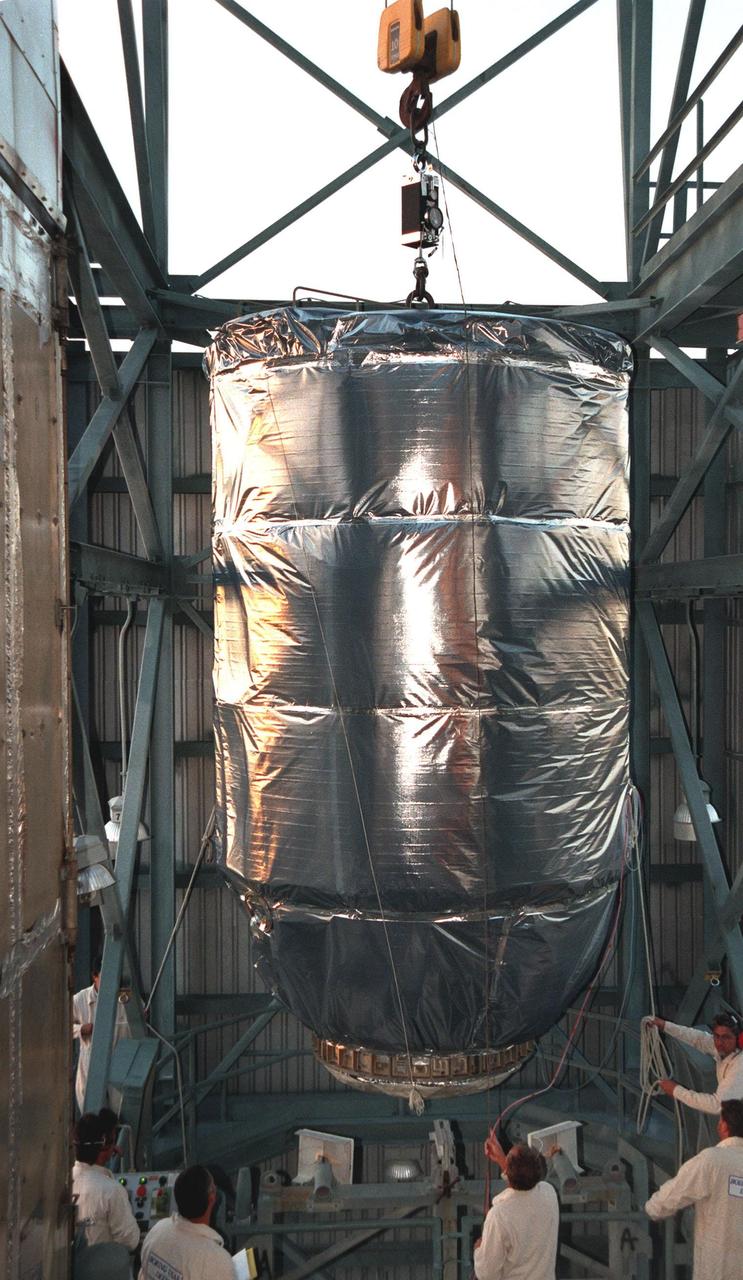
KENNEDY SPACE CENTER, FLA. -- Wrapped in a protective covering, the Mars Climate Orbiter with its upper stage booster is lifted up at Launch Complex 17, Pad A, Cape Canaveral Air Station, in preparation for mating to the second stage of a Boeing Delta II (7425) rocket. Targeted for liftoff on Dec. 10, 1998, the orbiter will be the first spacecraft to be launched in the pair of Mars ’98 missions. After its arrival at the red planet, the Mars Climate Orbiter will be used primarily to support its companion Mars Polar Lander spacecraft, scheduled for launch on Jan. 3, 1999. The orbiter will then monitor the Martian atmosphere and image the planet’s surface on a daily basis for one Martian year, the equivalent of about two Earth years. The spacecraft will observe the appearance and movement of atmospheric dust and water vapor, and characterize seasonal changes on the planet’s surface
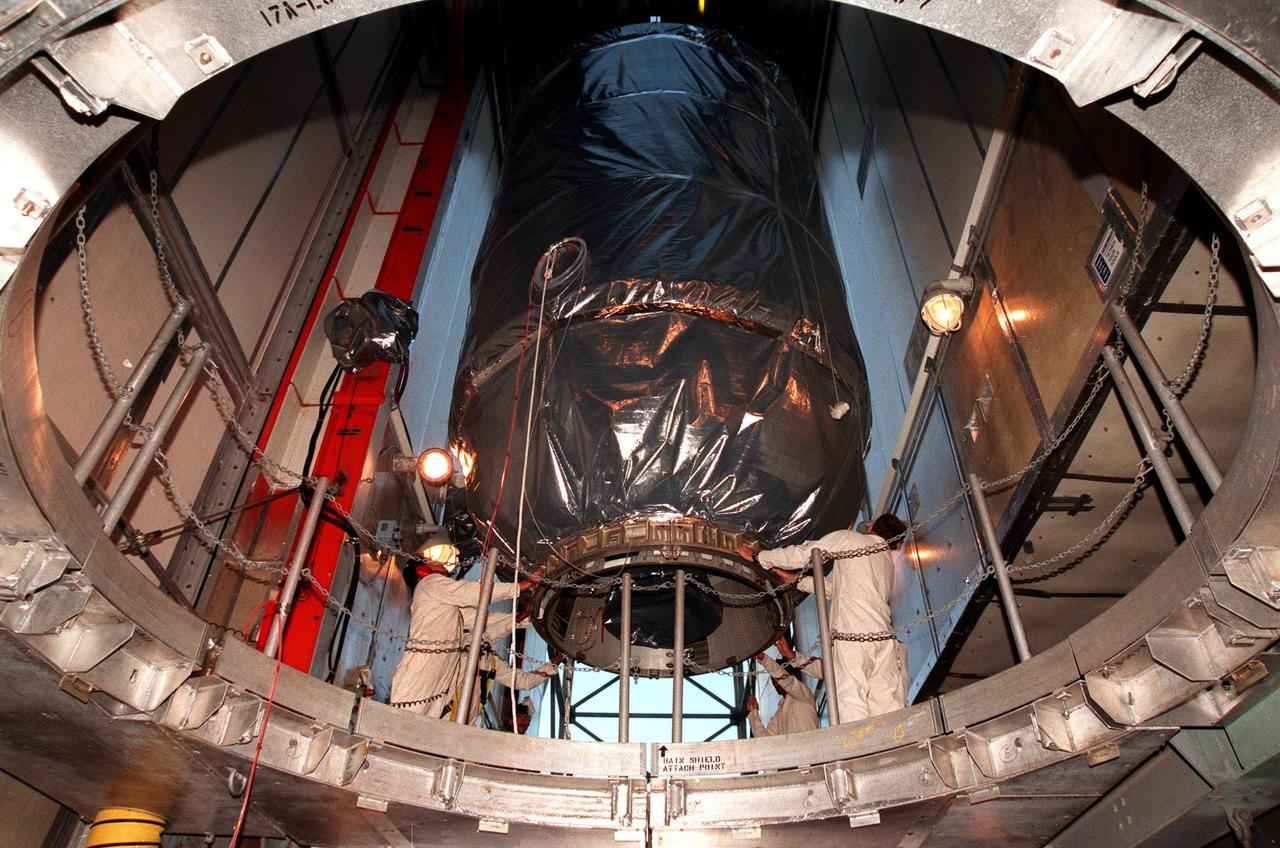
KENNEDY SPACE CENTER, FLA. -- Wrapped in a protective covering, the Mars Climate Orbiter with its upper stage booster is lowered in preparation for mating to the second stage of a Boeing Delta II (7425) rocket at Launch Complex 17, Pad A, Cape Canaveral Air Station. Targeted for liftoff on Dec. 10, 1998, the orbiter will be the first spacecraft to be launched in the pair of Mars ’98 missions. After its arrival at the red planet, the Mars Climate Orbiter will be used primarily to support its companion Mars Polar Lander spacecraft, scheduled for launch on Jan. 3, 1999. The orbiter will then monitor the Martian atmosphere and image the planet’s surface on a daily basis for one Martian year, the equivalent of about two Earth years. The spacecraft will observe the appearance and movement of atmospheric dust and water vapor, and characterize seasonal changes on the planet’s surface
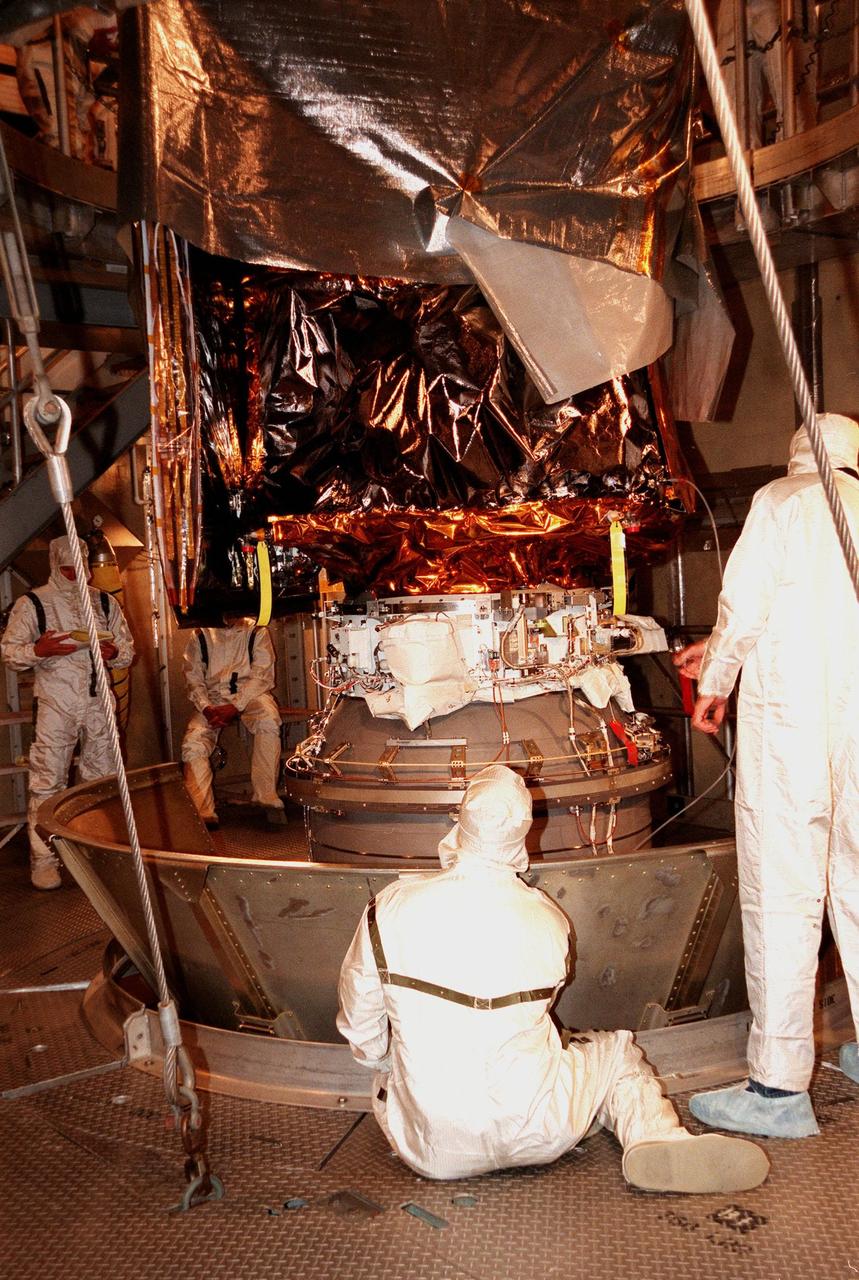
KENNEDY SPACE CENTER, FLA. -- At Launch Complex 17A, Cape Canaveral Air Station, workers remove the canister surrounding the Mars Climate Orbiter. Targeted for liftoff on Dec. 10, 1998, aboard a Boeing Delta II (7425) rocket, the orbiter will be the first spacecraft to be launched in the pair of Mars '98 missions. After its arrival at the red planet, the Mars Climate Orbiter will be used primarily to support its companion Mars Polar Lander spacecraft, scheduled for launch on Jan. 3, 1999. The orbiter will then monitor the Martian atmosphere and image the planet's surface on a daily basis for one Martian year, the equivalent of about two Earth years. The spacecraft will observe the appearance and movement of atmospheric dust and water vapor, and characterize seasonal changes on the planet's surface

NASA's Mars Reconnaissance Orbiter shows bright ripples line the topography in this region, formed within a past climate. Dark dunes and sand streaks (composed of basaltic sand) have moved and filled lower areas, pushed by more recent winds from the top towards the bottom of this image. Lobo Vallis is named for a river on the Ivory Coast. https://photojournal.jpl.nasa.gov/catalog/PIA22346
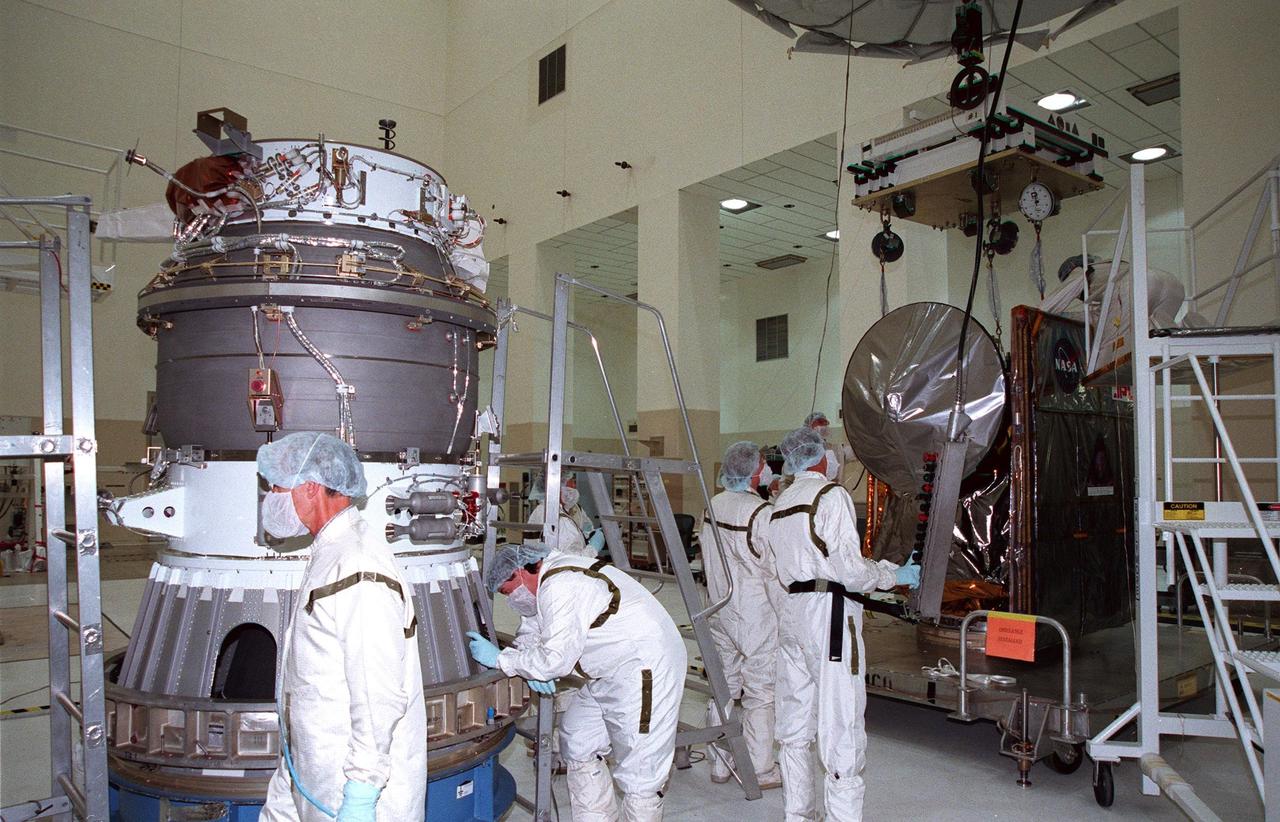
KENNEDY SPACE CENTER, FLA. -- In the Spacecraft Assembly and Encapsulation Facility -2 (SAEF-2), the third stage of the Boeing Delta II launch vehicle (left) waits for mating with the Mars Climate Orbiter (right). The third stage is a solid-propellant Thiokol Star 48B booster, the same final stage used in the 1996 launch of Mars Global Surveyor. Targeted for launch on Dec. 10, 1998, the orbiter is heading for Mars where it will primarily support its companion Mars Polar Lander spacecraft, which is planned for launch on Jan. 3, 1999. The orbiter's instruments will monitor the Martian atmosphere and image the planet's surface on a daily basis for 687 Earth days. It will observe the appearance and movement of atmospheric dust and water vapor, as well as characterize seasonal changes on the surface. The detailed images of the surface features will provide important clues to the planet's early climate history and give scientists more information about possible liquid water reserves beneath the surface
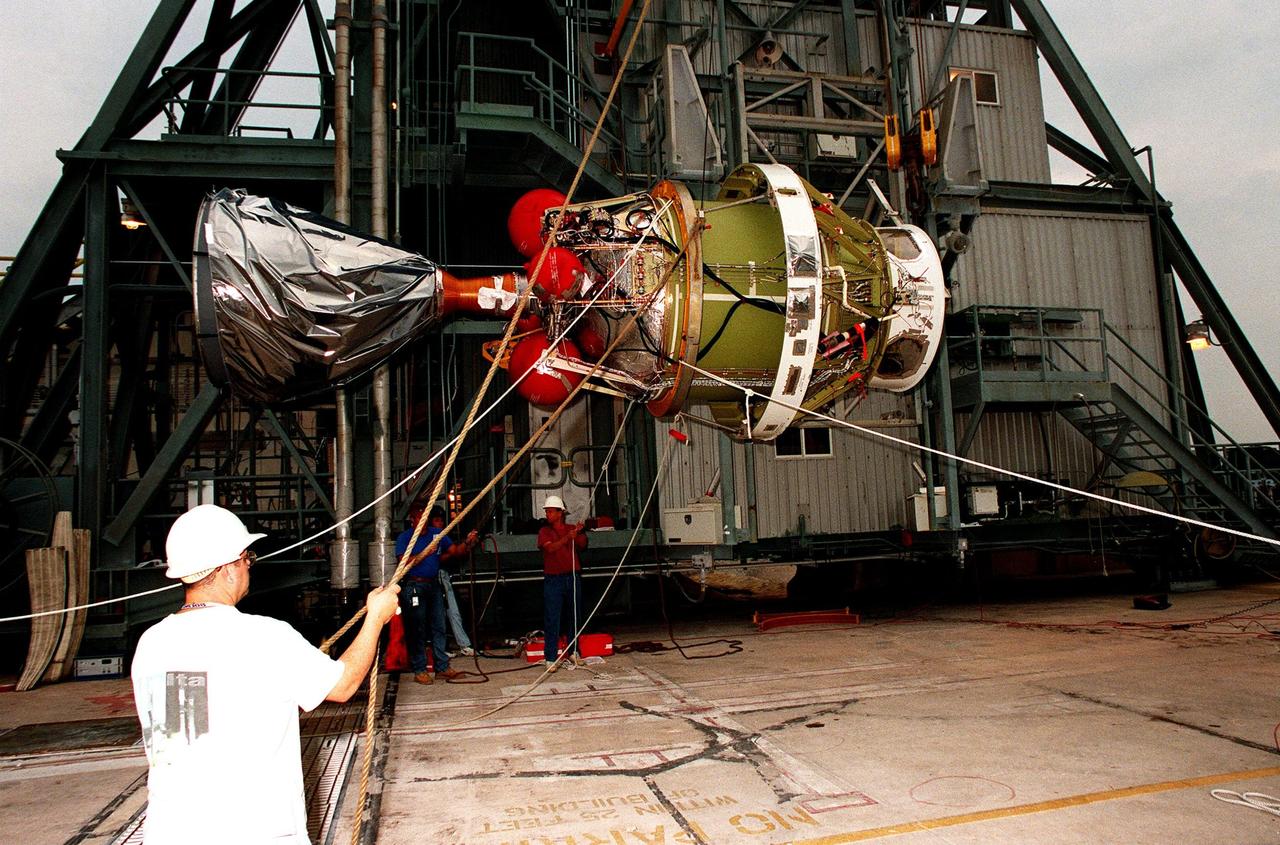
The second stage of a Delta II rocket is prepared for its shift to vertical alongside the gantry at pad 17A at Cape Canaveral Air Station. The rocket is scheduled to be launched on Dec. 10, 1998, heading for Mars and carrying the Mars Climate Orbiter. The orbiter's instruments will monitor the Martian atmosphere and image the planet's surface on a daily basis for 657 days. It will observe the appearance and movement of atmospheric dust and water vapor, as well as characterize seasonal changes on the surface. The detailed images of the surface features will provide important clues to the planet's early climate history and give scientists more information about possible liquid water reserves beneath the surface. The orbiter will primarily support its companion Mars Polar Lander spacecraft, which is planned for launch on Jan. 3, 1999
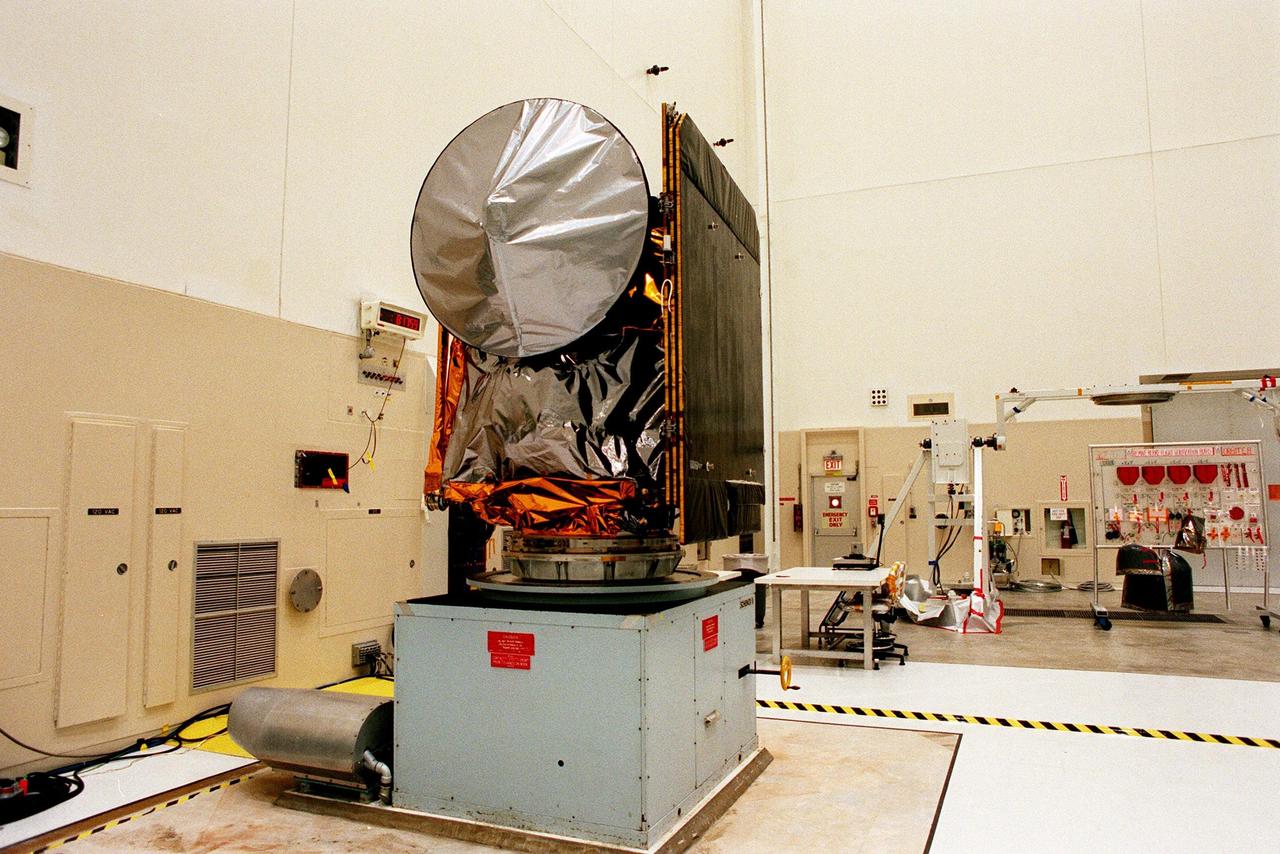
KENNEDY SPACE CENTER, FLA. -- In the Spacecraft Assembly and Encapsulation Facility -2 (SAEF-2), the Mars Climate Orbiter is in place for its spin test. Targeted for launch aboard a Delta II rocket on Dec. 10, 1998, the orbiter is heading for Mars where it will primarily support its companion Mars Polar Lander spacecraft, which is planned for launch on Jan. 3, 1999. The orbiter's instruments will monitor the Martian atmosphere and image the planet's surface on a daily basis for 687 Earth days. It will observe the appearance and movement of atmospheric dust and water vapor, as well as characterize seasonal changes on the surface. The detailed images of the surface features will provide important clues to the planet's early climate history and give scientists more information about possible liquid water reserves beneath the surface
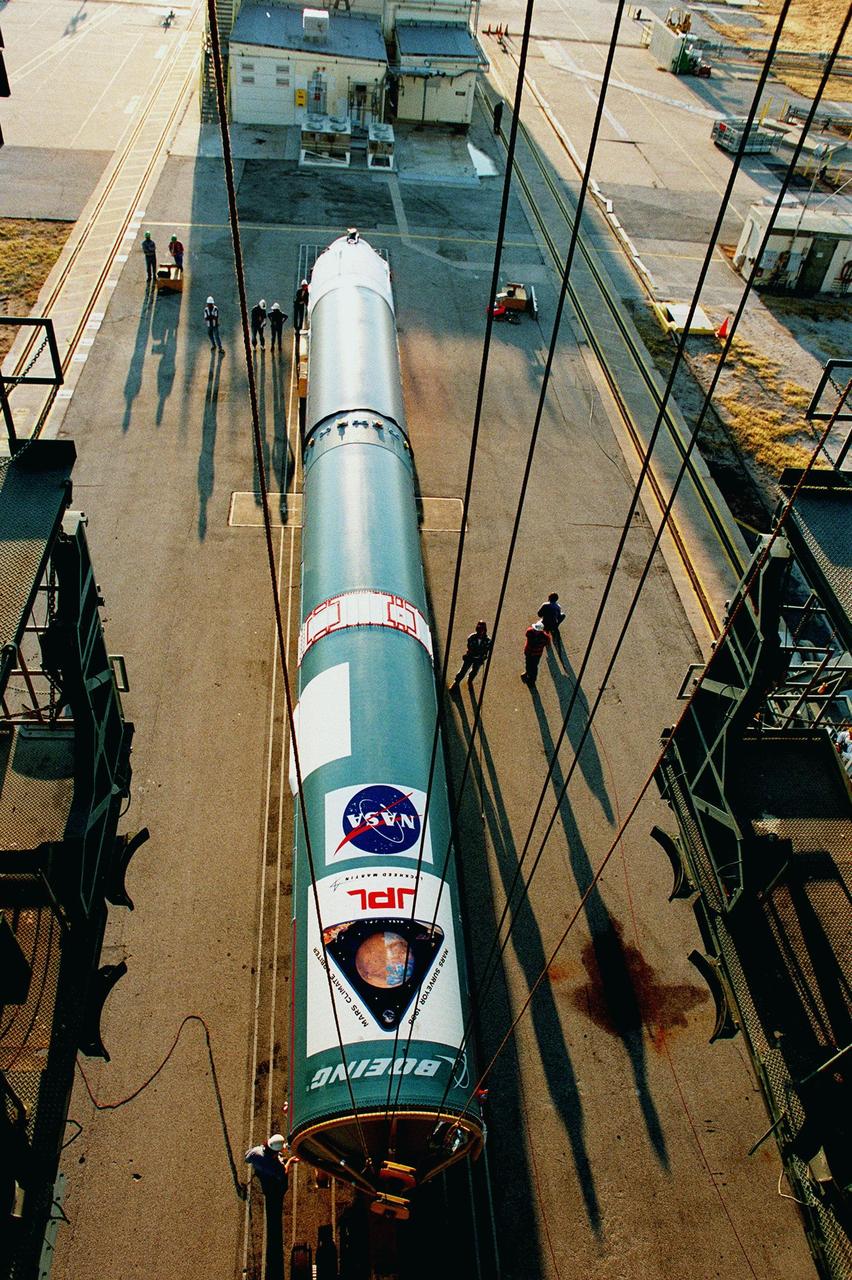
KENNEDY SPACE CENTER, FLA. -- On Pad 17A at Cape Canaveral Air Station, cables from the top of the gantry are attached to the Delta II rocket to lift it into position for launch. Scheduled to launch Dec. 10, 1998, the rocket will be carrying the Mars Climate Orbiter. The orbiter is heading for Mars where it will primarily support its companion Mars Polar Lander spacecraft, which is planned for launch on Jan. 3, 1999. The orbiter's instruments will monitor the Martian atmosphere and image the planet's surface on a daily basis for one Martian year (1.8 Earth years). It will observe the appearance and movement of atmospheric dust and water vapor, as well as characterize seasonal changes on the surface. The detailed images of the surface features will provide important clues to the planet's early climate history and give scientists more information about possible liquid water reserves beneath the surface
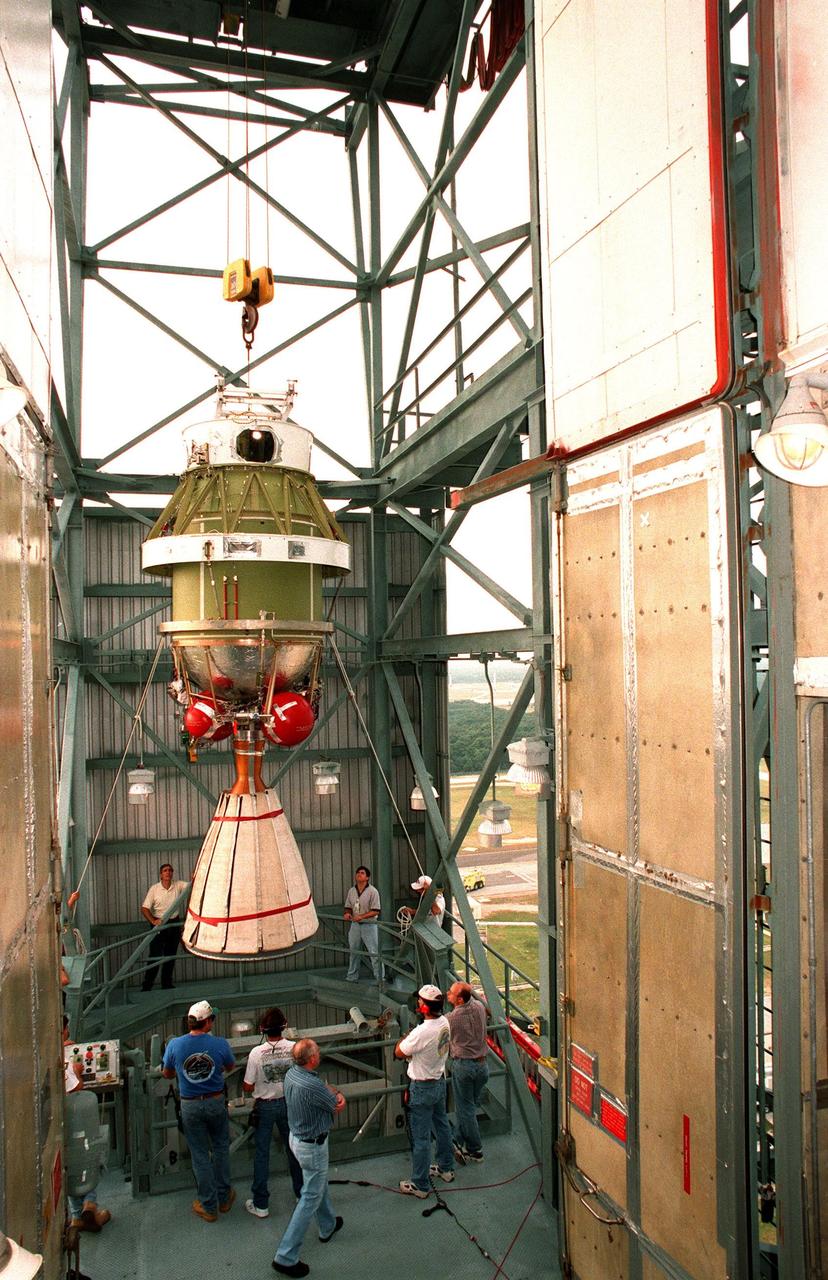
Workers at pad 17A at Cape Canaveral Air Station maneuver the second stage of a Delta II rocket inside the gantry. The rocket is scheduled to be launched on Dec. 10, 1998, heading for Mars and carrying the Mars Climate Orbiter. The orbiter's instruments will monitor the Martian atmosphere and image the planet's surface on a daily basis for 657 days. It will observe the appearance and movement of atmospheric dust and water vapor, as well as characterize seasonal changes on the surface. The detailed images of the surface features will provide important clues to the planet's early climate history and give scientists more information about possible liquid water reserves beneath the surface. The orbiter will primarily support its companion Mars Polar Lander spacecraft, which is planned for launch on Jan. 3, 1999
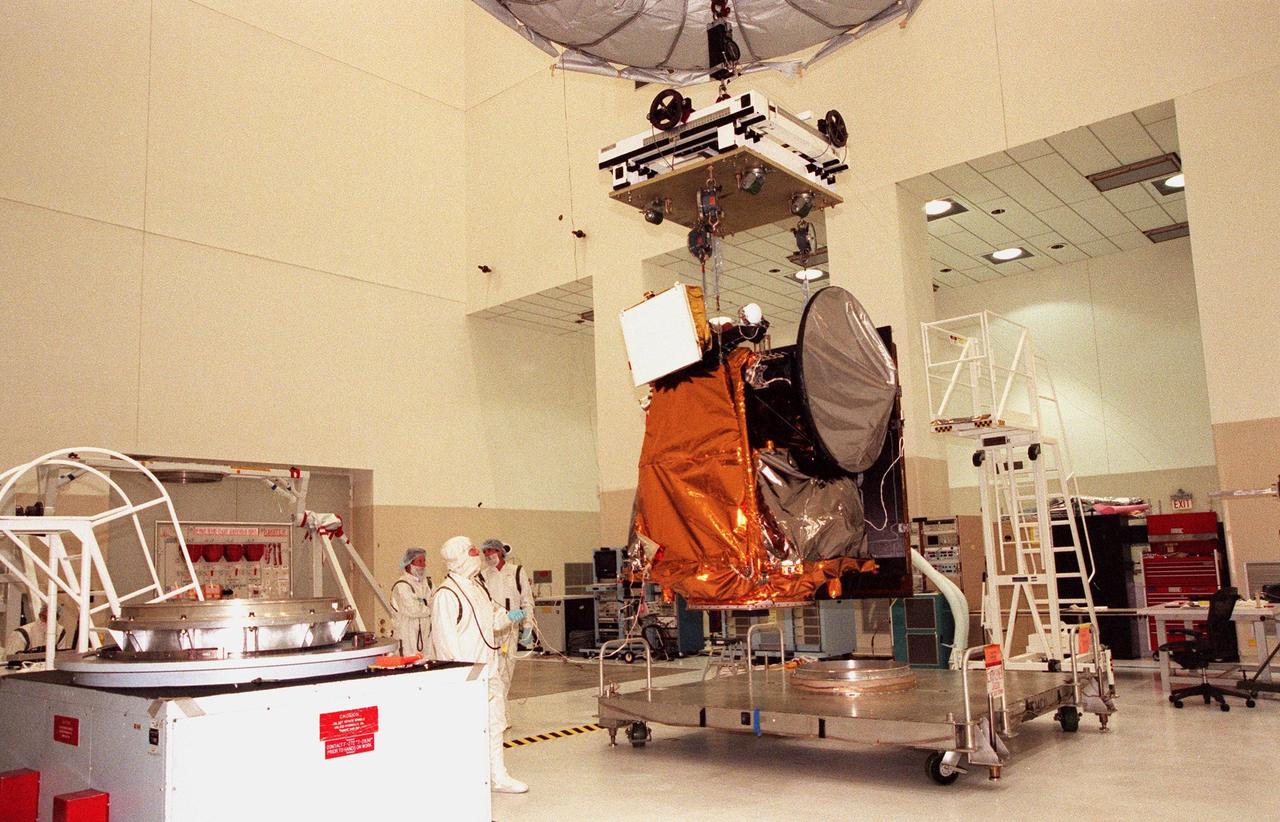
KENNEDY SPACE CENTER, FLA. -- In the Spacecraft Assembly and Encapsulation Facility -2 (SAEF-2), the Mars Climate Orbiter is lifted from the workstand to move it to another site for a spin test. Targeted for launch aboard a Delta II rocket on Dec. 10, 1998, the orbiter is heading for Mars where it will primarily support its companion Mars Polar Lander spacecraft, which is planned for launch on Jan. 3, 1999. The orbiter's instruments will monitor the Martian atmosphere and image the planet's surface on a daily basis for 687 Earth days. It will observe the appearance and movement of atmospheric dust and water vapor, as well as characterize seasonal changes on the surface. The detailed images of the surface features will provide important clues to the planet's early climate history and give scientists more information about possible liquid water reserves beneath the surface
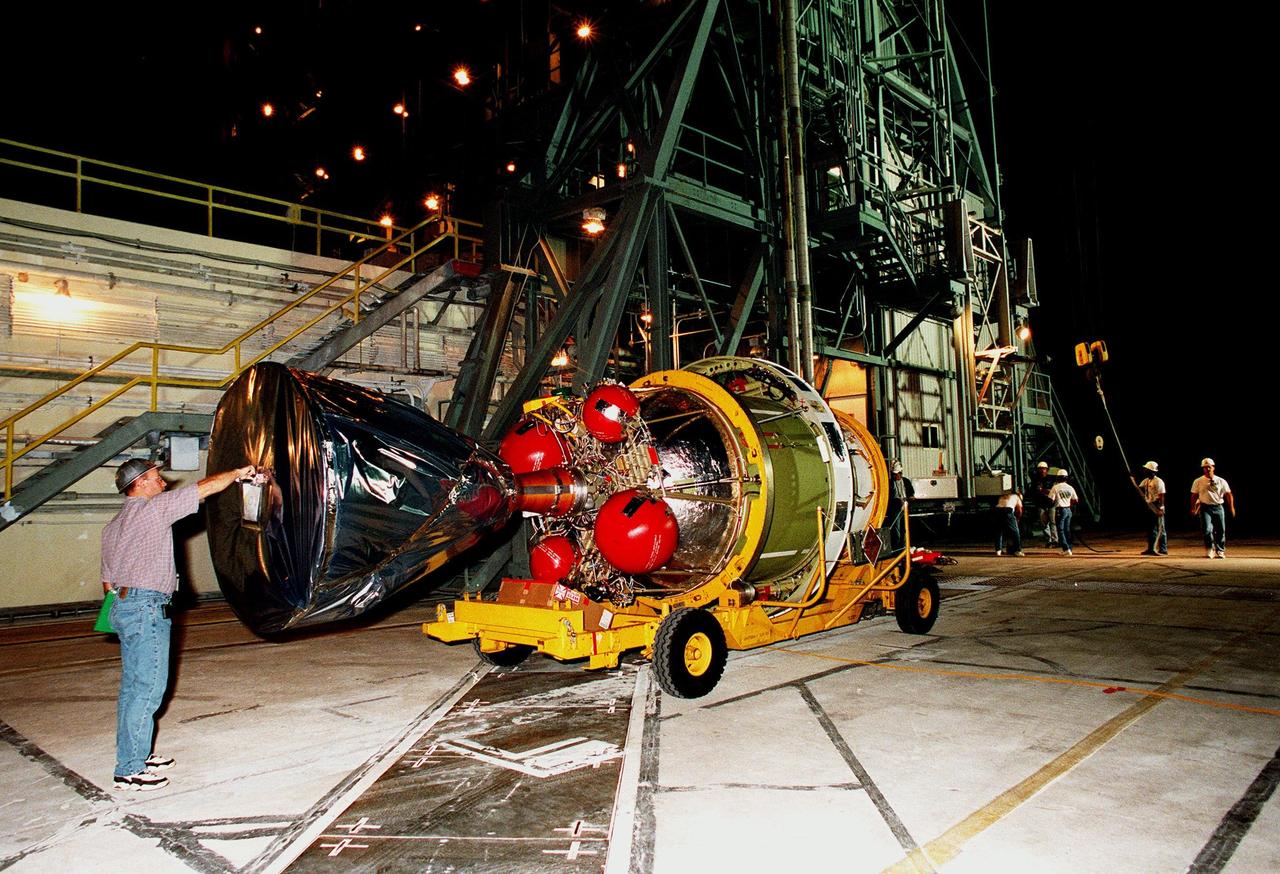
The second stage of a Delta II rocket arrives at pad 17A at Cape Canaveral Air Station. The rocket is scheduled to be launched on Dec. 10, 1998, heading for Mars and carrying the Mars Climate Orbiter. The orbiter's instruments will monitor the Martian atmosphere and image the planet's surface on a daily basis for 657 days. It will observe the appearance and movement of atmospheric dust and water vapor, as well as characterize seasonal changes on the surface. The detailed images of the surface features will provide important clues to the planet's early climate history and give scientists more information about possible liquid water reserves beneath the surface. The orbiter will primarily support its companion Mars Polar Lander spacecraft, which is planned for launch on Jan. 3, 1999
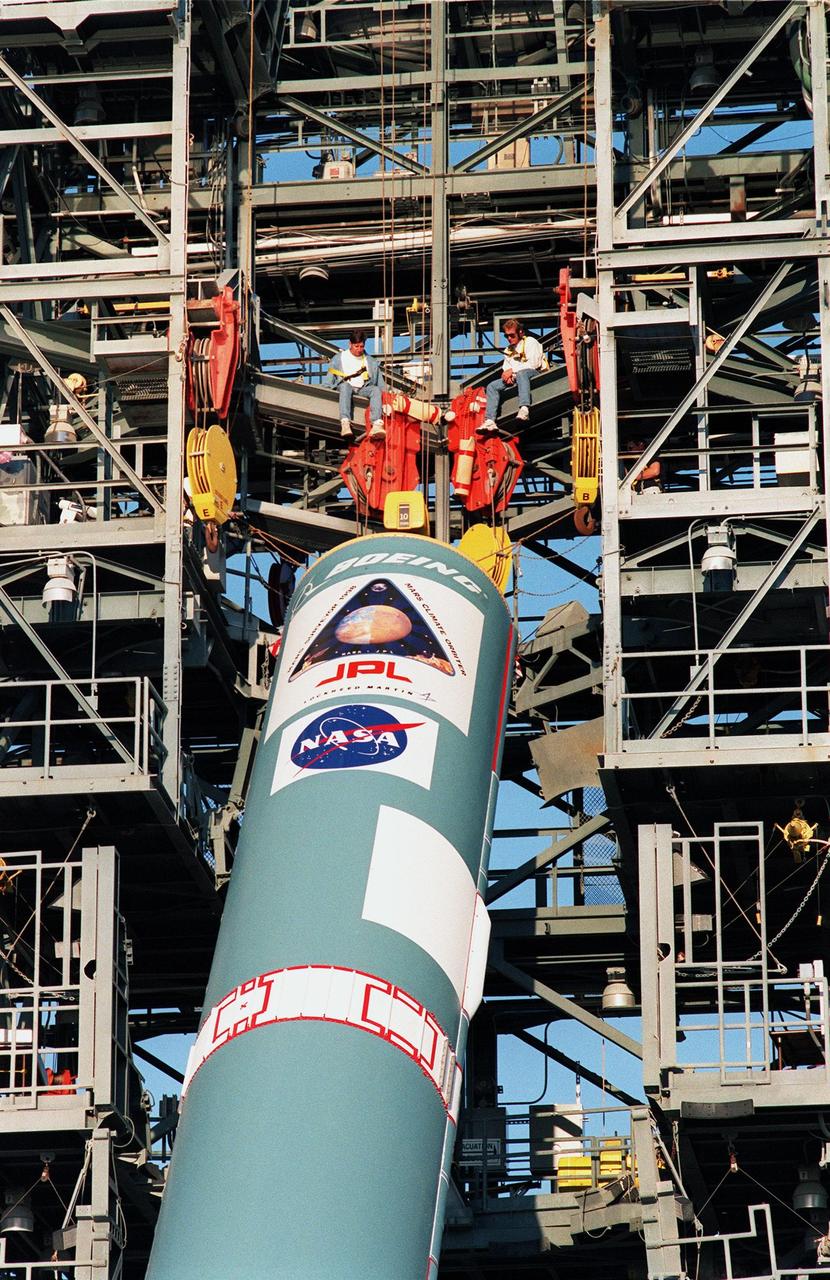
KENNEDY SPACE CENTER, FLA. -- On Pad 17A at Cape Canaveral Air Station, workers on the gantry watch as cables lift a Delta II rocket into position for launch. Scheduled for launch on Dec. 10, 1998, the rocket is carrying the Mars Climate Orbiter. The orbiter is heading for Mars where it will primarily support its companion Mars Polar Lander spacecraft, which is planned for launch on Jan. 3, 1999. The orbiter's instruments will monitor the Martian atmosphere and image the planet's surface on a daily basis for one Martian year (1.8 Earth years). It will observe the appearance and movement of atmospheric dust and water vapor, as well as characterize seasonal changes on the surface. The detailed images of the surface features will provide important clues to the planet's early climate history and give scientists more information about possible liquid water reserves beneath the surface
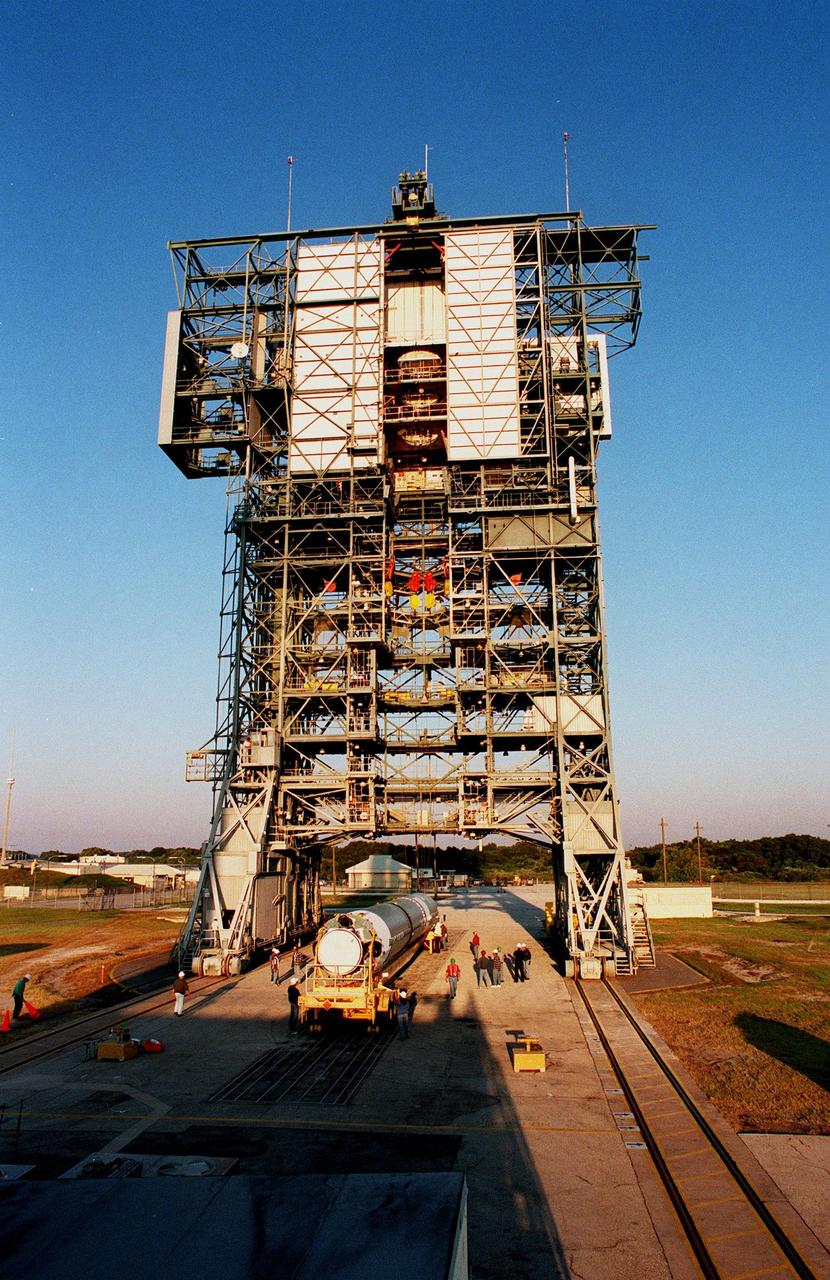
KENNEDY SPACE CENTER, FLA. -- The gantry on Pad 17A at Cape Canaveral Air Station appears to straddle the Delta II rocket below it that is being moved into position for lifting. The rocket is scheduled for launch on Dec. 10, 1998, carrying the Mars Climate Orbiter. The orbiter is heading for Mars where it will primarily support its companion Mars Polar Lander spacecraft, which is planned for launch on Jan. 3, 1999. The orbiter's instruments will monitor the Martian atmosphere and image the planet's surface on a daily basis for one Martian year (1.8 Earth years). It will observe the appearance and movement of atmospheric dust and water vapor, as well as characterize seasonal changes on the surface. The detailed images of the surface features will provide important clues to the planet's early climate history and give scientists more information about possible liquid water reserves beneath the surface

KENNEDY SPACE CENTER, FLA. -- In the Spacecraft Assembly and Encapsulation Facility -2 (SAEF-2), workers lower the Mars Climate Orbiter into place on the spin test equipment. Targeted for launch aboard a Delta II rocket on Dec. 10, 1998, the orbiter is heading for Mars where it will primarily support its companion Mars Polar Lander spacecraft, which is planned for launch on Jan. 3, 1999. The orbiter's instruments will monitor the Martian atmosphere and image the planet's surface on a daily basis for 687 Earth days. It will observe the appearance and movement of atmospheric dust and water vapor, as well as characterize seasonal changes on the surface. The detailed images of the surface features will provide important clues to the planet's early climate history and give scientists more information about possible liquid water reserves beneath the surface
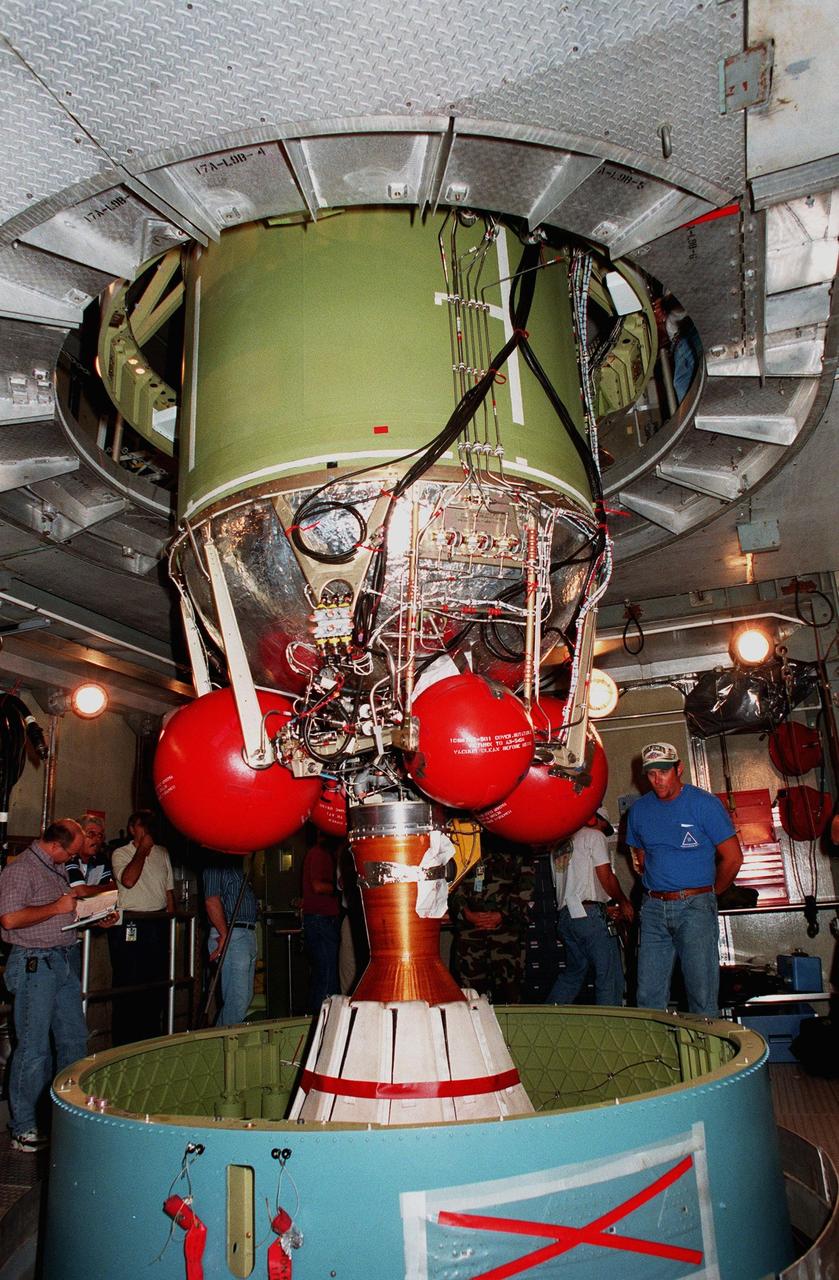
At pad 17A at Cape Canaveral Air Station, the second stage of a Delta II rocket is lowered into the first stage. The rocket is scheduled to be launched on Dec. 10, 1998, heading for Mars and carrying the Mars Climate Orbiter. The orbiter's instruments will monitor the Martian atmosphere and image the planet's surface on a daily basis for 657 days. It will observe the appearance and movement of atmospheric dust and water vapor, as well as characterize seasonal changes on the surface. The detailed images of the surface features will provide important clues to the planet's early climate history and give scientists more information about possible liquid water reserves beneath the surface. The orbiter will primarily support its companion Mars Polar Lander spacecraft, which is planned for launch on Jan. 3, 1999
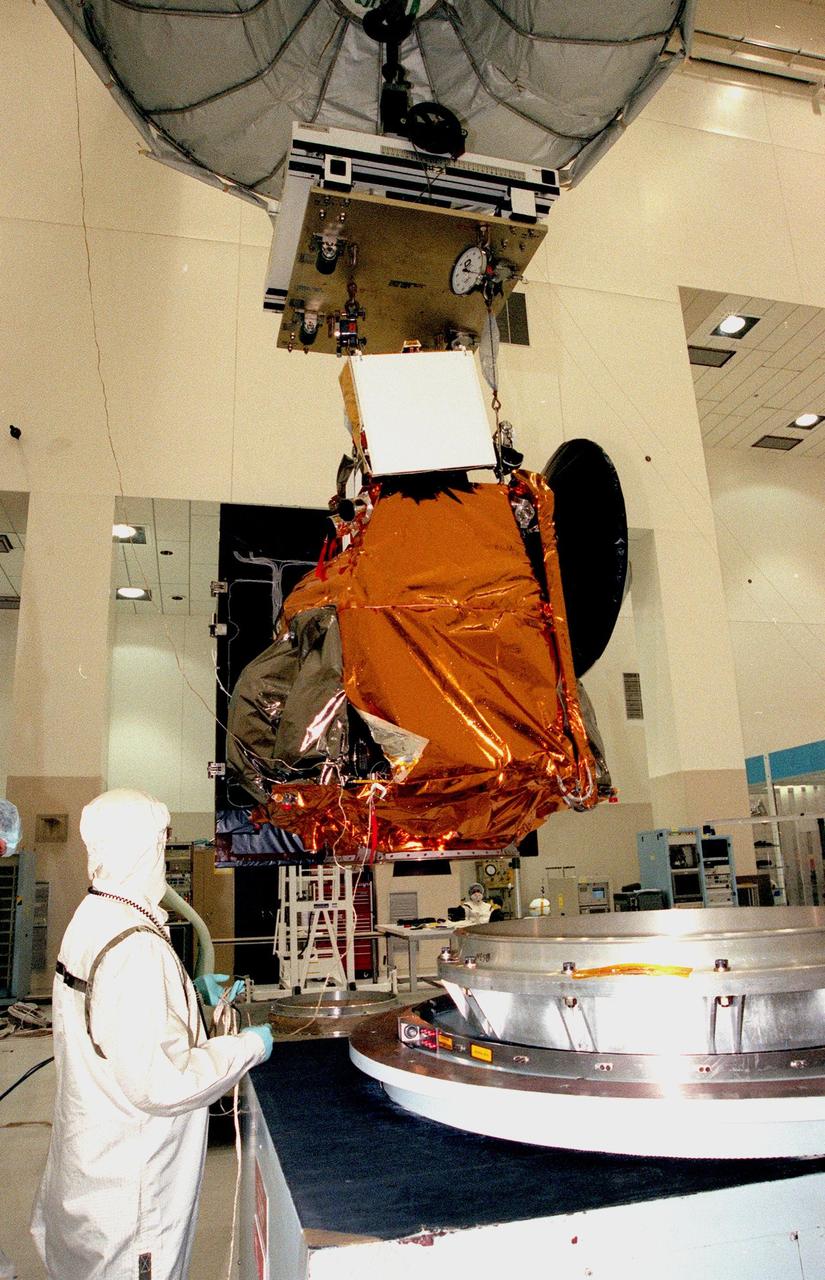
KENNEDY SPACE CENTER, FLA. -- In the Spacecraft Assembly and Encapsulation Facility -2 (SAEF-2), a worker maneuvers the Mars Climate Orbiter, suspended by an overhead crane, to the spin test equipment at lower right. Targeted for launch aboard a Delta II rocket on Dec. 10, 1998, the orbiter is heading for Mars where it will primarily support its companion Mars Polar Lander spacecraft, which is planned for launch on Jan. 3, 1999. The orbiter's instruments will monitor the Martian atmosphere and image the planet's surface on a daily basis for 687 Earth days. It will observe the appearance and movement of atmospheric dust and water vapor, as well as characterize seasonal changes on the surface. The detailed images of the surface features will provide important clues to the planet's early climate history and give scientists more information about possible liquid water reserves beneath the surface
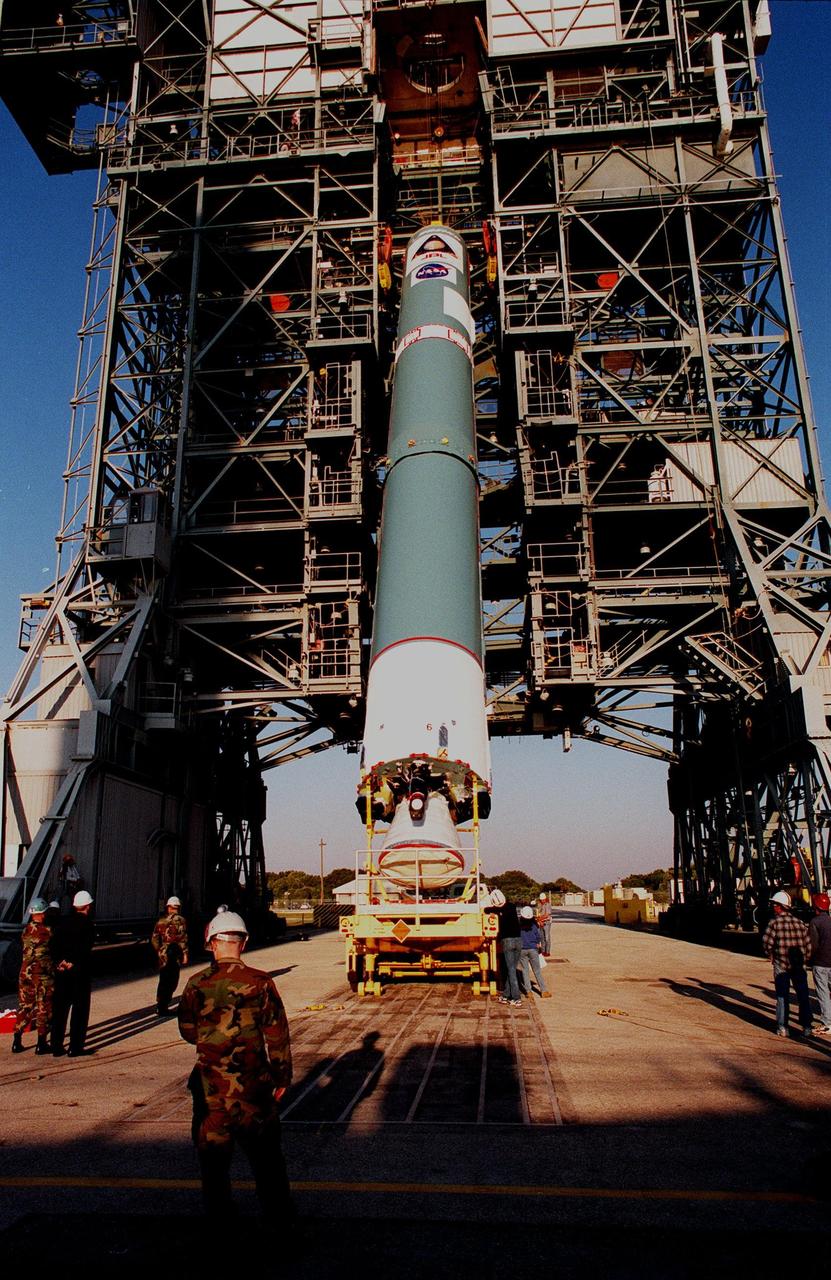
KENNEDY SPACE CENTER, FLA. -- On Pad 17A at Cape Canaveral Air Station, workers on the ground watch as cables lift a Delta II rocket into vertical position. Scheduled for launch on Dec. 10, 1998, the rocket is carrying the Mars Climate Orbiter. The orbiter is heading for Mars where it will primarily support its companion Mars Polar Lander spacecraft, which is planned for launch on Jan. 3, 1999. The orbiter's instruments will monitor the Martian atmosphere and image the planet's surface on a daily basis for one Martian year (1.8 Earth years). It will observe the appearance and movement of atmospheric dust and water vapor, as well as characterize seasonal changes on the surface. The detailed images of the surface features will provide important clues to the planet's early climate history and give scientists more information about possible liquid water reserves beneath the surface
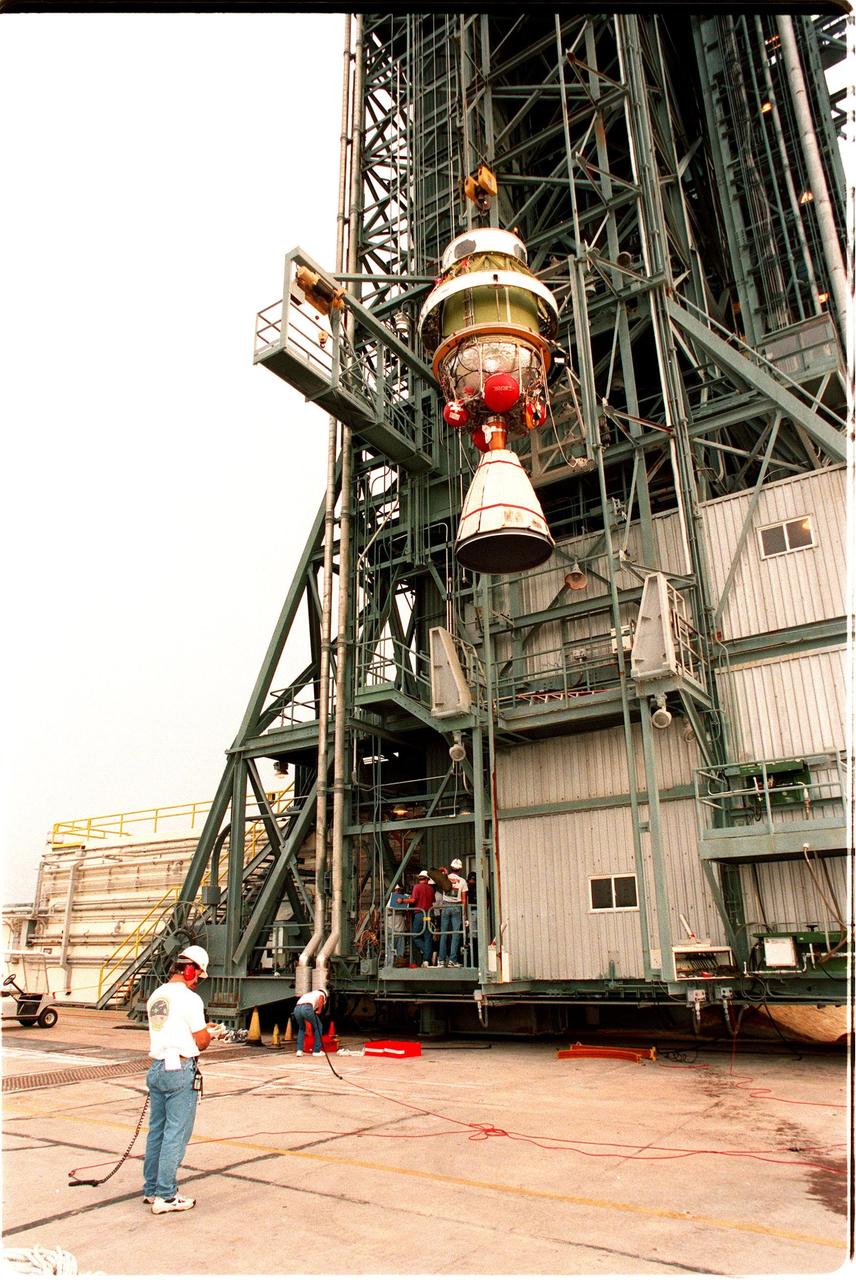
At pad 17A, Cape Canaveral Air Station, the second stage of a Delta II rocket is lifted up the gantry . The rocket is scheduled to be launched on Dec. 10, 1998, heading for Mars and carrying the Mars Climate Orbiter. The orbiter's instruments will monitor the Martian atmosphere and image the planet's surface on a daily basis for 657 days. It will observe the appearance and movement of atmospheric dust and water vapor, as well as characterize seasonal changes on the surface. The detailed images of the surface features will provide important clues to the planet's early climate history and give scientists more information about possible liquid water reserves beneath the surface. The orbiter will primarily support its companion Mars Polar Lander spacecraft, which is planned for launch on Jan. 3, 1999
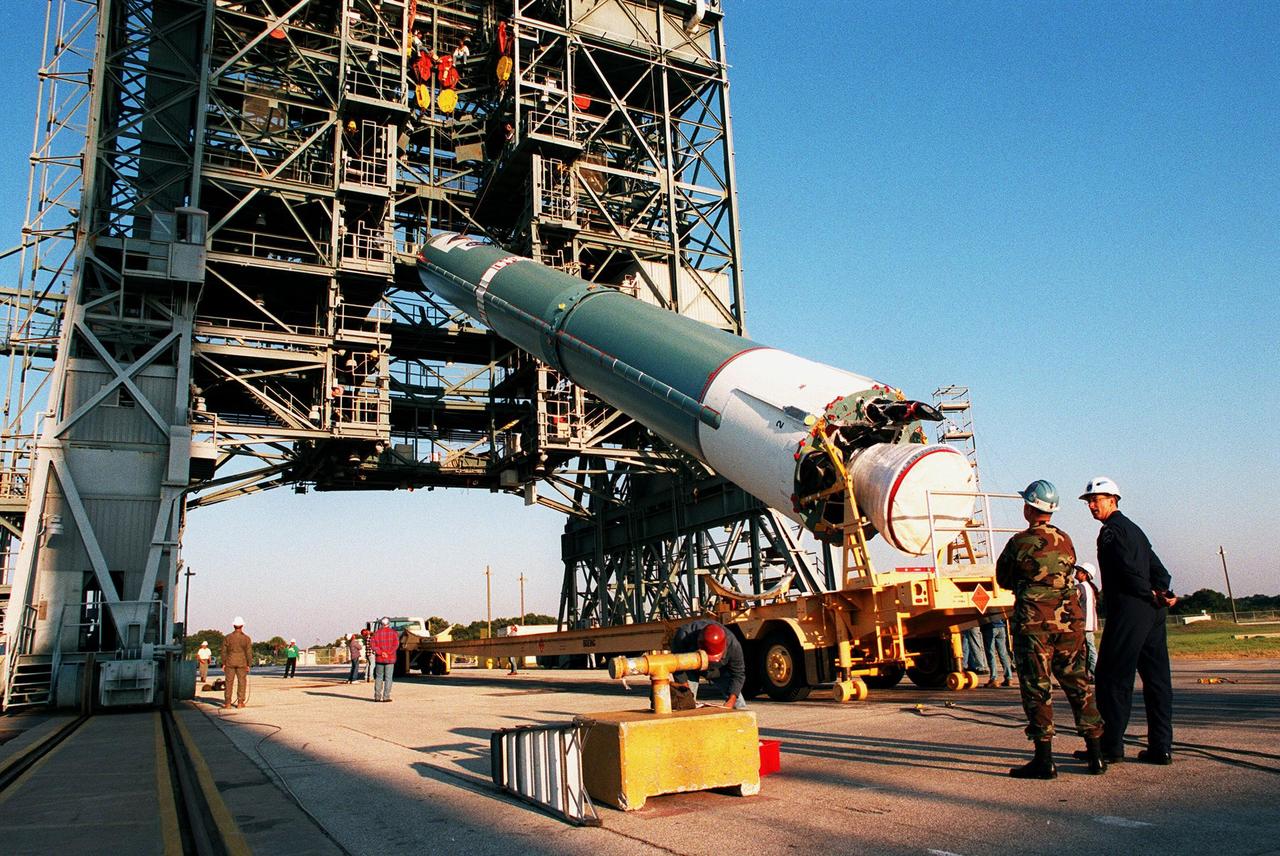
KENNEDY SPACE CENTER, FLA. -- On Pad 17A at Cape Canaveral Air Station, cables lift the Delta II rocket into position for launch. Scheduled for launch on Dec. 10, 1998, the rocket is carrying the Mars Climate Orbiter. The orbiter is heading for Mars where it will primarily support its companion Mars Polar Lander spacecraft, which is planned for launch on Jan. 3, 1999. The orbiter's instruments will monitor the Martian atmosphere and image the planet's surface on a daily basis for one Martian year (1.8 Earth years). It will observe the appearance and movement of atmospheric dust and water vapor, as well as characterize seasonal changes on the surface. The detailed images of the surface features will provide important clues to the planet's early climate history and give scientists more information about possible liquid water reserves beneath the surface

KENNEDY SPACE CENTER, FLA. -- On Pad 17A at Cape Canaveral Air Station, a Delta II rocket appears to float just above the pad as it is lifted up the gantry. Scheduled for launch on Dec. 10, 1998, the rocket is carrying the Mars Climate Orbiter. The orbiter is heading for Mars where it will primarily support its companion Mars Polar Lander spacecraft, which is planned for launch on Jan. 3, 1999. The orbiter's instruments will monitor the Martian atmosphere and image the planet's surface on a daily basis for one Martian year (1.8 Earth years). It will observe the appearance and movement of atmospheric dust and water vapor, as well as characterize seasonal changes on the surface. The detailed images of the surface features will provide important clues to the planet's early climate history and give scientists more information about possible liquid water reserves beneath the surface
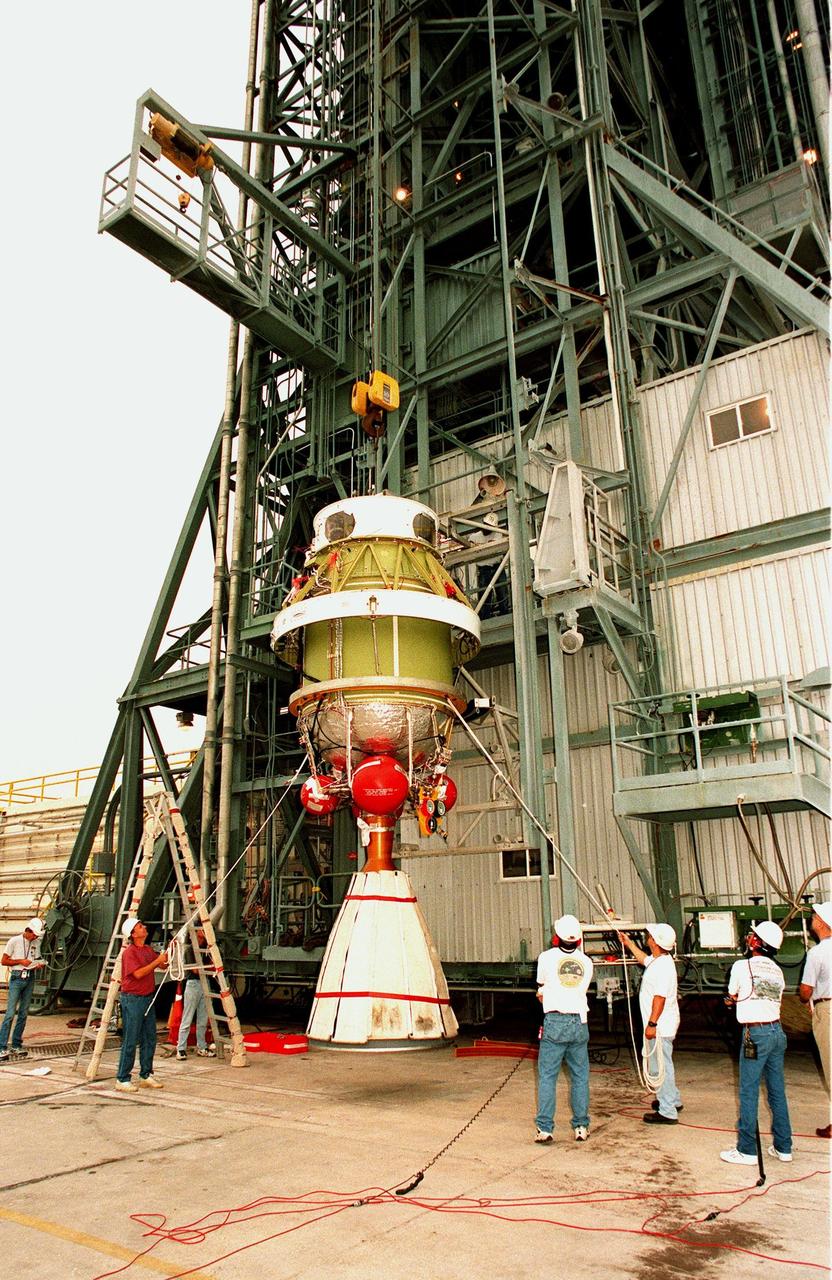
Workers at pad 17A at Cape Canaveral Air Station begin lifting the second stage of a Delta II rocket up the gantry . The rocket is scheduled to be launched on Dec. 10, 1998, heading for Mars and carrying the Mars Climate Orbiter. The orbiter's instruments will monitor the Martian atmosphere and image the planet's surface on a daily basis for 657 days. It will observe the appearance and movement of atmospheric dust and water vapor, as well as characterize seasonal changes on the surface. The detailed images of the surface features will provide important clues to the planet's early climate history and give scientists more information about possible liquid water reserves beneath the surface. The orbiter will primarily support its companion Mars Polar Lander spacecraft, which is planned for launch on Jan. 3, 1999

KENNEDY SPACE CENTER, FLA. -- In the Spacecraft Assembly and Encapsulation Facility -2 (SAEF-2), workers prepare the Mars Climate Orbiter for a spin test. Targeted for launch aboard a Delta II rocket on Dec. 10, 1998, the orbiter is heading for Mars where it will primarily support its companion Mars Polar Lander spacecraft, which is planned for launch on Jan. 3, 1999. At the extreme right can be seen the lander in another work area. The orbiter's instruments will monitor the Martian atmosphere and image the planet's surface on a daily basis for 687 Earth days. It will observe the appearance and movement of atmospheric dust and water vapor, as well as characterize seasonal changes on the surface. The detailed images of the surface features will provide important clues to the planet's early climate history and give scientists more information about possible liquid water reserves beneath the surface
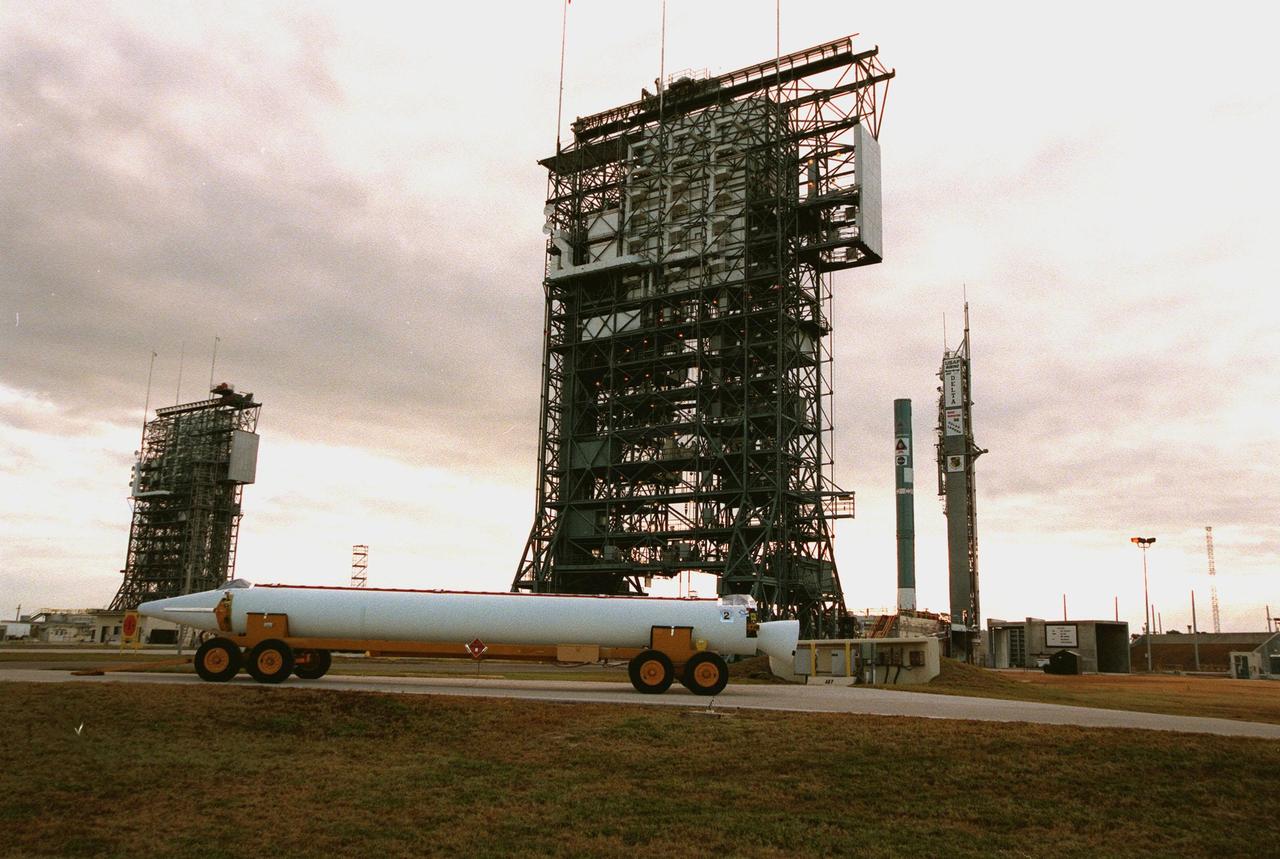
KENNEDY SPACE CENTER, FLA. -- On Pad 17B, Cape Canaveral Air Station, a solid rocket booster waits for mating with the Delta II rocket (in background) carrying the Mars Polar Lander. The rocket will be used to launch the Mars Polar Lander on Jan. 3, 1999. The lander is a solar-powered spacecraft designed to touch down on the Martian surface near the northern-most boundary of the south pole in order to study the water cycle there. The lander also will help scientists learn more about climate change and current resources on Mars, studying such things as frost, dust, water vapor and condensates in the Martian atmosphere. It is the second spacecraft to be launched in a pair of Mars '98 missions. The first is the Mars Climate Orbiter, to be launched aboard a Delta II rocket from Launch Complex 17A in December 1998
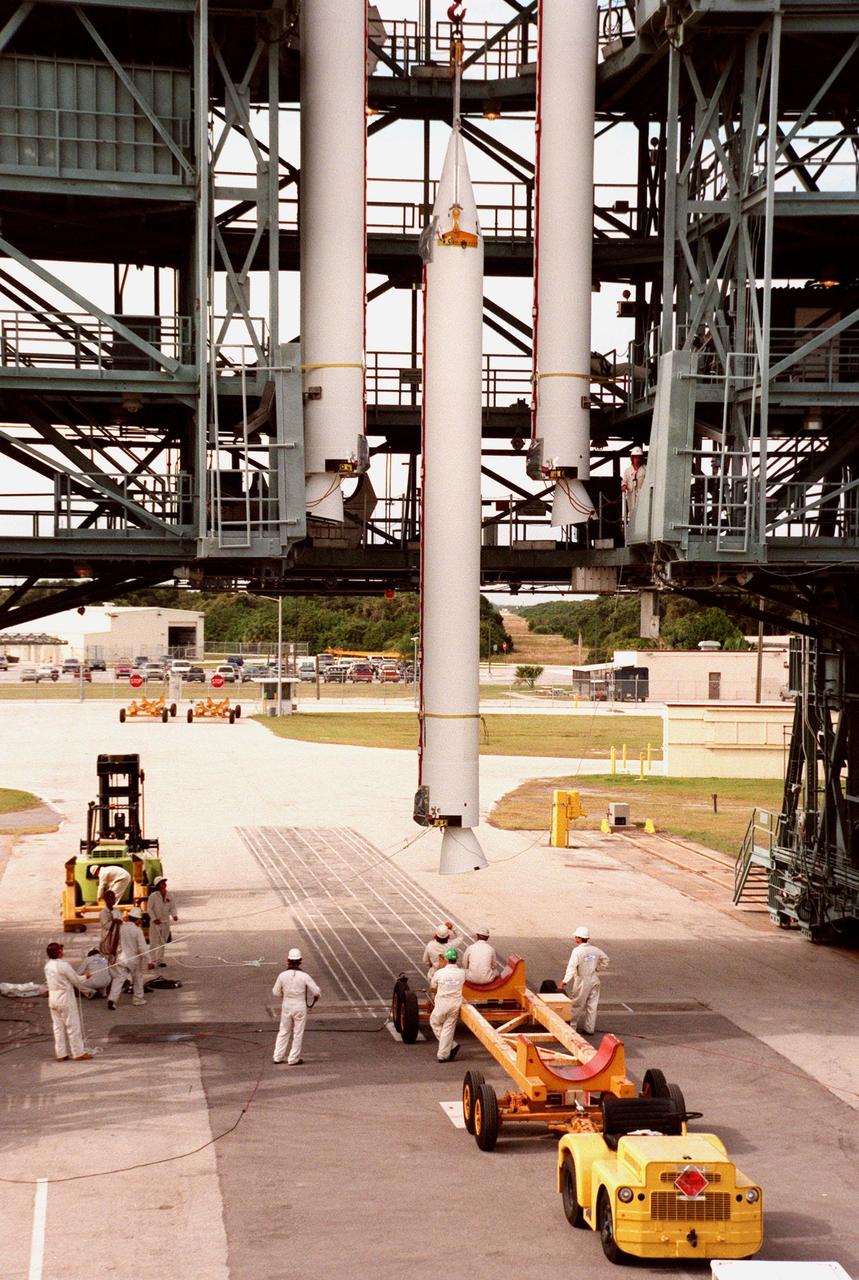
KENNEDY SPACE CENTER, FLA. -- On Pad 17B, Cape Canaveral Air Station, a solid rocket booster hangs in place between two other rocket boosters waiting to be mated with the Delta II rocket carrying the Mars Polar Lander. The rocket will be used to launch the Mars Polar Lander on Jan. 3, 1999. The lander is a solar-powered spacecraft designed to touch down on the Martian surface near the northern-most boundary of the south pole in order to study the water cycle there. The lander also will help scientists learn more about climate change and current resources on Mars, studying such things as frost, dust, water vapor and condensates in the Martian atmosphere. It is the second spacecraft to be launched in a pair of Mars '98 missions. The first is the Mars Climate Orbiter, to be launched aboard a Delta II rocket from Launch Complex 17A in December 1998
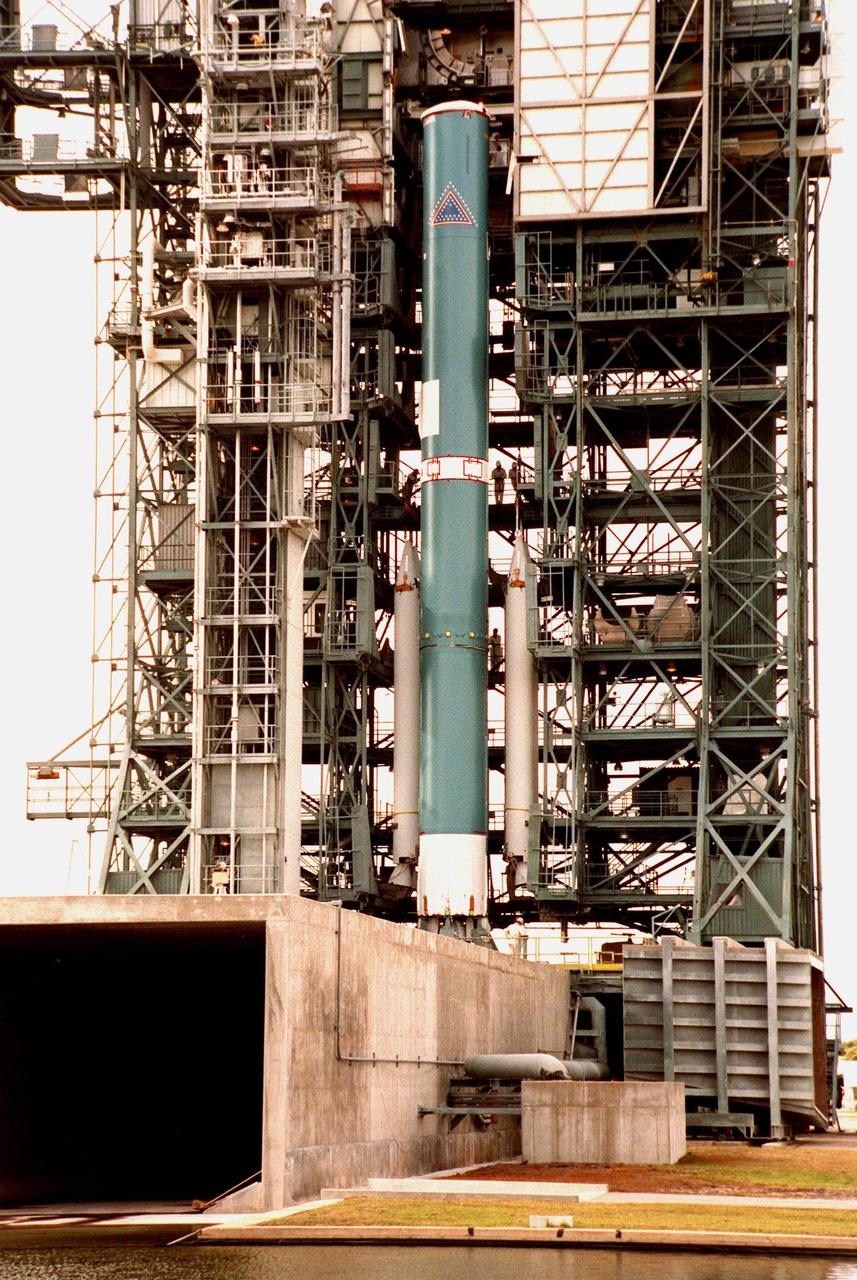
KENNEDY SPACE CENTER, FLA. -- On Pad 17B, Cape Canaveral Air Station, the gantry holding the solid rocket boosters is moved into place next to the Delta II rocket carrying the Mars Polar Lander. The rocket will be used to launch the Mars Polar Lander on Jan. 3, 1999. The lander is a solar-powered spacecraft designed to touch down on the Martian surface near the northern-most boundary of the south pole in order to study the water cycle there. The lander also will help scientists learn more about climate change and current resources on Mars, studying such things as frost, dust, water vapor and condensates in the Martian atmosphere. It is the second spacecraft to be launched in a pair of Mars '98 missions. The first is the Mars Climate Orbiter, to be launched aboard a Delta II rocket from Launch Complex 17A in December 1998
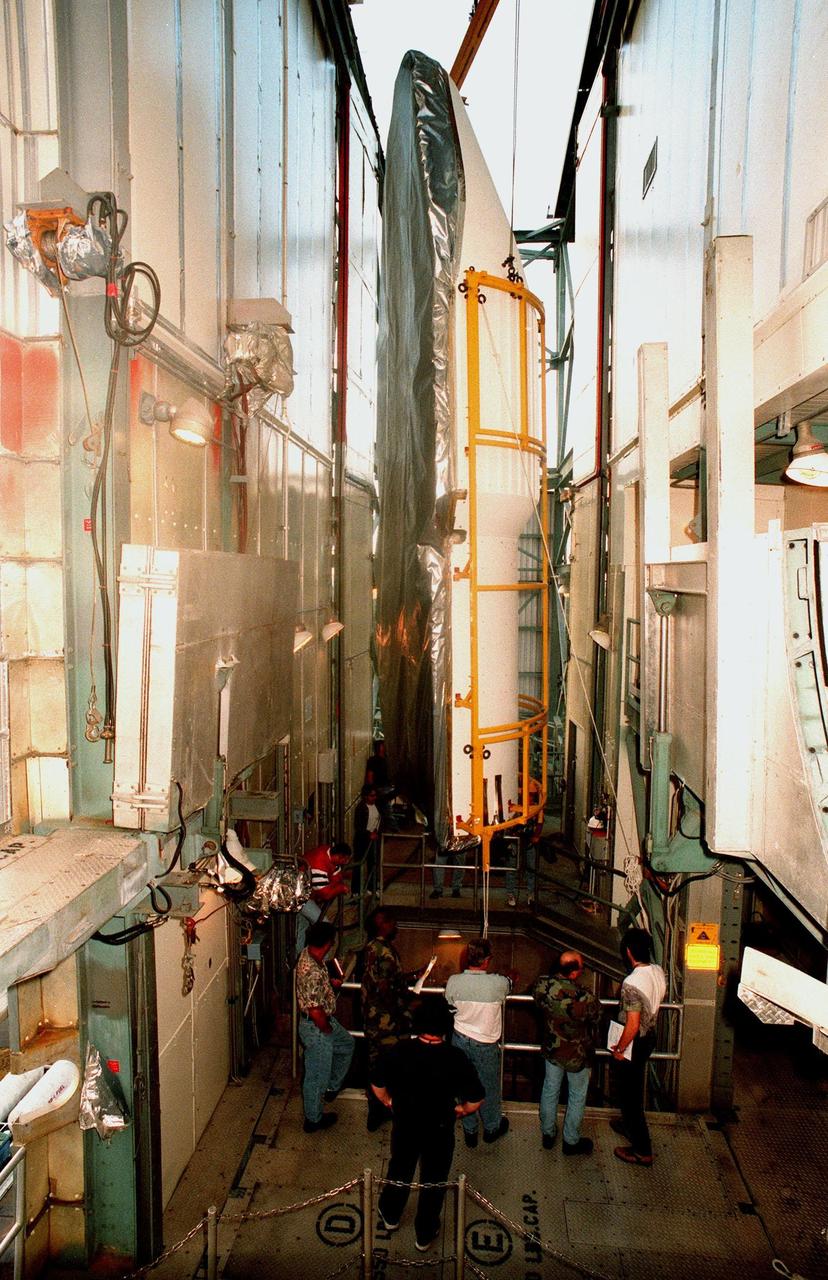
KENNEDY SPACE CENTER, FLA. -- Inside the gantry on Pad 17B, Cape Canaveral Air Station, the fairing for the upper stages of the Delta II rocket carrying the Mars Polar Lander waits to be lowered into the white room. The rocket will be used to launch the Mars Polar Lander on Jan. 3, 1999. The lander is a solar-powered spacecraft designed to touch down on the Martian surface near the northern-most boundary of the south pole in order to study the water cycle there. The lander also will help scientists learn more about climate change and current resources on Mars, studying such things as frost, dust, water vapor and condensates in the Martian atmosphere. It is the second spacecraft to be launched in a pair of Mars '98 missions. The first is the Mars Climate Orbiter, to be launched aboard a Delta II rocket from Launch Complex 17A in December 1998
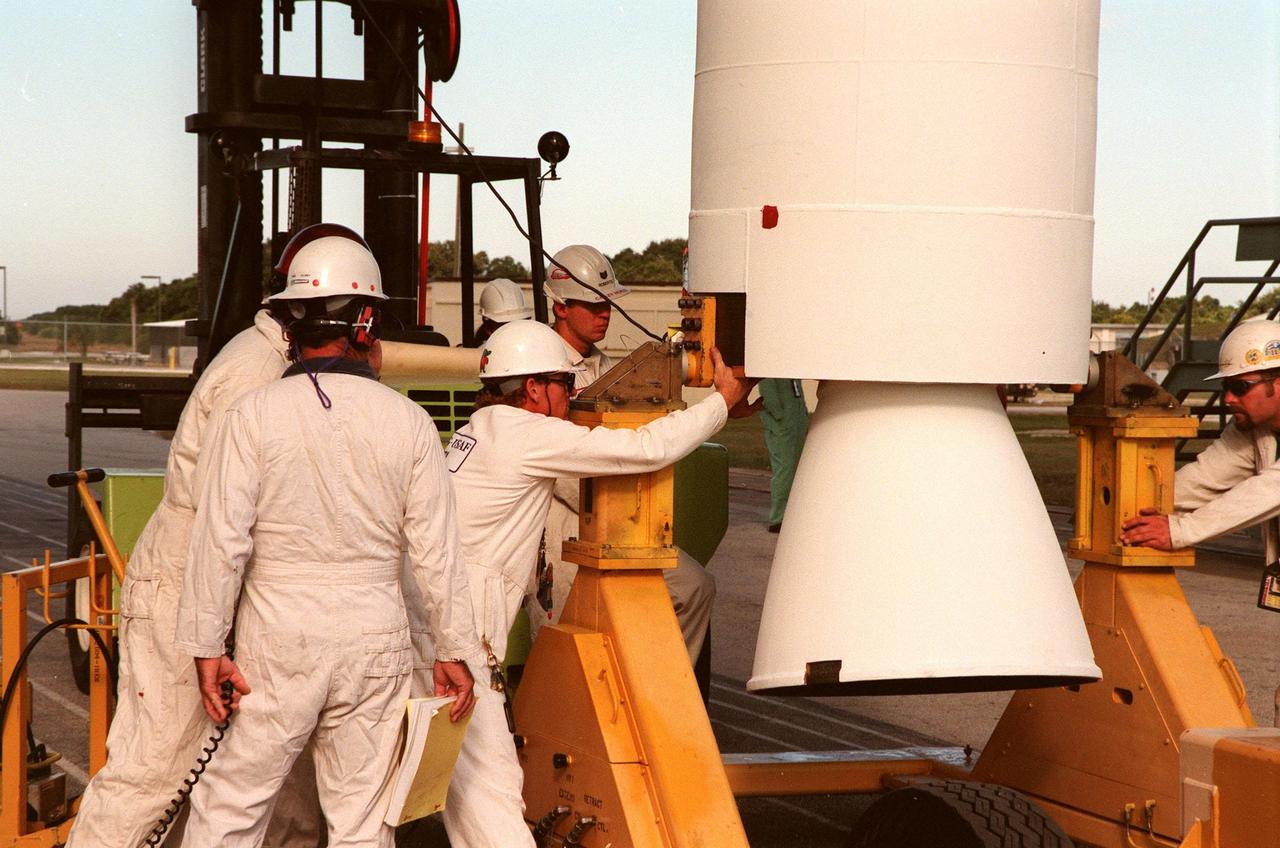
KENNEDY SPACE CENTER, FLA. -- On Pad 17B, Cape Canaveral Air Station, workers monitor the solid rocket booster before its being lifted to mate with the Delta II rocket carrying the Mars Polar Lander. The rocket will be used to launch the Mars Polar Lander on Jan. 3, 1999. The lander is a solar-powered spacecraft designed to touch down on the Martian surface near the northern-most boundary of the south pole in order to study the water cycle there. The lander also will help scientists learn more about climate change and current resources on Mars, studying such things as frost, dust, water vapor and condensates in the Martian atmosphere. It is the second spacecraft to be launched in a pair of Mars '98 missions. The first is the Mars Climate Orbiter, to be launched aboard a Delta II rocket from Launch Complex 17A in December 1998
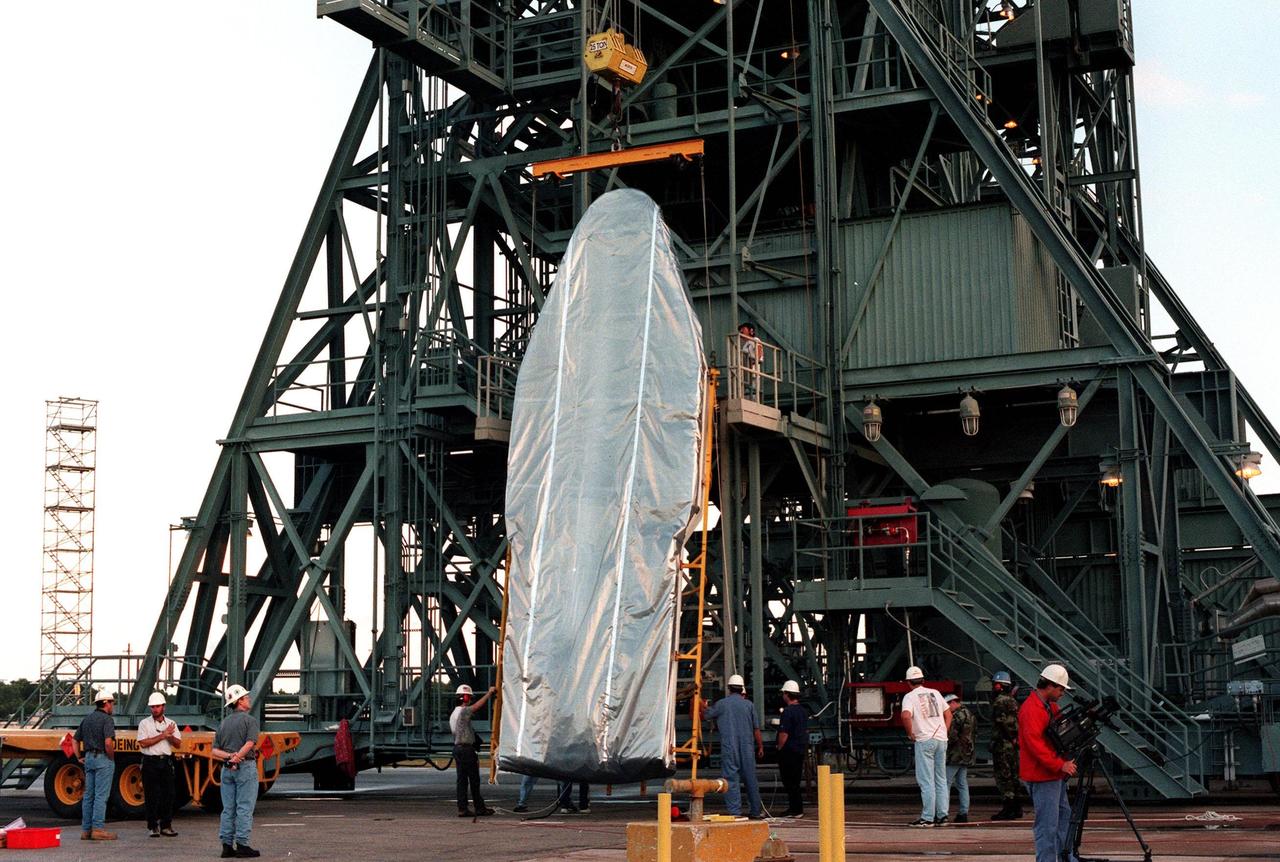
KENNEDY SPACE CENTER, FLA. -- The fairing for the upper stages of the Delta II rocket carrying the Mars Polar Lander is lifted to a vertical position on Pad 17B, Cape Canaveral Air Station. The rocket will be used to launch the Mars Polar Lander on Jan. 3, 1999. The lander is a solar-powered spacecraft designed to touch down on the Martian surface near the northern-most boundary of the south pole in order to study the water cycle there. The lander also will help scientists learn more about climate change and current resources on Mars, studying such things as frost, dust, water vapor and condensates in the Martian atmosphere. It is the second spacecraft to be launched in a pair of Mars '98 missions. The first is the Mars Climate Orbiter, to be launched aboard a Delta II rocket from Launch Complex 17A in December 1998
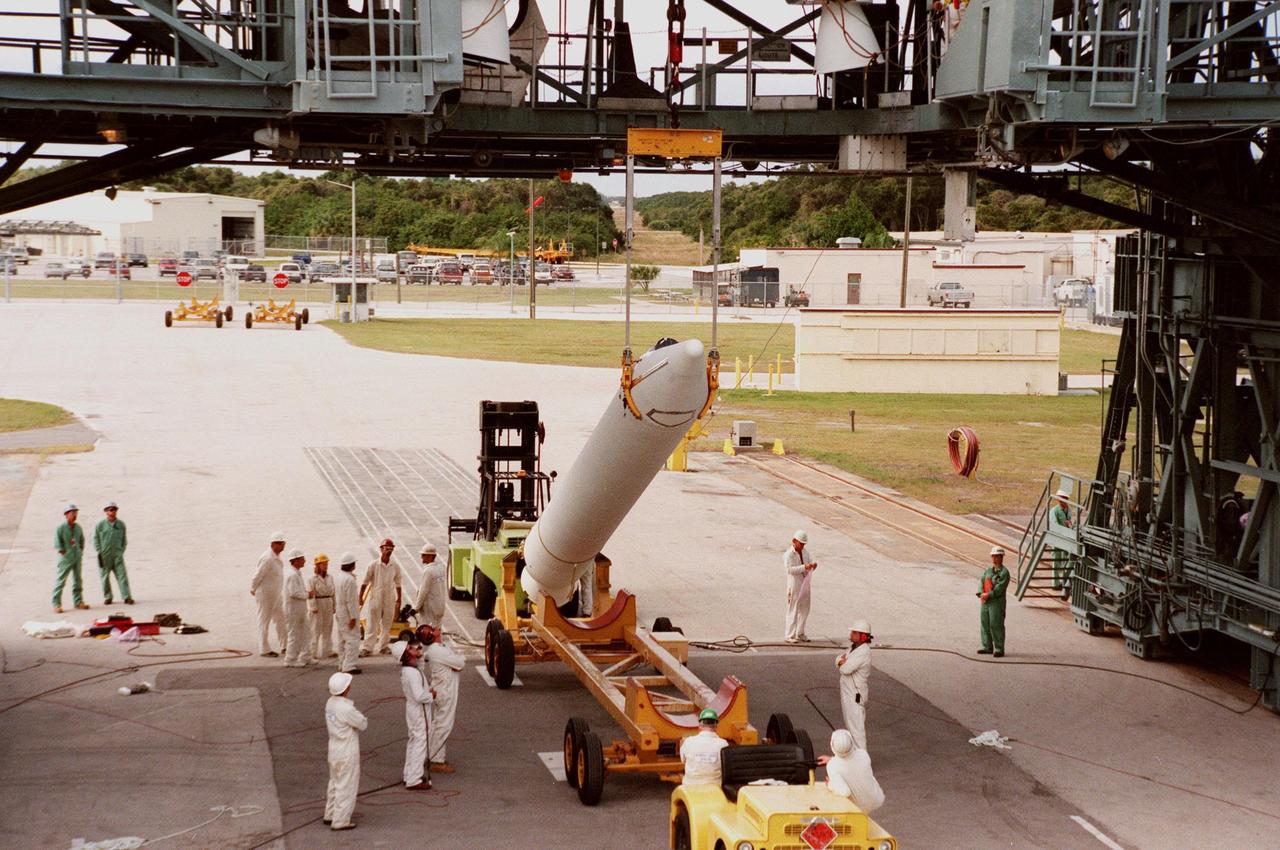
KENNEDY SPACE CENTER, FLA. -- On Pad 17B, Cape Canaveral Air Station, a solid rocket booster is raised to a vertical position for mating with the Delta II rocket carrying the Mars Polar Lander. The rocket will be used to launch the Mars Polar Lander on Jan. 3, 1999. The lander is a solar-powered spacecraft designed to touch down on the Martian surface near the northern-most boundary of the south pole in order to study the water cycle there. The lander also will help scientists learn more about climate change and current resources on Mars, studying such things as frost, dust, water vapor and condensates in the Martian atmosphere. It is the second spacecraft to be launched in a pair of Mars '98 missions. The first is the Mars Climate Orbiter, to be launched aboard a Delta II rocket from Launch Complex 17A in December 1998
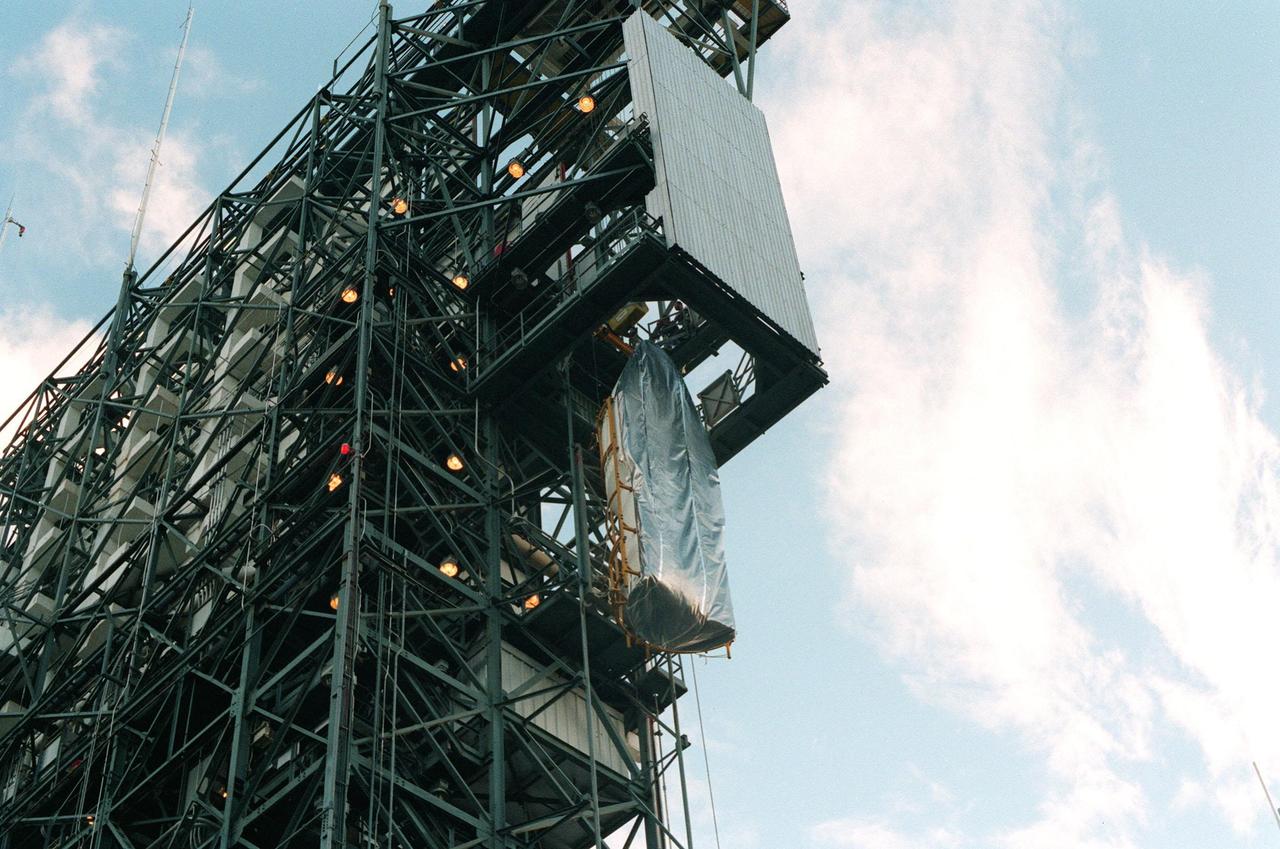
KENNEDY SPACE CENTER, FLA. -- The fairing for the upper stages of the Delta II rocket carrying the Mars Polar Lander is lifted to the top of the gantry on Pad 17B, Cape Canaveral Air Station. The rocket will be used to launch the Mars Polar Lander on Jan. 3, 1999. The lander is a solar-powered spacecraft designed to touch down on the Martian surface near the northern-most boundary of the south pole in order to study the water cycle there. The lander also will help scientists learn more about climate change and current resources on Mars, studying such things as frost, dust, water vapor and condensates in the Martian atmosphere. It is the second spacecraft to be launched in a pair of Mars '98 missions. The first is the Mars Climate Orbiter, to be launched aboard a Delta II rocket from Launch Complex 17A in December 1998
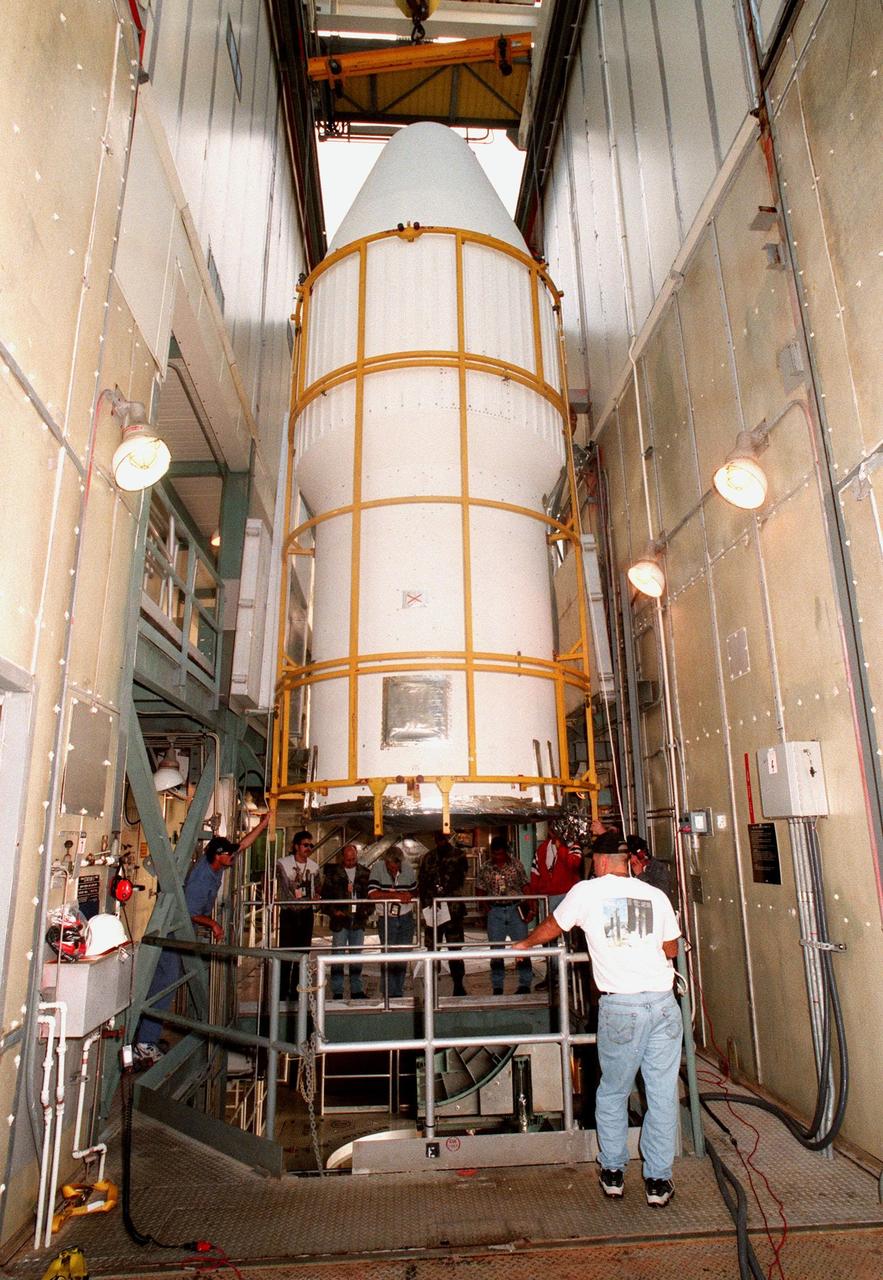
KENNEDY SPACE CENTER, FLA. -- Inside the gantry on Pad 17B, Cape Canaveral Air Station, the fairing for the upper stages of the Delta II rocket carrying the Mars Polar Lander waits to be lowered into the white room. The rocket will be used to launch the Mars Polar Lander on Jan. 3, 1999. The lander is a solar-powered spacecraft designed to touch down on the Martian surface near the northern-most boundary of the south pole in order to study the water cycle there. The lander also will help scientists learn more about climate change and current resources on Mars, studying such things as frost, dust, water vapor and condensates in the Martian atmosphere. It is the second spacecraft to be launched in a pair of Mars '98 missions. The first is the Mars Climate Orbiter, to be launched aboard a Delta II rocket from Launch Complex 17A in December 1998
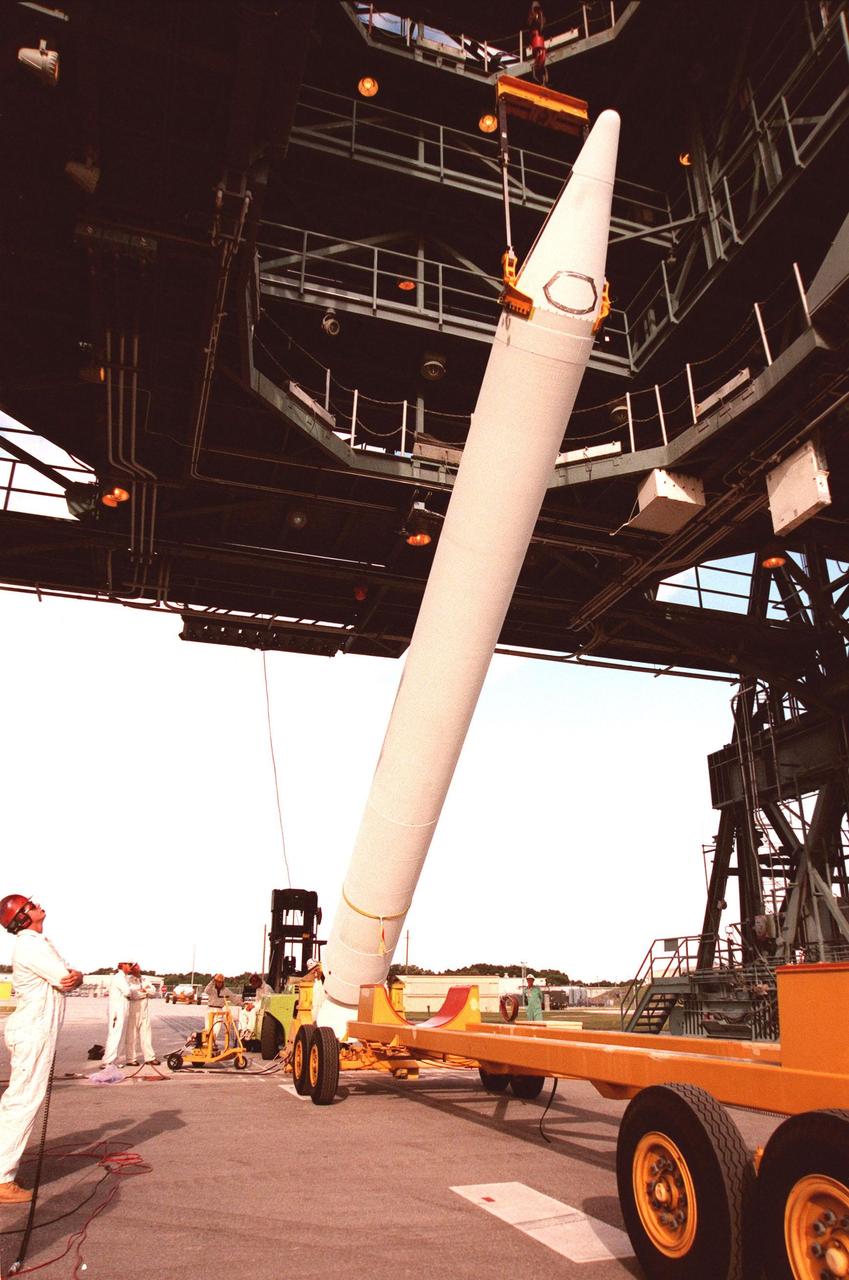
KENNEDY SPACE CENTER, FLA. -- On Pad 17B, Cape Canaveral Air Station, a solid rocket booster is raised to a vertical position for mating with the Delta II rocket carrying the Mars Polar Lander. The rocket will be used to launch the Mars Polar Lander on Jan. 3, 1999. The lander is a solar-powered spacecraft designed to touch down on the Martian surface near the northern-most boundary of the south pole in order to study the water cycle there. The lander also will help scientists learn more about climate change and current resources on Mars, studying such things as frost, dust, water vapor and condensates in the Martian atmosphere. It is the second spacecraft to be launched in a pair of Mars '98 missions. The first is the Mars Climate Orbiter, to be launched aboard a Delta II rocket from Launch Complex 17A in December 1998

This artist's concept represents the "Follow the Water" theme of NASA's Mars Reconnaissance Orbiter mission. The orbiter's science instruments monitor the present water cycle in the Mars atmosphere and the associated deposition and sublimation of water ice on the surface, while probing the subsurface to see how deep the water-ice reservoir detected by Mars Odyssey extends. At the same time, Mars Reconnaissance Orbiter will search for surface features and minerals (such as carbonates and sulfates) that record the extended presence of liquid water on the surface earlier in the planet's history. The instruments involved are the Shallow Subsurface Radar, the Compact Reconnaissance Imaging Spectrometer for Mars, the Mars Color Imager, the High Resolution Imaging Science Experiment, the Context Camera and the Mars Climate Sounder. To the far left, the radar antenna beams down and "sees" into the first few hundred feet (up to 1 kilometer) of Mars' crust. Just to the right of that, the next beam highlights the data received from the imaging spectrometer, which identifies minerals on the surface. The next beam represents the high-resolution camera, which can "zoom in" on local targets, providing the highest-resolution orbital images yet of features such as craters and gullies and rocks. The beam that shines almost horizontally is that of the Mars Climate Sounder. This instrument is critical to analyzing the current climate of Mars since it observes the temperature, humidity, and dust content of the martian atmosphere, and their seasonal and year-to-year variations. Meanwhile, the Mars Color Imager observes ice clouds, dust clouds and hazes, and the ozone distribution, producing daily global maps in multiple colors to monitor daily weather and seasonal changes. The electromagnetic spectrum is represented on the top right and individual instruments are placed where their capability lies. http://photojournal.jpl.nasa.gov/catalog/PIA07241
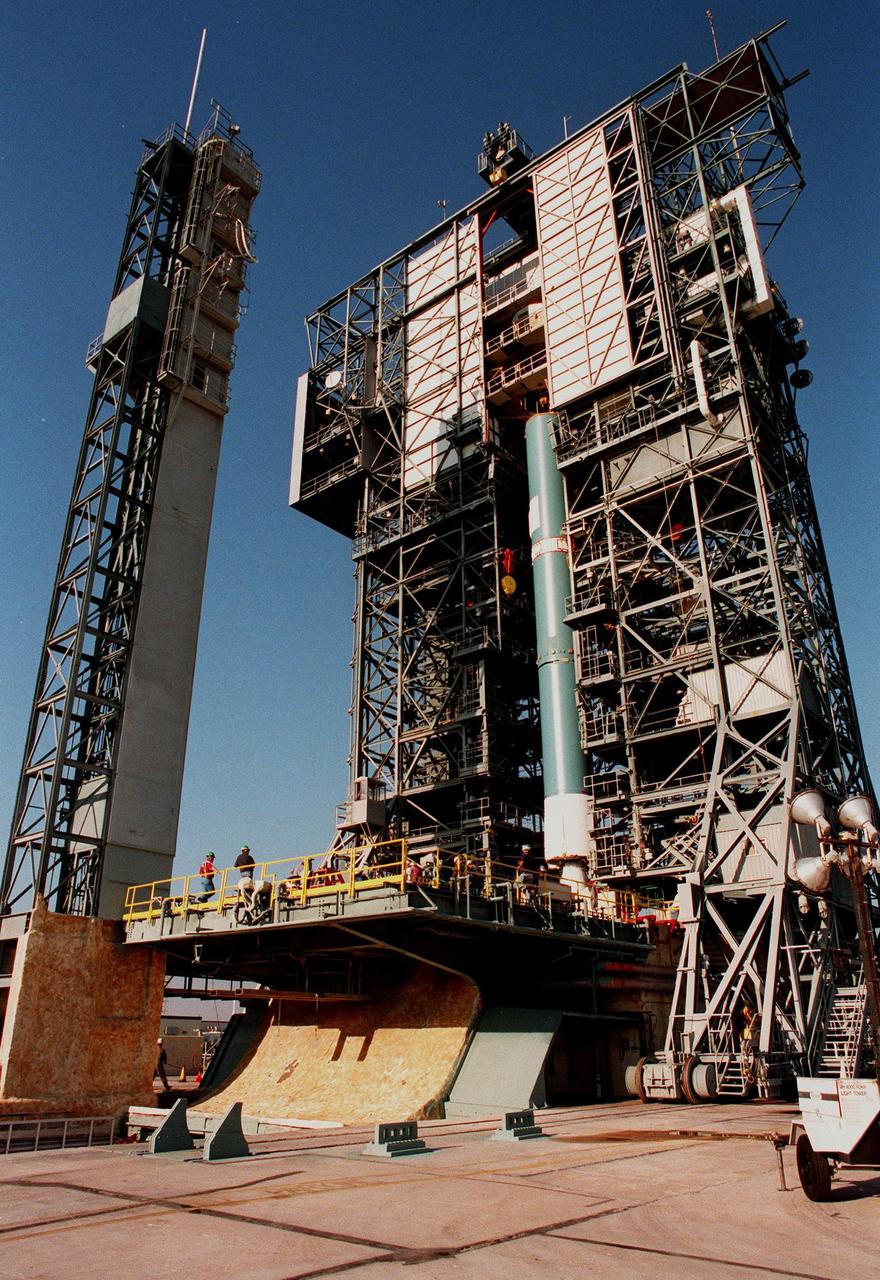
KENNEDY SPACE CENTER, FLA. -- On Pad 17A at Cape Canaveral Air Station, a Delta II rocket is maneuvered into position for launch on Dec. 10, 1998. The rocket is carrying the Mars Climate Orbiter which will head for Mars primarily to support its companion Mars Polar Lander spacecraft, which is planned for launch on Jan. 3, 1999. The orbiter's instruments will monitor the Martian atmosphere and image the planet's surface on a daily basis for one Martian year (1.8 Earth years). It will observe the appearance and movement of atmospheric dust and water vapor, as well as characterize seasonal changes on the surface. The detailed images of the surface features will provide important clues to the planet's early climate history and give scientists more information about possible liquid water reserves beneath the surface
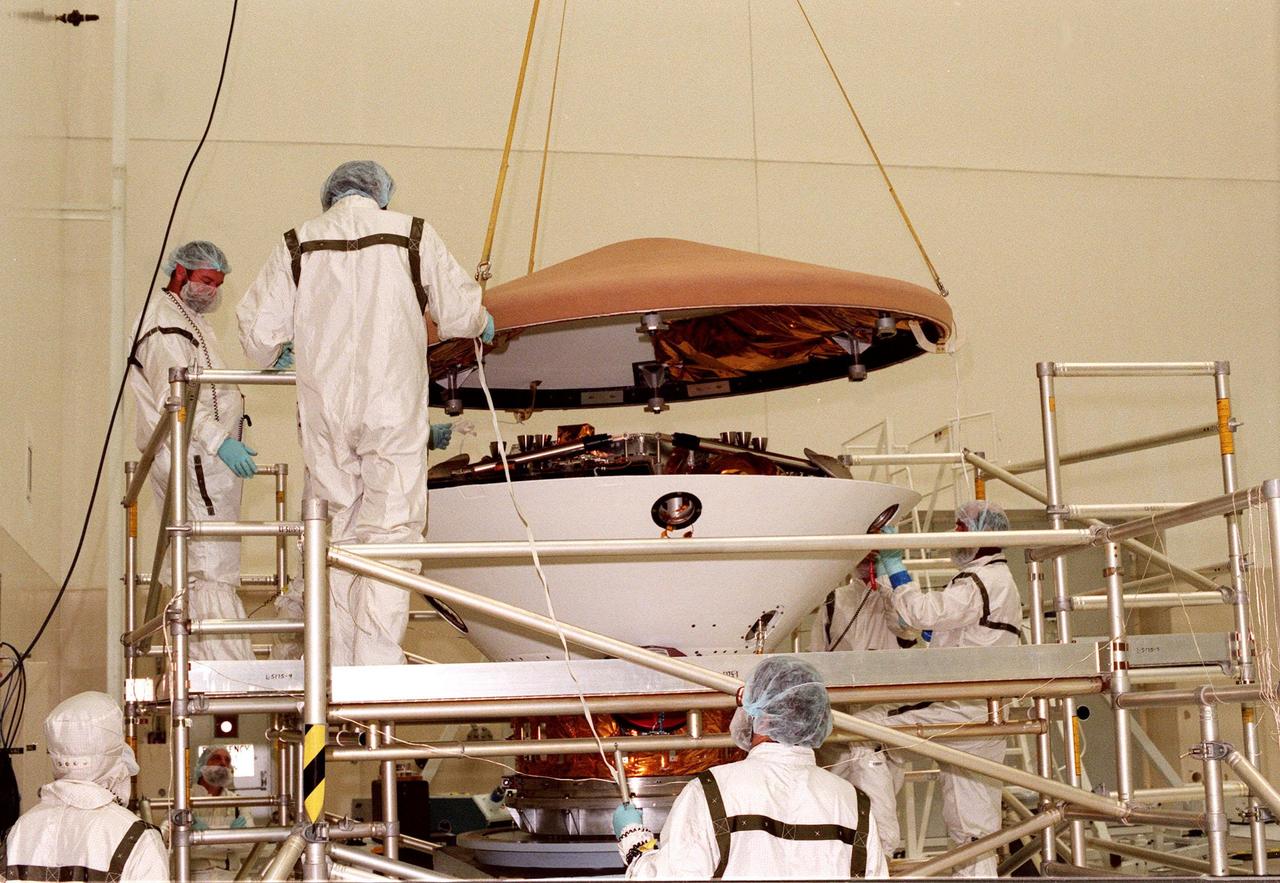
In the Spacecraft Assembly and Encapsulation Facility-2 (SAEF-2), workers lower the heat shield onto the Mars Polar Lander. Scheduled to be launched on Jan. 3, 1999, the lander is a solar-powered spacecraft designed to touch down on the Martian surface near the northern-most boundary of the south pole in order to study the water cycle there. The lander also will help scientists learn more about climate change and current resources on Mars, studying such things as frost, dust, water vapor and condensates in the Martian atmosphere. It is the second spacecraft to be launched in a pair of Mars '98 missions. The first is the Mars Climate Orbiter, which is due to be launched aboard a Delta II rocket from Launch Complex 17A on Dec. 11, 1998
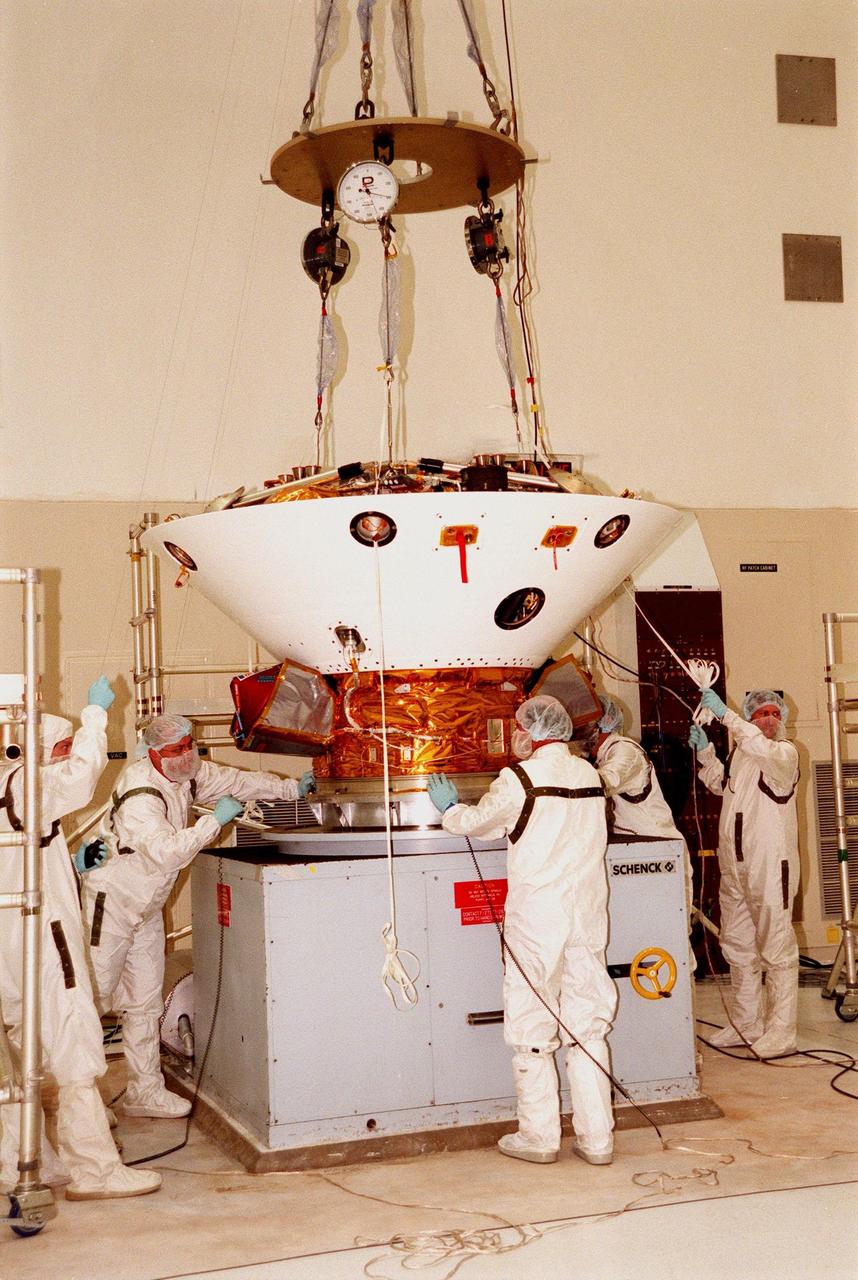
KENNEDY SPACE CENTER, FLA. -- In the Spacecraft Assembly and Encapsulation Facility-2 (SAEF-2), workers maneuver the Mars Polar Lander onto a spin table for testing. The lander, which will be launched on Jan. 3, 1999, is a solar-powered spacecraft designed to touch down on the Martian surface near the northern-most boundary of the south pole in order to study the water cycle there. The lander also will help scientists learn more about climate change and current resources on Mars, studying such things as frost, dust, water vapor and condensates in the Martian atmosphere. It is the second spacecraft to be launched in a pair of Mars '98 missions. The first is the Mars Climate Orbiter, which is due to be launched aboard a Delta II rocket from Launch Complex 17A on Dec. 11, 1998
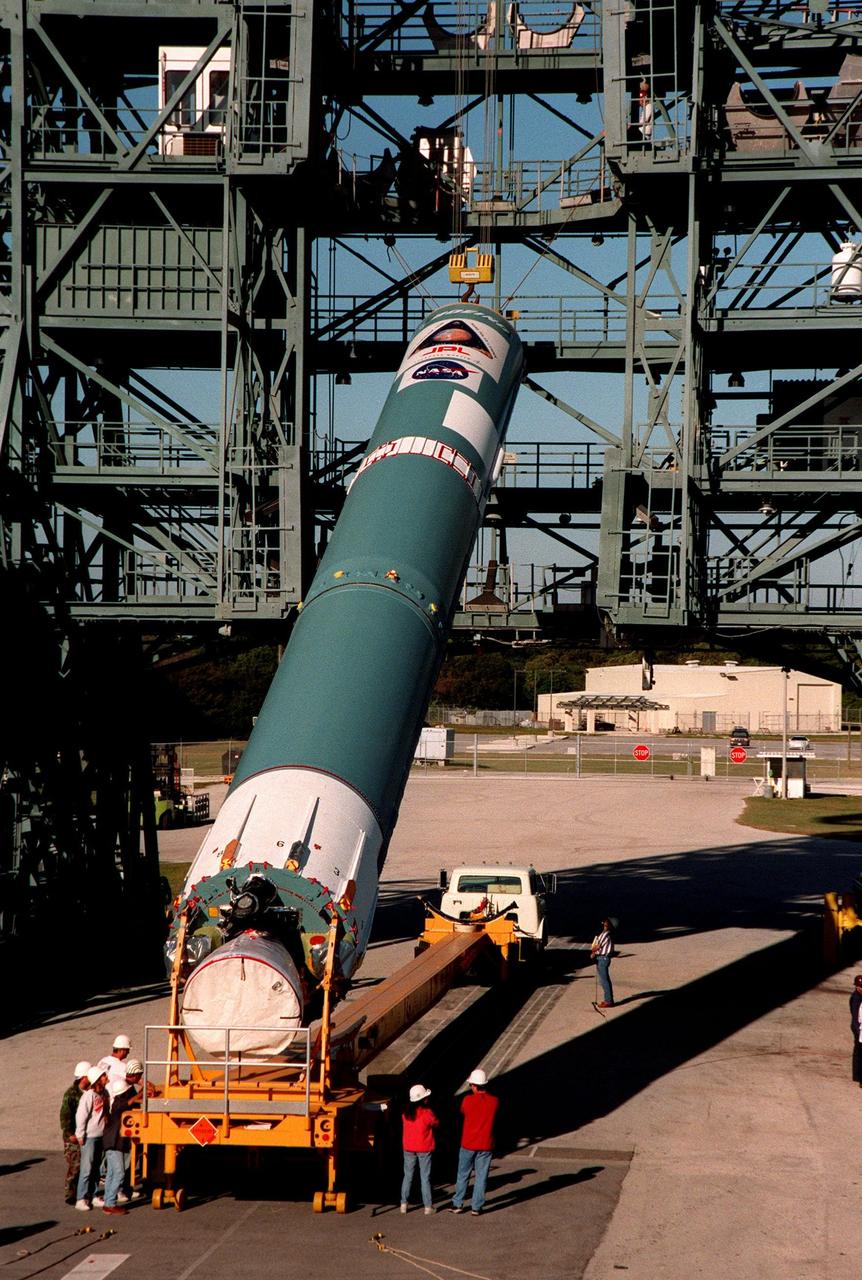
KENNEDY SPACE CENTER, FLA. -- The first stage of a Delta II rocket arrives at Launch Complex 17B, Cape Canaveral Air Station. The rocket will be used to launch the Mars Polar Lander on Jan. 3, 1999. The lander is a solar-powered spacecraft designed to touch down on the Martian surface near the northern-most boundary of the south pole in order to study the water cycle there. The lander also will help scientists learn more about climate change and current resources on Mars, studying such things as frost, dust, water vapor and condensates in the Martian atmosphere. It is the second spacecraft to be launched in a pair of Mars '98 missions. The first is the Mars Climate Orbiter, to be launched aboard a Delta II rocket from Launch Complex 17A on Dec. 10, 1998
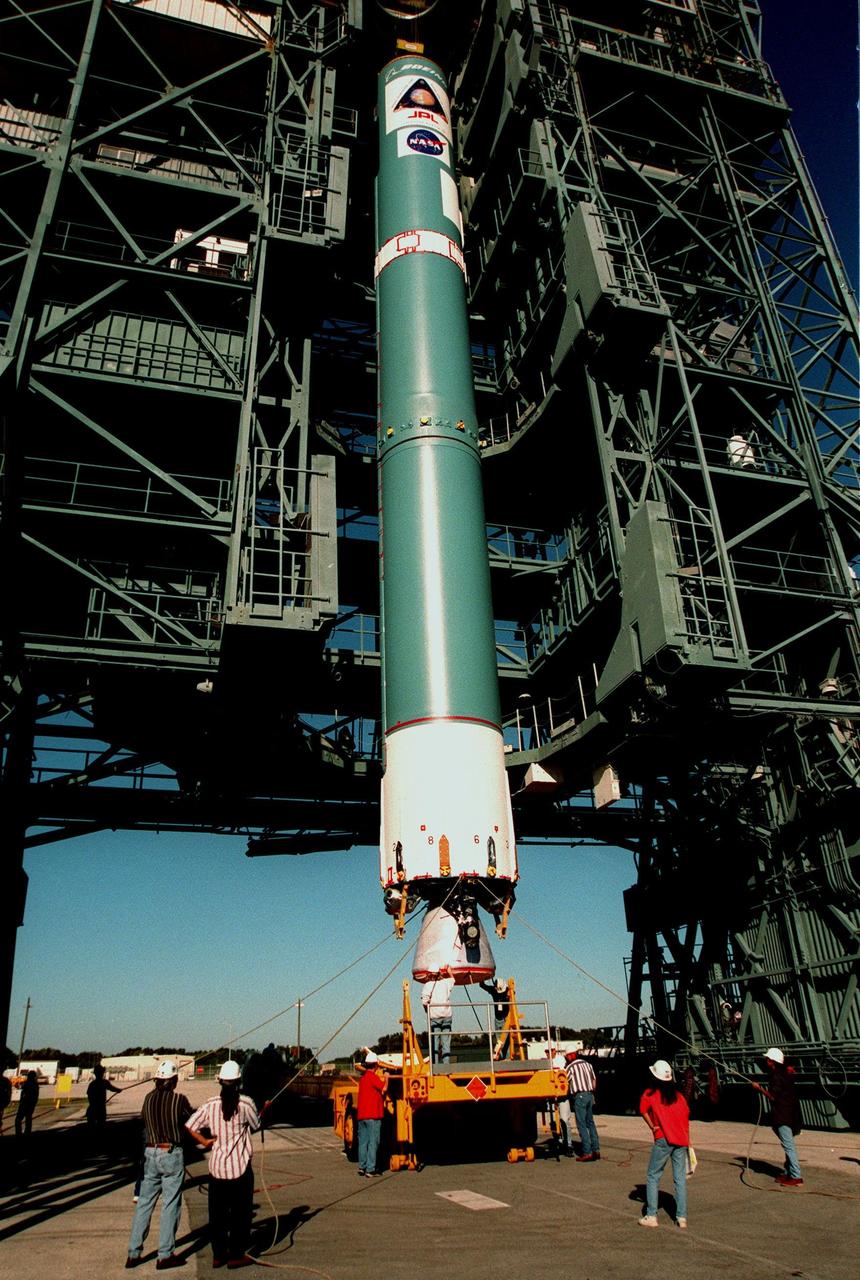
KENNEDY SPACE CENTER, FLA. -- Workers guide the lifting of the first stage of a Delta II rocket up the gantry at Launch Complex 17B, Cape Canaveral Air Station. The rocket will be used to launch the Mars Polar Lander on Jan. 3, 1999. The lander is a solar-powered spacecraft designed to touch down on the Martian surface near the northern-most boundary of the south pole in order to study the water cycle there. The lander also will help scientists learn more about climate change and current resources on Mars, studying such things as frost, dust, water vapor and condensates in the Martian atmosphere. It is the second spacecraft to be launched in a pair of Mars '98 missions. The first is the Mars Climate Orbiter, to be launched aboard a Delta II rocket from Launch Complex 17A on Dec. 10, 1998
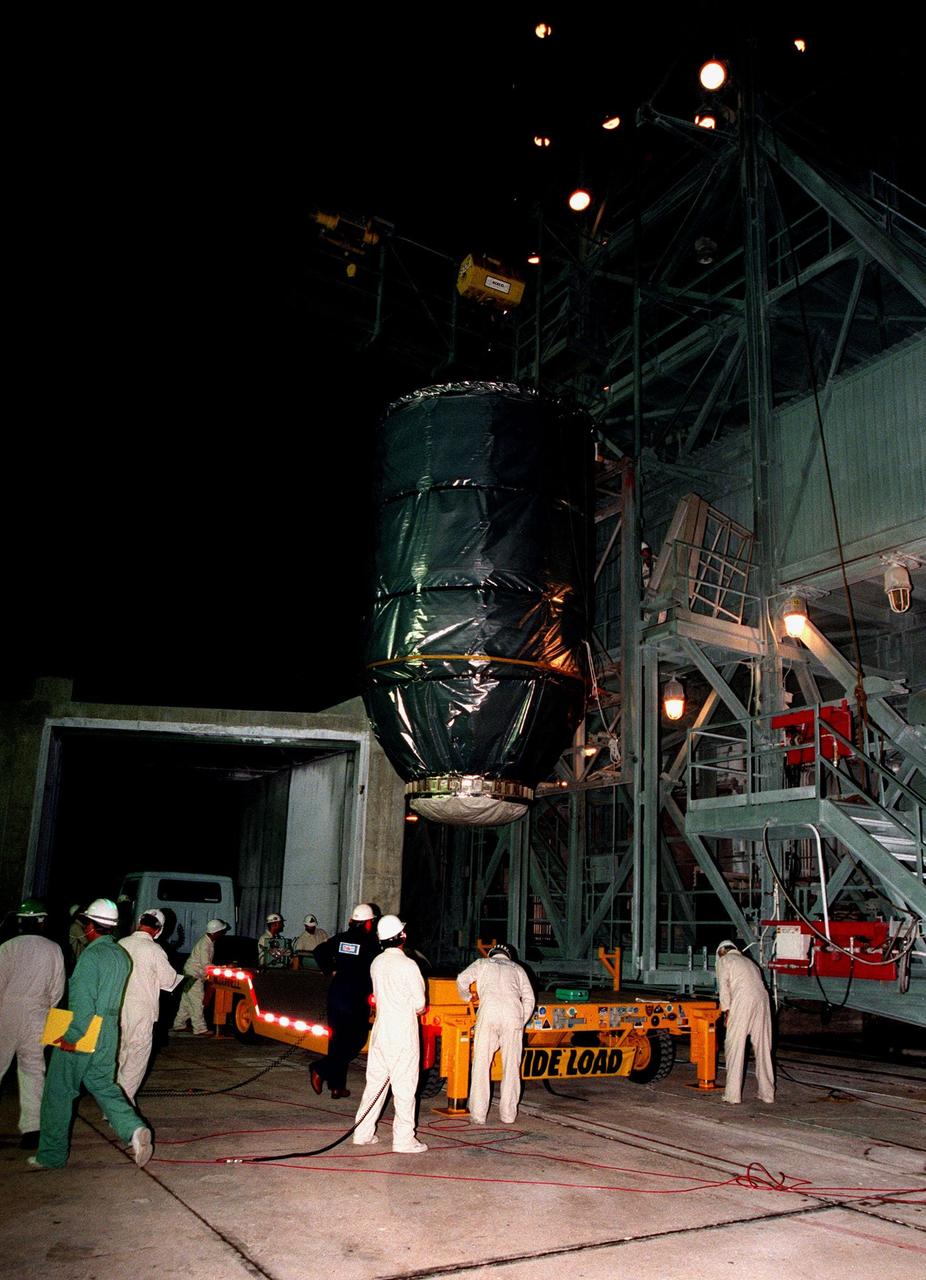
KENNEDY SPACE CENTER, FLA. -- The Mars Polar Lander spacecraft is lifted off the trailer of that transported it to the gantry at Launch Complex 17B, Cape Canaveral Air Station. The lander, which will be launched aboard a Boeing Delta II rocket on Jan. 3, 1999, is a solar-powered spacecraft designed to touch down on the Martian surface near the northern-most boundary of the south pole in order to study the water cycle there. The lander also will help scientists learn more about climate change and current resources on Mars, studying such things as frost, dust, water vapor and condensates in the Martian atmosphere. It is the second spacecraft to be launched in a pair of Mars '98 missions. The first is the Mars Climate Orbiter, which was launched aboard a Delta II rocket from Launch Complex 17A on Dec. 11, 1998
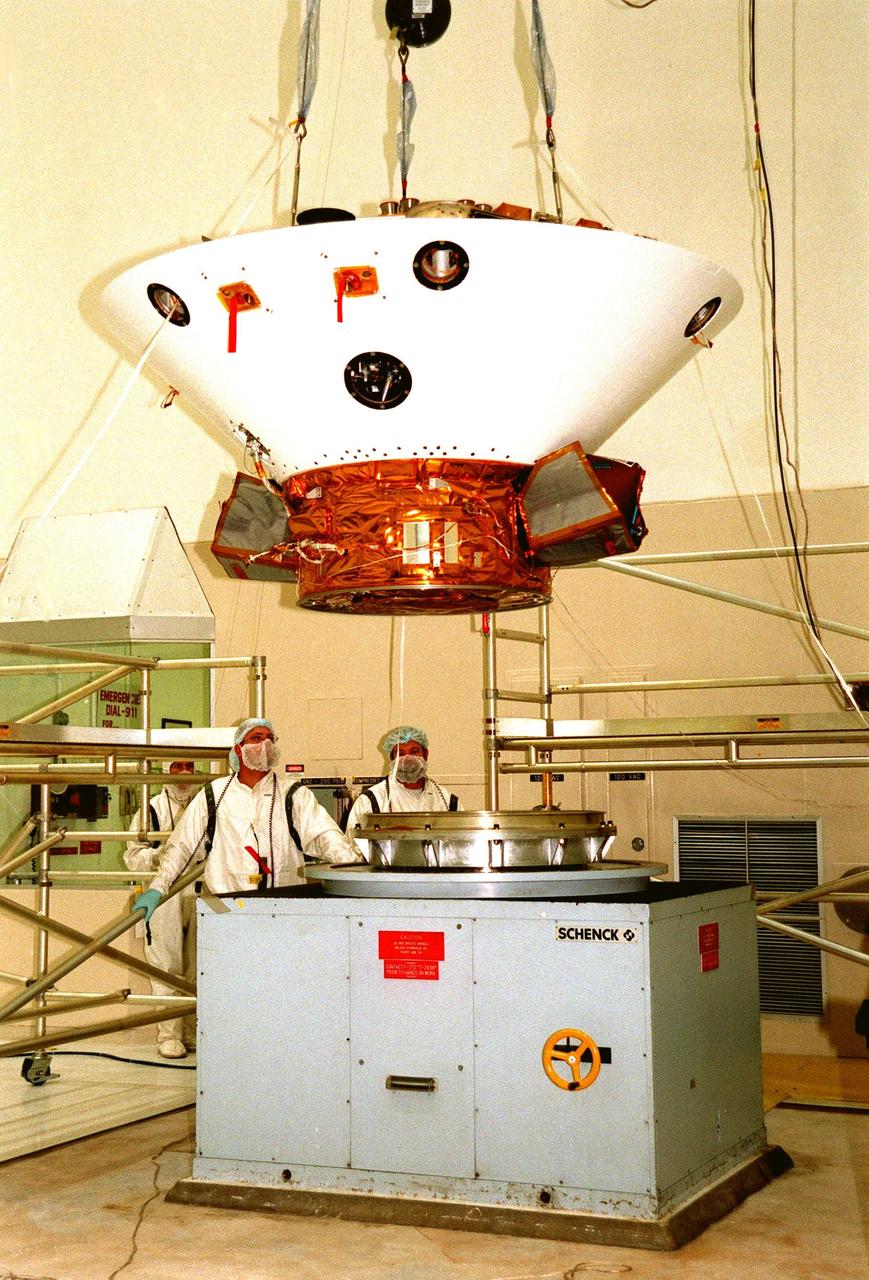
KENNEDY SPACE CENTER, FLA. -- In the Spacecraft Assembly and Encapsulation Facility-2 (SAEF-2), the Mars Polar Lander is lowered toward a spin table for testing. The lander, which will be launched on Jan. 3, 1999, is a solar-powered spacecraft designed to touch down on the Martian surface near the northern-most boundary of the south pole in order to study the water cycle there. The lander also will help scientists learn more about climate change and current resources on Mars, studying such things as frost, dust, water vapor and condensates in the Martian atmosphere. It is the second spacecraft to be launched in a pair of Mars '98 missions. The first is the Mars Climate Orbiter, which is due to be launched aboard a Delta II rocket from Launch Complex 17A on Dec. 11, 1998
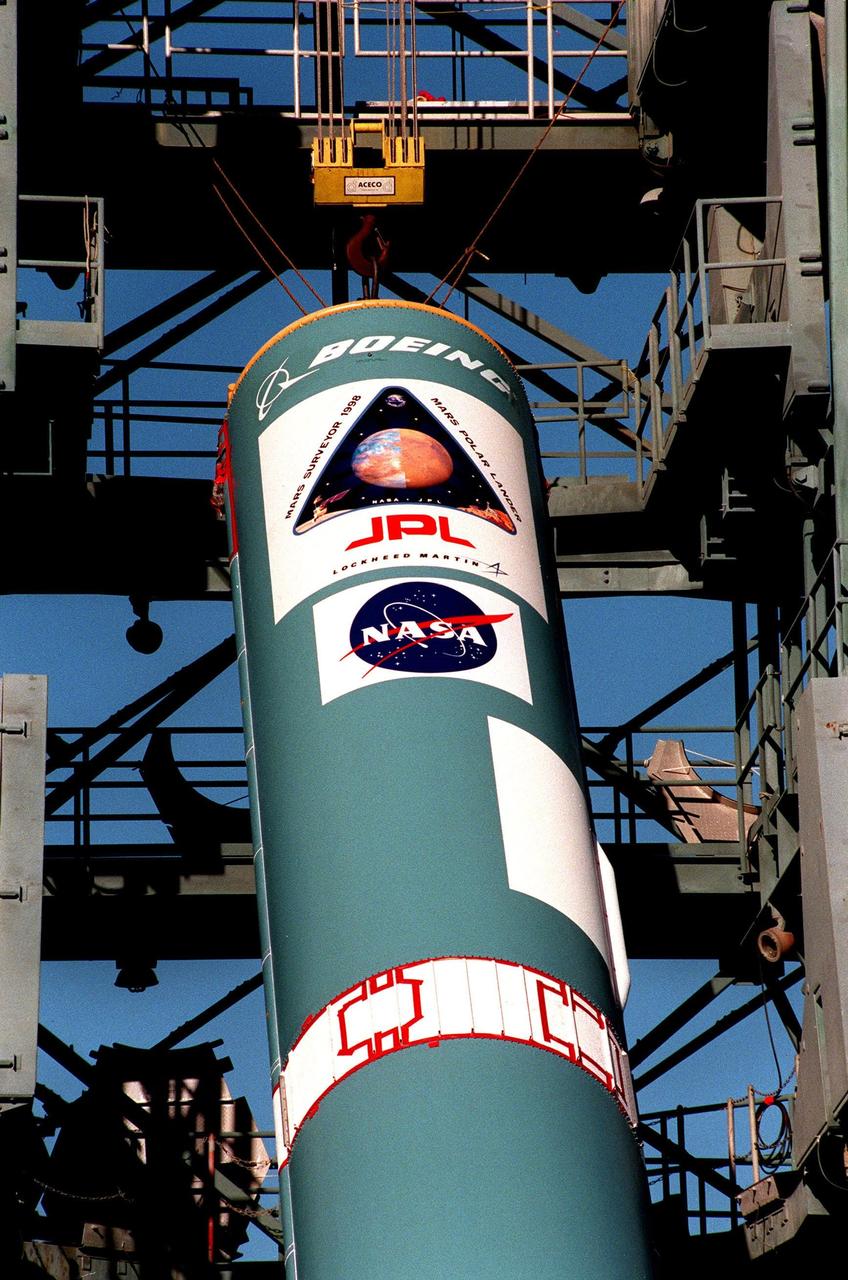
The first stage of a Delta II rocket is lifted up the gantry at Launch Complex 17B, Cape Canaveral Air Station. The rocket will be used to launch the Mars Polar Lander on Jan. 3, 1999. The lander is a solar-powered spacecraft designed to touch down on the Martian surface near the northern-most boundary of the south pole in order to study the water cycle there. The lander also will help scientists learn more about climate change and current resources on Mars, studying such things as frost, dust, water vapor and condensates in the Martian atmosphere. It is the second spacecraft to be launched in a pair of Mars '98 missions. The first is the Mars Climate Orbiter, to be launched aboard a Delta II rocket from Launch Complex 17A on Dec. 10, 1998

KENNEDY SPACE CENTER, FLA. -- Workers mate the Mars Polar Lander (top) to the Boeing Delta II rocket at Launch Complex 17B, Cape Canaveral Air Station. The rocket is scheduled to launch Jan. 3, 1999. The lander is a solar-powered spacecraft designed to touch down on the Martian surface near the northern-most boundary of the south pole in order to study the water cycle there. The lander also will help scientists learn more about climate change and current resources on Mars, studying such things as frost, dust, water vapor and condensates in the Martian atmosphere. It is the second spacecraft to be launched in a pair of Mars Surveyor '98 missions. The first is the Mars Climate Orbiter, which was launched aboard a Delta II rocket from Launch Complex 17A on Dec. 11, 1998
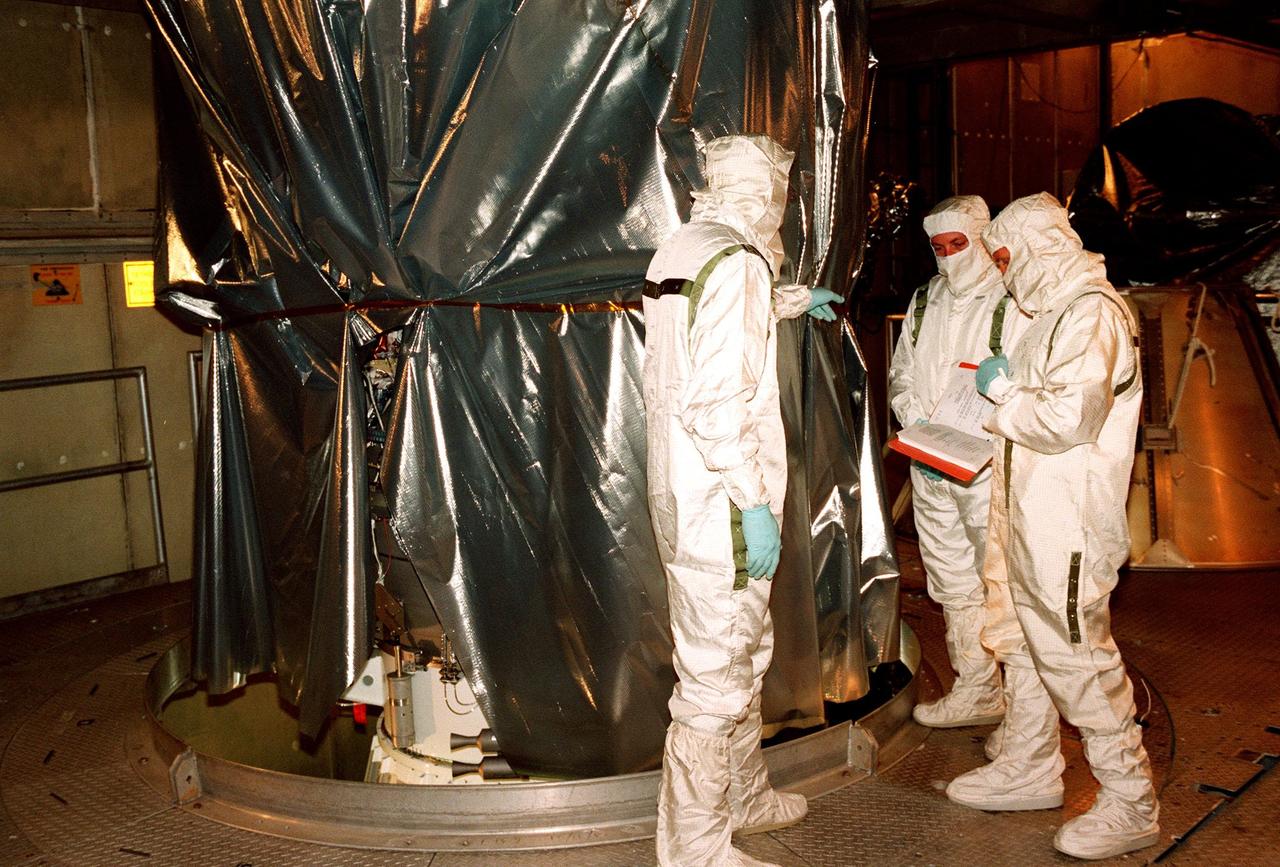
KENNEDY SPACE CENTER, FLA. -- At Launch Complex 17B, Cape Canaveral Air Station, workers get ready to remove the protective wrapping on the Mars Polar Lander to be launched aboard a Boeing Delta II rocket on Jan. 3, 1999. The lander is a solar-powered spacecraft designed to touch down on the Martian surface near the northern-most boundary of the south pole in order to study the water cycle there. The lander also will help scientists learn more about climate change and current resources on Mars, studying such things as frost, dust, water vapor and condensates in the Martian atmosphere. It is the second spacecraft to be launched in a pair of Mars Surveyor'98 missions. The first is the Mars Climate Orbiter, which was launched aboard a Delta II rocket from Launch Complex 17A on Dec. 11, 1998
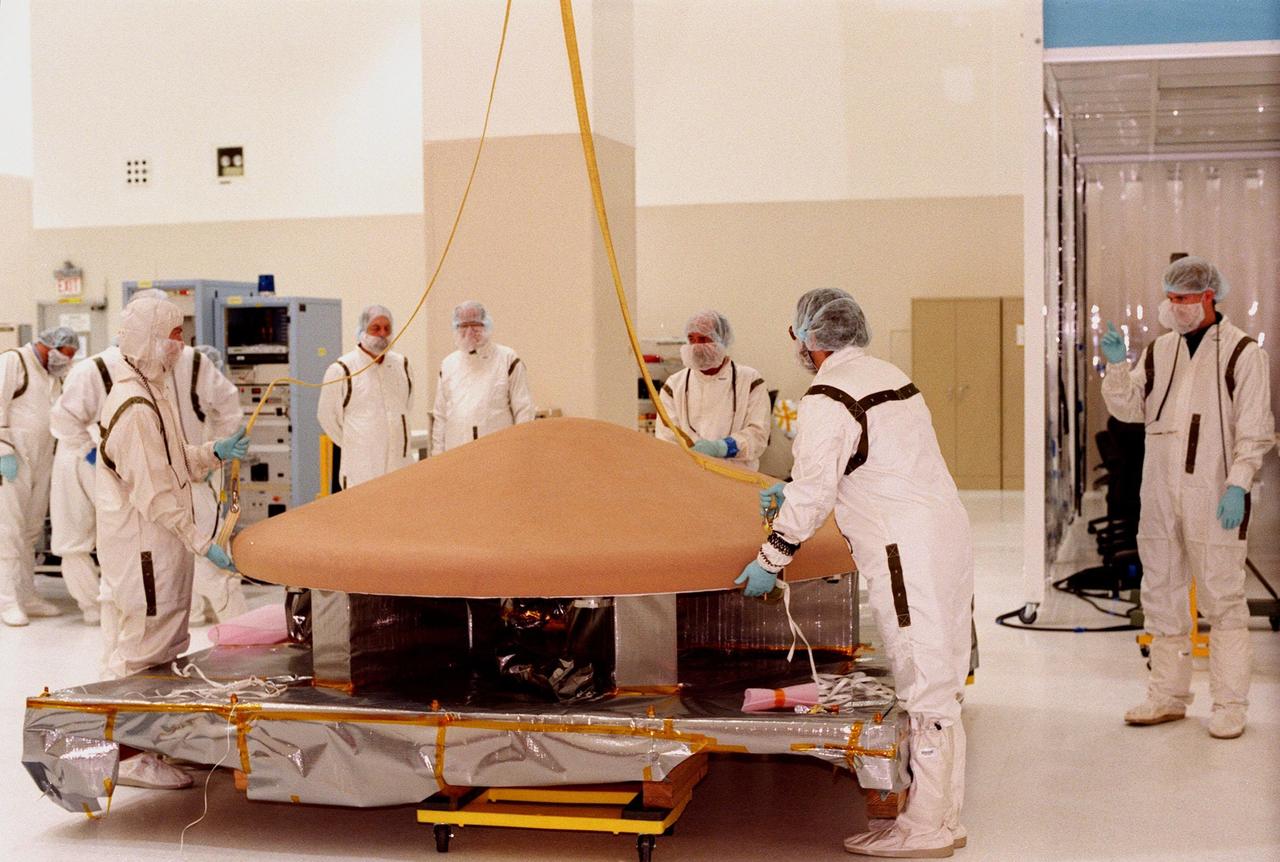
In the Spacecraft Assembly and Encapsulation Facility-2 (SAEF-2), workers get ready to lift the heat shield for the Mars Polar Lander off the workstand before attaching it to the lander. Scheduled to be launched on Jan. 3, 1999, the lander is a solar-powered spacecraft designed to touch down on the Martian surface near the northern-most boundary of the south pole in order to study the water cycle there. The lander also will help scientists learn more about climate change and current resources on Mars, studying such things as frost, dust, water vapor and condensates in the Martian atmosphere. It is the second spacecraft to be launched in a pair of Mars '98 missions. The first is the Mars Climate Orbiter, which is due to be launched aboard a Delta II rocket from Launch Complex 17A on Dec. 11, 1998
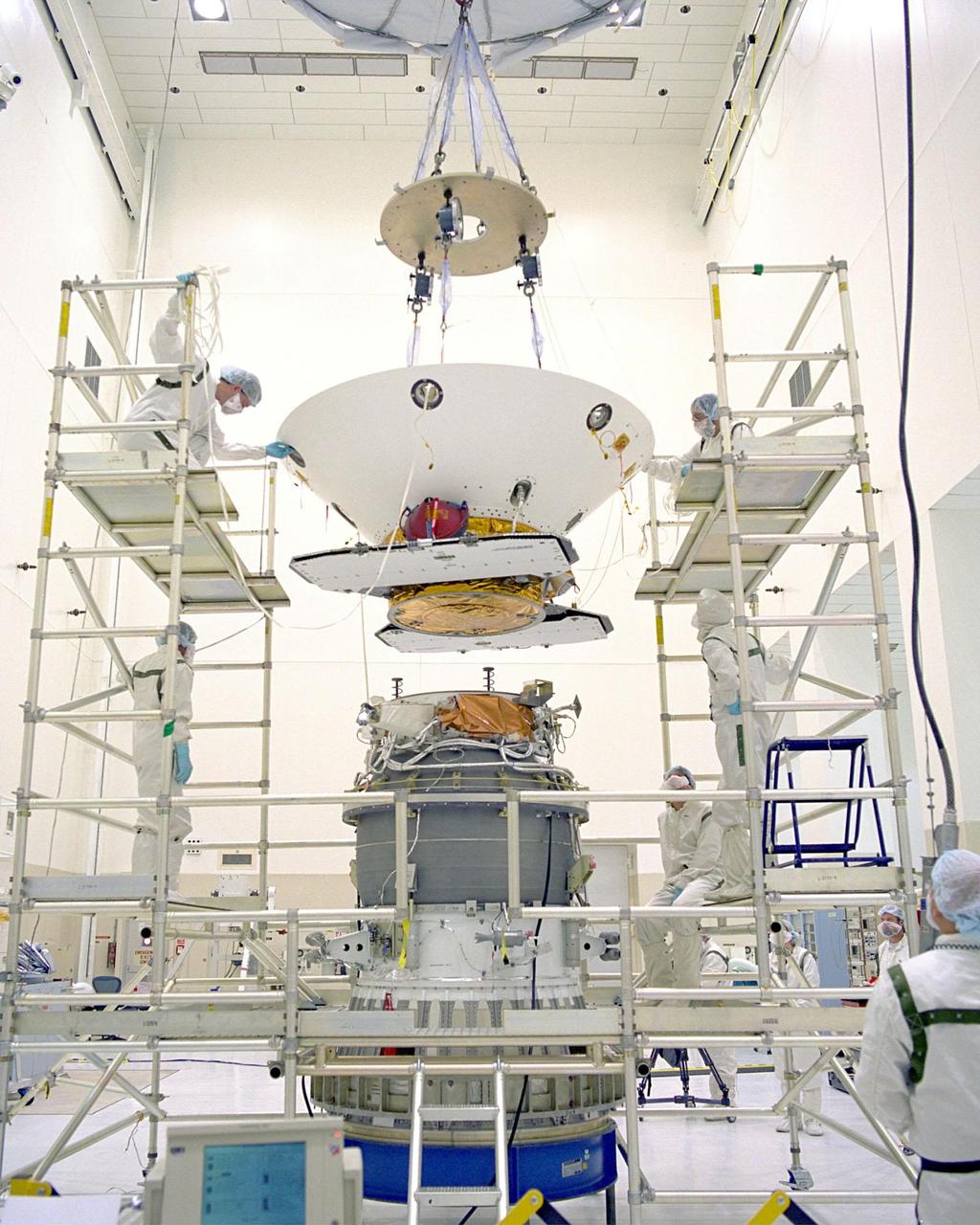
In the Spacecraft Assembly and Encapsulation Facility-2 (SAEF-2), the <a href="http://www-pao.ksc.nasa.gov/kscpao/captions/subjects/mars.htm"><b>Mars Polar Lander</b></a> is lowered onto the third stage of the Boeing Delta II rocket before it is transported to Launch Pad 17B, Cape Canaveral Air Station. The lander, which will be launched on Jan. 3, 1999, is a solar-powered spacecraft designed to touch down on the Martian surface near the northern-most boundary of the south pole in order to study the water cycle there. The lander also will help scientists learn more about climate change and current resources on Mars, studying such things as frost, dust, water vapor and condensates in the Martian atmosphere. It is the second spacecraft to be launched in a pair of Mars '98 missions. The first is the Mars Climate Orbiter, which was launched aboard a Delta II rocket from Launch Complex 17A on Dec. 11, 1998
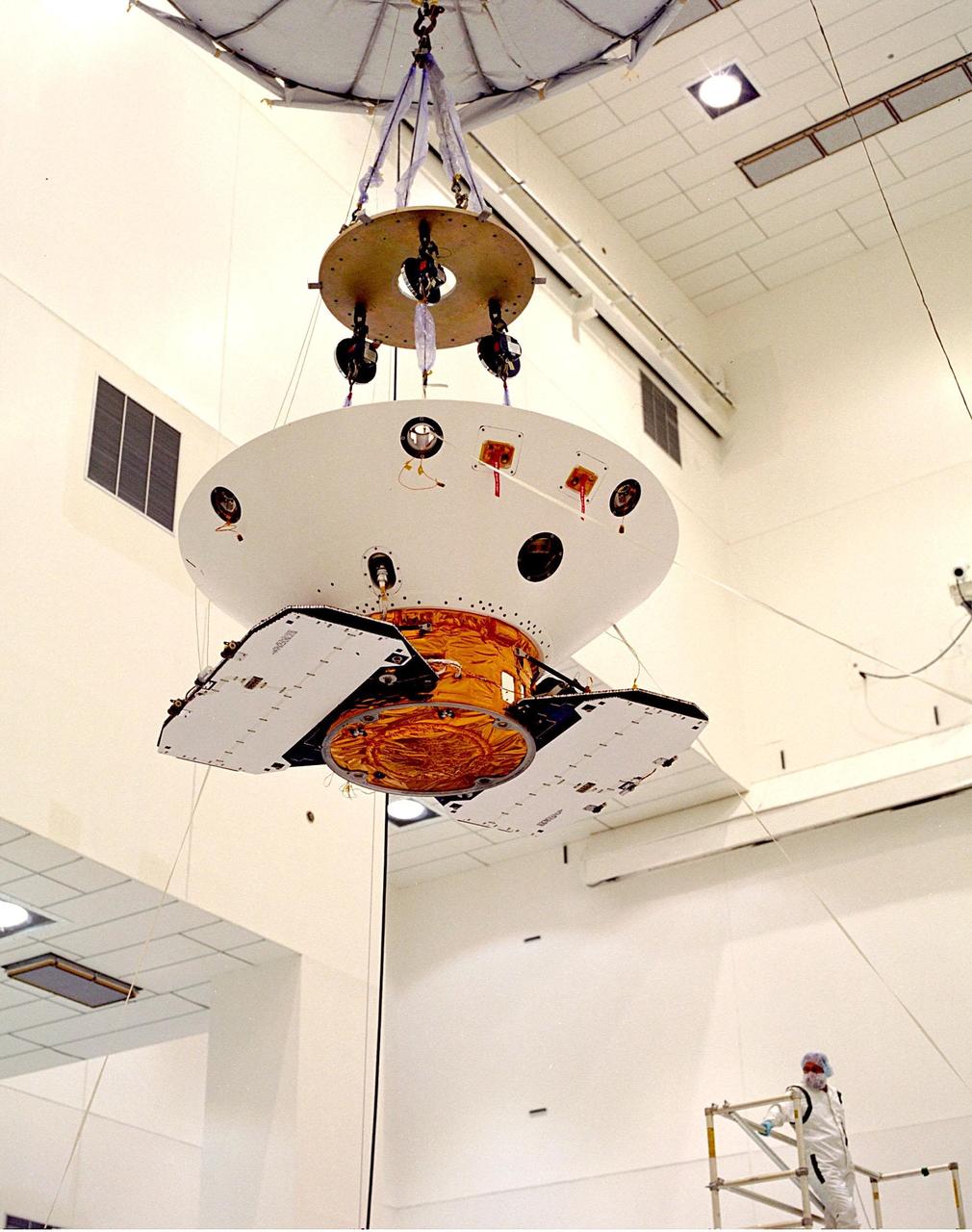
KENNEDY SPACE CENTER, FLA. -- The Mars Polar Lander is suspended from a crane in the Spacecraft Assembly and Encapsulation Facility-2 (SAEF-2) before being lowered to a workstand. There it will be mated to the third stage of the Boeing Delta II rocket before it is transported to Launch Pad 17B, Cape Canaveral Air Station. The lander, which will be launched on Jan. 3, 1999, is a solar-powered spacecraft designed to touch down on the Martian surface near the northern-most boundary of the south pole in order to study the water cycle there. The lander also will help scientists learn more about climate change and current resources on Mars, studying such things as frost, dust, water vapor and condensates in the Martian atmosphere. It is the second spacecraft to be launched in a pair of Mars '98 missions. The first is the Mars Climate Orbiter, which was launched aboard a Delta II rocket from Launch Complex 17A on Dec. 11, 1998
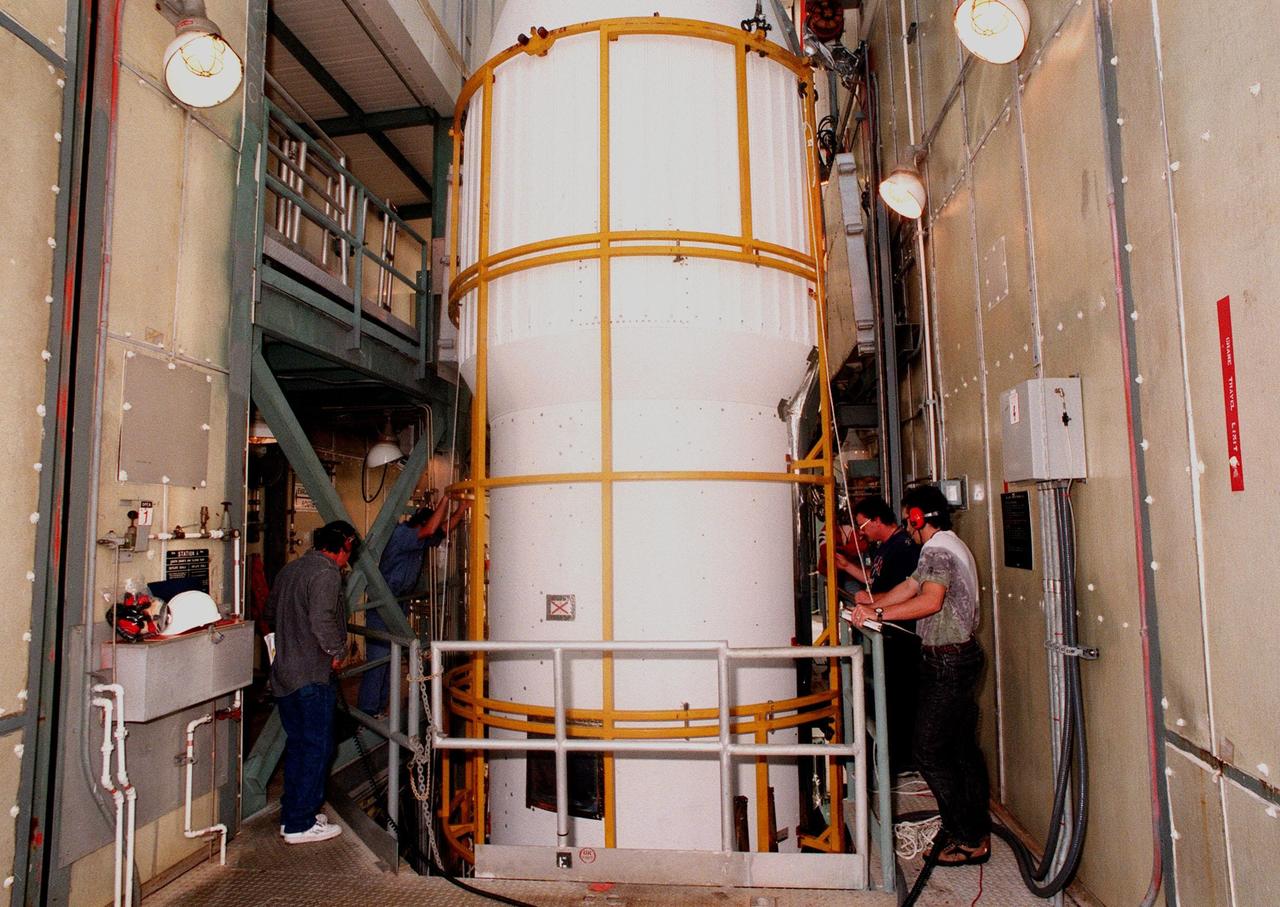
KENNEDY SPACE CENTER, FLA. -- On Pad 17B, Cape Canaveral Air Station, the fairing for the upper stages of the Delta II rocket carrying the Mars Polar Lander is lowered toward the rocket waiting below. The lander, which will be launched on Jan. 3, 1999, is a solar-powered spacecraft designed to touch down on the Martian surface near the northern-most boundary of the south pole in order to study the water cycle there. The lander also will help scientists learn more about climate change and current resources on Mars, studying such things as frost, dust, water vapor and condensates in the Martian atmosphere. It is the second spacecraft to be launched in a pair of Mars '98 missions. The first is the Mars Climate Orbiter, to be launched aboard a Delta II rocket from Launch Complex 17A in December 1998
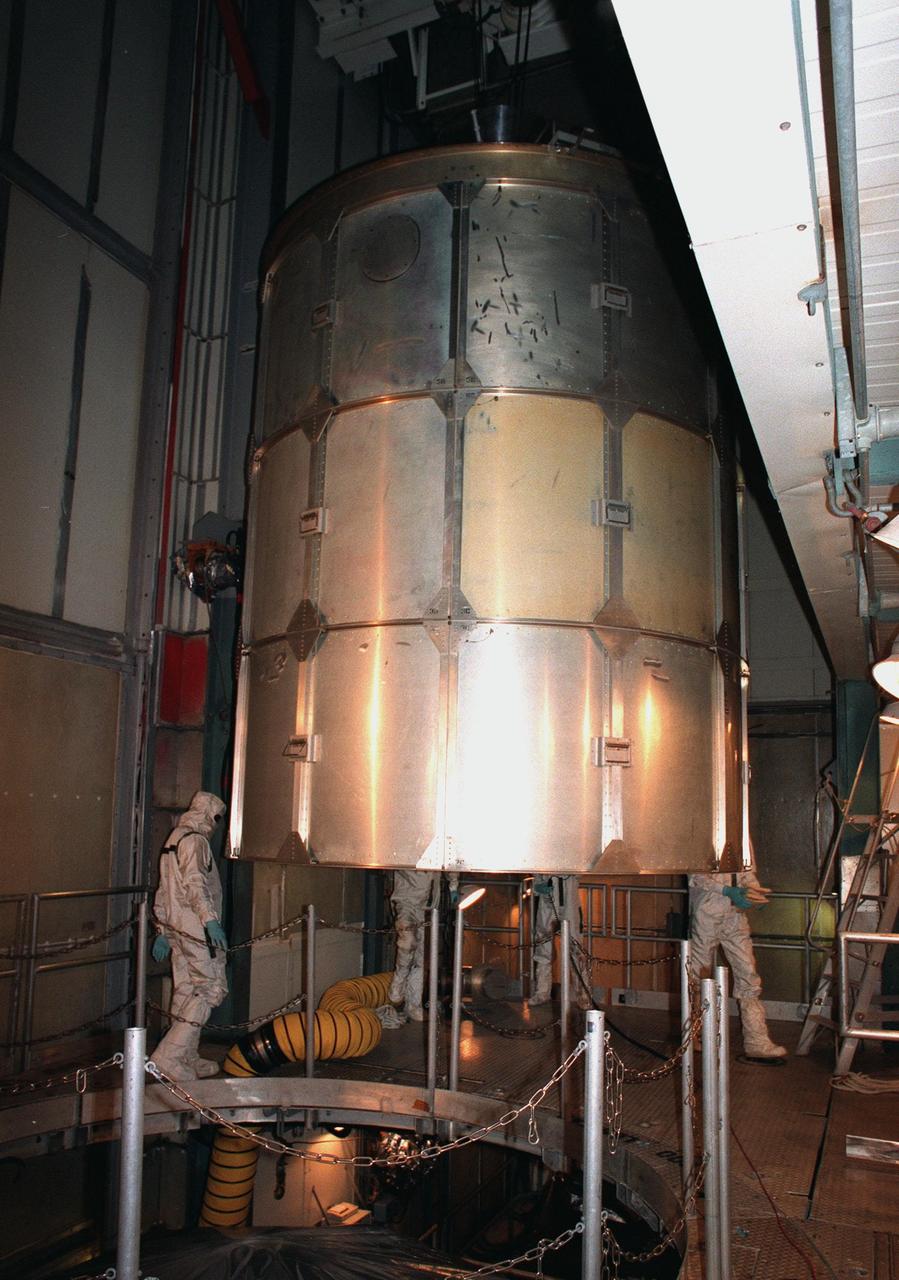
KENNEDY SPACE CENTER, FLA. -- At Launch Complex 17B, Cape Canaveral Air Station, the protective covering on the Mars Polar Lander is lifted up and out of the way. The lander, in the opening below, is being mated to the Boeing Delta II rocket that will launch it on Jan. 3, 1999. The lander is a solar-powered spacecraft designed to touch down on the Martian surface near the northern-most boundary of the south pole in order to study the water cycle there. The lander also will help scientists learn more about climate change and current resources on Mars, studying such things as frost, dust, water vapor and condensates in the Martian atmosphere. It is the second spacecraft to be launched in a pair of Mars Surveyor'98 missions. The first is the Mars Climate Orbiter, which was launched aboard a Delta II rocket from Launch Complex 17A on Dec. 11, 1998
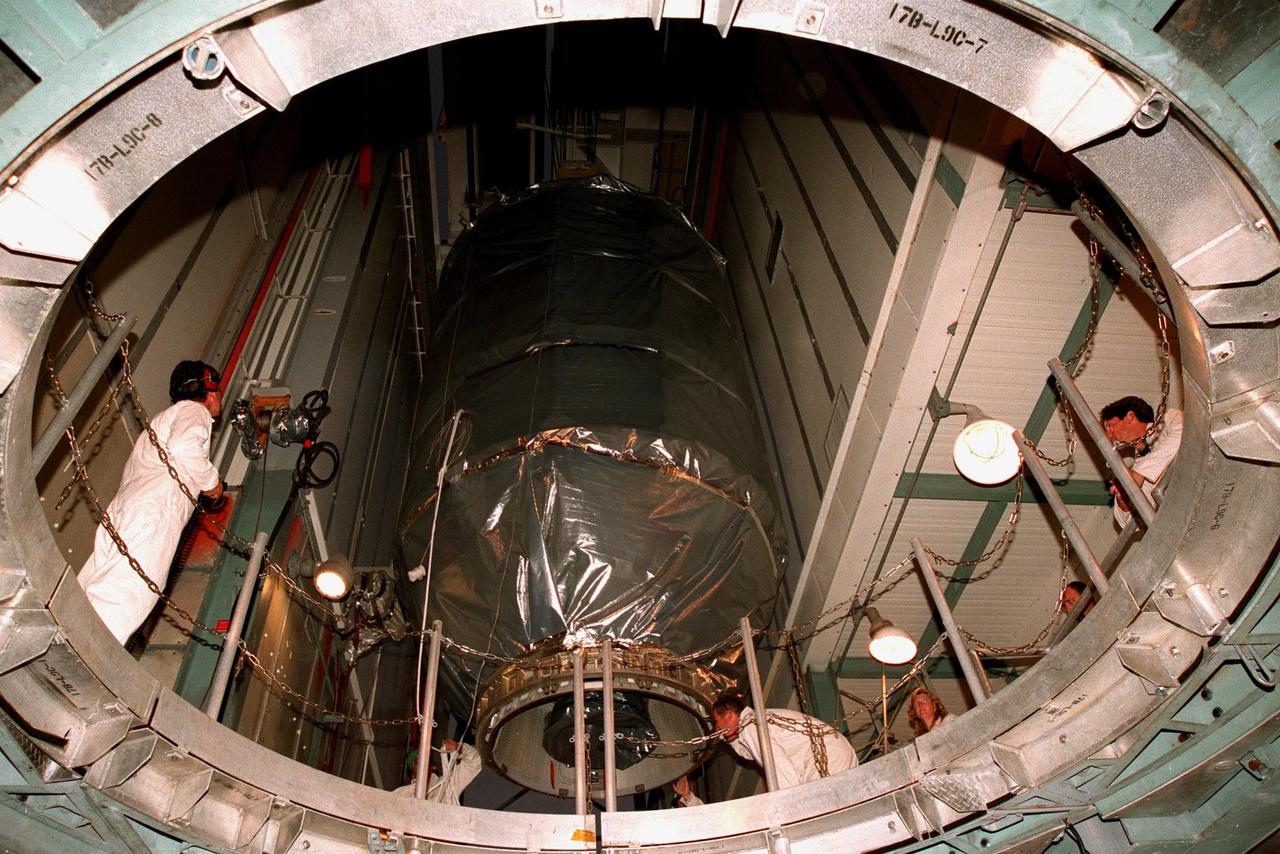
KENNEDY SPACE CENTER, FLA. -- Inside the gantry at Launch Complex 17B, Cape Canaveral Air Station, the Mars Polar Lander spacecraft is lowered to mate it with the Boeing Delta II rocket that will launch it on Jan. 3, 1999. The lander is a solar-powered spacecraft designed to touch down on the Martian surface near the northern-most boundary of the south pole in order to study the water cycle there. The lander also will help scientists learn more about climate change and current resources on Mars, studying such things as frost, dust, water vapor and condensates in the Martian atmosphere. It is the second spacecraft to be launched in a pair of Mars Surveyor'98 missions. The first is the Mars Climate Orbiter, which was launched aboard a Delta II rocket from Launch Complex 17A on Dec. 11, 1998
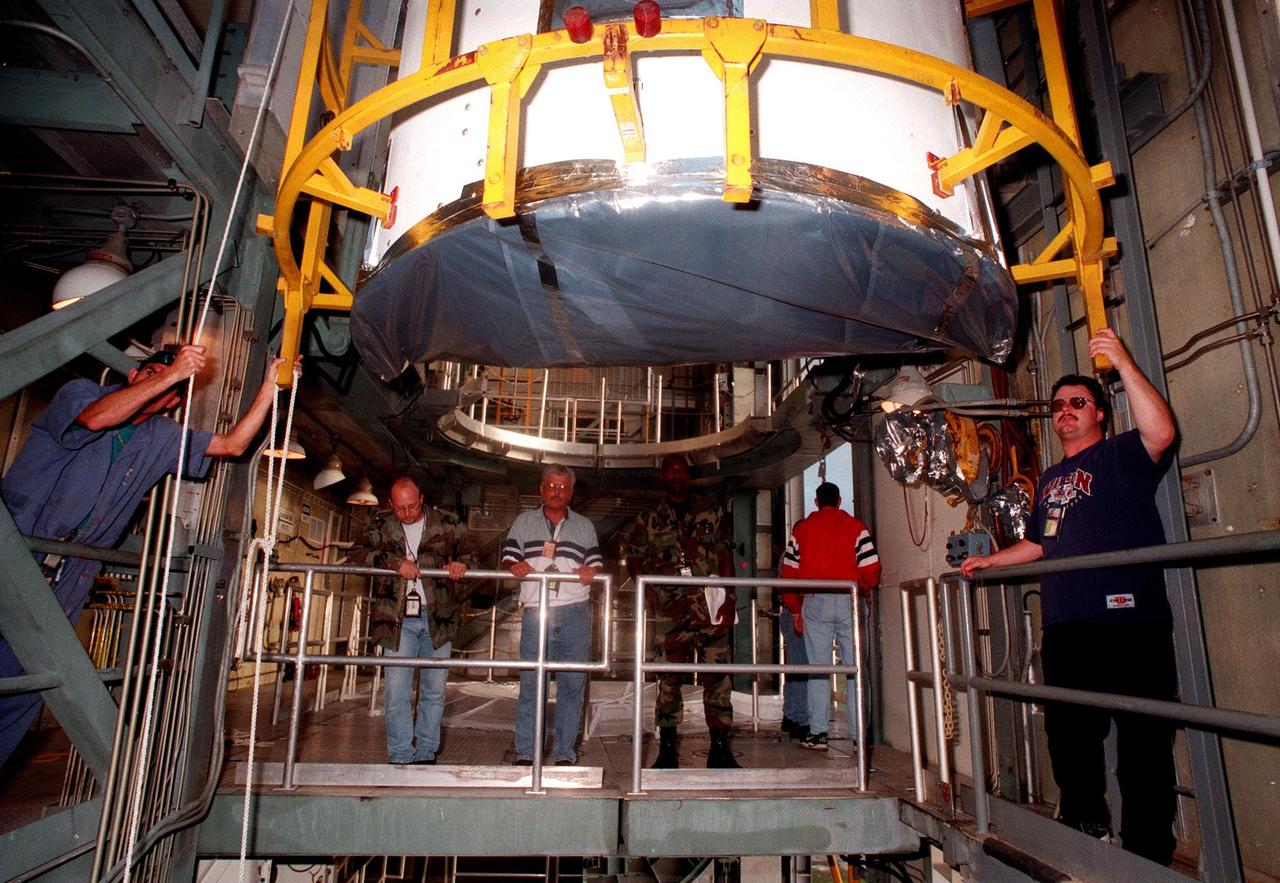
KENNEDY SPACE CENTER, FLA. -- On Pad 17B, Cape Canaveral Air Station, the fairing for the upper stages of the Delta II rocket carrying the Mars Polar Lander is prepared for lowering toward the rocket below. The lander, which will be launched on Jan. 3, 1999, is a solar-powered spacecraft designed to touch down on the Martian surface near the northern-most boundary of the south pole in order to study the water cycle there. The lander also will help scientists learn more about climate change and current resources on Mars, studying such things as frost, dust, water vapor and condensates in the Martian atmosphere. It is the second spacecraft to be launched in a pair of Mars '98 missions. The first is the Mars Climate Orbiter, to be launched aboard a Delta II rocket from Launch Complex 17A in December 1998
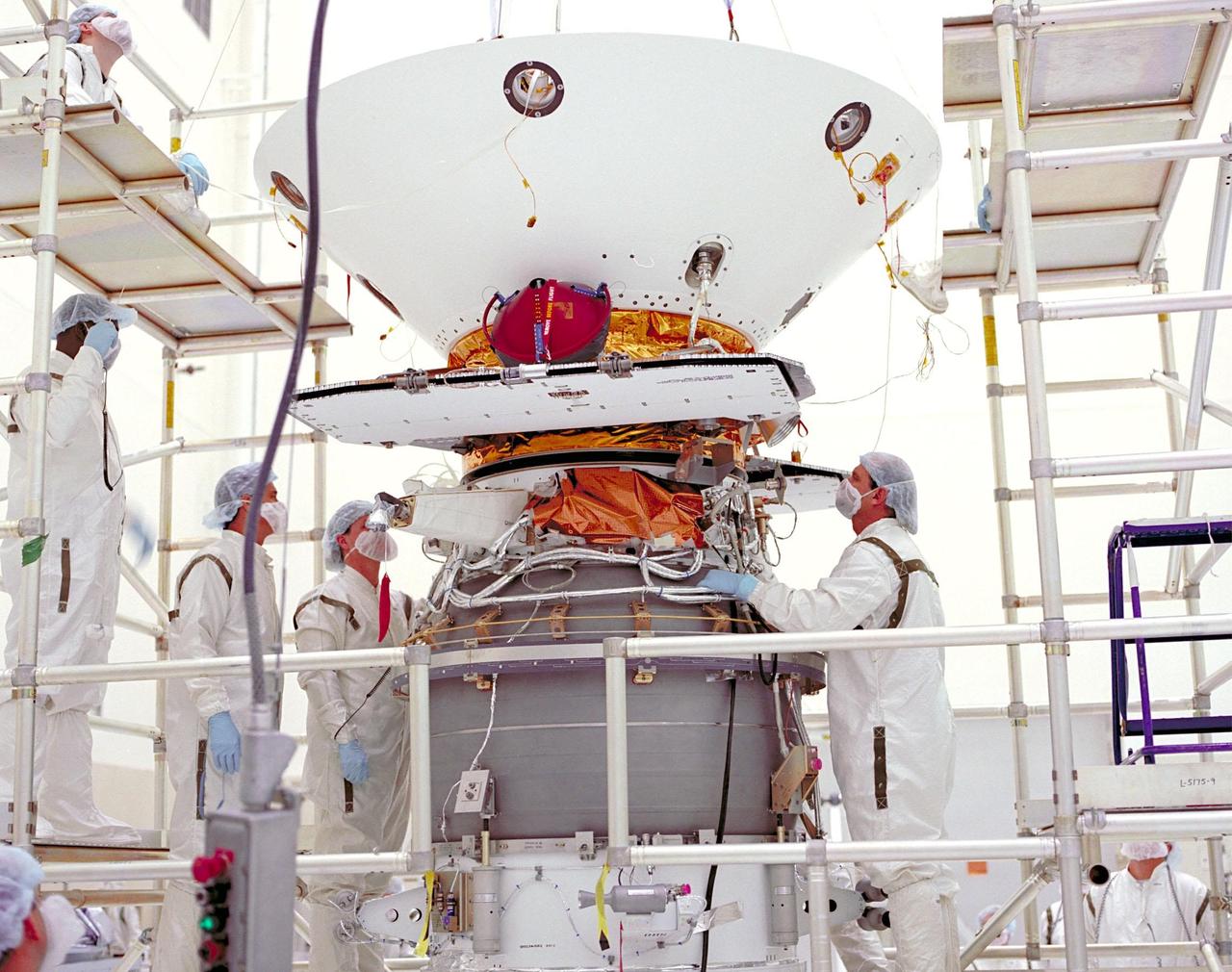
KENNEDY SPACE CENTER, FLA. -- In the Spacecraft Assembly and Encapsulation Facility-2 (SAEF-2), workers mate the Mars Polar Lander to the third stage of the Boeing Delta II rocket before it is transported to Launch Pad 17B, Cape Canaveral Air Station. The lander, which will be launched on Jan. 3, 1999, is a solar-powered spacecraft designed to touch down on the Martian surface near the northern-most boundary of the south pole in order to study the water cycle there. The lander also will help scientists learn more about climate change and current resources on Mars, studying such things as frost, dust, water vapor and condensates in the Martian atmosphere. It is the second spacecraft to be launched in a pair of Mars '98 missions. The first is the Mars Climate Orbiter, which was launched aboard a Delta II rocket from Launch Complex 17A on Dec. 11, 1998
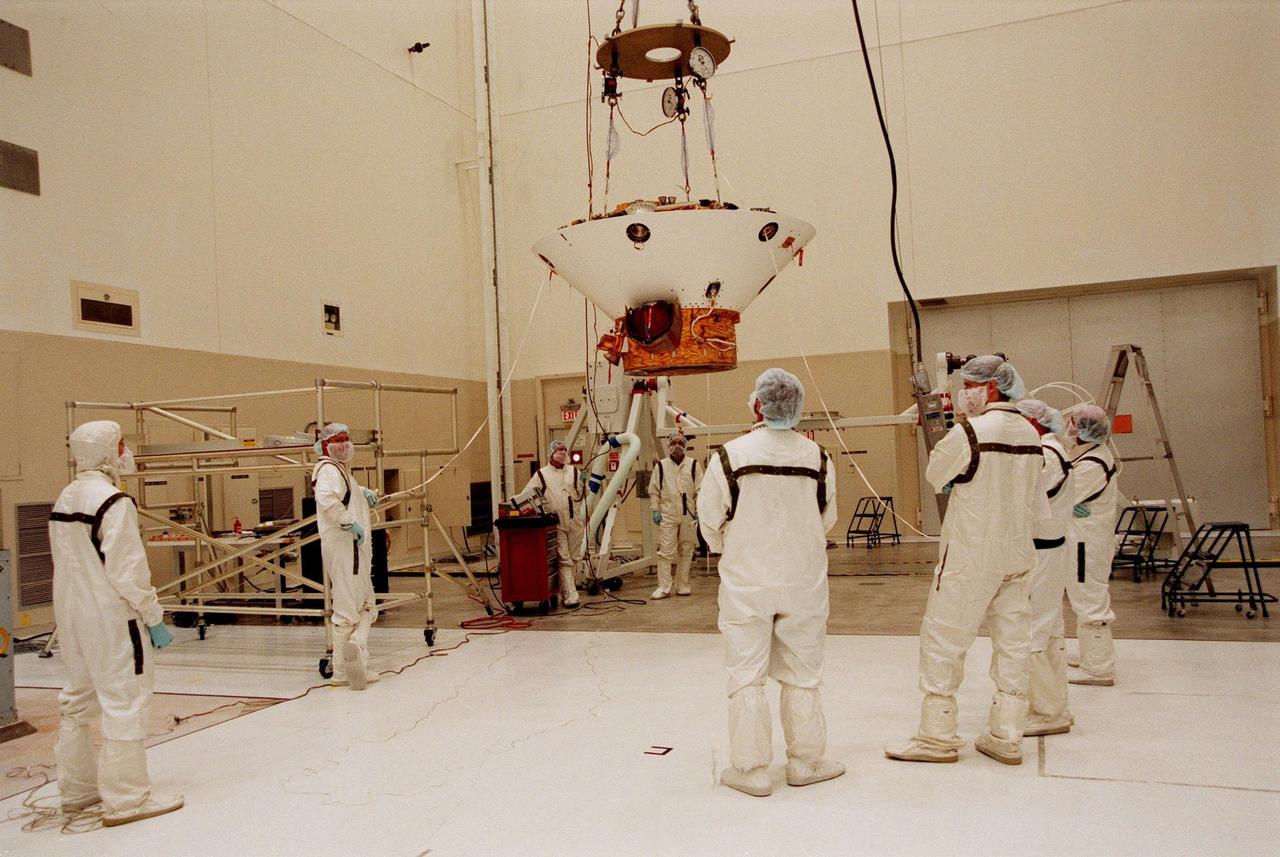
KENNEDY SPACE CENTER, FLA. -- Workers in the Spacecraft Assembly and Encapsulation Facility-2 (SAEF-2) lift the Mars Polar Lander to move it to a spin table for testing. The lander, which will be launched on Jan. 3, 1999, is a solar-powered spacecraft designed to touch down on the Martian surface near the northern-most boundary of the south pole in order to study the water cycle there. The lander also will help scientists learn more about climate change and current resources on Mars, studying such things as frost, dust, water vapor and condensates in the Martian atmosphere. It is the second spacecraft to be launched in a pair of Mars '98 missions. The first is the Mars Climate Orbiter, which is due to be launched aboard a Delta II rocket from Launch Complex 17A on Dec. 11, 1998
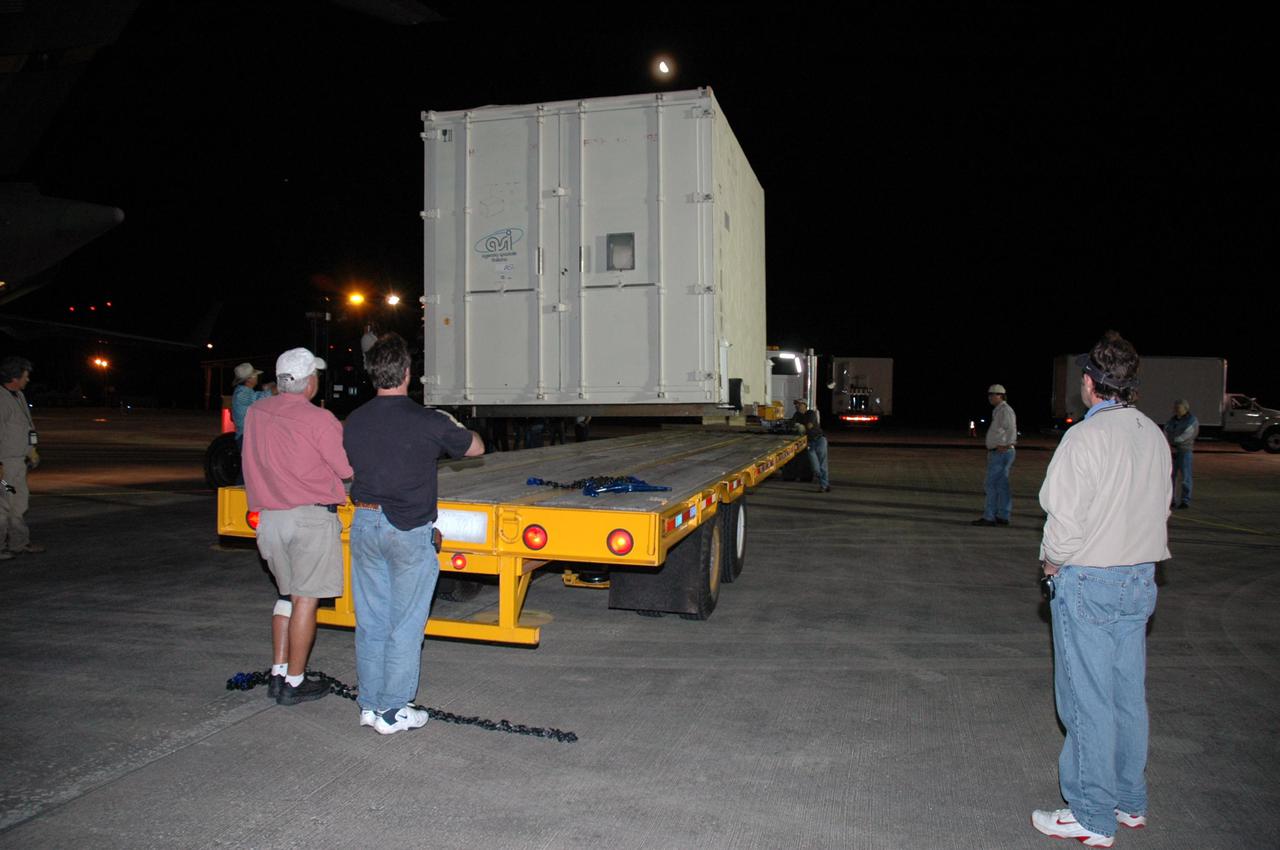
KENNEDY SPACE CENTER, FLA. - At Kennedy Space Center's Shuttle Landing Facility, the second of two containers with the Mars Reconnaissance Orbiter (MRO) equipment is lifted onto a flatbed truck for transport to the Payload Hazardous Servicing Facility. The MRO was built by Lockheed Martin for NASA's Jet Propulsion Laboratory in California. It is the next major step in Mars exploration and scheduled for launch from Cape Canaveral Air Force Station in a window opening Aug. 10. The MRO carries six primary instruments: the High Resolution Imaging Science Experiment, Context Camera, Mars Color Imager, Compact Reconnaissance Imaging Spectrometer for Mars, Mars Climate Sounder and Shallow Radar. By 2007, the MRO will begin a series of global mapping, regional survey and targeted observations from a near-polar, low-altitude Mars orbit. It will observe the atmosphere and surface of Mars while probing its shallow subsurface as part of a “follow the water” strategy.
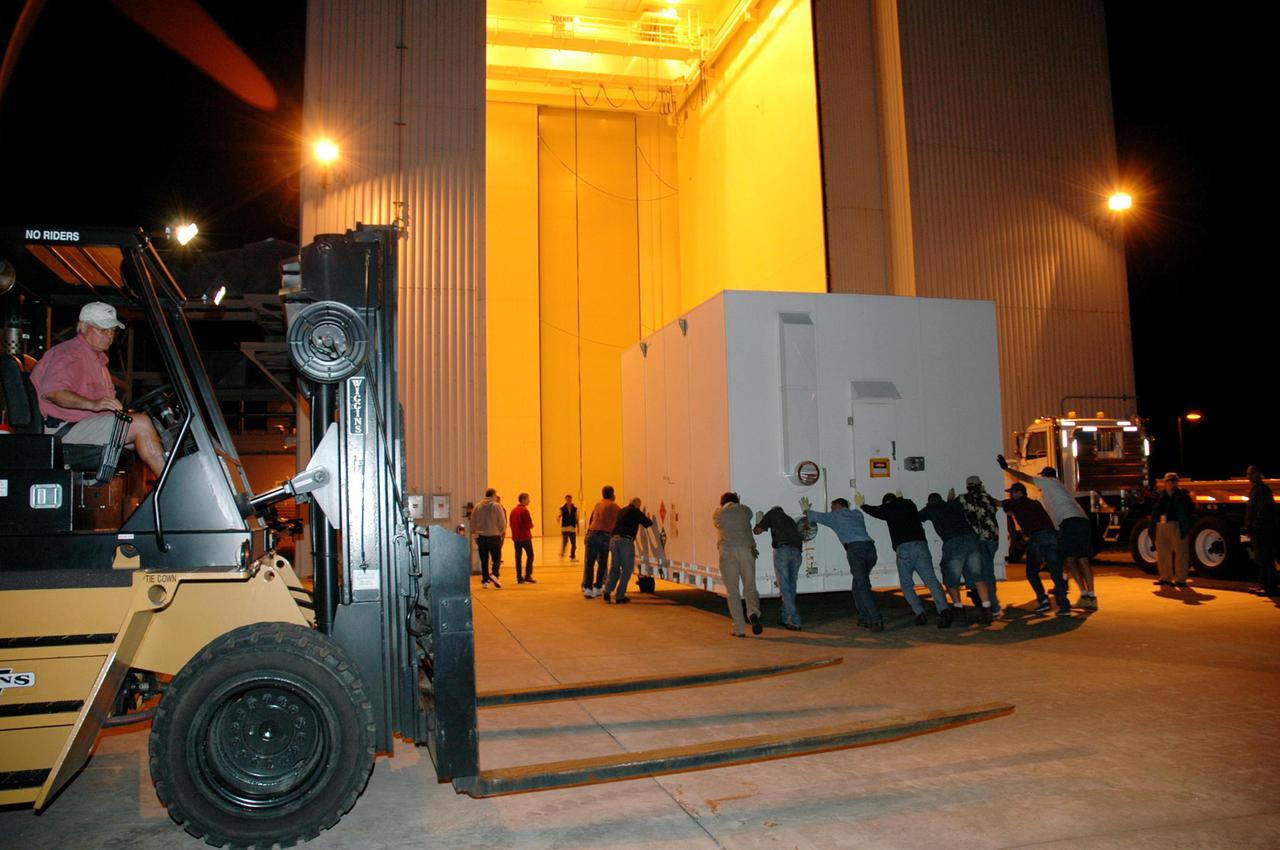
KENNEDY SPACE CENTER, FLA. - Workers roll one of two containers with the Mars Reconnaissance Orbiter (MRO) equipment into the Payload Hazardous Servicing Facility. The MRO was built by Lockheed Martin for NASA's Jet Propulsion Laboratory in California. It is the next major step in Mars exploration and scheduled for launch from Cape Canaveral Air Force Station in a window opening Aug. 10. The MRO carries six primary instruments: the High Resolution Imaging Science Experiment, Context Camera, Mars Color Imager, Compact Reconnaissance Imaging Spectrometer for Mars, Mars Climate Sounder and Shallow Radar. By 2007, the MRO will begin a series of global mapping, regional survey and targeted observations from a near-polar, low-altitude Mars orbit. It will observe the atmosphere and surface of Mars while probing its shallow subsurface as part of a “follow the water” strategy.
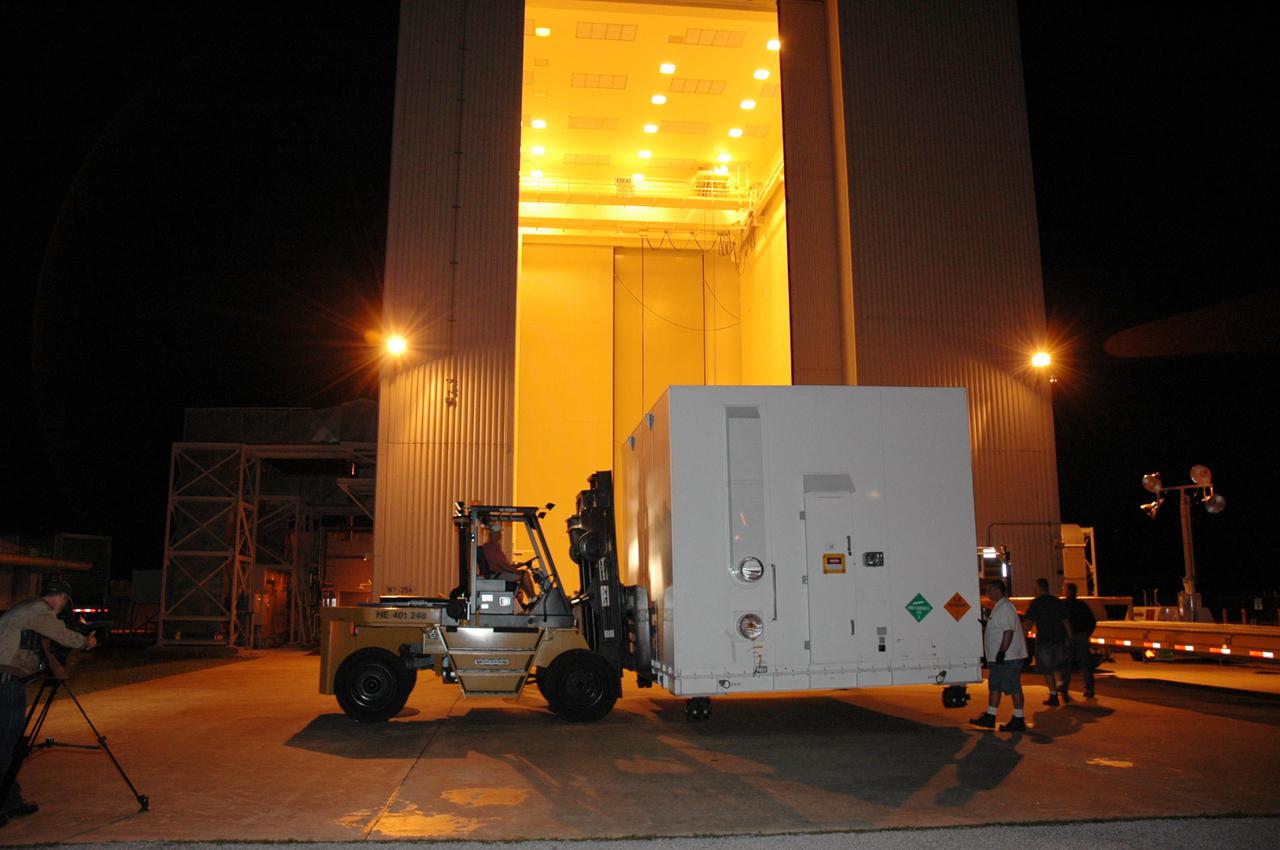
KENNEDY SPACE CENTER, FLA. - One of two containers with the Mars Reconnaissance Orbiter (MRO) equipment arrives at the Payload Hazardous Servicing Facility. The MRO was built by Lockheed Martin for NASA's Jet Propulsion Laboratory in California. It is the next major step in Mars exploration and scheduled for launch from Cape Canaveral Air Force Station in a window opening Aug. 10. The MRO carries six primary instruments: the High Resolution Imaging Science Experiment, Context Camera, Mars Color Imager, Compact Reconnaissance Imaging Spectrometer for Mars, Mars Climate Sounder and Shallow Radar. By 2007, the MRO will begin a series of global mapping, regional survey and targeted observations from a near-polar, low-altitude Mars orbit. It will observe the atmosphere and surface of Mars while probing its shallow subsurface as part of a “follow the water” strategy.
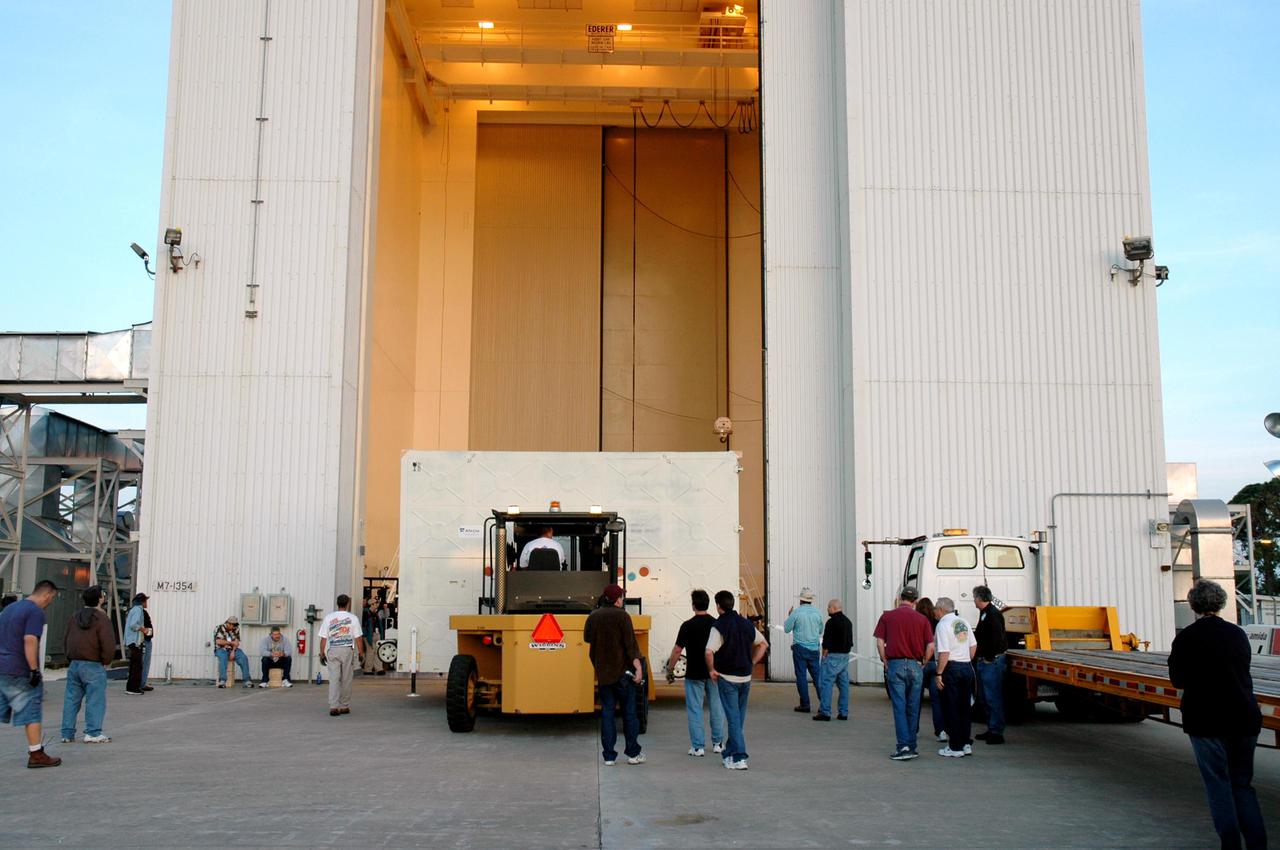
KENNEDY SPACE CENTER, FLA. - A forklift lowers one of two containers with the Mars Reconnaissance Orbiter (MRO) equipment onto the ground in front of the Payload Hazardous Servicing Facility. The MRO was built by Lockheed Martin for NASA's Jet Propulsion Laboratory in California. It is the next major step in Mars exploration and scheduled for launch from Cape Canaveral Air Force Station in a window opening Aug. 10. The MRO carries six primary instruments: the High Resolution Imaging Science Experiment, Context Camera, Mars Color Imager, Compact Reconnaissance Imaging Spectrometer for Mars, Mars Climate Sounder and Shallow Radar. By 2007, the MRO will begin a series of global mapping, regional survey and targeted observations from a near-polar, low-altitude Mars orbit. It will observe the atmosphere and surface of Mars while probing its shallow subsurface as part of a “follow the water” strategy.

KENNEDY SPACE CENTER, FLA. -- After launch tower retraction, the Boeing Delta II rocket carrying NASA's Mars Climate Orbiter undergoes final preparations for liftoff on Dec. 11, 1998, at Launch Complex 17A, Cape Canaveral Air Station. The launch was delayed one day when personnel detected a battery-related software problem in the spacecraft. The problem was corrected and the launch was rescheduled for the next day. The first of a pair of spacecraft in the Mars Surveyor '98 Project, the orbiter is heading for Mars where it will first provide support to its companion Mars Polar Lander spacecraft, which is planned for launch on Jan. 3, 1999. The orbiter's instruments will then monitor the Martian atmosphere and image the planet's surface on a daily basis for one Martian year (1.8 Earth years). It will observe the appearance and movement of atmospheric dust and water vapor, as well as characterize seasonal changes on the surface. The detailed images of the surface features will provide important clues to the planet's early climate history and give scientists more information about possible liquid water reserves beneath the surface
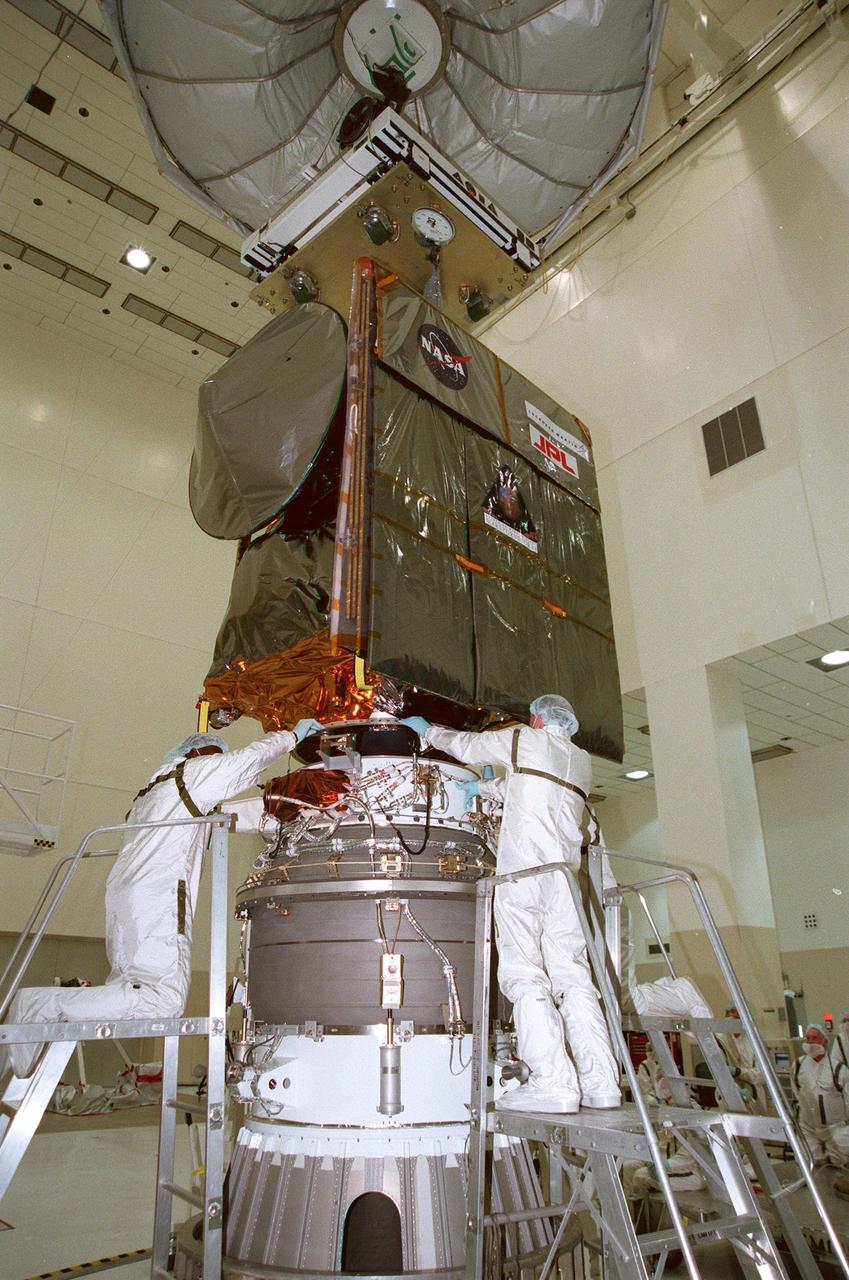
KENNEDY SPACE CENTER, FLA. -- In the Spacecraft Assembly and Encapsulation Facility -2 (SAEF-2), workers check on the fitting between the Mars Climate Orbiter (above) and the third stage of the Boeing Delta II launch vehicle (below). The third stage is a solid-propellant Thiokol Star 48B booster, the same final stage used in the 1996 launch of Mars Global Surveyor. Targeted for launch on Dec. 10, 1998, the orbiter is heading for Mars where it will primarily support its companion Mars Polar Lander spacecraft, which is planned for launch on Jan. 3, 1999. The orbiter's instruments will monitor the Martian atmosphere and image the planet's surface on a daily basis for 687 Earth days. It will observe the appearance and movement of atmospheric dust and water vapor, as well as characterize seasonal changes on the surface. The detailed images of the surface features will provide important clues to the planet's early climate history and give scientists more information about possible liquid water reserves beneath the surface
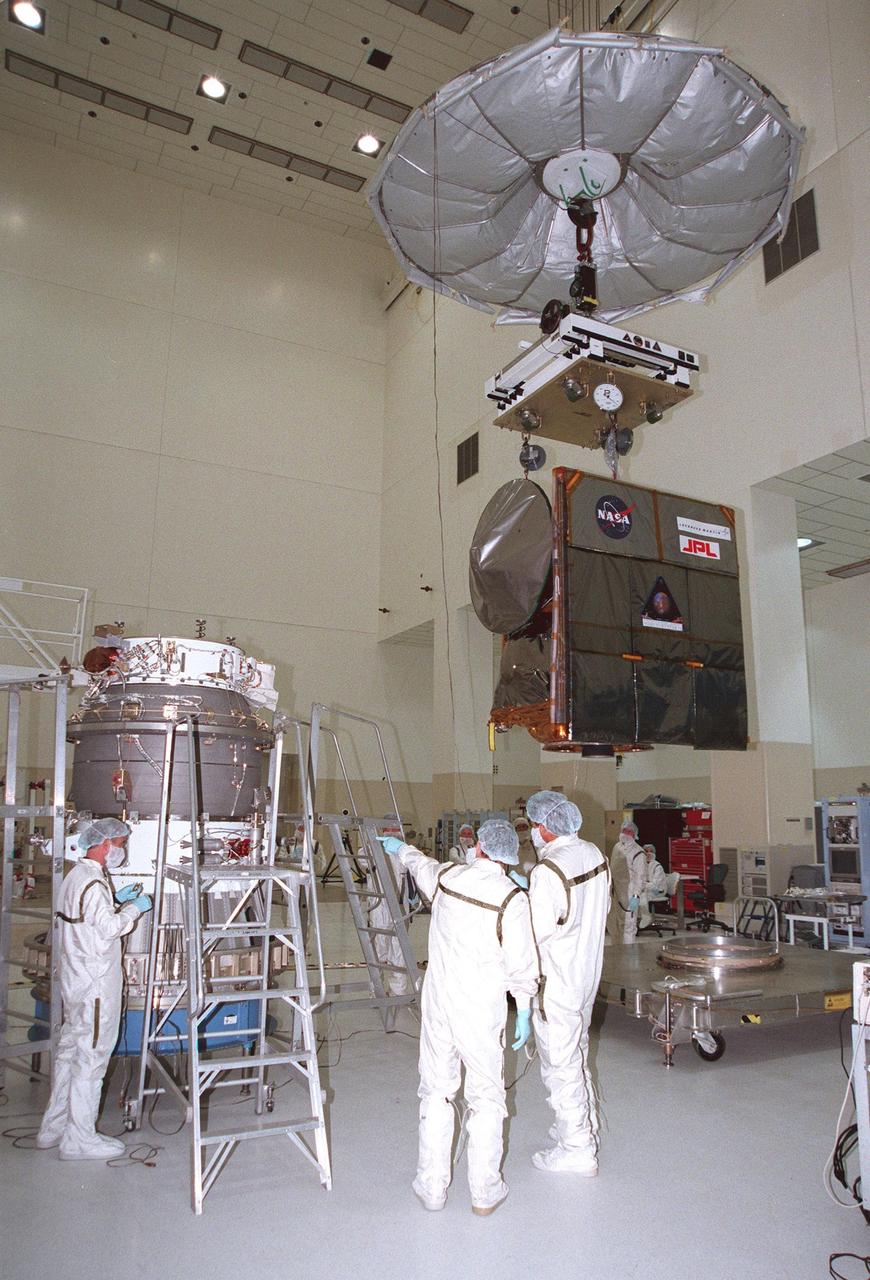
KENNEDY SPACE CENTER, FLA. -- In the Spacecraft Assembly and Encapsulation Facility -2 (SAEF-2), the Mars Climate Orbiter (right) is lifted to move it for mating to the third stage of the Boeing Delta II launch vehicle waiting at left. The third stage is a solid-propellant Thiokol Star 48B booster, the same final stage used in the 1996 launch of Mars Global Surveyor. Targeted for launch on Dec. 10, 1998, the orbiter is heading for Mars where it will primarily support its companion Mars Polar Lander spacecraft, which is planned for launch on Jan. 3, 1999. The orbiter's instruments will monitor the Martian atmosphere and image the planet's surface on a daily basis for 687 Earth days. It will observe the appearance and movement of atmospheric dust and water vapor, as well as characterize seasonal changes on the surface. The detailed images of the surface features will provide important clues to the planet's early climate history and give scientists more information about possible liquid water reserves beneath the surface. <BR>; <BR>; <BR> <BR> <BR> <CENTER
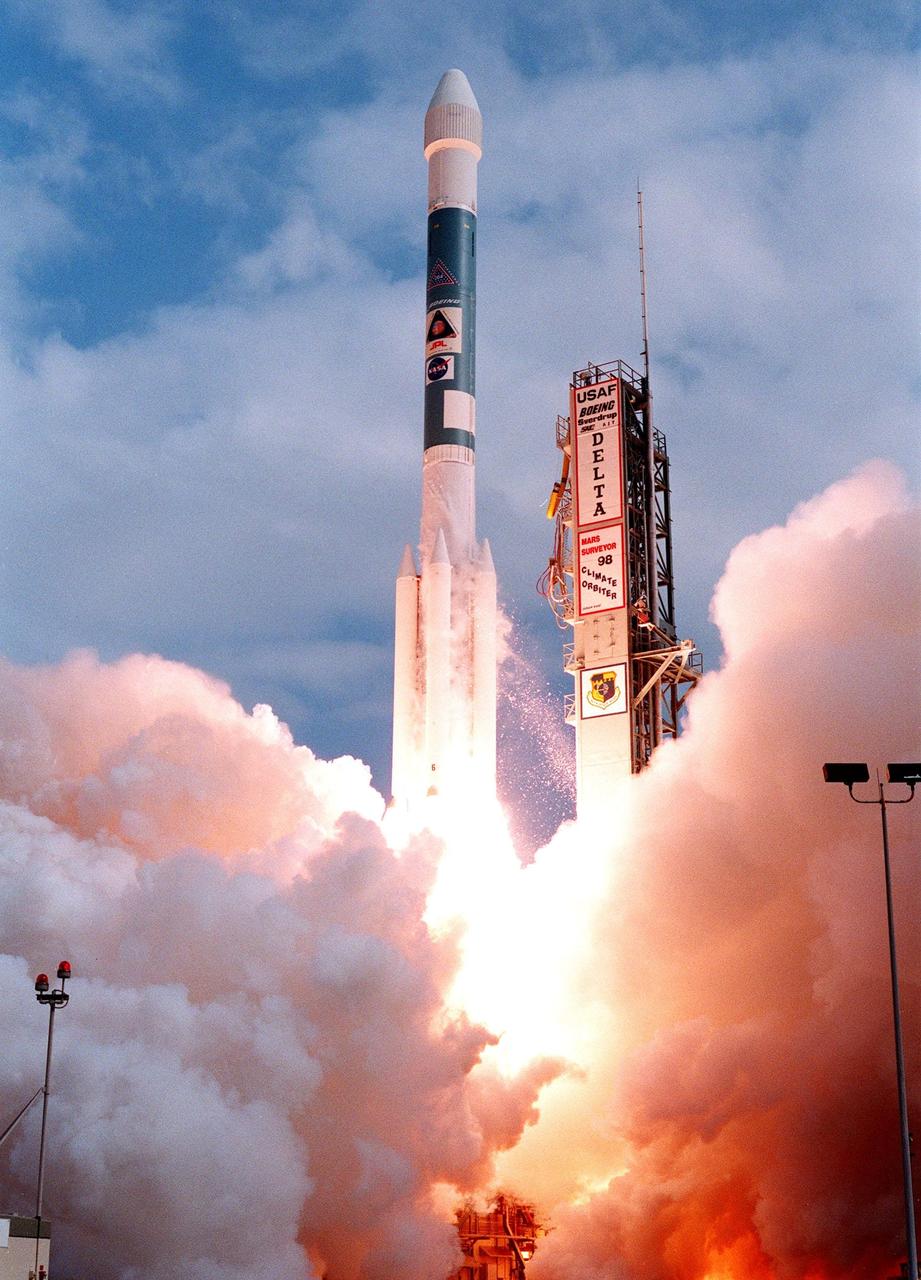
KENNEDY SPACE CENTER, FLA. -- A Boeing Delta II expendable launch vehicle lifts off with NASA's Mars Climate Orbiter at 1:45:51 p.m. EST, on Dec. 11, 1998, from Launch Complex 17A, Cape Canaveral Air Station. The launch was delayed one day when personnel detected a battery-related software problem in the spacecraft. The problem was corrected and the launch was rescheduled for the next day. The first of a pair of spacecraft to be launched in the Mars Surveyor '98 Project, the orbiter is heading for Mars where it will first provide support to its companion Mars Polar Lander spacecraft, which is planned for launch on Jan. 3, 1999. The orbiter's instruments will then monitor the Martian atmosphere and image the planet's surface on a daily basis for one Martian year (1.8 Earth years). It will observe the appearance and movement of atmospheric dust and water vapor, as well as characterize seasonal changes on the surface. The detailed images of the surface features will provide important clues to the planet's early climate history and give scientists more information about possible liquid water reserves beneath the surface
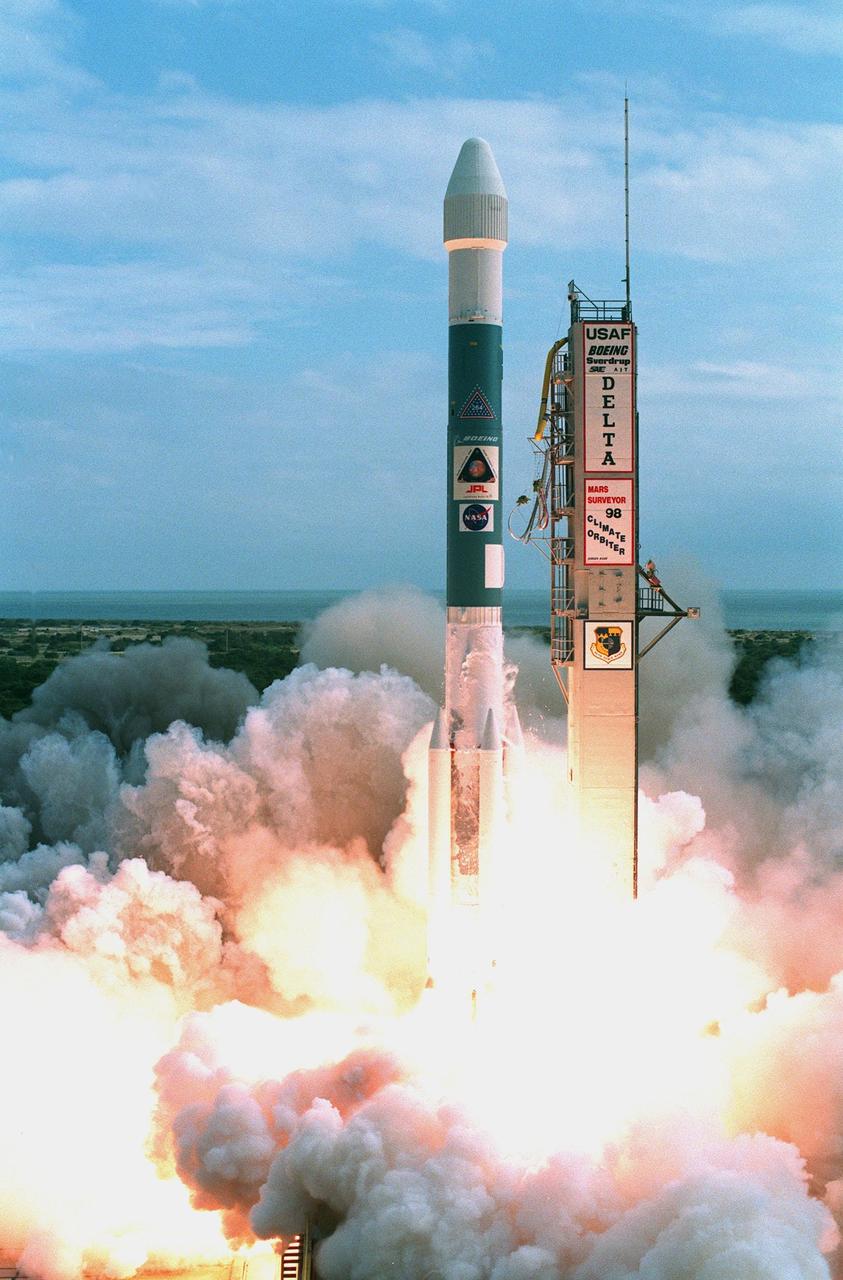
KENNEDY SPACE CENTER, FLA. -- A Boeing Delta II expendable launch vehicle lifts off with NASA's Mars Climate Orbiter at 1:45:51 p.m. EST, on Dec. 11, 1998, from Launch Complex 17A, Cape Canaveral Air Station. The launch was delayed one day when personnel detected a battery-related software problem in the spacecraft. The problem was corrected and the launch was rescheduled for the next day. The first of a pair of spacecraft to be launched in the Mars Surveyor '98 Project, the orbiter is heading for Mars where it will first provide support to its companion Mars Polar Lander spacecraft, which is planned for launch on Jan. 3, 1999. The orbiter's instruments will then monitor the Martian atmosphere and image the planet's surface on a daily basis for one Martian year (1.8 Earth years). It will observe the appearance and movement of atmospheric dust and water vapor, as well as characterize seasonal changes on the surface. The detailed images of the surface features will provide important clues to the planet's early climate history and give scientists more information about possible liquid water reserves beneath the surface
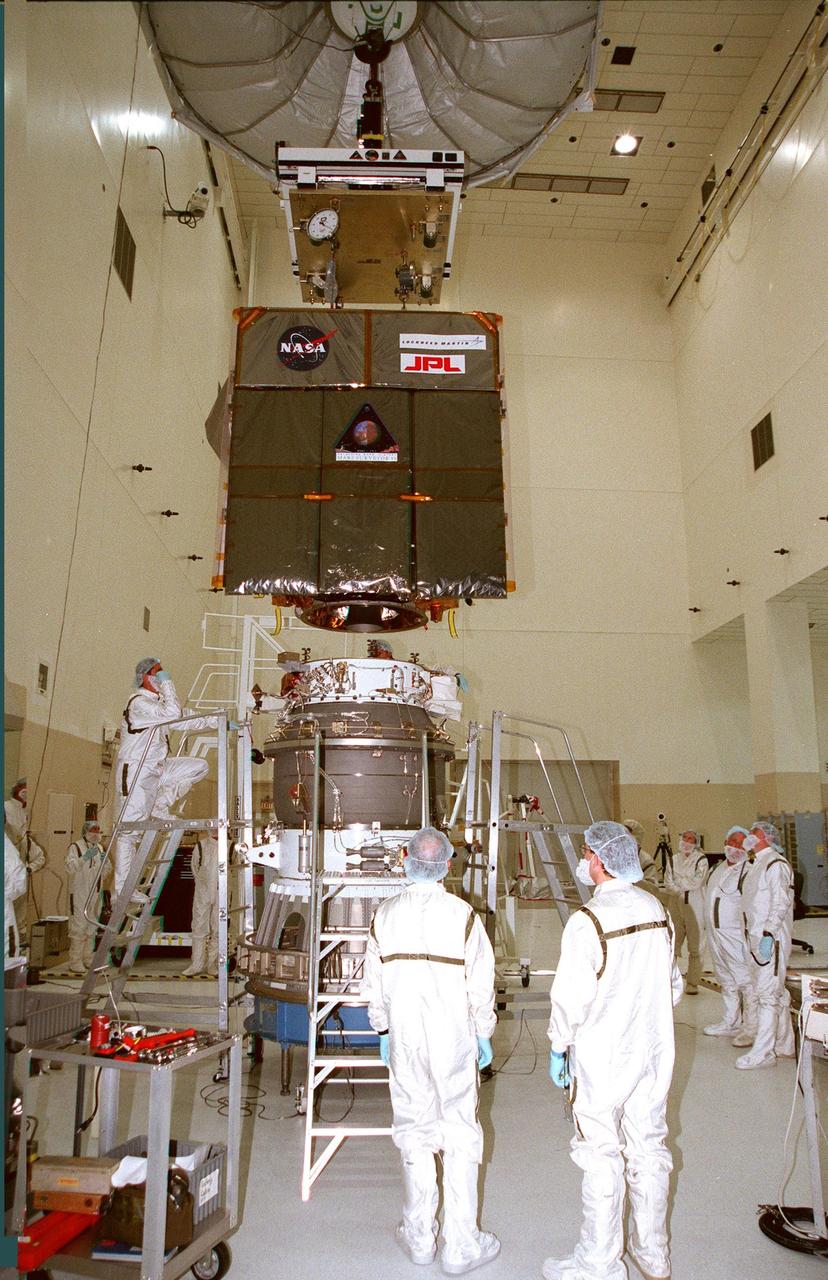
KENNEDY SPACE CENTER, FLA. -- In the Spacecraft Assembly and Encapsulation Facility -2 (SAEF-2), the Mars Climate Orbiter (top) is lowered toward the third stage of the Boeing Delta II launch vehicle below it, to which it will be attached. The third stage is a solid-propellant Thiokol Star 48B booster, the same final stage used in the 1996 launch of Mars Global Surveyor. Targeted for launch on Dec. 10, 1998, the orbiter is heading for Mars where it will primarily support its companion Mars Polar Lander spacecraft, which is planned for launch on Jan. 3, 1999. The orbiter's instruments will monitor the Martian atmosphere and image the planet's surface on a daily basis for 687 Earth days. It will observe the appearance and movement of atmospheric dust and water vapor, as well as characterize seasonal changes on the surface. The detailed images of the surface features will provide important clues to the planet's early climate history and give scientists more information about possible liquid water reserves beneath the surface

A Boeing Delta II expendable launch vehicle lifts off with NASA's Mars Climate Orbiter at 1:45:51 p.m. EST, on Dec. 11, 1998, from Launch Complex 17A, Cape Canaveral Air Station. The launch was delayed one day when personnel detected a battery-related software problem in the spacecraft. The problem was corrected and the launch was rescheduled for the next day. The first of a pair of spacecraft to be launched in the Mars Surveyor '98 Project, the orbiter is heading for Mars where it will first provide support to its companion Mars Polar Lander spacecraft, which is planned for launch on Jan. 3, 1999. The orbiter's instruments will then monitor the Martian atmosphere and image the planet's surface on a daily basis for one Martian year (1.8 Earth years). It will observe the appearance and movement of atmospheric dust and water vapor, as well as characterize seasonal changes on the surface. The detailed images of the surface features will provide important clues to the planet's early climate history and give scientists more information about possible liquid water reserves beneath the surface
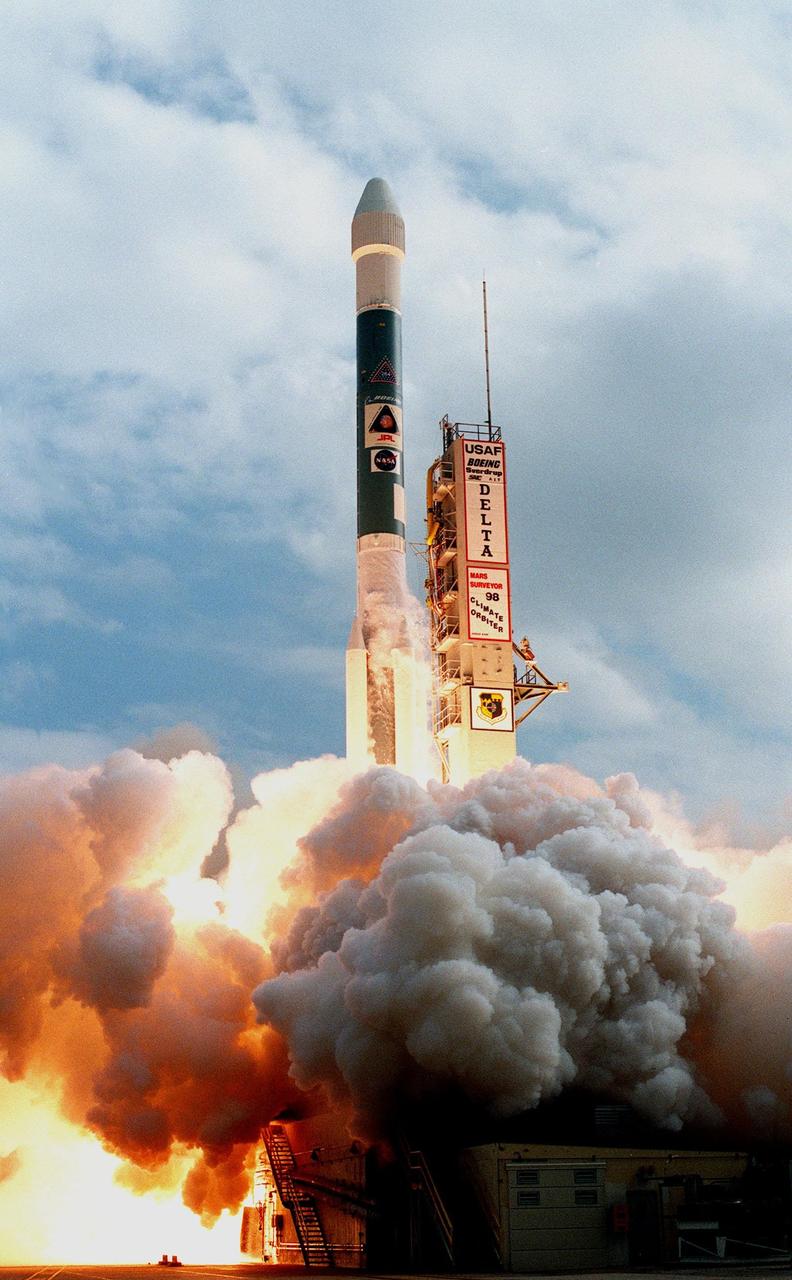
KENNEDY SPACE CENTER, FLA. -- A Boeing Delta II expendable launch vehicle lifts off with NASA's Mars Climate Orbiter at 1:45:51 p.m. EST, on Dec. 11, 1998, from Launch Complex 17A, Cape Canaveral Air Station. The launch was delayed one day when personnel detected a battery-related software problem in the spacecraft. The problem was corrected and the launch was rescheduled for the next day. The first of a pair of spacecraft to be launched in the Mars Surveyor '98 Project, the orbiter is heading for Mars where it will first provide support to its companion Mars Polar Lander spacecraft, which is planned for launch on Jan. 3, 1999. The orbiter's instruments will then monitor the Martian atmosphere and image the planet's surface on a daily basis for one Martian year (1.8 Earth years). It will observe the appearance and movement of atmospheric dust and water vapor, as well as characterize seasonal changes on the surface. The detailed images of the surface features will provide important clues to the planet's early climate history and give scientists more information about possible liquid water reserves beneath the surface
![The two largest ice sheets in the inner solar system are here on Earth, Antarctica and Greenland. The third largest is at the South Pole of Mars and a small part of it is shown in this image from NASA's Mars Reconnaissance Orbiter (MRO). Much like the terrestrial examples, this ice sheet is layered and scientists refer to it as the South Polar layered deposits. The ice layers contain information about past climates on Mars and deciphering this record has been a major goal of Mars science for decades. This slope, near the ice sheet's edge, shows the internal layers that have this climate record. With stereo images, we can tell the heights of these layers so we can measure their thickness and try to unravel the climatic information they contain. (Be sure to view the digital terrain model for this observation.) The map is projected here at a scale of 25 centimeters (9.8 inches) per pixel. [The original image scale is 25.0 centimeters (9.8 inches) per pixel (with 1 x 1 binning); objects on the order of 75 centimeters (29.5 inches) across are resolved.] North is up. https://photojournal.jpl.nasa.gov/catalog/PIA22125](https://images-assets.nasa.gov/image/PIA22125/PIA22125~thumb.jpg)
The two largest ice sheets in the inner solar system are here on Earth, Antarctica and Greenland. The third largest is at the South Pole of Mars and a small part of it is shown in this image from NASA's Mars Reconnaissance Orbiter (MRO). Much like the terrestrial examples, this ice sheet is layered and scientists refer to it as the South Polar layered deposits. The ice layers contain information about past climates on Mars and deciphering this record has been a major goal of Mars science for decades. This slope, near the ice sheet's edge, shows the internal layers that have this climate record. With stereo images, we can tell the heights of these layers so we can measure their thickness and try to unravel the climatic information they contain. (Be sure to view the digital terrain model for this observation.) The map is projected here at a scale of 25 centimeters (9.8 inches) per pixel. [The original image scale is 25.0 centimeters (9.8 inches) per pixel (with 1 x 1 binning); objects on the order of 75 centimeters (29.5 inches) across are resolved.] North is up. https://photojournal.jpl.nasa.gov/catalog/PIA22125

KENNEDY SPACE CENTER, Fla. -- In the Payload Hazardous Servicing Facility, workers help guide the suspended Phoenix Mars Lander spacecraft toward the upper stage booster in the center. The spacecraft and booster will be mated for launch. Targeted for launch from Cape Canaveral Air Force Station on Aug. 3, Phoenix will land in icy soils near the north polar permanent ice cap of Mars and explore the history of the water in these soils and any associated rocks, while monitoring polar climate. Landing on Mars is planned in May 2008 on arctic ground where a mission currently in orbit, Mars Odyssey, has detected high concentrations of ice just beneath the top layer of soil. NASA/Dimitri Gerondidakis
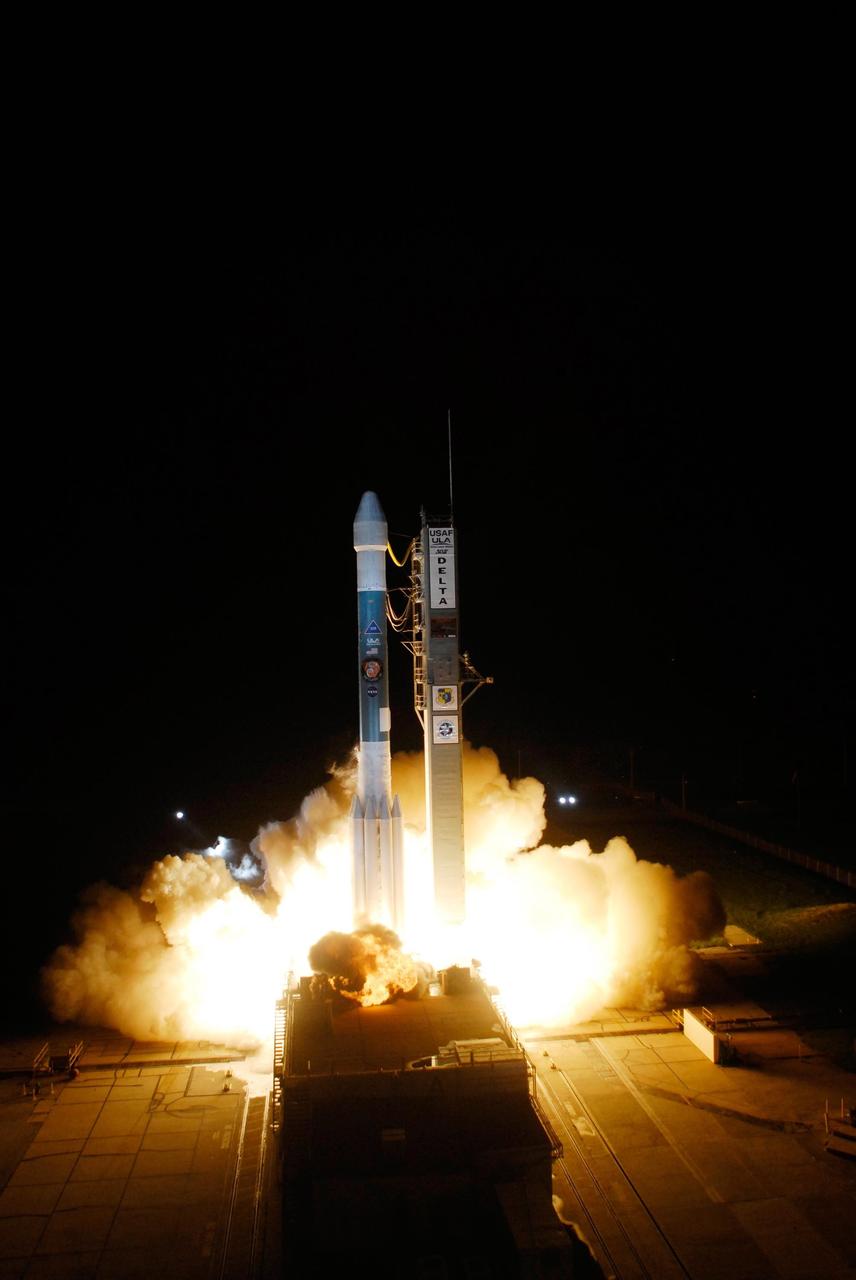
KENNEDY SPACE CENTER, FLA. - NASA's Phoenix spacecraft makes an auspicious start on its journey to Mars aboard a Delta II 7925 rocket at 5:26 a.m. EDT from Pad 17A at Cape Canaveral Air Force Station. Phoenix will land in icy soils near the north polar, permanent ice cap of Mars and explore the history of the water in these soils and any associated rocks, while monitoring polar climate. Landing on Mars is planned in May 2008 on arctic ground where a mission currently in orbit, Mars Odyssey, has detected high concentrations of ice just beneath the top layer of soil. Photo credit: NASA/Tony Gray and Robert Murray
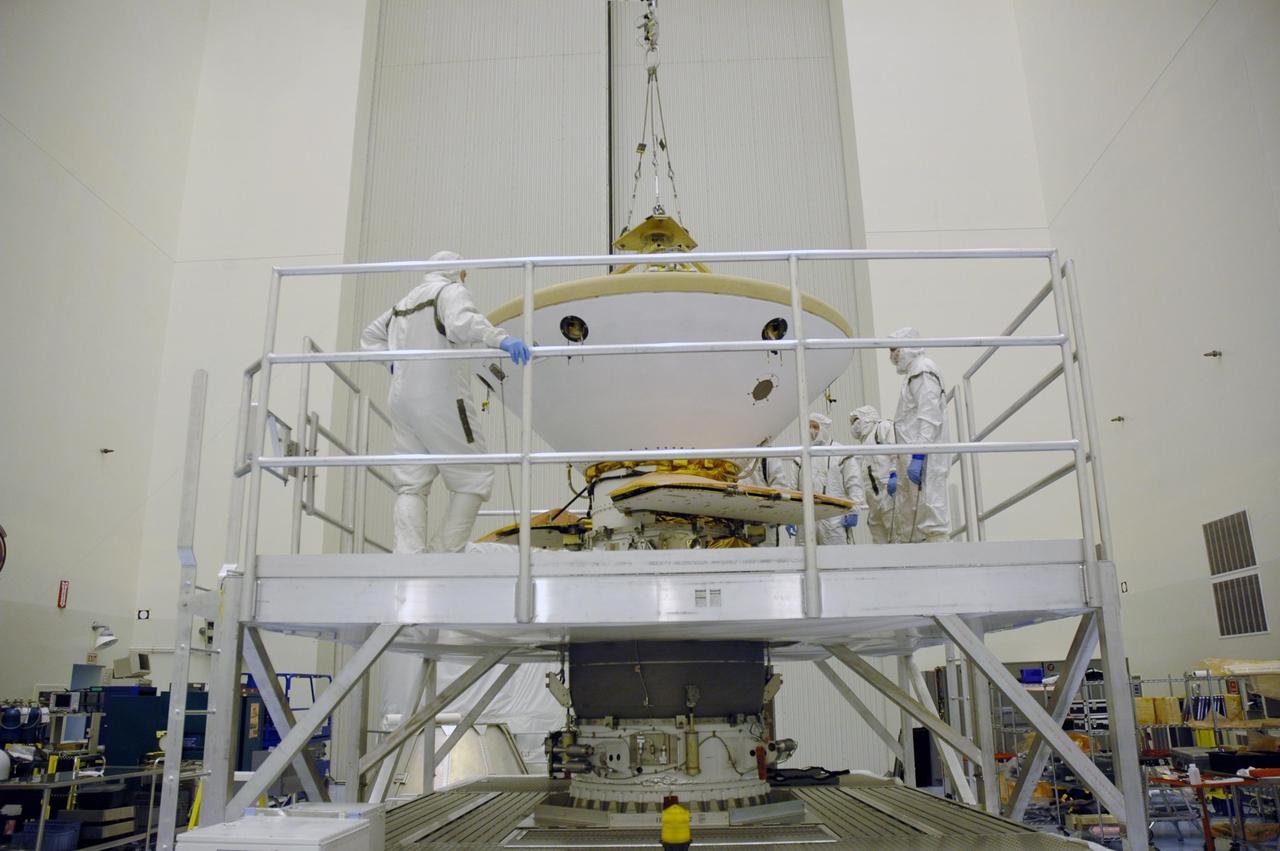
KENNEDY SPACE CENTER, Fla. -- In the Payload Hazardous Servicing Facility, workers observe the installation of the heat shield onto the Phoenix Mars Lander spacecraft. Targeted for launch from Cape Canaveral Air Force Station on Aug. 3, Phoenix will land in icy soils near the north polar permanent ice cap of Mars and explore the history of the water in these soils and any associated rocks, while monitoring polar climate. Landing on Mars is planned in May 2008 on arctic ground where a mission currently in orbit, Mars Odyssey, has detected high concentrations of ice just beneath the top layer of soil. Photo credit: NASA/Troy Cryder
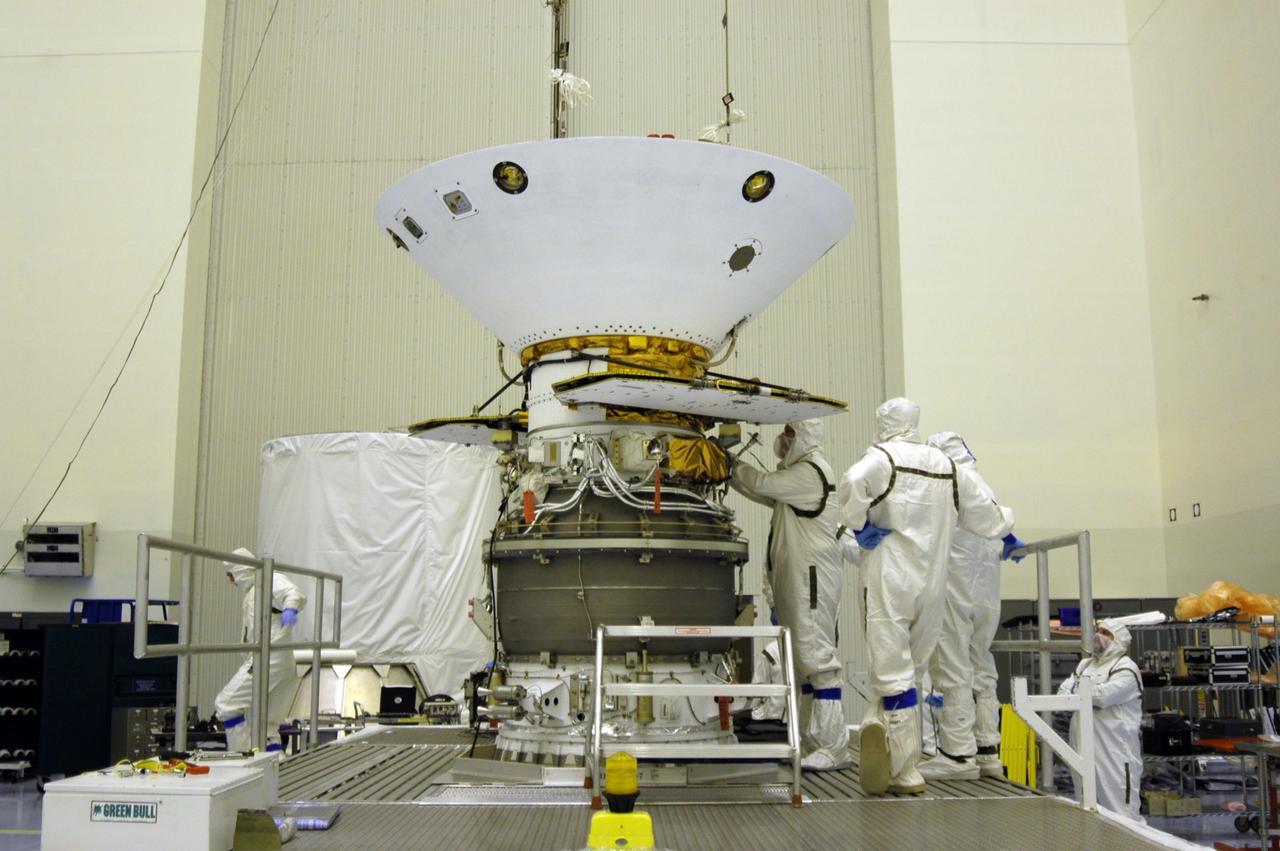
KENNEDY SPACE CENTER, Fla. -- In the Payload Hazardous Servicing Facility, workers secure the Phoenix Mars Lander spacecraft onto the upper stage booster. Targeted for launch from Cape Canaveral Air Force Station on Aug. 3, Phoenix will land in icy soils near the north polar permanent ice cap of Mars and explore the history of the water in these soils and any associated rocks, while monitoring polar climate. Landing on Mars is planned in May 2008 on arctic ground where a mission currently in orbit, Mars Odyssey, has detected high concentrations of ice just beneath the top layer of soil. NASA/Dimitri Gerondidakis
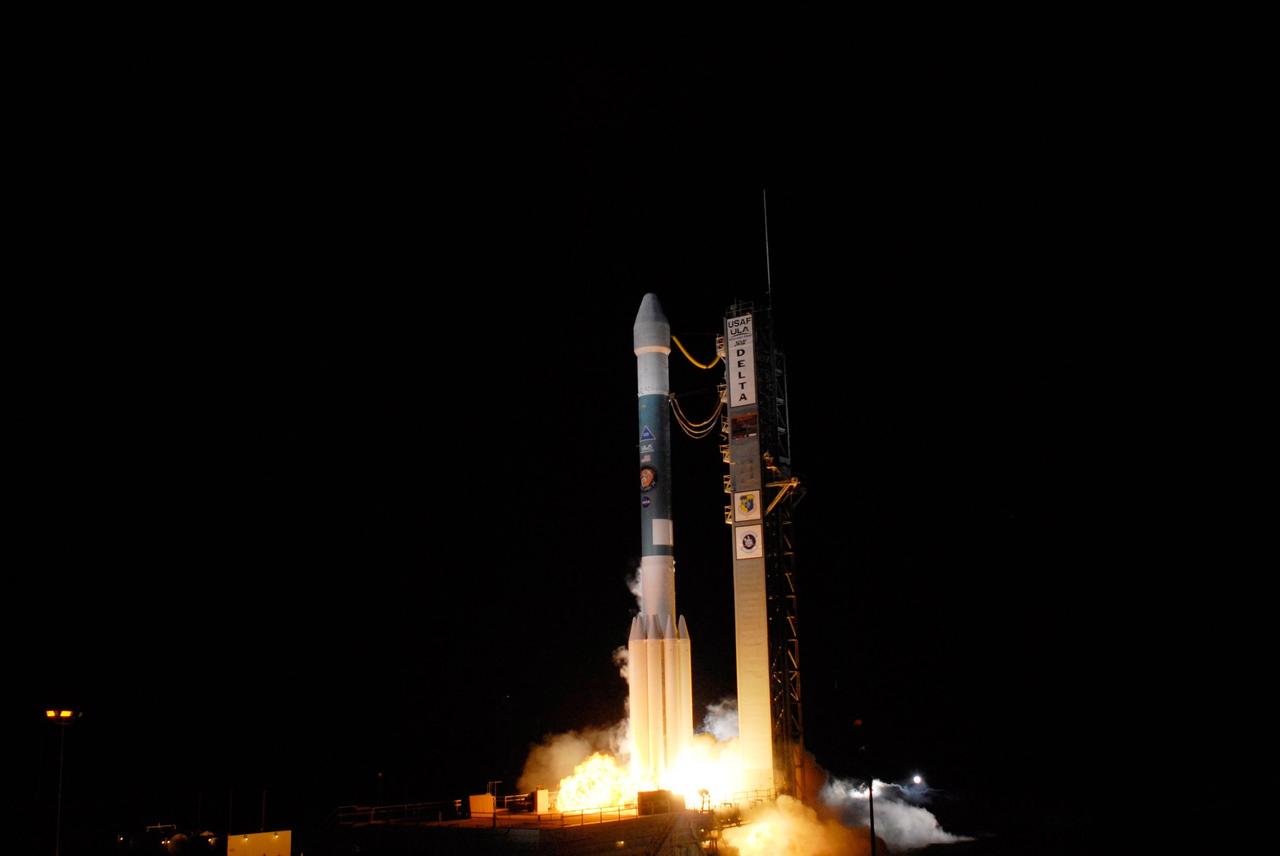
KENNEDY SPACE CENTER, FLA. - NASA's Phoenix Mars lander lifts off from Pad 17A aboard a Delta II 7925 rocket at Cape Canaveral Air Force Station at 5:26 a.m. EDT. Phoenix will land in icy soils near the north polar, permanent ice cap of Mars and explore the history of the water in these soils and any associated rocks, while monitoring polar climate. Landing on Mars is planned in May 2008 on arctic ground where a mission currently in orbit, Mars Odyssey, has detected high concentrations of ice just beneath the top layer of soil. Photo credit: NASA/Regina Mitchell-Ryall and Jerry Cannon