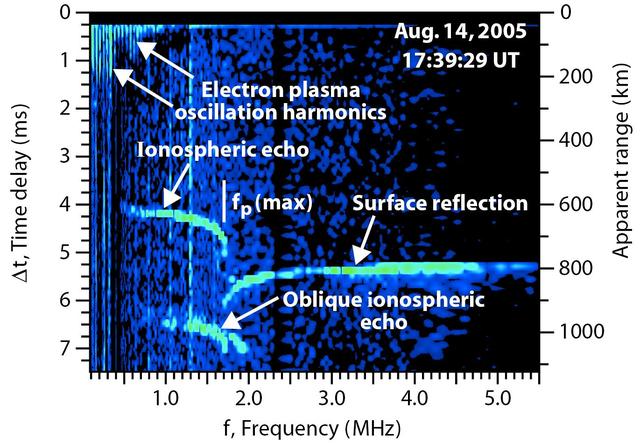
These spectrograms from the MARSIS instrument on the European Space Agency Mars Express orbiter show the intensity of radar echo in Mars far-northern ionosphere at three times on Oct. 19 and 20, 2014.
Radar-Detected Change in Martian Near-Polar Ionosphere After Comet Flyby
Radar Ionogram with Oblique Ionospheric Echo
These plots portray data from radar sounding of Mars mid-latitude ionosphere at three times on Oct. 19 and 20, 2014. The data are from the MARSIS instrument on the European Space Agency Mars Express orbiter.
Change in Mars Mid-Latitude Ionosphere After Comet Flyby
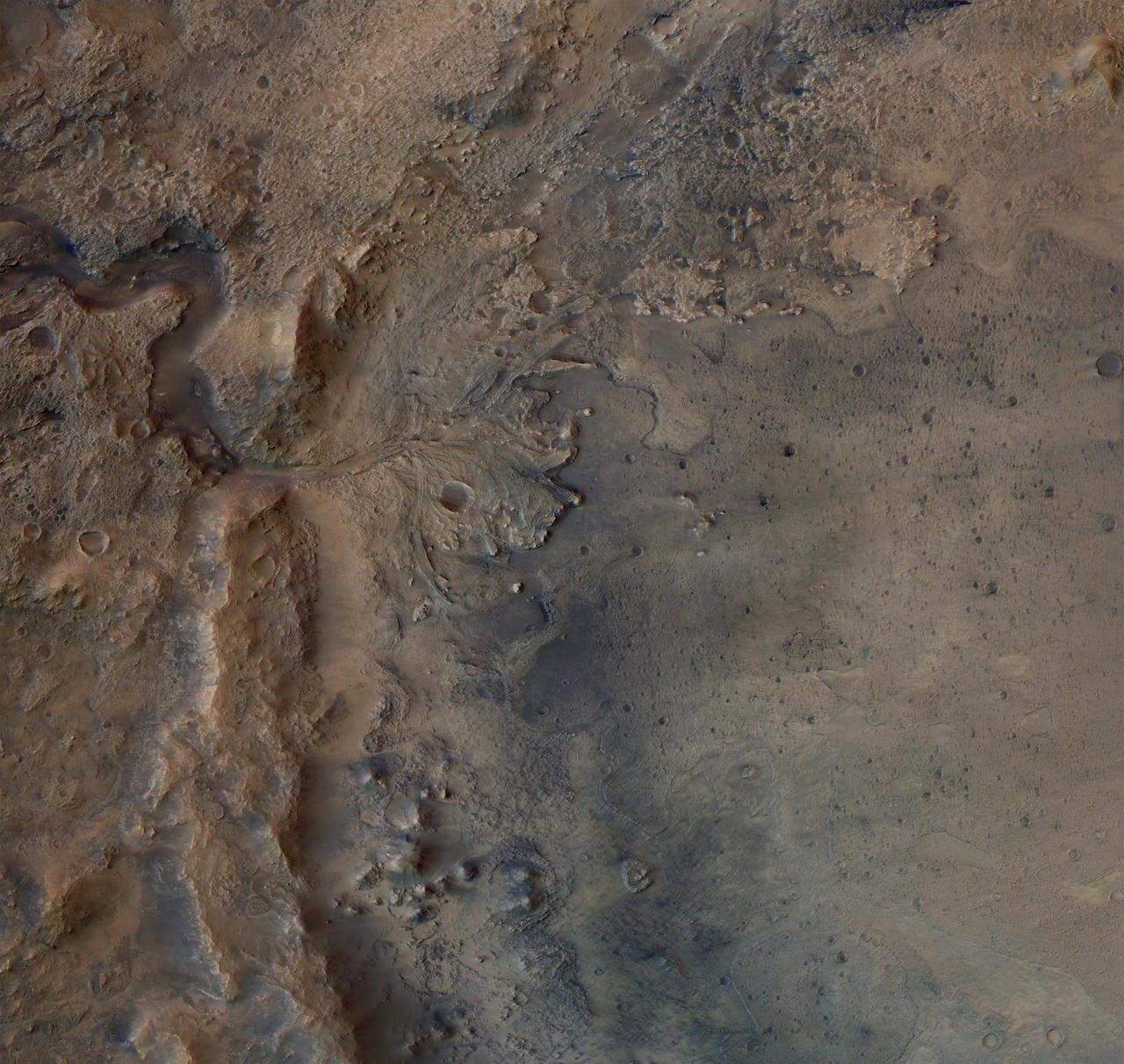
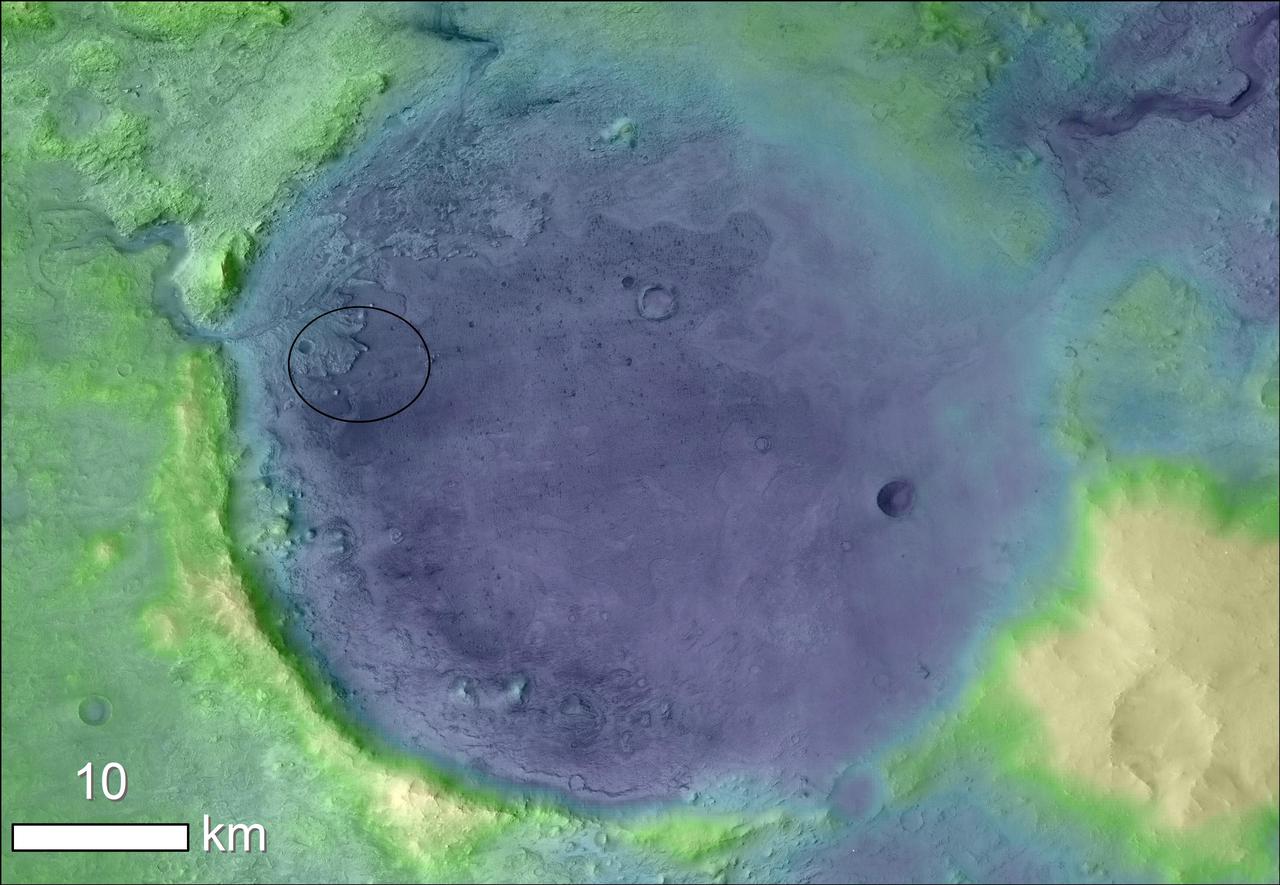
This image shows the remains of an ancient delta in Mars' Jezero Crater, which NASA's Perseverance Mars rover will explore for signs of fossilized microbial life. The image was taken by the High Resolution Stereo Camera aboard the ESA (European Space Agency) Mars Express orbiter. The European Space Operations Centre in Darmstadt, Germany, operates the ESA mission. The High Resolution Stereo Camera was developed by a group with leadership at the Freie Universitat Berlin.  https://photojournal.jpl.nasa.gov/catalog/PIA24096
Jezero Crater as Seen by ESA's Mars Express Orbiter
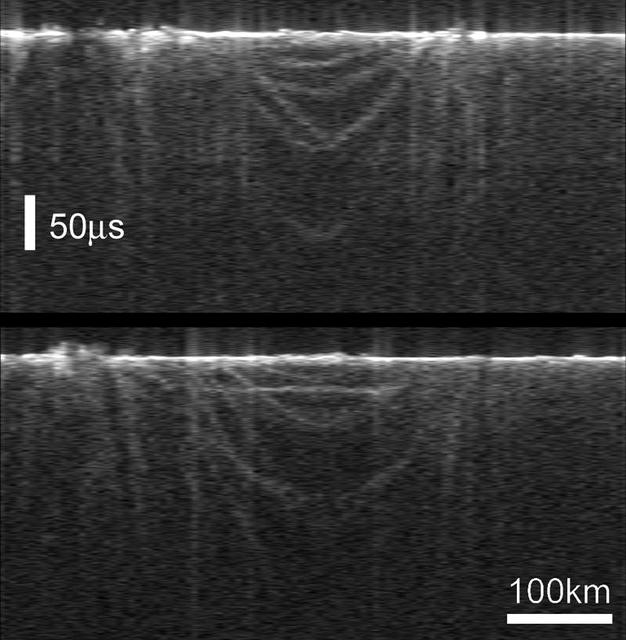
Radargrams of Buried Basin from Two Adjacent Orbits
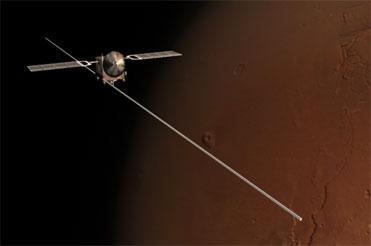
This frame from an animation portrays the unfolding of all three booms making up the antenna for the radar instrument on the European Space Agency Mars Express orbiter.
Deployment of Mars Express Radar Antenna Sections Artist Concept
This picture of the European Space Agency Mars Express spacecraft by the Mars Orbiter Camera on NASA Mars Global Surveyor is from the first successful imaging of any spacecraft orbiting Mars taken by another spacecraft orbiting Mars.
Mars Express Seen by Mars Global Surveyor
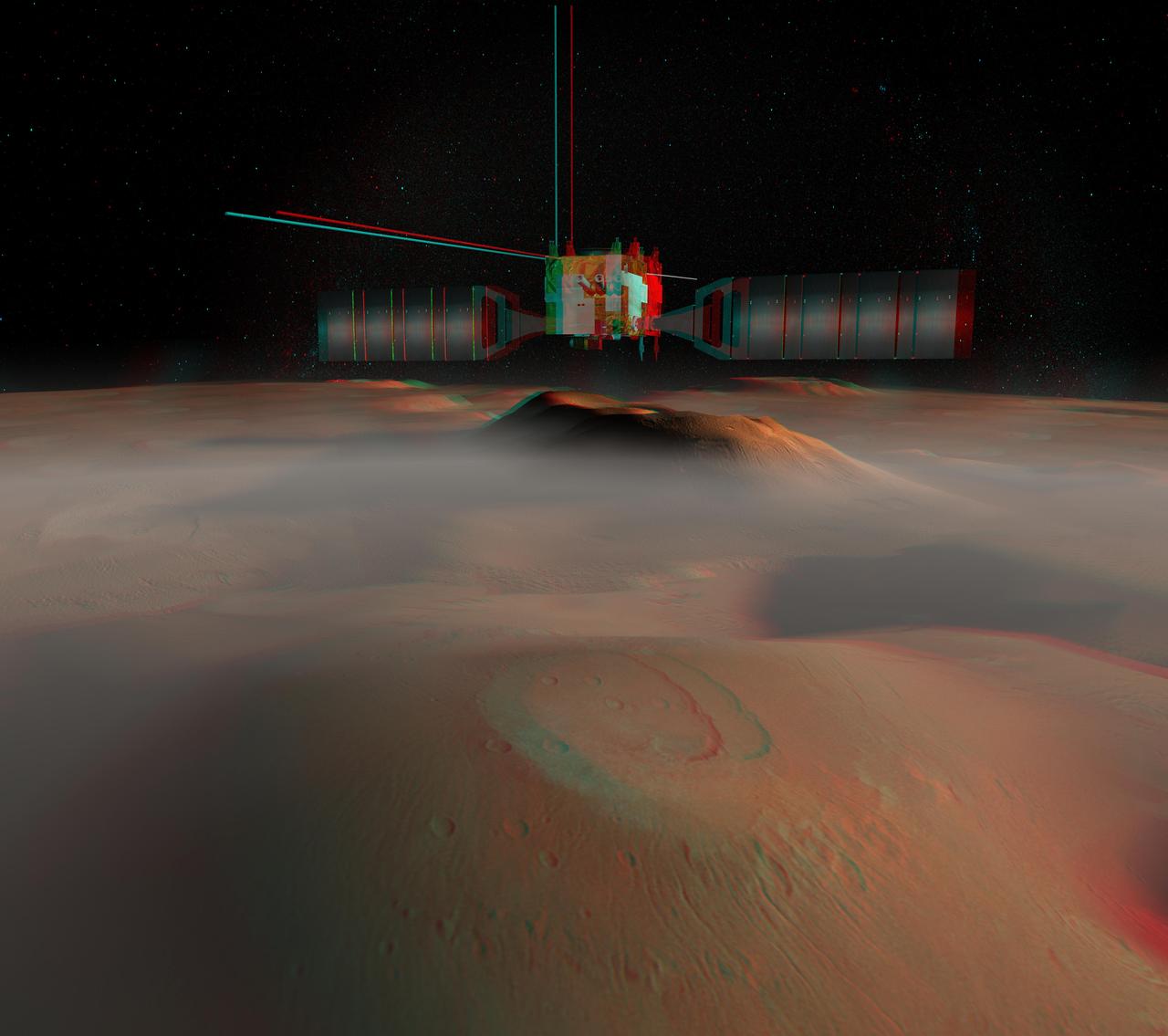
The European Space Agency's Mars Express spacecraft is depicted in orbit around Mars in this artist's concept stereo illustration.  The spacecraft was launched June 2, 2003, from Baikonur, Kazakhstan, on a journey to arrive at Mars in December 2003.  This red-blue anaglyph artwork can be viewed in 3-D on your computer monitor or in color print form by wearing red-blue (cyan) 3-D glasses.  http://photojournal.jpl.nasa.gov/catalog/PIA04803
Mars Express, 3-D Artist Concept
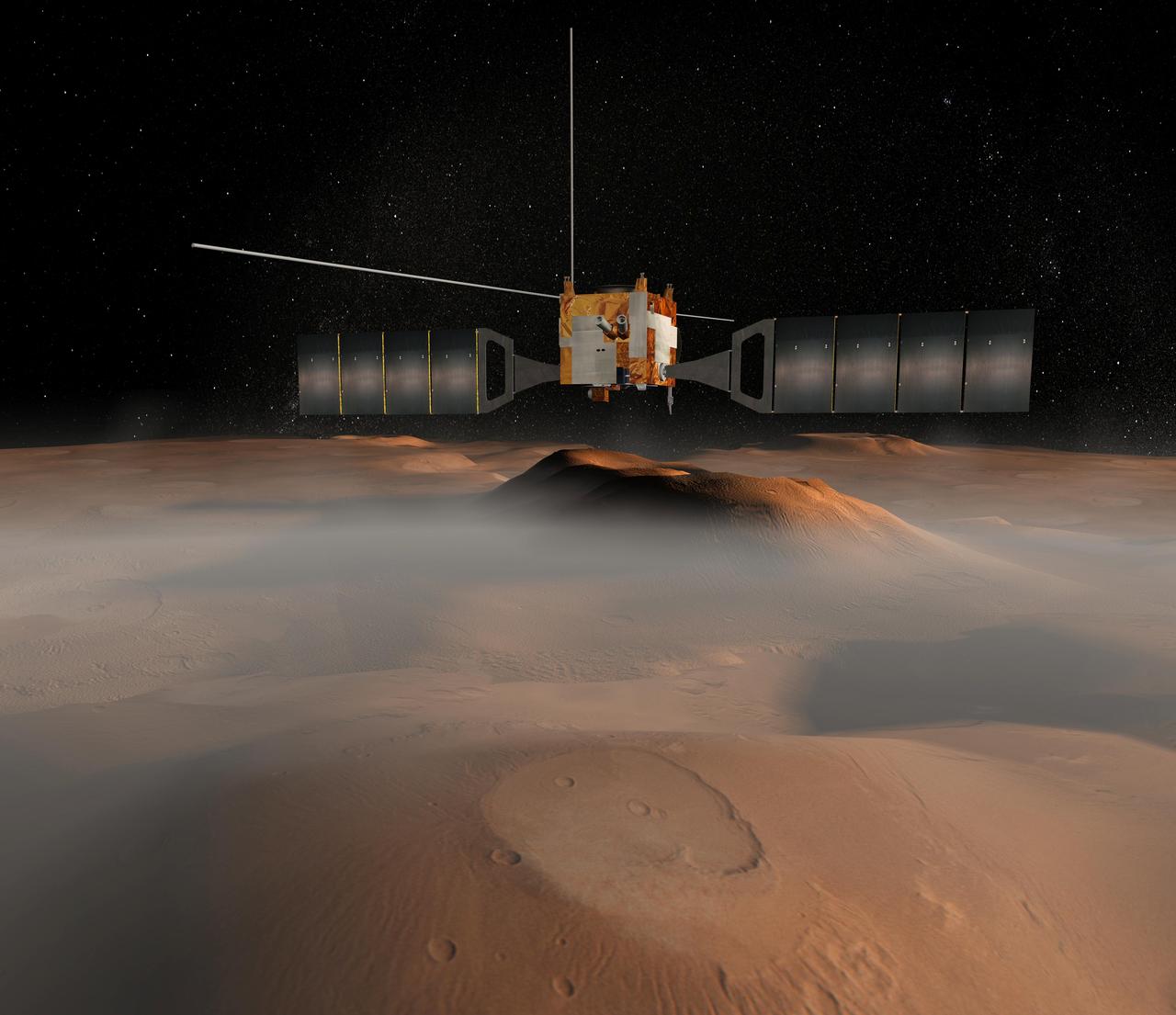
The European Space Agency Mars Express spacecraft is depicted in orbit around Mars in this artist concept illustration.  The spacecraft was launched June 2, 2003, from Baikonur, Kazakhstan, on a journey to arrive at Mars in December 2003.  http://photojournal.jpl.nasa.gov/catalog/PIA04802
Mars Express, Artist Concept
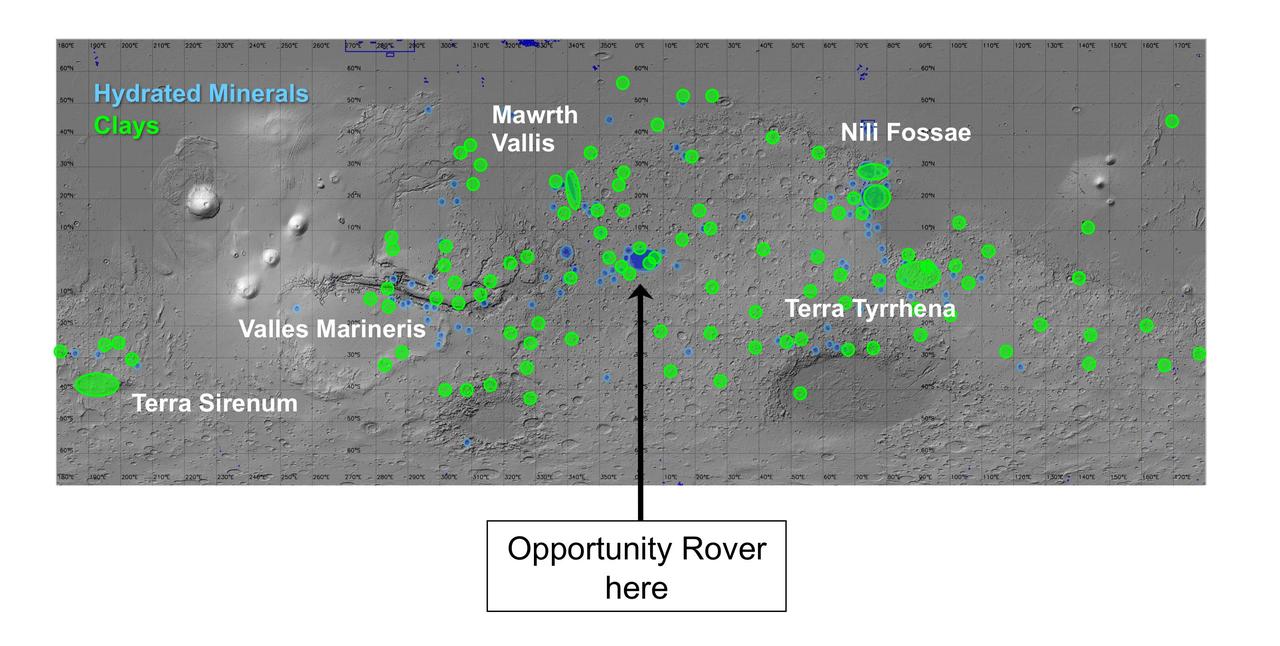
On this map of Mars, spectrometers on spacecraft orbiting Mars have detected clay minerals green and hydrated minerals-- clays, sulfates and others blue.
Regions of Mars with Clays and Hydrated Minerals Identified from Orbit
Radargram of Mars North Polar Layered Deposits with Topographic Map
Mars Radar Opens a Planet Third Dimension
This map shows the thickness of the south polar layered deposits of Mars, an ice-rich geologic unit that was probed by the Mars Advanced Radar for Subsurface and Ionospheric Sounding MARSIS
Thickness of Mars South Polar Layered Deposits
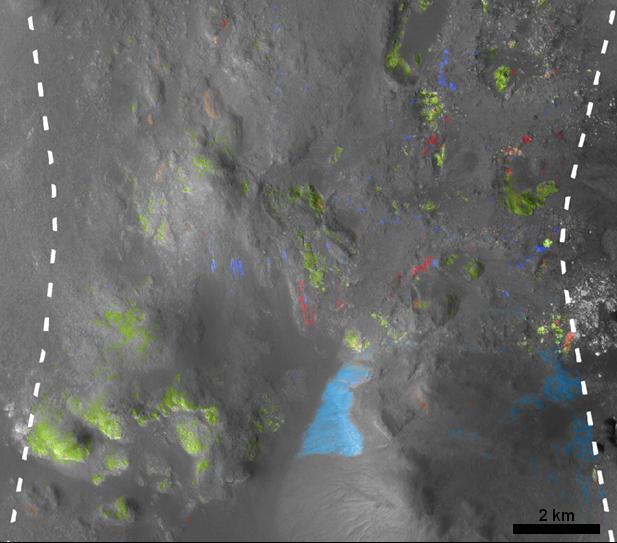
This view of Stokes Crater is a mosaic of images taken by NASA Mars Reconnaissance Orbiter and ESA Mars Express showing at least one of the nine craters in the northern lowlands of Mars with exposures of hydrated minerals detected from orbit.
Hydrated Minerals Exposed at Stokes, Northern Mars
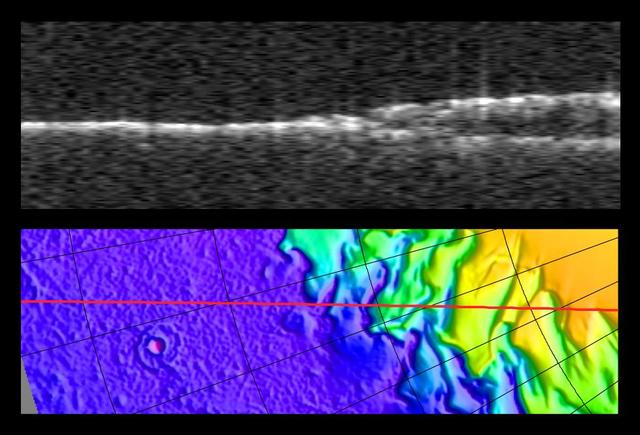
Bright Lower Echo in Radargram of South Polar Layered Deposits
This radargram profile from ESA Mars Express and NASA Mars Global Surveyor orbiter shows data from the subsurface of Mars in the ice-rich north polar plateau of Mars.
Radargram of Mars North Polar Plateau from Mars Express
This map shows the topography of the south polar region of Mars. The elevation of the terrain is shown by colors, with purple and blue representing the lowest areas, and orange and red the highest
Upper Surface of Icy Layers Covering Mars South Polar Region
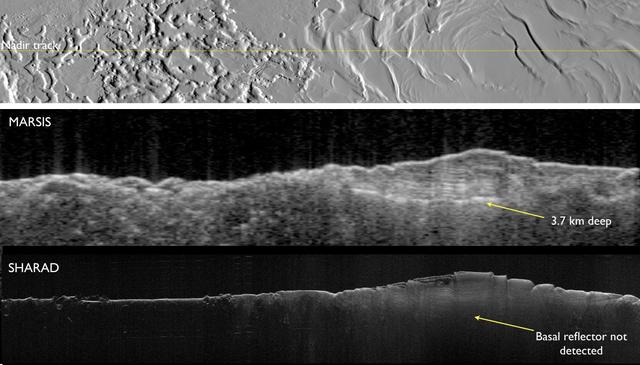
Two Radar Sounders Examine South Polar Layered Deposits on Mars
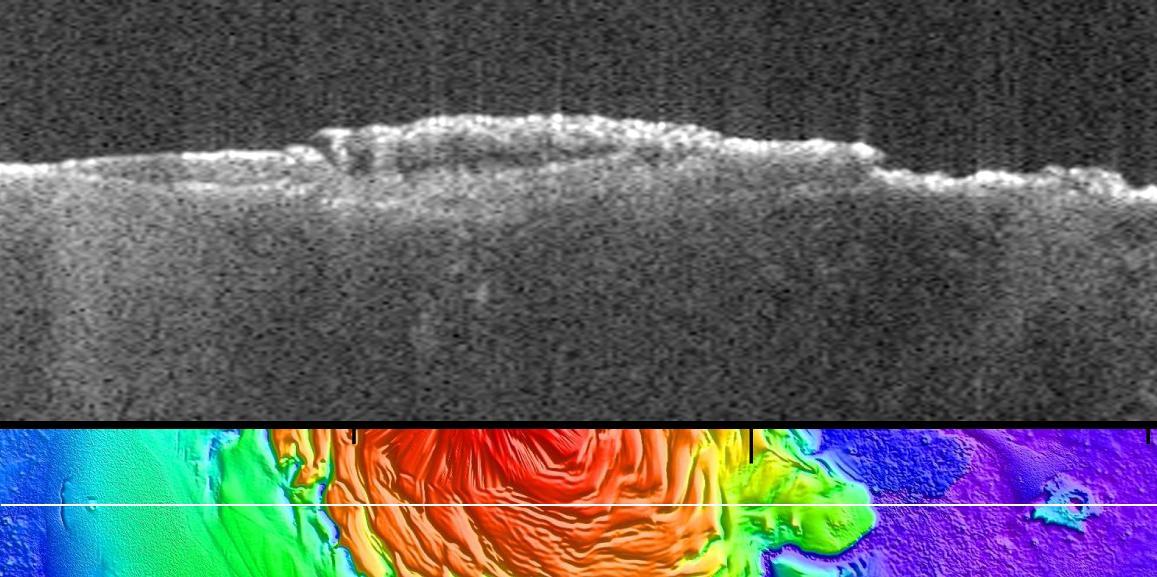
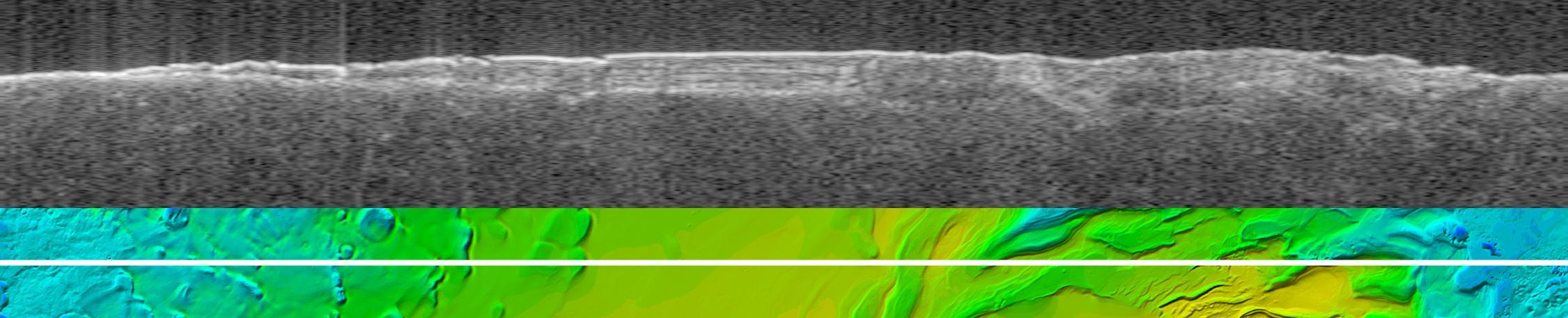
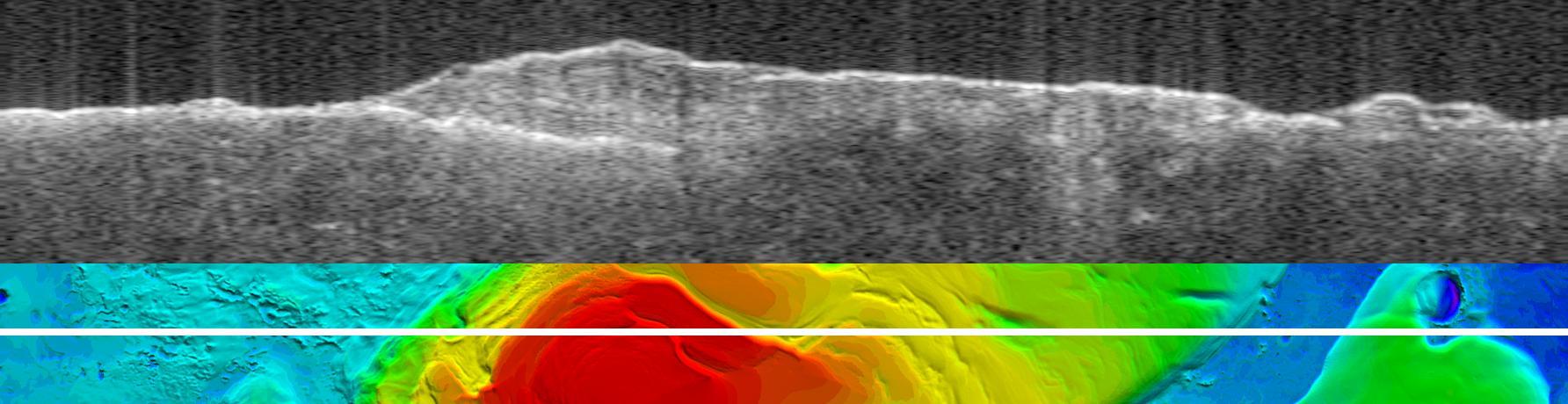
The upper image is a radargram showing data from the subsurface of Mars in the ice-rich layered deposits that surround the south pole. The lower image shows the position of the ground track white line on a topographic map
Virtual Slice Through Icy Layered Deposits Near Mars South Pole
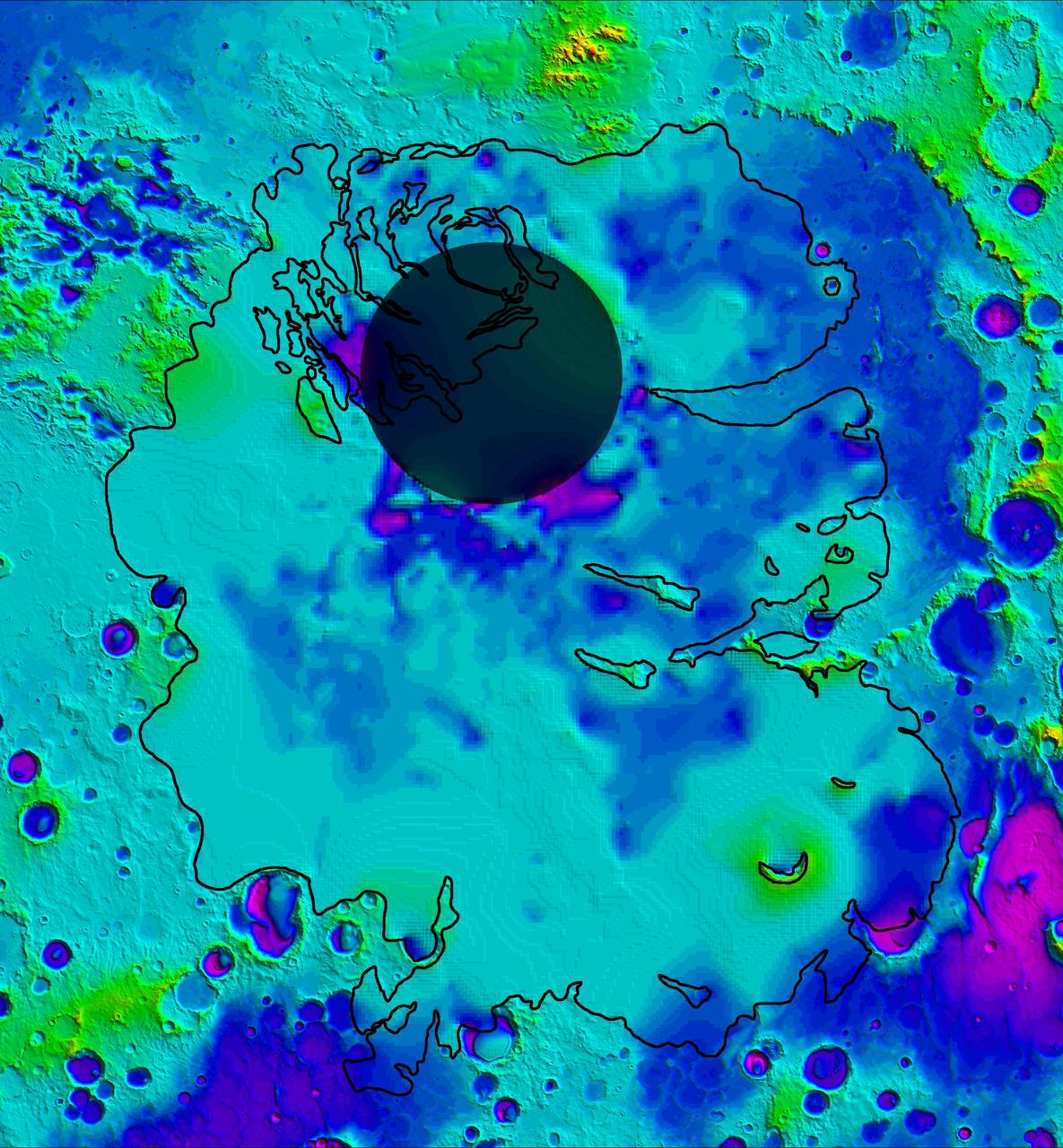
This map shows the topography of the south polar region of Mars, including topography buried by thick deposits of icy material
Lower Boundary of Icy Layers Covering Mars South Polar Region
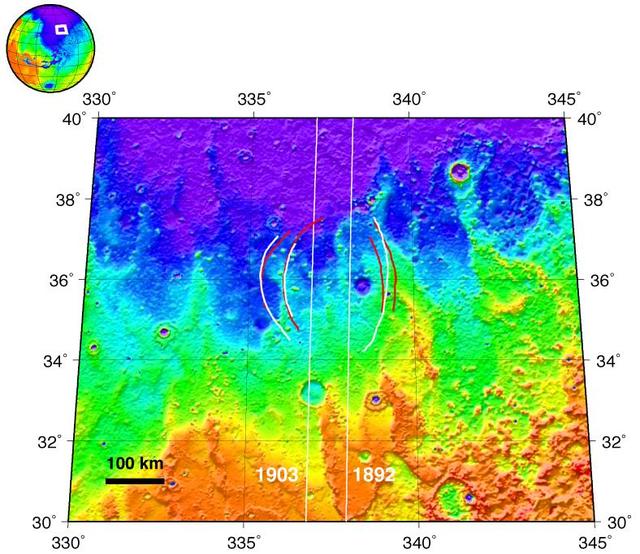
Topographic Map of Chryse Planitia with Location of Possible Buried Basin
Taking advantage of extra solar energy collected during the day, NASA's Mars Exploration Rover Spirit settled in for an evening of stargazing, photographing the two moons of Mars as they crossed the night sky. The first two images in this sequence show gradual enhancements in the surface detail of Mars' largest moon, Phobos, made possible through a combination technique known as "stacking." In "stacking," scientists use a mathematical process known as Laplacian sharpening to reinforce features that appear consistently in repetitive images and minimize features that show up only intermittently. In this view of Phobos, the large crater named Stickney is just out of sight on the moon's upper right limb.  Spirit acquired the first two images with the panoramic camera on the night of sol 585 (Aug. 26,2005). The far right image of Phobos, for comparison, was taken by the High Resolution Stereo Camera on Mars Express, a European Space Agency orbiter. The third image in this sequence was derived from the far right image by making it blurrier for comparison with the panoramic camera images to the left  http://photojournal.jpl.nasa.gov/catalog/PIA06335
Phobos Viewed from Mars
Lighter colors represent higher elevation in this image of Jezero Crater on Mars, the landing site for NASA's Mars 2020 mission. The oval indicates the landing ellipse, where the rover will be touching down on Mars. The color added to this image helps the crater rim stand out clearly, and makes it easier to spot the shoreline of a lake that dried up billions of years ago.  Scientists want to visit this shoreline because it may have preserved fossilized microbial life, if any ever formed on Mars.  The image was created using data from a combination of instruments and spacecraft: NASA's Mars Global Surveyor and its Mars Orbiter Laser Altimeter (MOLA); NASA's Mars Reconnaissance Orbiter and its Compact Reconnaissance Imaging Spectrometer for Mars (CRISM) and Context Camera (CTX); and the European Space Agency's Mars Express and its High Resolution Stereo Camera (HRSC).  https://photojournal.jpl.nasa.gov/catalog/PIA23511
Jezero Crater's Ancient Lakeshore