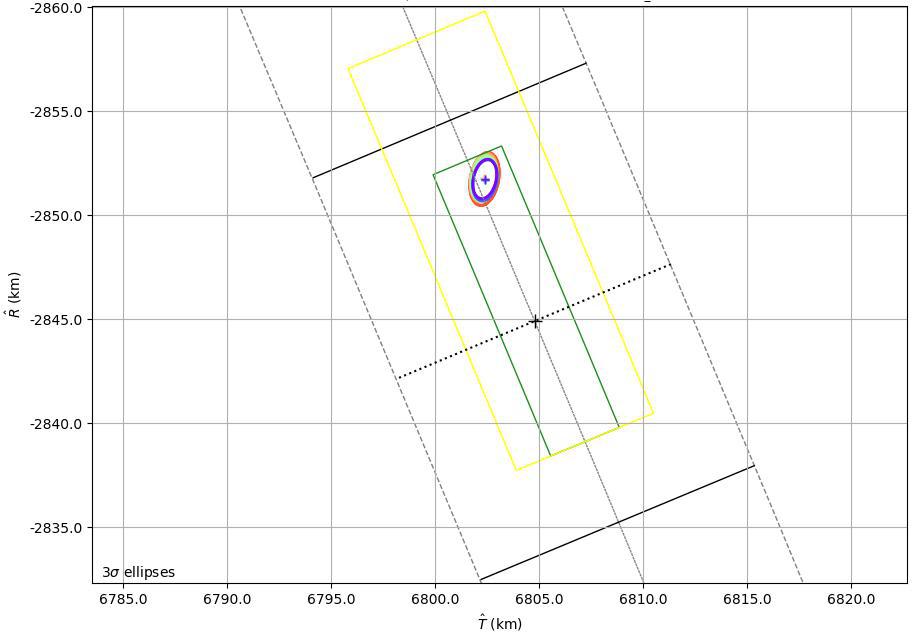
This graphic shows the B-Plane for NASA's Mars 2020 Perseverance rover mission as of February 15, 2021. A B-Plane is a key performance metric that navigators for interplanetary missions use to determine the accuracy of their spacecraft's trajectory. The entry target on the lower right of the image (black cross) depicts the point where mission navigators are targeting the Mars 2020 spacecraft to enter the Red Planet's atmosphere. Higher up, the red, orange, green, and blue ovals depict the estimated "entry uncertainty ellipse" for the spacecraft as determined by previous navigation solutions. The inner-most ring (purple) depicts the most recent trajectory path. https://photojournal.jpl.nasa.gov/catalog/PIA24296
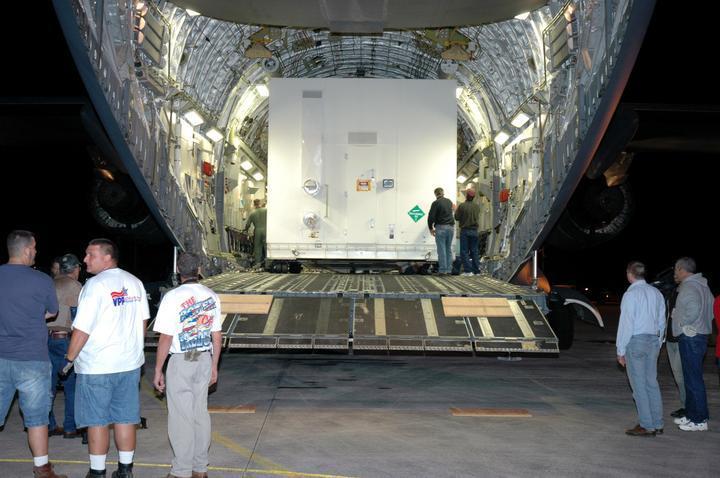
NASA Mars Reconnaissance Orbiter was delivered in two large containers from Lockheed Martin to Cape Canaveral on an Air Force C-17 cargo plane.
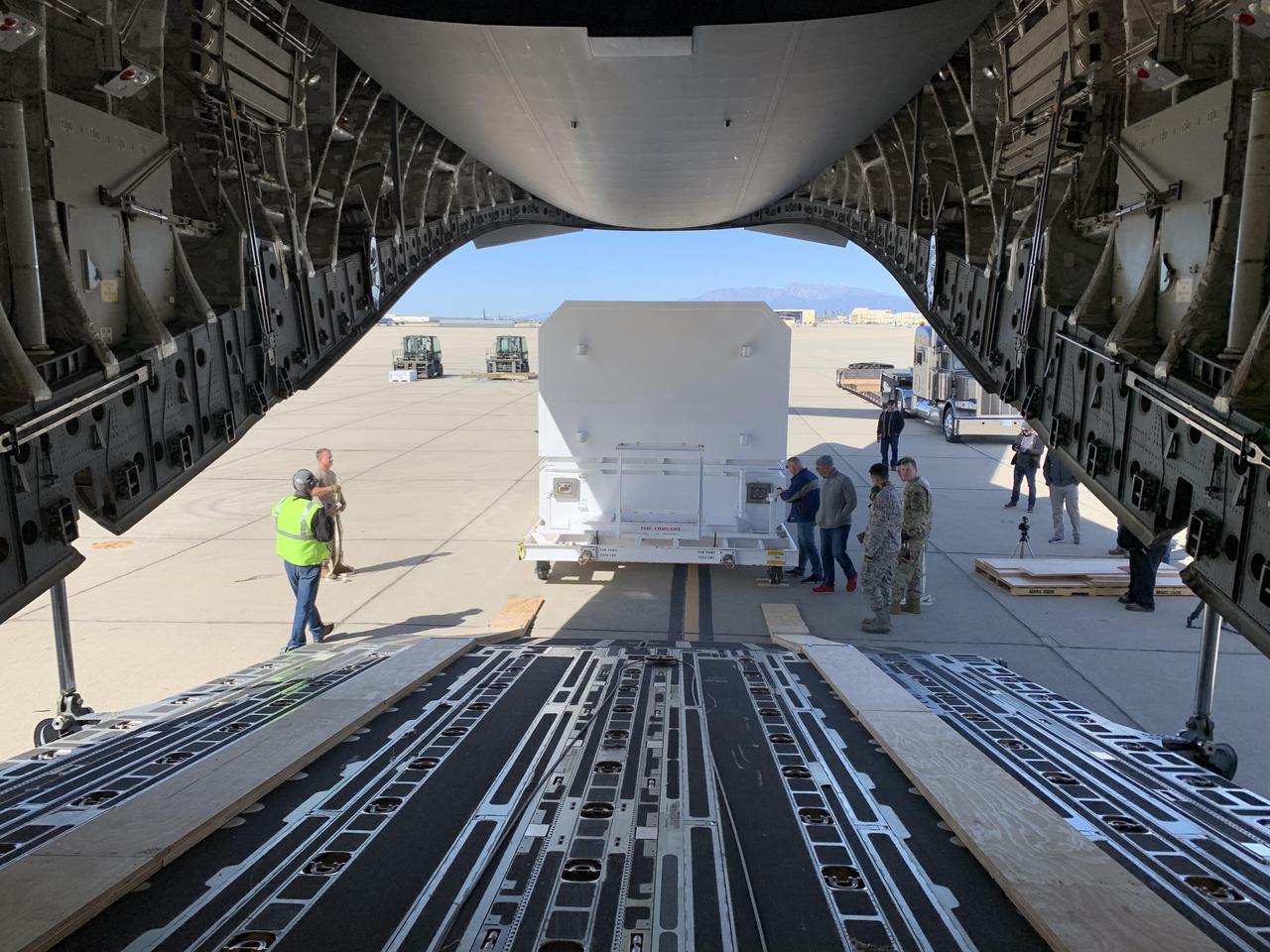
The shipping container carrying NASA's Mars 2020 rover is readied for loading aboard an Air Force C-17 transport plane at March Air Reserve Base in Riverside, California, on Feb. 11, 2020. https://photojournal.jpl.nasa.gov/catalog/PIA23592

A paper collage interpreting the craters and ridged planes of Mars and the Viking 2 as it passed over Mar's surface on 2 November 1982, prior to landing.
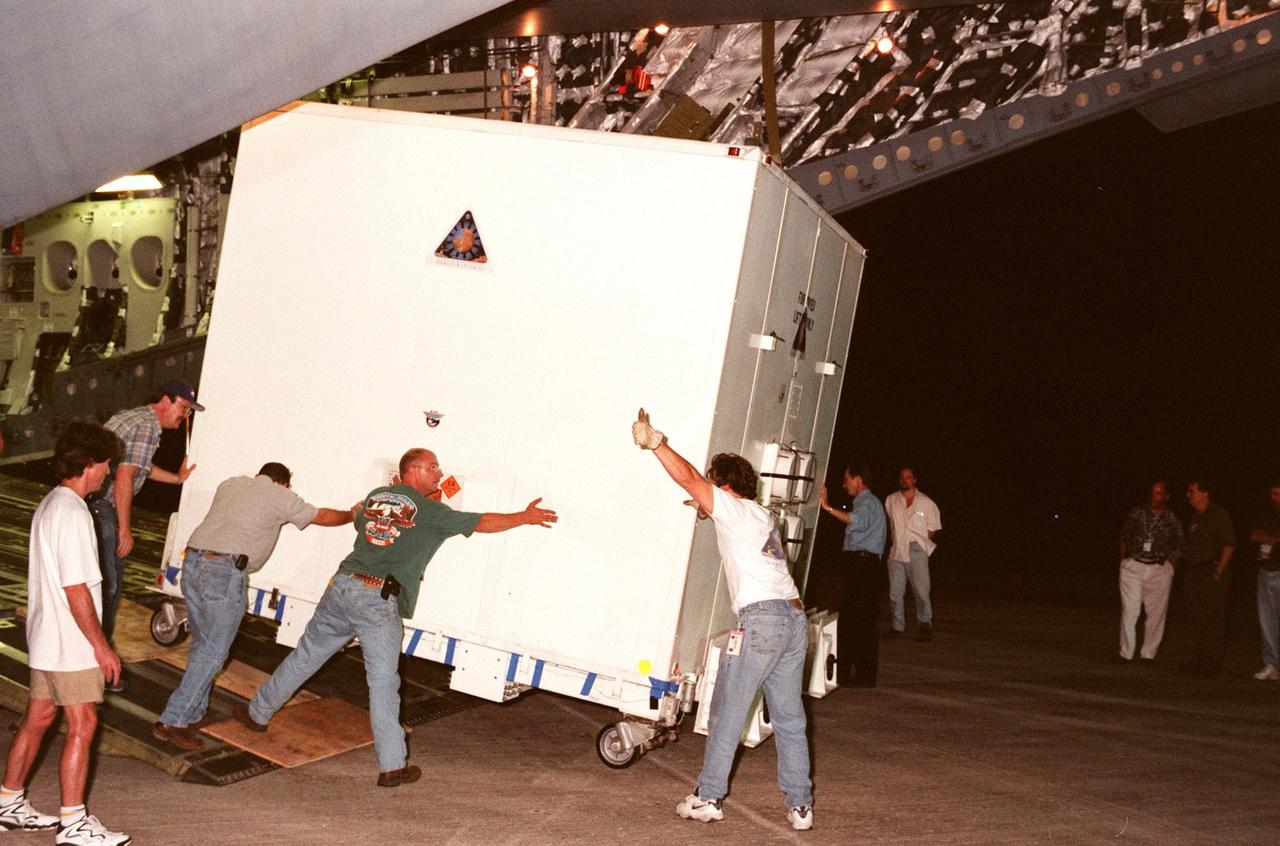
KENNEDY SPACE CENTER, FLA. -- At the Shuttle Landing Facility, the Mars Polar Lander is rolled from the Air Force C-17 cargo plane that carried it from the Lockheed Martin Astronautics plant in Denver, CO. The Mars Polar Lander is targeted for launch from Cape Canaveral Air Station aboard a Delta II rocket on Jan. 3, 1999. The solar-powered spacecraft is designed to touch down on the Martian surface near the northern-most boundary of the south pole in order to study the water cycle there. The lander also will help scientists learn more about climate change and current resources on Mars, studying such things as frost, dust, water vapor and condensates in the Martian atmosphere
The Mars Climate Orbiter spacecraft arrives at KSC's Shuttle Landing Facility aboard an Air Force C-17 cargo plane early this morning following its flight from the Lockheed Martin Astronautics plant in Denver, Colo. When the spacecraft arrives at the red planet, it will primarily support its companion Mars Polar Lander spacecraft, planned for launch on Jan. 3, 1999. After that, the Mars Climate Orbiter's instruments will monitor the Martian atmosphere and image the planet's surface on a daily basis for one Martian year (1.8 Earth years). It will observe the appearance and movement of atmospheric dust and water vapor, as well as characterize seasonal changes on the surface. The detailed images of the surface features will provide important clues to the planet's early climate history and give scientists more information about possible liquid water reserves beneath the surface. The scheduled launch date for the Mars Climate Orbiter is Dec. 10, 1998, on a Delta II 7425 rocket
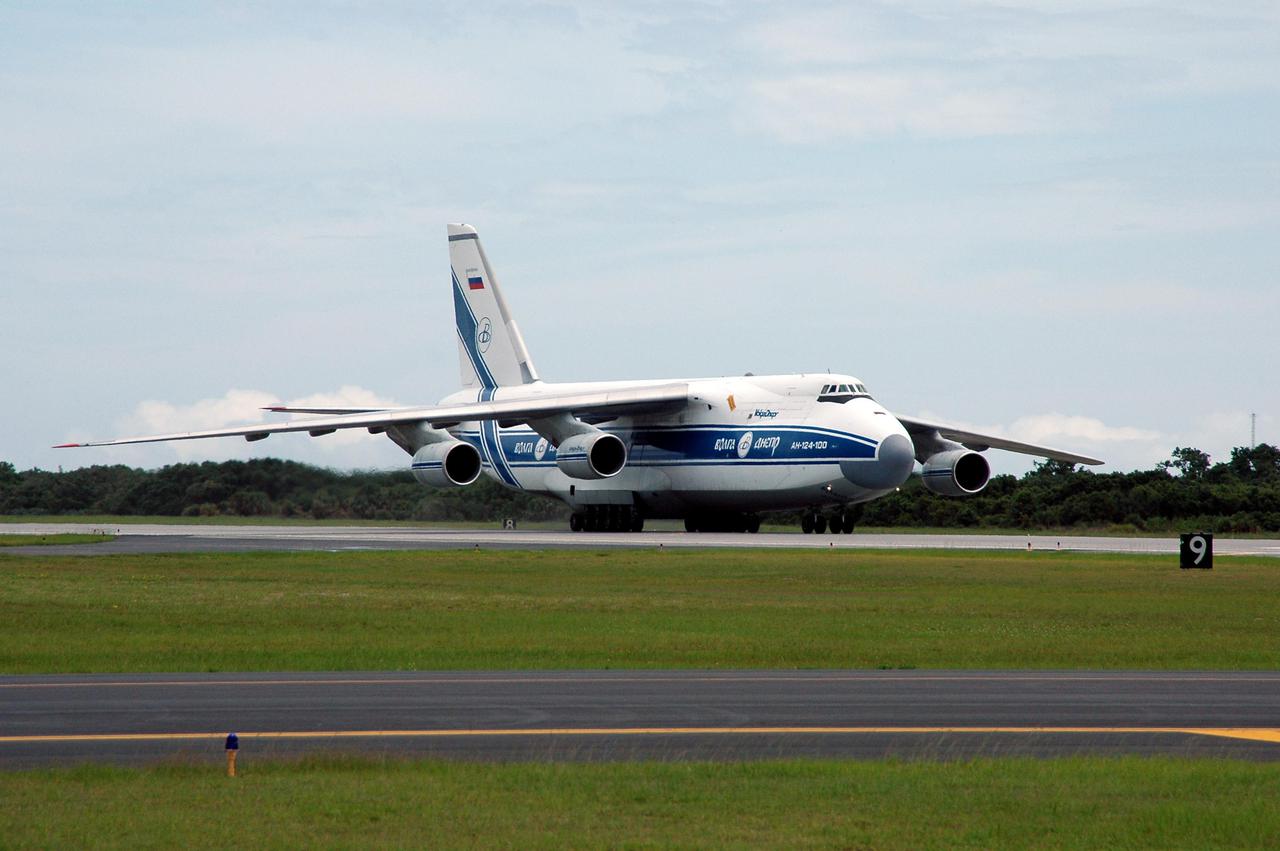
KENNEDY SPACE CENTER, FLA. - A Russian Antonov AH-124-100 cargo airplane lands at the Cape Canaveral Air Force Station Skid Strip. The plane is delivering a second stage Centaur (Block I) for the Lockheed Martin Atlas V, designated AV-007, that is the launch vehicle for the Mars Reconnaissance Orbiter (MRO). The MRO is designed for a series of global mapping, regional survey and targeted observations from a near-polar, low-altitude Mars orbit. These observations will be unprecedented in terms of the spatial resolution and coverage achieved by the orbiter’s instruments as they observe the atmosphere and surface of Mars while probing its shallow subsurface as part of a “follow the water” strategy. The orbiter is undergoing environmental tests in facilities at Lockheed Martin Space Systems in Denver, Colo., and is on schedule for a launch window that begins Aug. 10. Launch will be from Launch Complex 41 at Cape Canaveral Air Force Station in Florida.
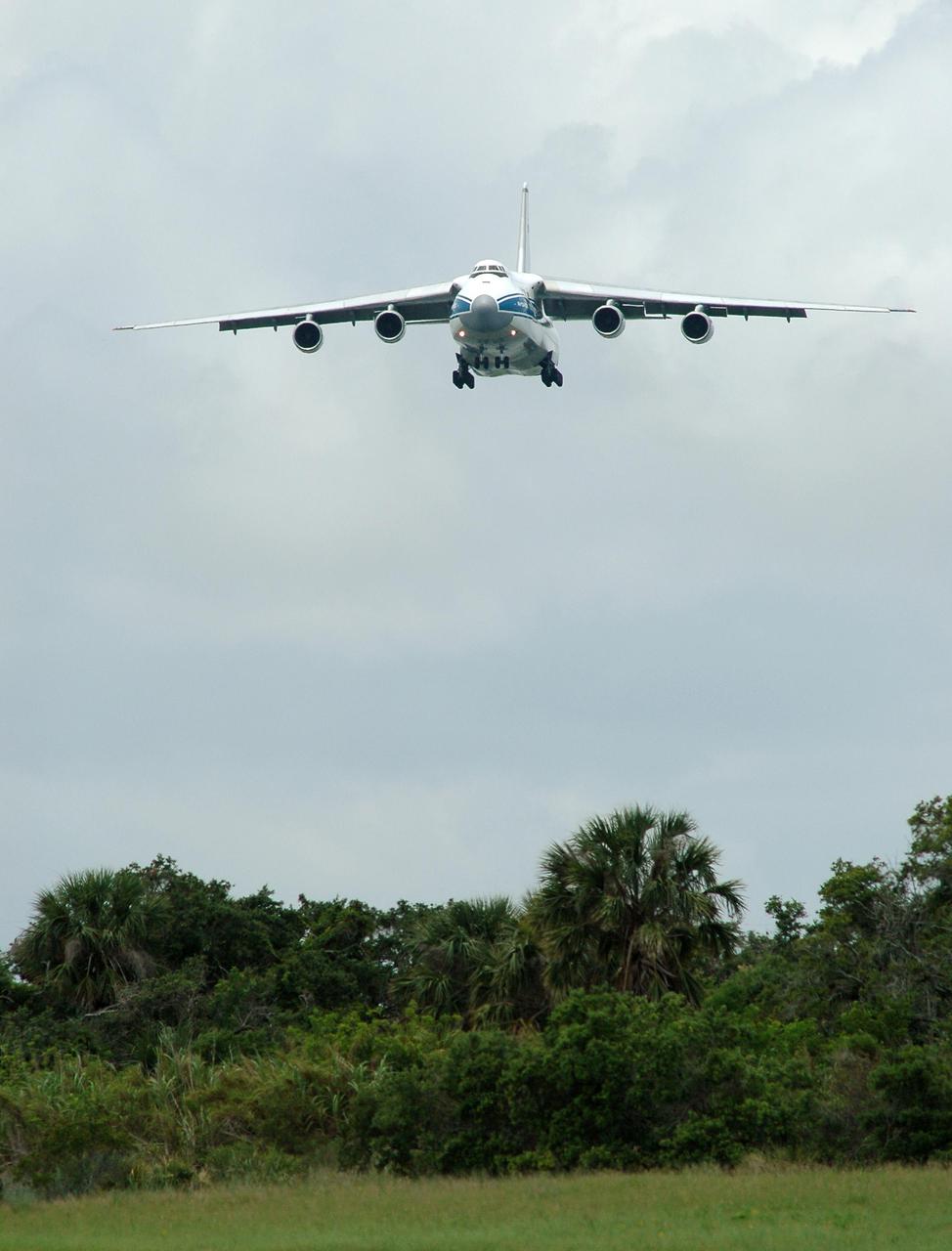
KENNEDY SPACE CENTER, FLA. - A Russian Antonov AH-124-100 cargo airplane heads for a landing at the Cape Canaveral Air Force Station Skid Strip. The plane is delivering a second stage Centaur (Block I) for the Lockheed Martin Atlas V, designated AV-007, that is the launch vehicle for the Mars Reconnaissance Orbiter (MRO). The MRO is designed for a series of global mapping, regional survey and targeted observations from a near-polar, low-altitude Mars orbit. These observations will be unprecedented in terms of the spatial resolution and coverage achieved by the orbiter’s instruments as they observe the atmosphere and surface of Mars while probing its shallow subsurface as part of a “follow the water” strategy. The orbiter is undergoing environmental tests in facilities at Lockheed Martin Space Systems in Denver, Colo., and is on schedule for a launch window that begins Aug. 10. Launch will be from Launch Complex 41 at Cape Canaveral Air Force Station in Florida.
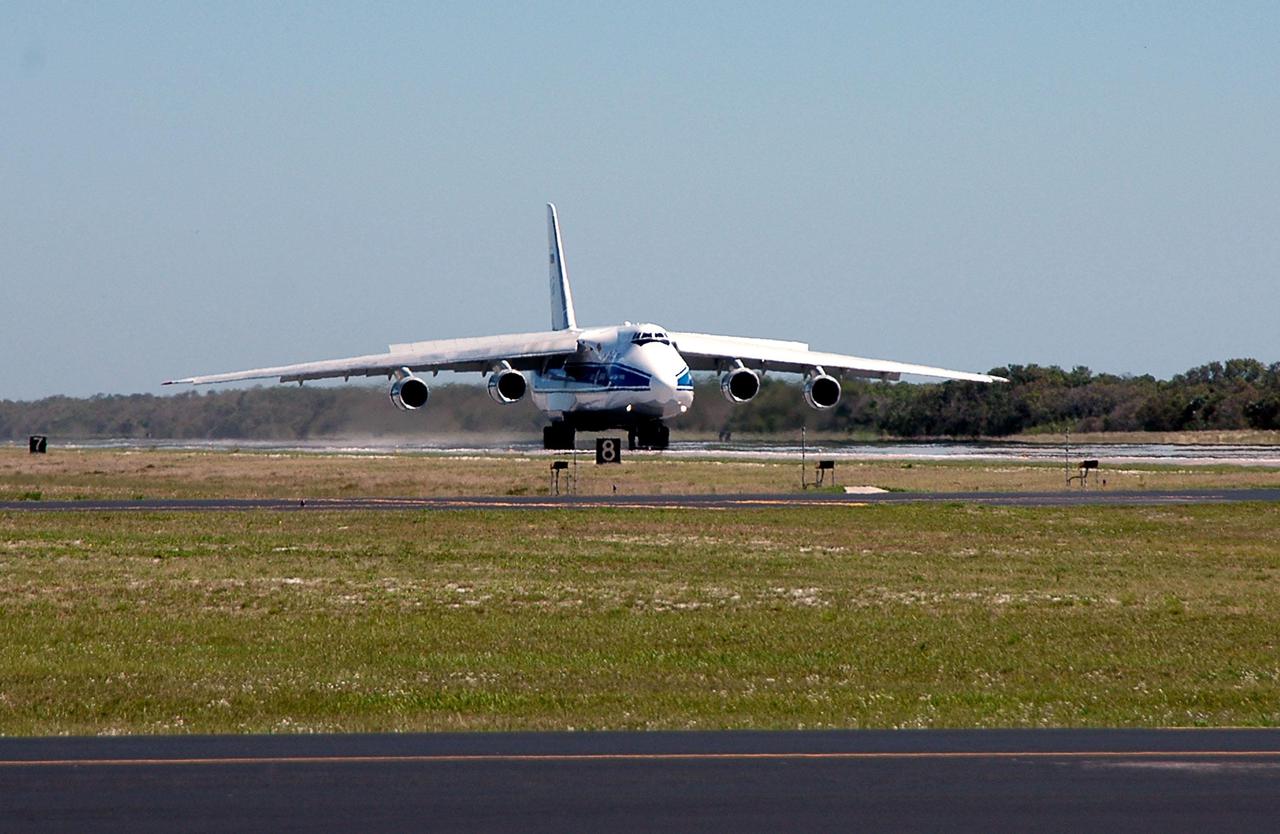
KENNEDY SPACE CENTER, FLA. - A Russian Antonov AH-124-100 cargo airplane lands at the Cape Canaveral Air Force Station Skid Strip. The plane is delivering a second stage Centaur for the Lockheed Martin Atlas V, designated AV-007, that is the launch vehicle for the Mars Reconnaissance Orbiter (MRO). The MRO is designed for a series of global mapping, regional survey and targeted observations from a near-polar, low-altitude Mars orbit. These observations will be unprecedented in terms of the spatial resolution and coverage achieved by the orbiter’s instruments as they observe the atmosphere and surface of Mars while probing its shallow subsurface as part of a “follow the water” strategy. The orbiter is undergoing environmental tests in facilities at Lockheed Martin Space Systems in Denver, Colo., and is on schedule for a launch window that begins Aug. 10. Launch will be from Launch Pad 41 at Cape Canaveral Air Force Station in Florida.
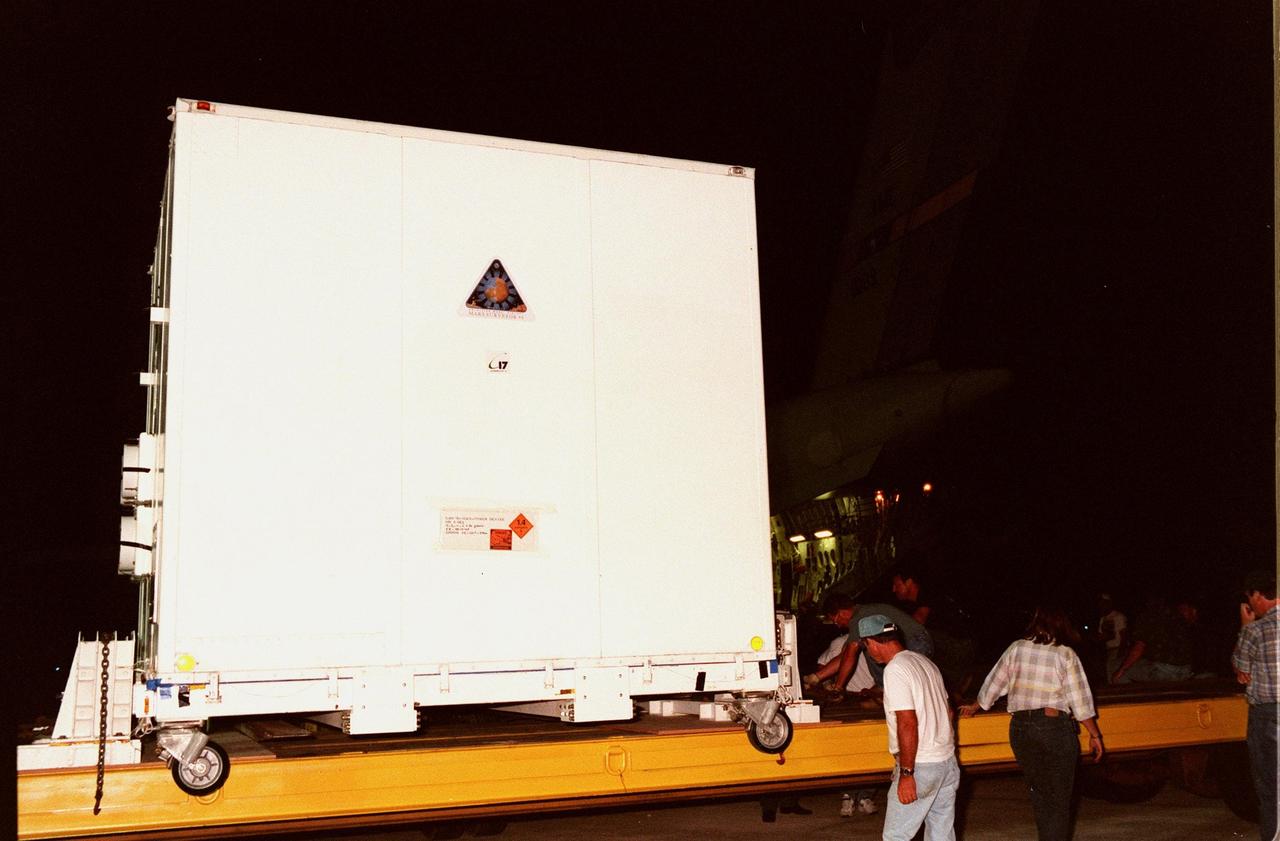
KENNEDY SPACE CENTER, FLA. -- At the Shuttle Landing Facility, the Mars Polar Lander is loaded onto a truck after its flight aboard an Air Force C-17 cargo plane that carried it from the Lockheed Martin Astronautics plant in Denver, CO. The lander is being transported to the Spacecraft Assembly and Encapsulation Facility-2(SAEF-2) in the KSC Industrial Area for testing, including a functional test of the science instruments and the basic spacecraft subsystems. The solar-powered spacecraft is designed to touch down on the Martian surface near the northern-most boundary of the south pole in order to study the water cycle there. The lander also will help scientists learn more about climate change and current resources on Mars, studying such things as frost, dust, water vapor and condensates in the Martian atmosphere. The Mars Polar Lander spacecraft is planned for launch from Cape Canaveral Air Station aboard a Delta II rocket on Jan. 3, 1999

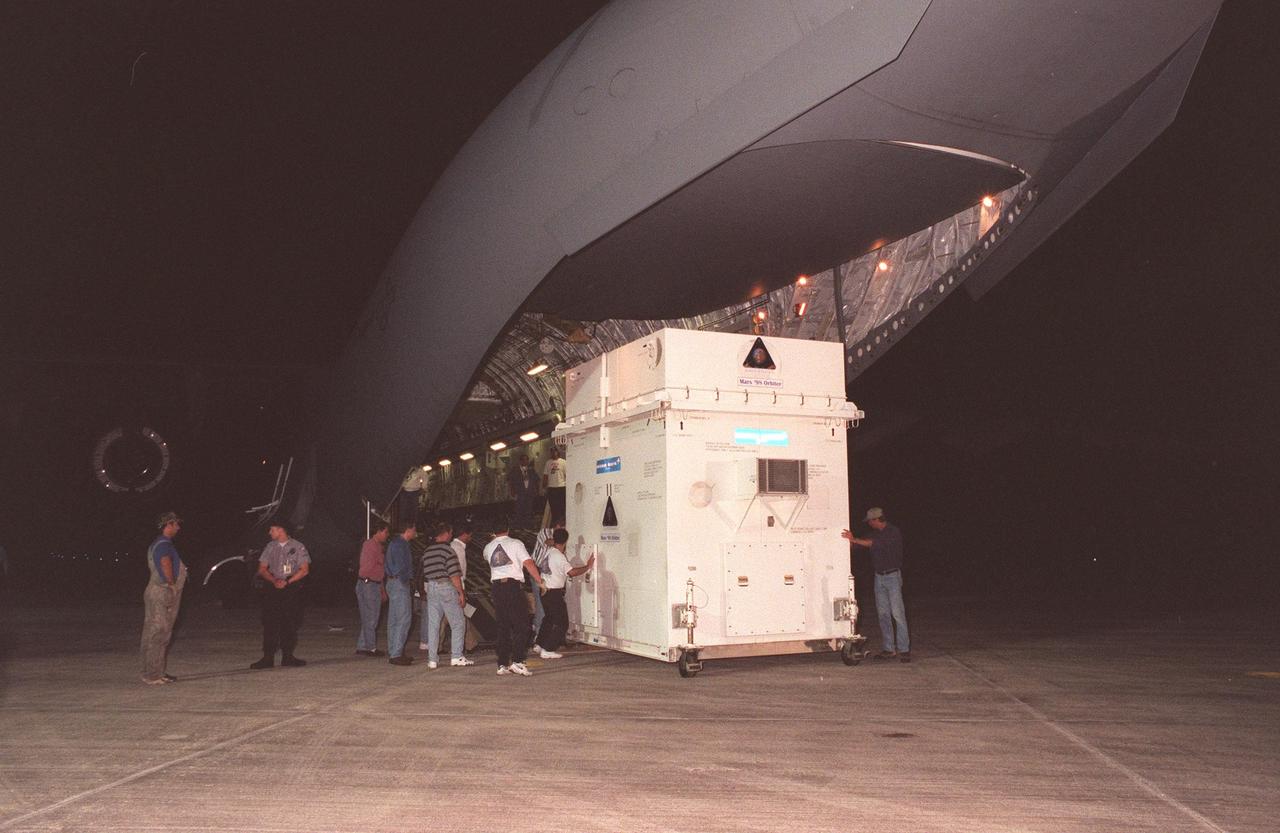
KENNEDY SPACE CENTER, FLA. - At Kennedy Space Center's Shuttle Landing Facility, one of two containers with the Mars Reconnaissance Orbiter (MRO) equipment is rolled toward the ramp of the Air Force C-17 cargo plane. The MRO is being moved to the Payload Hazardous Servicing Facility. The MRO was built by Lockheed Martin for NASA's Jet Propulsion Laboratory in California. It is the next major step in Mars exploration and scheduled for launch from Cape Canaveral Air Force Station in a window opening Aug. 10. The MRO carries six primary instruments: the High Resolution Imaging Science Experiment, Context Camera, Mars Color Imager, Compact Reconnaissance Imaging Spectrometer for Mars, Mars Climate Sounder and Shallow Radar. By 2007, the MRO will begin a series of global mapping, regional survey and targeted observations from a near-polar, low-altitude Mars orbit. It will observe the atmosphere and surface of Mars while probing its shallow subsurface as part of a “follow the water” strategy.
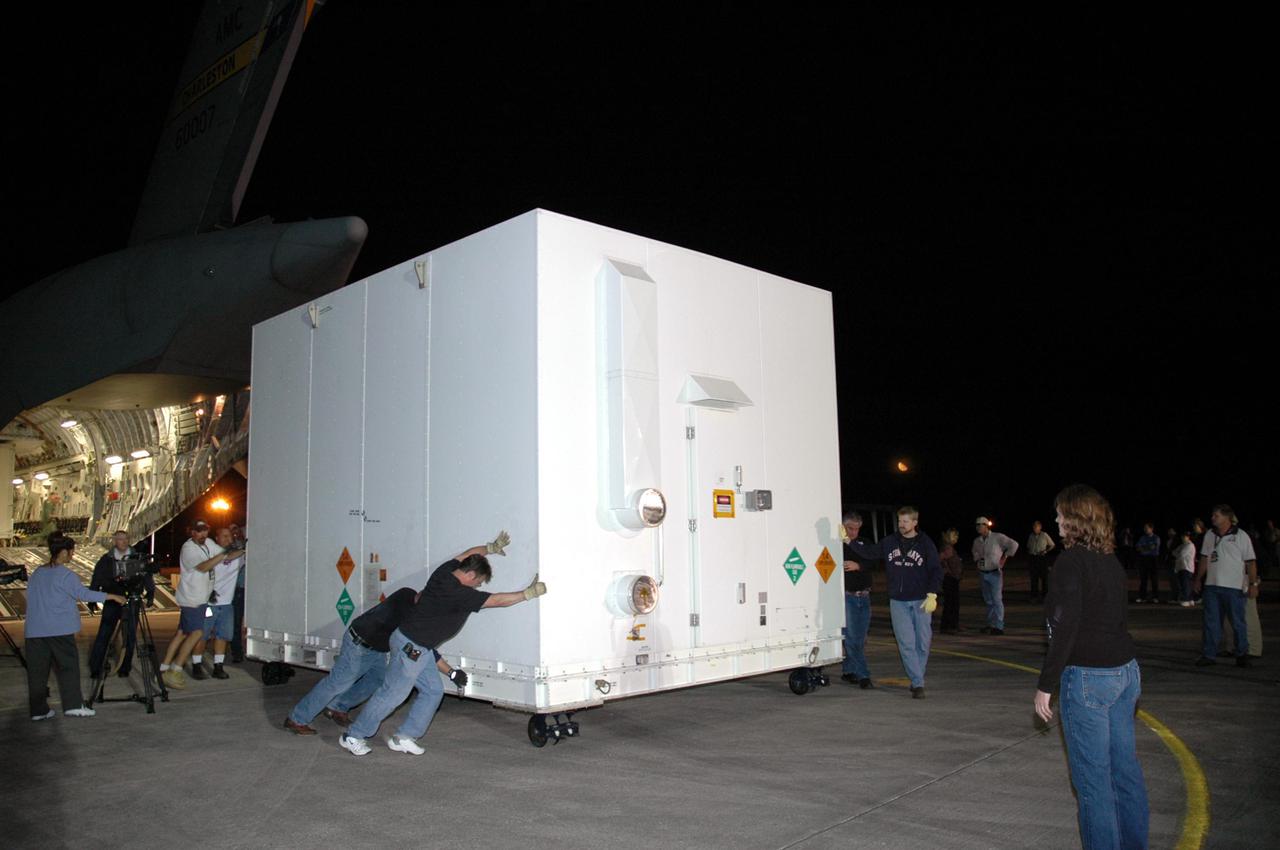
KENNEDY SPACE CENTER, FLA. - Workers at Kennedy Space Center's Shuttle Landing Facility roll one of two containers with the Mars Reconnaissance Orbiter (MRO) equipment away from the Air Force C-17 cargo plane that delivered it. The MRO is being moved to the Payload Hazardous Servicing Facility. The MRO was built by Lockheed Martin for NASA’s Jet Propulsion Laboratory in California. It is the next major step in Mars exploration and scheduled for launch from Cape Canaveral Air Force Station in a window opening Aug. 10. The MRO carries six primary instruments: the High Resolution Imaging Science Experiment, Context Camera, Mars Color Imager, Compact Reconnaissance Imaging Spectrometer for Mars, Mars Climate Sounder and Shallow Radar. By 2007, the MRO will begin a series of global mapping, regional survey and targeted observations from a near-polar, low-altitude Mars orbit. It will observe the atmosphere and surface of Mars while probing its shallow subsurface as part of a “follow the water” strategy.

KENNEDY SPACE CENTER, FLA. - Workers at Kennedy Space Center's Shuttle Landing Facility roll the second of two containers with the Mars Reconnaissance Orbiter (MRO) equipment away from the Air Force C-17 cargo plane that delivered it. The MRO is being moved to the Payload Hazardous Servicing Facility. The MRO was built by Lockheed Martin for NASA's Jet Propulsion Laboratory in California. It is the next major step in Mars exploration and scheduled for launch from Cape Canaveral Air Force Station in a window opening Aug. 10. The MRO carries six primary instruments: the High Resolution Imaging Science Experiment, Context Camera, Mars Color Imager, Compact Reconnaissance Imaging Spectrometer for Mars, Mars Climate Sounder and Shallow Radar. By 2007, the MRO will begin a series of global mapping, regional survey and targeted observations from a near-polar, low-altitude Mars orbit. It will observe the atmosphere and surface of Mars while probing its shallow subsurface as part of a “follow the water” strategy.
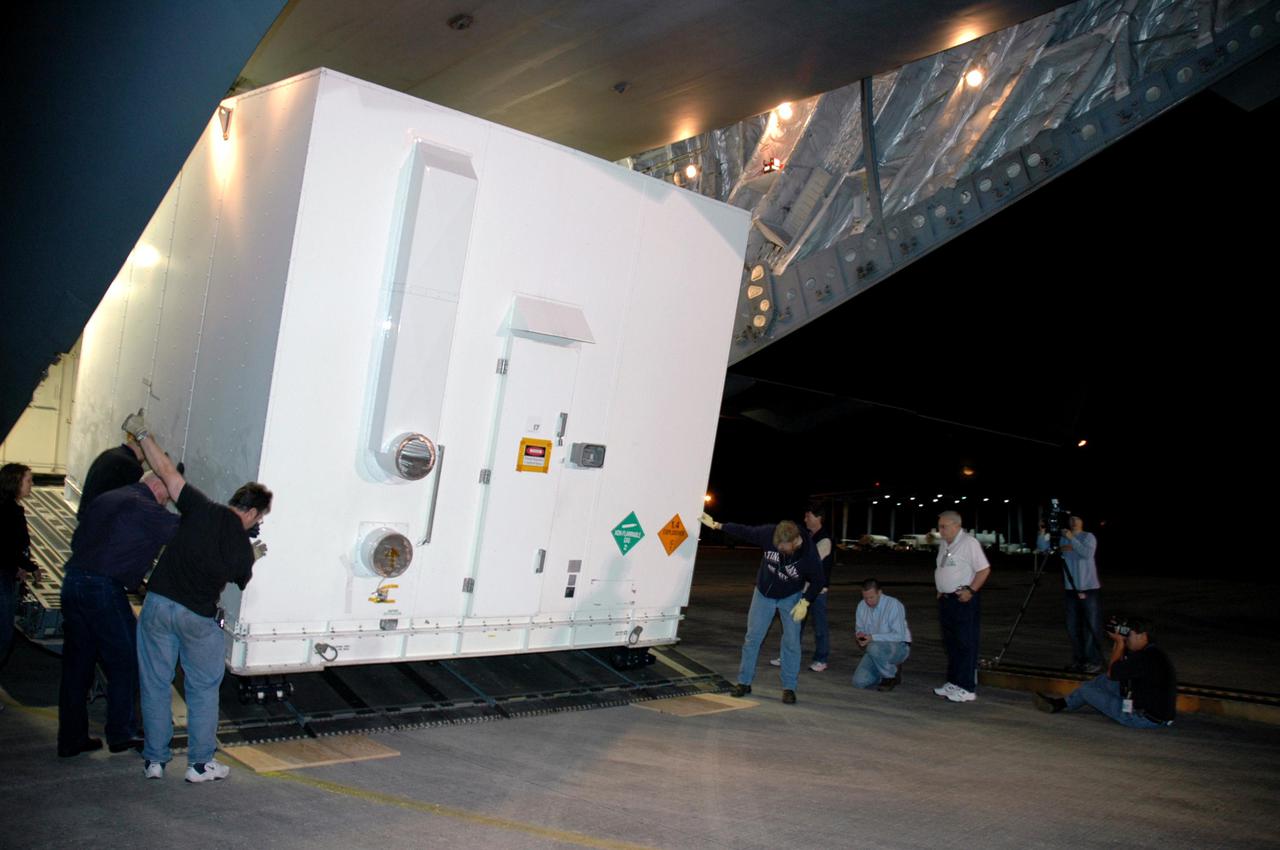
KENNEDY SPACE CENTER, FLA. - Workers at Kennedy Space Center's Shuttle Landing Facility roll one of two containers with the Mars Reconnaissance Orbiter (MRO) equipment away from the Air Force C-17 cargo plane that delivered it. The MRO is being moved to the Payload Hazardous Servicing Facility. The MRO was built by Lockheed Martin for NASA's Jet Propulsion Laboratory in California. It is the next major step in Mars exploration and scheduled for launch from Cape Canaveral Air Force Station in a window opening Aug. 10. The MRO carries six primary instruments: the High Resolution Imaging Science Experiment, Context Camera, Mars Color Imager, Compact Reconnaissance Imaging Spectrometer for Mars, Mars Climate Sounder and Shallow Radar. By 2007, the MRO will begin a series of global mapping, regional survey and targeted observations from a near-polar, low-altitude Mars orbit. It will observe the atmosphere and surface of Mars while probing its shallow subsurface as part of a “follow the water” strategy.
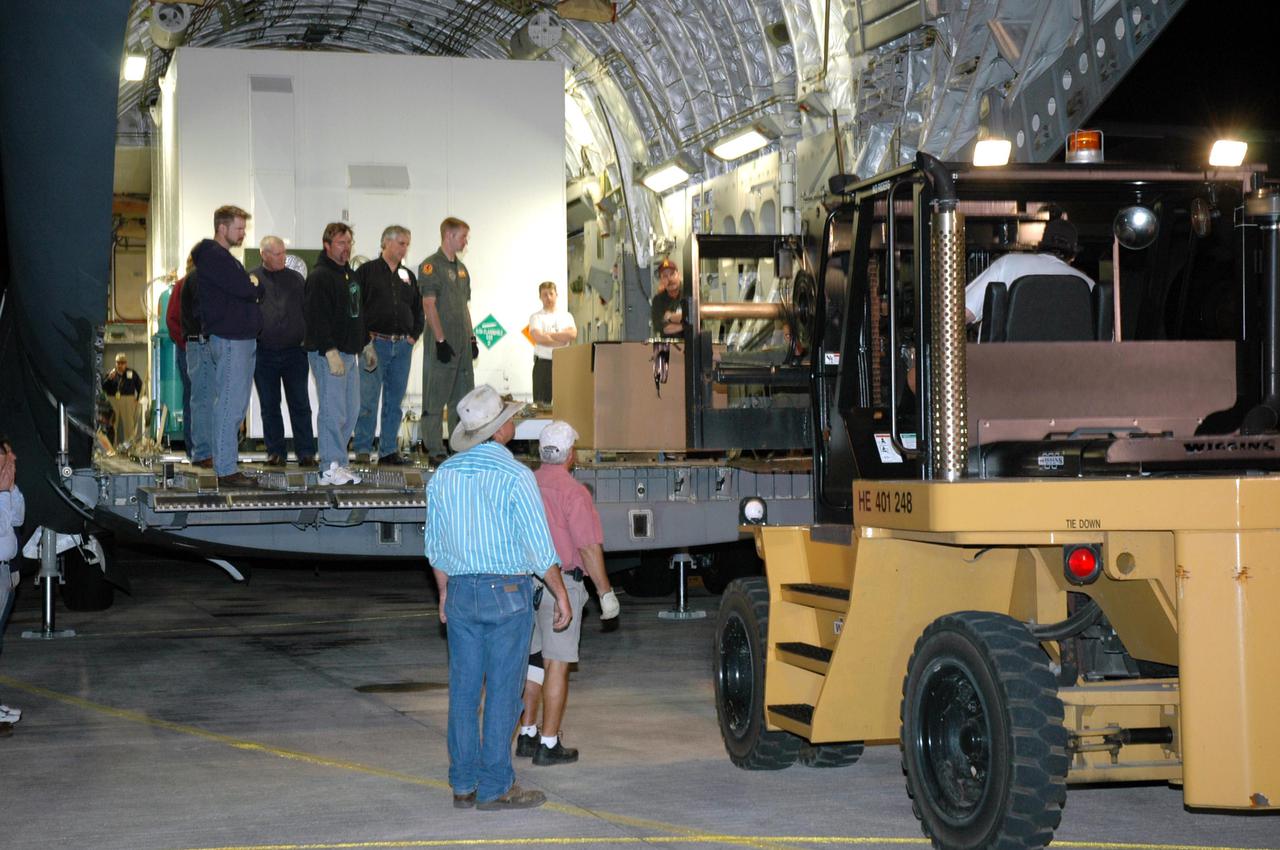
KENNEDY SPACE CENTER, FLA. - A forklift moves into place behind the Air Force C-17 cargo plane delivering the Mars Reconnaissance Orbiter (MRO) equipment to Kennedy Space Center's Shuttle Landing Facility. The MRO is being moved to the Payload Hazardous Servicing Facility. The MRO was built by Lockheed Martin for NASA's Jet Propulsion Laboratory in California. It is the next major step in Mars exploration and scheduled for launch from Cape Canaveral Air Force Station in a window opening Aug. 10. The MRO carries six primary instruments: the High Resolution Imaging Science Experiment, Context Camera, Mars Color Imager, Compact Reconnaissance Imaging Spectrometer for Mars, Mars Climate Sounder and Shallow Radar. By 2007, the MRO will begin a series of global mapping, regional survey and targeted observations from a near-polar, low-altitude Mars orbit. It will observe the atmosphere and surface of Mars while probing its shallow subsurface as part of a “follow the water” strategy.
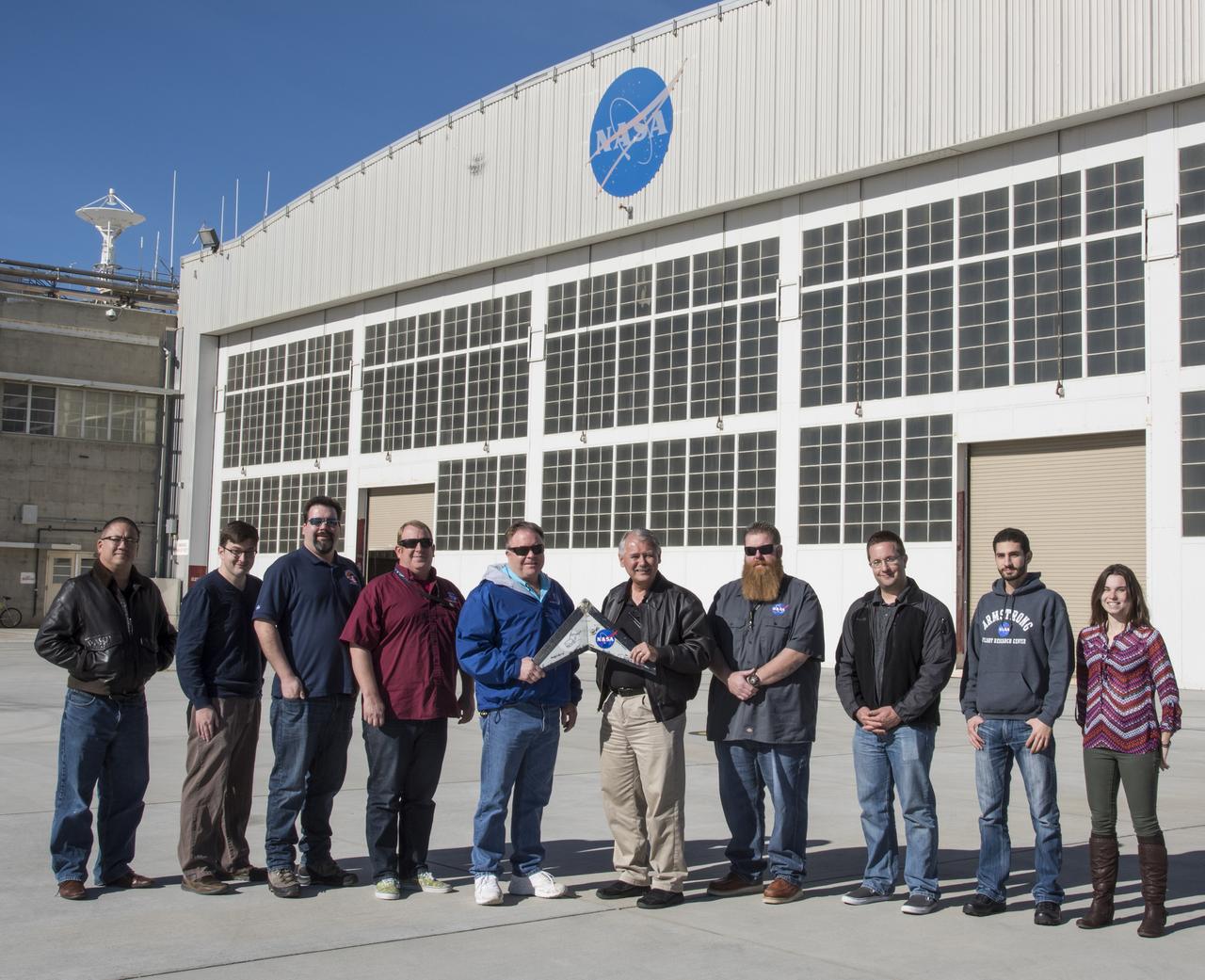
The WHAATRR team from NASA Armstrong includes, from left, Derek Abramson Dave Berger, John Bodylski, Robert “Red” Jensen, Scott Wiley, Al Bowers, Justin Hall, Luke Bard, Hussein Nasr and Samantha Ingersoll.
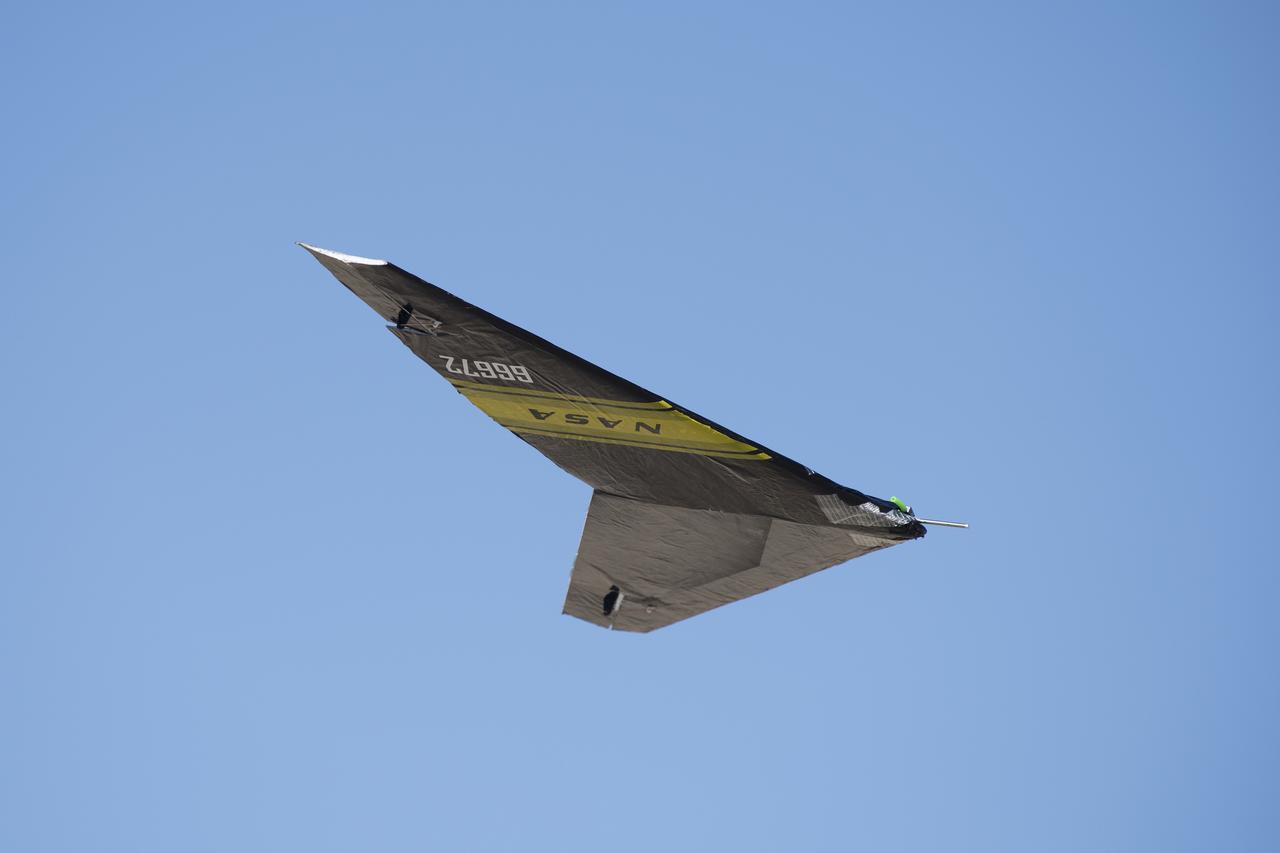
Test flights of the Prandtl-M have resumed. The airframe also is the basis for another aircraft that will collect weather data.
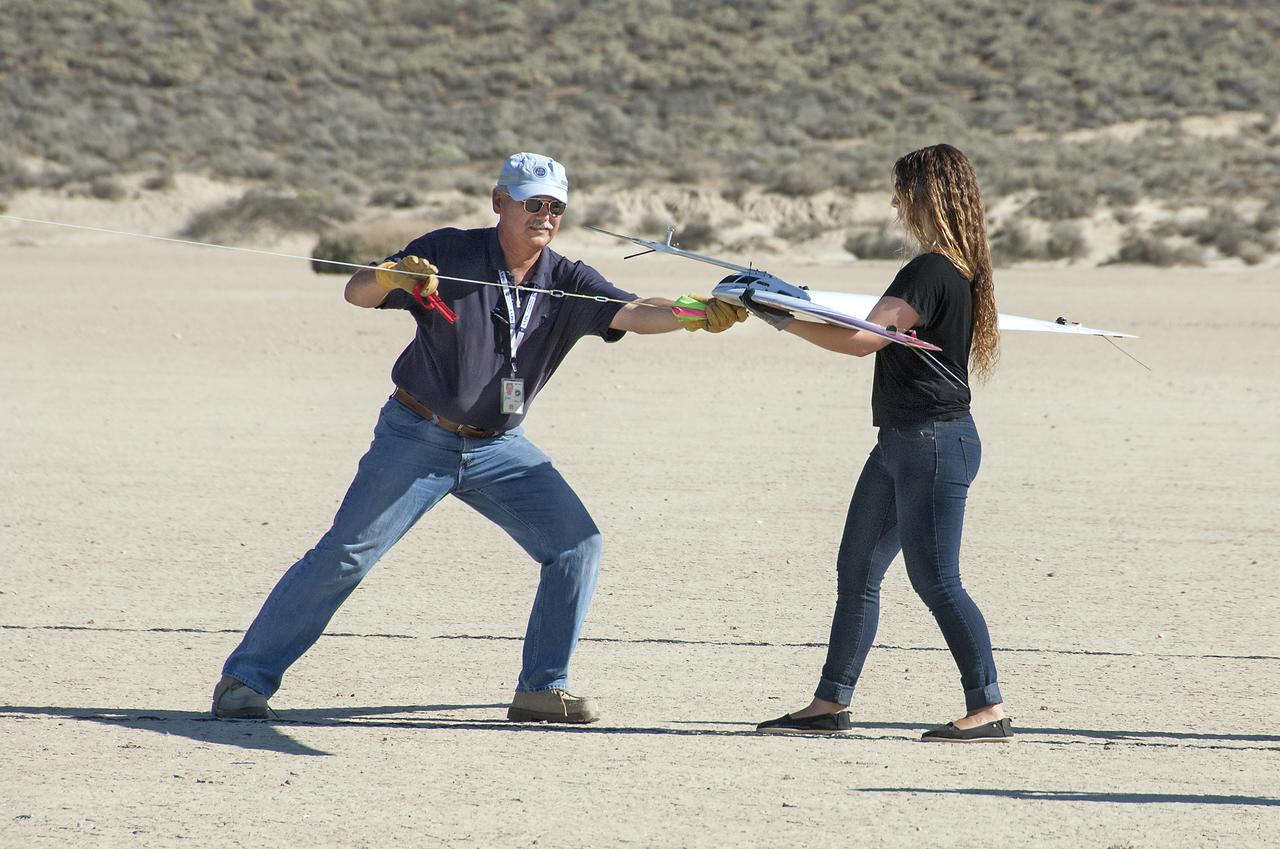
Al Bowers attaches a bungee cord to the Prandtl-d, as Kassidy McLaughlin prepares to release and launch the aircraft.
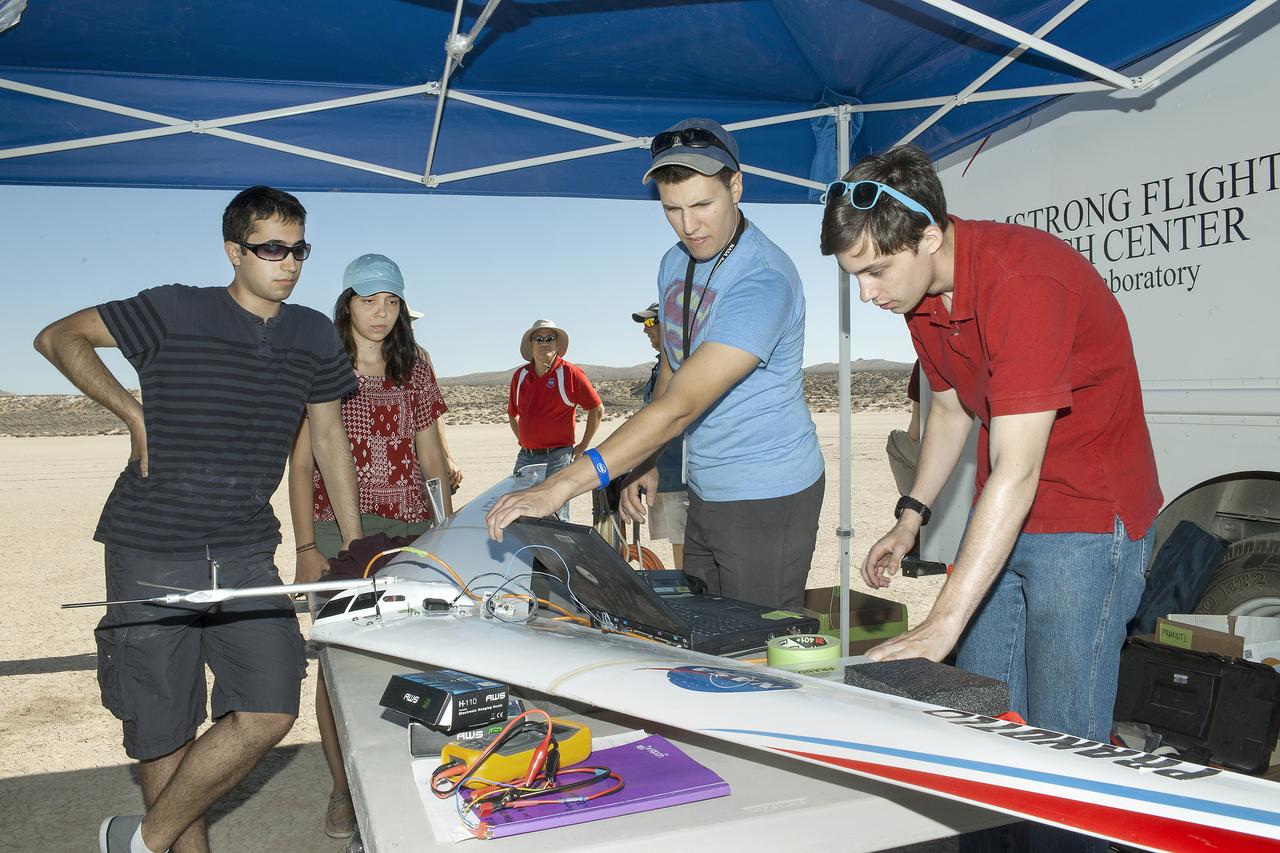
Jonathan Zur, from left, Alexandra Ocasio, Derek Abramson, Red Jensen, Etan Halberg and Keenan Albee wait for data to download from a Prandtl-d flight
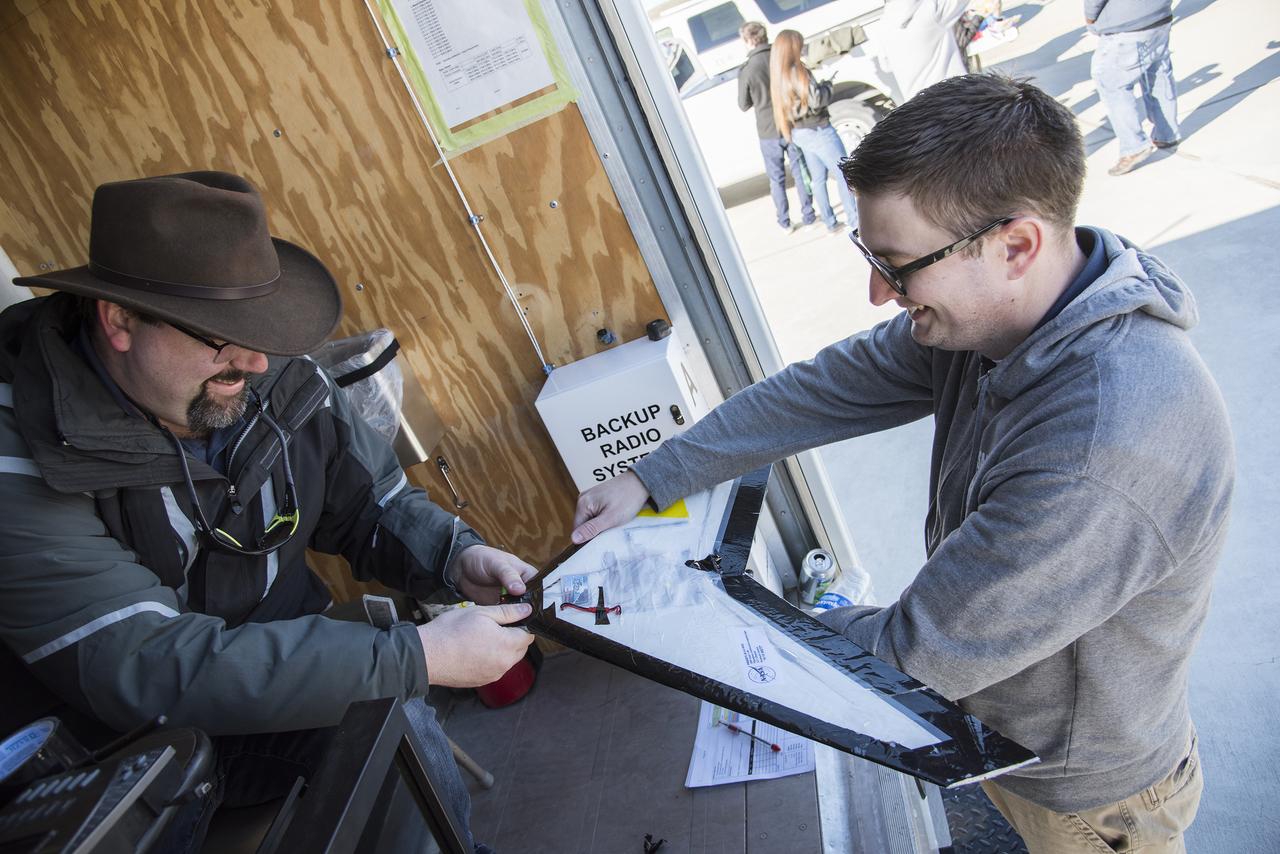
Dave Berger, right, and John Bodylski prepare the Prandtl-M for a test flight.
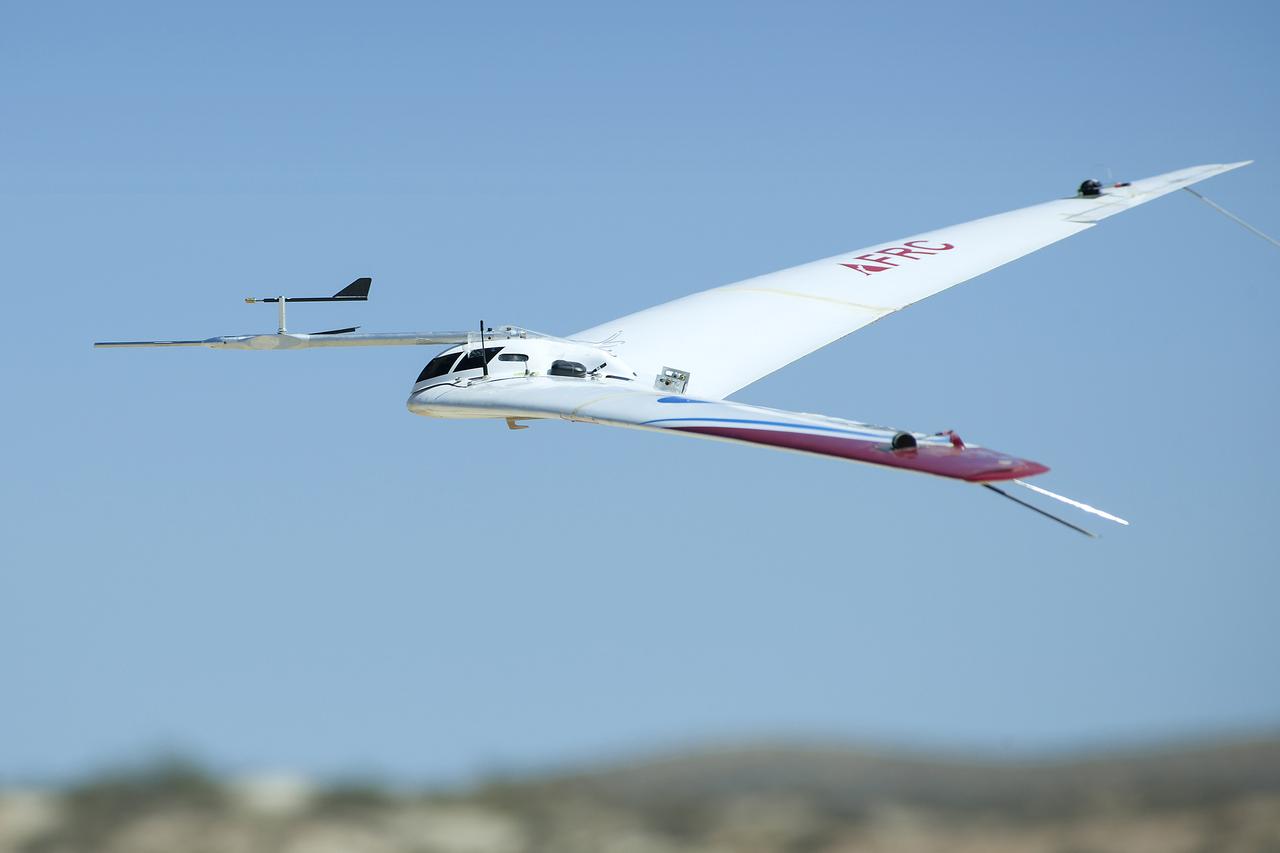
The proposed Prandtl-m is based on the Prandtl-d seen coming in for a landing during a flight test in June. The aerodynamics offer a solution that could lead to the first aircraft on Mars.
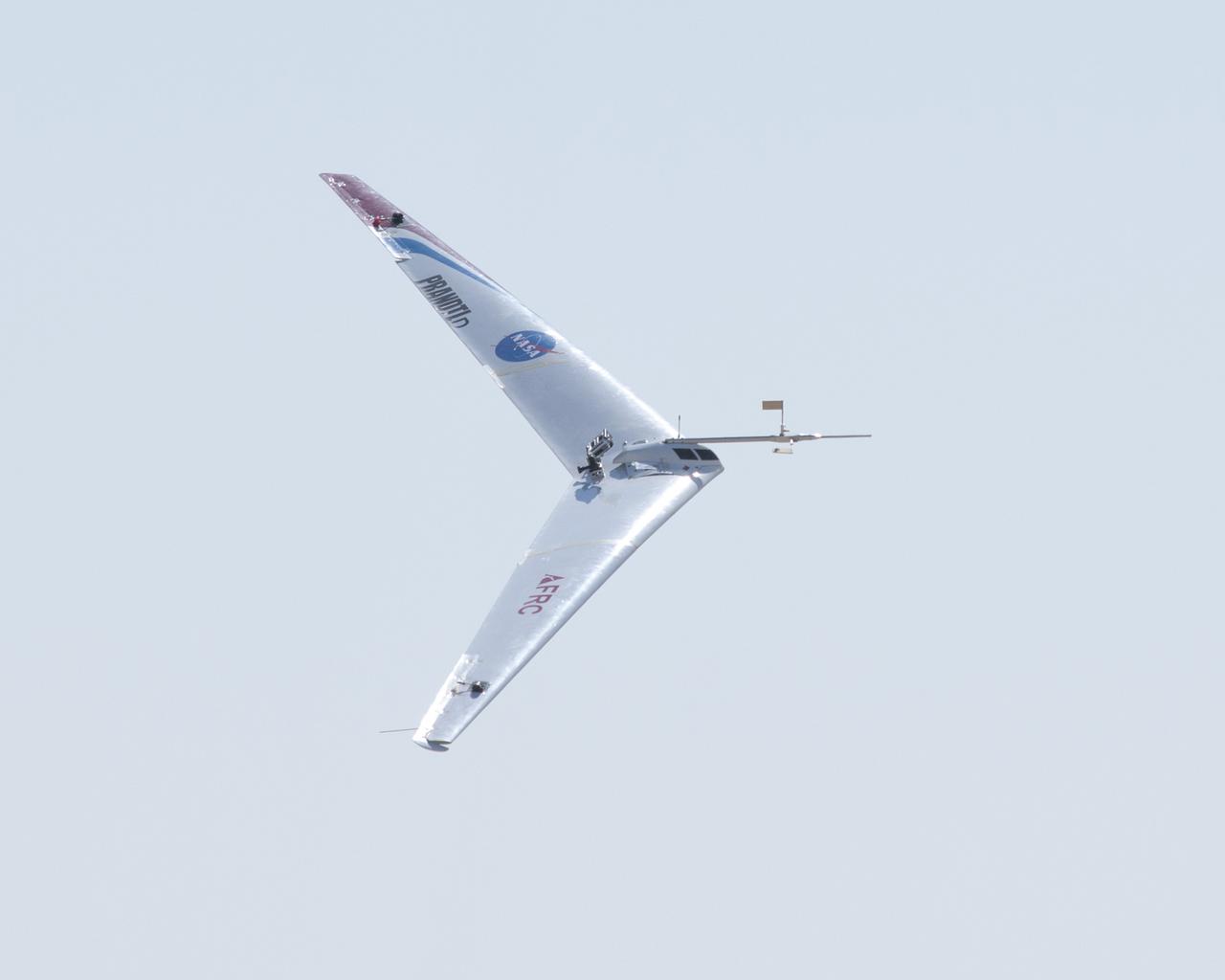
The Prandtl-D makes a test flight in 2014.
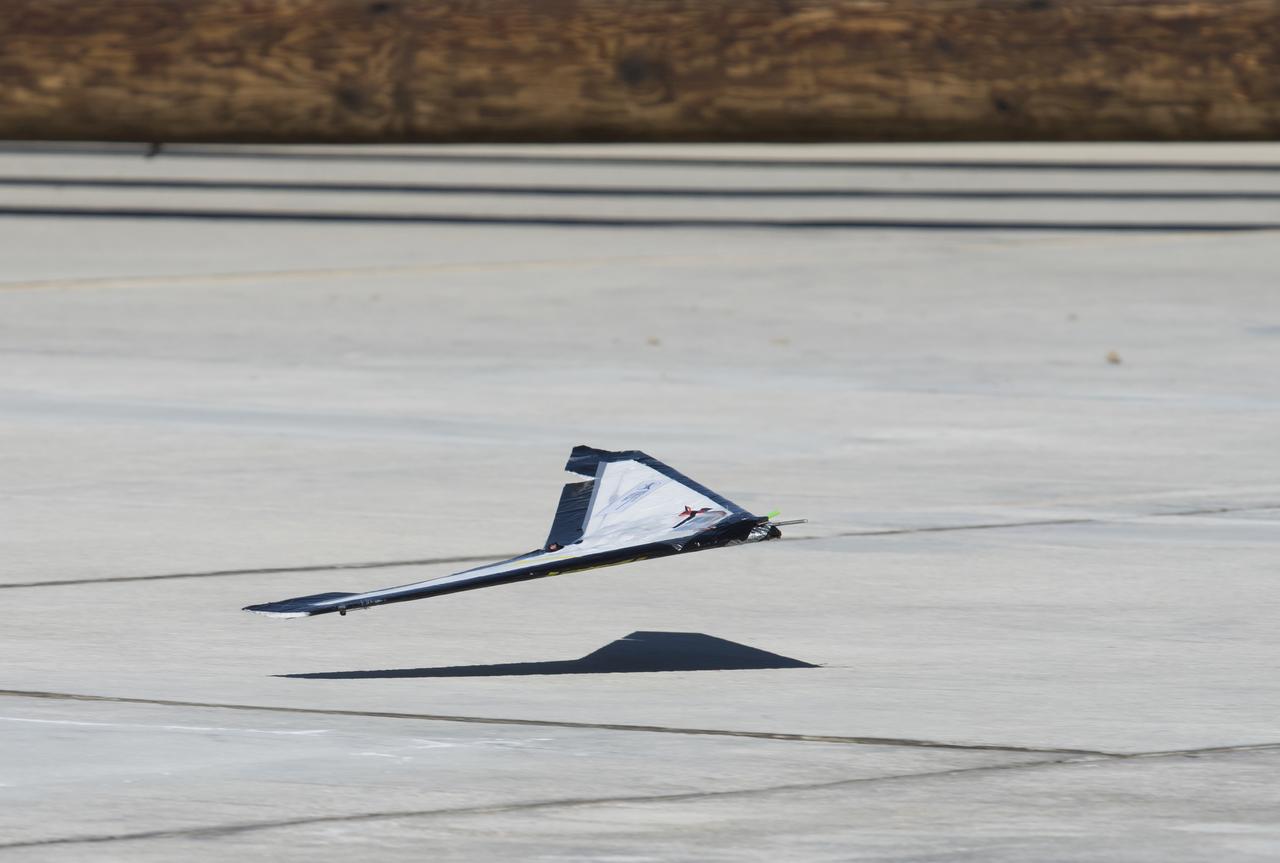
The Prandtl-M completes a successful research flight.
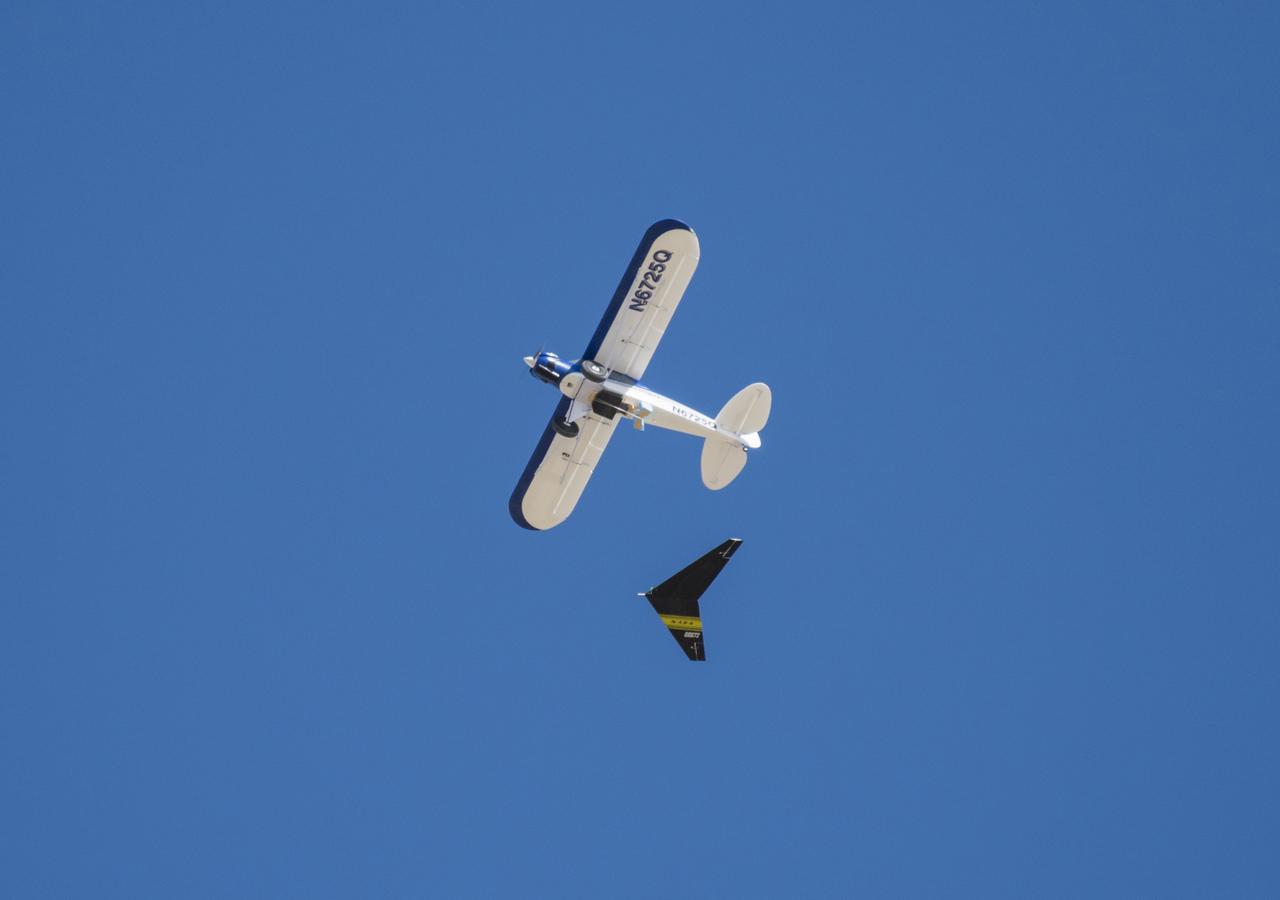
A Prandtl-M aerodynamic model flies following an air launch from a remotely piloted Carbon Cub.
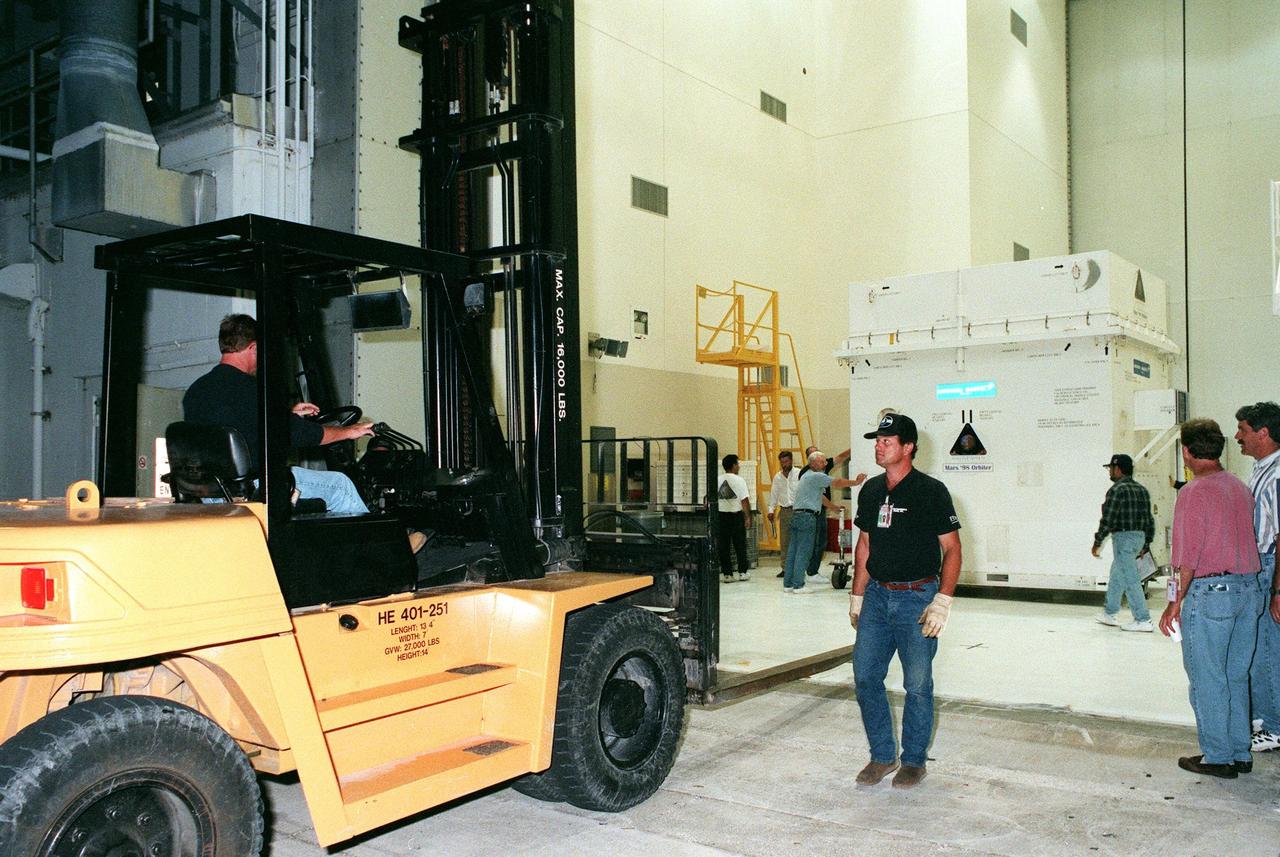
The Mars Climate Orbiter spacecraft is moved into the Spacecraft Assembly and Encapsulation Facility-2 (SAEF-2) in KSC's industrial area. It arrived at the Shuttle Landing Facility aboard an Air Force C-17 cargo plane early this morning following its flight from the Lockheed Martin Astronautics plant in Denver, Colo. When it arrives at the red planet, the Mars Climate Orbiter will primarily support its companion Mars Polar Lander spacecraft, planned for launch on Jan. 3, 1999. After that, the Mars Climate Orbiter's instruments will monitor the Martian atmosphere and image the planet's surface on a daily basis for one Martian year (1.8 Earth years). It will observe the appearance and movement of atmospheric dust and water vapor, as well as characterize seasonal changes on the surface. The detailed images of the surface features will provide important clues to the planet's early climate history and give scientists more information about possible liquid water reserves beneath the surface. The scheduled launch date for the Mars Climate Orbiter is Dec. 10, 1998, on a Delta II 7425 rocket
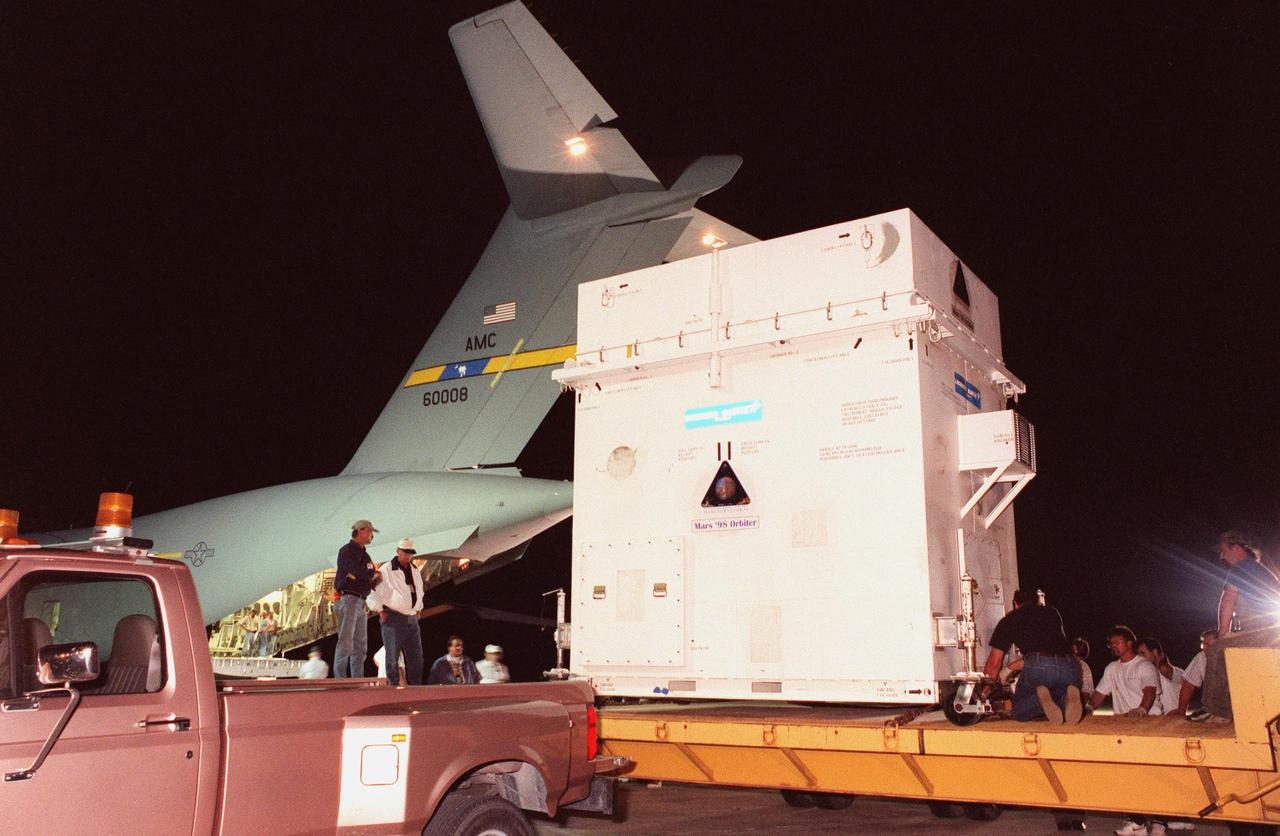
The Mars Climate Orbiter spacecraft is moved onto a flatbed for transport to the Spacecraft Assembly and Encapsulation Facility-2 (SAEF-2). It arrived at KSC's Shuttle Landing Facility aboard an Air Force C-17 cargo plane early this morning following its flight from the Lockheed Martin Astronautics plant in Denver, Colo. When it arrives at the red planet, the Mars Climate Orbiter will primarily support its companion Mars Polar Lander spacecraft, planned for launch on Jan. 3, 1999. After that, the Mars Climate Orbiter's instruments will monitor the Martian atmosphere and image the planet's surface on a daily basis for one Martian year (1.8 Earth years). It will observe the appearance and movement of atmospheric dust and water vapor, as well as characterize seasonal changes on the surface. The detailed images of the surface features will provide important clues to the planet's early climate history and give scientists more information about possible liquid water reserves beneath the surface. The scheduled launch date for the Mars Climate Orbiter is Dec. 10, 1998, on a Delta II 7425 rocket

Cape Canaveral, Fla. -- NASA's Mars Science Laboratory (MSL) rover, known as Curiosity, arrives at the Shuttle Landing Facility at NASA's Kennedy Space Center in Florida aboard an Air Force C-17 cargo plane. Also aboard is the rocket-powered descent stage that will fly the rover during the final moments before landing on Mars. A United Launch Alliance Atlas V-541 configuration will be used to loft MSL into space. Curiosity’s 10 science instruments are designed to search for evidence on whether Mars has had environments favorable to microbial life, including chemical ingredients for life. The unique rover will use a laser to look inside rocks and release its gasses so that the rover’s spectrometer can analyze and send the data back to Earth. MSL is scheduled to launch from Cape Canaveral Air Force Station in Florida Nov. 25 with a window extending to Dec. 18 and arrival at Mars Aug. 2012. For more information, visit http://www.nasa.gov/msl. Photo credit: NASA/Troy Cryder
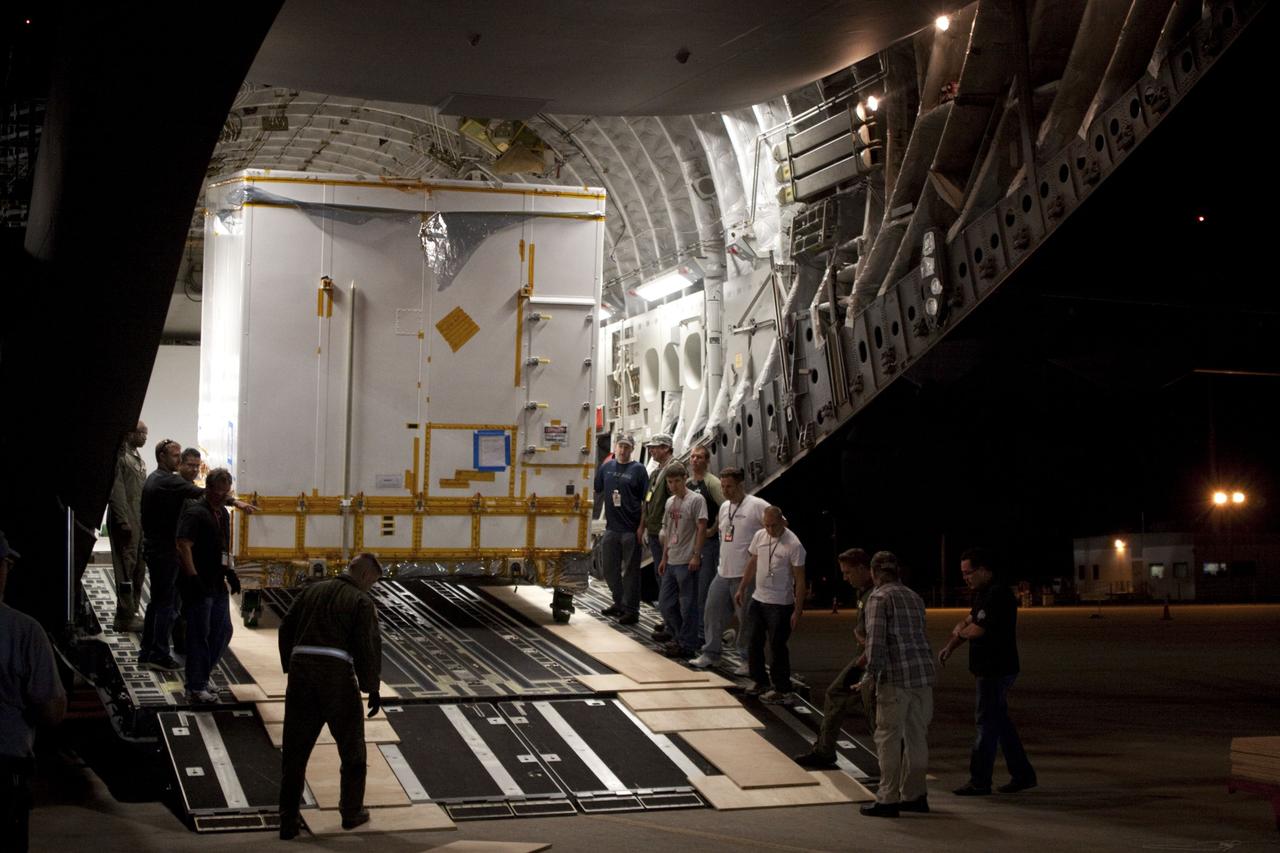
CAPE CANAVERAL, Fla. -- Workers unload NASA's Mars Science Laboratory (MSL) rocket-powered descent stage that will fly the rover during the final moments before landing on Mars. It arrived at the Shuttle Landing Facility at NASA's Kennedy Space Center in Florida aboard an Air Force C-17 cargo plane along with the MSL rover known as Curiosity. A United Launch Alliance Atlas V-541 configuration will be used to loft MSL into space. Curiosity’s 10 science instruments are designed to search for evidence on whether Mars has had environments favorable to microbial life, including chemical ingredients for life. The unique rover will use a laser to look inside rocks and release its gasses so that the rover’s spectrometer can analyze and send the data back to Earth. MSL is scheduled to launch from Cape Canaveral Air Force Station in Florida Nov. 25 with a window extending to Dec. 18 and arrival at Mars Aug. 2012. For more information, visit http://www.nasa.gov/msl. Photo credit: NASA/Troy Cryder

CAPE CANAVERAL, Fla. -- Workers load a container holding NASA's Mars Science Laboratory (MSL) rocket-powered descent stage that will fly the rover during the final moments before landing on Mars, onto a transporter after arrival at NASA Kennedy Space Center's Shuttle Landing Facility in Florida. The MSL rover known as Curiosity is also aboard the Air Force C-17 cargo plane ready for unloading. A United Launch Alliance Atlas V-541 configuration will be used to loft MSL into space. Curiosity’s 10 science instruments are designed to search for evidence on whether Mars has had environments favorable to microbial life, including chemical ingredients for life. The unique rover will use a laser to look inside rocks and release its gasses so that the rover’s spectrometer can analyze and send the data back to Earth. MSL is scheduled to launch from Cape Canaveral Air Force Station in Florida Nov. 25 with a window extending to Dec. 18 and arrival at Mars Aug. 2012. For more information, visit http://www.nasa.gov/msl. Photo credit: NASA/Troy Cryder
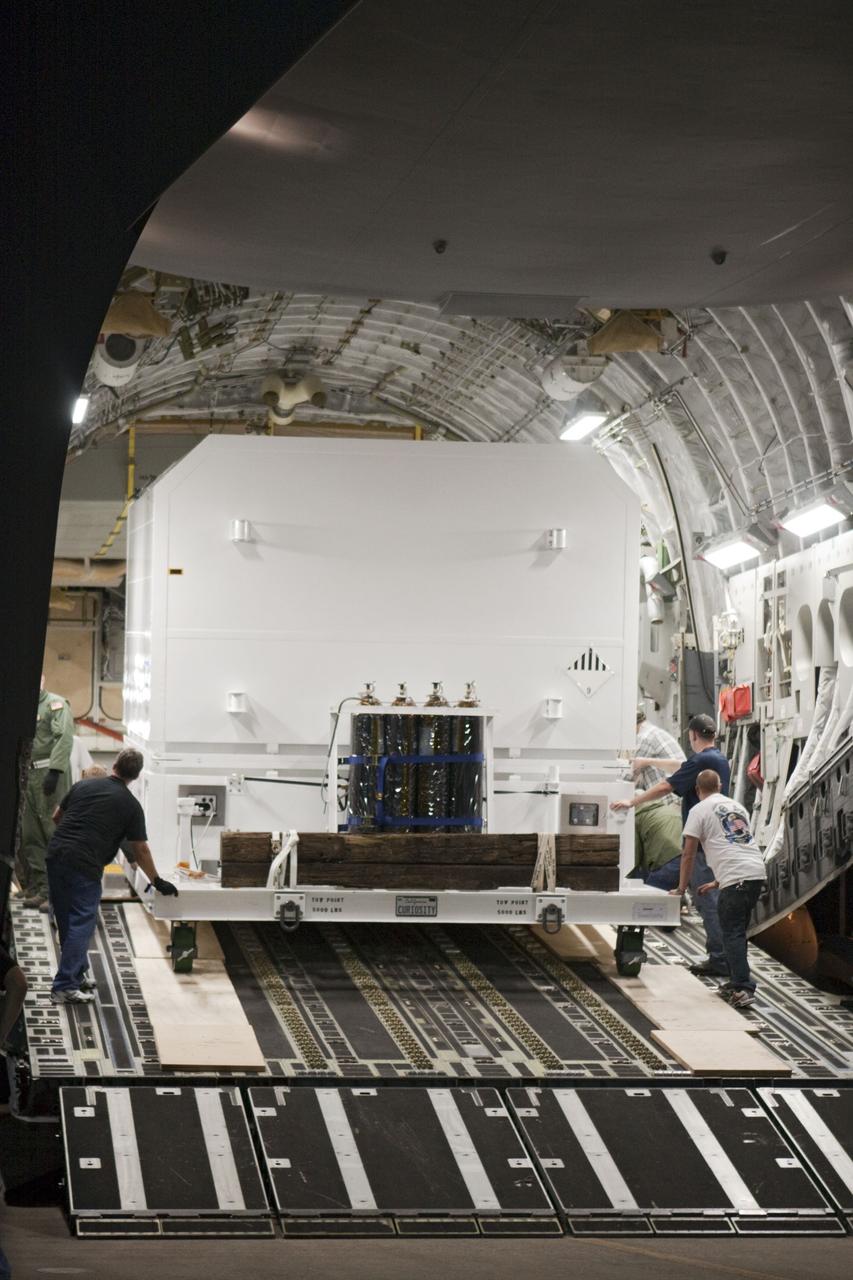
CAPE CANAVERAL, Fla. -- Workers unload a container holding NASA's Mars Science Laboratory (MSL) rover, known as Curiosity, from an Air Force C-17 cargo plane after arrival at NASA Kennedy Space Center's Shuttle Landing Facility in Florida. Already unloaded is the MSL rocket-powered descent stage that will fly the rover during the final moments before landing on Mars. A United Launch Alliance Atlas V-541 configuration will be used to loft MSL into space. Curiosity’s 10 science instruments are designed to search for evidence on whether Mars has had environments favorable to microbial life, including chemical ingredients for life. The unique rover will use a laser to look inside rocks and release its gasses so that the rover’s spectrometer can analyze and send the data back to Earth. MSL is scheduled to launch from Cape Canaveral Air Force Station in Florida Nov. 25 with a window extending to Dec. 18 and arrival at Mars Aug. 2012. For more information, visit http://www.nasa.gov/msl. Photo credit: NASA/Troy Cryder
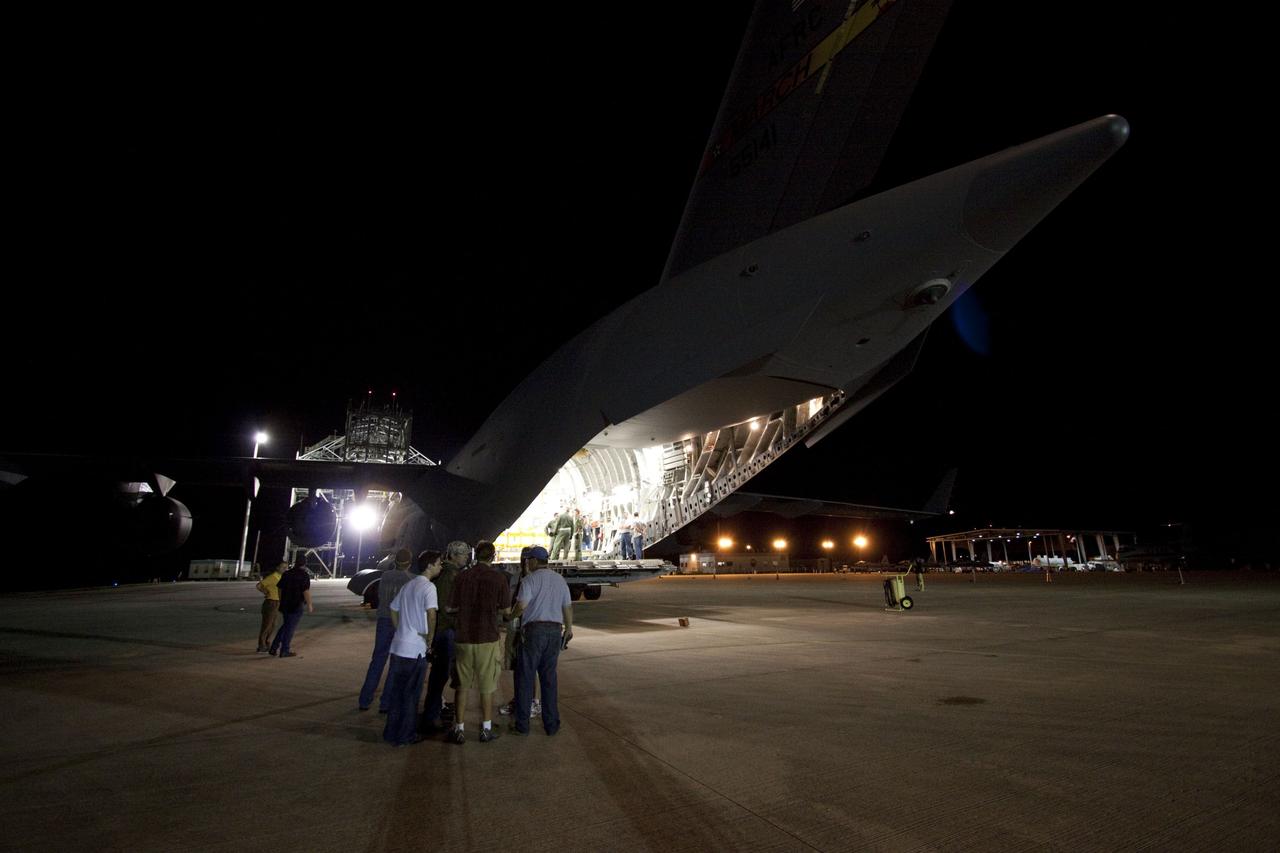
Cape Canaveral, Fla. -- Workers prepare to unload NASA's Mars Science Laboratory (MSL) rocket-powered descent stage that will fly the rover during the final moments before landing on Mars. It arrived at the Shuttle Landing Facility at NASA's Kennedy Space Center in Florida aboard an Air Force C-17 cargo plane along with the MSL rover known as Curiosity. A United Launch Alliance Atlas V-541 configuration will be used to loft MSL into space. Curiosity’s 10 science instruments are designed to search for evidence on whether Mars has had environments favorable to microbial life, including chemical ingredients for life. The unique rover will use a laser to look inside rocks and release its gasses so that the rover’s spectrometer can analyze and send the data back to Earth. MSL is scheduled to launch from Cape Canaveral Air Force Station in Florida Nov. 25 with a window extending to Dec. 18 and arrival at Mars Aug. 2012. For more information, visit http://www.nasa.gov/msl. Photo credit: NASA/Troy Cryder
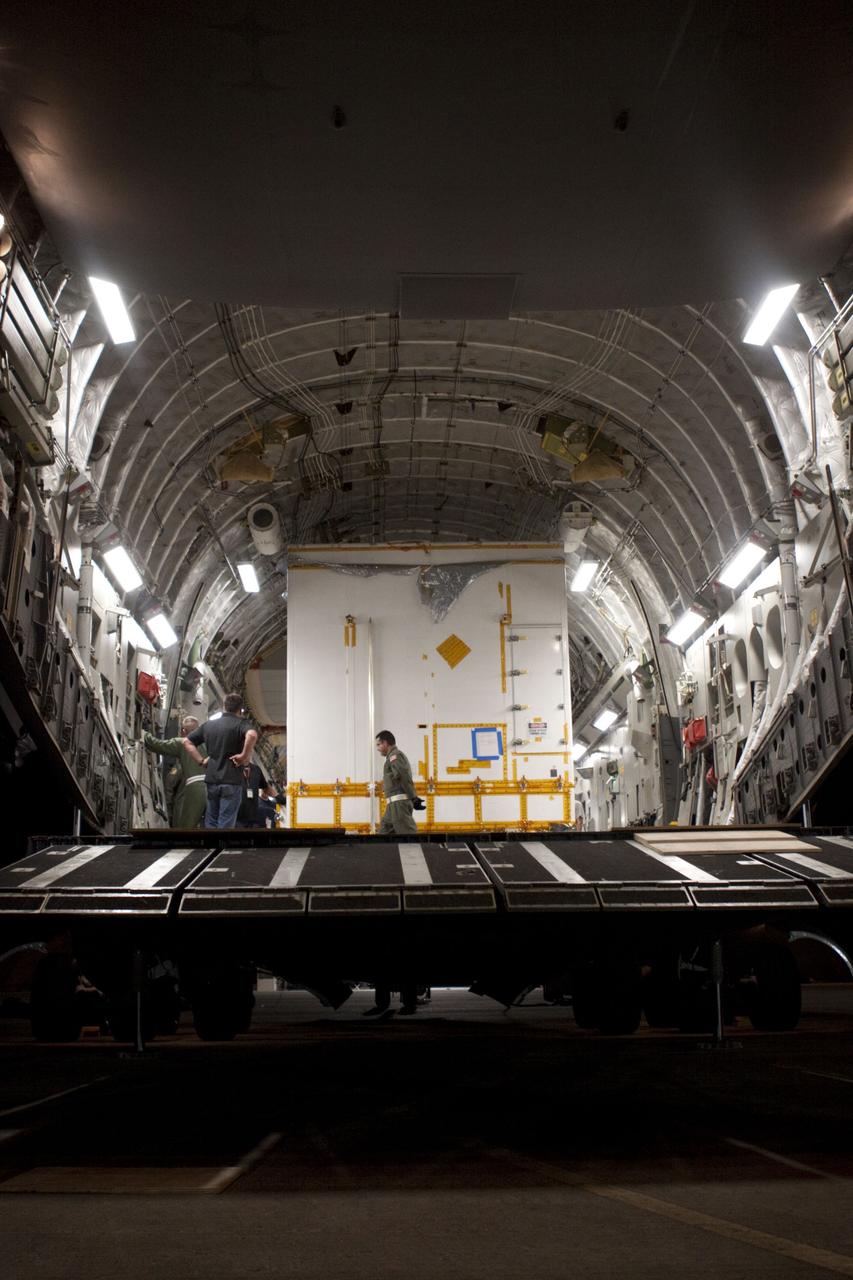
CAPE CANAVERAL, Fla. -- Workers begin to unload NASA's Mars Science Laboratory (MSL) rocket-powered descent stage that will fly the rover during the final moments before landing on Mars. It arrived at the Shuttle Landing Facility at NASA's Kennedy Space Center in Florida aboard an Air Force C-17 cargo plane along with the MSL rover known as Curiosity. A United Launch Alliance Atlas V-541 configuration will be used to loft MSL into space. Curiosity’s 10 science instruments are designed to search for evidence on whether Mars has had environments favorable to microbial life, including chemical ingredients for life. The unique rover will use a laser to look inside rocks and release its gasses so that the rover’s spectrometer can analyze and send the data back to Earth. MSL is scheduled to launch from Cape Canaveral Air Force Station in Florida Nov. 25 with a window extending to Dec. 18 and arrival at Mars Aug. 2012. For more information, visit http://www.nasa.gov/msl. Photo credit: NASA/Troy Cryder
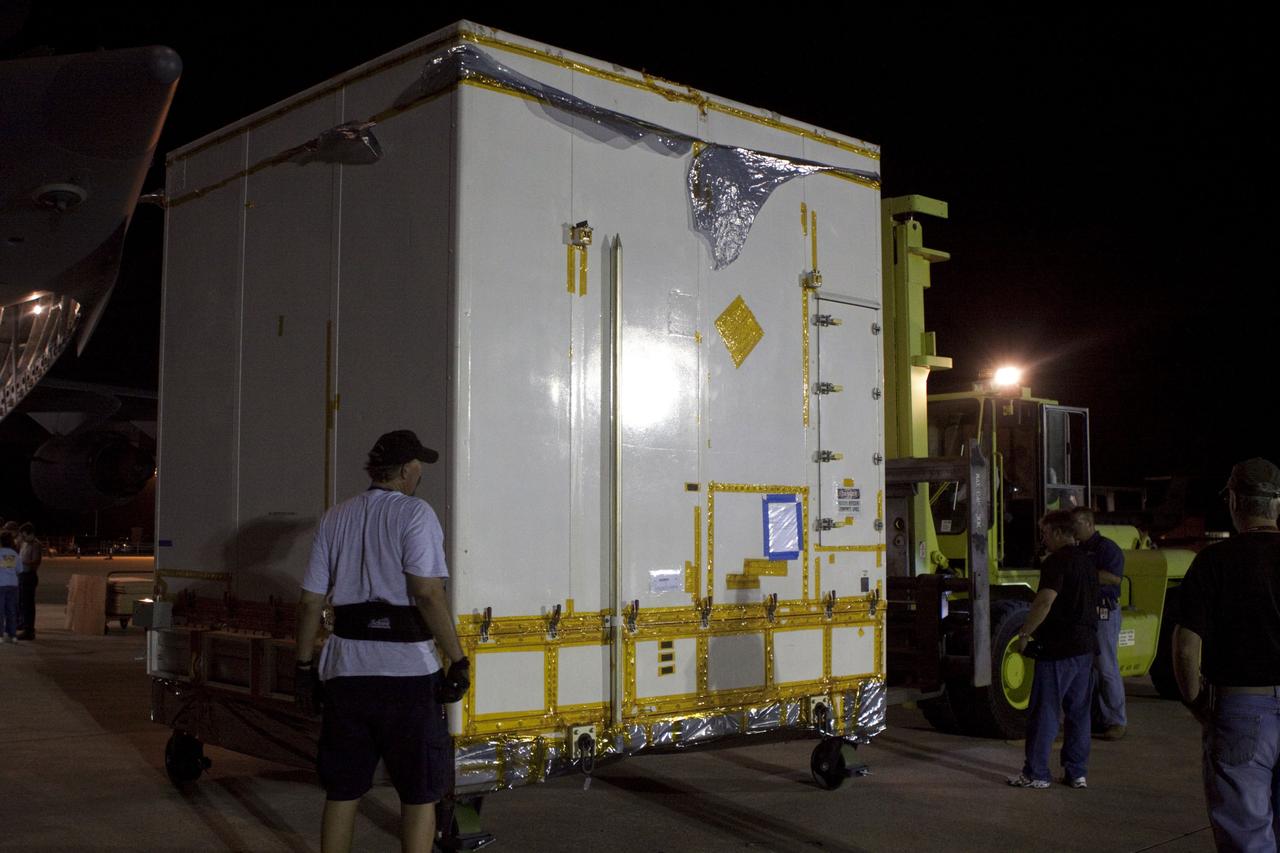
CAPE CANAVERAL, Fla. -- Workers load a container holding NASA's Mars Science Laboratory (MSL) rocket-powered descent stage that will fly the rover during the final moments before landing on Mars, onto a transporter after arrival at NASA Kennedy Space Center's Shuttle Landing Facility in Florida. The MSL rover known as Curiosity is also aboard the Air Force C-17 cargo plane ready for unloading. A United Launch Alliance Atlas V-541 configuration will be used to loft MSL into space. Curiosity’s 10 science instruments are designed to search for evidence on whether Mars has had environments favorable to microbial life, including chemical ingredients for life. The unique rover will use a laser to look inside rocks and release its gasses so that the rover’s spectrometer can analyze and send the data back to Earth. MSL is scheduled to launch from Cape Canaveral Air Force Station in Florida Nov. 25 with a window extending to Dec. 18 and arrival at Mars Aug. 2012. For more information, visit http://www.nasa.gov/msl. Photo credit: NASA/Troy Cryder
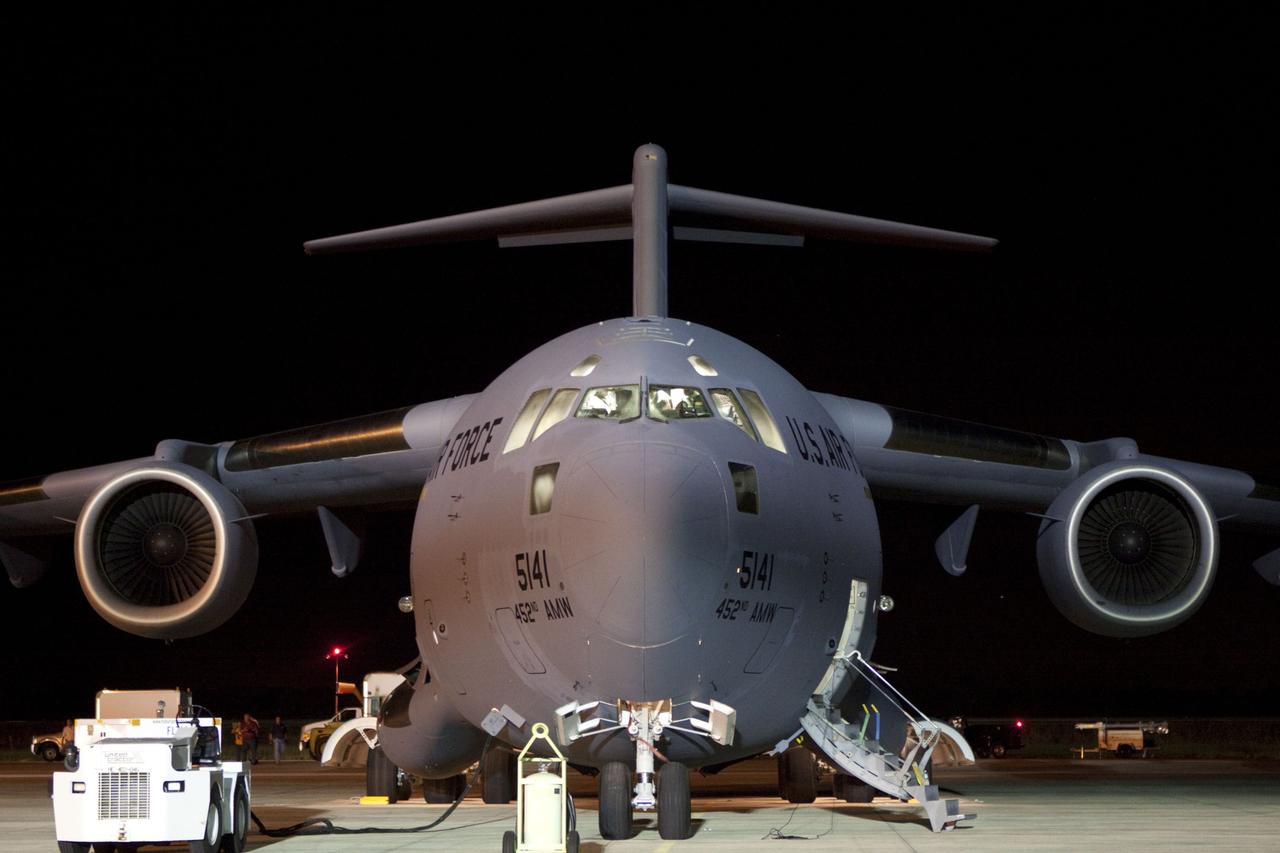
Cape Canaveral, Fla. -- NASA's Mars Science Laboratory (MSL) rover, known as Curiosity, arrives at the Shuttle Landing Facility at NASA's Kennedy Space Center in Florida aboard an Air Force C-17 cargo plane. Also aboard is the rocket-powered descent stage that will fly the rover during the final moments before landing on Mars. A United Launch Alliance Atlas V-541 configuration will be used to loft MSL into space. Curiosity’s 10 science instruments are designed to search for evidence on whether Mars has had environments favorable to microbial life, including chemical ingredients for life. The unique rover will use a laser to look inside rocks and release its gasses so that the rover’s spectrometer can analyze and send the data back to Earth. MSL is scheduled to launch from Cape Canaveral Air Force Station in Florida Nov. 25 with a window extending to Dec. 18 and arrival at Mars Aug. 2012. For more information, visit http://www.nasa.gov/msl. Photo credit: NASA/Troy Cryder
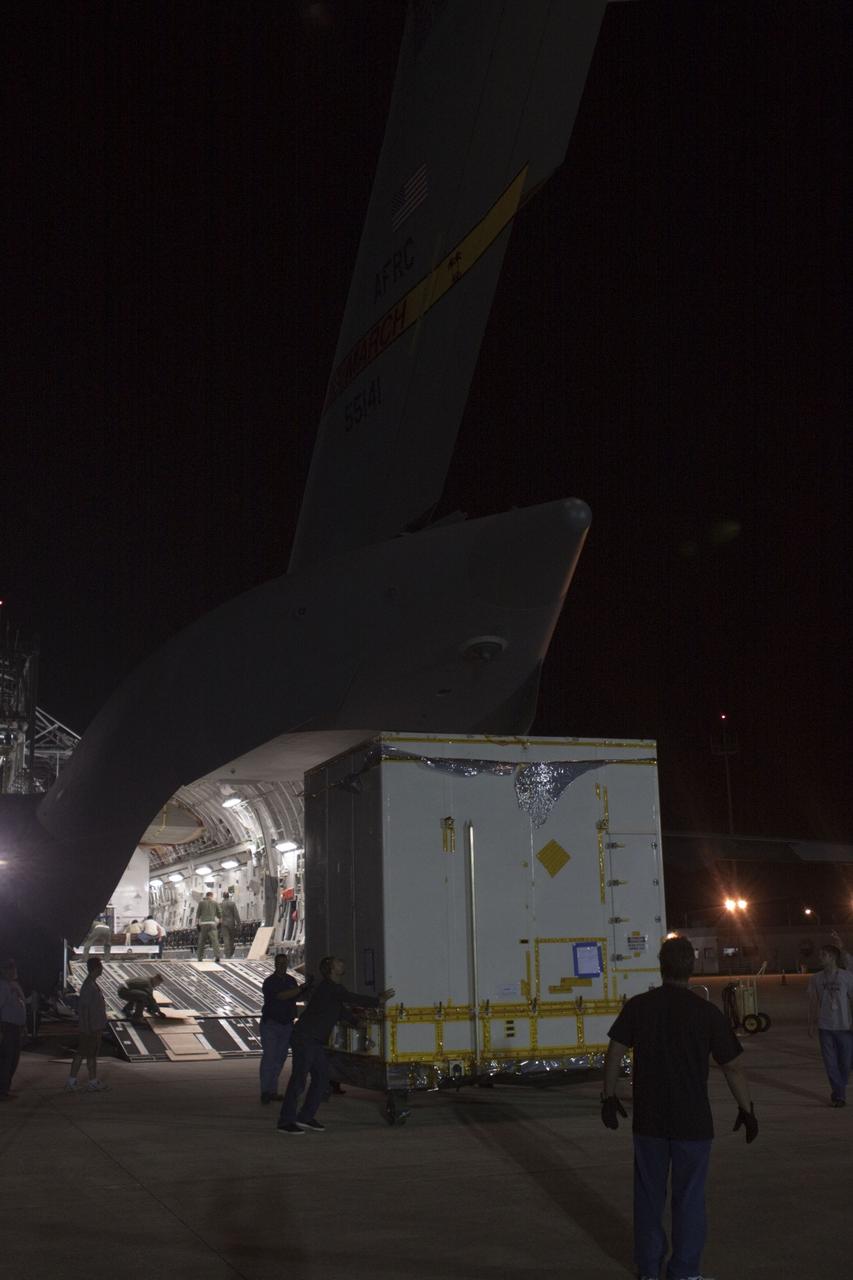
CAPE CANAVERAL, Fla. -- Workers unload NASA's Mars Science Laboratory (MSL) rocket-powered descent stage that will fly the rover during the final moments before landing on Mars. It arrived at the Shuttle Landing Facility at NASA's Kennedy Space Center in Florida aboard an Air Force C-17 cargo plane along with the MSL rover known as Curiosity. A United Launch Alliance Atlas V-541 configuration will be used to loft MSL into space. Curiosity’s 10 science instruments are designed to search for evidence on whether Mars has had environments favorable to microbial life, including chemical ingredients for life. The unique rover will use a laser to look inside rocks and release its gasses so that the rover’s spectrometer can analyze and send the data back to Earth. MSL is scheduled to launch from Cape Canaveral Air Force Station in Florida Nov. 25 with a window extending to Dec. 18 and arrival at Mars Aug. 2012. For more information, visit http://www.nasa.gov/msl. Photo credit: NASA/Troy Cryder
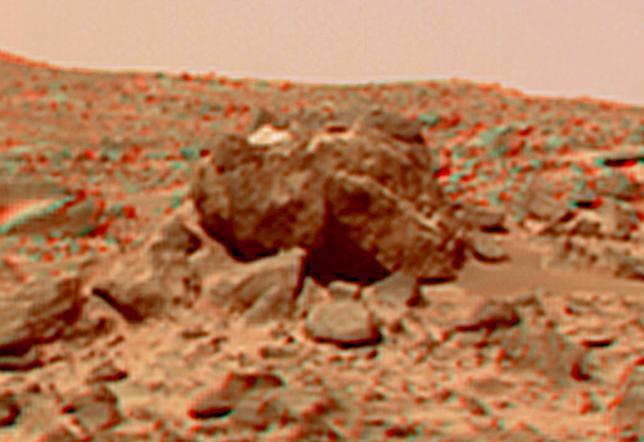
This view of the "Hippo," 25 meters to the west of the lander, was produced by combining the "Super Panorama" frames from the IMP camera. Super resolution was applied to help to address questions about the texture of this rock and what it might tell us about its mode of origin. The composite color frames that make up this anaglyph were produced for both the right and left eye of the IMP. These composites consist of more than 15 frames per eye (because multiple sequences covered the same area), taken with different color filters that were enlarged by 500% and then co-added using Adobe Photoshop to produce, in effect, a super-resolution panchromatic frame that is sharper than an individual frame would be. These panchromatic frames were then colorized with the red, green, and blue filtered images from the same sequence. The color balance was adjusted to approximate the true color of Mars. The anaglyph view was produced by combining the left with the right eye color composite frames by assigning the left eye composite view to the red color plane and the right eye composite view to the green and blue color planes (cyan), to produce a stereo anaglyph mosaic. This mosaic can be viewed in 3-D on your computer monitor or in color print form by wearing red-blue 3-D glasses. http://photojournal.jpl.nasa.gov/catalog/PIA01421
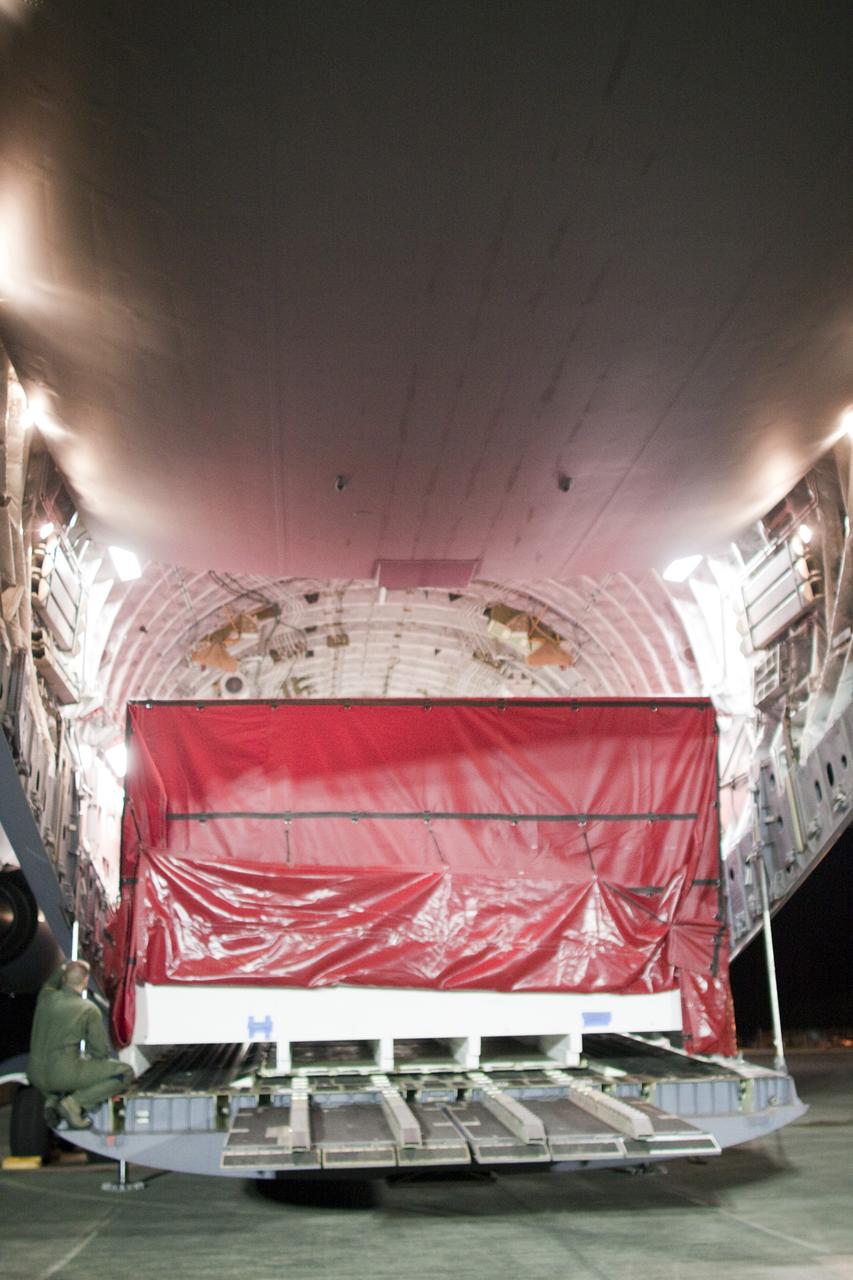
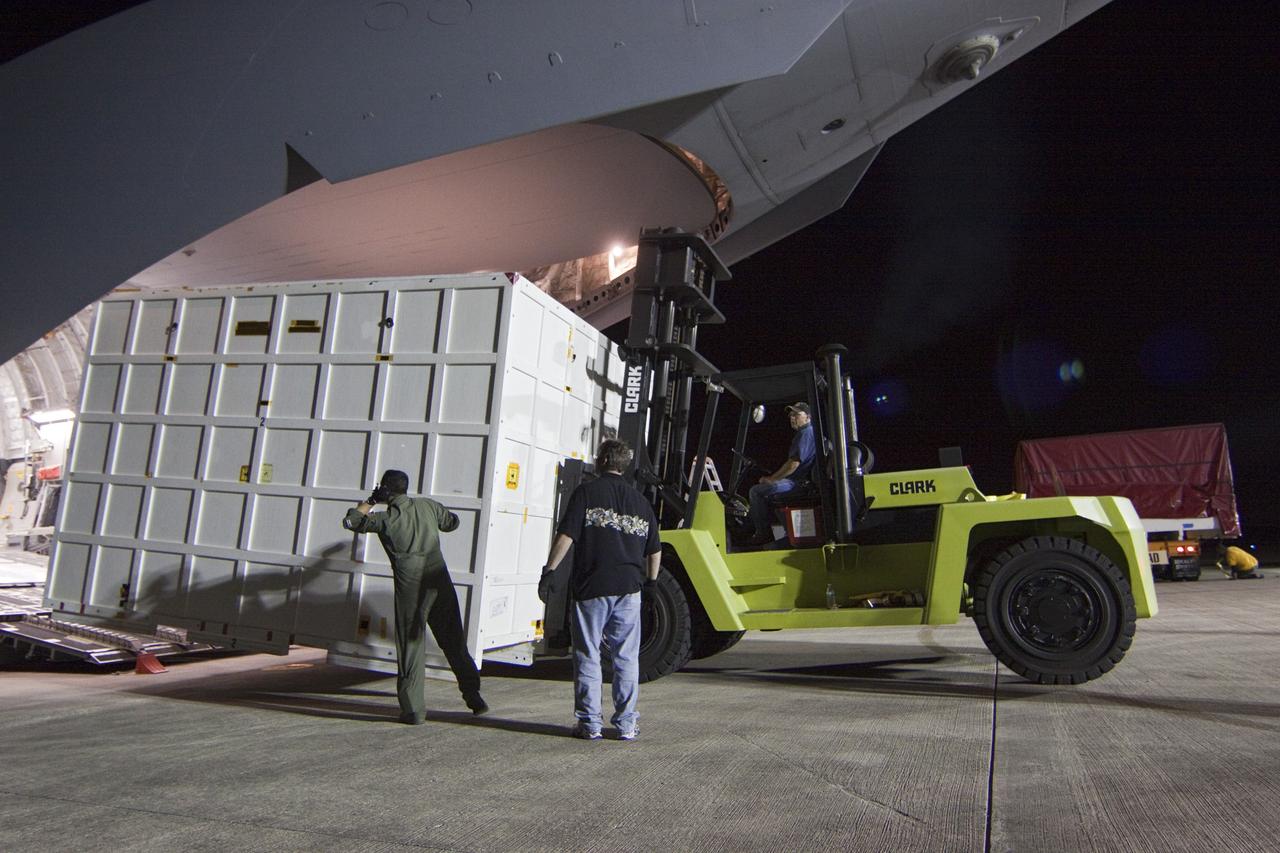
CAPE CANAVERAL, Fla. -- Workers begin to unload a container holding the heat shield, one of the first three elements for NASA's Mars Science Laboratory (MSL) that arrived at NASA Kennedy Space Center's Shuttle Landing Facility aboard an Air Force C-17 cargo plane. The cruise stage, back shell and heat shield, the first flight elements to arrive for the MSL mission, were taken to the Payload Hazardous Servicing Facility (PHSF) located in the KSC Industrial Area to begin processing. The Curiosity rover will arrive next month. A United Launch Alliance Atlas V-541 configuration will be used to loft MSL into space. Curiosity’s 10 science instruments are designed to search for evidence on whether Mars has had environments favorable to microbial life, including chemical ingredients for life. The unique rover will use a laser to look inside rocks and release its gasses so that the rover’s spectrometer can analyze and send the data back to Earth. MSL is scheduled to launch from Cape Canaveral Air Force Station in Florida Nov. 25 with a window extending to Dec. 18 and arrival at Mars Aug. 2012. For more information, visit http://www.nasa.gov/msl. Photo credit: NASA/Troy Cryder
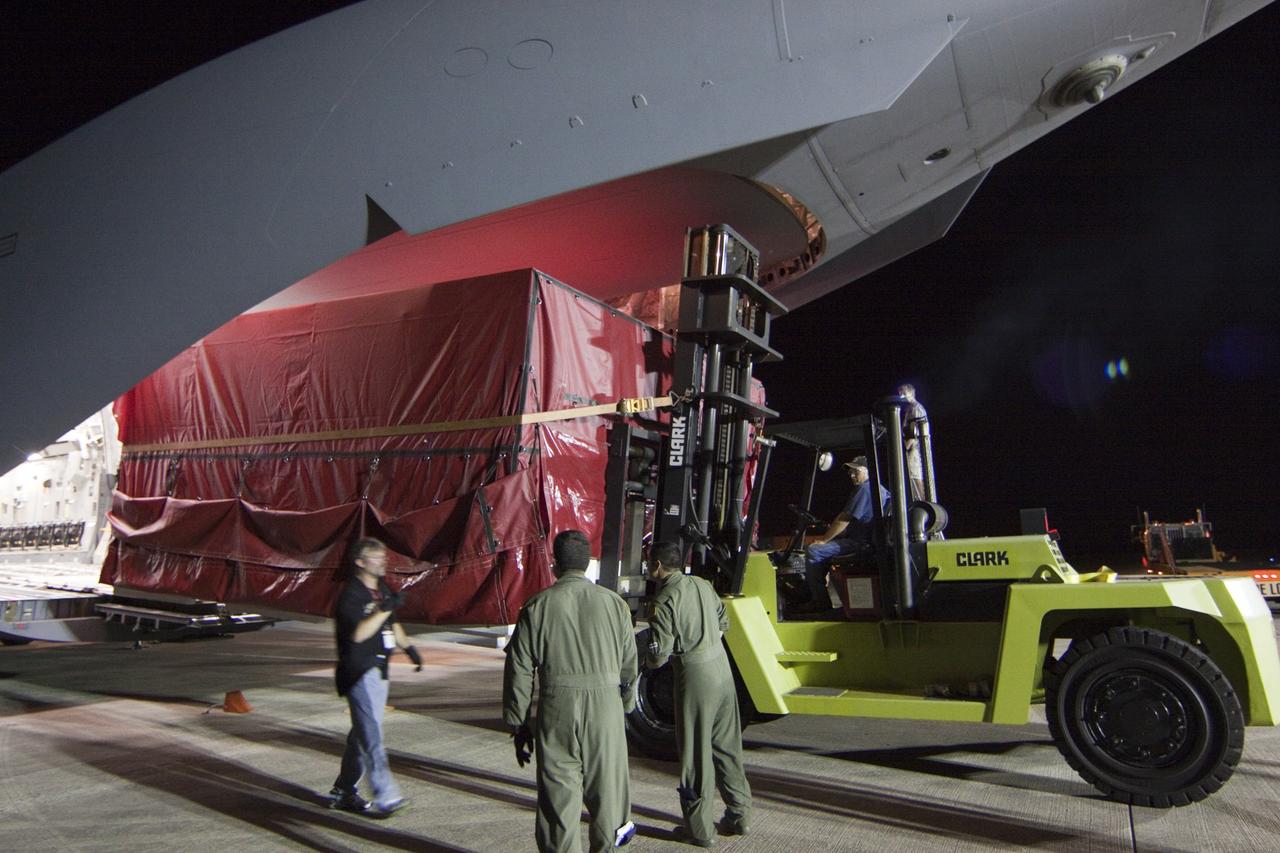
CAPE CANAVERAL, Fla. -- Workers unload a container holding the cruise stage, one of the first three elements for NASA's Mars Science Laboratory (MSL) that arrived at NASA Kennedy Space Center's Shuttle Landing Facility aboard an Air Force C-17 cargo plane. The cruise stage, back shell and heat shield, the first flight elements to arrive for the MSL mission, were taken to the Payload Hazardous Servicing Facility (PHSF) located in the KSC Industrial Area to begin processing. The Curiosity rover will arrive next month. A United Launch Alliance Atlas V-541 configuration will be used to loft MSL into space. Curiosity’s 10 science instruments are designed to search for evidence on whether Mars has had environments favorable to microbial life, including chemical ingredients for life. The unique rover will use a laser to look inside rocks and release its gasses so that the rover’s spectrometer can analyze and send the data back to Earth. MSL is scheduled to launch from Cape Canaveral Air Force Station in Florida Nov. 25 with a window extending to Dec. 18 and arrival at Mars Aug. 2012. For more information, visit http://www.nasa.gov/msl. Photo credit: NASA/Troy Cryder

CAPE CANAVERAL, Fla. -- Workers unload a container holding the heat shield, one of the first three elements for NASA's Mars Science Laboratory (MSL) that arrived at NASA Kennedy Space Center's Shuttle Landing Facility aboard an Air Force C-17 cargo plane. The cruise stage, back shell and heat shield, the first flight elements to arrive for the MSL mission, were taken to the Payload Hazardous Servicing Facility (PHSF) located in the KSC Industrial Area to begin processing. The Curiosity rover will arrive next month. A United Launch Alliance Atlas V-541 configuration will be used to loft MSL into space. Curiosity’s 10 science instruments are designed to search for evidence on whether Mars has had environments favorable to microbial life, including chemical ingredients for life. The unique rover will use a laser to look inside rocks and release its gasses so that the rover’s spectrometer can analyze and send the data back to Earth. MSL is scheduled to launch from Cape Canaveral Air Force Station in Florida Nov. 25 with a window extending to Dec. 18 and arrival at Mars Aug. 2012. For more information, visit http://www.nasa.gov/msl. Photo credit: NASA/Troy Cryder
CAPE CANAVERAL, Fla. -- Workers unload a container holding the heat shield, one of the first three elements for NASA's Mars Science Laboratory (MSL) that arrived at NASA Kennedy Space Center's Shuttle Landing Facility aboard an Air Force C-17 cargo plane. The cruise stage, back shell and heat shield, the first flight elements to arrive for the MSL mission, were taken to the Payload Hazardous Servicing Facility (PHSF) located in the KSC Industrial Area to begin processing. The Curiosity rover will arrive next month. A United Launch Alliance Atlas V-541 configuration will be used to loft MSL into space. Curiosity’s 10 science instruments are designed to search for evidence on whether Mars has had environments favorable to microbial life, including chemical ingredients for life. The unique rover will use a laser to look inside rocks and release its gasses so that the rover’s spectrometer can analyze and send the data back to Earth. MSL is scheduled to launch from Cape Canaveral Air Force Station in Florida Nov. 25 with a window extending to Dec. 18 and arrival at Mars Aug. 2012. For more information, visit http://www.nasa.gov/msl. Photo credit: NASA/Troy Cryder
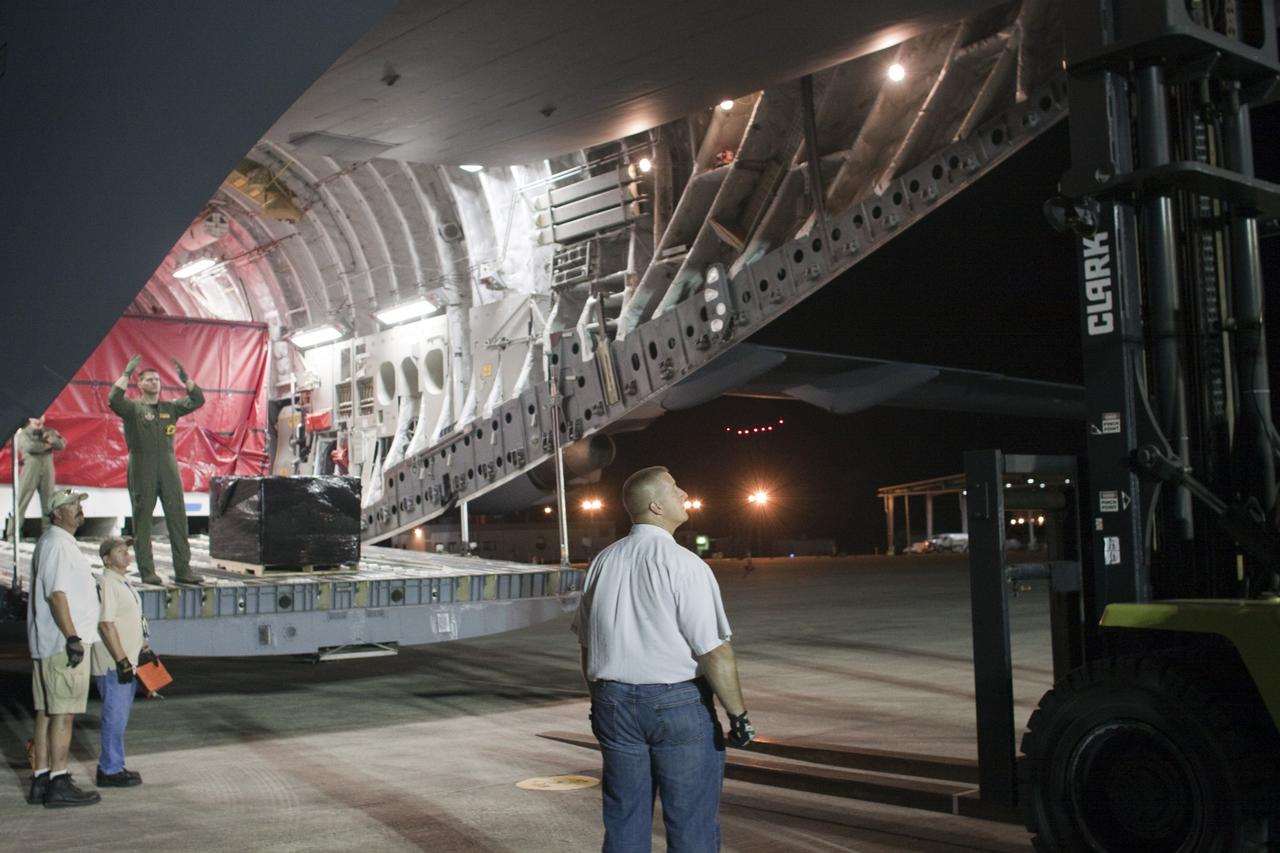
CAPE CANAVERAL, Fla. -- Workers begin to unload the first elements for NASA's Mars Science Laboratory (MSL) payload after arrival at NASA Kennedy Space Center's Shuttle Landing Facility aboard an Air Force C-17 cargo plane. The cruise stage, back shell and heat shield, the first flight elements to arrive for the MSL mission, were taken to the Payload Hazardous Servicing Facility (PHSF) located in the KSC Industrial Area to begin processing. The Curiosity rover will arrive next month. A United Launch Alliance Atlas V-541 configuration will be used to loft MSL into space. Curiosity’s 10 science instruments are designed to search for evidence on whether Mars has had environments favorable to microbial life, including chemical ingredients for life. The unique rover will use a laser to look inside rocks and release its gasses so that the rover’s spectrometer can analyze and send the data back to Earth. MSL is scheduled to launch from Cape Canaveral Air Force Station in Florida Nov. 25 with a window extending to Dec. 18 and arrival at Mars Aug. 2012. For more information, visit http://www.nasa.gov/msl. Photo credit: NASA/Troy Cryder
CAPE CANAVERAL, Fla. -- Workers unload a container holding the back shell, one of the first three elements for NASA's Mars Science Laboratory (MSL) that arrived at NASA Kennedy Space Center's Shuttle Landing Facility aboard an Air Force C-17 cargo plane. The cruise stage, back shell and heat shield, the first flight elements to arrive for the MSL mission, were taken to the Payload Hazardous Servicing Facility (PHSF) located in the KSC Industrial Area to begin processing. The Curiosity rover will arrive next month. A United Launch Alliance Atlas V-541 configuration will be used to loft MSL into space. Curiosity’s 10 science instruments are designed to search for evidence on whether Mars has had environments favorable to microbial life, including chemical ingredients for life. The unique rover will use a laser to look inside rocks and release its gasses so that the rover’s spectrometer can analyze and send the data back to Earth. MSL is scheduled to launch from Cape Canaveral Air Force Station in Florida Nov. 25 with a window extending to Dec. 18 and arrival at Mars Aug. 2012. For more information, visit http://www.nasa.gov/msl. Photo credit: NASA/Troy Cryder
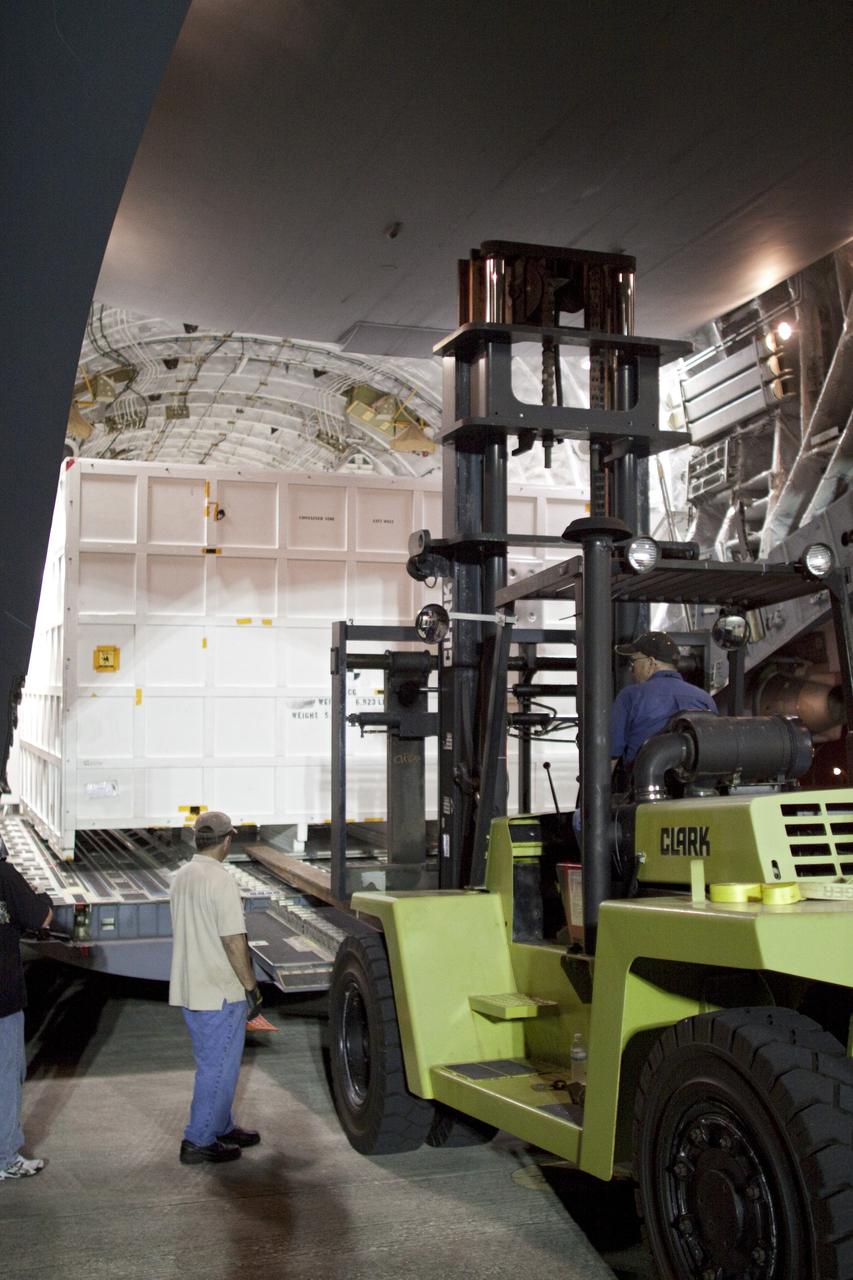
CAPE CANAVERAL, Fla. -- Workers unload a container holding the back shell, one of the first three elements for NASA's Mars Science Laboratory (MSL) that arrived at NASA Kennedy Space Center's Shuttle Landing Facility aboard an Air Force C-17 cargo plane. The cruise stage, back shell and heat shield, the first flight elements to arrive for the MSL mission, were taken to the Payload Hazardous Servicing Facility (PHSF) located in the KSC Industrial Area to begin processing. The Curiosity rover will arrive next month. A United Launch Alliance Atlas V-541 configuration will be used to loft MSL into space. Curiosity’s 10 science instruments are designed to search for evidence on whether Mars has had environments favorable to microbial life, including chemical ingredients for life. The unique rover will use a laser to look inside rocks and release its gasses so that the rover’s spectrometer can analyze and send the data back to Earth. MSL is scheduled to launch from Cape Canaveral Air Force Station in Florida Nov. 25 with a window extending to Dec. 18 and arrival at Mars Aug. 2012. For more information, visit http://www.nasa.gov/msl. Photo credit: NASA/Troy Cryder
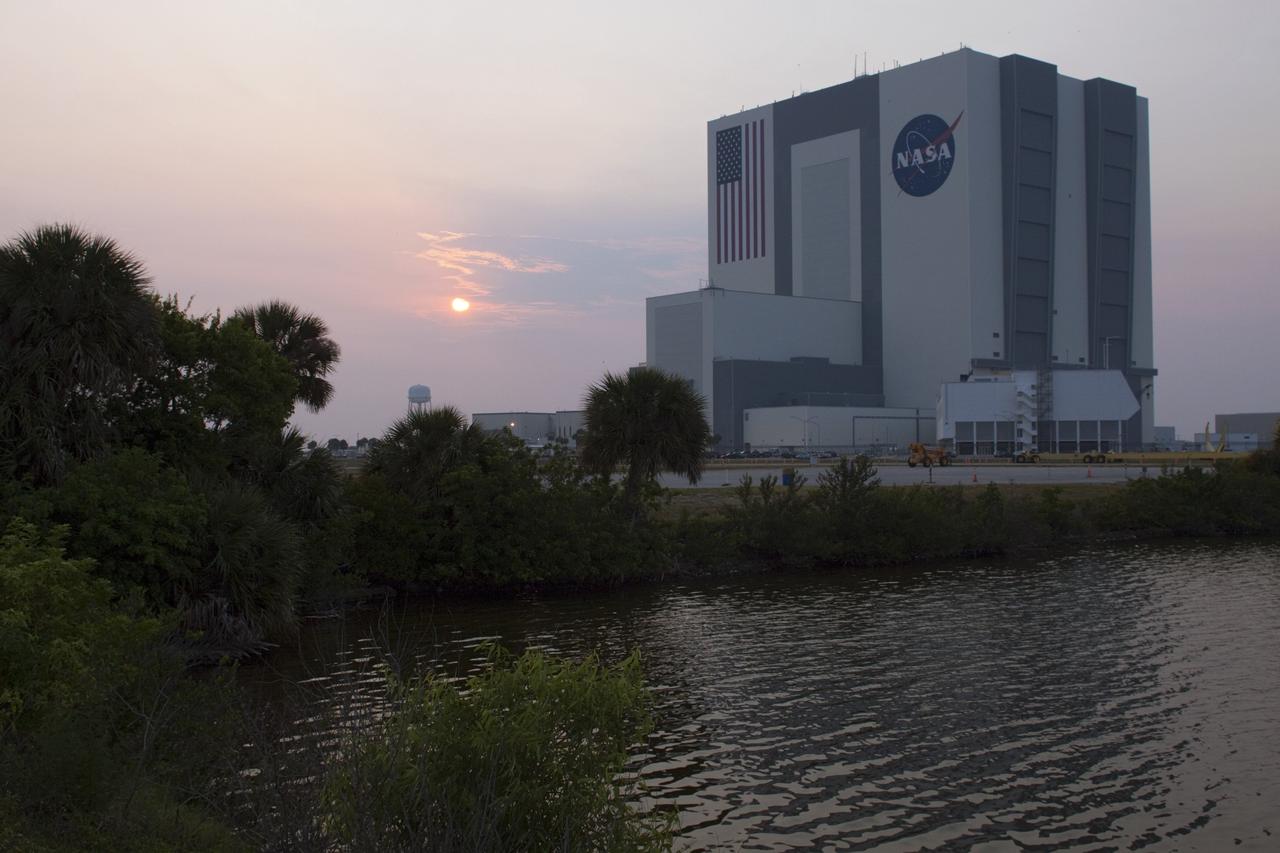
Cape Canaveral, Fla. -- The sunrise casts a haze over the Shuttle Landing Facility and the Vehicle Assembly Building at NASA's Kennedy Space Center in Florida, where the arrival of NASA's Mars Science Laboratory (MSL) first three elements are being delivered by an Air Force C-17 cargo plane. The cruise stage, back shell and heat shield, the first flight elements to arrive for the MSL mission, were taken to the Payload Hazardous Servicing Facility (PHSF) located in the KSC Industrial Area to begin processing. The Curiosity rover will arrive next month. A United Launch Alliance Atlas V-541 configuration will be used to loft MSL into space. Curiosity’s 10 science instruments are designed to search for evidence on whether Mars has had environments favorable to microbial life, including chemical ingredients for life. The unique rover will use a laser to look inside rocks and release its gasses so that the rover’s spectrometer can analyze and send the data back to Earth. MSL is scheduled to launch from Cape Canaveral Air Force Station in Florida Nov. 25 with a window extending to Dec. 18 and arrival at Mars Aug. 2012. For more information, visit http://www.nasa.gov/msl. Photo credit: NASA/Troy Cryder
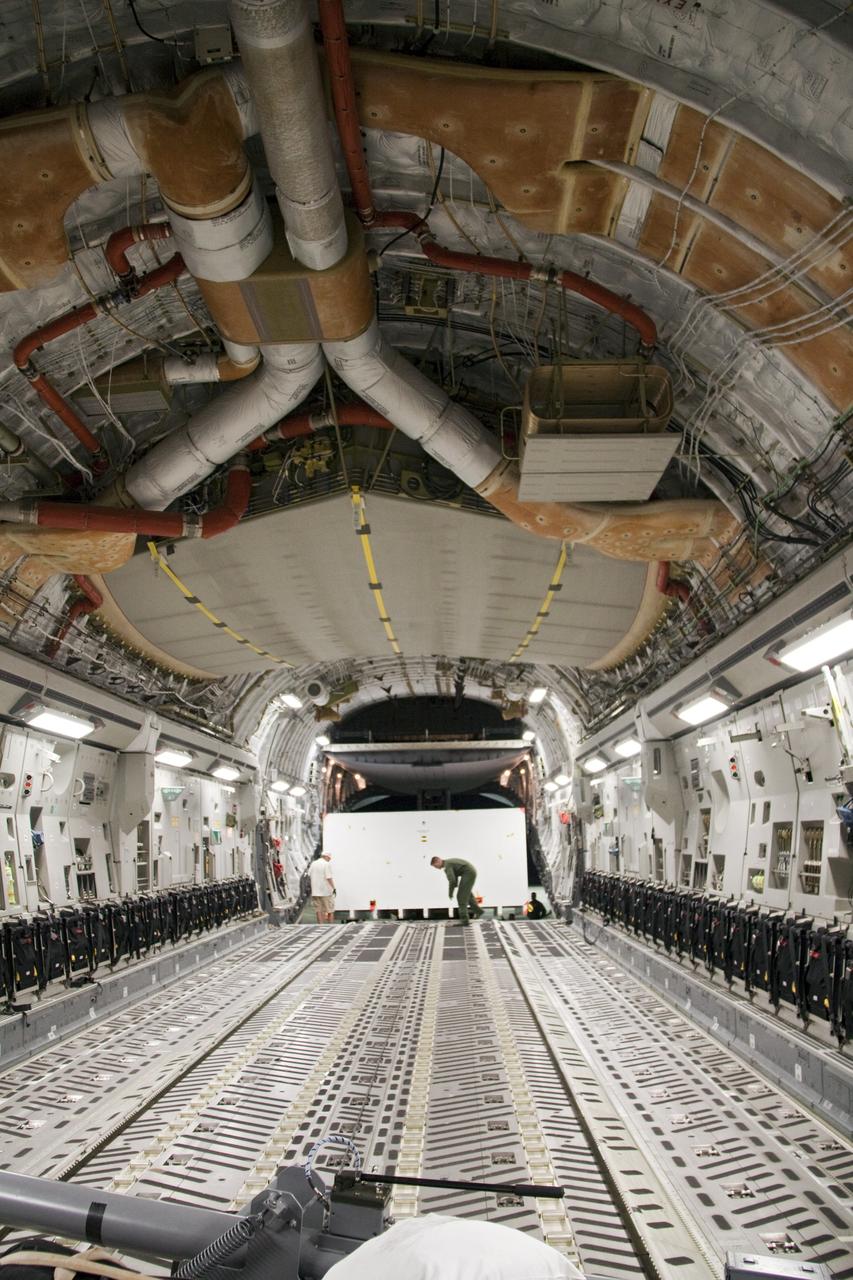
CAPE CANAVERAL, Fla. -- Workers unload a container holding the cruise stage, one of the first three elements for NASA's Mars Science Laboratory (MSL) that arrived at NASA Kennedy Space Center's Shuttle Landing Facility aboard an Air Force C-17 cargo plane. The cruise stage, back shell and heat shield, the first flight elements to arrive for the MSL mission, were taken to the Payload Hazardous Servicing Facility (PHSF) located in the KSC Industrial Area to begin processing. The Curiosity rover will arrive next month. A United Launch Alliance Atlas V-541 configuration will be used to loft MSL into space. Curiosity’s 10 science instruments are designed to search for evidence on whether Mars has had environments favorable to microbial life, including chemical ingredients for life. The unique rover will use a laser to look inside rocks and release its gasses so that the rover’s spectrometer can analyze and send the data back to Earth. MSL is scheduled to launch from Cape Canaveral Air Force Station in Florida Nov. 25 with a window extending to Dec. 18 and arrival at Mars Aug. 2012. For more information, visit http://www.nasa.gov/msl. Photo credit: NASA/Troy Cryder
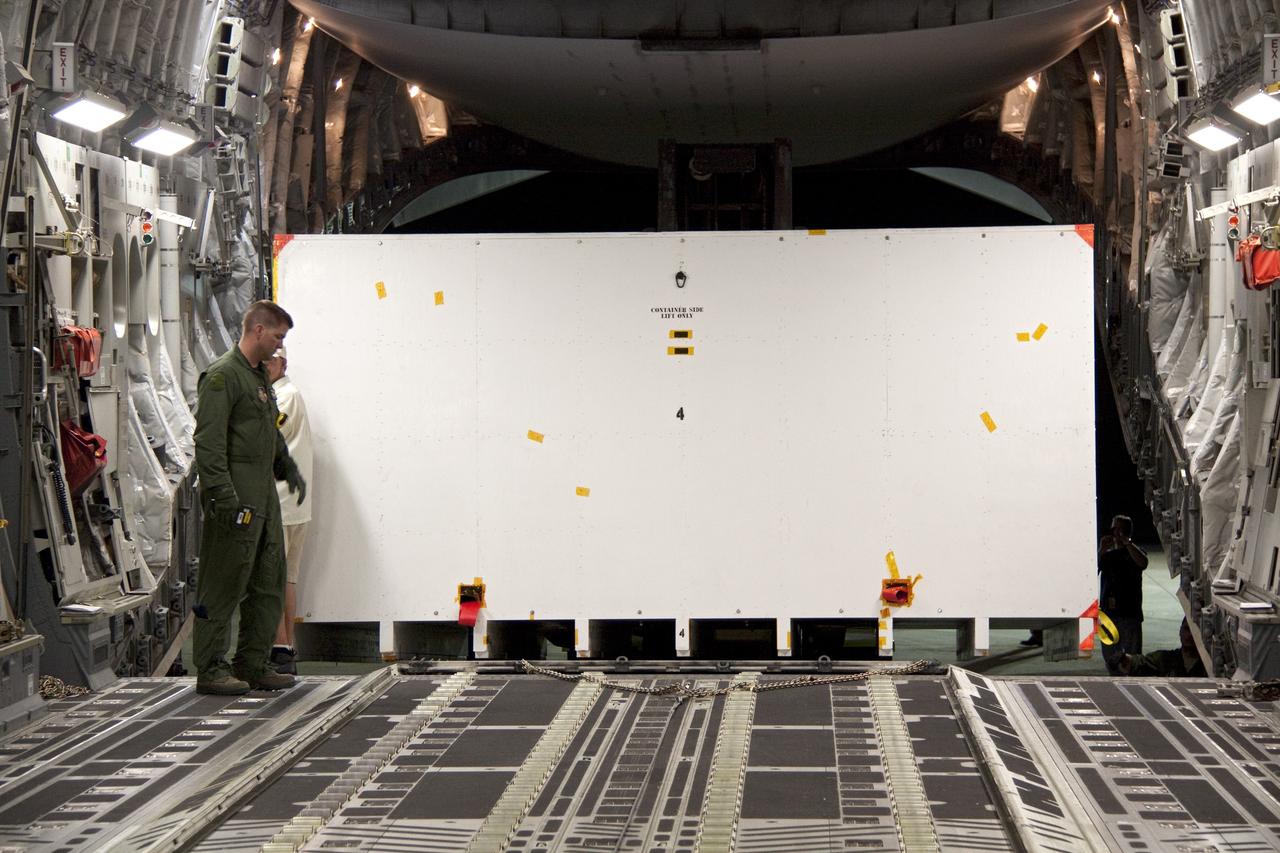
CAPE CANAVERAL, Fla. -- Workers unload a container holding the cruise stage, one of the first three elements for NASA's Mars Science Laboratory (MSL) that arrived at NASA Kennedy Space Center's Shuttle Landing Facility aboard an Air Force C-17 cargo plane. The cruise stage, back shell and heat shield, the first flight elements to arrive for the MSL mission, were taken to the Payload Hazardous Servicing Facility (PHSF) located in the KSC Industrial Area to begin processing. The Curiosity rover will arrive next month. A United Launch Alliance Atlas V-541 configuration will be used to loft MSL into space. Curiosity’s 10 science instruments are designed to search for evidence on whether Mars has had environments favorable to microbial life, including chemical ingredients for life. The unique rover will use a laser to look inside rocks and release its gasses so that the rover’s spectrometer can analyze and send the data back to Earth. MSL is scheduled to launch from Cape Canaveral Air Force Station in Florida Nov. 25 with a window extending to Dec. 18 and arrival at Mars Aug. 2012. For more information, visit http://www.nasa.gov/msl. Photo credit: NASA/Troy Cryder
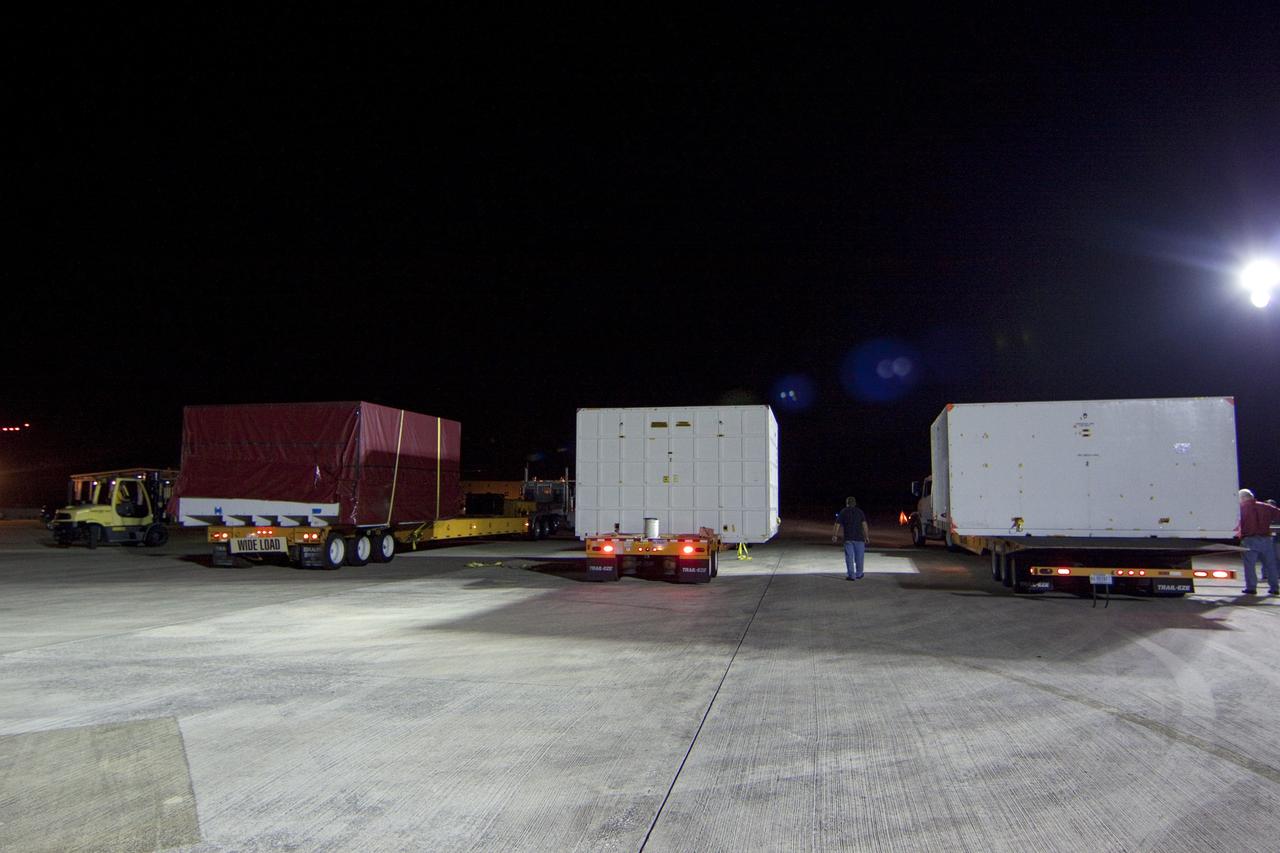
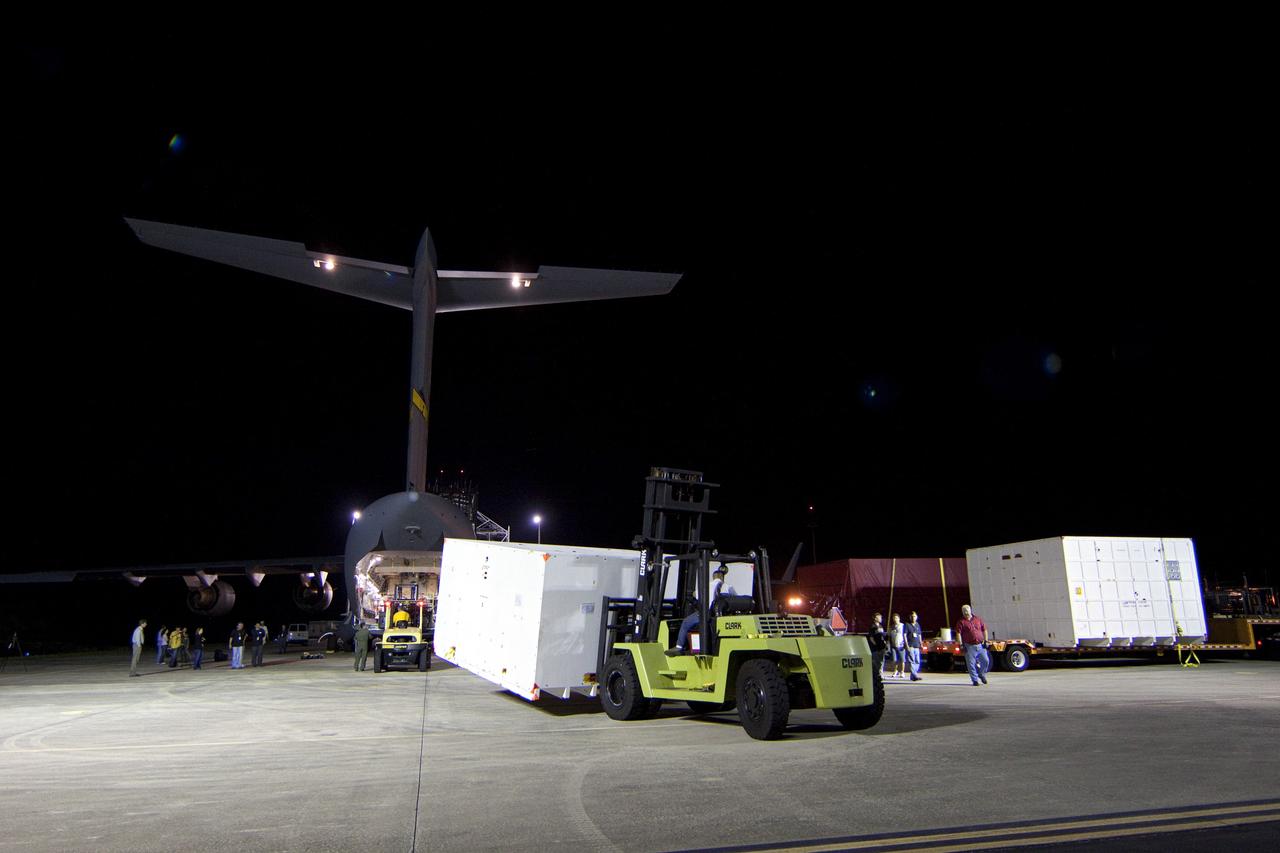
CAPE CANAVERAL, Fla. -- Workers have loaded onto a transporter all three containers holding the first three elements for NASA's Mars Science Laboratory (MSL) that arrived at NASA Kennedy Space Center's Shuttle Landing Facility aboard an Air Force C-17 cargo plane. The cruise stage, back shell and heat shield, the first flight elements to arrive for the MSL mission, were taken to the Payload Hazardous Servicing Facility (PHSF) located in the KSC Industrial Area to begin processing. The Curiosity rover will arrive next month. A United Launch Alliance Atlas V-541 configuration will be used to loft MSL into space. Curiosity’s 10 science instruments are designed to search for evidence on whether Mars has had environments favorable to microbial life, including chemical ingredients for life. The unique rover will use a laser to look inside rocks and release its gasses so that the rover’s spectrometer can analyze and send the data back to Earth. MSL is scheduled to launch from Cape Canaveral Air Force Station in Florida Nov. 25 with a window extending to Dec. 18 and arrival at Mars Aug. 2012. For more information, visit http://www.nasa.gov/msl. Photo credit: NASA/Troy Cryder
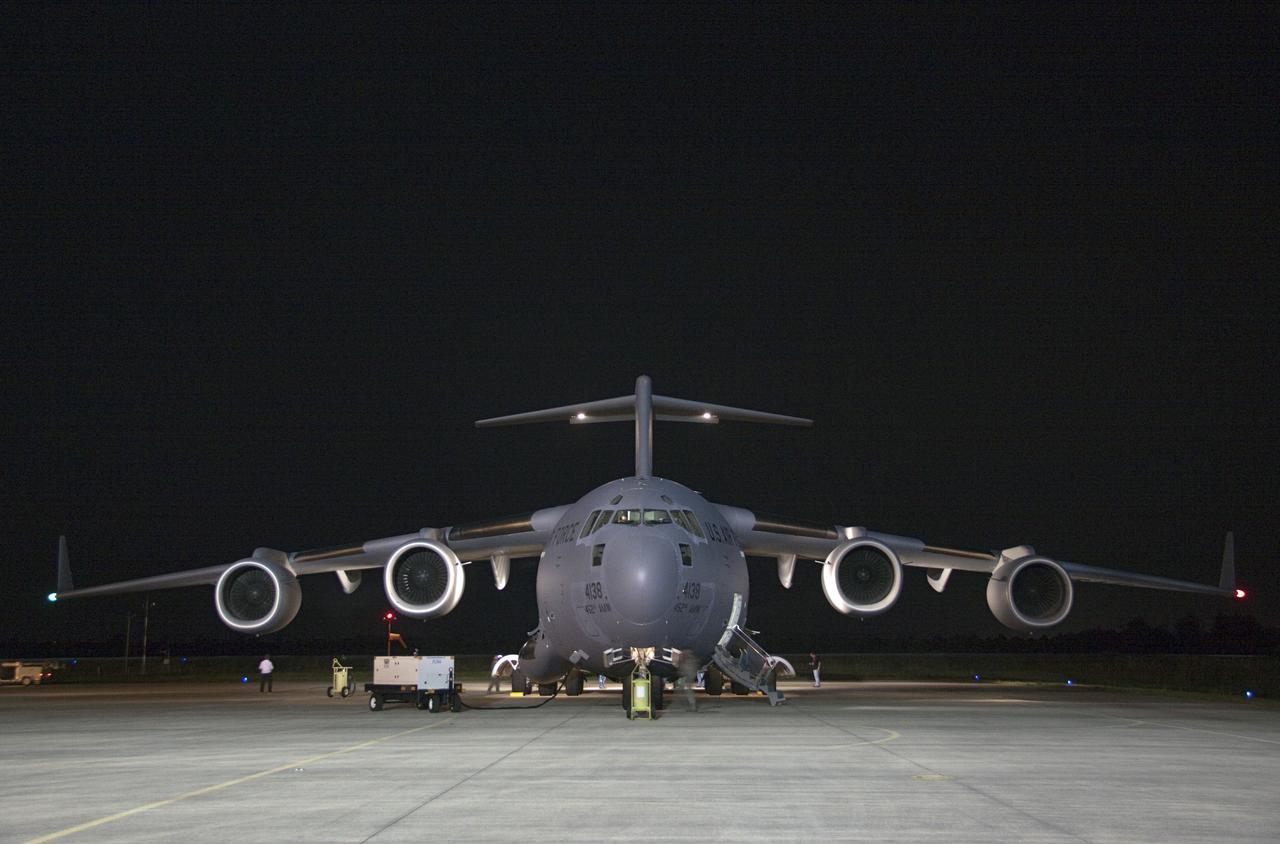
CAPE CANAVERAL, Fla. -- The first three elements for NASA's Mars Science Laboratory (MSL) arrive at NASA Kennedy Space Center's Shuttle Landing Facility aboard an Air Force C-17 cargo plane. The cruise stage, back shell and heat shield, the first flight elements to arrive for the MSL mission, were taken to the Payload Hazardous Servicing Facility (PHSF) located in the KSC Industrial Area to begin processing. The Curiosity rover will arrive next month. A United Launch Alliance Atlas V-541 configuration will be used to loft MSL into space. Curiosity’s 10 science instruments are designed to search for evidence on whether Mars has had environments favorable to microbial life, including chemical ingredients for life. The unique rover will use a laser to look inside rocks and release its gasses so that the rover’s spectrometer can analyze and send the data back to Earth. MSL is scheduled to launch from Cape Canaveral Air Force Station in Florida Nov. 25 with a window extending to Dec. 18 and arrival at Mars Aug. 2012. For more information, visit http://www.nasa.gov/msl. Photo credit: NASA/Troy Cryder
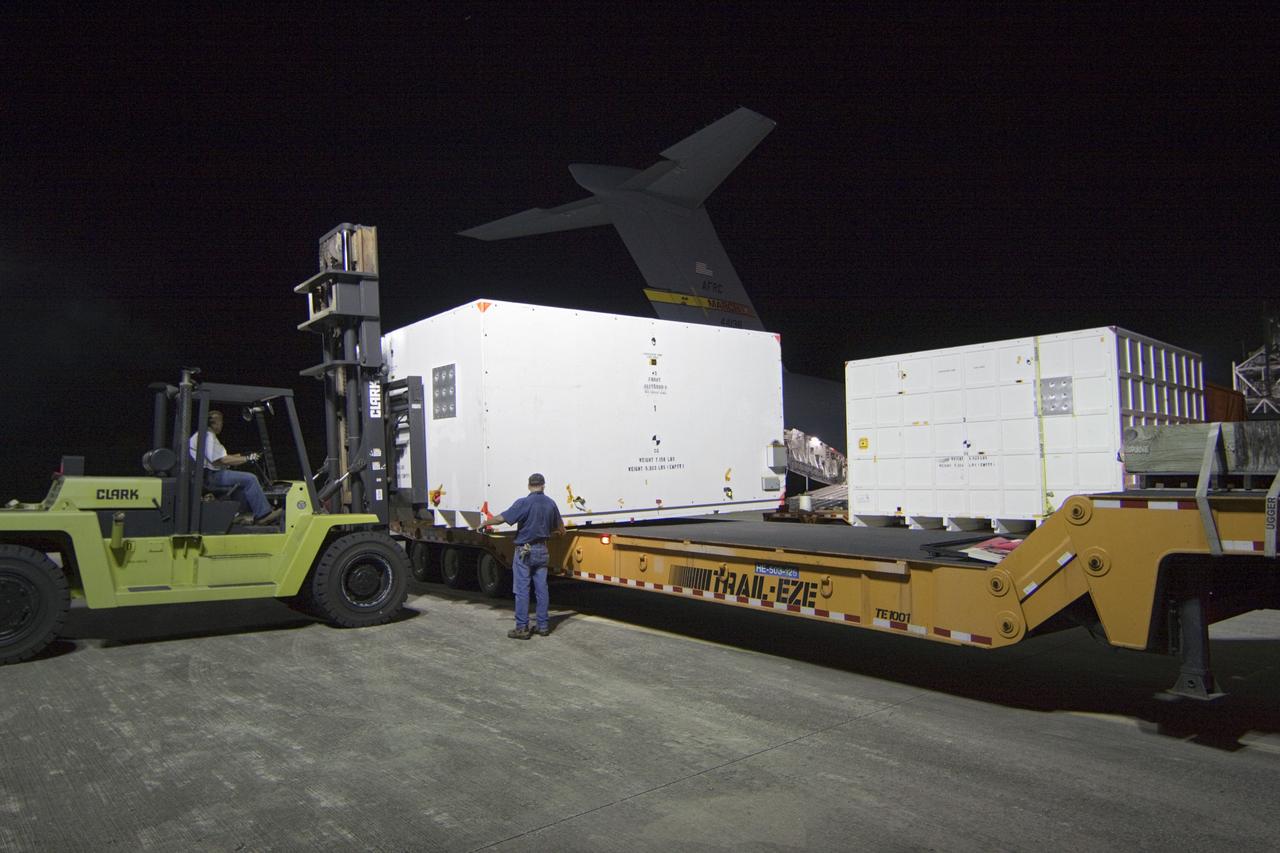
CAPE CANAVERAL, Fla. -- Workers load onto a transporter a container holding the cruise stage, one of the first three elements for NASA's Mars Science Laboratory (MSL) that arrived at NASA Kennedy Space Center's Shuttle Landing Facility aboard an Air Force C-17 cargo plane. The cruise stage, back shell and heat shield, the first flight elements to arrive for the MSL mission, were taken to the Payload Hazardous Servicing Facility (PHSF) located in the KSC Industrial Area to begin processing. The Curiosity rover will arrive next month. A United Launch Alliance Atlas V-541 configuration will be used to loft MSL into space. Curiosity’s 10 science instruments are designed to search for evidence on whether Mars has had environments favorable to microbial life, including chemical ingredients for life. The unique rover will use a laser to look inside rocks and release its gasses so that the rover’s spectrometer can analyze and send the data back to Earth. MSL is scheduled to launch from Cape Canaveral Air Force Station in Florida Nov. 25 with a window extending to Dec. 18 and arrival at Mars Aug. 2012. For more information, visit http://www.nasa.gov/msl. Photo credit: NASA/Troy Cryder
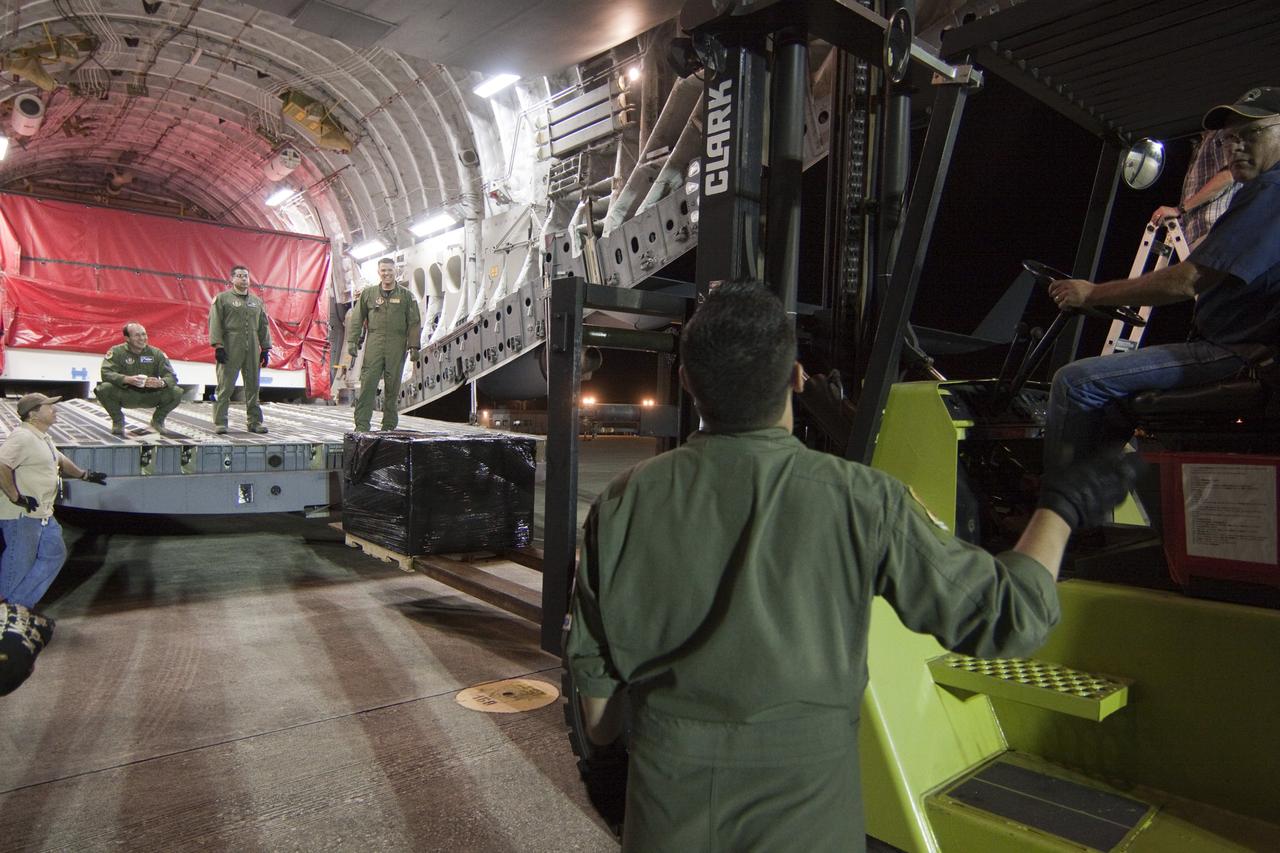
CAPE CANAVERAL, Fla. -- Workers begin to unload the first elements for NASA's Mars Science Laboratory (MSL) payload after arrival at NASA Kennedy Space Center's Shuttle Landing Facility aboard an Air Force C-17 cargo plane. The cruise stage, back shell and heat shield, the first flight elements to arrive for the MSL mission, were taken to the Payload Hazardous Servicing Facility (PHSF) located in the KSC Industrial Area to begin processing. The Curiosity rover will arrive next month. A United Launch Alliance Atlas V-541 configuration will be used to loft MSL into space. Curiosity’s 10 science instruments are designed to search for evidence on whether Mars has had environments favorable to microbial life, including chemical ingredients for life. The unique rover will use a laser to look inside rocks and release its gasses so that the rover’s spectrometer can analyze and send the data back to Earth. MSL is scheduled to launch from Cape Canaveral Air Force Station in Florida Nov. 25 with a window extending to Dec. 18 and arrival at Mars Aug. 2012. For more information, visit http://www.nasa.gov/msl. Photo credit: NASA/Troy Cryder
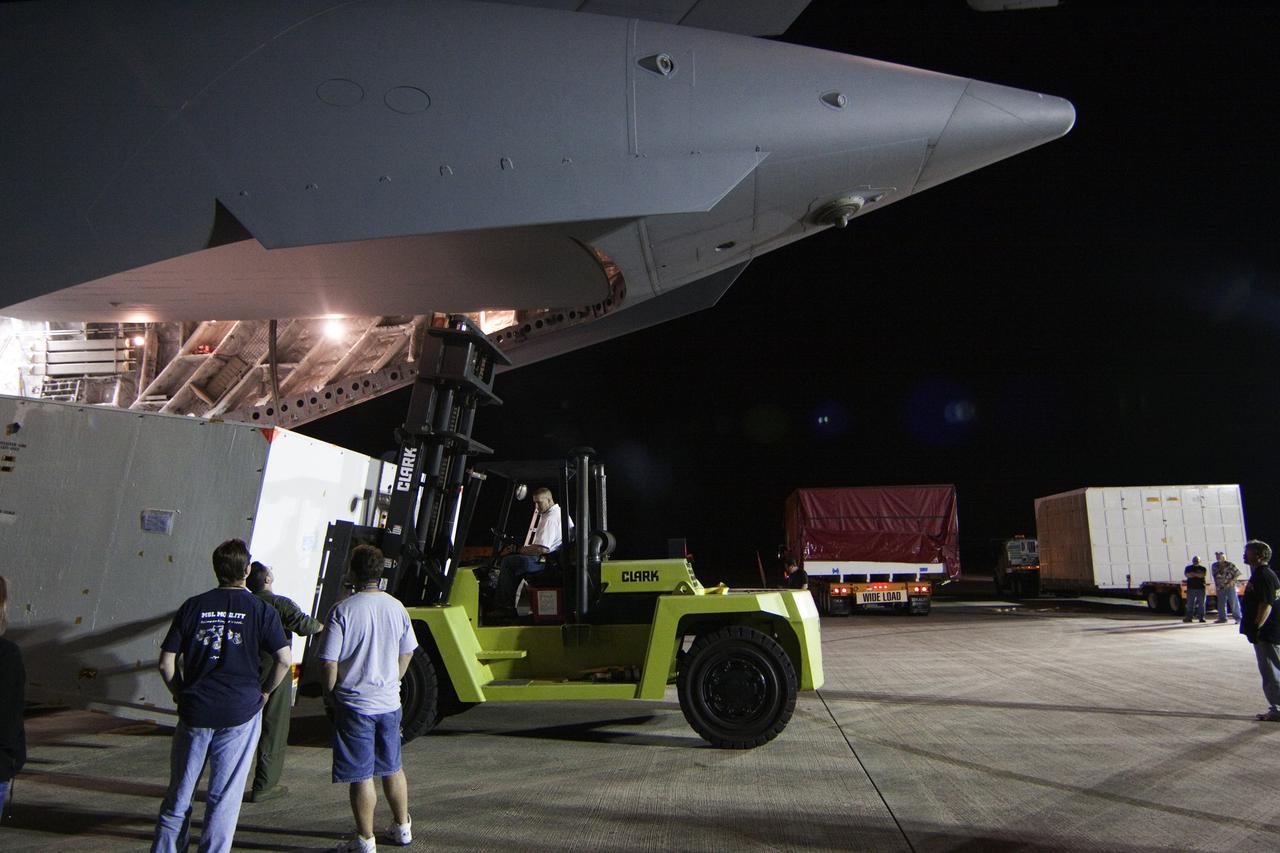
CAPE CANAVERAL, Fla. -- Workers unload a container holding the cruise stage, one of the first three elements for NASA's Mars Science Laboratory (MSL) that arrived at NASA Kennedy Space Center's Shuttle Landing Facility aboard an Air Force C-17 cargo plane. The cruise stage, back shell and heat shield, the first flight elements to arrive for the MSL mission, were taken to the Payload Hazardous Servicing Facility (PHSF) located in the KSC Industrial Area to begin processing. The Curiosity rover will arrive next month. A United Launch Alliance Atlas V-541 configuration will be used to loft MSL into space. Curiosity’s 10 science instruments are designed to search for evidence on whether Mars has had environments favorable to microbial life, including chemical ingredients for life. The unique rover will use a laser to look inside rocks and release its gasses so that the rover’s spectrometer can analyze and send the data back to Earth. MSL is scheduled to launch from Cape Canaveral Air Force Station in Florida Nov. 25 with a window extending to Dec. 18 and arrival at Mars Aug. 2012. For more information, visit http://www.nasa.gov/msl. Photo credit: NASA/Troy Cryder
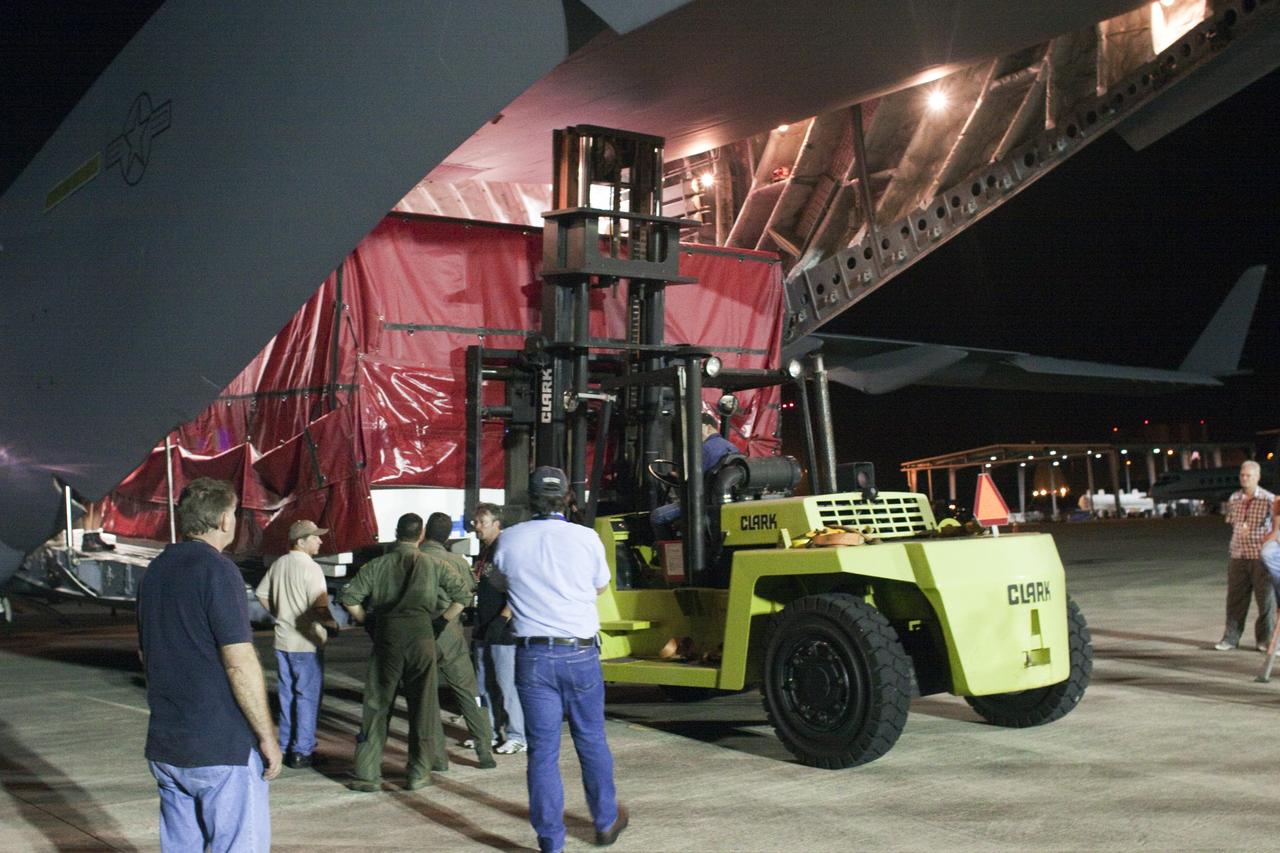
CAPE CANAVERAL, Fla. -- Workers unload a container holding the heat shield, one of the first three elements for NASA's Mars Science Laboratory (MSL) that arrived at NASA Kennedy Space Center's Shuttle Landing Facility aboard an Air Force C-17 cargo plane. The cruise stage, back shell and heat shield, the first flight elements to arrive for the MSL mission, were taken to the Payload Hazardous Servicing Facility (PHSF) located in the KSC Industrial Area to begin processing. The Curiosity rover will arrive next month. A United Launch Alliance Atlas V-541 configuration will be used to loft MSL into space. Curiosity’s 10 science instruments are designed to search for evidence on whether Mars has had environments favorable to microbial life, including chemical ingredients for life. The unique rover will use a laser to look inside rocks and release its gasses so that the rover’s spectrometer can analyze and send the data back to Earth. MSL is scheduled to launch from Cape Canaveral Air Force Station in Florida Nov. 25 with a window extending to Dec. 18 and arrival at Mars Aug. 2012. For more information, visit http://www.nasa.gov/msl. Photo credit: NASA/Troy Cryder
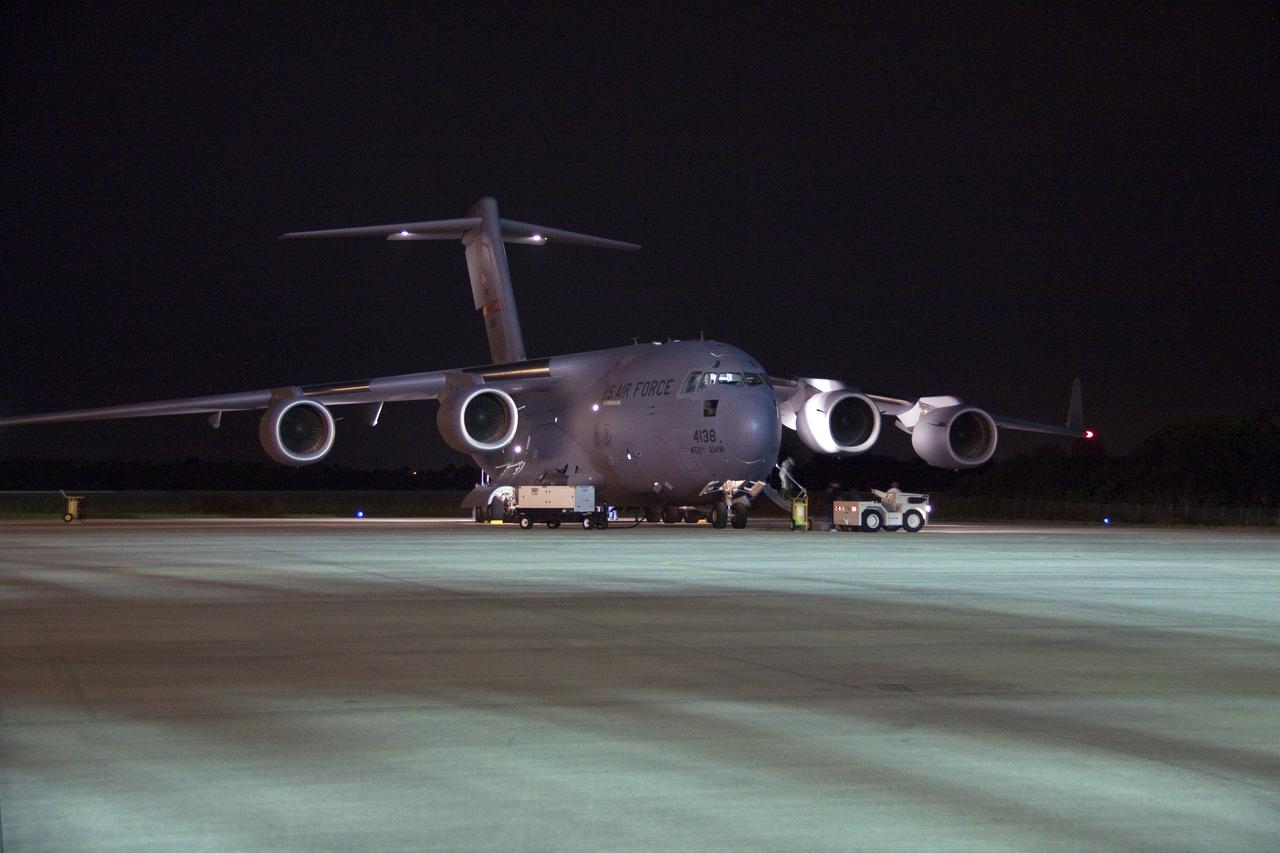
CAPE CANAVERAL, Fla. -- The first three elements for NASA's Mars Science Laboratory (MSL) arrive at NASA Kennedy Space Center's Shuttle Landing Facility aboard an Air Force C-17 cargo plane. The cruise stage, back shell and heat shield, the first flight elements to arrive for the MSL mission, were taken to the Payload Hazardous Servicing Facility (PHSF) located in the KSC Industrial Area to begin processing. The Curiosity rover will arrive next month. A United Launch Alliance Atlas V-541 configuration will be used to loft MSL into space. Curiosity’s 10 science instruments are designed to search for evidence on whether Mars has had environments favorable to microbial life, including chemical ingredients for life. The unique rover will use a laser to look inside rocks and release its gasses so that the rover’s spectrometer can analyze and send the data back to Earth. MSL is scheduled to launch from Cape Canaveral Air Force Station in Florida Nov. 25 with a window extending to Dec. 18 and arrival at Mars Aug. 2012. For more information, visit http://www.nasa.gov/msl. Photo credit: NASA/Troy Cryder

"Barnacle Bill" is a small rock immediately west-northwest of the Mars Pathfinder lander and was the first rock visited by the Sojourner Rover's alpha proton X-ray spectrometer (APXS) instrument. This image shows super resolution techniques applied to the first APXS target rock, which was never imaged with the rover's forward cameras. Super resolution was applied to help to address questions about the texture of this rock and what it might tell us about its mode of origin. This view of Barnacle Bill was produced by combining the "Super Panorama" frames from the IMP camera. Super resolution was applied to help to address questions about the texture of these rocks and what it might tell us about their mode of origin. The composite color frames that make up this anaglyph were produced for both the right and left eye of the IMP. The composites consist of 7 frames in the right eye and 8 frames in the left eye, taken with different color filters that were enlarged by 500% and then co-added using Adobe Photoshop to produce, in effect, a super-resolution panchromatic frame that is sharper than an individual frame would be. These panchromatic frames were then colorized with the red, green, and blue filtered images from the same sequence. The color balance was adjusted to approximate the true color of Mars. The anaglyph view was produced by combining the left with the right eye color composite frames by assigning the left eye composite view to the red color plane and the right eye composite view to the green and blue color planes (cyan), to produce a stereo anaglyph mosaic. This mosaic can be viewed in 3-D on your computer monitor or in color print form by wearing red-blue 3-D glasses. http://photojournal.jpl.nasa.gov/catalog/PIA01409
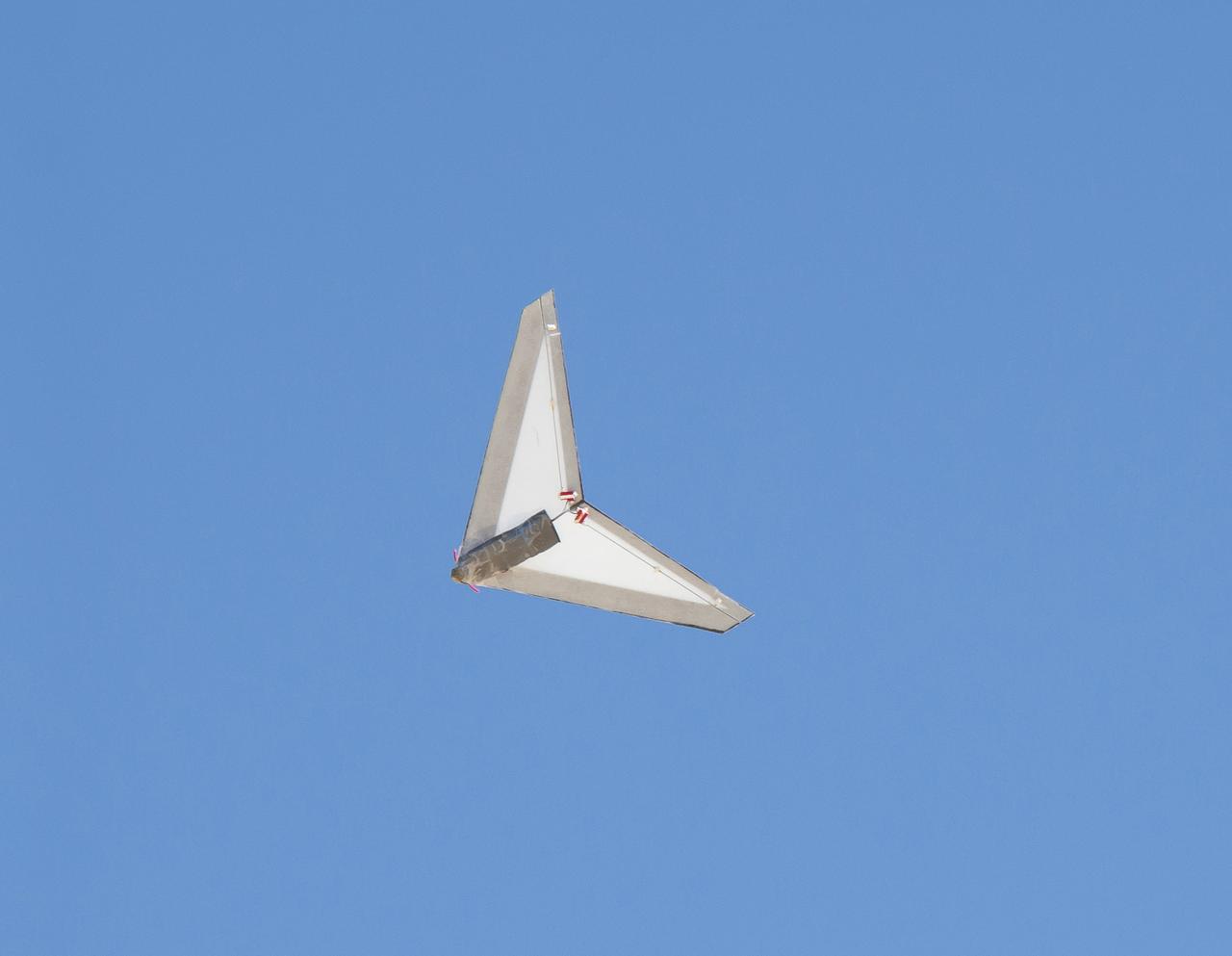
The Preliminary Research Aerodynamic Design to Land on Mars, or Prandtl-M, flies during a test flight. A new proposal based on the aircraft recently won an agencywide technology grant.
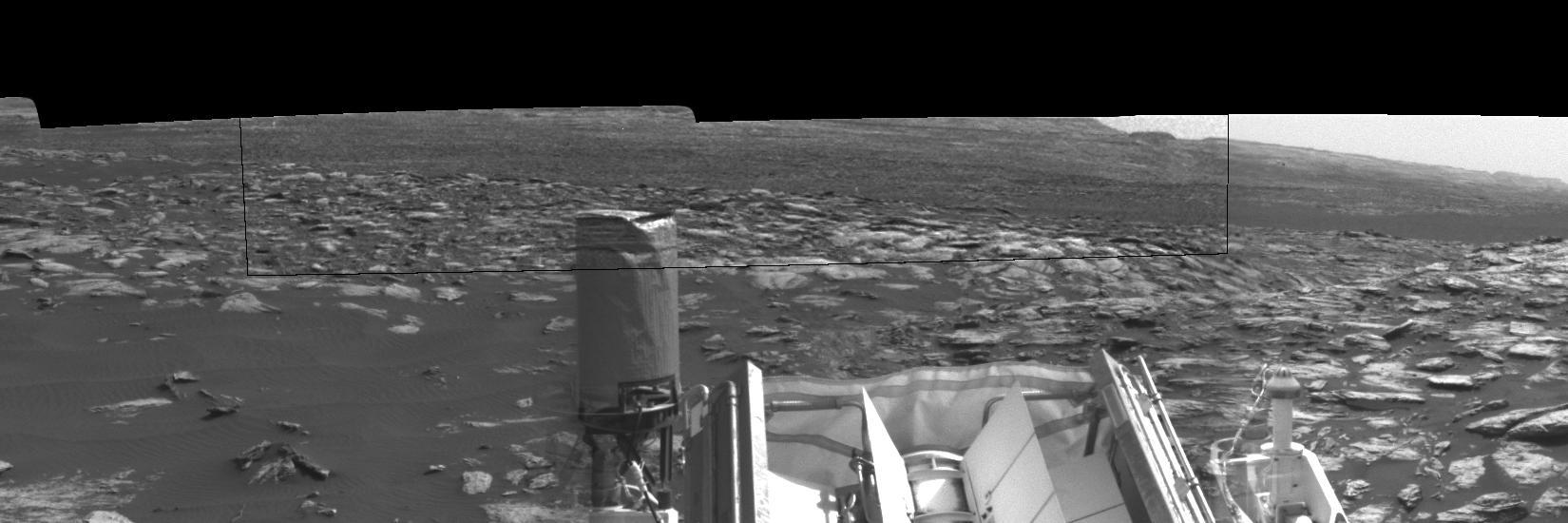
Dust devils dance in the distance in this frame from a sequence of images taken by the Navigation Camera on NASA's Curiosity Mars rover on Feb. 12, 2017, during the summer afternoon of the rover's 1,607th Martian day, or sol. Within a broader context view, the rectangular area outlined in black was imaged multiple times over a span of several minutes to check for dust devils. Images from the period with most activity are shown in the inset area. The images are in pairs that were taken about 12 seconds apart, with an interval of about 90 seconds between pairs. Timing is accelerated and not fully proportional in this animation. One dust devil appears at the right edge of the inset -- toward the south from the rover -- in the first few frames. Another appears on the left -- toward south-southeast -- later in the sequence. Contrast has been modified to make frame-to-frame changes easier to see. A black frame is added between repeats of the sequence. Portions of Curiosity are visible in the foreground. The cylindrical UHF (ultra-high frequency) antenna on the left is used for sending data to Mars orbiters, which relay the data to Earth. The angled planes to the right of this antenna are fins of the rover's radioisotope thermoelectric generator, which provides the vehicle's power. The post with a knob on top at right is a low-gain, non-directional antenna that can be used for receiving transmissions from Earth, as backup to the main high-gain antenna (not shown here) used for that purpose. On Mars as on Earth, dust devils are whirlwinds that result from sunshine warming the ground, prompting convective rising of air that has gained heat from the ground. Observations of Martian dust devils provide information about wind directions and interaction between the surface and the atmosphere. An animation is available at http://photojournal.jpl.nasa.gov/catalog/PIA21482

In this image from NASA Mars Mars Reconnaissance Orbiter, we can see quite a spectacular layering pattern inside an impact crater called Spallanzani. Seeing layering is always exciting to geologists because it implies that the region has experienced multiple climatic conditions or geologic processes through time. The study of layering is so important in geology that it has its own dedicated branch of study: stratigraphy! Commonly, layering implies different lithologies (i.e., rock types). However, sometimes the layers could be of very similar composition but formed in different periods of time. This could happen for example in the case of annual flood deposits from rivers, multiple volcanic eruptions, or annual or periodic deposition of ice-rich material. We can also see in this image another feature called terracing, which happens when the layers form distinctive planes on top of one another like terraces. This could imply that the layers are being eroded with time but some of the layers are being eroded quicker than others because they are less resistant to erosion. So what is the composition of these layers? Spallanzani Crater lies in the high latitudes of the Southern hemisphere (around 60 degrees in latitude) so there is a good possibility that the deposits are ice-rich. If we look more closely we will notice fractured mounds, which sometimes indicate the presence of subsurface ice. Another interesting observation is the presence of grooves in the shaded slopes of some of the layers. Perhaps these grooves formed because of the sublimation (the direct transfer of solid ice to water vapor) of ice from these slopes since slopes tend to get warmer than the surrounding terrains. A close inspection of this image may help answer this question and investigate the multiple cycles in which these deposits were laid down as well as the duration of these individual cycles. http://photojournal.jpl.nasa.gov/catalog/PIA19367
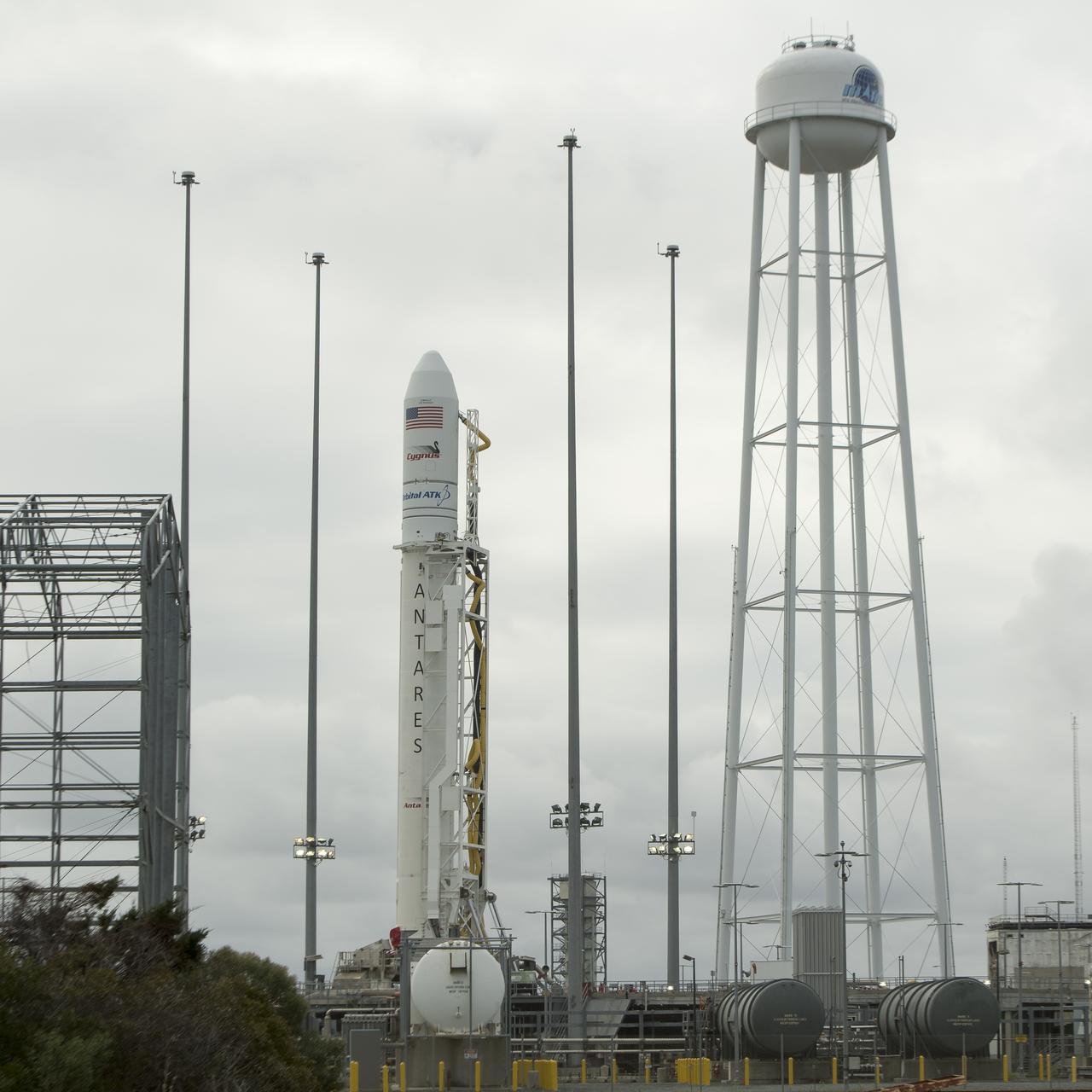
The Orbital ATK Antares rocket, with the Cygnus spacecraft onboard, is raised into the vertical position on launch Pad-0A, Thursday, Nov. 9, 2017 at NASA's Wallops Flight Facility in Virginia. Orbital ATK’s eighth contracted cargo resupply mission with NASA to the International Space Station will deliver over 7,400 pounds of science and research, crew supplies and vehicle hardware to the orbital laboratory and its crew. Photo Credit: (NASA/Bill Ingalls)
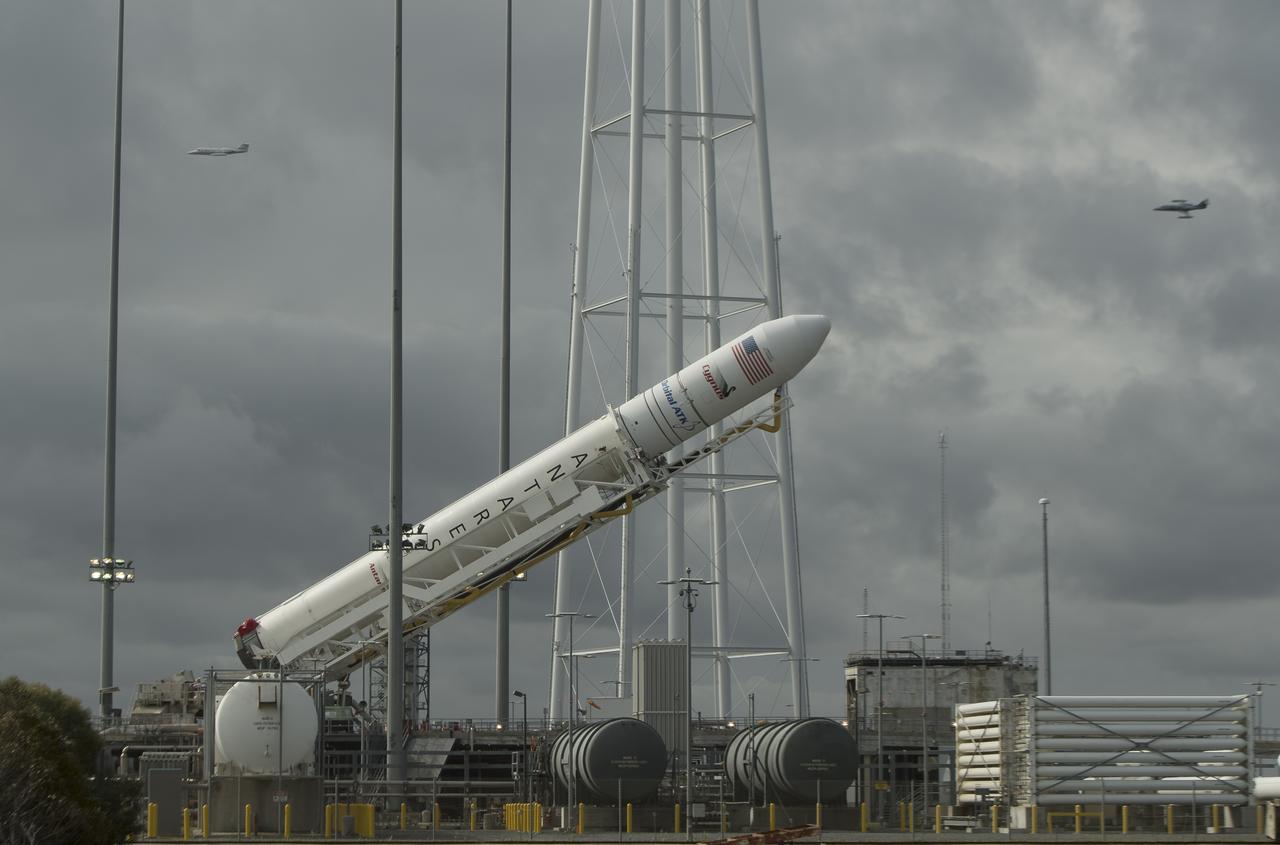
The Orbital ATK Antares rocket, with the Cygnus spacecraft onboard, is raised into the vertical position on launch Pad-0A, Thursday, Nov. 9, 2017 at NASA's Wallops Flight Facility in Virginia. Orbital ATK’s eighth contracted cargo resupply mission with NASA to the International Space Station will deliver over 7,400 pounds of science and research, crew supplies and vehicle hardware to the orbital laboratory and its crew. Photo Credit: (NASA/Bill Ingalls)
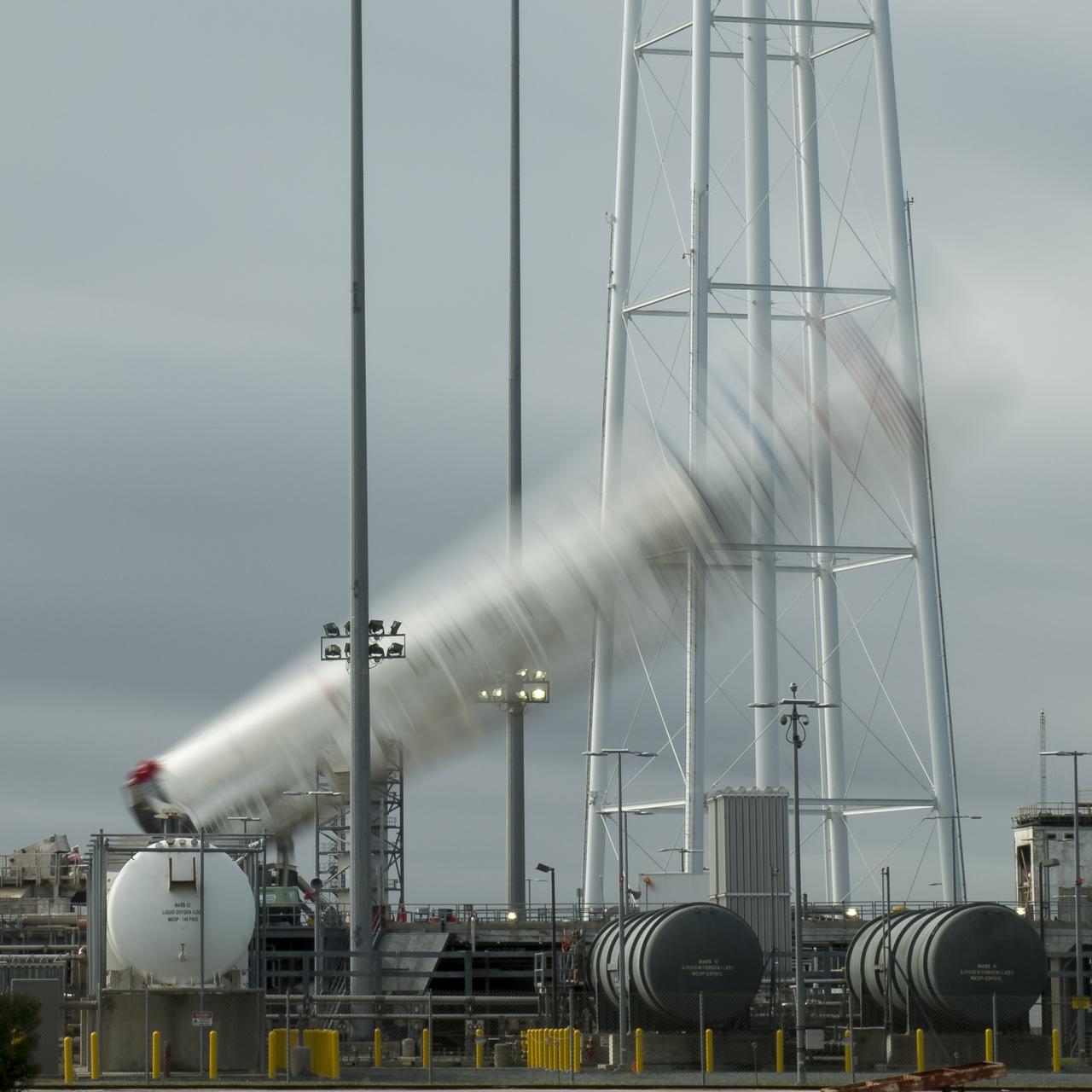
This long exposure photograph shows the Orbital ATK Antares rocket, with the Cygnus spacecraft onboard, being raised into the vertical position on launch Pad-0A, Thursday, Nov. 9, 2017 at NASA's Wallops Flight Facility in Virginia. Orbital ATK’s eighth contracted cargo resupply mission with NASA to the International Space Station will deliver over 7,400 pounds of science and research, crew supplies and vehicle hardware to the orbital laboratory and its crew. Photo Credit: (NASA/Bill Ingalls)
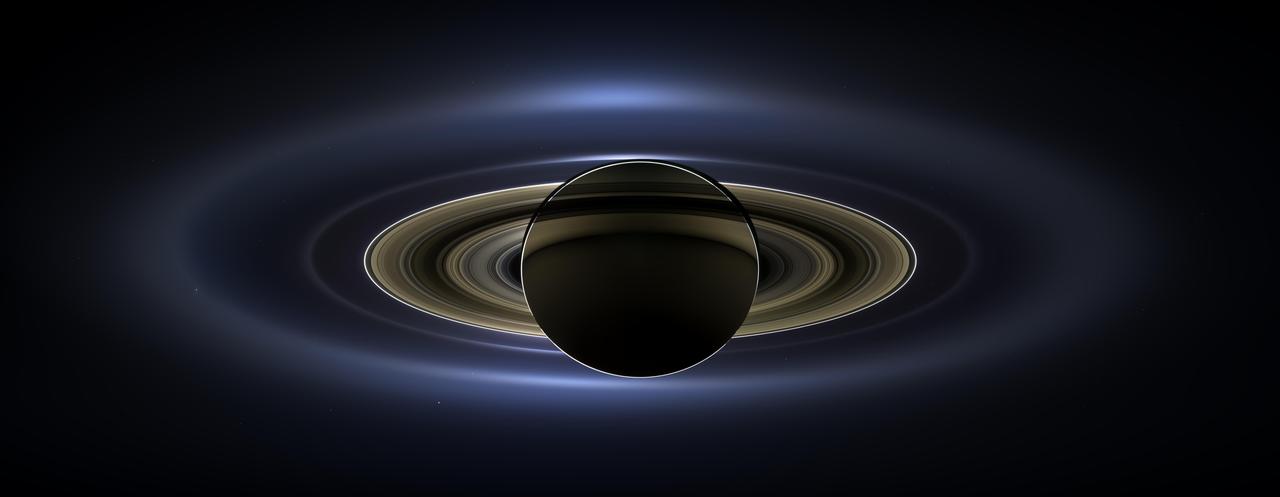
On July 19, 2013, in an event celebrated the world over, NASA's Cassini spacecraft slipped into Saturn's shadow and turned to image the planet, seven of its moons, its inner rings -- and, in the background, our home planet, Earth. With the sun's powerful and potentially damaging rays eclipsed by Saturn itself, Cassini's onboard cameras were able to take advantage of this unique viewing geometry. They acquired a panoramic mosaic of the Saturn system that allows scientists to see details in the rings and throughout the system as they are backlit by the sun. This mosaic is special as it marks the third time our home planet was imaged from the outer solar system; the second time it was imaged by Cassini from Saturn's orbit; and the first time ever that inhabitants of Earth were made aware in advance that their photo would be taken from such a great distance. With both Cassini's wide-angle and narrow-angle cameras aimed at Saturn, Cassini was able to capture 323 images in just over four hours. This final mosaic uses 141 of those wide-angle images. Images taken using the red, green and blue spectral filters of the wide-angle camera were combined and mosaicked together to create this natural-color view. A brightened version with contrast and color enhanced (Figure 1), a version with just the planets annotated (Figure 2), and an annotated version (Figure 3) are shown above. This image spans about 404,880 miles (651,591 kilometers) across. The outermost ring shown here is Saturn's E ring, the core of which is situated about 149,000 miles (240,000 kilometers) from Saturn. The geysers erupting from the south polar terrain of the moon Enceladus supply the fine icy particles that comprise the E ring; diffraction by sunlight gives the ring its blue color. Enceladus (313 miles, or 504 kilometers, across) and the extended plume formed by its jets are visible, embedded in the E ring on the left side of the mosaic. At the 12 o'clock position and a bit inward from the E ring lies the barely discernible ring created by the tiny, Cassini-discovered moon, Pallene (3 miles, or 4 kilometers, across). (For more on structures like Pallene's ring, see PIA08328). The next narrow and easily seen ring inward is the G ring. Interior to the G ring, near the 11 o'clock position, one can barely see the more diffuse ring created by the co-orbital moons, Janus (111 miles, or 179 kilometers, across) and Epimetheus (70 miles, or 113 kilometers, across). Farther inward, we see the very bright F ring closely encircling the main rings of Saturn. Following the outermost E ring counter-clockwise from Enceladus, the moon Tethys (662 miles, or 1,066 kilometers, across) appears as a large yellow orb just outside of the E ring. Tethys is positioned on the illuminated side of Saturn; its icy surface is shining brightly from yellow sunlight reflected by Saturn. Continuing to about the 2 o'clock position is a dark pixel just outside of the G ring; this dark pixel is Saturn's Death Star moon, Mimas (246 miles, or 396 kilometers, across). Mimas appears, upon close inspection, as a very thin crescent because Cassini is looking mostly at its non-illuminated face. The moons Prometheus, Pandora, Janus and Epimetheus are also visible in the mosaic near Saturn's bright narrow F ring. Prometheus (53 miles, or 86 kilometers, across) is visible as a faint black dot just inside the F ring and at the 9 o'clock position. On the opposite side of the rings, just outside the F ring, Pandora (50 miles, or 81 kilometers, across) can be seen as a bright white dot. Pandora and Prometheus are shepherd moons and gravitational interactions between the ring and the moons keep the F ring narrowly confined. At the 11 o'clock position in between the F ring and the G ring, Janus (111 miles, or 179 kilometers, across) appears as a faint black dot. Janus and Prometheus are dark for the same reason Mimas is mostly dark: we are looking at their non-illuminated sides in this mosaic. Midway between the F ring and the G ring, at about the 8 o'clock position, is a single bright pixel, Epimetheus. Looking more closely at Enceladus, Mimas and Tethys, especially in the brightened version of the mosaic, one can see these moons casting shadows through the E ring like a telephone pole might cast a shadow through a fog. In the non-brightened version of the mosaic, one can see bright clumps of ring material orbiting within the Encke gap near the outer edge of the main rings and immediately to the lower left of the globe of Saturn. Also, in the dark B ring within the main rings, at the 9 o'clock position, one can see the faint outlines of two spoke features, first sighted by NASA's Voyager spacecraft in the early 1980s and extensively studied by Cassini. Finally, in the lower right of the mosaic, in between the bright blue E ring and the faint but defined G ring, is the pale blue dot of our planet, Earth. Look closely and you can see the moon protruding from the Earth's lower right. (For a higher resolution view of the Earth and moon taken during this campaign, see PIA14949.) Earth's twin, Venus, appears as a bright white dot in the upper left quadrant of the mosaic, also between the G and E rings. Mars also appears as a faint red dot embedded in the outer edge of the E ring, above and to the left of Venus. For ease of visibility, Earth, Venus, Mars, Enceladus, Epimetheus and Pandora were all brightened by a factor of eight and a half relative to Saturn. Tethys was brightened by a factor of four. In total, 809 background stars are visible and were brightened by a factor ranging from six, for the brightest stars, to 16, for the faintest. The faint outer rings (from the G ring to the E ring) were also brightened relative to the already bright main rings by factors ranging from two to eight, with the lower-phase-angle (and therefore fainter) regions of these rings brightened the most. The brightened version of the mosaic was further brightened and contrast-enhanced all over to accommodate print applications and a wide range of computer-screen viewing conditions. Some ring features -- such as full rings traced out by tiny moons -- do not appear in this version of the mosaic because they require extreme computer enhancement, which would adversely affect the rest of the mosaic. This version was processed for balance and beauty. This view looks toward the unlit side of the rings from about 17 degrees below the ring plane. Cassini was approximately 746,000 miles (1.2 million kilometers) from Saturn when the images in this mosaic were taken. Image scale on Saturn is about 45 miles (72 kilometers) per pixel. This mosaic was made from pictures taken over a span of more than four hours while the planets, moons and stars were all moving relative to Cassini. Thus, due to spacecraft motion, these objects in the locations shown here were not in these specific places over the entire duration of the imaging campaign. Note also that Venus appears far from Earth, as does Mars, because they were on the opposite side of the sun from Earth. http://photojournal.jpl.nasa.gov/catalog/PIA17172