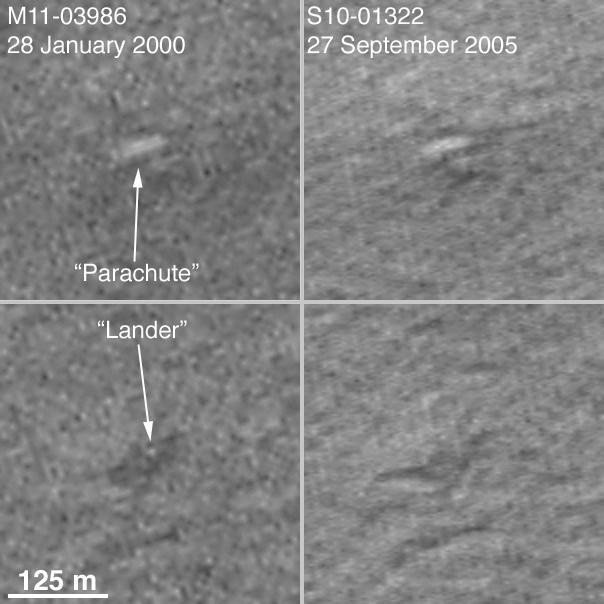
Mars Polar Lander NOT Found

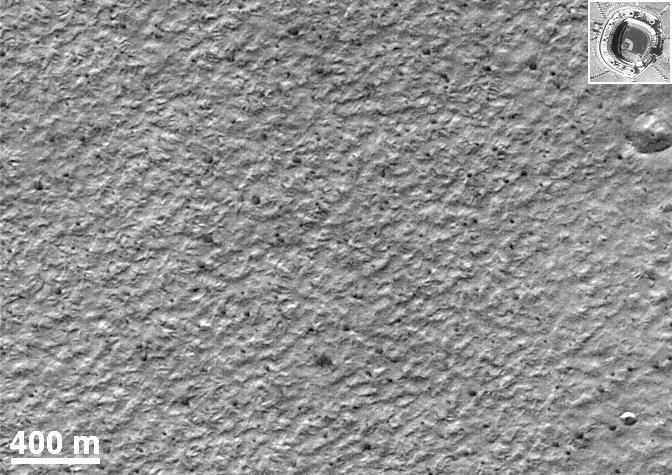
On December 3, 1999) Mars Polar Lander (MPL) was set to touchdown on the enigmatic layered terrain located near the South Pole. Unfortunately, communications with the spacecraft were lost and never regained. The Mars Program Independent Assessment Team concluded that this loss was most likely due to premature retrorocket shutdown resulting in the crash of the lander. The image primarily shows what appears to be a ridged surface with some small isolated hills. Historically, exploration has and will continue to be a very hard and risky endeavor and sometimes you lose. But the spirit of exploration and discovery has served mankind well throughout the ages and it has now driven us to the far reaches of space. Therefore, with this in mind the THEMIS Team today is releasing an image of the region where MPL was set to land in memory of this mission and the unquenchable spirit of exploration. It is hoped that in the near future we will once again attempt another landing in the Martian polar regions. http://photojournal.jpl.nasa.gov/catalog/PIA04016
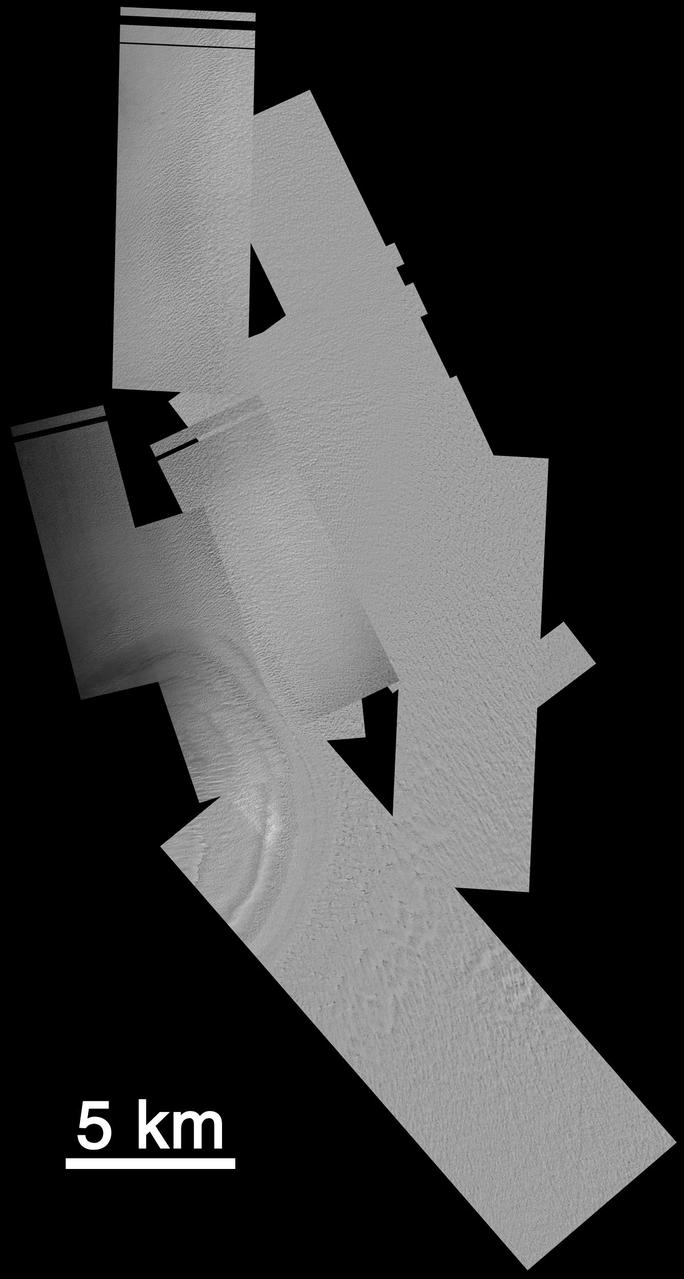
Mars Polar Lander: The Search Continues
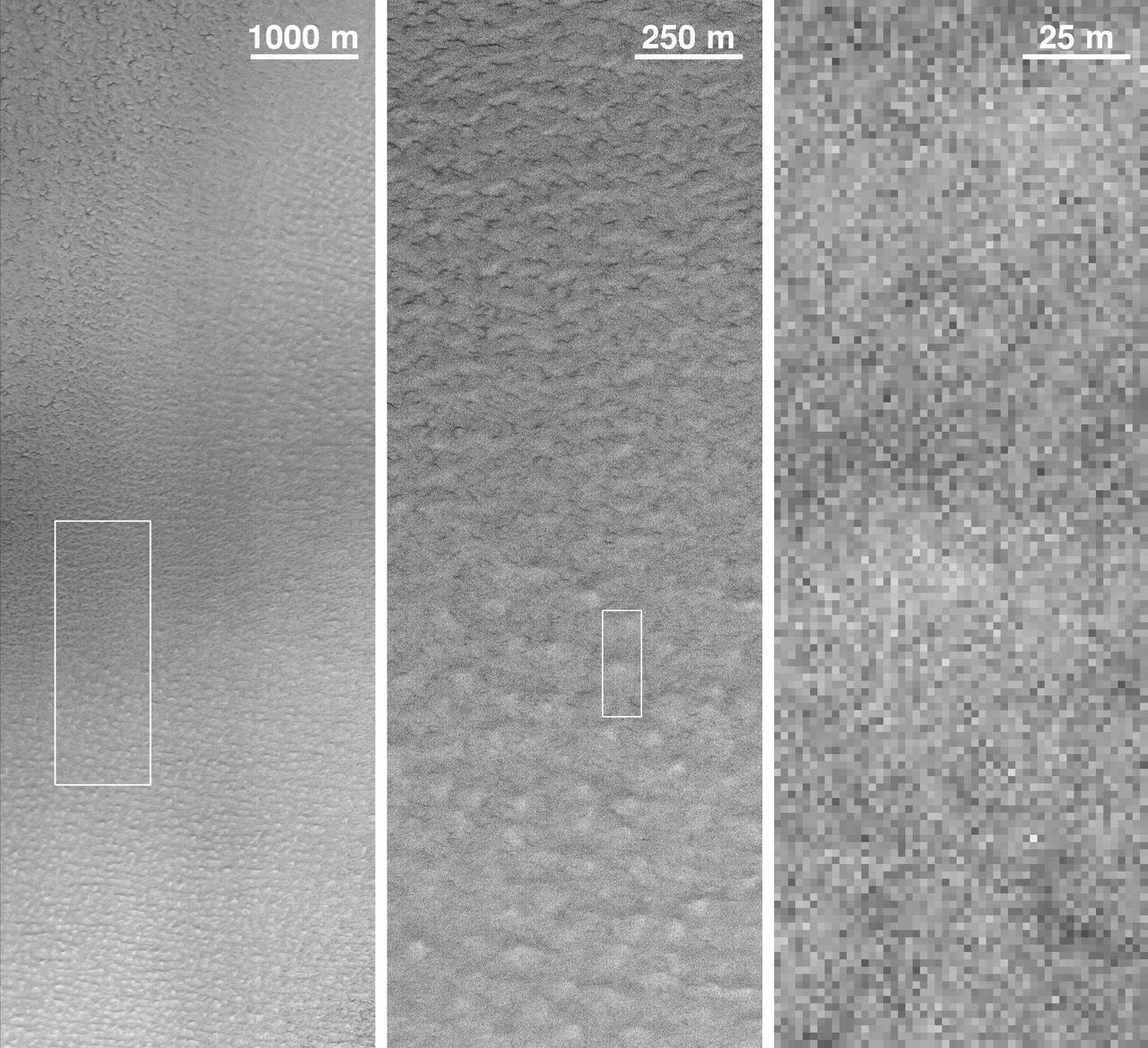
Mars Polar Lander: The Search Begins

Mars Polar Lander and Mars Pathfinder Sites Compared
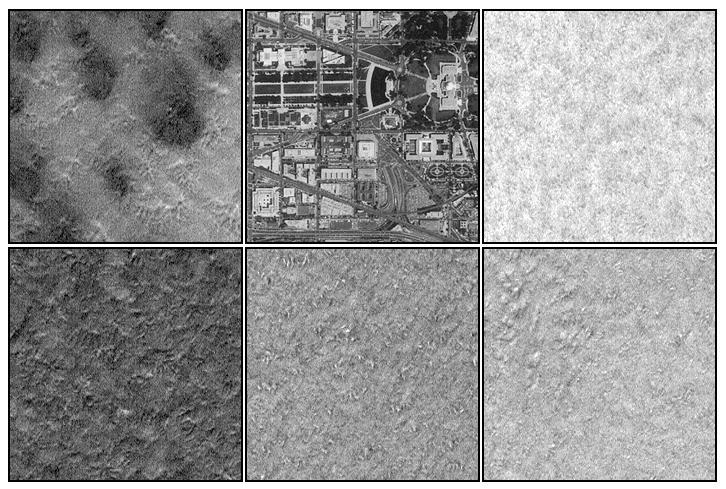
Mars Polar Lander Site Compared With Washington, D.C.
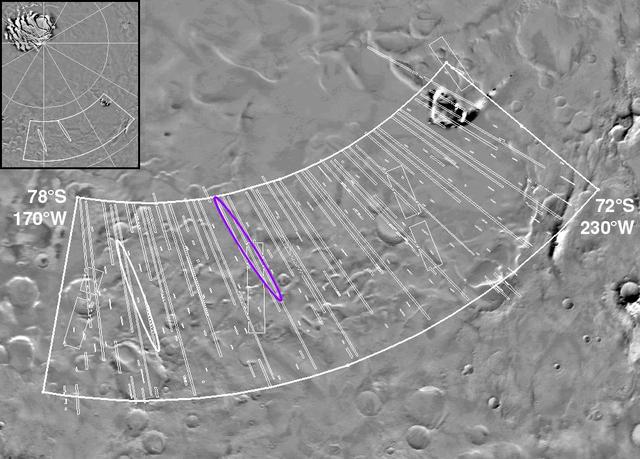
MGS MOC Coverage of Mars Polar Lander Region
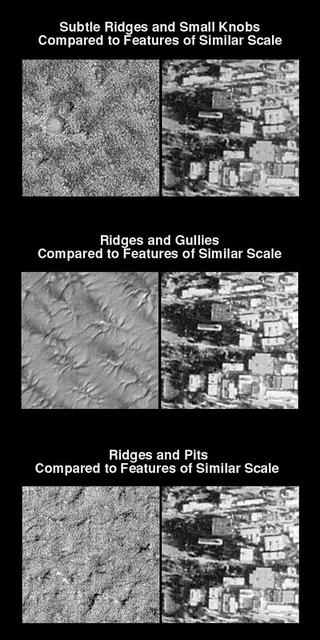
Mars Polar Lander Landing Zone Compared With JPL
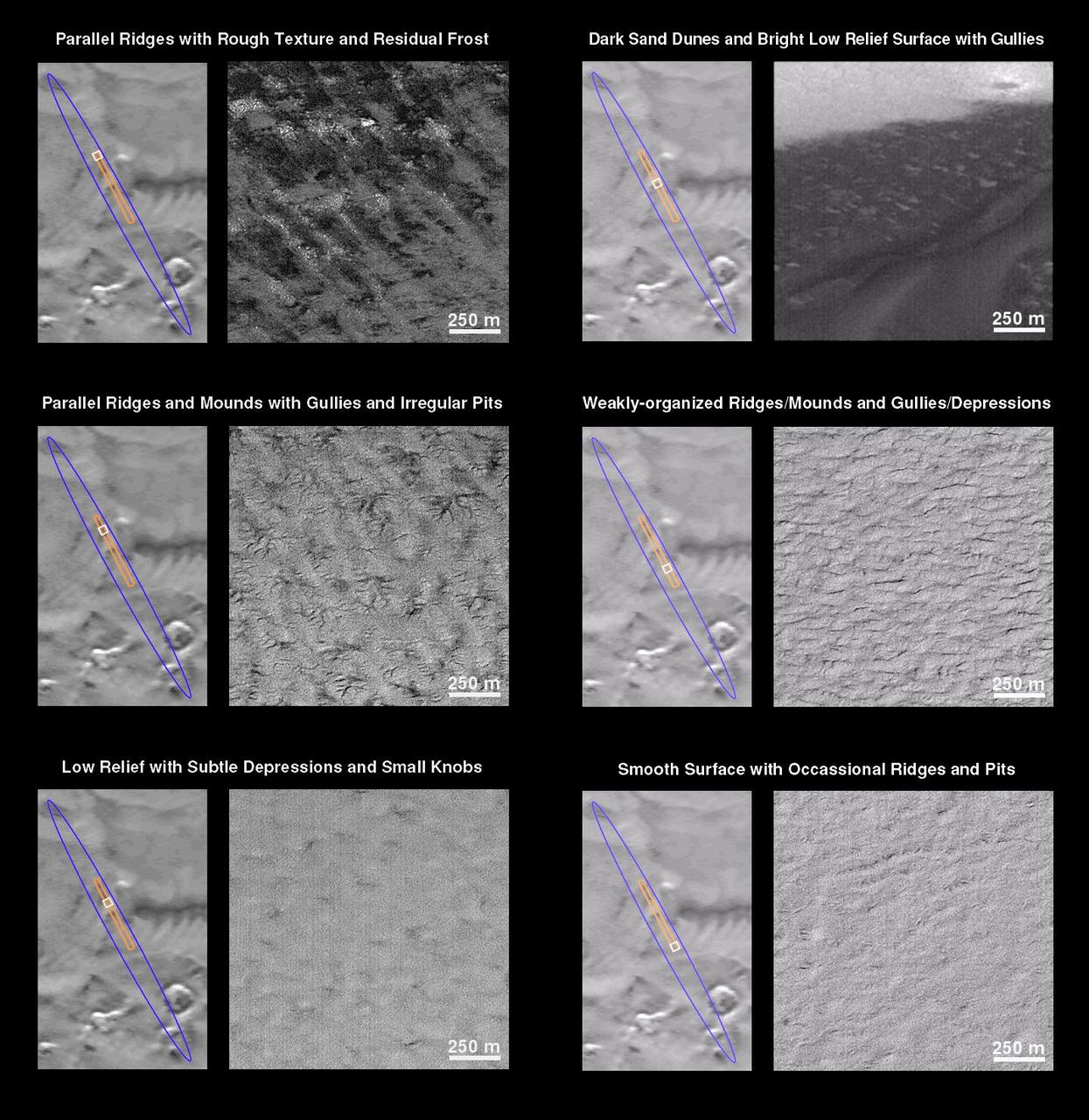
Mars Polar Lander Site Surface Details
Mars Polar Lander Landing Zone Compared With JPL
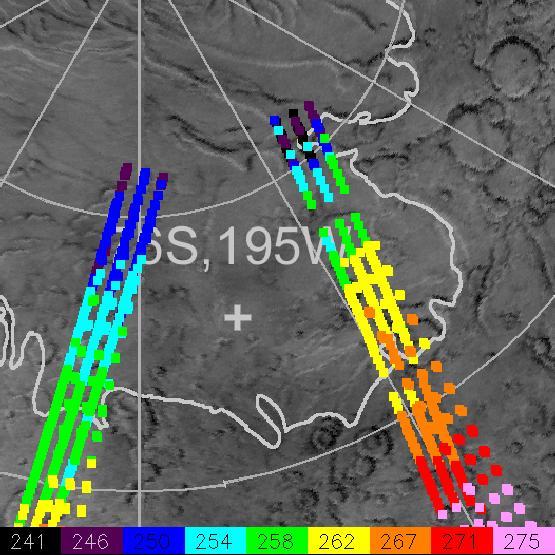
Mars Polar Lander Landing Site Noon-time Temperatures
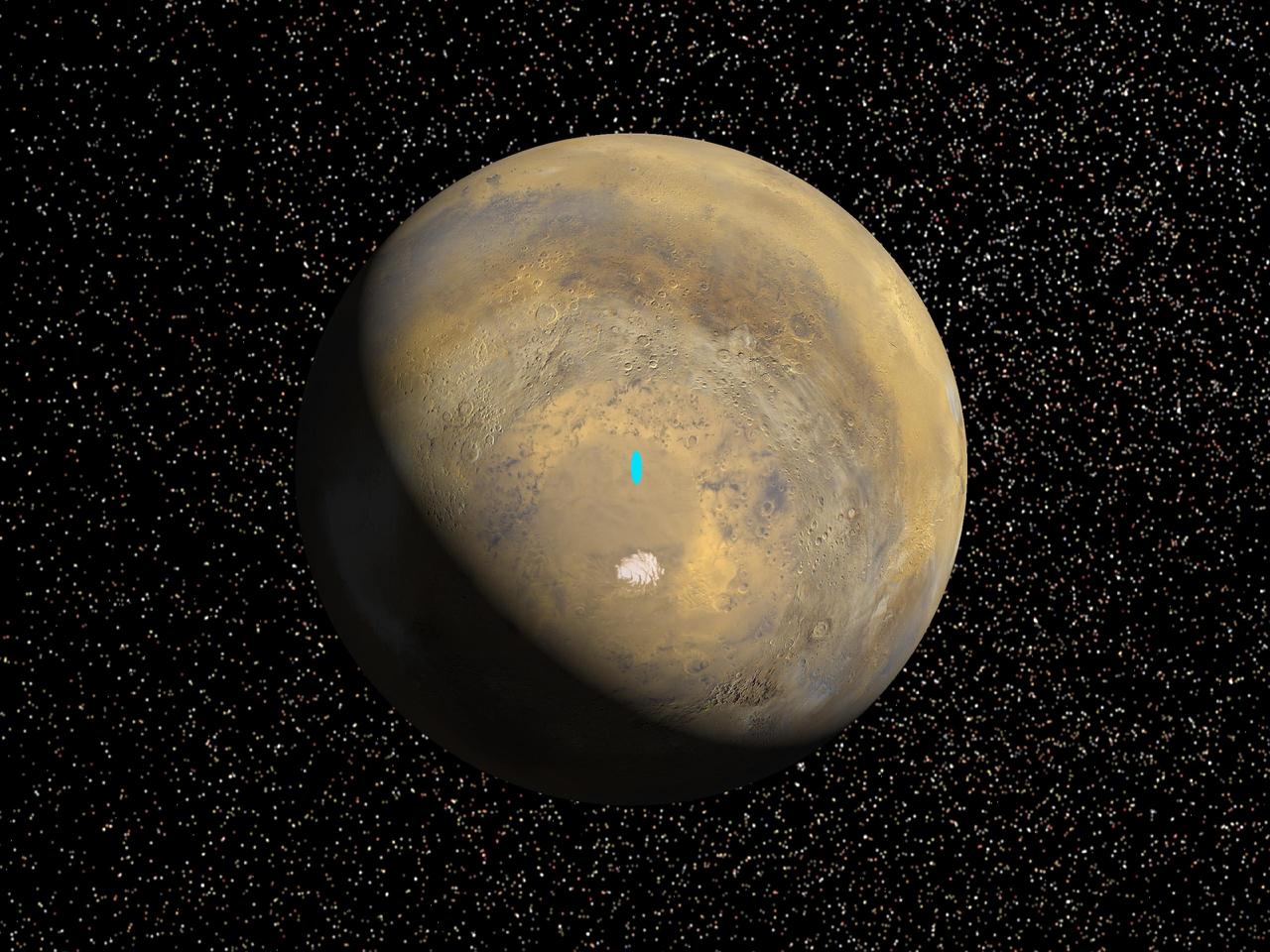
Proposed Mars Polar Lander Landing Site Global Perspective
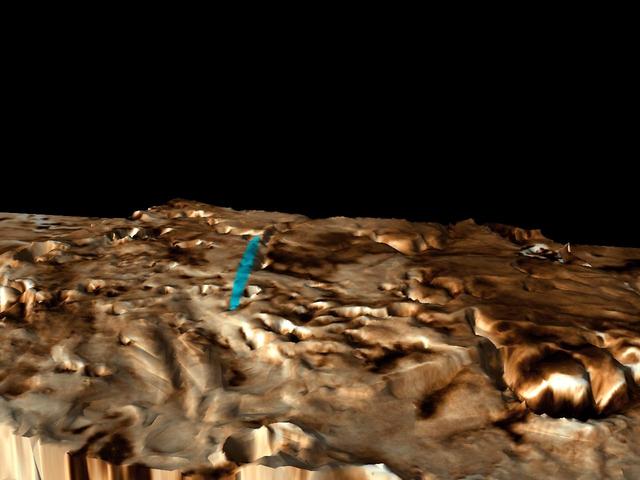
Proposed Mars Polar Lander Landing Site Perspective View 3
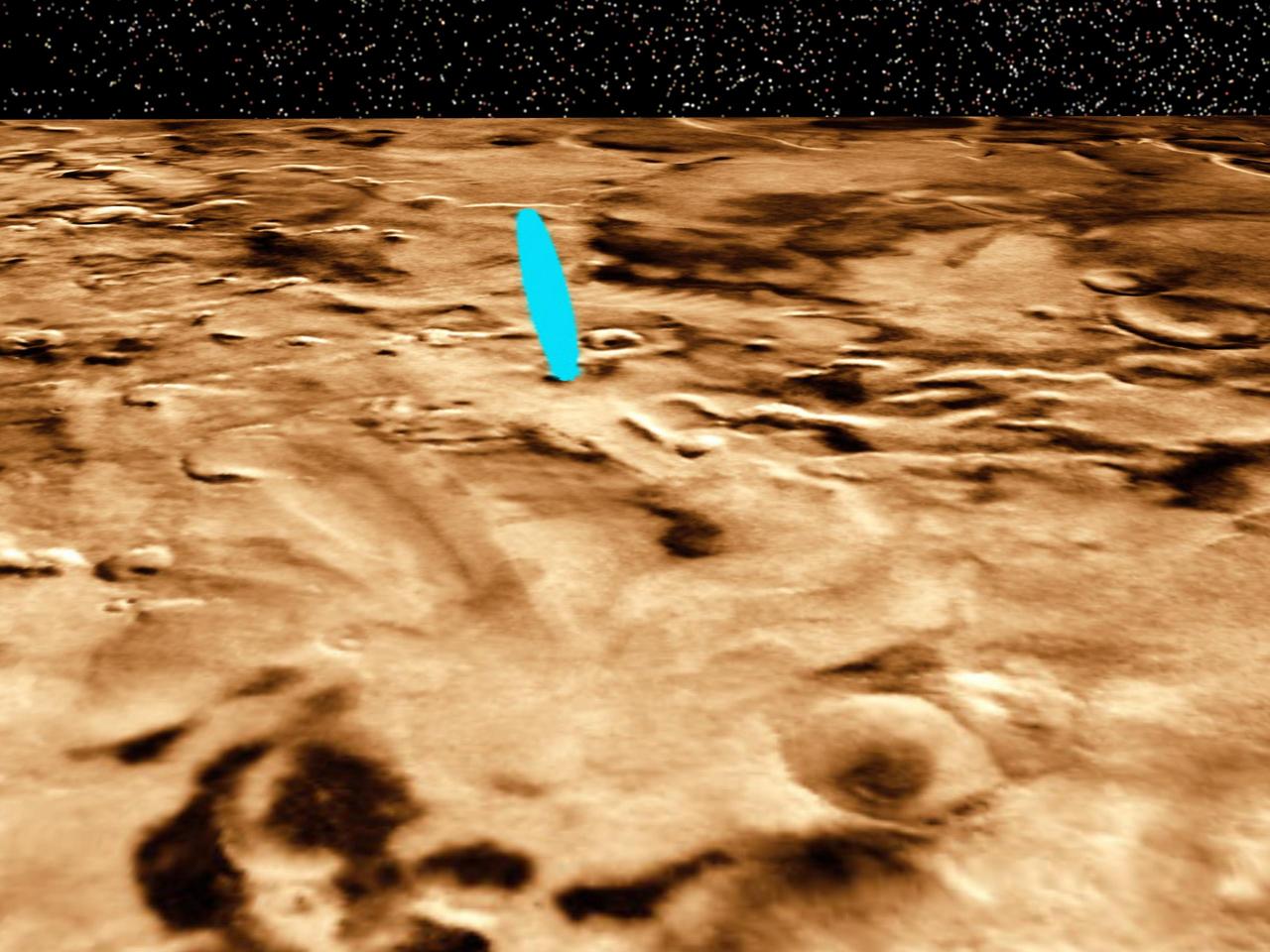
Proposed Mars Polar Lander Landing Site Perspective View 1

Proposed Mars Polar Lander Landing Site Perspective View 2
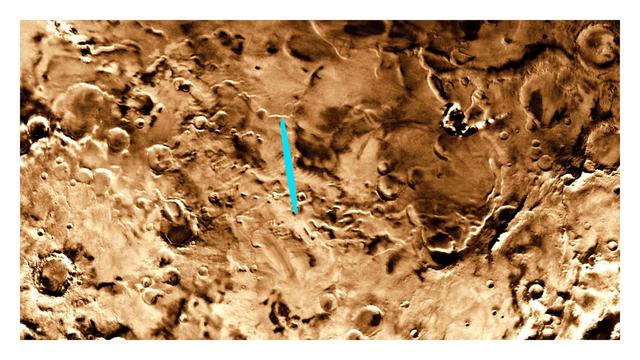
Proposed Mars Polar Lander Landing Site Flat Map
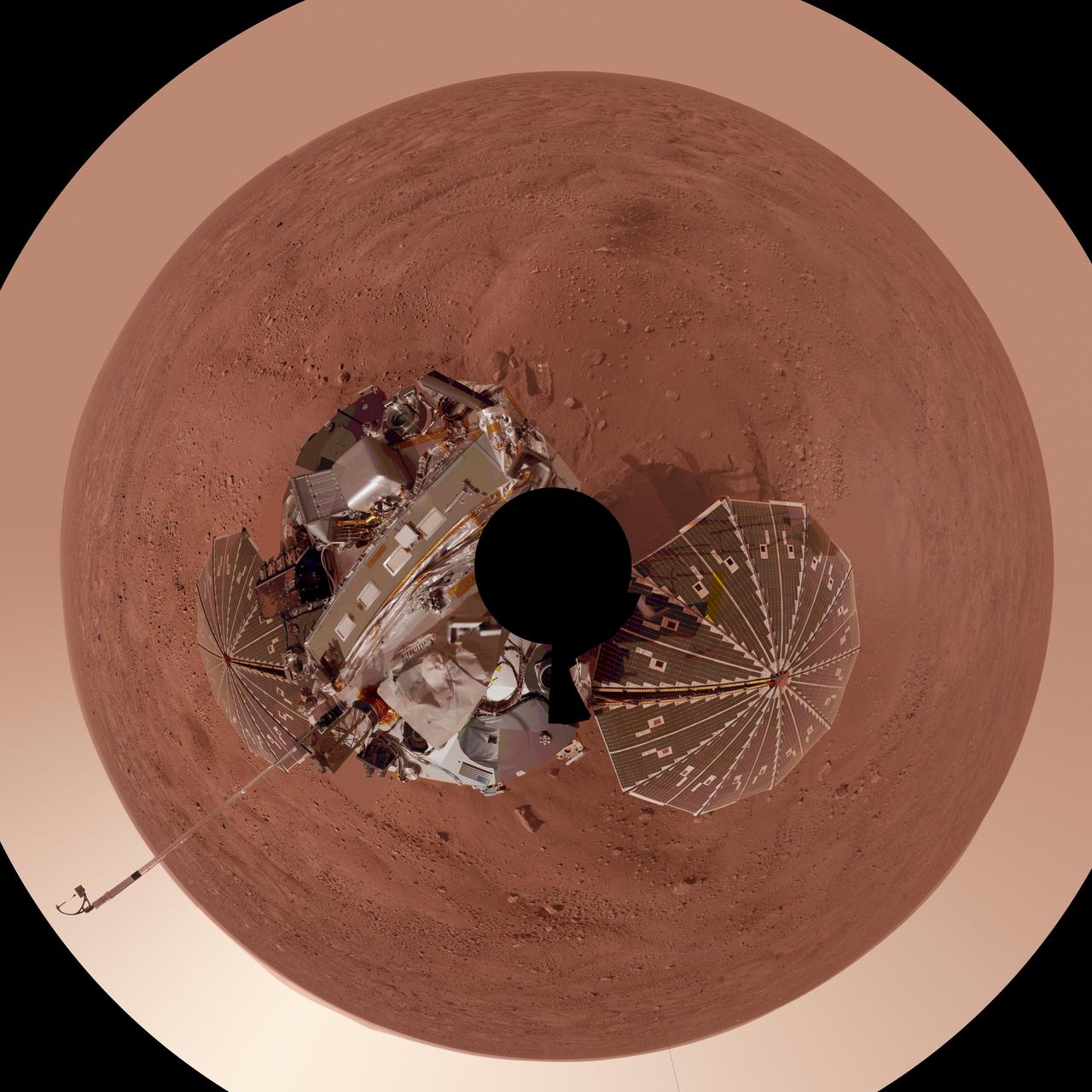
This view is a polar projection that combines more than 500 exposures taken by the Surface Stereo Imager camera on NASA Mars Phoenix Lander and projects them as if looking down from above.
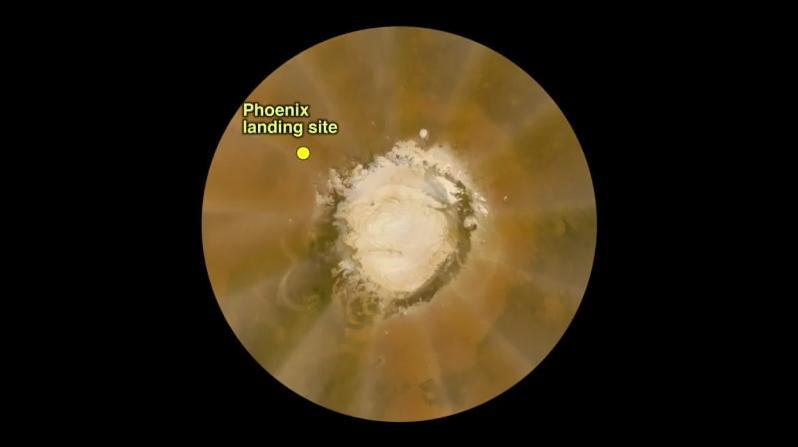
Scientists were anticipating clear skies when NASA Phoenix Mars Lander arrives on the north polar plains of the Red Planet Sunday, May 25, 2008.
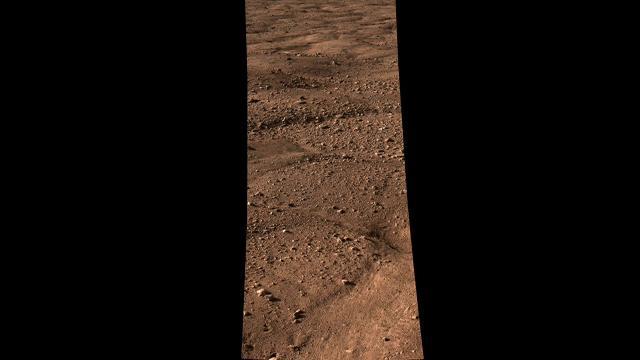
This image shows the vast plains of the northern polar region of Mars, as seen by NASA Phoenix Mars Lander shortly after touching down on the Red Planet. The flat landscape is strewn with tiny pebbles and shows polygonal cracking.
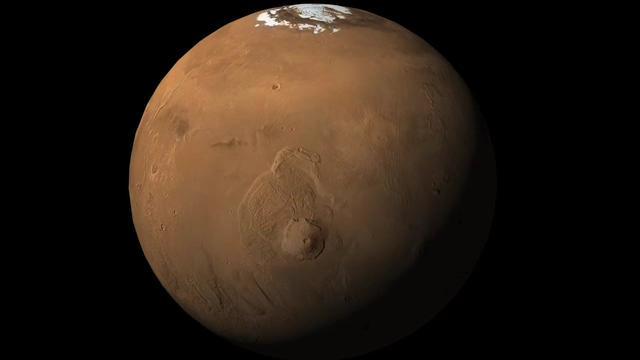
This image shows an orbital view sweeping upward from Olympus Mons, the tallest volcano in the solar system, to the location of NASA Phoenix Mars Lander in the northern polar reaches of Mars.
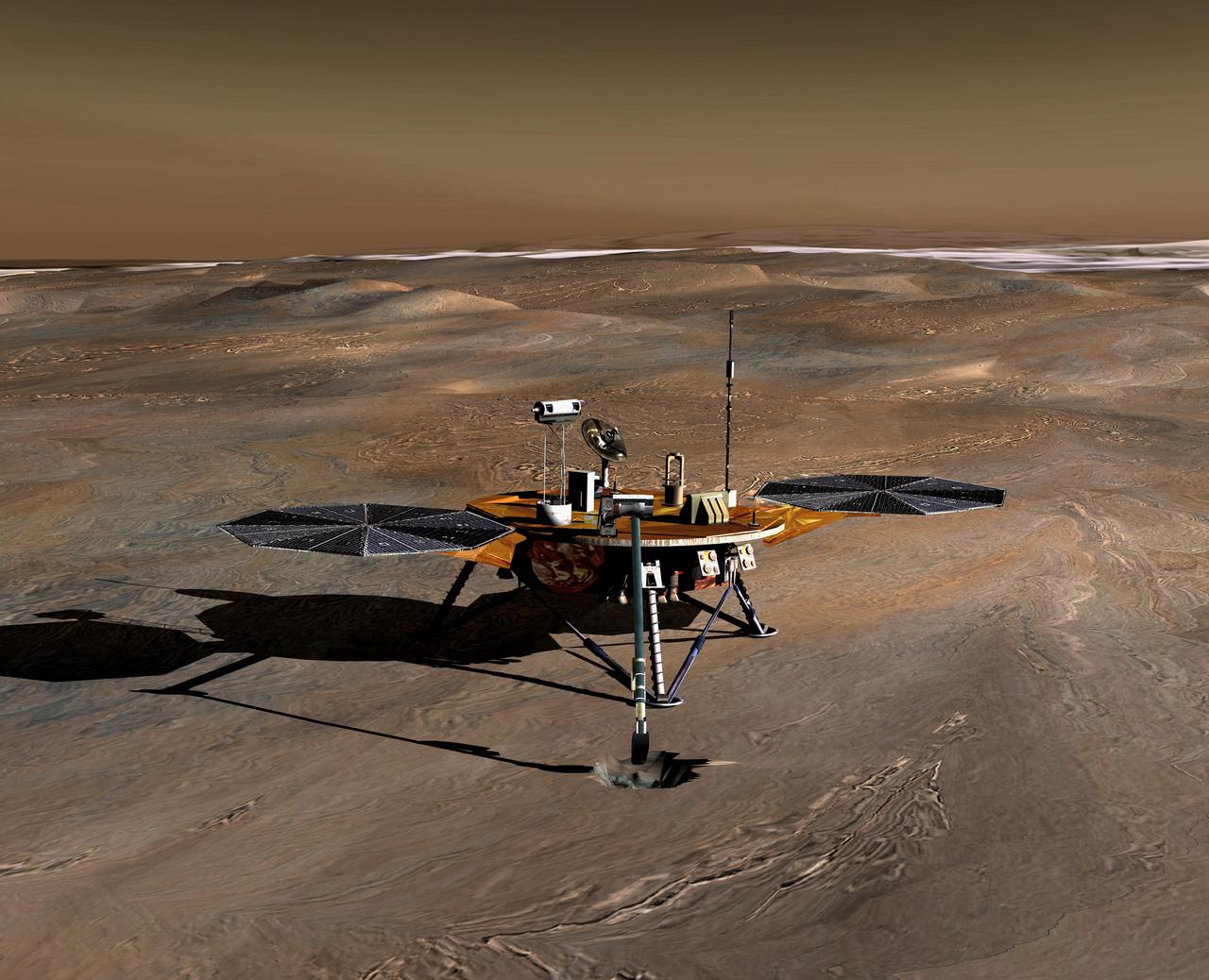
NASA Phoenix Mars Lander, landed on May 25, 2008, and explored the history of water and monitored polar climate on Mars until communications ended in November, 2008, about six months after landing, when its solar panels ceased operating in the winter.
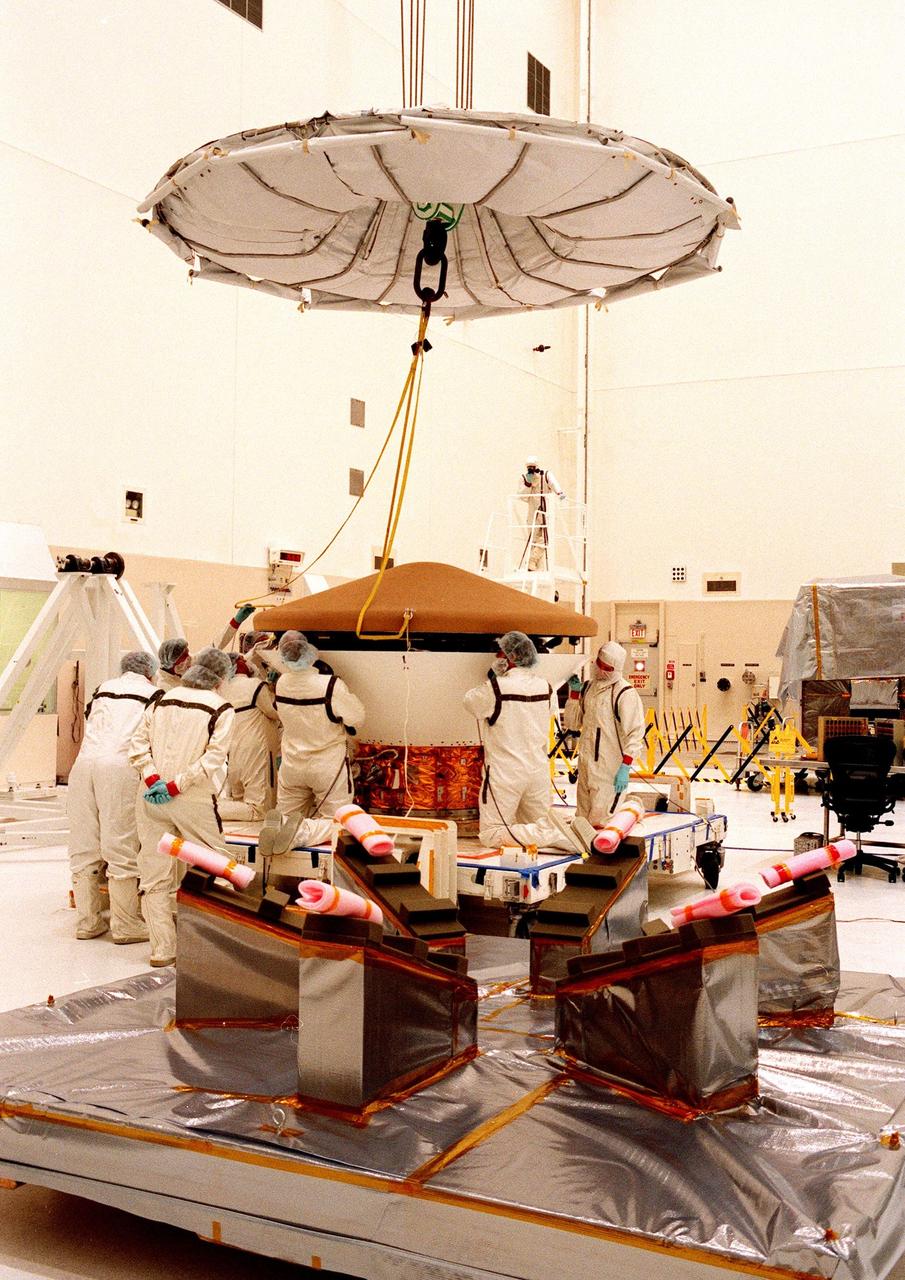
KENNEDY SPACE CENTER, FLA. -- In the Spacecraft Assembly and Encapsulation Facility-2 (SAEF-2), the top of the Mars Polar Lander is removed to prepare the Lander for testing, including a functional test of the science instruments and the basic spacecraft subsystems. The Mars Polar Lander is targeted for launch from Cape Canaveral Air Station aboard a Delta II rocket on Jan. 3, 1999. The solar-powered spacecraft is designed to touch down on the Martian surface near the northern-most boundary of the south pole in order to study the water cycle there. The lander also will help scientists learn more about climate change and current resources on Mars, studying such things as frost, dust, water vapor and condensates in the Martian atmosphere
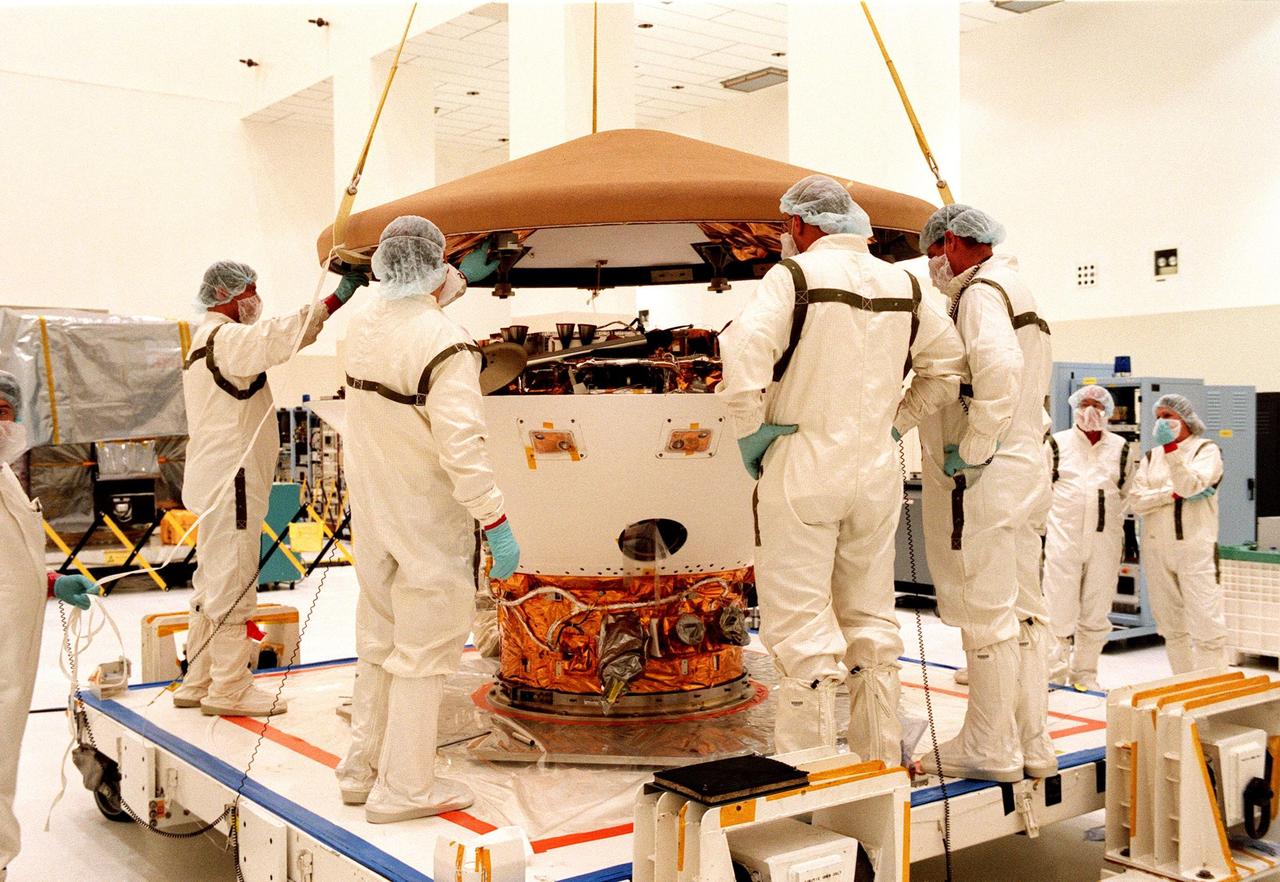
KENNEDY SPACE CENTER, FLA. -- In the Spacecraft Assembly and Encapsulation Facility-2 (SAEF-2), the top of the Mars Polar Lander is removed for testing, which includes a functional test of the science instruments and the basic spacecraft subsystems. The Mars Polar Lander is targeted for launch from Cape Canaveral Air Station aboard a Delta II rocket on Jan. 3, 1999. The solar-powered spacecraft is designed to touch down on the Martian surface near the northern-most boundary of the south pole in order to study the water cycle there. The lander also will help scientists learn more about climate change and current resources on Mars, studying such things as frost, dust, water vapor and condensates in the Martian atmosphere
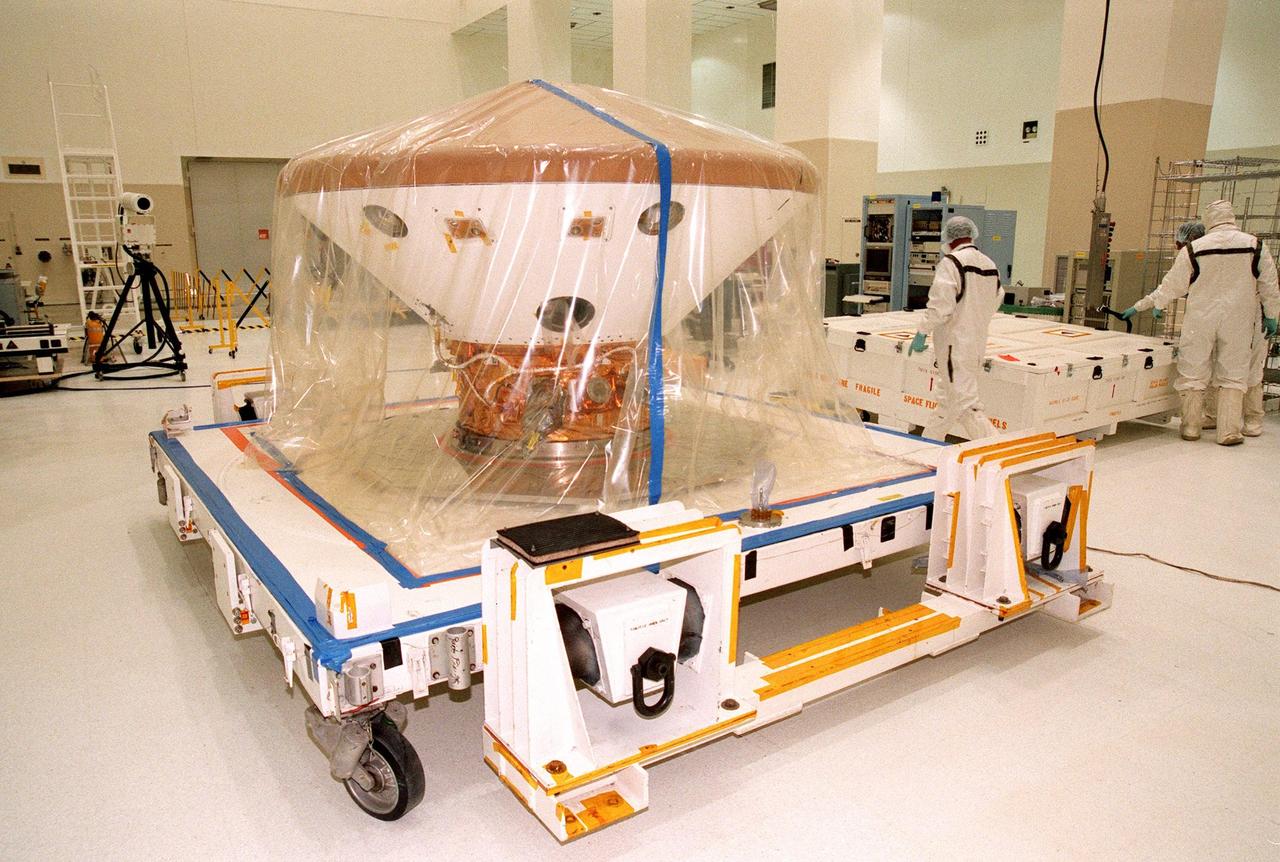
KENNEDY SPACE CENTER, FLA. -- The Mars Polar Lander awaits testing in the Spacecraft Assembly and Encapsulation Facility-2 (SAEF-2). The Mars Polar Lander is targeted for launch from Cape Canaveral Air Station aboard a Delta II rocket on Jan. 3, 1999. The solar-powered spacecraft is designed to touch down on the Martian surface near the northern-most boundary of the south pole in order to study the water cycle there. The lander also will help scientists learn more about climate change and current resources on Mars, studying such things as frost, dust, water vapor and condensates in the Martian atmosphere
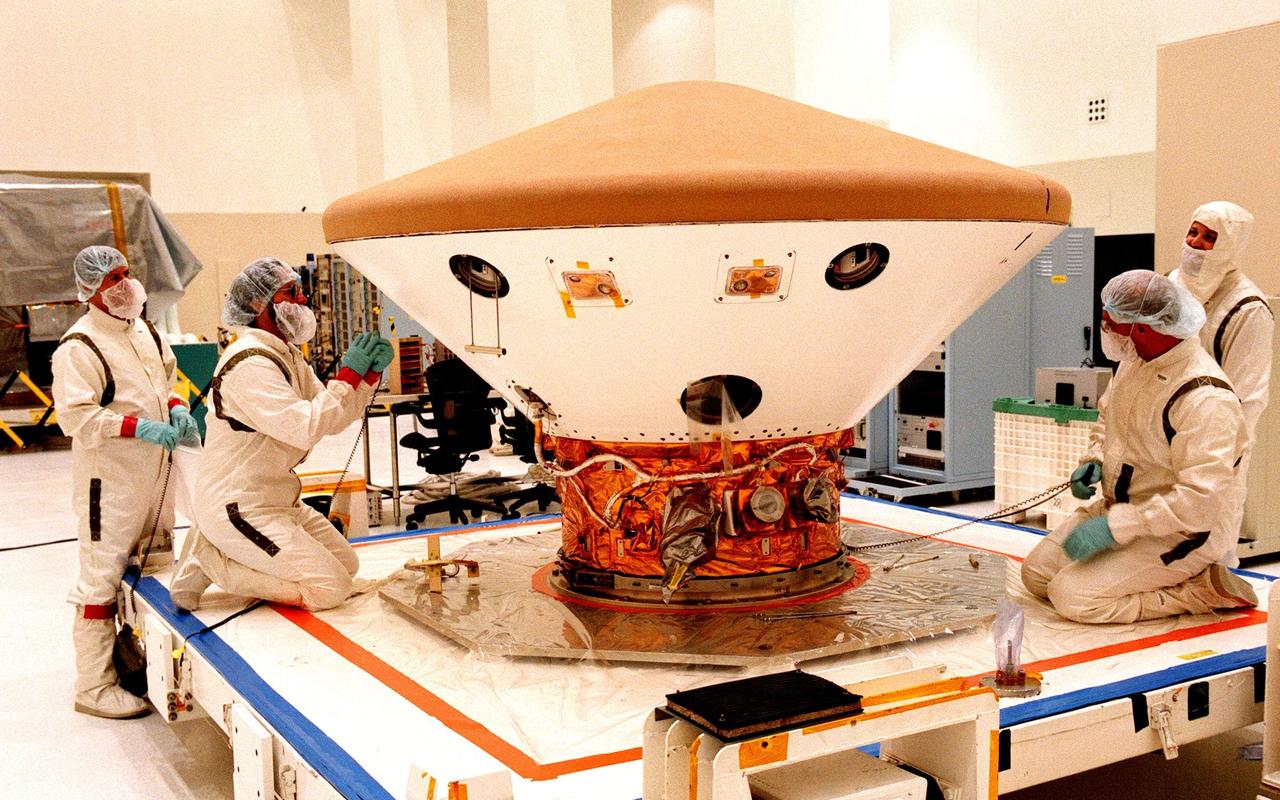
KENNEDY SPACE CENTER, FLA. -- In the Spacecraft Assembly and Encapsulation Facility-2 (SAEF-2), the Mars Polar Lander is secured on a workstand for testing, which includes a functional test of the science instruments and the basic spacecraft subsystems. The Mars Polar Lander is targeted for launch from Cape Canaveral Air Station aboard a Delta II rocket on Jan. 3, 1999. The solar-powered spacecraft is designed to touch down on the Martian surface near the northern-most boundary of the south pole in order to study the water cycle there. The lander also will help scientists learn more about climate change and current resources on Mars, studying such things as frost, dust, water vapor and condensates in the Martian atmosphere
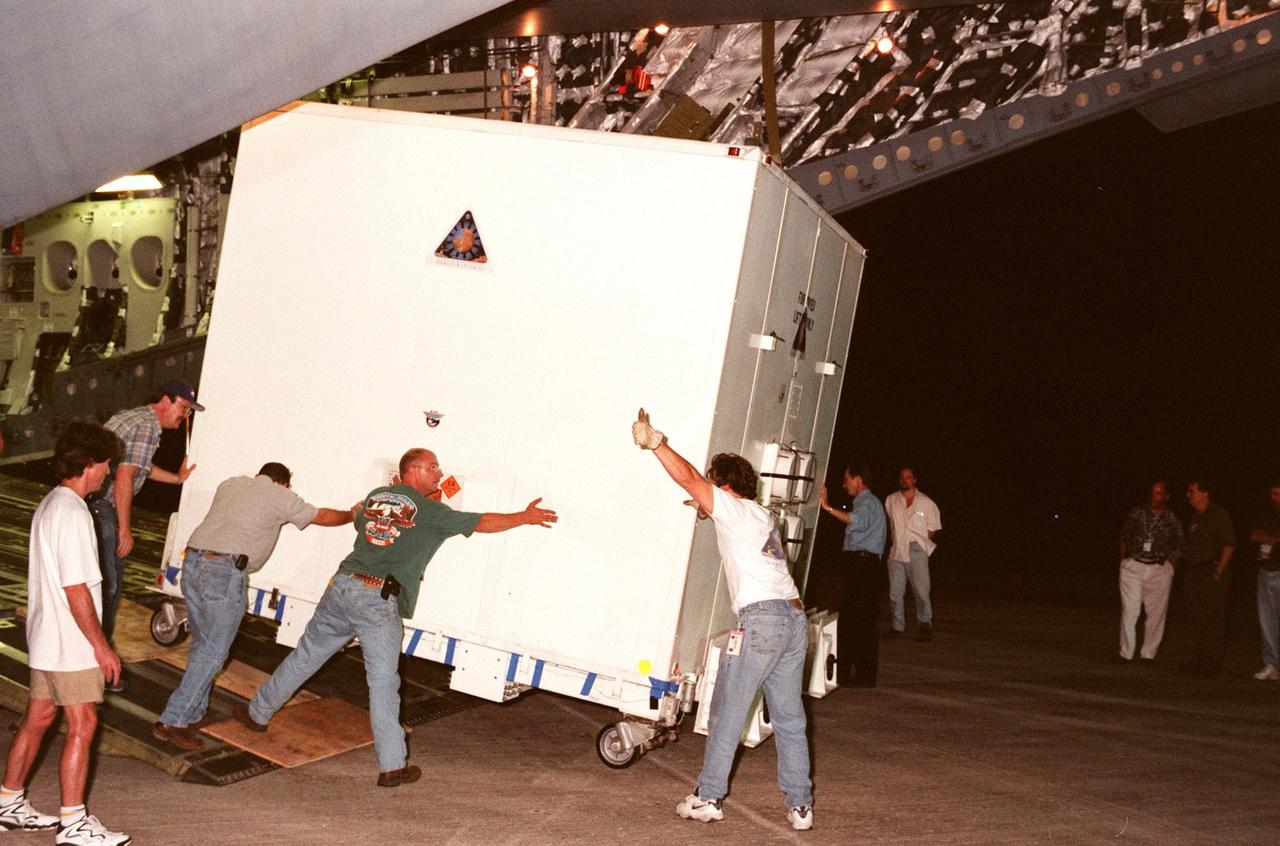
KENNEDY SPACE CENTER, FLA. -- At the Shuttle Landing Facility, the Mars Polar Lander is rolled from the Air Force C-17 cargo plane that carried it from the Lockheed Martin Astronautics plant in Denver, CO. The Mars Polar Lander is targeted for launch from Cape Canaveral Air Station aboard a Delta II rocket on Jan. 3, 1999. The solar-powered spacecraft is designed to touch down on the Martian surface near the northern-most boundary of the south pole in order to study the water cycle there. The lander also will help scientists learn more about climate change and current resources on Mars, studying such things as frost, dust, water vapor and condensates in the Martian atmosphere
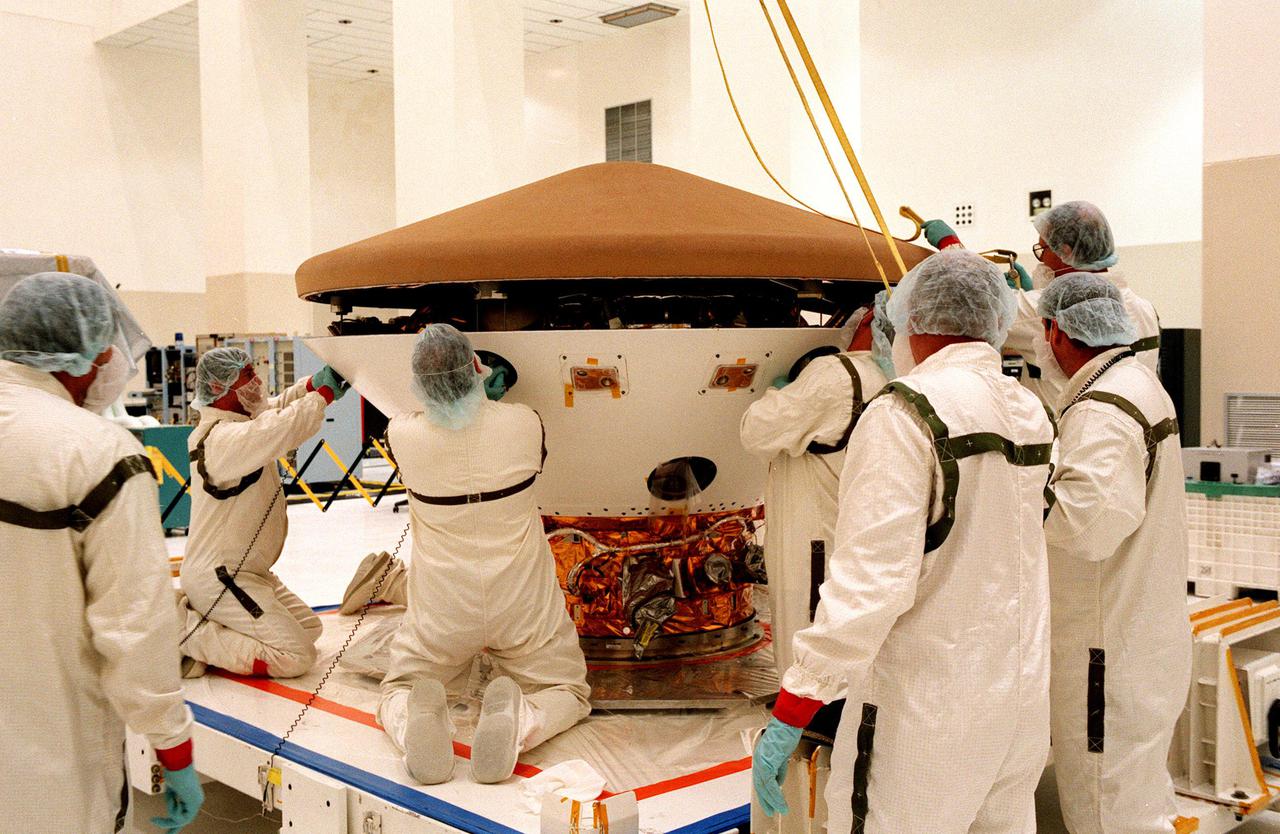
KENNEDY SPACE CENTE, FLA. -- In the Spacecraft Assembly and Encapsulation Facility-2 (SAEF-2), the Mars Polar Lander is unpacked for testing, including a functional test of the science instruments and the basic spacecraft subsystems. The Mars Polar Lander is targeted for launch from Cape Canaveral Air Station aboard a Delta II rocket on Jan. 3, 1999. The solar-powered spacecraft is designed to touch down on the Martian surface near the northern-most boundary of the south pole in order to study the water cycle there. The lander also will help scientists learn more about climate change and current resources on Mars, studying such things as frost, dust, water vapor and condensates in the Martian atmosphere
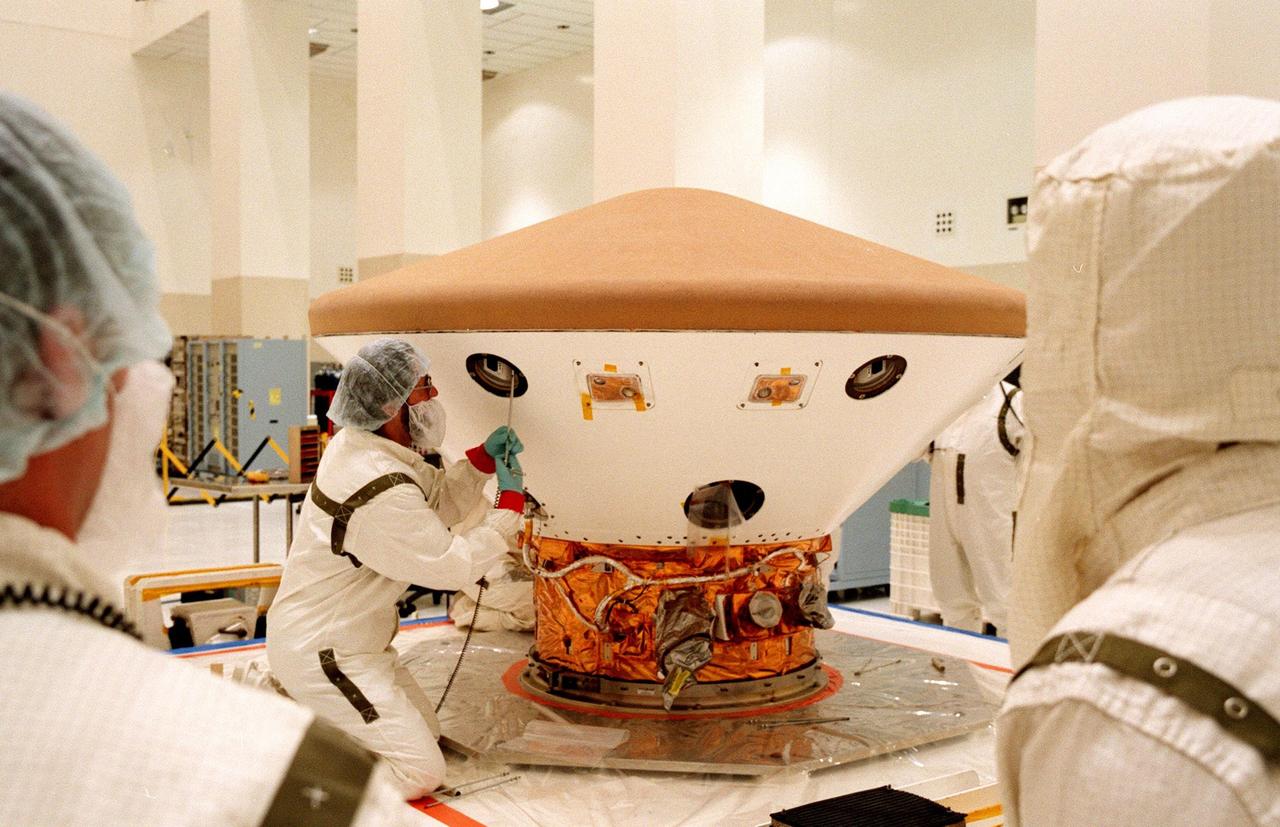
KENNEDY SPACE CENTER, FLA. -- In the Spacecraft Assembly and Encapsulation Facility-2 (SAEF-2), a technician begins testing on the Mars Polar Lander. The checkout includes a functional test of the science instruments and the basic spacecraft subsystems. The Mars Polar Lander is targeted for launch from Cape Canaveral Air Station aboard a Delta II rocket on Jan. 3, 1999. The solar-powered spacecraft is designed to touch down on the Martian surface near the northern-most boundary of the south pole in order to study the water cycle there. The lander also will help scientists learn more about climate change and current resources on Mars, studying such things as frost, dust, water vapor and condensates in the Martian atmosphere
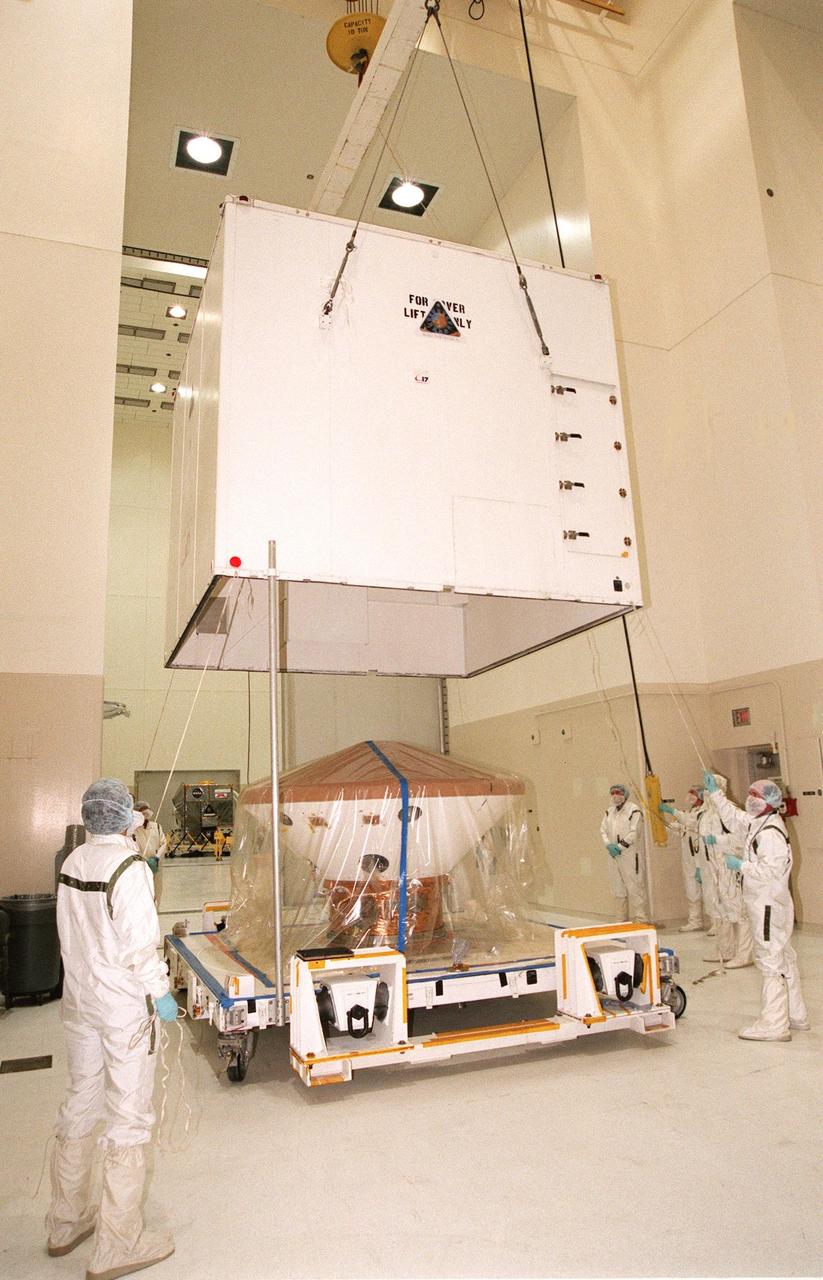
KENNEDY SPACE CENTER, FLA. -- The Mars Polar Lander is uncrated in the Spacecraft Assembly and Encapsulation Facility-2 (SAEF-2). The Mars Polar Lander is targeted for launch from Cape Canaveral Air Station aboard a Delta II rocket on Jan. 3, 1999. The solar-powered spacecraft is designed to touch down on the Martian surface near the northern-most boundary of the south pole in order to study the water cycle there. The lander also will help scientists learn more about climate change and current resources on Mars, studying such things as frost, dust, water vapor and condensates in the Martian atmosphere
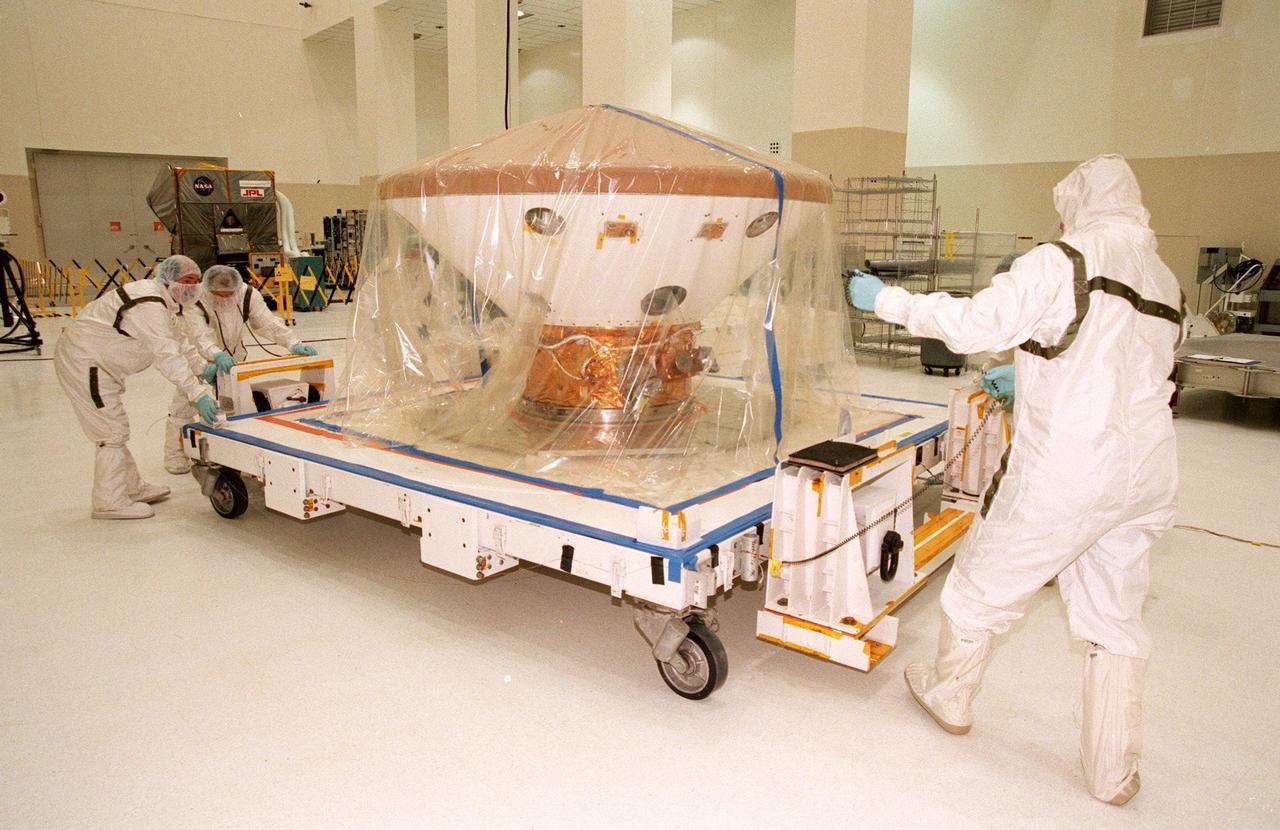
KENNEDY SPACE CENTER, FLA. --Out of its crate, the Mars Polar Lander is maneuvered inside the Spacecraft Assembly and Encapsulation Facility-2 (SAEF-2) for testing. The Mars Polar Lander is targeted for launch from Cape Canaveral Air Station aboard a Delta II rocket on Jan. 3, 1999. The solar-powered spacecraft is designed to touch down on the Martian surface near the northern-most boundary of the south pole in order to study the water cycle there. The lander also will help scientists learn more about climate change and current resources on Mars, studying such things as frost, dust, water vapor and condensates in the Martian atmosphere
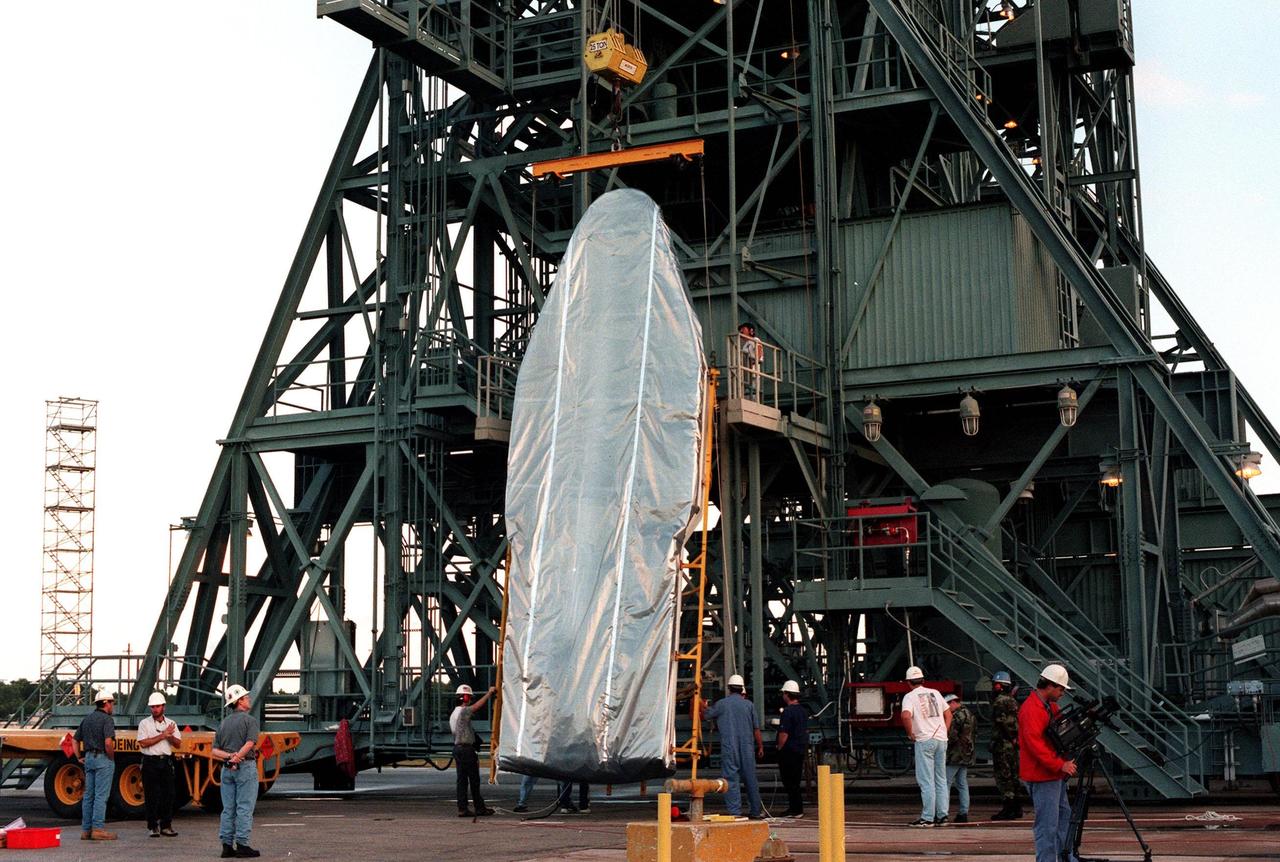
KENNEDY SPACE CENTER, FLA. -- The fairing for the upper stages of the Delta II rocket carrying the Mars Polar Lander is lifted to a vertical position on Pad 17B, Cape Canaveral Air Station. The rocket will be used to launch the Mars Polar Lander on Jan. 3, 1999. The lander is a solar-powered spacecraft designed to touch down on the Martian surface near the northern-most boundary of the south pole in order to study the water cycle there. The lander also will help scientists learn more about climate change and current resources on Mars, studying such things as frost, dust, water vapor and condensates in the Martian atmosphere. It is the second spacecraft to be launched in a pair of Mars '98 missions. The first is the Mars Climate Orbiter, to be launched aboard a Delta II rocket from Launch Complex 17A in December 1998
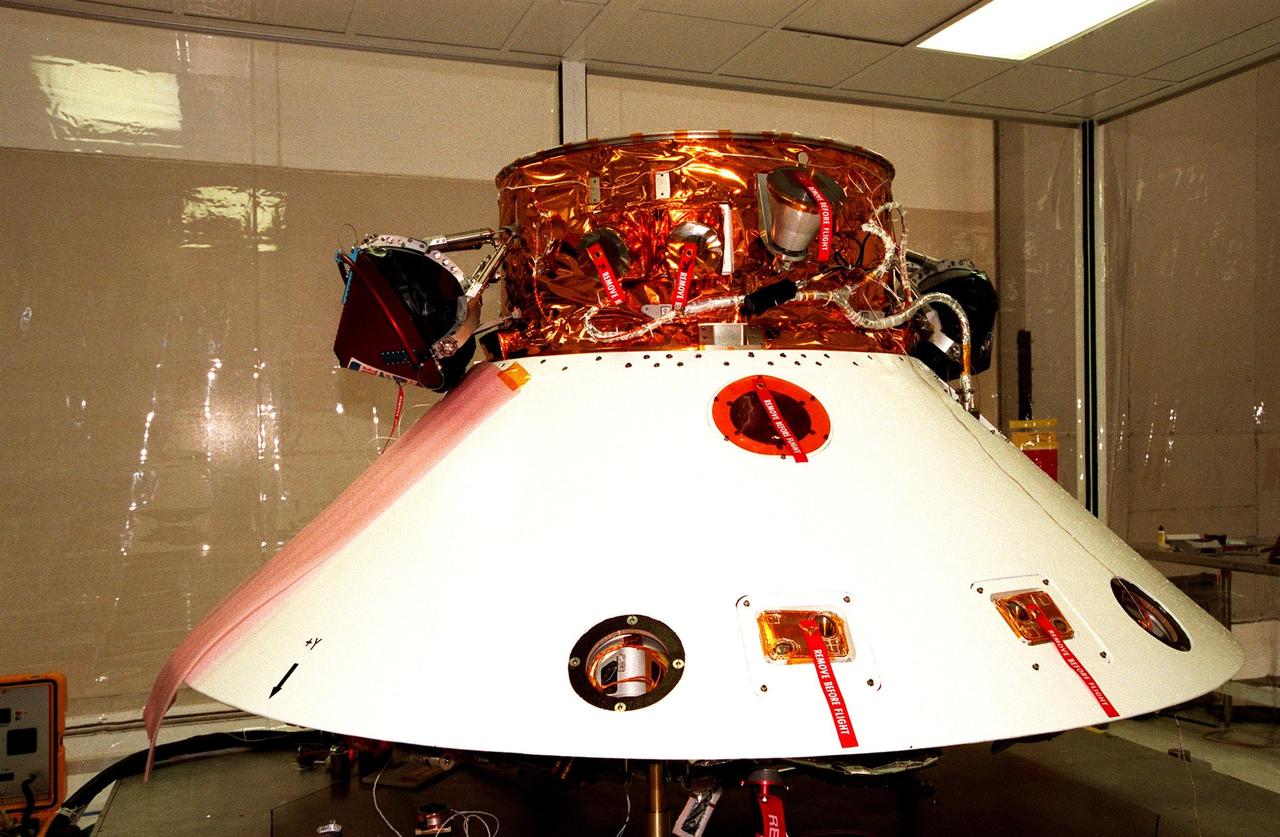
KENNEDY SPACE CENTER, FLA. -- In the Spacecraft Assembly and Encapsulation Facility -2 (SAEF-2), the two Mars microprobes are shown mounted on opposite sides of the Mars Polar Lander. The two microprobes and the lander are scheduled to be launched Jan. 3, 1999, aboard a Delta II rocket. The solar-powered spacecraft is designed to touch down on the Martian surface near the northern-most boundary of the south pole in order to study the water cycle there. The lander also will help scientists learn more about climate change and current resources on Mars, studying such things as frost, dust, water vapor and condensates in the Martian atmosphere. The Mars microprobes, called Deep Space 2, are part of NASA's New Millennium Program. They will complement the climate-related scientific focus of the lander by demonstrating an advanced, rugged microlaser system for detecting subsurface water. Such data on polar subsurface water, in the form of ice, should help put limits on scientific projections for the global abundance of water on Mars
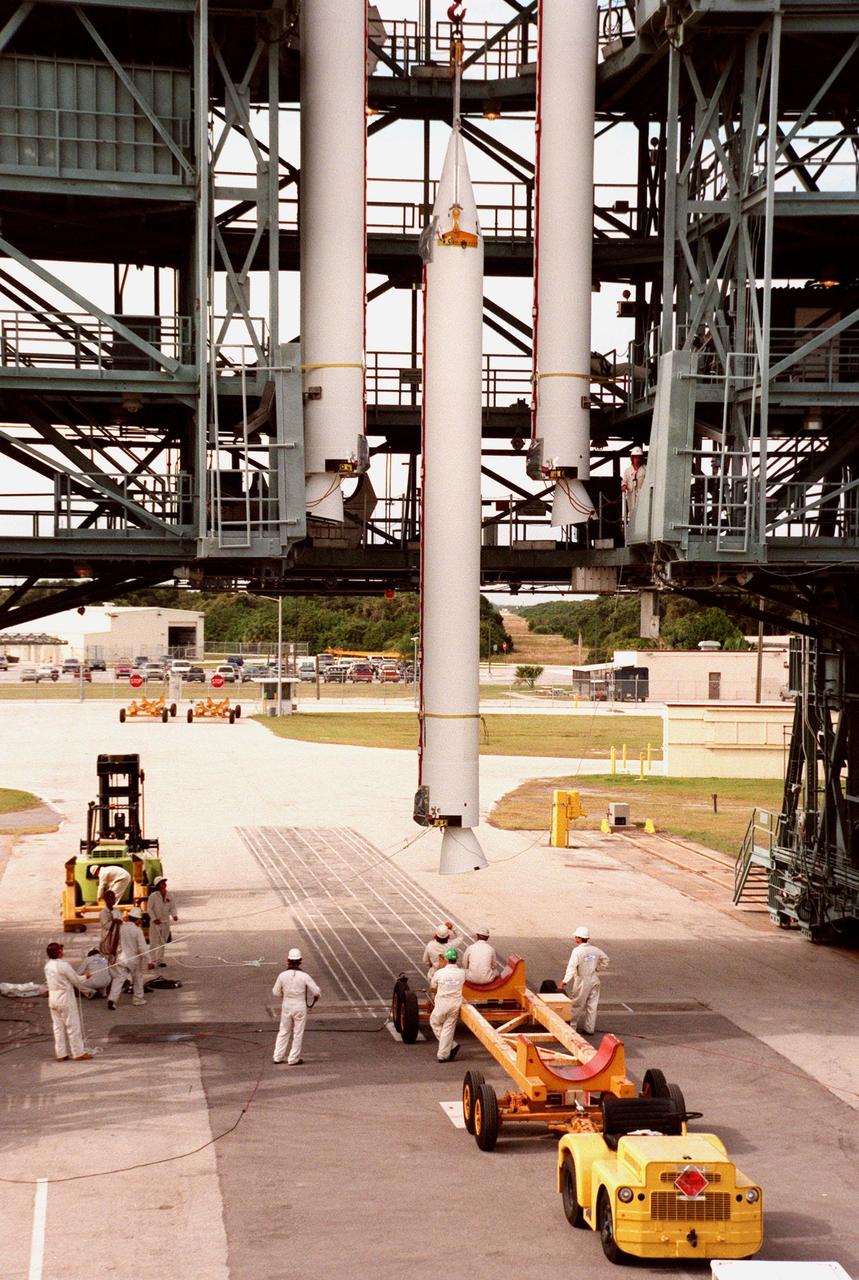
KENNEDY SPACE CENTER, FLA. -- On Pad 17B, Cape Canaveral Air Station, a solid rocket booster hangs in place between two other rocket boosters waiting to be mated with the Delta II rocket carrying the Mars Polar Lander. The rocket will be used to launch the Mars Polar Lander on Jan. 3, 1999. The lander is a solar-powered spacecraft designed to touch down on the Martian surface near the northern-most boundary of the south pole in order to study the water cycle there. The lander also will help scientists learn more about climate change and current resources on Mars, studying such things as frost, dust, water vapor and condensates in the Martian atmosphere. It is the second spacecraft to be launched in a pair of Mars '98 missions. The first is the Mars Climate Orbiter, to be launched aboard a Delta II rocket from Launch Complex 17A in December 1998
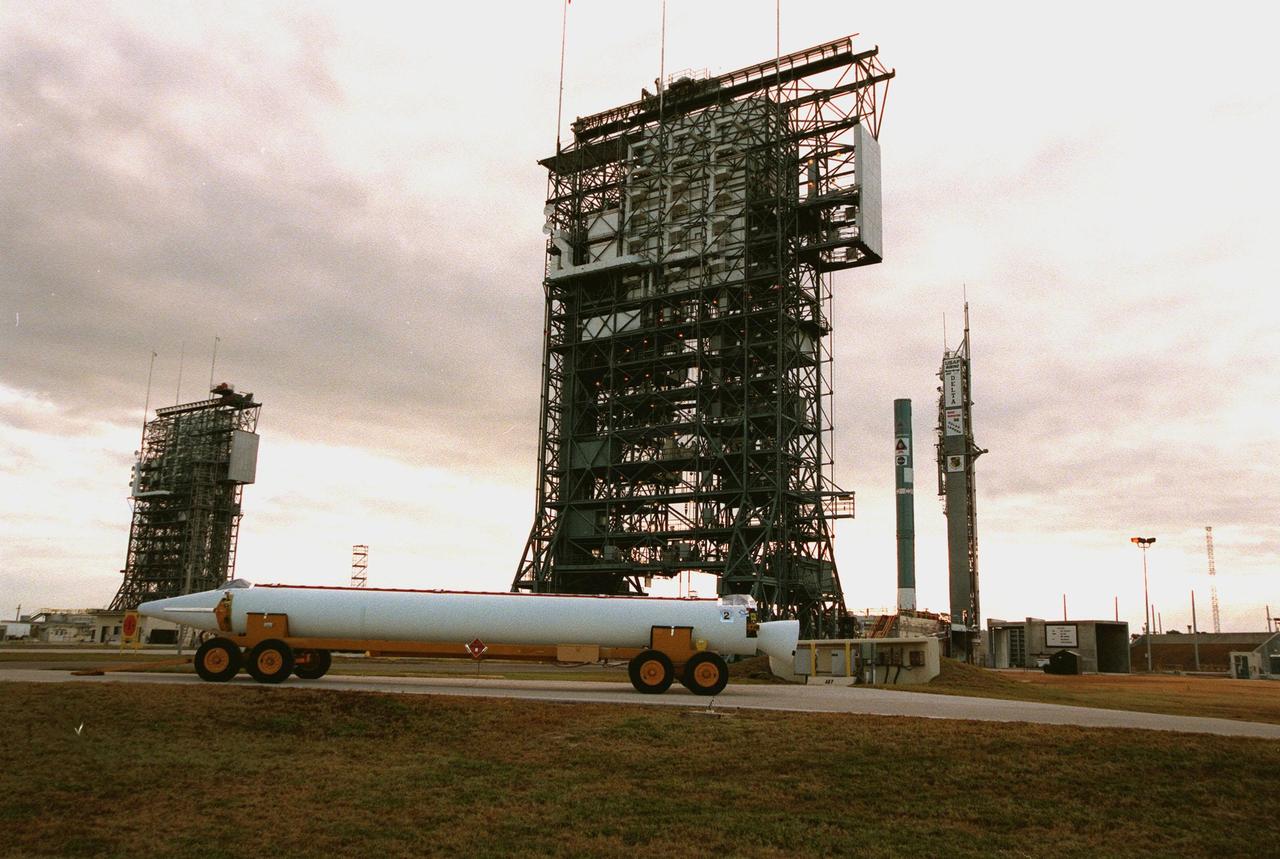
KENNEDY SPACE CENTER, FLA. -- On Pad 17B, Cape Canaveral Air Station, a solid rocket booster waits for mating with the Delta II rocket (in background) carrying the Mars Polar Lander. The rocket will be used to launch the Mars Polar Lander on Jan. 3, 1999. The lander is a solar-powered spacecraft designed to touch down on the Martian surface near the northern-most boundary of the south pole in order to study the water cycle there. The lander also will help scientists learn more about climate change and current resources on Mars, studying such things as frost, dust, water vapor and condensates in the Martian atmosphere. It is the second spacecraft to be launched in a pair of Mars '98 missions. The first is the Mars Climate Orbiter, to be launched aboard a Delta II rocket from Launch Complex 17A in December 1998
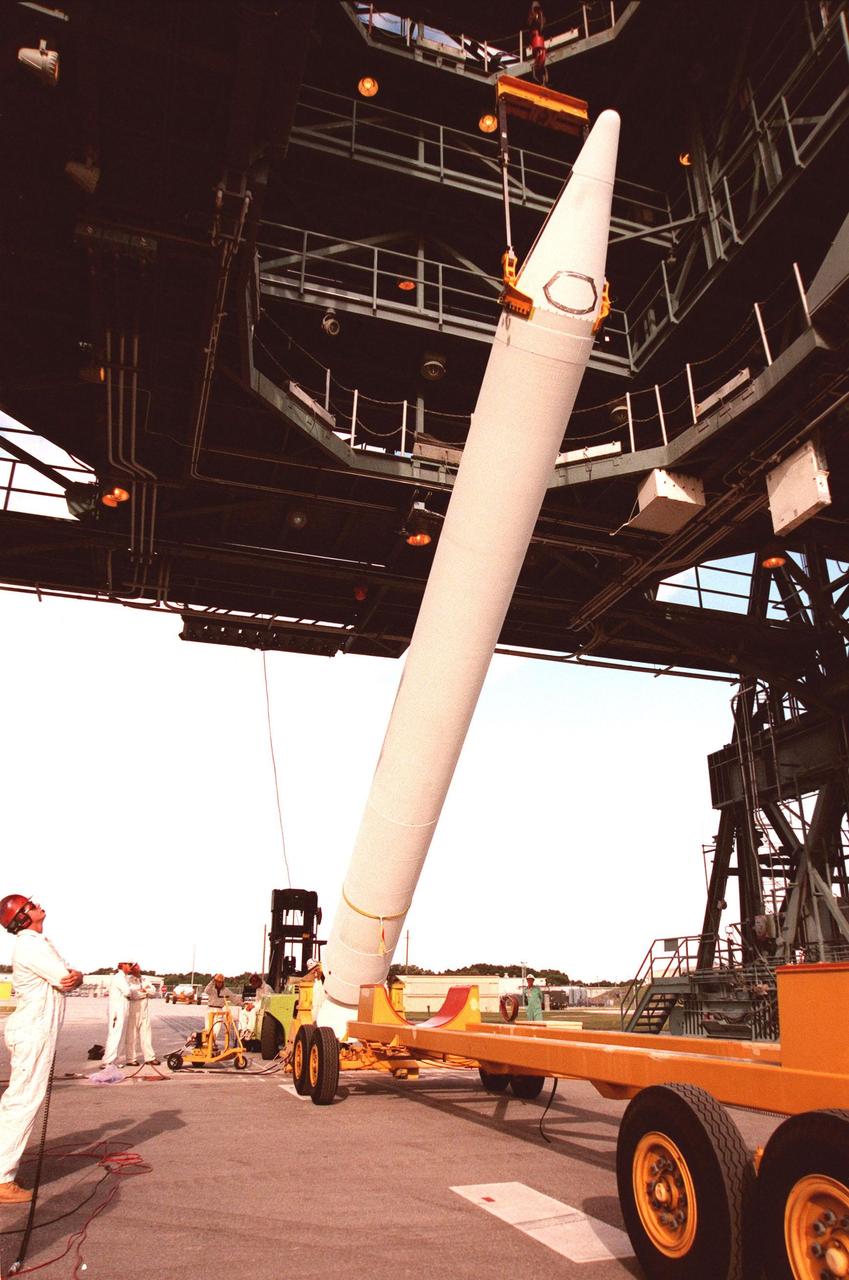
KENNEDY SPACE CENTER, FLA. -- On Pad 17B, Cape Canaveral Air Station, a solid rocket booster is raised to a vertical position for mating with the Delta II rocket carrying the Mars Polar Lander. The rocket will be used to launch the Mars Polar Lander on Jan. 3, 1999. The lander is a solar-powered spacecraft designed to touch down on the Martian surface near the northern-most boundary of the south pole in order to study the water cycle there. The lander also will help scientists learn more about climate change and current resources on Mars, studying such things as frost, dust, water vapor and condensates in the Martian atmosphere. It is the second spacecraft to be launched in a pair of Mars '98 missions. The first is the Mars Climate Orbiter, to be launched aboard a Delta II rocket from Launch Complex 17A in December 1998
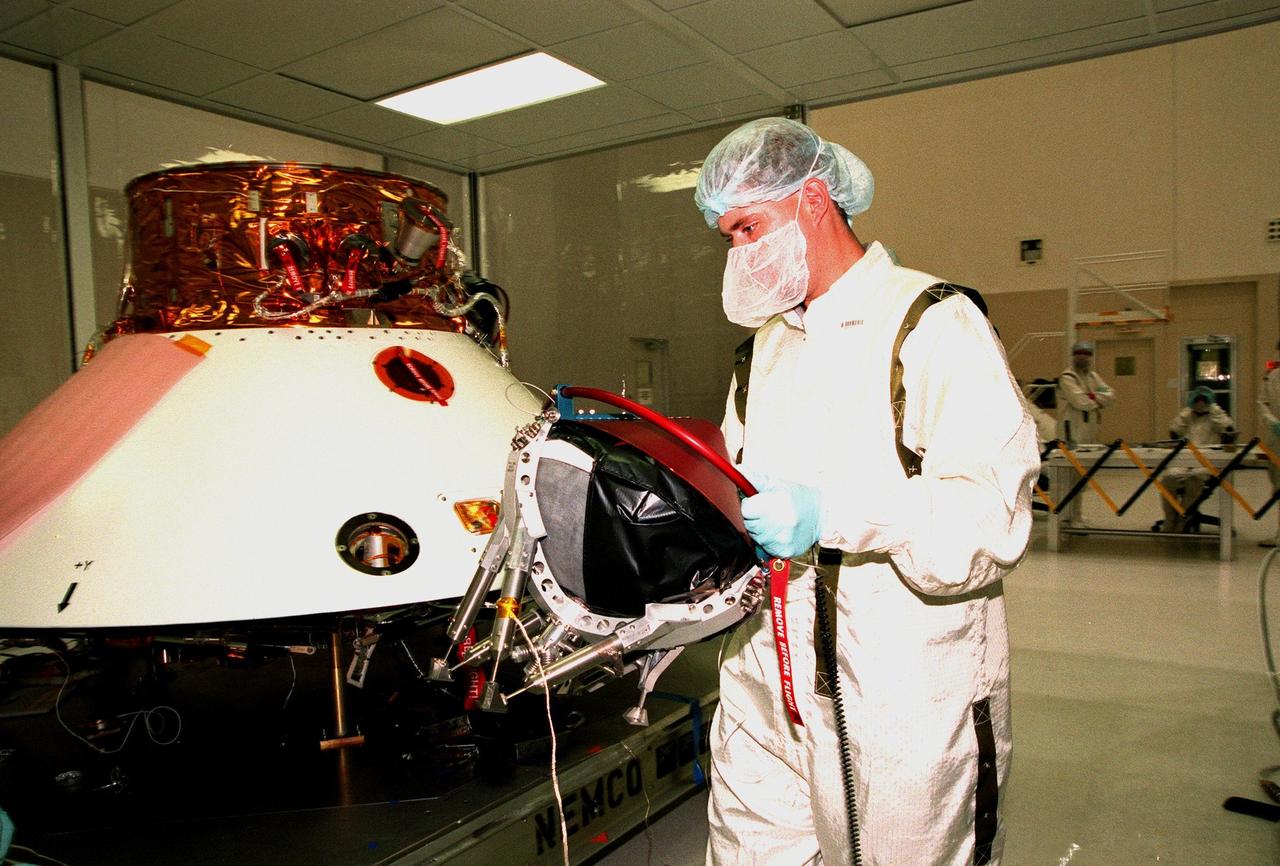
KENNEDY SPACE CENTER, FLA. -- In the Spacecraft Assembly and Encapsulation Facility -2 (SAEF-2), a JPL worker carries a Mars microprobe to the Mars Polar Lander at left. Two microprobes will hitchhike on the lander, scheduled to be launched Jan. 3, 1999, aboard a Delta II rocket. The solar-powered spacecraft is designed to touch down on the Martian surface near the northern-most boundary of the south pole in order to study the water cycle there. The lander also will help scientists learn more about climate change and current resources on Mars, studying such things as frost, dust, water vapor and condensates in the Martian atmosphere. The Mars microprobes, called Deep Space 2, are part of NASA's New Millennium Program. They will complement the climate-related scientific focus of the lander by demonstrating an advanced, rugged microlaser system for detecting subsurface water. Such data on polar subsurface water, in the form of ice, should help put limits on scientific projections for the global abundance of water on Mars
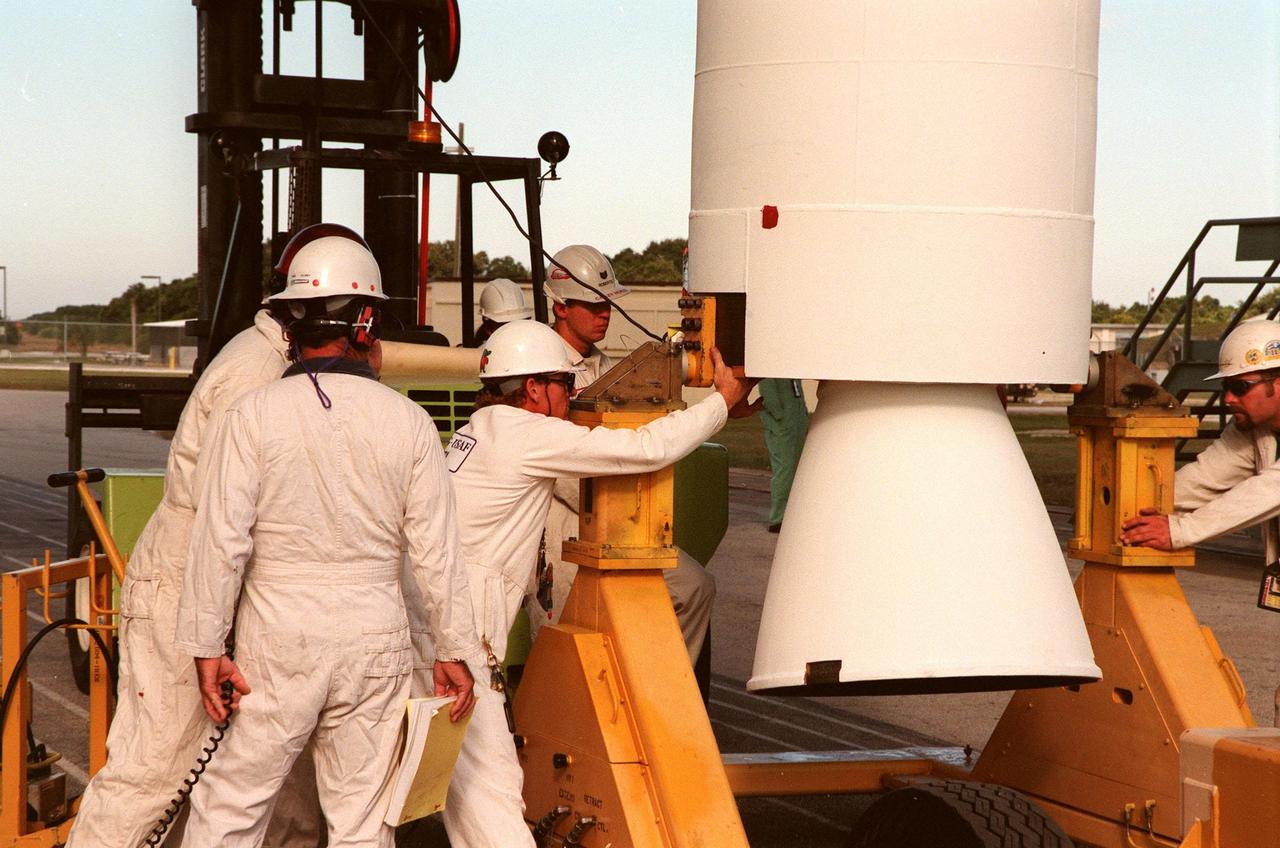
KENNEDY SPACE CENTER, FLA. -- On Pad 17B, Cape Canaveral Air Station, workers monitor the solid rocket booster before its being lifted to mate with the Delta II rocket carrying the Mars Polar Lander. The rocket will be used to launch the Mars Polar Lander on Jan. 3, 1999. The lander is a solar-powered spacecraft designed to touch down on the Martian surface near the northern-most boundary of the south pole in order to study the water cycle there. The lander also will help scientists learn more about climate change and current resources on Mars, studying such things as frost, dust, water vapor and condensates in the Martian atmosphere. It is the second spacecraft to be launched in a pair of Mars '98 missions. The first is the Mars Climate Orbiter, to be launched aboard a Delta II rocket from Launch Complex 17A in December 1998
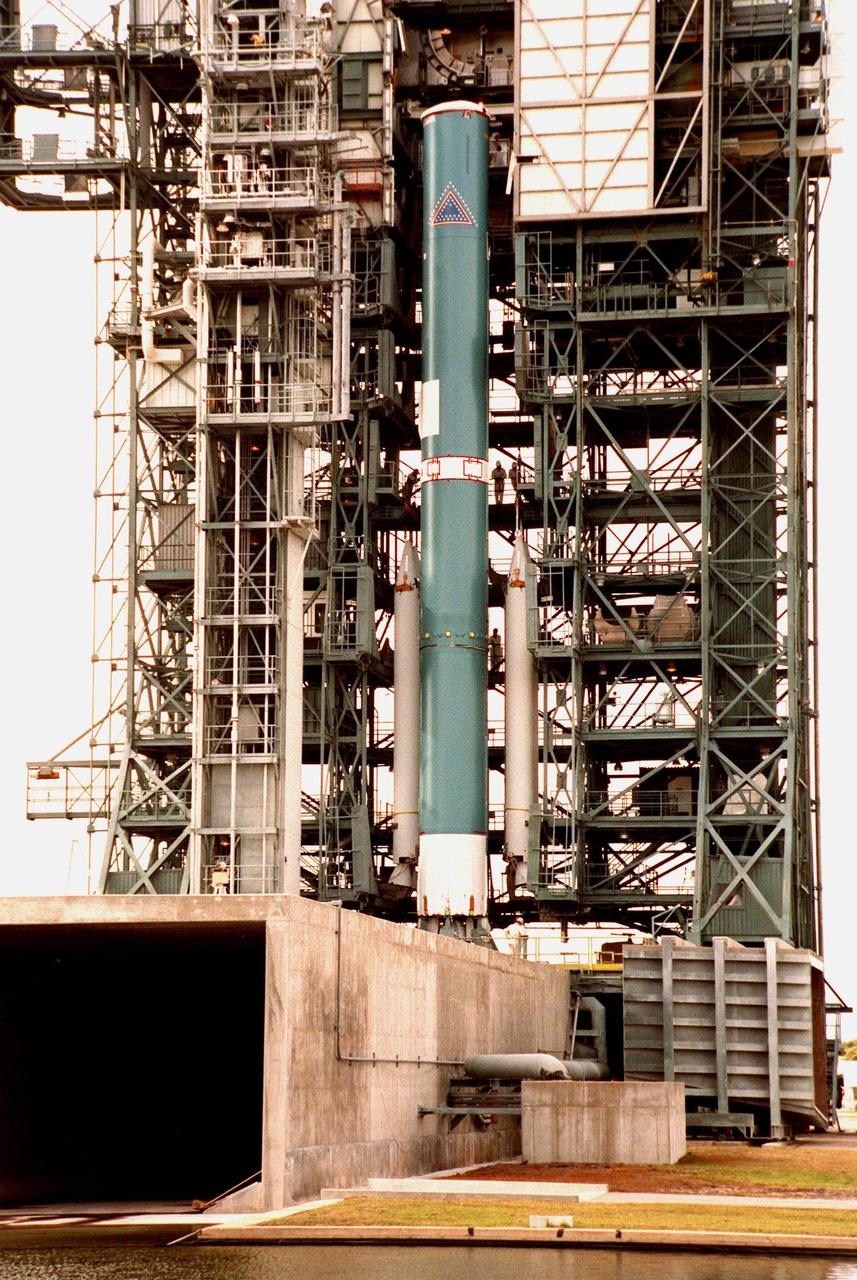
KENNEDY SPACE CENTER, FLA. -- On Pad 17B, Cape Canaveral Air Station, the gantry holding the solid rocket boosters is moved into place next to the Delta II rocket carrying the Mars Polar Lander. The rocket will be used to launch the Mars Polar Lander on Jan. 3, 1999. The lander is a solar-powered spacecraft designed to touch down on the Martian surface near the northern-most boundary of the south pole in order to study the water cycle there. The lander also will help scientists learn more about climate change and current resources on Mars, studying such things as frost, dust, water vapor and condensates in the Martian atmosphere. It is the second spacecraft to be launched in a pair of Mars '98 missions. The first is the Mars Climate Orbiter, to be launched aboard a Delta II rocket from Launch Complex 17A in December 1998
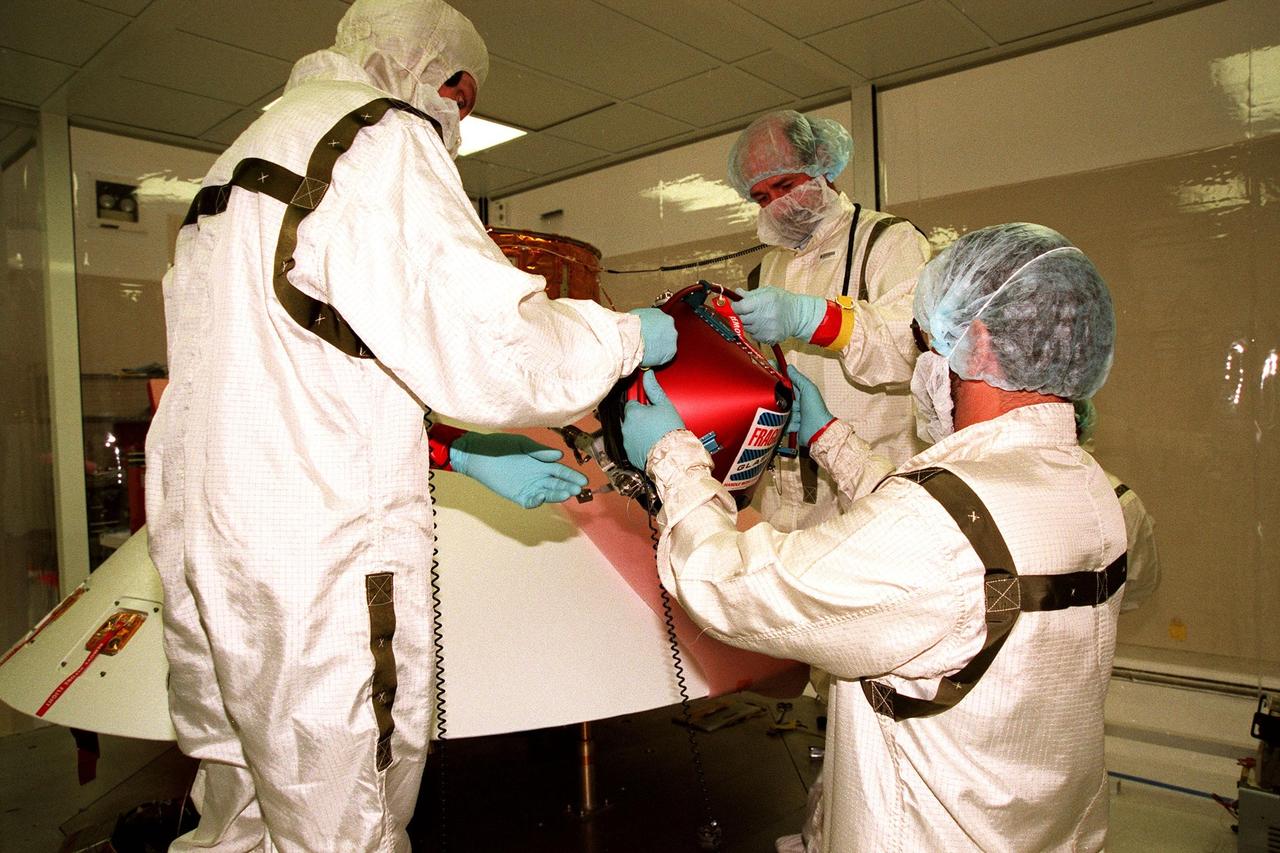
KENNEDY SPACE CENTER, FLA. -- In the Spacecraft Assembly and Encapsulation Facility -2 (SAEF-2), JPL workers mount a Mars microprobe onto the Mars Polar Lander. Two microprobes will hitchhike on the lander, scheduled to be launched Jan. 3, 1999, aboard a Delta II rocket. The solar-powered spacecraft is designed to touch down on the Martian surface near the northern-most boundary of the south pole in order to study the water cycle there. The lander also will help scientists learn more about climate change and current resources on Mars, studying such things as frost, dust, water vapor and condensates in the Martian atmosphere. The Mars microprobes, called Deep Space 2, are part of NASA's New Millennium Program. They will complement the climate-related scientific focus of the lander by demonstrating an advanced, rugged microlaser system for detecting subsurface water. Such data on polar subsurface water, in the form of ice, should help put limits on scientific projections for the global abundance of water on Mars
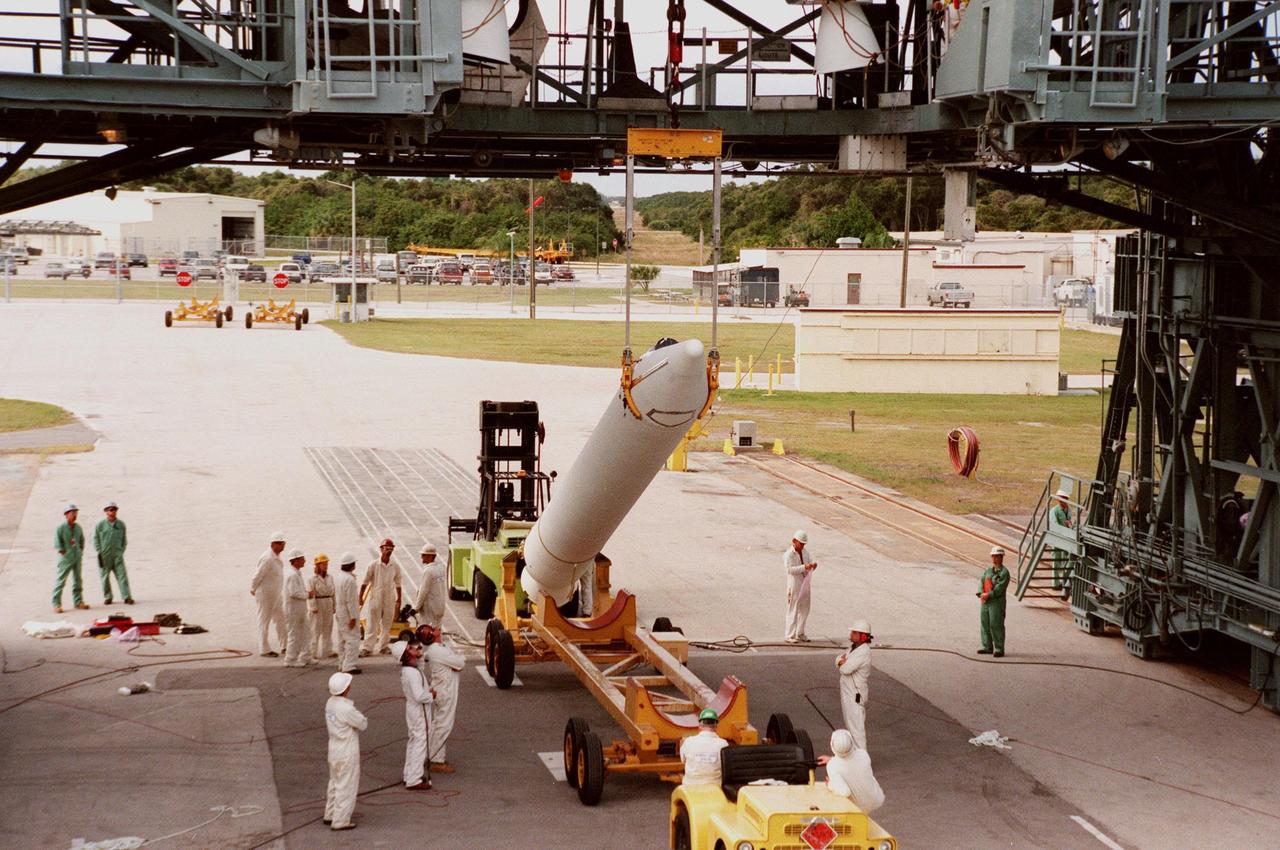
KENNEDY SPACE CENTER, FLA. -- On Pad 17B, Cape Canaveral Air Station, a solid rocket booster is raised to a vertical position for mating with the Delta II rocket carrying the Mars Polar Lander. The rocket will be used to launch the Mars Polar Lander on Jan. 3, 1999. The lander is a solar-powered spacecraft designed to touch down on the Martian surface near the northern-most boundary of the south pole in order to study the water cycle there. The lander also will help scientists learn more about climate change and current resources on Mars, studying such things as frost, dust, water vapor and condensates in the Martian atmosphere. It is the second spacecraft to be launched in a pair of Mars '98 missions. The first is the Mars Climate Orbiter, to be launched aboard a Delta II rocket from Launch Complex 17A in December 1998
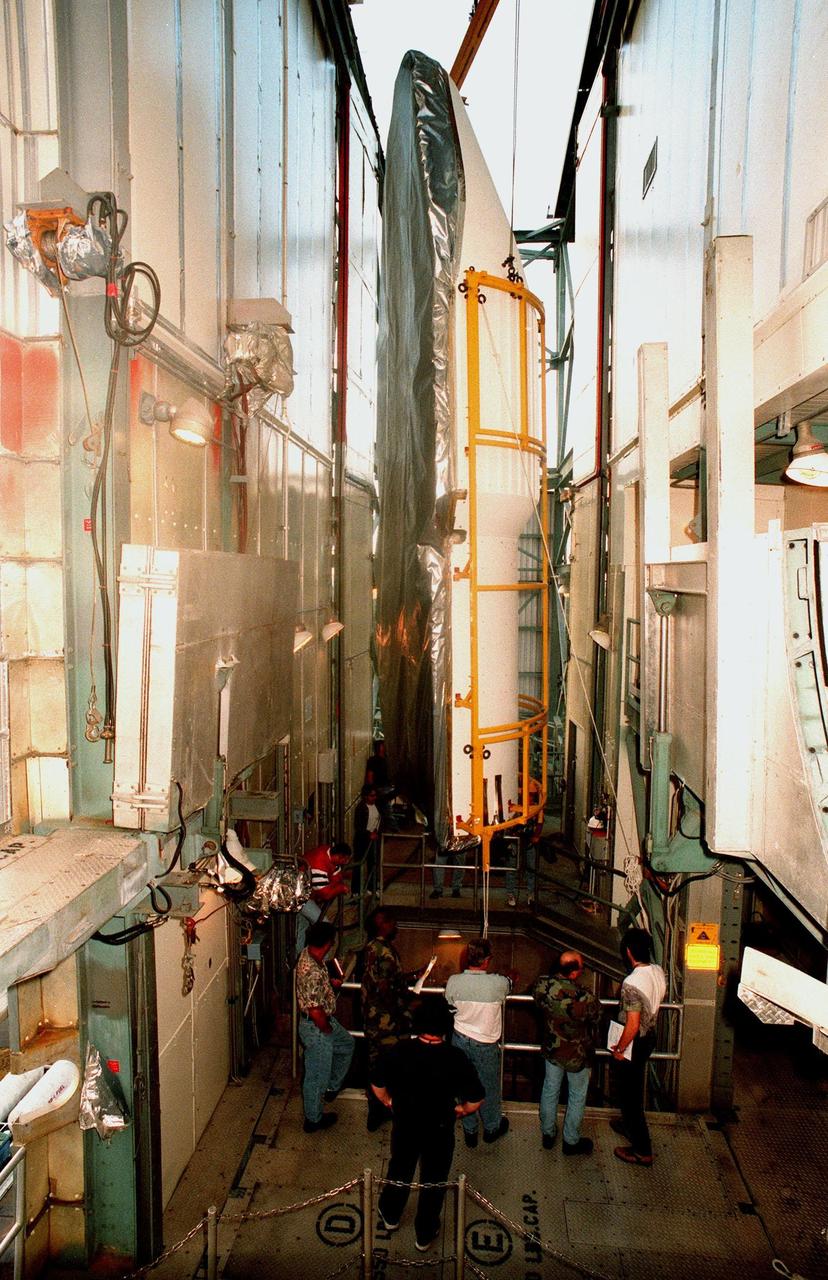
KENNEDY SPACE CENTER, FLA. -- Inside the gantry on Pad 17B, Cape Canaveral Air Station, the fairing for the upper stages of the Delta II rocket carrying the Mars Polar Lander waits to be lowered into the white room. The rocket will be used to launch the Mars Polar Lander on Jan. 3, 1999. The lander is a solar-powered spacecraft designed to touch down on the Martian surface near the northern-most boundary of the south pole in order to study the water cycle there. The lander also will help scientists learn more about climate change and current resources on Mars, studying such things as frost, dust, water vapor and condensates in the Martian atmosphere. It is the second spacecraft to be launched in a pair of Mars '98 missions. The first is the Mars Climate Orbiter, to be launched aboard a Delta II rocket from Launch Complex 17A in December 1998
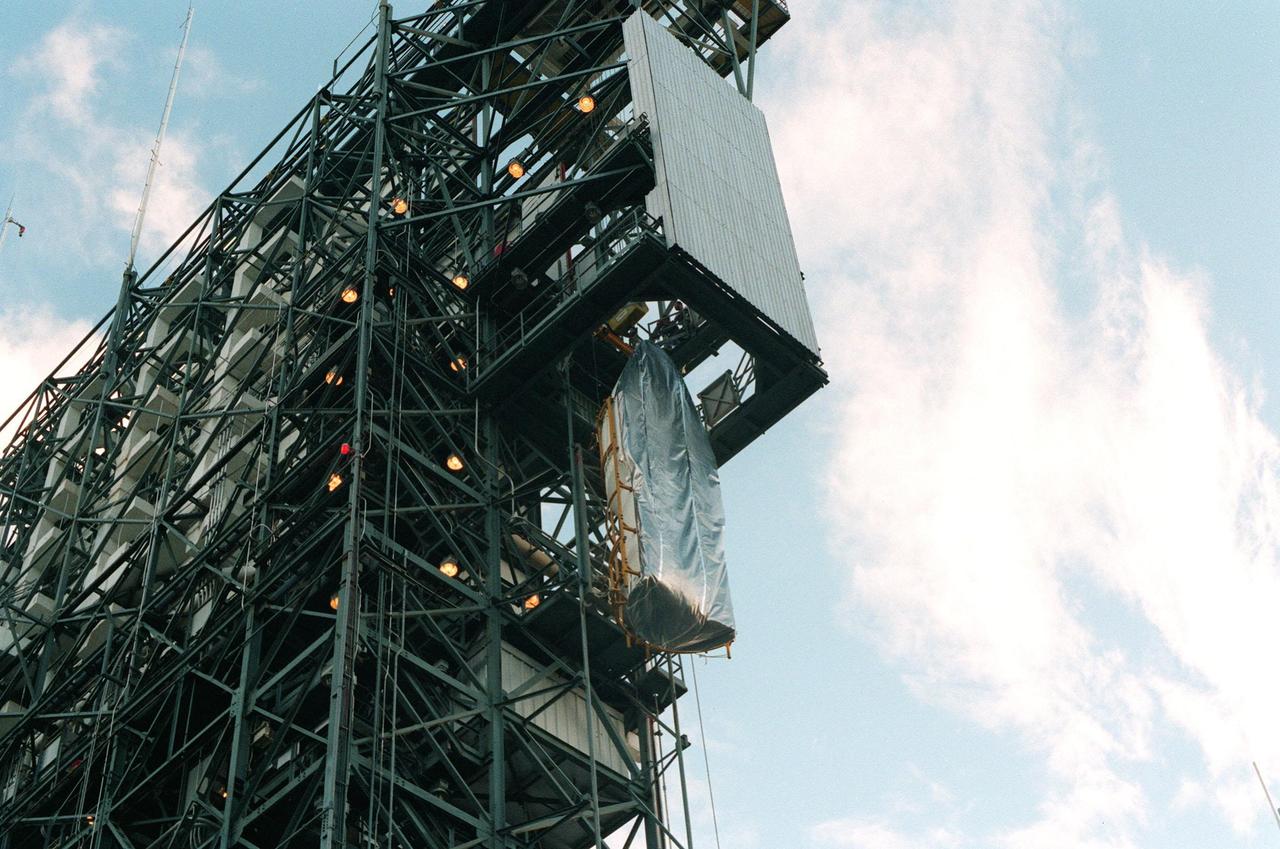
KENNEDY SPACE CENTER, FLA. -- The fairing for the upper stages of the Delta II rocket carrying the Mars Polar Lander is lifted to the top of the gantry on Pad 17B, Cape Canaveral Air Station. The rocket will be used to launch the Mars Polar Lander on Jan. 3, 1999. The lander is a solar-powered spacecraft designed to touch down on the Martian surface near the northern-most boundary of the south pole in order to study the water cycle there. The lander also will help scientists learn more about climate change and current resources on Mars, studying such things as frost, dust, water vapor and condensates in the Martian atmosphere. It is the second spacecraft to be launched in a pair of Mars '98 missions. The first is the Mars Climate Orbiter, to be launched aboard a Delta II rocket from Launch Complex 17A in December 1998
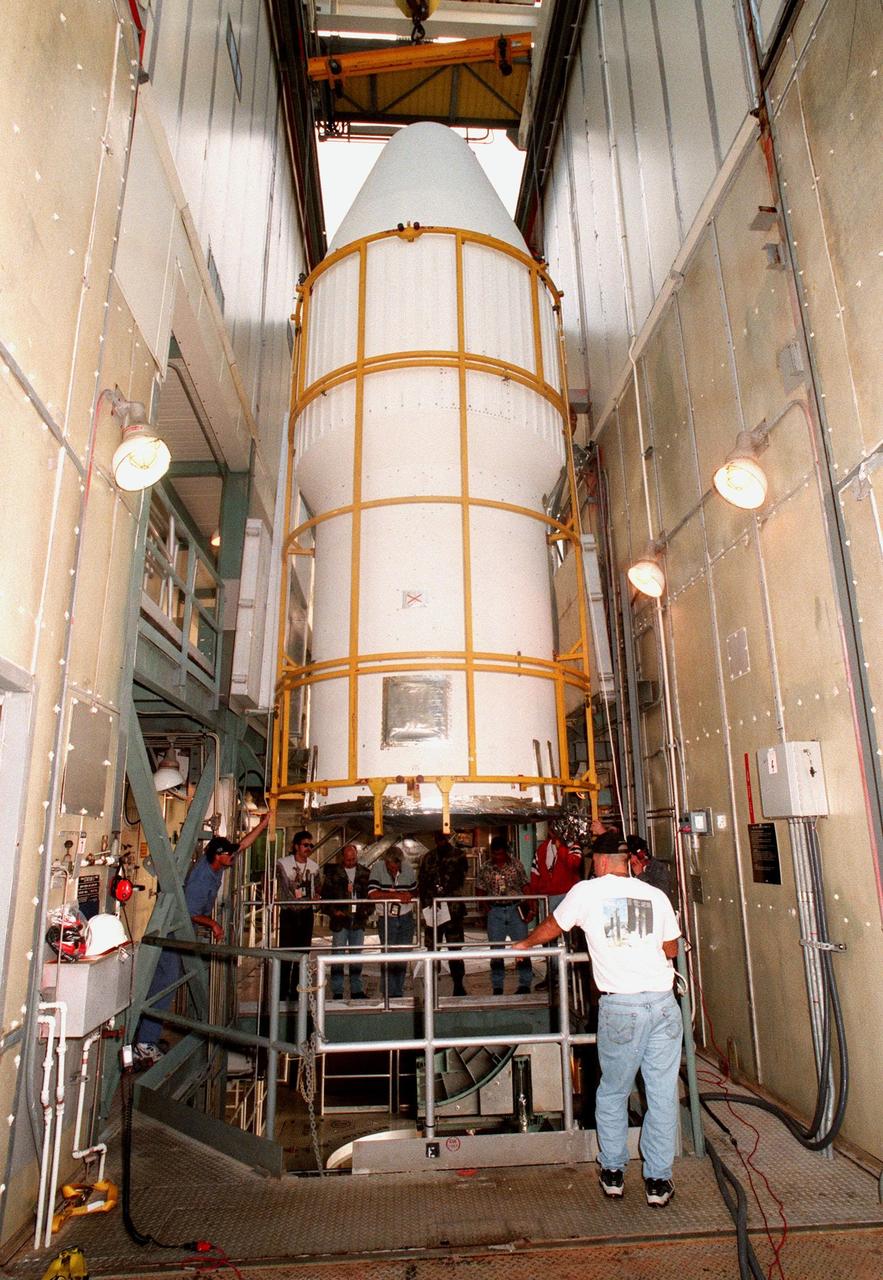
KENNEDY SPACE CENTER, FLA. -- Inside the gantry on Pad 17B, Cape Canaveral Air Station, the fairing for the upper stages of the Delta II rocket carrying the Mars Polar Lander waits to be lowered into the white room. The rocket will be used to launch the Mars Polar Lander on Jan. 3, 1999. The lander is a solar-powered spacecraft designed to touch down on the Martian surface near the northern-most boundary of the south pole in order to study the water cycle there. The lander also will help scientists learn more about climate change and current resources on Mars, studying such things as frost, dust, water vapor and condensates in the Martian atmosphere. It is the second spacecraft to be launched in a pair of Mars '98 missions. The first is the Mars Climate Orbiter, to be launched aboard a Delta II rocket from Launch Complex 17A in December 1998
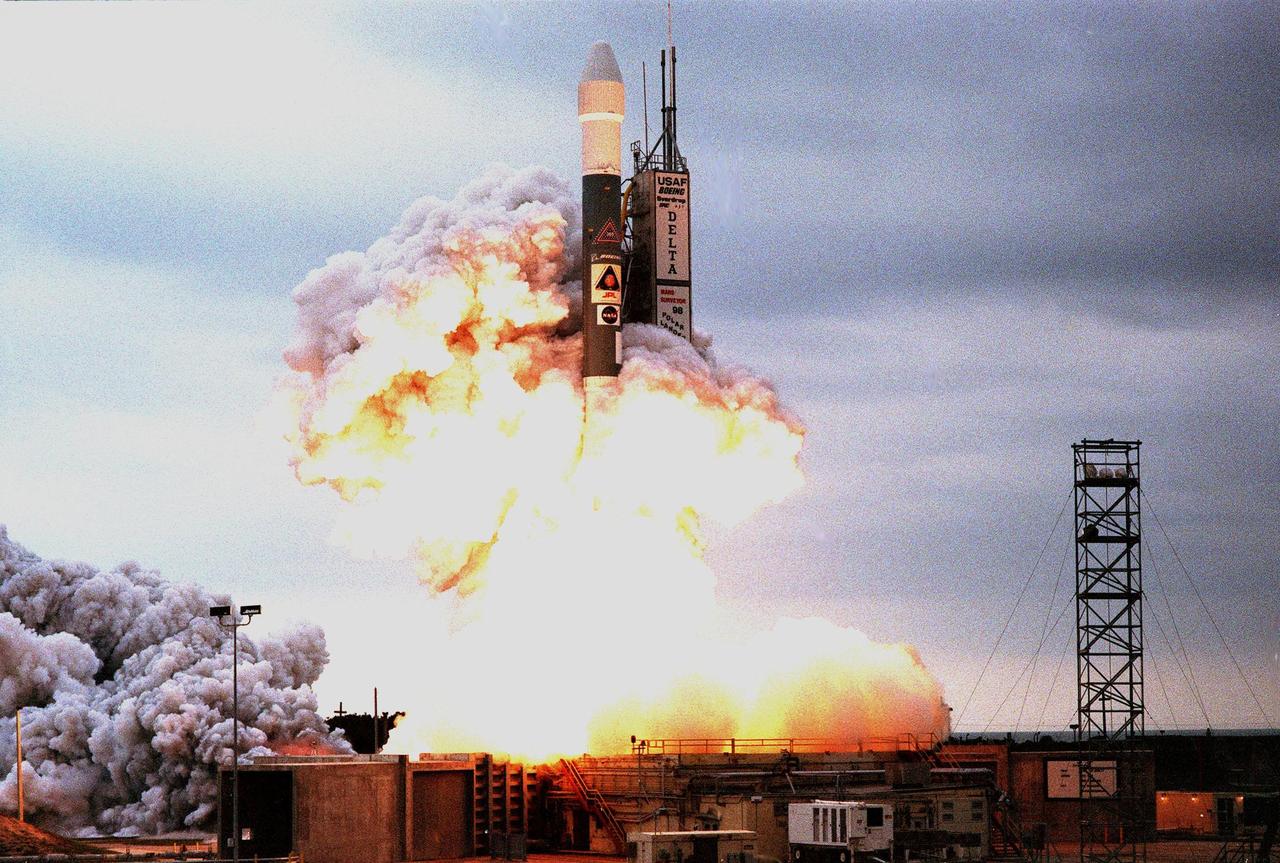
KENNEDY SPACE CENTER, FLA. -- Amid clouds of exhaust and into a gray-clouded sky , a Boeing Delta II expendable launch vehicle lifts off with NASA's Mars Polar Lander at 3:21:10 p.m. EST from Launch Complex 17B, Cape Canaveral Air Station. The lander is a solar-powered spacecraft designed to touch down on the Martian surface near the northern-most boundary of the south polar cap, which consists of carbon dioxide ice. The lander will study the polar water cycle, frosts, water vapor, condensates and dust in the Martian atmosphere. It is equipped with a robotic arm to dig beneath the layered terrain at the polar cap. In addition, Deep Space 2 microprobes, developed by NASA's New Millennium Program, are installed on the lander's cruise stage. After crashing into the planet's surface, they will conduct two days of soil and water experiments up to 1 meter (3 feet) below the Martian surface, testing new technologies for future planetary descent probes. The lander is the second spacecraft to be launched in a pair of Mars Surveyor '98 missions. The first is the Mars Climate Orbiter, which was launched aboard a Delta II rocket from Launch Complex 17A on Dec. 11, 1998.

KENNEDY SPACE CENTER, FLA. -- Silhouetted against the gray sky, a Boeing Delta II expendable launch vehicle with NASA's Mars Polar Lander lifts off from Launch Complex 17B, Cape Canaveral Air Station, at 3:21:10 p.m. EST. The lander is a solar-powered spacecraft designed to touch down on the Martian surface near the northern-most boundary of the south polar cap, which consists of carbon dioxide ice. The lander will study the polar water cycle, frosts, water vapor, condensates and dust in the Martian atmosphere. It is equipped with a robotic arm to dig beneath the layered terrain at the polar cap. In addition, Deep Space 2 microprobes, developed by NASA's New Millennium Program, are installed on the lander's cruise stage. After crashing into the planet's surface, they will conduct two days of soil and water experiments up to 1 meter (3 feet) below the Martian surface, testing new technologies for future planetary descent probes. The lander is the second spacecraft to be launched in a pair of Mars Surveyor '98 missions. The first is the Mars Climate Orbiter, which was launched aboard a Delta II rocket from Launch Complex 17A on Dec. 11, 1998.
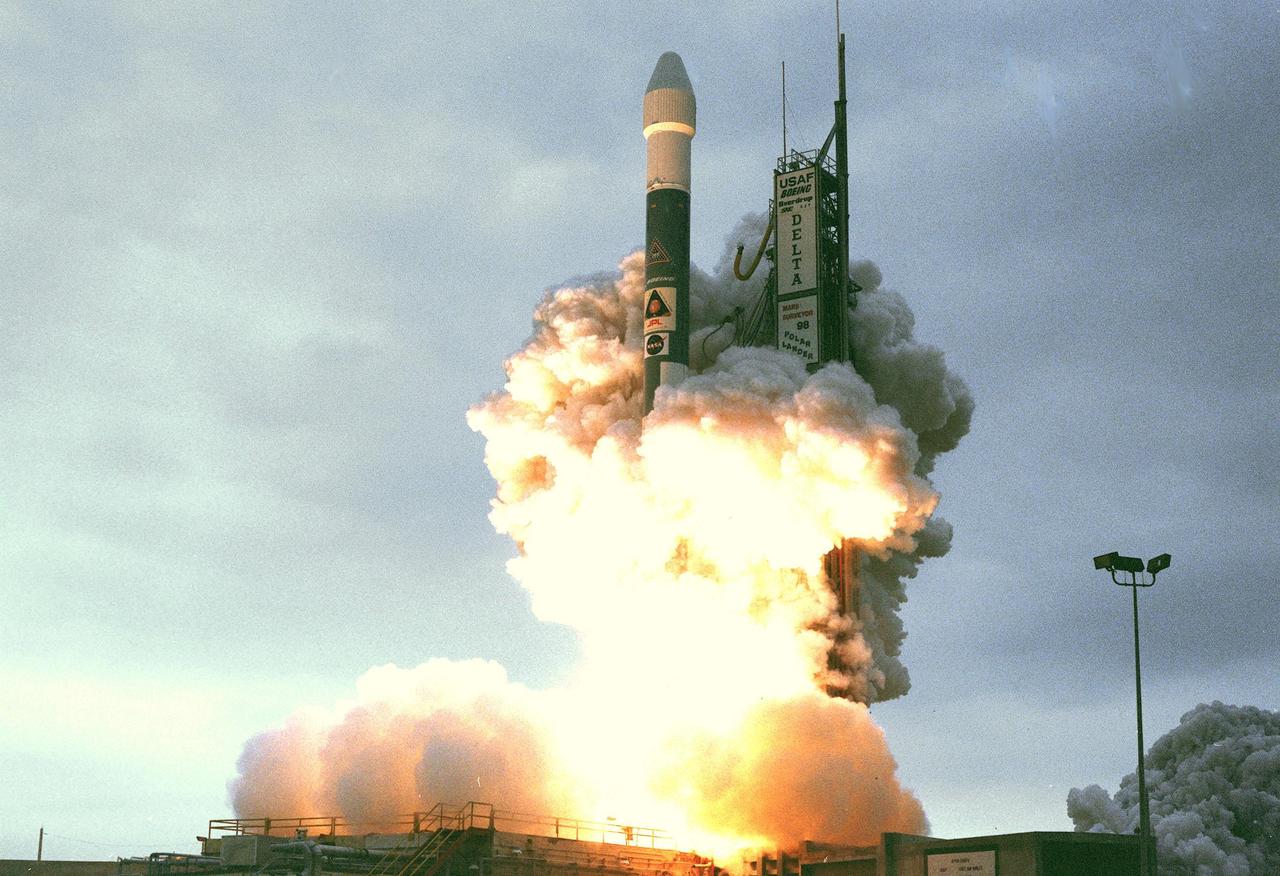
KENNEDY SPACE CENTER, FLA. -- Amid clouds of exhaust, a Boeing Delta II expendable launch vehicle with NASA's Mars Polar Lander clears Launch Complex 17B, Cape Canaveral Air Station, after launch at 3:21:10 p.m. EST. The lander is a solar-powered spacecraft designed to touch down on the Martian surface near the northern-most boundary of the south polar cap, which consists of carbon dioxide ice. The lander will study the polar water cycle, frosts, water vapor, condensates and dust in the Martian atmosphere. It is equipped with a robotic arm to dig beneath the layered terrain at the polar cap. In addition, Deep Space 2 microprobes, developed by NASA's New Millennium Program, are installed on the lander's cruise stage. After crashing into the planet's surface, they will conduct two days of soil and water experiments up to 1 meter (3 feet) below the Martian surface, testing new technologies for future planetary descent probes. The lander is the second spacecraft to be launched in a pair of Mars Surveyor '98 missions. The first is the Mars Climate Orbiter, which was launched aboard a Delta II rocket from Launch Complex 17A on Dec. 11, 1998.
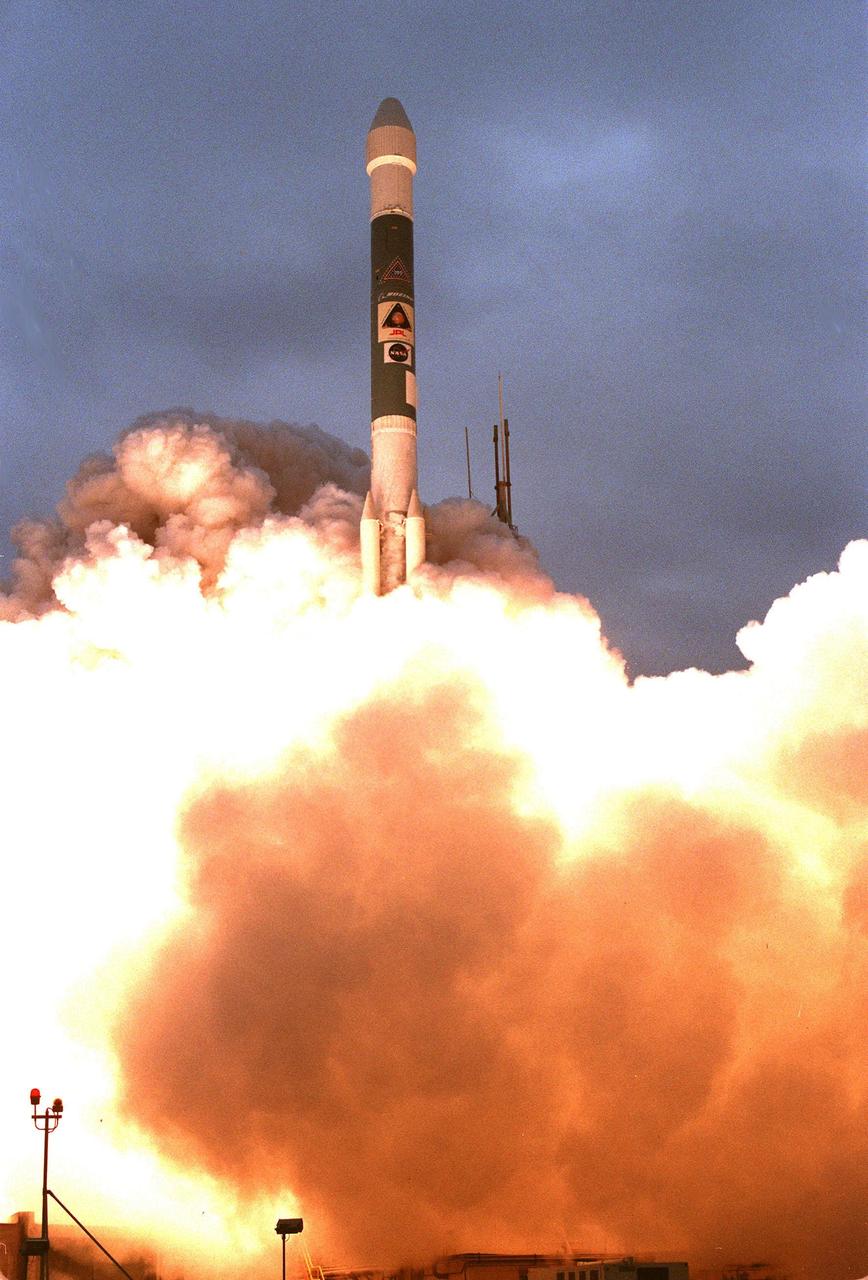
KENNEDY SPACE CENTER, FLA. -- A Boeing Delta II expendable launch vehicle lifts off with NASA's Mars Polar Lander into a cloud-covered sky at 3:21:10 p.m. EST from Launch Complex 17B, Cape Canaveral Air Station. The lander is a solar-powered spacecraft designed to touch down on the Martian surface near the northern-most boundary of the south polar cap, which consists of carbon dioxide ice. The lander will study the polar water cycle, frosts, water vapor, condensates and dust in the Martian atmosphere. It is equipped with a robotic arm to dig beneath the layered terrain at the polar cap. In addition, Deep Space 2 microprobes, developed by NASA's New Millennium Program, are installed on the lander's cruise stage. After crashing into the planet's surface, they will conduct two days of soil and water experiments up to 1 meter (3 feet) below the Martian surface, testing new technologies for future planetary descent probes. The lander is the second spacecraft to be launched in a pair of Mars Surveyor '98 missions. The first is the Mars Climate Orbiter, which was launched aboard a Delta II rocket from Launch Complex 17A on Dec. 11, 1998.
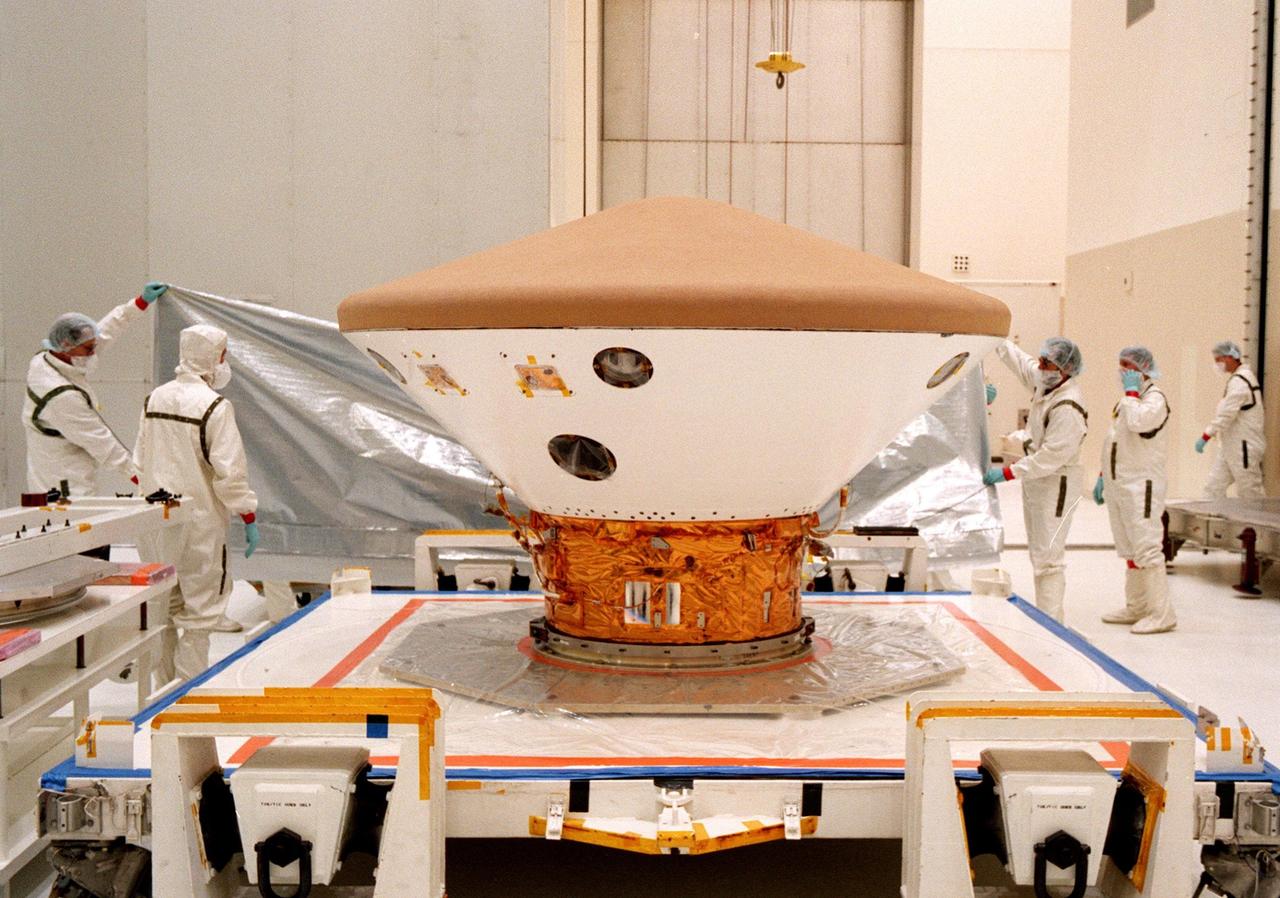
KENNEDY SPACE CENTER, FLA. -- In the Spacecraft Assembly and Encapsulation Facility-2 (SAEF-2), the protective covering for the Mars Polar Lander is removed so technicians can prepare the Lander for testing, which includes a functional test of the science instruments and the basic spacecraft subsystems. The Mars Polar Lander is targeted for launch from Cape Canaveral Air Station aboard a Delta II rocket on Jan. 3, 1999. The solar-powered spacecraft is designed to touch down on the Martian surface near the northern-most boundary of the south pole in order to study the water cycle there. The lander also will help scientists learn more about climate change and current resources on Mars, studying such things as frost, dust, water vapor and condensates in the Martian atmosphere
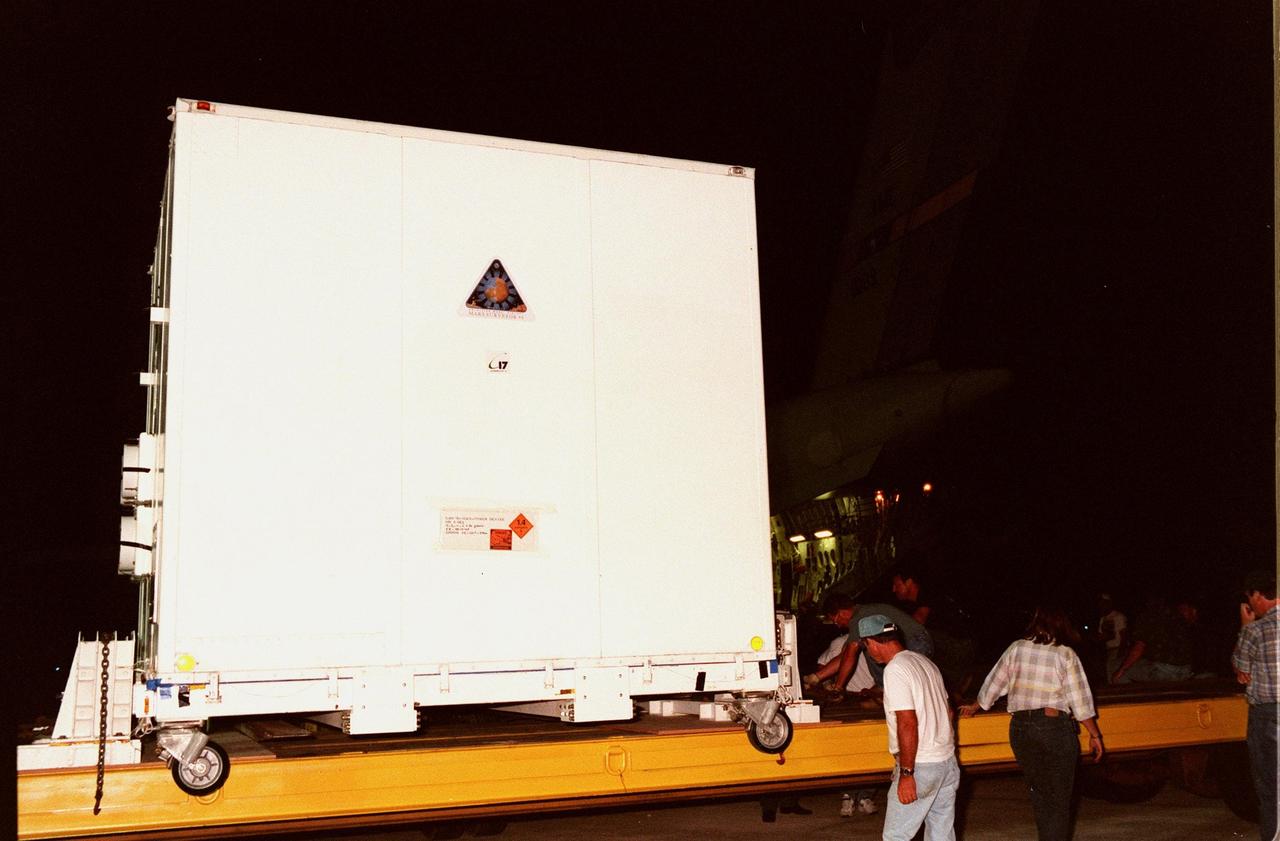
KENNEDY SPACE CENTER, FLA. -- At the Shuttle Landing Facility, the Mars Polar Lander is loaded onto a truck after its flight aboard an Air Force C-17 cargo plane that carried it from the Lockheed Martin Astronautics plant in Denver, CO. The lander is being transported to the Spacecraft Assembly and Encapsulation Facility-2(SAEF-2) in the KSC Industrial Area for testing, including a functional test of the science instruments and the basic spacecraft subsystems. The solar-powered spacecraft is designed to touch down on the Martian surface near the northern-most boundary of the south pole in order to study the water cycle there. The lander also will help scientists learn more about climate change and current resources on Mars, studying such things as frost, dust, water vapor and condensates in the Martian atmosphere. The Mars Polar Lander spacecraft is planned for launch from Cape Canaveral Air Station aboard a Delta II rocket on Jan. 3, 1999
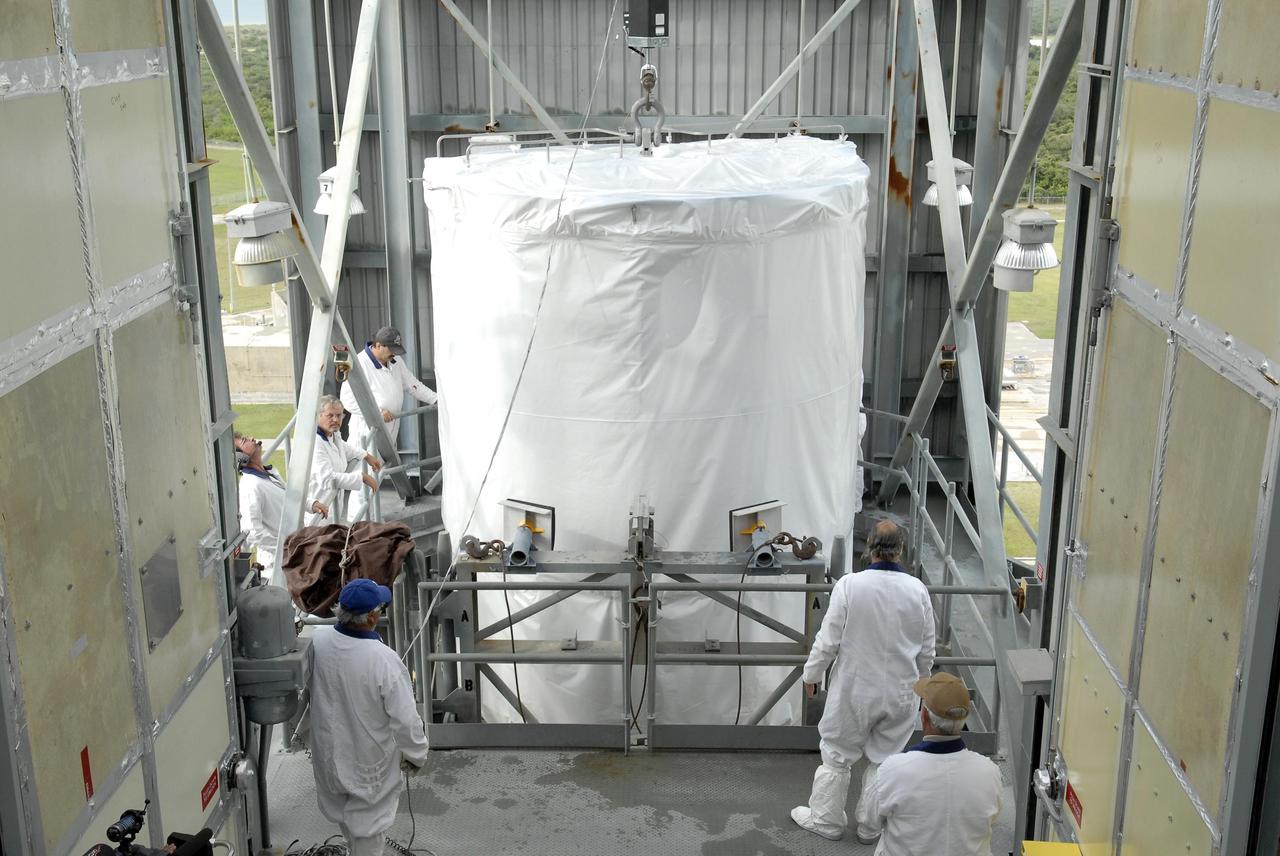
KENNEDY SPACE CENTER, FLA. — The Phoenix Mars Lander is lifted into the upper level of the mobile service tower on Launch Pad 17-A at Cape Canaveral Air Force Station. The lander will be mated to the Delta II launch vehicle. Launch of NASA's Phoenix Mars Lander is scheduled for Aug. 3. There are two instantaneous launch times, 5:35:18 and 6:11:24 a.m. EDT. Phoenix will land in icy soils near the north polar permanent ice cap of Mars and explore the history of the water in these soils and any associated rocks, while monitoring polar climate. Landing on Mars is planned in May 2008 on arctic ground where a mission currently in orbit, Mars Odyssey, has detected high concentrations of ice just beneath the top layer of soil. NASA/George Shelton
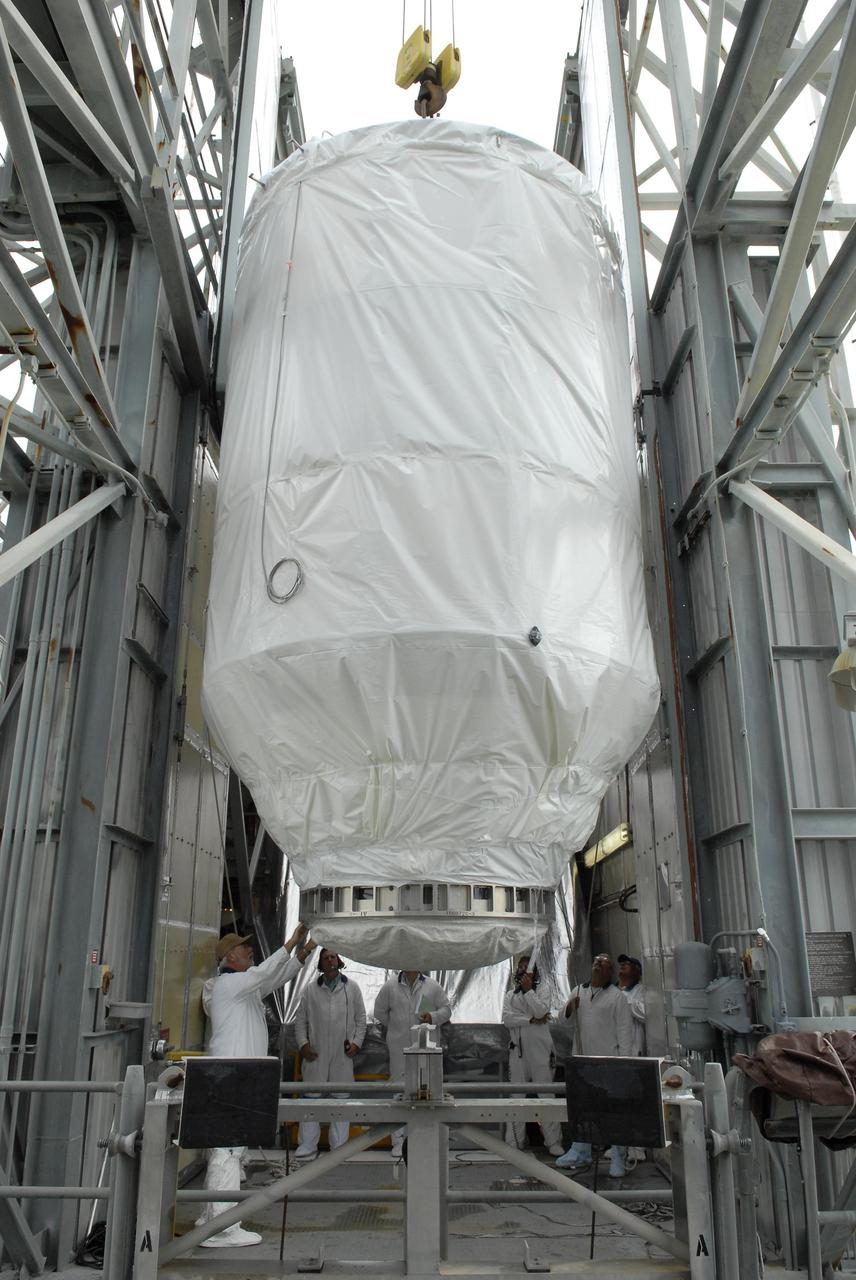
KENNEDY SPACE CENTER, FLA. — The Phoenix Mars Lander is moved inside the upper level of the mobile service tower on Launch Pad 17-A at Cape Canaveral Air Force Station. The lander will be mated to the Delta II launch vehicle. Launch of NASA's Phoenix Mars Lander is scheduled for Aug. 3. There are two instantaneous launch times, 5:35:18 and 6:11:24 a.m. EDT. Phoenix will land in icy soils near the north polar permanent ice cap of Mars and explore the history of the water in these soils and any associated rocks, while monitoring polar climate. Landing on Mars is planned in May 2008 on arctic ground where a mission currently in orbit, Mars Odyssey, has detected high concentrations of ice just beneath the top layer of soil. NASA/George Shelton
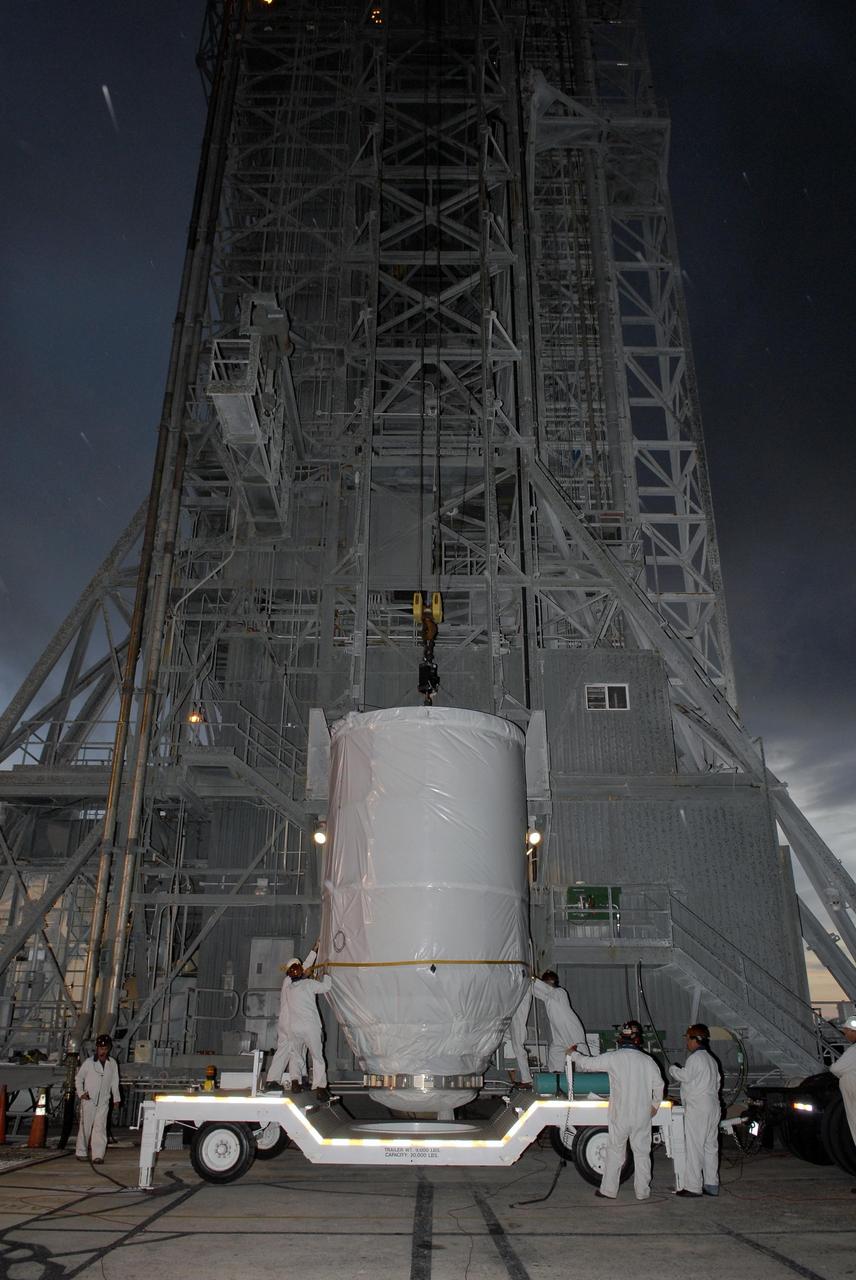
KENNEDY SPACE CENTER, FLA. — In front of the mobile service tower on Launch Pad 17-A at Cape Canaveral Air Force Station, workers attach an overhead crane to the Phoenix Mars Lander. The lander will be lifted up into the tower for mating to the Delta II launch vehicle. Launch of NASA's Phoenix Mars Lander is scheduled for Aug. 3. There are two instantaneous launch times, 5:35:18 and 6:11:24 a.m. EDT. Phoenix will land in icy soils near the north polar permanent ice cap of Mars and explore the history of the water in these soils and any associated rocks, while monitoring polar climate. Landing on Mars is planned in May 2008 on arctic ground where a mission currently in orbit, Mars Odyssey, has detected high concentrations of ice just beneath the top layer of soil. NASA/George Shelton
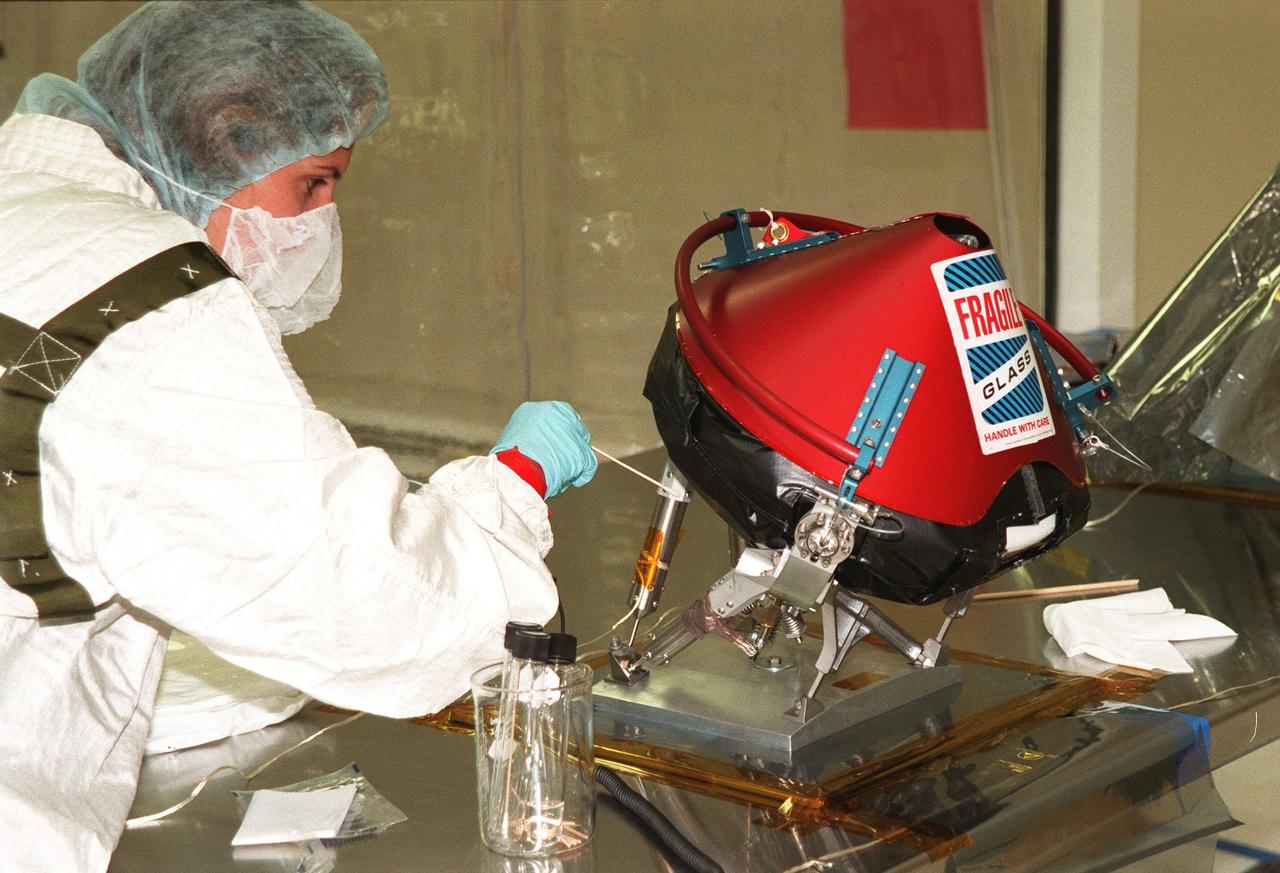
KENNEDY SPACE CENTER, FLA. -- In the Spacecraft Assembly and Encapsulation Facility -2 (SAEF-2), a JPL worker checks the Mars microprobe. Two microprobes will hitchhike on the Mars Polar Lander, scheduled to be launched Jan. 3, 1999, aboard a Delta II rocket. The solar-powered spacecraft is designed to touch down on the Martian surface near the northern-most boundary of the south pole in order to study the water cycle there. The lander also will help scientists learn more about climate change and current resources on Mars, studying such things as frost, dust, water vapor and condensates in the Martian atmosphere. The Mars microprobes, called Deep Space 2, are part of NASA's New Millennium Program. They will complement the climate-related scientific focus of the lander by demonstrating an advanced, rugged microlaser system for detecting subsurface water. Such data on polar subsurface water, in the form of ice, should help put limits on scientific projections for the global abundance of water on Mars
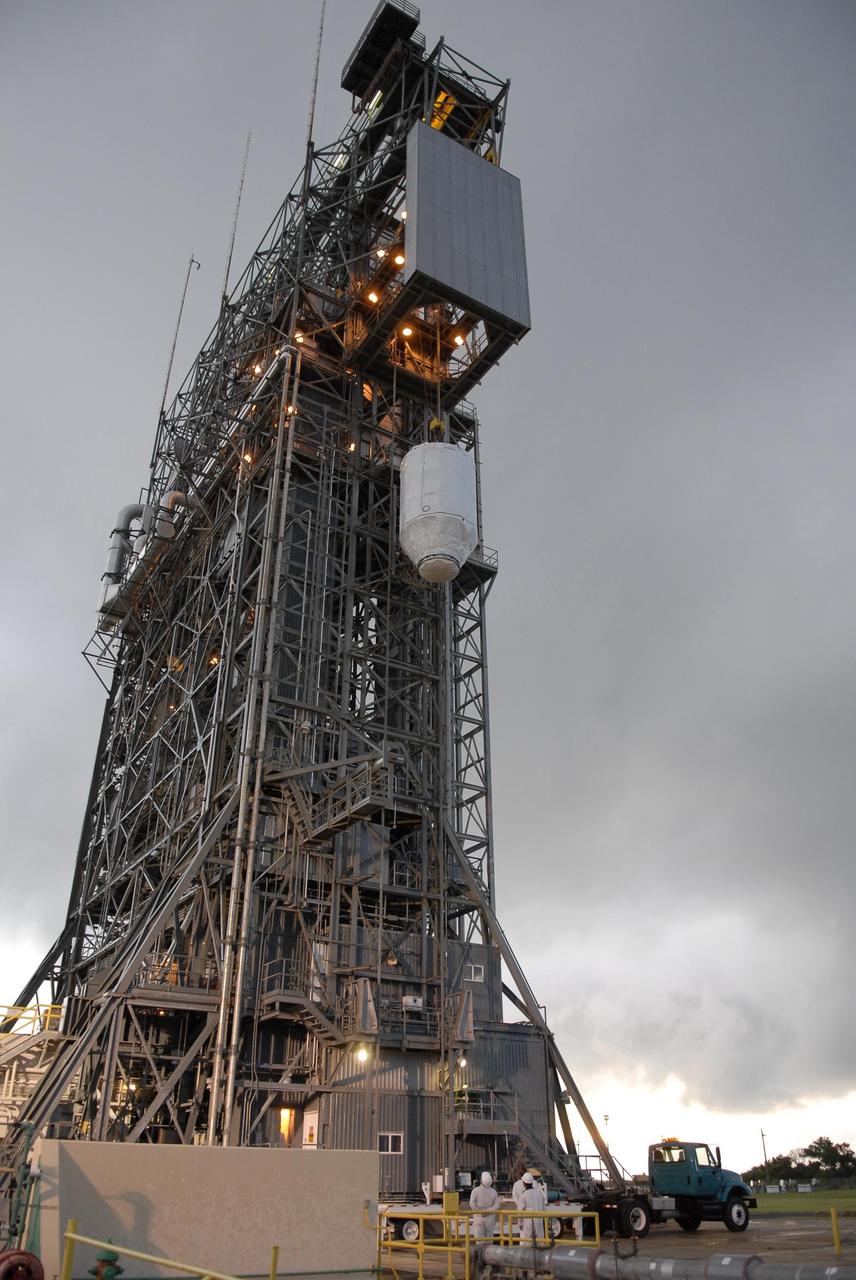
KENNEDY SPACE CENTER, FLA. — Attached to an overhead crane, the Phoenix Mars Lander nears the upper level of the mobile service tower on Launch Pad 17-A at Cape Canaveral Air Force Station. Once inside the tower, the lander will be mated to the Delta II launch vehicle. Launch of NASA's Phoenix Mars Lander is scheduled for Aug. 3. There are two instantaneous launch times, 5:35:18 and 6:11:24 a.m. EDT. Phoenix will land in icy soils near the north polar permanent ice cap of Mars and explore the history of the water in these soils and any associated rocks, while monitoring polar climate. Landing on Mars is planned in May 2008 on arctic ground where a mission currently in orbit, Mars Odyssey, has detected high concentrations of ice just beneath the top layer of soil. NASA/George Shelton
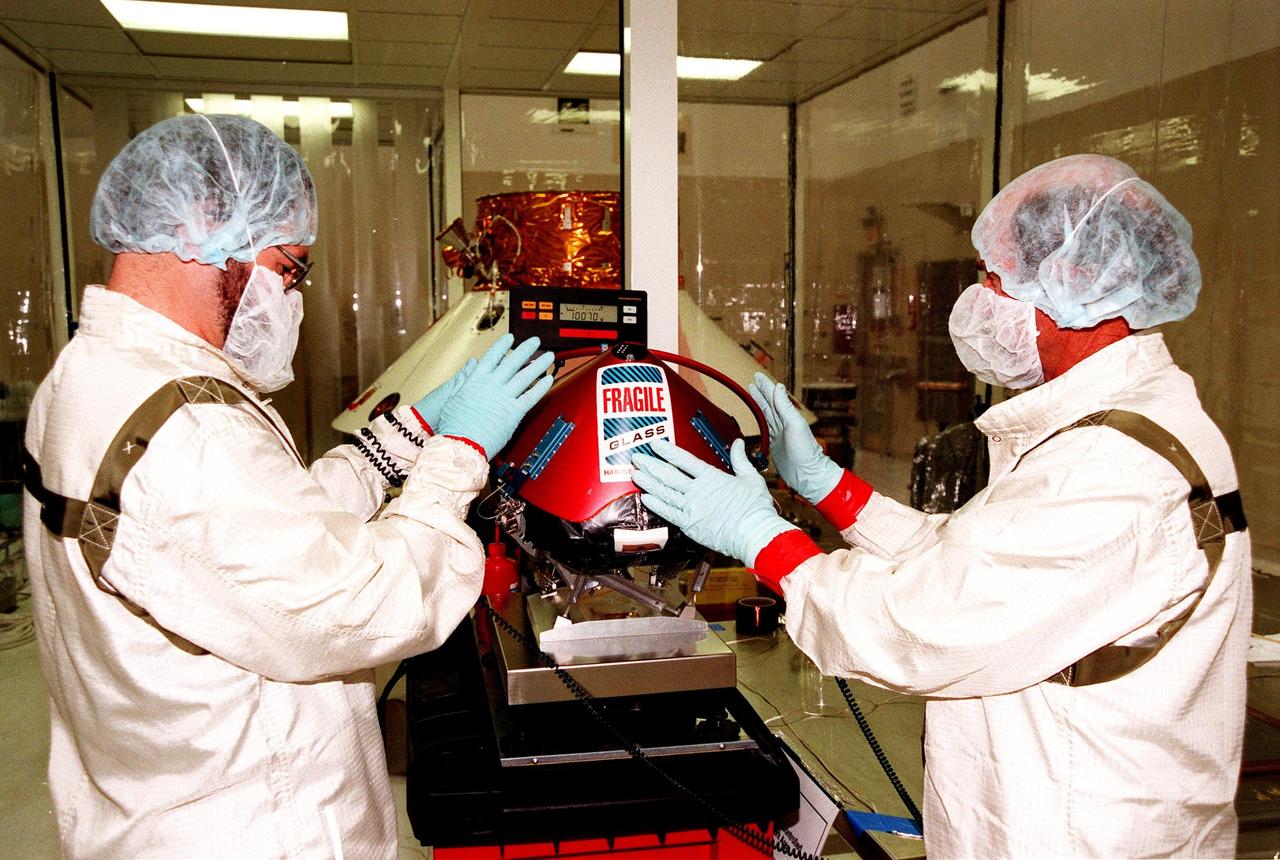
KENNEDY SPACE CENTER, FLA. -- In the Spacecraft Assembly and Encapsulation Facility -2 (SAEF-2), two JPL workers measure a Mars microprobe. Two microprobes will hitchhike on the Mars Polar Lander, scheduled to be launched Jan. 3, 1999, aboard a Delta II rocket. The solar-powered spacecraft is designed to touch down on the Martian surface near the northern-most boundary of the south pole in order to study the water cycle there. The lander also will help scientists learn more about climate change and current resources on Mars, studying such things as frost, dust, water vapor and condensates in the Martian atmosphere. The Mars microprobes, called Deep Space 2, are part of NASA's New Millennium Program. They will complement the climate-related scientific focus of the lander by demonstrating an advanced, rugged microlaser system for detecting subsurface water. Such data on polar subsurface water, in the form of ice, should help put limits on scientific projections for the global abundance of water on Mars
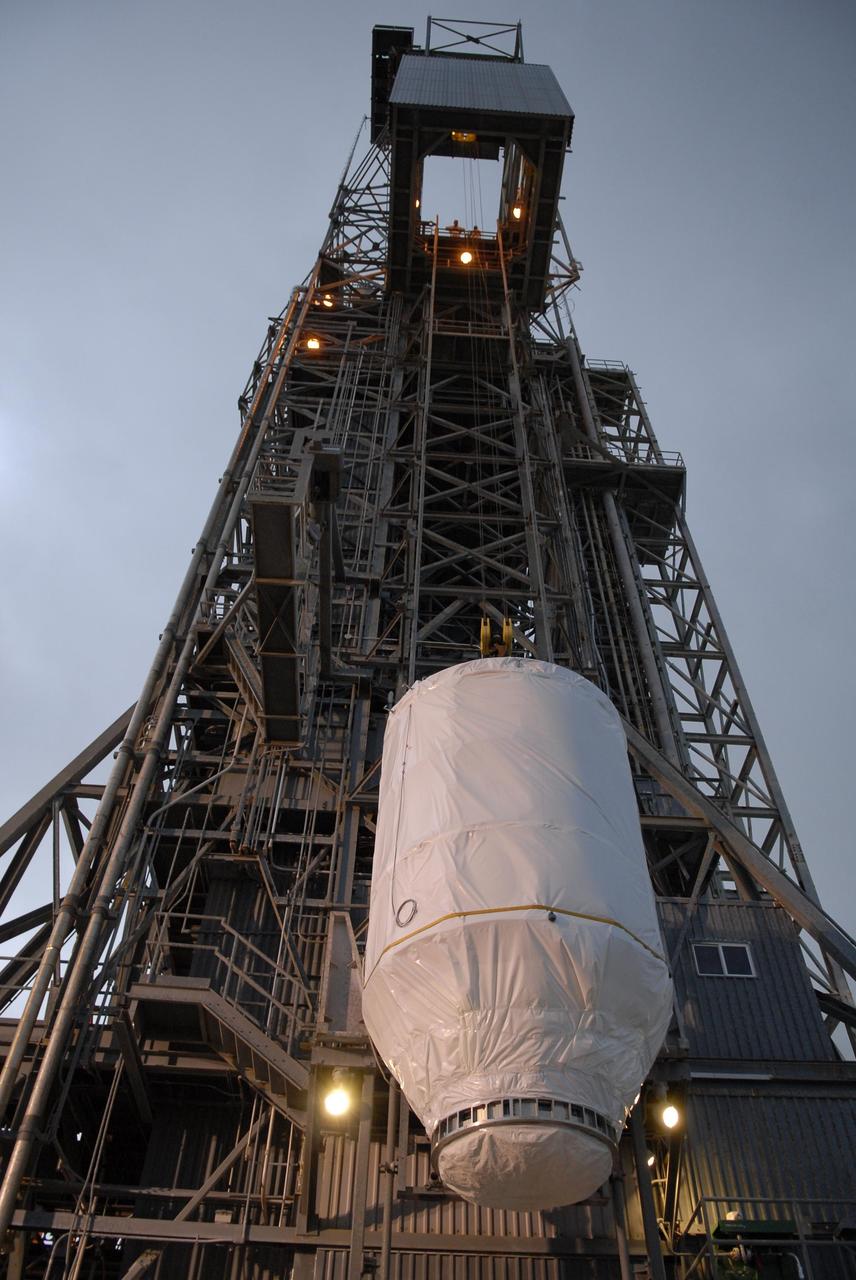
KENNEDY SPACE CENTER, FLA. — Attached to an overhead crane, the Phoenix Mars Lander is lifted up alongside the mobile service tower on Launch Pad 17-A at Cape Canaveral Air Force Station. Once inside the tower, the lander will be mated to the Delta II launch vehicle. Launch of NASA's Phoenix Mars Lander is scheduled for Aug. 3. There are two instantaneous launch times, 5:35:18 and 6:11:24 a.m. EDT. Phoenix will land in icy soils near the north polar permanent ice cap of Mars and explore the history of the water in these soils and any associated rocks, while monitoring polar climate. Landing on Mars is planned in May 2008 on arctic ground where a mission currently in orbit, Mars Odyssey, has detected high concentrations of ice just beneath the top layer of soil. NASA/George Shelton
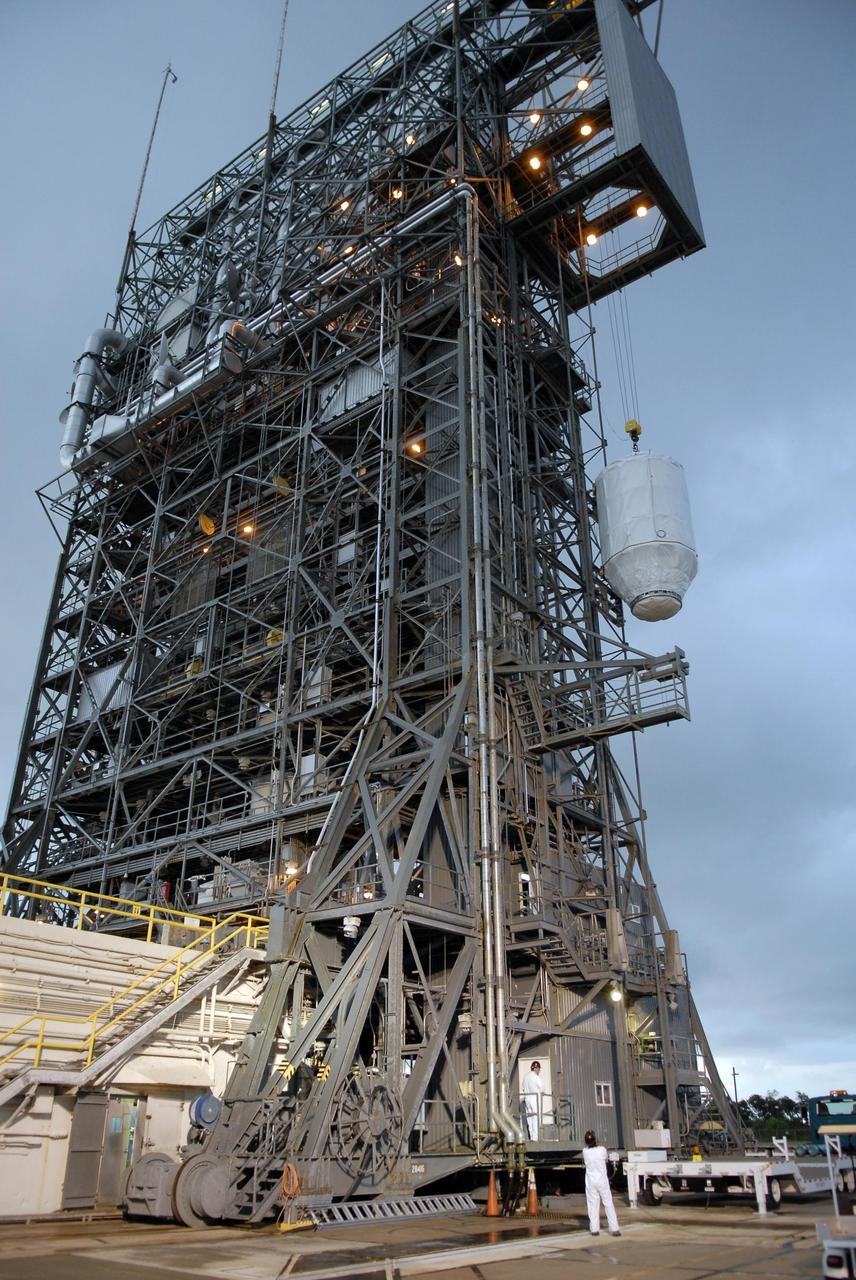
KENNEDY SPACE CENTER, FLA. — Attached to an overhead crane, the Phoenix Mars Lander is lifted up alongside the mobile service tower on Launch Pad 17-A at Cape Canaveral Air Force Station. Once inside the tower, the lander will be mated to the Delta II launch vehicle. Launch of NASA's Phoenix Mars Lander is scheduled for Aug. 3. There are two instantaneous launch times, 5:35:18 and 6:11:24 a.m. EDT. Phoenix will land in icy soils near the north polar permanent ice cap of Mars and explore the history of the water in these soils and any associated rocks, while monitoring polar climate. Landing on Mars is planned in May 2008 on arctic ground where a mission currently in orbit, Mars Odyssey, has detected high concentrations of ice just beneath the top layer of soil. NASA/George Shelton
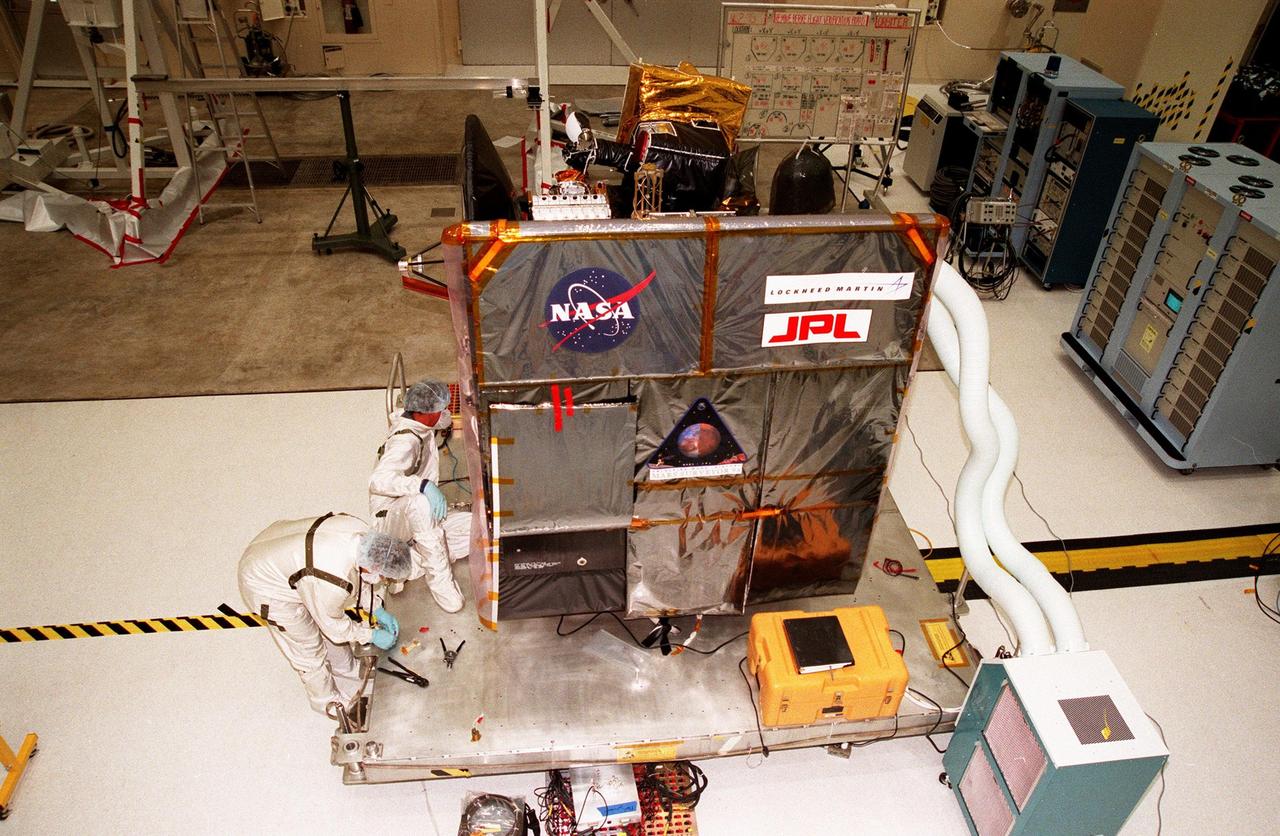
KENNEDY SPACE CENTER, FLA. -- In the Spacecraft Assembly and Encapsulation Facility -2 (SAEF-2), the Mars Polar Lander is prepared to receive a number of microprobes being added to the spacecraft. Scheduled to be launched on Jan. 3, 1999, the solar-powered spacecraft is designed to touch down on the Martian surface near the northern-most boundary of the south pole in order to study the water cycle there. The lander also will help scientists learn more about climate change and current resources on Mars, studying such things as frost, dust, water vapor and condensates in the Martian atmosphere. The Mars microprobes will complement the climate-related scientific focus of the lander by demonstrating an advanced, rugged microlaser system for detecting subsurface water. Such data on polar subsurface water, in the form of ice, should help put limits on scientific projections for the global abundance of water on Mars
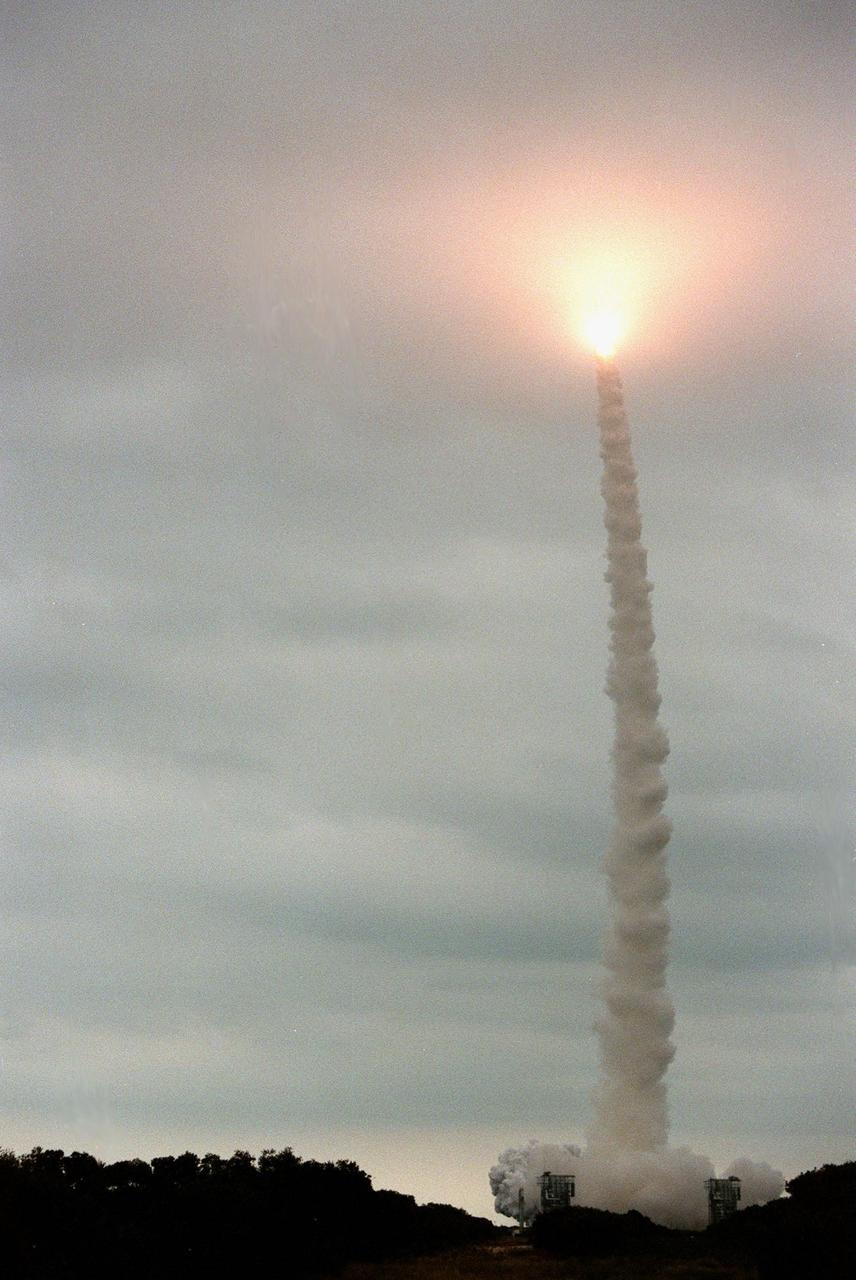
KENNEDY SPACE CENTER, FLA. -- Looking like a Roman candle, the exhaust from the Boeing Delta II rocket with the Mars Polar Lander aboard lights up the clouds as it hurtles skyward. The rocket was launched at 3:21:10 p.m. EST from Launch Complex 17B, Cape Canaveral Air Station. The lander is a solar-powered spacecraft designed to touch down on the Martian surface near the northern-most boundary of the south polar cap, which consists of carbon dioxide ice. The lander will study the polar water cycle, frosts, water vapor, condensates and dust in the Martian atmosphere. It is equipped with a robotic arm to dig beneath the layered terrain. In addition, Deep Space 2 microprobes, developed by NASA's New Millennium Program, are installed on the lander's cruise stage. After crashing into the planet's surface, they will conduct two days of soil and water experiments up to 1 meter (3 feet) below the Martian surface, testing new technologies for future planetary descent probes. The lander is the second spacecraft to be launched in a pair of Mars Surveyor '98 missions. The first is the Mars Climate Orbiter, which was launched aboard a Delta II rocket from Launch Complex 17A on Dec. 11, 1998.
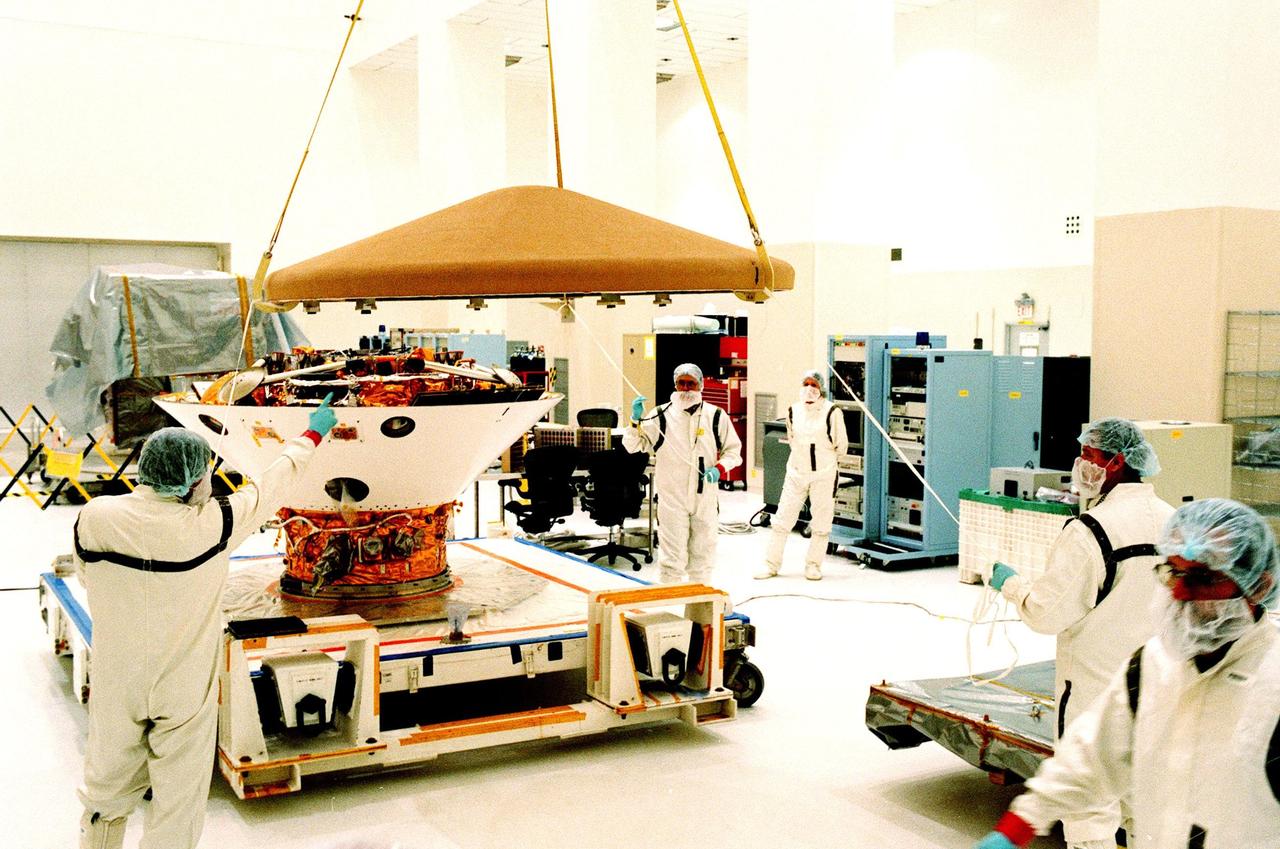
KENNEDY SPACE CENTER, FLA. -- In the Spacecraft Assembly and Encapsulation Facility-2 (SAEF-2), the top of the Mars Polar Lander is swung out of the way before testing, which includes a functional test of the science instruments and the basic spacecraft subsystems. The Mars Polar Lander is targeted for launch from Cape Canaveral Air Station aboard a Delta II rocket on Jan. 3, 1999. The solar-powered spacecraft is designed to touch down on the Martian surface near the northern-most boundary of the south pole in order to study the water cycle there. The lander also will help scientists learn more about climate change and current resources on Mars, studying such things as frost, dust, water vapor and condensates in the Martian atmosphere
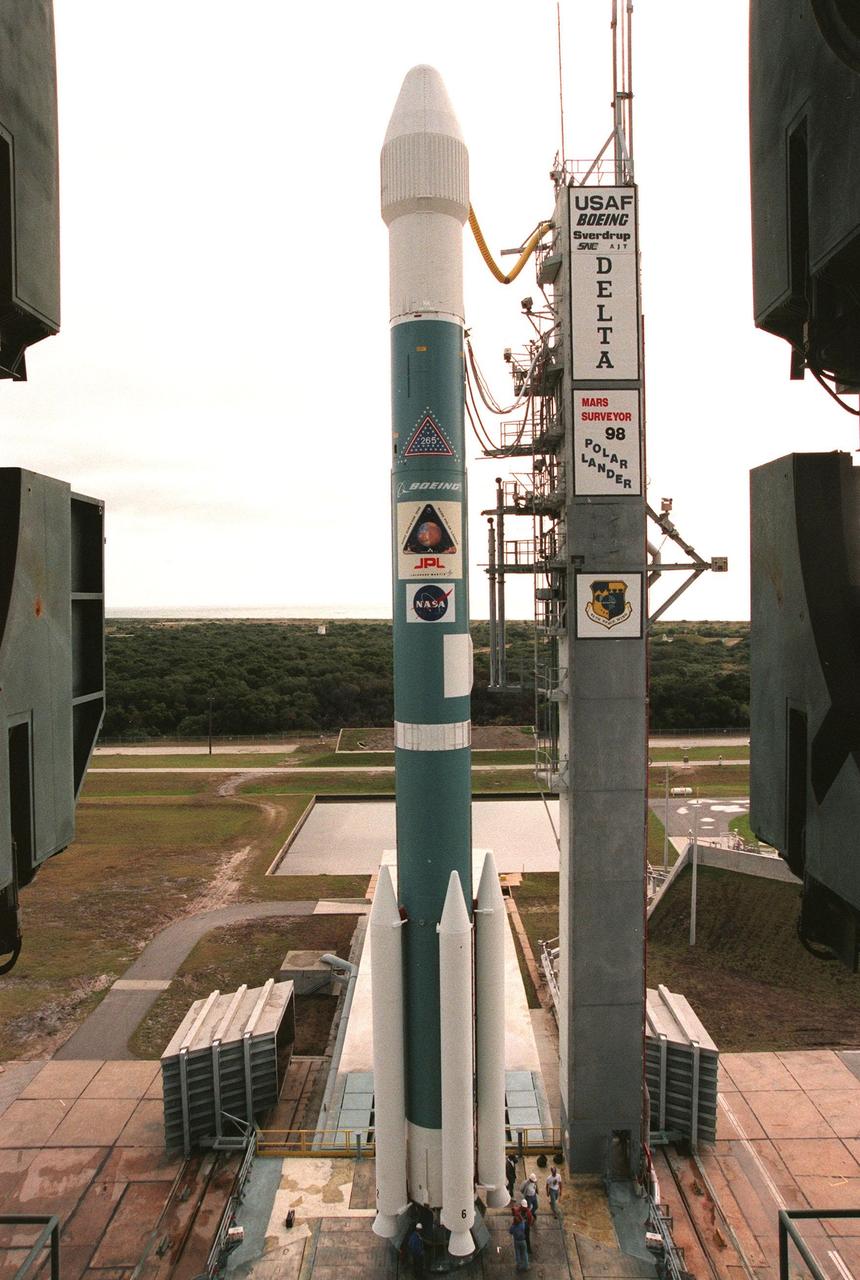
KENNEDY SPACE CENTER, FLA. -- After launch tower retraction, the Boeing Delta II rocket carrying NASA's Mars Polar lander waits for liftoff, scheduled for 3:21 p.m. EST, at Launch Complex 17B, Cape Canaveral Air Station. The lander is a solar-powered spacecraft designed to touch down on the Martian surface near the northern-most boundary of the south pole in order to study the water cycle there. The lander also will help scientists learn more about climate change and current resources on Mars, studying such things as frost, dust, water vapor and condensates in the Martian atmosphere. It is the second spacecraft to be launched in a pair of Mars Surveyor 98 missions
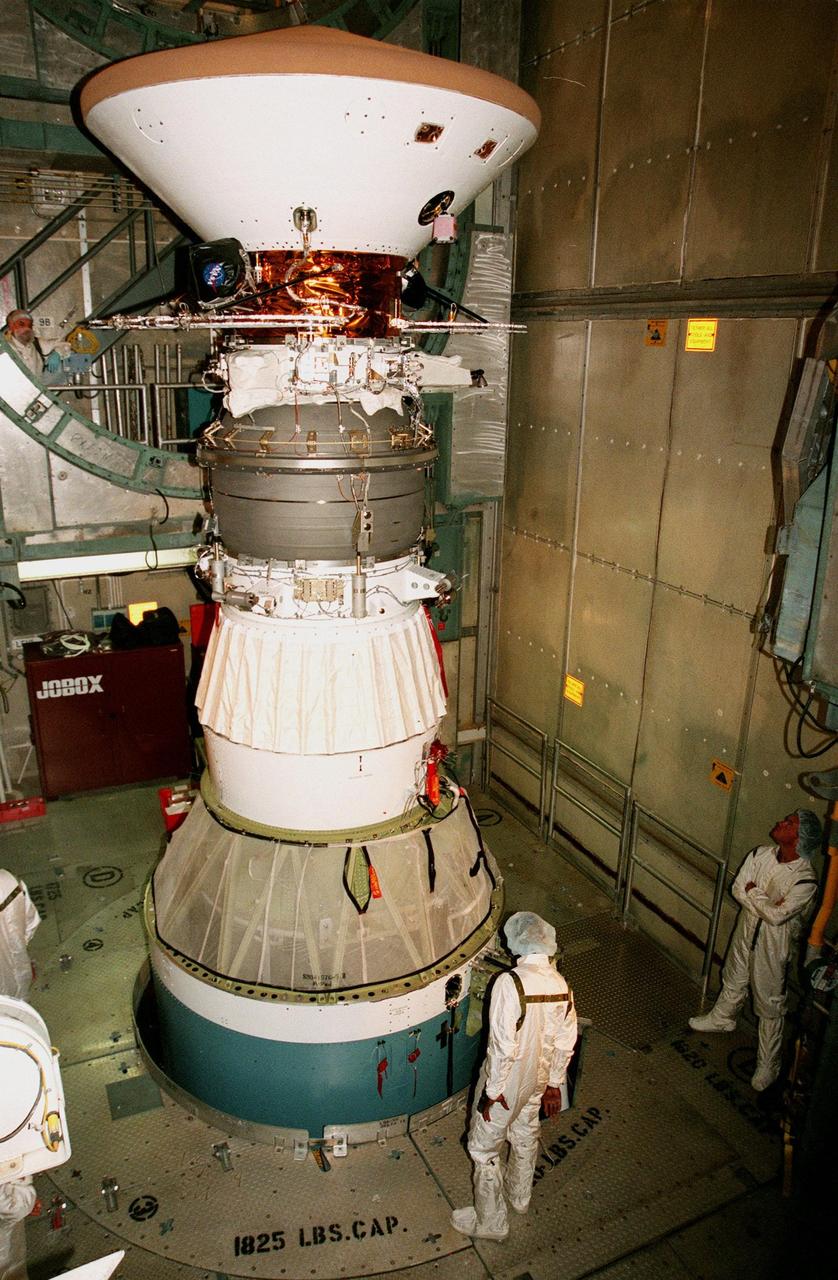
KENNEDY SPACE CENTER, FLA. -- At Launch Complex 17B, Cape Canaveral Air Station, workers look over the Mars Polar Lander (top) atop the Boeing Delta II rocket as it sits ready for the fairing to be attached. The rocket is scheduled to launch Jan. 3, 1999. The lander is a solar-powered spacecraft designed to touch down on the Martian surface near the northern-most boundary of the south pole in order to study the water cycle there. The lander also will help scientists learn more about climate change and current resources on Mars, studying such things as frost, dust, water vapor and condensates in the Martian atmosphere. It is the second spacecraft to be launched in a pair of Mars Surveyor '98 missions
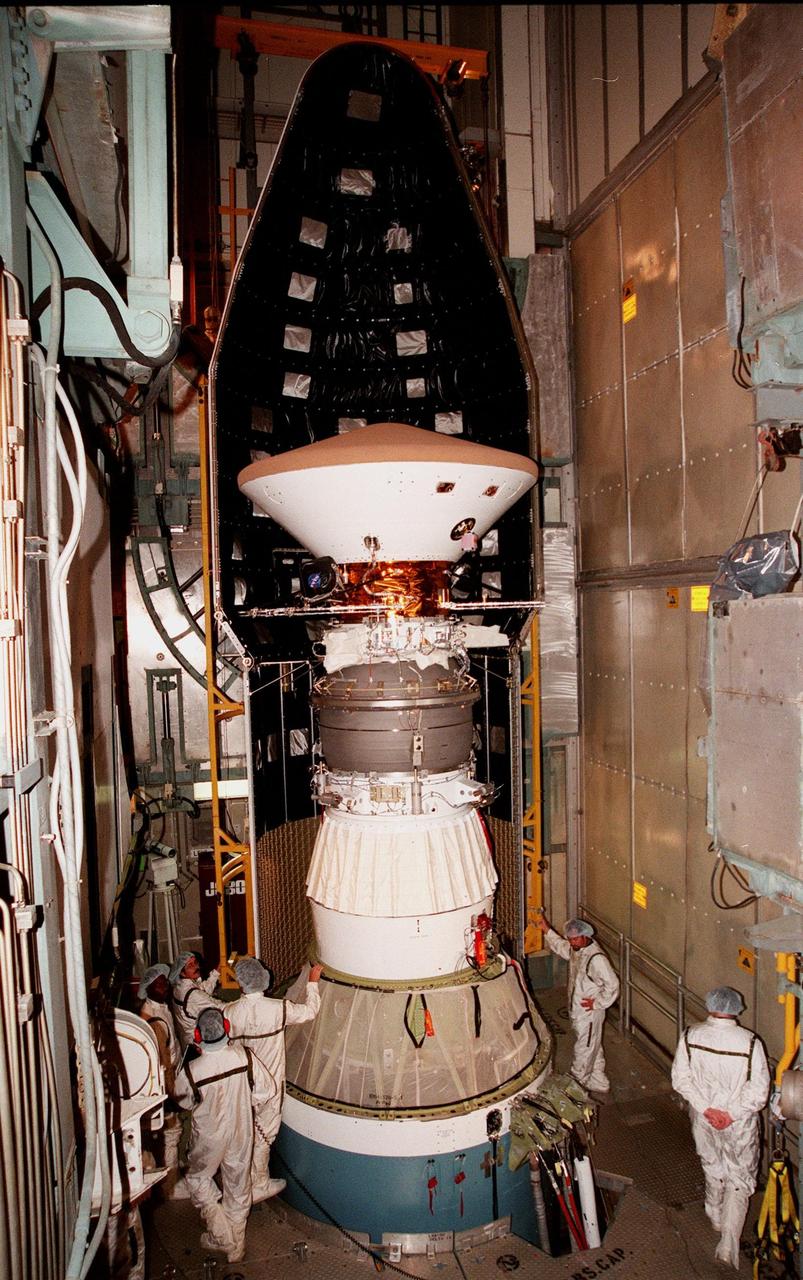
KENNEDY SPACE CENTER, FLA. -- At Launch Complex 17B, Cape Canaveral Air Station, workers begin fitting the fairing around the upper stages of the Boeing Delta II rocket and Mars Polar Lander. The rocket is scheduled to launch Jan. 3, 1999. The lander is a solar-powered spacecraft designed to touch down on the Martian surface near the northern-most boundary of the south pole in order to study the water cycle there. The lander also will help scientists learn more about climate change and current resources on Mars, studying such things as frost, dust, water vapor and condensates in the Martian atmosphere. It is the second spacecraft to be launched in a pair of Mars Surveyor '98 missions
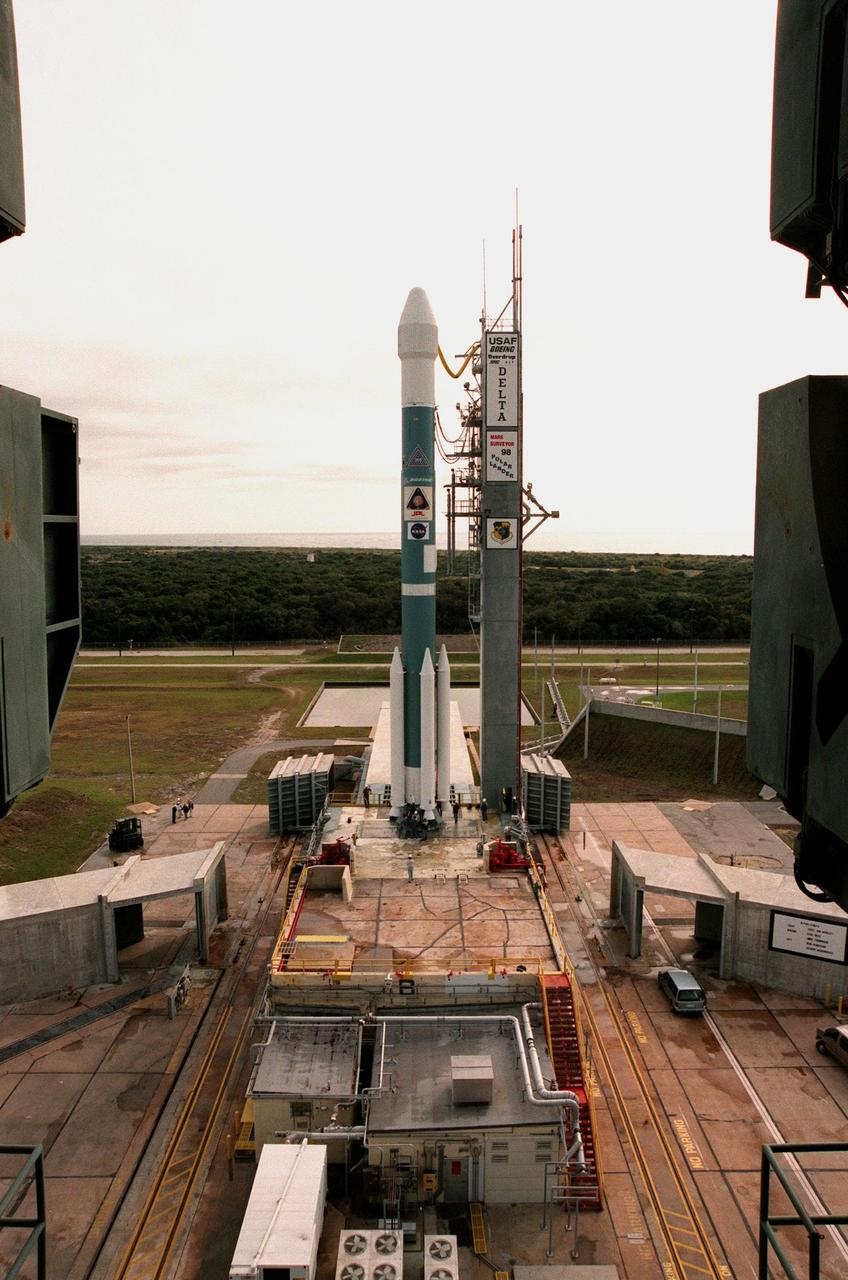
KENNEDY SPACE CENTER, FLA. -- After launch tower rollback, the Boeing Delta II rocket carrying NASA's Mars Polar lander awaits liftoff, scheduled for 3:21 p.m. EST, at Launch Complex 17B, Cape Canaveral Air Station. The lander is a solar-powered spacecraft designed to touch down on the Martian surface near the northern-most boundary of the south pole in order to study the water cycle there. The lander also will help scientists learn more about climate change and current resources on Mars, studying such things as frost, dust, water vapor and condensates in the Martian atmosphere. It is the second spacecraft to be launched in a pair of Mars Surveyor '98 missions
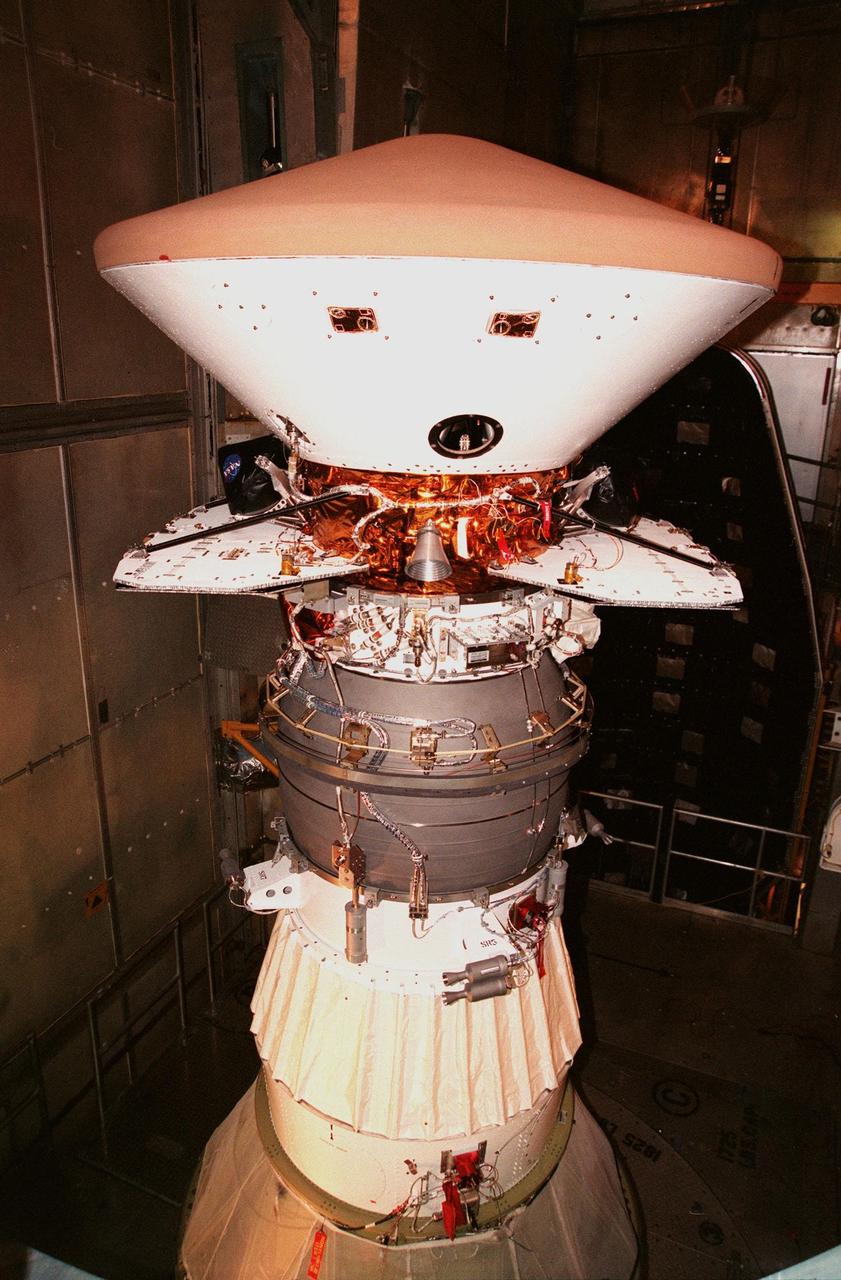
KENNEDY SPACE CENTER, FLA. -- At Launch Complex 17B, Cape Canaveral Air Station, the Mars Polar Lander (top) and the Boeing Delta II rocket to which it's attached sit ready for the fairing to be attached. The rocket is scheduled to launch Jan. 3, 1999. The lander is a solar-powered spacecraft designed to touch down on the Martian surface near the northern-most boundary of the south pole in order to study the water cycle there. The lander also will help scientists learn more about climate change and current resources on Mars, studying such things as frost, dust, water vapor and condensates in the Martian atmosphere. It is the second spacecraft to be launched in a pair of Mars Surveyor '98 missions
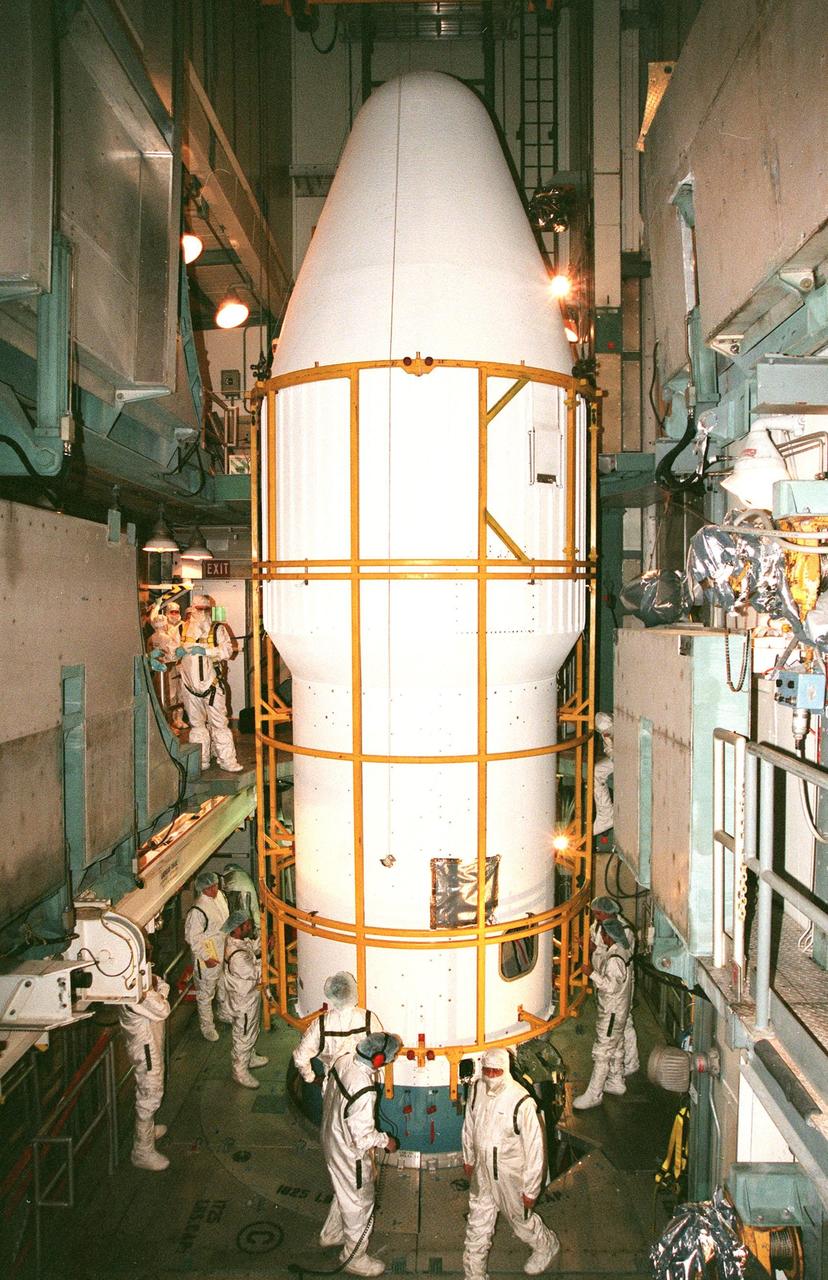
KENNEDY SPACE CENTER, FLA. -- At Launch Complex 17B, Cape Canaveral Air Station, workers check the closure of the fairing around the upper stages of the Boeing Delta II rocket and Mars Polar Lander. The rocket is scheduled to launch Jan. 3, 1999. The lander is a solar-powered spacecraft designed to touch down on the Martian surface near the northern-most boundary of the south pole in order to study the water cycle there. The lander also will help scientists learn more about climate change and current resources on Mars, studying such things as frost, dust, water vapor and condensates in the Martian atmosphere. It is the second spacecraft to be launched in a pair of Mars Surveyor '98 missions
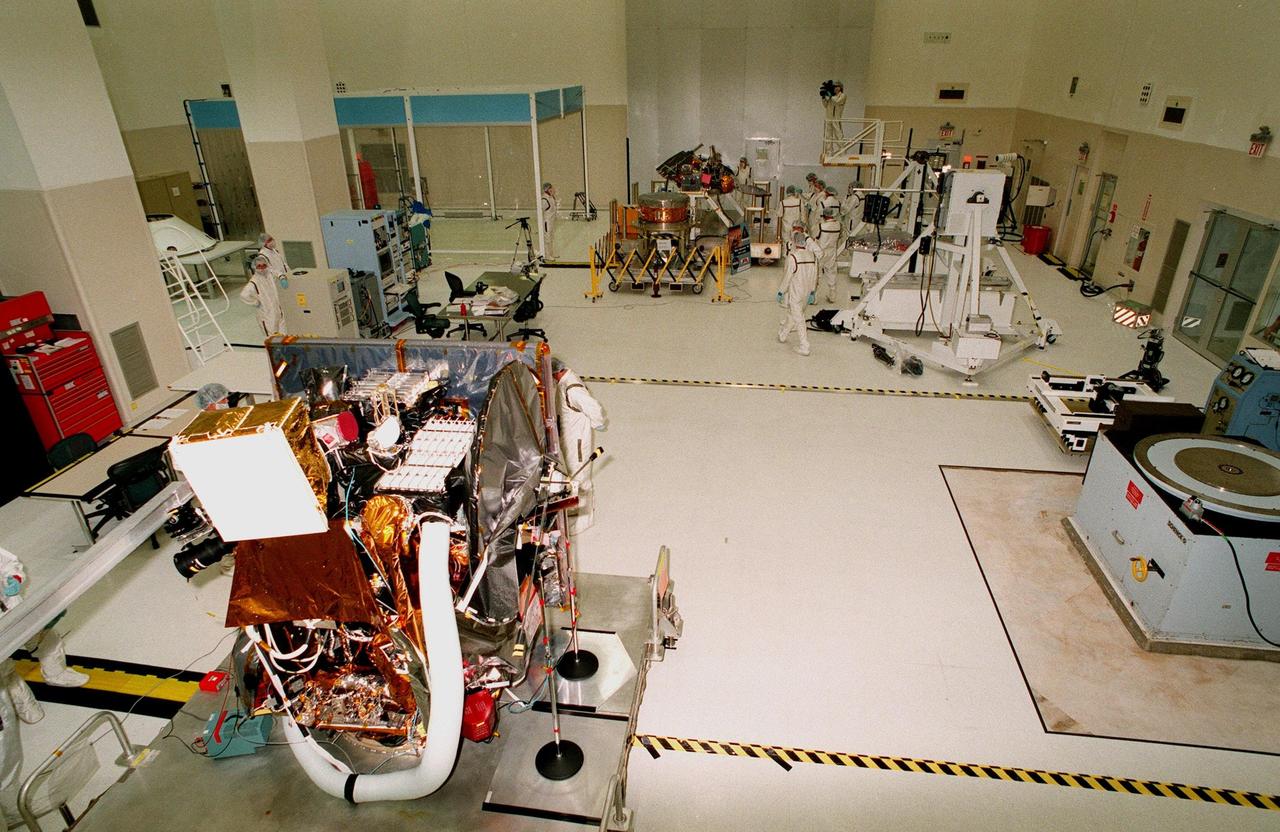
In the Spacecraft Assembly and Encapsulation Facility-2 (SAEF-2), the Mars Climate Orbiter (foreground) and the Mars Polar Lander are on display for the media. The scheduled launch date for the Mars Climate Orbiter is Dec. 10, 1998, aboard a Boeing Delta II rocket. It is heading for Mars where it will primarily support its companion Mars Polar Lander spacecraft, planned for launch on Jan. 3, 1999. After that, the Mars Climate Orbiter's instruments will monitor the Martian atmosphere and image the planet's surface on a daily basis for one Martian year (two Earth years). It will observe the appearance and movement of atmospheric dust and water vapor, as well as characterize seasonal changes on the surface. The detailed images of the surface features will provide important clues to the planet's early climate history and give scientists more information about possible liquid water reserves beneath the surface
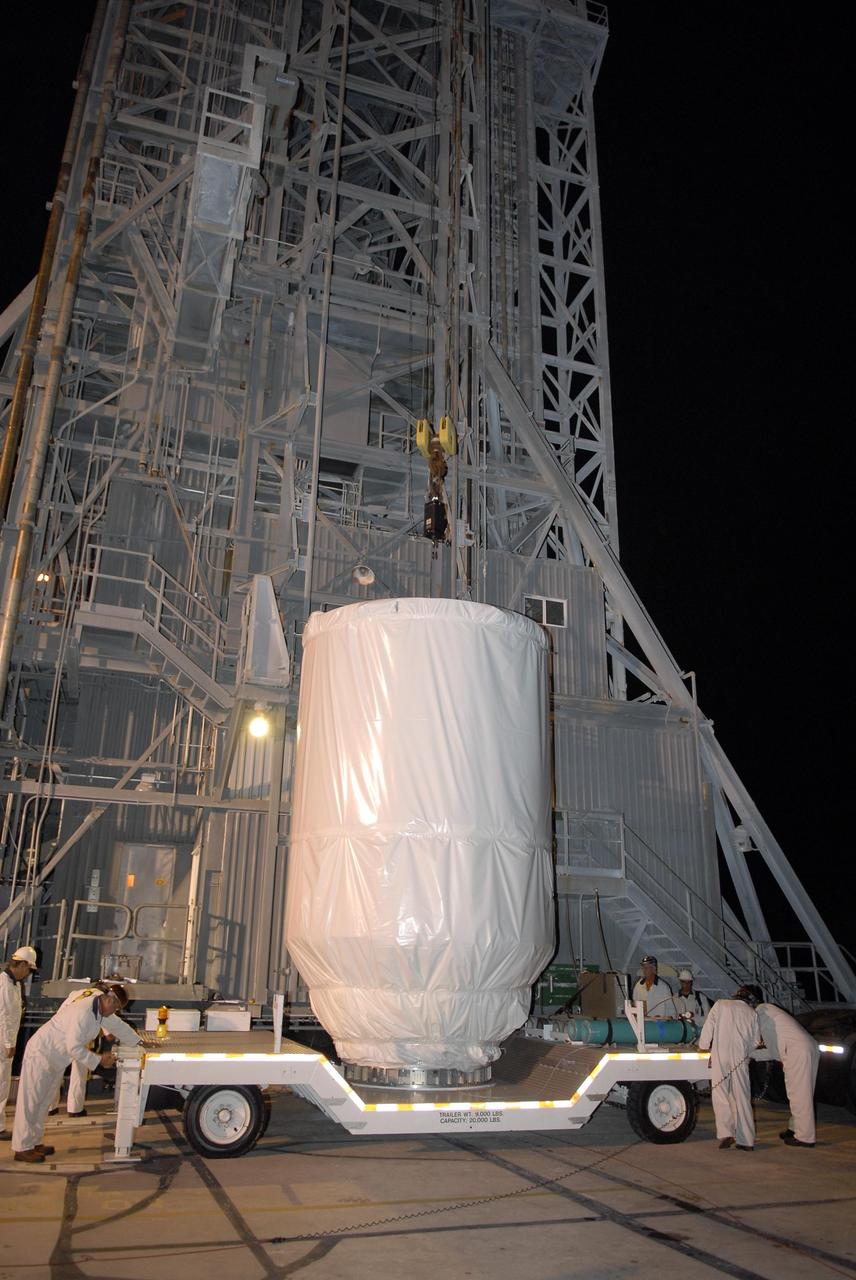
KENNEDY SPACE CENTER, FLA. — The Phoenix Mars Lander arrives at the mobile service tower on Launch Pad 17-A at Cape Canaveral Air Force Station. Launch of NASA's Phoenix Mars Lander is scheduled for Aug. 3. There are two instantaneous launch times, 5:35:18 and 6:11:24 a.m. EDT. Phoenix will land in icy soils near the north polar permanent ice cap of Mars and explore the history of the water in these soils and any associated rocks, while monitoring polar climate. Landing on Mars is planned in May 2008 on arctic ground where a mission currently in orbit, Mars Odyssey, has detected high concentrations of ice just beneath the top layer of soil. NASA/George Shelton
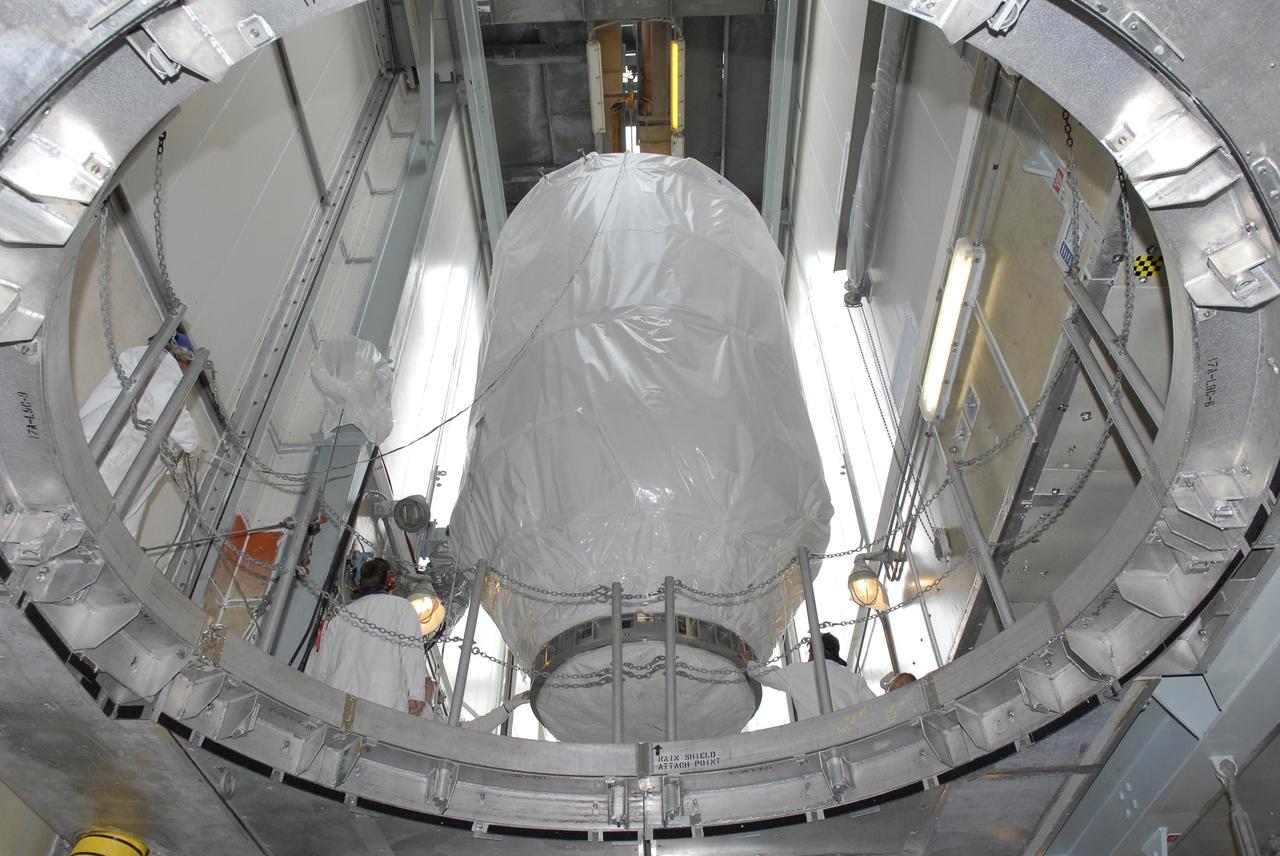
KENNEDY SPACE CENTER, FLA. — Viewed from below, the Phoenix Mars Lander moves toward the opening above the Delta II launch vehicle, to which it will be mated, inside the mobile service tower. Launch of NASA's Phoenix Mars Lander is scheduled for Aug. 3. There are two instantaneous launch times, 5:35:18 and 6:11:24 a.m. EDT. Phoenix will land in icy soils near the north polar permanent ice cap of Mars and explore the history of the water in these soils and any associated rocks, while monitoring polar climate. Landing on Mars is planned in May 2008 on arctic ground where a mission currently in orbit, Mars Odyssey, has detected high concentrations of ice just beneath the top layer of soil. NASA/George Shelton
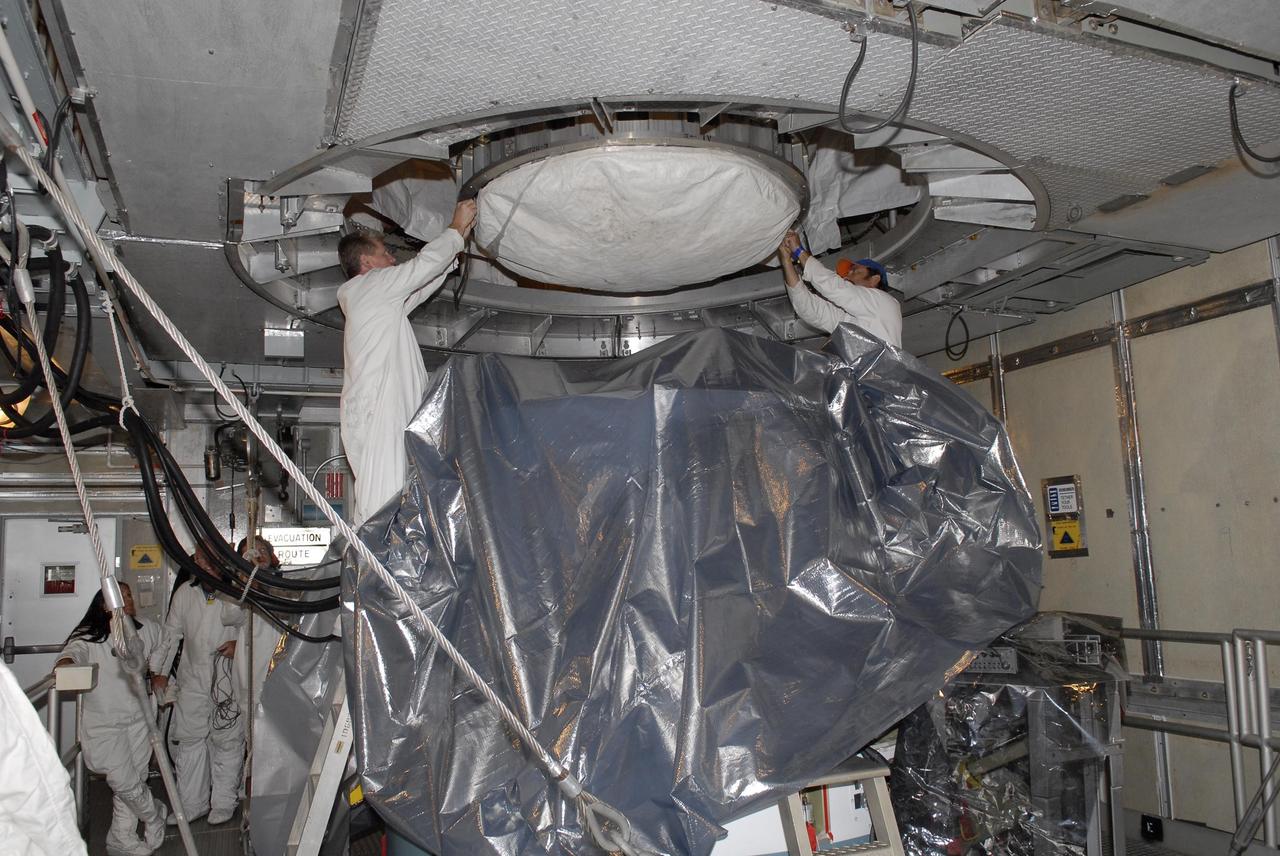
KENNEDY SPACE CENTER, FLA. — Inside the mobile service tower on Launch Pad 17-A, the Phoenix Mars Lander is lowered toward the Delta II second stage for mating. Launch of NASA's Phoenix Mars Lander is scheduled for Aug. 3. There are two instantaneous launch times, 5:35:18 and 6:11:24 a.m. EDT. Phoenix will land in icy soils near the north polar permanent ice cap of Mars and explore the history of the water in these soils and any associated rocks, while monitoring polar climate. Landing on Mars is planned in May 2008 on arctic ground where a mission currently in orbit, Mars Odyssey, has detected high concentrations of ice just beneath the top layer of soil. NASA/George Shelton
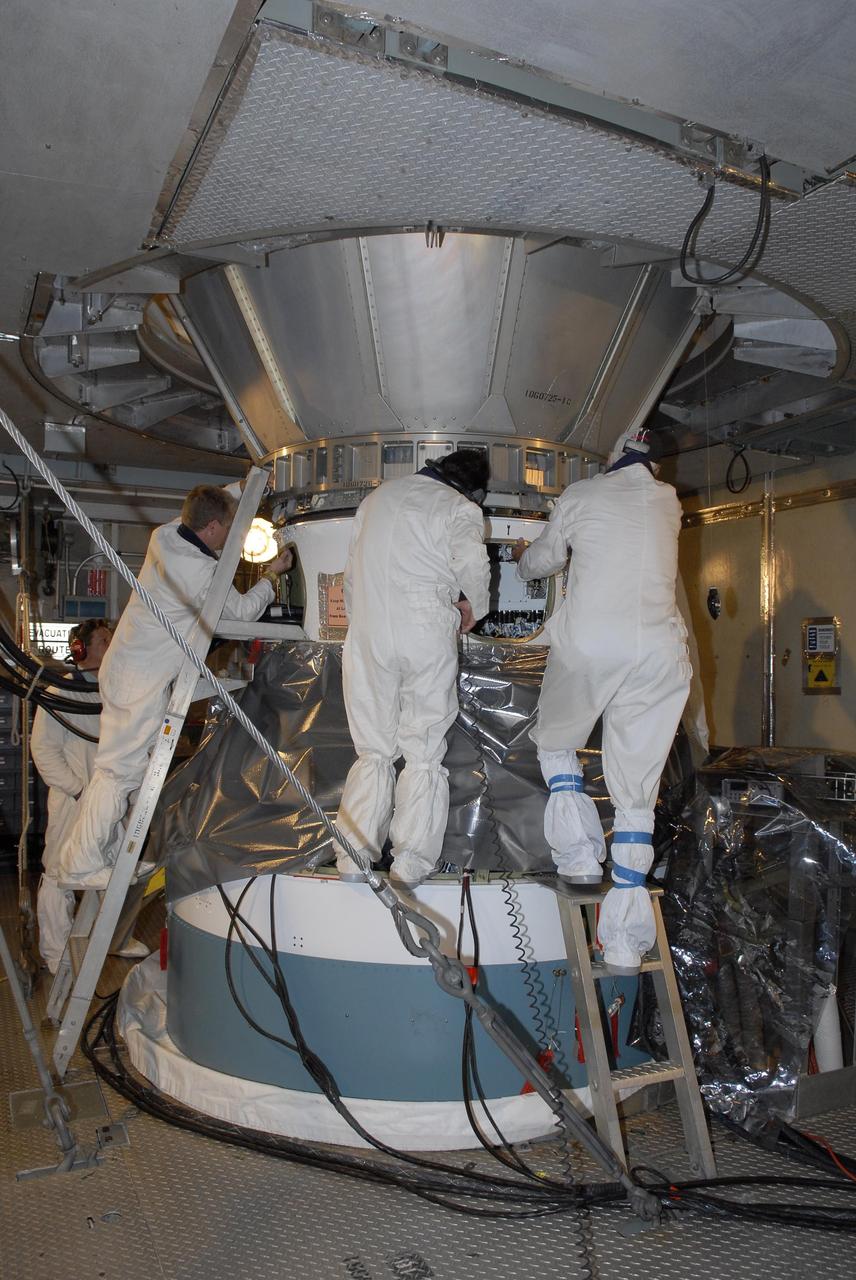
KENNEDY SPACE CENTER, FLA. — Inside the mobile service tower, the Phoenix Mars Lander is lowered toward the Delta II second stage for mating. Launch of NASA's Phoenix Mars Lander is scheduled for Aug. 3. There are two instantaneous launch times, 5:35:18 and 6:11:24 a.m. EDT. Phoenix will land in icy soils near the north polar permanent ice cap of Mars and explore the history of the water in these soils and any associated rocks, while monitoring polar climate. Landing on Mars is planned in May 2008 on arctic ground where a mission currently in orbit, Mars Odyssey, has detected high concentrations of ice just beneath the top layer of soil. NASA/George Shelton
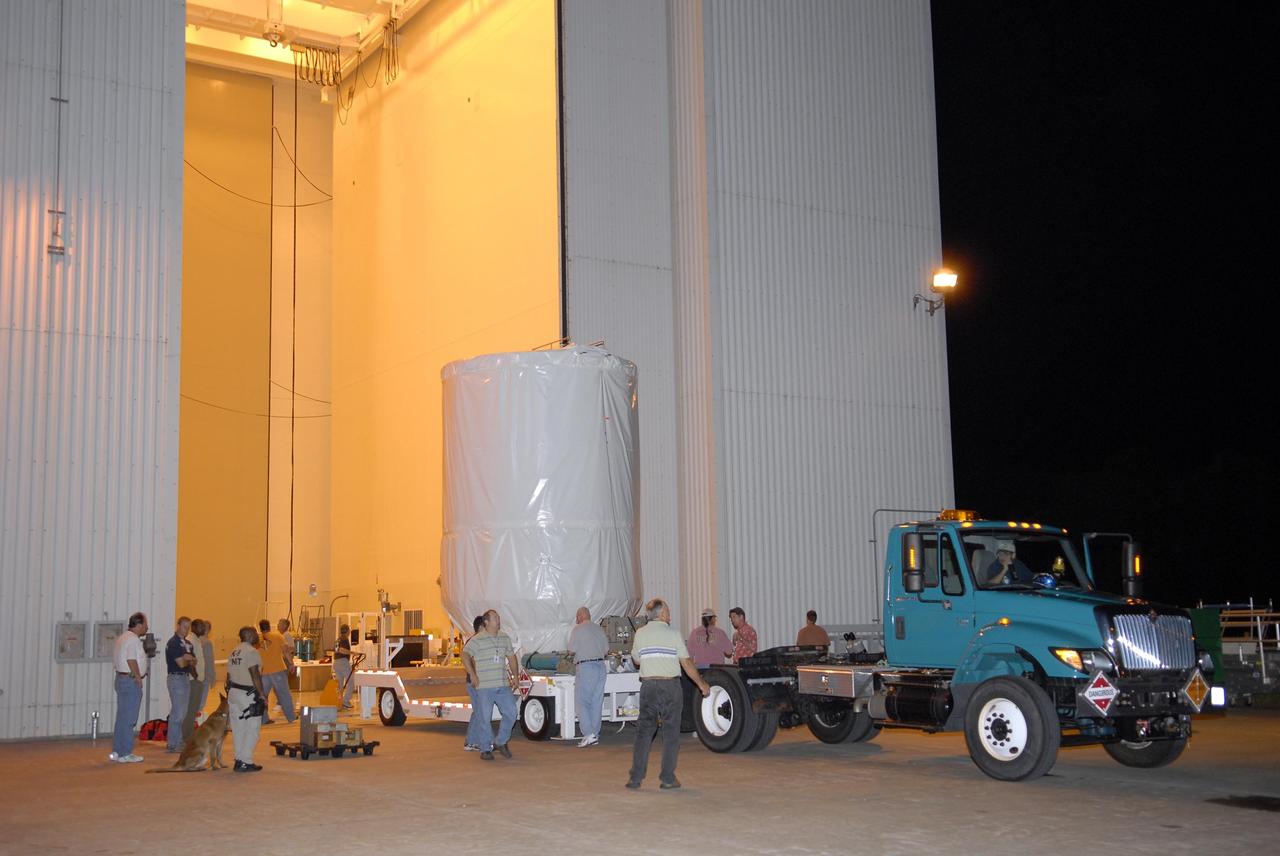
KENNEDY SPACE CENTER, FLA. — The Phoenix Mars Lander, on its transporter, is escorted out of the Payload Hazardous Servicing Facility for its transfer to Launch Pad 17-A at Cape Canaveral Air Force Station. Launch of NASA's Phoenix Mars Lander is scheduled for Aug. 3. There are two instantaneous launch times, 5:35:18 and 6:11:24 a.m. EDT. Phoenix will land in icy soils near the north polar permanent ice cap of Mars and explore the history of the water in these soils and any associated rocks, while monitoring polar climate. Landing on Mars is planned in May 2008 on arctic ground where a mission currently in orbit, Mars Odyssey, has detected high concentrations of ice just beneath the top layer of soil. NASA/George Shelton
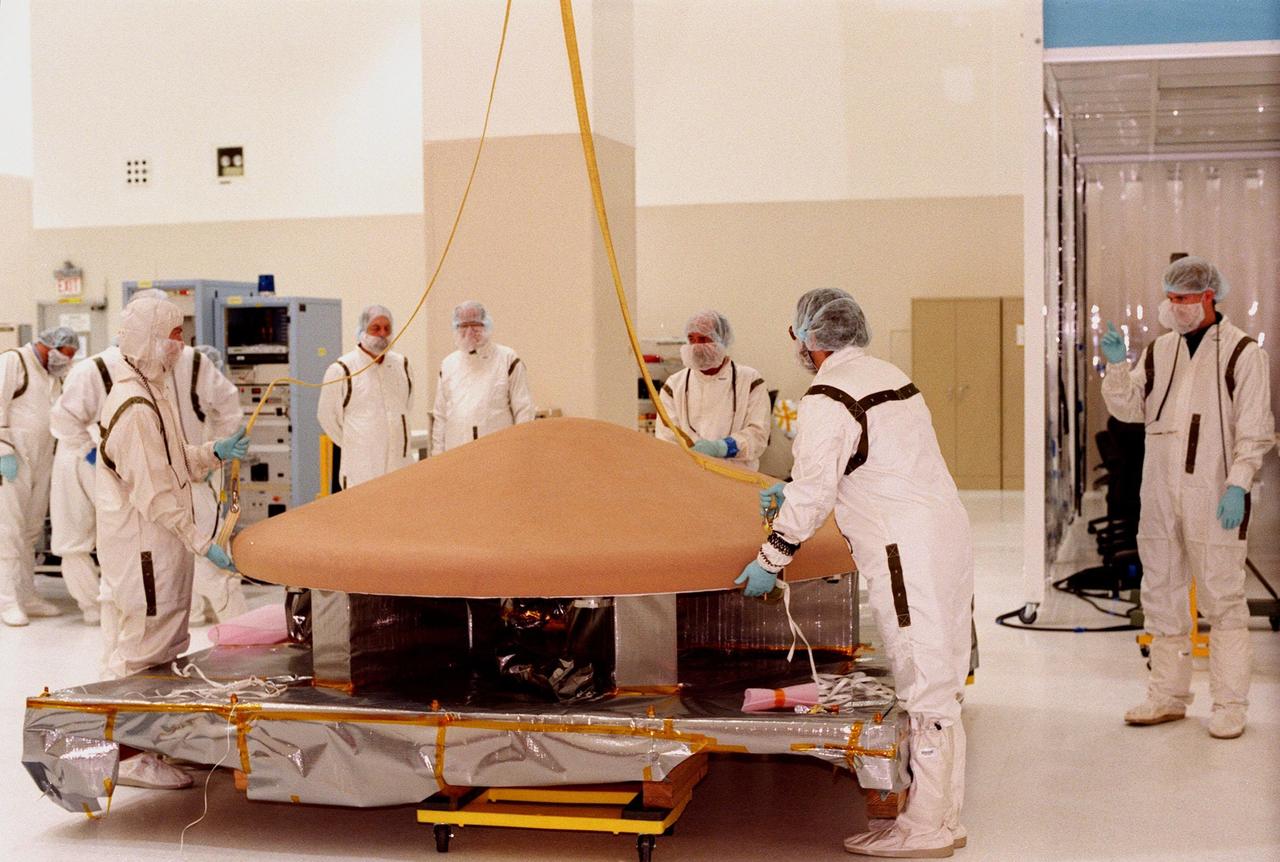
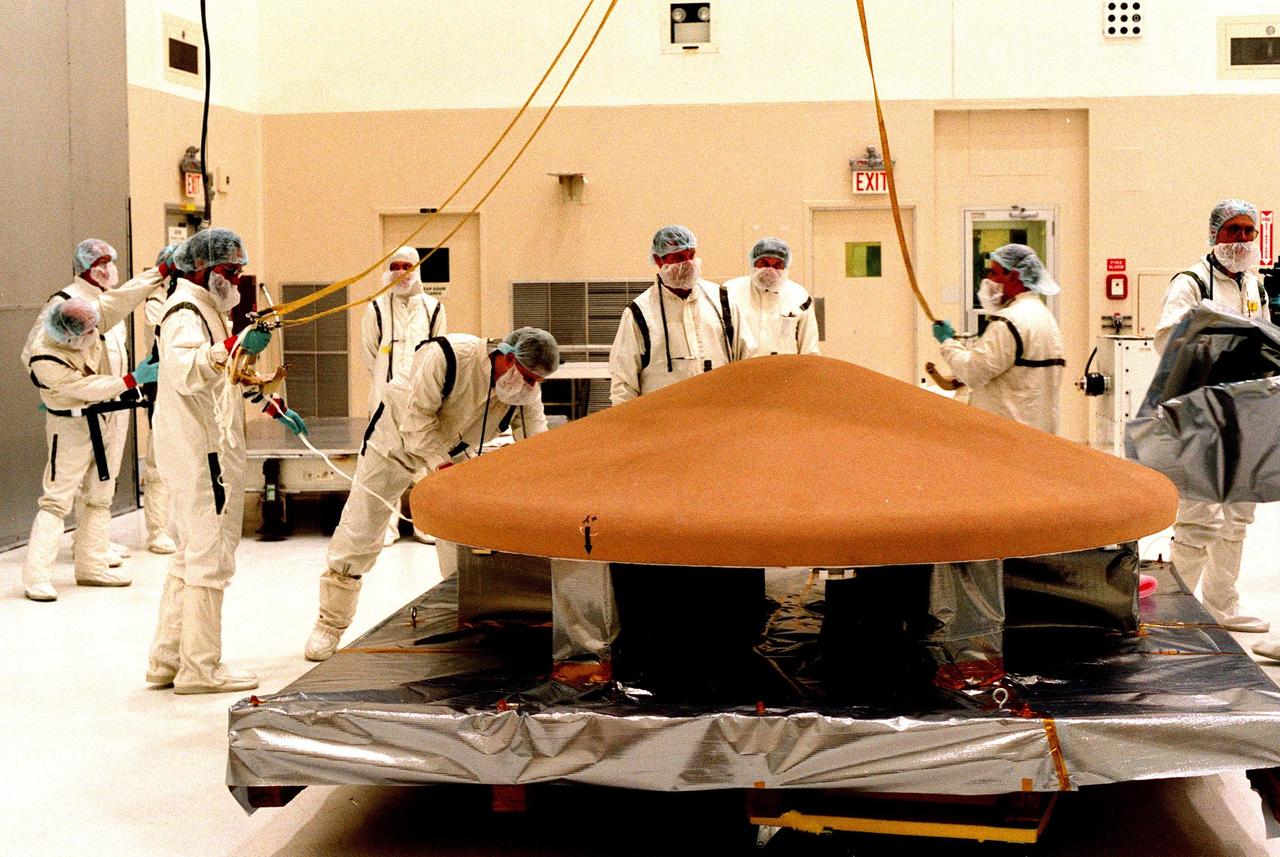
In the Spacecraft Assembly and Encapsulation Facility-2 (SAEF-2), workers get ready to lift the heat shield for the Mars Polar Lander off the workstand before attaching it to the lander. Scheduled to be launched on Jan. 3, 1999, the lander is a solar-powered spacecraft designed to touch down on the Martian surface near the northern-most boundary of the south pole in order to study the water cycle there. The lander also will help scientists learn more about climate change and current resources on Mars, studying such things as frost, dust, water vapor and condensates in the Martian atmosphere. It is the second spacecraft to be launched in a pair of Mars '98 missions. The first is the Mars Climate Orbiter, which is due to be launched aboard a Delta II rocket from Launch Complex 17A on Dec. 11, 1998
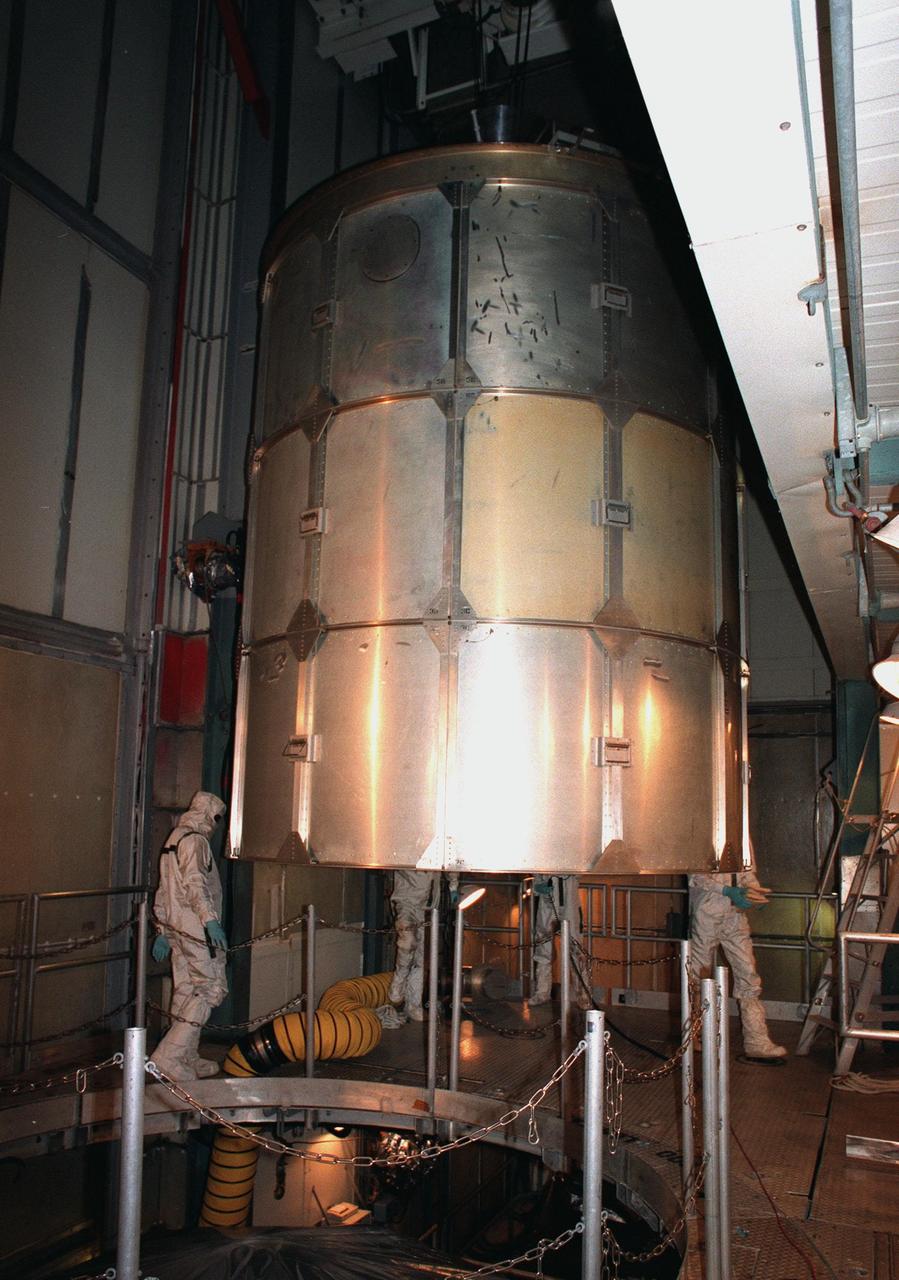
KENNEDY SPACE CENTER, FLA. -- At Launch Complex 17B, Cape Canaveral Air Station, the protective covering on the Mars Polar Lander is lifted up and out of the way. The lander, in the opening below, is being mated to the Boeing Delta II rocket that will launch it on Jan. 3, 1999. The lander is a solar-powered spacecraft designed to touch down on the Martian surface near the northern-most boundary of the south pole in order to study the water cycle there. The lander also will help scientists learn more about climate change and current resources on Mars, studying such things as frost, dust, water vapor and condensates in the Martian atmosphere. It is the second spacecraft to be launched in a pair of Mars Surveyor'98 missions. The first is the Mars Climate Orbiter, which was launched aboard a Delta II rocket from Launch Complex 17A on Dec. 11, 1998
KENNEDY SPACE CENTER, FLA. -- In the Spacecraft Assembly and Encapsulation Facility -2 (SAEF-2), JPL workers prepare to mount a Mars microprobe onto the Mars Polar Lander. Two microprobes will hitchhike on the lander, scheduled to be launched Jan. 3, 1999, aboard a Delta II rocket. The solar-powered spacecraft is designed to touch down on the Martian surface near the northern-most boundary of the south pole in order to study the water cycle there. The lander also will help scientists learn more about climate change and current resources on Mars, studying such things as frost, dust, water vapor and condensates in the Martian atmosphere. The Mars microprobes, called Deep Space 2, are part of NASA's New Millennium Program. They will complement the climate-related scientific focus of the lander by demonstrating an advanced, rugged microlaser system for detecting subsurface water. Such data on polar subsurface water, in the form of ice, should help put limits on scientific projections for the global abundance of water on Mars
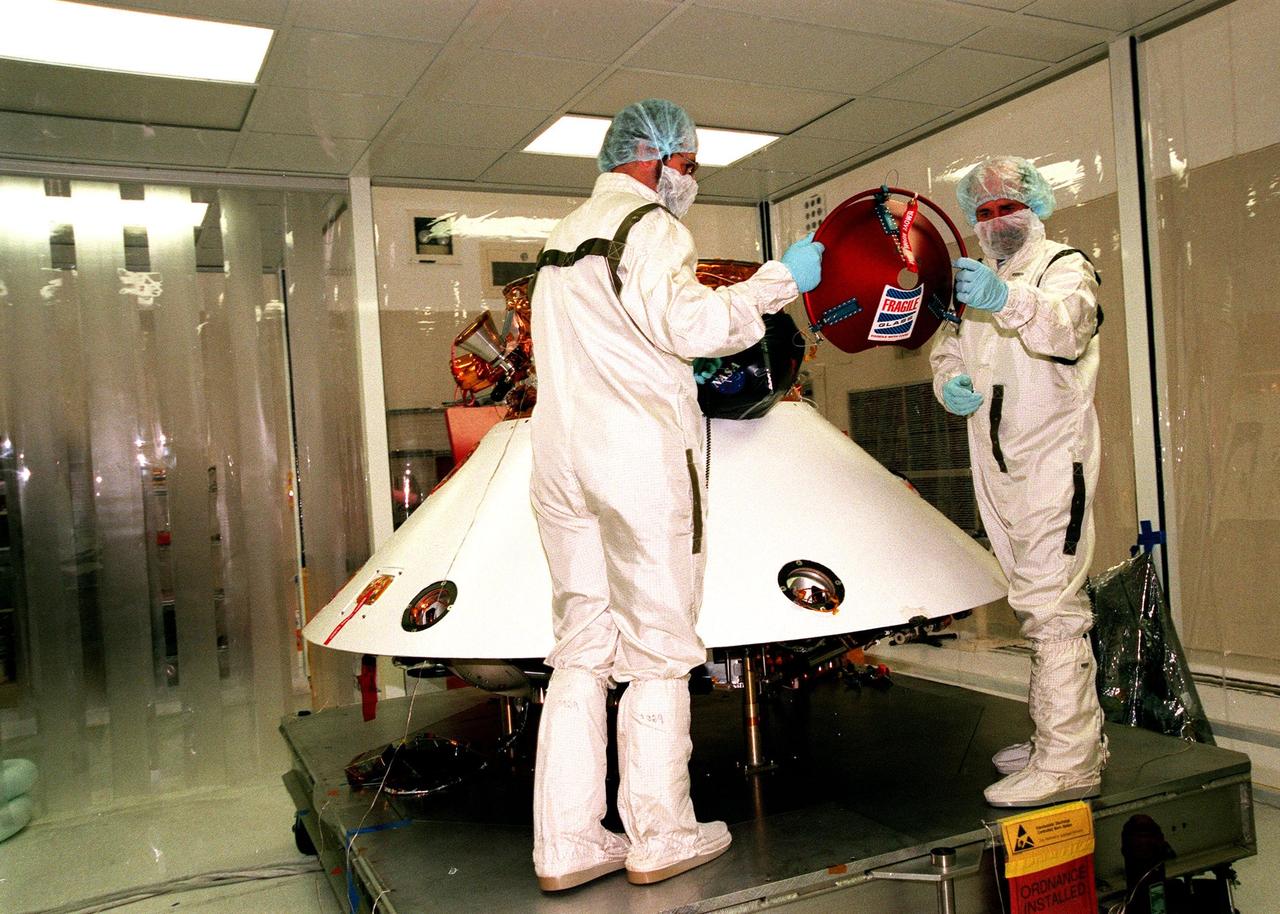
KENNEDY SPACE CENTER, FLA. -- In the Spacecraft Assembly and Encapsulation Facility-2 (SAEF-2), the top of the Mars Polar Lander is secured on a portable stand. The Lander will undergo testing, including a functional test of the science instruments and the basic spacecraft subsystems, before its launch from Cape Canaveral Air Station aboard a Delta II rocket on Jan. 3, 1999. The solar-powered spacecraft is designed to touch down on the Martian surface near the northern-most boundary of the south pole in order to study the water cycle there. The lander also will help scientists learn more about climate change and current resources on Mars, studying such things as frost, dust, water vapor and condensates in the Martian atmosphere
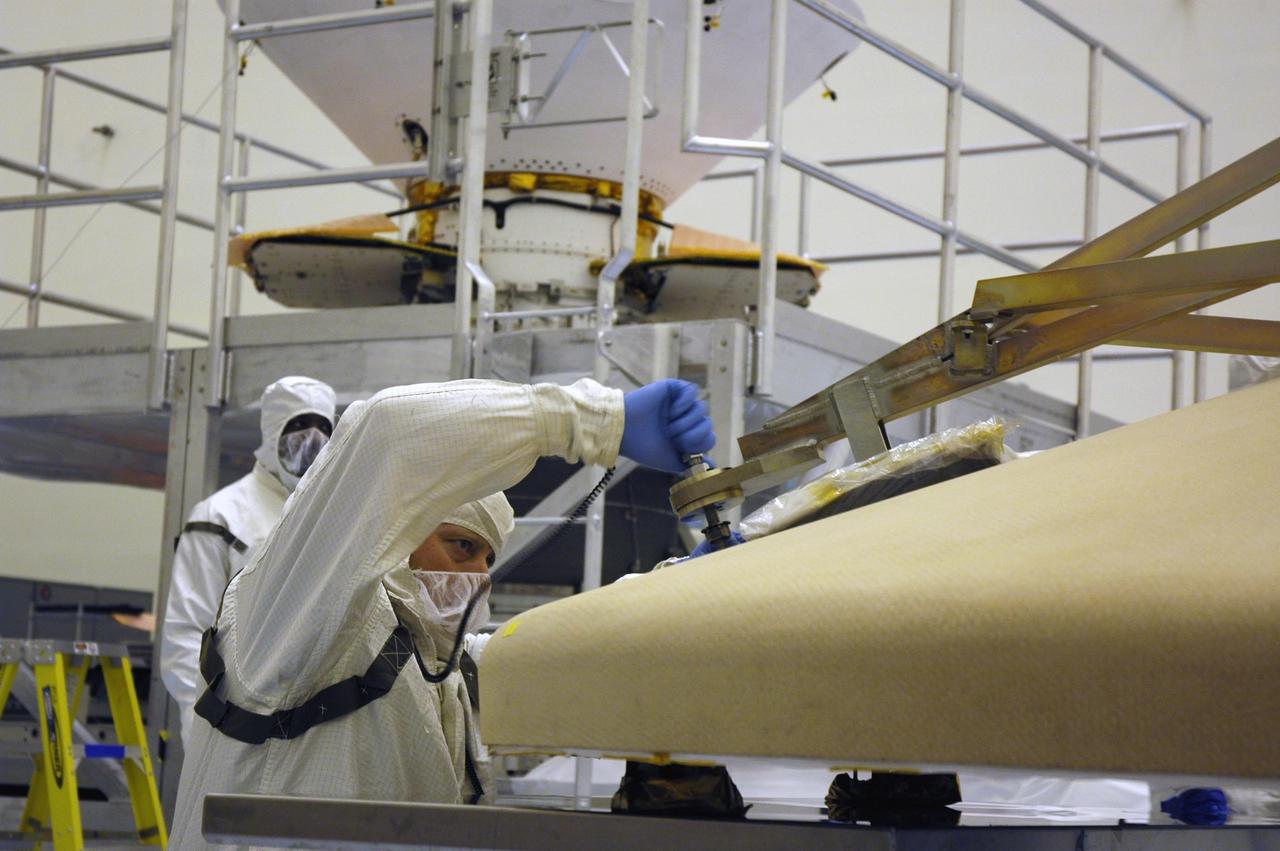
KENNEDY SPACE CENTER, Fla. -- In the Payload Hazardous Servicing Facility, workers attach a crane to the heat shield for the Phoenix Mars Lander spacecraft. The crane will lift and move the heat shield for installation over the lander within the cruise stage. Targeted for launch from Cape Canaveral Air Force Station on Aug. 3, Phoenix will land in icy soils near the north polar permanent ice cap of Mars and explore the history of the water in these soils and any associated rocks, while monitoring polar climate. Landing on Mars is planned in May 2008 on arctic ground where a mission currently in orbit, Mars Odyssey, has detected high concentrations of ice just beneath the top layer of soil. Photo credit: NASA/Troy Cryder
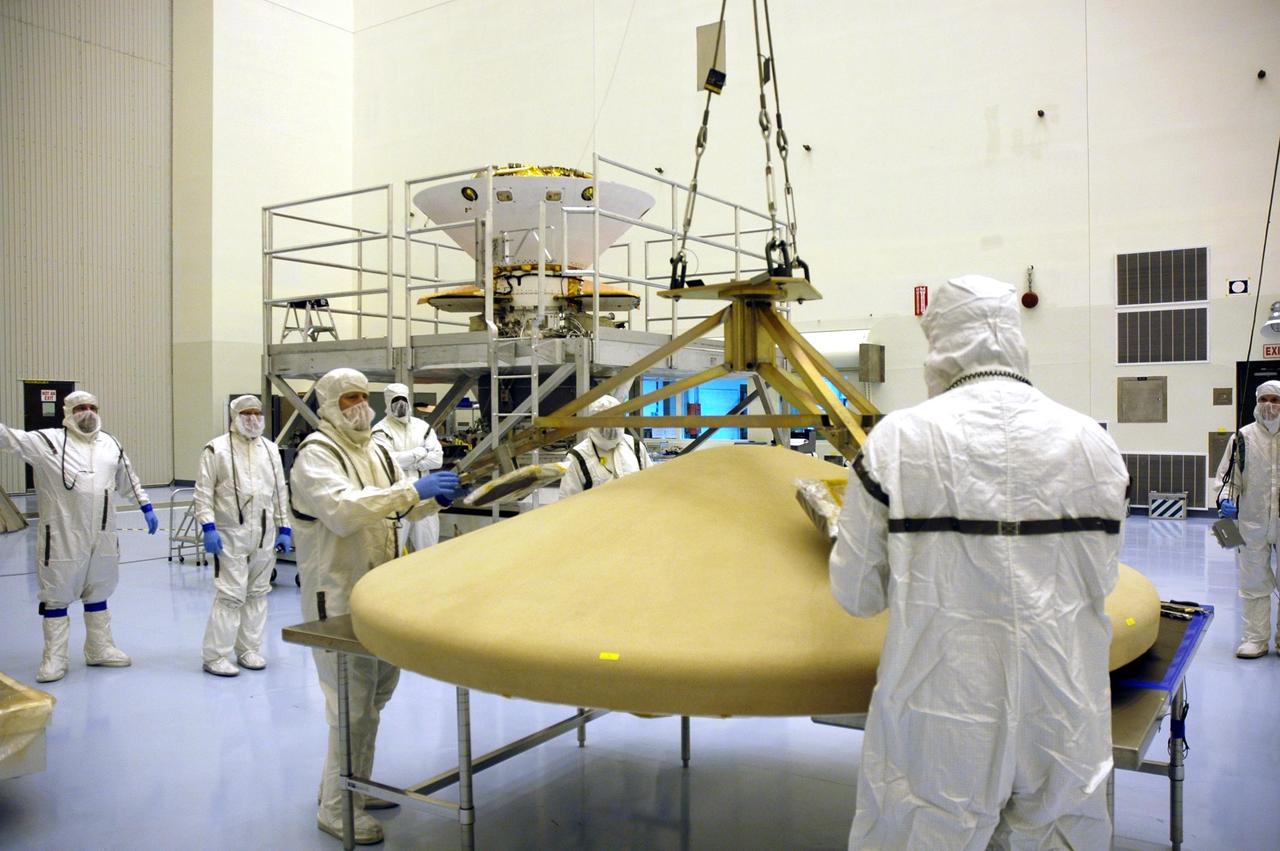
KENNEDY SPACE CENTER, Fla. -- In the Payload Hazardous Servicing Facility, workers attach a crane to the heat shield for the Phoenix Mars Lander spacecraft. The crane will lift and move the heat shield for installation over the lander within the cruise stage. Targeted for launch from Cape Canaveral Air Force Station on Aug. 3, Phoenix will land in icy soils near the north polar permanent ice cap of Mars and explore the history of the water in these soils and any associated rocks, while monitoring polar climate. Landing on Mars is planned in May 2008 on arctic ground where a mission currently in orbit, Mars Odyssey, has detected high concentrations of ice just beneath the top layer of soil. Photo credit: NASA/Troy Cryder
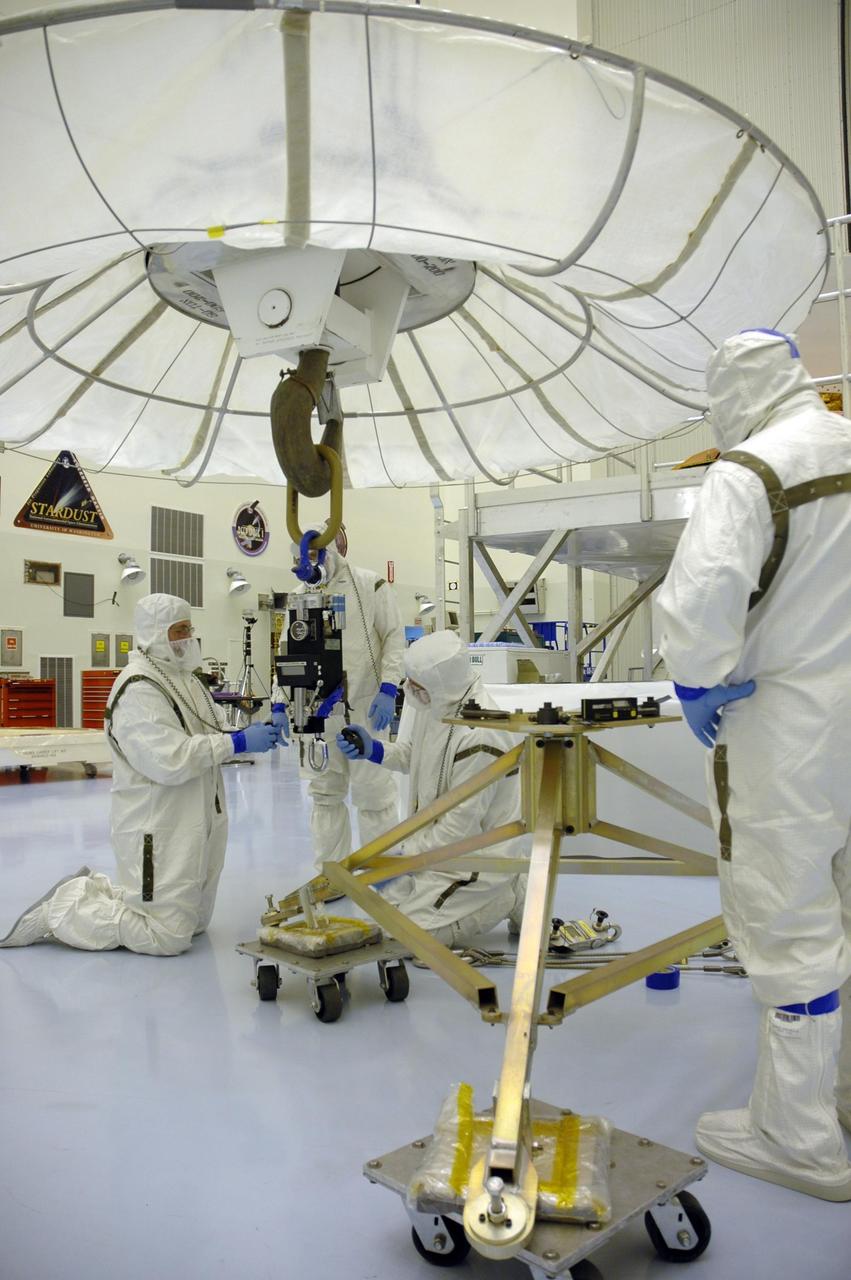
KENNEDY SPACE CENTER, Fla. -- In the Payload Hazardous Servicing Facility, workers prepare a crane that will be attached to the heat shield for the Phoenix Mars Lander spacecraft. The crane will lift and move the heat shield for installation over the lander within the cruise stage. Targeted for launch from Cape Canaveral Air Force Station on Aug. 3, Phoenix will land in icy soils near the north polar permanent ice cap of Mars and explore the history of the water in these soils and any associated rocks, while monitoring polar climate. Landing on Mars is planned in May 2008 on arctic ground where a mission currently in orbit, Mars Odyssey, has detected high concentrations of ice just beneath the top layer of soil. Photo credit: NASA/Troy Cryder
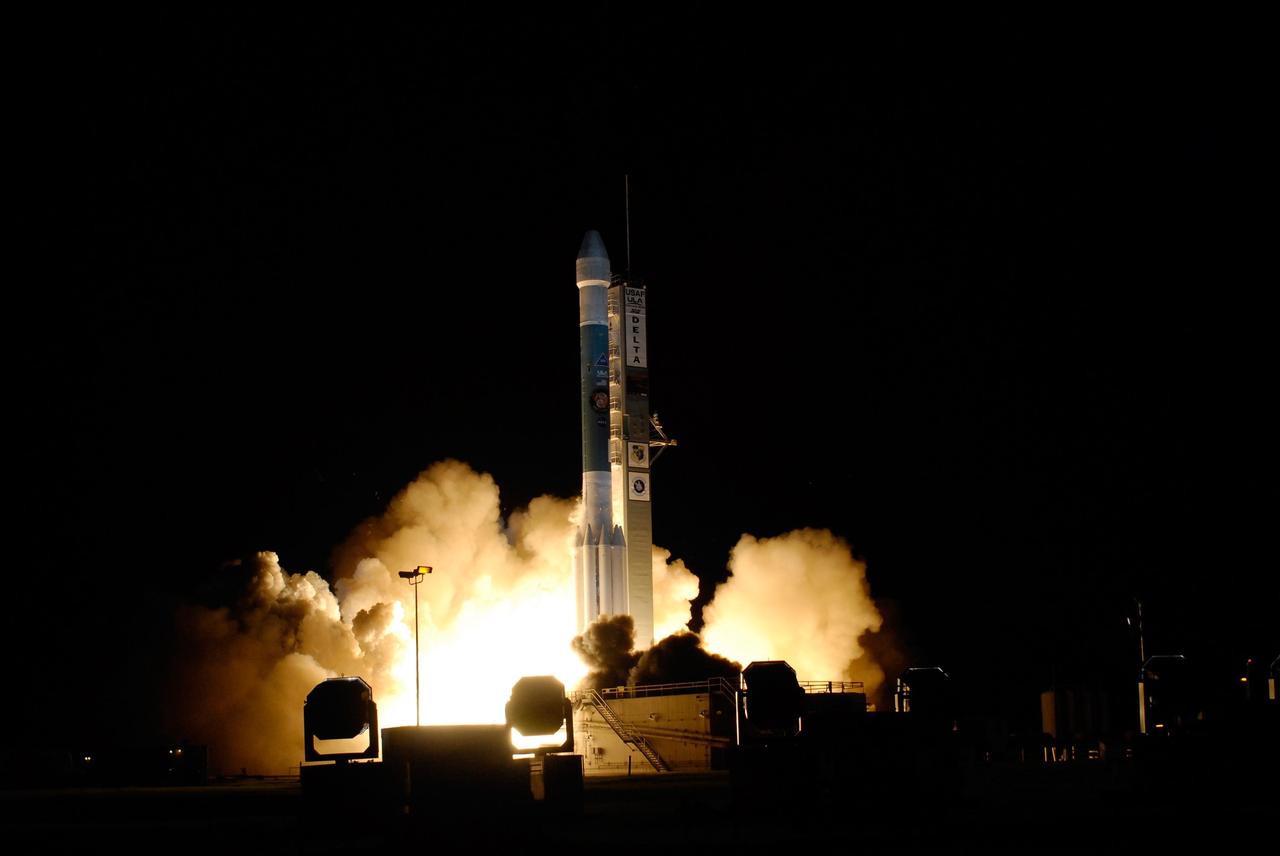
KENNEDY SPACE CENTER, FLA. - NASA's Phoenix Mars lander lifts off from Pad 17A aboard a Delta II 7925 rocket at 5:26 a.m. EDT, illuminating the pad at Cape Canaveral Air Force Station. Phoenix will land in icy soils near the north polar, permanent ice cap of Mars and explore the history of the water in these soils and any associated rocks, while monitoring polar climate. Landing on Mars is planned in May 2008 on arctic ground where a mission currently in orbit, Mars Odyssey, has detected high concentrations of ice just beneath the top layer of soil. Photo credit: NASA/Regina Mitchell-Ryall and Jerry Cannon
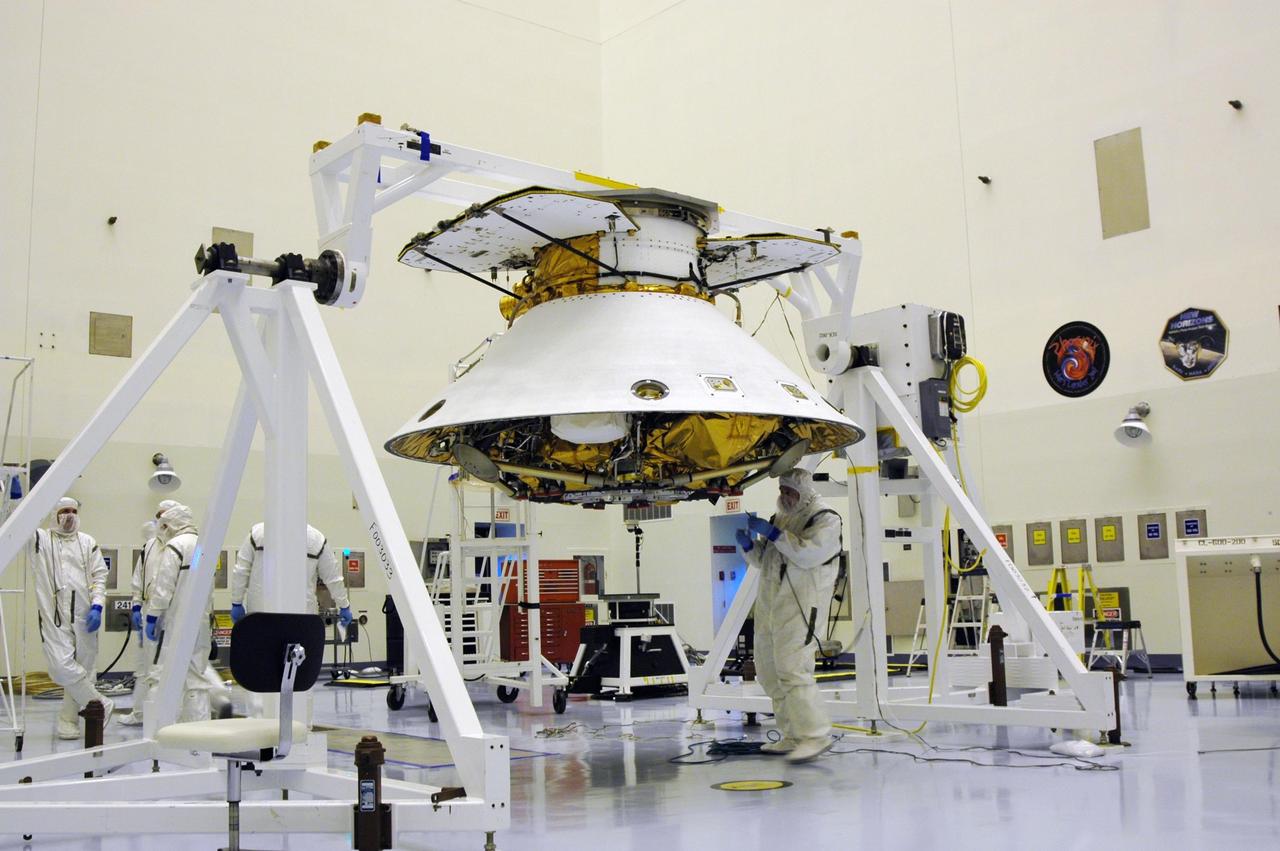
KENNEDY SPACE CENTER, Fla. -- In the Payload Hazardous Servicing Facility, workers prepare the Phoenix Mars Lander spacecraft for rotation. After rotation, the Phoenix will be mated with the upper stage booster. Targeted for launch from Cape Canaveral Air Force Station on Aug. 3, Phoenix will land in icy soils near the north polar permanent ice cap of Mars and explore the history of the water in these soils and any associated rocks, while monitoring polar climate. Landing on Mars is planned in May 2008 on arctic ground where a mission currently in orbit, Mars Odyssey, has detected high concentrations of ice just beneath the top layer of soil. NASA/Dimitri Gerondidakis
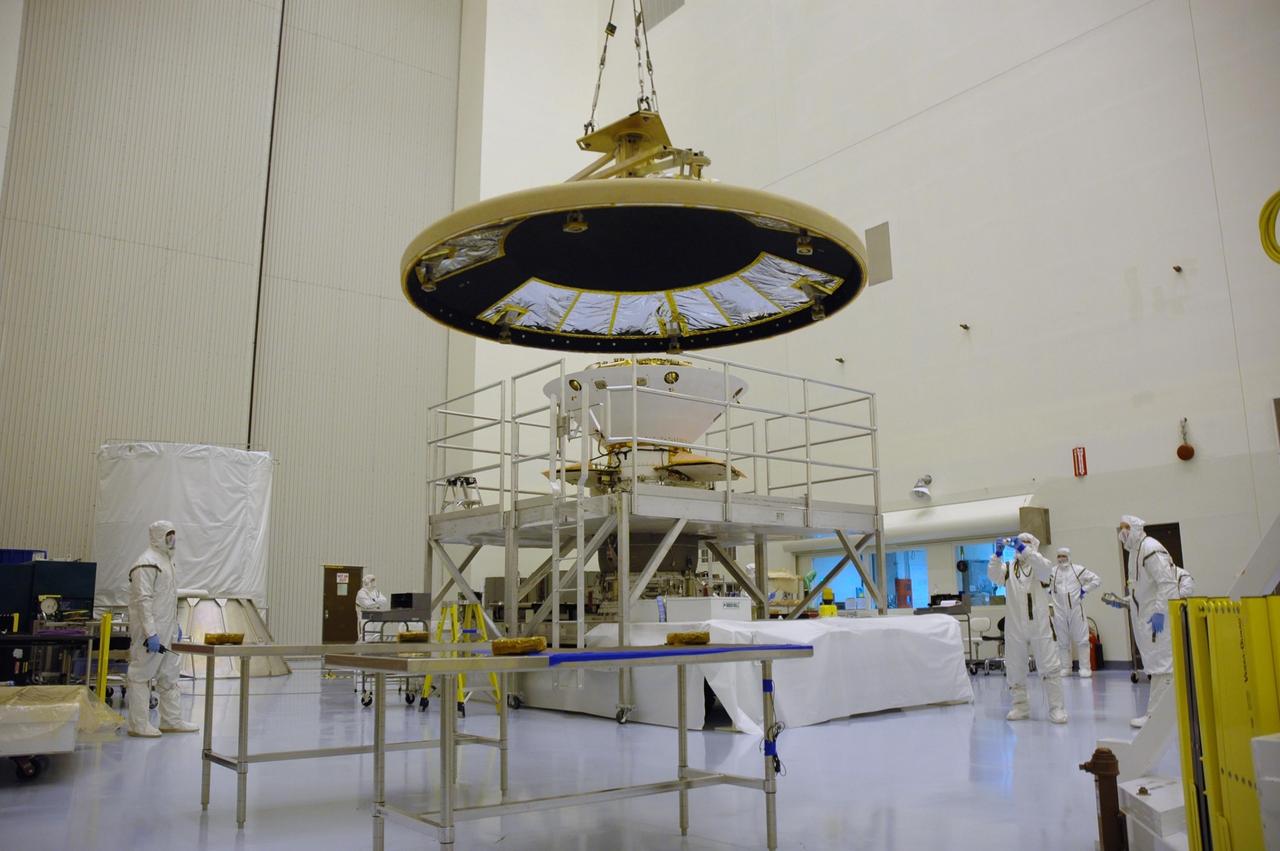
KENNEDY SPACE CENTER, Fla. --In the Payload Hazardous Servicing Facility, the heat shield for the Phoenix Mars Lander spacecraft is moved toward the spacecraft, in the background. Targeted for launch from Cape Canaveral Air Force Station on Aug. 3, Phoenix will land in icy soils near the north polar permanent ice cap of Mars and explore the history of the water in these soils and any associated rocks, while monitoring polar climate. Landing on Mars is planned in May 2008 on arctic ground where a mission currently in orbit, Mars Odyssey, has detected high concentrations of ice just beneath the top layer of soil. Photo credit: NASA/Troy Cryder
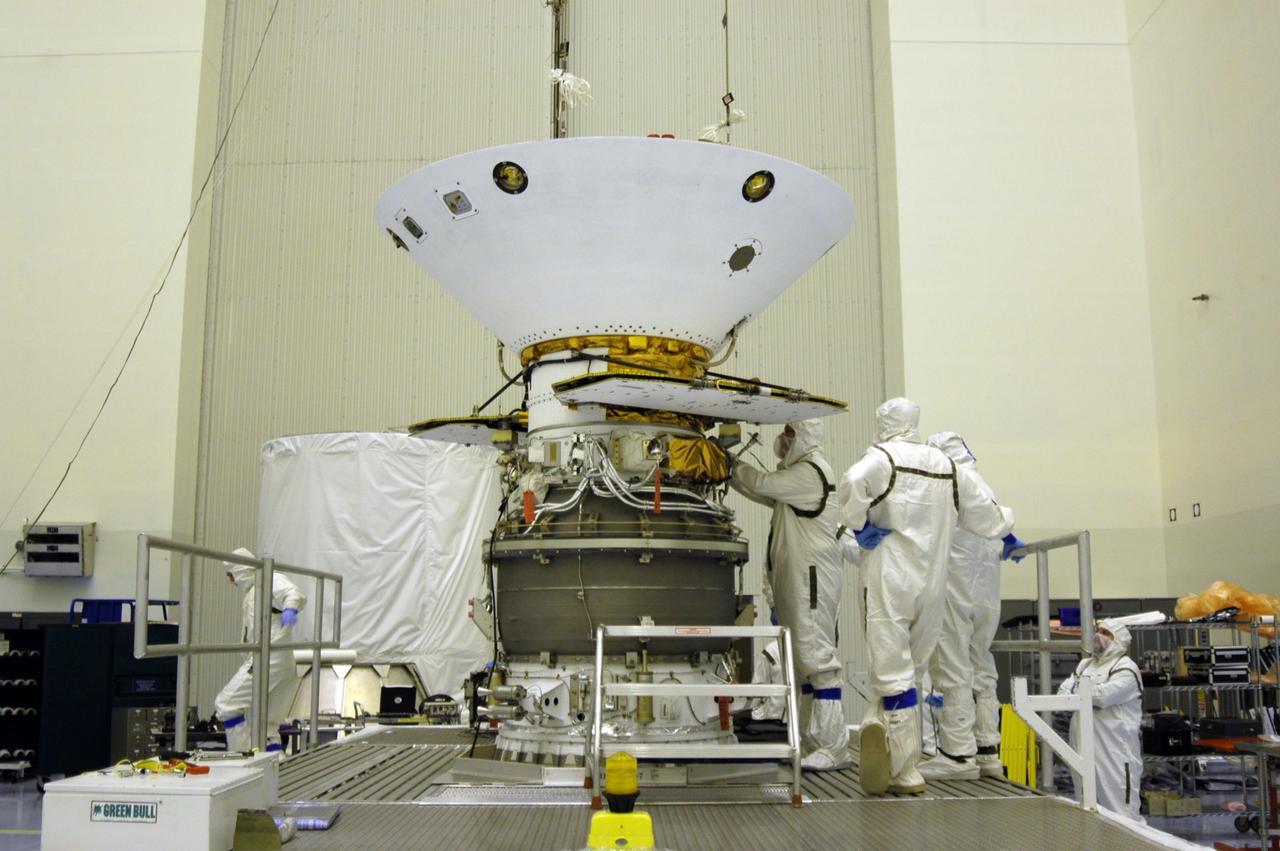
KENNEDY SPACE CENTER, Fla. -- In the Payload Hazardous Servicing Facility, workers secure the Phoenix Mars Lander spacecraft onto the upper stage booster. Targeted for launch from Cape Canaveral Air Force Station on Aug. 3, Phoenix will land in icy soils near the north polar permanent ice cap of Mars and explore the history of the water in these soils and any associated rocks, while monitoring polar climate. Landing on Mars is planned in May 2008 on arctic ground where a mission currently in orbit, Mars Odyssey, has detected high concentrations of ice just beneath the top layer of soil. NASA/Dimitri Gerondidakis
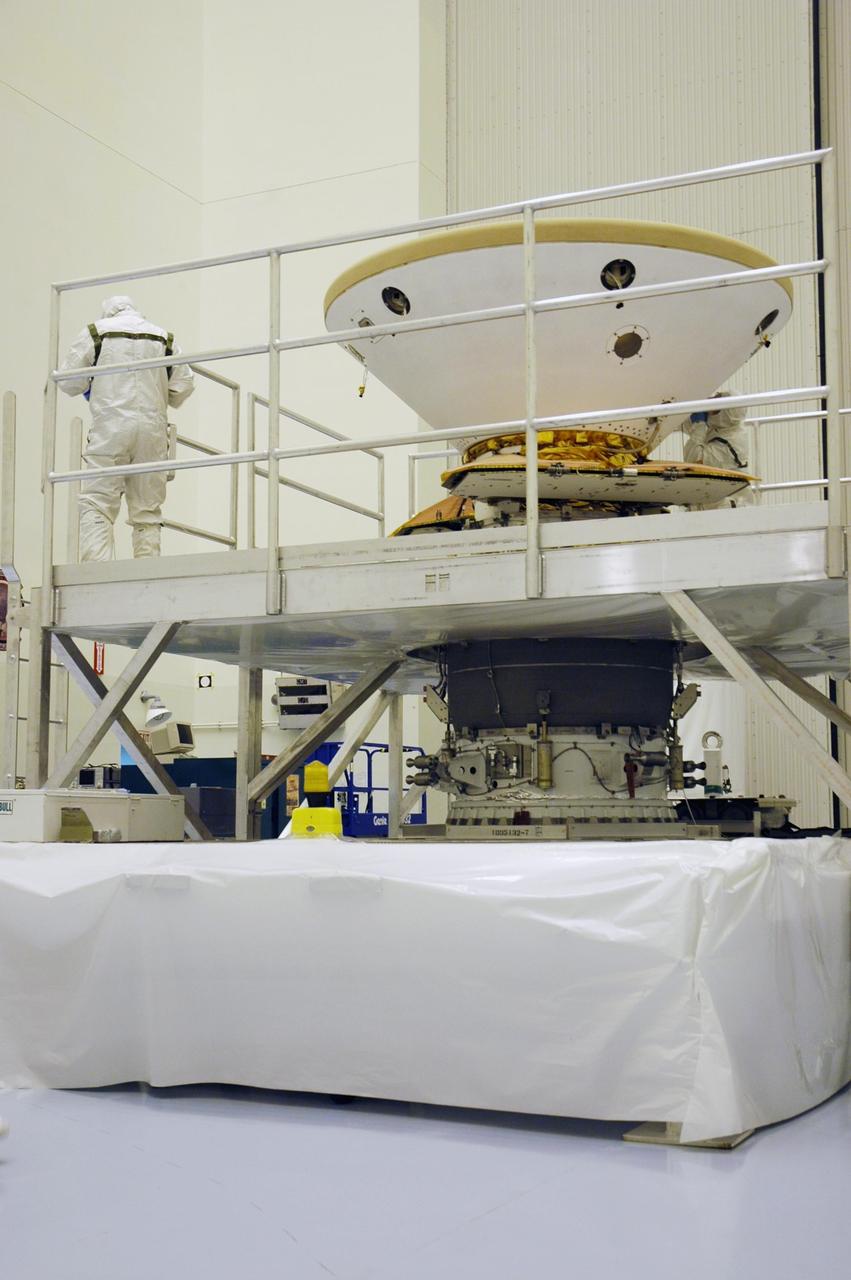
KENNEDY SPACE CENTER, Fla. -- In the Payload Hazardous Servicing Facility, the Phoenix Mars Lander spacecraft rests with its heat shield installed. Targeted for launch from Cape Canaveral Air Force Station on Aug. 3, Phoenix will land in icy soils near the north polar permanent ice cap of Mars and explore the history of the water in these soils and any associated rocks, while monitoring polar climate. Landing on Mars is planned in May 2008 on arctic ground where a mission currently in orbit, Mars Odyssey, has detected high concentrations of ice just beneath the top layer of soil. Photo credit: NASA/Troy Cryder
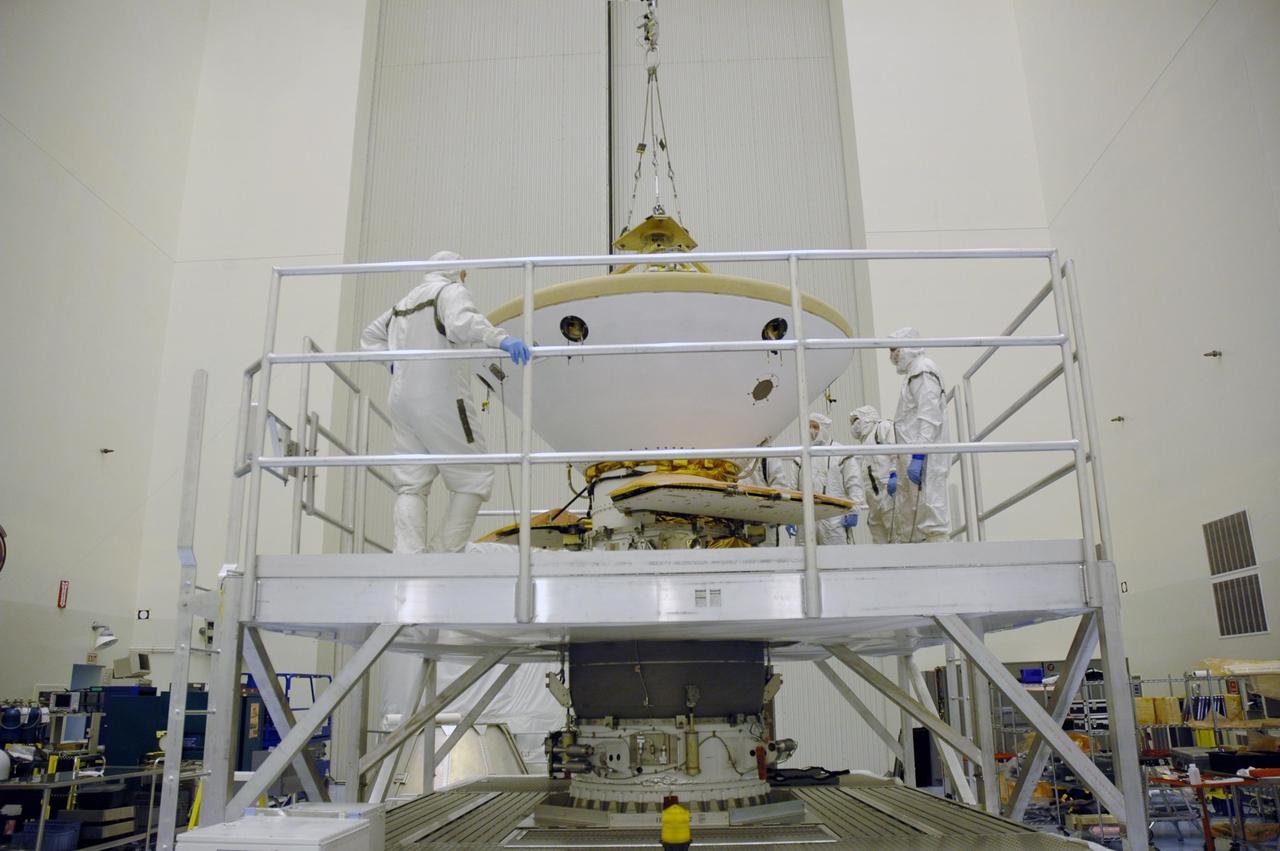
KENNEDY SPACE CENTER, Fla. -- In the Payload Hazardous Servicing Facility, workers observe the installation of the heat shield onto the Phoenix Mars Lander spacecraft. Targeted for launch from Cape Canaveral Air Force Station on Aug. 3, Phoenix will land in icy soils near the north polar permanent ice cap of Mars and explore the history of the water in these soils and any associated rocks, while monitoring polar climate. Landing on Mars is planned in May 2008 on arctic ground where a mission currently in orbit, Mars Odyssey, has detected high concentrations of ice just beneath the top layer of soil. Photo credit: NASA/Troy Cryder
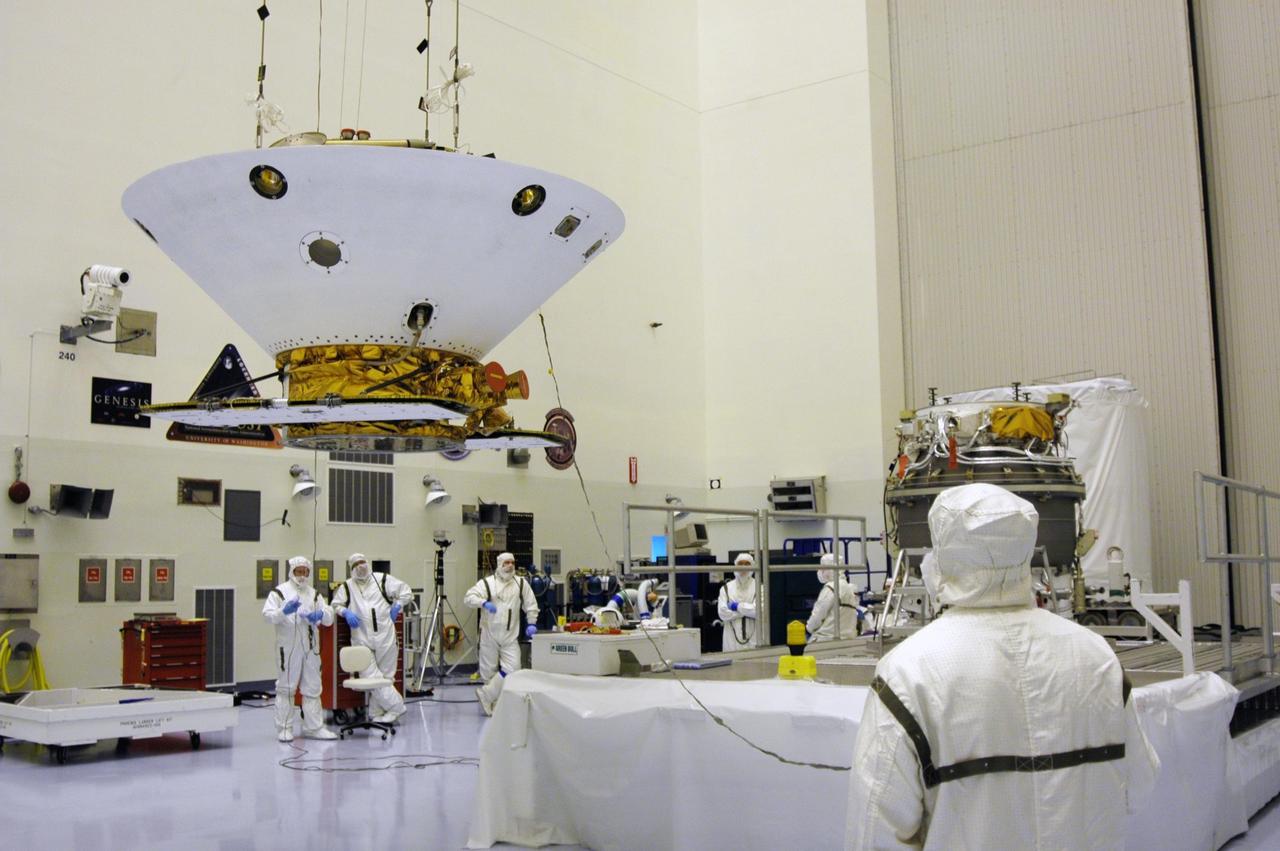
KENNEDY SPACE CENTER, Fla. -- In the Payload Hazardous Servicing Facility, the Phoenix Mars Lander spacecraft is moved across the area toward the upper stage booster at right. The spacecraft and booster will be mated for launch. Targeted for launch from Cape Canaveral Air Force Station on Aug. 3, Phoenix will land in icy soils near the north polar permanent ice cap of Mars and explore the history of the water in these soils and any associated rocks, while monitoring polar climate. Landing on Mars is planned in May 2008 on arctic ground where a mission currently in orbit, Mars Odyssey, has detected high concentrations of ice just beneath the top layer of soil. NASA/Dimitri Gerondidakis
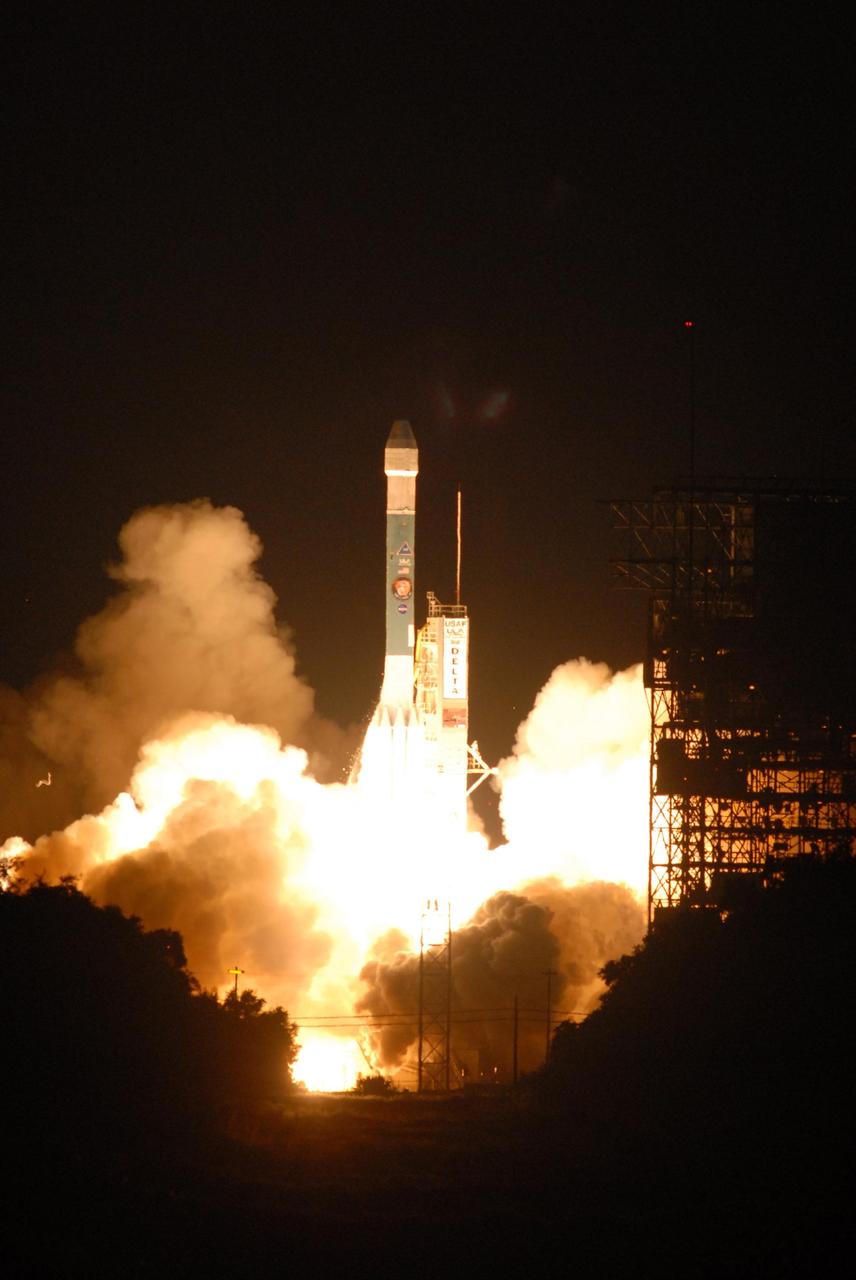
KENNEDY SPACE CENTER, FLA. -- The Delta II 7925 rocket carrying NASA's Phoenix Mars lander lifts off amid billows of smoke from Pad 17A at Cape Canaveral Air Force Station at 5:26 a.m. EDT. Phoenix will land in icy soils near the north polar, permanent ice cap of Mars and explore the history of the water in these soils and any associated rocks, while monitoring polar climate. Landing on Mars is planned in May 2008 on arctic ground where a mission currently in orbit, Mars Odyssey, has detected high concentrations of ice just beneath the top layer of soil. Photo credit: NASA/George Shelton
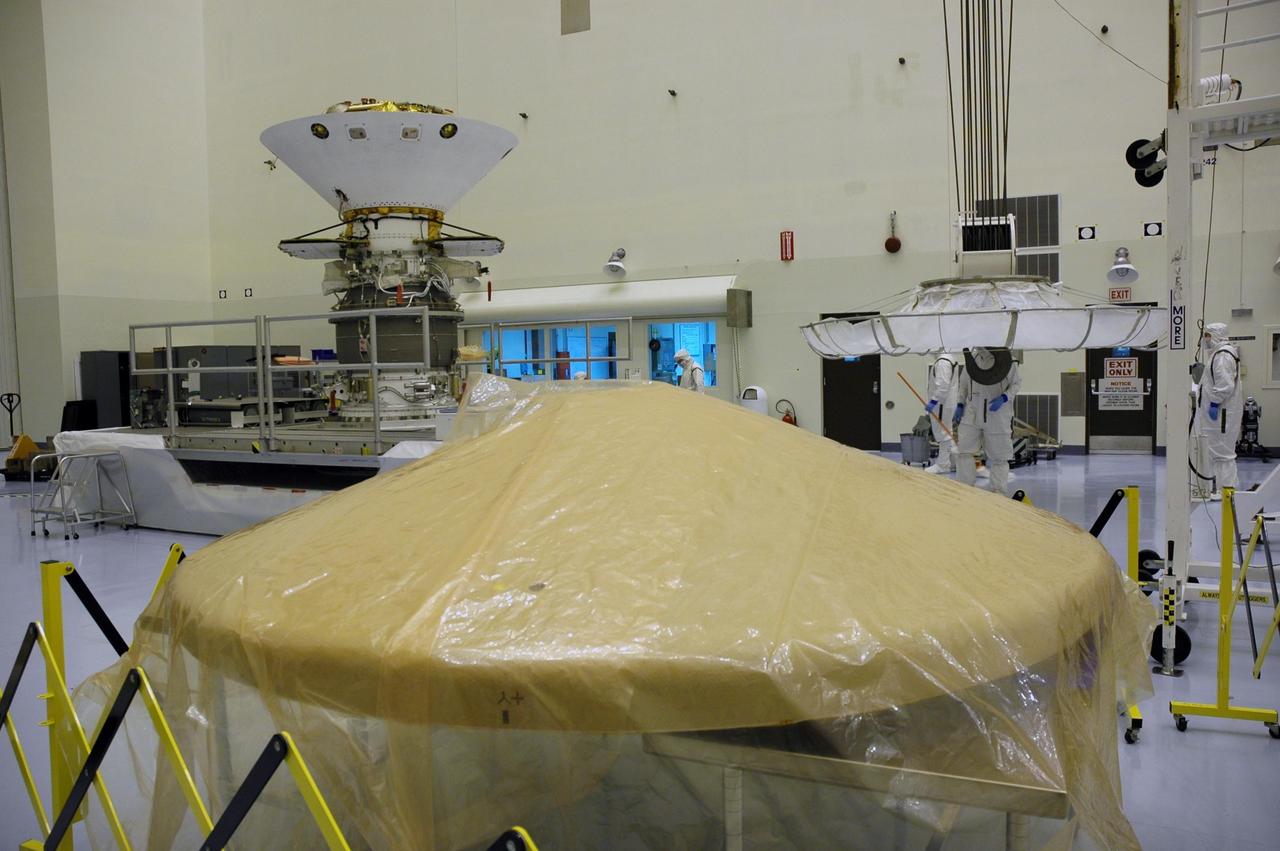
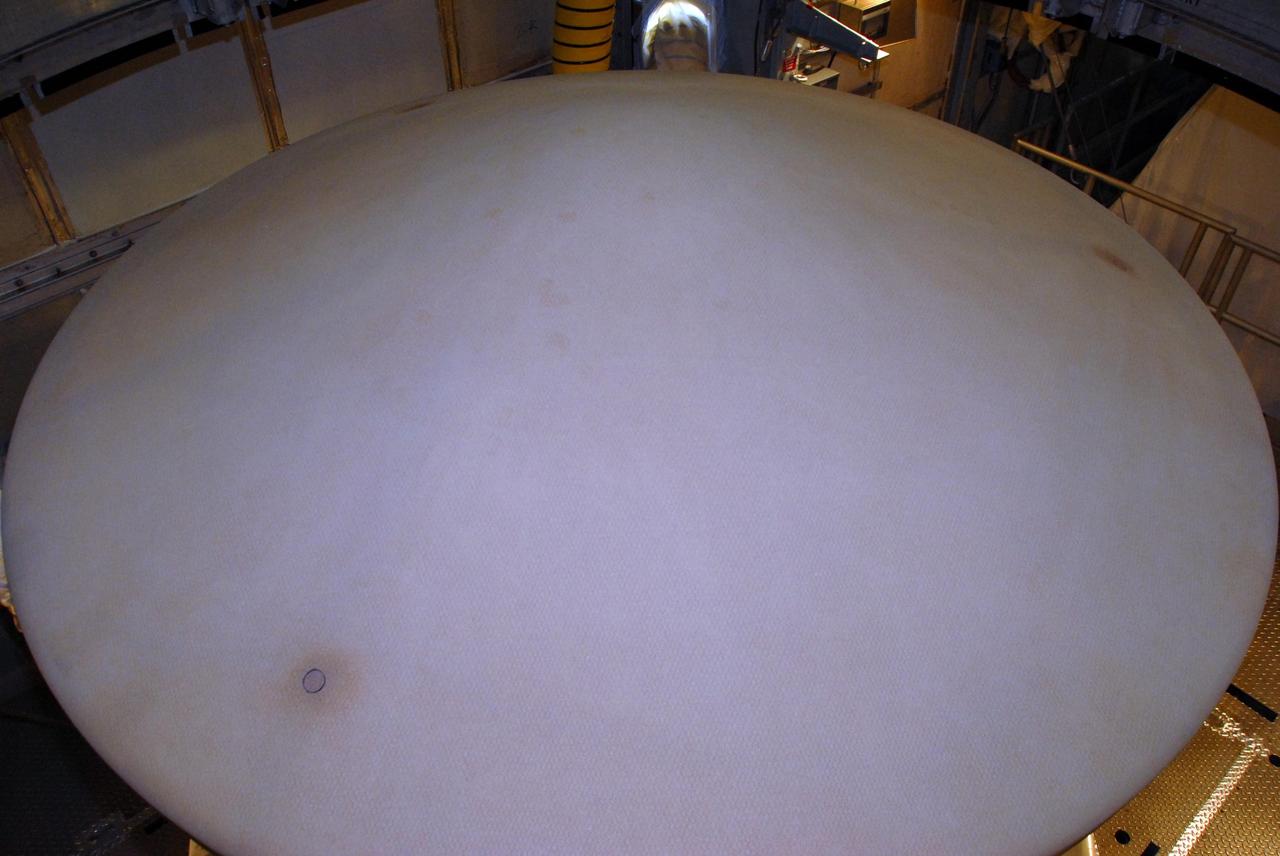
KENNEDY SPACE CENTER, Fla. -- In the Payload Hazardous Servicing Facility, the heat shield (foreground) for the Phoenix Mars Lander spacecraft is ready for installation. Targeted for launch from Cape Canaveral Air Force Station on Aug. 3, Phoenix will land in icy soils near the north polar permanent ice cap of Mars and explore the history of the water in these soils and any associated rocks, while monitoring polar climate. Landing on Mars is planned in May 2008 on arctic ground where a mission currently in orbit, Mars Odyssey, has detected high concentrations of ice just beneath the top layer of soil. Photo credit: NASA/Troy Cryder
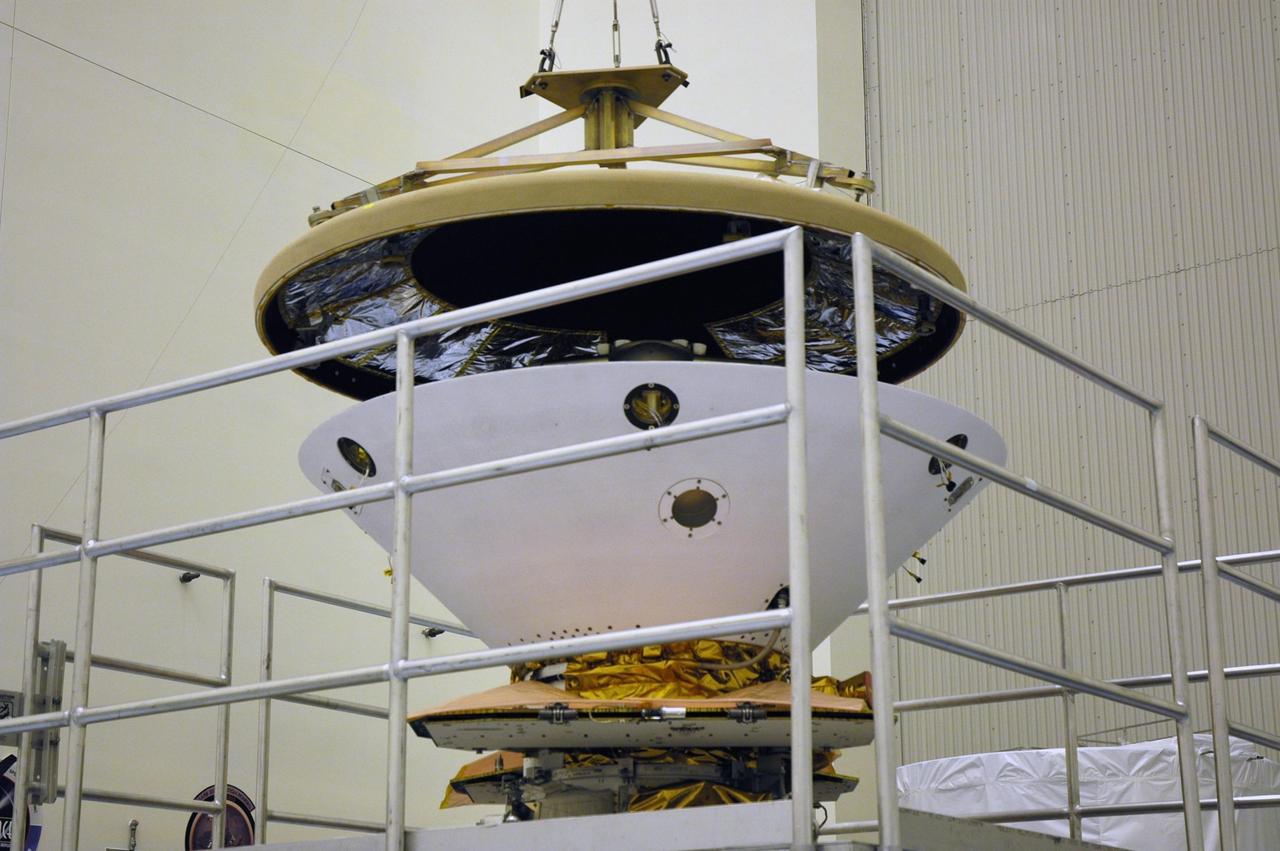
KENNEDY SPACE CENTER, Fla. -- In the Payload Hazardous Servicing Facility, the heat shield for the Phoenix Mars Lander spacecraft is lowered onto the spacecraft. Targeted for launch from Cape Canaveral Air Force Station on Aug. 3, Phoenix will land in icy soils near the north polar permanent ice cap of Mars and explore the history of the water in these soils and any associated rocks, while monitoring polar climate. Landing on Mars is planned in May 2008 on arctic ground where a mission currently in orbit, Mars Odyssey, has detected high concentrations of ice just beneath the top layer of soil. Photo credit: NASA/Troy Cryder
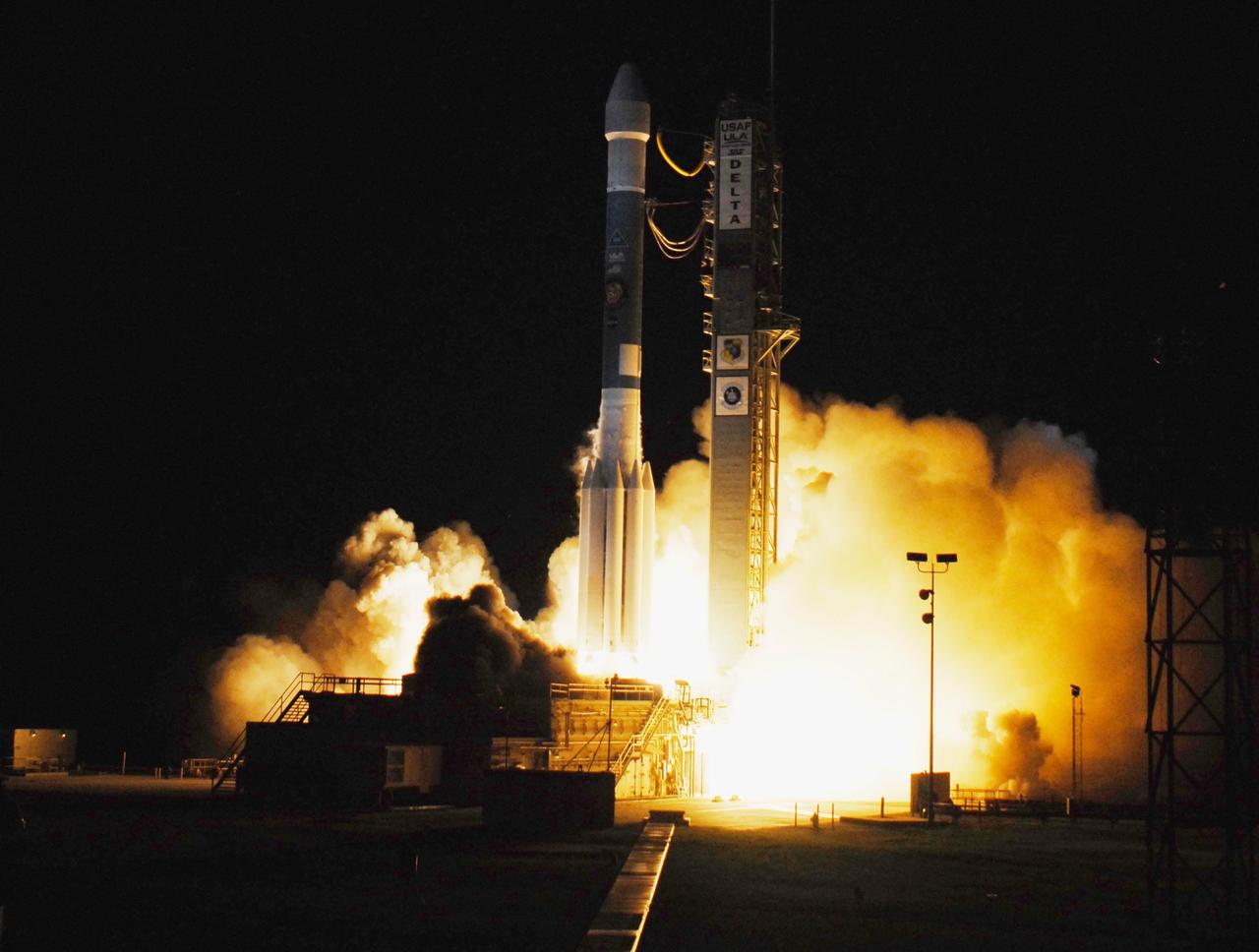
KENNEDY SPACE CENTER, FLA. - The Delta II 7925 rocket carrying NASA's Phoenix Mars lander thunders to life at 5:26 a.m. EDT at Pad 17A on Cape Canaveral Air Force Station. Phoenix will land in icy soils near the north polar, permanent ice cap of Mars and explore the history of the water in these soils and any associated rocks, while monitoring polar climate. Landing on Mars is planned in May 2008 on arctic ground where a mission currently in orbit, Mars Odyssey, has detected high concentrations of ice just beneath the top layer of soil. Photo credit: NASA/Sandra Joseph and John Kechele
KENNEDY SPACE CENTER, FLA. -- The top of NASA's Phoenix Mars Lander can be seen inside the mobile service tower of Launch Pad 17-A at Cape Canaveral Air Force Station in Florida. Launch of Phoenix on the Delta II launch vehicle is scheduled for no earlier than Aug. 3. Phoenix will land in icy soils near the north polar permanent ice cap of Mars and explore the history of the water in these soils and any associated rocks, while monitoring polar climate. Landing on Mars is planned in May 2008 on arctic ground where a mission currently in orbit, Mars Odyssey, detected high concentrations of ice just beneath the top layer of soil. NASA/George Shelton
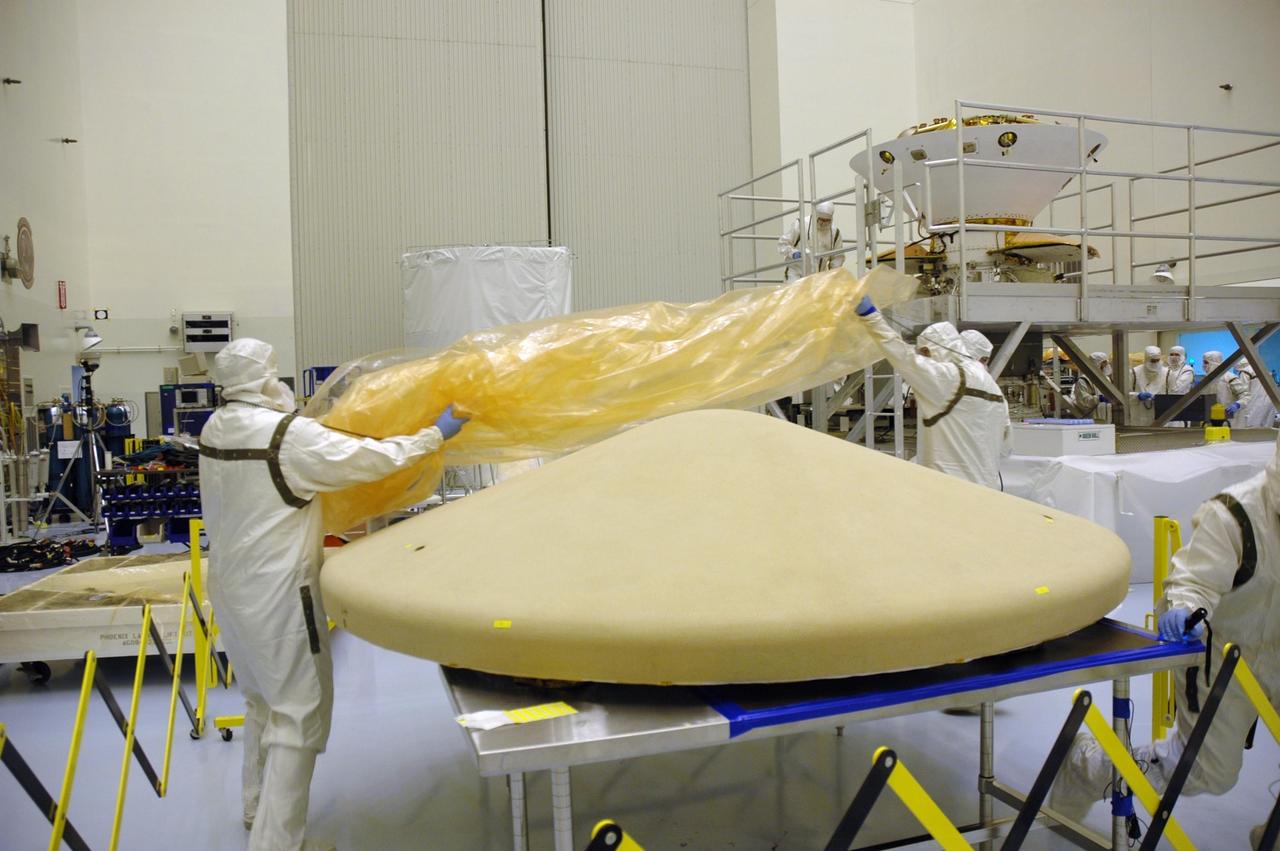
KENNEDY SPACE CENTER, Fla. -- In the Payload Hazardous Servicing Facility, workers remove the covering over the heat shield (foreground) for the Phoenix Mars Lander spacecraft before installation. Targeted for launch from Cape Canaveral Air Force Station on Aug. 3, Phoenix will land in icy soils near the north polar permanent ice cap of Mars and explore the history of the water in these soils and any associated rocks, while monitoring polar climate. Landing on Mars is planned in May 2008 on arctic ground where a mission currently in orbit, Mars Odyssey, has detected high concentrations of ice just beneath the top layer of soil. Photo credit: NASA/Troy Cryder
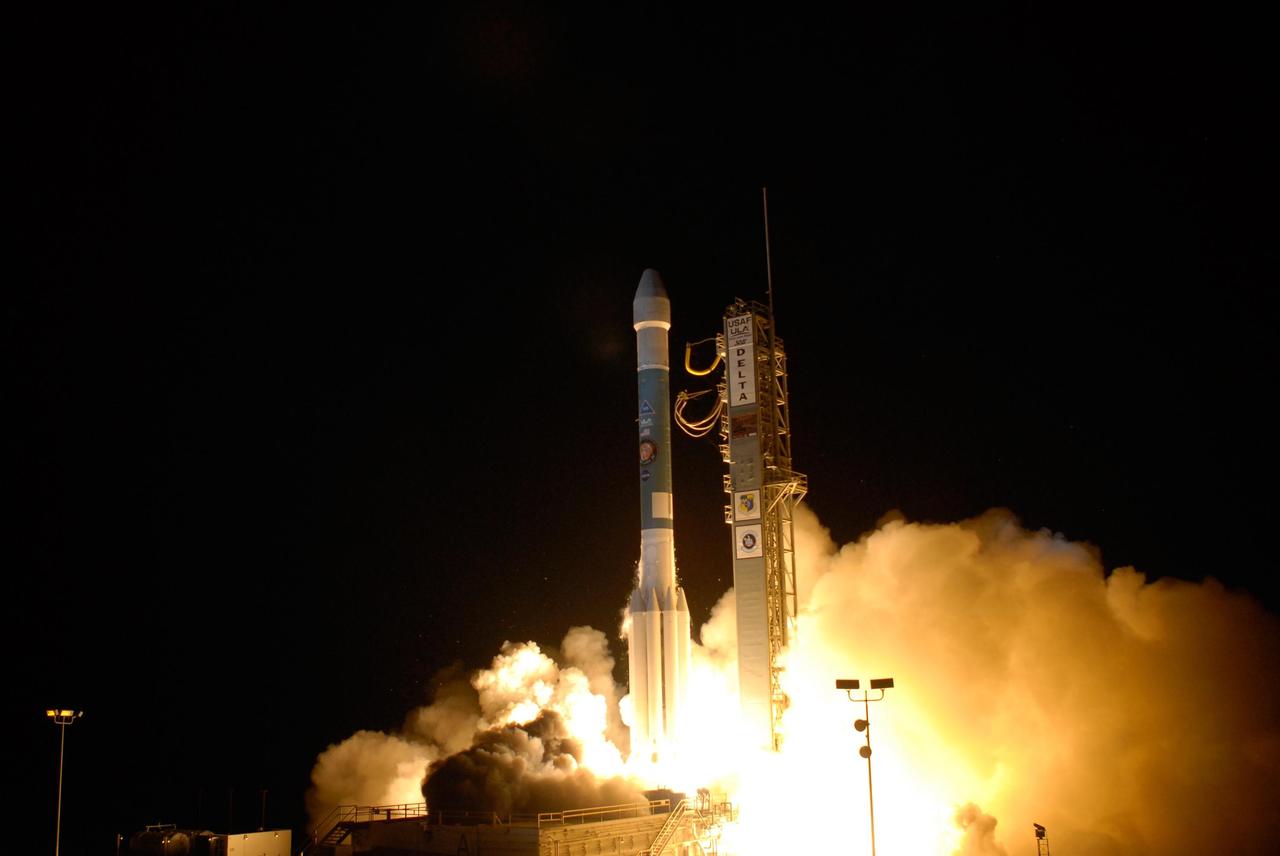
KENNEDY SPACE CENTER, FLA. - NASA's Phoenix Mars lander lifts off from Pad 17A aboard a Delta II 7925 rocket amid billows of smoke at Cape Canaveral Air Force Station at 5:26 a.m. EDT. Phoenix will land in icy soils near the north polar, permanent ice cap of Mars and explore the history of the water in these soils and any associated rocks, while monitoring polar climate. Landing on Mars is planned in May 2008 on arctic ground where a mission currently in orbit, Mars Odyssey, has detected high concentrations of ice just beneath the top layer of soil. Photo credit: NASA/Regina Mitchell-Ryall and Jerry Cannon
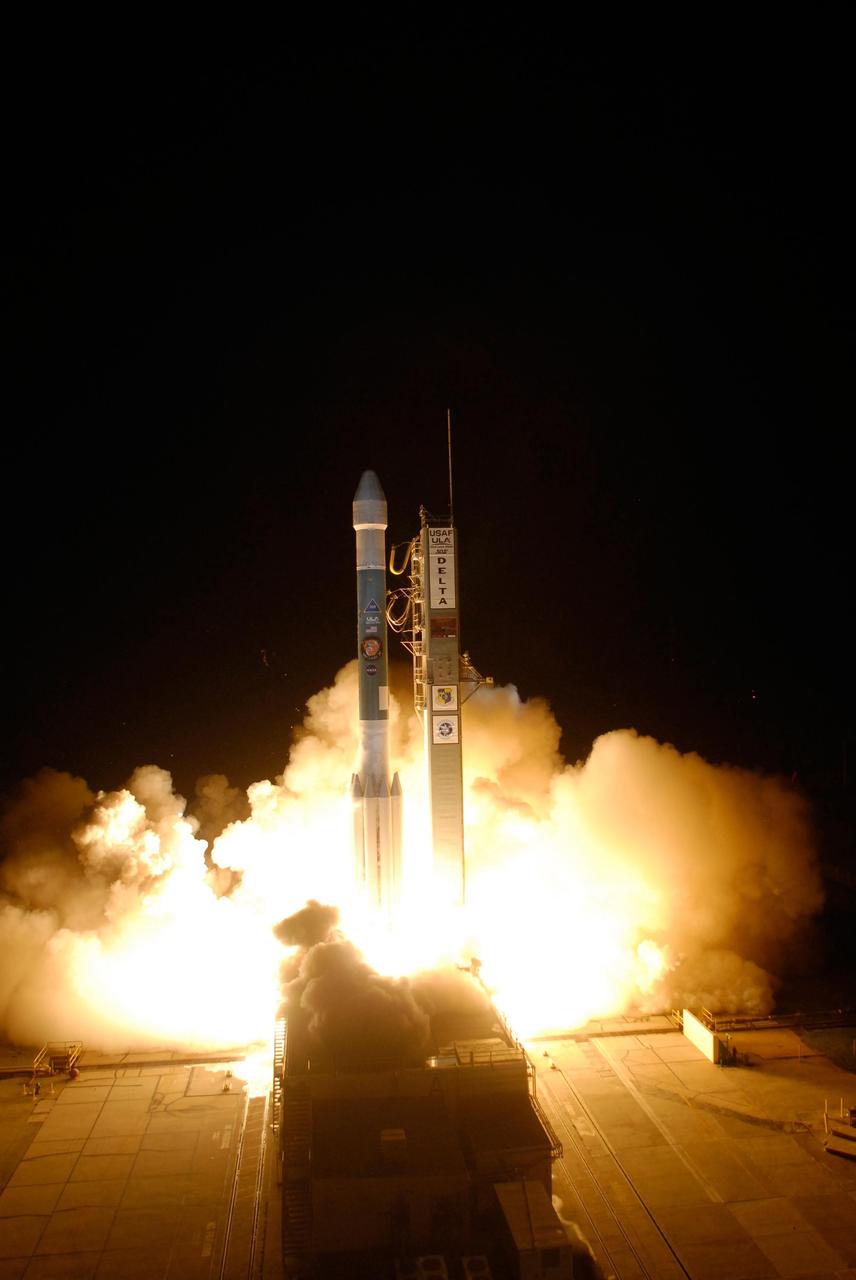
KENNEDY SPACE CENTER, FLA. - The Delta II 7925 rocket carrying NASA's Phoenix Mars lander lifts off at 5:26 a.m. EDT amid billows of smoke on Pad 17A at Cape Canaveral Air Force Station. Phoenix will land in icy soils near the north polar, permanent ice cap of Mars and explore the history of the water in these soils and any associated rocks, while monitoring polar climate. Landing on Mars is planned in May 2008 on arctic ground where a mission currently in orbit, Mars Odyssey, has detected high concentrations of ice just beneath the top layer of soil. Photo credit: NASA/Tony Gray and Robert Murray
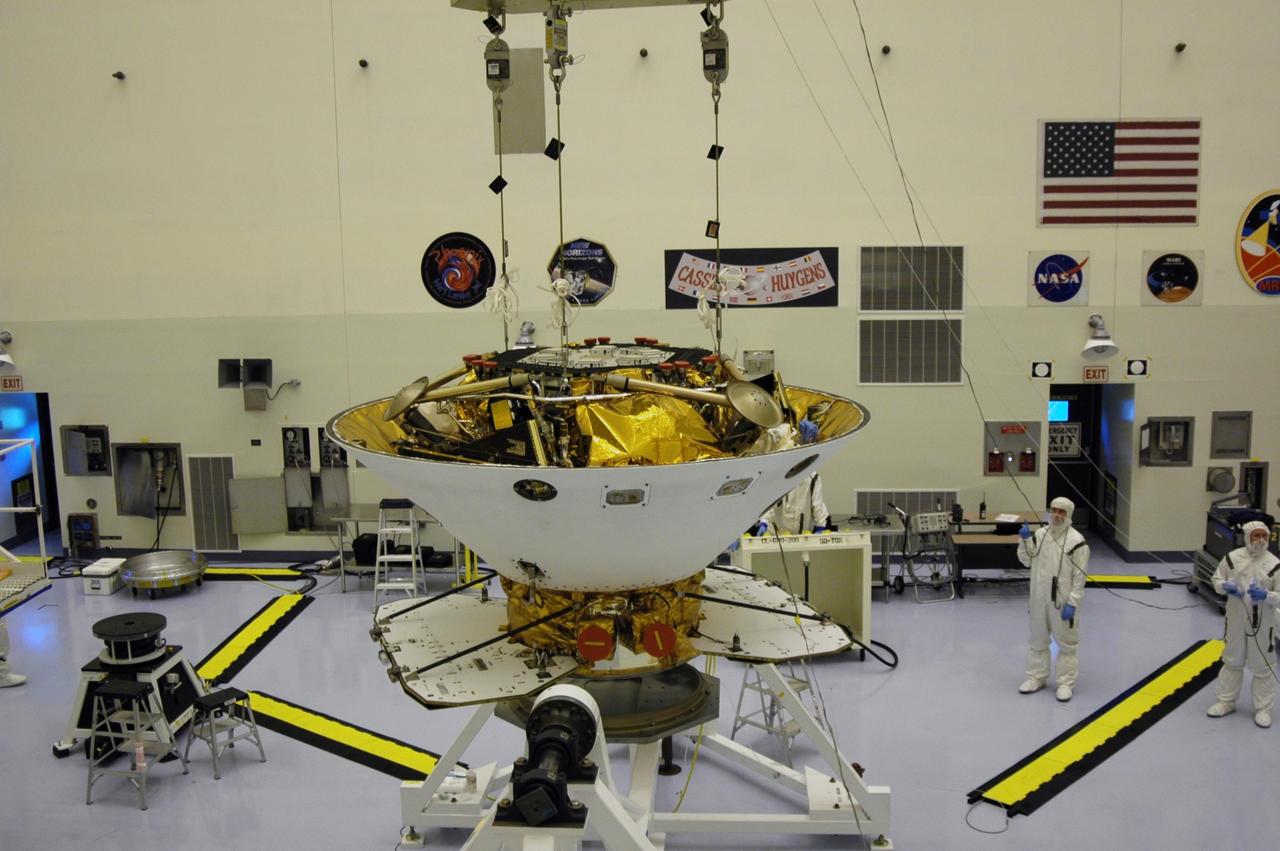
KENNEDY SPACE CENTER, Fla. -- In the Payload Hazardous Servicing Facility, the Phoenix Mars Lander spacecraft is lifted from its stand. The Phoenix will be moved to the upper stage booster for mating. Targeted for launch from Cape Canaveral Air Force Station on Aug. 3, Phoenix will land in icy soils near the north polar permanent ice cap of Mars and explore the history of the water in these soils and any associated rocks, while monitoring polar climate. Landing on Mars is planned in May 2008 on arctic ground where a mission currently in orbit, Mars Odyssey, has detected high concentrations of ice just beneath the top layer of soil. Photo credit: NASA/Dimitri Gerondidakis

KENNEDY SPACE CENTER, Fla. -- In the Payload Hazardous Servicing Facility, workers help guide the suspended Phoenix Mars Lander spacecraft toward the upper stage booster in the center. The spacecraft and booster will be mated for launch. Targeted for launch from Cape Canaveral Air Force Station on Aug. 3, Phoenix will land in icy soils near the north polar permanent ice cap of Mars and explore the history of the water in these soils and any associated rocks, while monitoring polar climate. Landing on Mars is planned in May 2008 on arctic ground where a mission currently in orbit, Mars Odyssey, has detected high concentrations of ice just beneath the top layer of soil. NASA/Dimitri Gerondidakis
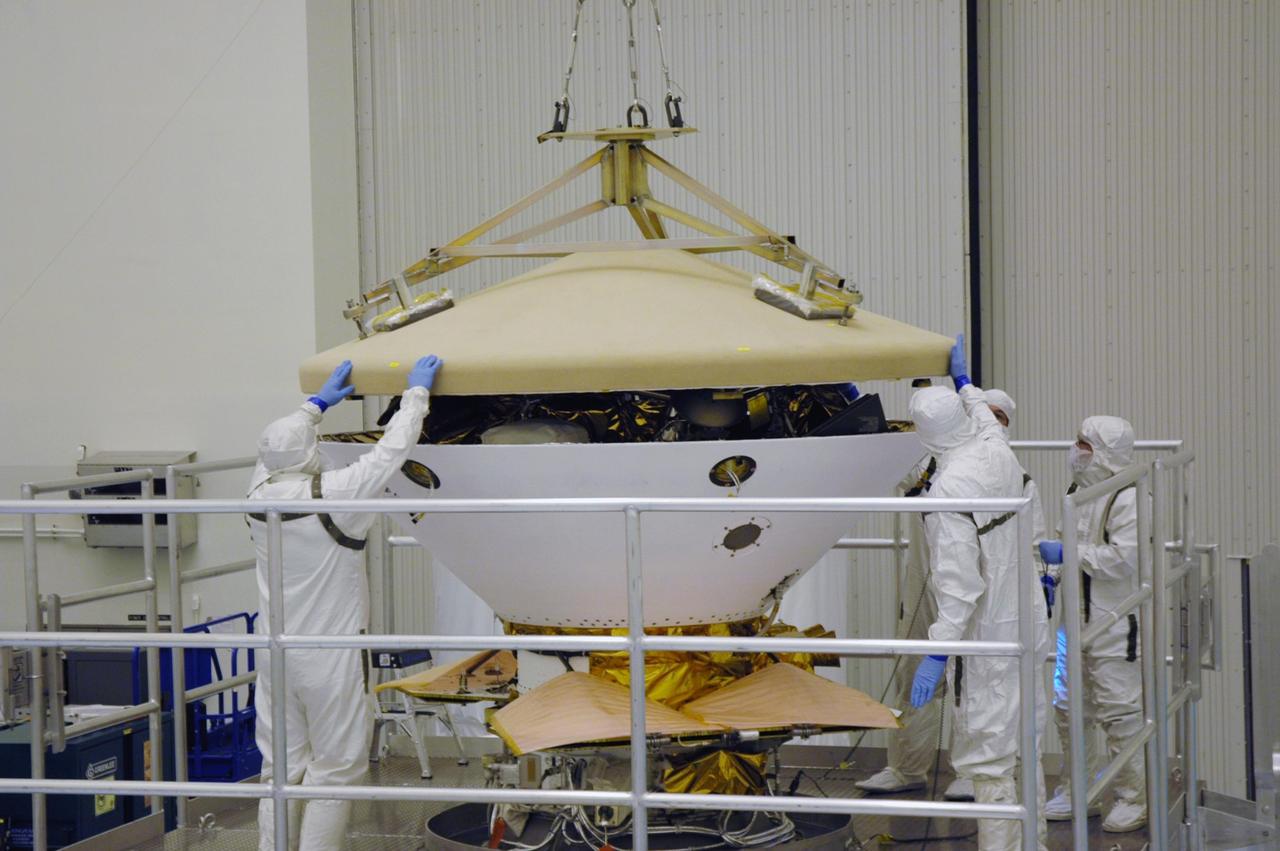
KENNEDY SPACE CENTER, Fla. -- In the Payload Hazardous Servicing Facility, workers guide the heat shield onto the Phoenix Mars Lander spacecraft. Targeted for launch from Cape Canaveral Air Force Station on Aug. 3, Phoenix will land in icy soils near the north polar permanent ice cap of Mars and explore the history of the water in these soils and any associated rocks, while monitoring polar climate. Landing on Mars is planned in May 2008 on arctic ground where a mission currently in orbit, Mars Odyssey, has detected high concentrations of ice just beneath the top layer of soil. Photo credit: NASA/Troy Cryder
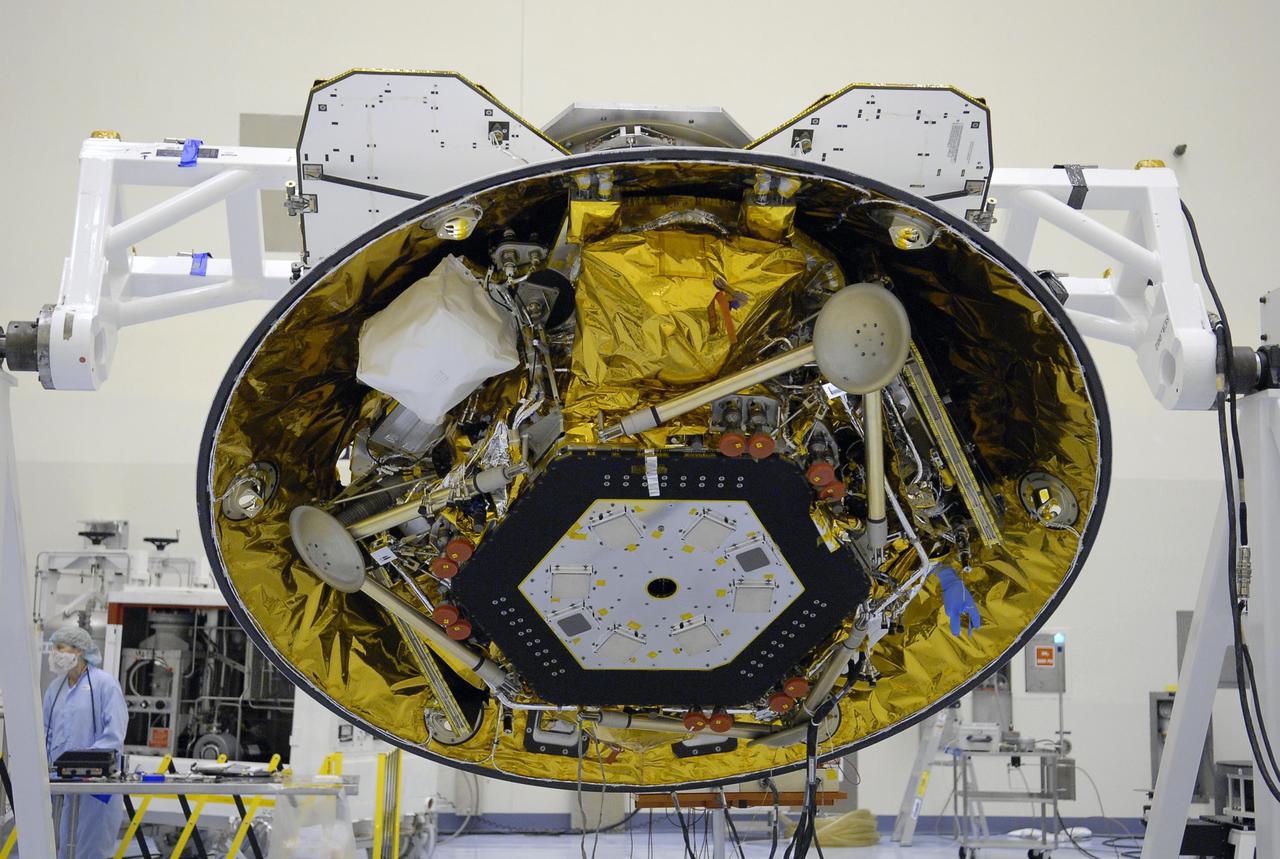
KENNEDY SPACE CENTER, FLA. -- A closeup of the Phoenix Mars Lander on display in the Payload Hazardous Servicing Facility. Phoenix is scheduled to launch Aug. 3 from Launch Pad 17-A at Cape Canaveral Air Force Station. Phoenix will land in icy soils near the north polar permanent ice cap of Mars and explore the history of the water in these soils and any associated rocks, while monitoring polar climate. Landing on Mars is planned in May 2008 on arctic ground where a mission currently in orbit, Mars Odyssey, has detected high concentrations of ice just beneath the top layer of soil. Photo credit: NASA/Kim Shiflett
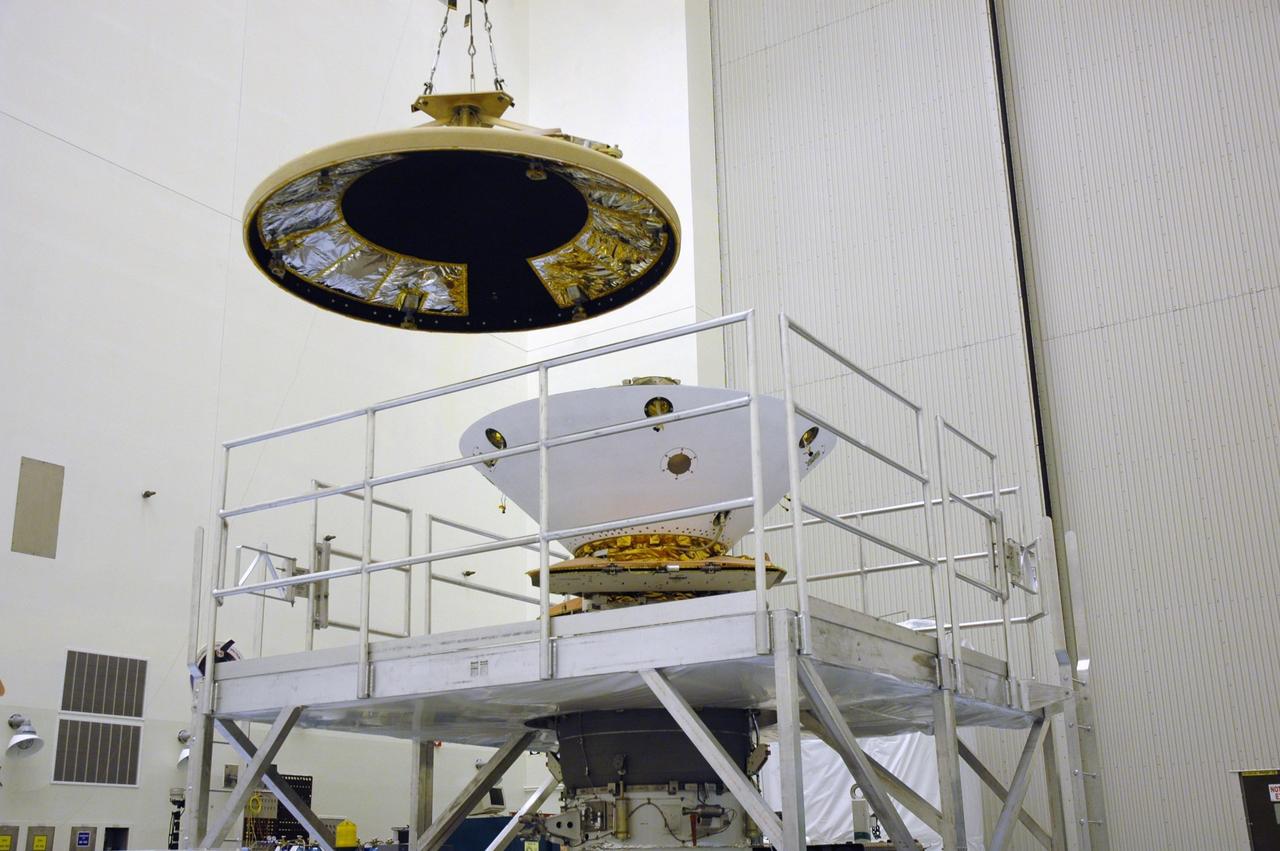
KENNEDY SPACE CENTER, Fla. --In the Payload Hazardous Servicing Facility, the heat shield for the Phoenix Mars Lander spacecraft is moved toward the spacecraft. Targeted for launch from Cape Canaveral Air Force Station on Aug. 3, Phoenix will land in icy soils near the north polar permanent ice cap of Mars and explore the history of the water in these soils and any associated rocks, while monitoring polar climate. Landing on Mars is planned in May 2008 on arctic ground where a mission currently in orbit, Mars Odyssey, has detected high concentrations of ice just beneath the top layer of soil. Photo credit: NASA/Troy Cryder
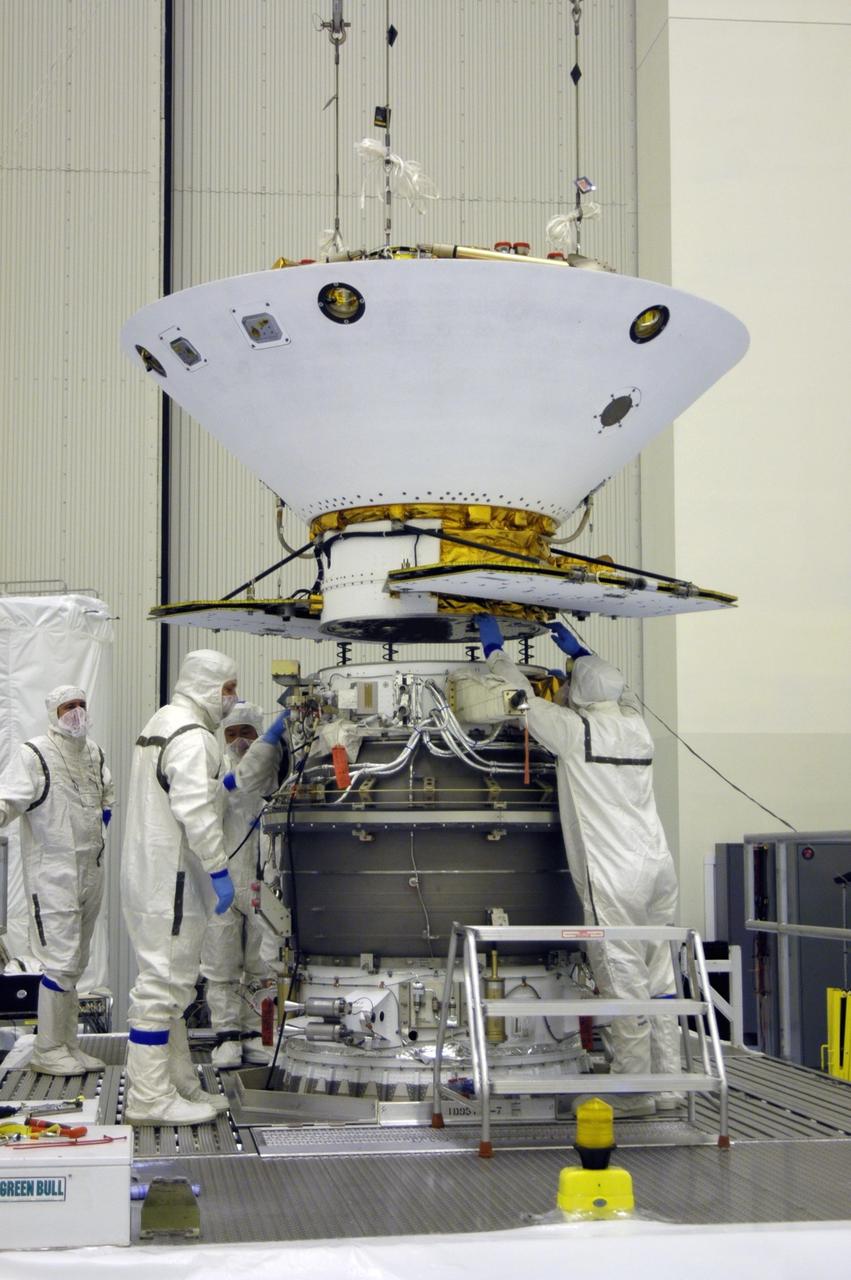
KENNEDY SPACE CENTER, Fla. -- In the Payload Hazardous Servicing Facility, workers guide the Phoenix Mars Lander spacecraft onto the upper stage booster. The spacecraft and booster will be mated for launch. Targeted for launch from Cape Canaveral Air Force Station on Aug. 3, Phoenix will land in icy soils near the north polar permanent ice cap of Mars and explore the history of the water in these soils and any associated rocks, while monitoring polar climate. Landing on Mars is planned in May 2008 on arctic ground where a mission currently in orbit, Mars Odyssey, has detected high concentrations of ice just beneath the top layer of soil. NASA/Dimitri Gerondidakis