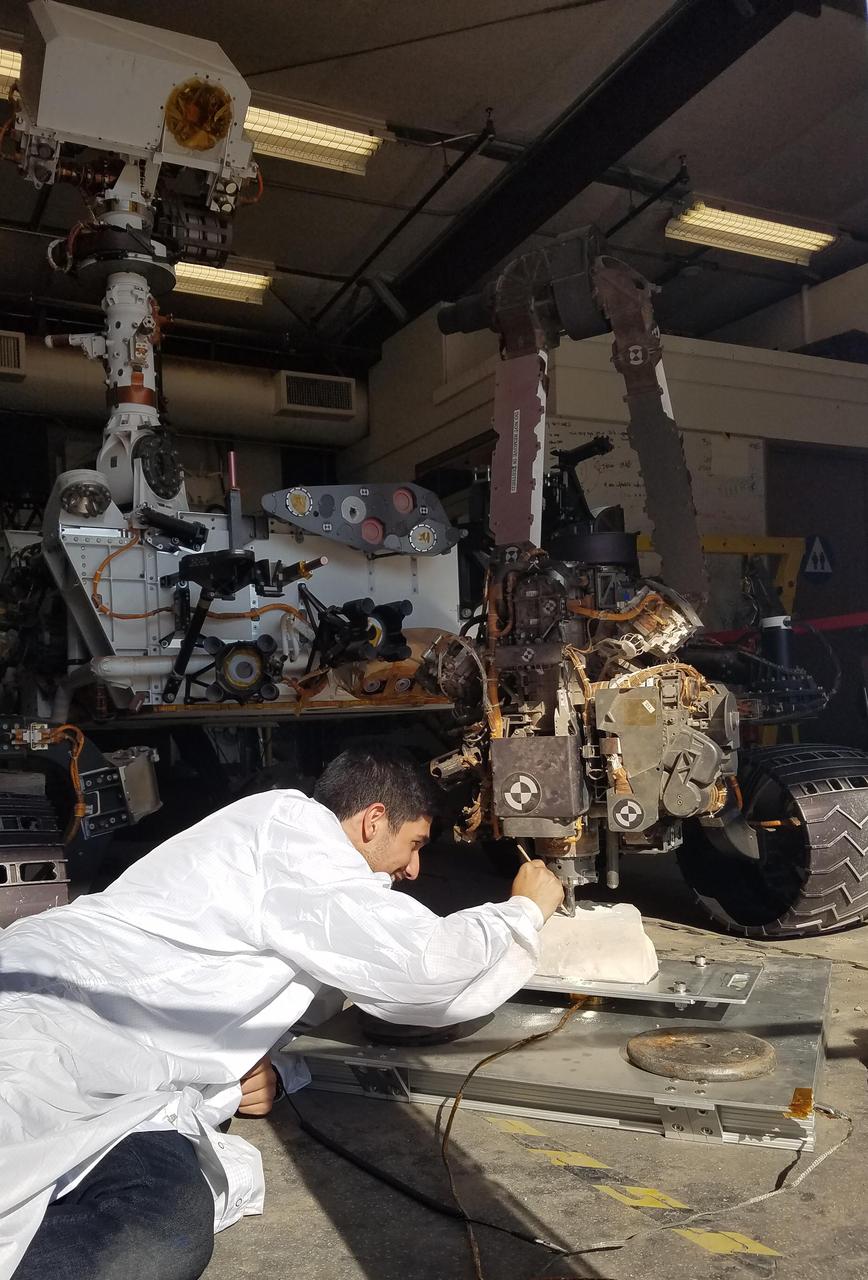
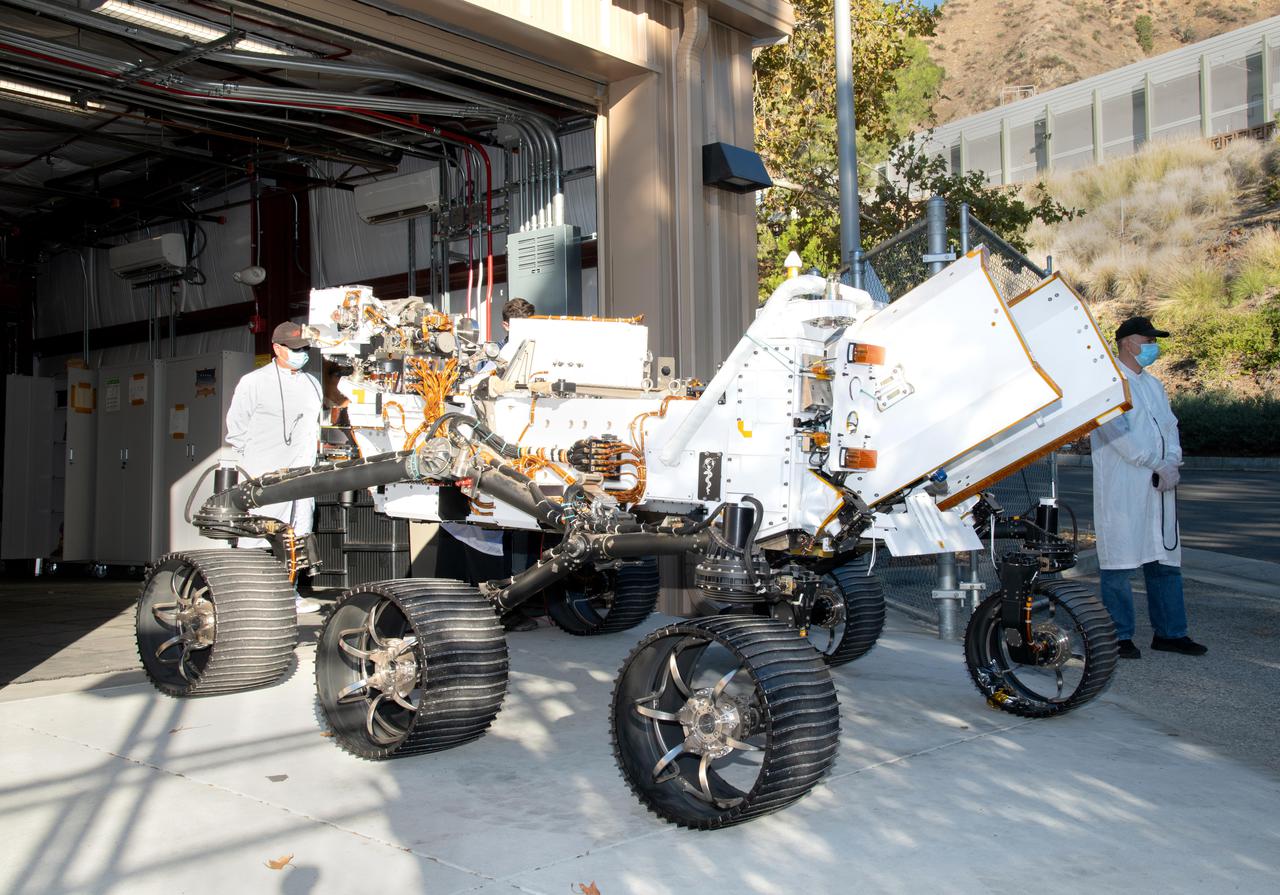
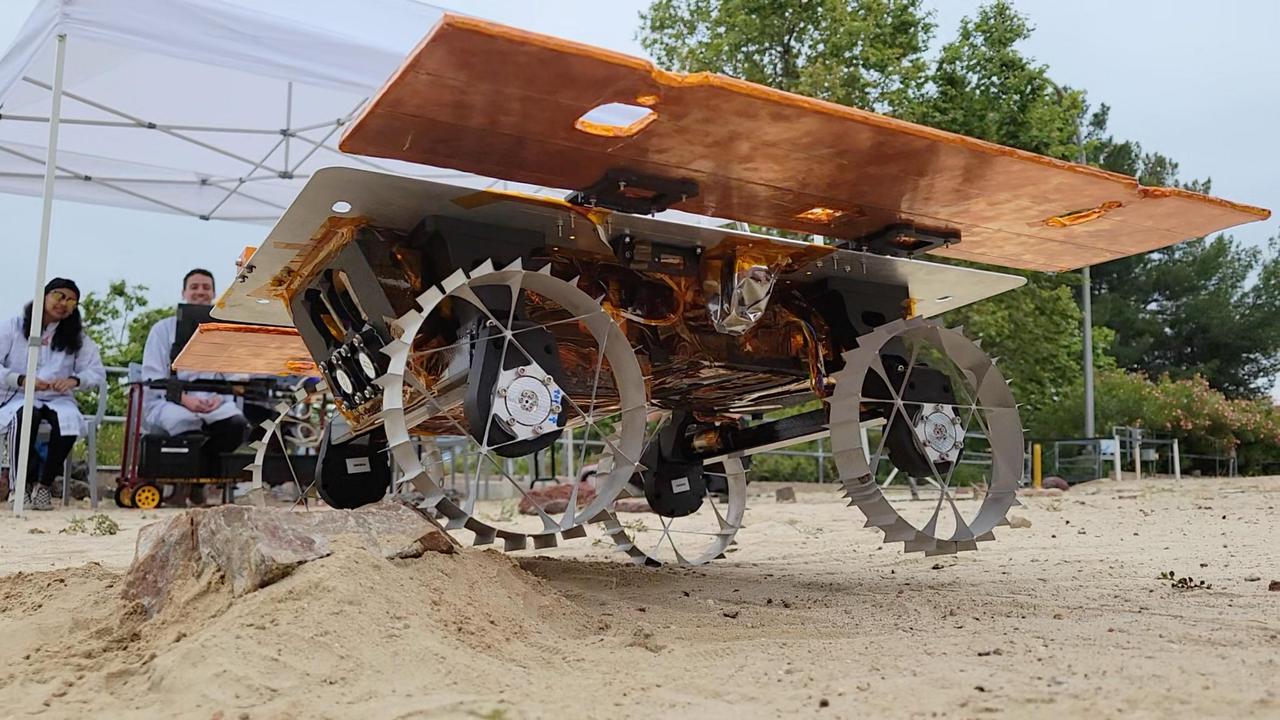
This photo taken in the "Mars Yard" at NASA's Jet Propulsion Laboratory, Pasadena, California, on Aug. 1, 2017, shows a step in development of possible alternative techniques that NASA's Curiosity Mars rover might be able to use to resume drilling into rocks on Mars.  In late 2016, after Curiosity's drill had collected sample material from 15 Martian rocks in four years, the drill's feed mechanism ceased working reliably. That motorized mechanism moved the bit forward or back with relation to stabilizer posts on either side of the bit. In normal drilling by Curiosity, the stabilizers were positioned on the target rock first, and then the feed mechanism extended the rotation-percussion bit into the rock.  In the alternative technique seen here, called "feed-extended drilling," the test rover's stabilizers are not used to touch the rock. The bit is advanced into the rock by motion of the robotic arm rather than the drill's feed mechanism.  https://photojournal.jpl.nasa.gov/catalog/PIA22062
New Rock-Drilling Method in 'Mars Yard' Test
This grouping of two test rovers and a flight spare provides a graphic comparison of three generations of Mars rovers developed at NASA Jet Propulsion Laboratory, Pasadena, Calif. The setting is JPL Mars Yard testing area.
Three Generations of Rovers in Mars Yard
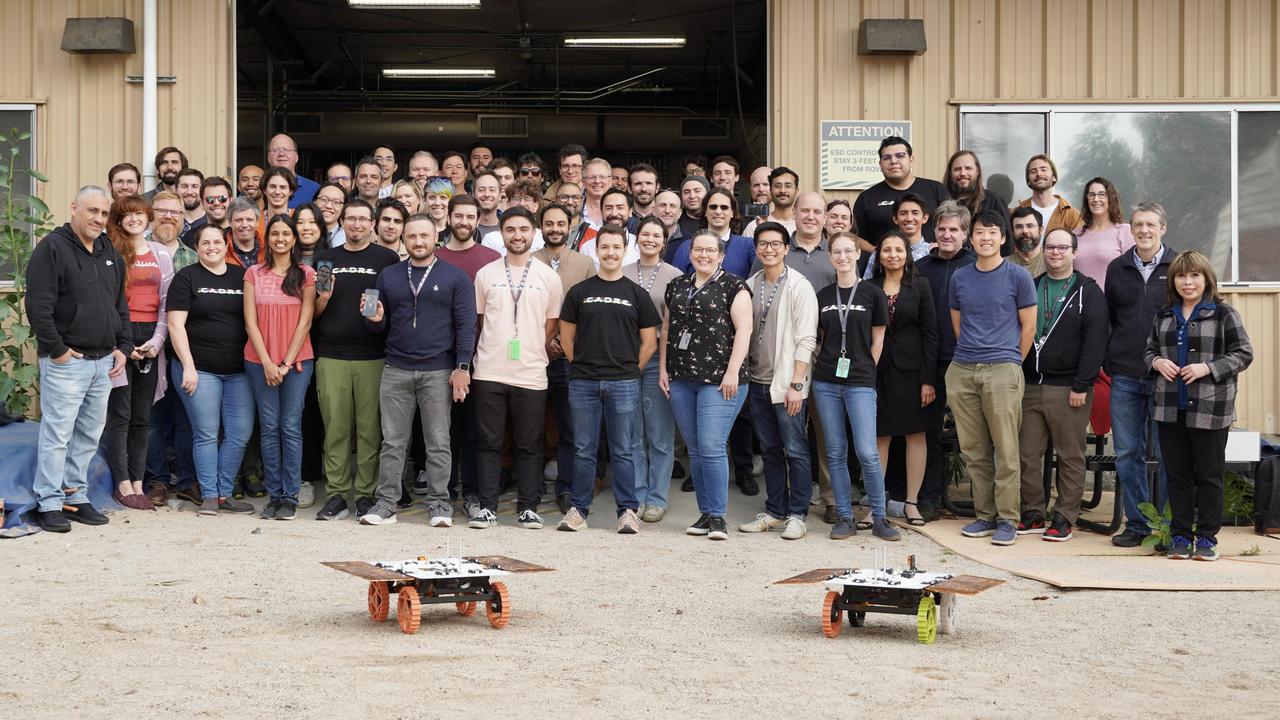
Members of NASA's CADRE (Cooperative Autonomous Distributed Robotic Exploration) technology demonstration team pose with two full-scale development model rovers in the Mars Yard at the agency's Jet Propulsion Laboratory in Southern California in January 2024.  The project is designed to show that a group of robotic spacecraft can work together as a team to accomplish tasks and record data autonomously – without explicit commands from mission controllers on Earth. Three small rovers will ride aboard a lunar lander that will carry the project's base station and camera assembly.  The rovers shown here are similar in size and appearance to the flight models that will travel to the Moon. Equipped with flight software and autonomy capabilities, these development models were used in a series of Mars Yard tests that helped confirm CADRE hardware and software can work together to accomplish key goals for the project.  https://photojournal.jpl.nasa.gov/catalog/PIA26170
CADRE Team in the Mars Yard
This grouping of two test rovers and a flight spare provides a graphic comparison of three generations of Mars rovers developed at NASA Jet Propulsion Laboratory, Pasadena, Calif. The setting is JPL Mars Yard testing area.
Three Generations in Mars Yard, High Viewpoint
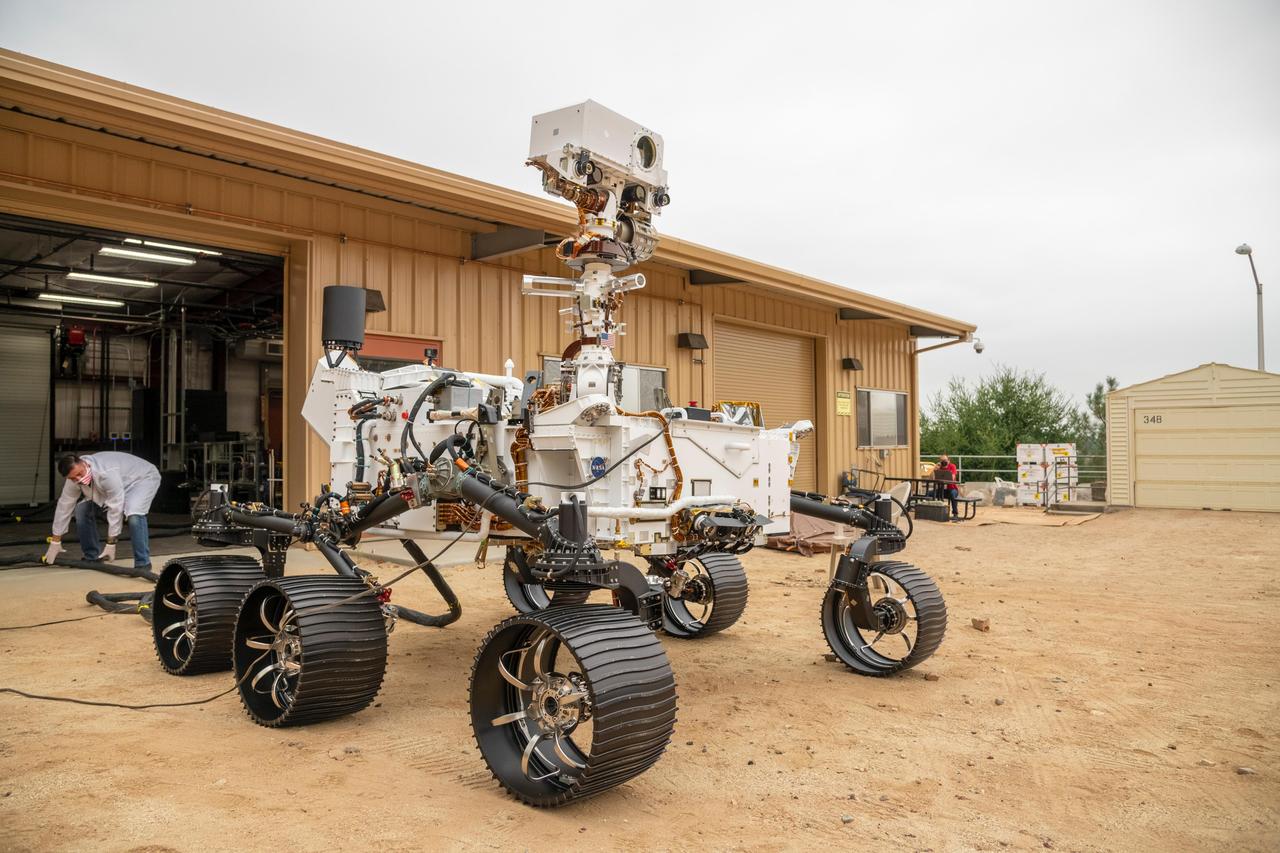
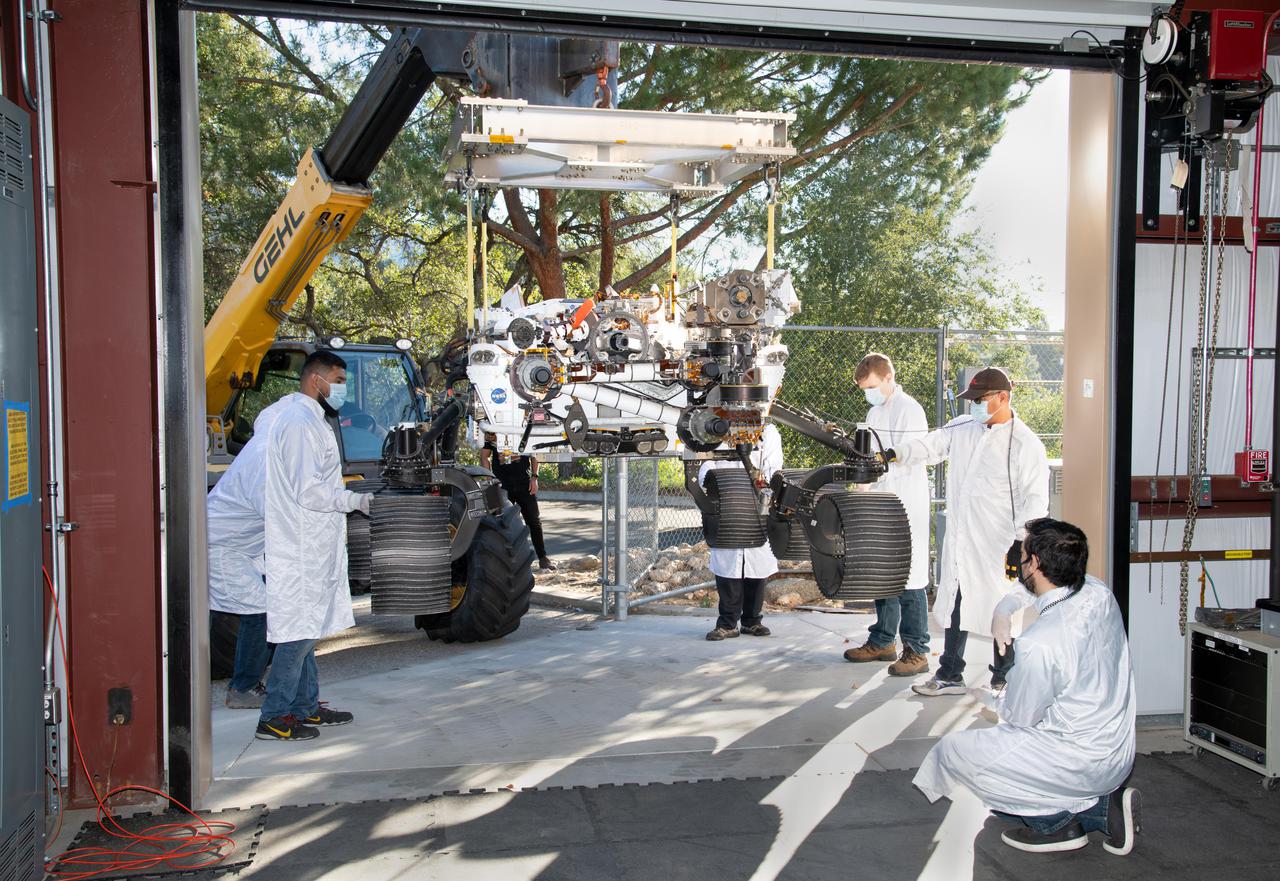
Technicians move a full-scale engineering version of NASA's Perseverance Mars rover into to its new home — a garage facing the Mars Yard at the agency's Jet Propulsion Laboratory in Southern California — on Sept. 4, 2020.  This vehicle system test bed (VSTB) rover was built in a warehouselike assembly room not far from the Mars Yard — an area that simulates the Red Planet's surface — and enables the mission team to test how hardware and software will perform before they transmit commands to the real rover on Mars. It also goes by the name OPTIMISM (Operational Perseverance Twin for Integration of Mechanisms and Instruments Sent to Mars).  The Perseverance rover's astrobiology mission will search for signs of ancient microbial life. It will also characterize the planet's climate and geology, pave the way for human exploration of the Red Planet, and be the first planetary mission to collect and cache Martian rock and regolith (broken rock and dust). Subsequent missions, currently under consideration by NASA in cooperation with the European Space Agency, would send spacecraft to Mars to collect these cached samples from the surface and return them to Earth for in-depth analysis.  The Mars 2020 mission is part of a larger program that includes missions to the Moon as a way to prepare for human exploration of the Red Planet. Charged with returning astronauts to the Moon by 2024, NASA will establish a sustained human presence on and around the Moon by 2028 through NASA's Artemis lunar exploration plans.  Movie available at https://photojournal.jpl.nasa.gov/catalog/PIA23965
Test Rover Moves to Mars Yard
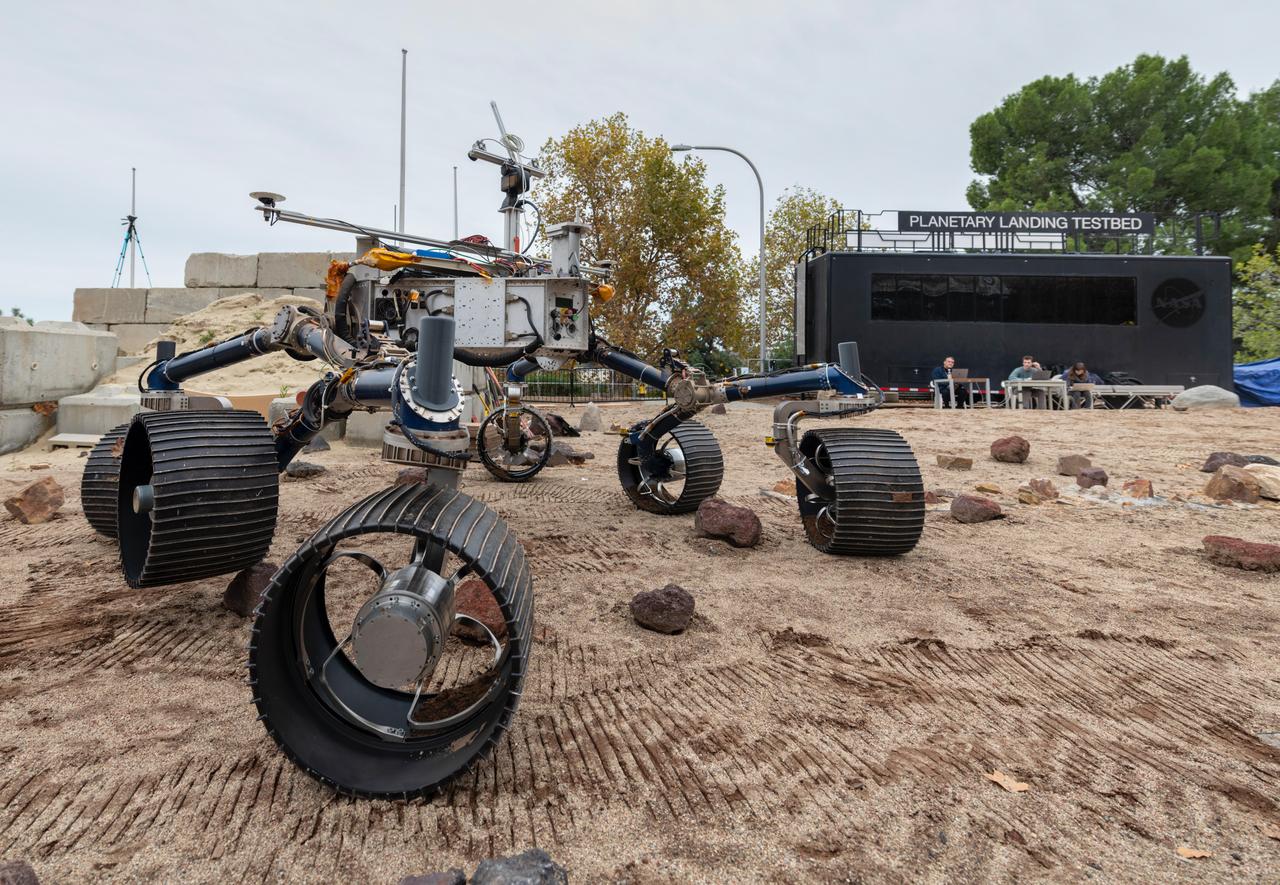
The full-scale engineering model of NASA's Perseverance rover has put some dirt on its wheels. This vehicle system test bed (VSTB) rover moved into its home — a garage facing the Mars Yard at NASA's Jet Propulsion Laboratory in Southern California — on Sept. 4, 2020. It drove onto simulated Martian surface of the Mars Yard — a dirt field at JPL studded with rocks and other obstacles — for the first time on Sept. 8. The VSTB rover is also known as OPTIMISM (Operational Perseverance Twin for Integration of Mechanisms and Instruments Sent to Mars).  A key objective for Perseverance's mission on Mars is astrobiology, including the search for signs of ancient microbial life. The rover will also characterize the planet's climate and geology, pave the way for human exploration of the Red Planet, and be the first planetary spacecraft to collect and cache Martian rock and regolith (broken rock and dust). Subsequent missions, currently under consideration by NASA in cooperation with the European Space Agency, would send spacecraft to Mars to collect these cached samples from the surface and return them to Earth for in-depth analysis.  The Mars 2020 mission is part of a larger program that includes missions to the Moon as a way to prepare for human exploration of the Red Planet. Charged with returning astronauts to the Moon by 2024, NASA will establish a sustained human presence on and around the Moon by 2028 through NASA's Artemis lunar exploration plans.  https://photojournal.jpl.nasa.gov/catalog/PIA23966
Perseverance Twin Drives Into the Mars Yard
An engineering model of NASA's Mars 2020 rover makes tracks during a driving test in the Mars Yard, an area that simulates Mars-like conditions at NASA's Jet Propulsion Laboratory in Pasadena, California. This image was taken on Dec. 3, 2019, as engineers were trying out the software that will command the rover to move.  Mars 2020 will launch from Cape Canaveral Air Force Station in Florida as early as July 2020. It will land at Jezero Crater on Feb. 18, 2021. JPL is building and will manage operations of the Mars 2020 rover for NASA. NASA's Launch Services Program, based at the agency's Kennedy Space Center in Florida, is responsible for launch management.  Mars 2020 is part of a larger program that includes missions to the Moon as a way to prepare for human exploration of the Red Planet. Charged with returning astronauts to the Moon by 2024, NASA will establish a sustained human presence on and around the Moon by 2028 through NASA's Artemis lunar exploration plans.  For more information about the mission, go to https://mars.nasa.gov/mars2020/.   https://photojournal.jpl.nasa.gov/catalog/PIA23498
Mars 2020 Makes Tracks for the Red Planet in the Mars Yard
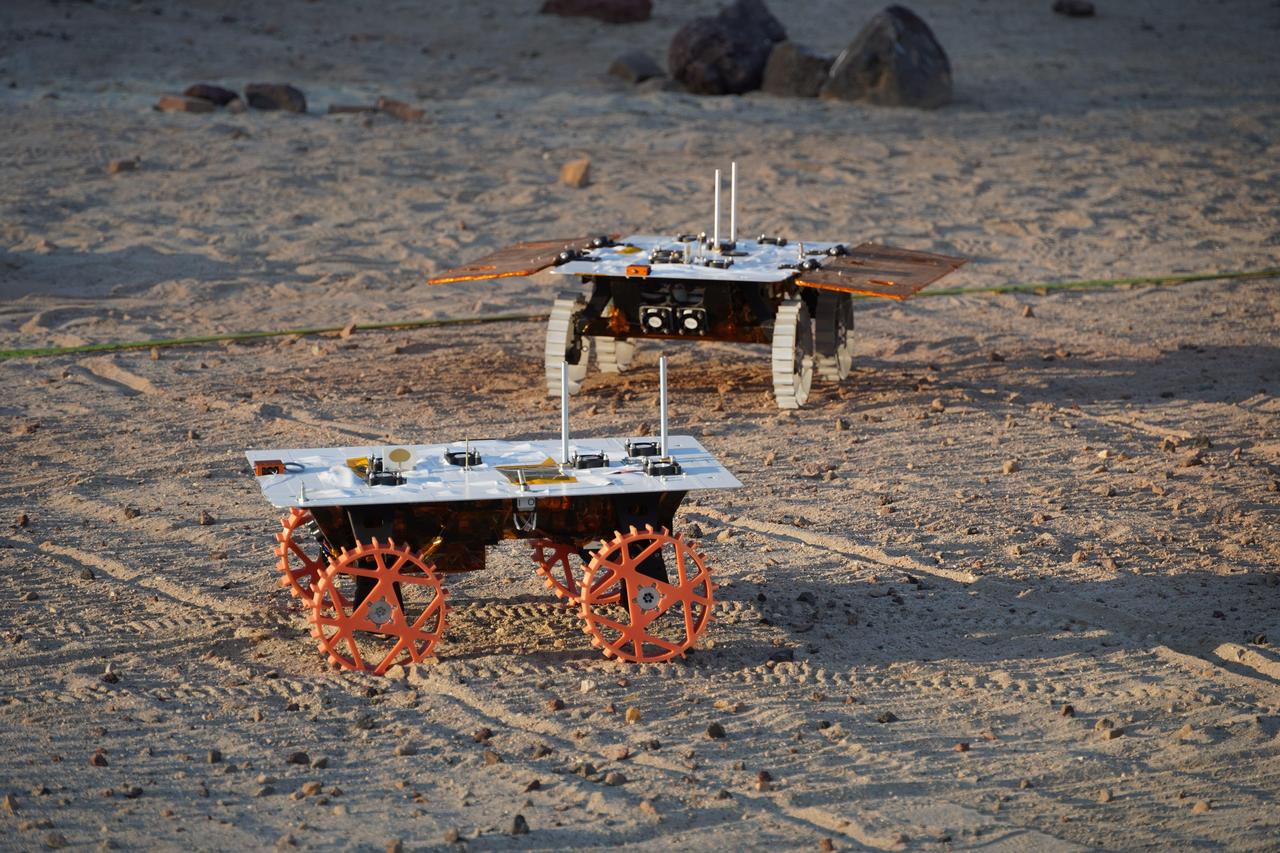
Two full-scale development model rovers that are part of NASA's CADRE (Cooperative Autonomous Distributed Robotic Exploration) technology demonstration drive in the Mars Yard at the agency's Jet Propulsion Laboratory in Southern California in August 2023. The project is designed to show that a group of robotic spacecraft can work together as a team to accomplish tasks and record data autonomously – without explicit commands from mission controllers on Earth.  The rovers being tested here are similar in size and appearance to the flight models – still being built at the time of this image – that will travel to the Moon. Equipped with flight software and autonomy capabilities, these development models were used for drive tests outside the clean room. In this image, one rover is fitted with a stand-in for solar panels, while the other rover is not.  A series of Mars Yard tests with the development models confirmed CADRE hardware and software can work together to accomplish key goals for the project. The rovers drove together in formation. Faced with unexpected obstacles in the way, they adjusted their plans as a group by sharing updated maps and replanning coordinated paths. And when one rover was low on battery charge, the whole team paused so they could later continue together.  Several drives were performed at night under large flood lamps so the rovers could experience extreme shadows and lighting that approximate what they'll encounter during the lunar daytime.  https://photojournal.jpl.nasa.gov/catalog/PIA26168
CADRE Test Rovers in the Mars Yard
In the summer and fall of 2017, the team operating NASA's Curiosity Mars rover conducted tests in the "Mars Yard" at NASA's Jet Propulsion Laboratory, Pasadena, California, to develop techniques that Curiosity might be able to use to resume drilling into rocks on Mars.  JPL robotics engineer Vladimir Arutyunov, in this June 29, 2017, photo, checks the test rover's drill bit at its contact point with a rock. Note that the stabilizer post visible to the right of the bit is not in contact with the rock, unlike the positioning used and photographed by Curiosity when drilling into rocks on Mars in 2013 to 2016.  In late 2016, after Curiosity's drill had collected sample material from 15 Martian rocks, the drill's feed mechanism ceased working reliably. That motorized mechanism moved the bit forward or back with relation to the stabilizer posts on either side of the bit. In normal drilling by Curiosity, the stabilizers were positioned on the target rock first, and then the feed mechanism extended the rotation-percussion bit into the rock.  In the alternative technique seen here, called "feed-extended drilling," the test rover's stabilizers are not used to touch the rock. The bit is advanced into the rock by motion of the robotic arm rather than the drill's feed mechanism.   https://photojournal.jpl.nasa.gov/catalog/PIA22061
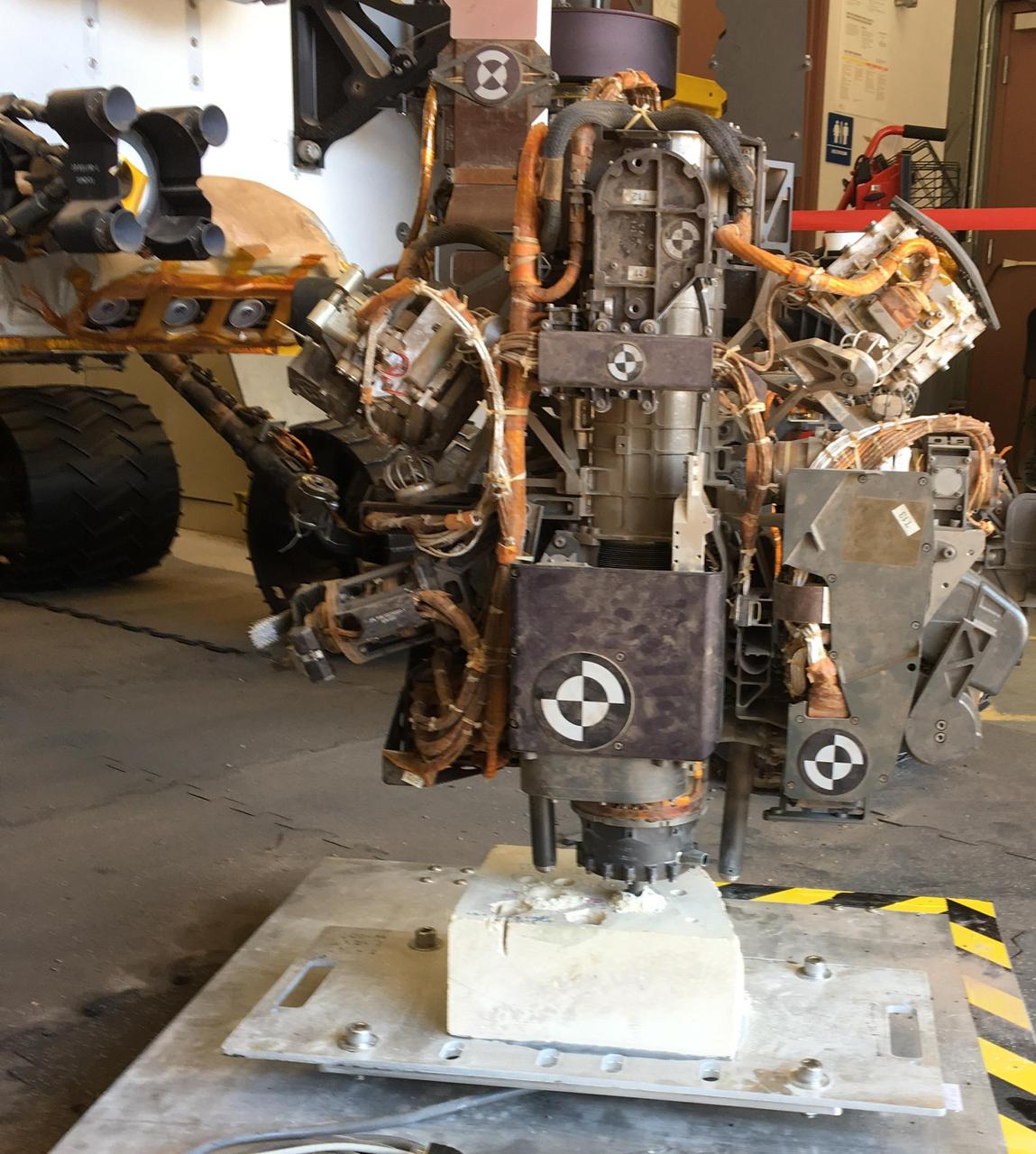
Testing New Techniques for Mars Rover Rock-Drilling
Engineers use OPTIMISM, a full-size replica of NASA's Perseverance rover, to test how it will deposit its first sample tube on the Martian surface. The test was conducted in the Mars Yard at NASA's Jet Propulsion Laboratory in Southern California.  A key objective for Perseverance's mission on Mars is astrobiology, including the search for signs of ancient microbial life. The rover will characterize the planet's geology and past climate, pave the way for human exploration of the Red Planet, and be the first mission to collect and cache Martian rock and regolith (broken rock and dust).  Subsequent NASA missions, in cooperation with ESA (European Space Agency), would send spacecraft to Mars to collect these sealed samples from the surface and return them to Earth for in-depth analysis.  The Mars 2020 Perseverance mission is part of NASA's Moon to Mars exploration approach, which includes Artemis missions to the Moon that will help prepare for human exploration of the Red Planet.  Movie available at https://photojournal.jpl.nasa.gov/catalog/PIA25676
Testing a Sample Drop in the Mars Yard
A development model rover that is part of NASA's CADRE (Cooperative Autonomous Distributed Robotic Exploration) technology demonstration took its first autonomous drive around the Mars Yard at the agency's Jet Propulsion Laboratory in Southern California in June 2023. The CADRE team tested a new wheel design, surface navigation software, and mobility capabilities, among other aspects of the project. Engineer Kristopher Sherrill is shown recording video of the test.  The rover being tested is similar in size and appearance to the flight models of the CADRE rovers, which are still being built. Slated to arrive at the Moon in spring 2024 as part of NASA's CLPS (Commercial Lunar Payload Services) initiative, CADRE is designed to demonstrate that multiple robots can cooperate and explore together autonomously – without direct input from human mission controllers.  A trio of the miniature solar-powered rovers, each about the size of a carry-on suitcase, will explore the Moon as a team, communicating via radio with each other and a base station aboard a lunar lander. By taking simultaneous measurements from multiple locations, CADRE will also demonstrate how multirobot missions can record data impossible for a single robot to achieve – a tantalizing prospect for future missions.  Movie available at https://photojournal.jpl.nasa.gov/catalog/PIA25665
CADRE Rover Testing in JPL's Mars Yard
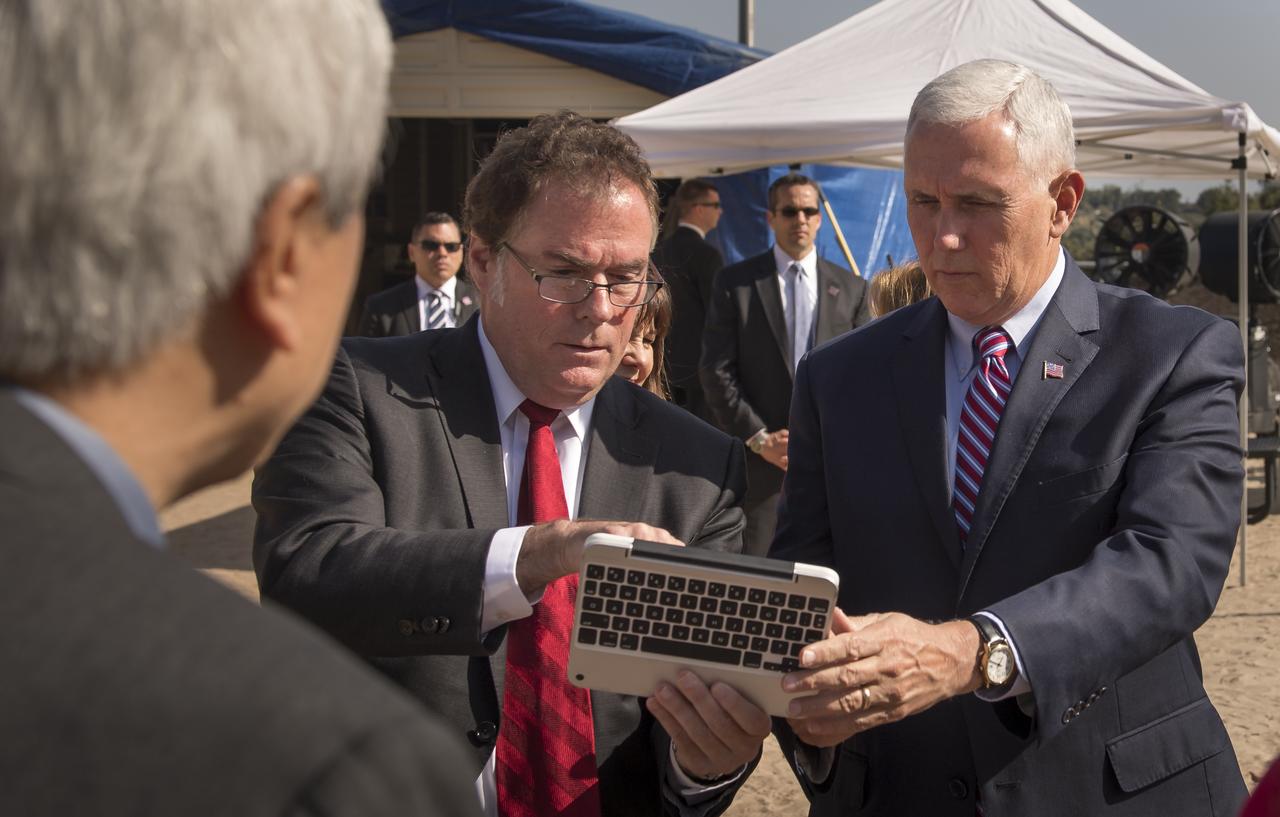
U.S. Vice President Mike Pence is given instructions on how to drive a rover nicknamed "Scarecrow" by JPL Director Michael Watkins at NASA's Jet Propulsion Laboratory Mars Yard, Saturday, April 28, 2018 in Pasadena, California. Scarecrow is used to test mobility of rovers on Mars. Photo Credit: (NASA/Bill Ingalls)
Vice President Pence Tours Jet Propulsion Laboratory
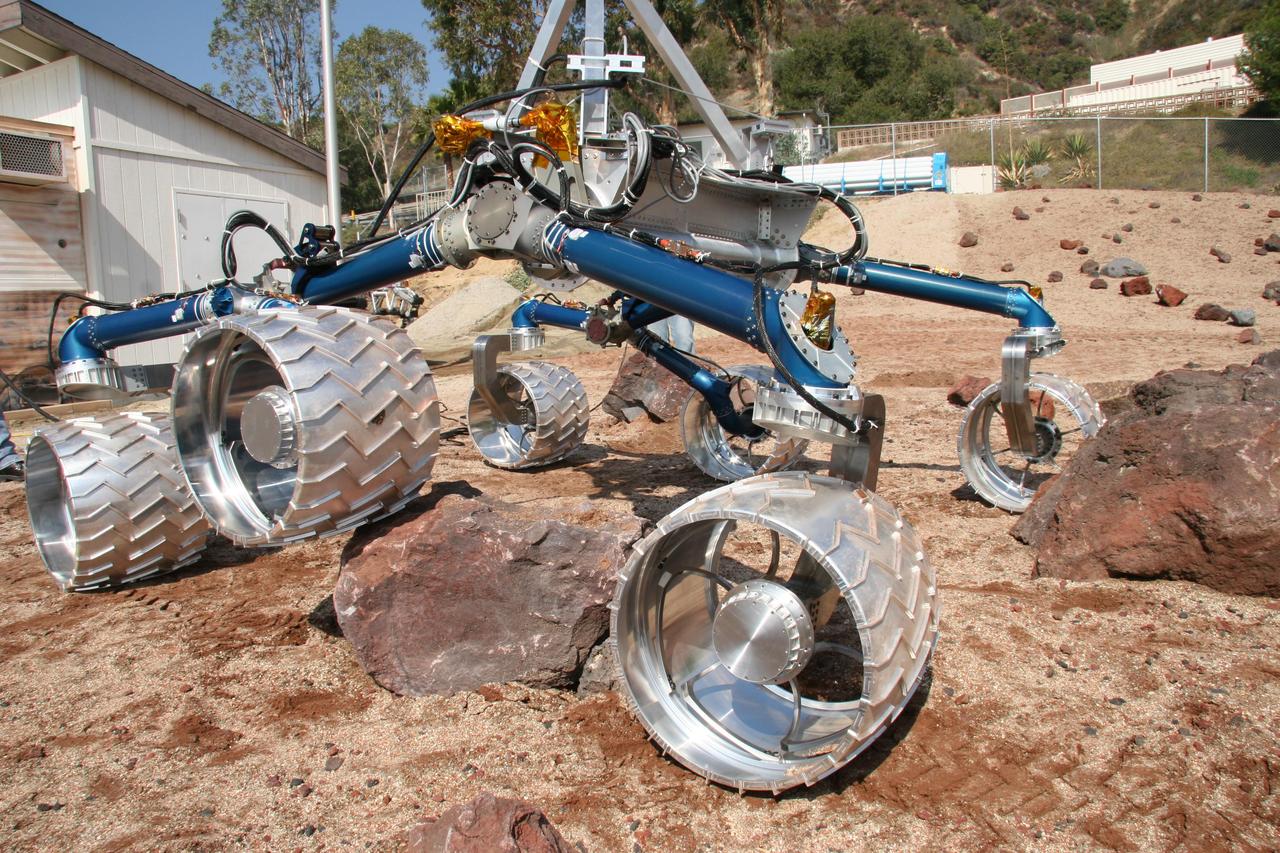
Scarecrow, a mobility-testing model for NASA Mars Science Laboratory, easily traverses large rocks in the Mars Yard testing area at NASA Jet Propulsion Laboratory.
Scarecrow Climbs Rocks
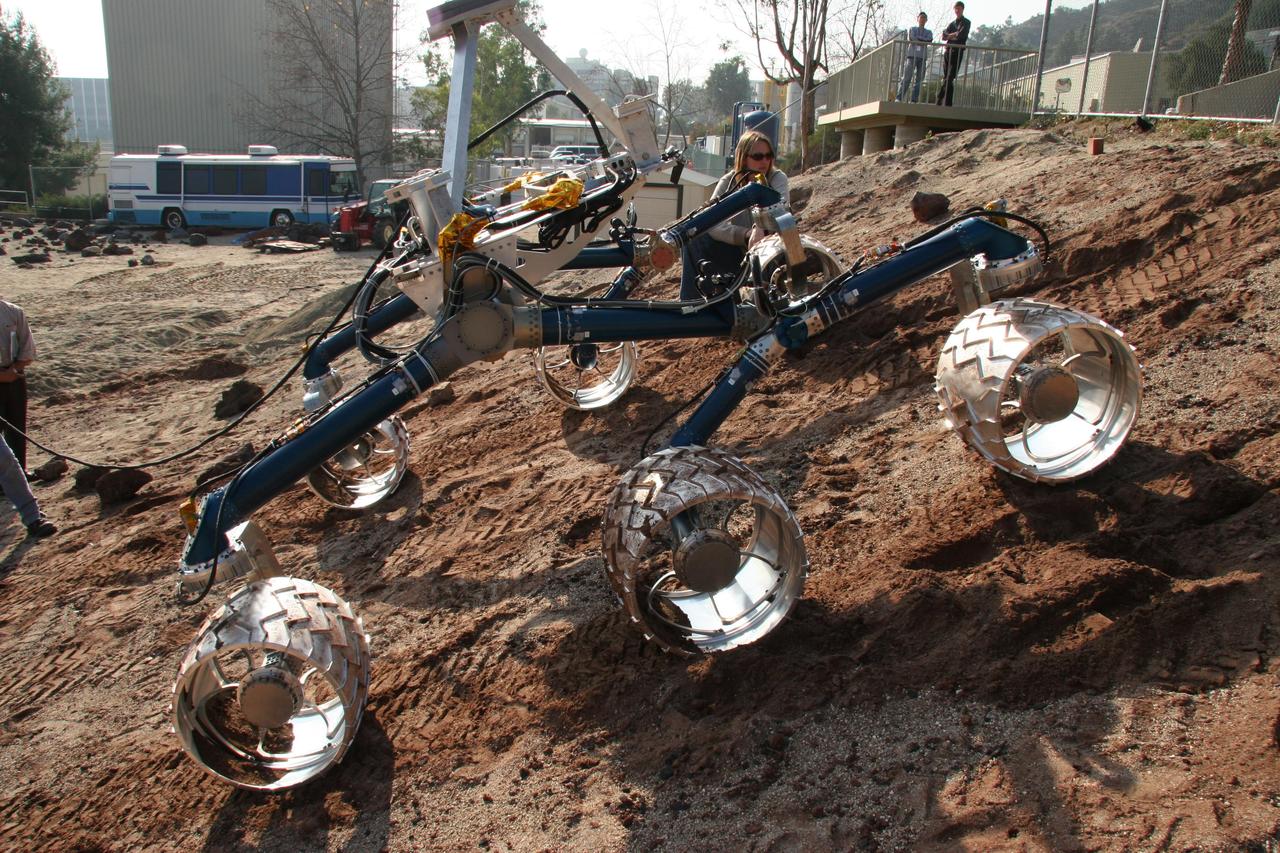
An engineering model for NASA Mars Science Laboratory makes its way up a hill in the Mars Yard testing area at NASA Jet Propulsion Laboratory.
Scarecrow Descends Hill
The engineering models of both the Curiosity Mars rover (foreground) and the Perseverance Mars rover share space in the recently expanded garage at the Mars Yard. Curiosity's Earthy double is called MAGGIE, short for Mars Automated Giant Gizmo for Integrated Engineering; Perseverance's double goes by OPTIMISM (Operational Perseverance Twin for Integration of Mechanisms and Instruments Sent to Mars).  The Mars Yard simulates Martian terrain and has served as a testing ground for many fully-engineered rover twins – from the very first, tiny Sojourner that landed on Mars in 1997 to the Spirit and Opportunity missions that began in 2004 to the Curiosity and Perseverance rovers exploring Mars today. Each is generically referred to as a vehicle system test bed.  A key objective for Perseverance's mission on Mars is astrobiology, including the search for signs of ancient microbial life. The rover will characterize the planet's geology and past climate, pave the way for human exploration of the Red Planet, and be the first mission to collect and cache Martian rock and regolith (broken rock and dust).  Subsequent NASA missions, in cooperation with ESA (European Space Agency), would send spacecraft to Mars to collect these sealed samples from the surface and return them to Earth for in-depth analysis.  The Mars 2020 Perseverance mission is part of NASA's Moon to Mars exploration approach, which includes Artemis missions to the Moon that will help prepare for human exploration of the Red Planet.  https://photojournal.jpl.nasa.gov/catalog/PIA24525
Twin Rover Twins
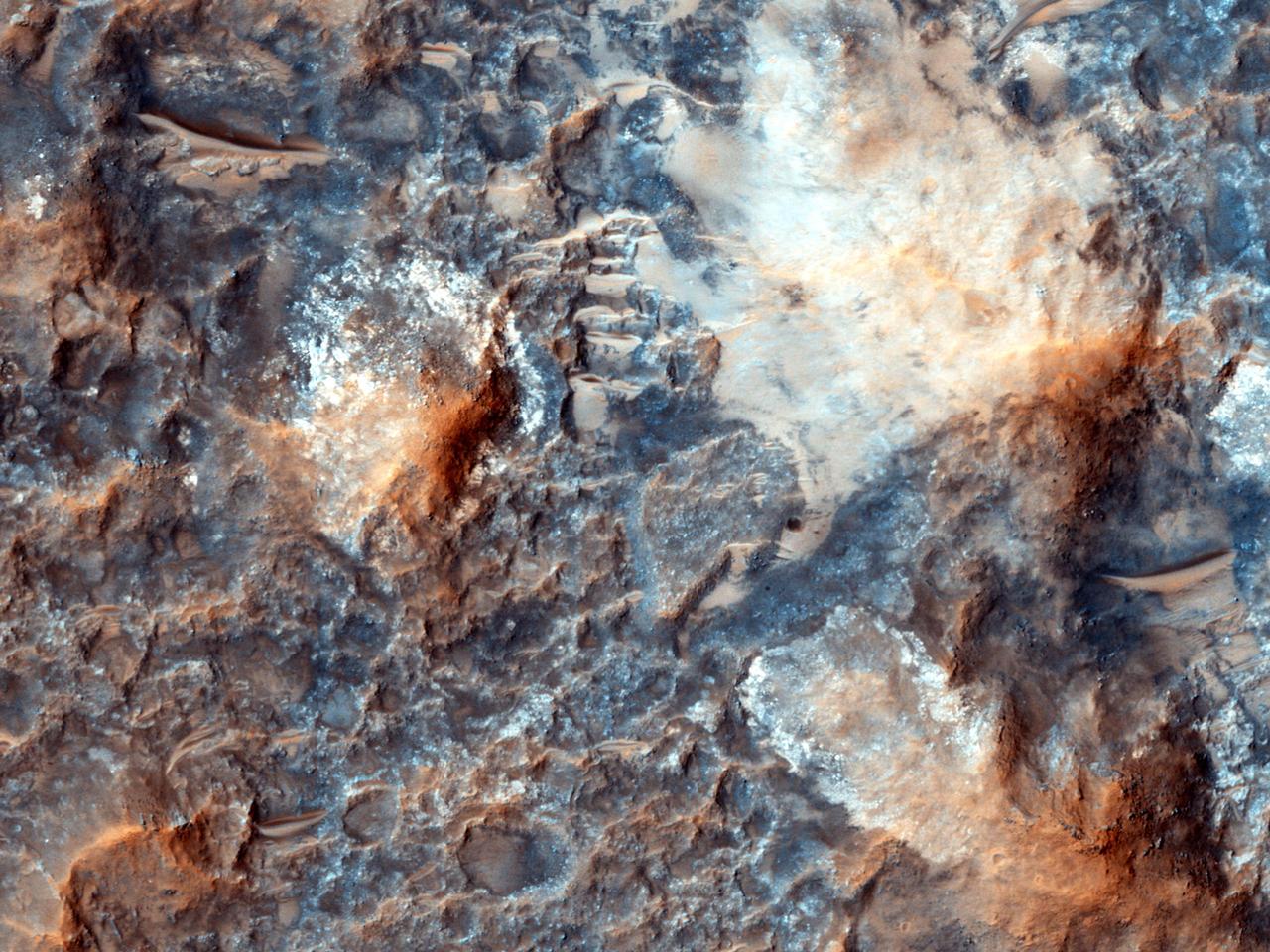
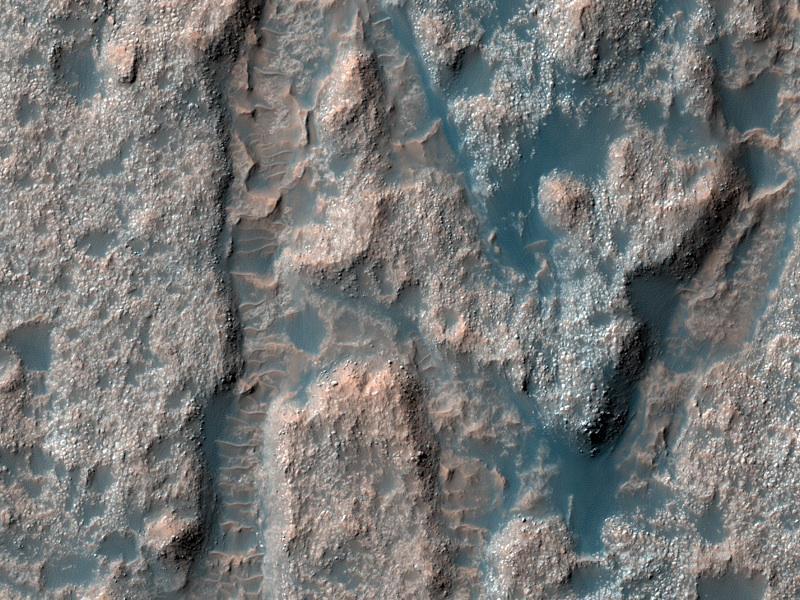
This image taken by NASA Mars Reconnaissance Orbiter reveals meter-scale yard-scale surface textures of mesas and knobs in the Aureum Chaos region of Mars. Aureum Chaos is a wide region of plateaus, mesas, and knobs.
Mesas in Aureum Chaos
A rippled patch of sand in Becquerel Crater on Mars moved about two meters about two yards between November 24, 2006 and September 5, 2010, in one of two images taken by NASA Mars Reconnaissance Orbiter.
Blowing in the Martian Wind
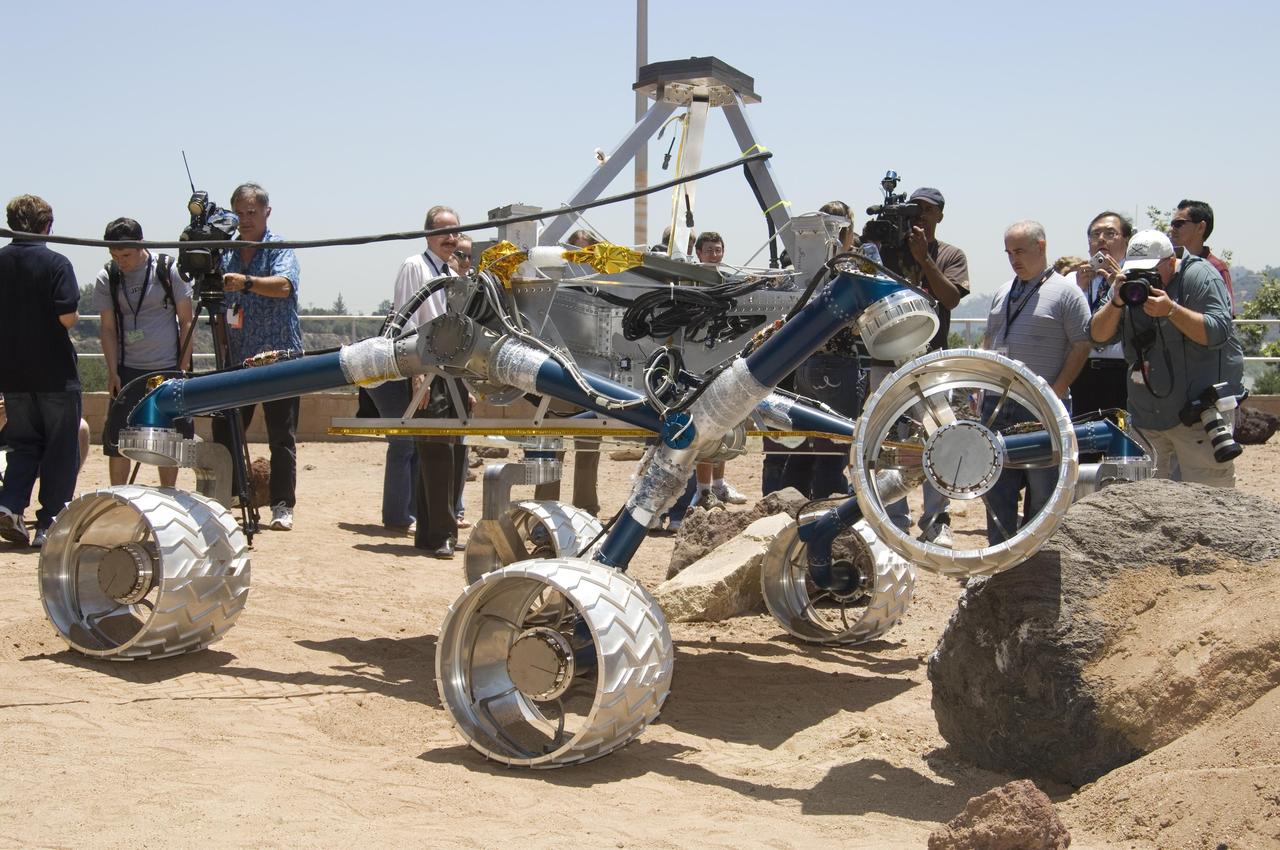
Onlookers watch as Scarecrow, a mobility-testing model for NASA Mars Science Laboratory, easily conquers boulders in the Mars Yard testing area at NASA Jet Propulsion Laboratory.
Shutterbugs Shoot Scarecrow
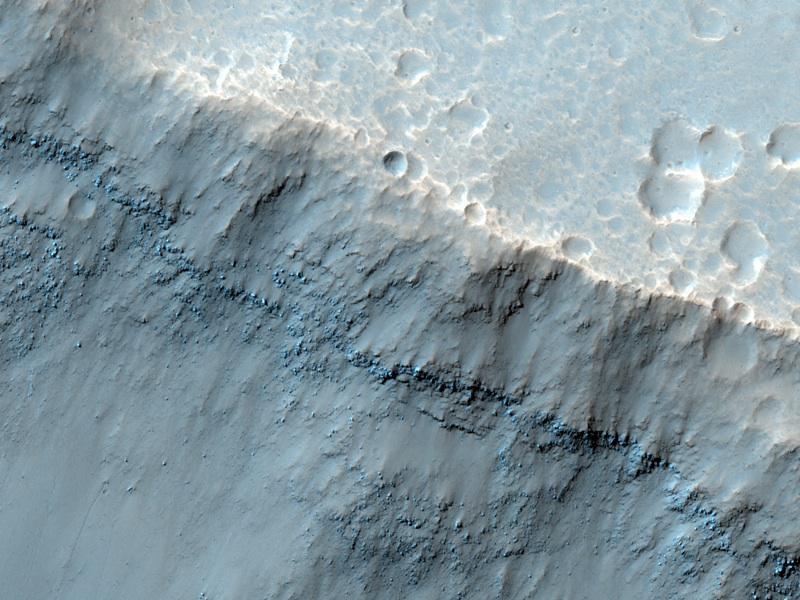
Megabreccia is a term used to describe jumbled, fragmented blocks of rock larger than 1 meter 1.09 yard across. This image was observed by NASA Mars Reconnaissance Orbiter.
Megabreccia on the Floor of an Impact Crater
Updated with new features, including additional mobility software and the bulk of the sample caching system, the Earthly twin of NASA's Perseverance Mars rover arrives at the Mars Yard garage at the agency's Jet Propulsion Laboratory on Oct. 29, 2021. The vehicle is generically referred to as a vehicle system test bed but goes by the name OPTIMISM (short for Operational Perseverance Twin for Integration of Mechanisms and Instruments Sent to Mars).  As with vehicle system test beds for other Mars rovers, OPTIMISM is used to test moves and scenarios in the Mars Yard's simulated Red Planet landscape to help ensure that its twin on Mars can safely execute the commands sent by Earth-bound controllers. The tests could also potentially reveal unexpected problems Perseverance might encounter. With longer drives in Perseverance's near future, another job for OPTIMISM will involve presenting new challenges to the rover's autonomous navigation system, or AutoNav.  A key objective for Perseverance's mission on Mars is astrobiology, including the search for signs of ancient microbial life. The rover will characterize the planet's geology and past climate, pave the way for human exploration of the Red Planet, and be the first mission to collect and cache Martian rock and regolith (broken rock and dust).  Subsequent NASA missions, in cooperation with ESA (European Space Agency), would send spacecraft to Mars to collect these sealed samples from the surface and return them to Earth for in-depth analysis.  The Mars 2020 Perseverance mission is part of NASA's Moon to Mars exploration approach, which includes Artemis missions to the Moon that will help prepare for human exploration of the Red Planet.  https://photojournal.jpl.nasa.gov/catalog/PIA24528
Improved OPTIMISM
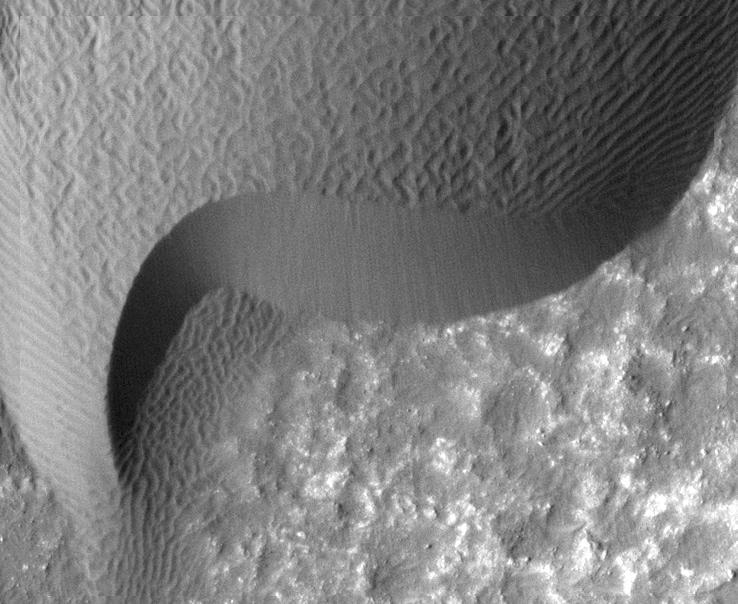
A rippled dune front in Herschel Crater on Mars moved an average of about one meter about one yard between March 3, 2007 and December 1, 2010, as seen in one of two images from NASA Mars Reconnaissance Orbiter.
Rippling Dune Front in Herschel Crater on Mars
This image from NASA Mars Reconnaissance Orbiter shows a portion of the floor in Palos Crater on equatorial Mars. The floor appears bumpy with high-standing layered knobs; most of its terrain is weathering into meter-size yard-size polygonal blocks.
Deposits on the Floor of Palos Crater
A rippled dune front in Herschel Crater on Mars moved an average of about two meters about two yards between March 3, 2007 and December 1, 2010, as seen in one of two images from NASA Mars Reconnaissance Orbiter.
Rippling Dune Front in Herschel Crater on Mars
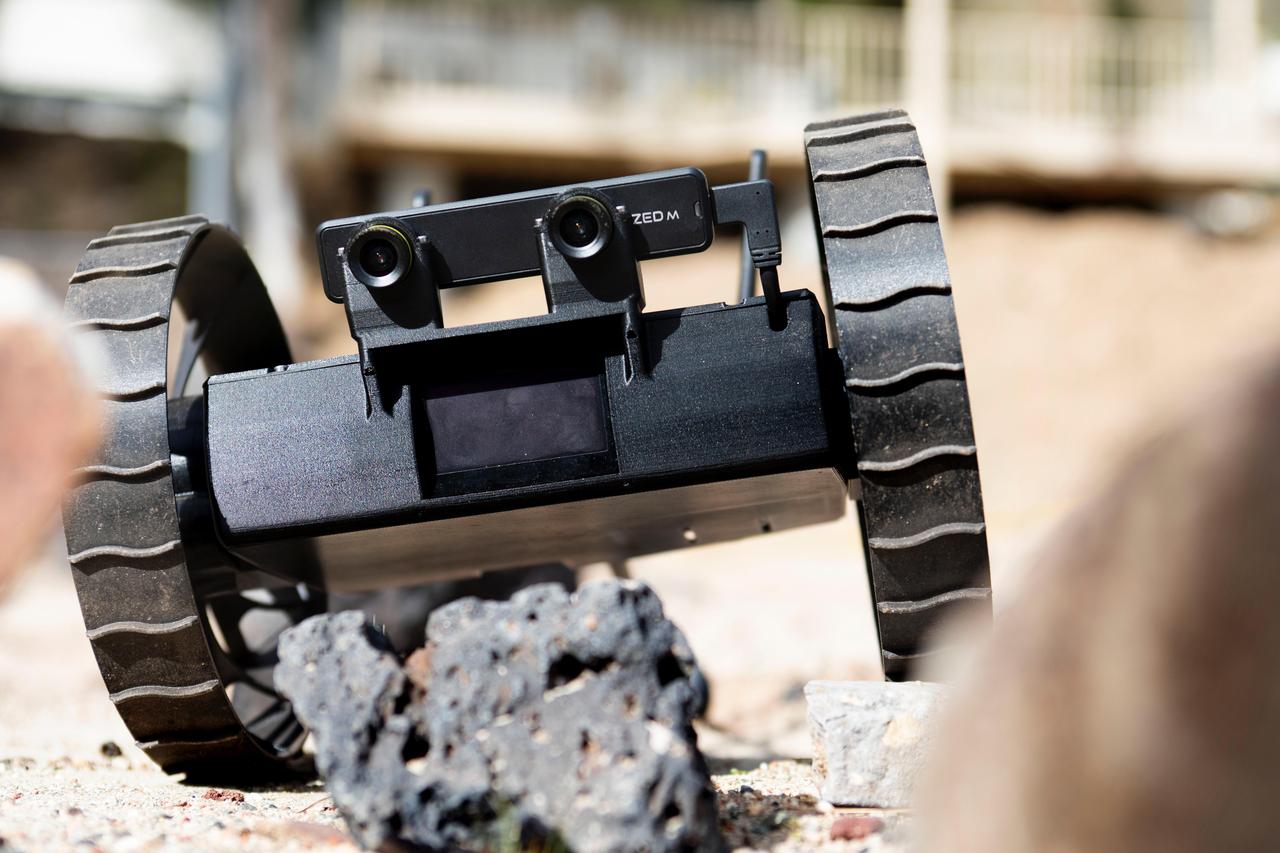
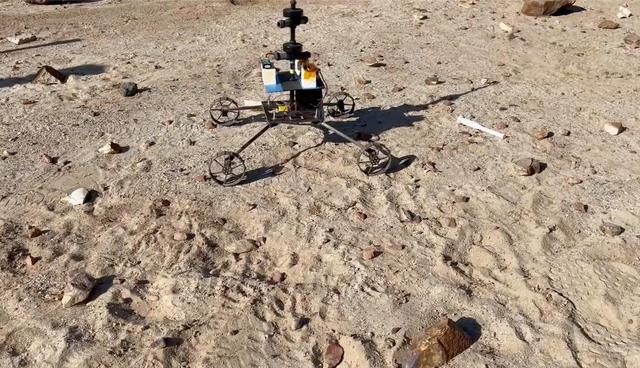
A shoebox-sized wheeled robot explores the rugged terrain on the surface of the Mars Yard at NASA's Jet Propulsion Laboratory during recent tests of the Autonomous Pop-Up Flat Folding Explorer Robot (A-PUFFER) project. The robots are designed to work in groups, and could form roving teams of small robots that might one day explore the surface of the Moon or Mars.  https://photojournal.jpl.nasa.gov/catalog/PIA23793
A-PUFFER Robot Explores a Rocky Terrain
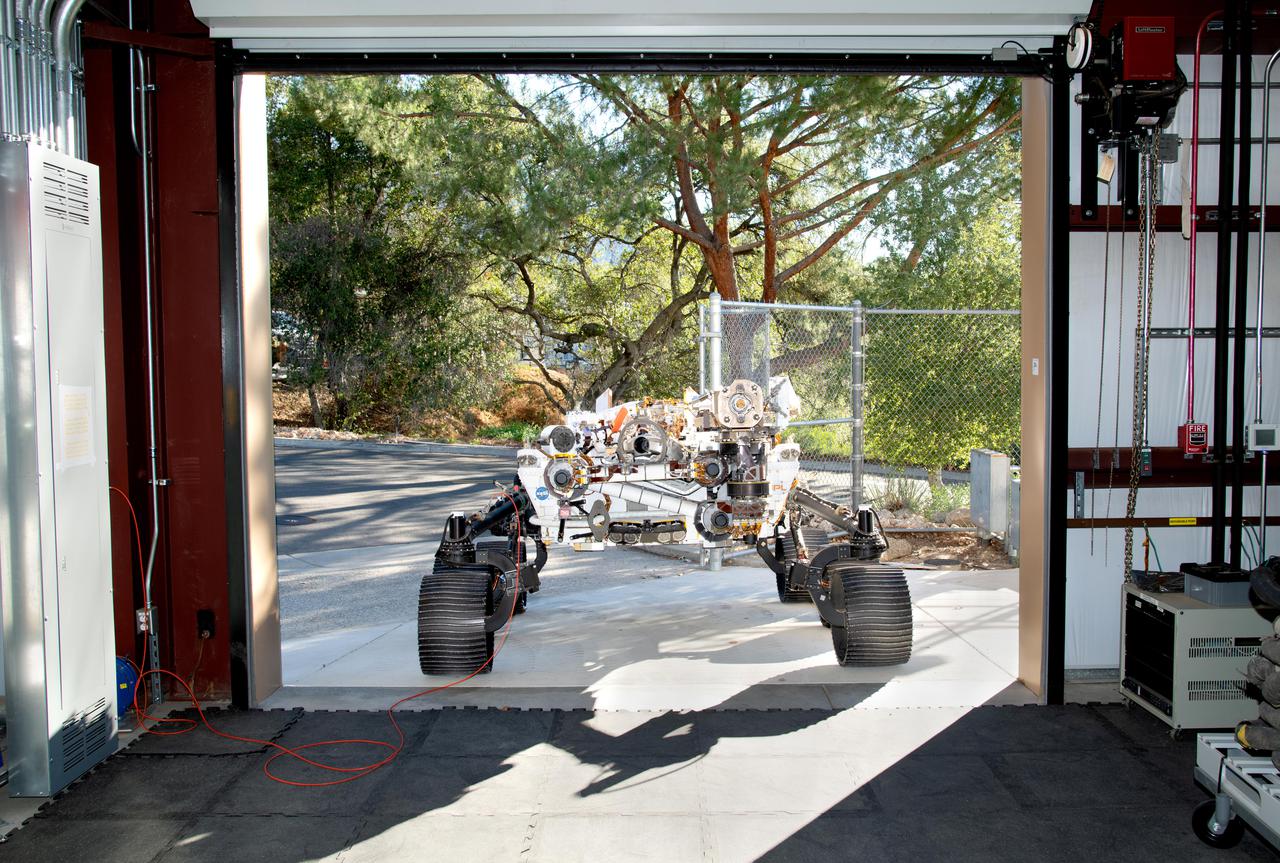
Short for Operational Perseverance Twin for Integration of Mechanisms and Instruments Sent to Mars, OPTIMISM faces a doorway of the Mars Yard garage at NASA's Jet Propulsion Laboratory on Oct. 29, 2021. Referred to generically as a vehicle system test bed, OPTIMISM was recently updated with additional mobility software and the bulk of the complex sample caching system.  As with vehicle system test beds for other Mars rovers, OPTIMISM is used to test moves and scenarios in the Mars Yard's simulated Red Planet landscape to help ensure that its twin on Mars can safely execute the commands sent by Earth-bound controllers. The tests could also potentially reveal unexpected problems Perseverance might encounter. With longer drives in Perseverance's near future, another job for OPTIMISM will involve presenting new challenges to the rover's autonomous navigation system, or AutoNav.  A key objective for Perseverance's mission on Mars is astrobiology, including the search for signs of ancient microbial life. The rover will characterize the planet's geology and past climate, pave the way for human exploration of the Red Planet, and be the first mission to collect and cache Martian rock and regolith (broken rock and dust).  Subsequent NASA missions, in cooperation with ESA (European Space Agency), would send spacecraft to Mars to collect these sealed samples from the surface and return them to Earth for in-depth analysis.  The Mars 2020 Perseverance mission is part of NASA's Moon to Mars exploration approach, which includes Artemis missions to the Moon that will help prepare for human exploration of the Red Planet.  https://photojournal.jpl.nasa.gov/catalog/PIA24527
OPTIMISM Ready for Testing
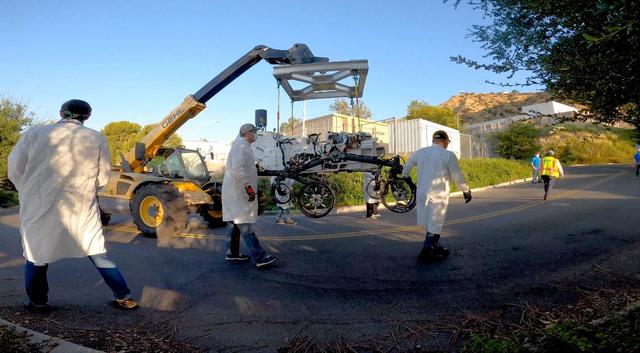
On Oct. 29, 2021, a heavy-duty vehicle transports the Perseverance rover's engineering model from a test lab to the Mars Yard garage at NASA's Jet Propulsion Laboratory. Short for Operational Perseverance Twin for Integration of Mechanisms and Instruments Sent to Mars, OPTIMISM is generically referred to as a vehicle system test bed.  As with vehicle system test beds for other Mars rovers, OPTIMISM is used to test moves and scenarios in the Mars Yard's simulated Red Planet landscape to help ensure that its twin on Mars can safely execute the commands sent by Earth-bound controllers. The tests could also potentially reveal unexpected problems Perseverance might encounter. With longer drives in Perseverance's near future, another job for OPTIMISM will involve presenting new challenges to the rover's autonomous navigation system, or AutoNav.  A key objective for Perseverance's mission on Mars is astrobiology, including the search for signs of ancient microbial life. The rover will characterize the planet's geology and past climate, pave the way for human exploration of the Red Planet, and be the first mission to collect and cache Martian rock and regolith (broken rock and dust).  Subsequent NASA missions, in cooperation with ESA (European Space Agency), would send spacecraft to Mars to collect these sealed samples from the surface and return them to Earth for in-depth analysis.  The Mars 2020 Perseverance mission is part of NASA's Moon to Mars exploration approach, which includes Artemis missions to the Moon that will help prepare for human exploration of the Red Planet.  https://photojournal.jpl.nasa.gov/catalog/PIA24526
Heavy-Duty OPTIMISM
A model Sample Recovery Helicopter drives and positions itself over a sample tube during a test in the Mars Yard at NASA's Jet Propulsion Laboratory in Southern California.  Two Sample Recovery Helicopters are slated to fly to Mars as part of the Mars Sample Return campaign. NASA is developing the Sample Recovery Helicopters to serve as backups to the agency's Perseverance rover in transporting sample tubes to the Sample Retrieval Lander.  These helicopters are follow-ons to NASA's Ingenuity Mars Helicopter, which arrived at the Red Planet in the belly of Perseverance in February 2021. The Sample Recovery Helicopters have wheels instead of feet, as well as a small manipulator arm with a two-fingered gripper capable of carrying precious sample tubes.  Testing of the Sample Recovery Helicopters is ongoing. The testbed was made by AeroVironment Inc.  Movie available at https://photojournal.jpl.nasa.gov/catalog/PIA25320
Sample Recovery Helicopter Model Gets a Test
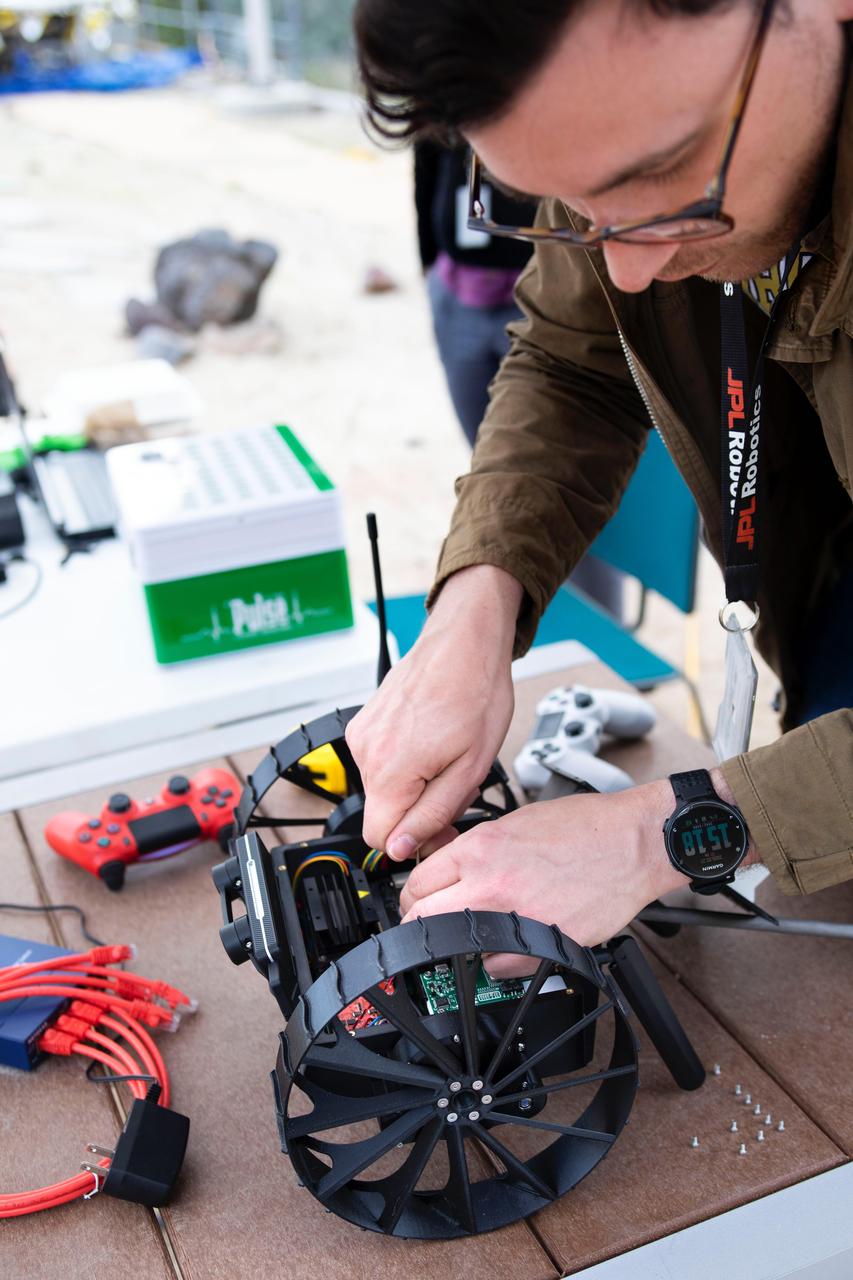
Project manager Jean-Pierre de la Croix works on an Autonomous Pop-Up Flat Folding Explorer Robot (A-PUFFER) during recent trials in the Mars Yard at NASA's Jet Propulsion Laboratory. This PUFFER is equipped with an onboard computer and stereo camera as well as other sensors to help it autonomously navigate and collaborate with other PUFFERs.  https://photojournal.jpl.nasa.gov/catalog/PIA23794
NASA Scientist Works on an A-PUFFER Robot During Trials
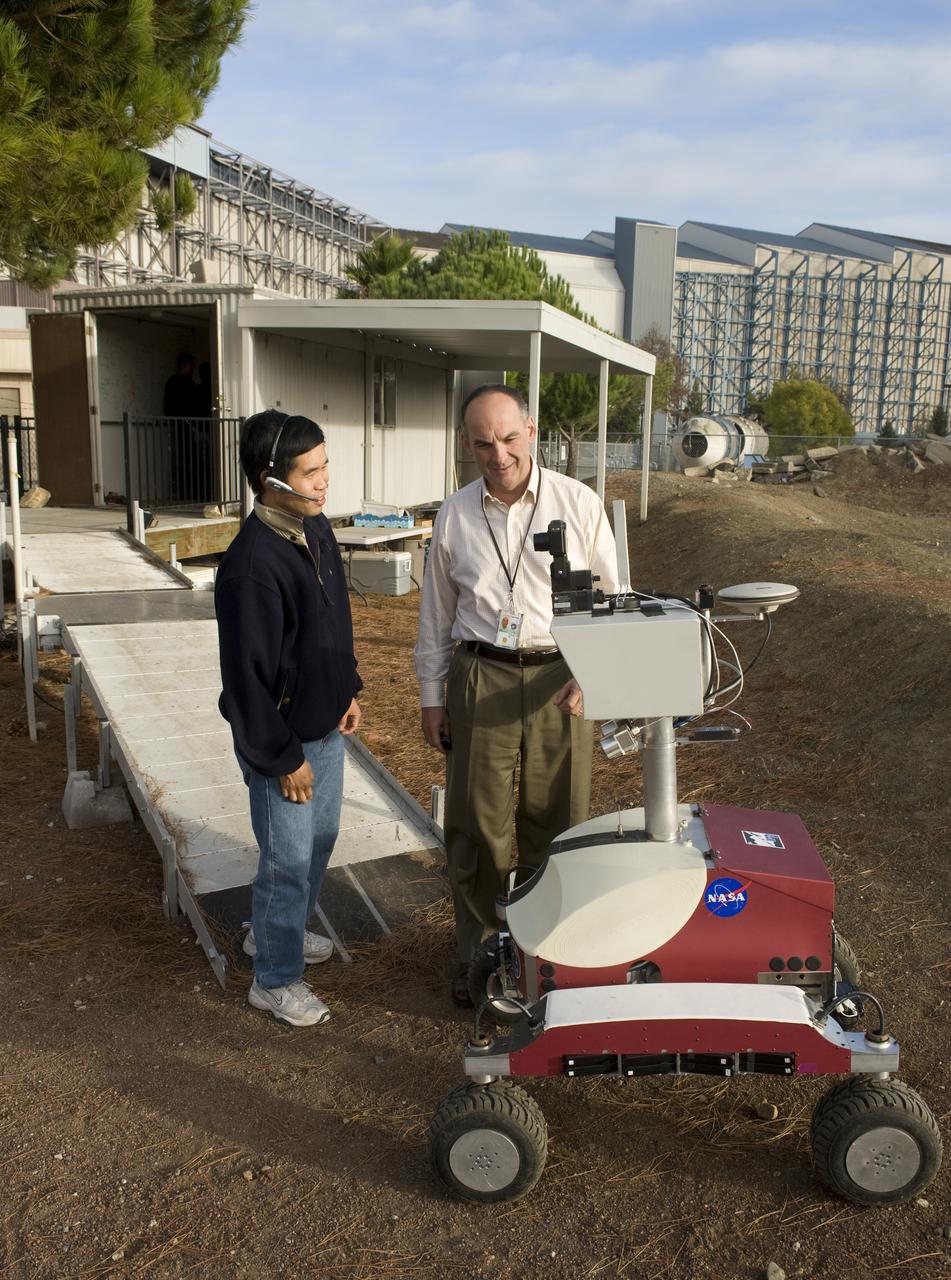
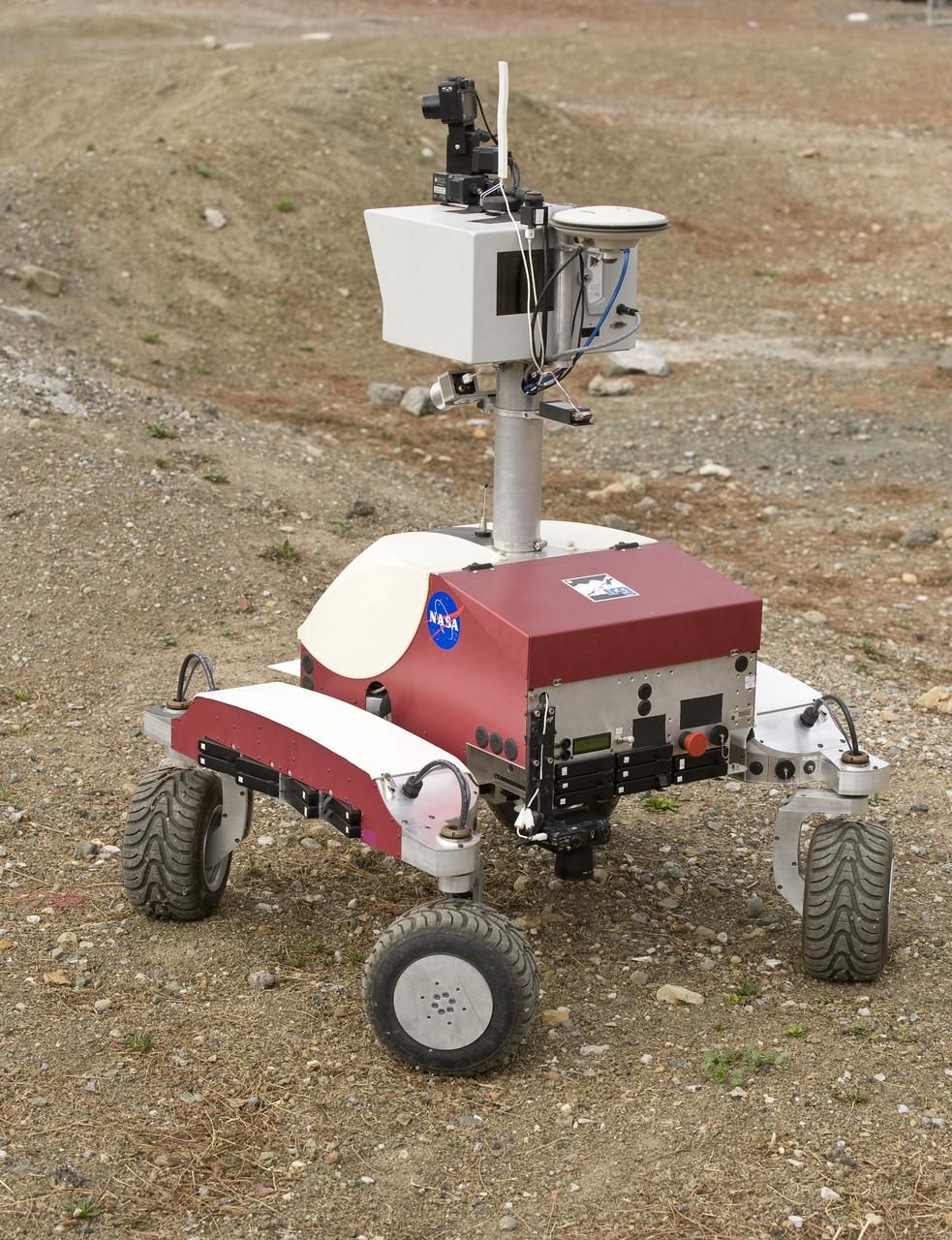
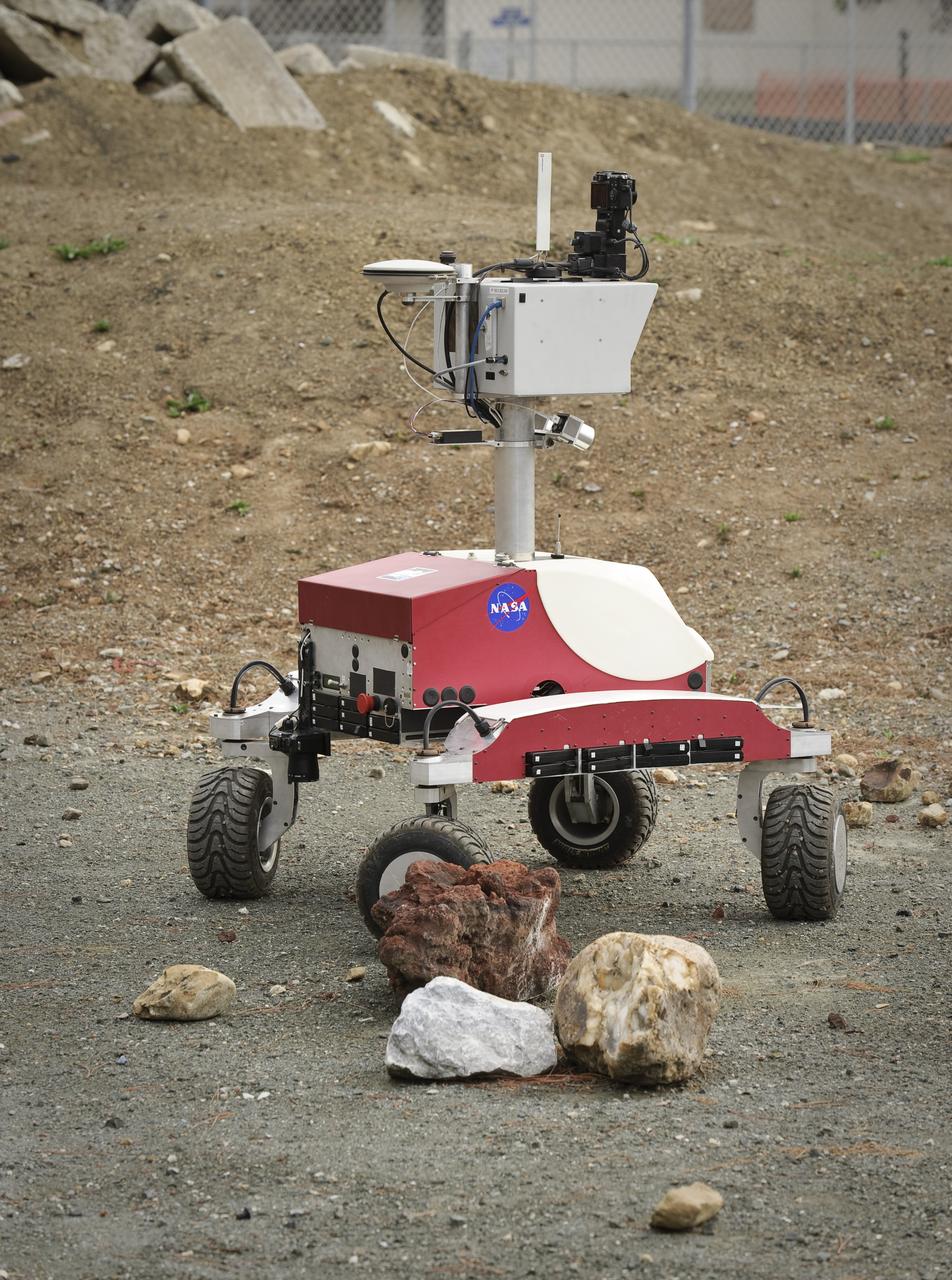
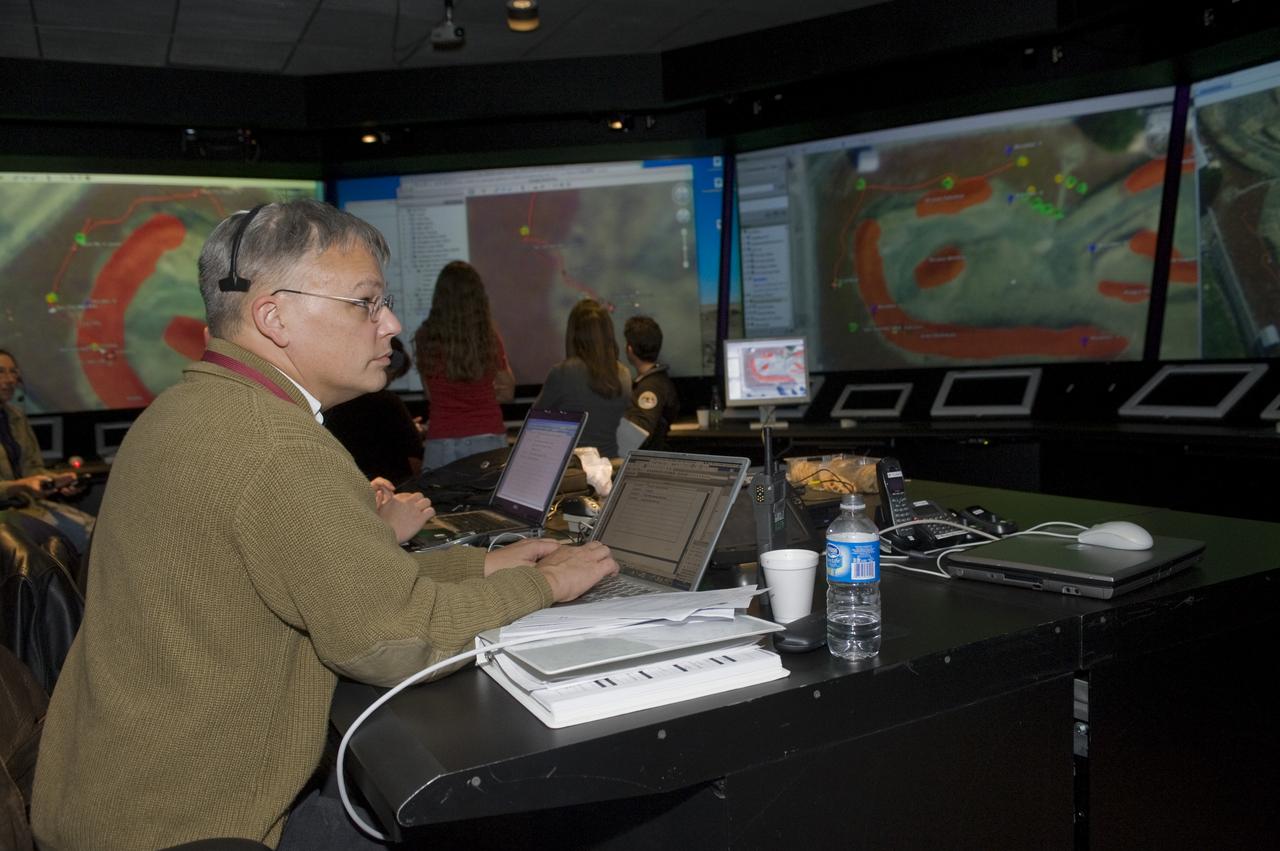
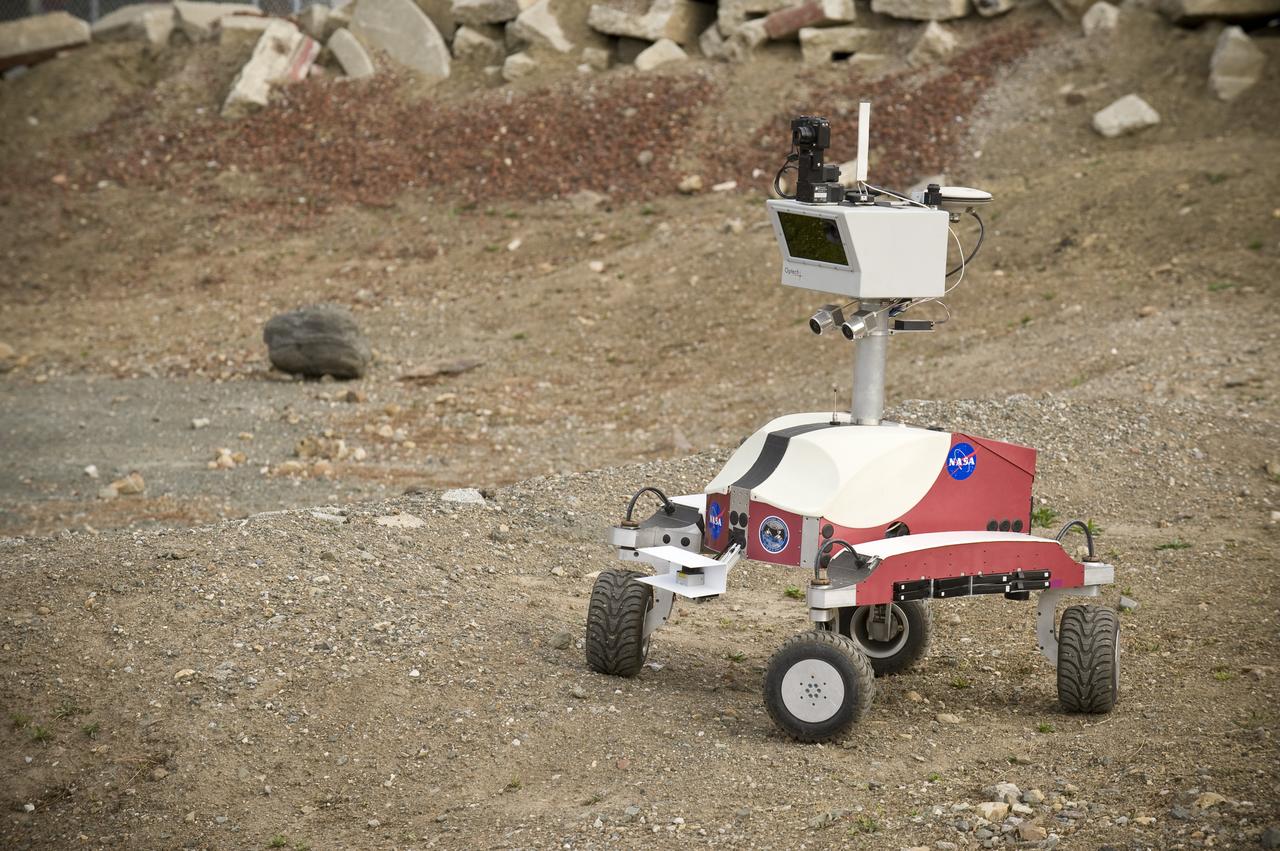
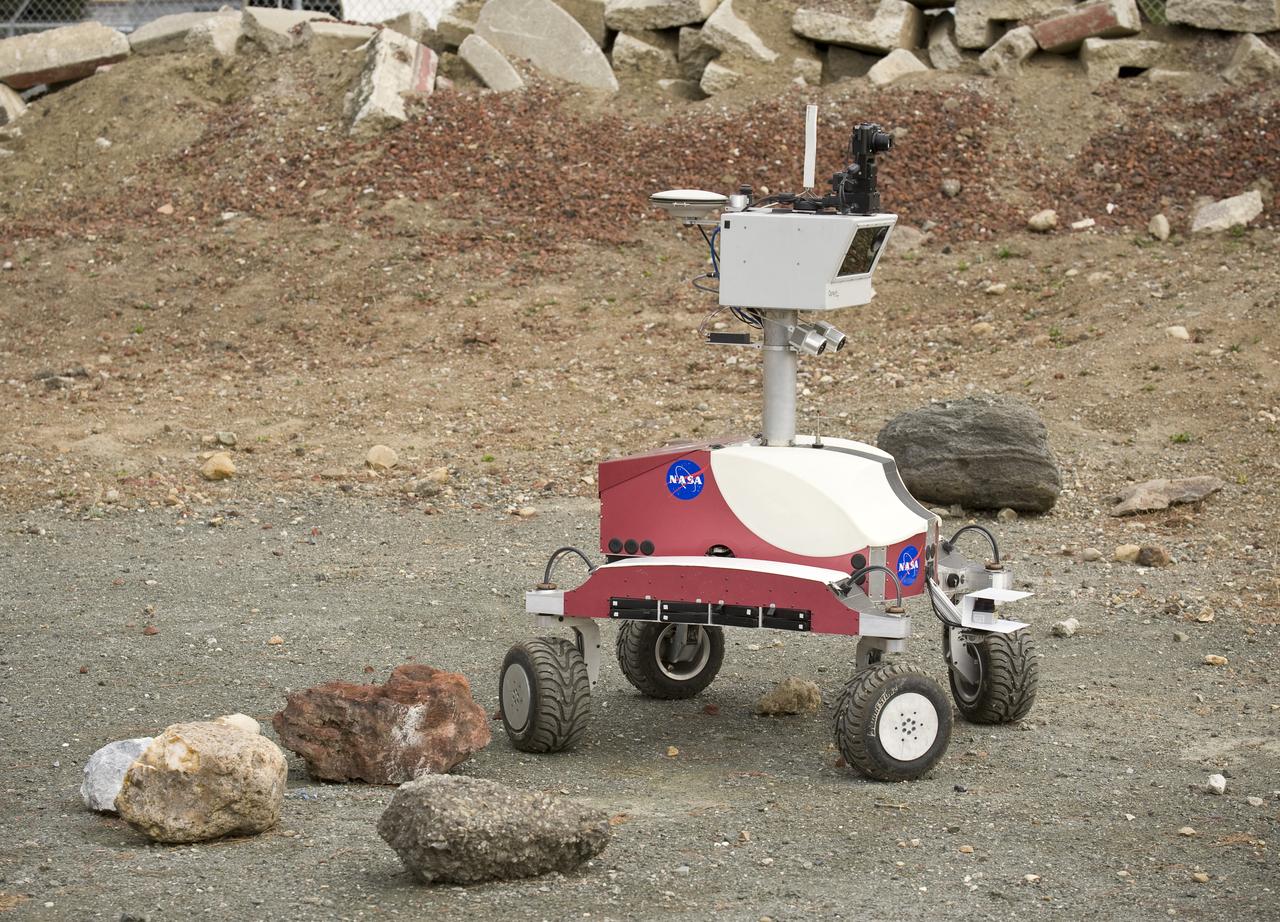
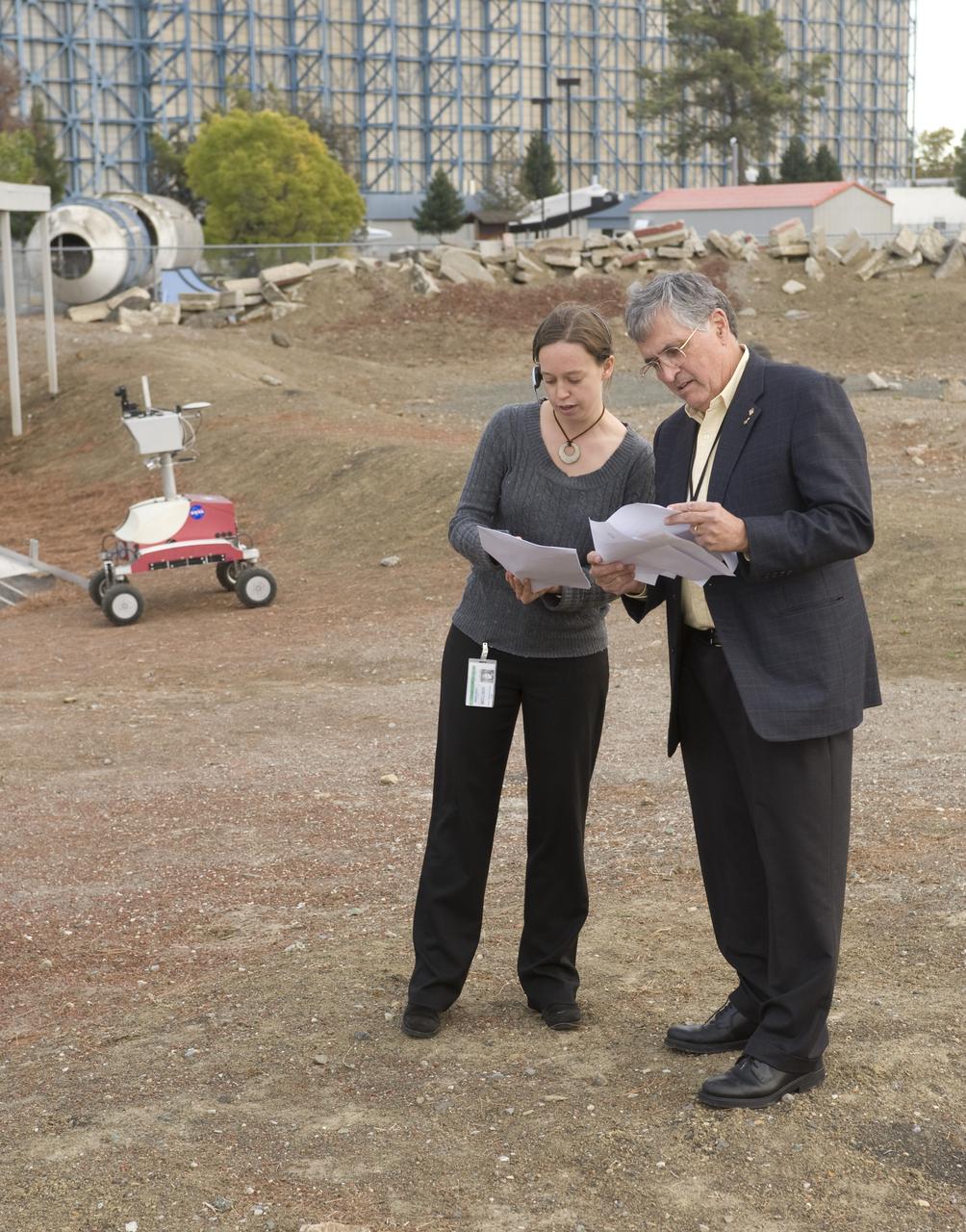
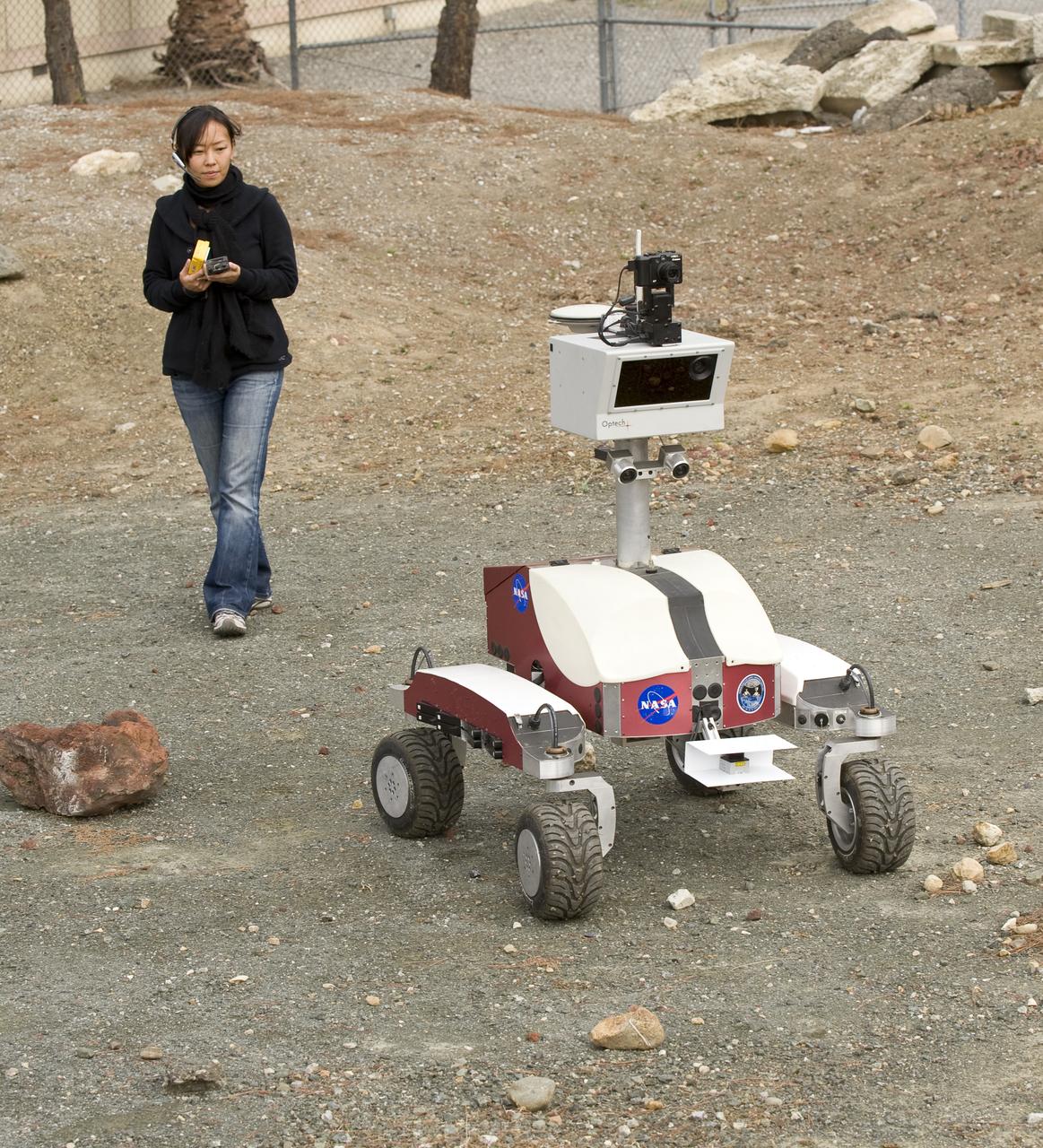
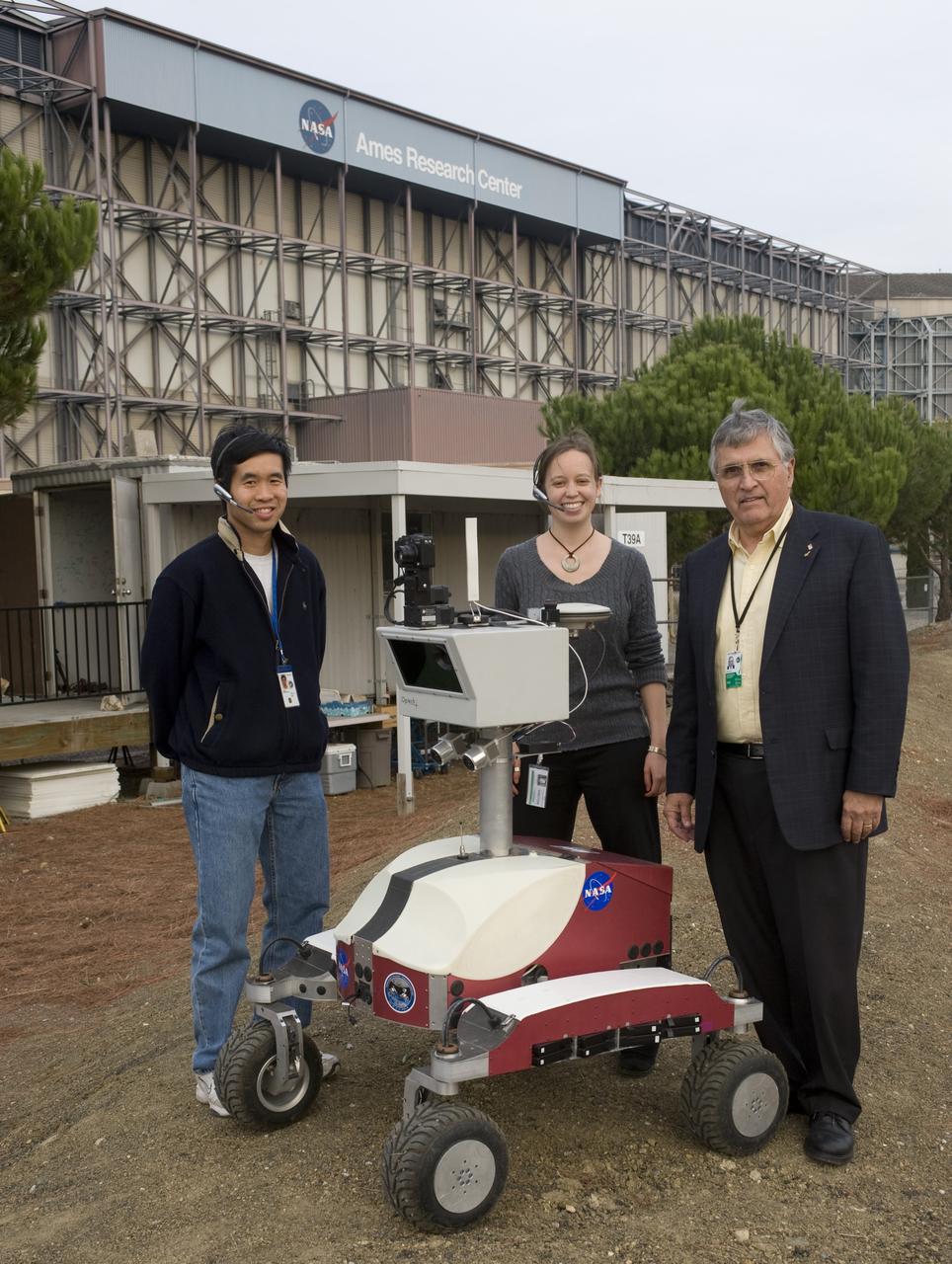
K-10 'Red' planetary rover  in the Nasa Ames Marscape: operations tests at Marscape (Ames Mars Yard) with remote operations from Ames Future Flight Centeral (FFC) Simulator,.
ARC-2008-ACD08-0260-001
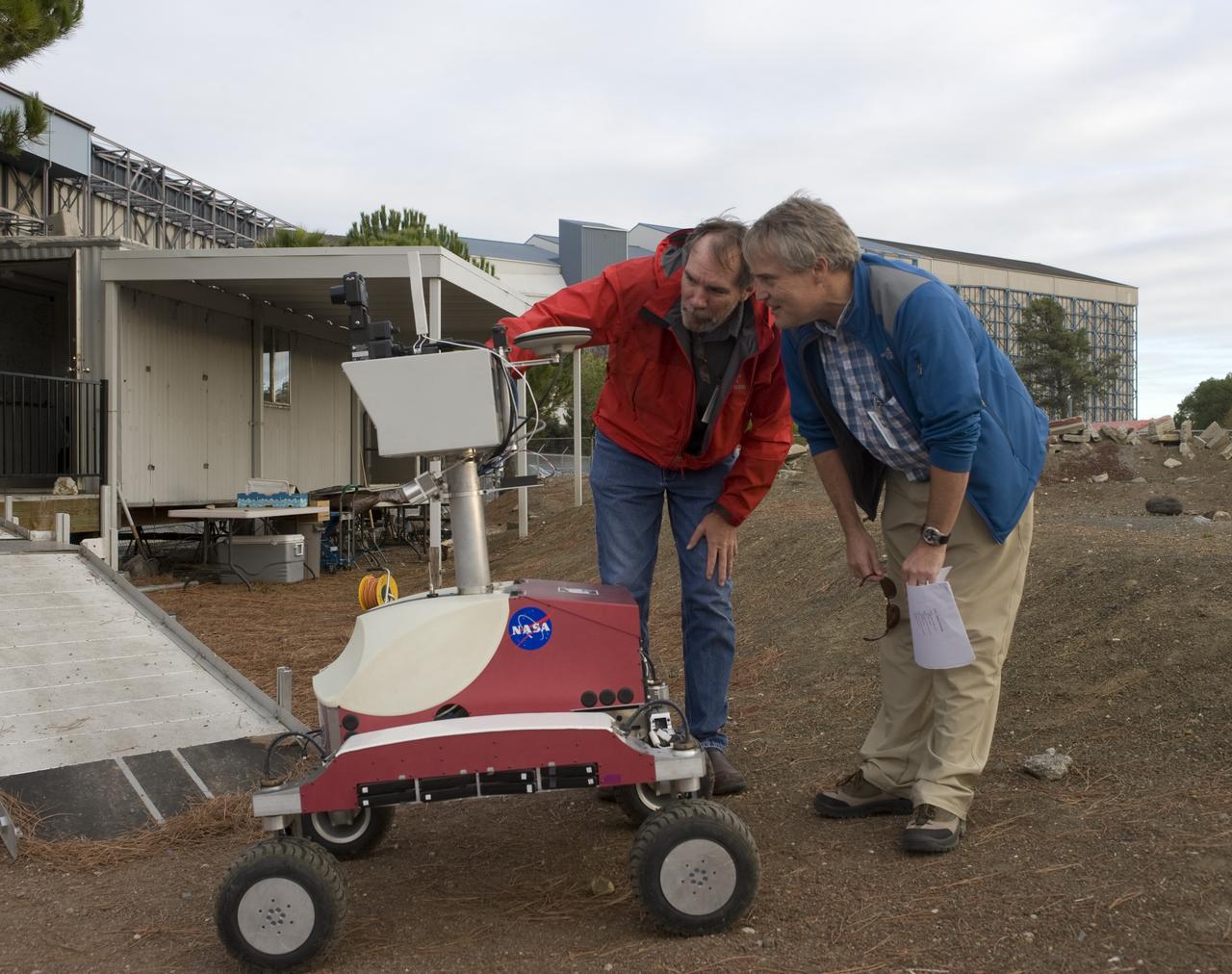
K-10 'Red' planetary rover  in the Nasa Ames Marscape: operations tests at Marscape (Ames Mars Yard) with remote operations from Ames Future Flight Centeral (FFC) Simulator with Susan Y. Lee observing.
ARC-2008-ACD08-0260-007
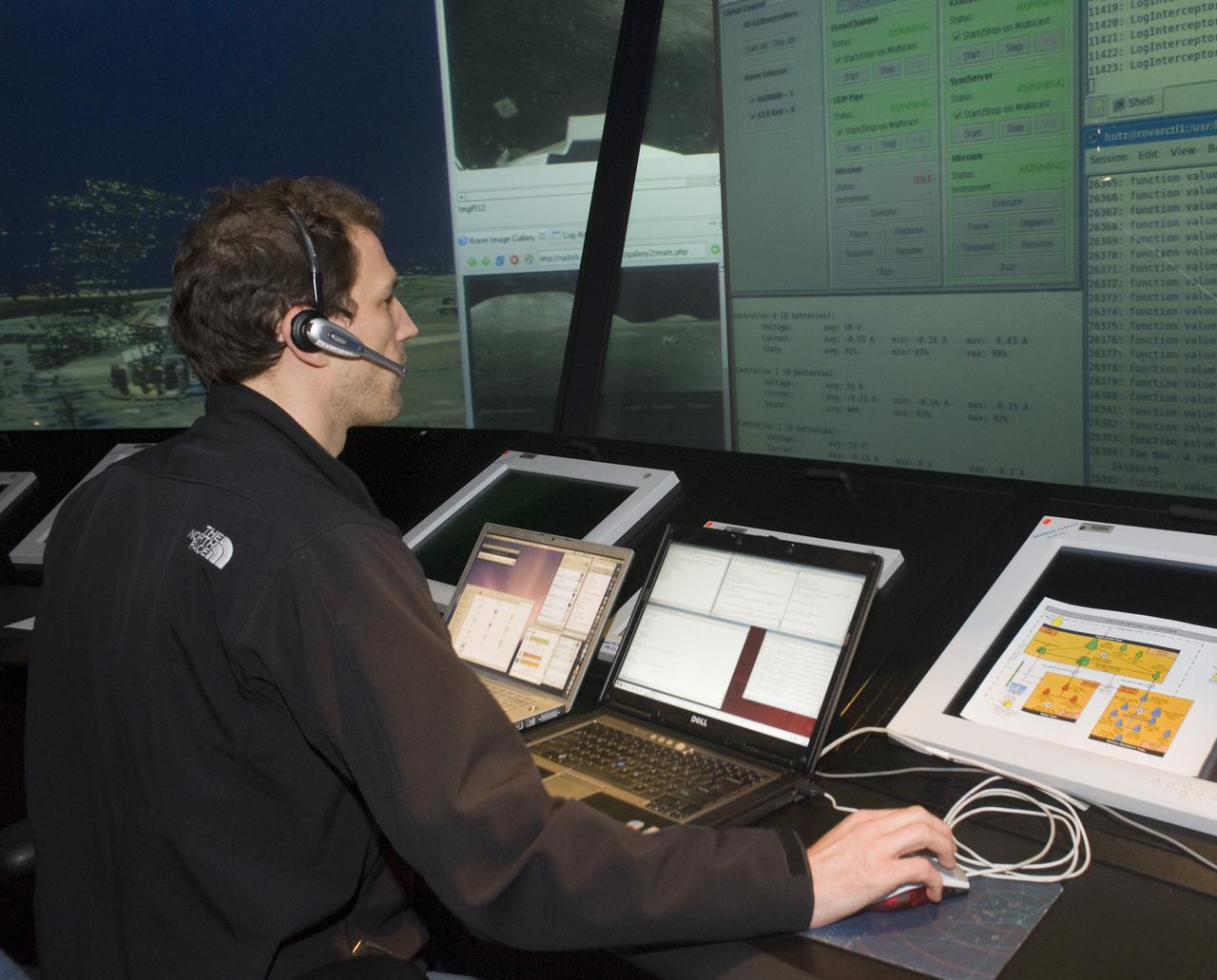
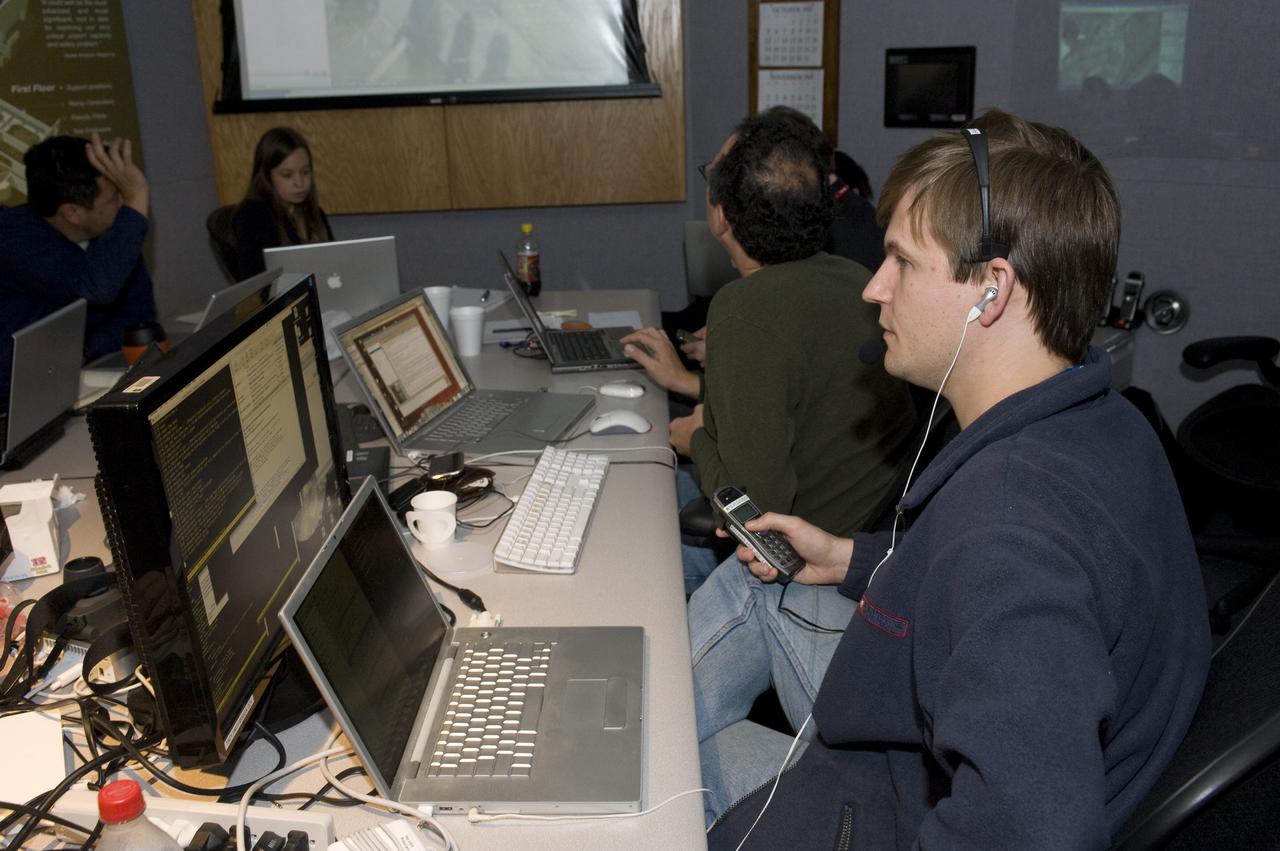
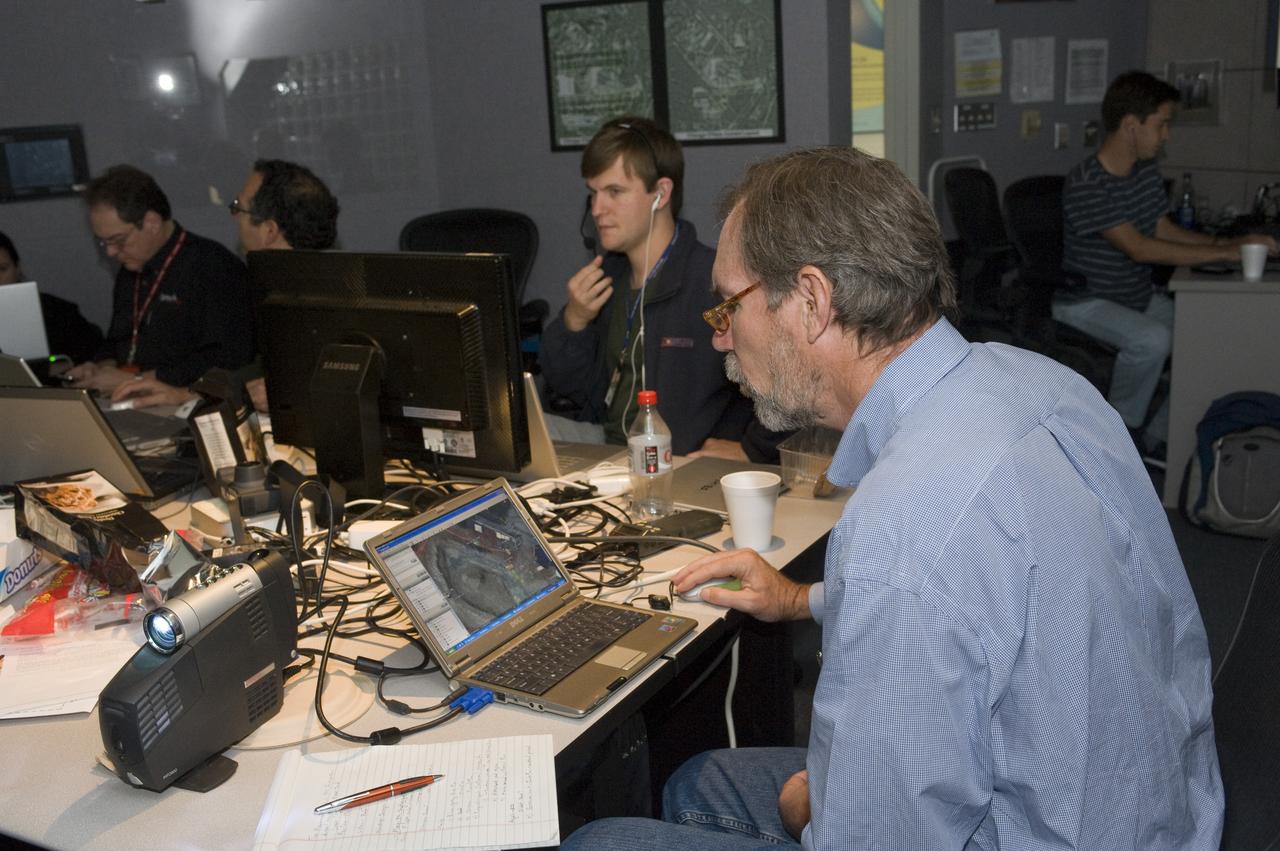
K-10 (red) plaentary rover at Marscape (Ames Mars Yard): with prototype flight control team remotely operating K-10 'Red' from  Ames Future Flight Centeral (FFC) Simulator, with Hans Utz.
ARC-2008-ACD08-0260-021
K-10 'Red' planetary rover  in the Nasa Ames Marscape: operations tests at Marscape (Ames Mars Yard) with remote operations from Ames Future Flight Centeral (FFC) Simulator,.
ARC-2008-ACD08-0260-004
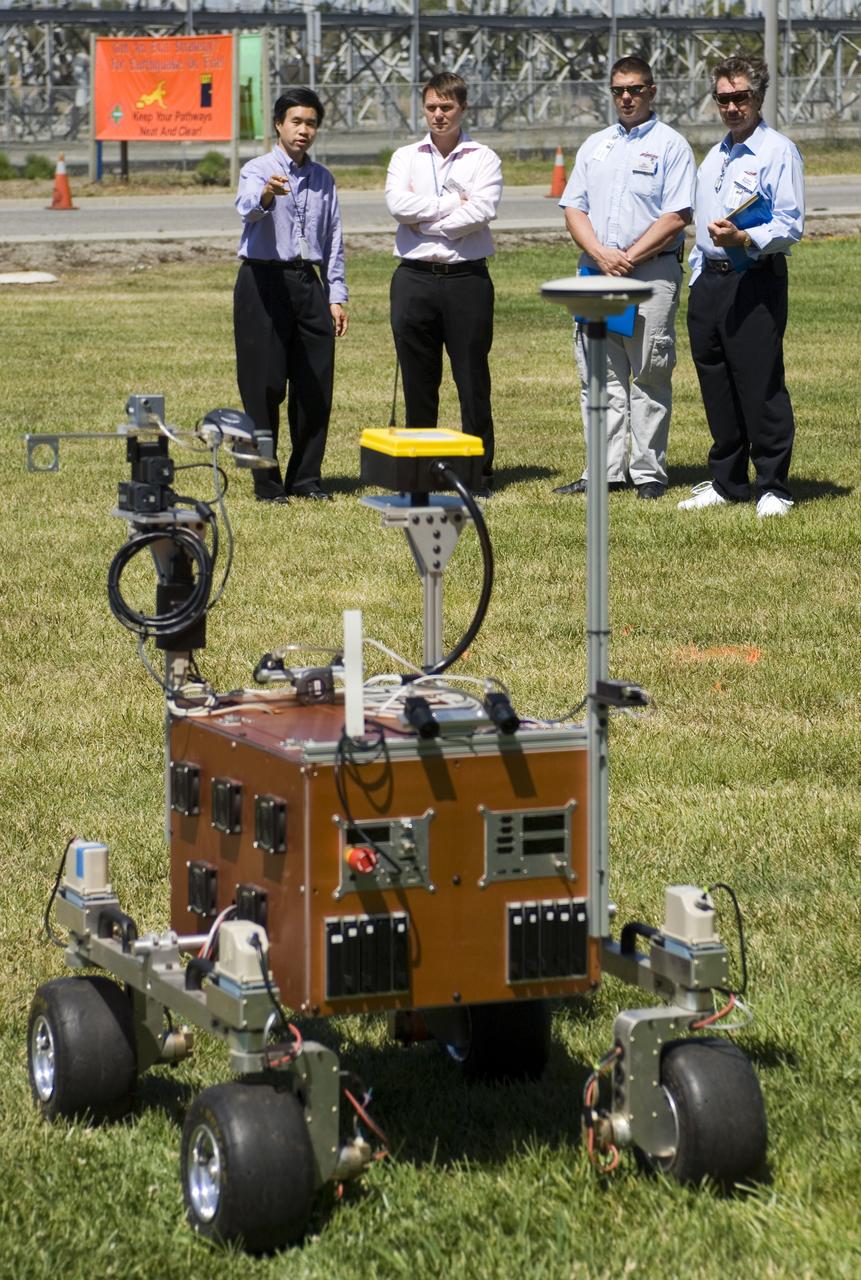
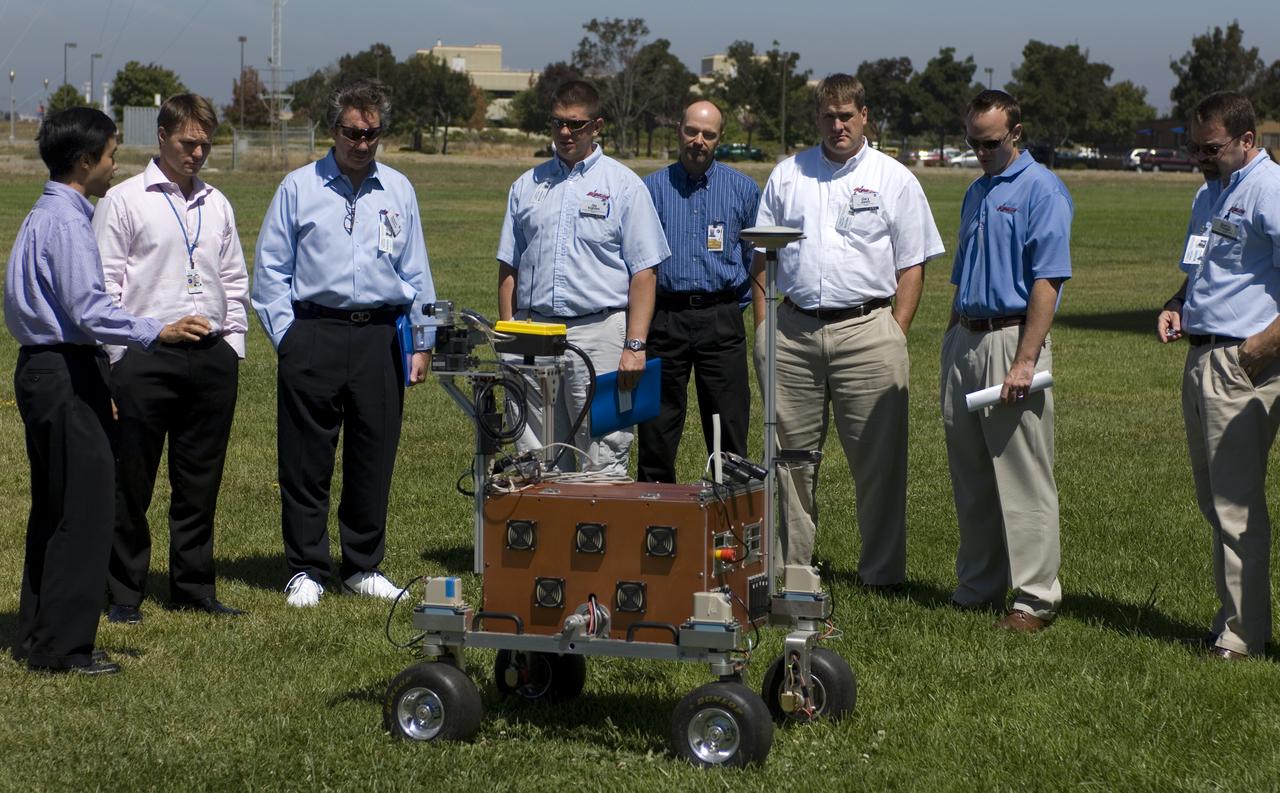
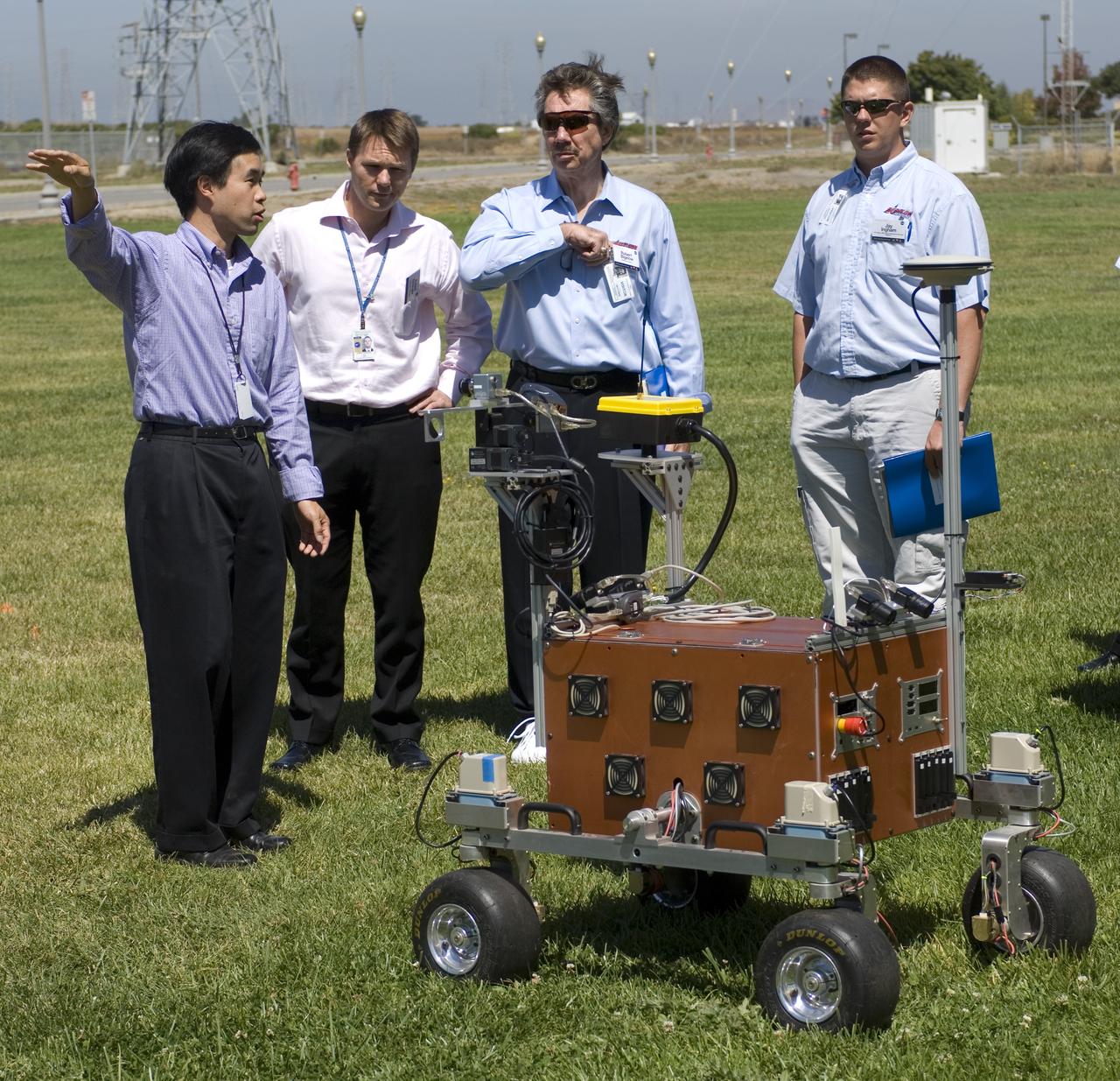
Robert Bigelow gets demonstration of the Ames rover at the Ames Mars Yard. L-R: Terrrence Fong, Robert Schingler (both of Ames) Robert Bigelow, Jay Ingham of NNT, Phil Hearlth, Ames, Gary Jones and ___, of NNT
ARC-2006-ACD06-0156-001
K-10 (red) robot operations tests at Marscape (Ames Mars Yard) with remote operations from Ames Future Flight Centeral (FFC) Simulator, with Melissa Rice and Harrison 'Jack' Schmitt (Apollo 17 Astronaut)
ARC-2008-ACD08-0260-036
K-10 'Red' planetary rover  in the Nasa Ames Marscape: operations tests at Marscape (Ames Mars Yard) with remote operations from Ames Future Flight Centeral (FFC) Simulator,.
ARC-2008-ACD08-0260-010
K-10 'Red' planetary rover  in the Nasa Ames Marscape: operations tests at Marscape (Ames Mars Yard) with remote operations from Ames Future Flight Centeral (FFC) Simulator,.
ARC-2008-ACD08-0260-015
Robert Bigelow gets demonstration of the Ames rover at the Ames Mars Yard. L-R: Terry Fong, Robert Schingler (both of Ames), Robert Bigelow and  Jay Ingham of NNT
ARC-2006-ACD06-0156-002
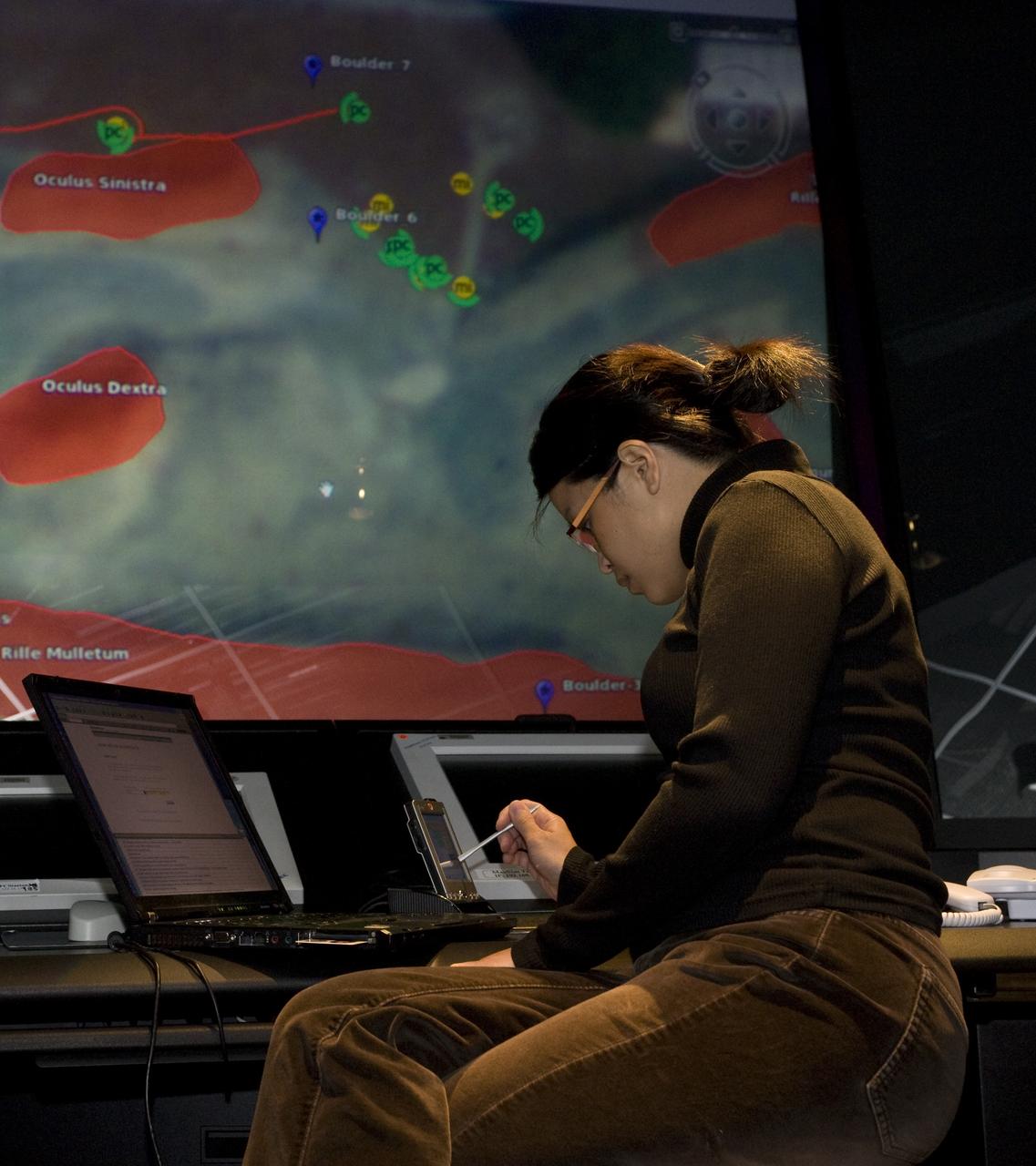
K-10 (red) plaentary rover at Marscape (Ames Mars Yard): with prototype flight control team remotely operating K-10 'Red' from  Ames Future Flight Centeral (FFC) Simulator, with Estrellina Pacis.
ARC-2008-ACD08-0260-020
K-10 (red) robot operations tests at Marscape (Ames Mars Yard) with remote operations from Ames Future Flight Centeral (FFC) Simulator, with Terry Fong and Ken Ford.
ARC-2008-ACD08-0260-029
Robert Bigelow gets demonstration of the Ames rover at the Ames Mars Yard. L-R: Terry Fong, Robert Schingler (both of Ames),  Jay Ingham of NNT, Roger Bigelow
ARC-2006-ACD06-0156-003
K-10 (red) robot operations tests at Marscape (Ames Mars Yard) with remote operations from Ames Future Flight Centeral (FFC) Simulator, with Mark Helper and Kip Hodges.
ARC-2008-ACD08-0260-034
K-10 (red) plaentary rover at Marscape (Ames Mars Yard): with prototype flight control team remotely operating K-10 'Red' from  Ames Future Flight Centeral (FFC) Simulator. With Rob Landis
ARC-2008-ACD08-0260-017
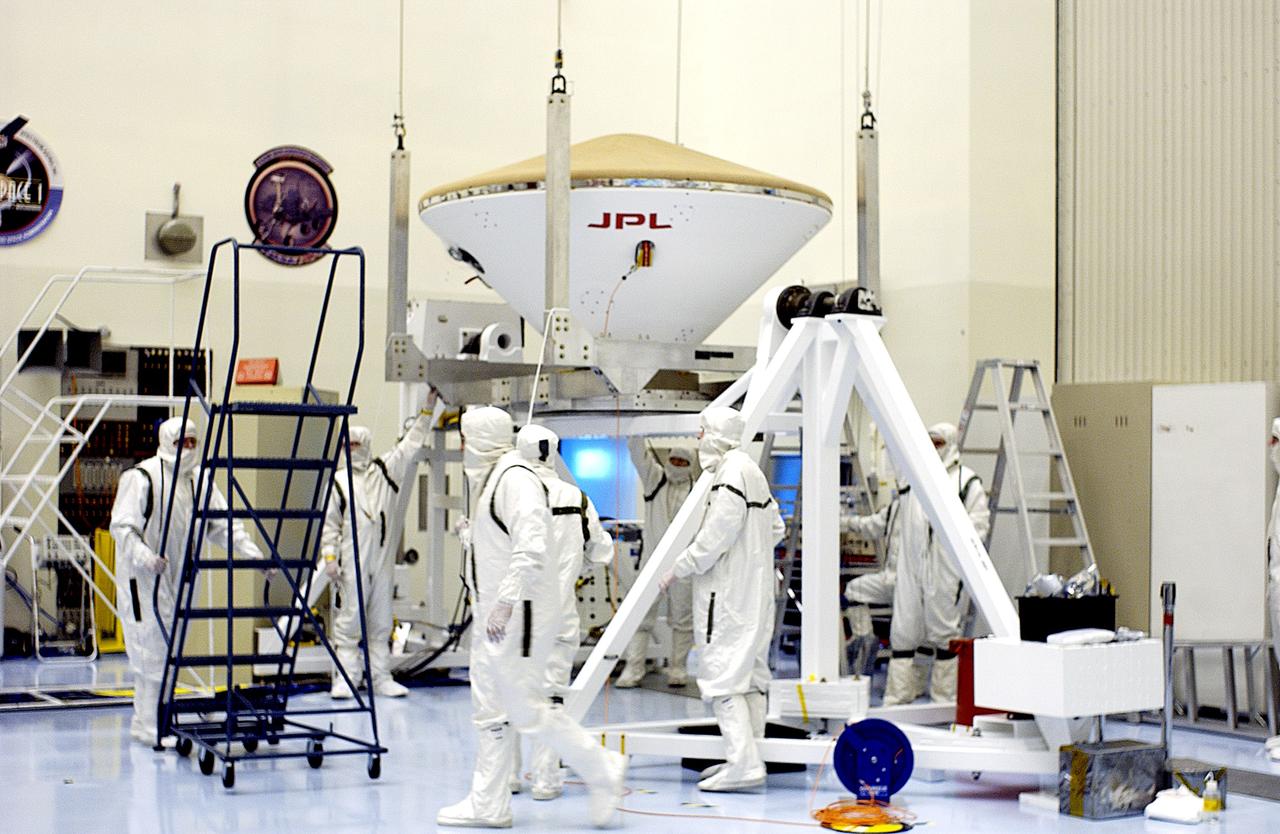
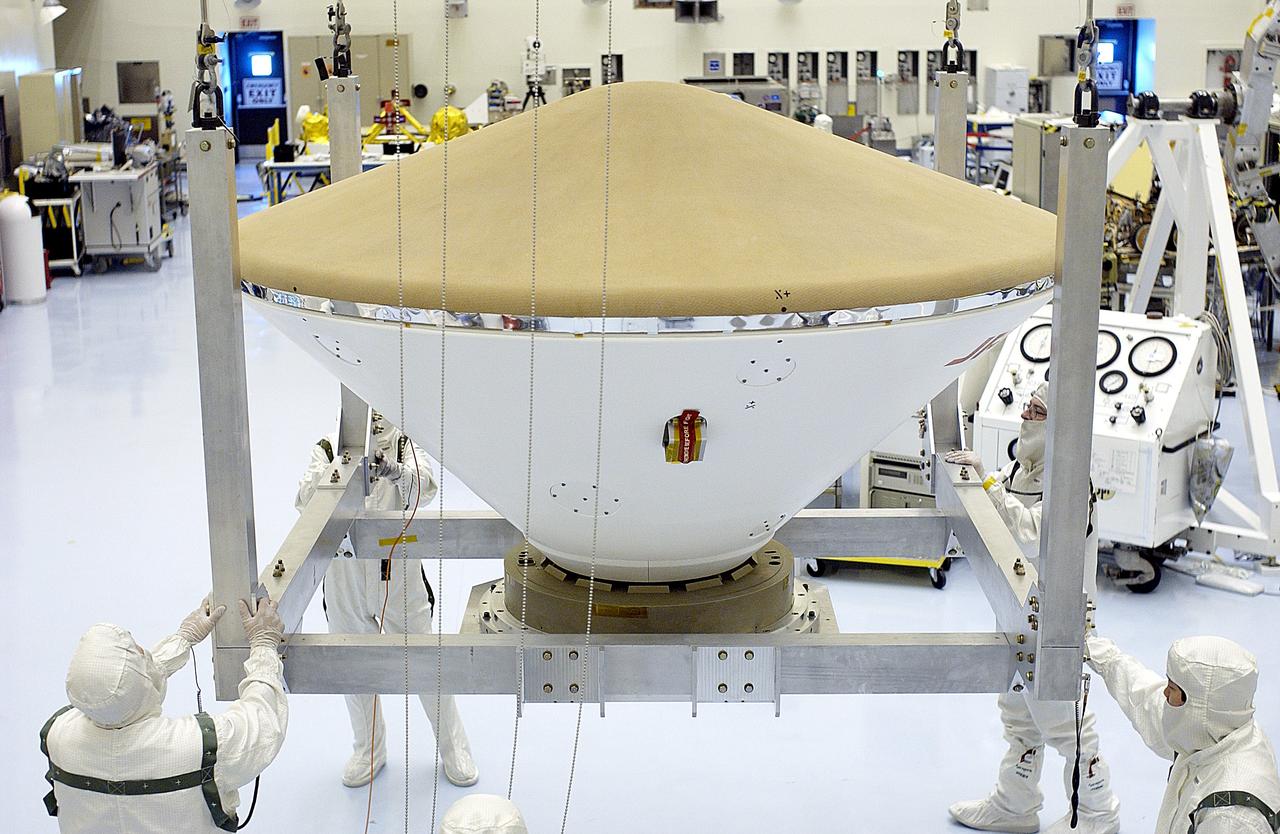
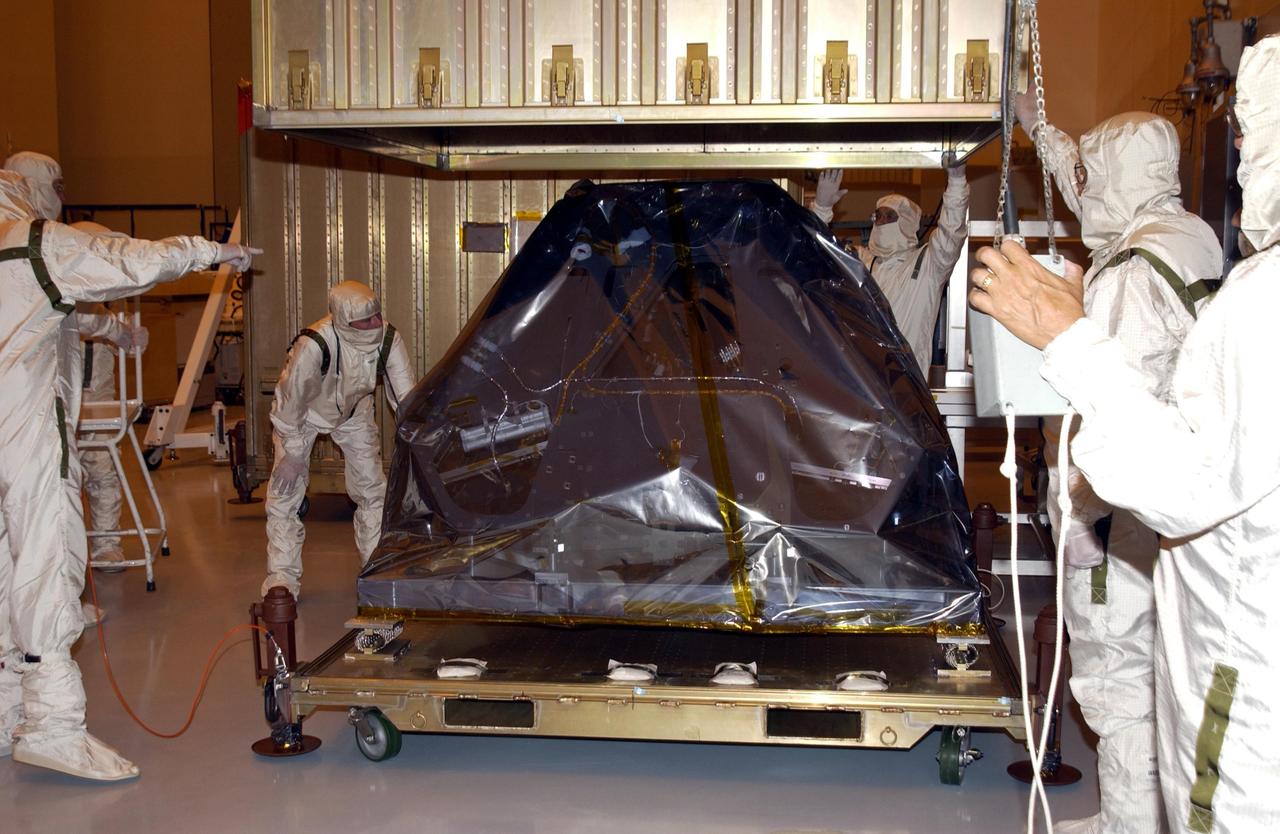
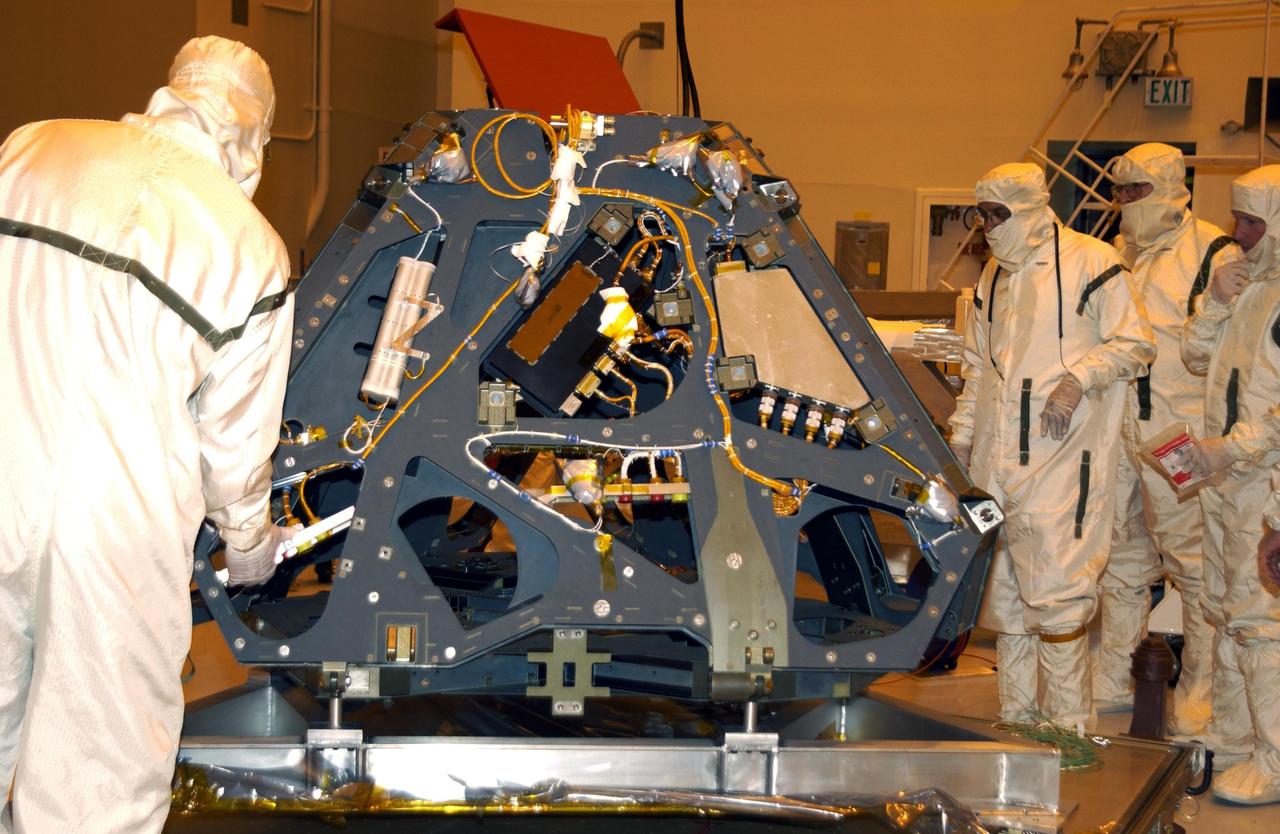
KENNEDY SPACE CENTER, FLA. -  An overhead crane is in place to lift the Mars Exploration Rover 2 (MER-2) entry vehicle to move it to a spin table for a dry-spin test.  The MER Mission consists of two identical rovers designed to cover roughly 110 yards each Martian day over various terrain. Each rover will carry five scientific instruments that will allow it to search for evidence of liquid water that may have been present in the planet's past.  Identical to each other, the rovers will land at different regions of Mars.  Launch for MER-2 (MER-A) is scheduled for June 5.
KENNEDY SPACE CENTER, FLA. - An overhead crane is in place to lift the Mars Exploration Rover 2 (MER-2) entry vehicle to move it to a spin table for a dry-spin test. The MER Mission consists of two identical rovers designed to cover roughly 110 yards each Martian day over various terrain. Each rover will carry five scientific instruments that will allow it to search for evidence of liquid water that may have been present in the planet's past. Identical to each other, the rovers will land at different regions of Mars. Launch for MER-2 (MER-A) is scheduled for June 5.
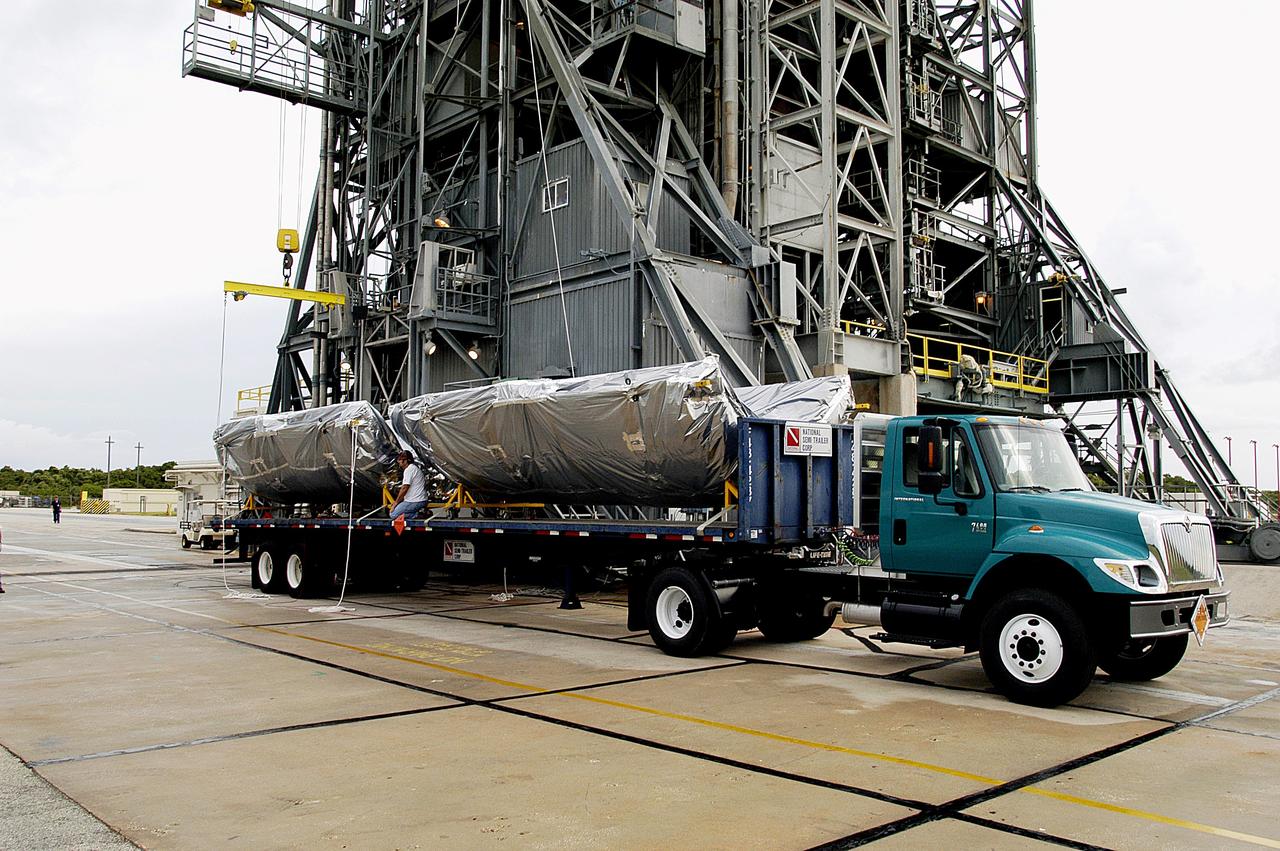
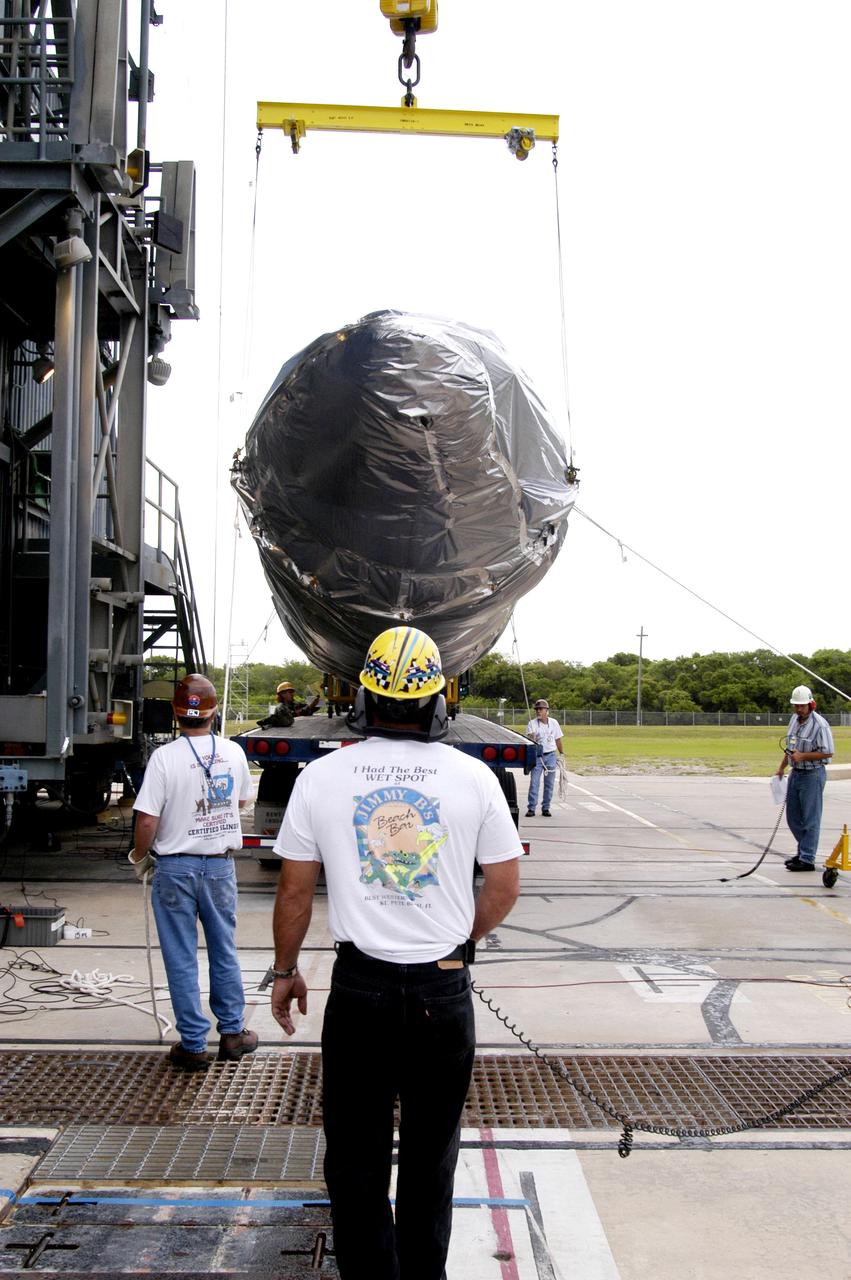
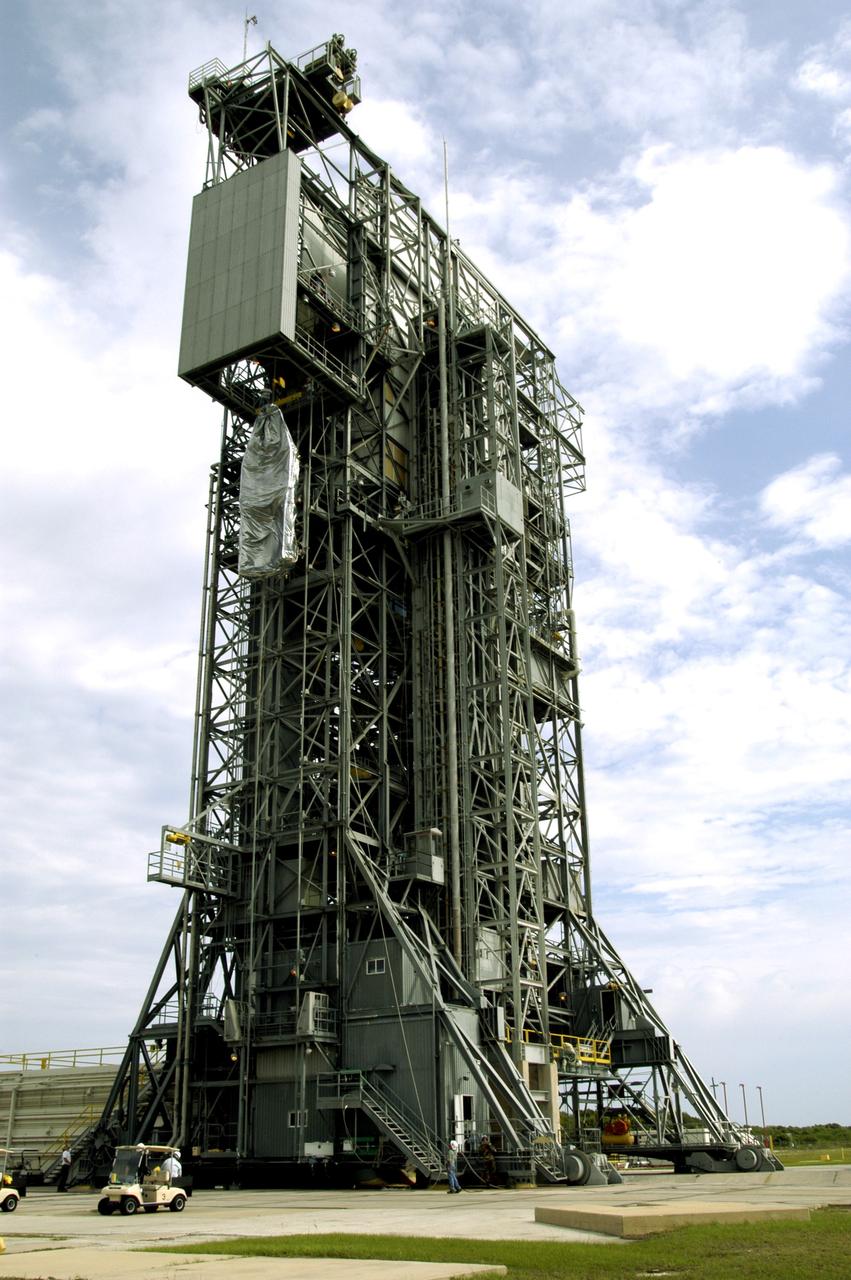
KENNEDY SPACE CENTER, FLA. -  The fairing for the Mars Exploration Rover 2 (MER-2/MER-A) arrives at Launch Complex 17-A, Cape Canaveral Air Force Station.  It will be installed around the payload for protection during launch.  The MER Mission consists of two identical rovers designed to cover roughly 110 yards each Martian day over various terrain. Each rover will carry five scientific instruments that will allow it to search for evidence of liquid water that may have been present in the planet's past.  Identical to each other, the rovers will land at different regions of Mars.  Launch date for MER-A  is scheduled for June 5.
KENNEDY SPACE CENTER, FLA. - The fairing for the Mars Exploration Rover 2 (MER-2/MER-A) arrives at Launch Complex 17-A, Cape Canaveral Air Force Station. It will be installed around the payload for protection during launch. The MER Mission consists of two identical rovers designed to cover roughly 110 yards each Martian day over various terrain. Each rover will carry five scientific instruments that will allow it to search for evidence of liquid water that may have been present in the planet's past. Identical to each other, the rovers will land at different regions of Mars. Launch date for MER-A is scheduled for June 5.
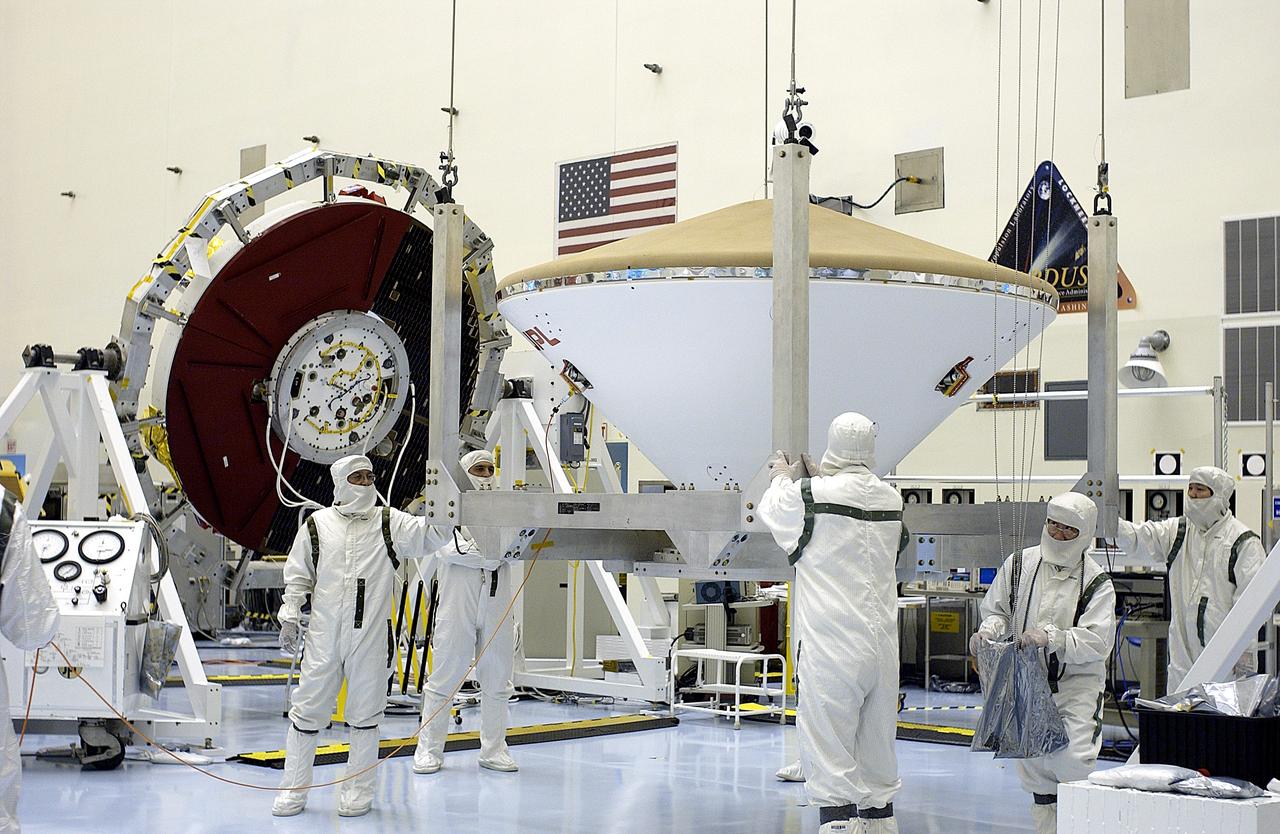
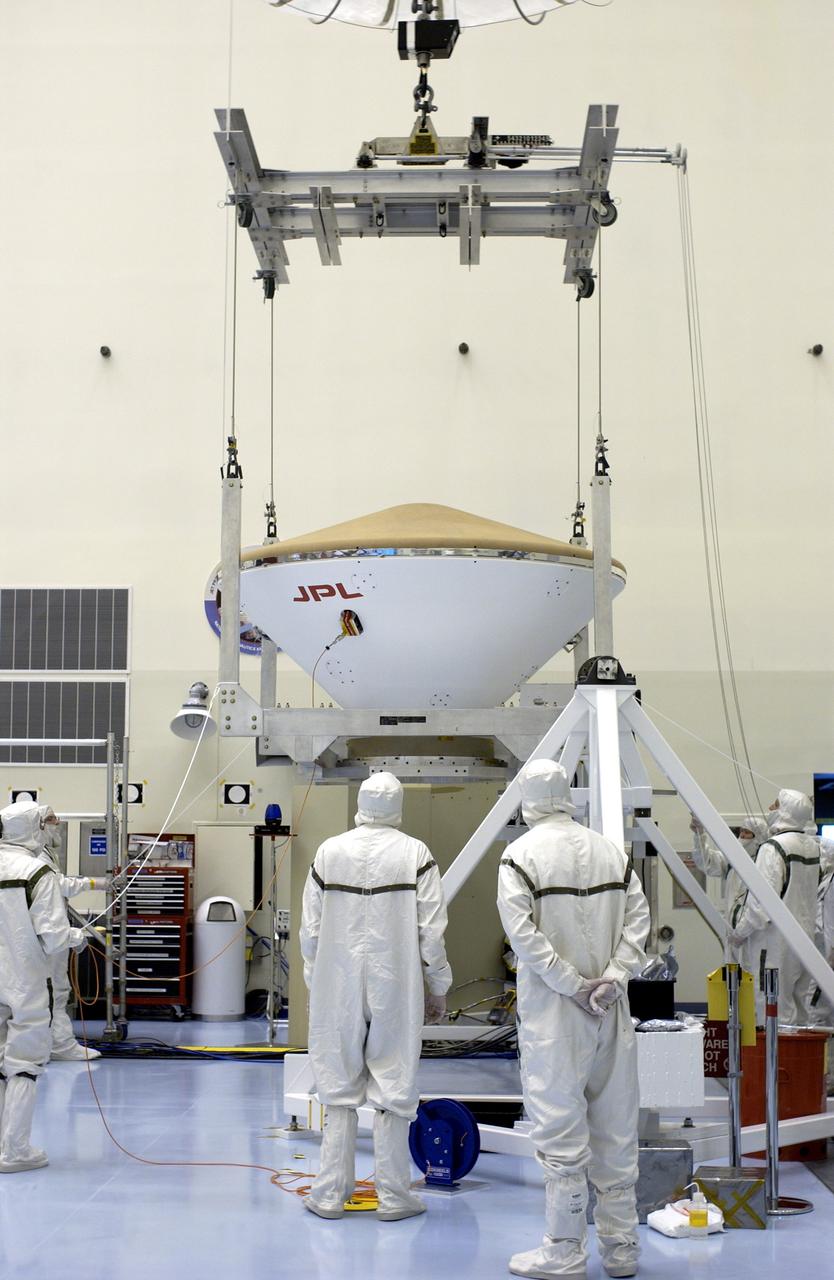
KENNEDY SPACE CENTER, FLA. - The overhead crane settles the Mars Exploration Rover 2 (MER-2) entry vehicle onto a spin table for a dry-spin test.  The MER Mission consists of two identical rovers designed to cover roughly 110 yards each Martian day over various terrain. Each rover will carry five scientific instruments that will allow it to search for evidence of liquid water that may have been present in the planet's past.  Identical to each other, the rovers will land at different regions of Mars.  Launch for MER-2 (MER-A) is scheduled for June 5.
KENNEDY SPACE CENTER, FLA. - The overhead crane settles the Mars Exploration Rover 2 (MER-2) entry vehicle onto a spin table for a dry-spin test. The MER Mission consists of two identical rovers designed to cover roughly 110 yards each Martian day over various terrain. Each rover will carry five scientific instruments that will allow it to search for evidence of liquid water that may have been present in the planet's past. Identical to each other, the rovers will land at different regions of Mars. Launch for MER-2 (MER-A) is scheduled for June 5.
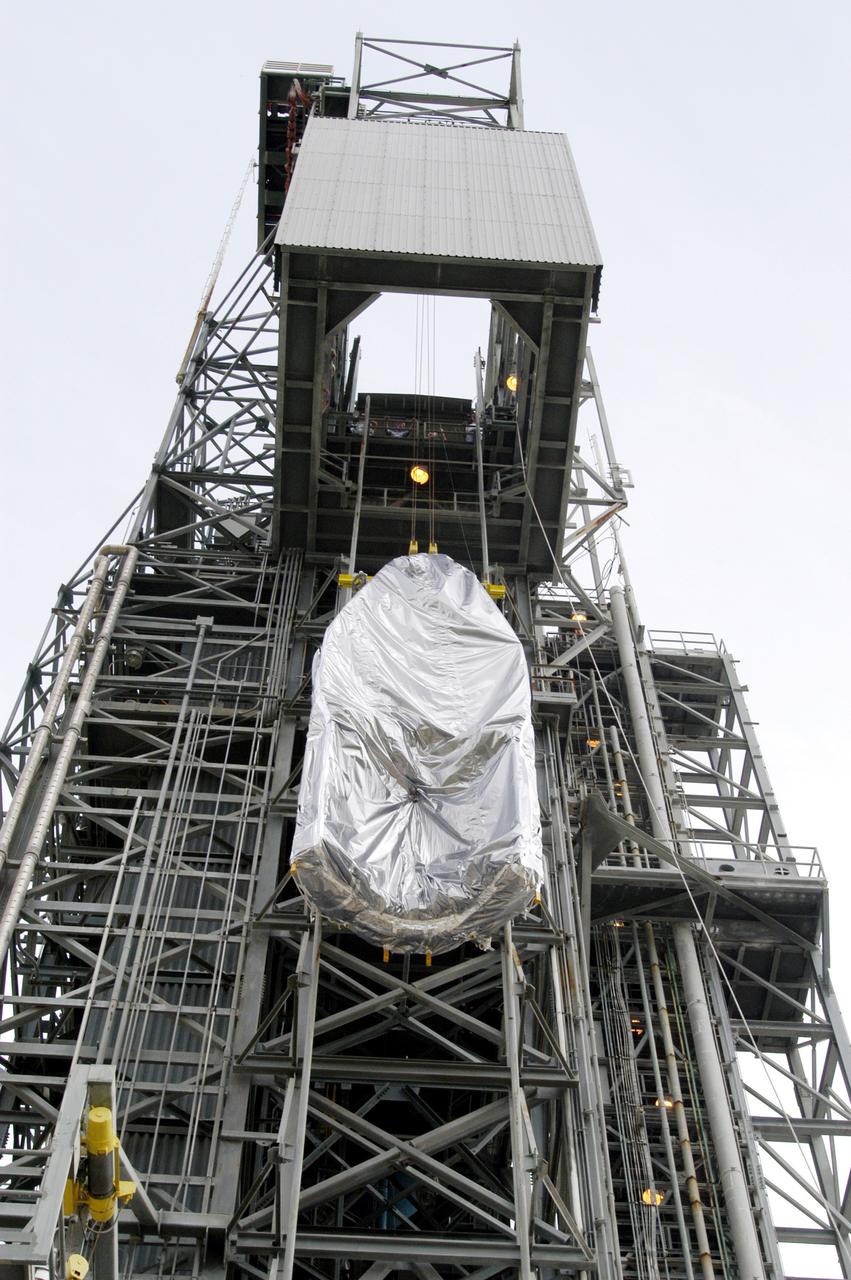
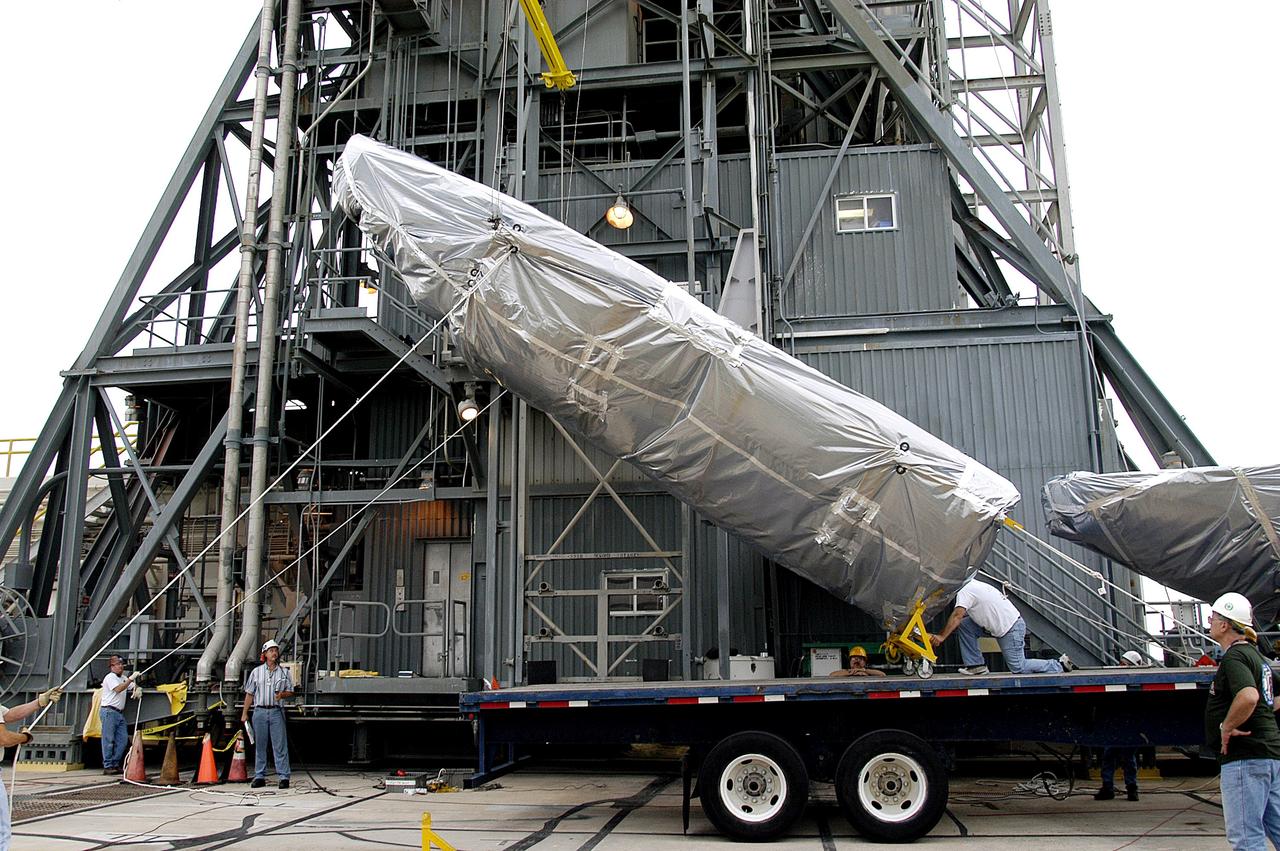
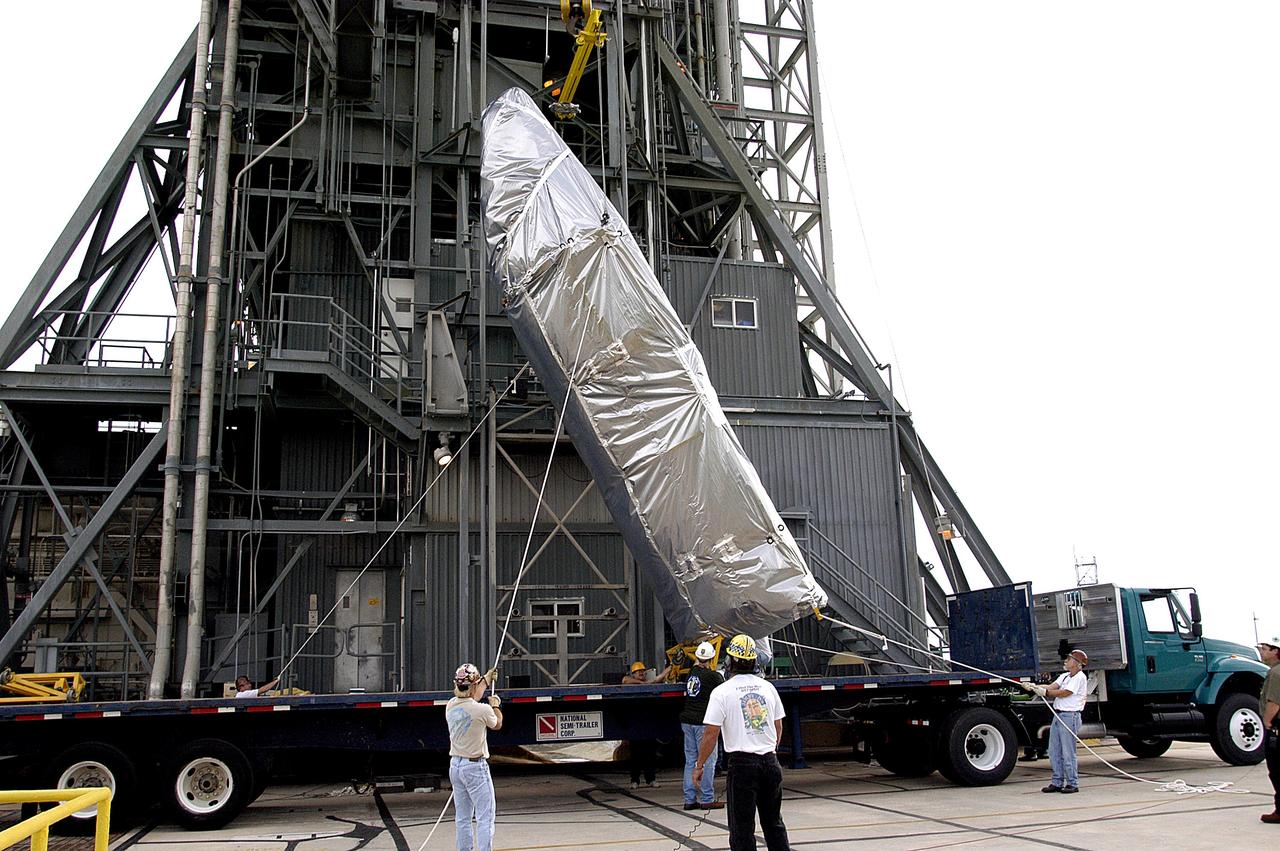
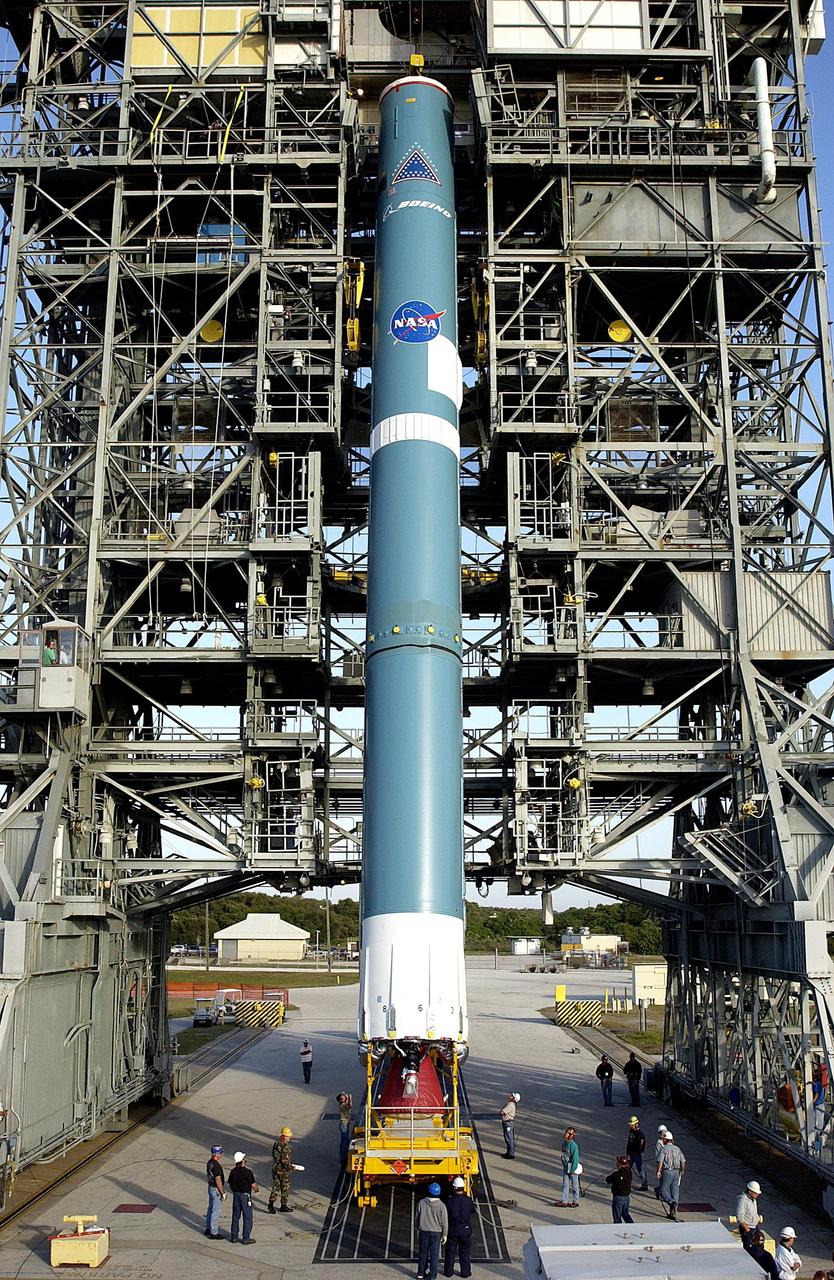
KENNEDY SPACE CENTER, FLA. - At Launch Complex 17-A, Cape Canaveral Air Force Station, the first half of the fairing for the Mars Exploration Rover 2 (MER-2/MER-A) reaches the top of the launch tower.  The fairing will be installed around the payload for protection during launch.  The MER Mission consists of two identical rovers designed to cover roughly 110 yards each Martian day over various terrain. Each rover will carry five scientific instruments that will allow it to search for evidence of liquid water that may have been present in the planet's past.  Identical to each other, the rovers will land at different regions of Mars.  Launch date for MER-A  is scheduled for June 5.
KENNEDY SPACE CENTER, FLA. - At Launch Complex 17-A, Cape Canaveral Air Force Station, the first half of the fairing for the Mars Exploration Rover 2 (MER-2/MER-A) reaches the top of the launch tower. The fairing will be installed around the payload for protection during launch. The MER Mission consists of two identical rovers designed to cover roughly 110 yards each Martian day over various terrain. Each rover will carry five scientific instruments that will allow it to search for evidence of liquid water that may have been present in the planet's past. Identical to each other, the rovers will land at different regions of Mars. Launch date for MER-A is scheduled for June 5.
KENNEDY SPACE CENTER, FLA. - At Launch Complex 17-A, Cape Canaveral Air Force Station, a crane is in place to lift the fairing for the Mars Exploration Rover 2 (MER-2/MER-A).  The fairing will be installed around the payload for protection during launch.  The MER Mission consists of two identical rovers designed to cover roughly 110 yards each Martian day over various terrain. Each rover will carry five scientific instruments that will allow it to search for evidence of liquid water that may have been present in the planet's past.  Identical to each other, the rovers will land at different regions of Mars.  Launch date for MER-A  is scheduled for June 5.
KENNEDY SPACE CENTER, FLA. - At Launch Complex 17-A, Cape Canaveral Air Force Station, a crane is in place to lift the fairing for the Mars Exploration Rover 2 (MER-2/MER-A). The fairing will be installed around the payload for protection during launch. The MER Mission consists of two identical rovers designed to cover roughly 110 yards each Martian day over various terrain. Each rover will carry five scientific instruments that will allow it to search for evidence of liquid water that may have been present in the planet's past. Identical to each other, the rovers will land at different regions of Mars. Launch date for MER-A is scheduled for June 5.
KENNEDY SPACE CENTER, FLA. - At Launch Complex 17-A, Cape Canaveral Air Force Station, the first half of the fairing for the Mars Exploration Rover 2 (MER-2/MER-A) is lifted off the transporter.  The fairing will be installed around the payload for protection during launch.  The MER Mission consists of two identical rovers designed to cover roughly 110 yards each Martian day over various terrain. Each rover will carry five scientific instruments that will allow it to search for evidence of liquid water that may have been present in the planet's past.  Identical to each other, the rovers will land at different regions of Mars.  Launch date for MER-A  is scheduled for June 5.
KENNEDY SPACE CENTER, FLA. - At Launch Complex 17-A, Cape Canaveral Air Force Station, the first half of the fairing for the Mars Exploration Rover 2 (MER-2/MER-A) is lifted off the transporter. The fairing will be installed around the payload for protection during launch. The MER Mission consists of two identical rovers designed to cover roughly 110 yards each Martian day over various terrain. Each rover will carry five scientific instruments that will allow it to search for evidence of liquid water that may have been present in the planet's past. Identical to each other, the rovers will land at different regions of Mars. Launch date for MER-A is scheduled for June 5.
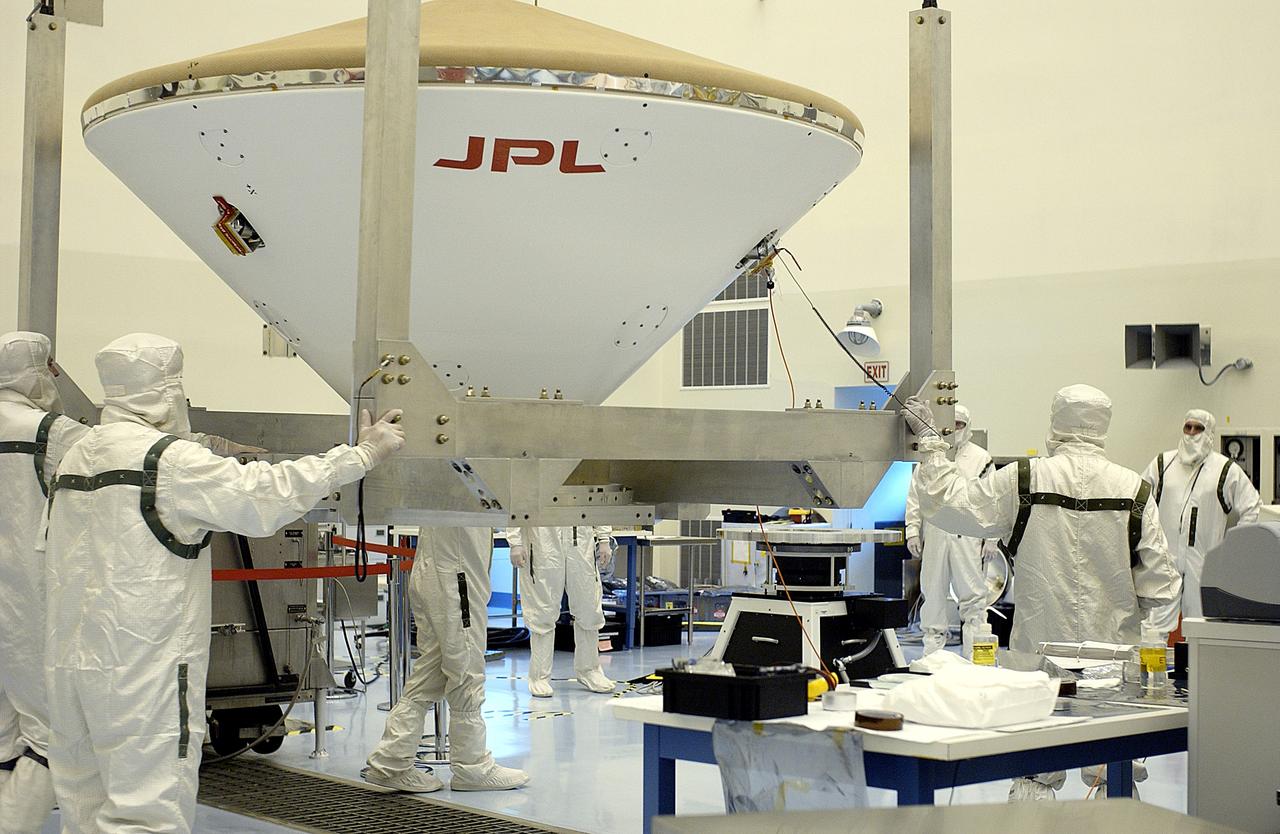
KENNEDY SPACE CENTER, FLA. - An overhead crane moves the Mars Exploration Rover 2 (MER-2) entry vehicle across the Payload Hazardous Servicing Facility toward a spin table for a dry-spin test.  The MER Mission consists of two identical rovers designed to cover roughly 110 yards each Martian day over various terrain. Each rover will carry five scientific instruments that will allow it to search for evidence of liquid water that may have been present in the planet's past.  Identical to each other, the rovers will land at different regions of Mars.  Launch for MER-2 (MER-A) is scheduled for June 5.
KENNEDY SPACE CENTER, FLA. - An overhead crane moves the Mars Exploration Rover 2 (MER-2) entry vehicle across the Payload Hazardous Servicing Facility toward a spin table for a dry-spin test. The MER Mission consists of two identical rovers designed to cover roughly 110 yards each Martian day over various terrain. Each rover will carry five scientific instruments that will allow it to search for evidence of liquid water that may have been present in the planet's past. Identical to each other, the rovers will land at different regions of Mars. Launch for MER-2 (MER-A) is scheduled for June 5.
KENNEDY SPACE CENTER, FLA. - At Launch Complex 17-A, Cape Canaveral Air Force Station, the first half of the fairing for the Mars Exploration Rover 2 (MER-2/MER-A) is moved inside the launch tower.  The fairing will be installed around the payload for protection during launch.  The MER Mission consists of two identical rovers designed to cover roughly 110 yards each Martian day over various terrain. Each rover will carry five scientific instruments that will allow it to search for evidence of liquid water that may have been present in the planet's past.  Identical to each other, the rovers will land at different regions of Mars.  Launch date for MER-A  is scheduled for June 5..
KENNEDY SPACE CENTER, FLA. - At Launch Complex 17-A, Cape Canaveral Air Force Station, the first half of the fairing for the Mars Exploration Rover 2 (MER-2/MER-A) is moved inside the launch tower. The fairing will be installed around the payload for protection during launch. The MER Mission consists of two identical rovers designed to cover roughly 110 yards each Martian day over various terrain. Each rover will carry five scientific instruments that will allow it to search for evidence of liquid water that may have been present in the planet's past. Identical to each other, the rovers will land at different regions of Mars. Launch date for MER-A is scheduled for June 5..
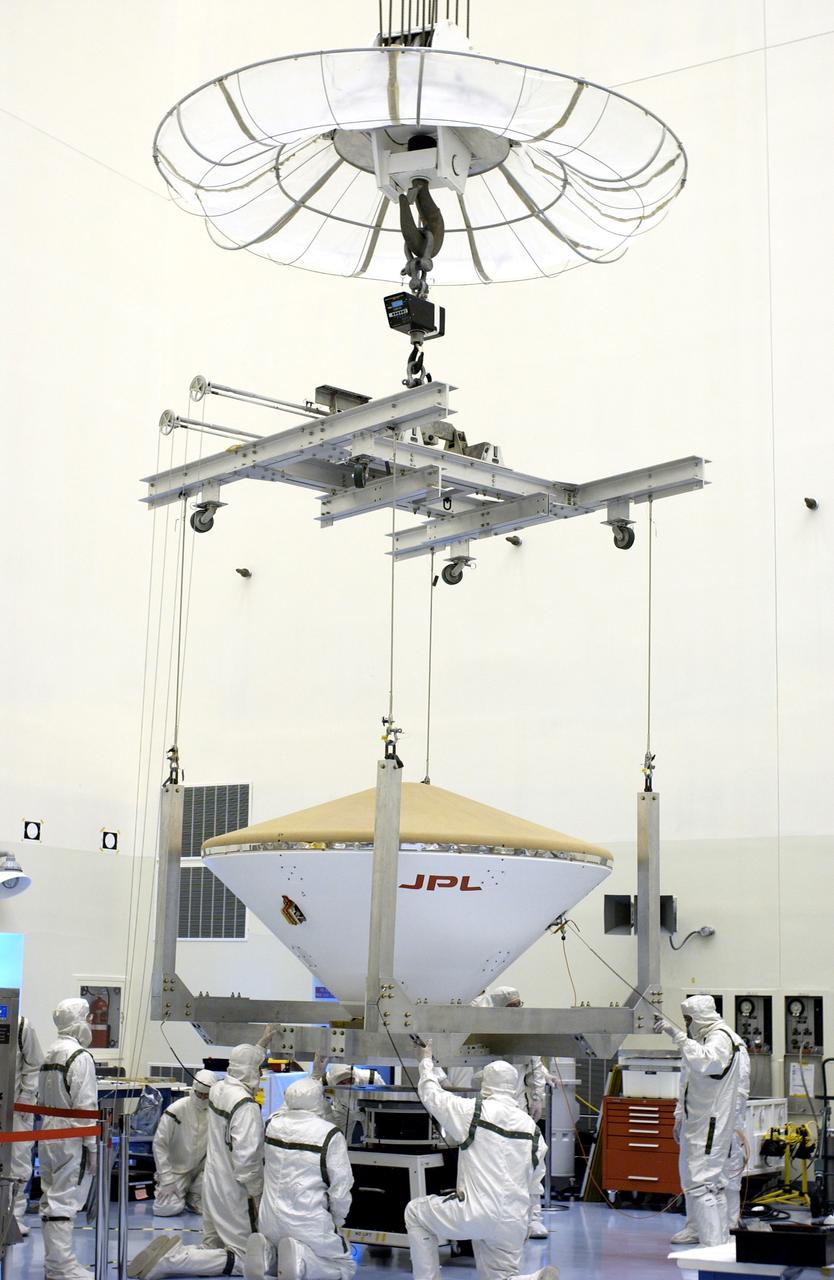
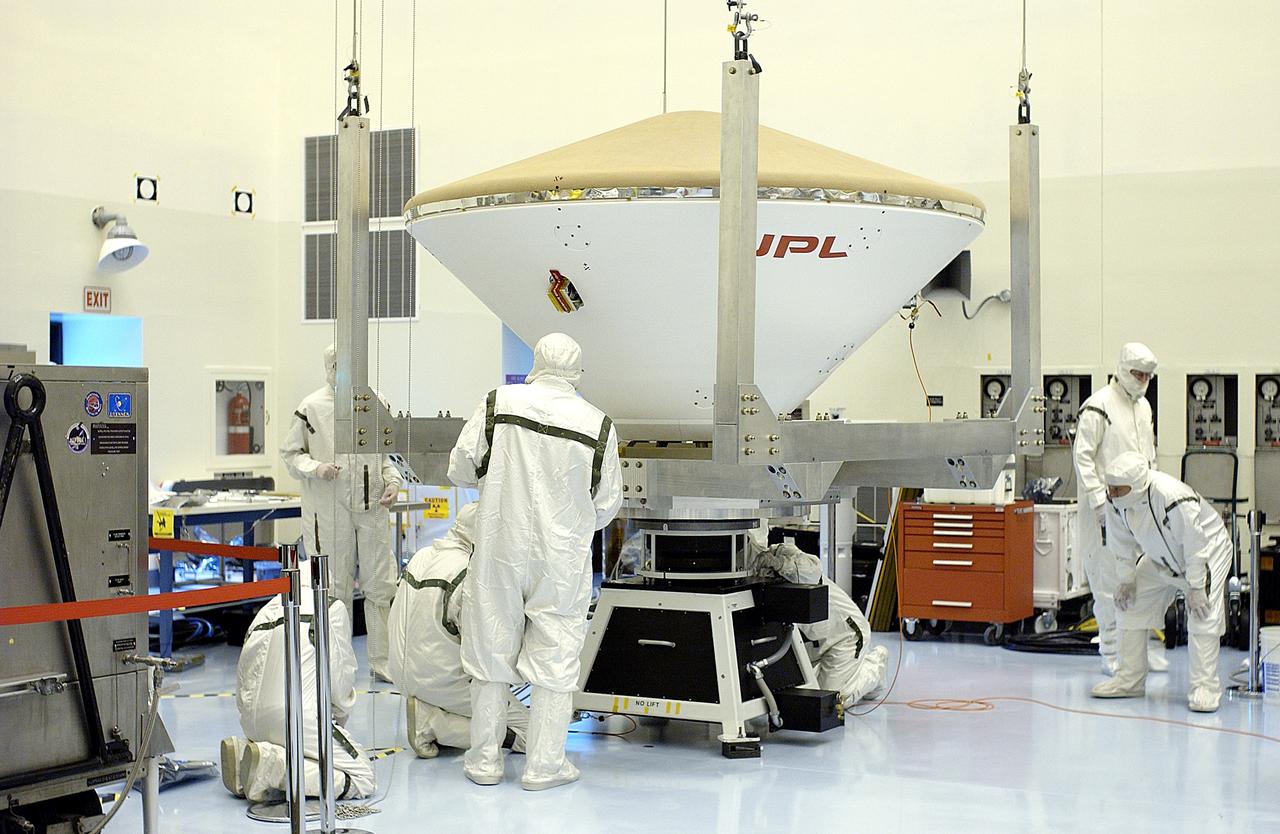
KENNEDY SPACE CENTER, FLA. -  With help from workers, the overhead crane lowers the Mars Exploration Rover 2 (MER-2) entry vehicle onto a spin table for a dry-spin test.  The MER Mission consists of two identical rovers designed to cover roughly 110 yards each Martian day over various terrain. Each rover will carry five scientific instruments that will allow it to search for evidence of liquid water that may have been present in the planet's past.  Identical to each other, the rovers will land at different regions of Mars.  Launch for MER-2 (MER-A) is scheduled for June 5.
KENNEDY SPACE CENTER, FLA. - With help from workers, the overhead crane lowers the Mars Exploration Rover 2 (MER-2) entry vehicle onto a spin table for a dry-spin test. The MER Mission consists of two identical rovers designed to cover roughly 110 yards each Martian day over various terrain. Each rover will carry five scientific instruments that will allow it to search for evidence of liquid water that may have been present in the planet's past. Identical to each other, the rovers will land at different regions of Mars. Launch for MER-2 (MER-A) is scheduled for June 5.
KENNEDY SPACE CENTER, FLA. -  At Launch Complex 17-A, Cape Canaveral Air Force Station, the first half of the fairing for the Mars Exploration Rover 2 (MER-2/MER-A) is lifted up the launch tower.  The fairing will be installed around the payload for protection during launch.  The MER Mission consists of two identical rovers designed to cover roughly 110 yards each Martian day over various terrain. Each rover will carry five scientific instruments that will allow it to search for evidence of liquid water that may have been present in the planet's past.  Identical to each other, the rovers will land at different regions of Mars.  Launch date for MER-A  is scheduled for June 5.
KENNEDY SPACE CENTER, FLA. - At Launch Complex 17-A, Cape Canaveral Air Force Station, the first half of the fairing for the Mars Exploration Rover 2 (MER-2/MER-A) is lifted up the launch tower. The fairing will be installed around the payload for protection during launch. The MER Mission consists of two identical rovers designed to cover roughly 110 yards each Martian day over various terrain. Each rover will carry five scientific instruments that will allow it to search for evidence of liquid water that may have been present in the planet's past. Identical to each other, the rovers will land at different regions of Mars. Launch date for MER-A is scheduled for June 5.
KENNEDY SPACE CENTER, FLA. -  At Launch Complex 17-A, Cape Canaveral Air Force Station, the first half of the fairing for the Mars Exploration Rover 2 (MER-2/MER-A) is lifted up the launch tower.  The fairing will be installed around the payload for protection during launch.  The MER Mission consists of two identical rovers designed to cover roughly 110 yards each Martian day over various terrain. Each rover will carry five scientific instruments that will allow it to search for evidence of liquid water that may have been present in the planet's past.  Identical to each other, the rovers will land at different regions of Mars.  Launch date for MER-A  is scheduled for June 5.
KENNEDY SPACE CENTER, FLA. - At Launch Complex 17-A, Cape Canaveral Air Force Station, the first half of the fairing for the Mars Exploration Rover 2 (MER-2/MER-A) is lifted up the launch tower. The fairing will be installed around the payload for protection during launch. The MER Mission consists of two identical rovers designed to cover roughly 110 yards each Martian day over various terrain. Each rover will carry five scientific instruments that will allow it to search for evidence of liquid water that may have been present in the planet's past. Identical to each other, the rovers will land at different regions of Mars. Launch date for MER-A is scheduled for June 5.
KENNEDY SPACE CENTER, FLA. - Workers in the Payload Hazardous Servicing Facility help guide the Mars Exploration Rover 2 (MER-2) entry vehicle toward a spin table for a dry-spin test.  The MER Mission consists of two identical rovers designed to cover roughly 110 yards each Martian day over various terrain. Each rover will carry five scientific instruments that will allow it to search for evidence of liquid water that may have been present in the planet's past.  Identical to each other, the rovers will land at different regions of Mars.  Launch for MER-2 (MER-A) is scheduled for June 5.
KENNEDY SPACE CENTER, FLA. - Workers in the Payload Hazardous Servicing Facility help guide the Mars Exploration Rover 2 (MER-2) entry vehicle toward a spin table for a dry-spin test. The MER Mission consists of two identical rovers designed to cover roughly 110 yards each Martian day over various terrain. Each rover will carry five scientific instruments that will allow it to search for evidence of liquid water that may have been present in the planet's past. Identical to each other, the rovers will land at different regions of Mars. Launch for MER-2 (MER-A) is scheduled for June 5.
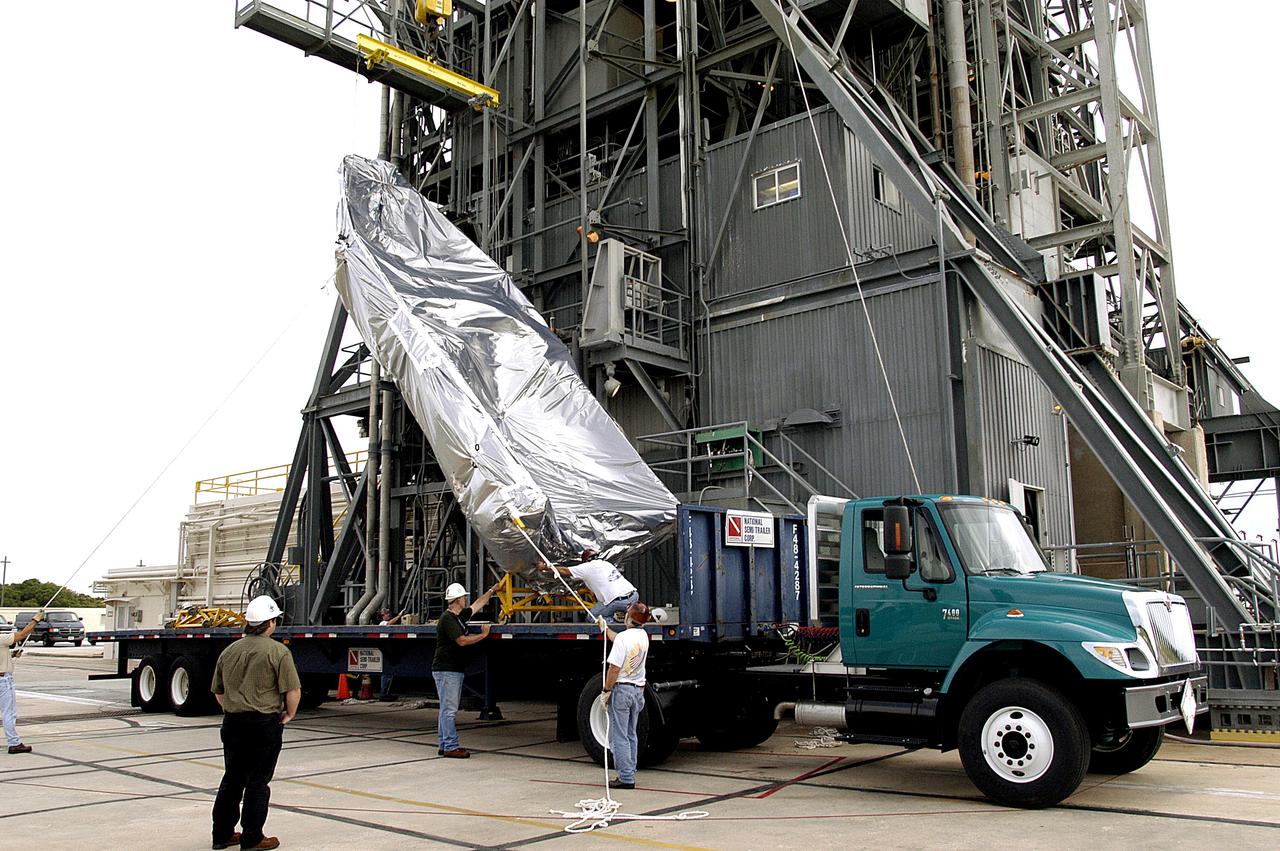
KENNEDY SPACE CENTER, FLA. - After arriving at Launch Complex 17-A, Cape Canaveral Air Force Station, the second half of the fairing for the Mars Exploration Rover 2 (MER-2/MER-A) is lifted off its transporter.  The fairing will be installed around the payload for protection during launch.  The MER Mission consists of two identical rovers designed to cover roughly 110 yards each Martian day over various terrain. Each rover will carry five scientific instruments that will allow it to search for evidence of liquid water that may have been present in the planet's past.  Identical to each other, the rovers will land at different regions of Mars.  Launch date for MER-A  is scheduled for June 5.
KENNEDY SPACE CENTER, FLA. - After arriving at Launch Complex 17-A, Cape Canaveral Air Force Station, the second half of the fairing for the Mars Exploration Rover 2 (MER-2/MER-A) is lifted off its transporter. The fairing will be installed around the payload for protection during launch. The MER Mission consists of two identical rovers designed to cover roughly 110 yards each Martian day over various terrain. Each rover will carry five scientific instruments that will allow it to search for evidence of liquid water that may have been present in the planet's past. Identical to each other, the rovers will land at different regions of Mars. Launch date for MER-A is scheduled for June 5.
KENNEDY SPACE CENTER, FLA. - An overhead crane lifts the Mars Exploration Rover 2 (MER-2) entry vehicle from its stand to move it to a spin table for a dry-spin test.  The MER Mission consists of two identical rovers designed to cover roughly 110 yards each Martian day over various terrain. Each rover will carry five scientific instruments that will allow it to search for evidence of liquid water that may have been present in the planet's past.  Identical to each other, the rovers will land at different regions of Mars.  Launch for MER-2 (MER-A) is scheduled for June 5.
KENNEDY SPACE CENTER, FLA. - An overhead crane lifts the Mars Exploration Rover 2 (MER-2) entry vehicle from its stand to move it to a spin table for a dry-spin test. The MER Mission consists of two identical rovers designed to cover roughly 110 yards each Martian day over various terrain. Each rover will carry five scientific instruments that will allow it to search for evidence of liquid water that may have been present in the planet's past. Identical to each other, the rovers will land at different regions of Mars. Launch for MER-2 (MER-A) is scheduled for June 5.
KENNEDY SPACE CENTER, FLA. - An overhead crane moves the Mars Exploration Rover 2 (MER-2) entry vehicle across the Payload Hazardous Servicing Facility toward a spin table for a dry-spin test.  The MER Mission consists of two identical rovers designed to cover roughly 110 yards each Martian day over various terrain. Each rover will carry five scientific instruments that will allow it to search for evidence of liquid water that may have been present in the planet's past.  Identical to each other, the rovers will land at different regions of Mars.  Launch for MER-2 (MER-A) is scheduled for June 5.
KENNEDY SPACE CENTER, FLA. - An overhead crane moves the Mars Exploration Rover 2 (MER-2) entry vehicle across the Payload Hazardous Servicing Facility toward a spin table for a dry-spin test. The MER Mission consists of two identical rovers designed to cover roughly 110 yards each Martian day over various terrain. Each rover will carry five scientific instruments that will allow it to search for evidence of liquid water that may have been present in the planet's past. Identical to each other, the rovers will land at different regions of Mars. Launch for MER-2 (MER-A) is scheduled for June 5.
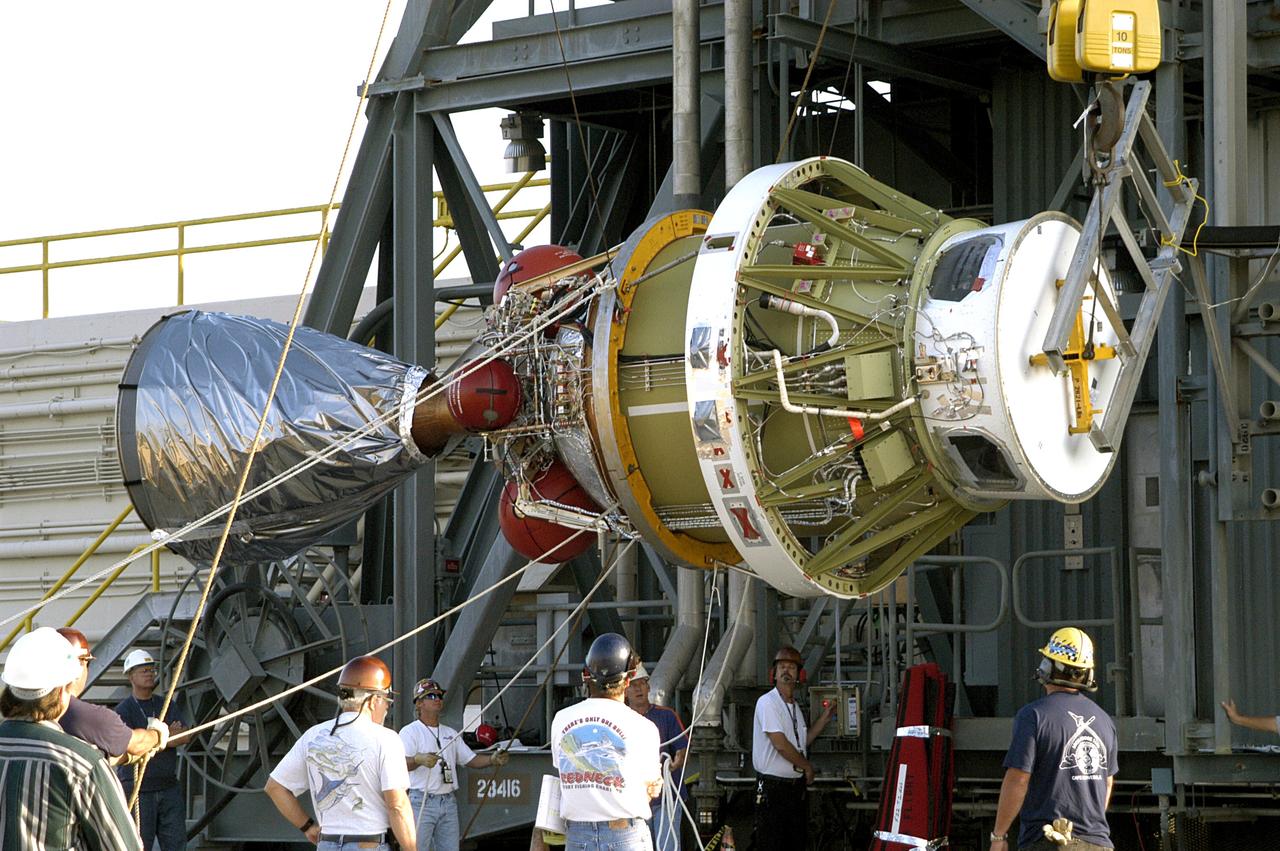
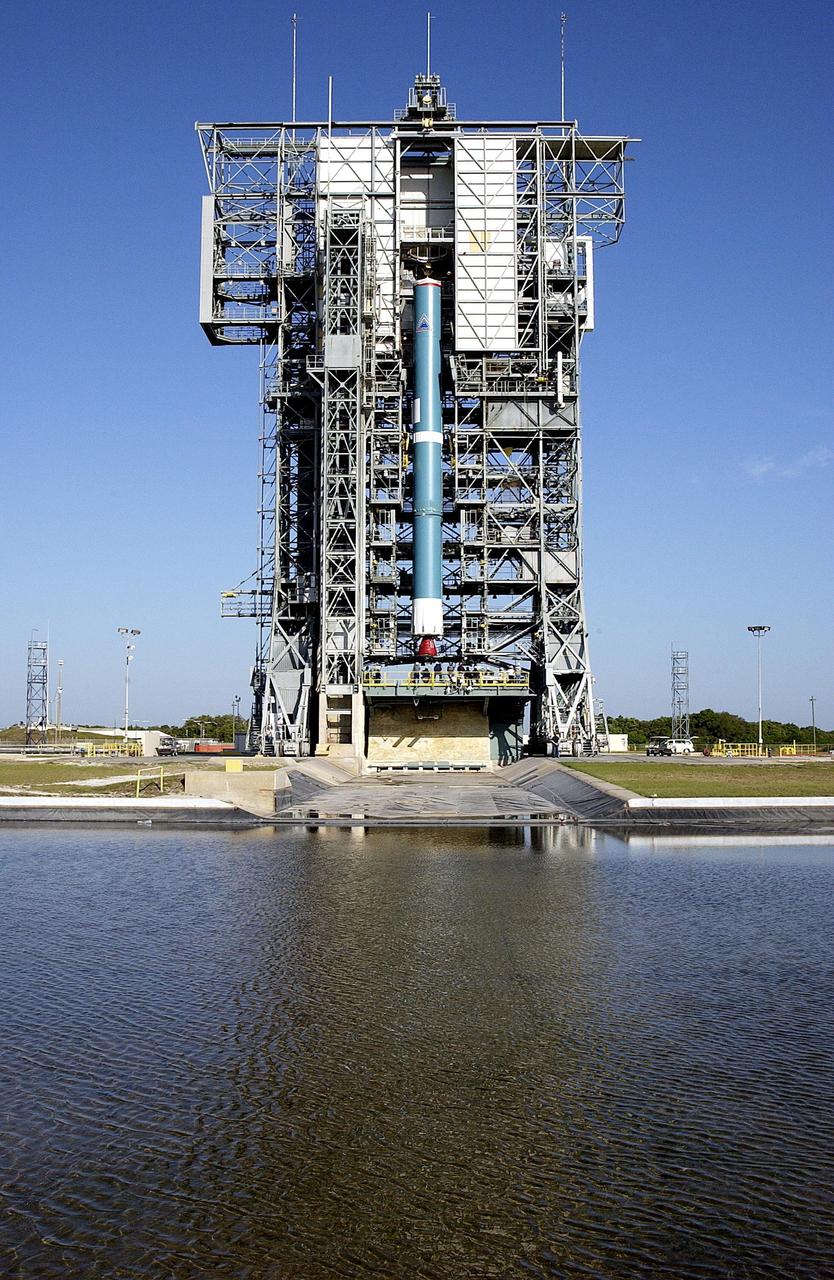
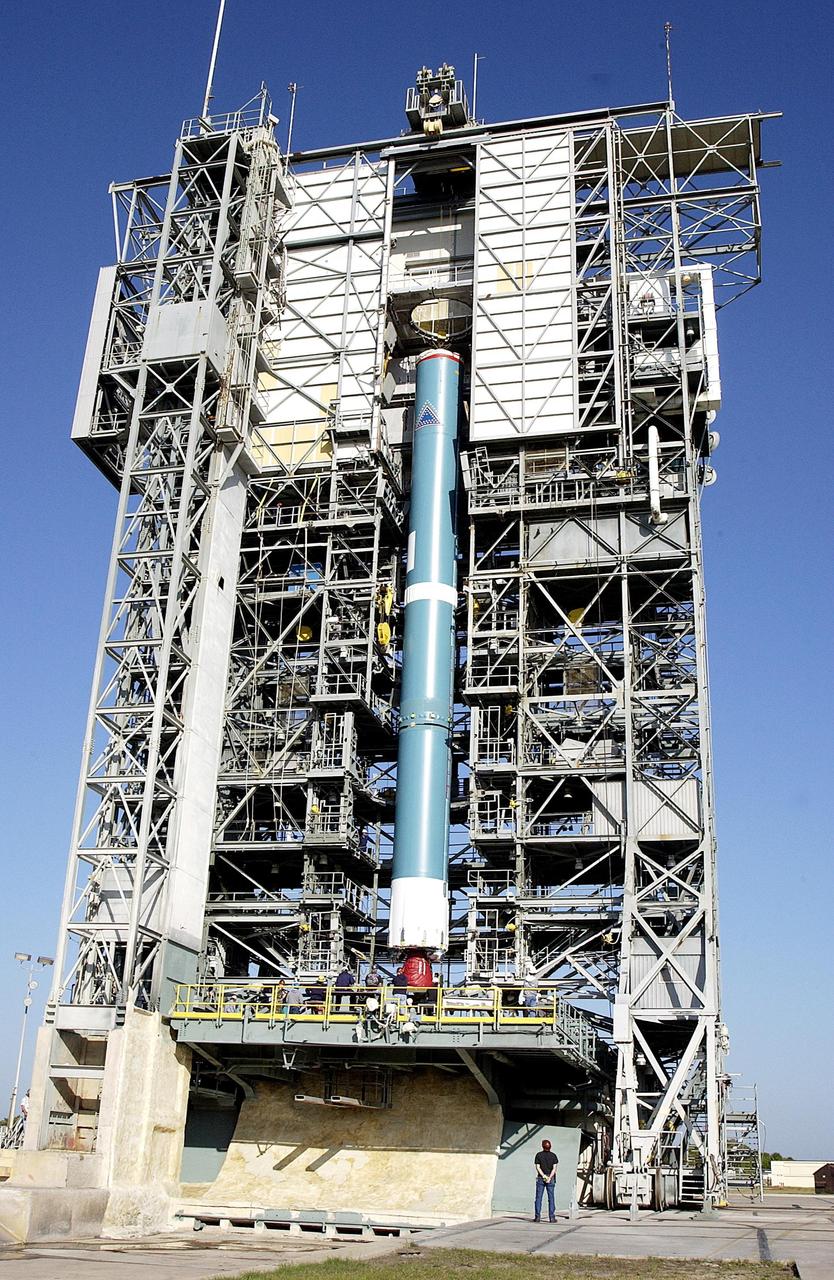
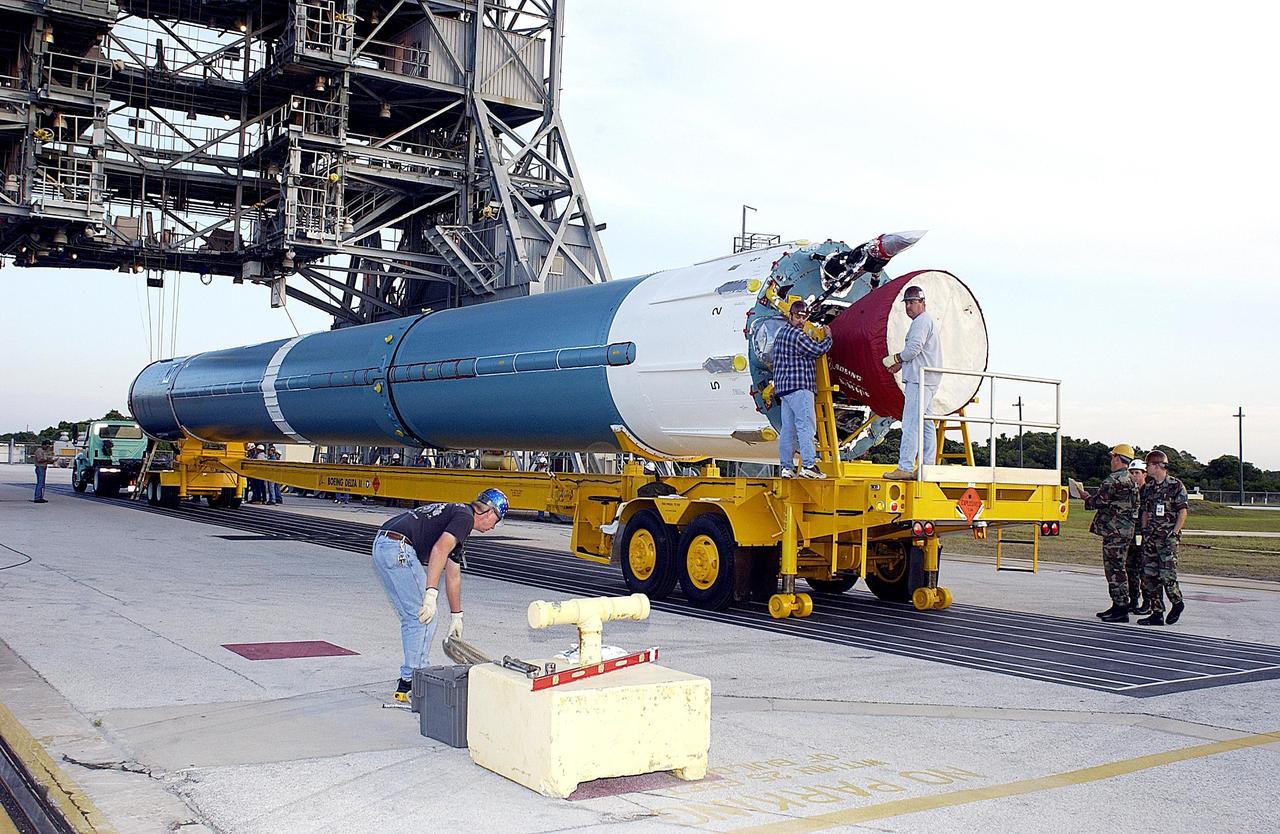
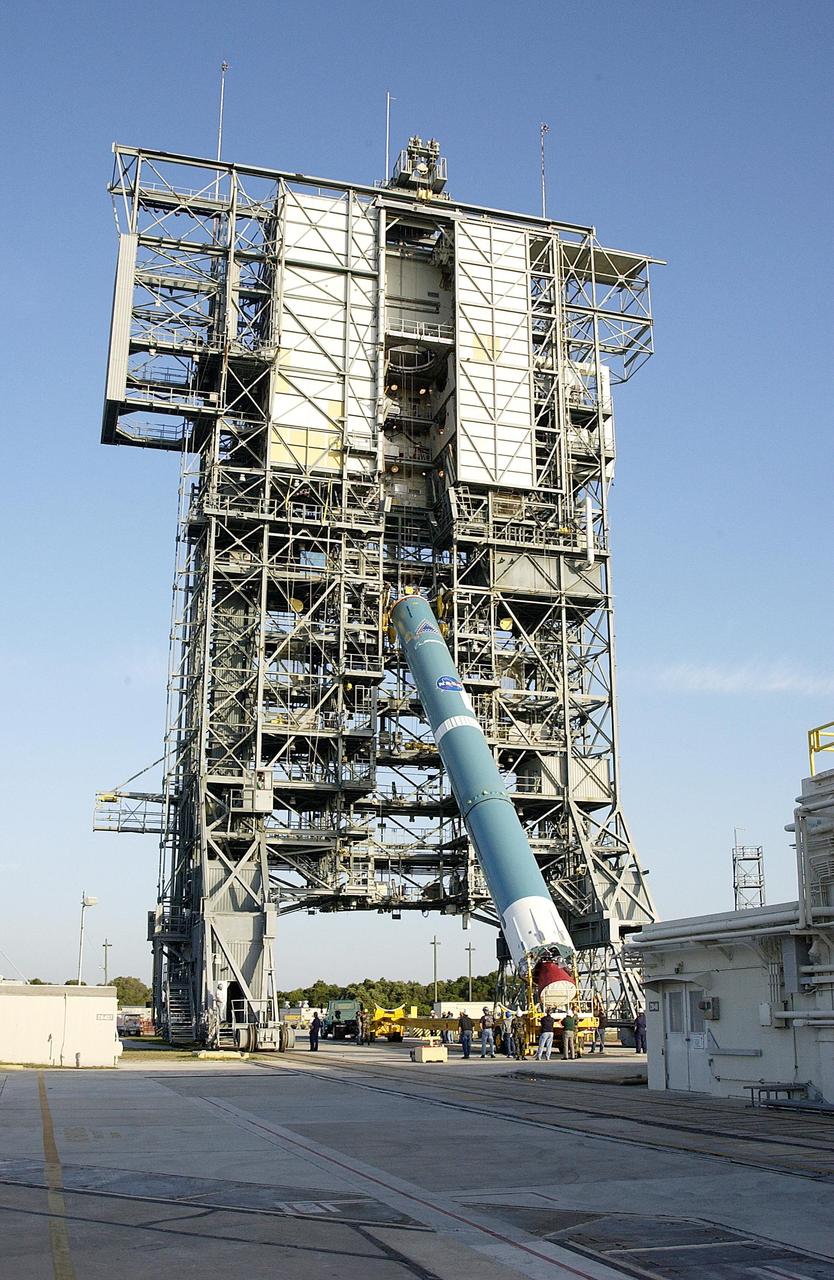
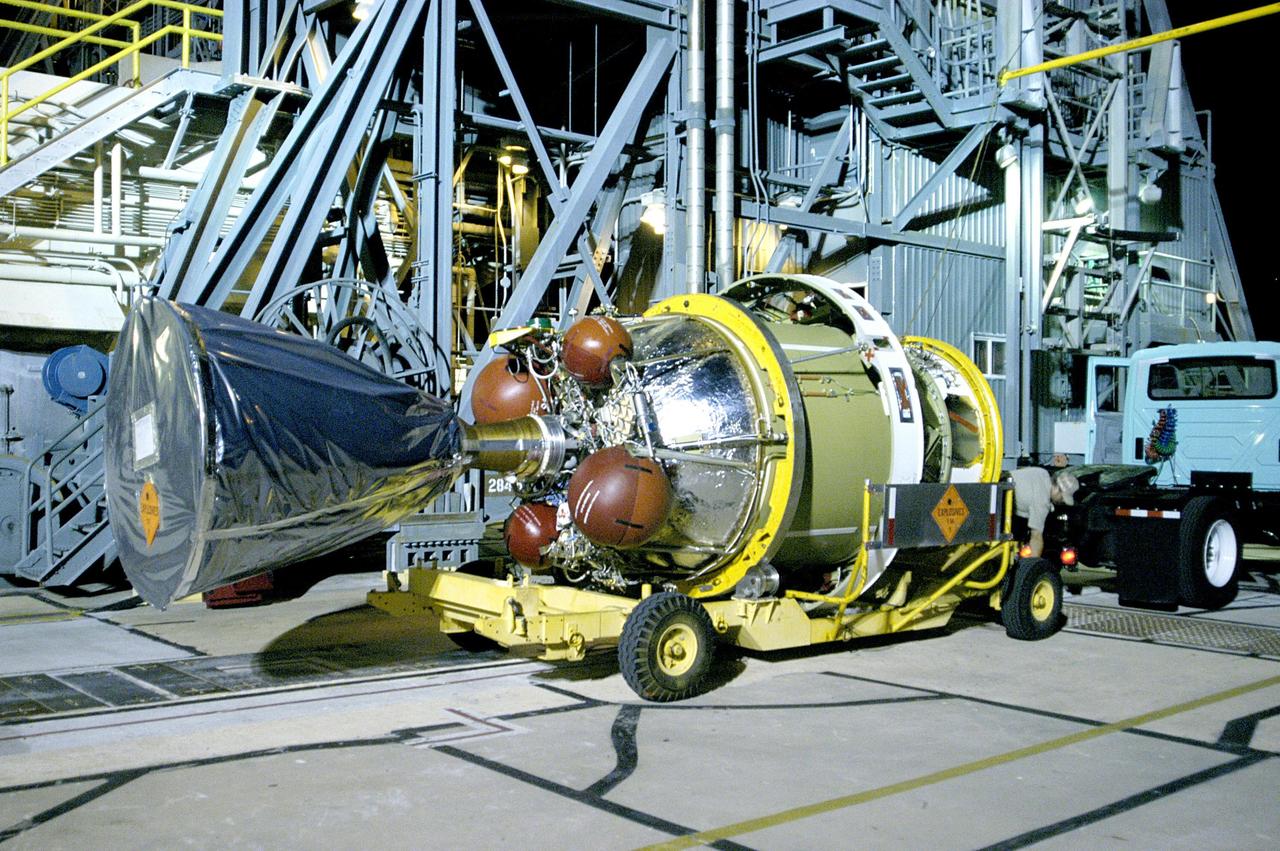
KENNEDY SPACE CENTER, FLA. - The second stage of the Delta II rocket is raised off the transporter for its lift up the launch tower on Pad 17-A, Cape Canaveral Air Force Station.  It will be mated to the first stage in preparation for the launch of the Mars Exploration Rover 2 (MER-A).  The MER Mission consists of two identical rovers designed to cover roughly 110 yards each Martian day over various terrain. Each rover will carry five scientific instruments that will allow it to search for evidence of liquid water that may have been present in the planet’s past.  Identical to each other, the rovers will land at different regions of Mars.  Launch date for this first of NASA’s two Mars Exploration Rover missions is scheduled June 5.
KENNEDY SPACE CENTER, FLA. - The second stage of the Delta II rocket is raised off the transporter for its lift up the launch tower on Pad 17-A, Cape Canaveral Air Force Station. It will be mated to the first stage in preparation for the launch of the Mars Exploration Rover 2 (MER-A). The MER Mission consists of two identical rovers designed to cover roughly 110 yards each Martian day over various terrain. Each rover will carry five scientific instruments that will allow it to search for evidence of liquid water that may have been present in the planet’s past. Identical to each other, the rovers will land at different regions of Mars. Launch date for this first of NASA’s two Mars Exploration Rover missions is scheduled June 5.
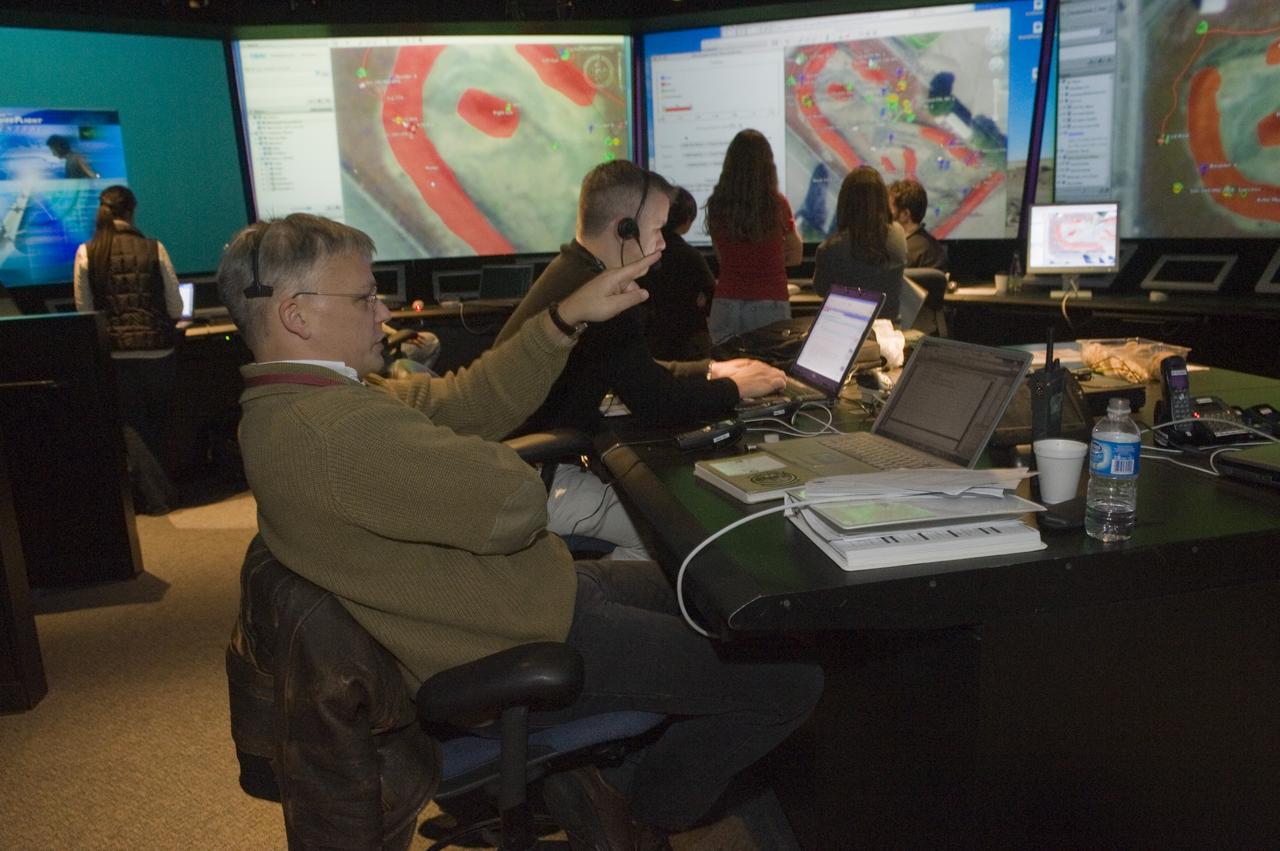
K-10 (red) plaentary rover at Marscape (Ames Mars Yard): with prototype flight control team remotely operating K-10 'Red' from  Ames Future Flight Centeral (FFC) Simulator, L-R Eric Park, Debra Schreckenghost, Rob Landis, Tod Milam, Steve Riley, Estrellina Pacis
ARC-2008-ACD08-0260-016
K-10 (red) plaentary rover at Marscape (Ames Mars Yard): with prototype flight control team remotely operating K-10 'Red' from  Ames Future Flight Centeral (FFC) Simulator, with Rob Landis and Steve Riley.
ARC-2008-ACD08-0260-019
K-10 (red) plaentary rover at Marscape (Ames Mars Yard): with prototype flight control team remotely operating K-10 'Red' from  Ames Future Flight Centeral (FFC) Simulator, L-R; Pascal Lee, Melissa Rice, David Lees, Trey Smith
ARC-2008-ACD08-0260-022
K-10 (red) plaentary rover at Marscape (Ames Mars Yard): with prototype flight control team remotely operating K-10 'Red' from  Ames Future Flight Centeral (FFC) Simulator. L-R; Jeff Tripp, David Lees, Trey Smith, Mark Helper, Simon Rutishauser
ARC-2008-ACD08-0260-023
K-10 (red) robot operations tests at Marscape (Ames Mars Yard) with remote operations from Ames Future Flight Centeral (FFC) Simulator, L-R; Terry Fong, Melissa Rice and Harrison 'Jack' Schmitt (Apollo 17 Astronaut).
ARC-2008-ACD08-0260-040
A development rover that is part of NASA's CADRE (Cooperative Autonomous Distributed Robotic Exploration) technology demonstration drives over a rock during its first autonomous drive around the Mars Yard at the agency's Jet Propulsion Laboratory in Southern California in June 2023. Under a canopy behind the rover are, from left, graduate student intern Natalie Deo and CADRE verification and validation lead Sawyer Brooks of JPL. The CADRE team successfully tested a new wheel design, surface navigation software, and mobility capabilities, among other aspects of the project.  The rover being tested is similar in size and appearance to the flight models of the CADRE rovers, which are still being built. Slated to arrive at the Moon in spring 2024 as part of NASA's CLPS (Commercial Lunar Payload Services) initiative, CADRE is designed to demonstrate that multiple robots can cooperate and explore together autonomously – without direct input from human mission controllers.  A trio of the miniature solar-powered rovers, each about the size of a carry-on suitcase, will explore the Moon as a team, communicating via radio with each other and a base station aboard a lunar lander. By taking simultaneous measurements from multiple locations, CADRE will also demonstrate how multirobot missions can record data impossible for a single robot to achieve – a tantalizing prospect for future missions.  Movie available at https://photojournal.jpl.nasa.gov/catalog/PIA25667
CADRE Mini Rover Drives Over a Rock
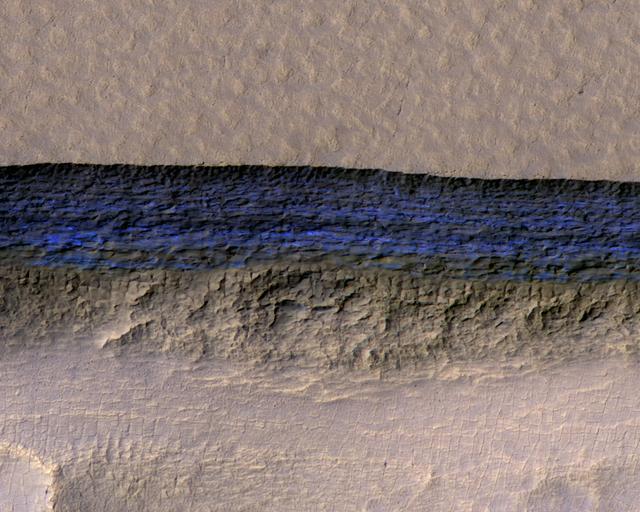
Click on the image for larger version  A cross-section of a thick sheet of underground ice is exposed at the steep slope (or scarp) that appears bright blue in this enhanced-color view from the High Resolution Imaging Science Experiment (HiRISE) camera on NASA's Mars Reconnaissance Orbiter.  The view covers an area about 550 yards (500 meters) wide. Figure 1 includes a 100-meter (109-yard) scale bar. North is toward the top. The upper third of the image shows level ground that is about 140 yards (130 meters) higher in elevation than the ground in the bottom third. In between, the scarp descends sharply, exposing about 260 vertical feet (80 vertical meters) of water ice.  Color is exaggerated to make differences in surface materials easier to see. The presence of exposed water ice at this site was confirmed by observation with the same orbiter's Compact Reconnaissance Imaging Spectrometer for Mars (CRISM).  In January 2018, in the journal Science, researchers reported finding and studying eight such ice-exposing scarps in the middle latitudes of Mars. The presence of vast underground ice deposits in Mars' middle latitudes was known previously. The report of unusual sites where they are exposed provides new information about their depth and layering. It also identifies potential water resources for future Mars missions and possibilities for studying Martian climate history by examining the ice layers holding a record of past climate cycles. The ice may have been deposited as snow when the tilt of Mars' rotation axis was greater than it is now.  HiRISE observation ESP_022389_1230 was made on May 7, 2011, at 56.6 degrees south latitude, 114.1 degrees east longitude.  https://photojournal.jpl.nasa.gov/catalog/PIA22077
Underground Martian Ice Deposit Exposed at Scarp
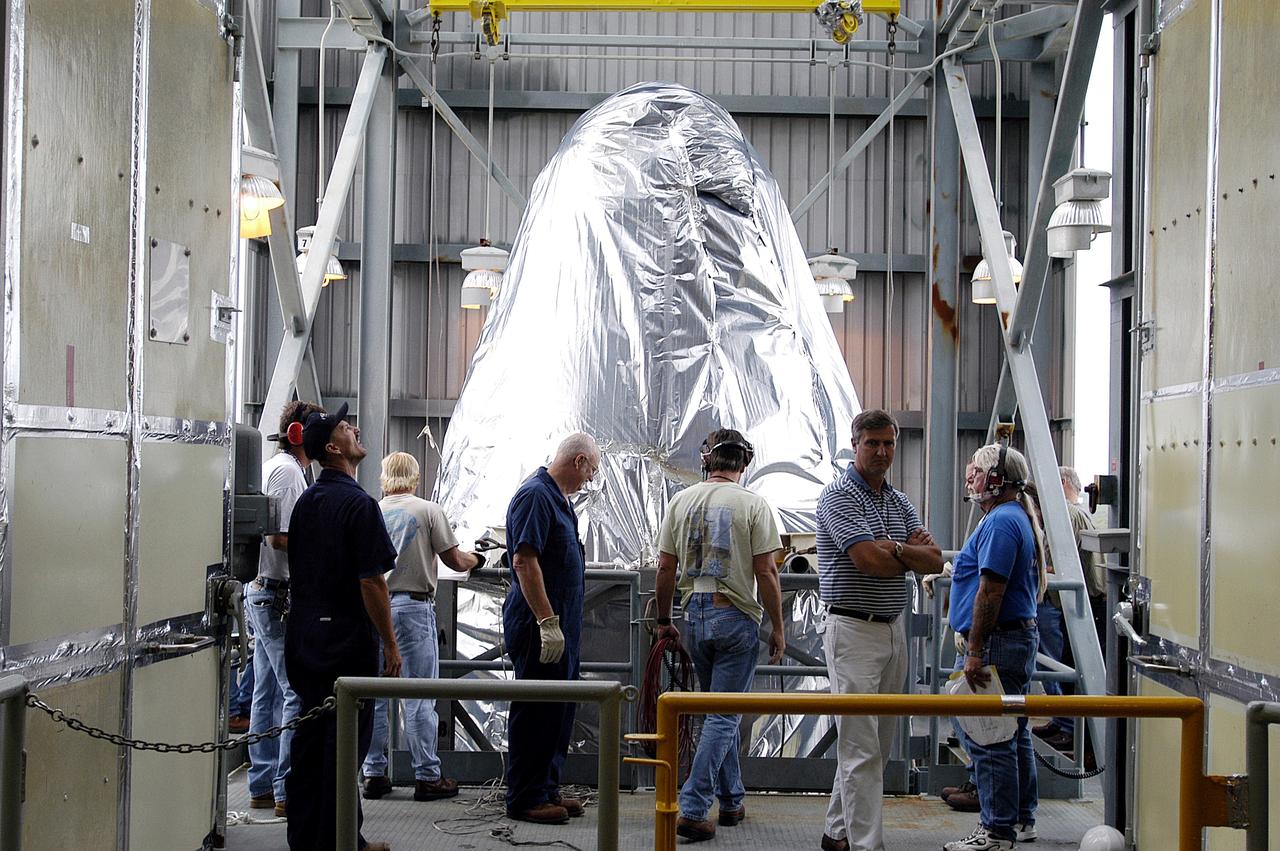
KENNEDY SPACE CENTER, FLA. -  At Launch Complex 17-A, Cape Canaveral Air Force Station, the second half of the fairing for the Mars Exploration Rover 2 (MER-2/MER-A) nears the top of the launch tower.  The fairing will be installed around the payload for protection during launch on a Delta II rocket.  The MER Mission consists of two identical rovers designed to cover roughly 110 yards each Martian day over various terrain. Each rover will carry five scientific instruments that will allow it to search for evidence of liquid water that may have been present in the planet's past.  Identical to each other, the rovers will land at different regions of Mars.  Launch date for MER-A  is scheduled for June 5.
KENNEDY SPACE CENTER, FLA. - At Launch Complex 17-A, Cape Canaveral Air Force Station, the second half of the fairing for the Mars Exploration Rover 2 (MER-2/MER-A) nears the top of the launch tower. The fairing will be installed around the payload for protection during launch on a Delta II rocket. The MER Mission consists of two identical rovers designed to cover roughly 110 yards each Martian day over various terrain. Each rover will carry five scientific instruments that will allow it to search for evidence of liquid water that may have been present in the planet's past. Identical to each other, the rovers will land at different regions of Mars. Launch date for MER-A is scheduled for June 5.
KENNEDY SPACE CENTER, FLA. - At Launch Complex 17-A, Cape Canaveral Air Force Station, the first half of the fairing for the Mars Exploration Rover 2 (MER-2/MER-A) is raised to a vertical position for its lift up the launch tower.  The fairing will be installed around the payload for protection during launch.  The MER Mission consists of two identical rovers designed to cover roughly 110 yards each Martian day over various terrain. Each rover will carry five scientific instruments that will allow it to search for evidence of liquid water that may have been present in the planet's past.  Identical to each other, the rovers will land at different regions of Mars.  Launch date for MER-A  is scheduled for June 5.
KENNEDY SPACE CENTER, FLA. - At Launch Complex 17-A, Cape Canaveral Air Force Station, the first half of the fairing for the Mars Exploration Rover 2 (MER-2/MER-A) is raised to a vertical position for its lift up the launch tower. The fairing will be installed around the payload for protection during launch. The MER Mission consists of two identical rovers designed to cover roughly 110 yards each Martian day over various terrain. Each rover will carry five scientific instruments that will allow it to search for evidence of liquid water that may have been present in the planet's past. Identical to each other, the rovers will land at different regions of Mars. Launch date for MER-A is scheduled for June 5.
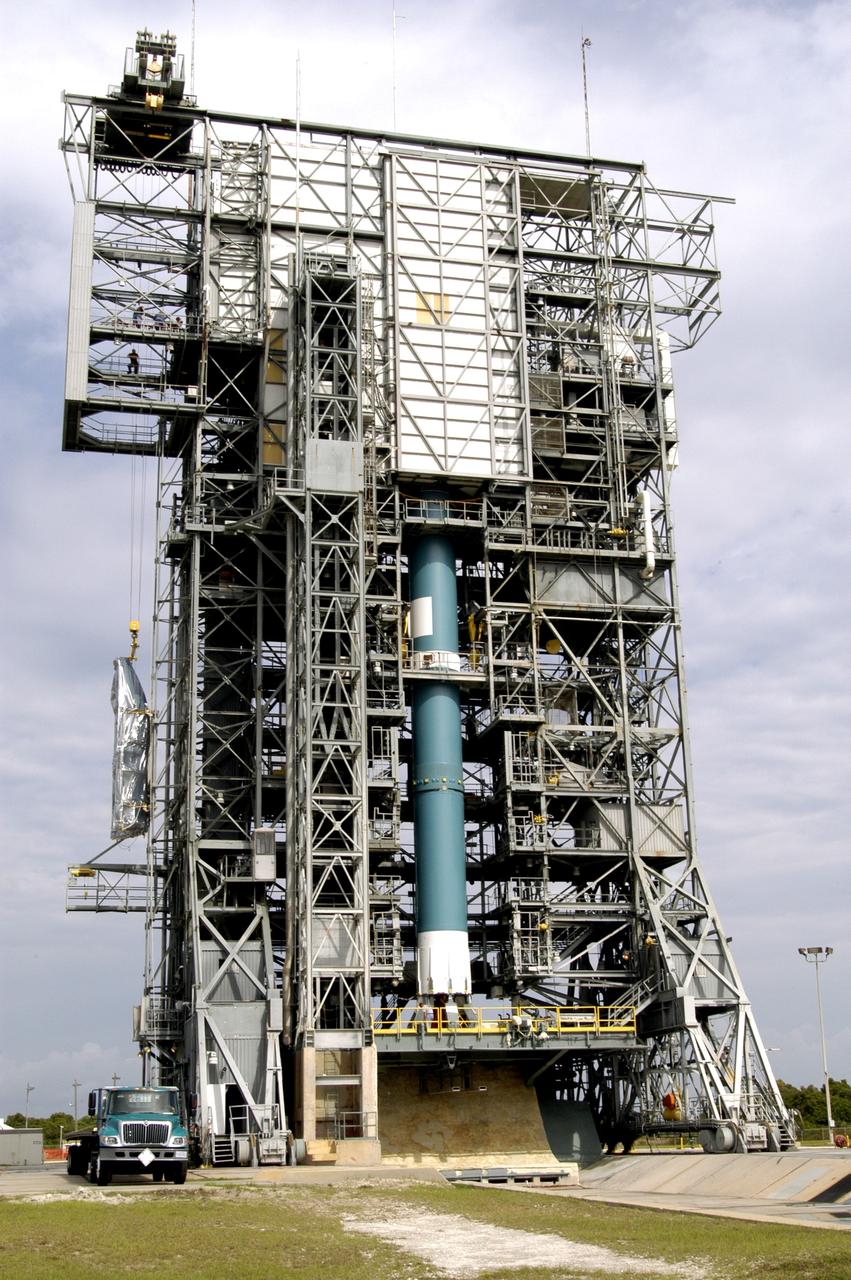
KENNEDY SPACE CENTER, FLA. - At Launch Complex 17-A, Cape Canaveral Air Force Station, the second half of the fairing for the Mars Exploration Rover 2 (MER-2/MER-A) is lifted up the outside of the launch tower.  Visible on another side is the Delta II rocket that will carry the payload into space.  The fairing will be installed around the payload for protection during launch.  The MER Mission consists of two identical rovers designed to cover roughly 110 yards each Martian day over various terrain. Each rover will carry five scientific instruments that will allow it to search for evidence of liquid water that may have been present in the planet's past.  Identical to each other, the rovers will land at different regions of Mars.  Launch date for MER-A  is scheduled for June 5.
KENNEDY SPACE CENTER, FLA. - At Launch Complex 17-A, Cape Canaveral Air Force Station, the second half of the fairing for the Mars Exploration Rover 2 (MER-2/MER-A) is lifted up the outside of the launch tower. Visible on another side is the Delta II rocket that will carry the payload into space. The fairing will be installed around the payload for protection during launch. The MER Mission consists of two identical rovers designed to cover roughly 110 yards each Martian day over various terrain. Each rover will carry five scientific instruments that will allow it to search for evidence of liquid water that may have been present in the planet's past. Identical to each other, the rovers will land at different regions of Mars. Launch date for MER-A is scheduled for June 5.
KENNEDY SPACE CENTER, FLA. - At Launch Complex 17-A, Cape Canaveral Air Force Station, the second half of the fairing for the Mars Exploration Rover 2 (MER-2/MER-A) is raised to a vertical position for its lift up the launch tower.  The fairing will be installed around the payload for protection during launch.  The MER Mission consists of two identical rovers designed to cover roughly 110 yards each Martian day over various terrain. Each rover will carry five scientific instruments that will allow it to search for evidence of liquid water that may have been present in the planet's past.  Identical to each other, the rovers will land at different regions of Mars.  Launch date for MER-A  is scheduled for June 5.
KENNEDY SPACE CENTER, FLA. - At Launch Complex 17-A, Cape Canaveral Air Force Station, the second half of the fairing for the Mars Exploration Rover 2 (MER-2/MER-A) is raised to a vertical position for its lift up the launch tower. The fairing will be installed around the payload for protection during launch. The MER Mission consists of two identical rovers designed to cover roughly 110 yards each Martian day over various terrain. Each rover will carry five scientific instruments that will allow it to search for evidence of liquid water that may have been present in the planet's past. Identical to each other, the rovers will land at different regions of Mars. Launch date for MER-A is scheduled for June 5.
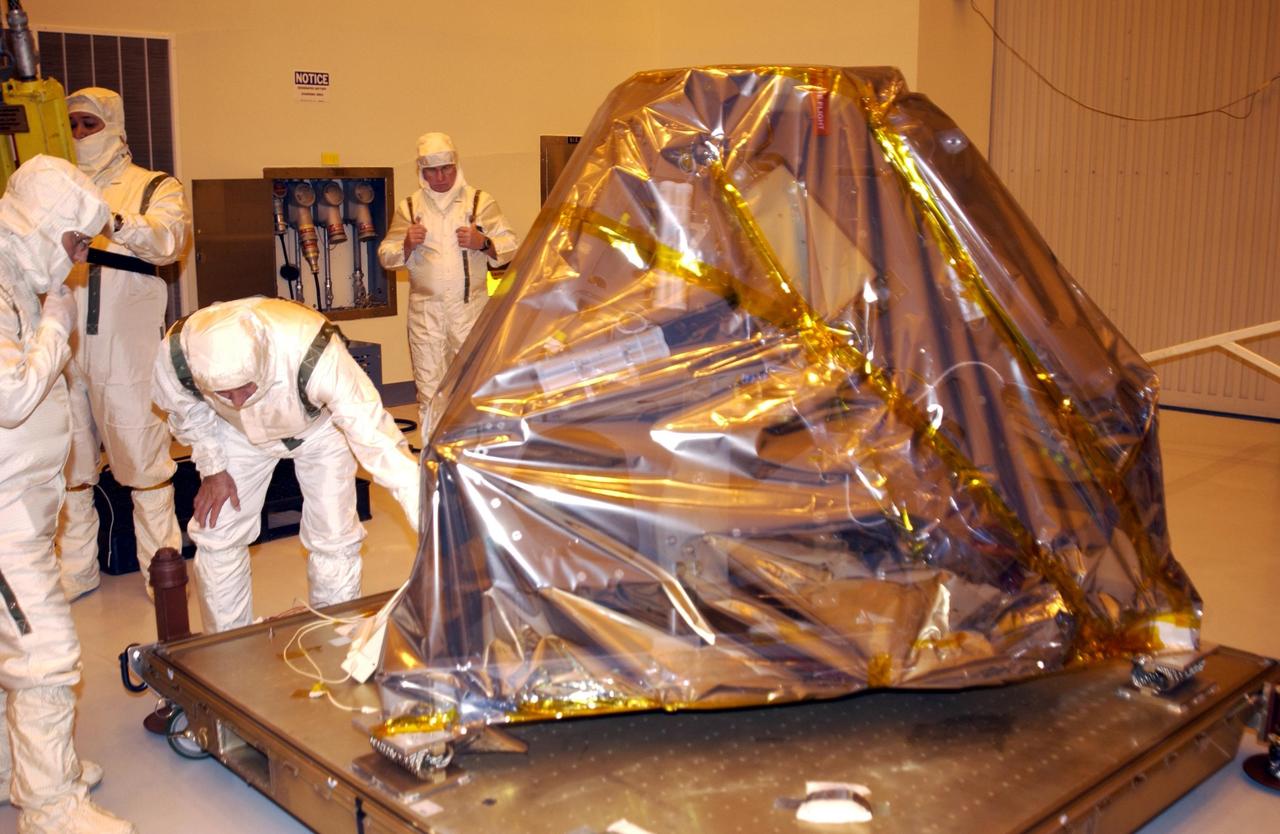
KENNEDY SPACE CENTER, FLA. - In the Payload Hazardous Servicing Facility, workers lift the cover from the Mars Exploration Rover -2. Set to launch in 2003, the Mars Exploration Rover Mission will consist of two identical rovers designed to cover roughly 110 yards (100 meters) each Martian day. Each rover will carry five scientific instruments that will allow it to search for evidence of liquid water that may have been present in the planet's past.  The rovers will be identical to each other, but will land at different regions of Mars.  The first rover has a launch window opening May 30, 2003, and the second rover a window opening June 25, 2003.
KSC-03pd0209
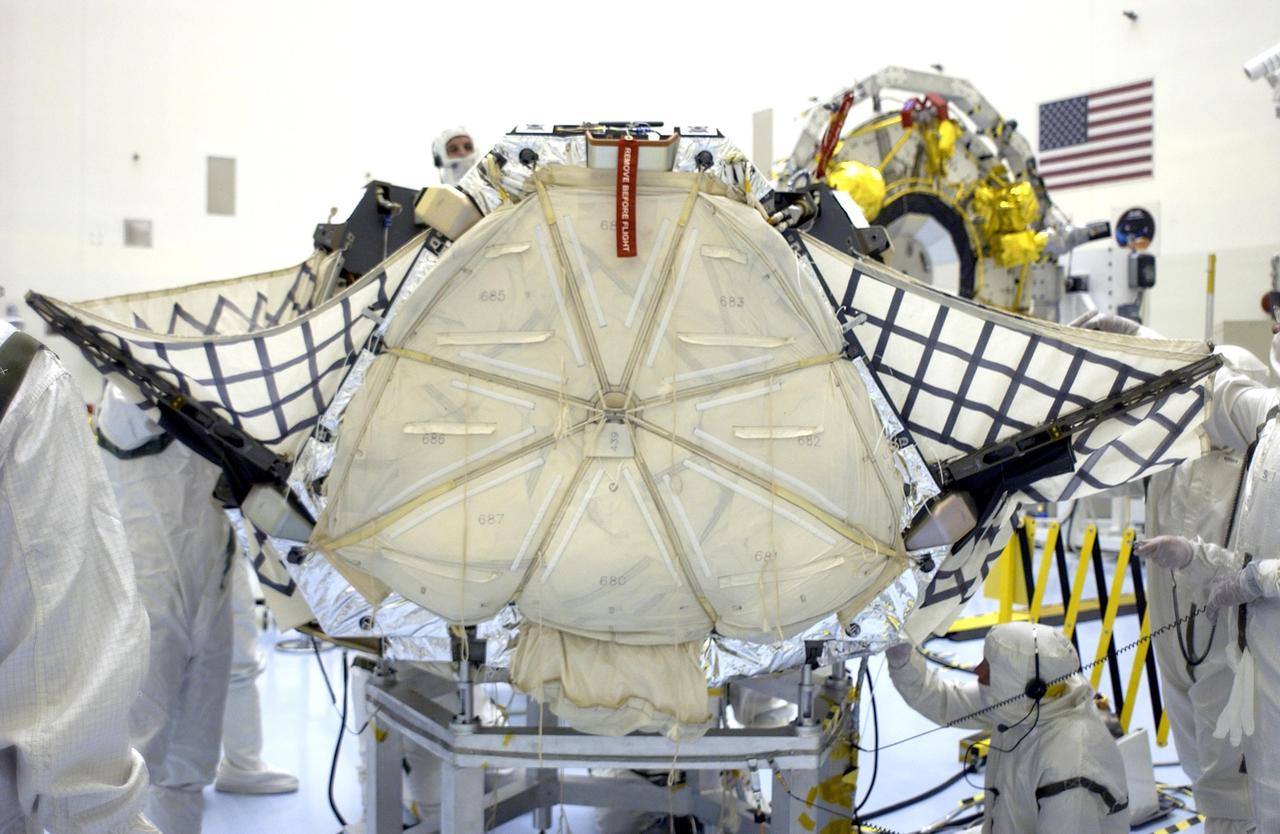
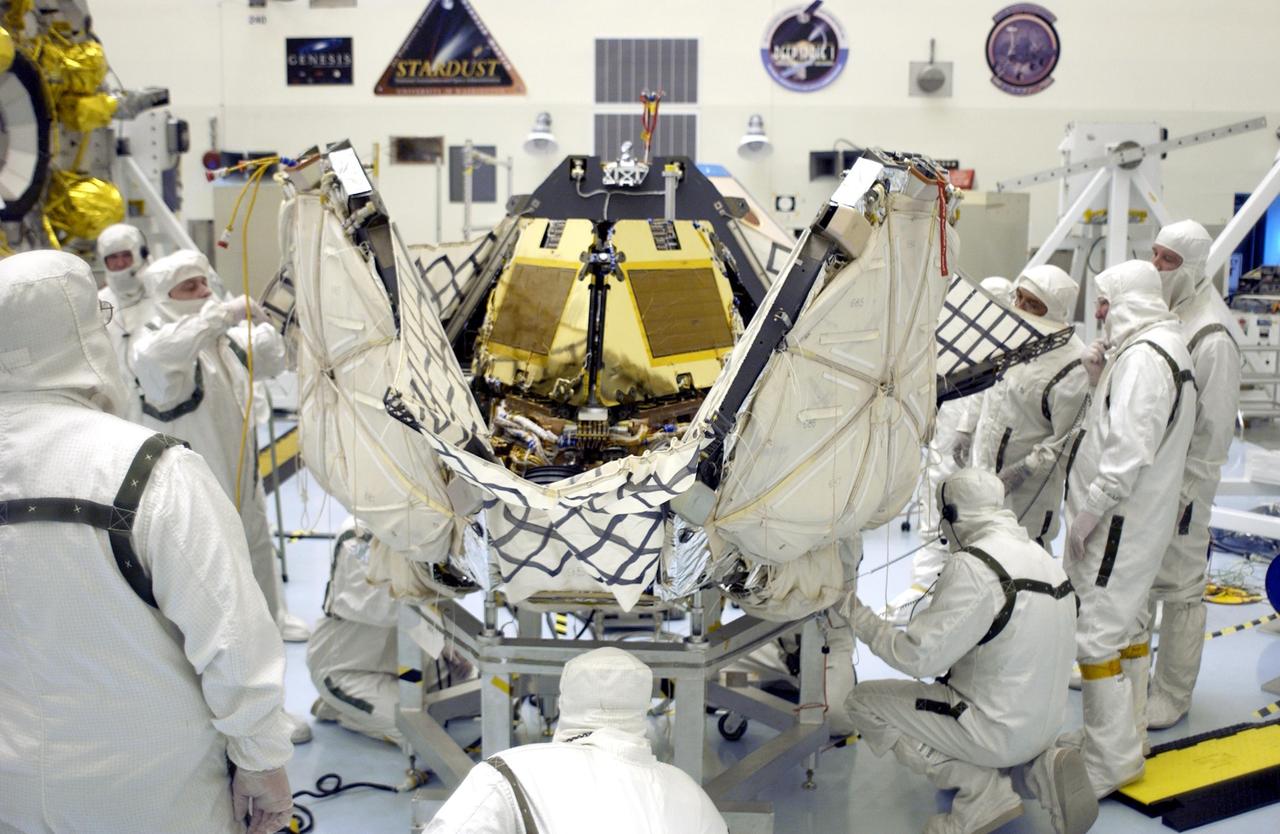
KENNEDY SPACE CENTER, FLA. - While workers watch the process, the petals on the lander close up around the Mars Exploration Rover 2 (MER-A).  The lander and rover will be enclosed within an aeroshell for launch.  The MER Mission consists of two identical rovers designed to cover roughly 110 yards each Martian day over various terrain. Each rover will carry five scientific instruments that will allow it to search for evidence of liquid water that may have been present in the planet's past.  Identical to each other, the rovers will land at different regions of Mars.  Launch date for this first of NASA's two Mars Exploration Rover missions is scheduled no earlier than June 6.
KSC-03pd1223
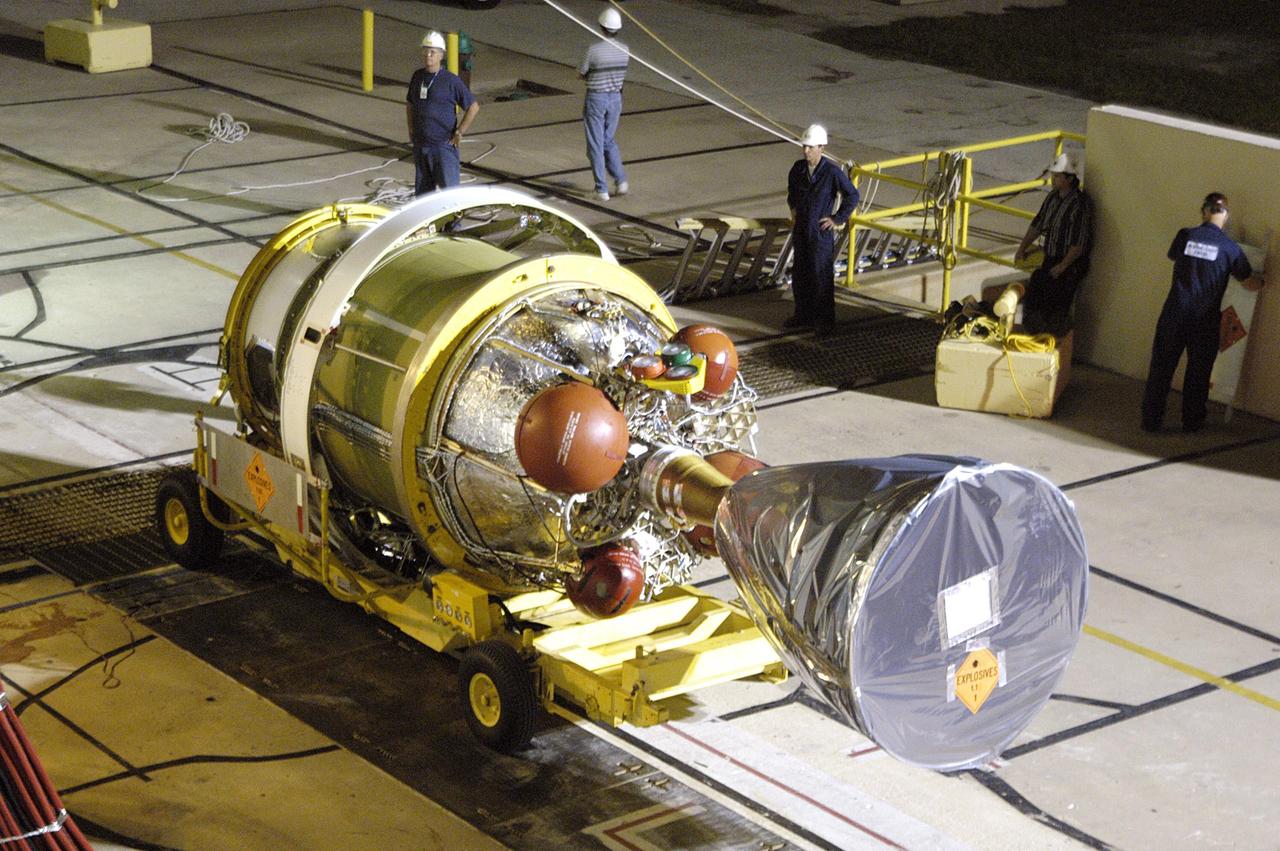
KENNEDY SPACE CENTER, FLA. -  The second stage of the Delta II rocket arrives at Pad 17-A, Cape Canaveral Air Force Station.  It will be mated to the first stage in preparation for the launch of the Mars Exploration Rover 2 (MER-A).  The MER Mission consists of two identical rovers designed to cover roughly 110 yards each Martian day over various terrain. Each rover will carry five scientific instruments that will allow it to search for evidence of liquid water that may have been present in the planet's past.  Identical to each other, the rovers will land at different regions of Mars.  Launch date for this first of NASA's two Mars Exploration Rover missions is scheduled June 5.
KSC-03pd1319
KENNEDY SPACE CENTER, FLA. - On Pad 17-A, Cape Canaveral Air Force Station, the first stage of the Delta II rocket is lifted up the launch tower. The Delta will launch the Mars Exploration Rover (MER-A) vehicle. The MER Mission consists of two identical rovers designed to cover roughly 110 yards each Martian day over various terrain. Each rover will carry five scientific instruments that will allow it to search for evidence of liquid water that may have been present in the planet's past.  Identical to each other, the rovers will land at different regions of Mars.  Launch date for this first of NASA's two Mars Exploration Rover missions is scheduled no earlier than June 6.
KSC-03pd1220
KENNEDY SPACE CENTER, FLA. - On Pad 17-A, Cape Canaveral Air Force Station, the first stage of the Delta II rocket is lifted to vertical at the launch tower. The Delta will launch the Mars Exploration Rover (MER-A) vehicle. The MER Mission consists of two identical rovers designed to cover roughly 110 yards each Martian day over various terrain. Each rover will carry five scientific instruments that will allow it to search for evidence of liquid water that may have been present in the planet's past.  Identical to each other, the rovers will land at different regions of Mars.  Launch date for this first of NASA's two Mars Exploration Rover missions is scheduled no earlier than June 6.
KSC-03pd1214
KENNEDY SPACE CENTER, FLA. - After being cleaned up, the Mars Exploration Rover -2 is ready to be moved to a workstand in the Payload Hazardous Servicing Facility. Set to launch in 2003, the Mars Exploration Rover Mission will consist of two identical rovers designed to cover roughly 110 yards (100 meters) each Martian day. Each rover will carry five scientific instruments that will allow it to search for evidence of liquid water that may have been present in the planet's past.  The rovers will be identical to each other, but will land at different regions of Mars.  The first rover has a launch window opening May 30, 2003, and the second rover a window opening June 25, 2003.
KSC-03pd0211
KENNEDY SPACE CENTER, FLA. - On Pad 17-A, Cape Canaveral Air Force Station, the first stage of the Delta II rocket is lifted up the launch tower. The Delta will launch the Mars Exploration Rover (MER-A) vehicle. The MER Mission consists of two identical rovers designed to cover roughly 110 yards each Martian day over various terrain. Each rover will carry five scientific instruments that will allow it to search for evidence of liquid water that may have been present in the planet's past.  Identical to each other, the rovers will land at different regions of Mars.  Launch date for this first of NASA's two Mars Exploration Rover missions is scheduled no earlier than June 6.
KSC-03pd1219
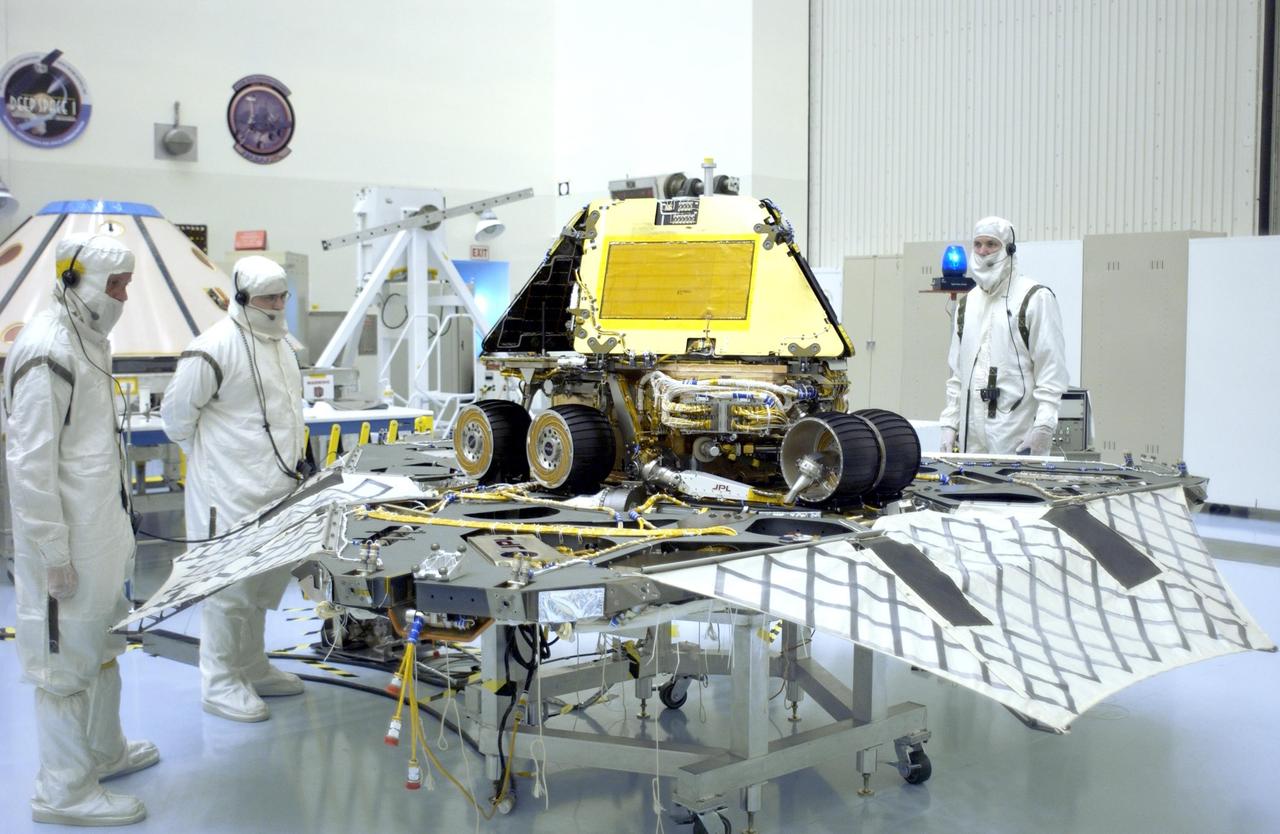
KENNEDY SPACE CENTER, FLA. - The Mars Exploration Rover 2 (MER-A) is ready for final closure of the petals on the lander.  The lander and rover will be enclosed within an aeroshell for launch.  The MER Mission consists of two identical rovers designed to cover roughly 110 yards each Martian day over various terrain. Each rover will carry five scientific instruments that will allow it to search for evidence of liquid water that may have been present in the planet's past.  Identical to each other, the rovers will land at different regions of Mars.  Launch date for this first of NASA's two Mars Exploration Rover missions is scheduled no earlier than June 6.
KSC-03pd1221
KENNEDY SPACE CENTER, FLA. - On Pad 17-A, Cape Canaveral Air Force Station, the first stage of the Delta II rocket is nearly vertical in the launch tower. The Delta will launch the Mars Exploration Rover (MER-A) vehicle. The MER Mission consists of two identical rovers designed to cover roughly 110 yards each Martian day over various terrain. Each rover will carry five scientific instruments that will allow it to search for evidence of liquid water that may have been present in the planet's past.  Identical to each other, the rovers will land at different regions of Mars.  Launch date for this first of NASA's two Mars Exploration Rover missions is scheduled no earlier than June 6.
KSC-03pd1215
KENNEDY SPACE CENTER, FLA. - The Mars Exploration Rover 2 (MER-A) is ready for final closure of the petals on the lander.  The lander and rover will be enclosed within an aeroshell for launch.  The MER Mission consists of two identical rovers designed to cover roughly 110 yards each Martian day over various terrain. Each rover will carry five scientific instruments that will allow it to search for evidence of liquid water that may have been present in the planet's past.  Identical to each other, the rovers will land at different regions of Mars.  Launch date for this first of NASA's two Mars Exploration Rover missions is scheduled no earlier than June 6.
KSC-03pd1222
KENNEDY SPACE CENTER, FLA. -- In the Payload Hazardous Servicing Facility, workers get ready to remove the plastic covering from the Mars Exploration Rover -2. Set to launch in 2003, the Mars Exploration Rover Mission will consist of two identical rovers designed to cover roughly 110 yards (100 meters) each Martian day. Each rover will carry five scientific instruments that will allow it to search for evidence of liquid water that may have been present in the planet's past.  The rovers will be identical to each other, but will land at different regions of Mars.  The first rover has a launch window opening May 30, 2003, and the second rover a window opening June 25, 2003.
KSC-03pd0210
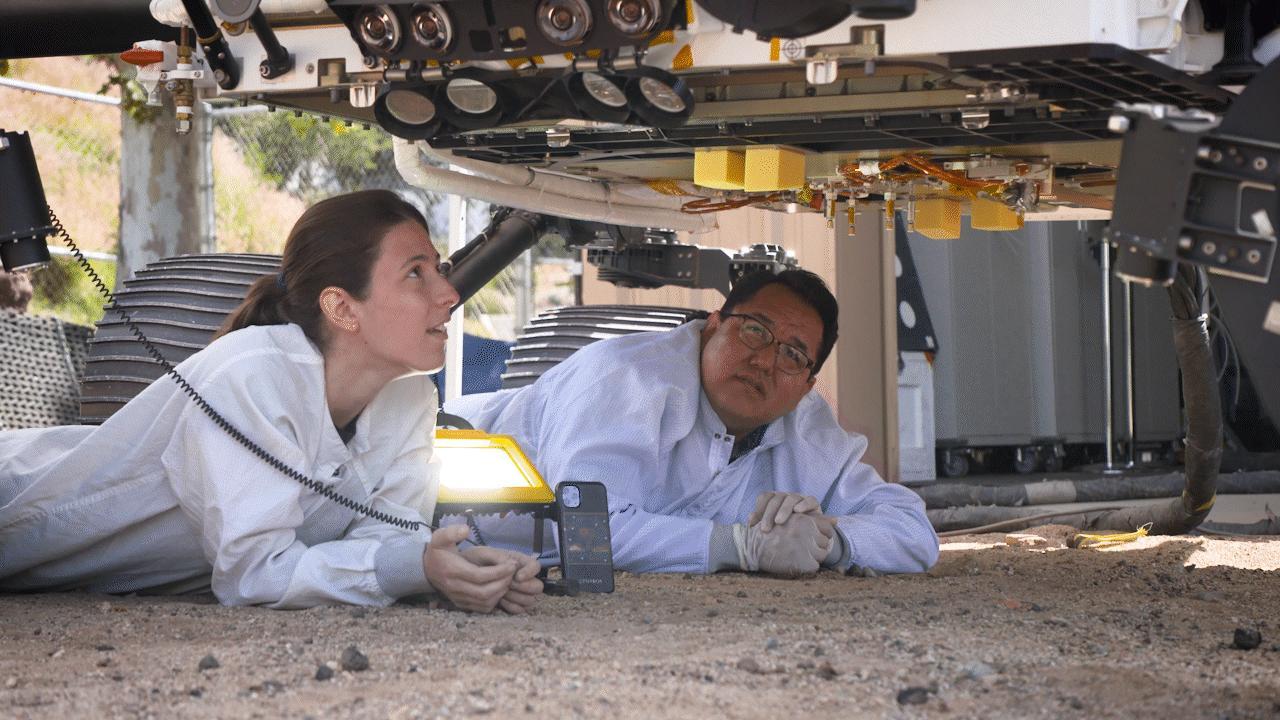
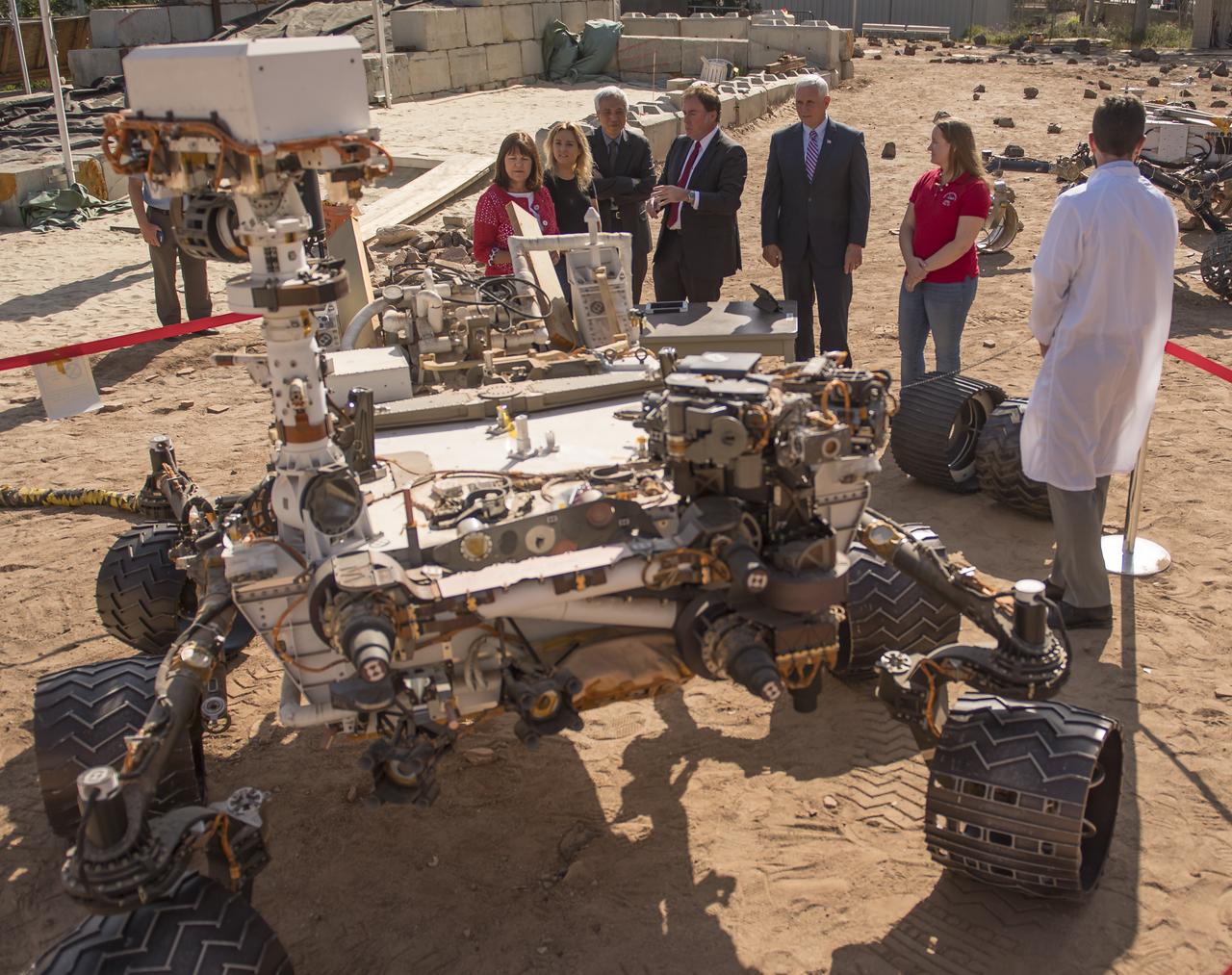
U.S. Vice President Mike Pence, 5th from left, joined by his wife Karen Pence, left, and daughter Charlotte Pence. 2nd from left, view the Vehicle System Test Bed (VSTB) rover in the Mars Yard during a tour of NASA's Jet Propulsion Laboratory, Saturday, April 28, 2018 in Pasadena, California. NASA Mars Exploration Manager Li Fuk, 2nd from left, JPL Director Michael Watkins, Mars Curiosity Engineering Operations Team Chief Megan Lin, and MSL Engineer Sean McGill, right, helped explain to the Vice President and his family how they use these test rovers. Photo Credit: (NASA/Bill Ingalls)
Vice President Pence Tours Jet Propulsion Laboratory
KENNEDY SPACE CENTER, FLA. - On Pad 17-A, Cape Canaveral Air Force Station, the first stage of the Delta II rocket is lifted to vertical at the launch tower. The Delta will launch the Mars Exploration Rover (MER-A) vehicle. The MER Mission consists of two identical rovers designed to cover roughly 110 yards each Martian day over various terrain. Each rover will carry five scientific instruments that will allow it to search for evidence of liquid water that may have been present in the planet's past.  Identical to each other, the rovers will land at different regions of Mars.  Launch date for this first of NASA's two Mars Exploration Rover missions is scheduled no earlier than June 6.
KSC-03pd1213
KENNEDY SPACE CENTER, FLA. - Workers check different areas of the lander as the petals close in around the Mars Exploration Rover 2 (MER-A).  The lander and rover will subsequently be enclosed within an aeroshell for launch.  The MER Mission consists of two identical rovers designed to cover roughly 110 yards each Martian day over various terrain. Each rover will carry five scientific instruments that will allow it to search for evidence of liquid water that may have been present in the planet's past.  Identical to each other, the rovers will land at different regions of Mars.  Launch date for this first of NASA's two Mars Exploration Rover missions is scheduled no earlier than June 6.
KSC-03pd1225
KENNEDY SPACE CENTER, FLA. -  The first stage of the Delta II rocket to launch the MER-A (Mars Exploration Rover) vehicle arrives at Pad 17-A on Cape Canaveral Air Force Station. The MER Mission consists of two identical rovers designed to cover roughly 110 yards each Martian day over various terrain. Each rover will carry five scientific instruments that will allow it to search for evidence of liquid water that may have been present in the planet's past.  Identical to each other, the rovers will land at different regions of Mars.  Launch date for this first of NASA's two Mars Exploration Rover missions is scheduled no earlier than June 6.
KSC-03pd1209
KENNEDY SPACE CENTER, FLA. - Workers in the Payload Hazardous Servicing Facility move the Mars Exploration Rover -2 to a workstand in the high bay. Set to launch in 2003, the Mars Exploration Rover Mission will consist of two identical rovers designed to cover roughly 110 yards (100 meters) each Martian day. Each rover will carry five scientific instruments that will allow it to search for evidence of liquid water that may have been present in the planet's past.  The rovers will be identical to each other, but will land at different regions of Mars.  The first rover has a launch window opening May 30, 2003, and the second rover a window opening June 25, 2003.
KSC-03pd0213
KENNEDY SPACE CENTER, FLA. -  Workers check different areas of the lander as the petals close in around the Mars Exploration Rover 2 (MER-A).  The lander and rover will subsequently be enclosed within an aeroshell for launch.  The MER Mission consists of two identical rovers designed to cover roughly 110 yards each Martian day over various terrain. Each rover will carry five scientific instruments that will allow it to search for evidence of liquid water that may have been present in the planet's past.  Identical to each other, the rovers will land at different regions of Mars.  Launch date for this first of NASA's two Mars Exploration Rover missions is scheduled no earlier than June 6.
KSC-03pd1224
KENNEDY SPACE CENTER, FLA. -- The Mars Exploration Rover -2 is moved to a workstand in the Payload Hazardous Servicing Facility. Set to launch in 2003, the Mars Exploration Rover Mission will consist of two identical rovers designed to cover roughly 110 yards (100 meters) each Martian day. Each rover will carry five scientific instruments that will allow it to search for evidence of liquid water that may have been present in the planet's past.  The rovers will be identical to each other, but will land at different regions of Mars.  The first rover has a launch window opening May 30, 2003, and the second rover a window opening June 25, 2003.
KSC-03pd0212
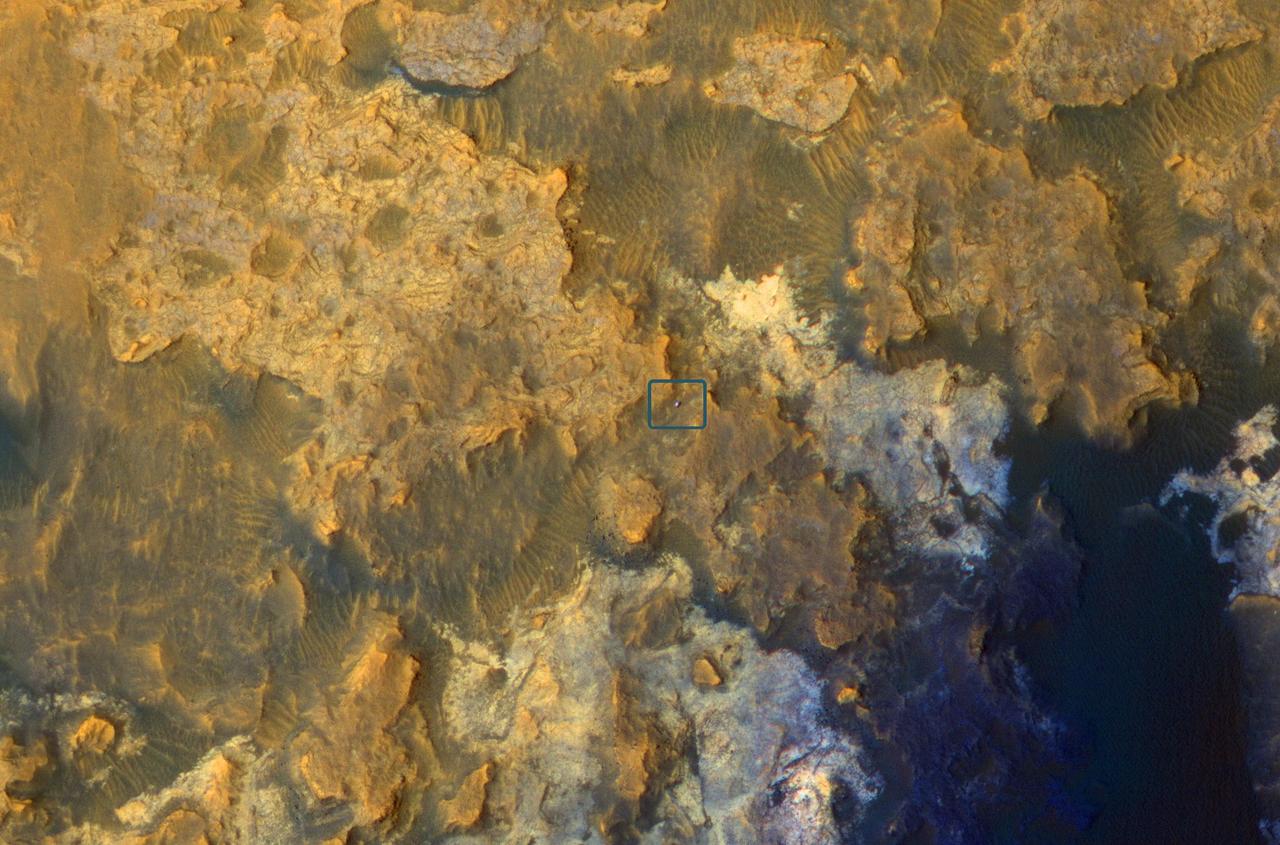
A view from NASA's Mars Reconnaissance Orbiter on April 8, 2015, catches sight of NASA's Curiosity Mars rover passing through a valley called "Artist's Drive" on the lower slope of Mount Sharp.  The image is from the orbiter's High Resolution Imaging Science Experiment (HiRISE) camera. It shows the rover's position after a drive of about 75 feet (23 meters) during the 949th Martian day, or sol, of the rover's work on Mars.  North is toward the top. The rover's location, with its shadow extending toward the right, is indicated with an inscribed rectangle. The view in this image covers an area about 550 yards (500 meters) across.   http://photojournal.jpl.nasa.gov/catalog/PIA19392
Mars Orbiter Sees Curiosity Rover in Artist Drive
KENNEDY SPACE CENTER, FLA. - The second stage of the Delta II rocket arrives at Pad 17-A, Cape Canaveral Air Force Station.  It will be mated to the first stage in preparation for the launch of the Mars Exploration Rover 2 (MER-A).  The MER Mission consists of two identical rovers designed to cover roughly 110 yards each Martian day over various terrain. Each rover will carry five scientific instruments that will allow it to search for evidence of liquid water that may have been present in the planet's past.  Identical to each other, the rovers will land at different regions of Mars.  Launch date for this first of NASA's two Mars Exploration Rover missions is scheduled June 5.
KSC-03pd1320
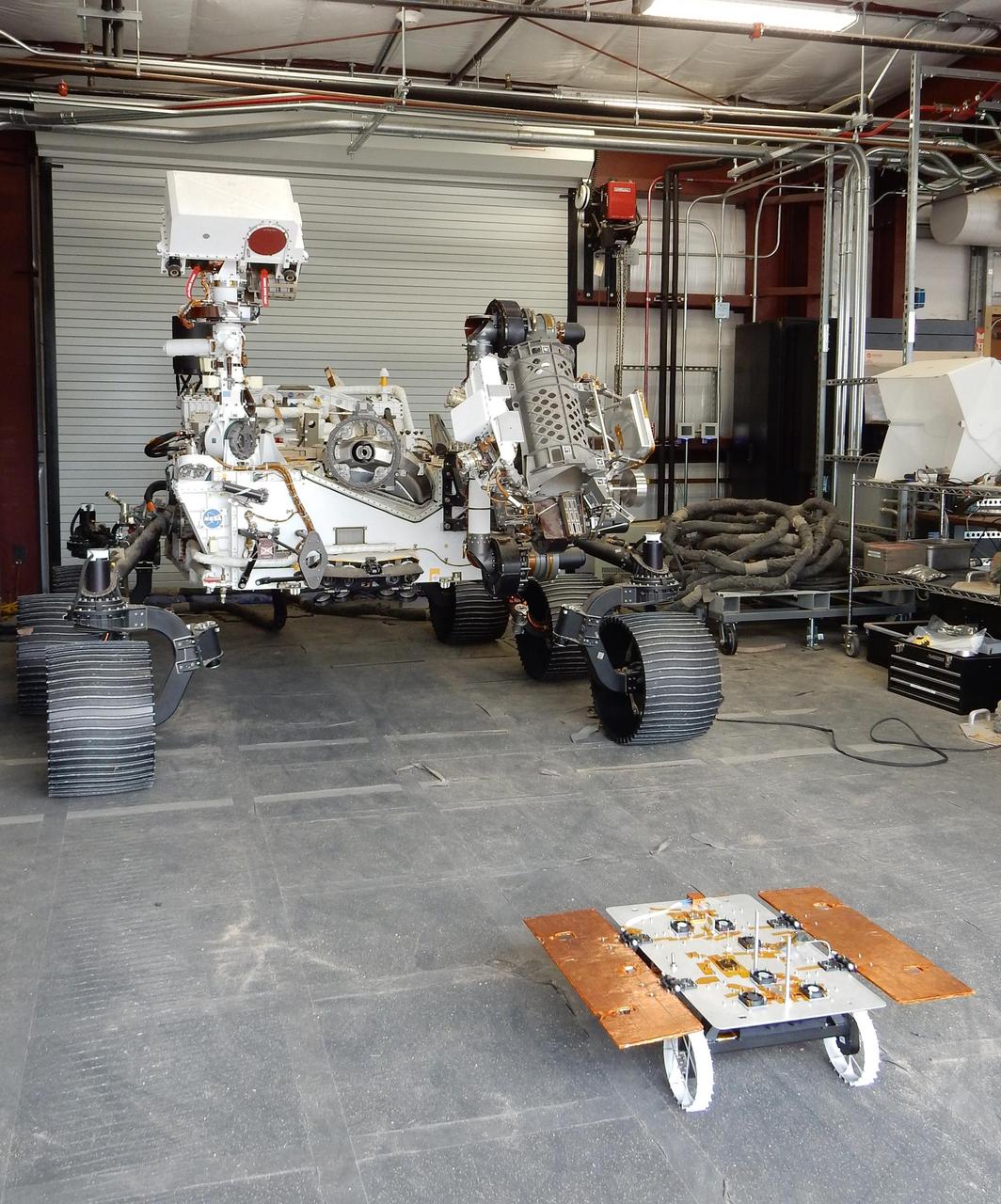
The Earth-bound full-scale engineering model of NASA's Perseverance rover, called OPTIMISM, seems to peer down at a much smaller CADRE rover in a building in the Mars Yard at NASA's Jet Propulsion Laboratory in Southern California in June 2023.  Short for Cooperative Autonomous Distributed Robotic Exploration, NASA's CADRE technology demonstration is slated to arrive at the Moon in spring 2024 as part of the agency's CLPS (Commercial Lunar Payload Services) initiative. CADRE is designed to demonstrate that multiple robots can cooperate and explore together autonomously – without direct input from human mission controllers.  The development rover being tested is similar in size and appearance to the flight models of the CADRE rovers, which are still being built.  A trio of the miniature solar-powered rovers, each about the size of a carry-on suitcase, will explore the Moon as a team, communicating via radio with each other and a base station aboard a lunar lander. By taking simultaneous measurements from multiple locations, CADRE will also demonstrate how multirobot missions can record data impossible for a single robot to achieve – a tantalizing prospect for future missions.  https://photojournal.jpl.nasa.gov/catalog/PIA25668
PIA25668
KENNEDY SPACE CENTER, FLA. - Workers in the Payload Hazardous Servicing Facility help guide the Mars Exploration Rover (MER) aeroshell as it is lowered toward a rotation stand.  Set to launch in 2003, the MER Mission will consist of two identical rovers designed to cover roughly 110 yards (100 meters) each Martian day. Each rover will carry five scientific instruments that will allow it to search for evidence of liquid water that may have been present in the planet's past.  The rovers will be identical to each other, but will land at different regions of Mars.  The first rover has a launch window opening May 30, and the second rover a window opening June 25, 2003.
KSC-03pd0235
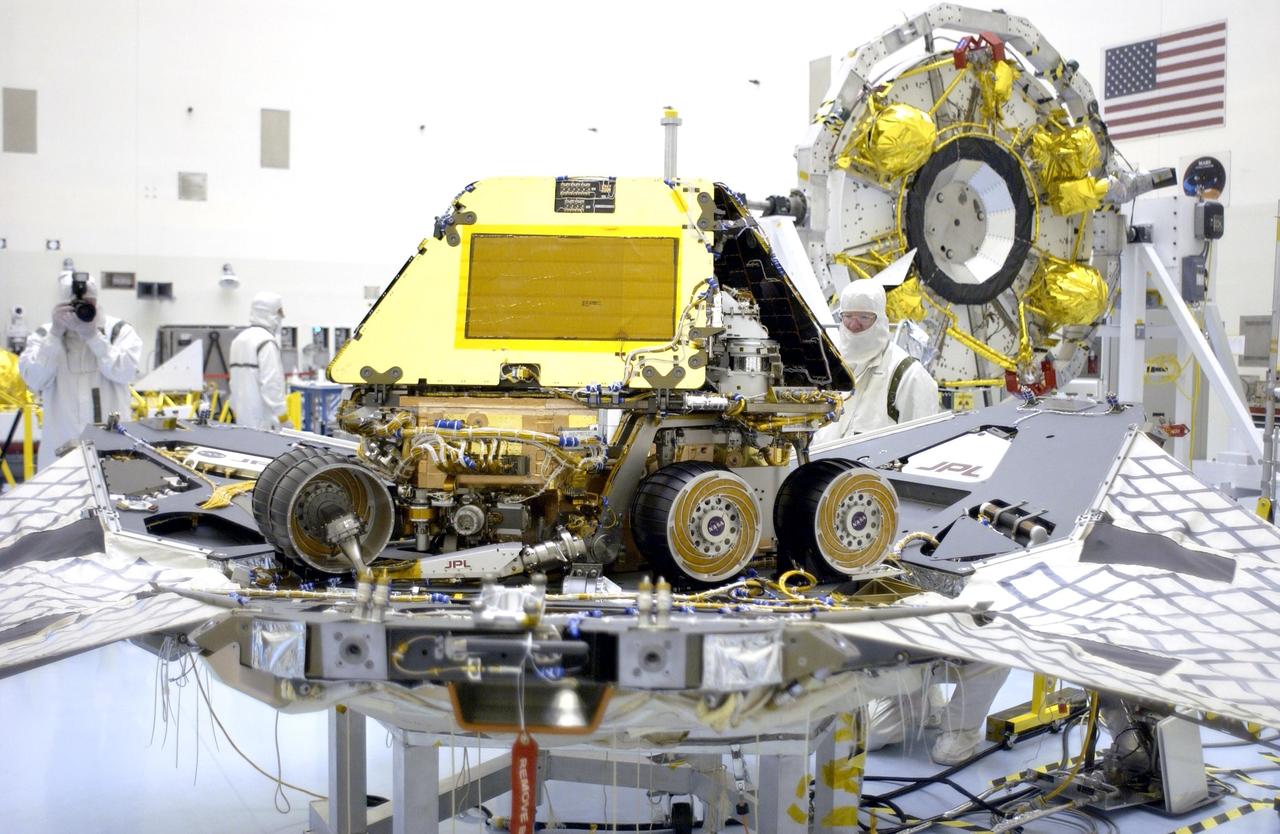
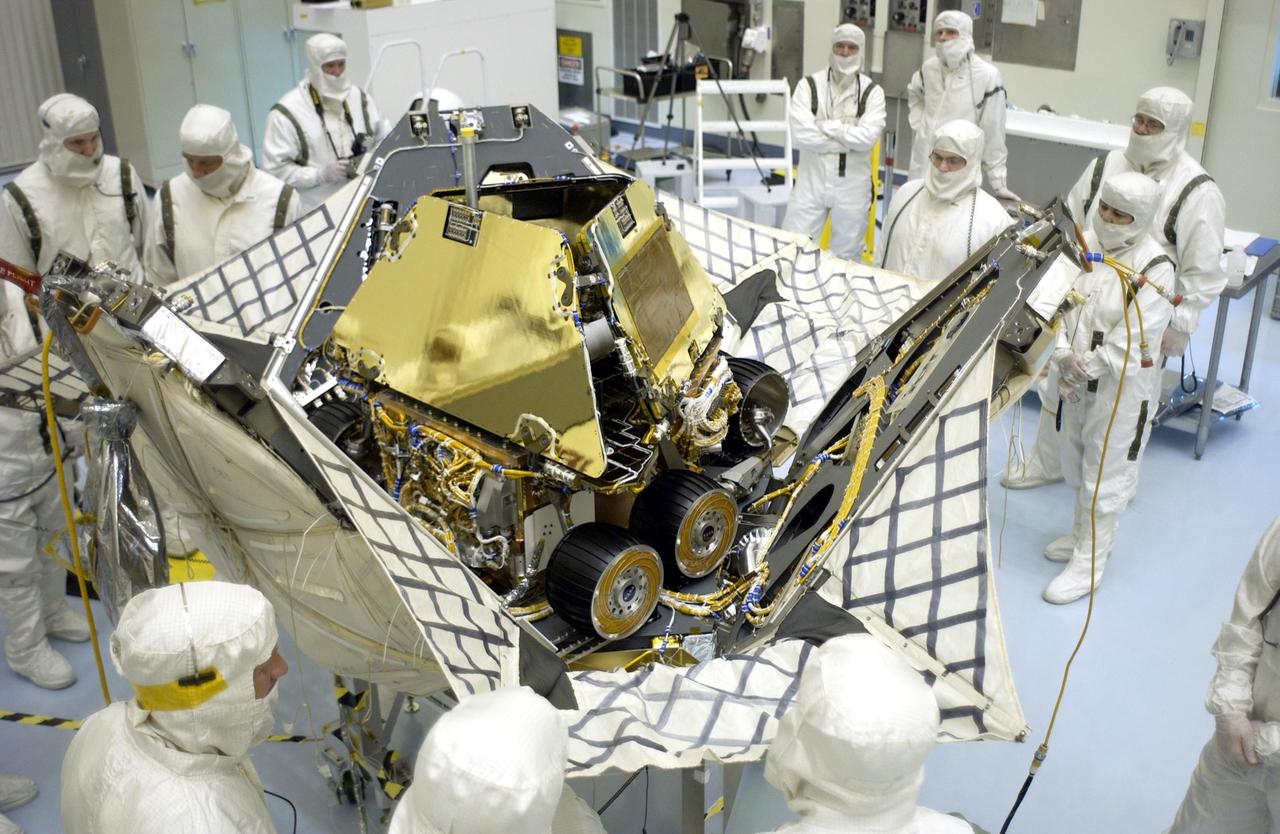
KENNEDY SPACE CENTER, Fla. -  With the solar arrays fully open on the Mars Exploration Rover-2 (MER-2), the low-gain and high-gain antennas can be seen.  Set to launch in Spring 2003, the MER Mission will consist of two identical rovers designed to cover roughly 110 yards each Martian day. Each rover will carry five scientific instruments that will allow it to search for evidence of liquid water that may have been present in the planet's past.  The rovers will be identical to each other, but will land at different regions of Mars.  The first rover has a launch window opening May 30, and the second rover a window opening June 25, 2003.
KSC-03pd0772
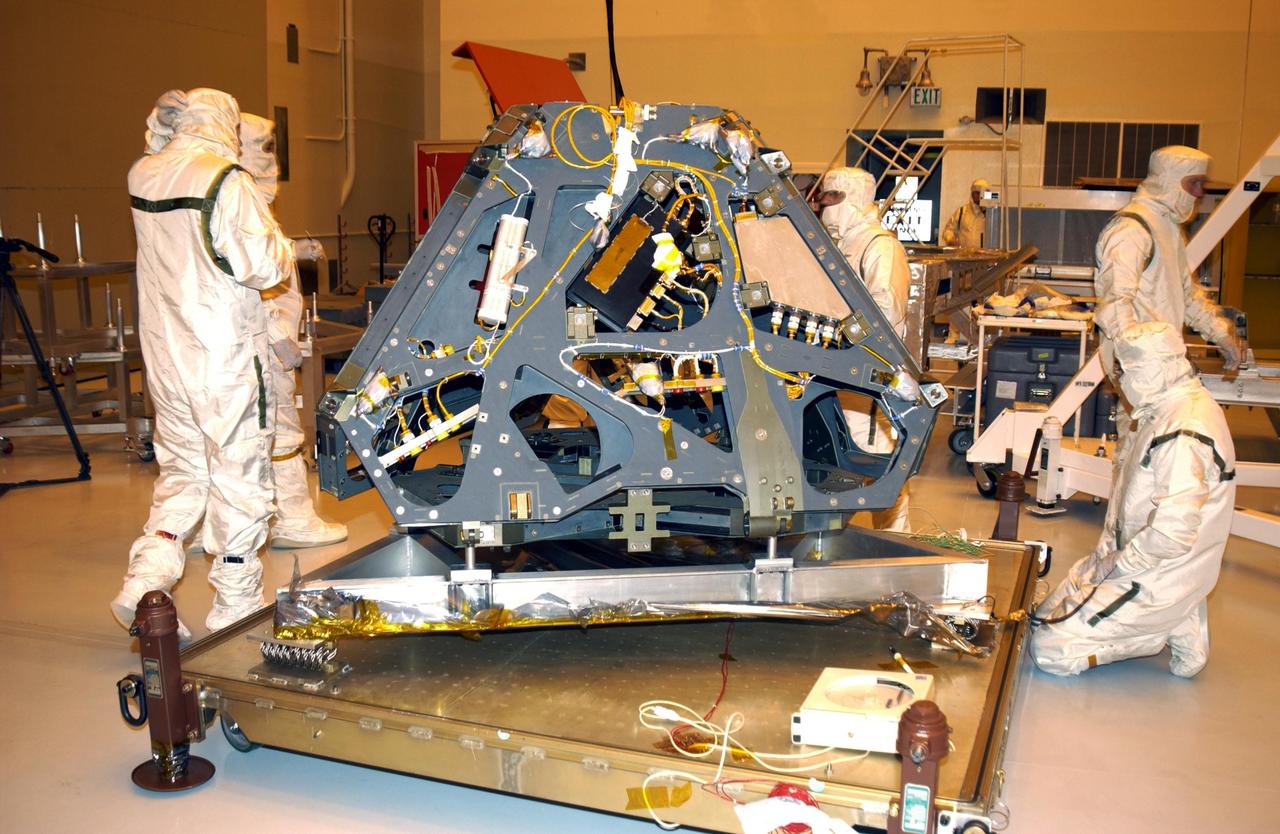
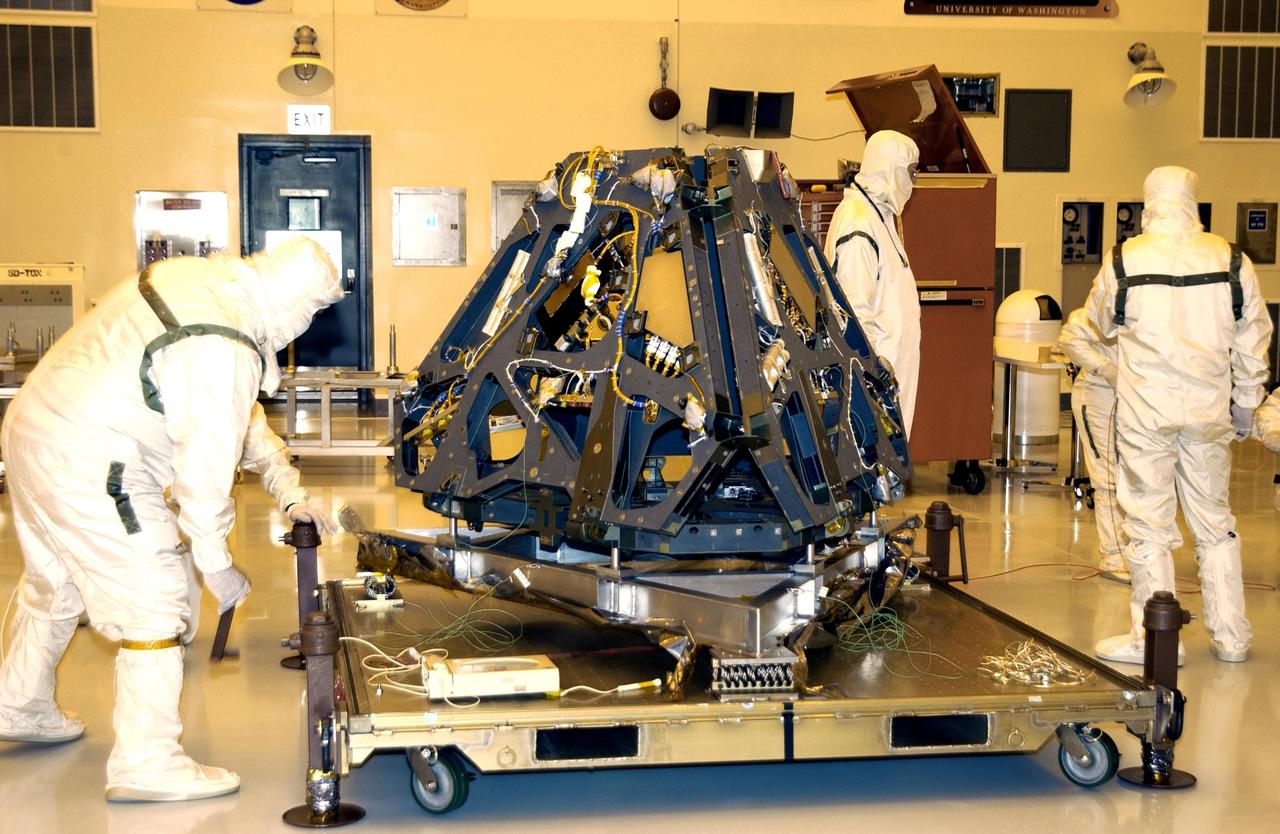
KENNEDY SPACE CENTER, FLA. -  In the Payload Hazardous Servicing Facility, an overhead crane is moved toward Mars Exploration Rover 2 (MER-2).  The rover will be lifted and moved to the lander where it will be mated to the base petal.  Set to launch in Spring 2003, the MER Mission consists of two identical rovers, landing at different regions of Mars, designed to cover roughly 110 yards each Martian day over various terrain. Each rover will carry five scientific instruments that will allow it to search for evidence of liquid water that may have been present in the planet's past.  The first rover has a launch window opening May 30, and the second rover a window opening June 25.
KSC-03pd0983
KENNEDY SPACE CENTER, FLA. - Workers in the Payload Hazardous Servicing Facility look over the aeroshell enclosing Mars Exploration Rover 2 and lander that is being moved to a rotation table for a spin stabilization test.  There are two identical rovers that will land at different regions of Mars and are designed to cover roughly 110 yards each Martian day over various terrain. Each rover will carry five scientific instruments that will allow it to search for evidence of liquid water that may have been present in the planet's past.  The first rover, MER-A, is scheduled to launch June 5 from Cape Canaveral Air Force Station.  The second is scheduled for launch June 25.
KSC-03pd1372
In the Payload Hazardous Servicing Facility, workers prepare the Mars Exploration Rover (MER) aeroshell for transfer to a rotation stand. Set to launch in 2003, the MER Mission will consist of two identical rovers designed to cover roughly 110 yards (100 meters) each Martian day. Each rover will carry five scientific instruments that will allow it to search for evidence of liquid water that may have been present in the planet's past. The rovers will be identical to each other, but will land at different regions of Mars. The first rover has a launch window opening May 30, and the second rover a window opening June 25, 2003.
Mars Exploration Rover (MER) aeroshell
KENNEDY SPACE CENTER, FLA. -  In the Payload Hazardous Servicing Facility, workers lower the Mars Exploration Rover-2 (MER-2) onto the base petal of its lander assembly. Set to launch in Spring 2003, the MER Mission will consist of two identical rovers designed to cover roughly 110 yards each Martian day over various terrain. Each rover will carry five scientific instruments that will allow it to search for evidence of liquid water that may have been present in the planet's past. The rovers will be identical to each other, but will land at different regions of Mars. The first rover has a launch window opening May 30, and the second rover, a window opening June 25.
KSC-03pd0881
KENNEDY SPACE CENTER, FLA. -- In the Payload Hazardous Servicing Facility, the lander petals and attached airbags of the Mars Exploration Rover 2 (MER-2) are closed around the spacecraft during testing prior to launch.  The MER Mission consists of two identical rovers set to launch in Spring 2003. Landing at different regions of Mars, they are designed to cover roughly 110 yards each Martian day over various terrain. Each rover will carry five scientific instruments that will allow it to search for evidence of liquid water that may have been present in the planet's past.
KSC-03pd1057
KENNEDY SPACE CENTER, FLA. -- In the Payload Hazardous Servicing Facility, technicians prepare to close the lander petals and attached airbags of the Mars Exploration Rover 2 (MER-2) around the spacecraft prior to launch. The MER Mission consists of two identical rovers set to launch in Spring 2003. Landing at different regions of Mars, they are designed to cover roughly 110 yards each Martian day over various terrain. Each rover will carry five scientific instruments that will allow it to search for evidence of liquid water that may have been present in the planet's past.
KSC-03pd1041
KENNEDY SPACE CENTER, FLA. -- In the Payload Hazardous Servicing Facility, the lander petals and attached airbags of the Mars Exploration Rover 2 (MER-2) are closed around the spacecraft during testing prior to launch.  The MER Mission consists of two identical rovers set to launch in Spring 2003. Landing at different regions of Mars, they are designed to cover roughly 110 yards each Martian day over various terrain. Each rover will carry five scientific instruments that will allow it to search for evidence of liquid water that may have been present in the planet's past.
KSC-03pd1051
KENNEDY SPACE CENTER, Fla. -  With cables released, this Mars Exploration Rover sits on the floor of the Payload Hazardous Servicing Facility.  Processing of the rovers, cruise stage, lander and heat shield elements is ongoing.  Set to launch in 2003, the MER Mission will consist of two identical rovers designed to cover roughly 110 yards each Martian day. Each rover will carry five scientific instruments that will allow it to search for evidence of liquid water that may have been present in the planet's past.  The rovers will be identical to each other, but will land at different regions of Mars.  The first rover has a launch window opening May 30, and the second rover a window opening June 25, 2003.
KSC-03pd0764