
KENNEDY SPACE CENTER, FLA. - NASA's Mars Reconnaissance Orbiter (MRO), atop a Lockheed Martin Atlas V rocket, awaits launch at Launch Complex 41 at Cape Canaveral Air Force Station in Florida. The launch was delayed 24 hours to investigate an anomalous reading in the hydrogen propellant loading system on the Atlas V. At the conclusion of the inquiry, the Atlas V was cleared to launch on Aug. 12 between 7:43 and 9:43 a.m. EDT. The spacecraft will arrive at Mars in March 2006. Once in orbit around Mars, various instruments on the MRO will convey detailed observations of the Martian surface, subsurface and atmosphere. Researchers will use the data to study the history and distribution of Martian water. Learning more about what has happened to the water will focus searches for possible past or present Martian life. Observations by the orbiter will also support future Mars missions by examining potential landing sites and providing a communications relay between the Martian surface and Earth.
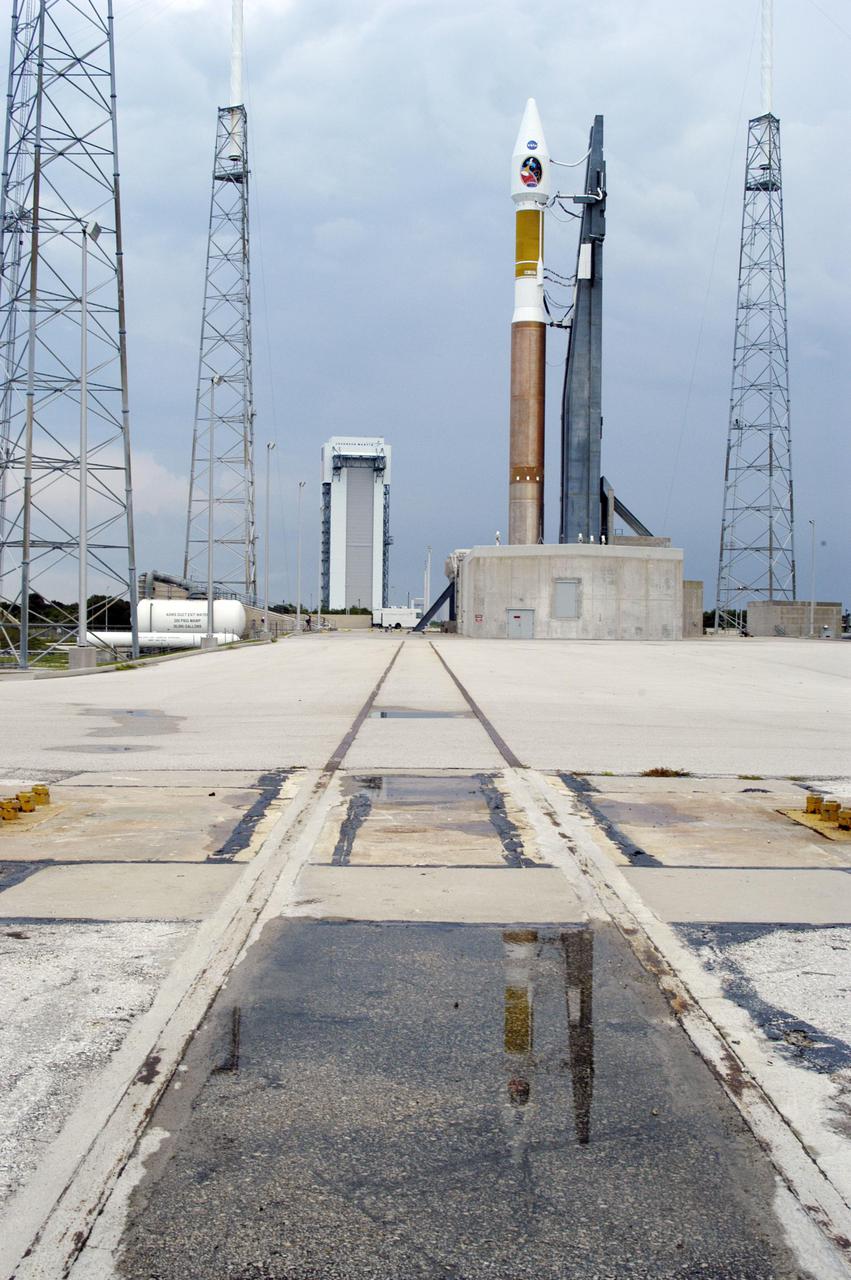
KENNEDY SPACE CENTER, FLA. - NASA's Mars Reconnaissance Orbiter (MRO), atop a Lockheed Martin Atlas V rocket, is reflected in a puddle following an afternoon shower at Launch Complex 41 at Cape Canaveral Air Force Station in Florida. The launch was delayed 24 hours to investigate an anomalous reading in the hydrogen propellant loading system on the Atlas V. At the conclusion of the inquiry, the Atlas V was cleared to launch on Aug. 12 between 7:43 and 9:43 a.m. EDT. The spacecraft will arrive at Mars in March 2006. Once in orbit around Mars, various instruments on the MRO will convey detailed observations of the Martian surface, subsurface and atmosphere. Researchers will use the data to study the history and distribution of Martian water. Learning more about what has happened to the water will focus searches for possible past or present Martian life. Observations by the orbiter will also support future Mars missions by examining potential landing sites and providing a communications relay between the Martian surface and Earth.
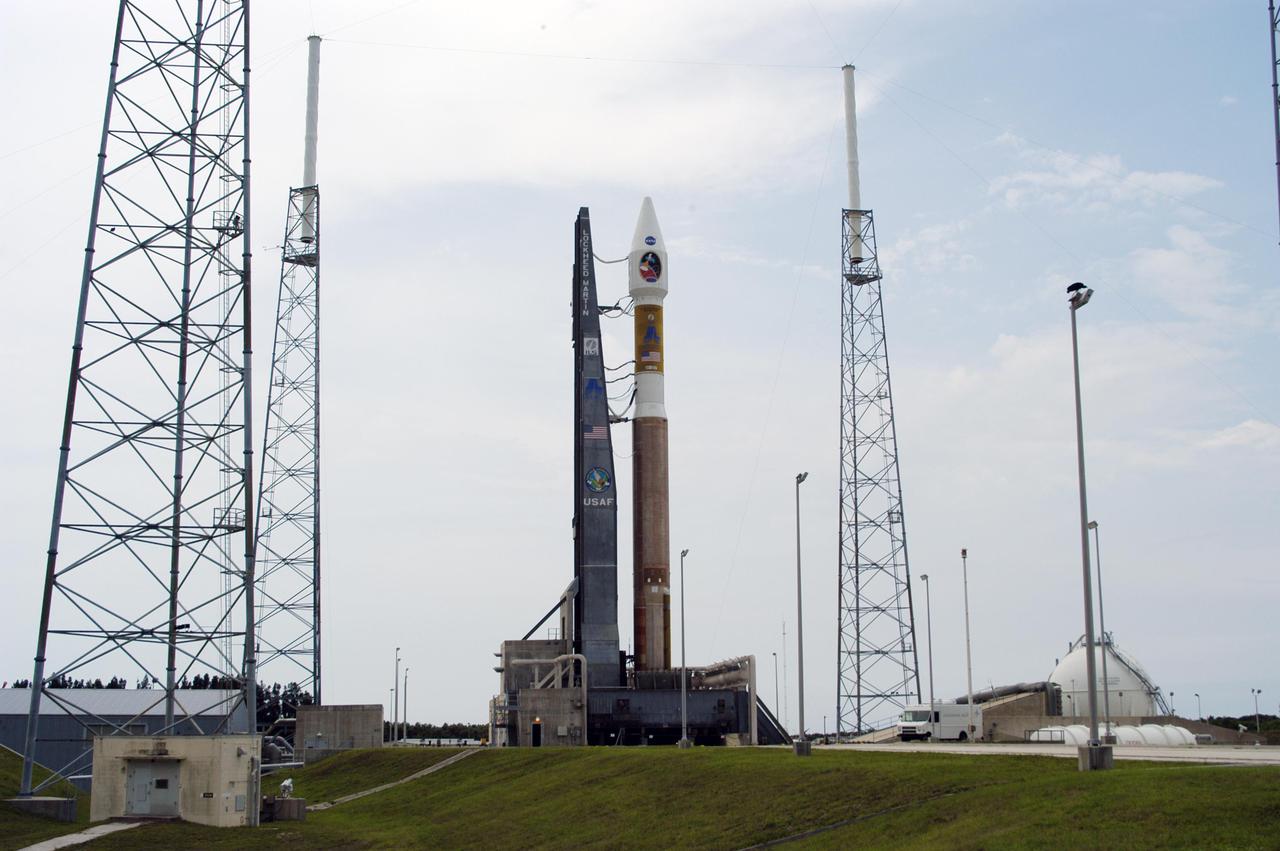
KENNEDY SPACE CENTER, FLA. - NASA's Mars Reconnaissance Orbiter (MRO), atop a Lockheed Martin Atlas V rocket, awaits launch at Launch Complex 41 at Cape Canaveral Air Force Station in Florida. The launch was delayed 24 hours to investigate an anomalous reading in the hydrogen propellant loading system on the Atlas V. At the conclusion of the inquiry, the Atlas V was cleared to launch on Aug. 12 between 7:43 and 9:43 a.m. EDT. The spacecraft will arrive at Mars in March 2006. Once in orbit around Mars, various instruments on the MRO will convey detailed observations of the Martian surface, subsurface and atmosphere. Researchers will use the data to study the history and distribution of Martian water. Learning more about what has happened to the water will focus searches for possible past or present Martian life. Observations by the orbiter will also support future Mars missions by examining potential landing sites and providing a communications relay between the Martian surface and Earth.
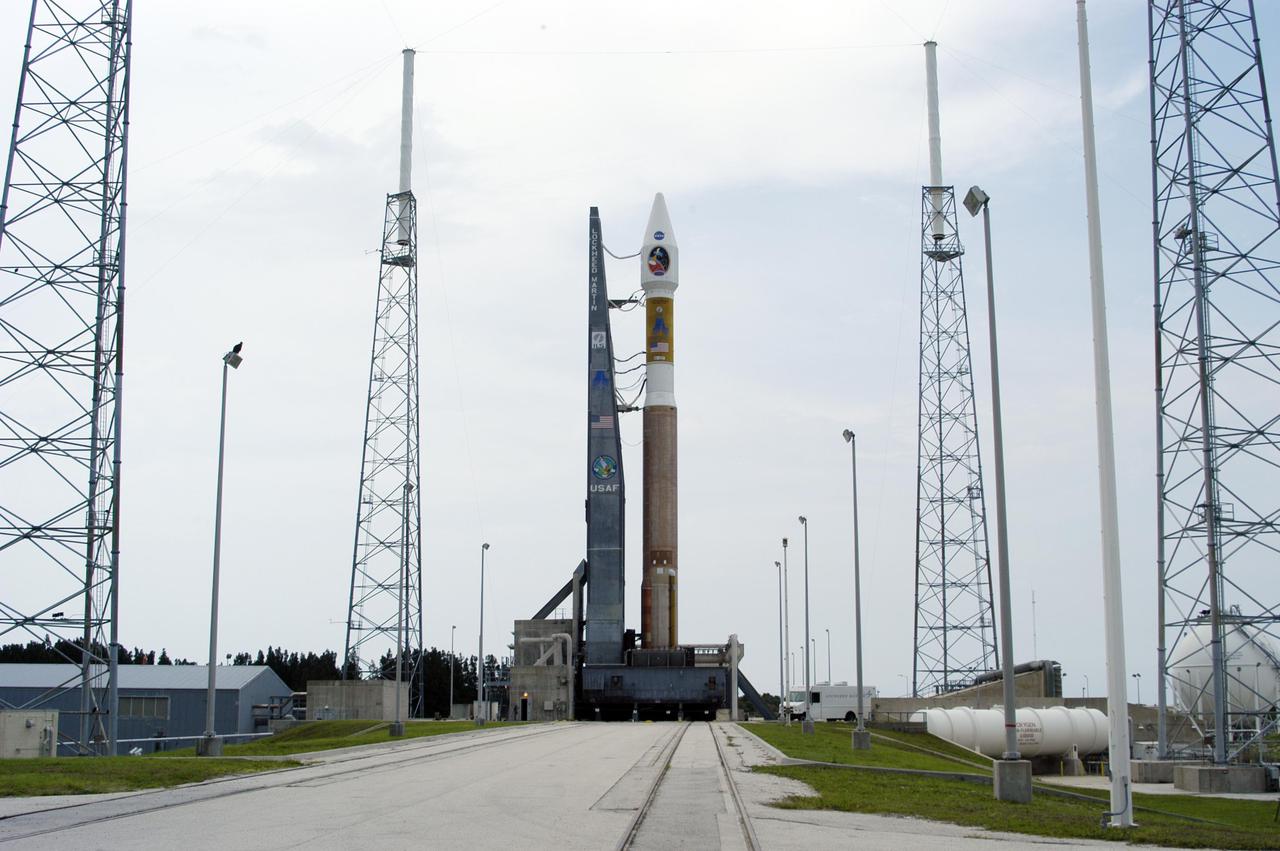
KENNEDY SPACE CENTER, FLA. - NASA's Mars Reconnaissance Orbiter (MRO), atop a Lockheed Martin Atlas V rocket, awaits launch at Launch Complex 41 at Cape Canaveral Air Force Station in Florida. The launch was delayed 24 hours to investigate an anomalous reading in the hydrogen propellant loading system on the Atlas V. At the conclusion of the inquiry, the Atlas V was cleared to launch on Aug. 12 between 7:43 and 9:43 a.m. EDT. The spacecraft will arrive at Mars in March 2006. Once in orbit around Mars, various instruments on the MRO will convey detailed observations of the Martian surface, subsurface and atmosphere. Researchers will use the data to study the history and distribution of Martian water. Learning more about what has happened to the water will focus searches for possible past or present Martian life. Observations by the orbiter will also support future Mars missions by examining potential landing sites and providing a communications relay between the Martian surface and Earth.
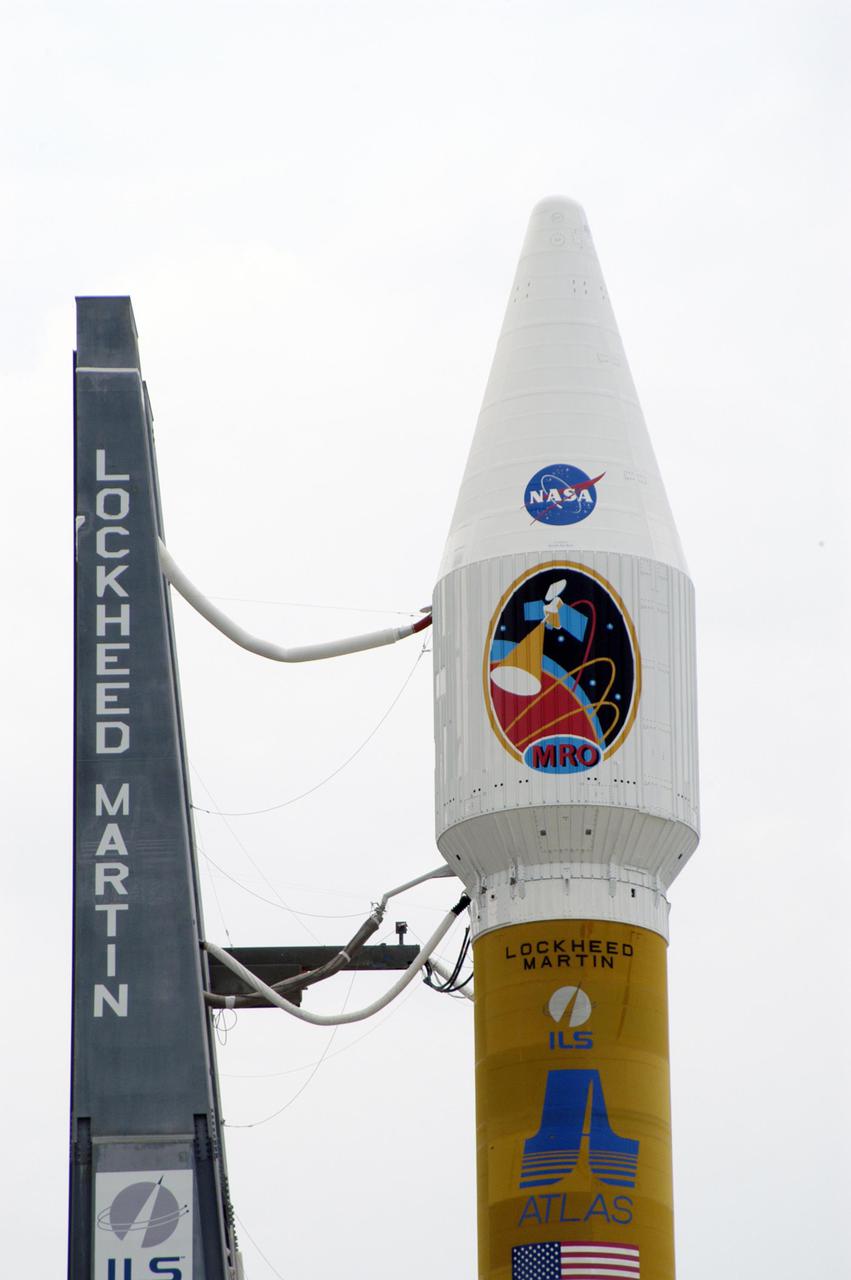
KENNEDY SPACE CENTER, FLA. - NASA's Mars Reconnaissance Orbiter (MRO), atop a Lockheed Martin Atlas V rocket, awaits launch at Launch Complex 41 at Cape Canaveral Air Force Station in Florida. The launch was delayed 24 hours to investigate an anomalous reading in the hydrogen propellant loading system on the Atlas V. At the conclusion of the inquiry, the Atlas V was cleared to launch on Aug. 12 between 7:43 and 9:43 a.m. EDT. The spacecraft will arrive at Mars in March 2006. Once in orbit around Mars, various instruments on the MRO will convey detailed observations of the Martian surface, subsurface and atmosphere. Researchers will use the data to study the history and distribution of Martian water. Learning more about what has happened to the water will focus searches for possible past or present Martian life. Observations by the orbiter will also support future Mars missions by examining potential landing sites and providing a communications relay between the Martian surface and Earth.
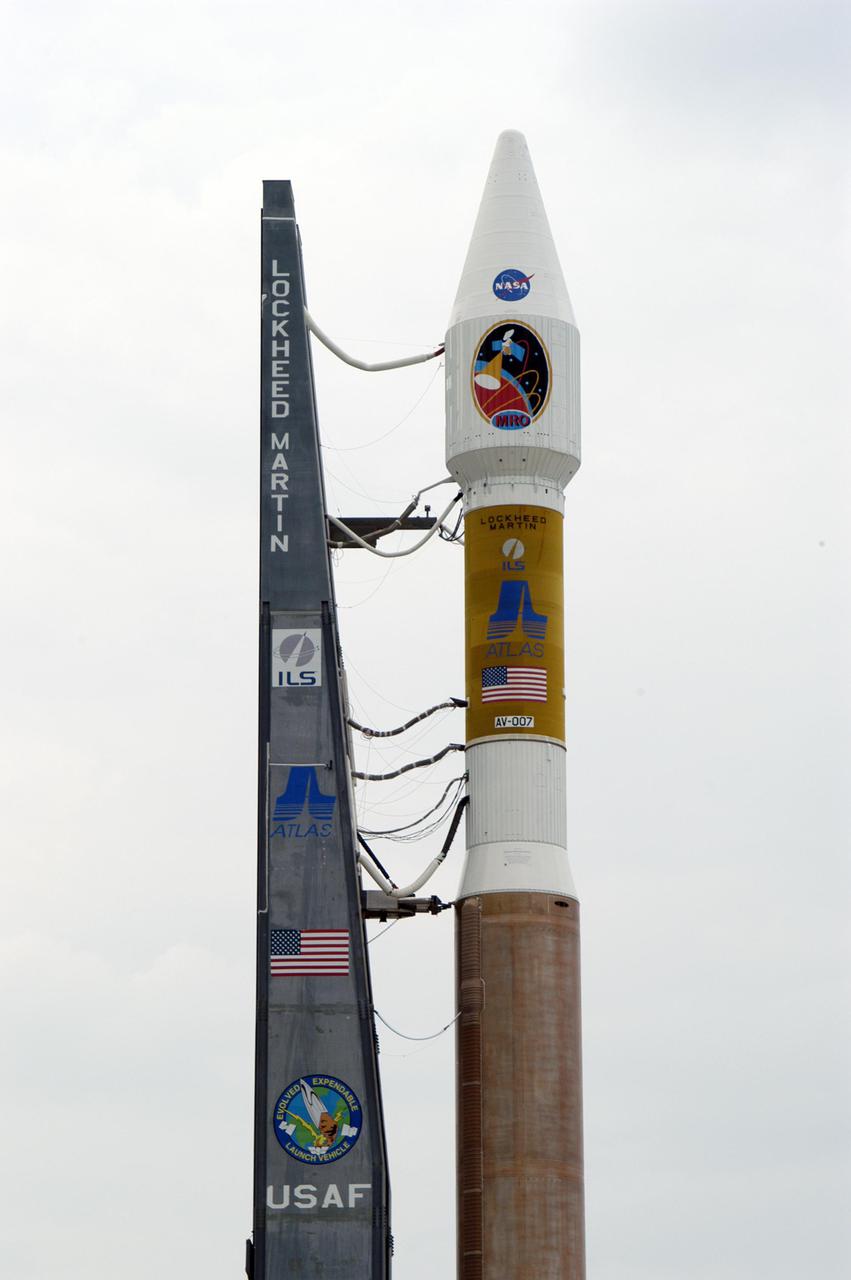
KENNEDY SPACE CENTER, FLA. - NASA's Mars Reconnaissance Orbiter (MRO), atop a Lockheed Martin Atlas V rocket, awaits launch at Launch Complex 41 at Cape Canaveral Air Force Station in Florida. The launch was delayed 24 hours to investigate an anomalous reading in the hydrogen propellant loading system on the Atlas V. At the conclusion of the inquiry, the Atlas V was cleared to launch on Aug. 12 between 7:43 and 9:43 a.m. EDT. The spacecraft will arrive at Mars in March 2006. Once in orbit around Mars, various instruments on the MRO will convey detailed observations of the Martian surface, subsurface and atmosphere. Researchers will use the data to study the history and distribution of Martian water. Learning more about what has happened to the water will focus searches for possible past or present Martian life. Observations by the orbiter will also support future Mars missions by examining potential landing sites and providing a communications relay between the Martian surface and Earth.
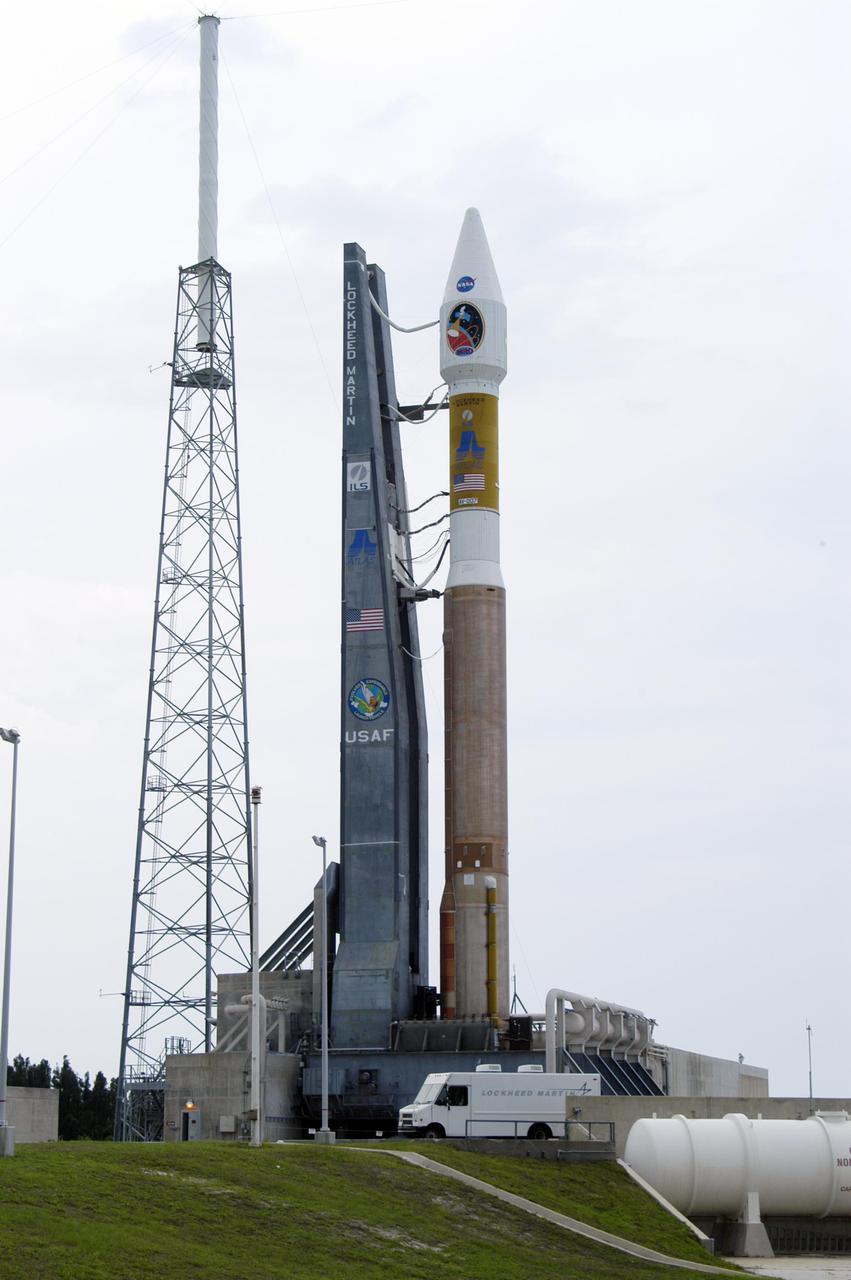
KENNEDY SPACE CENTER, FLA. - NASA's Mars Reconnaissance Orbiter (MRO), atop a Lockheed Martin Atlas V rocket, awaits launch at Launch Complex 41 at Cape Canaveral Air Force Station in Florida. The launch was delayed 24 hours to investigate an anomalous reading in the hydrogen propellant loading system on the Atlas V. At the conclusion of the inquiry, the Atlas V was cleared to launch on Aug. 12 between 7:43 and 9:43 a.m. EDT. The spacecraft will arrive at Mars in March 2006. Once in orbit around Mars, various instruments on the MRO will convey detailed observations of the Martian surface, subsurface and atmosphere. Researchers will use the data to study the history and distribution of Martian water. Learning more about what has happened to the water will focus searches for possible past or present Martian life. Observations by the orbiter will also support future Mars missions by examining potential landing sites and providing a communications relay between the Martian surface and Earth.
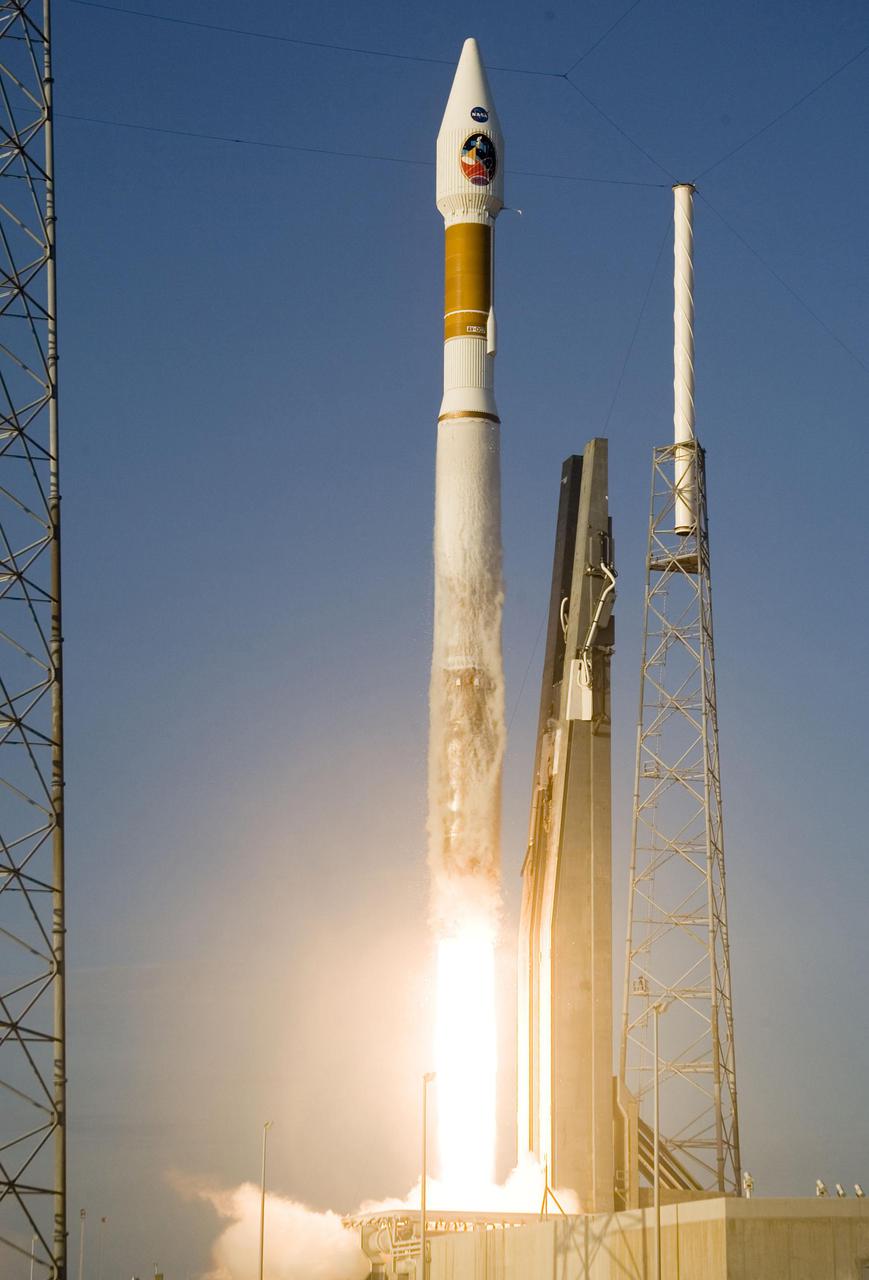
KENNEDY SPACE CENTER, FLA. - Trailing smoke and fire, an Atlas V launch vehicle, 19 stories tall, with a two-ton Mars Reconnaissance Orbiter (MRO) on top, roars away from Launch Complex 41 at Cape Canaveral Air Force Station at 7:43 a.m. EDT. All systems performed nominally for NASA's first launch of an Atlas V on an interplanetary mission. MRO established radio contact with controllers 61 minutes after launch and within four minutes of separation from the upper stage. Initial contact came through an antenna at the Japan Aerospace Exploration Agency's Uchinoura Space Center in southern Japan. Mars is 72 million miles from Earth today, but the spacecraft will travel more than four times that distance on its outbound-arc trajectory to intercept the red planet on March 10, 2006. The orbiter carries six scientific instruments for examining the surface, atmosphere and subsurface of Mars in unprecedented detail from low orbit. NASA expects to get several times more data about Mars from MRO than from all previous Martian missions combined. Researchers will use the instruments to learn more about the history and distribution of Mars' water. That information will improve understanding of planetary climate change and will help guide the quest to answer whether Mars ever supported life. The orbiter will also evaluate potential landing sites for future missions. (Photo Credit: Tom Rogers)
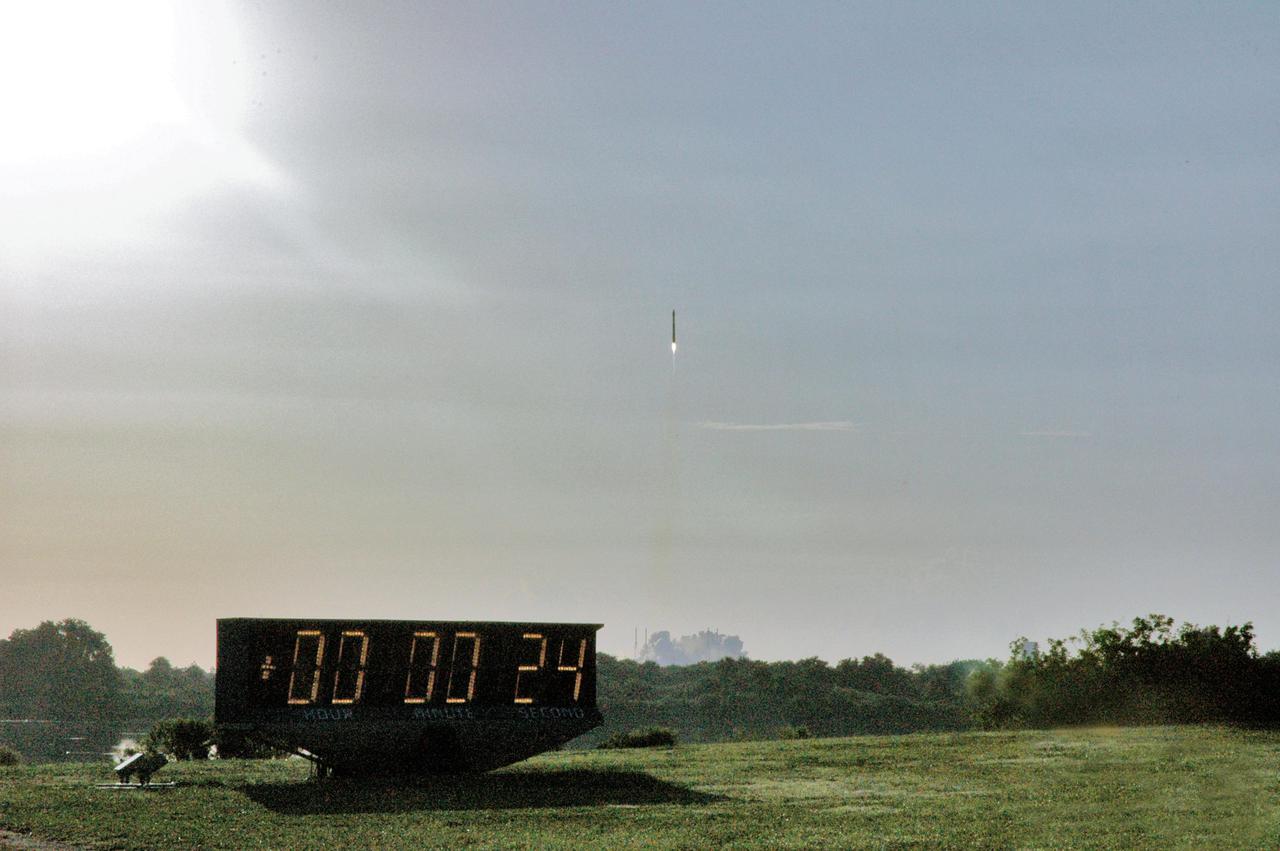
KENNEDY SPACE CENTER, FLA. - Viewed from the NASA News Center, the Mars Reconnaissance Orbiter (MRO) atop a Lockheed Martin Atlas V rocket streaks through the morning sky. The MRO launched at 7:43 a.m. EDT from Launch Complex 41 at Cape Canaveral Air Force Station in Florida. All systems performed nominally for NASA's first Atlas V launch. The spacecraft will arrive at Mars in March 2006. Once in orbit around Mars, various instruments on the MRO will convey detailed observations of the Martian surface, subsurface and atmosphere. Researchers will use the data to study the history and distribution of Martian water. Learning more about what has happened to the water will focus searches for possible past or present Martian life. Observations by the orbiter will also support future Mars missions by examining potential landing sites and providing a communications relay between the Martian surface and Earth.
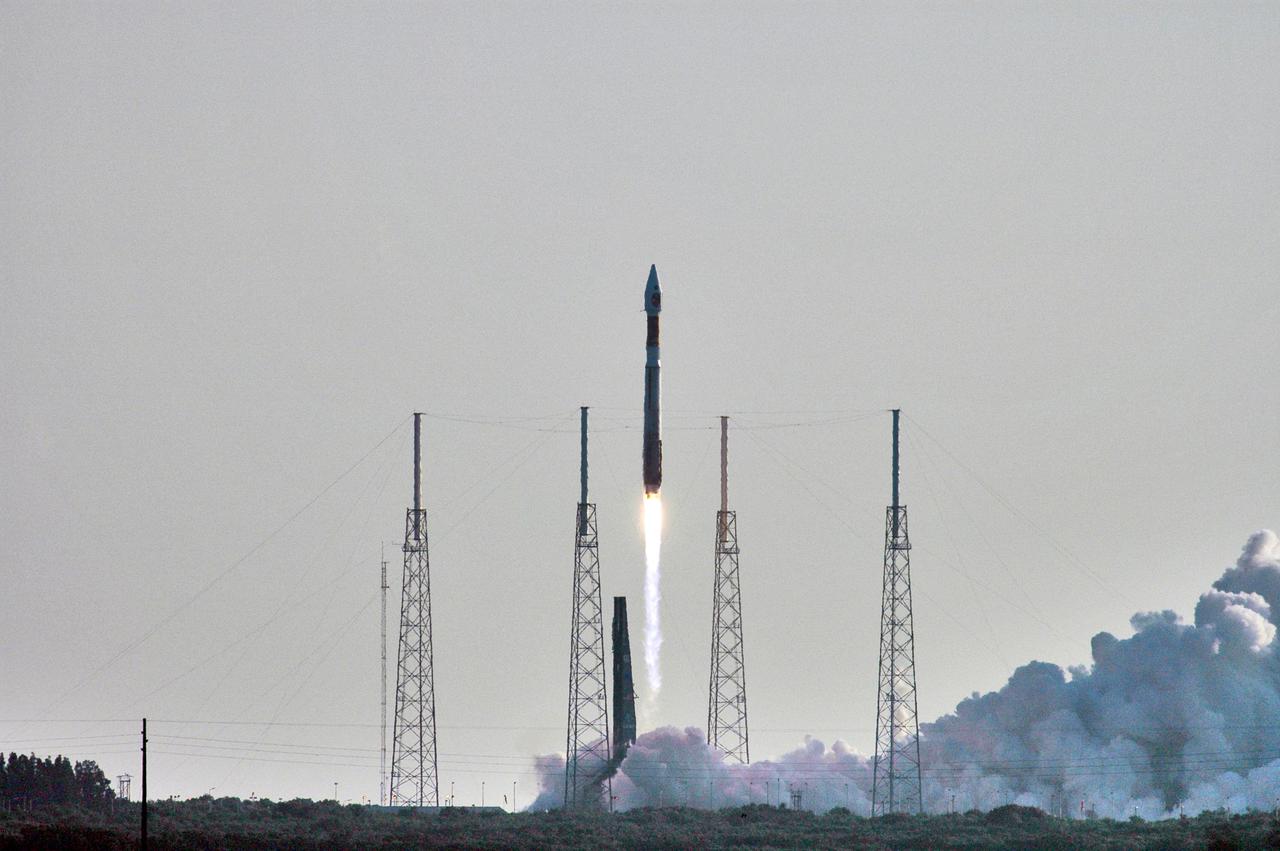
KENNEDY SPACE CENTER, FLA. - NASA's Mars Reconnaissance Orbiter (MRO) launches at 7:43 a.m. EDT atop a Lockheed Martin Atlas V rocket from Launch Complex 41 at Cape Canaveral Air Force Station in Florida on Aug. 12. All systems performed nominally for NASA's first Atlas V launch. The spacecraft will arrive at Mars in March 2006. Once in orbit around Mars, various instruments on the MRO will convey detailed observations of the Martian surface, subsurface and atmosphere. Researchers will use the data to study the history and distribution of Martian water. Learning more about what has happened to the water will focus searches for possible past or present Martian life. Observations by the orbiter will also support future Mars missions by examining potential landing sites and providing a communications relay between the Martian surface and Earth.
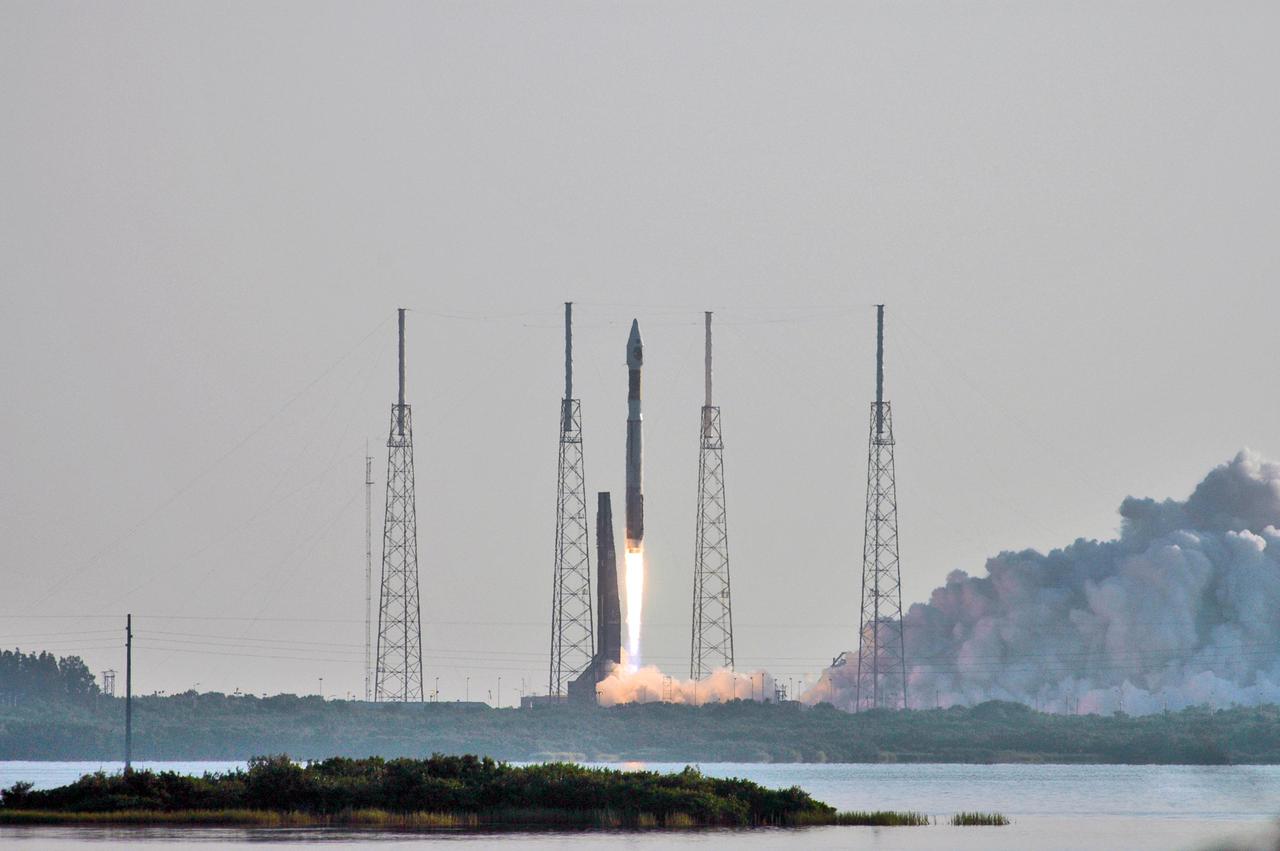
KENNEDY SPACE CENTER, FLA. - NASA's Mars Reconnaissance Orbiter (MRO) launches at 7:43 a.m. EDT atop a Lockheed Martin Atlas V rocket from Launch Complex 41 at Cape Canaveral Air Force Station in Florida on Aug. 12. All systems performed nominally for NASA's first Atlas V launch. The spacecraft will arrive at Mars in March 2006. Once in orbit around Mars, various instruments on the MRO will convey detailed observations of the Martian surface, subsurface and atmosphere. Researchers will use the data to study the history and distribution of Martian water. Learning more about what has happened to the water will focus searches for possible past or present Martian life. Observations by the orbiter will also support future Mars missions by examining potential landing sites and providing a communications relay between the Martian surface and Earth.
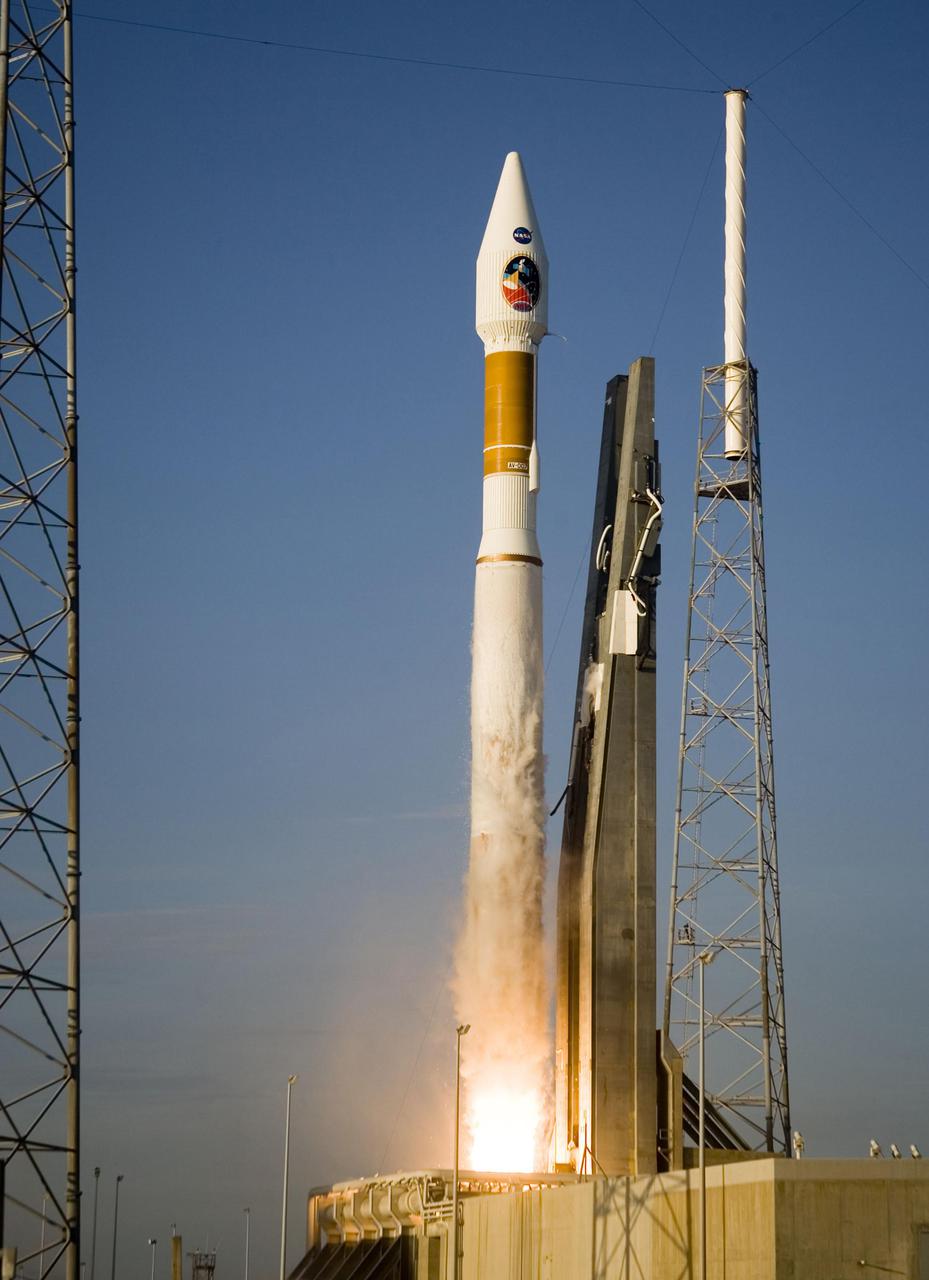
KENNEDY SPACE CENTER, FLA. - At 7:43 a.m. EDT an Atlas V launch vehicle, 19 stories tall, with a two-ton Mars Reconnaissance Orbiter (MRO) on top, lifts off the pad on Launch Complex 41 at Cape Canaveral Air Force Station in Florida. All systems performed nominally for NASA's first launch of an Atlas V on an interplanetary mission. MRO established radio contact with controllers 61 minutes after launch and within four minutes of separation from the upper stage. Initial contact came through an antenna at the Japan Aerospace Exploration Agency's Uchinoura Space Center in southern Japan. Mars is 72 million miles from Earth today, but the spacecraft will travel more than four times that distance on its outbound-arc trajectory to intercept the red planet on March 10, 2006. The orbiter carries six scientific instruments for examining the surface, atmosphere and subsurface of Mars in unprecedented detail from low orbit. NASA expects to get several times more data about Mars from MRO than from all previous Martian missions combined. Researchers will use the instruments to learn more about the history and distribution of Mars' water. That information will improve understanding of planetary climate change and will help guide the quest to answer whether Mars ever supported life. The orbiter will also evaluate potential landing sites for future missions. (Photo Credit: Tom Rogers)
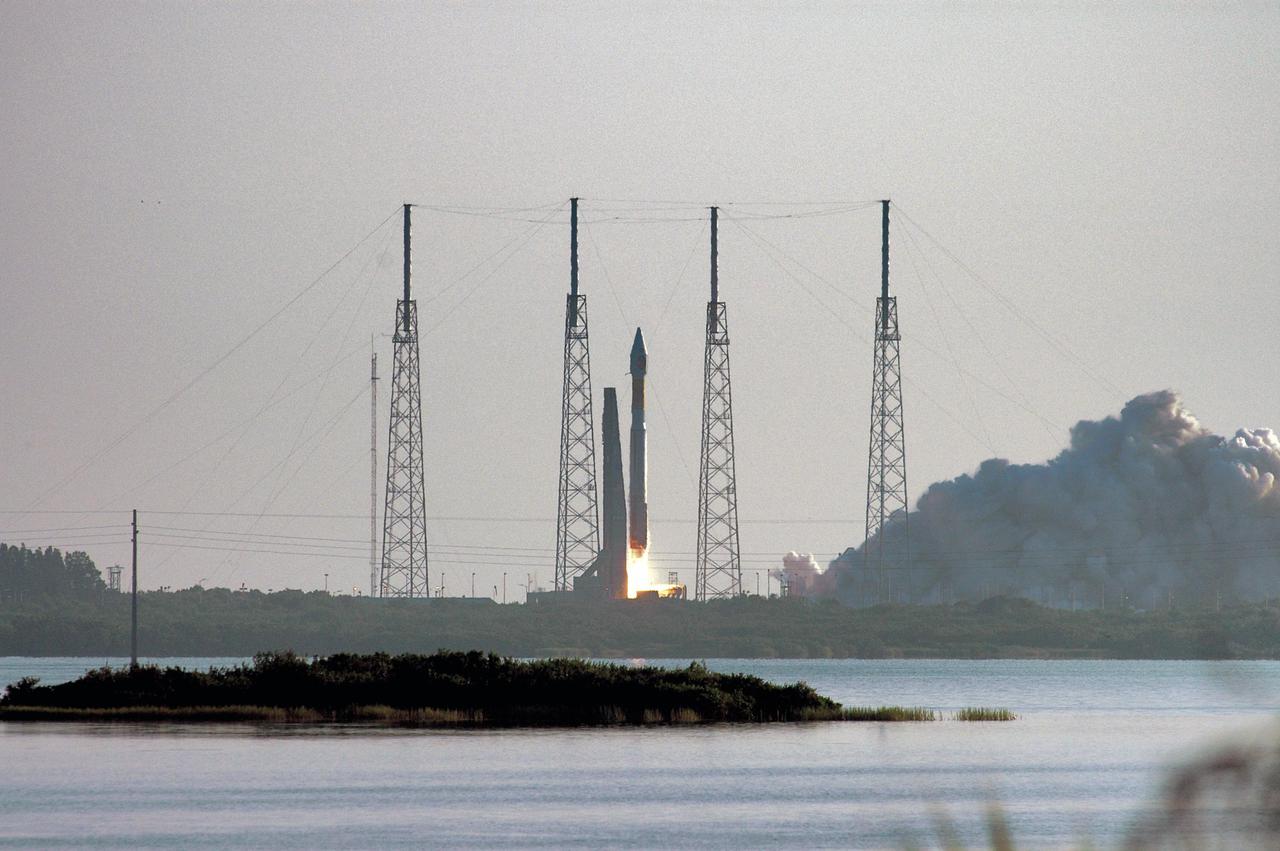
KENNEDY SPACE CENTER, FLA. - NASA's Mars Reconnaissance Orbiter (MRO) launches at 7:43 a.m. EDT atop a Lockheed Martin Atlas V rocket from Launch Complex 41 at Cape Canaveral Air Force Station in Florida on Aug. 12. All systems performed nominally for NASA's first Atlas V launch. The spacecraft will arrive at Mars in March 2006. Once in orbit around Mars, various instruments on the MRO will convey detailed observations of the Martian surface, subsurface and atmosphere. Researchers will use the data to study the history and distribution of Martian water. Learning more about what has happened to the water will focus searches for possible past or present Martian life. Observations by the orbiter will also support future Mars missions by examining potential landing sites and providing a communications relay between the Martian surface and Earth.

KENNEDY SPACE CENTER, FLA. - Seen on the horizon just past the NASA News Center’s countdown clock, NASA's Mars Reconnaissance Orbiter (MRO) launches at 7:43 a.m. EDT atop a Lockheed Martin Atlas V rocket from Launch Complex 41 at Cape Canaveral Air Force Station in Florida. All systems performed nominally for NASA's first Atlas V launch. The spacecraft will arrive at Mars in March 2006. Once in orbit around Mars, various instruments on the MRO will convey detailed observations of the Martian surface, subsurface and atmosphere. Researchers will use the data to study the history and distribution of Martian water. Learning more about what has happened to the water will focus searches for possible past or present Martian life. Observations by the orbiter will also support future Mars missions by examining potential landing sites and providing a communications relay between the Martian surface and Earth.
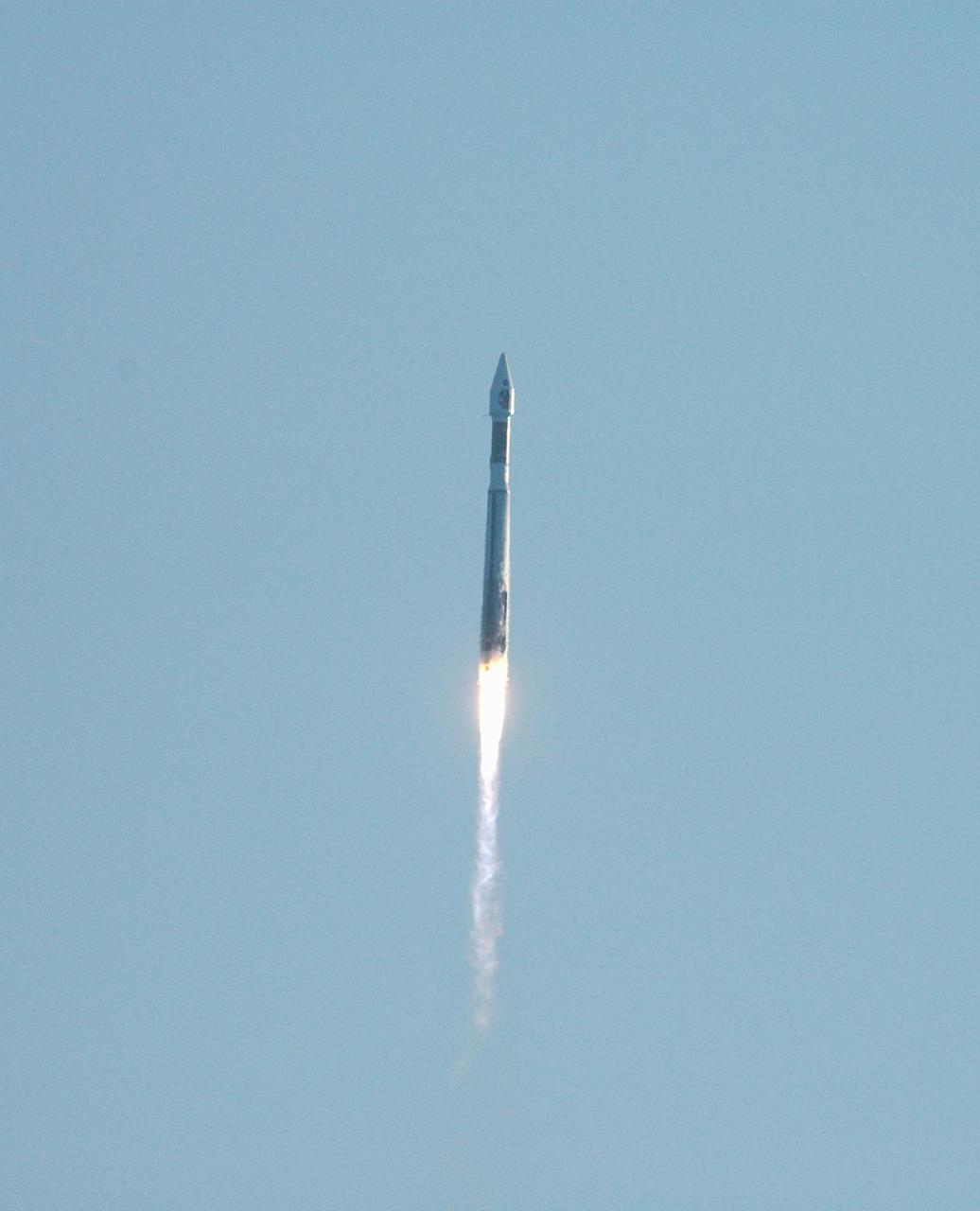
KENNEDY SPACE CENTER, FLA. - NASA's Mars Reconnaissance Orbiter (MRO) launches at 7:43 a.m. EDT atop a Lockheed Martin Atlas V rocket from Launch Complex 41 at Cape Canaveral Air Force Station in Florida on Aug. 12. All systems performed nominally for NASA's first Atlas V launch. The spacecraft will arrive at Mars in March 2006. Once in orbit around Mars, various instruments on the MRO will convey detailed observations of the Martian surface, subsurface and atmosphere. Researchers will use the data to study the history and distribution of Martian water. Learning more about what has happened to the water will focus searches for possible past or present Martian life. Observations by the orbiter will also support future Mars missions by examining potential landing sites and providing a communications relay between the Martian surface and Earth.
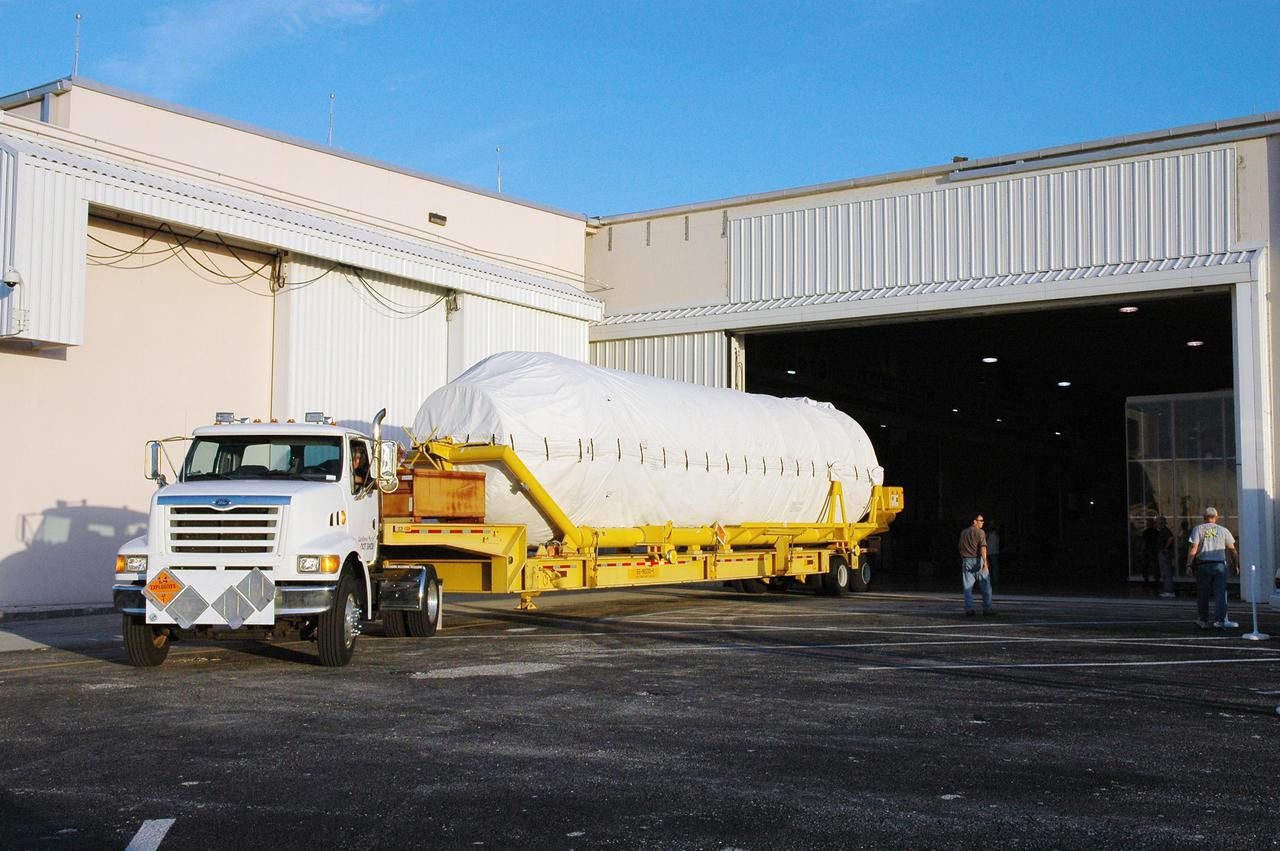
KENNEDY SPACE CENTER, FLA. - The Centaur (Block I) upper stage is rolled into the hangar of the Atlas Space Operations Center where it will be processed for mating with the Lockheed Martin Atlas V, designated AV-007, that is the launch vehicle for the Mars Reconnaissance Orbiter (MRO). The MRO is designed for a series of global mapping, regional survey and targeted observations from a near-polar, low-altitude Mars orbit. These observations will be unprecedented in terms of the spatial resolution and coverage achieved by the orbiter’s instruments as they observe the atmosphere and surface of Mars while probing its shallow subsurface as part of a “follow the water” strategy. The orbiter is undergoing environmental tests in facilities at Lockheed Martin Space Systems in Denver, Colo., and is on schedule for a launch window that begins Aug. 10. Launch will be from Launch Complex 41 at Cape Canaveral Air Force Station in Florida.
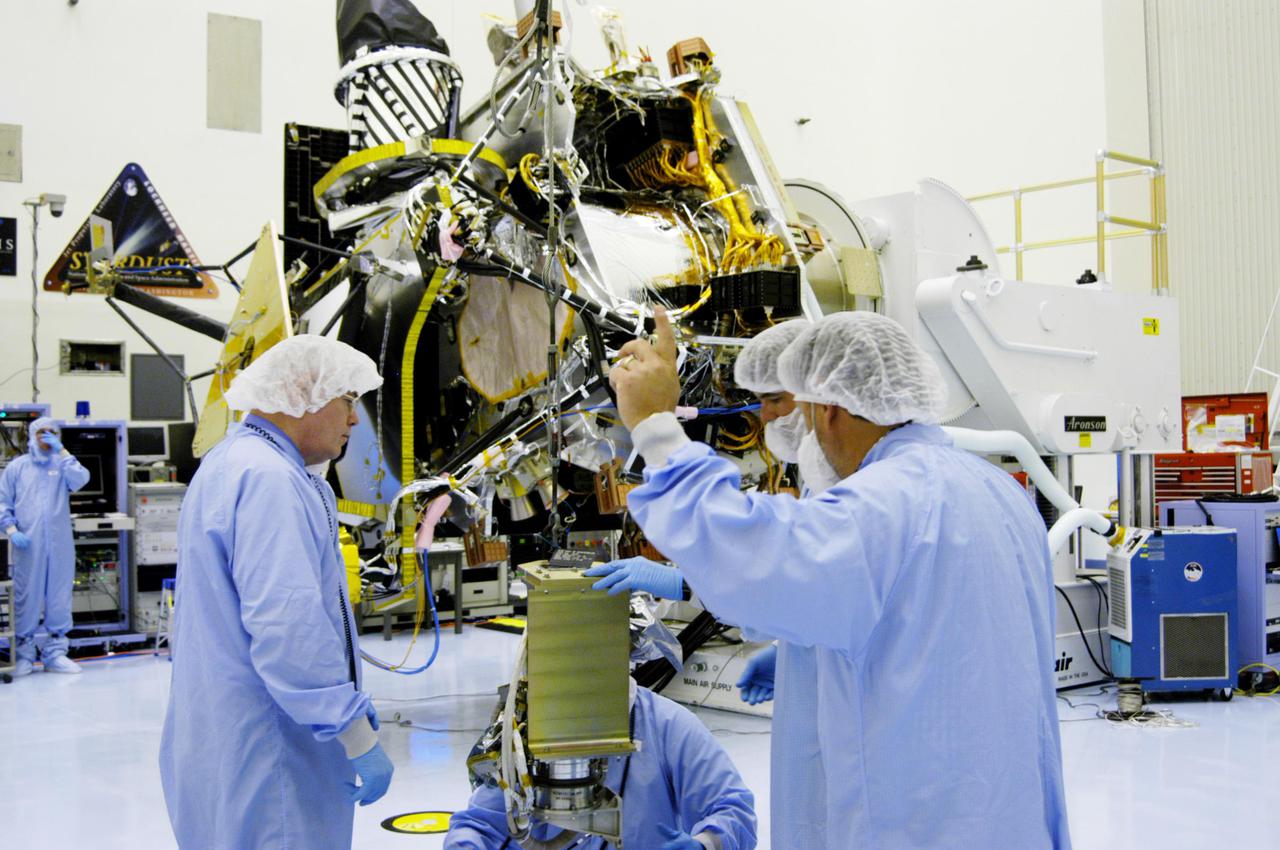
KENNEDY SPACE CENTER, FLA. - In the Payload Hazardous Servicing Facility at NASA’s Kennedy Space Center, engineers prepare to install the gimbal on the Mars Reconnaissance Orbiter (MRO) solar panel. A gimbal is an appliance that allows an object to remain horizontal even as its support tips. In the background is the orbiter. In the PHSF, the spacecraft will undergo multiple mechanical assembly operations and electrical tests to verify its readiness for launch. A major deployment test will check out the spacecraft’s large solar arrays. The MRO was built by Lockheed Martin for NASA’s Jet Propulsion Laboratory in California. It is the next major step in Mars exploration and scheduled for launch from Cape Canaveral Air Force Station in a window opening Aug. 10. The MRO is an important next step in fulfilling NASA’s vision of space exploration and ultimately sending human explorers to Mars and beyond.
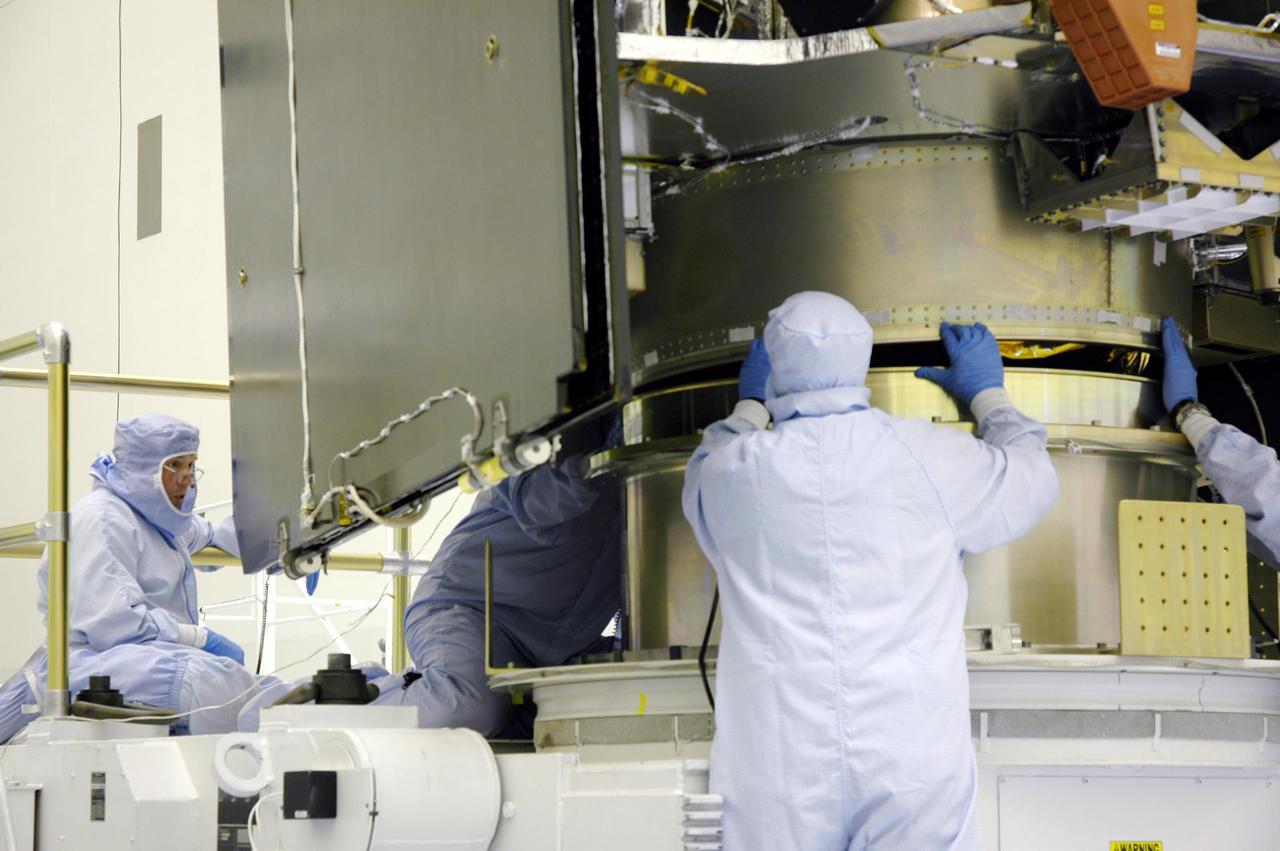
KENNEDY SPACE CENTER, FLA. - In a clean room inside the Payload Hazardous Servicing Facility (PHSF) at NASA's Kennedy Space Center, Lockheed Martin workers help guide the Mars Reconnaissance Orbiter onto the workstand for final assembly and testing. In the PHSF, the spacecraft will undergo multiple mechanical assembly operations and electrical tests to verify its readiness for launch. A test this month will verify the spacecraft's ability to communicate through NASA's Deep Space Network tracking stations. A June test will check the deployment of the spacecraft's high gain communications antenna. Another major deployment test will check out the spacecraft's large solar arrays. The MRO was built for NASA's Jet Propulsion Laboratory in California. It is the next major step in Mars exploration and scheduled for launch from Cape Canaveral Air Force Station in a window opening Aug. 10. The MRO is an important next step in fulfilling NASA's vision of space exploration and ultimately sending human explorers to Mars and beyond.

KENNEDY SPACE CENTER, FLA. - In a clean room inside the Payload Hazardous Servicing Facility (PHSF) at NASA's Kennedy Space Center, Lockheed Martin workers begin removing the protective cover from one of the boxes containing NASA's Mars Reconnaissance Orbiter to a clean room. Here in the PHSF, the spacecraft will undergo multiple mechanical assembly operations and electrical tests to verify its readiness for launch. A test this month will verify the spacecraft's ability to communicate through NASA's Deep Space Network tracking stations. A June test will check the deployment of the spacecraft's high gain communications antenna. Another major deployment test will check out the spacecraft's large solar arrays. The MRO was built by Lockheed Martin for NASA's Jet Propulsion Laboratory in California. It is the next major step in Mars exploration and scheduled for launch from Cape Canaveral Air Force Station in a window opening Aug. 10. The MRO is an important next step in fulfilling NASA's vision of space exploration and ultimately sending human explorers to Mars and beyond.
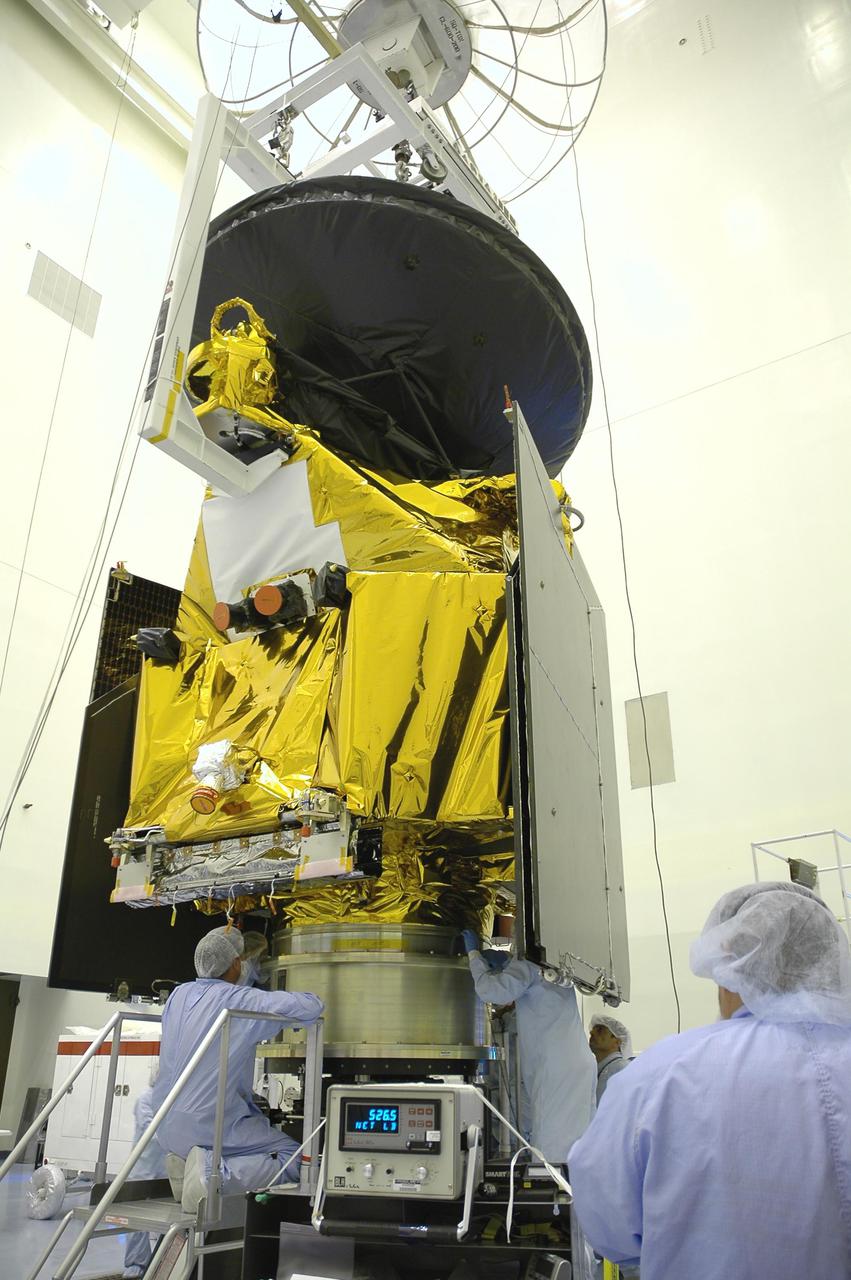
KENNEDY SPACE CENTER, FLA. -- In the Payload Hazardous Servicing Facility, workers from Lockheed Martin begin securing the Mars Reconnaissance Orbiter (MRO) onto the spin balance machine for testing. In late July, the MRO will be transported to the Vertical Installation Facility. It will join the Atlas V for the final phase of launch preparations. The spacecraft is then scheduled to undergo a functional test, and a final week of integrated testing and closeouts. The MRO was built by Lockheed Martin for the Jet Propulsion Laboratory in California. It is the next major step in Mars exploration and scheduled for launch from Cape Canaveral Air Force Station in a window opening Aug. 10. The MRO is an important next step in fulfilling NASA’s vision of space exploration and ultimately sending human explorers to Mars and beyond.
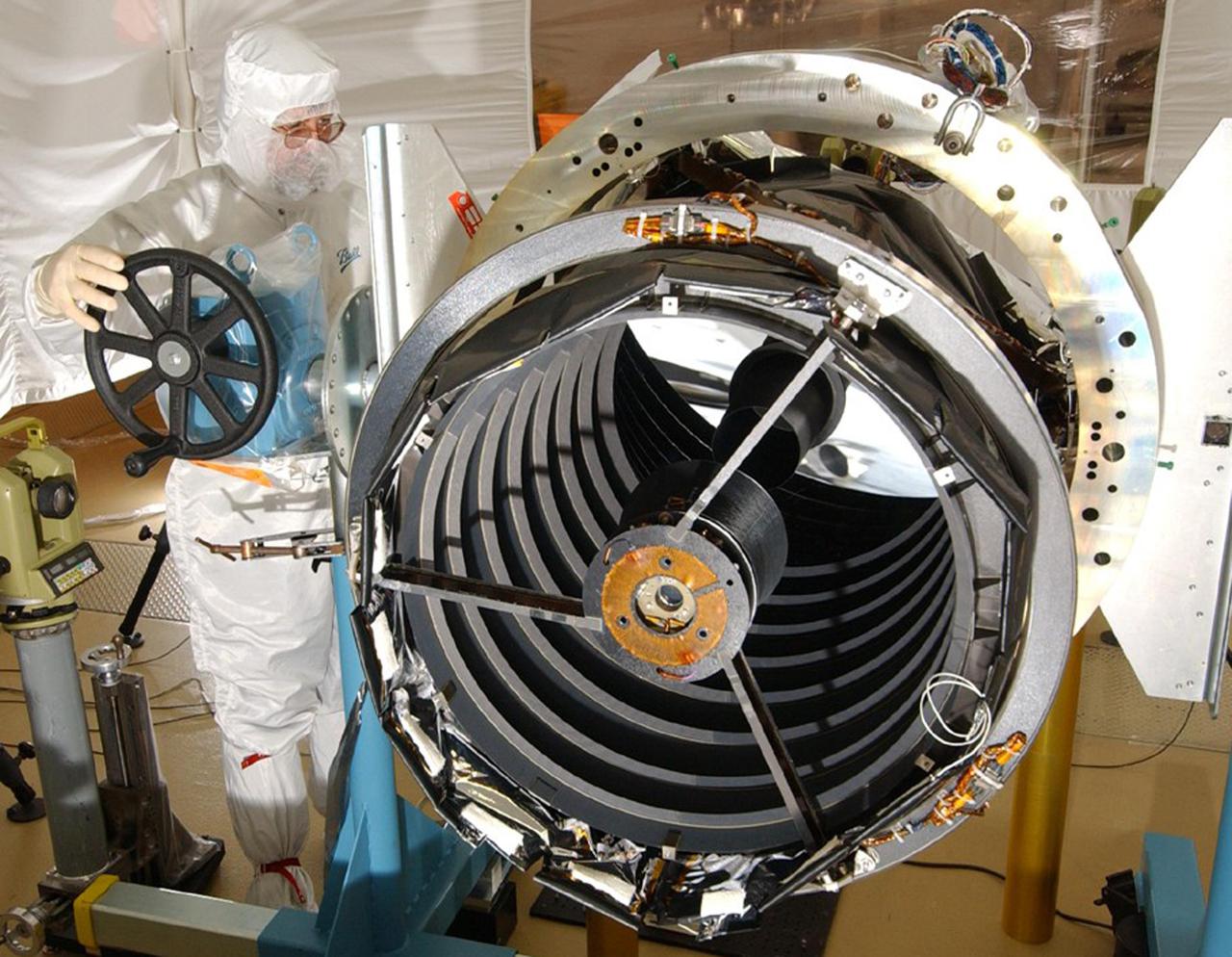
KENNEDY SPACE CENTER, FLA. - The High Resolution Imaging Science Experiment (HiRISE) camera is examined by a worker from Ball Aerospace and Technologies Corp. Scheduled to launch Aug. 10 aboard an Atlas V rocket from Launch Complex 41 at Cape Canaveral Air Force Station in Florida, HiRISE is designed to take high-resolution images of the surface of Mars from orbit provide unprecedented image quality, resolution and coverage at sub-meter scales. The MRO will search for evidence of water, study the climate record, and identify landing sites for future missions. The MRO is scheduled for launch aboard an Atlas V rocket from Launch Complex 41 at Cape Canaveral Air Force Station in Florida. The MRO is an important next step in fulfilling NASA’s vision of space exploration and ultimately sending human explorers to Mars and beyond.
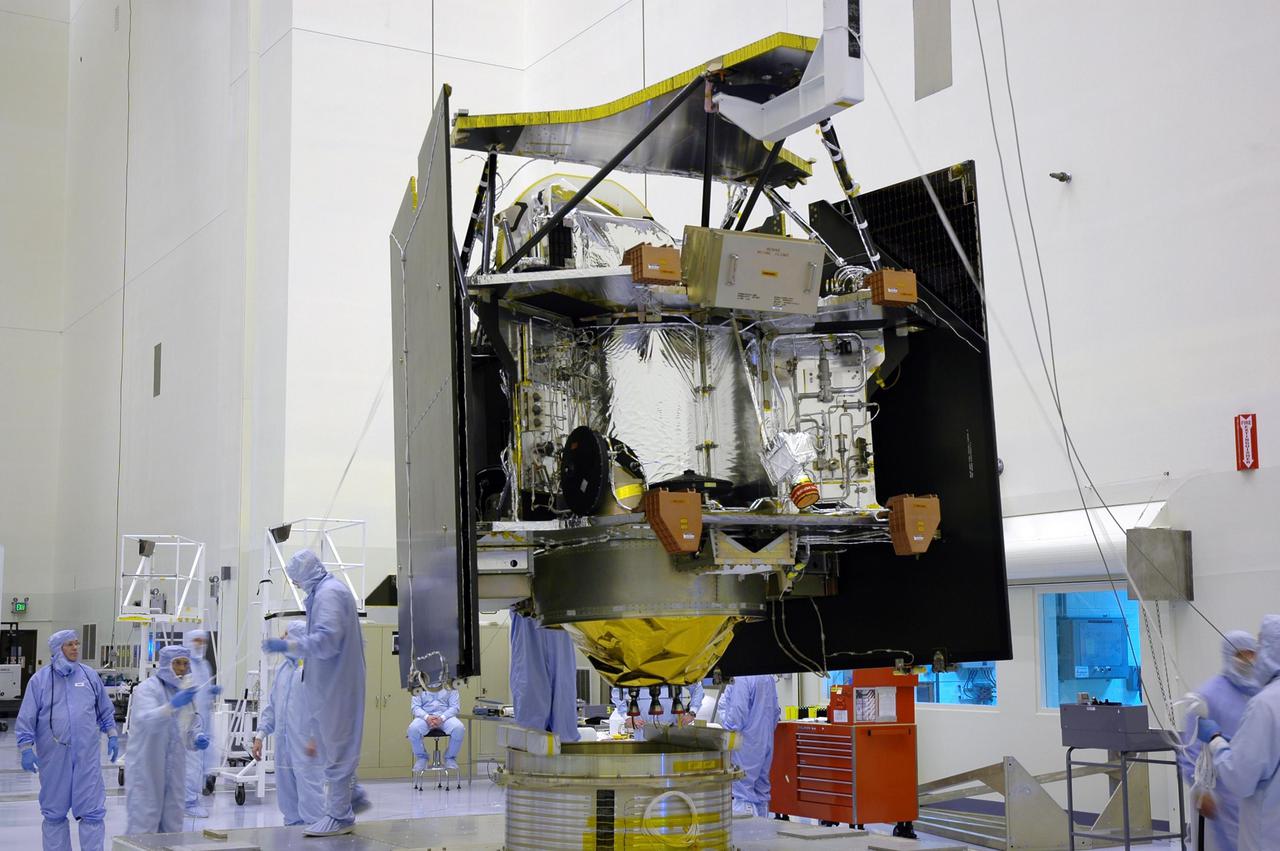
KENNEDY SPACE CENTER, FLA. -In a clean room inside the Payload Hazardous Servicing Facility (PHSF) at NASA’s Kennedy Space Center, the Mars Reconnaissance Orbiter (MRO) is lifted by an overhead crane to move it to a nearby workstand for final assembly and testing. In the PHSF, the spacecraft will undergo multiple mechanical assembly operations and electrical tests to verify its readiness for launch. A test this month will verify the spacecraft’s ability to communicate through NASA's Deep Space Network tracking stations. A June test will check the deployment of the spacecraft's high gain communications antenna. Another major deployment test will check out the spacecraft's large solar arrays. The MRO was built for NASA’s Jet Propulsion Laboratory in California. It is the next major step in Mars exploration and scheduled for launch from Cape Canaveral Air Force Station in a window opening Aug. 10. The MRO is an important next step in fulfilling NASA’s vision of space exploration and ultimately sending human explorers to Mars and beyond.
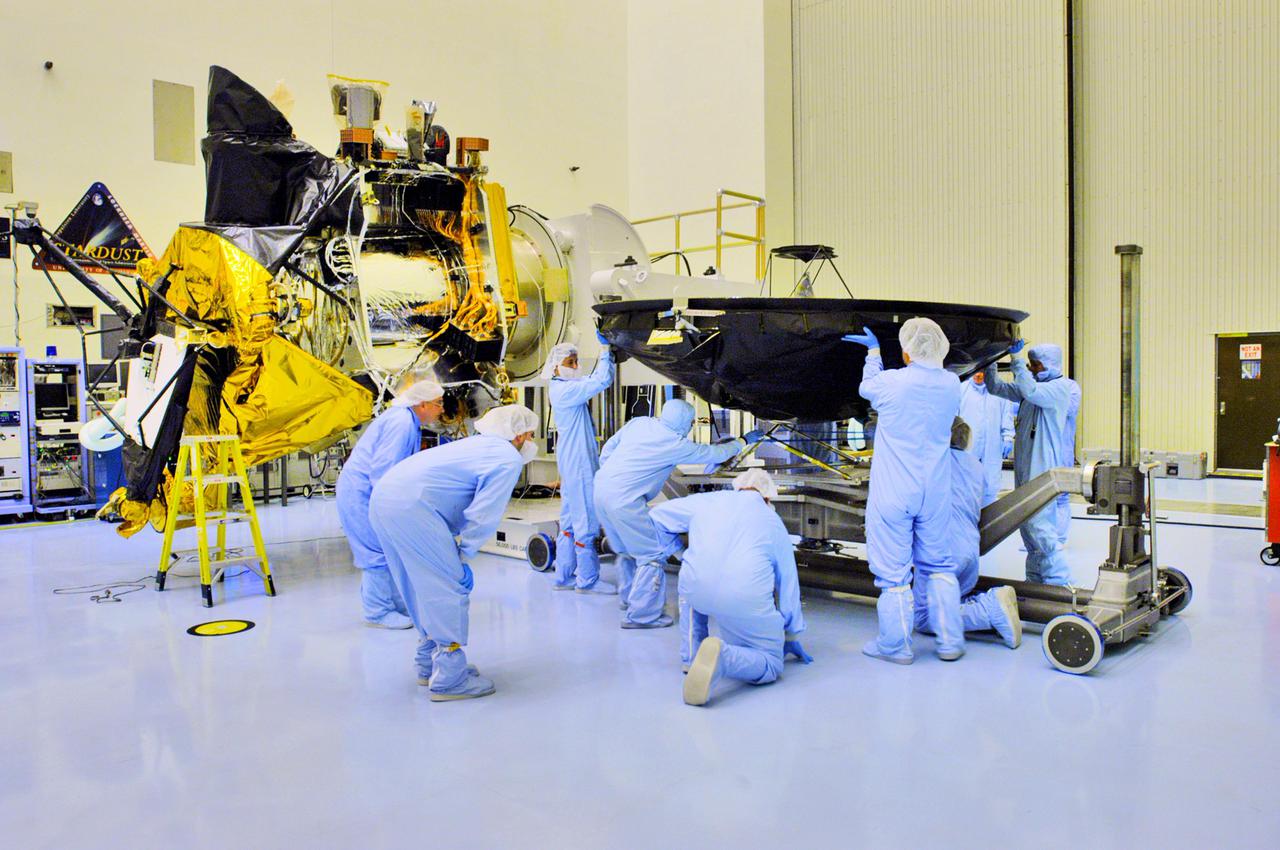
KENNEDY SPACE CENTER, FLA. - In the Payload Hazardous Servicing Facility at NASA’s Kennedy Space Center, workers from Lockheed Martin prepare the high-gain antenna for installation on the Mars Reconnaissance Orbiter (MRO), in the background. After solar array installation, the MRO will be transported to the Vertical Installation Facility in late July. It will join the Atlas V for the final phase of launch preparations. The spacecraft is then scheduled to undergo a functional test, and a final week of integrated testing and closeouts. The MRO was built by Lockheed Martin for the Jet Propulsion Laboratory in California. It is the next major step in Mars exploration and scheduled for launch from Cape Canaveral Air Force Station in a window opening Aug. 10. The MRO is an important next step in fulfilling NASA’s vision of space exploration and ultimately sending human explorers to Mars and beyond.

KENNEDY SPACE CENTER, FLA. - The Mars Reconnaissance Orbiter (MRO) atop its Atlas V launch vehicle (right) and launch gantry roll out on the mobile launch platform to the launch pad from the Vertical Integration Facility at Cape Canaveral Air Force Station in Florida. The launch window is from 7:50 a.m. to 9:35 a.m. EDT. The spacecraft will arrive at Mars in March 2006 . Once in orbit around Mars, various instruments on the MRO will convey detailed observations of the Martian surface, subsurface and atmosphere. Researchers will use the data to study the history and distribution of Martian water. Learning more about what has happened to the water will focus searches for possible past or present Martian life. Observations by the orbiter will also support future Mars missions by examining potential landing sites and providing a communications relay between the Martian surface and Earth.
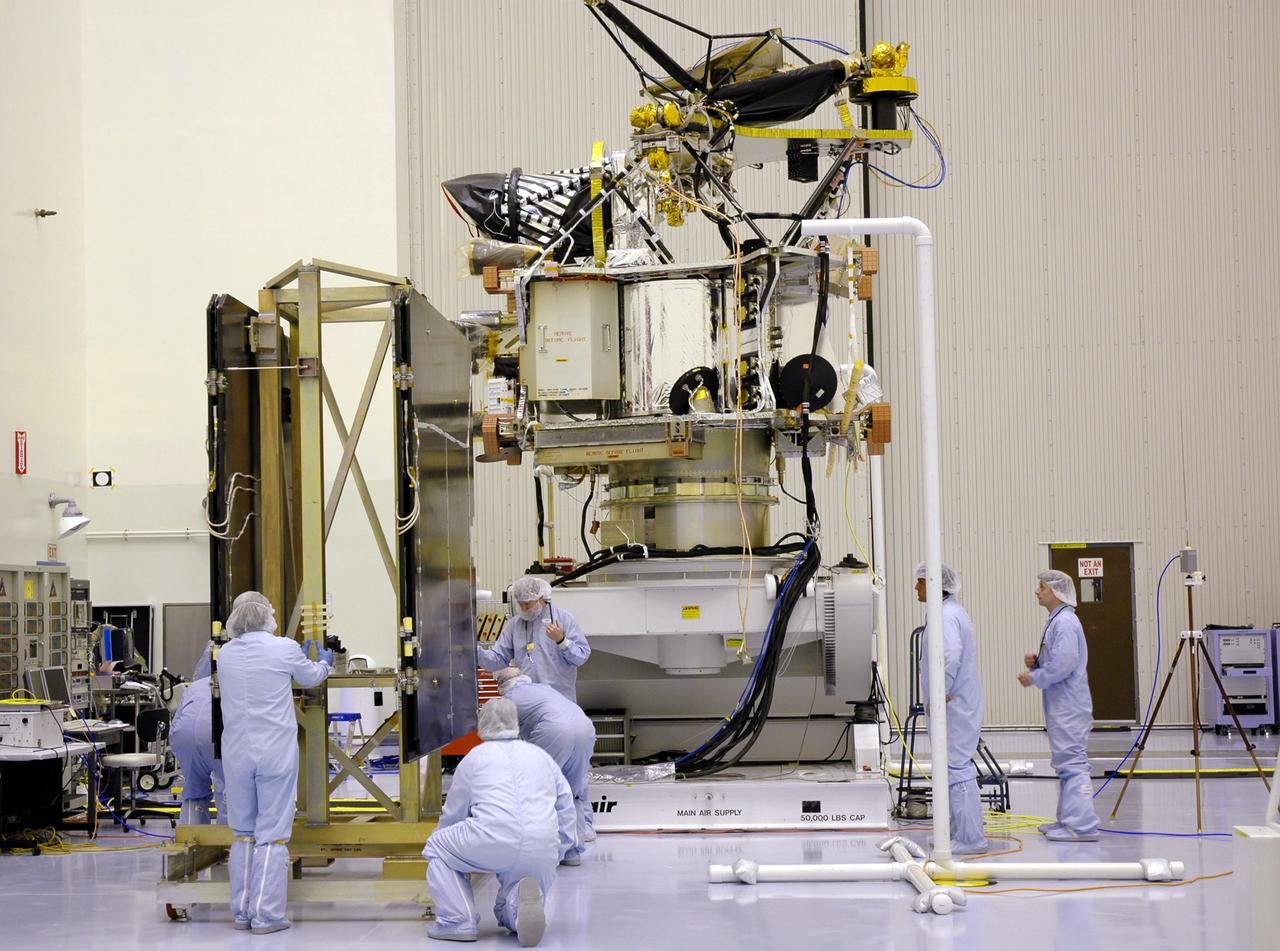
KENNEDY SPACE CENTER, FLA. - In the Payload Hazardous Servicing Facility, technicians position the solar arrays for the Mars Reconnaissance Orbiter (MRO) in preparation for an electromagnetic interference verification test. If no interference is found during the test, the Shallow Radar Antenna (SHARAD) will be installed on the spacecraft. The spacecraft is undergoing multiple mechanical assembly operations and electrical tests to verify its readiness for launch. The MRO was built by Lockheed Martin for NASA’s Jet Propulsion Laboratory in California. It is the next major step in Mars exploration and scheduled for launch from Launch Complex 41 at Cape Canaveral Air Force Station in a window opening Aug. 10. The MRO is an important next step in fulfilling NASA’s vision of space exploration and ultimately sending human explorers to Mars and beyond.
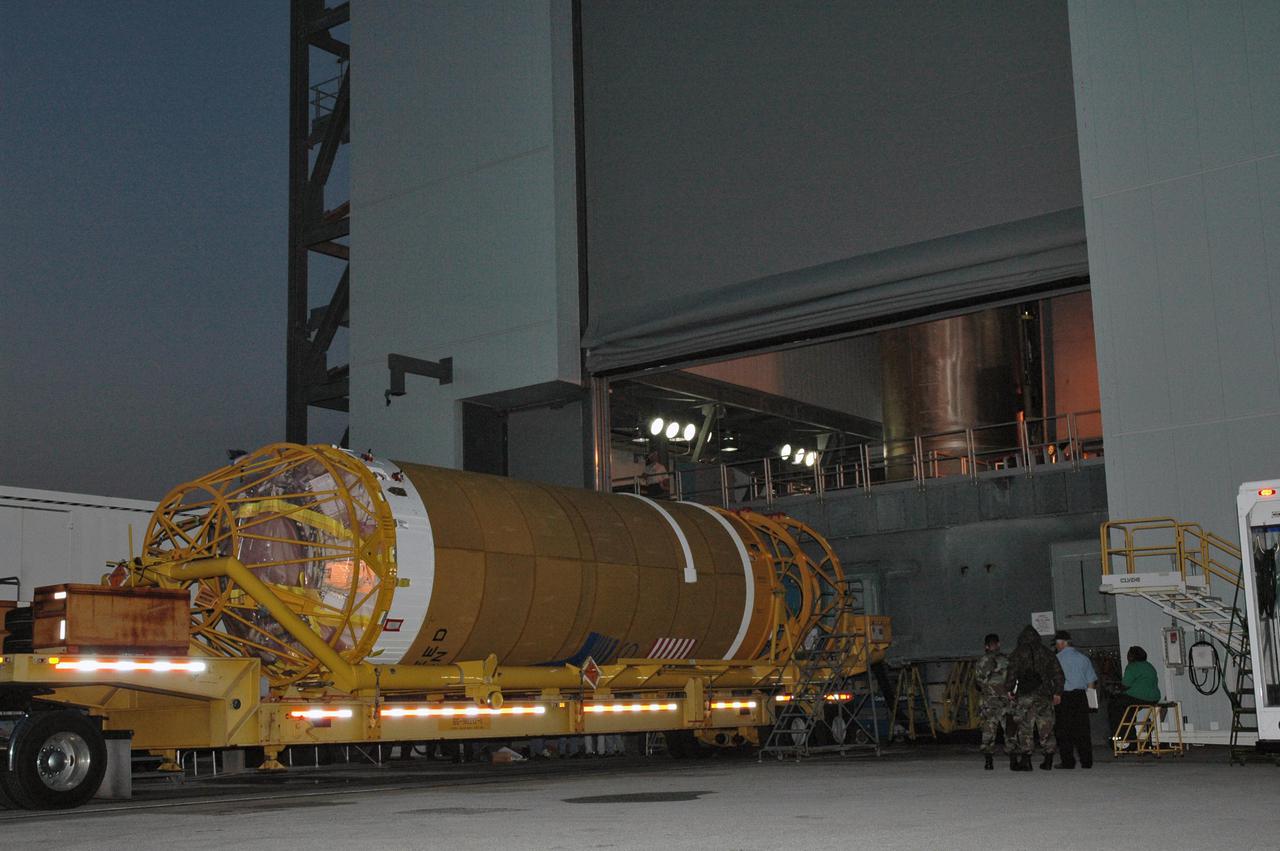
KENNEDY SPACE CENTER, FLA. - The Lockheed Martin Atlas V_Centaur second stage arrives at the Vertical Integration Facility on Launch Pad 41 at Cape Canaveral Air Force Station in Florida. It will be mated with the Atlas V already placed in the tower. The Atlas V_Centaur is the launch vehicle for the Mars Reconnaissance Orbiter (MRO). The MRO is designed for a series of global mapping, regional survey and targeted observations from a near-polar, low-altitude Mars orbit. These observations will be unprecedented in terms of the spatial resolution and coverage achieved by the orbiter’s instruments as they observe the atmosphere and surface of Mars while probing its shallow subsurface as part of a “follow the water” strategy. The launch window for the MRO begins Aug. 10.
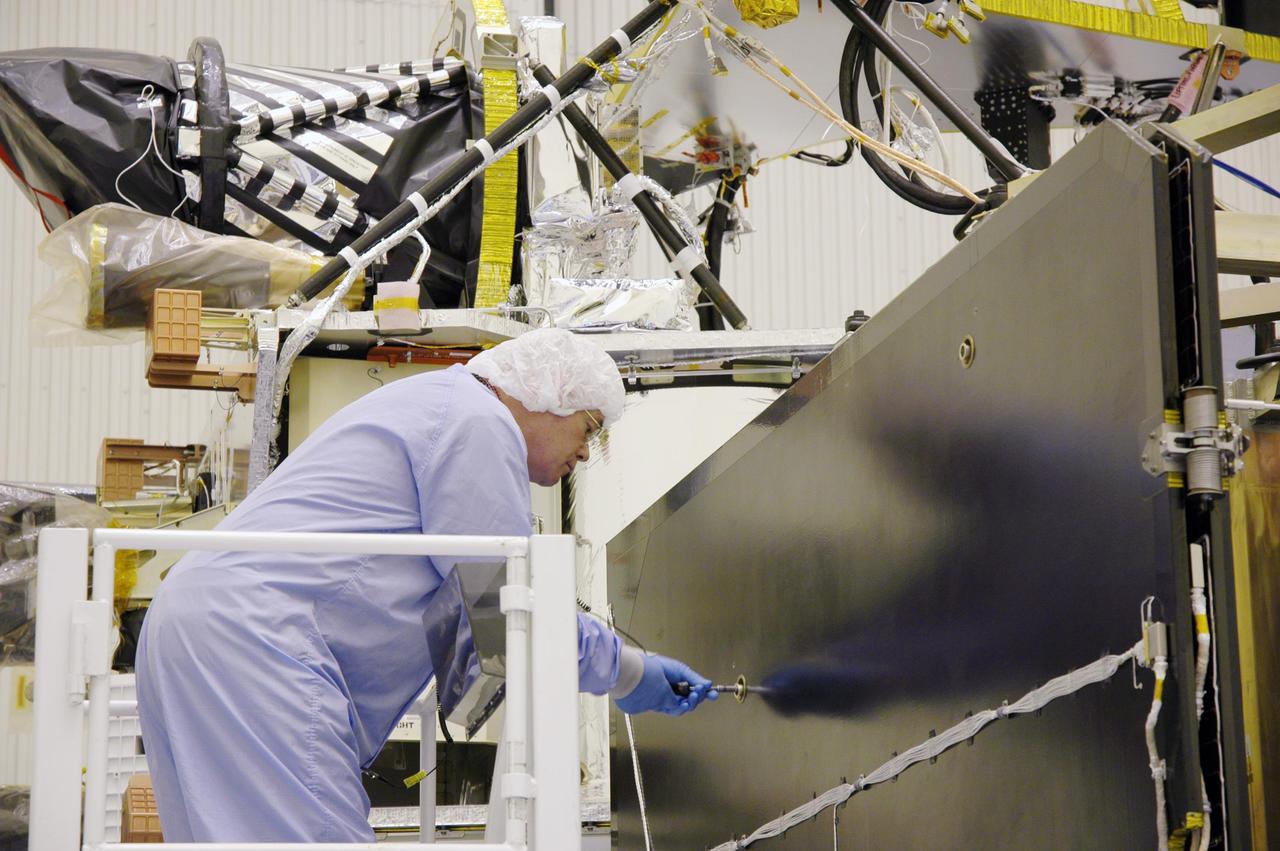
KENNEDY SPACE CENTER, FLA. - In the Payload Hazardous Servicing Facility, a technician prepares the solar arrays for the Mars Reconnaissance Orbiter (MRO) for an electromagnetic interference verification test. If no interference is found during the test, the Shallow Radar Antenna (SHARAD) will be installed on the spacecraft. The spacecraft is undergoing multiple mechanical assembly operations and electrical tests to verify its readiness for launch. The MRO was built by Lockheed Martin for NASA’s Jet Propulsion Laboratory in California. It is the next major step in Mars exploration and scheduled for launch from Launch Complex 41 at Cape Canaveral Air Force Station in a window opening Aug. 10. The MRO is an important next step in fulfilling NASA’s vision of space exploration and ultimately sending human explorers to Mars and beyond.

KENNEDY SPACE CENTER, FLA. - In the Payload Hazardous Servicing Facility, workers from Lockheed Martin prepare the Mars Reconnaissance Orbiter (MRO) to be lifted from the rotation stand. It is being transferred to a Mars Orbit Insertion Thruster assembly stand for testing. In late July, the MRO will be transported to the Vertical Installation Facility. It will join the Atlas V for the final phase of launch preparations. The spacecraft is then scheduled to undergo a functional test, and a final week of integrated testing and closeouts. The MRO was built by Lockheed Martin for the Jet Propulsion Laboratory in California. It is the next major step in Mars exploration and scheduled for launch from Cape Canaveral Air Force Station in a window opening Aug. 10. The MRO is an important next step in fulfilling NASA’s vision of space exploration and ultimately sending human explorers to Mars and beyond.
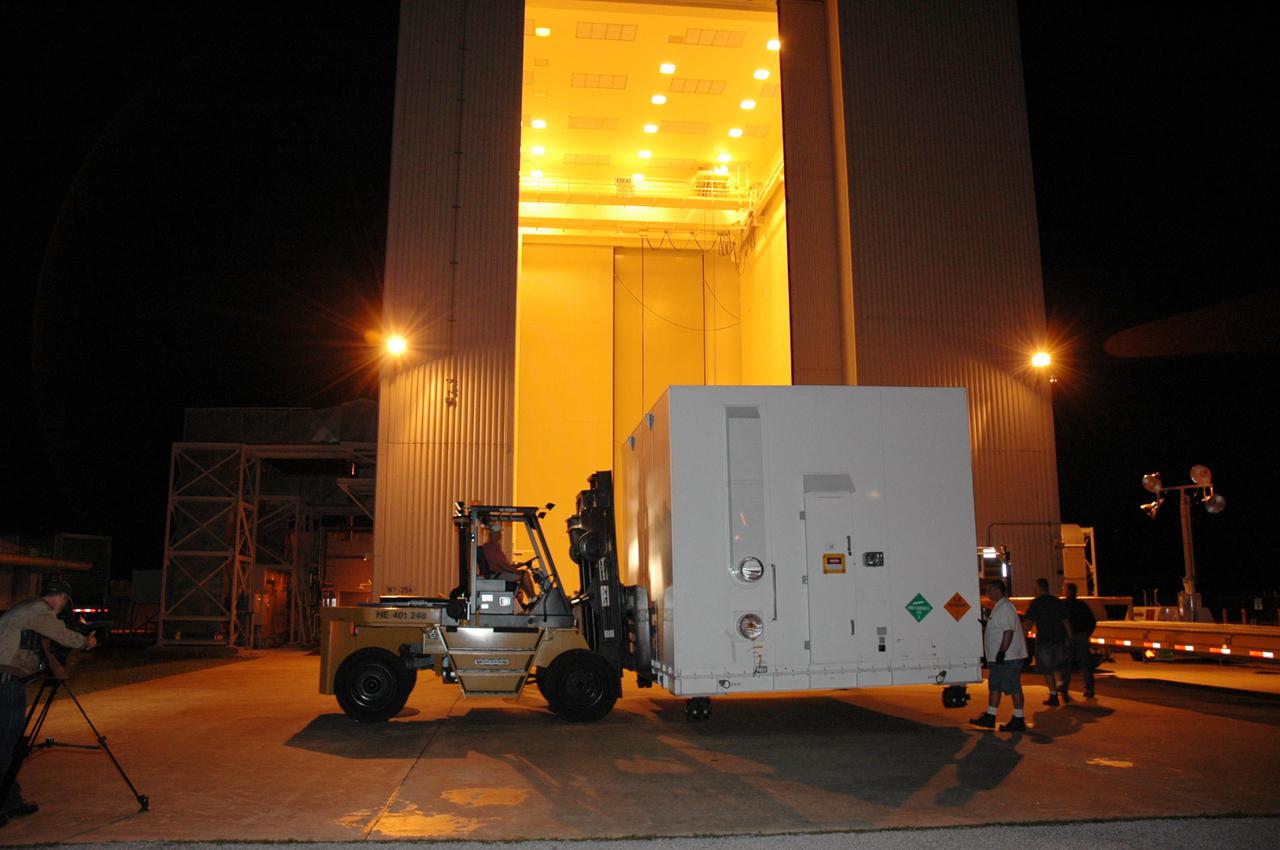
KENNEDY SPACE CENTER, FLA. - One of two containers with the Mars Reconnaissance Orbiter (MRO) equipment arrives at the Payload Hazardous Servicing Facility. The MRO was built by Lockheed Martin for NASA's Jet Propulsion Laboratory in California. It is the next major step in Mars exploration and scheduled for launch from Cape Canaveral Air Force Station in a window opening Aug. 10. The MRO carries six primary instruments: the High Resolution Imaging Science Experiment, Context Camera, Mars Color Imager, Compact Reconnaissance Imaging Spectrometer for Mars, Mars Climate Sounder and Shallow Radar. By 2007, the MRO will begin a series of global mapping, regional survey and targeted observations from a near-polar, low-altitude Mars orbit. It will observe the atmosphere and surface of Mars while probing its shallow subsurface as part of a “follow the water” strategy.
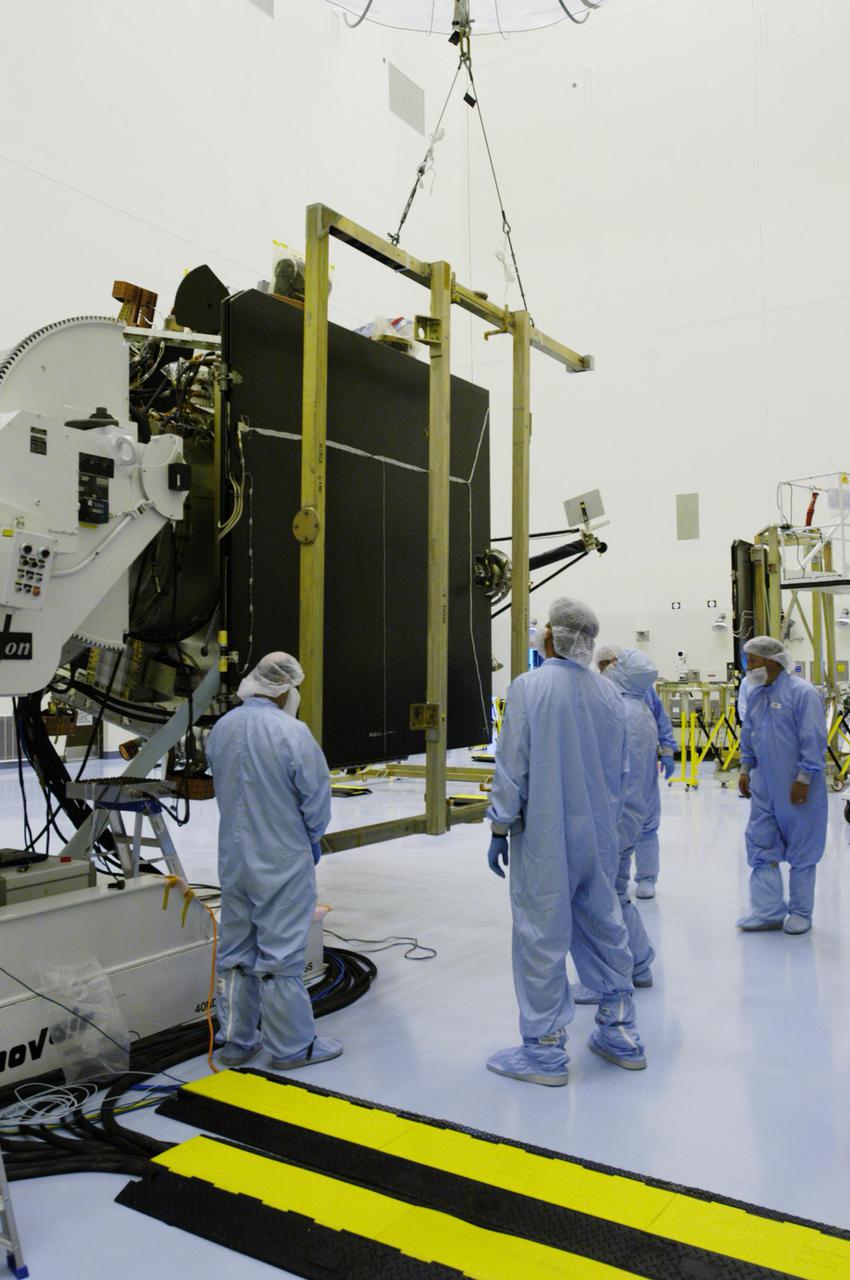
KENNEDY SPACE CENTER, FLA. - In the Payload Hazardous Servicing Facility, workers move a crane into place to remove the solar panel from the Mars Reconnaissance Orbiter spacecraft. A major deployment test will check out the spacecraft’s large solar arrays. The spacecraft will also undergo multiple mechanical assembly operations and electrical tests to verify its readiness for launch. The MRO was built by Lockheed Martin for NASA’s Jet Propulsion Laboratory in California. It is the next major step in Mars exploration and scheduled for launch from Cape Canaveral Air Force Station in a window opening Aug. 10. The MRO is an important next step in fulfilling NASA’s vision of space exploration and ultimately sending human explorers to Mars and beyond.

KENNEDY SPACE CENTER, FLA. - In the Payload Hazardous Servicing Facility, workers from Lockheed Martin prepare to conduct a gimbal full range of motion test on the Mars Reconnaissance Orbiter (MRO) high-gain antenna. The MRO was built by Lockheed Martin for JPL. It is the next major step in Mars exploration and scheduled for launch from Cape Canaveral Air Force Station in a window opening Aug. 10. The MRO is an important next step in fulfilling NASA’s vision of space exploration and ultimately sending human explorers to Mars and beyond.
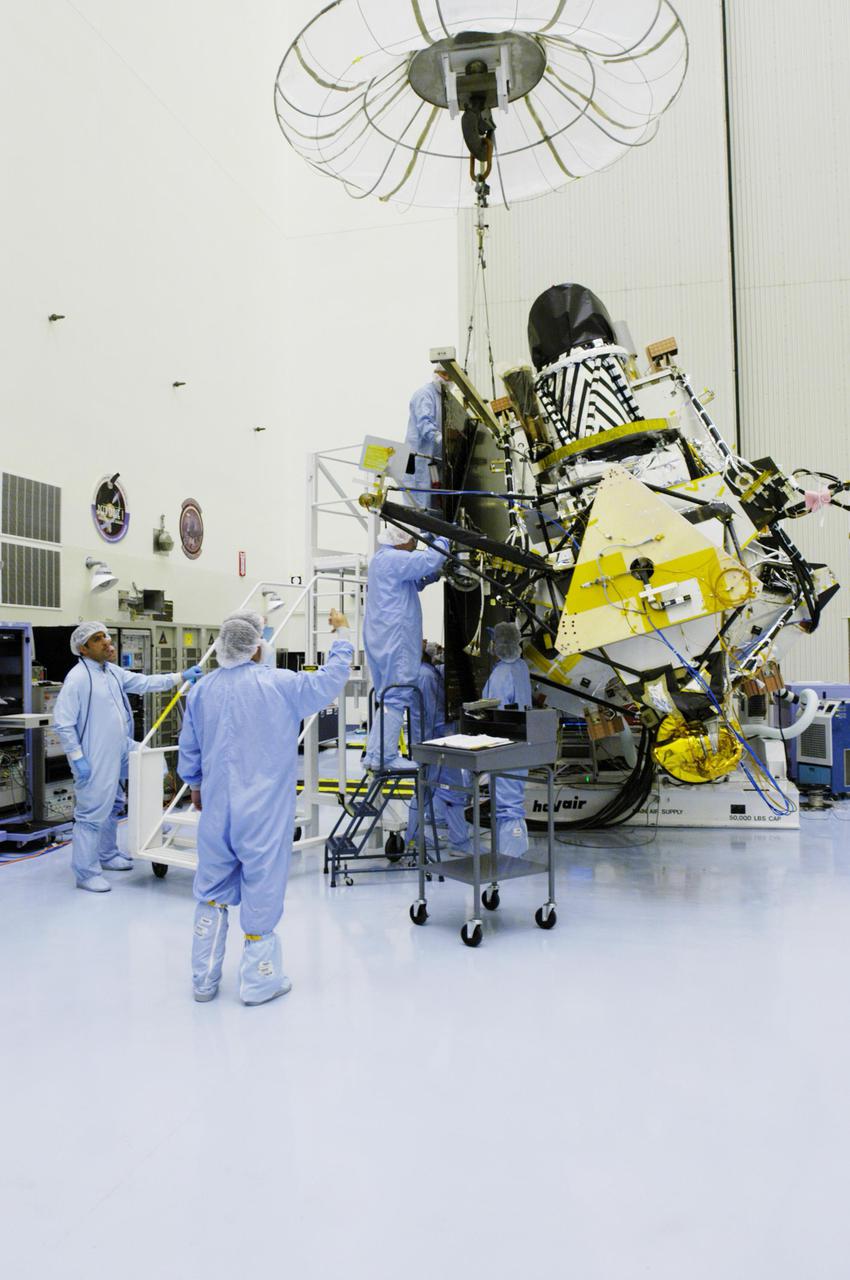
KENNEDY SPACE CENTER, FLA. - In the Payload Hazardous Servicing Facility, workers are removing the solar panel from the Mars Reconnaissance Orbiter spacecraft. A major deployment test will check out the spacecraft’s large solar arrays. The spacecraft will also undergo multiple mechanical assembly operations and electrical tests to verify its readiness for launch. The MRO was built by Lockheed Martin for NASA’s Jet Propulsion Laboratory in California. It is the next major step in Mars exploration and scheduled for launch from Cape Canaveral Air Force Station in a window opening Aug. 10. The MRO is an important next step in fulfilling NASA’s vision of space exploration and ultimately sending human explorers to Mars and beyond.
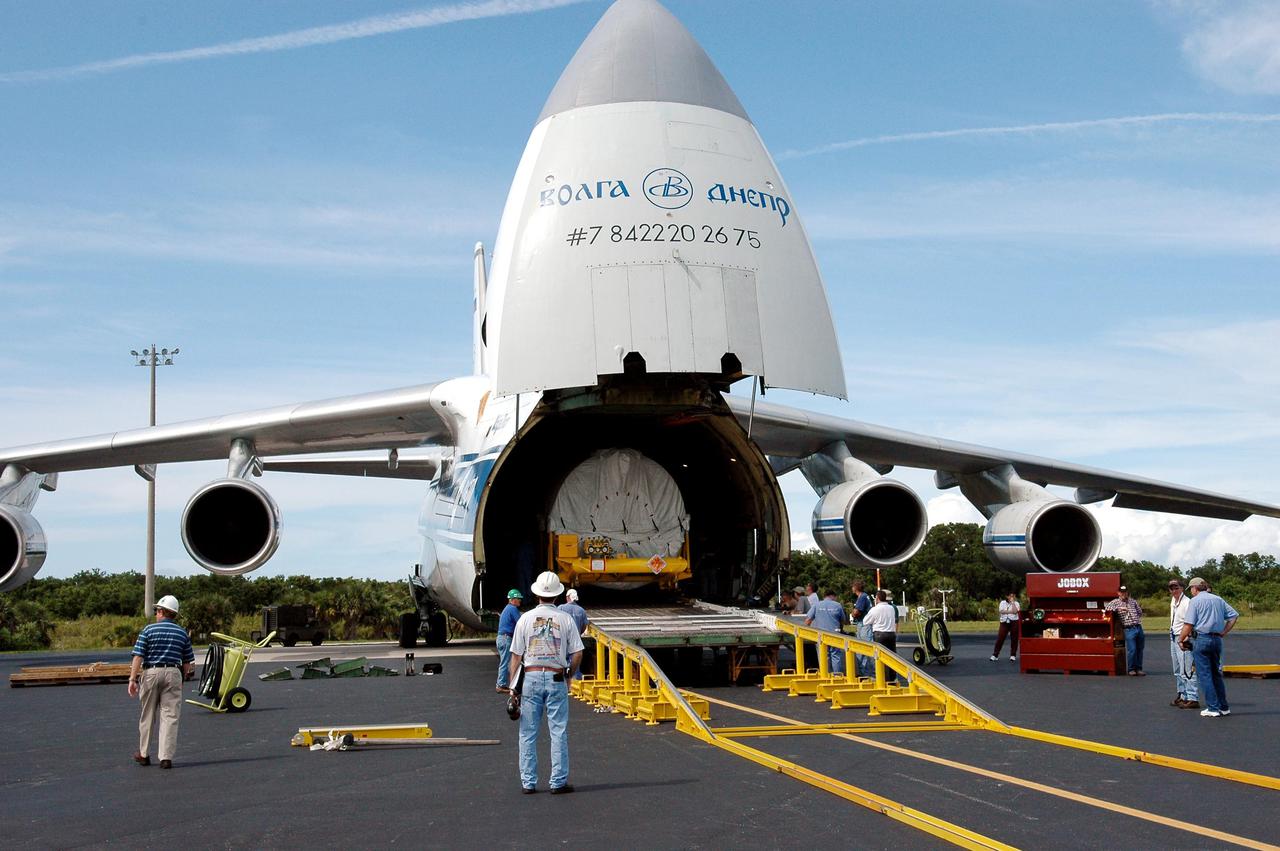
KENNEDY SPACE CENTER, FLA. - At the Cape Canaveral Air Force Station Skid Strip, a second stage Centaur (Block I) is ready to be offloaded from a Russian Antonov AH-124-100 cargo airplane. The Centaur will be mated with the Lockheed Martin Atlas V, designated AV-007, that is the launch vehicle for the Mars Reconnaissance Orbiter (MRO). The MRO is designed for a series of global mapping, regional survey and targeted observations from a near-polar, low-altitude Mars orbit. These observations will be unprecedented in terms of the spatial resolution and coverage achieved by the orbiter’s instruments as they observe the atmosphere and surface of Mars while probing its shallow subsurface as part of a “follow the water” strategy. The orbiter is undergoing environmental tests in facilities at Lockheed Martin Space Systems in Denver, Colo., and is on schedule for a launch window that begins Aug. 10. Launch will be from Launch Complex 41 at Cape Canaveral Air Force Station in Florida.

KENNEDY SPACE CENTER, FLA. - In the Payload Hazardous Servicing Facility at NASA’s Kennedy Space Center, workers from Lockheed Martin help guide the high-gain antenna toward the Mars Reconnaissance Orbiter (MRO) for installation. After solar array installation, the MRO will be transported to the Vertical Installation Facility in late July. It will join the Atlas V for the final phase of launch preparations. The spacecraft is then scheduled to undergo a functional test, and a final week of integrated testing and closeouts. The MRO was built by Lockheed Martin for the Jet Propulsion Laboratory in California. It is the next major step in Mars exploration and scheduled for launch from Cape Canaveral Air Force Station in a window opening Aug. 10. The MRO is an important next step in fulfilling NASA’s vision of space exploration and ultimately sending human explorers to Mars and beyond.
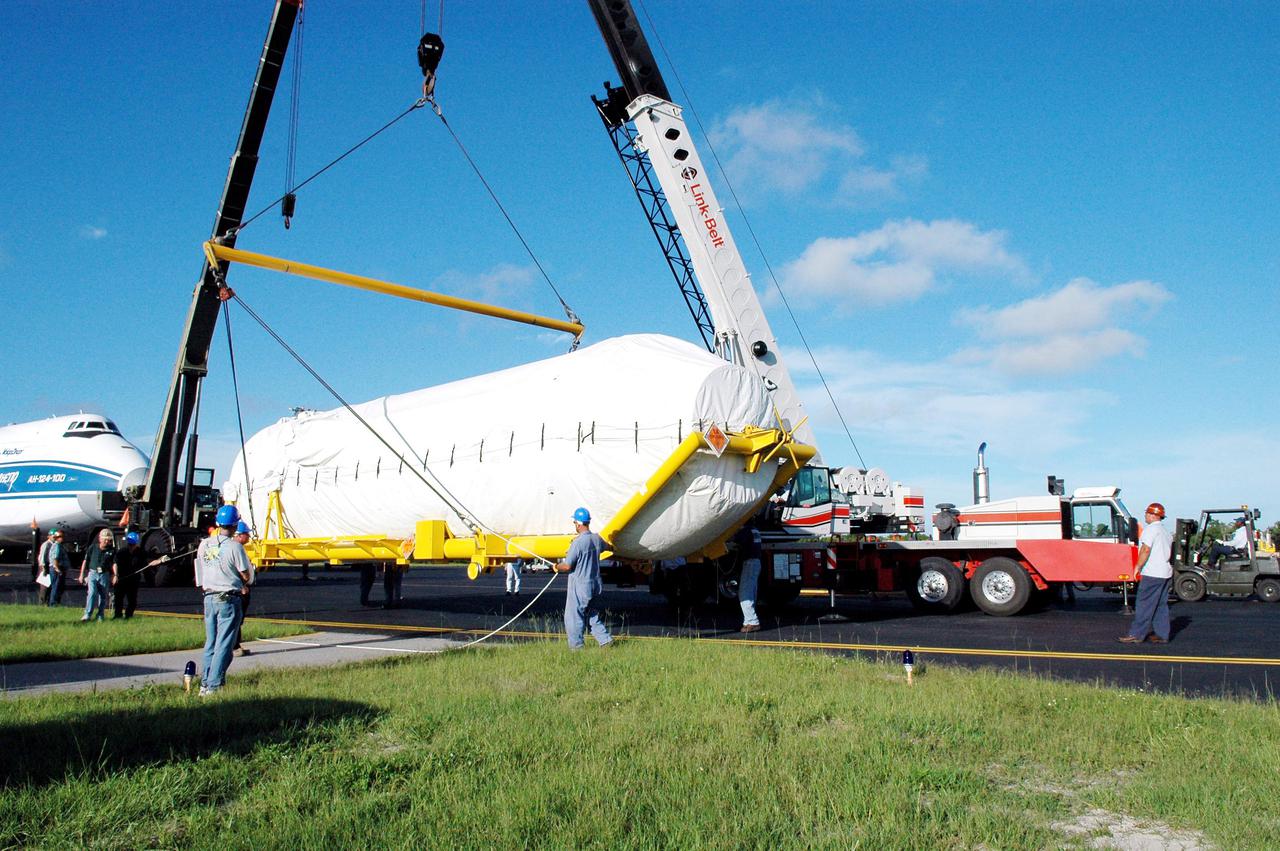
KENNEDY SPACE CENTER, FLA. - At the Cape Canaveral Air Force Station Skid Strip, a large crane is attached to the offloaded second stage Centaur (Block I) to lift and place it on a flat bed truck. The Centaur arrived on a Russian Antonov AH-124-100 cargo airplane. The Centaur upper stage will be mated with the Lockheed Martin Atlas V, designated AV-007, that is the launch vehicle for the Mars Reconnaissance Orbiter (MRO). The MRO is designed for a series of global mapping, regional survey and targeted observations from a near-polar, low-altitude Mars orbit. These observations will be unprecedented in terms of the spatial resolution and coverage achieved by the orbiter’s instruments as they observe the atmosphere and surface of Mars while probing its shallow subsurface as part of a “follow the water” strategy. The orbiter is undergoing environmental tests in facilities at Lockheed Martin Space Systems in Denver, Colo., and is on schedule for a launch window that begins Aug. 10. Launch will be from Launch Complex 41 at Cape Canaveral Air Force Station in Florida.

KENNEDY SPACE CENTER, FLA. - Workers in the Payload Hazardous Servicing Facility maneuver the second half of the fairing toward the Mars Reconnaissance Orbiter (right) for installation. The fairing protects the spacecraft during launch and flight through the atmosphere. Once in space, it is jettisoned. Launch of the MRO aboard an Atlas V rocket will be from Launch Complex 41 at Cape Canaveral Air Force Station in Florida. The MRO is the next major step in Mars exploration and scheduled for launch from Cape Canaveral Air Force Station in a window opening Aug. 10. The MRO is an important next step in fulfilling NASA’s vision of space exploration and ultimately sending human explorers to Mars and beyond.
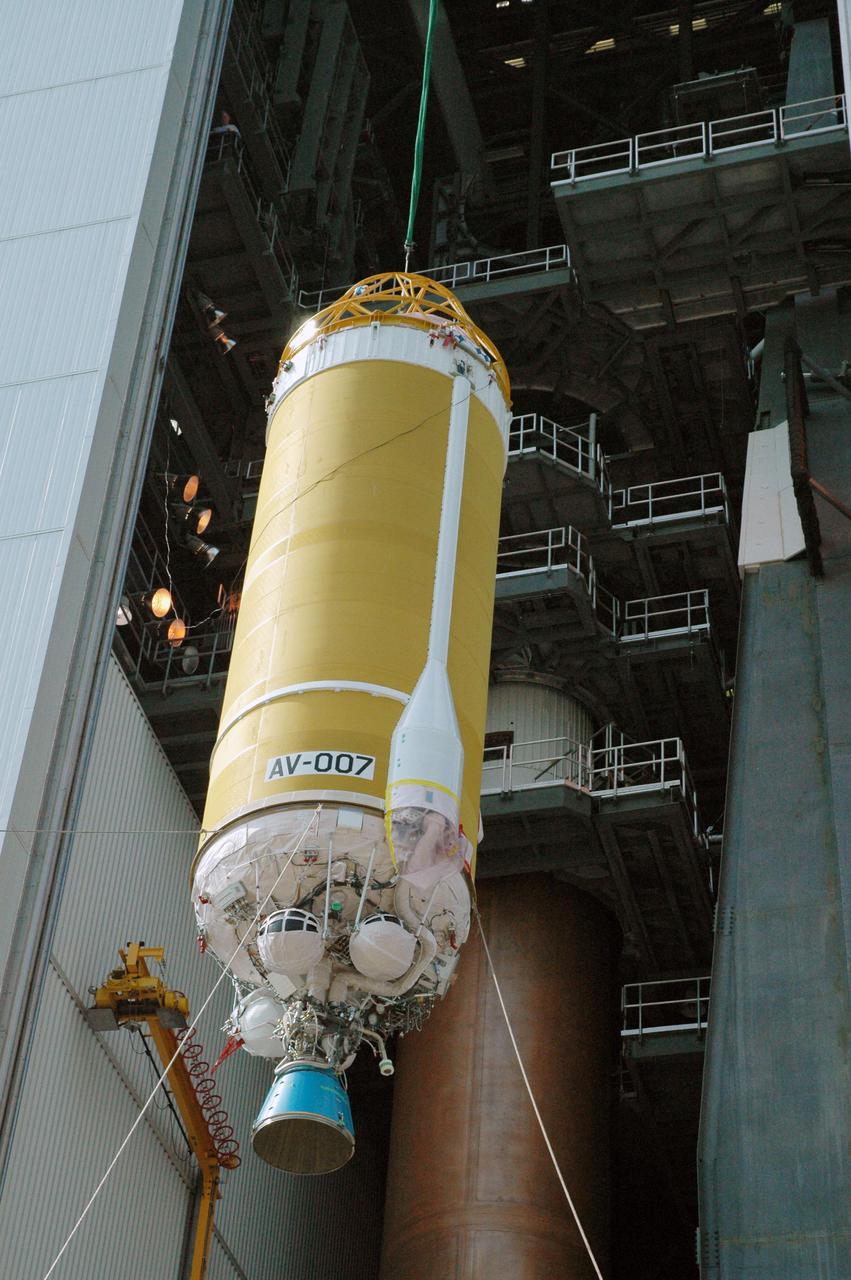
KENNEDY SPACE CENTER, FLA. - At the Vertical Integration Facility on Launch Pad 41 at Cape Canaveral Air Force Station in Florida, the Lockheed Martin Centaur second stage is lifted into the launch tower where it will be mated with the Atlas V already there. The Atlas V_Centaur is the launch vehicle for the Mars Reconnaissance Orbiter (MRO). The MRO is designed for a series of global mapping, regional survey and targeted observations from a near-polar, low-altitude Mars orbit. These observations will be unprecedented in terms of the spatial resolution and coverage achieved by the orbiter’s instruments as they observe the atmosphere and surface of Mars while probing its shallow subsurface as part of a “follow the water” strategy. The launch window for the MRO begins Aug. 10.
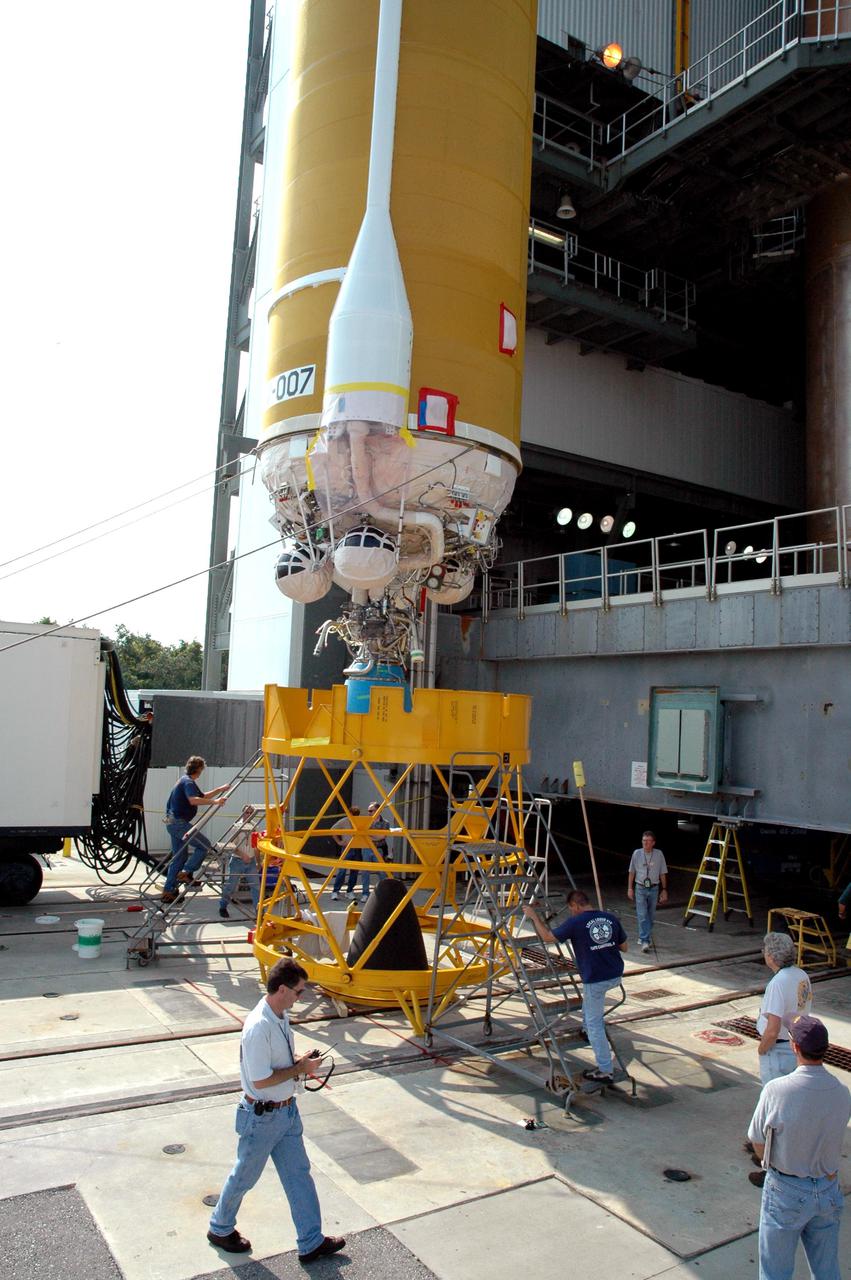
KENNEDY SPACE CENTER, FLA. - At the Vertical Integration Facility on Launch Pad 41 at Cape Canaveral Air Force Station in Florida, the Lockheed Martin Centaur second stage is ready for lifting into the launch tower where it will be mated with the Atlas V already there. The Atlas V_Centaur is the launch vehicle for the Mars Reconnaissance Orbiter (MRO). The MRO is designed for a series of global mapping, regional survey and targeted observations from a near-polar, low-altitude Mars orbit. These observations will be unprecedented in terms of the spatial resolution and coverage achieved by the orbiter’s instruments as they observe the atmosphere and surface of Mars while probing its shallow subsurface as part of a “follow the water” strategy. The launch window for the MRO begins Aug. 10.
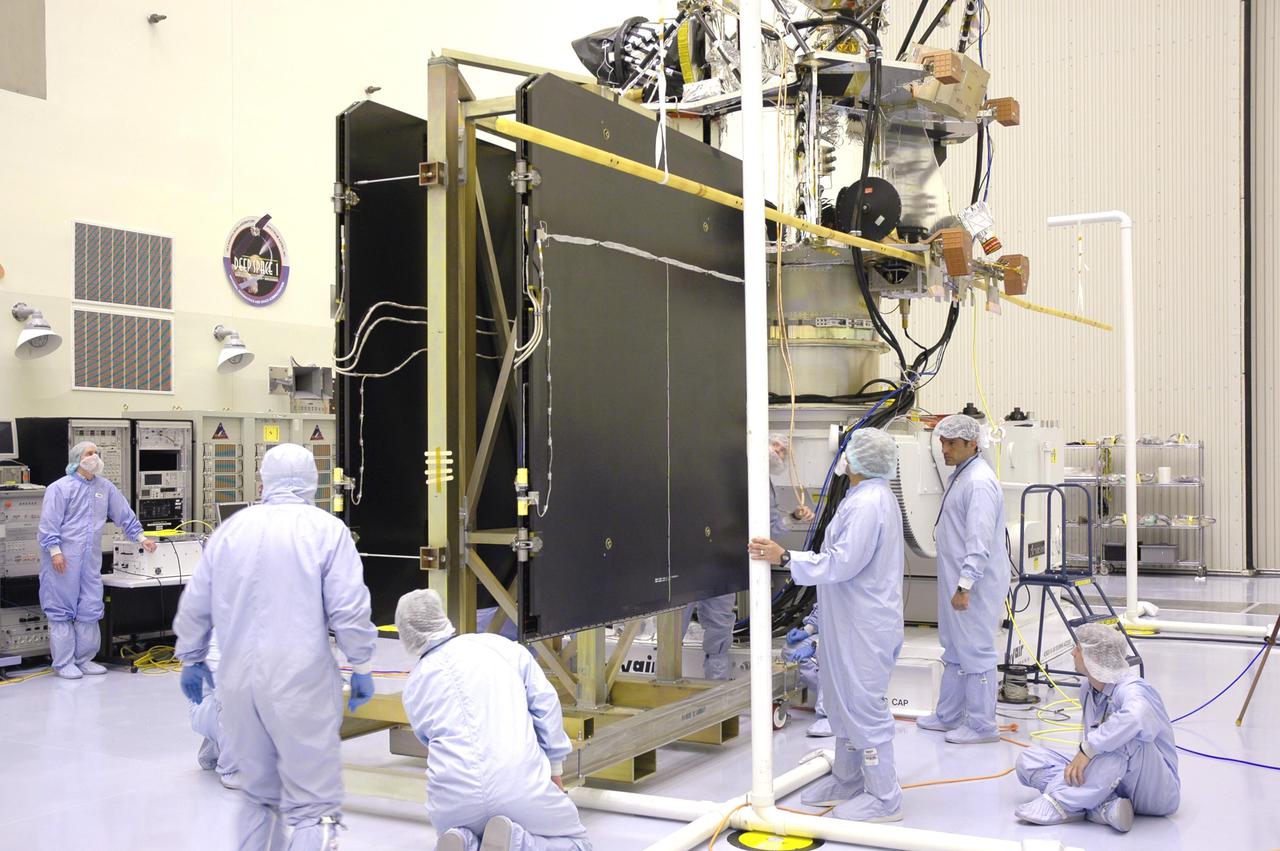
KENNEDY SPACE CENTER, FLA. - In the Payload Hazardous Servicing Facility, technicians prepare the solar arrays for the Mars Reconnaissance Orbiter (MRO) and an antenna simulator (yellow horizontal rod) for an electromagnetic interference verification test. If no interference is found during the test, the Shallow Radar Antenna (SHARAD) will be installed on the spacecraft. The spacecraft is undergoing multiple mechanical assembly operations and electrical tests to verify its readiness for launch. The MRO was built by Lockheed Martin for NASA’s Jet Propulsion Laboratory in California. It is the next major step in Mars exploration and scheduled for launch from Launch Complex 41 at Cape Canaveral Air Force Station in a window opening Aug. 10. The MRO is an important next step in fulfilling NASA’s vision of space exploration and ultimately sending human explorers to Mars and beyond.
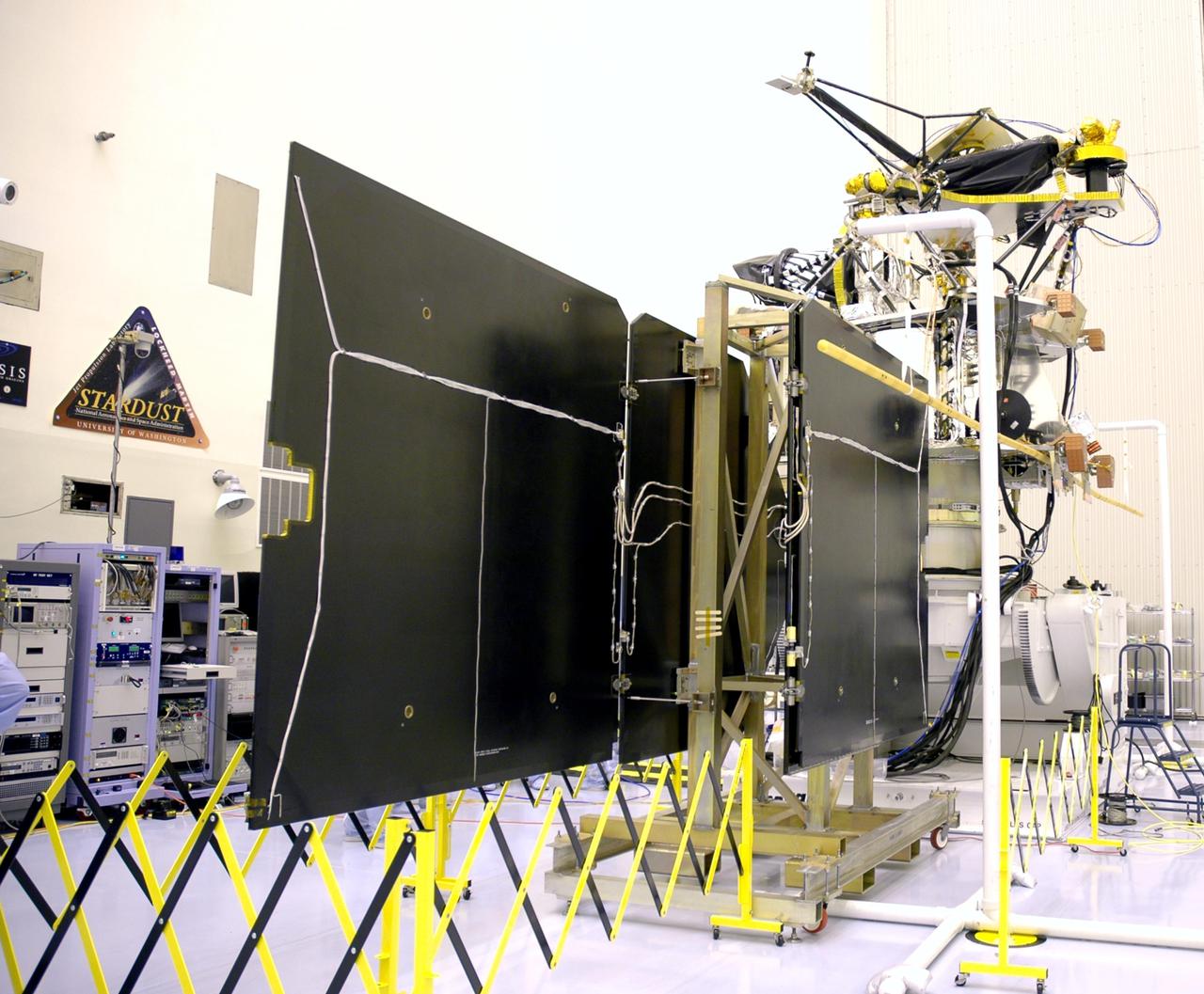
KENNEDY SPACE CENTER, FLA. - In the Payload Hazardous Servicing Facility, an electromagnetic interference verification test is being conducted on the solar arrays for the Mars Reconnaissance Orbiter (MRO) and an antenna simulator (yellow horizontal rod). If no interference is found during the test, the Shallow Radar Antenna (SHARAD) will be installed on the spacecraft. The spacecraft is undergoing multiple mechanical assembly operations and electrical tests to verify its readiness for launch. The MRO was built by Lockheed Martin for NASA’s Jet Propulsion Laboratory in California. It is the next major step in Mars exploration and scheduled for launch from Launch Complex 41 at Cape Canaveral Air Force Station in a window opening Aug. 10. The MRO is an important next step in fulfilling NASA’s vision of space exploration and ultimately sending human explorers to Mars and beyond.

KENNEDY SPACE CENTER, FLA. - In the Payload Hazardous Servicing Facility, the Mars Reconnaissance Orbiter (MRO) has been lifted off the rotation stand and is being moved toward a Mars Orbit Insertion Thruster assembly stand for testing. In late July, the MRO will be transported to the Vertical Installation Facility. It will join the Atlas V for the final phase of launch preparations. The spacecraft is then scheduled to undergo a functional test, and a final week of integrated testing and closeouts. The MRO was built by Lockheed Martin for the Jet Propulsion Laboratory in California. It is the next major step in Mars exploration and scheduled for launch from Cape Canaveral Air Force Station in a window opening Aug. 10. The MRO is an important next step in fulfilling NASA’s vision of space exploration and ultimately sending human explorers to Mars and beyond.

KENNEDY SPACE CENTER, FLA. -In the Payload Hazardous Servicing Facility, workers from Lockheed Martin help guide the Mars Reconnaissance Orbiter (MRO) onto a Mars Orbit Insertion Thruster assembly stand for testing. In late July, the MRO will be transported to the Vertical Installation Facility. It will join the Atlas V for the final phase of launch preparations. The spacecraft is then scheduled to undergo a functional test, and a final week of integrated testing and closeouts. The MRO was built by Lockheed Martin for the Jet Propulsion Laboratory in California. It is the next major step in Mars exploration and scheduled for launch from Cape Canaveral Air Force Station in a window opening Aug. 10. The MRO is an important next step in fulfilling NASA’s vision of space exploration and ultimately sending human explorers to Mars and beyond.
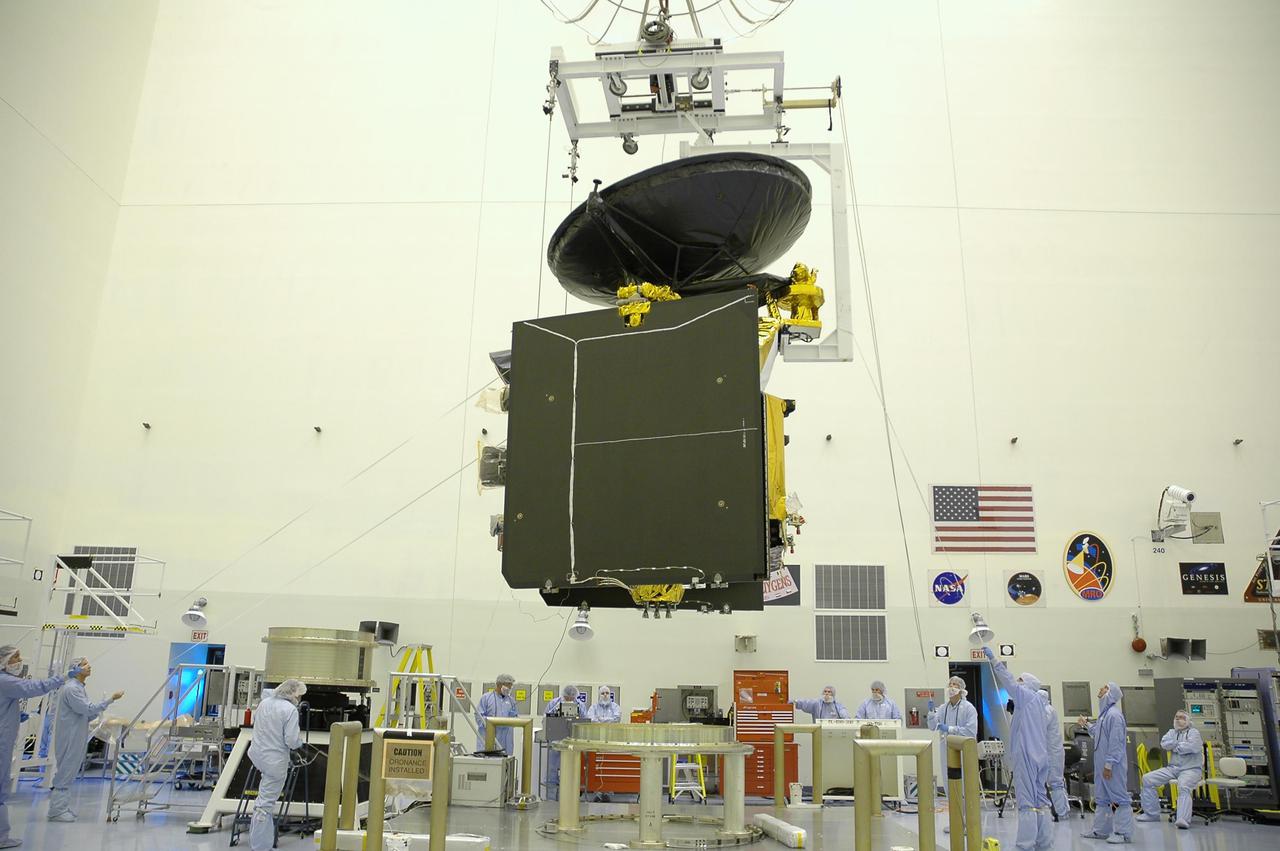
KENNEDY SPACE CENTER, FLA. -- In the Payload Hazardous Servicing Facility, the Mars Reconnaissance Orbiter (MRO) is lifted off a workstand for transfer to the spin balance machine for testing. In late July, the MRO will be transported to the Vertical Installation Facility. It will join the Atlas V for the final phase of launch preparations. The spacecraft is then scheduled to undergo a functional test, and a final week of integrated testing and closeouts. The MRO was built by Lockheed Martin for the Jet Propulsion Laboratory in California. It is the next major step in Mars exploration and scheduled for launch from Cape Canaveral Air Force Station in a window opening Aug. 10. The MRO is an important next step in fulfilling NASA’s vision of space exploration and ultimately sending human explorers to Mars and beyond.
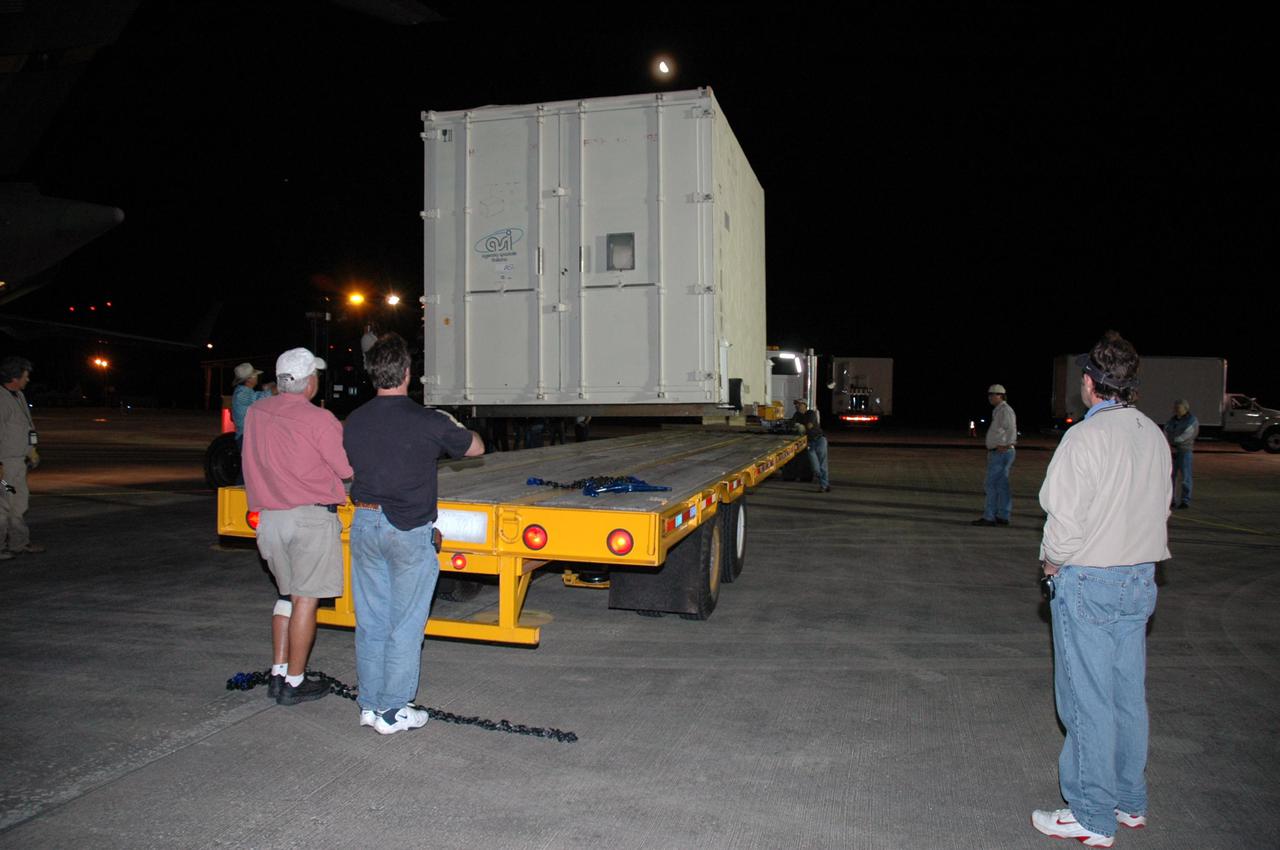
KENNEDY SPACE CENTER, FLA. - At Kennedy Space Center's Shuttle Landing Facility, the second of two containers with the Mars Reconnaissance Orbiter (MRO) equipment is lifted onto a flatbed truck for transport to the Payload Hazardous Servicing Facility. The MRO was built by Lockheed Martin for NASA's Jet Propulsion Laboratory in California. It is the next major step in Mars exploration and scheduled for launch from Cape Canaveral Air Force Station in a window opening Aug. 10. The MRO carries six primary instruments: the High Resolution Imaging Science Experiment, Context Camera, Mars Color Imager, Compact Reconnaissance Imaging Spectrometer for Mars, Mars Climate Sounder and Shallow Radar. By 2007, the MRO will begin a series of global mapping, regional survey and targeted observations from a near-polar, low-altitude Mars orbit. It will observe the atmosphere and surface of Mars while probing its shallow subsurface as part of a “follow the water” strategy.
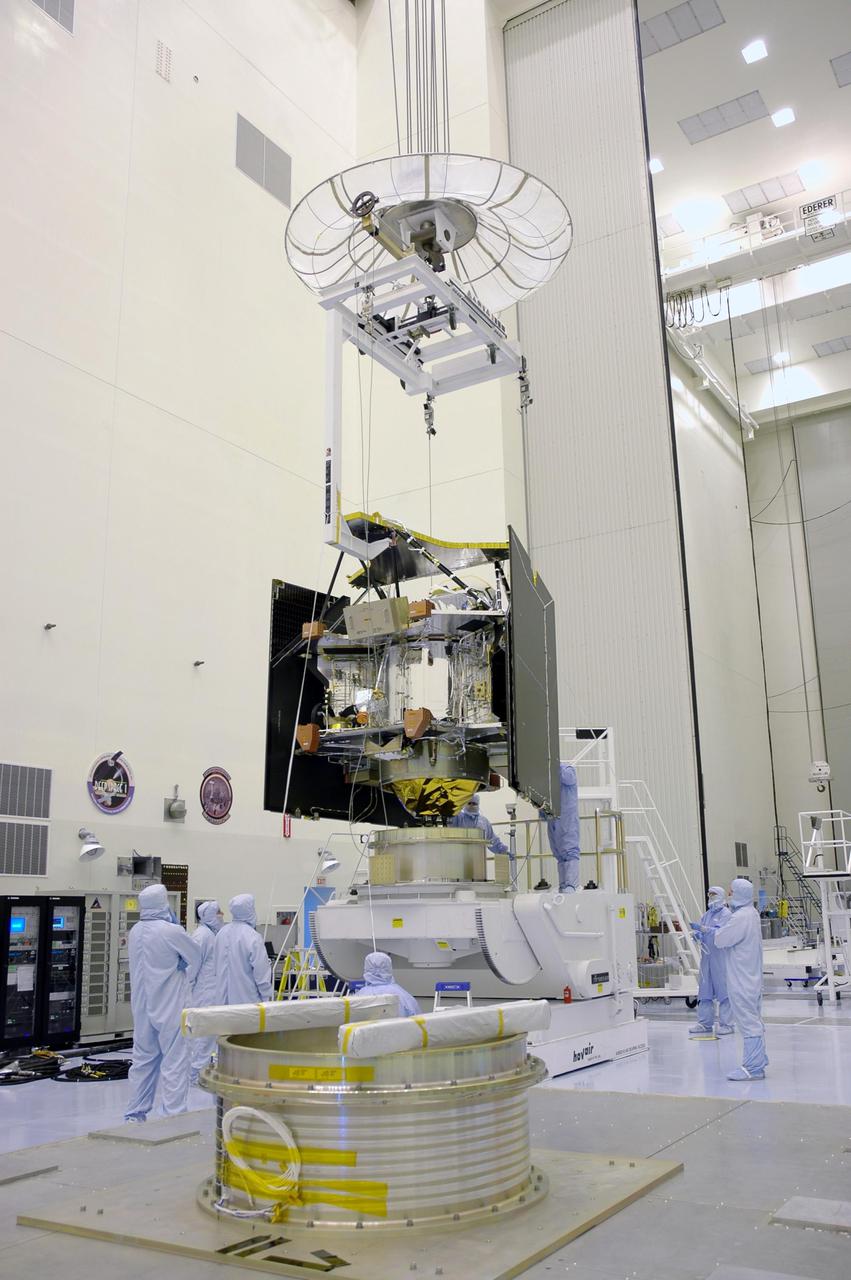
KENNEDY SPACE CENTER, FLA. - In a clean room inside the Payload Hazardous Servicing Facility (PHSF) at NASA’s Kennedy Space Center, the suspended Mars Reconnaissance Orbiter (MRO) nears the workstand in the background for final assembly and testing. In the PHSF, the spacecraft will undergo multiple mechanical assembly operations and electrical tests to verify its readiness for launch. A test this month will verify the spacecraft’s ability to communicate through NASA's Deep Space Network tracking stations. A June test will check the deployment of the spacecraft's high gain communications antenna. Another major deployment test will check out the spacecraft's large solar arrays. The MRO was built for NASA’s Jet Propulsion Laboratory in California. It is the next major step in Mars exploration and scheduled for launch from Cape Canaveral Air Force Station in a window opening Aug. 10. The MRO is an important next step in fulfilling NASA’s vision of space exploration and ultimately sending human explorers to Mars and beyond.
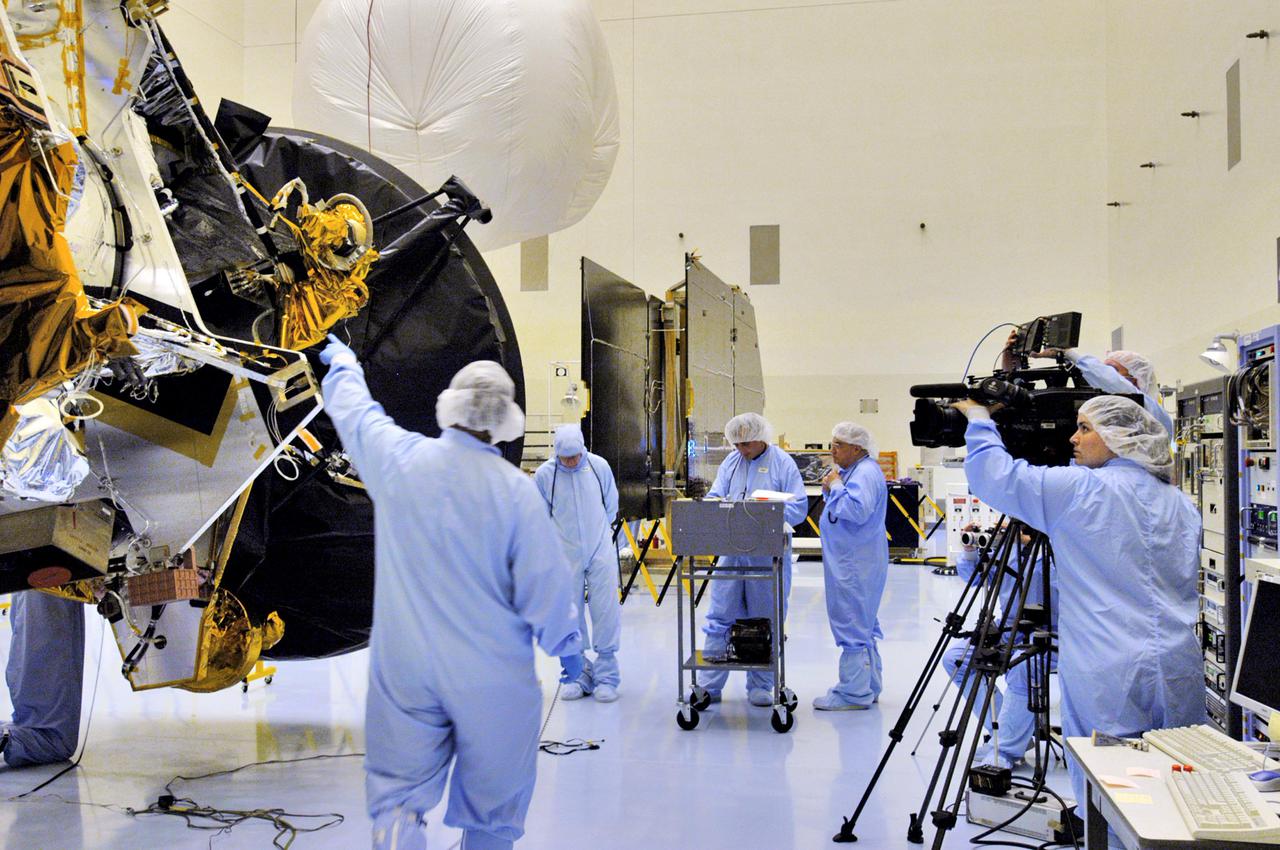
KENNEDY SPACE CENTER, FLA. - In the Payload Hazardous Servicing Facility at NASA’s Kennedy Space Center, workers from Lockheed Martin test the installation of the high-gain antenna on the Mars Reconnaissance Orbiter (MRO). After solar array installation, the MRO will be transported to the Vertical Installation Facility in late July. It will join the Atlas V for the final phase of launch preparations. The spacecraft is then scheduled to undergo a functional test, and a final week of integrated testing and closeouts. The MRO was built by Lockheed Martin for the Jet Propulsion Laboratory in California. It is the next major step in Mars exploration and scheduled for launch from Cape Canaveral Air Force Station in a window opening Aug. 10. The MRO is an important next step in fulfilling NASA’s vision of space exploration and ultimately sending human explorers to Mars and beyond.
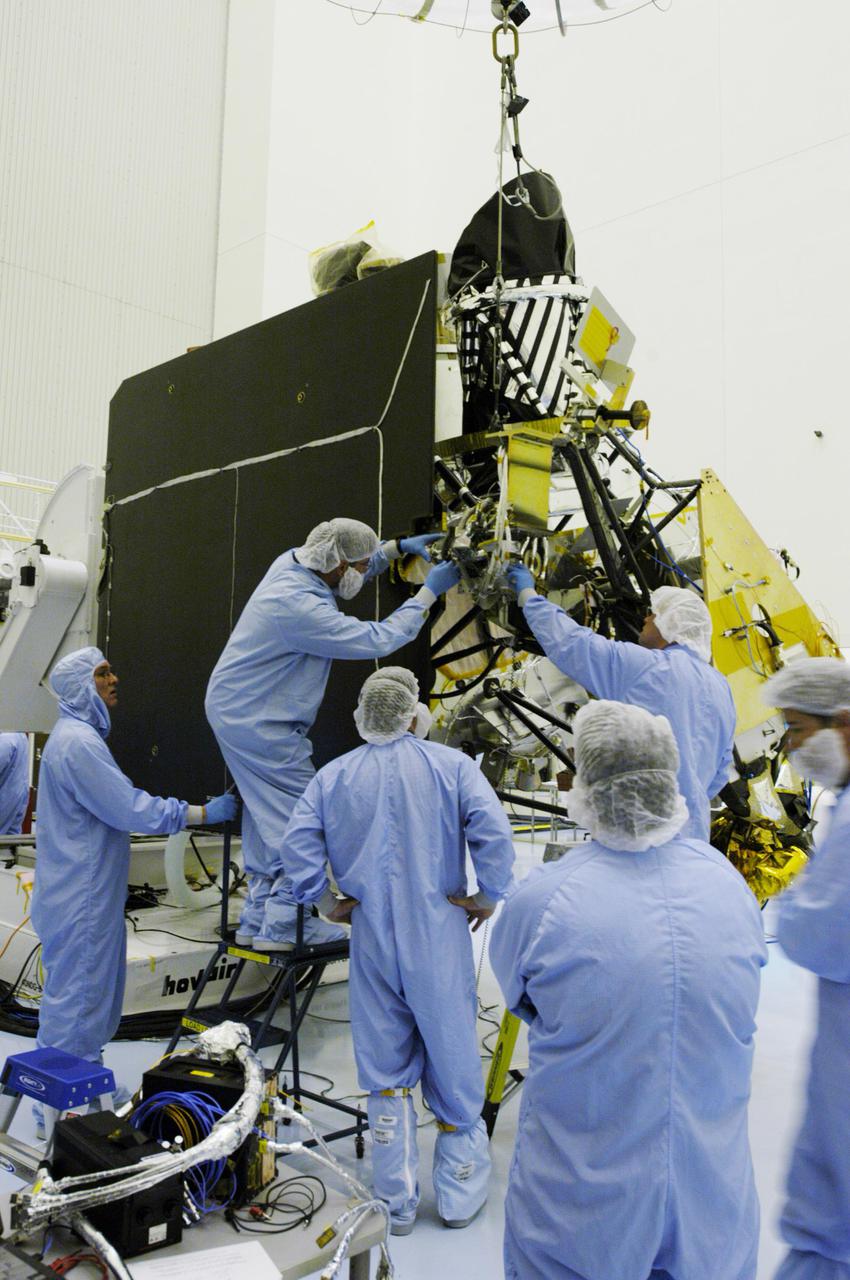
KENNEDY SPACE CENTER, FLA. - In the Payload Hazardous Servicing Facility at NASA’s Kennedy Space Center, engineers begin installing the gimbal on the Mars Reconnaissance Orbiter (MRO) solar panel. A gimbal is an appliance that allows an object to remain horizontal even as its support tips. In the PHSF, the spacecraft will undergo multiple mechanical assembly operations and electrical tests to verify its readiness for launch. A major deployment test will check out the spacecraft’s large solar arrays. The MRO was built by Lockheed Martin for NASA’s Jet Propulsion Laboratory in California. It is the next major step in Mars exploration and scheduled for launch from Cape Canaveral Air Force Station in a window opening Aug. 10. The MRO is an important next step in fulfilling NASA’s vision of space exploration and ultimately sending human explorers to Mars and beyond.
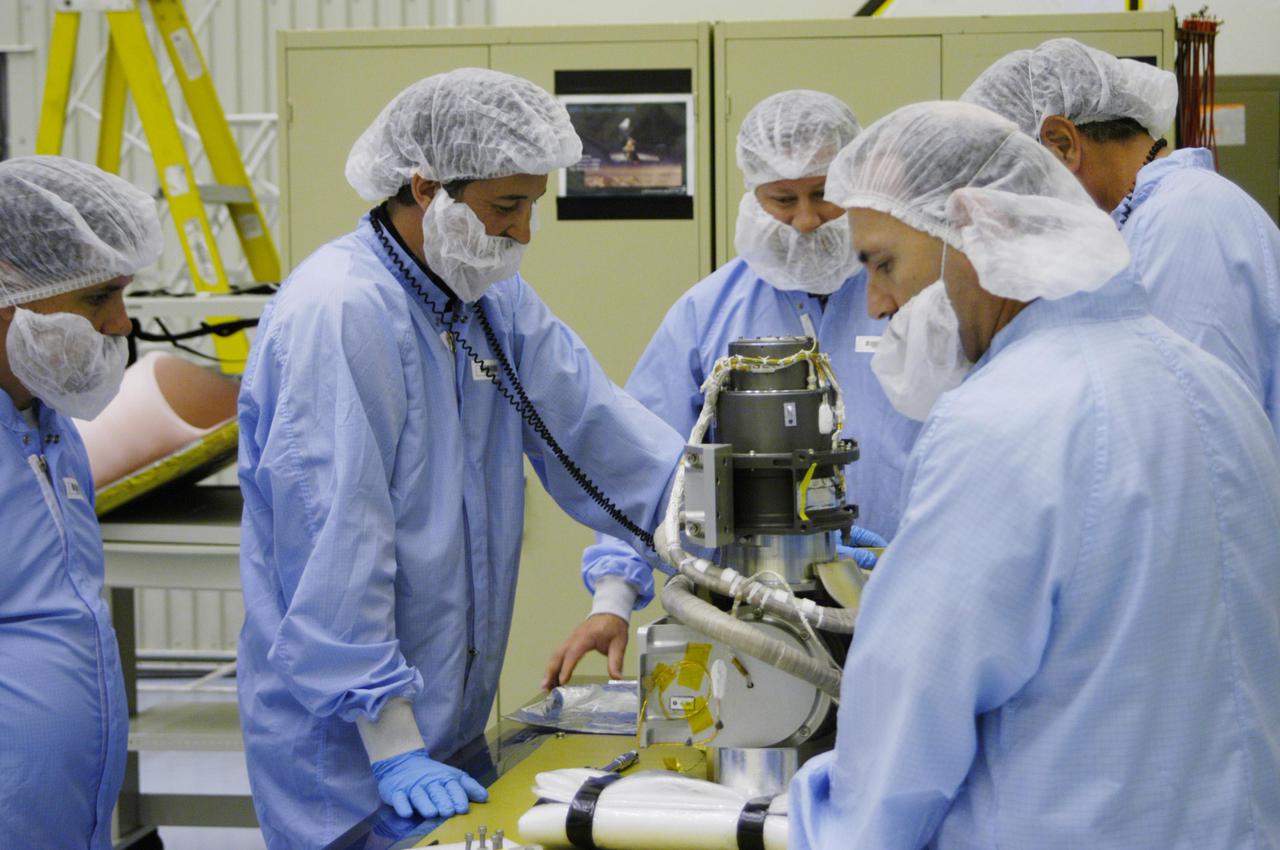
KENNEDY SPACE CENTER, FLA. - In the Payload Hazardous Servicing Facility at NASA’s Kennedy Space Center, engineers prepare to install the gimbal on the Mars Reconnaissance Orbiter (MRO) solar panel. A gimbal is an appliance that allows an object to remain horizontal even as its support tips. In the PHSF, the spacecraft will undergo multiple mechanical assembly operations and electrical tests to verify its readiness for launch. A major deployment test will check out the spacecraft’s large solar arrays. The MRO was built by Lockheed Martin for NASA’s Jet Propulsion Laboratory in California. It is the next major step in Mars exploration and scheduled for launch from Cape Canaveral Air Force Station in a window opening Aug. 10. The MRO is an important next step in fulfilling NASA’s vision of space exploration and ultimately sending human explorers to Mars and beyond.
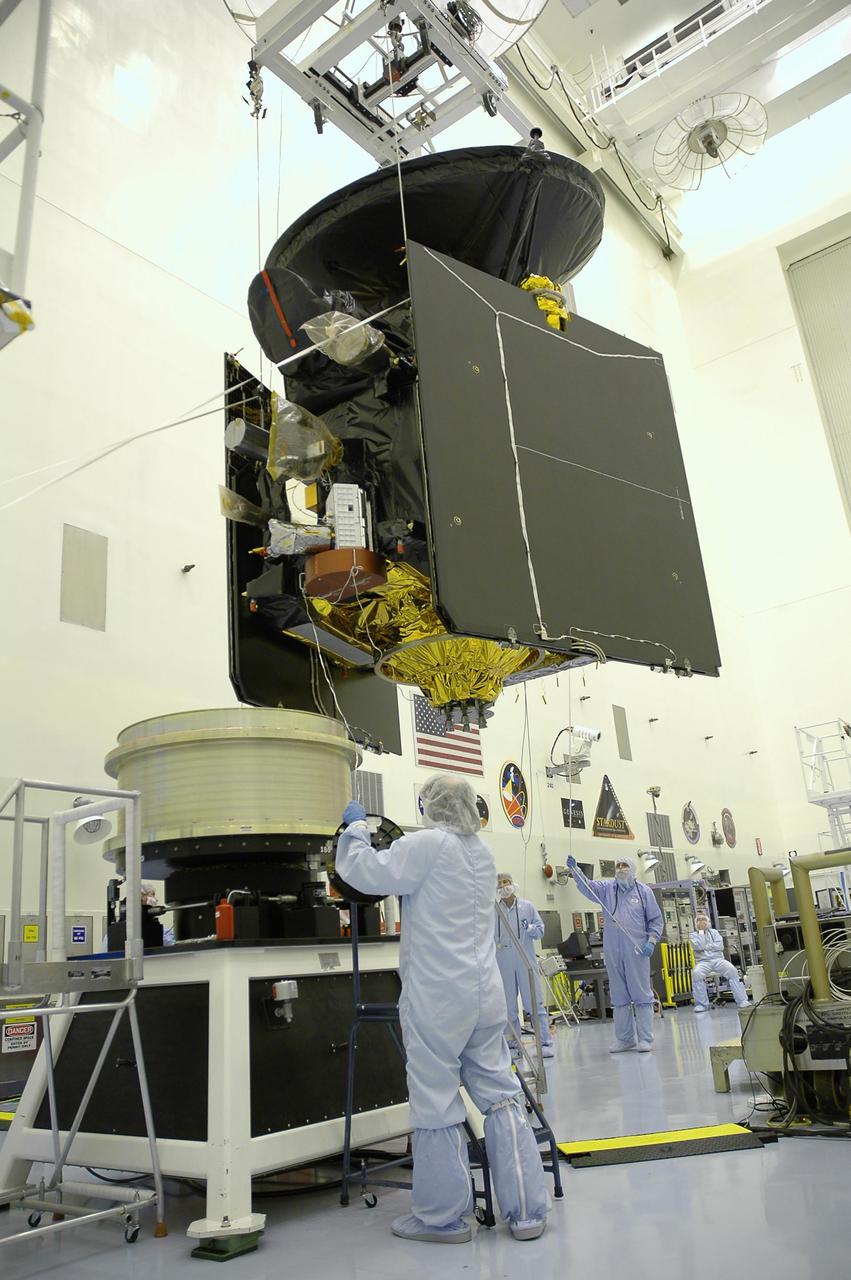
KENNEDY SPACE CENTER, FLA. -- In the Payload Hazardous Servicing Facility, workers from Lockheed Martin guide the suspended Mars Reconnaissance Orbiter (MRO) toward the spin balance machine for testing. In late July, the MRO will be transported to the Vertical Installation Facility. It will join the Atlas V for the final phase of launch preparations. The spacecraft is then scheduled to undergo a functional test, and a final week of integrated testing and closeouts. The MRO was built by Lockheed Martin for the Jet Propulsion Laboratory in California. It is the next major step in Mars exploration and scheduled for launch from Cape Canaveral Air Force Station in a window opening Aug. 10. The MRO is an important next step in fulfilling NASA’s vision of space exploration and ultimately sending human explorers to Mars and beyond.

KENNEDY SPACE CENTER, FLA. - At Kennedy Space Center's Shuttle Landing Facility, one of two containers with the Mars Reconnaissance Orbiter (MRO) equipment is rolled toward the ramp of the Air Force C-17 cargo plane. The MRO is being moved to the Payload Hazardous Servicing Facility. The MRO was built by Lockheed Martin for NASA's Jet Propulsion Laboratory in California. It is the next major step in Mars exploration and scheduled for launch from Cape Canaveral Air Force Station in a window opening Aug. 10. The MRO carries six primary instruments: the High Resolution Imaging Science Experiment, Context Camera, Mars Color Imager, Compact Reconnaissance Imaging Spectrometer for Mars, Mars Climate Sounder and Shallow Radar. By 2007, the MRO will begin a series of global mapping, regional survey and targeted observations from a near-polar, low-altitude Mars orbit. It will observe the atmosphere and surface of Mars while probing its shallow subsurface as part of a “follow the water” strategy.
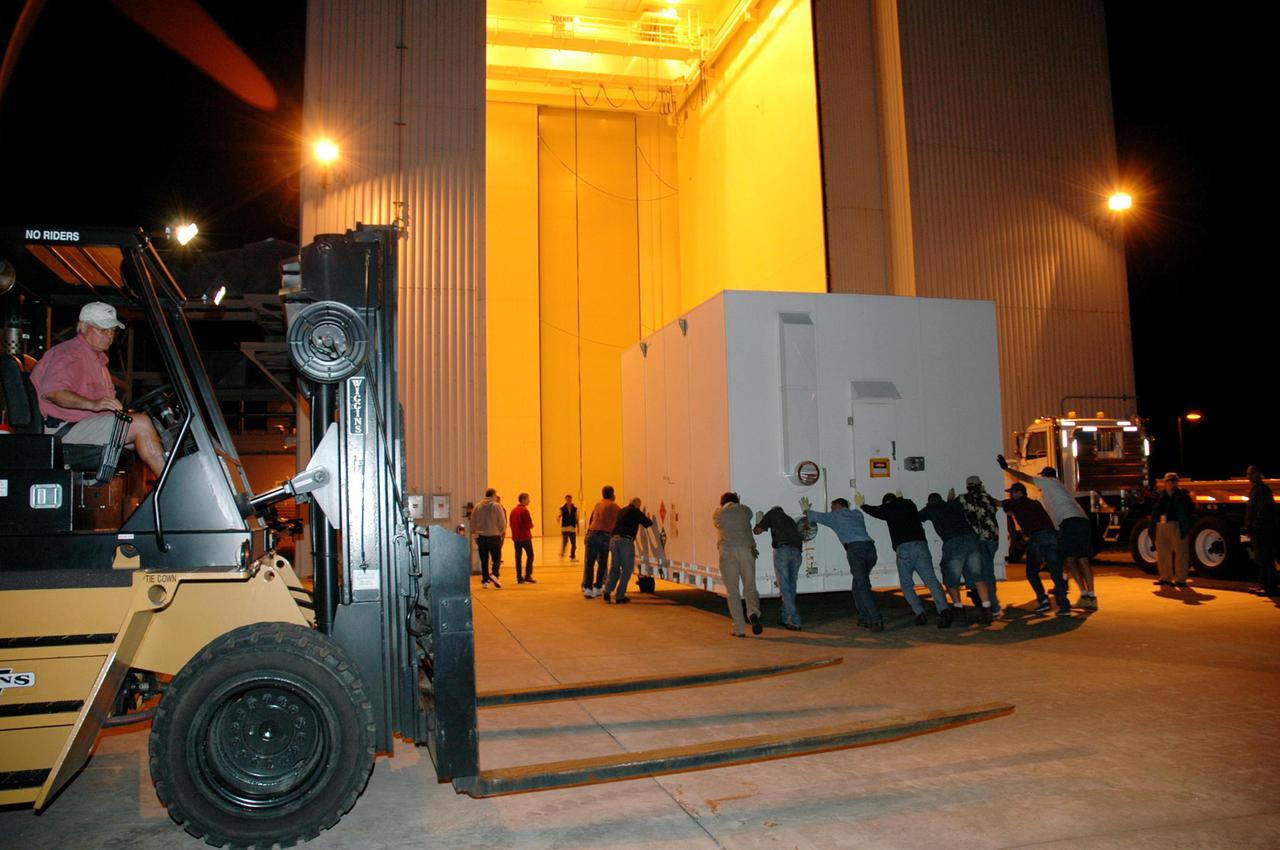
KENNEDY SPACE CENTER, FLA. - Workers roll one of two containers with the Mars Reconnaissance Orbiter (MRO) equipment into the Payload Hazardous Servicing Facility. The MRO was built by Lockheed Martin for NASA's Jet Propulsion Laboratory in California. It is the next major step in Mars exploration and scheduled for launch from Cape Canaveral Air Force Station in a window opening Aug. 10. The MRO carries six primary instruments: the High Resolution Imaging Science Experiment, Context Camera, Mars Color Imager, Compact Reconnaissance Imaging Spectrometer for Mars, Mars Climate Sounder and Shallow Radar. By 2007, the MRO will begin a series of global mapping, regional survey and targeted observations from a near-polar, low-altitude Mars orbit. It will observe the atmosphere and surface of Mars while probing its shallow subsurface as part of a “follow the water” strategy.

KENNEDY SPACE CENTER, FLA. - A Russian Antonov AH-124-100 cargo airplane lands at the Cape Canaveral Air Force Station Skid Strip. The plane is delivering a second stage Centaur (Block I) for the Lockheed Martin Atlas V, designated AV-007, that is the launch vehicle for the Mars Reconnaissance Orbiter (MRO). The MRO is designed for a series of global mapping, regional survey and targeted observations from a near-polar, low-altitude Mars orbit. These observations will be unprecedented in terms of the spatial resolution and coverage achieved by the orbiter’s instruments as they observe the atmosphere and surface of Mars while probing its shallow subsurface as part of a “follow the water” strategy. The orbiter is undergoing environmental tests in facilities at Lockheed Martin Space Systems in Denver, Colo., and is on schedule for a launch window that begins Aug. 10. Launch will be from Launch Complex 41 at Cape Canaveral Air Force Station in Florida.

KENNEDY SPACE CENTER, FLA. - A Russian Antonov AH-124-100 cargo airplane heads for a landing at the Cape Canaveral Air Force Station Skid Strip. The plane is delivering a second stage Centaur (Block I) for the Lockheed Martin Atlas V, designated AV-007, that is the launch vehicle for the Mars Reconnaissance Orbiter (MRO). The MRO is designed for a series of global mapping, regional survey and targeted observations from a near-polar, low-altitude Mars orbit. These observations will be unprecedented in terms of the spatial resolution and coverage achieved by the orbiter’s instruments as they observe the atmosphere and surface of Mars while probing its shallow subsurface as part of a “follow the water” strategy. The orbiter is undergoing environmental tests in facilities at Lockheed Martin Space Systems in Denver, Colo., and is on schedule for a launch window that begins Aug. 10. Launch will be from Launch Complex 41 at Cape Canaveral Air Force Station in Florida.
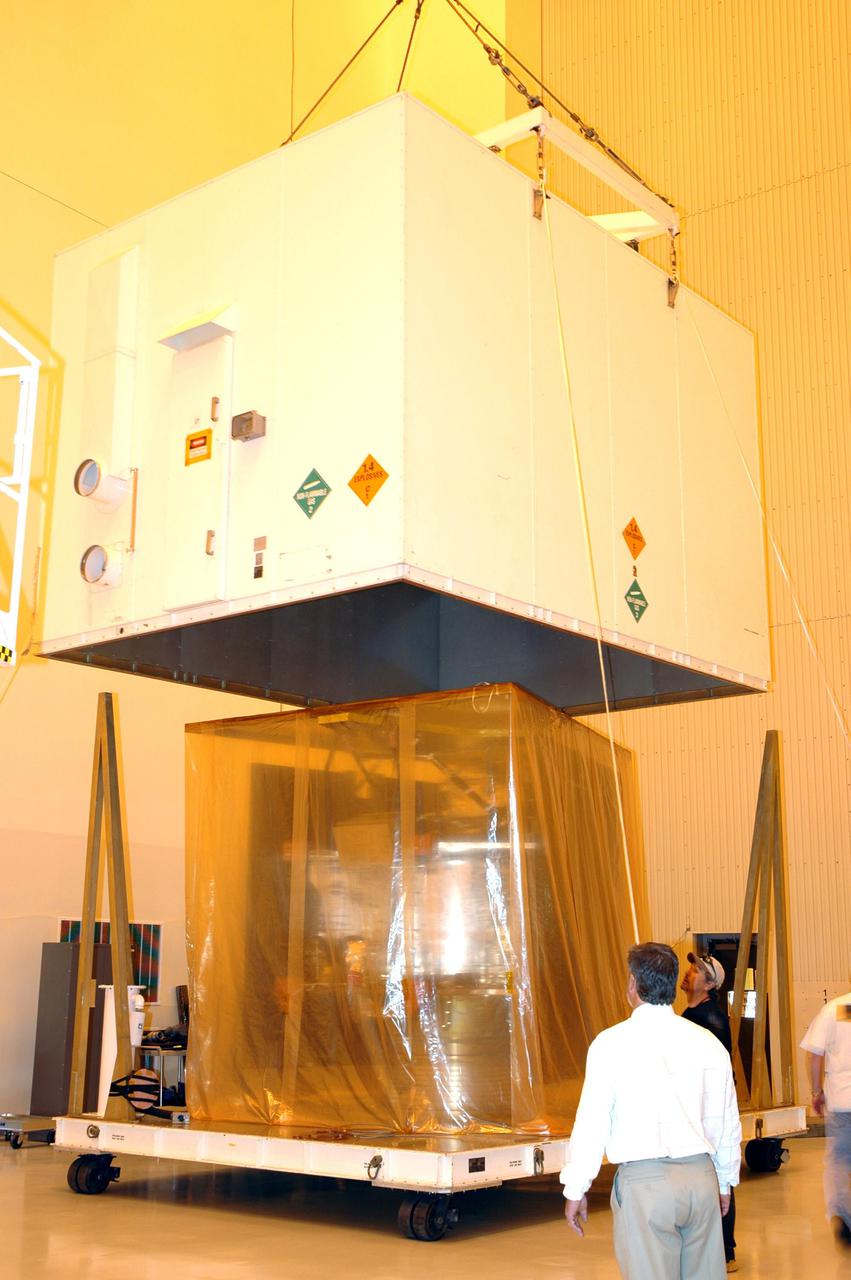
KENNEDY SPACE CENTER, FLA. - Inside the Payload Hazardous Servicing Facility (PHSF) at NASA's Kennedy Space Center, the cover is removed from one of the boxes containing NASA's Mars Reconnaissance Orbiter. Here in the PHSF, the spacecraft will undergo multiple mechanical assembly operations and electrical tests to verify its readiness for launch. A test this month will verify the spacecraft's ability to communicate through NASA's Deep Space Network tracking stations. A June test will check the deployment of the spacecraft's high gain communications antenna. Another major deployment test will check out the spacecraft's large solar arrays. The MRO was built by Lockheed Martin for NASA's Jet Propulsion Laboratory in California. It is the next major step in Mars exploration and scheduled for launch from Cape Canaveral Air Force Station in a window opening Aug. 10. The MRO is an important next step in fulfilling NASA's vision of space exploration and ultimately sending human explorers to Mars and beyond.

KENNEDY SPACE CENTER, FLA. - In the Payload Hazardous Servicing Facility, workers from Lockheed Martin install the Mars Reconnaissance Orbiter (MRO) onto a Mars Orbit Insertion Thruster assembly stand for testing. In late July, the MRO will be transported to the Vertical Installation Facility. It will join the Atlas V for the final phase of launch preparations. The spacecraft is then scheduled to undergo a functional test, and a final week of integrated testing and closeouts. The MRO was built by Lockheed Martin for the Jet Propulsion Laboratory in California. It is the next major step in Mars exploration and scheduled for launch from Cape Canaveral Air Force Station in a window opening Aug. 10. The MRO is an important next step in fulfilling NASA’s vision of space exploration and ultimately sending human explorers to Mars and beyond.

KENNEDY SPACE CENTER, FLA. - In a clean room inside the Payload Hazardous Servicing Facility (PHSF) at NASA's Kennedy Space Center, Lockheed Martin workers attach the straps from an overhead crane to the Mars Reconnaissance Orbiter (MRO). The crane will lift the spacecraft and move it to a nearby workstand for final assembly and testing. In the PHSF, the spacecraft will undergo multiple mechanical assembly operations and electrical tests to verify its readiness for launch. A test this month will verify the spacecraft's ability to communicate through NASA's Deep Space Network tracking stations. A June test will check the deployment of the spacecraft's high gain communications antenna. Another major deployment test will check out the spacecraft's large solar arrays. The MRO was built for NASA's Jet Propulsion Laboratory in California. It is the next major step in Mars exploration and scheduled for launch from Cape Canaveral Air Force Station in a window opening Aug. 10. The MRO is an important next step in fulfilling NASA's vision of space exploration and ultimately sending human explorers to Mars and beyond.

KENNEDY SPACE CENTER, FLA. - In the Payload Hazardous Servicing Facility at NASA’s Kennedy Space Center, workers from Lockheed Martin help raise the high-gain antenna vertically for installation on the Mars Reconnaissance Orbiter (MRO). After solar array installation, the MRO will be transported to the Vertical Installation Facility in late July. It will join the Atlas V for the final phase of launch preparations. The spacecraft is then scheduled to undergo a functional test, and a final week of integrated testing and closeouts. The MRO was built by Lockheed Martin for the Jet Propulsion Laboratory in California. It is the next major step in Mars exploration and scheduled for launch from Cape Canaveral Air Force Station in a window opening Aug. 10. The MRO is an important next step in fulfilling NASA’s vision of space exploration and ultimately sending human explorers to Mars and beyond.

KENNEDY SPACE CENTER, FLA. - In the Payload Hazardous Servicing Facility, the Mars Reconnaissance Orbiter (MRO) is lowered toward a Mars Orbit Insertion Thruster assembly stand for testing. In late July, the MRO will be transported to the Vertical Installation Facility. It will join the Atlas V for the final phase of launch preparations. The spacecraft is then scheduled to undergo a functional test, and a final week of integrated testing and closeouts. The MRO was built by Lockheed Martin for the Jet Propulsion Laboratory in California. It is the next major step in Mars exploration and scheduled for launch from Cape Canaveral Air Force Station in a window opening Aug. 10. The MRO is an important next step in fulfilling NASA’s vision of space exploration and ultimately sending human explorers to Mars and beyond.
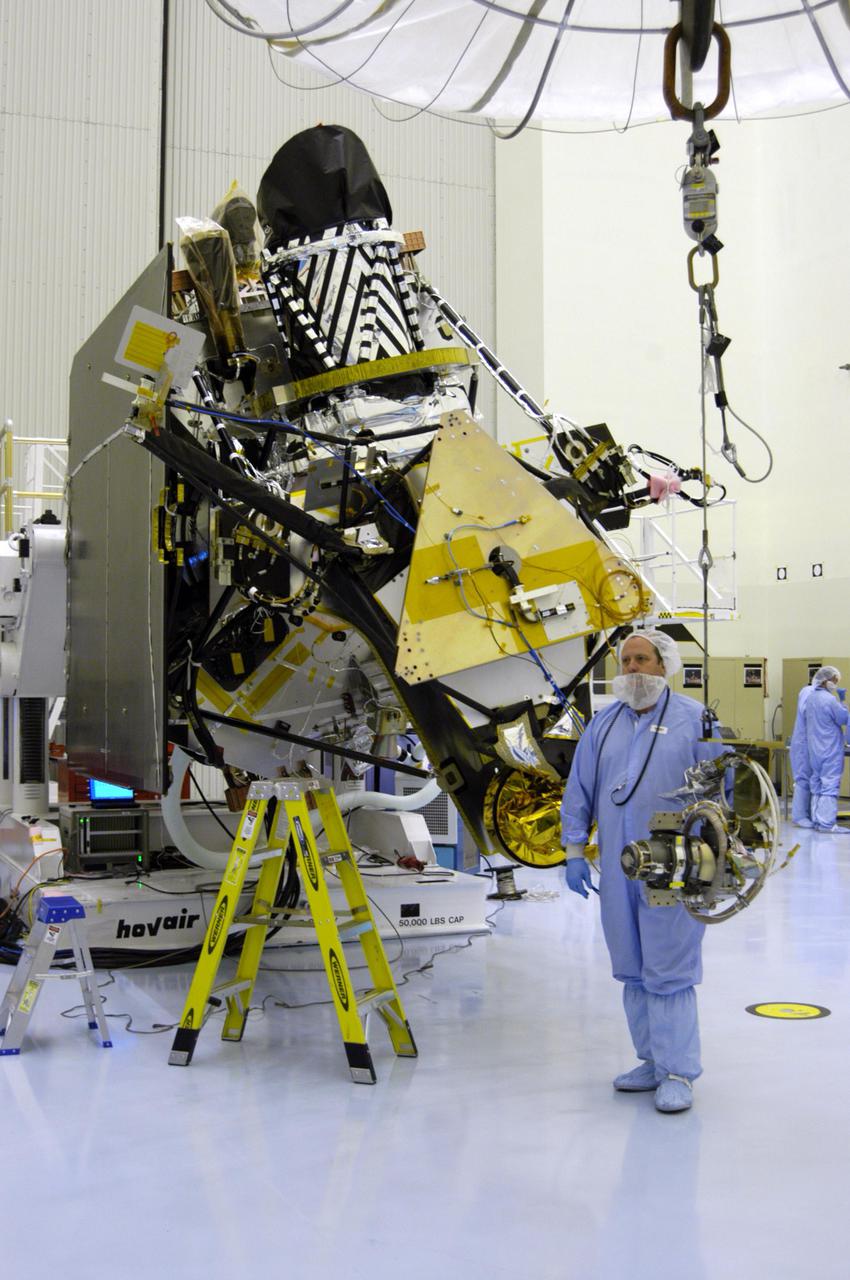
KENNEDY SPACE CENTER, FLA. - In the Payload Hazardous Servicing Facility at NASA’s Kennedy Space Center, a worker guides the gimbal across the floor to the Mars Reconnaissance Orbiter (MRO) in the background. The gimbal will be installed on the MRO solar panel. A gimbal is an appliance that allows an object to remain horizontal even as its support tips. In the PHSF, the spacecraft will undergo multiple mechanical assembly operations and electrical tests to verify its readiness for launch. A major deployment test will check out the spacecraft’s large solar arrays. The MRO was built by Lockheed Martin for NASA’s Jet Propulsion Laboratory in California. It is the next major step in Mars exploration and scheduled for launch from Cape Canaveral Air Force Station in a window opening Aug. 10. The MRO is an important next step in fulfilling NASA’s vision of space exploration and ultimately sending human explorers to Mars and beyond.
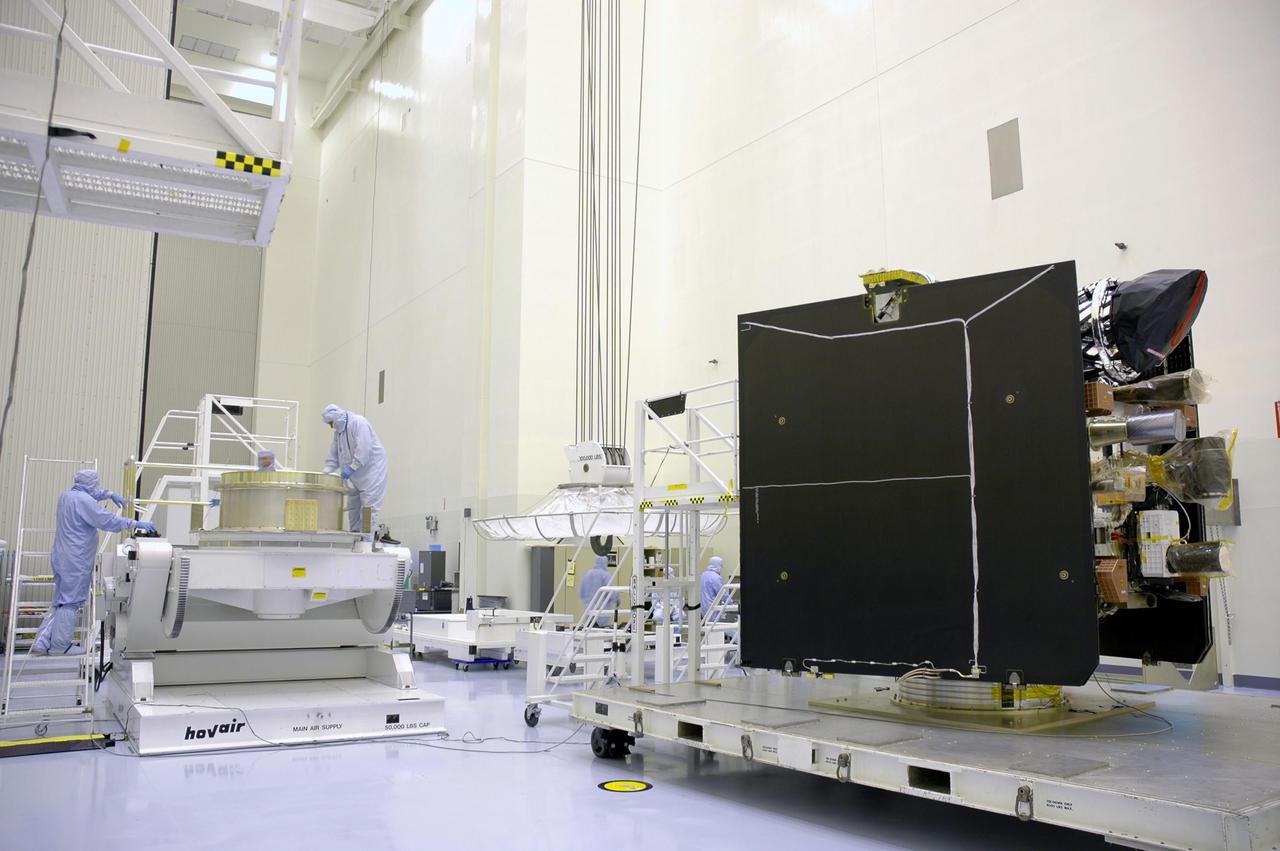
KENNEDY SPACE CENTER, FLA. - In a clean room inside the Payload Hazardous Servicing Facility (PHSF) at NASA's Kennedy Space Center, the Lockheed Martin-built Mars Reconnaissance Orbiter (MRO) is ready to be moved to a nearby workstand for final assembly and testing. In the PHSF, the spacecraft will undergo multiple mechanical assembly operations and electrical tests to verify its readiness for launch. A test this month will verify the spacecraft's ability to communicate through NASA's Deep Space Network tracking stations. A June test will check the deployment of the spacecraft's high gain communications antenna. Another major deployment test will check out the spacecraft's large solar arrays. The MRO was built for NASA's Jet Propulsion Laboratory in California. It is the next major step in Mars exploration and scheduled for launch from Cape Canaveral Air Force Station in a window opening Aug. 10. The MRO is an important next step in fulfilling NASA's vision of space exploration and ultimately sending human explorers to Mars and beyond.

KENNEDY SPACE CENTER, FLA. - In the early morning hours, the encapsulated Mars Reconnaissance Orbiter (MRO) passes the Vehicle Assembly Building at NASA Kennedy Space Center while being transported from the Payload Hazardous Servicing Facility to Launch Complex 41 at Cape Canaveral Air Force Station in Florida. The MRO is the next major step in Mars exploration and scheduled for launch aboard an Atlas V rocket from Cape Canaveral Air Force Station in a window opening Aug. 10.
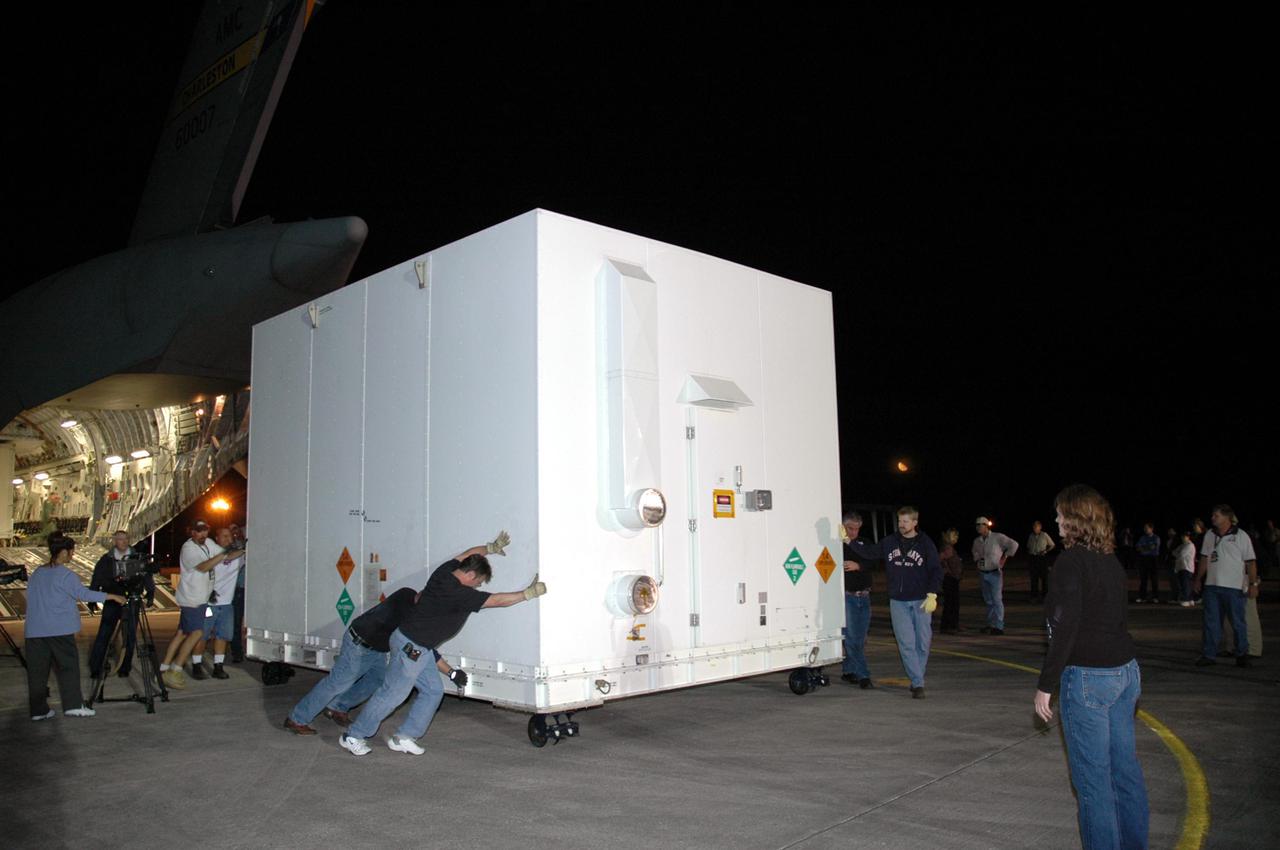
KENNEDY SPACE CENTER, FLA. - Workers at Kennedy Space Center's Shuttle Landing Facility roll one of two containers with the Mars Reconnaissance Orbiter (MRO) equipment away from the Air Force C-17 cargo plane that delivered it. The MRO is being moved to the Payload Hazardous Servicing Facility. The MRO was built by Lockheed Martin for NASA’s Jet Propulsion Laboratory in California. It is the next major step in Mars exploration and scheduled for launch from Cape Canaveral Air Force Station in a window opening Aug. 10. The MRO carries six primary instruments: the High Resolution Imaging Science Experiment, Context Camera, Mars Color Imager, Compact Reconnaissance Imaging Spectrometer for Mars, Mars Climate Sounder and Shallow Radar. By 2007, the MRO will begin a series of global mapping, regional survey and targeted observations from a near-polar, low-altitude Mars orbit. It will observe the atmosphere and surface of Mars while probing its shallow subsurface as part of a “follow the water” strategy.
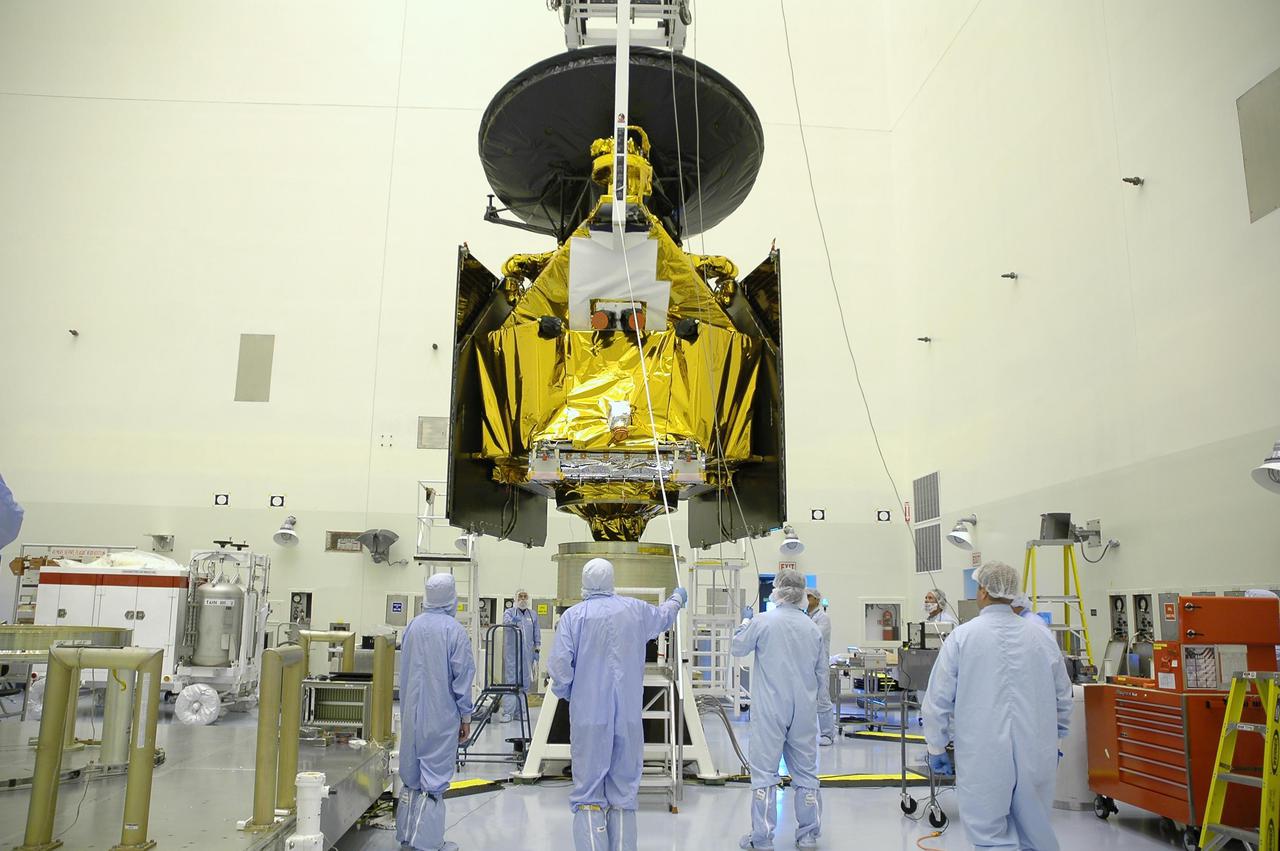
KENNEDY SPACE CENTER, FLA. -- In the Payload Hazardous Servicing Facility, workers from Lockheed Martin stand nearby as the suspended Mars Reconnaissance Orbiter (MRO) is lowered toward the spin balance machine for testing. In late July, the MRO will be transported to the Vertical Installation Facility. It will join the Atlas V for the final phase of launch preparations. The spacecraft is then scheduled to undergo a functional test, and a final week of integrated testing and closeouts. The MRO was built by Lockheed Martin for the Jet Propulsion Laboratory in California. It is the next major step in Mars exploration and scheduled for launch from Cape Canaveral Air Force Station in a window opening Aug. 10. The MRO is an important next step in fulfilling NASA’s vision of space exploration and ultimately sending human explorers to Mars and beyond.
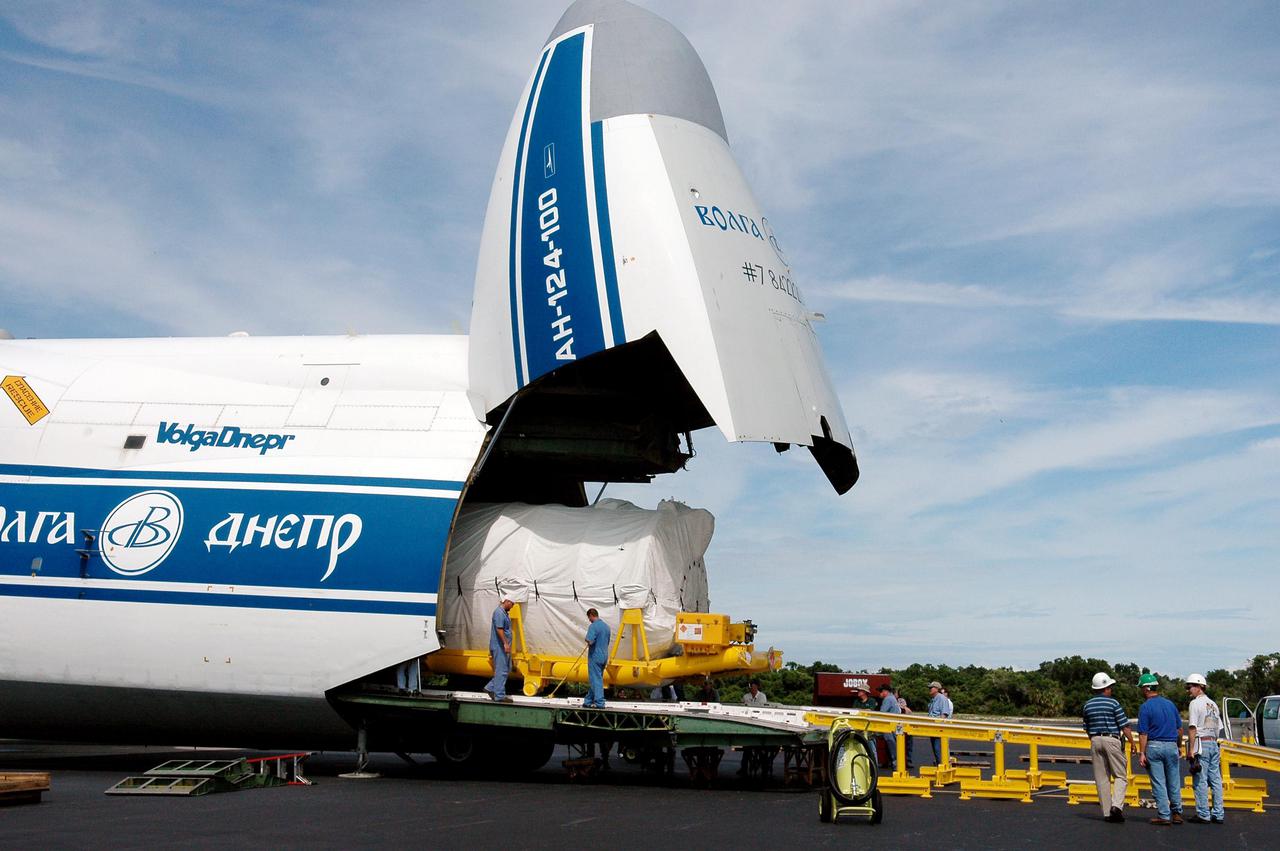
KENNEDY SPACE CENTER, FLA. - At the Cape Canaveral Air Force Station Skid Strip, a second stage Centaur (Block I) is rolled out of a Russian Antonov AH-124-100 cargo airplane. The Centaur will be mated with the Lockheed Martin Atlas V, designated AV-007, that is the launch vehicle for the Mars Reconnaissance Orbiter (MRO). The MRO is designed for a series of global mapping, regional survey and targeted observations from a near-polar, low-altitude Mars orbit. These observations will be unprecedented in terms of the spatial resolution and coverage achieved by the orbiter’s instruments as they observe the atmosphere and surface of Mars while probing its shallow subsurface as part of a “follow the water” strategy. The orbiter is undergoing environmental tests in facilities at Lockheed Martin Space Systems in Denver, Colo., and is on schedule for a launch window that begins Aug. 10. Launch will be from Launch Complex 41 at Cape Canaveral Air Force Station in Florida.
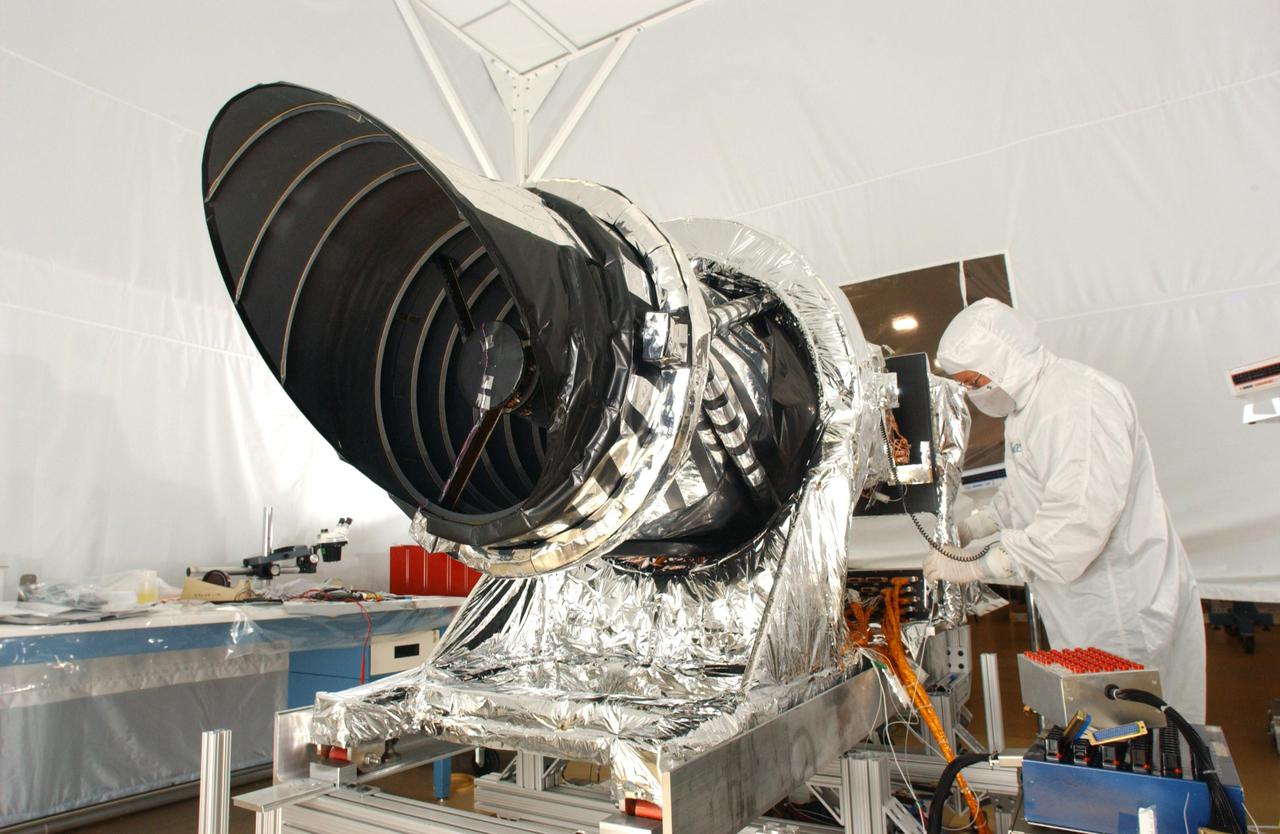
KENNEDY SPACE CENTER, FLA. - A worker from Ball Aerospace and Technologies Corp. examines the High Resolution Imaging Science Experiment (HiRISE) camera that is launching on the Mars Reconnaissance Orbiter Aug. 10. HiRISE is designed to take high-resolution images of the surface of Mars from orbit provide unprecedented image quality, resolution and coverage at sub-meter scales. The MRO will search for evidence of water, study the climate record, and identify landing sites for future missions. The MRO is scheduled for launch aboard an Atlas V rocket from Launch Complex 41 at Cape Canaveral Air Force Station in Florida. The MRO is an important next step in fulfilling NASA’s vision of space exploration and ultimately sending human explorers to Mars and beyond.
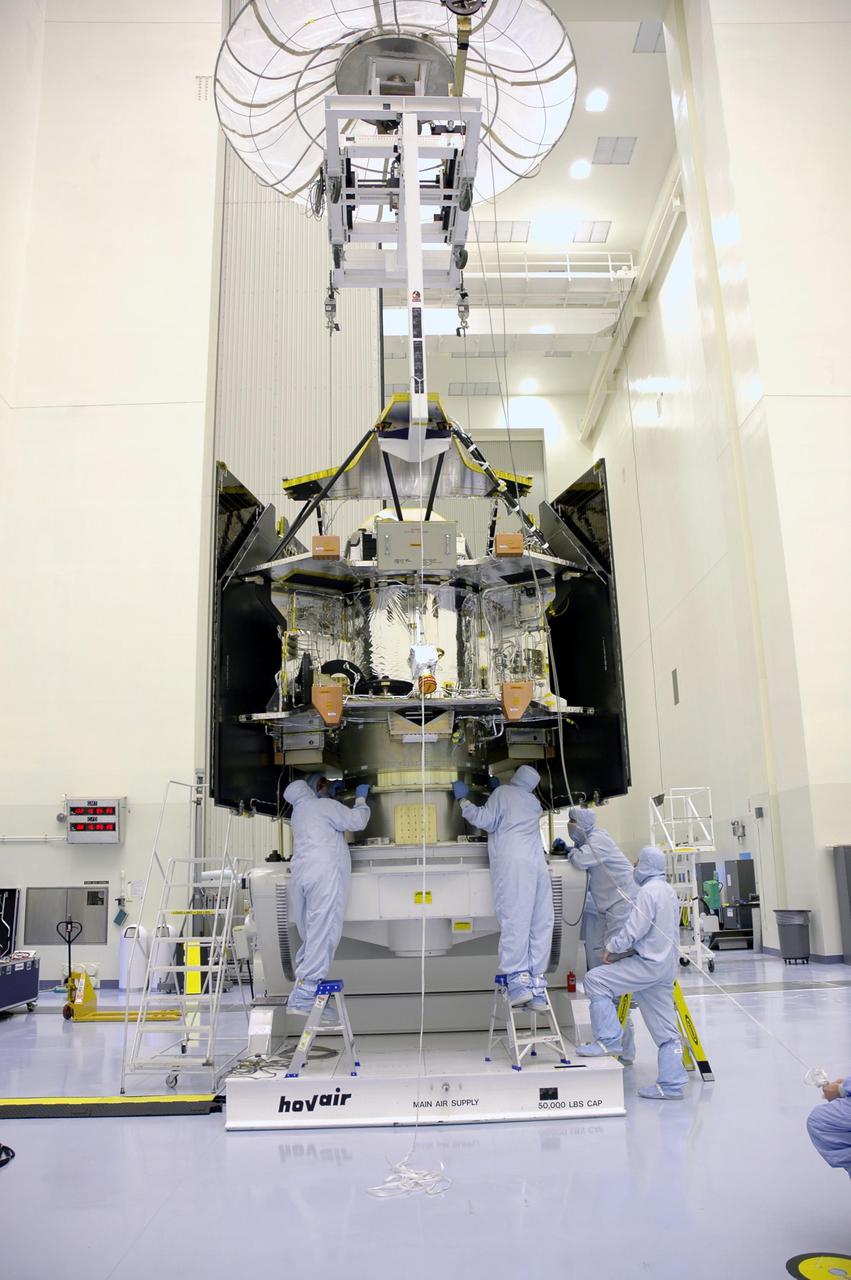
KENNEDY SPACE CENTER, FLA. - In a clean room inside the Payload Hazardous Servicing Facility (PHSF) at NASA's Kennedy Space Center, Lockheed Martin workers assure the Mars Reconnaissance Orbiter is secure on its workstand for final assembly and testing. In the PHSF, the spacecraft will undergo multiple mechanical assembly operations and electrical tests to verify its readiness for launch. A test this month will verify the spacecraft's ability to communicate through NASA's Deep Space Network tracking stations. A June test will check the deployment of the spacecraft's high gain communications antenna. Another major deployment test will check out the spacecraft's large solar arrays. The MRO was built for NASA's Jet Propulsion Laboratory in California. It is the next major step in Mars exploration and scheduled for launch from Cape Canaveral Air Force Station in a window opening Aug. 10. The MRO is an important next step in fulfilling NASA's vision of space exploration and ultimately sending human explorers to Mars and beyond.

KENNEDY SPACE CENTER, FLA. - Workers at Kennedy Space Center's Shuttle Landing Facility roll the second of two containers with the Mars Reconnaissance Orbiter (MRO) equipment away from the Air Force C-17 cargo plane that delivered it. The MRO is being moved to the Payload Hazardous Servicing Facility. The MRO was built by Lockheed Martin for NASA's Jet Propulsion Laboratory in California. It is the next major step in Mars exploration and scheduled for launch from Cape Canaveral Air Force Station in a window opening Aug. 10. The MRO carries six primary instruments: the High Resolution Imaging Science Experiment, Context Camera, Mars Color Imager, Compact Reconnaissance Imaging Spectrometer for Mars, Mars Climate Sounder and Shallow Radar. By 2007, the MRO will begin a series of global mapping, regional survey and targeted observations from a near-polar, low-altitude Mars orbit. It will observe the atmosphere and surface of Mars while probing its shallow subsurface as part of a “follow the water” strategy.

KENNEDY SPACE CENTER, FLA. - In the Payload Hazardous Servicing Facility, the Mars Reconnaissance Orbiter is ready to be encapsulated before moving to the launch pad. The fairing protects the spacecraft during launch and flight through the atmosphere. Once in space, it is jettisoned. Launch of the MRO aboard an Atlas V rocket will be from Launch Complex 41 at Cape Canaveral Air Force Station in Florida. The MRO is the next major step in Mars exploration and scheduled for launch from Cape Canaveral Air Force Station in a window opening Aug. 10. The MRO is an important next step in fulfilling NASA’s vision of space exploration and ultimately sending human explorers to Mars and beyond.

KENNEDY SPACE CENTER, FLA. - In the Payload Hazardous Servicing Facility, workers from Lockheed Martin begin deploying the solar array on the Mars Reconnaissance Orbiter (MRO). After solar array testing, the MRO will be transported to the Vertical Installation Facility in late July. It will join the Atlas V for the final phase of launch preparations. The spacecraft is then scheduled to undergo a functional test, and a final week of integrated testing and closeouts. The MRO was built by Lockheed Martin for the Jet Propulsion Laboratory in California. It is the next major step in Mars exploration and scheduled for launch from Cape Canaveral Air Force Station in a window opening Aug. 10. The MRO is an important next step in fulfilling NASA’s vision of space exploration and ultimately sending human explorers to Mars and beyond.

KENNEDY SPACE CENTER, FLA. - In the Payload Hazardous Servicing Facility, workers from Lockheed Martin deploy the newly installed solar array on the Mars Reconnaissance Orbiter (MRO). After solar array testing, the MRO will be transported to the Vertical Installation Facility in late July. It will join the Atlas V for the final phase of launch preparations. The spacecraft is then scheduled to undergo a functional test, and a final week of integrated testing and closeouts. The MRO was built by Lockheed Martin for the Jet Propulsion Laboratory in California. It is the next major step in Mars exploration and scheduled for launch from Cape Canaveral Air Force Station in a window opening Aug. 10. The MRO is an important next step in fulfilling NASA’s vision of space exploration and ultimately sending human explorers to Mars and beyond.

KENNEDY SPACE CENTER, FLA. - In the Payload Hazardous Servicing Facility at NASA’s Kennedy Space Center, workers from Lockheed Martin begin installing the high-gain antenna on the Mars Reconnaissance Orbiter (MRO). After solar array installation, the MRO will be transported to the Vertical Installation Facility in late July. It will join the Atlas V for the final phase of launch preparations. The spacecraft is then scheduled to undergo a functional test, and a final week of integrated testing and closeouts. The MRO was built by Lockheed Martin for the Jet Propulsion Laboratory in California. It is the next major step in Mars exploration and scheduled for launch from Cape Canaveral Air Force Station in a window opening Aug. 10. The MRO is an important next step in fulfilling NASA’s vision of space exploration and ultimately sending human explorers to Mars and beyond.

KENNEDY SPACE CENTER, FLA. -- In the Payload Hazardous Servicing Facility, the Mars Reconnaissance Orbiter (MRO) is lifted off a workstand for transfer to the spin balance machine for testing. In late July, the MRO will be transported to the Vertical Installation Facility. It will join the Atlas V for the final phase of launch preparations. The spacecraft is then scheduled to undergo a functional test, and a final week of integrated testing and closeouts. The MRO was built by Lockheed Martin for the Jet Propulsion Laboratory in California. It is the next major step in Mars exploration and scheduled for launch from Cape Canaveral Air Force Station in a window opening Aug. 10. The MRO is an important next step in fulfilling NASA’s vision of space exploration and ultimately sending human explorers to Mars and beyond.

KENNEDY SPACE CENTER, FLA. - Workers in the Payload Hazardous Servicing Facility make adjustments as they get ready to move the second half of the fairing (right) and install it with the first half around the Mars Reconnaissance Orbiter. The fairing protects the spacecraft during launch and flight through the atmosphere. Once in space, it is jettisoned. Launch of the MRO aboard an Atlas V rocket will be from Launch Complex 41 at Cape Canaveral Air Force Station in Florida. The MRO is the next major step in Mars exploration and scheduled for launch from Cape Canaveral Air Force Station in a window opening Aug. 10. The MRO is an important next step in fulfilling NASA’s vision of space exploration and ultimately sending human explorers to Mars and beyond.
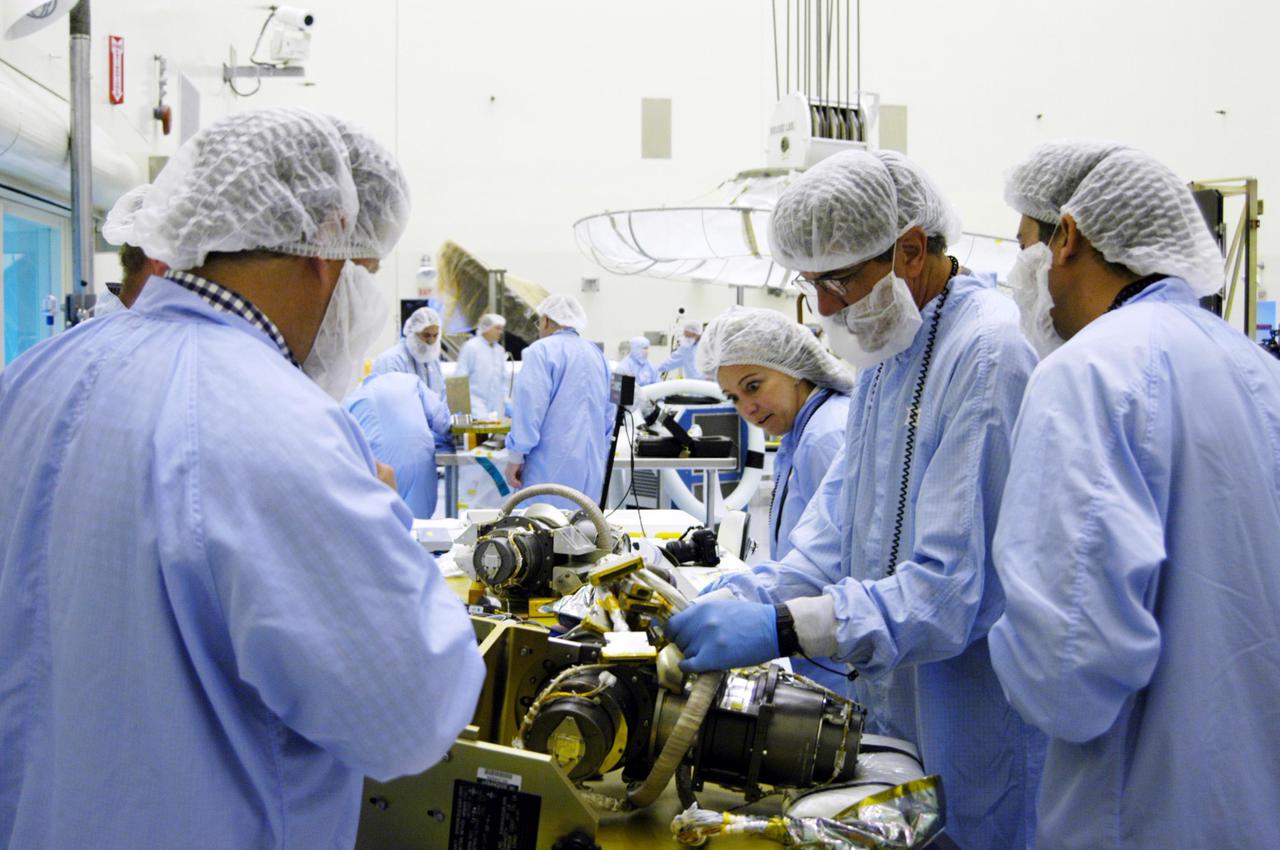
KENNEDY SPACE CENTER, FLA. - In the Payload Hazardous Servicing Facility at NASA’s Kennedy Space Center, engineers prepare a second gimbal for installation on a Mars Reconnaissance Orbiter (MRO) solar panel. A gimbal is an appliance that allows an object to remain horizontal even as its support tips. In the PHSF, the spacecraft will undergo multiple mechanical assembly operations and electrical tests to verify its readiness for launch. A major deployment test will check out the spacecraft’s large solar arrays. The MRO was built by Lockheed Martin for NASA’s Jet Propulsion Laboratory in California. It is the next major step in Mars exploration and scheduled for launch from Cape Canaveral Air Force Station in a window opening Aug. 10. The MRO is an important next step in fulfilling NASA’s vision of space exploration and ultimately sending human explorers to Mars and beyond.
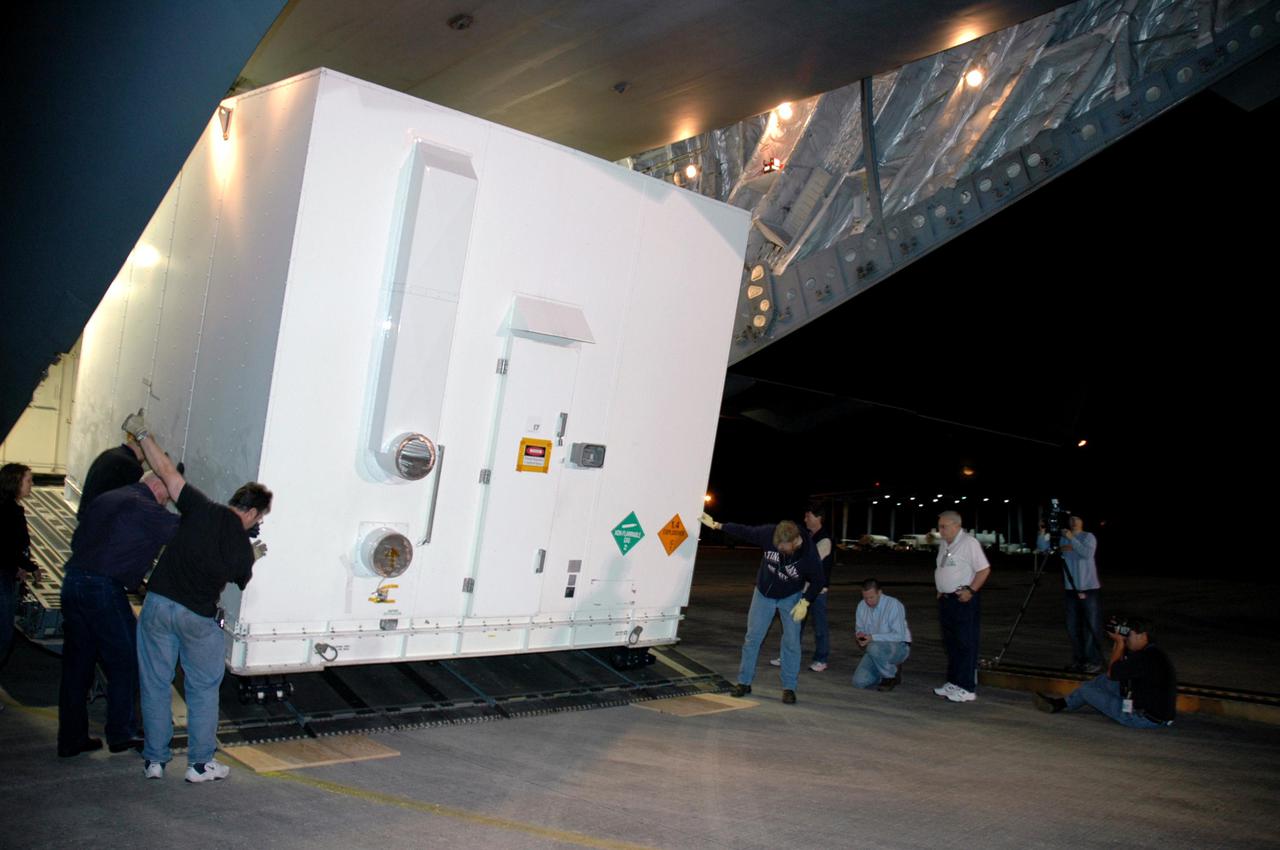
KENNEDY SPACE CENTER, FLA. - Workers at Kennedy Space Center's Shuttle Landing Facility roll one of two containers with the Mars Reconnaissance Orbiter (MRO) equipment away from the Air Force C-17 cargo plane that delivered it. The MRO is being moved to the Payload Hazardous Servicing Facility. The MRO was built by Lockheed Martin for NASA's Jet Propulsion Laboratory in California. It is the next major step in Mars exploration and scheduled for launch from Cape Canaveral Air Force Station in a window opening Aug. 10. The MRO carries six primary instruments: the High Resolution Imaging Science Experiment, Context Camera, Mars Color Imager, Compact Reconnaissance Imaging Spectrometer for Mars, Mars Climate Sounder and Shallow Radar. By 2007, the MRO will begin a series of global mapping, regional survey and targeted observations from a near-polar, low-altitude Mars orbit. It will observe the atmosphere and surface of Mars while probing its shallow subsurface as part of a “follow the water” strategy.
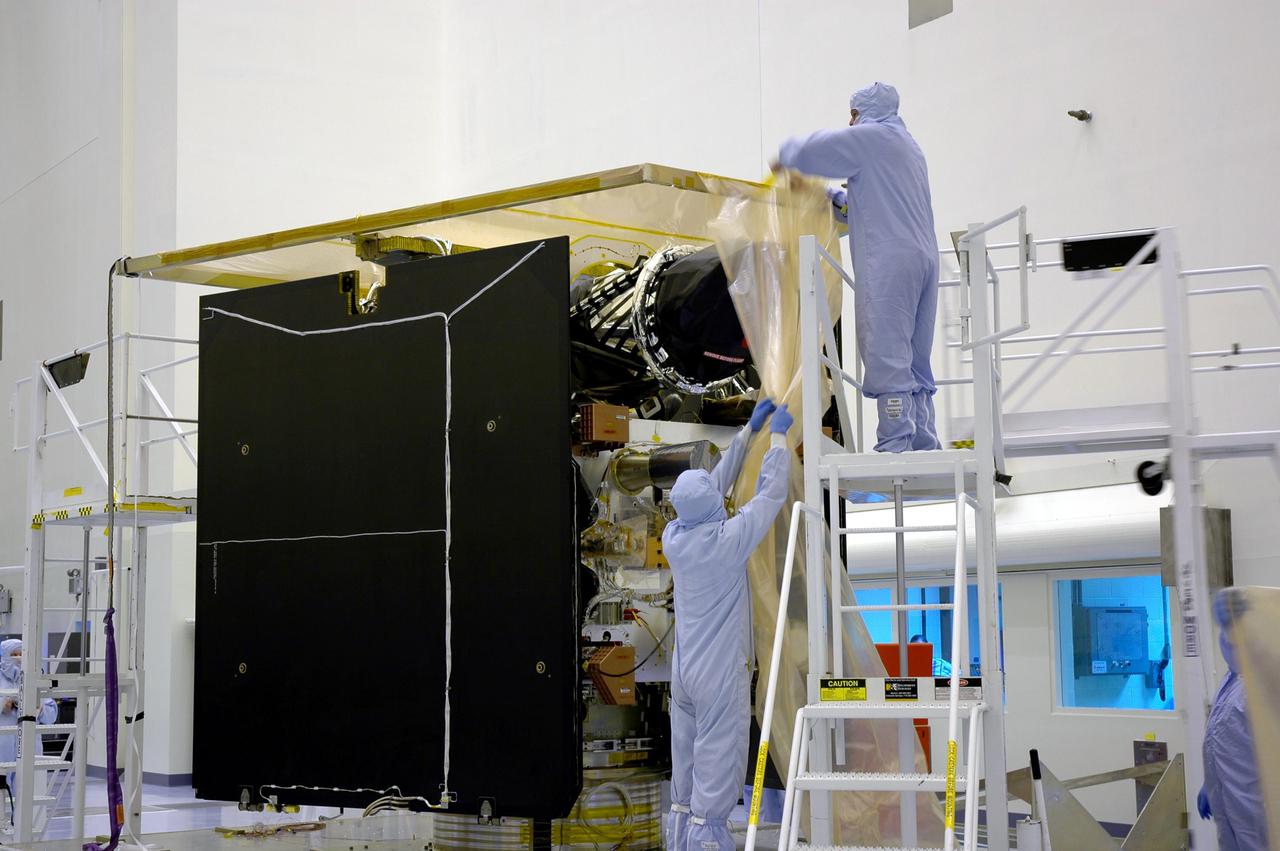
KENNEDY SPACE CENTER, FLA. - In a clean room inside the Payload Hazardous Servicing Facility (PHSF) at NASA's Kennedy Space Center, removal of the protective cover reveals some of the hardware for NASA's Mars Reconnaissance Orbiter. Here in the PHSF, the spacecraft will undergo multiple mechanical assembly operations and electrical tests to verify its readiness for launch. A test this month will verify the spacecraft's ability to communicate through NASA's Deep Space Network tracking stations. A June test will check the deployment of the spacecraft's high gain communications antenna. Another major deployment test will check out the spacecraft's large solar arrays. The MRO was built by Lockheed Martin for NASA's Jet Propulsion Laboratory in California. It is the next major step in Mars exploration and scheduled for launch from Cape Canaveral Air Force Station in a window opening Aug. 10. The MRO is an important next step in fulfilling NASA's vision of space exploration and ultimately sending human explorers to Mars and beyond.
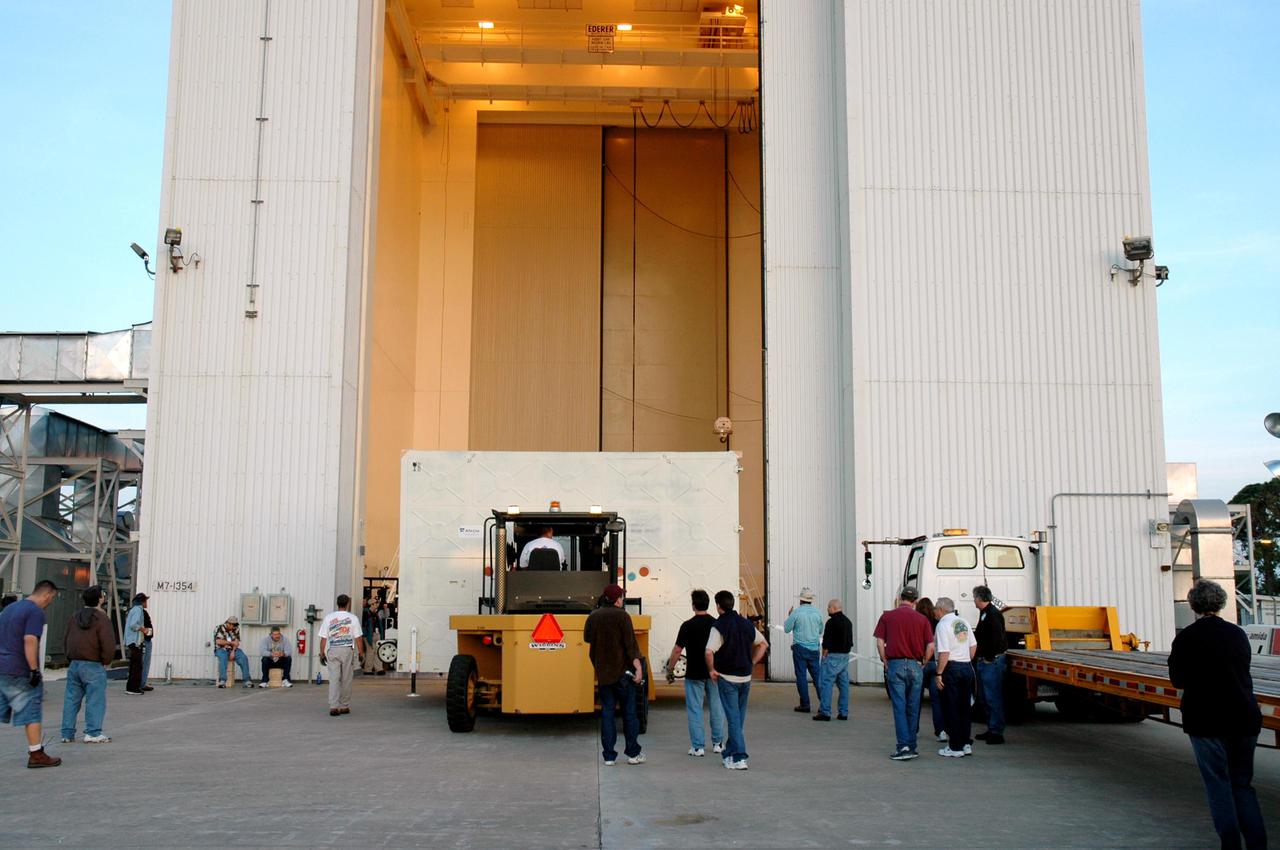
KENNEDY SPACE CENTER, FLA. - A forklift lowers one of two containers with the Mars Reconnaissance Orbiter (MRO) equipment onto the ground in front of the Payload Hazardous Servicing Facility. The MRO was built by Lockheed Martin for NASA's Jet Propulsion Laboratory in California. It is the next major step in Mars exploration and scheduled for launch from Cape Canaveral Air Force Station in a window opening Aug. 10. The MRO carries six primary instruments: the High Resolution Imaging Science Experiment, Context Camera, Mars Color Imager, Compact Reconnaissance Imaging Spectrometer for Mars, Mars Climate Sounder and Shallow Radar. By 2007, the MRO will begin a series of global mapping, regional survey and targeted observations from a near-polar, low-altitude Mars orbit. It will observe the atmosphere and surface of Mars while probing its shallow subsurface as part of a “follow the water” strategy.

KENNEDY SPACE CENTER, FLA. - In the Payload Hazardous Servicing Facility, workers from Lockheed Martin deploy the newly installed solar array on the Mars Reconnaissance Orbiter (MRO). After solar array testing, the MRO will be transported to the Vertical Installation Facility in late July. It will join the Atlas V for the final phase of launch preparations. The spacecraft is then scheduled to undergo a functional test, and a final week of integrated testing and closeouts. The MRO was built by Lockheed Martin for the Jet Propulsion Laboratory in California. It is the next major step in Mars exploration and scheduled for launch from Cape Canaveral Air Force Station in a window opening Aug. 10. The MRO is an important next step in fulfilling NASA’s vision of space exploration and ultimately sending human explorers to Mars and beyond.
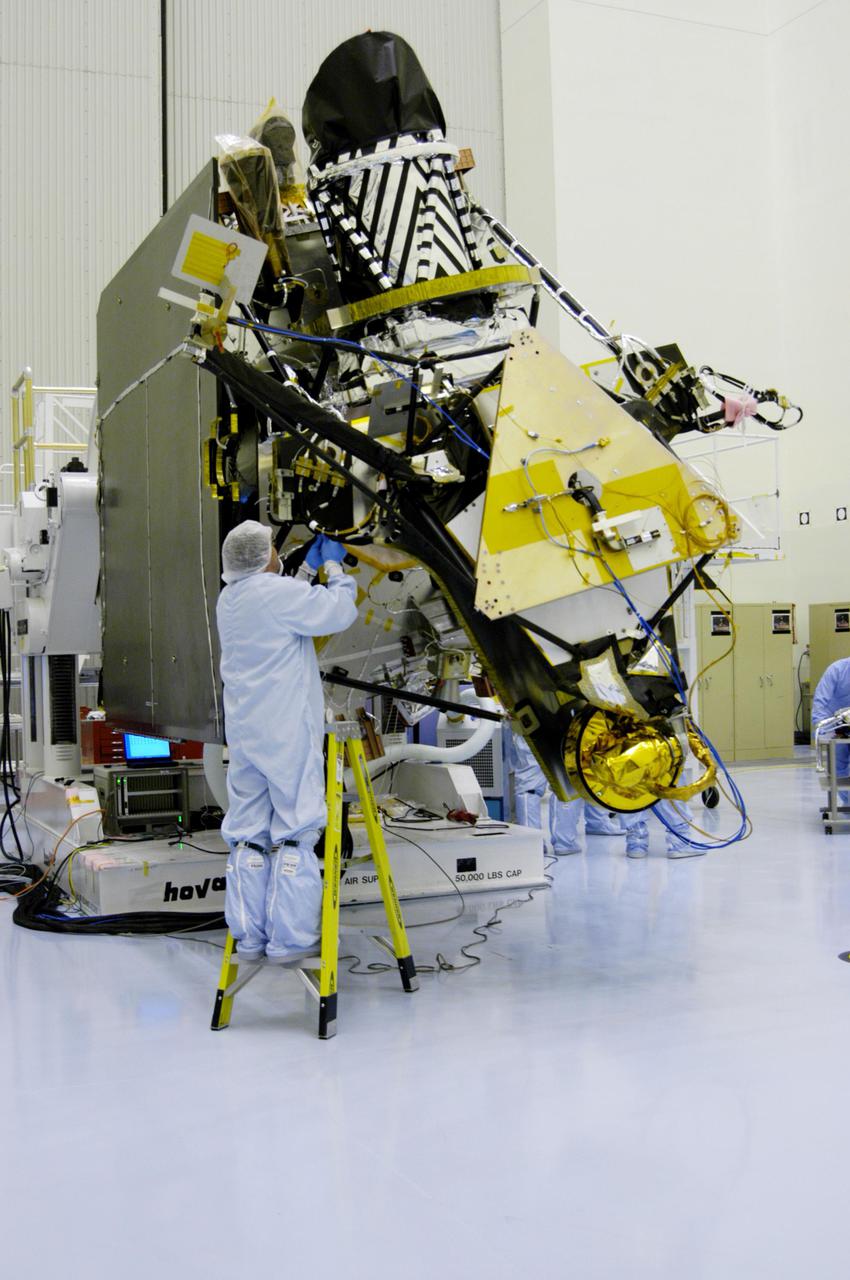
KENNEDY SPACE CENTER, FLA. - In the Payload Hazardous Servicing Facility at NASA’s Kennedy Space Center, an engineer installs a second gimbal on a Mars Reconnaissance Orbiter (MRO) solar panel. A gimbal is an appliance that allows an object to remain horizontal even as its support tips. In the PHSF, the spacecraft will undergo multiple mechanical assembly operations and electrical tests to verify its readiness for launch. A major deployment test will check out the spacecraft’s large solar arrays. The MRO was built by Lockheed Martin for NASA’s Jet Propulsion Laboratory in California. It is the next major step in Mars exploration and scheduled for launch from Cape Canaveral Air Force Station in a window opening Aug. 10. The MRO is an important next step in fulfilling NASA’s vision of space exploration and ultimately sending human explorers to Mars and beyond.

KENNEDY SPACE CENTER, FLA. - Safely placed on a flat bed truck, the Centaur (Block I) is rolled away from Cape Canaveral Air Force Station Skid Strip where it landed aboard a Russian Antonov AH-124-100 cargo airplane, seen at left. The upper stage Centaur will be mated with the Lockheed Martin Atlas V, designated AV-007, that is the launch vehicle for the Mars Reconnaissance Orbiter (MRO). The MRO is designed for a series of global mapping, regional survey and targeted observations from a near-polar, low-altitude Mars orbit. These observations will be unprecedented in terms of the spatial resolution and coverage achieved by the orbiter’s instruments as they observe the atmosphere and surface of Mars while probing its shallow subsurface as part of a “follow the water” strategy. The orbiter is undergoing environmental tests in facilities at Lockheed Martin Space Systems in Denver, Colo., and is on schedule for a launch window that begins Aug. 10. Launch will be from Launch Complex 41 at Cape Canaveral Air Force Station in Florida.
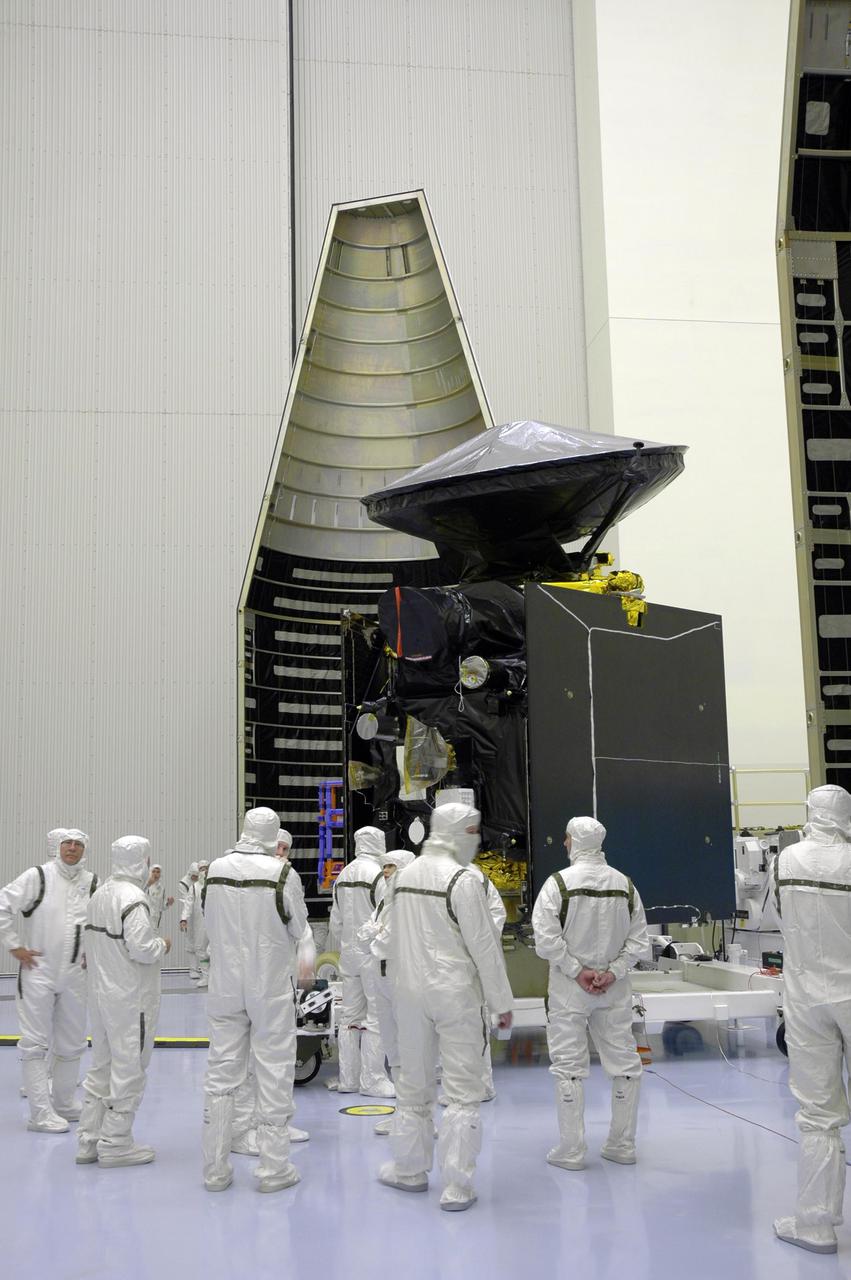
KENNEDY SPACE CENTER, FLA. - In the Payload Hazardous Servicing Facility, the first half of the fairing (left) is ready to be moved closer to the Mars Reconnaissance Orbiter (right) for installation. The fairing protects the spacecraft during launch and flight through the atmosphere. Once in space, it is jettisoned. Launch of the MRO aboard an Atlas V rocket will be from Launch Complex 41 at Cape Canaveral Air Force Station in Florida. The MRO is the next major step in Mars exploration and scheduled for launch from Cape Canaveral Air Force Station in a window opening Aug. 10. The MRO is an important next step in fulfilling NASA’s vision of space exploration and ultimately sending human explorers to Mars and beyond.
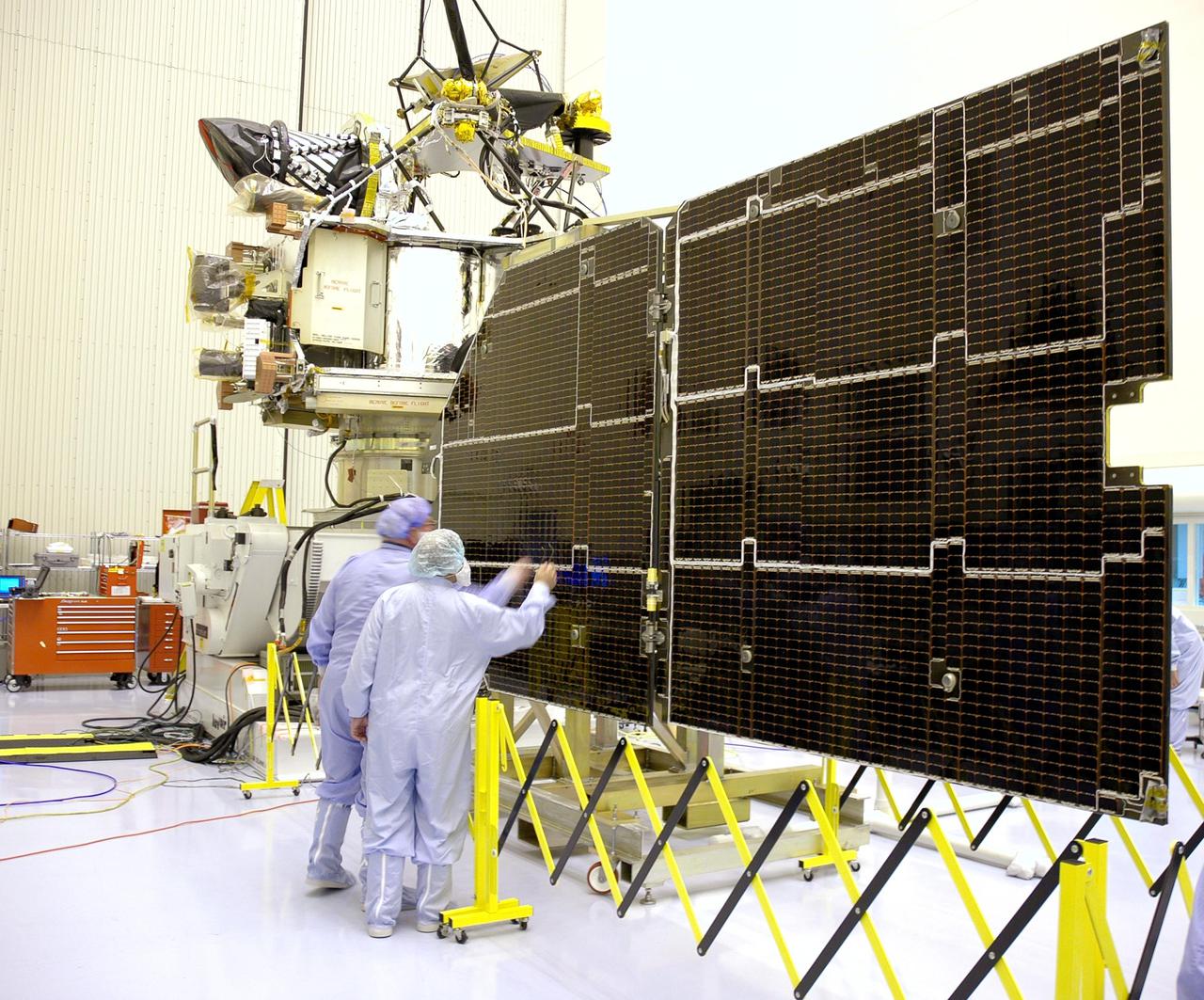
KENNEDY SPACE CENTER, FLA. - In the Payload Hazardous Servicing Facility, technicians inspect the solar panels for the Mars Reconnaissance Orbiter (MRO) during an electromagnetic interference verification test. If no interference is found during the test, the Shallow Radar Antenna (SHARAD) will be installed on the spacecraft. The spacecraft is undergoing multiple mechanical assembly operations and electrical tests to verify its readiness for launch. The MRO was built by Lockheed Martin for NASA’s Jet Propulsion Laboratory in California. It is the next major step in Mars exploration and scheduled for launch from Launch Complex 41 at Cape Canaveral Air Force Station in a window opening Aug. 10. The MRO is an important next step in fulfilling NASA’s vision of space exploration and ultimately sending human explorers to Mars and beyond.
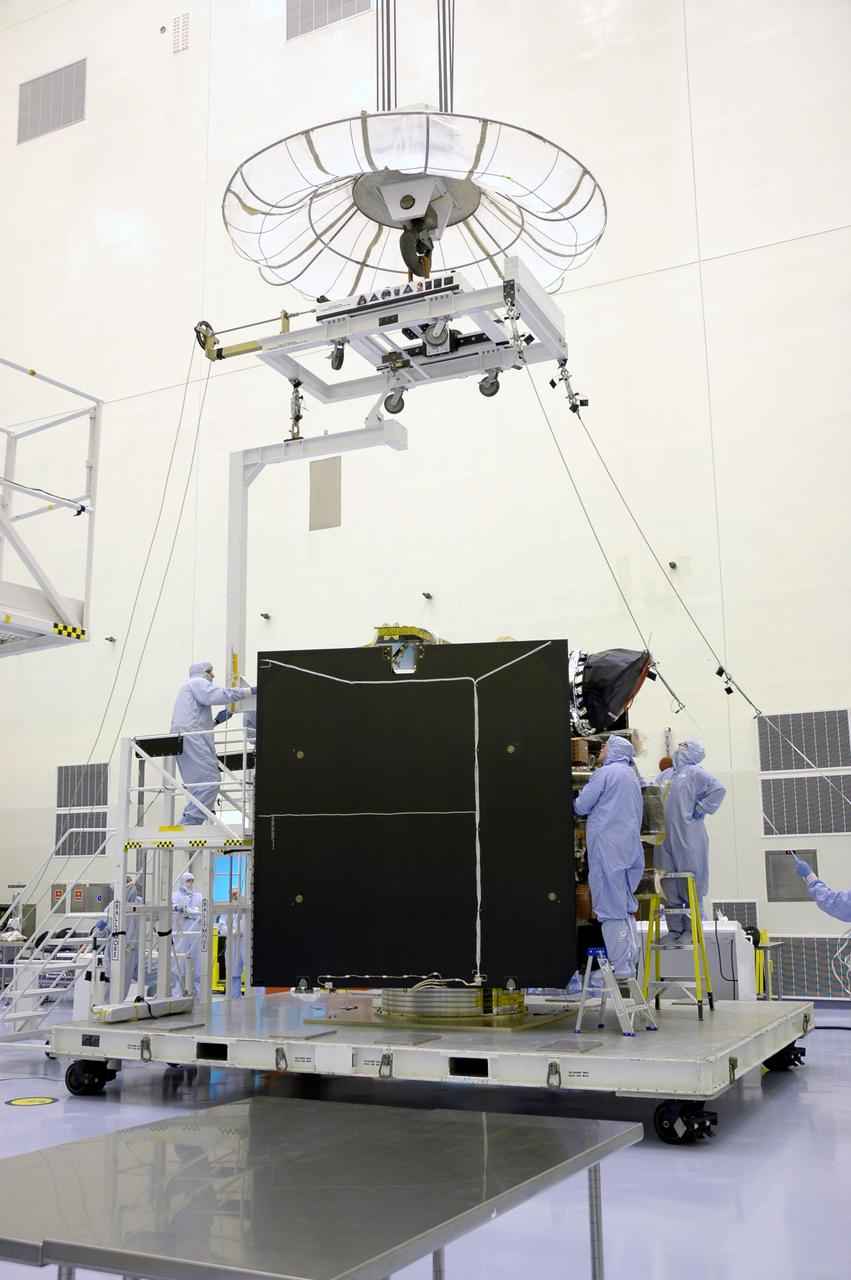
KENNEDY SPACE CENTER, FLA. - In a clean room inside the Payload Hazardous Servicing Facility (PHSF) at NASA's Kennedy Space Center, an overhead crane has moved into position over the Lockheed Martin-built Mars Reconnaissance Orbiter (MRO). The crane will lift the spacecraft and move it to a nearby workstand for final assembly and testing. In the PHSF, the spacecraft will undergo multiple mechanical assembly operations and electrical tests to verify its readiness for launch. A test this month will verify the spacecraft's ability to communicate through NASA's Deep Space Network tracking stations. A June test will check the deployment of the spacecraft's high gain communications antenna. Another major deployment test will check out the spacecraft's large solar arrays. The MRO was built for NASA's Jet Propulsion Laboratory in California. It is the next major step in Mars exploration and scheduled for launch from Cape Canaveral Air Force Station in a window opening Aug. 10. The MRO is an important next step in fulfilling NASA's vision of space exploration and ultimately sending human explorers to Mars and beyond.

KENNEDY SPACE CENTER, FLA. - In the Payload Hazardous Servicing Facility, workers from Lockheed Martin prepare to deploy the solar array on the Mars Reconnaissance Orbiter (MRO). After solar array testing, the MRO will be transported to the Vertical Installation Facility in late July. It will join the Atlas V for the final phase of launch preparations. The spacecraft is then scheduled to undergo a functional test, and a final week of integrated testing and closeouts. The MRO was built by Lockheed Martin for the Jet Propulsion Laboratory in California. It is the next major step in Mars exploration and scheduled for launch from Cape Canaveral Air Force Station in a window opening Aug. 10. The MRO is an important next step in fulfilling NASA’s vision of space exploration and ultimately sending human explorers to Mars and beyond.
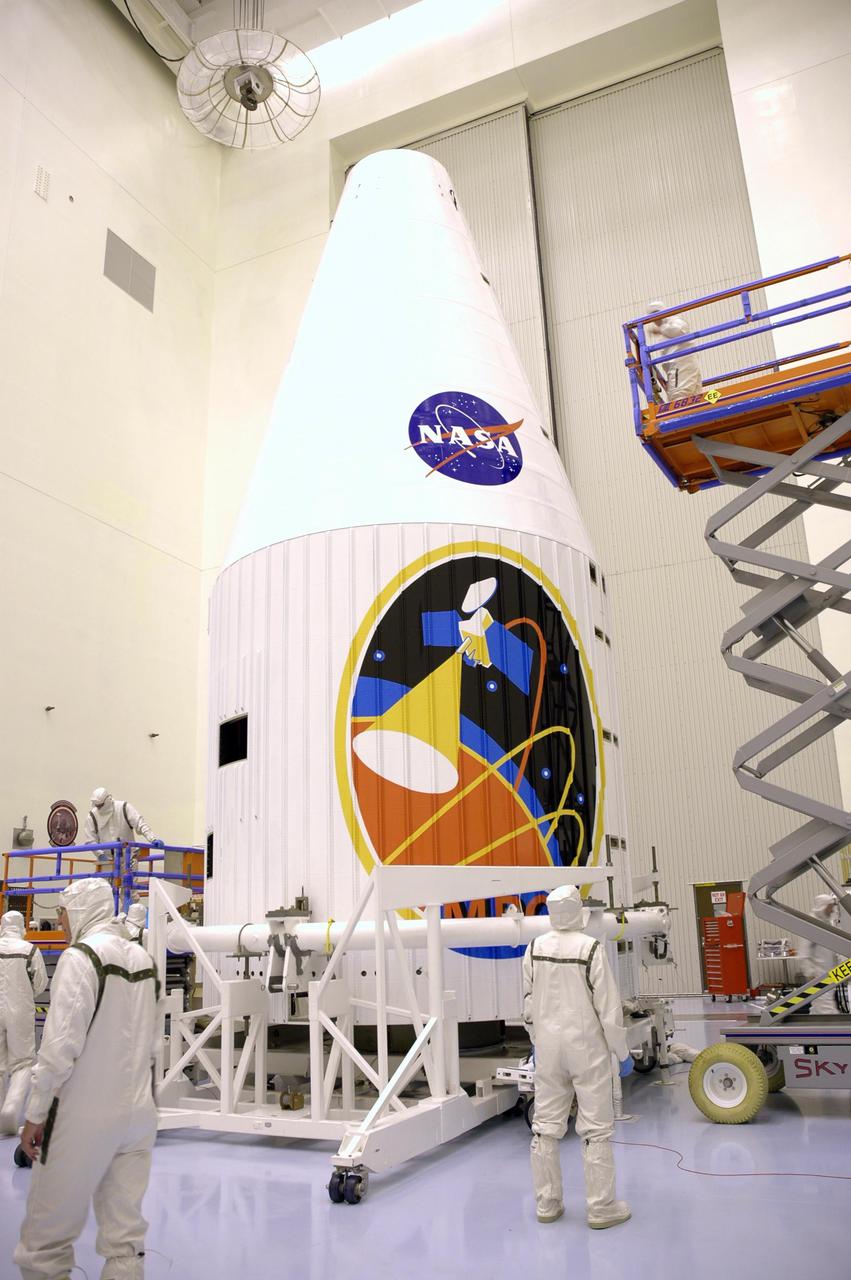
KENNEDY SPACE CENTER, FLA. - In the Payload Hazardous Servicing Facility, the Mars Reconnaissance Orbiter is encapsulated and ready to be moved to the launch pad. The fairing protects the spacecraft during launch and flight through the atmosphere. Once in space, it is jettisoned. Launch of the MRO aboard an Atlas V rocket will be from Launch Complex 41 at Cape Canaveral Air Force Station in Florida. The MRO is the next major step in Mars exploration and scheduled for launch from Cape Canaveral Air Force Station in a window opening Aug. 10. The MRO is an important next step in fulfilling NASA’s vision of space exploration and ultimately sending human explorers to Mars and beyond.
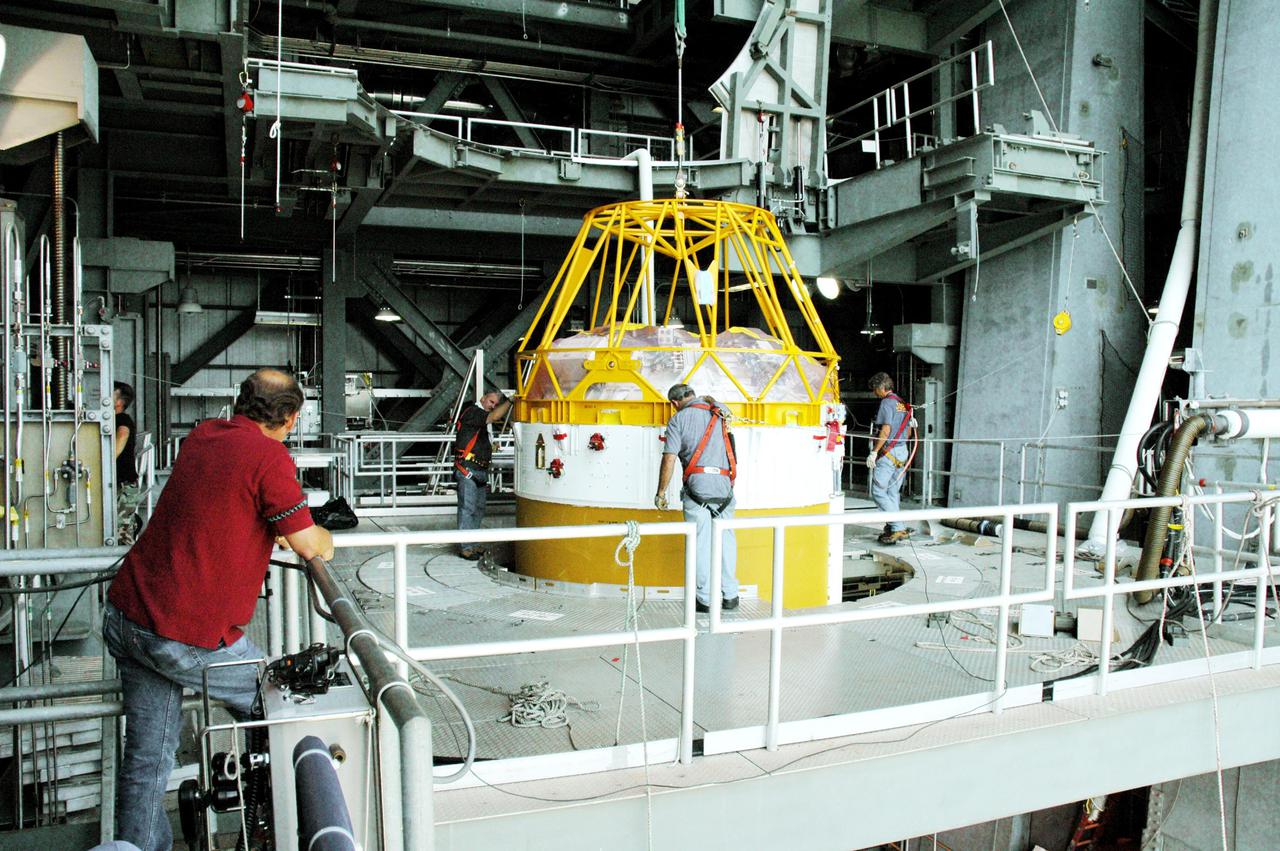
KENNEDY SPACE CENTER, FLA. - Inside the launch tower on Launch Pad 41 at Cape Canaveral Air Force Station in Florida, the lower end of the Lockheed Martin Centaur second stage is being lowered through an opening toward the Atlas V below. The Centaur will be mated with the Atlas V. The Atlas V_Centaur is the launch vehicle for the Mars Reconnaissance Orbiter (MRO). The MRO is designed for a series of global mapping, regional survey and targeted observations from a near-polar, low-altitude Mars orbit. These observations will be unprecedented in terms of the spatial resolution and coverage achieved by the orbiter’s instruments as they observe the atmosphere and surface of Mars while probing its shallow subsurface as part of a “follow the water” strategy. The launch window for the MRO begins Aug. 10.
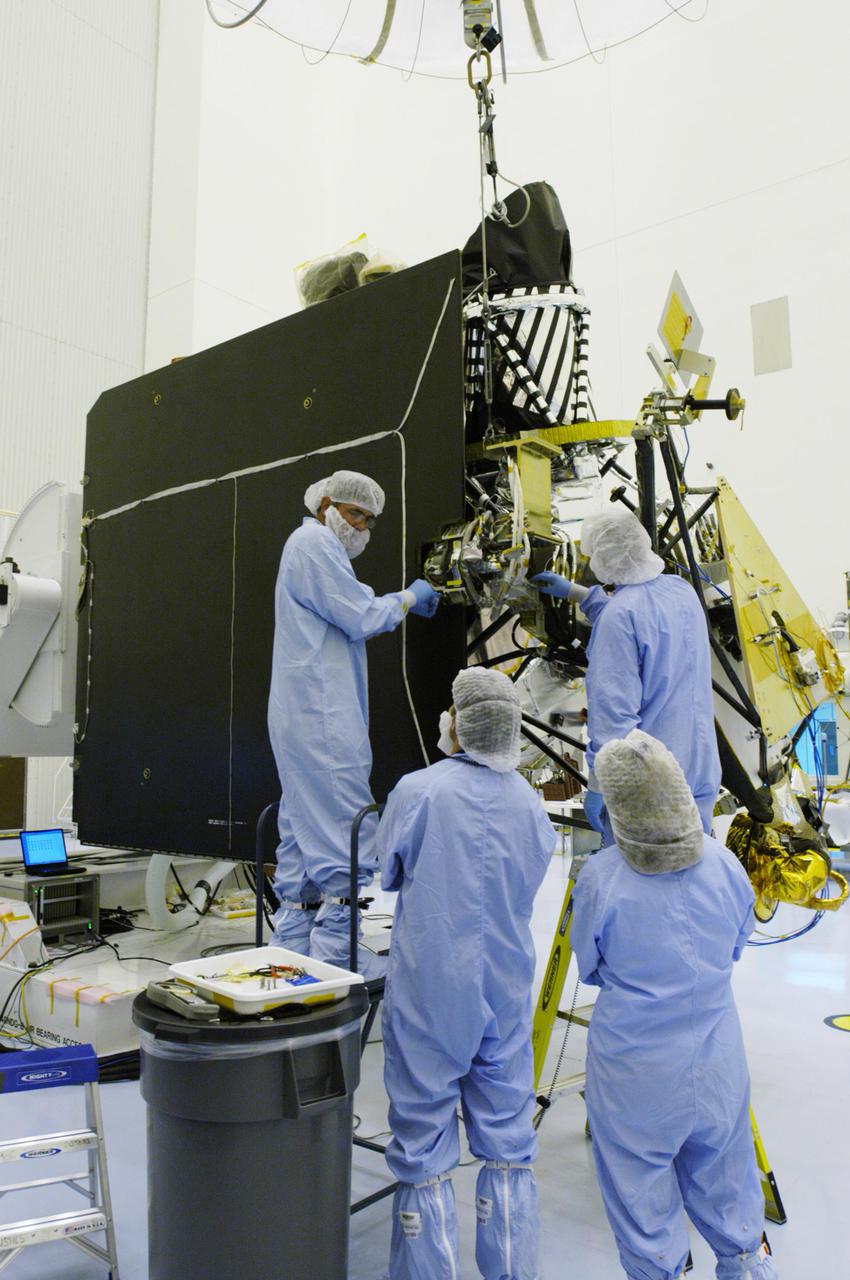
KENNEDY SPACE CENTER, FLA. - In the Payload Hazardous Servicing Facility at NASA’s Kennedy Space Center, engineers finish installing the gimbal on the Mars Reconnaissance Orbiter (MRO) solar panel. A gimbal is an appliance that allows an object to remain horizontal even as its support tips. In the PHSF, the spacecraft will undergo multiple mechanical assembly operations and electrical tests to verify its readiness for launch. A major deployment test will check out the spacecraft’s large solar arrays. The MRO was built by Lockheed Martin for NASA’s Jet Propulsion Laboratory in California. It is the next major step in Mars exploration and scheduled for launch from Cape Canaveral Air Force Station in a window opening Aug. 10. The MRO is an important next step in fulfilling NASA’s vision of space exploration and ultimately sending human explorers to Mars and beyond.

KENNEDY SPACE CENTER, FLA. - Logo for the Mars Reconnaissance Orbiter (MRO) mission, managed for NASA by JPL, a division of the California Institute of Technology, Pasadena.
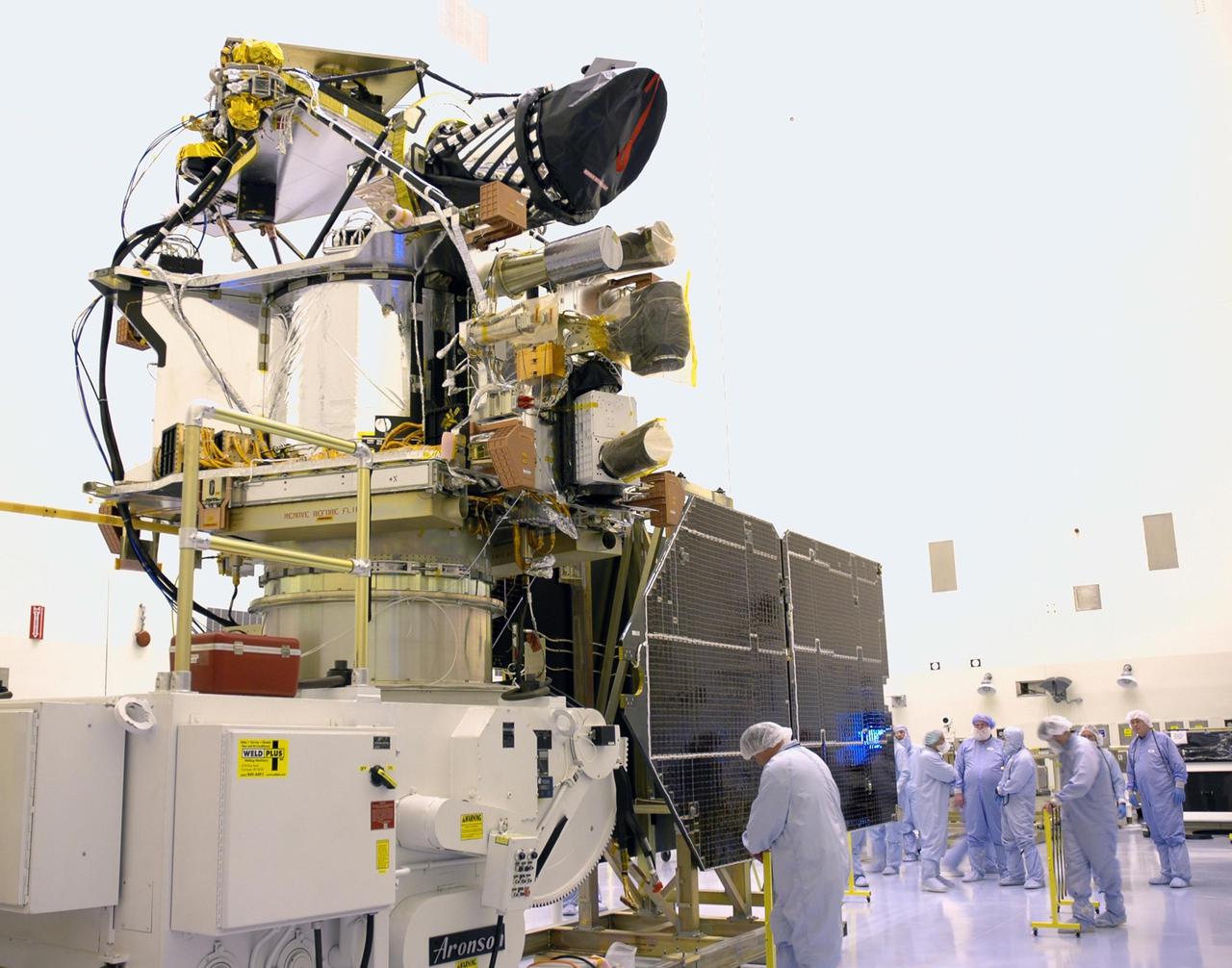
KENNEDY SPACE CENTER, FLA. - In the Payload Hazardous Servicing Facility, technicians prepare to conduct an electromagnetic interference verification test using the solar arrays for the Mars Reconnaissance Orbiter (MRO) and an antenna simulator. If no interference is found during the test, the Shallow Radar Antenna (SHARAD) will be installed on the spacecraft. The spacecraft is undergoing multiple mechanical assembly operations and electrical tests to verify its readiness for launch. The MRO was built by Lockheed Martin for NASA’s Jet Propulsion Laboratory in California. It is the next major step in Mars exploration and scheduled for launch from Launch Complex 41 at Cape Canaveral Air Force Station in a window opening Aug. 10. The MRO is an important next step in fulfilling NASA’s vision of space exploration and ultimately sending human explorers to Mars and beyond.

KENNEDY SPACE CENTER, FLA. - Workers in the Payload Hazardous Servicing Facility stand by as the first half of the fairing (left) is moved closer to the Mars Reconnaissance Orbiter (right) for installation. The fairing protects the spacecraft during launch and flight through the atmosphere. Once in space, it is jettisoned. Launch of the MRO aboard an Atlas V rocket will be from Launch Complex 41 at Cape Canaveral Air Force Station in Florida. The MRO is the next major step in Mars exploration and scheduled for launch from Cape Canaveral Air Force Station in a window opening Aug. 10. The MRO is an important next step in fulfilling NASA’s vision of space exploration and ultimately sending human explorers to Mars and beyond.

KENNEDY SPACE CENTER, FLA. - In the Payload Hazardous Servicing Facility, workers from Lockheed Martin prepare to conduct a gimbal full range of motion test on the Mars Reconnaissance Orbiter (MRO) high-gain antenna. The MRO was built by Lockheed Martin for JPL. It is the next major step in Mars exploration and scheduled for launch from Cape Canaveral Air Force Station in a window opening Aug. 10. The MRO is an important next step in fulfilling NASA’s vision of space exploration and ultimately sending human explorers to Mars and beyond.

KENNEDY SPACE CENTER, FLA. - In the Payload Hazardous Servicing Facility, workers prepare to check out the Mars Reconnaissance Orbiter large solar array. A major deployment test will check out the spacecraft’s large solar arrays. The spacecraft will also undergo multiple mechanical assembly operations and electrical tests to verify its readiness for launch. The MRO was built by Lockheed Martin for NASA’s Jet Propulsion Laboratory in California. It is the next major step in Mars exploration and scheduled for launch from Cape Canaveral Air Force Station in a window opening Aug. 10. The MRO is an important next step in fulfilling NASA’s vision of space exploration and ultimately sending human explorers to Mars and beyond.

KENNEDY SPACE CENTER, FLA. - In the Payload Hazardous Servicing Facility, workers from Lockheed Martin prepare to conduct a gimbal full range of motion test on the Mars Reconnaissance Orbiter (MRO) high-gain antenna. The MRO was built by Lockheed Martin for JPL. It is the next major step in Mars exploration and scheduled for launch from Cape Canaveral Air Force Station in a window opening Aug. 10. The MRO is an important next step in fulfilling NASA’s vision of space exploration and ultimately sending human explorers to Mars and beyond.

KENNEDY SPACE CENTER, FLA. - In the Payload Hazardous Servicing Facility at NASA’s Kennedy Space Center, workers from Lockheed Martin prepare the high-gain antenna to be moved toward the Mars Reconnaissance Orbiter (MRO) for installation. After solar array installation, the MRO will be transported to the Vertical Installation Facility in late July. It will join the Atlas V for the final phase of launch preparations. The spacecraft is then scheduled to undergo a functional test, and a final week of integrated testing and closeouts. The MRO was built by Lockheed Martin for the Jet Propulsion Laboratory in California. It is the next major step in Mars exploration and scheduled for launch from Cape Canaveral Air Force Station in a window opening Aug. 10. The MRO is an important next step in fulfilling NASA’s vision of space exploration and ultimately sending human explorers to Mars and beyond.
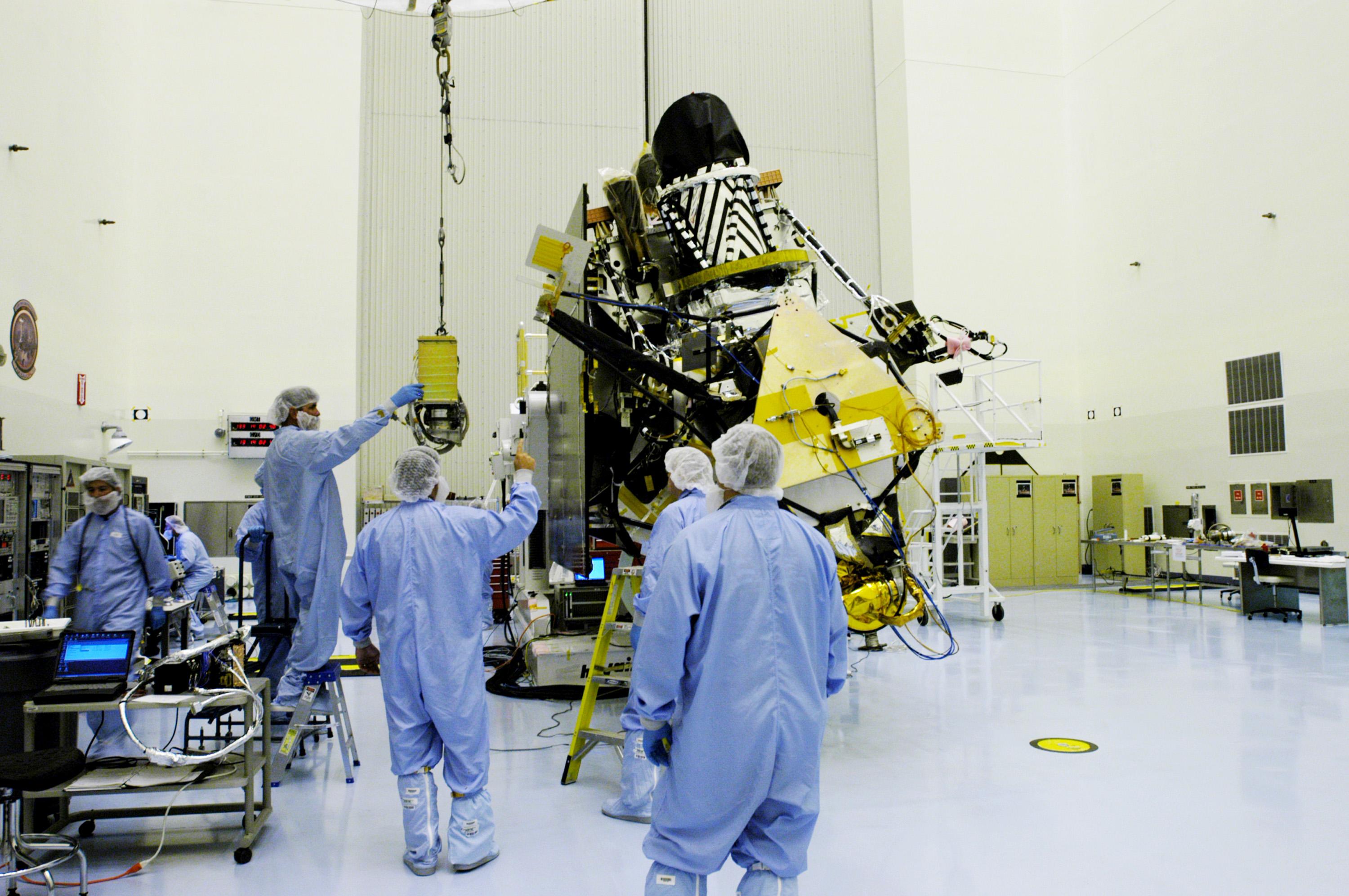
KENNEDY SPACE CENTER, FLA. - In the Payload Hazardous Servicing Facility at NASA’s Kennedy Space Center, engineers move the gimbal closer to the Mars Reconnaissance Orbiter (MRO) in the background. The gimbal will be installed on the MRO solar panel. A gimbal is an appliance that allows an object to remain horizontal even as its support tips. In the PHSF, the spacecraft will undergo multiple mechanical assembly operations and electrical tests to verify its readiness for launch. A major deployment test will check out the spacecraft’s large solar arrays. The MRO was built by Lockheed Martin for NASA’s Jet Propulsion Laboratory in California. It is the next major step in Mars exploration and scheduled for launch from Cape Canaveral Air Force Station in a window opening Aug. 10. The MRO is an important next step in fulfilling NASA’s vision of space exploration and ultimately sending human explorers to Mars and beyond.
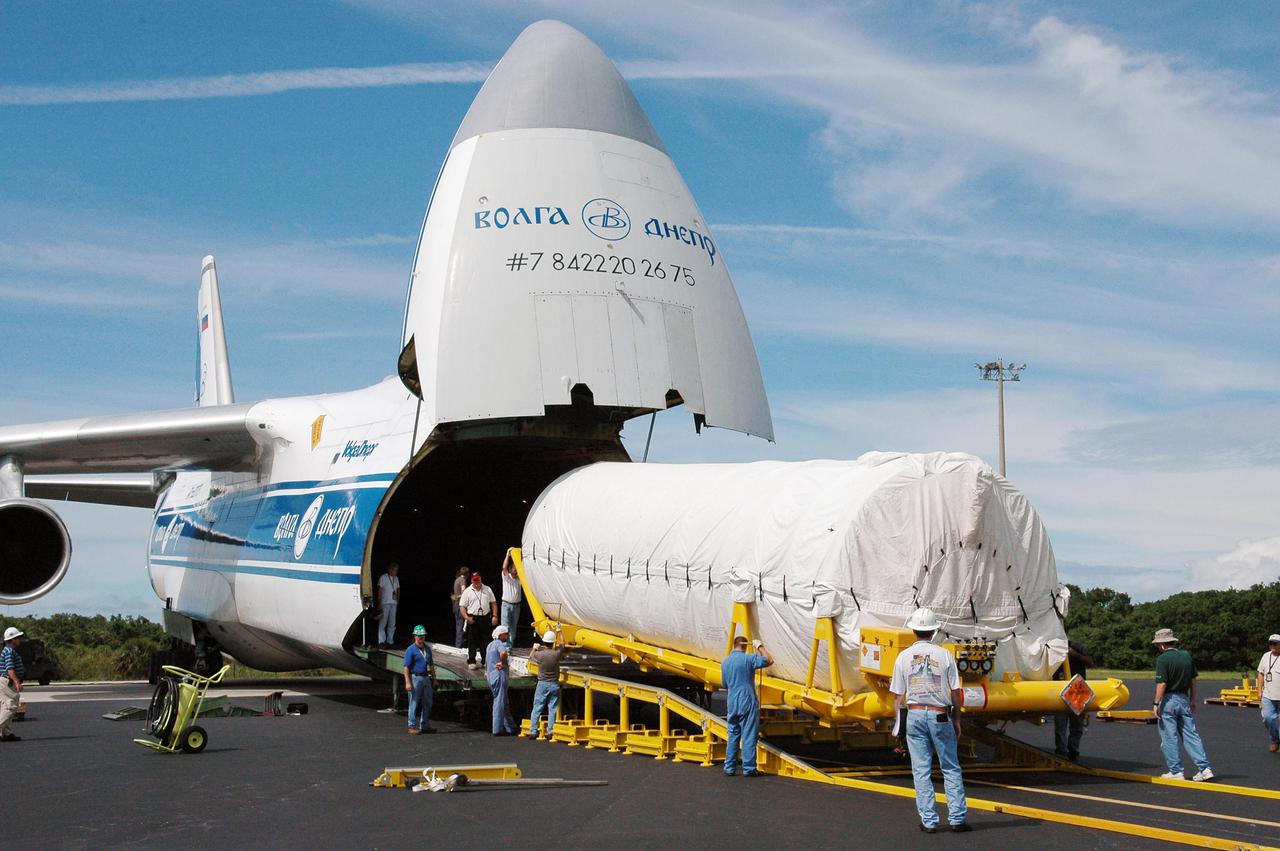
KENNEDY SPACE CENTER, FLA. - At the Cape Canaveral Air Force Station Skid Strip, a second stage Centaur (Block I) is rolled out of a Russian Antonov AH-124-100 cargo airplane. The Centaur will be mated with the Lockheed Martin Atlas V, designated AV-007, that is the launch vehicle for the Mars Reconnaissance Orbiter (MRO). The MRO is designed for a series of global mapping, regional survey and targeted observations from a near-polar, low-altitude Mars orbit. These observations will be unprecedented in terms of the spatial resolution and coverage achieved by the orbiter’s instruments as they observe the atmosphere and surface of Mars while probing its shallow subsurface as part of a “follow the water” strategy. The orbiter is undergoing environmental tests in facilities at Lockheed Martin Space Systems in Denver, Colo., and is on schedule for a launch window that begins Aug. 10. Launch will be from Launch Complex 41 at Cape Canaveral Air Force Station in Florida.

KENNEDY SPACE CENTER, FLA. - Inside the Payload Hazardous Servicing Facility (PHSF) at NASA's Kennedy Space Center, Lockheed Martin workers move one of the boxes containing NASA's Mars Reconnaissance Orbiter to a clean room. Here in the PHSF, the spacecraft will undergo multiple mechanical assembly operations and electrical tests to verify its readiness for launch. A test this month will verify the spacecraft's ability to communicate through NASA's Deep Space Network tracking stations. A June test will check the deployment of the spacecraft's high gain communications antenna. Another major deployment test will check out the spacecraft's large solar arrays. The MRO was built by Lockheed Martin for NASA's Jet Propulsion Laboratory in California. It is the next major step in Mars exploration and scheduled for launch from Cape Canaveral Air Force Station in a window opening Aug. 10. The MRO is an important next step in fulfilling NASA's vision of space exploration and ultimately sending human explorers to Mars and beyond.
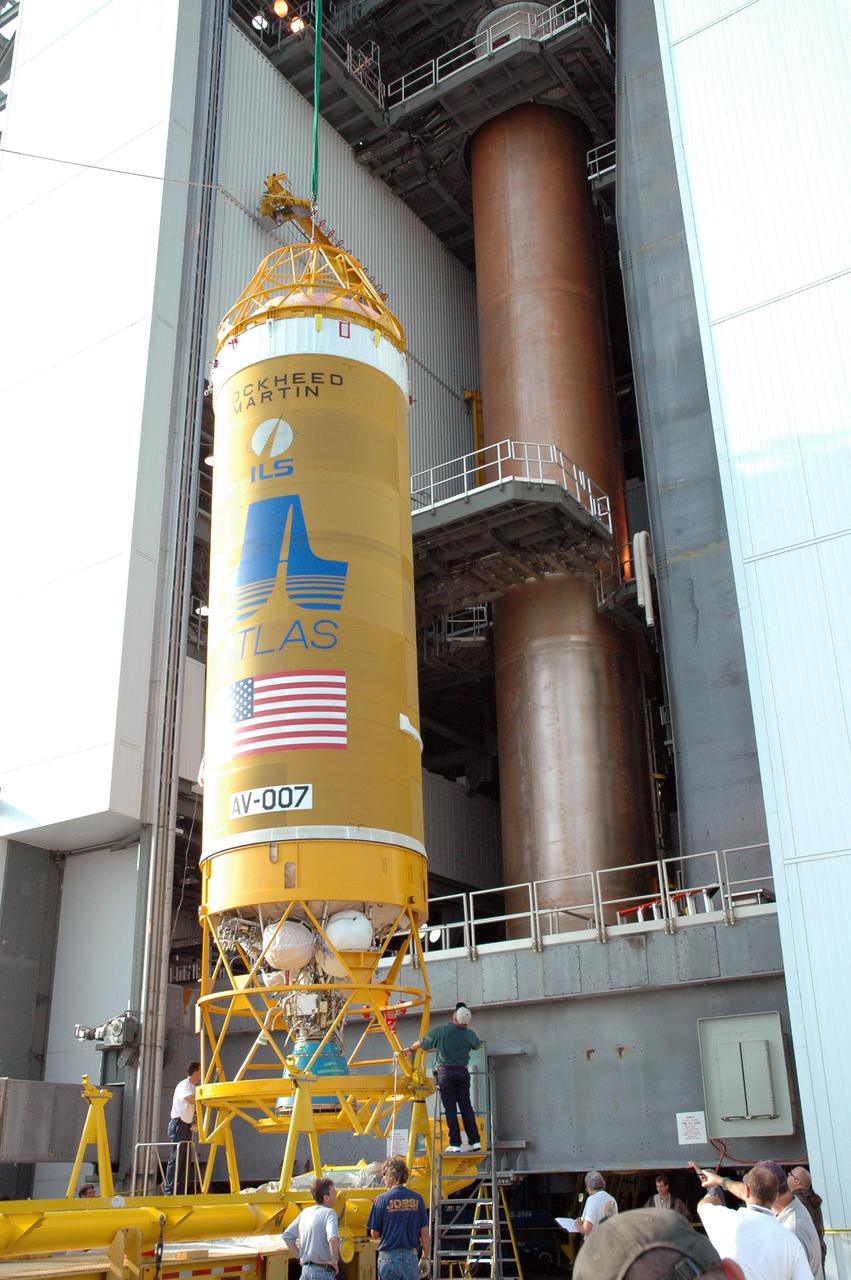
KENNEDY SPACE CENTER, FLA. - At the Vertical Integration Facility on Launch Pad 41 at Cape Canaveral Air Force Station in Florida, the Lockheed Martin Centaur second stage is positioned vertically to be lifted into the launch tower where it will be mated with the Atlas V already there. The Atlas V_Centaur is the launch vehicle for the Mars Reconnaissance Orbiter (MRO). The MRO is designed for a series of global mapping, regional survey and targeted observations from a near-polar, low-altitude Mars orbit. These observations will be unprecedented in terms of the spatial resolution and coverage achieved by the orbiter’s instruments as they observe the atmosphere and surface of Mars while probing its shallow subsurface as part of a “follow the water” strategy. The launch window for the MRO begins Aug. 10.
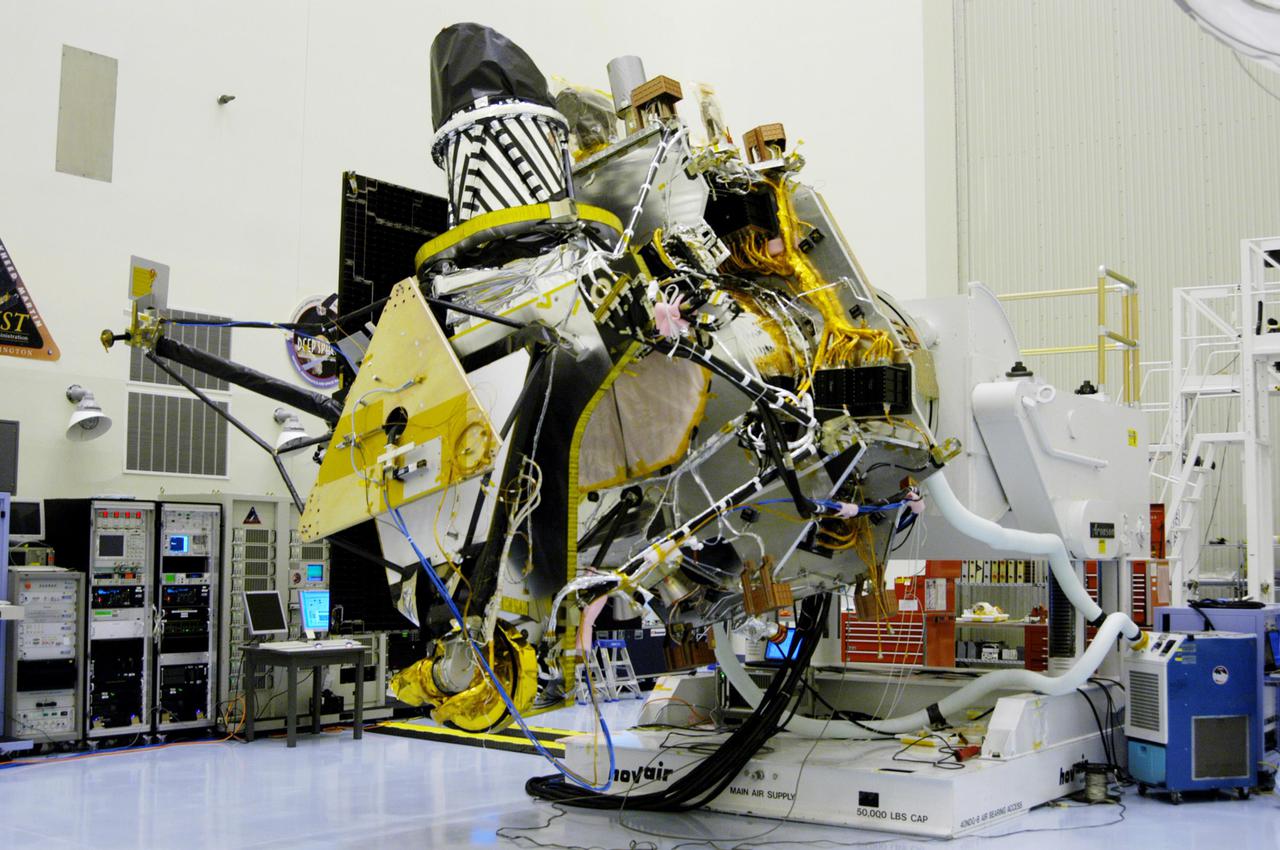
KENNEDY SPACE CENTER, FLA. - The Mars Reconnaissance Orbiter (MRO) spacecraft waits for installation of a second gimbal on its solar panel. A gimbal is an appliance that allows an object to remain horizontal even as its support tips. In the PHSF, the spacecraft will undergo multiple mechanical assembly operations and electrical tests to verify its readiness for launch. A major deployment test will check out the spacecraft’s large solar arrays. The MRO was built by Lockheed Martin for NASA’s Jet Propulsion Laboratory in California. It is the next major step in Mars exploration and scheduled for launch from Cape Canaveral Air Force Station in a window opening Aug. 10. The MRO is an important next step in fulfilling NASA’s vision of space exploration and ultimately sending human explorers to Mars and beyond.
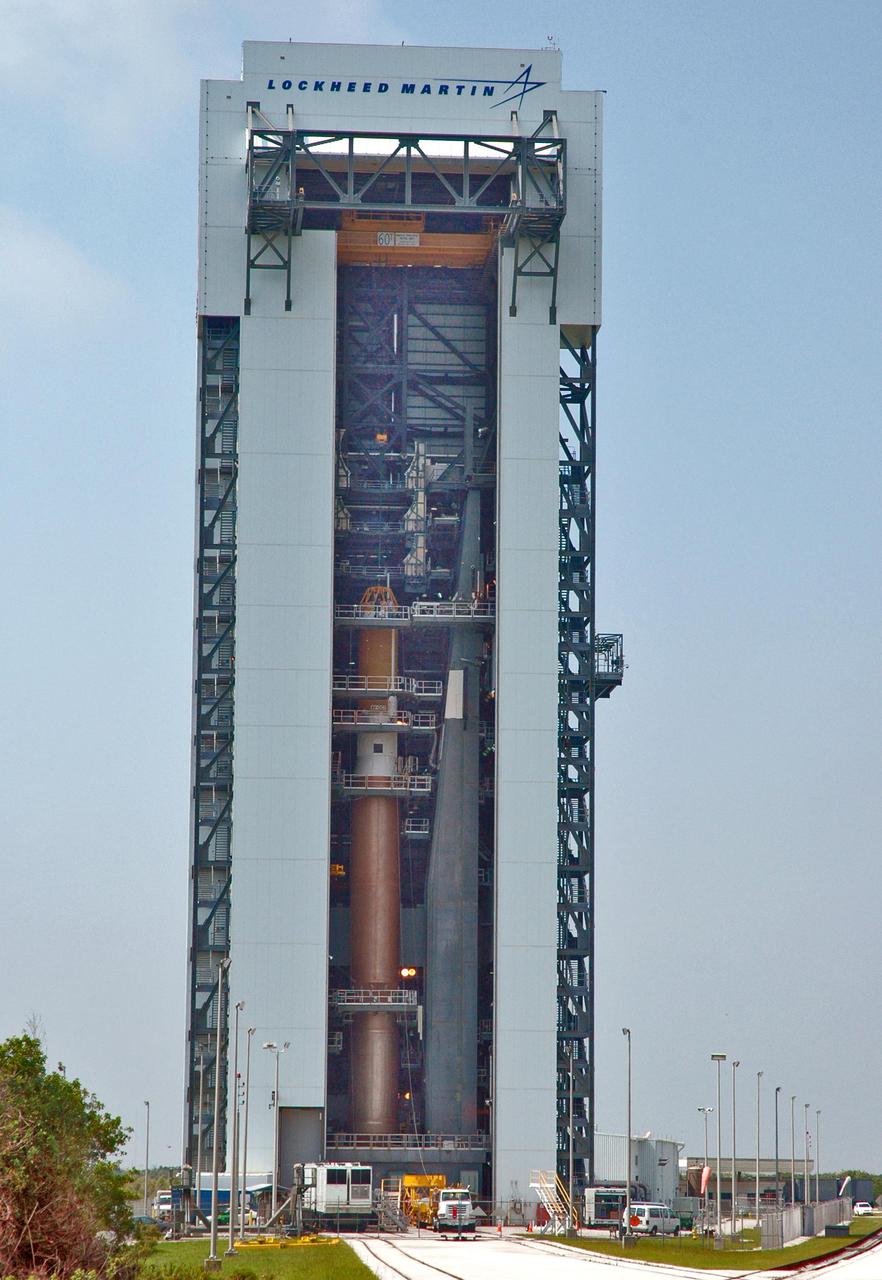
KENNEDY SPACE CENTER, FLA. - Inside the launch tower on Launch Pad 41 at Cape Canaveral Air Force Station in Florida, the upper end of the Lockheed Martin Centaur second stage is being lowered through an opening toward the Atlas V below. The Centaur will be mated with the Atlas V. The Atlas V_Centaur is the launch vehicle for the Mars Reconnaissance Orbiter (MRO). The MRO is designed for a series of global mapping, regional survey and targeted observations from a near-polar, low-altitude Mars orbit. These observations will be unprecedented in terms of the spatial resolution and coverage achieved by the orbiter’s instruments as they observe the atmosphere and surface of Mars while probing its shallow subsurface as part of a “follow the water” strategy. The launch window for the MRO begins Aug. 10.