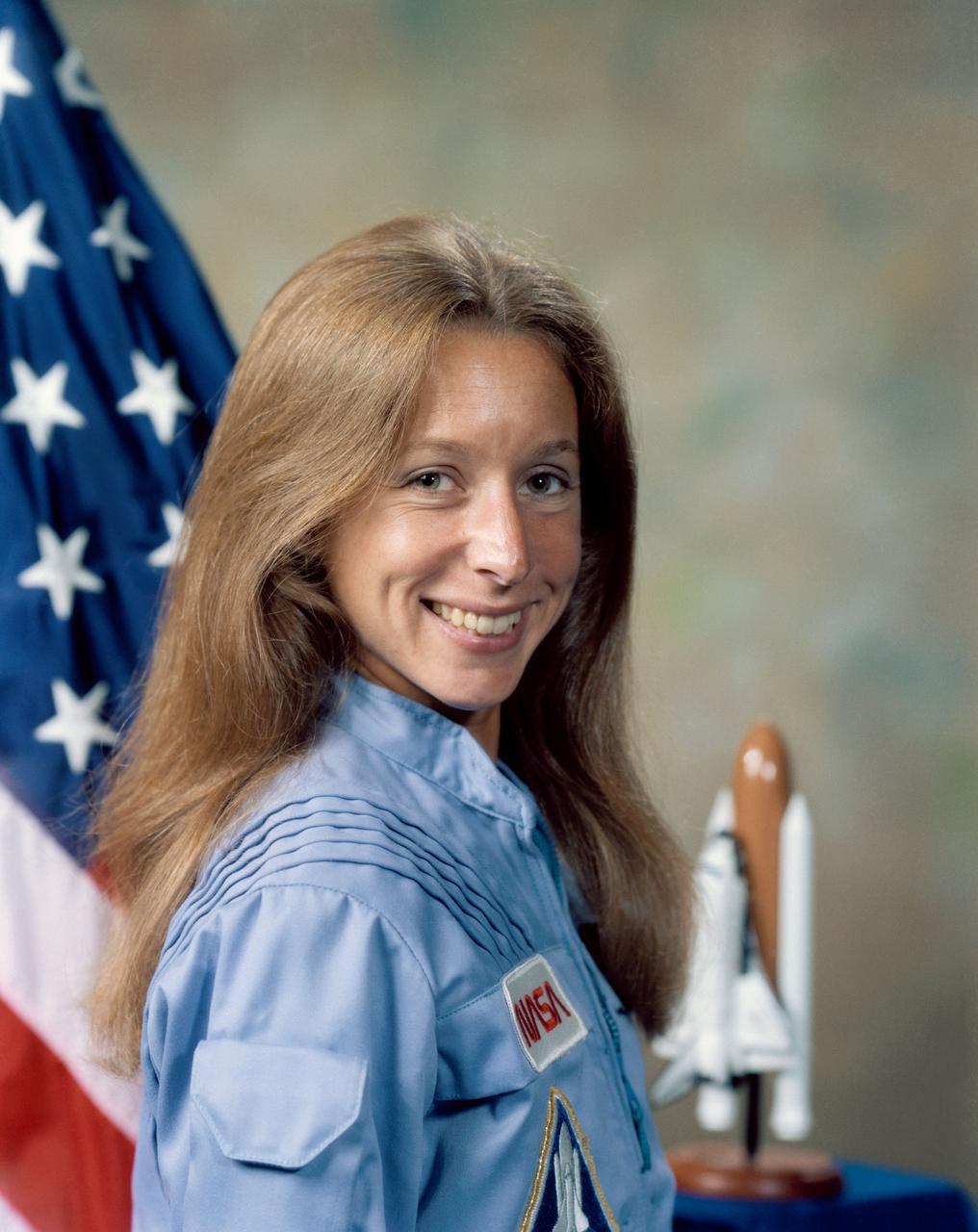
Portrait photograph, Astronaut Marsha S. Ivins, dressed in Blue Flight Suit, with Flag (frame left), and Space Shuttle Model (frame right). JSC, HOUSTON, TX
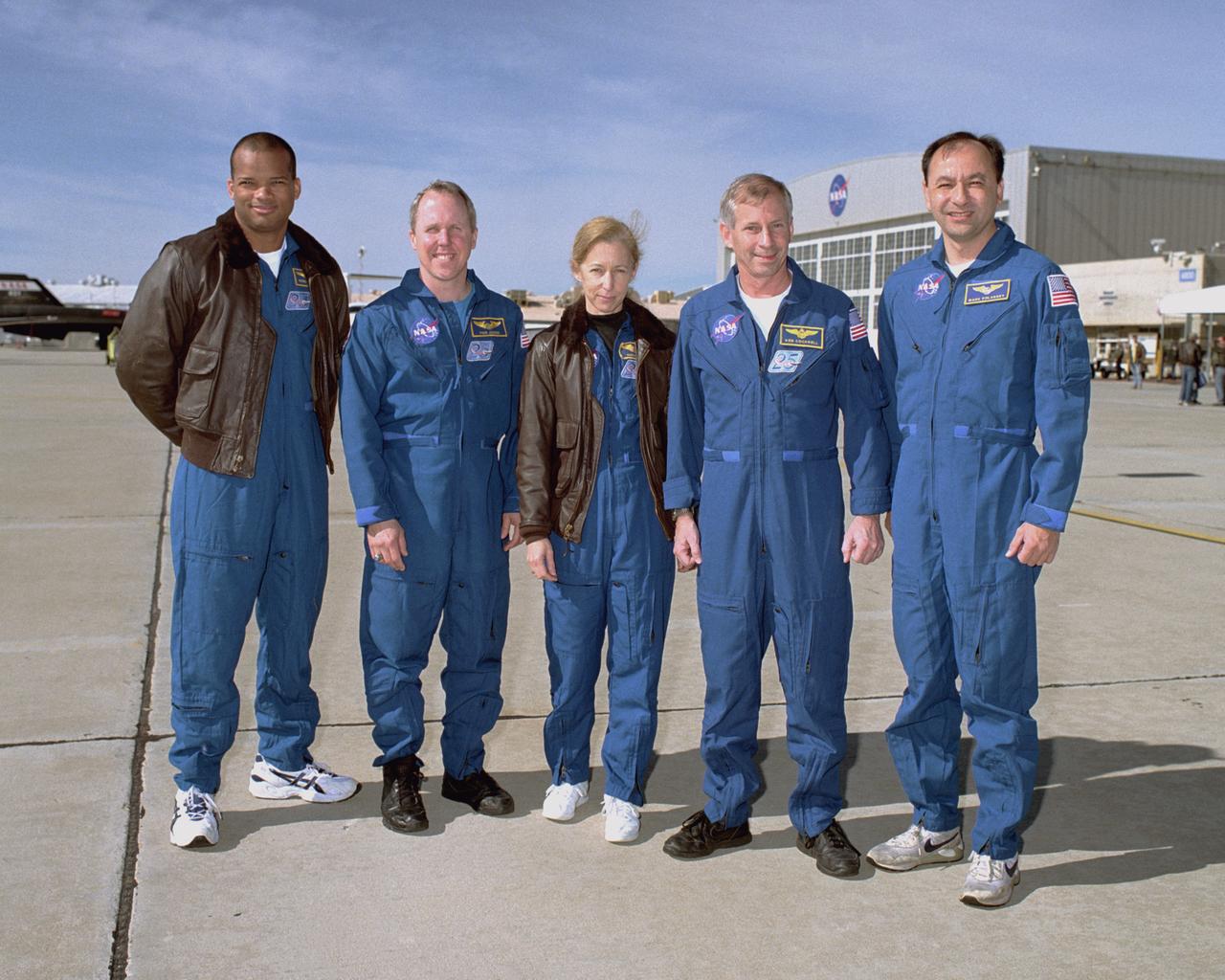
The crew of STS-98 poses for a group photo shortly before leaving NASA's Dryden Flight Research Center after a successful landing of the Space Shuttle Atlantis the day before. L to R: Mission Specialists Robert L. Curbeam, Thomas D. Jones, and Marsha S. Ivins, Commander Kenneth D. Cockrell, and Pilot Mark L. Polansky.
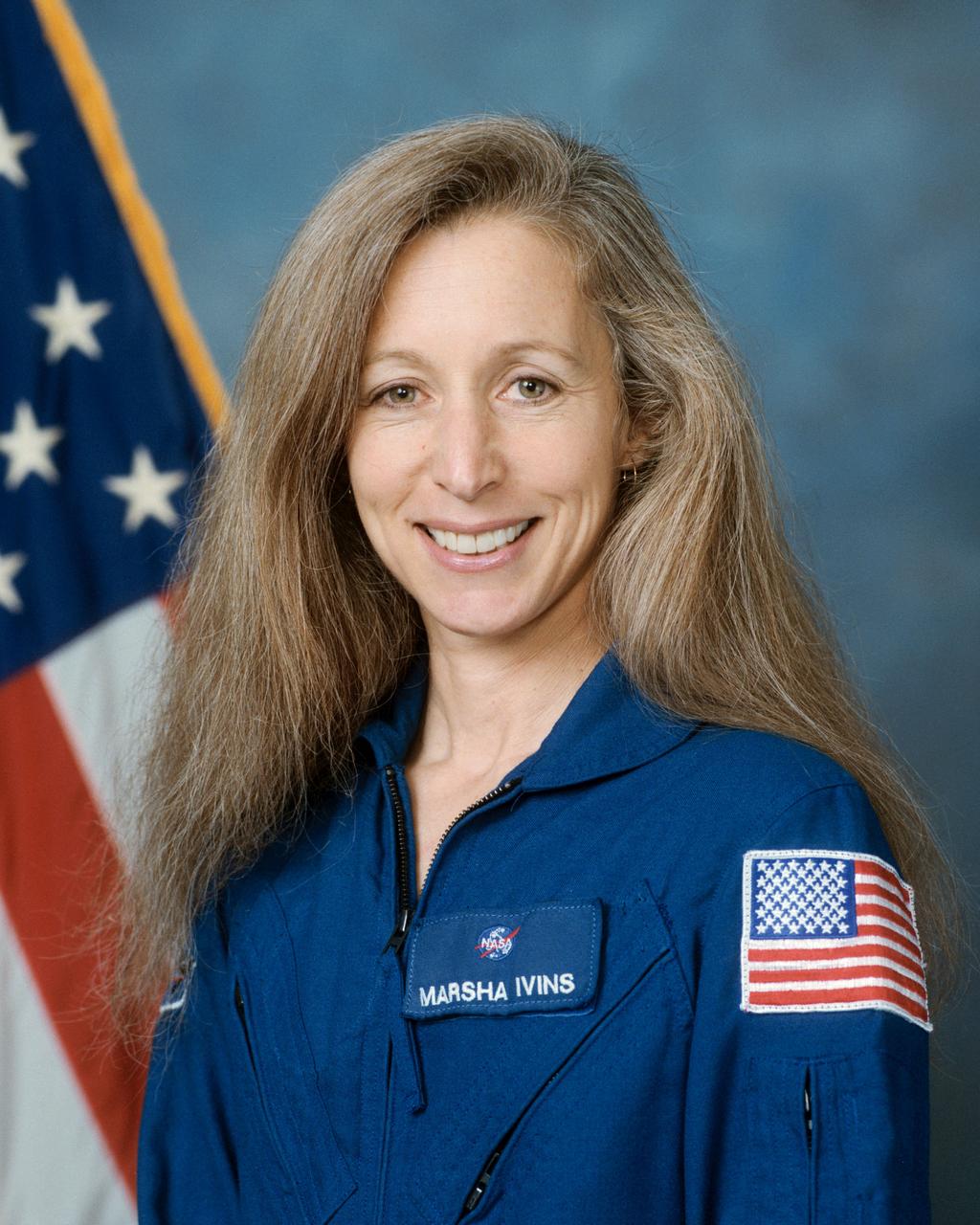
S96-13321 (1 April 1993) --- Astronaut Marsha S. Ivins, mission specialist.
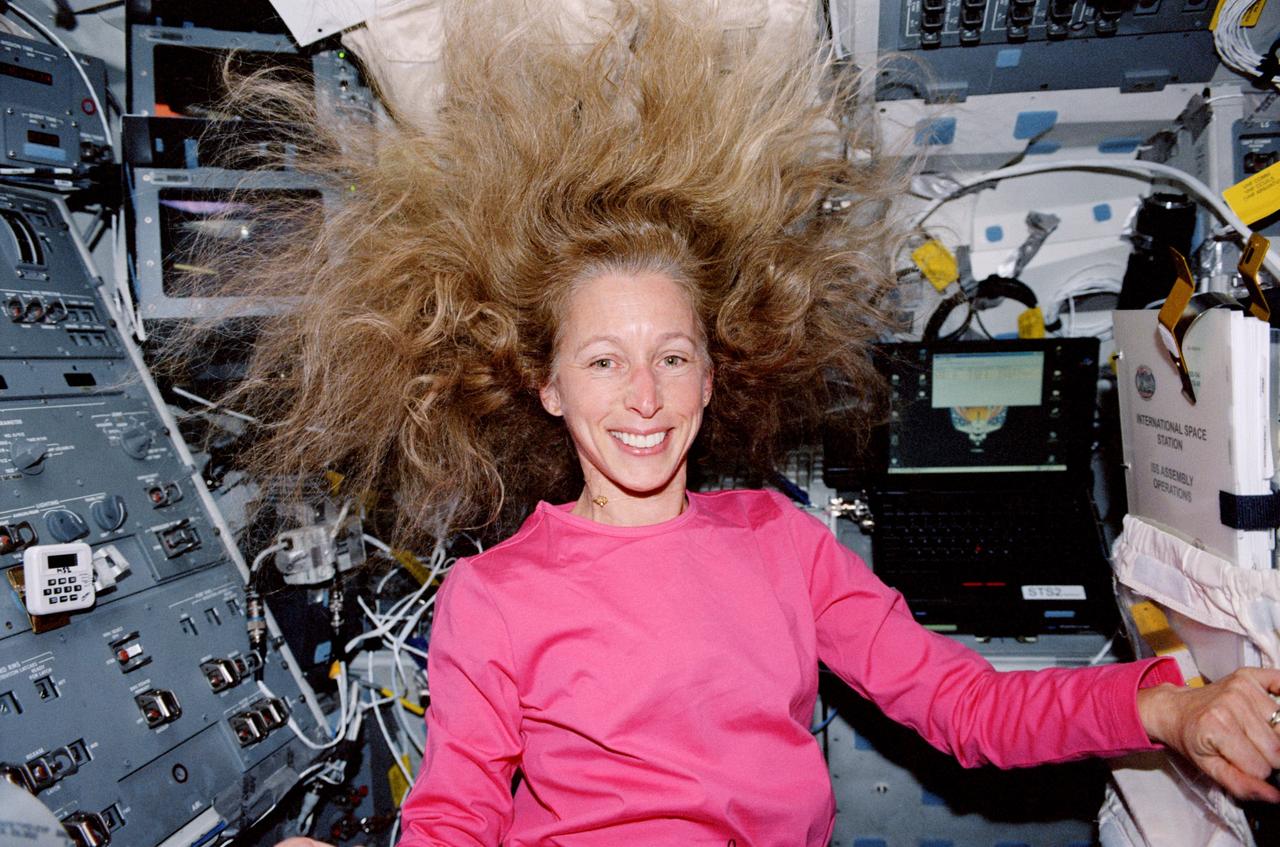
STS098-348-015 (7-20 February 2001) --- Astronaut Marsha S. Ivins, STS-98 mission specialist, is photographed on the mid deck of the Earth-orbiting Space Shuttle Atlantis.
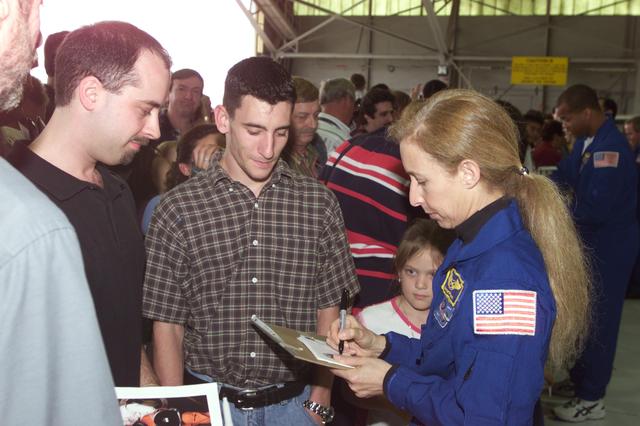
JSC2001-E-04813 (21 February 2001) --- Astronaut Marsha S. Ivins, STS-98 mission specialist, signs some photos and mementoes for members of the crowd on hand at Ellington Field for a brief welcome hom eceremony for the five Atlantis crew members.
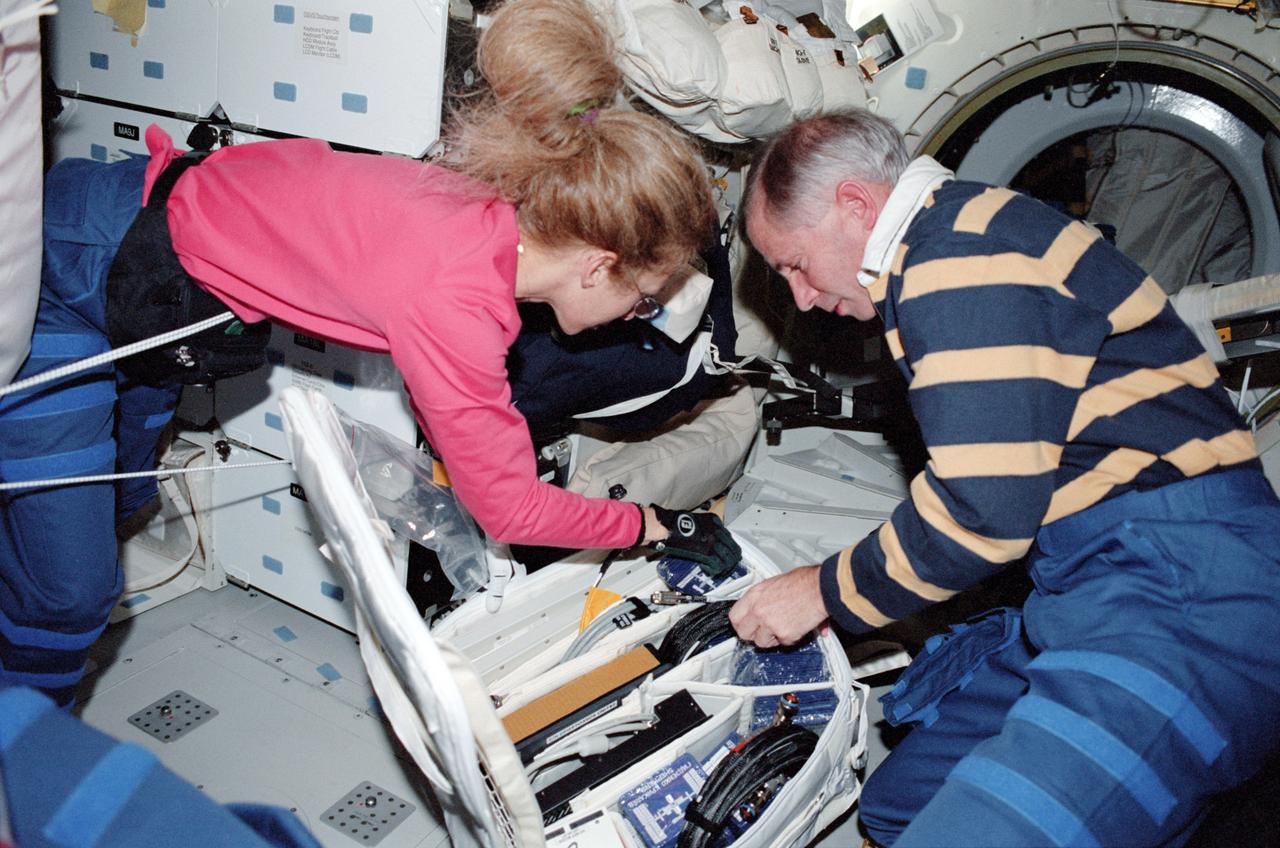
STS098-348-030 (7-20 February 2001) --- Astronauts Marsha S. Ivins (left), mission specialist, and Kenneth D. Cockrell, mission commander, prepare to transfer cables and miscellaneous equipment from the mid deck of the Space Shuttle Atlantis to the International Space Station (ISS).
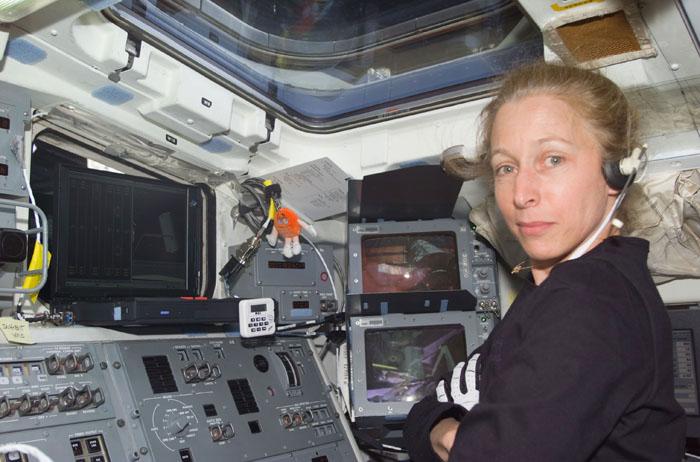
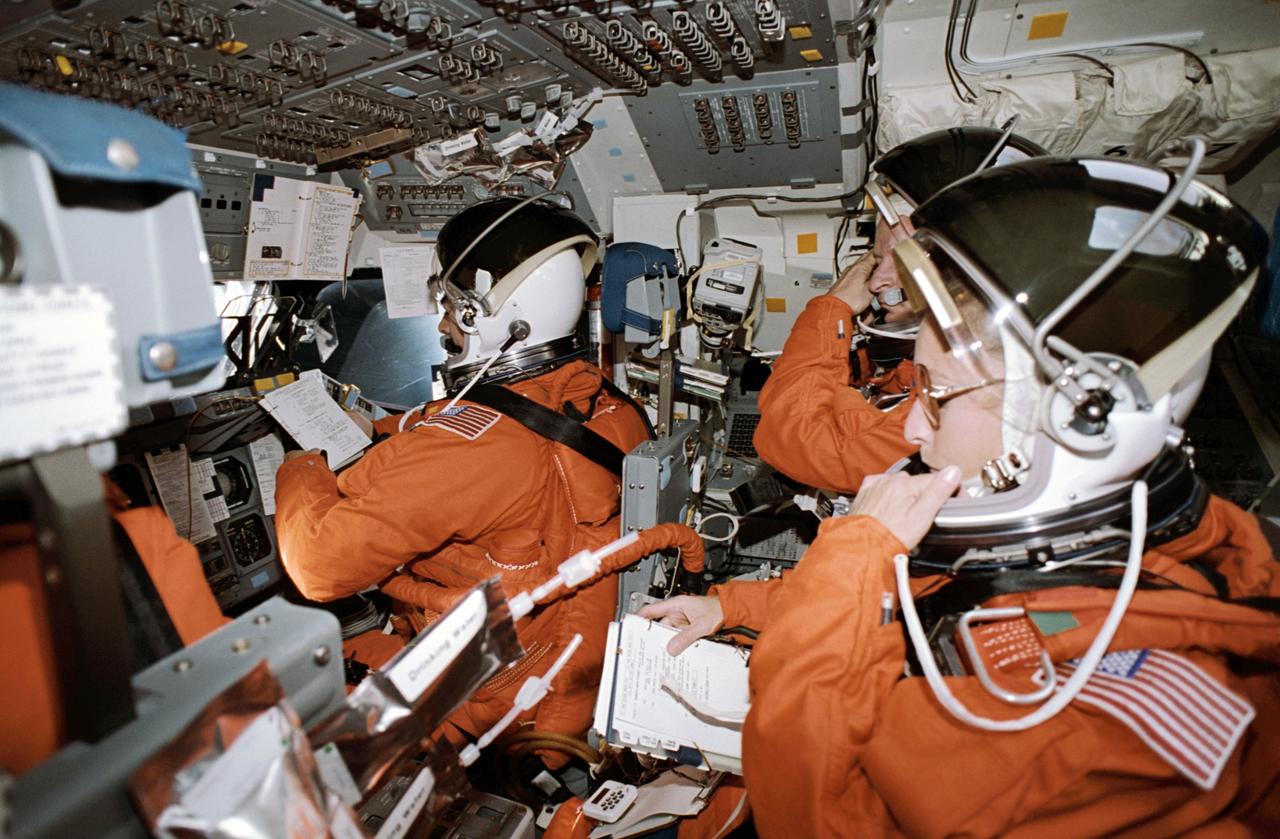
STS98-E-5078 (10 February 2001) --- Astronaut Marsha S. Ivins, STS-98 mission specialist, monitors communications from ground controllers from her post at the aft flight deck controls on the Space Shuttle Atlantis. The scene was recorded with a digital still camera.
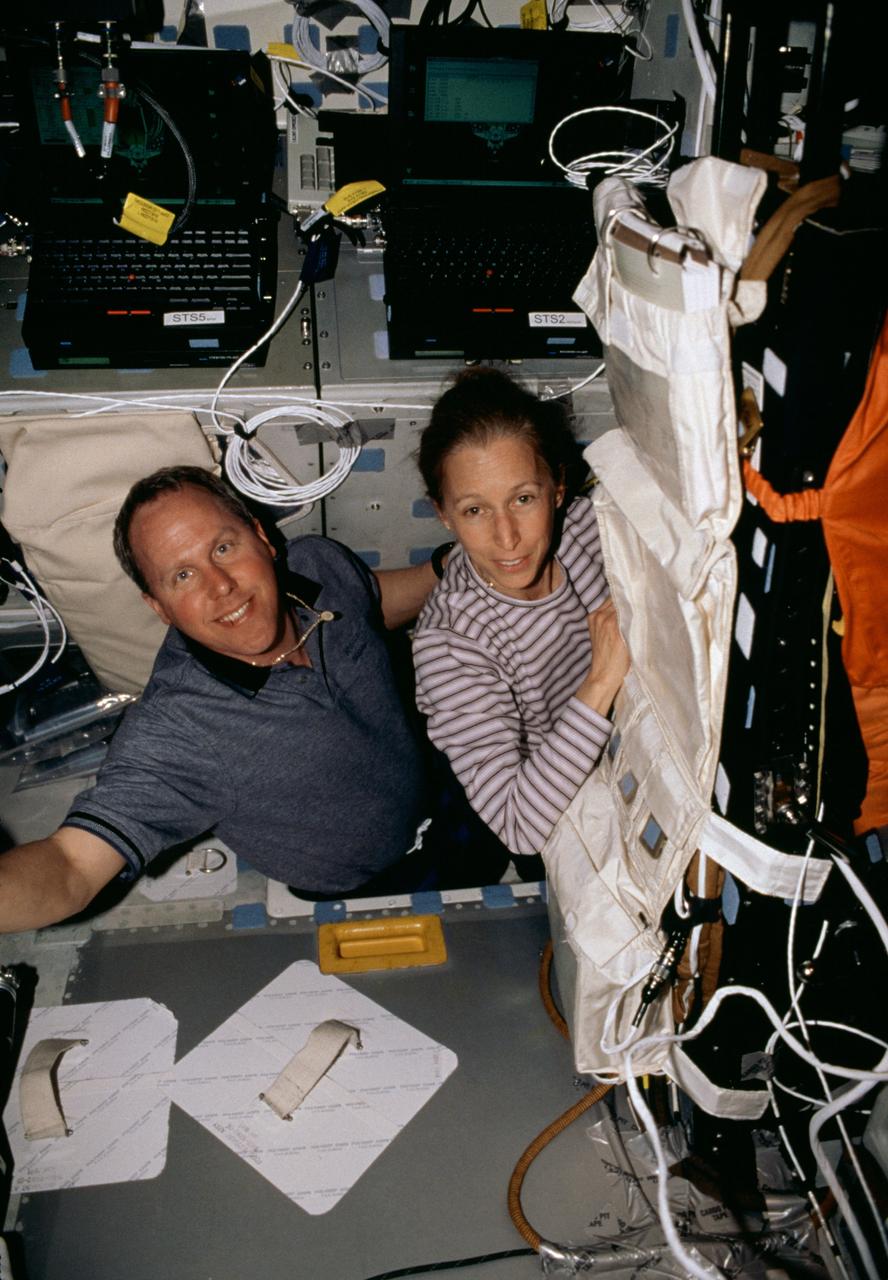
STS098-311-020 (7-20 February 2001) --- Astronauts Thomas D. Jones and Marsha S. Ivins, both mission specialists, are photographed on the mid deck of the Space Shuttle Atlantis near the Payload General Support Computers (PGSC).
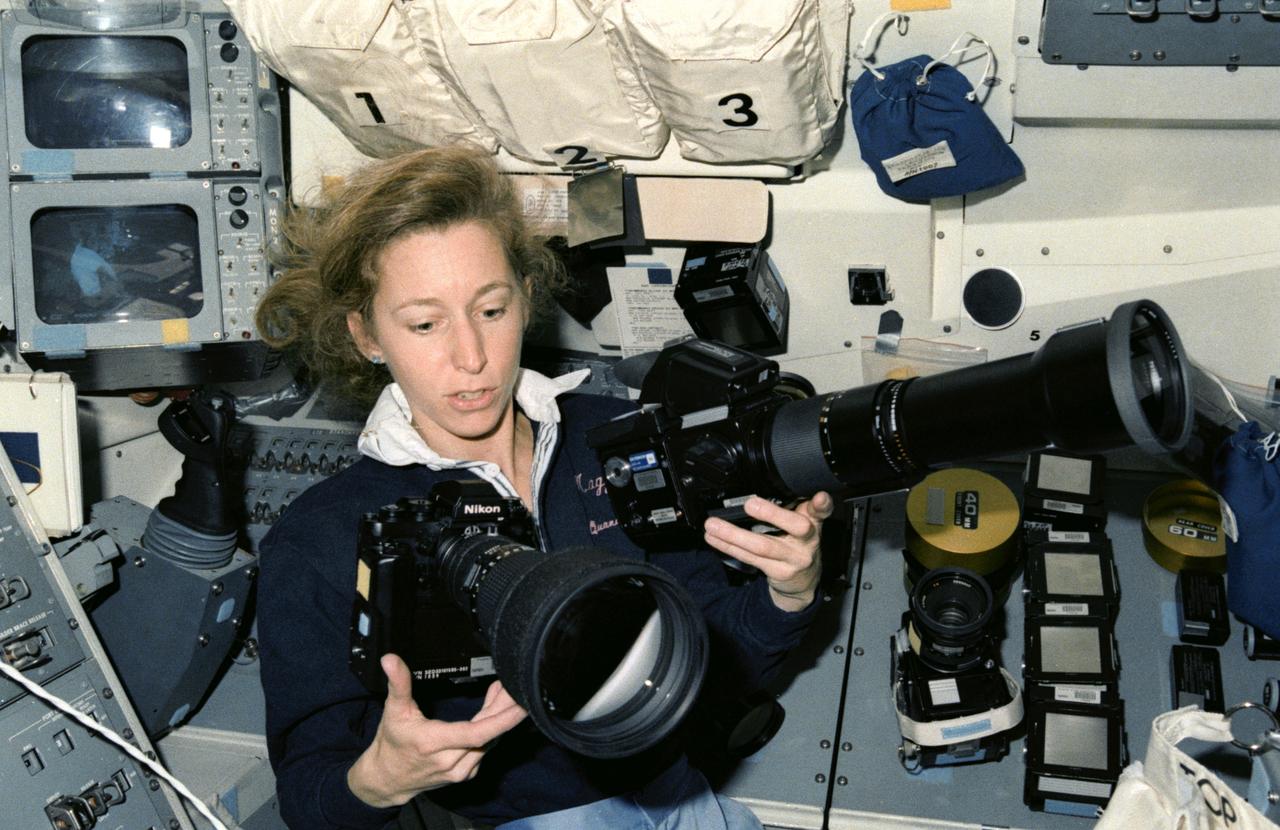
STS032-15-022 (9-20 Jan 1990) --- A 35mm scene of Astronaut Marsha S. Ivins with 35mm and 70mm cameras and accessories on Columbia's aft flight deck. The photo depicts the role photography played on the record-setting 11-day STS-32 mission.
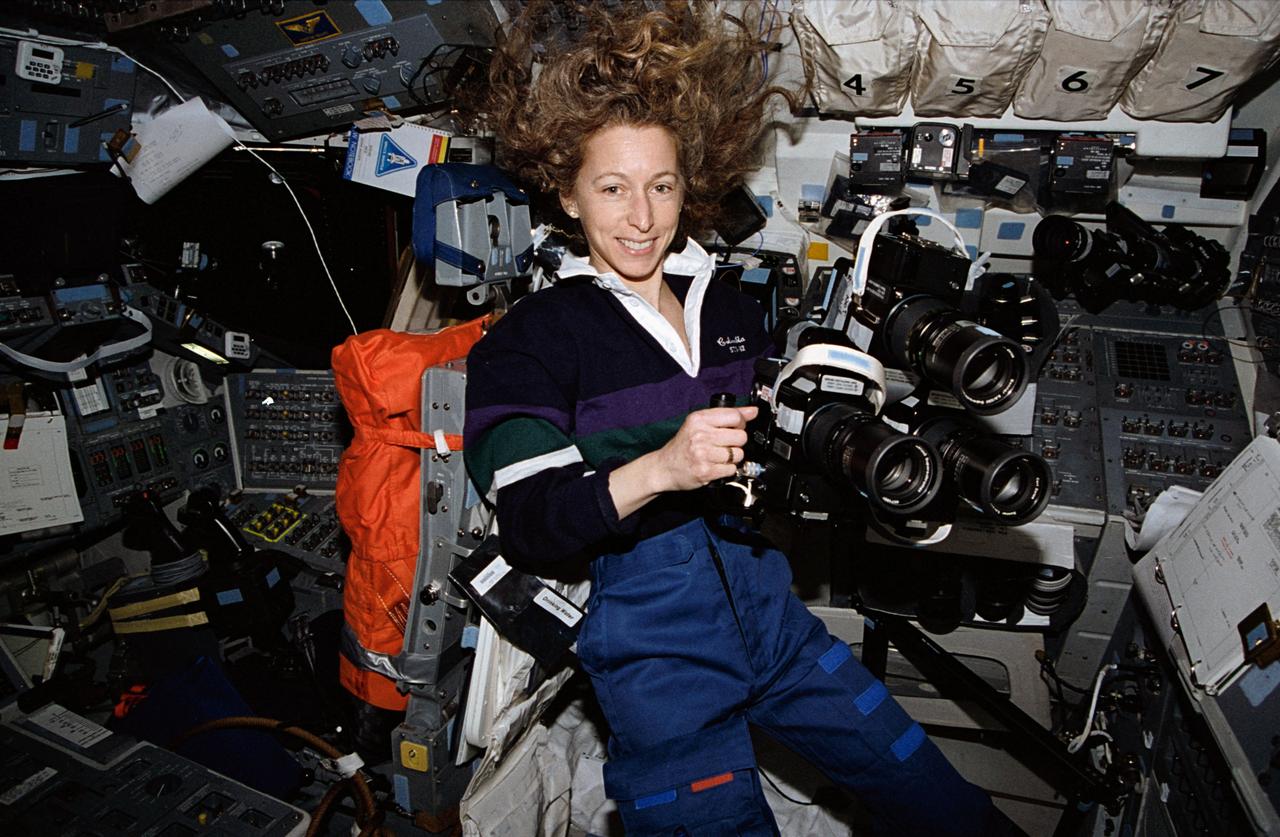
STS062-03-023 (4-14 March 1994) --- Astronaut Marsha S. Ivins, mission specialist, prepares to aim three Hasselblad cameras through the overhead windows of the earth-orbiting Space Shuttle Columbia. The three cameras were allowed to simultaneously record the same imagery on different types of file for purposes of comparison and experimentation.
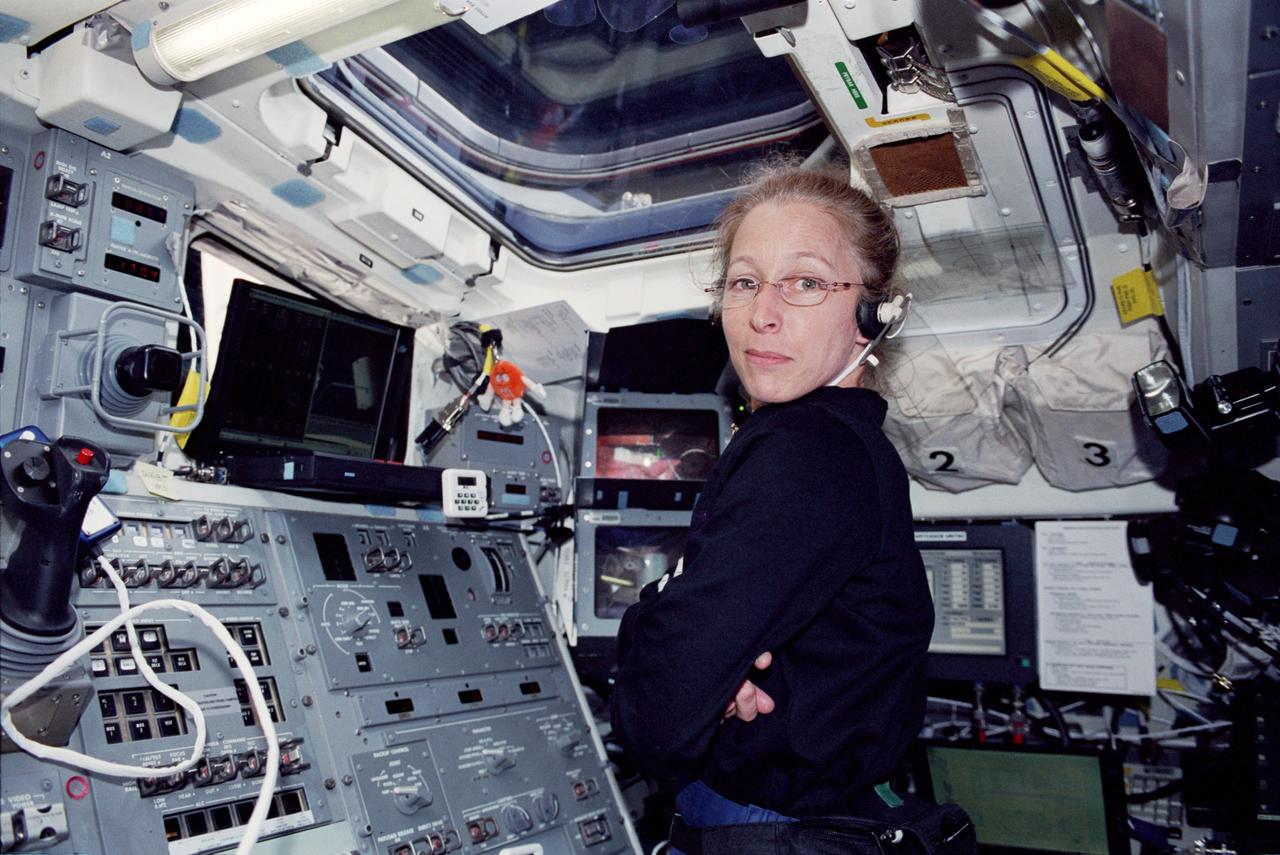
STS098-351-0013 (7-20 February 2001) --- Astronaut Marsha S. Ivins, mission specialist, spent a great deal of time on the aft flight deck of the Space Shuttle Atlantis during space walks and other important activities of the STS-98/5a mission.
Astronaut Marsha S. Ivins, mission specialist, prepares to aim three Hasselblad cameras through the overhead windows of the Earth-orbiting Space Shuttle Columbia. The three cameras were allowed to simultaneously record the same imagery on different types of film.
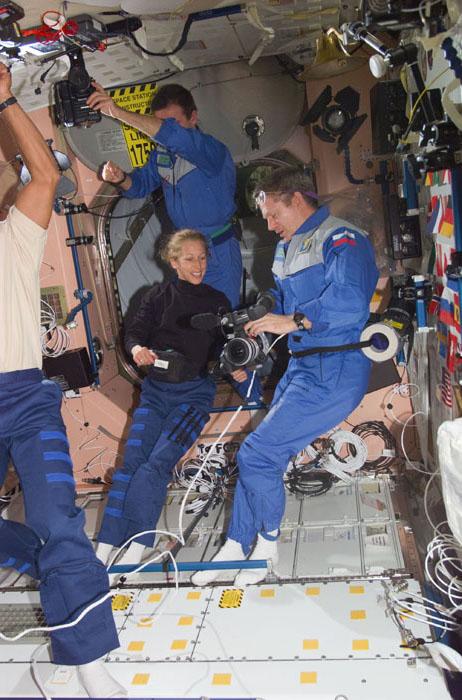
STS98-E-5049 (9 February 2001) --- Astronaut Marsha S. Ivins, STS-98 mission specialist, discusses camera gear with astronaut William M. (Bill) Shepherd, Expedition One mission commander, soon after the shuttle and station crews reunited onboard the outpost. This scene was recorded with a digital still camera.
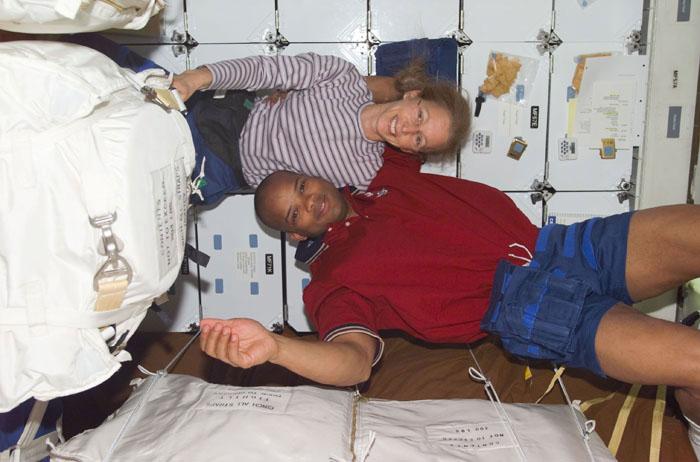
STS98-E-5005 (8 February 2001) -- Astronauts Marsha S. Ivins and Robert L. Curbeam, mission specialists, are seen on the mid deck of the Earth-orbiting Space Shuttle Atlantis in one of the first STS-98 digital still camera scenes to be down linked from the shuttle.
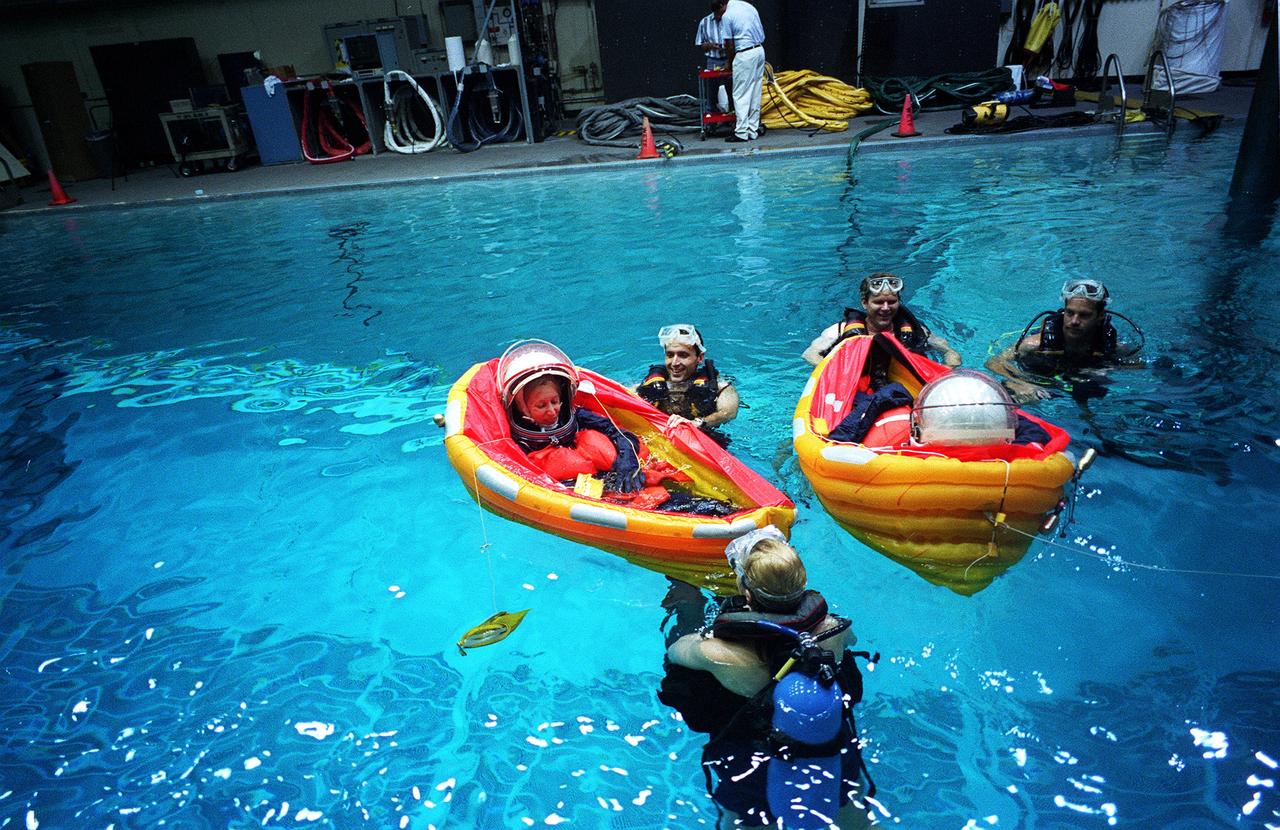
S96-15405 (26 Sept. 1996) --- In the Johnson Space Center's weightless environment training facility, astronaut Marsha S. Ivins, STS-81 mission specialist, bails water from her life raft during water bailout survival training. Astronaut Peter J.K. (Jeff) Wisoff (pictured in right raft) and four other STS-81 crewmates (out of frame) joined Ivins for the bailout training exercises. Several SCUBA-equipped divers assist in the training exercise.
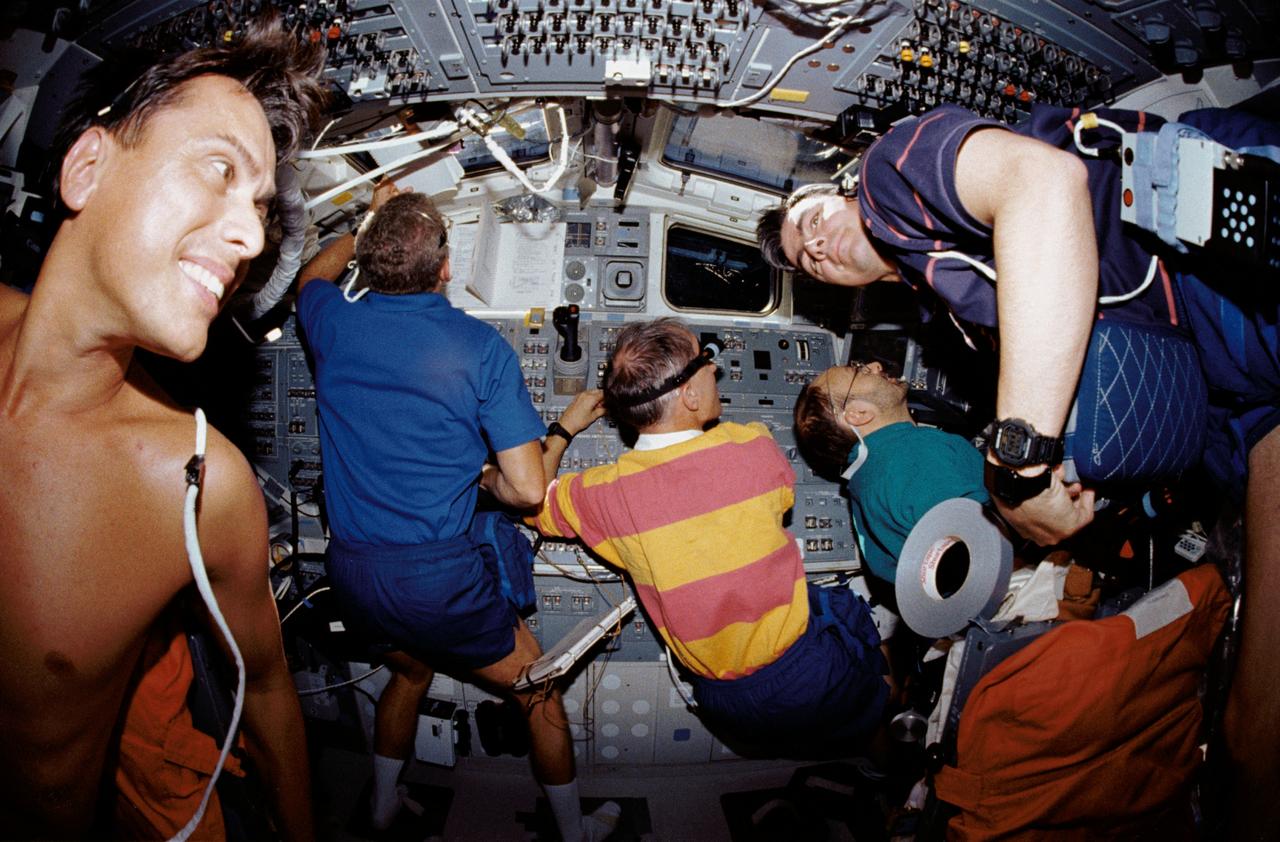
STS046-14-013 (4 Aug. 1992) --- Five of the seven crew members squeezed into this busy scene on the Space Shuttle Atlantis' flight deck during operations with the Tethered Satellite System (TSS). Pictured are, left to right, Franklin R. Chang-Diaz, Loren J. Shriver, Claude Nicollier, Franco Malerba and Andrew M. Allen. Not pictured are astronauts Jeffrey A. Hoffman and Marsha S. Ivins. Mission specialist Ivins used a 35mm camera with a 16mm lens to take this picture.
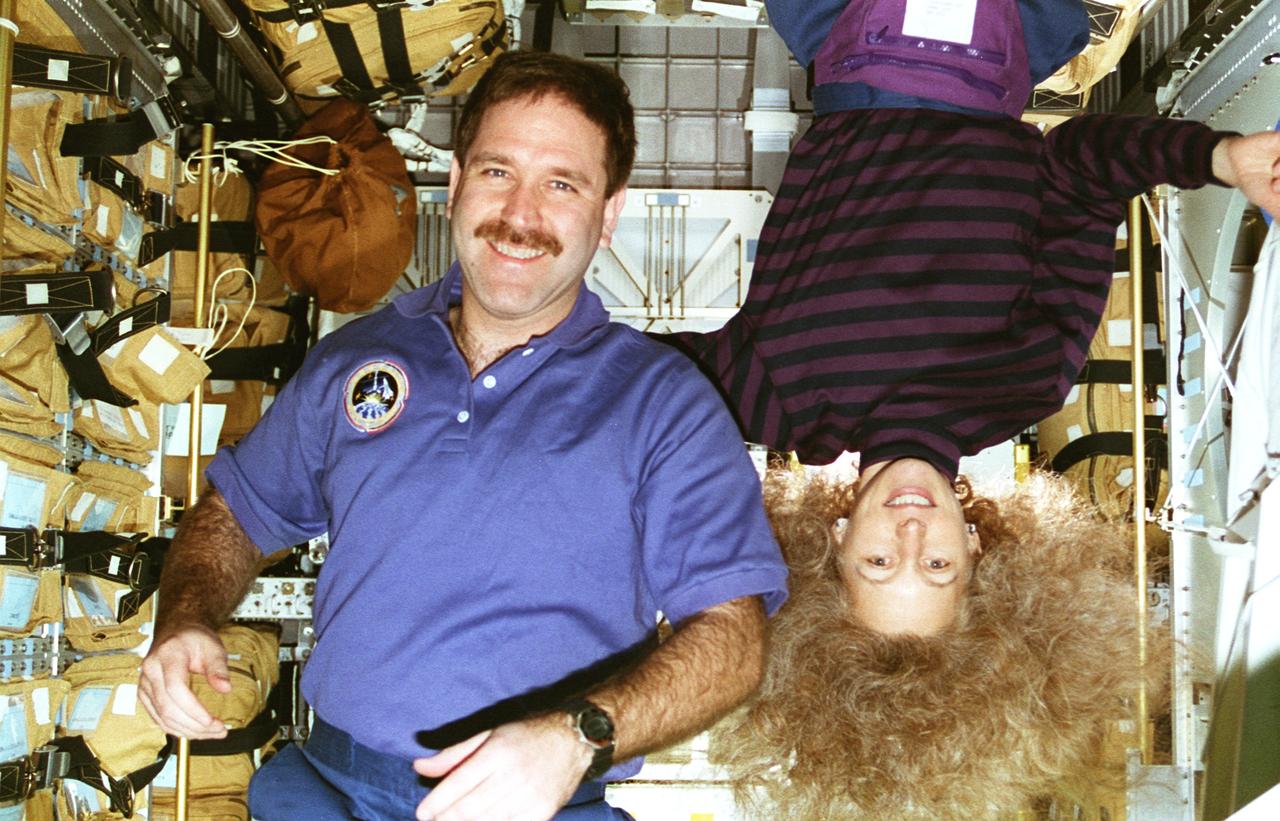
STS081-303-015 (12-22 Jan. 1997) --- Early in the part of the mission during which the Space Shuttle Atlantis was docked with Russia's Mir Space Station, impending duties appear to have Marsha S. Ivins topsy-turvy. Pictured in Spacehab's new Double Module (DM), astronauts Ivins and John M. Grunsfeld were involved with the transfer of supplies from Atlantis to Mir.
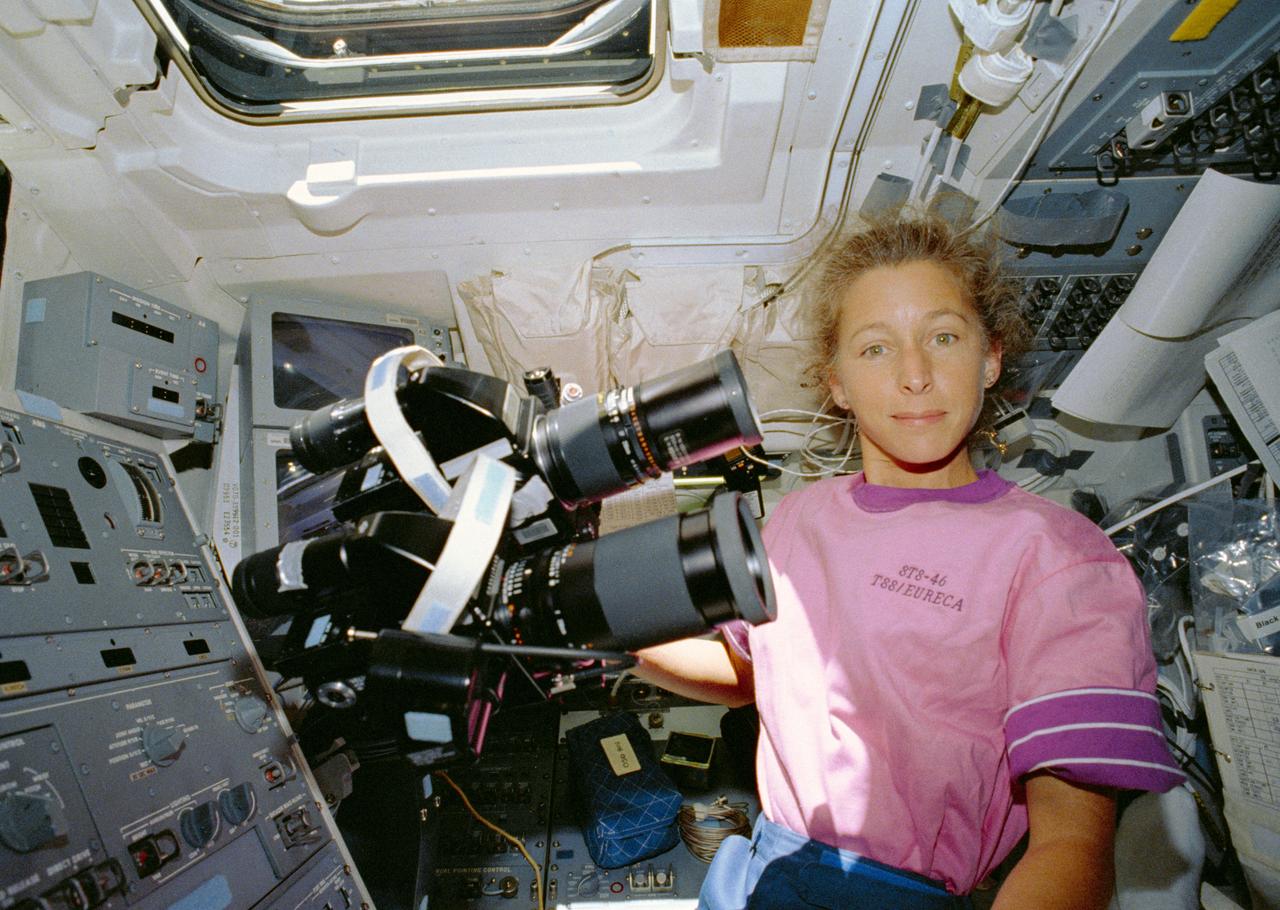
STS046-03-032 (31 July-8 Aug 1992) --- Astronaut Marsha S. Ivins, mission specialist, prepares to operate a tandem of 70mm Hasselblad cameras on the Space Shuttle Atlantis' aft flight deck. The cameras share a common mount, allowing for various tests to be run as the cameras record the same Earth-observations type imagery. Ivins was joined by four other NASA astronauts and two Europeans for an eight-day stay in Earth-orbit.
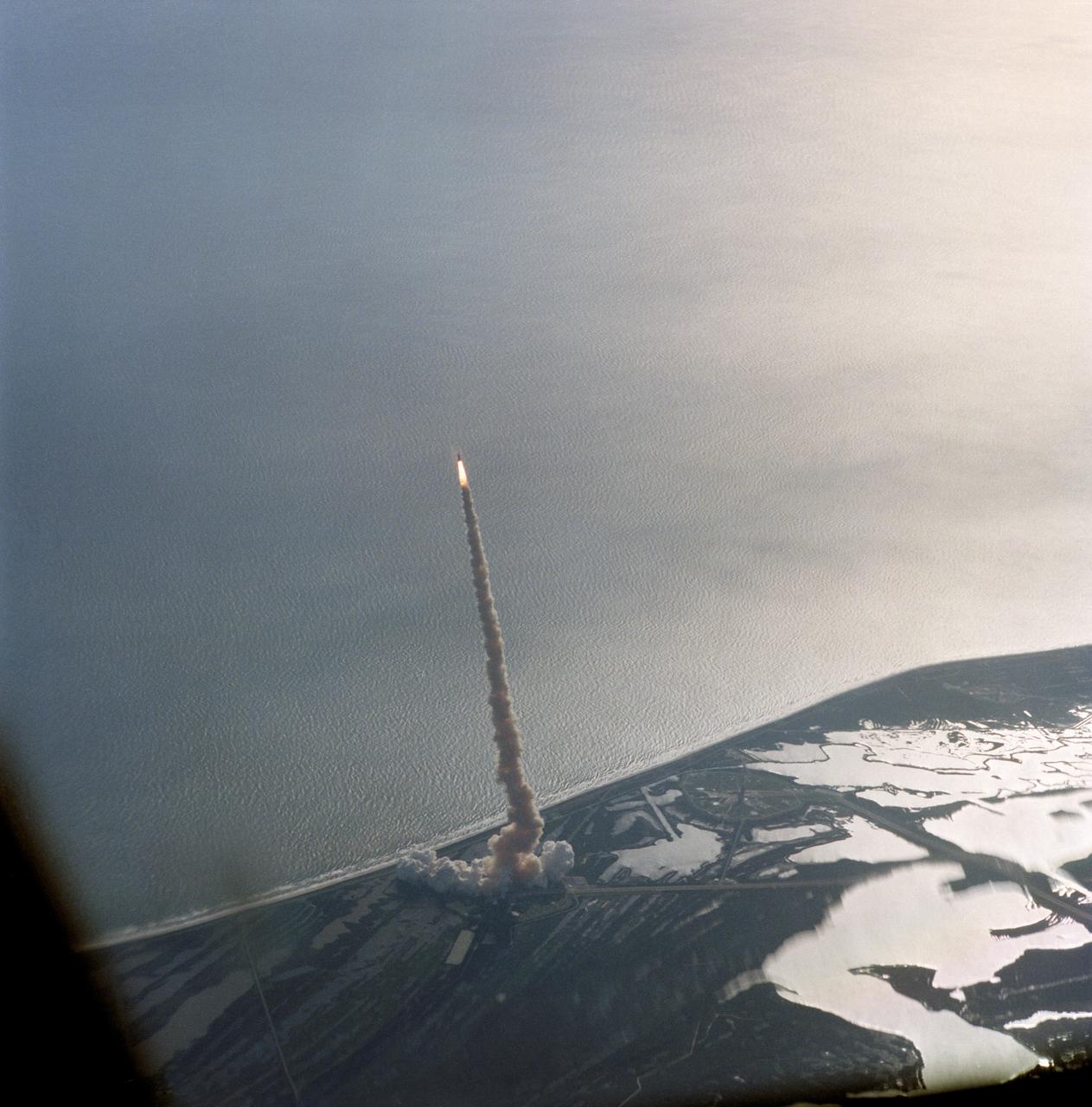
STS062-S-061 (4 March 1994) --- An aerial view of early stages of the sixteenth launch of Space Shuttle Columbia was provided by a 70mm camera aboard the Shuttle Training Aircraft (STA). Launch occurred at 8:53 a.m. (EST), March 4, 1994. Onboard were astronauts John H. Casper, Andrew M. Allen, Marsha S. Ivins, Charles D. (Sam) Gemar and Pierre J. Thuot.
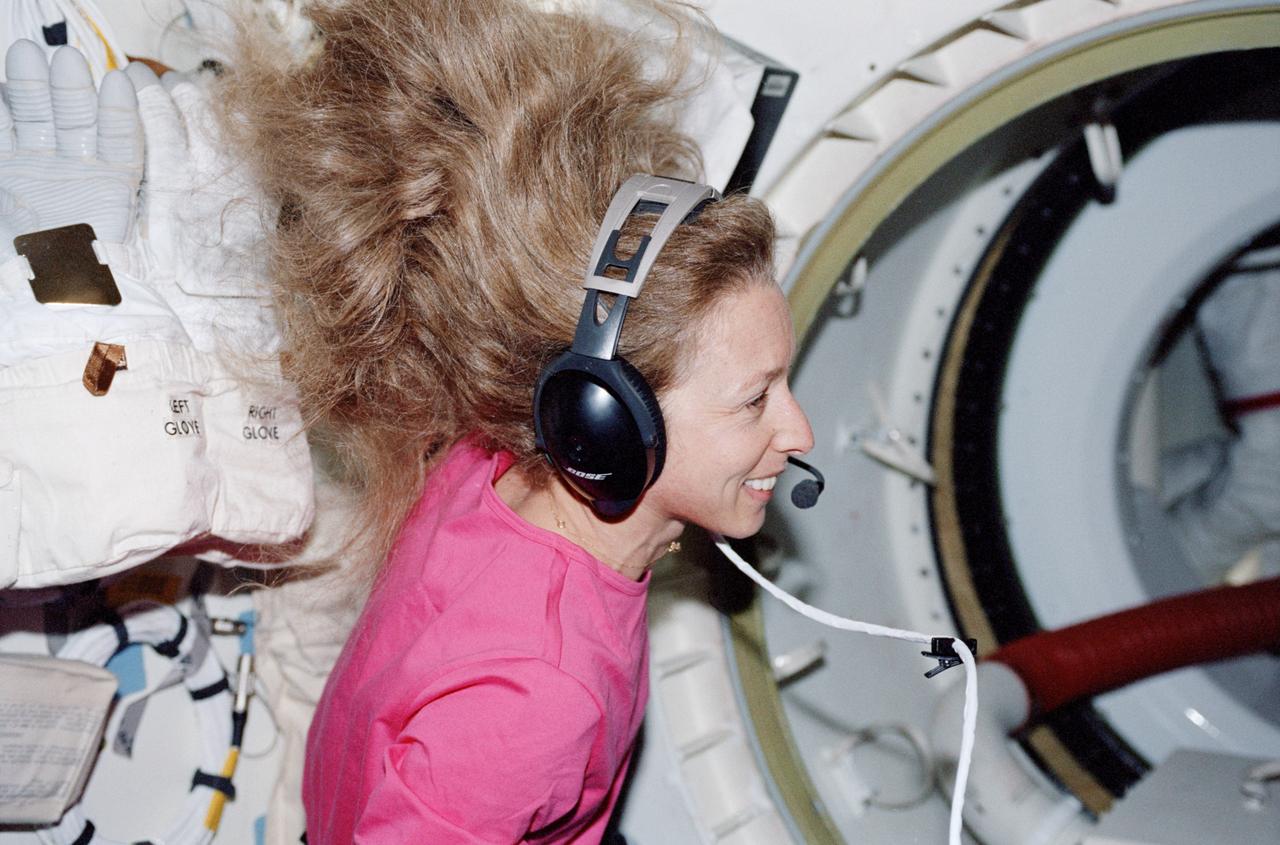
STS098-345-001 (7-20 February 2001) --- Astronaut Marsha S. Ivins, STS-98 mission specialist, places a phone call to Houston’s Mission Control Center (MCC) with the “virtual phone.” This test is designed to demonstrate communications capability of a new upgrade utilizing the existing Shuttle Orbiter Communications Adapter (OCA) infrastructure.
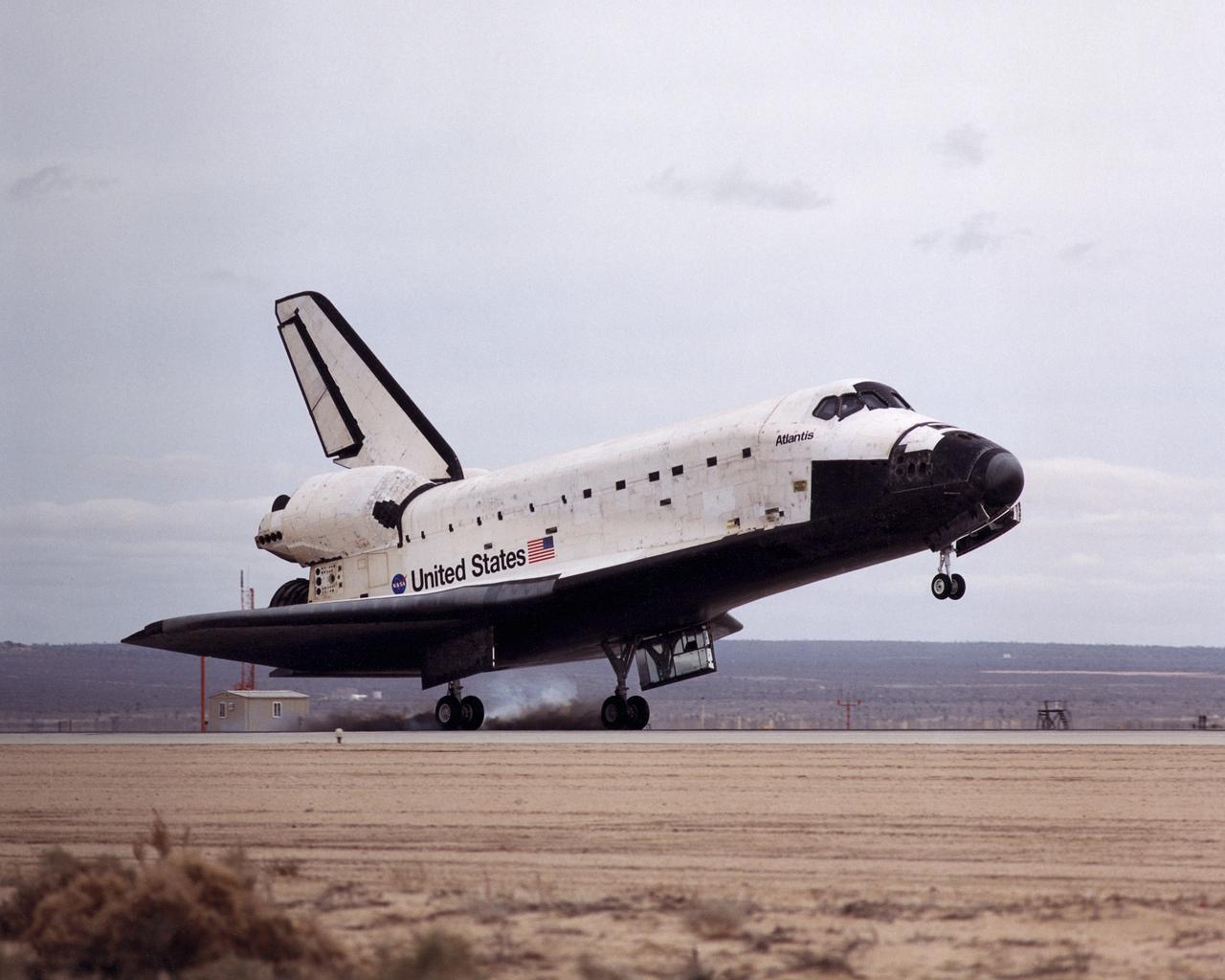
STS098-S-015 (20 Feb. 2001) --- The main landing gear on the space shuttle Atlantis touches down to mark mission completion at Edwards Air Force Base in the Mojave Desert of California.Onboard were astronauts Kenneth Cockrell, Mark Polansky, Robert Curbeam, Thomas Jones and Marsha Ivins. Atlantis touched down on Edward?s concrete runway at 2:33 p.m. (CST), Feb. 20, for a mission elapsed time of 12 days, 21 hours and 20 minutes. Photo credit: NASA
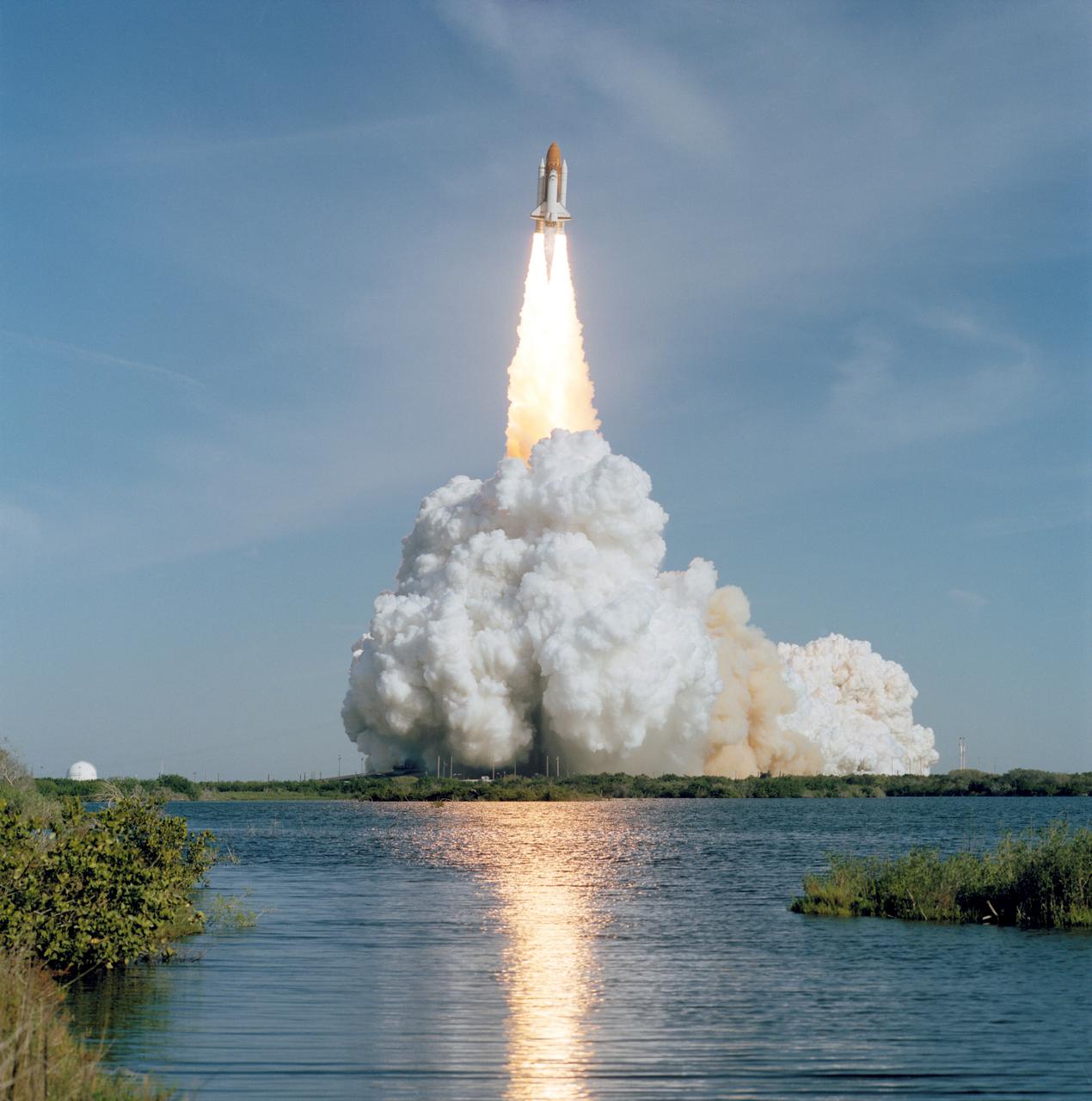
STS062-S-053 (4 March 1994) --- Carrying a crew of five veteran NASA astronauts and the United States Microgravity Payload (USMP), the Space Shuttle Columbia heads toward its sixteenth mission in Earth-orbit. Launch occurred at 8:53 a.m. (EST), March 4, 1994. Onboard were astronauts John H. Casper, Andrew M. Allen, Marsha S. Ivins, Charles D. (Sam) Gemar and Pierre J. Thuot.
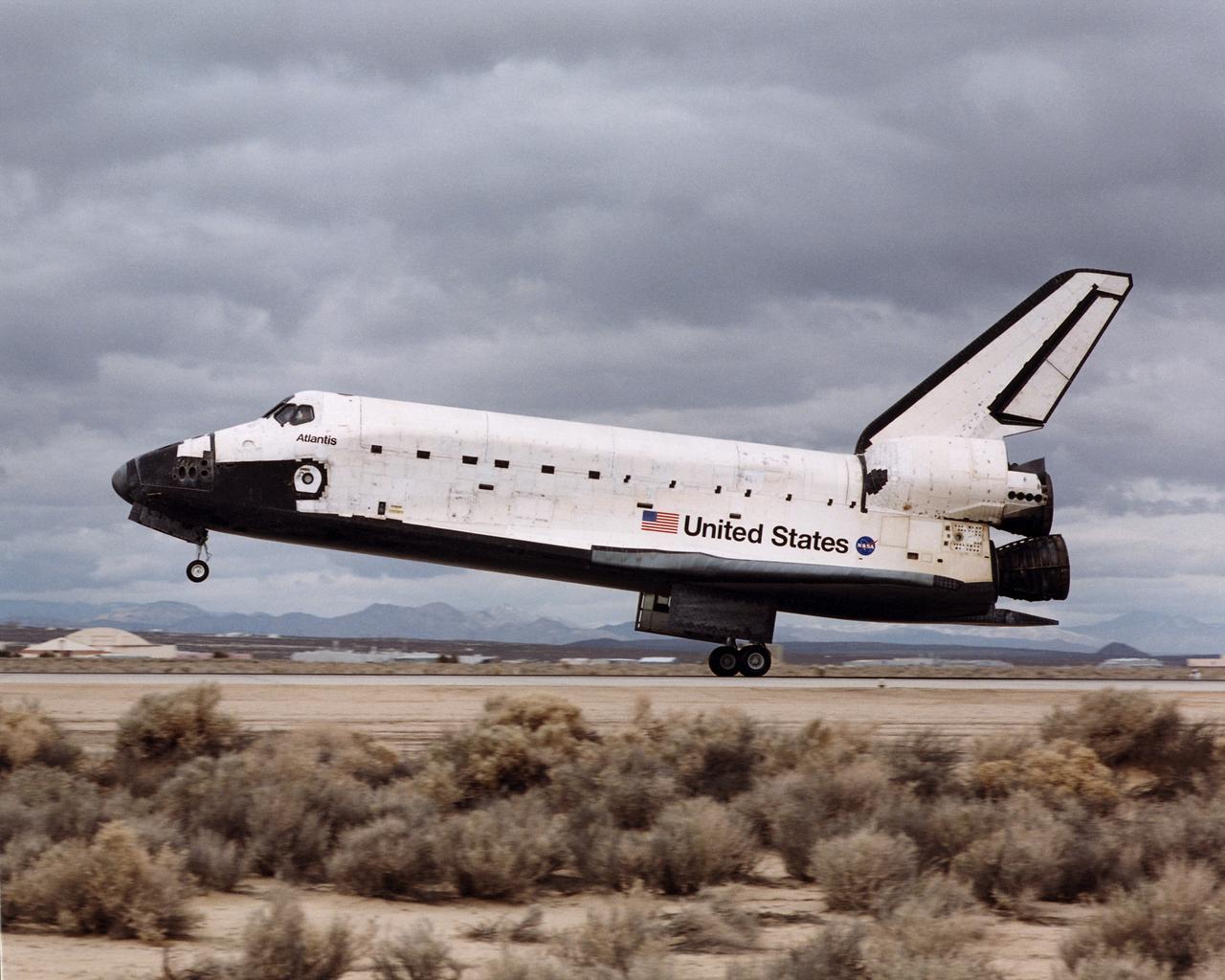
STS098-S-016 (20 Feb. 2001) --- The main landing gear on the space shuttle Atlantis touches down to mark mission completion at Edwards Air Force Base in the Mojave Desert of California.Onboard were astronauts Kenneth Cockrell, Mark Polansky, Robert Curbeam, Thomas Jones and Marsha Ivins. Atlantis touched down on Edward?s concrete runway at 2:33 p.m. (CST), Feb. 20, for a mission elapsed time of 12 days, 21 hours and 20 minutes. Photo credit: NASA
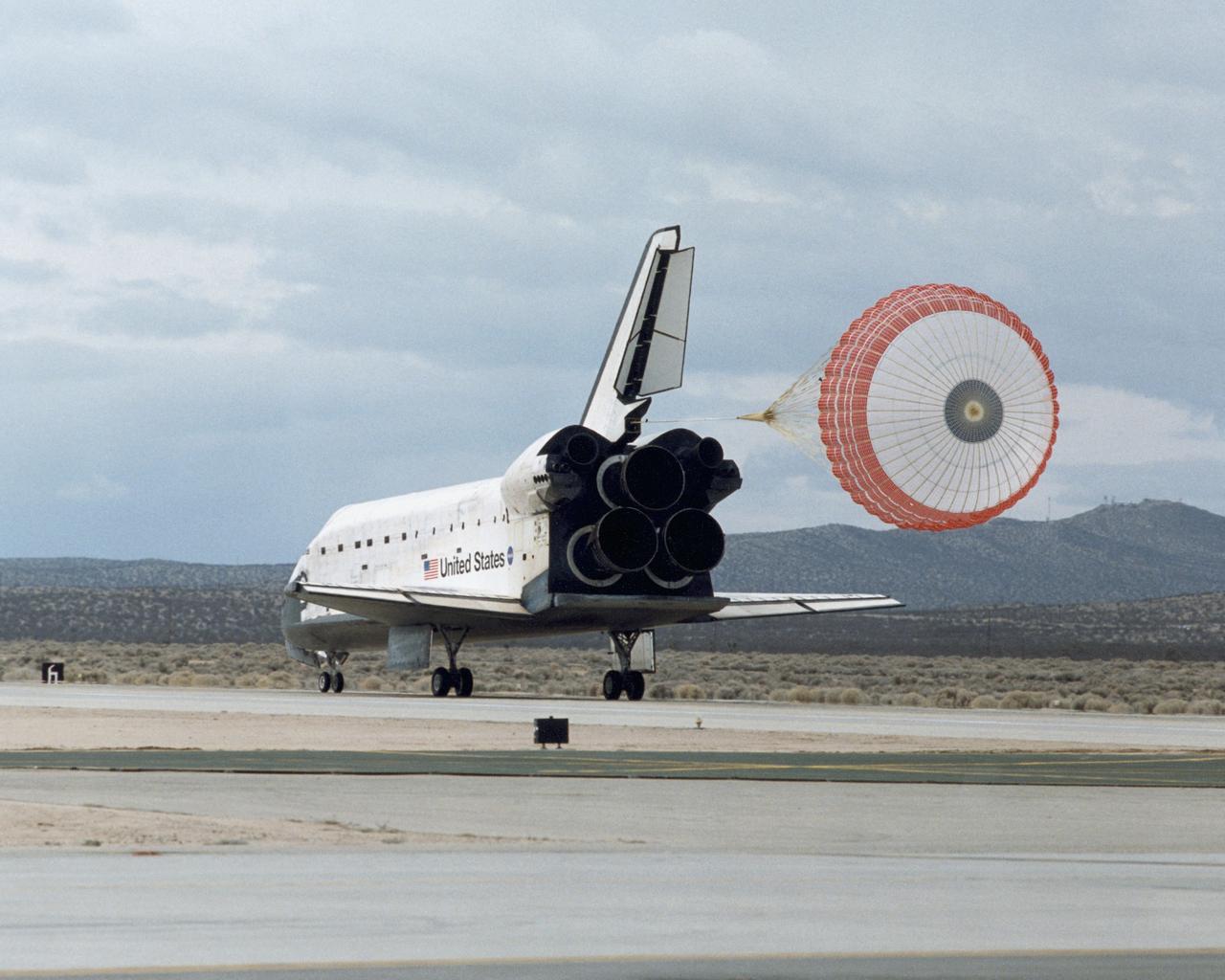
STS098-S-017 (20 Feb. 2001) --- A drag chute slows down the space shuttle Atlantis following its touchdown to mark mission completion at Edwards Air Force Base in the Mojave Desert of California. Onboard were astronauts Kenneth Cockrell, Mark Polansky, Robert Curbeam, Thomas Jones and Marsha Ivins. Atlantis touched down on Edward?s concrete runway at 2:33 p.m. (CST), Feb. 20, for a mission elapsed time of 12 days, 21 hours and 20 minutes. Photo credit: NASA
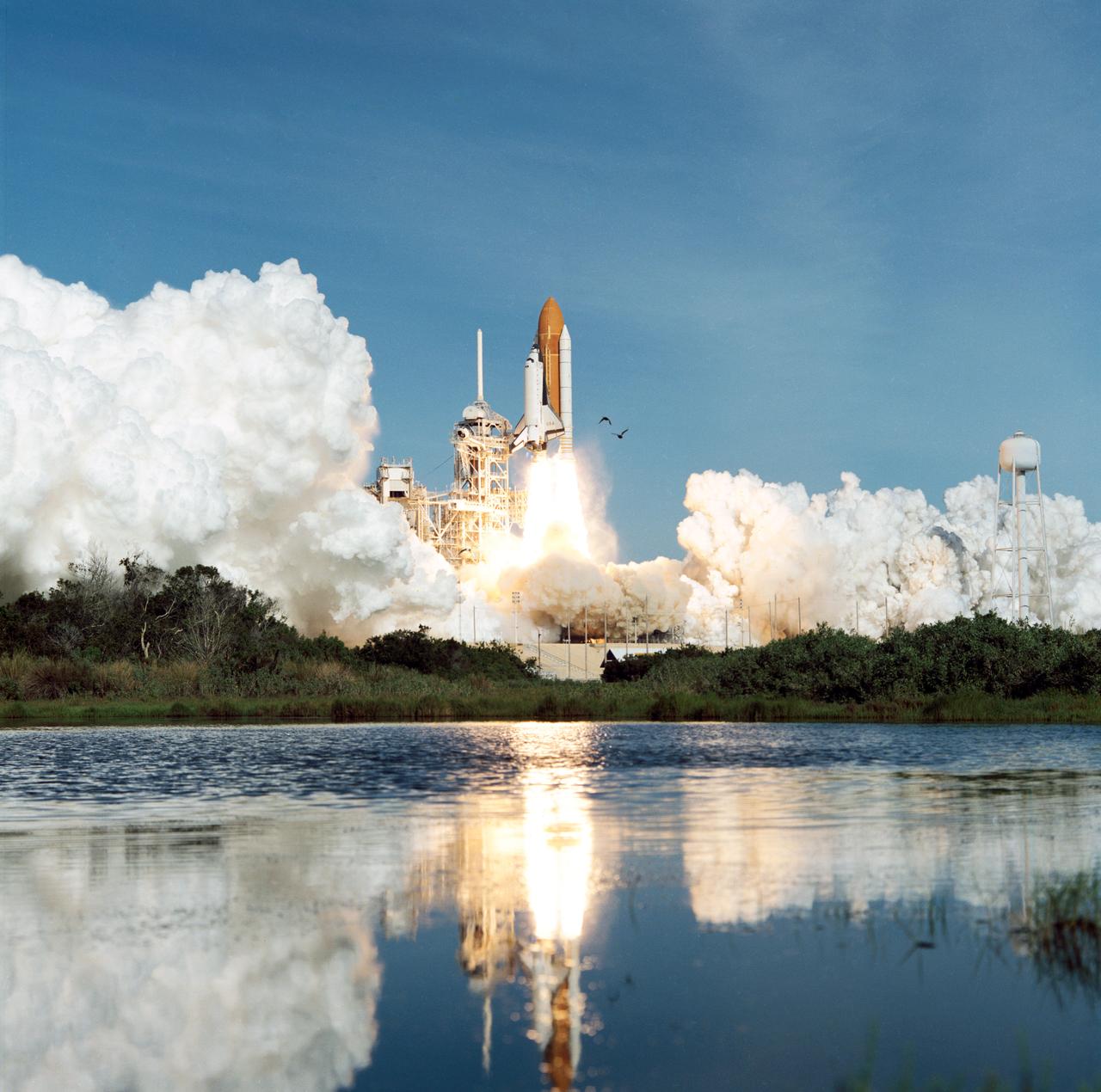
STS062-S-051 (4 March 1994) --- Five veteran astronauts and the United States Microgravity Payload (USMP) are ushered into space via the sixteenth launch of Space Shuttle Columbia. Launch occurred at 8:53 a.m. (EST), March 4, 1994. Onboard were astronauts John H. Casper, Andrew M. Allen, Marsha S. Ivins, Charles D. (Sam) Gemar and Pierre J. Thuot.
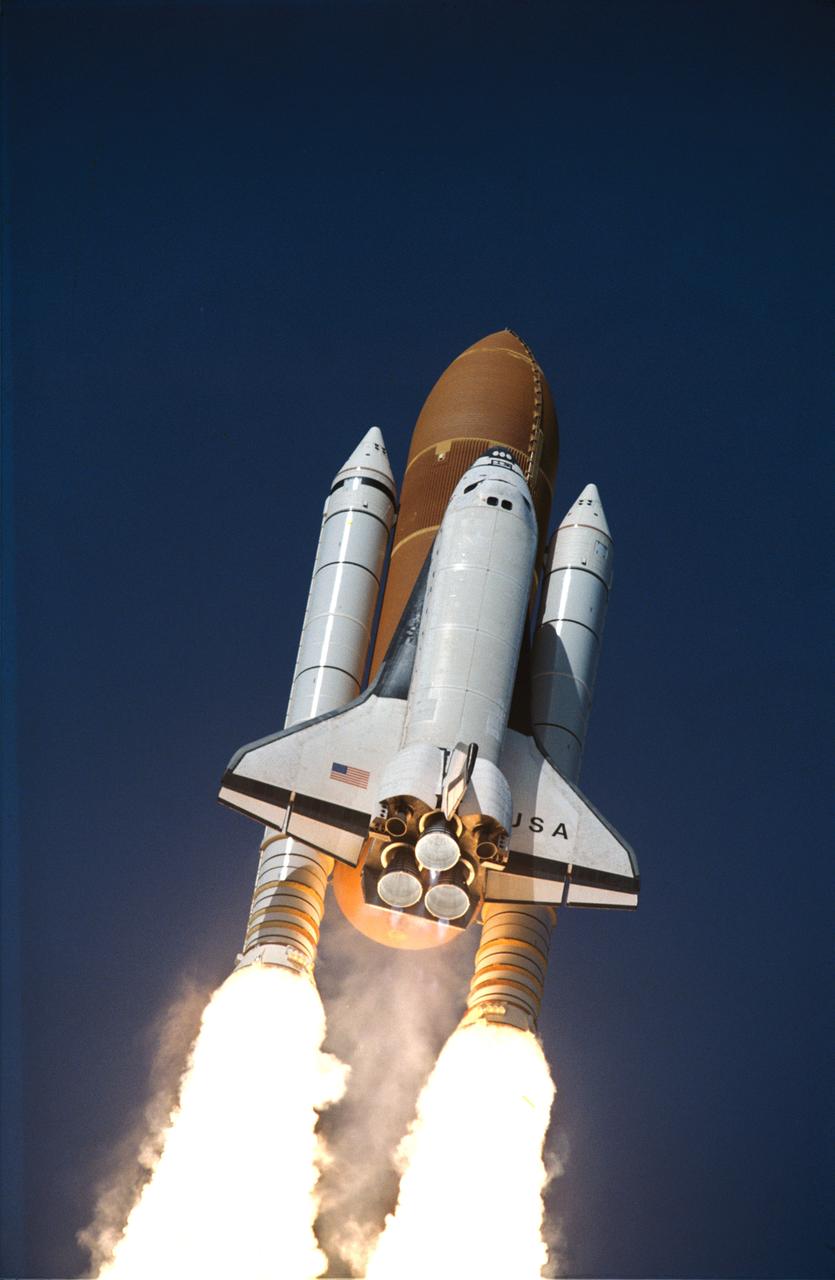
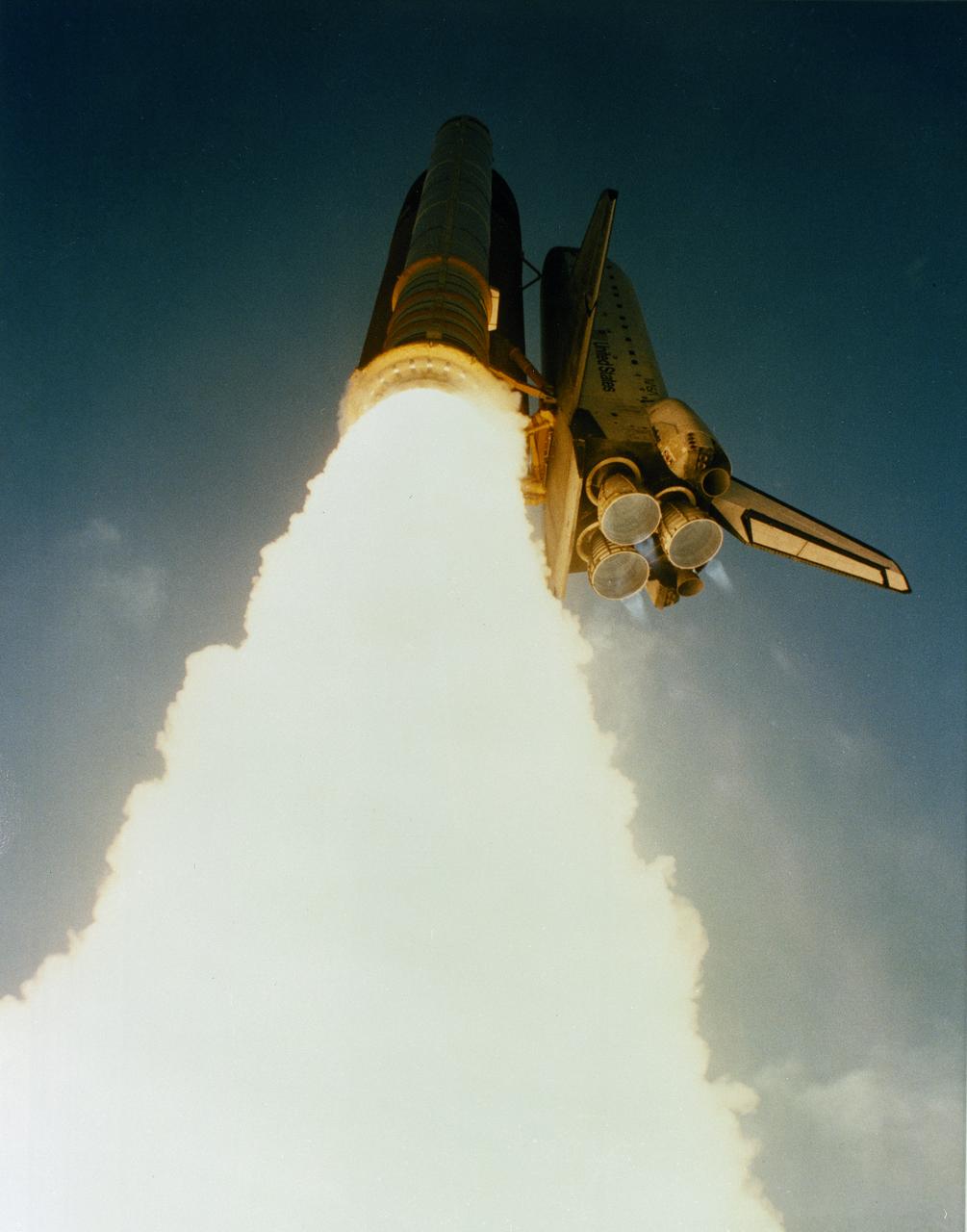
STS062-S-055 (4 March 1994) --- A low-angle view captures early stages of the sixteenth launch of Space Shuttle Columbia. Launch occurred at 8:53 a.m. (EST), March 4, 1994. Onboard were astronauts John H. Casper, Andrew M. Allen, Marsha S. Ivins, Charles D. (Sam) Gemar and Pierre J. Thuot.
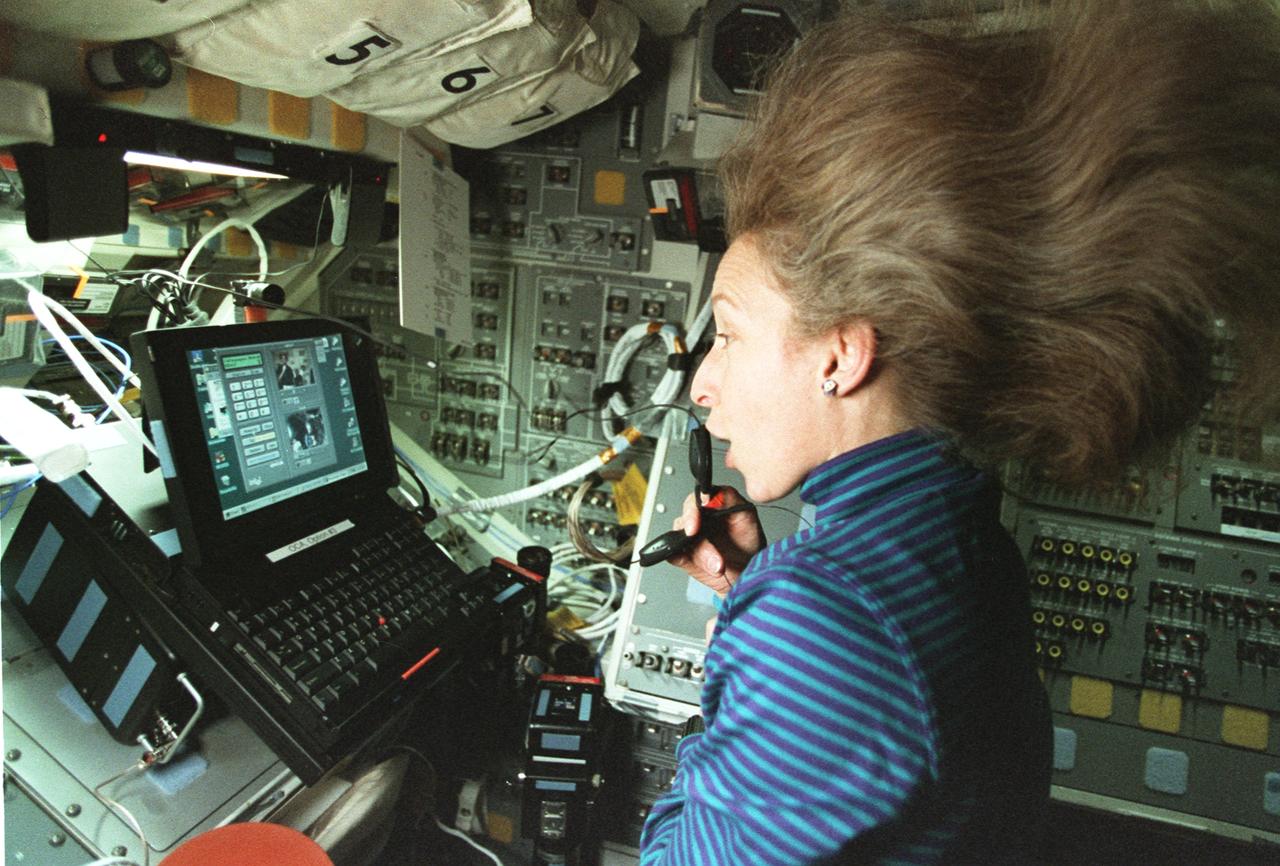
STS081-378-012 (12-22 January 1997) --- Astronaut Marsha S. Ivins, mission specialist, looks at digital still photo imagery on a lap top computer on the Space Shuttle Atlantis' aft flight deck while communicating with students on Earth. Her activity is all part of the once-a-year shuttle participation in an educational endeavor called KidSat. The KidSat project allows students the opportunity to interact with the astronauts' real-time observations and photography of geographic points of interest. The Electronic Still Camera (ESC), which was handled largely by Ivins, can be seen near the computer.
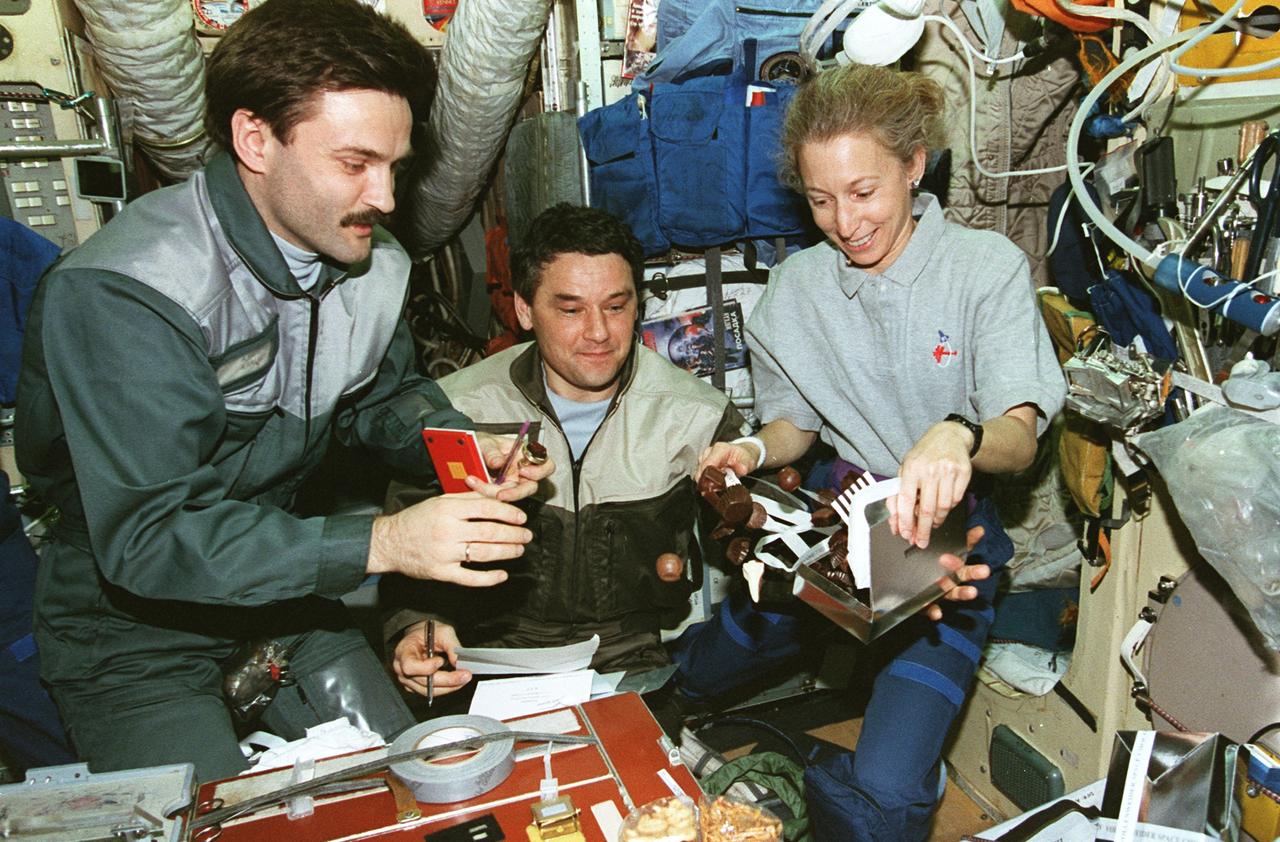
STS081-369-020 (12-22 Jan. 1997) --- Astronaut Marsha S. Ivins and two Mir-22 crewmembers stray from the conventional food fare as they open a box of chocolates on Russia's Mir Space Station's Base Block Module. Cosmonauts Aleksandr Y. Kaleri (left), flight engineer, and Valeri G. Korzun, share the treats.
Five astronauts launched aboard the Space Shuttle Columbia on January 9, 1990 at 7:35:00am (EST) for the STS-32 mission. The crew included David C. Brandenstein, commander; James D. Weatherbee, pilot; and mission specialists Marsha S. Ivins, G. David Low, and Bonnie J. Dunbar. Primary objectives of the mission were the deployment of the SYNCOM IV-F5 defense communications satellite and the retrieval of NASA’s Long Duration Exposure Facility (LDEF).
STS046-19-037 (8 Aug 1992) --- Having completed eight days in Earth-orbit, the crew members prepare for their brief journey home. Left to right are Andrew M. Allen, pilot; Claude Nicollier, mission specialist representing the European Space Agency (ESA); and Marsha S. Ivins, mission specialist. Just out of frame, at left, is Loren J. Shriver, mission commander, who guided the Space Shuttle Atlantis in for its Kennedy Space Center (KSC), Florida landing.
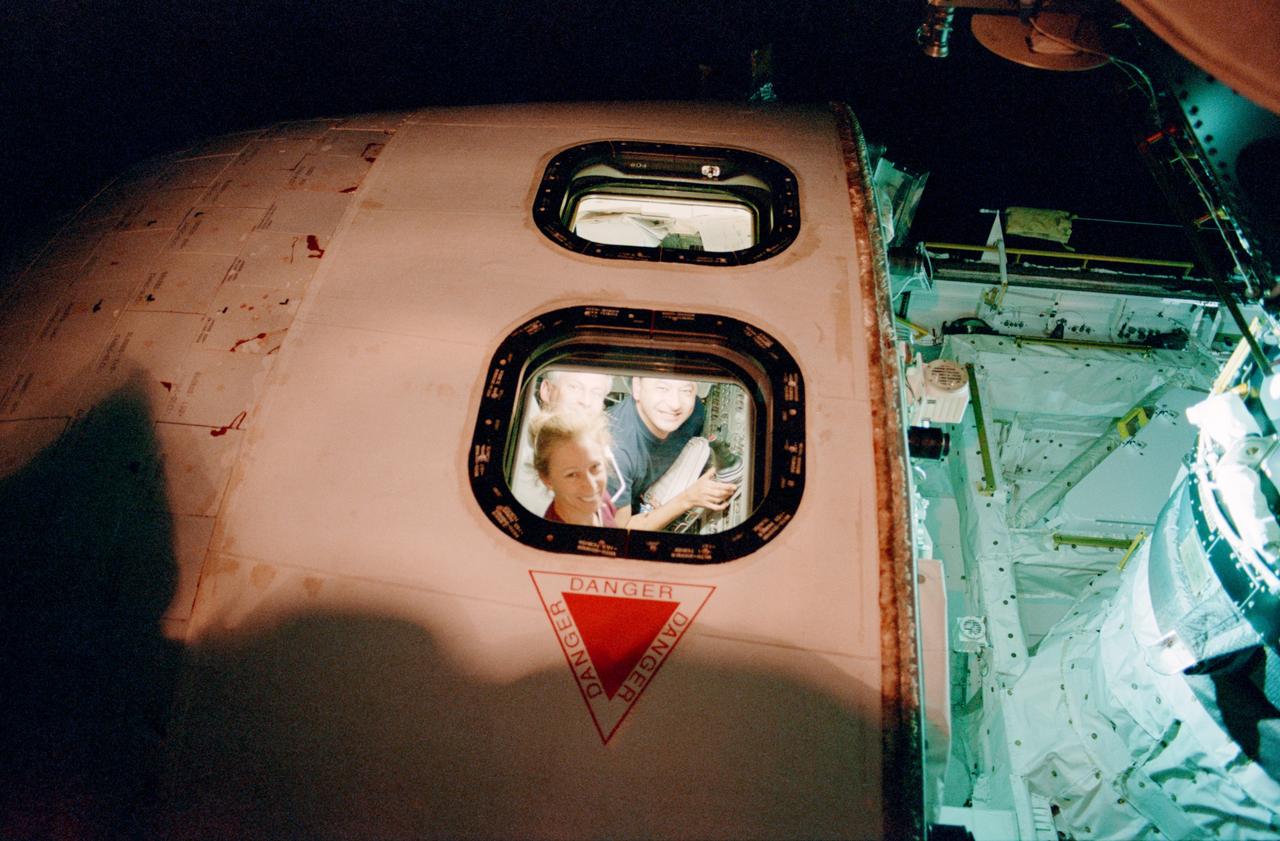
STS098-335-0028 (7-20 February 2001) --- From the aft flight deck of the Space Shuttle Atlantis, astronaut Marsha S. Ivins, STS-98 mission specialist, looks through an overhead window toward her space walking colleagues, who exposed this 35mm frame. Also visible in the window are astronauts Kenneth D. Cockrell and Mark L. Polansky, commander and pilot for the STS-98/5a mission.
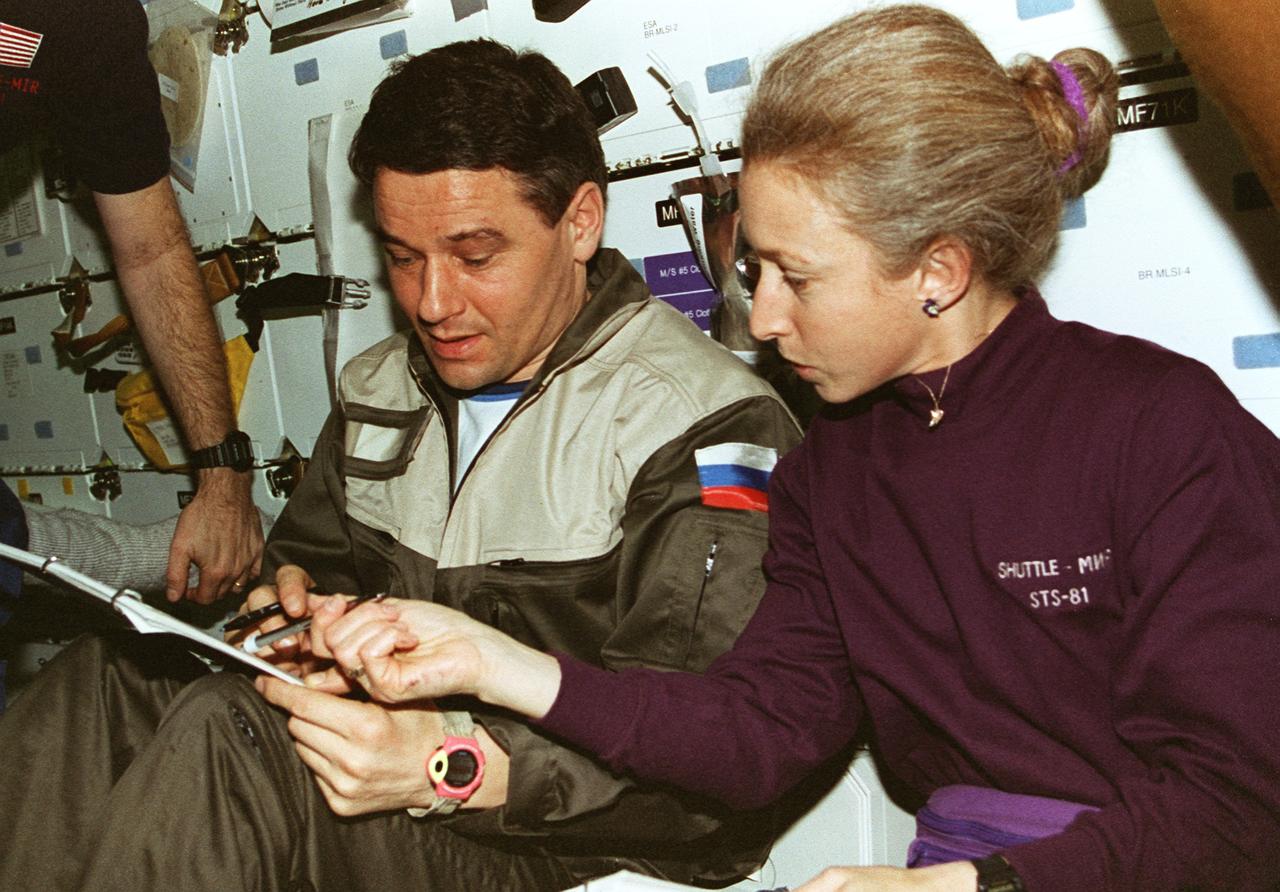
STS081-357-020 (12-22 Jan. 1997) --- Astronaut Marsha S. Ivins, STS-81 mission specialist, compares notes with cosmonaut Valeri G. Korzun, Mir-22 mission commander. The two were involved with the transfer of supplies from the Space Shuttle Atlantis to Russia's Mir Space Station, during the docking mission.
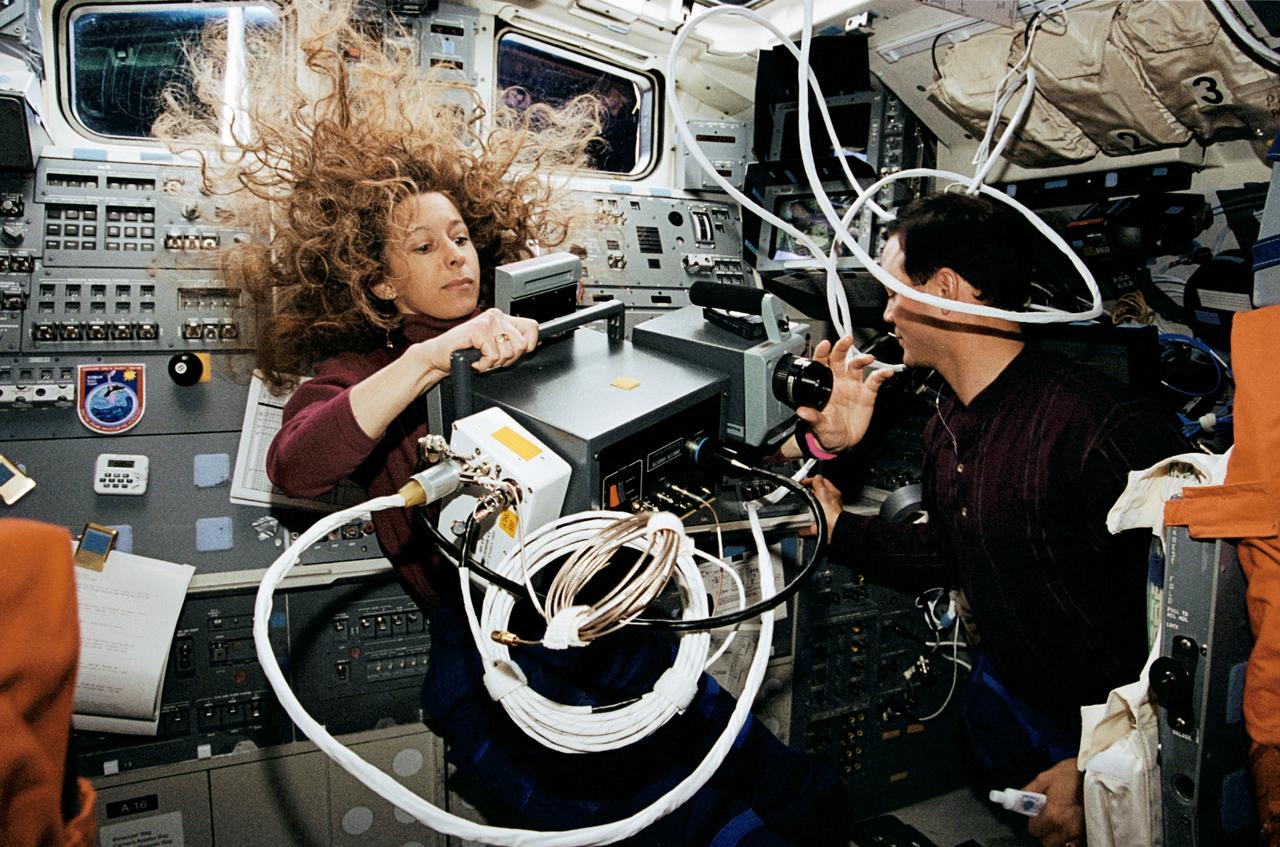
STS062-04-005 (4-18 March 1994) --- Astronaut Marsha S. Ivins has her hands full with a thermal imaging project on the flight deck of the Space Shuttle Columbia as astronaut Pierre J. Thuot stands by to help. The two mission specialists were joined by three other veteran NASA astronauts for almost 14 full days in Earth-orbit.
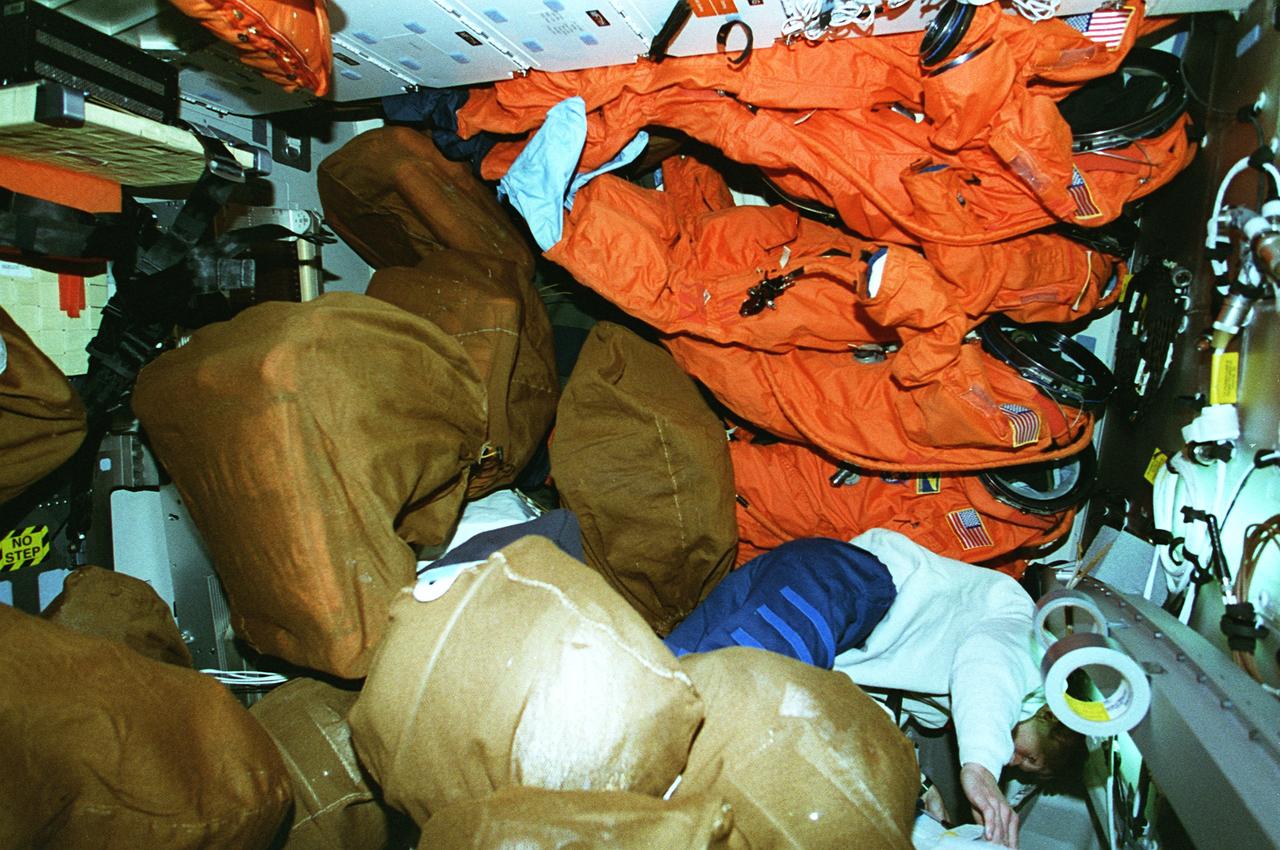
STS081-308-032 (12-22 Jan. 1997) --- Astronaut Marsha S. Ivins appears almost lost among the bags of material to be brought back to Earth at the impending conclusion of the Space Shuttle Atlantis and Russia's Mir Space Station docking mission. Several partial pressure garments which were used for launch and will soon be donned for the entry phase are in upper left.
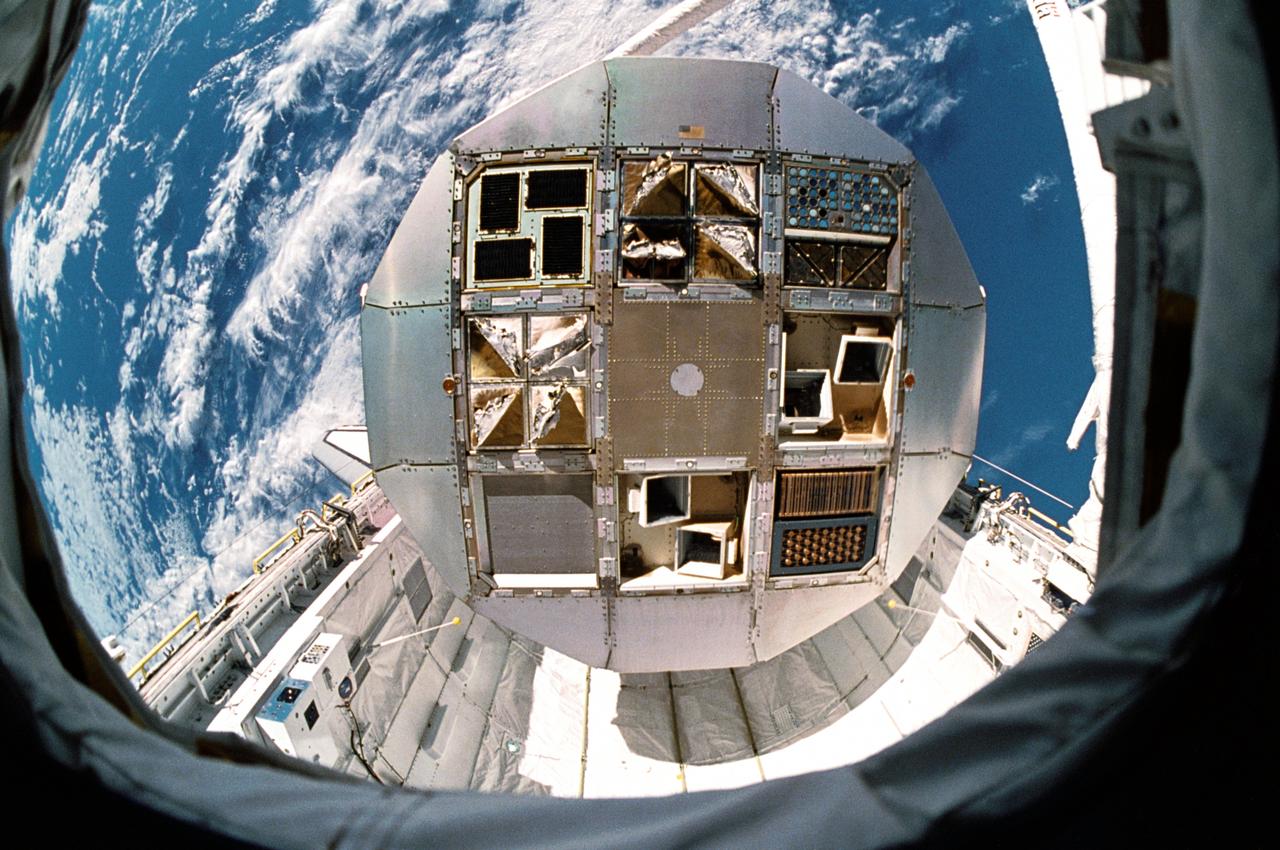
STS032-541-018 (12 Jan 1990) --- One of a number of frames photographed by the STS-32 crew as part of a detailed supplementary objective on documentary still photography. The DSO was monitored by Astronaut Marsha S. Ivins, mission specialist. STS032-541-018 Kodak Ektar 25 negative film. 35mm frame of LDEF suspended just over its resting place in cargo bay. White clouds and blue ocean in foreground.
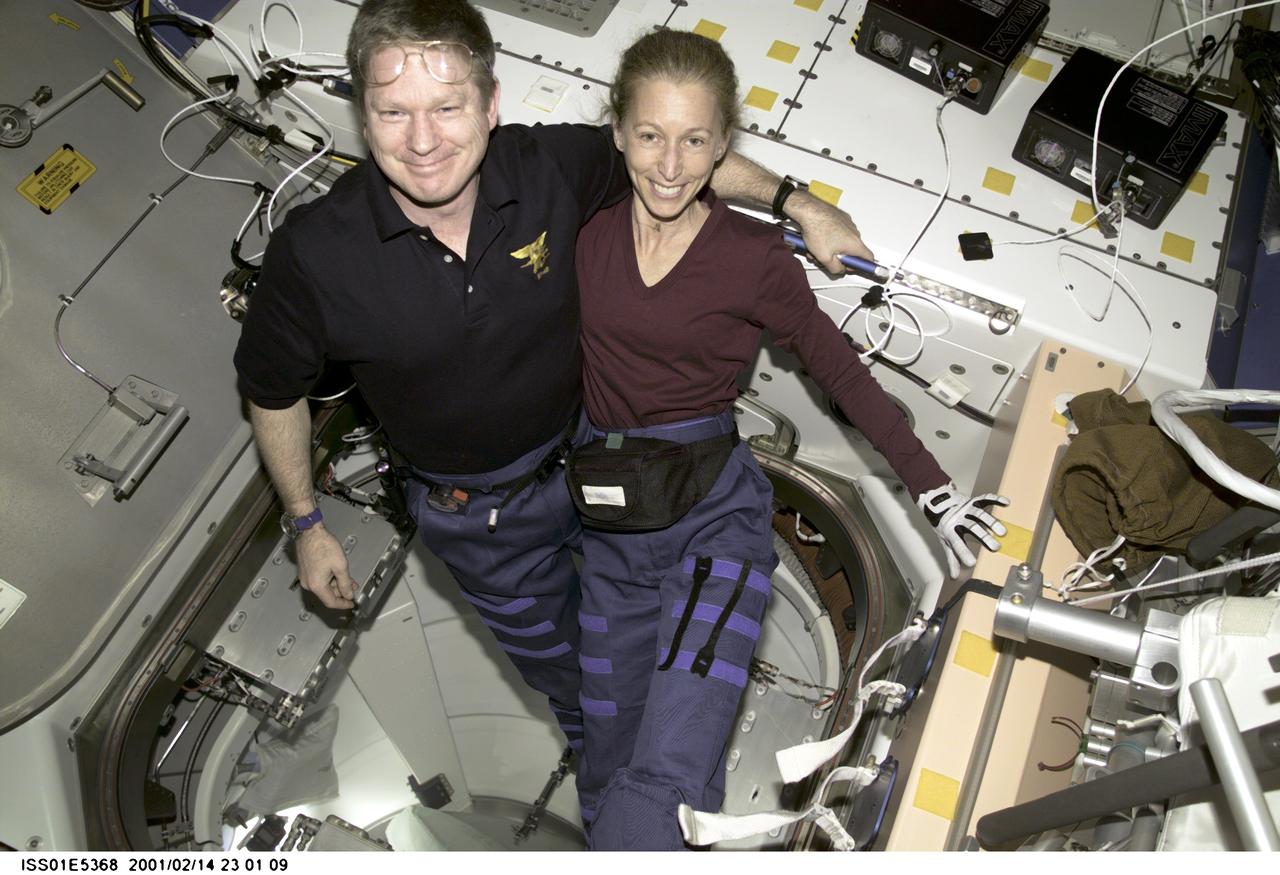
ISS01-E-5368 (14 February 2001) --- Onboard the new Destiny laboratory, Expedition One commander William M. (Bill) Shepherd, shares a brief break from a busy work agenda with astronaut Marsha S. Ivins, STS-98 mission specialist. The two are alumni of the tenth class of NASA astronaut candidates, having come aboard with 15 other trainees in the summer of 1984.
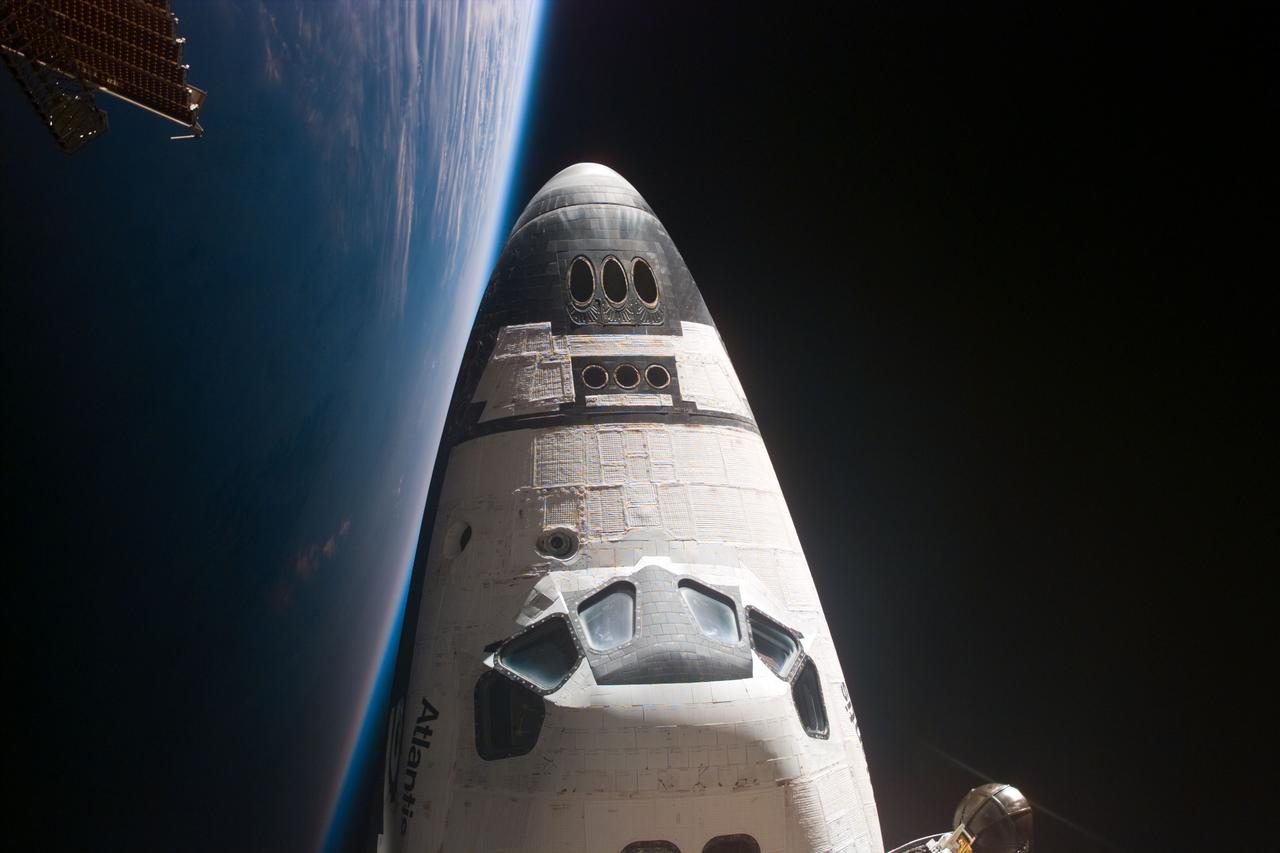
STS081-E-05436 (15 Jan. 1997) --- Soon after the astronauts docked the space shuttle Atlantis with Russia's Mir Space Station, astronaut Marsha S. Ivins, STS-81 mission specialist, went aboard the Mir complex and sought a window through which she could record this image of Atlantis' forward section. A solar array panel on the Mir is seen in one corner and the Ku-band antenna for Atlantis is visible in another. This view was taken with an electronic still camera (ESC). Photo credit: NASA
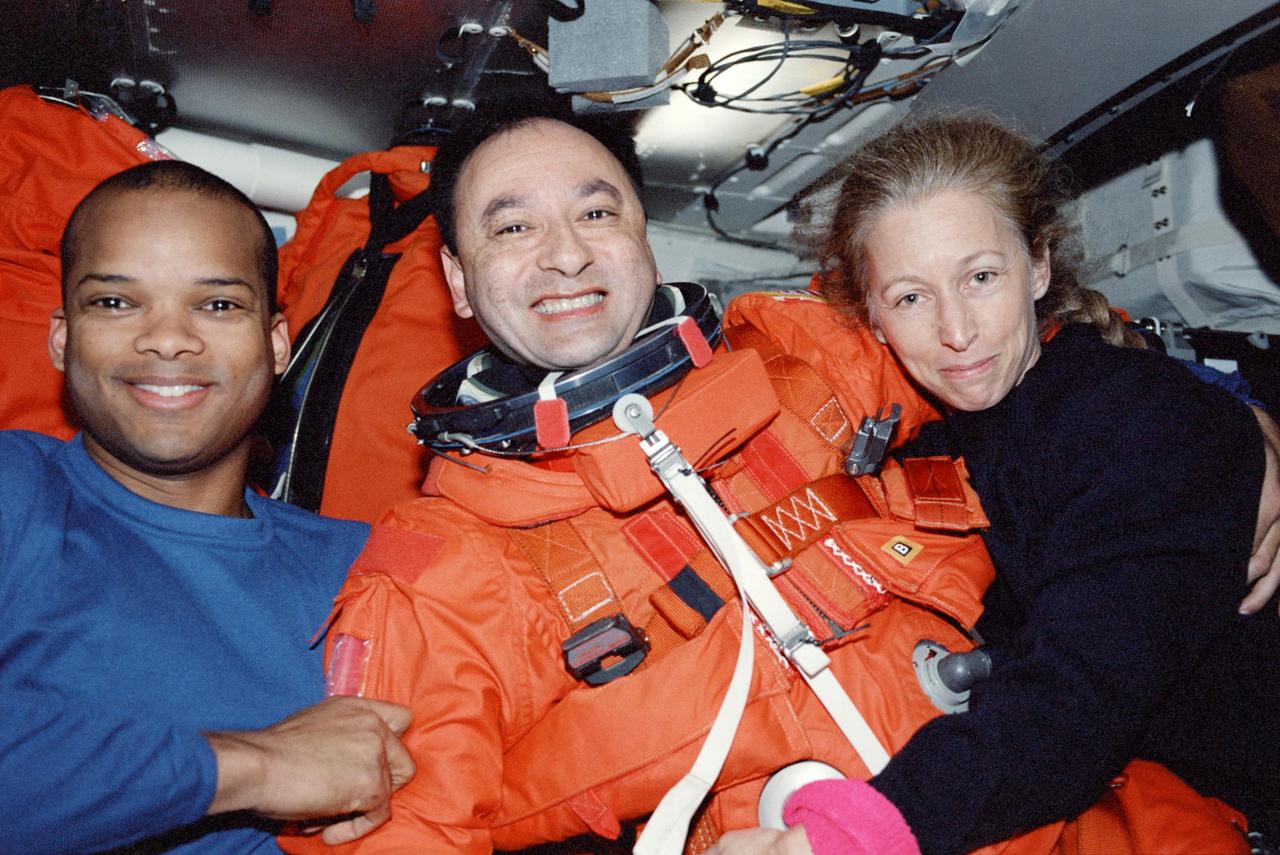
STS098-358-005 (7-20 February 2001) --- Astronauts Mark L. Polansky (center), pilot, Robert L. Curbeam, and Marsha S. Ivins, both mission specialists, paused for this photograph as they prepared to suit up in their full-pressure launch and entry suits on the mid deck of the Space Shuttle Atlantis during de-orbit preparations.
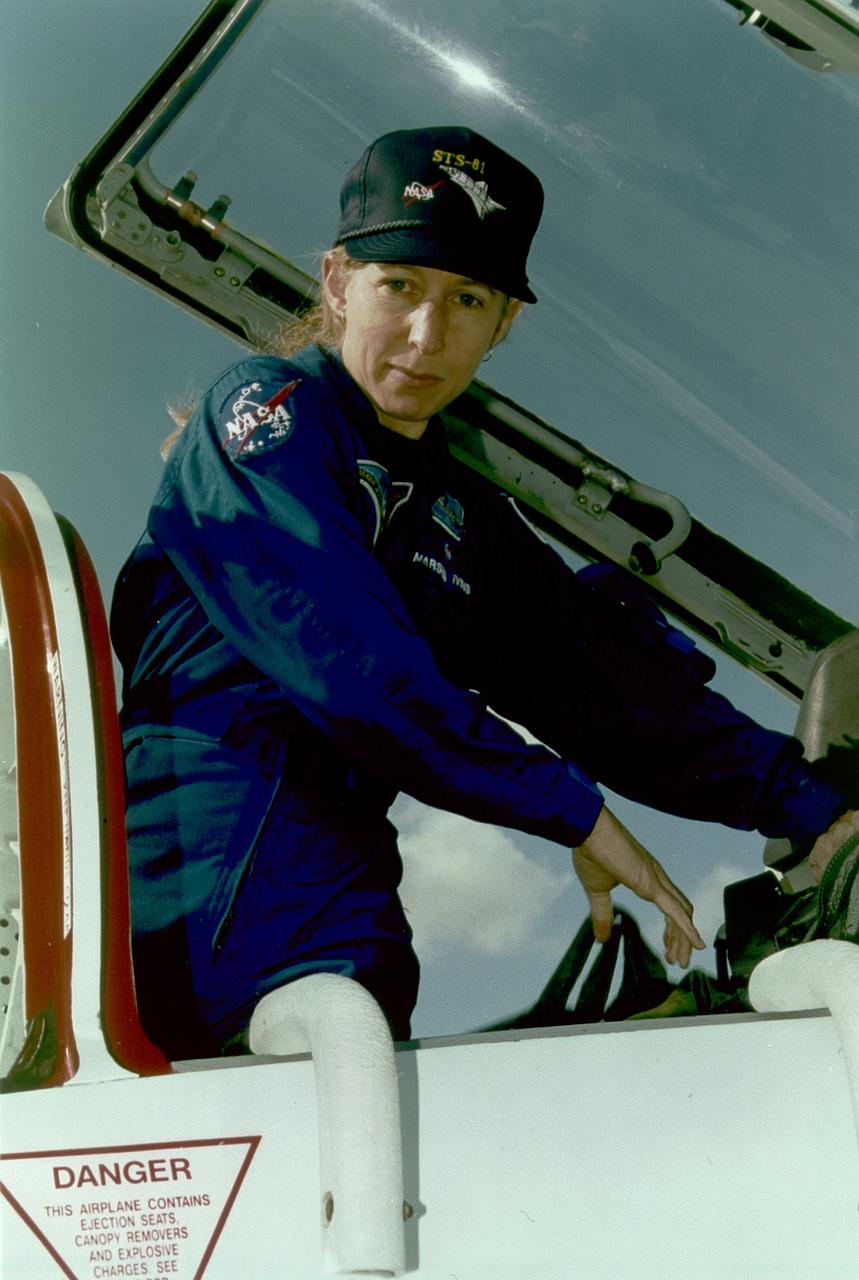
S97-00248 (15 Dec. 1996) --- Astronaut Marsha S. Ivins, STS-81 mission specialist, arrives in a NASA T-38 jet trainer at the Kennedy Space Center's Shuttle Landing Facility for the Terminal Countdown Demonstration Test (TCDT). The TCDT represents a simulated final countdown until just before main engine ignition, now scheduled for Jan. 12, 1997.
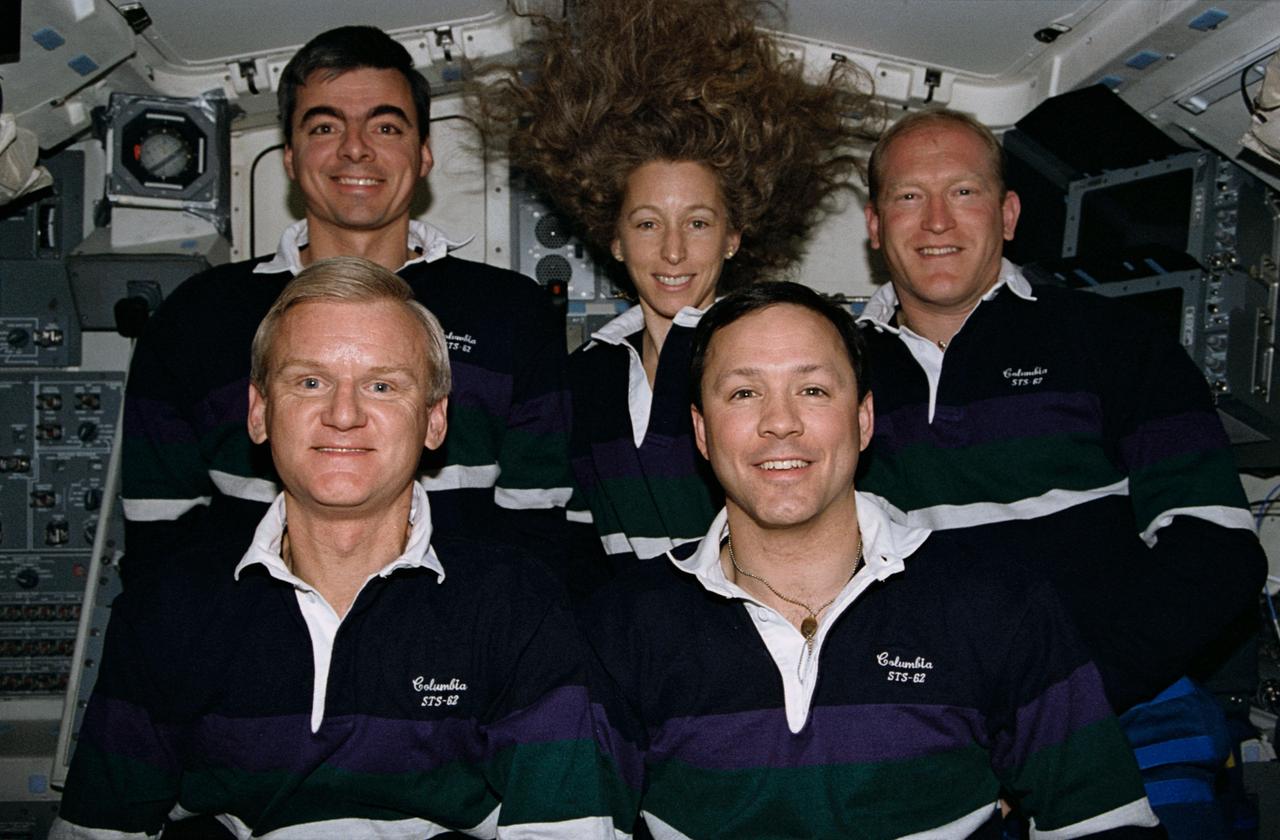
STS062-16-004 (4-18 March 1994) --- The five veteran astronaut crewmembers for NASA's STS-62 mission pose for the traditional inflight portrait on Columbia's aft flight deck. In front are astronauts John H. Casper (left), mission commander; and Pierre J. Thuot, mission specialist. In the rear are astronauts (left to right) Andrew M. Allen, pilot; Marsha S. Ivins and Charles D. (Sam) Gemar, mission specialists.
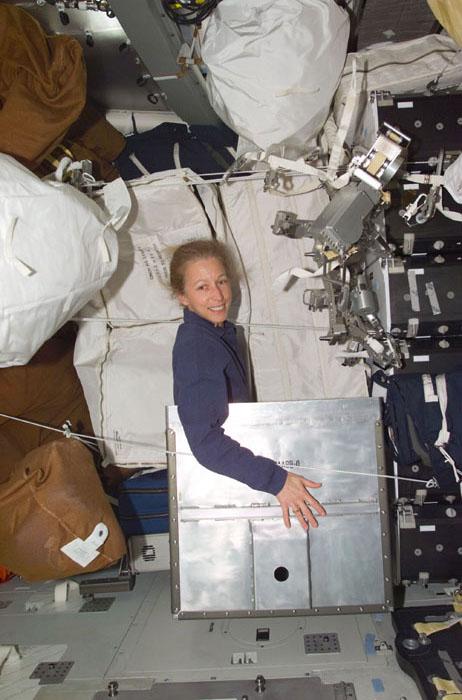
STS098-E-5272 (15 February 2001) --- Astronaut Marsha S. Ivins, STS-98 mission specialist, is photographed with the casing of the Vozdukh as it is strapped in storage position on the mid deck of the Space Shuttle Atlantis. Vozdukh is the Russian system in the Zvezda Service Module, which removes carbon dioxide from the ISS atmosphere. The scene was recorded with a digital still camera by one of the STS-98 astronauts aboard the shuttle.
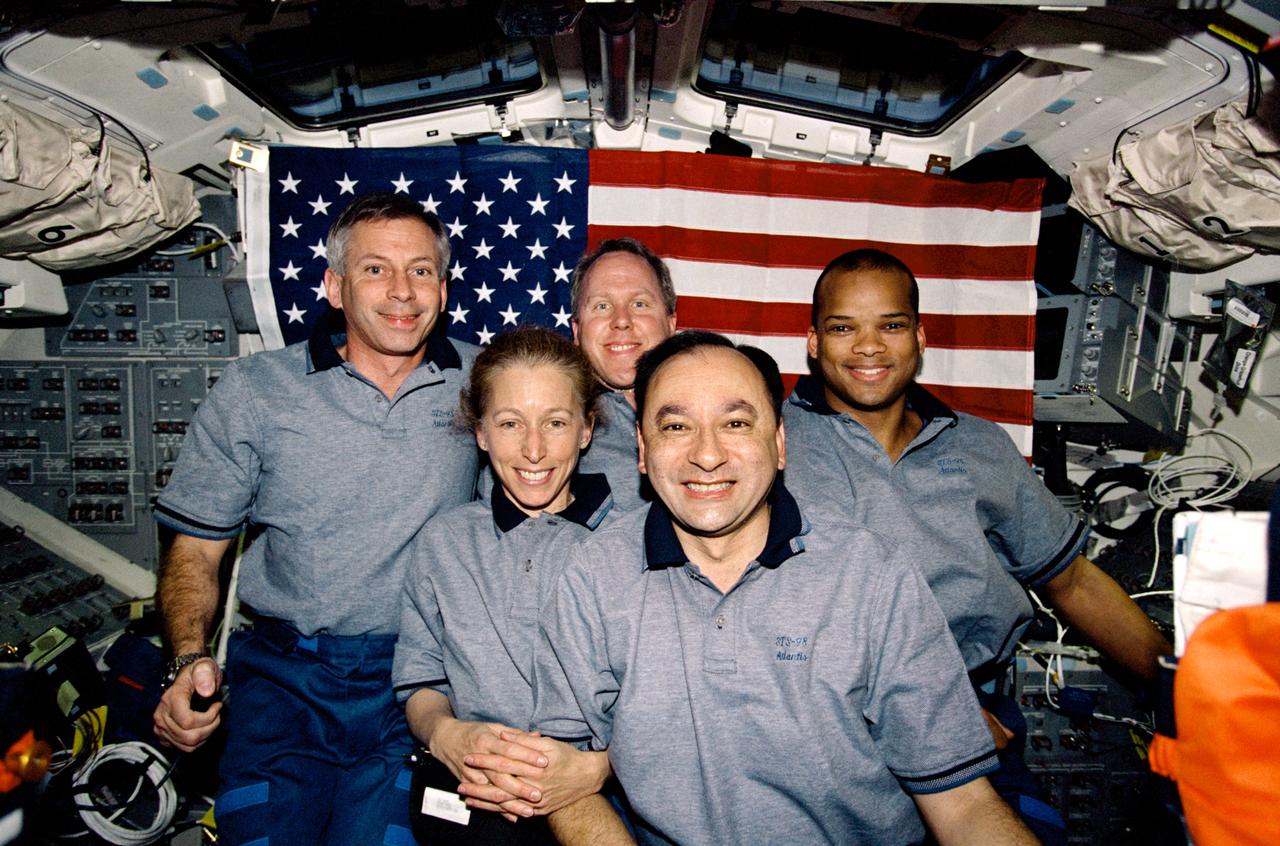
STS098-365-0034 (7-20 February 2001) --- The crew of the STS-98 mission poses for the traditional inflight portrait on the flight deck of the Space Shuttle Atlantis. From left are astronauts Kenneth D. Cockrell, mission commander; Marsha S. Ivins, mission specialist; Thomas D. Jones, mission specialist; Mark L. Polansky, pilot; and Robert L. Curbeam, mission specialist.
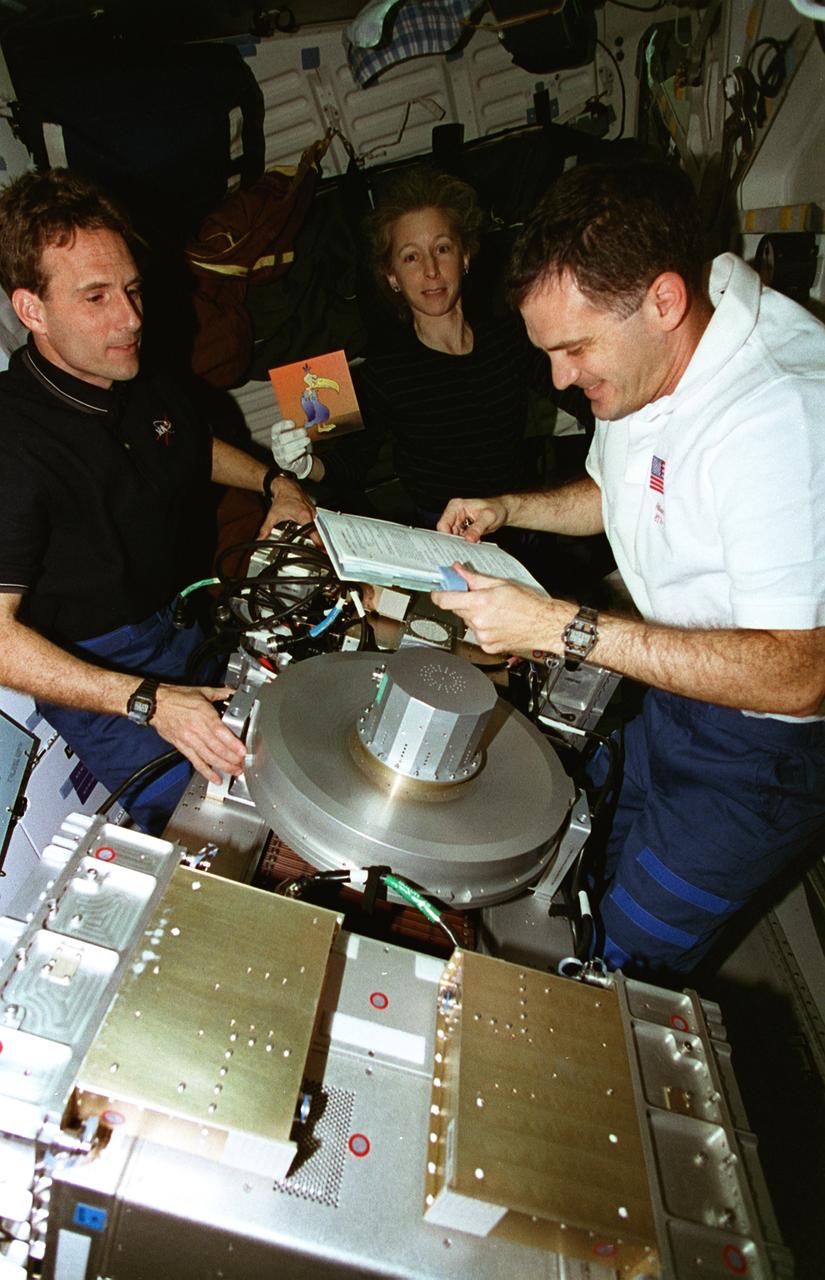
STS081-340-020 (12-22 Jan. 1997) --- Left to right, astronaut and future cosmonaut guest researcher, Jerry M. Linenger, and mission specialists Marsha S. Ivins and Peter J. K. (Wisoff) check out the Treadmill Vibration Isolation Stabilization System (TVIS) onboard the Space Shuttle Atlantis, during the Atlantis and Russia's Mir Space Station docking mission.
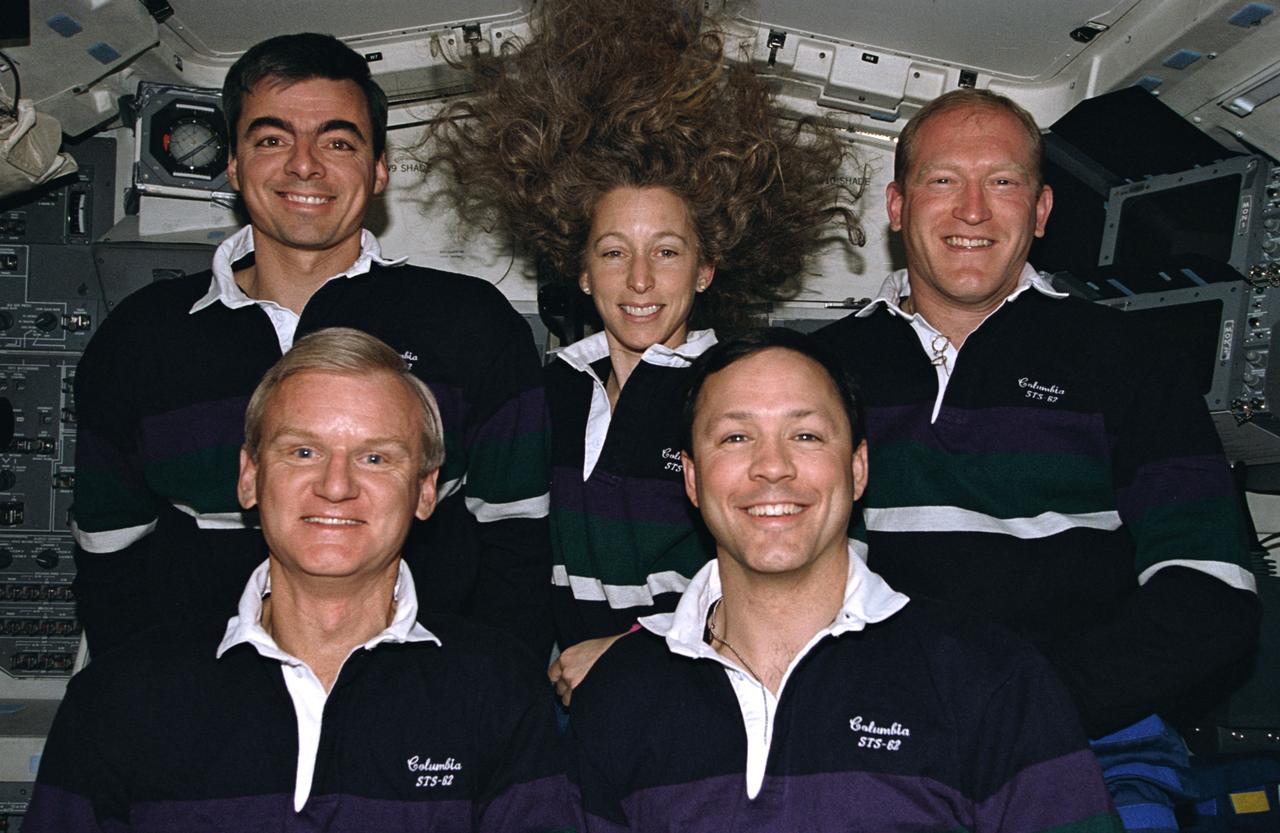
STS062-17-025 (4-18 March 1994) --- The five veteran astronaut crewmembers for NASA's STS-62 mission pose for the traditional inflight portrait on Columbia's aft flight deck. In front are astronauts John H. Casper (left), mission commander; and Pierre J. Thuot, mission specialist. In the rear are astronauts (left to right) Andrew M. Allen, pilot; Marsha S. Ivins and Charles D. (Sam) Gemar, mission specialists.
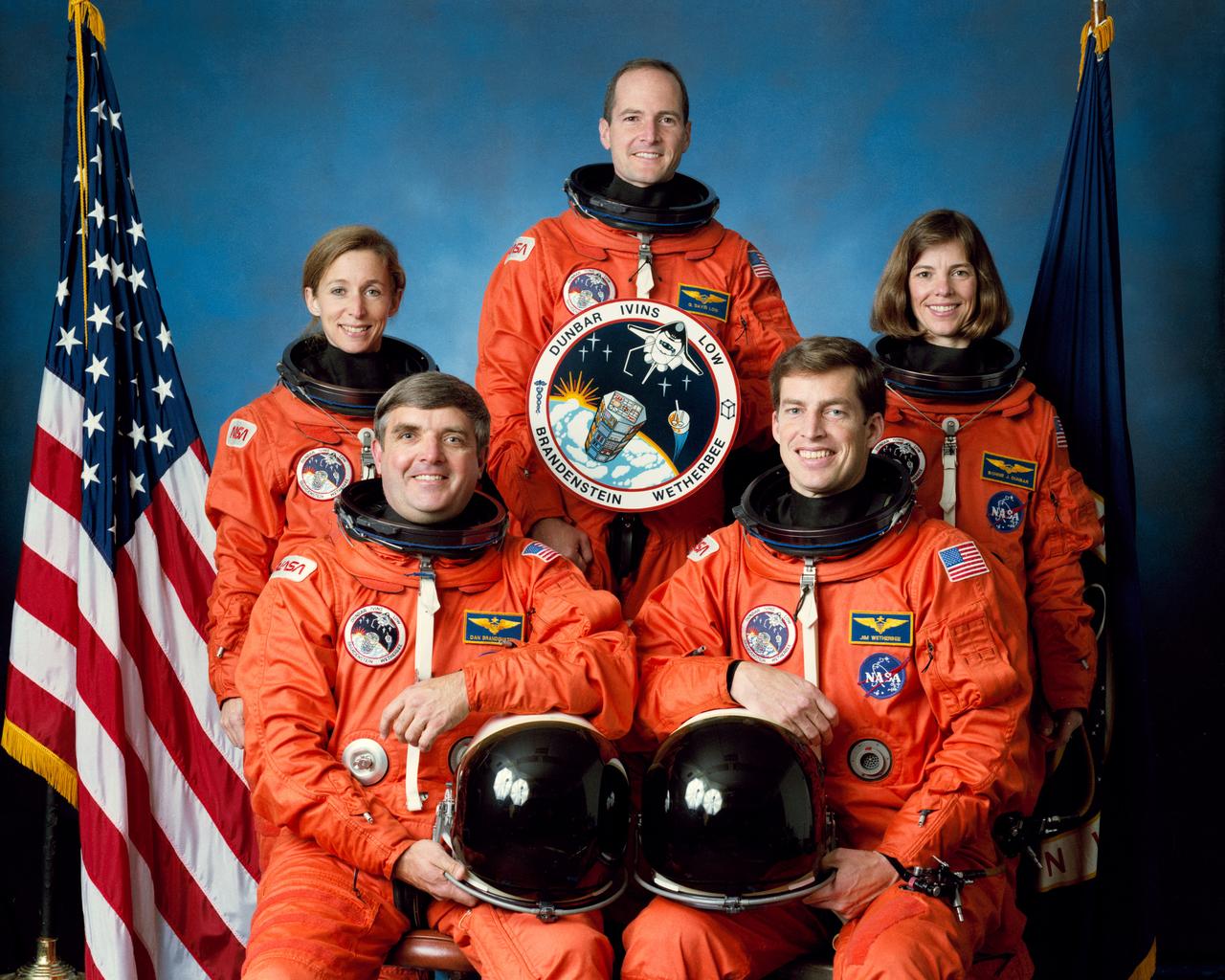
S89-48342 (October 1989) --- These five astronauts have been assigned to serve as crewmembers for NASA's STS-32 mission aboard the Space Shuttle Columbia in December of this year. In front are Astronauts Daniel C. Brandenstein (left), commander, and James D. Wetherbee, pilot. In back are Astronauts (l-r) Marsha S. Ivins, G. David Low and Bonnie J. Dunbar, all mission specialists.
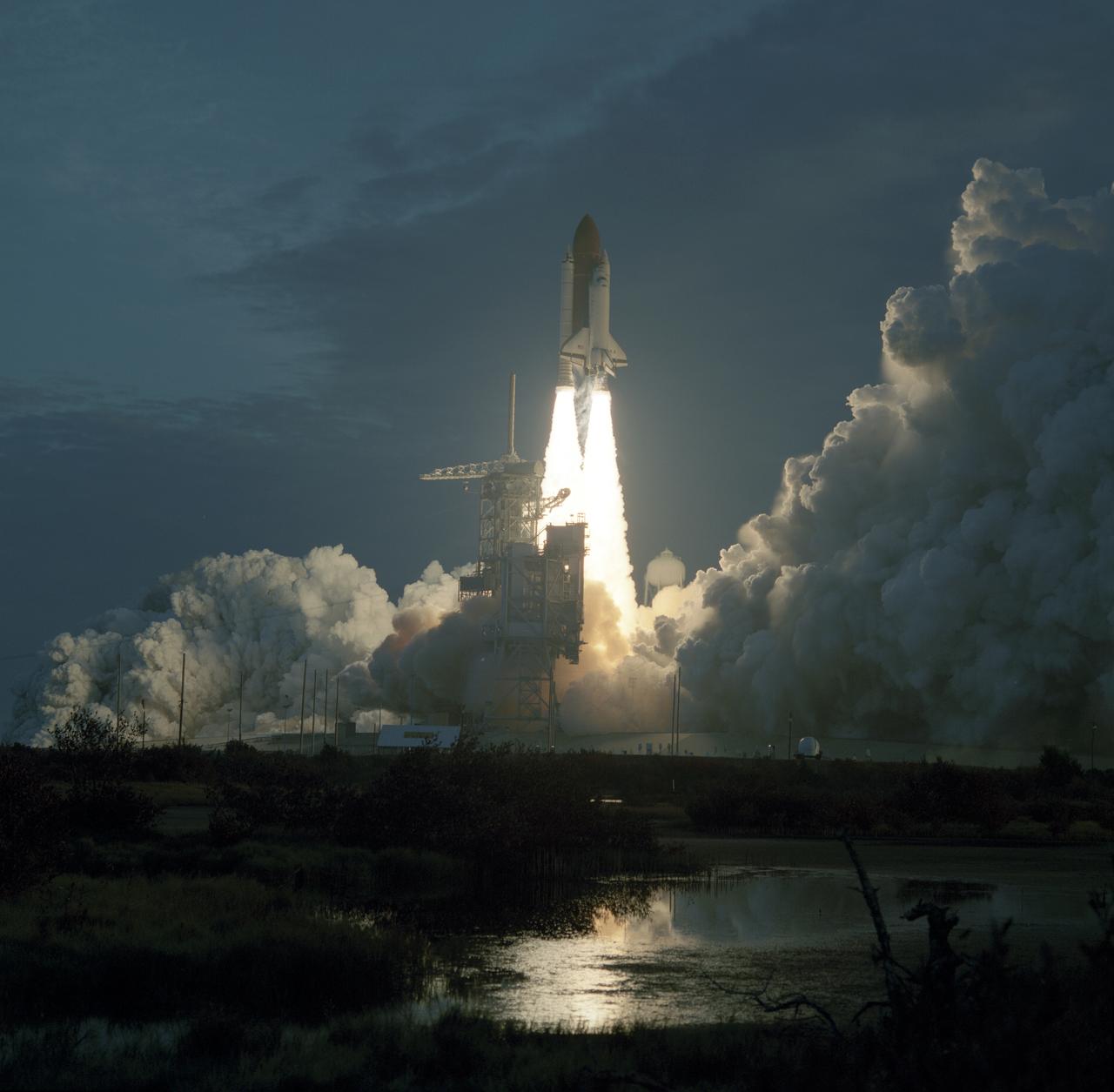
Five astronauts launched aboard the Space Shuttle Columbia on January 9, 1990 at 7:35:00am (EST) for the STS-32 mission. The crew included David C. Brandenstein, commander; James D. Weatherbee, pilot; and mission specialists Marsha S. Ivins, G. David Low, and Bonnie J. Dunbar. Primary objectives of the mission were the deployment of the SYNCOM IV-F5 defense communications satellite and the retrieval of NASA’s Long Duration Exposure Facility (LDEF).
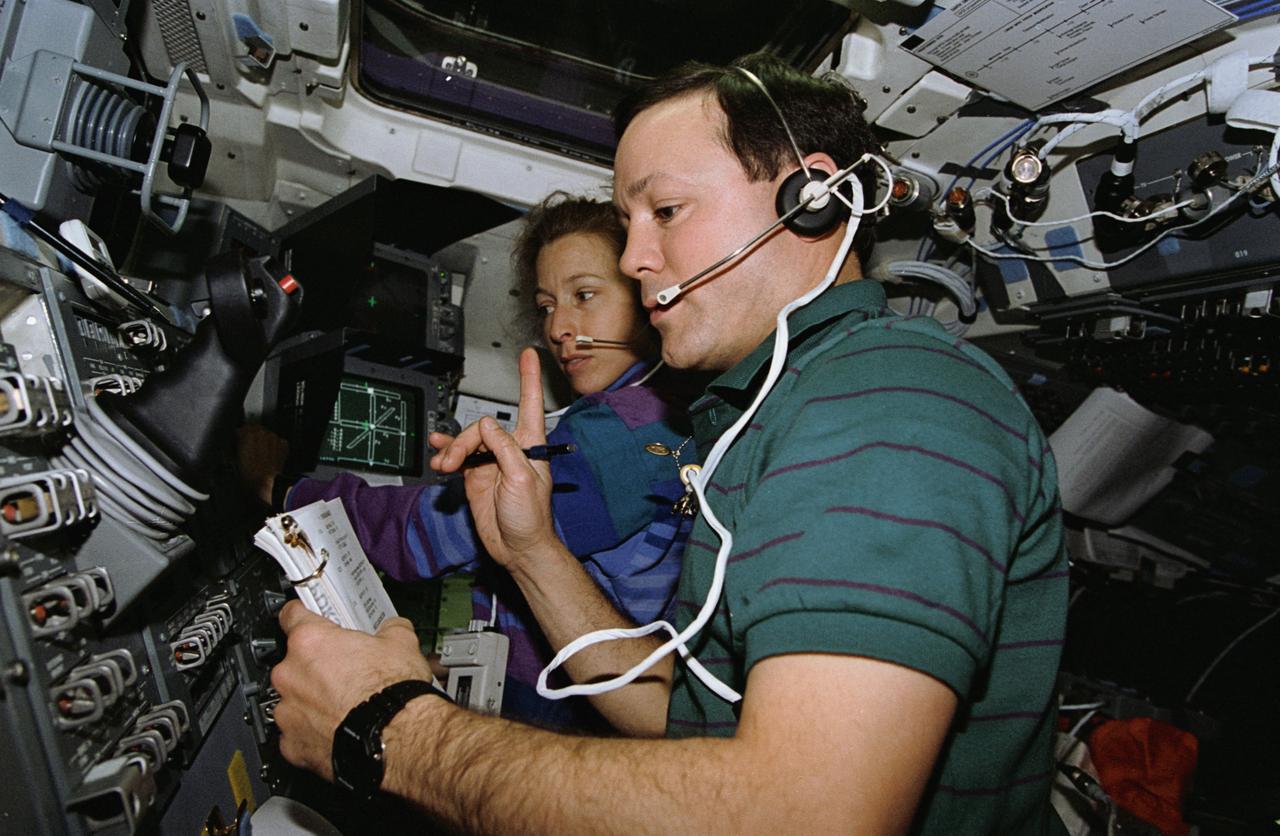
STS062-05-035 (4-18 March 1994) --- This 35mm frame, photographed on the aft flight deck of the earth-orbiting Space Shuttle Columbia, captures crew activity with the Dexterous End Effector (DEE) on the Remote Manipulator System (RMS). Astronauts Pierre J. Thuot and Marsha S. Ivins communicate with ground controllers during operations and observations with DEE. During the 14-day mission, three of the five STS-62 crewmembers took turns operating and observing the RMS in a series of one-hour sessions.
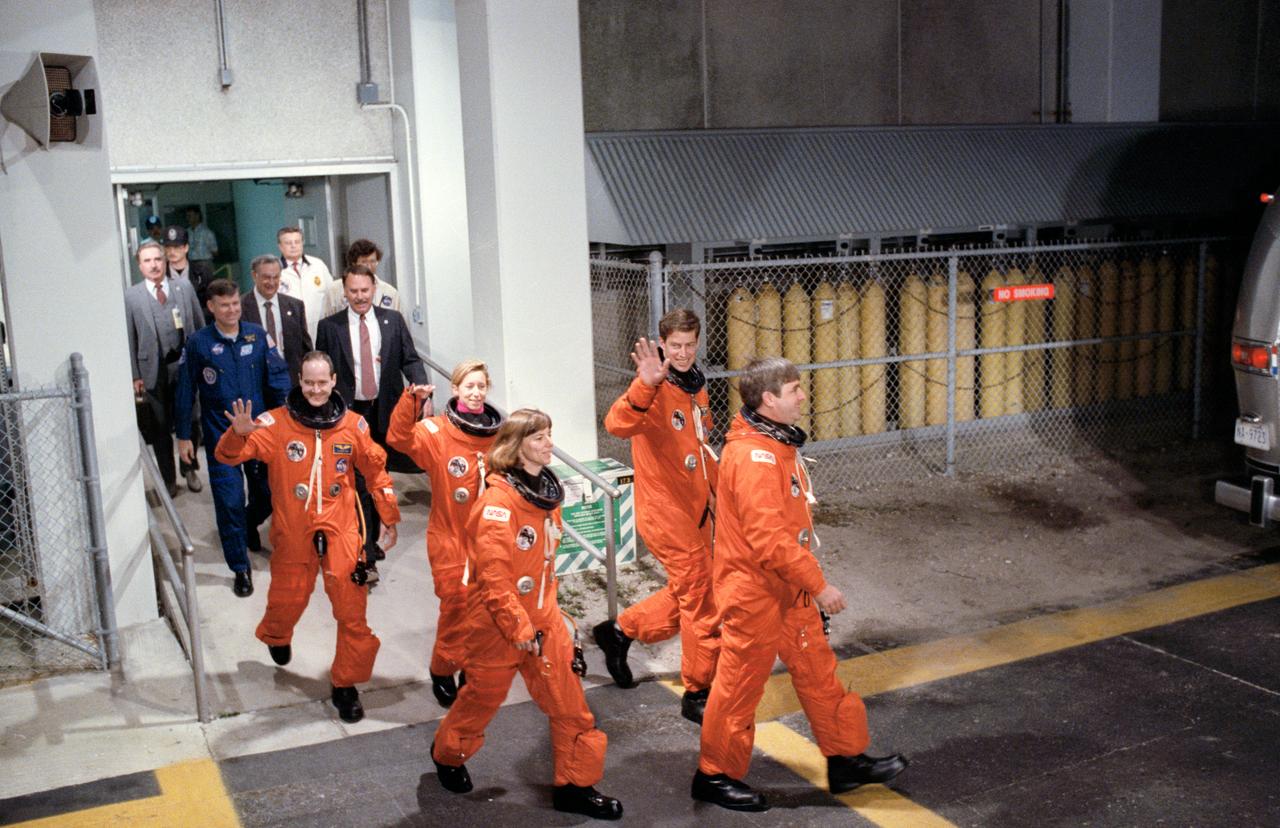
STS032-S-056 (20 Jan 1990) --- STS-32 Columbia, Orbiter Vehicle (OV) 102, crewmembers depart the Kennedy Space Center (KSC) Operations and Checkout (O and C) Building enroute to KSC Launch Complex (LC) Pad 39A. Dubious weather at the return-to-launch site (RTLS) caused postponement of yesterday's planned launch. From left to right are Mission Specialist (MS) G. David Low, MS Marsha S. Ivins, MS Bonnie J. Dunbar, Pilot James D. Wetherbee, and Commander Daniel C. Brandenstein. All crewmembers are wearing launch and entry suits (LESs) and Low, Ivins, and Wetherbee wave to spectators as they head to the transportation van. Following the crew are astronaut Michael L. Coats (left) and NASA/JSC manager Donald R. Puddy.
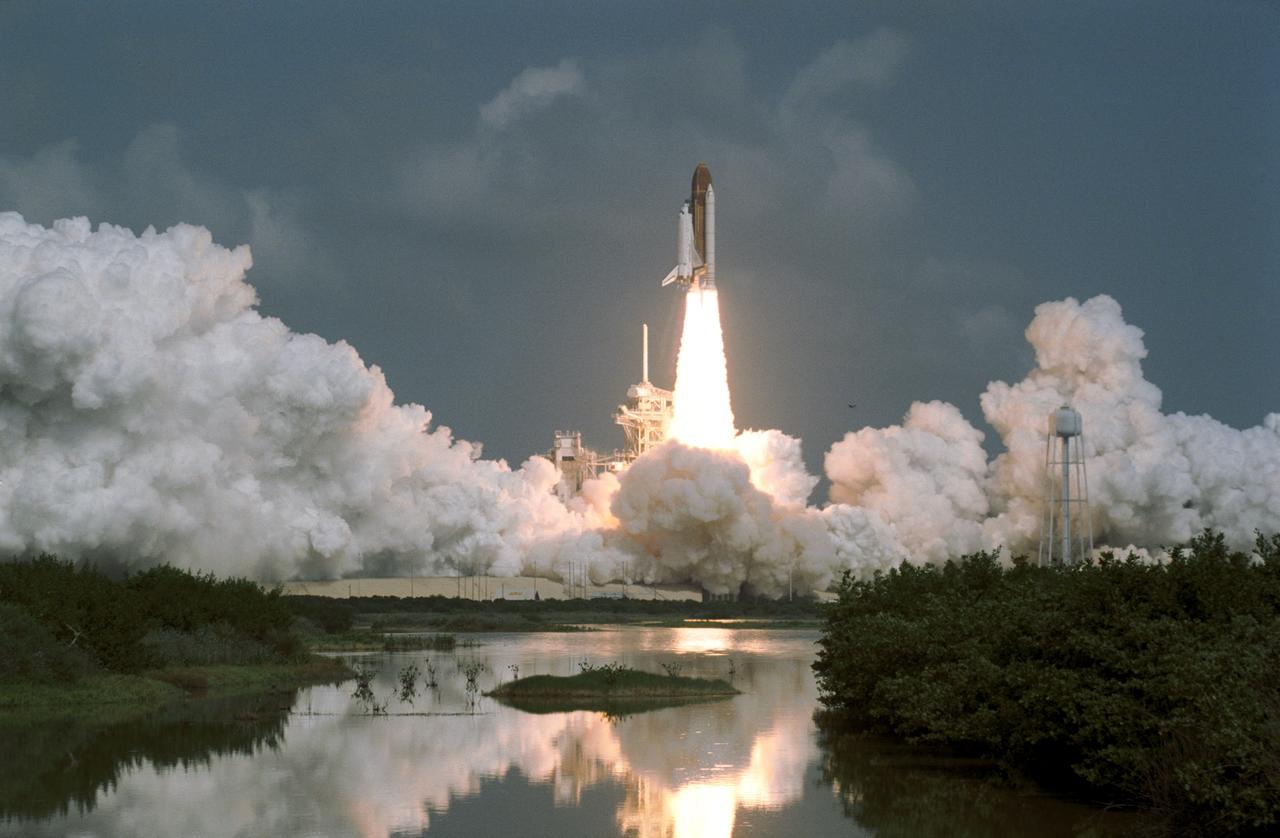
STS046-S-082 (31 July 1992) --- This panoramic scene at Kennedy Space Center's Launch Complex 39 shows the Space Shuttle Atlantis as it blasts off on its way to eight days of Earth orbital operations with a crew of five NASA astronauts and two European scientists onboard. Launch occurred at 9:56:47:976 a.m. (EDT), July 31, 1992. Onboard the spacecraft were astronauts Loren J. Shriver, Andrew M. Allen, Jeffrey A. Hoffman, Marsha S. Ivins and Franklin R. Chang-Diaz, along with the European Space Agency's Claude Nicollier and the Italian Space Agency's Franco Malerba.
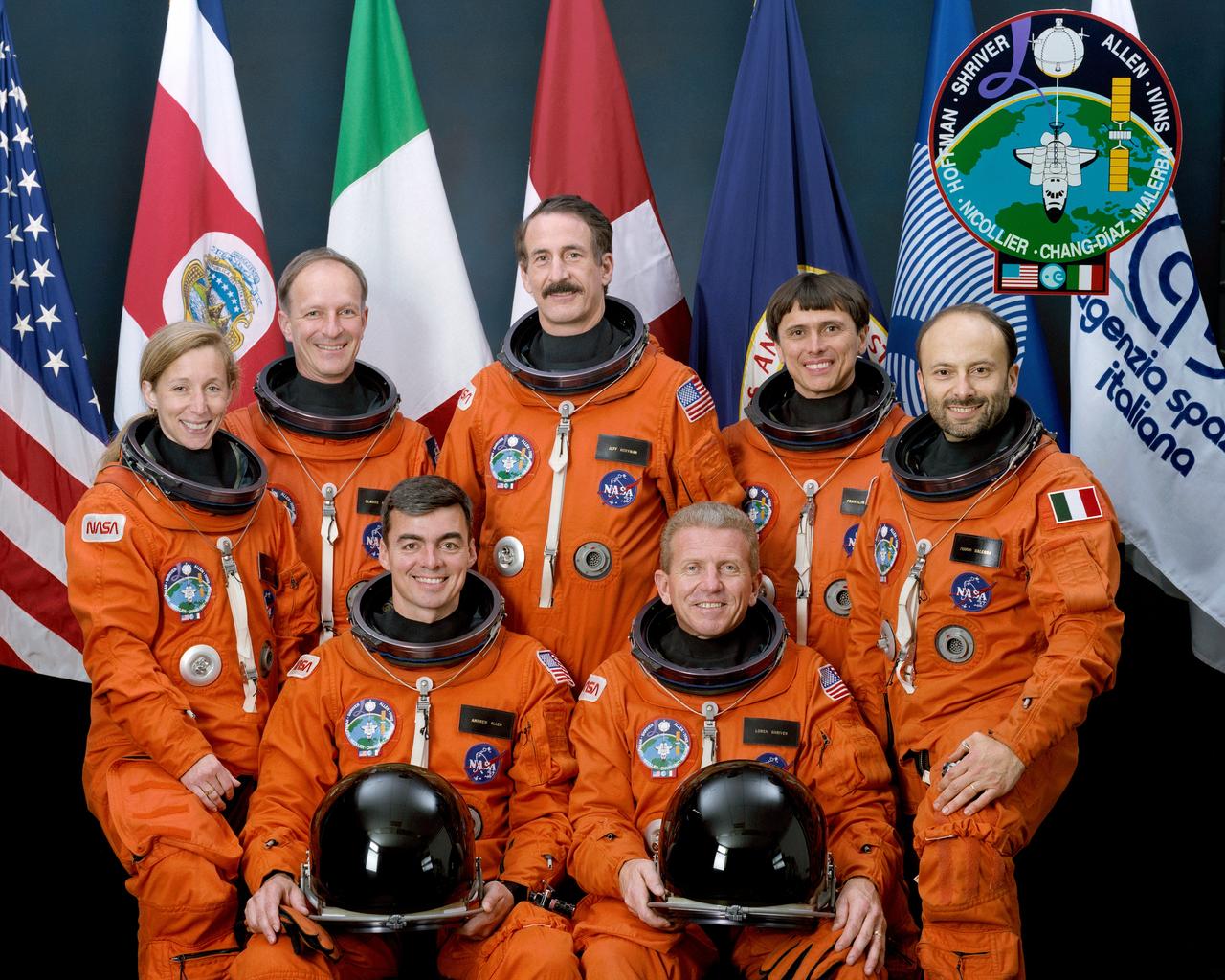
STS046-S-002 (May 1992) --- The crew members assigned to the STS-46 mission pose with seven flags that represent participation on the flight. Loren J. Shriver (right front) is mission commander; Andrew M. Allen (left front) is pilot. Others are (left to right) Marsha S. Ivins, mission specialist; Claude Nicollier, mission specialist representing the European Space Agency (ESA); Jeffrey A. Hoffman, payload commander; Franklin R. Chang-Diaz, mission specialist; and Franco Malerba, flying for the Italian Space Agency (ASI). The flags, left to right, represent the United States of America, Costa Rica (Chang's native country), Italy, Switzerland (Nicollier's homeland), NASA, ESA and ASI.
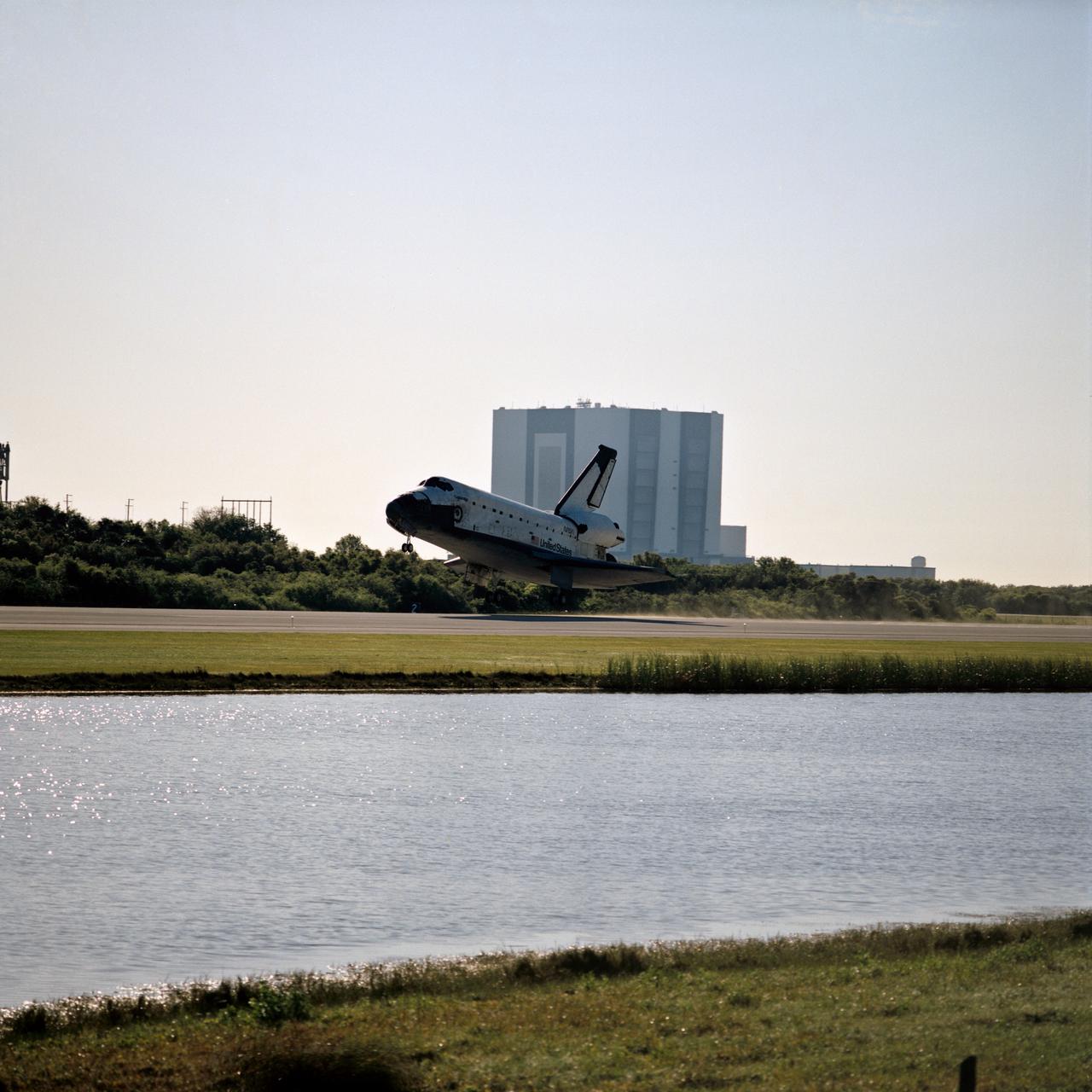
STS062-S-030 (18 March 1994) --- The Space Shuttle Columbia is about to touch down on the Shuttle landing facility following almost 14 days in earth orbit for five NASA astronauts and a variety of experiments. The giant Vehicle Assembly Building (VAB) where Columbia had been mated to its external fuel tank and two solid rockets is in the background. Touchdown occurred at 8:09 a.m. (EST), March 18, 1994. Thirteen days, 23 hours and 16 minutes were logged by the crew members -- astronauts John H. Casper, Andrew M. Allen, Marsha S. Ivins, Pierre J. Thuot and Charles D. (Sam) Gemar.
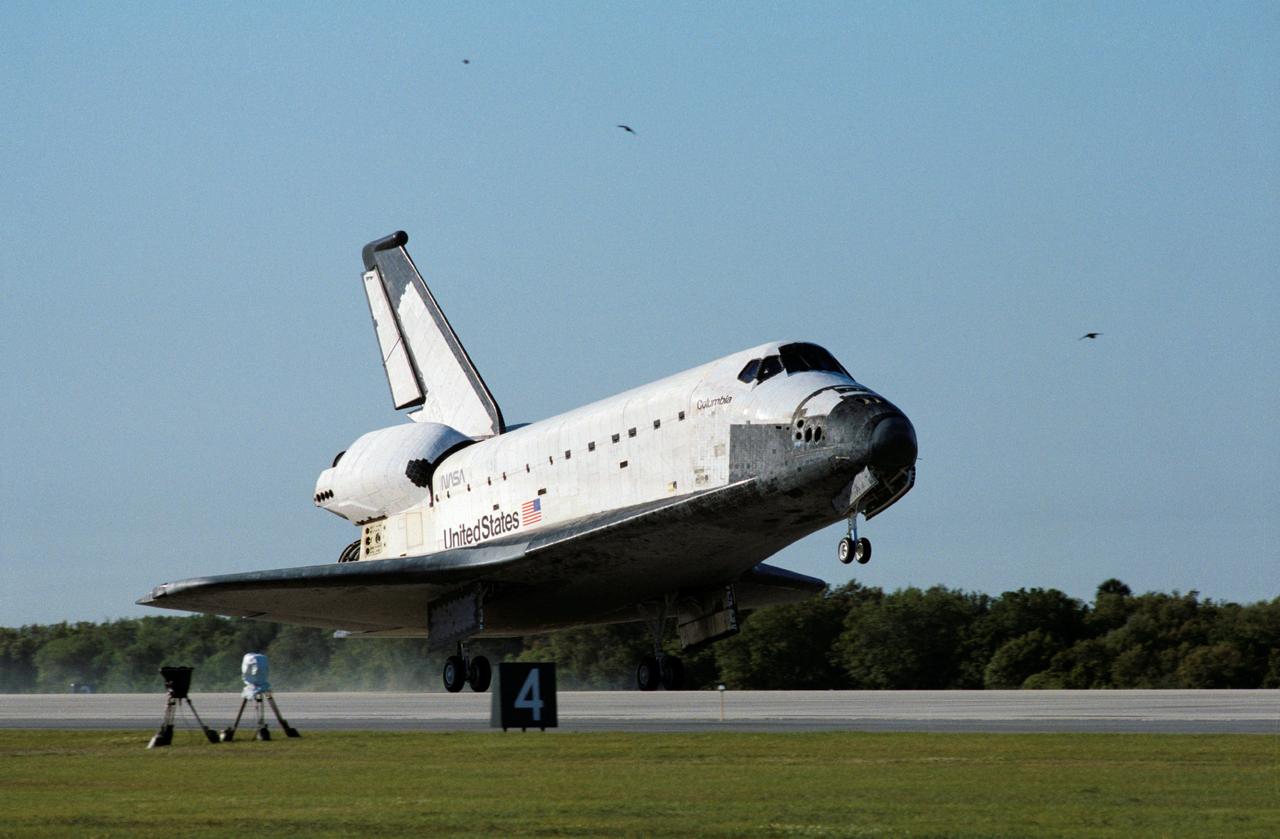
STS062-S-031 (18 March 1994) --- The main landing gear on the Space Shuttle Columbia touches down on the Shuttle Landing Facility at Kennedy Space Center (KSC). The scene followed almost 14-days in Earth-orbit for five NASA astronauts and a variety of experiments. Touch down occurred at 8:09 a.m. (EST), March 18, 1994. Thirteen days, 23 hours and 16 minutes were logged by the crew members -- astronauts John H. Casper, Andrew M. Allen, Marsha S. Ivins, Pierre J. Thuot and Charles D. (Sam) Gemar.
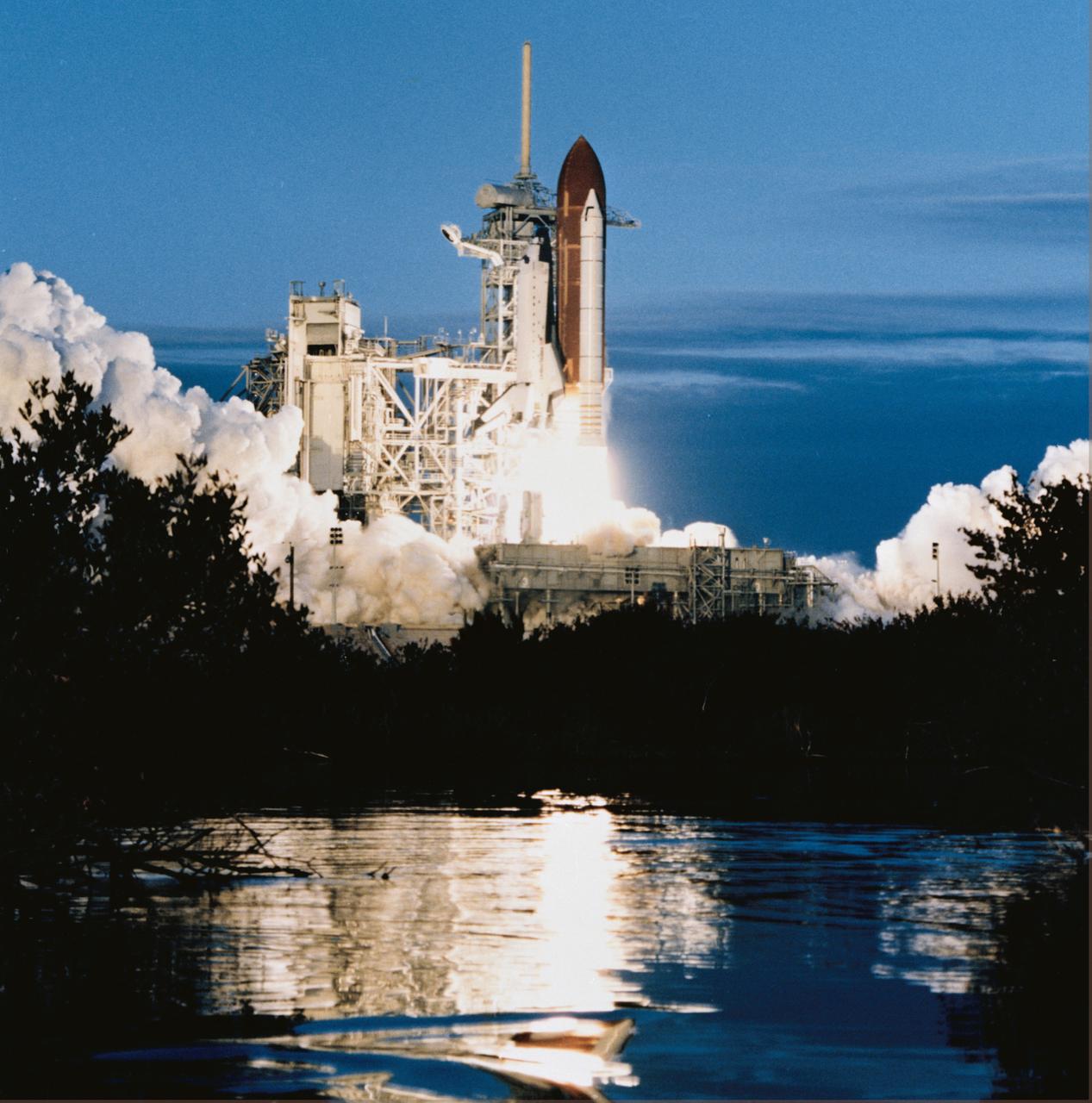
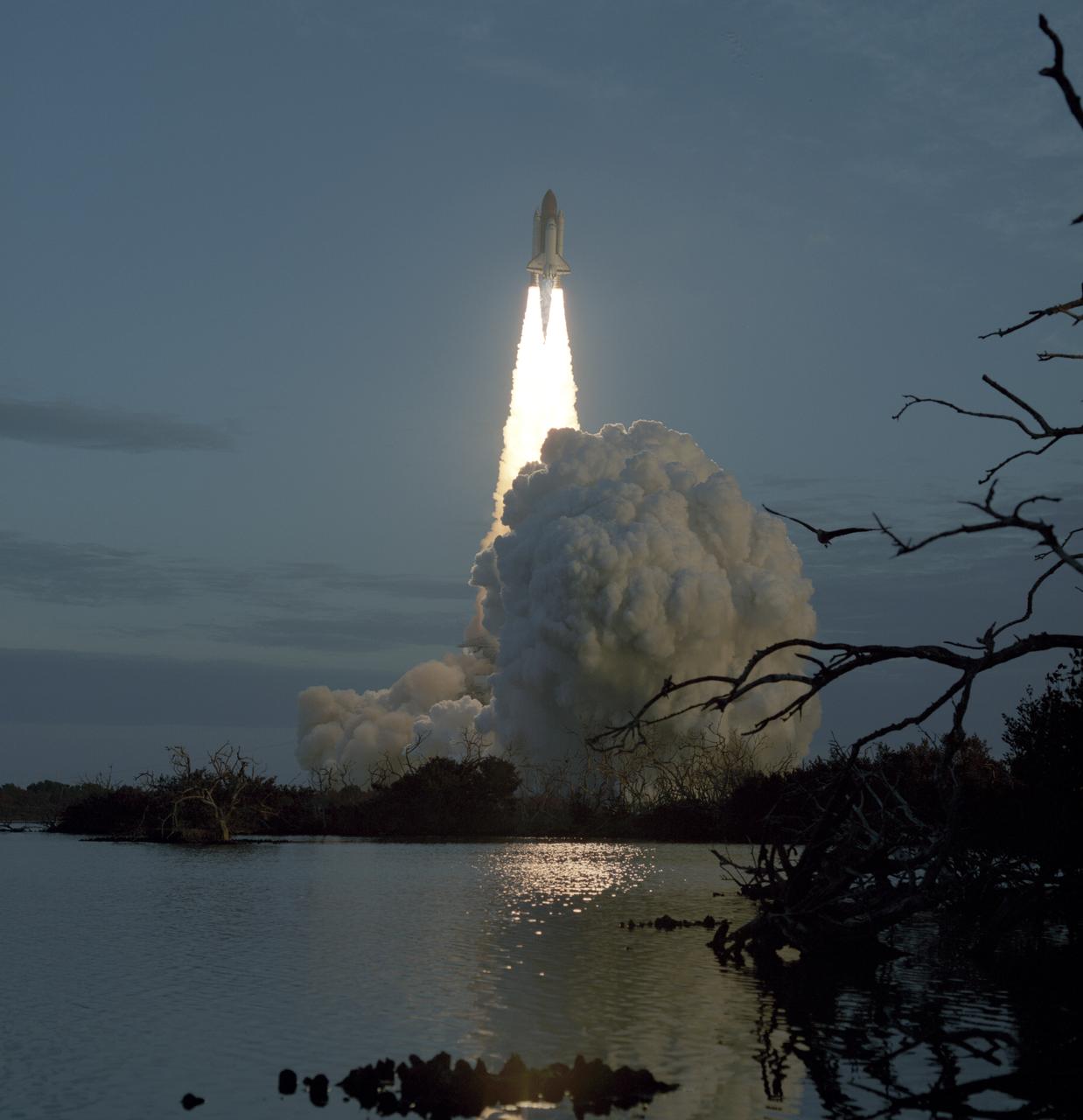
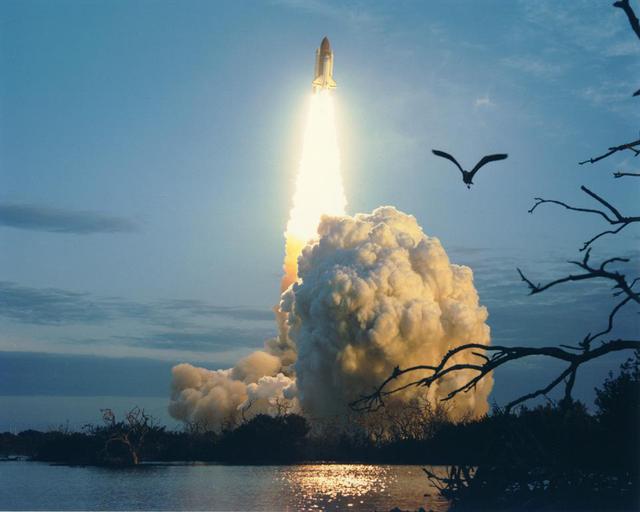
STS032-S-069 (9 Jan. 1990) --- The space shuttle Columbia, with a five member crew aboard, lifts off for the ninth time as STS-32 begins a 10-day mission in Earth orbit. Leaving from Launch Pad 39A at 7:34:59:98 a.m. EST, in this horizontal (cropped 70mm) frame, Columbia is seen reflected in nearby marsh waters some 24 hours after dubious weather at the return-to-launch site (RTLS) had cancelled a scheduled launch. Onboard the spacecraft were astronauts Daniel C. Brandenstein, James D. Wetherbee, Bonnie J. Dunbar, G. David Low and Marsha S. Ivins. Photo credit: NASA
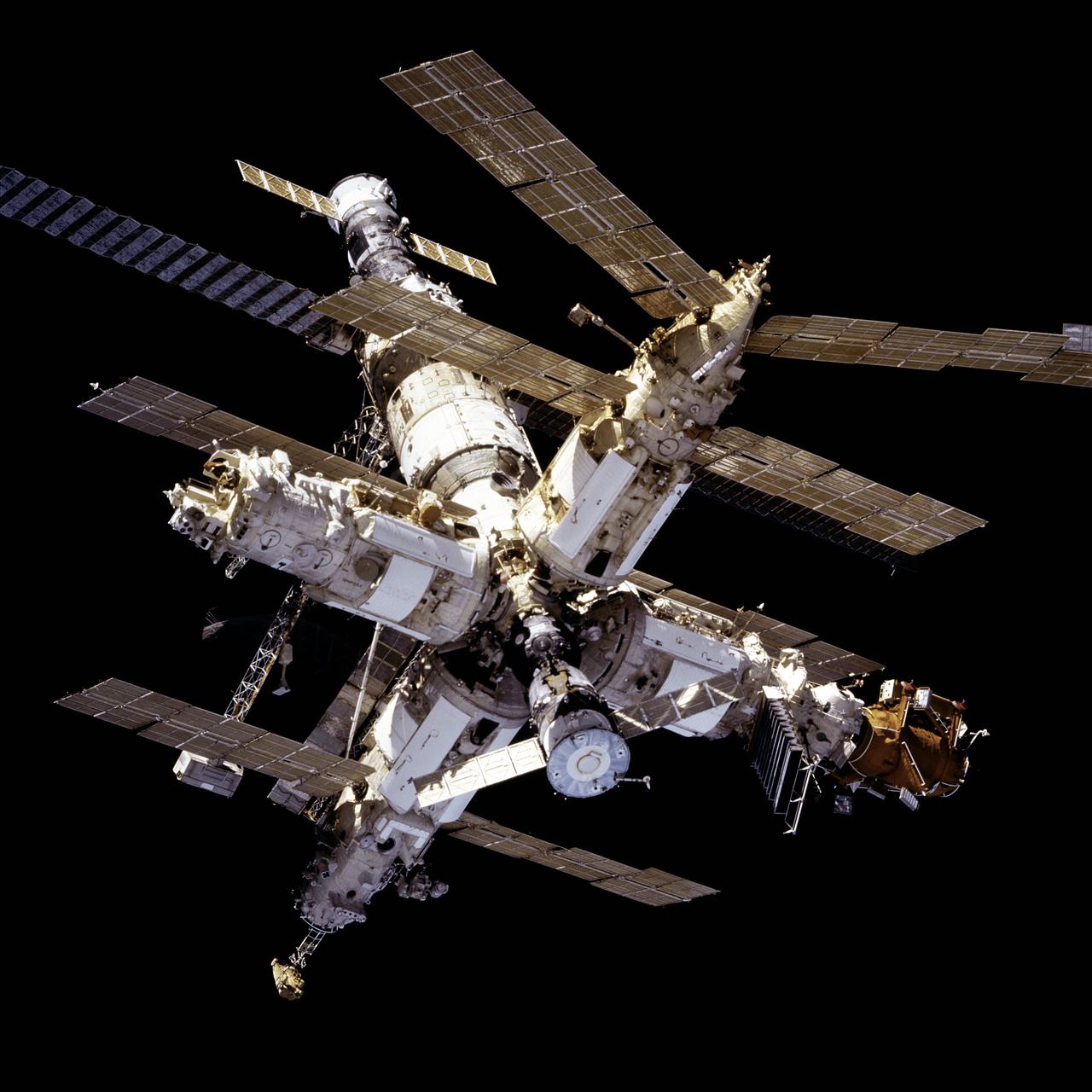
STS081-736-034 (14 Jan 1997) --- This 70mm frame affords a full view of Russia?s Mir Space Station complex during approach for docking, backdropped against the blackness of space. Astronaut Jerry M. Linenger, now onboard the Space Shuttle Atlantis, will trade places with John E. Blaha, current cosmonaut guest researcher onboard Mir since mid September 1996. Along with Linenger, other crew members now aboard Atlantis are astronauts Michael A. Baker, commander; Brent W. Jett, Jr., pilot; and mission specialists John M. Grunsfeld, Marsha S. Ivins and Peter J. K. (Jeff) Wisoff.
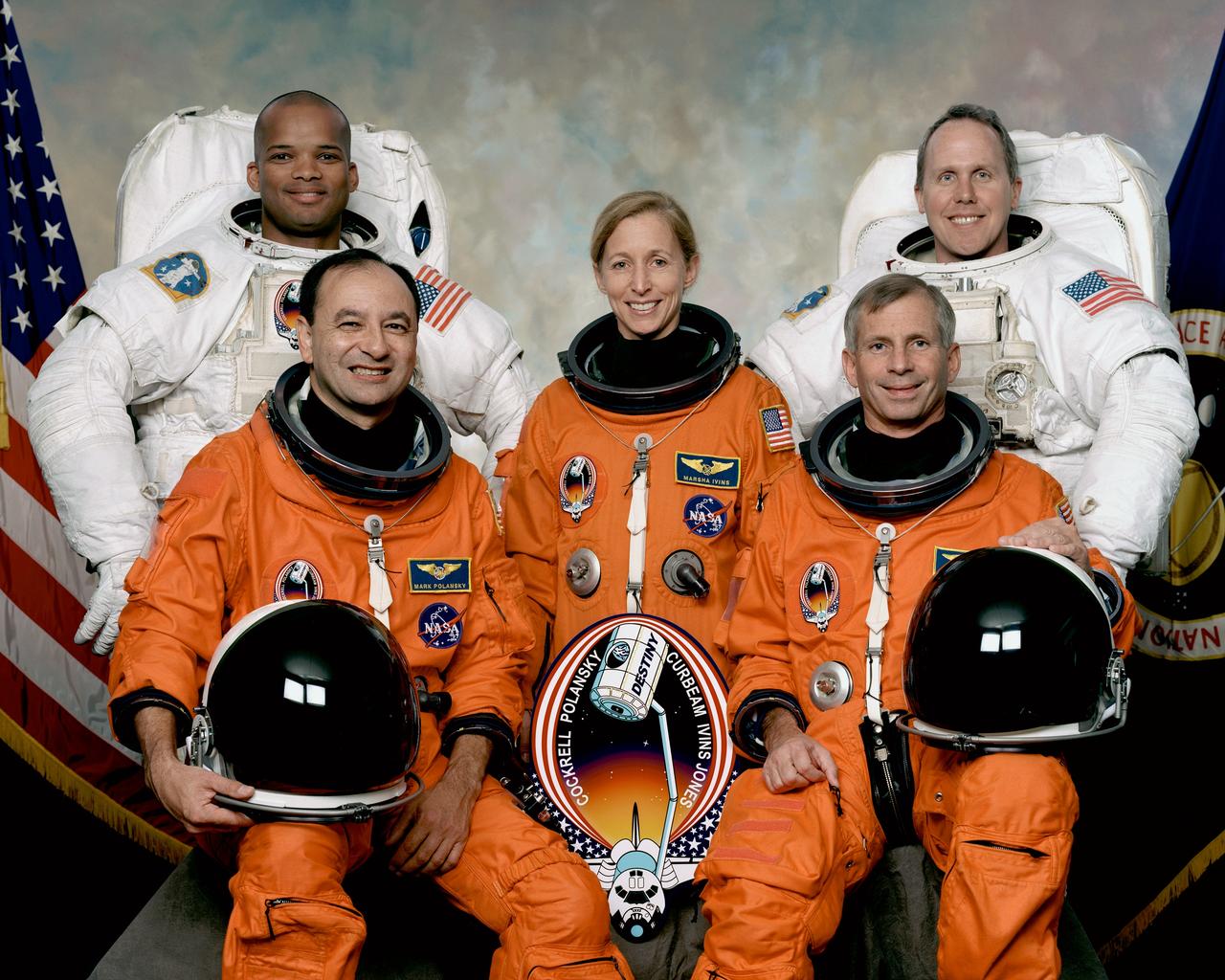
STS098-S-002 (December 2000) --- These five astronauts have been in training for the STS-98 mission, scheduled for launch aboard the Space Shuttle Atlantis in January of 2001. The crew is composed of astronauts Kenneth D. Cockrell (right front), mission commander; and Mark L. Polansky (left front), pilot; along with astronauts Marsha S. Ivins, Robert L. Curbeam, Jr., (left rear) and Thomas D. Jones (right rear), all mission specialists. Curbeam and Jones are the scheduled extravehicular activity (EVA) participants for the International Space Station's 5a mission.
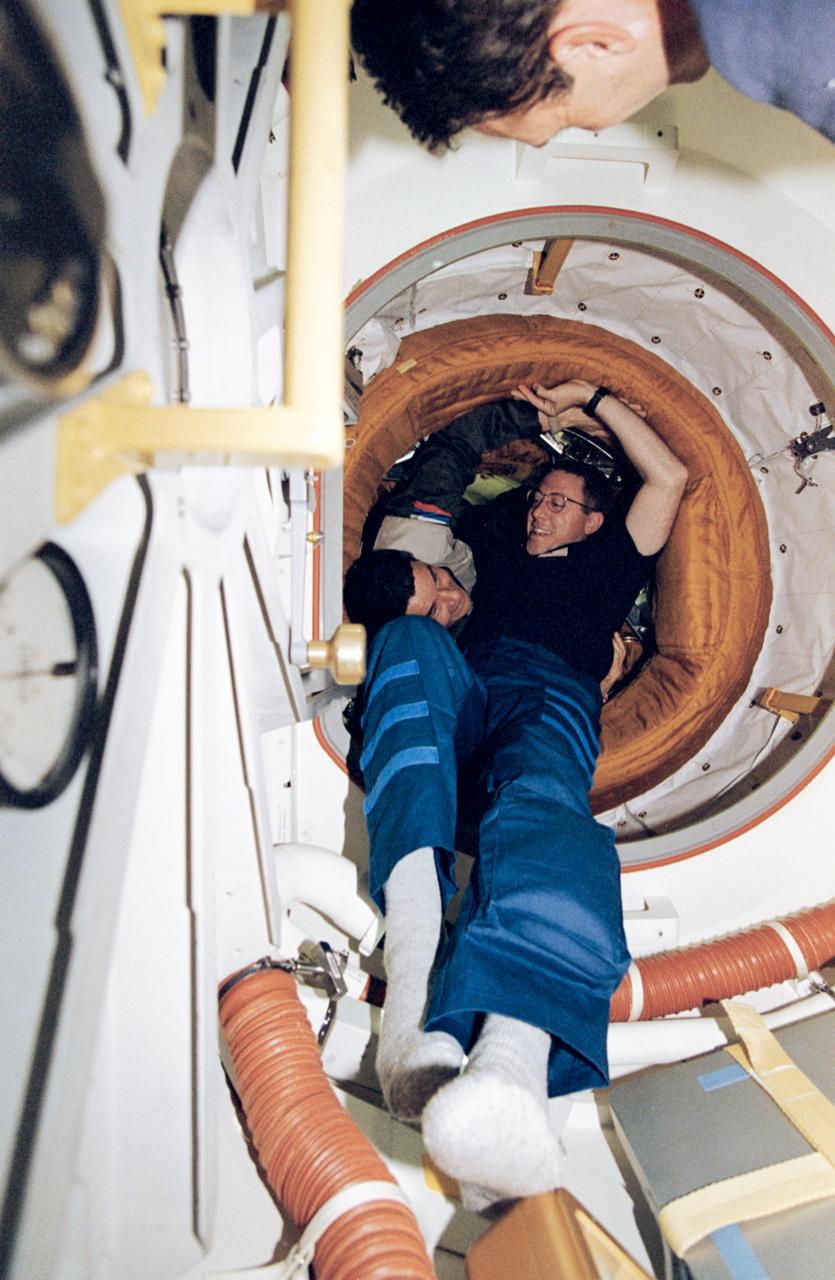
STS081-373-025 (14 Jan 1997) --- Greeting between commanders - astronaut Michael A. Baker (foreground) and cosmonaut Valeri G. Korzun - just after hatch opening following the January 14, 1997, docking. Out of frame on the Space Shuttle Atlantis is astronaut Jerry M. Linenger, soon to be trading places with John E. Blaha, the current cosmonaut guest researcher, onboard Russia?s Mir Space Station since mid September 1996. Along with Baker and Linenger, other crew members now aboard Atlantis are astronauts Brent W. Jett, Jr., pilot; and mission specialists John M. Grunsfeld, Marsha S. Ivins and Peter J. K. (Jeff) Wisoff.
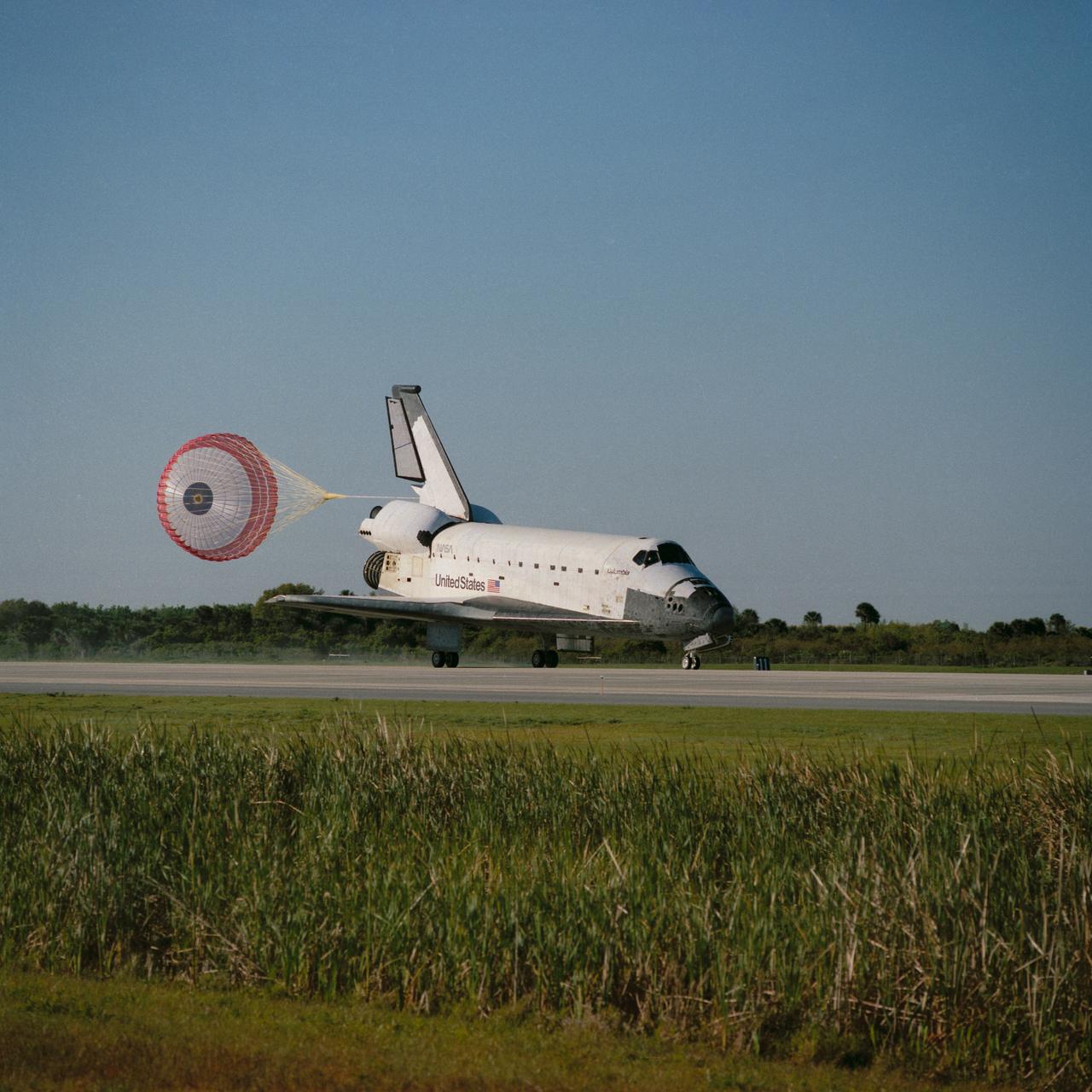
STS062-S-029 (18 March 1994) --- The drag chute on the Space Shuttle Columbia is deployed as the spacecraft rolls down the Shuttle landing facility at Kennedy Space Center (KSC). The scene followed almost 14 days in earth orbit for five NASA astronauts and a variety of experiments. Touchdown occurred at 8:09 a.m. (EST), March 18, 1994. Thirteen days, 23 hours and 16 minutes were logged by the crew members -- astronauts John H. Casper, Andrew M. Allen, Marsha S. Ivins, Pierre J. Thuot and Charles D. (Sam) Gemar.
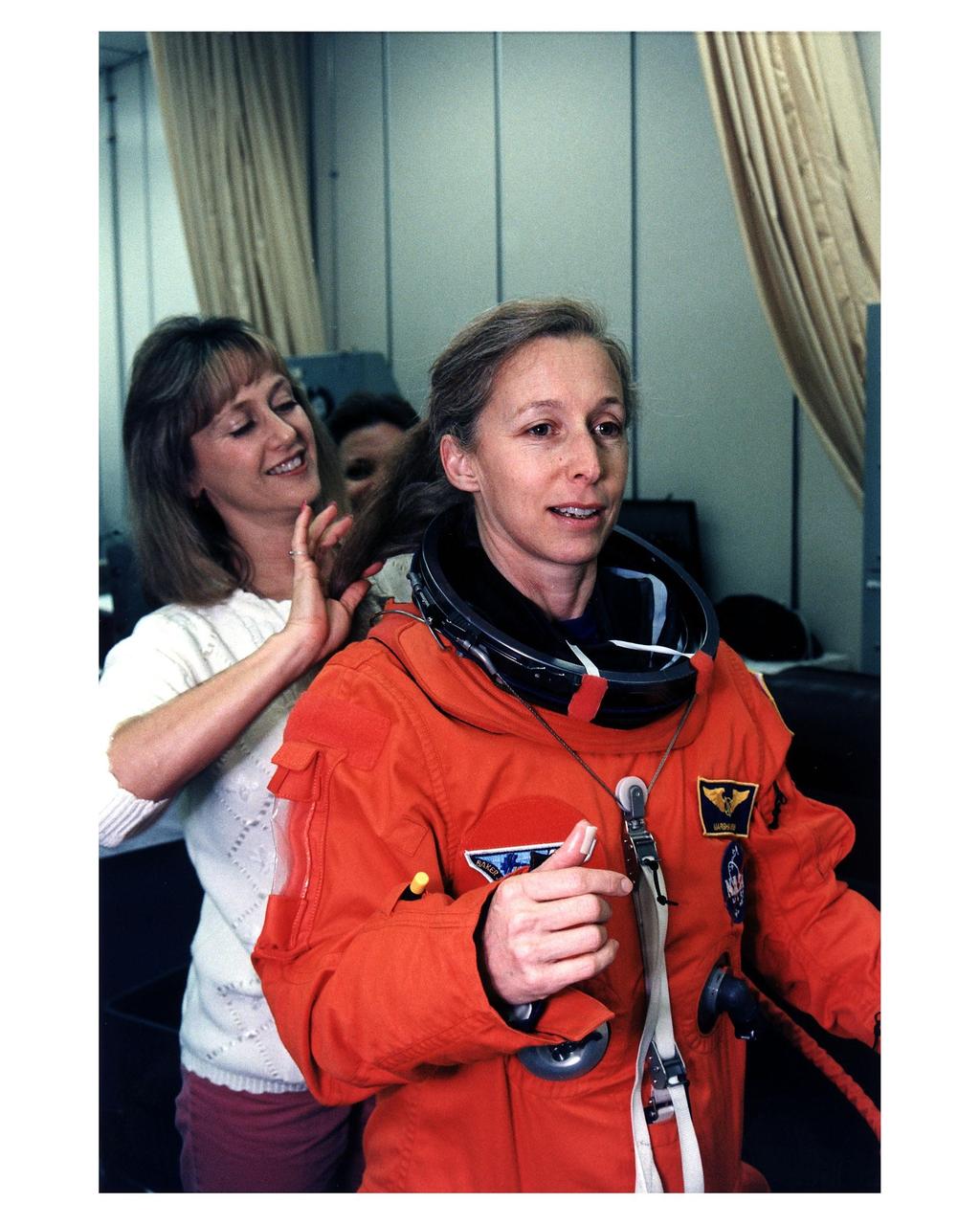
STS-81 Mission Specialist Marsha S. Ivins gets a helping hand from a suit technician as she prepares to don the helmet of her launch/entry suit in the suitup room of the Operations and Checkout (O&C) Building. She is the veteran of three Shuttle flights and became an astronaut in 1984. Among other responsibilities, Ivins will perform photo and video surveys of the Russian Mir space station and operate the Kidsat experiment camera on the orbiter’s aft flight deck. She and five crew members will shortly depart the O&C and head for Launch Pad 39B, where the Space Shuttle Atlantis will lift off during a 7-minute window that opens at 4:27 a.m. EST, January 12
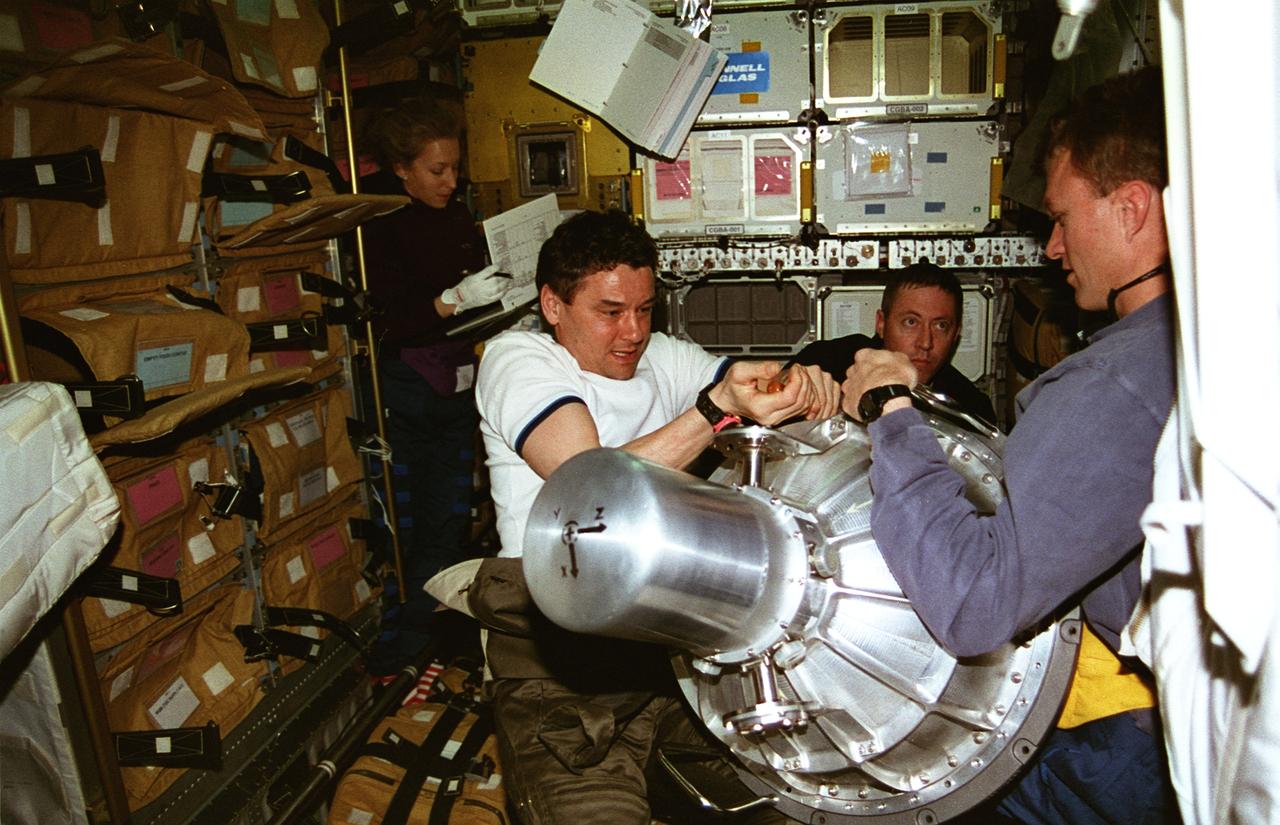
STS081-301-032 (12-22 Jan. 1997) --- Shortly after the docking of the Space Shuttle Atlantis and Russia's Mir Space Station, crewmembers from the respective spacecraft begin to transfer hardware from the Spacehab Double Module (DM) onto the Mir complex. In this scene, cosmonaut Valeri G. Korzun (second left) Mir-22 commander, along with astronauts Michael A. Baker (second right) commander, and Brent W. Jett, Jr., pilot, unstow a gyrodyne, a device used for attitude control, for transfer to Mir. Astronaut Marsha S. Ivins looks over a lengthy inventory of supplies to be transferred.
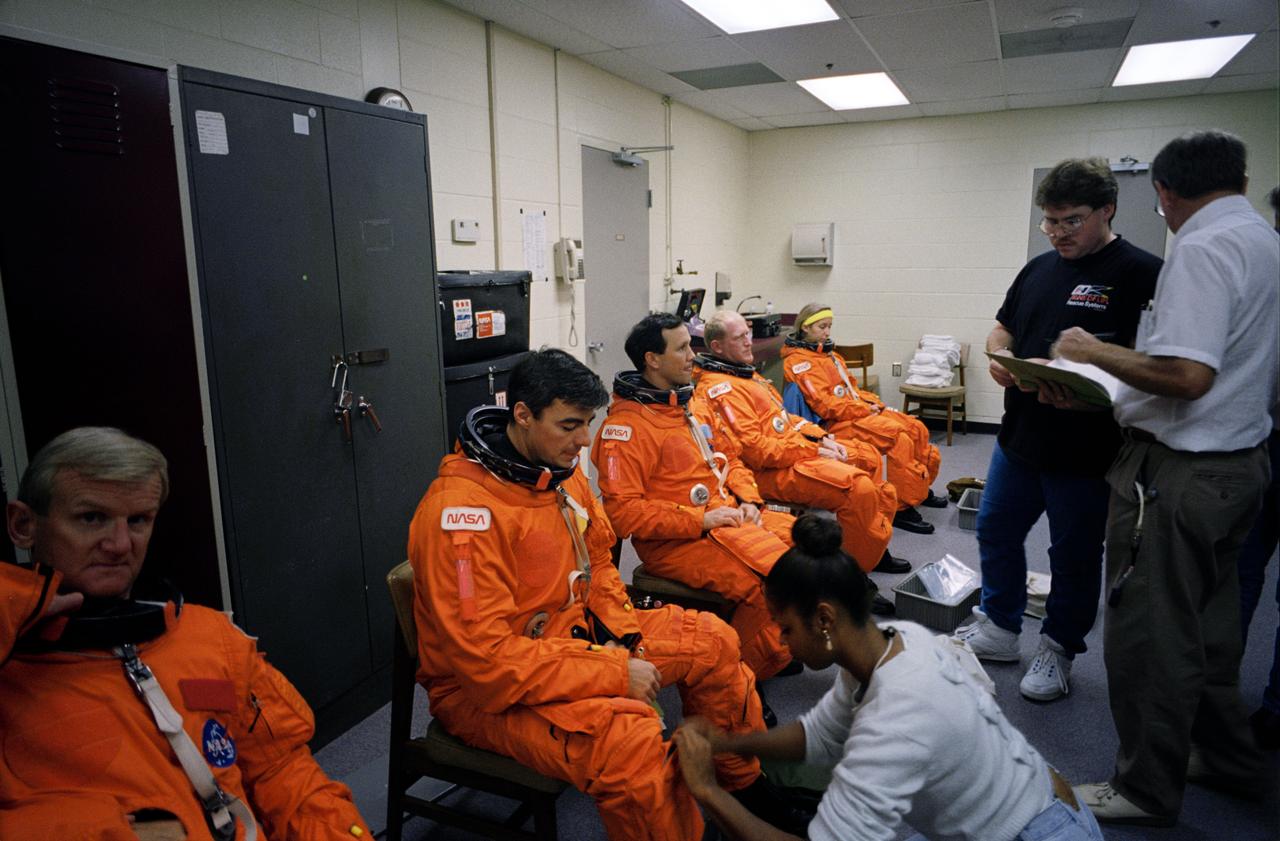
S93-48458 (5 Nov. 1993) --- In the Johnson Space Center's (JSC) Shuttle mockup and integration laboratory, the five crew members training for NASA's next mission are assisted in donning their partial pressure launch and entry suits. From left to right are astronaut John H. Casper, Andrew M. Allen, Pierre J. Thuot, Charles D. (Sam) Gemar and Marsha S. Ivins. Minutes later the crew was in the crew compartment trainer (CCT) rehearsing their scheduled March 1994 mission aboard the Space Shuttle Columbia. Launch, landing and emergency egress procedures were covered in the training session.
KENNEDY SPACE CENTER, FLA. -- At 7:35 a.m. EST on January 9, the Space Shuttle Columbia roars aloft from KSC's Pad 39-A into the Florida skies. During the ten-day STS-32 mission, the five-member crew is scheduled to deploy the SYNCOM IV-5 military communications satellite and retrieve the Long Duration Exposure Facility. STS-32 marks the 33rd Shuttle mission since flight operations began in 1981. Crew members are: Commander Daniel C. Brandenstein; Pilot James D. Wetherbee; and Mission Specialists Marsha S. Ivins, G. David Low, and Bonnie J. Dunbar
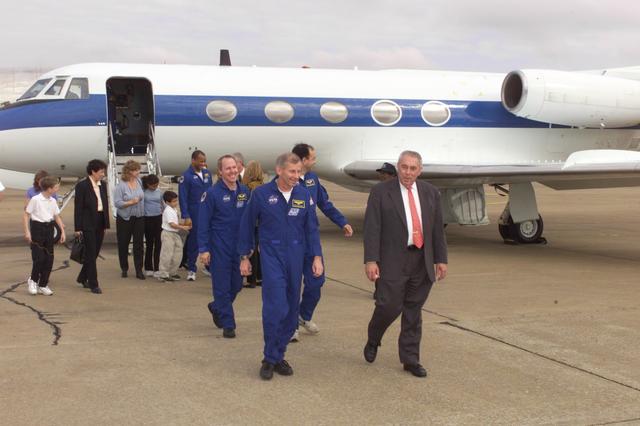
JSC2001-E-04805 (21 February 2001) --- JSC director George W.S. Abbey talks with the STS-98 crew members following the arrival of the Gulfstream Aircraft which transported the astronauts from their landing at Dryden Flight Research Center (DFRC) in Edwards, California. Pictured along side Mr. Abbey is astronaut Kenneth D. Cockrell, mission commander. Behind him (from the left distant background) are astronauts Robert L. Curbeam and Thomas D. Jones (both mission specialists) and Mark L. Polansky, pilot. Astronaut Marsha S. Ivins, mission specialist, is out of the frame.

Greeted by cheers from wellwishers at KSC and eager for their venture into space on the fifth Shuttle-Mir docking mission, the STS-81 astronauts depart the Operations and Checkout Building and board the Astrovan for their 25-minute trip to Launch Pad 39B. Leading the six-member crew is Mission Commander Michael A. Baker, followed by Pilot Brent W. Jett, Jr. Behind them are Mission Specialists John M. Grunsfeld, Jerry Linenger, Peter J. K. "Jeff" Wisoff, and Marsha S. Ivins. Once at the pad, they will take their positions in the crew cabin of the Space Shuttle Atlantis to await a liftoff during a seven-minute window that will open at 4:27 a.m. EST, January 12
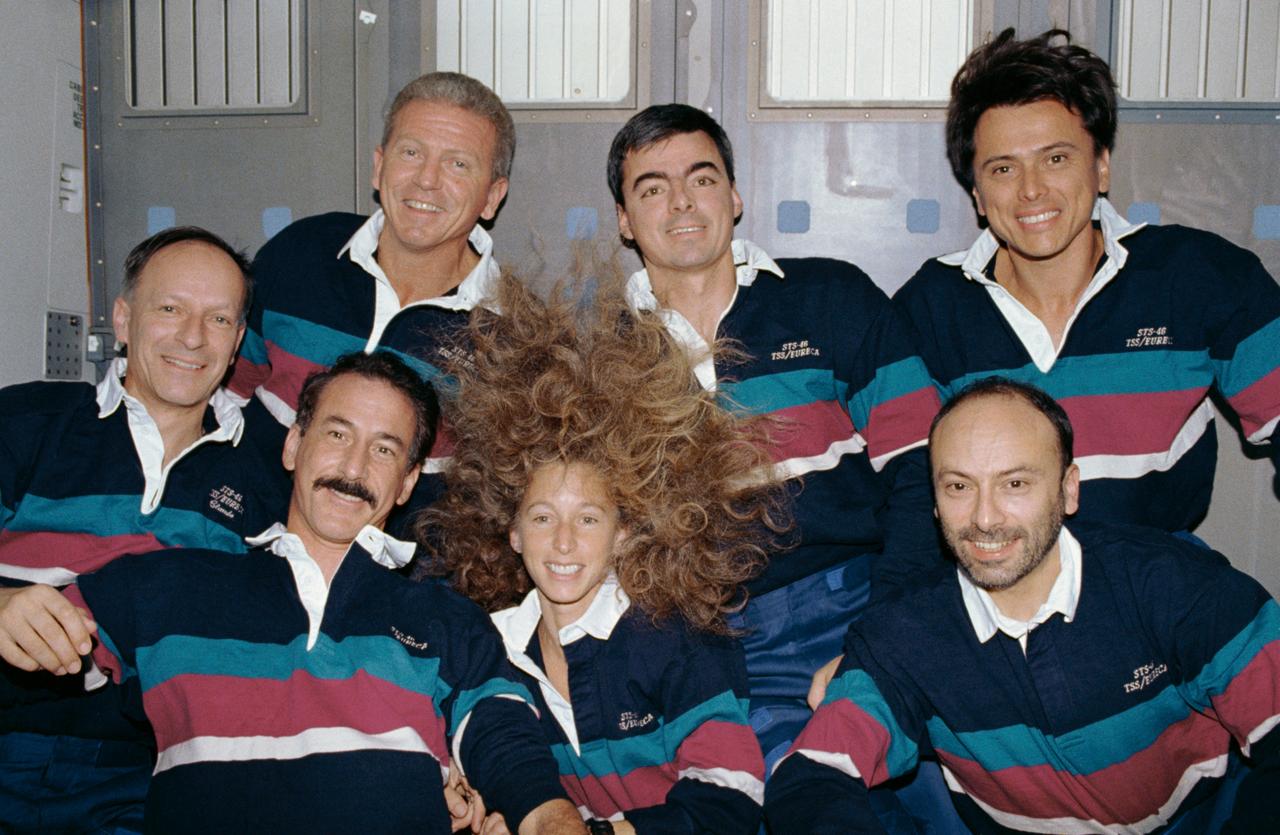
STS046-12-009 (31 July-8 Aug. 1992) --- The seven crew members for the STS-46 mission pose for the traditional in-flight portrait onboard the Earth-orbiting space shuttle Atlantis. In the rear are, left to right, astronauts Loren J. Shriver, commander; Andrew M. Allen, pilot; and Franklin R. Chang-Diaz, mission specialist. In front are, left to right, Swiss scientist Claude Nicollier, mission specialist representing the European Space Agency (ESA); astronaut Jeffrey A. Hoffman, payload commander; astronaut Marsha S. Ivins, mission specialist; and Franco Malerba, payload specialist representing the Italian Space Agency (ASI).
Launched aboard the Space Shuttle Atlantis on July 31, 1992 at 9:56:48 am (EDT), the STS-46 mission’s primary objectives included the deployment of the European Space Agency’s European Retrievable Carrier (EURECA) and operation of the joint NASA/Italian Space Agency Tethered Satellite System (TSS). The STS-46 crew of seven included: Loren J. Shriver, commander; Andrew M. Allen, pilot; Jeffrey A. Hoffman, mission specialist 1; Franklin R. Chang-Diaz, mission specialist 2; Claude Nicollier, mission specialist 3; Marsha S. Ivins, mission specialist 4; and Franco Malerba, payload specialist 1.
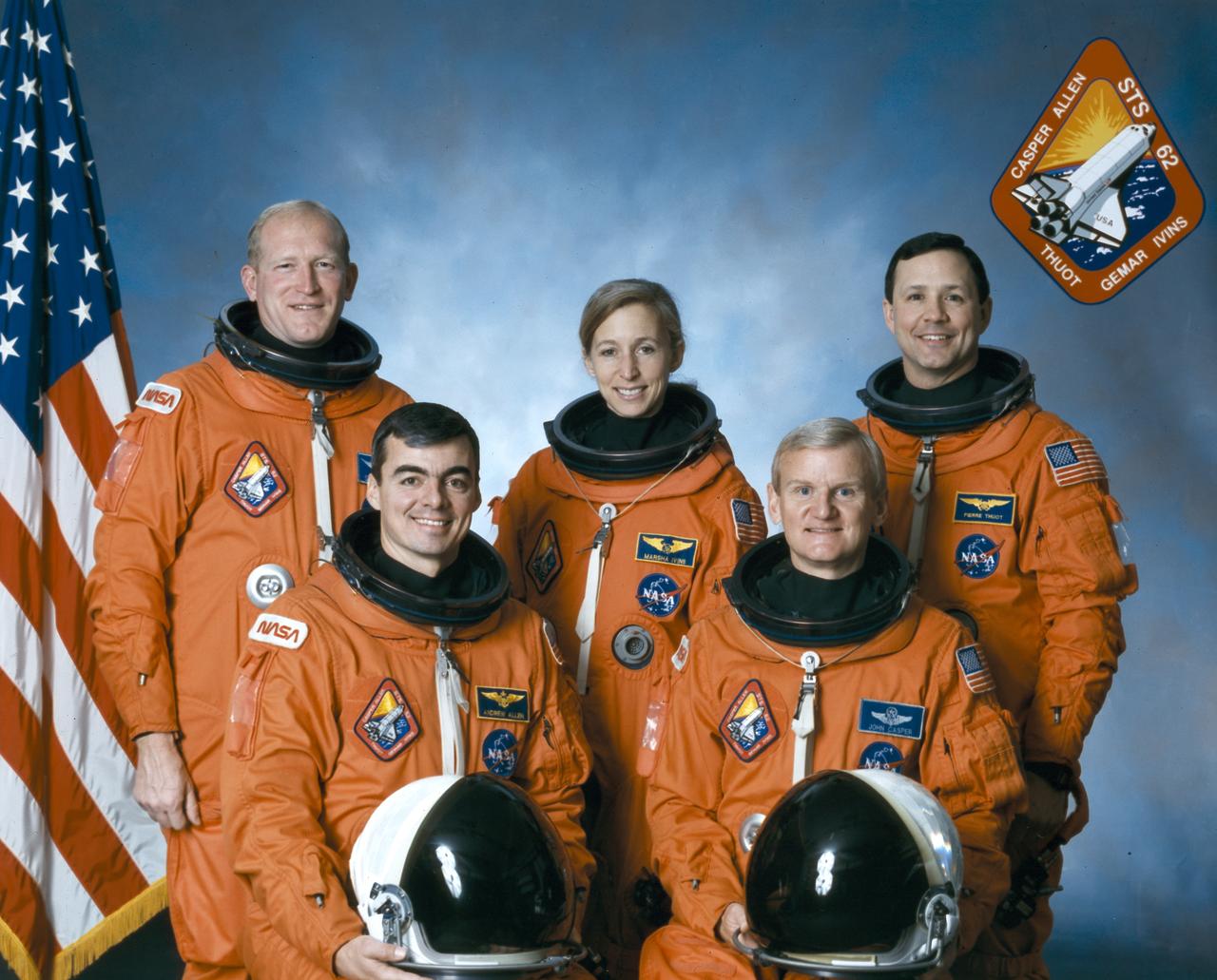
Astronauts included in the STS-62 crew portrait include (standing left to right) mission specialists Charles D. Gemar, Marsha S. Ivins, and Pierre J. Thuot. Seated left to right are Andrew M. Allen, pilot; and John H. Casper, commander. Launched aboard the Space Shuttle Columbia on March 4, 1994 at 8:53:00 am (EST), the STS-62 mission carried two primary payloads; the U.S Microgravity Payload-2 (USMP-2) and the Office of Aeronautics and Space Technology-2 (OAST-2).
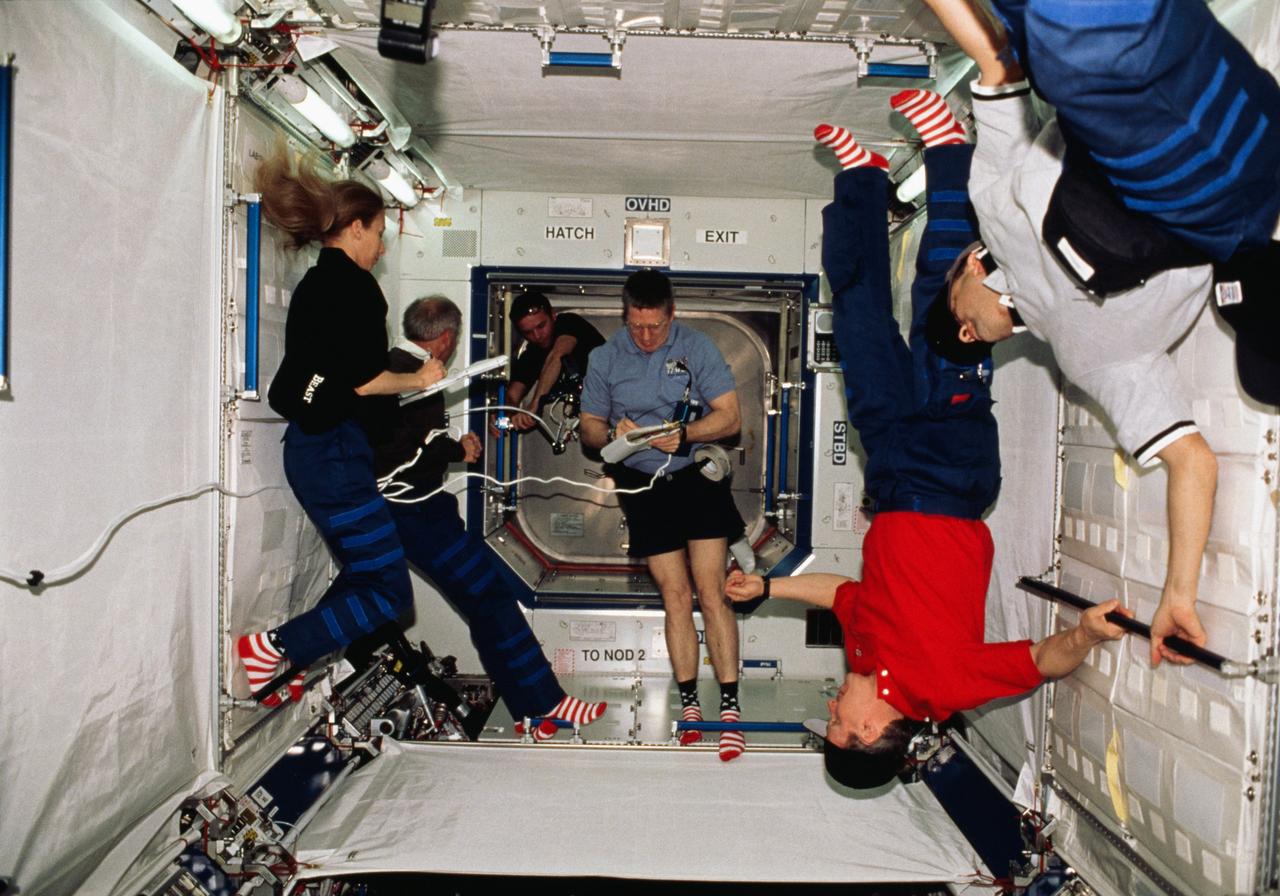
STS098-323-015 (7-20 February 2001) --- Astronauts and cosmonauts from the Expedition One and STS-98 crews are photographed in the newly-attached Destiny laboratory on the International Space Station (ISS). From the left are Marsha S. Ivins, mission specialist; Kenneth D. Cockrell, mission commander; Yuri P. Gidzenko, Expedition One Soyuz commander; William M. (Bill) Shepherd, Expedition One mission commander; Thomas D. Jones, mission specialist; and Mark L. Polansky, pilot. Out of view are Robert L. Curbeam, mission specialist, and Sergei K. Krikalev, Expedition One flight engineer. Gidzenko and Krikalev represent Rosaviakosmos.
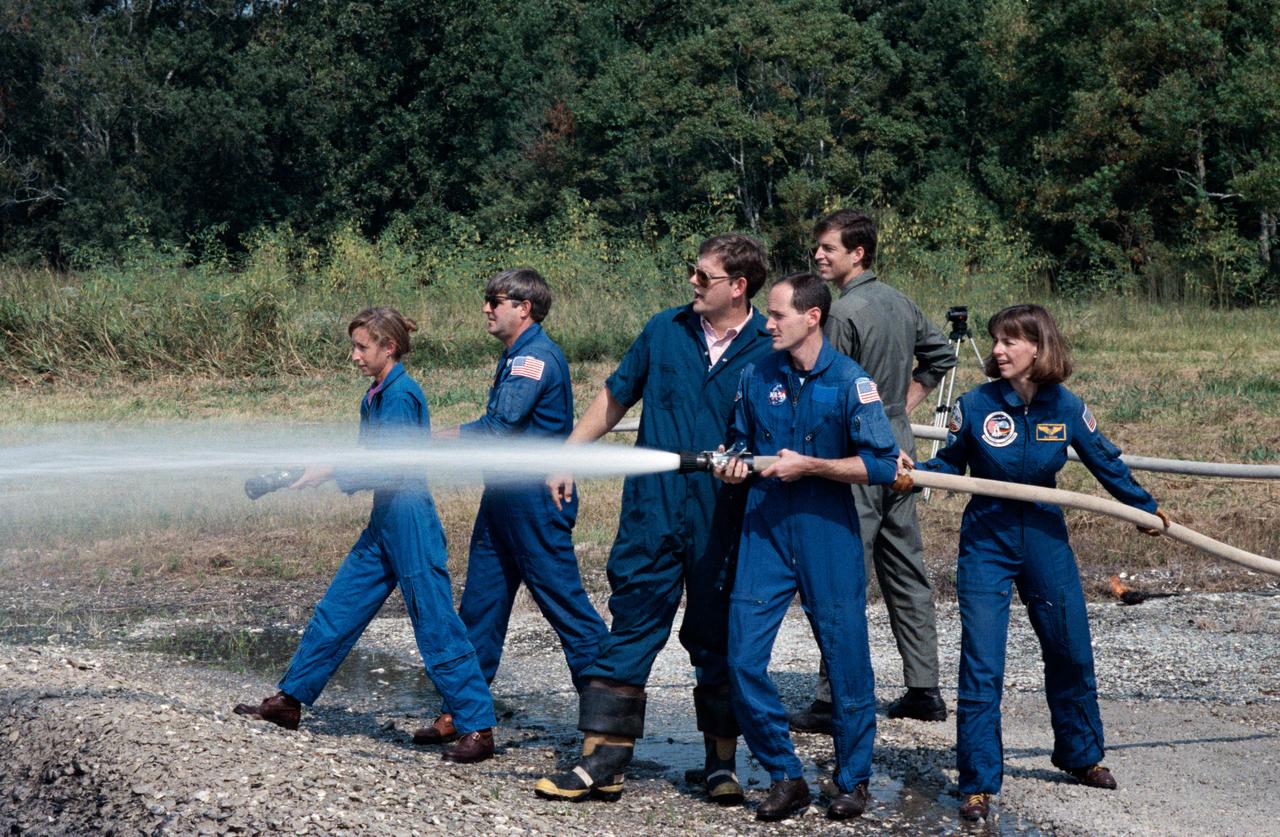
STS-32 crewmembers use water hoses during fire fighting exercises at JSC's Fire Training Pit across from the Gilruth Center Bldg 207. Mission Specialist (MS) G. David Low with nozzle open directs water into the fire as fire/ security personnel coaches and instructs him on his attempt to extinguish the blaze. MS Bonnie J. Dunbar maneuvers the hose behind Low. A second group of crewmembers alongside Low and Dunbar, MS Marsha S. Ivins, holding hose nozzle, Commander Daniel C. Brandenstein, and Pilot James D. Wetherbee position themselves before opening hose nozzle.
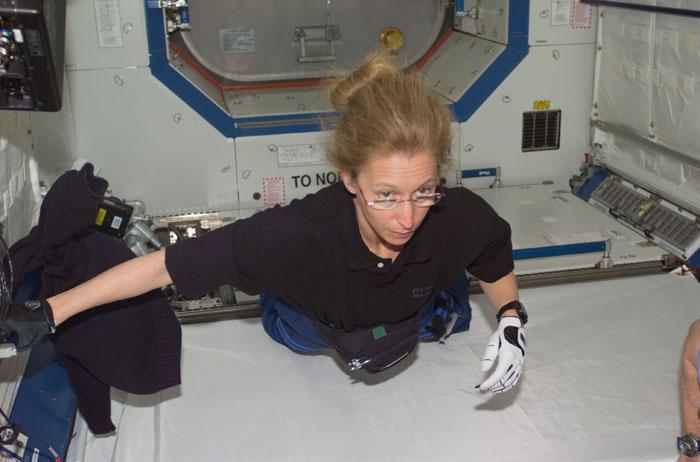
STS98-E-5161 (11 February 2001) --- Astronaut Marsha S. Ivins, STS-98 mission specialist, floats into the newly attached Destiny laboratory onboard the International Space Station (ISS). After the Destiny hatch was opened early in the day, members of both crews went to work quickly inside the new module, activating air systems, fire extinguishers, alarm systems, computers and internal communications. The crews also took some photos and continued equipment transfers from the shuttle to the station. The scene was taken with a digital still camera.
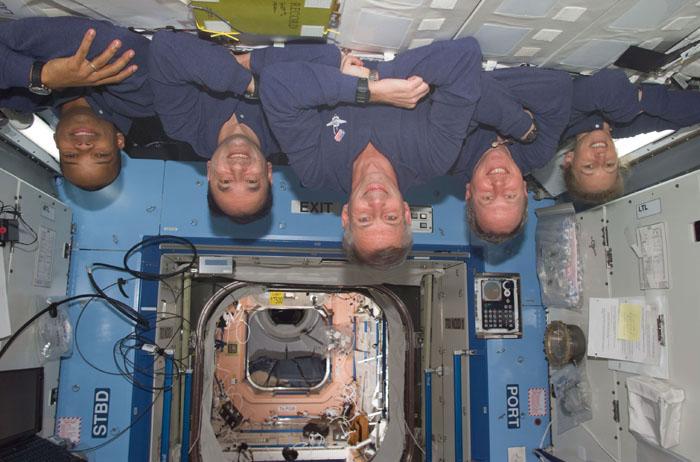
STS98-E-5284 (15 February 2001) --- These five astronauts take a break from Destiny laboratory installation work as they near an end to their several days' visit aboard the International Space Station (ISS). From the left are astronauts Robert L. Curbeam, Mark L. Polansky, Kenneth D. Cockrell, Thomas D. Jones and Marsha S. Ivins. Their posed position might be termed "upside down" on Earth, but in their weightless environment the arrangement makes for no one-gravity complications like blood rushing to the head, etc. The scene was recorded with a digital still camera.
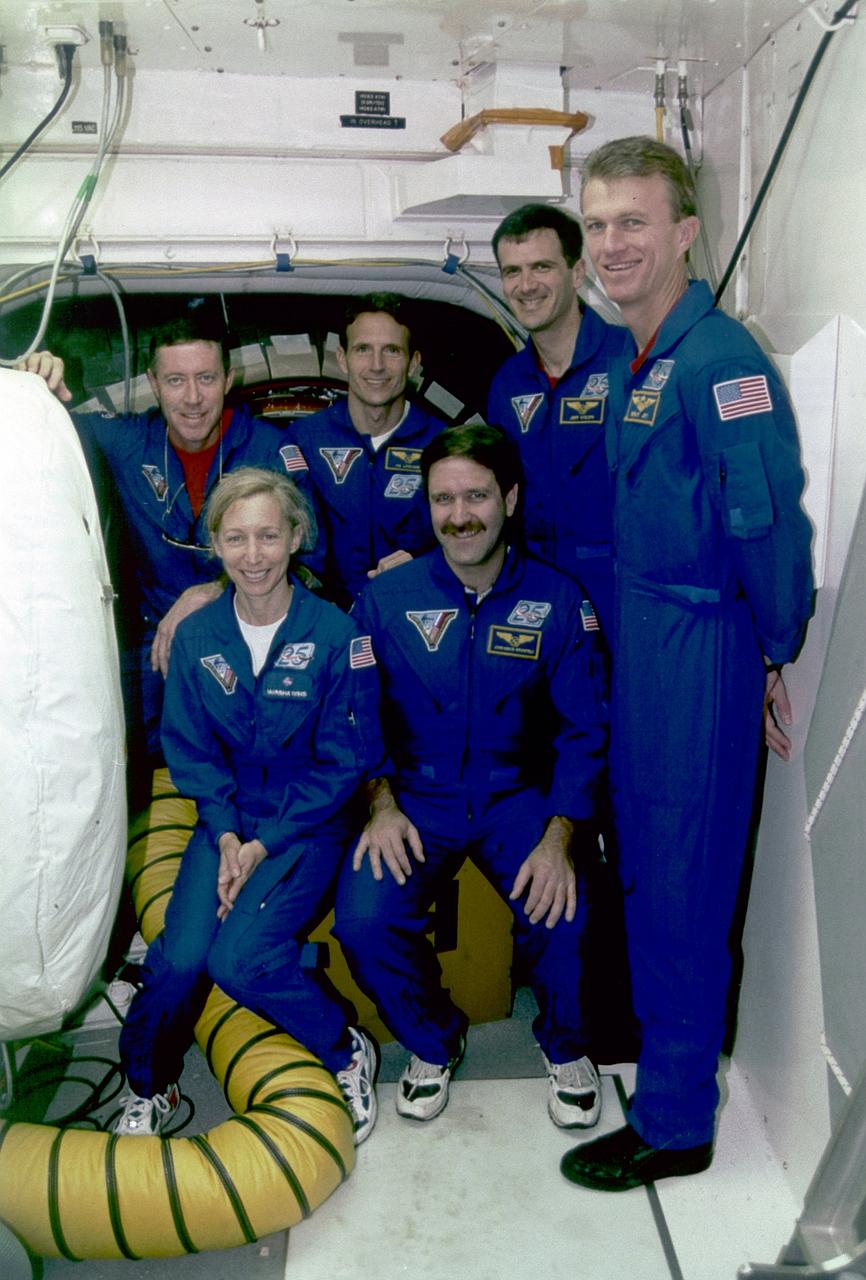
S97-00247 (15 Dec. 1996) --- The STS-81 mission flight crew poses outside the hatch of the space shuttle Atlantis at Launch Pad 39B during a Terminal Countdown Demonstration Test (TCDT). The TCDT represents a simulated final countdown rehearsal that ends just before main engine ignition. The actual launch is now scheduled for Jan. 12, 1997. Pictured (from the left) are astronauts Michael A. Baker, Marsha S. Ivins, Jerry M. Linenger, John M. Grunsfeld, Peter J.K. (Jeff) Wisoff, and Brent W. Jett Jr.
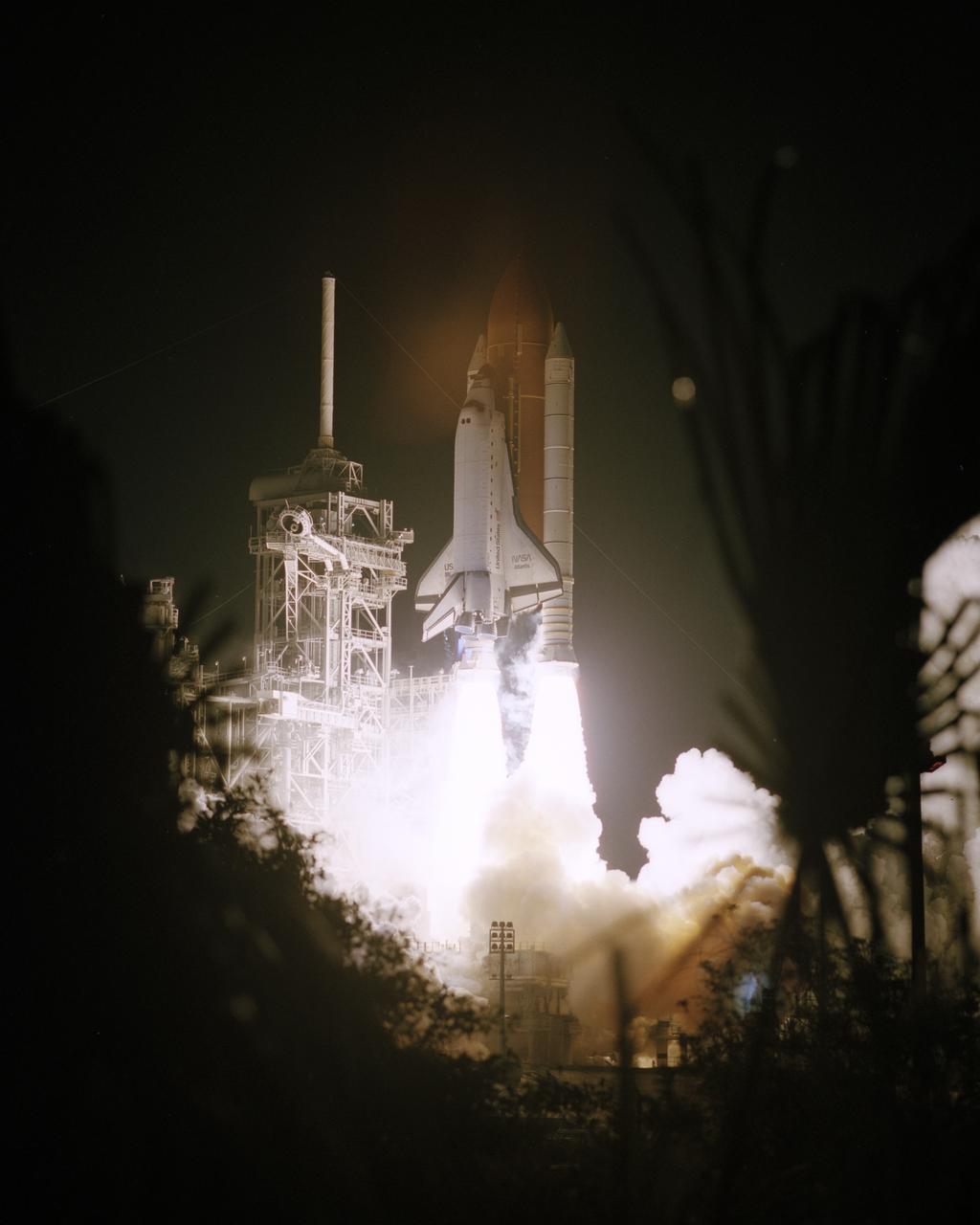
STS081-S-007 (12 Jan. 1997) --- Framed by a silhouette of Florida foliage, the Space Shuttle Atlantis lifts off from Pad 39B at 4:27:23 a.m. (EST) Jan. 12, 1997 on its way for a docking mission with Russia's Mir Space Station. Onboard are six astronauts and a SPACEHAB Double Module (DM), along with a large supply of food, water, hardware and other materials for Mir. Astronaut Jerry M. Linenger, now onboard Atlantis, will trade places with John E. Blaha, cosmonaut guest researcher, onboard Mir since mid September 1996. Along with Linenger, other crewmembers now aboard Atlantis are astronauts Michael A. Baker, commander; Brent W. Jett, Jr., pilot; and mission specialists John M. Grunsfeld, Marsha S. Ivins and Peter J. K. (Jeff) Wisoff.
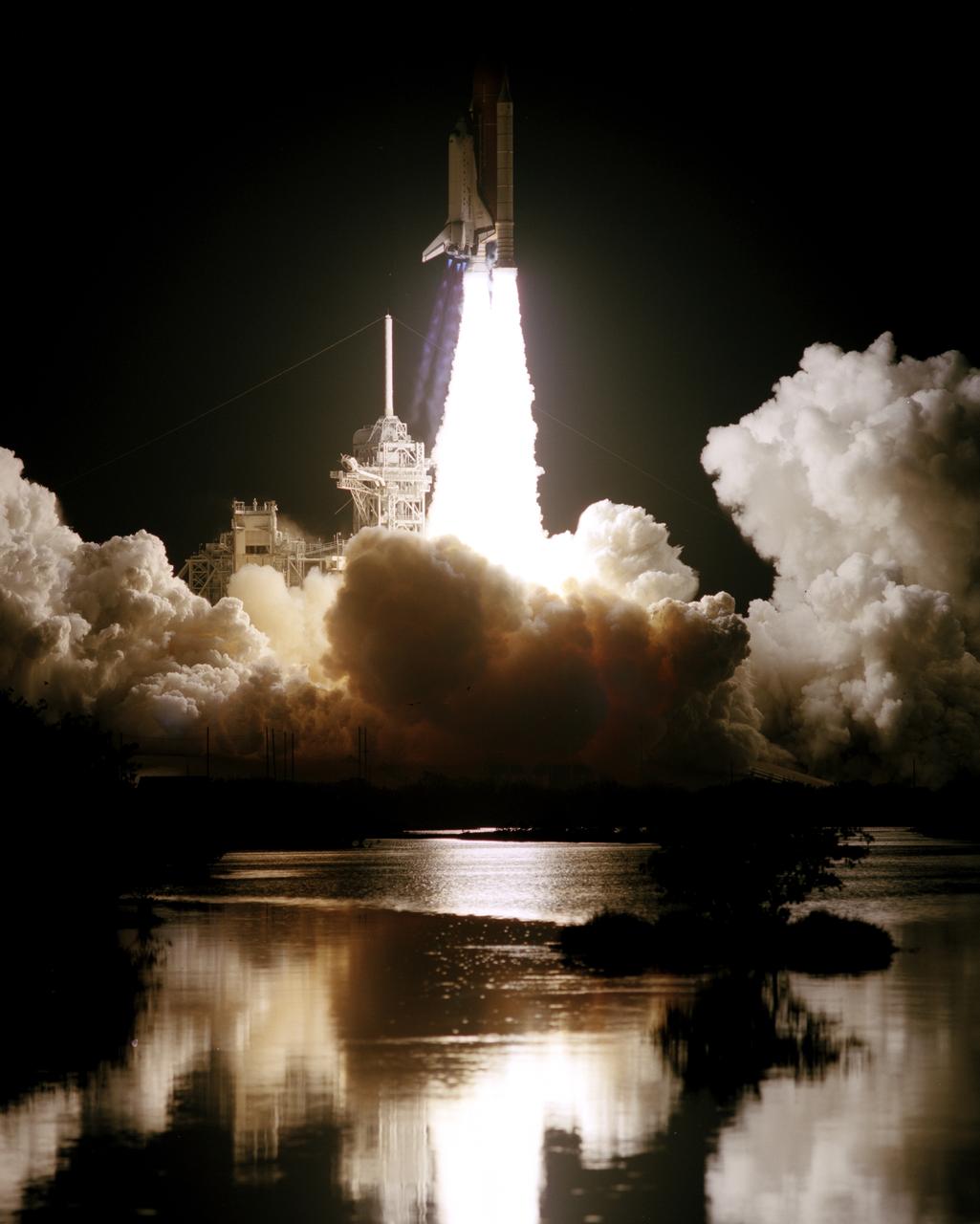
STS081-S-005 (12 Jan. 1997) --- Lighting up an early morning sky, the Space Shuttle Atlantis lifts off from Pad 39B to begin the new year of space missions for NASA's shuttle fleet. Launch occurred at 4:27:23 a.m. (EST), Jan. 12, 1997. Now on their way for a docking mission with Russia's Mir Space Station are a crew of six astronauts and a SPACEHAB Double Module (DM), along with a large supply of food, water, hardware and other materials for Mir. Astronaut Jerry M. Linenger, now onboard Atlantis, will trade places with John E. Blaha, cosmonaut guest researcher, onboard Mir since mid September 1996. Along with Linenger, other crewmembers now aboard Atlantis are astronauts Michael A. Baker, commander; Brent W. Jett, Jr., pilot; and mission specialists John M. Grunsfeld, Marsha S. Ivins and Peter J. K. (Jeff) Wisoff.
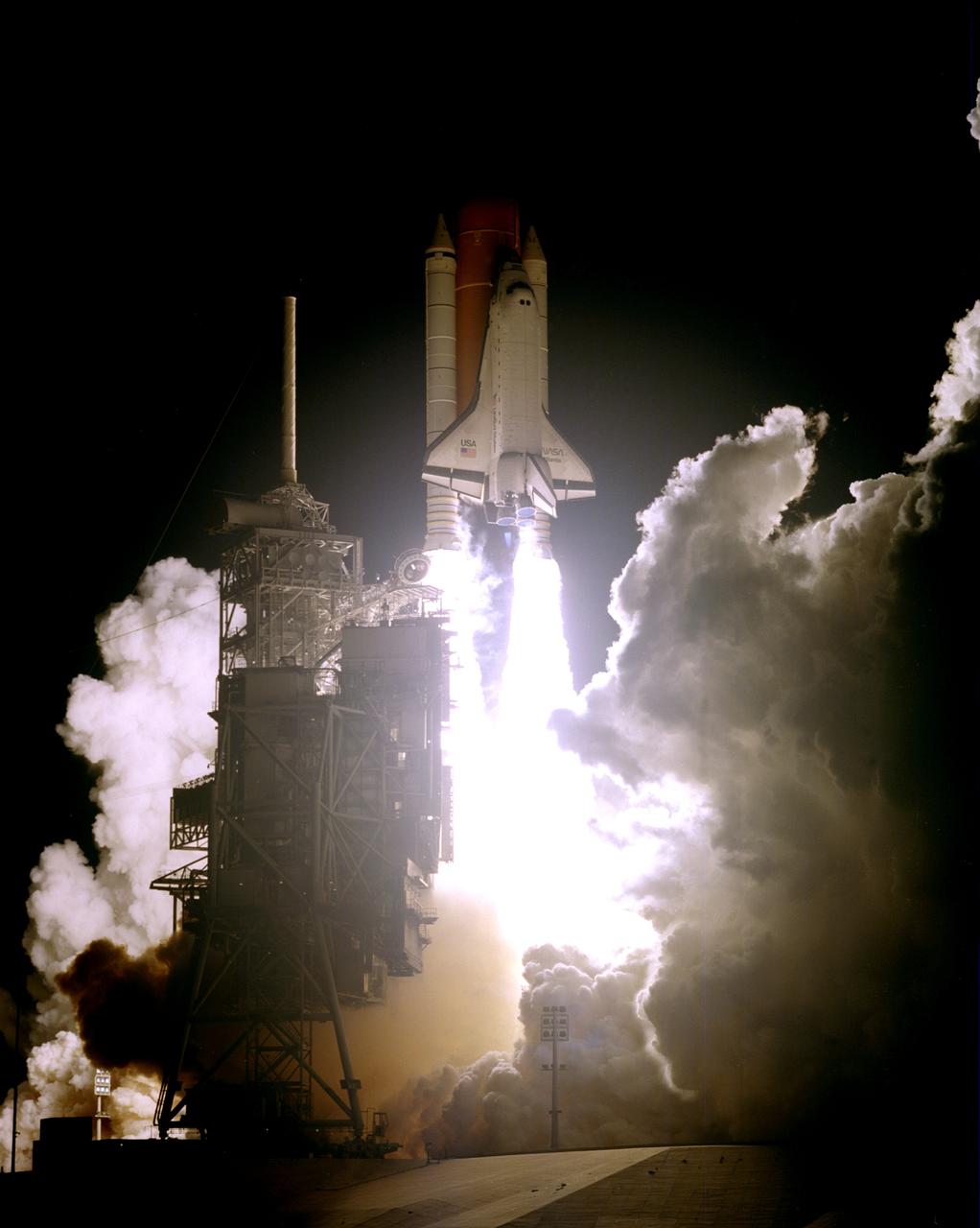
STS081-S-006 (12 Jan. 1997) --- The Space Shuttle Atlantis lifts off from Pad 39B at 4:27:23 a.m. (EST) Jan. 12, 1997 on its way for a docking mission with Russia's Mir Space Station. Onboard are six astronauts and a SPACEHAB Double Module (DM), along with a large supply of food, water, hardware and other materials for Mir. Astronaut Jerry M. Linenger, now onboard Atlantis, will trade places with John E. Blaha, cosmonaut guest researcher, onboard Mir since mid September 1996. Along with Linenger, other crewmembers now aboard Atlantis are astronauts Michael A. Baker, commander; Brent W. Jett, Jr., pilot; and mission specialists John M. Grunsfeld, Marsha S. Ivins and Peter J. K. (Jeff) Wisoff.
![KENNEDY SPACE CENTER, FLA. -- Seventeen new astronaut candidates visited the Vehicle Assembly Building as part of an orientation tour of KSC facilities. Here they are grouped around one of the external fuel tanks in the transfer aisle of the VAB. This latest group of candidates is the tenth chosen since the original seven Mercury astronauts. [From left, Michael J. McCulley, Curtis L. Brown Jr., Frank L. Culbertson Jr., Kathryn C. Thornton, Mark N. Brown, Mark C. Lee, Kenneth D. Cameron, John H. Casper, L. Blaine Hammond Jr., Charles Lacy Veach (deceased), James C. Adamson, William M. Shepherd, Sidney M. Gutierrez, Marsha S. Ivins, David G. Low, Michael J. Smith (deceased), Ellen S. Baker, Sonny Carter (deceased).]](https://images-assets.nasa.gov/image/108-KSC-84P-339/108-KSC-84P-339~medium.jpg)
KENNEDY SPACE CENTER, FLA. -- Seventeen new astronaut candidates visited the Vehicle Assembly Building as part of an orientation tour of KSC facilities. Here they are grouped around one of the external fuel tanks in the transfer aisle of the VAB. This latest group of candidates is the tenth chosen since the original seven Mercury astronauts. [From left, Michael J. McCulley, Curtis L. Brown Jr., Frank L. Culbertson Jr., Kathryn C. Thornton, Mark N. Brown, Mark C. Lee, Kenneth D. Cameron, John H. Casper, L. Blaine Hammond Jr., Charles Lacy Veach (deceased), James C. Adamson, William M. Shepherd, Sidney M. Gutierrez, Marsha S. Ivins, David G. Low, Michael J. Smith (deceased), Ellen S. Baker, Sonny Carter (deceased).]
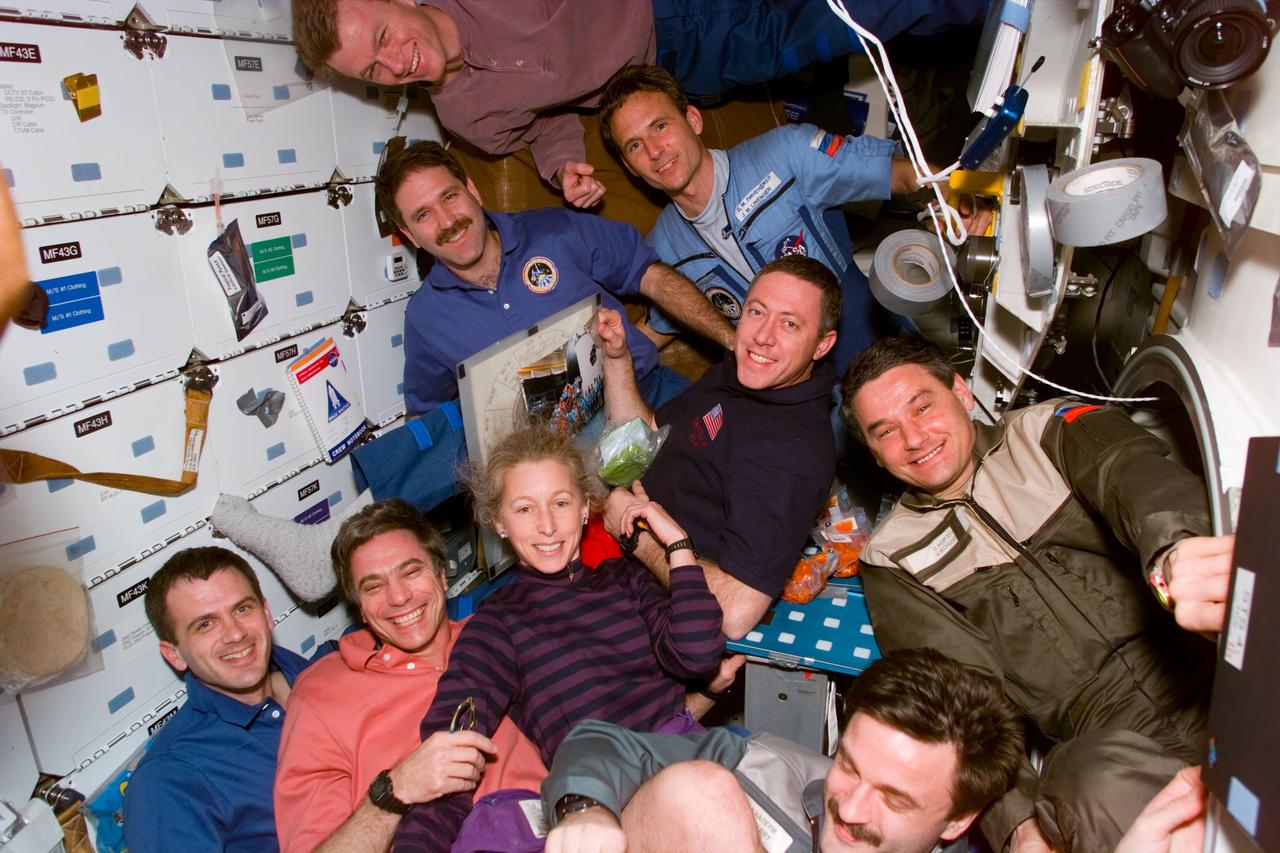
STS081-E-05535 (17 Jan. 1997) --- Seven NASA astronauts and two Russian cosmonauts take a break from busy supply-transfer duties on the space shuttle Atlantis' middeck halfway through the ten-day mission. Left to right at bottom of the frame are mission specialists Peter J. K. (Jeff) Wisoff, John E. Blaha, Marsha S. Ivins and cosmonaut Aleksandr Y. Kaleri, Mir-22 flight engineer. In the top half of the scene are, from the top left, Brent W. Jett, Jr., pilot; John M. Grunsfeld, mission specialist; Jerry M. Linenger, cosmonaut guest researcher; Michael A. Baker, commander; and cosmonaut Valeri G. Korzun, Mir-22 commander. The picture was recorded with a pre-set 35mm Electronic Still Camera (ESC).
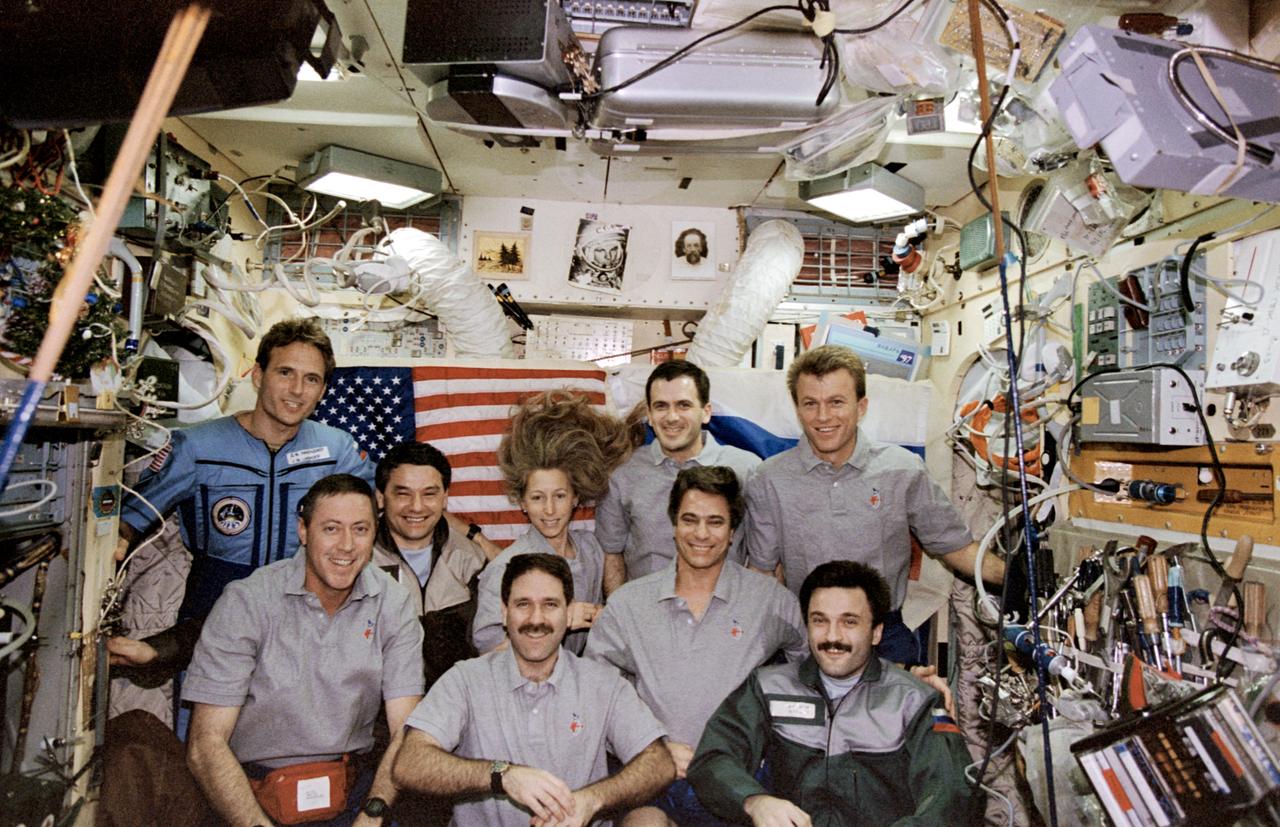
STS081-369-003 (12-22 Jan. 1997) --- Traditional inflight crew portrait of the combined Mir-22 and STS-81 crews in the Base Block Module aboard Russia's Mir Space Station. Front row: left to right, Michael A. Baker, commander; John M. Grunsfeld, mission specialist; and cosmonaut Aleksandr Y. Kaleri, Mir-22 flight engineer. Middle row: cosmonaut Valeri G. Korzun, Mir-22 commander; Marsha S. Ivins, mission specialist; and John E. Blaha, former cosmonaut guest researcher. Back row: Jerry M. Linenger, cosmonaut guest researcher; Peter J. K. (Jeff) Wisoff, mission specialist; and Brent W. Jett, Jr., pilot. Linenger is seen in a Russian jump suit, and Blaha now wears a Space Shuttle inflight garment as the two exchanged cosmonaut guest researcher roles on January 14, 1997, following the docking of the Atlantis and the Mir complex.

KENNEDY SPACE CENTER, FLA. -- With its drag chute deployed, the Space Shuttle orbiter Atlantis touches down on Runway 33 on the second opportunity at 9:22:44 a.m. EST Jan. 22 to conclude the fifth Shuttle-Mir docking mission and return NASA astronaut John Blaha to Earth after four months in space. At main gear touchdown, the STS-81 mission duration was 10 days, 4 hours, 55 minutes. This was the 34th KSC landing in Shuttle history. Mission Commander Michael A. Baker flew Atlantis to a perfect landing, with help from Pilot Brent W. Jett, Jr. Other returning STS-81 crew members are Mission Specialists John M.Grunsfeld, Peter J. K. "Jeff" Wisoff and Marsha S. Ivins. Atlantis also brought back experiment samples from the Russian space station Mir for analysis on Earth, along with Russian logistics equipment
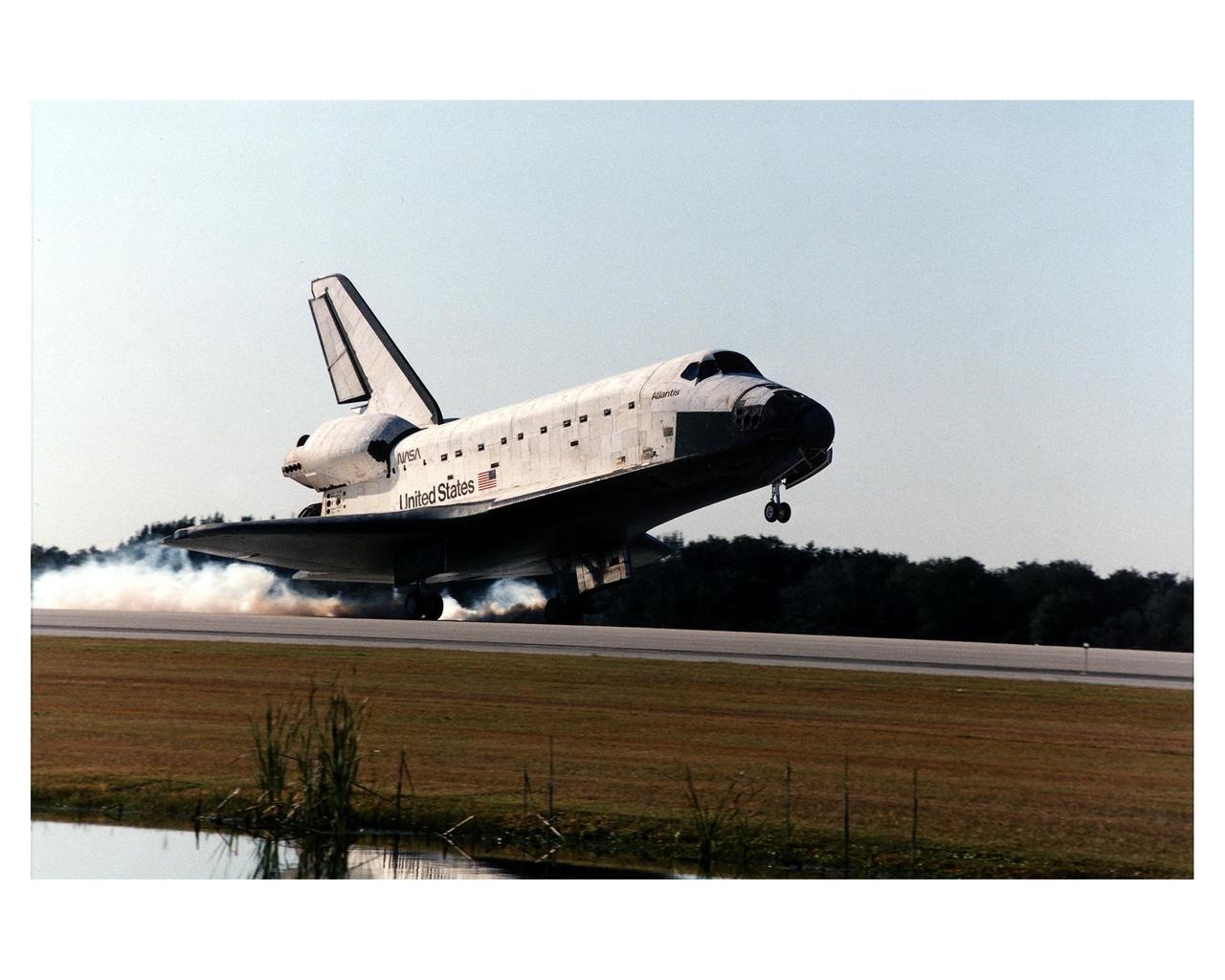
The Space Shuttle orbiter Atlantis touches down on Runway 33 at 9:22:44 a.m. EST Jan. 22 to conclude the fifth Shuttle-Mir docking mission and return NASA astronaut John Blaha to Earth after four months in space. Blaha was replaced by STS-81 Mission Specialist Jerry Linenger during the five days of docked operations. At main gear touchdown, the STS-81 mission duration was 10 days, 4 hours, 55 minutes. This was the 34th KSC landing in Shuttle history. Mission Commander Michael A. Baker flew Atlantis to a perfect landing, with help from Pilot Brent W. Jett, Jr. Other returning STS-81 crew members are Mission Specialists John M. Grunsfeld, Peter J. K. "Jeff" Wisoff and Marsha S. Ivins. Atlantis also brought back experiment samples from the Russian space station for analysis on Earth, along with Russian logistics equipment
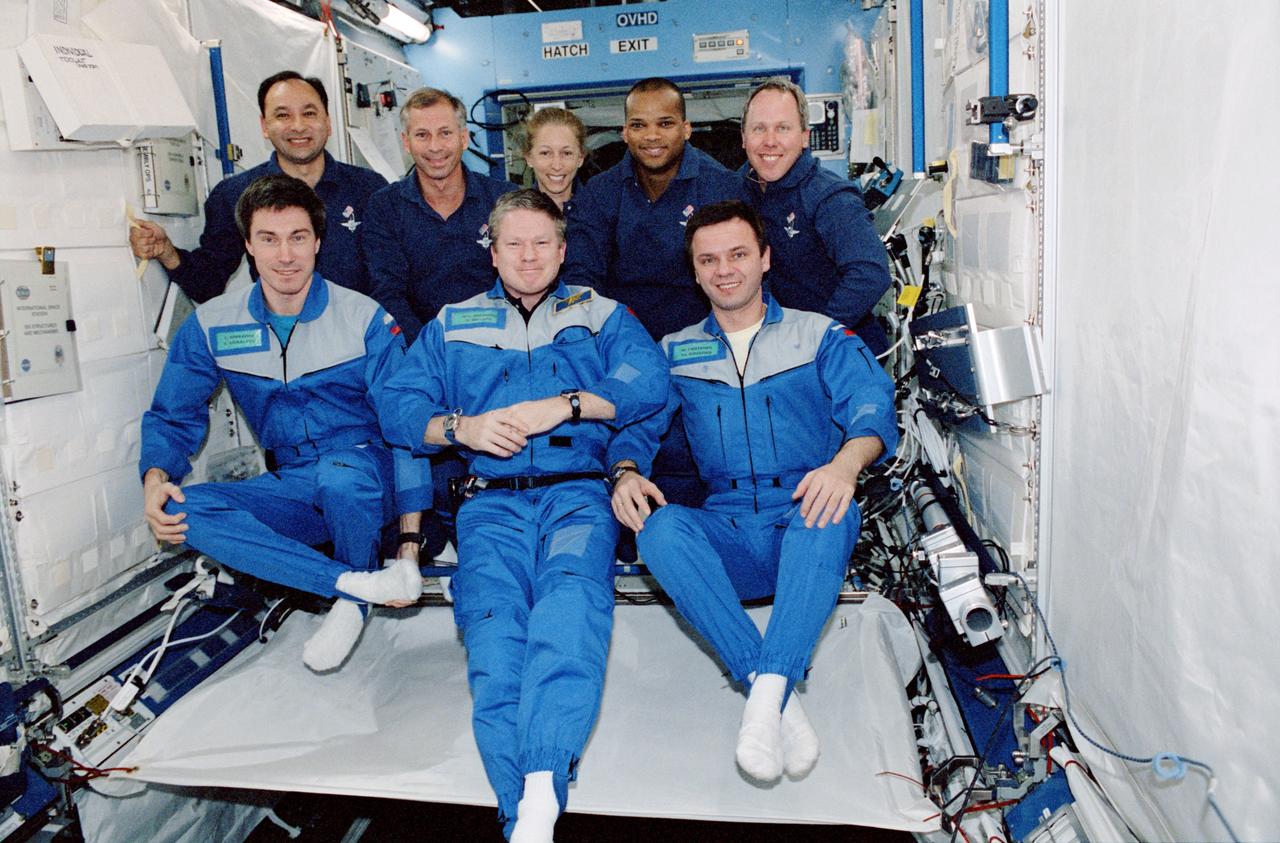
STS098-371-0019 (7-20 February 2001) --- The crews of the Space Shuttle Atlantis and International Space Station (ISS) interrupt work aboard the newly installed Destiny laboratory to pose for an in-flight joint group portrait. In front are (from the left) cosmonaut Sergei K. Krikalev, Expedition One flight engineer; astronaut William M. (Bill) Shepherd, Expedition One mission commander; and Yuri P. Gidzenko, Soyuz commander. The shuttle crew is made up of (from the left) astronauts Mark L. Polansky, pilot; Kenneth D. Cockrell, mission commander; and Marsha S. Ivins, Robert L. Curbeam and Thomas D. Jones, all mission specialists. Krikalev and Gidzenko represent the Russian Aviation and Space Agency.

STS98-E-5143 (11 February 2001) --- Astronauts Marsha S. Ivins (from the left), STS-98 mission specialist, Kenneth D. Cockrell, STS-98 mission commander; and William M. Shepherd, Expedition One mission commander, discuss the organizational "game plan" onboard the newly opened Destiny laboratory on the International Space Station (ISS). After Shepherd opened the Destiny hatch, he and Cockrell ventured inside at 8:38 a.m. (CST), February 11, 2001. As depicted in subsequent digital images in this series, members of both crews went to work quickly inside the new module, activating air systems, fire extinguishers, alarm systems, computers and internal communications. The crew also took some photos and continued equipment transfers from the shuttle to the station.
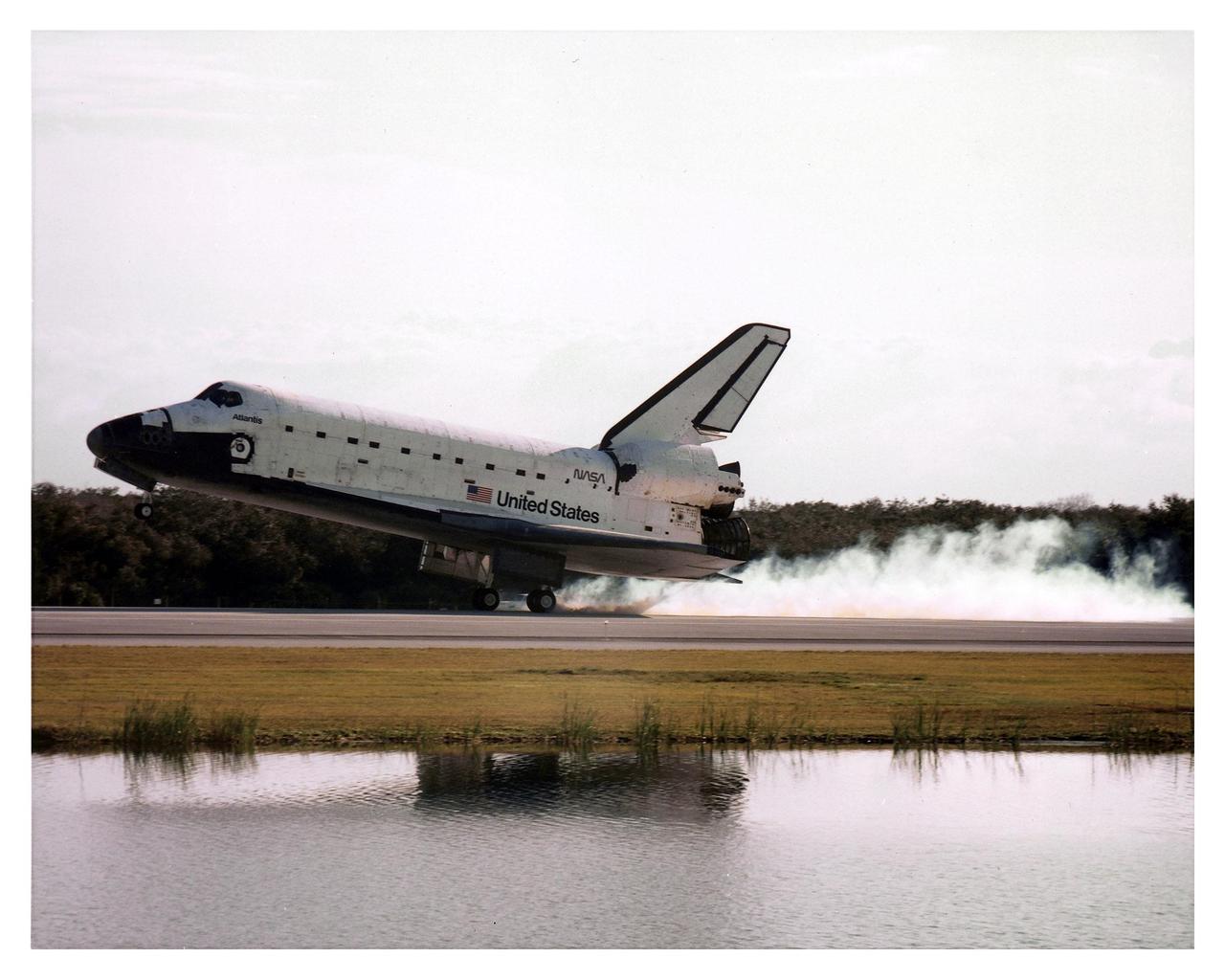
The Space Shuttle orbiter Atlantis touches down on Runway 33 at 9:22:44 a.m. EST Jan. 22 to conclude the fifth Shuttle-Mir docking mission and return NASA astronaut John Blaha to Earth after four months in space. Blaha was replaced by STS-81 Mission Specialist Jerry Linenger during the five days of docked operations. At main gear touchdown, the STS-81 mission duration was 10 days, 4 hours, 55 minutes. This was the 34th KSC landing in Shuttle history. Mission Commander Michael A. Baker flew Atlantis to a perfect landing, with help from Pilot Brent W. Jett, Jr. Other returning STS-81 crew members are Mission Specialists John M. Grunsfeld, Peter J. K. "Jeff" Wisoff and Marsha S. Ivins. Atlantis also brought back experiment samples from the Russian space station for analysis on Earth, along with Russian logistics equipment
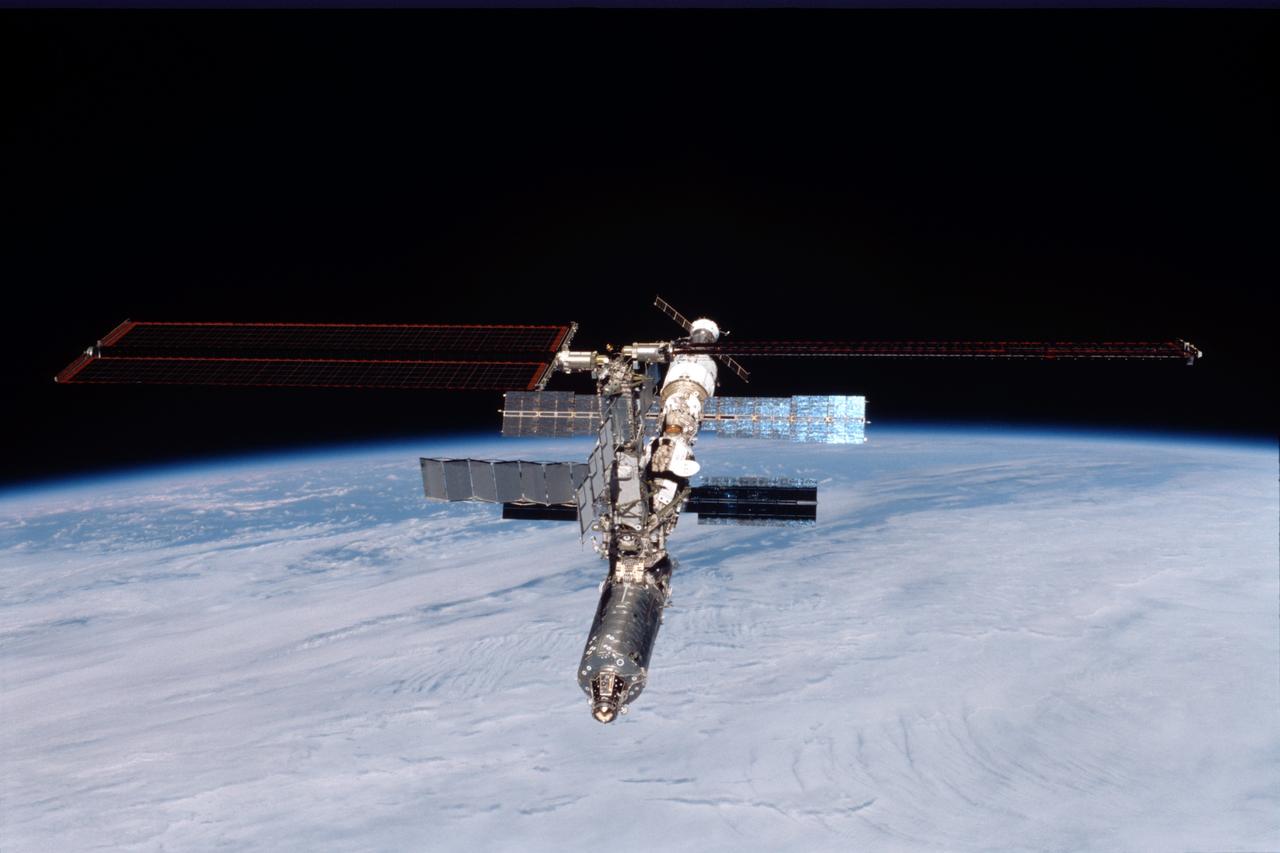
STS098-312-0025 (16 February 2001) --- Backdropped against heavy cloud cover, the International Space Station (ISS) was photographed with a 35mm camera by one of the astronauts onboard Atlantis. The crew of the station, onboard the outpost since early November 2000, is made up of astronaut William M. (Bill) Shepherd, mission commander; Yuri P. Gidzenko, Soyuz commander; and Sergei K. Krikalev, flight engineer. Krikalev and Gidzenko represent the Russian Aviation and Space Agency. On Atlantis were astronauts Kenneth D. Cockrell, mission commander; Mark L. Polansky, pilot; and Marsha S. Ivins, Robert L. Curbeam and Thomas D. Jones, all mission specialists. The shuttle and the station parted company at 8:06 a.m. (CST), Feb. 16, as Polansky flew the shuttle halfway around the outpost and its new Destiny laboratory before moving off.
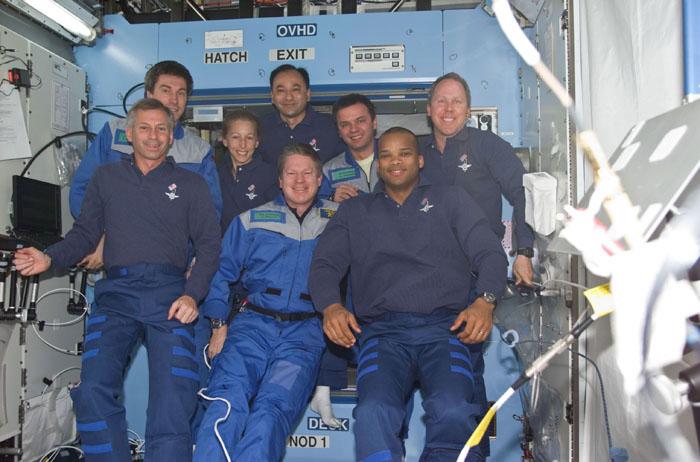
STS98-E-5276 (15 February 2001) --- Six NASA astronauts and two Russian cosmonauts pose for a group portrait representing both shuttle and station crews near the end of several days of joint work aboard the International Space Station (ISS). In front, from the left, are astronauts Kenneth D. Cockrell, STS-98 commander; William M. (Bill) Shepherd, Expedition One commander; and Robert L. Curbeam, STS-98 mission specialist. In the rear, from the left, are cosmonaut Sergei K. Krikalev, Expedition One flight engineer; astronaut Marsha S. Ivins, STS-98 mission specialist; astronaut Mark L. Polansky, shuttle pilot; cosmonaut Yuri P. Gidzenko, Soyuz commander for Expedition One; and astronaut Thomas D. Jones, shuttle mission specialist.
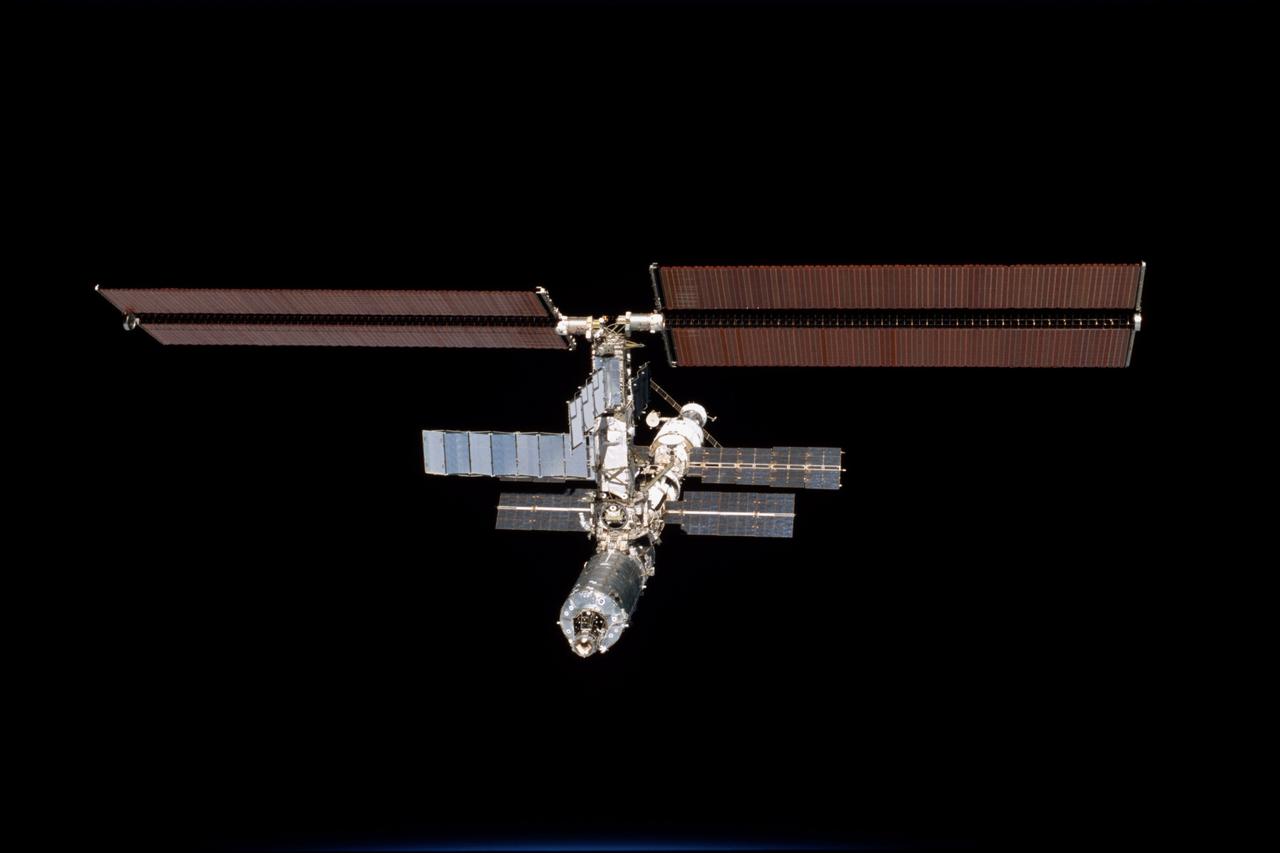
STS098-312-0020 (16 February 2001) --- Backdropped against the blackness of space, the International Space Station (ISS)was photographed with a 35mm camera by one of the astronauts onboard Atlantis. The crew of the station, onboard the outpost since early November 2000, is made up of astronaut William M. (Bill) Shepherd, mission commander; Yuri P. Gidzenko, Soyuz commander; and Sergei K. Krikalev, flight engineer. Krikalev and Gidzenko represent the Russian Aviation and Space Agency. On Atlantis were astronauts Kenneth D. Cockrell, mission commander; Mark L. Polansky, pilot; and Marsha S. Ivins, Robert L. Curbeam and Thomas D. Jones, all mission specialists. The shuttle and the station parted company at 8:06 a.m. (CST), Feb. 16, as Polansky flew the shuttle halfway around the outpost and its new Destiny laboratory before moving off.

KENNEDY SPACE CENTER, FLA. -- The Space Shuttle orbiter Atlantis glides out of a morning sky as it prepares to land on Runway 33 at a scheduled time of about 9:23 a.m. EST Jan. 22 to conclude the fifth Shuttle-Mir docking mission and return NASA astronaut John Blaha to Earth after four months in space. At main gear touchdown, the STS-81 mission duration will be 10 days, 4 hours, 55 minutes. This is the 34th KSC landing in Shuttle history. Mission Commander Michael A. Baker is steering Atlantis to a perfect landing, with help from Pilot Brent W. Jett, Jr. Other returning STS-81 crew members are Mission Specialists John M. Grunsfeld, Peter J. K. "Jeff" Wisoff and Marsha S. Ivins. Atlantis also brought back experiment samples from the Russian space station Mir for analysis on Earth
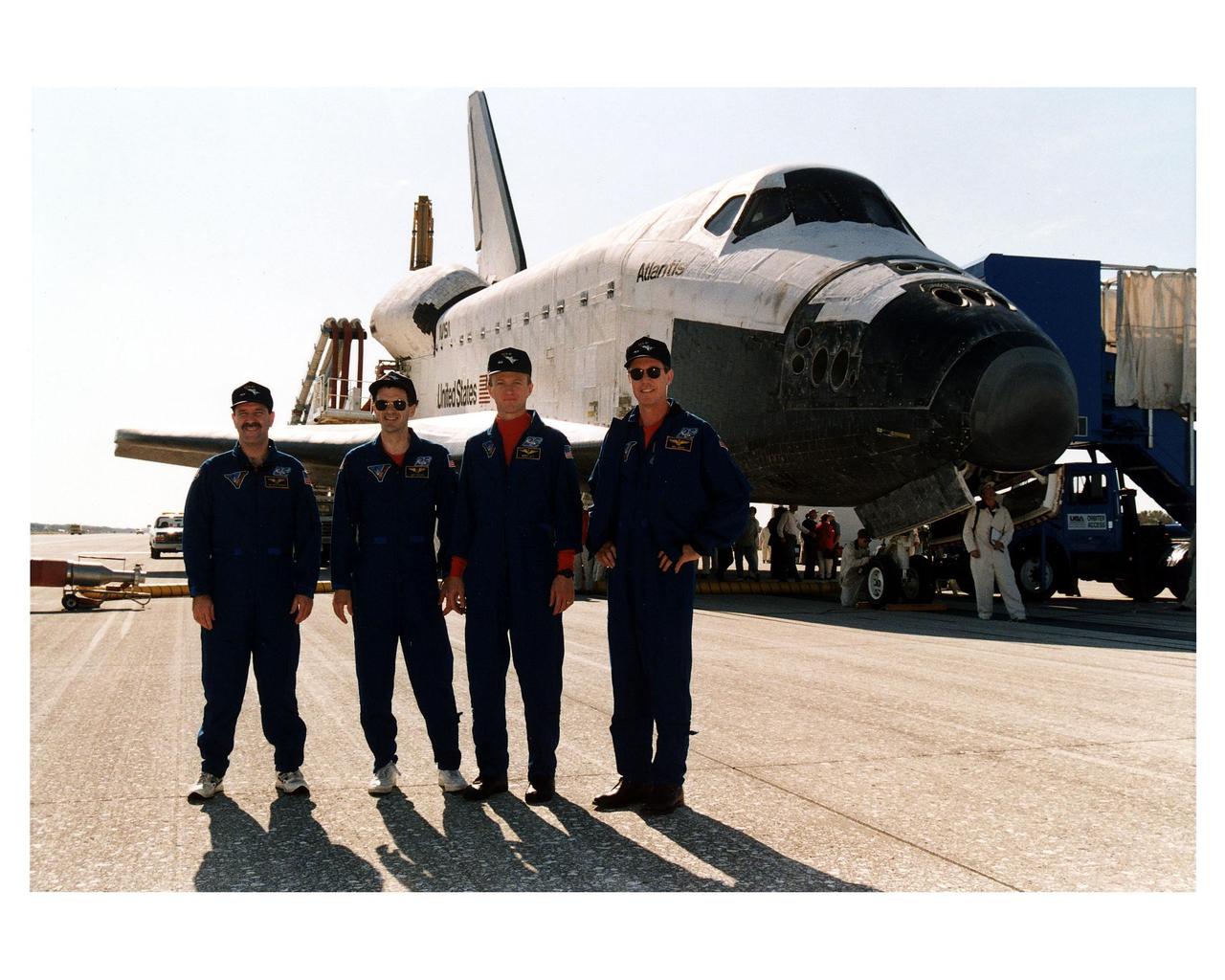
KENNEDY SPACE CENTER, FLA. -- Four members of the STS-81 crew pose in front of the Space Shuttle orbiter Atlantis on Runway 33 of KSC’s Shuttle Landing Facility after the space plane touched down at 9:22:44 a.m. EST Jan. 22 to conclude the fifth Shuttle-Mir docking mission. The crew members are (from left): Mission Specialists John M. Grunsfeld and Peter J. K. "Jeff" Wisoff ; Pilot Brent W. Jett, Jr.; and Mission Commander Michael A. Baker. Also returning on board Atlantis were Mission Specialist Marsha S. Ivins and John Blaha, who had been a member of the Mir 22 crew for four months. At main gear touchdown, the STS-81 mission duration was 10 days, 4 hours, 55 minutes. This was the 34th KSC landing in Shuttle history

Greeted by cheers from wellwishers at KSC and eager for their venture into space on the fifth Shuttle-Mir docking mission, the STS-81 astronauts depart the Operations and Checkout Building on their way to Launch Pad 39B. Leading the six-member crew is Mission Commander Michael A. Baker, followed by Pilot Brent W. Jett, Jr. Behind them are Mission Specialists John M. Grunsfeld, Jerry Linenger, Peter J. K. "Jeff" Wisoff, and Marsha S. Ivins. Their trip to the pad will take about 25 minutes aboard the Astrovan. Once there, they will take their positions in the crew cabin of the Space Shuttle Atlantis to await a liftoff during a seven-minute window that will open at 4:27 a.m. EST, January 12
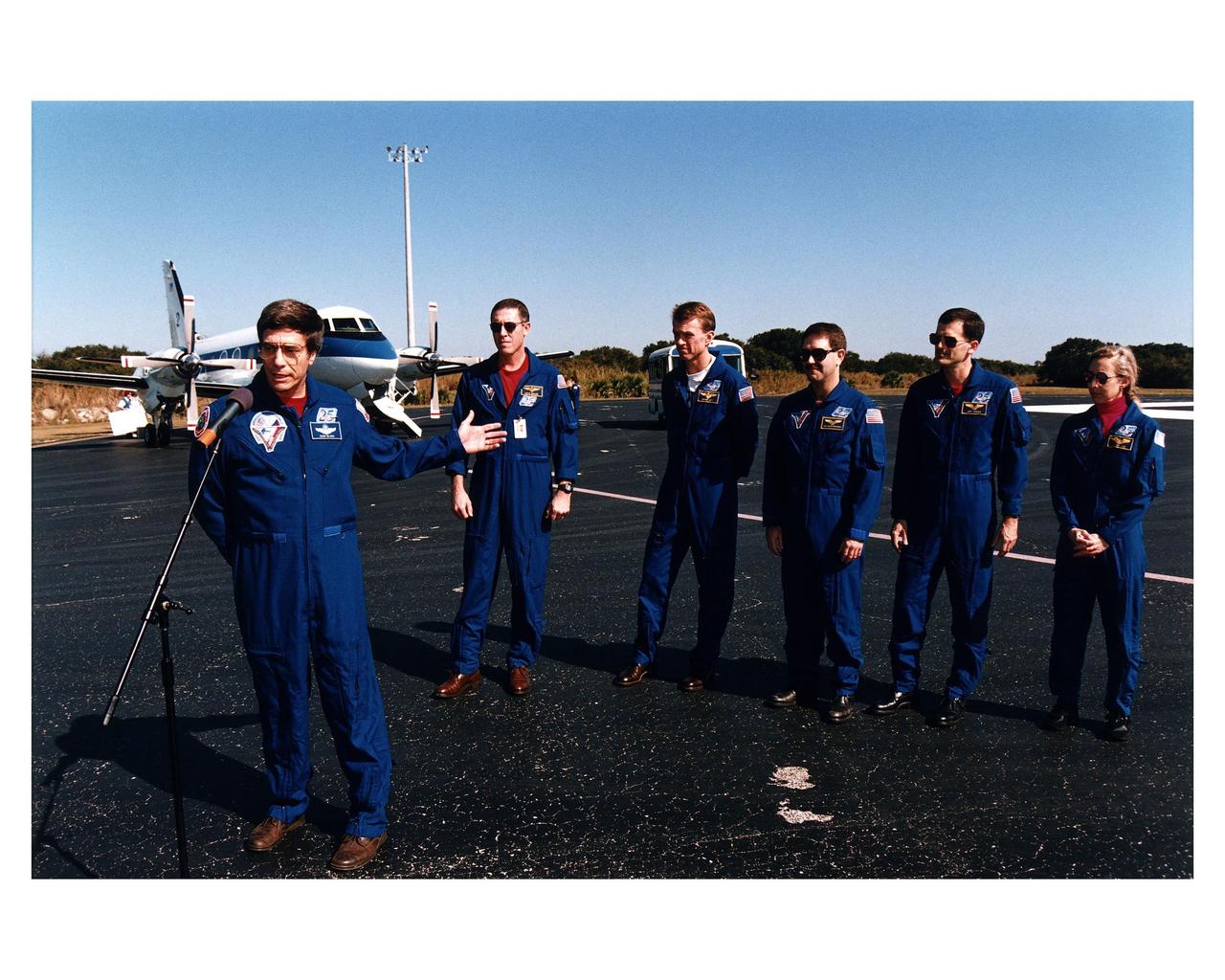
Returning NASA astronaut and former Mir 22 crew member John E. Blaha (left), gestures towards his fellow STS-81 crew members during a press conference prior to their departure for Johnson Space Center Jan. 23 from the Skid Strip at Cape Canaveral Air Station. The crew arrived at KSC aboard the Space Shuttle Atlantis Jan. 22 to conclude the fifth Shuttle-Mir docking mission and return Blaha to Earth after four months in space. Behind Blaha from the left are Mission Commander Michael A. Baker; Pilot Brent W. Jett, and Mission Specialists John M. Grunsfeld, Peter J. K. "Jeff" Wisoff and Marsha S. Ivins
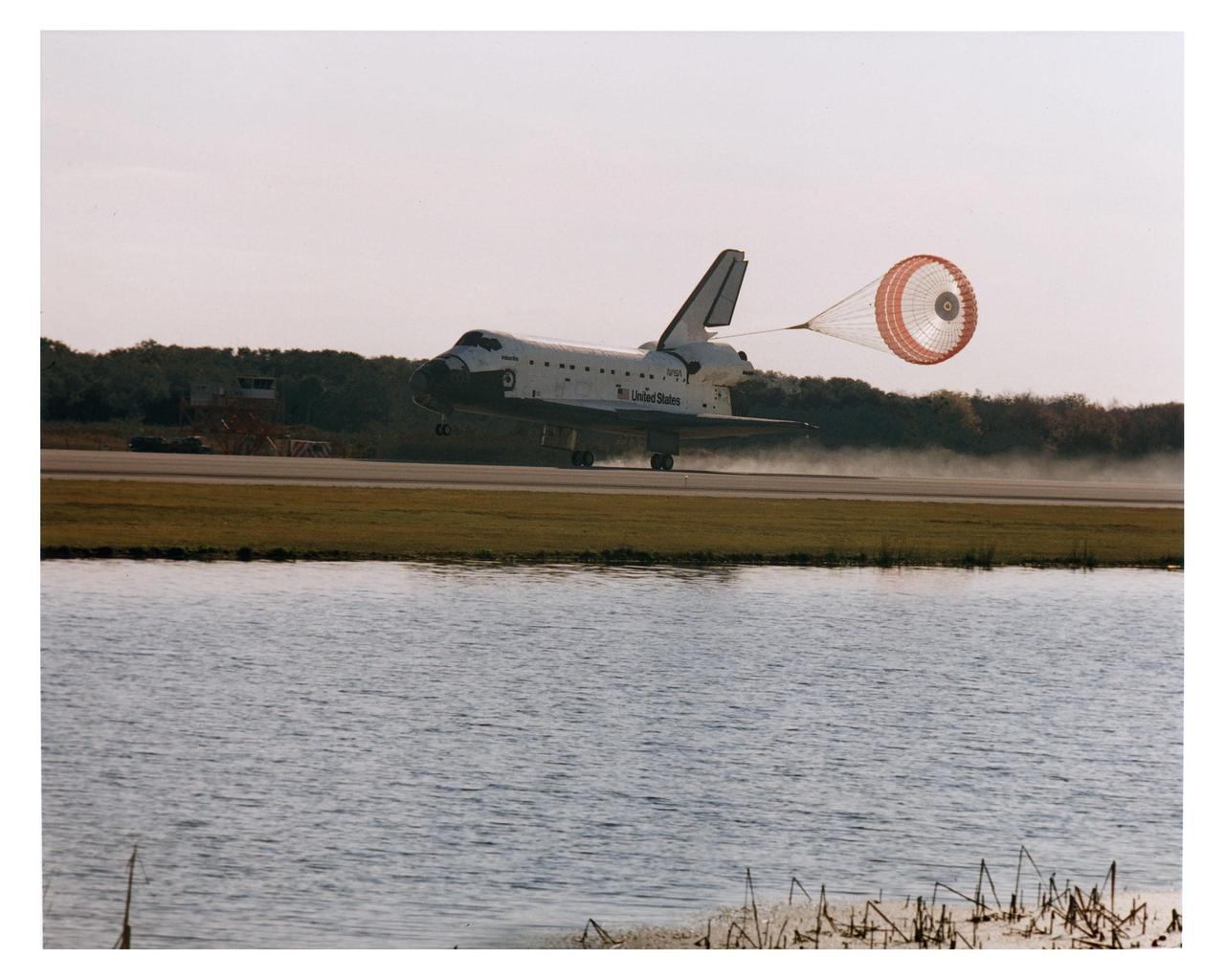
KENNEDY SPACE CENTER, FLA. -- With its drag chute deployed, the Space Shuttle orbiter Atlantis touches down on Runway 33 on the second opportunity at 9:22:44 a.m. EST Jan. 22 to conclude the fifth Shuttle-Mir docking mission and return NASA astronaut John Blaha to Earth after four months in space. At main gear touchdown, the STS-81 mission duration was 10 days, 4 hours, 55 minutes. This was the 34th KSC landing in Shuttle history. Mission Commander Michael A. Baker flew Atlantis to a perfect landing, with help from Pilot Brent W. Jett, Jr. Other returning STS-81 crew members are Mission Specialists John M.Grunsfeld, Peter J. K. "Jeff" Wisoff and Marsha S. Ivins. Atlantis also brought back experiment samples from the Russian space station Mir for analysis on Earth, along with Russian logistics equipment
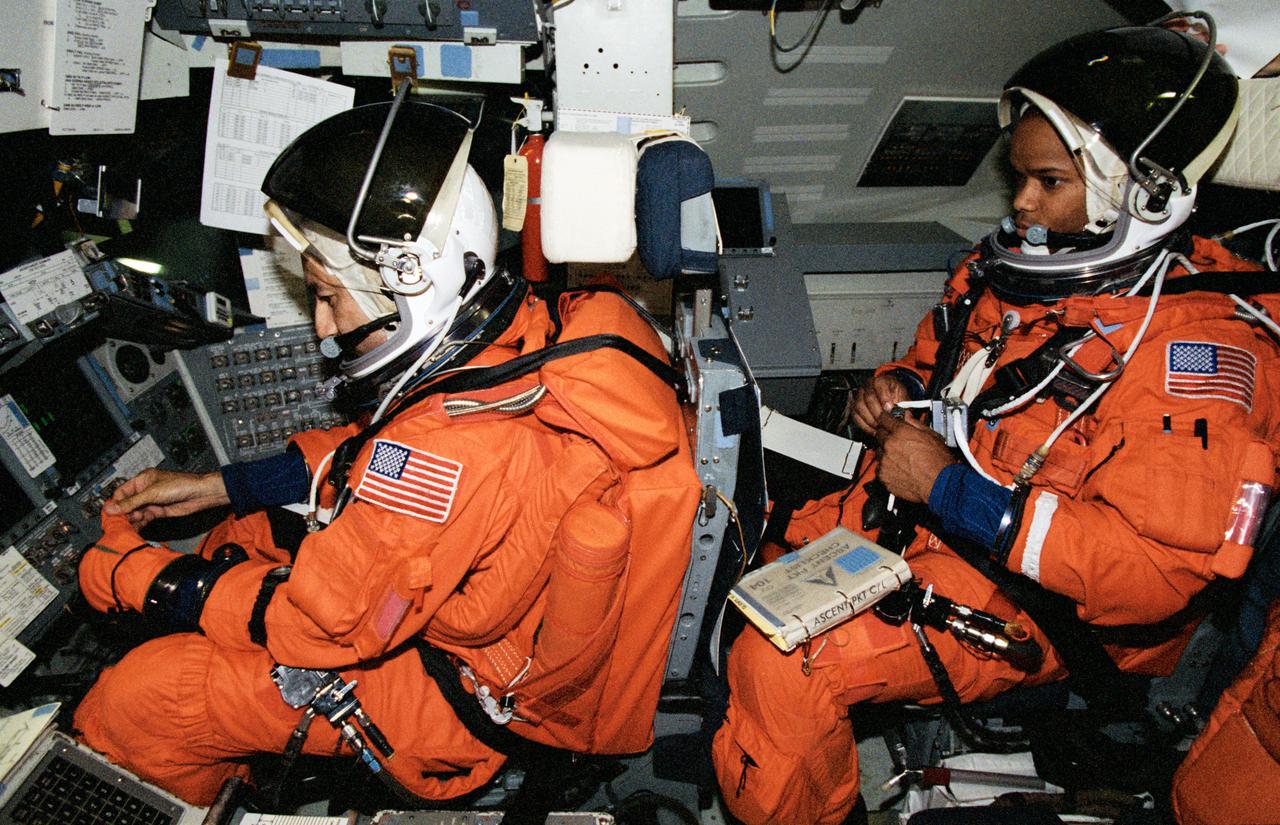
Photographic documentation showing STS-98 crewmembers engaging in preflight training in bldg. 5. Views include: STS-98 mission commander Kenneth D. Cockrell, wearing a Launch Entry Suit (LES) and a helmet, sits in the commanders station on the flight deck of the mobile-based Shuttle Mission Simulator (SMS) (04774); STS-98 pilot Mark L. Polansky, wearing LES and helmet, sits in the pilots station, with STS-98 Mission Specialist (MS) Robert L. Curbeam seated behind him on the flight deck (04775); Polansky in the pilots station (04776); Curbeam in a LES and wearing a Communications Carrier Assembly (CCA) (04777); Polansky and Curbeam pose, wearing LES and no helmets, in bldg. 5 (04778); Polansky, wearing a LES, fastens his CCA (04779); Cockrell, Polansky, Curbeam and STS-98 MS Marsha S. Ivins, wearing LES, sit in locker room (04780); Ivins and suit techs (04781); suit techs and Polansky (04782); suit techs and Cockrell (04783).
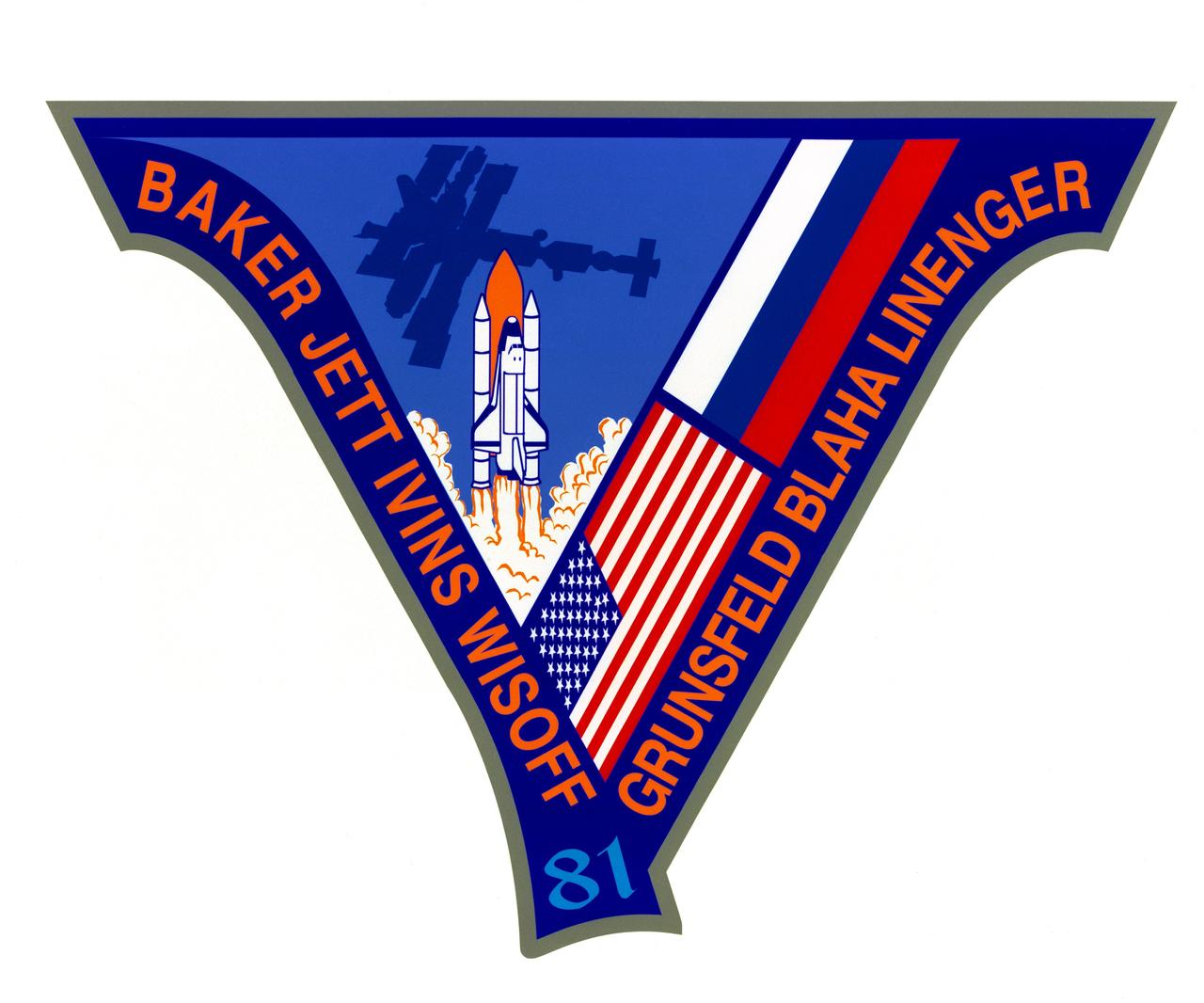
STS081-S-001 (June 1996) --- The STS-81 crew patch for the fifth Shuttle-Mir docking mission, is shaped to represent the Roman numeral V. The space shuttle Atlantis, OV-104, is launching toward a rendezvous with Russia?s Mir Space Station, silhouetted in the background. Atlantis and the STS-81 crew will spend several days docked to Mir during which time astronaut Jerry M. Linenger (NASA-Mir 4) will replace astronaut John E. Blaha (NASA-Mir 3) as the United States crew member onboard Mir. Scientific experiments and logistics will also be transferred between Atlantis and Mir. The United States and Russian flags are depicted along with the names of the shuttle crew members: Michael A. Baker, commander; Brent W. Jett, pilot; Peter J. K.(Jeff) Wisoff, mission specialist 1; John W. Grunsfeld, mission specialist 2; Marsha S. Ivins, mission specialist 3; Linenger; mission specialist 4; and Blaha, mission specialist 5. The NASA insignia design for space shuttle flights is reserved for use by the astronauts and for other official use as the NASA Administrator may authorize. Public availability has been approved only in the forms of illustrations by the various news media. When and if there is any change in this policy, which is not anticipated, the change will be publicly announced. Photo credit: NASA
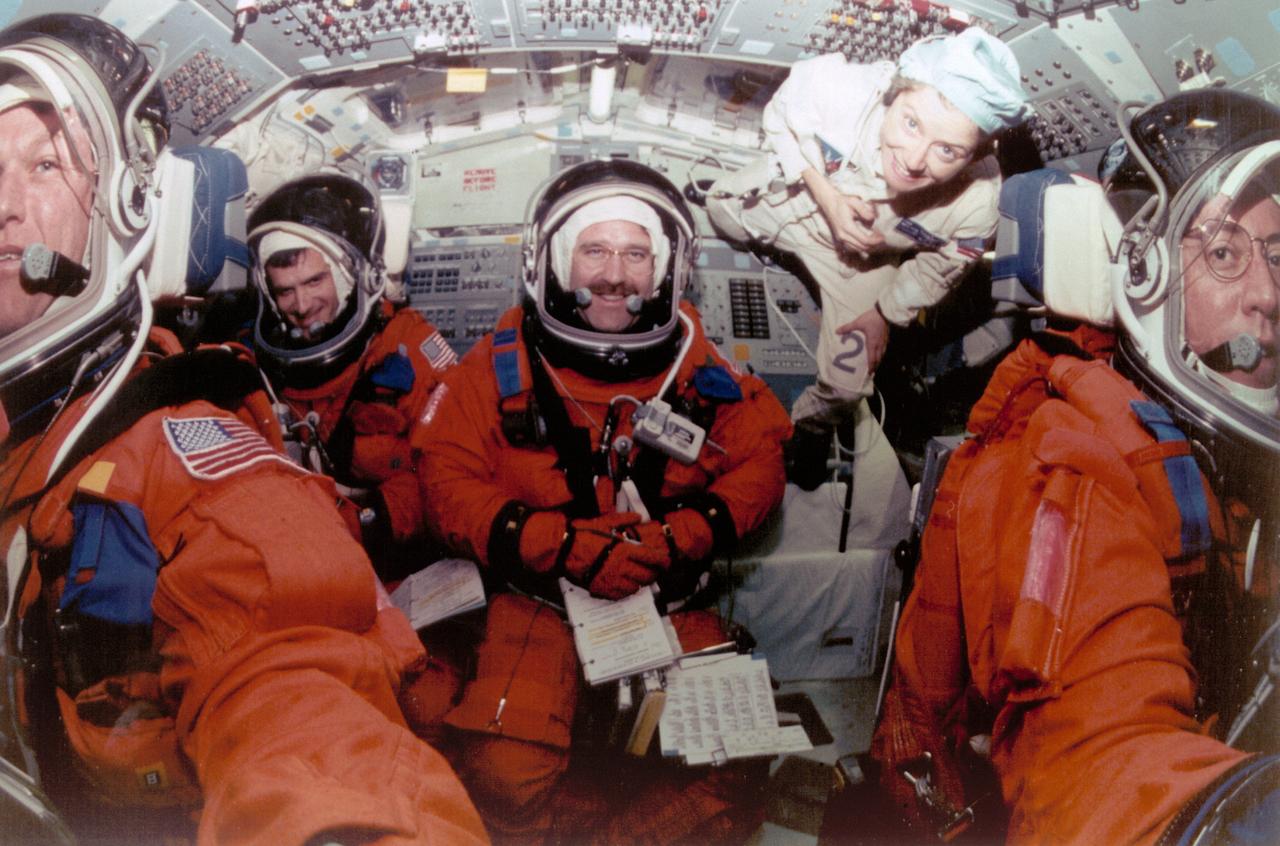
S97-00254 (17 Dec 1996) --- The STS-81 flight crew goes over pre-flight checklists on the flight deck of the Space Shuttle Atlantis during the final phase of the Terminal Countdown Demonstration Test (TCDT) exercises for the January 1997 mission. Crew members pictured, are (from the left) Brent W. Jett, Jr., pilot; Peter J. K. (Jeff) Wisoff and John M. Grunsfeld, mission specialists; along with Michael A. Baker, mission commander. The TCDT represents a simulated final countdown until just before main engine ignition. The astronauts are in their flight positions with the Orbiter in a vertical attitude at Launch Pad 39B, with the camera pointed down from the forward cabin. This angle creates the illusion that astronaut Pam Melroy (in lab suit), mission support assistant, is floating in space. On the mid-deck and out of frame are astronauts Marsha S. Ivins and Jerry M. Linenger. The six will visit Russia?s Mir Space Station, from which they will retrieve John M. Blaha who has been aboard the Mir since September of 1996. Linenger is to replace Blaha, as cosmonaut guest researcher.

STS081-S-008 (22 Jan. 1997) --- The Space Shuttle Atlantis touches down on Runway 33 at the Kennedy Space Center (KSC) to conclude the fifth Shuttle-Mir docking mission. Coming to a halt at 9:22:44 a.m. (EST), January 22, the mission also accomplished the return of astronaut John E. Blaha, cosmonaut guest researcher, who had been aboard Russia's Mir Space Station complex since mid September 1996. Blaha was replaced by Jerry M. Linenger during the five days of joint activities of the Mir-22 and STS-81 crewmembers while Atlantis and Mir were docked in Earth-orbit. At main gear touchdown, the mission's duration was 10 days, 4 hours and 55 minutes. This was the 34th space shuttle landing at KSC. The crew aboard at landing included astronauts Michael A. Baker, commander; Brent W. Jett, Jr., pilot; Blaha; and mission specialists Marsha S. Ivins, Peter J. K. (Jeff) Wisoff and John M. Grunsfeld.
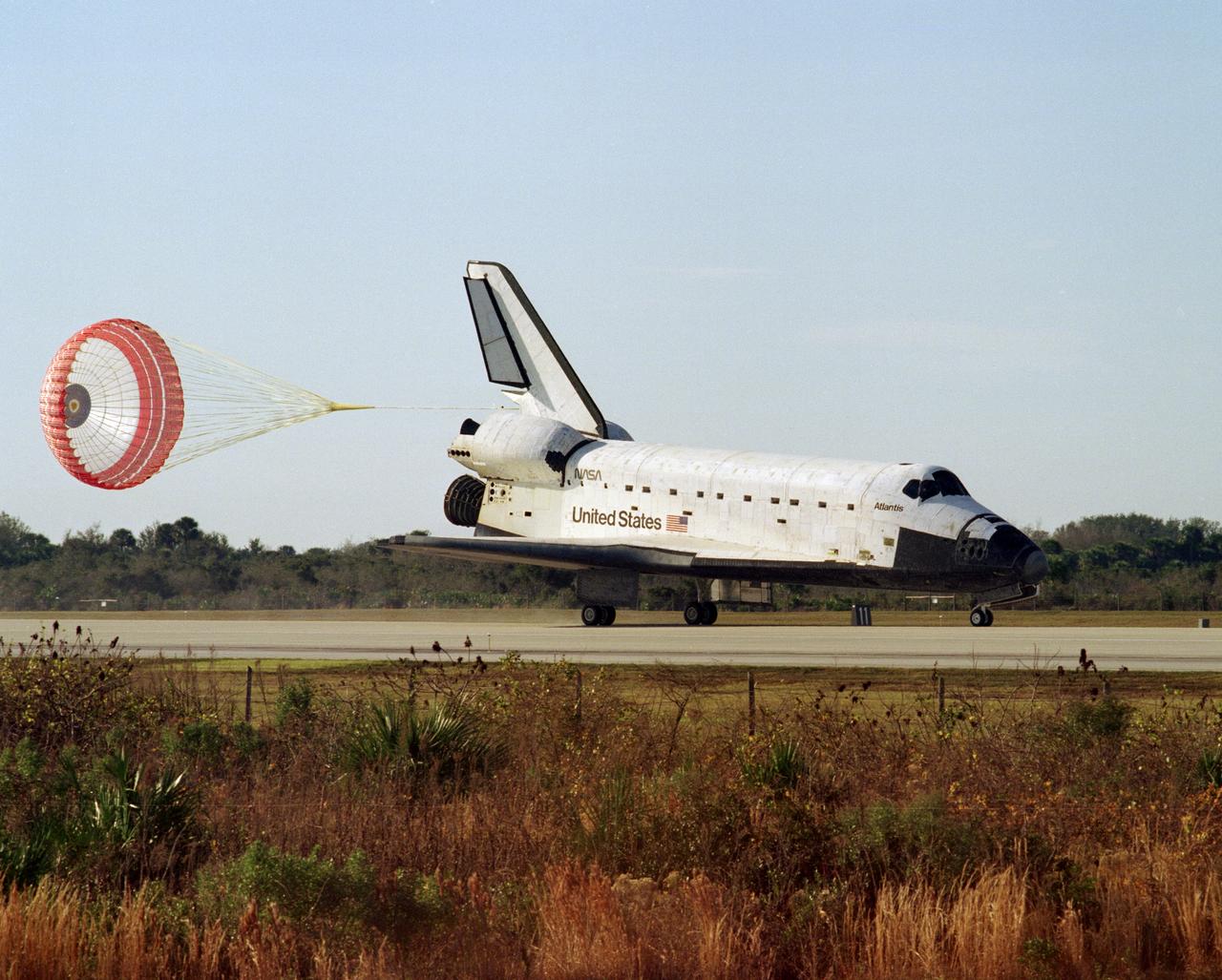
STS081-S-010 (22 Jan. 1997) --- A drag chute is deployed as the Space Shuttle Atlantis rolls toward a wheels stopped mode on Runway 33 at the Kennedy Space Center (KSC) to conclude the fifth Shuttle-Mir docking mission. Coming to a halt at 9:22:44 a.m. (EST), January 22, the mission also accomplished the return of astronaut John E. Blaha, cosmonaut guest researcher, who had been aboard Russia's Mir Space Station complex since mid September 1996. Blaha was replaced by Jerry M. Linenger during the five days of joint activities of the Mir-22 and STS-81 crew members while Atlantis and Mir were docked in Earth-orbit. At main gear touchdown, the mission's duration was 10 days, 4 hours and 55 minutes. This was the 34th space shuttle landing at KSC. The crew aboard at landing included astronauts Michael A. Baker, commander; Brent W. Jett, Jr., pilot; Blaha; and mission specialists Marsha S. Ivins, Peter J. K. (Jeff) Wisoff and John M. Grunsfeld.
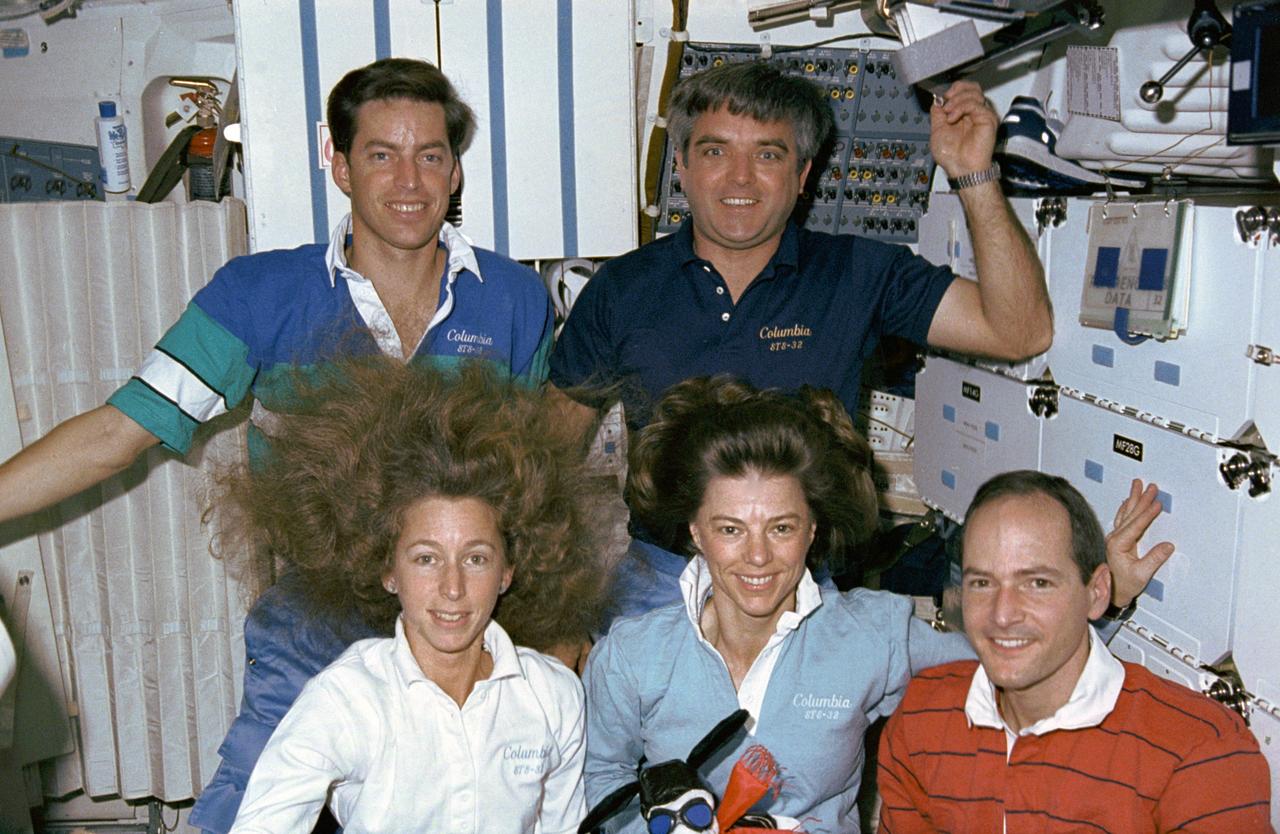
STS032-57-006 (9-20 Jan 1990) --- The five astronaut crew members used a pre-set 35mm camera to take this in-flight crew portrait. Astronauts Daniel C. Brandenstein (right, rear), mission commander, and James D. Wetherbee (left, rear), pilot, were in charge of controlling the Space Shuttle Columbia during its record-setting 11-day stay in Earth-orbit as well as performing a variety of other chores. Mission specialists performing a number of experiments and tackling a myriad of miscellaneous tasks were, left to right on the front row: astronauts Marsha S. Ivins, Bonnie J. Dunbar and G. David Low. Together the quintet retrieved the Long Duration Exposure Facility (LDEF), released into space the Syncom IV-5 communications satellite, took photos of Earth, performed troubleshooting duties and adhered to a busy agenda during their stay aboard Columbia. This picture was used by the astronauts at their January 30, 1990 Post Flight Press Conference (PFPC) at the Johnson Space Center (JSC).
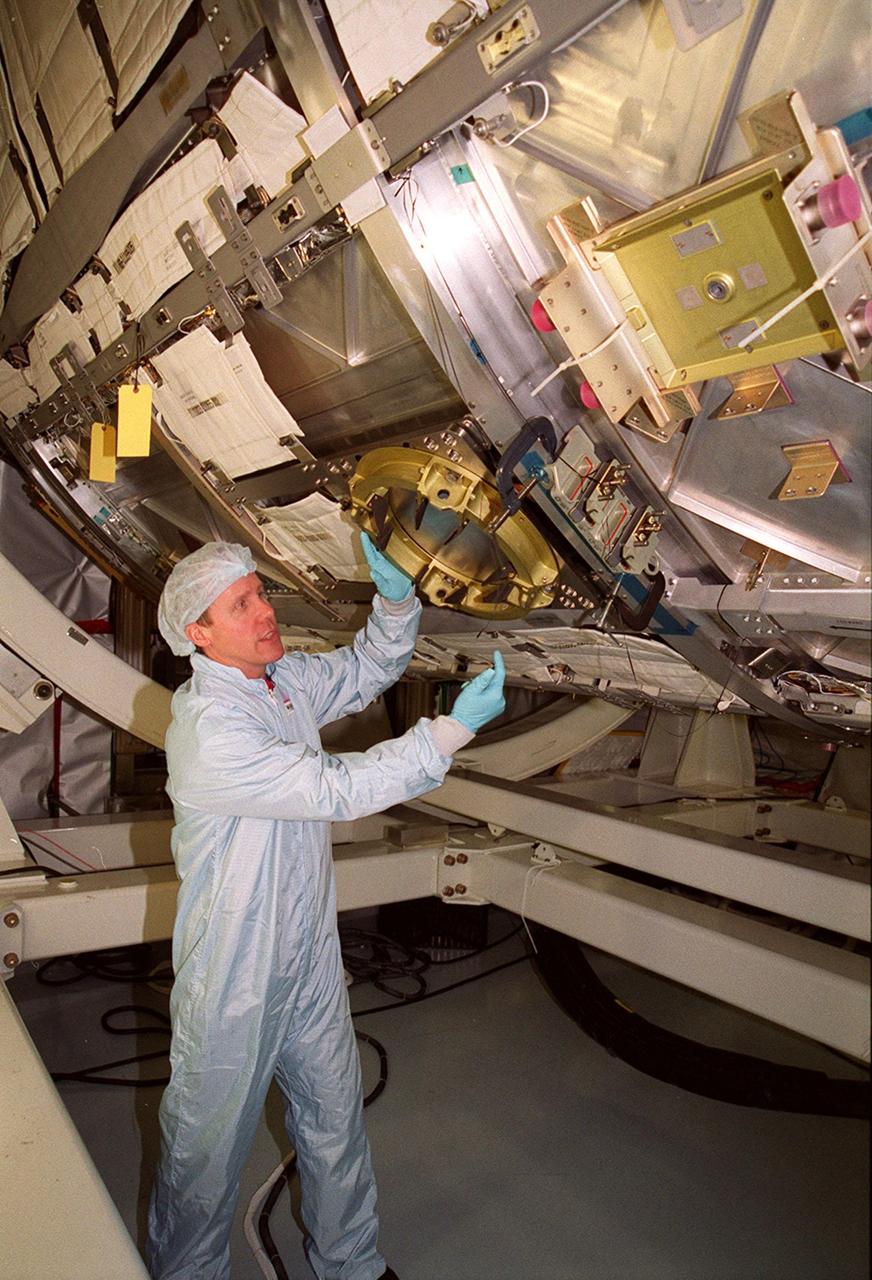
In the Space Station Processing Facility, STS-98 Mission Specialist Thomas D. Jones (Ph.D.) examines a power data grapple fixture outside the U.S. Lab Destiny. Jones is taking part in a Multi-Equipment Interface Test (MEIT), along with other crew members Commander Kenneth D. Cockrell and Pilot Mark Polansky. The remaining members of the crew (not present for the MEIT) are Mission Specialists Robert L. Curbeam Jr. and Marsha S. Ivins. During the STS-98 mission, the crew will install the Lab on the International Space Station during a series of three space walks. The grapple fixture will be the base of operations for the robotic arm on later flights The mission will provide the station with science research facilities and expand its power, life support and control capabilities. The U.S. Laboratory Module continues a long tradition of microgravity materials research, first conducted by Skylab and later Shuttle and Spacelab missions. Destiny is expected to be a major feature in future research, providing facilities for biotechnology, fluid physics, combustion, and life sciences research. The Lab is planned for launch aboard Space Shuttle Atlantis on the sixth ISS flight, currently targeted no earlier than Aug. 19, 2000
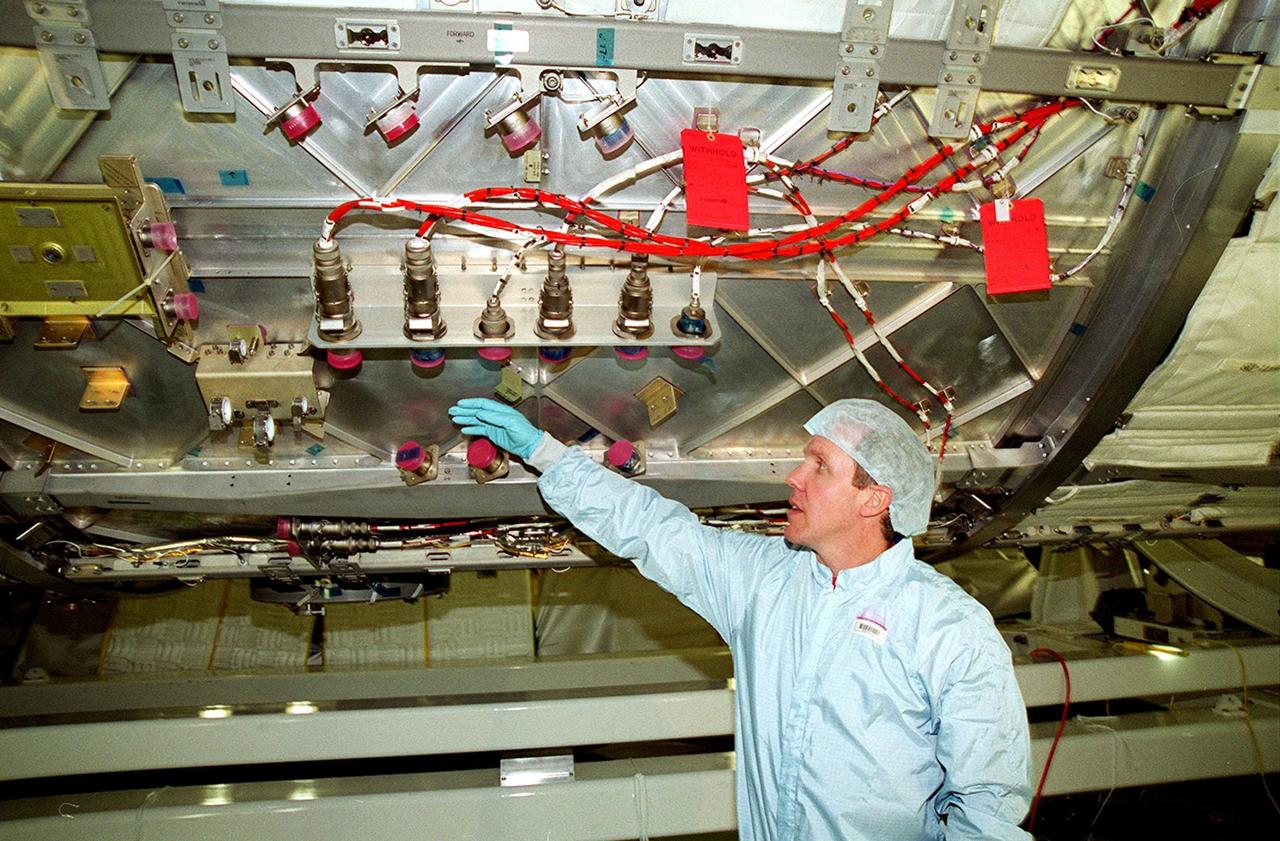
In the Space Station Processing Facility, STS-98 Mission Specialist Thomas D. Jones (Ph.D.) looks at electrical connections on the U.S. Lab Destiny as part of a Multi-Equipment Interface Test (MEIT). Other crew members taking part in the MEIT are Commander Kenneth D. Cockrell and Pilot Mark Polansky. The remaining members of the crew (not present for the MEIT) are Mission Specialists Robert L. Curbeam Jr. and Marsha S. Ivins. During the STS-98 mission, the crew will install the Lab on the International Space Station during a series of three space walks. The mission will provide the station with science research facilities and expand its power, life support and control capabilities. The U.S. Laboratory Module continues a long tradition of microgravity materials research, first conducted by Skylab and later Shuttle and Spacelab missions. Destiny is expected to be a major feature in future research, providing facilities for biotechnology, fluid physics, combustion, and life sciences research. The Lab is planned for launch aboard Space Shuttle Atlantis on the sixth ISS flight, currently targeted no earlier than Aug. 19, 2000
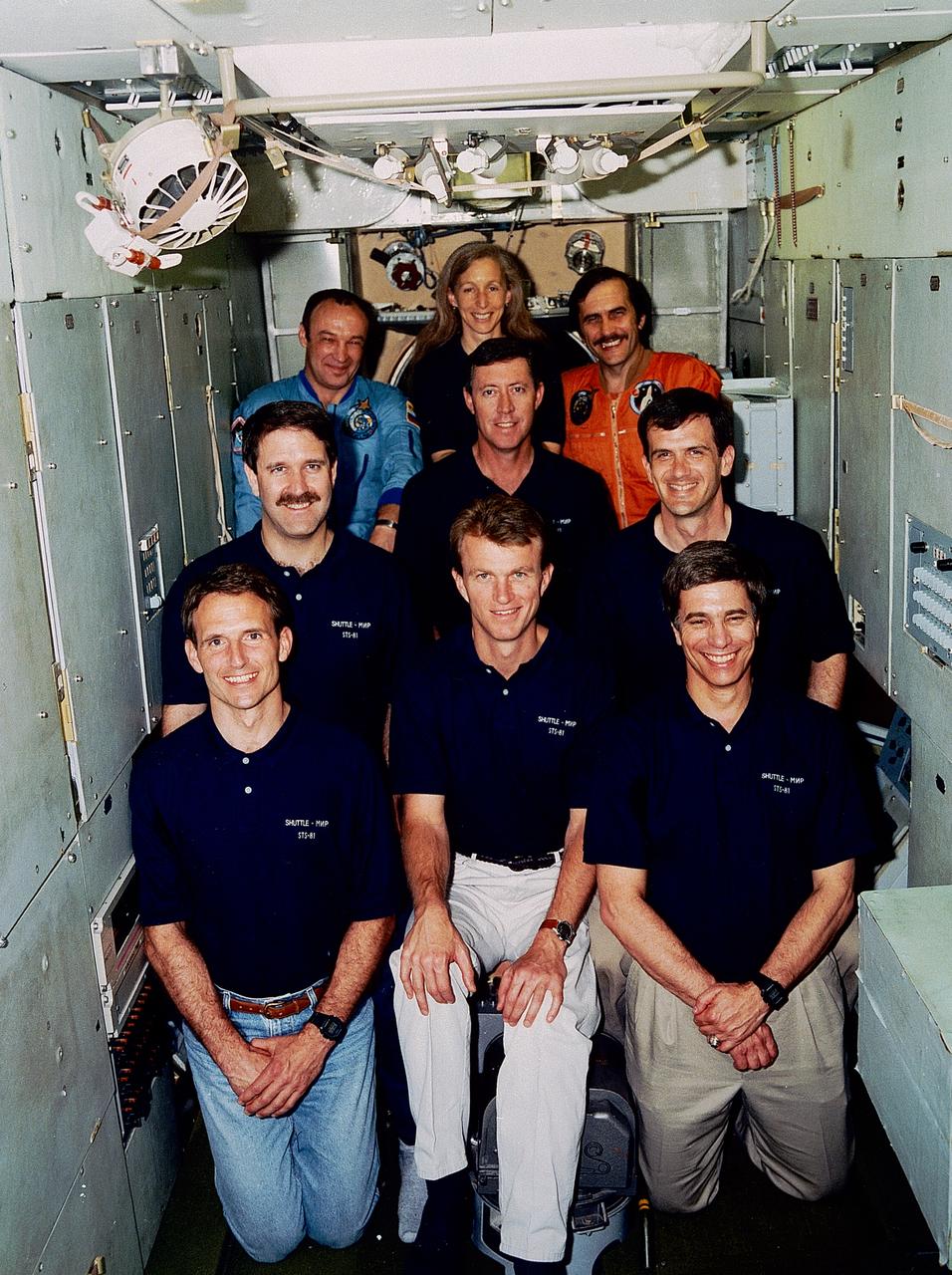
S96-10557 (May 1996) --- The original Mir-22 crew assigned to duty aboard Russia's Mir Space Station poses with the STS-81 crew. The cosmonauts, flanking astronaut Marsha S. Ivins on the top row, are Gennadiy M. Manakov (left) mission commander; and Pavel V. Vinogradov, flight engineer. After this photo was taken, a shift of Russian crew assignments occurred and Manakov and Vinogradov were replaced with Valeri G. Korzun and Aleksandr Y. Kaleri. The astronauts are, front row (left to right): Jerry M. Linenger, Brent W. Jett, Jr., and John E. Blaha. Second row, left to right, John W. Grunsfeld, Michael A. Baker and Peter J. K. (Jeff) Wisoff. All the STS-81 crewmembers except Blaha are scheduled to be launched in December 1996 aboard the Space Shuttle Atlantis and those six will be joined by Mir-22 cosmonaut researcher Blaha when the two spacecraft are joined in Earth-orbit. Blaha will have been launched into Earth-orbit to connect with Russia's Mir Space Station on an earlier mission - STS-79 - of the space shuttle Atlantis, scheduled for launch in the summer of 1996. Linenger will remain onboard Mir for a tour of duty as a cosmonaut researcher.
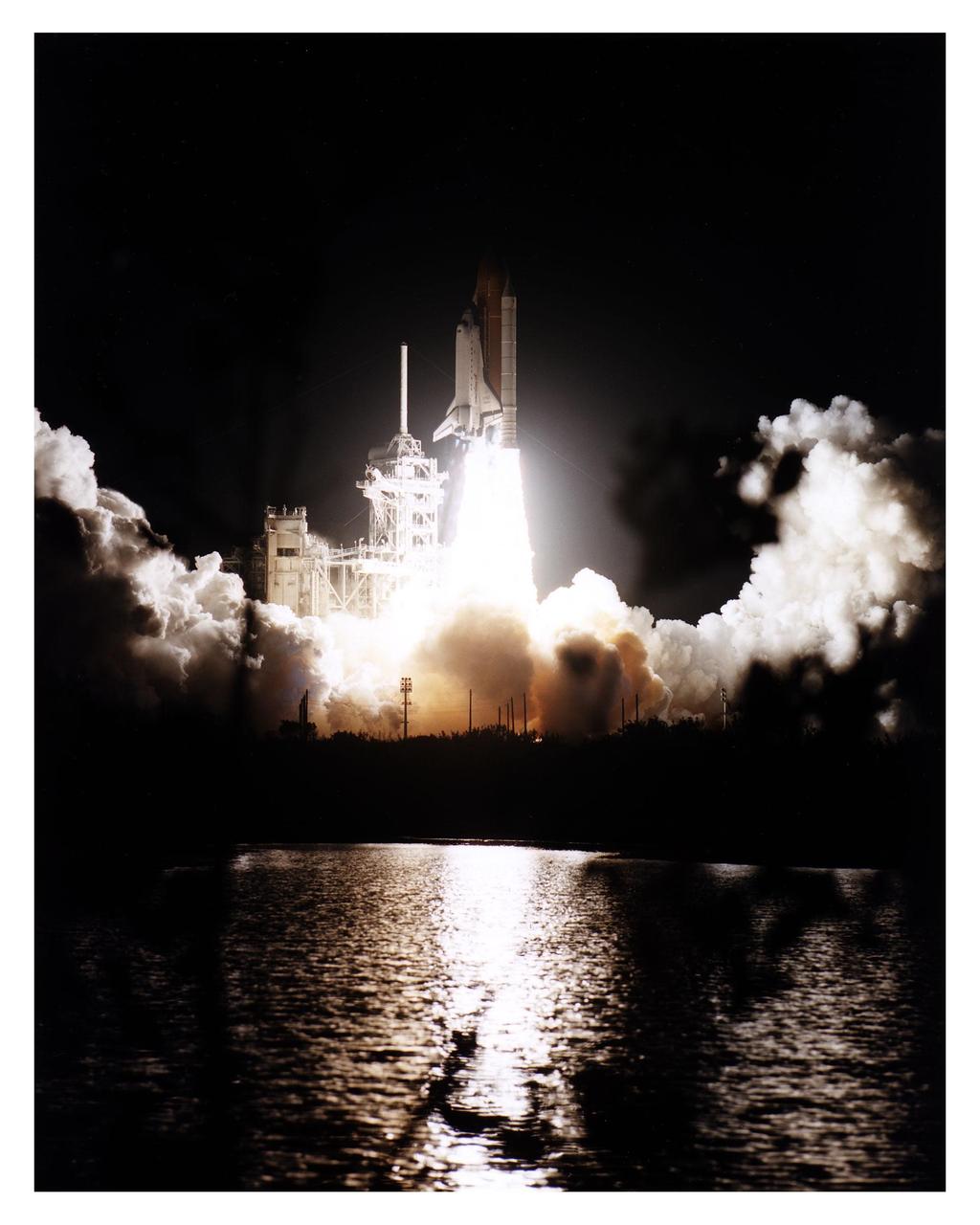
KENNEDY SPACE CENTER, FLA. -- The Space Shuttle Atlantis transforms the early morning at KSC into near-daylight as its more than 7 million pounds of rocket thrust propels it from Launch Pad 39B at 4:27:23 a.m. EST Jan. 12 on its way to dock with the Mir space station for the fifth time.The 10-day mission will feature the transfer of Mission Specialist Jerry Linenger to Mir to replace astronaut John Blaha, who has been on the orbital laboratory since Sept. 19, 1996. The other STS-81 crew members include Mission Commander Michael A. Baker; Pilot Brent W. Jett, Jr.; and Mission Specialists John M. Grunsfeld, Peter J. K. "Jeff" Wisoff and Marsha S. Ivins. During the five-day docking operations, the Shuttle and Mir crews will conduct risk mitigation, human life science, microgravity and materials processing experiments that will provide data for the design, development and operation of the International Space Station. The primary payload is the SPACEHAB-DM double module that will provide space for more than 2,000 pounds of hardware, food and water that will be transferred into the Russian space station. The SPACEHAB will also be used to return experiment samples from the Mir to Earth for analysis and for microgravity experiments during the mission