Martian Terrain
Martian Terrain
Contrasting Martian Terrains
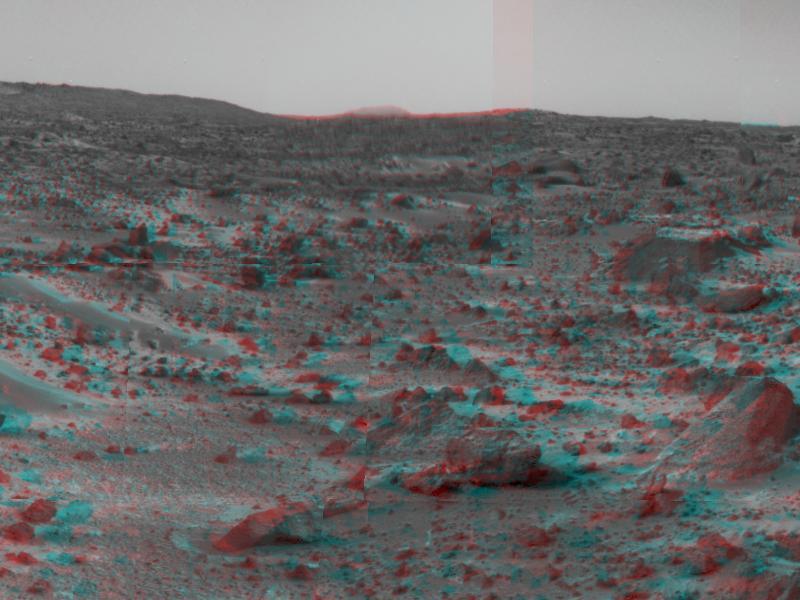
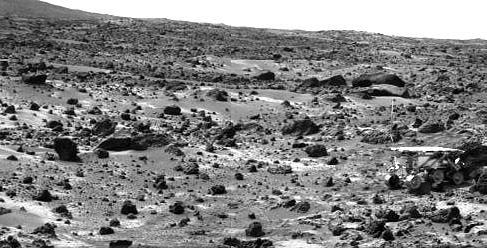
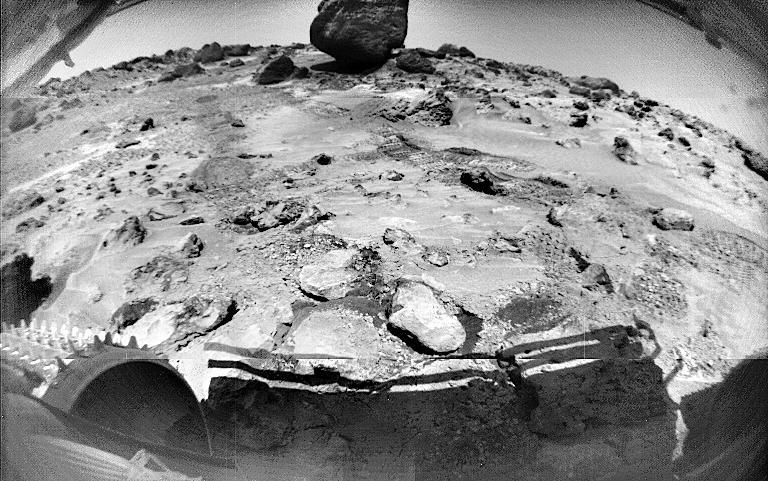
Martian terrain near Pathfinder
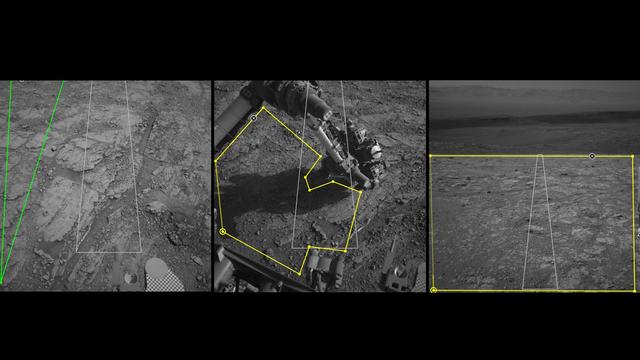
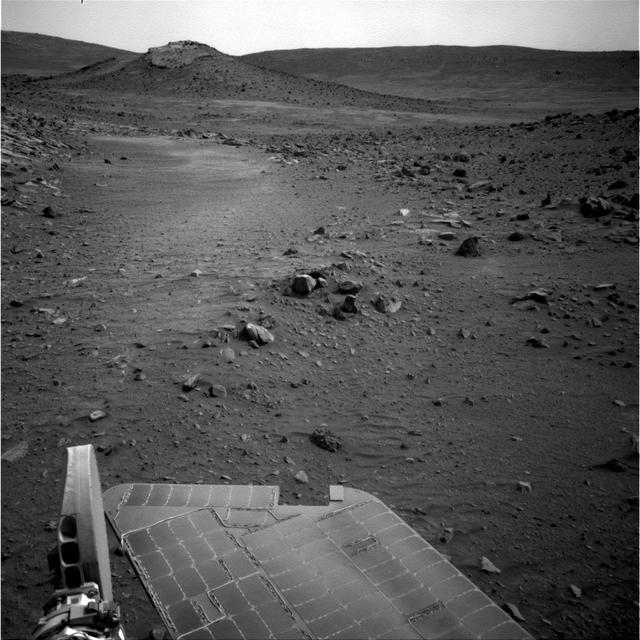
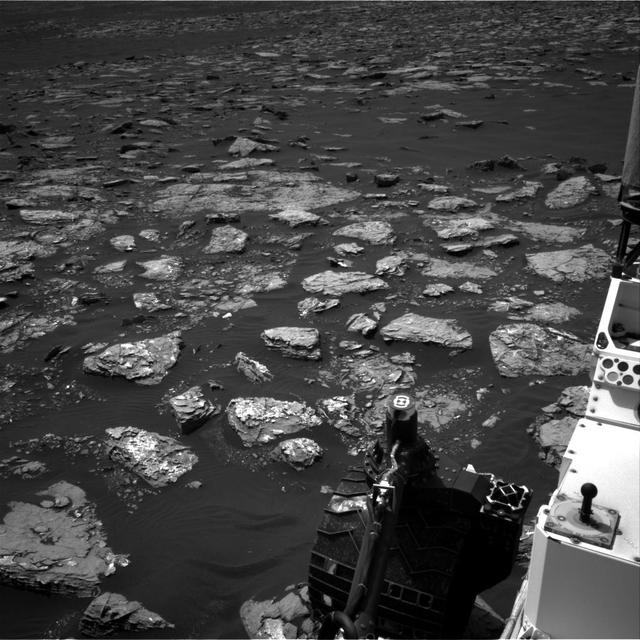
Three images from the public tool AI4Mars show different kinds of Martian terrain as seen by NASA's Curiosity rover. By drawing borders around terrain features and assigning one of four labels to them, you can help train an algorithm that will automatically identify favorable and hazardous terrain for Curiosity's rover planners. You can visit AI4Mars here.  All three images were generated by Curiosity's black-and-white Navigation Cameras. In the lower right corner of the first image on the left, the circle and checkerboard on is the Sample Playground, where samples of soil or pulverized rock can be trickled to study their physical properties. In the center are Curiosity's robotic arm and turret, a collection of science tools on the end of the arm.  https://photojournal.jpl.nasa.gov/catalog/PIA23897
Martian Terrain as Viewed in AI4Mars
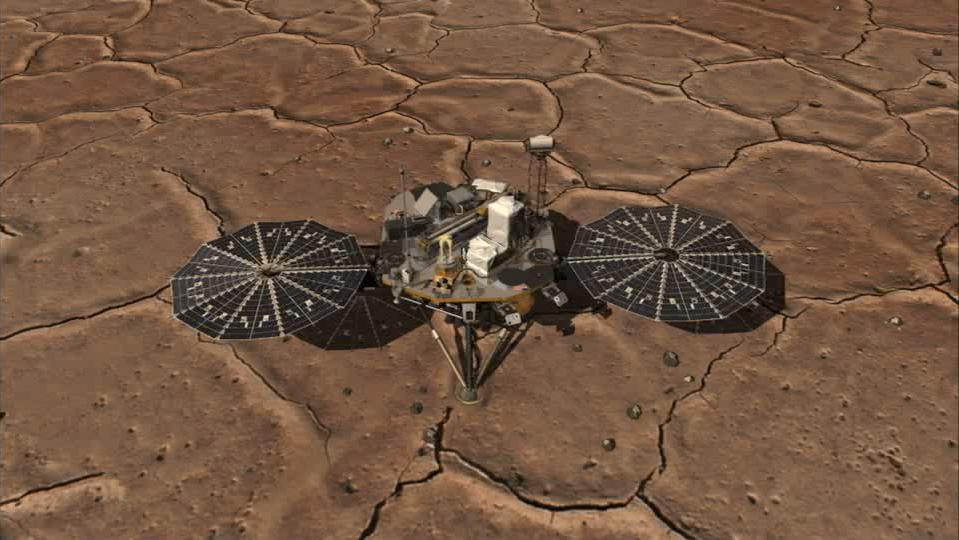
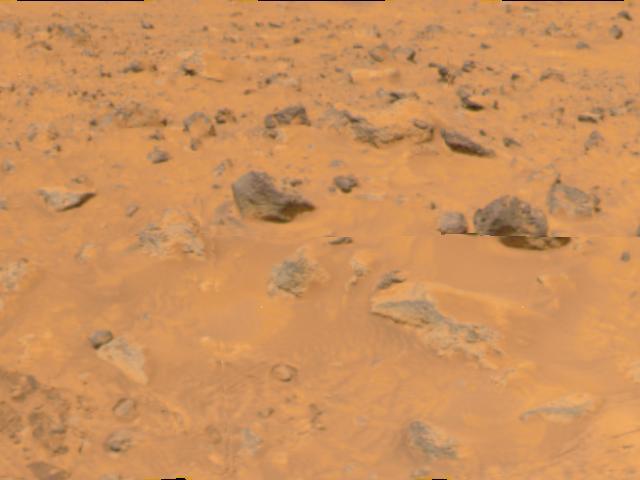
This image from Sol 1 shows a mosaic of NASA Mars Phoenix digging area in the Martian terrain. Phoenix scientists were very pleased with this view as the terrain features few rocks -- an optimal place for digging.
Phoenix Work Area Animation
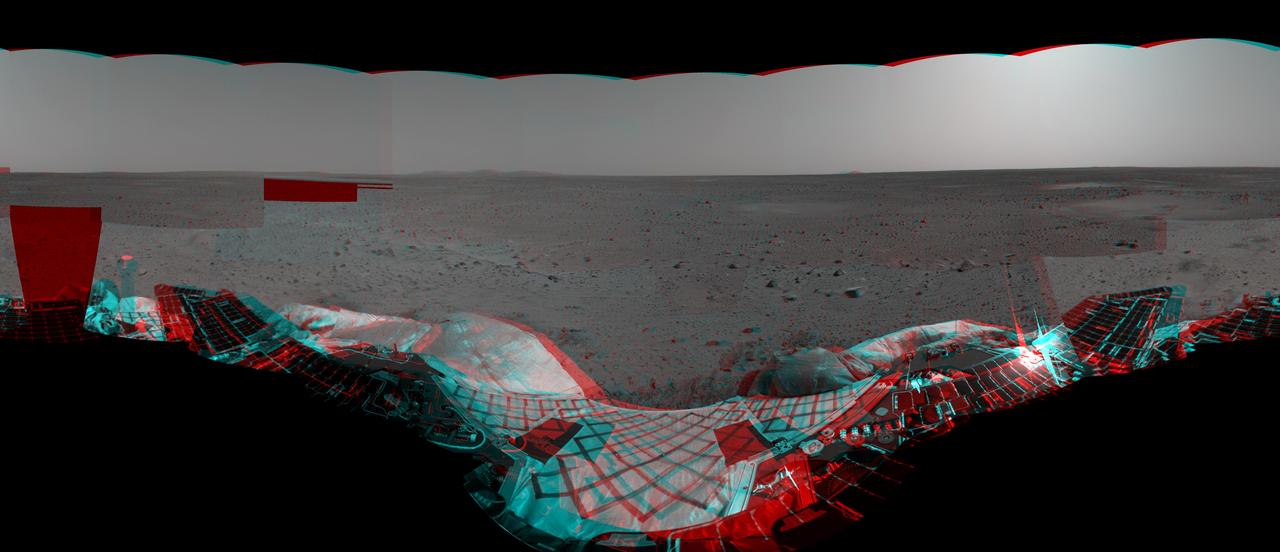
This anaglyph from NASA Mars Exploration Rover, Spirit, shows the rover lander and, in the background, the surrounding martian terrain. 3D glasses are necessary to view this image.
Martian Landscape in 3-D
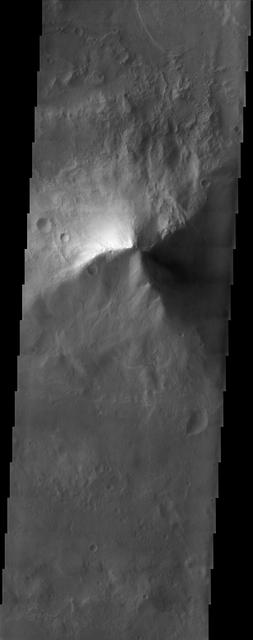
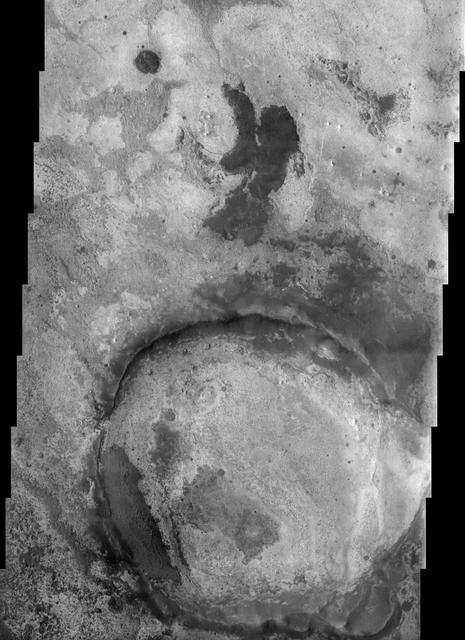
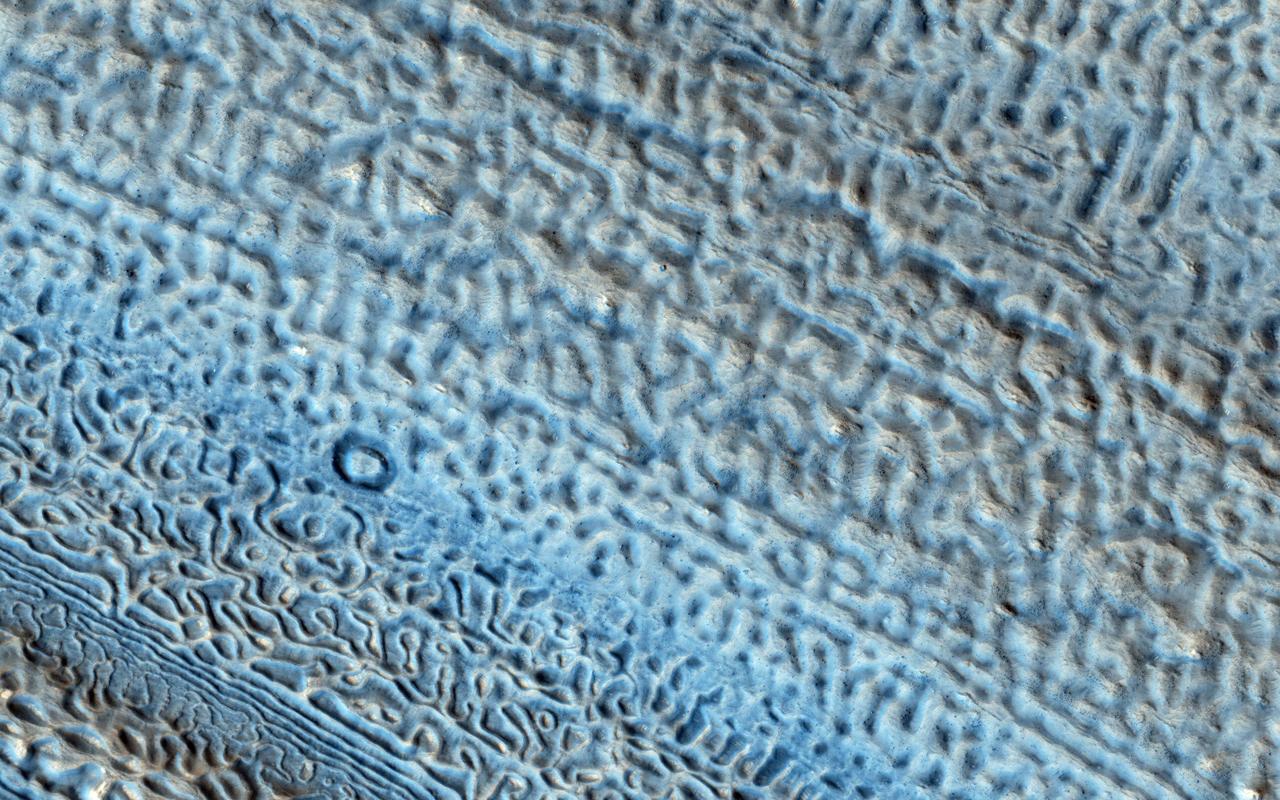
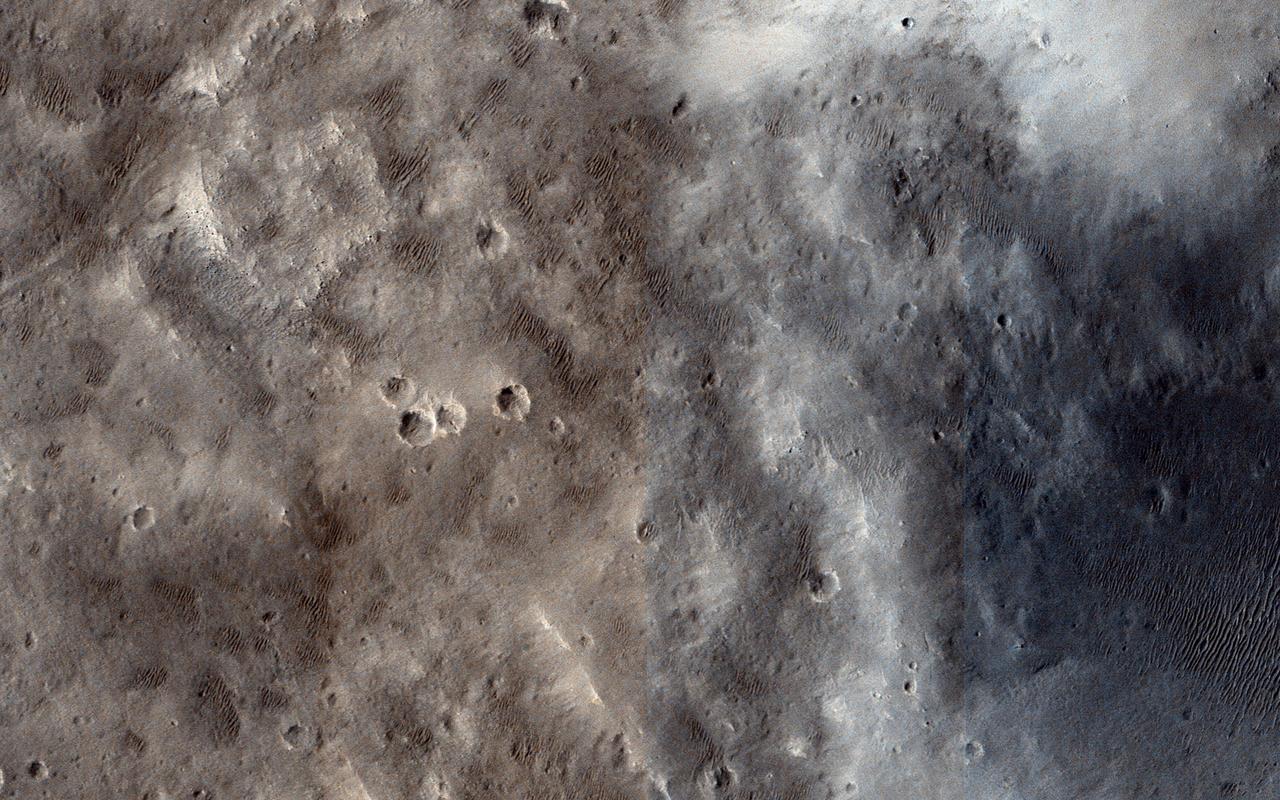
This image from NASA Mars Reconnaissance Orbiter, approximately 1.5 x 3 kilometers, shows a sample of eroded Martian terrain in Arabia Terra.
Eroding Terrain in Arabia Terra
Martian terrain is seen in this 3-D image taken by the panoramic camera on NASA Mars Exploration Rover Spirit. 3D glasses are necessary to view this image.
Mars in Stereo
In the area between Crommelin and Firsoff craters, NASA Mars Reconnaissance Orbiter saw heavily cratered terrain with deposits that record Martian geologic history and stratigraphy.
Ridges and a Valley with Flow Fronts
NASA Mars Exploration Rover Spirit obtained this stereo panorama of the surrounding Martian terrain in Gusev Crater . 3D glasses are necessary to view this image.
Sweeping View of the Columbia
This image from NASA Mars Odyssey spacecraft shows old, heavily cratered volcanic terrain in Terra Tyrrhena within the Martian southern highlands.
Terra Tyrrhena
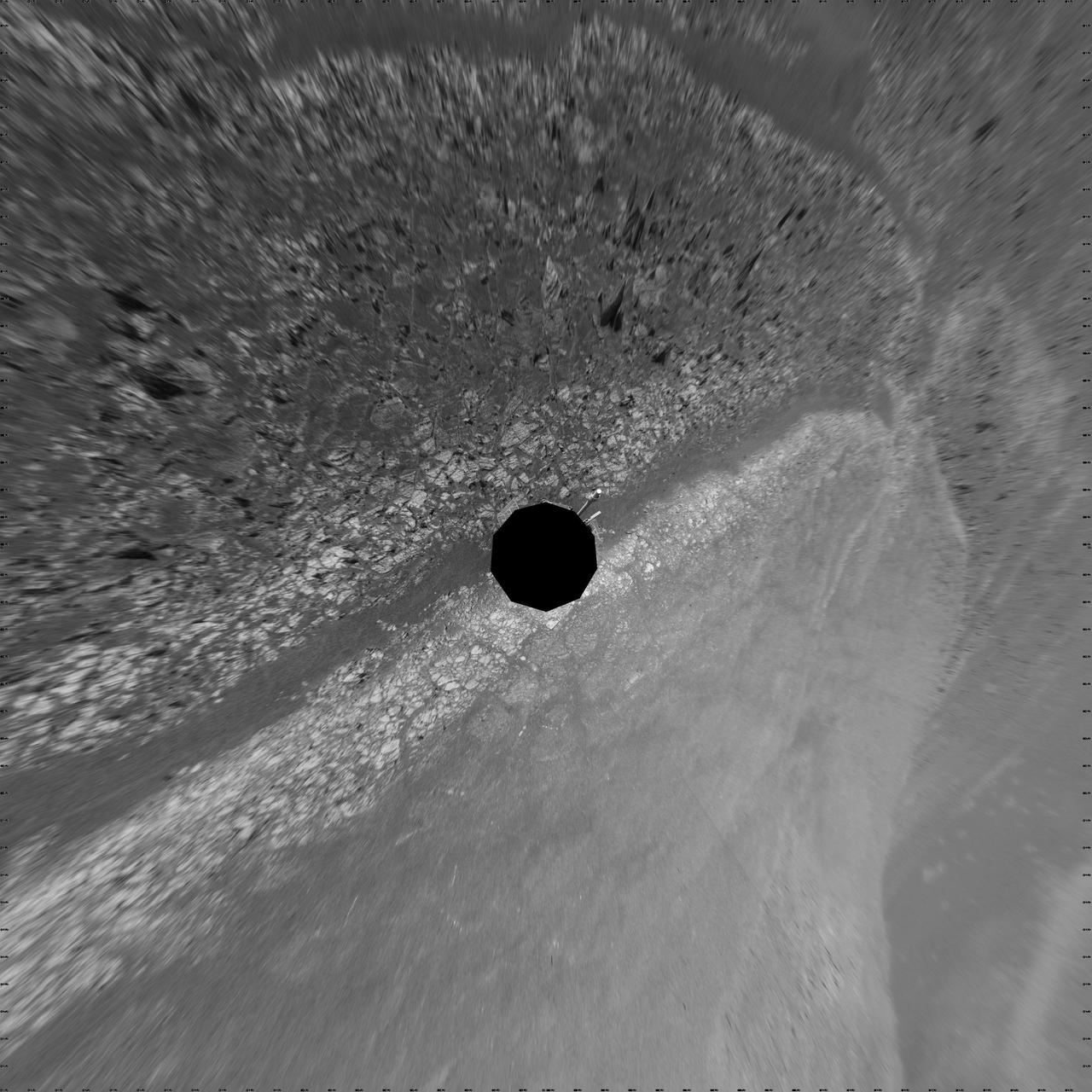
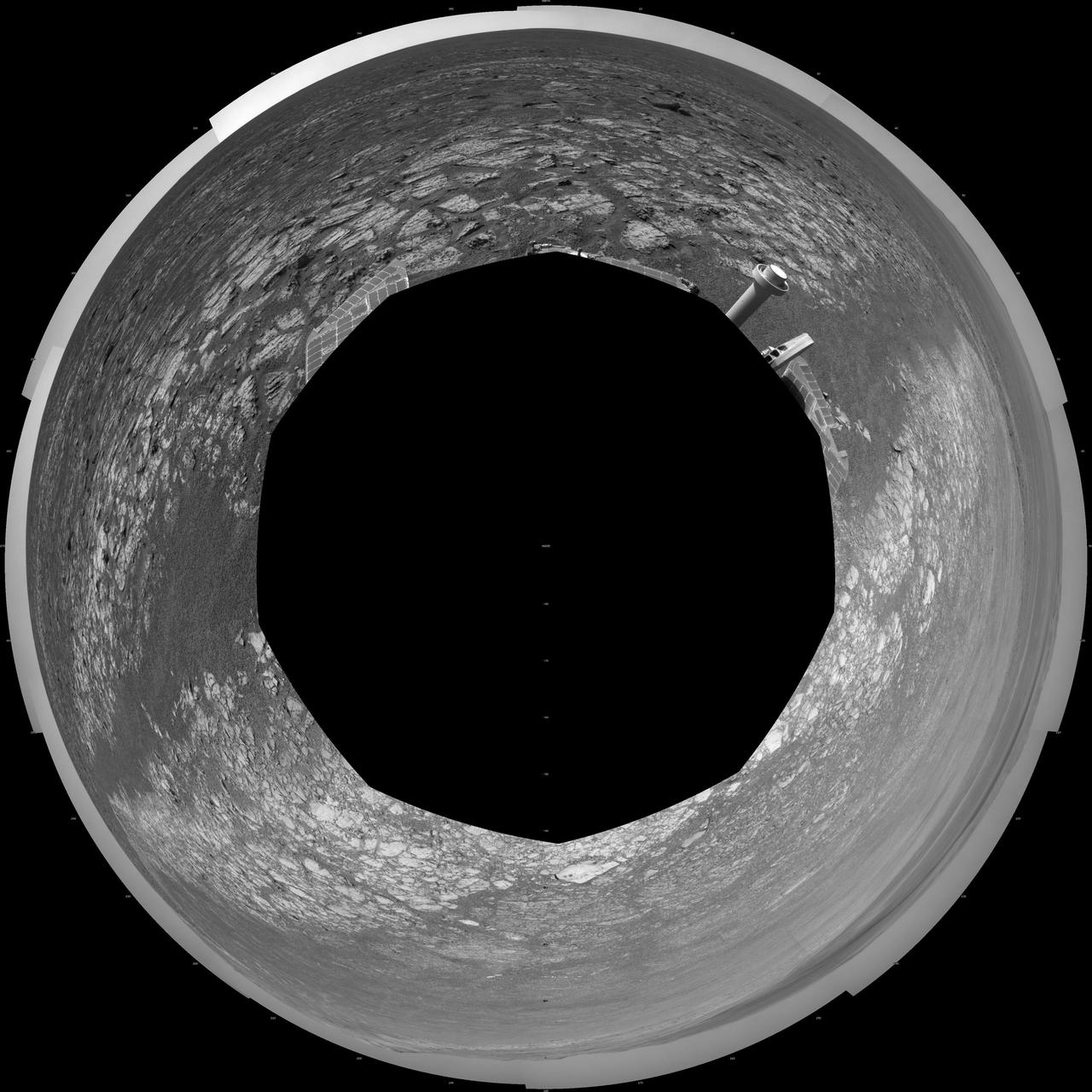
This 360-degree polar projection was assembled from images taken by the navigation camera on NASA Mars Exporation Rover Opportunity shows terrain surrounding the position where the rover spent its 3,000th Martian day.
Opportunity Surroundings on 3,000th Sol, Polar Projection
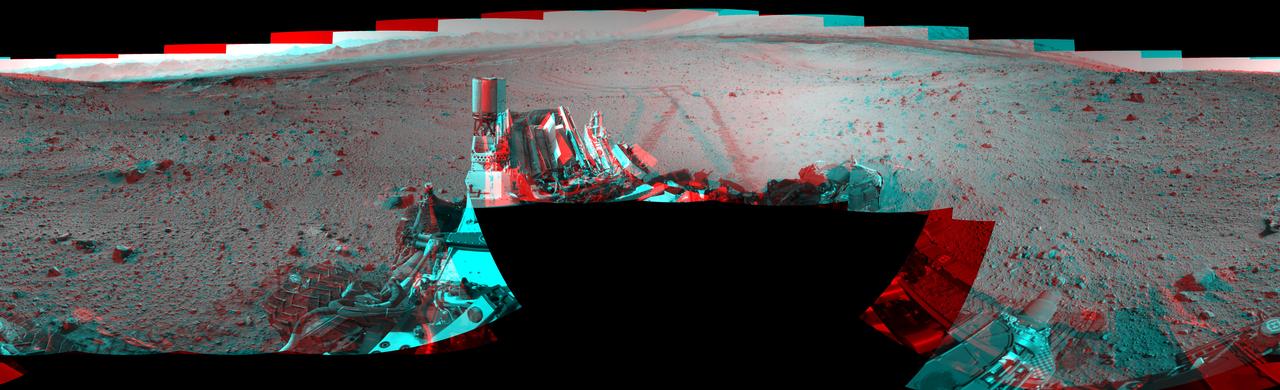
This stereo mosaic of images from NASA Mars rover Curiosity shows the terrain surrounding the rover position on the 524th Martian day. You need 3-D glasses to view this image.
Full-Circle Vista During Curiosity Approach to Dingo Gap Stereo
This 360-degree vertical projection was assembled from images taken by the navigation camera on NASA Mars Exporation Rover Opportunity shows terrain surrounding the position where the rover spent its 3,000th Martian day.
Opportunity Surroundings on 3,000th Sol, Vertical Projection
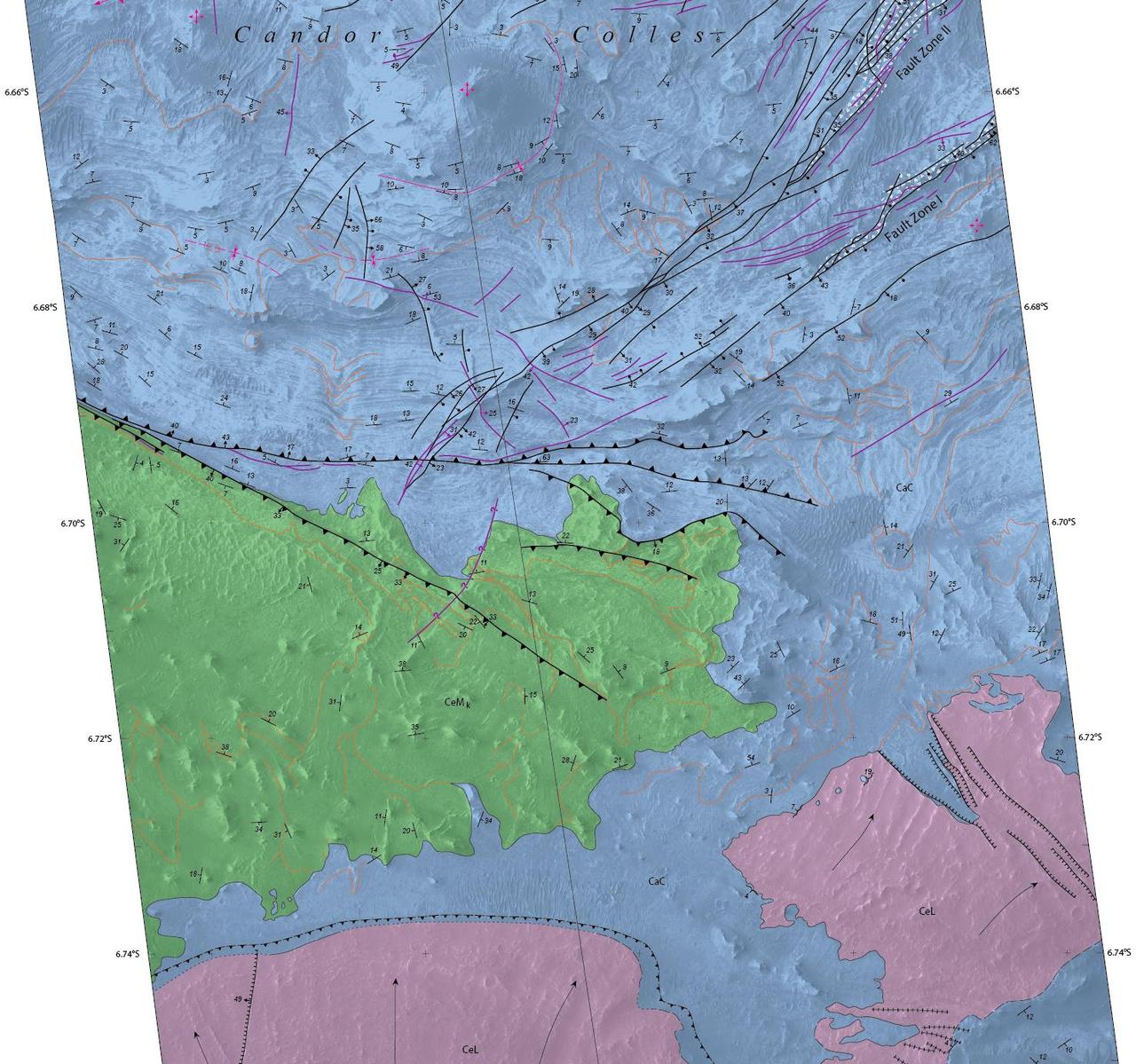
Details of hilly terrain within a large Martian canyon are shown on a geological map based on observations from NASA Mars Reconnaissance Orbiter and produced by the U.S. Geological Survey.
Geological Mapping of Hills in Martian Canyon
This 360-degree panorama from NASA Mars rover Curiosity shows the rocky terrain of Rocknest surrounding it as of its 55th Martian day, or sol, of the mission Oct. 1, 2012.
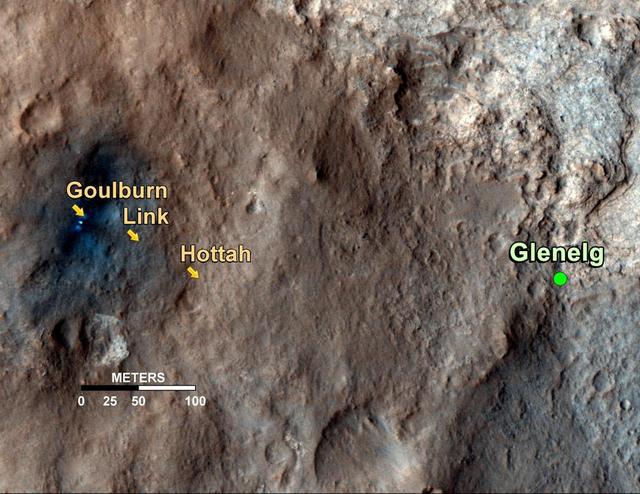
View on the Way to Glenelg
This image by NASA Mars Odyssey illustrates the complex terrains within Terra Meridiani. This general region is one of the more complex on Mars, with a rich array of sedimentary, volcanic, and impact surfaces that span a wide range of Martian history.
Terra Meridiani
This map shows the path on Mars of NASA Curiosity rover toward Glenelg, an area where three terrains of scientific interest converge. Arrows mark what appears to be an ancient Martian streambed.
Curiosity Roadside Discoveries
In the best-selling novel "The Martian" and the movie based on it, stranded astronaut Mark Watney's adventures take him to the rim of Mawrth Crater. This image from the High Resolution Imaging Science Experiment (HiRISE) camera on NASA's Mars Reconnaissance Orbiter shows the nature of this terrain.  The crater rim is not very distinct, and from the Martian surface it would be quite difficult to tell that you are even on the rim of a crater. The terrain is hummocky and rolling, punctuated by smaller impact craters and wind-blown drifts of sand or dust.  This view is one image product from HiRISE observation ESP_042252_1930, taken Aug. 1, 2015, at 12.6 degrees north latitude, 355.7 degrees east longitude.  http://photojournal.jpl.nasa.gov/catalog/PIA19915
Western Edge of Mars Marth Crater, a Movie Location
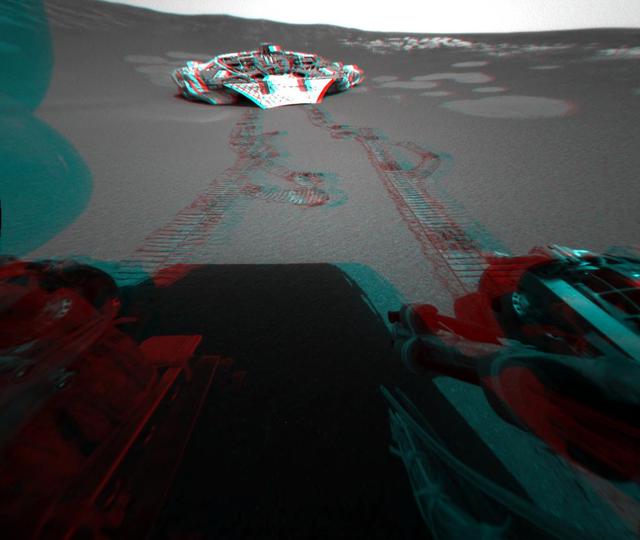
This 3-D view from behind NASA Mars Exploration Rover Opportunity shows the path the rover has traveled since rolling 1 meter 3 feet away from its empty lander on the seventh martian day, or sol, of its mission. 3D glasses are necessary.
Traversing Martian Terrain
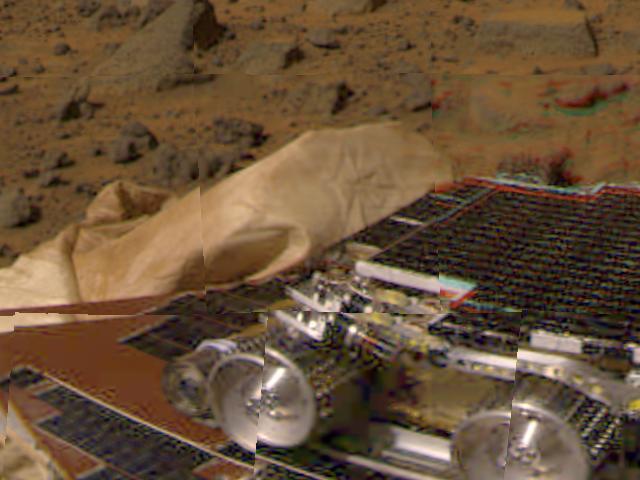
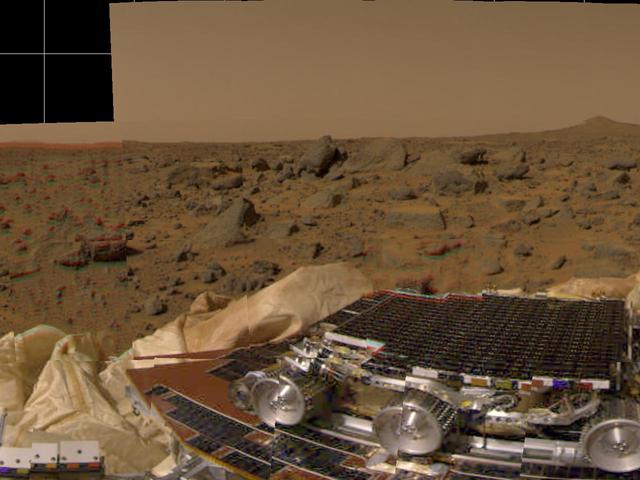
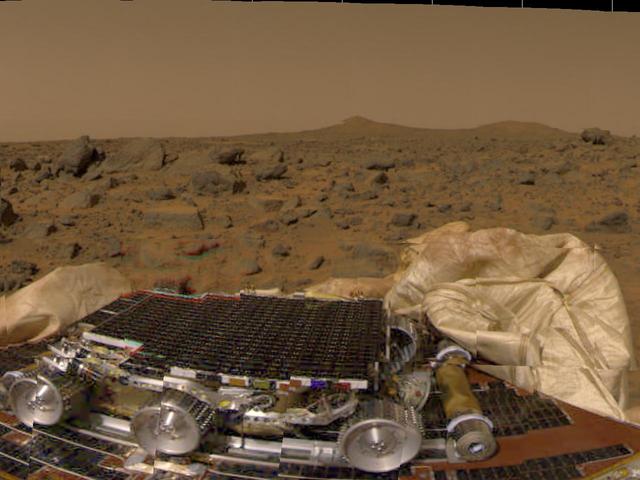
This picture from Mars Pathfinder was taken at 9:30 AM in the martian morning (2:30 PM Pacific Daylight Time), after the spacecraft landed earlier today (July 4, 1997). The Sojourner rover is perched on one of three solar panels. The rover is 65 cm (26 inches) long by 18 cm (7 inches) tall; each of its wheels is about 13 cm (5 inches) high. The white material to the left of the front of the rover is part of the airbag system used to cushion the landing.  Many rocks of different of different sizes can be seen, set in a background of reddish soil. The landing site is in the mouth of an ancient channel carved by water. The rocks may be primarily flood debris. The horizon is seen towards the top of the picture. The light brown hue of the sky results from suspended dust.  Pathfinder, a low-cost Discovery mission, is the first of a new fleet of spacecraft that are planned to explore Mars over the next ten years. Mars Global Surveyor, already en route, arrives at Mars on September 11 to begin a two year orbital reconnaissance of the planet's composition, topography, and climate. Additional orbiters and landers will follow every 26 months.  http://photojournal.jpl.nasa.gov/catalog/PIA00608
Rover, Airbags & Martian Terrain
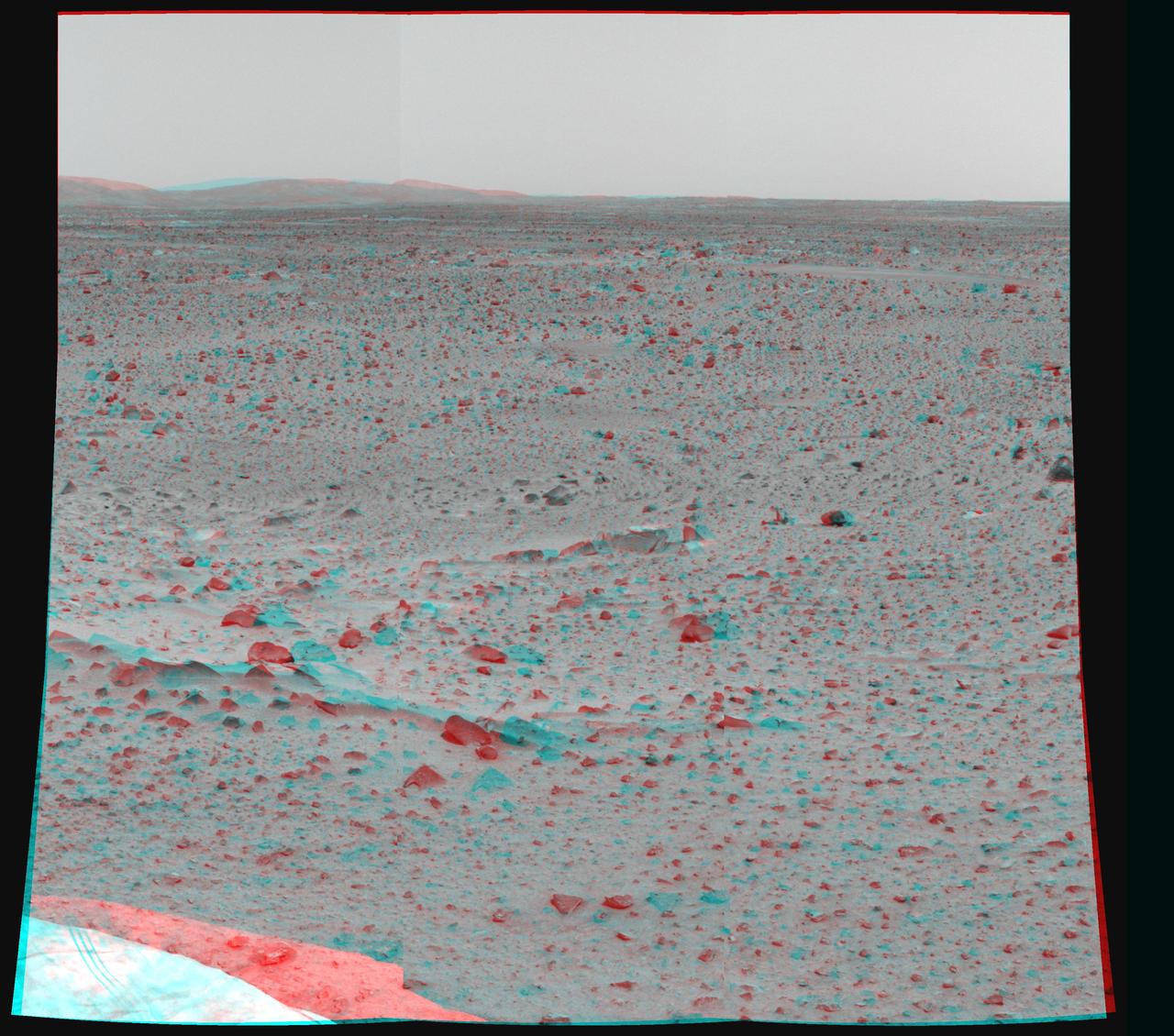
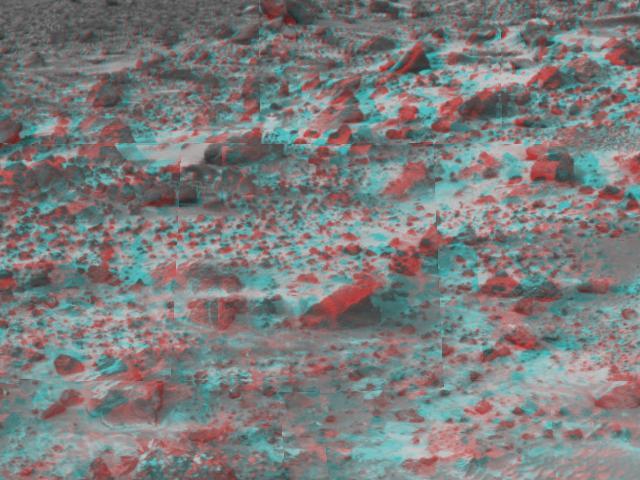
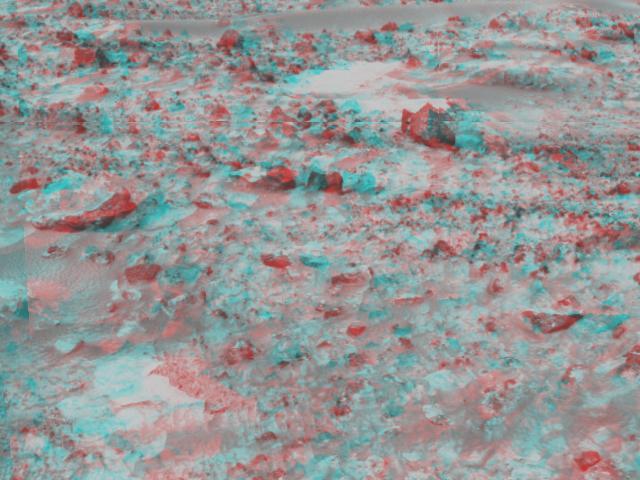
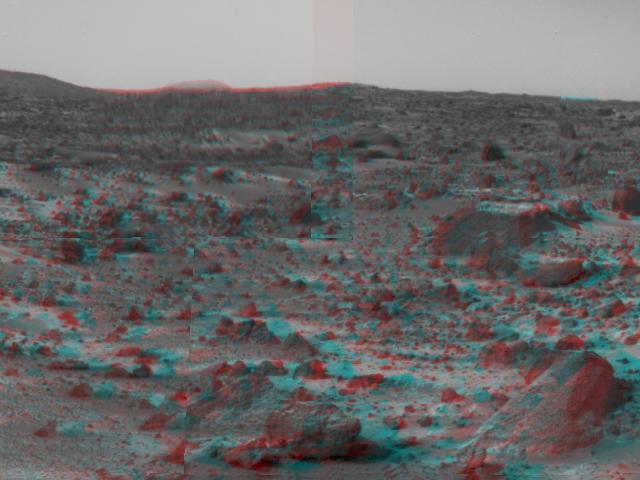
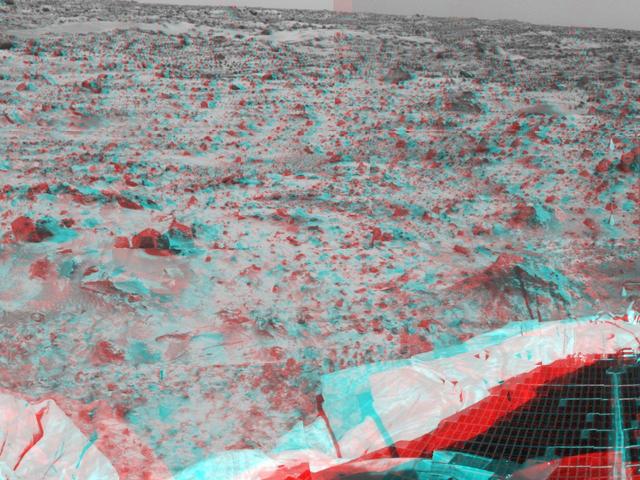
This area of rocky terrain near the Sagan Memorial Station was taken by NASA Mars Pathfinder. 3D glasses are necessary to identify surface detail.
Martian Terrain - 3-D
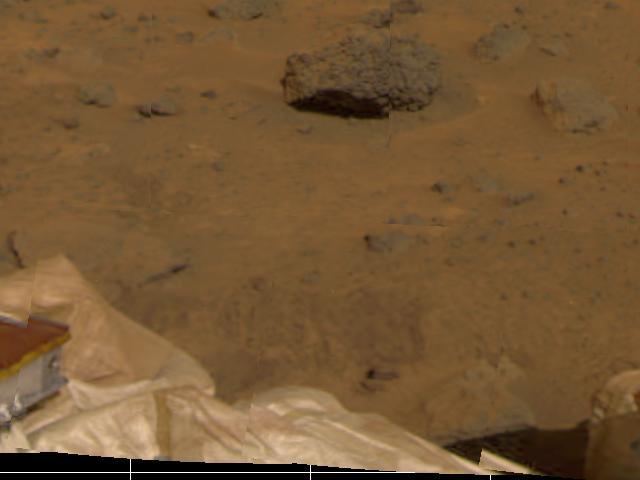
Several objects have been imaged by the Imager for Mars Pathfinder (IMP) during the spacecraft's first day on Mars. Portions of the deflated airbags, part of one the lander's petals, soil, and several rocks are visible. The furrows in the soil were artificially produced by the retraction of the airbags after landing, which occurred at 10:07 a.m. PDT.  http://photojournal.jpl.nasa.gov/catalog/PIA00616
Lander, Airbags, & Martian Terrain
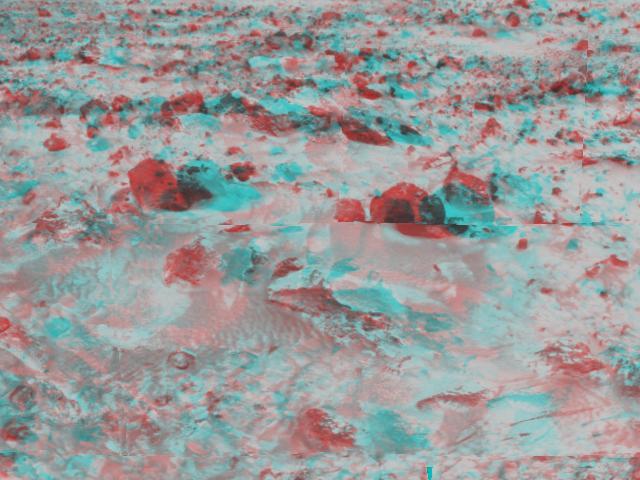
This area of terrain near the Sagan Memorial Station was taken by NASA Mars Pathfinder. 3D glasses are necessary to identify surface detail.
Martian Terrain - 3-D
This area of rocky terrain near the Sagan Memorial Station was taken by NASA Mars Pathfinder. 3D glasses are necessary to identify surface detail.
Martian Terrain - 3-D
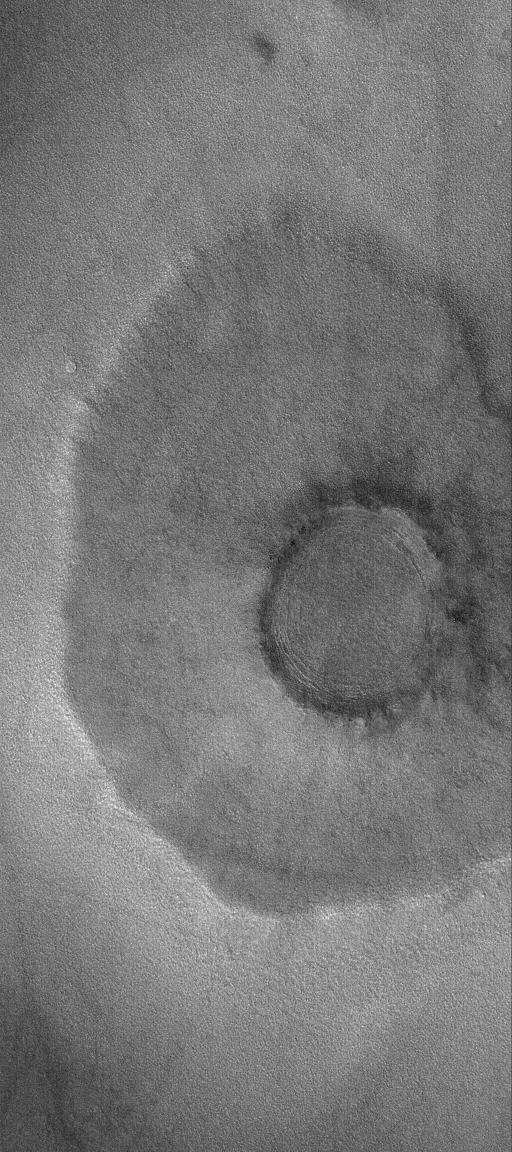
This image from NASA Mars Reconnaissance Orbiter shows one of these icy lobate features wrapping around a small hill. Many lobate features are now known to be almost pure ice, like glaciers on the Earth.
Martian Glaciers and Brain Terrain
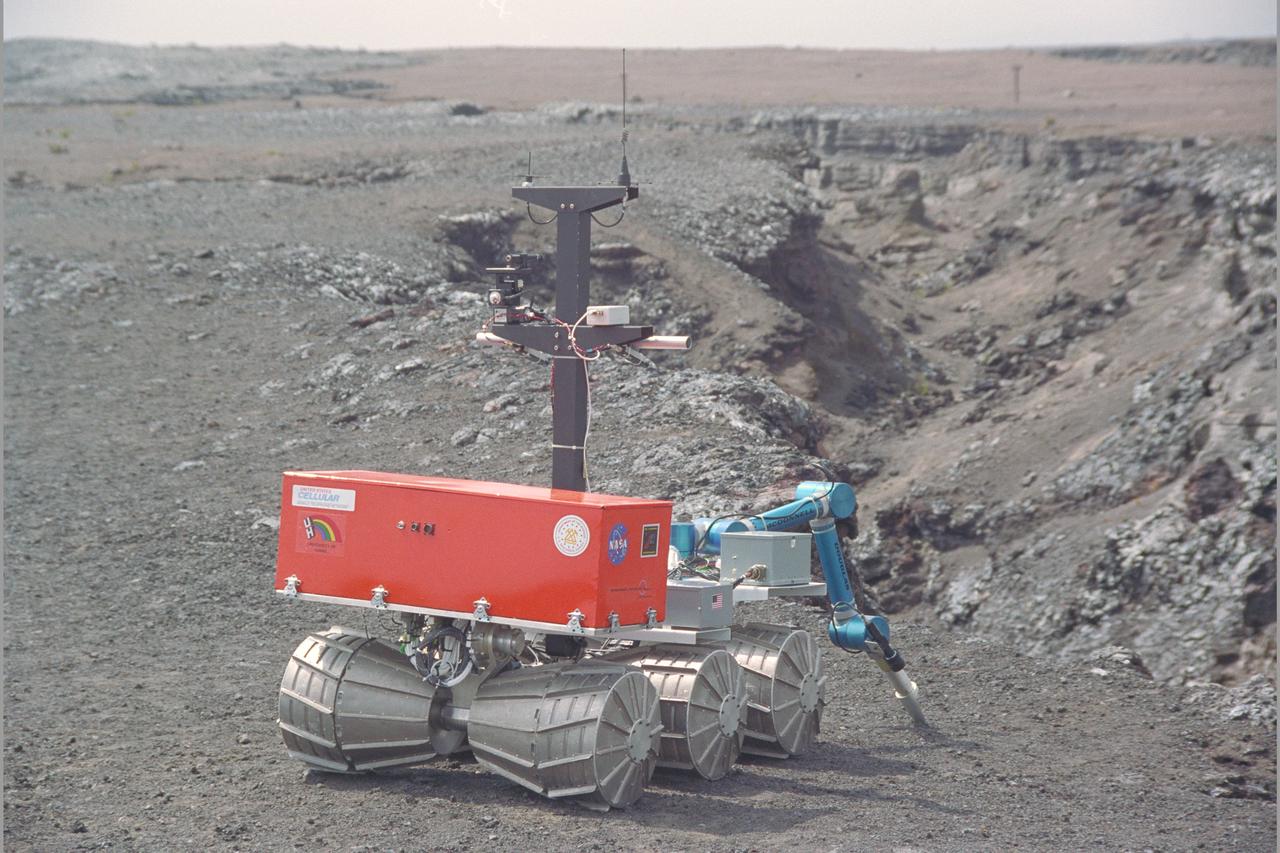
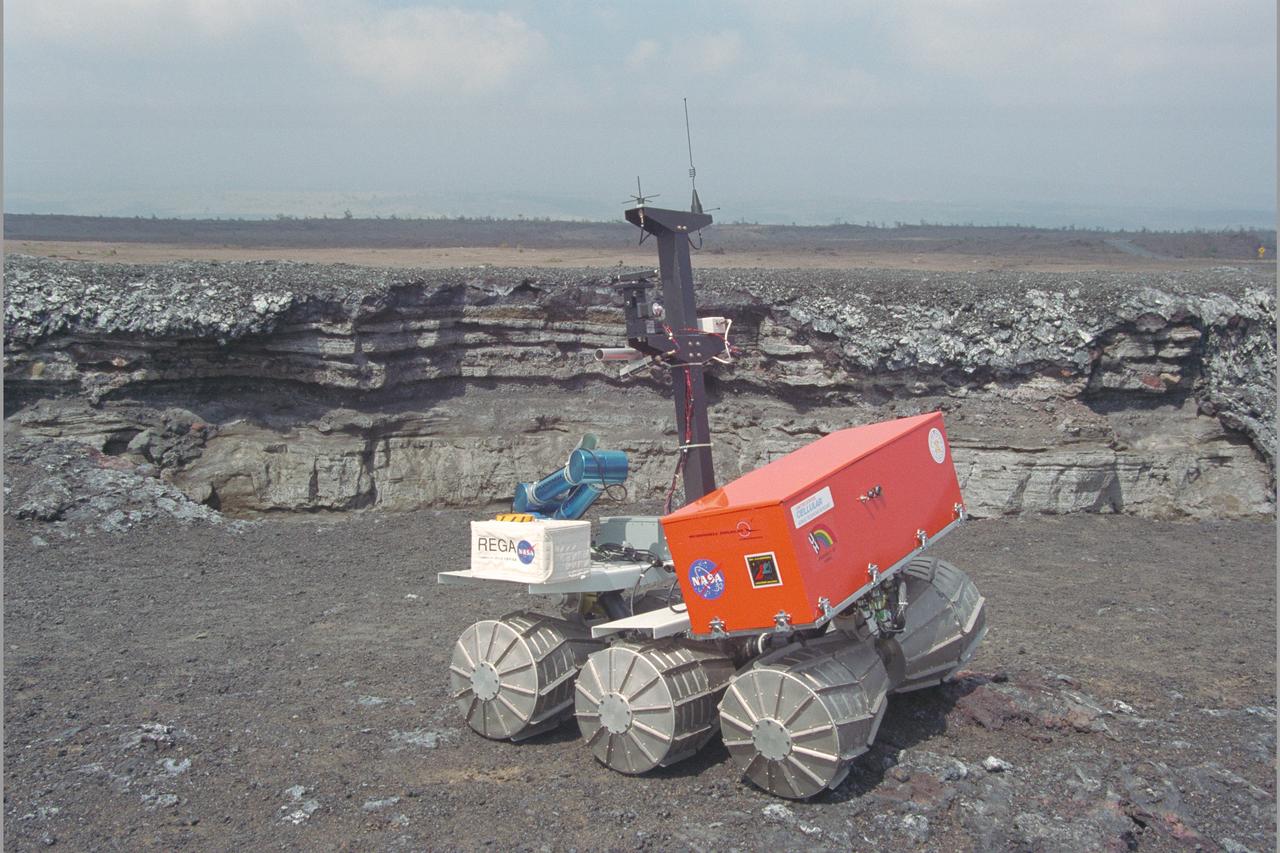
Marsokhod Russian Rover explores Kilauea, Hawaii via telepresence for Jason IV 'Island Earth' Projects (Volcano simulates Martian Terrain)
ARC-1995-AC95-0054-68
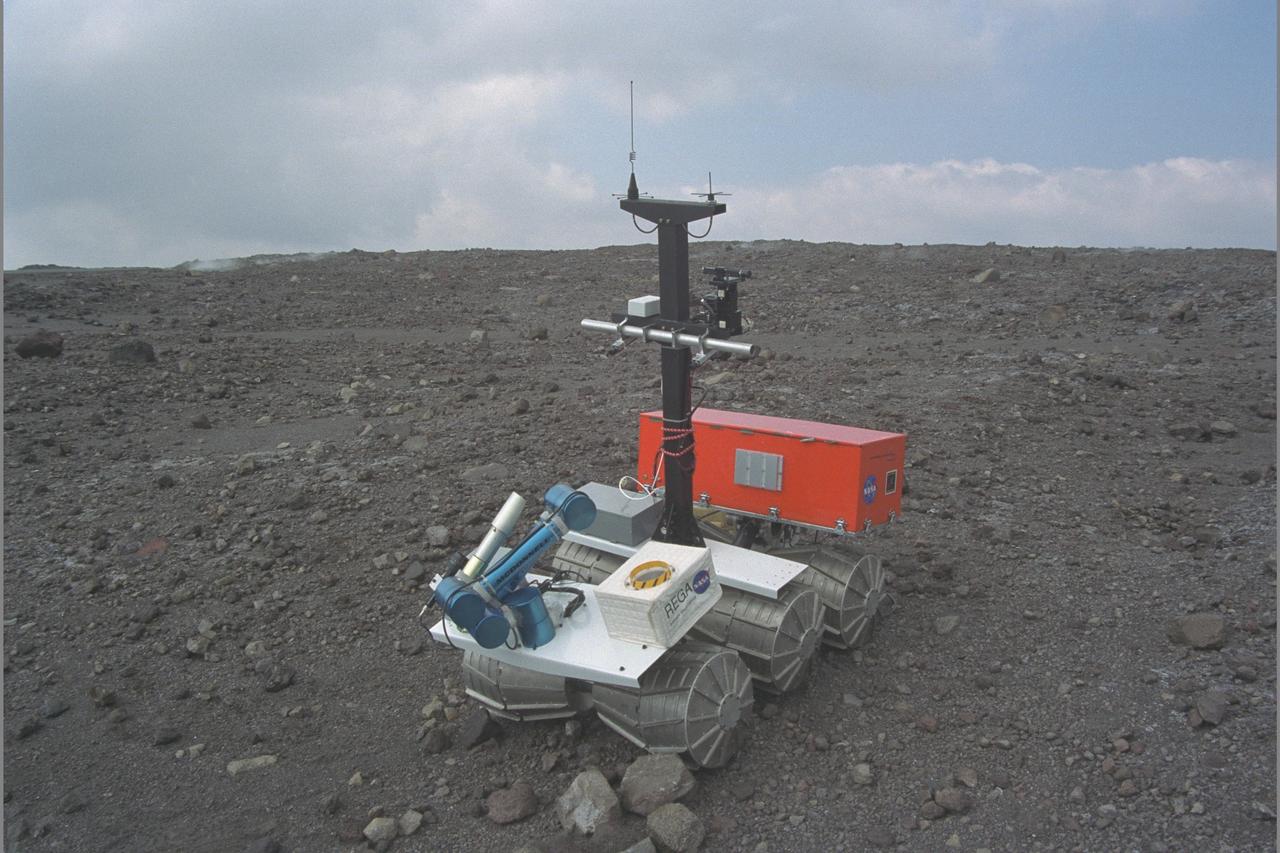
Marsokhod Russian Rover explores Kilauea, Hawaii via telepresence for Jason IV 'Island Earth' Projects (Volcano simulates Martian Terrain)
ARC-1995-AC95-0054-22
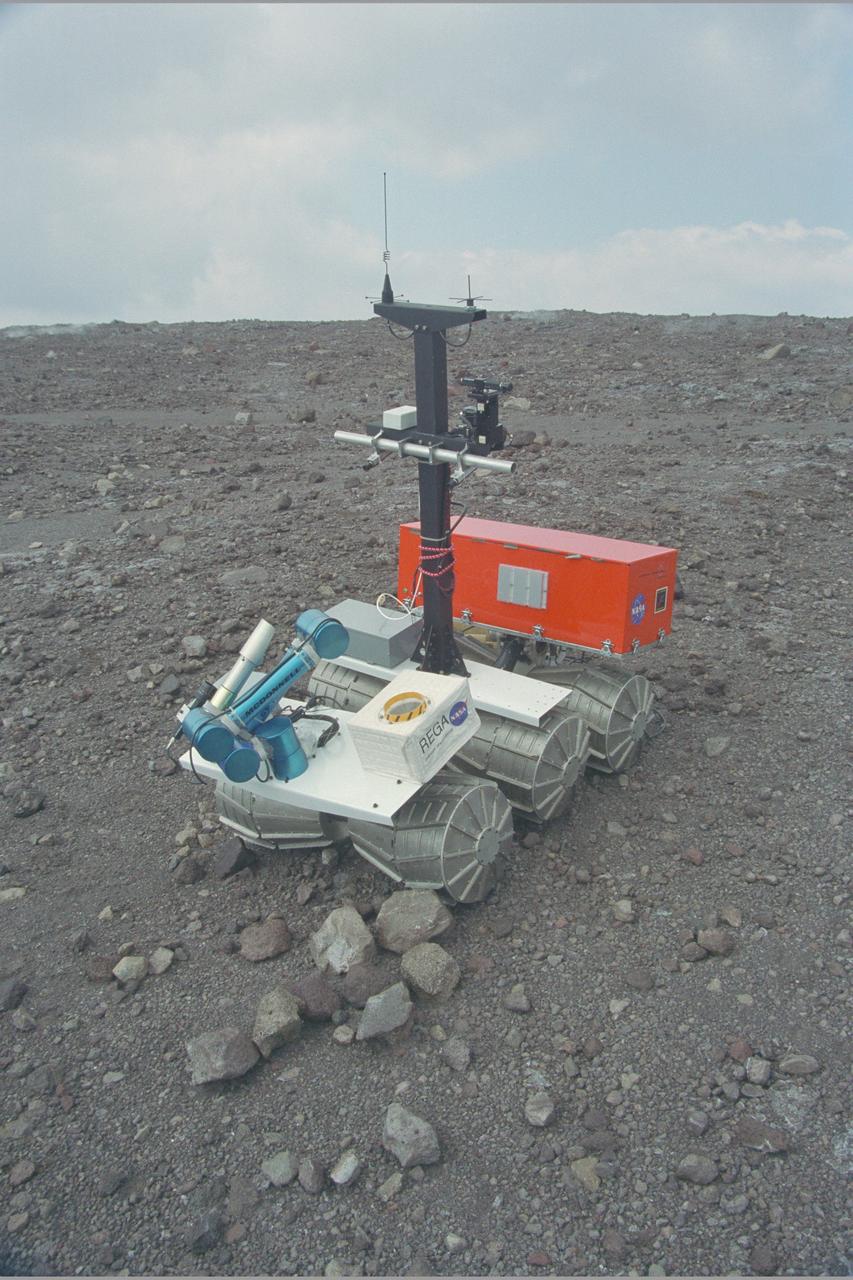
Marsokhod Russian Rover explores Kilauea, Hawaii via telepresence for Jason IV 'Island Earth' Projects (Volcano simulates Martian Terrain)
ARC-1995-AC95-0054-67
Marsokhod Russian Rover explores Kilauea, Hawaii via telepresence for Jason IV 'Island Earth' Projects (Volcano simulates Martian Terrain)
ARC-1995-AC95-0054-7
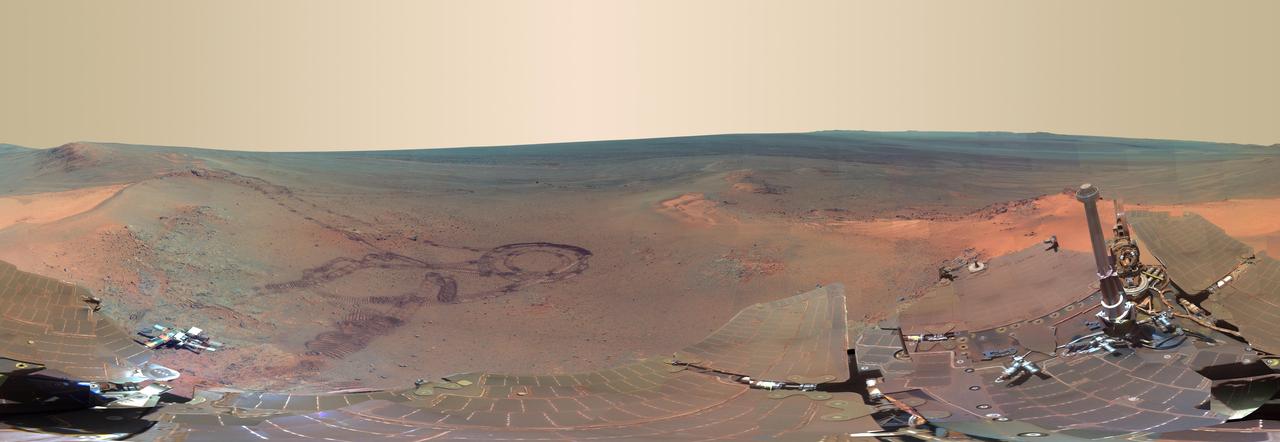
This full-circle scene combines 817 images, taken by the panoramic camera on NASA Mars Exploration Rover Opportunity, showing the terrain that surrounded the rover while it was stationary for four months of work during its most recent Martian winter.
Greeley Panorama from Opportunity Fifth Martian Winter False Color
This 360-degree stereo panorama assembled from images taken by the navigation camera on NASA Mars Exporation Rover Opportunity shows terrain surrounding the position where the rover spent its 3,000th Martian day working on Mars July 2, 2012.
Opportunity Surroundings on 3,000th Sol, in 3-D
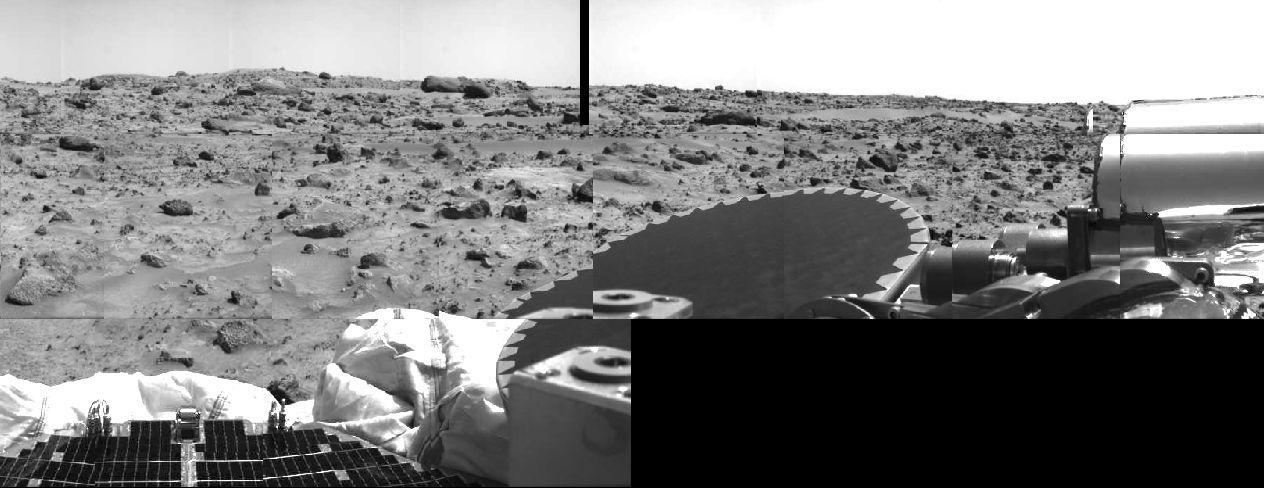
Areas of rocky Martian terrain are seen in this image, taken by the Imager for Mars Pathfinder (IMP) on Sol 2. Portions of a lander petal and deflated airbag are at lower left. The dark disk at center is the high-gain antenna, and the silver cylindrical objects at upper right are part of the antenna's mechanism. An area of relatively smooth terrain is seen at upper right, which may offer clues to how this area was formed, and may be a future target for Sojourner's studies. The black area at lower right and small strip at top center is missing data.  http://photojournal.jpl.nasa.gov/catalog/PIA00625
High-gain Antenna & Terrain
This area of terrain near the Sagan Memorial Station was taken by NASA Mars Pathfinder. The curved rock dubbed Couch. 3D glasses are necessary to identify surface detail.
Couch & Martian Terrain - 3-D
NASA Mars Pathfinder forward rover ramp can be seen successfully unfurled in this image, taken in stereo by the Imager camera. The large rock dubbed Wedge is at lower right. 3-D glasses are necessary to identify surface detail.
Martian Terrain & Wedge in 3-D
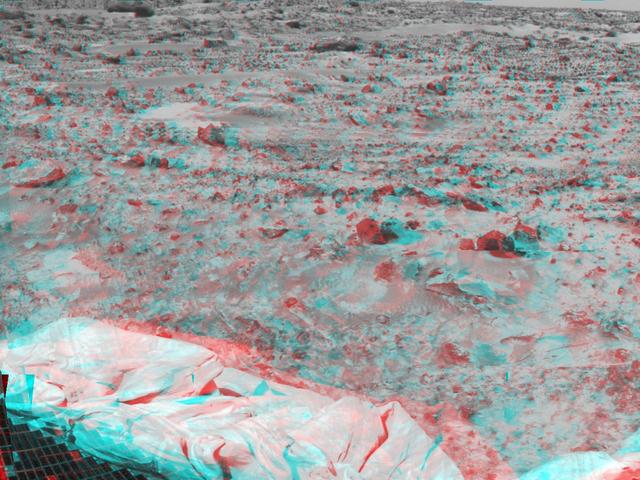
Portions of the lander deflated airbags and a petal are at lower left in this image from NASA Mars Pathfinder. 3D glasses are necessary to identify surface detail.
Martian terrain & airbags - 3-D
NASA Mars Pathfinder forward rover ramp can be seen successfully unfurled in this image, taken in stereo by the Imager camera. The large rock dubbed Wedge is at lower right. 3-D glasses are necessary to identify surface detail.
Martian Terrain & Wedge in 3-D
Portions of the lander deflated airbags and a petal are at lower left in this image from NASA Mars Pathfinder. 3D glasses are necessary to identify surface detail.
Martian Terrain and Airbags - 3-D
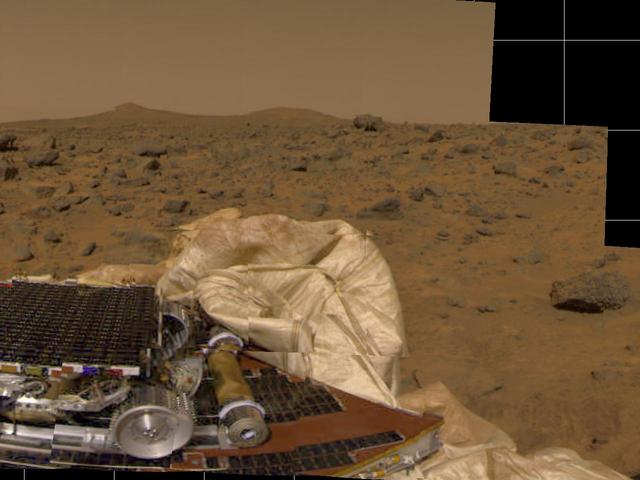
This is one of the first pictures taken by the camera on the Mars Pathfinder lander shortly after its touchdown at 10:07 AM Pacific Daylight Time on July 4, 1997. The small rover, named Sojourner, is seen in the foreground in its position on a solar panel of the lander. The white material on either side of the rover is part of the deflated airbag system used to absorb the shock of the landing. Between the rover and the horizon is the rock-strewn martian surface. Two hills are seen in the right distance, profiled against the light brown sky.  http://photojournal.jpl.nasa.gov/catalog/PIA00611
Pathfinder Rover, Airbags, & Martian Terrain
This image from NASA Mars Reconnaissance Orbiter spacecraft shows the nature of the terrain at the rim of Marth Crater.  In the book "The Martian" by Andy Weir, stranded astronaut Mark Watney is headed for the Ares 4 landing site but encounters the rim of Marth Crater just as a dust storm arrives. This HiRISE image shows the nature of this terrain.  The crater rim is not very distinct and from the ground it would be quite difficult to tell that you are even on the rim of a crater. The terrain is hummocky and rolling, punctuated by smaller impact craters and wind-blown drifts of sand or dust.  http://photojournal.jpl.nasa.gov/catalog/PIA19959
Western Edge of Marth Crater
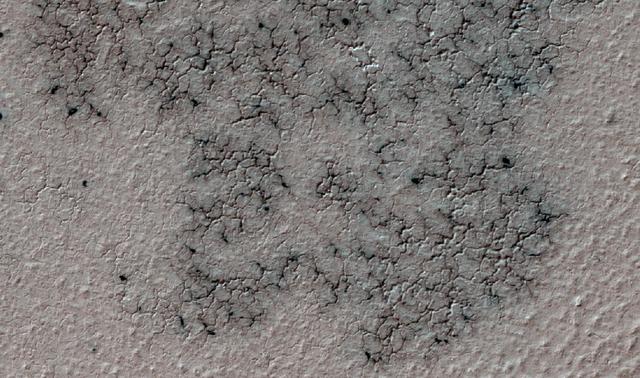
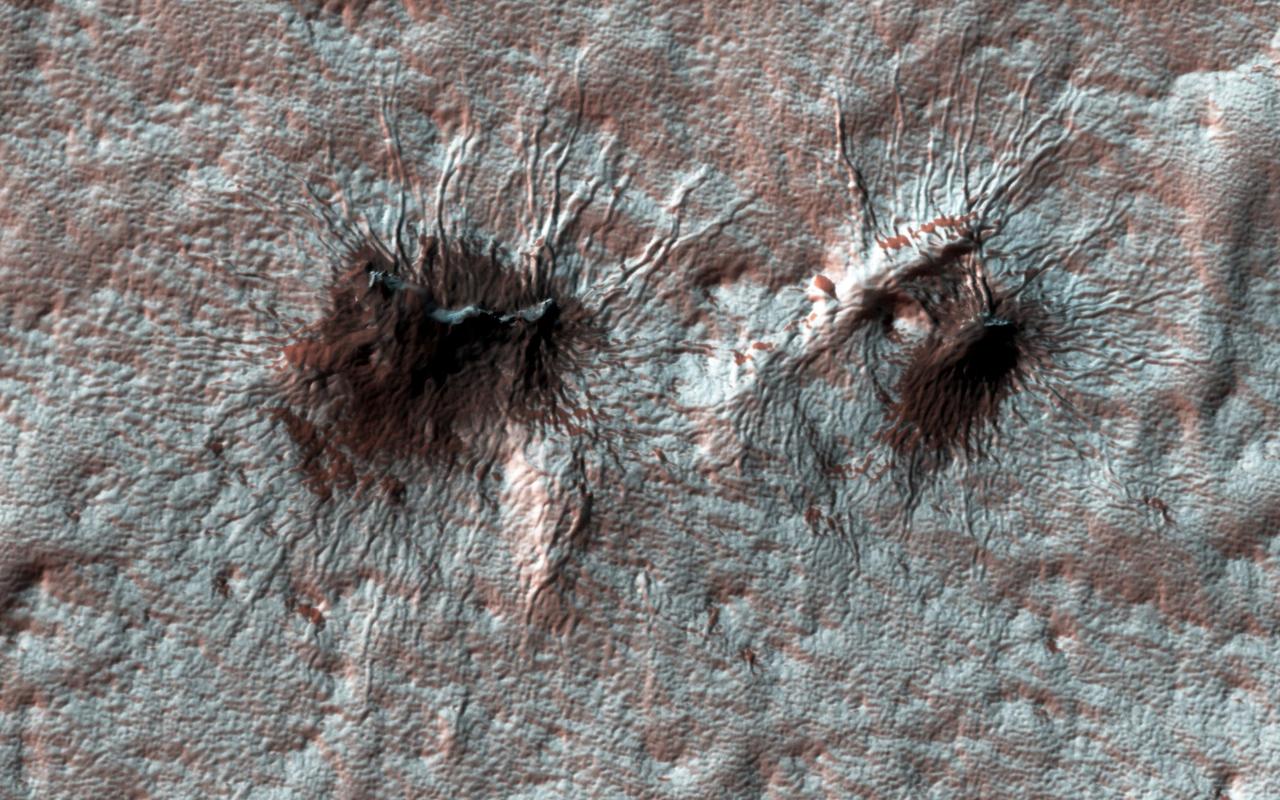
This image shows spidery channels eroded into Martian ground. It is an example from high-resolution observation of more than 20 places that were chosen in 2016 on the basis of about 10,000 volunteers' examination of lower-resolution images of larger areas near Mars' south pole.  These sharper looks use the High Resolution Imaging Science Experiment (HiRISE) camera on NASA's Mars Reconnaissance Orbiter. The volunteers, through the Planet Four: Terrains website, categorize surface features in images from the same orbiter's Context Camera (CTX).  This image is a portion of HiRISE observation ESP_047487_1005, taken on Sept. 12, 2016, of a site at 79.4 degrees south latitude, 18.8 degrees east longitude. The ground area shown is about half a mile (0.8 kilometer) wide.  This terrain type, called spiders or "araneiform" (from the Latin word for spiders), appears in some areas of far-southern Mars that are covered by sheets of frozen carbon dioxide ("dry ice") during the winter. When the slab ice thaws from the underneath side in the spring, carbon dioxide gas trapped beneath the ice builds pressure until it rushes toward a fissure or vent where it bursts out. The venting gas carries dust and sand that it picks up as it carves these channels.  At this location, the spiders are surrounded by ground called "basketball terrain" because of its texture.  http://photojournal.jpl.nasa.gov/catalog/PIA21126
Martian 'Spiders' in Sharper Look, Thanks to Volunteers
This terrain looks like lumpy sediment on top of patterned ground. The lumpy sediment is likely just loosely consolidated because it is covered with spidery channels.  This landform is uniquely Martian, formed in the spring as seasonal dry ice turns directly into gas that erodes channels in the surface.  http://photojournal.jpl.nasa.gov/catalog/PIA14452
Spiders on Mounds
This MOC image shows a pedestal a pancake or pedestal crater on the martian northern plains. The rocky ejecta from the crater protected the underlying material from being stripped away by wind, leaving ejecta standing higher than surrounding terrain
Northern Pancake
NASA Mars Exploration Rover Spirit used its navigation camera to capture this view of the terrain toward the southeast from the location Spirit reached on the 1,871st Martian day, or sol, of the rover mission on Mars April 8, 2009.   The mound on the horizon in the upper left is informally called "Von Braun" and is one of the features that rover team has designated as a possible investigation site in future months. From the location where Spirit was when the image was taken, Von Braun is about 160 meters (525 feet) away.   http://photojournal.jpl.nasa.gov/catalog/PIA11996
Von Braun Mound in Spirit Drive Direction
This view from the Navigation Camera (Navcam) on the mast of NASA's Curiosity Mars rover shows rocky ground within view while the rover was working at an intended drilling site called "Precipice" on lower Mount Sharp.  The right-eye camera of the stereo Navcam took this image on Dec. 2, 2016, during the 1,537th Martian day, or sol, of Curiosity's work on Mars. On the previous sol, an attempt to collect a rock-powder sample with the rover's drill ended before drilling began. This led to several days of diagnostic work while the rover remained in place, during which it continued to use cameras and a spectrometer on its mast, plus environmental monitoring instruments.  In this view, hardware visible at lower right includes the sundial-theme calibration target for Curiosity's Mast Camera.   http://photojournal.jpl.nasa.gov/catalog/PIA21140
Martian Terrain Near Curiosity Precipice Target
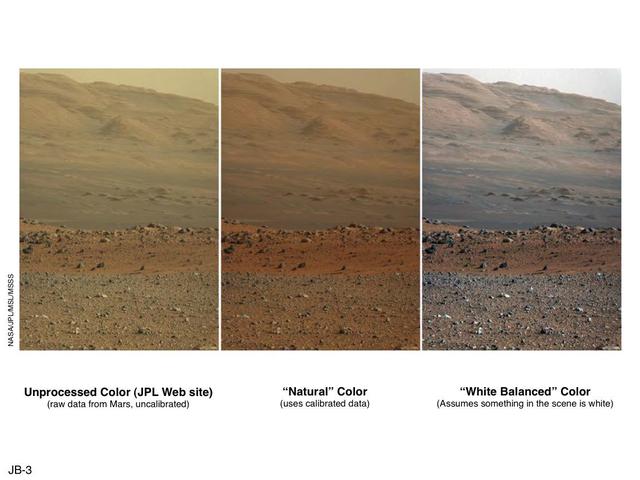
These three versions of the same image taken by the Mast Camera Mastcam on NASA Mars rover Curiosity illustrate different choices that scientists can make in presenting the colors recorded by the camera.
Raw, Natural and White-Balanced Views of Martian Terrain
The Imager for Mars Pathfinder (IMP) took this image of surrounding terrain in the mid-morning on Mars (2:30 PM Pacific Daylight Time) earlier today. Part of the small rover, Sojourner, is visible on the left side of the picture. The tan cylinder to the right of the rover is one of two rolled-up ramps by which the rover will descend to the ground. The white, billowy material in the center of the picture is part of the airbag system. Many rocks of different shapes and sizes are visible between the lander and the horizon. Two hills are visible on the horizon. The notch on the left side of the leftmost conical hill is an artifact of the processing of this picture.  http://photojournal.jpl.nasa.gov/catalog/PIA00613
Martian Terrain, Unfurled Rover Ramps & Deflated Airbags
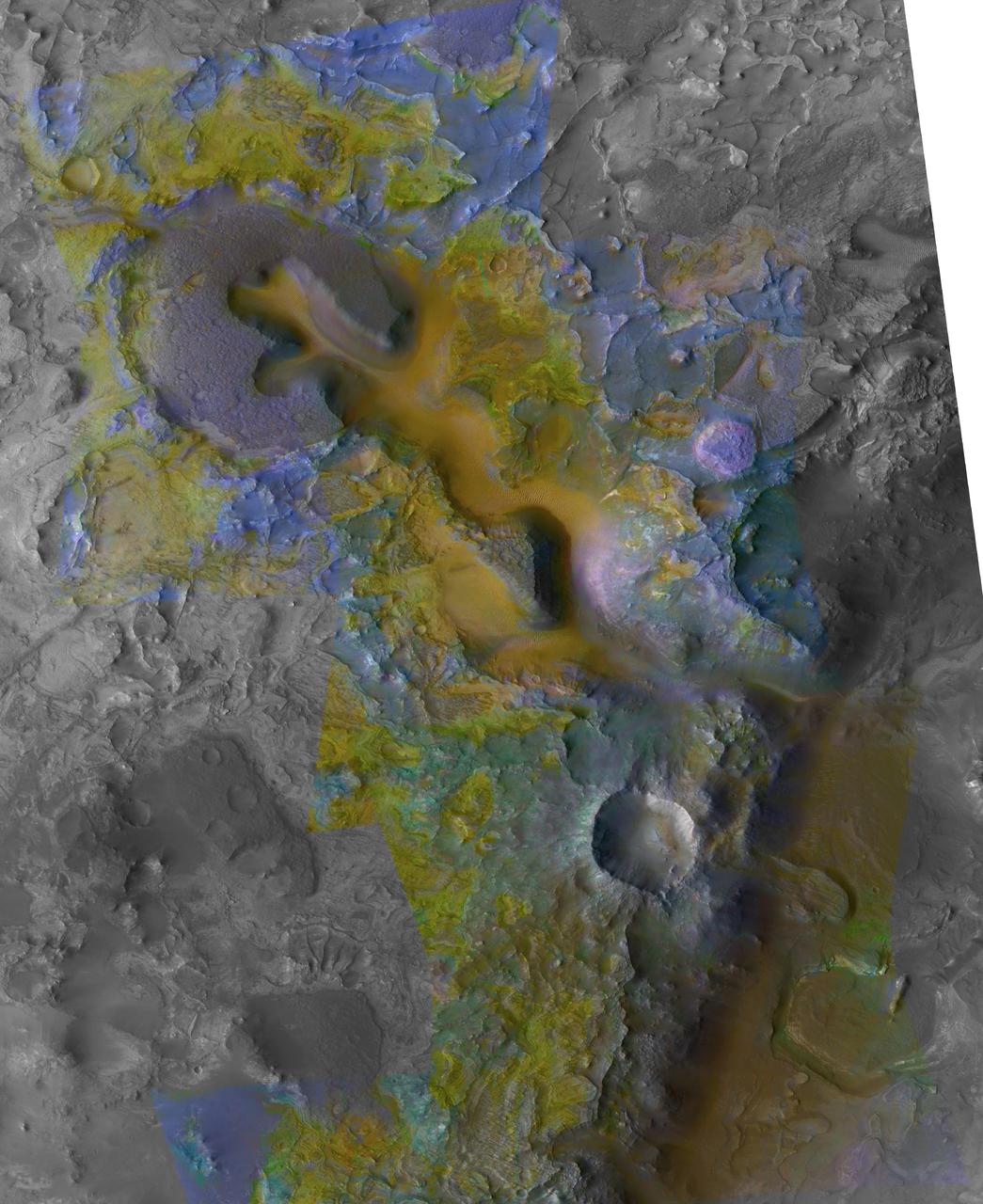
The color coding on this CRISM composite image of an area on Mars is based on infrared spectral information interpreted as evidence of various minerals present. Carbonate, which is indicative of a wet and non-acidic history, occurs in very small patches.
Context of Carbonate Rocks in Heavily Eroded Martian Terrain
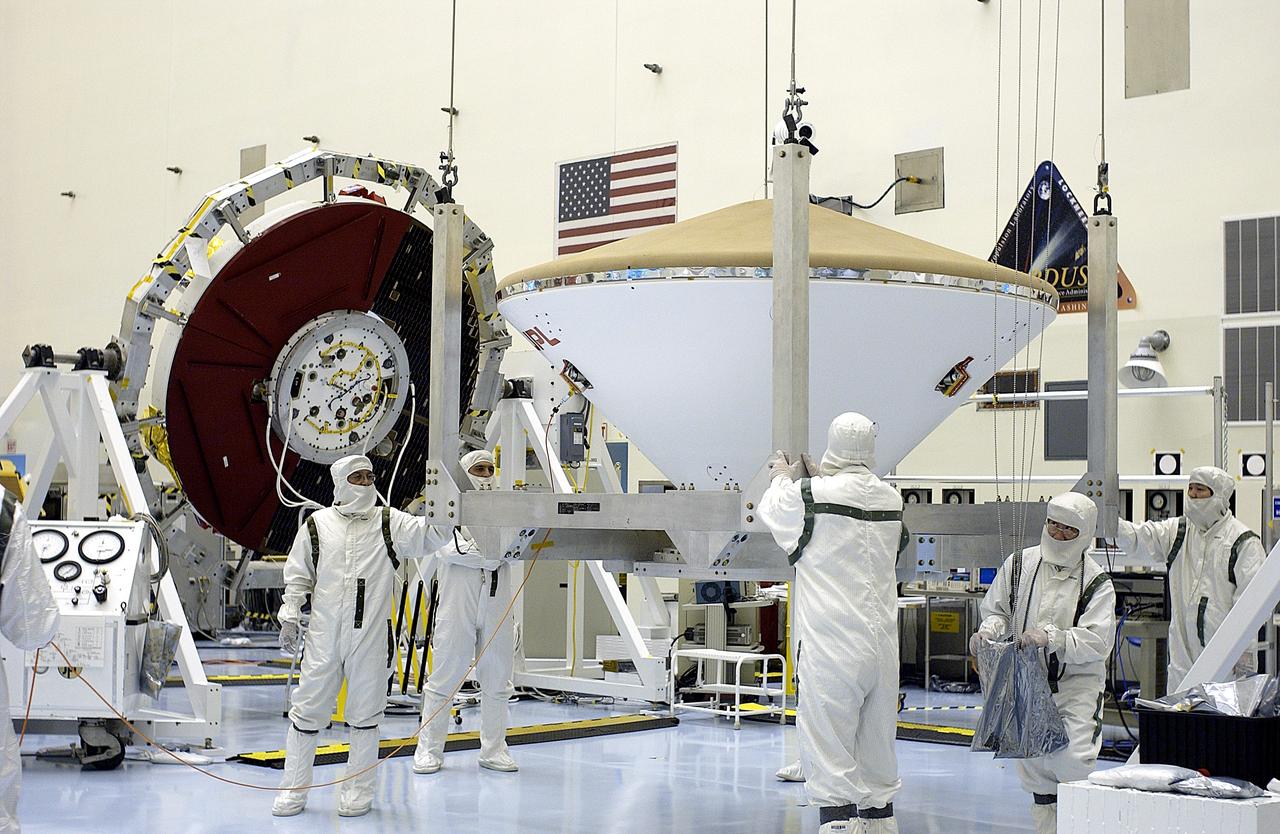
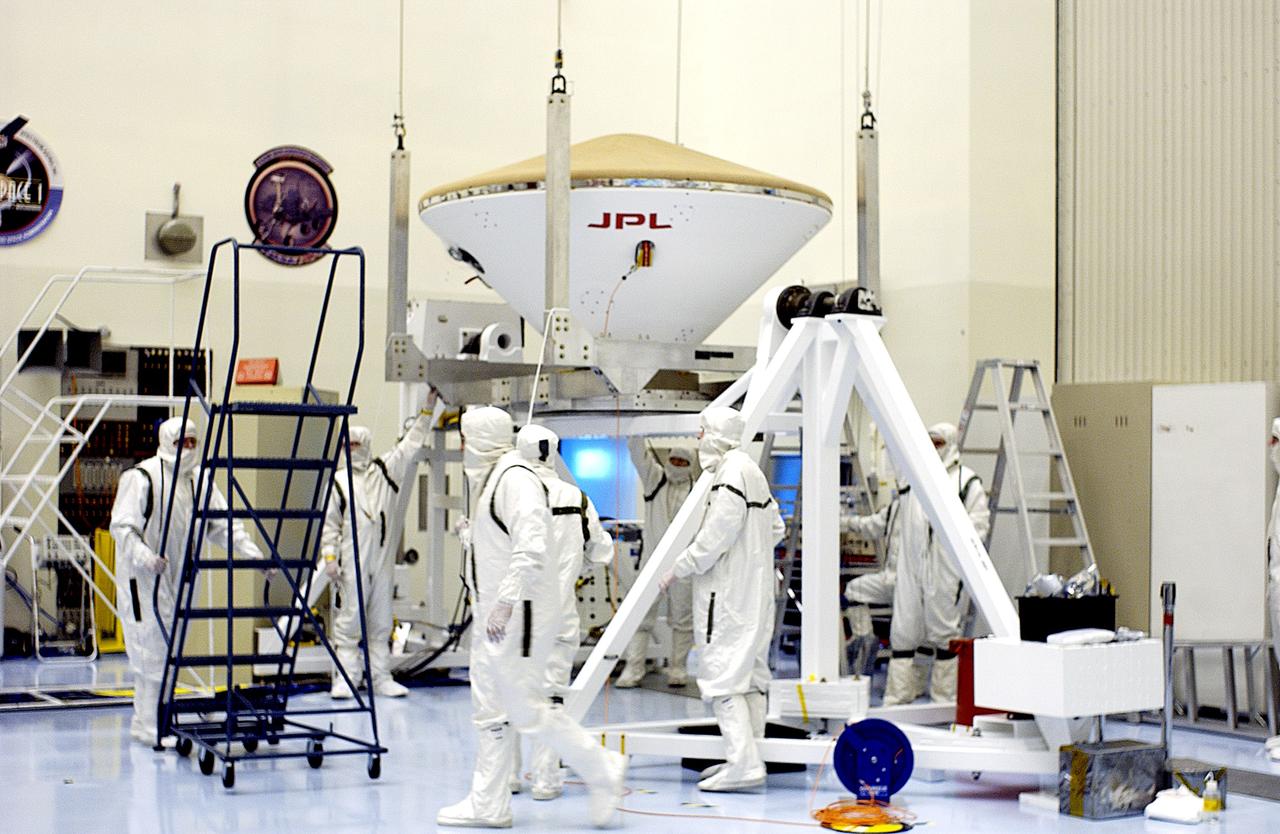
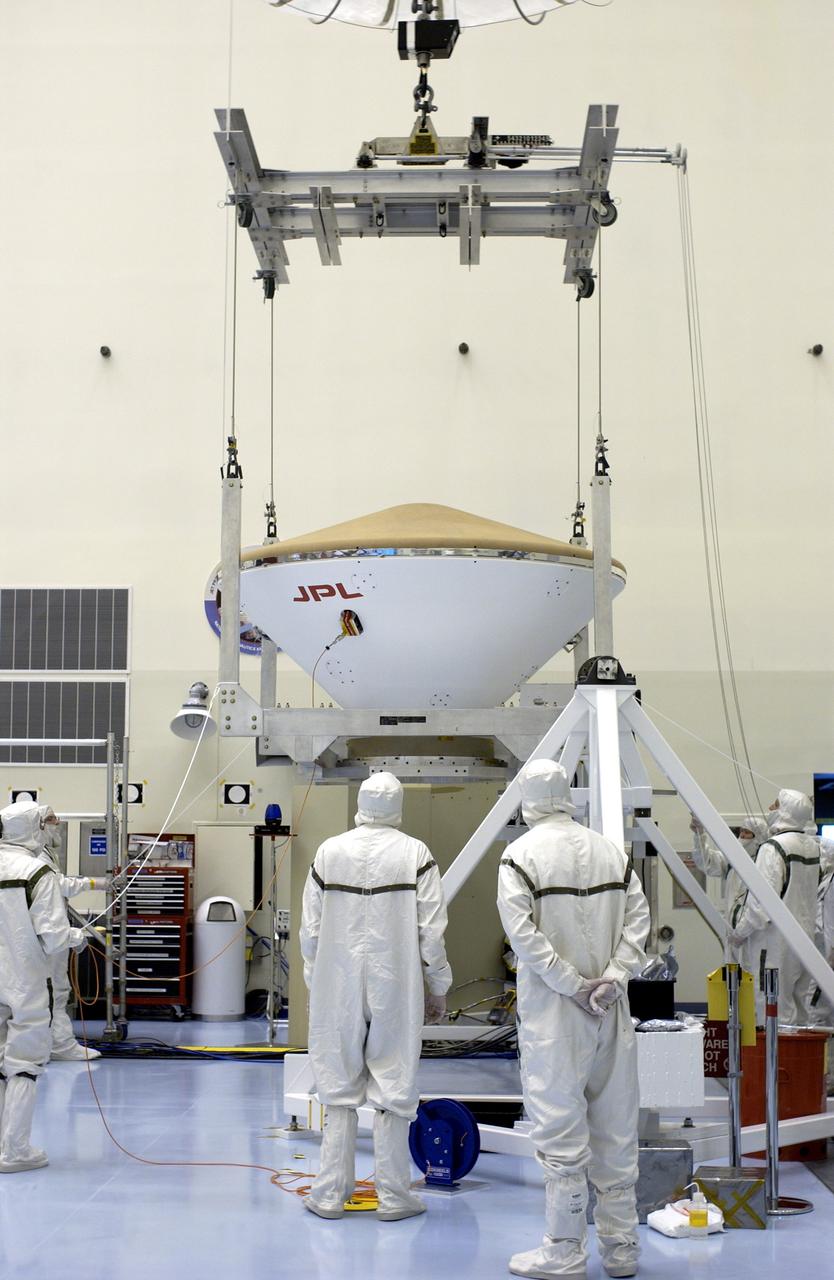
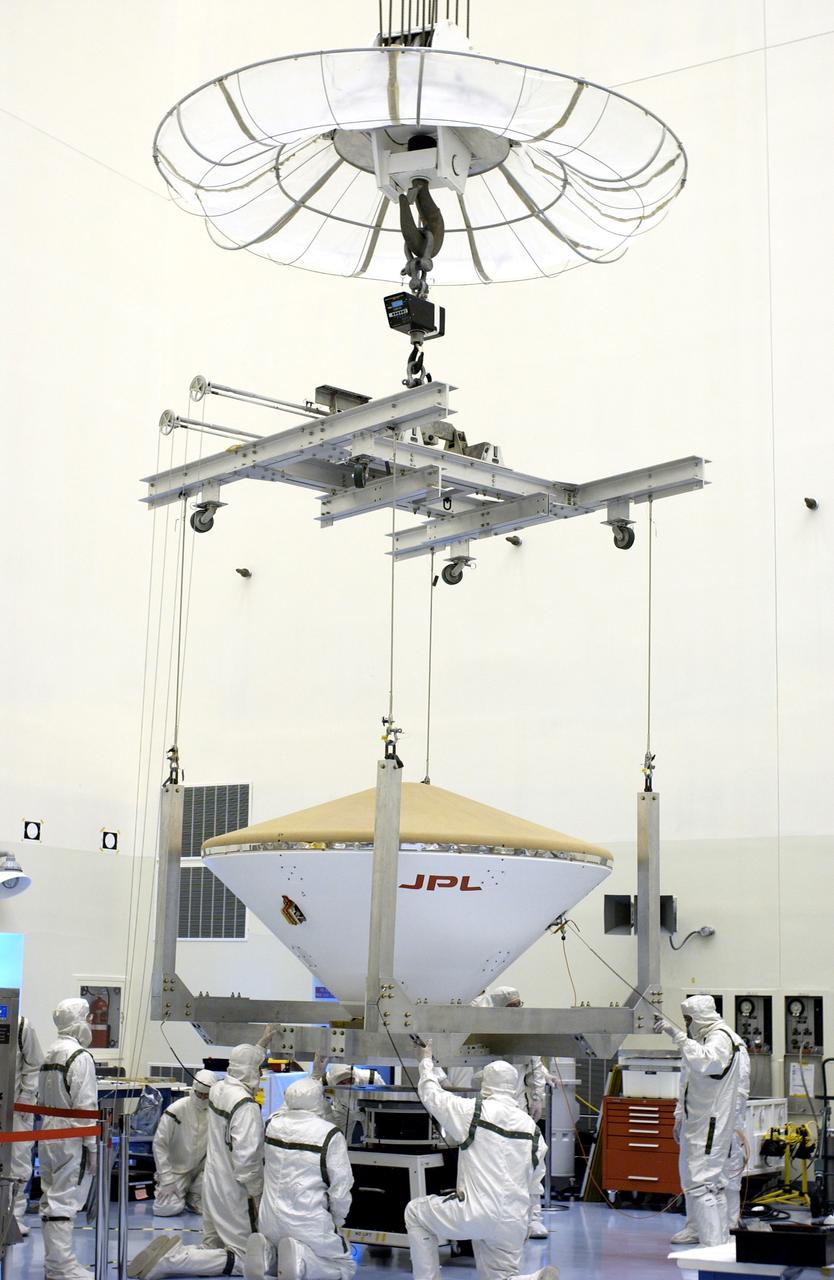
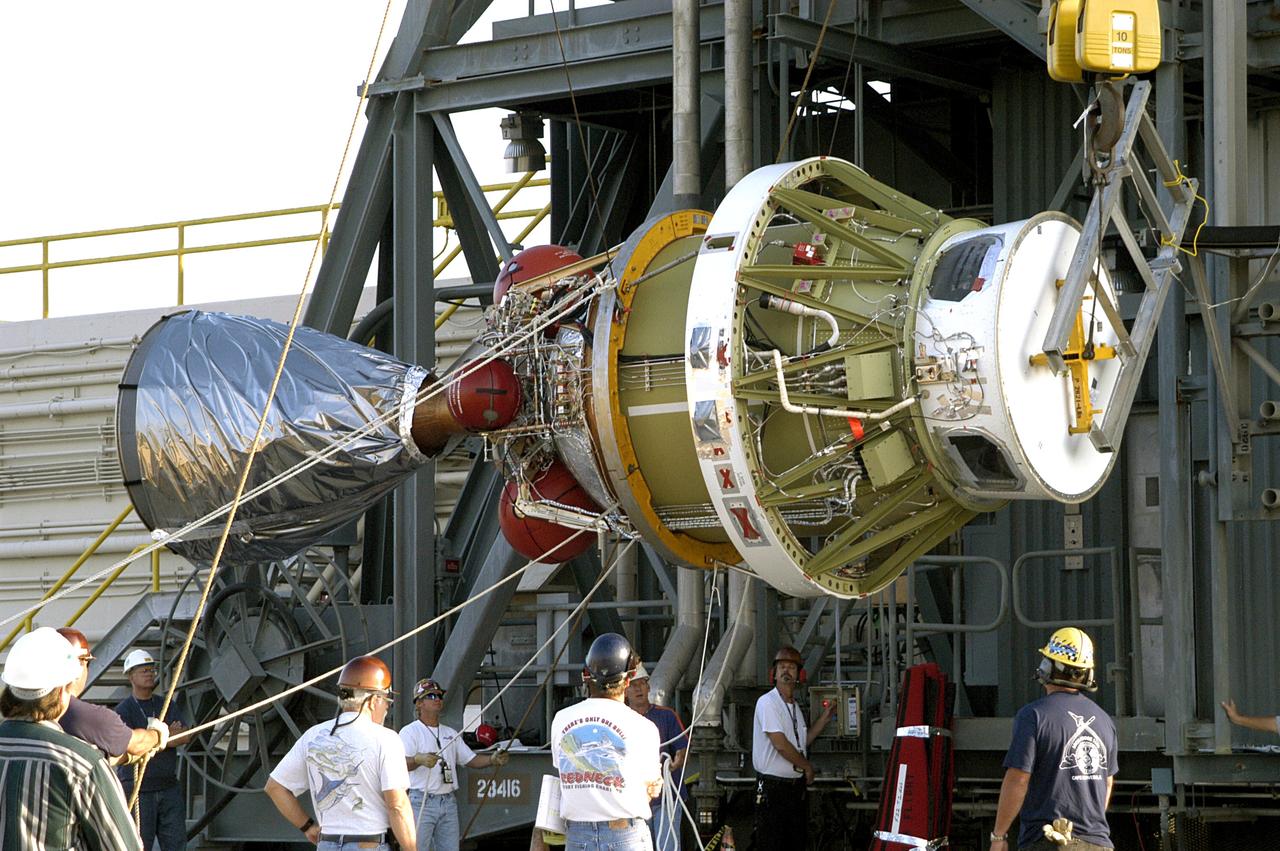
KENNEDY SPACE CENTER, FLA. -  An overhead crane is in place to lift the Mars Exploration Rover 2 (MER-2) entry vehicle to move it to a spin table for a dry-spin test.  The MER Mission consists of two identical rovers designed to cover roughly 110 yards each Martian day over various terrain. Each rover will carry five scientific instruments that will allow it to search for evidence of liquid water that may have been present in the planet's past.  Identical to each other, the rovers will land at different regions of Mars.  Launch for MER-2 (MER-A) is scheduled for June 5.
KENNEDY SPACE CENTER, FLA. - An overhead crane is in place to lift the Mars Exploration Rover 2 (MER-2) entry vehicle to move it to a spin table for a dry-spin test. The MER Mission consists of two identical rovers designed to cover roughly 110 yards each Martian day over various terrain. Each rover will carry five scientific instruments that will allow it to search for evidence of liquid water that may have been present in the planet's past. Identical to each other, the rovers will land at different regions of Mars. Launch for MER-2 (MER-A) is scheduled for June 5.
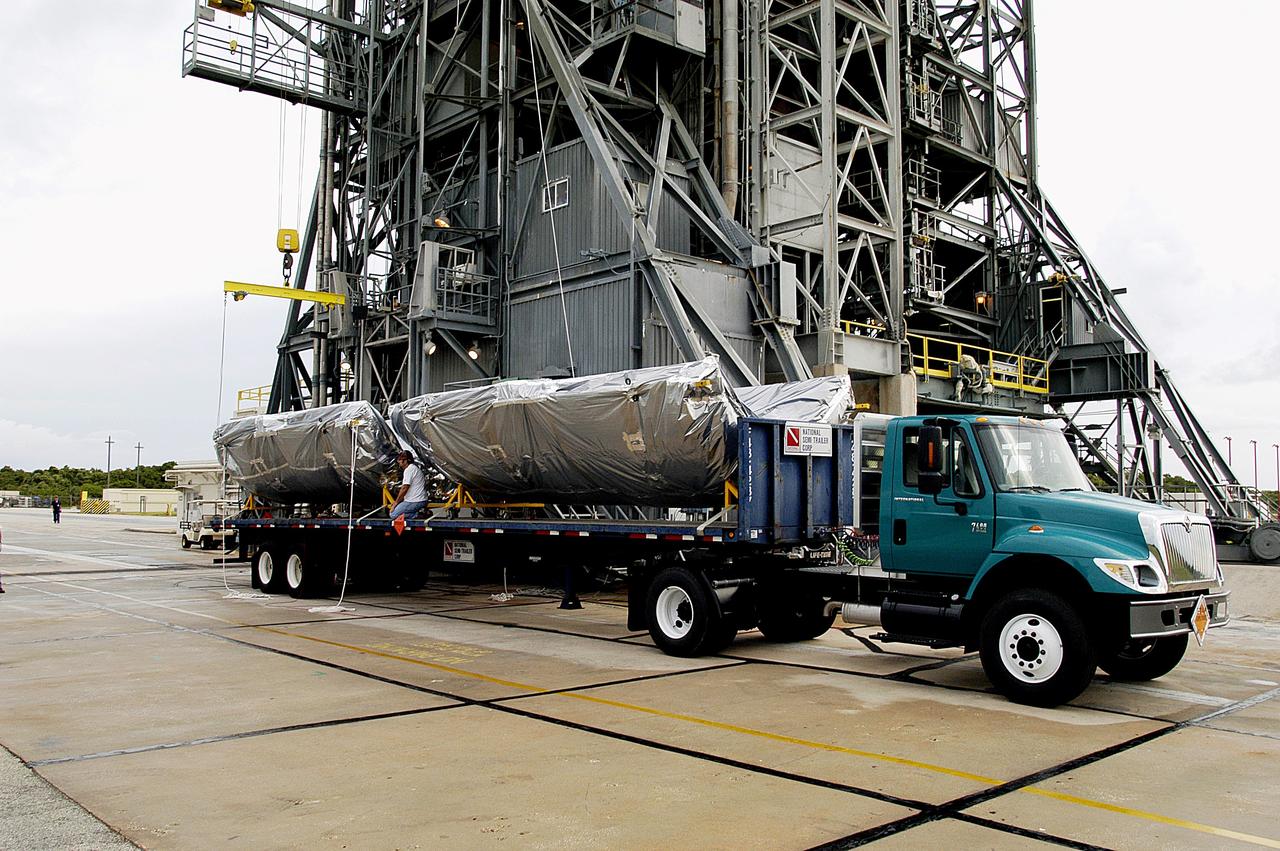
KENNEDY SPACE CENTER, FLA. -  The fairing for the Mars Exploration Rover 2 (MER-2/MER-A) arrives at Launch Complex 17-A, Cape Canaveral Air Force Station.  It will be installed around the payload for protection during launch.  The MER Mission consists of two identical rovers designed to cover roughly 110 yards each Martian day over various terrain. Each rover will carry five scientific instruments that will allow it to search for evidence of liquid water that may have been present in the planet's past.  Identical to each other, the rovers will land at different regions of Mars.  Launch date for MER-A  is scheduled for June 5.
KENNEDY SPACE CENTER, FLA. - The fairing for the Mars Exploration Rover 2 (MER-2/MER-A) arrives at Launch Complex 17-A, Cape Canaveral Air Force Station. It will be installed around the payload for protection during launch. The MER Mission consists of two identical rovers designed to cover roughly 110 yards each Martian day over various terrain. Each rover will carry five scientific instruments that will allow it to search for evidence of liquid water that may have been present in the planet's past. Identical to each other, the rovers will land at different regions of Mars. Launch date for MER-A is scheduled for June 5.
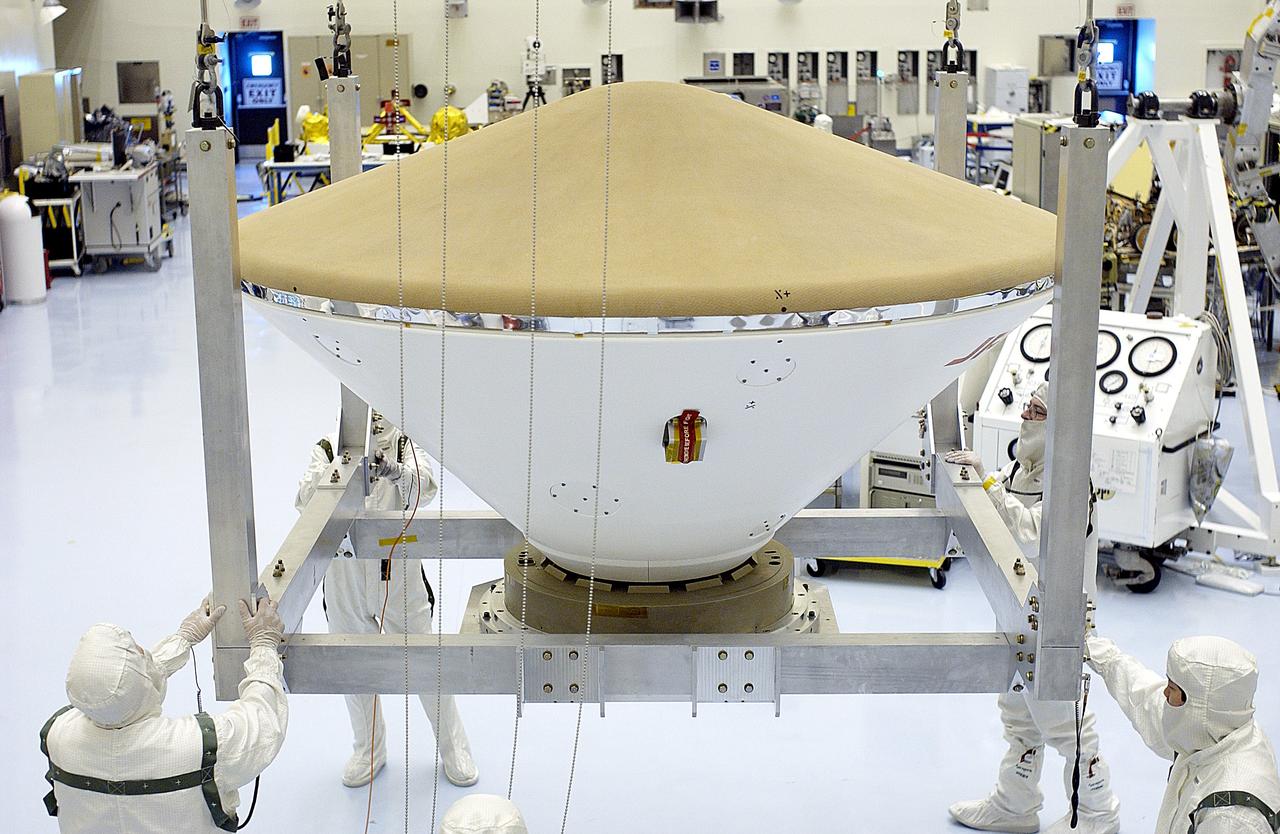
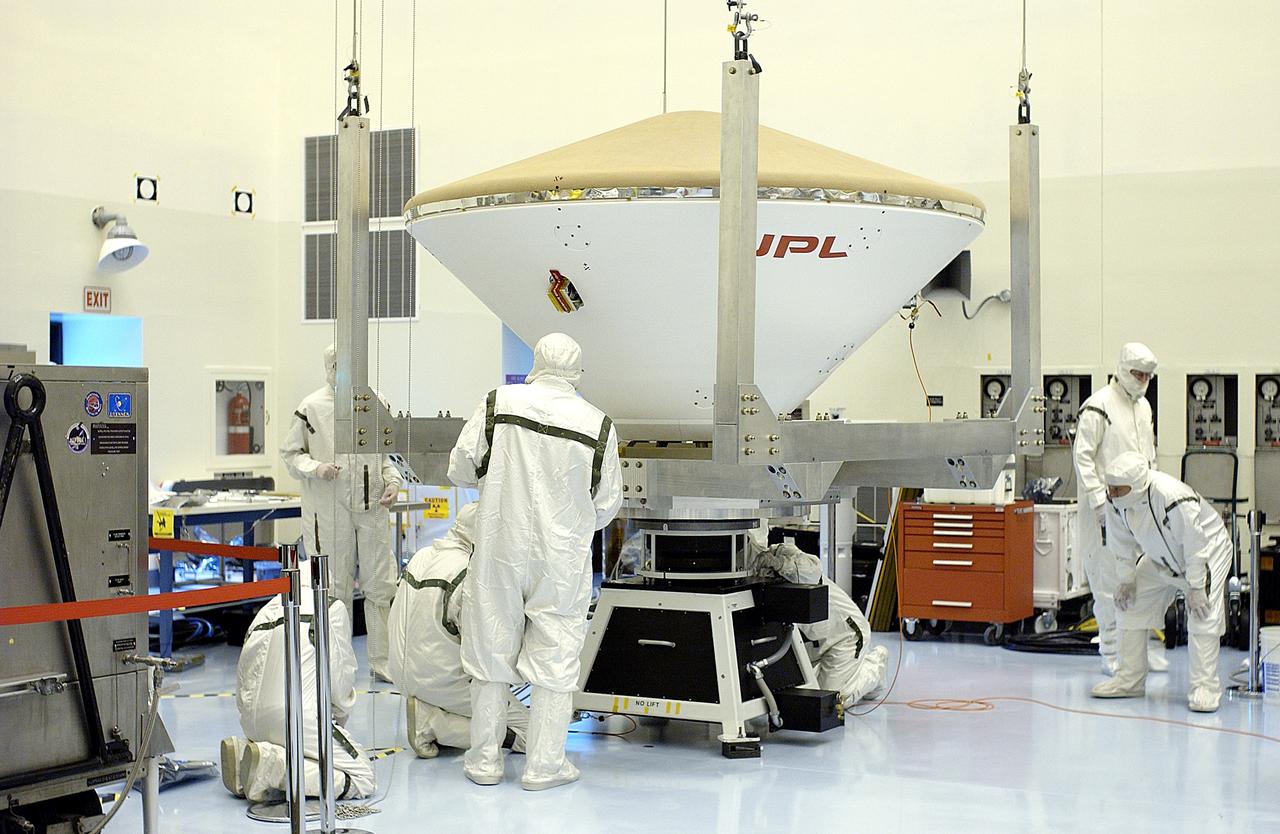
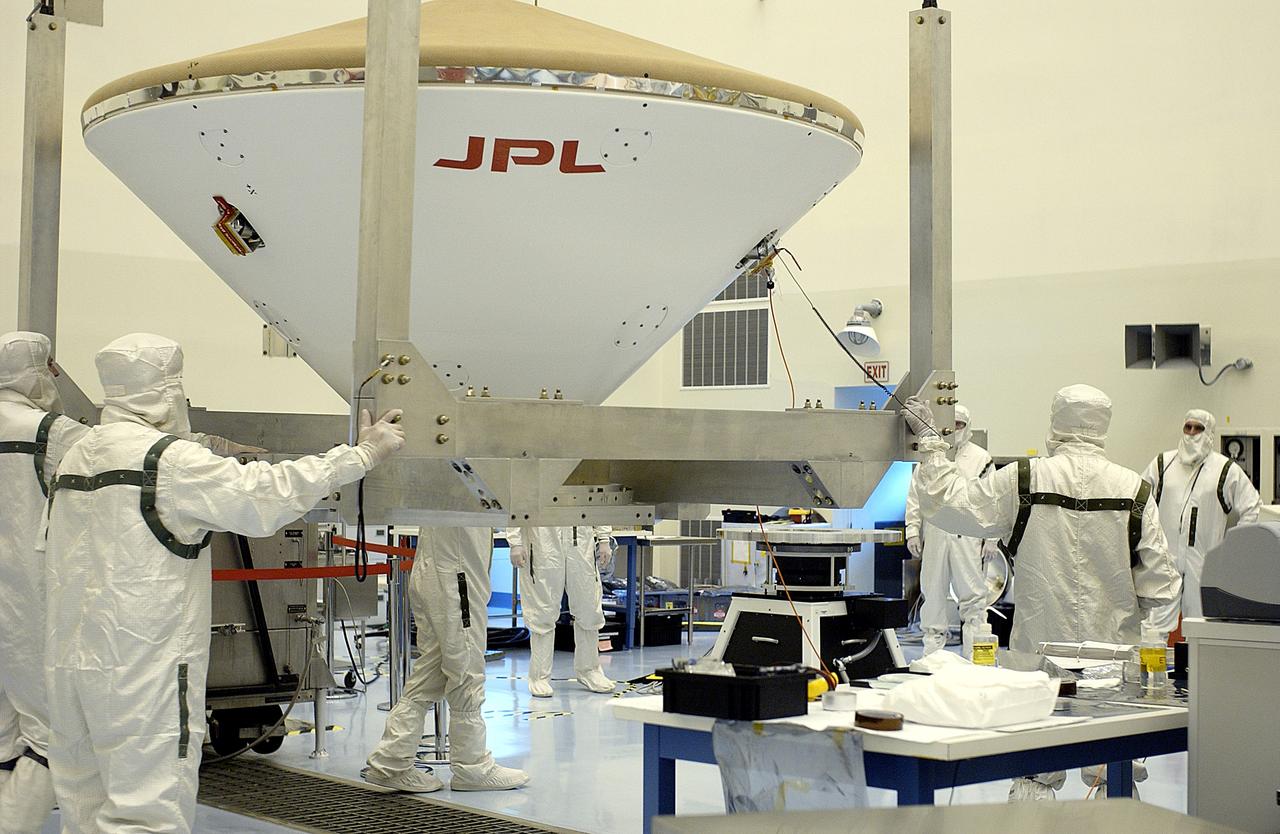
KENNEDY SPACE CENTER, FLA. - The overhead crane settles the Mars Exploration Rover 2 (MER-2) entry vehicle onto a spin table for a dry-spin test.  The MER Mission consists of two identical rovers designed to cover roughly 110 yards each Martian day over various terrain. Each rover will carry five scientific instruments that will allow it to search for evidence of liquid water that may have been present in the planet's past.  Identical to each other, the rovers will land at different regions of Mars.  Launch for MER-2 (MER-A) is scheduled for June 5.
KENNEDY SPACE CENTER, FLA. - The overhead crane settles the Mars Exploration Rover 2 (MER-2) entry vehicle onto a spin table for a dry-spin test. The MER Mission consists of two identical rovers designed to cover roughly 110 yards each Martian day over various terrain. Each rover will carry five scientific instruments that will allow it to search for evidence of liquid water that may have been present in the planet's past. Identical to each other, the rovers will land at different regions of Mars. Launch for MER-2 (MER-A) is scheduled for June 5.
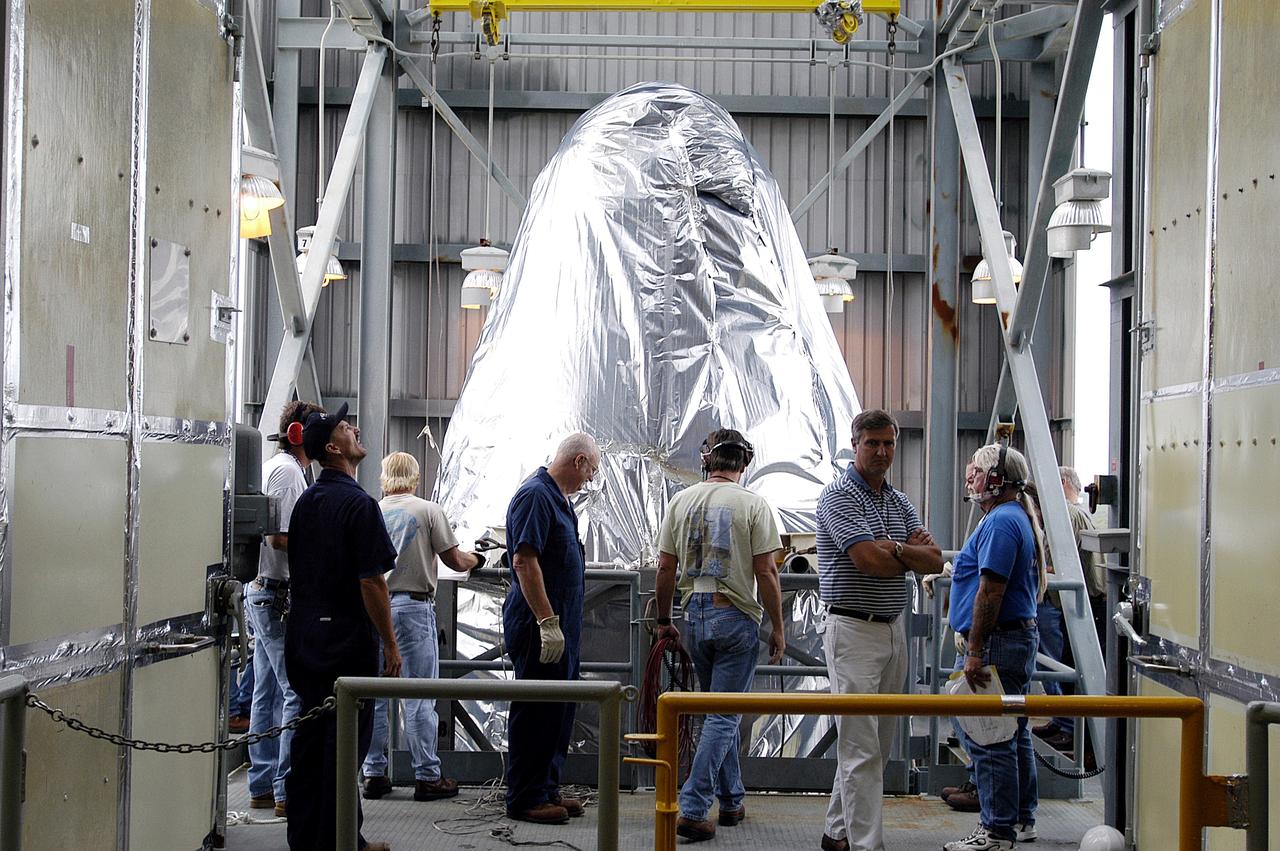
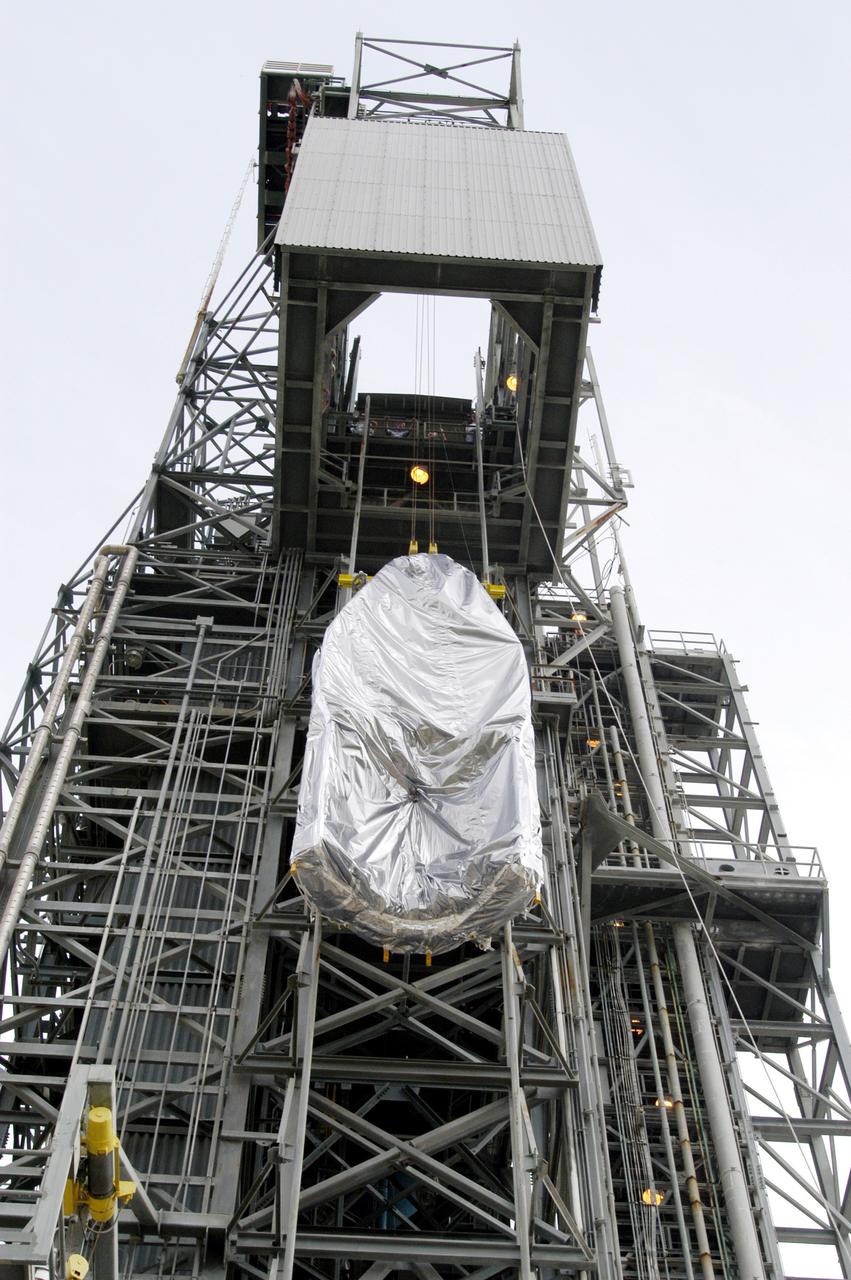
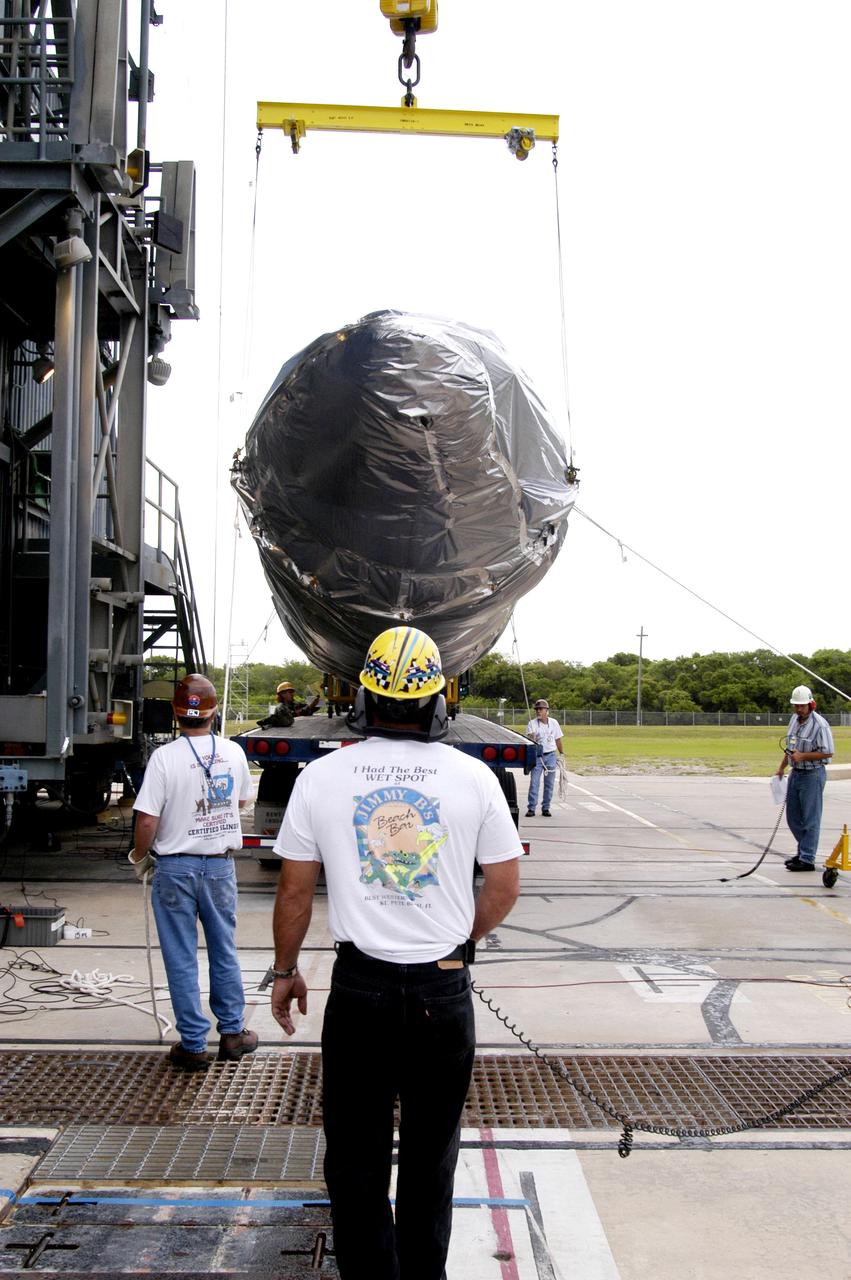
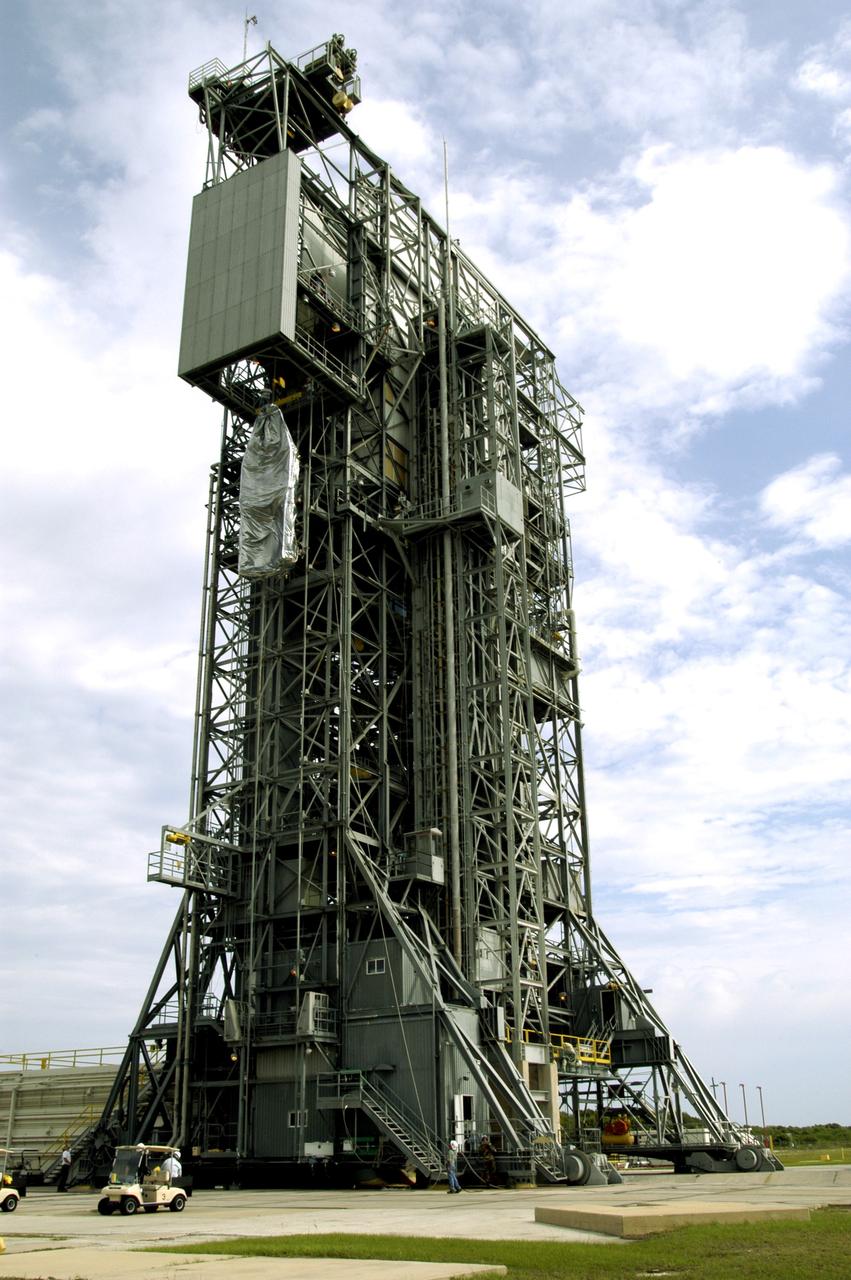
KENNEDY SPACE CENTER, FLA. - At Launch Complex 17-A, Cape Canaveral Air Force Station, the first half of the fairing for the Mars Exploration Rover 2 (MER-2/MER-A) reaches the top of the launch tower.  The fairing will be installed around the payload for protection during launch.  The MER Mission consists of two identical rovers designed to cover roughly 110 yards each Martian day over various terrain. Each rover will carry five scientific instruments that will allow it to search for evidence of liquid water that may have been present in the planet's past.  Identical to each other, the rovers will land at different regions of Mars.  Launch date for MER-A  is scheduled for June 5.
KENNEDY SPACE CENTER, FLA. - At Launch Complex 17-A, Cape Canaveral Air Force Station, the first half of the fairing for the Mars Exploration Rover 2 (MER-2/MER-A) reaches the top of the launch tower. The fairing will be installed around the payload for protection during launch. The MER Mission consists of two identical rovers designed to cover roughly 110 yards each Martian day over various terrain. Each rover will carry five scientific instruments that will allow it to search for evidence of liquid water that may have been present in the planet's past. Identical to each other, the rovers will land at different regions of Mars. Launch date for MER-A is scheduled for June 5.
KENNEDY SPACE CENTER, FLA. - At Launch Complex 17-A, Cape Canaveral Air Force Station, a crane is in place to lift the fairing for the Mars Exploration Rover 2 (MER-2/MER-A).  The fairing will be installed around the payload for protection during launch.  The MER Mission consists of two identical rovers designed to cover roughly 110 yards each Martian day over various terrain. Each rover will carry five scientific instruments that will allow it to search for evidence of liquid water that may have been present in the planet's past.  Identical to each other, the rovers will land at different regions of Mars.  Launch date for MER-A  is scheduled for June 5.
KENNEDY SPACE CENTER, FLA. - At Launch Complex 17-A, Cape Canaveral Air Force Station, a crane is in place to lift the fairing for the Mars Exploration Rover 2 (MER-2/MER-A). The fairing will be installed around the payload for protection during launch. The MER Mission consists of two identical rovers designed to cover roughly 110 yards each Martian day over various terrain. Each rover will carry five scientific instruments that will allow it to search for evidence of liquid water that may have been present in the planet's past. Identical to each other, the rovers will land at different regions of Mars. Launch date for MER-A is scheduled for June 5.
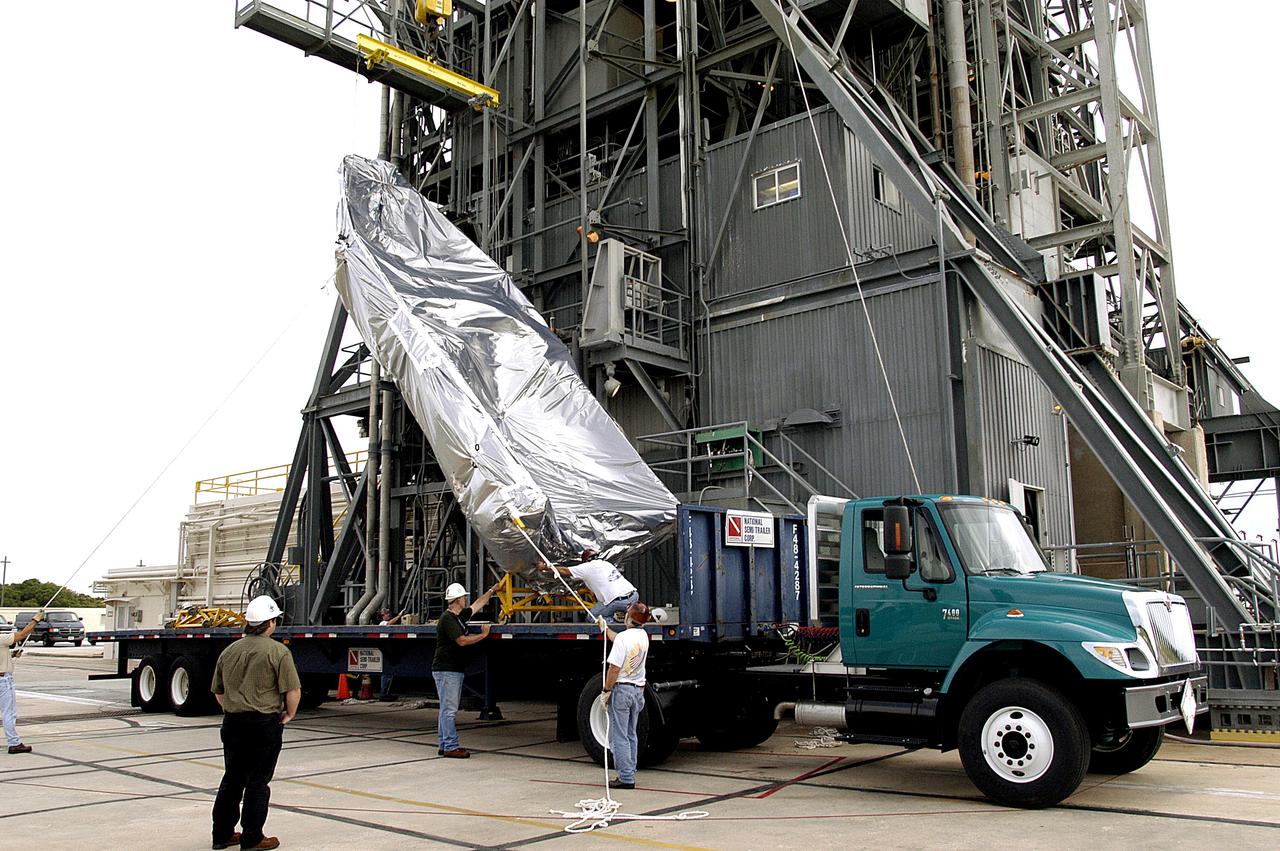
KENNEDY SPACE CENTER, FLA. - At Launch Complex 17-A, Cape Canaveral Air Force Station, the first half of the fairing for the Mars Exploration Rover 2 (MER-2/MER-A) is lifted off the transporter.  The fairing will be installed around the payload for protection during launch.  The MER Mission consists of two identical rovers designed to cover roughly 110 yards each Martian day over various terrain. Each rover will carry five scientific instruments that will allow it to search for evidence of liquid water that may have been present in the planet's past.  Identical to each other, the rovers will land at different regions of Mars.  Launch date for MER-A  is scheduled for June 5.
KENNEDY SPACE CENTER, FLA. - At Launch Complex 17-A, Cape Canaveral Air Force Station, the first half of the fairing for the Mars Exploration Rover 2 (MER-2/MER-A) is lifted off the transporter. The fairing will be installed around the payload for protection during launch. The MER Mission consists of two identical rovers designed to cover roughly 110 yards each Martian day over various terrain. Each rover will carry five scientific instruments that will allow it to search for evidence of liquid water that may have been present in the planet's past. Identical to each other, the rovers will land at different regions of Mars. Launch date for MER-A is scheduled for June 5.
KENNEDY SPACE CENTER, FLA. - An overhead crane moves the Mars Exploration Rover 2 (MER-2) entry vehicle across the Payload Hazardous Servicing Facility toward a spin table for a dry-spin test.  The MER Mission consists of two identical rovers designed to cover roughly 110 yards each Martian day over various terrain. Each rover will carry five scientific instruments that will allow it to search for evidence of liquid water that may have been present in the planet's past.  Identical to each other, the rovers will land at different regions of Mars.  Launch for MER-2 (MER-A) is scheduled for June 5.
KENNEDY SPACE CENTER, FLA. - An overhead crane moves the Mars Exploration Rover 2 (MER-2) entry vehicle across the Payload Hazardous Servicing Facility toward a spin table for a dry-spin test. The MER Mission consists of two identical rovers designed to cover roughly 110 yards each Martian day over various terrain. Each rover will carry five scientific instruments that will allow it to search for evidence of liquid water that may have been present in the planet's past. Identical to each other, the rovers will land at different regions of Mars. Launch for MER-2 (MER-A) is scheduled for June 5.
KENNEDY SPACE CENTER, FLA. - At Launch Complex 17-A, Cape Canaveral Air Force Station, the first half of the fairing for the Mars Exploration Rover 2 (MER-2/MER-A) is moved inside the launch tower.  The fairing will be installed around the payload for protection during launch.  The MER Mission consists of two identical rovers designed to cover roughly 110 yards each Martian day over various terrain. Each rover will carry five scientific instruments that will allow it to search for evidence of liquid water that may have been present in the planet's past.  Identical to each other, the rovers will land at different regions of Mars.  Launch date for MER-A  is scheduled for June 5..
KENNEDY SPACE CENTER, FLA. - At Launch Complex 17-A, Cape Canaveral Air Force Station, the first half of the fairing for the Mars Exploration Rover 2 (MER-2/MER-A) is moved inside the launch tower. The fairing will be installed around the payload for protection during launch. The MER Mission consists of two identical rovers designed to cover roughly 110 yards each Martian day over various terrain. Each rover will carry five scientific instruments that will allow it to search for evidence of liquid water that may have been present in the planet's past. Identical to each other, the rovers will land at different regions of Mars. Launch date for MER-A is scheduled for June 5..
KENNEDY SPACE CENTER, FLA. -  With help from workers, the overhead crane lowers the Mars Exploration Rover 2 (MER-2) entry vehicle onto a spin table for a dry-spin test.  The MER Mission consists of two identical rovers designed to cover roughly 110 yards each Martian day over various terrain. Each rover will carry five scientific instruments that will allow it to search for evidence of liquid water that may have been present in the planet's past.  Identical to each other, the rovers will land at different regions of Mars.  Launch for MER-2 (MER-A) is scheduled for June 5.
KENNEDY SPACE CENTER, FLA. - With help from workers, the overhead crane lowers the Mars Exploration Rover 2 (MER-2) entry vehicle onto a spin table for a dry-spin test. The MER Mission consists of two identical rovers designed to cover roughly 110 yards each Martian day over various terrain. Each rover will carry five scientific instruments that will allow it to search for evidence of liquid water that may have been present in the planet's past. Identical to each other, the rovers will land at different regions of Mars. Launch for MER-2 (MER-A) is scheduled for June 5.
KENNEDY SPACE CENTER, FLA. -  At Launch Complex 17-A, Cape Canaveral Air Force Station, the first half of the fairing for the Mars Exploration Rover 2 (MER-2/MER-A) is lifted up the launch tower.  The fairing will be installed around the payload for protection during launch.  The MER Mission consists of two identical rovers designed to cover roughly 110 yards each Martian day over various terrain. Each rover will carry five scientific instruments that will allow it to search for evidence of liquid water that may have been present in the planet's past.  Identical to each other, the rovers will land at different regions of Mars.  Launch date for MER-A  is scheduled for June 5.
KENNEDY SPACE CENTER, FLA. - At Launch Complex 17-A, Cape Canaveral Air Force Station, the first half of the fairing for the Mars Exploration Rover 2 (MER-2/MER-A) is lifted up the launch tower. The fairing will be installed around the payload for protection during launch. The MER Mission consists of two identical rovers designed to cover roughly 110 yards each Martian day over various terrain. Each rover will carry five scientific instruments that will allow it to search for evidence of liquid water that may have been present in the planet's past. Identical to each other, the rovers will land at different regions of Mars. Launch date for MER-A is scheduled for June 5.
KENNEDY SPACE CENTER, FLA. -  At Launch Complex 17-A, Cape Canaveral Air Force Station, the first half of the fairing for the Mars Exploration Rover 2 (MER-2/MER-A) is lifted up the launch tower.  The fairing will be installed around the payload for protection during launch.  The MER Mission consists of two identical rovers designed to cover roughly 110 yards each Martian day over various terrain. Each rover will carry five scientific instruments that will allow it to search for evidence of liquid water that may have been present in the planet's past.  Identical to each other, the rovers will land at different regions of Mars.  Launch date for MER-A  is scheduled for June 5.
KENNEDY SPACE CENTER, FLA. - At Launch Complex 17-A, Cape Canaveral Air Force Station, the first half of the fairing for the Mars Exploration Rover 2 (MER-2/MER-A) is lifted up the launch tower. The fairing will be installed around the payload for protection during launch. The MER Mission consists of two identical rovers designed to cover roughly 110 yards each Martian day over various terrain. Each rover will carry five scientific instruments that will allow it to search for evidence of liquid water that may have been present in the planet's past. Identical to each other, the rovers will land at different regions of Mars. Launch date for MER-A is scheduled for June 5.
KENNEDY SPACE CENTER, FLA. - Workers in the Payload Hazardous Servicing Facility help guide the Mars Exploration Rover 2 (MER-2) entry vehicle toward a spin table for a dry-spin test.  The MER Mission consists of two identical rovers designed to cover roughly 110 yards each Martian day over various terrain. Each rover will carry five scientific instruments that will allow it to search for evidence of liquid water that may have been present in the planet's past.  Identical to each other, the rovers will land at different regions of Mars.  Launch for MER-2 (MER-A) is scheduled for June 5.
KENNEDY SPACE CENTER, FLA. - Workers in the Payload Hazardous Servicing Facility help guide the Mars Exploration Rover 2 (MER-2) entry vehicle toward a spin table for a dry-spin test. The MER Mission consists of two identical rovers designed to cover roughly 110 yards each Martian day over various terrain. Each rover will carry five scientific instruments that will allow it to search for evidence of liquid water that may have been present in the planet's past. Identical to each other, the rovers will land at different regions of Mars. Launch for MER-2 (MER-A) is scheduled for June 5.
KENNEDY SPACE CENTER, FLA. - After arriving at Launch Complex 17-A, Cape Canaveral Air Force Station, the second half of the fairing for the Mars Exploration Rover 2 (MER-2/MER-A) is lifted off its transporter.  The fairing will be installed around the payload for protection during launch.  The MER Mission consists of two identical rovers designed to cover roughly 110 yards each Martian day over various terrain. Each rover will carry five scientific instruments that will allow it to search for evidence of liquid water that may have been present in the planet's past.  Identical to each other, the rovers will land at different regions of Mars.  Launch date for MER-A  is scheduled for June 5.
KENNEDY SPACE CENTER, FLA. - After arriving at Launch Complex 17-A, Cape Canaveral Air Force Station, the second half of the fairing for the Mars Exploration Rover 2 (MER-2/MER-A) is lifted off its transporter. The fairing will be installed around the payload for protection during launch. The MER Mission consists of two identical rovers designed to cover roughly 110 yards each Martian day over various terrain. Each rover will carry five scientific instruments that will allow it to search for evidence of liquid water that may have been present in the planet's past. Identical to each other, the rovers will land at different regions of Mars. Launch date for MER-A is scheduled for June 5.
KENNEDY SPACE CENTER, FLA. - An overhead crane lifts the Mars Exploration Rover 2 (MER-2) entry vehicle from its stand to move it to a spin table for a dry-spin test.  The MER Mission consists of two identical rovers designed to cover roughly 110 yards each Martian day over various terrain. Each rover will carry five scientific instruments that will allow it to search for evidence of liquid water that may have been present in the planet's past.  Identical to each other, the rovers will land at different regions of Mars.  Launch for MER-2 (MER-A) is scheduled for June 5.
KENNEDY SPACE CENTER, FLA. - An overhead crane lifts the Mars Exploration Rover 2 (MER-2) entry vehicle from its stand to move it to a spin table for a dry-spin test. The MER Mission consists of two identical rovers designed to cover roughly 110 yards each Martian day over various terrain. Each rover will carry five scientific instruments that will allow it to search for evidence of liquid water that may have been present in the planet's past. Identical to each other, the rovers will land at different regions of Mars. Launch for MER-2 (MER-A) is scheduled for June 5.
KENNEDY SPACE CENTER, FLA. - An overhead crane moves the Mars Exploration Rover 2 (MER-2) entry vehicle across the Payload Hazardous Servicing Facility toward a spin table for a dry-spin test.  The MER Mission consists of two identical rovers designed to cover roughly 110 yards each Martian day over various terrain. Each rover will carry five scientific instruments that will allow it to search for evidence of liquid water that may have been present in the planet's past.  Identical to each other, the rovers will land at different regions of Mars.  Launch for MER-2 (MER-A) is scheduled for June 5.
KENNEDY SPACE CENTER, FLA. - An overhead crane moves the Mars Exploration Rover 2 (MER-2) entry vehicle across the Payload Hazardous Servicing Facility toward a spin table for a dry-spin test. The MER Mission consists of two identical rovers designed to cover roughly 110 yards each Martian day over various terrain. Each rover will carry five scientific instruments that will allow it to search for evidence of liquid water that may have been present in the planet's past. Identical to each other, the rovers will land at different regions of Mars. Launch for MER-2 (MER-A) is scheduled for June 5.
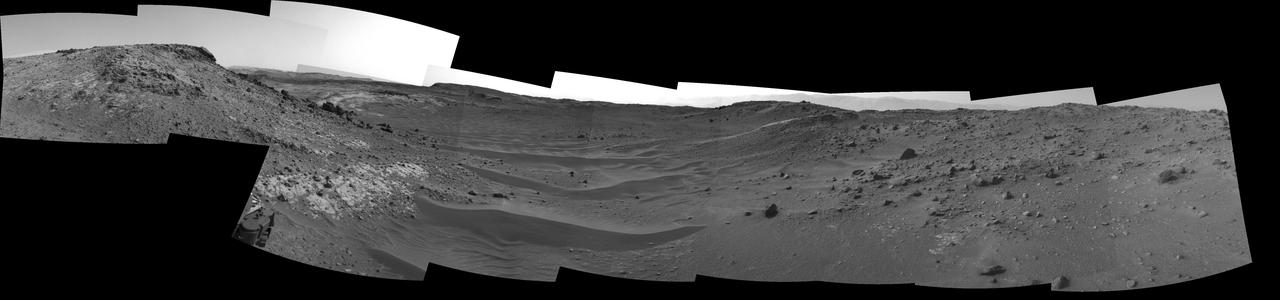
This view from the Navigation Camera (Navcam) on NASA's Curiosity Mars rover shows the terrain ahead of the rover as it makes its way westward through a valley called "Artist's Drive."  The Navcam recorded the component images of this mosaic on April 10, 2015, during the 951st Martian Day, or sol, of Curiosity's work on Mars. The valley is on the rover's route toward a higher site on Mount Sharp than the "Pahrump Hills" area the mission investigated at the base of the layered mountain.  http://photojournal.jpl.nasa.gov/catalog/PIA19163
Curiosity View Ahead Through Artist Drive
Subtle variations in color look like brush strokes as the lightly frosted terrain reflects light. These variations provide a backdrop to some exotic features referred to colloquially as "spiders."  The radial channels branching out from a central depression are formed when the seasonal layer of dry ice turns to gas in the spring and erodes the surface, which is a uniquely Martian landform.  http://photojournal.jpl.nasa.gov/catalog/PIA21214
Painting with Frost
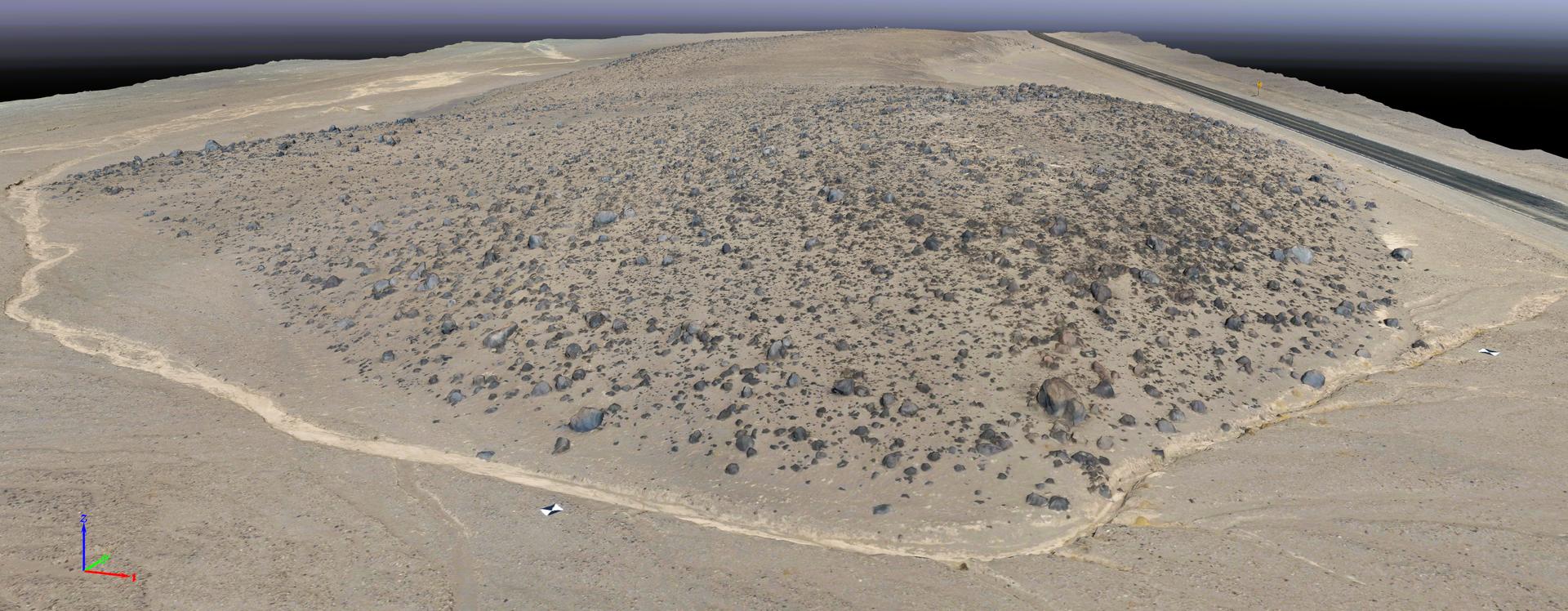
This rendering was created by research drones flying over Mars Hill, a region of Death Valley National Park that has been used by NASA’s Mars researchers since the 1970s, when the agency was preparing to land the twin Viking spacecraft. The hill’s rubbly, volcanic rock resembles the kind of inhospitable terrain that Mars rovers must navigate around and which posed a landing hazard for the Ingenuity Mars Helicopter.  In September 2025, researchers from NASA’s Jet Propulsion Laboratory in Southern California flew research drones over Mars Hill as part of a test campaign to develop navigation software for future Mars rotorcraft. Being able to precisely land between rocks like those seen here is a critical capability to access similar Martian terrain in the future.
Rendering of Mars Hill in Death Valley National Park
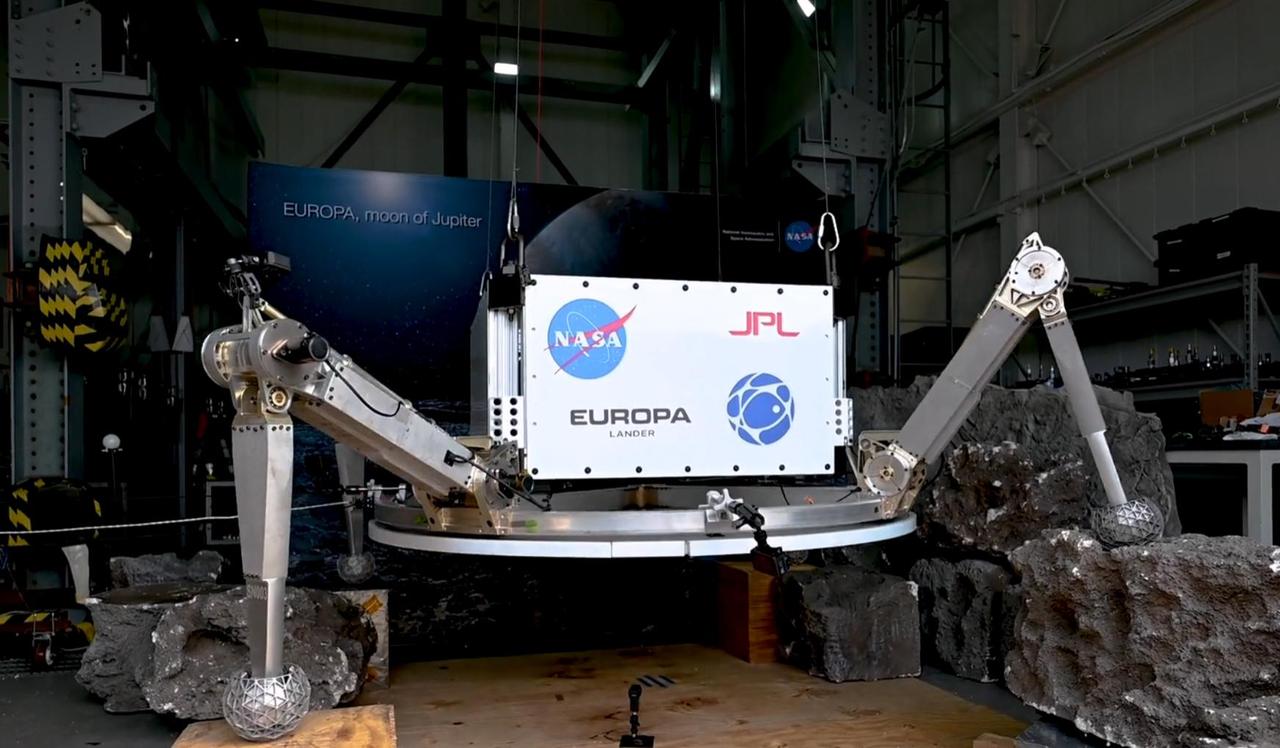
On Aug. 17 and 18, 2023, engineers at NASA's Jet Propulsion Laboratory in Southern California tested the landing system for a proposed future mission that would touch down on Jupiter's icy moon Europa. This system for the proposed Europa Lander is an evolution of hardware used on previous NASA lander missions. It includes the architecture used for the "sky crane maneuver" that helped lower NASA's Curiosity and Perseverance rovers onto the Martian surface, which would give the lander the stability it needs during touchdown. Although this landing architecture was developed with Europa as the target, it could be adapted for use at other moons and celestial bodies with challenging terrain.  Four bridles, suspended from an overhead simulated propulsive descent stage, maintain a level lander body. The four legs conform passively to the terrain they encounter as the lander body continues to descend toward the surface. Each leg consists of a four-bar linkage mechanism that controls the leg's pose before and during landing. The legs are preloaded downward with a constant force spring to help them rearrange and compress the surface they encounter prior to landing, giving them extra traction and stability during and after the landing event.  Acting like a skid plate, the belly pan provides the underside of the spacecraft with protection from potentially harmful terrain. The belly pan also resists shear motion on the terrain it interacts with. Once the belly pan contacts the surface, sensors trigger a mechanism that quickly locks the legs' "hip" and "knee" rotary joints, resulting in a table-like stance. At this point, the job of ensuring lander stability shifts from the bridles to the legs. This shift keeps the lander level after the bridles are unloaded.  In the event the belly pan does not encounter terrain during the touchdown process, sensors in each leg can also declare touchdown. After the leg joints lock, the belly pan would be suspended above the landed terrain, and the lander would be supported only by the four legs.  Not pictured in the video is the period after the bridles are offloaded and flyaway is commanded. The bridles would then be cut, and the hovering propulsive stage would fly away, leaving the lander in a stable stance on the surface.  Movie available at https://photojournal.jpl.nasa.gov/catalog/PIA26010
Testing Hardware for Potential Future Landing on Europa
This view of Martian surface features shaped by effects of winds was captured by the High Resolution Imaging Science Experiment (HiRISE) camera on NASA's Mars Reconnaissance Orbiter on Jan. 4, 2015. The spacecraft has been orbiting Mars since March 2006. On Feb. 7, 2015, it completed its 40,000th orbit around Mars.  Several terrain types converge in this scene from the Arsinoes Chaos region of Mars, which is in the far eastern portion of Mars' Valles Marineris canyon system. The jumbled chaos terrain is likely related to massive water-carved outflow channels that started in this area and flowed north onto Mars' northern plains.  The slightly curving bright terrain is composed of yardangs. Yardangs are portions of rock that have been sandblasted into long, skinny ridges by saltating (or bouncing) sand particles blowing in the wind.  Transverse sand ridges lie between the yardangs (zoom in). These sand ridges are termed "transverse aeolian ridges" and are not moving in Mars' current climate. They are a mystery -- midway in height between dunes (formed from saltating sand) and ripples (formed by "splashed" sand grains).  The location is at 7 degrees south latitude, 332 degrees east latitude. The image is an excerpt from HiRISE observation ESP_039563_1730.   http://photojournal.jpl.nasa.gov/catalog/PIA19291
Yardangs in Arsinoes Chaos, Mars
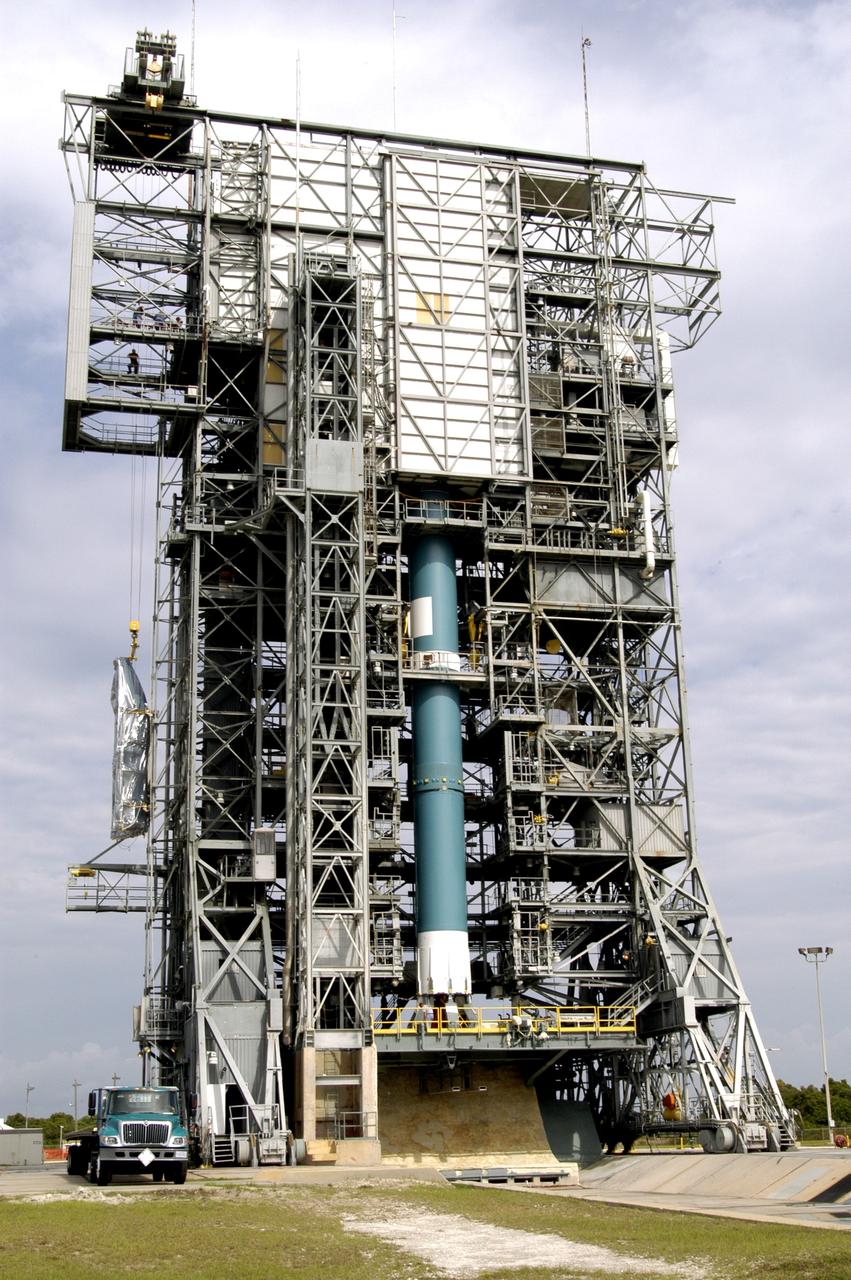
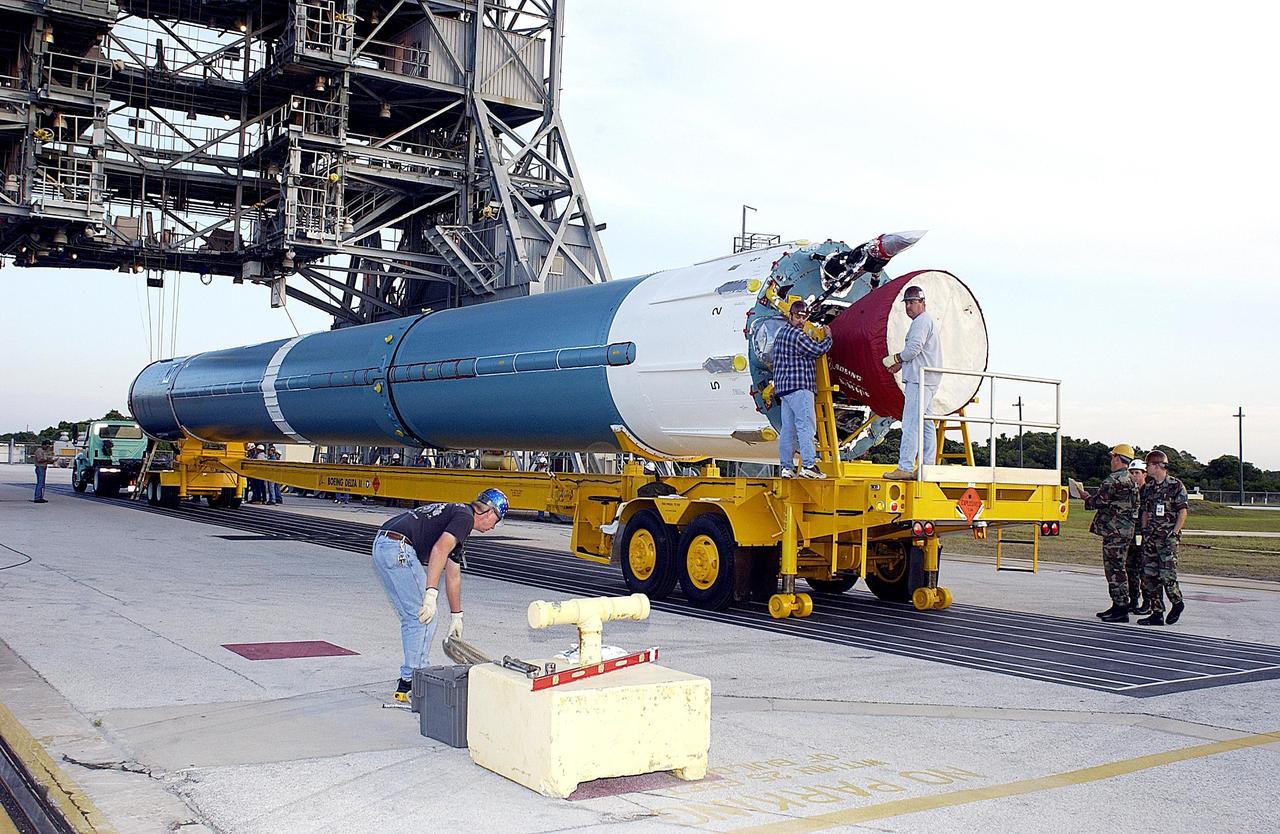
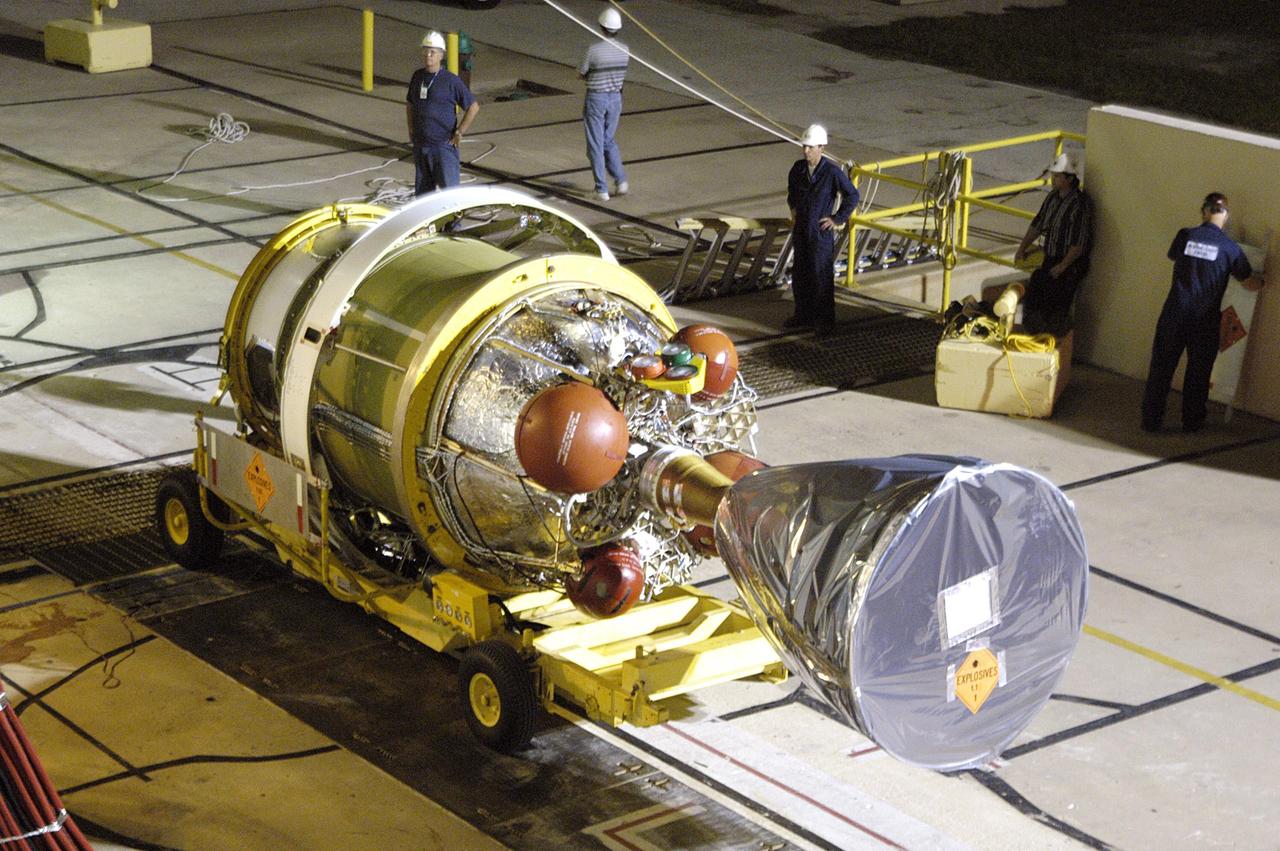
KENNEDY SPACE CENTER, FLA. - The second stage of the Delta II rocket is raised off the transporter for its lift up the launch tower on Pad 17-A, Cape Canaveral Air Force Station.  It will be mated to the first stage in preparation for the launch of the Mars Exploration Rover 2 (MER-A).  The MER Mission consists of two identical rovers designed to cover roughly 110 yards each Martian day over various terrain. Each rover will carry five scientific instruments that will allow it to search for evidence of liquid water that may have been present in the planet’s past.  Identical to each other, the rovers will land at different regions of Mars.  Launch date for this first of NASA’s two Mars Exploration Rover missions is scheduled June 5.
KENNEDY SPACE CENTER, FLA. - The second stage of the Delta II rocket is raised off the transporter for its lift up the launch tower on Pad 17-A, Cape Canaveral Air Force Station. It will be mated to the first stage in preparation for the launch of the Mars Exploration Rover 2 (MER-A). The MER Mission consists of two identical rovers designed to cover roughly 110 yards each Martian day over various terrain. Each rover will carry five scientific instruments that will allow it to search for evidence of liquid water that may have been present in the planet’s past. Identical to each other, the rovers will land at different regions of Mars. Launch date for this first of NASA’s two Mars Exploration Rover missions is scheduled June 5.
KENNEDY SPACE CENTER, FLA. -  At Launch Complex 17-A, Cape Canaveral Air Force Station, the second half of the fairing for the Mars Exploration Rover 2 (MER-2/MER-A) nears the top of the launch tower.  The fairing will be installed around the payload for protection during launch on a Delta II rocket.  The MER Mission consists of two identical rovers designed to cover roughly 110 yards each Martian day over various terrain. Each rover will carry five scientific instruments that will allow it to search for evidence of liquid water that may have been present in the planet's past.  Identical to each other, the rovers will land at different regions of Mars.  Launch date for MER-A  is scheduled for June 5.
KENNEDY SPACE CENTER, FLA. - At Launch Complex 17-A, Cape Canaveral Air Force Station, the second half of the fairing for the Mars Exploration Rover 2 (MER-2/MER-A) nears the top of the launch tower. The fairing will be installed around the payload for protection during launch on a Delta II rocket. The MER Mission consists of two identical rovers designed to cover roughly 110 yards each Martian day over various terrain. Each rover will carry five scientific instruments that will allow it to search for evidence of liquid water that may have been present in the planet's past. Identical to each other, the rovers will land at different regions of Mars. Launch date for MER-A is scheduled for June 5.
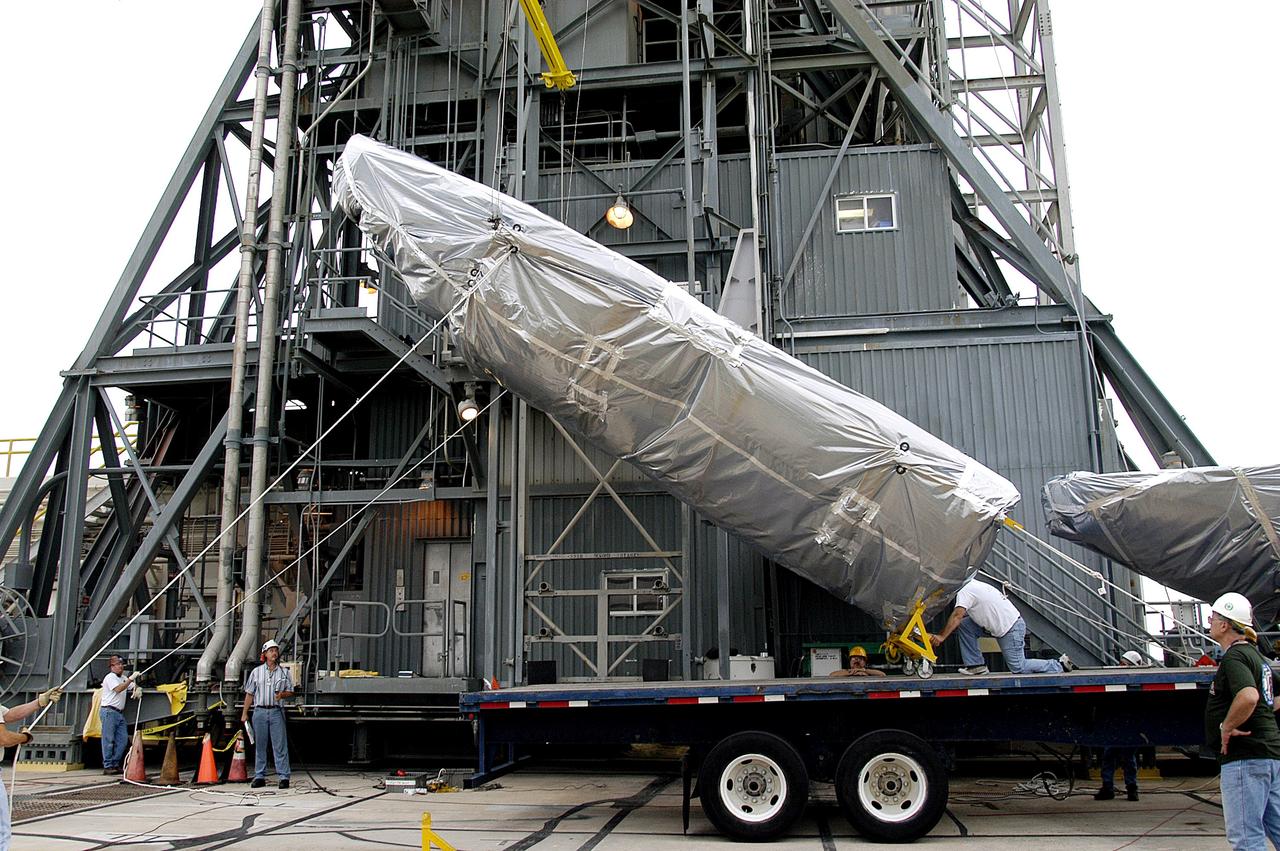
KENNEDY SPACE CENTER, FLA. - At Launch Complex 17-A, Cape Canaveral Air Force Station, the first half of the fairing for the Mars Exploration Rover 2 (MER-2/MER-A) is raised to a vertical position for its lift up the launch tower.  The fairing will be installed around the payload for protection during launch.  The MER Mission consists of two identical rovers designed to cover roughly 110 yards each Martian day over various terrain. Each rover will carry five scientific instruments that will allow it to search for evidence of liquid water that may have been present in the planet's past.  Identical to each other, the rovers will land at different regions of Mars.  Launch date for MER-A  is scheduled for June 5.
KENNEDY SPACE CENTER, FLA. - At Launch Complex 17-A, Cape Canaveral Air Force Station, the first half of the fairing for the Mars Exploration Rover 2 (MER-2/MER-A) is raised to a vertical position for its lift up the launch tower. The fairing will be installed around the payload for protection during launch. The MER Mission consists of two identical rovers designed to cover roughly 110 yards each Martian day over various terrain. Each rover will carry five scientific instruments that will allow it to search for evidence of liquid water that may have been present in the planet's past. Identical to each other, the rovers will land at different regions of Mars. Launch date for MER-A is scheduled for June 5.
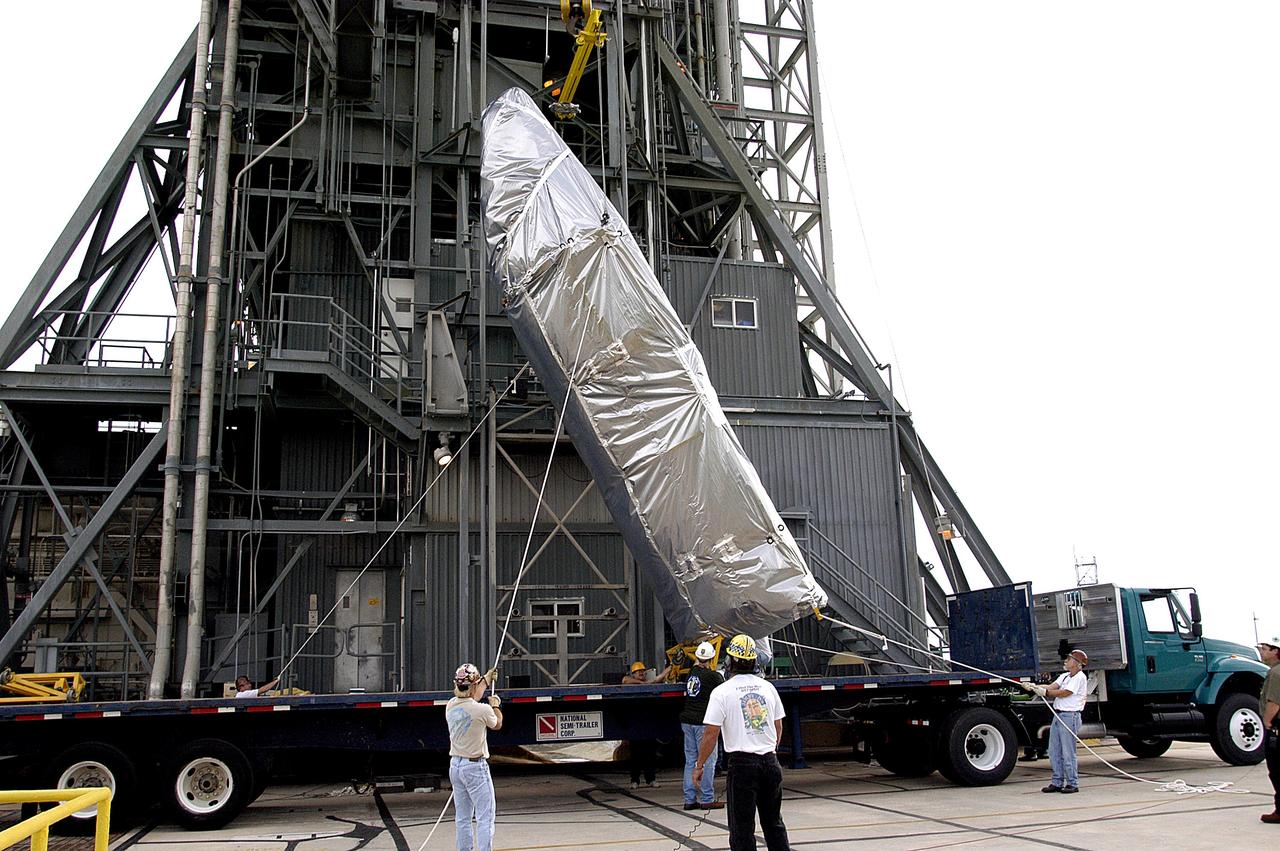
KENNEDY SPACE CENTER, FLA. - At Launch Complex 17-A, Cape Canaveral Air Force Station, the second half of the fairing for the Mars Exploration Rover 2 (MER-2/MER-A) is lifted up the outside of the launch tower.  Visible on another side is the Delta II rocket that will carry the payload into space.  The fairing will be installed around the payload for protection during launch.  The MER Mission consists of two identical rovers designed to cover roughly 110 yards each Martian day over various terrain. Each rover will carry five scientific instruments that will allow it to search for evidence of liquid water that may have been present in the planet's past.  Identical to each other, the rovers will land at different regions of Mars.  Launch date for MER-A  is scheduled for June 5.
KENNEDY SPACE CENTER, FLA. - At Launch Complex 17-A, Cape Canaveral Air Force Station, the second half of the fairing for the Mars Exploration Rover 2 (MER-2/MER-A) is lifted up the outside of the launch tower. Visible on another side is the Delta II rocket that will carry the payload into space. The fairing will be installed around the payload for protection during launch. The MER Mission consists of two identical rovers designed to cover roughly 110 yards each Martian day over various terrain. Each rover will carry five scientific instruments that will allow it to search for evidence of liquid water that may have been present in the planet's past. Identical to each other, the rovers will land at different regions of Mars. Launch date for MER-A is scheduled for June 5.
KENNEDY SPACE CENTER, FLA. - At Launch Complex 17-A, Cape Canaveral Air Force Station, the second half of the fairing for the Mars Exploration Rover 2 (MER-2/MER-A) is raised to a vertical position for its lift up the launch tower.  The fairing will be installed around the payload for protection during launch.  The MER Mission consists of two identical rovers designed to cover roughly 110 yards each Martian day over various terrain. Each rover will carry five scientific instruments that will allow it to search for evidence of liquid water that may have been present in the planet's past.  Identical to each other, the rovers will land at different regions of Mars.  Launch date for MER-A  is scheduled for June 5.
KENNEDY SPACE CENTER, FLA. - At Launch Complex 17-A, Cape Canaveral Air Force Station, the second half of the fairing for the Mars Exploration Rover 2 (MER-2/MER-A) is raised to a vertical position for its lift up the launch tower. The fairing will be installed around the payload for protection during launch. The MER Mission consists of two identical rovers designed to cover roughly 110 yards each Martian day over various terrain. Each rover will carry five scientific instruments that will allow it to search for evidence of liquid water that may have been present in the planet's past. Identical to each other, the rovers will land at different regions of Mars. Launch date for MER-A is scheduled for June 5.
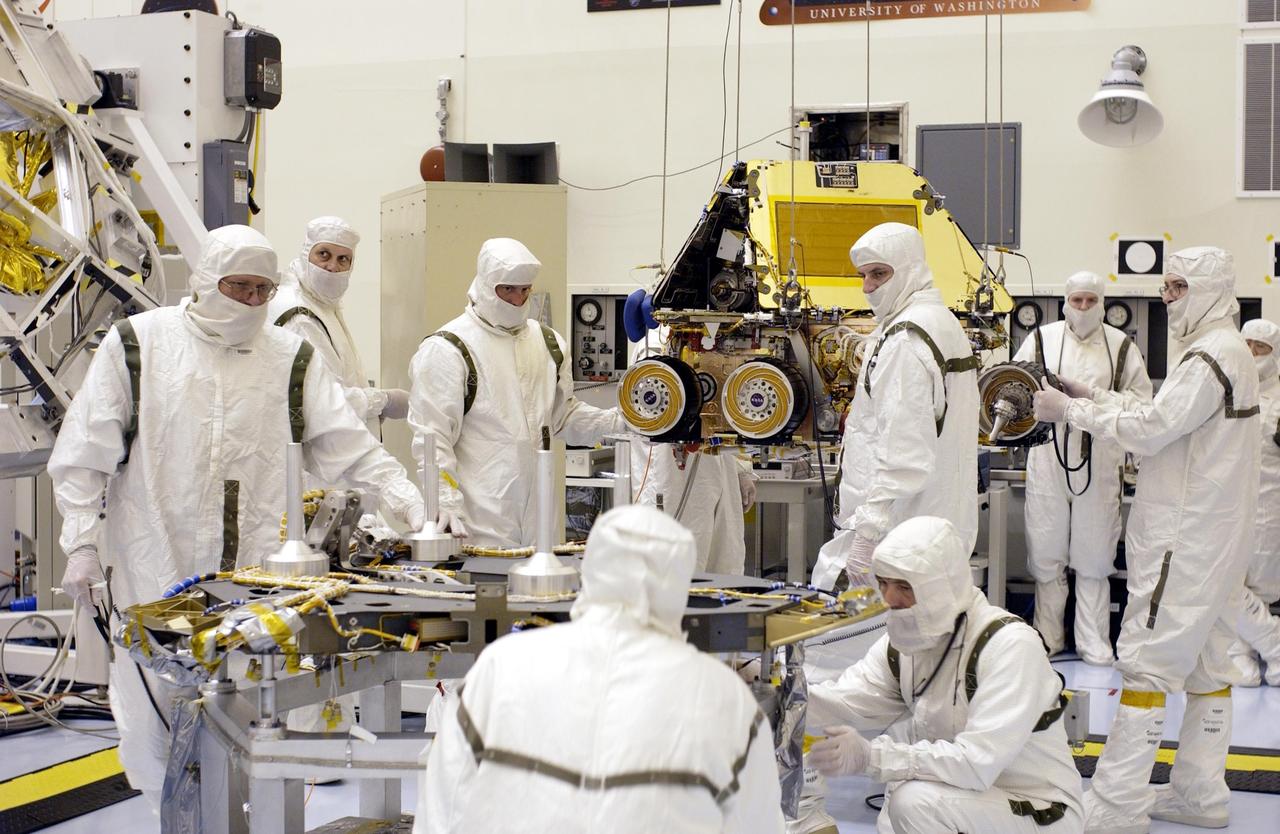
KENNEDY SPACE CENTER, FLA. -  In the Payload Hazardous Servicing Facility, an overhead crane is moved toward Mars Exploration Rover 2 (MER-2).  The rover will be lifted and moved to the lander where it will be mated to the base petal.  Set to launch in Spring 2003, the MER Mission consists of two identical rovers, landing at different regions of Mars, designed to cover roughly 110 yards each Martian day over various terrain. Each rover will carry five scientific instruments that will allow it to search for evidence of liquid water that may have been present in the planet's past.  The first rover has a launch window opening May 30, and the second rover a window opening June 25.
KSC-03pd0983
KENNEDY SPACE CENTER, FLA. - Workers in the Payload Hazardous Servicing Facility look over the aeroshell enclosing Mars Exploration Rover 2 and lander that is being moved to a rotation table for a spin stabilization test.  There are two identical rovers that will land at different regions of Mars and are designed to cover roughly 110 yards each Martian day over various terrain. Each rover will carry five scientific instruments that will allow it to search for evidence of liquid water that may have been present in the planet's past.  The first rover, MER-A, is scheduled to launch June 5 from Cape Canaveral Air Force Station.  The second is scheduled for launch June 25.
KSC-03pd1372
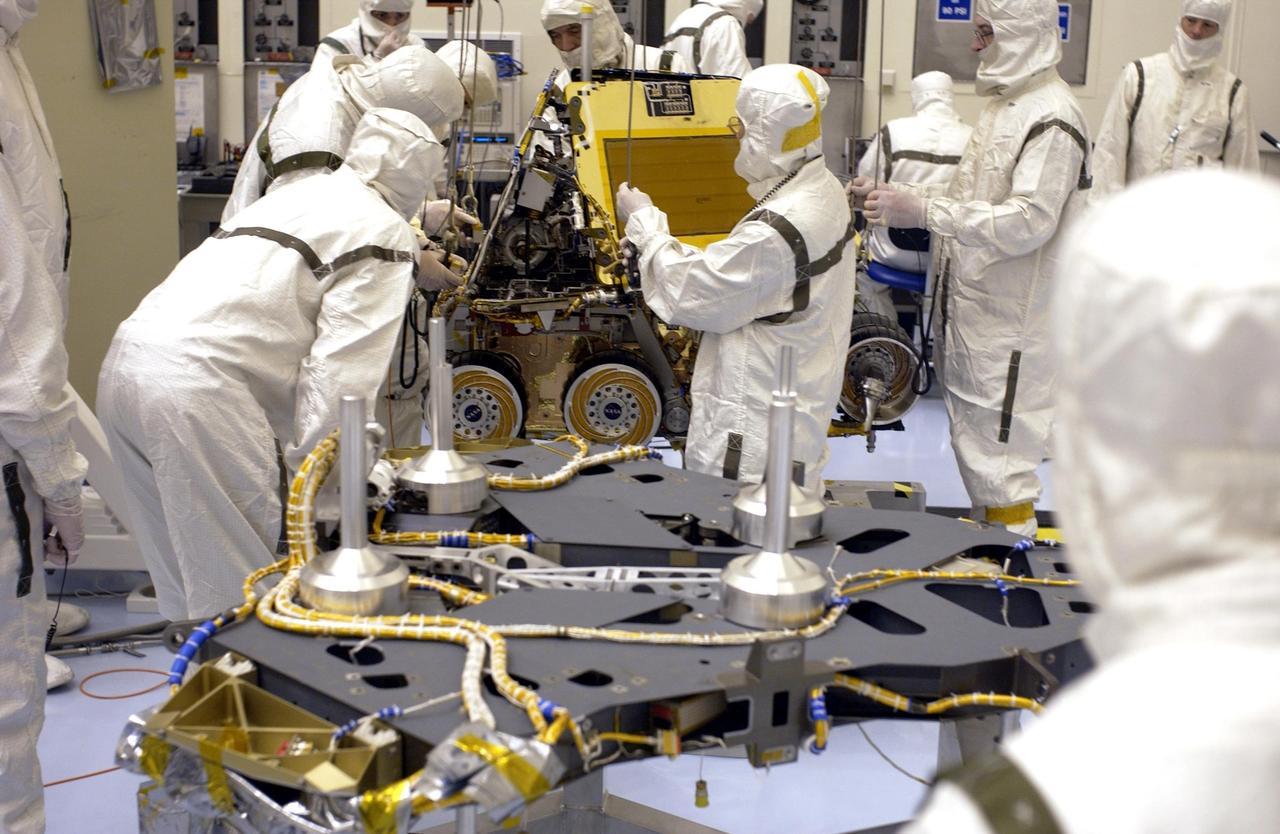
KENNEDY SPACE CENTER, FLA. -  In the Payload Hazardous Servicing Facility, workers lower the Mars Exploration Rover-2 (MER-2) onto the base petal of its lander assembly. Set to launch in Spring 2003, the MER Mission will consist of two identical rovers designed to cover roughly 110 yards each Martian day over various terrain. Each rover will carry five scientific instruments that will allow it to search for evidence of liquid water that may have been present in the planet's past. The rovers will be identical to each other, but will land at different regions of Mars. The first rover has a launch window opening May 30, and the second rover, a window opening June 25.
KSC-03pd0881
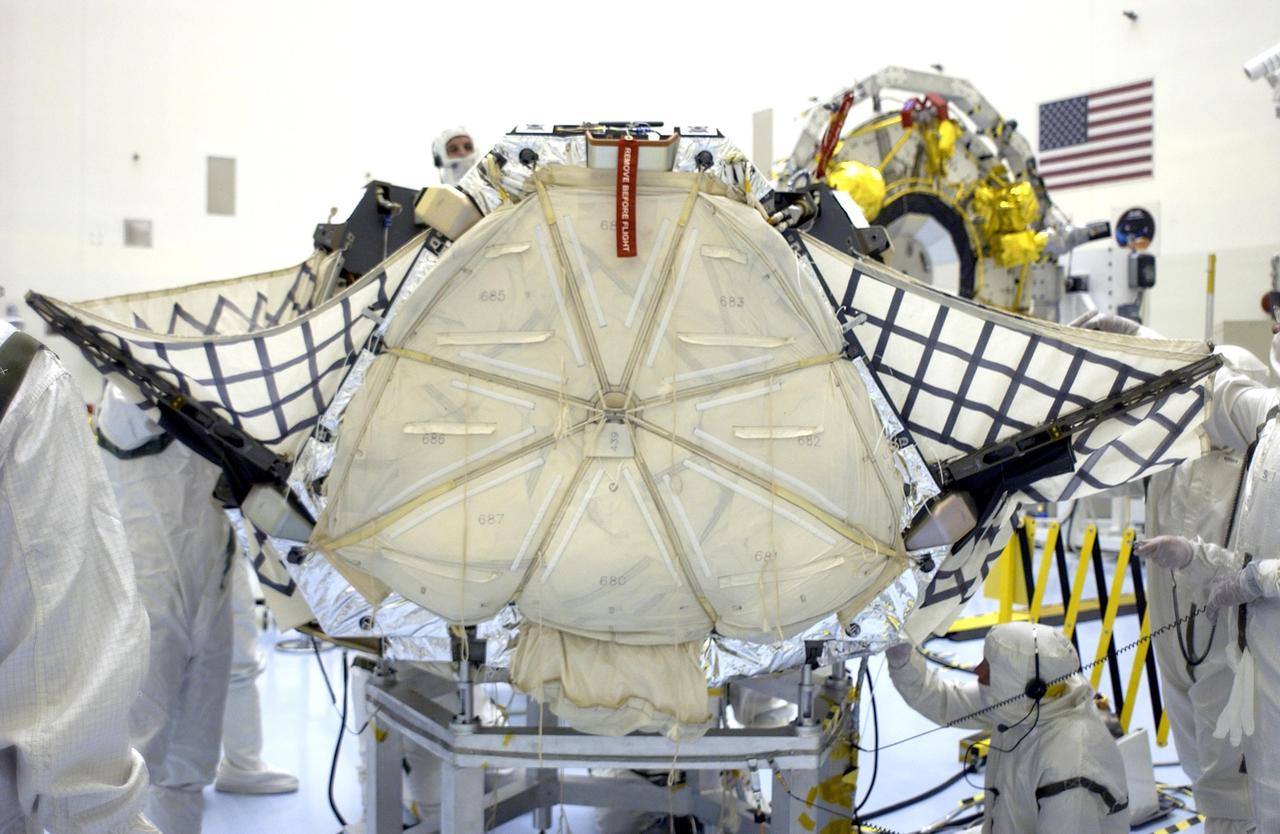
KENNEDY SPACE CENTER, FLA. -- In the Payload Hazardous Servicing Facility, the lander petals and attached airbags of the Mars Exploration Rover 2 (MER-2) are closed around the spacecraft during testing prior to launch.  The MER Mission consists of two identical rovers set to launch in Spring 2003. Landing at different regions of Mars, they are designed to cover roughly 110 yards each Martian day over various terrain. Each rover will carry five scientific instruments that will allow it to search for evidence of liquid water that may have been present in the planet's past.
KSC-03pd1057
KENNEDY SPACE CENTER, FLA. -- In the Payload Hazardous Servicing Facility, technicians prepare to close the lander petals and attached airbags of the Mars Exploration Rover 2 (MER-2) around the spacecraft prior to launch. The MER Mission consists of two identical rovers set to launch in Spring 2003. Landing at different regions of Mars, they are designed to cover roughly 110 yards each Martian day over various terrain. Each rover will carry five scientific instruments that will allow it to search for evidence of liquid water that may have been present in the planet's past.
KSC-03pd1041
KENNEDY SPACE CENTER, FLA. -- In the Payload Hazardous Servicing Facility, the lander petals and attached airbags of the Mars Exploration Rover 2 (MER-2) are closed around the spacecraft during testing prior to launch.  The MER Mission consists of two identical rovers set to launch in Spring 2003. Landing at different regions of Mars, they are designed to cover roughly 110 yards each Martian day over various terrain. Each rover will carry five scientific instruments that will allow it to search for evidence of liquid water that may have been present in the planet's past.
KSC-03pd1051
This image from NASA's Mars Reconnaissance Orbiter (MRO) shows streaks forming on slopes when dust cascades downhill. The dark streak is an area of less dust compared to the brighter and reddish surroundings. What triggers these avalanches is not known, but might be related to sudden warming of the surface.  These streaks are often diverted by the terrain they flow down. This one has split into many smaller streaks where it encountered minor obstacles.  These streaks fade away over decades as more dust slowly settles out of the Martian sky.  https://photojournal.jpl.nasa.gov/catalog/PIA22240
Splitting Slope Streaks
KENNEDY SPACE CENTER, FLA. - While workers watch the process, the petals on the lander close up around the Mars Exploration Rover 2 (MER-A).  The lander and rover will be enclosed within an aeroshell for launch.  The MER Mission consists of two identical rovers designed to cover roughly 110 yards each Martian day over various terrain. Each rover will carry five scientific instruments that will allow it to search for evidence of liquid water that may have been present in the planet's past.  Identical to each other, the rovers will land at different regions of Mars.  Launch date for this first of NASA's two Mars Exploration Rover missions is scheduled no earlier than June 6.
KSC-03pd1223
KENNEDY SPACE CENTER, FLA. -  The second stage of the Delta II rocket arrives at Pad 17-A, Cape Canaveral Air Force Station.  It will be mated to the first stage in preparation for the launch of the Mars Exploration Rover 2 (MER-A).  The MER Mission consists of two identical rovers designed to cover roughly 110 yards each Martian day over various terrain. Each rover will carry five scientific instruments that will allow it to search for evidence of liquid water that may have been present in the planet's past.  Identical to each other, the rovers will land at different regions of Mars.  Launch date for this first of NASA's two Mars Exploration Rover missions is scheduled June 5.
KSC-03pd1319
KENNEDY SPACE CENTER, FLA. -- In the Payload Hazardous Servicing Facility, technicians prepare to close the lander petals and attached airbags of the Mars Exploration Rover 2 (MER-2) around the spacecraft prior to launch. The MER Mission consists of two identical rovers set to launch in Spring 2003. Landing at different regions of Mars, they are designed to cover roughly 110 yards each Martian day over various terrain. Each rover will carry five scientific instruments that will allow it to search for evidence of liquid water that may have been present in the planet's past.
KSC-03pd1033
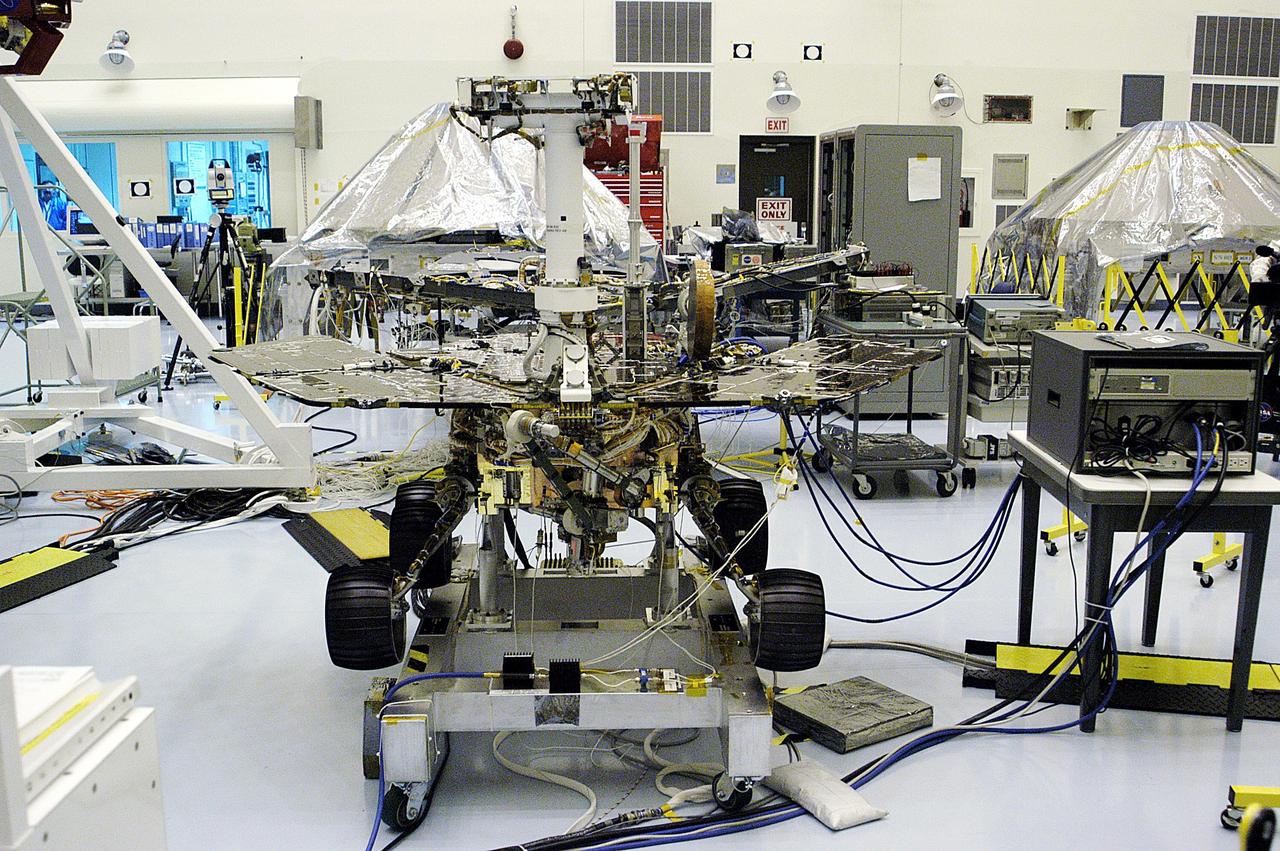
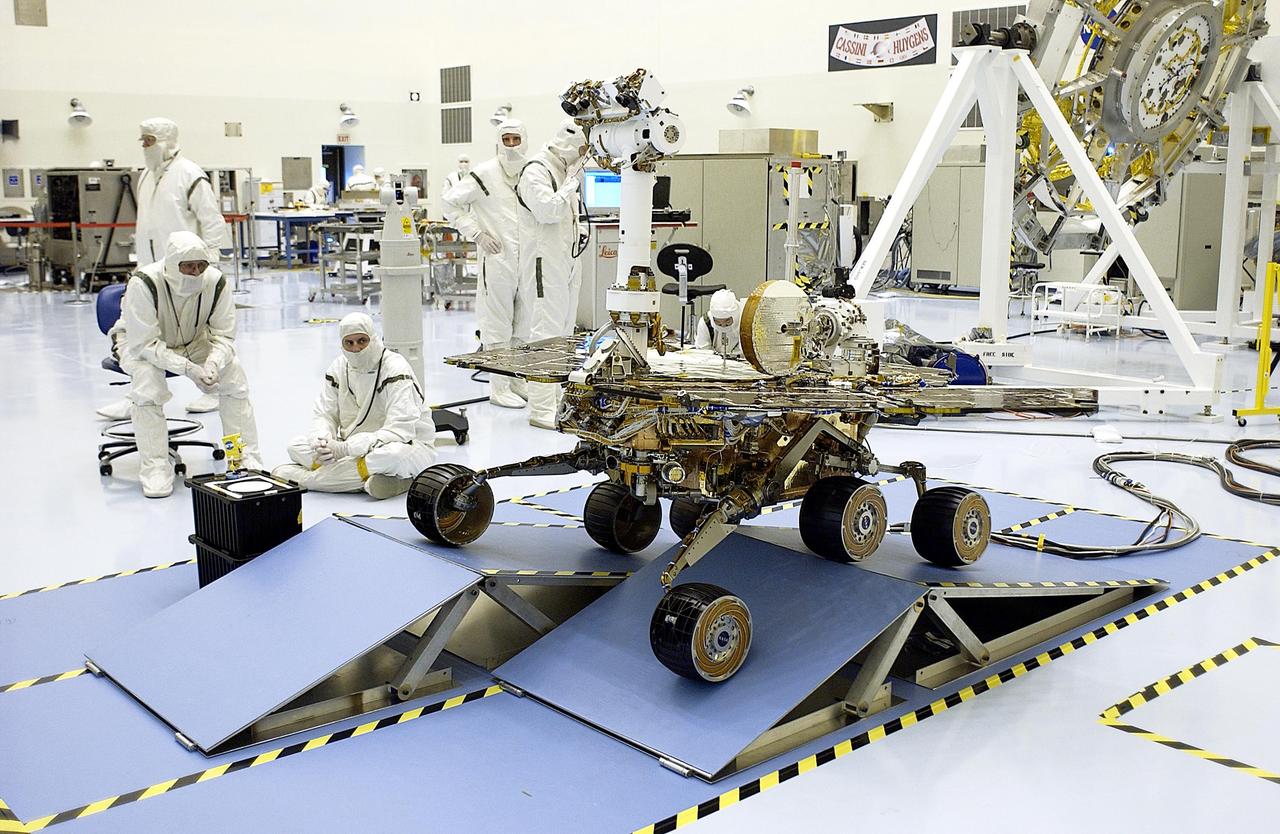
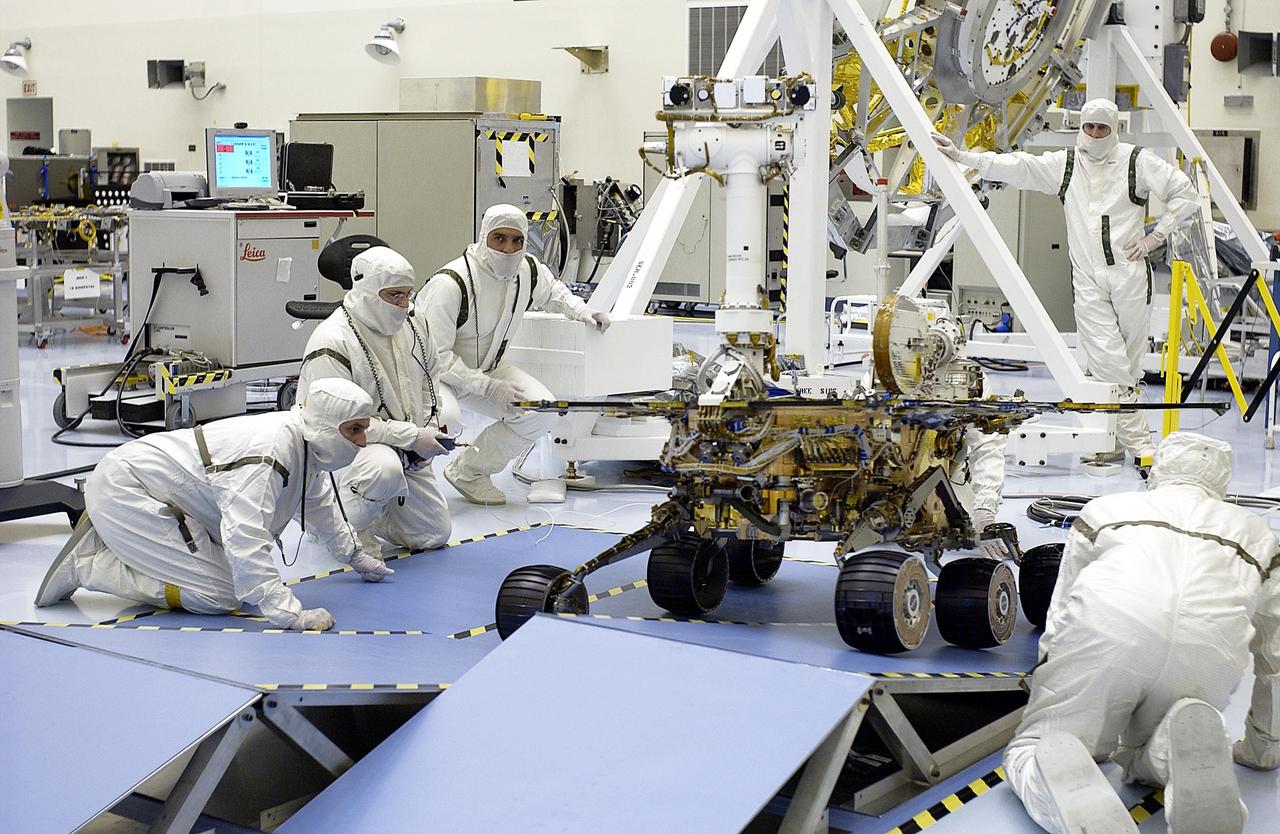
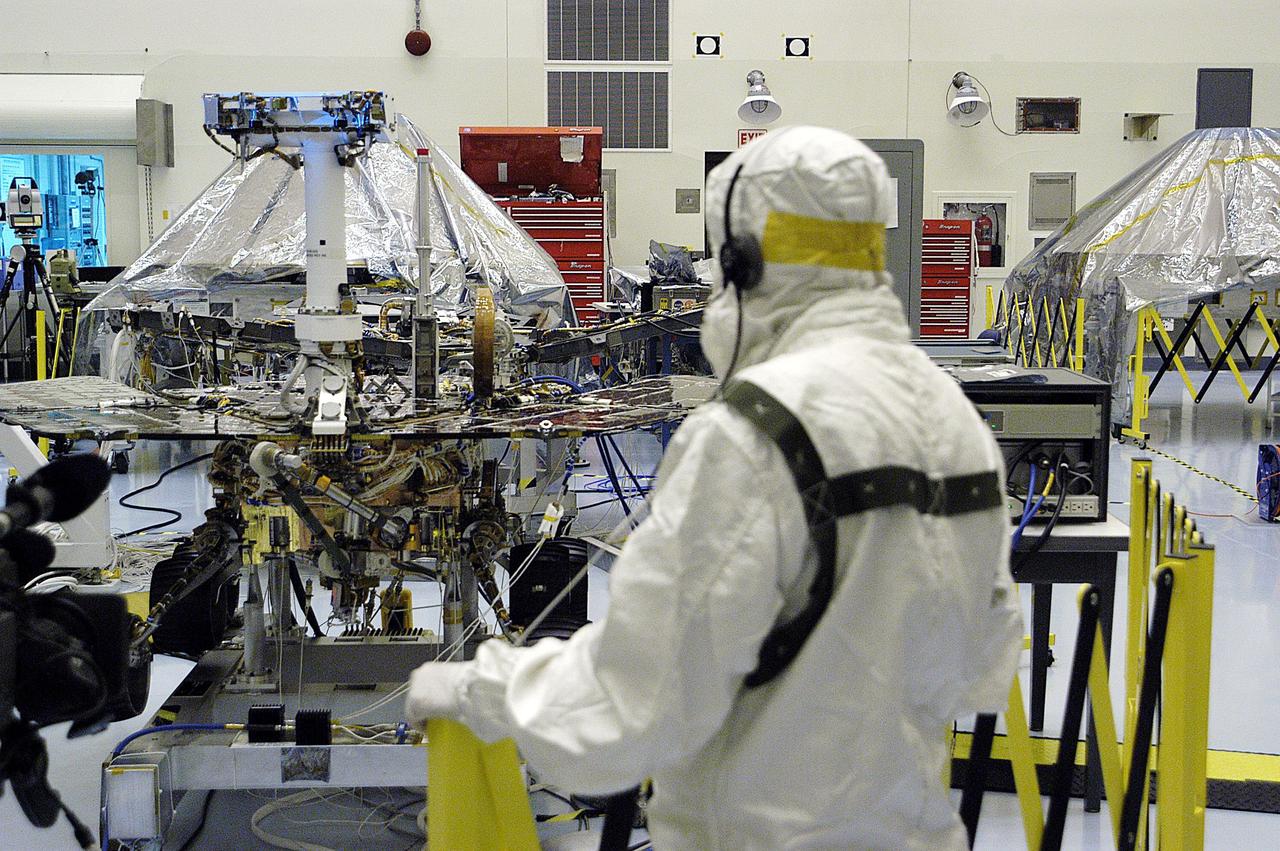
KENNEDY SPACE CENTER, FLA. - The Mars Exploration Rover 1 (MER-1) is seen in the foreground after the science boom was deployed.  Set to launch in Spring 2003, the MER Mission will consist of two identical rovers designed to cover roughly 110 yards each Martian day over various terrain. Each rover will carry five scientific instruments that will allow it to search for evidence of liquid water that may have been present in the planet's past.  The rovers will be identical to each other, but will land at different regions of Mars.  The first rover has a launch window opening May 30, and the second rover a window opening June 25.
KSC-03pd0957
KENNEDY SPACE CENTER, FLA. -- In the Payload Hazardous Servicing Facility, technicians prepare to close the lander petals and attached airbags of the Mars Exploration Rover 2 (MER-2) around the spacecraft prior to launch. The MER Mission consists of two identical rovers set to launch in Spring 2003. Landing at different regions of Mars, they are designed to cover roughly 110 yards each Martian day over various terrain. Each rover will carry five scientific instruments that will allow it to search for evidence of liquid water that may have been present in the planet's past.
KSC-03pd1039
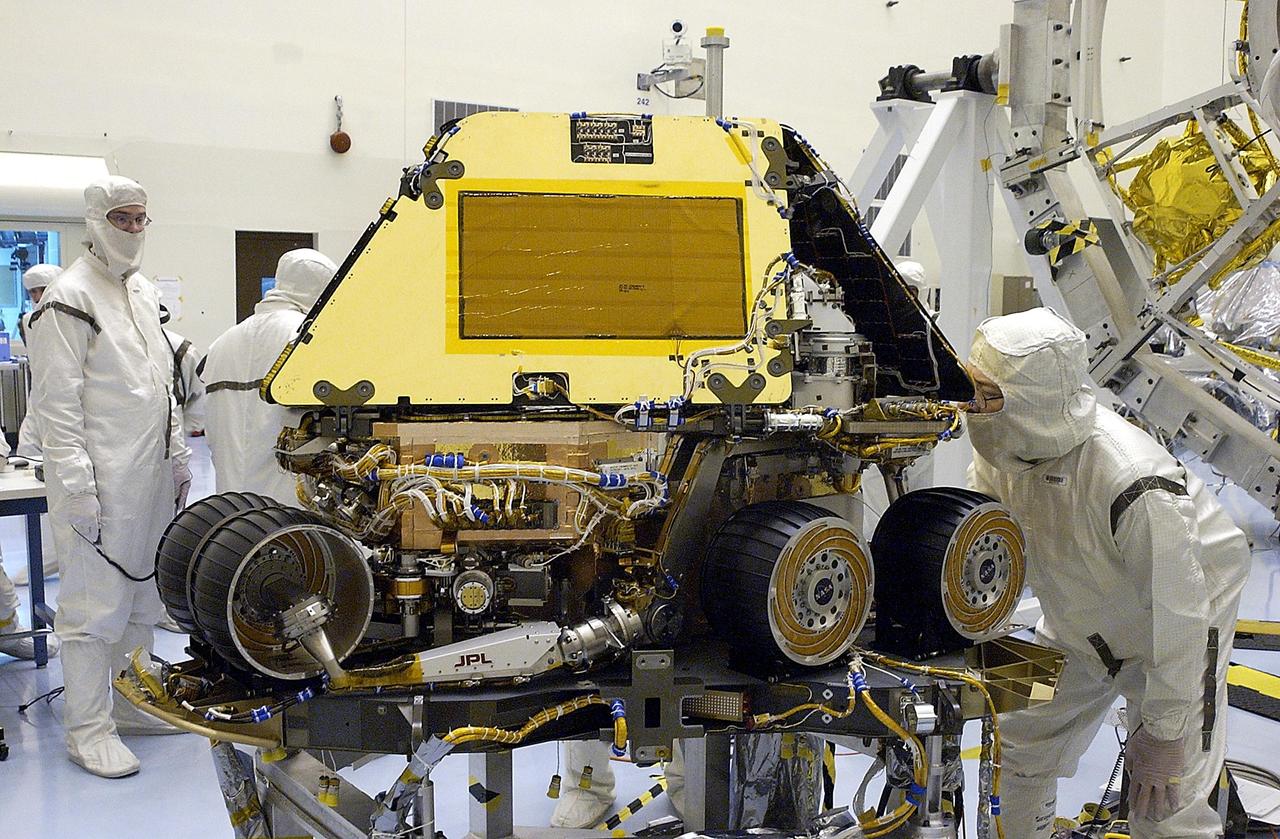
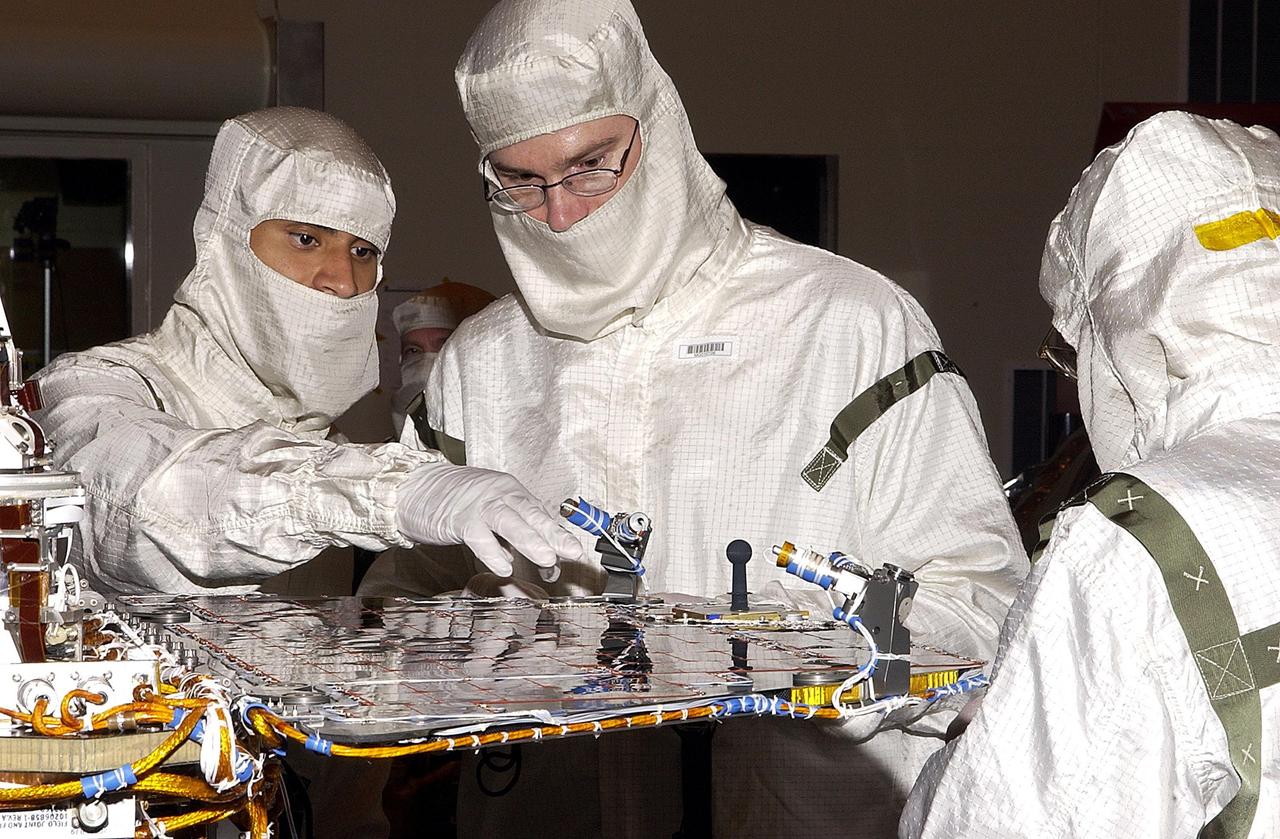
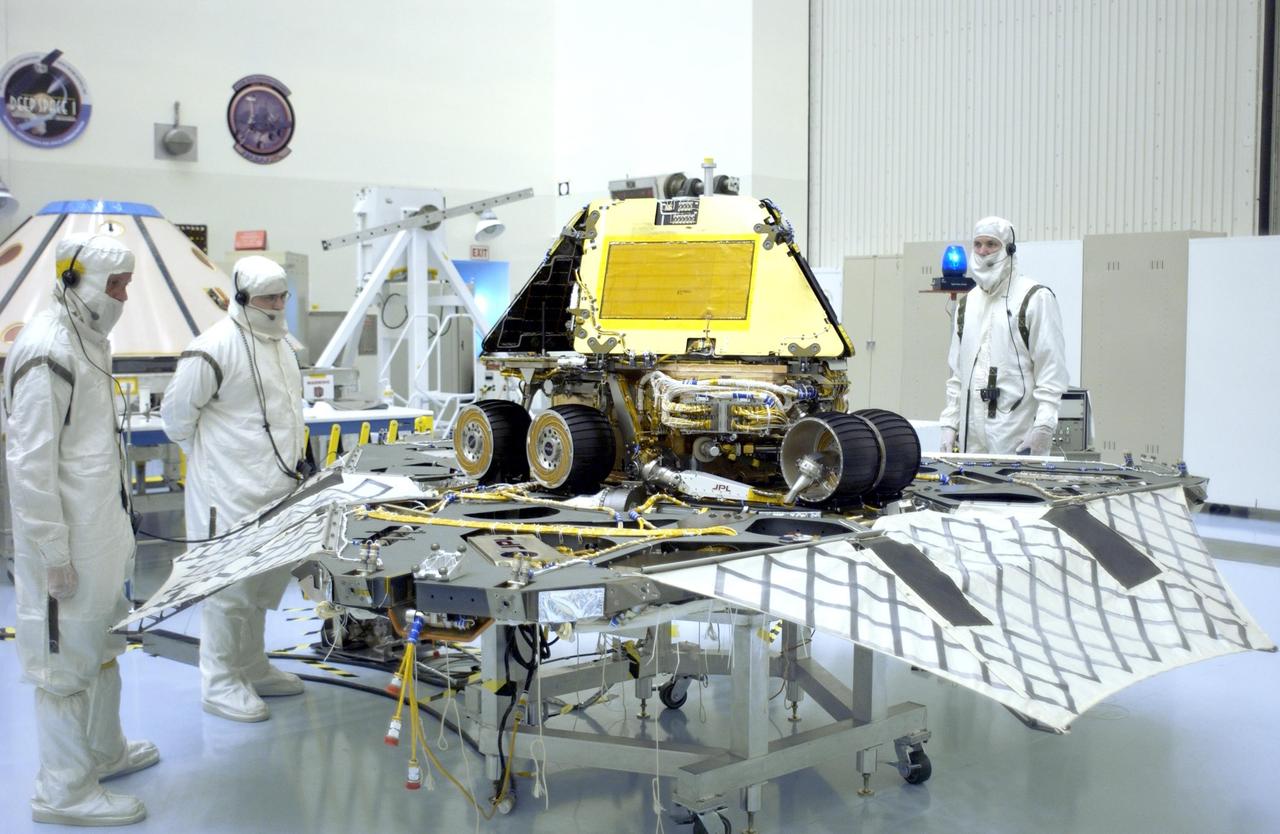
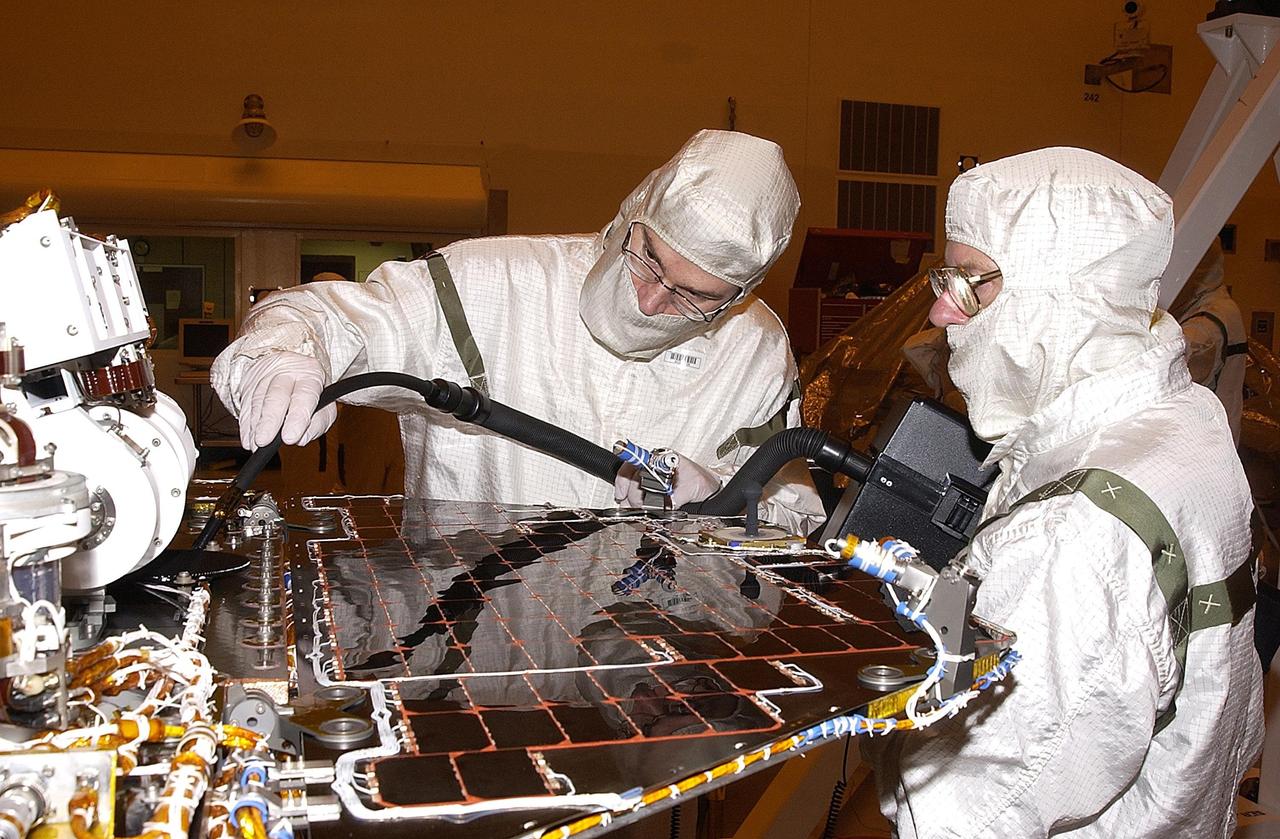
KENNEDY SPACE CENTER, FLA. -  In the Payload Hazardous Servicing Facility, workers check the solar panels on the Mars Exploration Rover 2 (MER-2) before flight stow. Set to launch in Spring 2003, the MER Mission will consist of two identical rovers designed to cover roughly 110 yards each Martian day over various terrain. The rovers will be identical to each other, but will land at different regions of Mars.  Each rover will carry five scientific instruments that will allow it to search for evidence of liquid water that may have been present in the planet's past.  The first rover has a launch window opening May 30, and the second rover a window opening June 25.
KSC-03pd0908
KENNEDY SPACE CENTER, FLA. - Workers in the Payload Hazardous Servicing Facility help guide the Mars Exploration Rover 1 (MER-1) as it is moved to the lander base petal for installation.  The MER Mission consists of two identical rovers, landing at different regions of Mars, designed to cover roughly 110 yards each Martian day over various terrain. Each rover will carry five scientific instruments that will allow it to search for evidence of liquid water that may have been present in the planet's past.  The first rover has a launch window opening June 5, and the second rover a window opening June 25. The rovers will be launched from Cape Canaveral Air Force Station.
KSC-03pd1249
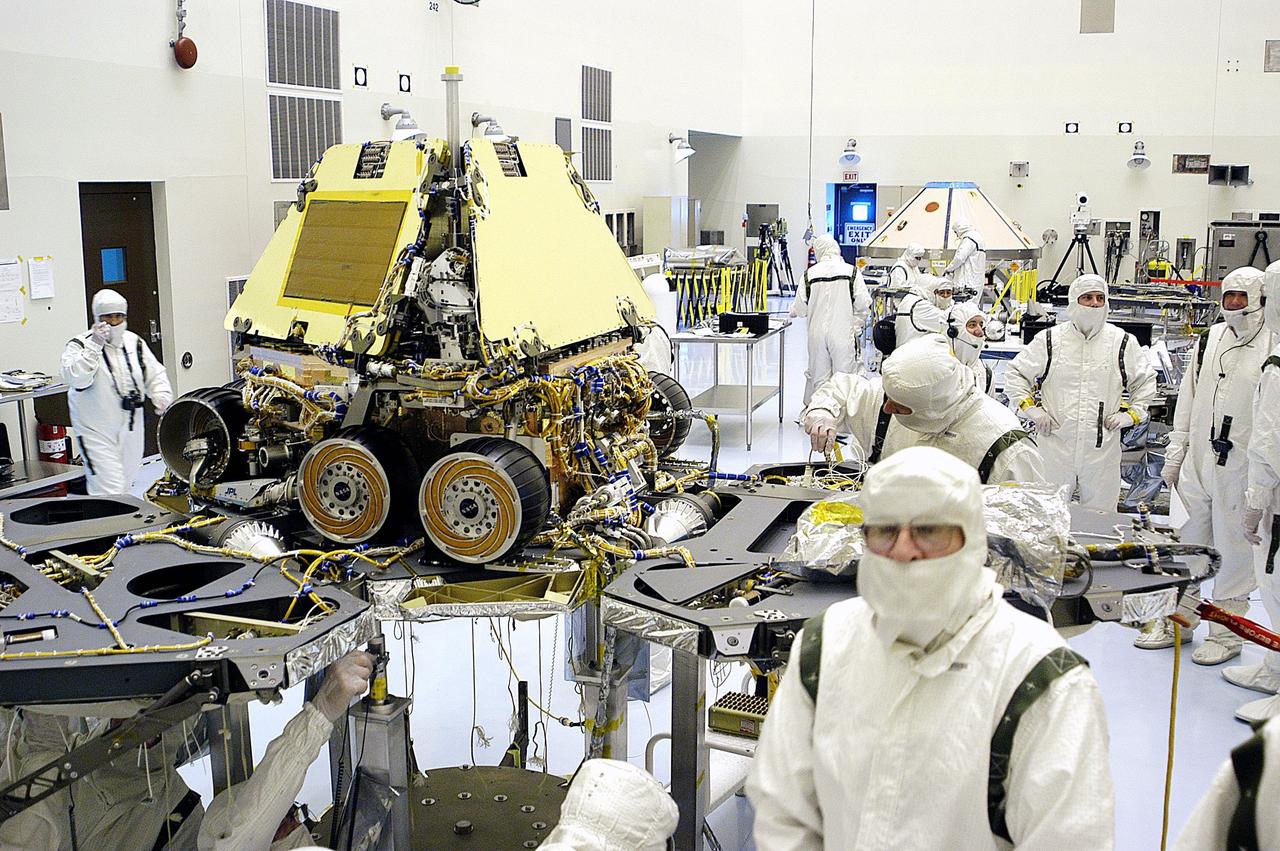
KENNEDY SPACE CENTER, FLA. -  The two elements, rover and lander, of Mars Exploration Rover 2 (MER-2) are assembled.  Set to launch in Spring 2003, the MER Mission consists of two identical rovers.  Landing at different regions of Mars, they are designed to cover roughly 110 yards each Martian day over various terrain. Each rover will carry five scientific instruments that will allow it to search for evidence of liquid water that may have been present in the planet's past.  The first rover has a launch window opening May 30, and the second rover a window opening June 25.
KSC-03pd0990
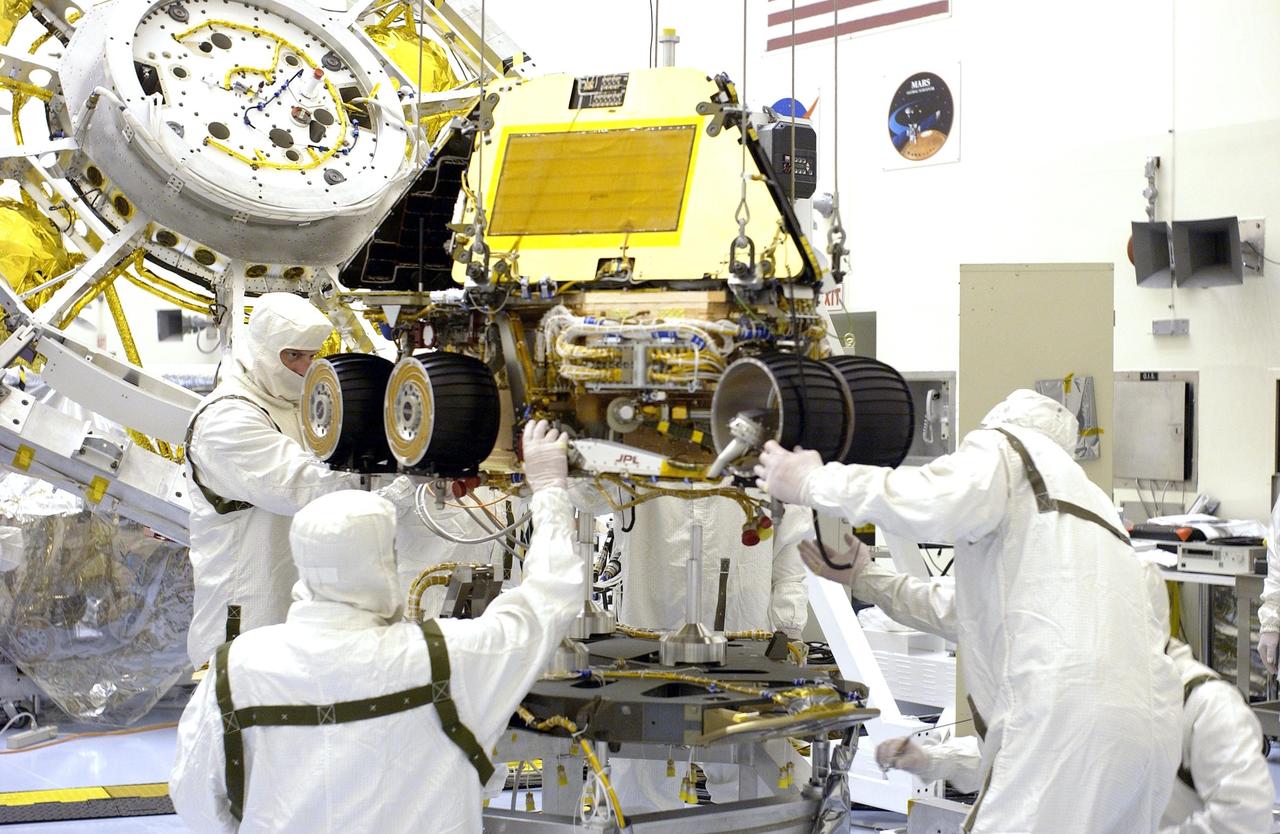
KENNEDY SPACE CENTER, FLA. -  In the Payload Hazardous Servicing Facility, workers move the Mars Exploration Rover-2 (MER-2) towards the base petal of its lander assembly. Set to launch in Spring 2003, the MER Mission will consist of two identical rovers designed to cover roughly 110 yards each Martian day over various terrain. Each rover will carry five scientific instruments that will allow it to search for evidence of liquid water that may have been present in the planet's past. The rovers will be identical to each other, but will land at different regions of Mars. The first rover has a launch window opening May 30, and the second rover, a window opening June 25.
KSC-03pd0878
KENNEDY SPACE CENTER, FLA. -  Workers in the Payload Hazardous Servicing Facility check the Mars Exploration Rover 2 (MER-2) before it is lifted and moved to the lander where it will be mated to the base petal.  Set to launch in Spring 2003, the MER Mission consists of two identical rovers, landing at different regions of Mars, designed to cover roughly 110 yards each Martian day over various terrain. Each rover will carry five scientific instruments that will allow it to search for evidence of liquid water that may have been present in the planet's past.  The first rover has a launch window opening May 30, and the second rover a window opening June 25.
KSC-03pd0984
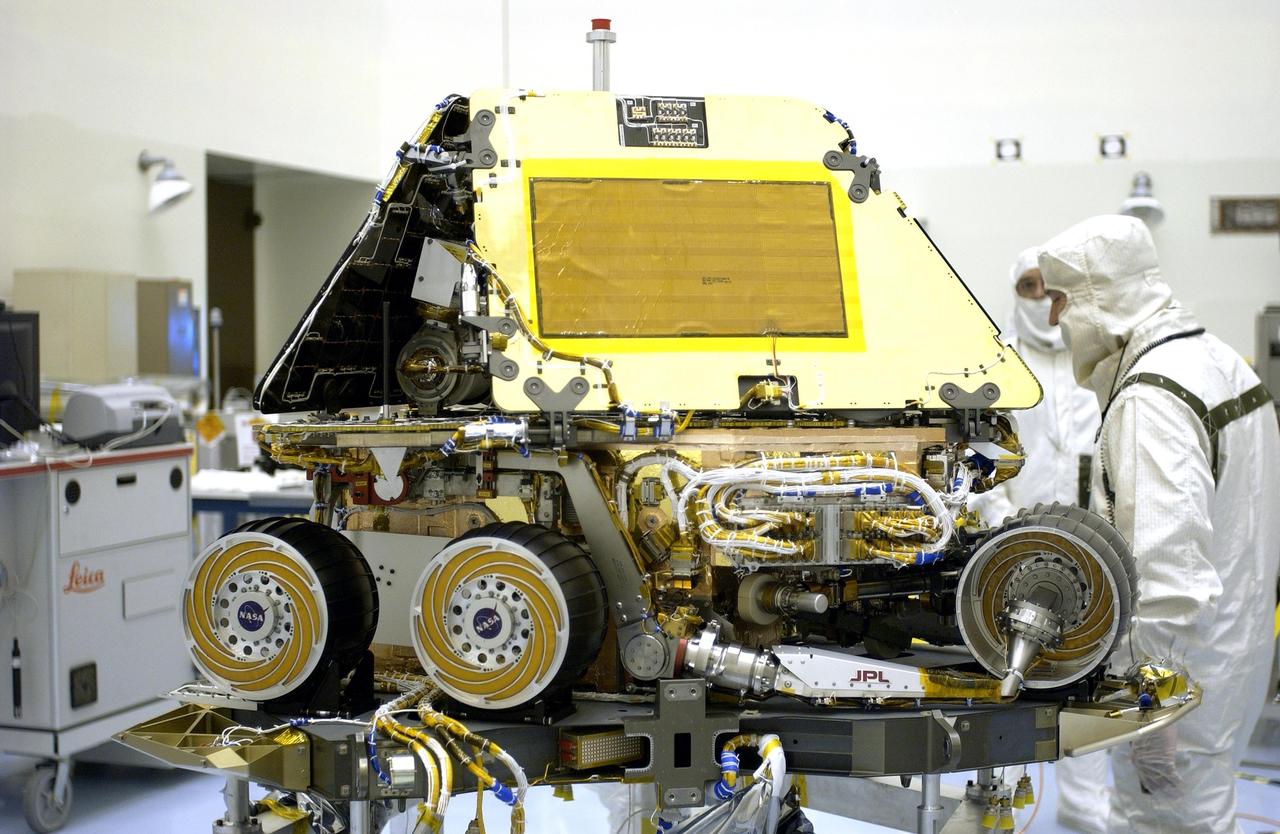
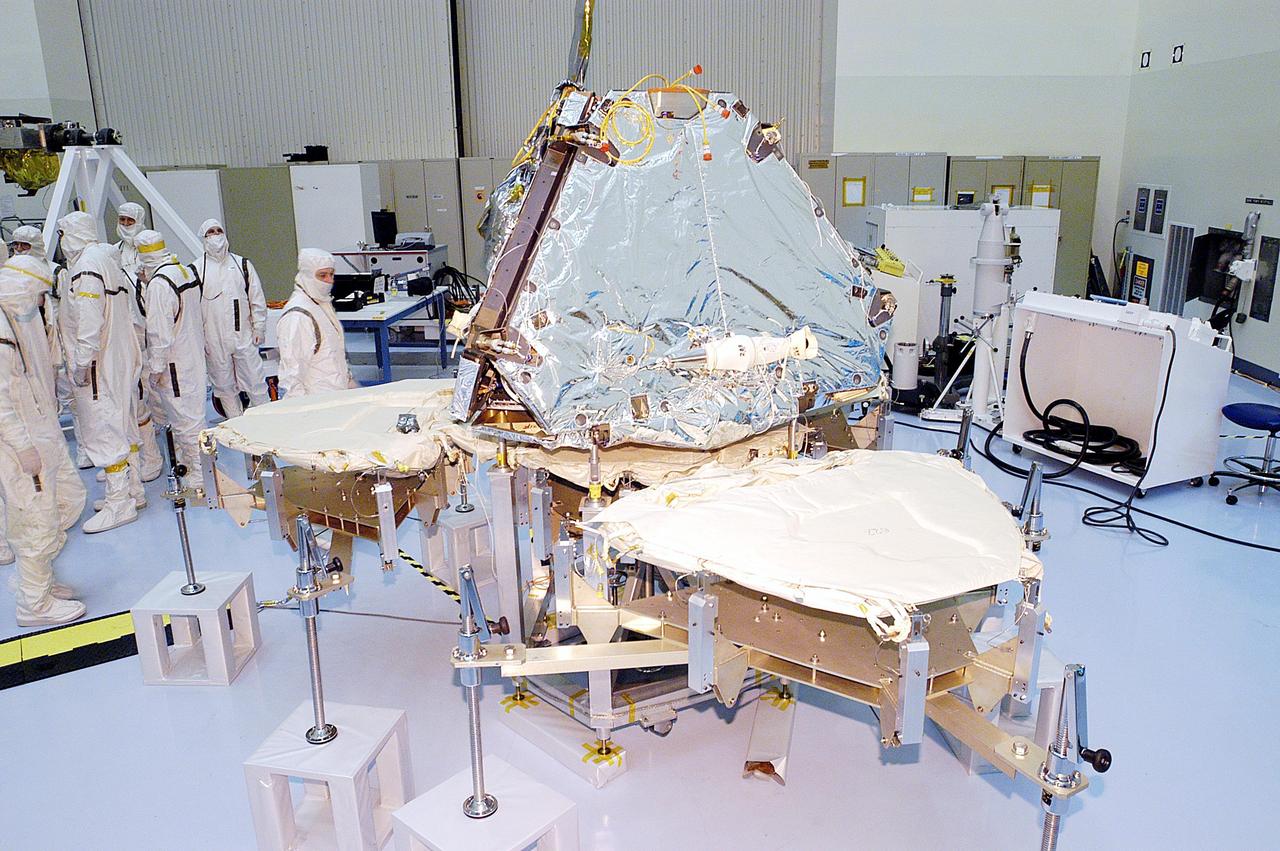
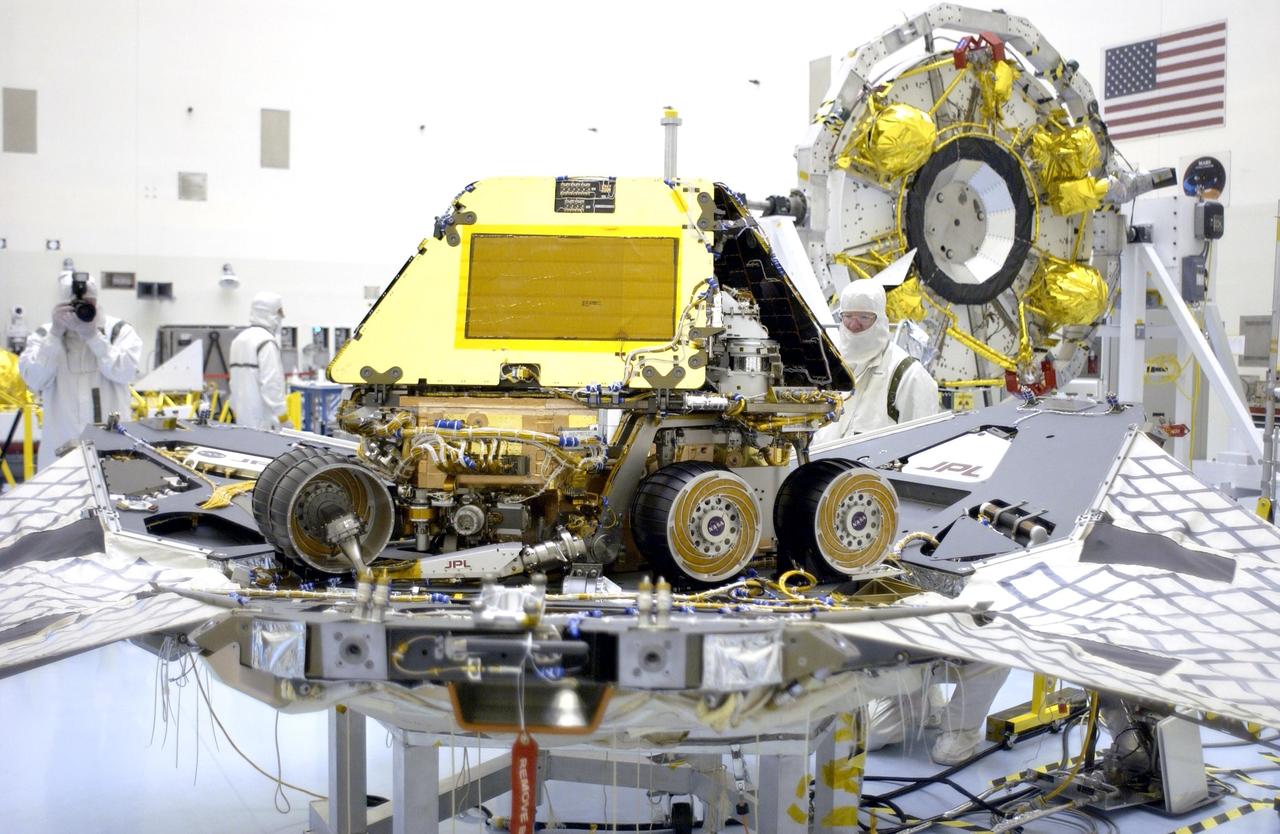
KENNEDY SPACE CENTER, FLA. -- In the Payload Hazardous Servicing Facility, the Mars Exploration Rover 2 (MER-2) has been installed on the base petal of the lander and the solar arrays have been stowed for flight.  The cruise stage is in the background. There are two rovers, identical to each other, and each will land at different regions of Mars.  They are designed to cover roughly 110 yards each Martian day over various terrain.  Each rover will carry five scientific instruments that will allow it to search for evidence of liquid water that may have been present in the planet's past.  The first rover has a launch window opening May 30, and the second rover a window opening June 25.
KSC-03pd0946
KENNEDY SPACE CENTER, FLA. - On Pad 17-A, Cape Canaveral Air Force Station, the first stage of the Delta II rocket is lifted up the launch tower. The Delta will launch the Mars Exploration Rover (MER-A) vehicle. The MER Mission consists of two identical rovers designed to cover roughly 110 yards each Martian day over various terrain. Each rover will carry five scientific instruments that will allow it to search for evidence of liquid water that may have been present in the planet's past.  Identical to each other, the rovers will land at different regions of Mars.  Launch date for this first of NASA's two Mars Exploration Rover missions is scheduled no earlier than June 6.
KSC-03pd1220
KENNEDY SPACE CENTER, FLA. -  In the Payload Hazardous Servicing Facility, workers prepare to move the Mars Exploration Rover-2 (MER-2) onto the base petal of its lander assembly. Set to launch in Spring 2003, the MER Mission will consist of two identical rovers designed to cover roughly 110 yards each Martian day over various terrain. Each rover will carry five scientific instruments that will allow it to search for evidence of liquid water that may have been present in the planet's past. The rovers will be identical to each other, but will land at different regions of Mars. The first rover has a launch window opening May 30, and the second rover, a window opening June 25.
KSC-03pd0876
KENNEDY SPACE CENTER, FLA. -  In the Payload Hazardous Servicing Facility, workers check the alignment of the Mars Exploration Rover-2 (MER-2) as it sits on the base petal of its lander assembly. Set to launch in Spring 2003, the MER Mission will consist of two identical rovers designed to cover roughly 110 yards each Martian day over various terrain. Each rover will carry five scientific instruments that will allow it to search for evidence of liquid water that may have been present in the planet's past. The rovers will be identical to each other, but will land at different regions of Mars. The first rover has a launch window opening May 30, and the second rover, a window opening June 25.
KSC-03pd0885
KENNEDY SPACE CENTER, FLA. - Workers in the Payload Hazardous Servicing Facility begin moving the aeroshell enclosing Mars Exploration Rover 2 and lander to a rotation table for a spin stabilization test.  There are two identical rovers that will land at different regions of Mars and are designed to cover roughly 110 yards each Martian day over various terrain. Each rover will carry five scientific instruments that will allow it to search for evidence of liquid water that may have been present in the planet's past.  The first rover, MER-A, is scheduled to launch June 5 from Cape Canaveral Air Force Station.  The second is scheduled for launch June 25.
KSC-03pd1366
KENNEDY SPACE CENTER, FLA. -  Workers discuss a point of interest on one solar panel of the Mars Exploration Rover 2 (MER-2) before flight stow.  Set to launch in Spring 2003, the MER Mission will consist of two identical rovers designed to cover roughly 110 yards each Martian day over various terrain. The rovers will be identical to each other, but will land at different regions of Mars.  Each rover will carry five scientific instruments that will allow it to search for evidence of liquid water that may have been present in the planet's past.  The first rover has a launch window opening May 30, and the second rover a window opening June 25.
KSC-03pd0912
KENNEDY SPACE CENTER, FLA. - On Pad 17-A, Cape Canaveral Air Force Station, the first stage of the Delta II rocket is lifted to vertical at the launch tower. The Delta will launch the Mars Exploration Rover (MER-A) vehicle. The MER Mission consists of two identical rovers designed to cover roughly 110 yards each Martian day over various terrain. Each rover will carry five scientific instruments that will allow it to search for evidence of liquid water that may have been present in the planet's past.  Identical to each other, the rovers will land at different regions of Mars.  Launch date for this first of NASA's two Mars Exploration Rover missions is scheduled no earlier than June 6.
KSC-03pd1214
KENNEDY SPACE CENTER, FLA. - On Pad 17-A, Cape Canaveral Air Force Station, the first stage of the Delta II rocket is lifted up the launch tower. The Delta will launch the Mars Exploration Rover (MER-A) vehicle. The MER Mission consists of two identical rovers designed to cover roughly 110 yards each Martian day over various terrain. Each rover will carry five scientific instruments that will allow it to search for evidence of liquid water that may have been present in the planet's past.  Identical to each other, the rovers will land at different regions of Mars.  Launch date for this first of NASA's two Mars Exploration Rover missions is scheduled no earlier than June 6.
KSC-03pd1219
KENNEDY SPACE CENTER, FLA. - The Mars Exploration Rover 2 (MER-A) is ready for final closure of the petals on the lander.  The lander and rover will be enclosed within an aeroshell for launch.  The MER Mission consists of two identical rovers designed to cover roughly 110 yards each Martian day over various terrain. Each rover will carry five scientific instruments that will allow it to search for evidence of liquid water that may have been present in the planet's past.  Identical to each other, the rovers will land at different regions of Mars.  Launch date for this first of NASA's two Mars Exploration Rover missions is scheduled no earlier than June 6.
KSC-03pd1221
KENNEDY SPACE CENTER, FLA. - Workers in the Payload Hazardous Servicing Facility look over the aeroshell enclosing Mars Exploration Rover 2 and lander that is being moved to a rotation table for a spin stabilization test.  There are two identical rovers that will land at different regions of Mars and are designed to cover roughly 110 yards each Martian day over various terrain. Each rover will carry five scientific instruments that will allow it to search for evidence of liquid water that may have been present in the planet's past.  The first rover, MER-A, is scheduled to launch June 5 from Cape Canaveral Air Force Station.  The second is scheduled for launch June 25.
KSC-03pd1370