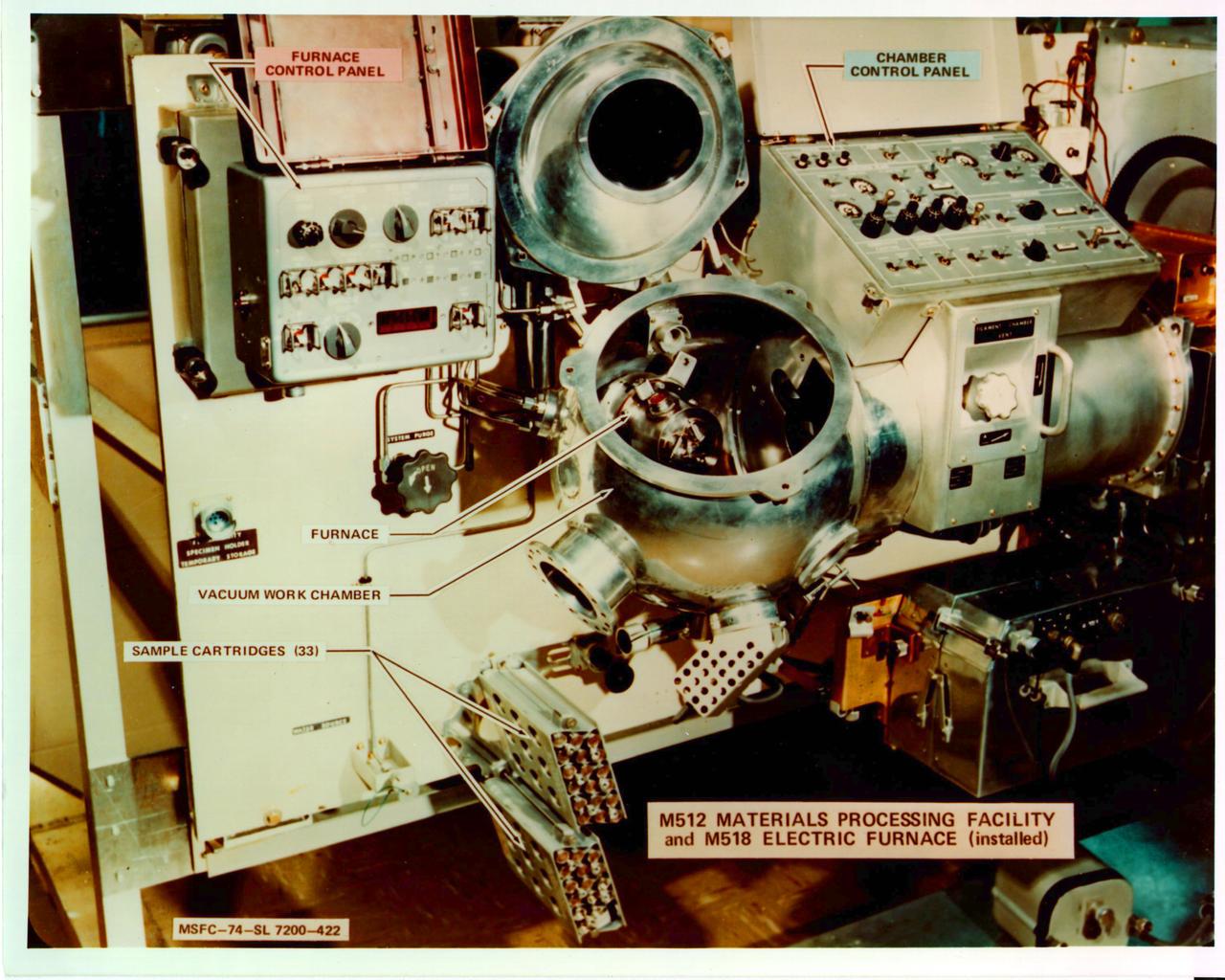
The M512 Materials Processing Facility (MPF) with the M518 Multipurpose Electric Facility (MEF) tested and demonstrated a facility approach for materials process experimentation in space. It also provided a basic apparatus and a common interface for a group of metallic and nonmetallic materials experiments. The MPF consisted of a vacuum work chamber and associated mechanical and electrical controls. The M518 Multipurpose Electric Furnace (MEF) was an electric furnace system in which solidification, crystal growth, and other experiments involving phase changes were performed.
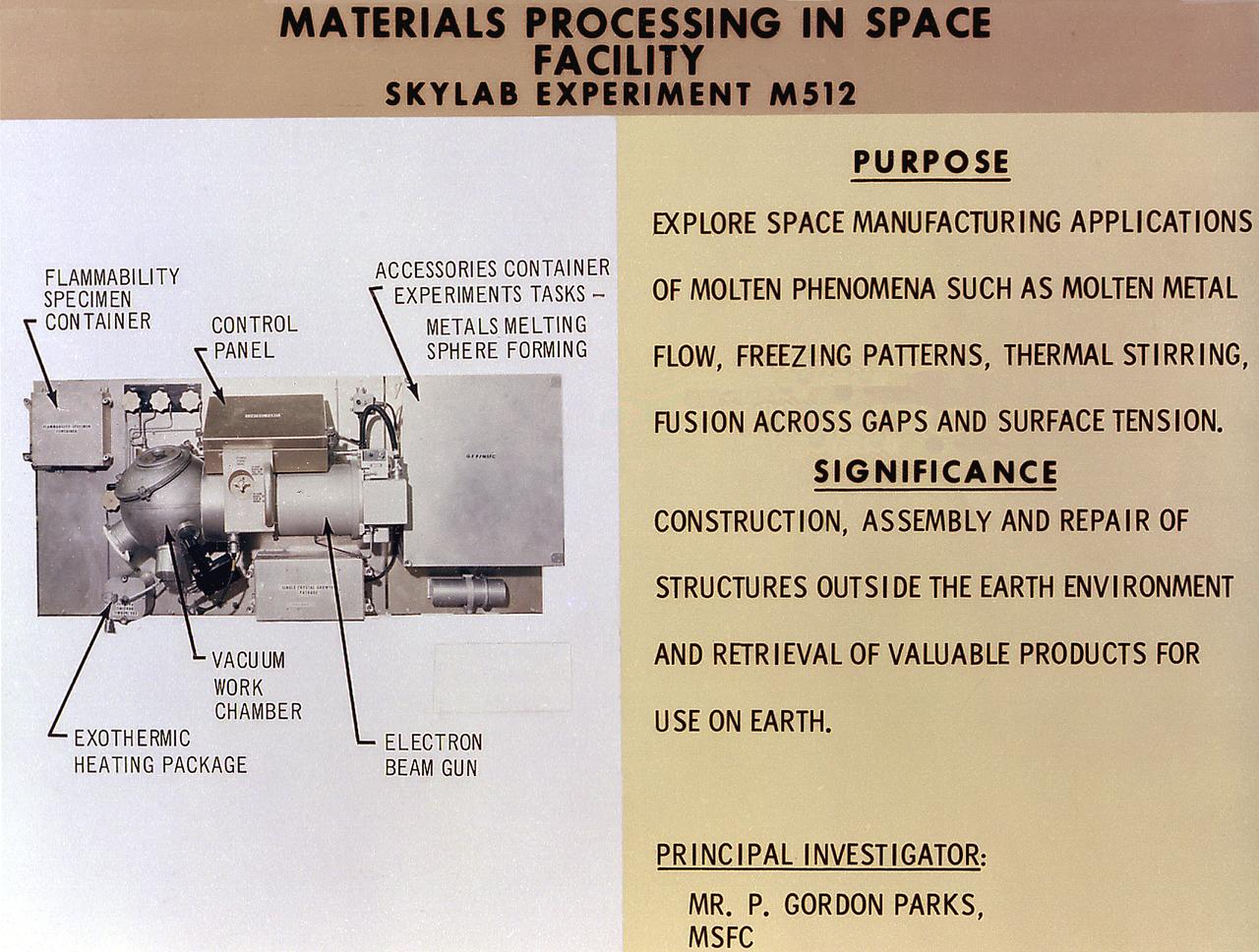
This chart details Skylab's Materials Processing Facility experiment (M512). This facility, located in the Multiple Docking Adapter, was developed for Skylab and accommodated 14 different experiments that were carried out during the three marned missions. The abilities to melt and mix without the contaminating effects of containers, to suppress thermal convection and buoyancy in fluids, and to take advantage of electrostatic and magnetic forces and otherwise masked by gravitation opened the way to new knowledge of material properties and processes. This beginning would ultimately lead to the production of valuable new materials for use on Earth.
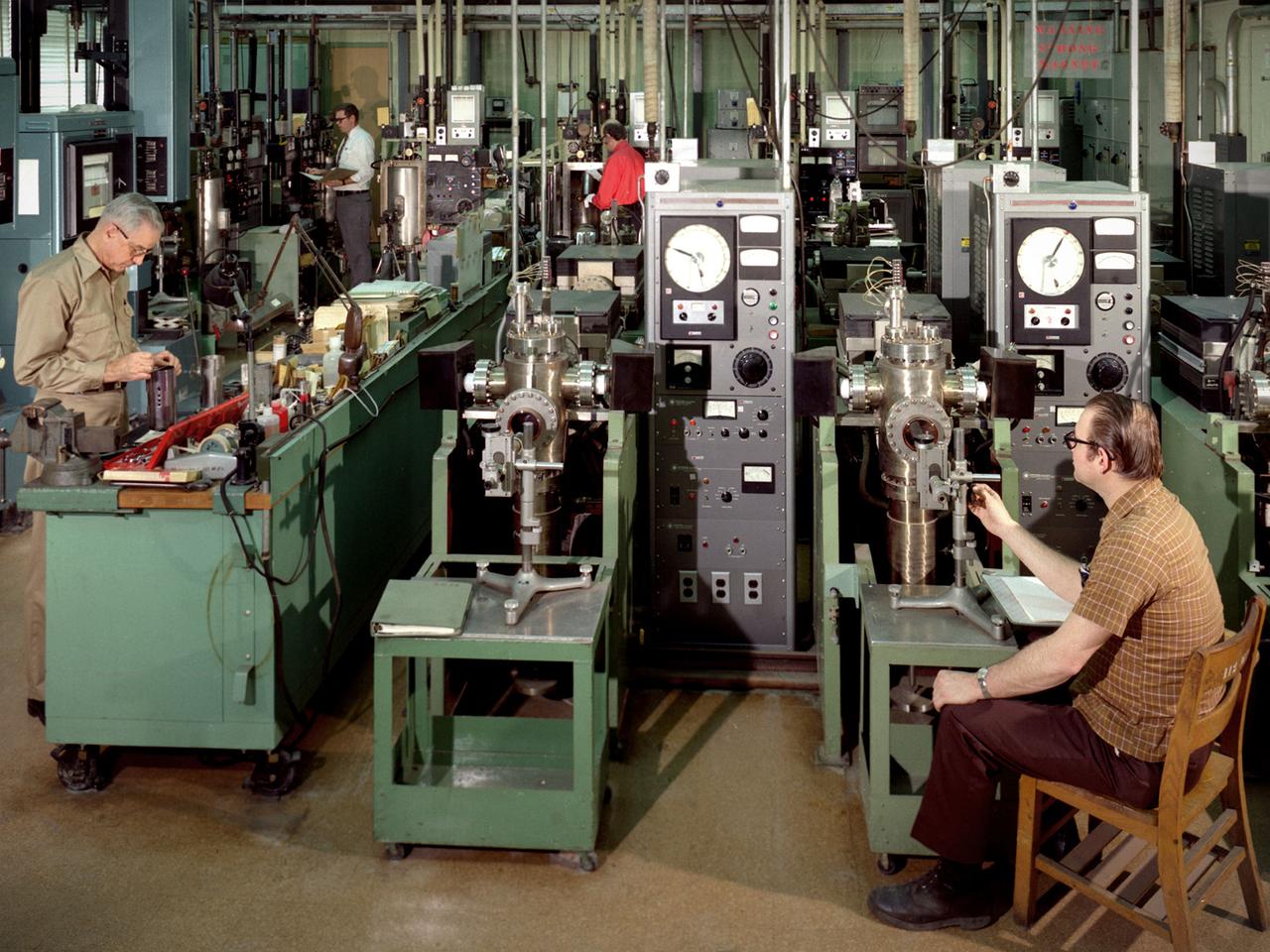
Technicians at work in the Materials Processing Laboratory’s Creep Facility at the National Aeronautics and Space Administration (NASA) Lewis Research Center. The technicians supported the engineers’ studies of refractory materials, metals, and advanced superalloys. The Materials Processing Laboratory contained laboratories and test areas equipped to prepare and develop these metals and materials. The ultra-high vacuum lab, seen in this photograph, contained creep and tensile test equipment. Creep testing is used to study a material’s ability to withstand long durations under constant pressure and temperatures. The equipment measured the strain over a long period of time. Tensile test equipment subjects the test material to strain until the material fails. The two tests were used to determine the strength and durability of different materials. The Materials Processing Laboratory also housed arc and electron beam melting furnaces, a hydraulic vertical extrusion press, compaction and forging equipment, and rolling mills and swagers. There were cryogenic and gas storage facilities and mechanical and oil diffusion vacuum pumps. The facility contained both instrumental and analytical chemistry laboratories for work on radioactive or toxic materials and the only shop to machine toxic materials in the Midwest.
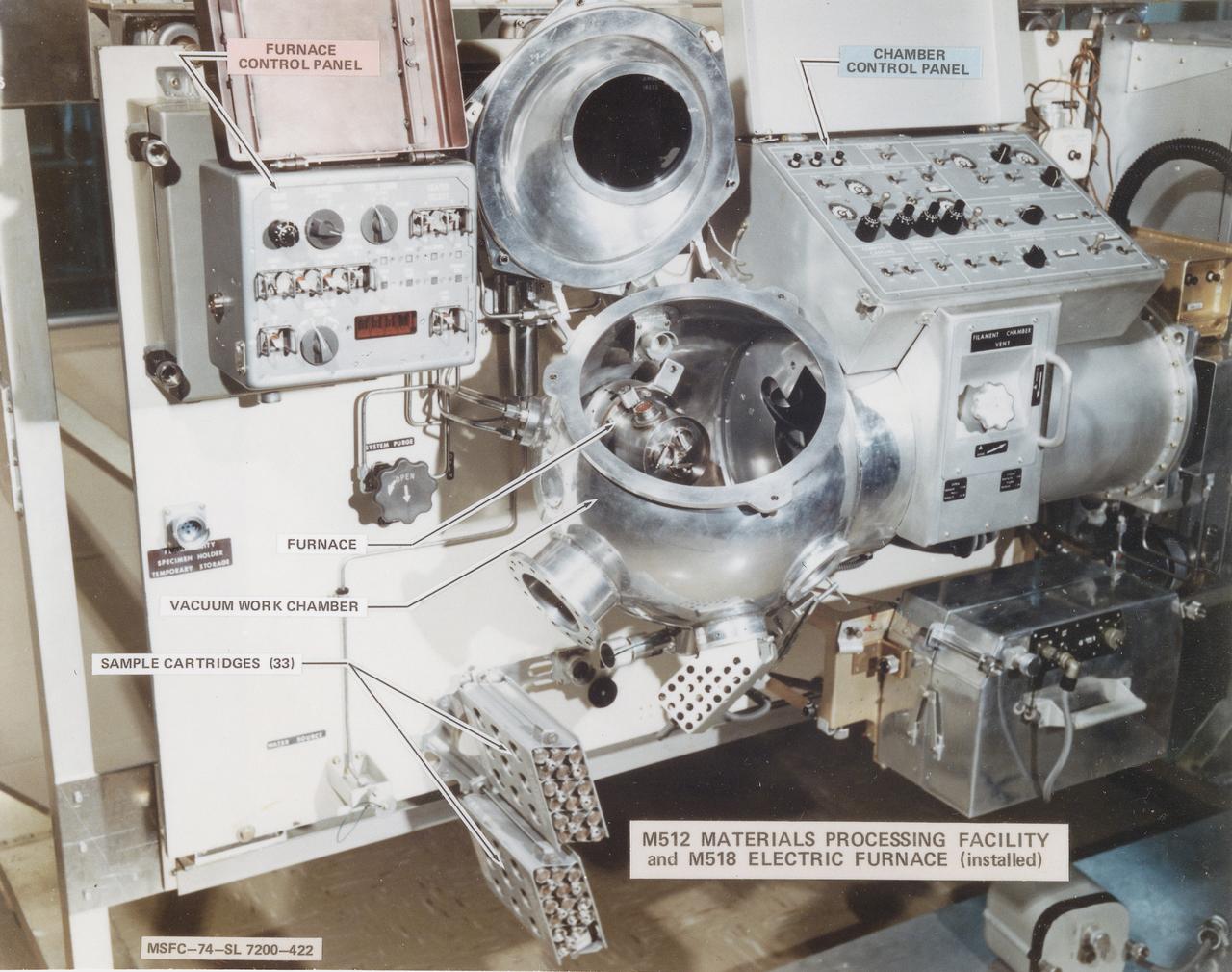
This photograph shows the Skylab Materials Processing Facility (M512) and the Multipurpose Furnace System (M518). This facility, located in the Multiple Docking Adapter, was developed for Skylab,and accommodated 14 different experiments that were carried out during the three marned missions. The abilities to melt and mix without the contaminating effects of containers, to suppress thermal convection and buoyancy in fluids, and to take advantage of electrostatic and magnetic forces and otherwise masked by gravitation opened the way to new knowledge of material properties and processes. This beginning would ultimately lead to the production of valuable new materials for use on Earth.
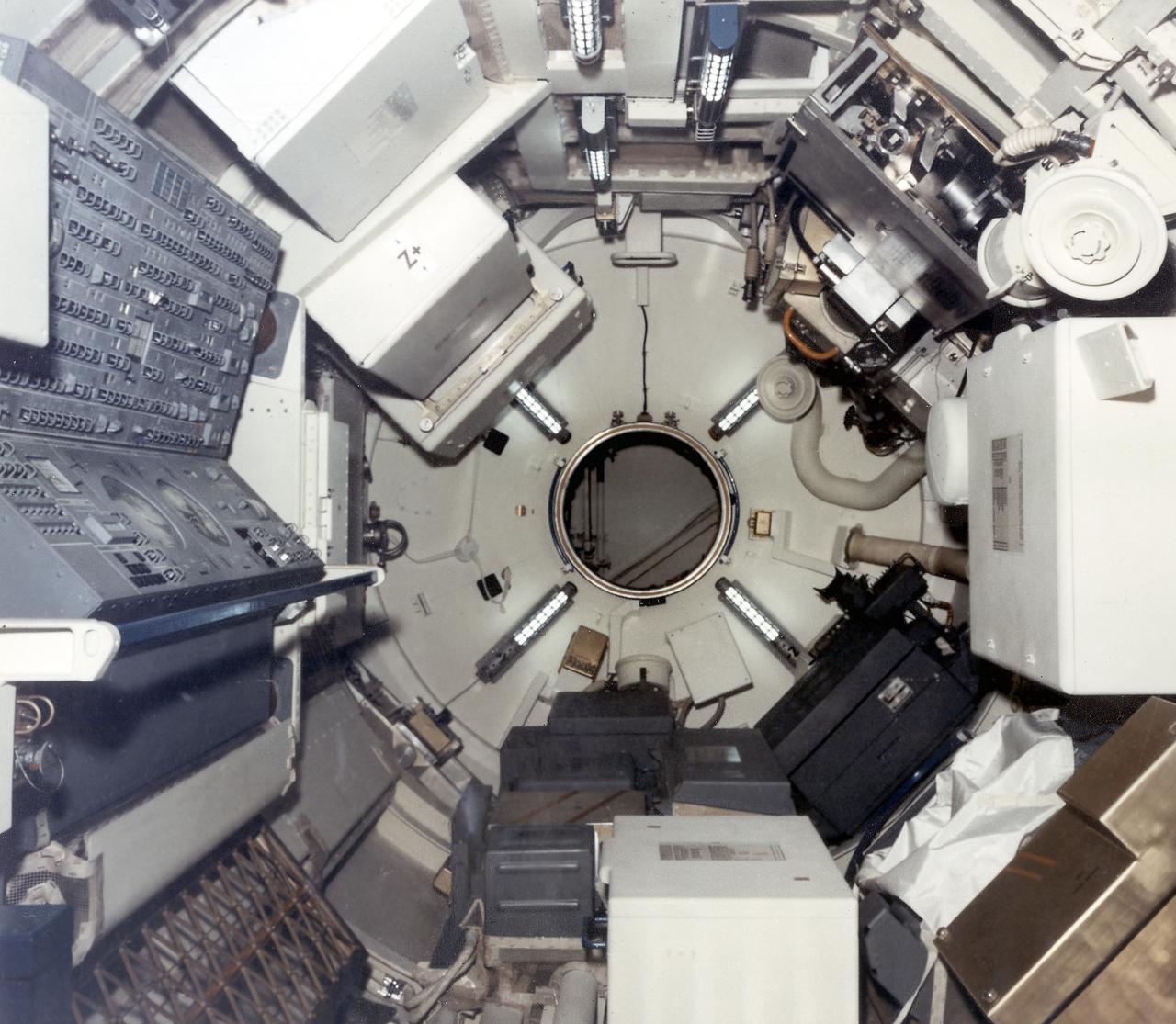
This interior photograph of Skylab's multiple docking adapter (MDA) flight article, then undergoing outfitting at the Martin Marietta Corporation's Space Center facility in Denver, Colorado, shows the forward cone area and docking turnel (center) that attached to the Apollo Command Module. Designed and manufactured by the Marshall Space Flight Center, the MDA housed the control units for the Apollo Telescope Mount (ATM), Earth Resources Experiment Package (EREP), and Zero-Gravity Materials Processing Facility and provided a docking port for the Apollo Command Module.
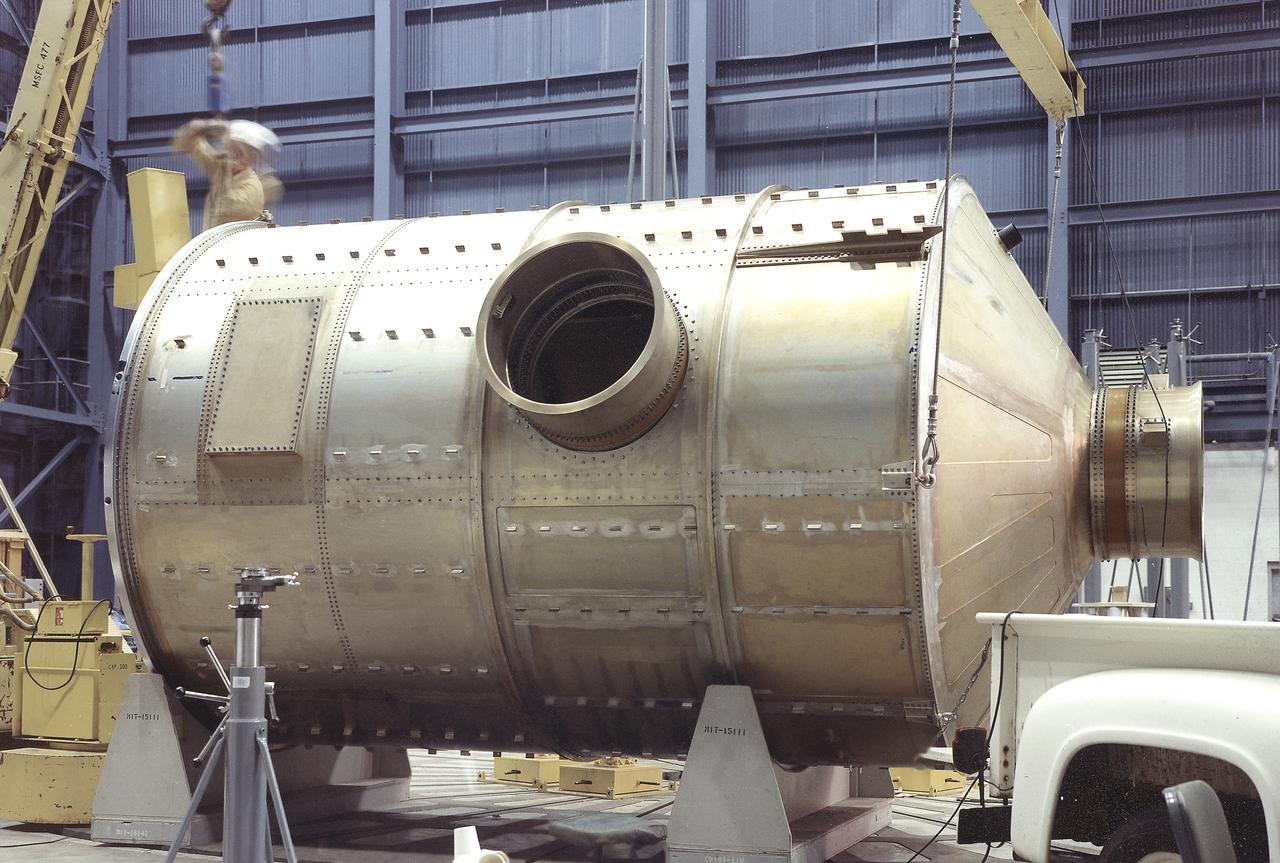
At Marshall Space Flight Center, Skylab's Multiple Docking Adapter (MDA) flight article undergoes center-of-gravity testing. Developed and fabricated by MSFC, the MDA housed the control units for the Apollo Telescope Mount (ATM), Earth Resources Experiment Package (EREP), and the Zero-Gravity Material Processing Facility and provided a docking port for the Apollo Command Module.
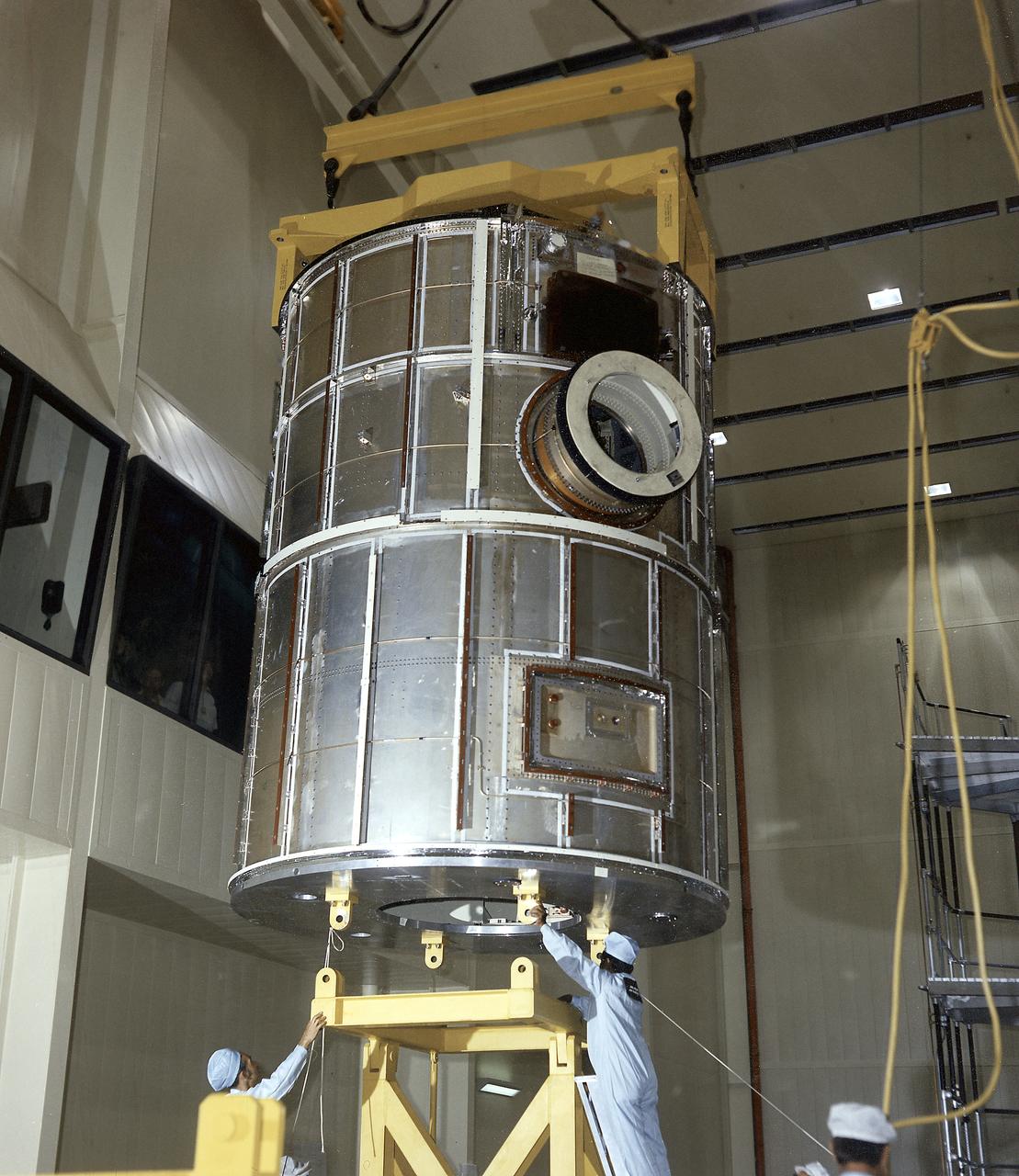
Workmen at the Martin Marietta Corporation's Space Center in Denver, Colorado, position Skylab's Multiple Docking Adapter (MDA) flight article in the horizontal transportation fixture. Designed and manufactured by the Marshall Space Flight Center and outfitted by Martin Marietta, the MDA housed the control units for the Apollo Telescope Mount (ATM), Earth Resources Experiment Package (EREP), and Zero-Gravity Materials Processing Facility and provided a docking port for the Apollo Command Module.
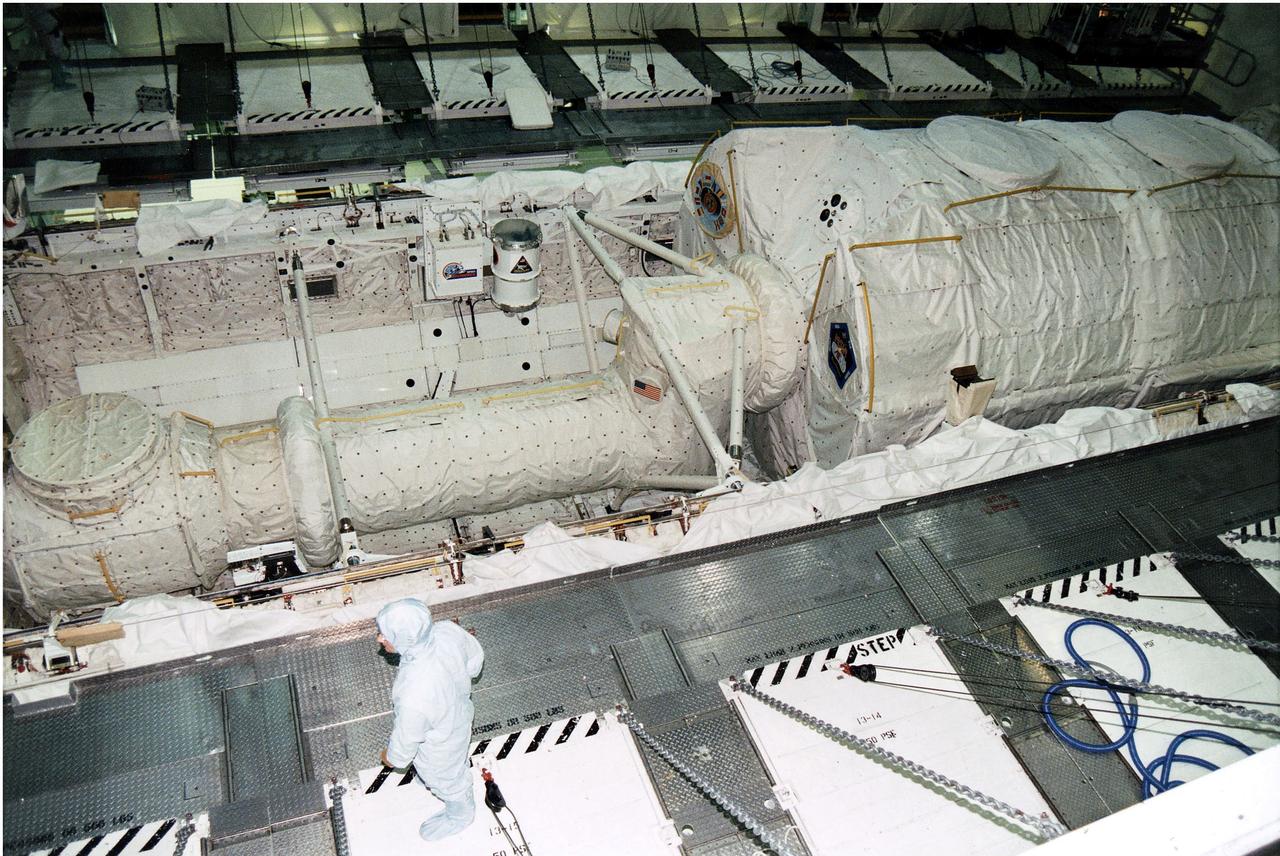
KENNEDY SPACE CENTER, FLA. - The Microgravity Science Laboratory-1 (MSL-1) Spacelab module is installed into the payload bay of the Space Shuttle Orbiter Columbia in Orbiter Processing Facility 1. The Spacelab long crew transfer tunnel that leads from the orbiter's crew airlock to the module is also aboard, as well as the Hitchhiker Cryogenic Flexible Diode (CRYOFD) experiment payload, which is attached to the right side of Columbia's payload bay. During the scheduled 16-day STS-83 mission, the MSL-1 will be used to test some of the hardware, facilities and procedures that are planned for use on the International Space Station while the flight crew conducts combustion, protein crystal growth and materials processing experiments.
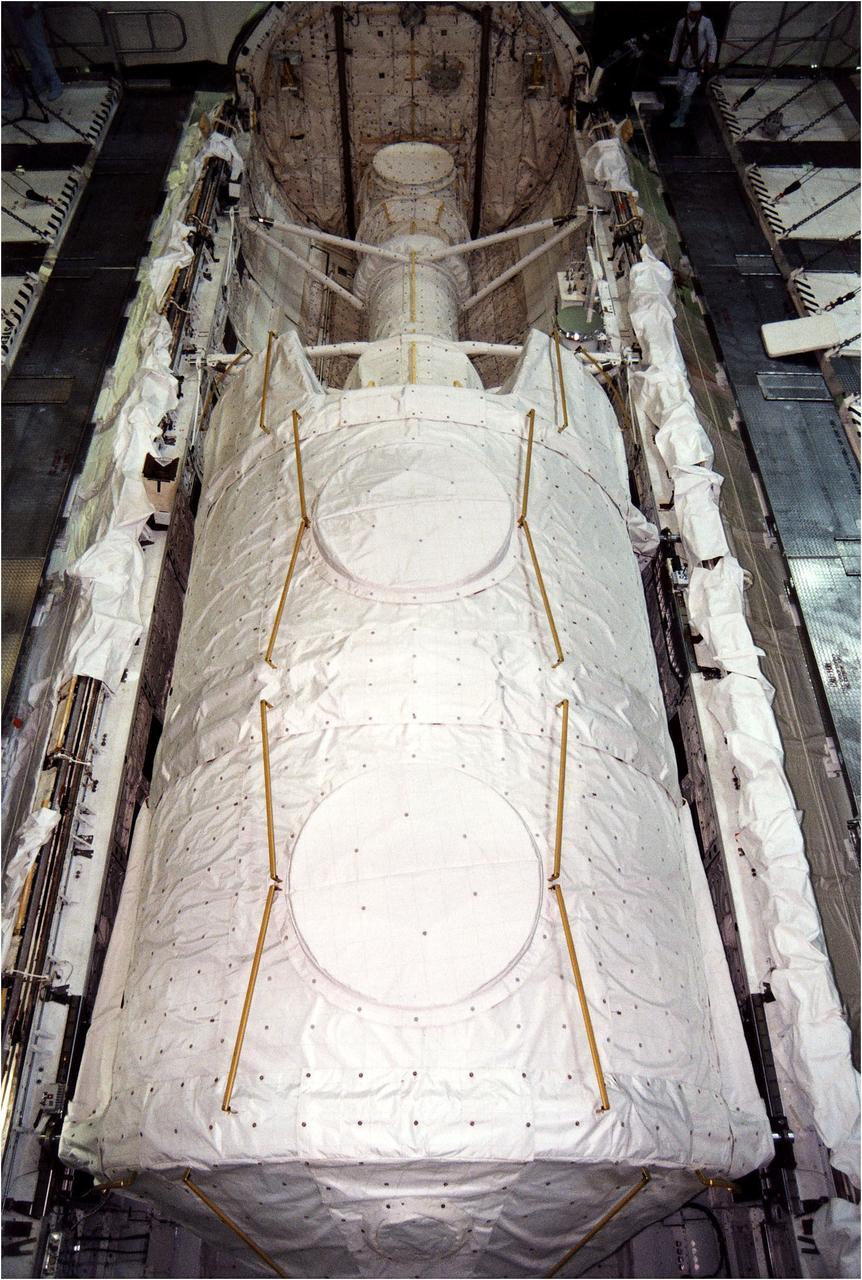
KENNEDY SPACE CENTER, FLA. - The Microgravity Science Laboratory-1 (MSL-1) Spacelab module is installed into the payload bay of the Space Shuttle Orbiter Columbia in Orbiter Processing Facility 1. The Spacelab long crew transfer tunnel that leads from the orbiter's crew airlock to the module is also aboard, as well as the Hitchhiker Cryogenic Flexible Diode (CRYOFD) experiment payload, which is attached to the right side of Columbia's payload bay. During the scheduled 16-day STS-83 mission, the MSL-1 will be used to test some of the hardware, facilities and procedures that are planned for use on the International Space Station while the flight crew conducts combustion, protein crystal growth and materials processing experiments.
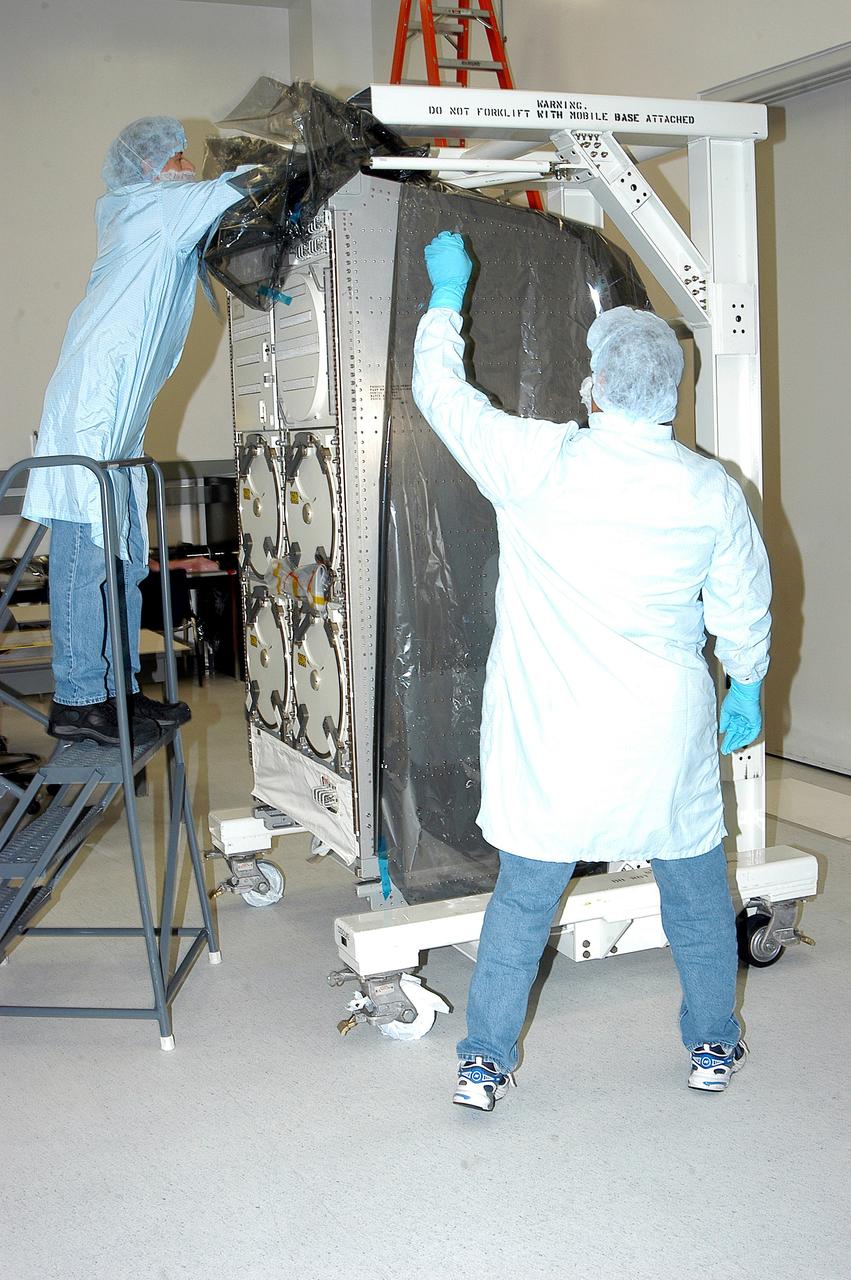
KENNEDY SPACE CENTER, FLA. - In the Space Station Processing Facility, technicians remove the cover from the Minus Eighty Lab Freezer for ISS(MELFI) provided as Laboratory Support Equipment by the European Space Agency for the International Space Station. The lab will provide cooling and storage for reagents, samples and perishable materials in four insulated containers called dewars with independently selectable temperatures of -80°C, -26°C, and +4°C. It also will be used to transport samples to and from the station. The MELFI is planned for launch on the ULF-1 mission.
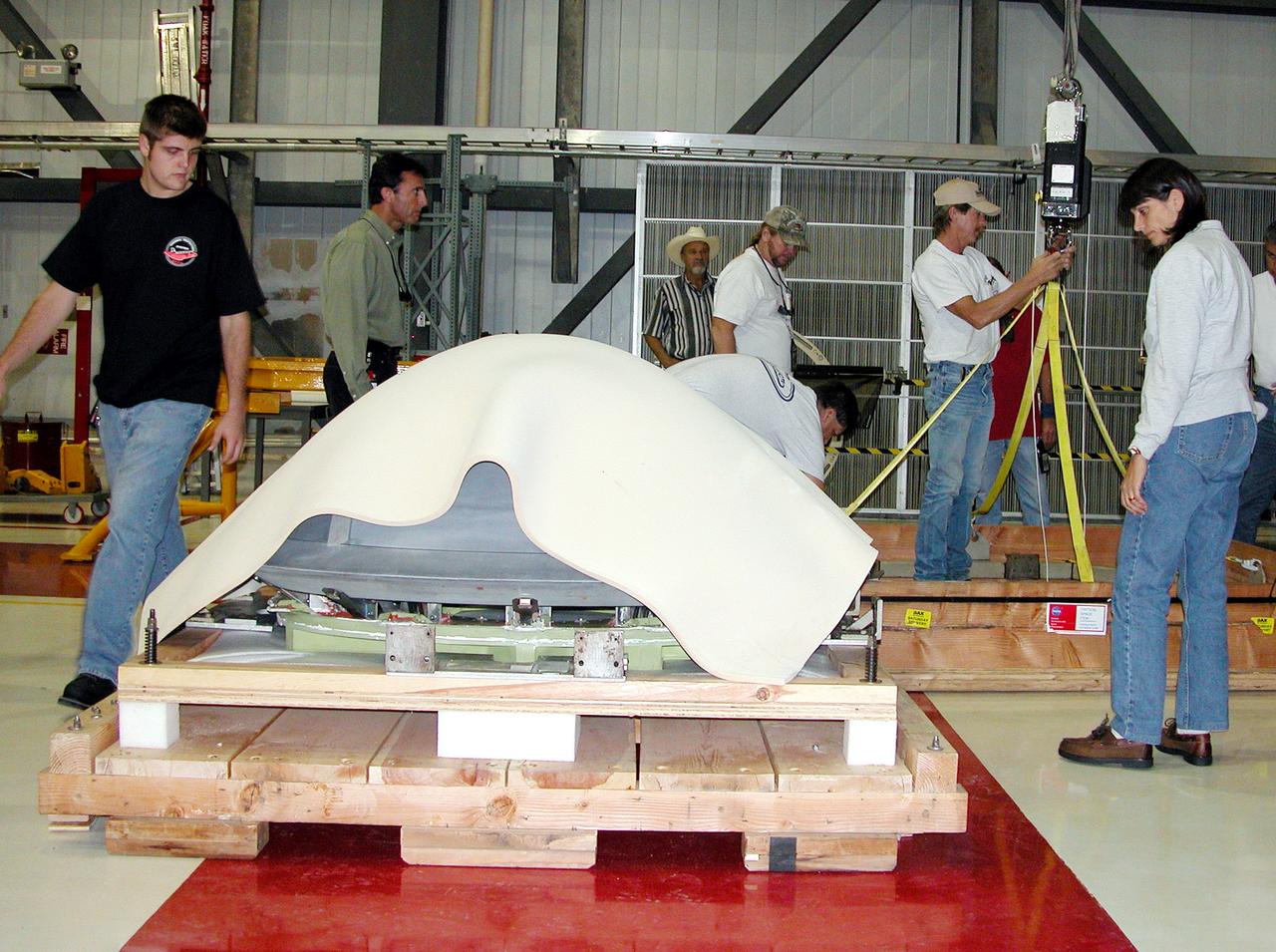
KENNEDY SPACE CENTER, FLA. - In the Orbiter Processing Facility, packing material is placed over the nose cap that was removed from Atlantis. The reinforced carbon-carbon (RCC) nose cap is being sent to the original manufacturing company, Vought in Ft. Worth, Texas, a subsidiary of Lockheed Martin, to undergo non-destructive testing such as CAT scan and thermography.
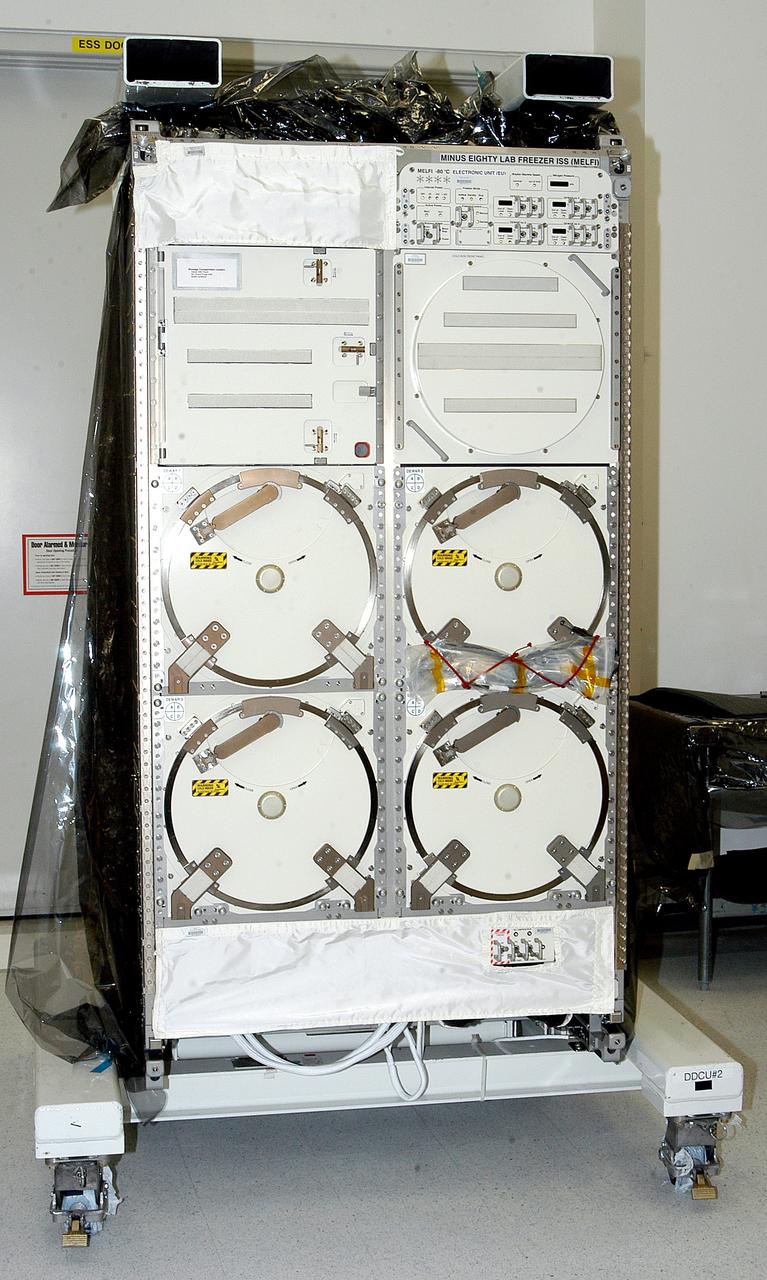
KENNEDY SPACE CENTER, FLA. - The Minus Eighty Lab Freezer for ISS (MELFI), provided as Laboratory Support Equipment by the European Space Agency for the International Space Station, is seen in the Space Station Processing Facility. The lab will provide cooling and storage for reagents, samples and perishable materials in four insulated containers called dewars with independently selectable temperatures of -80°C, -26°C, and +4°C. It also will be used to transport samples to and from the station. The MELFI is planned for launch on the ULF-1 mission.
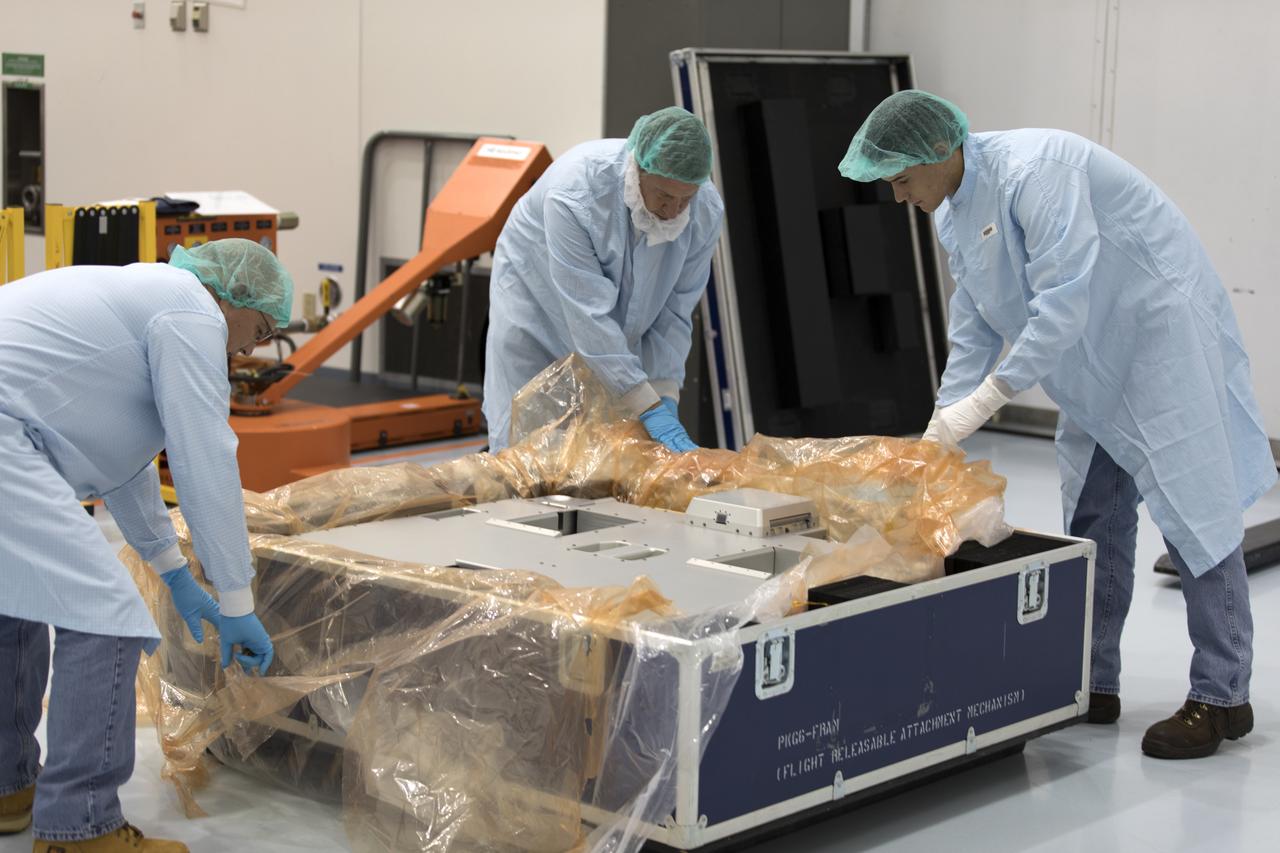
The Materials International Space Station Experiment-Flight Facility, or MISSE-FF, hardware arrived at the Space Station Processing Facility low bay at NASA's Kennedy Space Center in Florida. MISSE will be unpacked for integration and processing. MISSE will be used to test various materials and computing elements on the exterior of the space station. They will be exposed to the harsh environment of low-Earth orbit, including to a vacuum, atomic oxygen, ultraviolet radiation, direct sunlight and extreme heat and cold. The experiment will provide a better understanding of material durability, from coatings to electronic sensors, which could be applied to future spacecraft designs. MISSE will be delivered to the space station on a future commercial resupply mission.
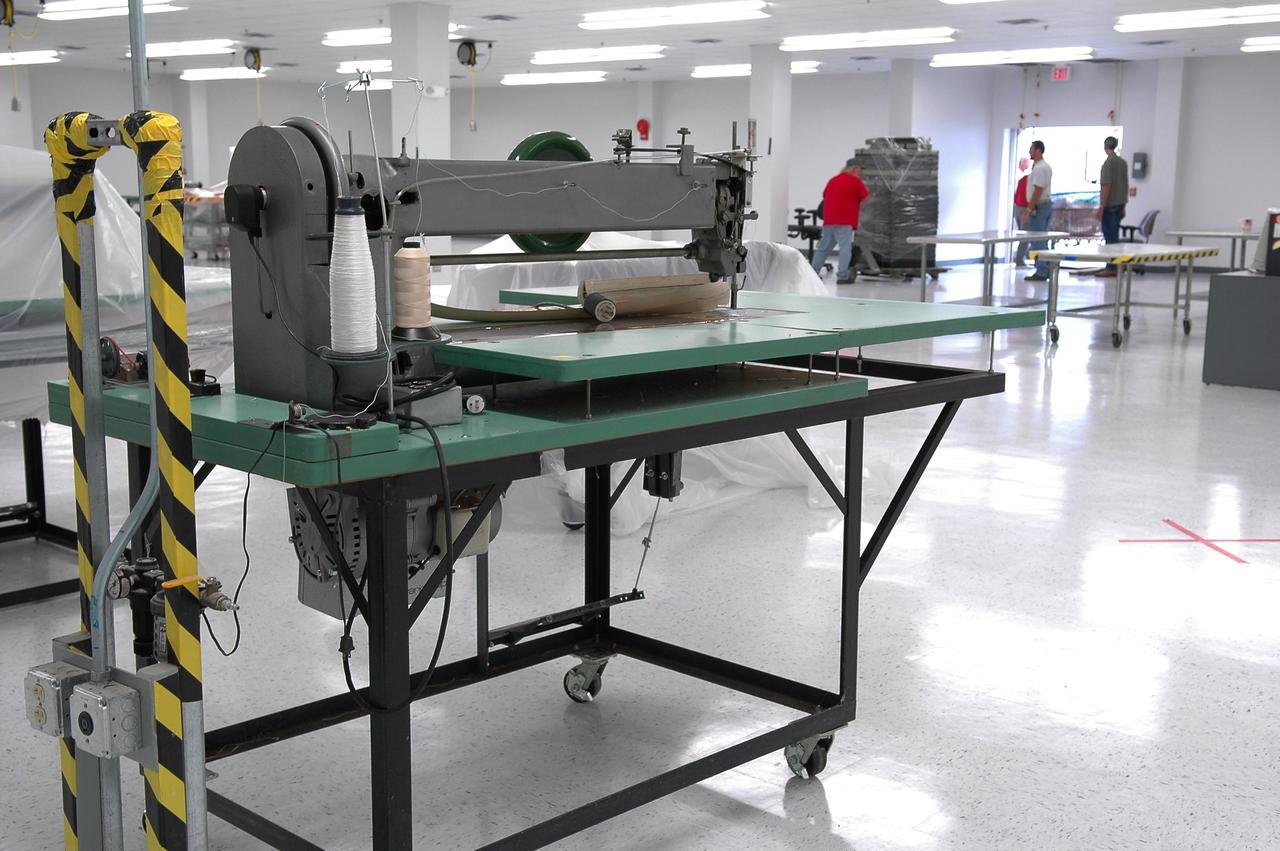
KENNEDY SPACE CENTER, FLA. - One of the blanket sewing machines used on Thermal Protection System materials has been returned to the TPS facility. It was moved to the RLV Hangar at NASA Kennedy Space Center after the 2004 hurricanes damaged the upper floor, where soft material was processed, of the TPS facility. While the TPS facility was being repaired, normal work activity was done in the hangar.
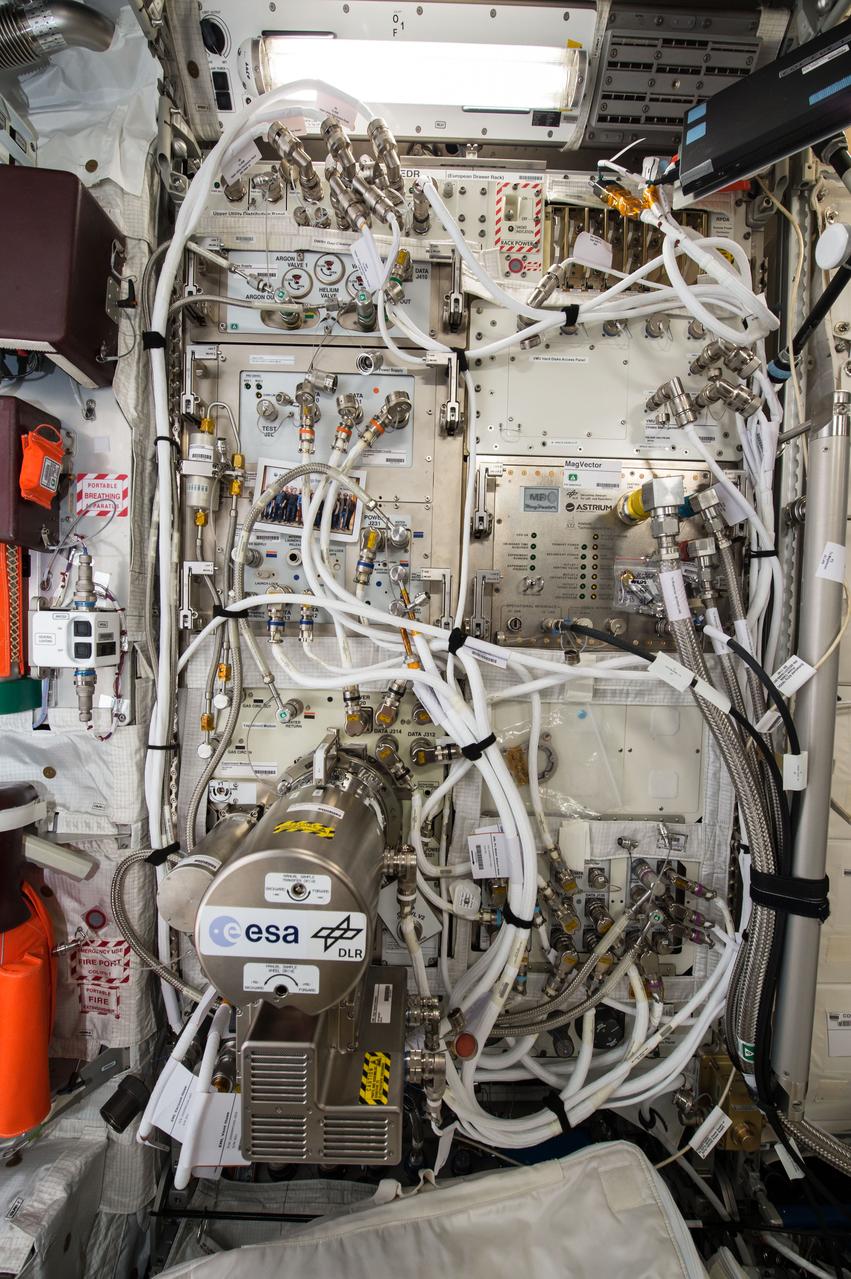
iss041e096097 (10/23/2014) — Photo documentation of the Electromagnetic Levitator (EML) in the Columbus module of the International Space Station (ISS). The EML multi-user facility is designed for containerless materials processing in space.
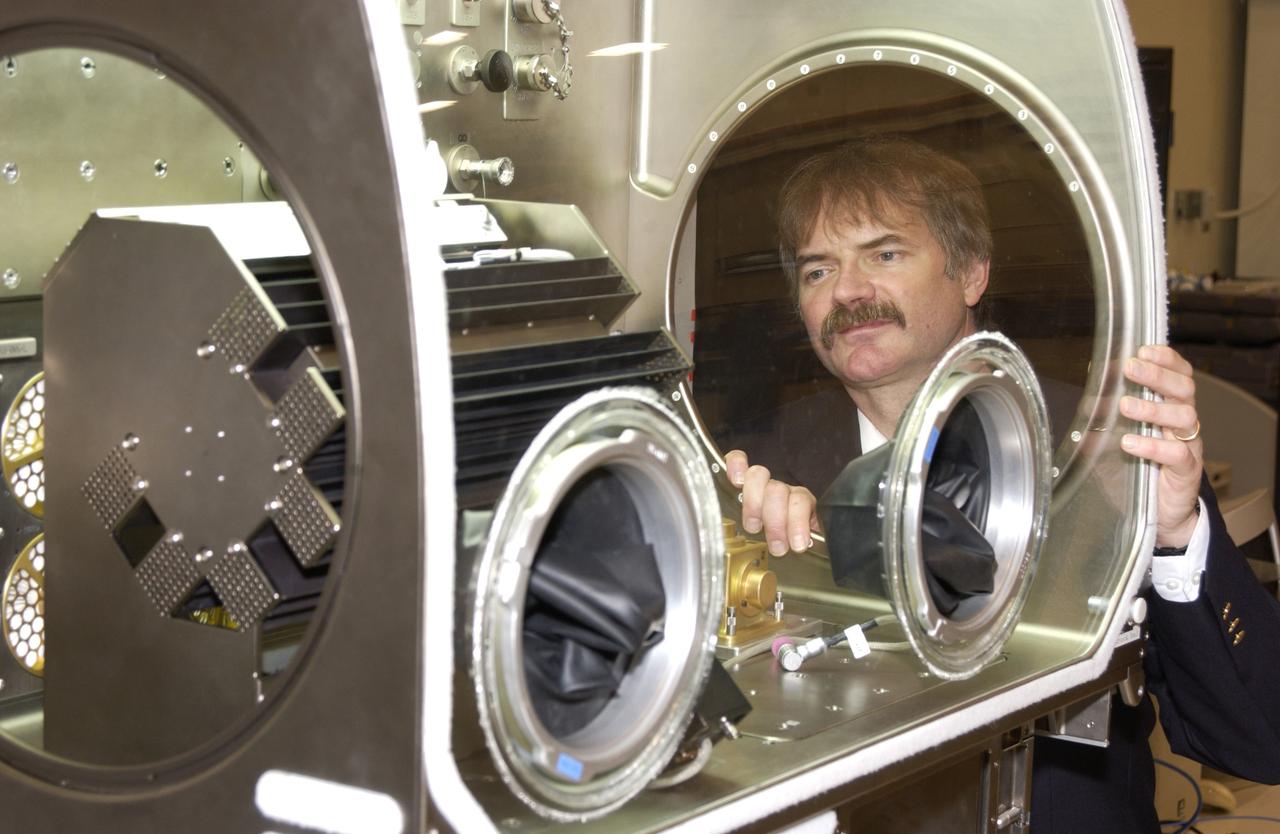
Dr. Richard Grugel, a materials scientist at NASA's Marshall Space Flight in Huntsville, Ala., examines the furnace used to conduct his Pore Formation and Mobility Investigation -- one of the first two materials science experiments to be conducted on the International Space Station. This experiment studies materials processes similar to those used to make components used in jet engines. Grugel's furnace was installed in the Microgravity Science Glovebox through the circular port on the side. In space, crewmembers are able to change out samples using the gloves on the front of the facility's work area.
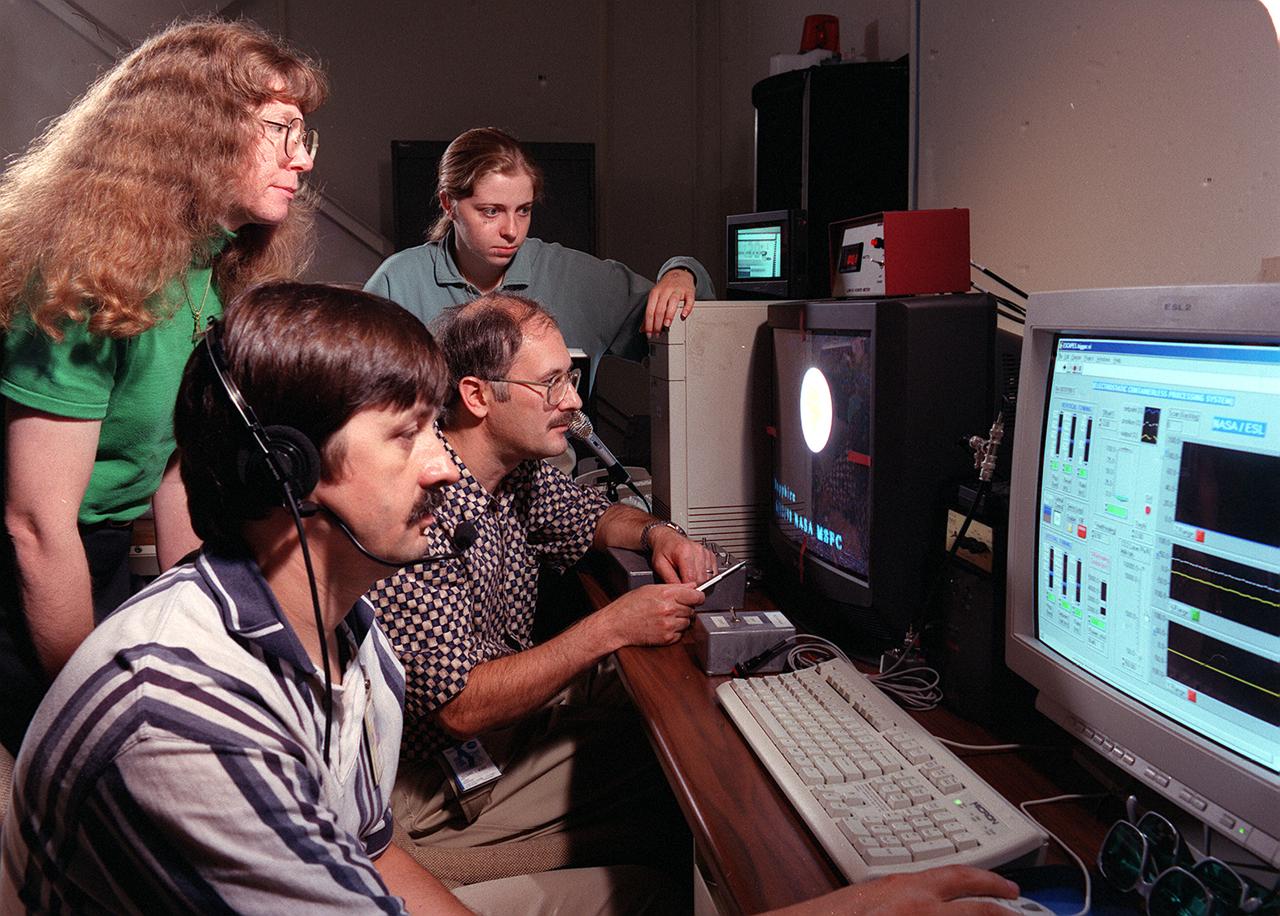
Dr. Jan Rogers (left) and Larry Savage (foreground) of the Science Directorate at NASA's Marshall Space Flight Center (MSFC) are joined by Dr. Richard Weber (center) and April Hixon of Containerless Research Inc. of Evanston, Ill., in conducting an experiment run of the Electrostatic Levitator (ESL) using insulating materials. Materials researchers use unique capabilities of the facility to levitate and study the properties of various materials important in manufacturing processes.
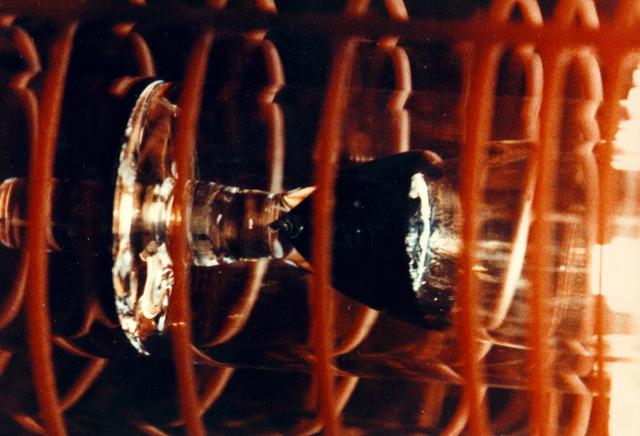
The objective of this facility is to investigate the potential of space grown semiconductor materials by the vapor transport technique and develop powdered metal and ceramic sintering techniques in microgravity. The materials processed or developed in the SEF have potential application for improving infrared detectors, nuclear particle detectors, photovoltaic cells, bearing cutting tools, electrical brushes and catalysts for chemical production. Flown on STS-60 Commercial Center: Consortium for Materials Development in Space - University of Alabama Huntsville (UAH)
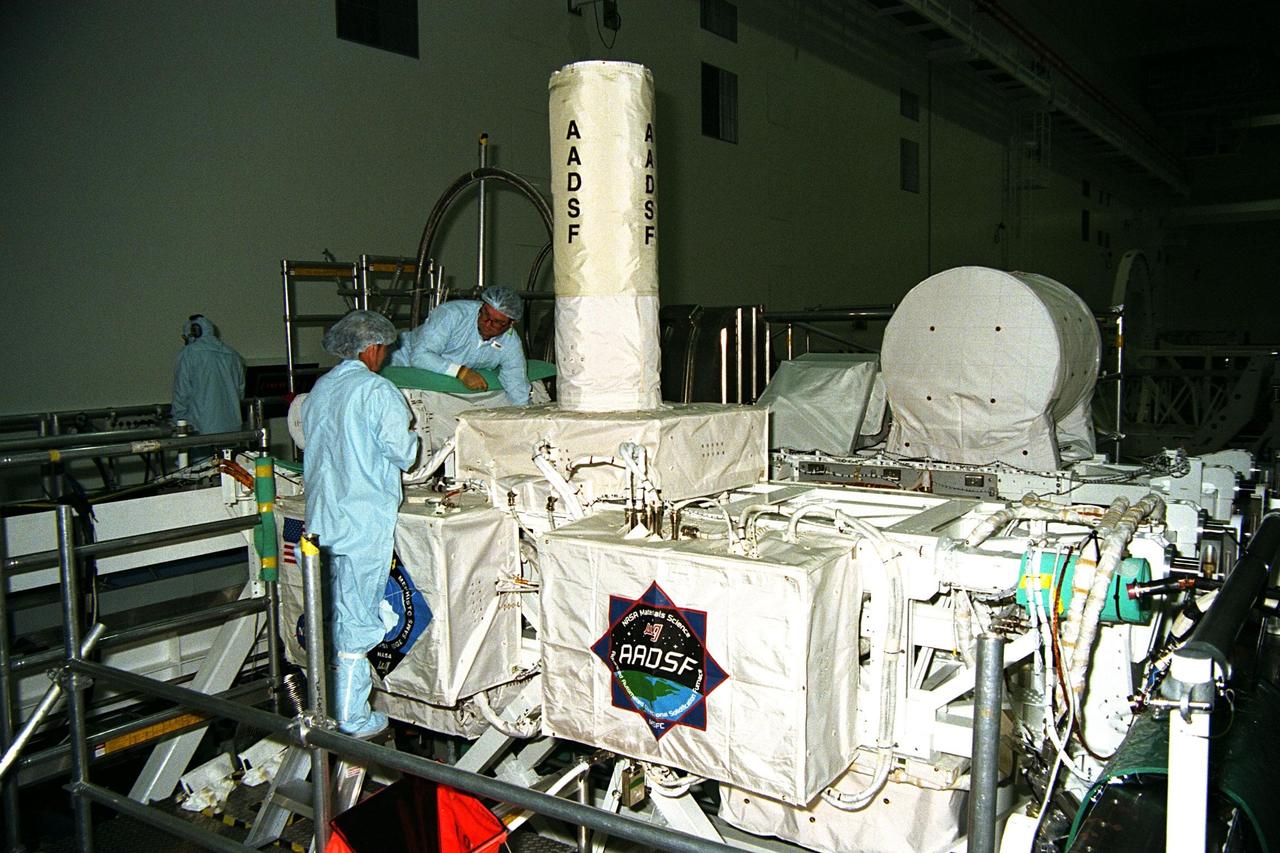
Technicians are monitoring experiments on the United States Microgravity Payload-4 (USMP-4) in preparation for its scheduled launch aboard STS-87 on Nov. 19 from Kennedy Space Center (KSC). USMP-4 experiments are prepared in the Space Station Processing Facility at KSC. The large white vertical cylinder in the center of the photo is the Advanced Automated Directional Solidification Furnace (AADSF), which is a sophisticated materials science facility used for studying a common method of processing semiconductor crystals called directional solidification. The white horizontal tube to the right is the Isothermal Dendritic Growth Experiment (IDGE), which will be used to study the dendritic solidification of molten materials in the microgravity environment
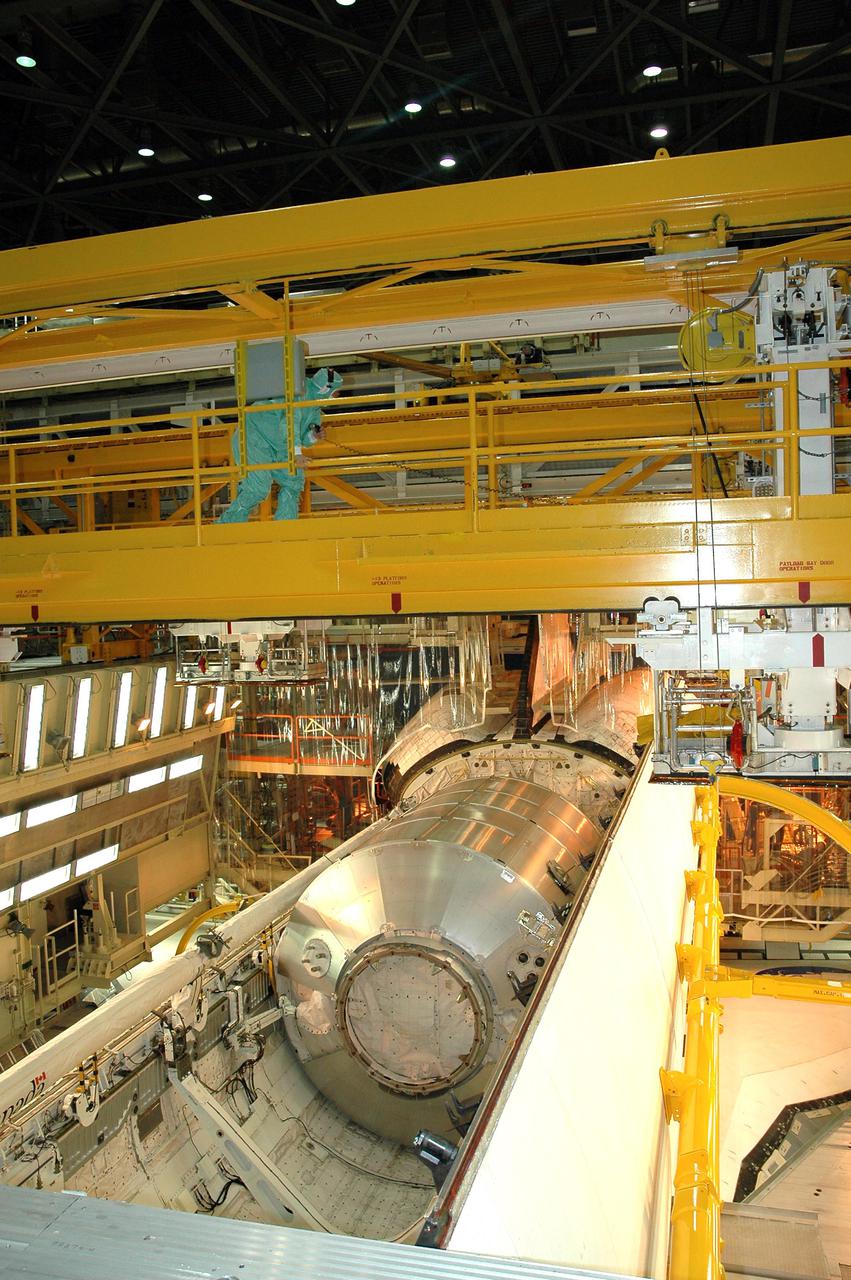
KENNEDY SPACE CENTER, FLA. - In bay 3 of NASA Kennedy Space Center’s Orbiter Processing Facility, the payload bay doors on Discovery are being opened. Seen inside is the Multi-Purpose Logistics Module Raffaello, which holds material being returned to KSC from the International Space Station as part of Return to Flight mission STS-114. The module will be lifted out of the payload bay and transferred to the Space Station Processing Facility to be emptied. Discovery will begin processing for the second Return to Flight mission, STS-121.
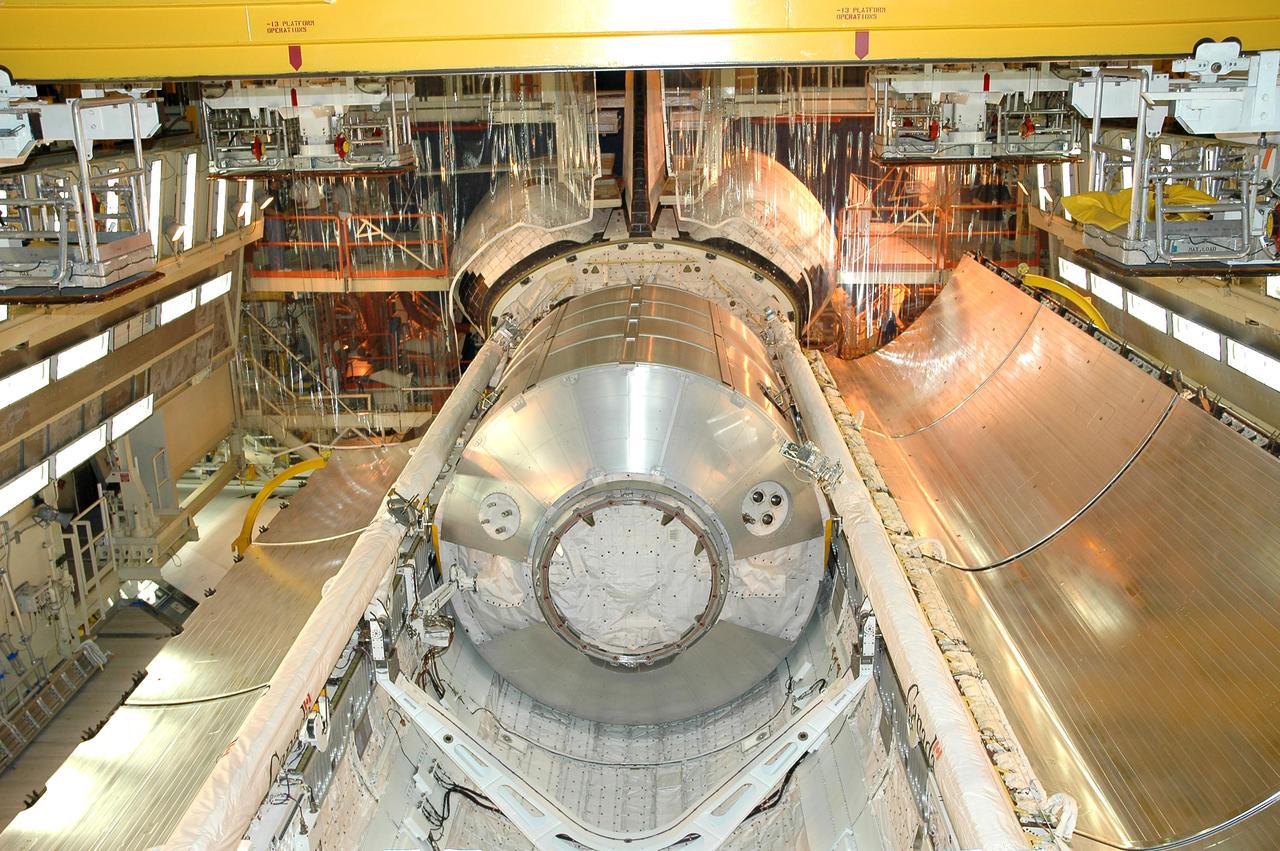
KENNEDY SPACE CENTER, FLA. - In bay 3 of NASA Kennedy Space Center’s Orbiter Processing Facility, the payload bay doors on Discovery are open. Seen inside is the Multi-Purpose Logistics Module Raffaello, which holds material being returned to KSC from the International Space Station as part of Return to Flight mission STS-114. The module will be lifted out of the payload bay and transferred to the Space Station Processing Facility to be emptied. Discovery will begin processing for the second Return to Flight mission, STS-121.
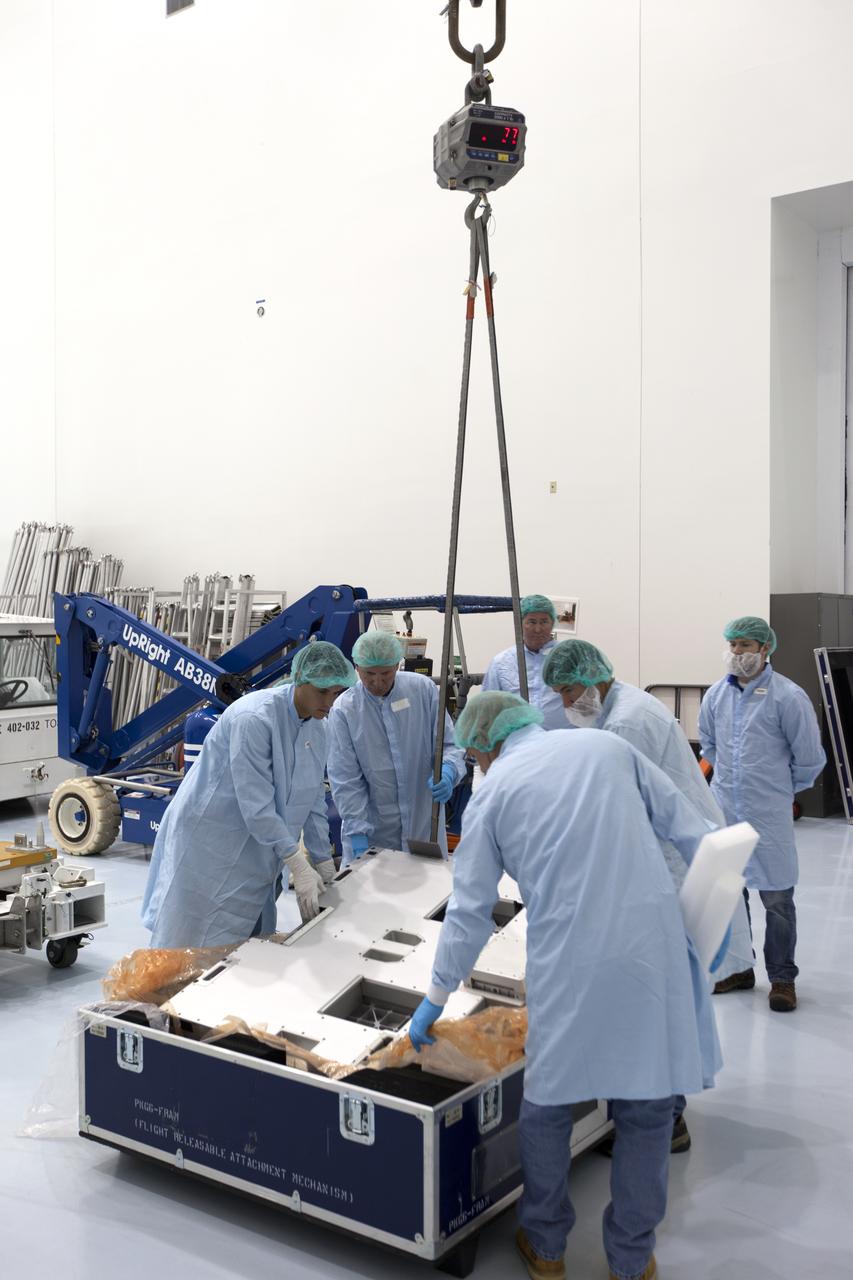
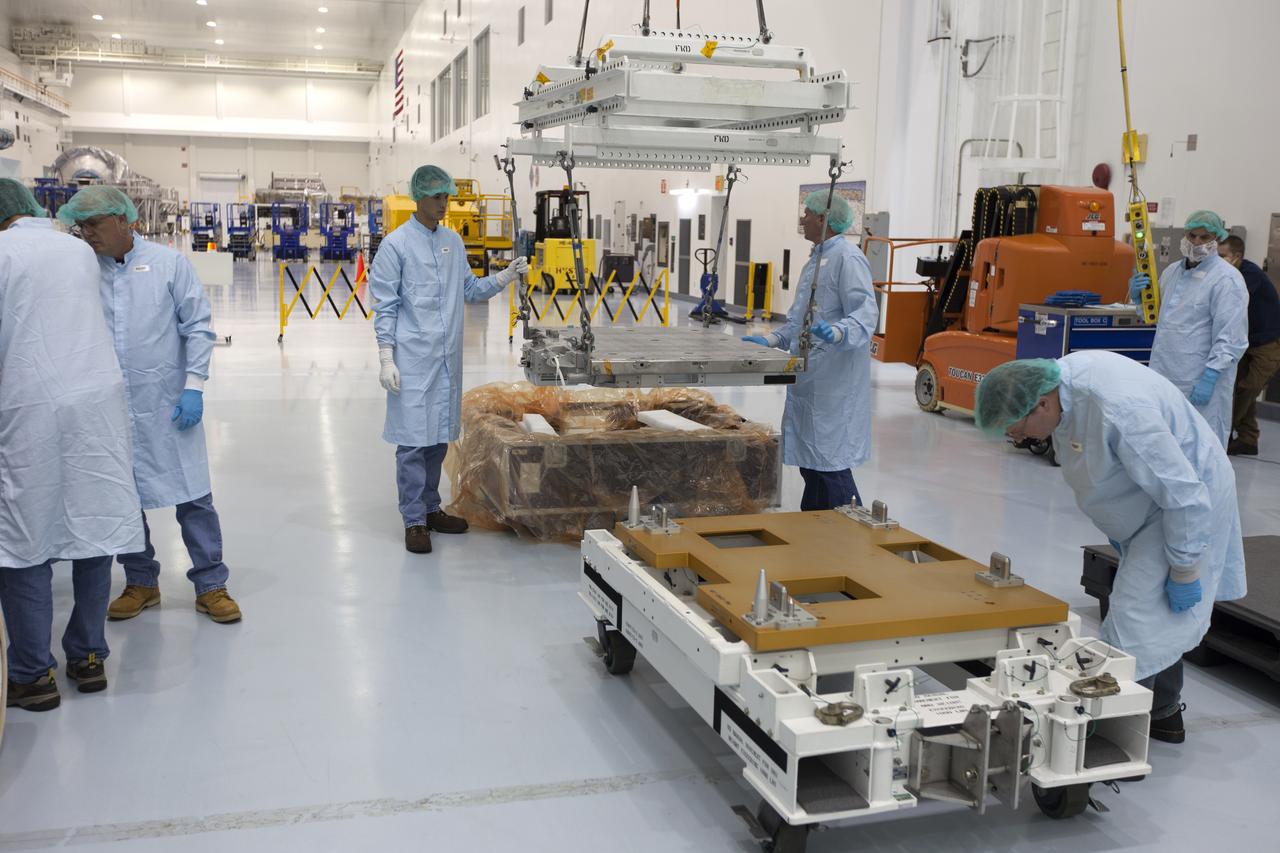
The Materials International Space Station Experiment-Flight Facility, or MISSE-FF, hardware arrived at the Space Station Processing Facility low bay at NASA's Kennedy Space Center in Florida. Technicians attach a crane to MISSE for lifting out of its shipping container. MISSE will be used to test various materials and computing elements on the exterior of the space station. They will be exposed to the harsh environment of low-Earth orbit, including to a vacuum, atomic oxygen, ultraviolet radiation, direct sunlight and extreme heat and cold. The experiment will provide a better understanding of material durability, from coatings to electronic sensors, which could be applied to future spacecraft designs. MISSE will be delivered to the space station on a future commercial resupply mission.
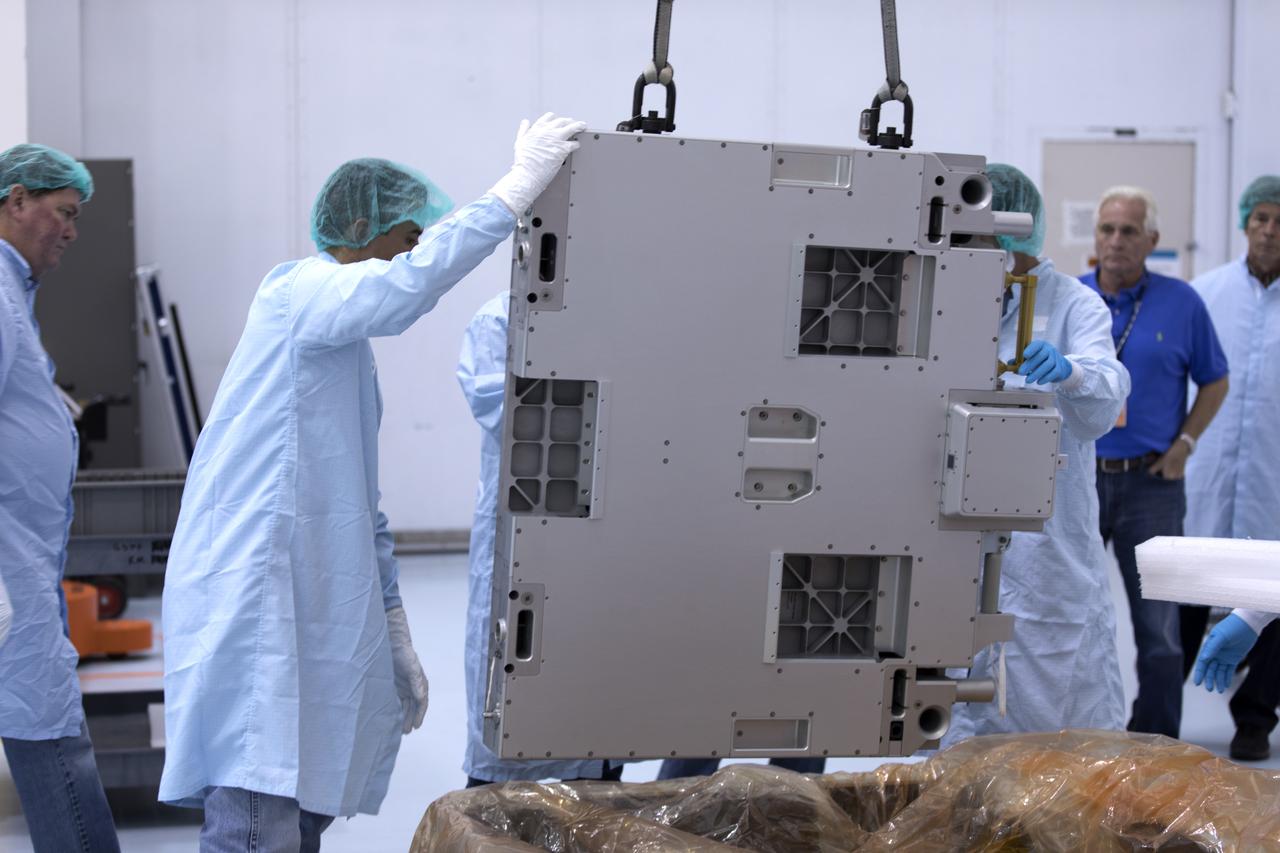
The Materials International Space Station Experiment-Flight Facility, or MISSE-FF, hardware arrived at the Space Station Processing Facility low bay at NASA's Kennedy Space Center in Florida. Technicians assist as a crane is used to lift MISSE out of its shipping container. MISSE will be used to test various materials and computing elements on the exterior of the space station. They will be exposed to the harsh environment of low-Earth orbit, including to a vacuum, atomic oxygen, ultraviolet radiation, direct sunlight and extreme heat and cold. The experiment will provide a better understanding of material durability, from coatings to electronic sensors, which could be applied to future spacecraft designs. MISSE will be delivered to the space station on a future commercial resupply mission.
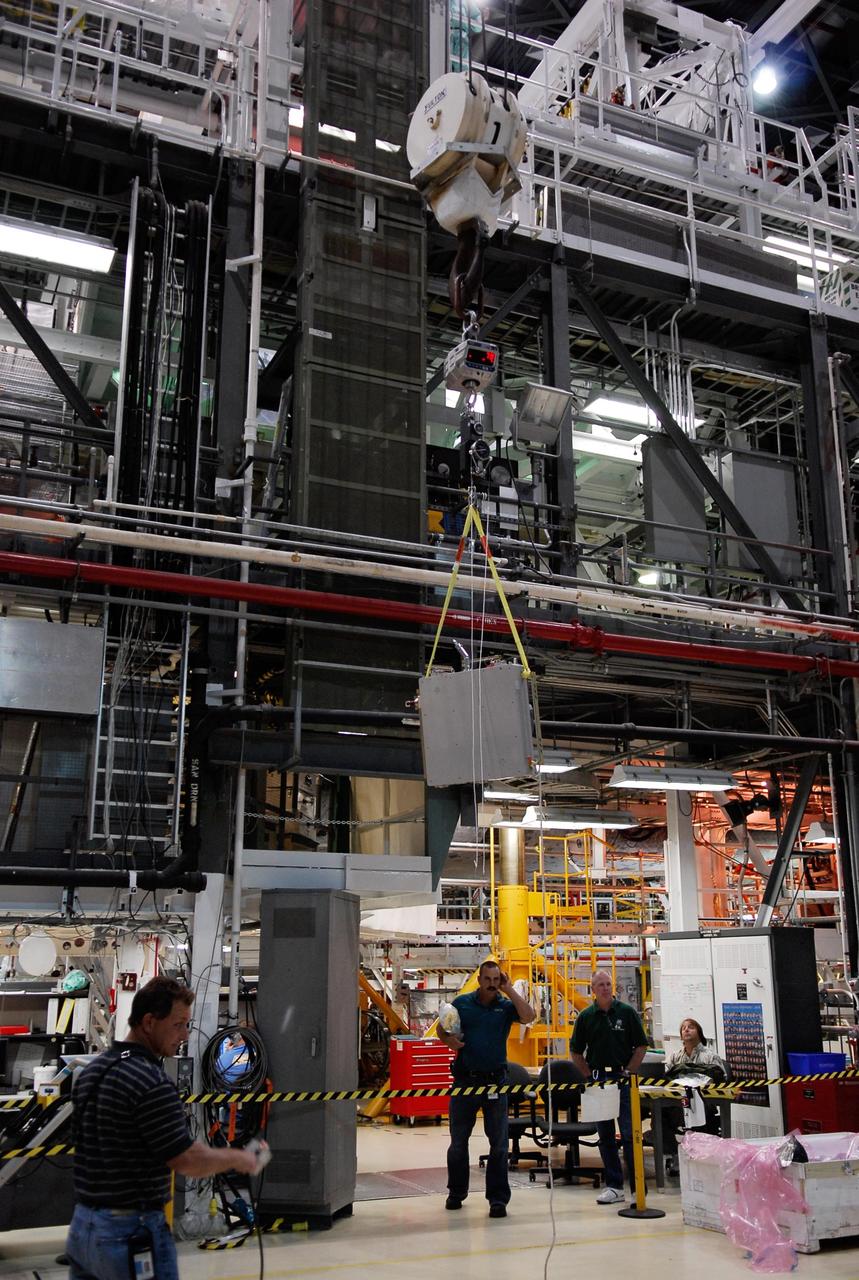
KENNEDY SPACE CENTER, FLA. -- In the Orbiter Processing Facility, one of two Materials International Space Station Experiments, or MISSE, is moved across facility toward space shuttle Endeavour. The MISSE is part of the payload onboard Endeavour for mission STS-123 and will be installed in the payload bay. The MISSE project is a NASA/Langley Research Center-managed cooperative endeavor to fly materials and other types of space exposure experiments on the International Space Station. The objective is to develop early, low-cost, non-intrusive opportunities to conduct critical space exposure tests of space materials and components planned for use on future spacecraft. Photo credit: NASA/Kim Shiflett
The Materials International Space Station Experiment-Flight Facility, or MISSE-FF, hardware arrived at the Space Station Processing Facility low bay at NASA's Kennedy Space Center in Florida. Technicians assist as MISSE is lifted by crane from its shipping container. MISSE will be used to test various materials and computing elements on the exterior of the space station. They will be exposed to the harsh environment of low-Earth orbit, including to a vacuum, atomic oxygen, ultraviolet radiation, direct sunlight and extreme heat and cold. The experiment will provide a better understanding of material durability, from coatings to electronic sensors, which could be applied to future spacecraft designs. MISSE will be delivered to the space station on a future commercial resupply mission.
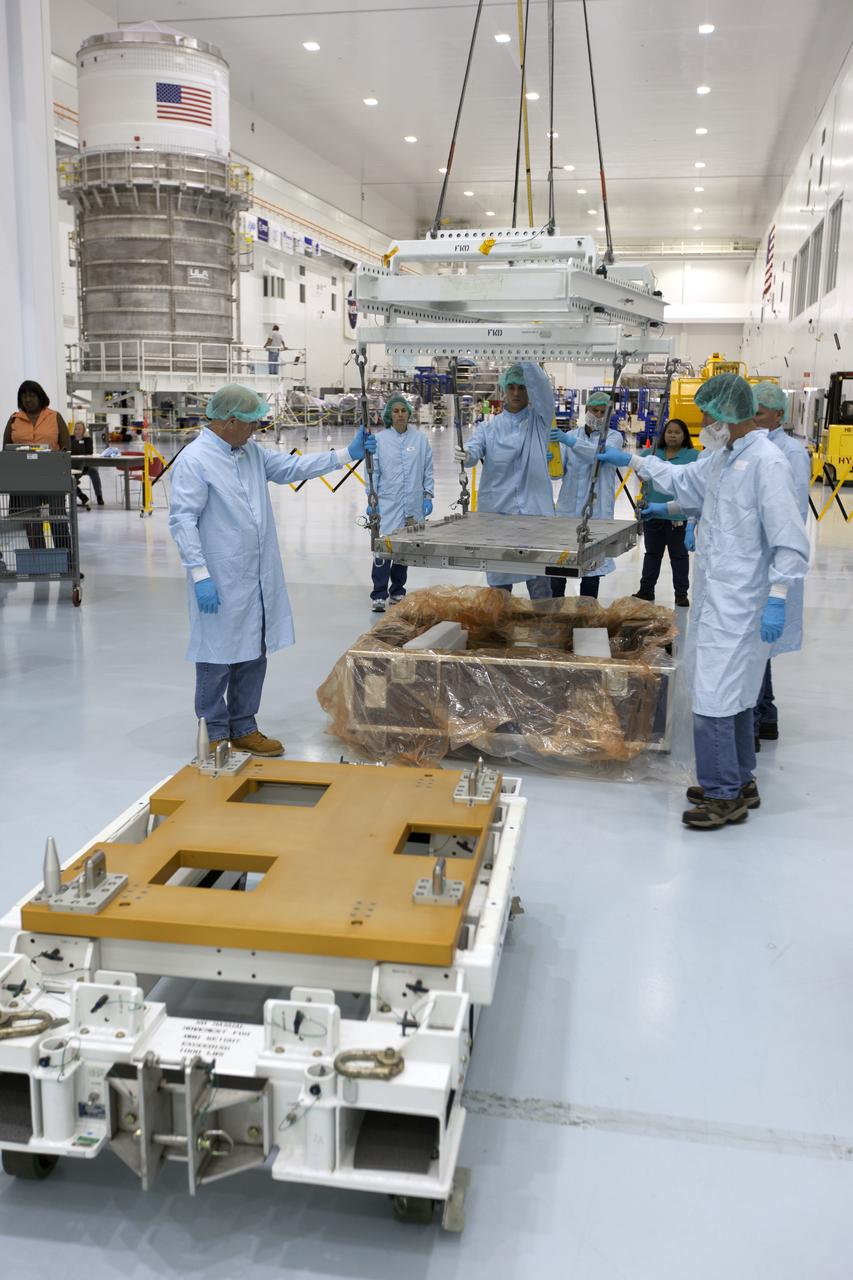
The Materials International Space Station Experiment-Flight Facility, or MISSE-FF, hardware arrived at the Space Station Processing Facility low bay at NASA's Kennedy Space Center in Florida. Technicians assist as MISSE is lifted by crane from its shipping container. MISSE will be used to test various materials and computing elements on the exterior of the space station. They will be exposed to the harsh environment of low-Earth orbit, including to a vacuum, atomic oxygen, ultraviolet radiation, direct sunlight and extreme heat and cold. The experiment will provide a better understanding of material durability, from coatings to electronic sensors, which could be applied to future spacecraft designs. MISSE will be delivered to the space station on a future commercial resupply mission.
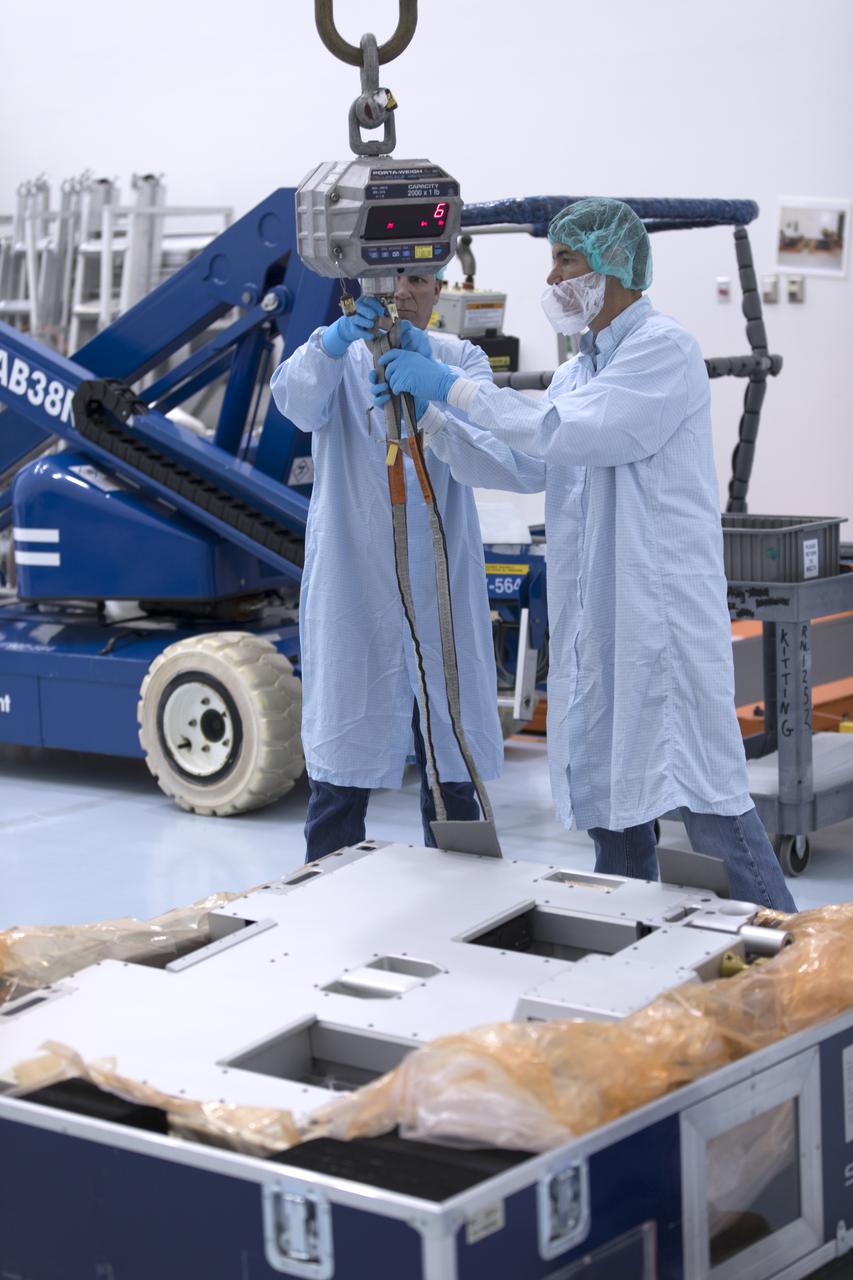
The Materials International Space Station Experiment-Flight Facility, or MISSE-FF, hardware arrived at the Space Station Processing Facility low bay at NASA's Kennedy Space Center in Florida. Technicians work to attach a crane to MISSE for lifting out of its shipping container. MISSE will be used to test various materials and computing elements on the exterior of the space station. They will be exposed to the harsh environment of low-Earth orbit, including to a vacuum, atomic oxygen, ultraviolet radiation, direct sunlight and extreme heat and cold. The experiment will provide a better understanding of material durability, from coatings to electronic sensors, which could be applied to future spacecraft designs. MISSE will be delivered to the space station on a future commercial resupply mission.
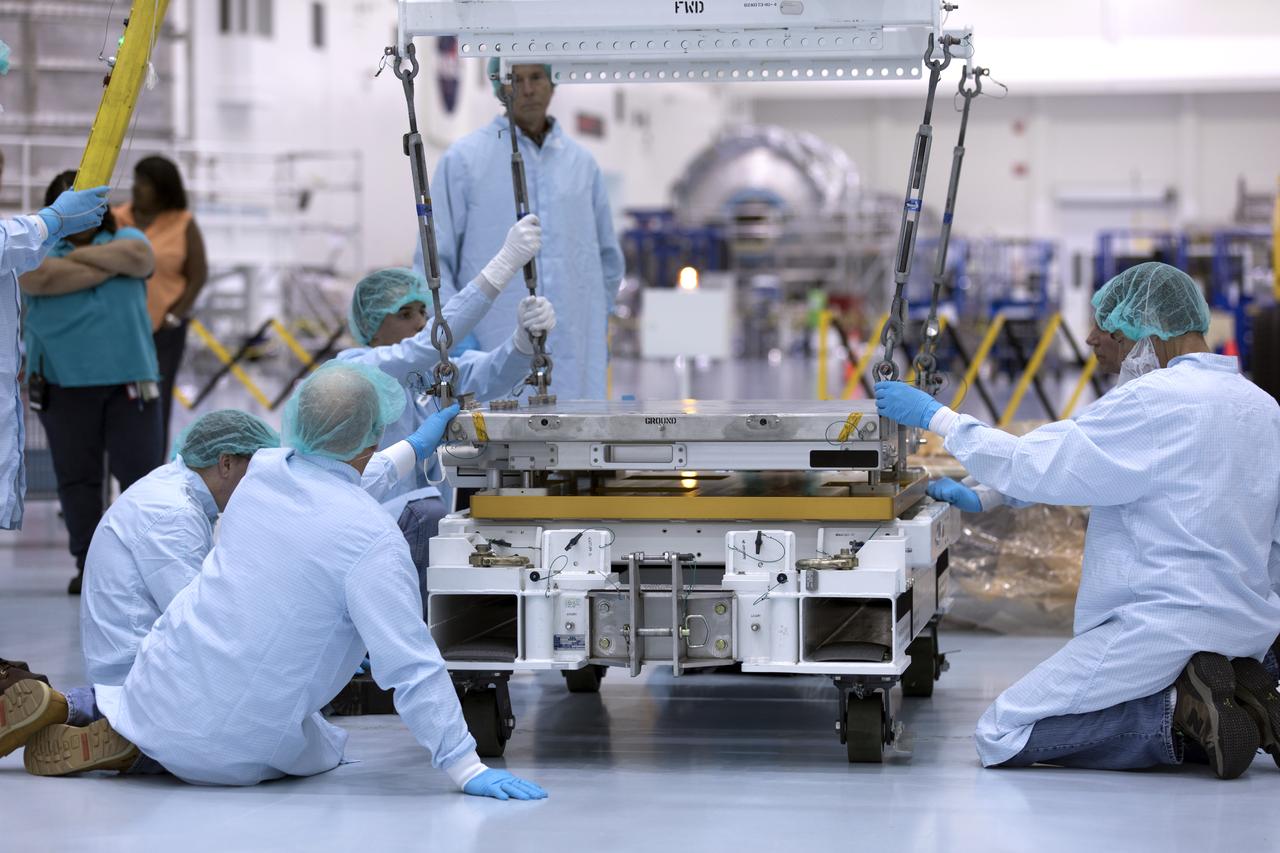
The Materials International Space Station Experiment-Flight Facility, or MISSE-FF, hardware arrived at the Space Station Processing Facility low bay at NASA's Kennedy Space Center in Florida. Technicians assist as one of the components is lowered and secured onto another MISSE component. MISSE will be used to test various materials and computing elements on the exterior of the space station. They will be exposed to the harsh environment of low-Earth orbit, including to a vacuum, atomic oxygen, ultraviolet radiation, direct sunlight and extreme heat and cold. The experiment will provide a better understanding of material durability, from coatings to electronic sensors, which could be applied to future spacecraft designs. MISSE will be delivered to the space station on a future commercial resupply mission.
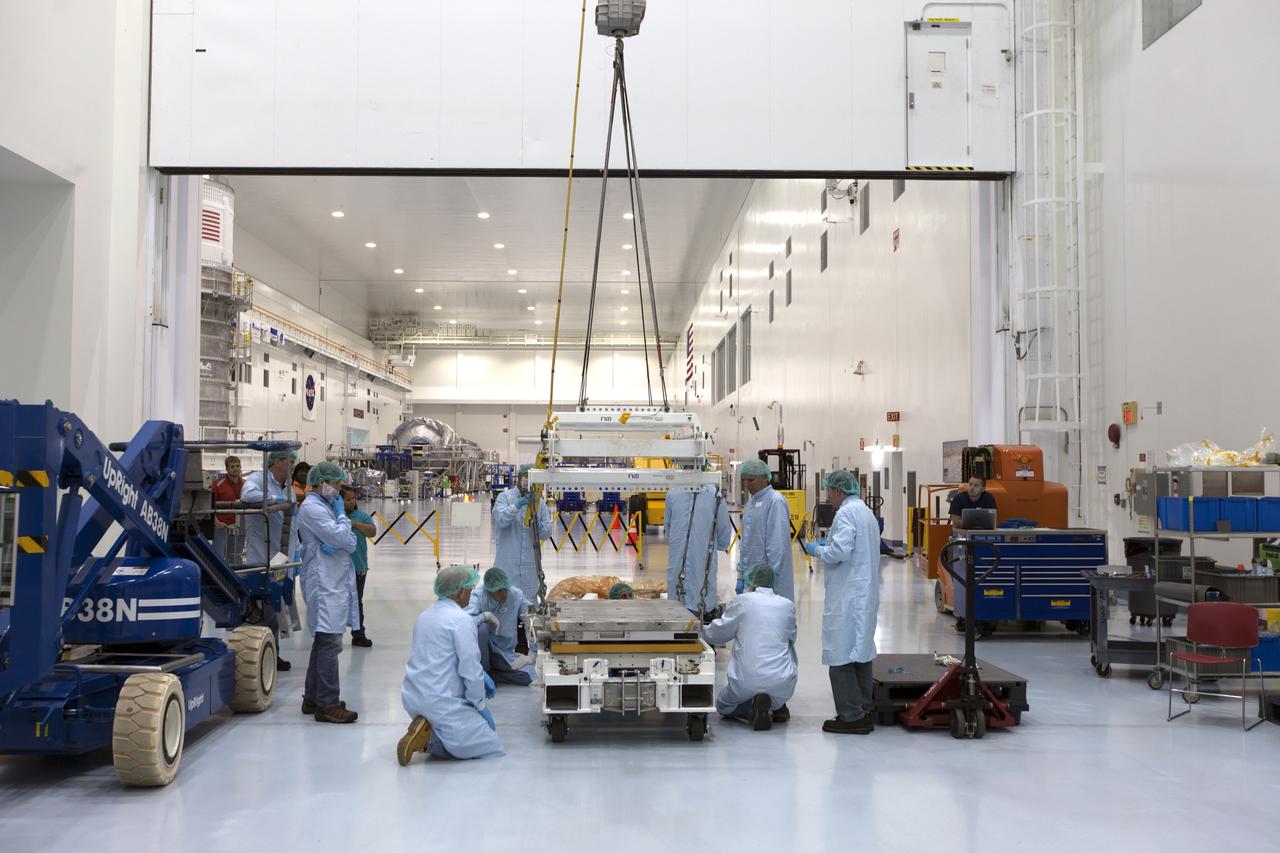
The Materials International Space Station Experiment-Flight Facility, or MISSE-FF, hardware arrived at the Space Station Processing Facility low bay at NASA's Kennedy Space Center in Florida. Technicians assist as one of the components is lowered onto another MISSE component. MISSE will be used to test various materials and computing elements on the exterior of the space station. They will be exposed to the harsh environment of low-Earth orbit, including to a vacuum, atomic oxygen, ultraviolet radiation, direct sunlight and extreme heat and cold. The experiment will provide a better understanding of material durability, from coatings to electronic sensors, which could be applied to future spacecraft designs. MISSE will be delivered to the space station on a future commercial resupply mission.
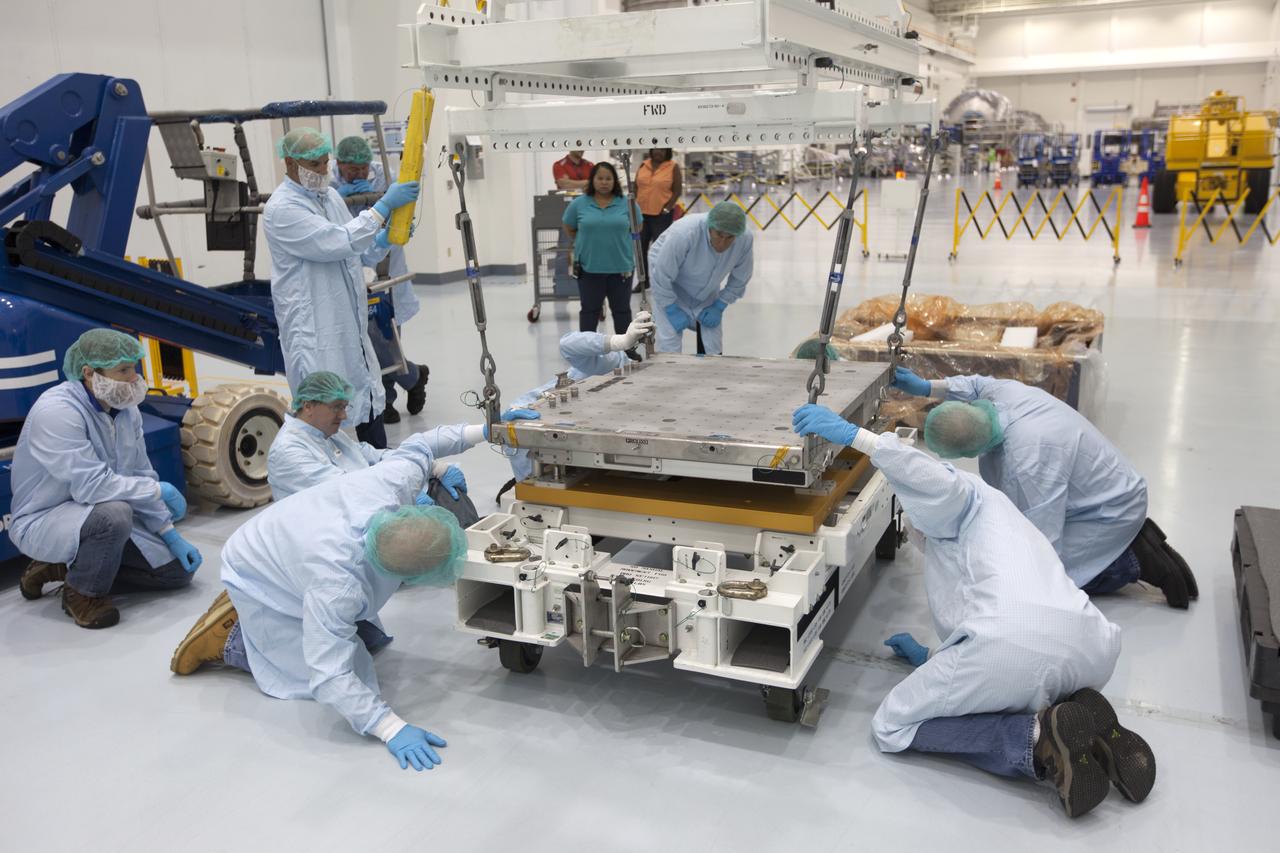
The Materials International Space Station Experiment-Flight Facility, or MISSE-FF, hardware arrived at the Space Station Processing Facility low bay at NASA's Kennedy Space Center in Florida. Technicians assist as one of the components is lowered onto another MISSE component. MISSE will be used to test various materials and computing elements on the exterior of the space station. They will be exposed to the harsh environment of low-Earth orbit, including to a vacuum, atomic oxygen, ultraviolet radiation, direct sunlight and extreme heat and cold. The experiment will provide a better understanding of material durability, from coatings to electronic sensors, which could be applied to future spacecraft designs. MISSE will be delivered to the space station on a future commercial resupply mission.
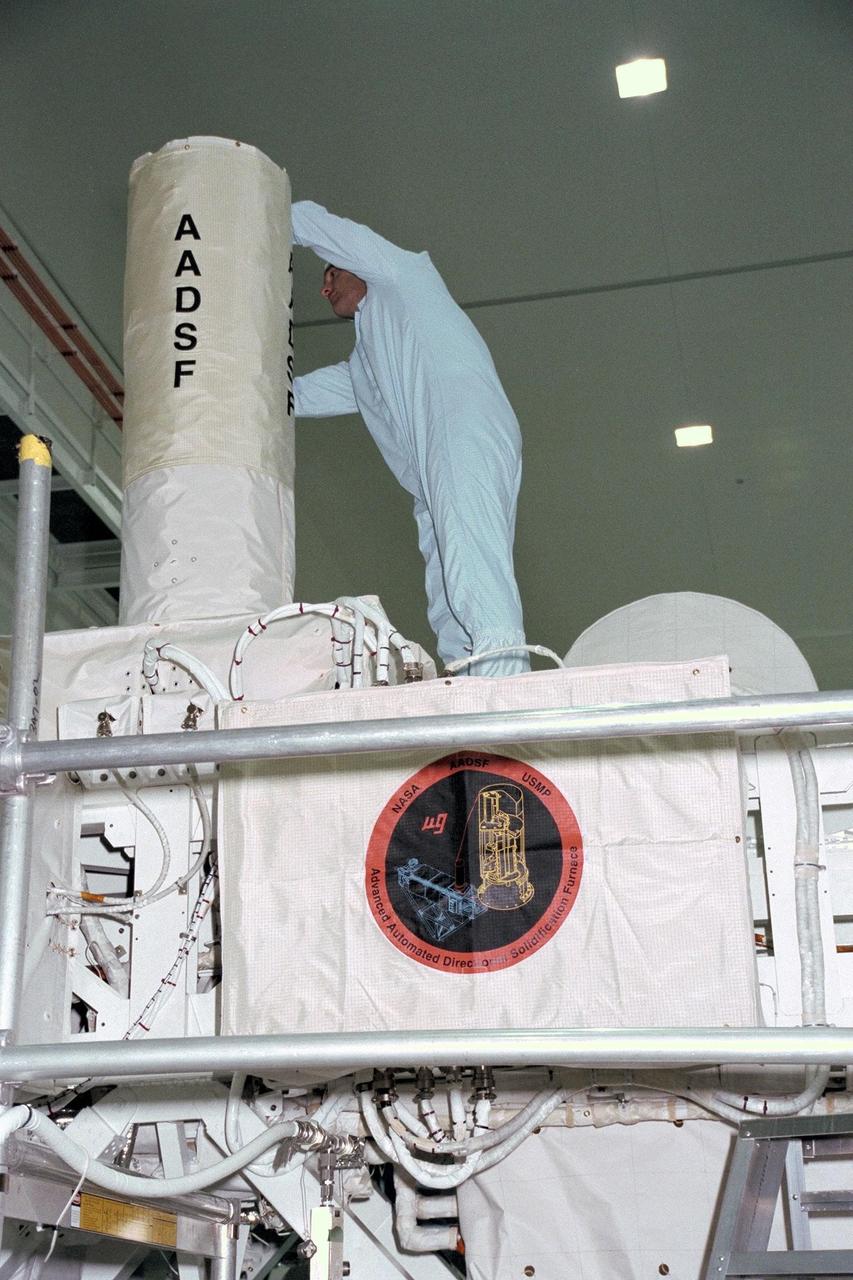
United States Microgravity Payload-4 (USMP-4) experiments are prepared to be flown on Space Shuttle mission STS-87 in the Space Station Processing Facility at Kennedy Space Center (KSC). A technician is working on the Advanced Automated Directional Solidification Furnace (AADSF), which will be used by researchers to study the solidification of semiconductor materials in microgravity. Scientists will be able to better understand how microgravity influences the solidification process of these materials and develop better methods for controlling that process during future Space flights and Earth-based production. All STS-87 experiments are scheduled for launch on Nov. 19 from KSC

KENNEDY SPACE CENTER, FLA. -- In the Space Life Sciences Lab, Lanfang Levine, with Dynamac Corp., transfers material into a sample bottle for analysis. She is standing in front of new equipment in the lab that will provide gas chromatography and mass spectrometry. The equipment will enable analysis of volatile compounds, such as from plants. The 100,000 square-foot facility houses labs for NASA’s ongoing research efforts, microbiology/microbial ecology studies and analytical chemistry labs. Also calling the new lab home are facilities for space flight-experiment and flight-hardware development, new plant growth chambers, and an Orbiter Environment Simulator that will be used to conduct ground control experiments in simulated flight conditions for space flight experiments. The SLS Lab, formerly known as the Space Experiment Research and Processing Laboratory or SERPL, provides space for NASA’s Life Sciences Services contractor Dynamac Corporation, Bionetics Corporation, and researchers from the University of Florida. NASA’s Office of Biological and Physical Research will use the facility for processing life sciences experiments that will be conducted on the International Space Station. The SLS Lab is the magnet facility for the International Space Research Park at KSC being developed in partnership with Florida Space Authority.
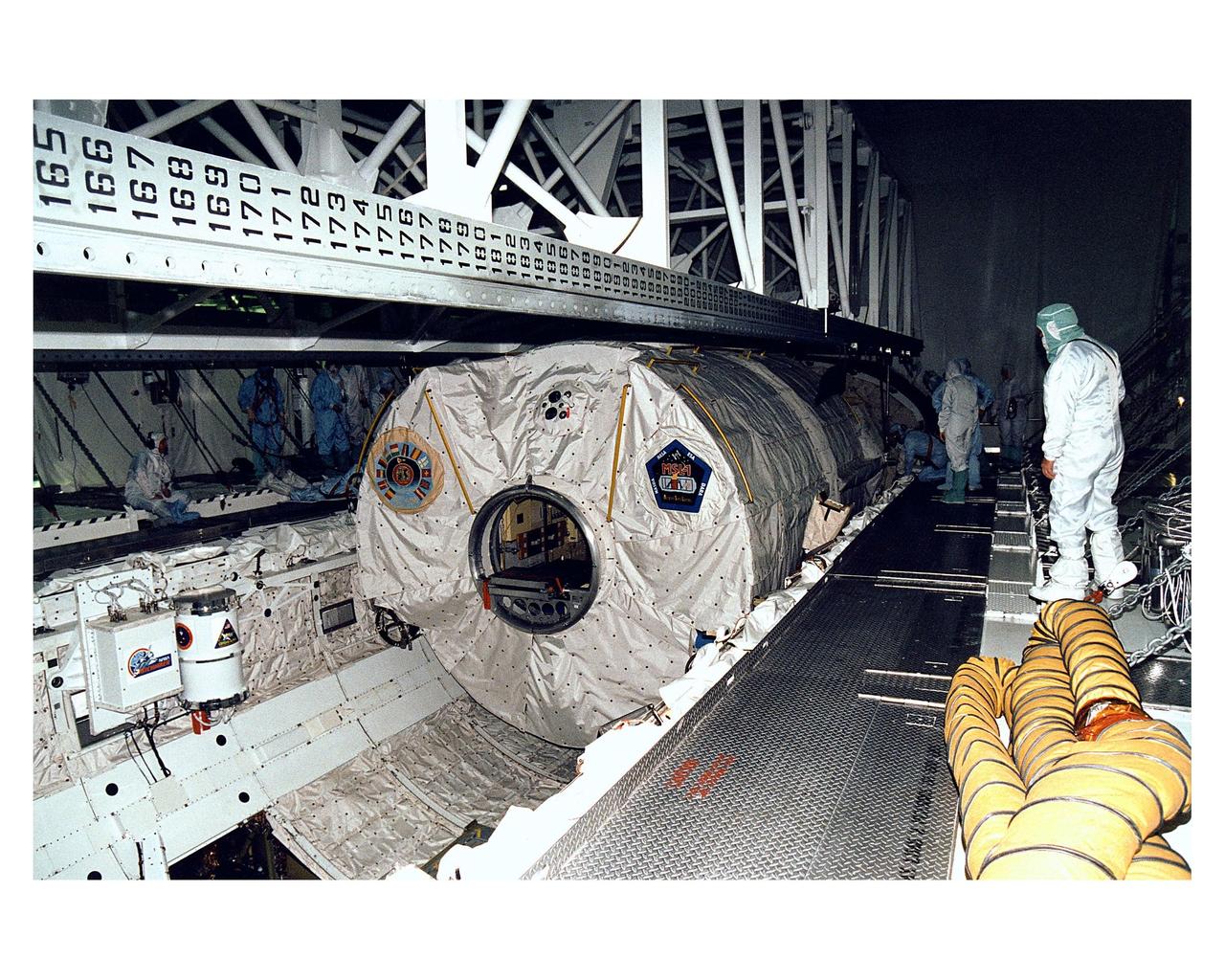
The Microgravity Science Laboratory-1 (MSL-1) Spacelab module is lowered into the payload bay of the Space Shuttle orbiter Columbia in Orbiter Processing Facility 1. During the scheduled 16-day STS-83 mission, the MSL-1 will be used to test some of the hardware, facilities and procedures that are planned for use on the International Space Station while the flight crew conducts combustion, protein crystal growth and materials processing experiments

The Microgravity Science Laboratory-1 (MSL-1) Spacelab module is lowered into the payload bay of the Space Shuttle orbiter Columbia in Orbiter Processing Facility 1. During the scheduled 16-day STS-83 mission, the MSL-1 will be used to test some of the hardware, facilities and procedures that are planned for use on the International Space Station while the flight crew conducts combustion, protein crystal growth and materials processing experiments
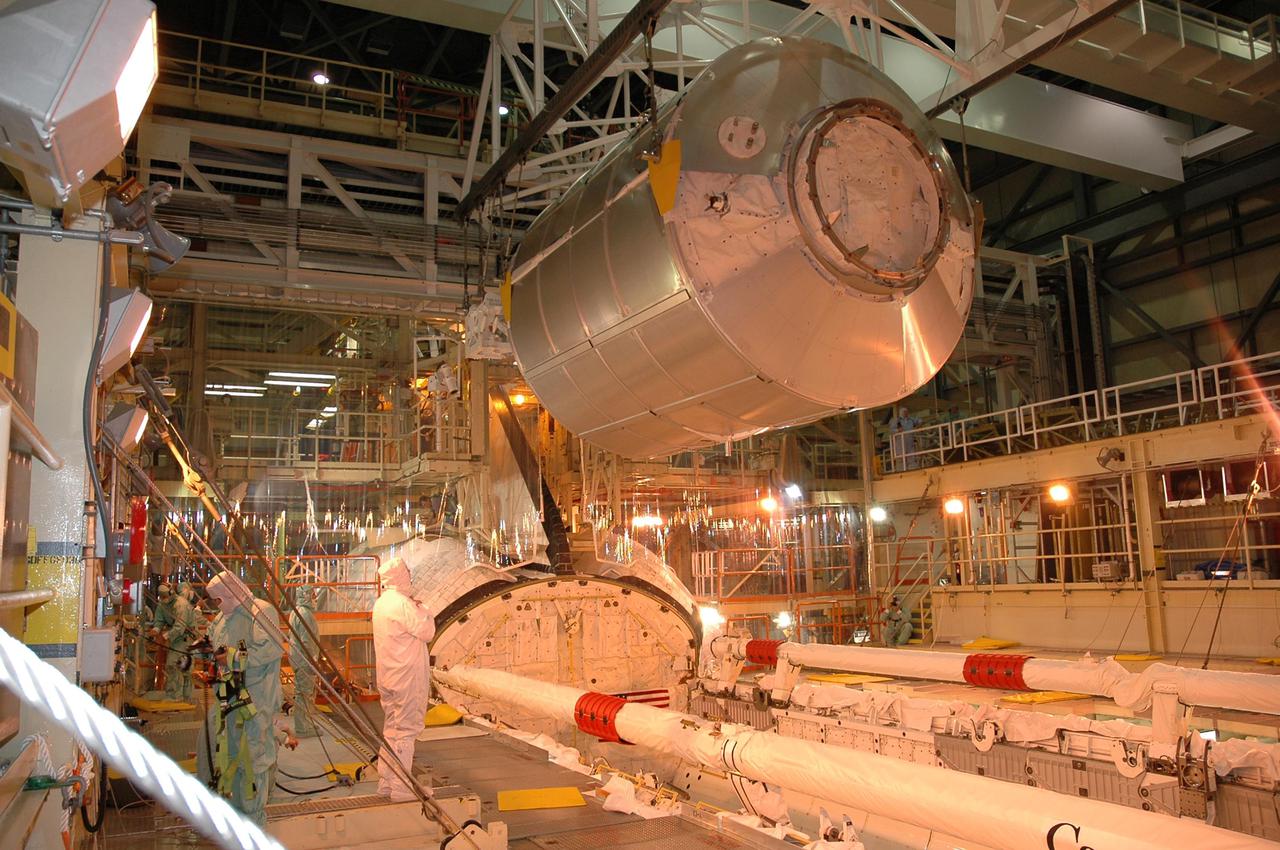
KENNEDY SPACE CENTER, FLA. -- In bay 3 of NASA Kennedy Space Center’s Orbiter Processing Facility, the Multi-Purpose Logistics Module Raffaello is removed from Space Shuttle Discovery's payload bay. The module holds material returned to KSC from the International Space Station on Return to Flight mission STS-114. The module is being lifted out of the payload bay and transferred to the Space Station Processing Facility to be emptied. Discovery will fly next on the second Return to Flight mission, STS-121.
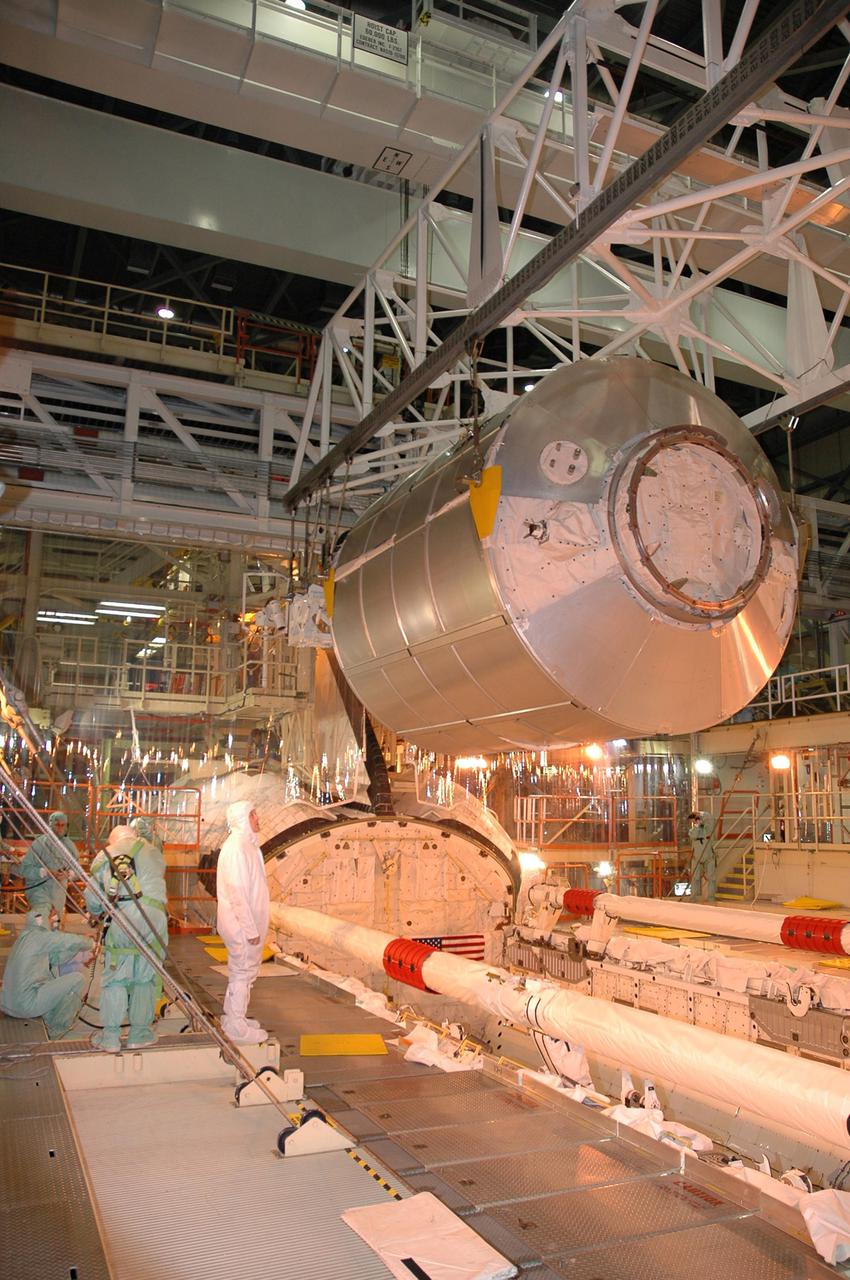
KENNEDY SPACE CENTER, FLA. -- In bay 3 of NASA Kennedy Space Center’s Orbiter Processing Facility, the Multi-Purpose Logistics Module Raffaello is removed from Space Shuttle Discovery's payload bay. The module holds material returned to KSC from the International Space Station on Return to Flight mission STS-114. The module is being lifted out of the payload bay and transferred to the Space Station Processing Facility to be emptied. Discovery will fly next on the second Return to Flight mission, STS-121.

KENNEDY SPACE CENTER, FLA. -- In bay 3 of NASA Kennedy Space Center’s Orbiter Processing Facility, technicians oversee the removal of the Multi-Purpose Logistics Module Raffaello from Space Shuttle Discovery's payload bay. The module holds material returned to KSC from the International Space Station on Return to Flight mission STS-114. The module is being lifted out of the payload bay and transferred to the Space Station Processing Facility to be emptied. Discovery will fly next on the second Return to Flight mission, STS-121.
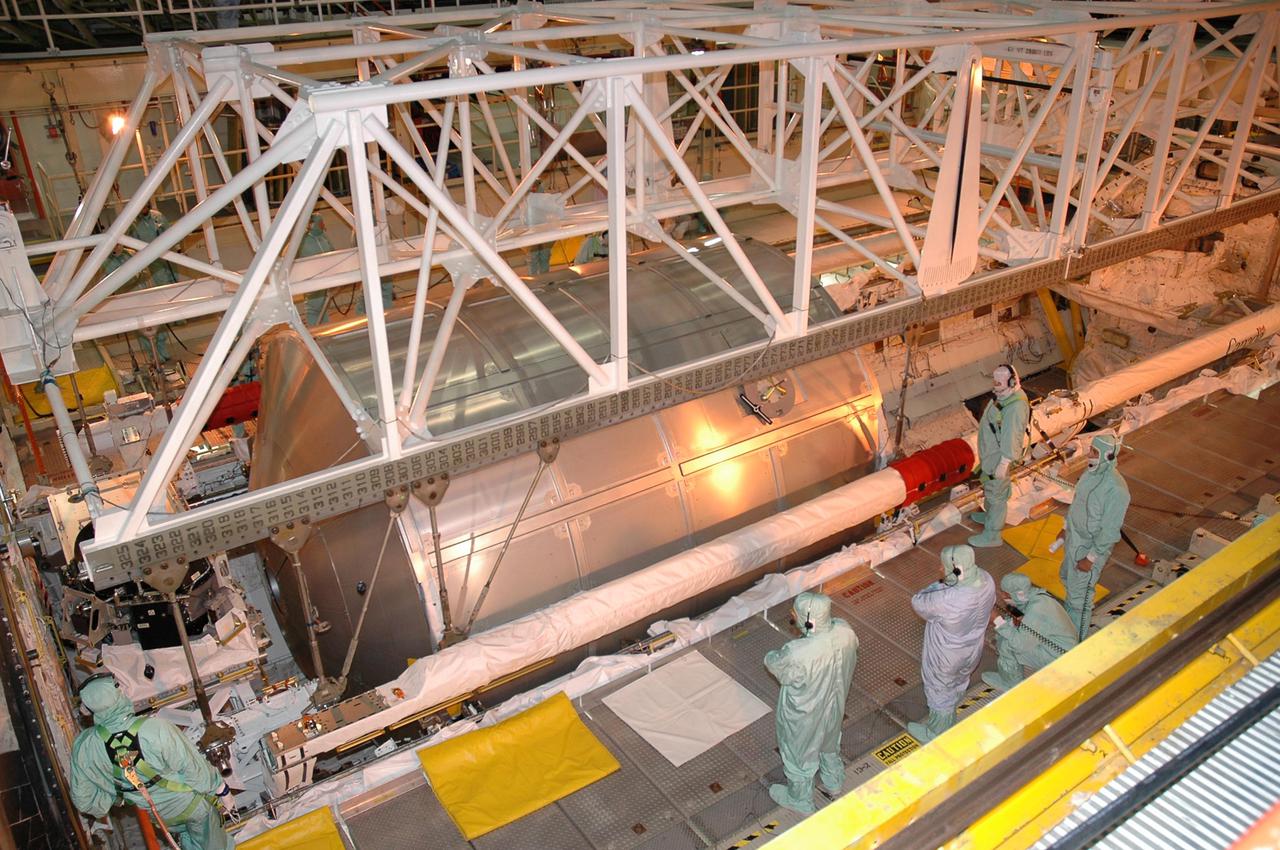
KENNEDY SPACE CENTER, FLA. -- In bay 3 of NASA Kennedy Space Center’s Orbiter Processing Facility, technicians oversee the removal of Return to Flight mission STS-114 cargo from Space Shuttle Discovery's payload bay. The Multi-Purpose Logistics Module Raffaello, in the payload bay, holds material returned to KSC from the International Space Station. The module will be lifted out of the payload bay and transferred to the Space Station Processing Facility to be emptied. Discovery will fly next on the second Return to Flight mission, STS-121.
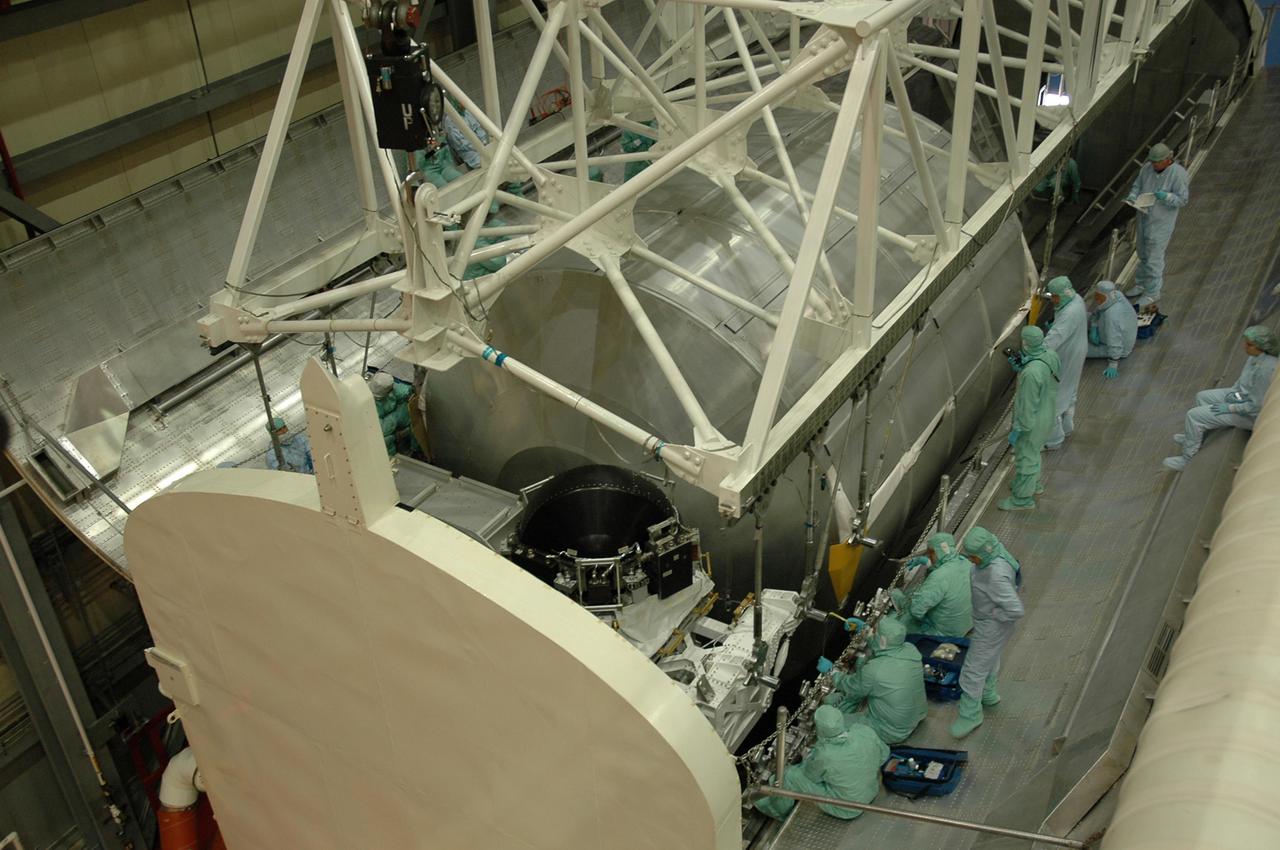
KENNEDY SPACE CENTER, FLA. -- In bay 3 of NASA Kennedy Space Center’s Orbiter Processing Facility, technicians secure the Multi-Purpose Logistics Module Raffaello into a transportation canister. The module holds material returned to KSC aboard Space Shuttle Discovery from the International Space Station on Return to Flight mission STS-114. The module will be transferred to the Space Station Processing Facility to be emptied. Discovery will fly next on the second Return to Flight mission, STS-121.
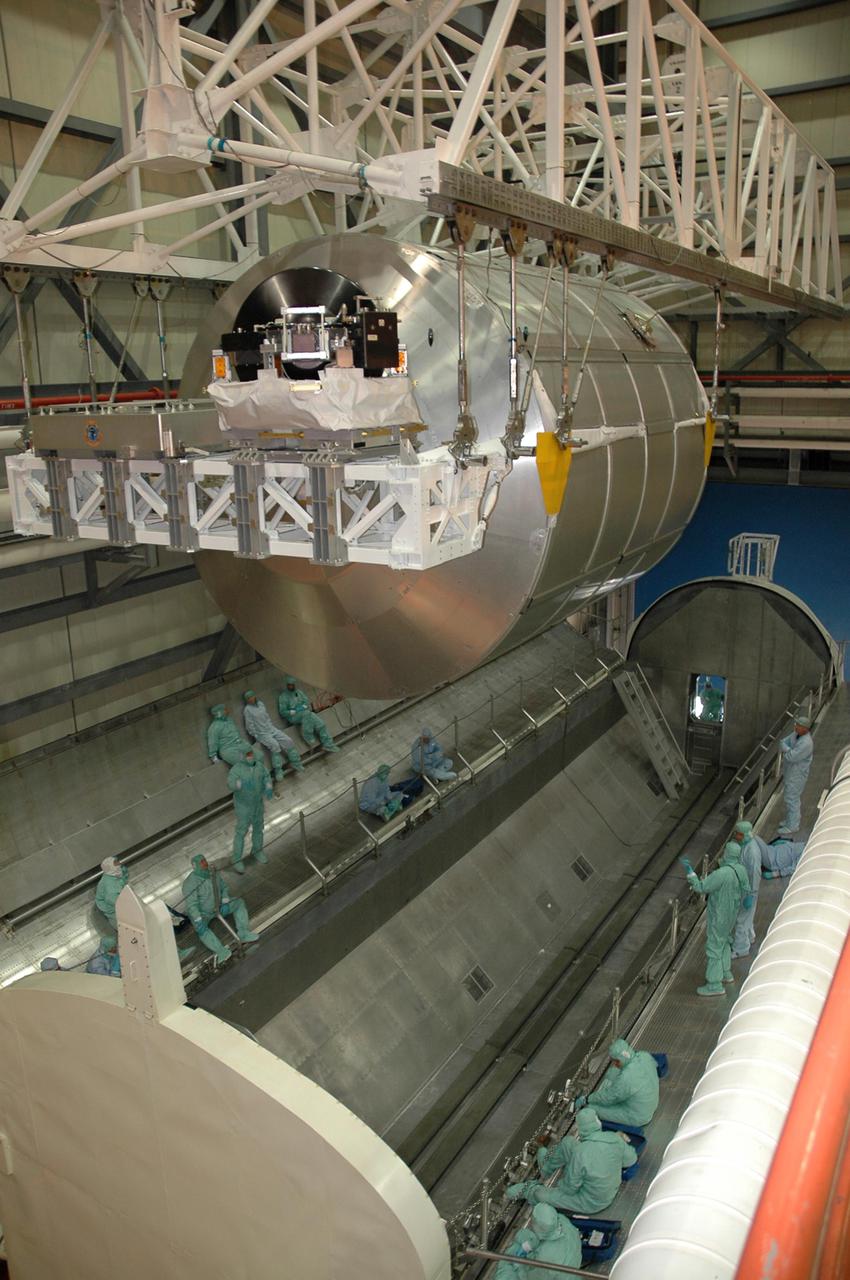
KENNEDY SPACE CENTER, FLA. -- In bay 3 of NASA Kennedy Space Center’s Orbiter Processing Facility, the Multi-Purpose Logistics Module Raffaello is lifted out of Space Shuttle Discovery's payload bay and loaded into a transportation canister. The module holds material returned to KSC from the International Space Station on Return to Flight mission STS-114. The module will be transferred to the Space Station Processing Facility to be emptied. Discovery will fly next on the second Return to Flight mission, STS-121.
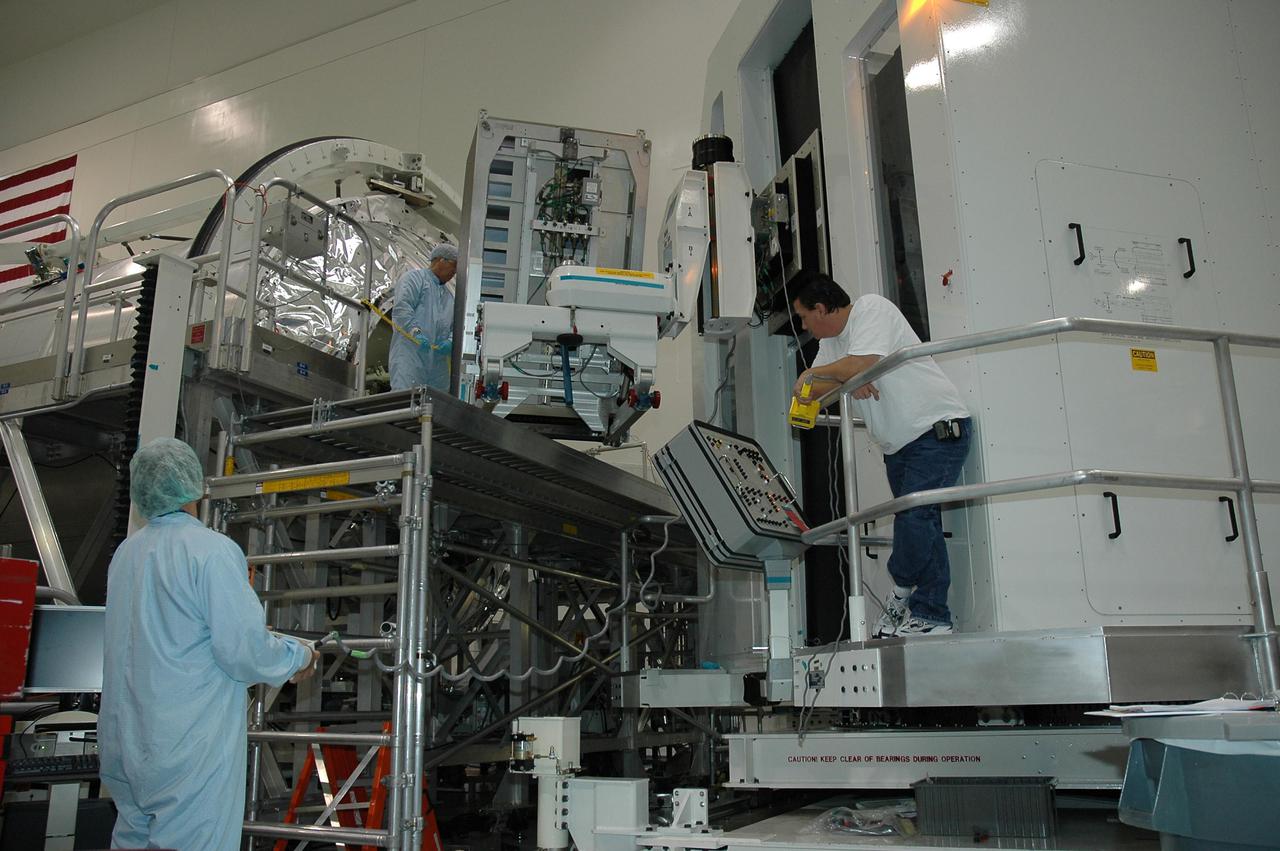
KENNEDY SPACE CENTER, FLA. - In NASA Kennedy Space Center’s Space Station Processing Facility, workers wait for a rack of storage material taken from inside the multi-purpose logistics module Raffaello to be lowered. Raffaello flew on return to flight mission STS-114. During the mission, the crews of Discovery and Expedition 11 transferred more than a ton of material from the International Space Station to be returned to Earth. The workers are unloading the storage racks.
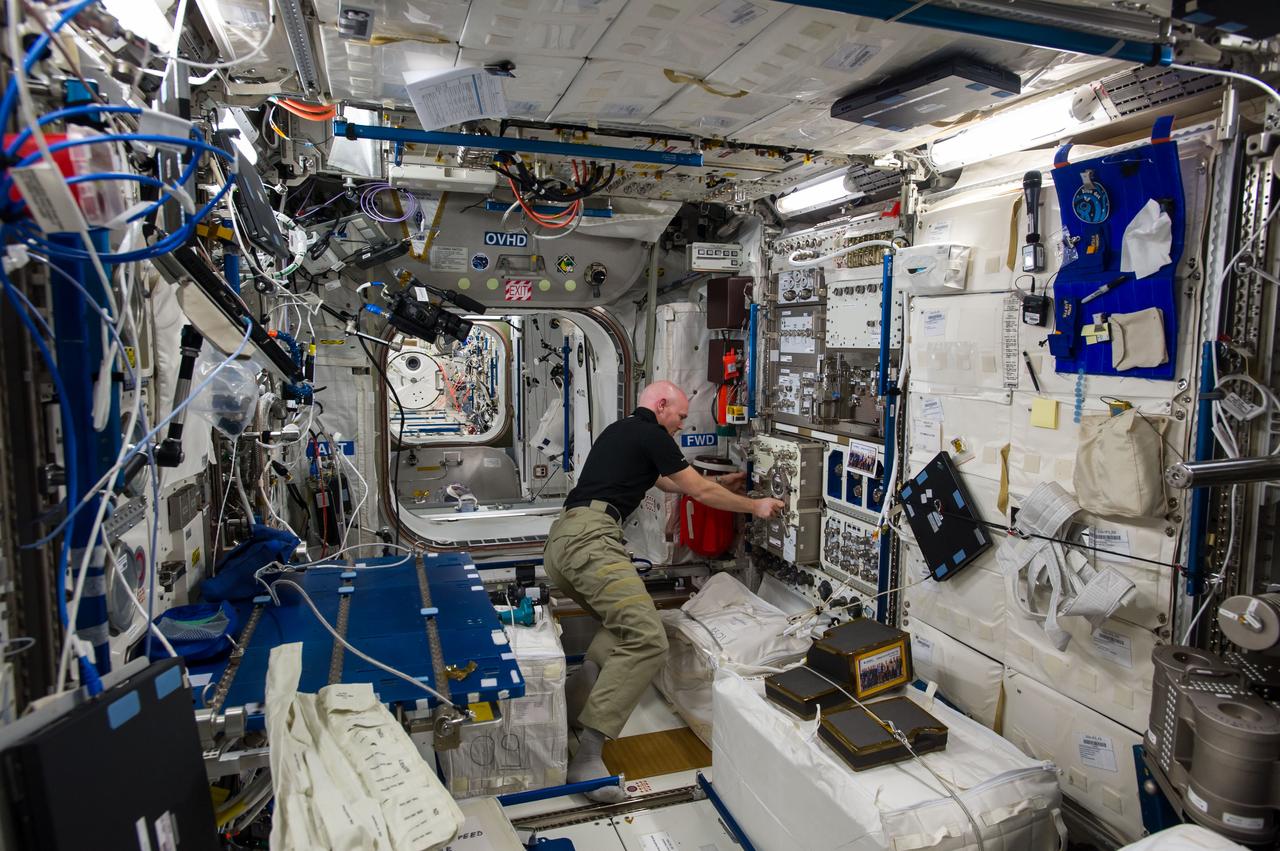
iss040e108050 (8/21/2014) — European Space Agency (ESA) astronaut Alexander Gerst, is shown in the Columbus module of the International Space Station (ISS) during the installation of the Electromagnetic Levitator (EML). The EML multi-user facility is designed for containerless materials processing in space.

Horticulturalists study the use of 3D printed materials as media to grow plants at NASA’s Kennedy Space Center on April 17, 2023. The activity is taking place inside the Plant Production Area at the Florida spaceport’s Space Station Processing Facility.
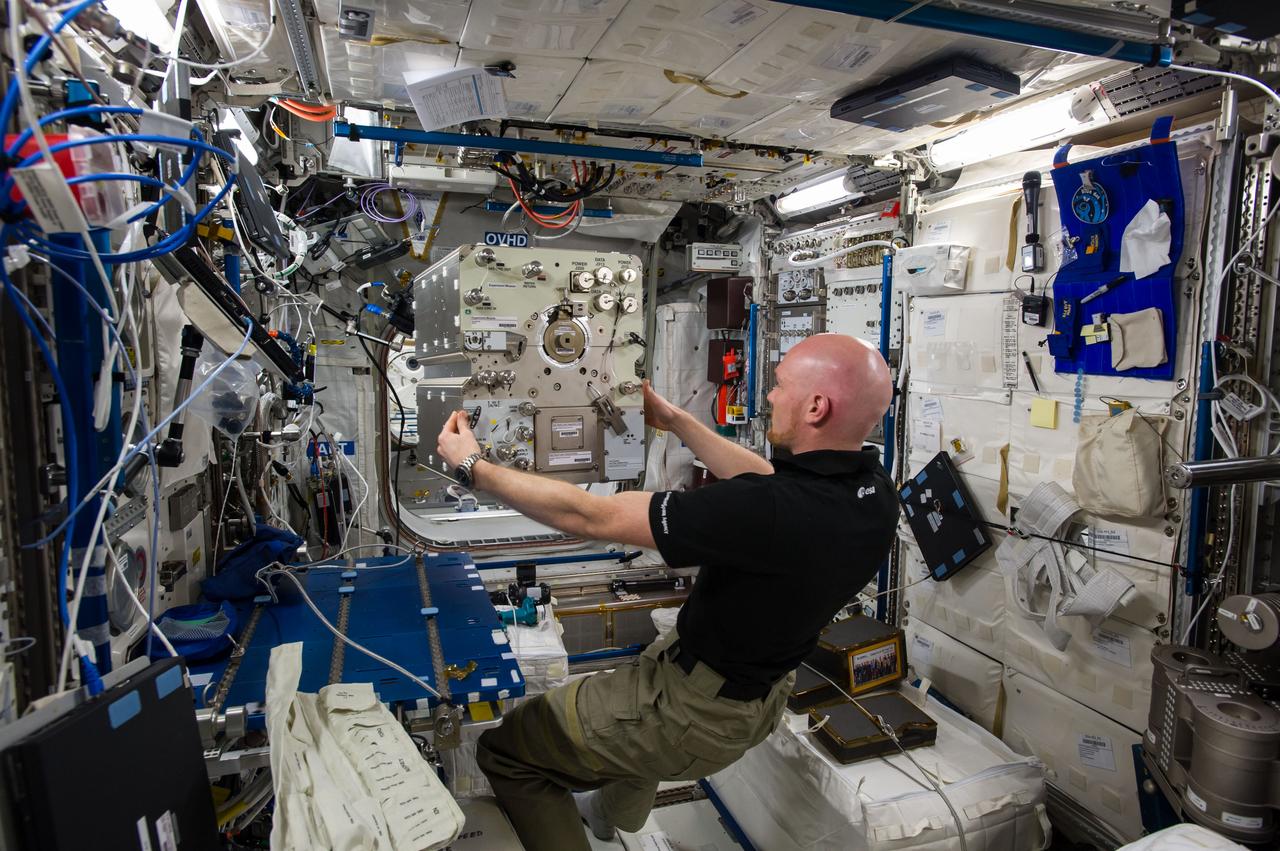
iss040e108044 (8/21/2014) — European Space Agency (ESA) astronaut Alexander Gerst, is shown in the Columbus module of the International Space Station (ISS) during the installation of the Electromagnetic Levitator (EML). The EML multi-user facility is designed for containerless materials processing in space.
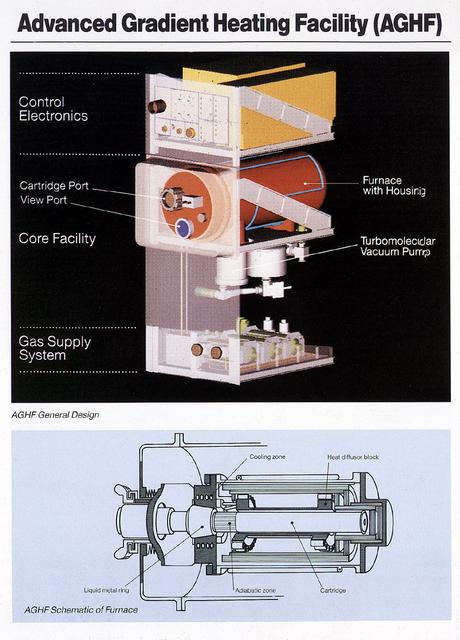
The Advanced Gradient Heating Facility (AGHF) is a European Space Agency (ESA) developed hardware. The AGHF was flown on STS-78, which featured four European PI's and two NASA PI's. The AGHFsupports the production of advanced semiconductor materials and alloys using the directional process, which depends on establishing a hot side and a cold side in the sample.

Lead horticulturist LaShelle Spencer studies the use of 3D printed materials as media to grow plants at NASA’s Kennedy Space Center on April 17, 2023. The activity is taking place inside the Plant Production Area at the Florida spaceport’s Space Station Processing Facility.

KENNEDY SPACE CENTER, FLA. -- In the Orbiter Processing Facility, the second of two Materials International Space Station Experiments, or MISSE, is lowered into space shuttle Endeavour's payload bay for installation. The MISSE is part of the payload onboard Endeavour for mission STS-123. The MISSE project is a NASA/Langley Research Center-managed cooperative endeavor to fly materials and other types of space exposure experiments on the International Space Station. The objective is to develop early, low-cost, non-intrusive opportunities to conduct critical space exposure tests of space materials and components planned for use on future spacecraft. Photo credit: NASA/Kim Shiflett
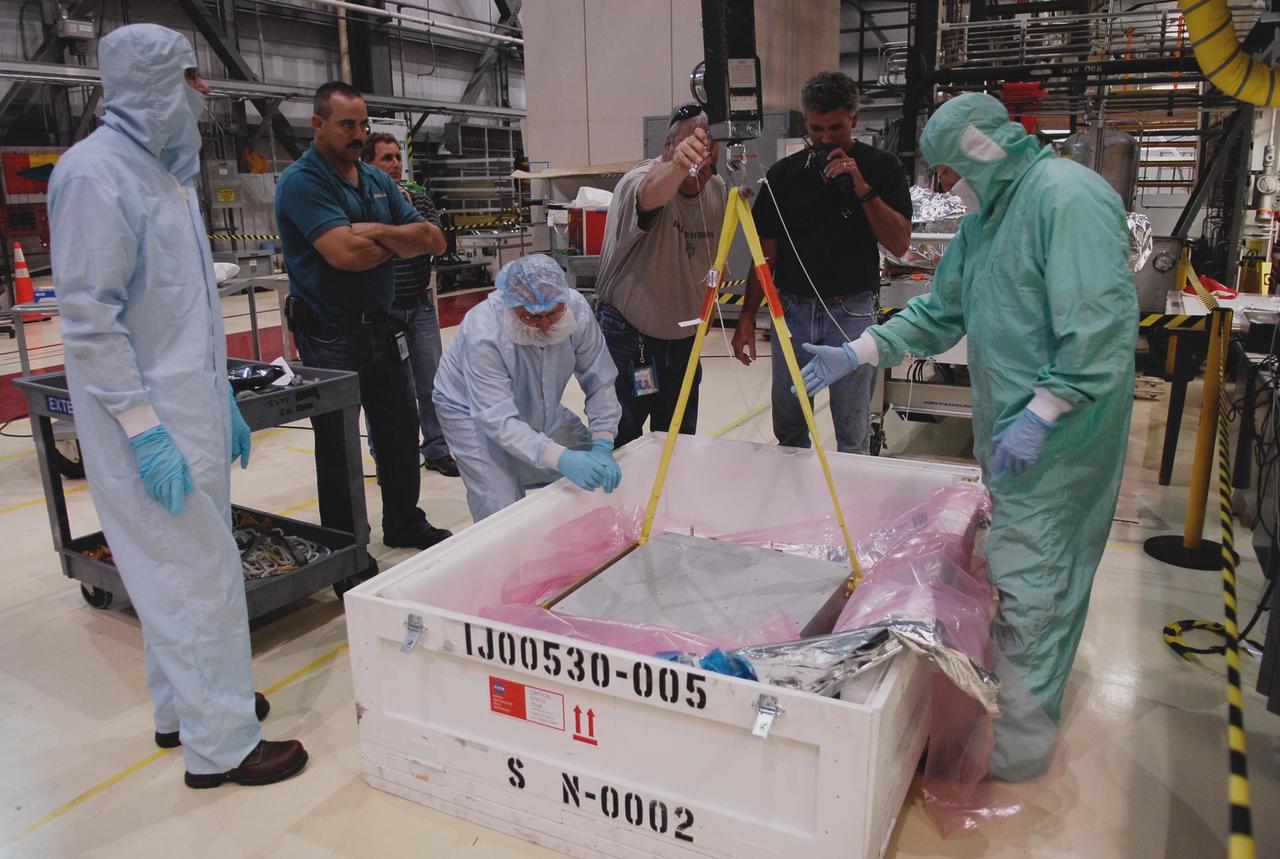
KENNEDY SPACE CENTER, FLA. -- In the Orbiter Processing Facility, technicians get ready to remove one of two Materials International Space Station Experiments, or MISSE, from a shipping container. The MISSE is part of the payload onboard space shuttle Endeavour for mission STS-123. It will be installed in Endeavour's payload bay. The MISSE project is a NASA/Langley Research Center-managed cooperative endeavor to fly materials and other types of space exposure experiments on the International Space Station. The objective is to develop early, low-cost, non-intrusive opportunities to conduct critical space exposure tests of space materials and components planned for use on future spacecraft. Photo credit: NASA/Kim Shiflett
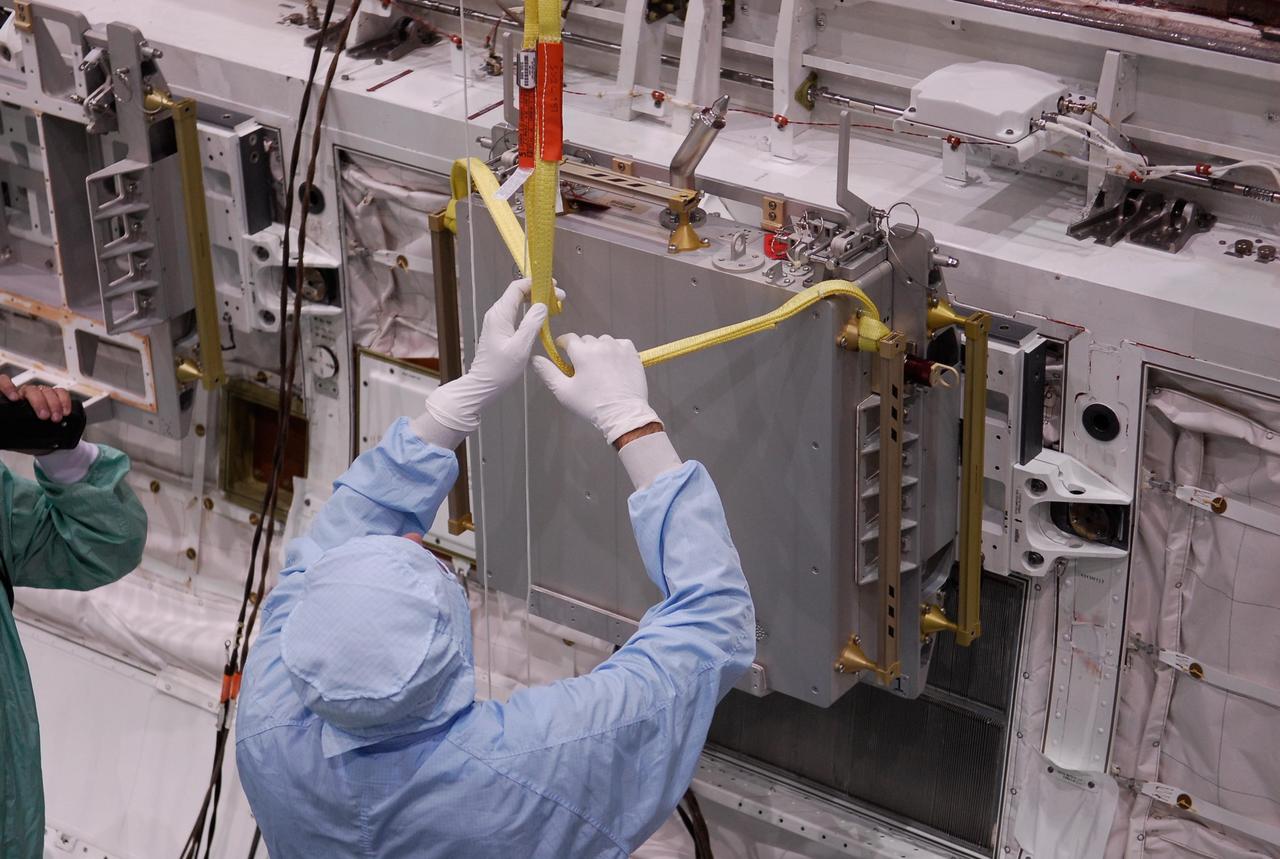
KENNEDY SPACE CENTER, FLA. -- In the Orbiter Processing Facility, one of two Materials International Space Station Experiments, or MISSE, is lowered into space shuttle Endeavour's payload bay for installation. The MISSE is part of the payload onboard Endeavour for mission STS-123. The MISSE project is a NASA/Langley Research Center-managed cooperative endeavor to fly materials and other types of space exposure experiments on the International Space Station. The objective is to develop early, low-cost, non-intrusive opportunities to conduct critical space exposure tests of space materials and components planned for use on future spacecraft. Photo credit: NASA/Kim Shiflett
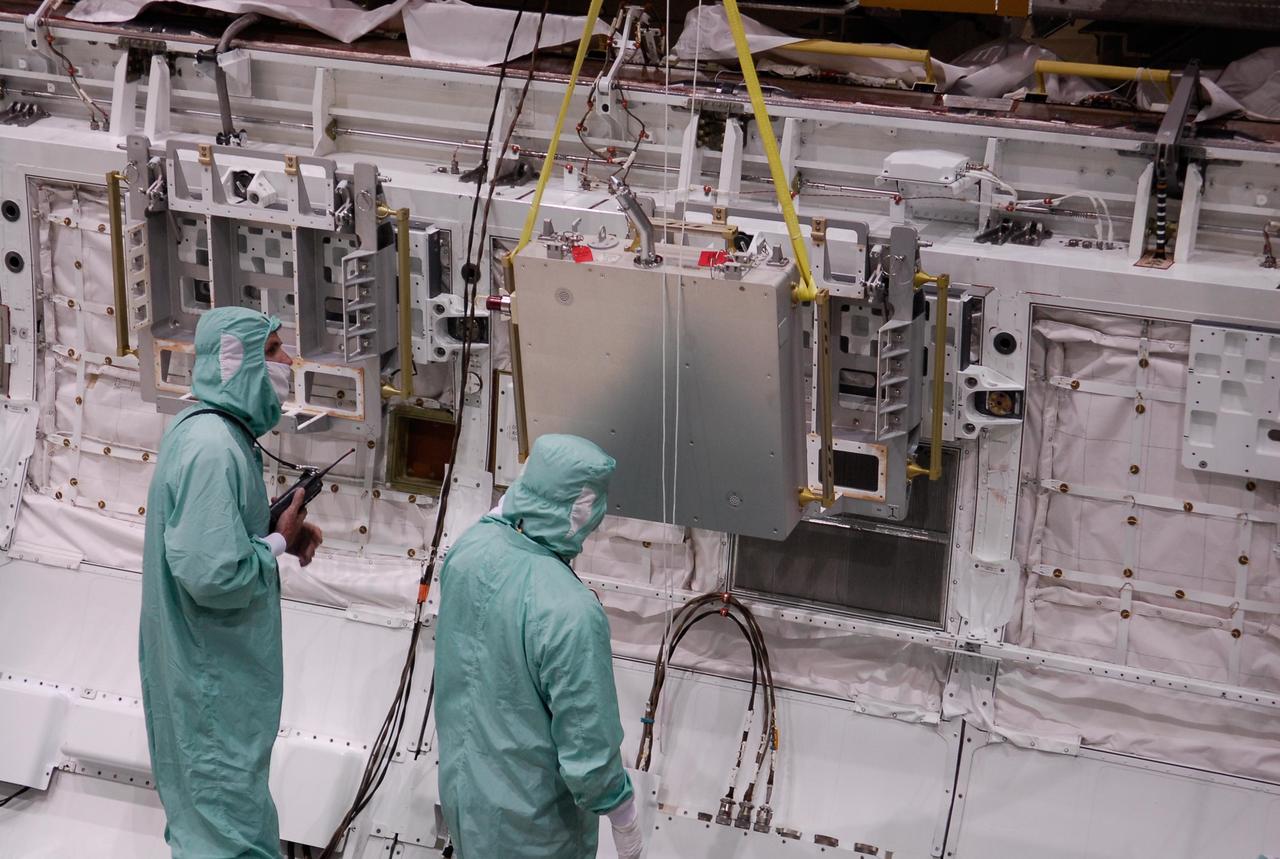
KENNEDY SPACE CENTER, FLA. -- In the Orbiter Processing Facility, one of two Materials International Space Station Experiments, or MISSE, is lowered into space shuttle Endeavour's payload bay for installation. The MISSE is part of the payload onboard Endeavour for mission STS-123. The MISSE project is a NASA/Langley Research Center-managed cooperative endeavor to fly materials and other types of space exposure experiments on the International Space Station. The objective is to develop early, low-cost, non-intrusive opportunities to conduct critical space exposure tests of space materials and components planned for use on future spacecraft. Photo credit: NASA/Kim Shiflett

KENNEDY SPACE CENTER, FLA. -- In the Orbiter Processing Facility, technicians help lift the first of the Materials International Space Station Experiments, or MISSE, from a shipping container. The MISSE is part of the payload onboard space shuttle Endeavour for mission STS-123. It will be installed in Endeavour's payload bay. The MISSE project is a NASA/Langley Research Center-managed cooperative endeavor to fly materials and other types of space exposure experiments on the International Space Station. The objective is to develop early, low-cost, non-intrusive opportunities to conduct critical space exposure tests of space materials and components planned for use on future spacecraft. Photo credit: NASA/Kim Shiflett
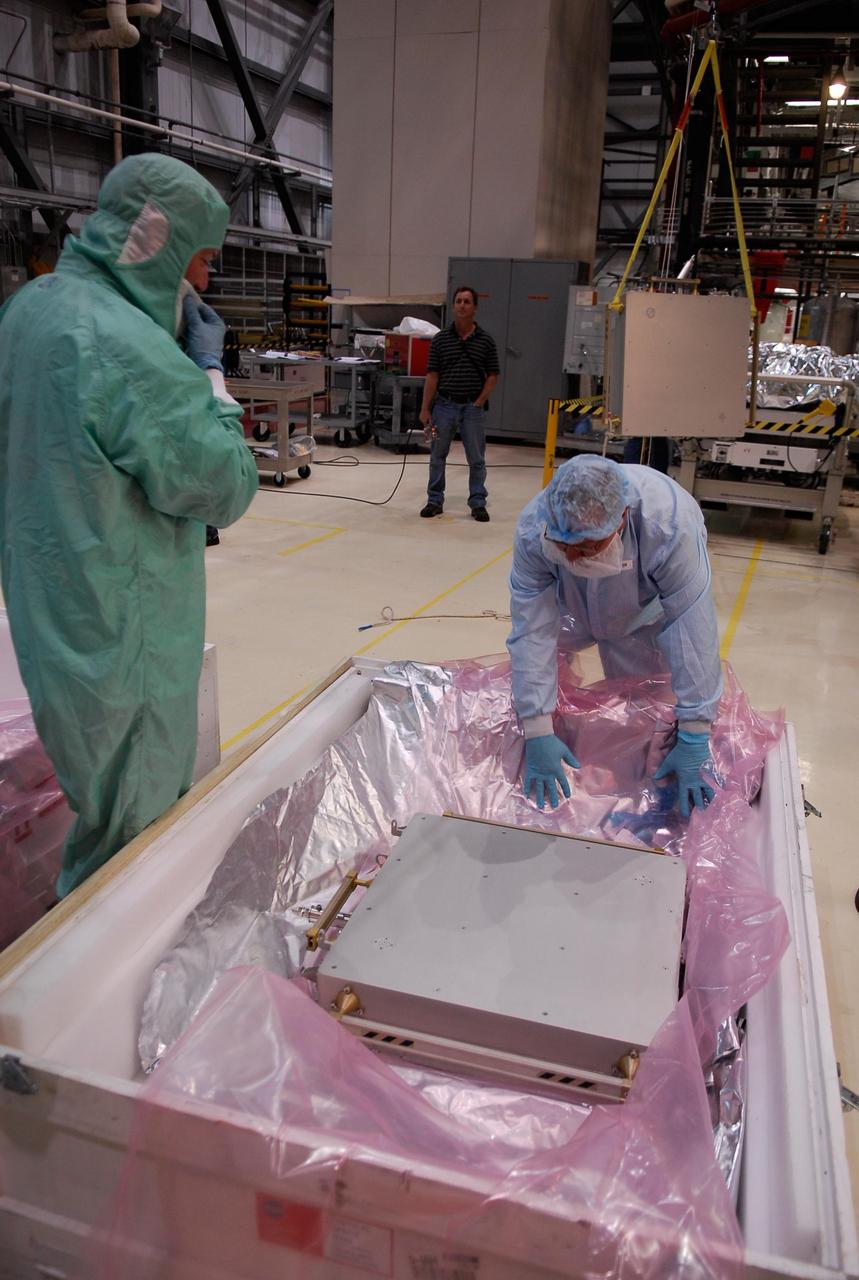
KENNEDY SPACE CENTER, FLA. -- In the Orbiter Processing Facility, technicians get ready to remove another Materials International Space Station Experiments, or MISSE, from a shipping container. The MISSE is part of the payload onboard space shuttle Endeavour for mission STS-123. It will be installed in Endeavour's payload bay. The MISSE project is a NASA/Langley Research Center-managed cooperative endeavor to fly materials and other types of space exposure experiments on the International Space Station. The objective is to develop early, low-cost, non-intrusive opportunities to conduct critical space exposure tests of space materials and components planned for use on future spacecraft. Photo credit: NASA/Kim Shiflett
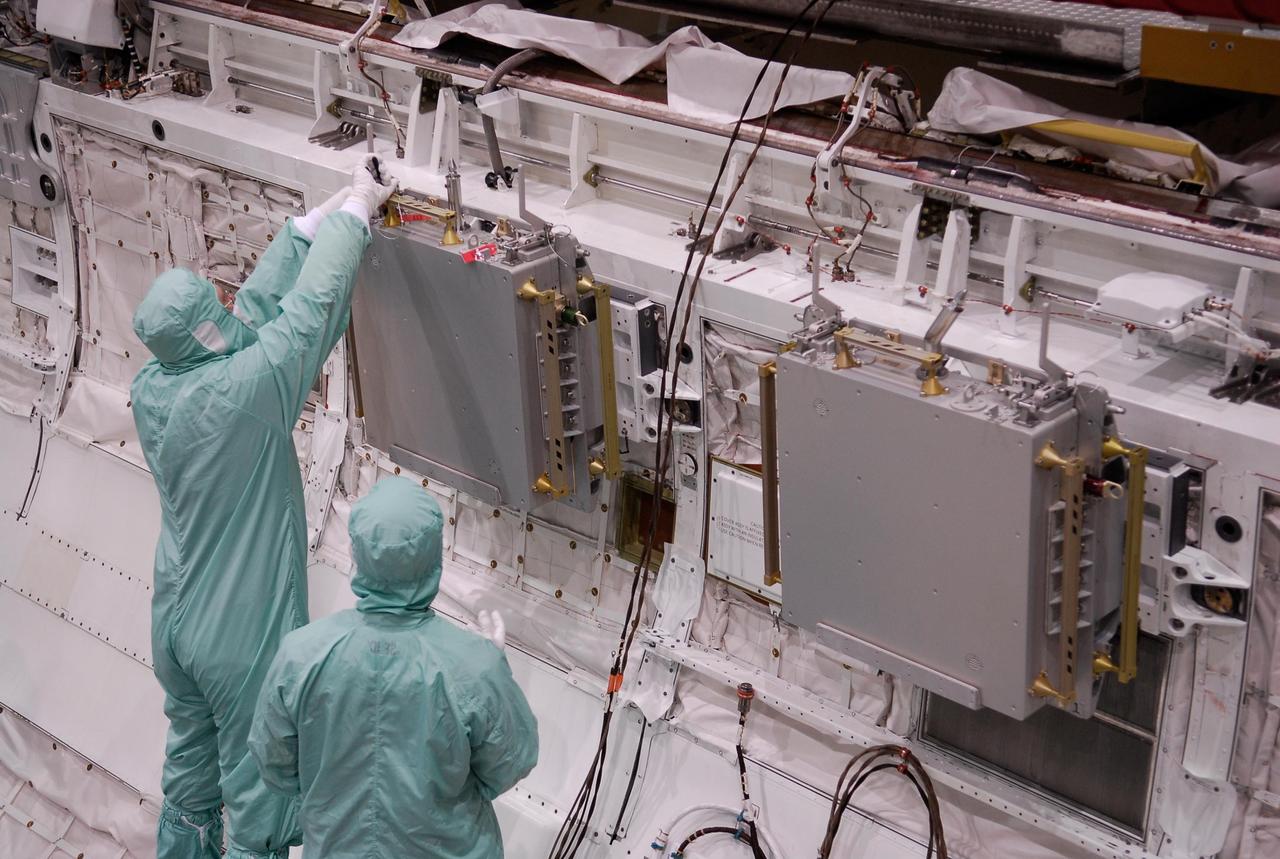
KENNEDY SPACE CENTER, FLA. -- In the Orbiter Processing Facility, technicians install the second Materials International Space Station Experiments, or MISSE, in space shuttle Endeavour's payload bay. The MISSE is part of the payload onboard Endeavour for mission STS-123. The MISSE project is a NASA/Langley Research Center-managed cooperative endeavor to fly materials and other types of space exposure experiments on the International Space Station. The objective is to develop early, low-cost, non-intrusive opportunities to conduct critical space exposure tests of space materials and components planned for use on future spacecraft. Photo credit: NASA/Kim Shiflett
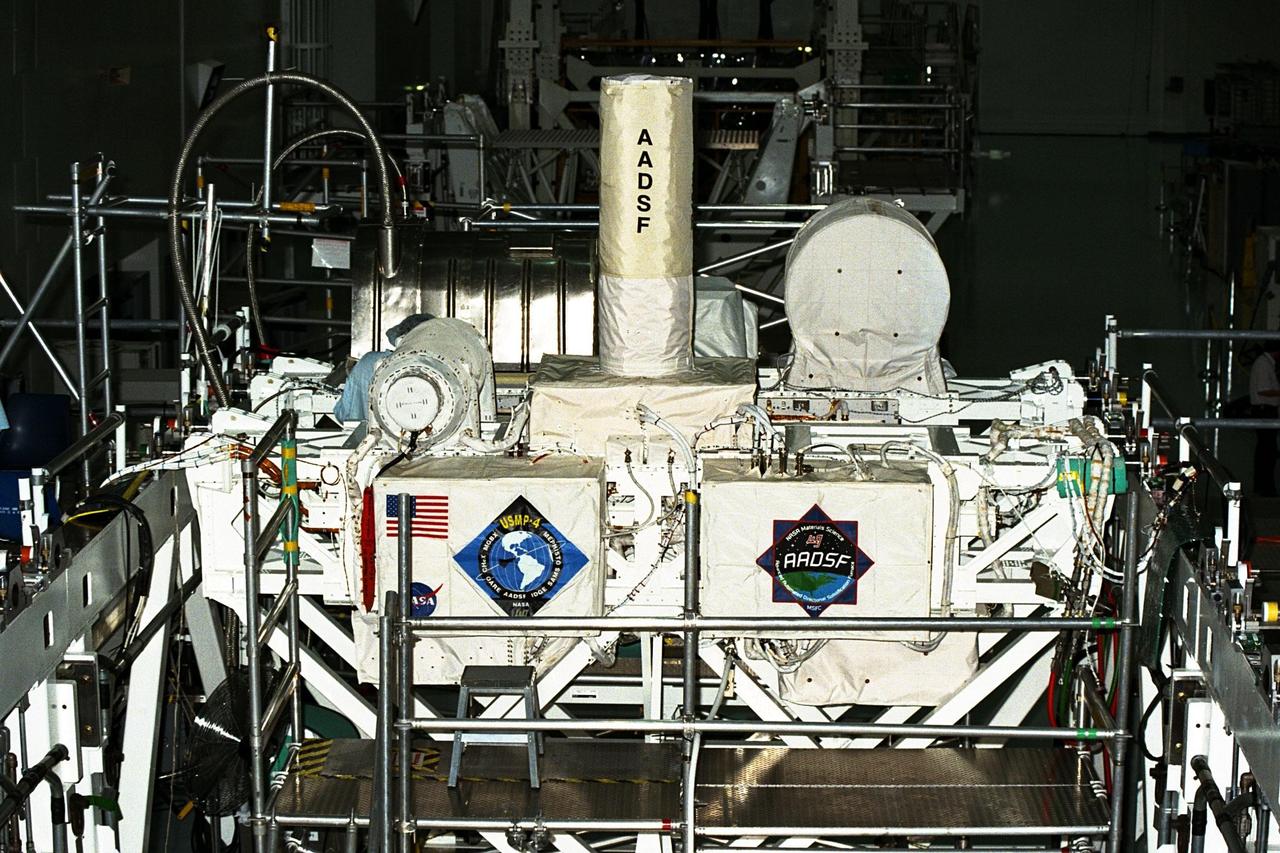
United States Microgravity Payload-4 (USMP-4) experiments are prepared to be flown on Space Shuttle mission STS-87 in the Space Station Processing Facility at Kennedy Space Center (KSC). Seen in the foreground at left is the USMP-4 logo with the acronyms of its experiments. Above the American flag at left is the MEPHISTO experiment, a cooperative American and French investigation of the fundamentals of crystal growth. The large white vertical cylinder in the center of the photo is the Advanced Automated Directional Solidification Furnace (AADSF), which is a sophisticated materials science facility used for studying a common method of processing semiconductor crystals called directional solidification. The white horizontal tube to the right is the Isothermal Dendritic Growth Experiment (IDGE), which will be used to study the dendritic solidification of molten materials in the microgravity environment. All USMP-4 experiments are scheduled for launch aboard STS-87 on Nov. 19 from KSC
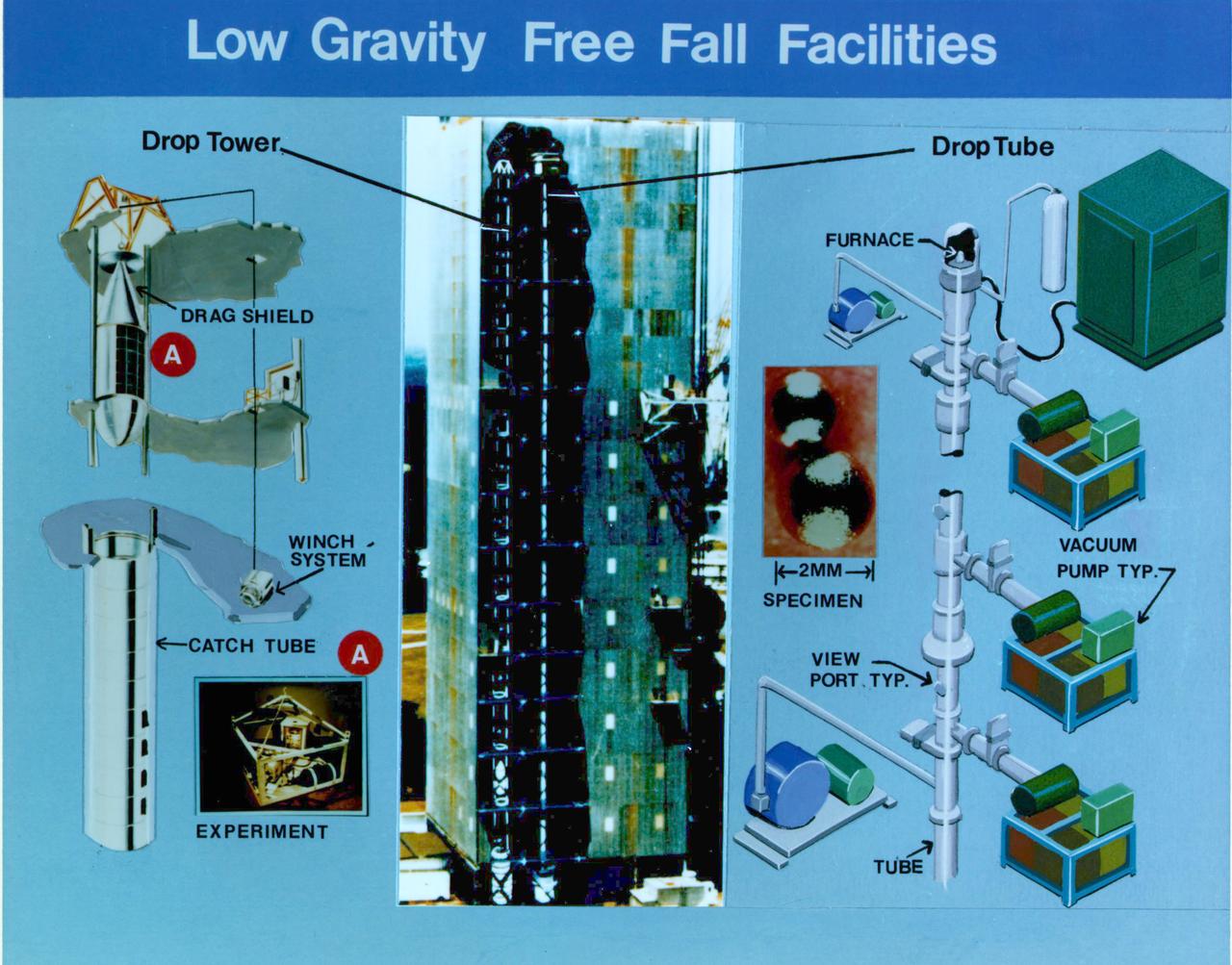
Composite of Marshall Space Flight Center's Low-Gravity Free Fall Facilities.These facilities include a 100-meter drop tower and a 100-meter drop tube. The drop tower simulates in-flight microgravity conditions for up to 4.2 seconds for containerless processing experiments, immiscible fluids and materials research, pre-flight hardware design test and flight experiment simulation. The drop tube simulates in-flight microgravity conditions for up to 4.6 seconds and is used extensively for ground-based microgravity convection research in which extremely small samples are studied. The facility can provide deep undercooling for containerless processing experiments that require materials to remain in a liquid phase when cooled below the normal solidification temperature.
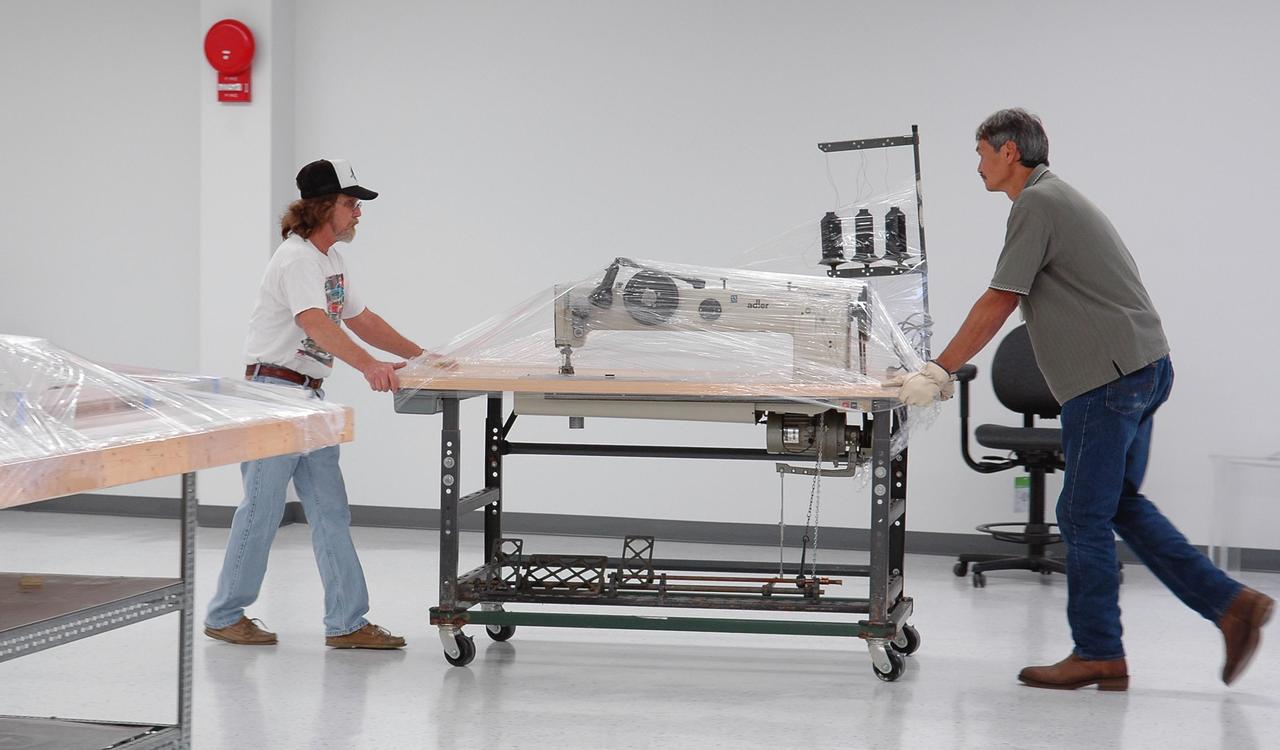
KENNEDY SPACE CENTER, FLA. - Employees at NASA Kennedy Space Center move a blanket sewing machine into the Thermal Protection System facility. that has recently been repaired. The upper floor of the facility, where soft material was processed, was damaged during the 2004 hurricanes and the equipment was temporarily moved to the RLV Hangar. While the TPS facility was being repaired, normal work activity was done in the hangar.
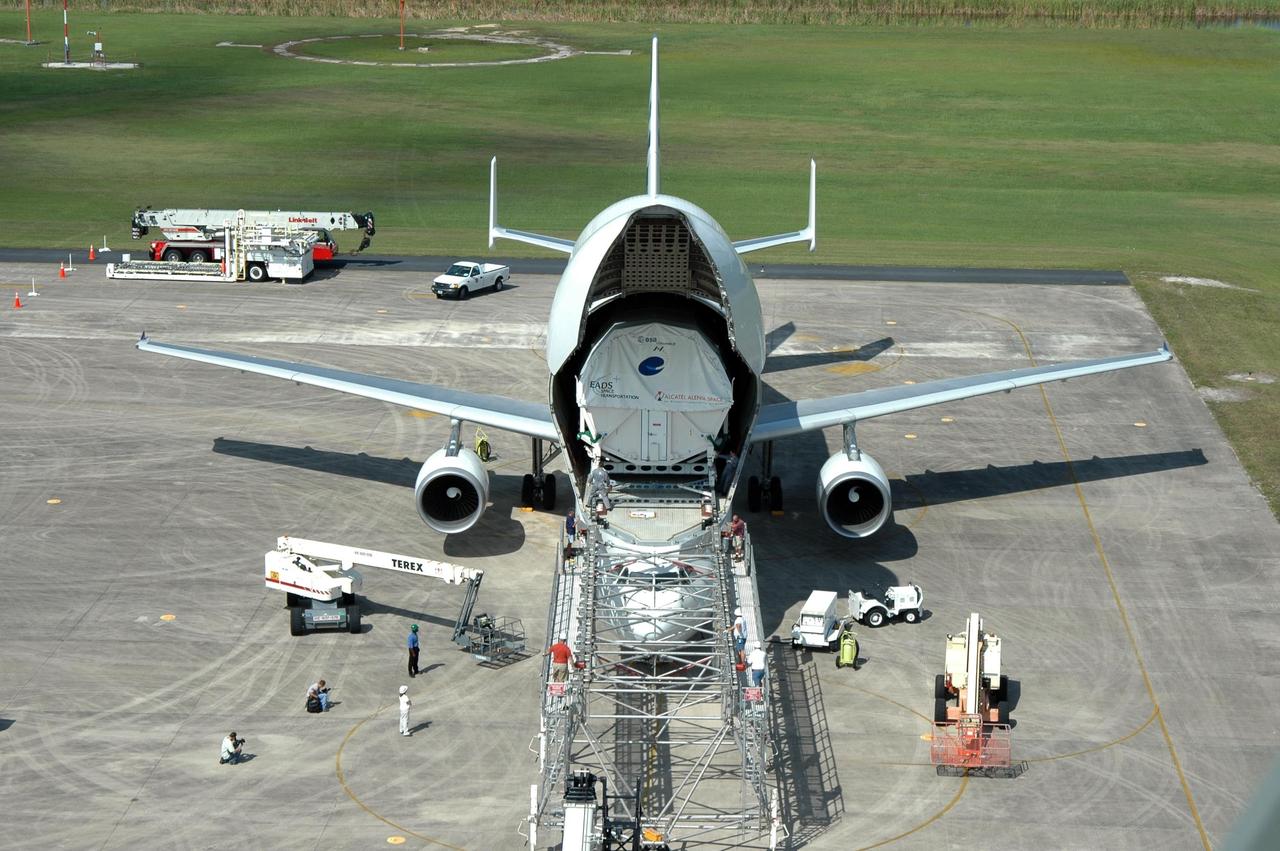
KENNEDY SPACE CENTER, FLA. - At the Shuttle Landing Facility, the European Space Agency's research laboratory, designated Columbus, is being offloaded onto an Airbus Transport International platform. The module will be lifted onto a flat bed truck and transported to the Space Station Processing Facility. There the module will be prepared for delivery to the International Space Station on a future space shuttle mission. Columbus will expand the research facilities of the station and provide researchers with the ability to conduct numerous experiments in the area of life, physical and materials sciences. Photo credit: NASA/Jim Grossmann
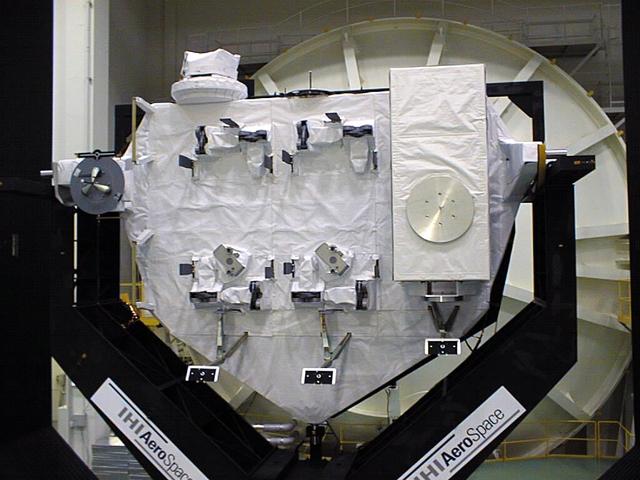
JSC2003-E-42549 (For Release: 18 June 2003) --- The Experiment Logistics Modules-Exposed (ELM-ES) of the Japanese Experiment Module (JEM), Japan's primary contribution to the International Space Station (ISS), is shown in a processing facility. There are two JEM logistics modules, one each for the Pressurized Module and the Exposed Facility, that serve as on-orbit storage areas that house materials for experiments, maintenance tools and supplies. The ELM-ES is a pallet that can hold 3 experiment payloads for the JEM Exposed Facility. Photo Credit: NASDA

KENNEDY SPACE CENTER, FLA. - Inside the RLV Hangar at NASA Kennedy Space Center, employees prepare a blanket sewing machine to be transferred back to the Thermal Protection System (TPS) facility. The upper floor of the facility, where soft material was processed, was damaged during the 2004 hurricanes. While the TPS facility was being repaired, normal work activity was done in the hangar.
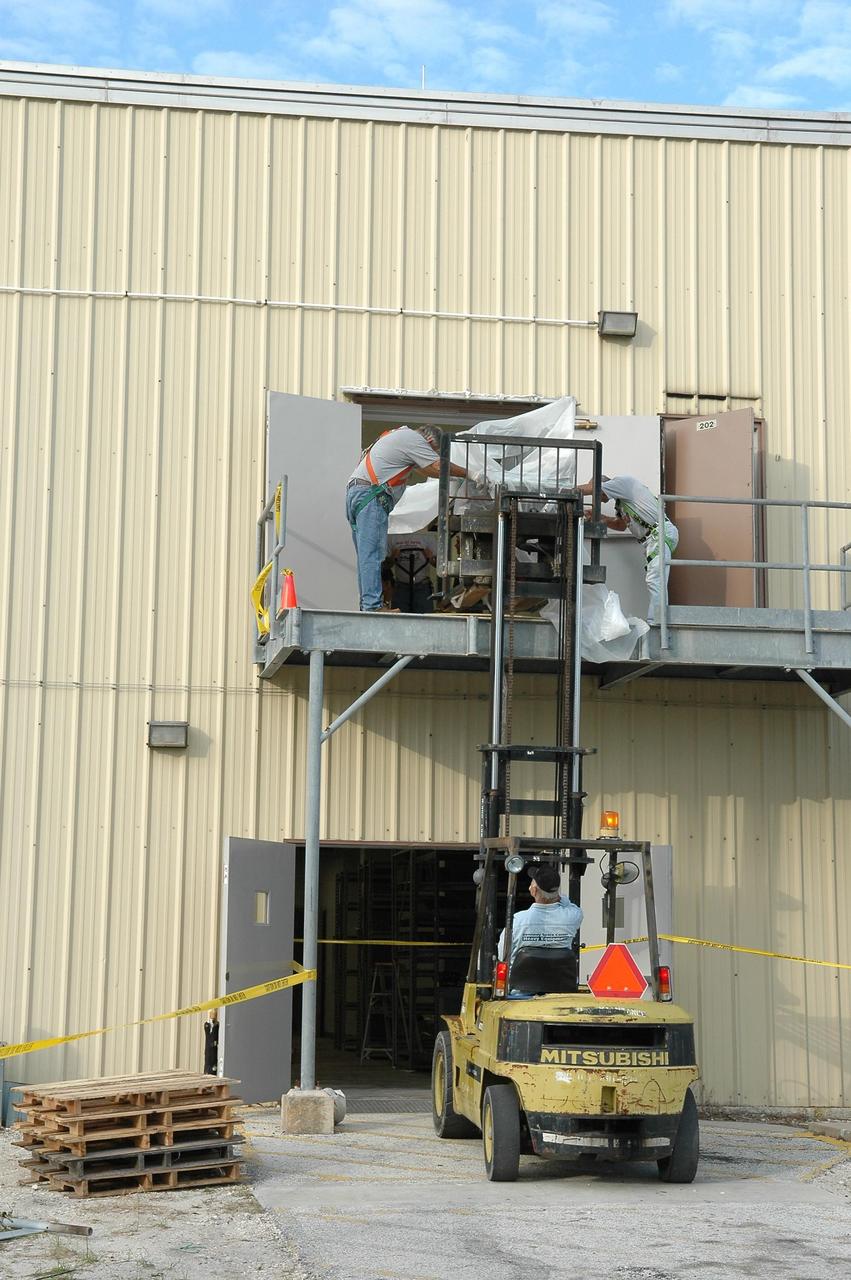
KENNEDY SPACE CENTER, FLA. - Employees at NASA Kennedy Space Center are moving equipment out of the RLV Hangar, where it was stored, and returning it to the Thermal Protection System (TPS) facility. The upper floor of the facility, where soft material was processed, was damaged during the 2004 hurricanes. While the TPS facility was being repaired, normal work activity was done in the hangar.
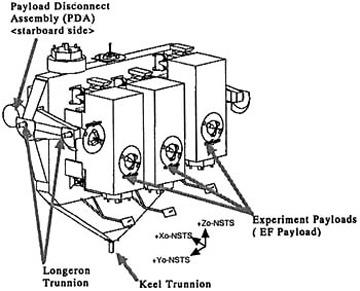
JSC2003-E-42551 (For Release: 18 June 2003) --- This graphic shows the Experiment Logistics Modules-Exposed (ELM-ES) of the Japanese Experiment Module (JEM), Japan's primary contribution to the International Space Station (ISS), is shown in a processing facility. There are two JEM logistics modules, one each for the Pressurized Module and the Exposed Facility, that serve as on-orbit storage areas that house materials for experiments, maintenance tools and supplies. The ELM-ES is a pallet that can hold 3 experiment payloads for the JEM Exposed Facility. Photo Credit: NASDA
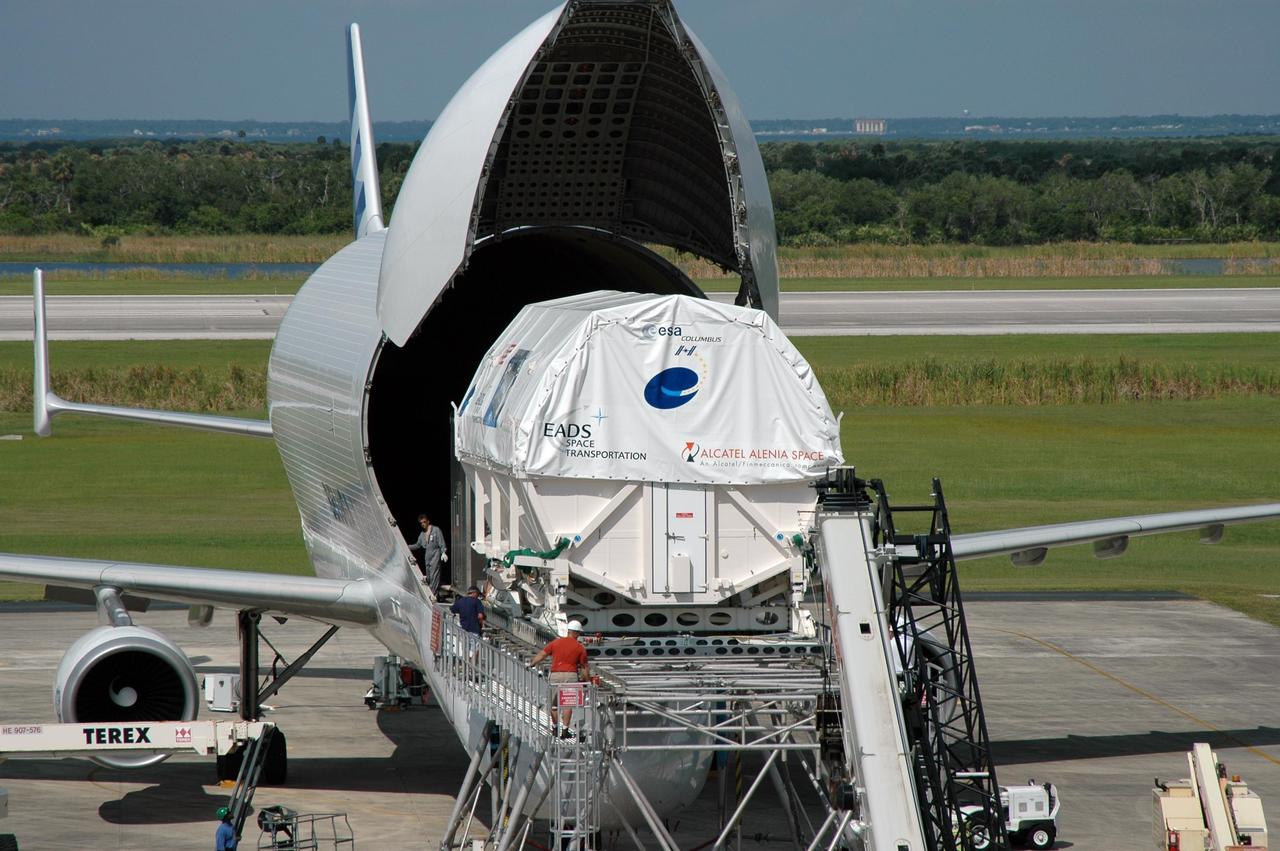
KENNEDY SPACE CENTER, FLA. - At the Shuttle Landing Facility, the European Space Agency's research laboratory, designated Columbus, slides out onto an Airbus Transport International platform. The module will be lifted onto a flat bed truck and transported to the Space Station Processing Facility. In the SSPF, the module will be prepared for delivery to the International Space Station on a future space shuttle mission. Columbus will expand the research facilities of the station and provide researchers with the ability to conduct numerous experiments in the area of life, physical and materials sciences. Photo credit: NASA/Jim Grossmann
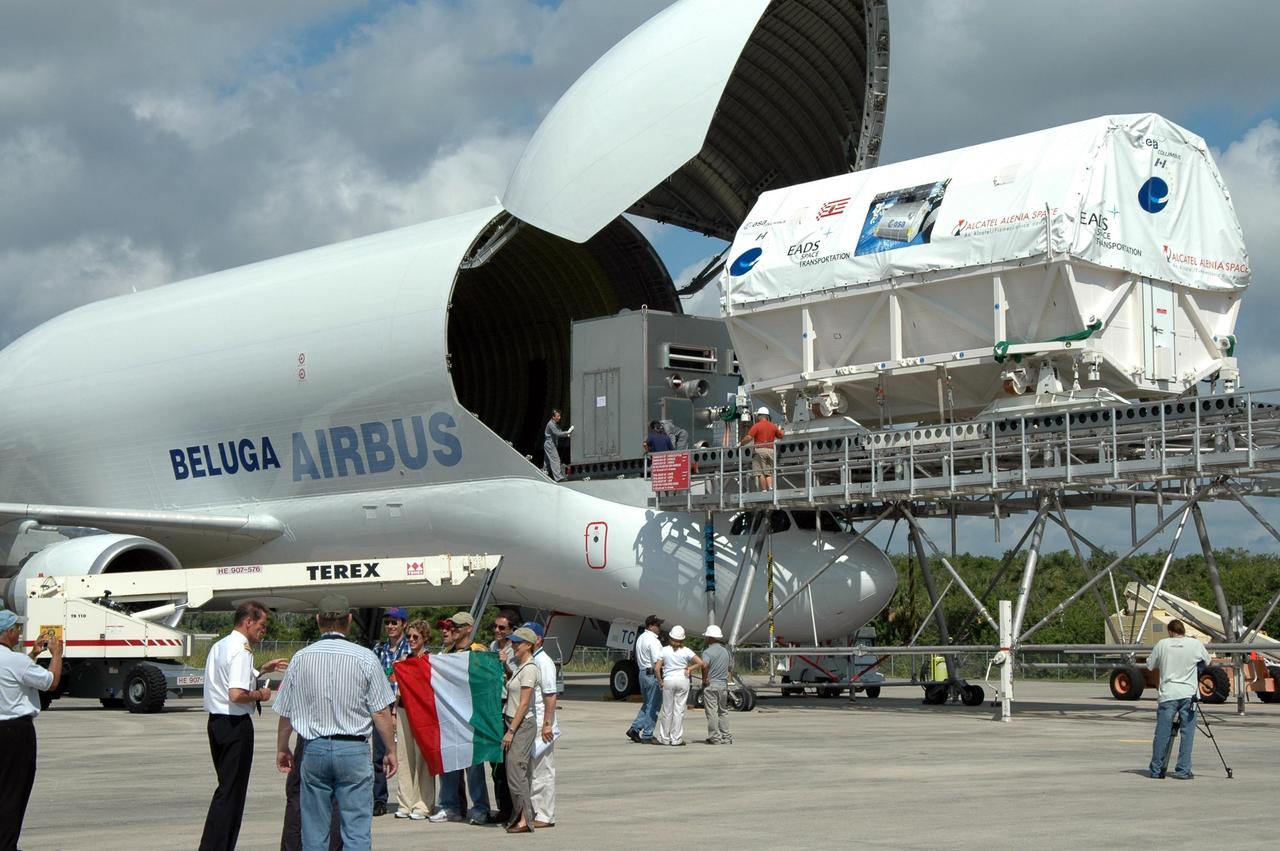
KENNEDY SPACE CENTER, FLA. - At the Shuttle Landing Facility, the European Space Agency's research laboratory, designated Columbus, has been offloaded onto an Airbus Transport International platform. The module will be lifted onto a flat bed truck and transported to the Space Station Processing Facility. There the module will be prepared for delivery to the International Space Station on a future space shuttle mission. Columbus will expand the research facilities of the station and provide researchers with the ability to conduct numerous experiments in the area of life, physical and materials sciences. Photo credit: NASA/Jim Grossmann
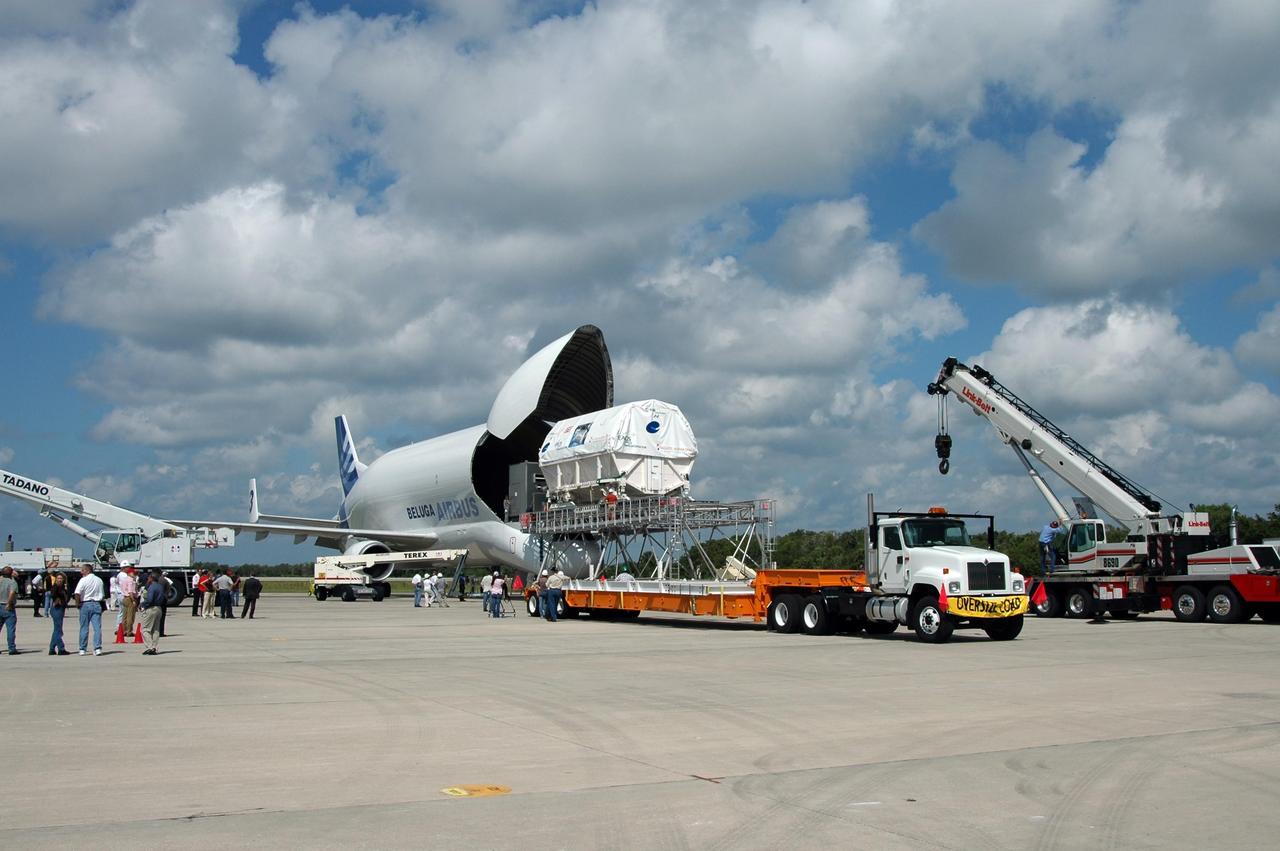
KENNEDY SPACE CENTER, FLA. - At the Shuttle Landing Facility, the European Space Agency's research laboratory, designated Columbus, slides out onto an Airbus Transport International platform. The module will be lifted onto a flat bed truck and transported to the Space Station Processing Facility. There the module will be prepared for delivery to the International Space Station on a future space shuttle mission. Columbus will expand the research facilities of the station and provide researchers with the ability to conduct numerous experiments in the area of life, physical and materials sciences. Photo credit: NASA/Jim Grossmann
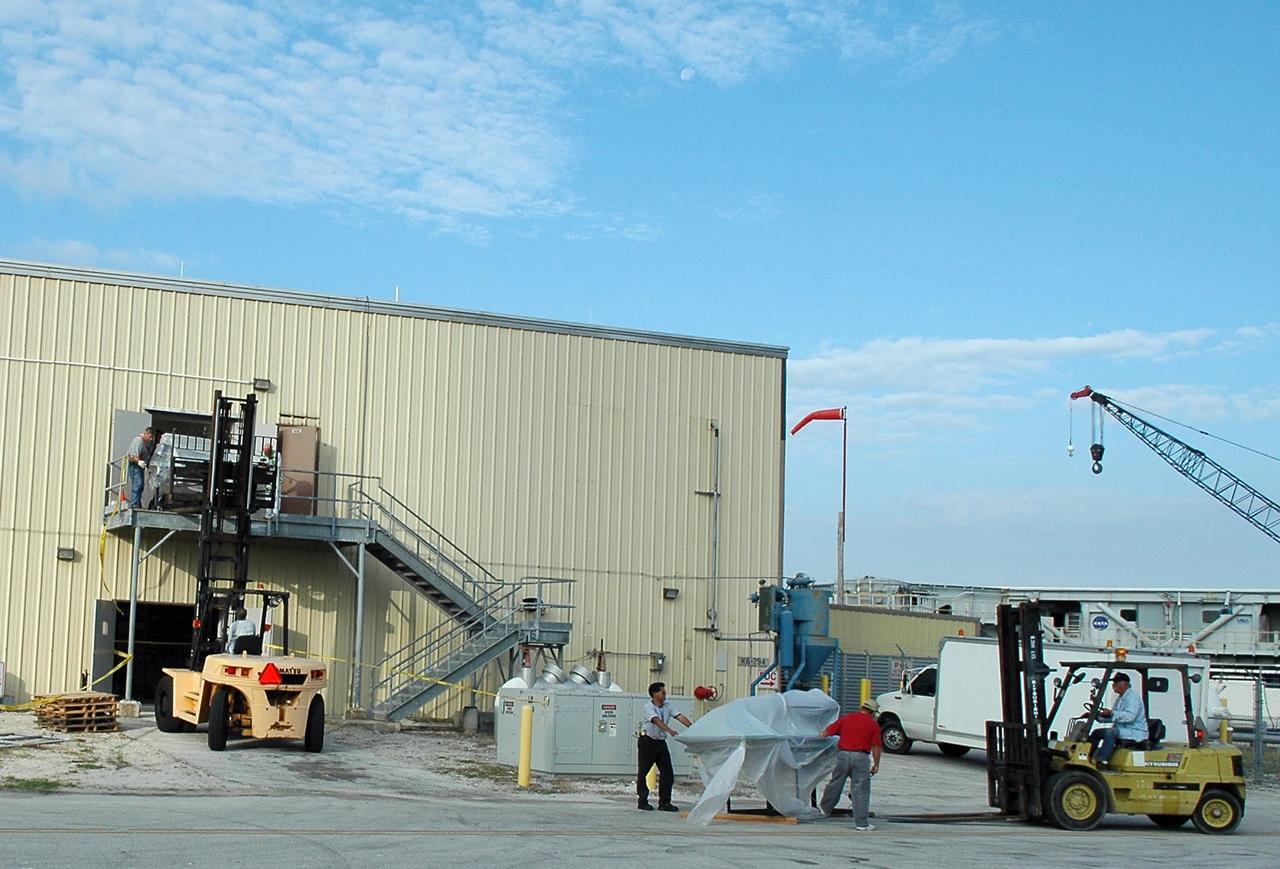
KENNEDY SPACE CENTER, FLA. - Employees at NASA Kennedy Space Center are transferring equipment stored in the RLV Hangar back to the Thermal Protection System (TPS) facility. The upper floor of the facility, where soft material was processed, was damaged during the 2004 hurricanes. While the TPS facility was being repaired, normal work activity was done in the hangar.
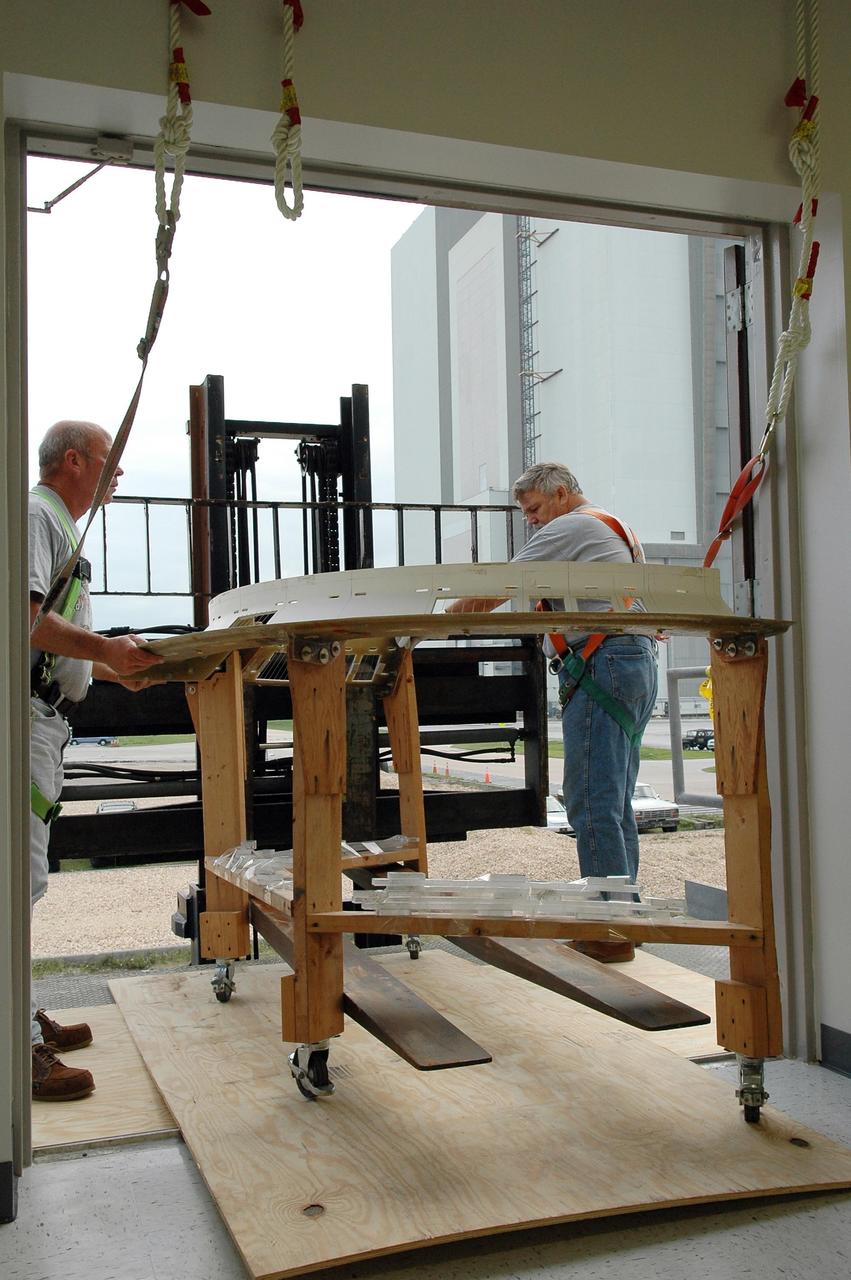
KENNEDY SPACE CENTER, FLA. - Employees at NASA Kennedy Space Center move equipment into the Thermal Protection System facility that has recently been repaired. The upper floor of the facility, where soft material was processed, was damaged during the 2004 hurricanes and the equipment was temporarily moved to the RLV Hangar. While the TPS facility was being repaired, normal work activity was done in the hangar.
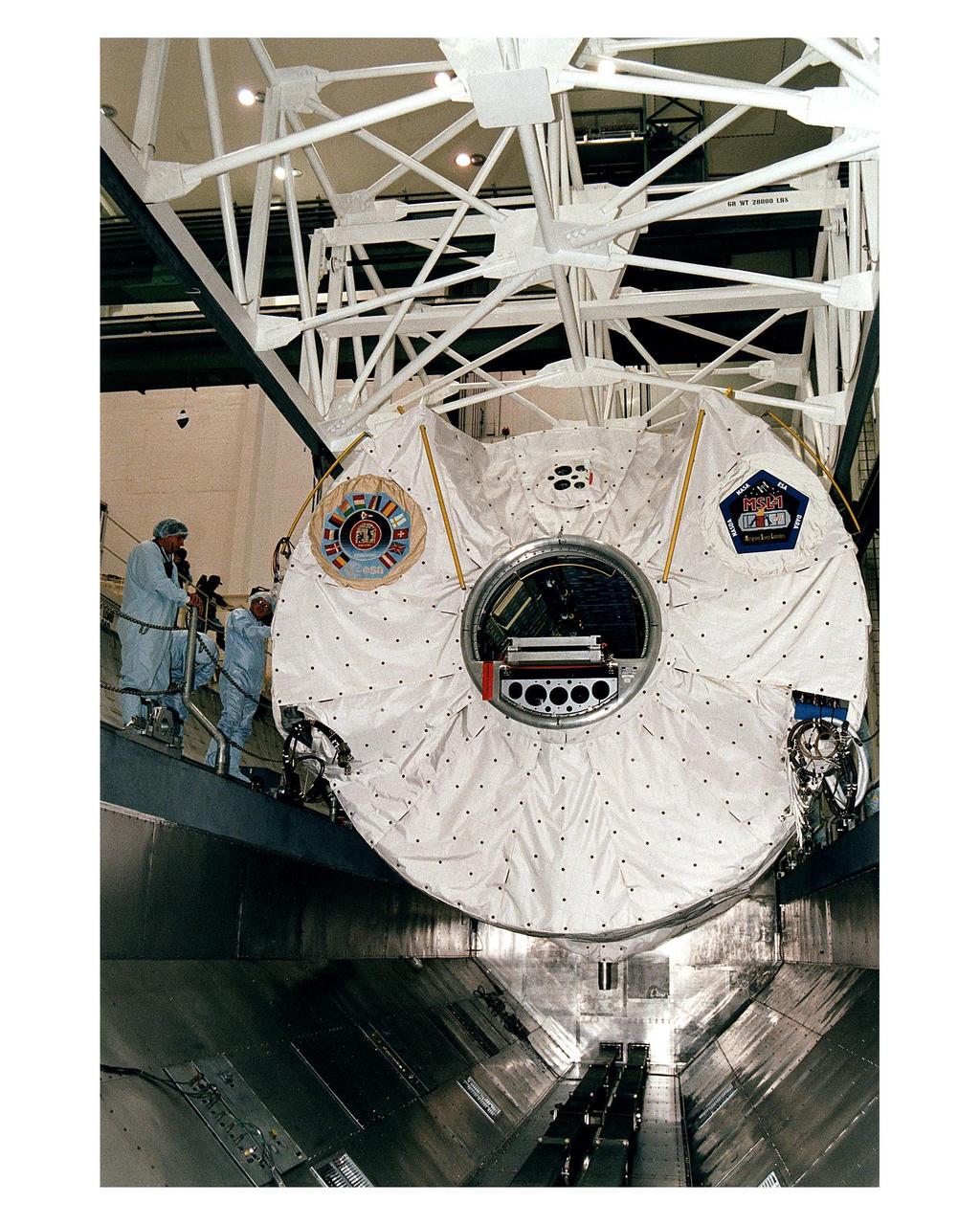
The Microgravity Science Laboratory-1 (MSL-1) Spacelab module is moved to be installed into a payload canister in the Operations and Checkout Building. Once in the canister, the MSL-1 will be transported to Orbiter Processing Bay 1 where it will be integrated into the payload bay of the Space Shuttle orbiter Columbia. During the scheduled 16-day STS-83 mission, the MSL-1 will be used to test some of the hardware, facilities and procedures that are planned for use on the International Space Station while the flight crew conducts combustion, protein crystal growth and materials processing experiments
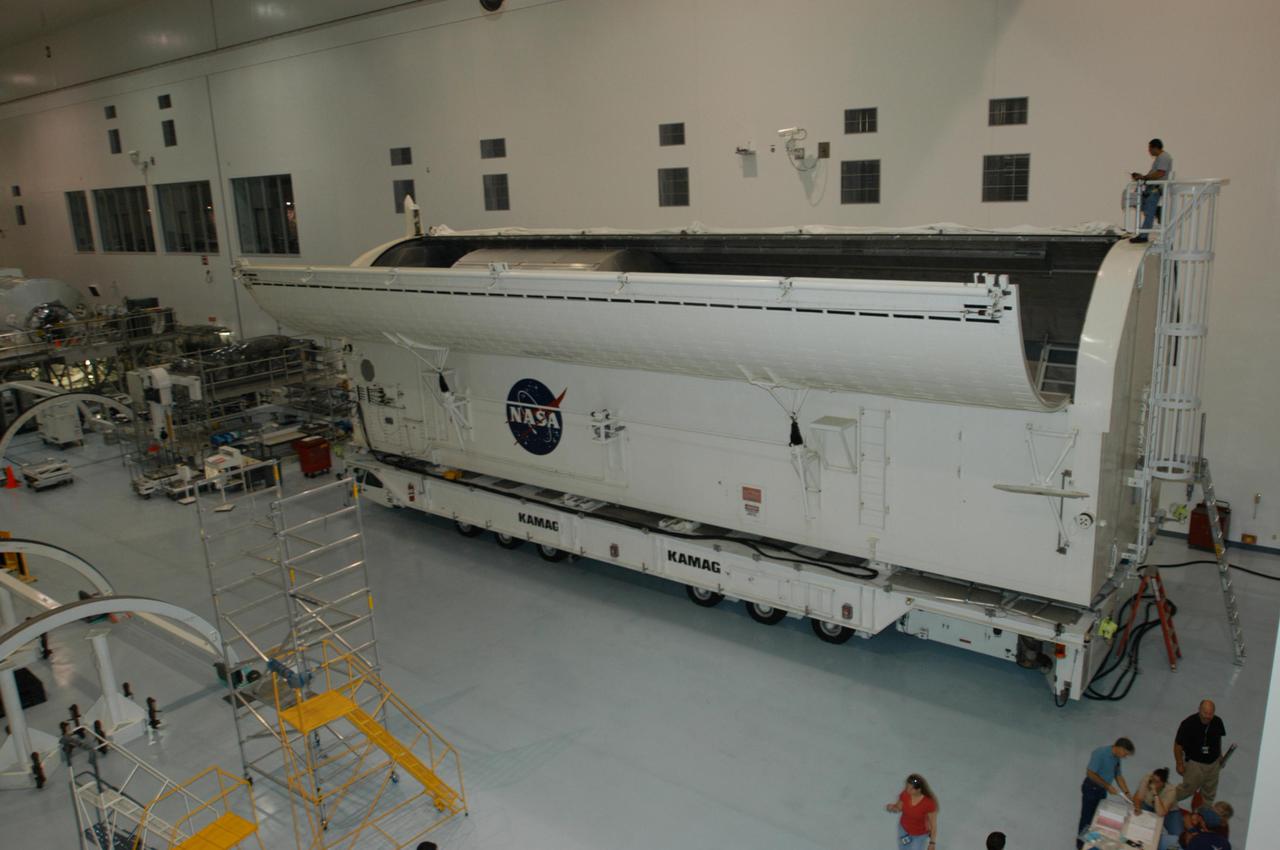
KENNEDY SPACE CENTER, FLA. -- The doors of a transportation canister containing the Multi-Purpose Logistics Module Raffaello are opened inside NASA Kennedy Space Center’s Space Station Processing Facility. Raffaello holds material returned from the International Space Station to KSC aboard Space Shuttle Discovery on Return to Flight mission STS-114. Raffaello will be transferred to an Element Rotation Stand later and emptied of its cargo. Discovery will undergo processing for the next Space Shuttle flight, STS-121, the second Return to Flight mission.

KENNEDY SPACE CENTER, FLA. -- A transportation canister containing the Multi-Purpose Logistics Module Raffaello arrives at NASA Kennedy Space Center’s Space Station Processing Facility. Raffaello holds material returned from the International Space Station to KSC aboard Space Shuttle Discovery on Return to Flight mission STS-114. Raffaello will be transferred to an Element Rotation Stand later and emptied of its cargo. Discovery will undergo processing for the next Space Shuttle flight, STS-121, the second Return to Flight mission.
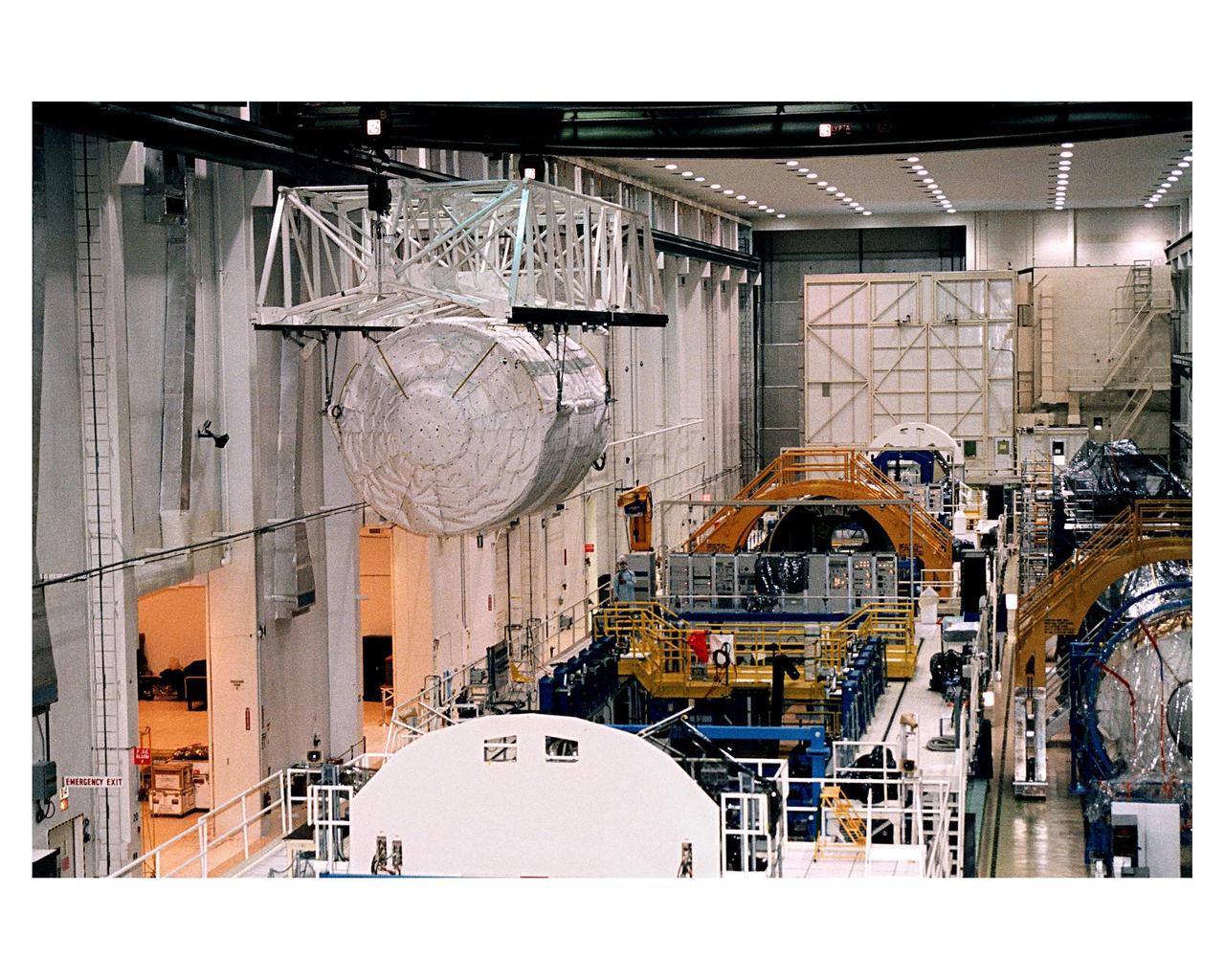
The Microgravity Science Laboratory-1 (MSL-1) Spacelab module is moved to be installed into a payload canister in the Operations and Checkout Building. Once in the canister, the MSL-1 will be transported to Orbiter Processing Bay 1 where it will be integrated into the payload bay of the Space Shuttle orbiter Columbia. During the scheduled 16-day STS-83 mission, the MSL-1 will be used to test some of the hardware, facilities and procedures that are planned for use on the International Space Station while the flight crew conducts combustion, protein crystal growth and materials processing experiments
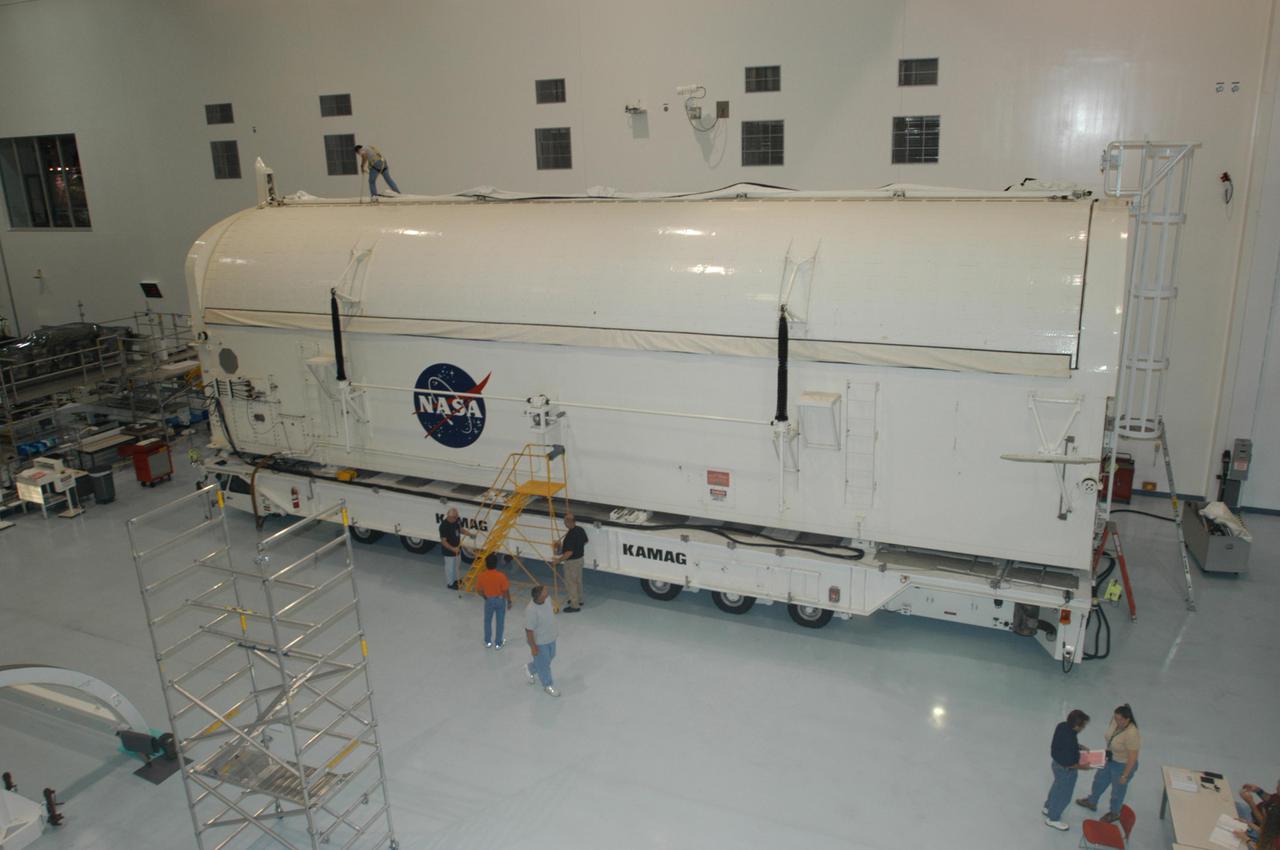
KENNEDY SPACE CENTER, FLA. -- A transportation canister containing the Multi-Purpose Logistics Module Raffaello is positioned inside NASA Kennedy Space Center’s Space Station Processing Facility. Raffaello holds material returned from the International Space Station to KSC aboard Space Shuttle Discovery on Return to Flight mission STS-114. Raffaello will be transferred to an Element Rotation Stand later and emptied of its cargo. Discovery will undergo processing for the next Space Shuttle flight, STS-121, the second Return to Flight mission.

The Microgravity Science Laboratory-1 (MSL-1) Spacelab module is moved to be installed into a payload canister in the Operations and Checkout Building. Once in the canister, the MSL-1 will be transported to Orbiter Processing Bay 1 where it will be integrated into the payload bay of the Space Shuttle orbiter Columbia. During the scheduled 16-day STS-83 mission, the MSL-1 will be used to test some of the hardware, facilities and procedures that are planned for use on the International Space Station while the flight crew conducts combustion, protein crystal growth and materials processing experiments
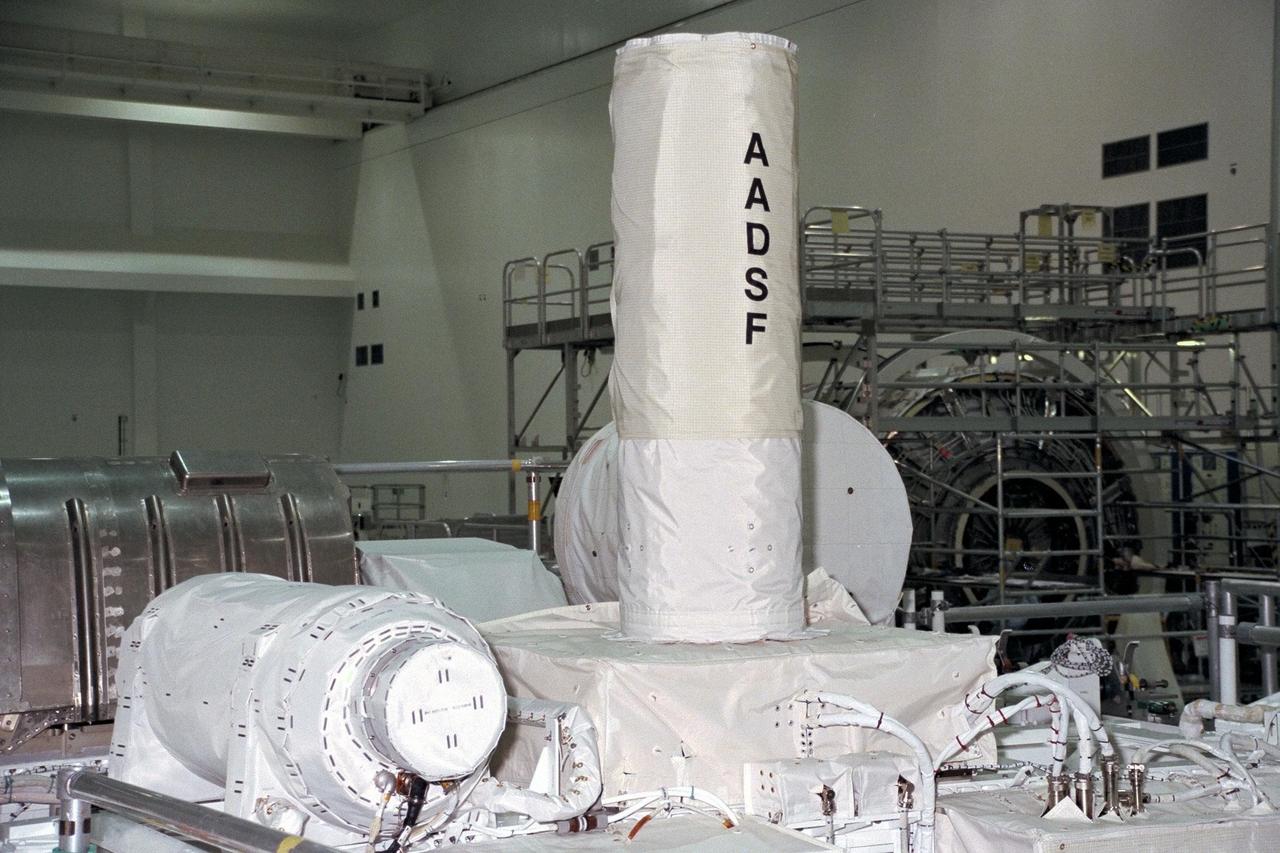
United States Microgravity Payload-4 (USMP-4) experiments are prepared to be flown on Space Shuttle mission STS-87 in the Space Station Processing Facility at Kennedy Space Center (KSC). The vertical tube in the center of the photo is the Advanced Automated Directional Solidification Furnace (AADSF), which will be used by researchers to study the solidification of semiconductor materials in microgravity. Scientists will be able to better understand how microgravity influences the solidification process of these materials and develop better methods for controlling that process during future Space flights and Earth-based production. To its left is MEPHISTO, the French acronym for a cooperative American-French investigation of the fundamentals of crystal growth. All STS-87 experiments are scheduled for launch on Nov. 19 from KSC
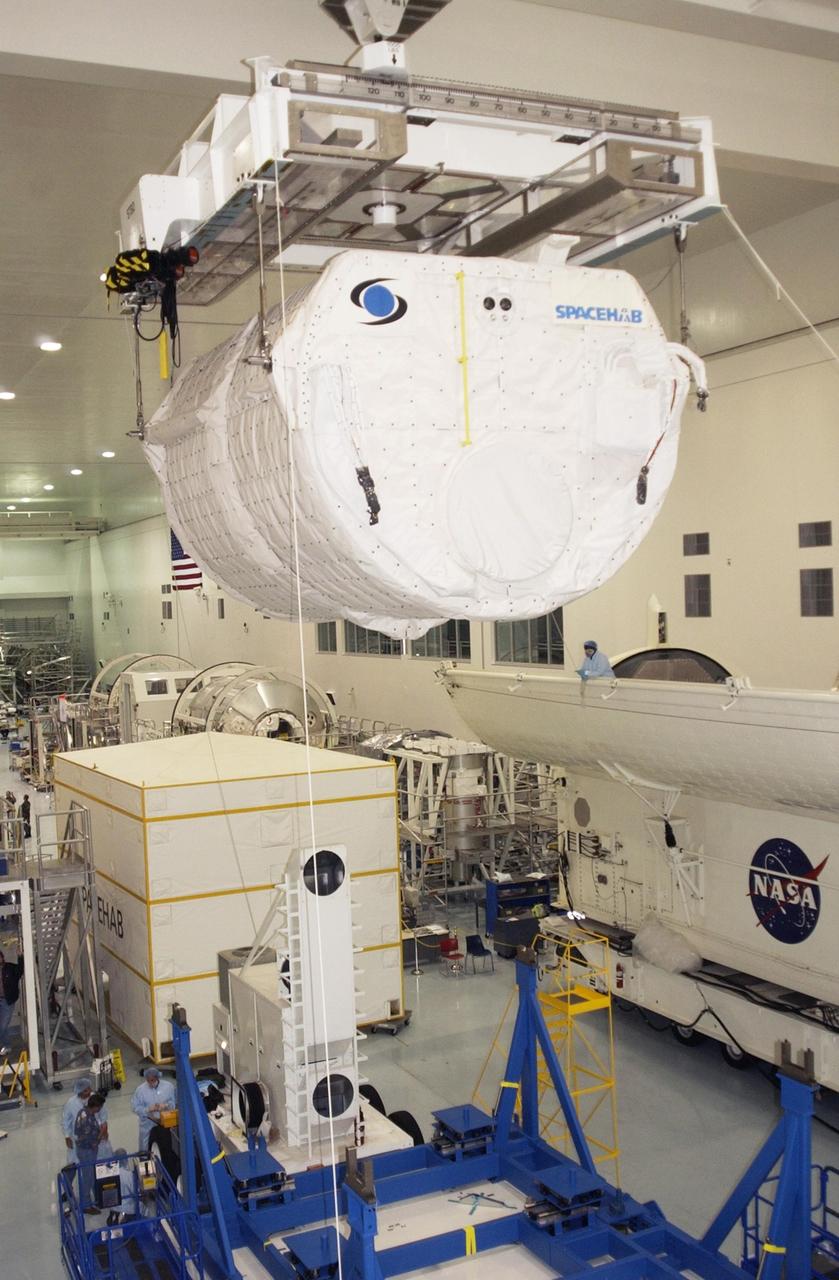
KENNEDY SPACE CENTER, FLA. - Suspended from the overhead crane, the SHI Research Double Module (SHI/RDM) travels across the Space Station Processing Facility to the payload canister waiting at right. The module will be placed in the canister for transport to the Orbiter Processing Facility where it will be installed in Columbia's payload bay for mission STS-107. SHI/RDM is the primary payload of the research mission, with experiments ranging from material sciences to life sciences (many rats). Also part of the payload is the Fast Reaction Experiments Enabling Science, Technology, Applications and Research (FREESTAR) that incorporates eight high priority secondary attached shuttle experiments. STS-107 is scheduled to launch July 19, 2002
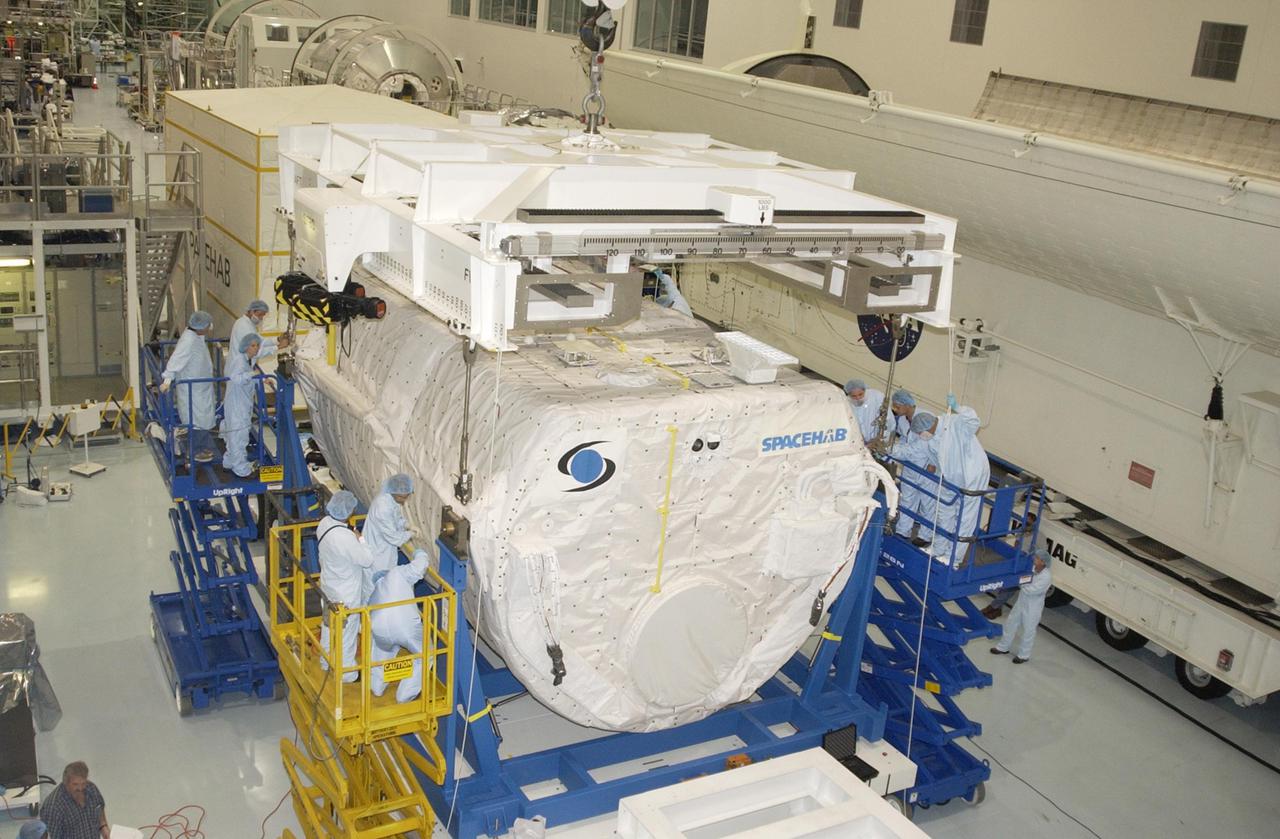
KENNEDY SPACE CENTER, FLA. - In the Space Station Processing Facility, the overhead crane lifts the SHI Research Double Module (SHI_RDM) from its workstand. The module is being transferred to the payload canister for transport to the Orbiter Processing Facility where it will be installed in Columbia's payload bay for mission STS-107. SHI_RDM is the primary payload of the research mission, with experiments ranging from material sciences to life sciences (many rats). Also part of the payload is the Fast Reaction Experiments Enabling Science, Technology, Applications and Research (FREESTAR) that incorporates eight high priority secondary attached shuttle experiments. STS-107 is scheduled to launch July 19, 2002
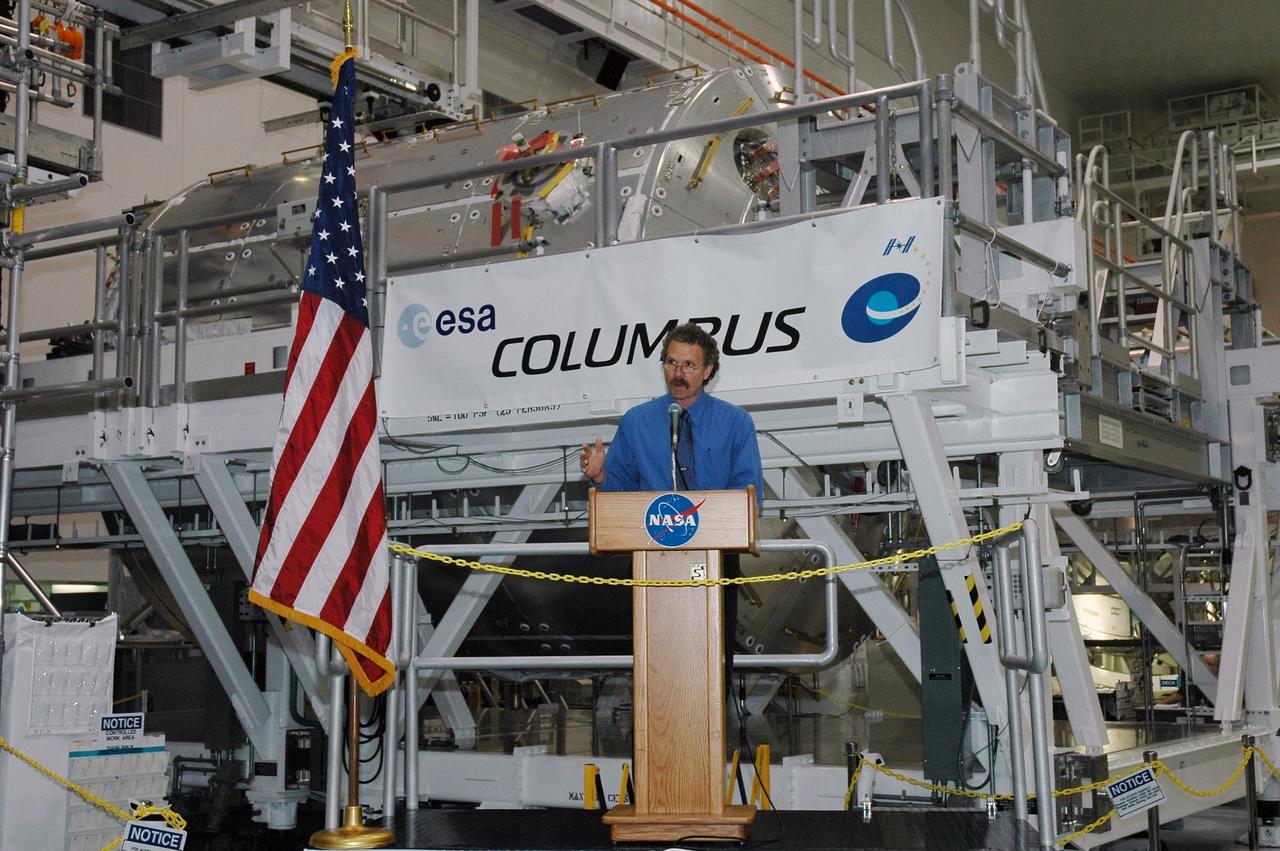
KENNEDY SPACE CENTER, FLA. - At ceremony in the Space Station Processing Facility, Russell Romanella, director of International Space Station and Payloads Processing at Kennedy Space Center, relays his team's readiness to prepare the European Space Agency's Columbus module (seen behind him) for flight. Columbus is the European Space Agency's research laboratory for the International Space Station. The module will be prepared in the SSPF for delivery to the space station on a future space shuttle mission. Columbus will expand the research facilities of the station and provide researchers with the ability to conduct numerous experiments in the life, physical and materials sciences. Photo credit: NASA/Amanda Diller
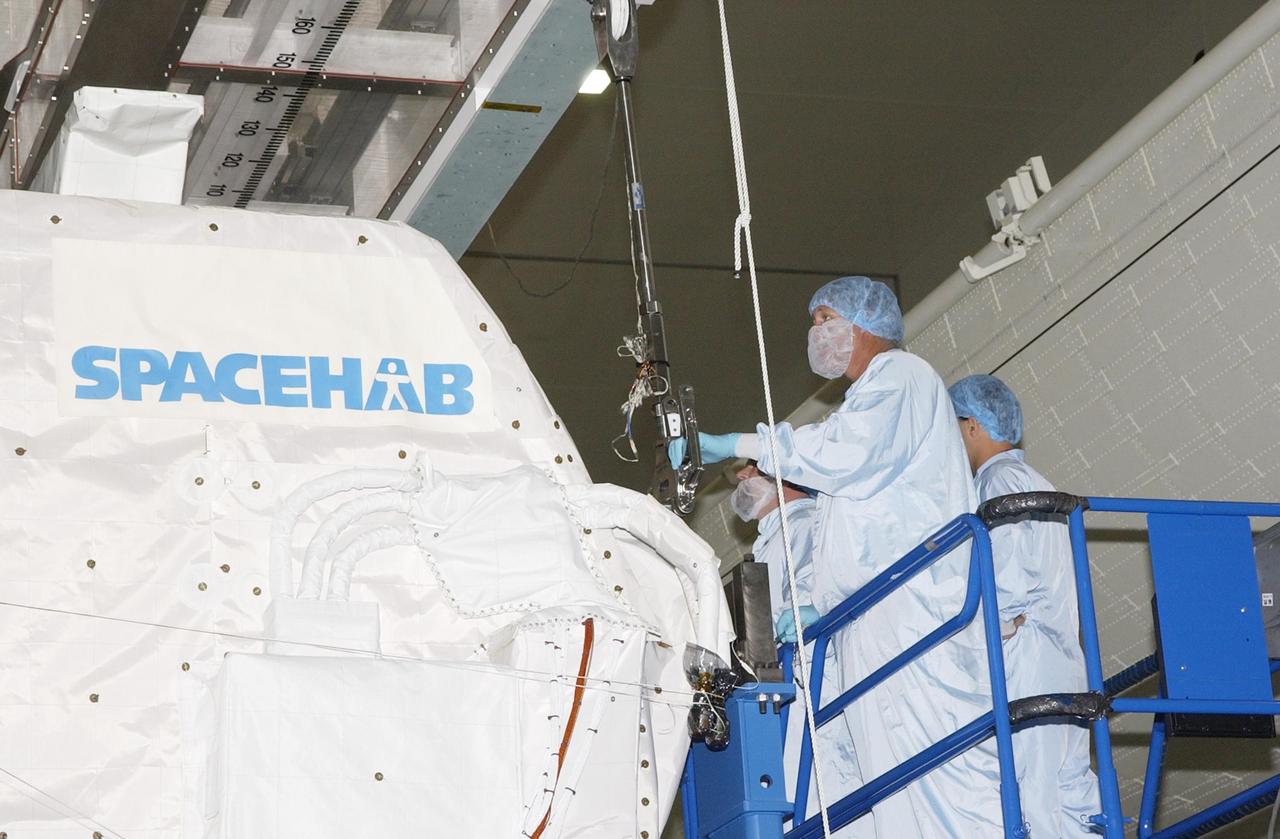
KENNEDY SPACE CENTER, FLA. - Workers in the Space Station Processing Facility attach the overhead crane to the SHI Research Double Module (SHI/RDM) to lift it off the workstand. The module is being transferred to the payload canister for transport to the Orbiter Processing Facility where it will be installed in Columbia's payload bay for mission STS-107. SHI/RDM is the primary payload of the research mission, with experiments ranging from material sciences to life sciences (many rats). Also part of the payload is the Fast Reaction Experiments Enabling Science, Technology, Applications and Research (FREESTAR) that incorporates eight high priority secondary attached shuttle experiments. STS-107 is scheduled to launch July 19, 2002
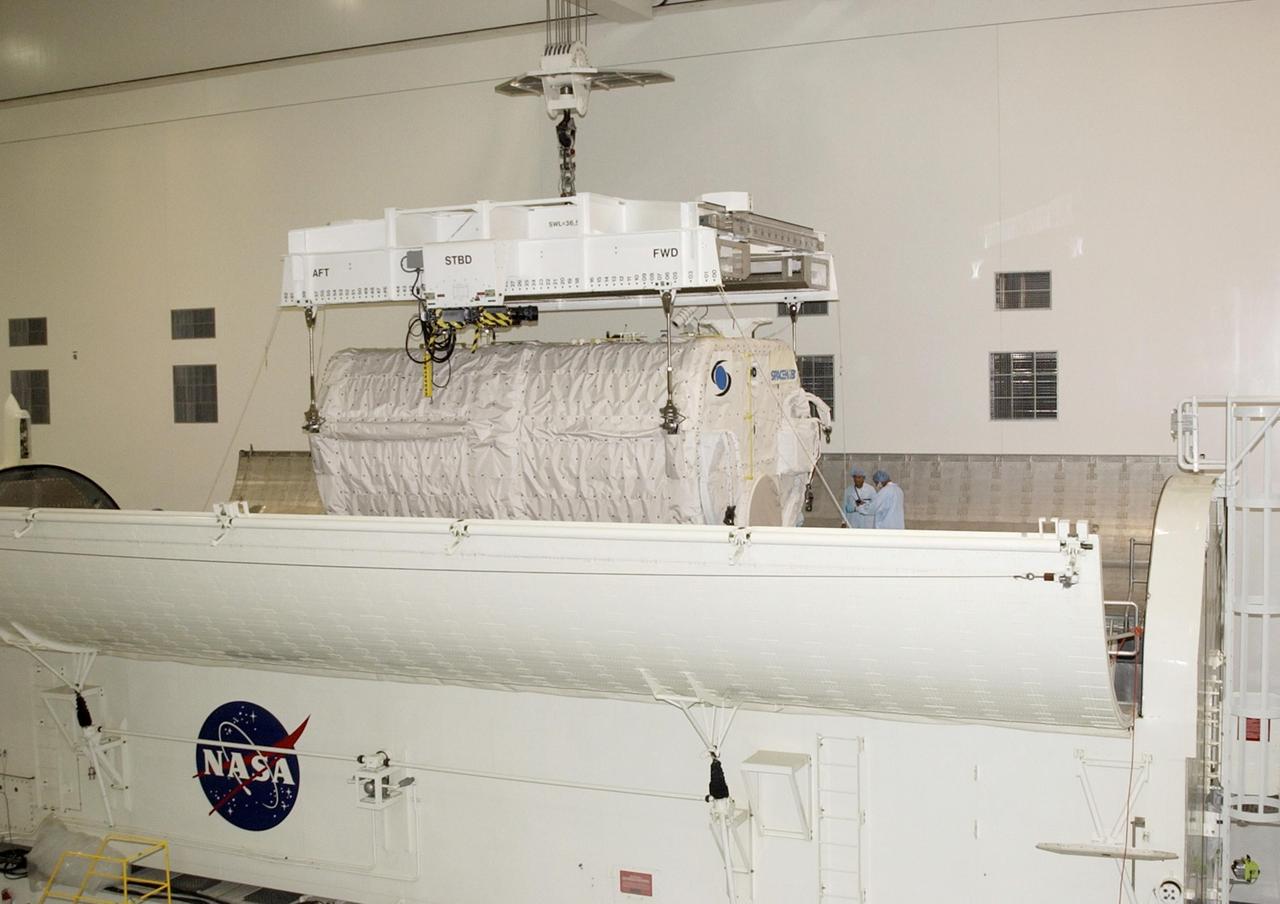
KENNEDY SPACE CENTER, FLA. -- In the Space Station Processing Facility, the overhead crane lowers the SHI Research Double Module (SHI/RDM) into the payload canister. The canister will transport it to the Orbiter Processing Facility where it will be installed in Columbia's payload bay for mission STS-107. SHI/RDM is the primary payload of the research mission, with experiments ranging from material sciences to life sciences (many rats). Also part of the payload is the Fast Reaction Experiments Enabling Science, Technology, Applications and Research (FREESTAR) that incorporates eight high priority secondary attached shuttle experiments. STS-107 is scheduled to launch July 19, 2002
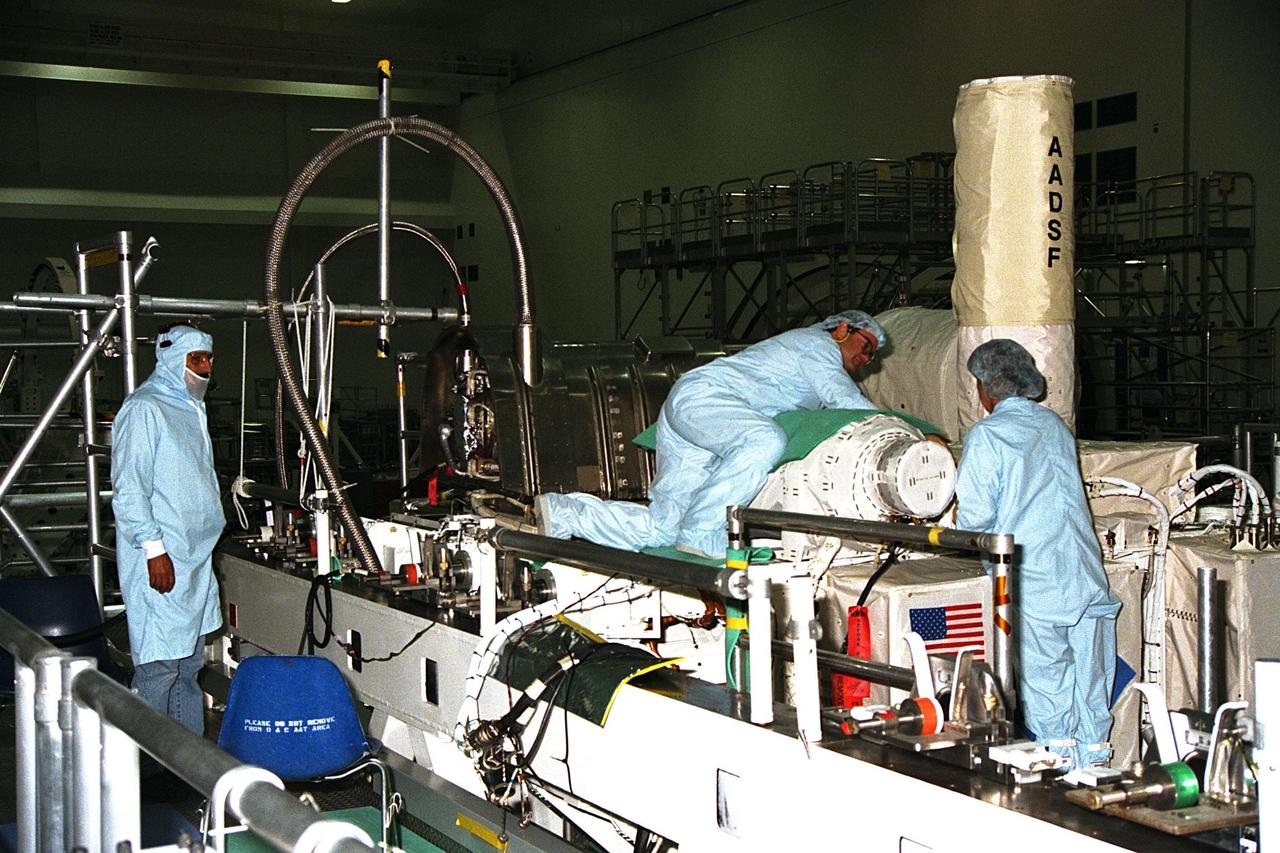
Technicians are monitoring experiments on the United States Microgravity Payload-4 (USMP-4) in preparation for its scheduled launch aboard STS-87 on Nov. 19 from Kennedy Space Center (KSC). USMP-4 experiments are prepared in the Space Station Processing Facility at KSC. The large white vertical cylinder at the right of the photo is the Advanced Automated Directional Solidification Furnace (AADSF ), which is a sophisticated materials science facility used for studying a common method of processing semiconductor crystals called directional solidification. The technician in the middle of the photo is leaning over MEPHISTO, a cooperative American-French investigation of the fundamentals of crystal growth
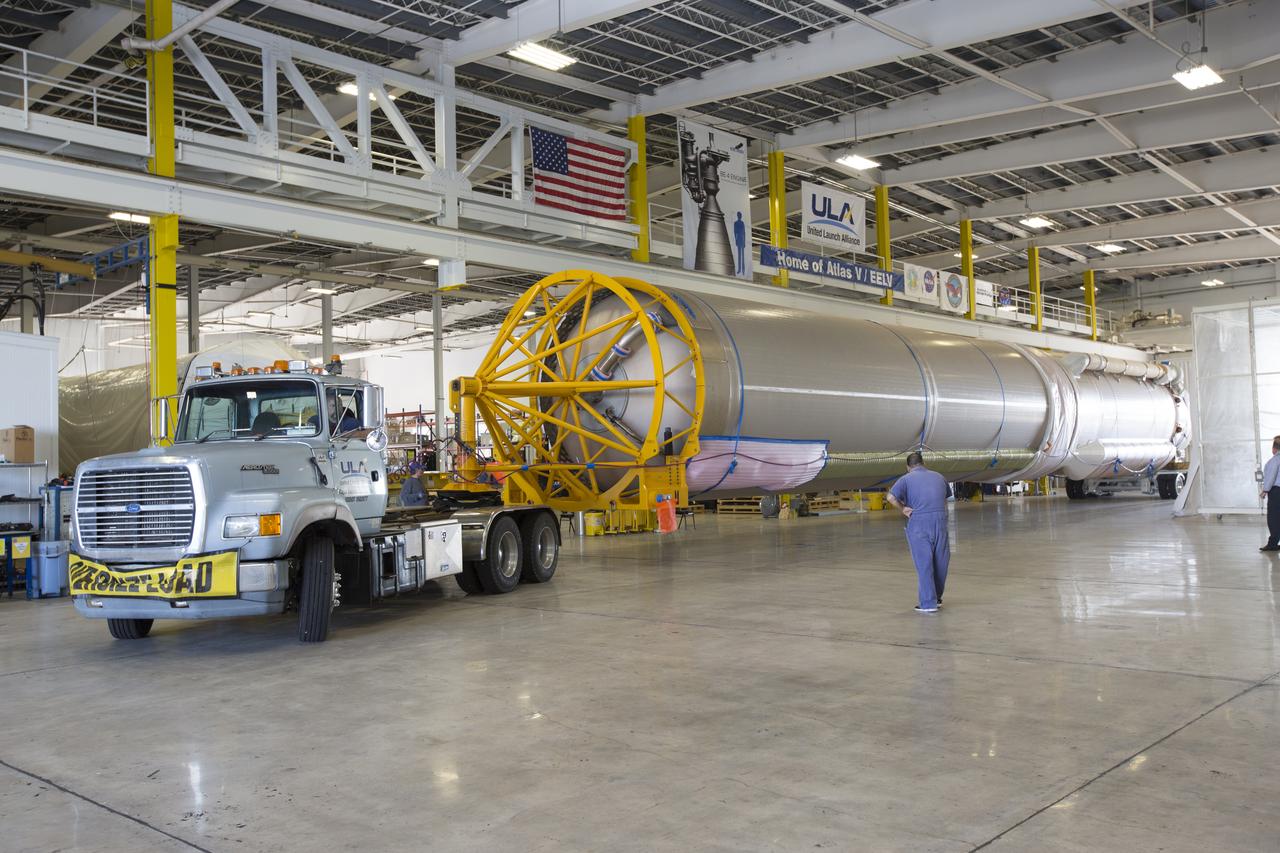
A United Launch Alliance (ULA) Atlas V booster arrives at Cape Canaveral Air Force Station's Atlas Spaceflight Operations Center (ASOC). The Atlas V will undergo final testing in that facility. When processing in the ASOC is complete, the Atlas booster will be moved to the Vertical Integration Facility for stacking at Space Launch Complex 41. Scheduled to launch March 19, 2017, the Atlas will launch a Cygnus spacecraft on the Orbital ATK CRS-7 mission to deliver thousands of pounds of supplies, equipment and scientific research materials to the International Space Station.
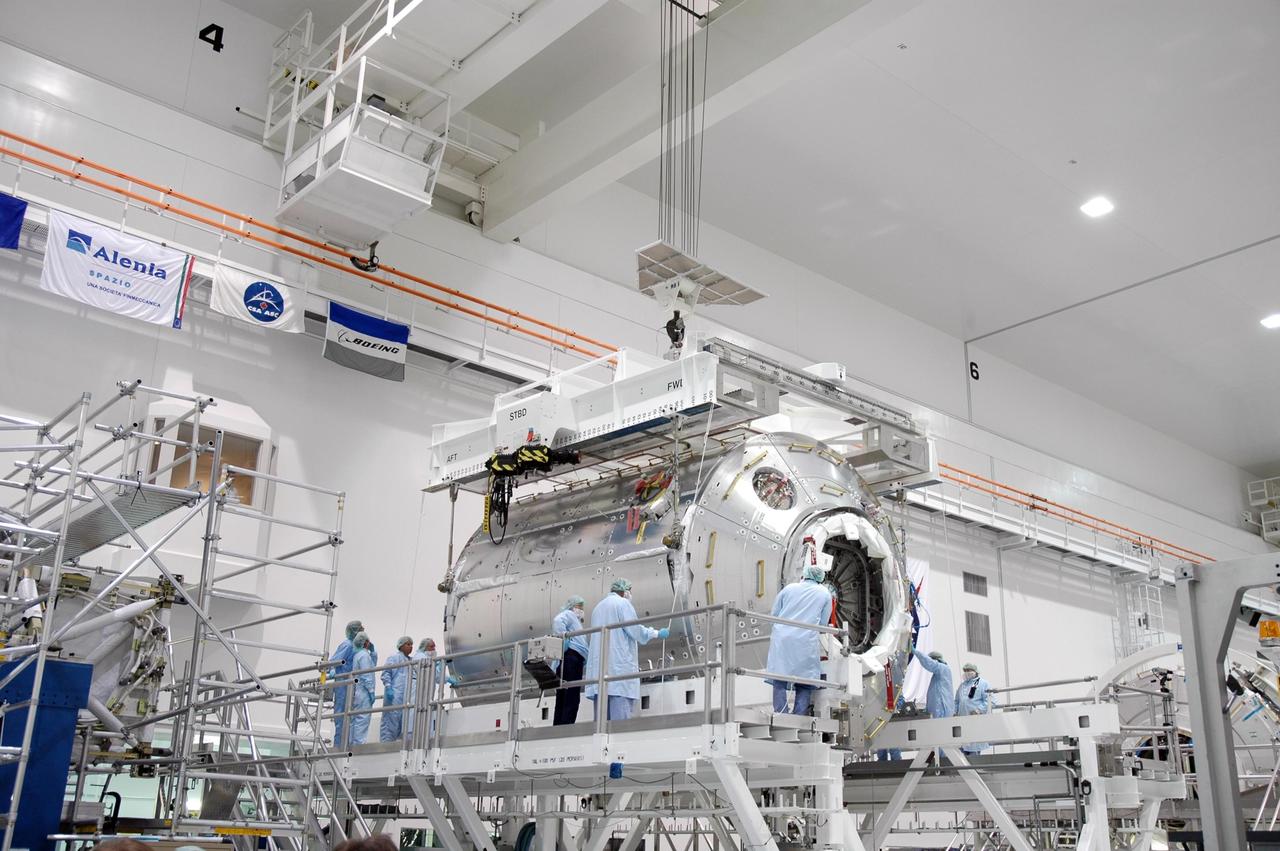
KENNEDY SPACE CENTER, FLA. - Inside the Space Station Processing Facility at NASA's Kennedy Space Center, an overhead crane settles the Columbus module onto a work stand. Columbus is the European Space Agency's research laboratory for the International Space Station. The module will be prepared for delivery to the space station on a future space shuttle mission. Columbus will expand the research facilities of the station and provide researchers with the ability to conduct numerous experiments in the area of life, physical and materials sciences. Photo credit: NASA/Jim Grossmann
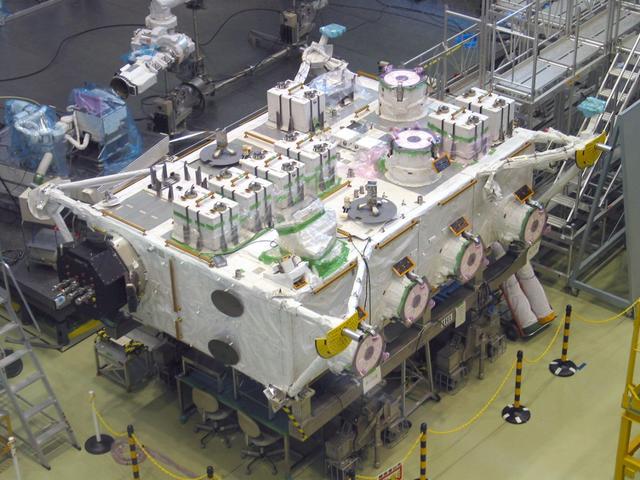
JSC2003-E-42544 (June 2003 ) --- The Exposed Facility (EF) of the Japanese Experiment Module (JEM), Japan's primary contribution to the International Space Station (ISS), is shown in a processing facility. The EF is a unique platform on the ISS that is located outside of the Pressurized Module and is continuously exposed to the space environment. Items positioned on the exterior platform focus on Earth observation as well as communication, scientific, engineering and materials science experiments. Photo Credit: NASA
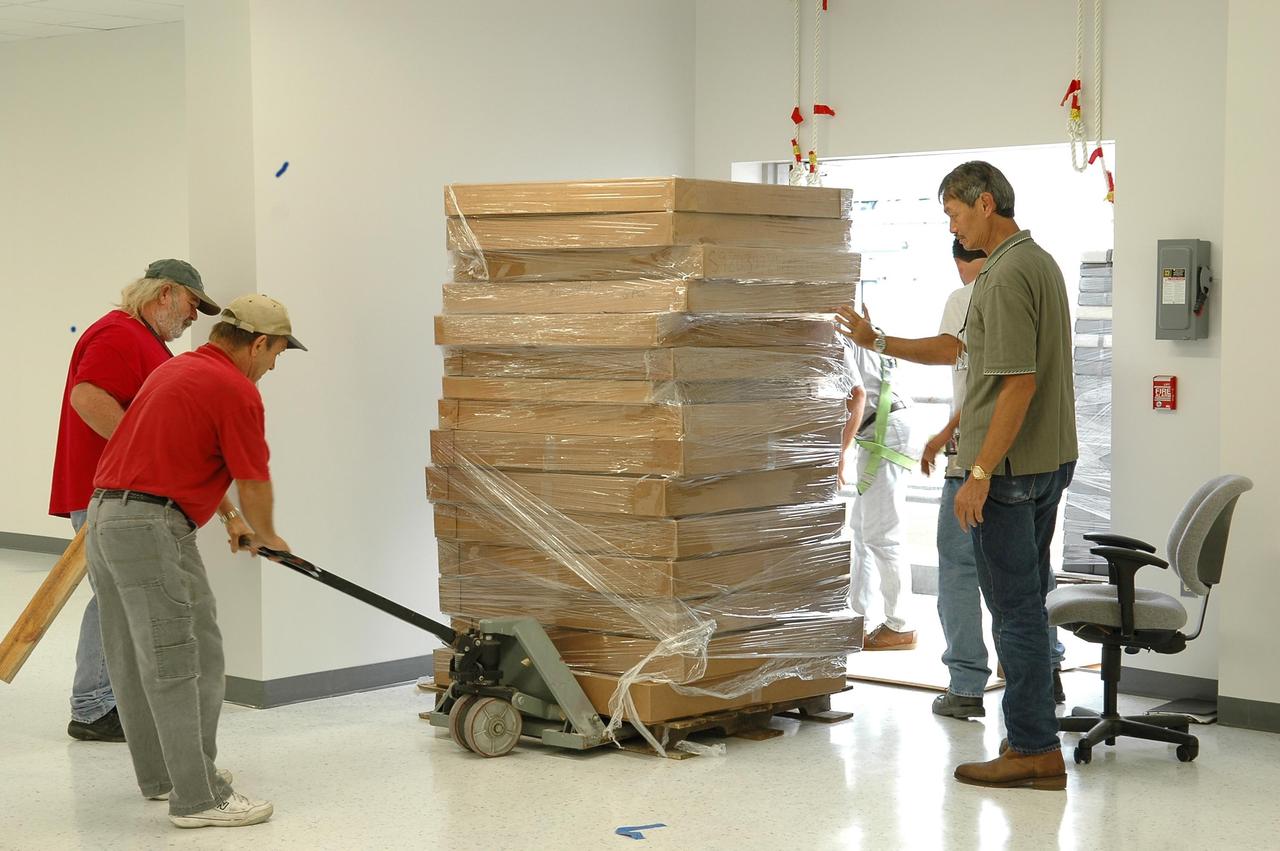
KENNEDY SPACE CENTER, FLA. - Inside the RLV Hangar at NASA Kennedy Space Center, employees move equipment being returned to the Thermal Protection System (TPS) facility. The upper floor, where soft material was processed, was damaged during the 2004 hurricanes. While the TPS facility was being repaired, normal work activity was done in the hangar.
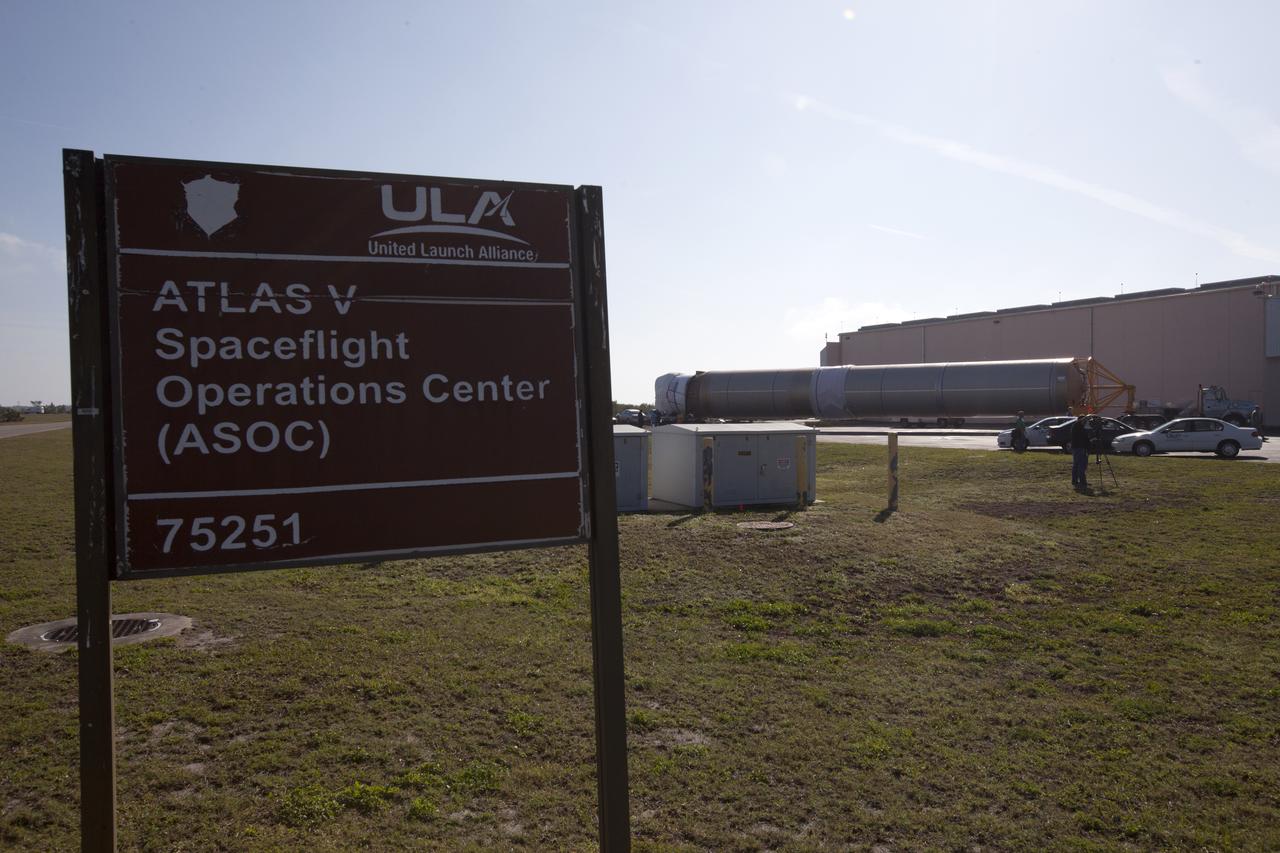
A United Launch Alliance (ULA) Atlas V booster arrives at Cape Canaveral Air Force Station's Atlas Spaceflight Operations Center (ASOC). The Atlas V will undergo final testing in that facility. When processing in the ASOC is complete, the Atlas booster will be moved to the Vertical Integration Facility for stacking at Space Launch Complex 41. Scheduled to launch March 19, 2017, the Atlas will launch a Cygnus spacecraft on the Orbital ATK CRS-7 mission to deliver thousands of pounds of supplies, equipment and scientific research materials to the International Space Station.
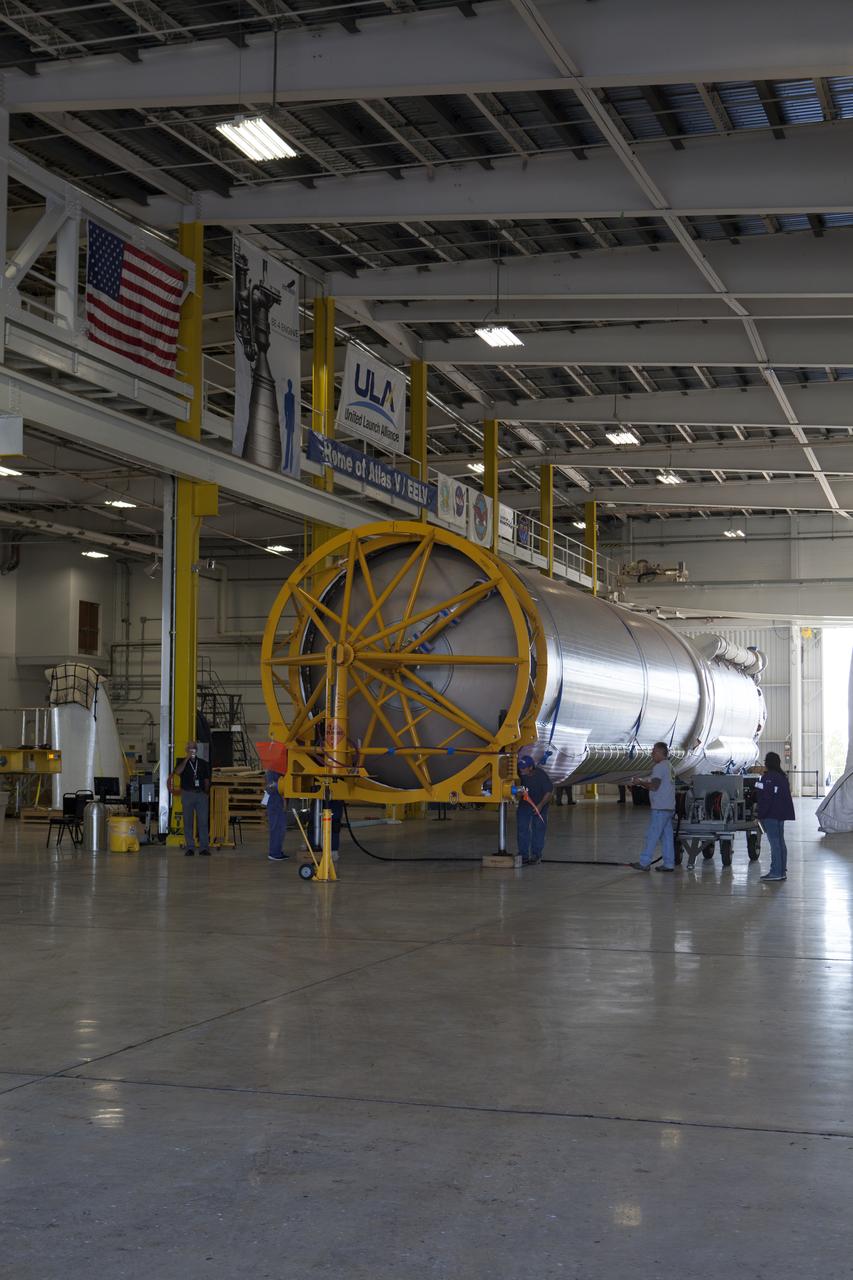
A United Launch Alliance (ULA) Atlas V booster arrives at Cape Canaveral Air Force Station's Atlas Spaceflight Operations Center (ASOC). The Atlas V will undergo final testing in that facility. When processing in the ASOC is complete, the Atlas booster will be moved to the Vertical Integration Facility for stacking at Space Launch Complex 41. Scheduled to launch March 19, 2017, the Atlas will launch a Cygnus spacecraft on the Orbital ATK CRS-7 mission to deliver thousands of pounds of supplies, equipment and scientific research materials to the International Space Station.
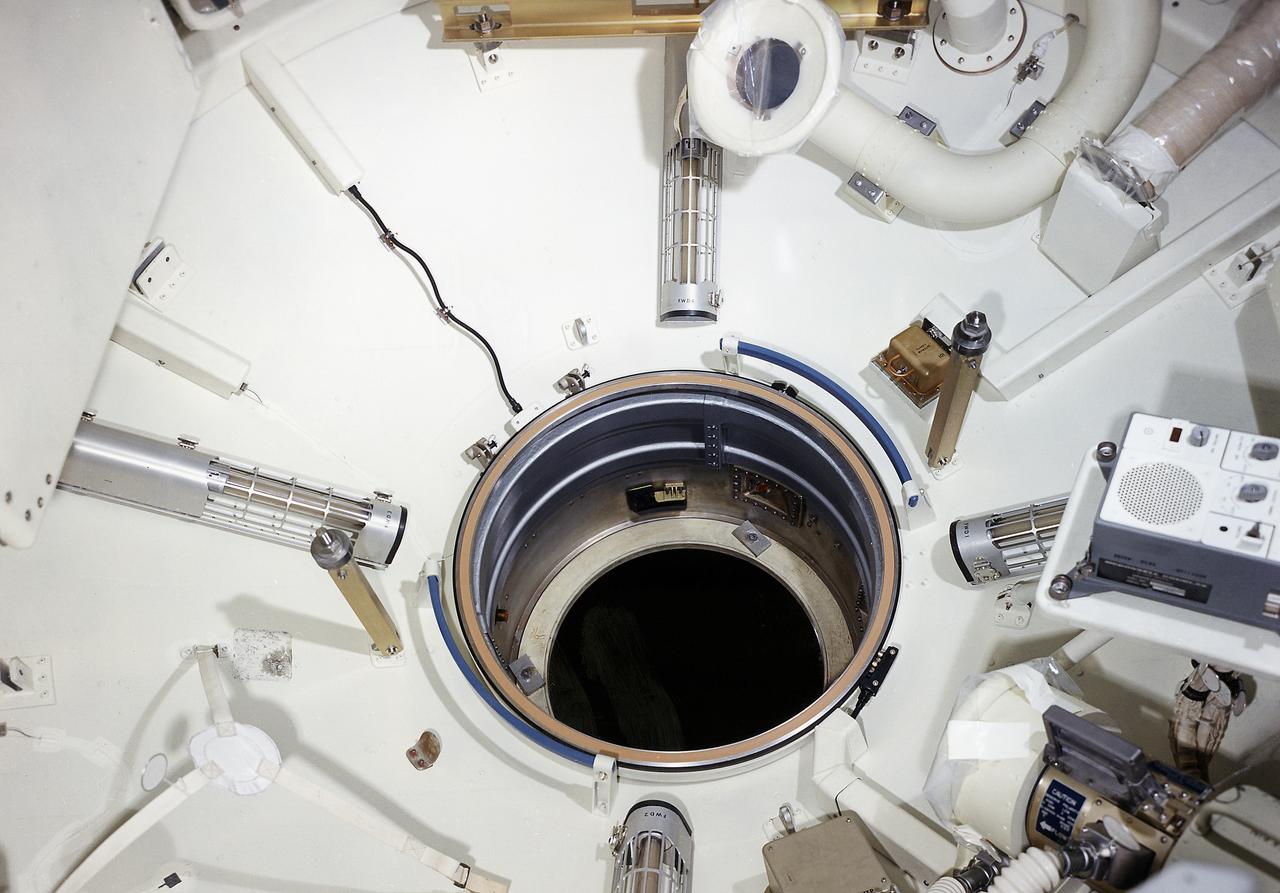
This August 1971 interior photograph of Skylab's Multiple Docking Adapter (MDA) flight article, undergoing outfitting at the Martin-Marietta Corporation's Space Center facility in Denver, Colorado, shows the forward cone area and docking tunnel (center) that attached to the Apollo Command Module. Designed and manufactured by the Marshall Space Flight Center, the MDA housed the control units for the Apollo Telescope Mount, Earth Resources Experiment Package, and Zero-Gravity Materials Processing Facility and provided a docking port for the Apollo Command Module.
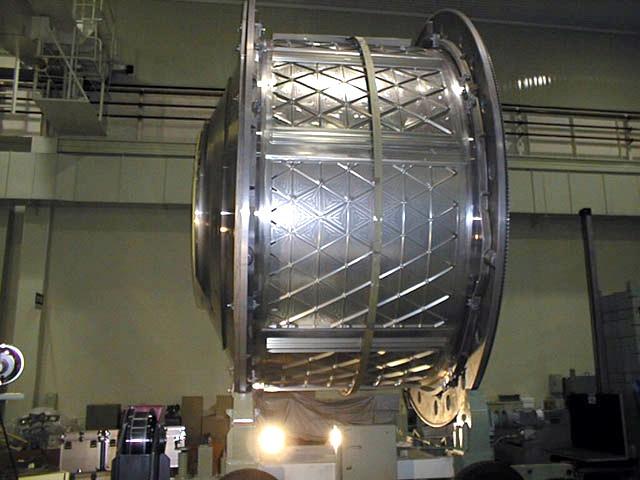
JSC2003-E-42550 (For Release: 18 June 2003) --- The Experiment Logistics Modules-Pressurized Section (ELM-PS) of the Japanese Experiment Module (JEM), Japan's primary contribution to the International Space Station (ISS), is shown in a processing facility. There are two JEM logistics modules, one each for the Pressurized Module and the Exposed Facility, that serve as on-orbit storage areas that house materials for experiments, maintenance tools and supplies. The ELM-PS is a short cylinder that attaches to the top of the JEM Pressurized Module. Photo Credit: NASDA
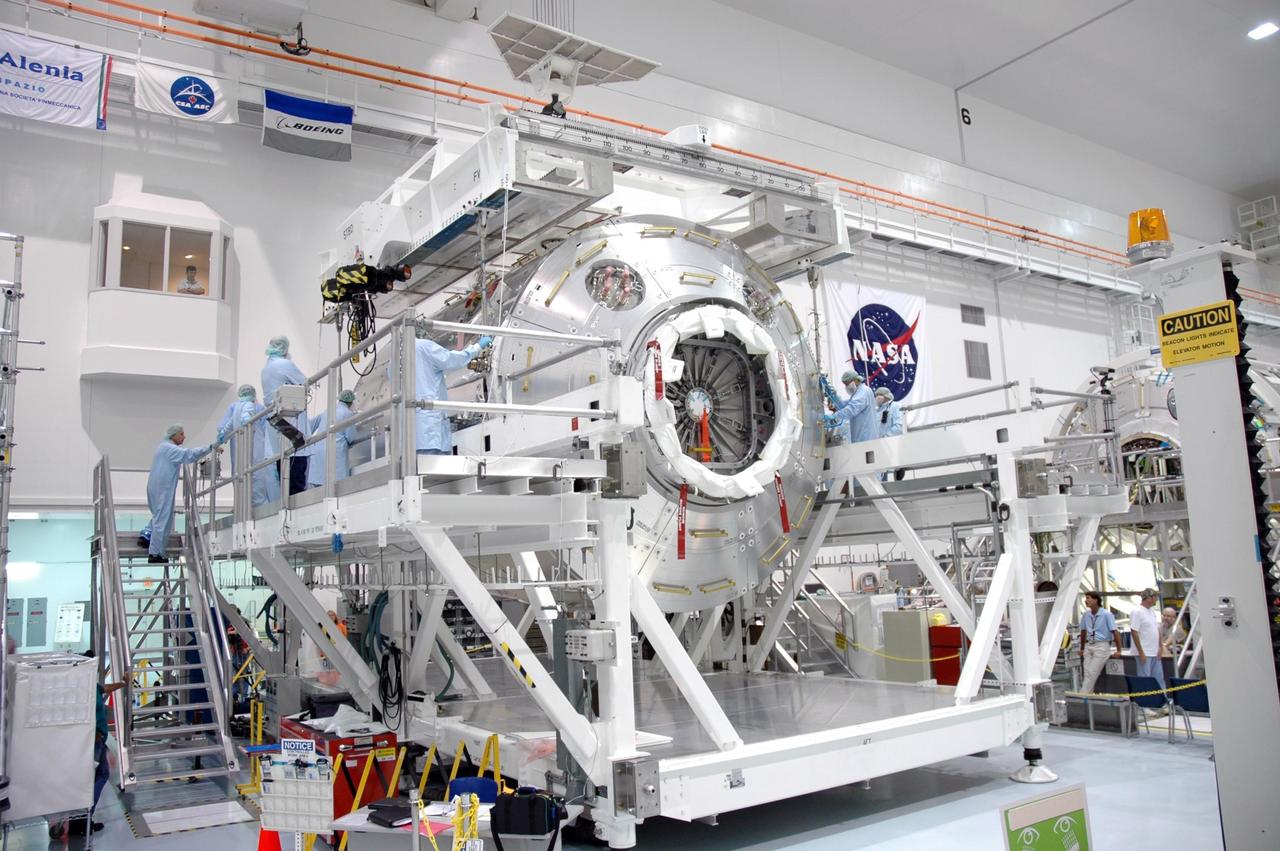
KENNEDY SPACE CENTER, FLA. - Inside the Space Station Processing Facility at NASA's Kennedy Space Center, workers release the cables around the Columbus module from the overhead crane. Columbus is the European Space Agency's research laboratory for the International Space Station. The module will be prepared for delivery to the space station on a future space shuttle mission. Columbus will expand the research facilities of the station and provide researchers with the ability to conduct numerous experiments in the area of life, physical and materials sciences. Photo credit: NASA/Jim Grossmann
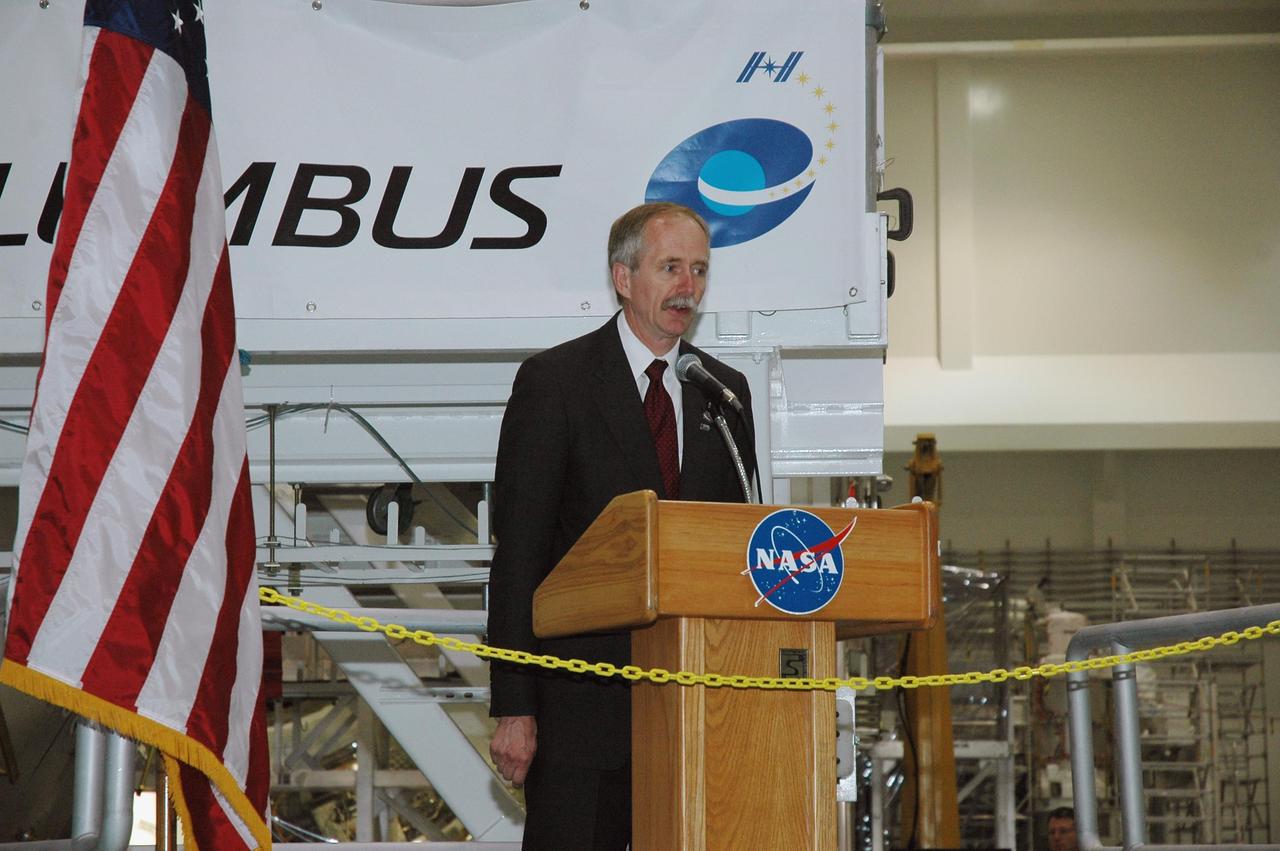
KENNEDY SPACE CENTER, FLA. - William Gerstenmaier, NASA associate administrator for Space Operations, welcomes the delivery of the European Space Agency's Columbus module at a ceremony in the Space Station Processing Facility. Columbus is the European Space Agency's research laboratory for the International Space Station. The module will be prepared in the SSPF for delivery to the space station on a future space shuttle mission. Columbus will expand the research facilities of the station and provide researchers with the ability to conduct numerous experiments in the life, physical and materials sciences. Photo credit: NASA/Amanda Diller
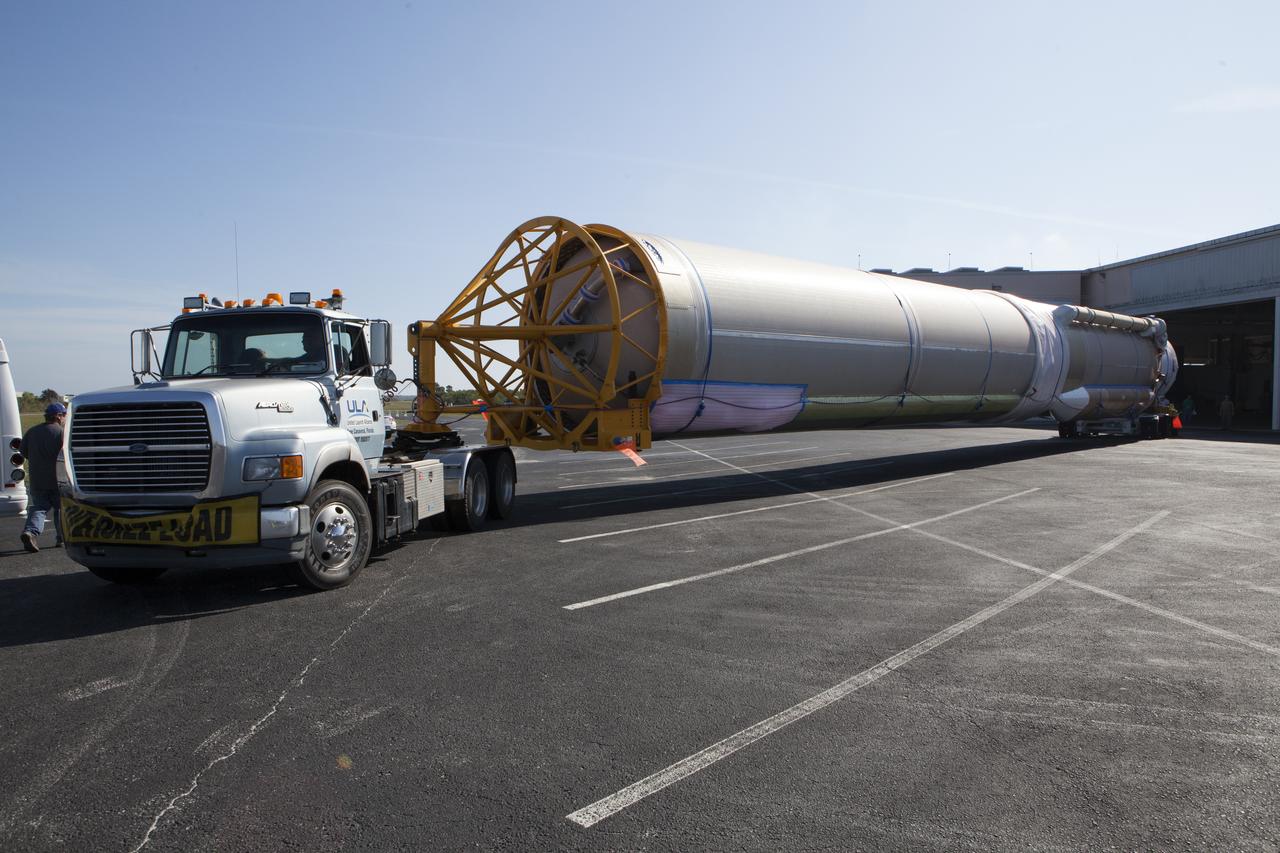
A United Launch Alliance (ULA) Atlas V booster arrives at Cape Canaveral Air Force Station's Atlas Spaceflight Operations Center (ASOC). The Atlas V will undergo final testing in that facility. When processing in the ASOC is complete, the Atlas booster will be moved to the Vertical Integration Facility for stacking at Space Launch Complex 41. Scheduled to launch March 19, 2017, the Atlas will launch a Cygnus spacecraft on the Orbital ATK CRS-7 mission to deliver thousands of pounds of supplies, equipment and scientific research materials to the International Space Station.
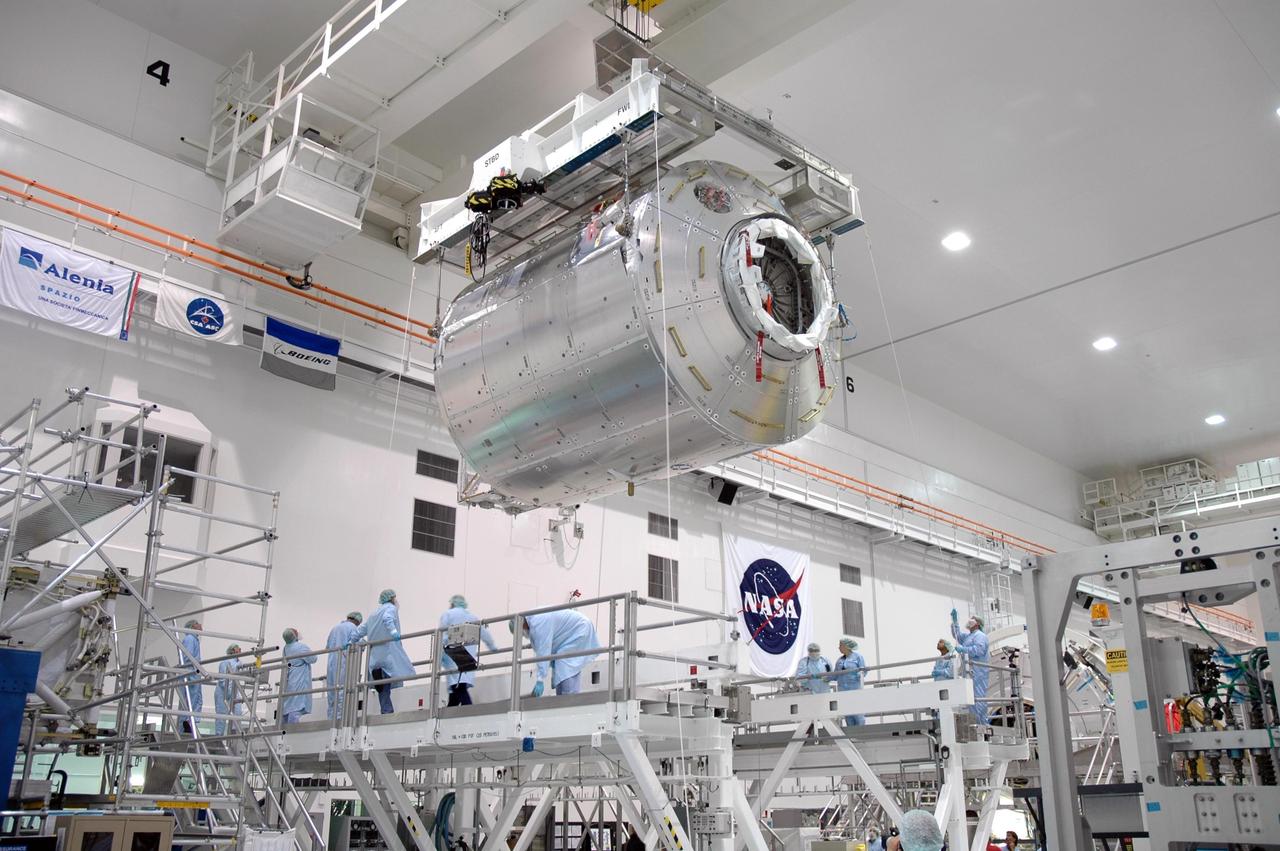
KENNEDY SPACE CENTER, FLA. - Inside the Space Station Processing Facility at NASA's Kennedy Space Center, an overhead crane lowers the Columbus module toward a work stand. Columbus is the European Space Agency's research laboratory for the International Space Station. The module will be prepared for delivery to the space station on a future space shuttle mission. Columbus will expand the research facilities of the station and provide researchers with the ability to conduct numerous experiments in the area of life, physical and materials sciences. Photo credit: NASA/Jim Grossmann
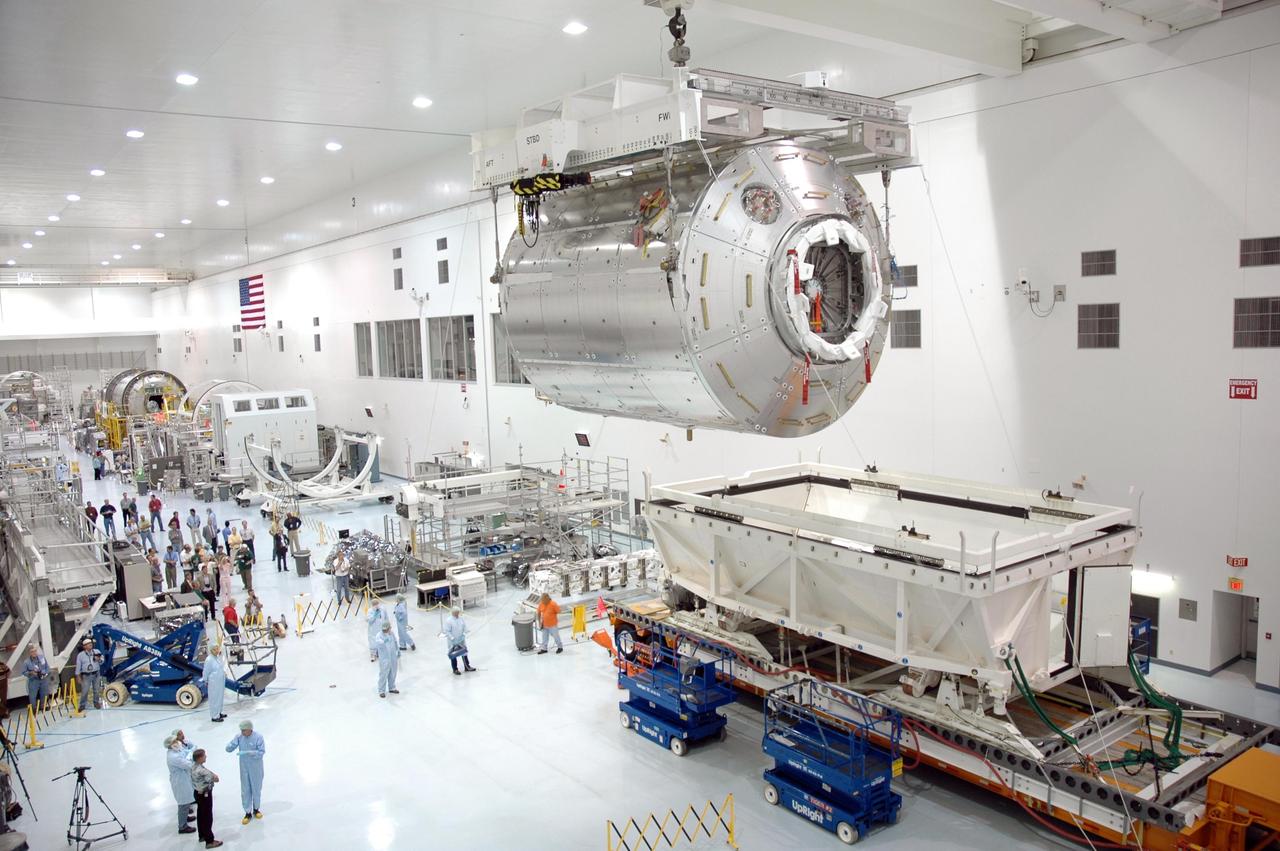
KENNEDY SPACE CENTER, FLA. - Inside the Space Station Processing Facility at NASA's Kennedy Space Center, an overhead crane carries the Columbus module toward a work stand. Columbus is the European Space Agency's research laboratory for the International Space Station. Once on the work stand , it will be prepared for delivery to the space station on a future space shuttle mission. Columbus will expand the research facilities of the station and provide researchers with the ability to conduct numerous experiments in the area of life, physical and materials sciences. Photo credit: NASA/Jim Grossmann
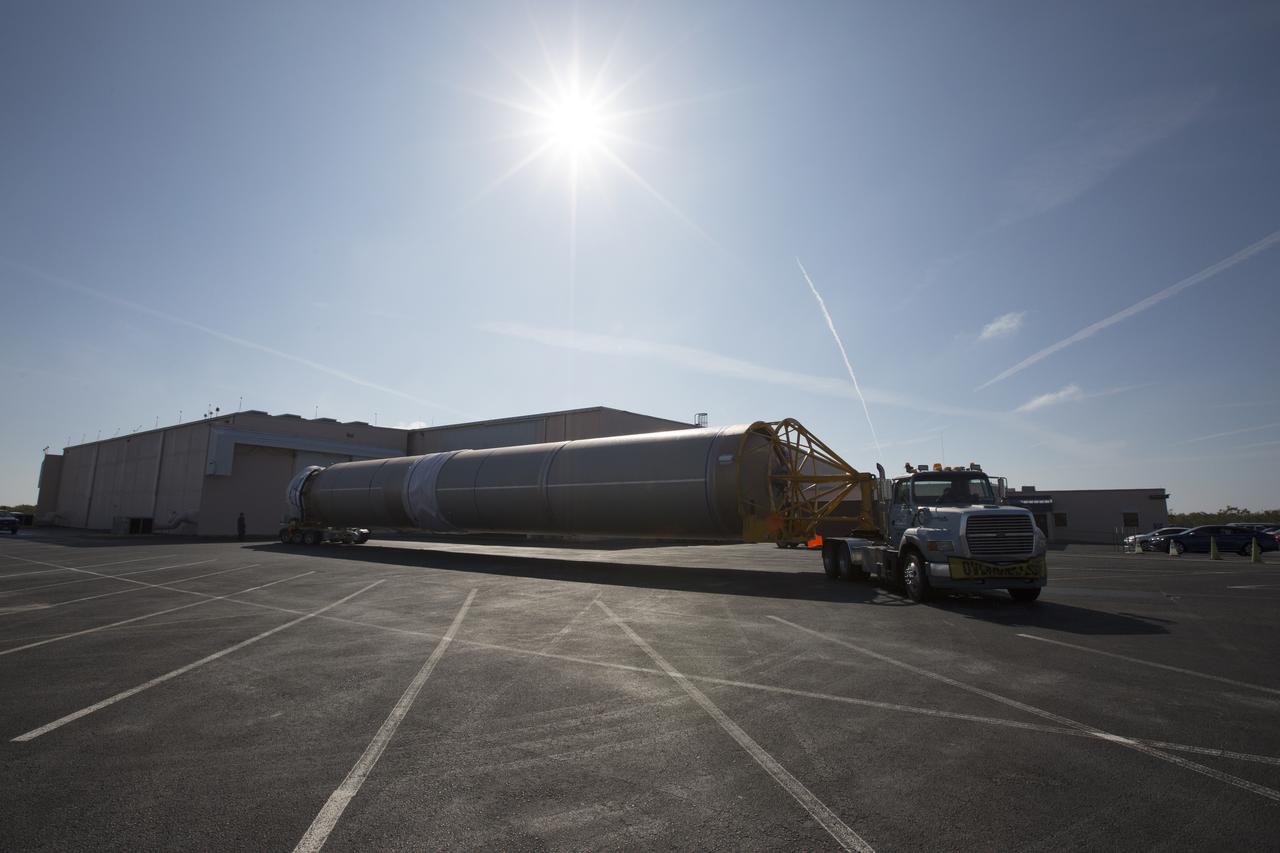
A United Launch Alliance (ULA) Atlas V booster arrives at Cape Canaveral Air Force Station's Atlas Spaceflight Operations Center (ASOC). The Atlas V will undergo final testing in that facility. When processing in the ASOC is complete, the Atlas booster will be moved to the Vertical Integration Facility for stacking at Space Launch Complex 41. Scheduled to launch March 19, 2017, the Atlas will launch a Cygnus spacecraft on the Orbital ATK CRS-7 mission to deliver thousands of pounds of supplies, equipment and scientific research materials to the International Space Station.

KENNEDY SPACE CENTER, FLA. - Jim Kennedy, director of NASA's Kennedy Space Center, addresses the audience attending a ceremony in the Space Station Processing Facility to welcome the European Space Agency's Columbus module. Columbus is the European Space Agency's research laboratory for the International Space Station. The module will be prepared in the SSPF for delivery to the space station on a future space shuttle mission. Columbus will expand the research facilities of the station and provide researchers with the ability to conduct numerous experiments in the life, physical and materials sciences. Photo credit: NASA/Amanda Diller
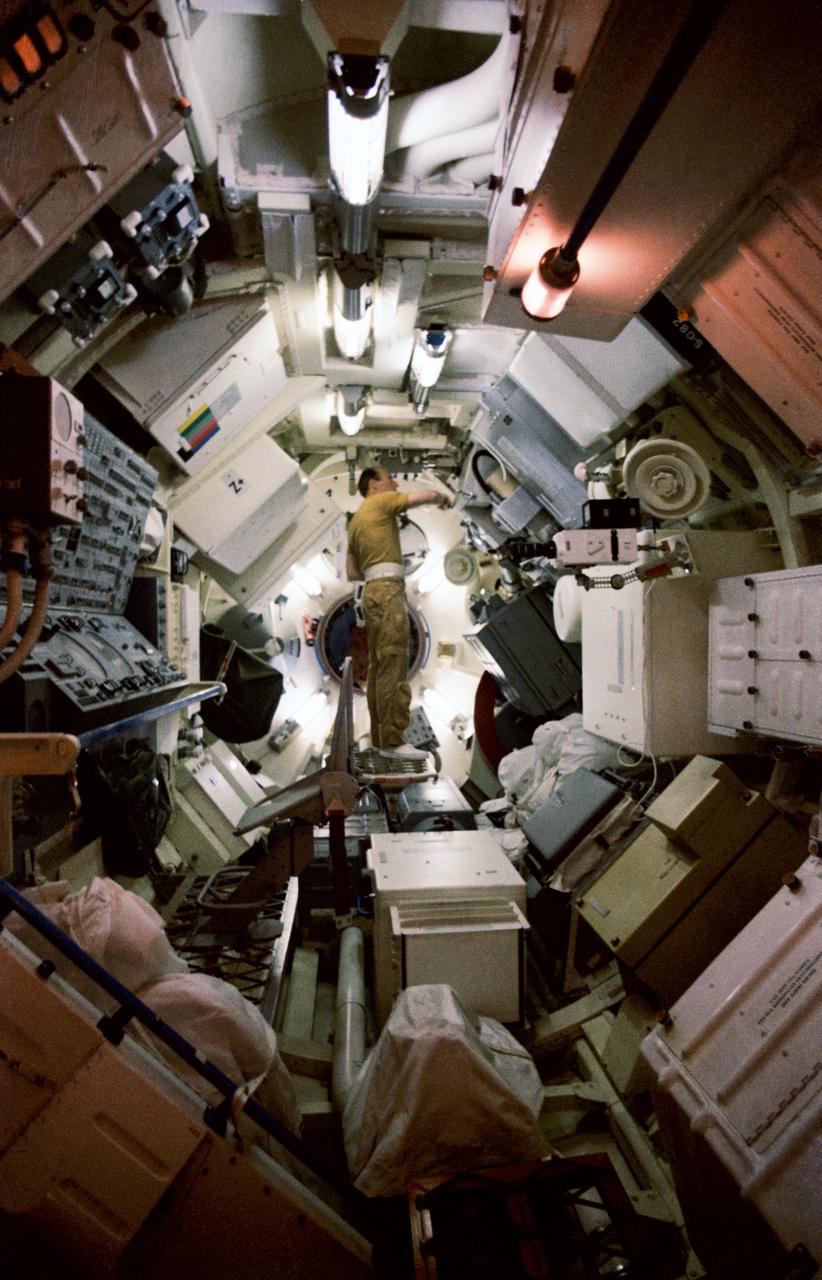
S73-20774 (1 March 1973) --- Astronaut Charles Conrad Jr., commander of the first manned Skylab mission, goes through a checklist of experiment activity during Skylab training at Johnson Space Center. Conrad is standing in the Multiple Docking Adapter (MDA) in the Mission Simulation and Training Facility at JSC. He is working at the "materials processing in space" facility in the MDA. Photo credit: NASA
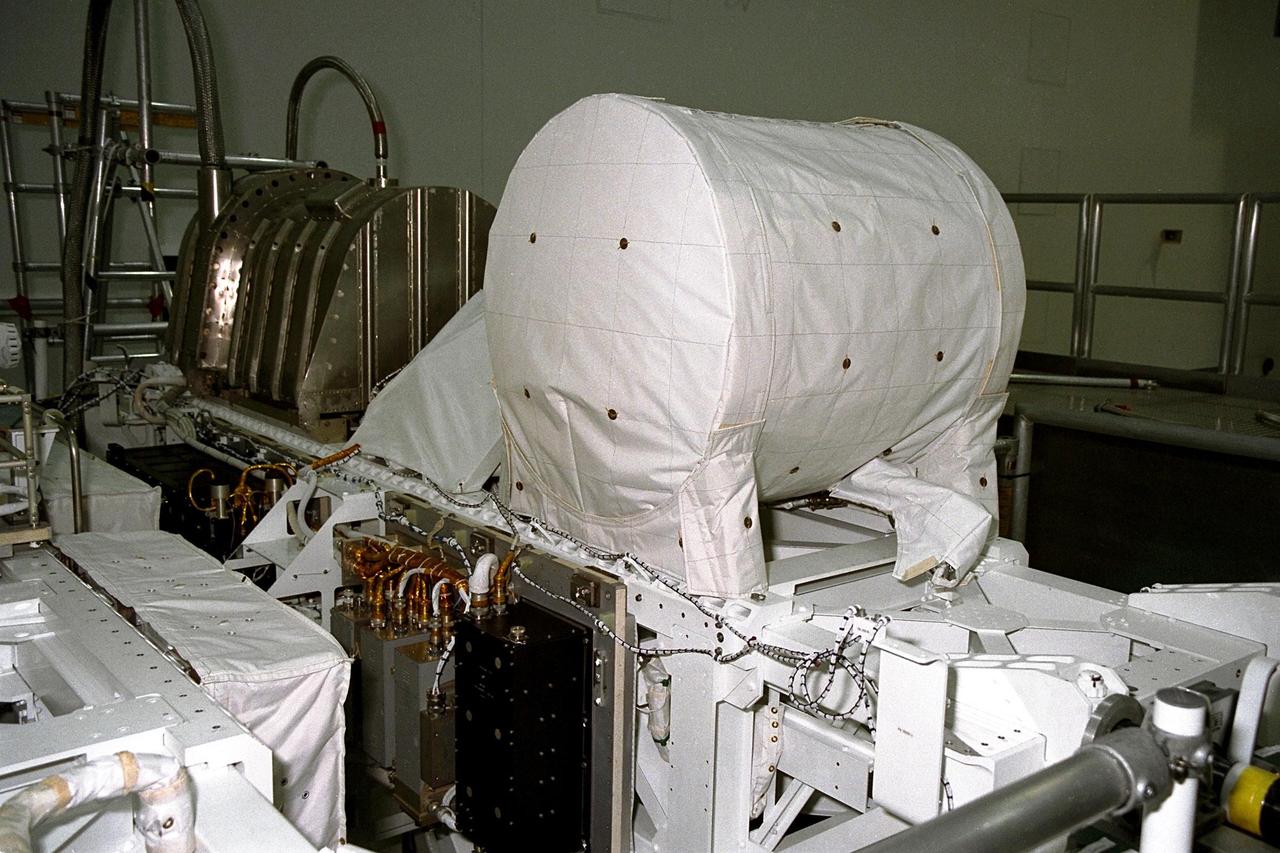
United States Microgravity Payload-4 (USMP-4) experiments are prepared to be flown on Space Shuttle mission STS-87 in the Space Station Processing Facility at Kennedy Space Center (KSC). Seen in the foreground at right is the Isothermal Dendritic Growth Experiment (IDGE), which will be used to study the dendritic solidification of molten materials in the microgravity environment. The metallic breadbox-like structure behind the IDGE is the Confined Helium Experiment (CHeX) that will study one of the basic influences on the behavior and properties of materials by using liquid helium confined between solid surface, and microgravity. These experiments are scheduled for launch aboard STS-87 on Nov. 19 from KSC
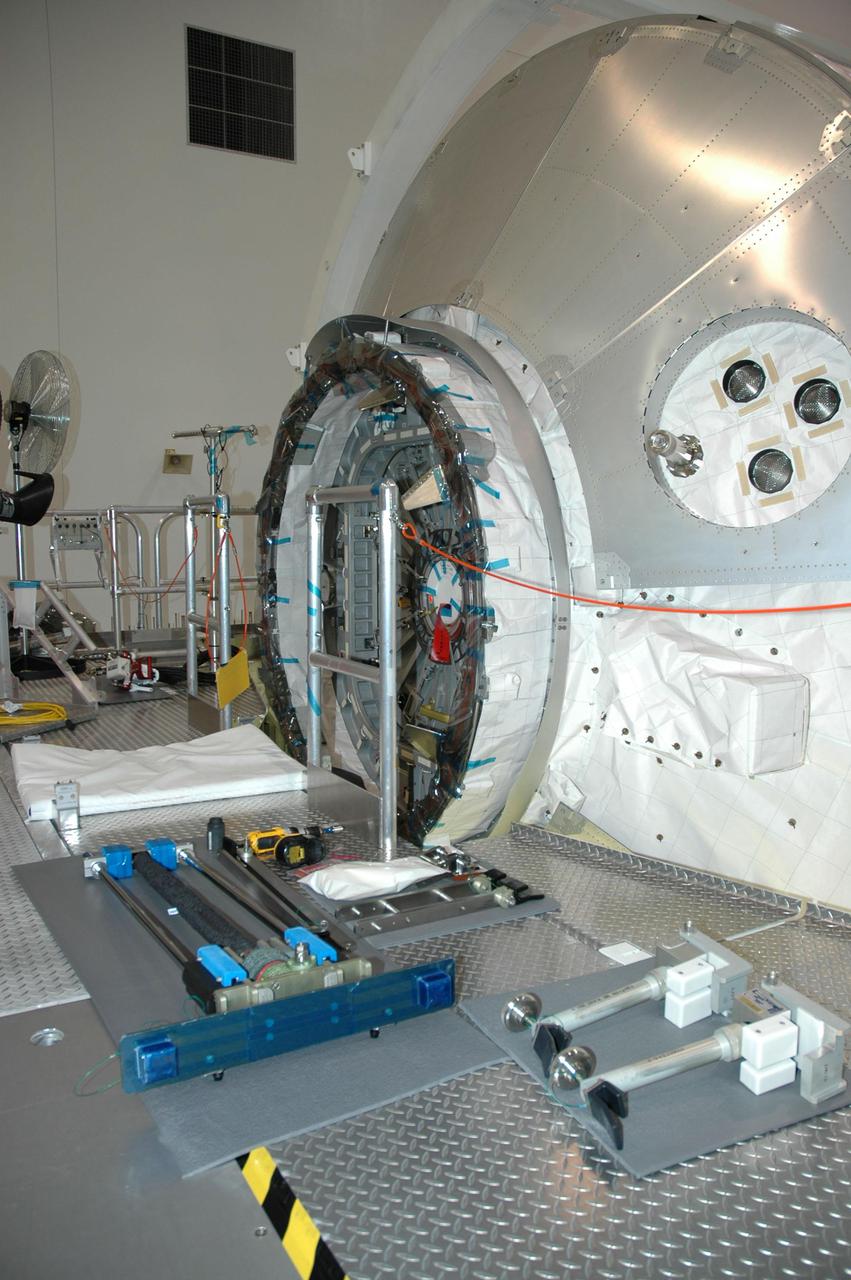
KENNEDY SPACE CENTER, FLA. — In the Space Station Processing Facility at NASA’s Kennedy Space Center, the Multi-Purpose Logistics Module (MPLM) Raffaello sits on a work stand prior to opening of the hatch. Raffaello flew on mission STS-114 to the International Space Station, returning with about 7,000 pounds of Station material. The module will be aired out before workers enter to remove the contents. Three MPLMs were built by the Italian space agency Alenia Aerospazio. The other two are Leonardo and Donatello. The MPLMs are carried in the payload bay of a Shuttle orbiter, and carry materials, supplies and even experiments to the Space Station.
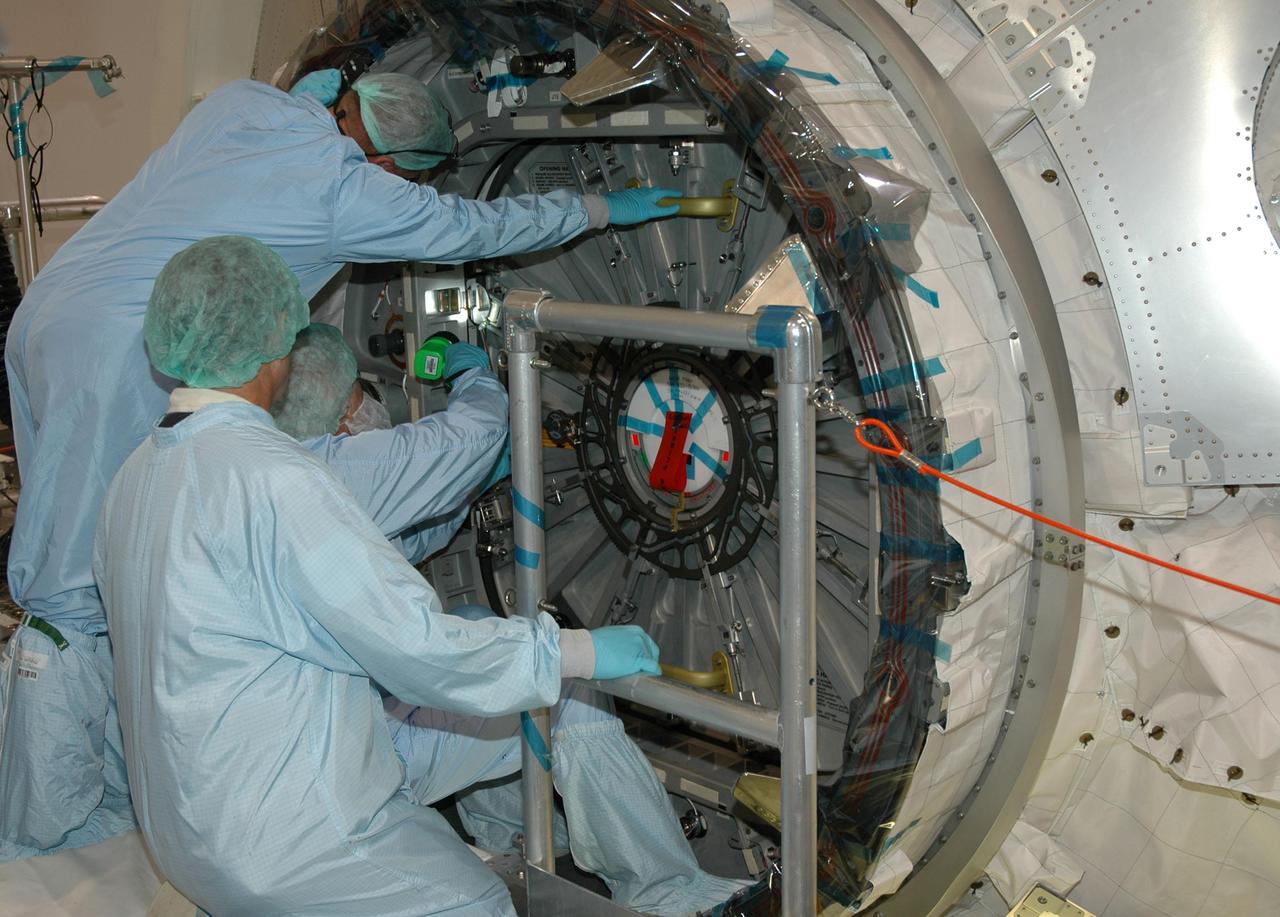
KENNEDY SPACE CENTER, FLA. — In the Space Station Processing Facility at NASA’s Kennedy Space Center, workers begin opening the hatch on the Multi-Purpose Logistics Module (MPLM) Raffaello. The module flew on mission STS-114 to the International Space Station, returning with about 7,000 pounds of Station material. Raffaello will be aired out before workers enter to remove the contents. Three MPLMs were built by the Italian space agency Alenia Aerospazio. The other two are Leonardo and Donatello. The MPLMs are carried in the payload bay of a Shuttle orbiter, and carry materials, supplies and even experiments to the Space Station.

KENNEDY SPACE CENTER, FLA. — In the Space Station Processing Facility at NASA’s Kennedy Space Center, the hatch on the Multi-Purpose Logistics Module (MPLM) Raffaello has been opened. Raffaello flew on mission STS-114 to the International Space Station, returning with about 7,000 pounds of Station material. The module will be aired out before workers enter to remove the contents. Three MPLMs were built by the Italian space agency Alenia Aerospazio. The other two are Leonardo and Donatello. The MPLMs are carried in the payload bay of a Shuttle orbiter, and carry materials, supplies and even experiments to the Space Station.
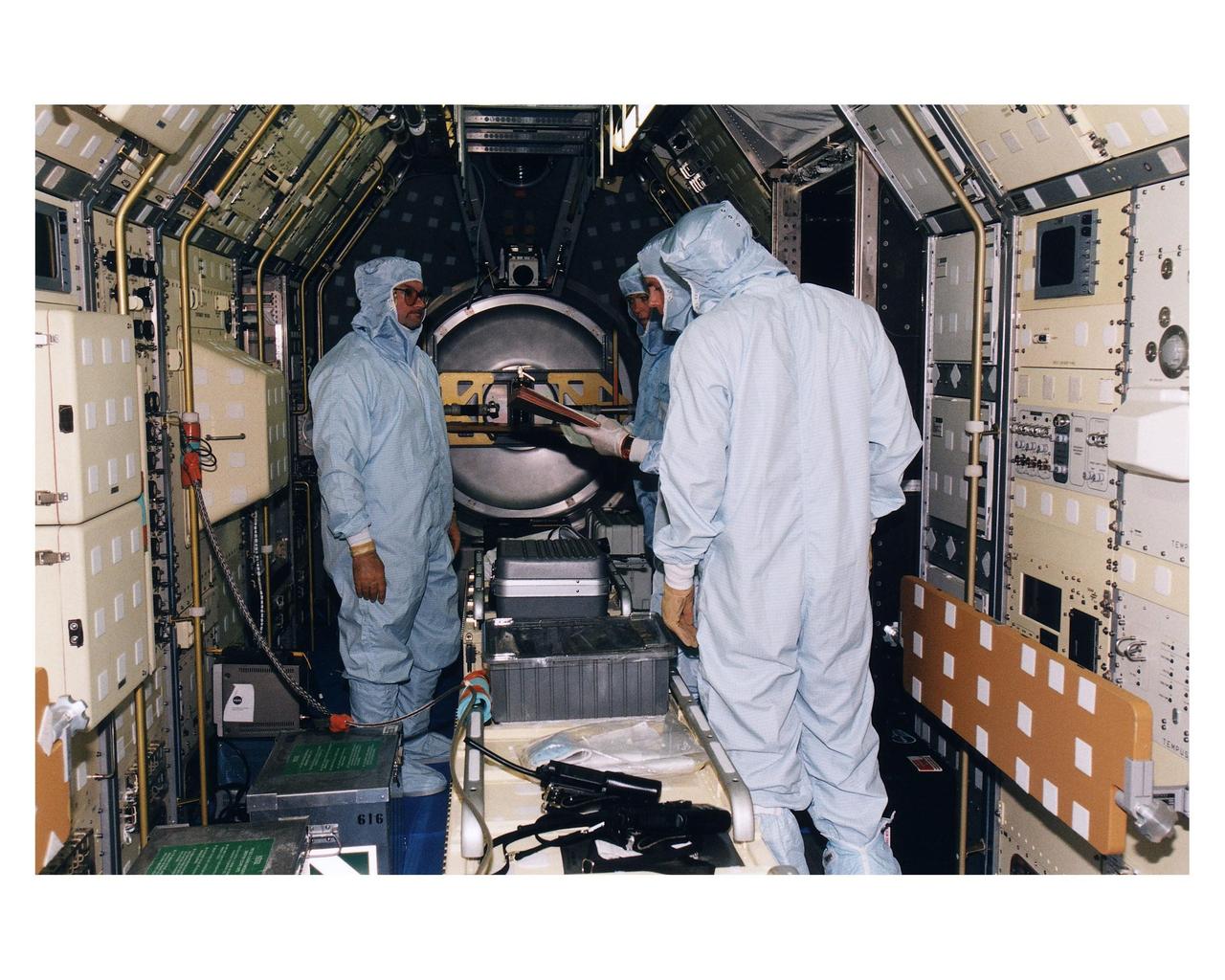
KENNEDY SPACE CENTER, FLA. -- KSC payloads processing employees work to reservice the Microgravity Science Laboratory-1 (MSL-1) Spacelab module in the Space Shuttle Orbiter Columbia’s payload bay for the STS-94 mission in Orbiter Processing Facility 1. That mission is now scheduled to lift off in early July. This was the first time that this type of payload was reserviced without removing it from the payload bay. This new procedure pioneers processing efforts for quick relaunch turnaround times for future payloads. The Spacelab module was scheduled to fly again with the full complement of STS-83 experiments after that mission was cut short due to a faulty fuel cell. During the scheduled 16-day STS-94 mission, the experiments will be used to test some of the hardware, facilities and procedures that are planned for use on the International Space Station while the flight crew conducts combustion, protein crystal growth and materials processing experiments