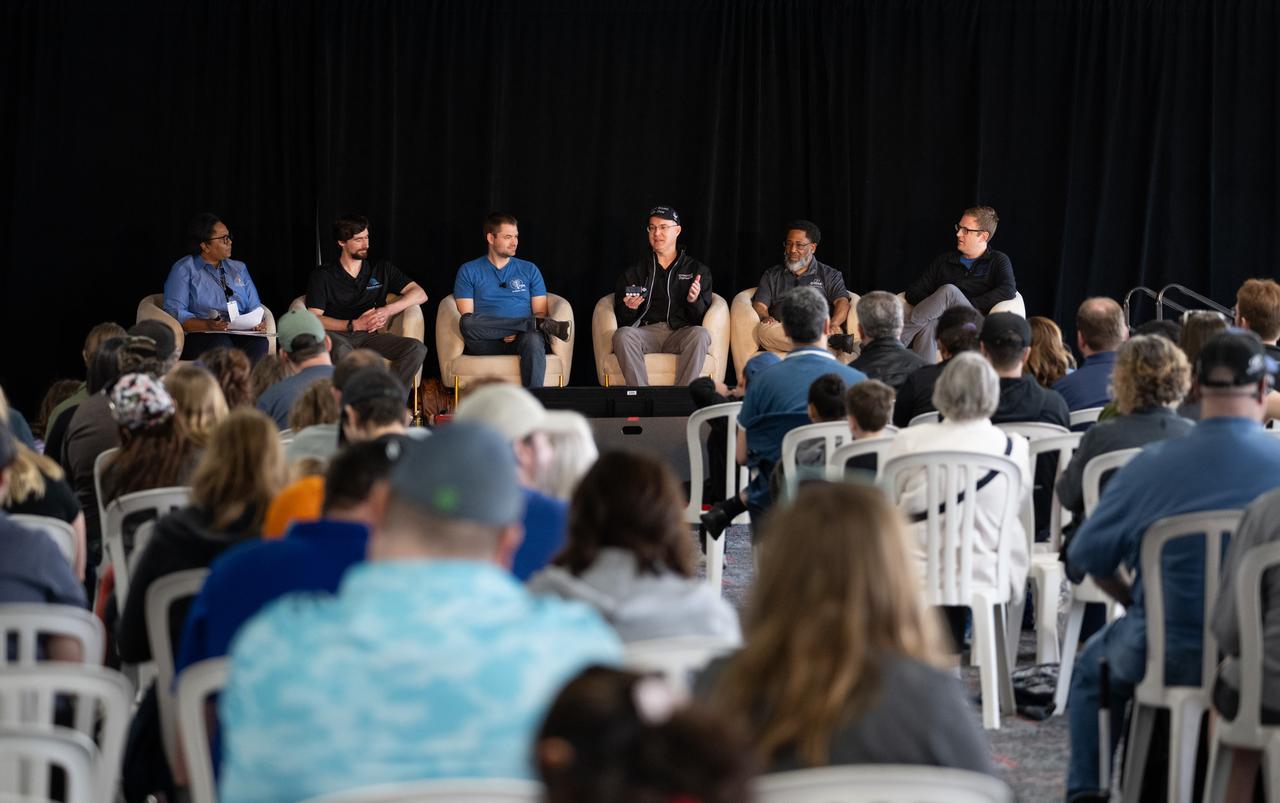
Attendees at the Indianapolis Motor Speedway listen to a panel discussion titled “Feeling is believing: A Tactile Launch Experience” about bring the eclipse experience to the visually impared with Shahra Lambert, senior advisor for engagement and equity in NASA's Office of the Administrator, Brandon Pearson, education director at NearSpace Education, John Pugsley, engineer at NearSpace Launch, Matt Voss, chief operating officer at NearSpace Launch, Dave Schleppenbach, chief executive officer at Tactile Engineering, Alex Moon, software director at Tactile Engineering, and Greg Williams, accessibility and STEM advisor at Tactile Engineering, ahead of the total solar eclipse, Monday, April 8, 2024, in Indianapolis, Ind. A total solar eclipse swept across a narrow portion of the North American continent from Mexico’s Pacific coast to the Atlantic coast of Newfoundland, Canada. A partial solar eclipse was visible across the entire North American continent along with parts of Central America and Europe. Photo Credit: (NASA/Joel Kowsky)
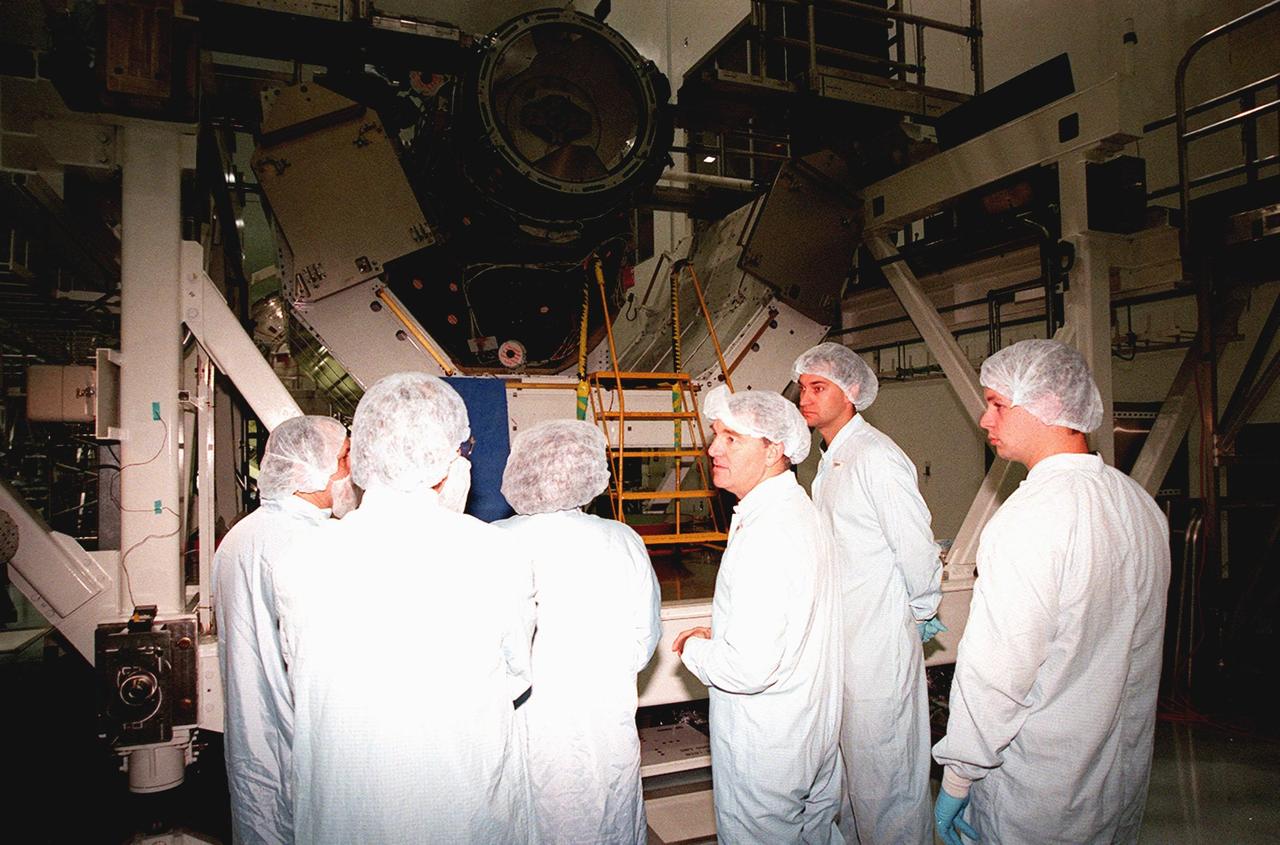
KENNEDY SPACE CENTER, FLA. -- In the Space Station Processing Facility, STS-102's Expedition II discuss the Pressurized Mating Adapter (PMA-3) (top of photo) with workers from Johnson Space Center. From left are Yuriy Vladimirovich Usachev, Dave Moore (JSC), Susan J. Helms, James S. Voss, Arne Aamodt and Matt Myers (both of JSC). The PMA-3 is a component of the International Space Station (ISS). Voss, Helms and Usachev will be staying on the ISS, replacing the Expedition I crew, Bill Shepherd, Sergei Krikalev and Yuri Gidzenko. Along with the crew, Mission STS-102 also will be carrying the Leonardo Multi-Purpose Logistics Module (MPLM) to the ISS. The Leonardo will be filled with equipment and supplies to outfit the U.S. laboratory module, which will have been carried to the ISS on a preceding Shuttle flight. In order to function as an attached station module as well as a cargo transport, logistics modules (there are three) also include components that provide some life support, fire detection and suppression, electrical distribution and computer functions. Eventually, the modules also will carry refrigerator freezers for transporting experiment samples and food to and from the station. STS-102 is scheduled to launch no earlier than Oct. 19, 2000, from Launch Pad 39A, Kennedy Space Center
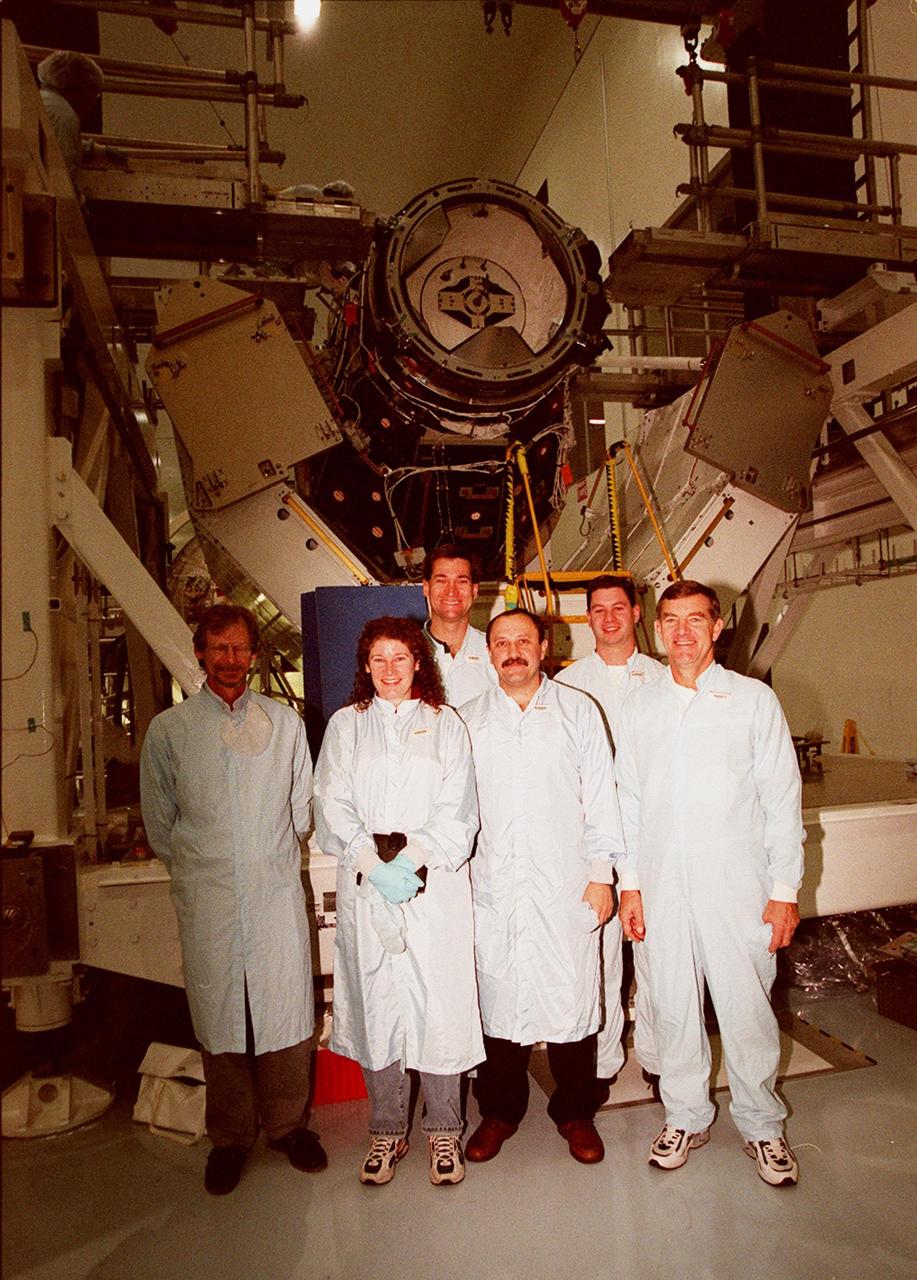
KENNEDY SPACE CENTER, FLA. -- In the Space Station Processing Facility, members of the STS-102 crew pose with workers from Johnson Space Center in front of the Pressurized Mating Adapter (PMA-3), a component of the International Space Station (ISS). From left are Dave Moore (JSC), Susan J. Helms, Arne Aamodt (JSC), Yuriy Vladimirovich Usachev, Matt Myers (JSC) and James S. Voss. Voss, Helms and Usachev, known as the Expedition II crew, will be staying on the ISS, replacing the Expedition I crew, Bill Shepherd, Sergei Krikalev and Yuri Gidzenko. Along with the crew, Mission STS-102 also will be carrying the Leonardo Multi-Purpose Logistics Module (MPLM) to the ISS. The Leonardo will be filled with equipment and supplies to outfit the U.S. laboratory module, which will have been carried to the ISS on a preceding Shuttle flight. In order to function as an attached station module as well as a cargo transport, logistics modules (there are three) also include components that provide some life support, fire detection and suppression, electrical distribution and computer functions. Eventually, the modules also will carry refrigerator freezers for transporting experiment samples and food to and from the station. STS-102 is scheduled to launch no earlier than Oct. 19, 2000, from Launch Pad 39A, Kennedy Space Center