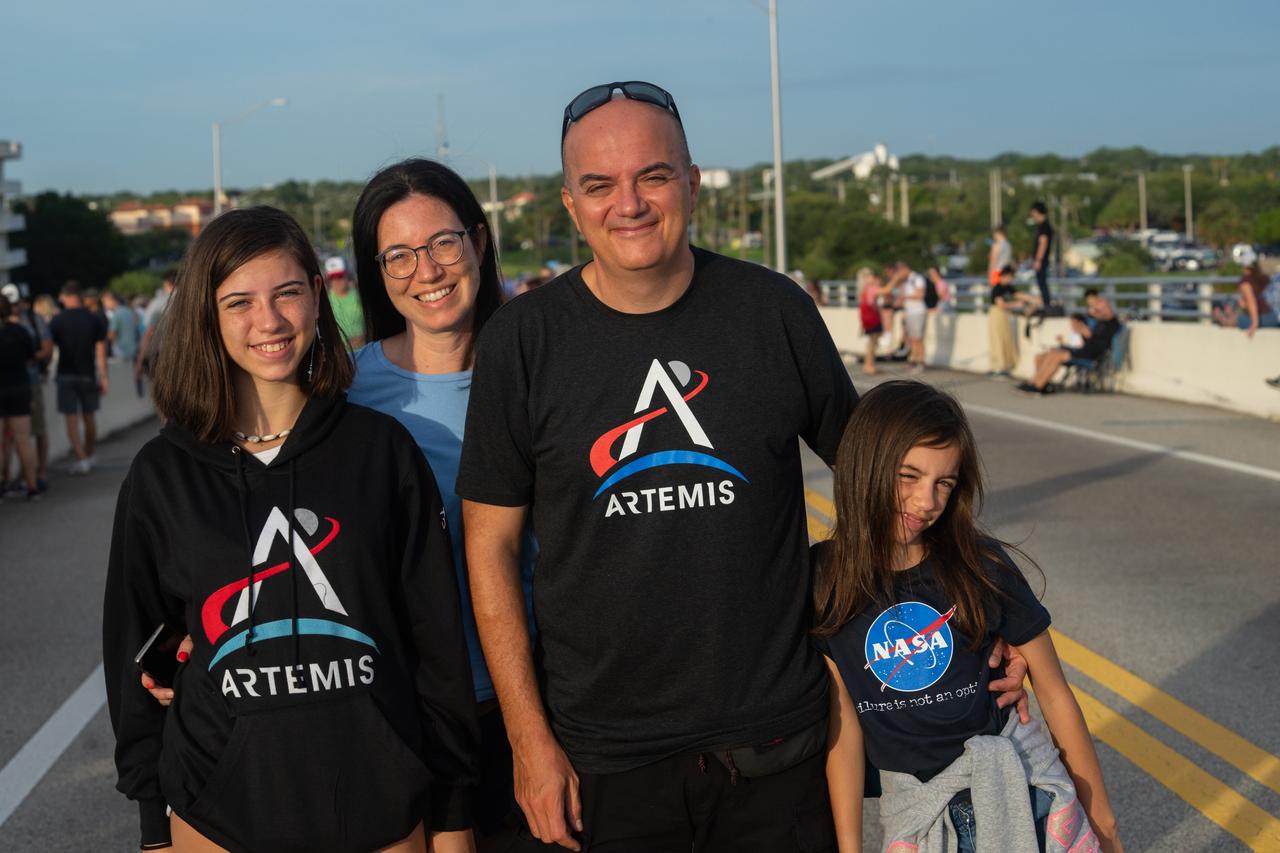
A family wearing NASA and Artemis shirts are on the Max Brewer Bridge in Titusville, Florida, to witness the launch of NASA’s Artemis I mission on Aug. 29, 2022. The launch was waved off for the day. The first in a series of increasingly complex missions, Artemis I will provide a foundation for human deep space exploration and demonstrate our commitment and capability to extend human presence to the Moon and beyond. The primary goal of Artemis I is to thoroughly test the integrated systems before crewed missions by operating the spacecraft in a deep space environment, testing Orion’s heat shield, and recovering the crew module after reentry, descent, and splashdown.
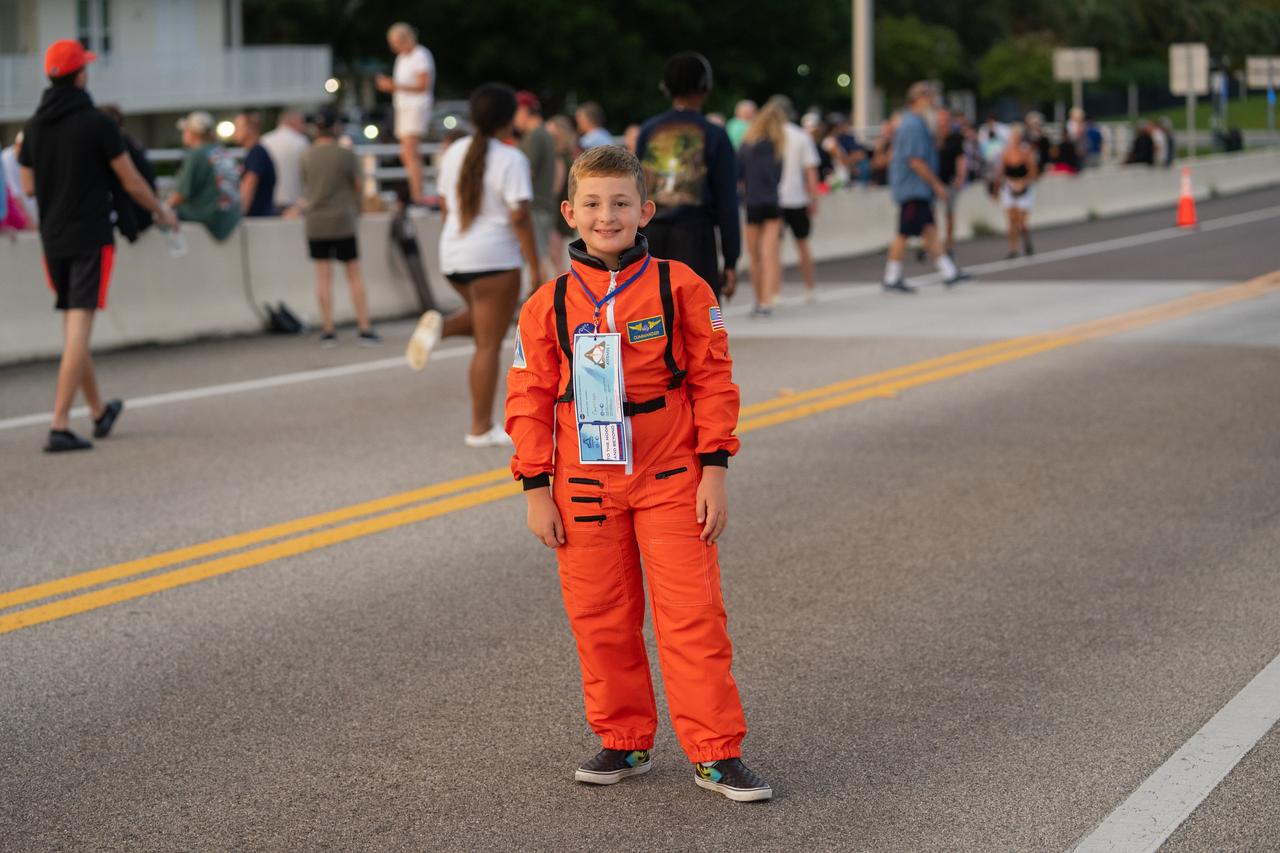
A young child dressed in an astronaut spacesuit is one of the spectators gathering on the Max Brewer Bridge in Titusville, Florida, to witness NASA’s Artemis I launch on Aug. 29, 2022. The launch was waved off for the day at the agency’s Kennedy Space Center. The first in a series of increasingly complex missions, Artemis I will provide a foundation for human deep space exploration and demonstrate our commitment and capability to extend human presence to the Moon and beyond. The primary goal of Artemis I is to thoroughly test the integrated systems before crewed missions by operating the spacecraft in a deep space environment, testing Orion’s heat shield, and recovering the crew module after reentry, descent, and splashdown.

A young child waving an Artemis flag poses with members of the Titusville Police Dept. on the Max Brewer Bridge on Aug. 29, 2022, during Artemis I countdown festivities. The launch was waved off for the day at the agency’s Kennedy Space Center. The first in a series of increasingly complex missions, Artemis I will provide a foundation for human deep space exploration and demonstrate our commitment and capability to extend human presence to the Moon and beyond. The primary goal of Artemis I is to thoroughly test the integrated systems before crewed missions by operating the spacecraft in a deep space environment, testing Orion’s heat shield, and recovering the crew module after reentry, descent, and splashdown.
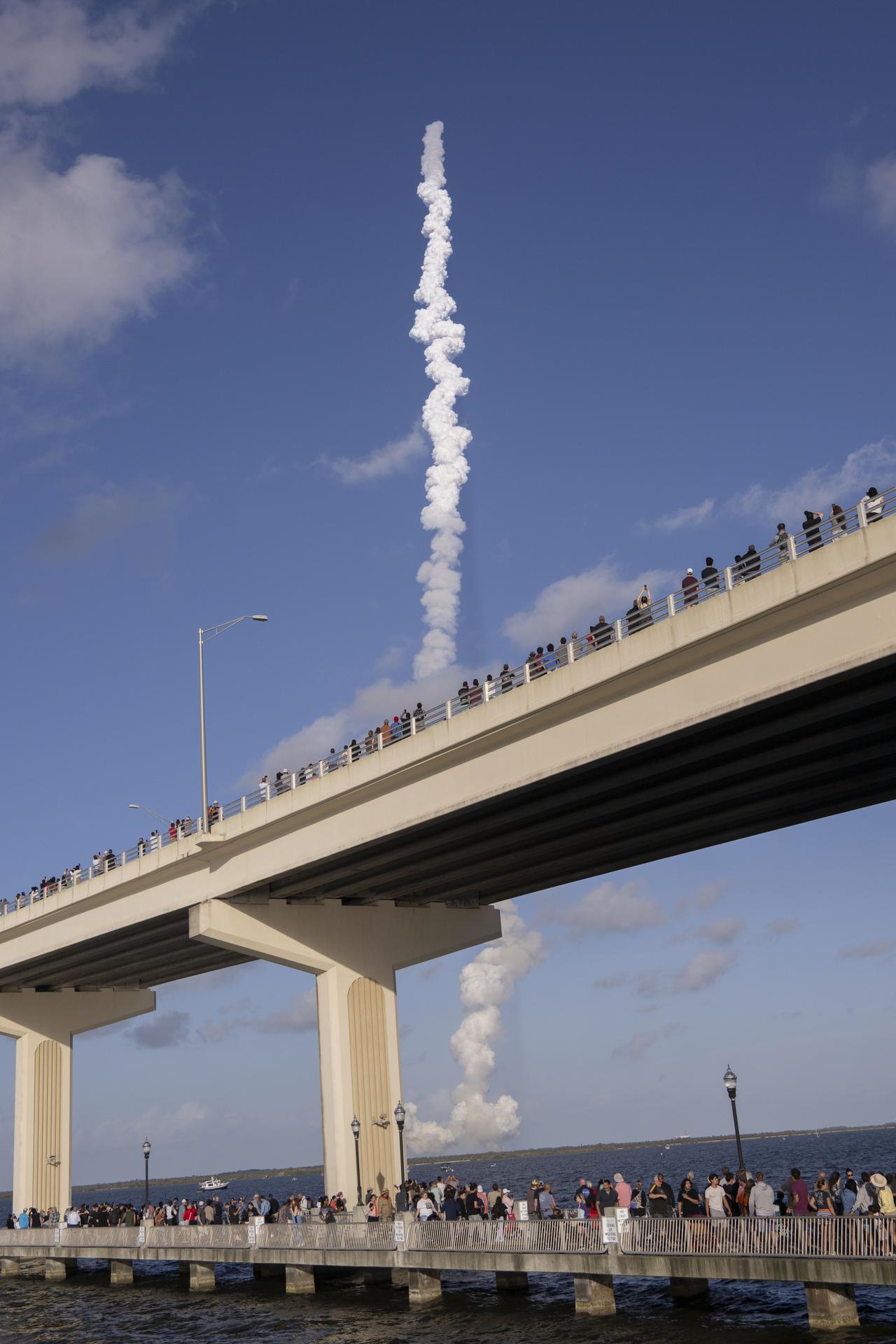
Crowds gather at the Max A. Brewer Bridge in Titusville to watch the launch of NASA’s SLS (Space Launch System) rocket with the Orion spacecraft carrying Artemis II Commander Reid Wiseman, Pilot Victor Glover, and Mission Specialist Christina Koch from NASA, along with Mission Specialist Jeremy Hansen from the CSA (Canadian Space Agency), on Wednesday, April 1, 2026, from Launch Complex 39B at NASA Kennedy. The Artemis II test flight will take the crew members on a 10-day journey around the Moon and back.
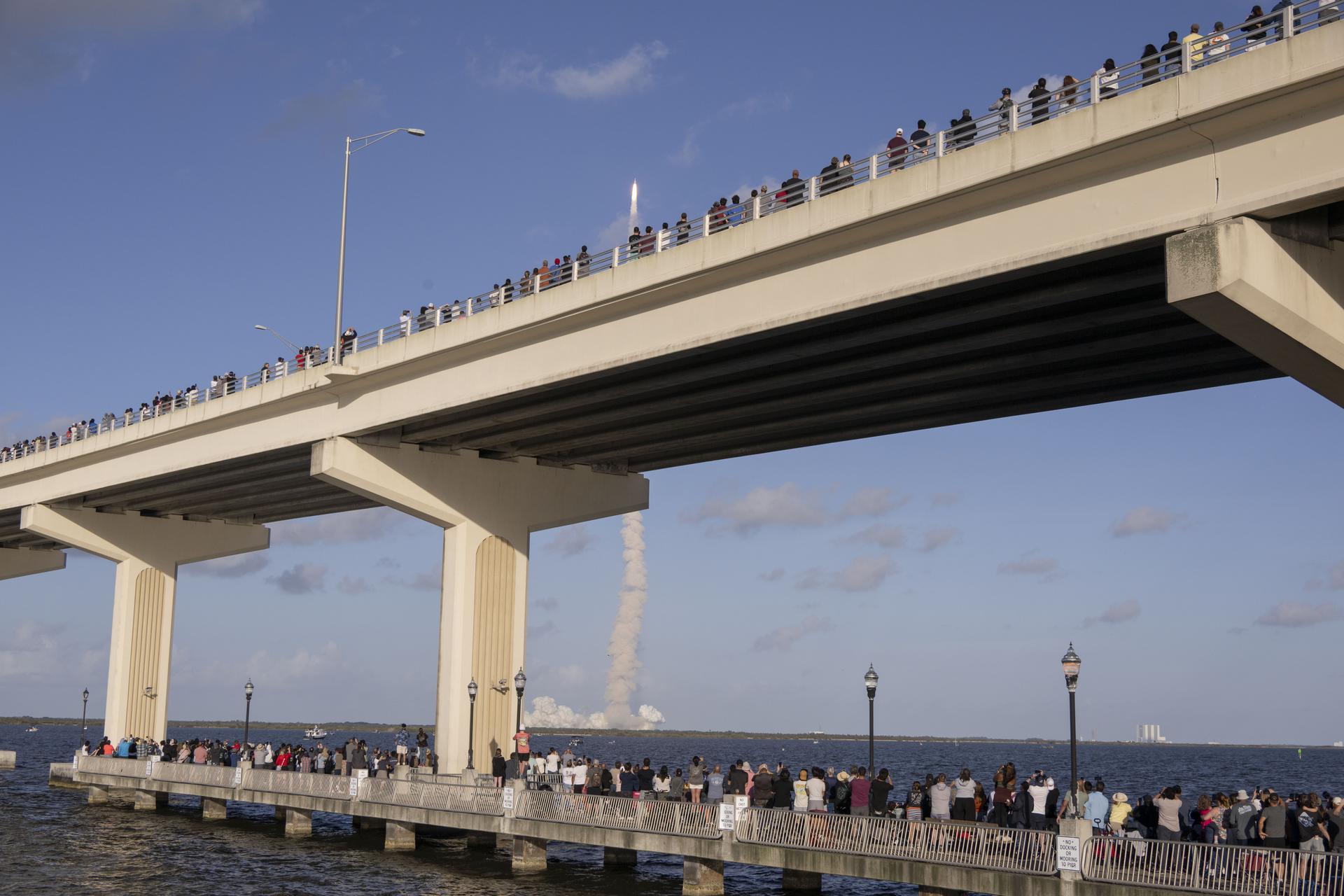
Crowds gather at the Max A. Brewer Bridge in Titusville to watch the launch of NASA’s SLS (Space Launch System) rocket with the Orion spacecraft carrying Artemis II Commander Reid Wiseman, Pilot Victor Glover, and Mission Specialist Christina Koch from NASA, along with Mission Specialist Jeremy Hansen from the CSA (Canadian Space Agency), on Wednesday, April 1, 2026, from Launch Complex 39B at NASA Kennedy. The Artemis II test flight will take the crew members on a 10-day journey around the Moon and back.
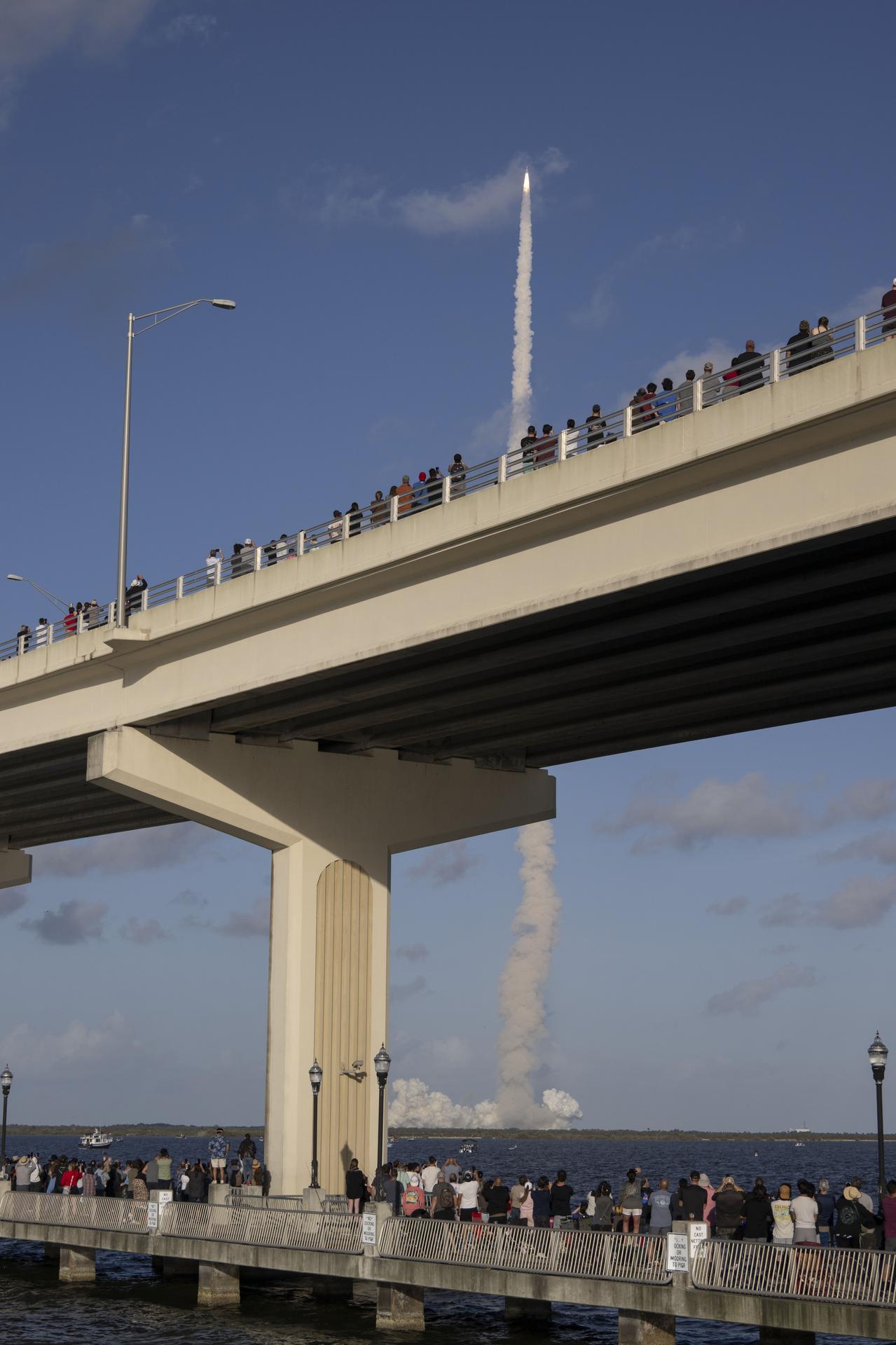
Crowds gather at the Max A. Brewer Bridge in Titusville to watch the launch of NASA’s SLS (Space Launch System) rocket with the Orion spacecraft carrying Artemis II Commander Reid Wiseman, Pilot Victor Glover, and Mission Specialist Christina Koch from NASA, along with Mission Specialist Jeremy Hansen from the CSA (Canadian Space Agency), on Wednesday, April 1, 2026, from Launch Complex 39B at NASA Kennedy. The Artemis II test flight will take the crew members on a 10-day journey around the Moon and back.
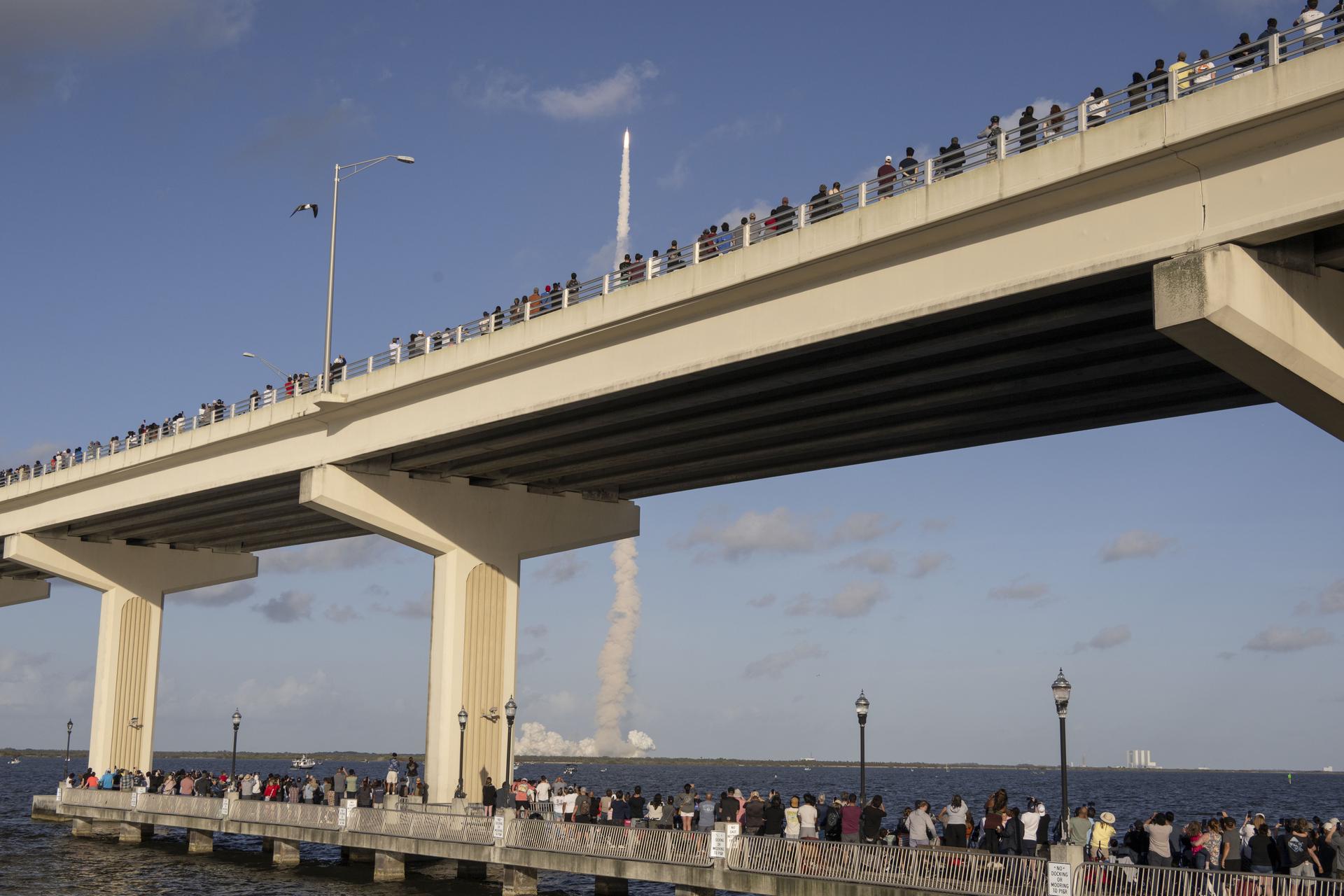
Crowds gather at the Max A. Brewer Bridge in Titusville to watch the launch of NASA’s SLS (Space Launch System) rocket with the Orion spacecraft carrying Artemis II Commander Reid Wiseman, Pilot Victor Glover, and Mission Specialist Christina Koch from NASA, along with Mission Specialist Jeremy Hansen from the CSA (Canadian Space Agency), on Wednesday, April 1, 2026, from Launch Complex 39B at NASA Kennedy. The Artemis II test flight will take the crew members on a 10-day journey around the Moon and back.
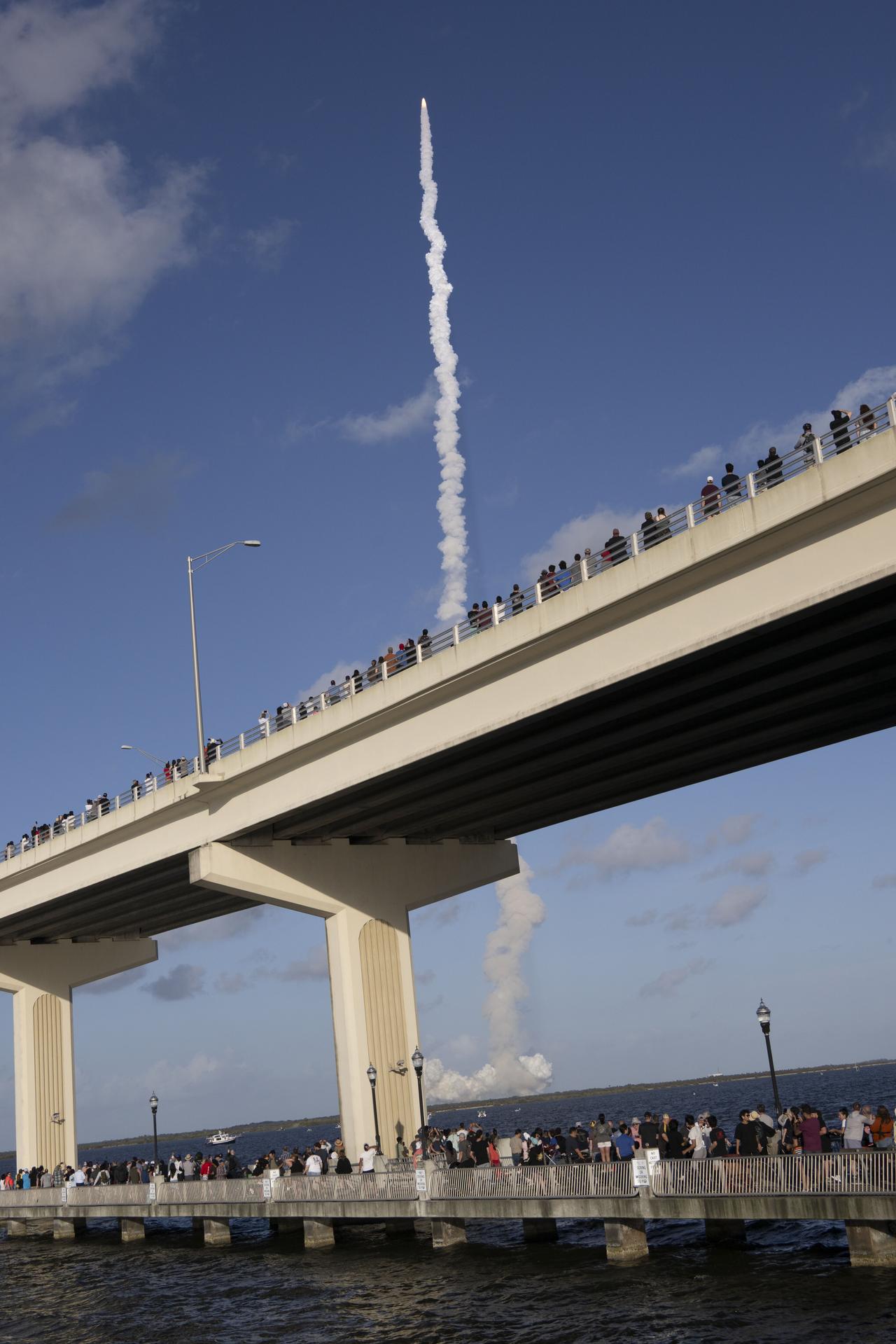
Crowds gather at the Max A. Brewer Bridge in Titusville to watch the launch of NASA’s SLS (Space Launch System) rocket with the Orion spacecraft carrying Artemis II Commander Reid Wiseman, Pilot Victor Glover, and Mission Specialist Christina Koch from NASA, along with Mission Specialist Jeremy Hansen from the CSA (Canadian Space Agency), on Wednesday, April 1, 2026, from Launch Complex 39B at NASA Kennedy. The Artemis II test flight will take the crew members on a 10-day journey around the Moon and back.
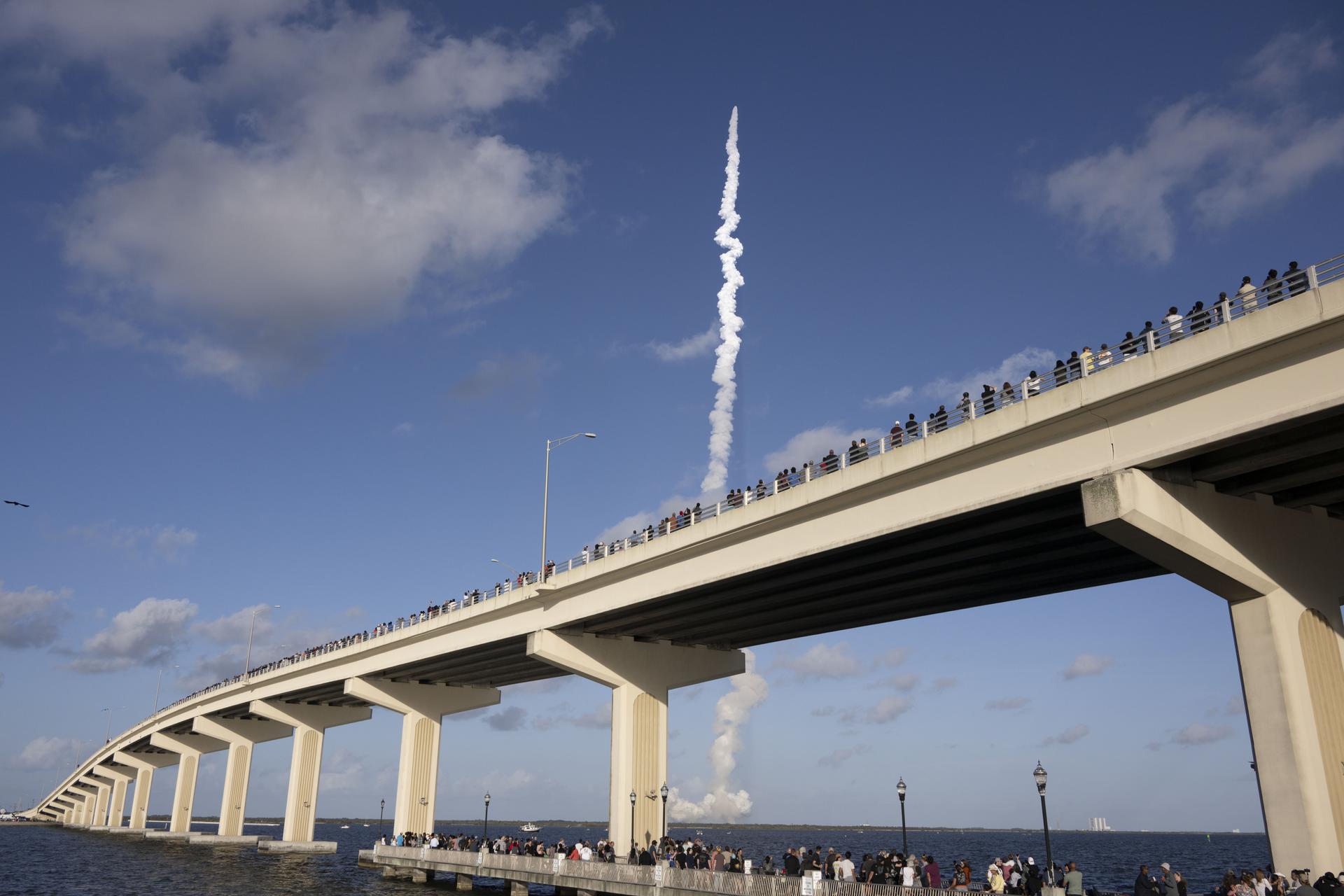
Crowds gather at the Max A. Brewer Bridge in Titusville to watch the launch of NASA’s SLS (Space Launch System) rocket with the Orion spacecraft carrying Artemis II Commander Reid Wiseman, Pilot Victor Glover, and Mission Specialist Christina Koch from NASA, along with Mission Specialist Jeremy Hansen from the CSA (Canadian Space Agency), on Wednesday, April 1, 2026, from Launch Complex 39B at NASA Kennedy. The Artemis II test flight will take the crew members on a 10-day journey around the Moon and back.
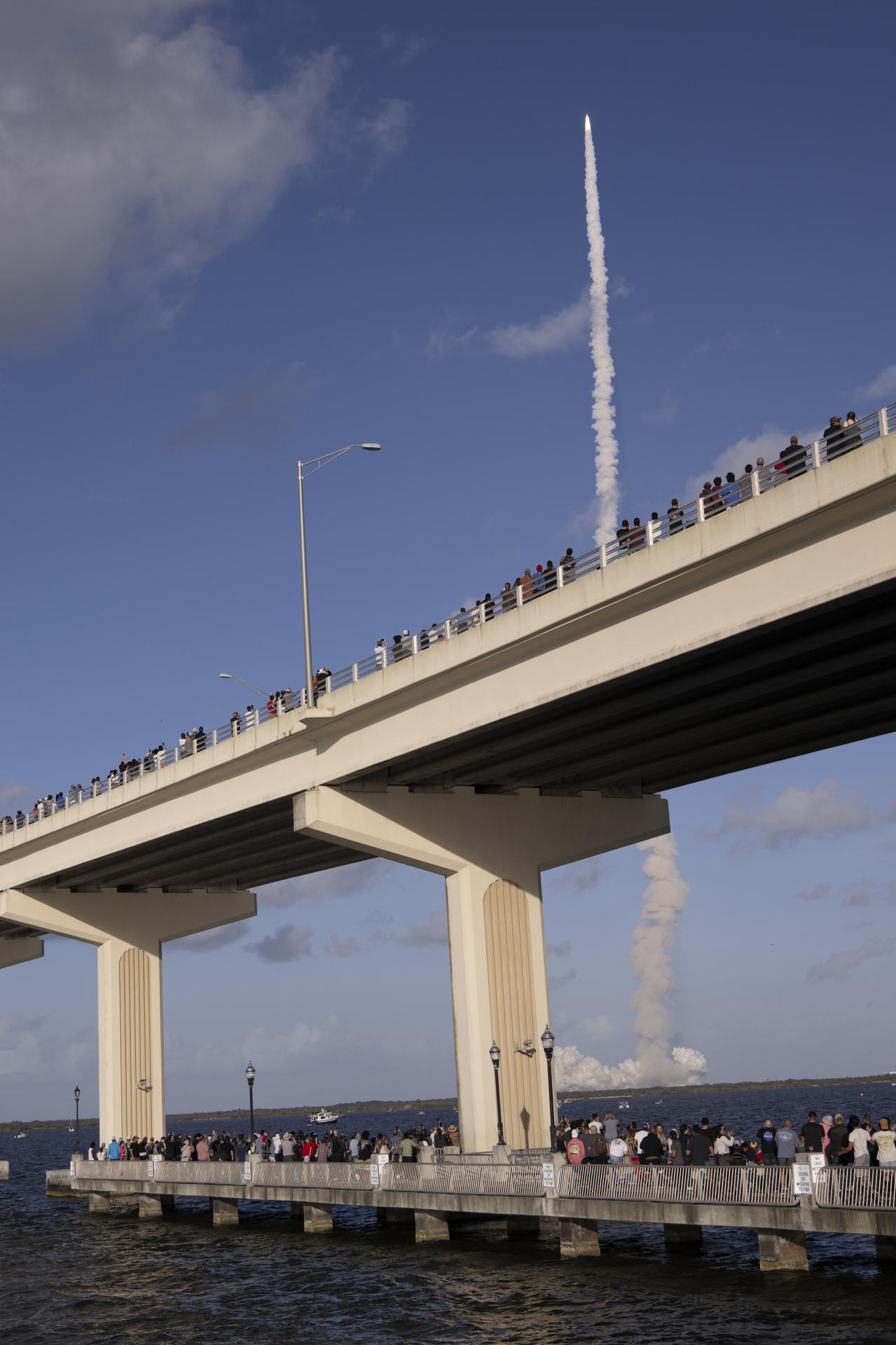
Crowds gather at the Max A. Brewer Bridge in Titusville to watch the launch of NASA’s SLS (Space Launch System) rocket with the Orion spacecraft carrying Artemis II Commander Reid Wiseman, Pilot Victor Glover, and Mission Specialist Christina Koch from NASA, along with Mission Specialist Jeremy Hansen from the CSA (Canadian Space Agency), on Wednesday, April 1, 2026, from Launch Complex 39B at NASA Kennedy. The Artemis II test flight will take the crew members on a 10-day journey around the Moon and back.
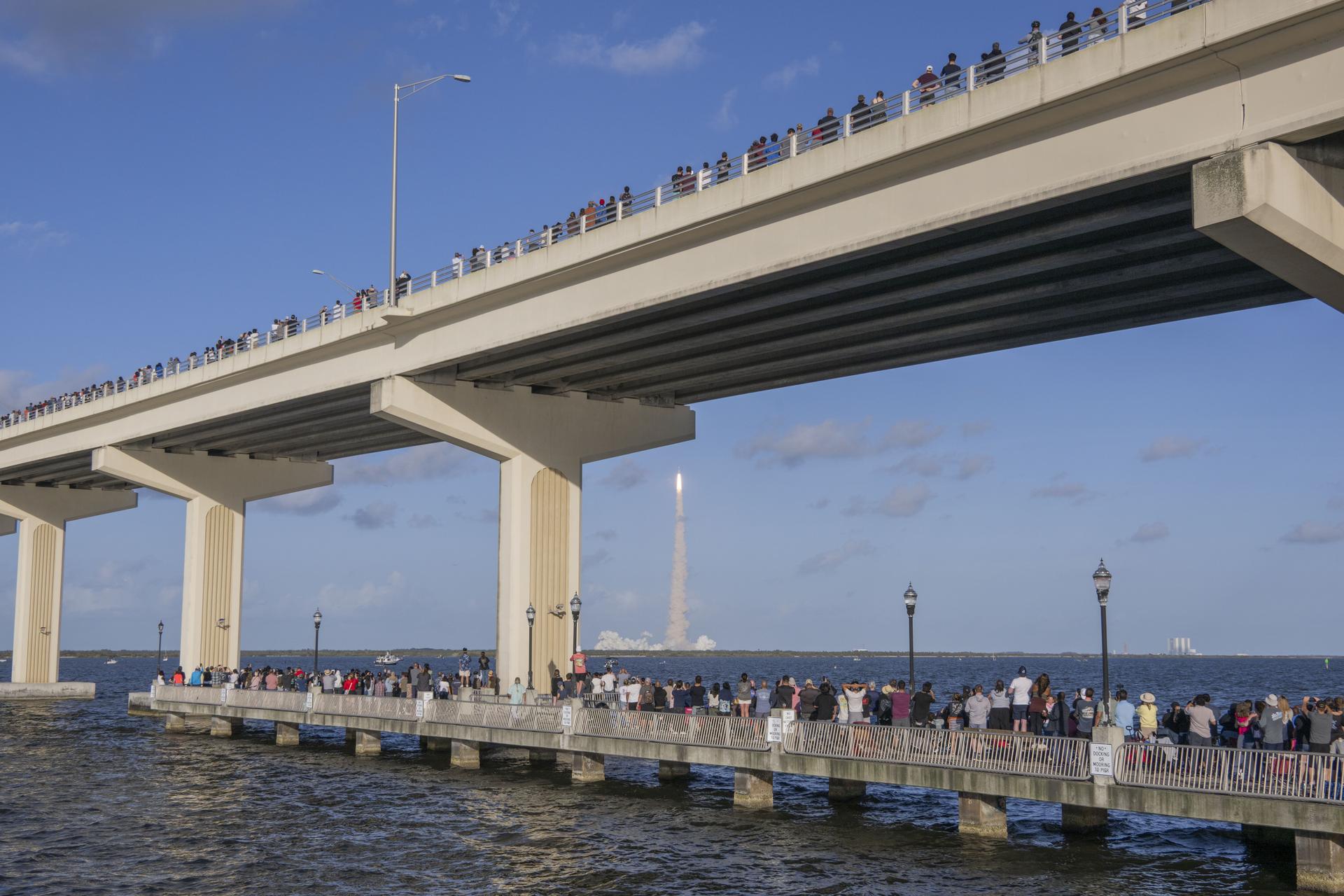
Crowds gather at the Max A. Brewer Bridge in Titusville to watch the launch of NASA’s SLS (Space Launch System) rocket with the Orion spacecraft carrying Artemis II Commander Reid Wiseman, Pilot Victor Glover, and Mission Specialist Christina Koch from NASA, along with Mission Specialist Jeremy Hansen from the CSA (Canadian Space Agency), on Wednesday, April 1, 2026, from Launch Complex 39B at NASA Kennedy. The Artemis II test flight will take the crew members on a 10-day journey around the Moon and back.

The rising Sun illuminates the sky on Tuesday, March 24, 2026, as NASA’s Artemis II SLS (Space Launch System) rocket and Orion spacecraft stand vertical at Launch Complex 39B at NASA’s Kennedy Space Center in Florida. The Artemis II test flight will take Commander Reid Wiseman, Pilot Victor Glover, and Mission Specialist Christina Koch from NASA, and Mission Specialist Jeremy Hansen from the CSA (Canadian Space Agency), around the Moon and back to Earth with launch opportunities beginning in April 2026.
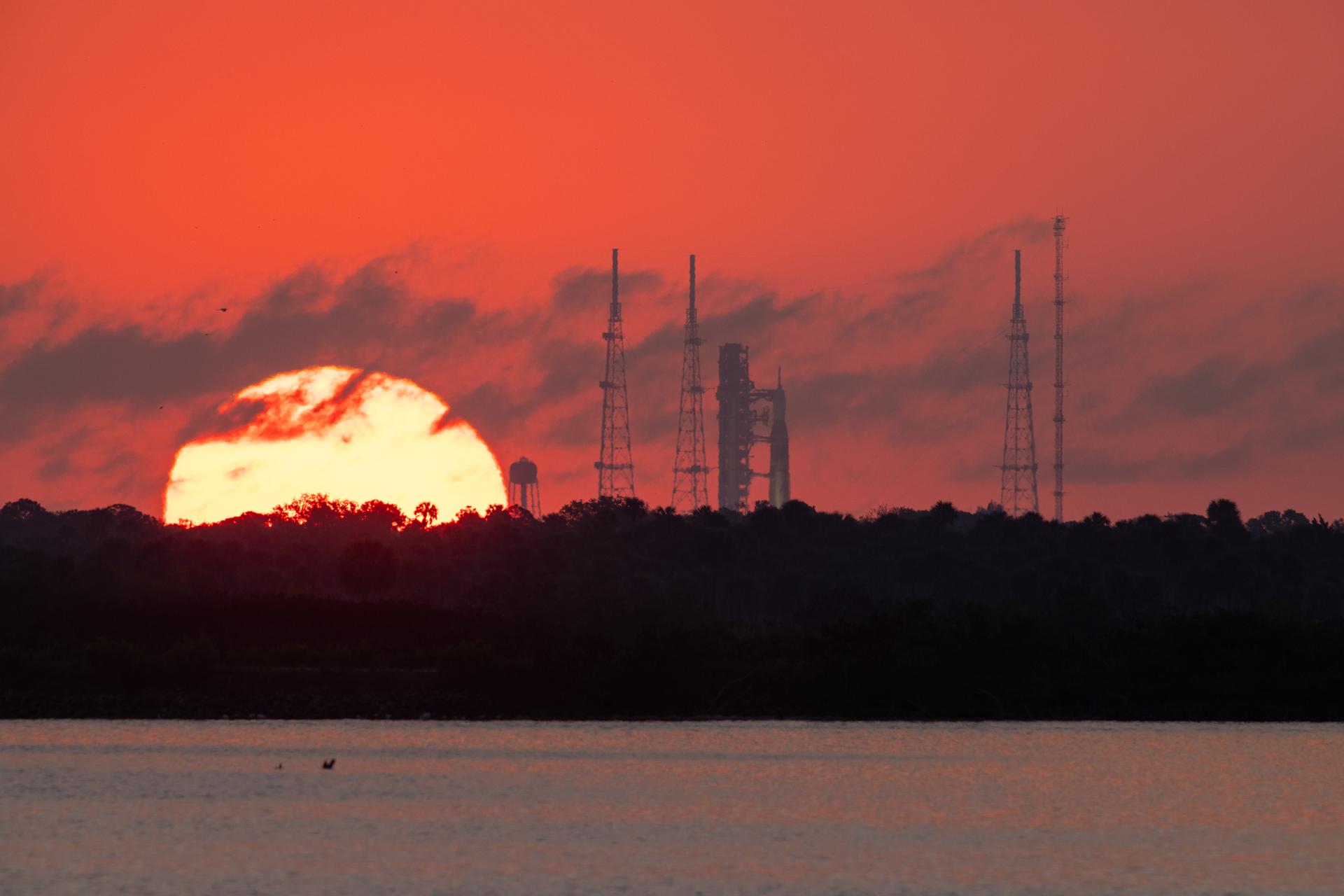
The Sun rises behind NASA’s Artemis II SLS (Space Launch System) rocket and Orion spacecraft at Launch Complex 39B at NASA’s Kennedy Space Center in Florida on Tuesday, March 24, 2026. The Artemis II test flight will take Commander Reid Wiseman, Pilot Victor Glover, and Mission Specialist Christina Koch from NASA, and Mission Specialist Jeremy Hansen from the CSA (Canadian Space Agency), around the Moon and back to Earth with launch opportunities beginning in April 2026.

The rising Sun illuminates the sky on Tuesday, March 24, 2026, as NASA’s Artemis II SLS (Space Launch System) rocket and Orion spacecraft stand vertical at Launch Complex 39B at NASA’s Kennedy Space Center in Florida. The Artemis II test flight will take Commander Reid Wiseman, Pilot Victor Glover, and Mission Specialist Christina Koch from NASA, and Mission Specialist Jeremy Hansen from the CSA (Canadian Space Agency), around the Moon and back to Earth with launch opportunities beginning in April 2026.
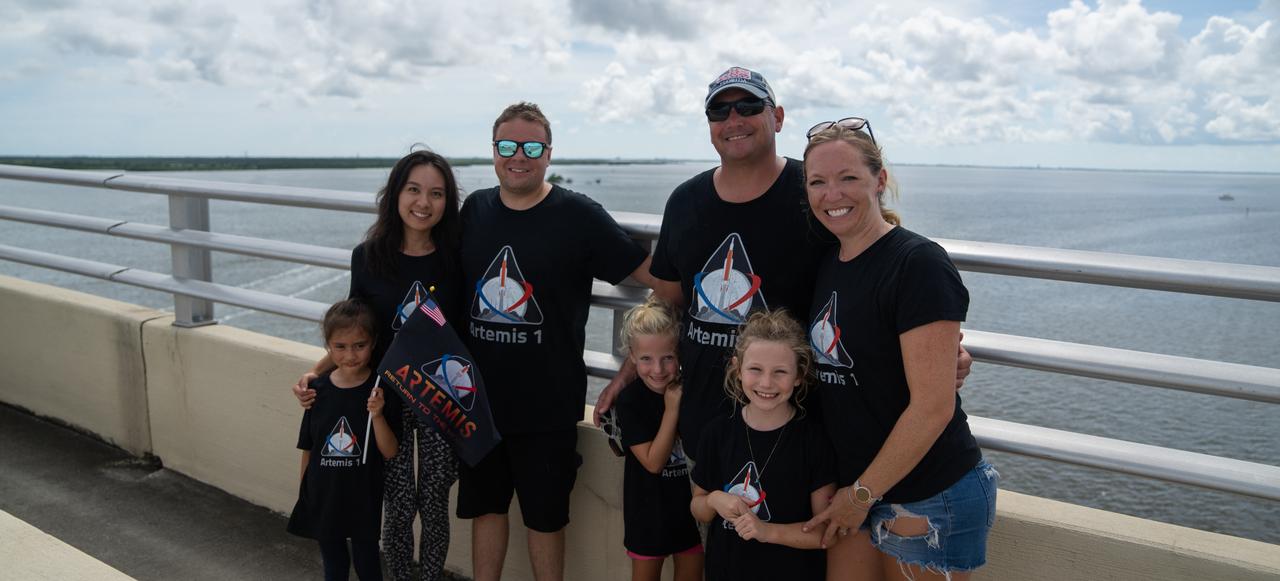
A family wearing matching Artemis shirts are on the Max Brewer Bridge in Titusville, Florida, to witness the launch of NASA’s Artemis I mission on Sept. 3, 2022. The launch was waived off for the day. The first in a series of increasingly complex missions, Artemis I will provide a foundation for human deep space exploration and demonstrate our commitment and capability to extend human presence to the Moon and beyond. The primary goal of Artemis I is to thoroughly test the integrated systems before crewed missions by operating the spacecraft in a deep space environment, testing Orion’s heat shield, and recovering the crew module after reentry, descent, and splashdown.
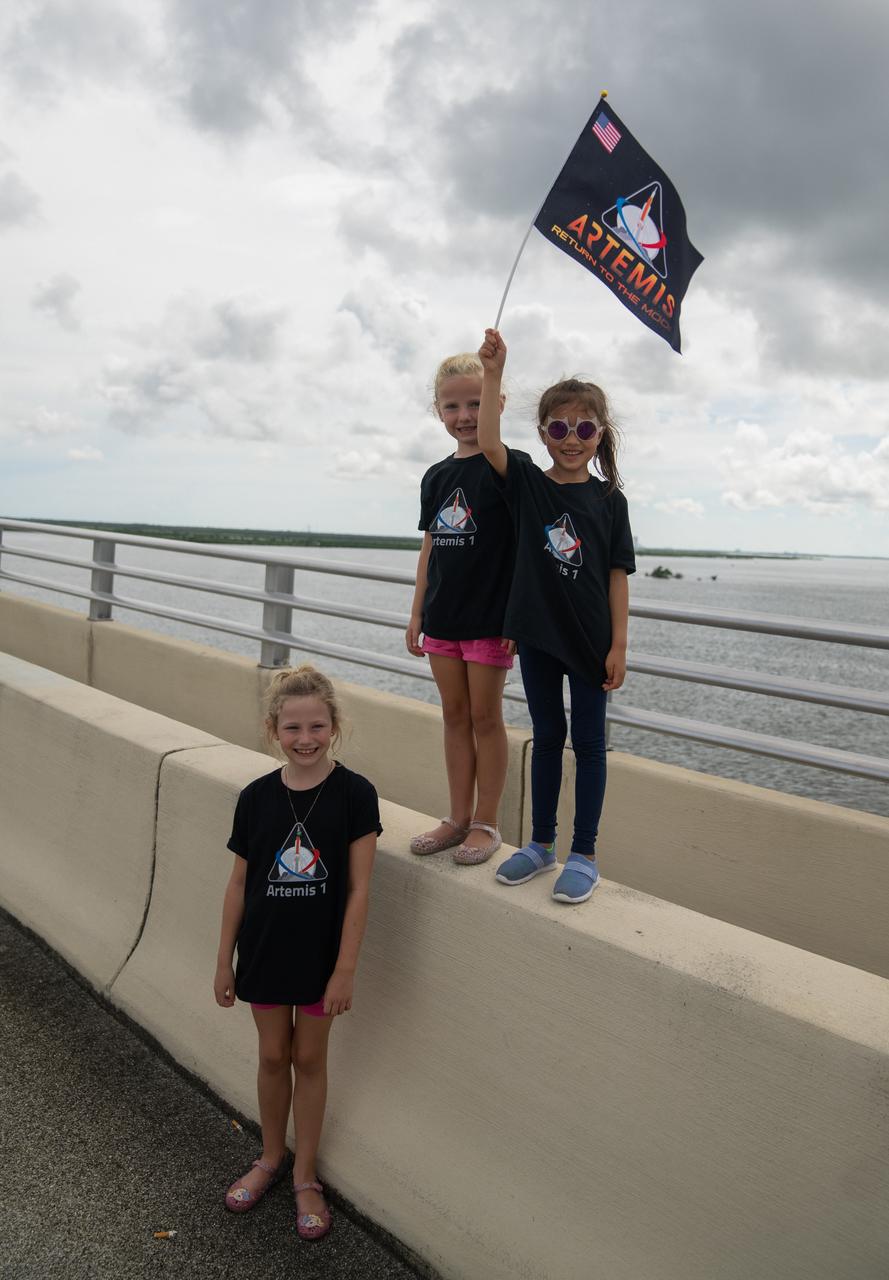
A group of young children with an Artemis flag are photographed on the Max Brewer Bridge in Titusville, Florida, as they wait to watch the launch of NASA’s Artemis I mission on Sept. 3, 2022. The launch was waived off for the day. The first in a series of increasingly complex missions, Artemis I will provide a foundation for human deep space exploration and demonstrate our commitment and capability to extend human presence to the Moon and beyond. The primary goal of Artemis I is to thoroughly test the integrated systems before crewed missions by operating the spacecraft in a deep space environment, testing Orion’s heat shield, and recovering the crew module after reentry, descent, and splashdown.
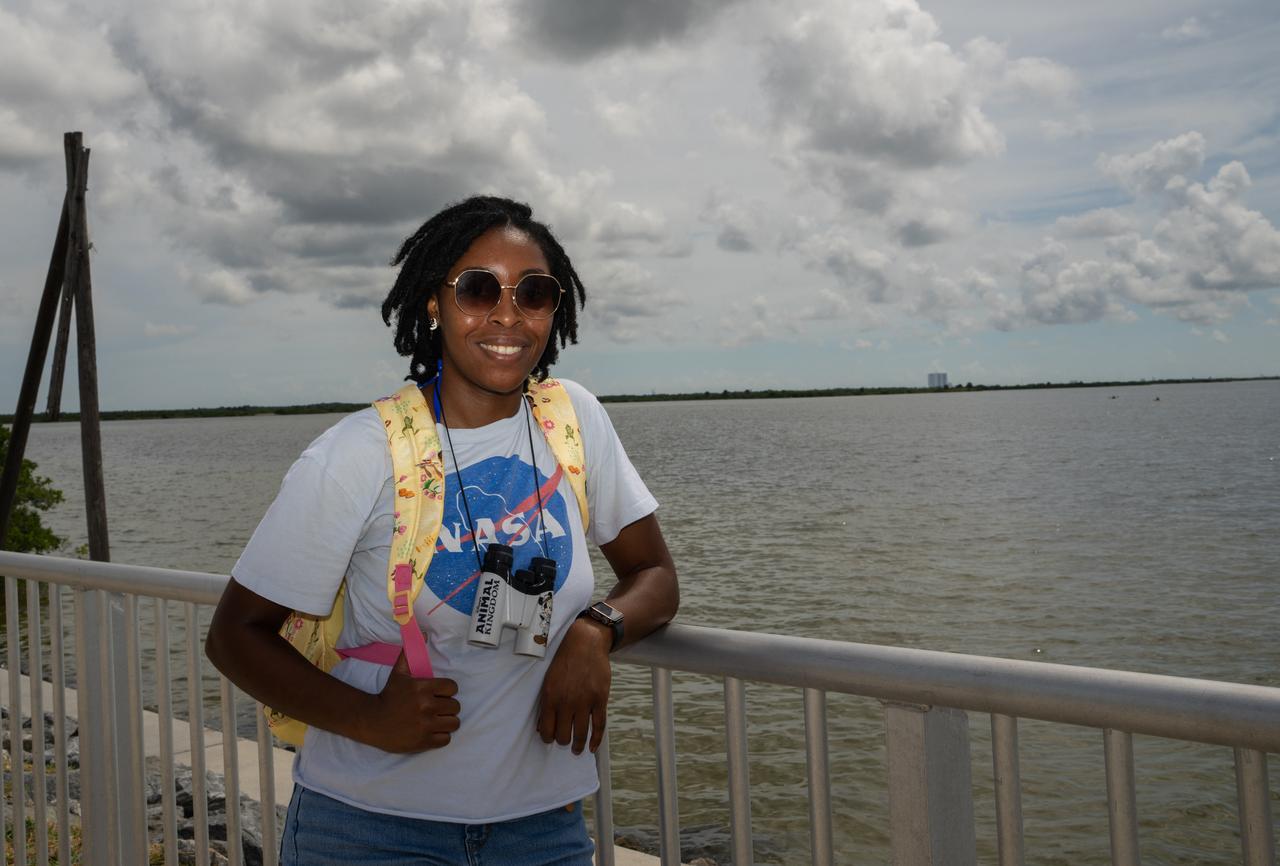
A woman wearing a NASA shirt is on the Max Brewer Bridge in Titusville, Florida, waiting to witness the launch of NASA’s Artemis I mission on Sept. 3, 2022. The launch was waived off for the day. The first in a series of increasingly complex missions, Artemis I will provide a foundation for human deep space exploration and demonstrate our commitment and capability to extend human presence to the Moon and beyond. The primary goal of Artemis I is to thoroughly test the integrated systems before crewed missions by operating the spacecraft in a deep space environment, testing Orion’s heat shield, and recovering the crew module after reentry, descent, and splashdown.
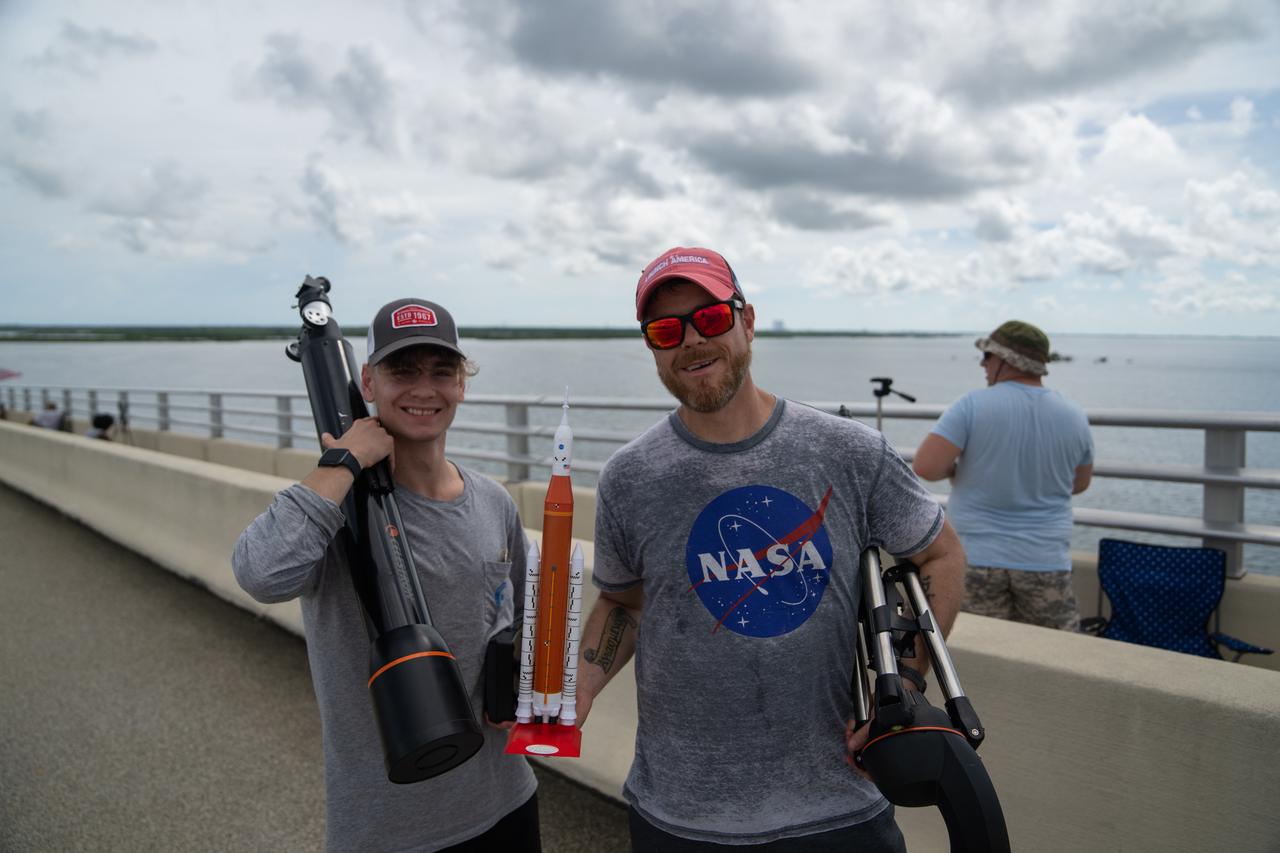
Two individuals wearing NASA shirts and holding a model Space Launch System rocket are on the Max Brewer Bridge in Titusville, Florida, to witness the launch of NASA’s Artemis I mission on Sept. 3, 2022. The launch was waived off for the day. The first in a series of increasingly complex missions, Artemis I will provide a foundation for human deep space exploration and demonstrate our commitment and capability to extend human presence to the Moon and beyond. The primary goal of Artemis I is to thoroughly test the integrated systems before crewed missions by operating the spacecraft in a deep space environment, testing Orion’s heat shield, and recovering the crew module after reentry, descent, and splashdown.
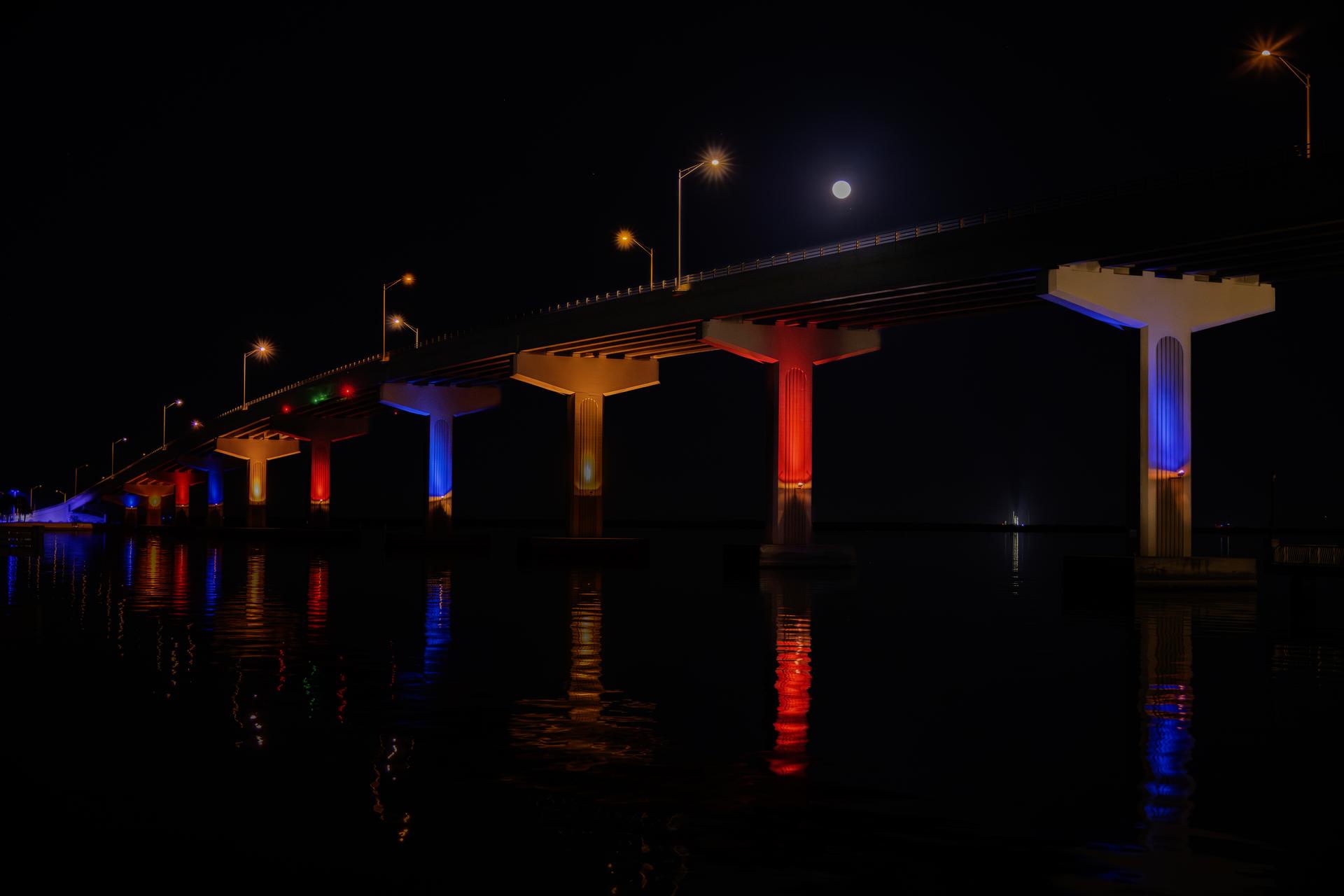
The Moon shines over the Max Brewer Bridge during the Artemis II wet dress rehearsal on Monday, Feb. 2, 2026, in Titusville, Florida. The bridge spanning the Indian River Lagoon is a popular launch viewing location for Kennedy Space Center and Cape Canaveral Space Force Station.
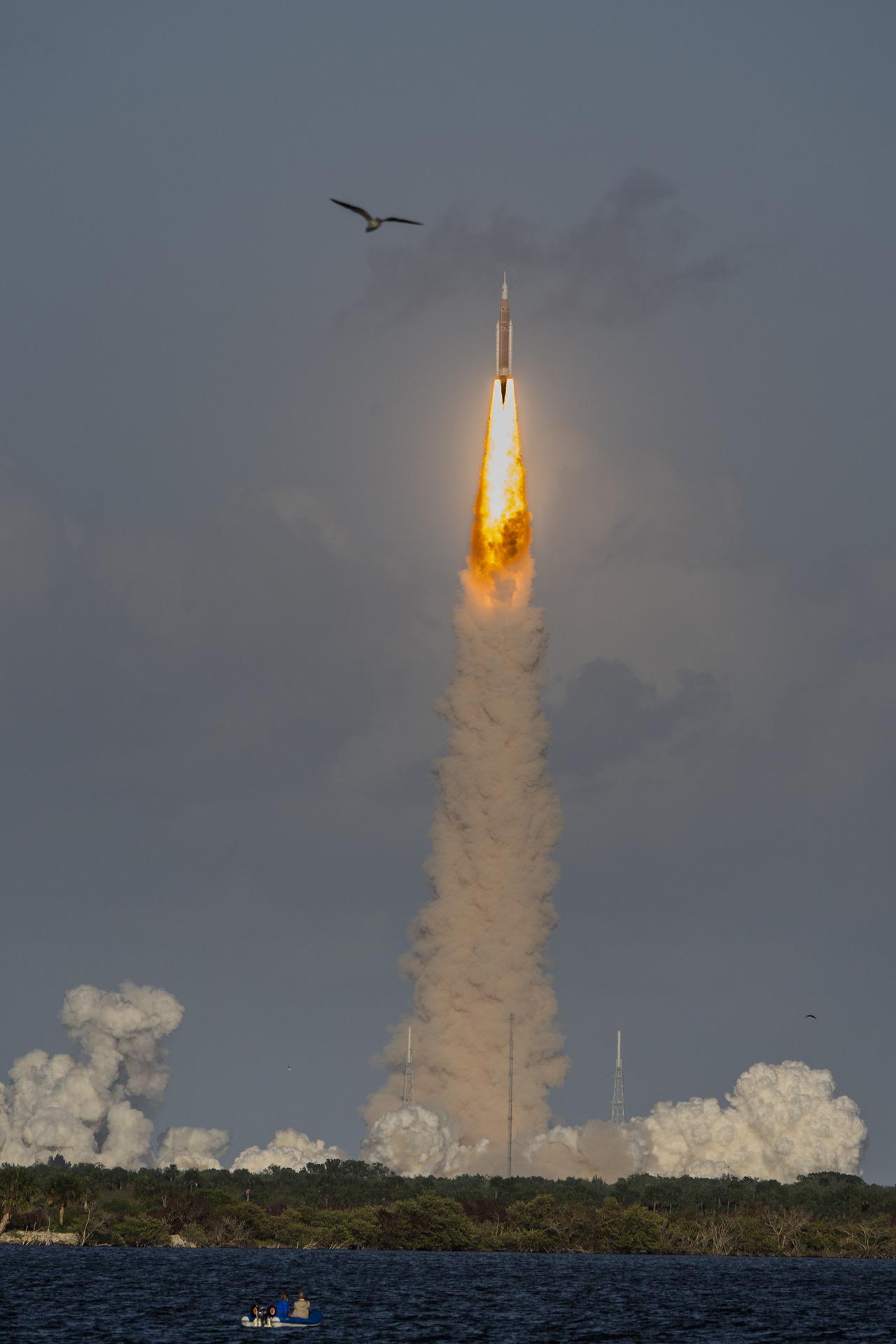
NASA’s SLS (Space Launch System) rocket with the Orion spacecraft carrying Artemis II Commander Reid Wiseman, Pilot Victor Glover, and Mission Specialist Christina Koch from NASA, along with Mission Specialist Jeremy Hansen from the CSA (Canadian Space Agency), lifts off at 6:35 p.m. EDT on Wednesday, April 1, 2026, from Launch Complex 39B at NASA Kennedy. The Artemis II test flight will take the crew members on a 10-day journey around the Moon and back.
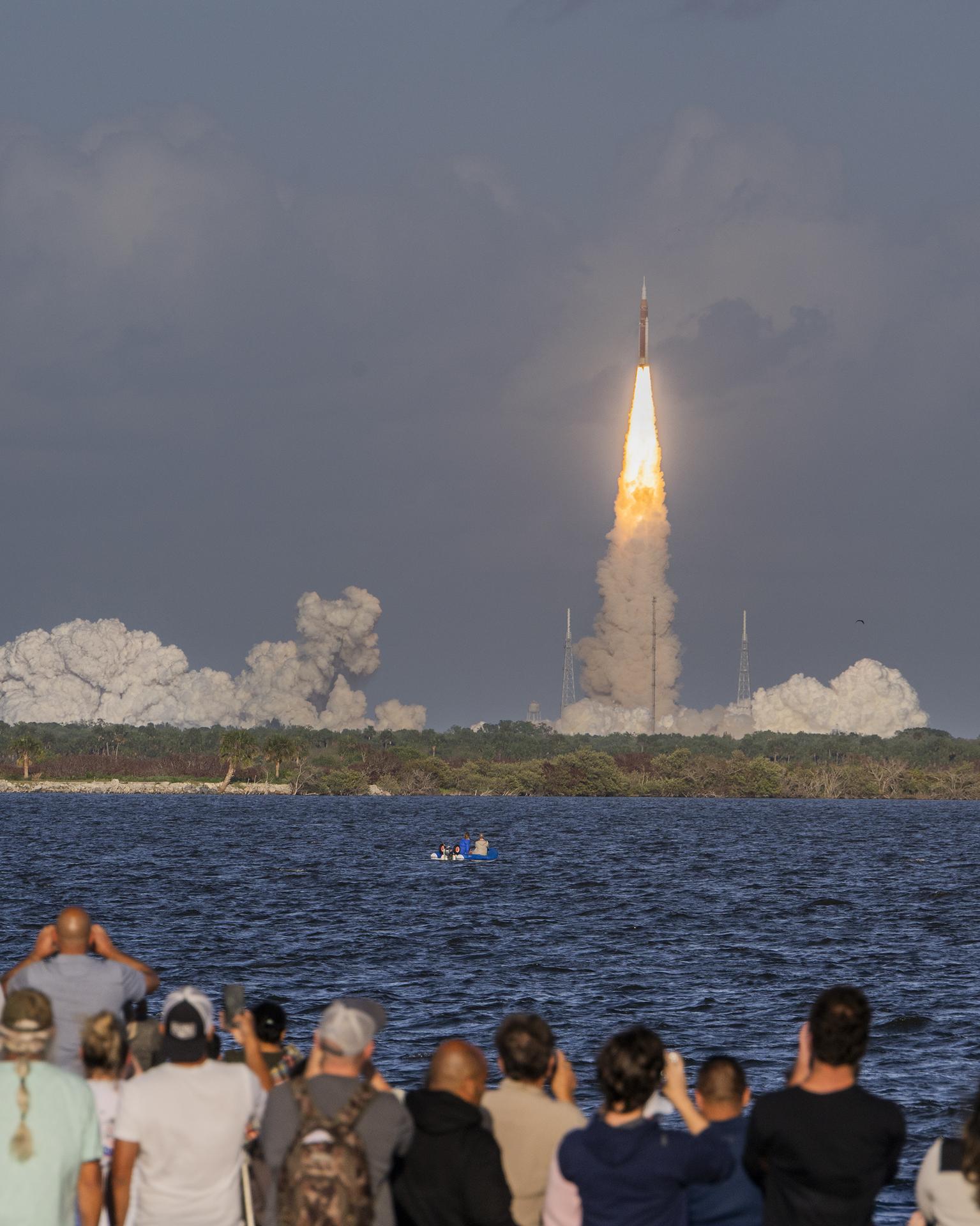
NASA’s SLS (Space Launch System) rocket with the Orion spacecraft carrying Artemis II Commander Reid Wiseman, Pilot Victor Glover, and Mission Specialist Christina Koch from NASA, along with Mission Specialist Jeremy Hansen from the CSA (Canadian Space Agency), lifts off at 6:35 p.m. EDT on Wednesday, April 1, 2026, from Launch Complex 39B at NASA Kennedy. The Artemis II test flight will take the crew members on a 10-day journey around the Moon and back.
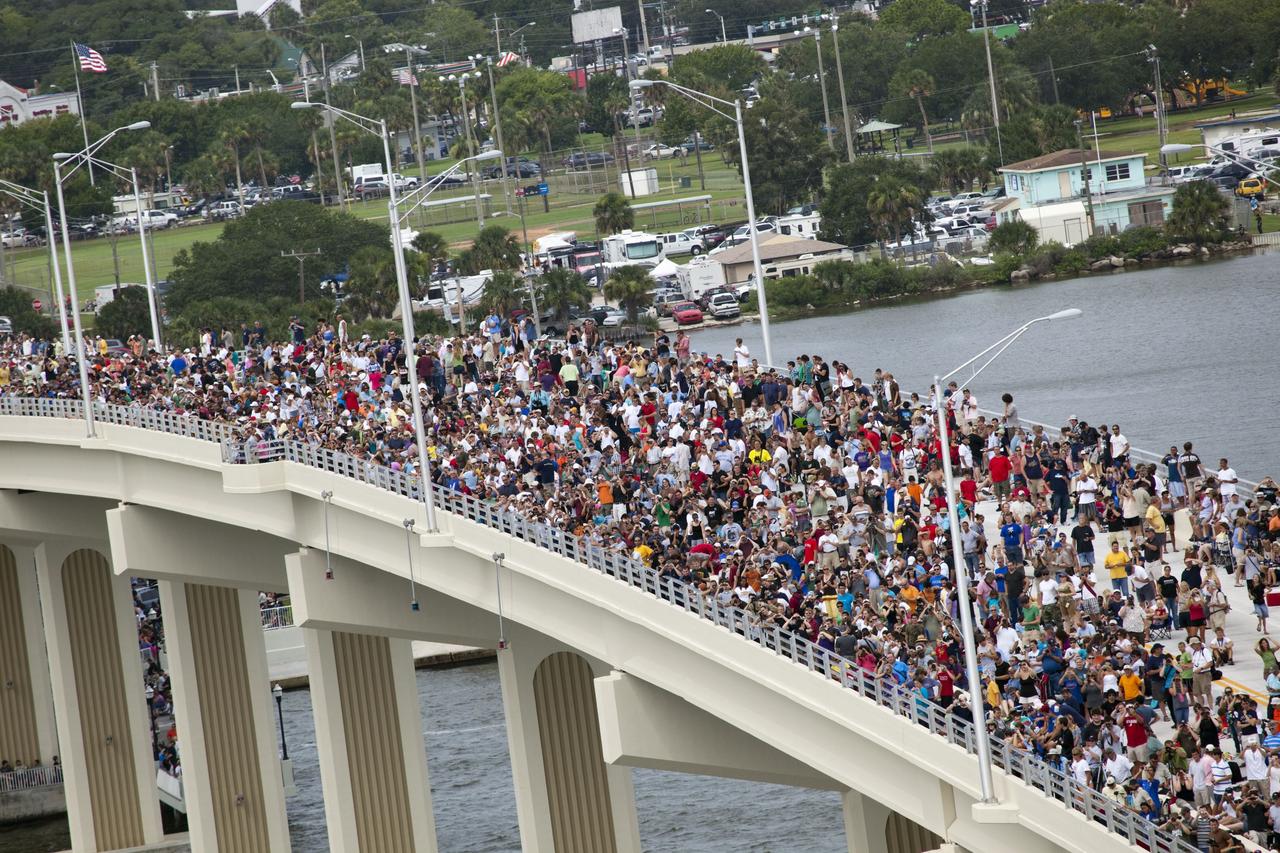
CAPE CANAVERAL, Fla. -- After 30 years and 135 missions, residents and visitors to Florida's Space Coast crowd the new A. Max Brewer Bridge in Titusville to see the rocket's red glare of NASA's Space Shuttle Program soar for the last time. Space shuttle Atlantis is scheduled to liftoff at 11:26 a.m. EDT from Launch Pad 39A at NASA's Kennedy Space Center in Florida. On board will be four experienced astronauts -- STS-135 Commander Chris Ferguson, Pilot Doug Hurley, and Mission Specialists Sandy Magnus and Rex Walheim. STS-135 will deliver the Raffaello multi-purpose logistics module packed with supplies and spare parts for the International Space Station. Atlantis also will fly the Robotic Refueling Mission experiment that will investigate the potential for robotically refueling existing satellites in orbit. In addition, Atlantis will return with a failed ammonia pump module to help NASA better understand the failure mechanism and improve pump designs for future systems. STS-135 will be the 33rd flight of Atlantis, the 37th shuttle mission to the space station, and the 135th and final mission of NASA's Space Shuttle Program. For more information visit, www.nasa.gov/mission_pages/shuttle/shuttlemissions/sts135/index.html. Photo credit: NASA/Frank Michaux