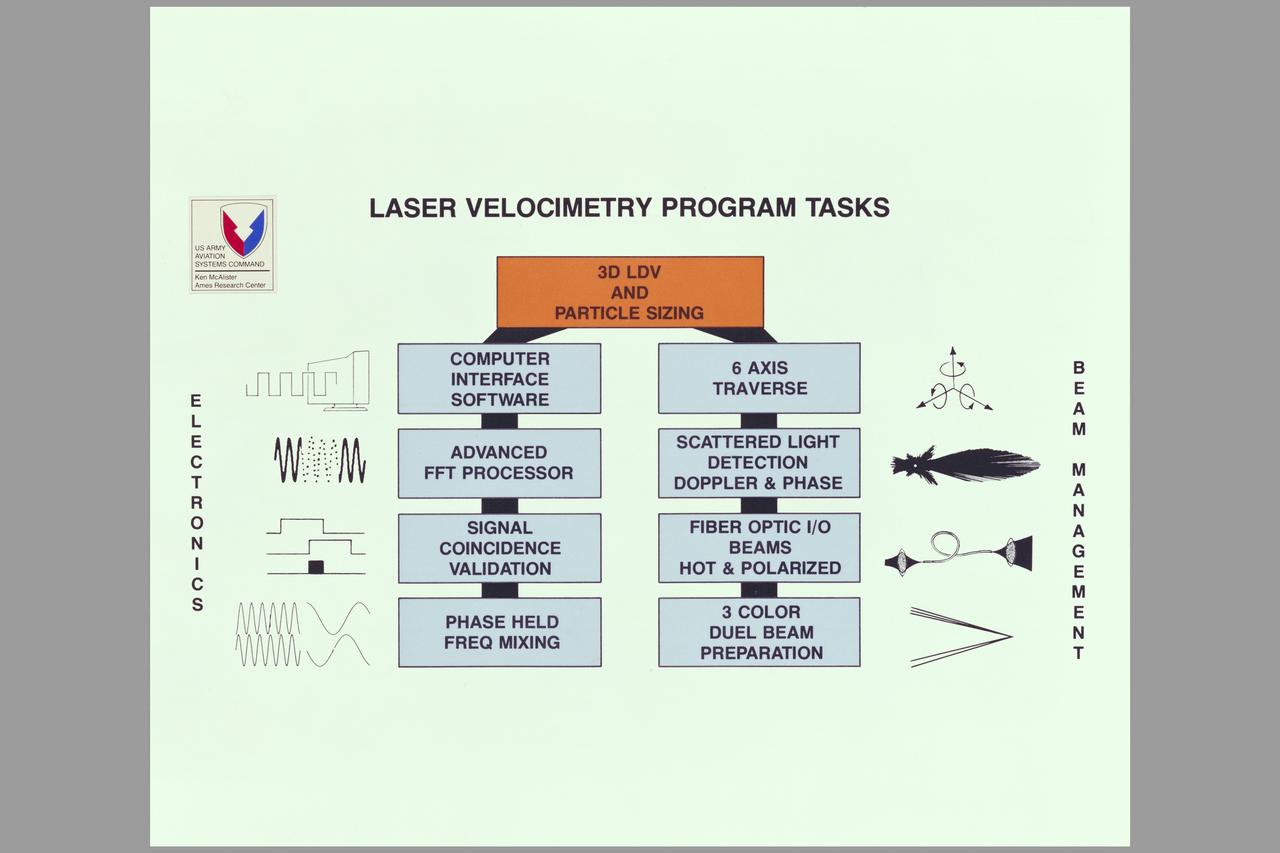
Graphics (McAlister) Army Aeroflightdynamics Directorate 3D Laser Velocimeter for Rotor Flow Studies: Laser Velocimetry Program Tasks Composite.
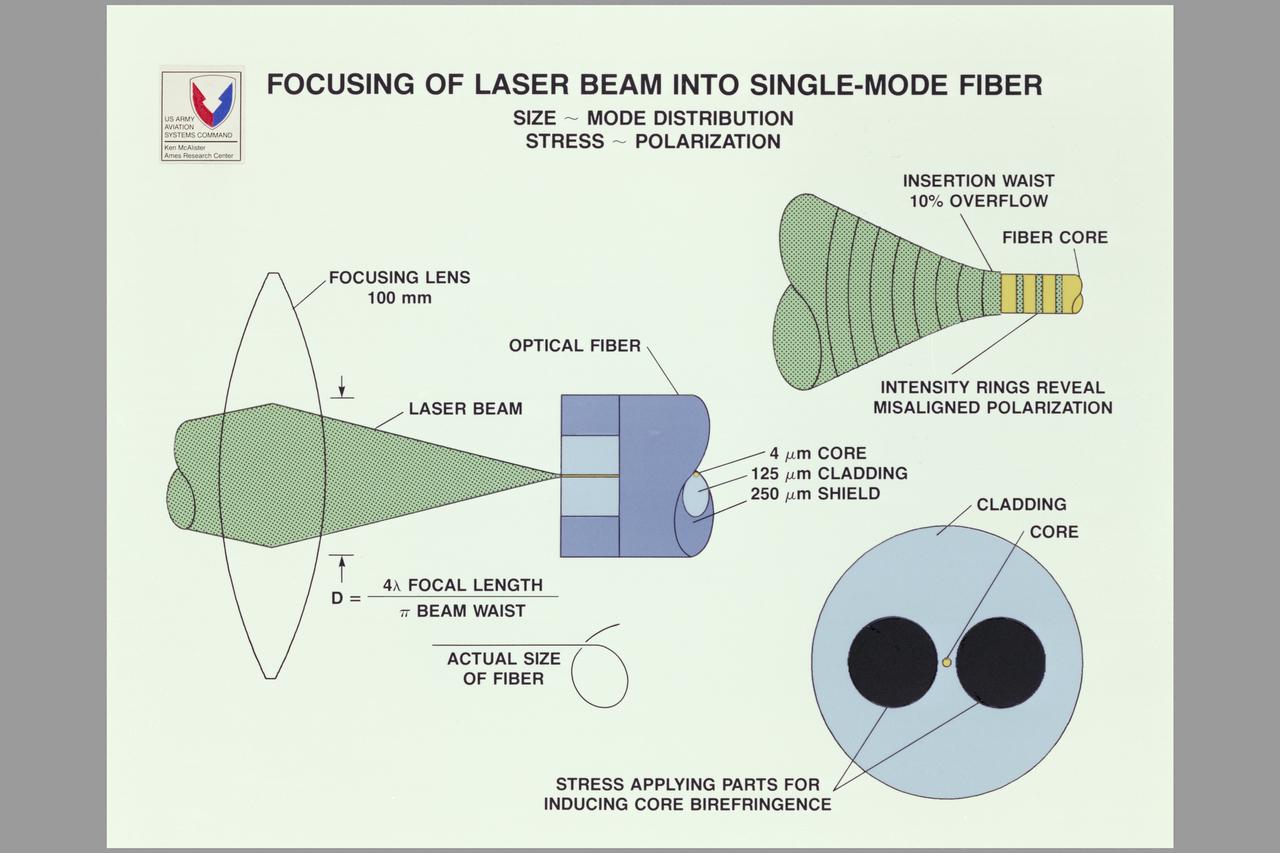
Graphics (McAlister) Army Aeroflightdynamics Directorate 3D Laser Velocimeter for Rotor Flow Studies: Focusing of Laser Beam into Single-Mode Fiber Composite.
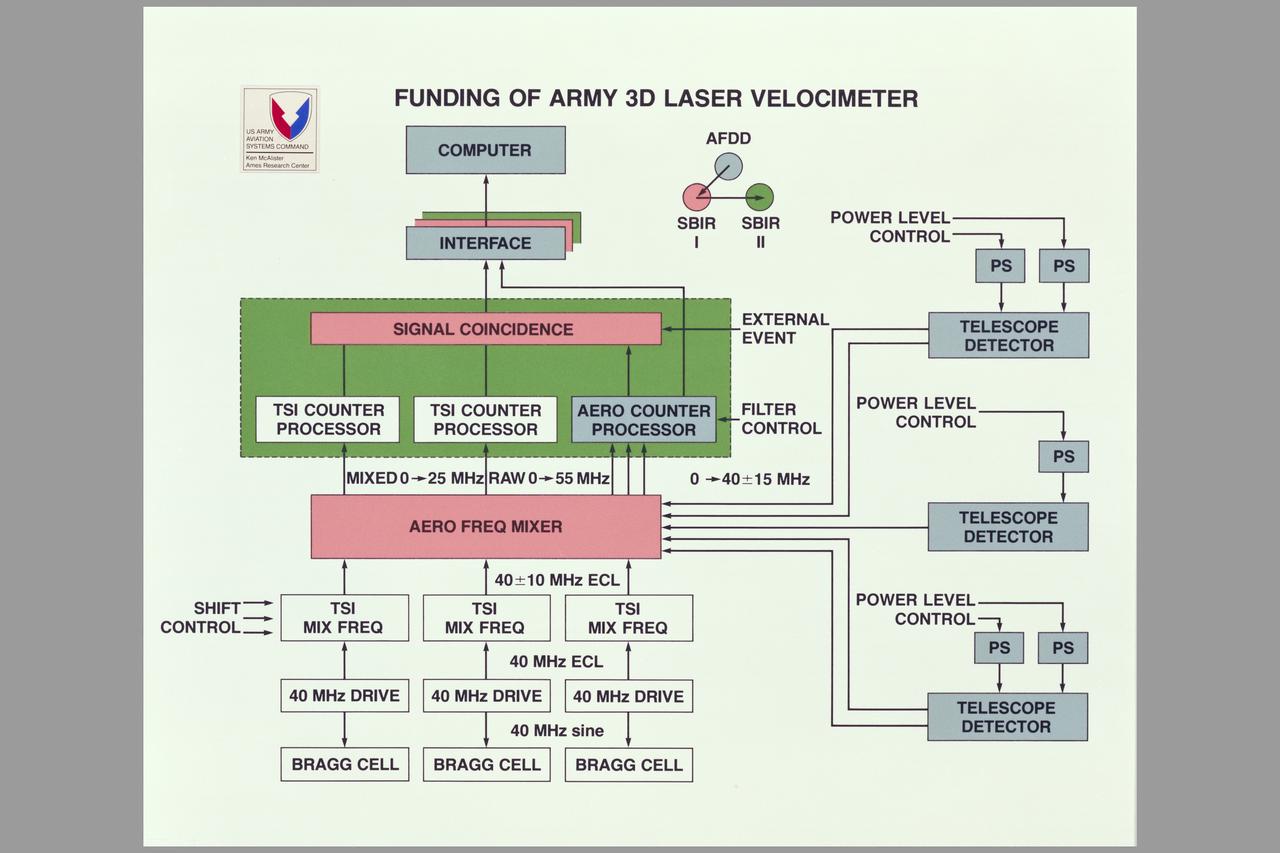
Graphics (McAlister) Army Aeroflightdynamics Directorate 3D Laser Velocimeter for Rotor Flow Studies: Funding of Army 3D Laser Velocimeter Composite.
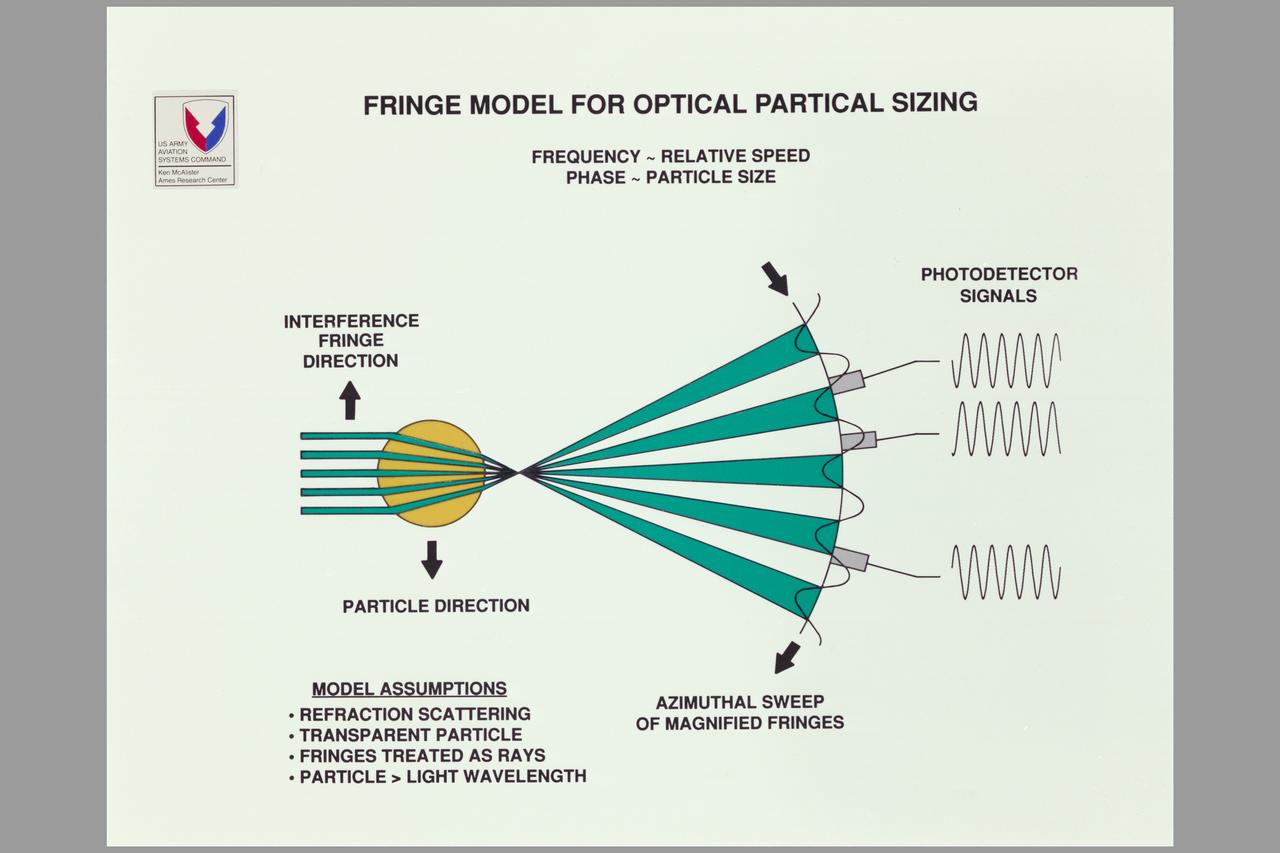
Graphics (McAlister) Army Aeroflightdynamics Directorate 3D Laser Velocimeter for Rotor Flow Studies: Fringe Model for Optical Partical Sizing Composite.
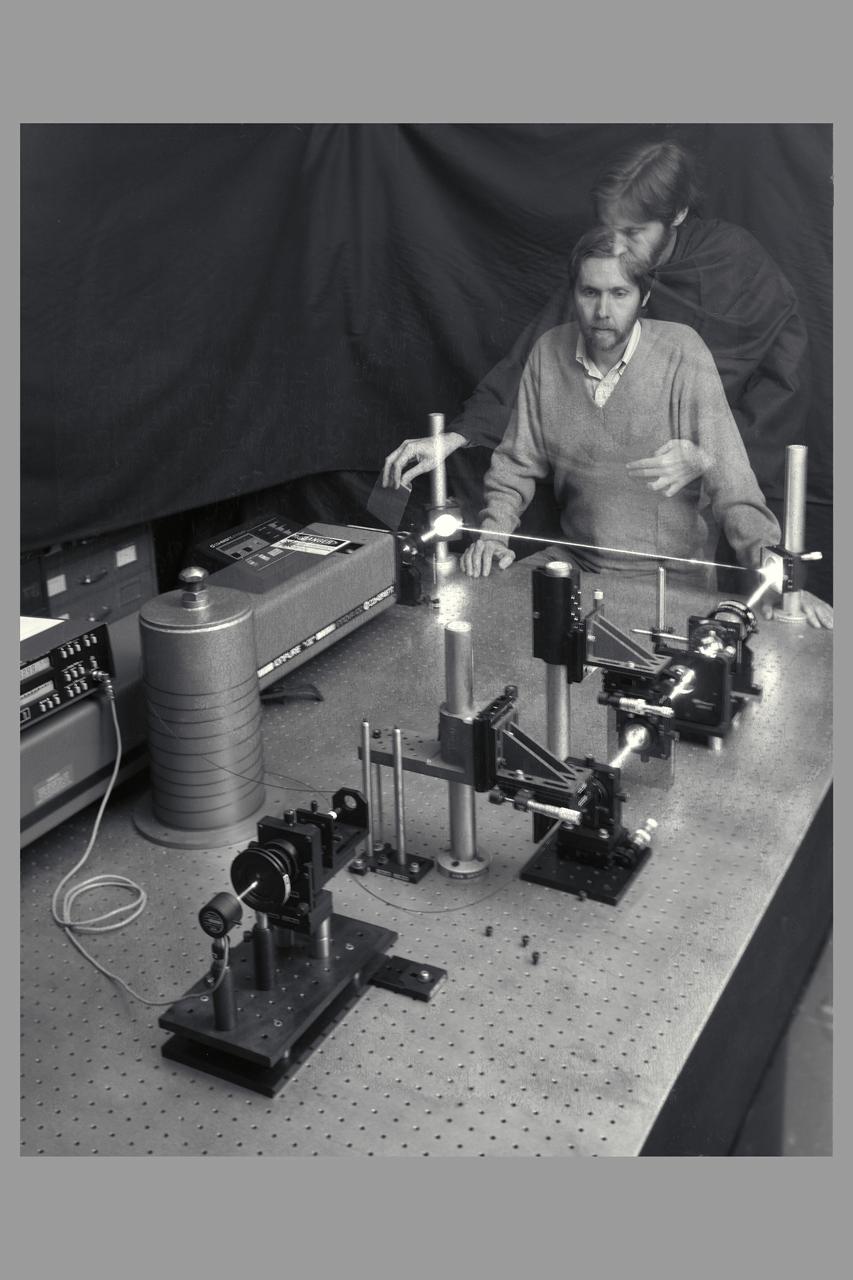
N-213 Laser Optics Laboratory - double exposed polaroid by Ken McAlister (engineer) 3-17-89 with Dana Lynch
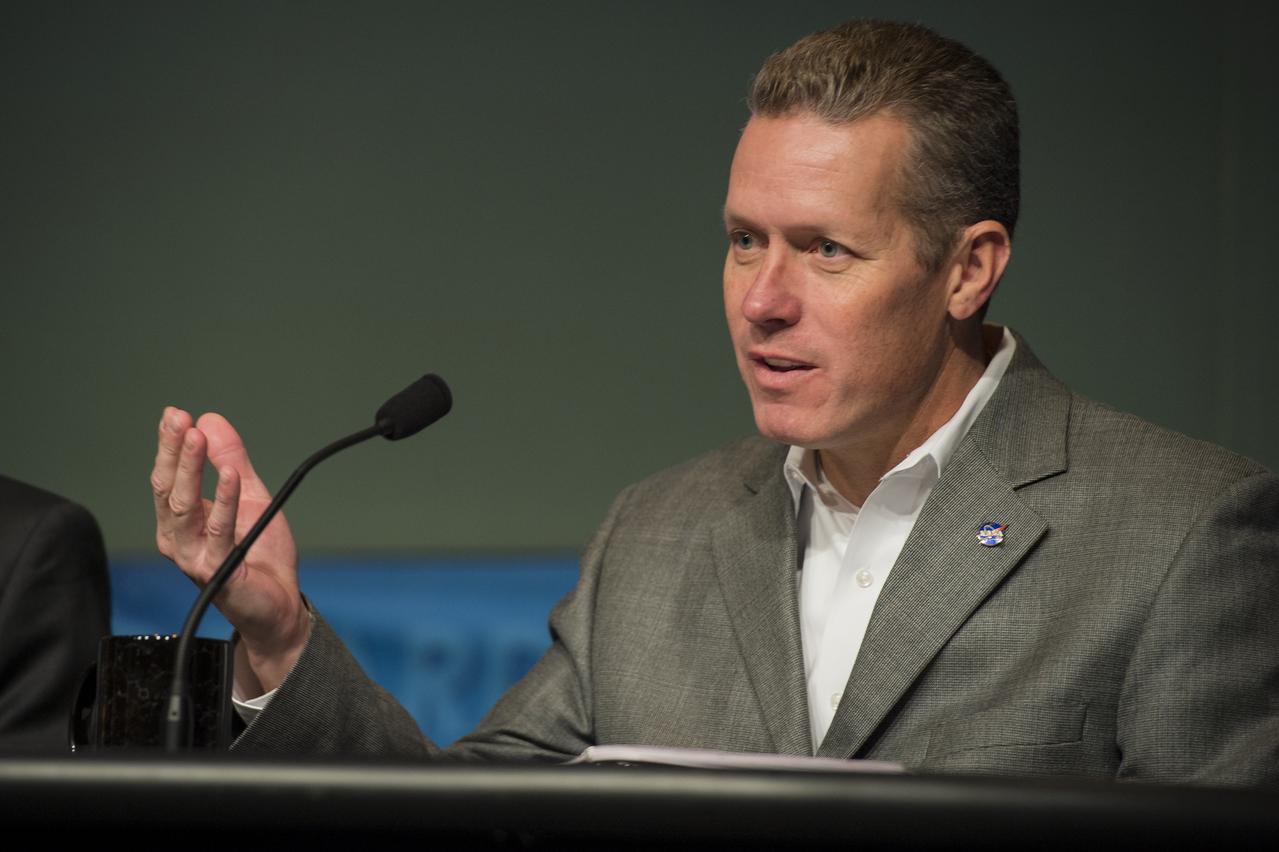
Phil McAlister, Director of Commercial Spaceflight Development at NASA, delivers remarks panel discussion on the Commercial Orbital Transportation Services (COTS) initiative at NASA Headquarters in Washington on Wednesday, November 13, 2013. Through COTS, NASA's partners Space Exploration Technologies Corp. (SpaceX) and Orbital Sciences Corp., developed new U.S. rockets and spacecraft, launched from U.S. soil, capable of transporting cargo to low-Earth orbit and the International Space Station. Photo Credit: (NASA/Jay Westcott)

A Nasdaq moderator, center, talks with NASA Director of Commercial Spaceflight Development Phil McAlister, left, ISS National Lab Vice President and Chief Operating Officer Ken Shields, NASA Advisory Council Regulatory and Policy Committee Chair Mike Gold, and NASA Deputy Chief Financial Officer for Integration Doug Comstock, right, during a live social media event shortly after NASA announced a five-part plan to open the International Space Station to expanded commercial and marketing activities and private astronaut missions to the station and enable additional commercial destinations in low-Earth orbit, Friday, June 7, 2019 at the Nasdaq MarketSite in New York City. NASA will continue to maintain human presence and research in low-Earth orbit, and the long-term goal is to achieve a robust economy from which NASA can purchase services at a lower cost. Photo Credit: (NASA/Bill Ingalls)

A Nasdaq moderator, center, talks with NASA Director of Commercial Spaceflight Development Phil McAlister, left, ISS National Lab Vice President and Chief Operating Officer Ken Shields, NASA Advisory Council Regulatory and Policy Committee Chair Mike Gold, and NASA Deputy Chief Financial Officer for Integration Doug Comstock, right, during a live social media event shortly after NASA announced a five-part plan to open the International Space Station to expanded commercial and marketing activities and private astronaut missions to the station and enable additional commercial destinations in low-Earth orbit, Friday, June 7, 2019 at the Nasdaq MarketSite in New York City. NASA will continue to maintain human presence and research in low-Earth orbit, and the long-term goal is to achieve a robust economy from which NASA can purchase services at a lower cost. Photo Credit: (NASA/Bill Ingalls)
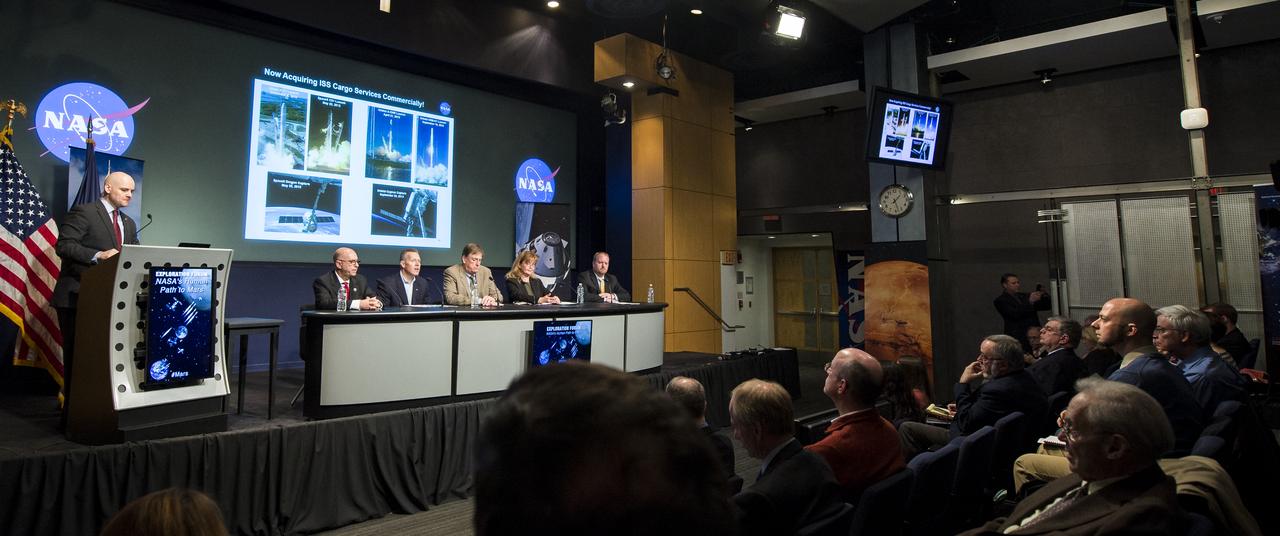
Sam Scimemi, Director of NASA's International Space Station Division, second from left, Phil McAlister, Director of NASA's Commercial Spaceflight Division, third from left, Dan Dumbacher, Deputy Associate Administrator of NASA's Exploration Systems Development, center, Michele Gates, Senior Technical Advisor of NASA's Human Exploration and Operations Mission Directorate, second from right, and Jason Crusan, Director of NASA's Advanced Exploration Systems Division, right, sit on a panel during an Exploration Forum showcasing NASA's human exploration path to Mars in the James E. Webb Auditorium at NASA Headquarters on Tuesday, April 29, 2014. Photo Credit: (NASA/Joel Kowsky)
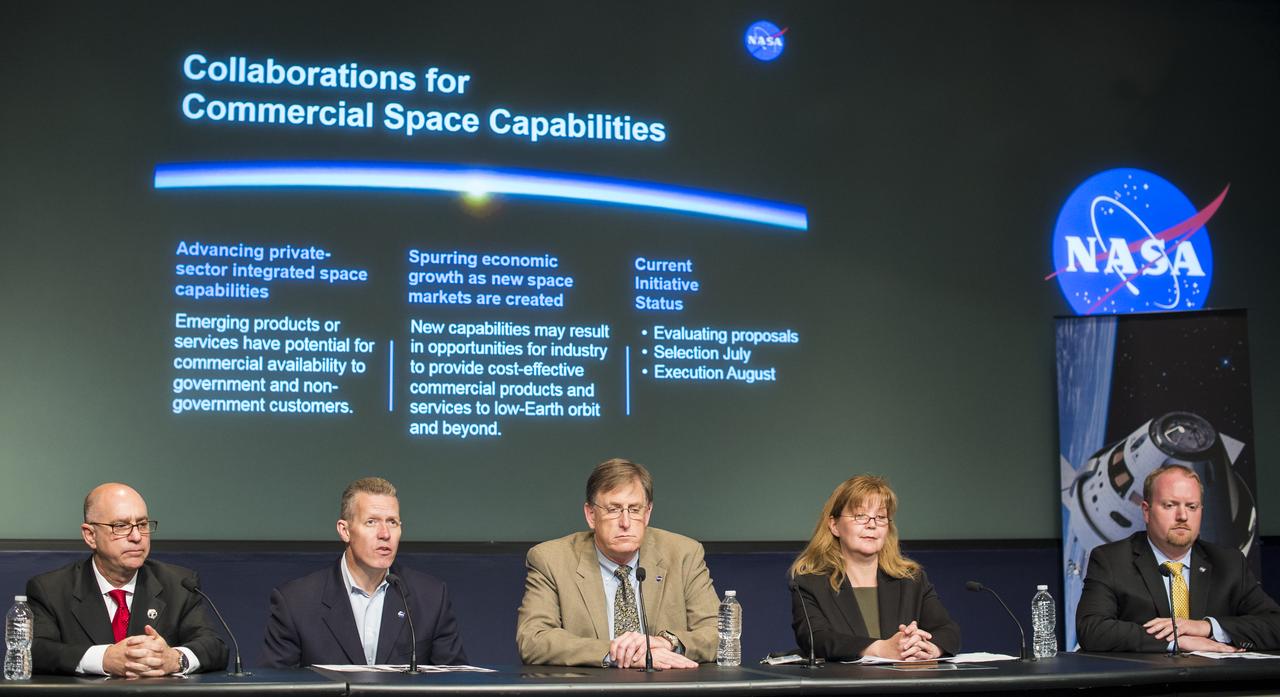
Sam Scimemi, Director of NASA's International Space Station Division, left, Phil McAlister, Director of NASA's Commercial Spaceflight Division, second from left, Dan Dumbacher, Deputy Associate Administrator of NASA's Exploration Systems Development, center, Michele Gates, Senior Technical Advisor of NASA's Human Exploration and Operations Mission Directorate, second from right, and Jason Crusan, Director of NASA's Advanced Exploration Systems Division, right, sit on a panel during an Exploration Forum showcasing NASA's human exploration path to Mars in the James E. Webb Auditorium at NASA Headquarters on Tuesday, April 29, 2014. Photo Credit: (NASA/Joel Kowsky)

Commercial Space Division Director Philip McAlister monitors the launch of a SpaceX Falcon 9 rocket carrying the company's Dragon spacecraft on the Crew-8 mission with NASA astronauts Matthew Dominick, Michael Barratt, and Jeanette Epps, and Roscosmos cosmonaut Alexander Grebenkin onboard, Sunday, March 3, 2024, in the control room of SpaceX’s HangarX at NASA’s Kennedy Space Center in Florida. NASA’s SpaceX Crew-8 mission is the eighth crew rotation mission of the SpaceX Dragon spacecraft and Falcon 9 rocket to the International Space Station as part of the agency’s Commercial Crew Program. Dominick, Barratt, Epps, and Grebenkin launched at 10:53 p.m. EST, from Launch Complex 39A at the Kennedy Space Center. Photo Credit: (NASA/Aubrey Gemignani)
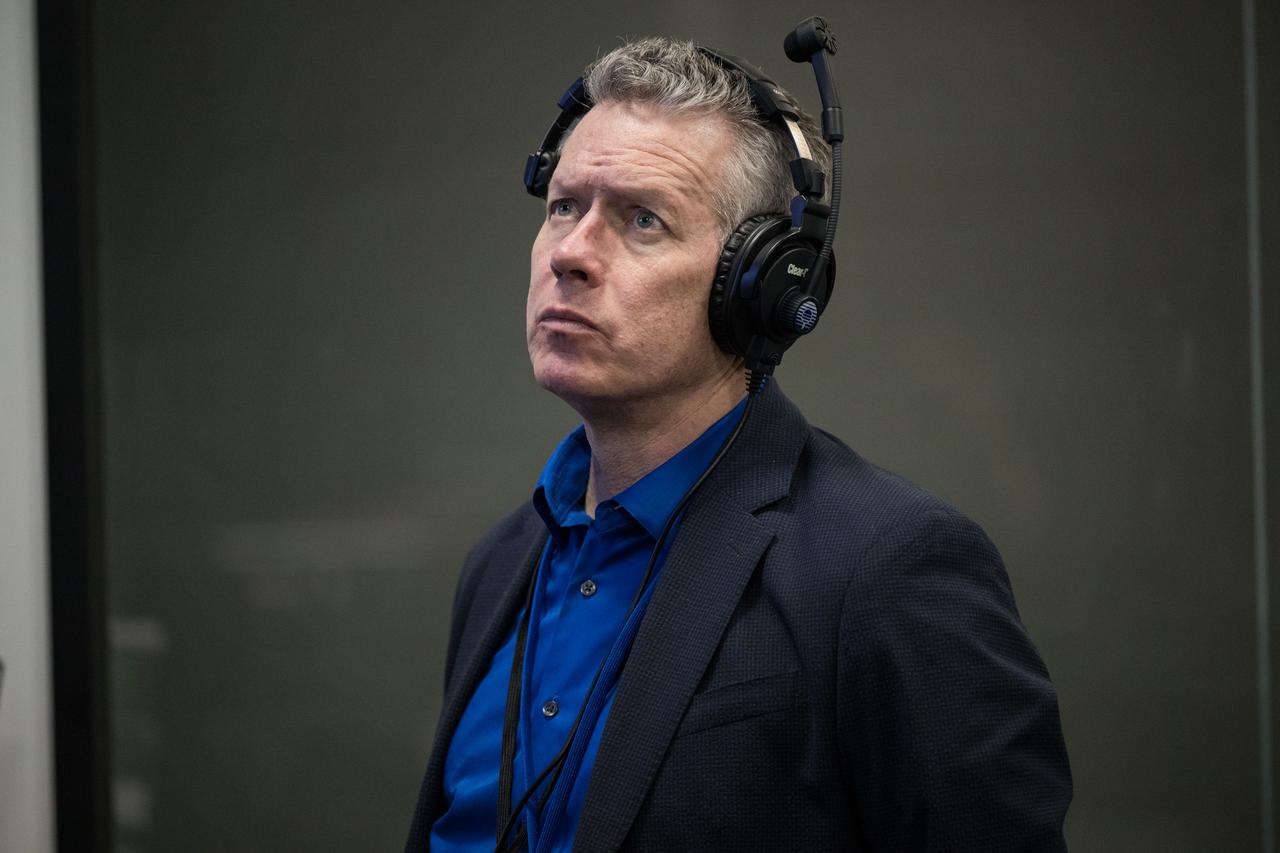
NASA Commercial Space Division Director Philip McAlister monitors the launch of a SpaceX Falcon 9 rocket carrying the company's Dragon spacecraft on the Crew-8 mission with NASA astronauts Matthew Dominick, Michael Barratt, and Jeanette Epps, and Roscosmos cosmonaut Alexander Grebenkin onboard, Sunday, March 3, 2024, in the control room of SpaceX’s HangarX at NASA’s Kennedy Space Center in Florida. NASA’s SpaceX Crew-8 mission is the eighth crew rotation mission of the SpaceX Dragon spacecraft and Falcon 9 rocket to the International Space Station as part of the agency’s Commercial Crew Program. Dominick, Barratt, Epps, and Grebenkin launched at 10:53 p.m. EST, from Launch Complex 39A at the Kennedy Space Center. Photo Credit: (NASA/Aubrey Gemignani)
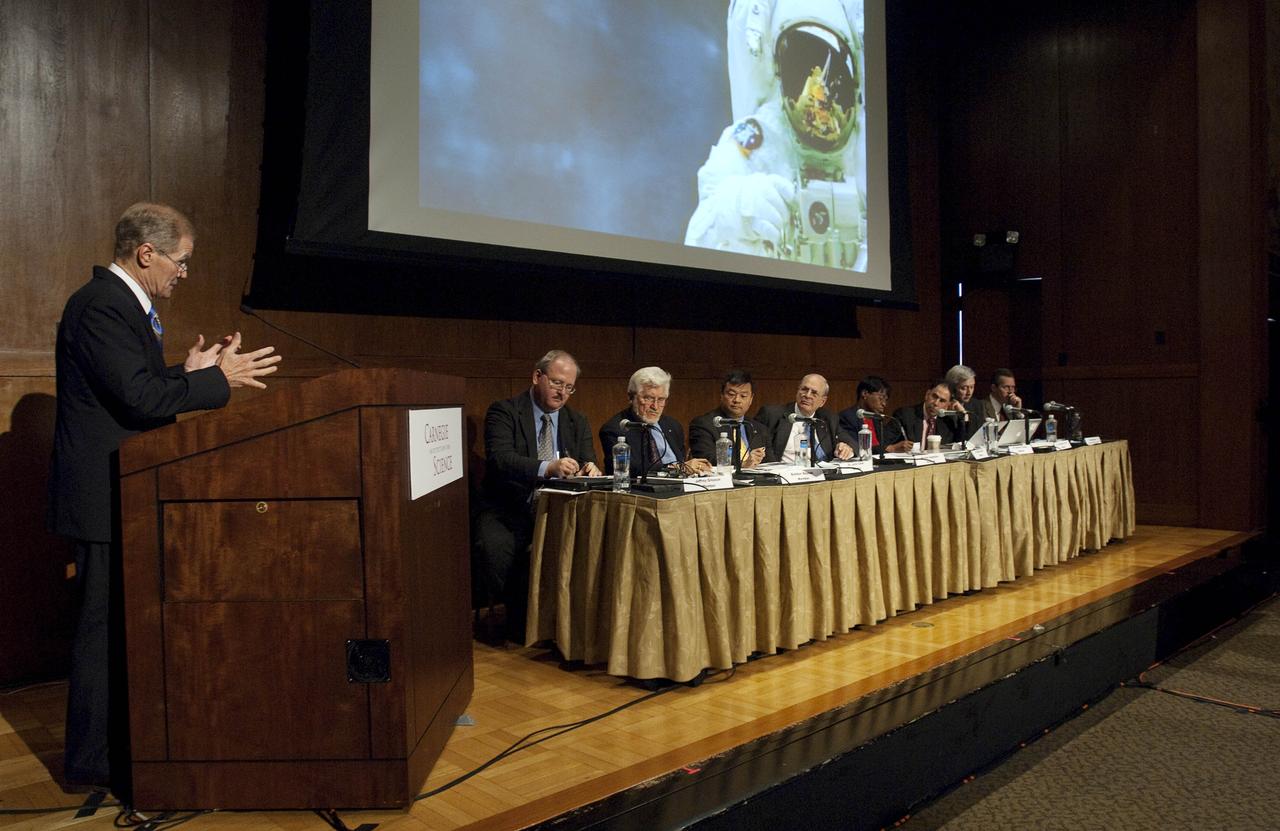
U.S. Sen. Bill Nelson, D-Fla., at podium, addresses members of the Human Space Flight Review Committee, Wednesday, June 17, 2009, at the Carnegie Institution in Washington. Seated from left are Jeffrey Greason, Bohdan Bejmuk, Dr. Leroy Chiao, Norman Augustine (chair), Dr. Wanda Austin, Dr. Edward Crawley, Dr. Christopher Chyba and Philip McAlister. The panel will examine ongoing and planned NASA development activities and potential alternatives in order to present options for advancing a safe, innovative, affordable and sustainable human space flight program following the space shuttle's retirement. The committee wil present its results by August 2009. Photo Credit: (NASA/Paul E. Alers)
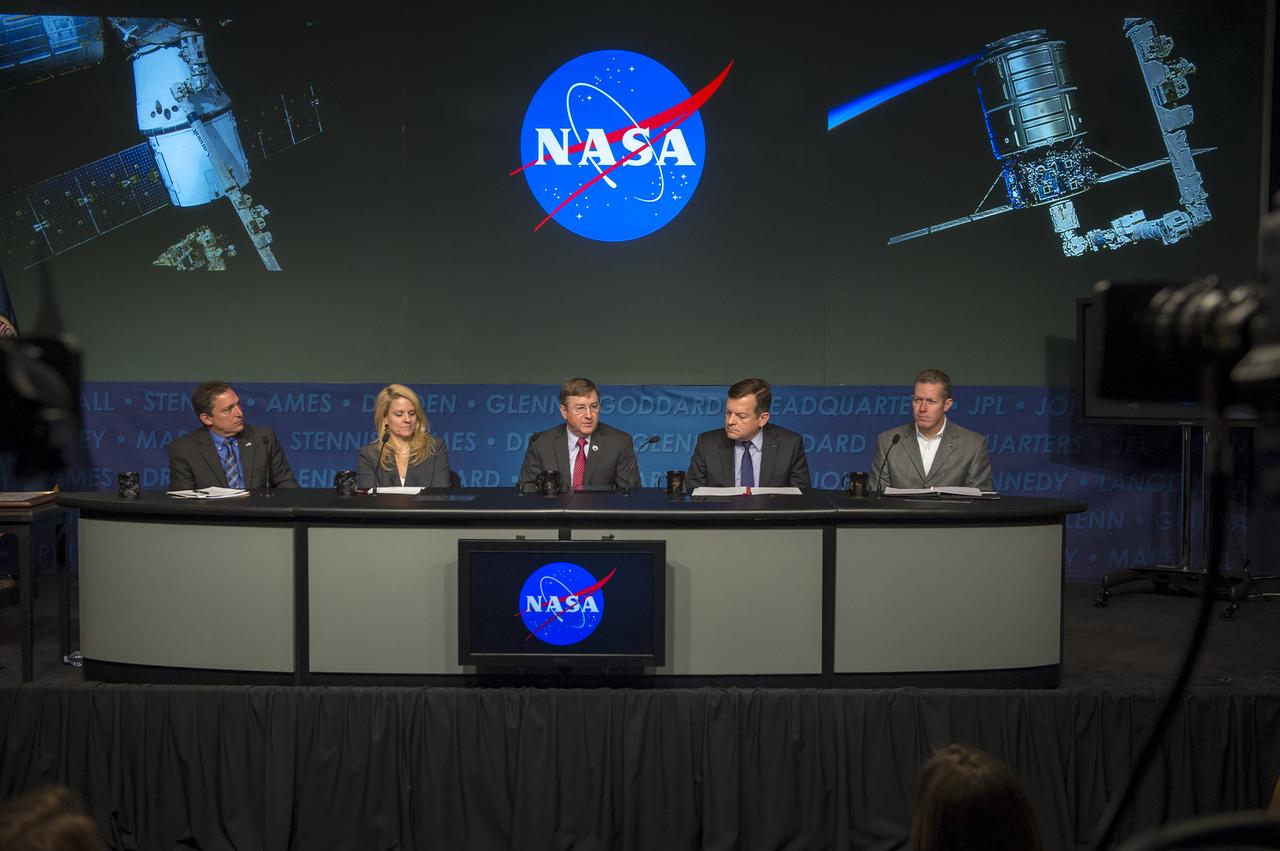
L-R: Alan Lindenmoyer, Manager of Commercial Crew and Cargo Program, NASA; Gwynne Shotwell, President, SpaceX; Frank Culbertson, Executive Vice President and General Manager, Orbital Sciences Advanced Programs Group; Frank Slazer, Vice President of Space Systems, Aerospace Industries Association and Phil McAlister, Director of Commercial Spaceflight Development at NASA, participate in a panel discussion on the Commercial Orbital Transportation Services (COTS) initiative at NASA Headquarters in Washington on Wednesday, November 13, 2013. Through COTS, NASA's partners Space Exploration Technologies Corp. (SpaceX) and Orbital Sciences Corp., developed new U.S. rockets and spacecraft, launched from U.S. soil, capable of transporting cargo to low-Earth orbit and the International Space Station. Photo Credit: (NASA/Jay Westcott)
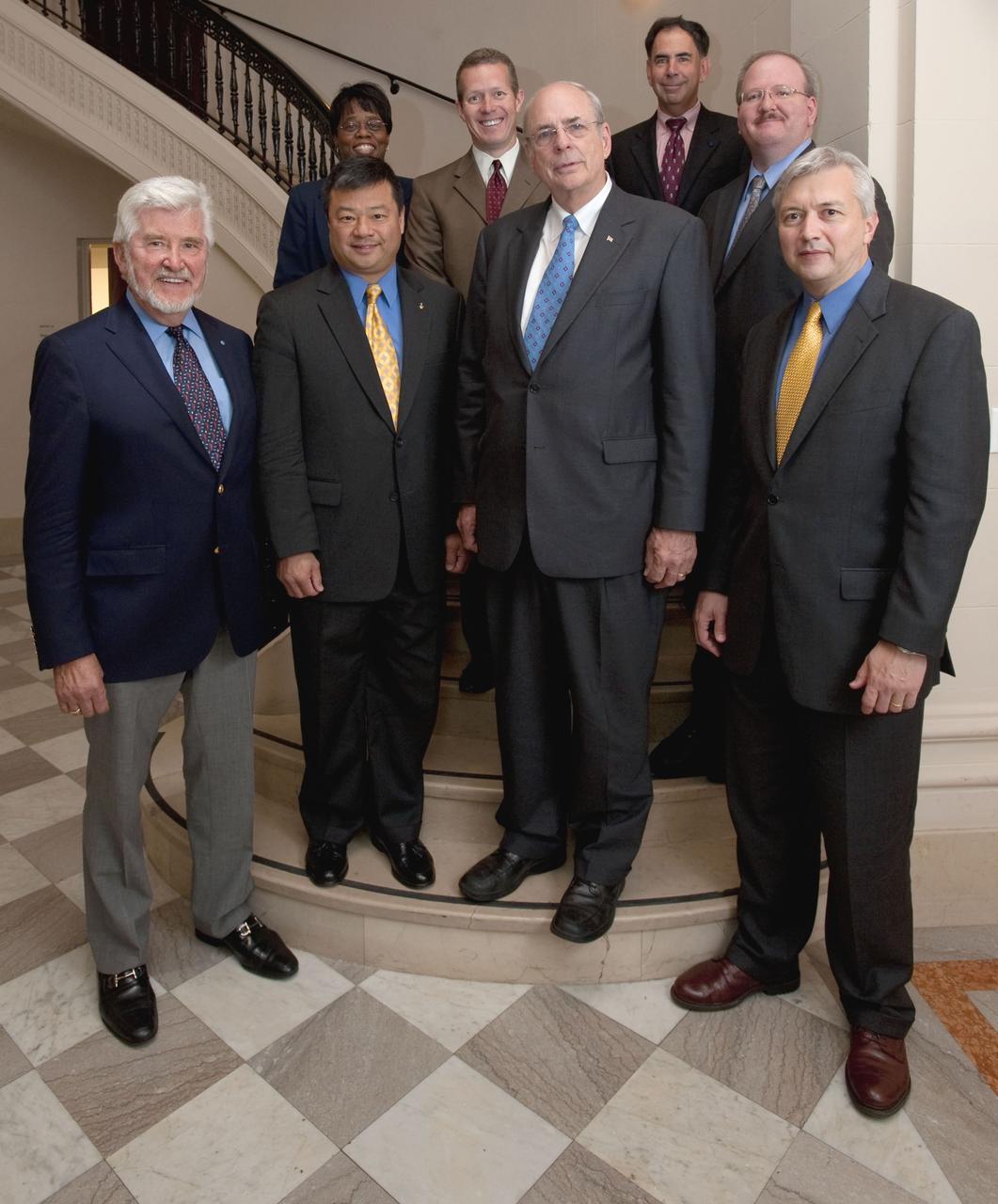
Norman Augustine, chair of the Human Space Flight Review Committee, front center, is joined by other members of the committee, clockwise from left, Bohdan Bejmuk, Leroy Chiao, Dr. Wanda Austin, Philip McAlister, Dr. Edward Crawley, Jeffrey Greason and Dr. Christopher Chyba prior to the start of the first of several public meetings at different U.S. locations, Wednesday, June 17, 2009, at the Carnegie Institution in Washington. The panel will examine ongoing and planned NASA development activities and potential alternatives in order to present options for advancing a safe, innovative, affordable and sustainable human space flight program following the space shuttle's retirement. The committee wil present its results by August 2009. Members of the committee that were not in attendance and are not pictured are Dr. Charles Kennel, Retired Air Force Gen. Lester Lyles and former astronaut Sally Ride. Photo Credit: (NASA/Paul E. Alers)
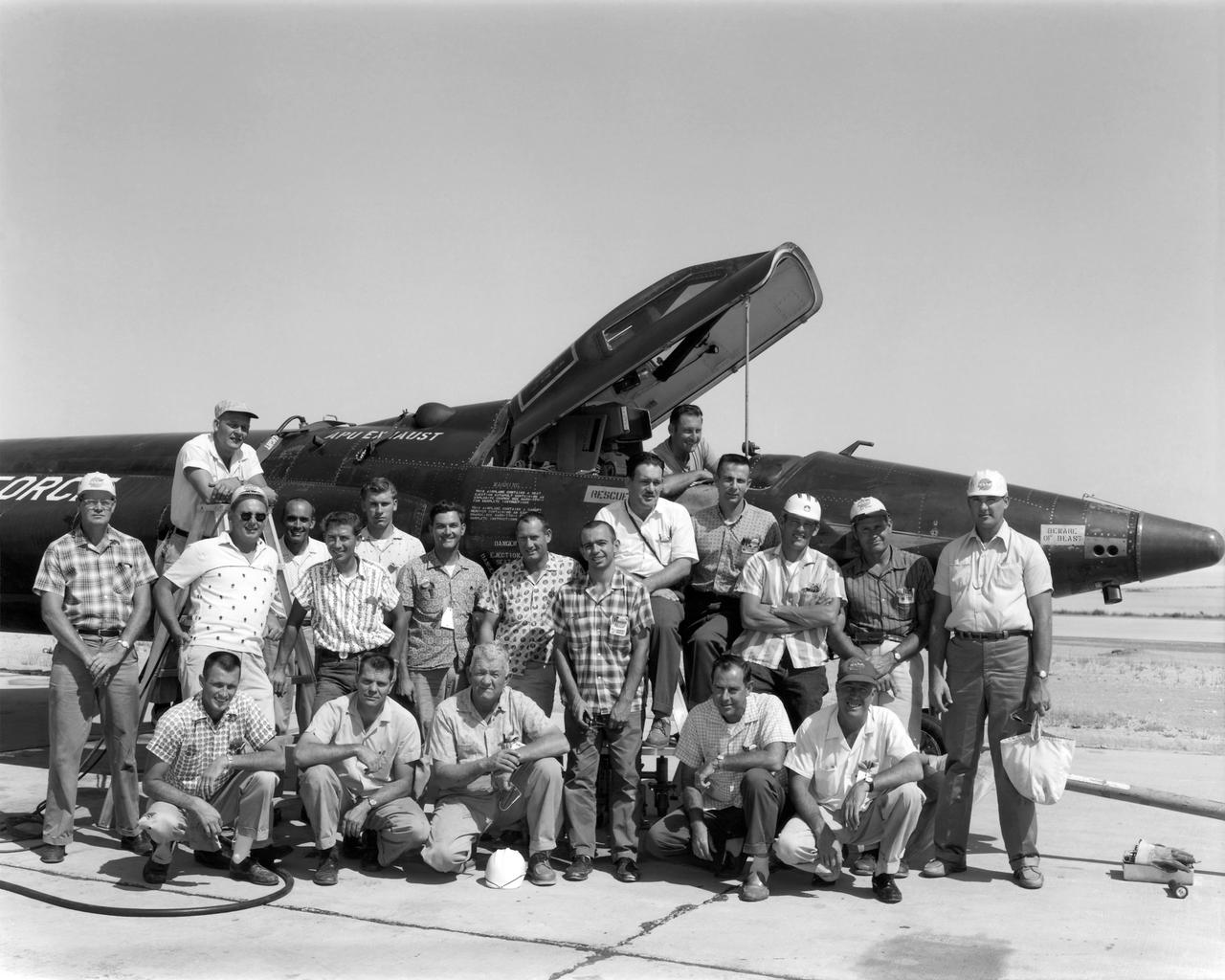
X-15 personnel July 1962 Cockpit: Edward "Ed" Nice Ladder: Thomas "Tom" McAlister Back Row, left to right: William Clark, Edward "Ed" Sabo, Donald "Don" Hall, Billy Furr, Allen Dustin, Raymond "Ray" White, George E. Trott, Alfred "Al" Grieshaber, Merle Curtis, LeRoy "Lee" Adelsbach, Allen Lowe, Jay L. King, Lorenzo "Larry" Barnett. Kneeling, left to right: Byron Gibbs, Price "Bob" Workman, Ira Cupp, unidentified, John Gordon.
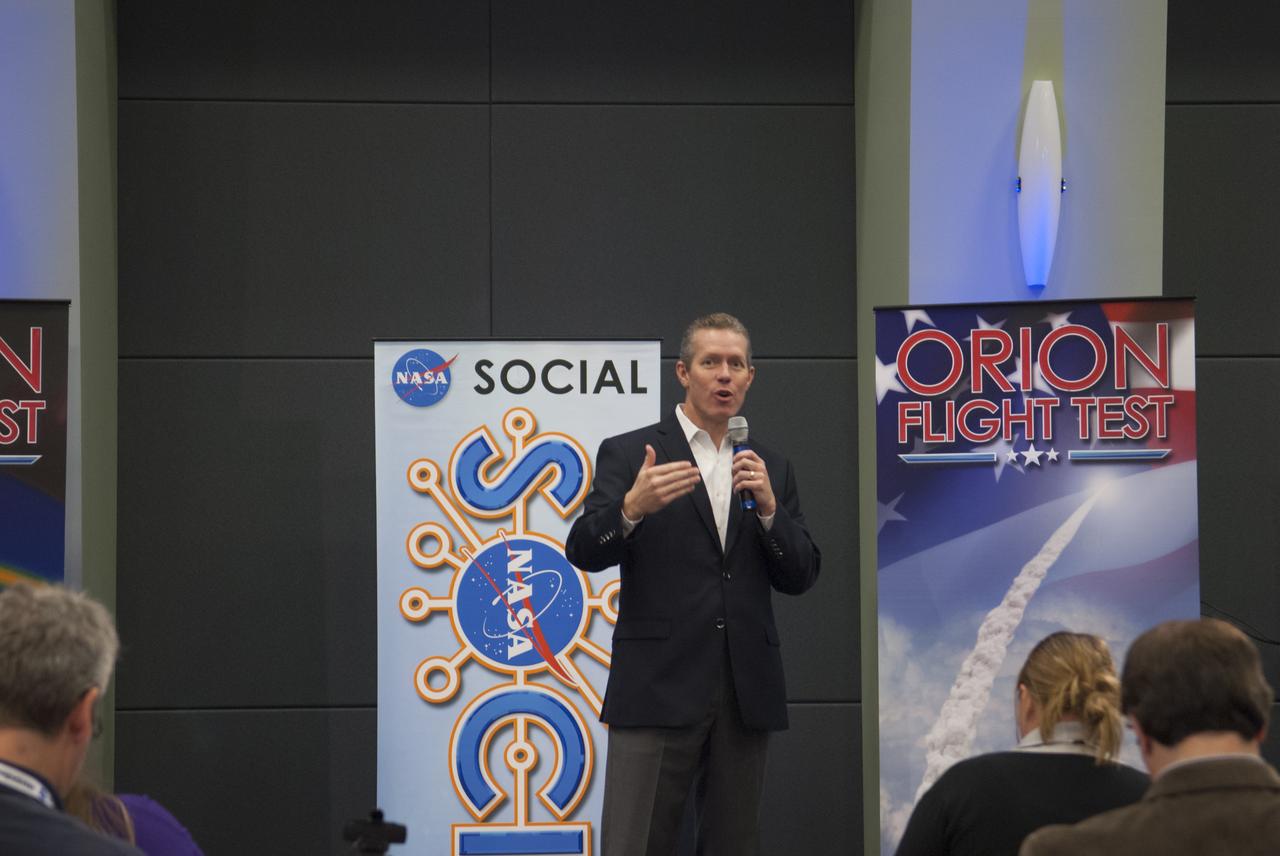
At NASA's Kennedy Space Center in Florida, NASA leaders spoke to social media participants as the Orion spacecraft and its Delta IV Heavy rocket were being prepared for launch. Speakers included Director of Commercial Spaceflight Development Philip McAlister.
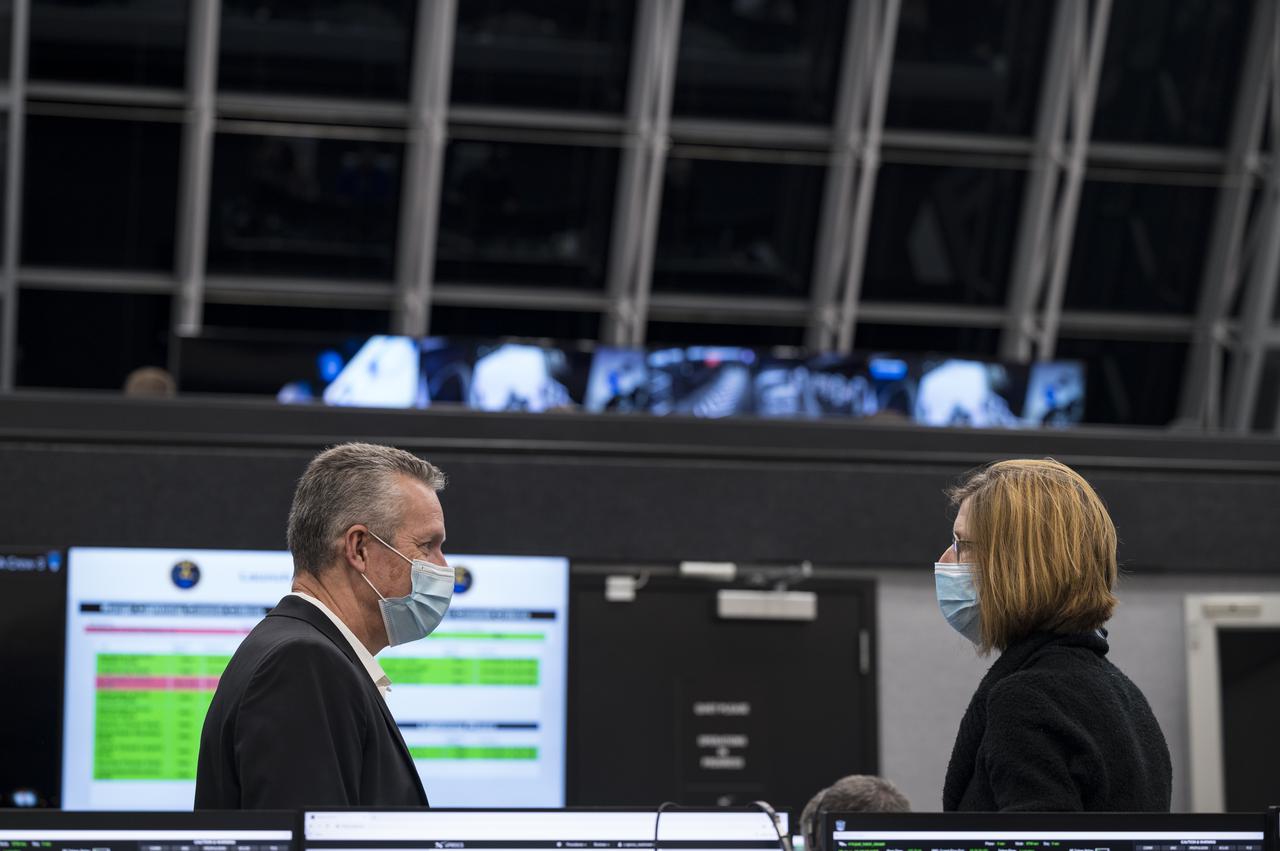
Phil McAlister, director of Commercial Spaceflight at NASA, left, and Kathy Lueders, associate administrator for NASA's Space Operations Mission Directorate, monitor the countdown of the launch of a SpaceX Falcon 9 rocket carrying the company's Crew Dragon spacecraft on NASA’s SpaceX Crew-3 mission with NASA astronauts Raja Chari, Tom Marshburn, Kayla Barron, and ESA (European Space Agency) astronaut Matthias Maurer onboard, Wednesday, Nov. 10, 2021, in firing room four of the Launch Control Center at NASA’s Kennedy Space Center in Florida. NASA’s SpaceX Crew-3 mission is the first crew rotation mission of the SpaceX Crew Dragon spacecraft and Falcon 9 rocket to the International Space Station as part of the agency’s Commercial Crew Program. Chari, Marshburn, Barron, Maurer are scheduled to launch at 9:03 p.m. EST, from Launch Complex 39A at the Kennedy Space Center. Photo Credit: (NASA/Aubrey Gemignani)
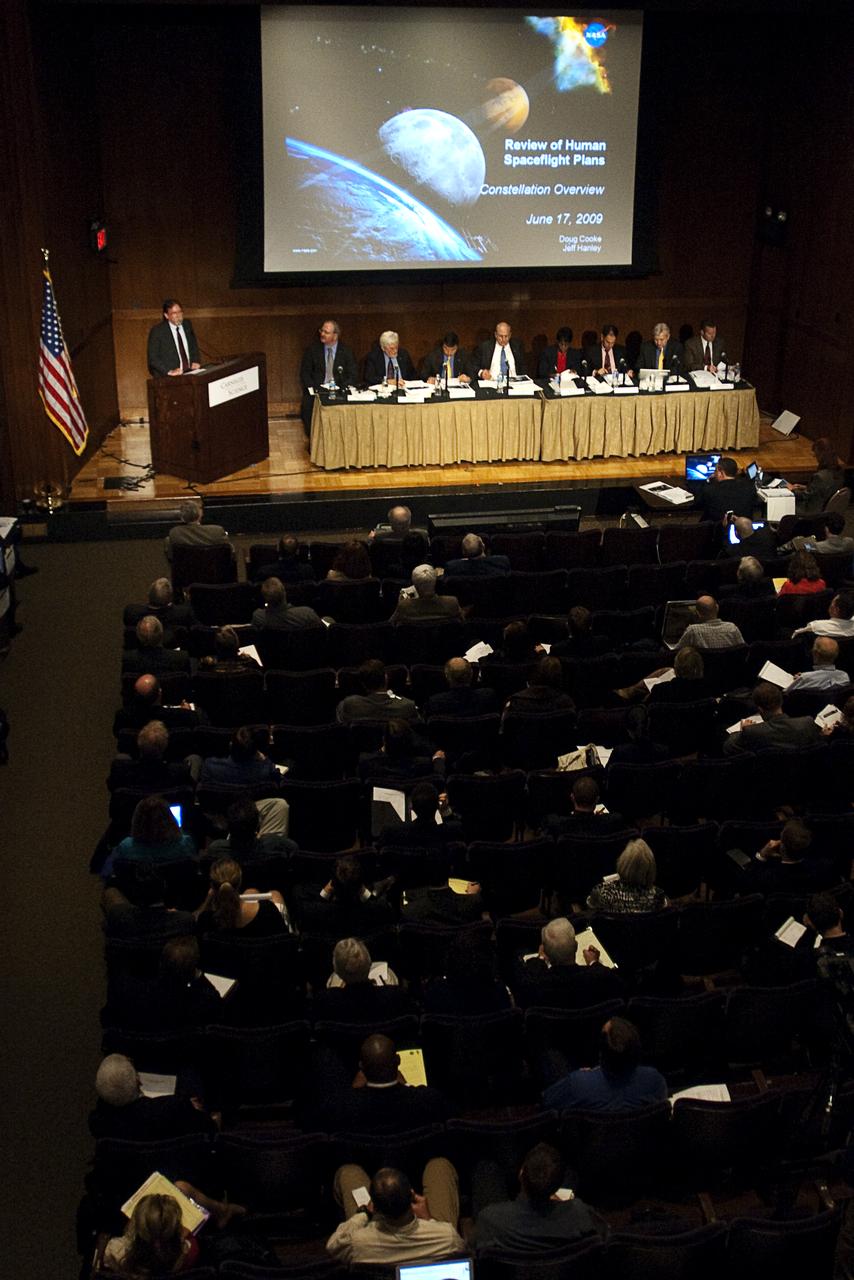
Douglas R. Cooke, Associate Administrator for Exploration Systems Mission Directorate, at podium, addresses the Human Space Flight Review Committee, Wednesday, June 17, 2009, at the Carnegie Institution in Washington. The panel will examine ongoing and planned NASA development activities and potential alternatives in order to present options for advancing a safe, innovative, affordable and sustainable human space flight program following the space shuttle's retirement. The committee wil present its results by August 2009. Seated from left on the panel is Jeffrey Greason, Bohdan Bejmuk, Dr. Leroy Chiao, Norman Augustine (chair), Dr. Wanda Austin, Dr. Edward Crawley, Dr. Christopher Chyba and Philip McAlister. Photo Credit: (NASA/Paul E. Alers)
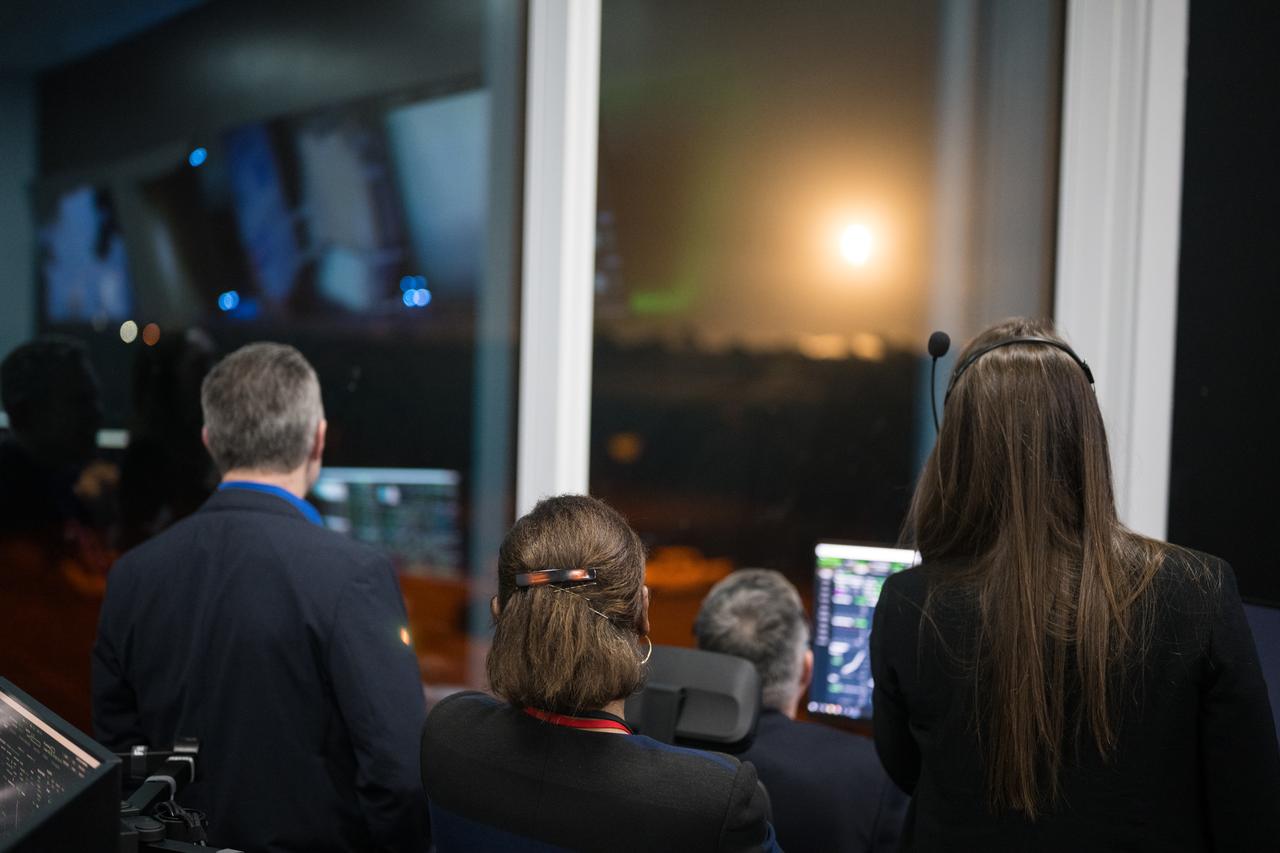
NASA leadership from left to right, Commercial Space Division Director Philip McAlister, Director of NASA’s Johnson Space Center, Vanessa Wyche, manager of NASA’s Commercial Crew Program, Steve Stich, and SpaceX Director, Dragon Mission Management, Sarah Walker, watch the launch of a SpaceX Falcon 9 rocket carrying the company's Dragon spacecraft on the Crew-8 mission with NASA astronauts Matthew Dominick, Michael Barratt, and Jeanette Epps, and Roscosmos cosmonaut Alexander Grebenkin onboard, Sunday, March 3, 2024, in the control room of SpaceX’s HangarX at NASA’s Kennedy Space Center in Florida. NASA’s SpaceX Crew-8 mission is the eighth crew rotation mission of the SpaceX Dragon spacecraft and Falcon 9 rocket to the International Space Station as part of the agency’s Commercial Crew Program. Dominick, Barratt, Epps, Grebenkin launched at 10:53 p.m. EST, from Launch Complex 39A at the Kennedy Space Center. Photo Credit: (NASA/Aubrey Gemignani)
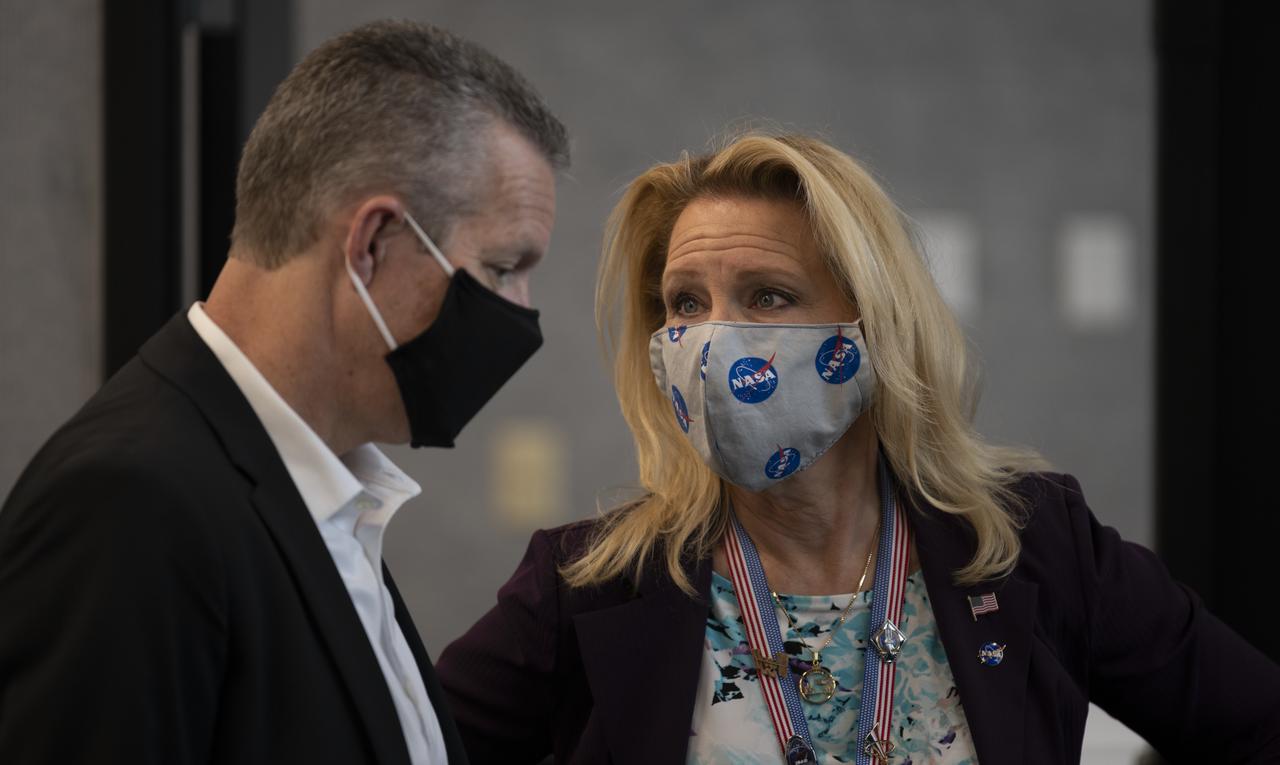
Phil McAlister, NASA’s director of commercial spaceflight is seen with Janet Karika, NASA Chief of Staff during the countdown of the launch of a SpaceX Falcon 9 rocket carrying the company's Crew Dragon spacecraft on NASA’s SpaceX Demo-2 mission with NASA astronauts Robert Behnken and Douglas Hurley onboard, Saturday, May 30, 2020, in firing room four of the Launch Control Center at NASA’s Kennedy Space Center in Florida. NASA’s SpaceX Demo-2 mission is the first launch with astronauts of the SpaceX Crew Dragon spacecraft and Falcon 9 rocket to the International Space Station as part of the agency’s Commercial Crew Program. The test flight serves as an end-to-end demonstration of SpaceX’s crew transportation system. Behnken and Hurley launched at 3:22 p.m. EDT on Saturday, May 30, from Launch Complex 39A at the Kennedy Space Center. A new era of human spaceflight is set to begin as American astronauts once again launch on an American rocket from American soil to low-Earth orbit for the first time since the conclusion of the Space Shuttle Program in 2011. Photo Credit: (NASA/Joel Kowsky)
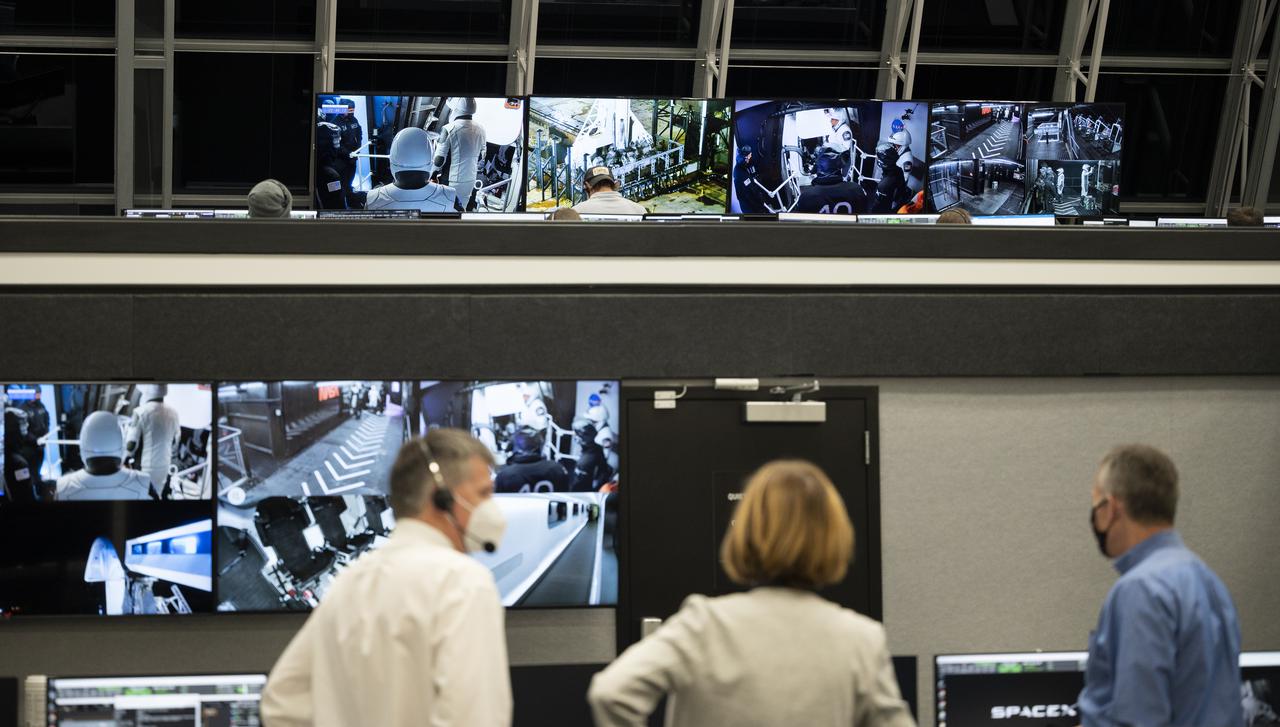
Steve Stich, manager of NASA’s Commercial Crew Program, left, Kathy Lueders, associate administrator for NASA's Human Exploration and Operations Mission Directorate, center, and Phil McAlister, NASA’s director of commercial spaceflight, watch as NASA astronauts Shane Kimbrough and Megan McArthur are seen on monitors as they prepare to board SpaceX’s Crew Dragon spacecraft for launch, Friday, April 23, 2021, in firing room four of the Launch Control Center at NASA’s Kennedy Space Center in Florida. NASA’s SpaceX Crew-2 mission is the second crew rotation mission of the SpaceX Crew Dragon spacecraft and Falcon 9 rocket to the International Space Station as part of the agency’s Commercial Crew Program. Kimbrough, McArthur, ESA (European Space Agency) astronaut Thomas Pesquet, and Japan Aerospace Exploration Agency (JAXA) astronaut Akihiko Hoshide launched at 5:49 a.m. EDT, from Launch Complex 39A at the Kennedy Space Center. Photo Credit: (NASA/Joel Kowsky)
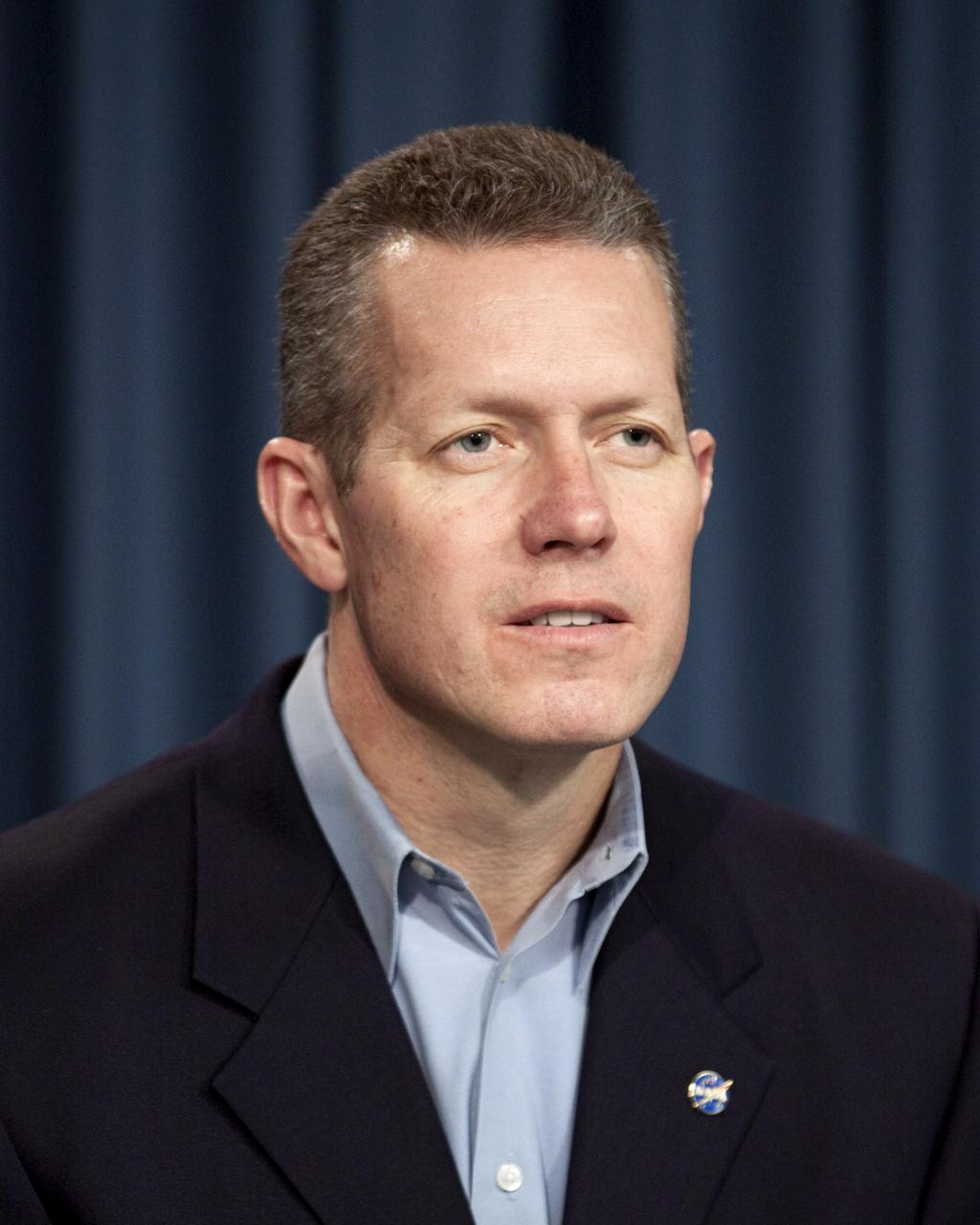
CAPE CANAVERAL, Fla. -- At a news conference NASA officials and industry partners discuss progress of the agency's Commercial Crew Program. Among those participating in the briefing is Phil McAlister, NASA Commercial Spaceflight Development director. Through CCP, NASA is facilitating the development of U.S. commercial crew space transportation capabilities to achieve safe, reliable and cost-effective access to and from low-Earth orbit for potential future government and commercial customers. For more information, visit http://www.nasa.gov/commercialcrew Photo credit: NASA/Kim Shiflett
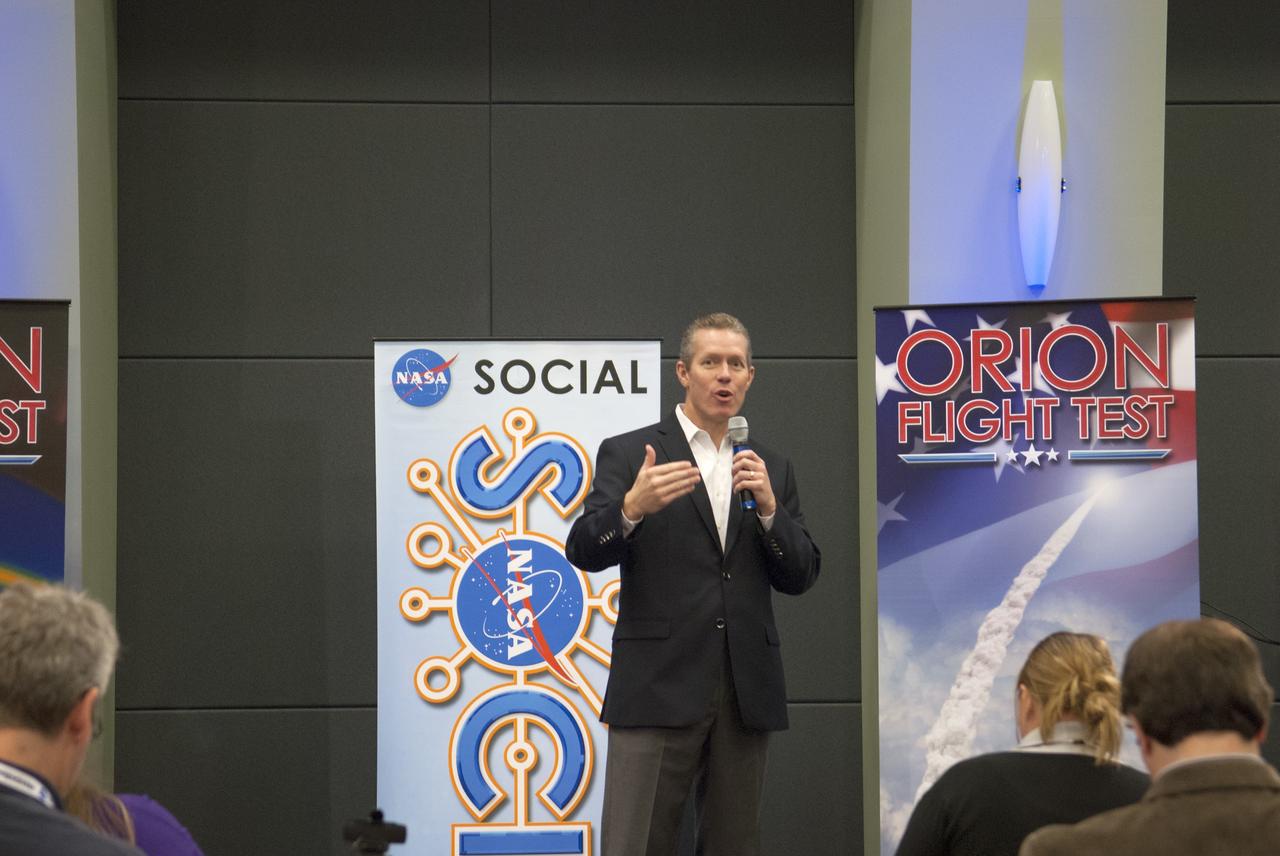
CAPE CANAVERAL, Fla. – At NASA's Kennedy Space Center in Florida, NASA leaders spoke to social media participants as the Orion spacecraft and its Delta IV Heavy rocket were being prepared for launch. Speakers included Director of Commercial Spaceflight Development Philip McAlister. For more information, visit www.nasa.gov/orion Photo credit: NASA/Jim Grossman
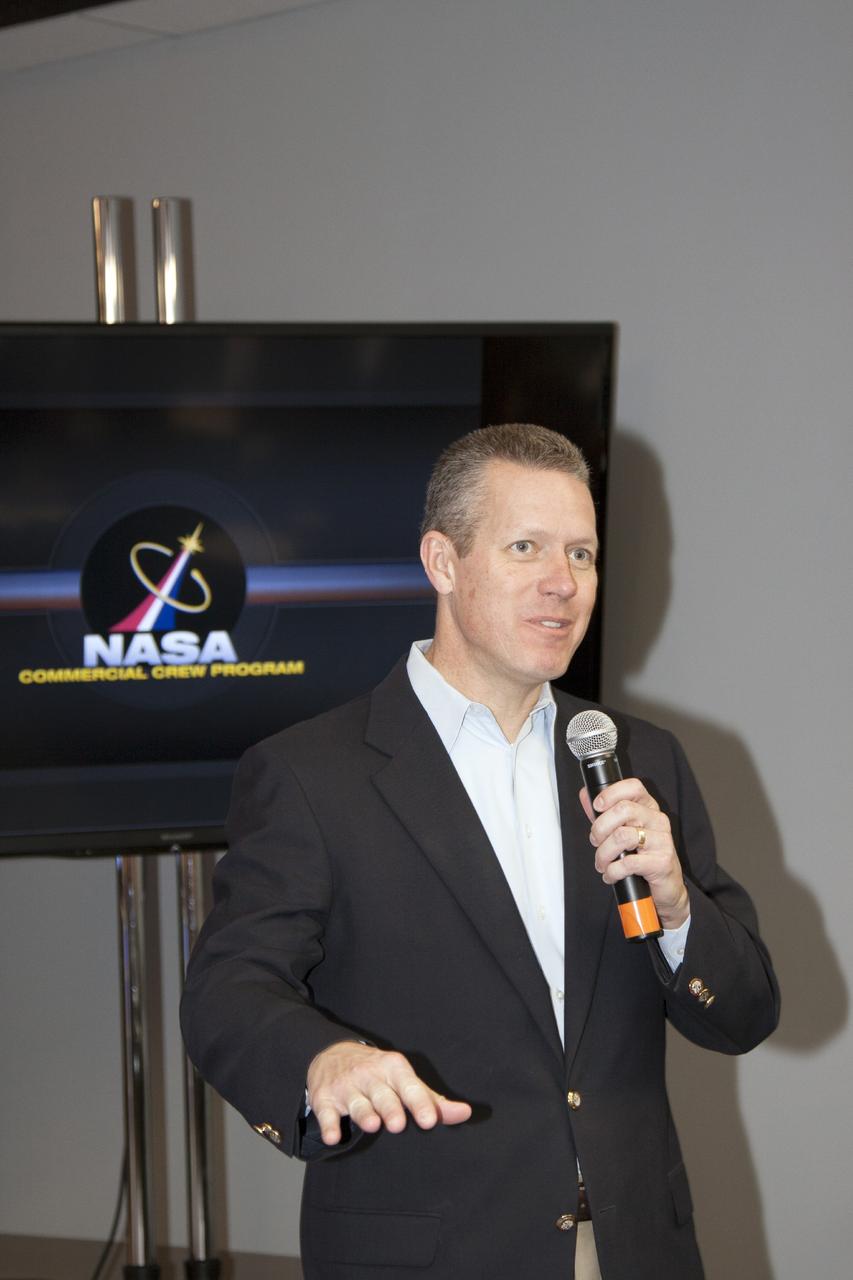
CAPE CANAVERAL, Fla. – Phil McAlister, NASA's director of Commercial Spaceflight Development, welcomes participants to an industry conference inside the Television Auditorium at NASA's Kennedy Space Center in Florida. The conference was held following the program's request for proposals from commercial companies for a development and certification contract called the Commercial Crew Transportation Capability CCtCap. The contract will provide a finish line for the agency following more than four years of development work by CCP and American aerospace companies. CCtCap is the second phase of a two-phase certification plan for privately built and operated integrated crew transportation systems. Photo credit: NASA/Jim Grossmann
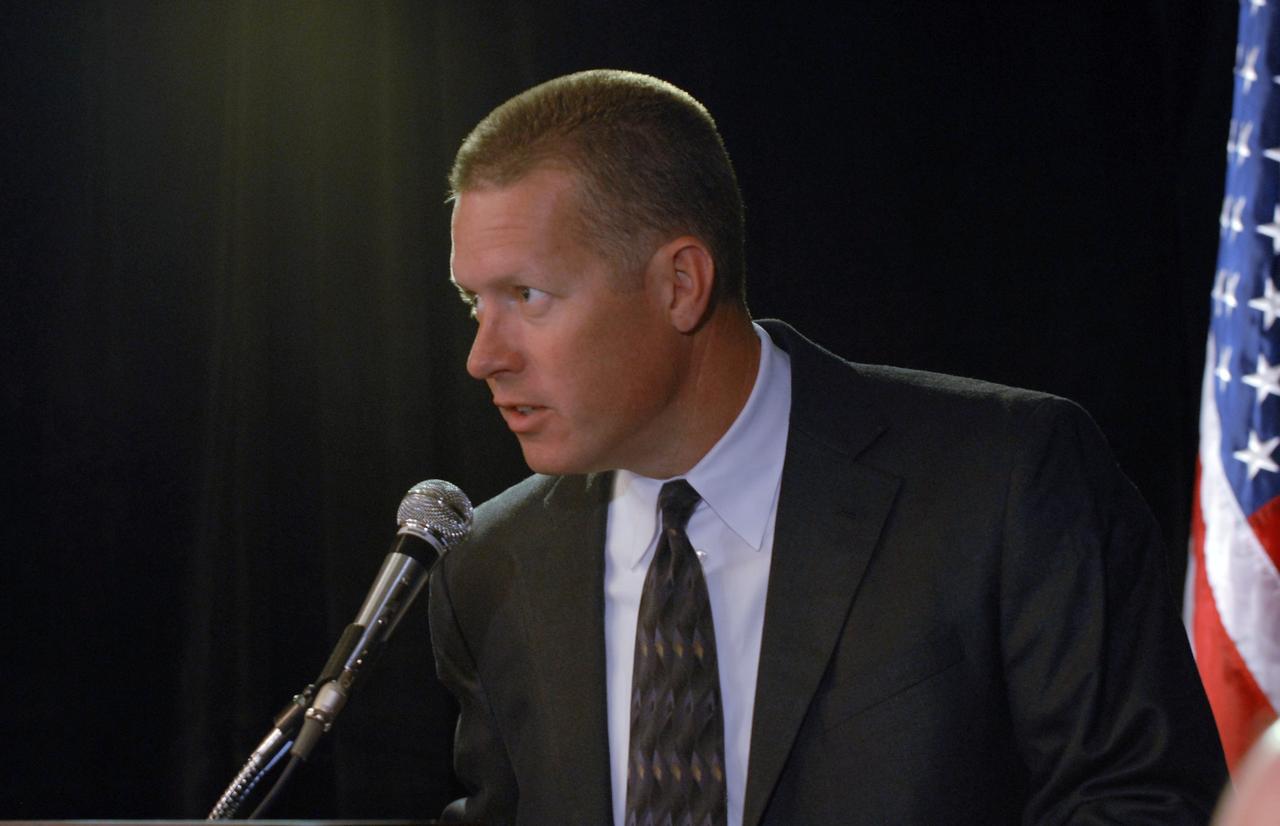
CAPE CANAVERAL, Fla. – Phil McAlister, special assistant for Program Analysis in NASA's Office of Program Analysis and Evaluation, introduces the Augustine Commission, meeting in Cocoa Beach, Fla. At the request of the Office of Science and Technology Policy, NASA established the Review of U.S. Human Space Flight Plans Committee, known as the Augustine Commission. Chaired by Norman R. Augustine, retired chairman and CEO of Lockheed Martin Corp., the committee is conducting an independent review of ongoing U.S. human spaceflight plans and programs, as well as alternatives, to ensure the nation is pursuing the best trajectory for the future of human space flight - one that is safe, innovative, affordable, and sustainable. Photo credit: NASA/Jim Grossmann
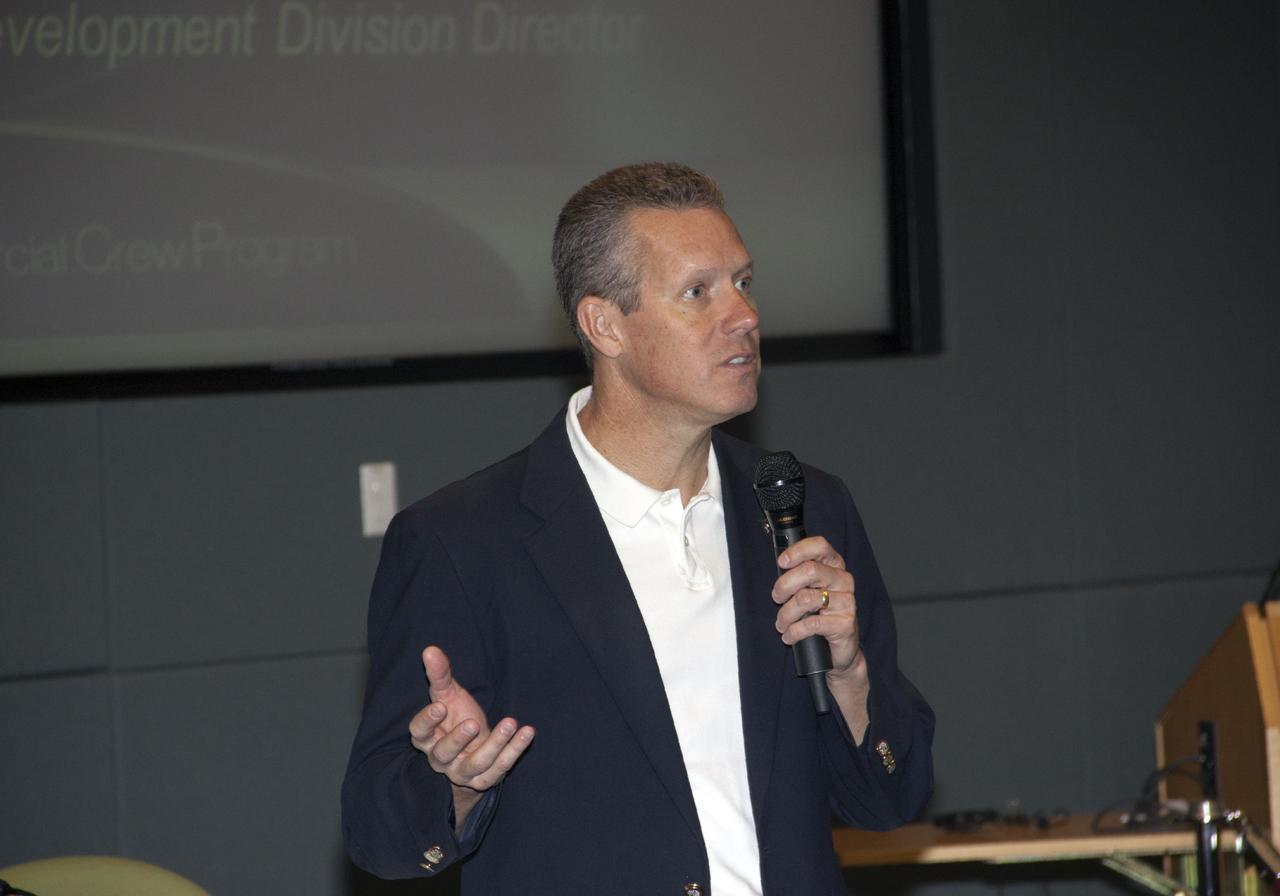
CAPE CANAVERAL, Fla. - Phil McAlister, director of Commercial Spaceflight Development at NASA Headquarters in Washington, D.C., makes opening remarks at the Commercial Crew Transportation Capability, or CCtCap, Pre-Proposal Conference at Kennedy Space Center in Florida. CCtCap will be the next phase of certification efforts for the agency's Commercial Crew Program, or CCP, missions to the International Space Station. The purpose of the conference was to involve aerospace industry representatives in the CCtCap draft Request for Proposal, or RFP, process and provide a greater understanding for both parties before the official RFP is released in the fall of 2013. To learn more about CCP, visit www.nasa.gov/commercialcrew. Photo credit: NASA/Jim Grossmann
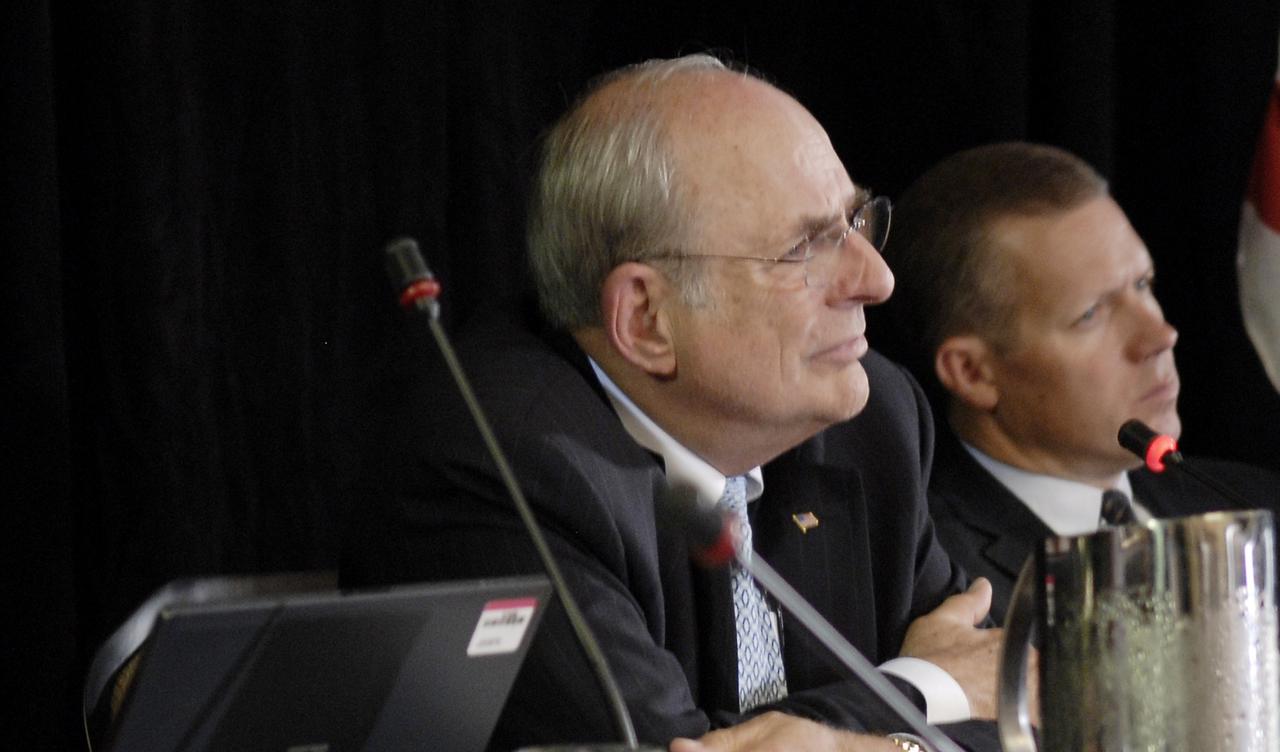
CAPE CANAVERAL, Fla. – Members of the Augustine Commission are meeting in Cocoa Beach, Fla. At left is Chairman Norman R. Augustine, retired chairman and CEO of Lockheed Martin Corp., and, at right, is Phil McAlister, special assistant for Program Analysis in NASA's Office of Program Analysis and Evaluation. At the request of the Office of Science and Technology Policy, NASA established the Review of U.S. Human Space Flight Plans Committee, known as the Augustine Commission. The committee is conducting an independent review of ongoing U.S. human spaceflight plans and programs, as well as alternatives, to ensure the nation is pursuing the best trajectory for the future of human space flight - one that is safe, innovative, affordable, and sustainable. Photo credit: NASA/Kim Shiflett
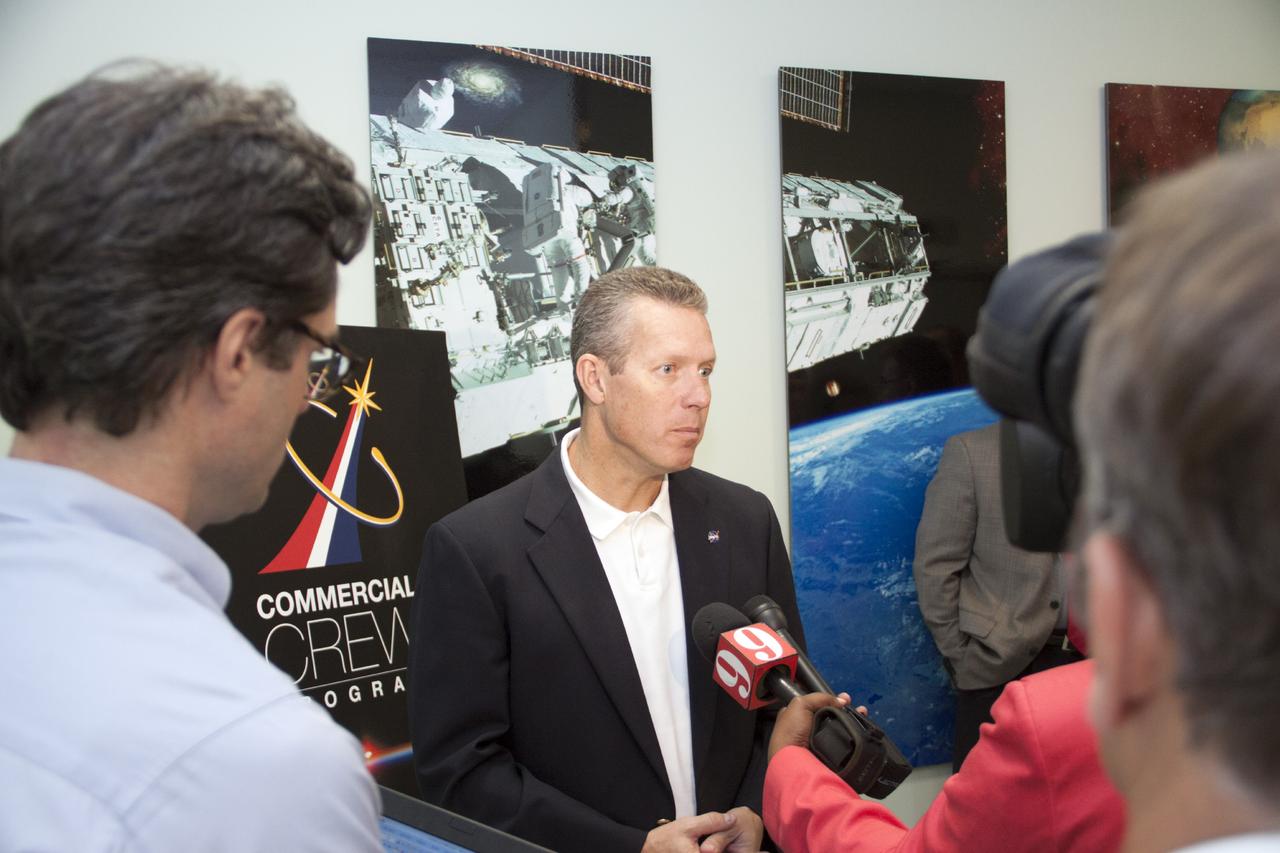
CAPE CANAVERAL, Fla. - Phil McAlister, director of Commercial Spaceflight Development at NASA Headquarters in Washington, D.C., talks to media following the Commercial Crew Transportation Capability, or CCtCap, Pre-Proposal Conference at Kennedy Space Center in Florida. CCtCap will be the next phase of certification efforts for the agency's Commercial Crew Program, or CCP, missions to the International Space Station. The purpose of the conference was to involve aerospace industry representatives in the CCtCap draft Request for Proposal, or RFP, process and provide a greater understanding for both parties before the official RFP is released in the fall of 2013. To learn more about CCP, visit www.nasa.gov/commercialcrew. Photo credit: NASA/Jim Grossmann
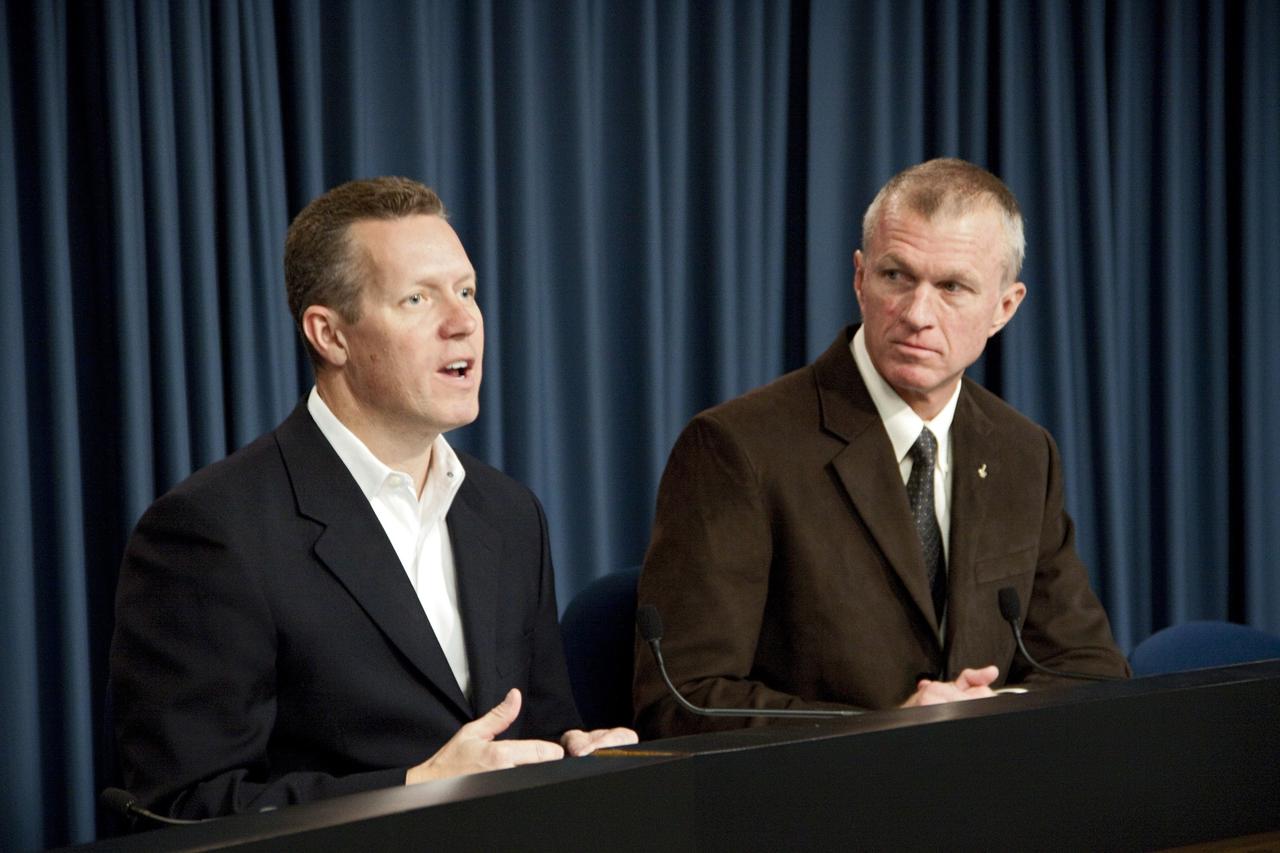
CAPE CANAVERAL, Fla. -- In the Press Site auditorium at NASA's Kennedy Space Center in Florida, Phil McAlister (left), director, Commercial Spaceflight Development in NASA’s Human Exploration and Operations Mission Directorate, and Brent Jeff, deputy director, Commercial Crew Program, brief representatives from aerospace industry partners and the media during a strategy forum on the next steps for NASA's Commercial Crew Program. The goal of the Commercial Crew Program is to have a commercially developed, human-capable, certified spacecraft safely flying astronauts into orbit and to the International Space Station by the middle of the decade. For more information about NASA's Commercial Crew Program, visit http://www.nasa.gov/exploration/commercial. Photo credit: NASA/Jim Grossmann
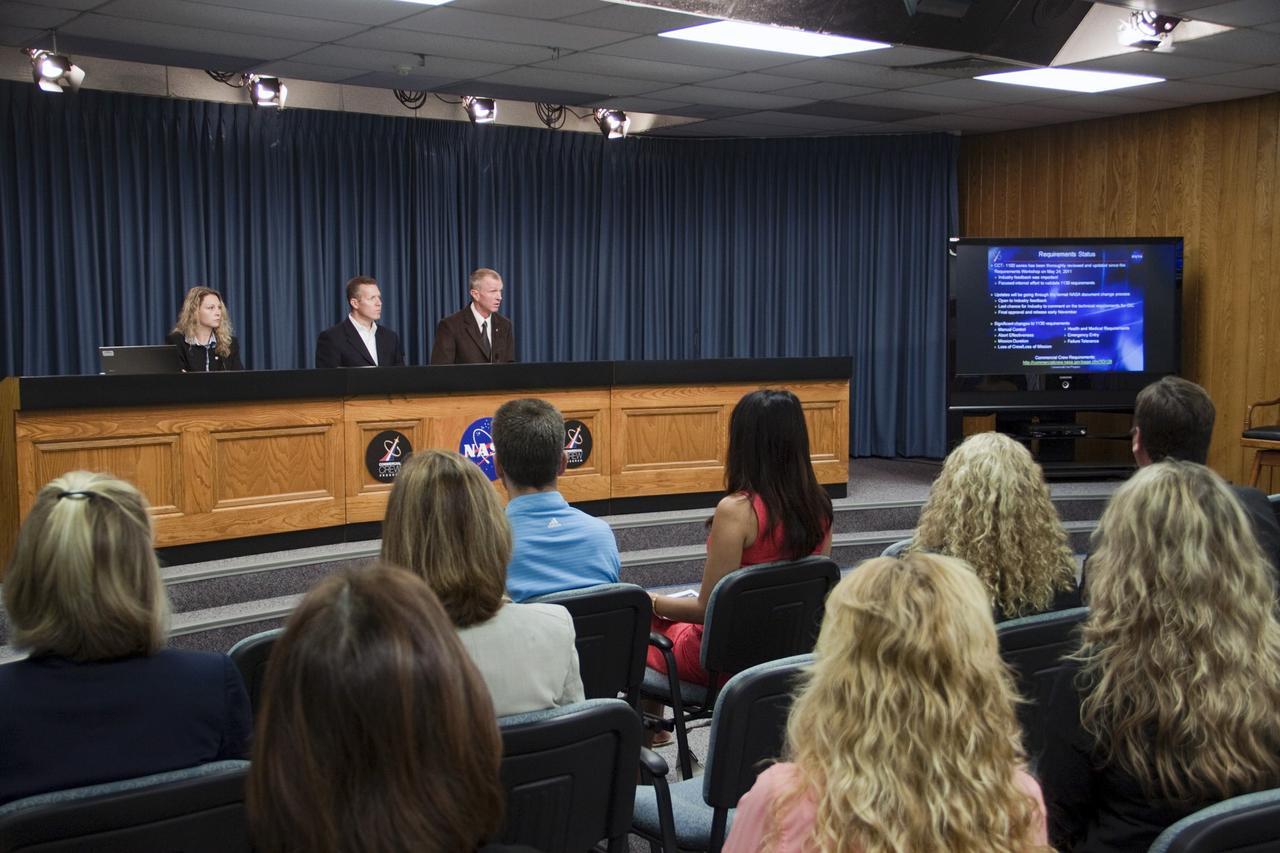
CAPE CANAVERAL, Fla. -- Representatives from aerospace industry partners and the media are given an overview on NASA's Commercial Crew Program's next steps during a strategy forum held in the Press Site auditorium at Kennedy Space Center in Florida. On the dais, from left, are Candrea Thomas, NASA Public Affairs; Phil McAlister, director, Commercial Spaceflight Development in NASA’s Human Exploration and Operations Mission Directorate, and Brent Jeff, deputy director, Commercial Crew Program. The goal of the Commercial Crew Program is to have a commercially developed, human-capable, certified spacecraft safely flying astronauts into orbit and to the International Space Station by the middle of the decade. For more information about NASA's Commercial Crew Program, visit http://www.nasa.gov/exploration/commercial. Photo credit: NASA/Jim Grossmann
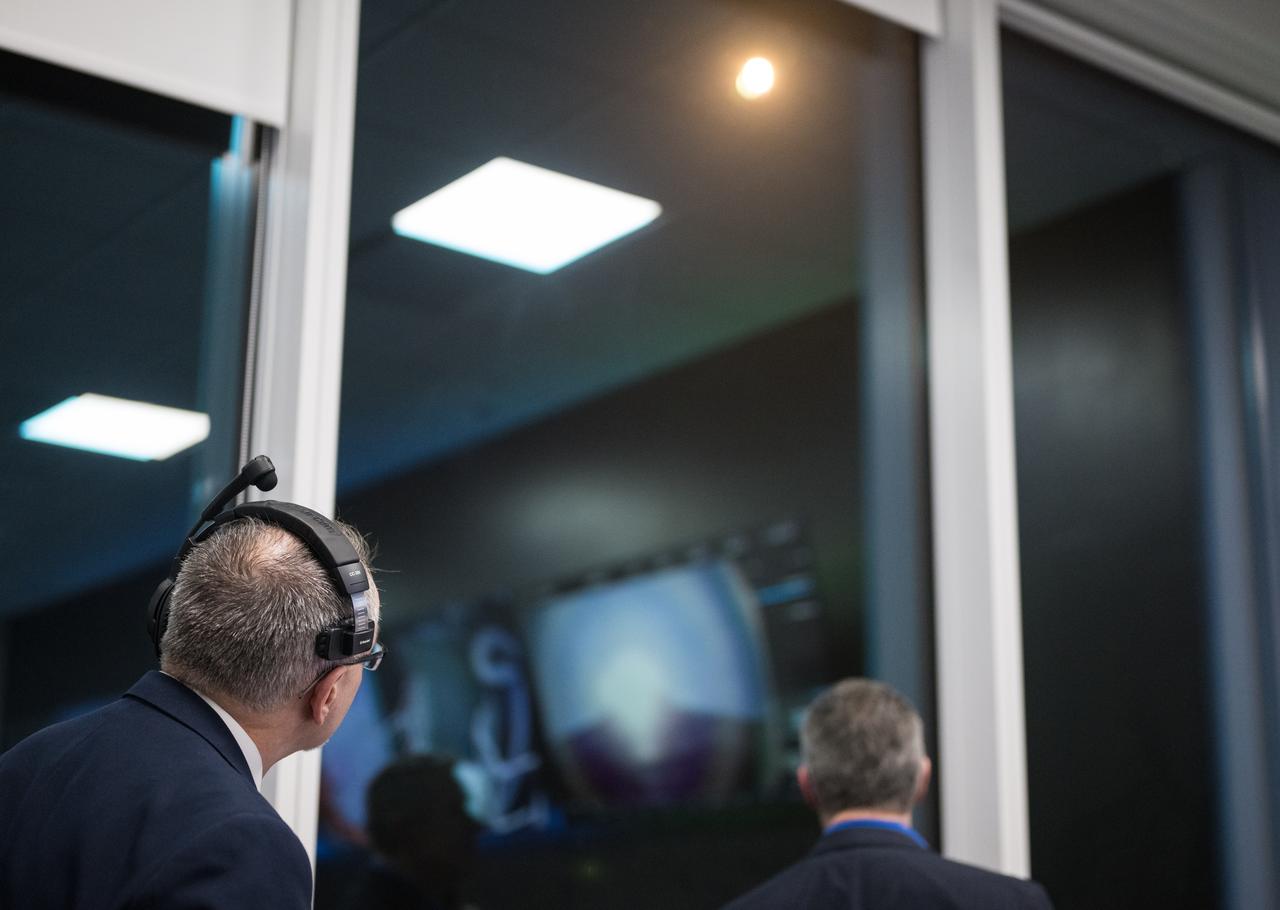
NASA associate administrator Jim Free, left, and Commercial Space Division Director Philip McAlister watch the launch of a SpaceX Falcon 9 rocket carrying the company's Dragon spacecraft on the Crew-8 mission with NASA astronauts Matthew Dominick, Michael Barratt, and Jeanette Epps, and Roscosmos cosmonaut Alexander Grebenkin onboard, Sunday, March 3, 2024, in the control room of SpaceX’s HangarX at NASA’s Kennedy Space Center in Florida. NASA’s SpaceX Crew-8 mission is the eighth crew rotation mission of the SpaceX Dragon spacecraft and Falcon 9 rocket to the International Space Station as part of the agency’s Commercial Crew Program. Dominick, Barratt, Epps, Grebenkin launched at 10:53 p.m. EST, from Launch Complex 39A at the Kennedy Space Center. Photo Credit: (NASA/Aubrey Gemignani)
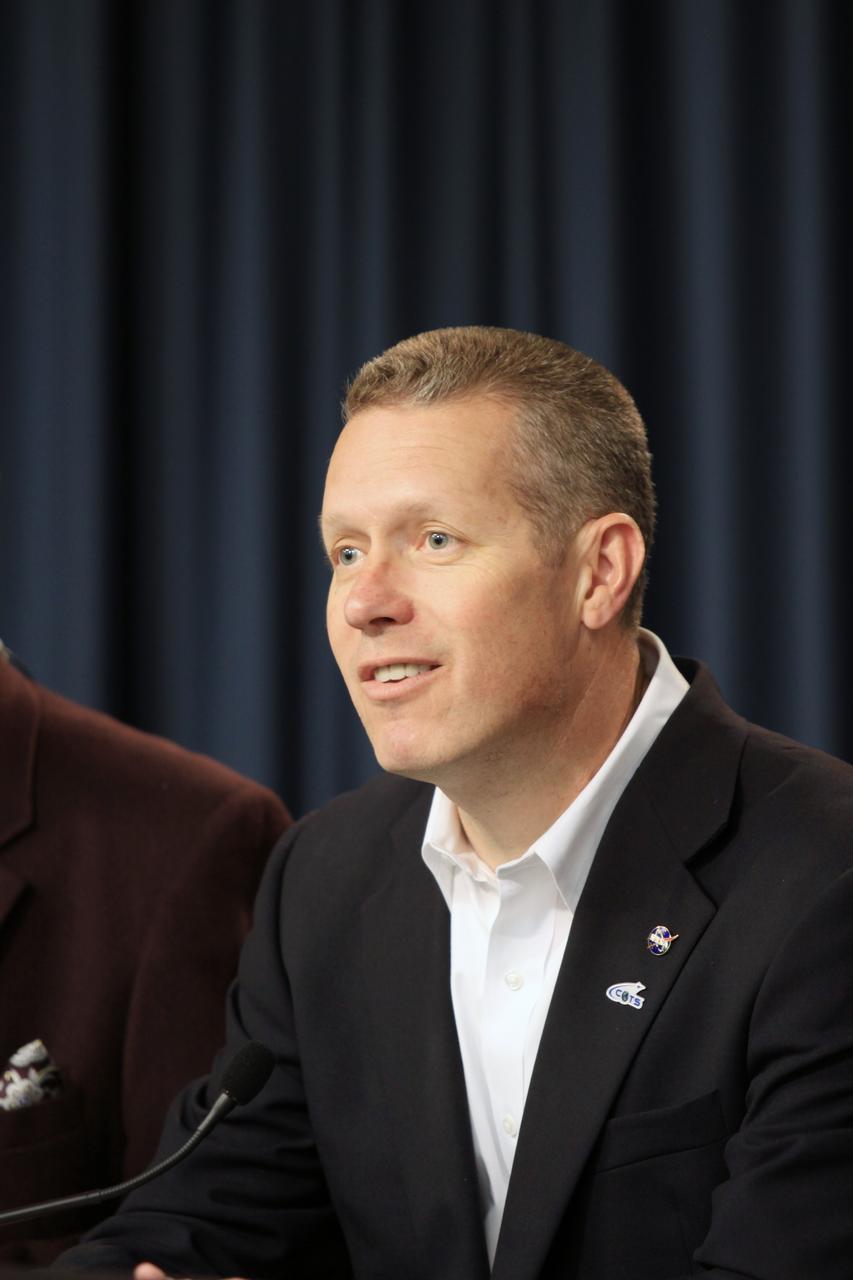
CAPE CANAVERAL, Fla. – Phil McAlister, director, NASA Commercial Spaceflight Development, participates in a prelaunch news conference in the Press Site Auditorium at NASA’s Kennedy Space Center in Florida. Liftoff of the SpaceX Falcon 9 rocket carrying a Dragon capsule to orbit is set for 4:55 a.m. EDT on May 19. The launch will be the company's second demonstration test flight for NASA's Commercial Orbital Transportation Services Program, or COTS. During the flight, the capsule will conduct a series of check-out procedures to test and prove its systems, including rendezvous and berthing with the International Space Station. If the capsule performs as planned, the cargo and experiments it is carrying will be transferred to the station. The cargo includes food, water and provisions for the station’s Expedition crews, such as clothing, batteries and computer equipment. Under COTS, NASA has partnered with two aerospace companies to deliver cargo to the station. For more information, visit http://www.nasa.gov/spacex. Photo credit: NASA/Jim Grossmann
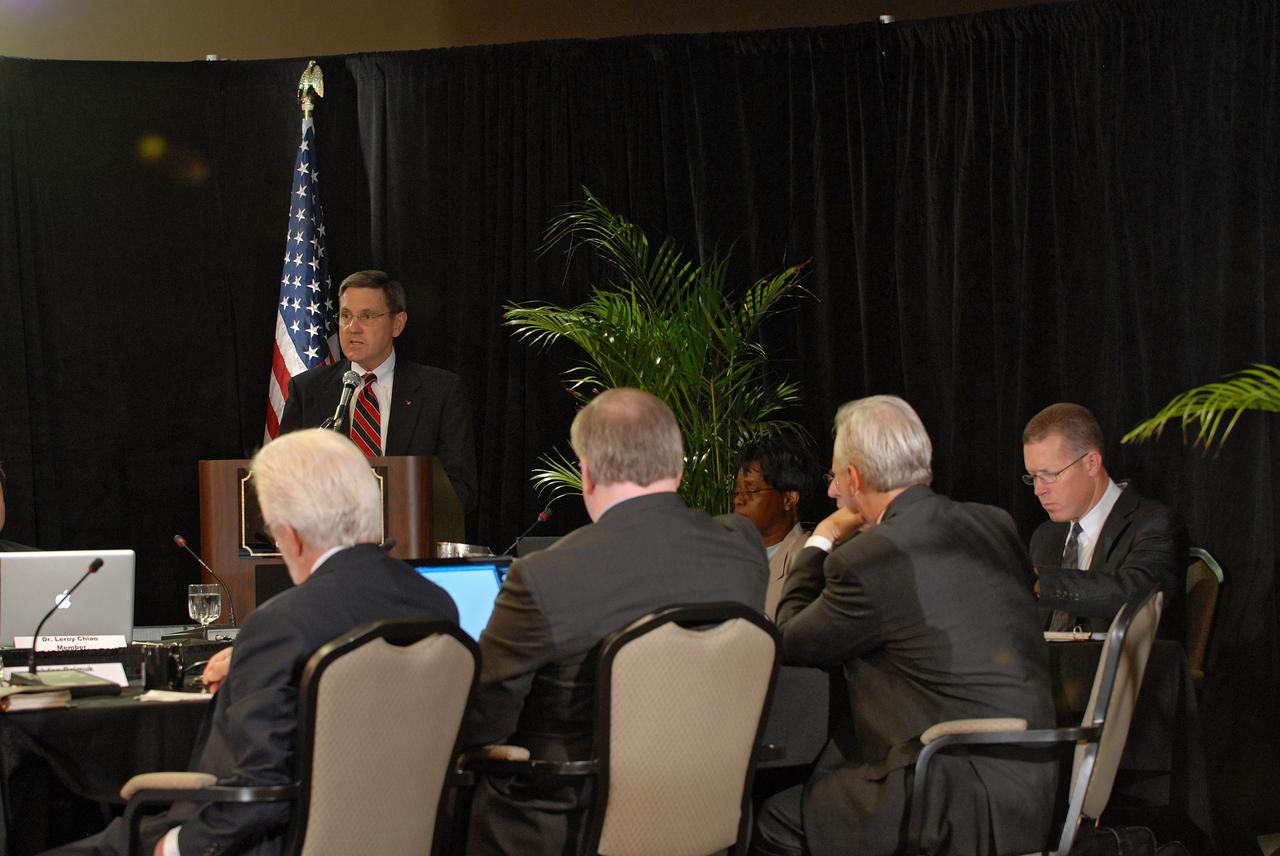
CAPE CANAVERAL, Fla. – NASA Kennedy Space Center's Center Director Bob Cabana (right) speaks during the meeting of the Augustine Commission in Cocoa Beach, Fla. At the conference table in the foreground are members of the commission: (from left) Bohdan Bejmuk, chair of Constellation Program Standing Review Board; Jeff Greason, co-founder and CEO of XCOR Aerospace; Dr. Christopher Chyba, professor of Astrophysical Sciences and international Affairs at Princeton University; and Phil McAlister, special assistant for Program Analysis in NASA's Office of Program Analysis and Evaluation. At the request of the Office of Science and Technology Policy, NASA established the Review of U.S. Human Space Flight Plans Committee, known as the Augustine Commission. Chaired by Norman R. Augustine, retired chairman and CEO of Lockheed Martin Corp., the committee is conducting an independent review of ongoing U.S. human spaceflight plans and programs, as well as alternatives, to ensure the nation is pursuing the best trajectory for the future of human space flight - one that is safe, innovative, affordable, and sustainable. Photo credit: NASA/Jim Grossmann
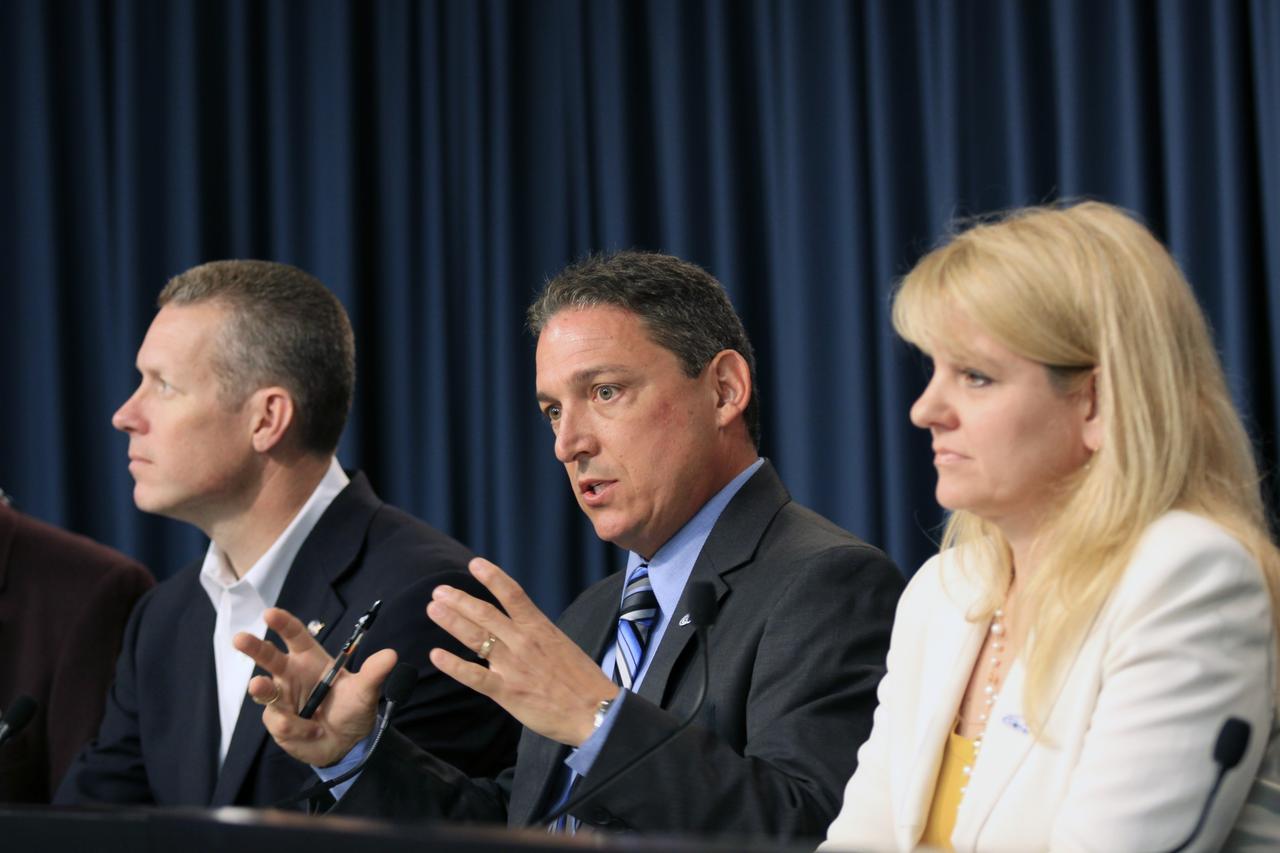
CAPE CANAVERAL, Fla. – Participating in a prelaunch news conference in the Press Site Auditorium at NASA’s Kennedy Space Center in Florida are, from left, Phil McAlister, director, NASA Commercial Spaceflight Development, Alan Lindenmoyer, manager, NASA Commercial Crew and Cargo Program, and Gwynne Shotwell, president, SpaceX. Liftoff of the SpaceX Falcon 9 rocket carrying a Dragon capsule to orbit is set for 4:55 a.m. EDT on May 19. The launch will be the company's second demonstration test flight for NASA's Commercial Orbital Transportation Services Program, or COTS. During the flight, the capsule will conduct a series of check-out procedures to test and prove its systems, including rendezvous and berthing with the International Space Station. If the capsule performs as planned, the cargo and experiments it is carrying will be transferred to the station. The cargo includes food, water and provisions for the station’s Expedition crews, such as clothing, batteries and computer equipment. Under COTS, NASA has partnered with two aerospace companies to deliver cargo to the station. For more information, visit http://www.nasa.gov/spacex. Photo credit: NASA/Jim Grossmann
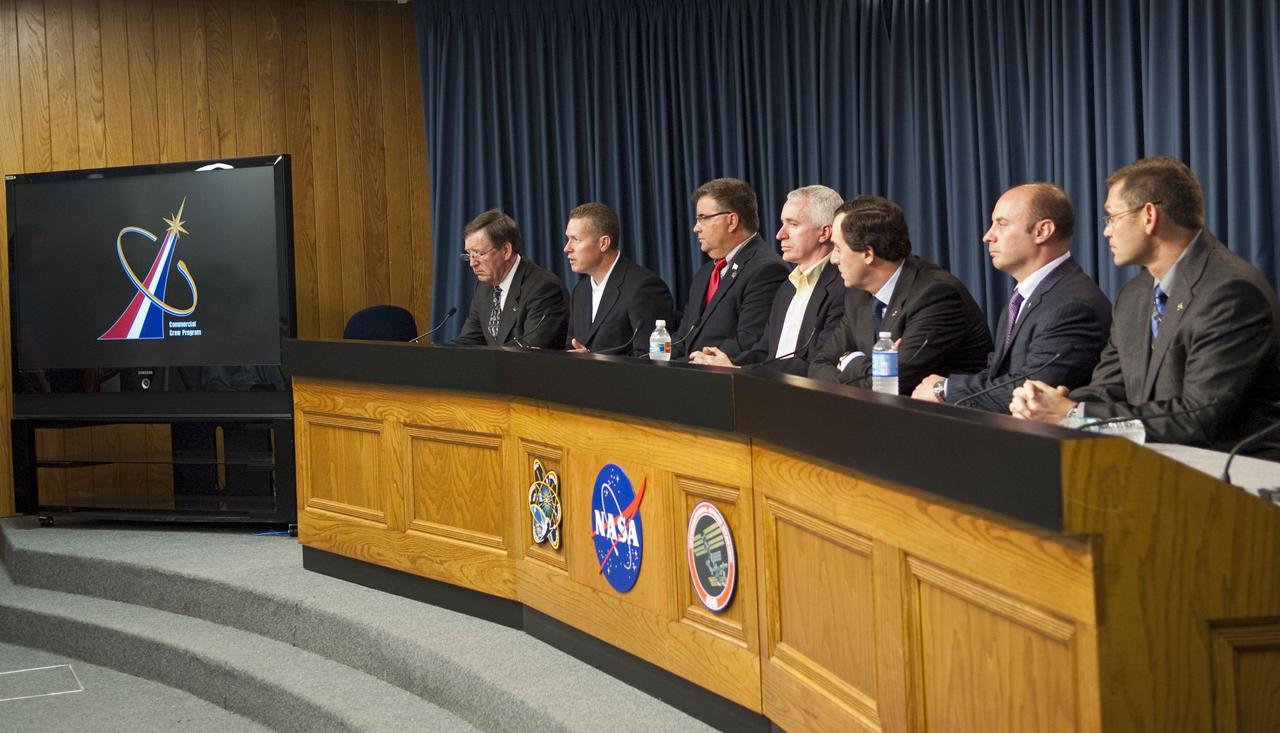
CAPE CANAVERAL, Fla. -- At NASA's Kennedy Space Center in Florida, the agency hosts a media briefing highlighting the four companies selected for the second round of the Commercial Crew Development (CCDev2) efforts. From left, are Michael Braukus, NASA Public Affairs specialist; Phil McAlister, acting director of Commercial Spaceflight Development at NASA Headquarters; Ed Mango, program manager for NASA's Commercial Crew Program at Kennedy; Rob Meyerson, program manager of Blue Origin; Mark Sirangelo, program manager of Sierra Nevada; Garrett Reisman, program manager of SpaceX; and John Elbon, program manager of The Boeing Company. NASA awarded $269.3 million to these companies to accelerate the availability of U.S. commercial crew transportation capabilities and reduce the gap in American human spaceflight capability. Through this activity, NASA also may be able to spur economic growth as potential new space markets are created. Once developed, crew transportation capabilities could become available to commercial and government customers. Photo credit: NASA_Jim Grossmann
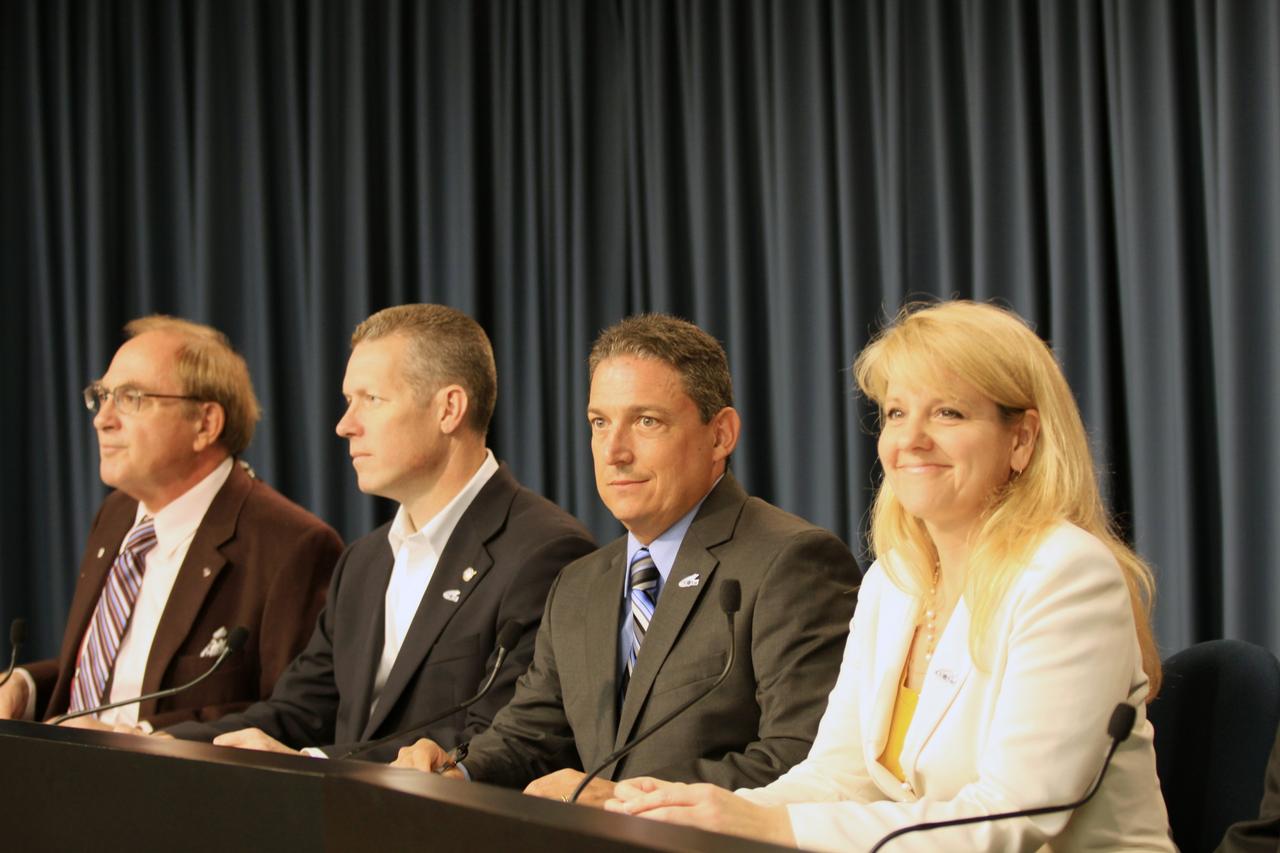
CAPE CANAVERAL, Fla. – Participating in a prelaunch news conference in the Press Site Auditorium at NASA’s Kennedy Space Center in Florida are, from left, George H. Diller, NASA Public Affairs, Phil McAlister, director, NASA Commercial Spaceflight Development, Alan Lindenmoyer, manager, NASA Commercial Crew and Cargo Program, and Gwynne Shotwell, president, SpaceX. Liftoff of the SpaceX Falcon 9 rocket carrying a Dragon capsule to orbit is set for 4:55 a.m. EDT on May 19. The launch will be the company's second demonstration test flight for NASA's Commercial Orbital Transportation Services Program, or COTS. During the flight, the capsule will conduct a series of check-out procedures to test and prove its systems, including rendezvous and berthing with the International Space Station. If the capsule performs as planned, the cargo and experiments it is carrying will be transferred to the station. The cargo includes food, water and provisions for the station’s Expedition crews, such as clothing, batteries and computer equipment. Under COTS, NASA has partnered with two aerospace companies to deliver cargo to the station. For more information, visit http://www.nasa.gov/spacex. Photo credit: NASA/Jim Grossmann
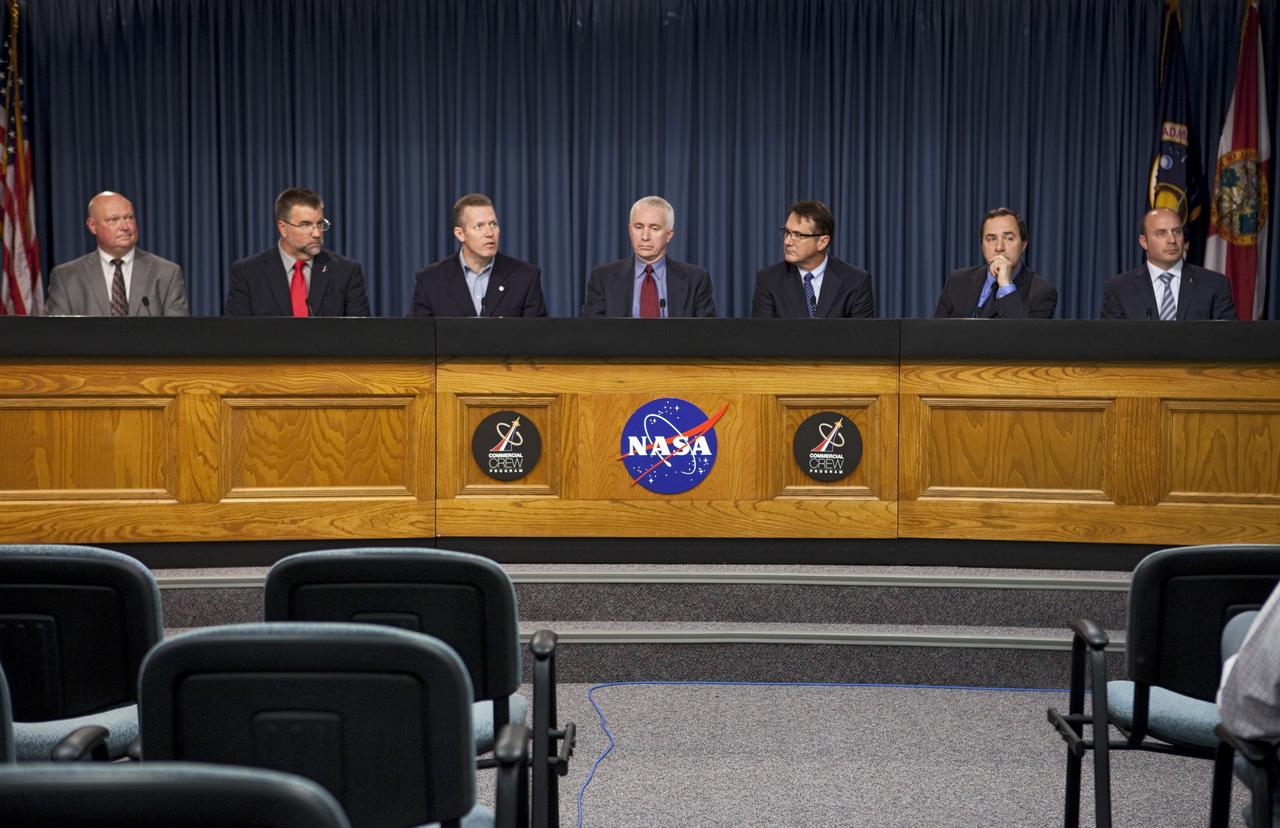
CAPE CANAVERAL, Fla. -- At a news conference NASA officials and industry partners discuss progress of the agency's Commercial Crew Program CCP. Participating in the briefing, from the left are, Mike Curie, NASA Public Affairs, Ed Mango, NASA Commercial Crew Program manager, Phil McAlister, NASA Commercial Spaceflight Development director, Rob Meyerson, Blue Origin president and program manager, John Mulholland, The Boeing Company Commercial Programs Space Exploration vice president and program manager, Mark Sirangelo, Sierra Nevada Corp. vice president and SNC Space Systems chairman and Garrett Reisman, Space Exploration Technologies SpaceX Commercial Crew project manager. Through CCP, NASA is facilitating the development of U.S. commercial crew space transportation capabilities to achieve safe, reliable and cost-effective access to and from low-Earth orbit for potential future government and commercial customers. For more information, visit http://www.nasa.gov/commercialcrew Photo credit: NASA/Kim Shiflett
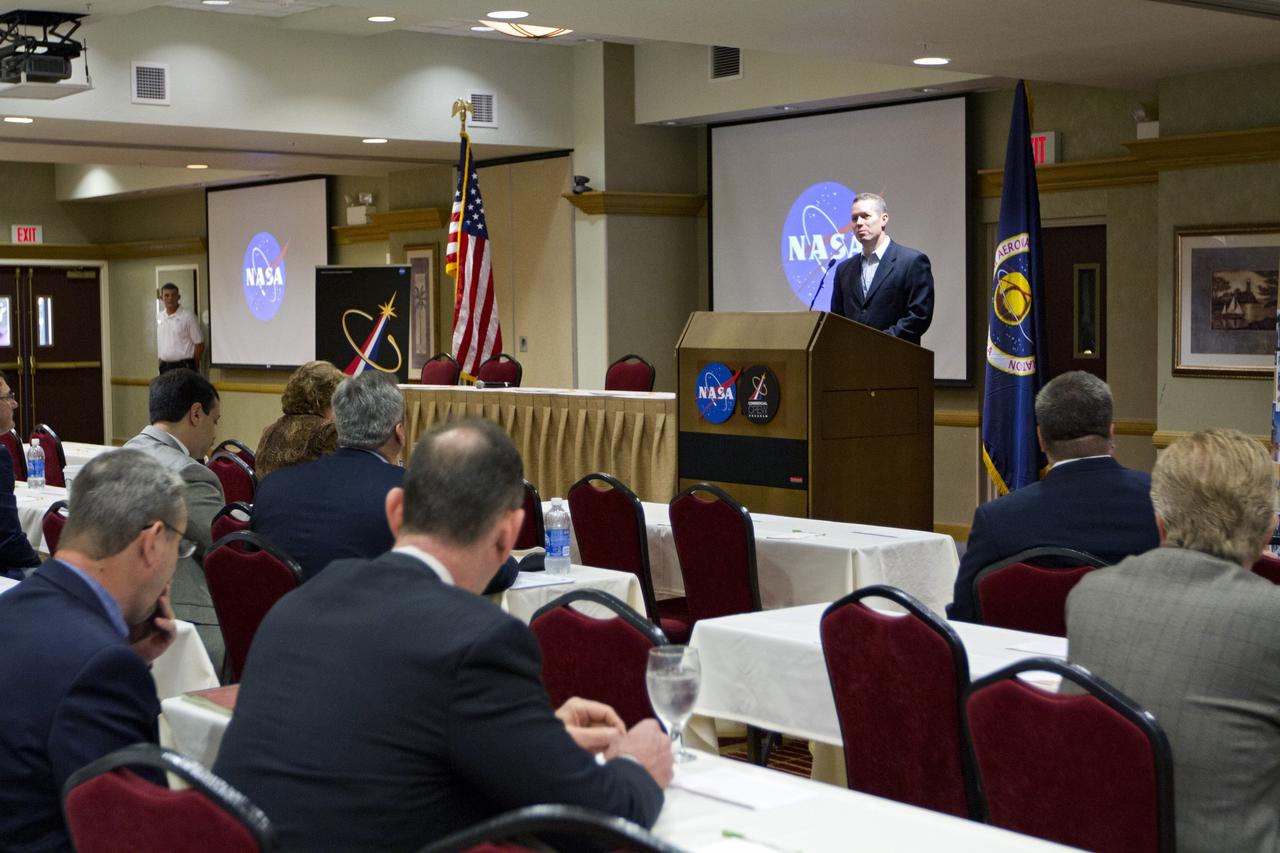
COCOA BEACH, Fla. -- Phil McAlister, NASA's director of Commercial Spaceflight Development, talks to industry partners and stakeholders during a preproposal conference at the Courtyard Marriott in Cocoa Beach, Fla. The meeting focused on information related to NASA's release of the Commercial Crew Integrated Capability CCiCap Announcement for Proposals on Feb. 7. More than 50 people from 25 aerospace companies attended the conference to find out what the space agency would be looking for in terms of milestones, funding, schedules, strategies, safety cultures, business modules and eventual flight certification standards of integrated crew space transportation systems. The goal of the CCiCap is to develop an indigenous U.S. transportation system that can safely, affordably and routinely fly to low Earth orbit destinations, including the International Space Station. Proposals are due March 23 and NASA plans to award multiple Space Act Agreements, valued from $300 million to $500 million each, toward the development of fully integrated commercial crew transportation systems in the summer of 2012. For more information, visit www.nasa.gov/commercialcrew Photo credit: Kim Shiflett
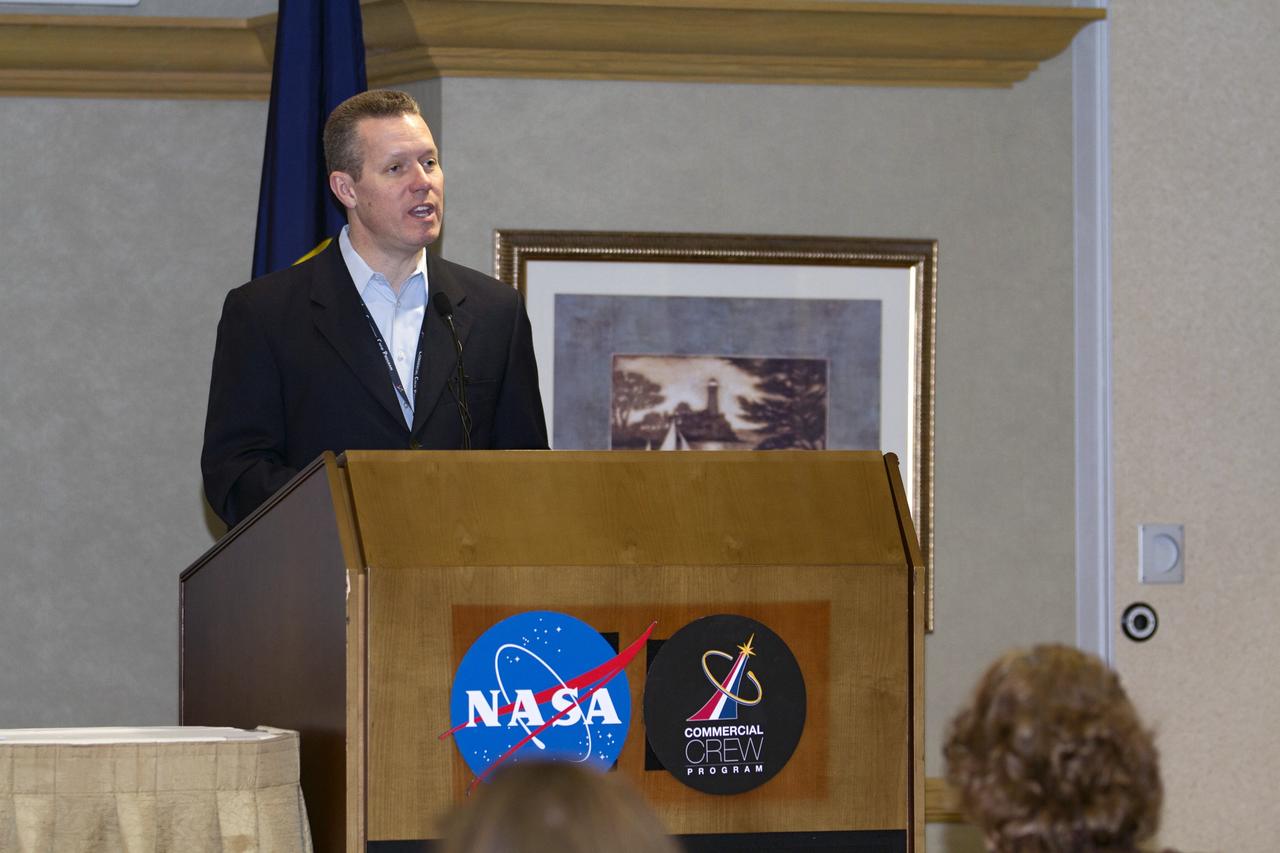
COCOA BEACH, Fla. -- Phil McAlister, NASA's director of Commercial Spaceflight Development, talks to industry partners and stakeholders during a preproposal conference at the Courtyard Marriott in Cocoa Beach, Fla. The meeting focused on information related to NASA's release of the Commercial Crew Integrated Capability CCiCap Announcement for Proposals on Feb. 7. More than 50 people from 25 aerospace companies attended the conference to find out what the space agency would be looking for in terms of milestones, funding, schedules, strategies, safety cultures, business modules and eventual flight certification standards of integrated crew space transportation systems. The goal of the CCiCap is to develop an indigenous U.S. transportation system that can safely, affordably and routinely fly to low Earth orbit destinations, including the International Space Station. Proposals are due March 23 and NASA plans to award multiple Space Act Agreements, valued from $300 million to $500 million each, toward the development of fully integrated commercial crew transportation systems in the summer of 2012. For more information, visit www.nasa.gov/commercialcrew Photo credit: Kim Shiflett
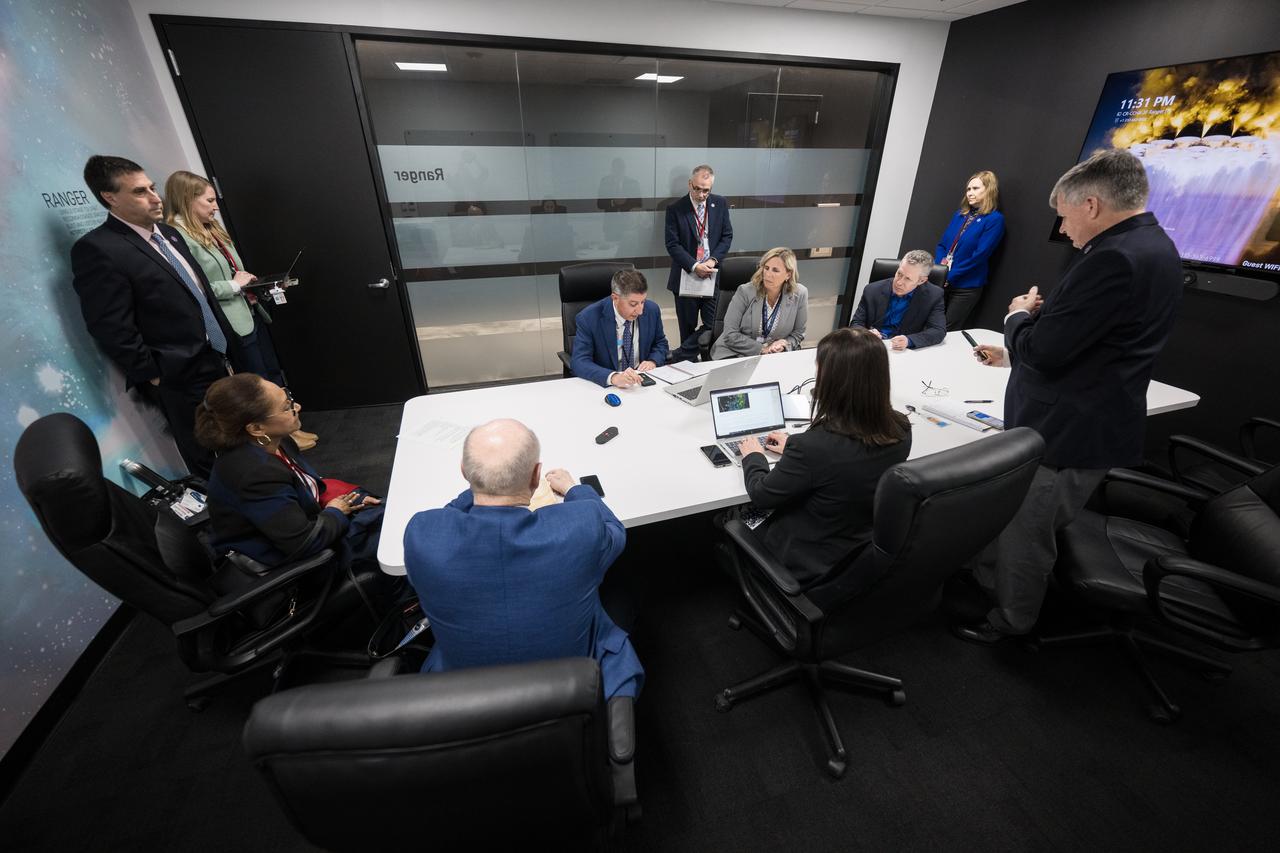
Richard Jones, deputy program manager for NASA's Commercial Crew Program seated, second from left, leads a post-launch synopsis briefing with NASA leadership after the launch of a SpaceX Falcon 9 rocket carrying the company's Dragon spacecraft on the Crew-8 mission with NASA astronauts Matthew Dominick, Michael Barratt, and Jeanette Epps, and Roscosmos cosmonaut Alexander Grebenkin onboard, Sunday, March 3, 2024, in the control room of SpaceX’s HangarX at NASA’s Kennedy Space Center in Florida. NASA’s SpaceX Crew-8 mission is the eighth crew rotation mission of the SpaceX Dragon spacecraft and Falcon 9 rocket to the International Space Station as part of the agency’s Commercial Crew Program. Dominick, Barratt, Epps, and Grebenkin launched at 10:53 p.m. EST, from Launch Complex 39A at the Kennedy Space Center. Photo Credit: (NASA/Aubrey Gemignani)
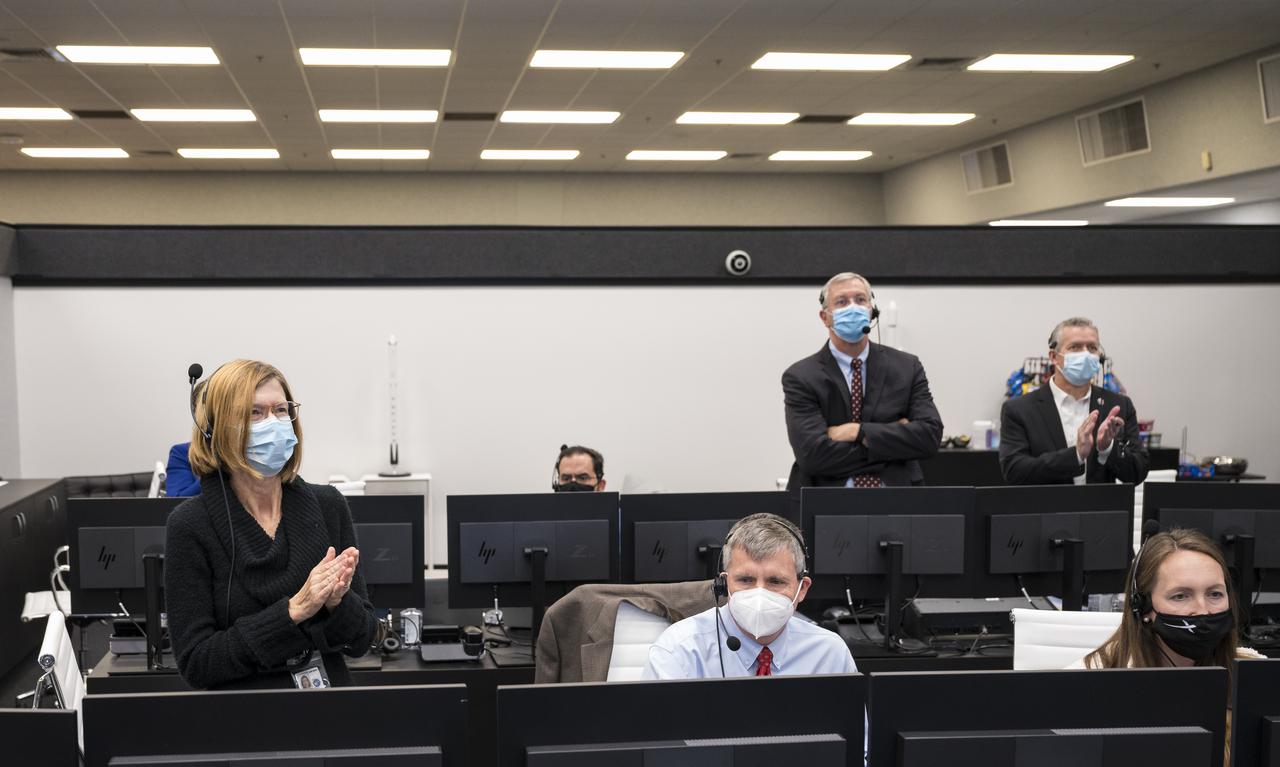
NASA and SpaceX officials clap during the launch of a SpaceX Falcon 9 rocket carrying the company's Crew Dragon spacecraft on the Crew-3 mission with NASA astronauts Raja Chari, Tom Marshburn, Kayla Barron, and ESA (European Space Agency) astronaut Matthias Maurer onboard, Wednesday, Nov. 10, 2021, in firing room four of the Launch Control Center at NASA’s Kennedy Space Center in Florida. NASA’s SpaceX Crew-3 mission is the third crew rotation mission of the SpaceX Crew Dragon spacecraft and Falcon 9 rocket to the International Space Station as part of the agency’s Commercial Crew Program. Chari, Marshburn, Barron, Maurer launched at 9:03 p.m. EST, from Launch Complex 39A at the Kennedy Space Center. Photo Credit: (NASA/Aubrey Gemignani)