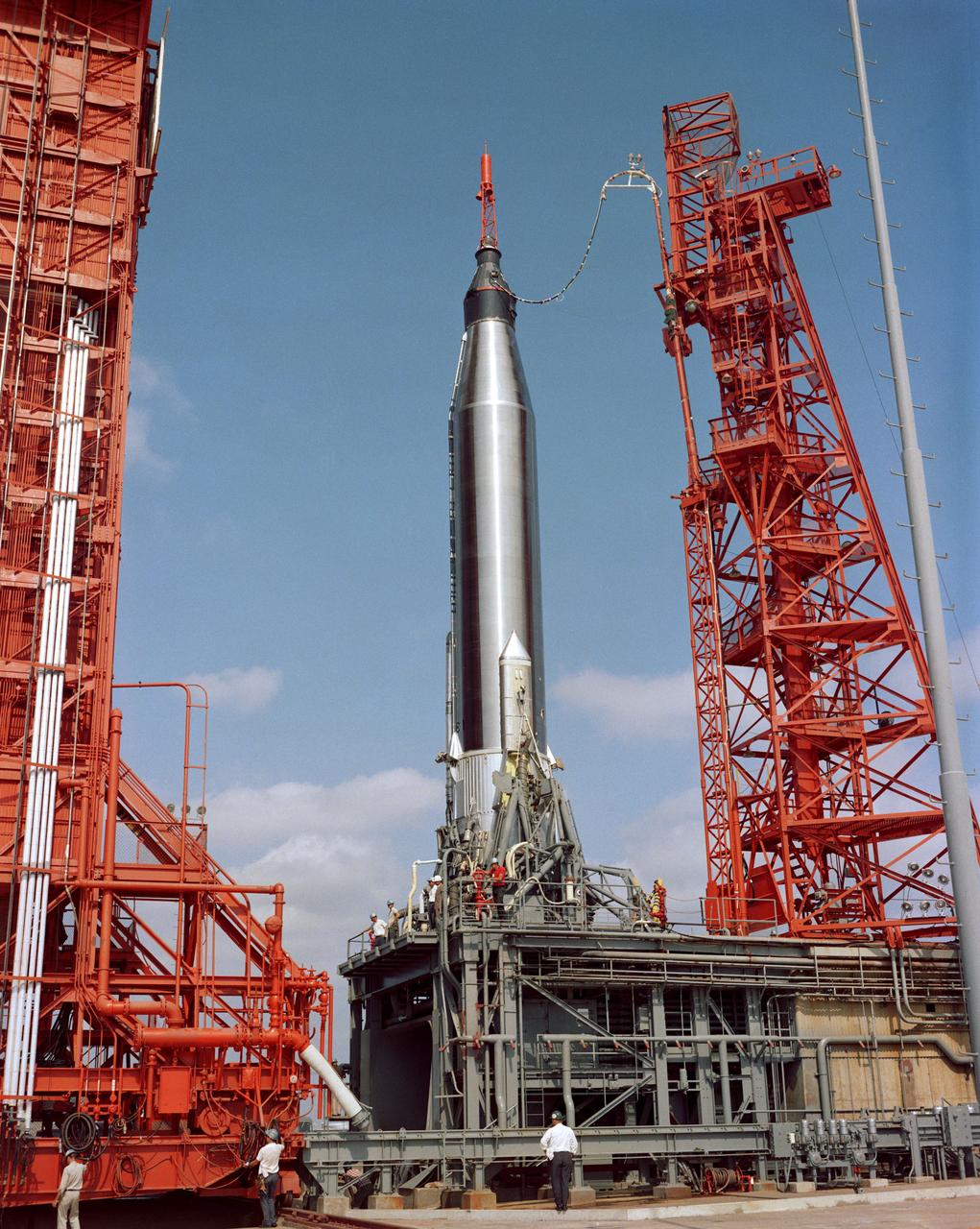
S63-07608 (1963) --- Preparation for launch of Mercury-Atlas 9 (MA-9). Photo credit: NASA
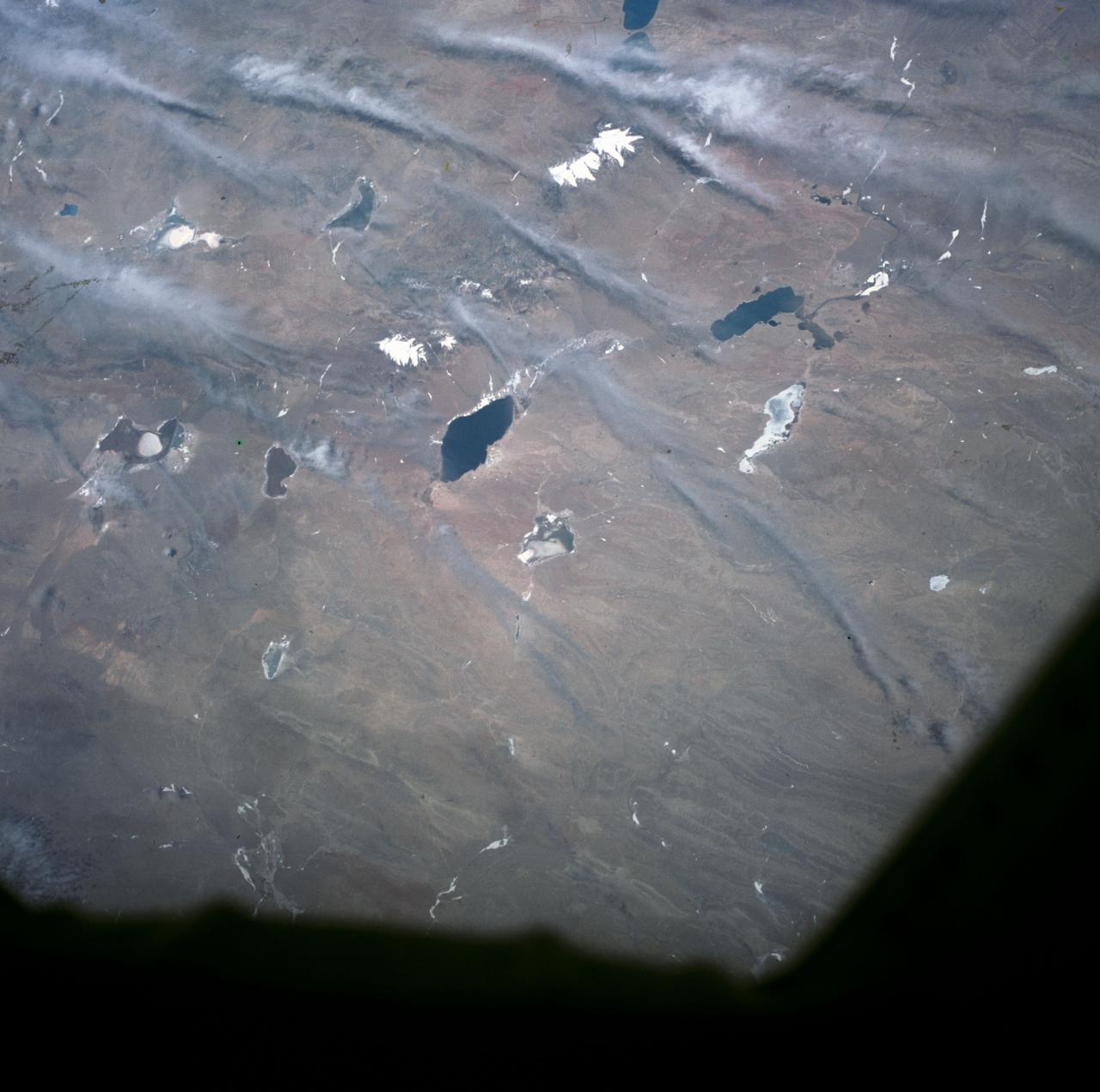
S63-06456 (15-16 May 1963) --- Lakes of Western Tibet, photographed from the Mercury-Atlas 9 (MA-9) capsule by astronaut L. Gordon Cooper Jr., during his 22-orbit MA-9 spaceflight. Photo credit: NASA
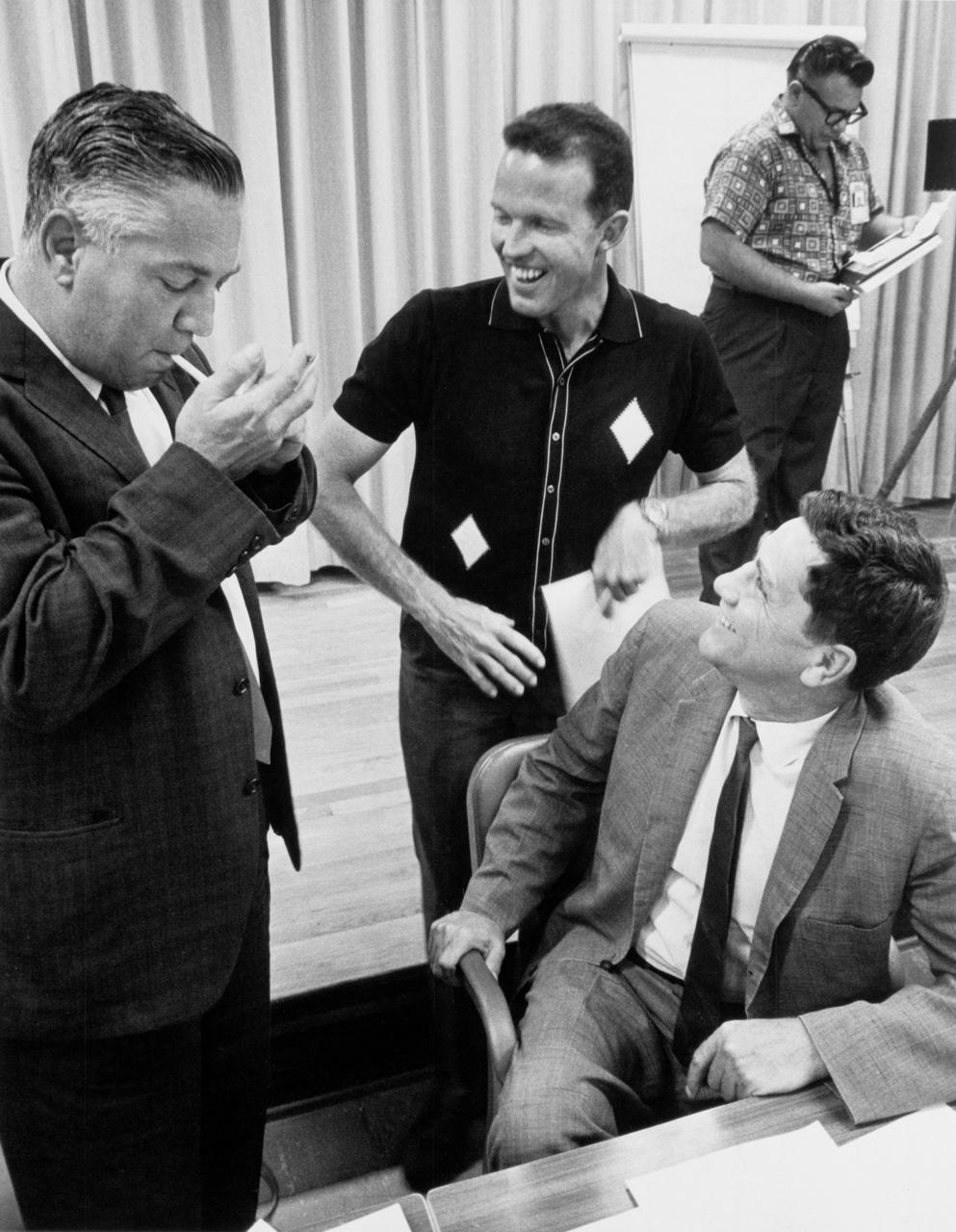
S63-06123 (1963) --- Walter C. Williams, astronaut L. Gordon Cooper Jr., and Merritt Preston are pictured during an Mercury Atlas 9 (MA-9) prelaunch mission review. Photo credit: NASA
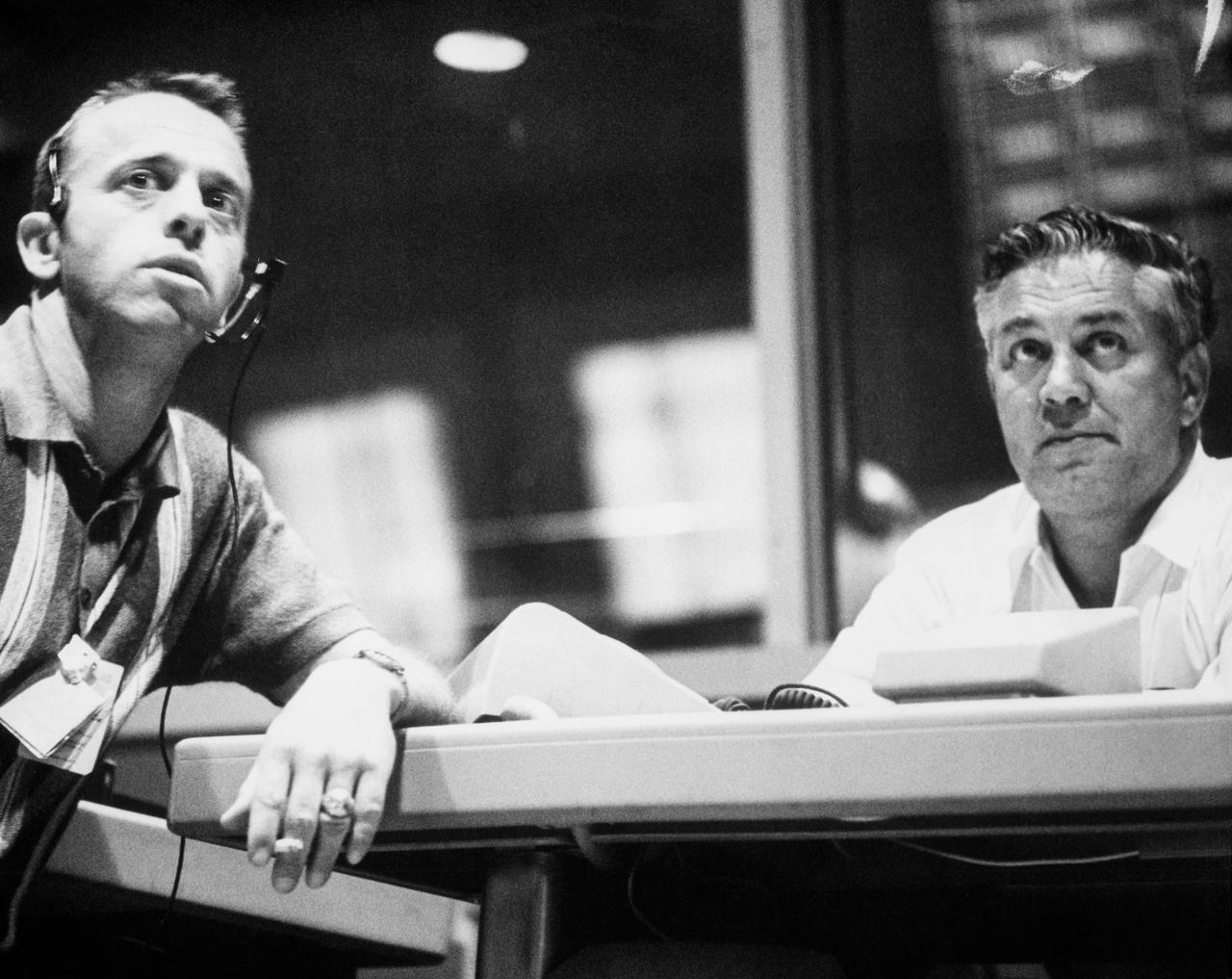
S63-07857 (15-16 May 1963) --- Astronaut Alan Shepard (left) and Walter C. Williams monitor progress of the Mercury Atlas 9 (MA-9) mission from Mercury Control Center, Cape Canaveral, Florida. Photo credit: NASA

Astronaut L. Gordon Cooper, Jr., one of the original seven astronauts for Mercury Project selected by NASA on April 27, 1959. The MA-9 mission, boosted by the Mercury-Atlas launch vehicle, was the last flight of the Mercury Project. The Faith 7 spacecraft orbited the Earth 22 times in 1-1/2 days.
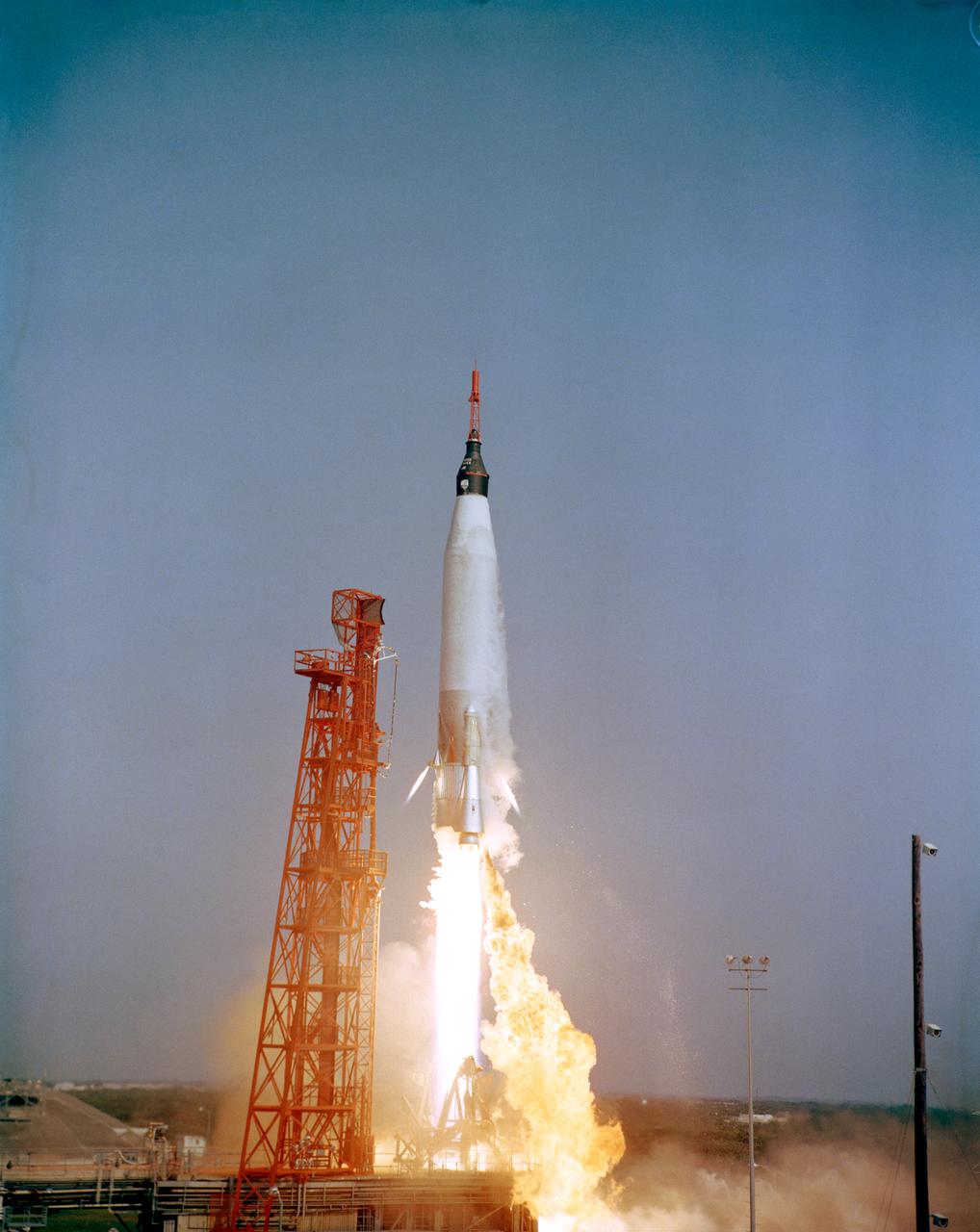
S63-07603 (15 May 1963) --- This is the launch of Mercury-Atlas 9 (MA-9) on May 15, 1963, at 8:04 a.m. (EST) carrying astronaut L. Gordon Cooper Jr., pilot. Astronaut Cooper made 22 orbits in 34 hours and 19 minutes, in the spacecraft designated the ?Faith 7". Photo credit: NASA
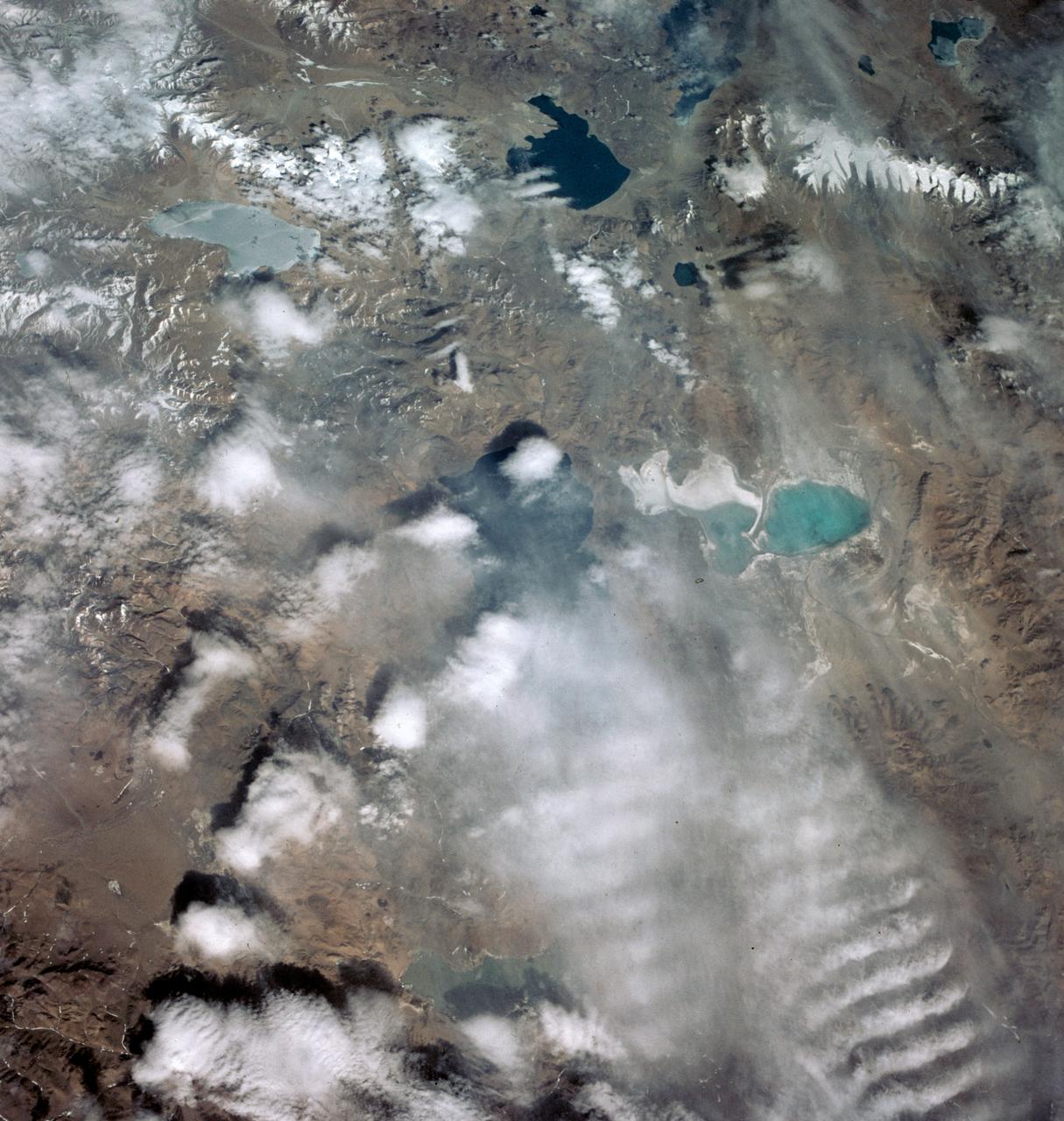
S63-06454 (15-16 May 1963) --- Tibetan Lake Country North of Katmandu, west of Ihasa, photographed from the Mercury-Atlas 9 (MA-9) capsule by astronaut L. Gordon Cooper Jr., during his 22-orbit MA-9 spaceflight. Photo credit: NASA
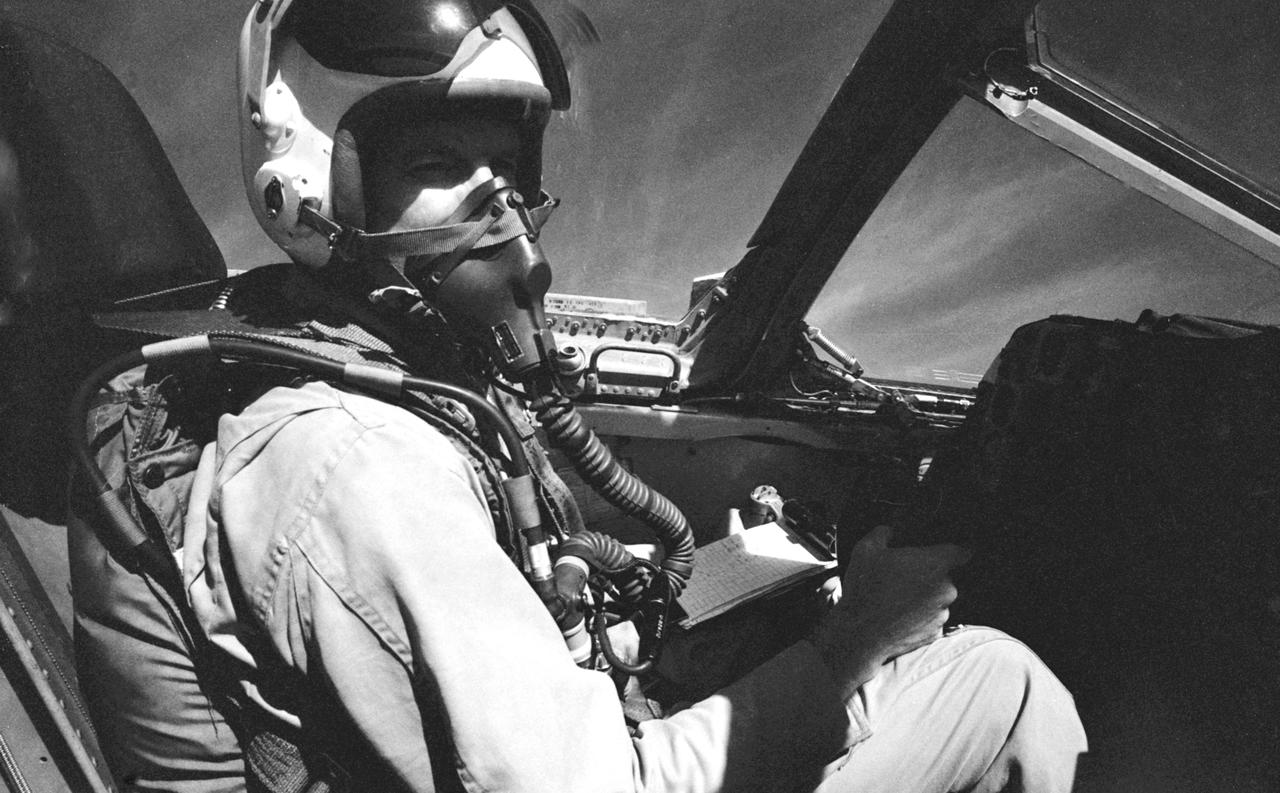
S63-03980 (1963) --- Astronaut L. Gordon Cooper Jr., prime pilot for the Mercury-Atlas 9 (MA-9) mission, in flight in a Convair TF-102 aircraft. Photo credit: NASA
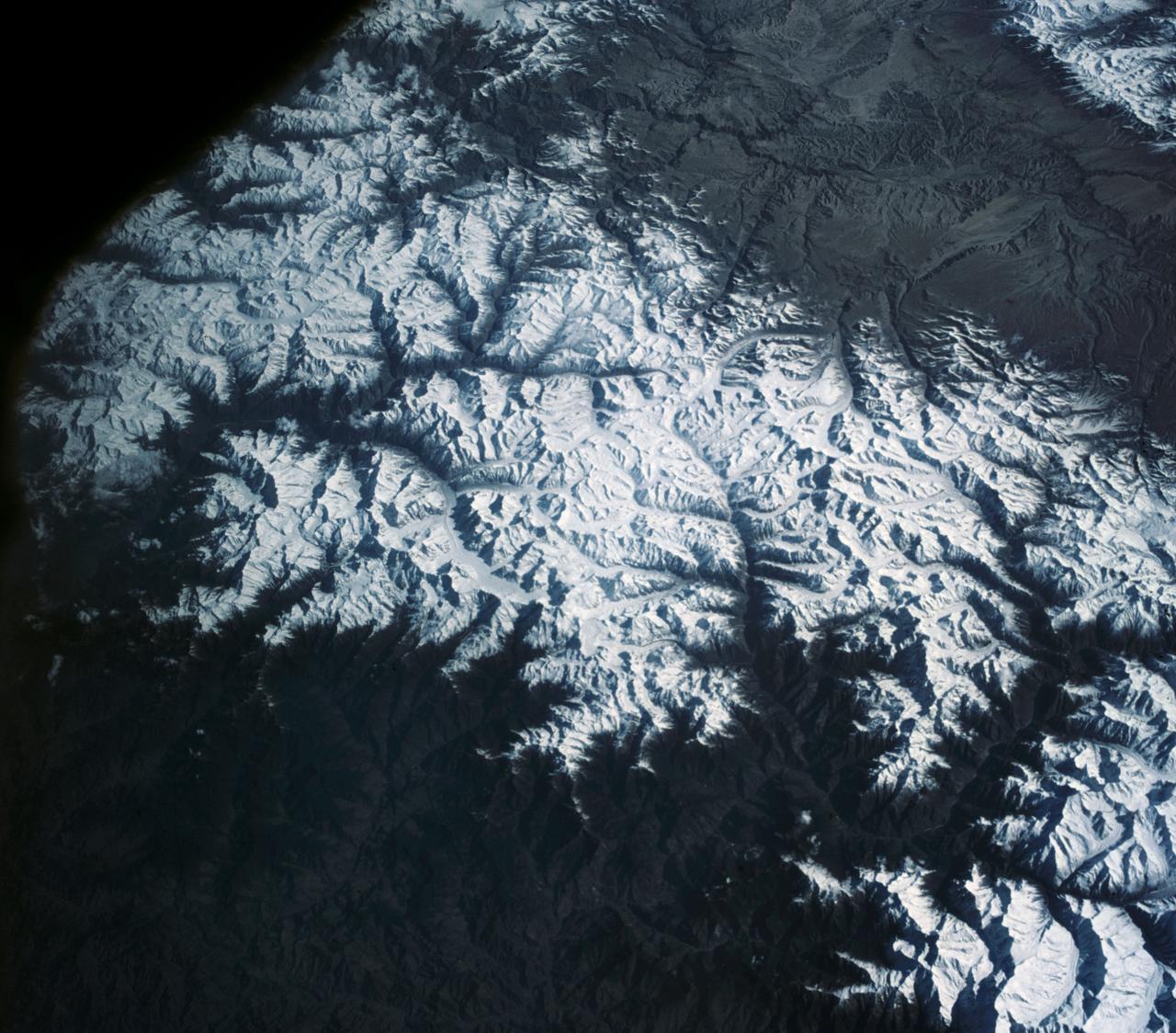
S63-06445 (15-16 May 1963) --- View of the Himalaya Mountain Range in the India-Nepal-Tibet border area, as photographed from the Mercury-Atlas 9 capsule by astronaut L. Gordon Cooper Jr., during his 22-orbit MA-9 spaceflight. Photo credit: NASA
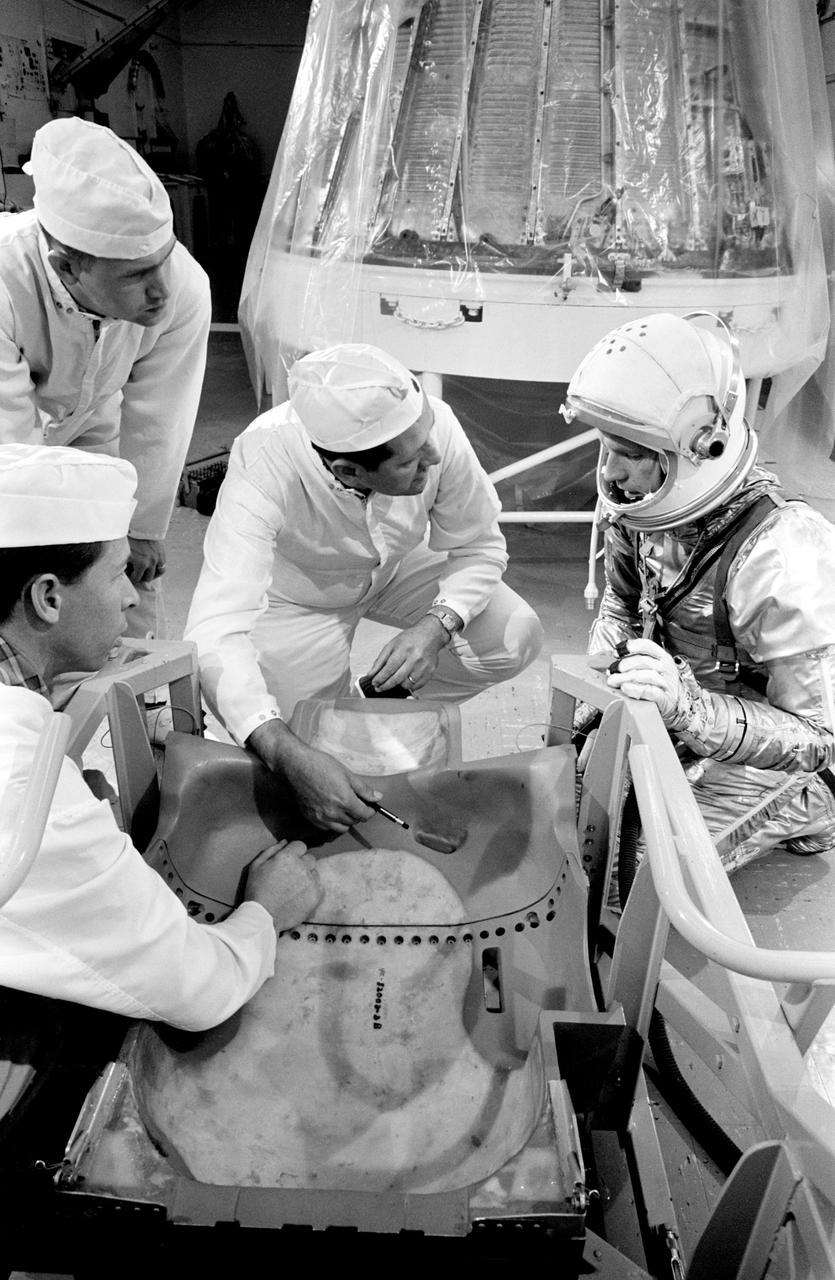
S63-03968 (1963) --- Astronaut L. Gordon Cooper Jr., prime pilot for the Mercury-Atlas 9 (MA-9) mission; Joe Trammel, MAC technician; A. Rochford, NASA suit technician; and C.R. Coyle, MAC technician, look over spacecraft couch. Photo credit: NASA
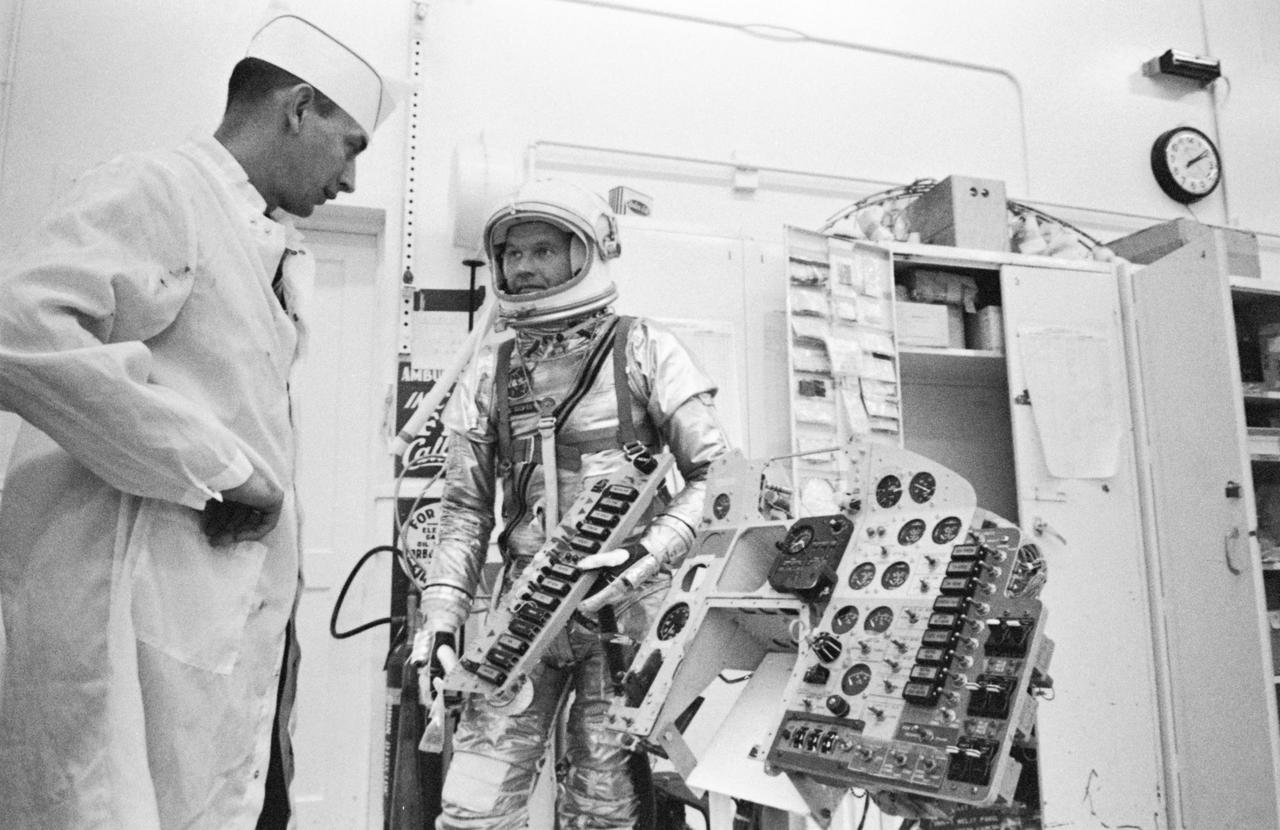
S63-03960 (1 Feb. 1963) --- Astronaut L. Gordon Cooper Jr., prime pilot for the Mercury-Atlas 9 (MA-9) mission, checks over the instrument panel from Mercury spacecraft #20 with Robert Graham, McDonnell Aircraft Corp. spacecraft engineer. It contains the instruments necessary to monitor spacecraft systems and sequencing, the controls required to initiate primary sequences manually, and flight control displays. Photo credit: NASA
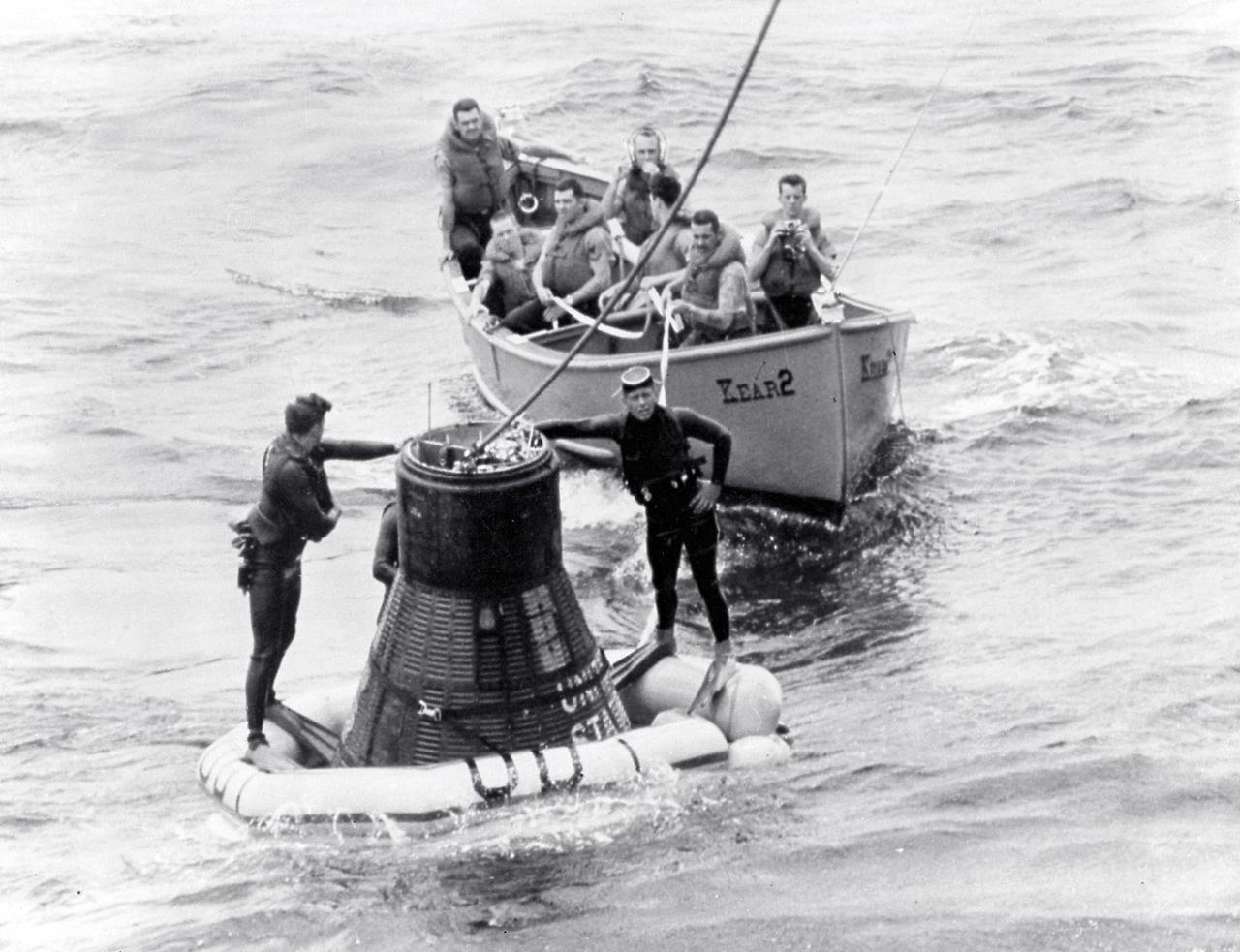
The recovery operation of the Faith 7 spacecraft after the completion of the 1-1/2 day orbital flight (MA-9 mission) with Astronaut Gordon Cooper. Navy frogmen attach the flotation collar to the spacecraft. The MA-9 mission was the last flight of the Mercury Project and launched on May 15, 1963 boosted by The Mercury-Atlas launch vehicle.
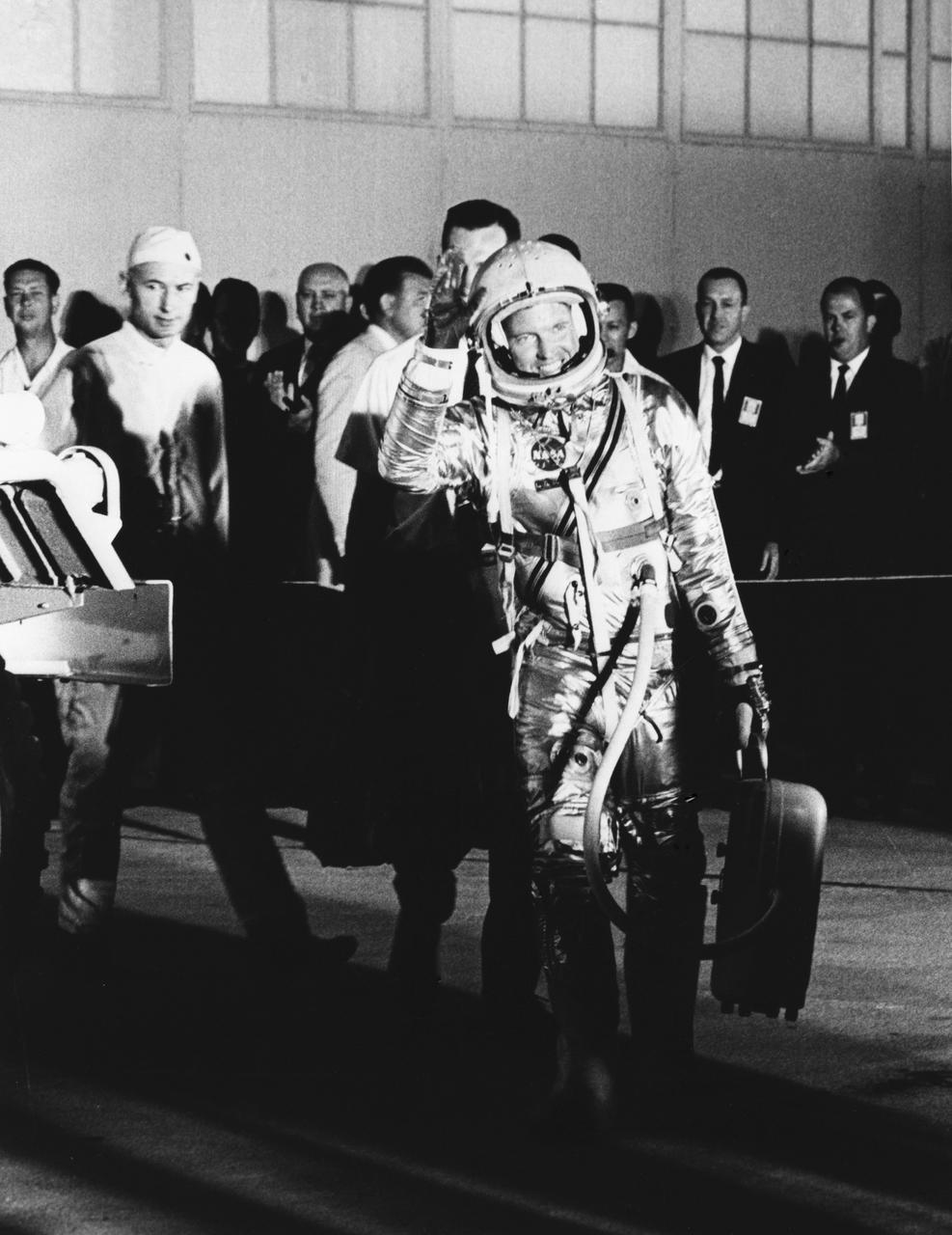
S63-06252 (May 1963) --- Mercury workers and news media are greeted by astronaut L. Gordon Cooper Jr., prime pilot for the Mercury-Atlas 9 (MA-9) mission, as he leaves Hangar "S" for Pad 14 to start his 22-orbit MA-9 mission. Photo credit: NASA
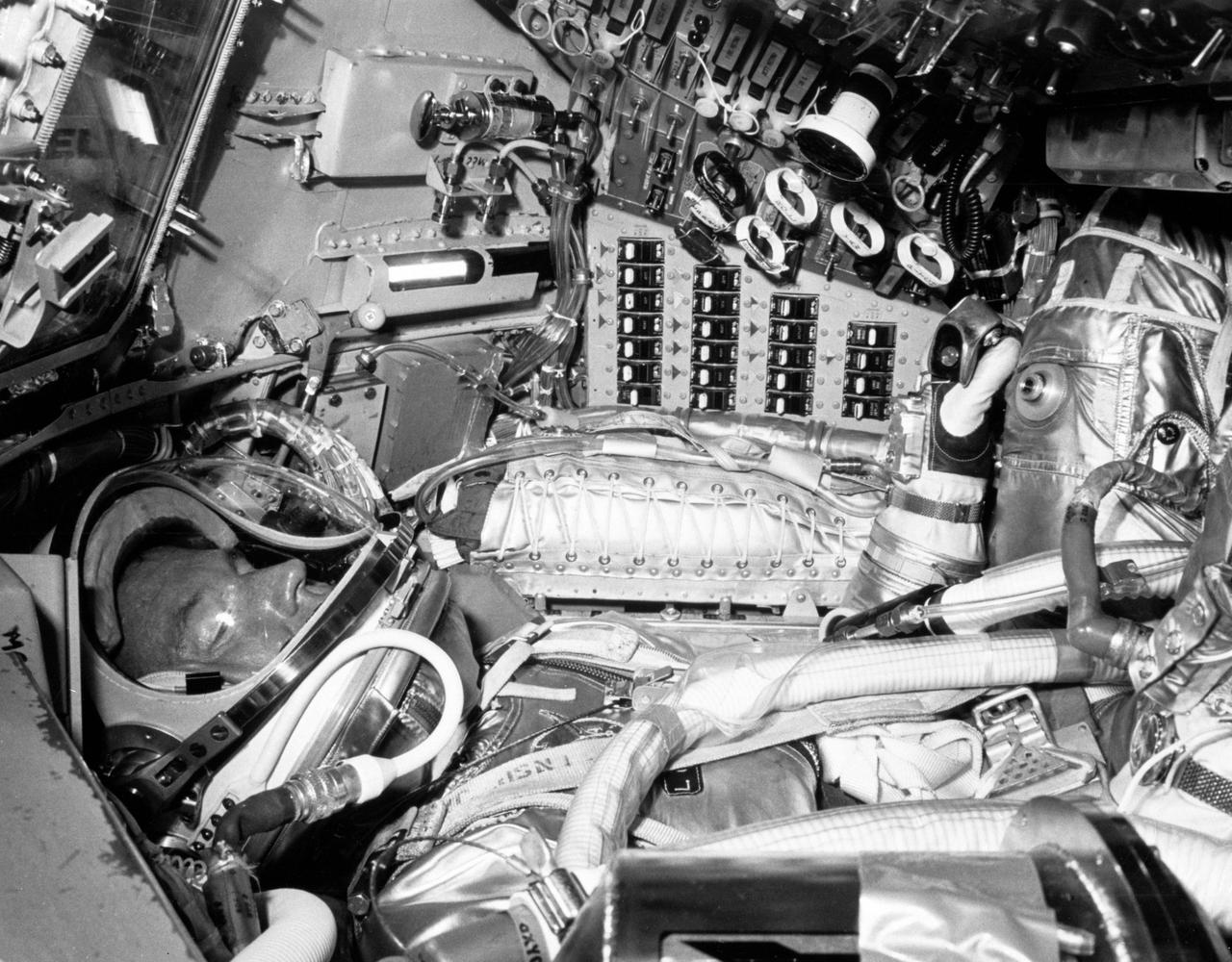
S63-06129 (1963) --- Astronaut L. Gordon Cooper Jr., prime pilot for the Mercury-Atlas 9 (MA-9) mission, inside his Mercury spacecraft, runs through one of the numerous preflight checks surrounded by dials, switches, indicators and buttons. Photo credit: NASA
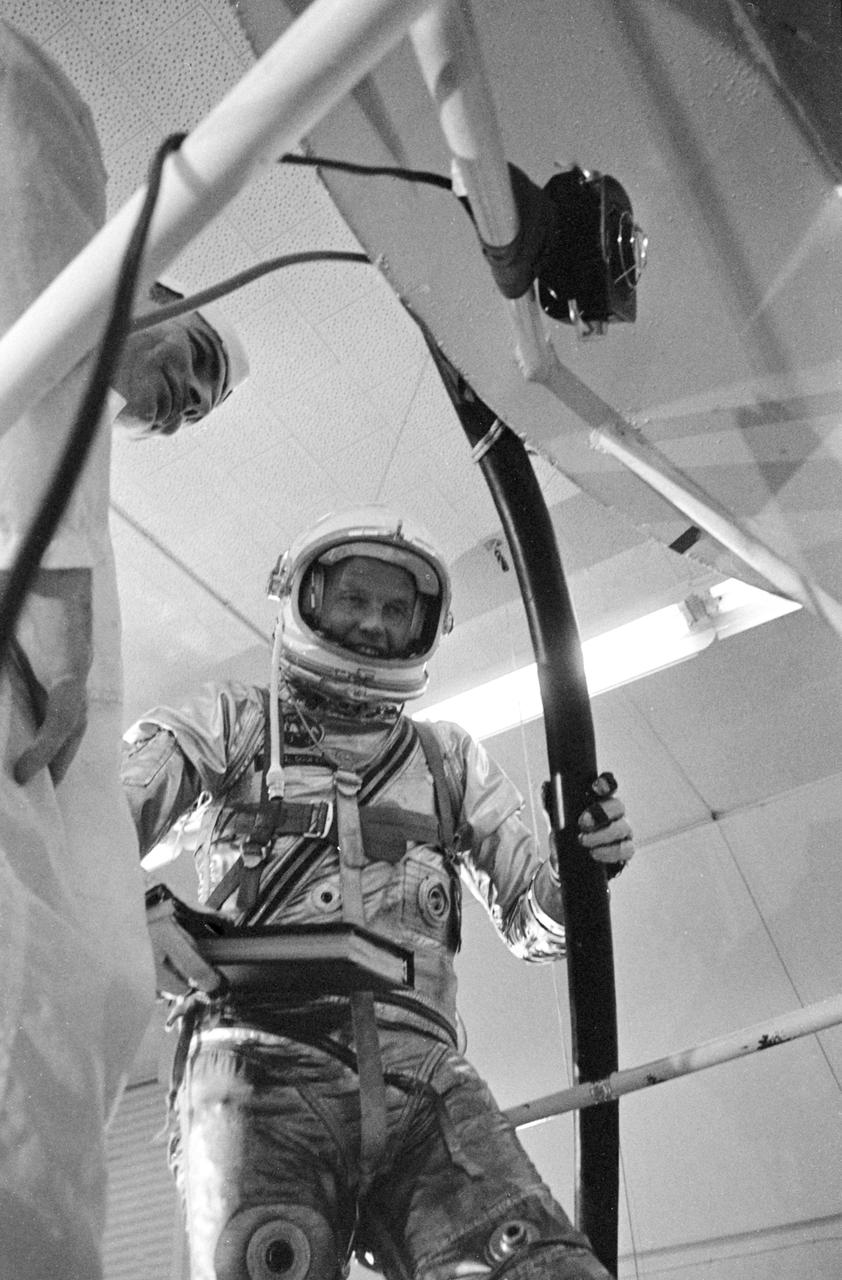
S63-03975 (1963) --- Astronaut L. Gordon Cooper Jr., prime pilot for the Mercury-Atlas 9 (MA-9) mission, is pictured prior to entering the Mercury spacecraft for a series of simulated flight tests. During these tests NASA doctors, engineers and technicians monitor Cooper's performance. Photo credit: NASA
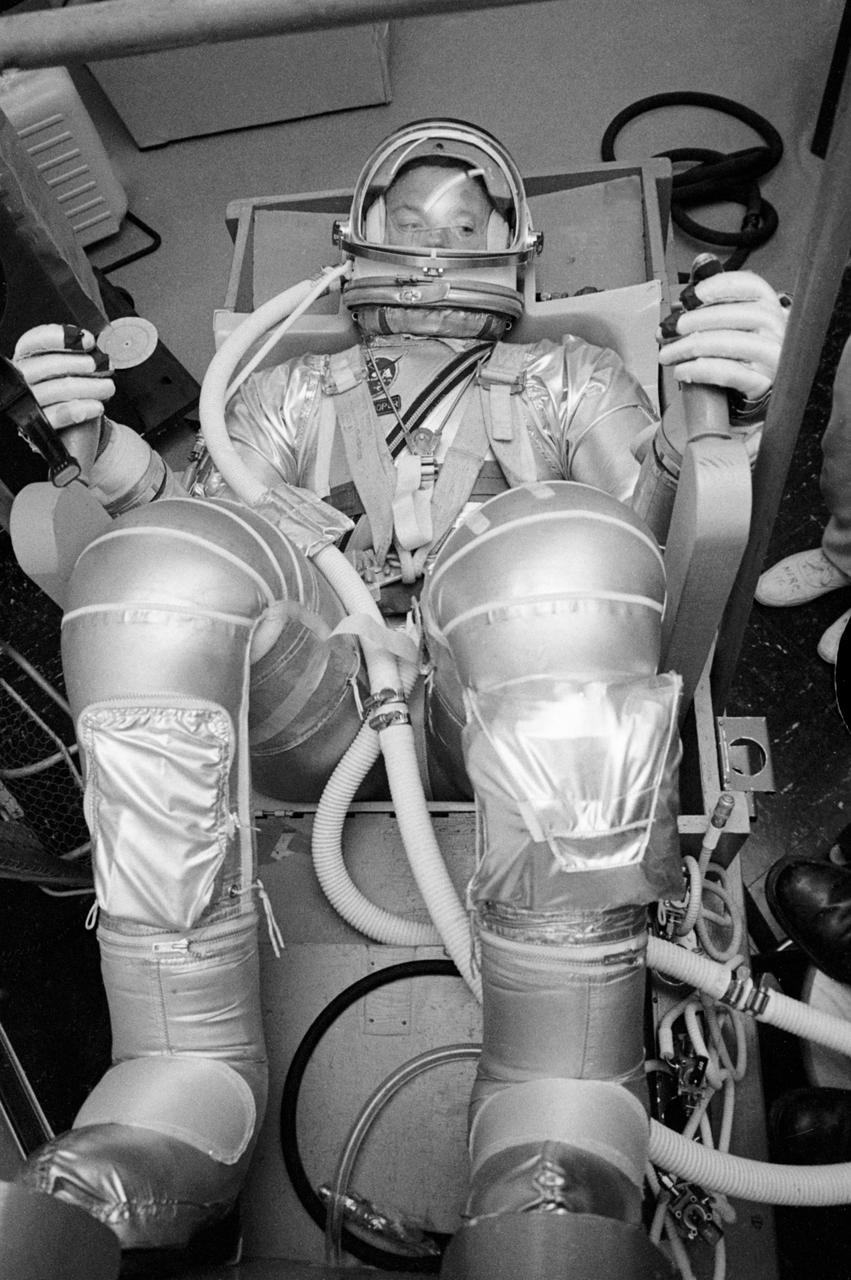
S63-03976 (1963) --- Astronaut L. Gordon Cooper Jr., prime pilot for the Mercury-Atlas 9 (MA-9) mission, undergoes suit pressurization tests. Photo credit: NASA
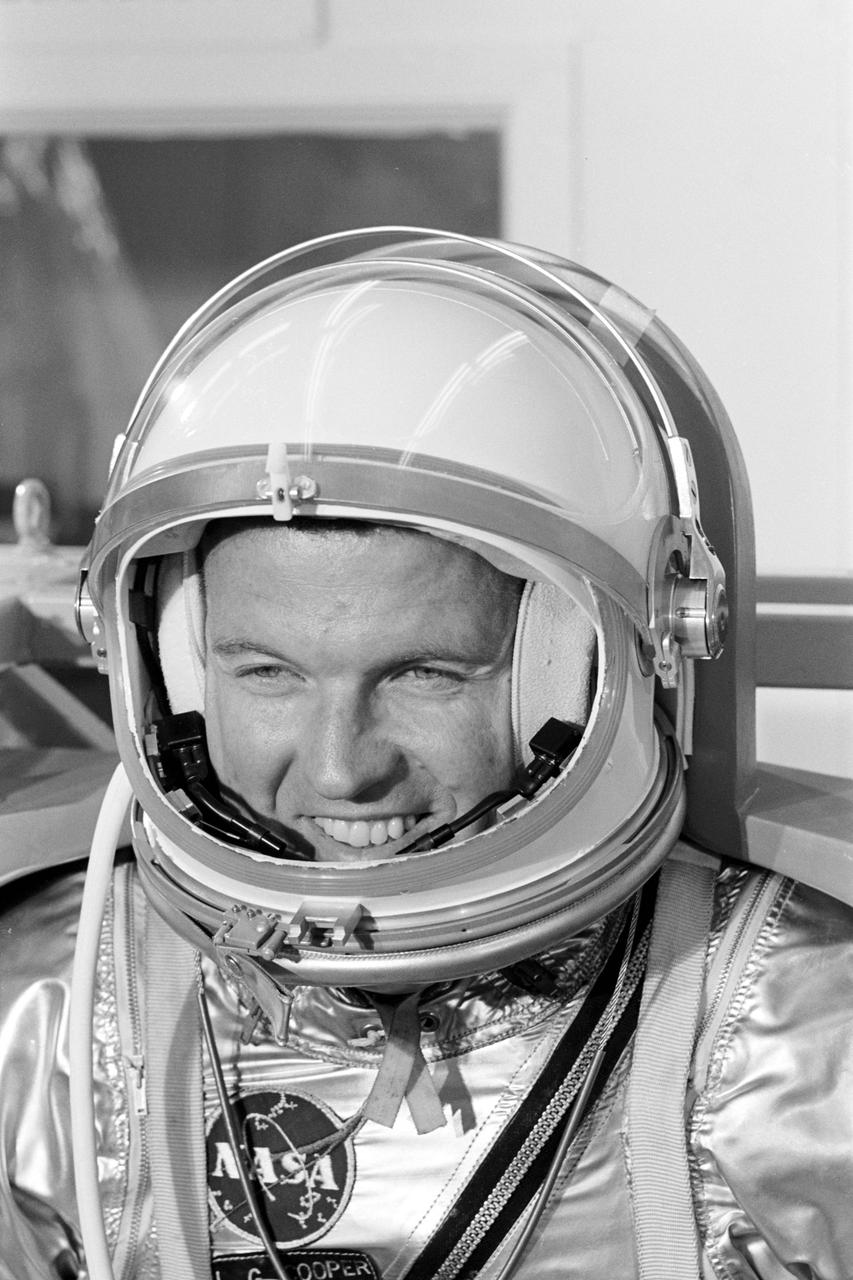
S63-03974 (1963) --- Astronaut L. Gordon Cooper Jr., prime pilot for the Mercury-Atlas 9 (MA-9) mission, relaxes while waiting for weight and balance tests to begin. Photo credit: NASA
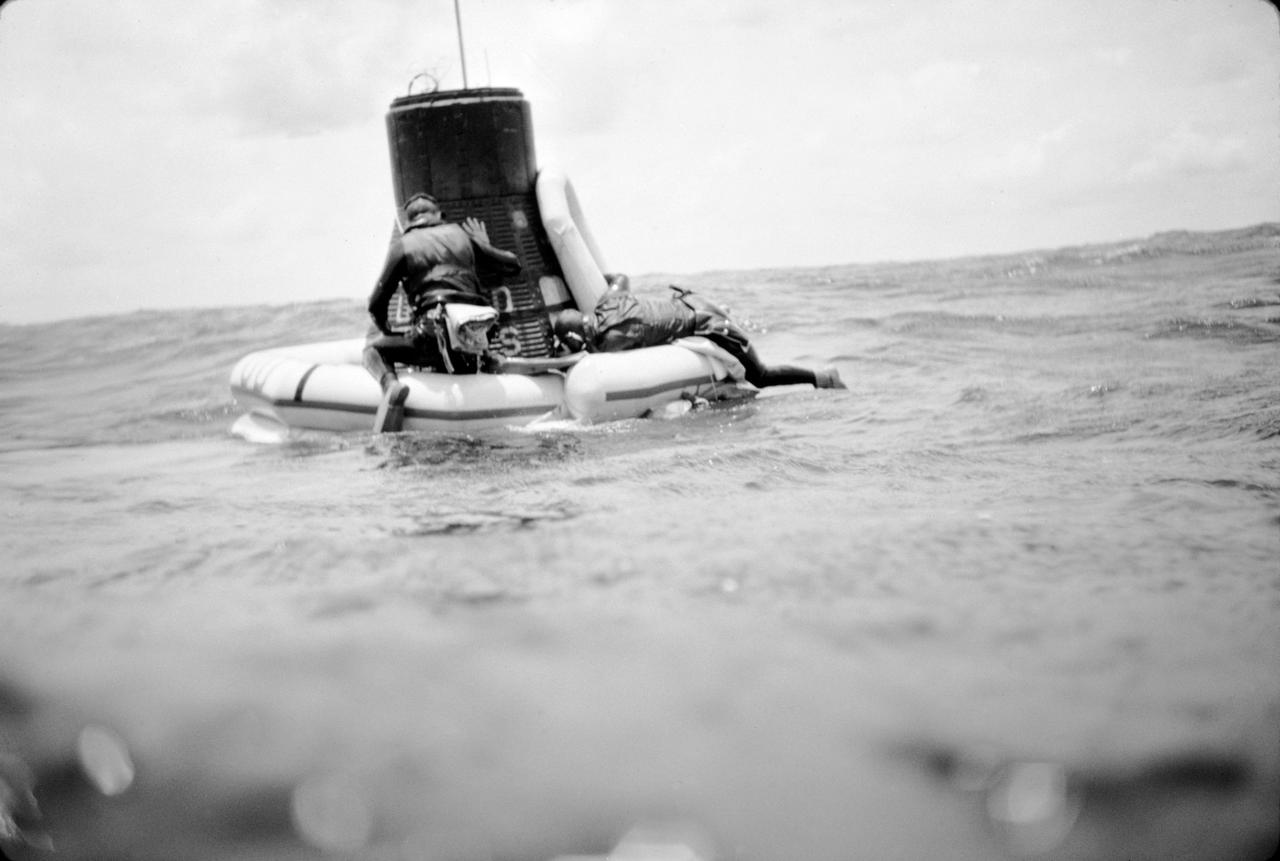
S63-07707 (16 May 1963) --- A U.S. Navy frogman team attaches a flotation collar to the Mercury-Atlas 9 (MA-9)"Faith 7" spacecraft during recovery operations in the central Pacific near Midway Island. The Mercury-Atlas spacecraft with astronaut L. Gordon Cooper Jr., pilot, still inside, was hoisted aboard the USS Kearnage. Photo credit: NASA
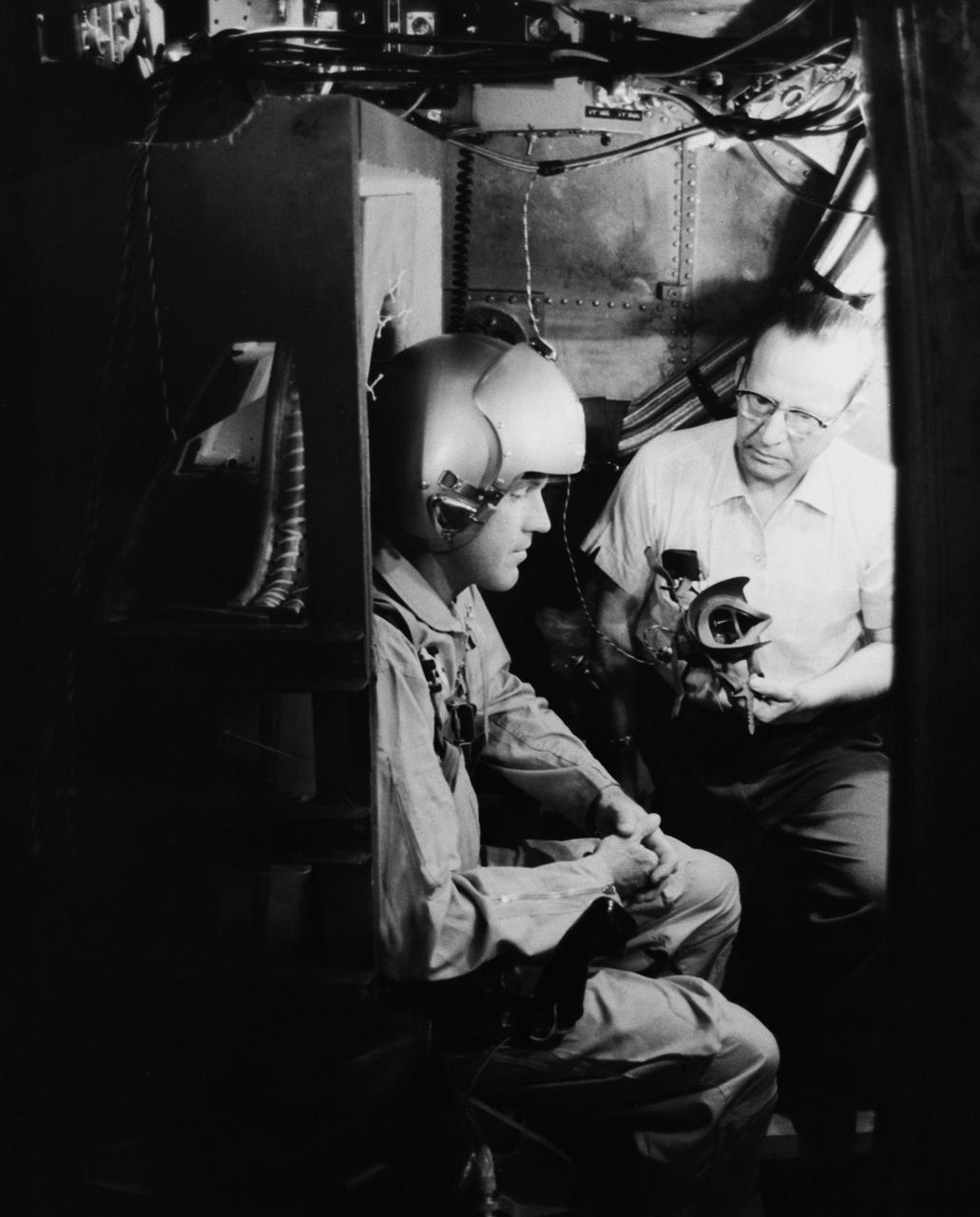
S63-03978 (1963) --- Astronaut L. Gordon Cooper Jr., prime pilot for the Mercury-Atlas 9 (MA-9) mission, is strapped into the gondola while undergoing tests in the centrifuge at the Naval Air Development Center, Johnsville, Pennsylvania. The centrifuge is used to investigate by simulation the pilot's capability to control the vehicle during the actual flight in its booster and reentry profile. Photo credit: NASA
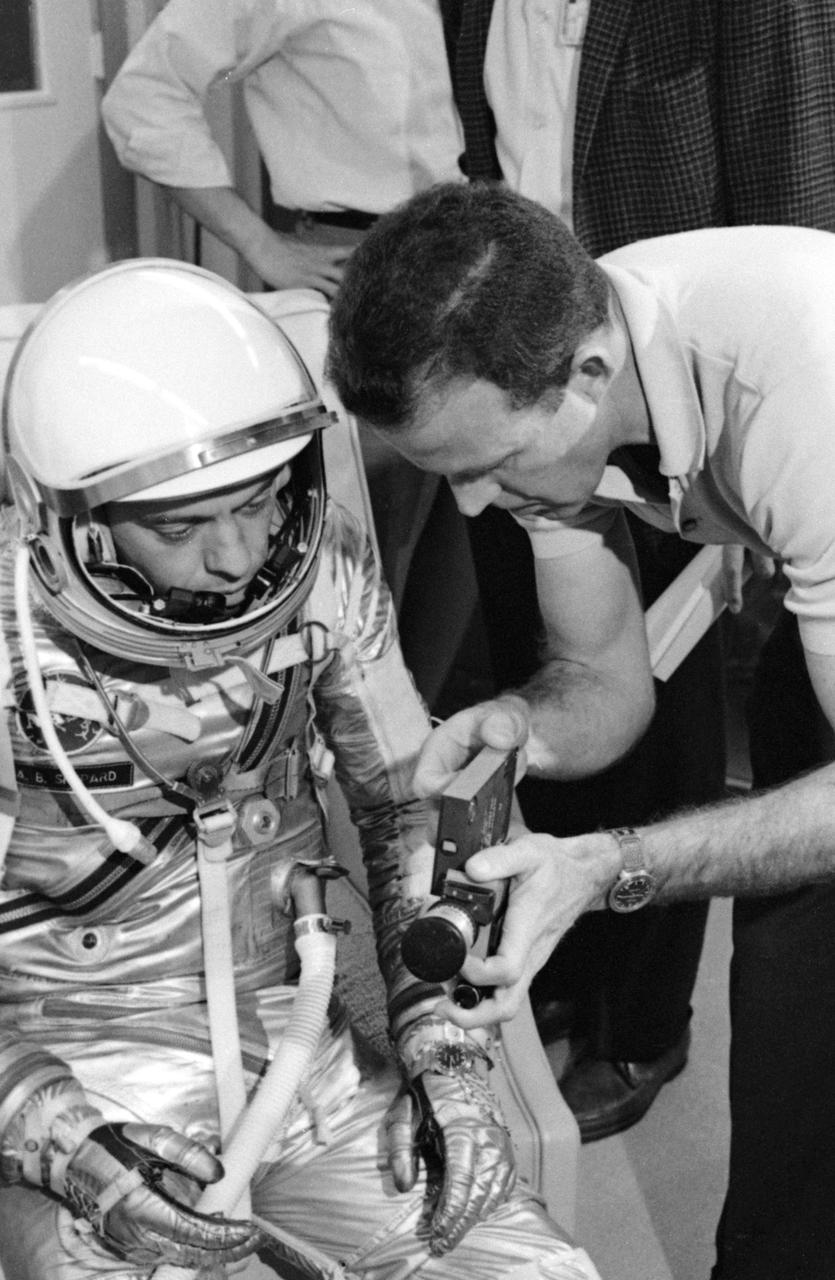
S63-03952 (1963) --- Astronaut L. Gordon Cooper Jr. explains the 16mm handheld spacecraft camera to his backup pilot astronaut Alan Shepard. The camera, designed by J.R. Hereford of McDonnell Aircraft Corp., will be used by Cooper during the Mercury-Atlas 9 (MA-9) mission to photograph experiments in space for M.I.T. and the Weather Bureau. Photo credit: NASA

S63-07602 (15 May 1963) --- This is the launch of Mercury-Atlas 9 (MA-9) on May 15, 1963, at 8:04 a.m. (EST) carrying astronaut L. Gordon Cooper Jr., pilot. Astronaut Cooper made 22 orbits in 34 hours and 19 minutes, in a spacecraft designated the ?Faith 7." Photo credit: NASA
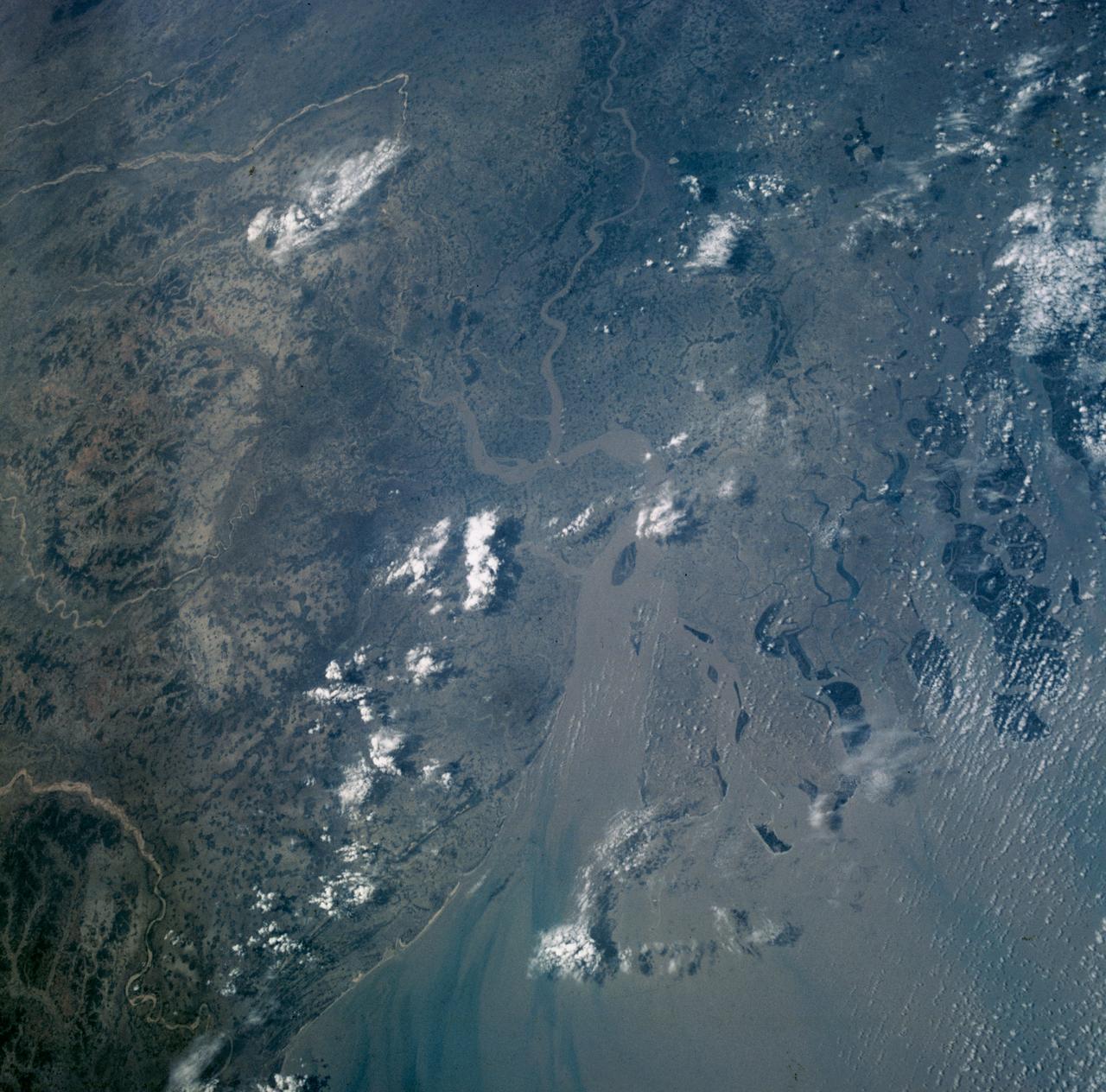
S63-06435 (15-16 May 1963) --- Part of the Ganges delta near Calcutta, as photographed from the Mercury-Atlas 9 (MA-9) capsule by astronaut L. Gordon Cooper Jr., during his 22-orbit MA-9 spaceflight. Photo credit: NASA
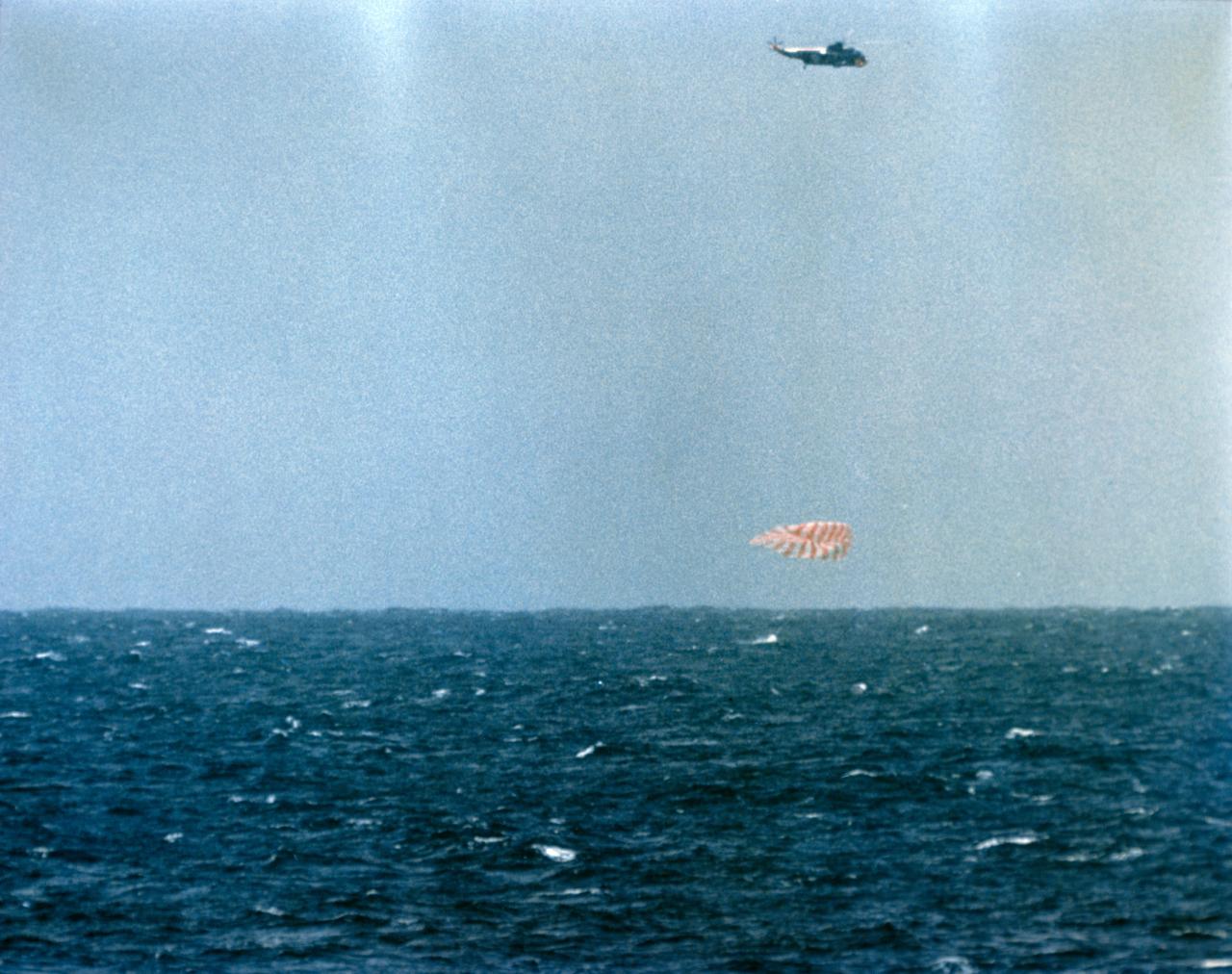
S71-24944 (16 May 1963) --- The Mercury-Atlas 9 "Faith 7" spacecraft, with astronaut L. Gordon Cooper Jr. aboard, splashes down in the Pacific Ocean to conclude a 22-orbit mission lasting 34 hours and 20.5 minutes. The capsule's parachute is fully deployed in this view. A rescue helicopter hovers overhead. Photo credit: NASA
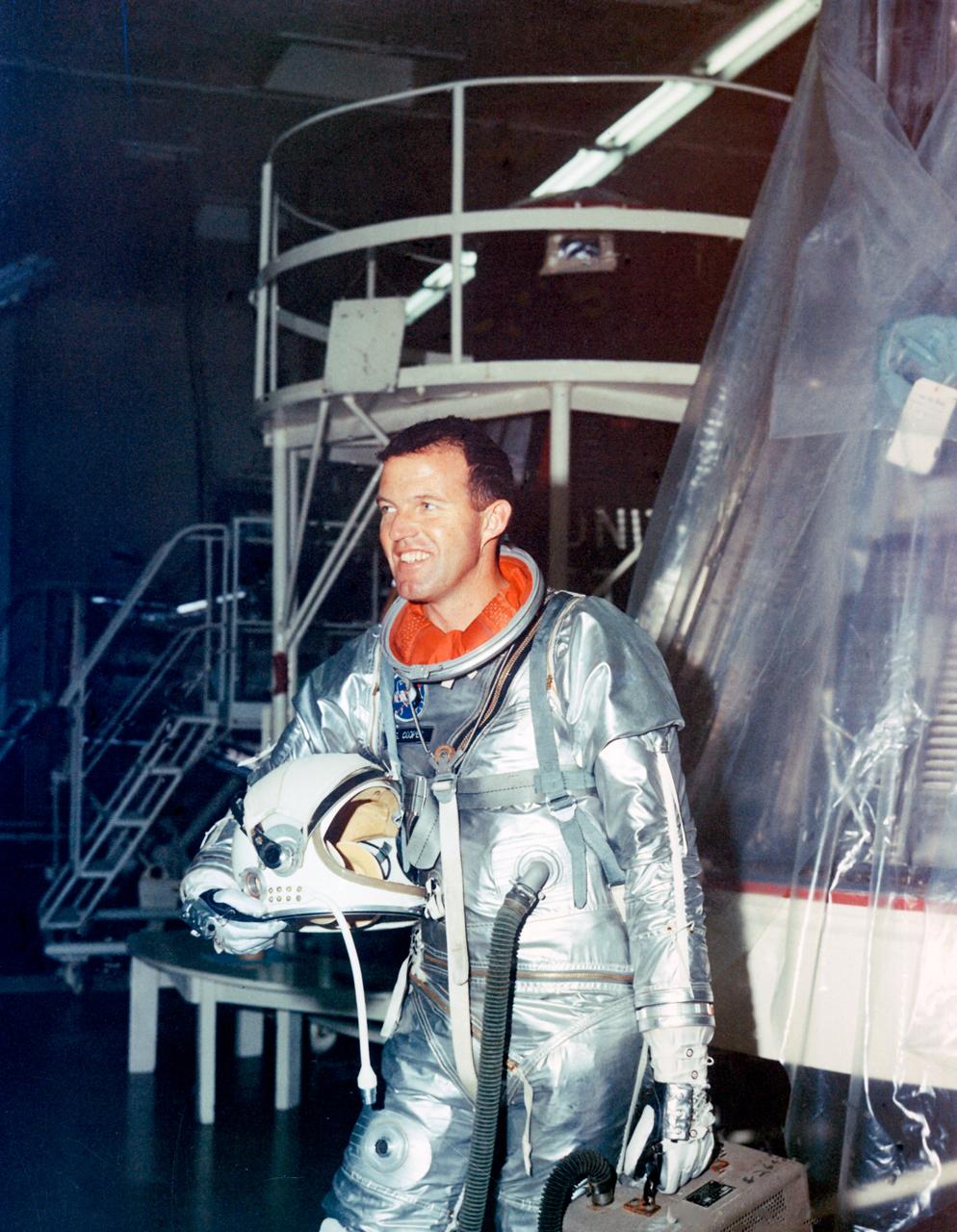
S63-01922 (1963) --- Astronaut L. Gordon Cooper Jr., pilot for the Mercury-Atlas 9 (MA-9) mission, stands fully suited beside his spacecraft during preflight testing. Cooper named his spacecraft the Faith 7. Photo credit: NASA
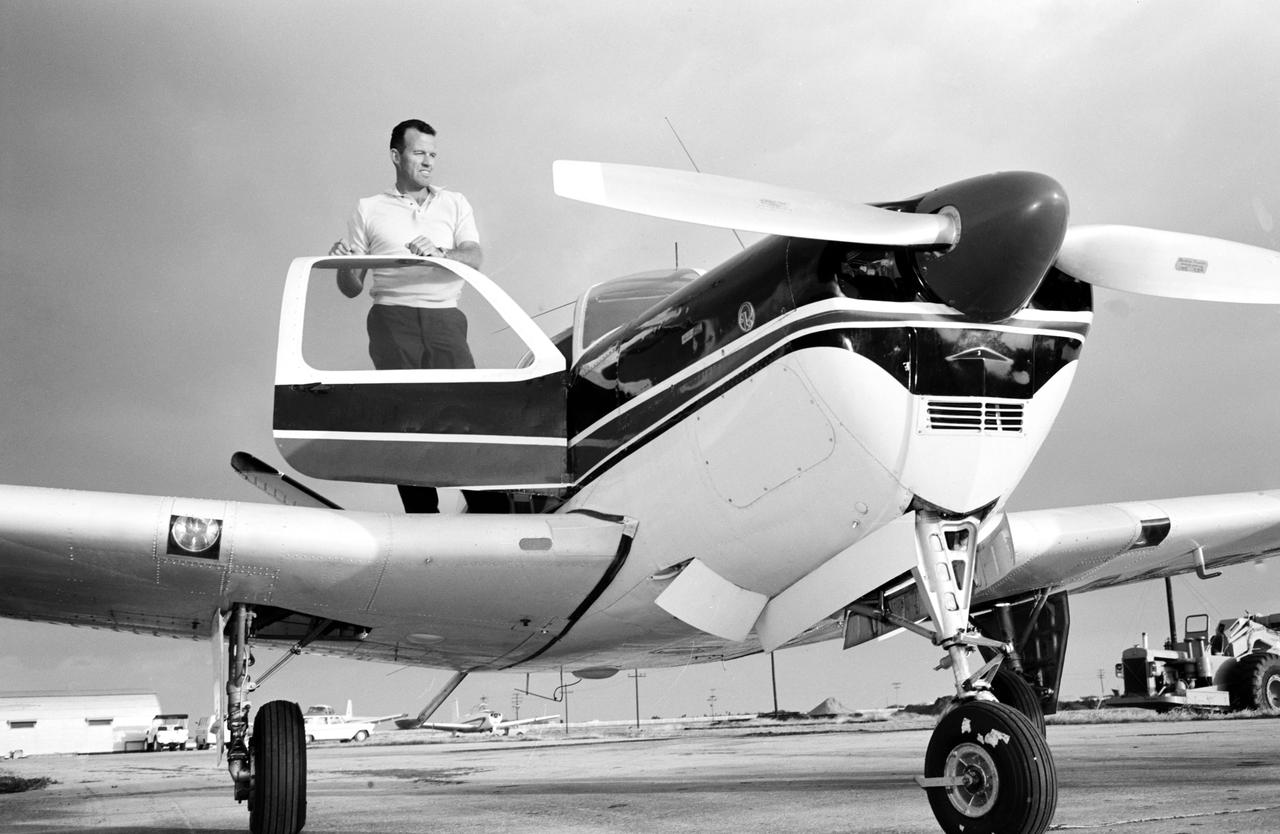
S63-03989 (1963) --- Astronaut L. Gordon Cooper Jr., prime pilot for the Mercury Atlas 9 (MA-9) 22-orbit flight, stands by his privately owned Beechcraft Bonanza aircraft, at Patrick Air Base, Florida. Photo credit: NASA
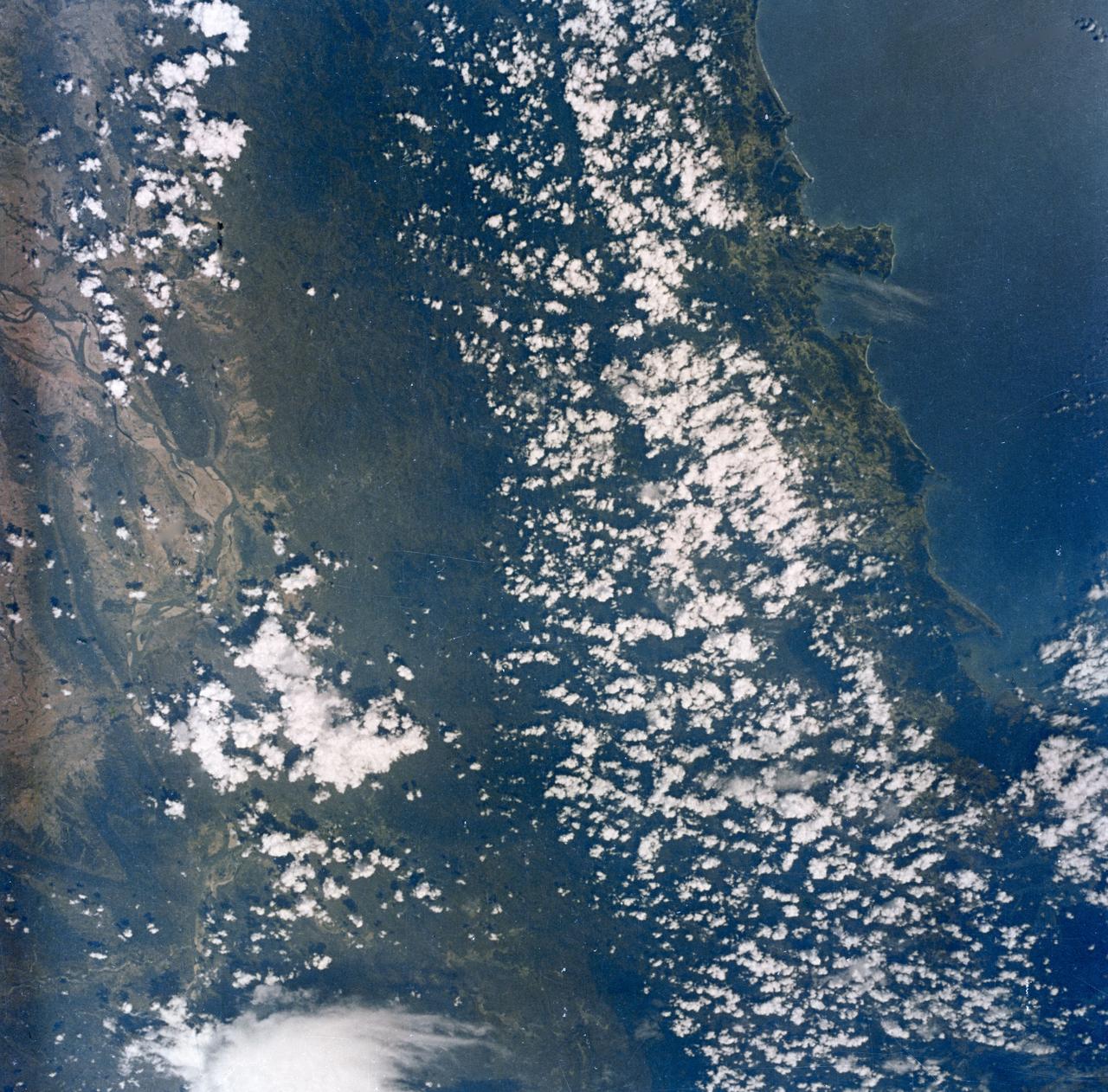
S63-06427 (15-16 May 1963) --- Burma's west coast, west of Rangoon and Irrawaddy River (right), are featured in this image photographed by astronaut L. Gordon Cooper Jr., during his 22-orbit Mercury Atlas 9 (MA-9) spaceflight. Photo credit: NASA
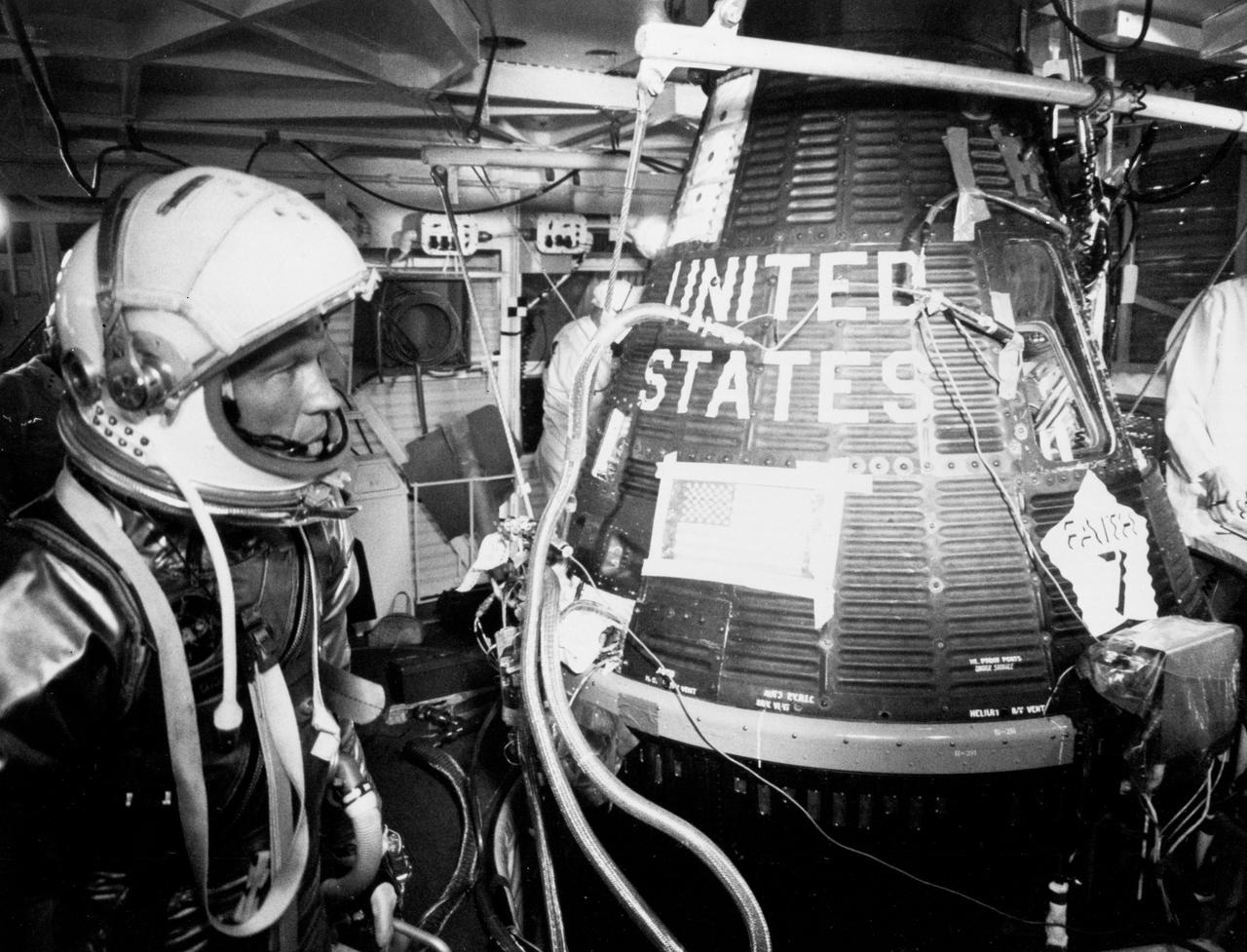
S63-06124 (1963) --- Astronaut L. Gordon Cooper Jr., prime pilot for the Mercury Atlas 9 (MA-9) mission, arrives at the top of the gantry during a preflight simulated mission, three days before he is scheduled to take "Faith 7" on the 22-orbit flight. Photo credit: NASA
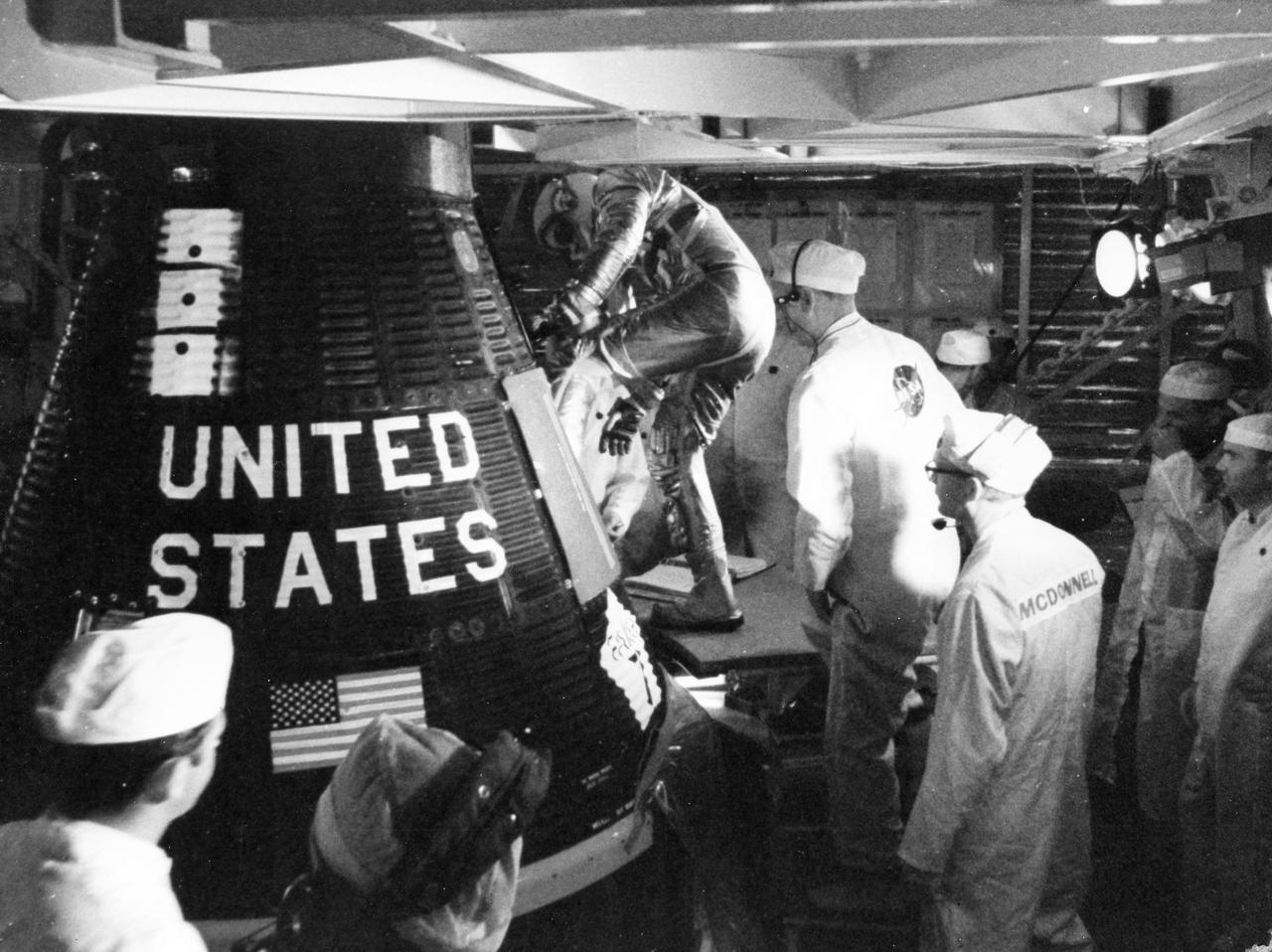
S63-06259 (14 May 1963) --- Astronaut L. Gordon Cooper Jr., prime pilot for the Mercury-Atlas 9 (MA-9) mission, is assisted into his "Faith 7" Mercury spacecraft early morning on May 14, 1963. Cooper remained in the spacecraft for approximately five hours and then climbed out again as the mission was delayed because of trouble at a tracking station. Photo credit: NASA
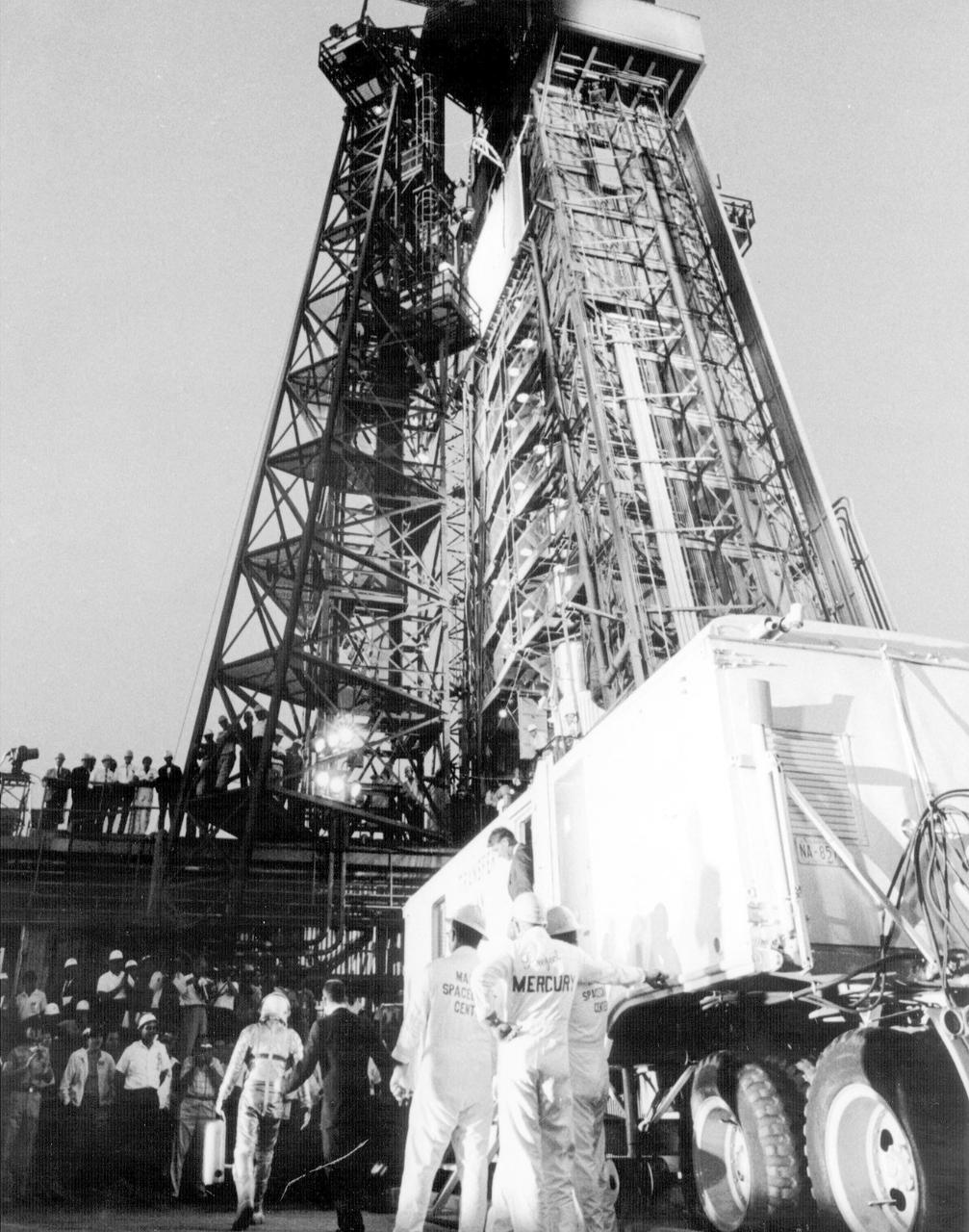
JSC2013-E-076221 (15 May 1963) --- Astronaut L. Gordon Cooper Jr. waited inside the transfer van for several minutes and then leaving the transfer van walked to the elevator which took him to the spacecraft "Faith 7" atop the Atlas vehicle for his mission. (63-MA9-132) Photo credit: NASA
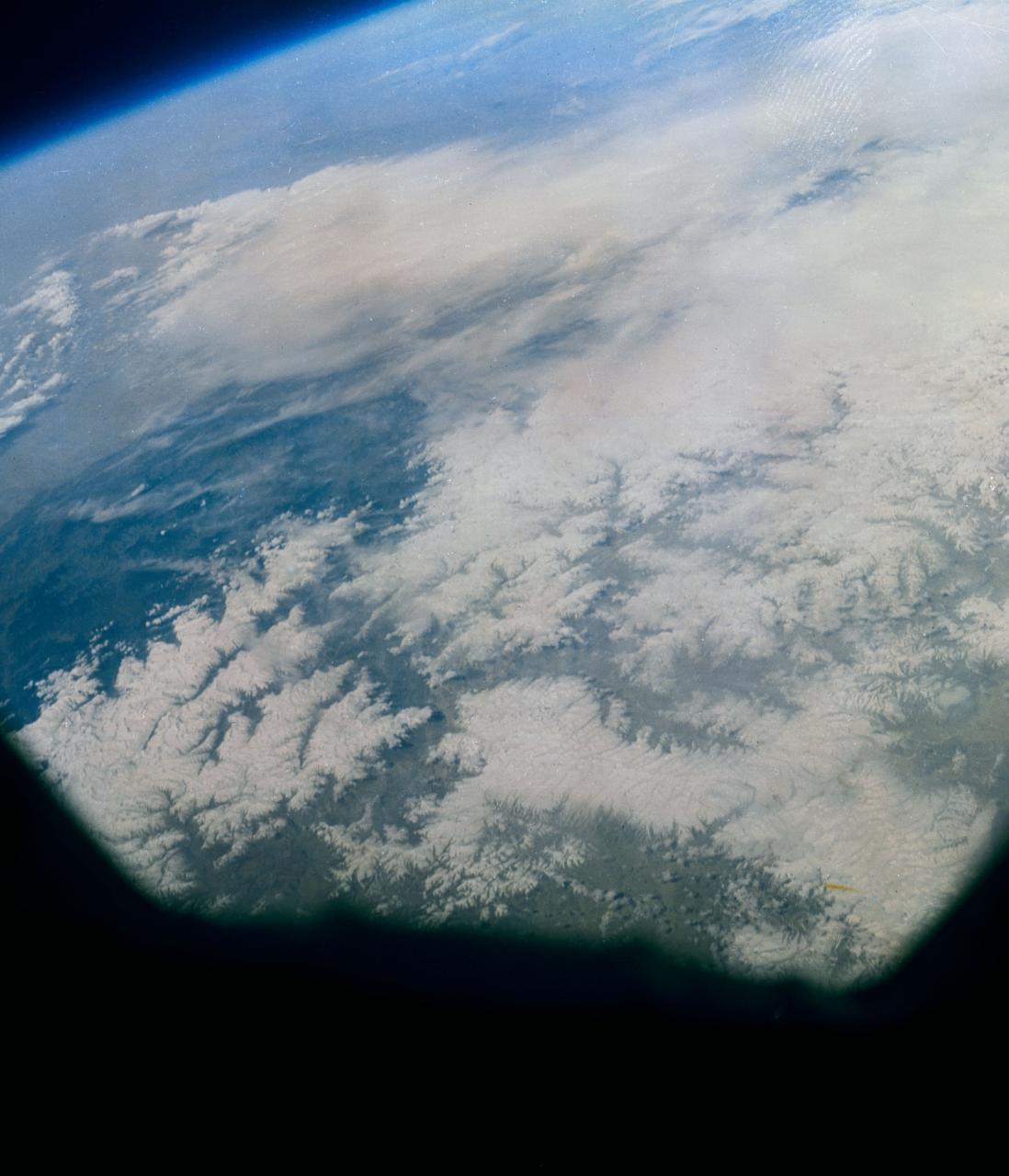
S63-06429 (15-16 May 1963) --- Photograph taken of the eastern Himalayas, Tibet, China, India and Burma from the Mercury-Atlas 9 capsule taken by astronaut L. Gordon Cooper Jr., during his 22-orbit Mercury-Atlas 9 (MA-9) spaceflight. Photo credit: NASA
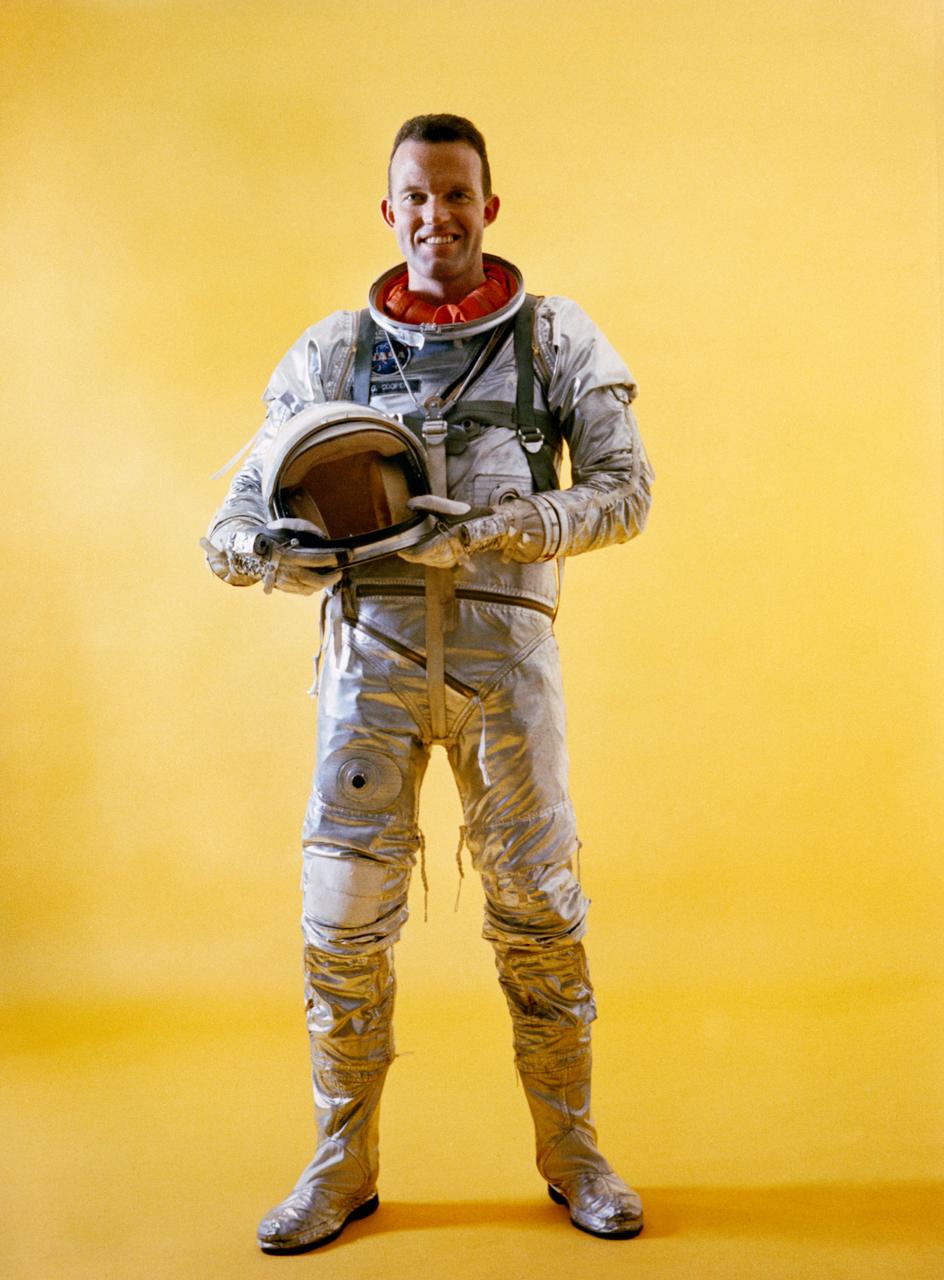
S63-01755 (May 1963) --- Full-length portrait of Mercury astronaut L. Gordon Cooper Jr., in spacesuit during Mercury-Atlas 9 prelaunch activities. Photo credit: NASA
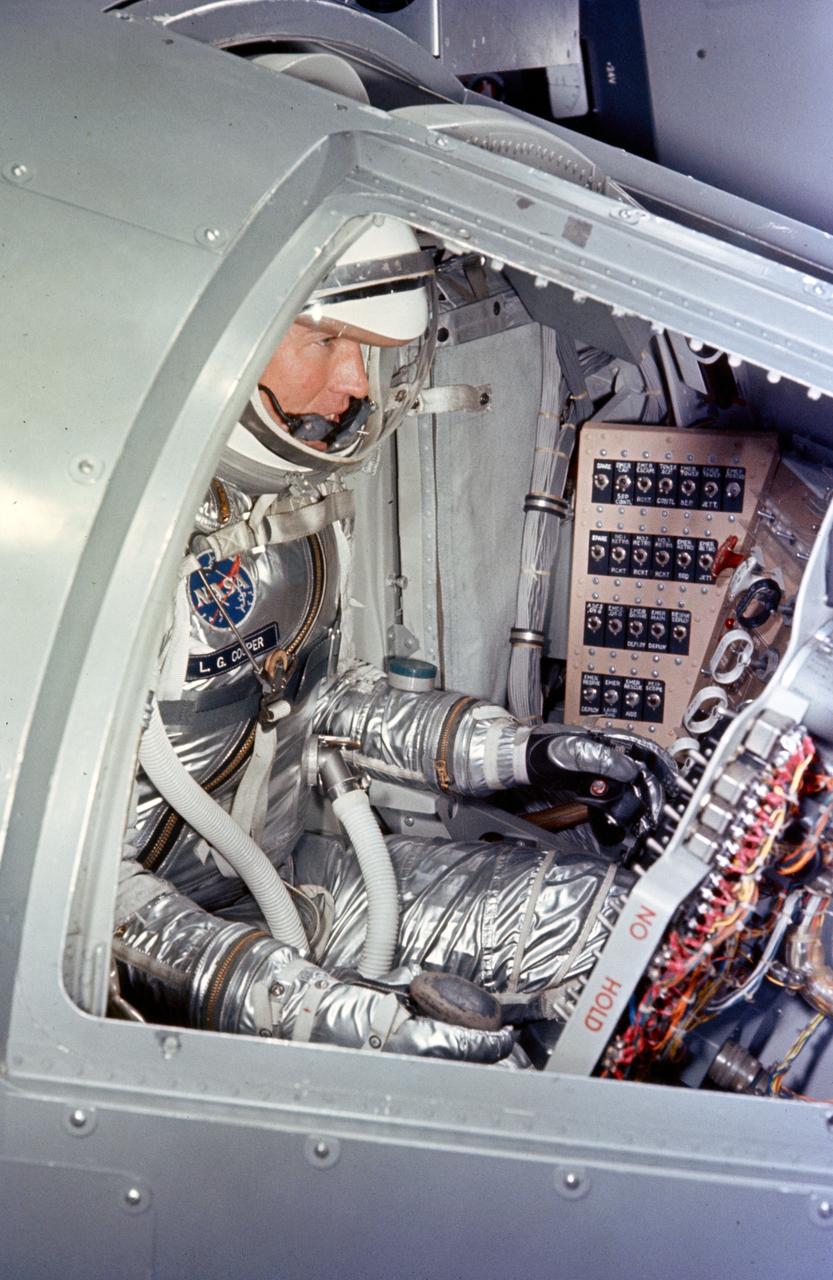
S64-14868 (1963) --- Astronaut L. Gordon Cooper Jr., pilot of the Mercury-Atlas 9 (MA-9) Earth-orbital space mission, participates in preflight simulation training inside his Mercury capsule at Cape Canaveral, Florida. Photo credit: NASA
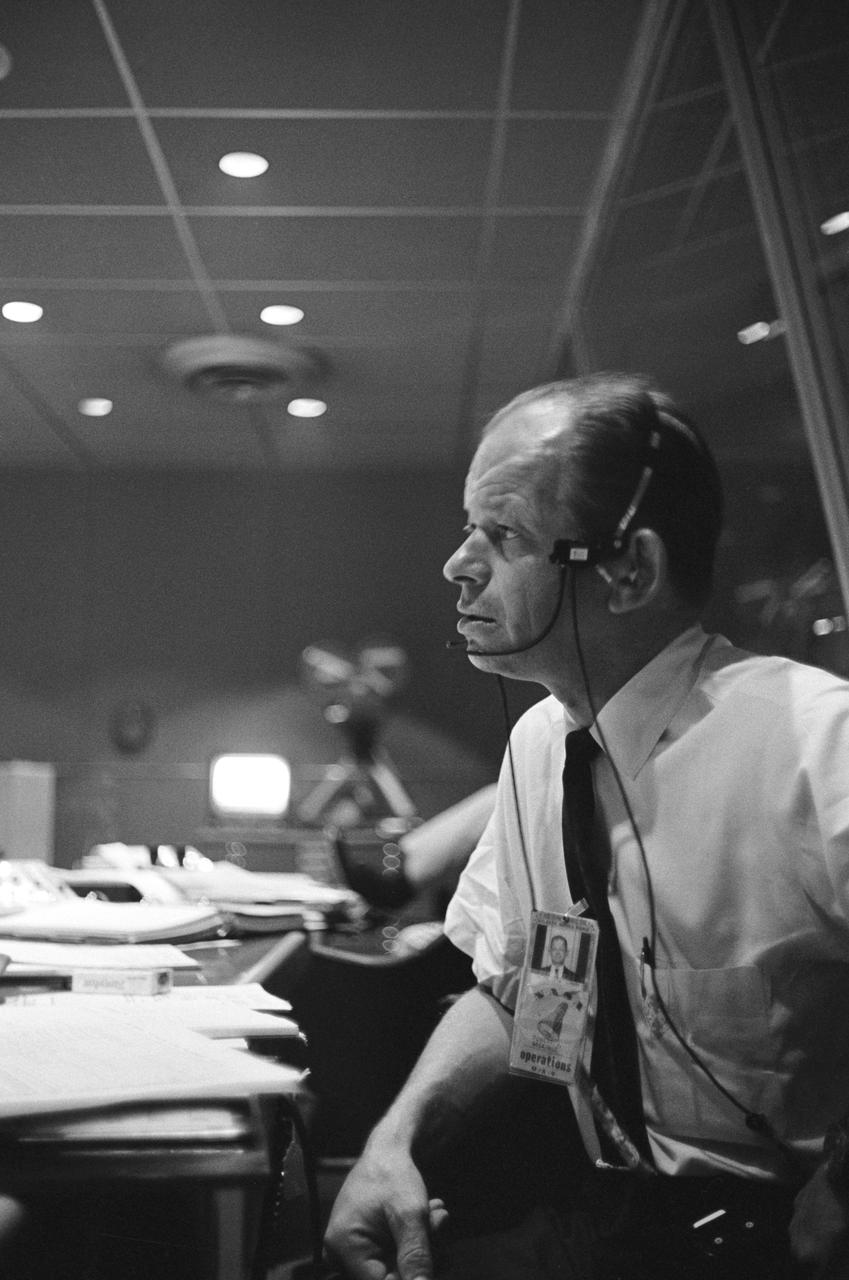
S63-09593 (15-16 May 1963) --- John A. Powers sits at the Public Affairs Officer console in Mercury Control Center at Cape Canaveral, Florida during the Mercury Atlas 9 (MA-9) 22-orbit mission of astronaut L. Gordon Cooper Jr. Photo credit: NASA
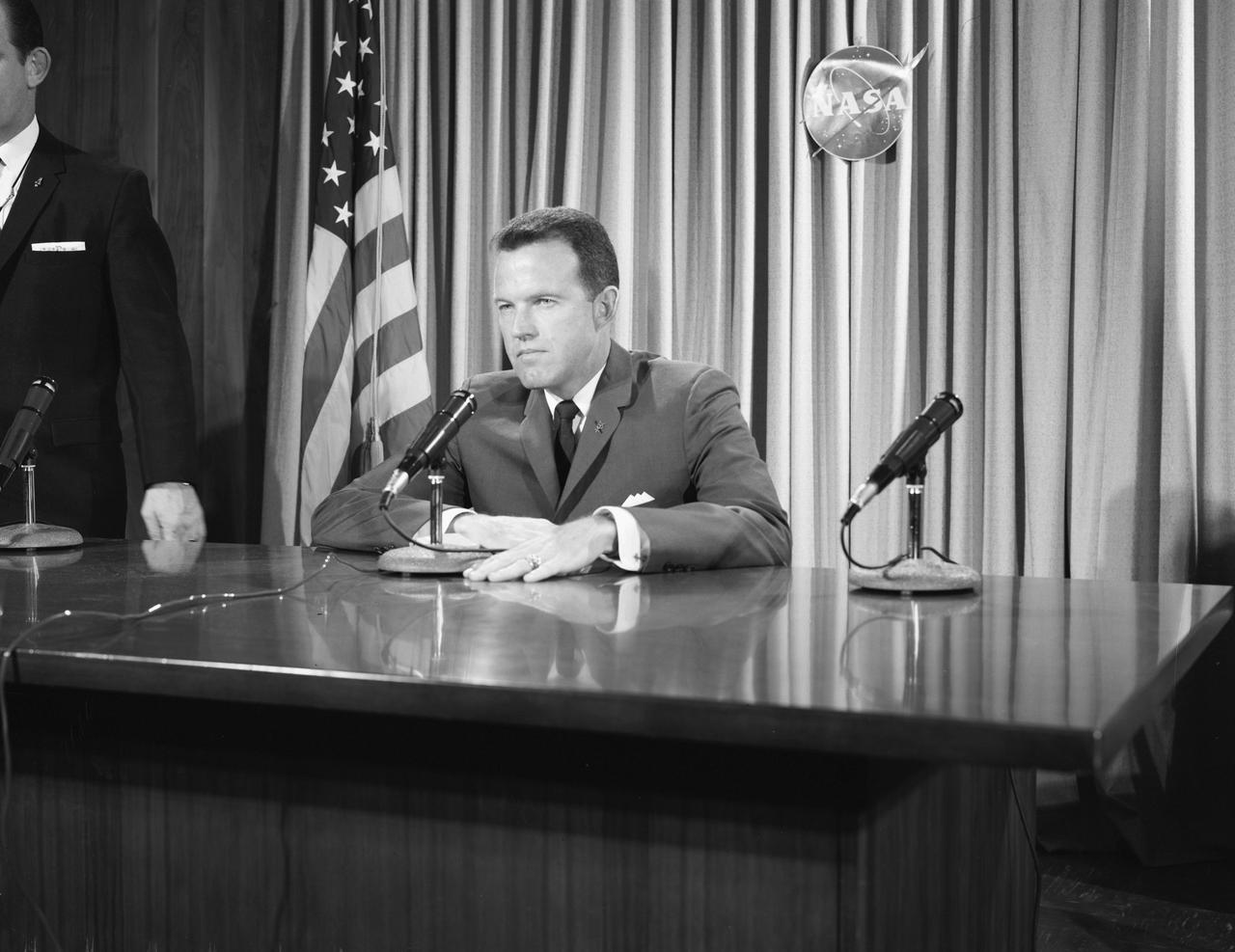
S63-00581 (1963) --- Astronaut L. Gordon Cooper Jr., pilot of the Mercury Atlas 9 (MA-9) space mission, appears before newsmen at a preflight press conference. Photo credit: NASA
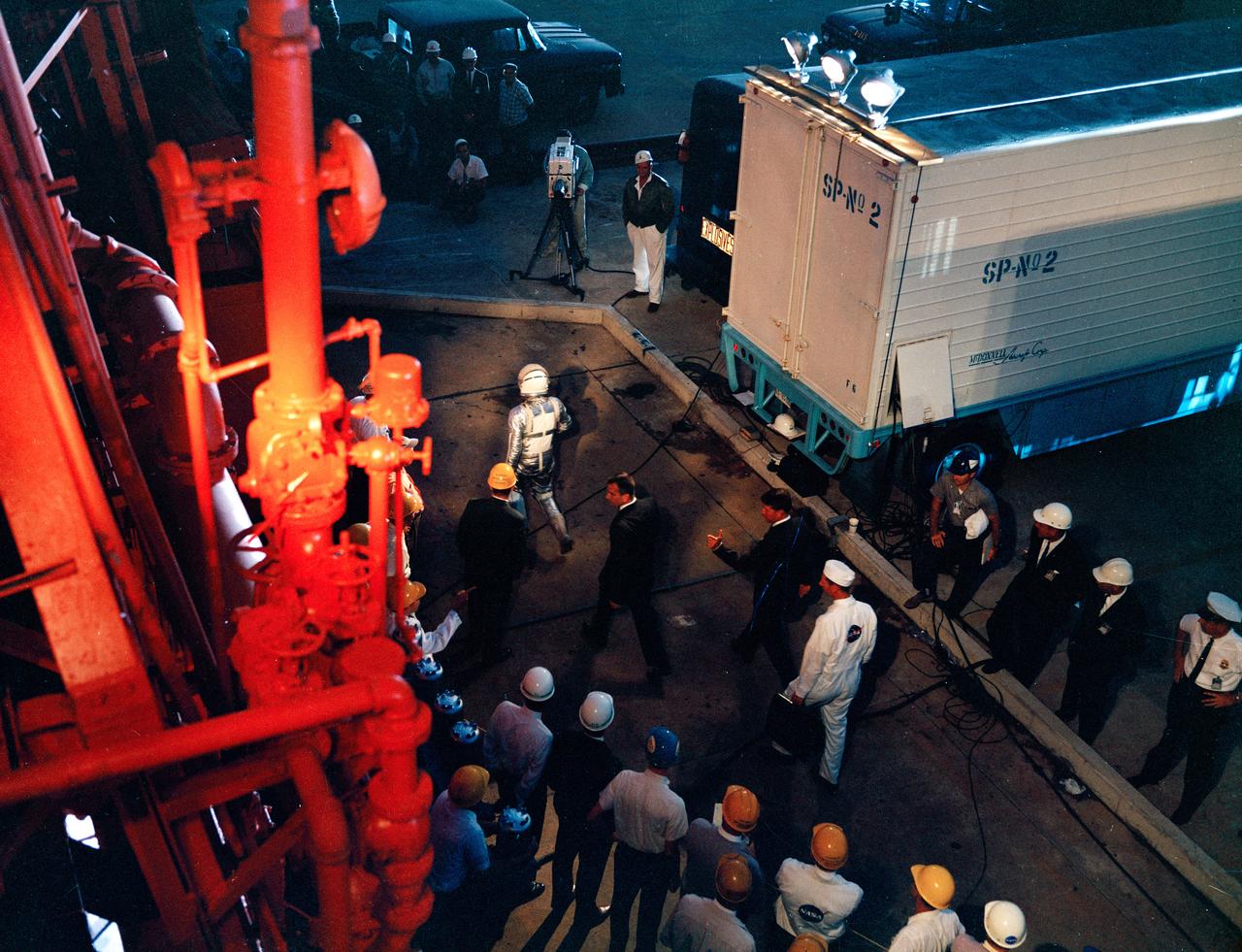
S63-07632 (15 May 1963) --- Astronaut L. Gordon Cooper Jr. leaves the transfer van for the launch pad and the beginning of the Mercury-Atlas 9 (MA-9) flight on May 15, 1963. Photo credit: NASA
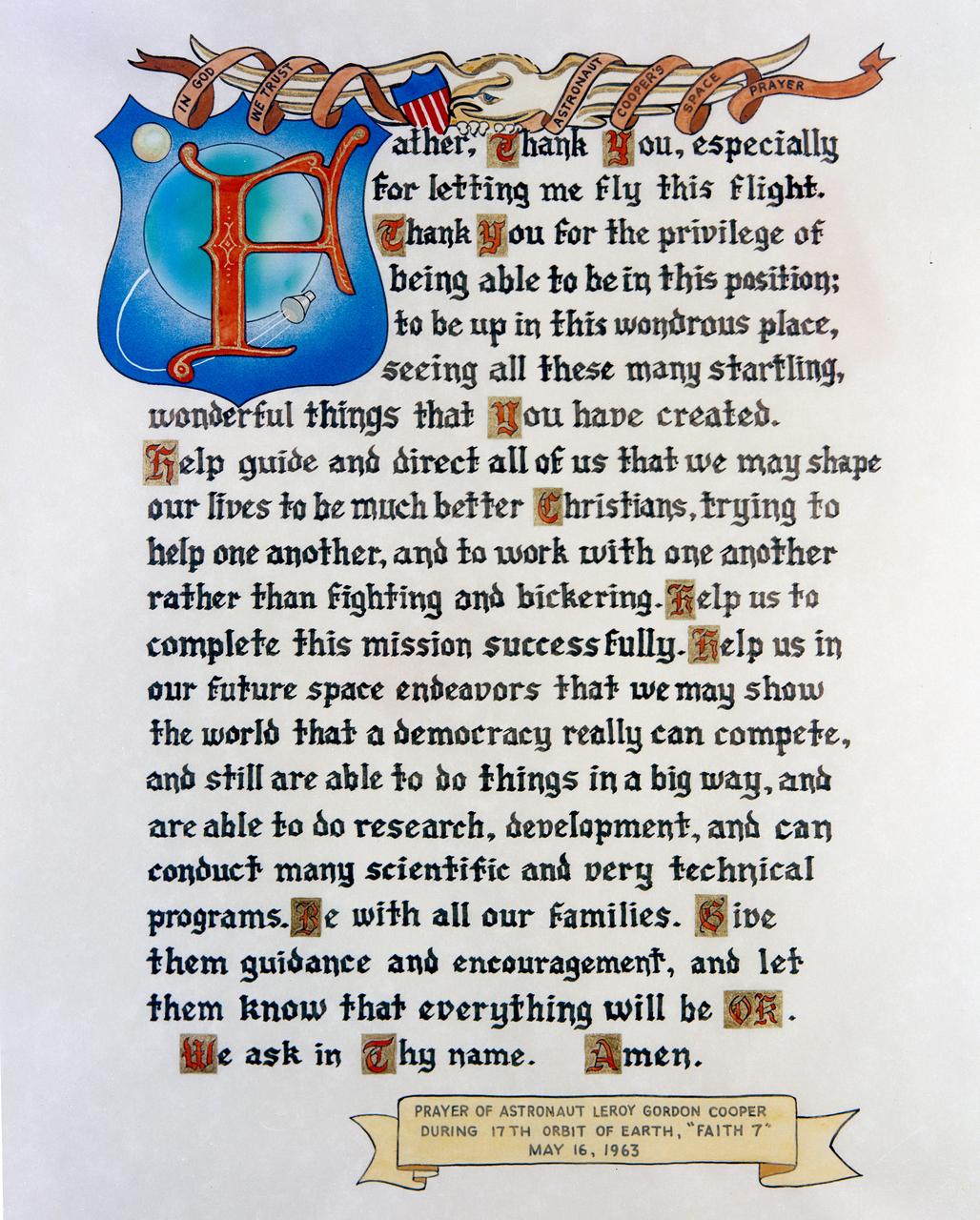
S63-08512 (1963) --- Prayer, written in calligraphy, of astronaut L. Gordon Cooper Jr., pilot of the Mercury-Atlas 9 (MA-9) mission, read during the 17th orbit of Earth in the "Faith 7". Photo credit: NASA
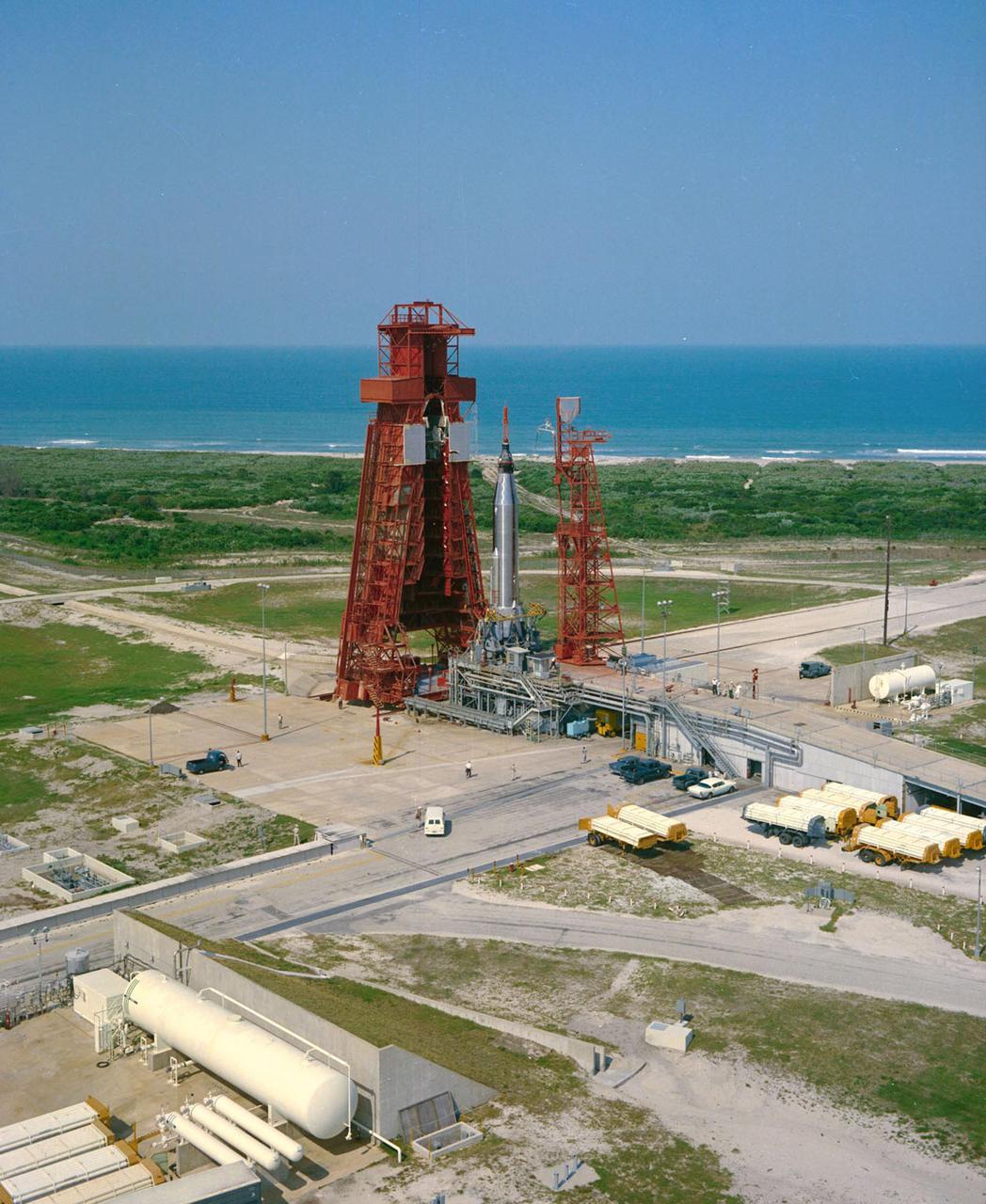
KENNEDY SPACE CENTER, FLA. -- Aerial view of Launch Complex 14. Mercury-Atlas 9 (MA-9), visible on Pad 14, is scheduled to carry astronaut Gordon Cooper for the fourth manned orbital mission.
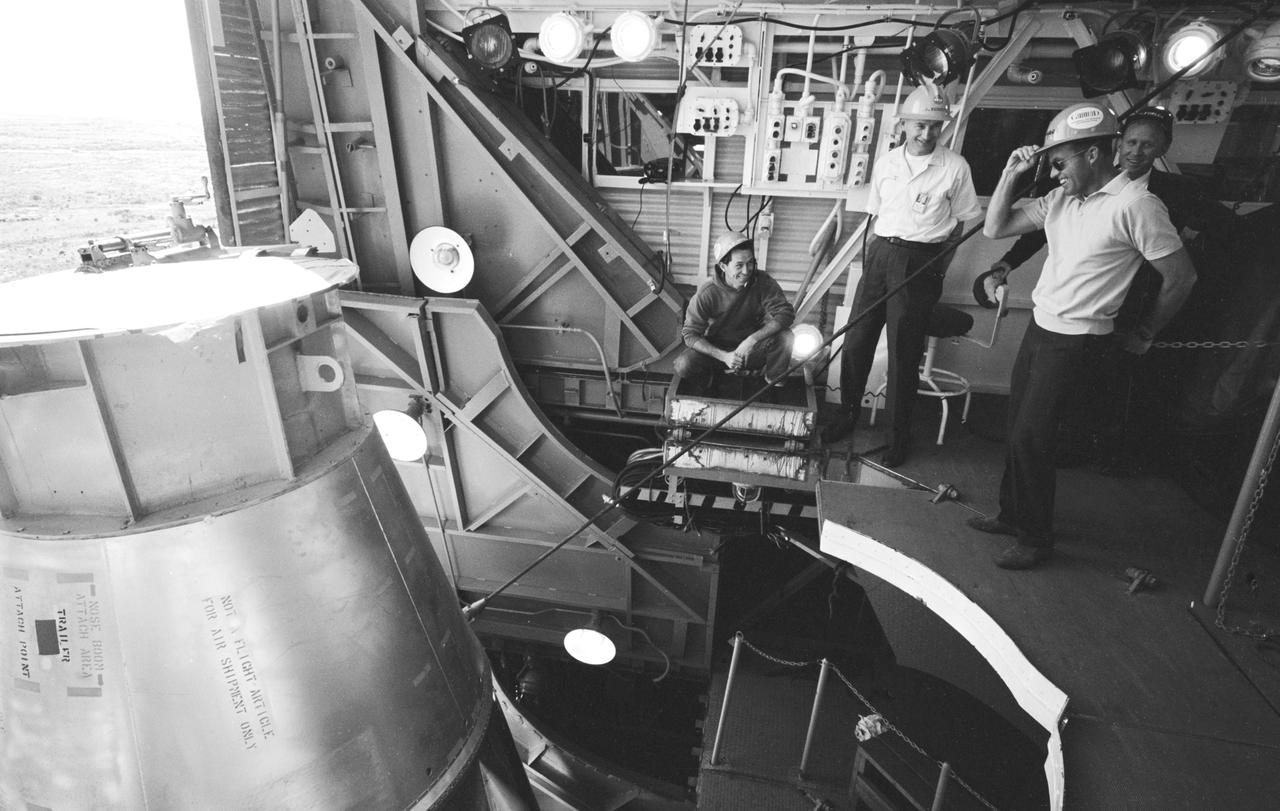
S63-03986 (1963) --- Astronaut L. Gordon Cooper Jr., prime pilot for the Mercury-Atlas 9 (MA-9) mission, and General Dynamics pad technicians watch Atlas 130D being hoisted into place in the gantry at pad #14, Cape Canaveral, Florida. Photo credit: NASA

Astronaut Walter M. "Wally" Schirra, one of the original seven astronauts for Mercury Project selected by NASA on April 27, 1959. The MA-8 (Mercury-Atlas) mission with Sigma 7 spacecraft was the third marned orbital flight by the United States, and made the six orbits in 9-1/4 hours.
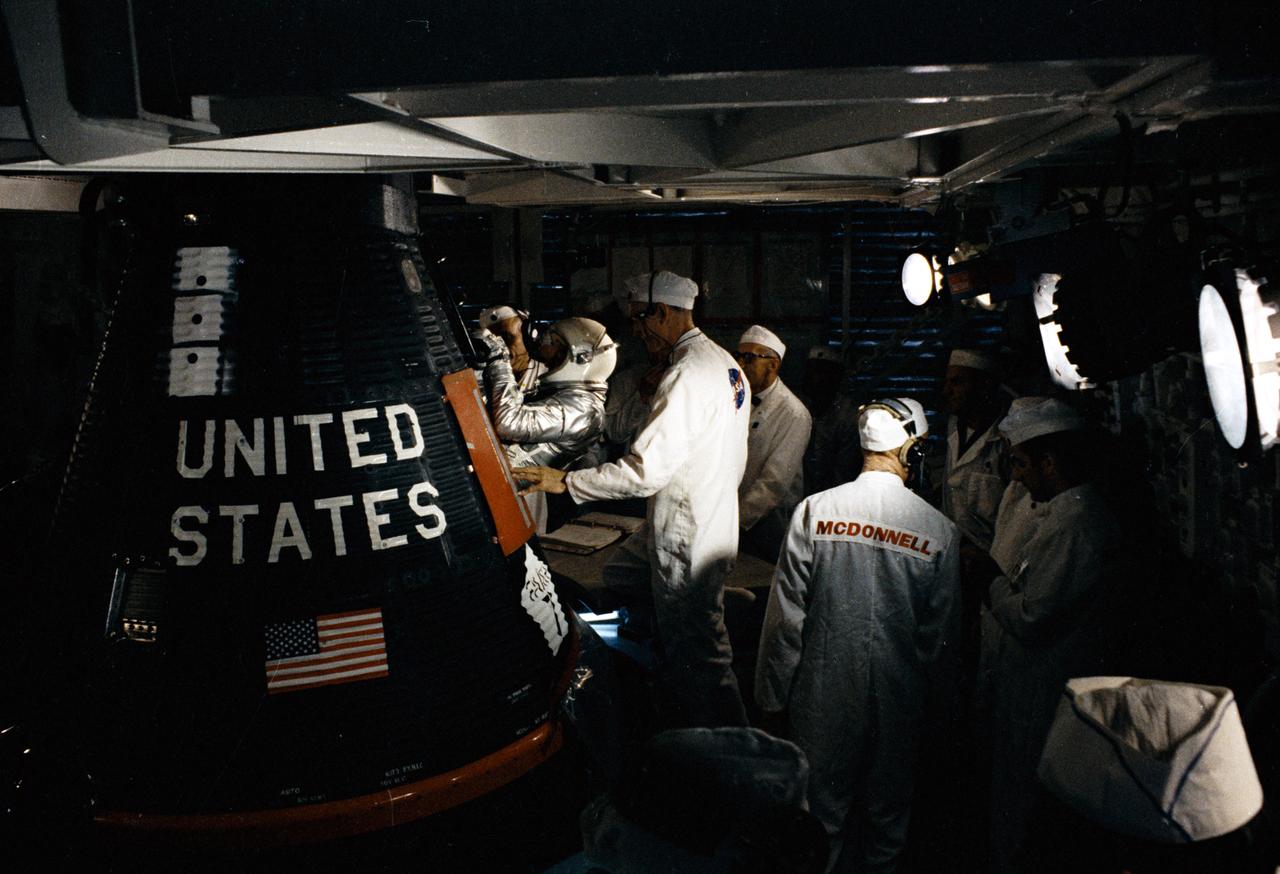
S63-09676-E (15 May 1963) --- Astronaut L. Gordon Cooper Jr., pilot of the Mercury-Atlas 9 (MA-9) Earth-orbital space mission, is assisted into his "Faith 7" Mercury spacecraft during the prelaunch countdown. MA-9 was launched on May 15, 1963, and the flight lasted for 34 hours and 20 minutes. Photo credit: NASA
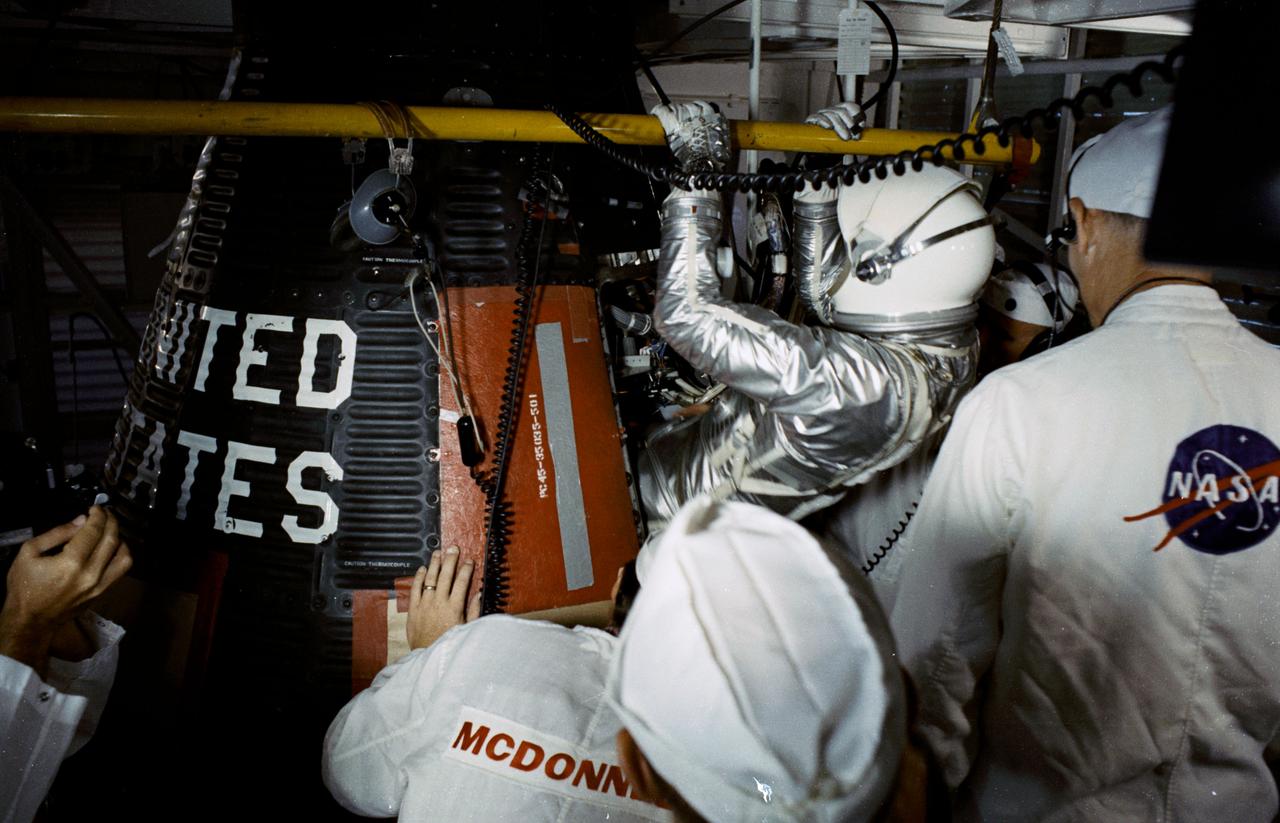
S63-07521 (15 May 1963) --- Astronaut L. Gordon Cooper Jr., pilot of the Mercury-Atlas 9 (MA-9) Earth-orbital space mission, is assisted into his "Faith 7" Mercury spacecraft during the prelaunch countdown. MA-9 was launched on May 15, 1963, and the flight lasted for 34 hours and 20 minutes. Photo credit: NASA
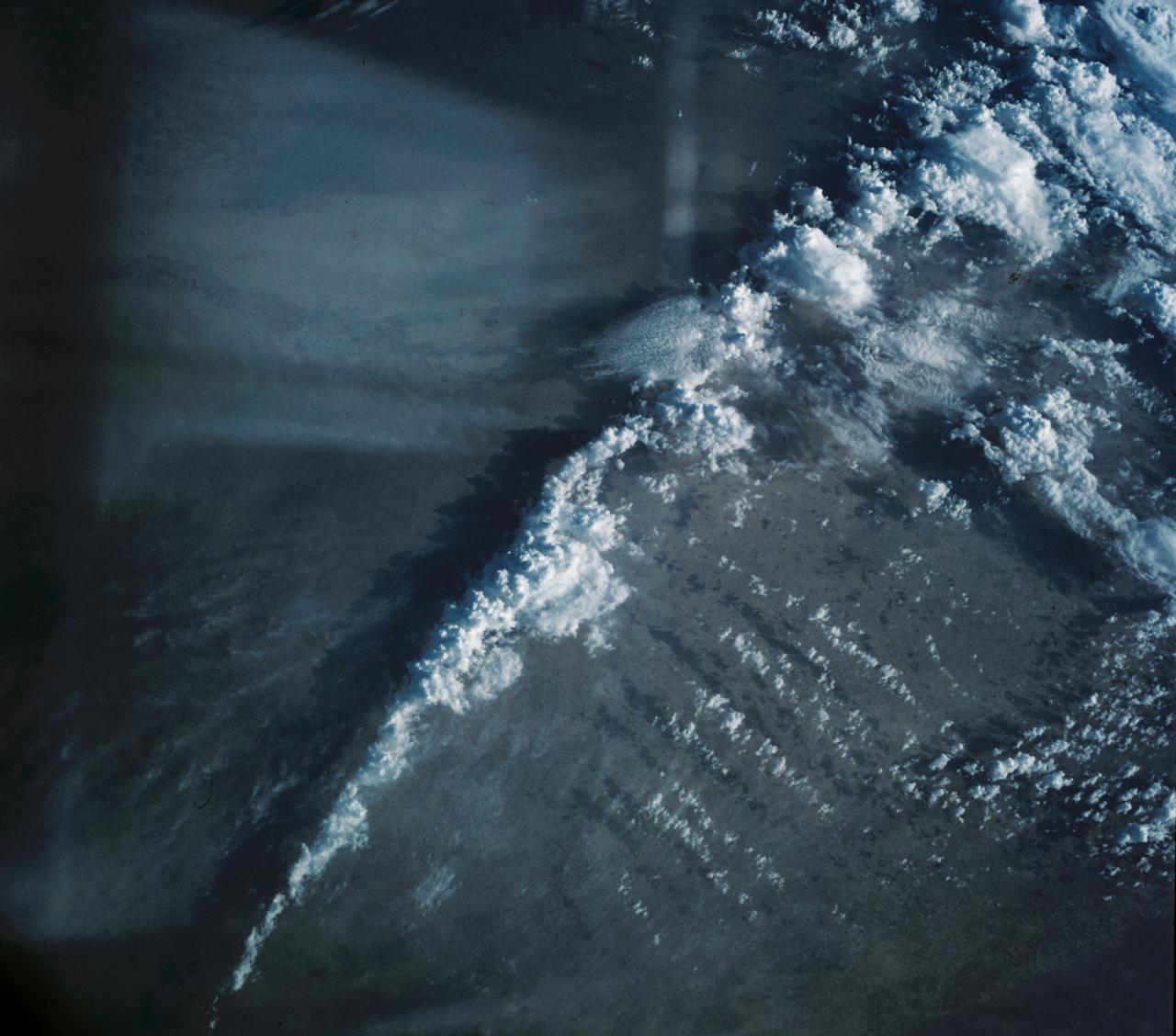
S63-06447 (15-16 May 1963) --- The Great Indian Desert, located west of New Delhi, India, as photographed from the Mercury-Atlas 9 (MA-9) capsule by astronaut L. Gordon Cooper Jr., during his 22-orbit MA-9 spaceflight. Photo credit: NASA
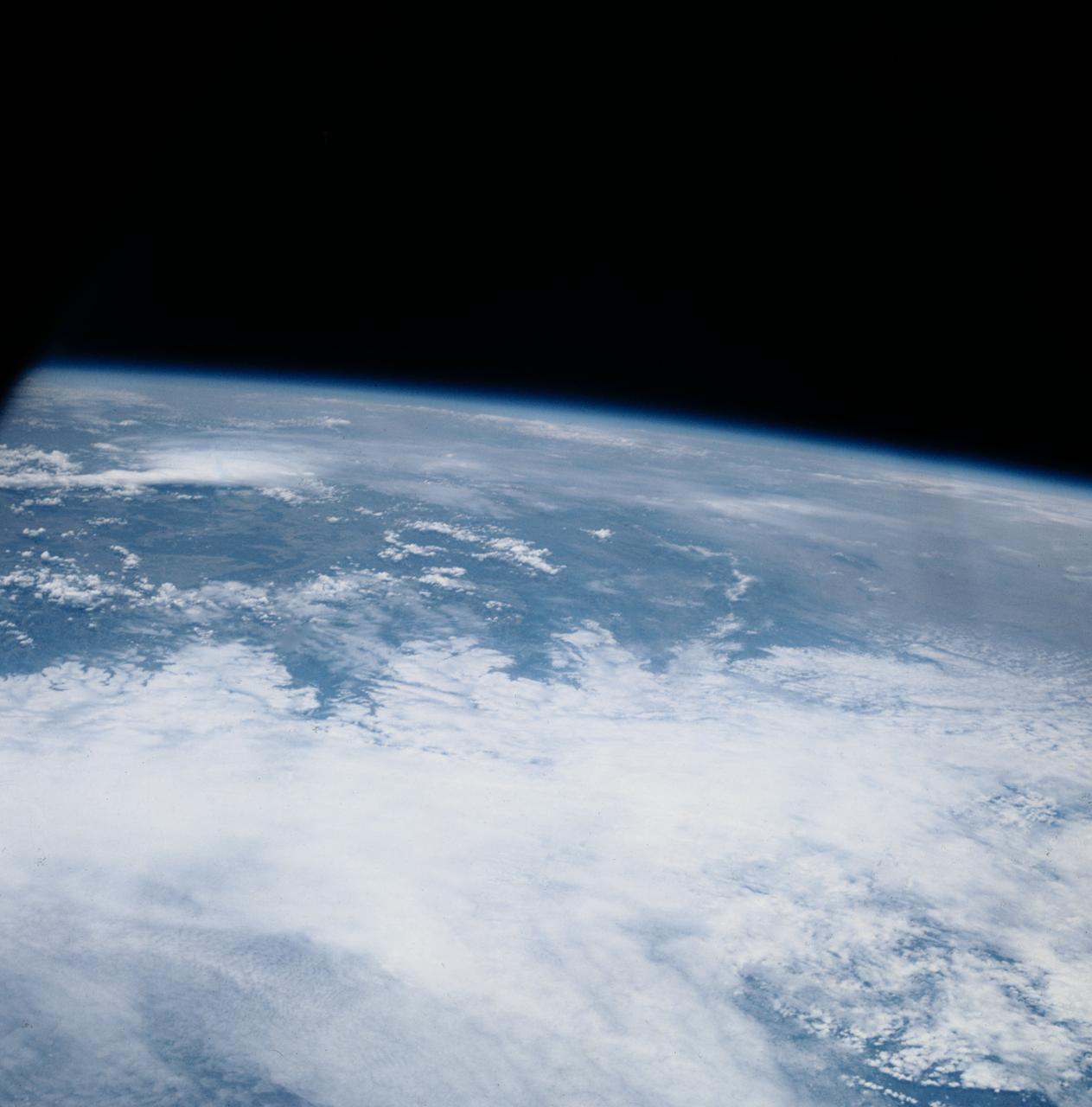
S63-06438 (15-16 May 1963) --- Changsha area in China, showing Tung Ting lake region, as photographed from the Mercury-Atlas 9 (MA-9) capsule by astronaut L. Gordon Cooper Jr., during his 22-orbit MA-9 spaceflight. Photo credit: NASA
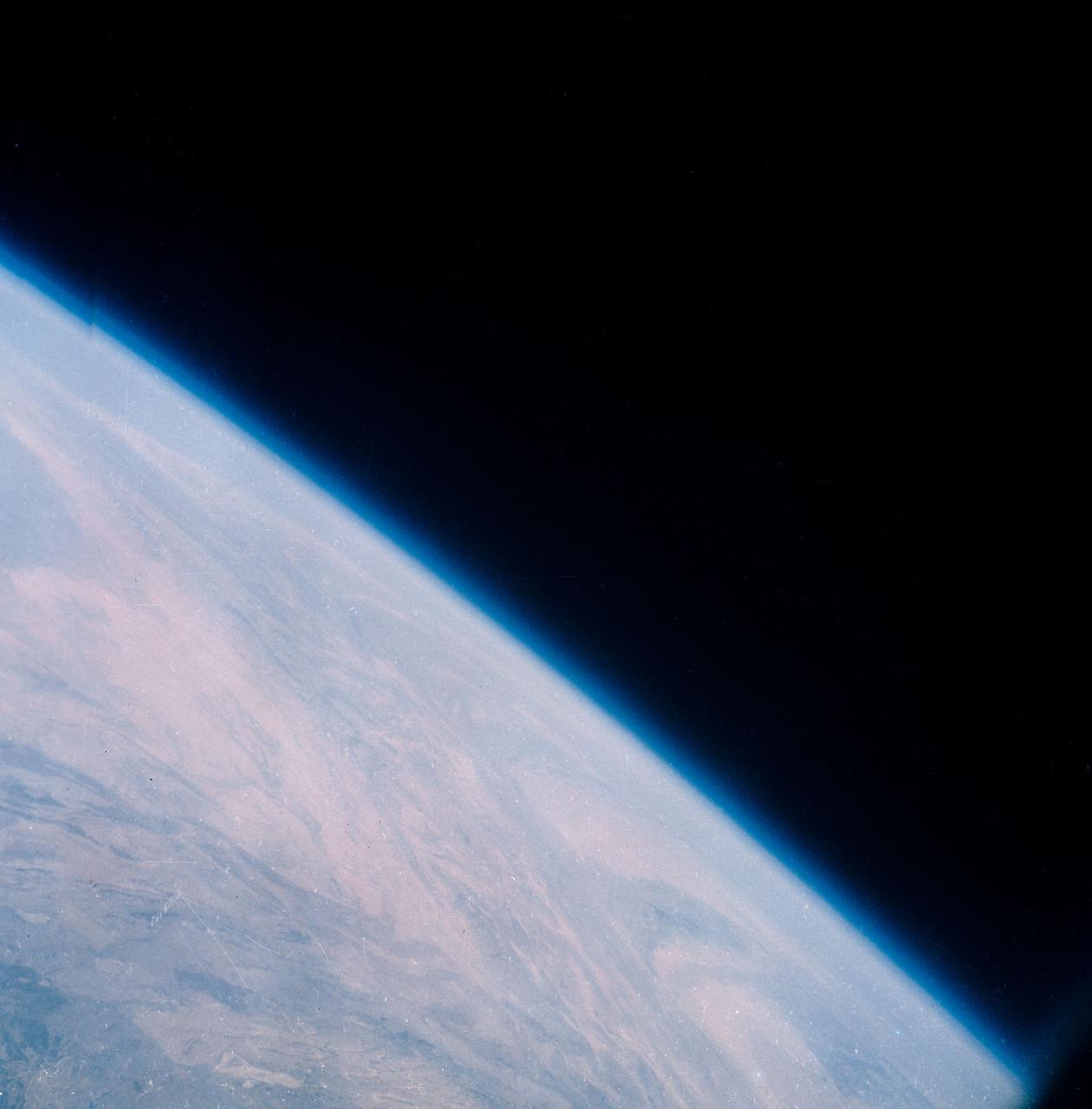
S63-06443 (15-16 May 1963) --- A northwest-looking view across Pakistan, eastern Iran and Afghanistan as photographed from the Mercury-Atlas 9 (MA-9) capsule by astronaut L. Gordon Cooper Jr., during his 22-orbit MA-9 spaceflight. Photo credit: NASA
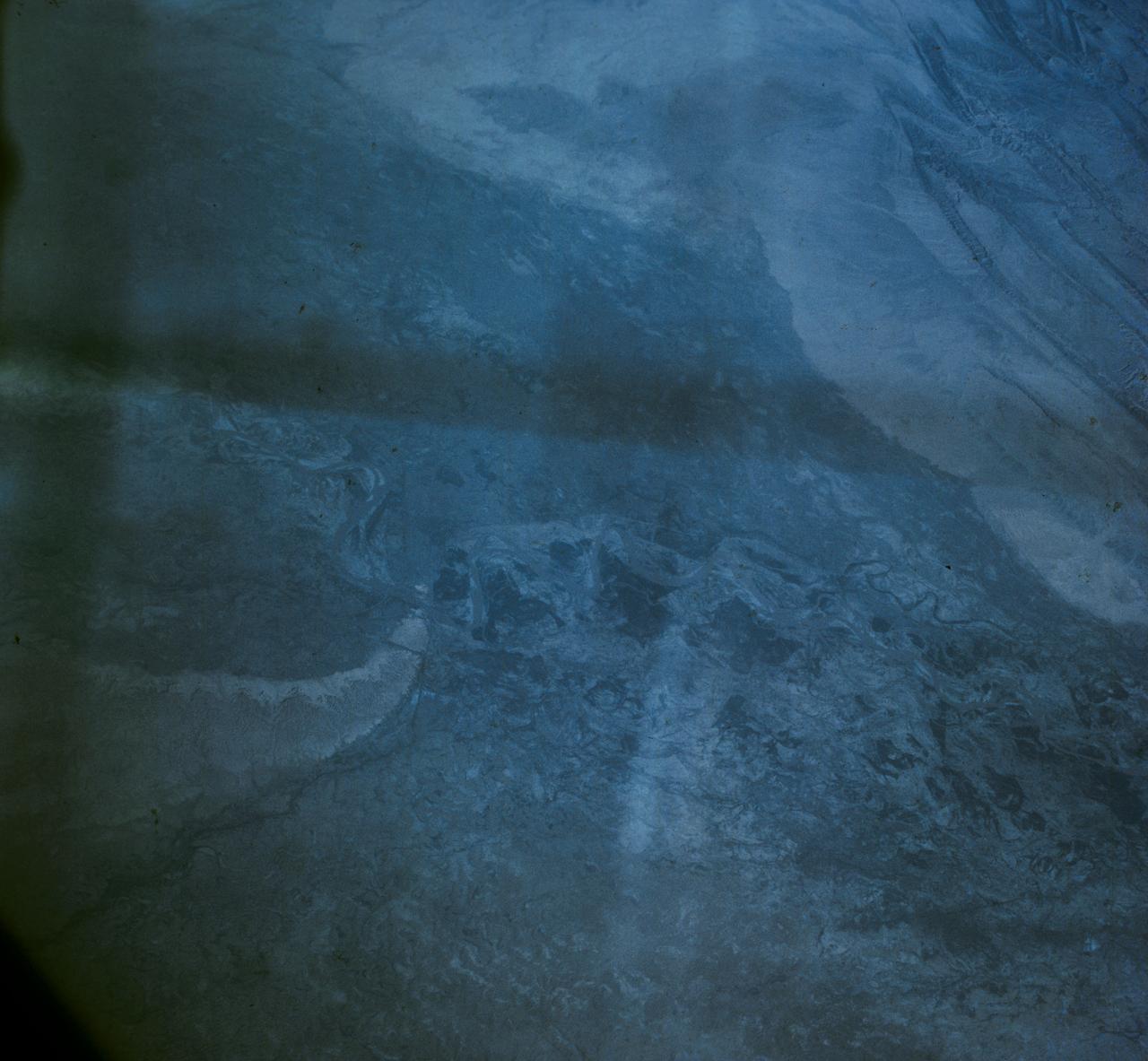
S63-06455 (15-16 May 1963) --- Indus River above Hyderabad, photographed from the Mercury-Atlas 9 (MA-9) capsule by astronaut L. Gordon Cooper Jr., during his 22-orbit MA-9 spaceflight. Photo credit: NASA
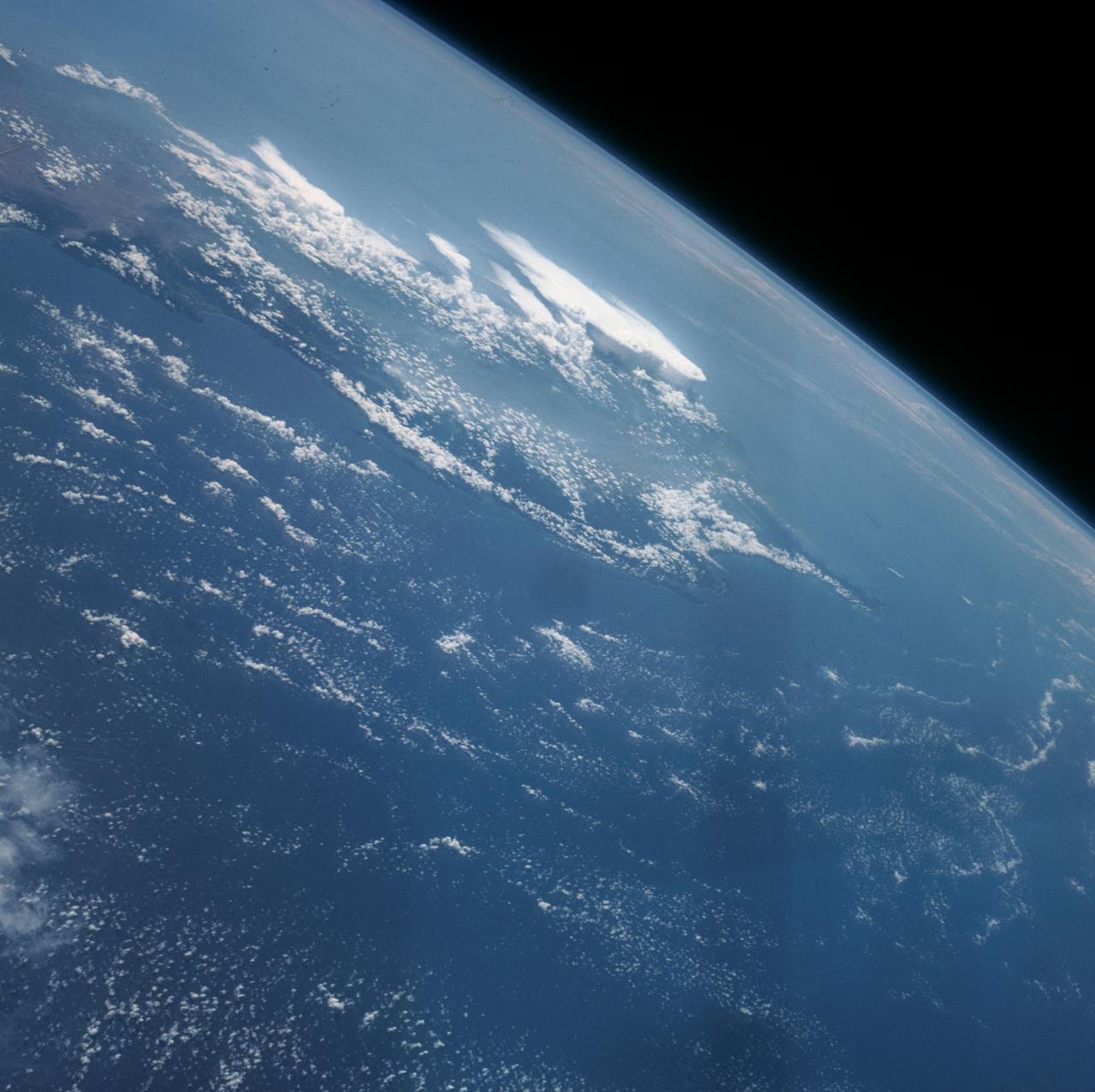
S63-06437 (15-16 May 1963) --- The southern portion of the island of Taiwan (Formosa), Formosa Straight and the Pacific Ocean, looking northeast, as photographed from the Mercury-Atlas 9 (MA-9) capsule by astronaut L. Gordon Cooper Jr., during his 22-orbit MA-9 spaceflight. Photo credit: NASA
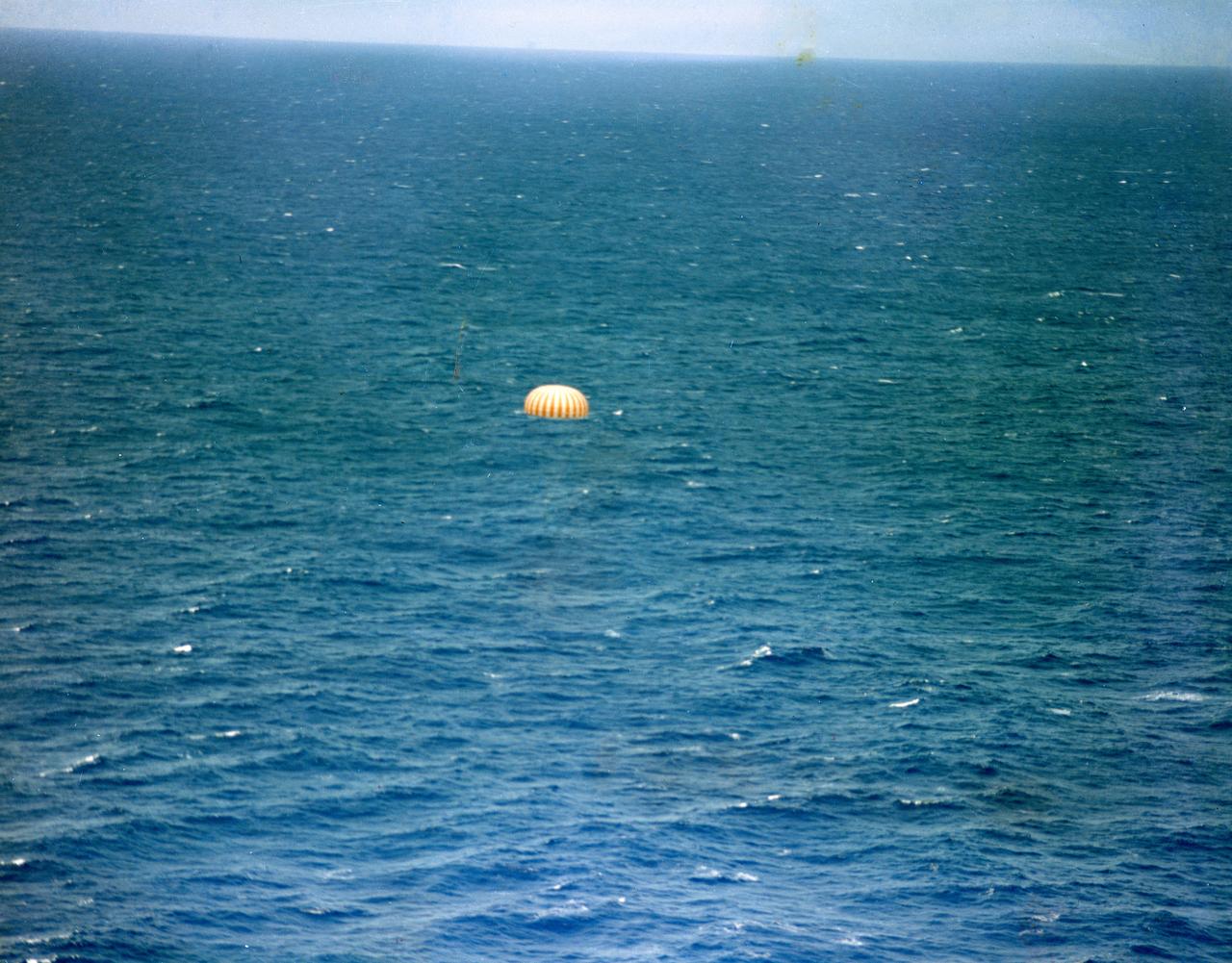
S63-09630 (16 May 1963) --- The Mercury-Atlas 9 (MA-9) "Faith 7" spacecraft, with astronaut L. Gordon Cooper Jr. aboard, nears splashdown in the Pacific Ocean to conclude a 22-orbit mission lasting 34 hours and 20.5 minutes. The capsule's parachute is fully deployed in this view. Photo credit: NASA
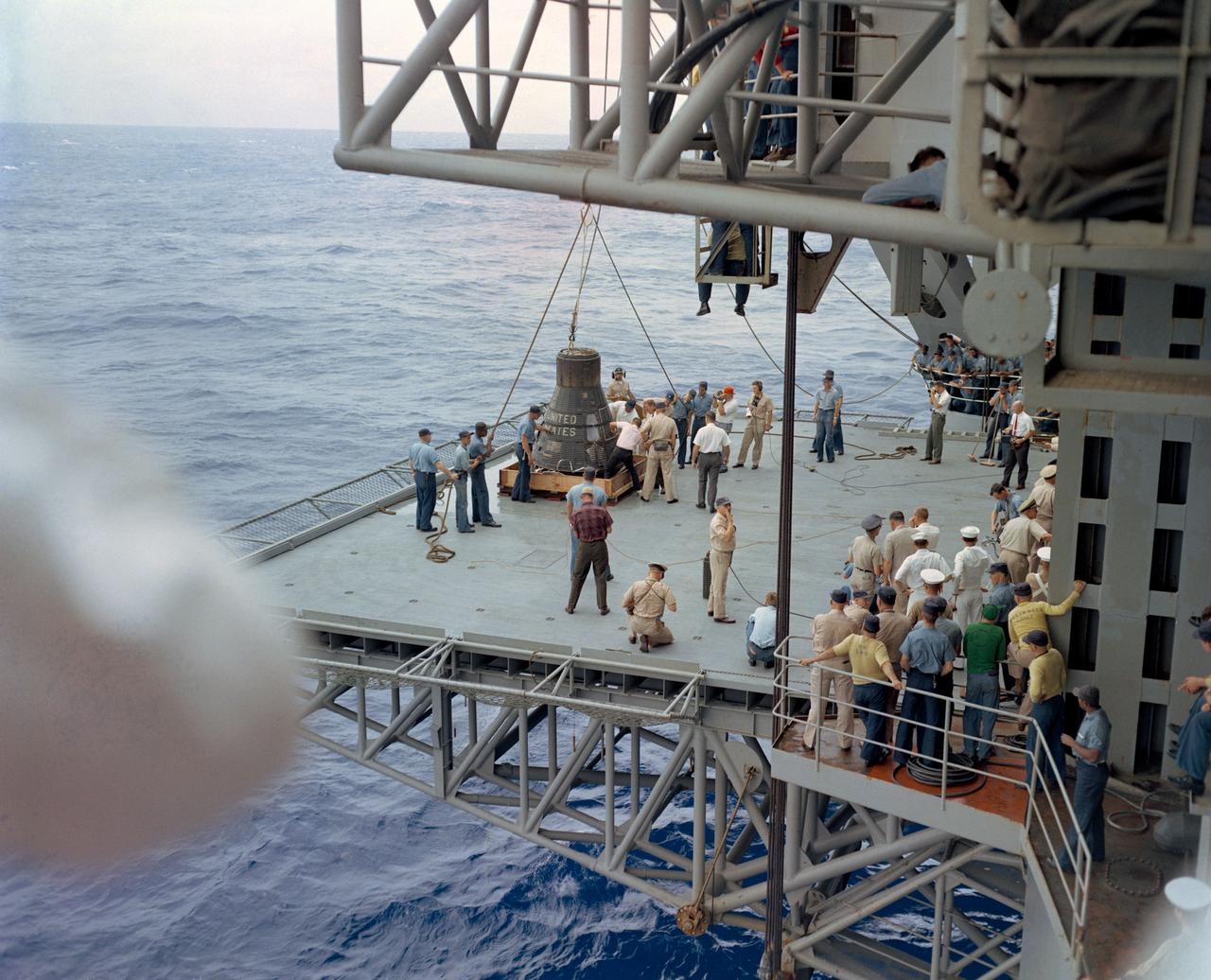
S63-07701 (16 May 1963) --- Recovery Force personnel bring the Mercury-Atlas 9 (MA-9) spacecraft aboard the prime recovery vessel following its successful flight into space. Pilot inside the spacecraft is astronaut L. Gordon Cooper Jr. Photo credit: NASA
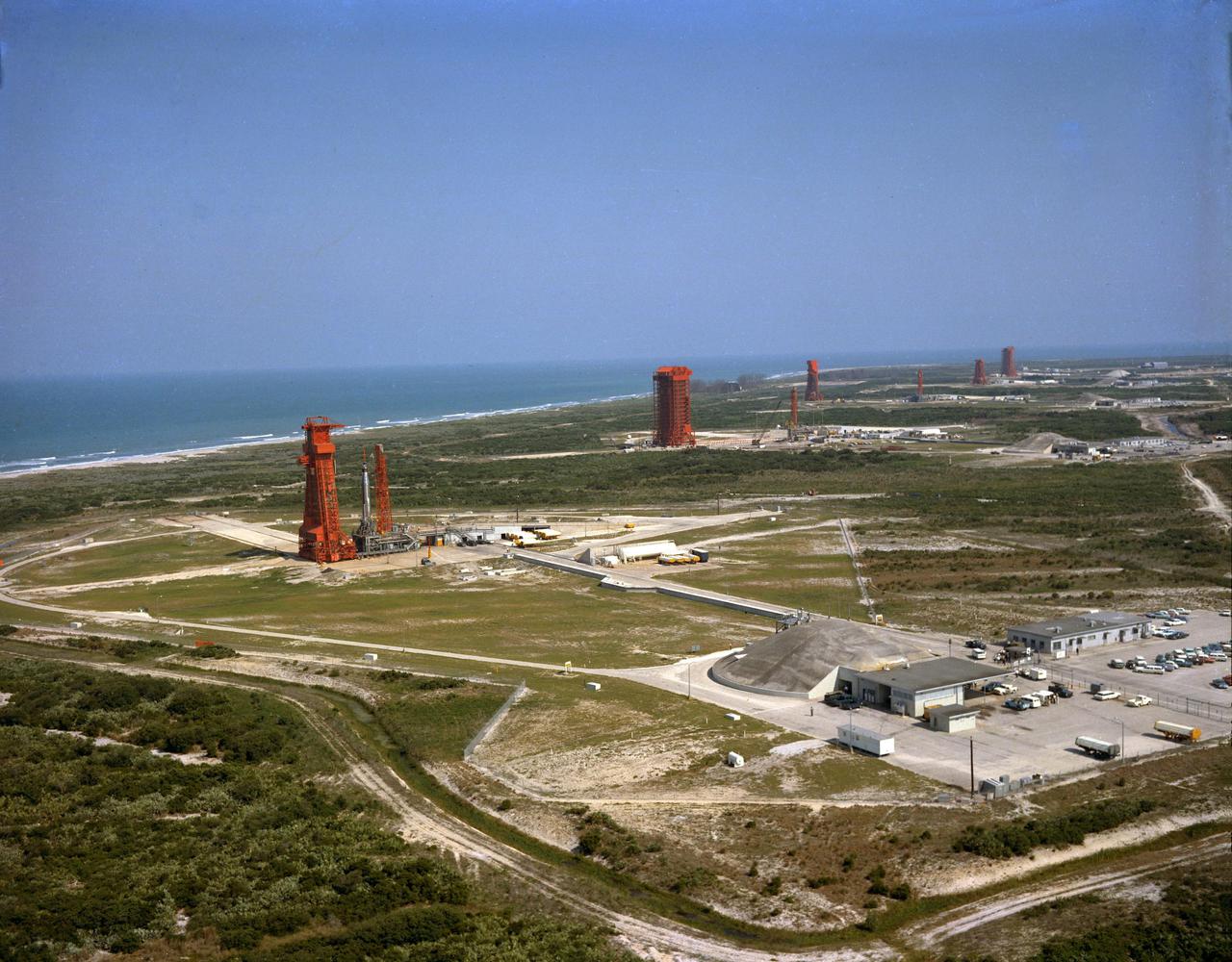
KENNEDY SPACE CENTER, FLA. -- Aerial view of Launch Complex 14 with Missile Row visible to the right. Mercury-Atlas 9 (MA-9), visible on Pad 14, is scheduled to carry astronaut Gordon Cooper for the fourth manned orbital mission.
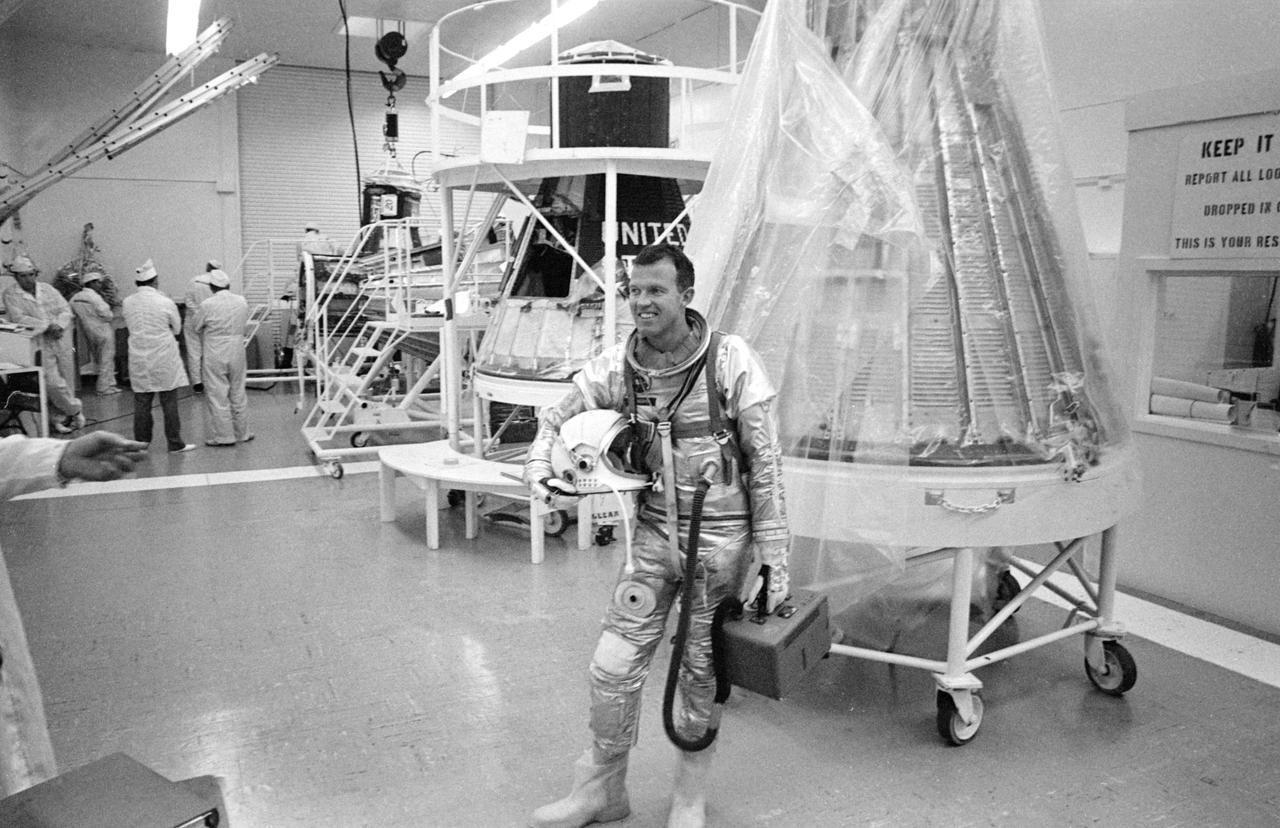
S63-03966 (1963) --- Astronaut L. Gordon Cooper Jr., prime pilot for the Mercury-Atlas 9 (MA-9) mission, carrying the portable air conditioner to his spacesuit, leaves Hangar S after completing the day's simulated flight tests. Photo credit: NASA
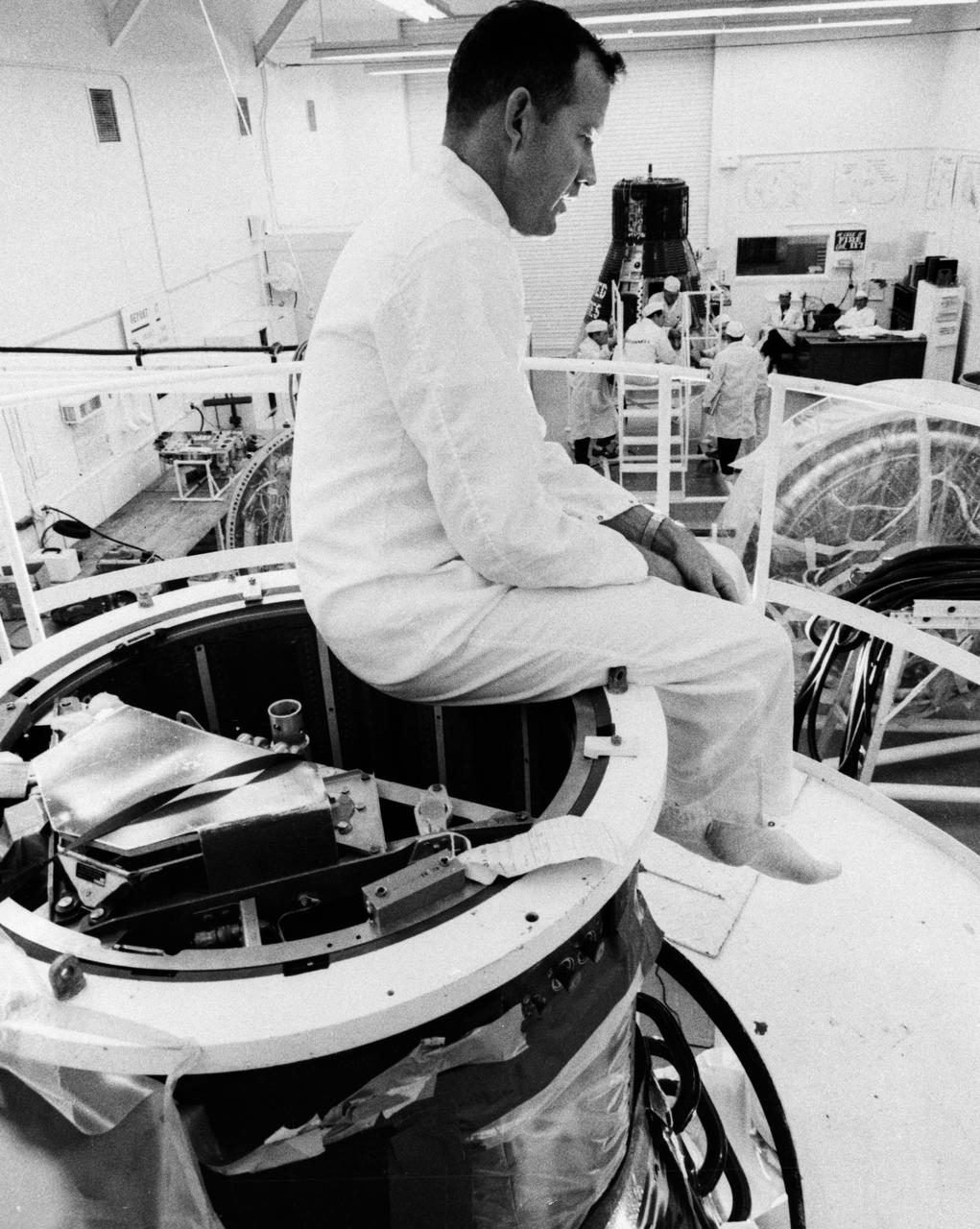
S63-03951 (January 1963) --- Astronaut L. Gordon Cooper Jr., prime pilot for the Mercury-Atlas 9 (MA-9) mission, practices his egress training at Hangar "S" White Room. The pilot may elect to egress from the neck of the spacecraft as shown or by the explosive actuated side hatch. Photo credit: NASA
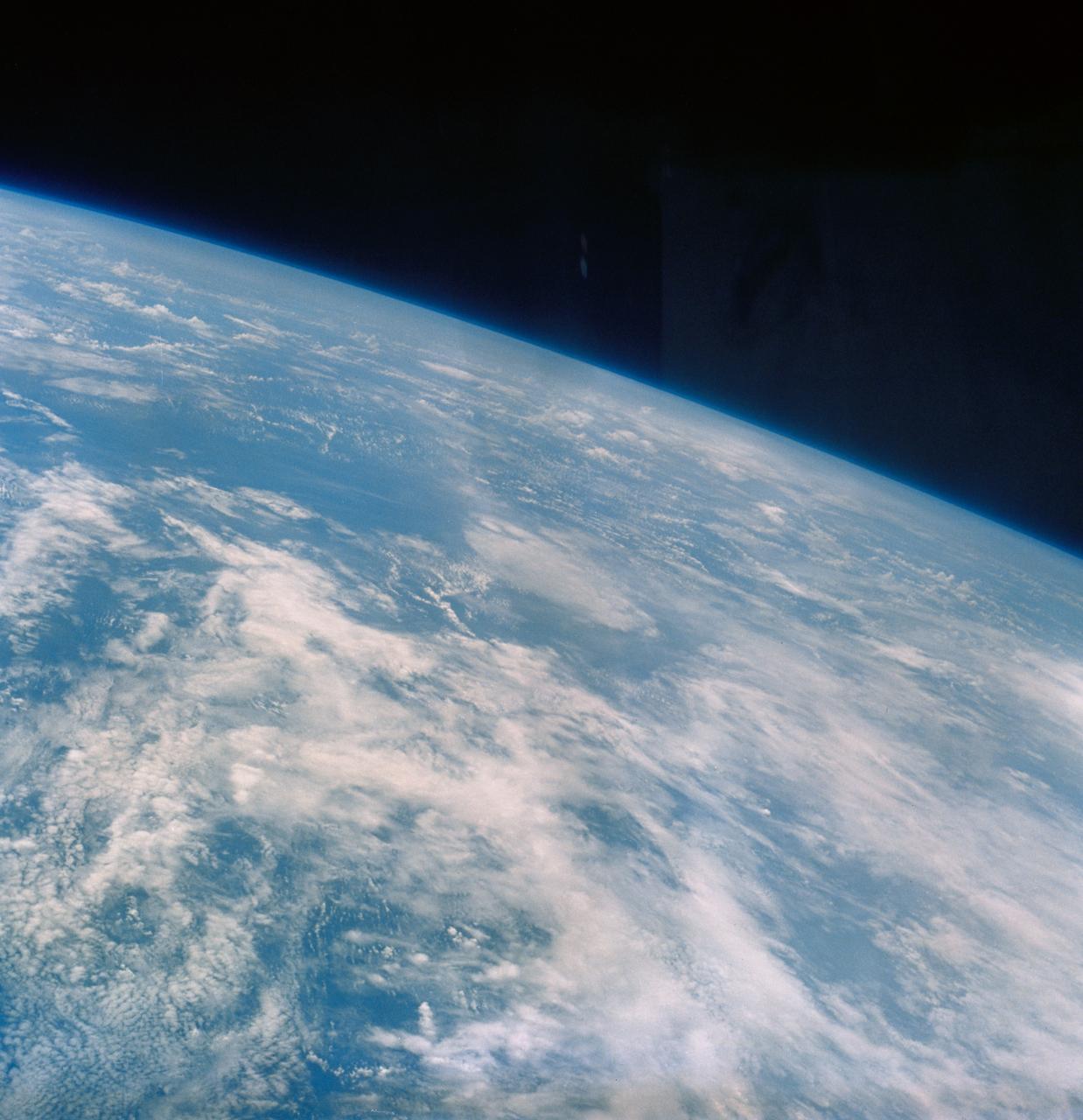
S63-06428 (15-16 May 1963) --- Photograph taken south of Hawaii near 12N. 166W, by astronaut L. Gordon Cooper Jr., during his 22-orbit Mercury-Atlas 9 (MA-9) spaceflight. Photo credit: NASA
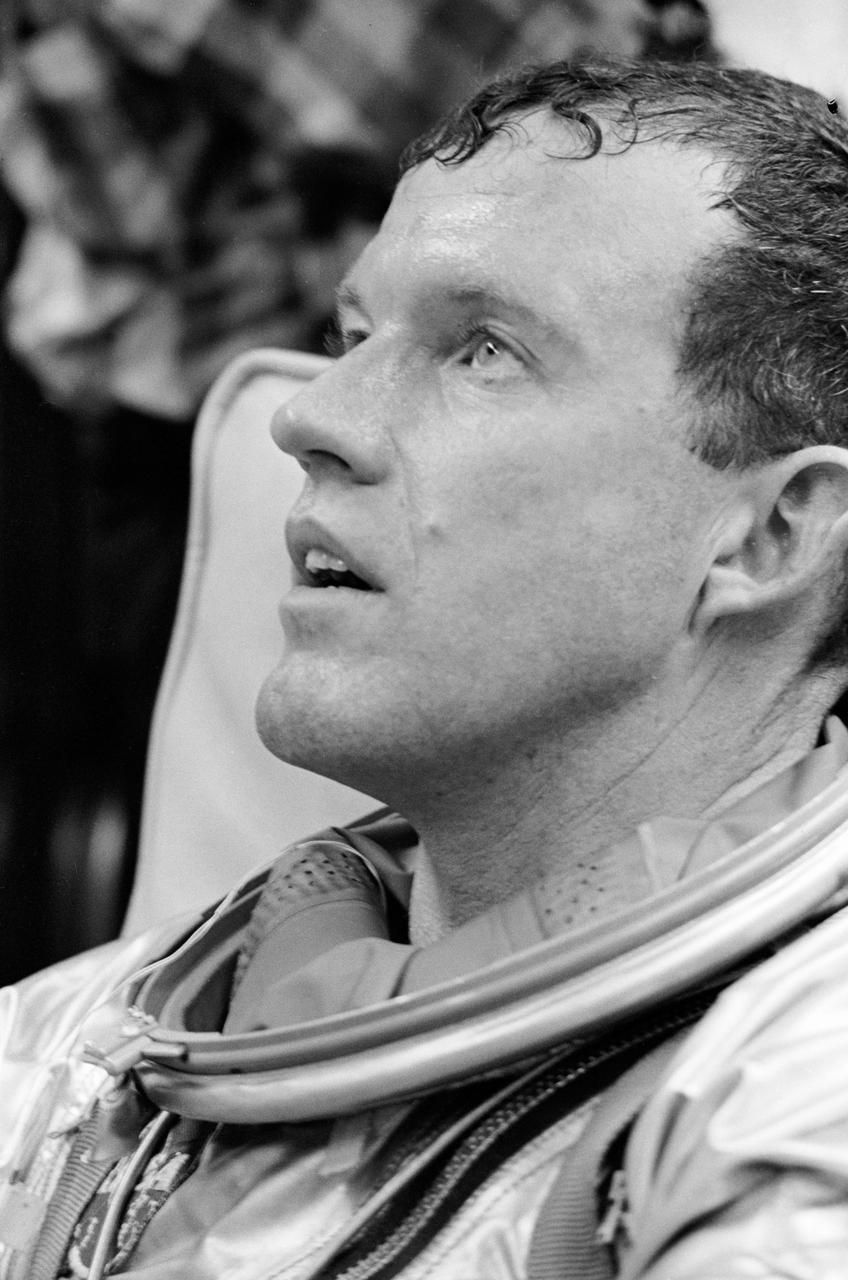
S63-03984 (1963) --- Astronaut L. Gordon Cooper Jr., prime pilot for the Mercury-Atlas 9 (MA-9) mission, is pictured just after his helmet had been removed. He has just spent approximately five hours in the spacecraft during altitude chamber tests. Photo credit: NASA
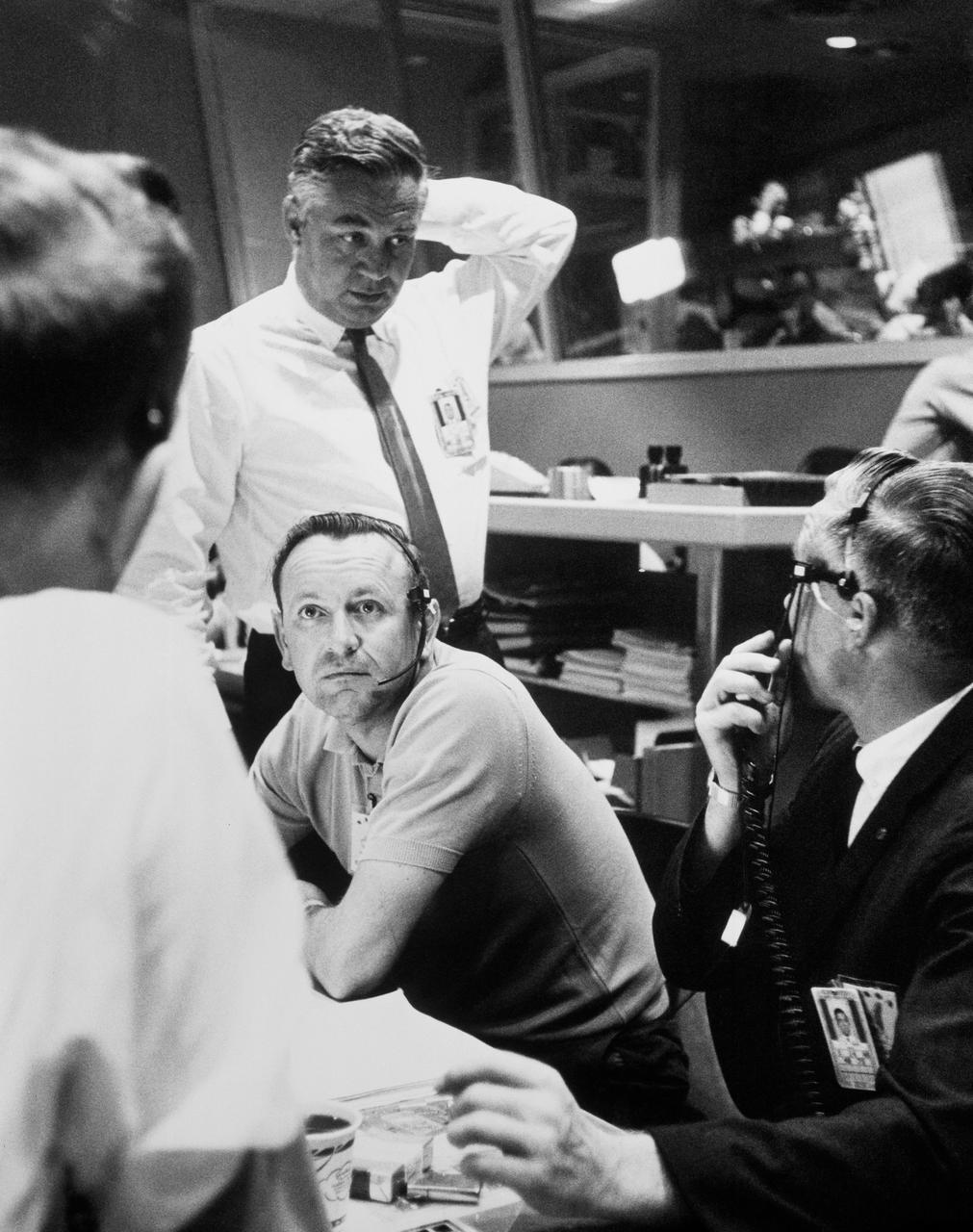
S63-07881 (15-16 May 1963) --- Walter C. Williams, Flight Operations Director; and Chris Kraft, Chief of the Flight Operations Division, MSC, are shown in the Mercury Control Center, Cape Canaveral, Florida, as the decision to go for the full 22 orbits is made for the Mercury Atlas 9 (MA-9) mission. Photo credit: NASA
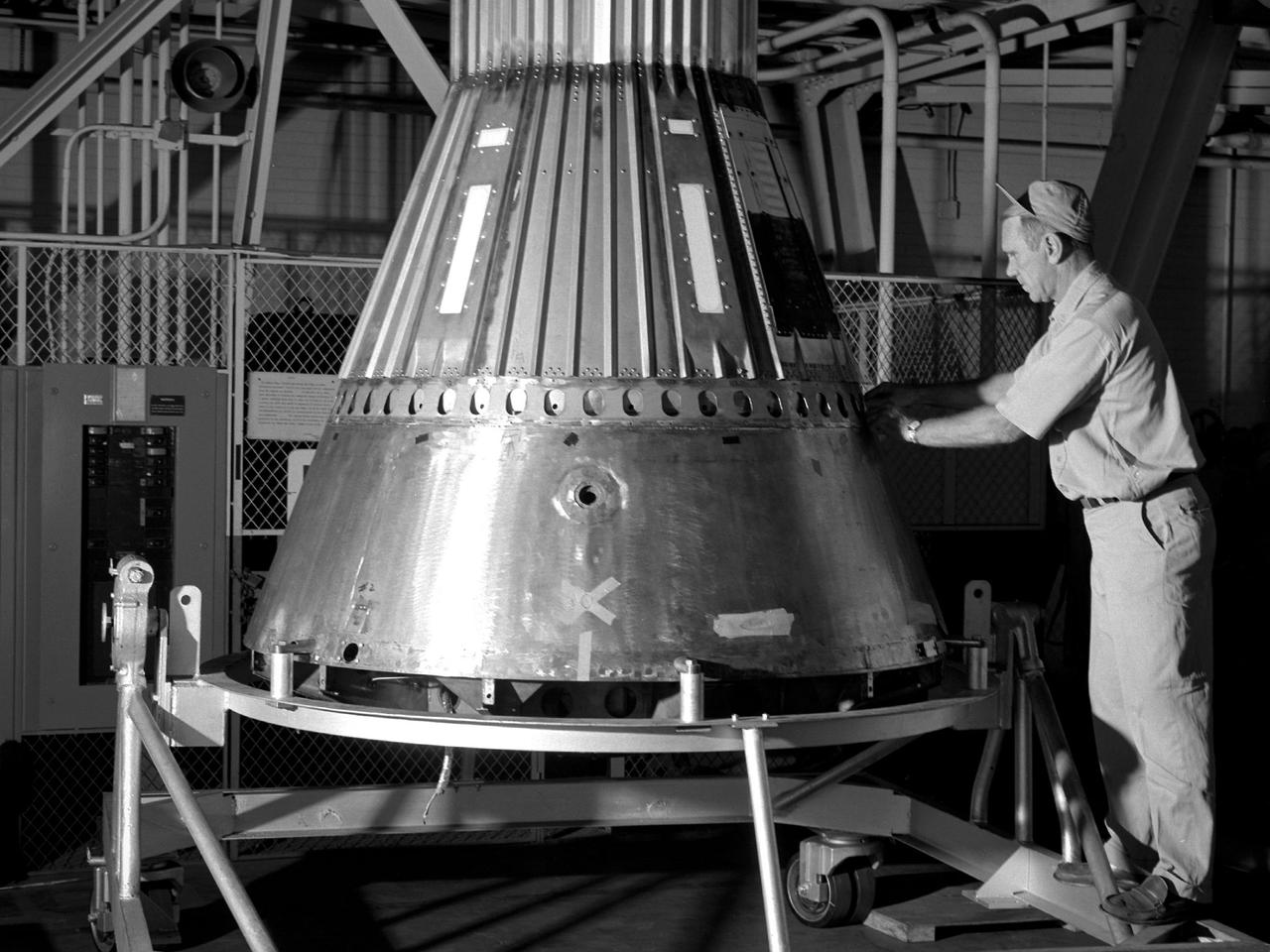
A NASA mechanic secures the afterbody to a Mercury capsule in the hangar at the Lewis Research Center. The capsule was one of two built at Lewis for the “Big Joe” launches scheduled for September 1959. The initial phase of Project Mercury consisted of a series of unmanned launches using the Air Force’s Redstone and Atlas boosters and the Langley-designed Little Joe boosters. The first Atlas launch, referred to as “Big Joe”, was a single attempt early in Project Mercury to use a full-scale Atlas booster to simulate the reentry of a mock-up Mercury capsule without actually placing it in orbit. The overall design of Big Joe had been completed by December 1958, and soon thereafter project manager Aleck Bond assigned NASA Lewis the task of designing the electronic instrumentation and automatic stabilization system. Lewis also constructed the capsule’s lower section, which contained a pressurized area with the electronics and two nitrogen tanks for the retrorockets. Lewis technicians were responsible for assembling the entire capsule: the General Electric heatshield, NASA Langley afterbody and recovery canister, and Lewis electronics and control systems. On June 9, 1959, the capsule was loaded on an air force transport aircraft and flown to Cape Canaveral. A team of 45 test operations personnel from Lewis followed the capsule to Florida and spent the ensuing months preparing it for launch. The launch took place in the early morning hours of September 9, 1959.
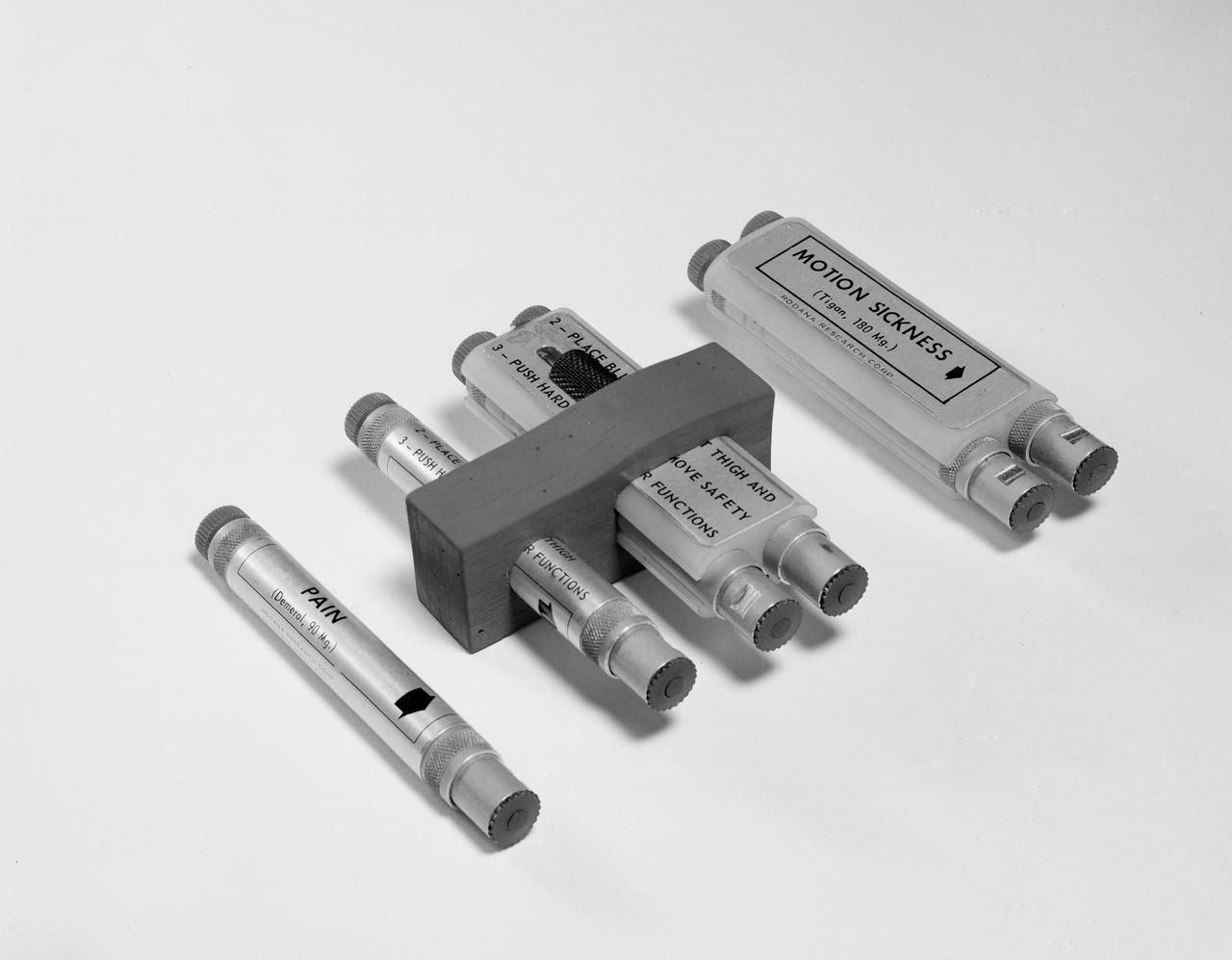
S62-08371 (1962) --- The automatic medical injectors carried on the Mercury-Atlas 9 flight. The injectors provide the astronaut with injection tubes of Tigan, for preventing motion sickness and Demerol, for relieving pain. The tubes encased in the block are stowed in the astronauts survival kit. The single injection tubes are placed in a pocket of the astronauts spacesuit. Photo credit: NASA
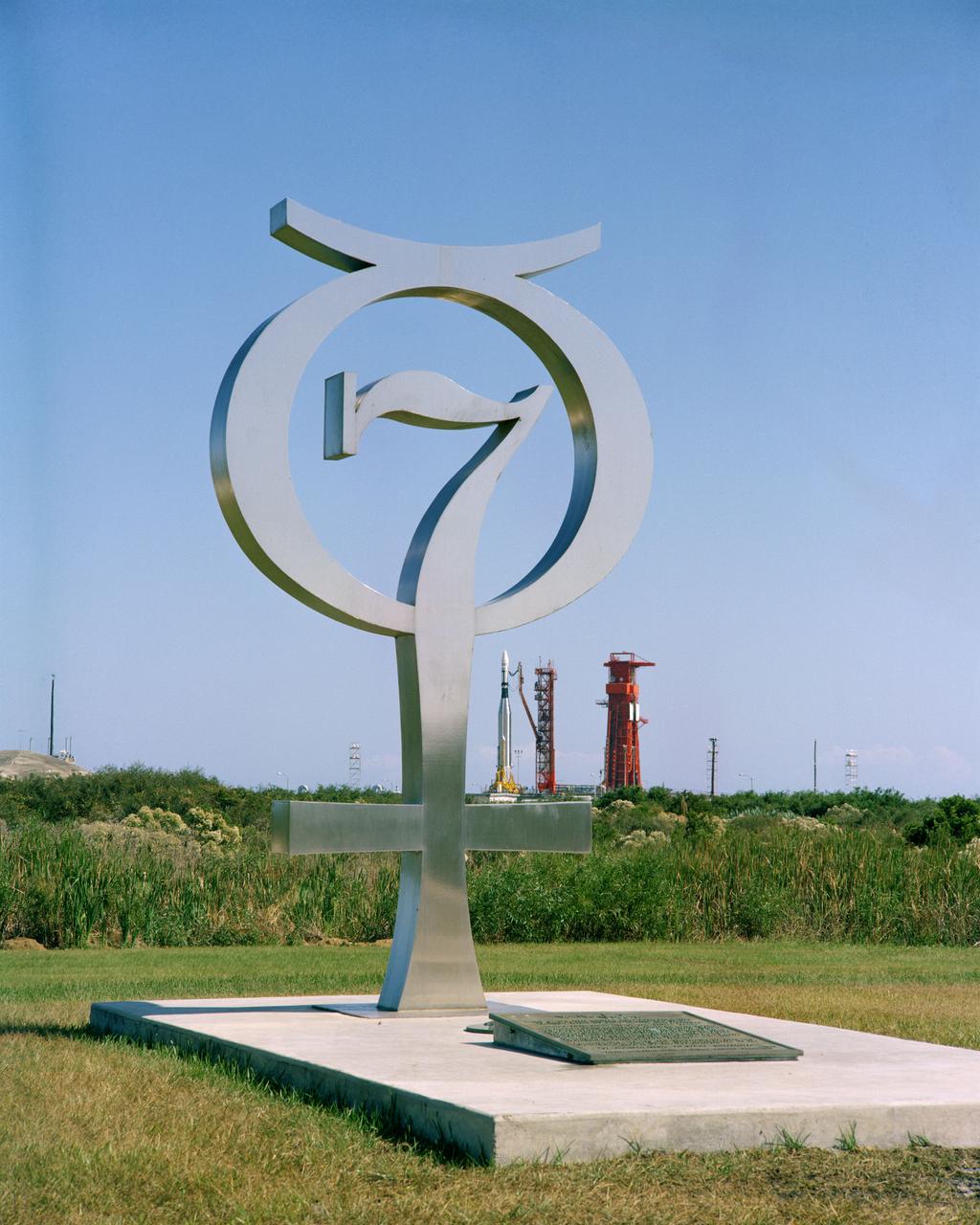
S66-59963 (9 Nov. 1966) --- Monument at Pad 14 honoring Project Mercury. The Arabic number seven represents the seven original astronauts. The other figure is the astronomical symbol of the Planet Mercury. In background is the Gemini-12 Agena Target Docking Vehicle atop its Atlas launch vehicle at Cape Kennedy, Florida. Photo credit: NASA
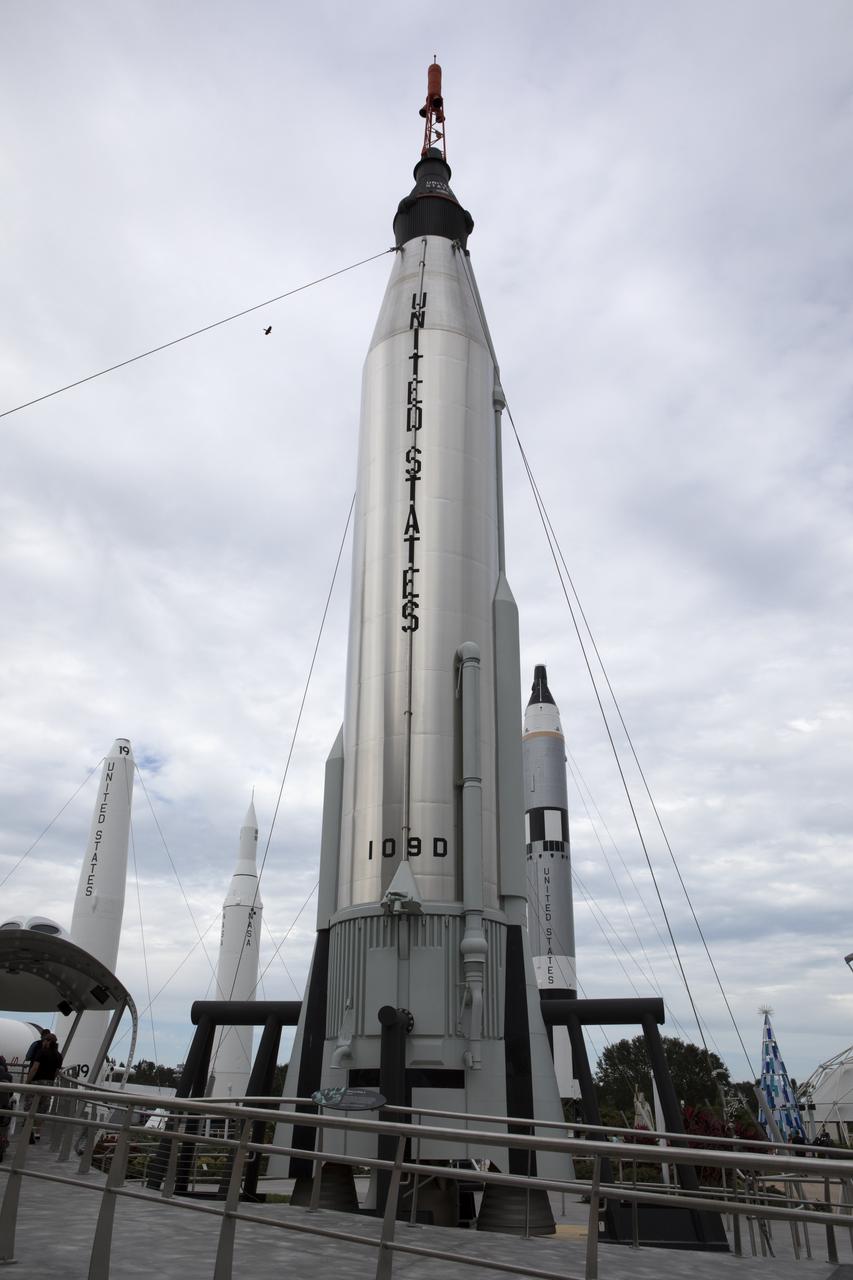
An Atlas rocket and Mercury capsule like the ones that carried Sen. John Glenn into Earth orbit in February 1962 stand in the Rocket Garden at the Kennedy Space Center Visitor Complex adjacent to the Heroes and Legends exhibit hall where Glenn was remembered during a ceremony Dec. 9, 2016. Glenn, one of the Mercury Seven astronauts NASA chose to fly the first missions of the Space Age, passed away on Dec. 8, 2016, at age 95. He gained worldwide acclaim during his Mercury mission that made him the first American to orbit the Earth. He flew again in 1998 aboard space shuttle Discovery at age 77.
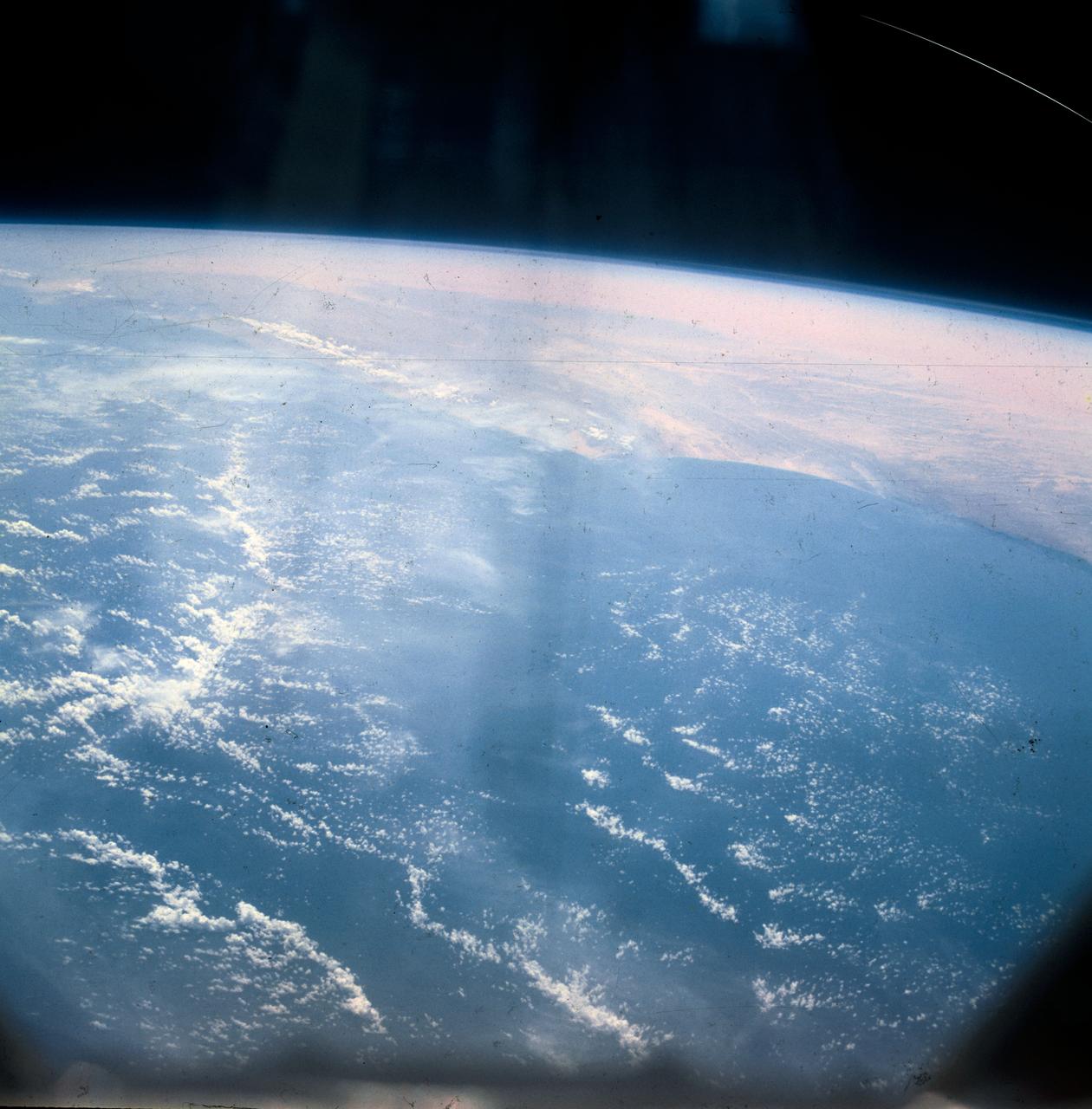
S63-06434 (15-16 May 1963) --- East looking view across Atlantic waters toward Africa, showing Mauritania and Spanish Sahara photographed from the Mercury-Atlas 9 (MA-9) capsule by astronaut L. Gordon Cooper Jr., during his 22-orbit MA-9 spaceflight. Photo credit: NASA
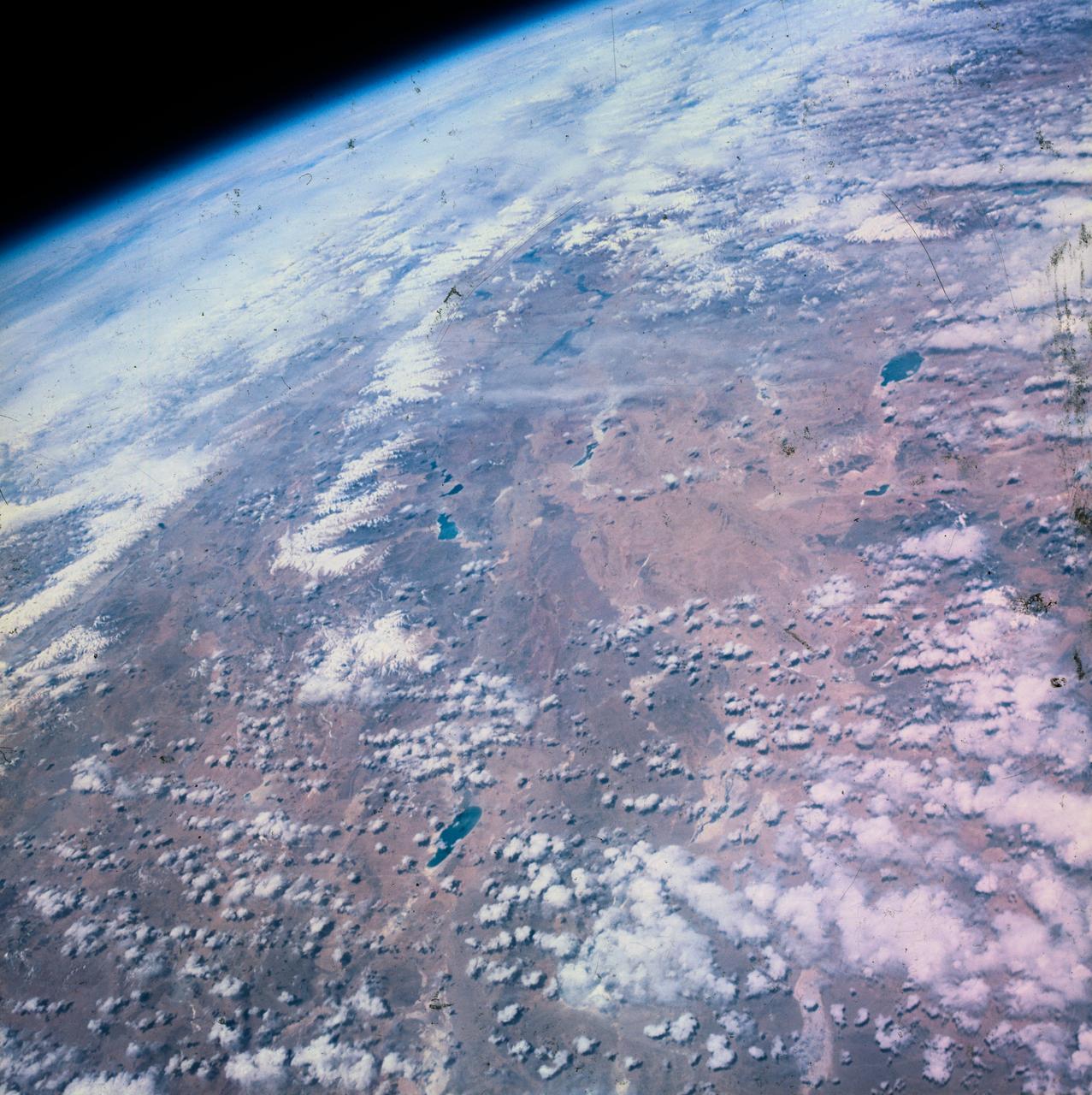
S63-06444 (15-16 May 1963) --- Tibet-Kashmir, looking northwest, as photographed from the Mercury-Atlas 9 (MA-9) capsule by astronaut L. Gordon Cooper Jr. during his 22-orbit MA-9 spaceflight. Lake Ch'in-Tzu-Hu is at upper right, Lake Yen-K'o-Ling-Ts is at lower left center. The Korakaram Range is at upper center portion of the picture. Photo credit: NASA
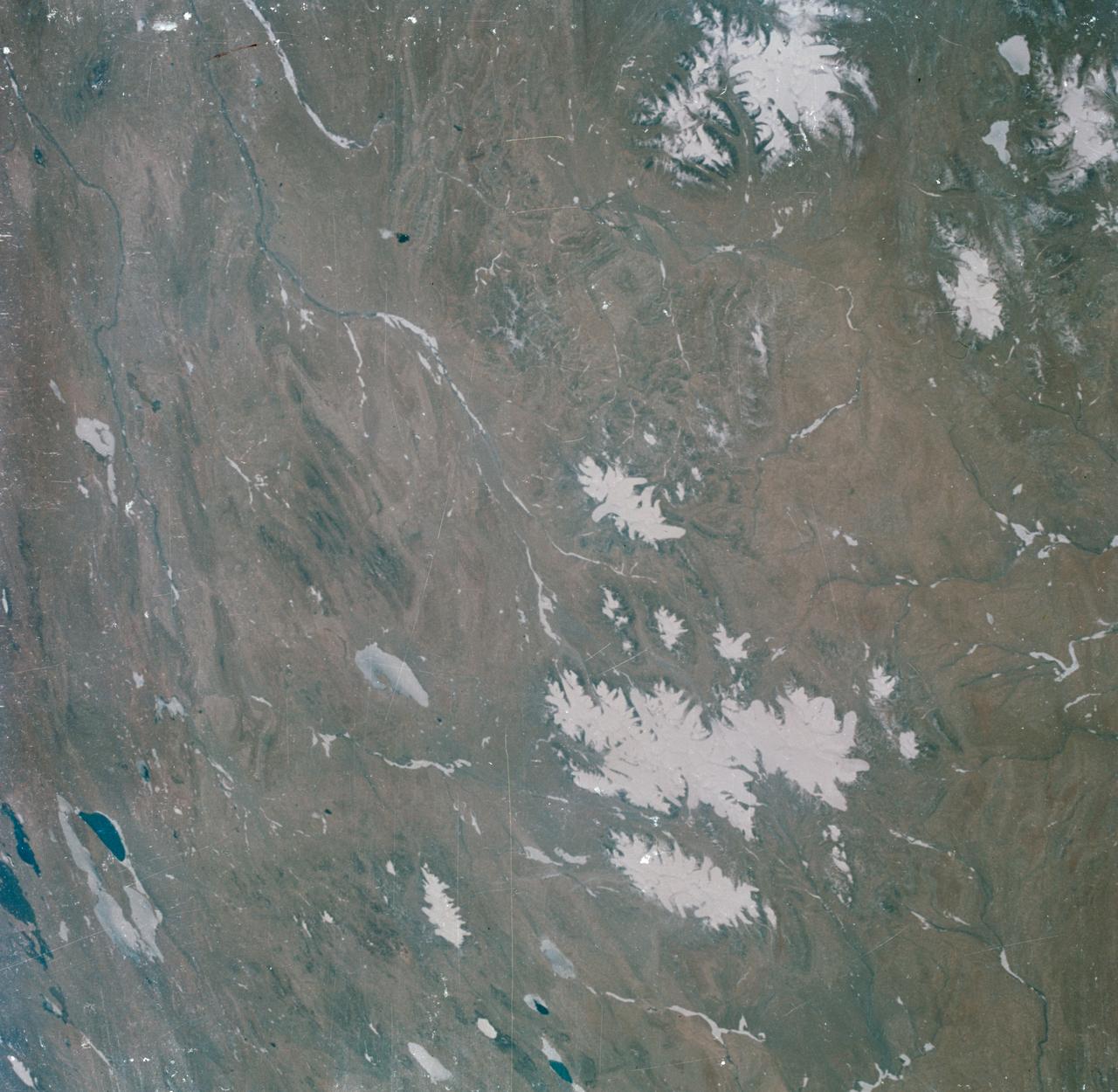
S63-06440 (15-16 May 1963) --- View of the Tibetan Plateau in north-central Tibet, as photographed from the Mercury-Atlas 9 (MA-9) capsule by astronaut L. Gordon Cooper Jr., during his 22-orbit MA-9 spaceflight. The center of the photograph is near 91 degrees east longitude and 34 degrees 30 minutes north latitude. This view includes lakes and snow-covered highlands. Photo credit: NASA
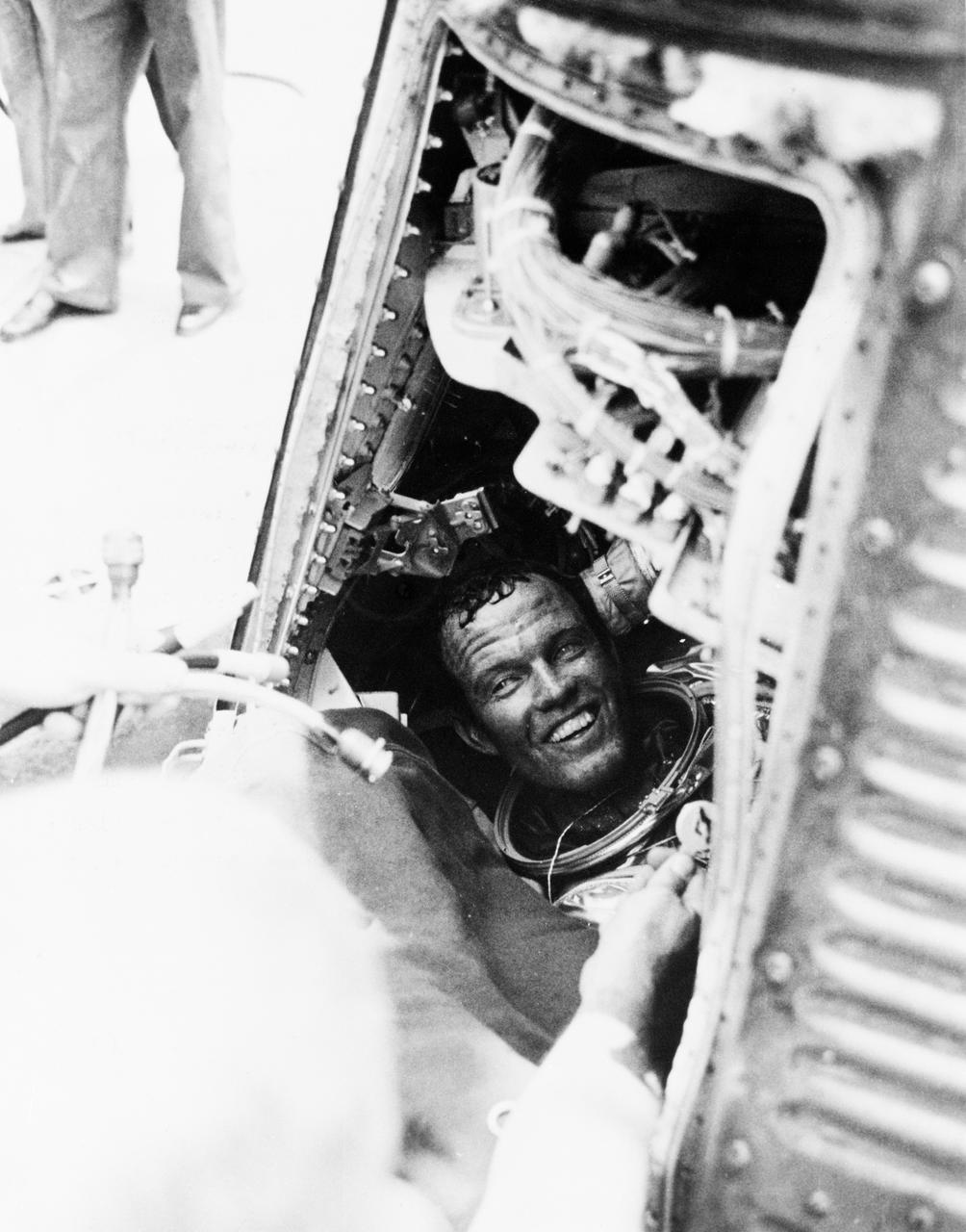
S63-07852 (16 May 1963)--- Astronaut L. Gordon Cooper Jr., pilot of the Mercury-Atlas 9 (MA-9) mission, has a smile for the recovery crew of the USS Kearsarge, after he is onboard from a successful 22-orbit mission of Earth in his spacecraft "Faith 7". Cooper is still sitting in his capsule, with his helmet off. Photo credit: NASA
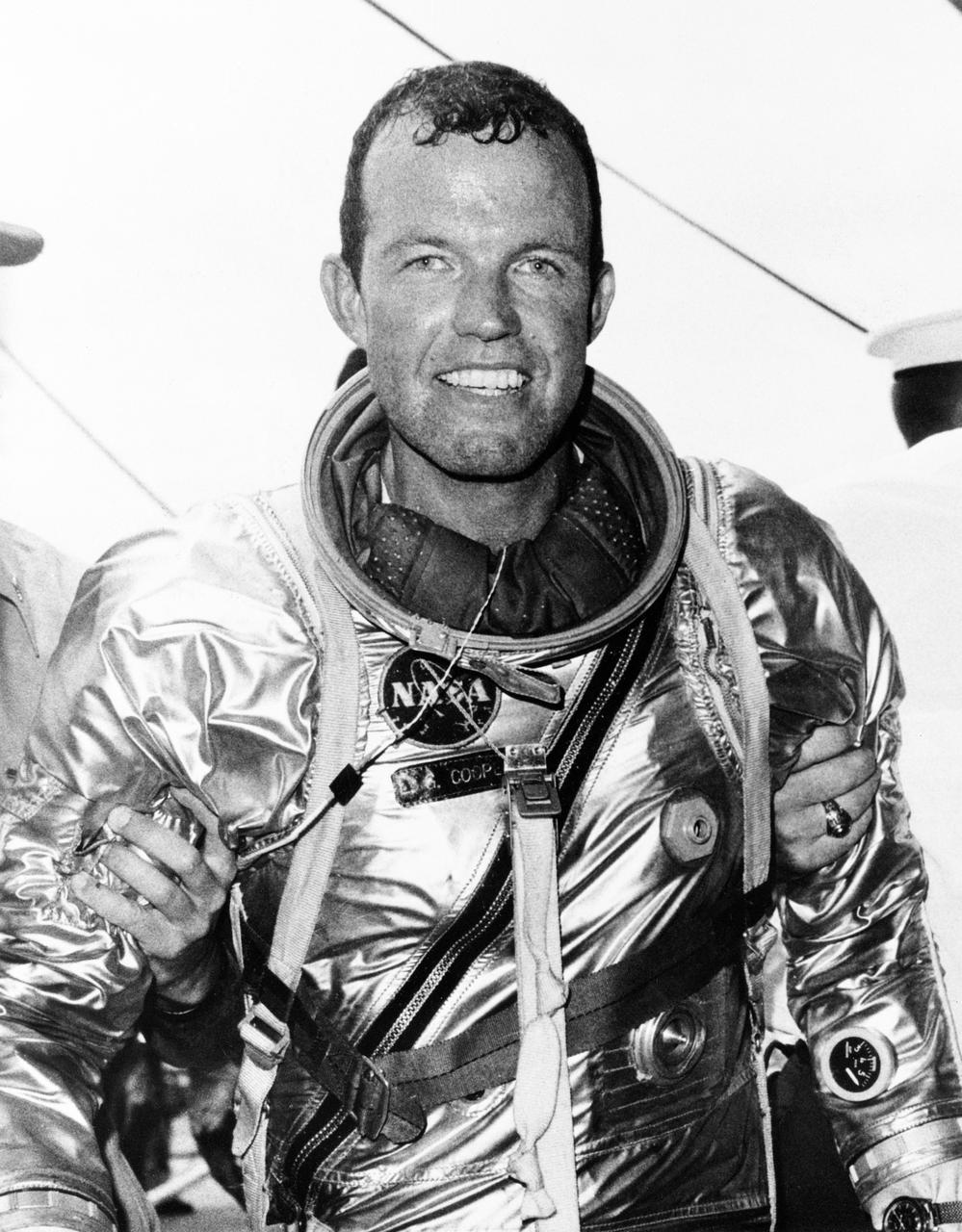
S63-07853 (16 May 1963) --- Astronaut L. Gordon Cooper Jr., pilot of the Mercury-Atlas 9 (MA-9) mission, stands supported by strong hands after climbing out of his spacecraft "Faith 7" after a 600,000-mile, 22-orbit journey around Earth. He elected to remain in the spacecraft until it was hoisted to the deck of the USS Kearsarge, as did astronaut Walter Schirra during the previous mission. Photo credit: NASA
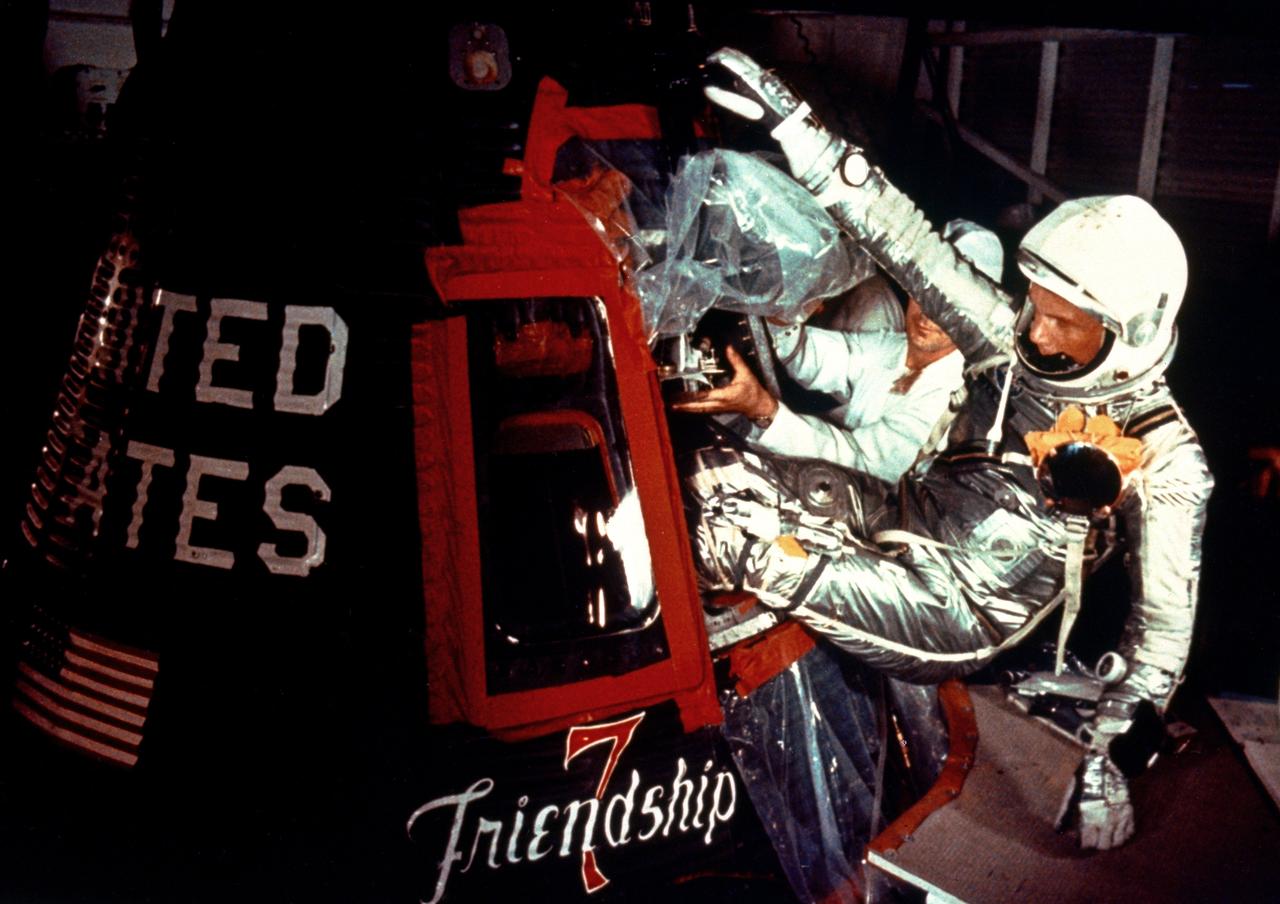
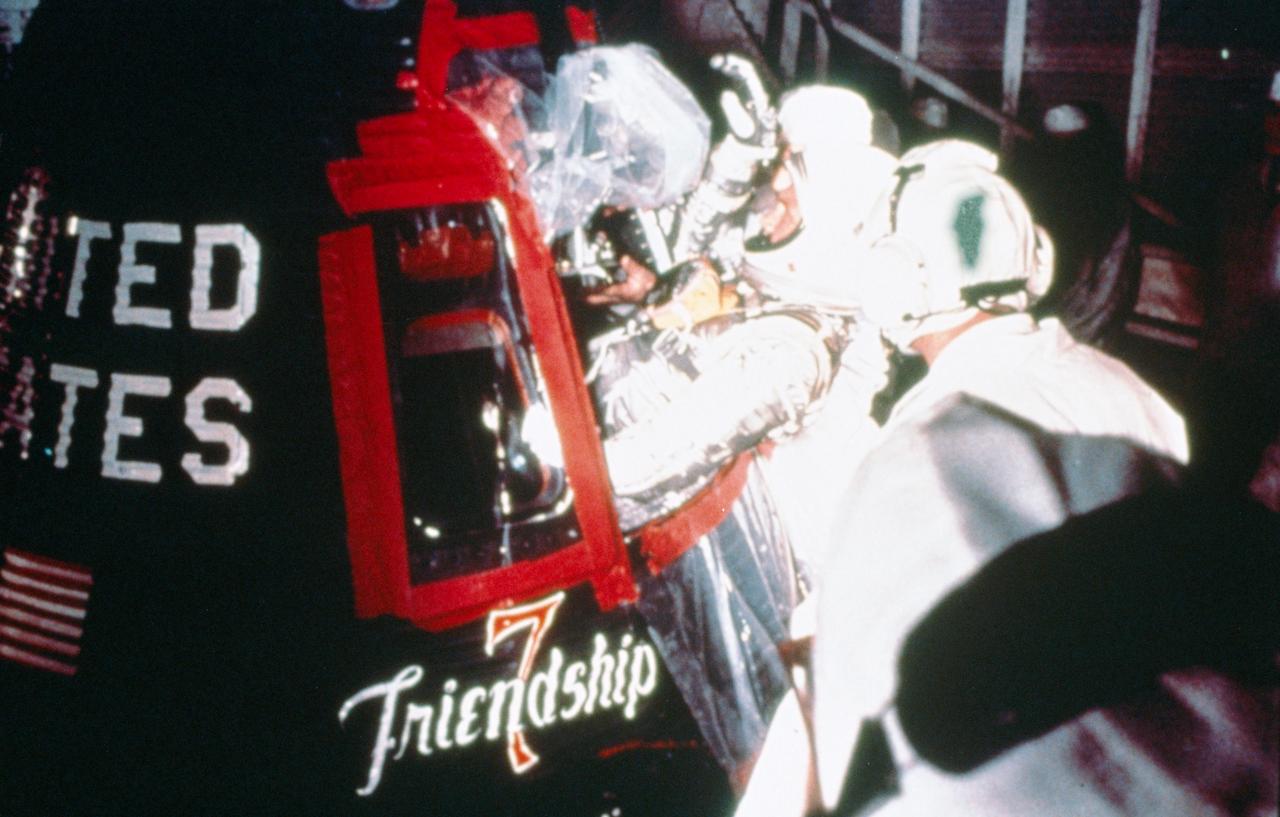
Project Mercury astronaut John H. Glenn Jr., enters the Friendship 7 spacecraft during the last part of the countdown on Feb. 20, 1962. At 9:47 a.m. EST, the Atlas launch vehicle lifted the spacecraft into orbit for a three-orbit mission lasting four hours, 55 minutes and 23 seconds. Glenn and his spacecraft were recovered by the destroyer Noa just 21 minutes after landing in the Atlantic near Grand Turk Island, to successfully complete the nation's first manned orbital flight.
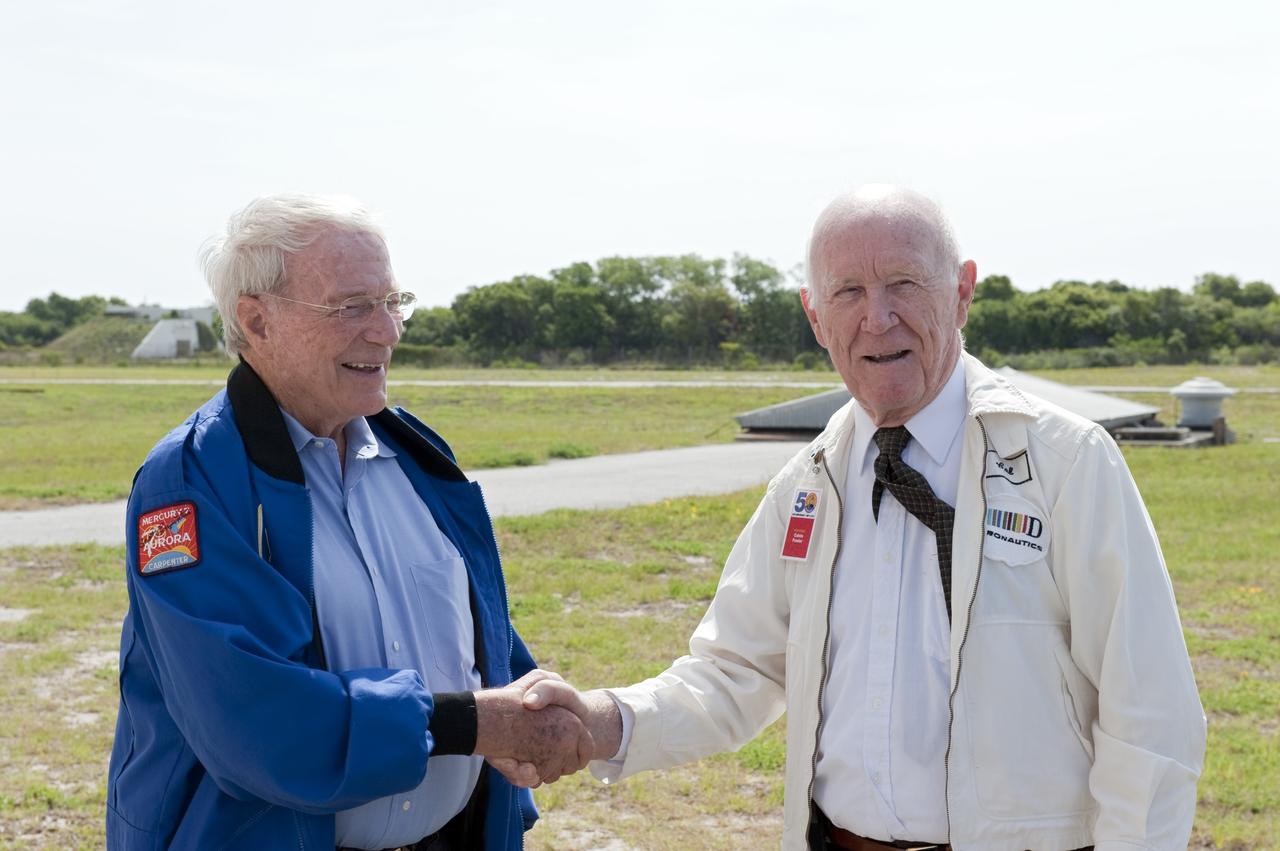
CAPE CANAVERAL, Fla. -- During a celebration at Complex 5/6 on Cape Canaveral Air Force Station in Florida, Mercury astronaut Scott Carpenter greets Calvin Fowler, the launch conductor for Carpenter's Mercury-Atlas 7 mission on May 24, 1962. The celebration was held at the launch site of the first U.S. manned spaceflight May 5, 1961, to mark the 50th anniversary of the flight. Fifty years ago, astronaut Alan Shepard lifted off inside the Mercury capsule, "Freedom 7," atop an 82-foot-tall Mercury-Redstone rocket at 9:34 a.m. EST, sending him on a remarkably successful, 15-minute suborbital flight. The event was attended by more than 200 workers from the original Mercury program and included a re-creation of Shepard's flight and recovery, as well as a tribute to his contributions as a moonwalker on the Apollo 14 lunar mission. For more information, visit www.nasa.gov/topics/history/milestones/index.html. Photo credit: NASA/Kim Shiflett
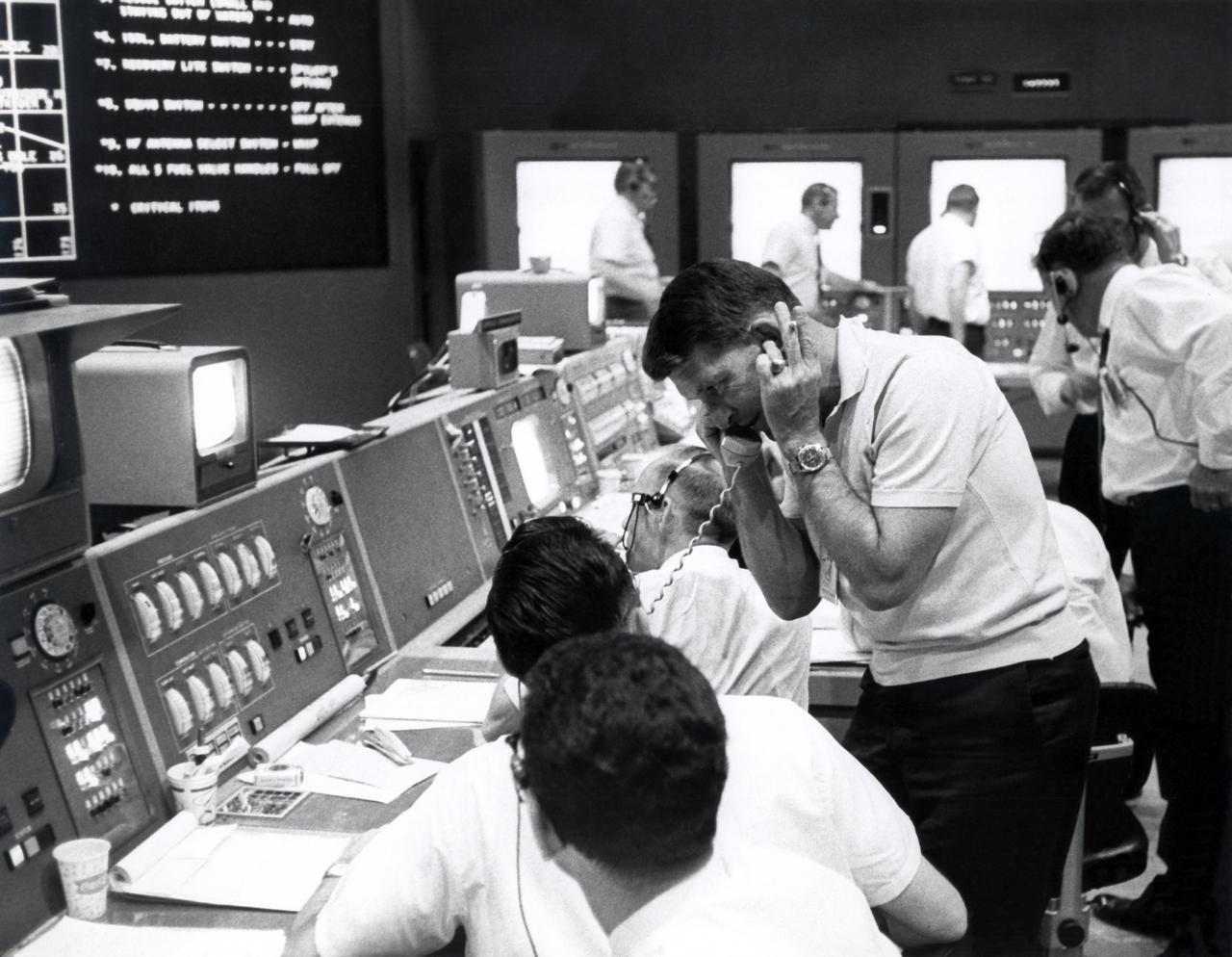
CAPE CANAVERAL, Fla. - Inside Mercury Mission Control, astronaut Wally Schirra, capsule communicator, or capcom for the Mercury-Atlas 9 mission, talks to Trudy Cooper, wife of astronaut Gordon Cooper, on May 16, 1963, to inform her that he had just been recovered by the USS Kearsarge after his 22-orbit flight. The Mercury Mission Control Center in Florida played a key role in the United States' early spaceflight program. Located at Cape Canaveral Air Force Station, the original part of the building was constructed between 1956 and 1958, with additions in 1959 and 1963. The facility officially was transferred to NASA on Dec. 26, 1963, and served as mission control during all the Project Mercury missions, as well as the first three flights of the Gemini Program, when it was renamed Mission Control Center. With its operational days behind, on June 1, 1967, the Mission Control Center became a stop on the public tour of NASA facilities until the mid-90s. In 1999, much of the equipment and furnishings from the Flight Control Area were moved to the Kennedy Space Center Visitor Complex where they became part of the exhibit there. The building was demolished in spring 2010. Photo credit: NASA
S85-26952 (20 Feb. 1962) --- Project Mercury astronaut John H. Glenn Jr., enters the Friendship 7 spacecraft during the last part of the countdown on Feb. 20, 1962. At 9:47 a.m. (EST), the Atlas launch vehicle lifted the spacecraft into orbit for a three-orbit mission lasting four hours, 55 minutes and 23 seconds. Glenn and his spacecraft were recovered by the destroyer Noa just 21 minutes after landing in the Atlantic near Grand Turk Island, to successfully complete the nation's first manned orbital flight. Photo credit: NASA
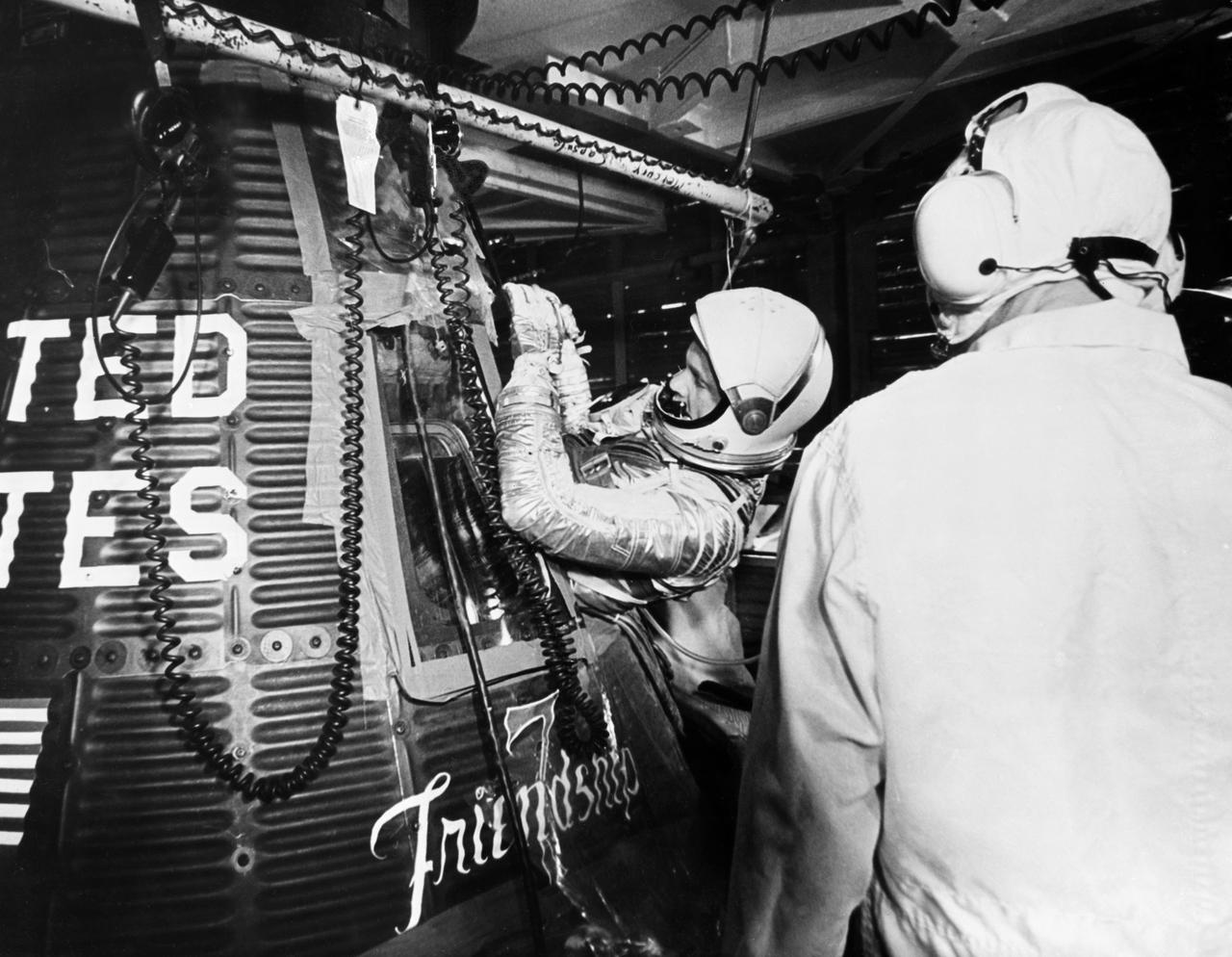
S62-00957 (20 Feb. 1962) --- Project Mercury astronaut John H. Glenn Jr., enters the Friendship 7 spacecraft during the last part of the countdown on Feb. 20, 1962. At 9:47 a.m. (EST), the Atlas launch vehicle lifted the spacecraft into orbit for a three-orbit mission lasting four hours, 55 minutes and 23 seconds. Glenn and his spacecraft were recovered by the destroyer Noa just 21 minutes after landing in the Atlantic near Grand Turk Island, to successfully complete the nation's first manned orbital flight. Photo credit: NASA
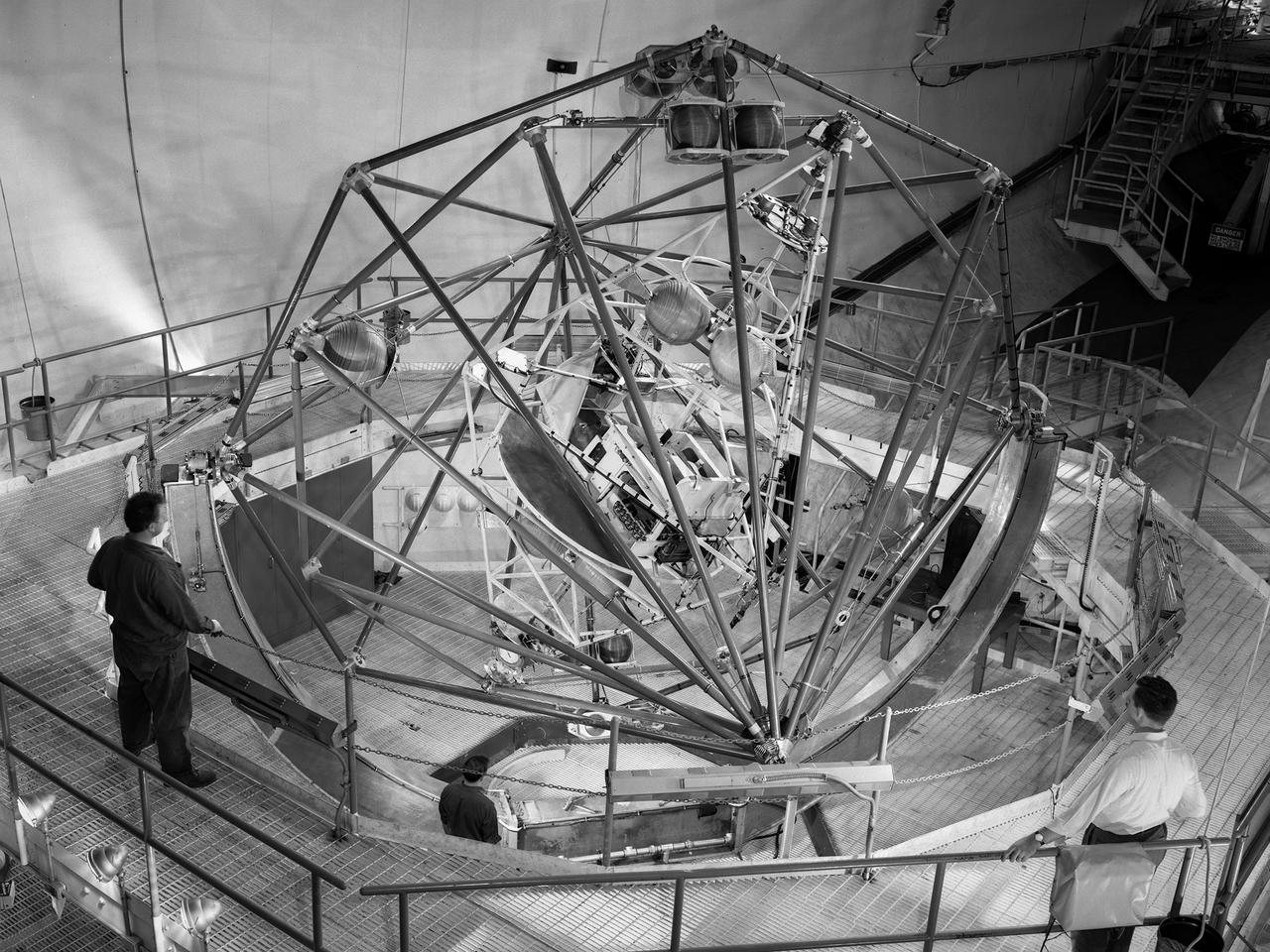
The Multi-Axis Space Test Inertial Facility (MASTIF) in the Altitude Wind Tunnel at the National Aeronautics and Space Administration (NASA) Lewis Research Center. Although the Mercury astronaut training and mission planning were handled by the Space Task Group at Langley Research Center, NASA Lewis played an important role in the program, beginning with the Big Joe launch. Big Joe was a singular attempt early in the program to use a full-scale Atlas booster and simulate the reentry of a mockup Mercury capsule without actually placing it in orbit. A unique three-axis gimbal rig was built inside Lewis’ Altitude Wind Tunnel to test Big Joe’s attitude controls. The control system was vital since the capsule would burn up on reentry if it were not positioned correctly. The mission was intended to assess the performance of the Atlas booster, the reliability of the capsule’s attitude control system and beryllium heat shield, and the capsule recovery process. The September 9, 1959 launch was a success for the control system and heatshield. Only a problem with the Atlas booster kept the mission from being a perfect success. The MASTIF was modified in late 1959 to train Project Mercury pilots to bring a spinning spacecraft under control. An astronaut was secured in a foam couch in the center of the rig. The rig then spun on three axes from 2 to 50 rotations per minute. Small nitrogen gas thrusters were used by the astronauts to bring the MASTIF under control.
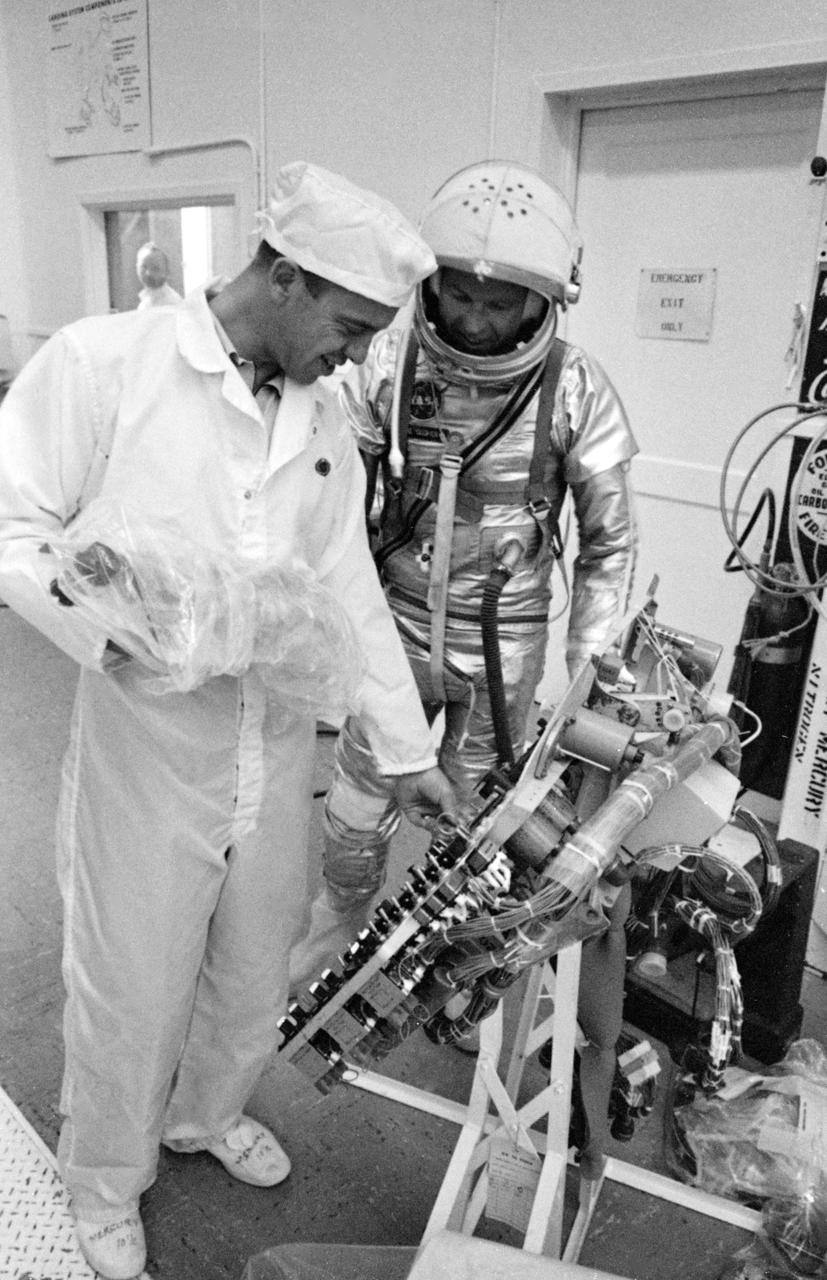
S63-03965 (1963) --- Astronauts Alan Shepard (left) and L. Gordon Cooper Jr.(in suit) check over the instrument panel from Mercury spacecraft #20. It contains the instruments necessary to monitor spacecraft systems and sequencing, the controls required to initiate primary sequences manually, and the necessary flight control displays. Photo credit: NASA
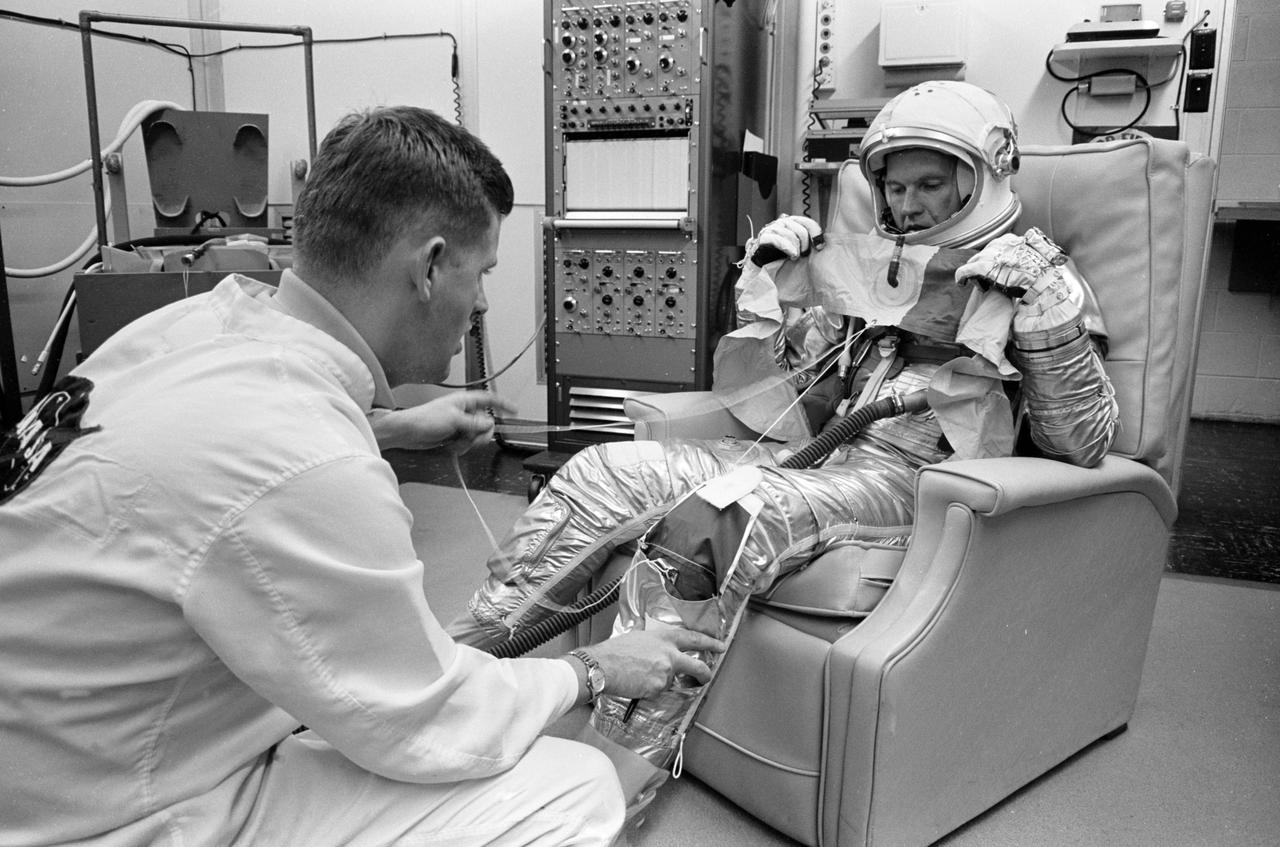
S63-03964 (1963) --- Al Rochford, Crew Systems, Manned Space Center, assists astronaut L. Gordon Cooper Jr., in checking his life vest, normally stowed in a pocket in the lower left leg. Photo credit: NASA
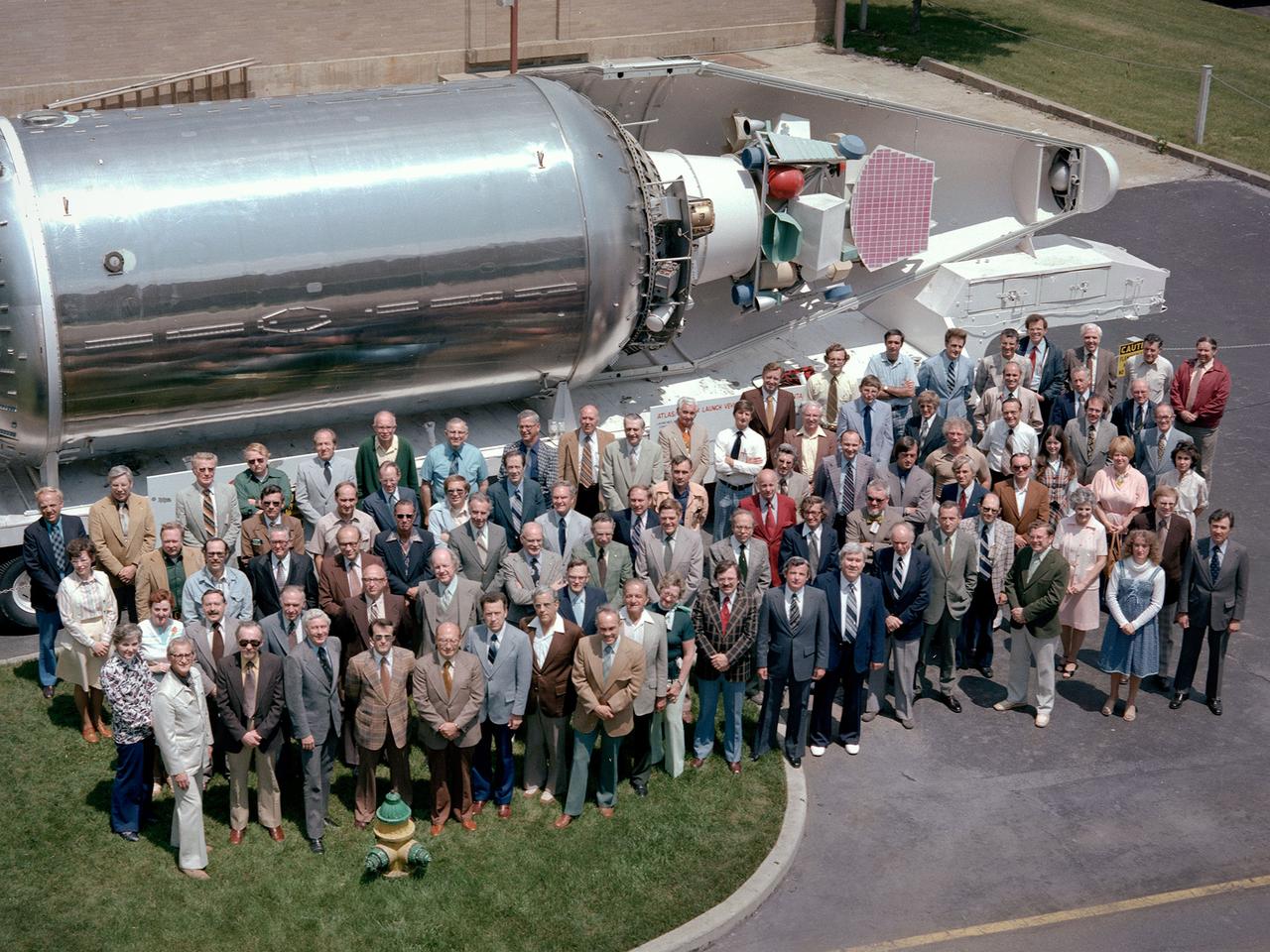
The National Aeronautics and Space Administration (NASA) Lewis Research Center’s Launch Vehicle Directorate in front of a full-scale model of the Centaur second-stage rocket. The photograph was taken to mark Centaur’s fiftieth launch. NASA Lewis managed the Centaur Program since 1962. At that time, the only prior launch attempt ended in failure. Lewis improved the spacecraft and tested it extensively throughout the early 1960s. In May 1966 an Atlas-Centaur sent the Surveyor spacecraft to the moon. It was the first successful soft landing on another planet. The Launch Vehicles Division was formed in 1969 to handle the increasing number of Centaur launches. The Lewis team became experts at integrating the payload with the Centaur and calculating proper trajectories for the missions. Centaur’s first 50 missions included Orbiting Astronomical Observatories, the Mariner 6 and 7 flybys of Mars, Mariner 9 which was the first spacecraft to orbit around another planet, the Pioneer 10 and 11 missions to the outer solar system, the Mariner 10 flyby of Venus and Mercury, the Viking 1 and 2 Mars landers, Voyagers 1 and 2 missions to Jupiter, Saturn, Uranus, and Neptune, and the Pioneer 12 and 13 flights to Venus.