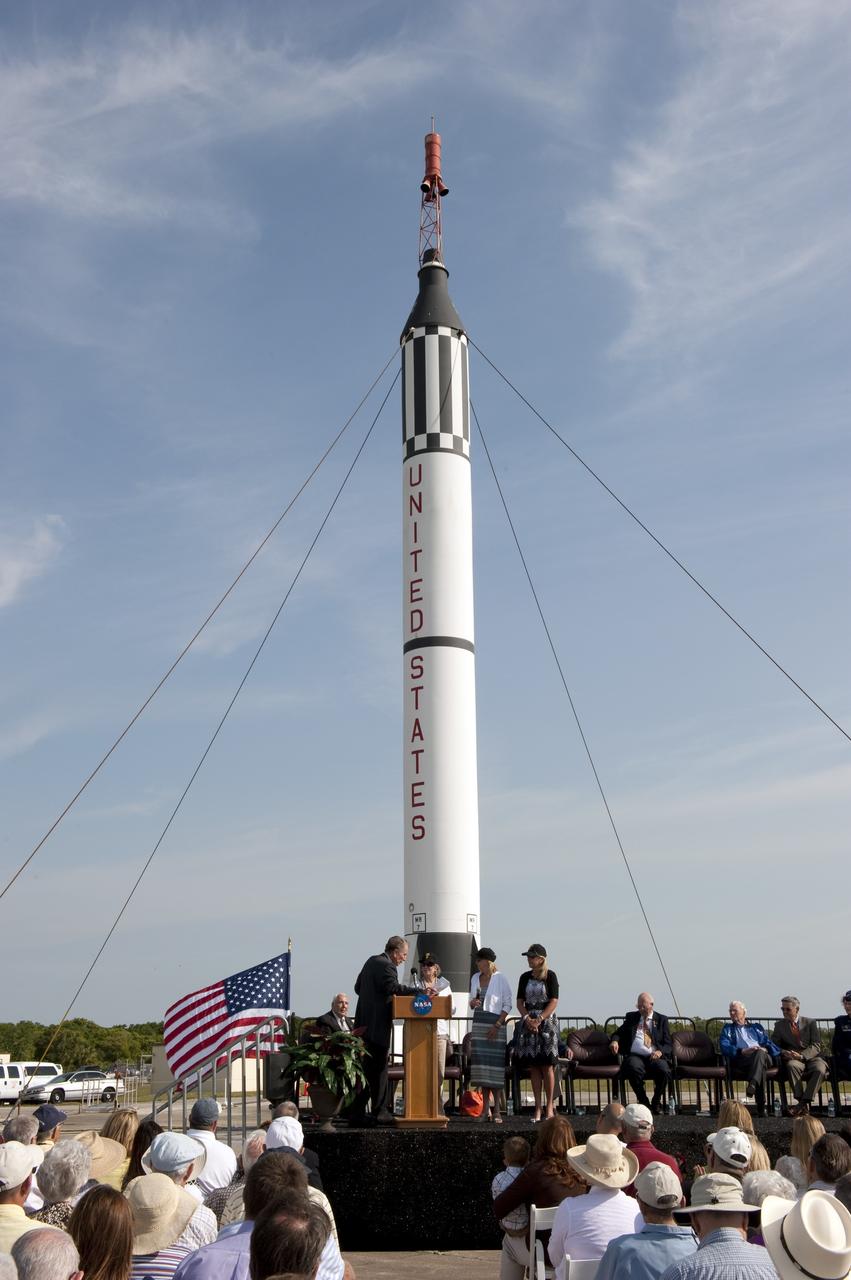
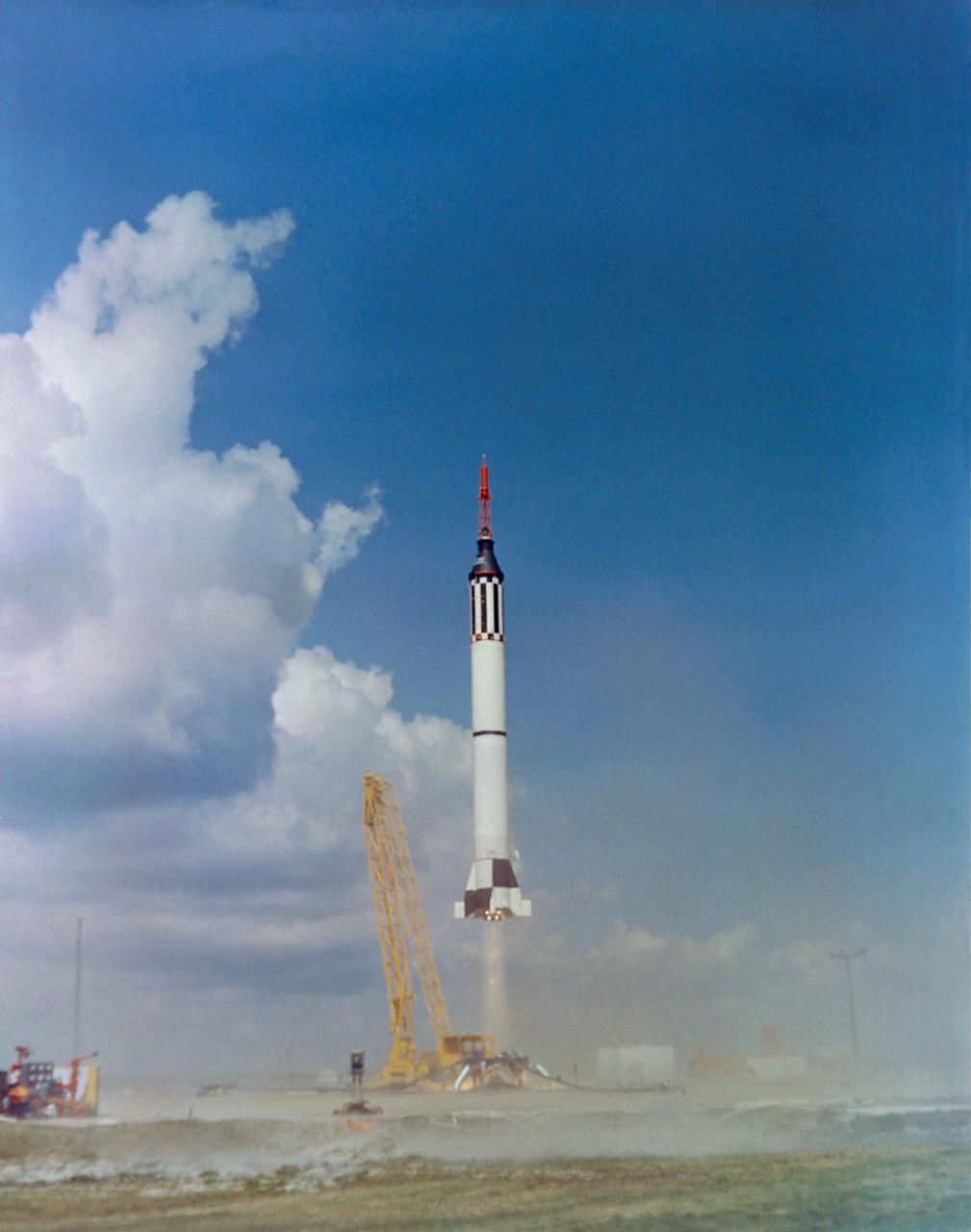
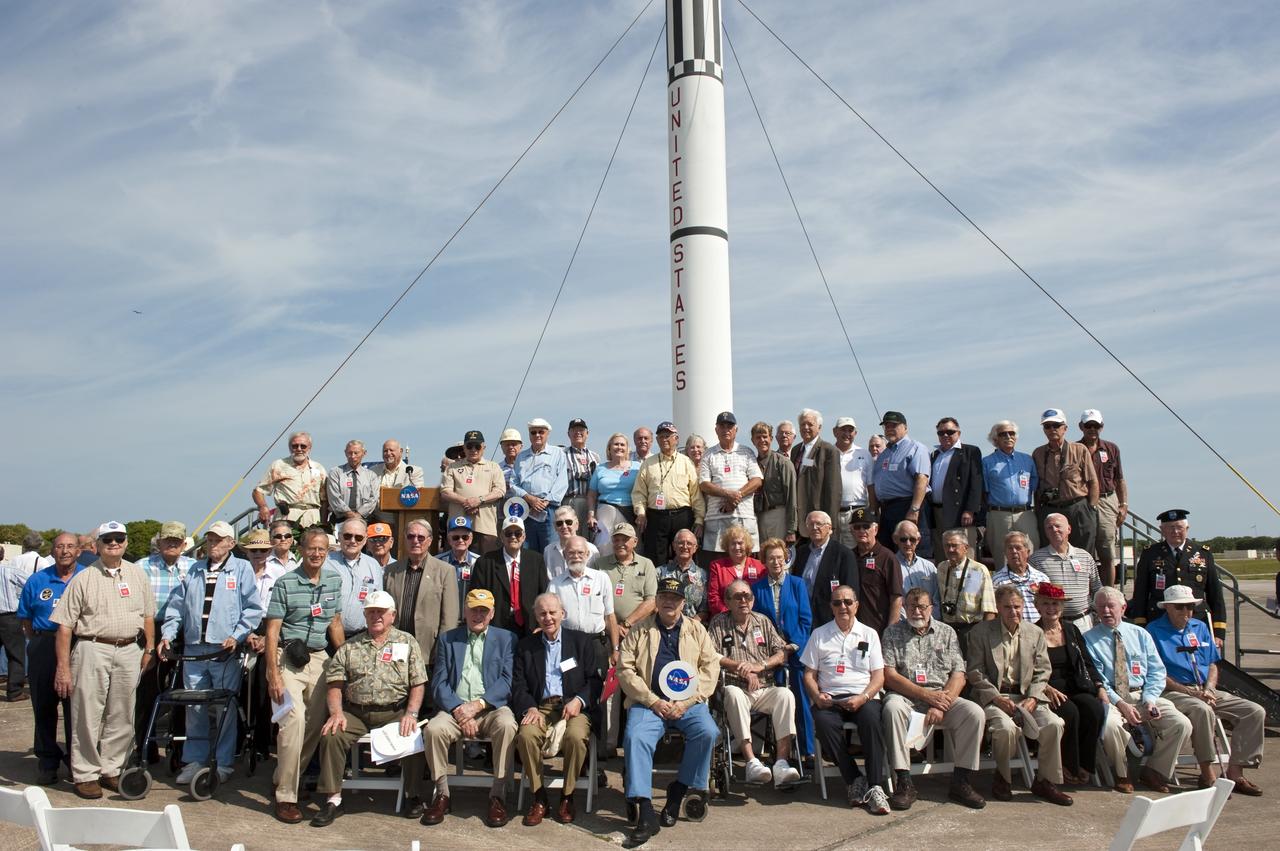
CAPE CANAVERAL, Fla. -- More than 200 workers from the original Mercury program pose for a group photo in front of a replica of a Mercury-Redstone rocket during a celebration at Complex 5/6 on Cape Canaveral Air Force Station in Florida.     The celebration was held at the launch site of the first U.S. manned spaceflight May 5, 1961, to mark the 50th anniversary of the flight.  Fifty years ago, astronaut Alan Shepard lifted off inside the Mercury capsule, "Freedom 7," atop an 82-foot-tall Mercury-Redstone rocket at 9:34 a.m. EST, sending him on a remarkably successful, 15-minute suborbital flight. The event was attended by more than 200 workers from the original Mercury program and included a re-creation of Shepard's flight and recovery, as well as a tribute to his contributions as a moonwalker on the Apollo 14 lunar mission. For more information, visit www.nasa.gov/topics/history/milestones/index.html. Photo credit: NASA/Kim Shiflett
KSC-2011-3330
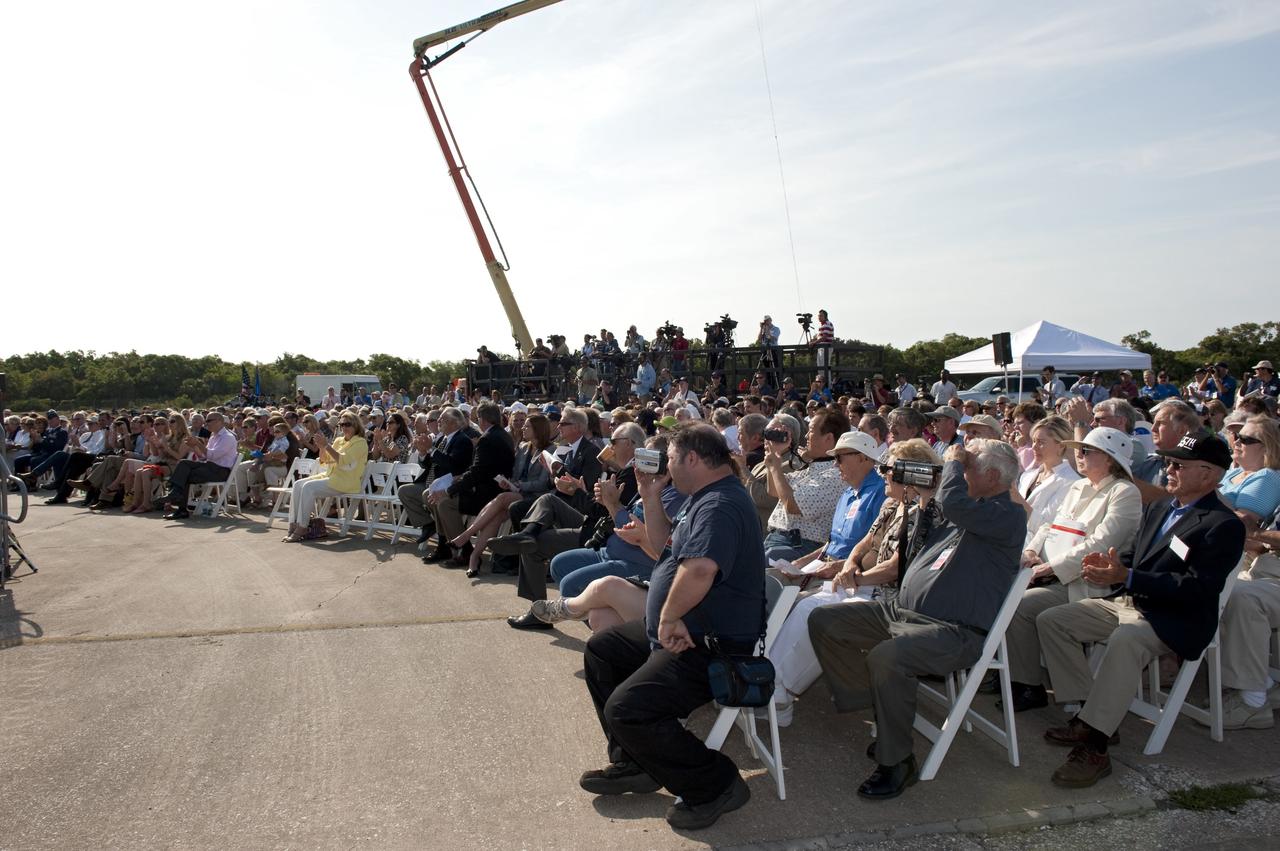
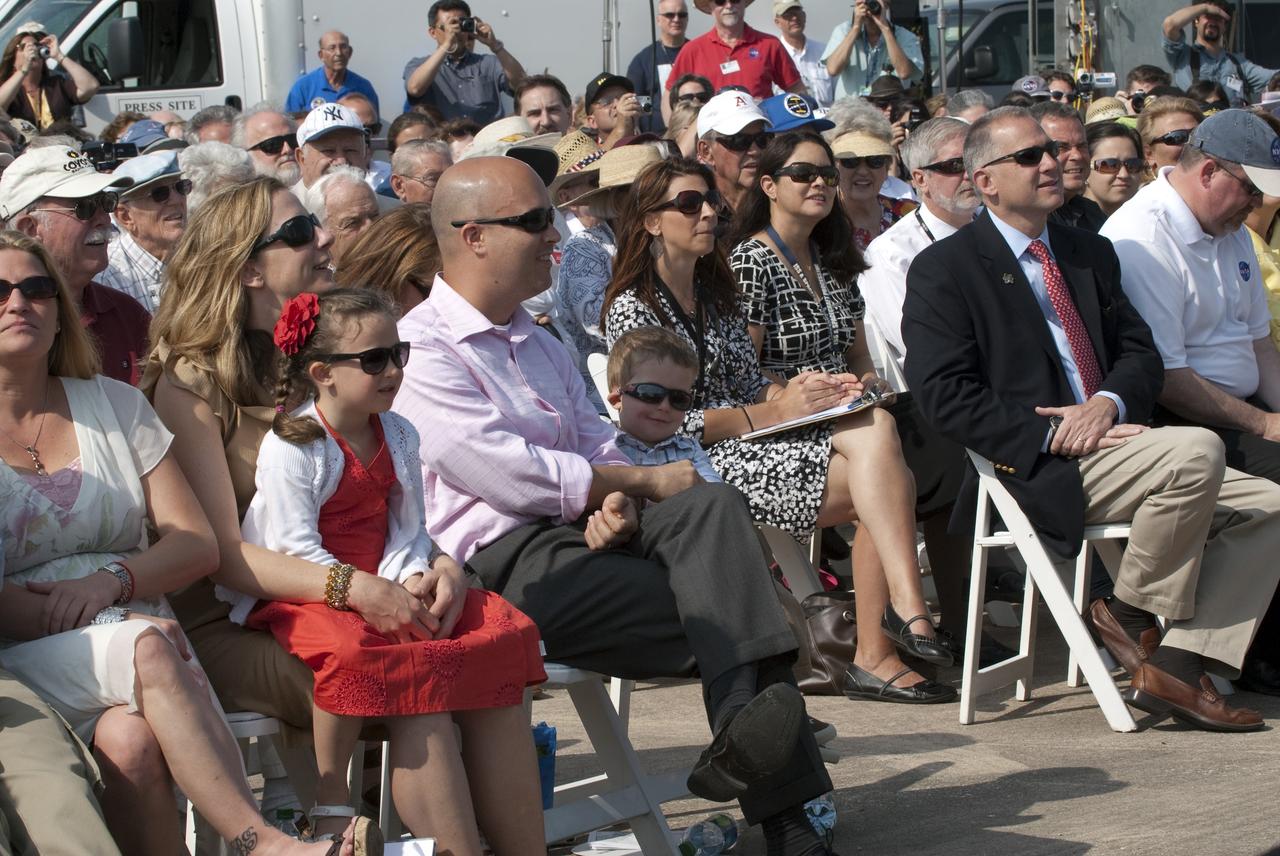
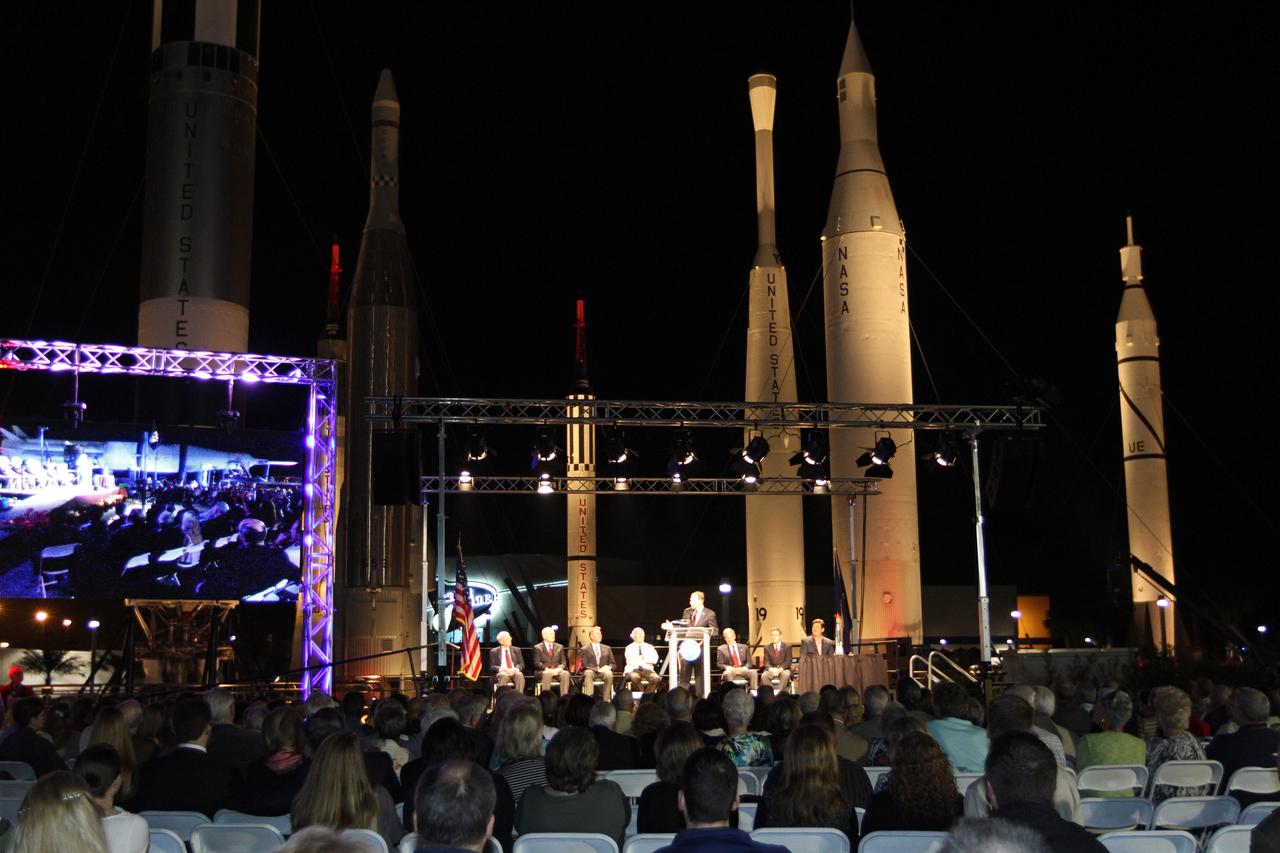
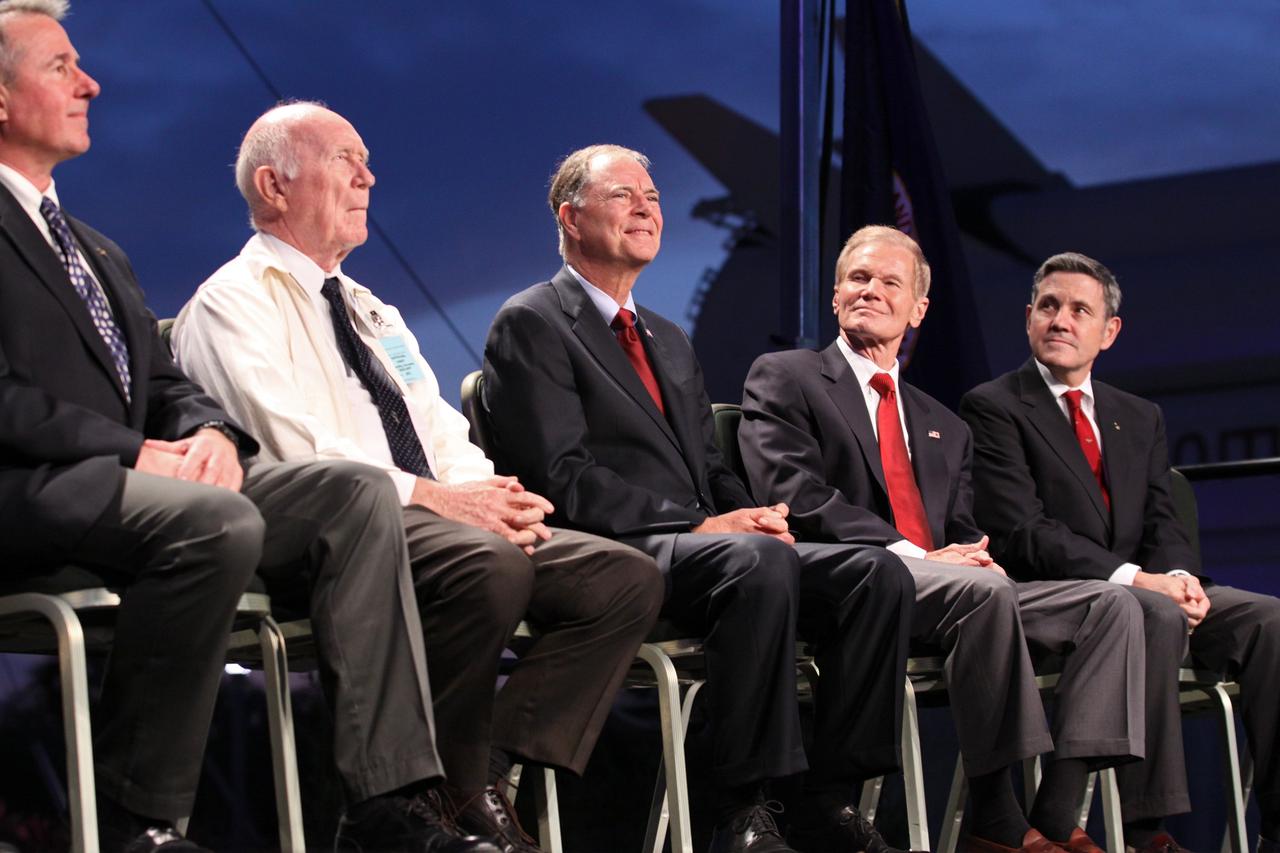
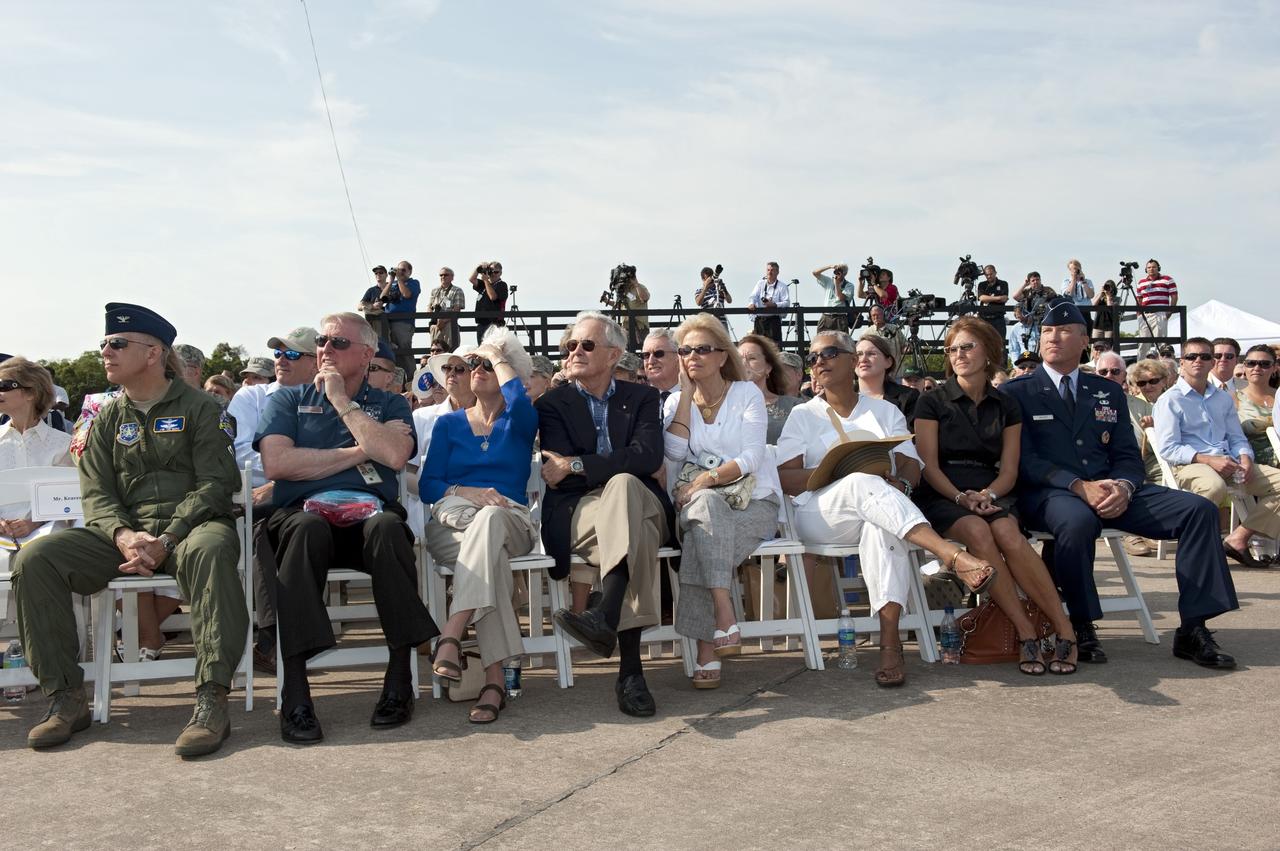
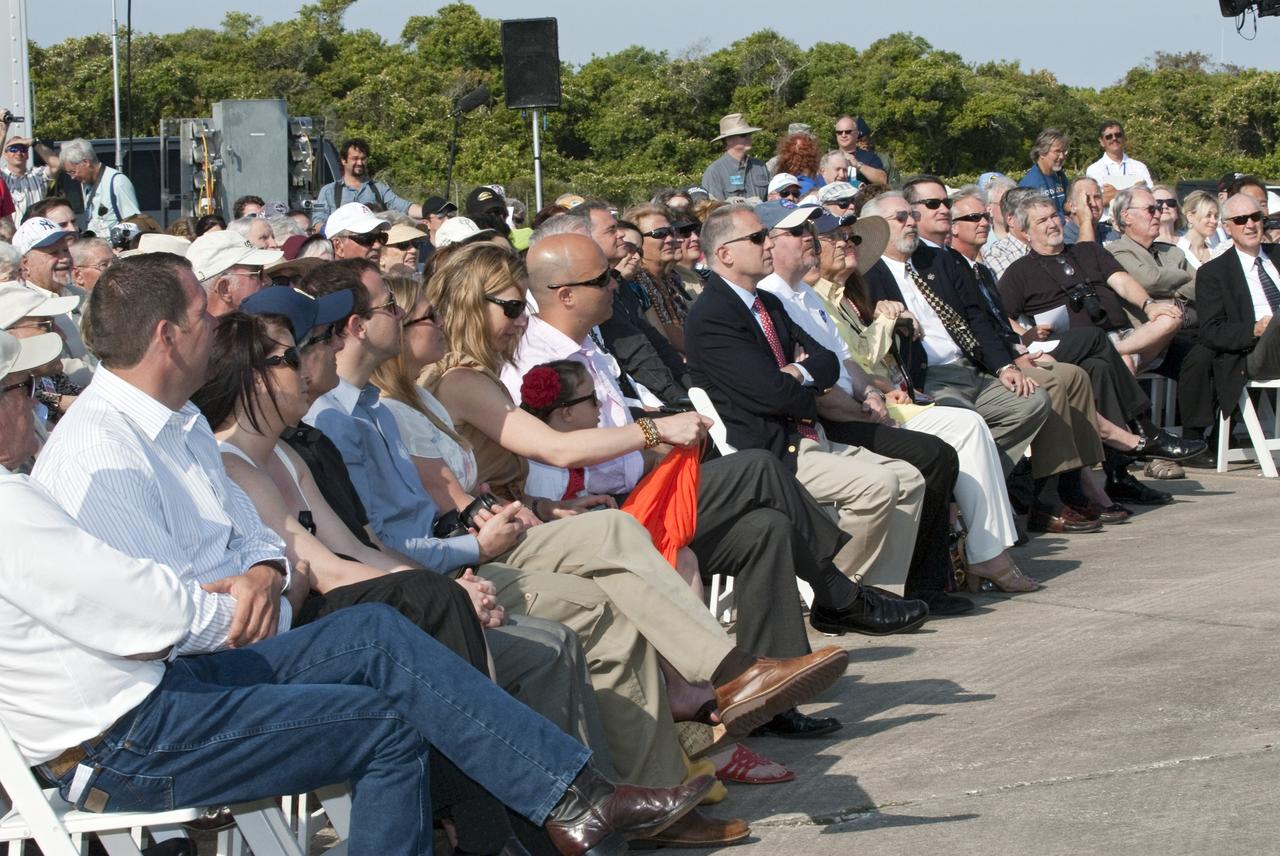
CAPE CANAVERAL, Fla. -- Invited guests enjoy the program presented at a celebration at Complex 5/6 on Cape Canaveral Air Force Station in Florida.    The celebration was held at the launch site of the first U.S. manned spaceflight May 5, 1961, to mark the 50th anniversary of the flight.  Fifty years ago, astronaut Alan Shepard lifted off inside the Mercury capsule, "Freedom 7," atop an 82-foot-tall Mercury-Redstone rocket at 9:34 a.m. EST, sending him on a remarkably successful, 15-minute suborbital flight. The event was attended by more than 200 workers from the original Mercury program and included a re-creation of Shepard's flight and recovery, as well as a tribute to his contributions as a moonwalker on the Apollo 14 lunar mission. For more information, visit www.nasa.gov/topics/history/milestones/index.html. Photo credit: NASA/Kim Shiflett
KSC-2011-3326
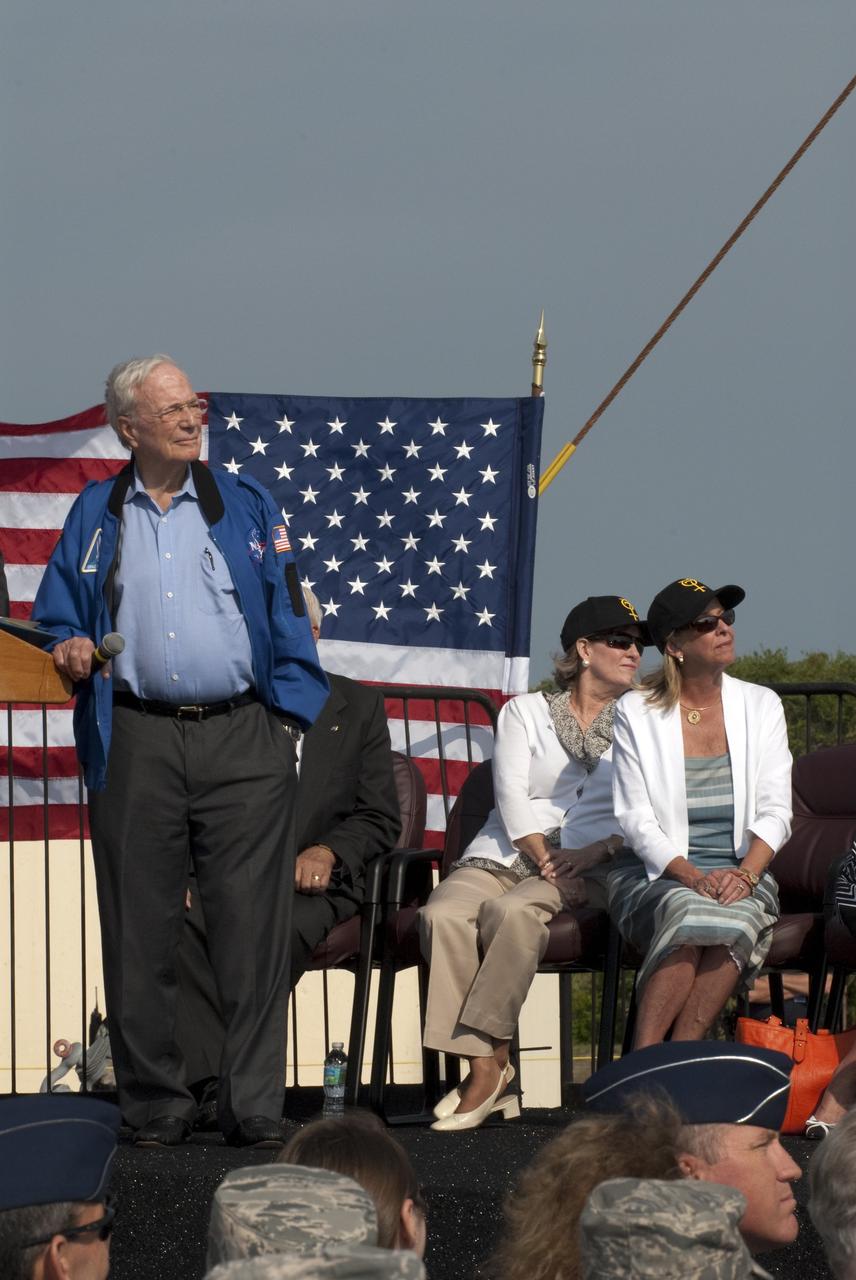
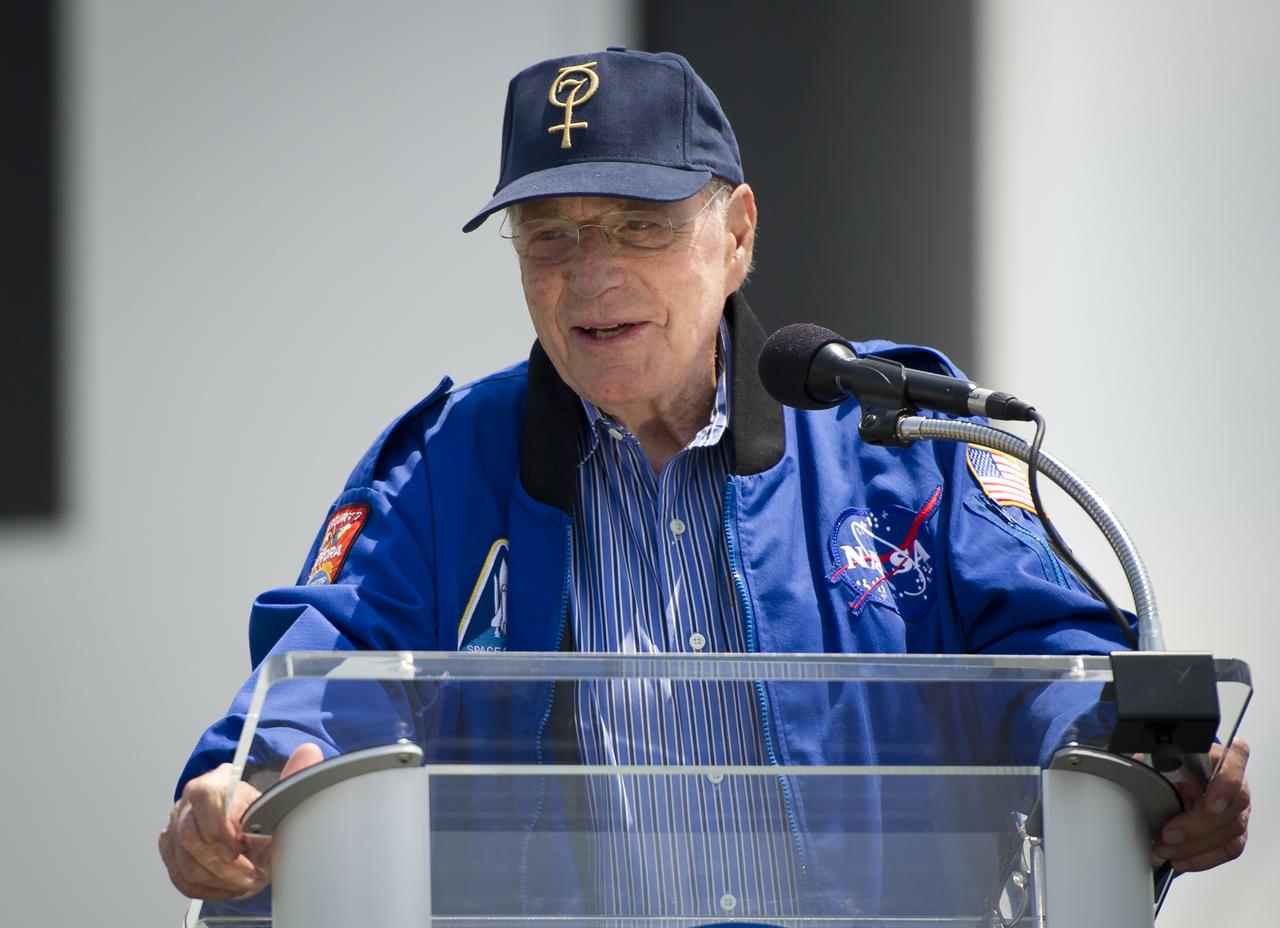
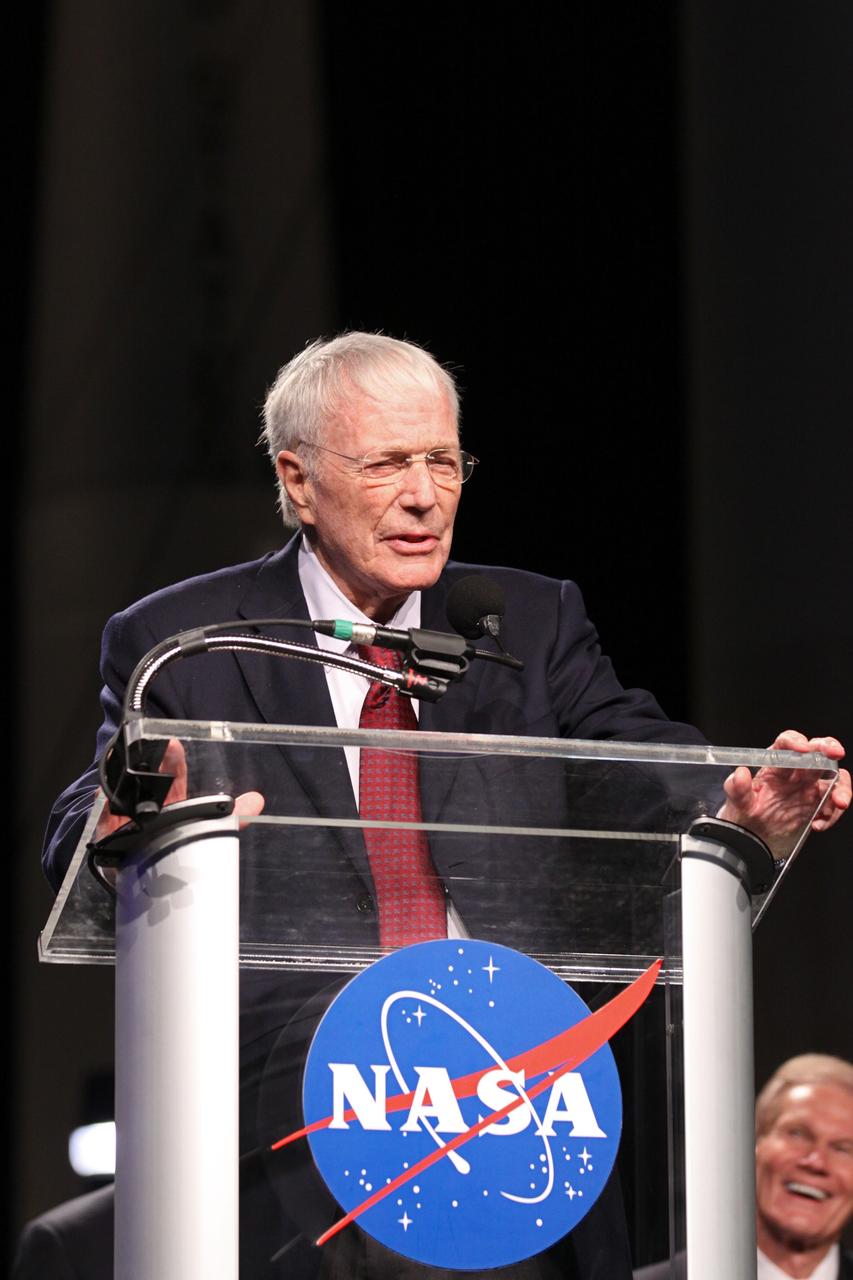
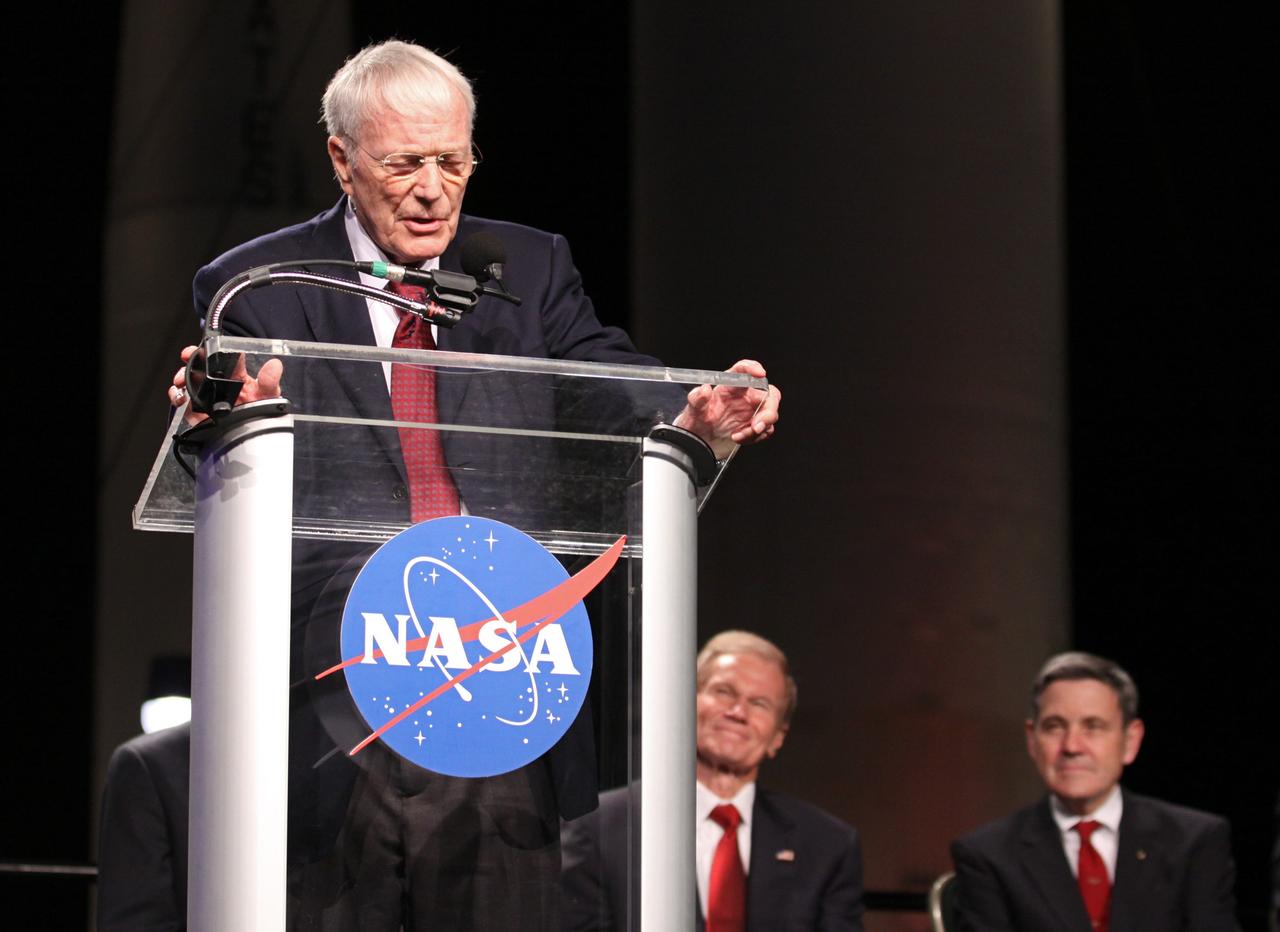
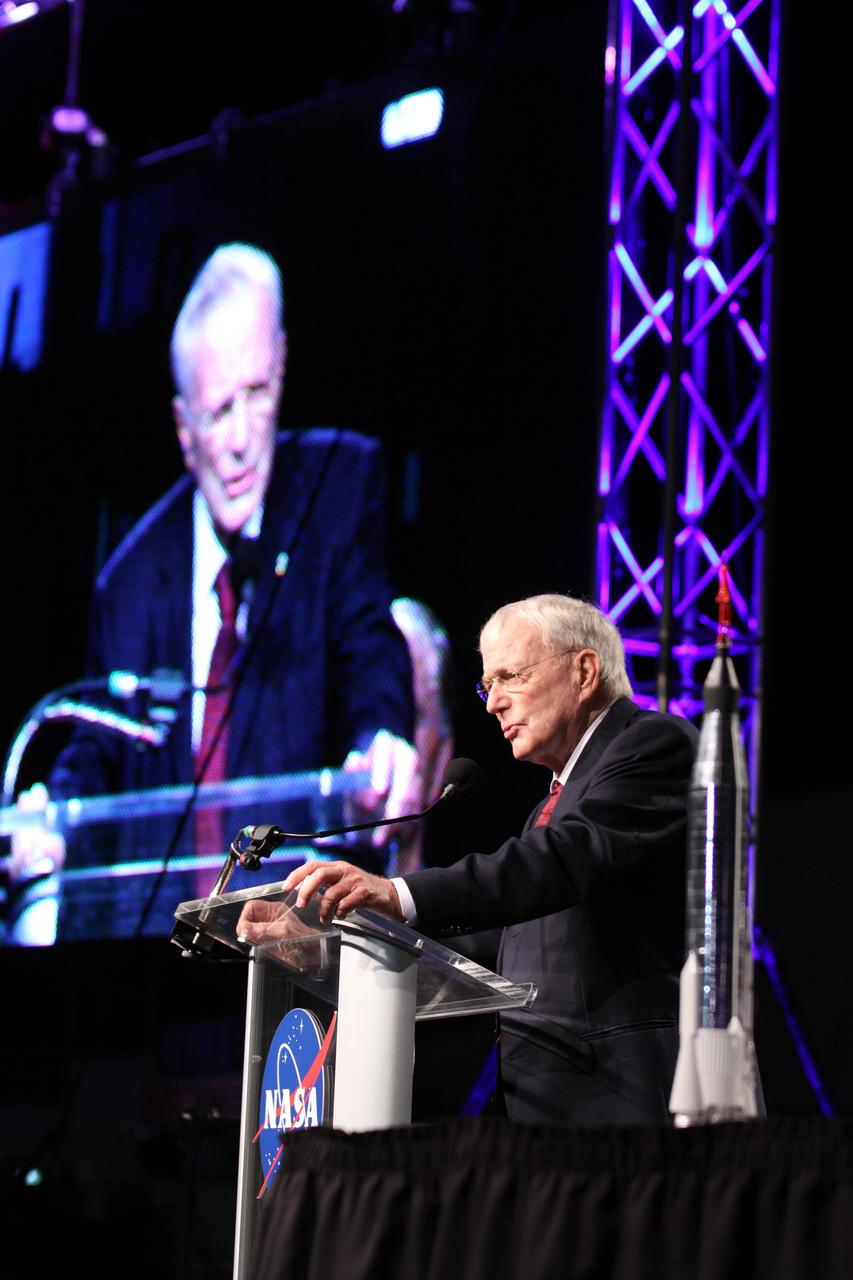
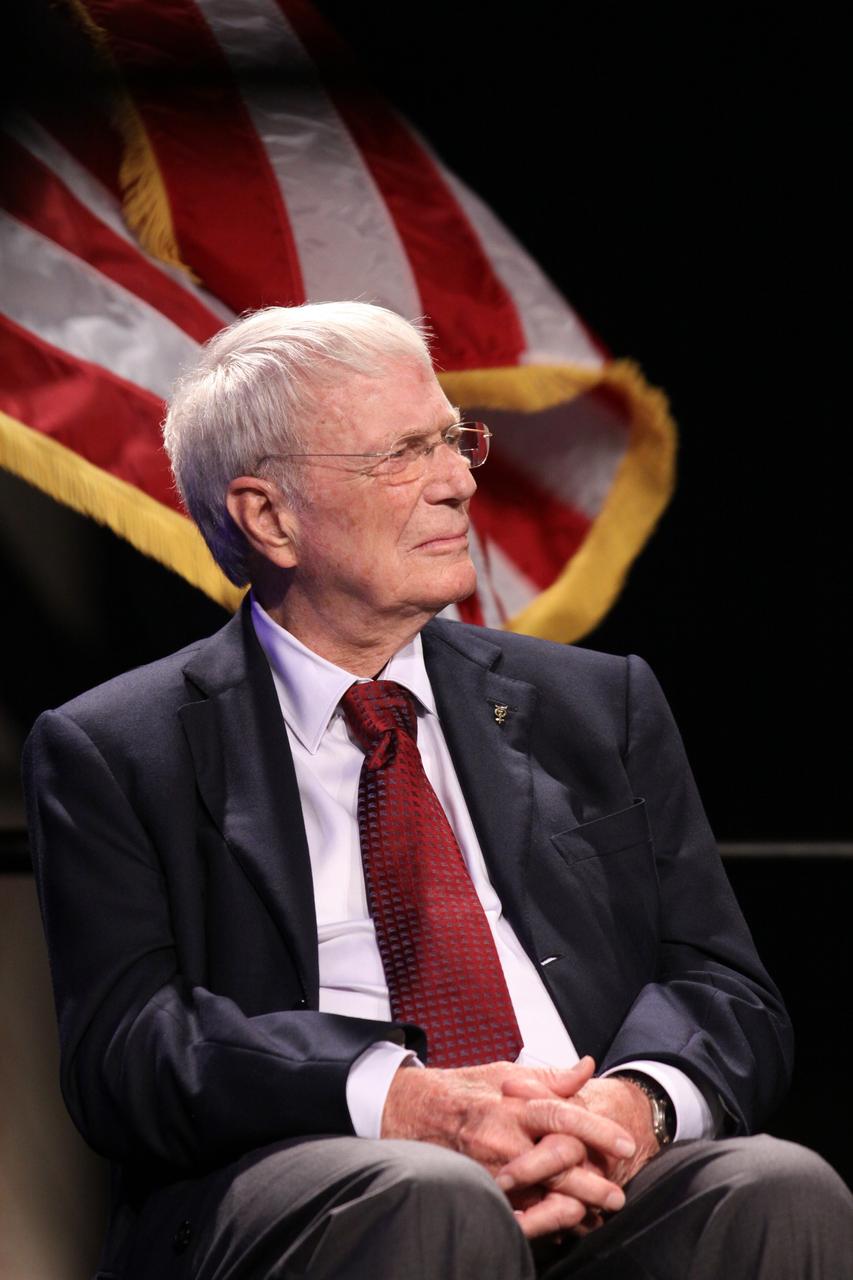
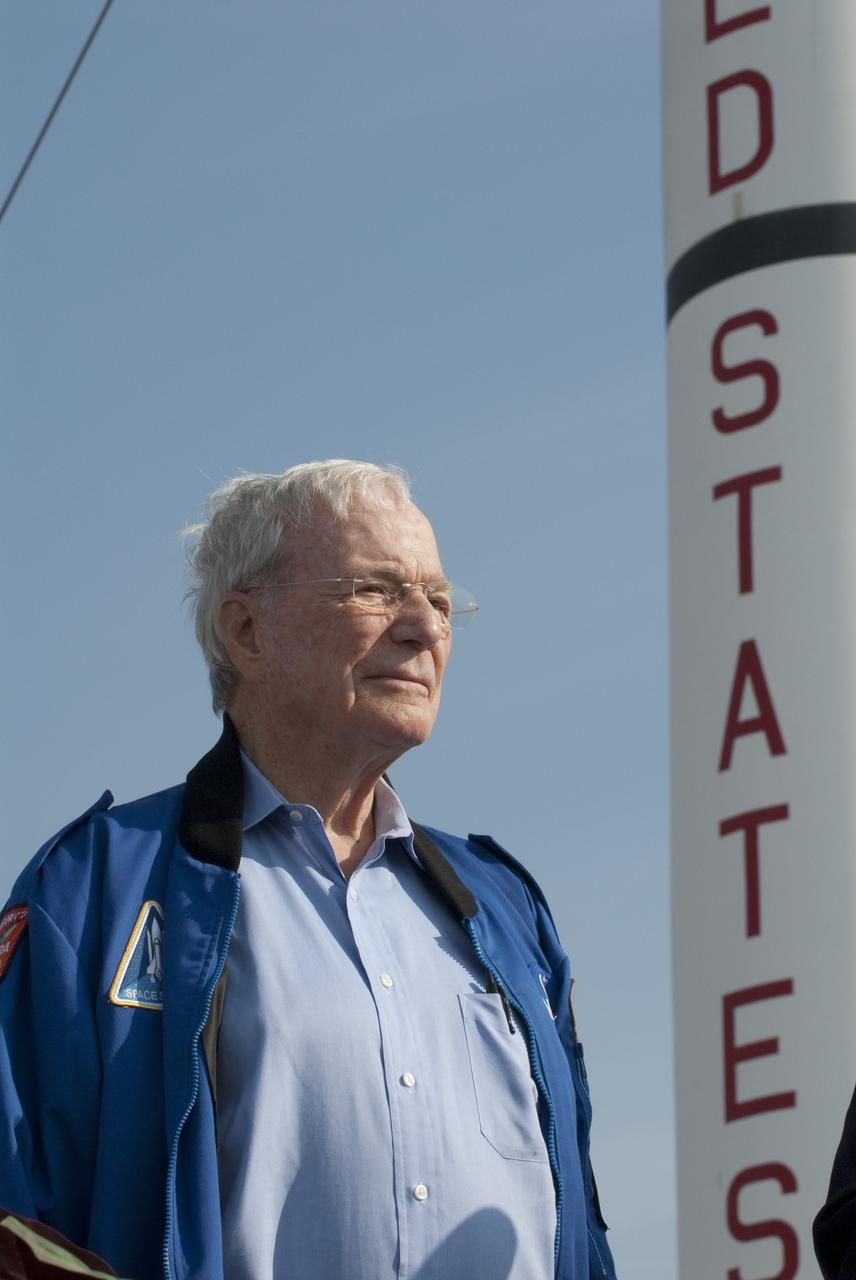
CAPE CANAVERAL, Fla. -- Mercury astronaut Scott Carpenter participates in a celebration at Complex 5/6 on Cape Canaveral Air Force Station in Florida.    The celebration was held at the launch site of the first U.S. manned spaceflight May 5, 1961, to mark the 50th anniversary of the flight.  Fifty years ago, astronaut Alan Shepard lifted off inside the Mercury capsule, "Freedom 7," atop an 82-foot-tall Mercury-Redstone rocket at 9:34 a.m. EST, sending him on a remarkably successful, 15-minute suborbital flight. The event was attended by more than 200 workers from the original Mercury program and included a re-creation of Shepard's flight and recovery, as well as a tribute to his contributions as a moonwalker on the Apollo 14 lunar mission. For more information, visit www.nasa.gov/topics/history/milestones/index.html. Photo credit: NASA/Kim Shiflett
KSC-2011-3314
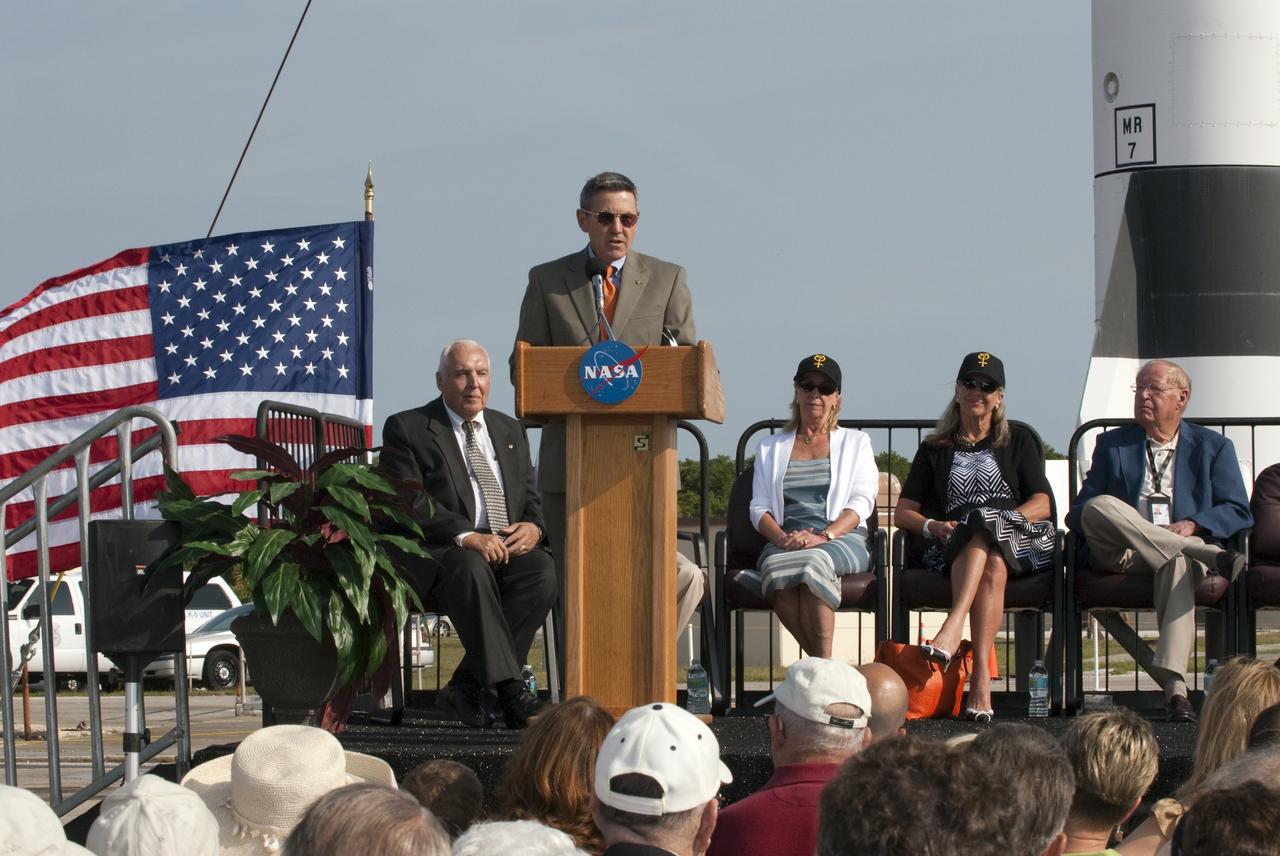
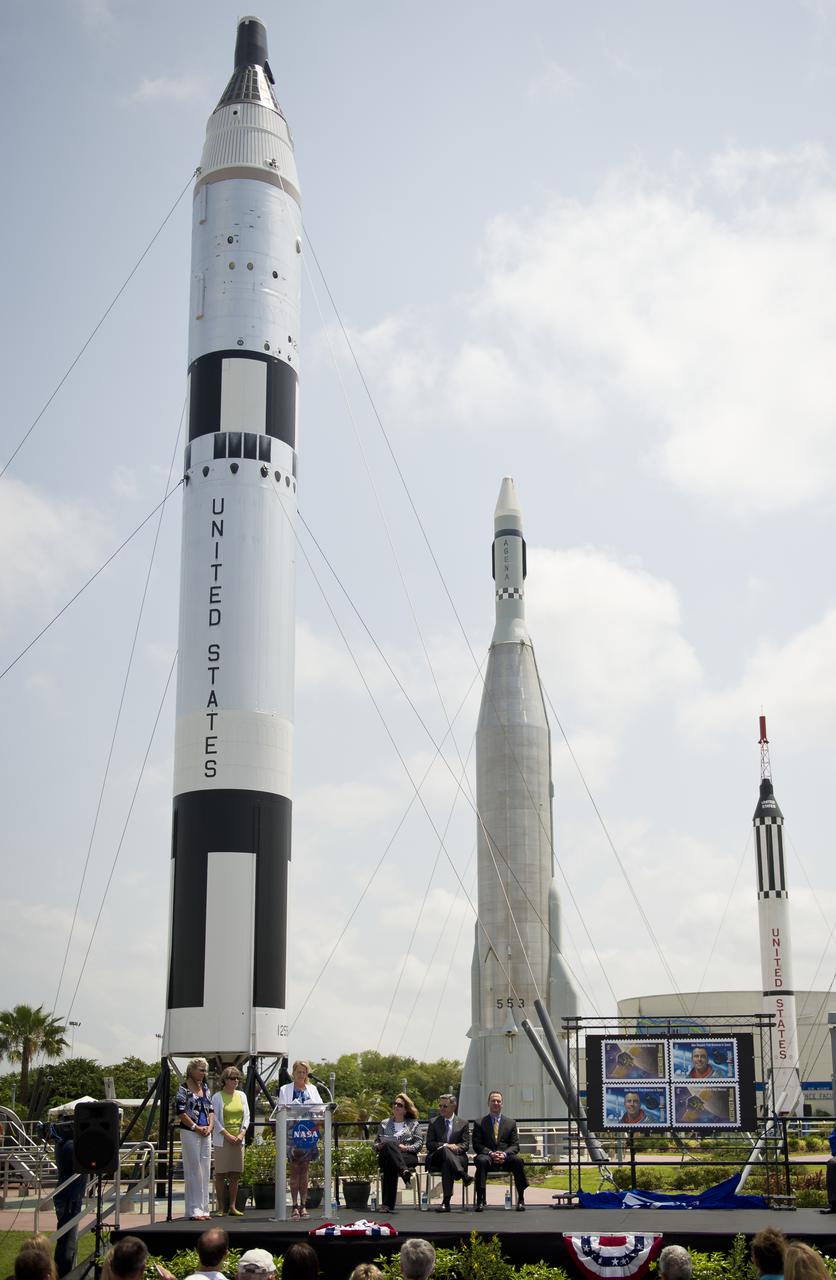
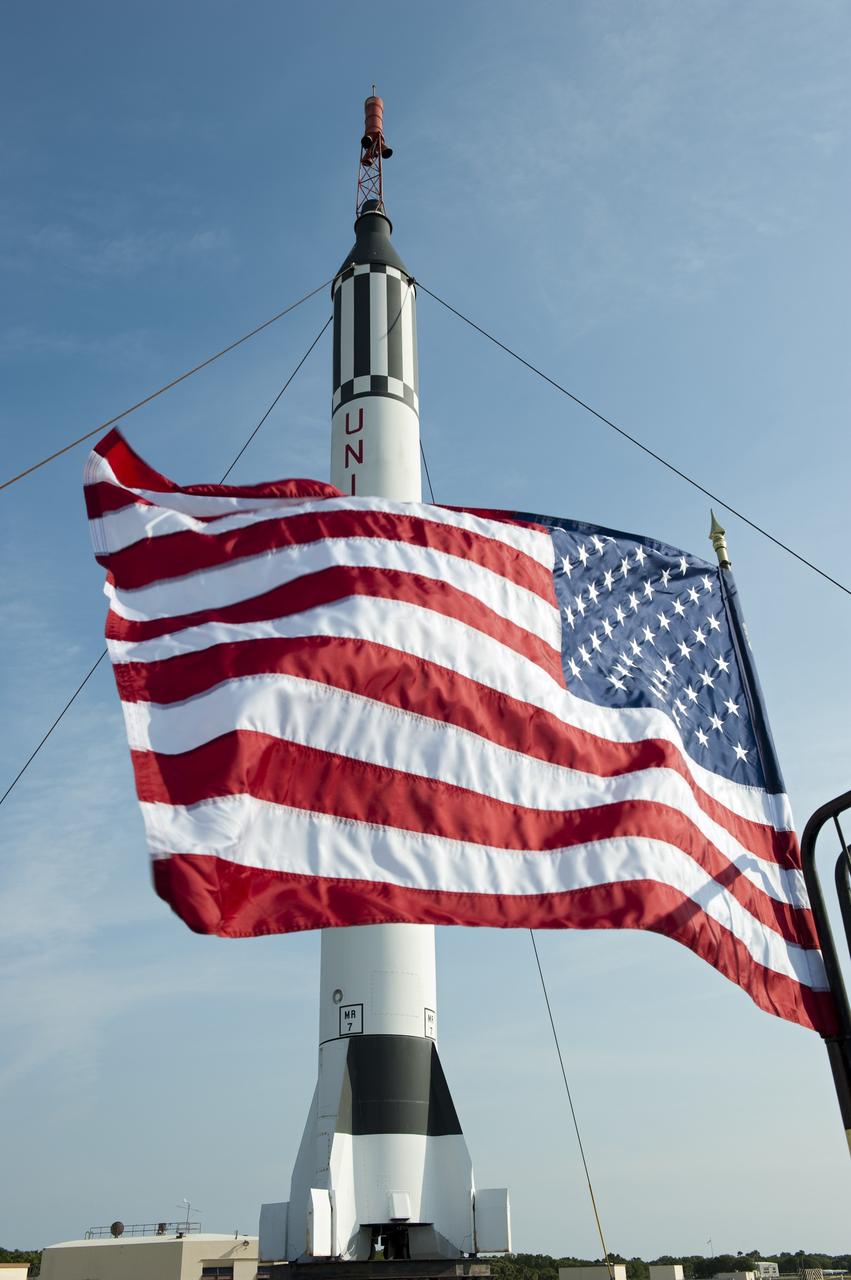
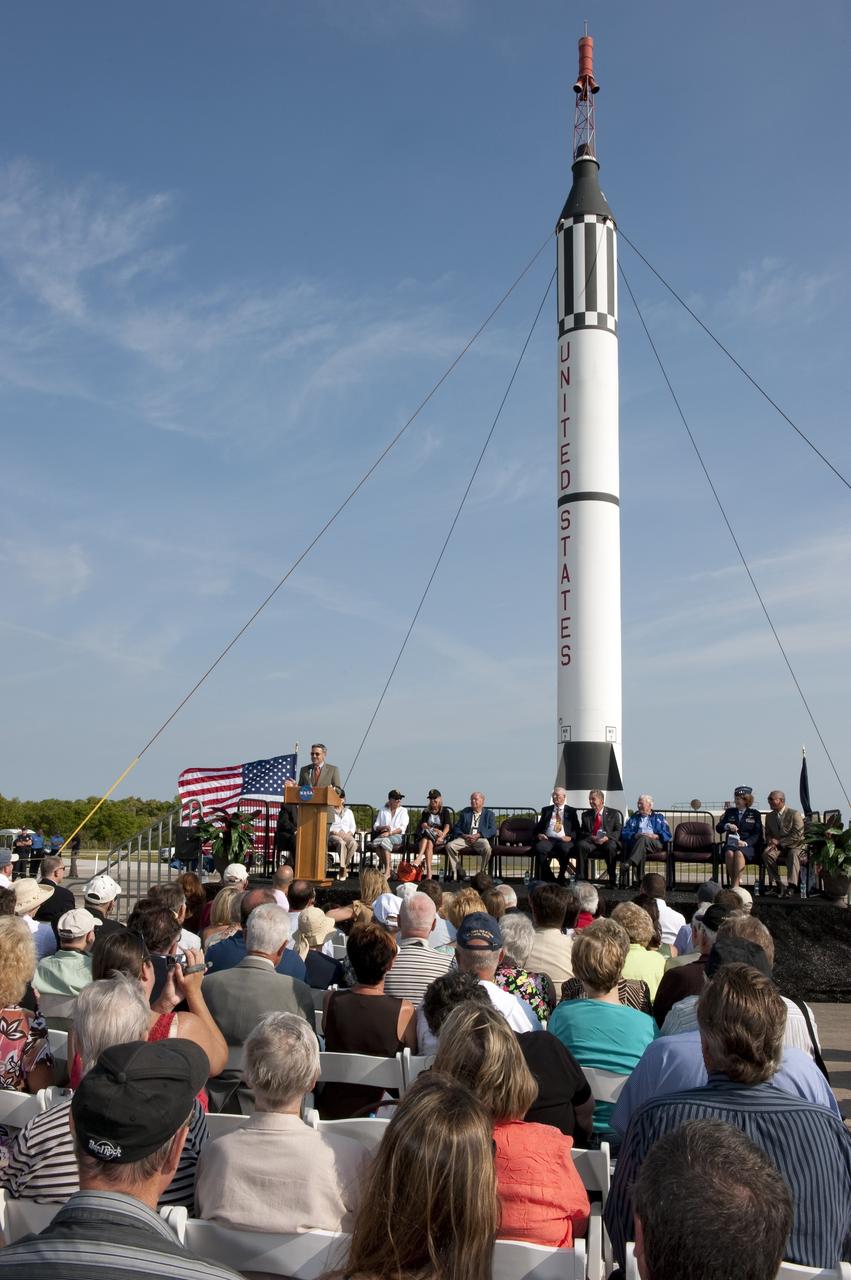
CAPE CANAVERAL, Fla. -- The U.S. flag waves proudly in front of a replica of a Mercury-Redstone rocket at Complex 5/6 on Cape Canaveral Air Force Station in Florida.    A celebration was held at the launch site of the first U.S. manned spaceflight May 5, 1961, to mark the 50th anniversary of the flight.  Fifty years ago, astronaut Alan Shepard lifted off inside the Mercury capsule, "Freedom 7," atop an 82-foot-tall Mercury-Redstone rocket at 9:34 a.m. EST, sending him on a remarkably successful, 15-minute suborbital flight. The event was attended by more than 200 workers from the original Mercury program and included a re-creation of Shepard's flight and recovery, as well as a tribute to his contributions as a moonwalker on the Apollo 14 lunar mission. For more information, visit www.nasa.gov/topics/history/milestones/index.html. Photo credit: NASA/Kim Shiflett
KSC-2011-3321
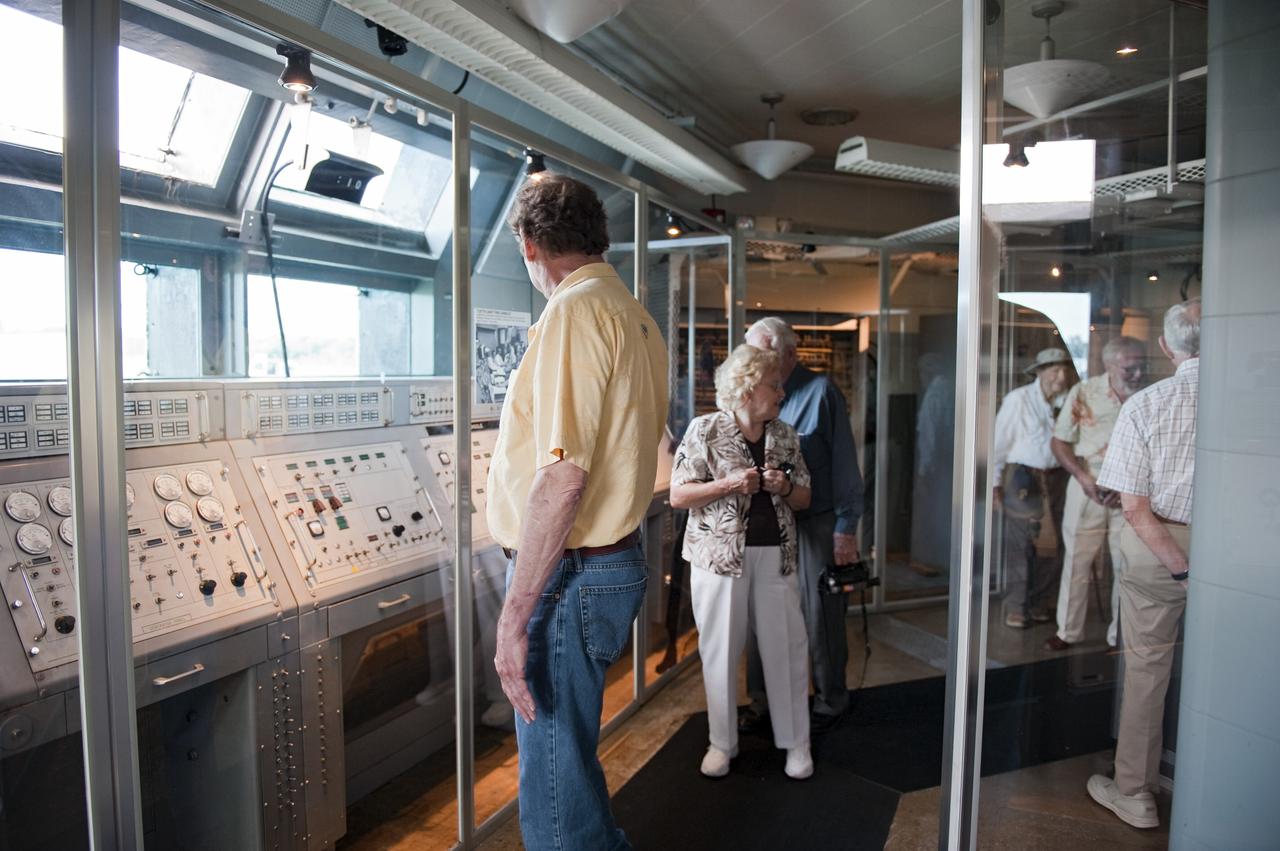
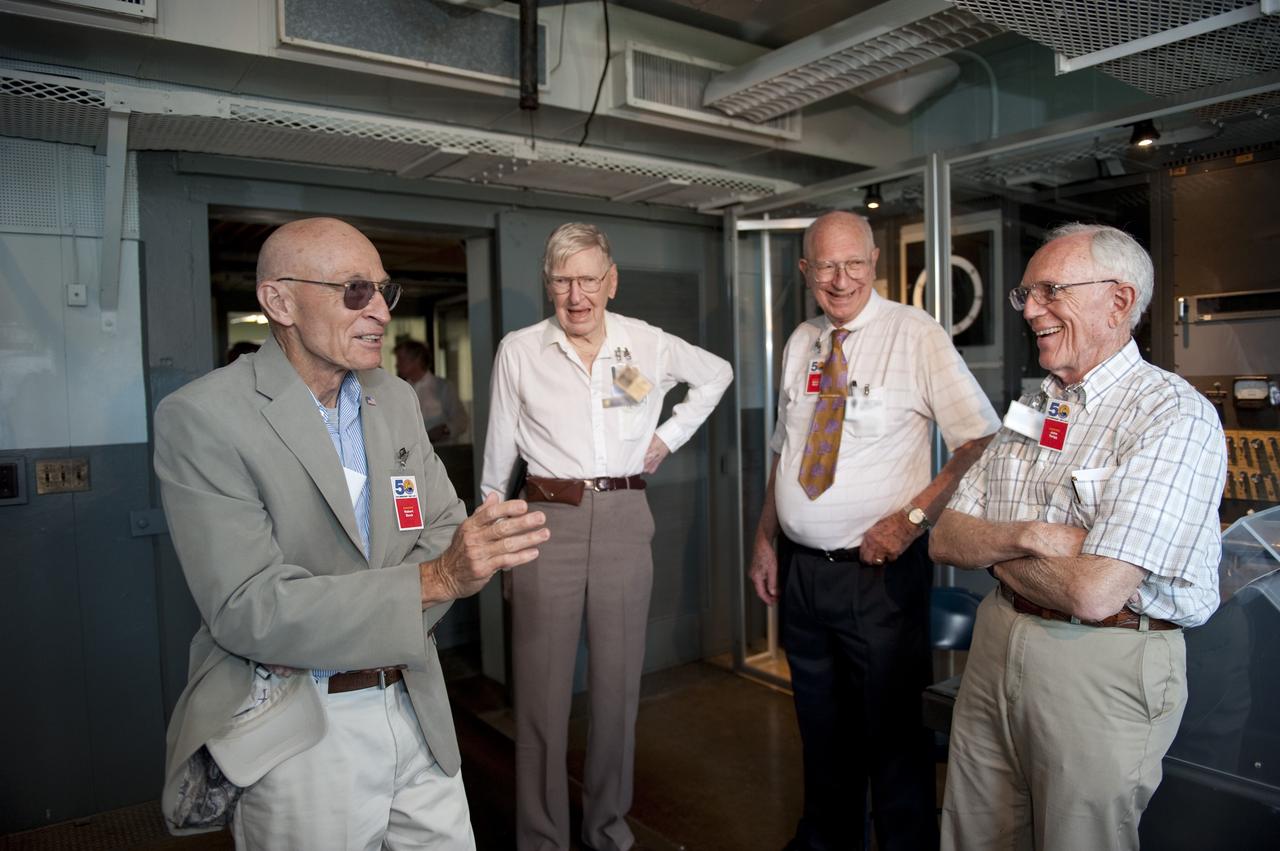
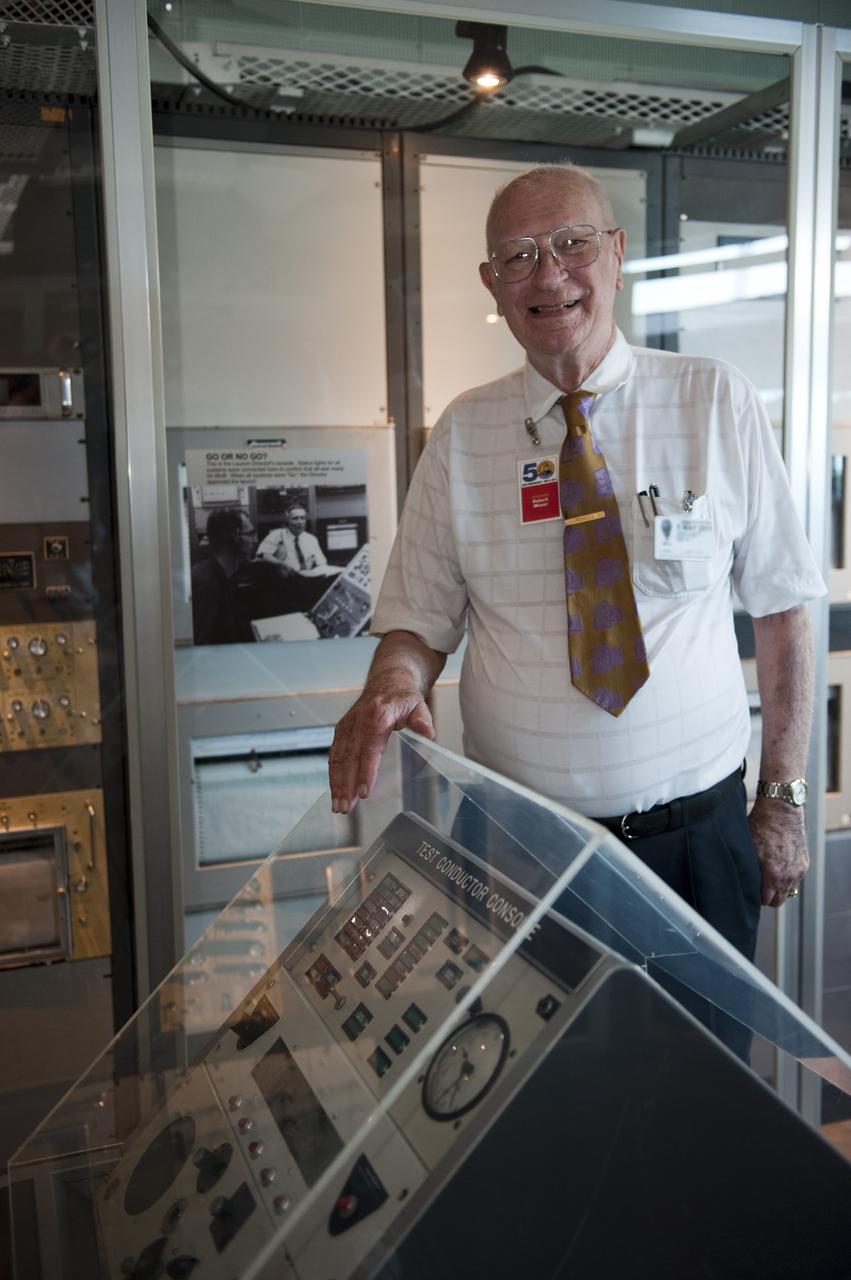
CAPE CANAVERAL, Fla. -- Bob Moser, former chief test conductor for the Mercury-Redstone launches, tours the blockhouse at Complex 5/6 on Cape Canaveral Air Force Station in Florida.    The celebration was held at the launch site of the first U.S. manned spaceflight May 5, 1961, to mark the 50th anniversary of the flight.  Fifty years ago, astronaut Alan Shepard lifted off inside the Mercury capsule, "Freedom 7," atop an 82-foot-tall Mercury-Redstone rocket at 9:34 a.m. EST, sending him on a remarkably successful, 15-minute suborbital flight. The event was attended by more than 200 workers from the original Mercury program and included a re-creation of Shepard's flight and recovery, as well as a tribute to his contributions as a moonwalker on the Apollo 14 lunar mission. For more information, visit www.nasa.gov/topics/history/milestones/index.html. Photo credit: NASA/Kim Shiflett
KSC-2011-3334
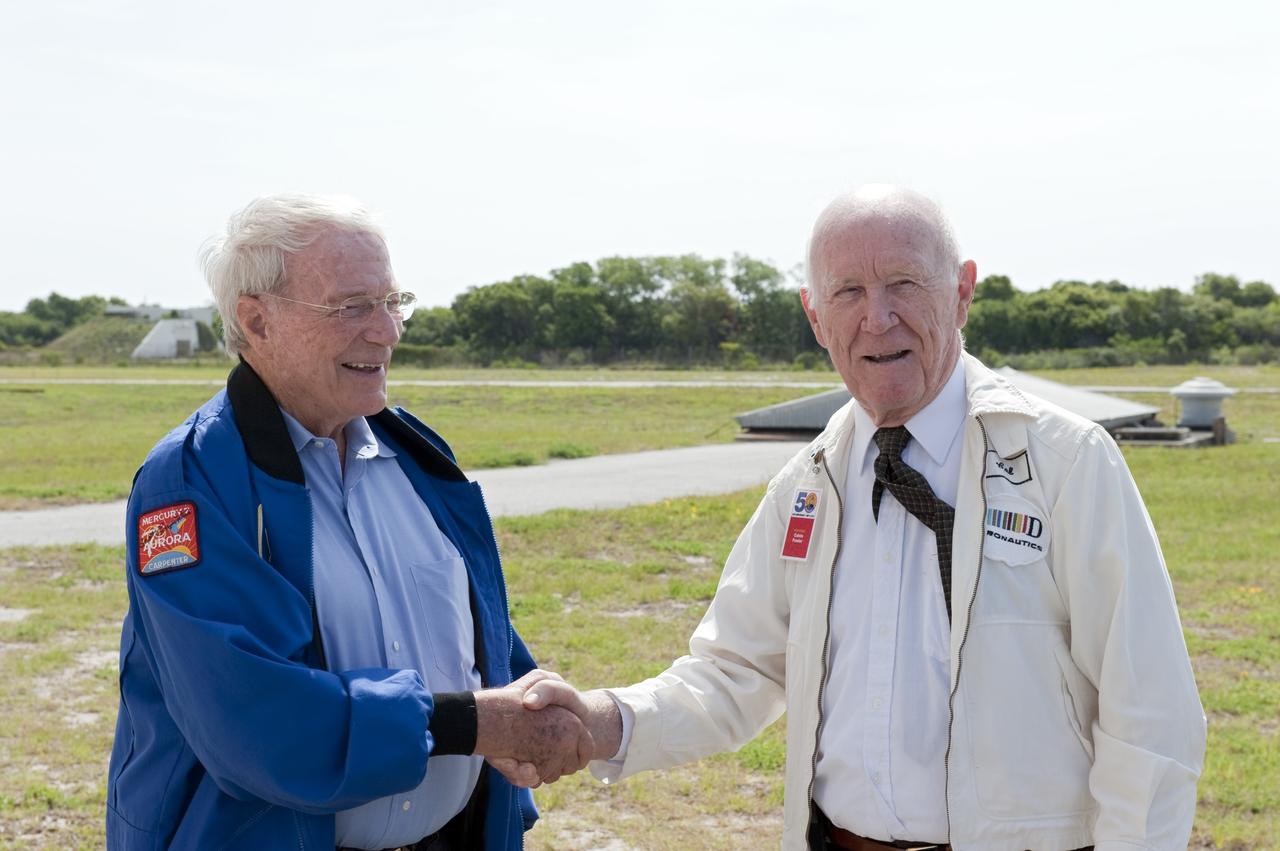
CAPE CANAVERAL, Fla. -- During a celebration at Complex 5/6 on Cape Canaveral Air Force Station in Florida, Mercury astronaut Scott Carpenter greets Calvin Fowler, the launch conductor for Carpenter's Mercury-Atlas 7 mission on May 24, 1962.     The celebration was held at the launch site of the first U.S. manned spaceflight May 5, 1961, to mark the 50th anniversary of the flight.  Fifty years ago, astronaut Alan Shepard lifted off inside the Mercury capsule, "Freedom 7," atop an 82-foot-tall Mercury-Redstone rocket at 9:34 a.m. EST, sending him on a remarkably successful, 15-minute suborbital flight. The event was attended by more than 200 workers from the original Mercury program and included a re-creation of Shepard's flight and recovery, as well as a tribute to his contributions as a moonwalker on the Apollo 14 lunar mission. For more information, visit www.nasa.gov/topics/history/milestones/index.html. Photo credit: NASA/Kim Shiflett
KSC-2011-3331
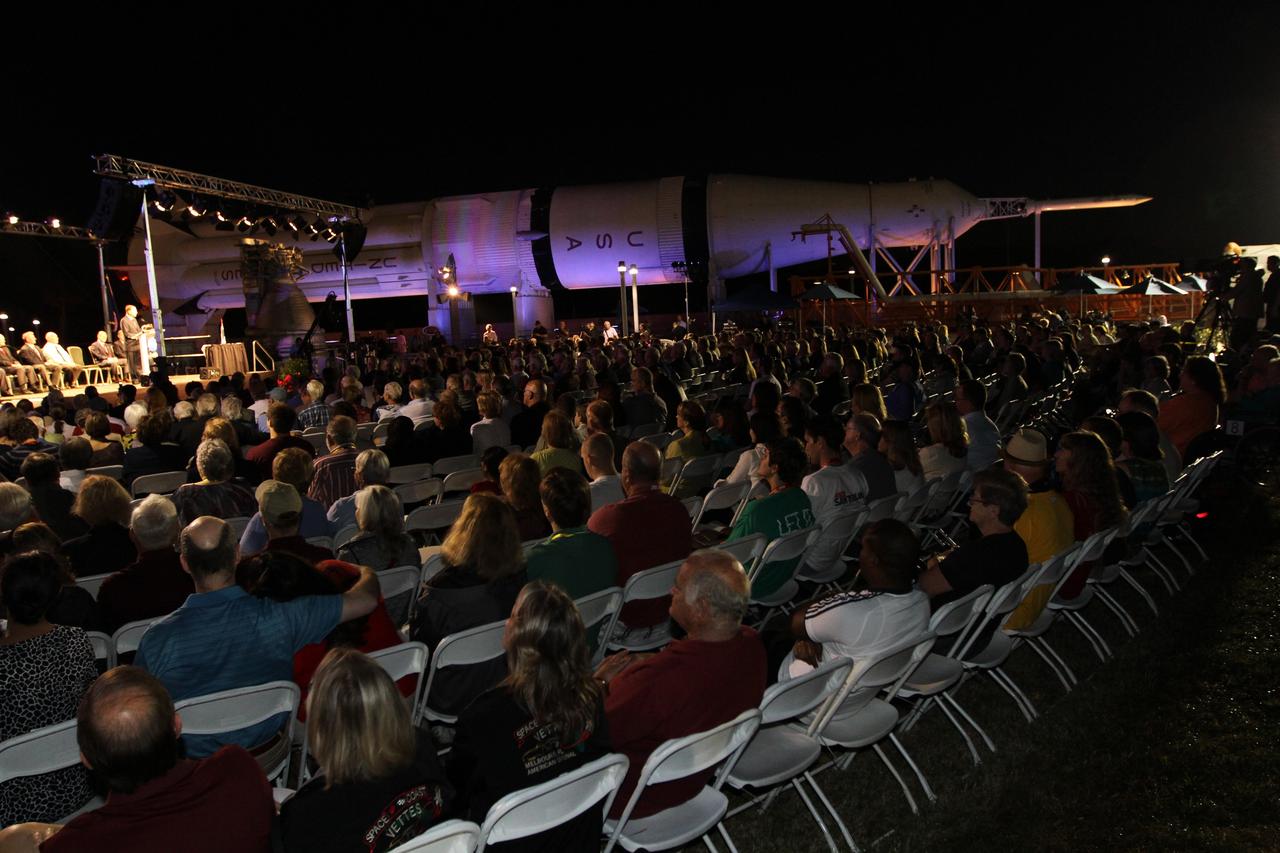
CAPE CANAVERAL, Fla. -- Invited guests and media representatives attend a celebration at Complex 5/6 on Cape Canaveral Air Force Station in Florida.    The celebration was held at the launch site of the first U.S. manned spaceflight May 5, 1961, to mark the 50th anniversary of the flight.  Fifty years ago, astronaut Alan Shepard lifted off inside the Mercury capsule, "Freedom 7," atop an 82-foot-tall Mercury-Redstone rocket at 9:34 a.m. EST, sending him on a remarkably successful, 15-minute suborbital flight. The event was attended by more than 200 workers from the original Mercury program and included a re-creation of Shepard's flight and recovery, as well as a tribute to his contributions as a moonwalker on the Apollo 14 lunar mission. For more information, visit www.nasa.gov/topics/history/milestones/index.html. Photo credit: NASA/Kim Shiflett
KSC-2011-3322
CAPE CANAVERAL, Fla. -- Invited guests attending a celebration at Complex 5/6 on Cape Canaveral Air Force Station in Florida tour the blockhouse.    The celebration was held at the launch site of the first U.S. manned spaceflight May 5, 1961, to mark the 50th anniversary of the flight.  Fifty years ago, astronaut Alan Shepard lifted off inside the Mercury capsule, "Freedom 7," atop an 82-foot-tall Mercury-Redstone rocket at 9:34 a.m. EST, sending him on a remarkably successful, 15-minute suborbital flight. The event was attended by more than 200 workers from the original Mercury program and included a re-creation of Shepard's flight and recovery, as well as a tribute to his contributions as a moonwalker on the Apollo 14 lunar mission. For more information, visit www.nasa.gov/topics/history/milestones/index.html. Photo credit: NASA/Kim Shiflett
KSC-2011-3332
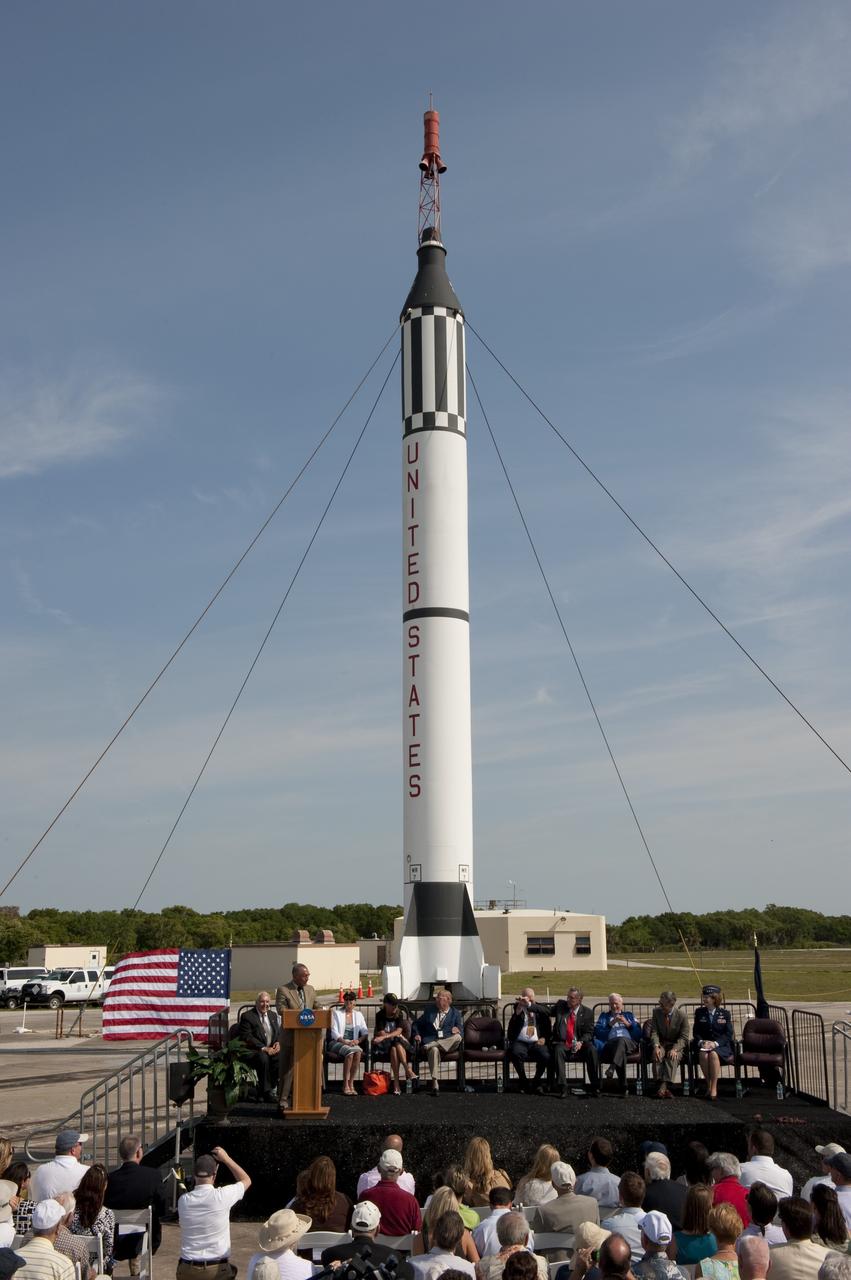
CAPE CANAVERAL, Fla. -- Lieutenant General Susan J. Helms, commander of the 14th Air Force and former astronaut, addresses the audience at a celebration at Complex 5/6 on Cape Canaveral Air Force Station in Florida.    The celebration was held at the launch site of the first U.S. manned spaceflight May 5, 1961, to mark the 50th anniversary of the flight.  Fifty years ago, astronaut Alan Shepard lifted off inside the Mercury capsule, "Freedom 7," atop an 82-foot-tall Mercury-Redstone rocket at 9:34 a.m. EST, sending him on a remarkably successful, 15-minute suborbital flight. The event was attended by more than 200 workers from the original Mercury program and included a re-creation of Shepard's flight and recovery, as well as a tribute to his contributions as a moonwalker on the Apollo 14 lunar mission. For more information, visit www.nasa.gov/topics/history/milestones/index.html. Photo credit: NASA/Kim Shiflett
KSC-2011-3323
CAPE CANAVERAL, Fla. -- Kennedy Space Center Director and former astronaut Bob Cabana addresses the audience at a celebration at Complex 5/6 on Cape Canaveral Air Force Station in Florida.    The celebration was held at the launch site of the first U.S. manned spaceflight May 5, 1961, to mark the 50th anniversary of the flight.  Fifty years ago, astronaut Alan Shepard lifted off inside the Mercury capsule, "Freedom 7," atop an 82-foot-tall Mercury-Redstone rocket at 9:34 a.m. EST, sending him on a remarkably successful, 15-minute suborbital flight. The event was attended by more than 200 workers from the original Mercury program and included a re-creation of Shepard's flight and recovery, as well as a tribute to his contributions as a moonwalker on the Apollo 14 lunar mission. For more information, visit www.nasa.gov/topics/history/milestones/index.html. Photo credit: NASA/Kim Shiflett
KSC-2011-3324
CAPE CANAVERAL, Fla. -- Kennedy Space Center Director and former astronaut Bob Cabana addresses the audience at a celebration at Complex 5/6 on Cape Canaveral Air Force Station in Florida.    The celebration was held at the launch site of the first U.S. manned spaceflight May 5, 1961, to mark the 50th anniversary of the flight.  Fifty years ago, astronaut Alan Shepard lifted off inside the Mercury capsule, "Freedom 7," atop an 82-foot-tall Mercury-Redstone rocket at 9:34 a.m. EST, sending him on a remarkably successful, 15-minute suborbital flight. The event was attended by more than 200 workers from the original Mercury program and included a re-creation of Shepard's flight and recovery, as well as a tribute to his contributions as a moonwalker on the Apollo 14 lunar mission. For more information, visit www.nasa.gov/topics/history/milestones/index.html. Photo credit: NASA/Kim Shiflett
KSC-2011-3315
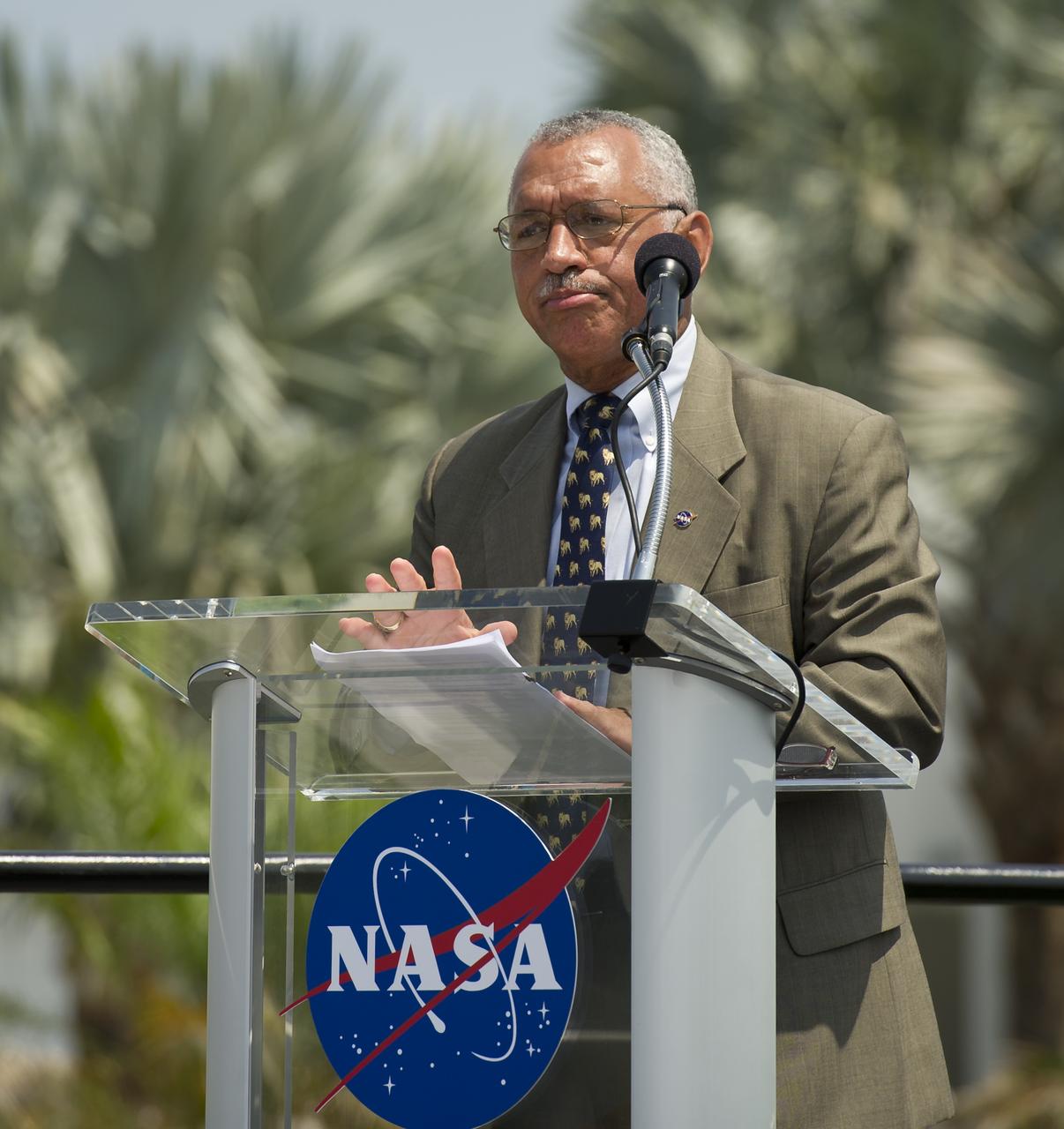
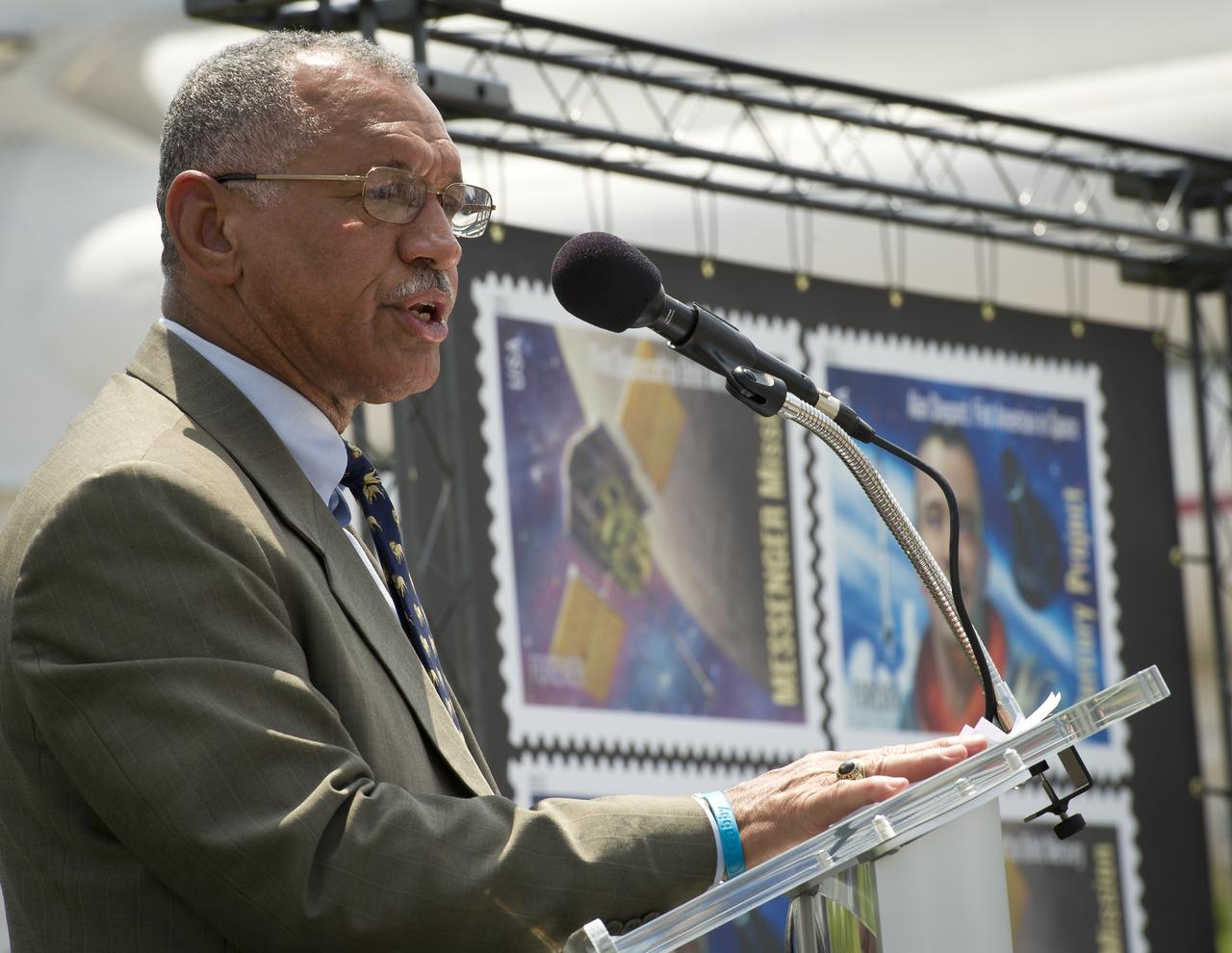
CAPE CANAVERAL, Fla. -- NASA Administrator Charlie Bolden addresses the audience during a celebration at Complex 5/6 on Cape Canaveral Air Force Station in Florida.    The celebration was held at the launch site of the first U.S. manned spaceflight May 5, 1961, to mark the 50th anniversary of the flight.  Fifty years ago, astronaut Alan Shepard lifted off inside the Mercury capsule, "Freedom 7," atop an 82-foot-tall Mercury-Redstone rocket at 9:34 a.m. EST, sending him on a remarkably successful, 15-minute suborbital flight. The event was attended by more than 200 workers from the original Mercury program and included a re-creation of Shepard's flight and recovery, as well as a tribute to his contributions as a moonwalker on the Apollo 14 lunar mission. For more information, visit www.nasa.gov/topics/history/milestones/index.html. Photo credit: NASA/Kim Shiflett
KSC-2011-3328
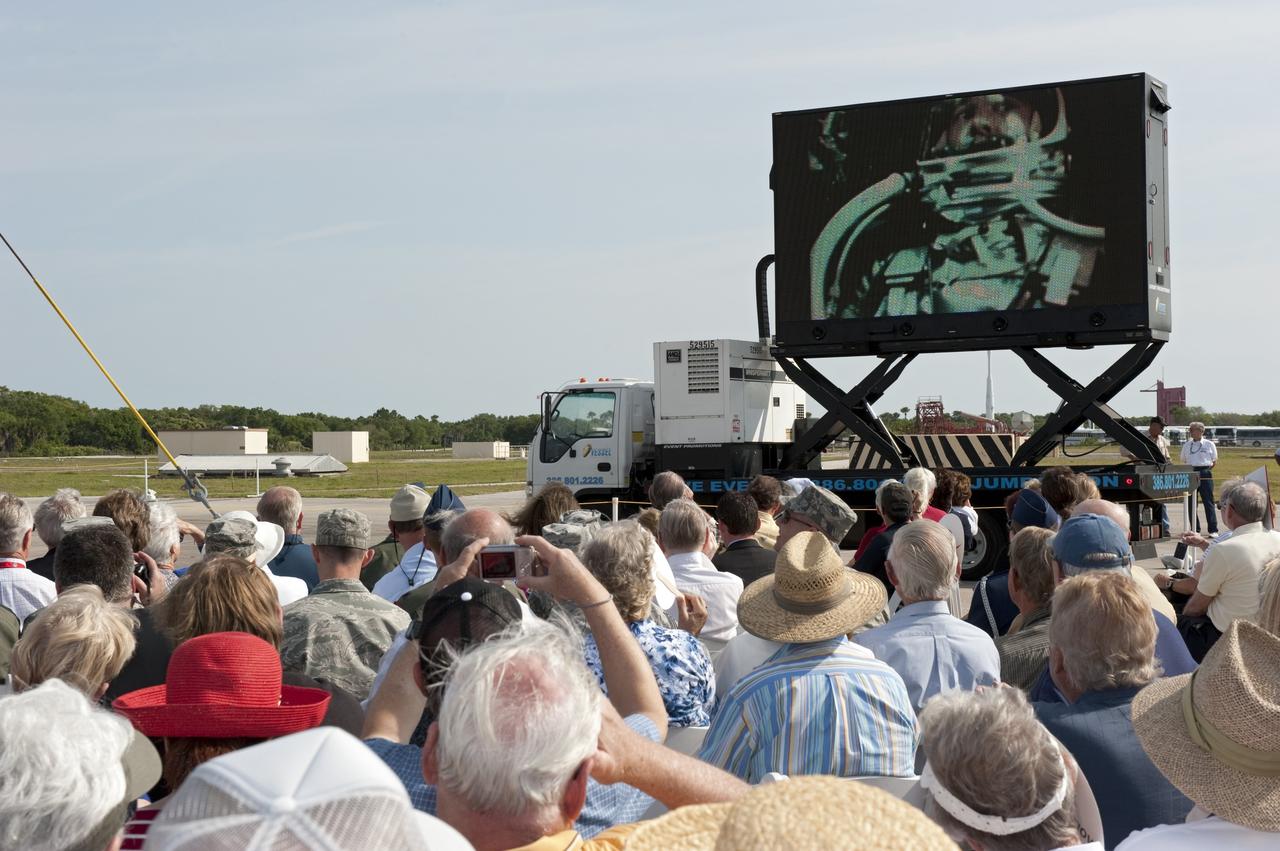
CAPE CANAVERAL, Fla. -- Invited guests enjoy a tribute to astronaut Alan Shepard during a celebration at Complex 5/6 on Cape Canaveral Air Force Station in Florida.    The celebration was held at the launch site of the first U.S. manned spaceflight May 5, 1961, to mark the 50th anniversary of the flight.  Fifty years ago, astronaut Alan Shepard lifted off inside the Mercury capsule, "Freedom 7," atop an 82-foot-tall Mercury-Redstone rocket at 9:34 a.m. EST, sending him on a remarkably successful, 15-minute suborbital flight. The event was attended by more than 200 workers from the original Mercury program and included a re-creation of Shepard's flight and recovery, as well as a tribute to his contributions as a moonwalker on the Apollo 14 lunar mission. For more information, visit www.nasa.gov/topics/history/milestones/index.html. Photo credit: NASA/Kim Shiflett
KSC-2011-3327
CAPE CANAVERAL, Fla. -- Invited guests of all ages attend a celebration at Complex 5/6 on Cape Canaveral Air Force Station in Florida.     The celebration was held at the launch site of the first U.S. manned spaceflight May 5, 1961, to mark the 50th anniversary of the flight.  Fifty years ago, astronaut Alan Shepard lifted off inside the Mercury capsule, "Freedom 7," atop an 82-foot-tall Mercury-Redstone rocket at 9:34 a.m. EST, sending him on a remarkably successful, 15-minute suborbital flight. The event was attended by more than 200 workers from the original Mercury program and included a re-creation of Shepard's flight and recovery, as well as a tribute to his contributions as a moonwalker on the Apollo 14 lunar mission. For more information, visit www.nasa.gov/topics/history/milestones/index.html. Photo credit: NASA/Kim Shiflett
KSC-2011-3320
CAPE CANAVERAL, Fla. -- Invited guests attend a celebration at Complex 5/6 on Cape Canaveral Air Force Station in Florida.    The celebration was held at the launch site of the first U.S. manned spaceflight May 5, 1961, to mark the 50th anniversary of the flight.  Fifty years ago, astronaut Alan Shepard lifted off inside the Mercury capsule, "Freedom 7," atop an 82-foot-tall Mercury-Redstone rocket at 9:34 a.m. EST, sending him on a remarkably successful, 15-minute suborbital flight. The event was attended by more than 200 workers from the original Mercury program and included a re-creation of Shepard's flight and recovery, as well as a tribute to his contributions as a moonwalker on the Apollo 14 lunar mission. For more information, visit www.nasa.gov/topics/history/milestones/index.html. Photo credit: NASA/Kim Shiflett
KSC-2011-3316
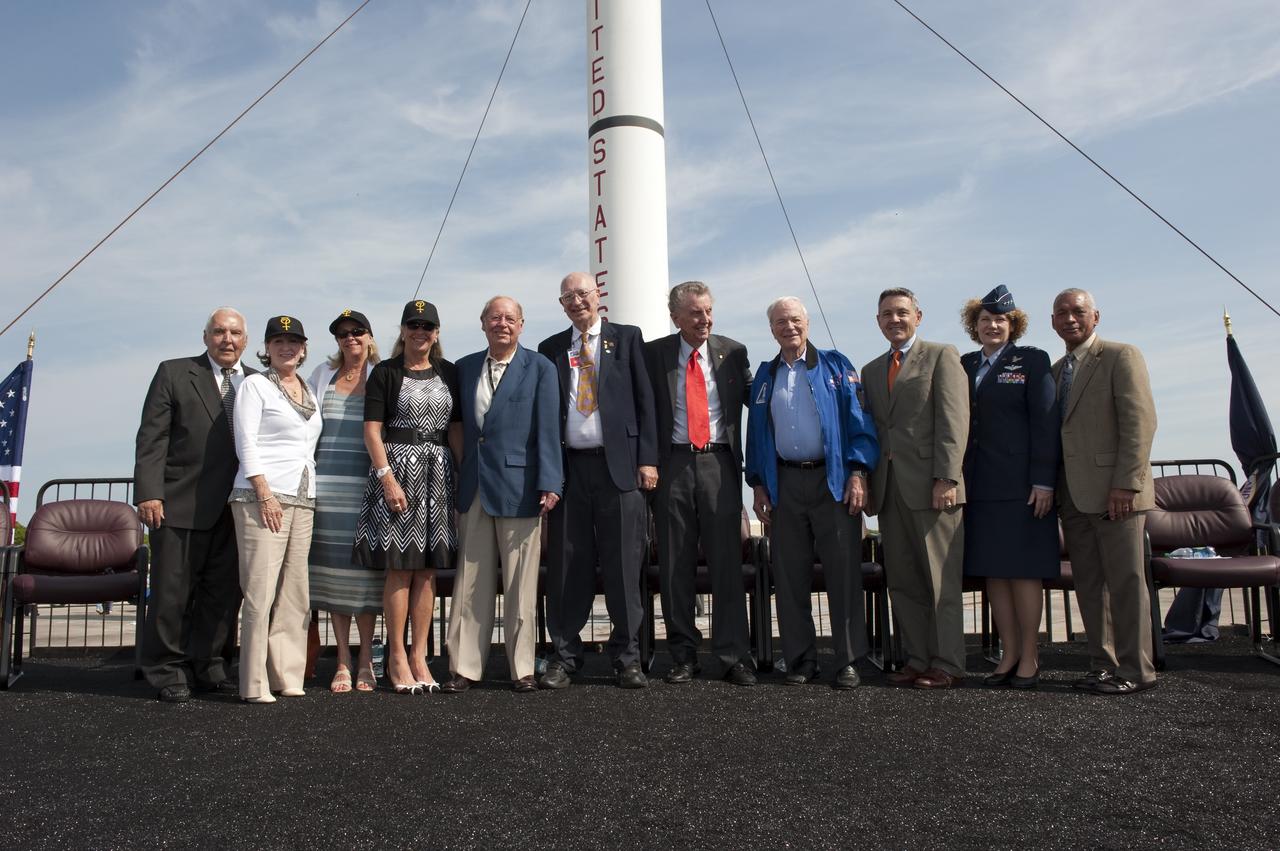
CAPE CANAVERAL, Fla. -- Program participants pose for a group photo in front of a replica of a Mercury-Redstone rocket during a celebration at Complex 5/6 on Cape Canaveral Air Force Station in Florida.  From left are Hugh Harris, former director of Public Affairs at Kennedy Space Center; Alice Wackermann, Julie Jenkins and Laura Churchley, daughters of astronaut Alan Shepard; Jack King, former chief, Public Information Office, Marshall Space Flight Center; Bob Moser, former chief test conductor for the Mercury-Redstone launches; NBC reporter Jay Barbree; Mercury astronaut Scott Carpenter; Kennedy Space Center Director Bob Cabana; Lieutenant General Susan J. Helms, commander of the 14th Air Force and former astronaut; and NASA Administrator Charlie Bolden.    The celebration was held at the launch site of the first U.S. manned spaceflight May 5, 1961, to mark the 50th anniversary of the flight.  Fifty years ago, astronaut Alan Shepard lifted off inside the Mercury capsule, "Freedom 7," atop an 82-foot-tall Mercury-Redstone rocket at 9:34 a.m. EST, sending him on a remarkably successful, 15-minute suborbital flight. The event was attended by more than 200 workers from the original Mercury program and included a re-creation of Shepard's flight and recovery, as well as a tribute to his contributions as a moonwalker on the Apollo 14 lunar mission. For more information, visit www.nasa.gov/topics/history/milestones/index.html. Photo credit: NASA/Kim Shiflett
KSC-2011-3329
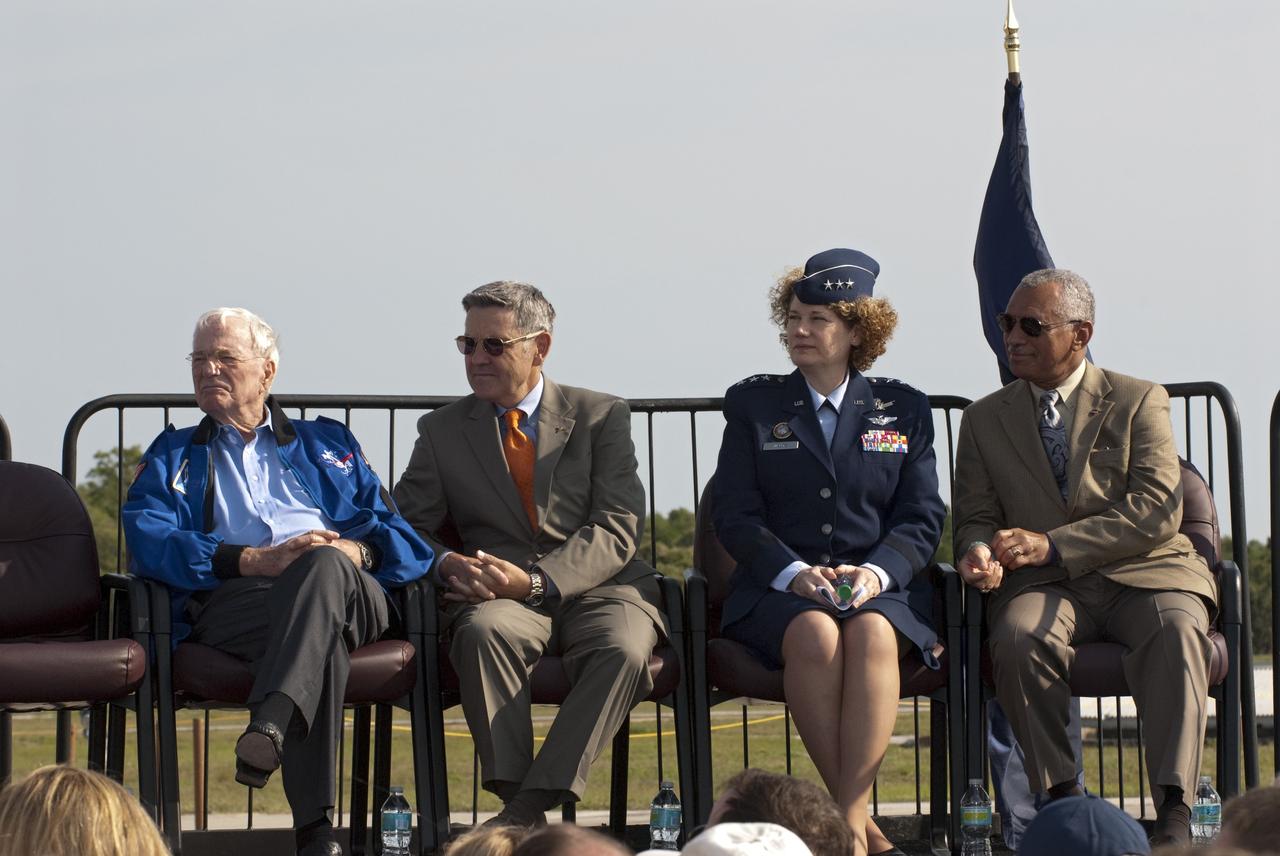
CAPE CANAVERAL, Fla. -- From left, Mercury astronaut Scott Carpenter; Kennedy Space Center Director and former astronaut Bob Cabana; Lieutenant General Susan J. Helms, commander of the 14th Air Force and former astronaut; and NASA Administrator Charlie Bolden participate in a celebration at Complex 5/6 on Cape Canaveral Air Force Station in Florida.    The celebration was held at the launch site of the first U.S. manned spaceflight May 5, 1961, to mark the 50th anniversary of the flight.  Fifty years ago, astronaut Alan Shepard lifted off inside the Mercury capsule, "Freedom 7," atop an 82-foot-tall Mercury-Redstone rocket at 9:34 a.m. EST, sending him on a remarkably successful, 15-minute suborbital flight. The event was attended by more than 200 workers from the original Mercury program and included a re-creation of Shepard's flight and recovery, as well as a tribute to his contributions as a moonwalker on the Apollo 14 lunar mission. For more information, visit www.nasa.gov/topics/history/milestones/index.html. Photo credit: NASA/Kim Shiflett
KSC-2011-3317
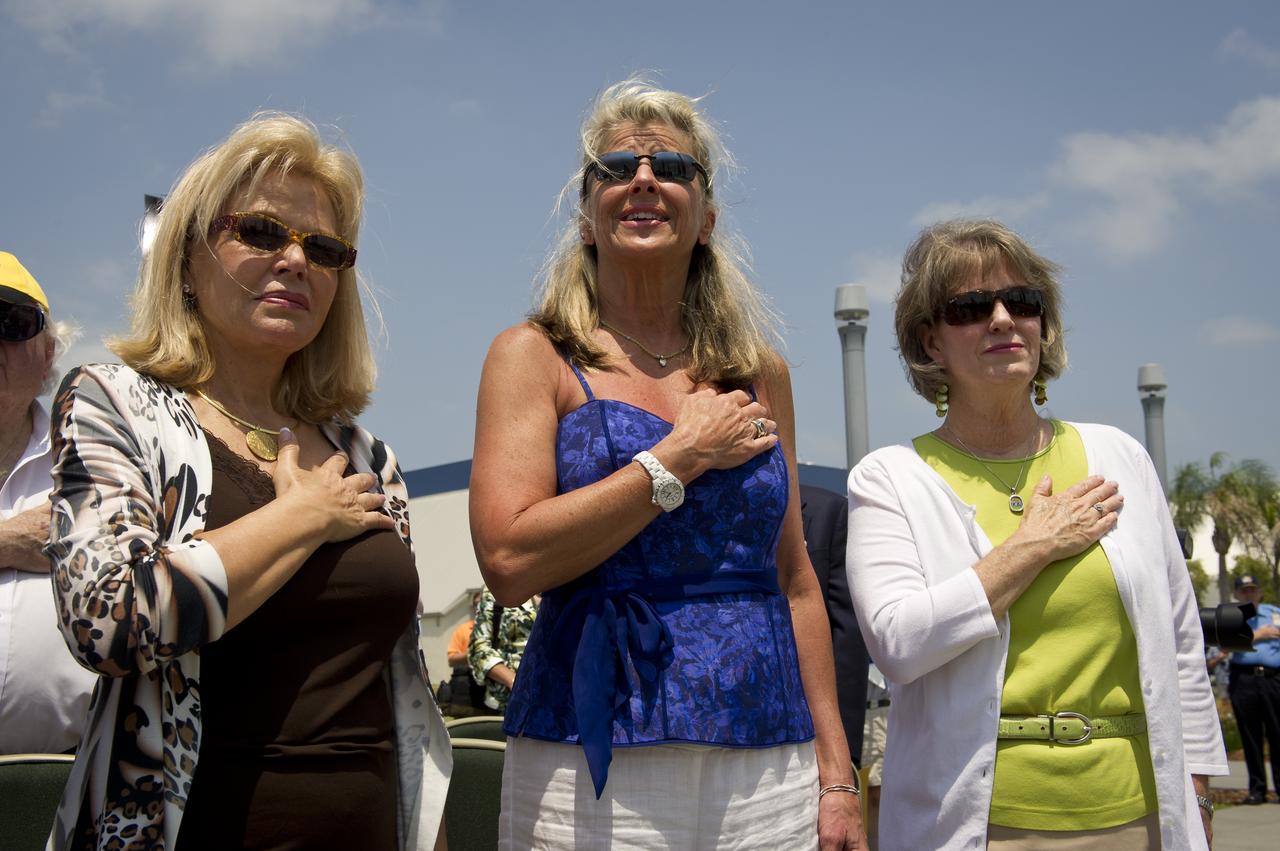
CAPE CANAVERAL, Fla. -- From left, Mercury astronaut Scott Carpenter and Alice Wackermann and Julie Jenkins, daughters of astronaut Alan Shepard, enjoy a tribute to Shepard during a celebration at Complex 5/6 on Cape Canaveral Air Force Station in Florida.     The celebration was held at the launch site of the first U.S. manned spaceflight May 5, 1961, to mark the 50th anniversary of the flight.  Fifty years ago, astronaut Alan Shepard lifted off inside the Mercury capsule, "Freedom 7," atop an 82-foot-tall Mercury-Redstone rocket at 9:34 a.m. EST, sending him on a remarkably successful, 15-minute suborbital flight. The event was attended by more than 200 workers from the original Mercury program and included a re-creation of Shepard's flight and recovery, as well as a tribute to his contributions as a moonwalker on the Apollo 14 lunar mission. For more information, visit www.nasa.gov/topics/history/milestones/index.html. Photo credit: NASA/Kim Shiflett
KSC-2011-3319
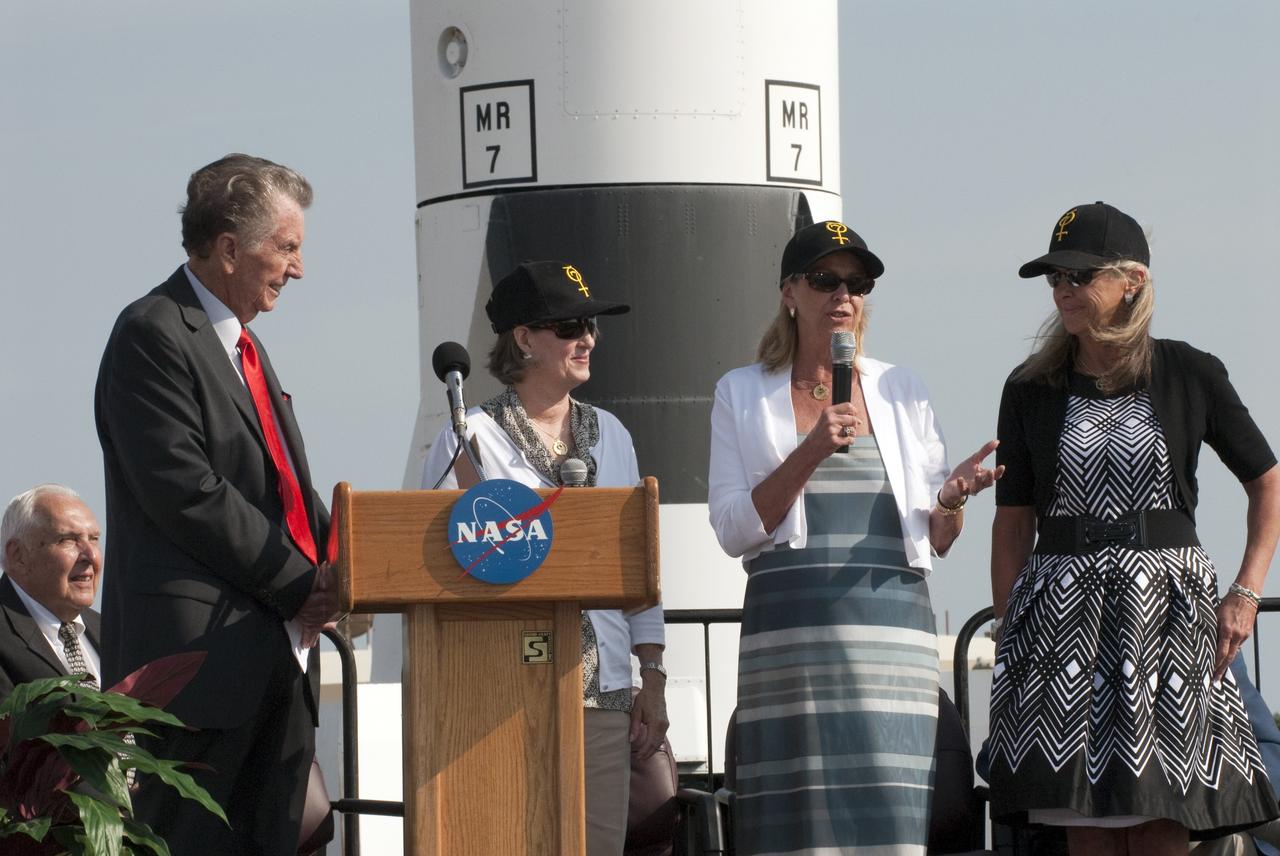
CAPE CANAVERAL, Fla. -- From left, NBC reporter Jay Barbree and Alice Wackermann, Julie Jenkins (at microphone) and Laura Churchley, daughters of astronaut Alan Shepard, participate in a celebration at Complex 5/6 on Cape Canaveral Air Force Station in Florida.    The celebration was held at the launch site of the first U.S. manned spaceflight May 5, 1961, to mark the 50th anniversary of the flight.  Fifty years ago, astronaut Alan Shepard lifted off inside the Mercury capsule, "Freedom 7," atop an 82-foot-tall Mercury-Redstone rocket at 9:34 a.m. EST, sending him on a remarkably successful, 15-minute suborbital flight. The event was attended by more than 200 workers from the original Mercury program and included a re-creation of Shepard's flight and recovery, as well as a tribute to his contributions as a moonwalker on the Apollo 14 lunar mission. For more information, visit www.nasa.gov/topics/history/milestones/index.html. Photo credit: NASA/Kim Shiflett
KSC-2011-3318
CAPE CANAVERAL, Fla. -- NBC reporter Jay Barbree introduces Alice Wackermann, Julie Jenkins and Laura Churchley, daughters of astronaut Alan Shepard, to the audience at a celebration at Complex 5/6 on Cape Canaveral Air Force Station in Florida.    The celebration was held at the launch site of the first U.S. manned spaceflight May 5, 1961, to mark the 50th anniversary of the flight.  Fifty years ago, astronaut Alan Shepard lifted off inside the Mercury capsule, "Freedom 7," atop an 82-foot-tall Mercury-Redstone rocket at 9:34 a.m. EST, sending him on a remarkably successful, 15-minute suborbital flight. The event was attended by more than 200 workers from the original Mercury program and included a re-creation of Shepard's flight and recovery, as well as a tribute to his contributions as a moonwalker on the Apollo 14 lunar mission. For more information, visit www.nasa.gov/topics/history/milestones/index.html. Photo credit: NASA/Kim Shiflett
KSC-2011-3325
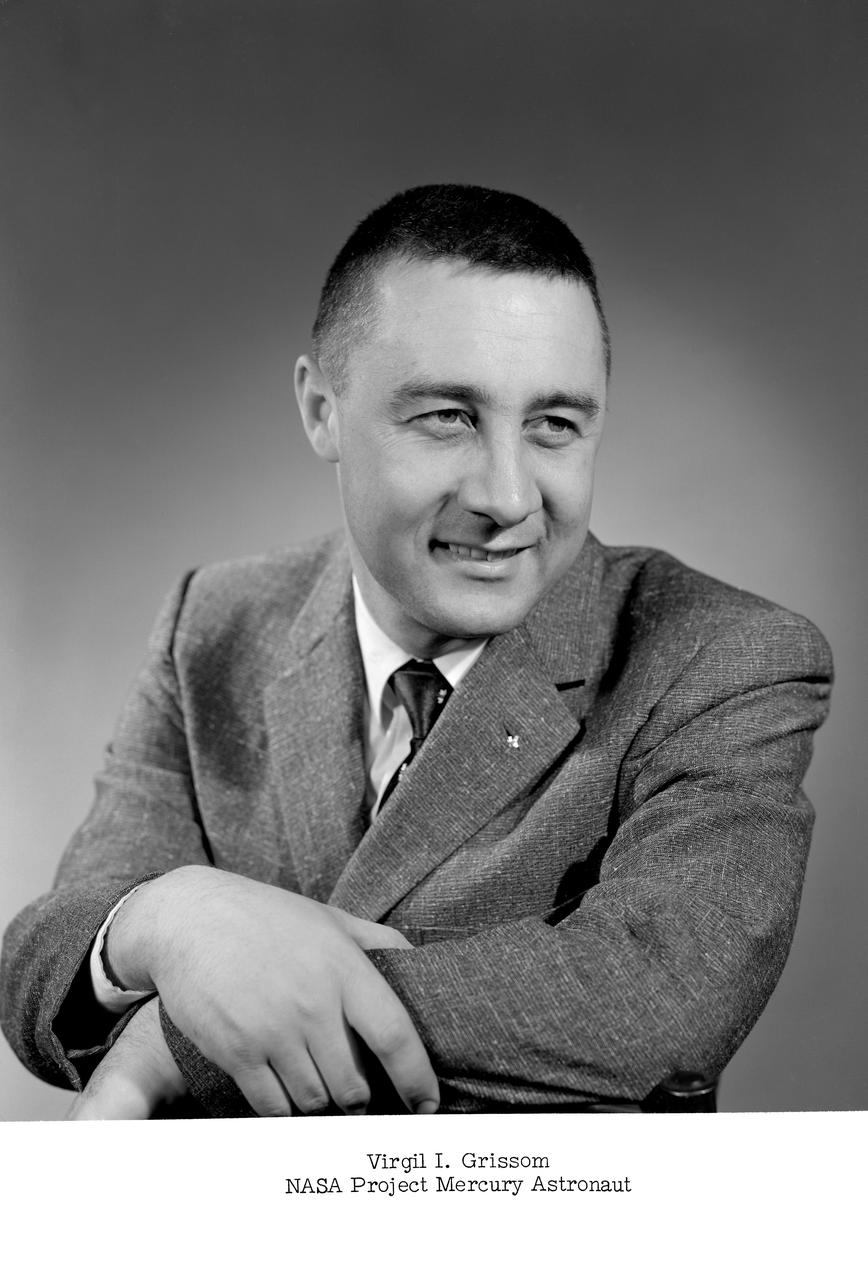
KENNEDY SPACE CENTER, FLA. -- Project Mercury Astronaut Virgil I. Grissom, primary pilot for the Mercury-Redstone 4 manned space flight known as Liberty Bell 7, gets an assist from suit specialist Joe W. Schmidt as he prepares for the Mercury-Redstone 4 manned space flight.  The flight, the second manned shot in the Mercury program, was postponed because of bad weather in the launch area.  (NASA Photo
61-mr4-55(s)
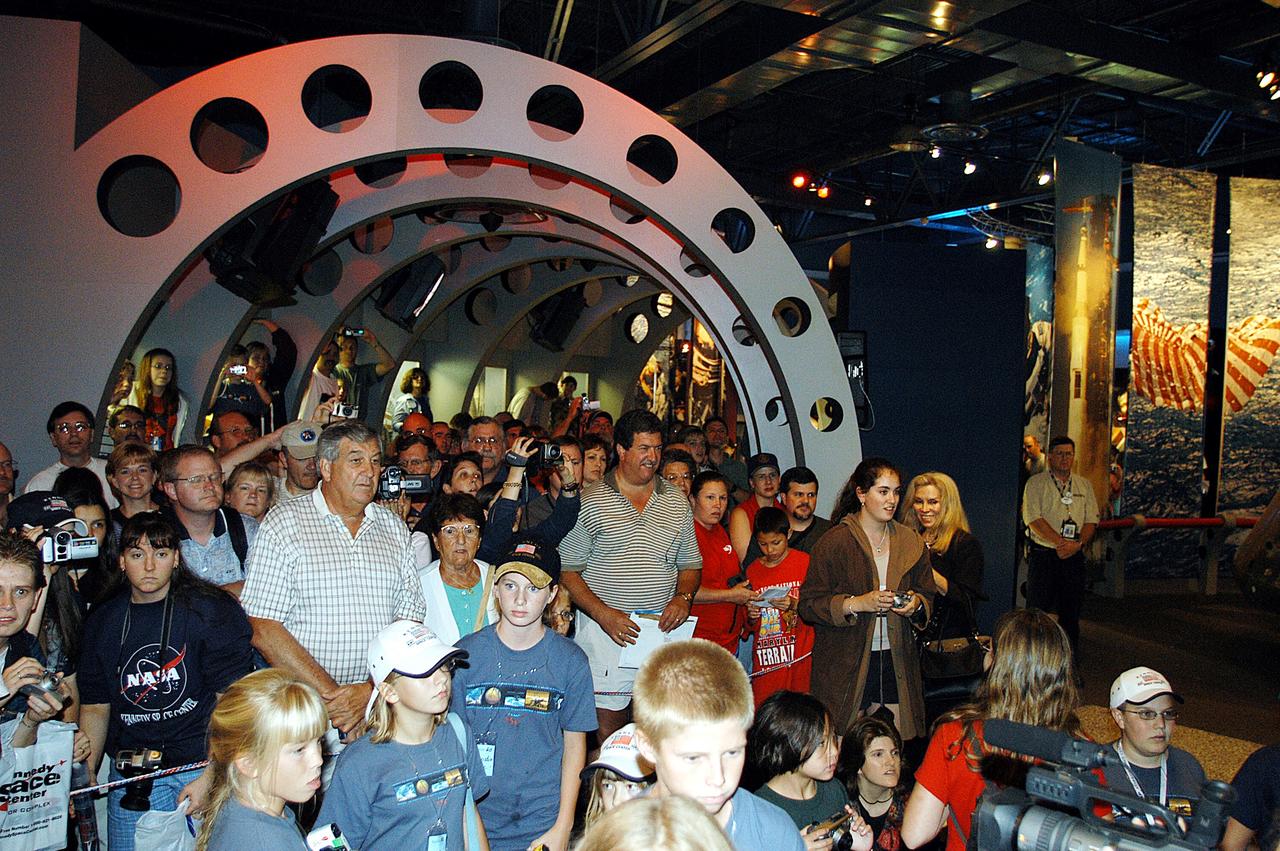
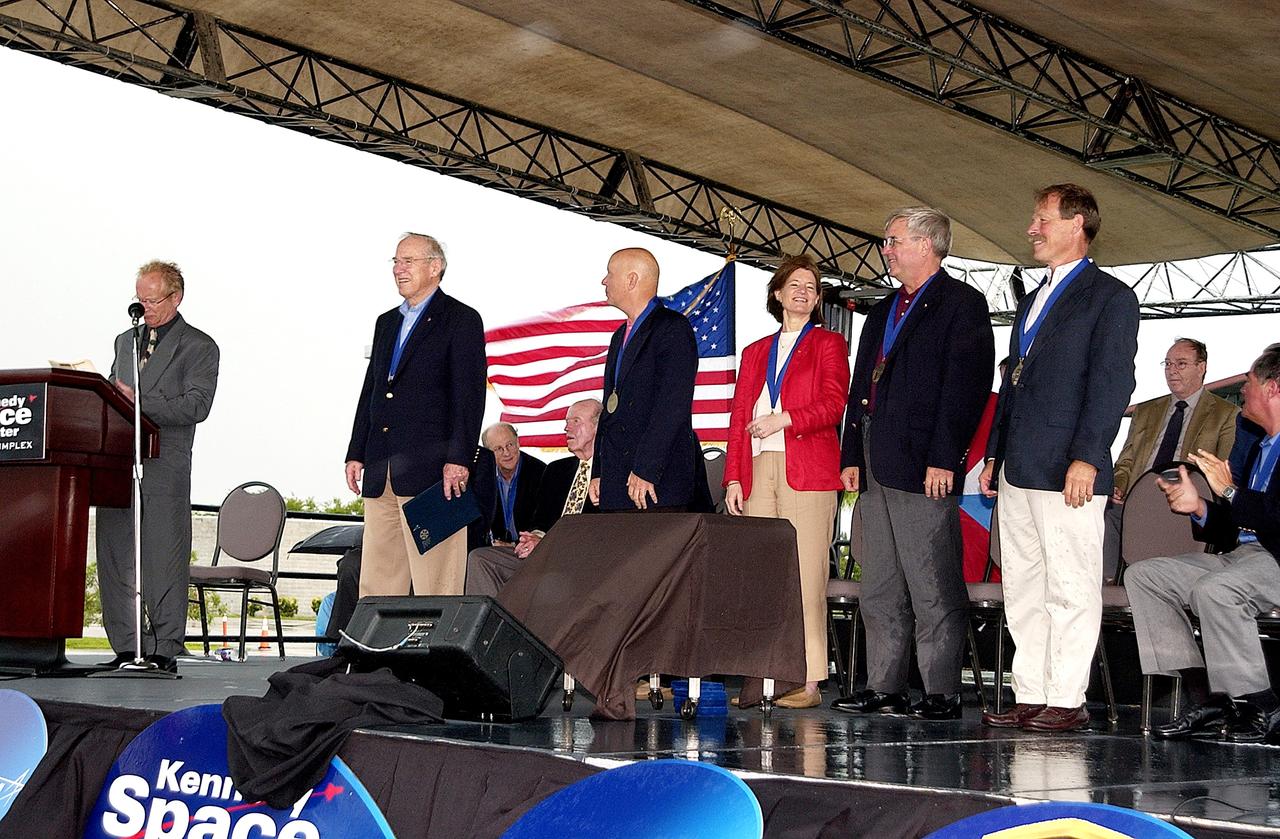
KENNEDY SPACE CENTER, FLA. -  Hundreds of guests attend a ribbon cutting ceremony officially opening the U.S. Astronaut Hall of Fame as part of the Kennedy Space Center Visitor Complex. The ceremony was held in conjunction with the induction of four Space Shuttle astronauts into the Hall of Fame including Daniel Brandenstein, Robert "Hoot" Gibson, Story Musgrave, and Sally Ride. Conceived by six of the Mercury Program astronauts, the U.S. Astronaut Hall of Fame opened in 1990 to provide a place where space travelers could be remembered for their participation and accomplishments in the U.S. space program. The four new inductees join 48 previously honored astronauts from the ranks of the Gemini, Apollo, Skylab, Apollo-Soyuz, and Space Shuttle programs.
KENNEDY SPACE CENTER, FLA. - Hundreds of guests attend a ribbon cutting ceremony officially opening the U.S. Astronaut Hall of Fame as part of the Kennedy Space Center Visitor Complex. The ceremony was held in conjunction with the induction of four Space Shuttle astronauts into the Hall of Fame including Daniel Brandenstein, Robert "Hoot" Gibson, Story Musgrave, and Sally Ride. Conceived by six of the Mercury Program astronauts, the U.S. Astronaut Hall of Fame opened in 1990 to provide a place where space travelers could be remembered for their participation and accomplishments in the U.S. space program. The four new inductees join 48 previously honored astronauts from the ranks of the Gemini, Apollo, Skylab, Apollo-Soyuz, and Space Shuttle programs.
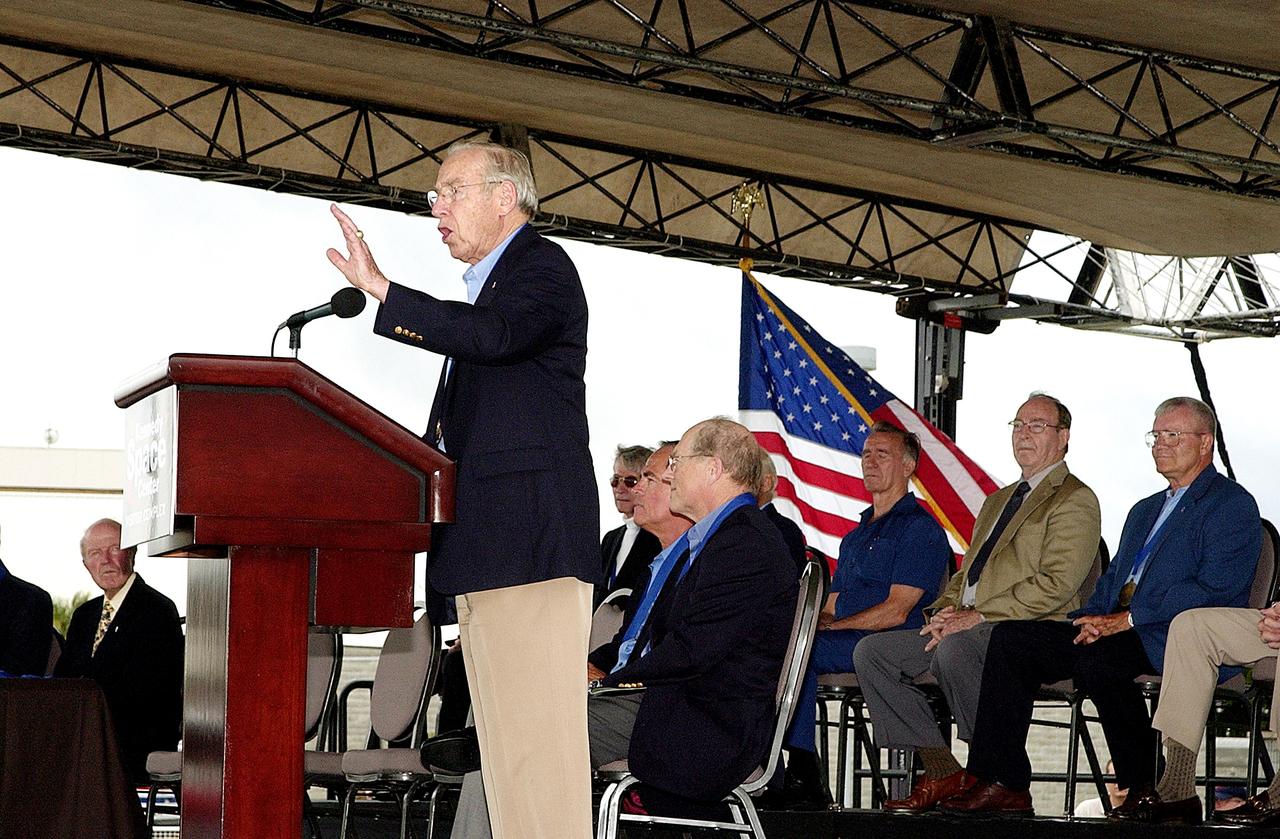
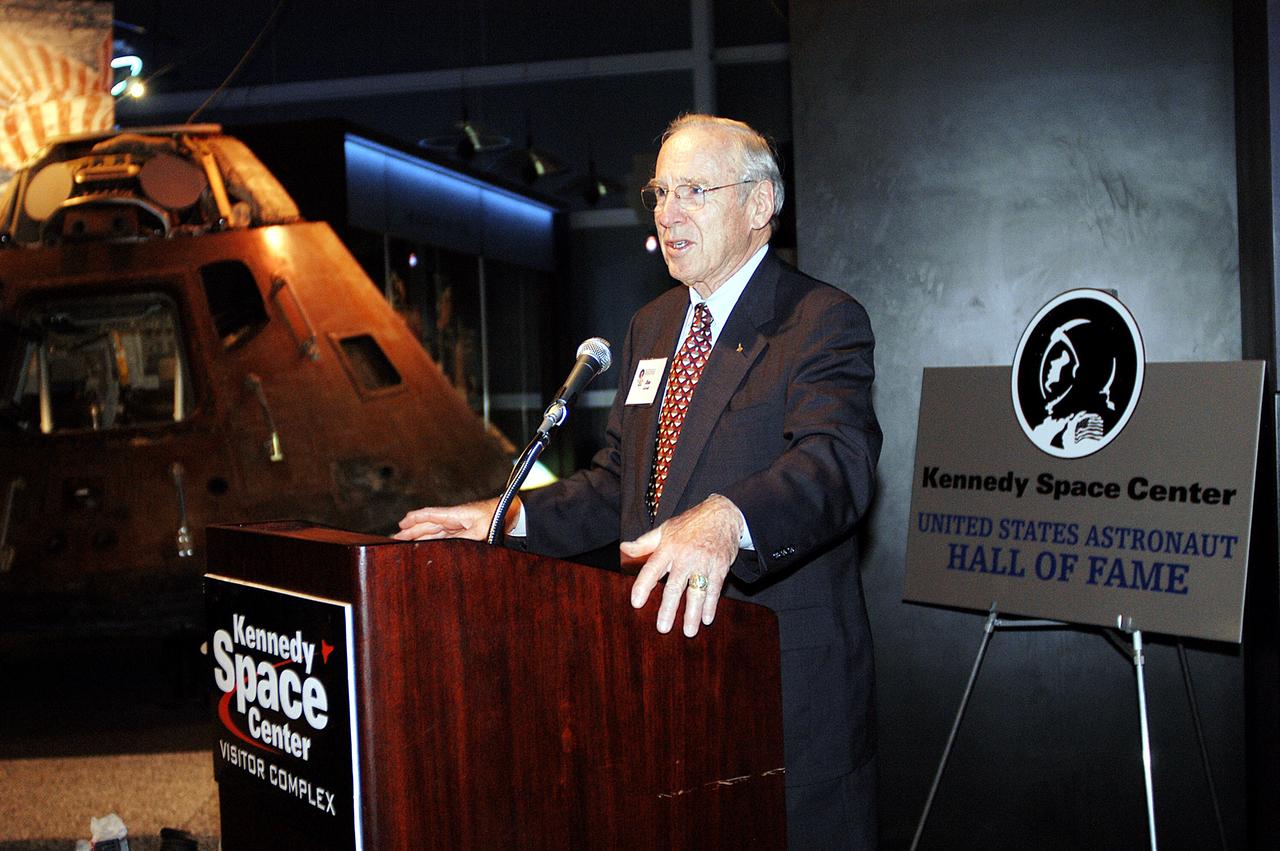
KENNEDY SPACE CENTER, FLA. -  At the KSC Visitor Complex, former astronaut James Lovell makes the opening remarks at the induction ceremony of four Space Shuttle astronauts into the U.S. Astronaut Hall of Fame. Being inducted are Daniel Brandenstein, Robert "Hoot" Gibson, Story Musgrave, and Sally Ride. Conceived by six of the Mercury Program astronauts, the U.S. Astronaut Hall of Fame opened in 1990 to provide a place where space travelers could be remembered for their participation and accomplishments in the U.S. space program. The four new inductees join 48 previously honored astronauts from the ranks of the Gemini, Apollo, Skylab, Apollo-Soyuz, and Space Shuttle programs.
KENNEDY SPACE CENTER, FLA. - At the KSC Visitor Complex, former astronaut James Lovell makes the opening remarks at the induction ceremony of four Space Shuttle astronauts into the U.S. Astronaut Hall of Fame. Being inducted are Daniel Brandenstein, Robert "Hoot" Gibson, Story Musgrave, and Sally Ride. Conceived by six of the Mercury Program astronauts, the U.S. Astronaut Hall of Fame opened in 1990 to provide a place where space travelers could be remembered for their participation and accomplishments in the U.S. space program. The four new inductees join 48 previously honored astronauts from the ranks of the Gemini, Apollo, Skylab, Apollo-Soyuz, and Space Shuttle programs.
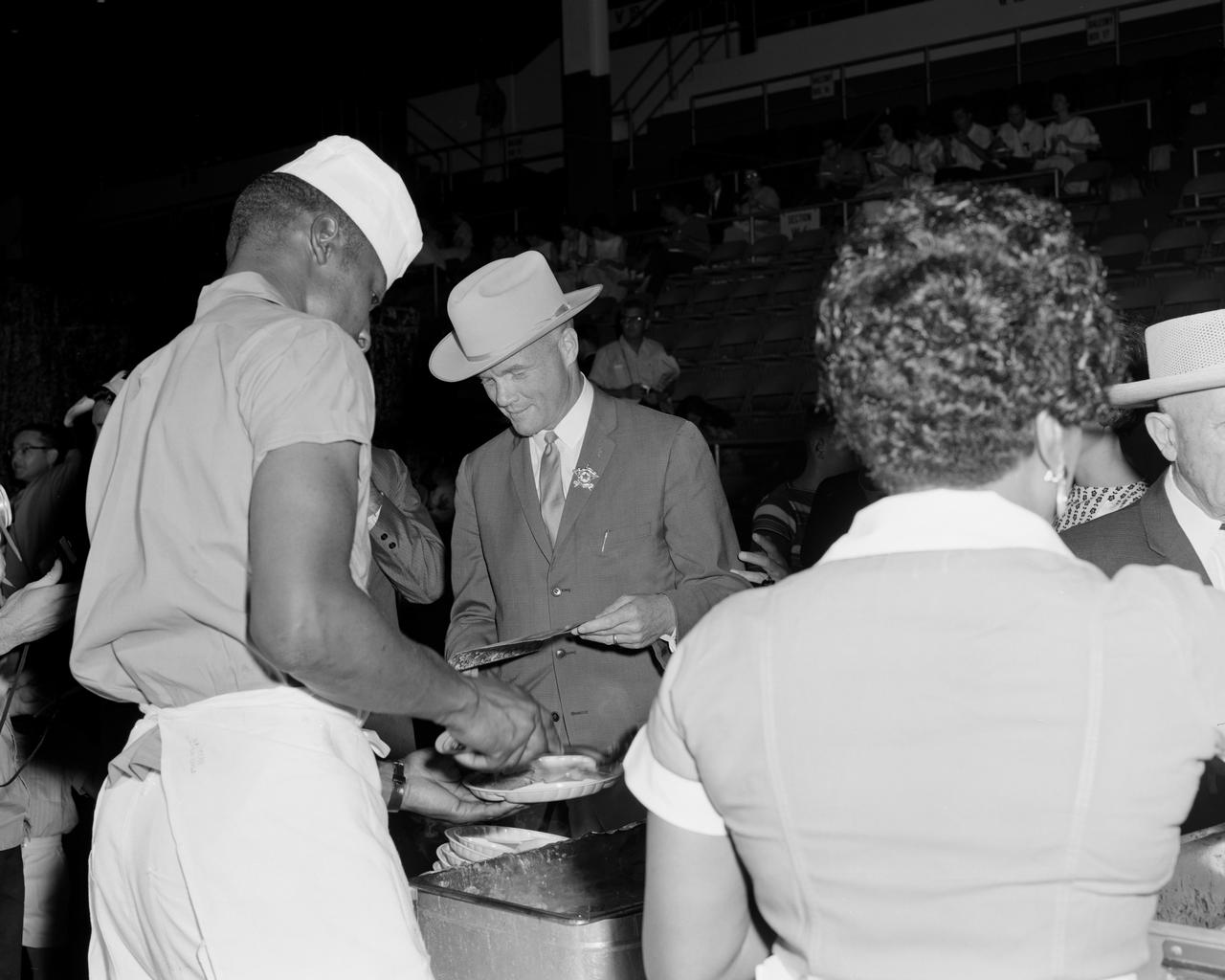
S62-03725 (4 July 1962) --- Mercury astronaut John H. Glenn Jr., wearing a new cowboy hat and a badge in the shape of a star, leafs through his program as he is served his food at the Sam Houston Coliseum. A large crowd was on hand to welcome the Mercury astronauts to Houston, Texas. Photo credit: NASA
HOUSTON WELCOME TO MSC
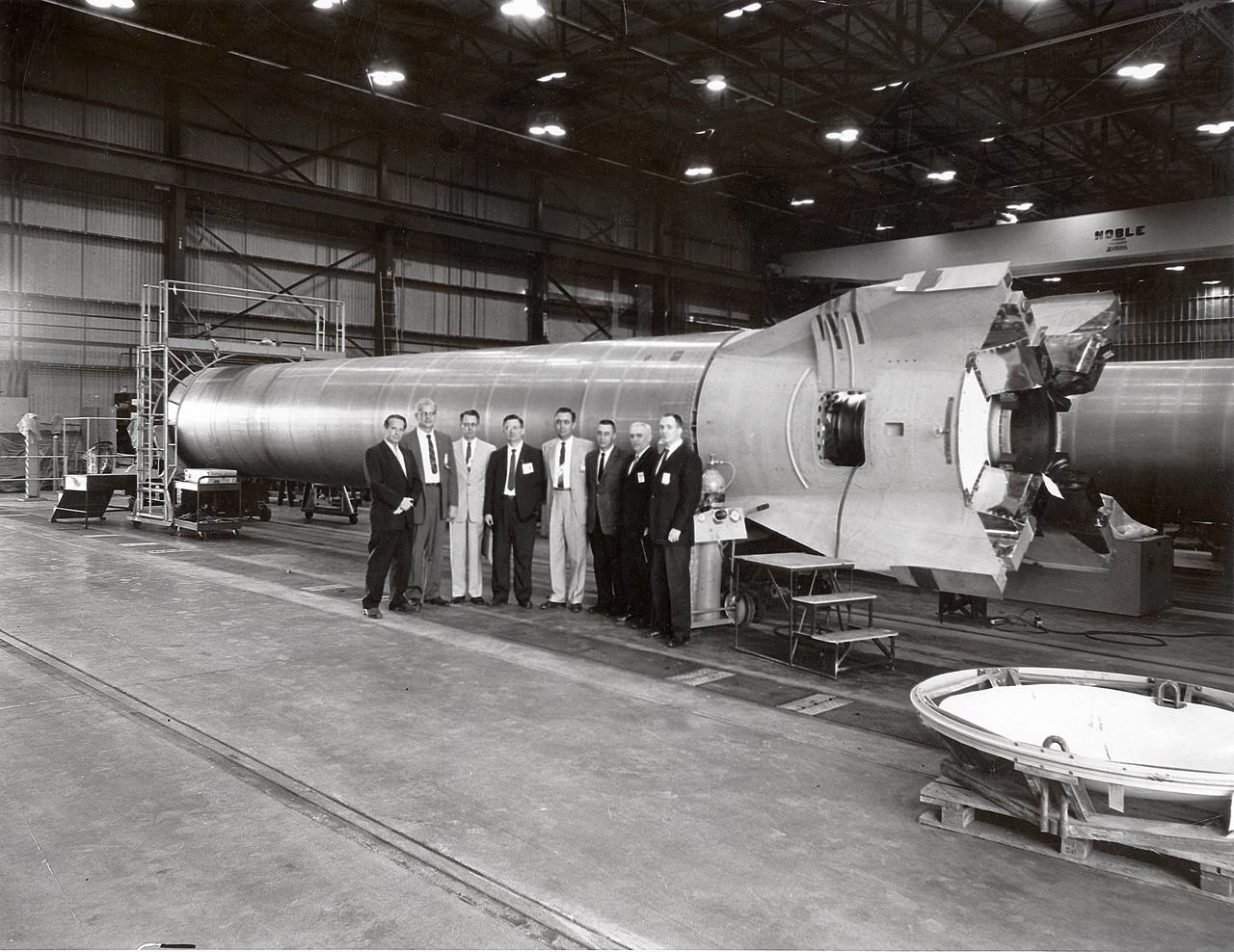
This photograph shows a group of officials standing before a Mercury-Redstone booster at the Marshall Space Flight Center (MSFC). Among those in the photograph are astronauts James Lovell, Walter Schirra, and Gus Grissom. Also pictured is Joachim Kuettner who managed responsibilities of MSFC's Mercury-Redstone program.
Around Marshall
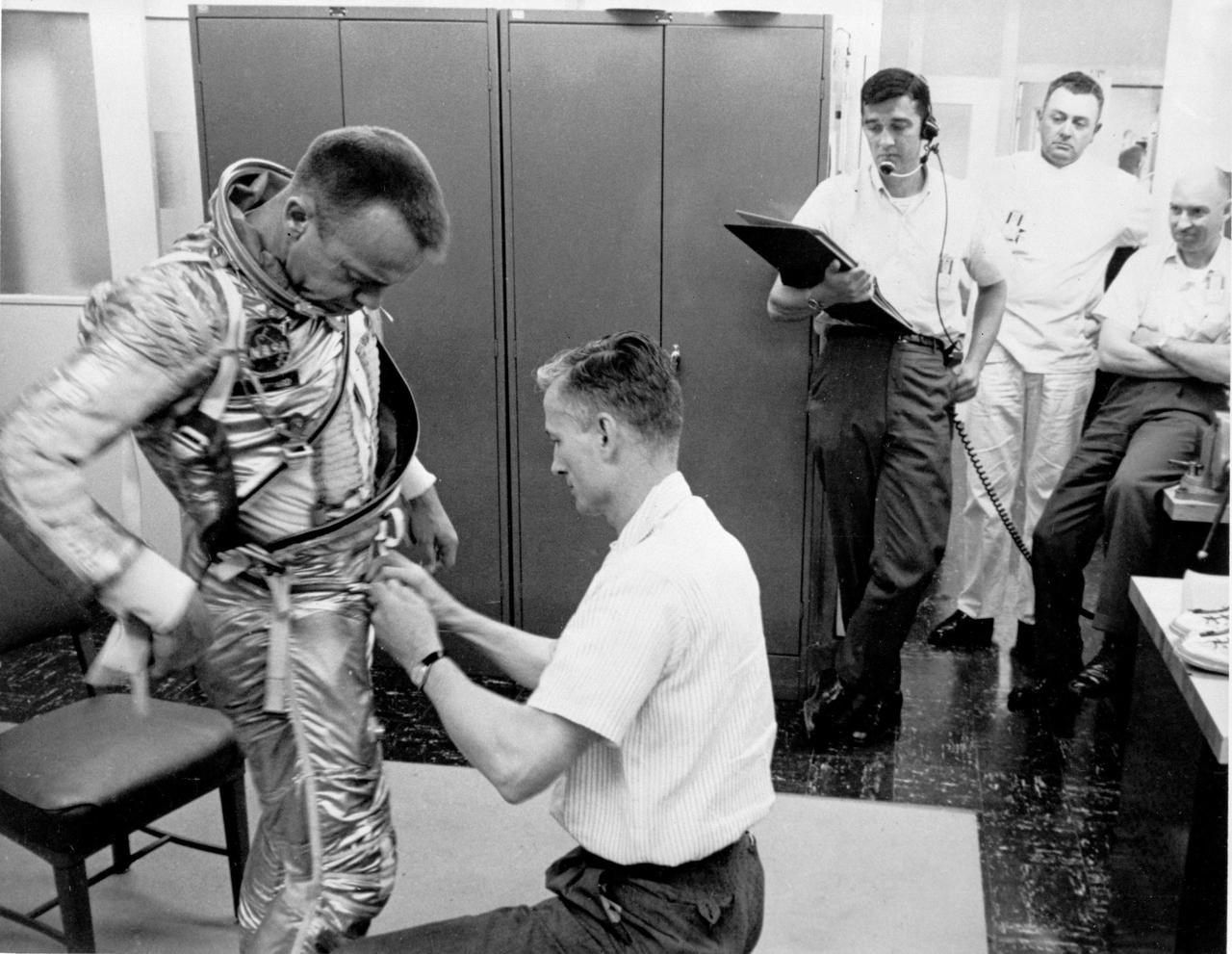
KENNEDY SPACE CENTER, FLA. - Astronaut Alan B. Shepard is being assisted by a technician in getting into his space suit at 2:45 a.m. this morning, beginning the long countdown of the scheduled launch of the Mercury Redstone. After Astronaut Shepard is suited up, he will travel by van to the Redstone Gantry on Pad 5 and be placed into the Mercury Capsule, called Freedom 7, on top of the Redstone booster rocket.  Astronaut Shepard will pilot the first U.S. manned sub-orbital space flight of the Manned Mercury Program.
KSC-71p-0267
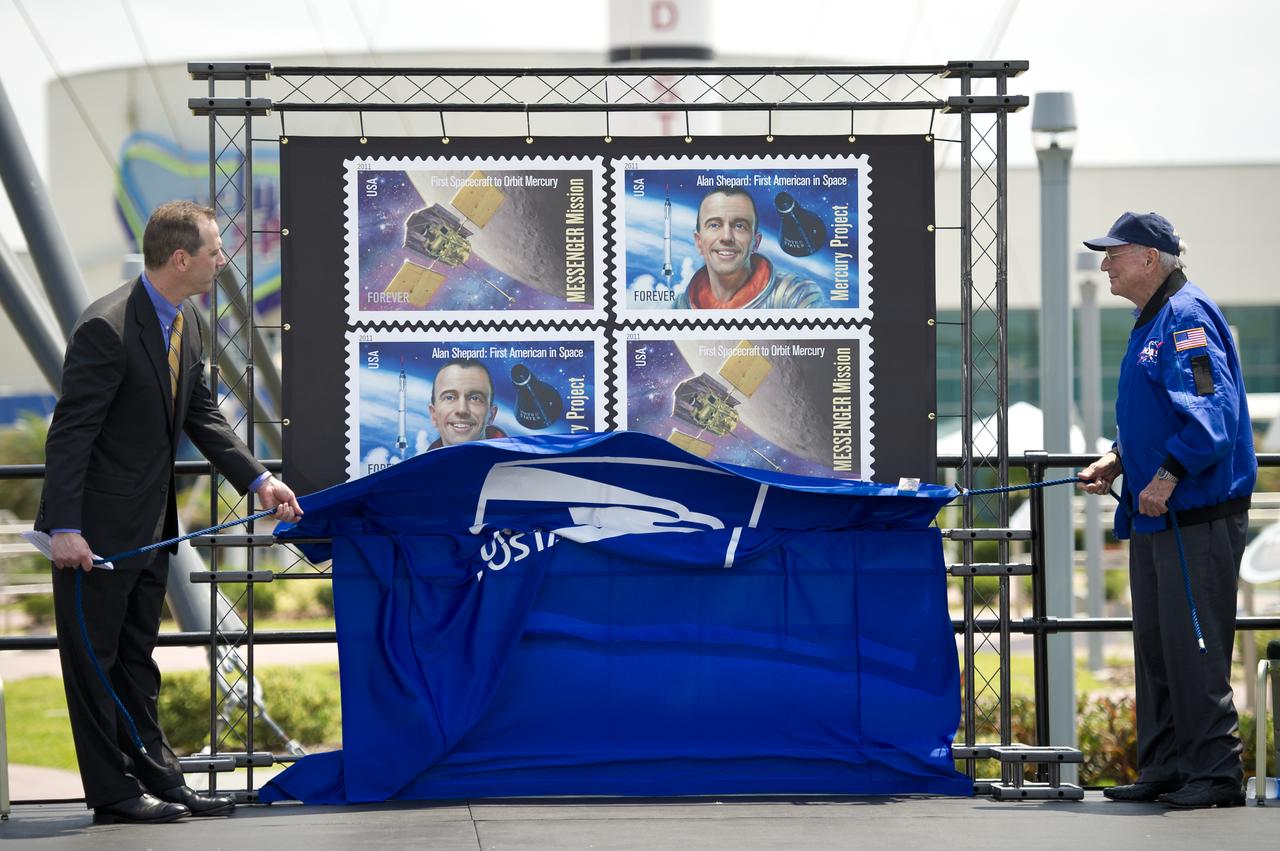
United States Postal Service Vice President of Finance Steve Masse, left, and NASA Mercury Astronaut Scott Carpenter, unveil two USPS stamps to commemorate and celebrate 50 years of US Spaceflight and the MESSENGER program during an event, Wednesday, May 4, 2011 at the NASA Kennedy Space Center in Cape Canaveral, Fla.  One stamp commemorates NASA’s Project Mercury, America’s first manned spaceflight program, and NASA astronaut Alan Shepard’s historic flight on May 5, 1961, aboard spacecraft Freedom 7.  The other stamp draws attention to NASA’s unmanned MESSENGER mission, a scientific investigation of the planet Mercury. On March 17, 2011, MESSENGER became the first spacecraft to enter into orbit around Mercury. Photo Credit: (NASA/Bill Ingalls)
Mercury MESSENGER Stamp Unveiling
NASA Mercury Astronaut Scott Carpenter speaks during an unveiling ceremony of two USPS stamps that commemorate and celebrate 50 years of US Spaceflight and the MESSENGER program during an event, Wednesday, May 4, 2011 at the NASA Kennedy Space Center in Cape Canaveral, Fla.  One stamp commemorates NASA’s Project Mercury, America’s first manned spaceflight program, and NASA astronaut Alan Shepard’s historic flight on May 5, 1961, aboard spacecraft Freedom 7.  The other stamp draws attention to NASA’s unmanned MESSENGER mission, a scientific investigation of the planet Mercury. On March 17, 2011, MESSENGER became the first spacecraft to enter into orbit around Mercury. Photo Credit: (NASA/Bill Ingalls)
Mercury MESSENGER Stamp Unveiling
Patty Carpenter, wife of NASA Mercury Astronaut Scott Carpenter, left, Daughters of NASA astronaut Alan Shepard, Laura Shepard Churchley, and, Alice Wackermann, right, sing the National Anthem during an unveiling ceremony of two USPS stamps that commemorate and celebrate 50 years of US Spaceflight and the MESSENGER program during an event, Wednesday, May 4, 2011 at the NASA Kennedy Space Center in Cape Canaveral, Fla.  One stamp commemorates NASA’s Project Mercury, America’s first manned spaceflight program, and NASA astronaut Alan Shepard’s historic flight on May 5, 1961, aboard spacecraft Freedom 7.  The other stamp draws attention to NASA’s unmanned MESSENGER mission, a scientific investigation of the planet Mercury. On March 17, 2011, MESSENGER became the first spacecraft to enter into orbit around Mercury. Photo Credit: (NASA/Bill Ingalls)
Mercury MESSENGER Stamp Unveiling
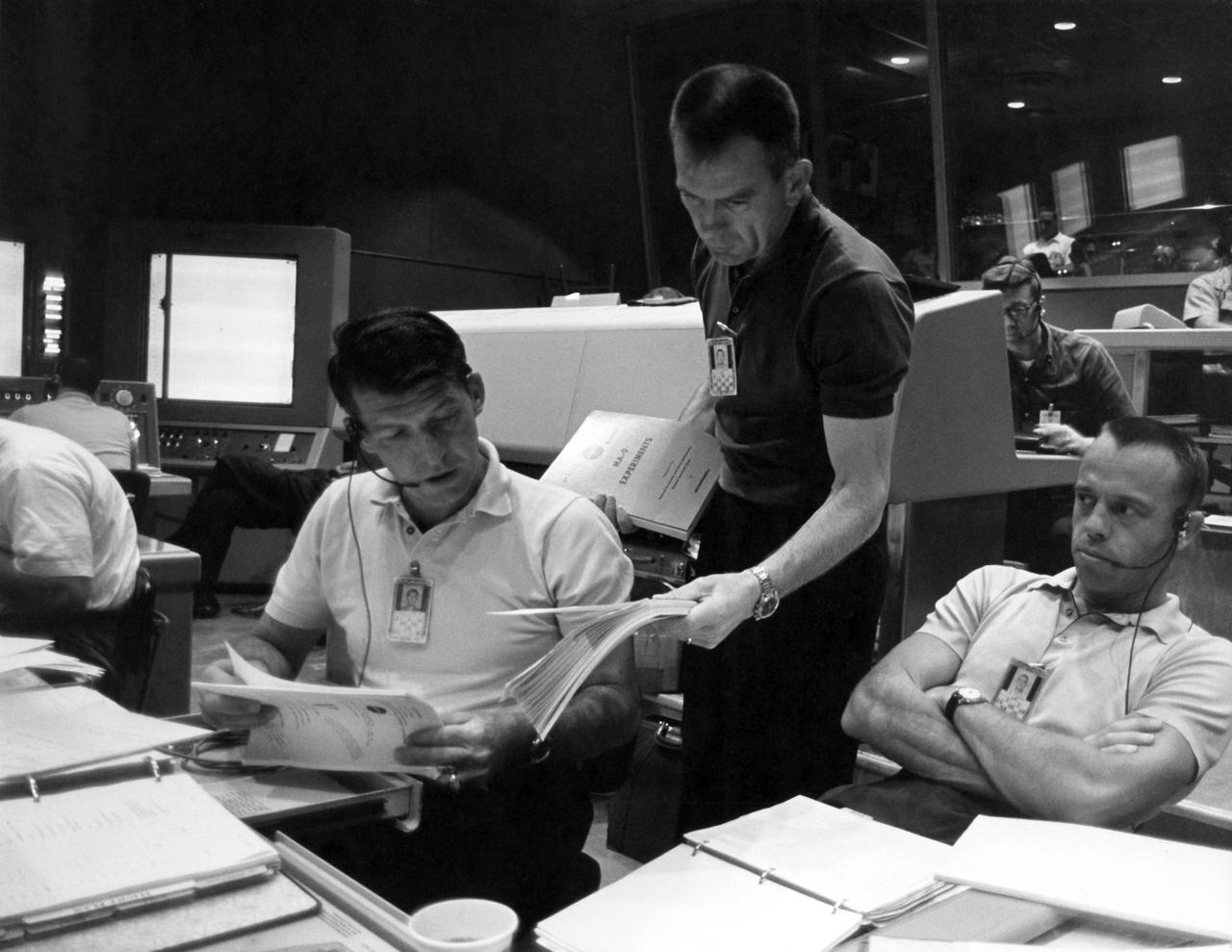
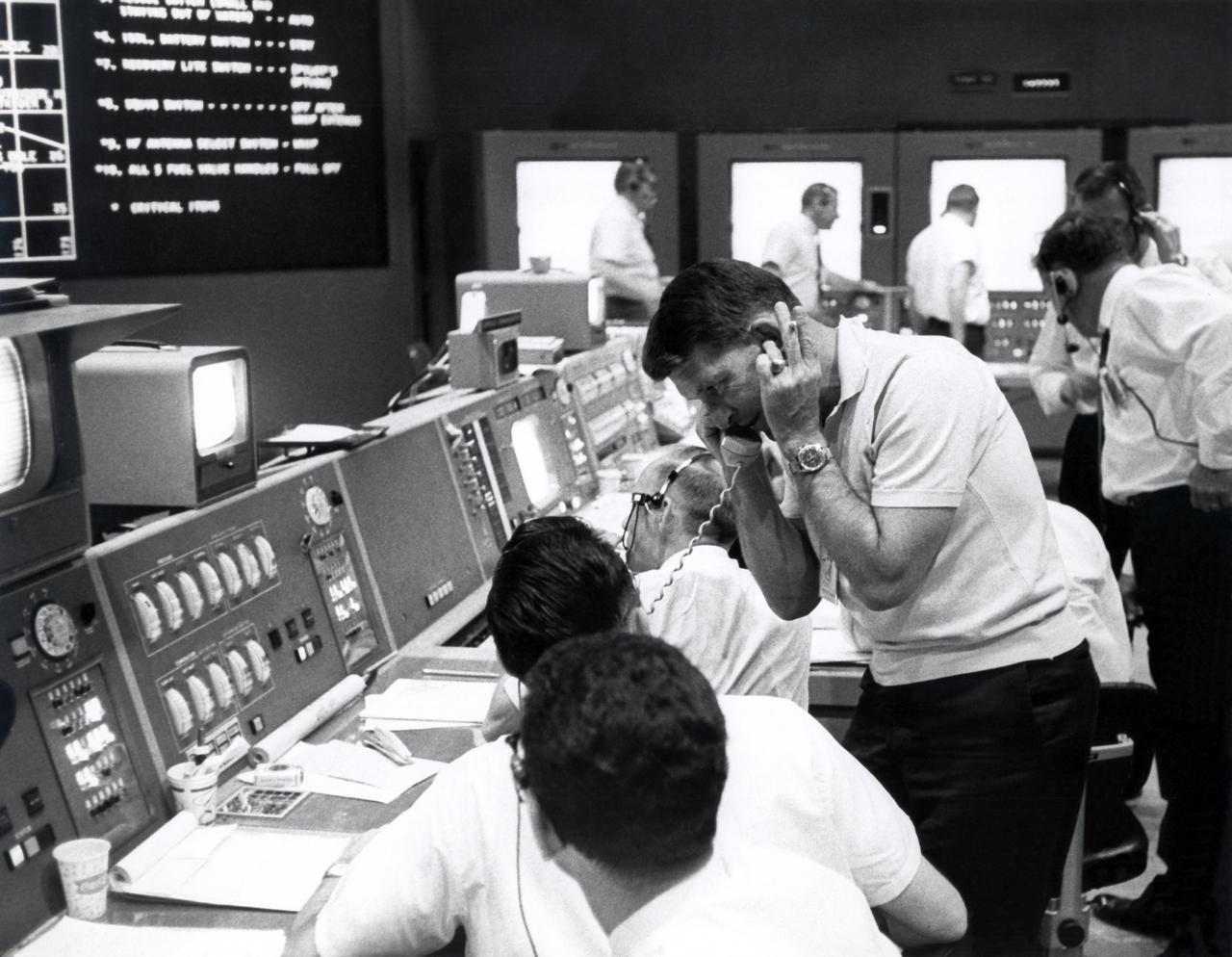
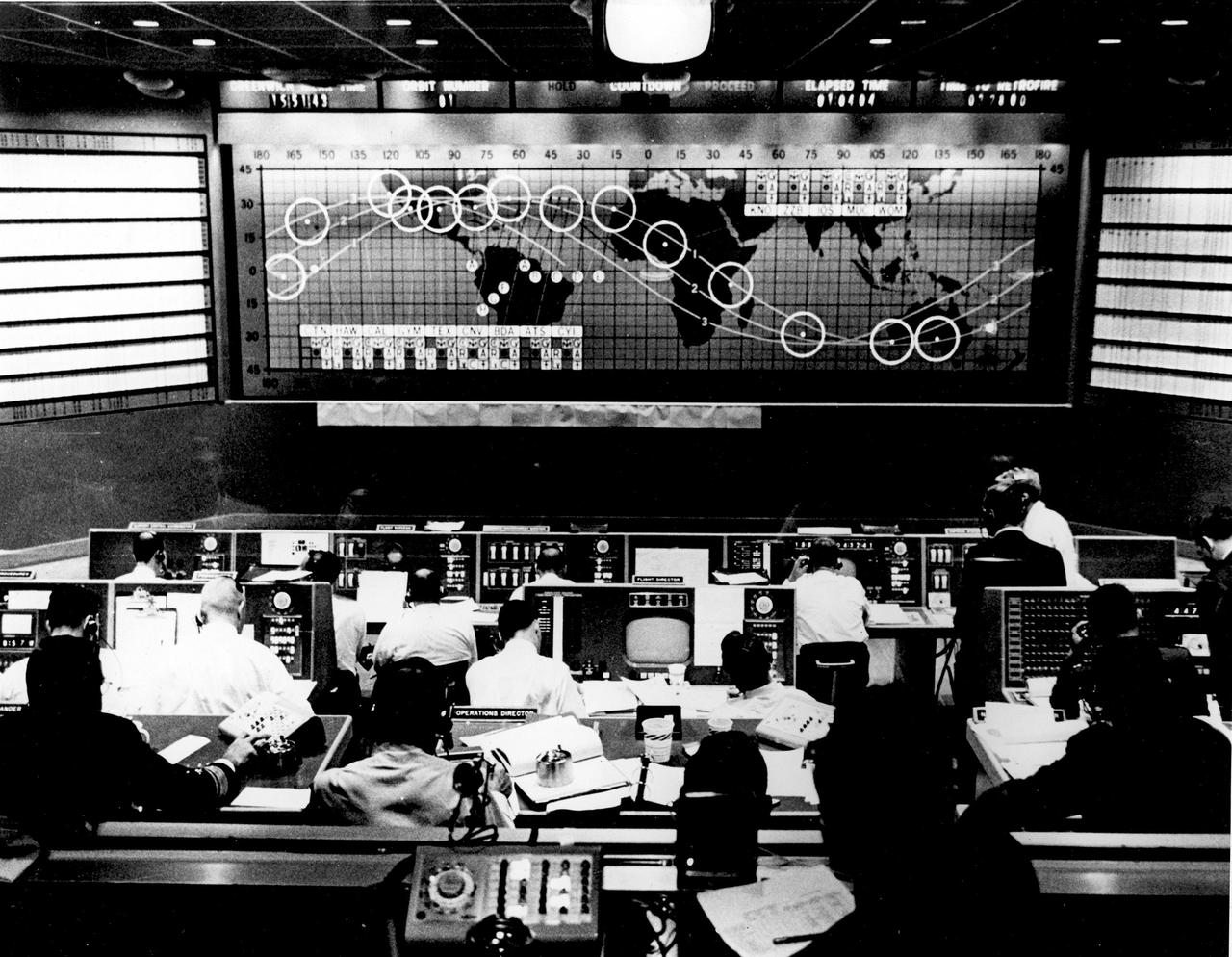
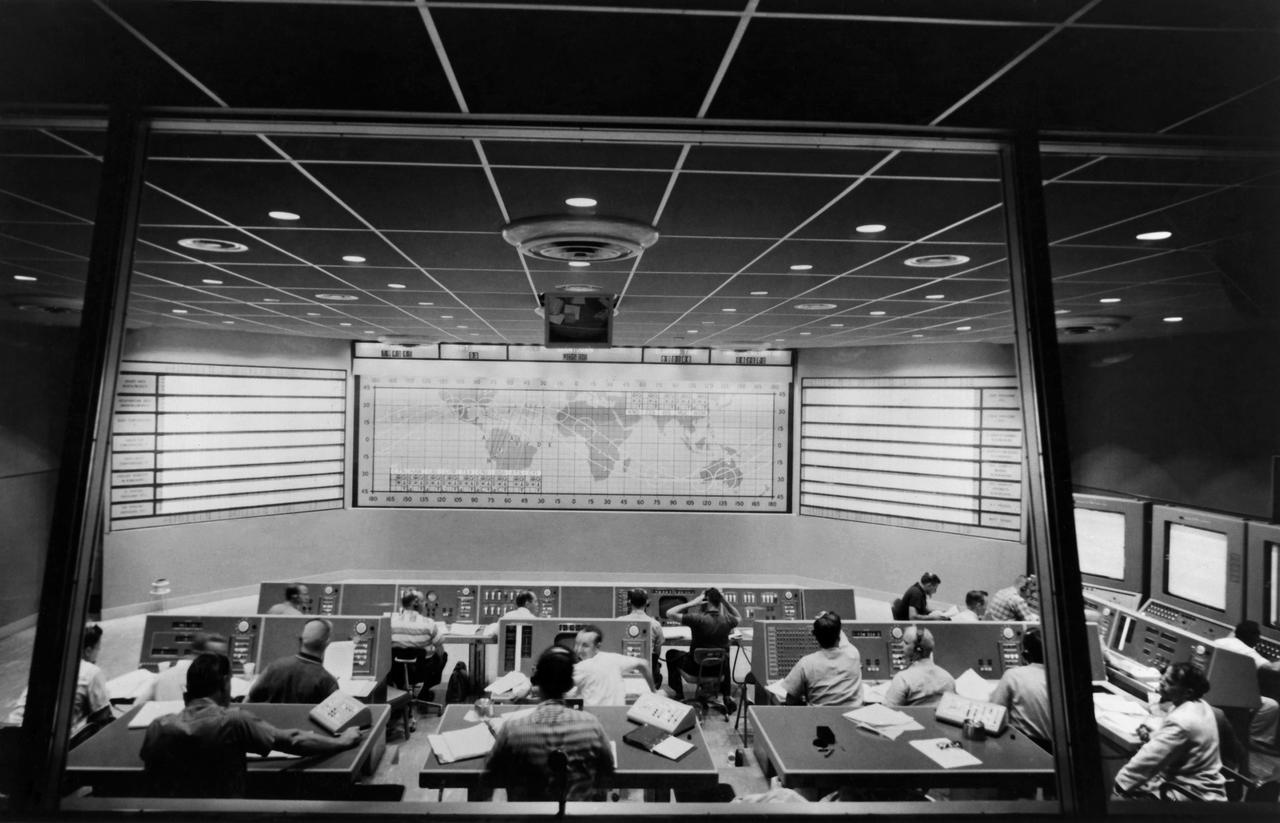
CAPE CANAVERAL, Fla. - Mercury astronauts, from left, Wally Schirra, Deke Slayton and Alan Shepard work inside the Mercury Control Center where they were stationed during the Faith 7 mission of astronaut Gordon Cooper, launched on May 15, 1963. This was the final mission of the Mercury Program.     The Mercury Mission Control Center in Florida played a key role in the United States' early spaceflight program. Located at Cape Canaveral Air Force Station, the original part of the building was constructed between 1956 and 1958, with additions in 1959 and 1963. The facility officially was transferred to NASA on Dec. 26, 1963, and served as mission control during all the Project Mercury missions, as well as the first three flights of the Gemini Program, when it was renamed Mission Control Center. With its operational days behind, on June 1, 1967, the Mission Control Center became a stop on the public tour of NASA facilities until the mid-90s. In 1999, much of the equipment and furnishings from the Flight Control Area were moved to the Kennedy Space Center Visitor Complex where they became part of the exhibit there. The building was demolished in spring 2010. Photo credit: NASA
KSC-63-MA9-98
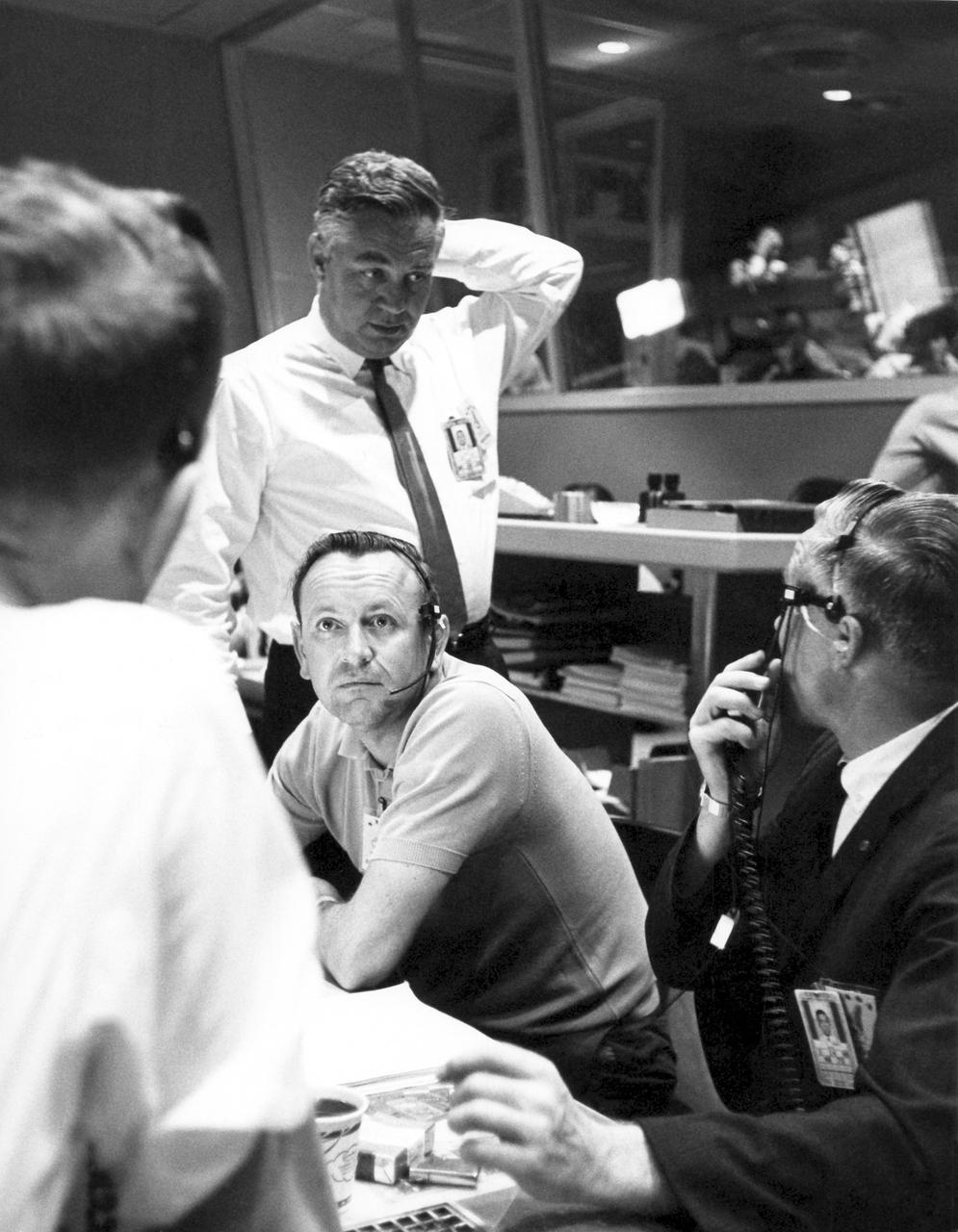
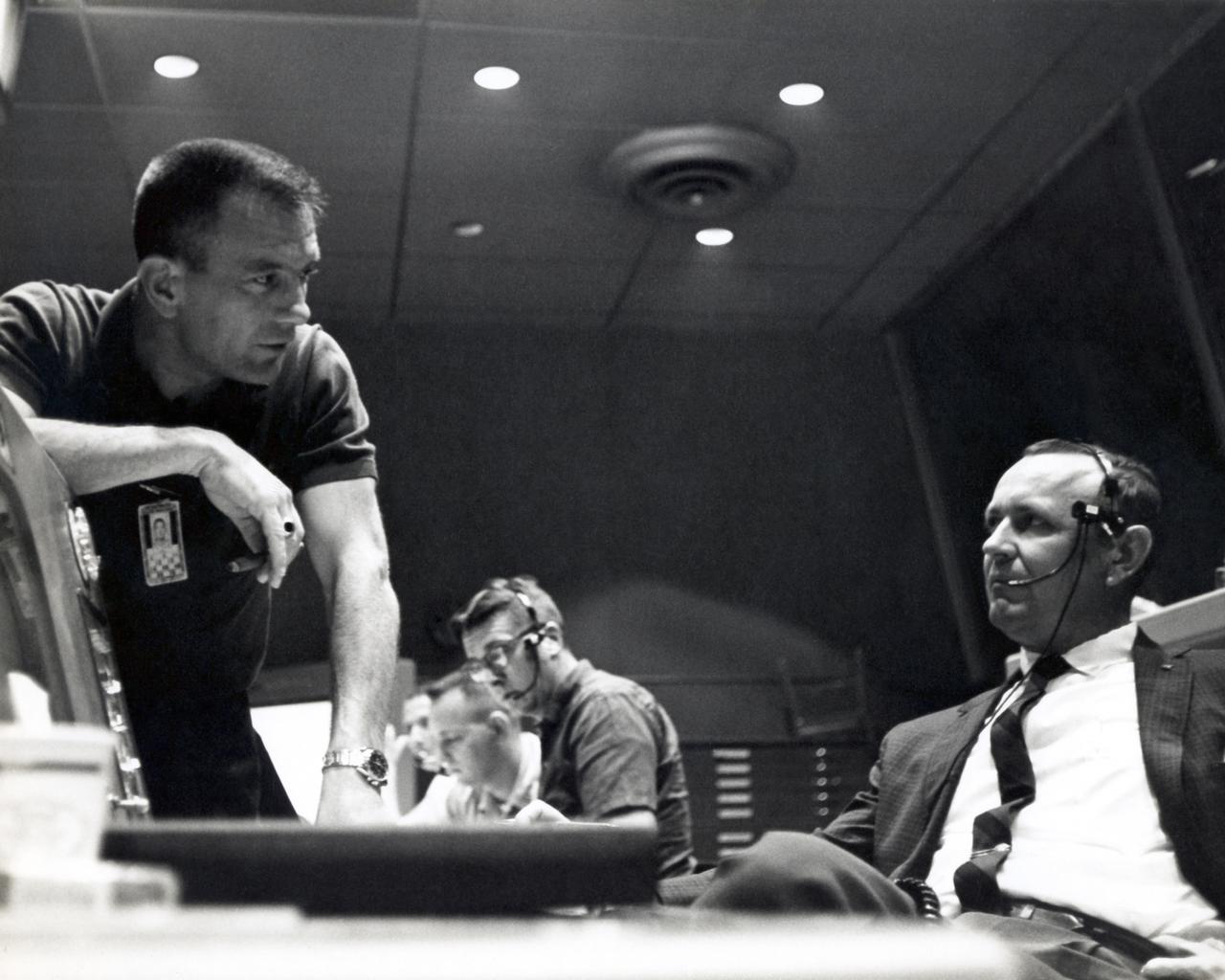
CAPE CANAVERAL, Fla. - Inside Mercury Mission Control, Walter C. Williams standing, associate director for Project Mercury operations, and Christopher Kraft seated, left, flight director, work in flight control as the decision is made to have Mercury astronaut Gordon Cooper aboard his spacecraft, Faith 7, go the full 22 orbits. The launch took place on May 15, 1963.     The Mercury Mission Control Center in Florida played a key role in the United States' early spaceflight program. Located at Cape Canaveral Air Force Station, the original part of the building was constructed between 1956 and 1958, with additions in 1959 and 1963. The facility officially was transferred to NASA on Dec. 26, 1963, and served as mission control during all the Project Mercury missions, as well as the first three flights of the Gemini Program, when it was renamed Mission Control Center. With its operational days behind, on June 1, 1967, the Mission Control Center became a stop on the public tour of NASA facilities until the mid-90s. In 1999, much of the equipment and furnishings from the Flight Control Area were moved to the Kennedy Space Center Visitor Complex where they became part of the exhibit there. The building was demolished in spring 2010. Photo credit: NASA
KSC-63-MA9-155
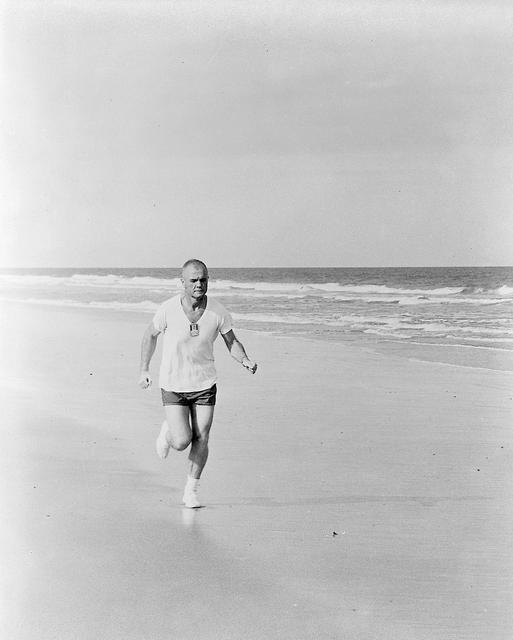
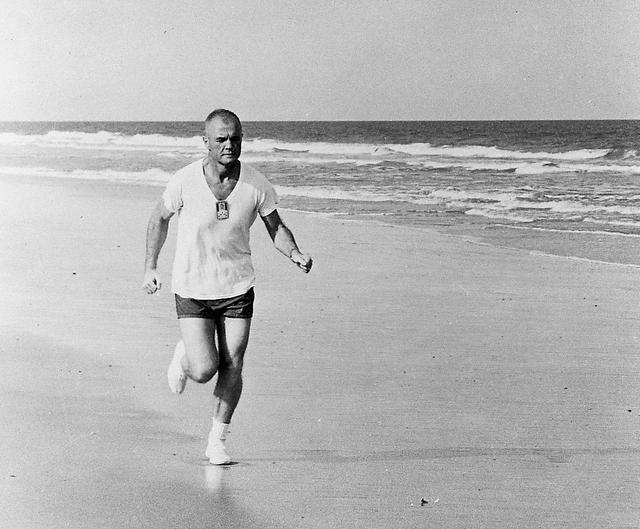
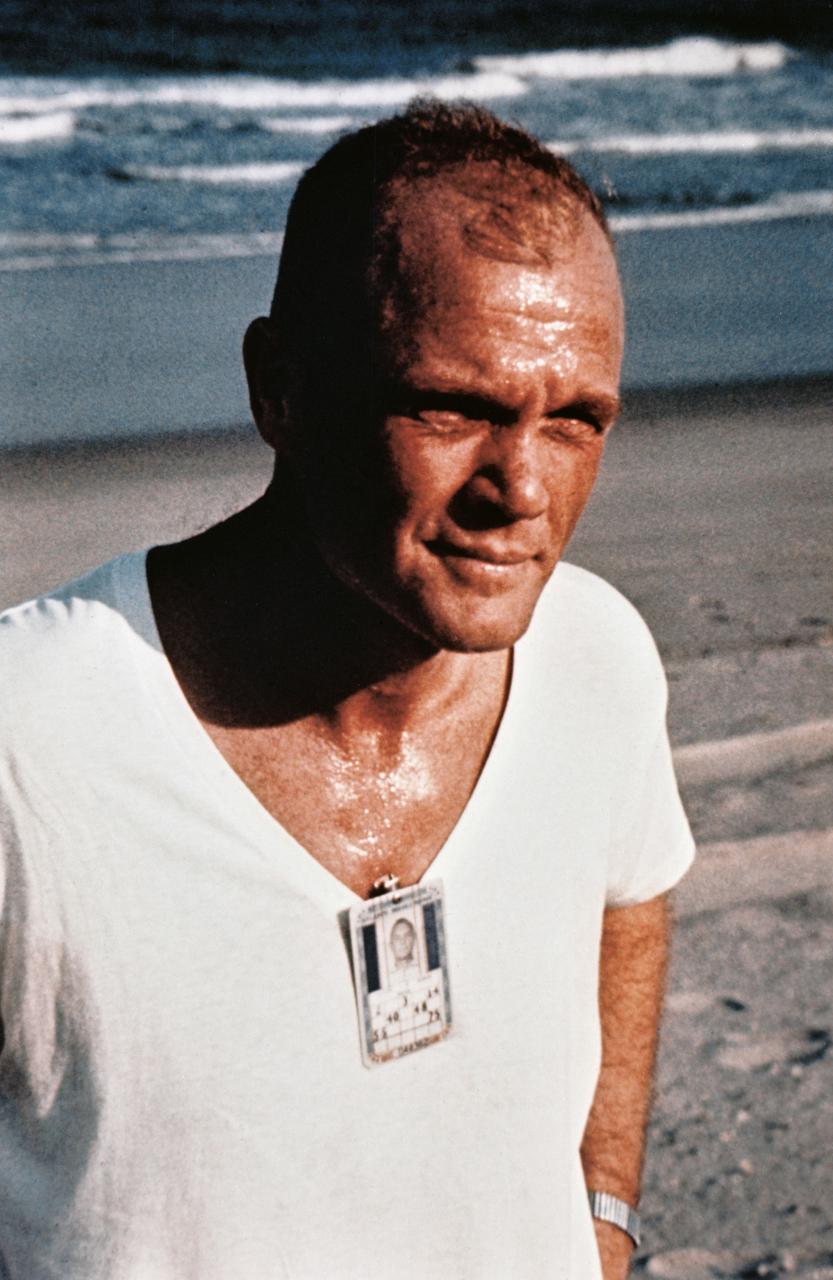
1962 -- Running along the beach at Cape Canaveral, Florida, astronaut John H. Glenn Jr., pilot of the Mercury-Atlas 6 mission, participates in a strict physical training program, as he exemplifies by frequent running.
John H Glenn Jr.
S62-00470 (1962) --- Astronaut John H. Glenn Jr., pilot of the Mercury-Atlas 6 mission, participates in a strict physical training program, as he exemplifies by frequent running. Photo credit: NASA
TRAINING - ASTRONAUT JOHN H. GLENN, JR. - FRIENDSHIP "7" EXERCISE (RUNNING ON BEACH) - FL
NASA Administrator Charles Boldin speaks during an unveiling ceremony of two USPS stamps that commemorate and celebrate 50 years of US Spaceflight and the MESSENGER program during an event, Wednesday, May 4, 2011 at the NASA Kennedy Space Center in Cape Canaveral, Fla.  One stamp commemorates NASA’s Project Mercury, America’s first manned spaceflight program, and NASA astronaut Alan Shepard’s historic flight on May 5, 1961, aboard spacecraft Freedom 7.  The other stamp draws attention to NASA’s unmanned MESSENGER mission, a scientific investigation of the planet Mercury. On March 17, 2011, MESSENGER became the first spacecraft to enter into orbit around Mercury. Photo Credit: (NASA/Bill Ingalls)
Mercury MESSENGER Stamp Unveiling
NASA Administrator Charles Boldin speaks during an unveiling ceremony of two USPS stamps that commemorate and celebrate 50 years of US Spaceflight and the MESSENGER program during an event, Wednesday, May 4, 2011 at the NASA Kennedy Space Center in Cape Canaveral, Fla.  One stamp commemorates NASA’s Project Mercury, America’s first manned spaceflight program, and NASA astronaut Alan Shepard’s historic flight on May 5, 1961, aboard spacecraft Freedom 7.  The other stamp draws attention to NASA’s unmanned MESSENGER mission, a scientific investigation of the planet Mercury. On March 17, 2011, MESSENGER became the first spacecraft to enter into orbit around Mercury. Photo Credit: (NASA/Bill Ingalls)
Mercury MESSENGER Stamp Unveiling
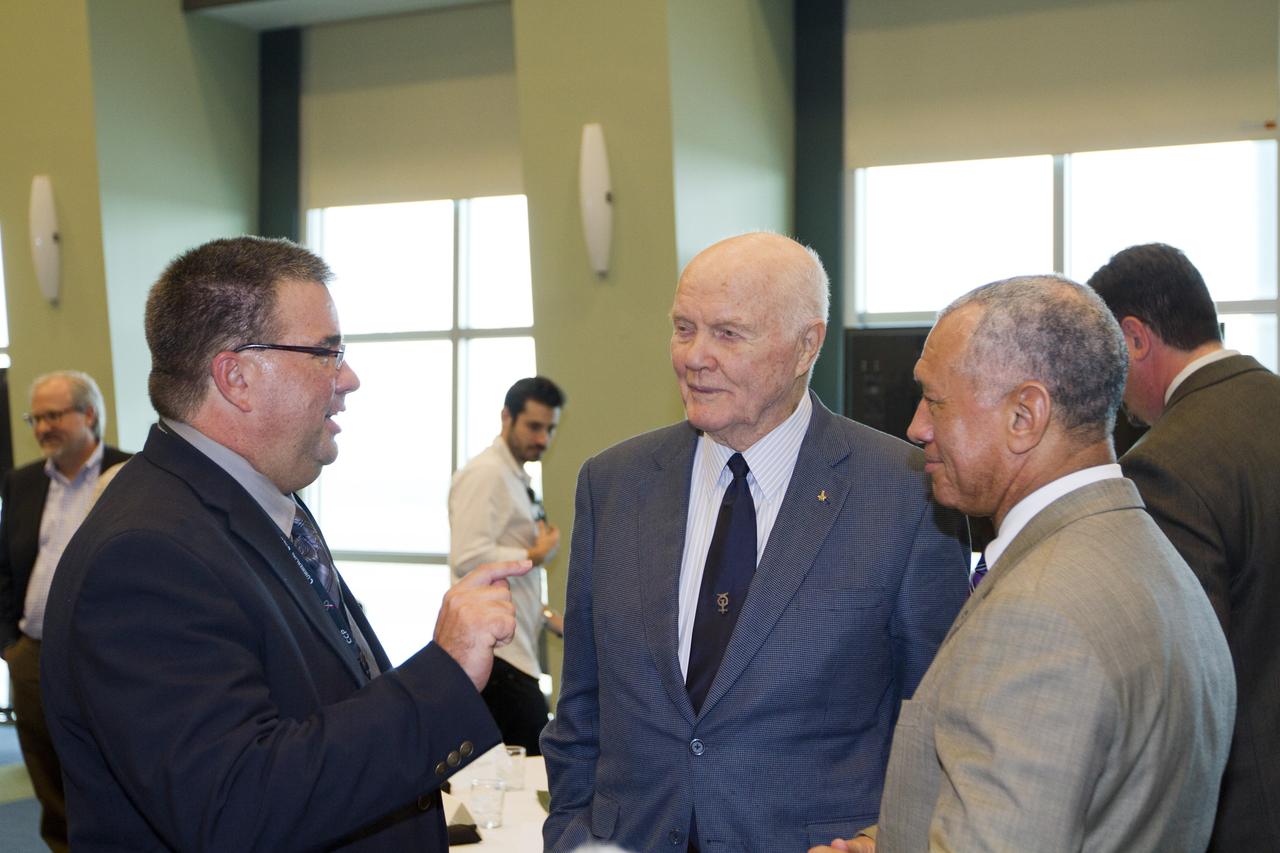
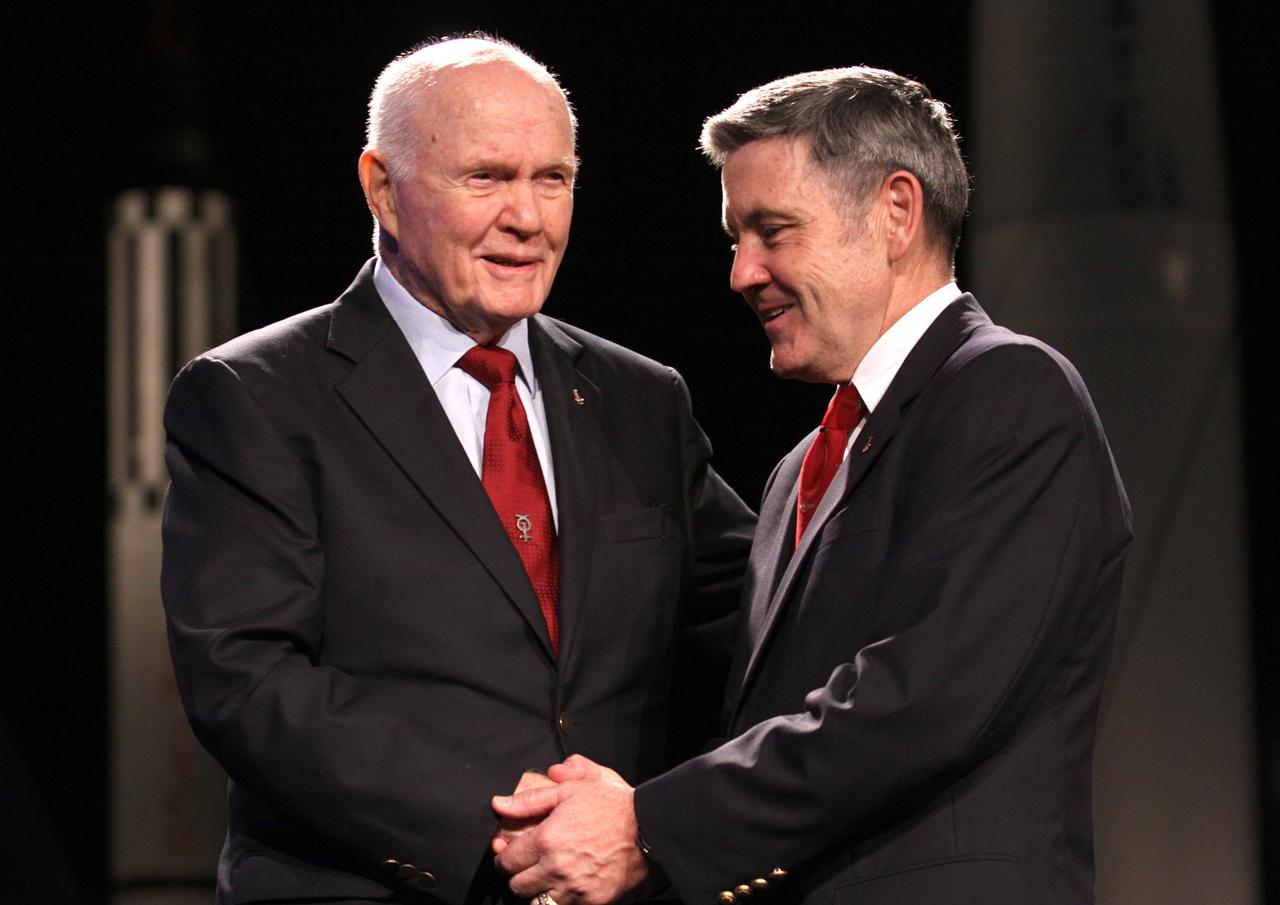
CAPE CANAVERAL, Fla. - Ed Mango, program manager of NASA's Commercial Crew Program, left, talks with astronaut John Glenn, center and NASA Administrator Charles Bolden before a luncheon Feb. 17, 2012, celebrating 50 years of Americans in orbit, an era which began with Glenn's Mercury mission MA-6, on Feb. 20, 1962.  Glenn's launch aboard an Atlas rocket took with it the hopes of an entire nation and ushered in a new era of space travel that eventually led to Americans walking on the moon by the end of the 1960s. Glenn soon was followed into orbit by Scott Carpenter, Walter Schirra and Gordon Cooper. Their fellow Mercury astronauts Alan Shepard and Virgil "Gus" Grissom flew earlier suborbital flights. Deke Slayton, a member of NASA's original Mercury 7 astronauts, was grounded by a medical condition until the Apollo-Soyuz Test Project in 1975. Photo credit: NASA/Kim Shiflett
KSC-2012-1417
Daughters of NASA astronaut Alan Shepard, Laura Shepard Churchley, standing left, Alice Wackermann and Julie Jenkins, standing right, speak during an unveiling ceremony of two USPS stamps that commemorate and celebrate 50 years of US Spaceflight and the MESSENGER program during an event, Wednesday, May 4, 2011 at the NASA Kennedy Space Center in Cape Canaveral, Fla.  One stamp commemorates NASA’s Project Mercury, America’s first manned spaceflight program, and NASA astronaut Alan Shepard’s historic flight on May 5, 1961, aboard spacecraft Freedom 7.  The other stamp draws attention to NASA’s unmanned MESSENGER mission, a scientific investigation of the planet Mercury. On March 17, 2011, MESSENGER became the first spacecraft to enter into orbit around Mercury. Photo Credit: (NASA/Bill Ingalls)
Mercury MESSENGER Stamp Unveiling
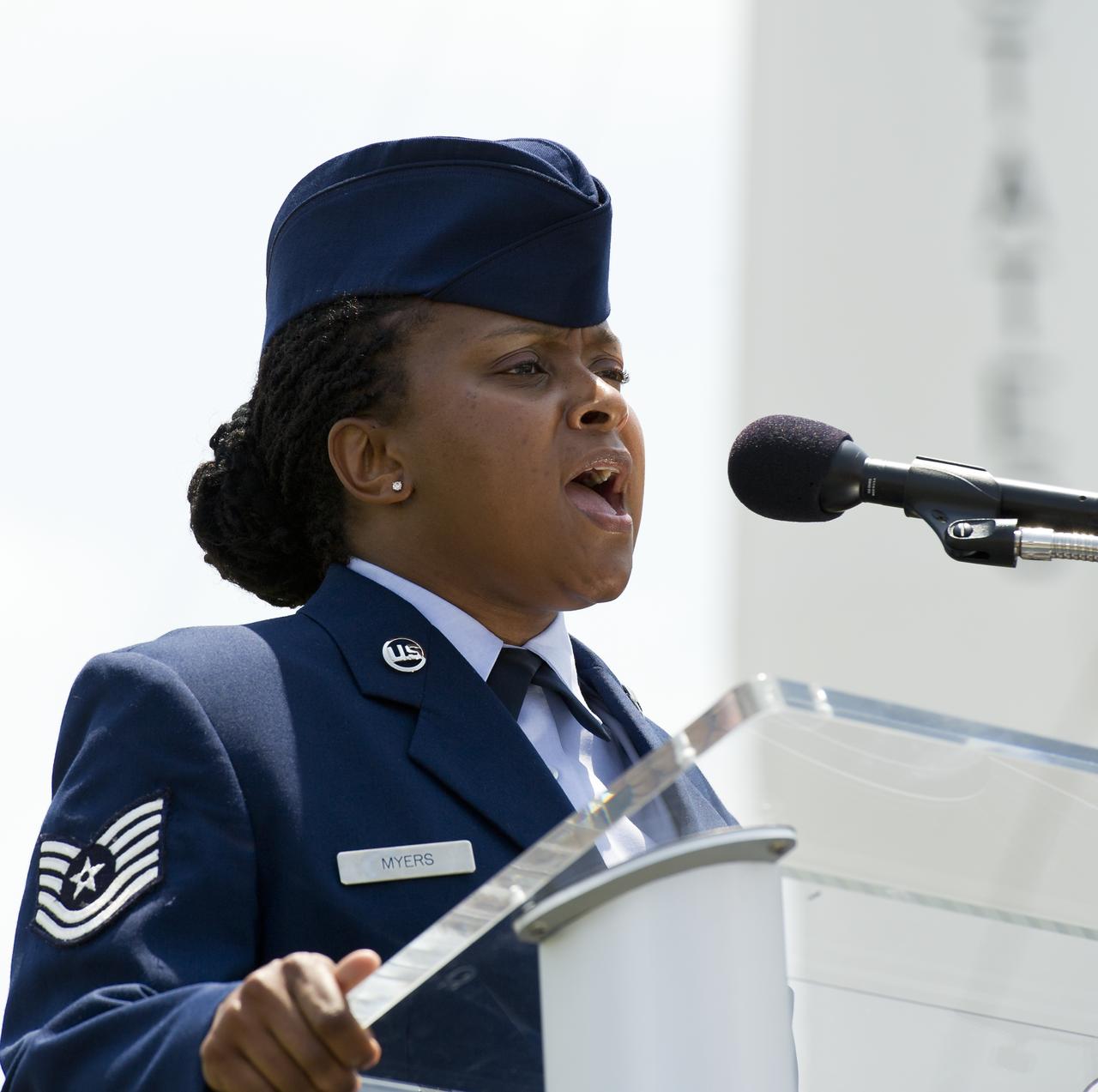
Altrameise Myers, Tech Sgt., 45th Space Wing sings the National Anthem during the start of a ceremony where two USPS stamps where unveiled to commemorate and celebrate 50 years of US Spaceflight and the MESSENGER program during an event, Wednesday, May 4, 2011 at the NASA Kennedy Space Center in Cape Canaveral, Fla.  One stamp commemorates NASA’s Project Mercury, America’s first manned spaceflight program, and NASA astronaut Alan Shepard’s historic flight on May 5, 1961, aboard spacecraft Freedom 7.  The other stamp draws attention to NASA’s unmanned MESSENGER mission, a scientific investigation of the planet Mercury. On March 17, 2011, MESSENGER became the first spacecraft to enter into orbit around Mercury. Photo Credit: (NASA/Bill Ingalls)
Mercury MESSENGER Stamp Unveiling
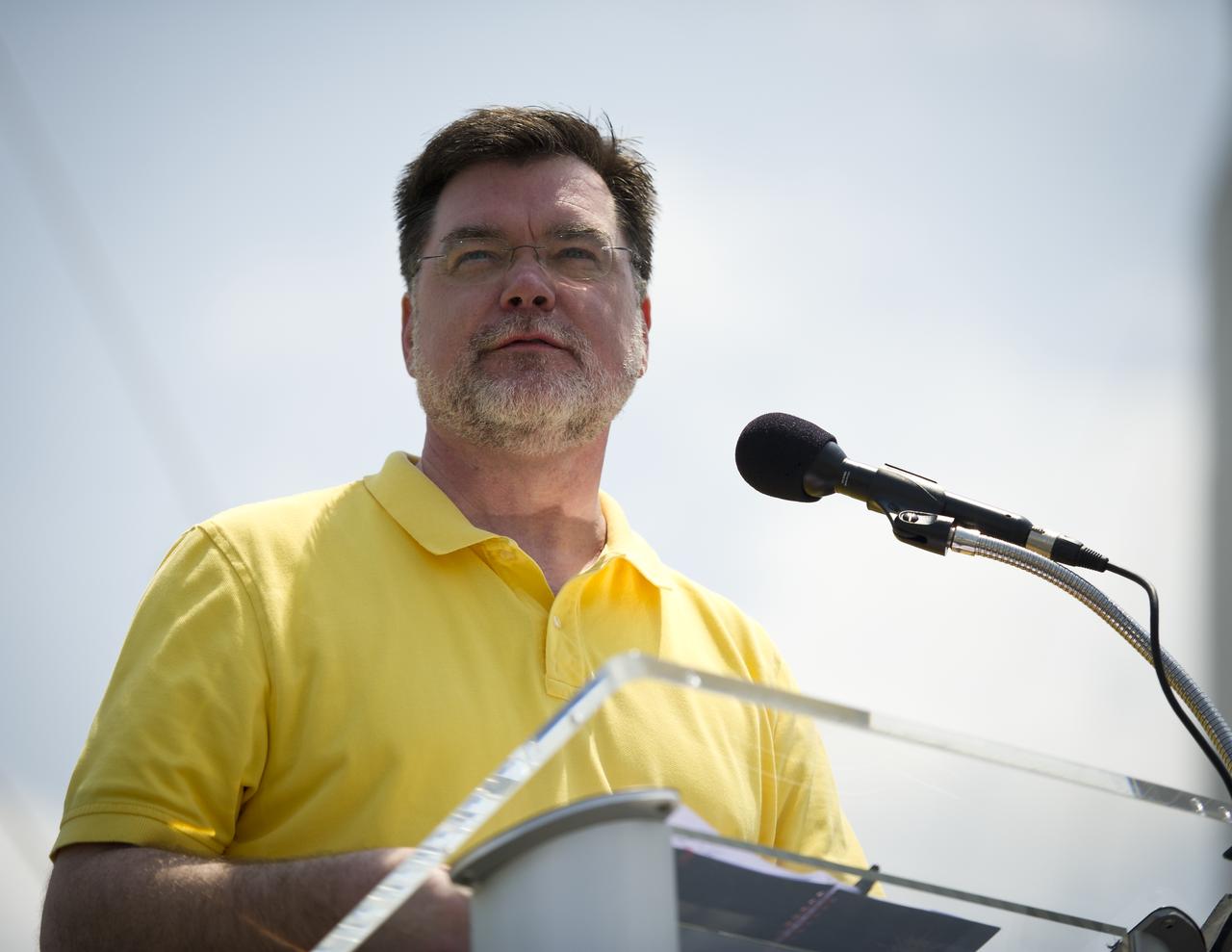
Jim Adams, NASA Deputy Director, Planetary Science Division, Science Mission Directorate, speaks during an unveiling ceremony of two USPS stamps that commemorate and celebrate 50 years of US Spaceflight and the MESSENGER program during an event, Wednesday, May 4, 2011 at the NASA Kennedy Space Center in Cape Canaveral, Fla.  One stamp commemorates NASA’s Project Mercury, America’s first manned spaceflight program, and NASA astronaut Alan Shepard’s historic flight on May 5, 1961, aboard spacecraft Freedom 7.  The other stamp draws attention to NASA’s unmanned MESSENGER mission, a scientific investigation of the planet Mercury. On March 17, 2011, MESSENGER became the first spacecraft to enter into orbit around Mercury. Photo Credit: (NASA/Bill Ingalls)
Mercury MESSENGER Stamp Unveiling
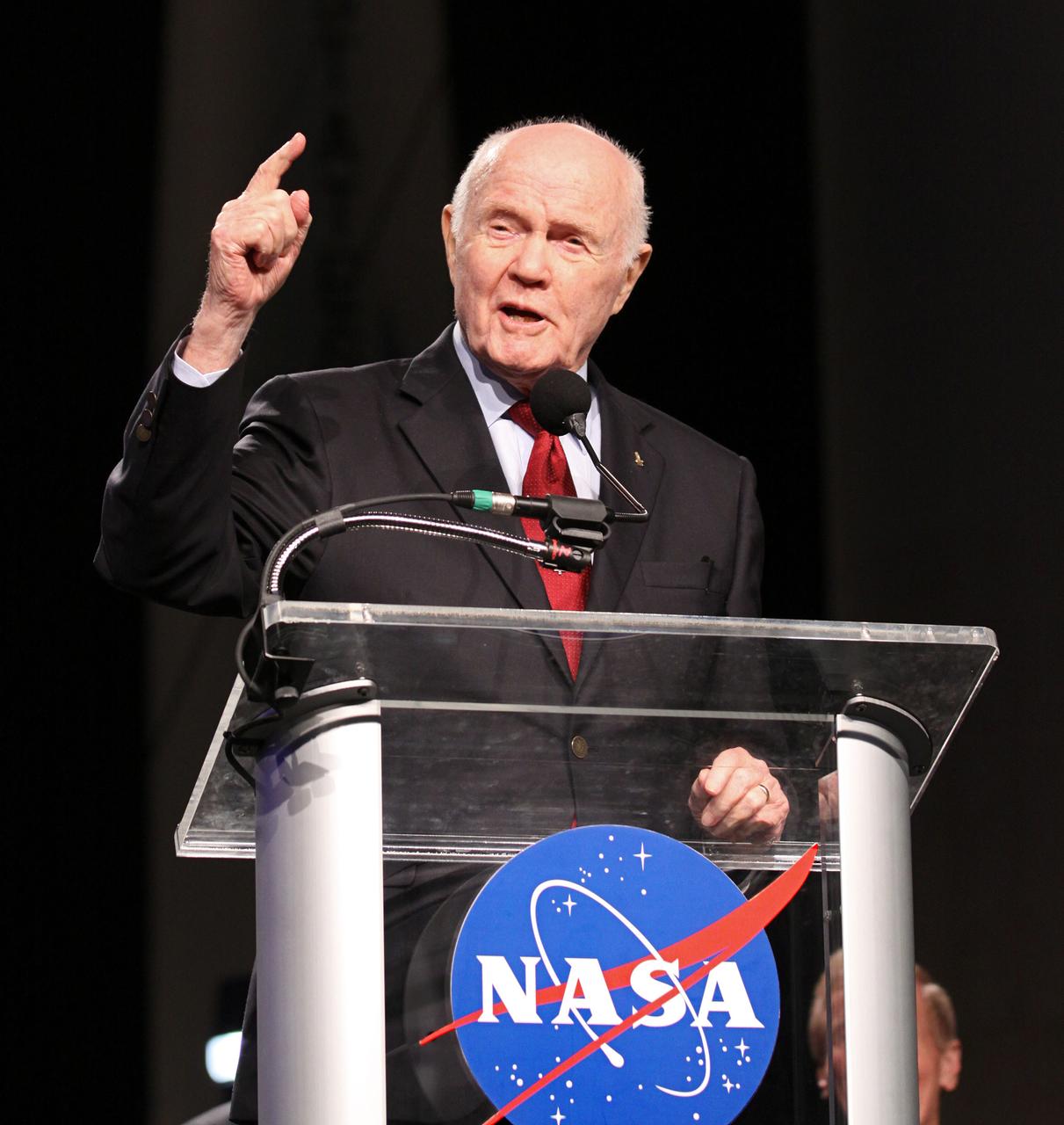
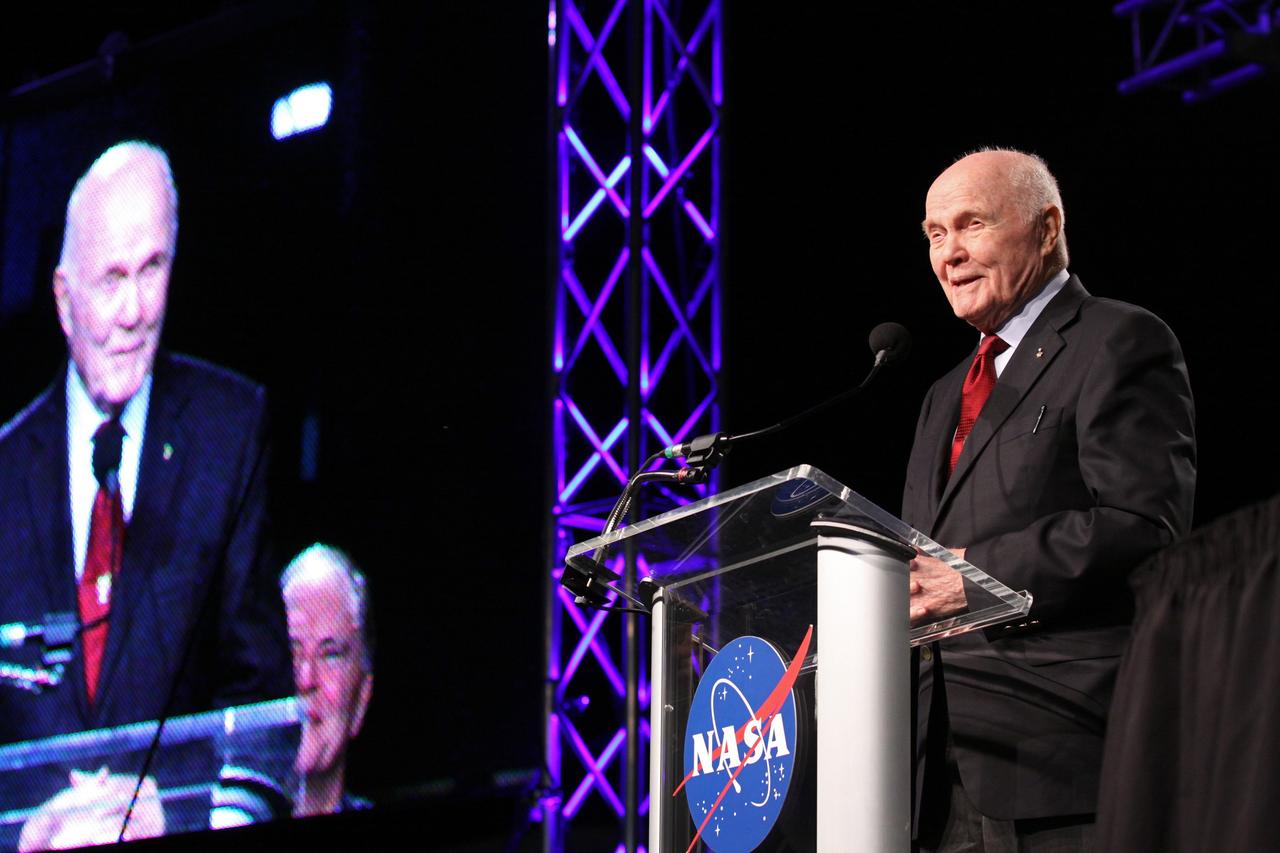
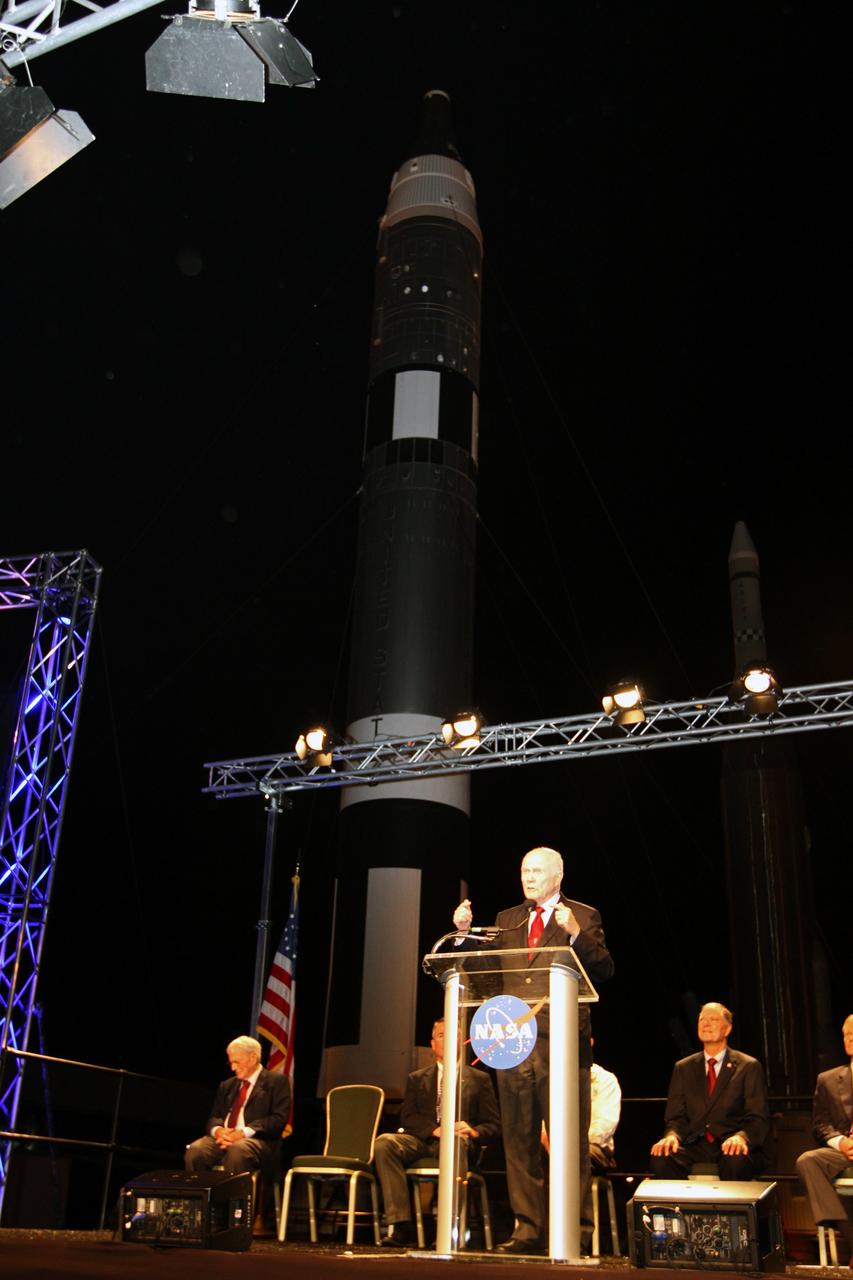
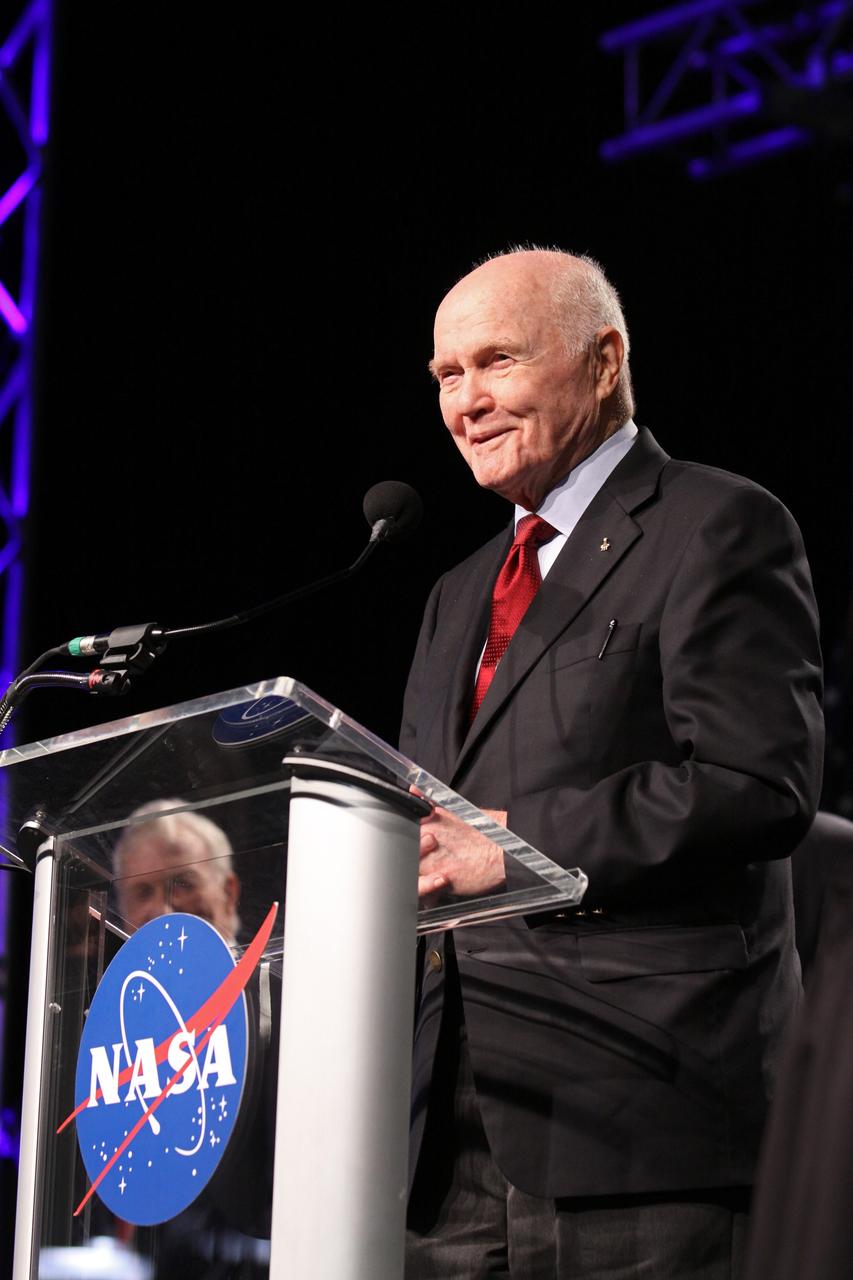
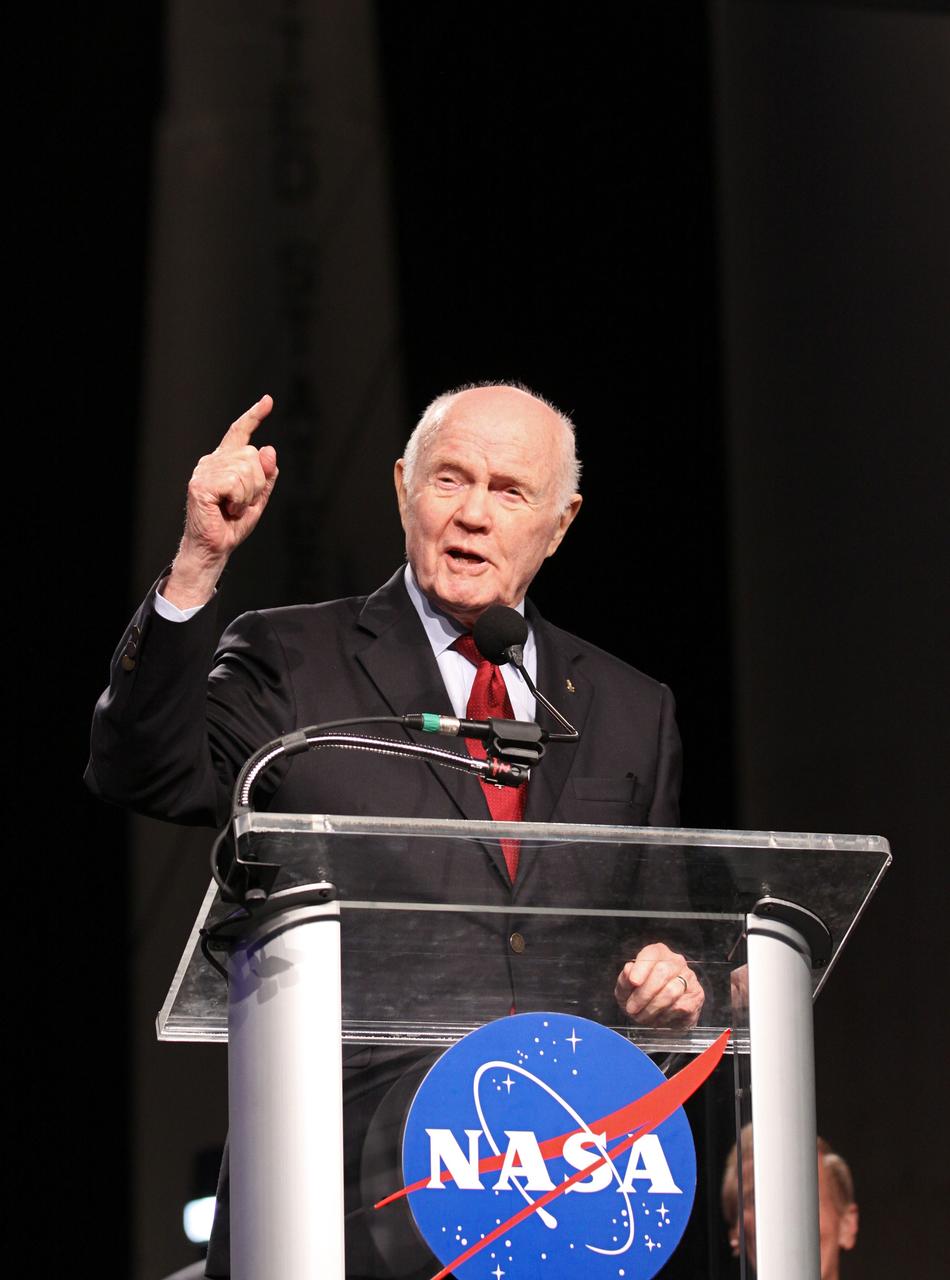
Mercury astronaut John Glenn speaks during the "On Shoulders of Giants" program celebrating 50 years of Americans in orbit, an era which began with Glenn's MA-6 mission on Feb. 20, 1962. The event was conducted in the Rocket Garden at the Kennedy Space Center Visitor Complex in Florida a few miles from the launch pad where Glenn and Scott Carpenter took flight in Mercury spacecraft. Glenn's launch aboard an Atlas rocket took with it the hopes of an entire nation and ushered in a new era of space travel that eventually led to Americans walking on the moon by the end of the 1960s. Glenn soon was followed into orbit by Scott Carpenter, Walter Schirra and Gordon Cooper. Their fellow Mercury astronauts Alan Shepard and Virgil "Gus" Grissom flew earlier suborbital flights. Deke Slayton, a member of NASA's original Mercury 7 astronauts, was grounded by a medical condition until the Apollo-Soyuz Test Project in 1975.
John H Glenn Jr.
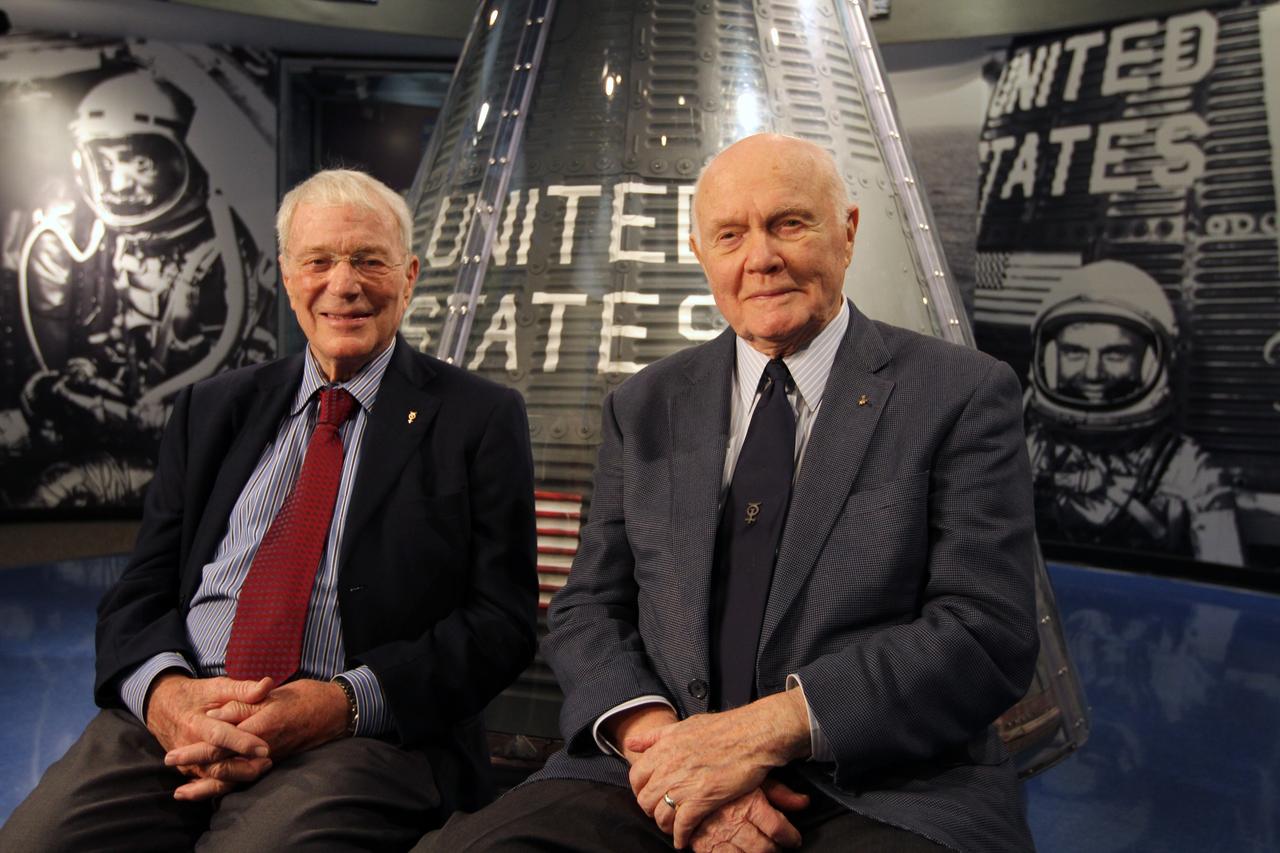
CAPE CANAVERAL, Fla. -- Mercury astronauts Scott Carpenter, left, and John Glenn sit in front of a capsule from the Mercury program on display at the Kennedy Space Center Visitor Complex in Florida. The two astronauts, part of the original class of seven astronauts chosen by NASA, were taking part in events celebrating 50 years of Americans in orbit, an era which began with Glenn's Mercury mission MA-6, on Feb. 20, 1962.  Glenn's launch aboard an Atlas rocket took with it the hopes of an entire nation and ushered in a new era of space travel that eventually led to Americans walking on the moon by the end of the 1960s. Glenn soon was followed into orbit by Carpenter, Walter Schirra and Gordon Cooper. Their fellow Mercury astronauts Alan Shepard and Virgil "Gus" Grissom flew earlier suborbital flights. Deke Slayton was grounded by a medical condition until the Apollo-Soyuz Test Project in 1975. Photo credit: NASA/Kim Shiflett
KSC-2012-1434
S63-22731 (31 Jan. 1961) --- The launch of the Mercury-Redstone 2 (MR-2) suborbital mission from Cape Canaveral, Florida, on Jan. 31, 1961. Onboard the spacecraft was ?Ham?, a 37-pound chimpanzee. Despite an over-acceleration factor, the flight was considered to be successful. Following recovery Ham appeared to be in good physiological condition, but sometime later when he was shown the Mercury spacecraft it was visually apparent that he had no further interest in cooperating with the spaceflight program. Photo credit: NASA
LIFTOFF - MERCURY-REDSTONE (MR)-2 - CAPE
CAPE CANAVERAL, Fla. -- On Cape Canaveral Air Force Station in Florida, invited guests tour the blockhouse at Complex 5/6 during a celebration of Alan Shepard's historic flight 50 years ago. From left are Robert Sieck, former shuttle launch director; Andy Anderson, former manager for communications in the Mercury Mission Control Center; Bob Moser, former chief test conductor for the Mercury-Redstone launches; and John Twigg, former backup chief test conductor for the Mercury-Redstone launches.    The celebration was held at the launch site of the first U.S. manned spaceflight May 5, 1961, to mark the 50th anniversary of the flight.  Fifty years ago, astronaut Alan Shepard lifted off inside the Mercury capsule, "Freedom 7," atop an 82-foot-tall Mercury-Redstone rocket at 9:34 a.m. EST, sending him on a remarkably successful, 15-minute suborbital flight. The event was attended by more than 200 workers from the original Mercury program and included a re-creation of Shepard's flight and recovery, as well as a tribute to his contributions as a moonwalker on the Apollo 14 lunar mission. For more information, visit www.nasa.gov/topics/history/milestones/index.html. Photo credit: NASA/Kim Shiflett
KSC-2011-3333
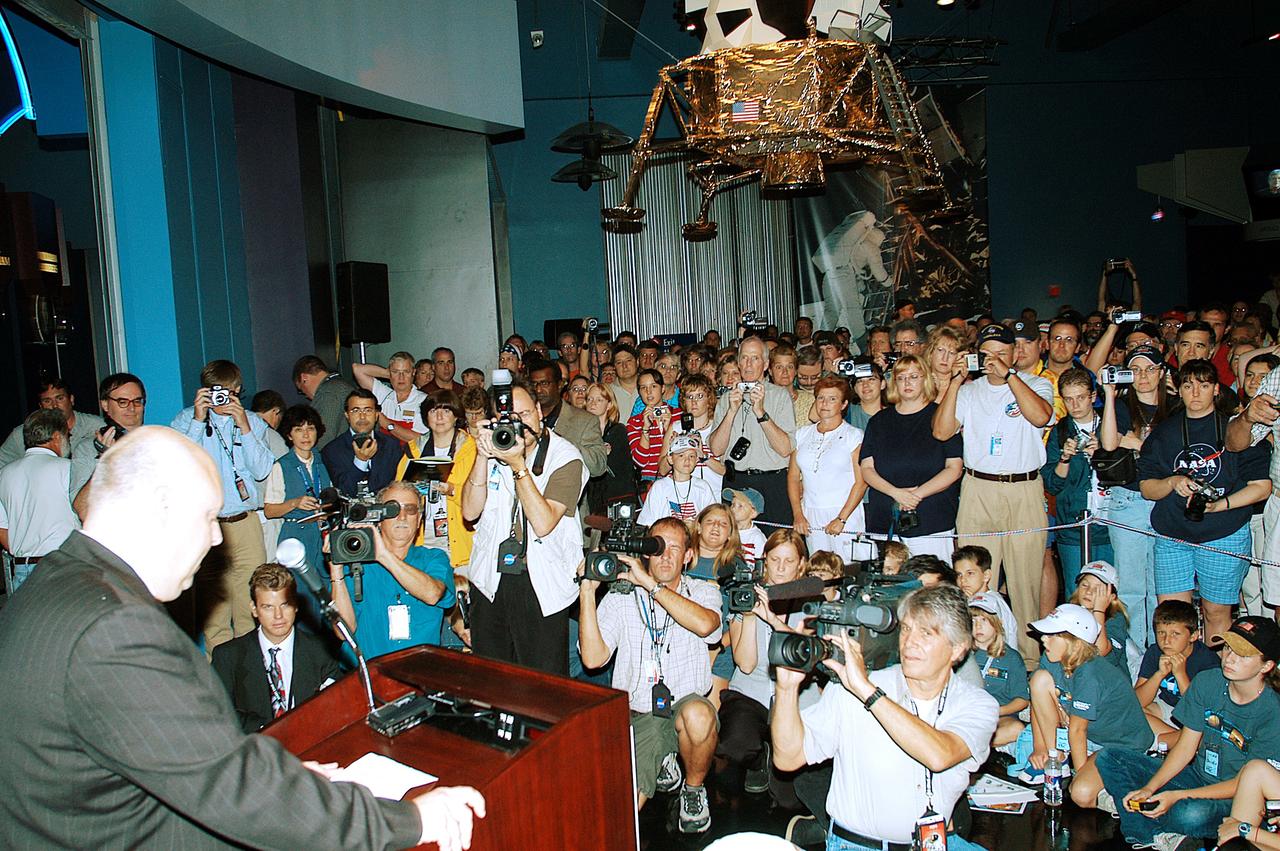
KENNEDY SPACE CENTER, FLA. -  Daniel LeBlanc, chief operating officer of Delaware North Companies Parks and Resorts at KSC, makes the opening remarks to hundreds of guests and media representatives attending a ribbon cutting ceremony officially opening the U.S. Astronaut Hall of Fame as part of the Kennedy Space Center Visitor Complex.  The ceremony was held in conjunction with the induction of four Space Shuttle astronauts into the Hall of Fame including Daniel Brandenstein, Robert "Hoot" Gibson, Story Musgrave, and Sally Ride.  Conceived by six of the Mercury Program astronauts, the U.S. Astronaut Hall of Fame opened in 1990 to provide a place where space travelers could be remembered for their participation and accomplishments in the U.S. space program.  The four new inductees join 48 previously honored astronauts from the ranks of the Gemini, Apollo, Skylab, Apollo-Soyuz, and Space Shuttle programs.
KENNEDY SPACE CENTER, FLA. - Daniel LeBlanc, chief operating officer of Delaware North Companies Parks and Resorts at KSC, makes the opening remarks to hundreds of guests and media representatives attending a ribbon cutting ceremony officially opening the U.S. Astronaut Hall of Fame as part of the Kennedy Space Center Visitor Complex. The ceremony was held in conjunction with the induction of four Space Shuttle astronauts into the Hall of Fame including Daniel Brandenstein, Robert "Hoot" Gibson, Story Musgrave, and Sally Ride. Conceived by six of the Mercury Program astronauts, the U.S. Astronaut Hall of Fame opened in 1990 to provide a place where space travelers could be remembered for their participation and accomplishments in the U.S. space program. The four new inductees join 48 previously honored astronauts from the ranks of the Gemini, Apollo, Skylab, Apollo-Soyuz, and Space Shuttle programs.
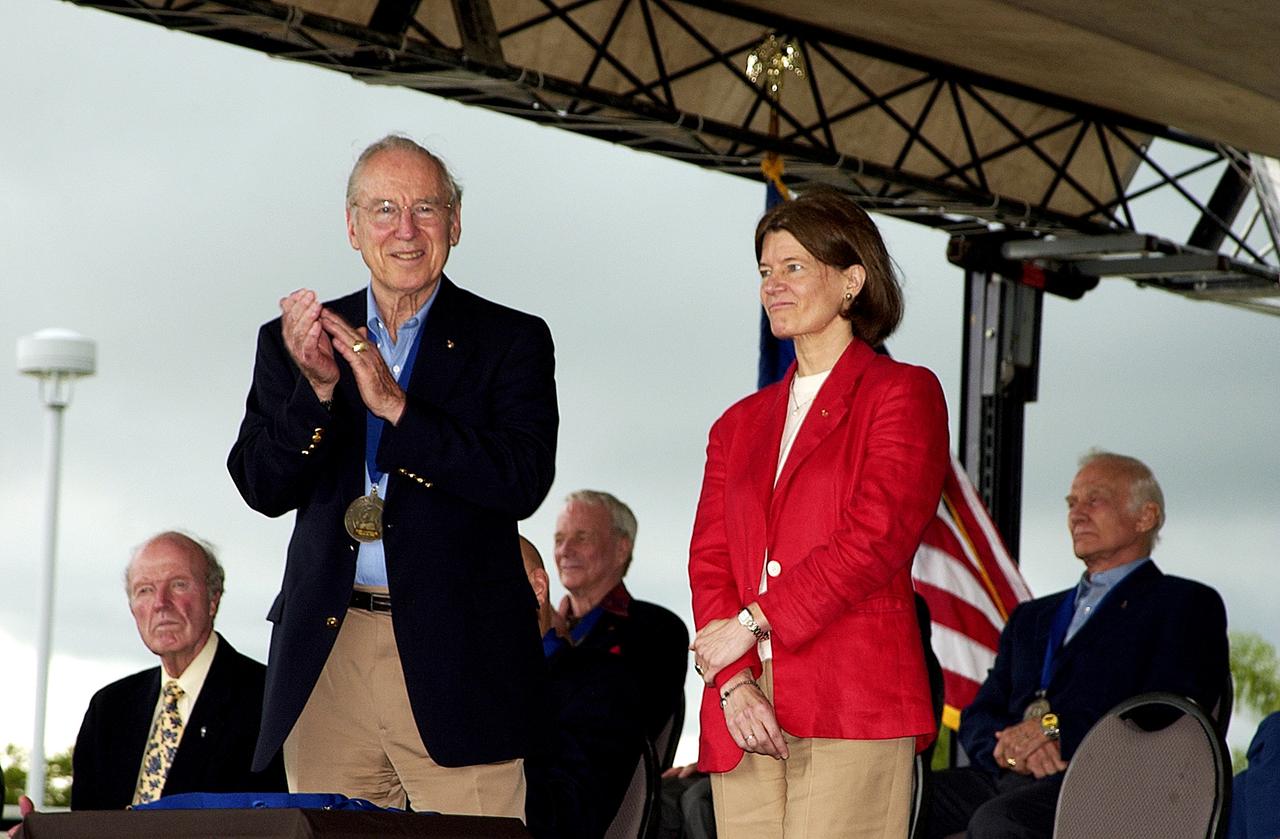
KENNEDY SPACE CENTER, FLA. -  At the KSC Visitor Complex, former astronaut James A. Lovell (standing left) applauds former astronaut Sally K. Ride at her induction ceremony into the U.S. Astronaut Hall of Fame. Seated on the dais, from left, are former astronauts Gordon Cooper, Scott Carpenter, and  Buzz Aldrin, all previously inducted into the Hall of Fame. Being inducted with Ride are Space Shuttle astronauts Daniel Brandenstein, Robert "Hoot" Gibson, and Story Musgrave. Conceived by six of the Mercury Program astronauts, the U.S. Astronaut Hall of Fame opened in 1990 to provide a place where space travelers could be remembered for their participation and accomplishments in the U.S. space program. The four new inductees join 48 previously honored astronauts from the ranks of the Gemini, Apollo, Skylab, Apollo-Soyuz, and Space Shuttle programs.
KENNEDY SPACE CENTER, FLA. - At the KSC Visitor Complex, former astronaut James A. Lovell (standing left) applauds former astronaut Sally K. Ride at her induction ceremony into the U.S. Astronaut Hall of Fame. Seated on the dais, from left, are former astronauts Gordon Cooper, Scott Carpenter, and Buzz Aldrin, all previously inducted into the Hall of Fame. Being inducted with Ride are Space Shuttle astronauts Daniel Brandenstein, Robert "Hoot" Gibson, and Story Musgrave. Conceived by six of the Mercury Program astronauts, the U.S. Astronaut Hall of Fame opened in 1990 to provide a place where space travelers could be remembered for their participation and accomplishments in the U.S. space program. The four new inductees join 48 previously honored astronauts from the ranks of the Gemini, Apollo, Skylab, Apollo-Soyuz, and Space Shuttle programs.
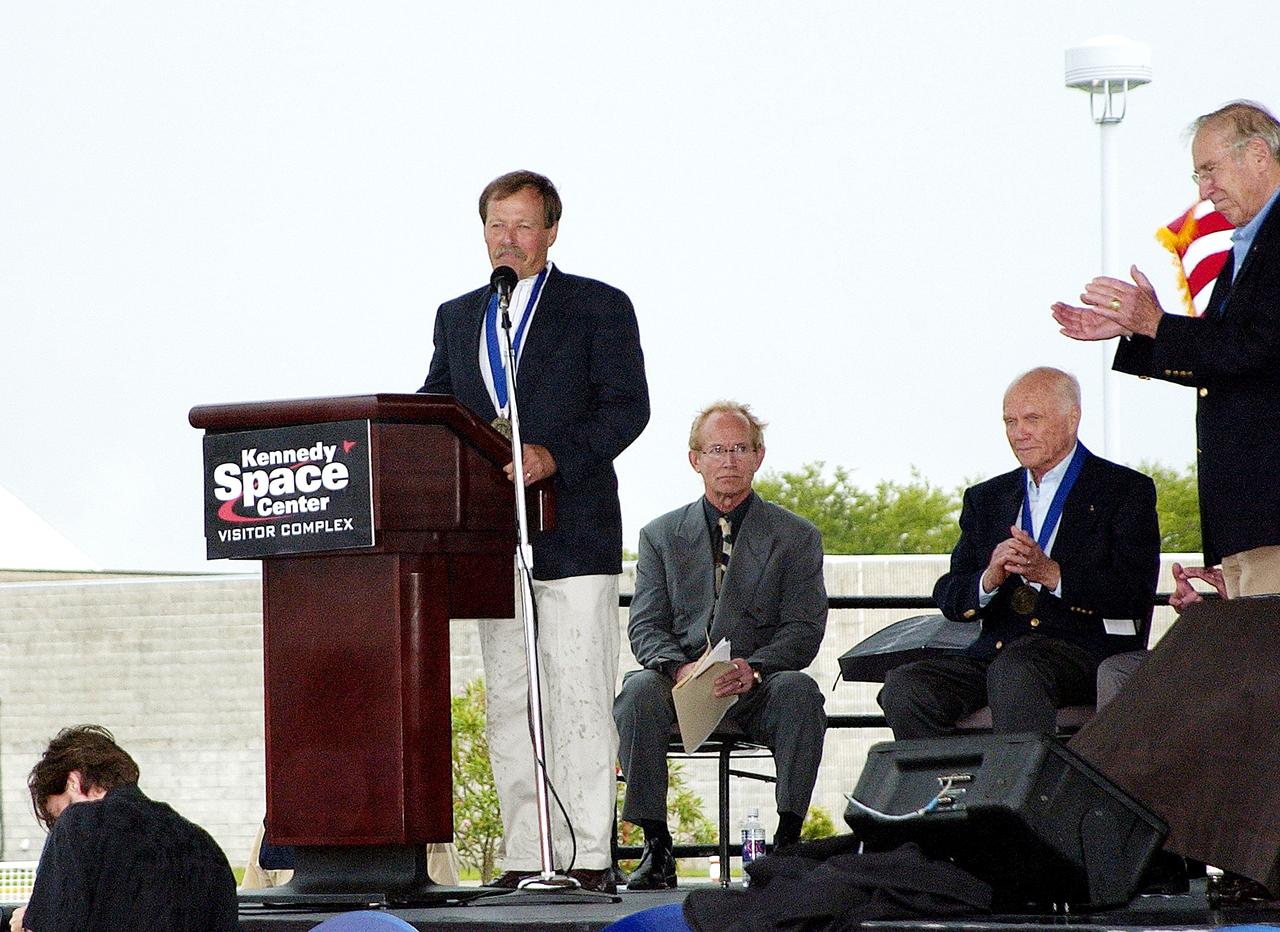
KENNEDY SPACE CENTER, FLA. -  At the KSC Visitor Complex, former astronaut Robert "Hoot" Gibson (at podium) addresses the audience at his induction ceremony into the U.S. Astronaut Hall of Fame. Also standing is former astronaut James A. Lovell.  Seated on the dais, from left, are actor and Master of Ceremonies Lance Henriksen and former astronaut John H. Glenn.  Also being inducted with Gibson are Space Shuttle astronauts Daniel Brandenstein, Story Musgrave, and Sally K. Ride. Conceived by six of the Mercury Program astronauts, the U.S. Astronaut Hall of Fame opened in 1990 to provide a place where space travelers could be remembered for their participation and accomplishments in the U.S. space program. The four new inductees join 48 previously honored astronauts from the ranks of the Gemini, Apollo, Skylab, Apollo-Soyuz, and Space Shuttle programs.
KENNEDY SPACE CENTER, FLA. - At the KSC Visitor Complex, former astronaut Robert "Hoot" Gibson (at podium) addresses the audience at his induction ceremony into the U.S. Astronaut Hall of Fame. Also standing is former astronaut James A. Lovell. Seated on the dais, from left, are actor and Master of Ceremonies Lance Henriksen and former astronaut John H. Glenn. Also being inducted with Gibson are Space Shuttle astronauts Daniel Brandenstein, Story Musgrave, and Sally K. Ride. Conceived by six of the Mercury Program astronauts, the U.S. Astronaut Hall of Fame opened in 1990 to provide a place where space travelers could be remembered for their participation and accomplishments in the U.S. space program. The four new inductees join 48 previously honored astronauts from the ranks of the Gemini, Apollo, Skylab, Apollo-Soyuz, and Space Shuttle programs.
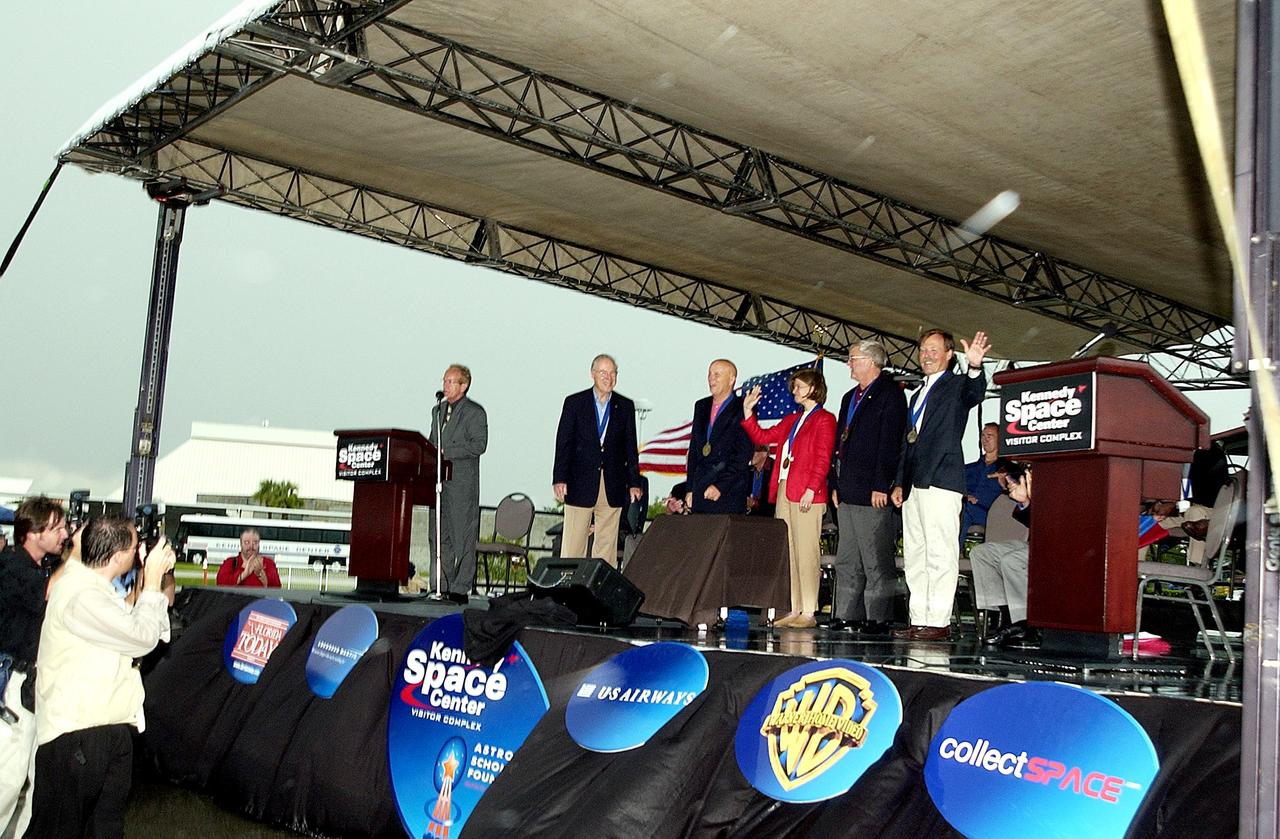
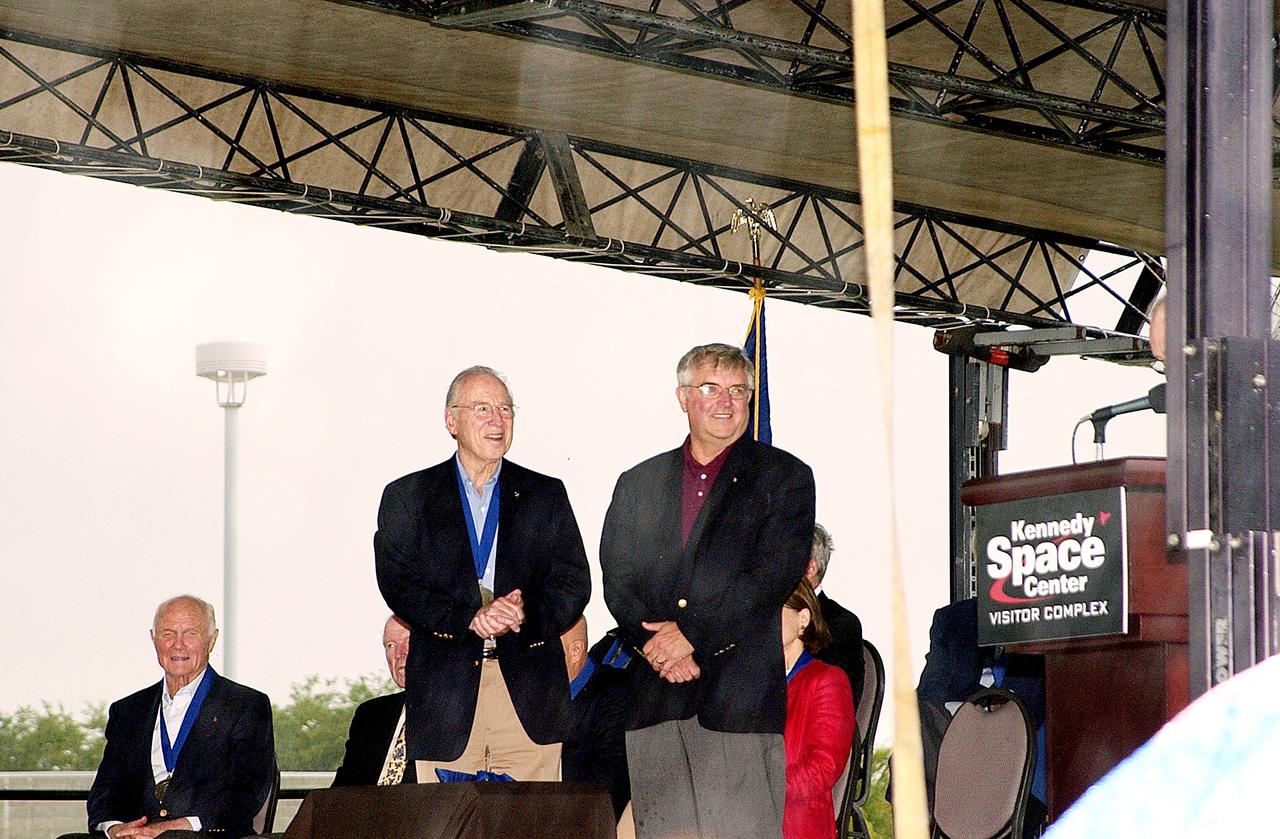
KENNEDY SPACE CENTER, FLA. -  At the KSC Visitor Complex, actor and Master of Ceremonies Lance Henriksen (at podium) introduces four newly inducted Space Shuttle astronauts to the audience at their induction ceremony into the U.S. Astronaut Hall of Fame. From left center, they are Story Musgrave, Sally K. Ride, Daniel Brandenstein, and Robert "Hoot" Gibson. Also standing, left, is former astronaut James A. Lovell.  Conceived by six of the Mercury Program astronauts, the U.S. Astronaut Hall of Fame opened in 1990 to provide a place where space travelers could be remembered for their participation and accomplishments in the U.S. space program. The four new inductees join 48 previously honored astronauts from the ranks of the Gemini, Apollo, Skylab, Apollo-Soyuz, and Space Shuttle programs.
KENNEDY SPACE CENTER, FLA. - At the KSC Visitor Complex, actor and Master of Ceremonies Lance Henriksen (at podium) introduces four newly inducted Space Shuttle astronauts to the audience at their induction ceremony into the U.S. Astronaut Hall of Fame. From left center, they are Story Musgrave, Sally K. Ride, Daniel Brandenstein, and Robert "Hoot" Gibson. Also standing, left, is former astronaut James A. Lovell. Conceived by six of the Mercury Program astronauts, the U.S. Astronaut Hall of Fame opened in 1990 to provide a place where space travelers could be remembered for their participation and accomplishments in the U.S. space program. The four new inductees join 48 previously honored astronauts from the ranks of the Gemini, Apollo, Skylab, Apollo-Soyuz, and Space Shuttle programs.
KENNEDY SPACE CENTER, FLA. -  Former astronaut James Lovell addresses the audience at a ribbon cutting ceremony officially opening the U.S. Astronaut Hall of Fame as part of the Kennedy Space Center Visitor Complex.  The ceremony was held in conjunction with the induction of four Space Shuttle astronauts into the Hall of Fame including Daniel Brandenstein, Robert "Hoot" Gibson, Story Musgrave, and Sally Ride.  Conceived by six of the Mercury Program astronauts, the U.S. Astronaut Hall of Fame opened in 1990 to provide a place where space travelers could be remembered for their participation and accomplishments in the U.S. space program.  The four new inductees join 48 previously honored astronauts from the ranks of the Gemini, Apollo, Skylab, Apollo-Soyuz, and Space Shuttle programs.
KENNEDY SPACE CENTER, FLA. - Former astronaut James Lovell addresses the audience at a ribbon cutting ceremony officially opening the U.S. Astronaut Hall of Fame as part of the Kennedy Space Center Visitor Complex. The ceremony was held in conjunction with the induction of four Space Shuttle astronauts into the Hall of Fame including Daniel Brandenstein, Robert "Hoot" Gibson, Story Musgrave, and Sally Ride. Conceived by six of the Mercury Program astronauts, the U.S. Astronaut Hall of Fame opened in 1990 to provide a place where space travelers could be remembered for their participation and accomplishments in the U.S. space program. The four new inductees join 48 previously honored astronauts from the ranks of the Gemini, Apollo, Skylab, Apollo-Soyuz, and Space Shuttle programs.
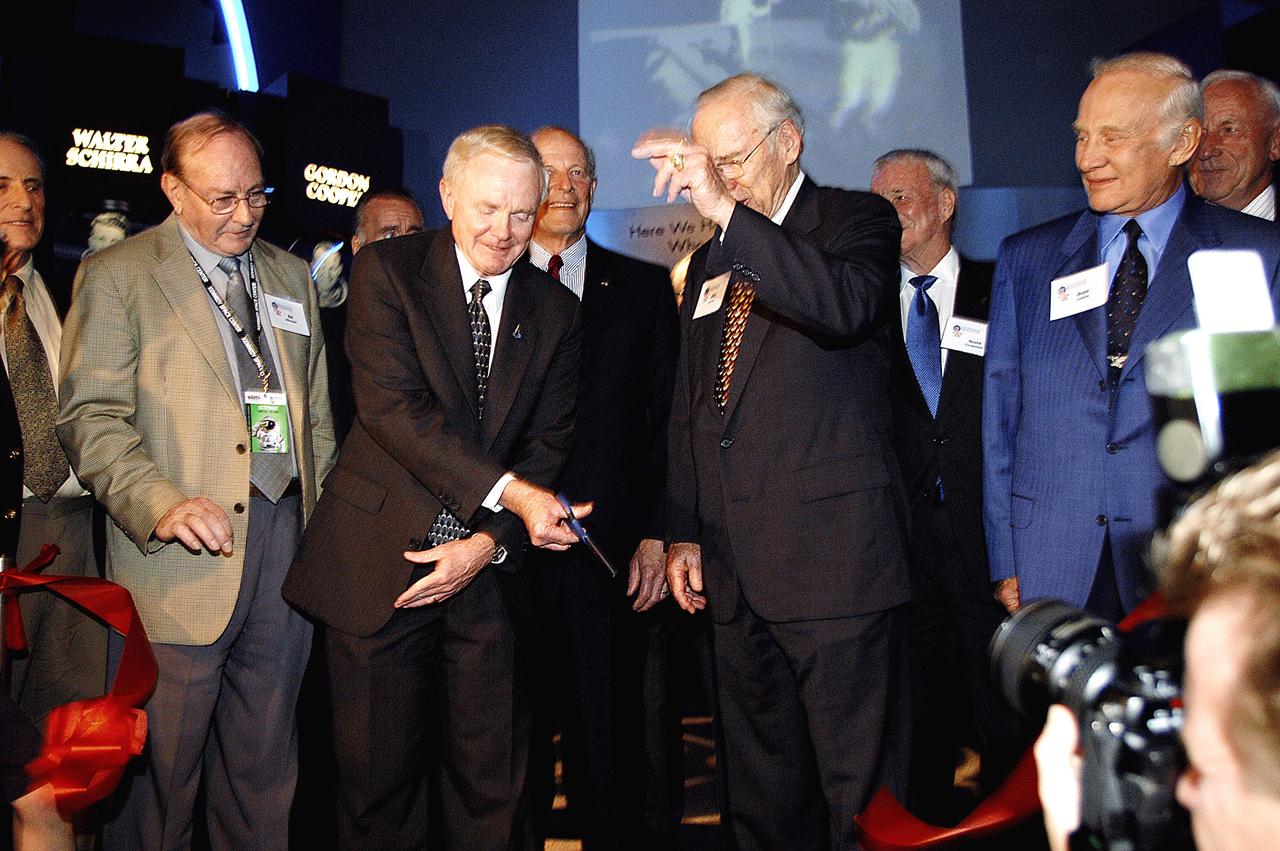
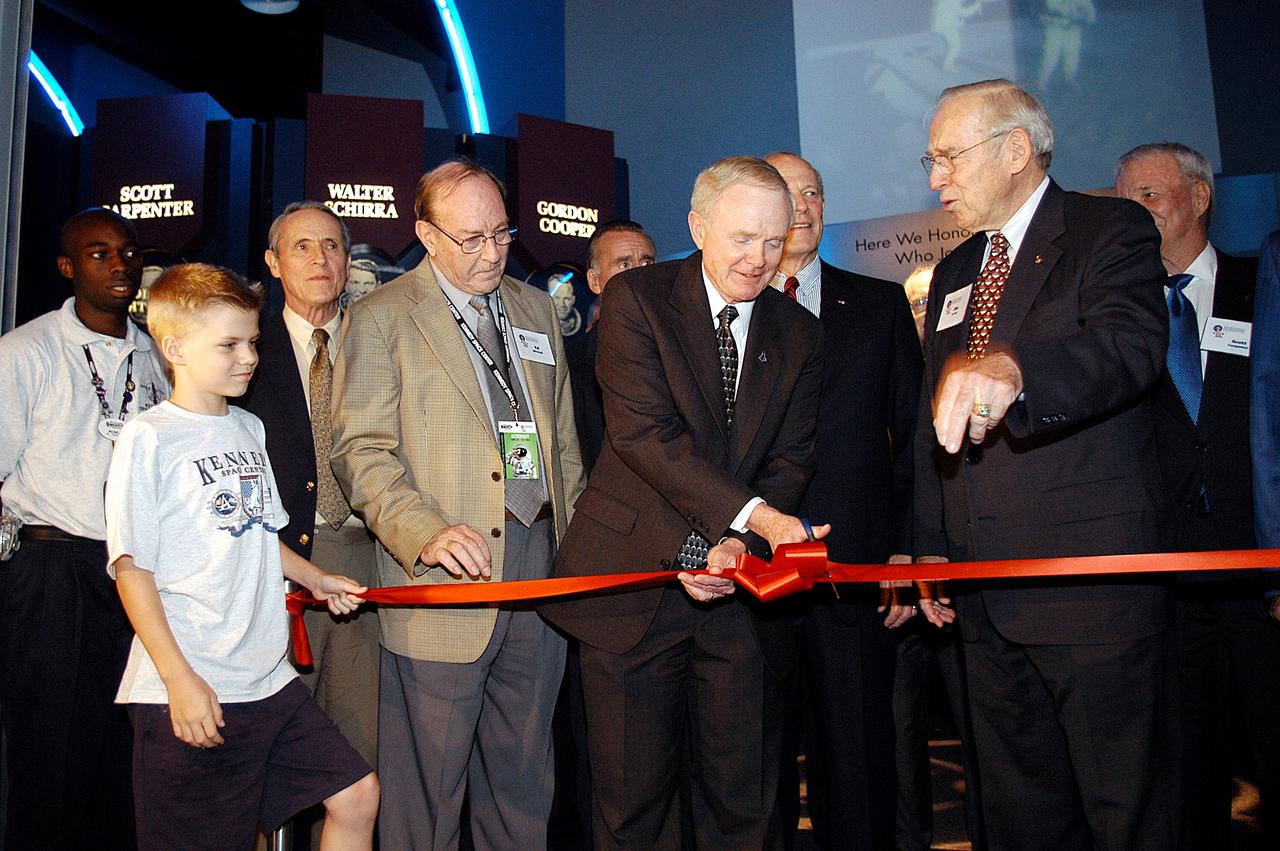
KENNEDY SPACE CENTER, FLA. -  Center Director and former astronaut Roy D. Bridges, Jr., (holding scissors) cuts the ribbon at a ceremony officially opening the U.S. Astronaut Hall of Fame as part of the Kennedy Space Center Visitor Complex.  Invited guests and dignitaries look on, such as former astronauts Edgar D. Mitchell on Bridges' left and James Lovell (hand up) and Buzz Aldrin on his right.  The ceremony was held in conjunction with the induction of four Space Shuttle astronauts into the Hall of Fame including Daniel Brandenstein, Robert "Hoot" Gibson, Story Musgrave, and Sally Ride.  Conceived by six of the Mercury Program astronauts, the U.S. Astronaut Hall of Fame opened in 1990 to provide a place where space travelers could be remembered for their participation and accomplishments in the U.S. space program.  The four new inductees join 48 previously honored astronauts from the ranks of the Gemini, Apollo, Skylab, Apollo-Soyuz, and Space Shuttle programs.
KENNEDY SPACE CENTER, FLA. - Center Director and former astronaut Roy D. Bridges, Jr., (holding scissors) cuts the ribbon at a ceremony officially opening the U.S. Astronaut Hall of Fame as part of the Kennedy Space Center Visitor Complex. Invited guests and dignitaries look on, such as former astronauts Edgar D. Mitchell on Bridges' left and James Lovell (hand up) and Buzz Aldrin on his right. The ceremony was held in conjunction with the induction of four Space Shuttle astronauts into the Hall of Fame including Daniel Brandenstein, Robert "Hoot" Gibson, Story Musgrave, and Sally Ride. Conceived by six of the Mercury Program astronauts, the U.S. Astronaut Hall of Fame opened in 1990 to provide a place where space travelers could be remembered for their participation and accomplishments in the U.S. space program. The four new inductees join 48 previously honored astronauts from the ranks of the Gemini, Apollo, Skylab, Apollo-Soyuz, and Space Shuttle programs.
KENNEDY SPACE CENTER, FLA. -  At the KSC Visitor Complex, former astronaut Frederick H. (Rick) Hauck (standing right) congratulates former astronaut Daniel Brandenstein (standing center) at his induction ceremony into the U.S. Astronaut Hall of Fame. Also standing is former astronaut James A. Lovell.  Seated on the dais, from left, are former astronauts John H. Glenn and Gordon Cooper, both previously inducted into the Hall of Fame. Being inducted with Brandenstein are Space Shuttle astronauts Robert "Hoot" Gibson, Story Musgrave, and Sally K. Ride. Conceived by six of the Mercury Program astronauts, the U.S. Astronaut Hall of Fame opened in 1990 to provide a place where space travelers could be remembered for their participation and accomplishments in the U.S. space program. The four new inductees join 48 previously honored astronauts from the ranks of the Gemini, Apollo, Skylab, Apollo-Soyuz, and Space Shuttle programs.
KENNEDY SPACE CENTER, FLA. - At the KSC Visitor Complex, former astronaut Frederick H. (Rick) Hauck (standing right) congratulates former astronaut Daniel Brandenstein (standing center) at his induction ceremony into the U.S. Astronaut Hall of Fame. Also standing is former astronaut James A. Lovell. Seated on the dais, from left, are former astronauts John H. Glenn and Gordon Cooper, both previously inducted into the Hall of Fame. Being inducted with Brandenstein are Space Shuttle astronauts Robert "Hoot" Gibson, Story Musgrave, and Sally K. Ride. Conceived by six of the Mercury Program astronauts, the U.S. Astronaut Hall of Fame opened in 1990 to provide a place where space travelers could be remembered for their participation and accomplishments in the U.S. space program. The four new inductees join 48 previously honored astronauts from the ranks of the Gemini, Apollo, Skylab, Apollo-Soyuz, and Space Shuttle programs.
KENNEDY SPACE CENTER, FLA. -  At the KSC Visitor Complex, former astronaut Robert L. Crippen (right) presents former astronaut Sally K. Ride (standing center) at her induction ceremony into the U.S. Astronaut Hall of Fame. Also standing is former astronaut James A. Lovell.  Seated on the dais are, from left, former astronauts John H. Glenn, Gordon Cooper, Buzz Aldrin, and Walter Cunningham, all previously inducted into the Hall of Fame. Being inducted with Ride are Space Shuttle astronauts Daniel Brandenstein, Robert "Hoot" Gibson, and Story Musgrave. Conceived by six of the Mercury Program astronauts, the U.S. Astronaut Hall of Fame opened in 1990 to provide a place where space travelers could be remembered for their participation and accomplishments in the U.S. space program. The four new inductees join 48 previously honored astronauts from the ranks of the Gemini, Apollo, Skylab, Apollo-Soyuz, and Space Shuttle programs.
KENNEDY SPACE CENTER, FLA. - At the KSC Visitor Complex, former astronaut Robert L. Crippen (right) presents former astronaut Sally K. Ride (standing center) at her induction ceremony into the U.S. Astronaut Hall of Fame. Also standing is former astronaut James A. Lovell. Seated on the dais are, from left, former astronauts John H. Glenn, Gordon Cooper, Buzz Aldrin, and Walter Cunningham, all previously inducted into the Hall of Fame. Being inducted with Ride are Space Shuttle astronauts Daniel Brandenstein, Robert "Hoot" Gibson, and Story Musgrave. Conceived by six of the Mercury Program astronauts, the U.S. Astronaut Hall of Fame opened in 1990 to provide a place where space travelers could be remembered for their participation and accomplishments in the U.S. space program. The four new inductees join 48 previously honored astronauts from the ranks of the Gemini, Apollo, Skylab, Apollo-Soyuz, and Space Shuttle programs.
KENNEDY SPACE CENTER, FLA. -  At the KSC Visitor Complex, former astronaut Daniel Brandenstein (standing right) is presented to the audience at his induction ceremony into the U.S. Astronaut Hall of Fame. Also standing is former astronaut James A. Lovell.  Seated on the dais, from left, are former astronauts John H. Glenn and Gordon Cooper, both previously inducted into the Hall of Fame. Being inducted with Brandenstein are Space Shuttle astronauts Robert "Hoot" Gibson, Story Musgrave, and Sally K. Ride. Conceived by six of the Mercury Program astronauts, the U.S. Astronaut Hall of Fame opened in 1990 to provide a place where space travelers could be remembered for their participation and accomplishments in the U.S. space program. The four new inductees join 48 previously honored astronauts from the ranks of the Gemini, Apollo, Skylab, Apollo-Soyuz, and Space Shuttle programs.
KENNEDY SPACE CENTER, FLA. - At the KSC Visitor Complex, former astronaut Daniel Brandenstein (standing right) is presented to the audience at his induction ceremony into the U.S. Astronaut Hall of Fame. Also standing is former astronaut James A. Lovell. Seated on the dais, from left, are former astronauts John H. Glenn and Gordon Cooper, both previously inducted into the Hall of Fame. Being inducted with Brandenstein are Space Shuttle astronauts Robert "Hoot" Gibson, Story Musgrave, and Sally K. Ride. Conceived by six of the Mercury Program astronauts, the U.S. Astronaut Hall of Fame opened in 1990 to provide a place where space travelers could be remembered for their participation and accomplishments in the U.S. space program. The four new inductees join 48 previously honored astronauts from the ranks of the Gemini, Apollo, Skylab, Apollo-Soyuz, and Space Shuttle programs.
KENNEDY SPACE CENTER, FLA. -  At the KSC Visitor Complex, former astronaut John H. Glenn (at podium) presents former astronaut Robert "Hoot" Gibson (standing right) at his induction ceremony into the U.S. Astronaut Hall of Fame. Also standing is former astronaut James A. Lovell.  Seated on the dais, from left, are actor and Master of Ceremonies Lance Henriksen (left), and former astronauts Sally K. Ride and Daniel Brandenstein (right), both inducted into the Hall of Fame today. Also being inducted is Space Shuttle astronaut Story Musgrave. Conceived by six of the Mercury Program astronauts, the U.S. Astronaut Hall of Fame opened in 1990 to provide a place where space travelers could be remembered for their participation and accomplishments in the U.S. space program. The four new inductees join 48 previously honored astronauts from the ranks of the Gemini, Apollo, Skylab, Apollo-Soyuz, and Space Shuttle programs.
KENNEDY SPACE CENTER, FLA. - At the KSC Visitor Complex, former astronaut John H. Glenn (at podium) presents former astronaut Robert "Hoot" Gibson (standing right) at his induction ceremony into the U.S. Astronaut Hall of Fame. Also standing is former astronaut James A. Lovell. Seated on the dais, from left, are actor and Master of Ceremonies Lance Henriksen (left), and former astronauts Sally K. Ride and Daniel Brandenstein (right), both inducted into the Hall of Fame today. Also being inducted is Space Shuttle astronaut Story Musgrave. Conceived by six of the Mercury Program astronauts, the U.S. Astronaut Hall of Fame opened in 1990 to provide a place where space travelers could be remembered for their participation and accomplishments in the U.S. space program. The four new inductees join 48 previously honored astronauts from the ranks of the Gemini, Apollo, Skylab, Apollo-Soyuz, and Space Shuttle programs.
KENNEDY SPACE CENTER, FLA. -  Center Director and former astronaut Roy D. Bridges, Jr., (holding scissors) cuts the ribbon at a ceremony officially opening the U.S. Astronaut Hall of Fame as part of the Kennedy Space Center Visitor Complex.  Invited guests and dignitaries look on, such as former astronauts Edgar D. Mitchell on Bridges' left and James Lovell on his right.  The ceremony was held in conjunction with the induction of four Space Shuttle astronauts into the Hall of Fame including Daniel Brandenstein, Robert "Hoot" Gibson, Story Musgrave, and Sally Ride.  Conceived by six of the Mercury Program astronauts, the U.S. Astronaut Hall of Fame opened in 1990 to provide a place where space travelers could be remembered for their participation and accomplishments in the U.S. space program.  The four new inductees join 48 previously honored astronauts from the ranks of the Gemini, Apollo, Skylab, Apollo-Soyuz, and Space Shuttle programs.
KENNEDY SPACE CENTER, FLA. - Center Director and former astronaut Roy D. Bridges, Jr., (holding scissors) cuts the ribbon at a ceremony officially opening the U.S. Astronaut Hall of Fame as part of the Kennedy Space Center Visitor Complex. Invited guests and dignitaries look on, such as former astronauts Edgar D. Mitchell on Bridges' left and James Lovell on his right. The ceremony was held in conjunction with the induction of four Space Shuttle astronauts into the Hall of Fame including Daniel Brandenstein, Robert "Hoot" Gibson, Story Musgrave, and Sally Ride. Conceived by six of the Mercury Program astronauts, the U.S. Astronaut Hall of Fame opened in 1990 to provide a place where space travelers could be remembered for their participation and accomplishments in the U.S. space program. The four new inductees join 48 previously honored astronauts from the ranks of the Gemini, Apollo, Skylab, Apollo-Soyuz, and Space Shuttle programs.
KENNEDY SPACE CENTER, FLA. -  At the KSC Visitor Complex, former astronaut Robert L. Crippen (standing right) congratulates former astronaut Sally K. Ride at her induction ceremony into the U.S. Astronaut Hall of Fame. Also standing is former astronaut James A. Lovell.  Seated on the dais, from left, are former astronauts Gordon Cooper, Scott Carpenter, Buzz Aldrin, Walter Cunningham, Edgar B. Mitchell, and Fred W. Haise, all previously inducted into the Hall of Fame. Being inducted with Ride are Space Shuttle astronauts Daniel Brandenstein, Robert "Hoot" Gibson, and Story Musgrave. Conceived by six of the Mercury Program astronauts, the U.S. Astronaut Hall of Fame opened in 1990 to provide a place where space travelers could be remembered for their participation and accomplishments in the U.S. space program. The four new inductees join 48 previously honored astronauts from the ranks of the Gemini, Apollo, Skylab, Apollo-Soyuz, and Space Shuttle programs.
KENNEDY SPACE CENTER, FLA. - At the KSC Visitor Complex, former astronaut Robert L. Crippen (standing right) congratulates former astronaut Sally K. Ride at her induction ceremony into the U.S. Astronaut Hall of Fame. Also standing is former astronaut James A. Lovell. Seated on the dais, from left, are former astronauts Gordon Cooper, Scott Carpenter, Buzz Aldrin, Walter Cunningham, Edgar B. Mitchell, and Fred W. Haise, all previously inducted into the Hall of Fame. Being inducted with Ride are Space Shuttle astronauts Daniel Brandenstein, Robert "Hoot" Gibson, and Story Musgrave. Conceived by six of the Mercury Program astronauts, the U.S. Astronaut Hall of Fame opened in 1990 to provide a place where space travelers could be remembered for their participation and accomplishments in the U.S. space program. The four new inductees join 48 previously honored astronauts from the ranks of the Gemini, Apollo, Skylab, Apollo-Soyuz, and Space Shuttle programs.
KENNEDY SPACE CENTER, FLA. -  At the KSC Visitor Complex, actor and Master of Ceremonies Lance Henriksen (at podium) introduces four newly inducted Space Shuttle astronauts to the audience at their induction ceremony into the U.S. Astronaut Hall of Fame. From left center, they are Story Musgrave, Sally K. Ride, Daniel Brandenstein, and Robert "Hoot" Gibson. Also standing, left, is former astronaut James A. Lovell.  Conceived by six of the Mercury Program astronauts, the U.S. Astronaut Hall of Fame opened in 1990 to provide a place where space travelers could be remembered for their participation and accomplishments in the U.S. space program. The four new inductees join 48 previously honored astronauts from the ranks of the Gemini, Apollo, Skylab, Apollo-Soyuz, and Space Shuttle programs.
KENNEDY SPACE CENTER, FLA. - At the KSC Visitor Complex, actor and Master of Ceremonies Lance Henriksen (at podium) introduces four newly inducted Space Shuttle astronauts to the audience at their induction ceremony into the U.S. Astronaut Hall of Fame. From left center, they are Story Musgrave, Sally K. Ride, Daniel Brandenstein, and Robert "Hoot" Gibson. Also standing, left, is former astronaut James A. Lovell. Conceived by six of the Mercury Program astronauts, the U.S. Astronaut Hall of Fame opened in 1990 to provide a place where space travelers could be remembered for their participation and accomplishments in the U.S. space program. The four new inductees join 48 previously honored astronauts from the ranks of the Gemini, Apollo, Skylab, Apollo-Soyuz, and Space Shuttle programs.
KENNEDY SPACE CENTER, FLA. -  At the KSC Visitor Complex, former astronaut James A. Lovell (standing left) greets former astronaut Story Musgrave (standing right) at his induction ceremony into the U.S. Astronaut Hall of Fame. Also seated on the dais are, from left, former astronaut and Senator John H. Glenn, astronaut and Associate Director (Technical) of the Johnson Space Center John W. Young, and former astronaut Buzz Aldrin, all previously inducted into the Hall of Fame. Being inducted with Musgrave are Space Shuttle astronauts Daniel Brandenstein, Robert "Hoot" Gibson, and Sally Ride. Conceived by six of the Mercury Program astronauts, the U.S. Astronaut Hall of Fame opened in 1990 to provide a place where space travelers could be remembered for their participation and accomplishments in the U.S. space program. The four new inductees join 48 previously honored astronauts from the ranks of the Gemini, Apollo, Skylab, Apollo-Soyuz, and Space Shuttle programs.
KENNEDY SPACE CENTER, FLA. - At the KSC Visitor Complex, former astronaut James A. Lovell (standing left) greets former astronaut Story Musgrave (standing right) at his induction ceremony into the U.S. Astronaut Hall of Fame. Also seated on the dais are, from left, former astronaut and Senator John H. Glenn, astronaut and Associate Director (Technical) of the Johnson Space Center John W. Young, and former astronaut Buzz Aldrin, all previously inducted into the Hall of Fame. Being inducted with Musgrave are Space Shuttle astronauts Daniel Brandenstein, Robert "Hoot" Gibson, and Sally Ride. Conceived by six of the Mercury Program astronauts, the U.S. Astronaut Hall of Fame opened in 1990 to provide a place where space travelers could be remembered for their participation and accomplishments in the U.S. space program. The four new inductees join 48 previously honored astronauts from the ranks of the Gemini, Apollo, Skylab, Apollo-Soyuz, and Space Shuttle programs.
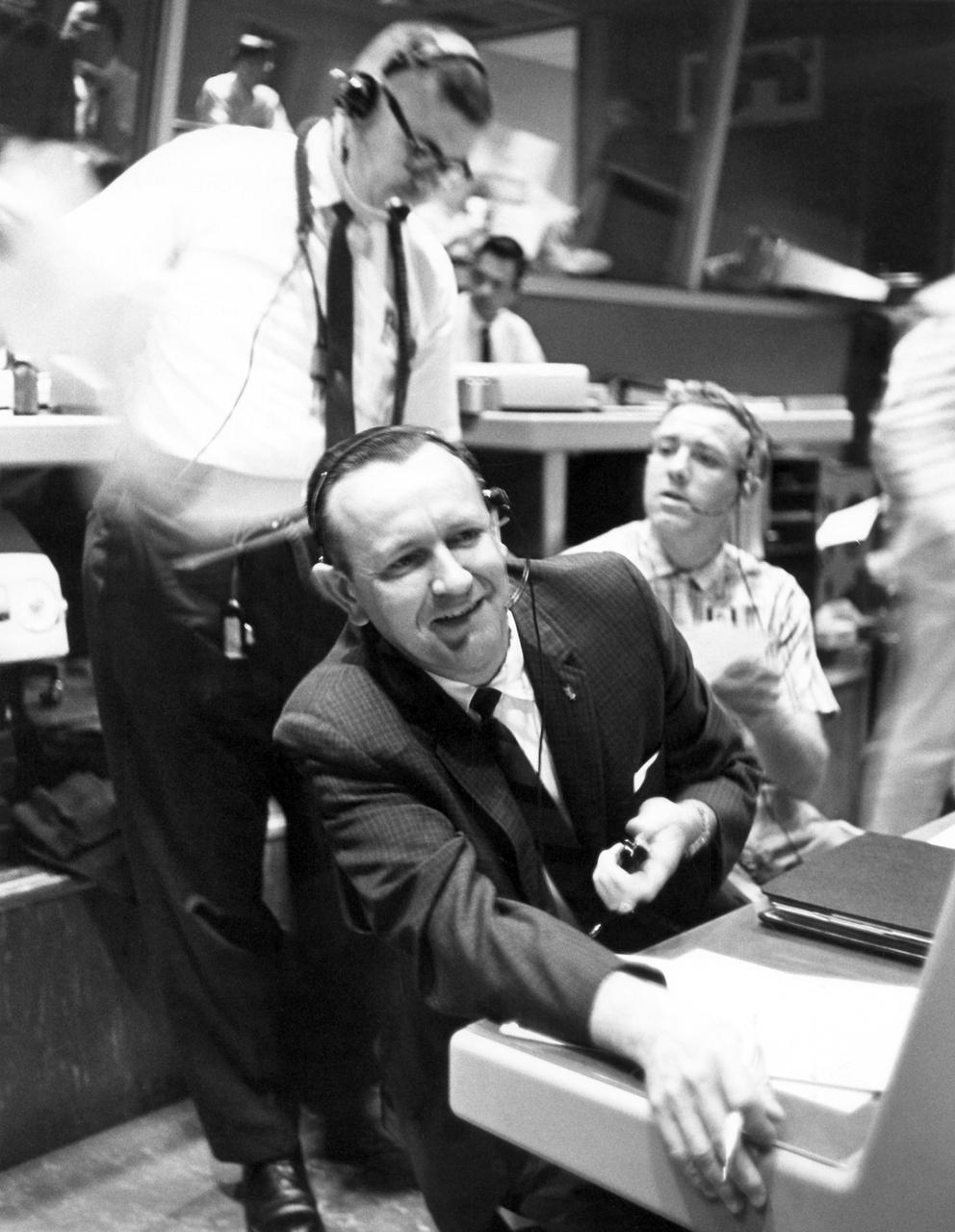
CAPE CANAVERAL, Fla. - Inside Mercury Mission Control, Christopher Kraft, Mercury's flight director, sits at his console during preparations for astronaut Gordon Cooper's Faith 7 launch, which took place on May 15, 1963.     The Mercury Mission Control Center in Florida played a key role in the United States' early spaceflight program. Located at Cape Canaveral Air Force Station, the original part of the building was constructed between 1956 and 1958, with additions in 1959 and 1963. The facility officially was transferred to NASA on Dec. 26, 1963, and served as mission control during all the Project Mercury missions, as well as the first three flights of the Gemini Program, when it was renamed Mission Control Center. With its operational days behind, on June 1, 1967, the Mission Control Center became a stop on the public tour of NASA facilities until the mid-90s. In 1999, much of the equipment and furnishings from the Flight Control Area were moved to the Kennedy Space Center Visitor Complex where they became part of the exhibit there. The building was demolished in spring 2010. Photo credit: NASA
KSC-63-MA9-101
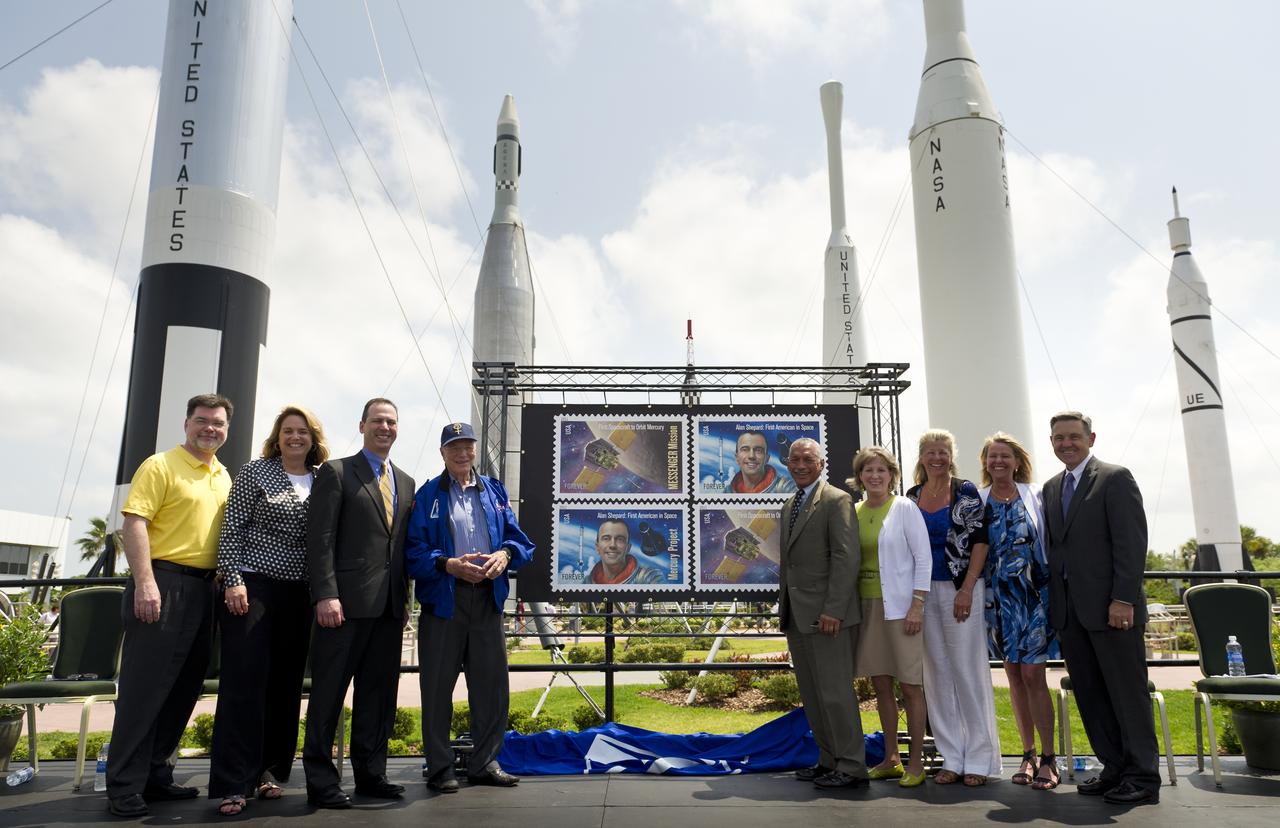
From left, NASA Deputy Director, Planetary Science Division, Science Mission Directorate, Jim Adams, NASA Kennedy Space Center Director of Education and External Relations Cheryl Hurst, United States Postal Service Vice President of Finance Steve Masse, NASA Mercury Astronaut Scott Carpenter, NASA Administrator Charles Boldin, Daughters of NASA astronaut Alan Shepard, Alice Wackermann, Laura Shepard Churchley, and Julie Jenkins, and NASA Kennedy Space Center Director Robert Cabana pose for a photograph during an unveiling ceremony of two USPS stamps that commemorate and celebrate 50 years of US Spaceflight and the MESSENGER program during an event, Wednesday, May 4, 2011 at the NASA Kennedy Space Center in Cape Canaveral, Fla.  One stamp commemorates NASA’s Project Mercury, America’s first manned spaceflight program, and NASA astronaut Alan Shepard’s historic flight on May 5, 1961, aboard spacecraft Freedom 7.  The other stamp draws attention to NASA’s unmanned MESSENGER mission, a scientific investigation of the planet Mercury. On March 17, 2011, MESSENGER became the first spacecraft to enter into orbit around Mercury. Photo Credit: (NASA/Bill Ingalls)
Mercury MESSENGER Stamp Unveiling
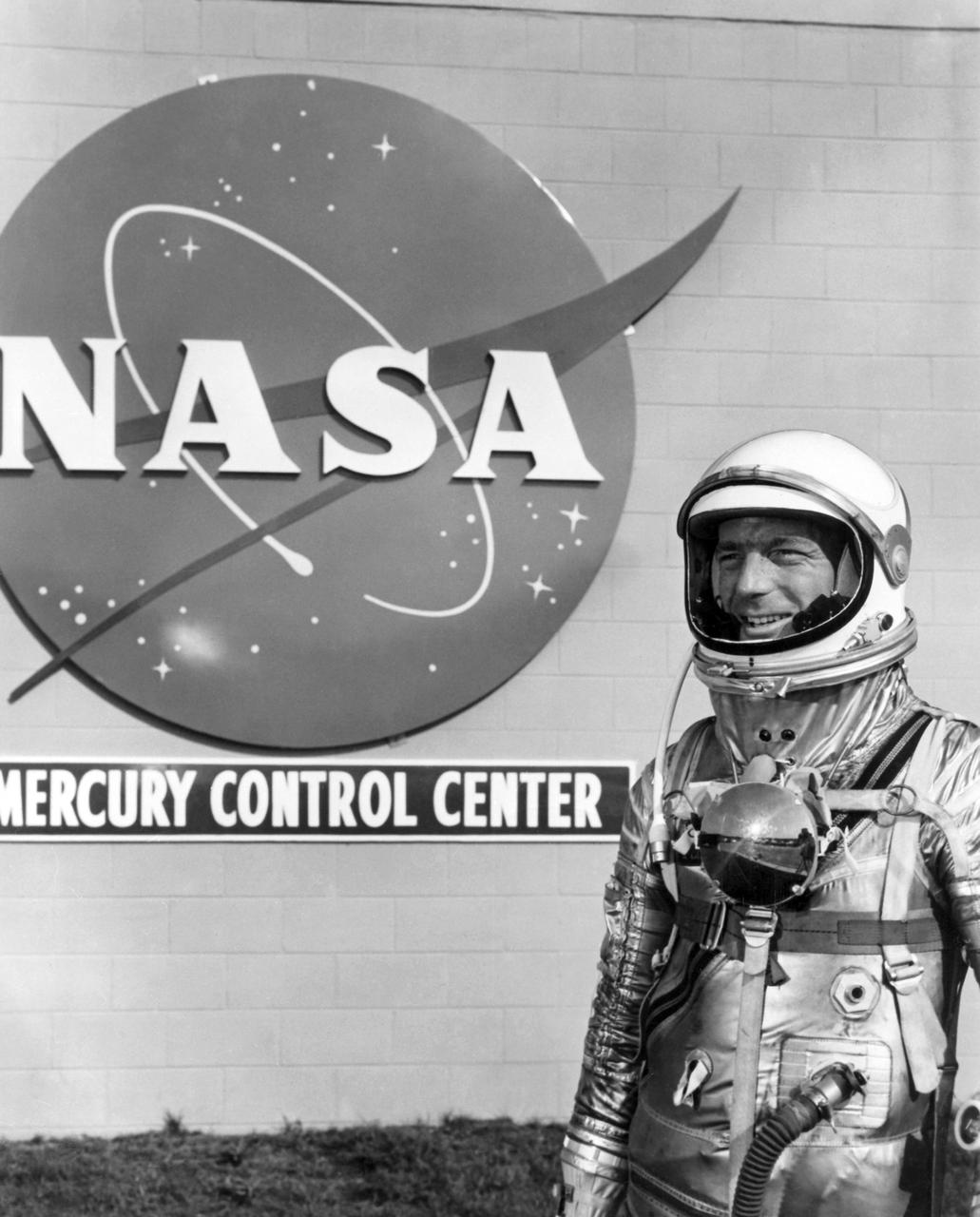
CAPE CANAVERAL, Fla. - Mercury astronaut Scott Carpenter stands in front of the Mercury Control Center. Carpenter flew the Aurora 7 mission, launched on May 24, 1962.     The Mercury Mission Control Center in Florida played a key role in the United States' early spaceflight program. Located at Cape Canaveral Air Force Station, the original part of the building was constructed between 1956 and 1958, with additions in 1959 and 1963. The facility officially was transferred to NASA on Dec. 26, 1963, and served as mission control during all the Project Mercury missions, as well as the first three flights of the Gemini Program, when it was renamed Mission Control Center. With its operational days behind, on June 1, 1967, the Mission Control Center became a stop on the public tour of NASA facilities until the mid-90s. In 1999, much of the equipment and furnishings from the Flight Control Area were moved to the Kennedy Space Center Visitor Complex where they became part of the exhibit there. The building was demolished in spring 2010. Photo credit: NASA
KSC-62-MA7-55
CAPE CANAVERAL, Fla. - Inside Mercury Mission Control, astronaut Wally Schirra, capsule communicator, or capcom for the Mercury-Atlas 9 mission, talks to Trudy Cooper, wife of astronaut Gordon Cooper, on May 16, 1963, to inform her that he had just been recovered by the USS Kearsarge after his 22-orbit flight.     The Mercury Mission Control Center in Florida played a key role in the United States' early spaceflight program. Located at Cape Canaveral Air Force Station, the original part of the building was constructed between 1956 and 1958, with additions in 1959 and 1963. The facility officially was transferred to NASA on Dec. 26, 1963, and served as mission control during all the Project Mercury missions, as well as the first three flights of the Gemini Program, when it was renamed Mission Control Center. With its operational days behind, on June 1, 1967, the Mission Control Center became a stop on the public tour of NASA facilities until the mid-90s. In 1999, much of the equipment and furnishings from the Flight Control Area were moved to the Kennedy Space Center Visitor Complex where they became part of the exhibit there. The building was demolished in spring 2010. Photo credit: NASA
KSC-63-MA9-158
CAPE CANAVERAL, Fla. - Inside Mercury Mission Control, astronaut Deke Slayton left discusses a point with Christopher Kraft, Mercury's flight director, during preparations for astronaut Gordon Cooper's Faith 7 launch, which took place on May 15, 1963.     The Mercury Mission Control Center in Florida played a key role in the United States' early spaceflight program. Located at Cape Canaveral Air Force Station, the original part of the building was constructed between 1956 and 1958, with additions in 1959 and 1963. The facility officially was transferred to NASA on Dec. 26, 1963, and served as mission control during all the Project Mercury missions, as well as the first three flights of the Gemini Program, when it was renamed Mission Control Center. With its operational days behind, on June 1, 1967, the Mission Control Center became a stop on the public tour of NASA facilities until the mid-90s. In 1999, much of the equipment and furnishings from the Flight Control Area were moved to the Kennedy Space Center Visitor Complex where they became part of the exhibit there. The building was demolished in spring 2010. Photo credit: NASA
KSC-63-MA9-100
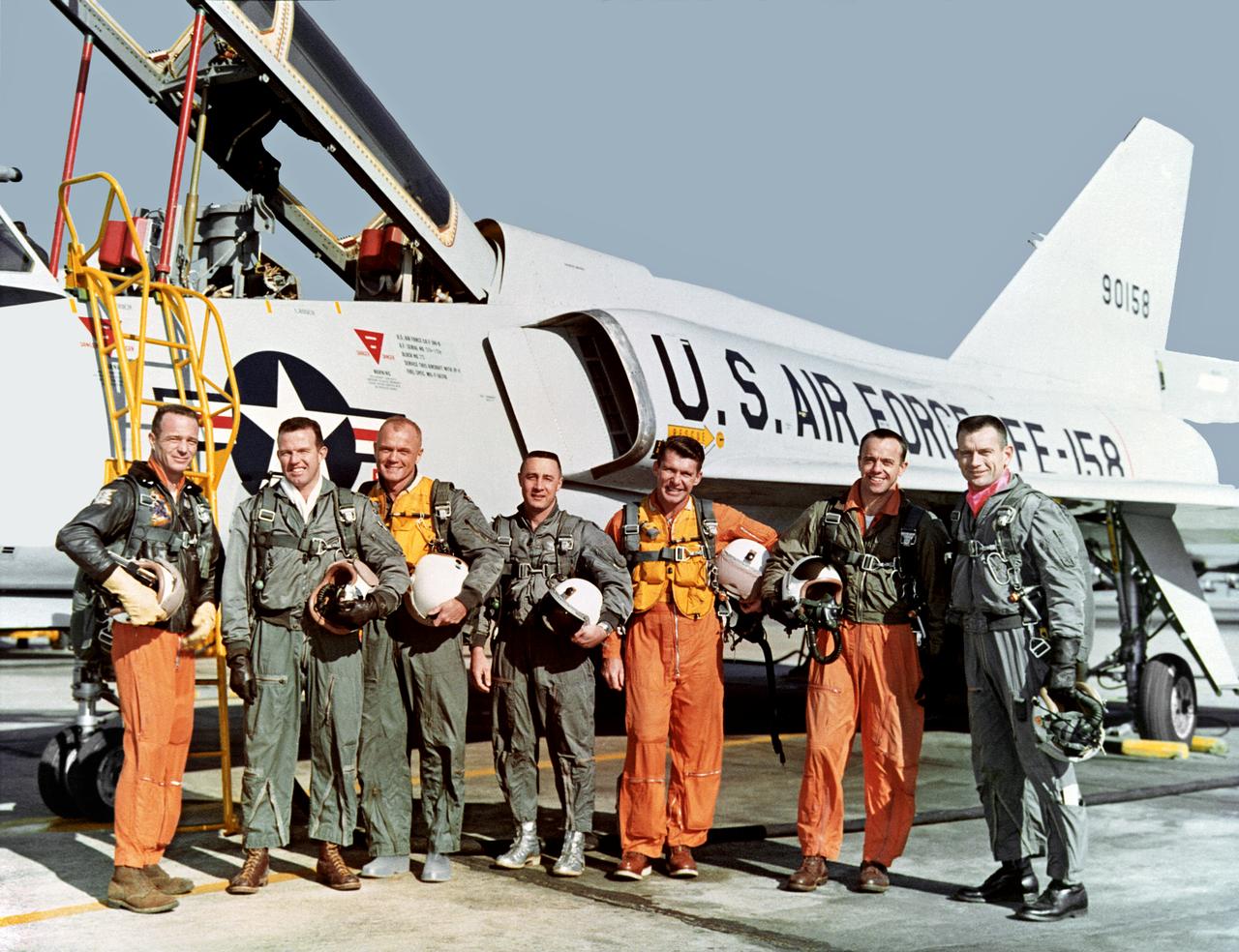
The original seven Mercury astronauts during training at NASA Langley Research Center Project Mercury. The original seven astronauts trained at NASA Langley Research Center. Chosen from among hundreds of applicants, the seven men were all test pilots. Standing in front of the U.S. Air Force Convair F-106B aircraft, the astronauts are, from left, Lt. M. Scott Carpenter, Capt. Gordon Cooper, Col. John H. Glenn Jr., Capt. Virgil "Gus" Grissom, Lt. Comdr. Walter Schirra, Lt. Comdr. Alan B. Shepard Jr. and Capt. Donald K. "Deke" Slayton. While familiarizing the astronauts with the Mercury set-up, Langley employees helped them to specialize in the technical areas crucial to the overall success of Project Mercury. Langley people also guided and monitored the astronauts activities through the many spaceflight simulators and other training devices built at the Center expressly for the manned space program. In less than three years, Project Mercury proved that men could be sent into space and returned safely to Earth, setting the stage for the longer duration Gemini flights and the Apollo lunar landings. This photograph was originally taken on 01/20/1961 and is published in Spaceflight Revolution NASA Langley Research Center from Sputnik to Apollo, NASA SP-4308, by James R. Hansen, 1995, page 40.
Original 7 astronauts in front of the Convair F-106 B aircraft
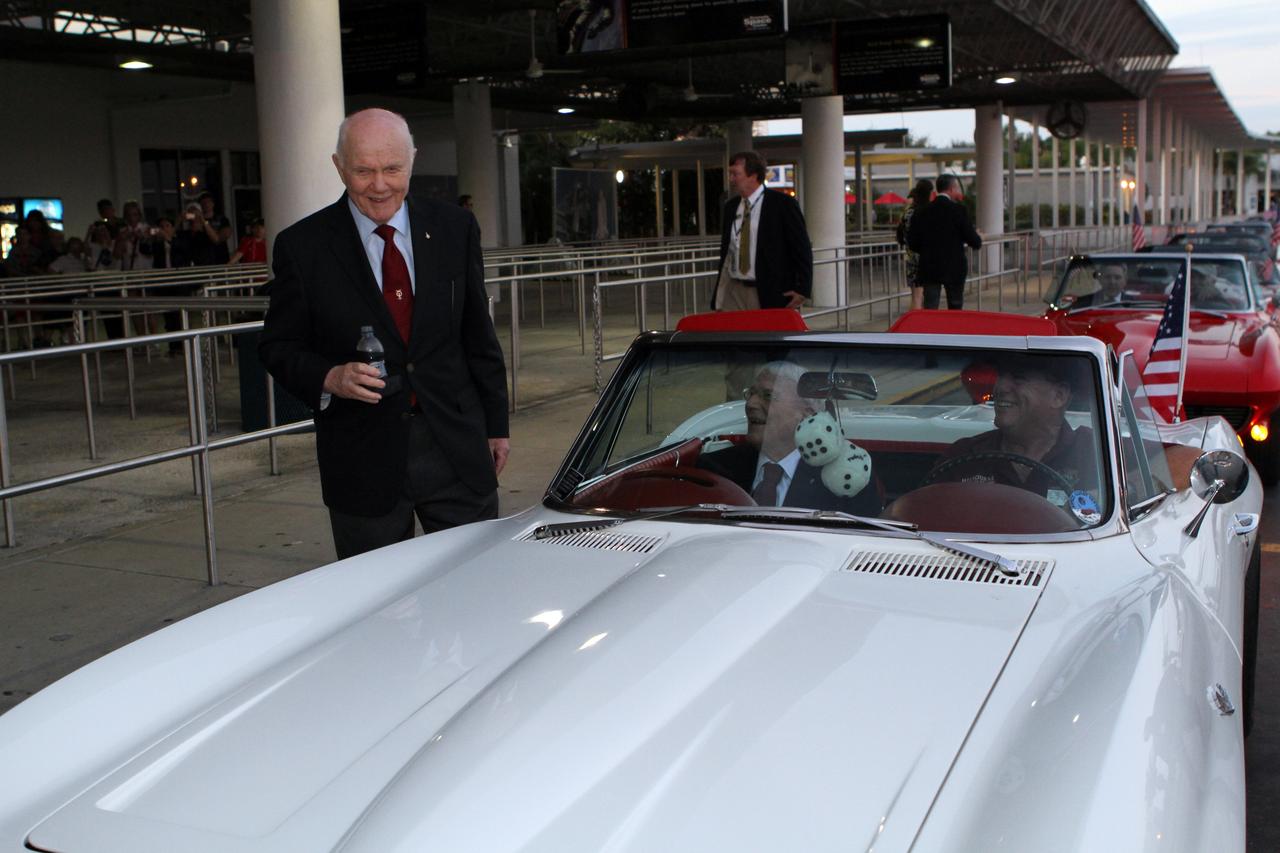
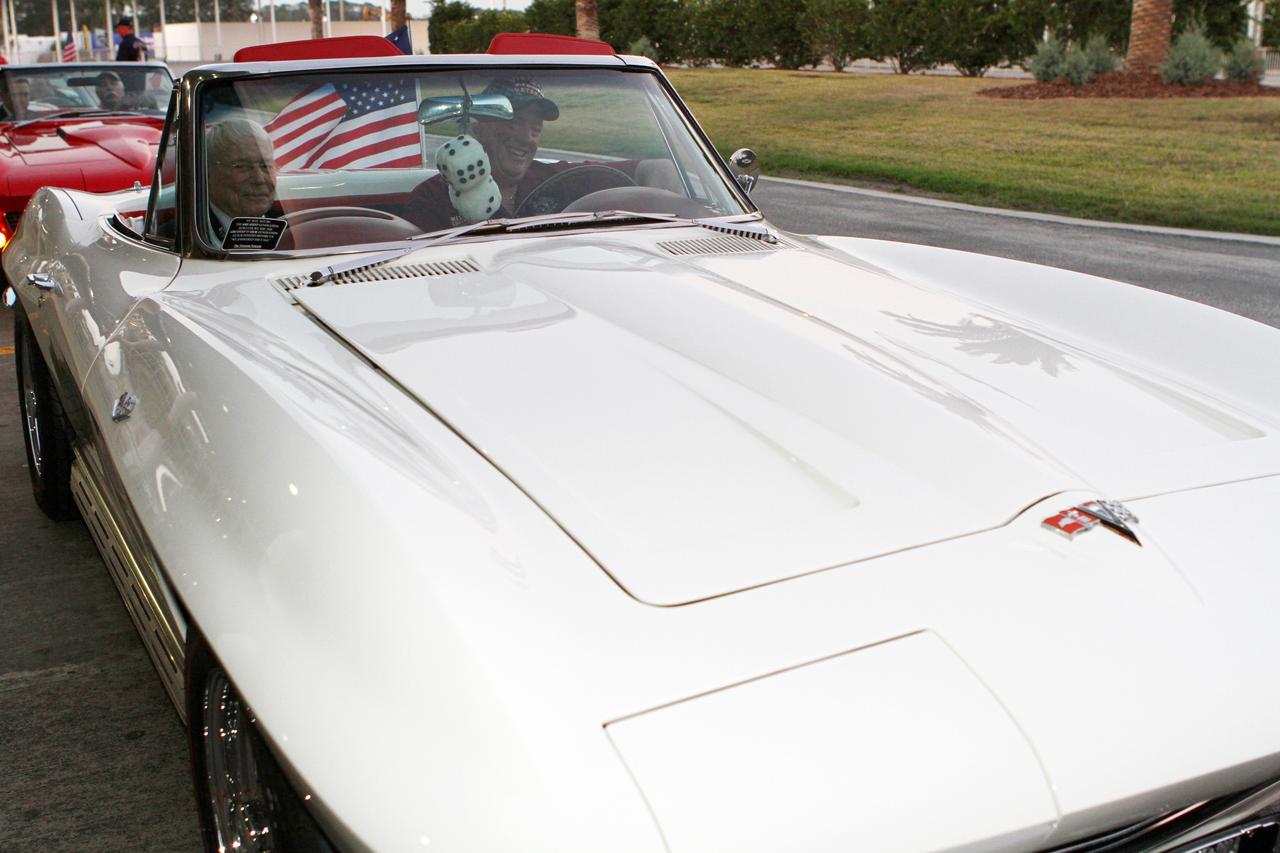
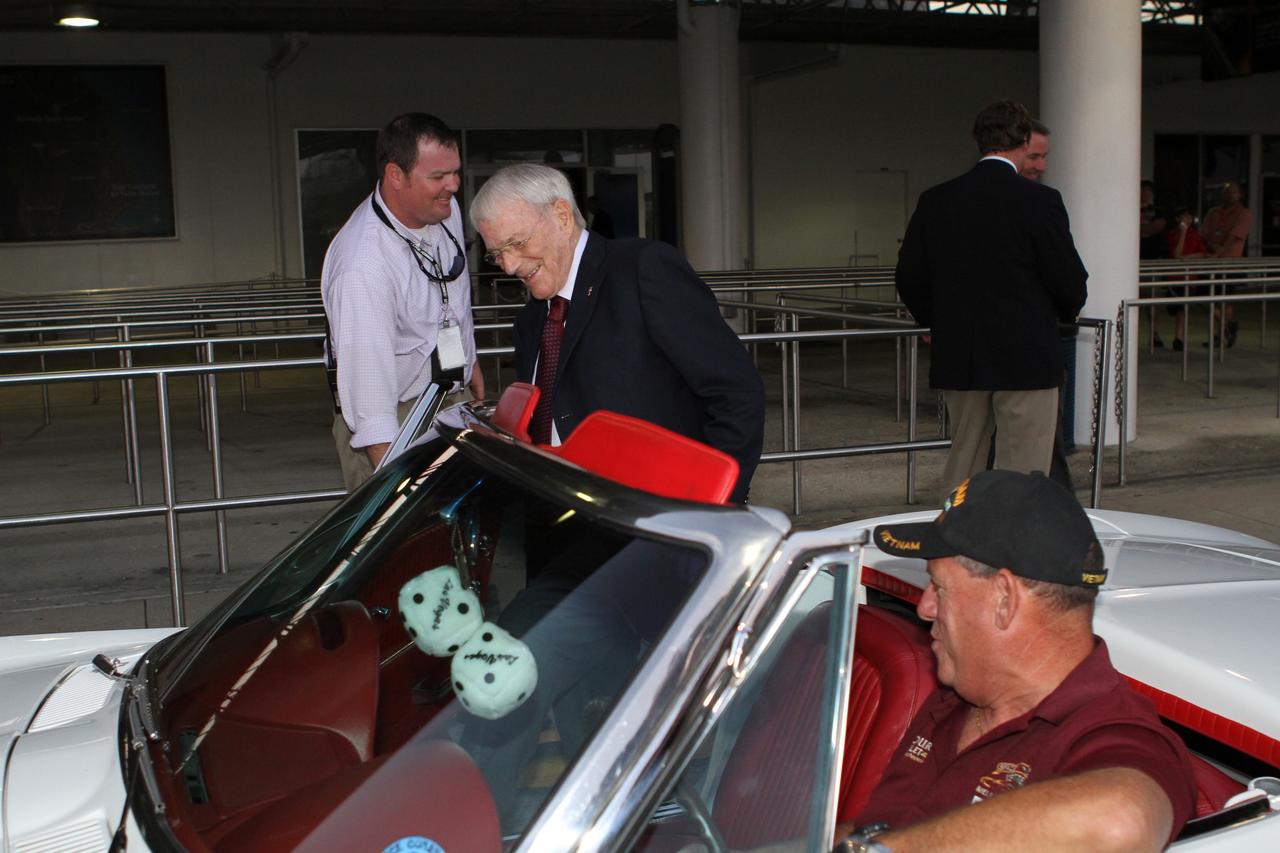
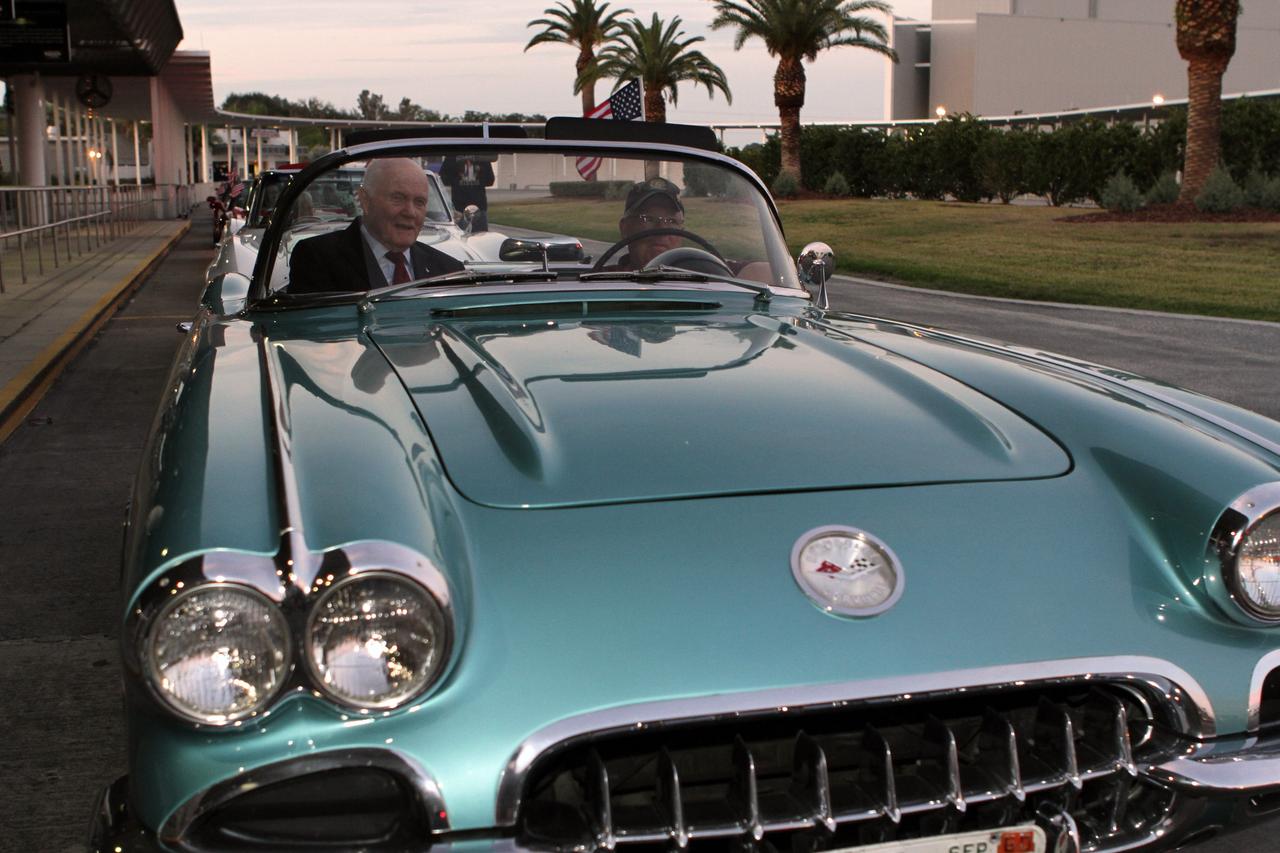
CAPE CANAVERAL, Fla. -- Mercury astronaut John Glenn, left, talks with fellow Mercury astronaut Scott Carpenter before they ride in the Corvette parade following the "On Shoulders of Giants" program celebrating 50 years of Americans in orbit, an era which began with Glenn's MA-6 mission on Feb. 20, 1962. The event was conducted in the Rocket Garden at the Kennedy Space Center Visitor Complex in Florida a few miles from the launch pad where Glenn and Carpenter took flight in Mercury spacecraft.  Glenn's launch aboard an Atlas rocket took with it the hopes of an entire nation and ushered in a new era of space travel that eventually led to Americans walking on the moon by the end of the 1960s. Glenn soon was followed into orbit by Scott Carpenter, Walter Schirra and Gordon Cooper. Their fellow Mercury astronauts Alan Shepard and Virgil "Gus" Grissom flew earlier suborbital flights. Deke Slayton, a member of NASA's original Mercury 7 astronauts, was grounded by a medical condition until the Apollo-Soyuz Test Project in 1975. Photo credit: Kim Shiflett
KSC-2012-1501
S64-14883 (1962) --- Astronaut John H. Glenn Jr., pilot of the Mercury-Atlas 6 mission, participates in a strict physical training program, as he exemplifies by frequent running. Here he pauses during an exercise period on the beach near Cape Canaveral, Florida. Photo credit: NASA
Astronaut John Glenn running as part of physical training program
CAPE CANAVERAL, Fla. --A crowd looks on during the "On Shoulders of Giants" program celebrating 50 years of Americans in orbit, an era which began with John Glenn's MA-6 mission on Feb. 20, 1962. The event was conducted in the Rocket Garden at the Kennedy Space Center Visitor Complex in Florida a few miles from the launch pad where Glenn and Scott Carpenter took flight in Mercury spacecraft.  Glenn's launch aboard an Atlas rocket took with it the hopes of an entire nation and ushered in a new era of space travel that eventually led to Americans walking on the moon by the end of the 1960s. Glenn soon was followed into orbit by Scott Carpenter, Walter Schirra and Gordon Cooper. Their fellow Mercury astronauts Alan Shepard and Virgil "Gus" Grissom flew earlier suborbital flights. Deke Slayton, a member of NASA's original Mercury 7 astronauts, was grounded by a medical condition until the Apollo-Soyuz Test Project in 1975. Photo credit: Kim Shiflett
KSC-2012-1509
CAPE CANAVERAL, Fla. -- A crowd looks on during the "On Shoulders of Giants" program celebrating 50 years of Americans in orbit, an era which began with John Glenn's MA-6 mission on Feb. 20, 1962. The event was conducted in the Rocket Garden at the Kennedy Space Center Visitor Complex in Florida a few miles from the launch pad where Glenn and Scott Carpenter took flight in Mercury spacecraft.  Glenn's launch aboard an Atlas rocket took with it the hopes of an entire nation and ushered in a new era of space travel that eventually led to Americans walking on the moon by the end of the 1960s. Glenn soon was followed into orbit by Scott Carpenter, Walter Schirra and Gordon Cooper. Their fellow Mercury astronauts Alan Shepard and Virgil "Gus" Grissom flew earlier suborbital flights. Deke Slayton, a member of NASA's original Mercury 7 astronauts, was grounded by a medical condition until the Apollo-Soyuz Test Project in 1975. Photo credit: Kim Shiflett
KSC-2012-1508
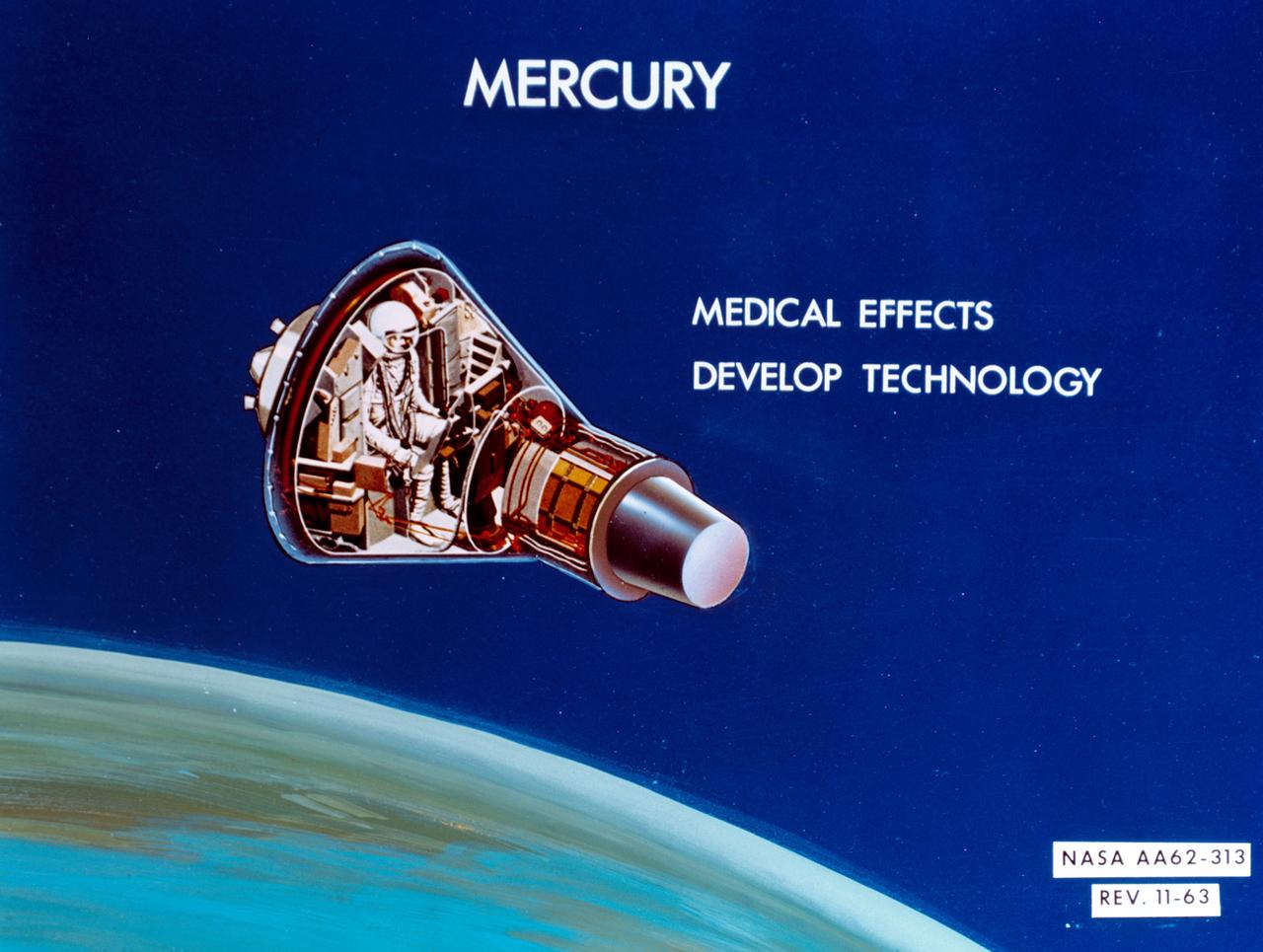
S64-14286 (11 Feb. 1964) --- An artist's concept of Mercury: Medical effects; develop technology. Photo credit: NASA
Artist concept of Mercury program study of medical effects & technology
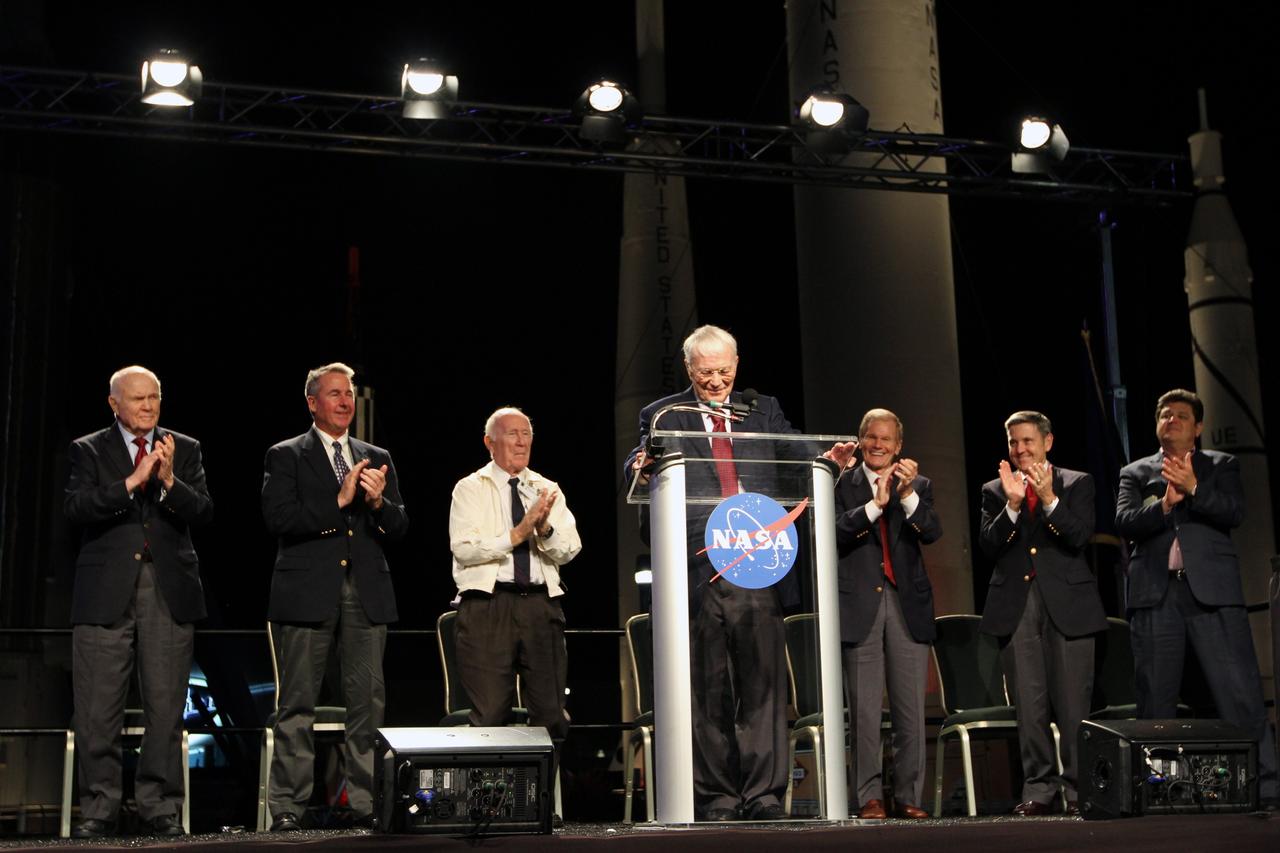
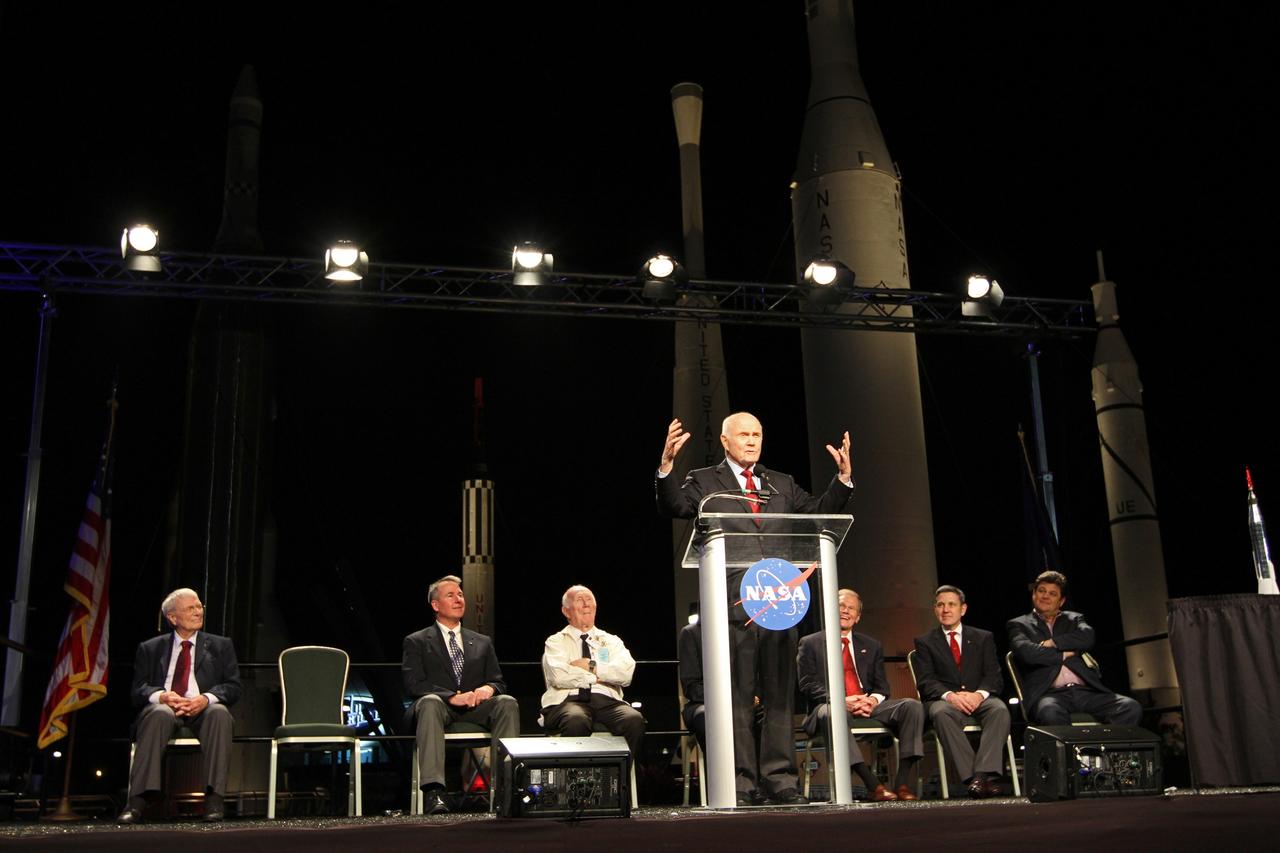
CAPE CANAVERAL, Fla. -- Mercury astronaut John Glenn speaks during the "On Shoulders of Giants" program celebrating 50 years of Americans in orbit, an era which began with Glenn's MA-6 mission on Feb. 20, 1962. The event was conducted in the Rocket Garden at the Kennedy Space Center Visitor Complex in Florida a few miles from the launch pad where Glenn and Scott Carpenter took flight in Mercury spacecraft.  Glenn's launch aboard an Atlas rocket took with it the hopes of an entire nation and ushered in a new era of space travel that eventually led to Americans walking on the moon by the end of the 1960s. Glenn soon was followed into orbit by Scott Carpenter, Walter Schirra and Gordon Cooper. Their fellow Mercury astronauts Alan Shepard and Virgil "Gus" Grissom flew earlier suborbital flights. Deke Slayton, a member of NASA's original Mercury 7 astronauts, was grounded by a medical condition until the Apollo-Soyuz Test Project in 1975. Photo credit: Kim Shiflett
KSC-2012-1511
CAPE CANAVERAL, Fla. -- Mercury astronaut John Glenn speaks during the "On Shoulders of Giants" program celebrating 50 years of Americans in orbit, an era which began with Glenn's MA-6 mission on Feb. 20, 1962. The event was conducted in the Rocket Garden at the Kennedy Space Center Visitor Complex in Florida a few miles from the launch pad where Glenn and Scott Carpenter took flight in Mercury spacecraft.  Glenn's launch aboard an Atlas rocket took with it the hopes of an entire nation and ushered in a new era of space travel that eventually led to Americans walking on the moon by the end of the 1960s. Glenn soon was followed into orbit by Scott Carpenter, Walter Schirra and Gordon Cooper. Their fellow Mercury astronauts Alan Shepard and Virgil "Gus" Grissom flew earlier suborbital flights. Deke Slayton, a member of NASA's original Mercury 7 astronauts, was grounded by a medical condition until the Apollo-Soyuz Test Project in 1975. Photo credit: Kim Shiflett
KSC-2012-1490
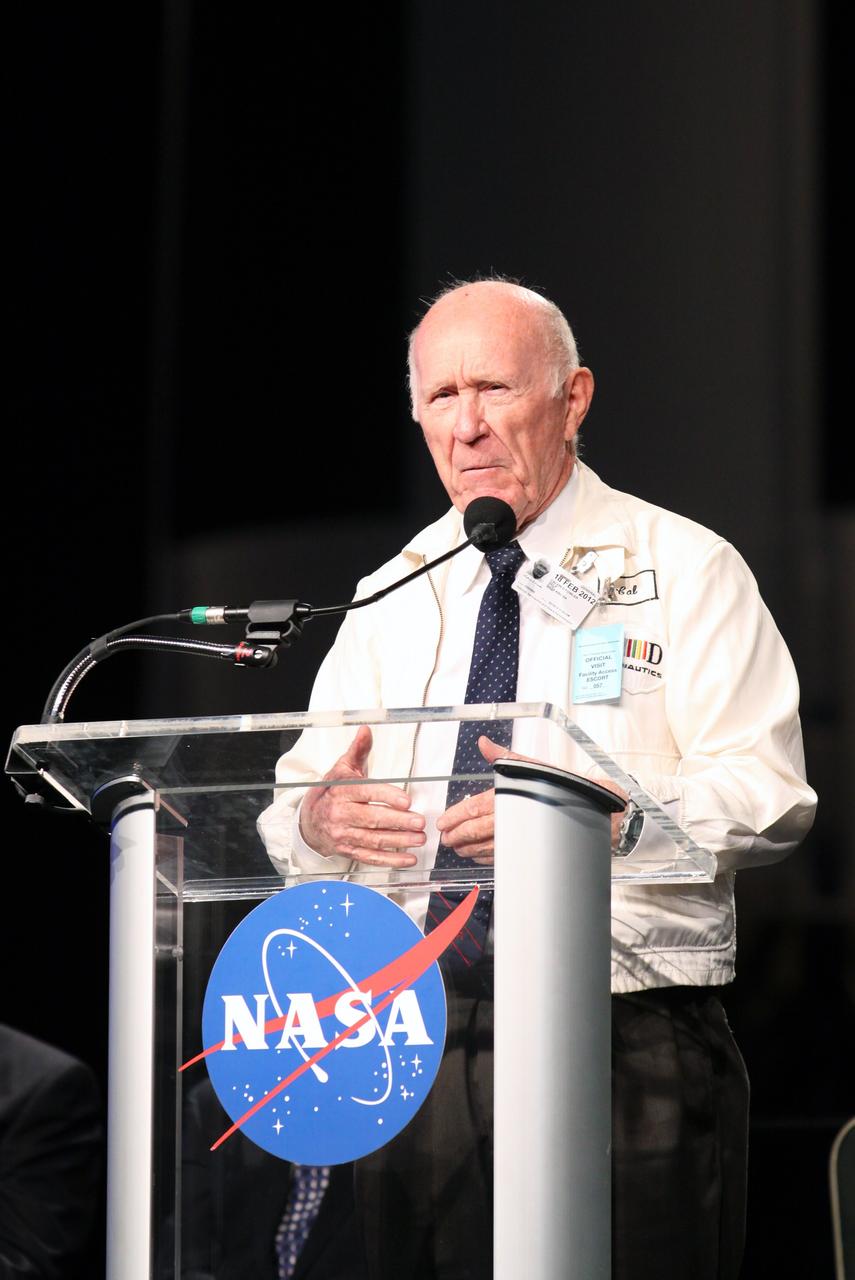
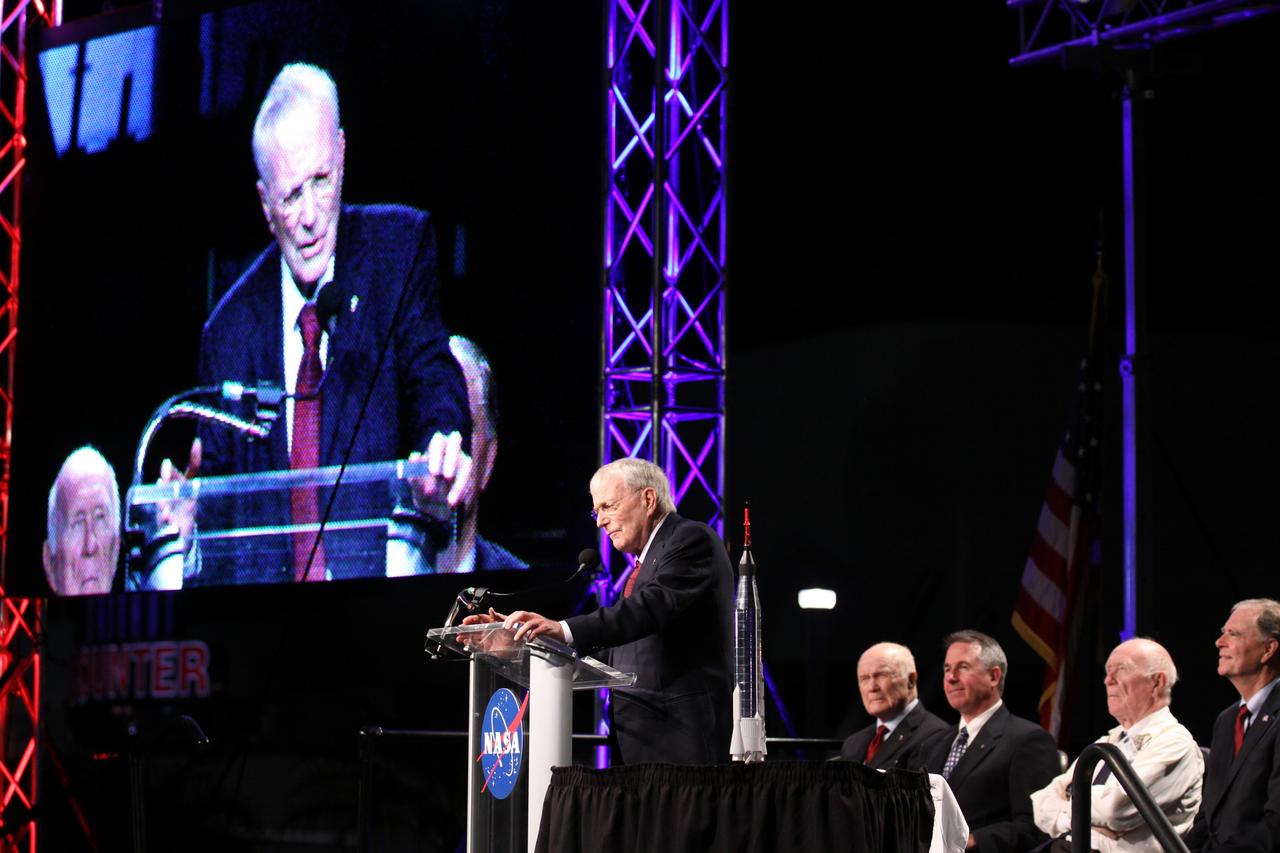
CAPE CANAVERAL, Fla. -- Mercury astronaut Scott Carpenter speaks during the "On Shoulders of Giants" program celebrating 50 years of Americans in orbit, an era which began with John Glenn's MA-6 mission on Feb. 20, 1962. The event was conducted in the Rocket Garden at the Kennedy Space Center Visitor Complex in Florida a few miles from the launch pad where Glenn and Scott Carpenter took flight in Mercury spacecraft.  Glenn's launch aboard an Atlas rocket took with it the hopes of an entire nation and ushered in a new era of space travel that eventually led to Americans walking on the moon by the end of the 1960s. Glenn soon was followed into orbit by Scott Carpenter, Walter Schirra and Gordon Cooper. Their fellow Mercury astronauts Alan Shepard and Virgil "Gus" Grissom flew earlier suborbital flights. Deke Slayton, a member of NASA's original Mercury 7 astronauts, was grounded by a medical condition until the Apollo-Soyuz Test Project in 1975. Photo credit: Kim Shiflett
KSC-2012-1496
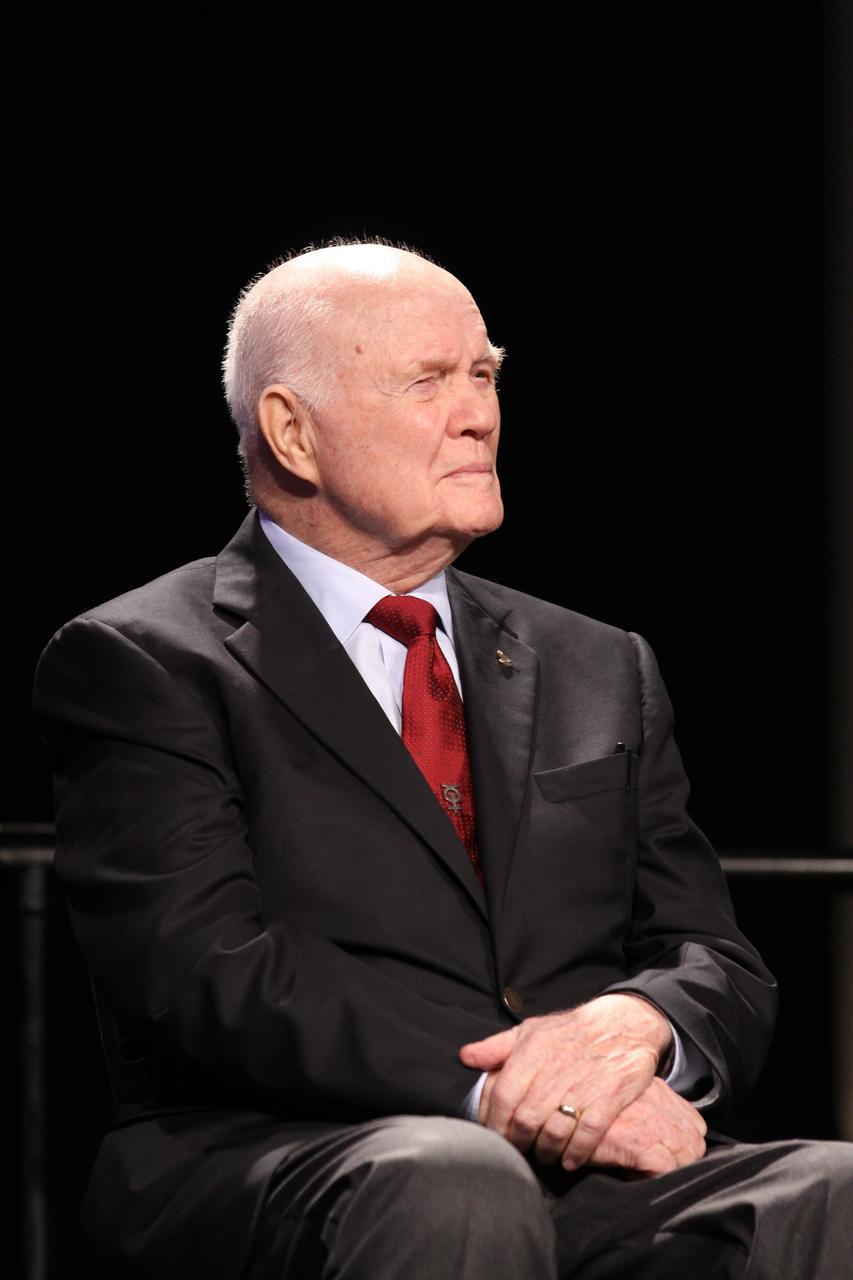
CAPE CANAVERAL, Fla. --Mercury astronaut John Glenn listens to remarks during the "On Shoulders of Giants" program celebrating 50 years of Americans in orbit, an era which began with Glenn's MA-6 mission on Feb. 20, 1962. The event was conducted in the Rocket Garden at the Kennedy Space Center Visitor Complex in Florida a few miles from the launch pad where Glenn and Scott Carpenter took flight in Mercury spacecraft.  Glenn's launch aboard an Atlas rocket took with it the hopes of an entire nation and ushered in a new era of space travel that eventually led to Americans walking on the moon by the end of the 1960s. Glenn soon was followed into orbit by Scott Carpenter, Walter Schirra and Gordon Cooper. Their fellow Mercury astronauts Alan Shepard and Virgil "Gus" Grissom flew earlier suborbital flights. Deke Slayton, a member of NASA's original Mercury 7 astronauts, was grounded by a medical condition until the Apollo-Soyuz Test Project in 1975. Photo credit: Kim Shiflett
KSC-2012-1482
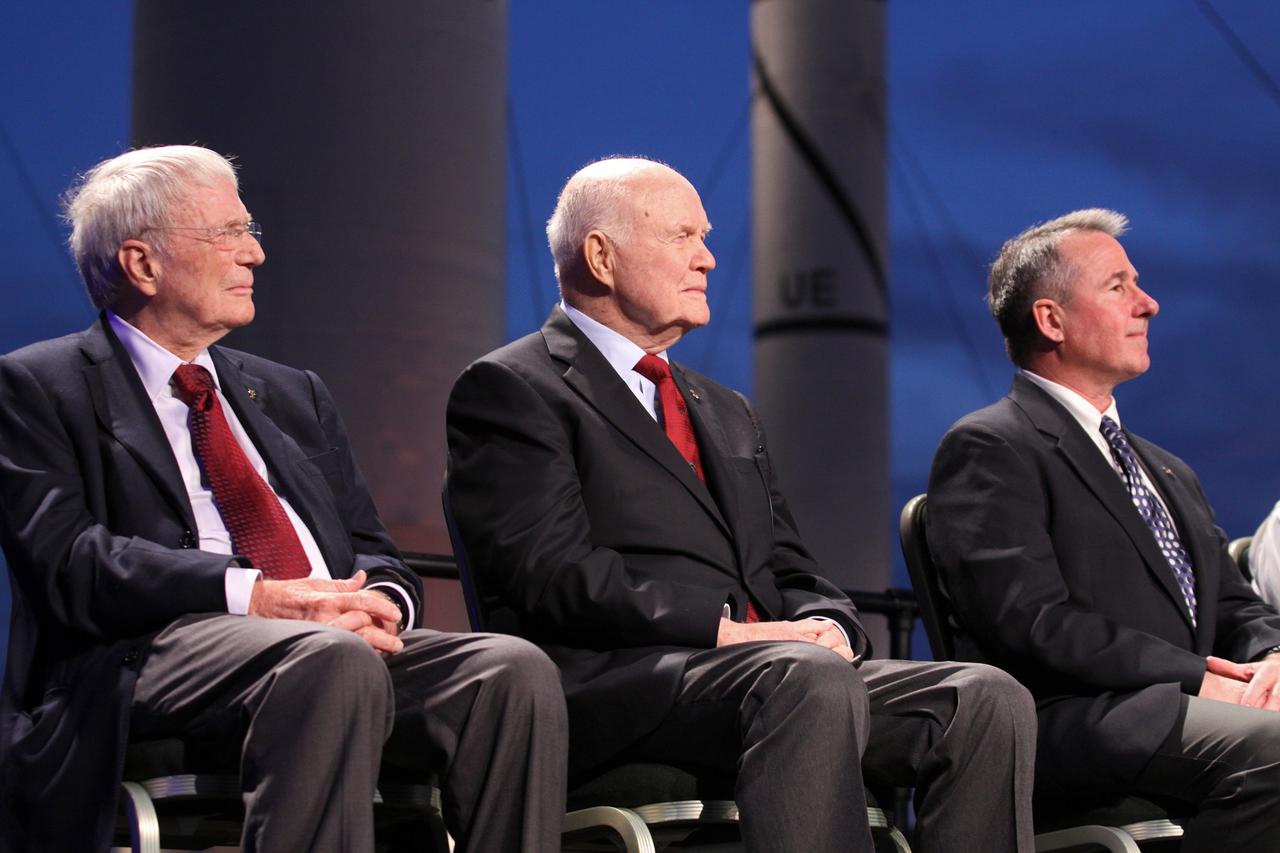
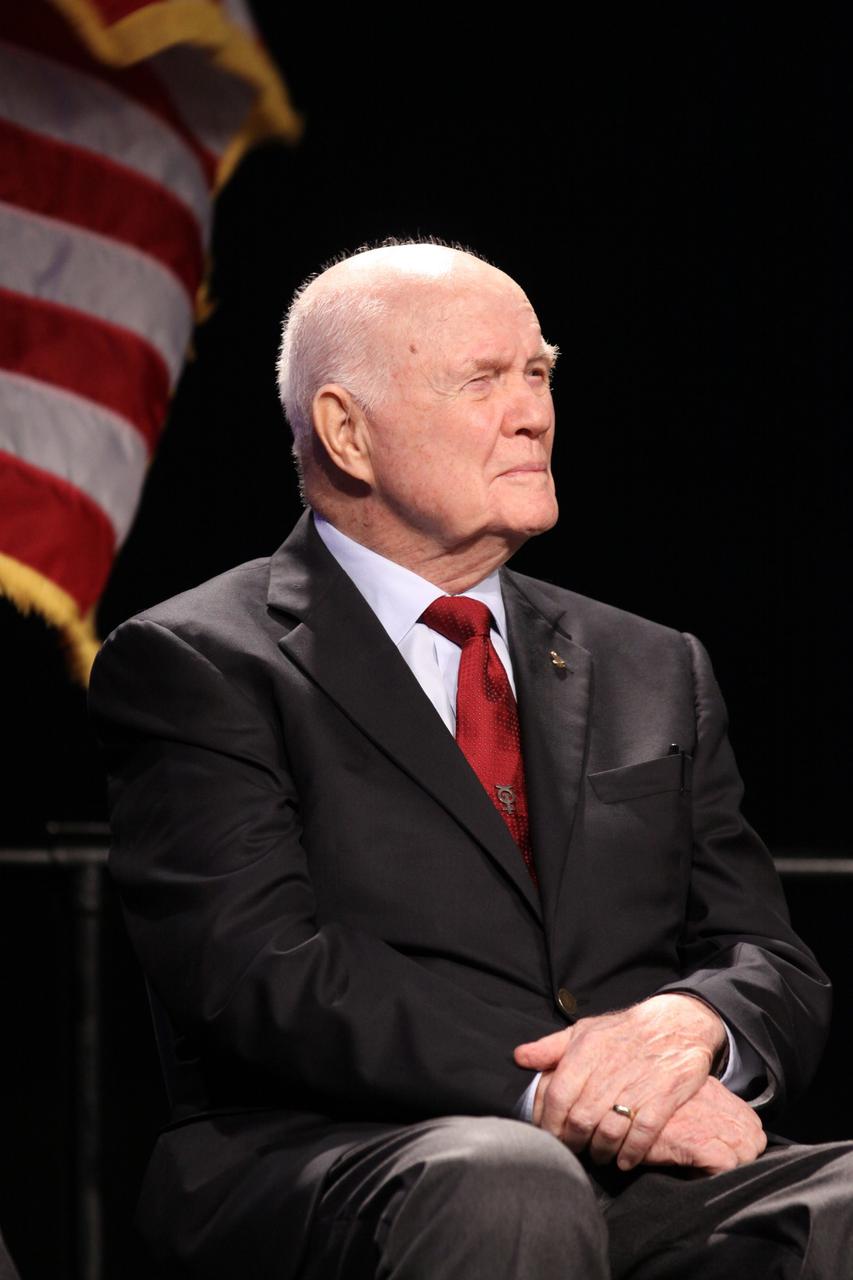
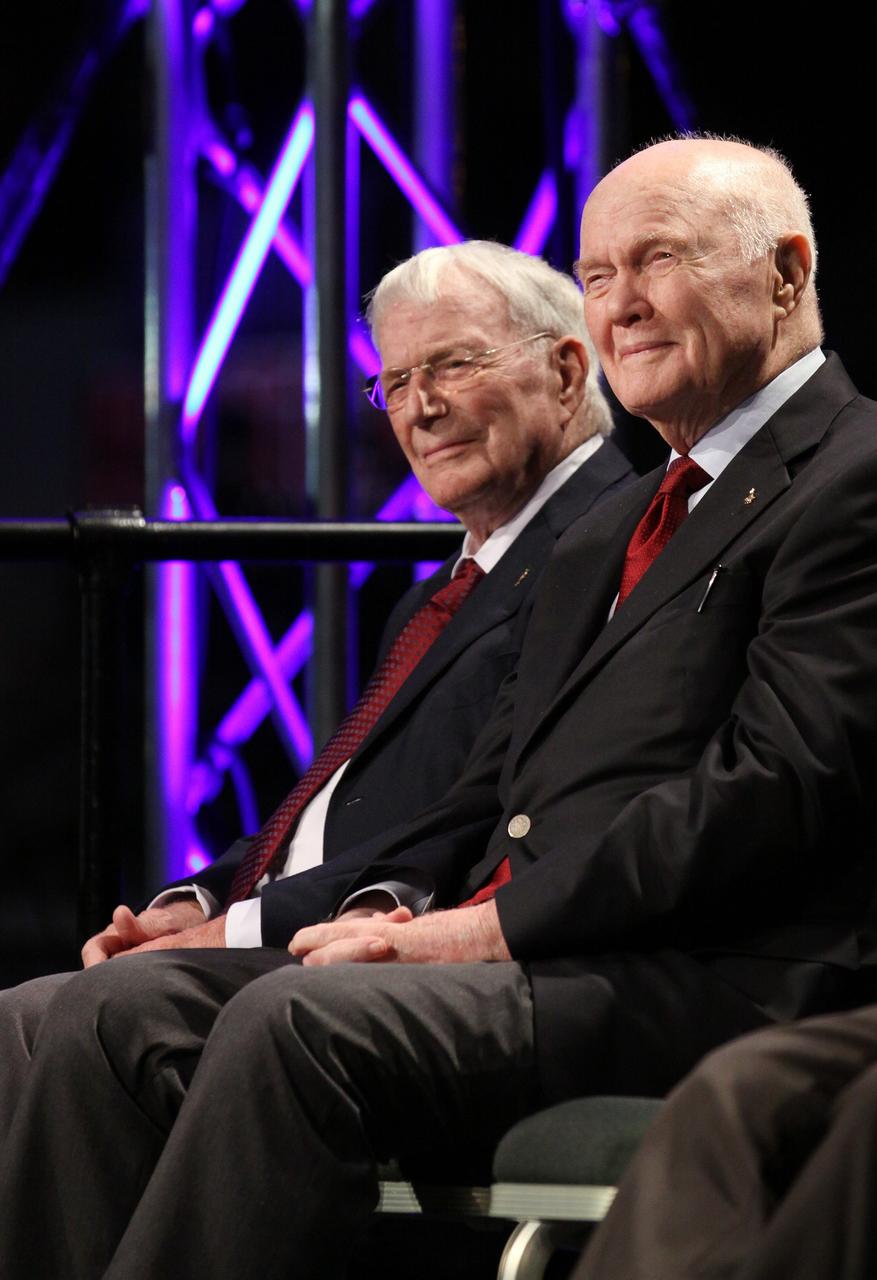
CAPE CANAVERAL, Fla. -- Mercury astronauts Scott Carpenter, left, and John Glenn listen to remarks during the "On Shoulders of Giants" program celebrating 50 years of Americans in orbit, an era which began with Glenn's MA-6 mission on Feb. 20, 1962. The event was conducted in the Rocket Garden at the Kennedy Space Center Visitor Complex in Florida a few miles from the launch pad where Glenn and Carpenter took flight in Mercury spacecraft.  Glenn's launch aboard an Atlas rocket took with it the hopes of an entire nation and ushered in a new era of space travel that eventually led to Americans walking on the moon by the end of the 1960s. Glenn soon was followed into orbit by Carpenter, Walter Schirra and Gordon Cooper. Their fellow Mercury astronauts Alan Shepard and Virgil "Gus" Grissom flew earlier suborbital flights. Deke Slayton, a member of NASA's original Mercury 7 astronauts, was grounded by a medical condition until the Apollo-Soyuz Test Project in 1975. Photo credit: Kim Shiflett
KSC-2012-1488
CAPE CANAVERAL, Fla. -- Mercury astronauts Scott Carpenter, left, and John Glenn and astronaut Steve Robinson of STS-95 listen to remarks during the "On Shoulders of Giants" program celebrating 50 years of Americans in orbit, an era which began with Glenn's MA-6 mission on Feb. 20, 1962. The event was conducted in the Rocket Garden at the Kennedy Space Center Visitor Complex in Florida a few miles from the launch pad where Glenn and Carpenter took flight in Mercury spacecraft.  Glenn's launch aboard an Atlas rocket took with it the hopes of an entire nation and ushered in a new era of space travel that eventually led to Americans walking on the moon by the end of the 1960s. Glenn soon was followed into orbit by Carpenter, Walter Schirra and Gordon Cooper. Their fellow Mercury astronauts Alan Shepard and Virgil "Gus" Grissom flew earlier suborbital flights. Deke Slayton, a member of NASA's original Mercury 7 astronauts, was grounded by a medical condition until the Apollo-Soyuz Test Project in 1975. Photo credit: Kim Shiflett
KSC-2012-1478
CAPE CANAVERAL, Fla. -- Mercury astronauts Scott Carpenter, left, and John Glenn and astronaut Steve Robinson of STS-95 listen to remarks during the "On Shoulders of Giants" program celebrating 50 years of Americans in orbit, an era which began with Glenn's MA-6 mission on Feb. 20, 1962. The event was conducted in the Rocket Garden at the Kennedy Space Center Visitor Complex in Florida a few miles from the launch pad where Glenn and Carpenter took flight in Mercury spacecraft.  Glenn's launch aboard an Atlas rocket took with it the hopes of an entire nation and ushered in a new era of space travel that eventually led to Americans walking on the moon by the end of the 1960s. Glenn soon was followed into orbit by Carpenter, Walter Schirra and Gordon Cooper. Their fellow Mercury astronauts Alan Shepard and Virgil "Gus" Grissom flew earlier suborbital flights. Deke Slayton, a member of NASA's original Mercury 7 astronauts, was grounded by a medical condition until the Apollo-Soyuz Test Project in 1975. Photo credit: Kim Shiflett
KSC-2012-1489
CAPE CANAVERAL, Fla. -- Cal Fowler, Launch test director during Mercury, speaks during the "On Shoulders of Giants" program celebrating 50 years of Americans in orbit, an era which began with John Glenn's MA-6 mission on Feb. 20, 1962. The event was conducted in the Rocket Garden at the Kennedy Space Center Visitor Complex in Florida a few miles from the launch pad where Glenn and Scott Carpenter took flight in Mercury spacecraft.  Glenn's launch aboard an Atlas rocket took with it the hopes of an entire nation and ushered in a new era of space travel that eventually led to Americans walking on the moon by the end of the 1960s. Glenn soon was followed into orbit by Carpenter, Walter Schirra and Gordon Cooper. Their fellow Mercury astronauts Alan Shepard and Virgil "Gus" Grissom flew earlier suborbital flights. Deke Slayton, a member of NASA's original Mercury 7 astronauts, was grounded by a medical condition until the Apollo-Soyuz Test Project in 1975. Photo credit: Kim Shiflett
KSC-2012-1485
CAPE CANAVERAL, Fla. -- Mercury astronaut Scott Carpenter, center, prepares to ride in the Corvette parade following the "On Shoulders of Giants" program celebrating 50 years of Americans in orbit, an era which began with Glenn's MA-6 mission on Feb. 20, 1962. The event was conducted in the Rocket Garden at the Kennedy Space Center Visitor Complex in Florida a few miles from the launch pad where Glenn and Carpenter took flight in Mercury spacecraft.  Glenn's launch aboard an Atlas rocket took with it the hopes of an entire nation and ushered in a new era of space travel that eventually led to Americans walking on the moon by the end of the 1960s. Glenn soon was followed into orbit by Scott Carpenter, Walter Schirra and Gordon Cooper. Their fellow Mercury astronauts Alan Shepard and Virgil "Gus" Grissom flew earlier suborbital flights. Deke Slayton, a member of NASA's original Mercury 7 astronauts, was grounded by a medical condition until the Apollo-Soyuz Test Project in 1975. Photo credit: Kim Shiflett
KSC-2012-1500
CAPE CANAVERAL, Fla. -- Mercury astronaut John Glenn speaks during the "On Shoulders of Giants" program celebrating 50 years of Americans in orbit, an era which began with Glenn's MA-6 mission on Feb. 20, 1962. The event was conducted in the Rocket Garden at the Kennedy Space Center Visitor Complex in Florida a few miles from the launch pad where Glenn and Scott Carpenter took flight in Mercury spacecraft.  Glenn's launch aboard an Atlas rocket took with it the hopes of an entire nation and ushered in a new era of space travel that eventually led to Americans walking on the moon by the end of the 1960s. Glenn soon was followed into orbit by Scott Carpenter, Walter Schirra and Gordon Cooper. Their fellow Mercury astronauts Alan Shepard and Virgil "Gus" Grissom flew earlier suborbital flights. Deke Slayton, a member of NASA's original Mercury 7 astronauts, was grounded by a medical condition until the Apollo-Soyuz Test Project in 1975. Photo credit: Kim Shiflett
KSC-2012-1491
CAPE CANAVERAL, Fla. -- Mercury astronaut John Glenn, left, prepares to ride in the Corvette parade following the "On Shoulders of Giants" program celebrating 50 years of Americans in orbit, an era which began with Glenn's MA-6 mission on Feb. 20, 1962. The event was conducted in the Rocket Garden at the Kennedy Space Center Visitor Complex in Florida a few miles from the launch pad where Glenn and Scott Carpenter took flight in Mercury spacecraft.  Glenn's launch aboard an Atlas rocket took with it the hopes of an entire nation and ushered in a new era of space travel that eventually led to Americans walking on the moon by the end of the 1960s. Glenn soon was followed into orbit by Scott Carpenter, Walter Schirra and Gordon Cooper. Their fellow Mercury astronauts Alan Shepard and Virgil "Gus" Grissom flew earlier suborbital flights. Deke Slayton, a member of NASA's original Mercury 7 astronauts, was grounded by a medical condition until the Apollo-Soyuz Test Project in 1975. Photo credit: Kim Shiflett
KSC-2012-1502
CAPE CANAVERAL, Fla. -- Mercury astronaut Scott Carpenter listens to remarks during the "On Shoulders of Giants" program celebrating 50 years of Americans in orbit, an era which began with John Glenn's MA-6 mission on Feb. 20, 1962. The event was conducted in the Rocket Garden at the Kennedy Space Center Visitor Complex in Florida a few miles from the launch pad where Glenn and Scott Carpenter took flight in Mercury spacecraft.  Glenn's launch aboard an Atlas rocket took with it the hopes of an entire nation and ushered in a new era of space travel that eventually led to Americans walking on the moon by the end of the 1960s. Glenn soon was followed into orbit by Scott Carpenter, Walter Schirra and Gordon Cooper. Their fellow Mercury astronauts Alan Shepard and Virgil "Gus" Grissom flew earlier suborbital flights. Deke Slayton, a member of NASA's original Mercury 7 astronauts, was grounded by a medical condition until the Apollo-Soyuz Test Project in 1975. Photo credit: Kim Shiflett
KSC-2012-1483
CAPE CANAVERAL, Fla. --Mercury astronaut John Glenn speaks during the "On Shoulders of Giants" program celebrating 50 years of Americans in orbit, an era which began with Glenn's MA-6 mission on Feb. 20, 1962. The event was conducted in the Rocket Garden at the Kennedy Space Center Visitor Complex in Florida a few miles from the launch pad where Glenn and Scott Carpenter took flight in Mercury spacecraft.  Glenn's launch aboard an Atlas rocket took with it the hopes of an entire nation and ushered in a new era of space travel that eventually led to Americans walking on the moon by the end of the 1960s. Glenn soon was followed into orbit by Scott Carpenter, Walter Schirra and Gordon Cooper. Their fellow Mercury astronauts Alan Shepard and Virgil "Gus" Grissom flew earlier suborbital flights. Deke Slayton, a member of NASA's original Mercury 7 astronauts, was grounded by a medical condition until the Apollo-Soyuz Test Project in 1975. Photo credit: Cory Huston
KSC-2012-1492
CAPE CANAVERAL, Fla. --Mercury astronaut Scott Carpenter speaks during the "On Shoulders of Giants" program celebrating 50 years of Americans in orbit, an era which began with John Glenn's MA-6 mission on Feb. 20, 1962. The event was conducted in the Rocket Garden at the Kennedy Space Center Visitor Complex in Florida a few miles from the launch pad where Glenn and Scott Carpenter took flight in Mercury spacecraft.  Glenn's launch aboard an Atlas rocket took with it the hopes of an entire nation and ushered in a new era of space travel that eventually led to Americans walking on the moon by the end of the 1960s. Glenn soon was followed into orbit by Scott Carpenter, Walter Schirra and Gordon Cooper. Their fellow Mercury astronauts Alan Shepard and Virgil "Gus" Grissom flew earlier suborbital flights. Deke Slayton, a member of NASA's original Mercury 7 astronauts, was grounded by a medical condition until the Apollo-Soyuz Test Project in 1975. Photo credit: Kim Shiflett
KSC-2012-1494
CAPE CANAVERAL, Fla. --Mercury astronaut Scott Carpenter speaks during the "On Shoulders of Giants" program celebrating 50 years of Americans in orbit, an era which began with John Glenn's MA-6 mission on Feb. 20, 1962. The event was conducted in the Rocket Garden at the Kennedy Space Center Visitor Complex in Florida a few miles from the launch pad where Glenn and Scott Carpenter took flight in Mercury spacecraft.  Glenn's launch aboard an Atlas rocket took with it the hopes of an entire nation and ushered in a new era of space travel that eventually led to Americans walking on the moon by the end of the 1960s. Glenn soon was followed into orbit by Scott Carpenter, Walter Schirra and Gordon Cooper. Their fellow Mercury astronauts Alan Shepard and Virgil "Gus" Grissom flew earlier suborbital flights. Deke Slayton, a member of NASA's original Mercury 7 astronauts, was grounded by a medical condition until the Apollo-Soyuz Test Project in 1975. Photo credit: Kim Shiflett
KSC-2012-1495
CAPE CANAVERAL, Fla. -- Astronaut Steve Robinson of STS-95, left, Cal Fowler, Launch test director during Mercury, U.S. Rep. Bill Posey, U.S. Sen. Bill Nelson and Kennedy Space Center Director Bob Cabana listen to remarks during the "On Shoulders of Giants" program celebrating 50 years of Americans in orbit, an era which began with John Glenn's MA-6 mission on Feb. 20, 1962. The event was conducted in the Rocket Garden at the Kennedy Space Center Visitor Complex in Florida a few miles from the launch pad where Glenn and Scott Carpenter took flight in Mercury spacecraft.  Glenn's launch aboard an Atlas rocket took with it the hopes of an entire nation and ushered in a new era of space travel that eventually led to Americans walking on the moon by the end of the 1960s. Glenn soon was followed into orbit by Scott Carpenter, Walter Schirra and Gordon Cooper. Their fellow Mercury astronauts Alan Shepard and Virgil "Gus" Grissom flew earlier suborbital flights. Deke Slayton, a member of NASA's original Mercury 7 astronauts, was grounded by a medical condition until the Apollo-Soyuz Test Project in 1975. Photo credit: Kim Shiflett
KSC-2012-1479
CAPE CANAVERAL, Fla. -- Mercury astronaut John Glenn listens to remarks during the "On Shoulders of Giants" program celebrating 50 years of Americans in orbit, an era which began with Glenn's MA-6 mission on Feb. 20, 1962. The event was conducted in the Rocket Garden at the Kennedy Space Center Visitor Complex in Florida a few miles from the launch pad where Glenn and Scott Carpenter took flight in Mercury spacecraft.  Glenn's launch aboard an Atlas rocket took with it the hopes of an entire nation and ushered in a new era of space travel that eventually led to Americans walking on the moon by the end of the 1960s. Glenn soon was followed into orbit by Scott Carpenter, Walter Schirra and Gordon Cooper. Their fellow Mercury astronauts Alan Shepard and Virgil "Gus" Grissom flew earlier suborbital flights. Deke Slayton, a member of NASA's original Mercury 7 astronauts, was grounded by a medical condition until the Apollo-Soyuz Test Project in 1975. Photo credit: Kim Shiflett
KSC-2012-1481
CAPE CANAVERAL, Fla. -- Mercury astronaut Scott Carpenter speaks during the "On Shoulders of Giants" program celebrating 50 years of Americans in orbit, an era which began with John Glenn's MA-6 mission on Feb. 20, 1962. The event was conducted in the Rocket Garden at the Kennedy Space Center Visitor Complex in Florida a few miles from the launch pad where Glenn and Scott Carpenter took flight in Mercury spacecraft.  Glenn's launch aboard an Atlas rocket took with it the hopes of an entire nation and ushered in a new era of space travel that eventually led to Americans walking on the moon by the end of the 1960s. Glenn soon was followed into orbit by Scott Carpenter, Walter Schirra and Gordon Cooper. Their fellow Mercury astronauts Alan Shepard and Virgil "Gus" Grissom flew earlier suborbital flights. Deke Slayton, a member of NASA's original Mercury 7 astronauts, was grounded by a medical condition until the Apollo-Soyuz Test Project in 1975. Photo credit: Kim Shiflett
KSC-2012-1493
Jerrie Cobb prepares to operate the Multi-Axis Space Test Inertia Facility (MASTIF) inside the Altitude Wind Tunnel at the National Aeronautics and Space Administration (NASA) Lewis Research Center. The MASTIF was a three-axis rig with a pilot’s chair mounted in the center to train Project Mercury pilots to bring a spinning spacecraft under control. An astronaut was secured in a foam couch in the center of the rig. The rig was then spun on three axes from 2 to 50 rotations per minute. The pilots were tested on each of the three axis individually, then all three simultaneously. The two controllers in Cobb’s hands activated the small nitrogen gas thrusters that were used to bring the MASTIF under control. A makeshift spacecraft control panel was set up in front of the trainee’s face.    Cobb was one of several female pilots who underwent the skill and endurance testing that paralleled that of the Project Mercury astronauts. In 1961 Jerrie Cobb was the first female to pass all three phases of the Mercury Astronaut Program. NASA rules, however, stipulated that only military test pilots could become astronauts and there were no female military test pilots. The seven Mercury astronauts had taken their turns on the MASTIF in February and March 1960.
Pilot Jerrie Cobb Trains in the Multi-Axis Space Test Inertia Facility
CAPE CANAVERAL, Fla. -- Mercury astronaut Scott Carpenter, left, prepares to ride in the Corvette parade following the "On Shoulders of Giants" program celebrating 50 years of Americans in orbit, an era which began with Glenn's MA-6 mission on Feb. 20, 1962. The event was conducted in the Rocket Garden at the Kennedy Space Center Visitor Complex in Florida a few miles from the launch pad where Glenn and Carpenter took flight in Mercury spacecraft.  Glenn's launch aboard an Atlas rocket took with it the hopes of an entire nation and ushered in a new era of space travel that eventually led to Americans walking on the moon by the end of the 1960s. Glenn soon was followed into orbit by Scott Carpenter, Walter Schirra and Gordon Cooper. Their fellow Mercury astronauts Alan Shepard and Virgil "Gus" Grissom flew earlier suborbital flights. Deke Slayton, a member of NASA's original Mercury 7 astronauts, was grounded by a medical condition until the Apollo-Soyuz Test Project in 1975. Photo credit: Kim Shiflett
KSC-2012-1503
CAPE CANAVERAL, Fla. --Mercury astronaut John Glenn speaks during the "On Shoulders of Giants" program celebrating 50 years of Americans in orbit, an era which began with Glenn's MA-6 mission on Feb. 20, 1962. The event was conducted in the Rocket Garden at the Kennedy Space Center Visitor Complex in Florida a few miles from the launch pad where Glenn and Scott Carpenter took flight in Mercury spacecraft.  Glenn's launch aboard an Atlas rocket took with it the hopes of an entire nation and ushered in a new era of space travel that eventually led to Americans walking on the moon by the end of the 1960s. Glenn soon was followed into orbit by Scott Carpenter, Walter Schirra and Gordon Cooper. Their fellow Mercury astronauts Alan Shepard and Virgil "Gus" Grissom flew earlier suborbital flights. Deke Slayton, a member of NASA's original Mercury 7 astronauts, was grounded by a medical condition until the Apollo-Soyuz Test Project in 1975. Photo credit: Kim Shiflett
KSC-2012-1512
CAPE CANAVERAL, Fla. -- Mercury astronaut John Glenn, left, and Kennedy Space Center Director Bob Cabana shake hands following the "On Shoulders of Giants" program celebrating 50 years of Americans in orbit, an era which began with Glenn's MA-6 mission on Feb. 20, 1962. The event was conducted in the Rocket Garden at the Kennedy Space Center Visitor Complex in Florida a few miles from the launch pad where Glenn and Scott Carpenter took flight in Mercury spacecraft.  Glenn's launch aboard an Atlas rocket took with it the hopes of an entire nation and ushered in a new era of space travel that eventually led to Americans walking on the moon by the end of the 1960s. Glenn soon was followed into orbit by Scott Carpenter, Walter Schirra and Gordon Cooper. Their fellow Mercury astronauts Alan Shepard and Virgil "Gus" Grissom flew earlier suborbital flights. Deke Slayton, a member of NASA's original Mercury 7 astronauts, was grounded by a medical condition until the Apollo-Soyuz Test Project in 1975. Photo credit: Kim Shiflett
KSC-2012-1497
CAPE CANAVERAL, Fla. --Mercury astronaut Scott Carpenter speaks during the "On Shoulders of Giants" program celebrating 50 years of Americans in orbit, an era which began with John Glenn's MA-6 mission on Feb. 20, 1962. The event was conducted in the Rocket Garden at the Kennedy Space Center Visitor Complex in Florida a few miles from the launch pad where Glenn and Scott Carpenter took flight in Mercury spacecraft.  Glenn's launch aboard an Atlas rocket took with it the hopes of an entire nation and ushered in a new era of space travel that eventually led to Americans walking on the moon by the end of the 1960s. Glenn soon was followed into orbit by Scott Carpenter, Walter Schirra and Gordon Cooper. Their fellow Mercury astronauts Alan Shepard and Virgil "Gus" Grissom flew earlier suborbital flights. Deke Slayton, a member of NASA's original Mercury 7 astronauts, was grounded by a medical condition until the Apollo-Soyuz Test Project in 1975. Photo credit: Kim Shiflett
KSC-2012-1513
The Titan II liftoff. The Titan II launch vehicle was used for carrying astronauts on the Gemini mission. The Gemini Program was an intermediate step between the Project Mercury and the Apollo Program. The major objectives were to subject are two men and supporting equipment to long duration flights, to effect rendezvous and docking with other orbiting vehicle, and to perfect methods of reentry, and landing the spacecraft.
Launch Vehicles
CAPE CANAVERAL, Fla. - Flight controllers gather inside Mercury Mission Control during the first orbit of John Glenn's Friendship 7 mission, which launched on Feb. 20, 1962.      The Mercury Mission Control Center in Florida played a key role in the United States' early spaceflight program. Located at Cape Canaveral Air Force Station, the original part of the building was constructed between 1956 and 1958, with additions in 1959 and 1963. The facility officially was transferred to NASA on Dec. 26, 1963, and served as mission control during all the Project Mercury missions, as well as the first three flights of the Gemini Program, when it was renamed Mission Control Center. With its operational days behind, on June 1, 1967, the Mission Control Center became a stop on the public tour of NASA facilities until the mid-90s. In 1999, much of the equipment and furnishings from the Flight Control Area were moved to the Kennedy Space Center Visitor Complex where they became part of the exhibit there. The building was demolished in spring 2010. Photo credit: NASA
KSC-62-MA6-161
CAPE CANAVERAL, Fla. - Flight controllers gather inside Mercury Mission Control for Alan Shepard's Freedom 7 mission, which launched on May 5, 1961.       The Mercury Mission Control Center in Florida played a key role in the United States' early spaceflight program. Located at Cape Canaveral Air Force Station, the original part of the building was constructed between 1956 and 1958, with additions in 1959 and 1963. The facility officially was transferred to NASA on Dec. 26, 1963, and served as mission control during all the Project Mercury missions, as well as the first three flights of the Gemini Program, when it was renamed Mission Control Center. With its operational days behind, on June 1, 1967, the Mission Control Center became a stop on the public tour of NASA facilities until the mid-90s. In 1999, much of the equipment and furnishings from the Flight Control Area were moved to the Kennedy Space Center Visitor Complex where they became part of the exhibit there. The building was demolished in spring 2010. Photo credit: NASA
KSC-61-MR3-95
KENNEDY SPACE CENTER, FLA. -- During the World Space Expo held at NASA's Kennedy Space Center Visitor Complex, veteran astronauts pose with current and future VIPs of the Space Program: from left, Mercury astronaut Scott Carpenter; Brig. Gen. Susan  J. Helms, Commander of the 45th Space Wing at Patrick Air Force Base and former shuttle astronaut;  Mercury astronaut John Glenn, who also flew on space shuttle Discovery for STS-95 in 1998; Kennedy Space Center Director Bill Parsons; and NASA Associate Administrator Chris Scolese.  The astronauts were part of the World Space Expo, an event to commemorate humanity's first 50 years in space while looking forward to returning people to the moon and exploring beyond.  The expo showcased various panels, presentations and educational programs, as well as an aerial salute featuring the U.S. Air Force Thunderbirds, U.S. Air Force F-22 Raptor, U.S. Navy F-18 Super Hornet, U.S. Air Force F-15 Eagle, the P-51 Mustang Heritage Flight, and the U.S. Air Force 920th Rescue Wing, which was responsible for Mercury and Gemini capsule recovery. The U.S. Army Golden Knights also demonstrated precision skydiving.  Photo credit: NASA/George Shelton
KSC-07pd3104
KENNEDY SPACE CENTER, FLA. --  Before the induction ceremony of five space program heroes into the U.S. Astronaut Hall of Fame, former astronaut Wally Schirra is greeted with applause as he is introduced as a previous inductee.  One of America's original Mercury Seven astronauts, Schirra is  the only one who flew in all three of the nation's pioneering space programs, Mercury, Gemini, and Apollo. The ceremony was held at the Apollo/Saturn V Center at KSC.  New inductees are Richard O. Covey, commander of the Hubble Space Telescope repair mission; Norman E. Thagard, the first American to occupy Russia’s Mir space station; the late Francis R. "Dick" Scobee, commander of the ill-fated 1986 Challenger mission; Kathryn D. Sullivan, the first American woman to walk in space; and Frederick D. Gregory, the first African-American to command a space mission and the current NASA deputy administrator. The U.S. Astronaut Hall of Fame opened in 1990 to provide a place where space travelers could be remembered for their participation and accomplishments in the U.S. space program. The five inductees join 52 previously honored astronauts from the ranks of the Gemini, Apollo, Skylab, Apollo-Soyuz, and Space Shuttle programs.
KSC-04pd1005
Assembling the Little Joe capsules.  The capsules were manufactured  in-house  by Langley technicians. Three capsules are shown here in various stages of assembly. The escape tower and rocket motors shown on the completed capsule would be removed before shipping and finally assembly for launching at Wallops Island. Joseph Shortal wrote (vol. 3, p. 32):  Design of the Little Joe capsules began at Langley before McDonnell started on the design of the Mercury capsule and was, therefore, a separate design. Although it was not designed to carry a man, it did have to carry a monkey. It had to meet the weight and center of gravity requirements of Mercury and withstand the same aerodynamic loads during the exit trajectory.   Although in comparison with the overall Mercury Project, Little Joe was a simple undertaking, the fact that an attempt was made to condense a normal two-year project into a 6-month one with in house labor turned it into a major undertaking for Langley.  Project Mercury: Little Joe: Boilerplate Mercury spacecraft undergo fabrication at the shops of the Langley Research Center. They will launched atop Little Joe rockets to test the spacecraft recovery systems. -- Published in Joseph A. Shortal, History of Wallops Station: Origins and Activities Through 1949, (Wallops Island, VA: National Aeronautics and Space Administration, Wallops Station, nd), Comment Edition. L59-4947 Technicians prepare a Little Joe launch vehicle prototype for the Mercury space program, 1959. Photograph published in Winds of Change, 75th Anniversary NASA publication, page 76, by James Schultz
Project Mercury; Little Joe
Assembling the Little Joe capsules.  The capsules were manufactured  in-house  by Langley technicians. Three capsules are shown here in various stages of assembly. The escape tower and rocket motors shown on the completed capsule would be removed before shipping and finally assembly for launching at Wallops Island. Joseph Shortal wrote (vol. 3, p. 32):  Design of the Little Joe capsules began at Langley before McDonnell started on the design of the Mercury capsule and was, therefore, a separate design. Although it was not designed to carry a man, it did have to carry a monkey. It had to meet the weight and center of gravity requirements of Mercury and withstand the same aerodynamic loads during the exit trajectory.   Although in comparison with the overall Mercury Project, Little Joe was a simple undertaking, the fact that an attempt was made to condense a normal two-year project into a 6-month one with in house labor turned it into a major undertaking for Langley.  Project Mercury: Little Joe: Boilerplate Mercury spacecraft undergo fabrication at the shops of the Langley Research Center. They will launched atop Little Joe rockets to test the spacecraft recovery systems. -- Published in Joseph A. Shortal, History of Wallops Station: Origins and Activities Through 1949, (Wallops Island, VA: National Aeronautics and Space Administration, Wallops Station, nd), Comment Edition. L59-4947 Technicians prepare a Little Joe launch vehicle prototype for the Mercury space program, 1959. Photograph published in Winds of Change, 75th Anniversary NASA publication, page 76, by James Schultz
Project Mercury; Little Joe
Assembling the Little Joe capsules.  The capsules were manufactured  in-house  by Langley technicians. Three capsules are shown here in various stages of assembly. The escape tower and rocket motors shown on the completed capsule would be removed before shipping and finally assembly for launching at Wallops Island. Joseph Shortal wrote (vol. 3, p. 32):  Design of the Little Joe capsules began at Langley before McDonnell started on the design of the Mercury capsule and was, therefore, a separate design. Although it was not designed to carry a man, it did have to carry a monkey. It had to meet the weight and center of gravity requirements of Mercury and withstand the same aerodynamic loads during the exit trajectory.   Although in comparison with the overall Mercury Project, Little Joe was a simple undertaking, the fact that an attempt was made to condense a normal two-year project into a 6-month one with in house labor turned it into a major undertaking for Langley.  Project Mercury: Little Joe: Boilerplate Mercury spacecraft undergo fabrication at the shops of the Langley Research Center. They will launched atop Little Joe rockets to test the spacecraft recovery systems. -- Published in Joseph A. Shortal, History of Wallops Station: Origins and Activities Through 1949, (Wallops Island, VA: National Aeronautics and Space Administration, Wallops Station, nd), Comment Edition. L59-4947 Technicians prepare a Little Joe launch vehicle prototype for the Mercury space program, 1959. Photograph published in Winds of Change, 75th Anniversary NASA publication, page 76, by James Schultz
Project Mercury; Little Joe
Assembling the Little Joe capsules.  The capsules were manufactured  in-house  by Langley technicians. Three capsules are shown here in various stages of assembly. The escape tower and rocket motors shown on the completed capsule would be removed before shipping and finally assembly for launching at Wallops Island. Joseph Shortal wrote (vol. 3, p. 32):  Design of the Little Joe capsules began at Langley before McDonnell started on the design of the Mercury capsule and was, therefore, a separate design. Although it was not designed to carry a man, it did have to carry a monkey. It had to meet the weight and center of gravity requirements of Mercury and withstand the same aerodynamic loads during the exit trajectory.   Although in comparison with the overall Mercury Project, Little Joe was a simple undertaking, the fact that an attempt was made to condense a normal two-year project into a 6-month one with in house labor turned it into a major undertaking for Langley.  Project Mercury: Little Joe: Boilerplate Mercury spacecraft undergo fabrication at the shops of the Langley Research Center. They will launched atop Little Joe rockets to test the spacecraft recovery systems. -- Published in Joseph A. Shortal, History of Wallops Station: Origins and Activities Through 1949, (Wallops Island, VA: National Aeronautics and Space Administration, Wallops Station, nd), Comment Edition. L59-4947 Technicians prepare a Little Joe launch vehicle prototype for the Mercury space program, 1959. Photograph published in Winds of Change, 75th Anniversary NASA publication, page 76, by James Schultz
Project Mercury; Little Joe