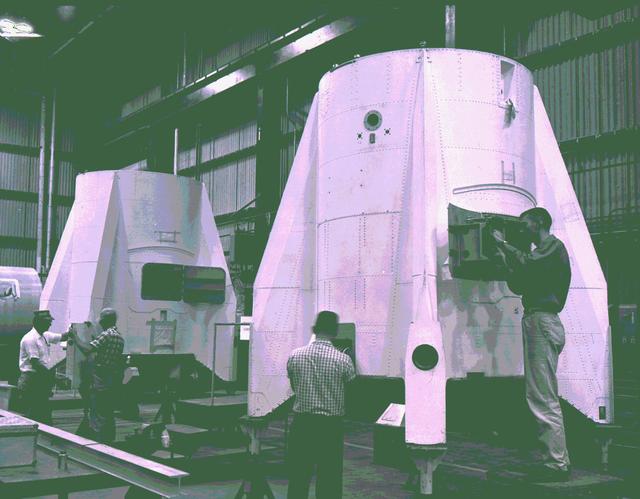
In this 1959 photograph, technicians prepare tail sections for Mercury-Redstone vehicles in Building 4706 at Redstone Arsenal in Huntsville, Alabama. Developed by Dr. Wernher von Braun and the rocket team at Redstone, the Mercury-Redstone launched the first two marned U.S. missions.
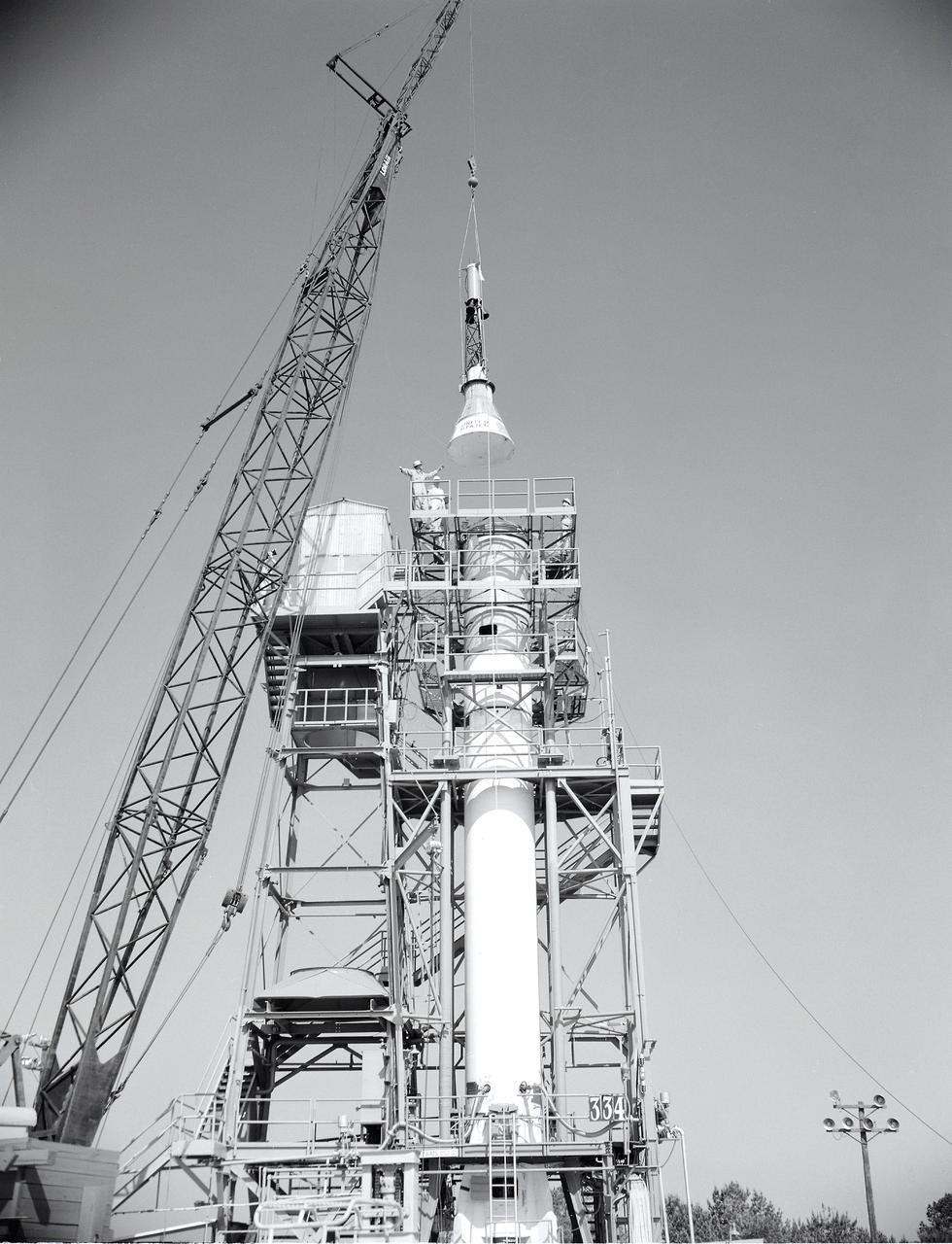
Installation of the Mercury capsule on Redstone booster at the Redstone Test Stand. Assembled at the Marshall Space Flight Center (MSFC), the Mercury-Redstone launch vehicle was designed to place a marned space capsule into orbital flight around the Earth and recover both safely.
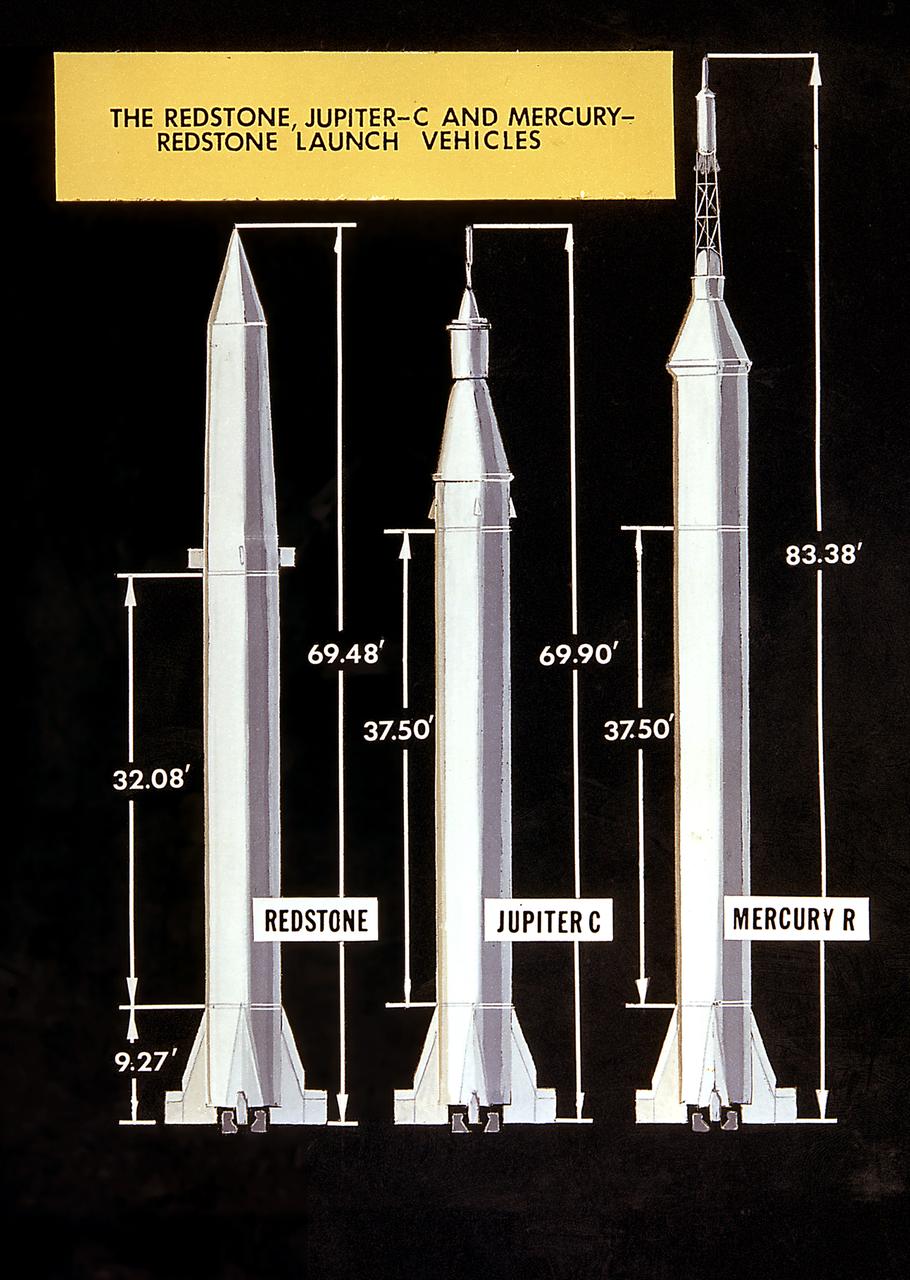
This is a comparison illustration of the Redstone, Jupiter-C, and Mercury Redstone launch vehicles. The Redstone ballistic missile was a high-accuracy, liquid-propelled, surface-to-surface missile. Originally developed as a nose cone re-entry test vehicle for the Jupiter intermediate range ballistic missile, the Jupiter-C was a modification of the Redstone missile and successfully launched the first American Satellite, Explorer-1, in orbit on January 31, 1958. The Mercury Redstone lifted off carrying the first American, astronaut Alan Shepard, in his Mercury spacecraft Freedom 7, on May 5, 1961.
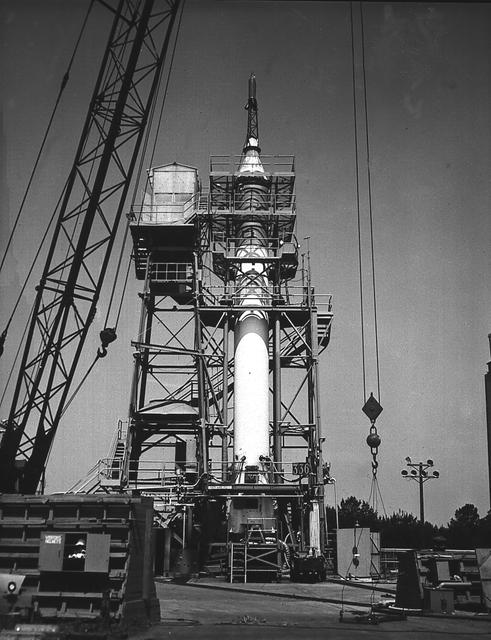
A Mercury-Redstone launch vehicle awaits test-firing in the Redstone Test Stand during the late 1950s. Between 1953 and 1960, the rocket team at Redstone Arsenal in Huntsville, Alabama performed hundreds of test firings on the Redstone rocket, over 200 on the Mercury-Redstone vehicle configuration alone. It was this configuration which launched America's first two marned space missions, Freedom 7 and Liberty Bell 7,in 1961.

This photograph shows the installation of a Mercury capsule and escape system on top of a booster prior to test firing of the Mercury-Redstone at Marshall Space Flight Center's (MSFC's) Redstone Test Stand. Assembled by MSFC, the Mercury-Redstone was designed to place a marned space capsule in orbital flight around the Earth and recover both safely.
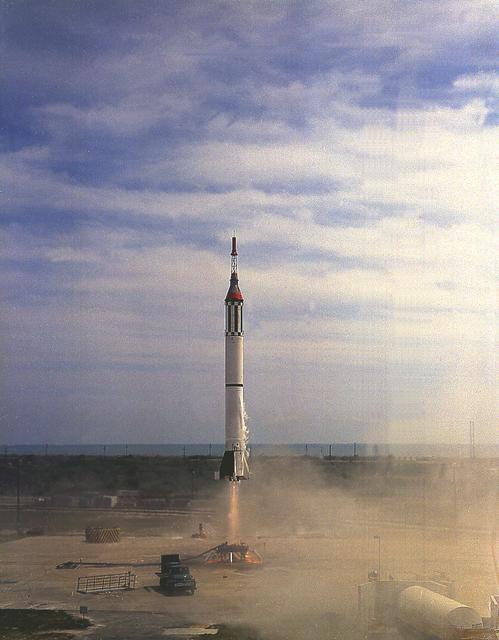
The Mercury-Redstone Booster Development vehicle (MR-BD) lifts off from Cape Canaveral March 24, 1961. This test flight evaluated changes incorporated in the booster designed to reduce vehicle oscillations and vibrations. The Mercury-Redstone launch vehicle was developed by Dr. Wernher von Braun and the rocket team in Huntsville, Alabama.
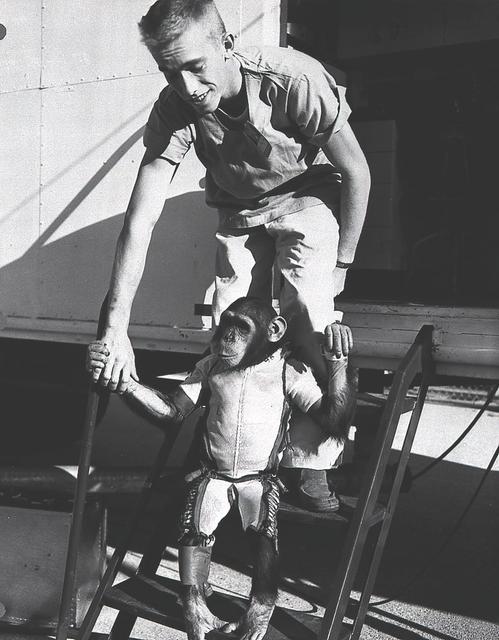
Ham, a three-year-old chimpanzee, in the spacesuit he would wear for the second Mercury- Redstone (MR-2) suborbital test flight in January, 1961. NASA used chimpanzees and other primates to test the Mercury capsule before launching the fisrt American astronaut, Alan Shepard, in May 1961. The Mercury capsule rode atop a modified Redstone rocket, developed by Dr. Wernher von Braun and the German Rocket Team in Huntsville, Alabama.
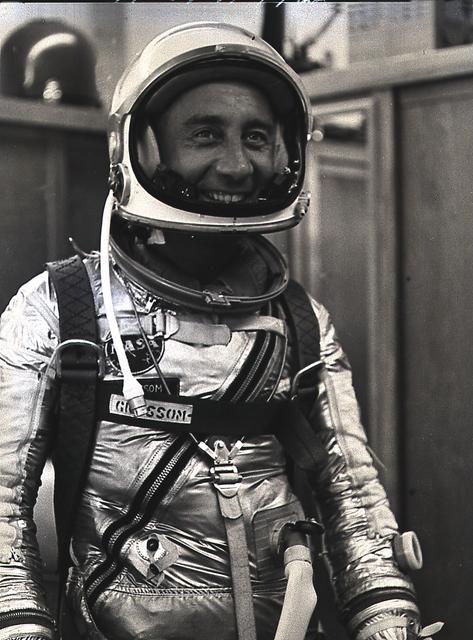
Astronaut Virgil Gus Grissom awaits America's second marned space mission, Mercury-Redstone 4 (MR-4) on July 21, 1961. During the 15-minute suborbital flight, the Liberty Bell 7 Mercury spacecraft reached an altitude of 118 miles and traveled 303 miles downrange. It was the fourth flight of the Mercury-Redstone launch vehicle (MR-4), developed by Dr. Wernher von Braun and the rocket team in Huntsville, Alabama.
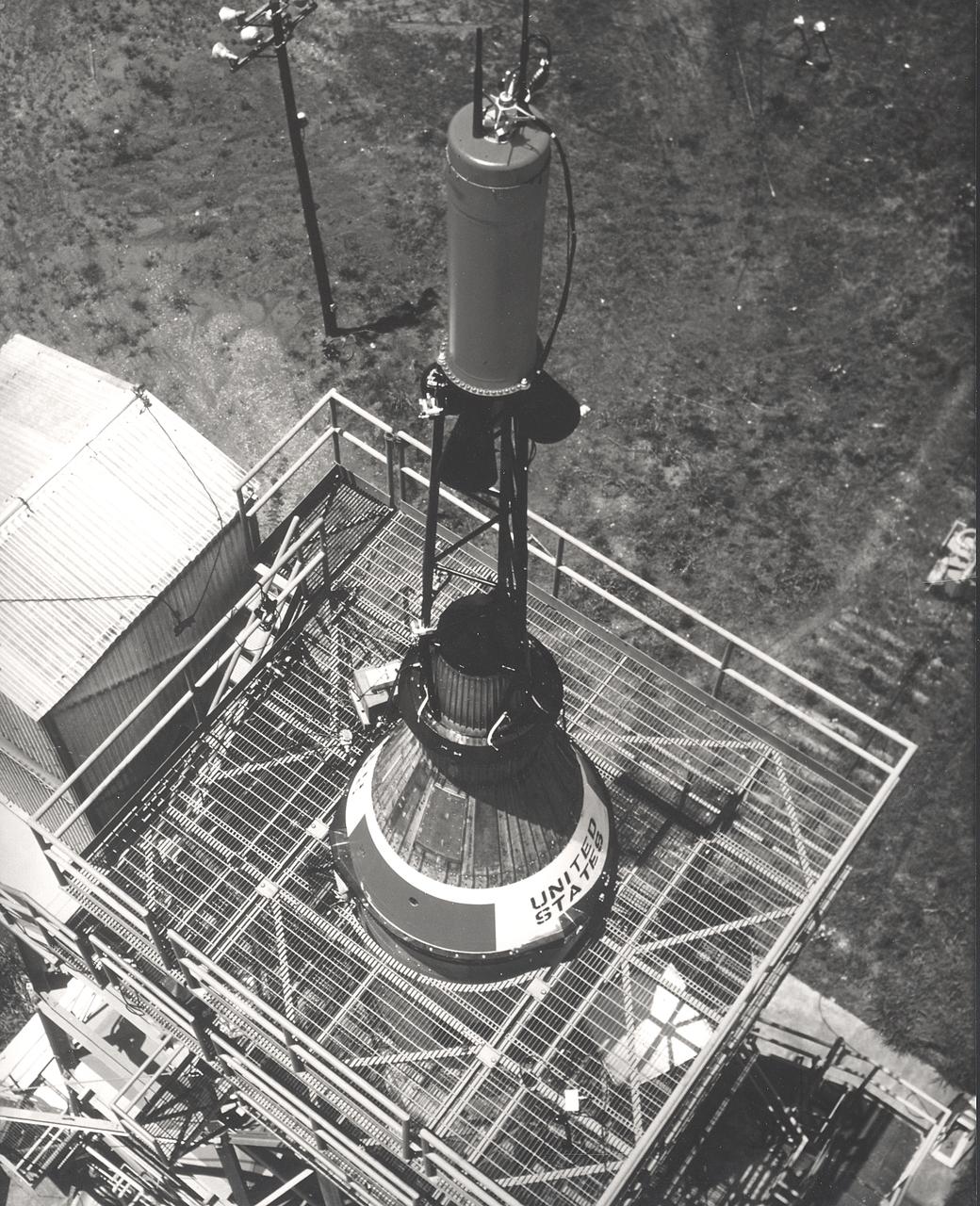
This photograph depicts installation of the Mercury capsule and escape system on top of a booster prior to test firing of the Mercury-Redstone launch vehicle at the Marshall Space Flight Center.
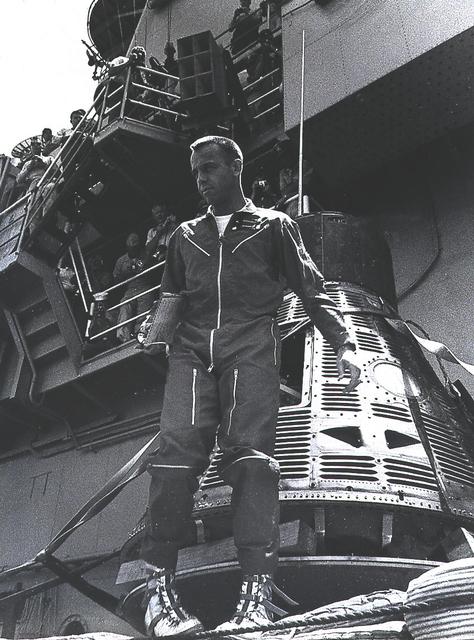
Alan B. Shepard, Jr., America's first astronaut, stands in front of the Freedom 7 spacecraft shortly after completion of the third flight of the Mercury-Redstone (MR-3) vehicle, May 5, 1961. During the 15-minute suborbital flight, the Freedom 7 Mercury spacecraft, launched atop a modified Redstone rocket developed by Dr. Wernher von Braun and the rocket team in Huntsville, Alabama, reached an altitude of 115 miles and traveled 302 miles downrange.
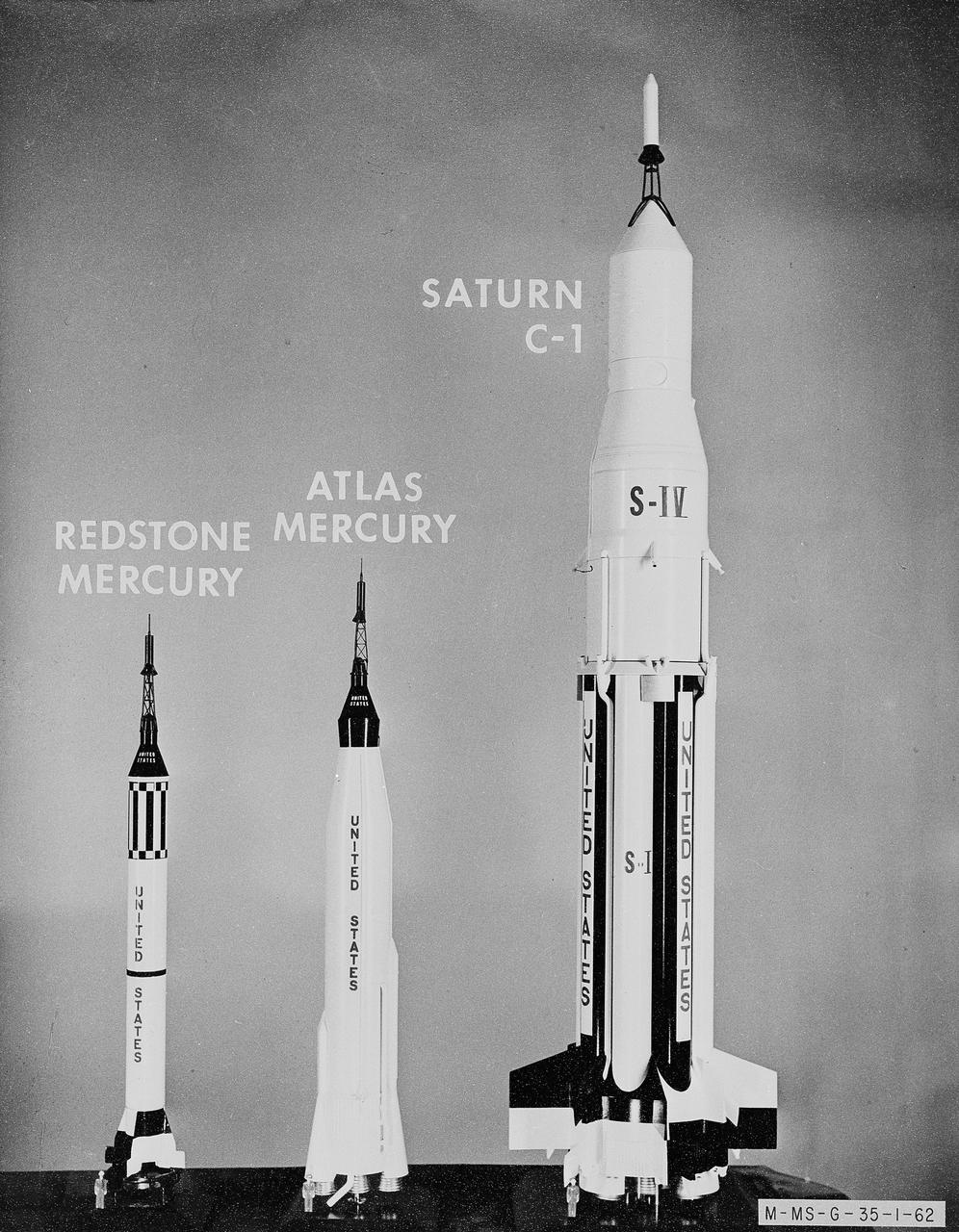
Photographed are models of early rocketry: The Atlas Mercury, Redstone Mercury; and Saturn C-1.
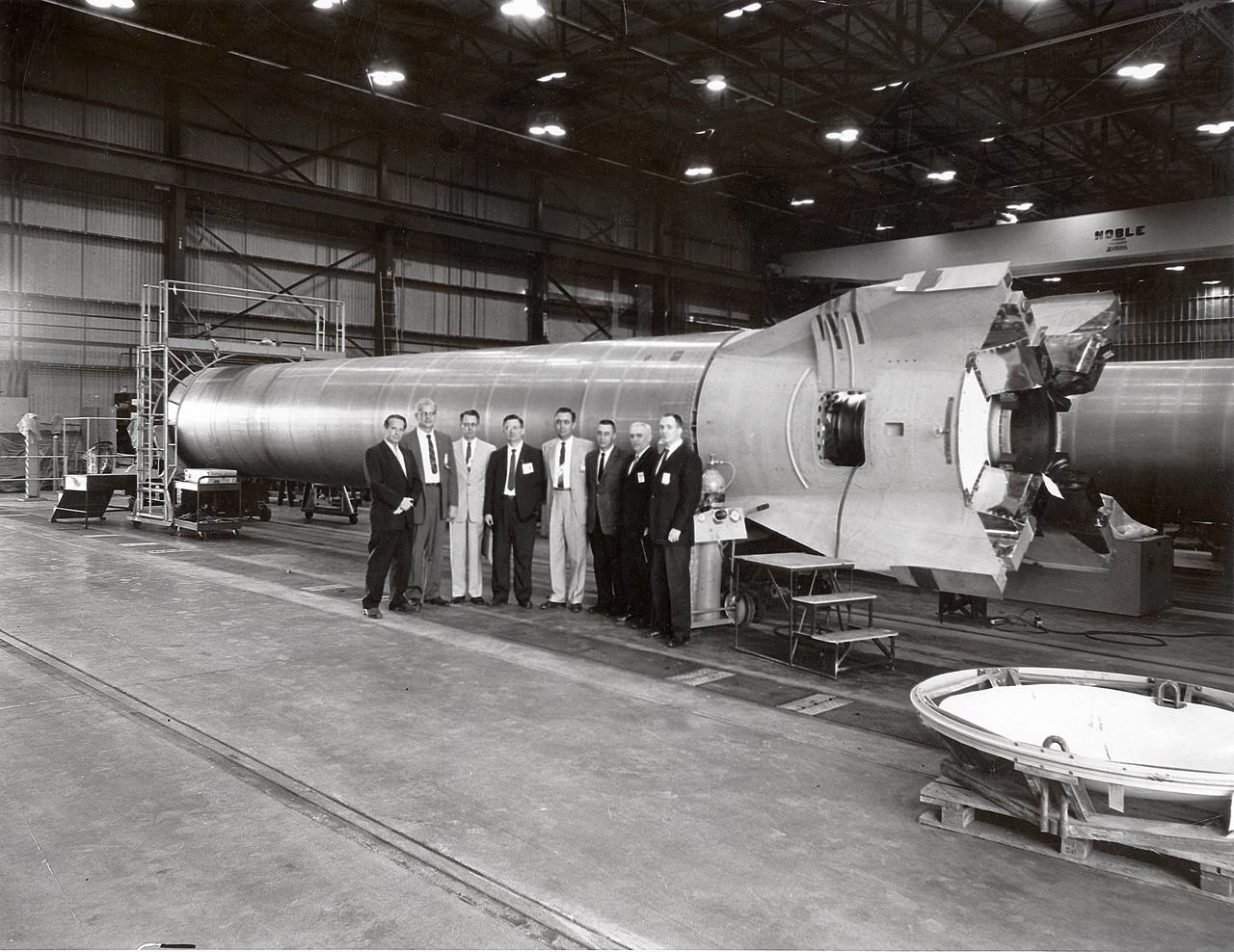
This photograph shows a group of officials standing before a Mercury-Redstone booster at the Marshall Space Flight Center (MSFC). Among those in the photograph are astronauts James Lovell, Walter Schirra, and Gus Grissom. Also pictured is Joachim Kuettner who managed responsibilities of MSFC's Mercury-Redstone program.
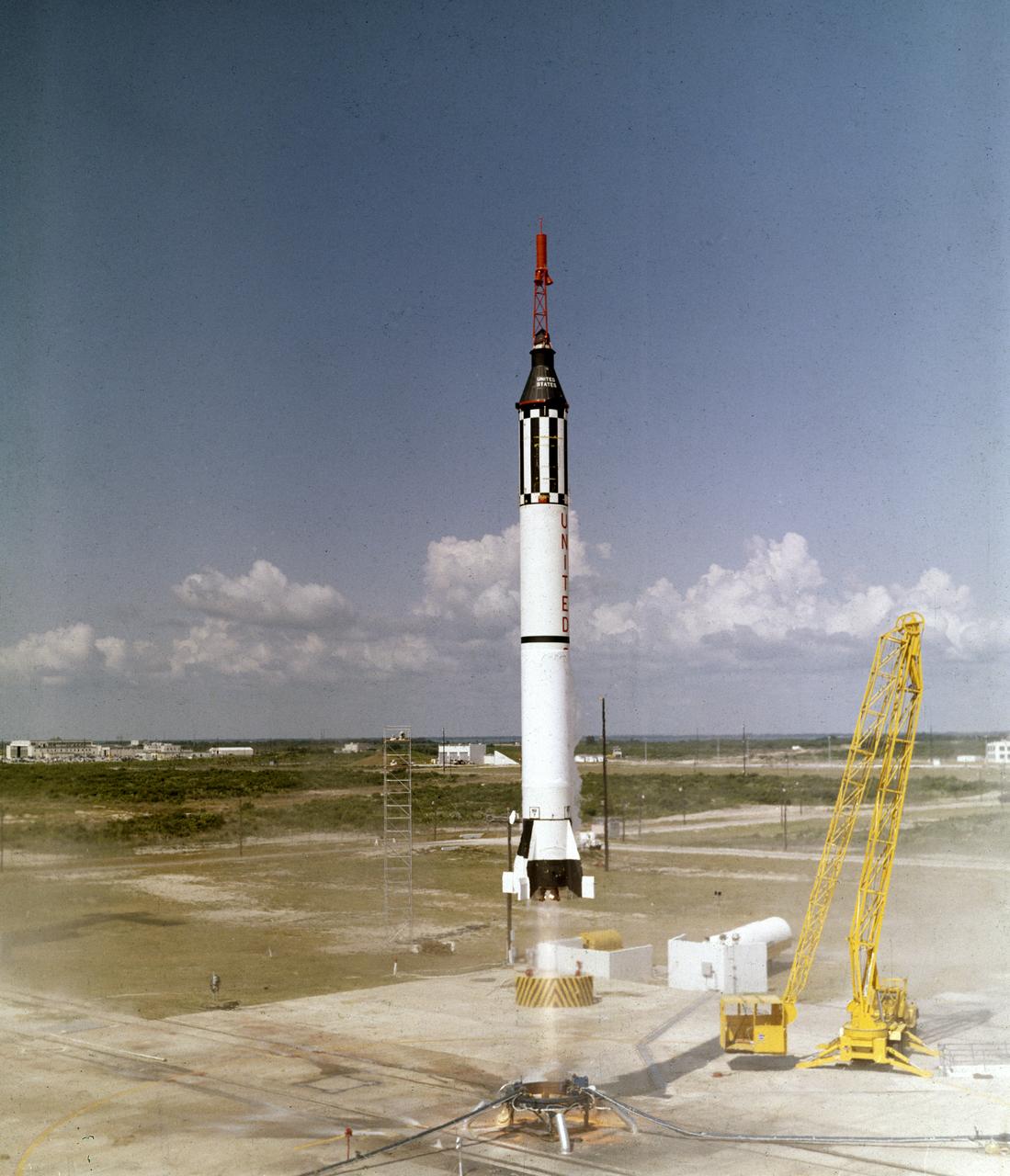
Astronaut Alan B. Shepard, Jr. lifts off in the Freedom 7 Mercury spacecraft on May 5, 1961. This third flight of the Mercury-Redstone (MR-3) vehicle, developed by Dr. Wernher von Braun and the rocket team in Huntsille, Alabama, was the first marned space mission for the United States. During the 15-minute suborbital flight, Shepard reached an altitude of 115 miles and traveled 302 miles downrange.
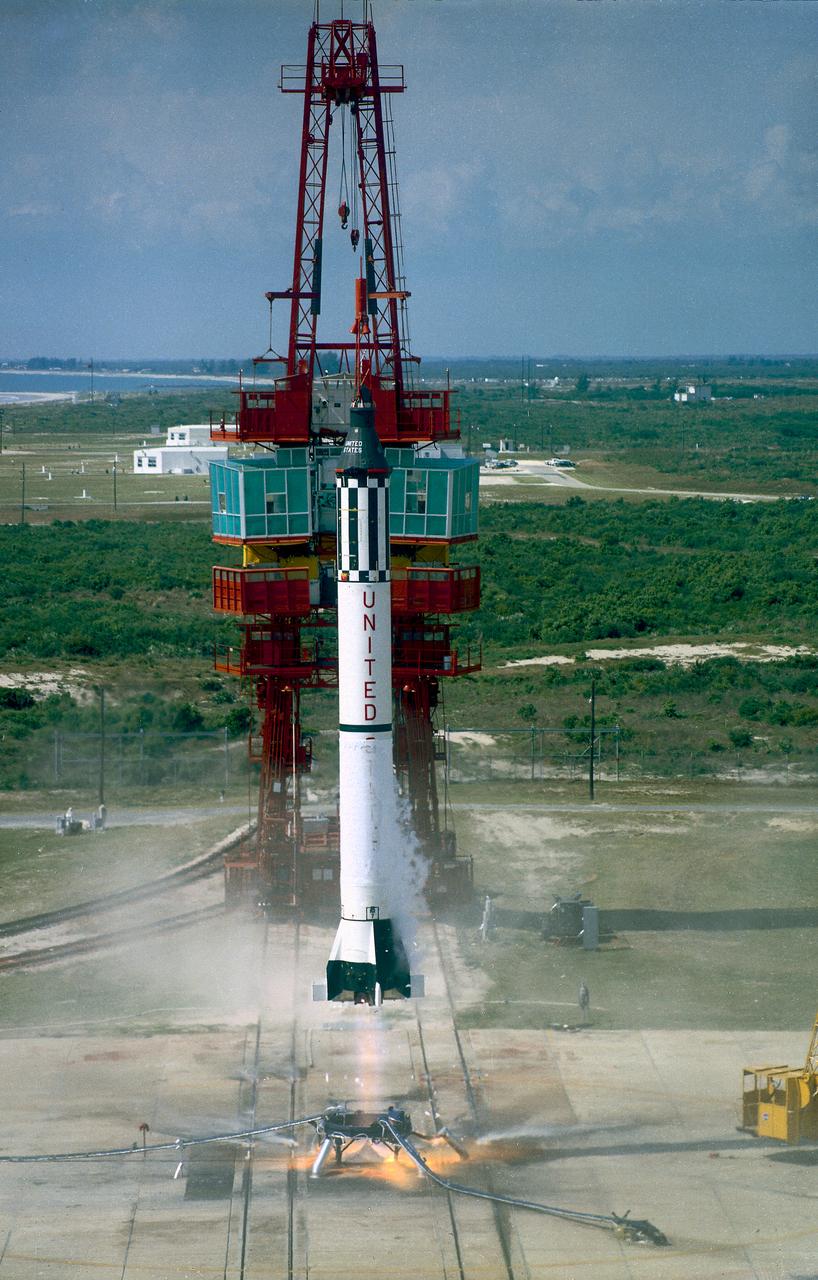
The launch of the Mercury-Redstone (MR-3), Freedom 7. MR-3 placed the first American astronaut, Alan Shepard, in suborbit on May 5, 1961.
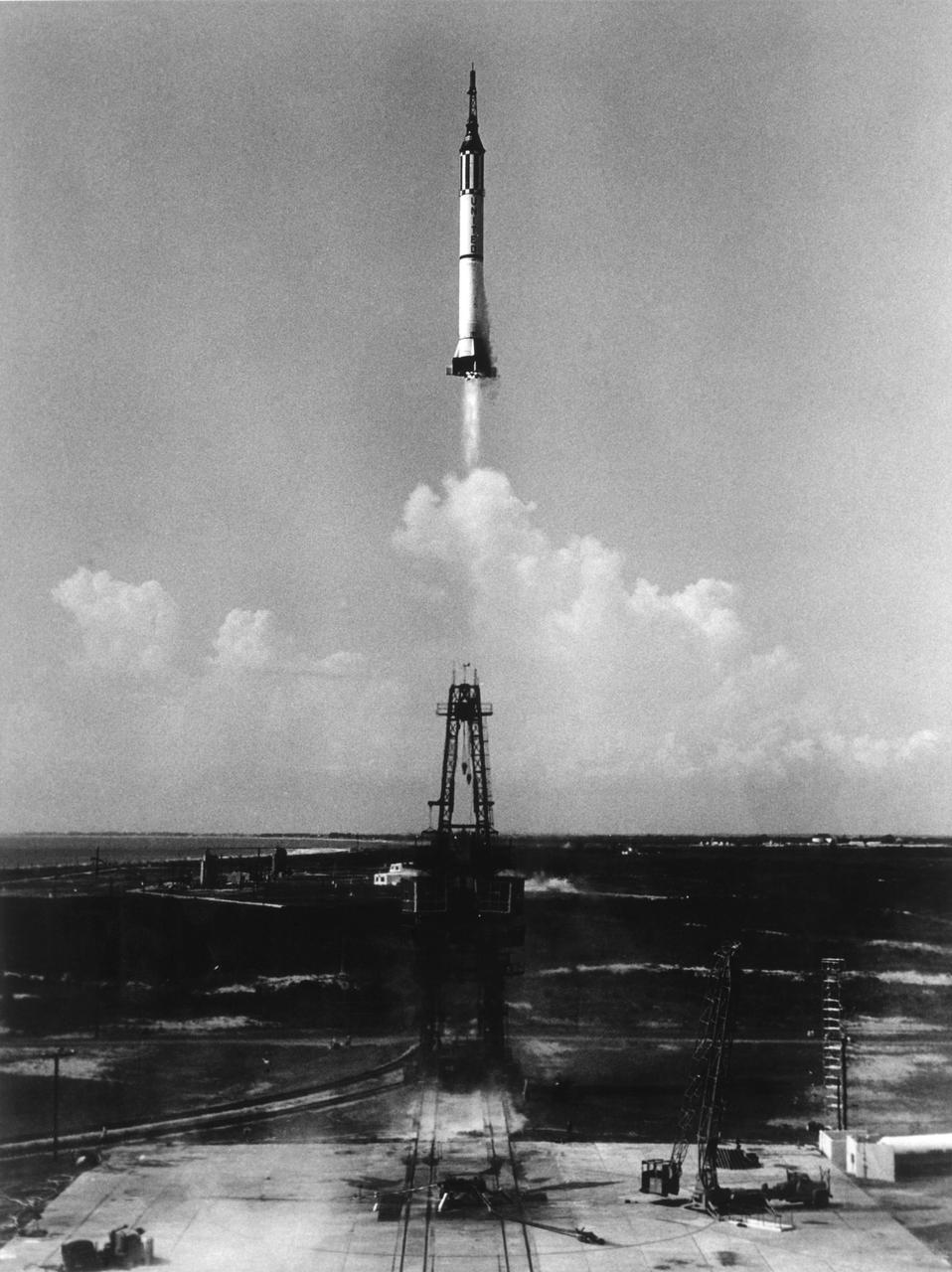
JSC2007-E-046477 (5 May 1961) --- Launching of the Mercury-Redstone 3 (MR-3) spacecraft from Cape Canaveral on a suborbital mission -- the first U.S. manned spaceflight. Original image number was 61-MR3-74. Photo credit: NASA or National Aeronautics and Space Administration
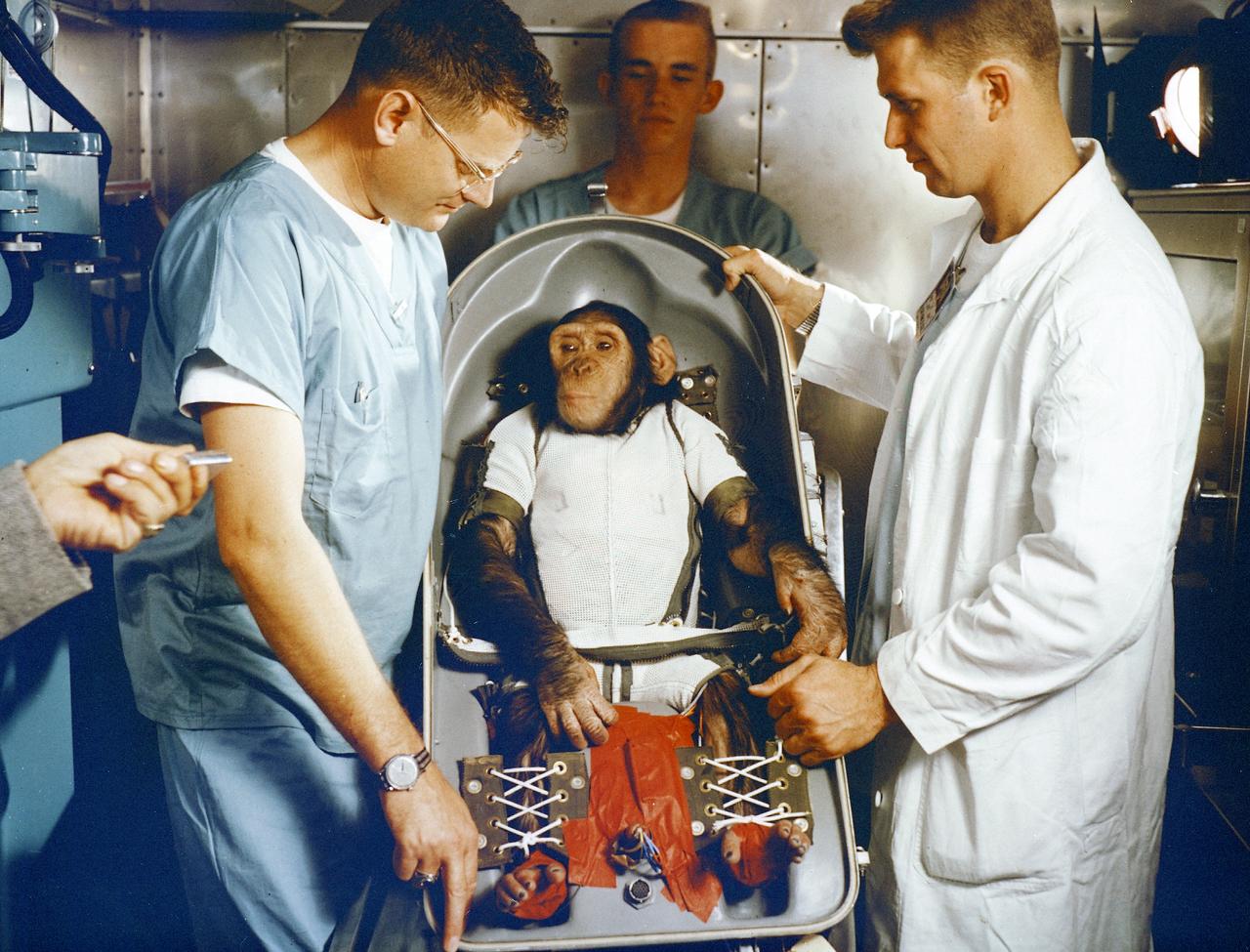
A three-year-old chimpanzee, named Ham, in the biopack couch for the MR-2 suborbital test flight. On January 31, 1961, a Mercury-Redstone launch from Cape Canaveral carried the chimpanzee "Ham" over 640 kilometers down range in an arching trajectory that reached a peak of 254 kilometers above the Earth. The mission was successful and Ham performed his lever-pulling task well in response to the flashing light. NASA used chimpanzees and other primates to test the Mercury Capsule before launching the first American astronaut Alan Shepard in May 1961. The successful flight and recovery confirmed the soundness of the Mercury-Redstone systems.
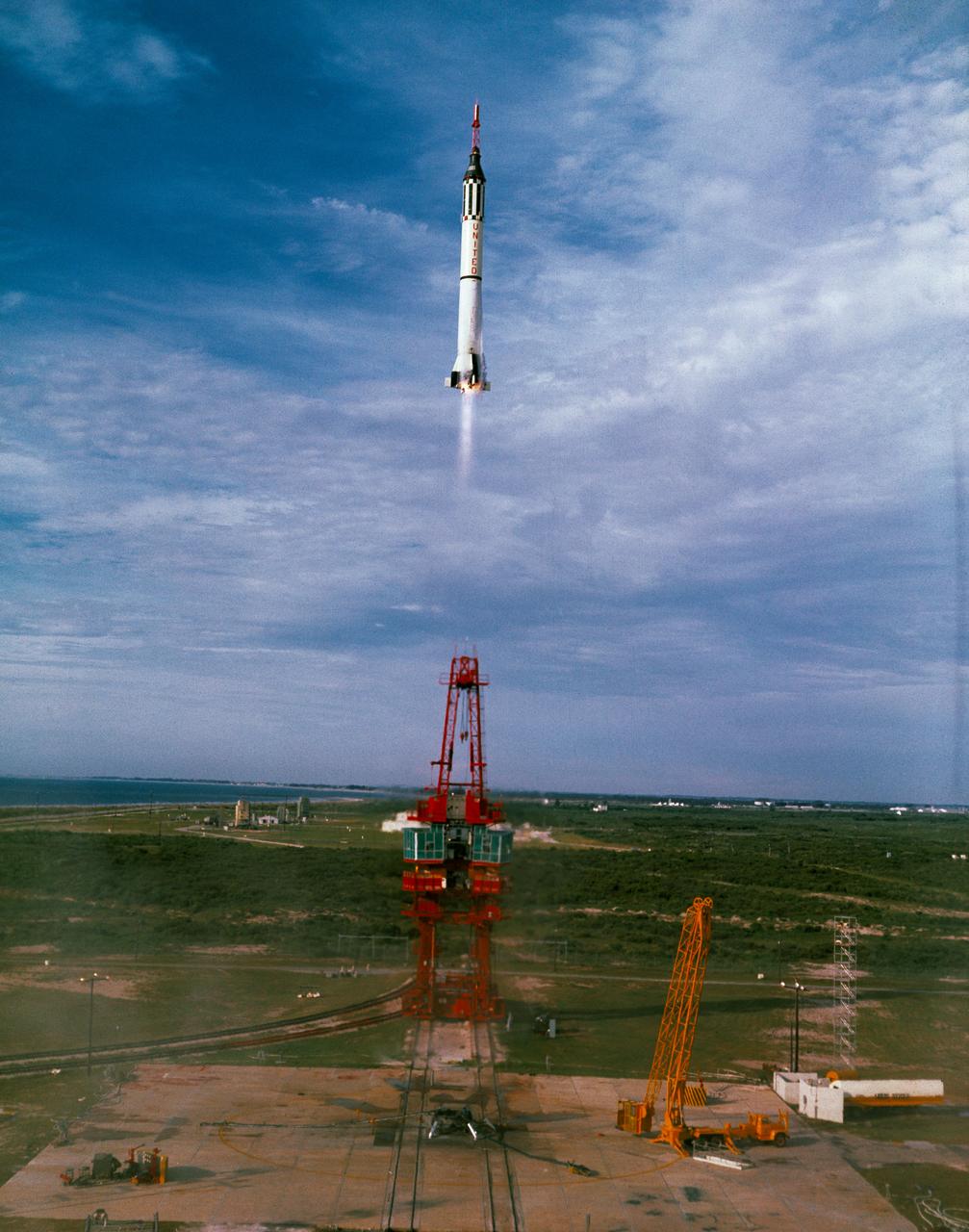
S61-03248 (21 July 1961) --- Mercury-Redstone 4 (MR-4) launch of Virgil I. Grissom on July 21, 1961, from Cape Canaveral, Florida. Photo credit: NASA
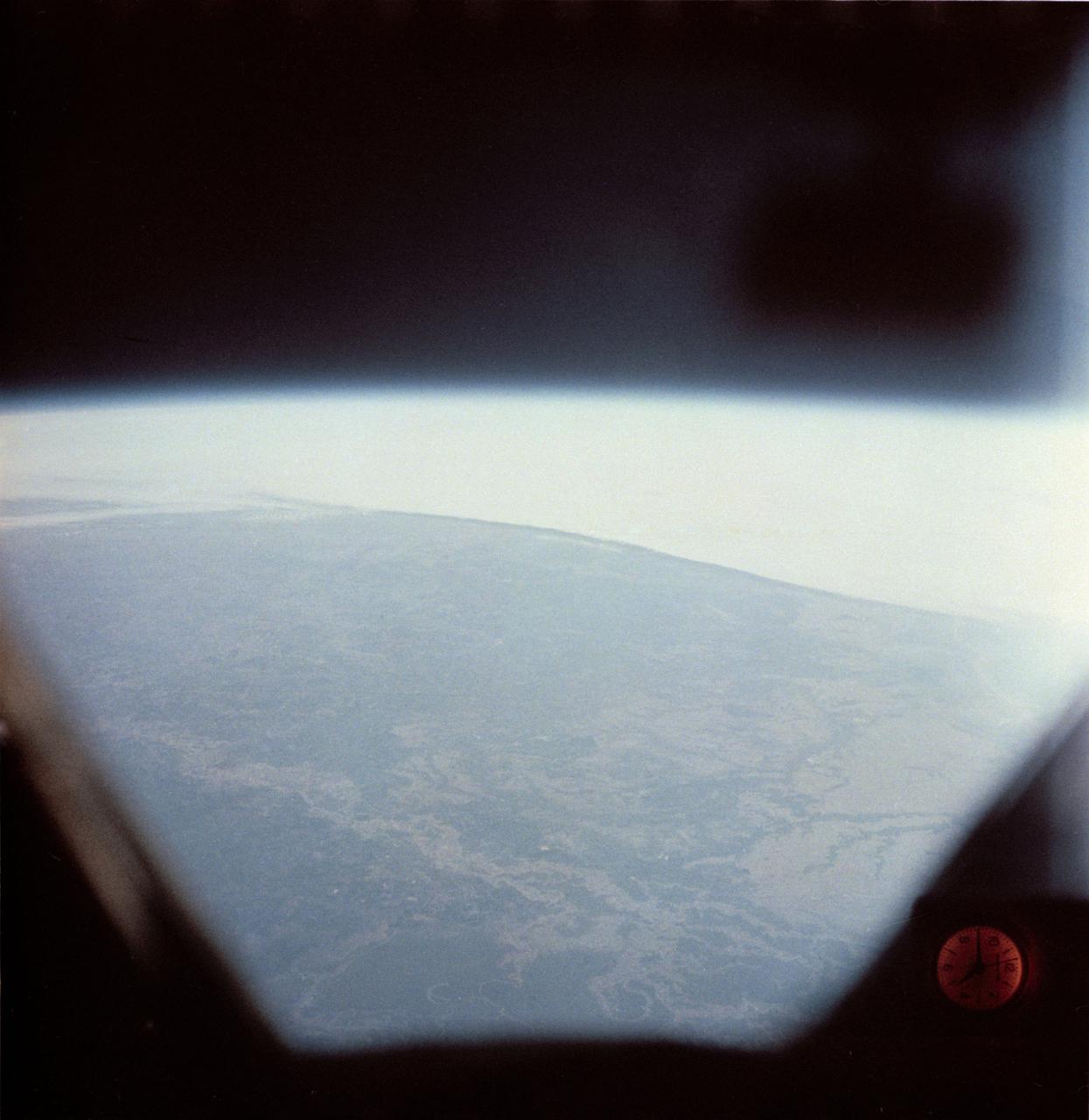
S62-01287 (21 July 1961) --- Earth observation take during the Mercury-Redstone 4 (MR-4) spaceflight. Photo credit: NASA
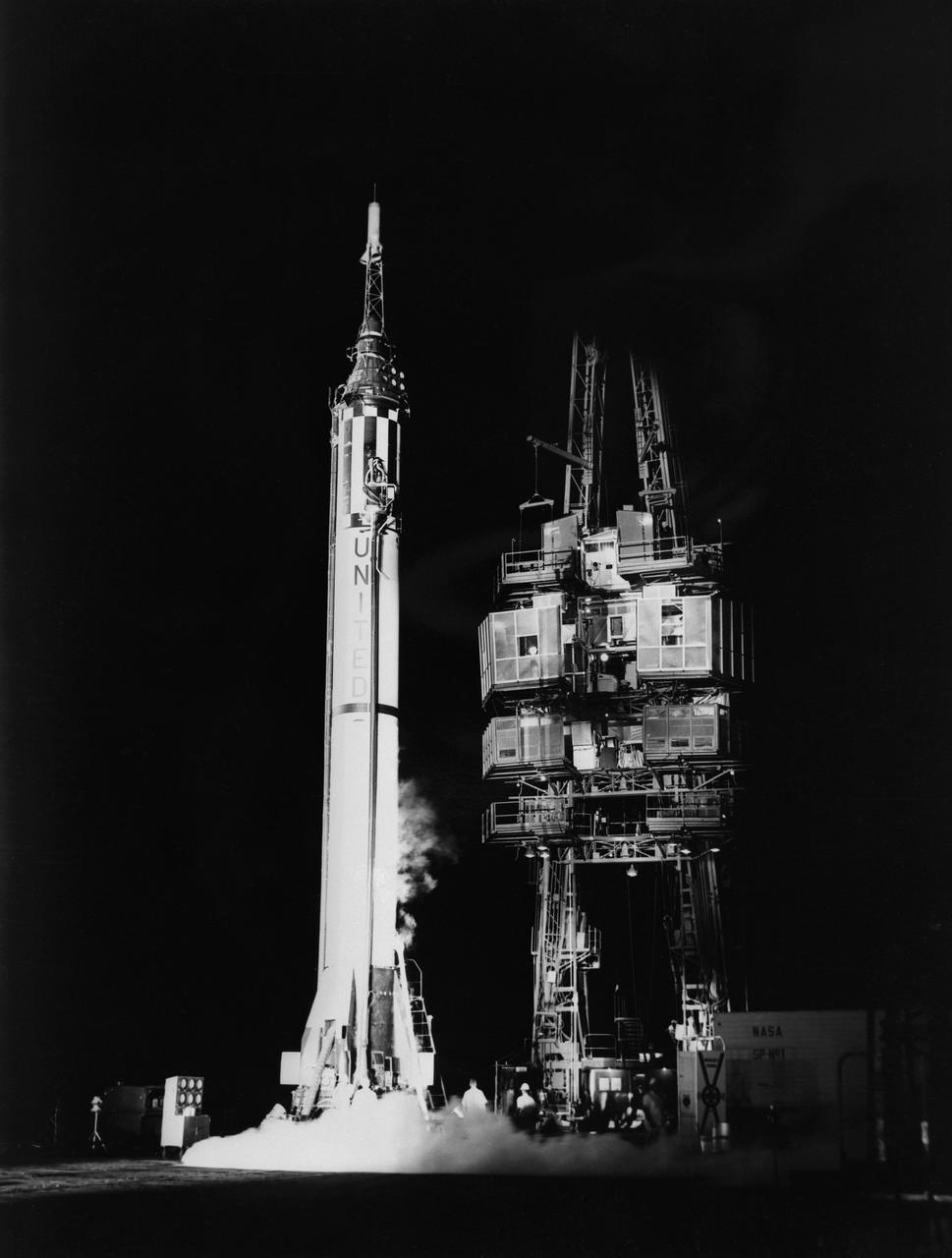
S61-03158 (1961) --- Mercury-Redstone 3 (MR-3) missile standing alone on launch pad. Photo credit: NASA or National Aeronautics and Space Administration
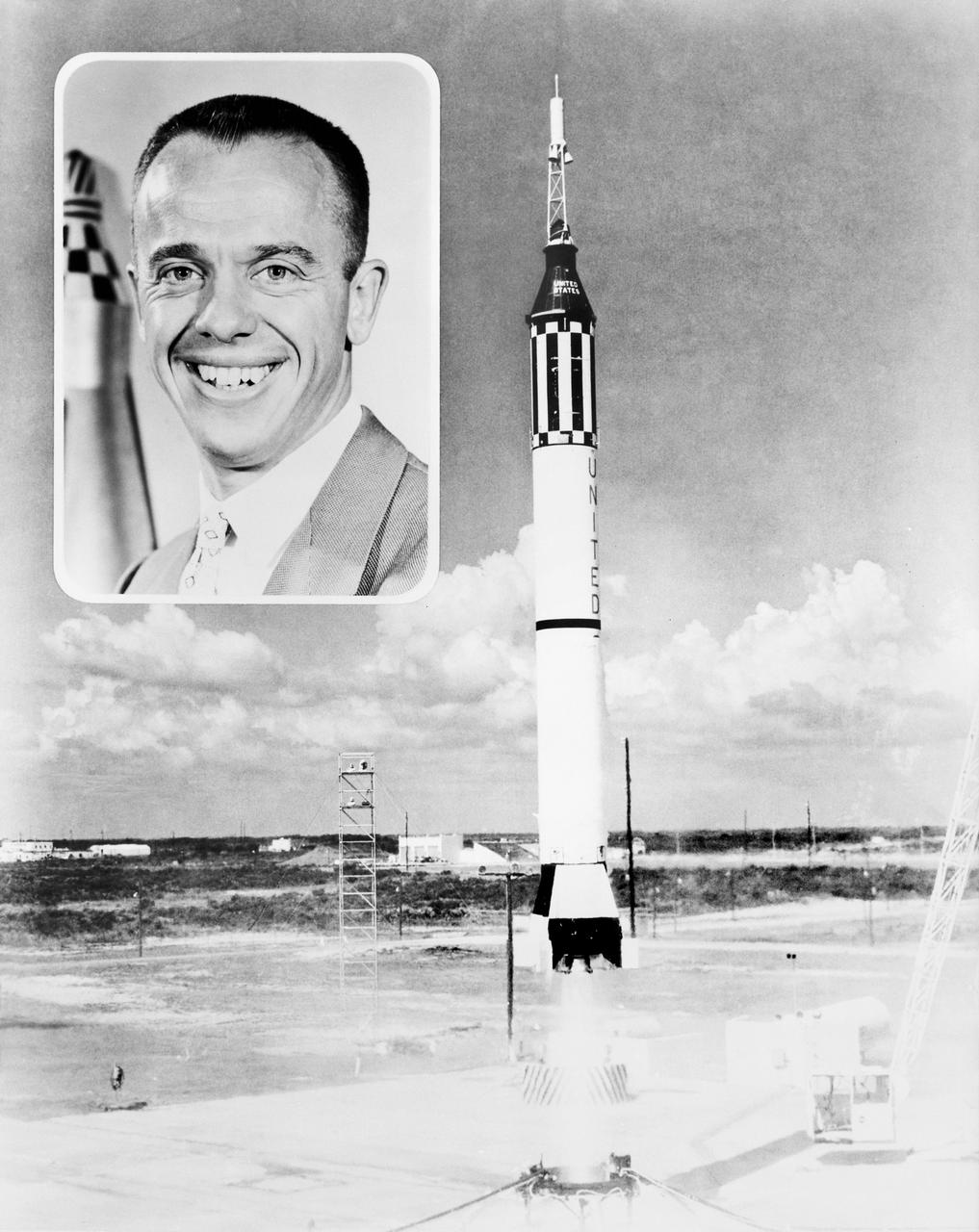
S62-01151 (5 May 1961) --- The liftoff of the Mercury-Redstone 3 (MR-3) on May 5, 1961, piloted by astronaut Alan B. Shepard, Jr., whose portrait is in inset. Shepard went on a 15-minute sub-orbital flight. The spacecraft was designated the ?Freedom? 7.
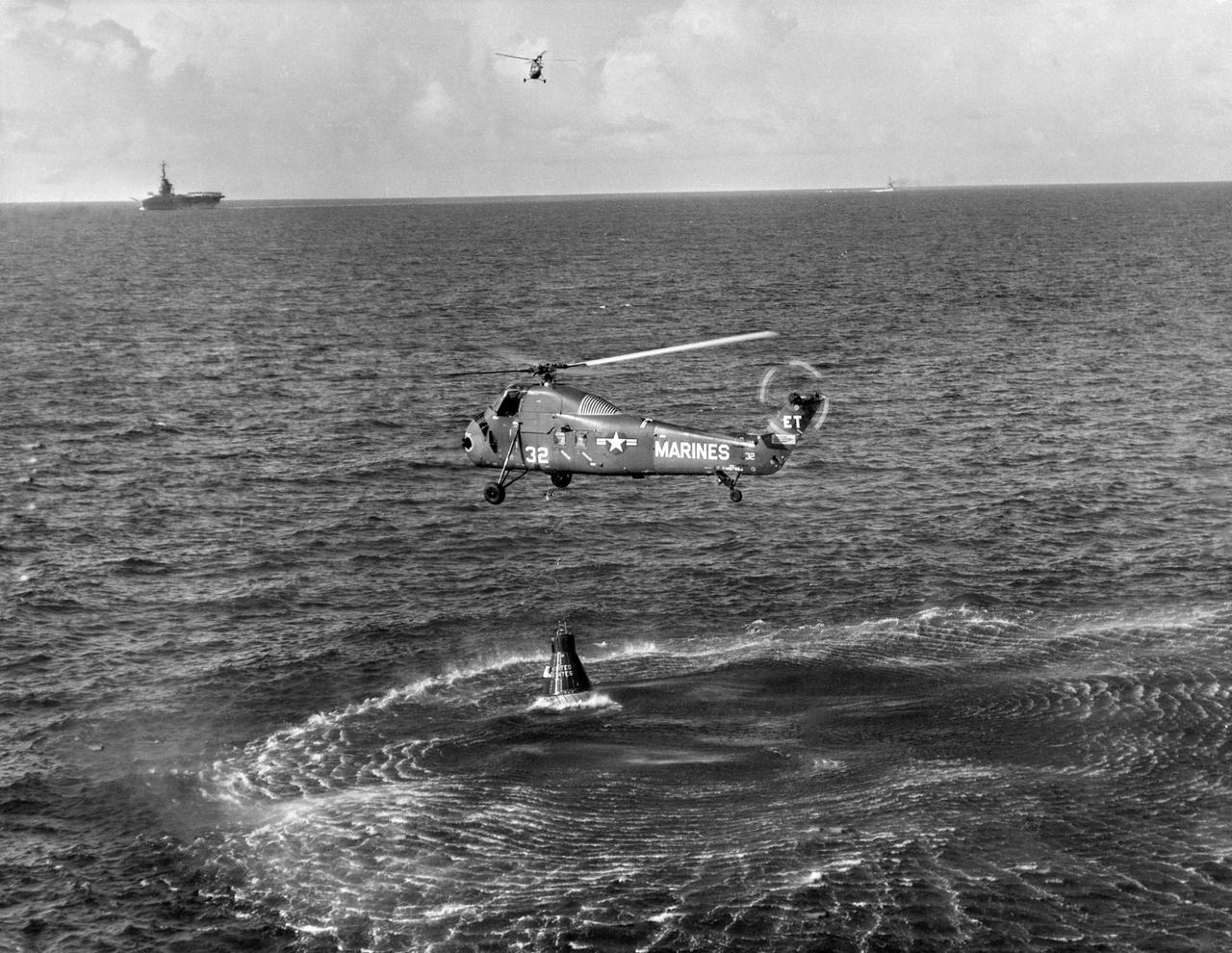
S61-02821 (21 July 1961) --- Attempted recovery of Mercury spacecraft at end of the Mercury-Redstone 4 (MR-4) mission. View shows the Marine helicopter dropping a recovery line to the capsule. In the upper left corner of the view, the recovery ship and another helicopter can be seen. Photo credit: NASA
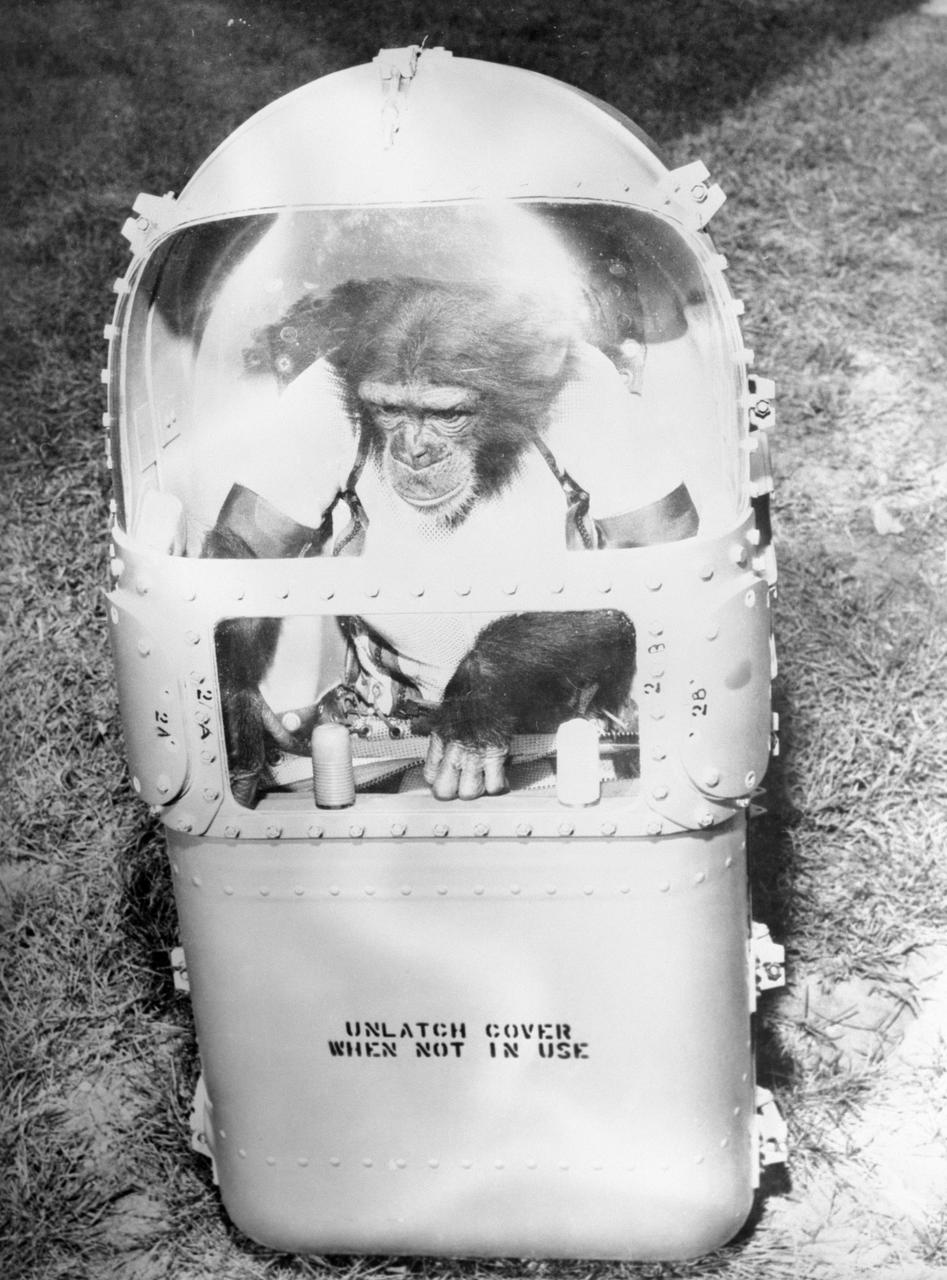
S62-01698 (31 Jan. 1961) --- Chimpanzee "Ham" in his flight couch, after his trip in the Mercury-Redstone 2 (MR-2) on Jan. 31, 1961. Photo credit: NASA
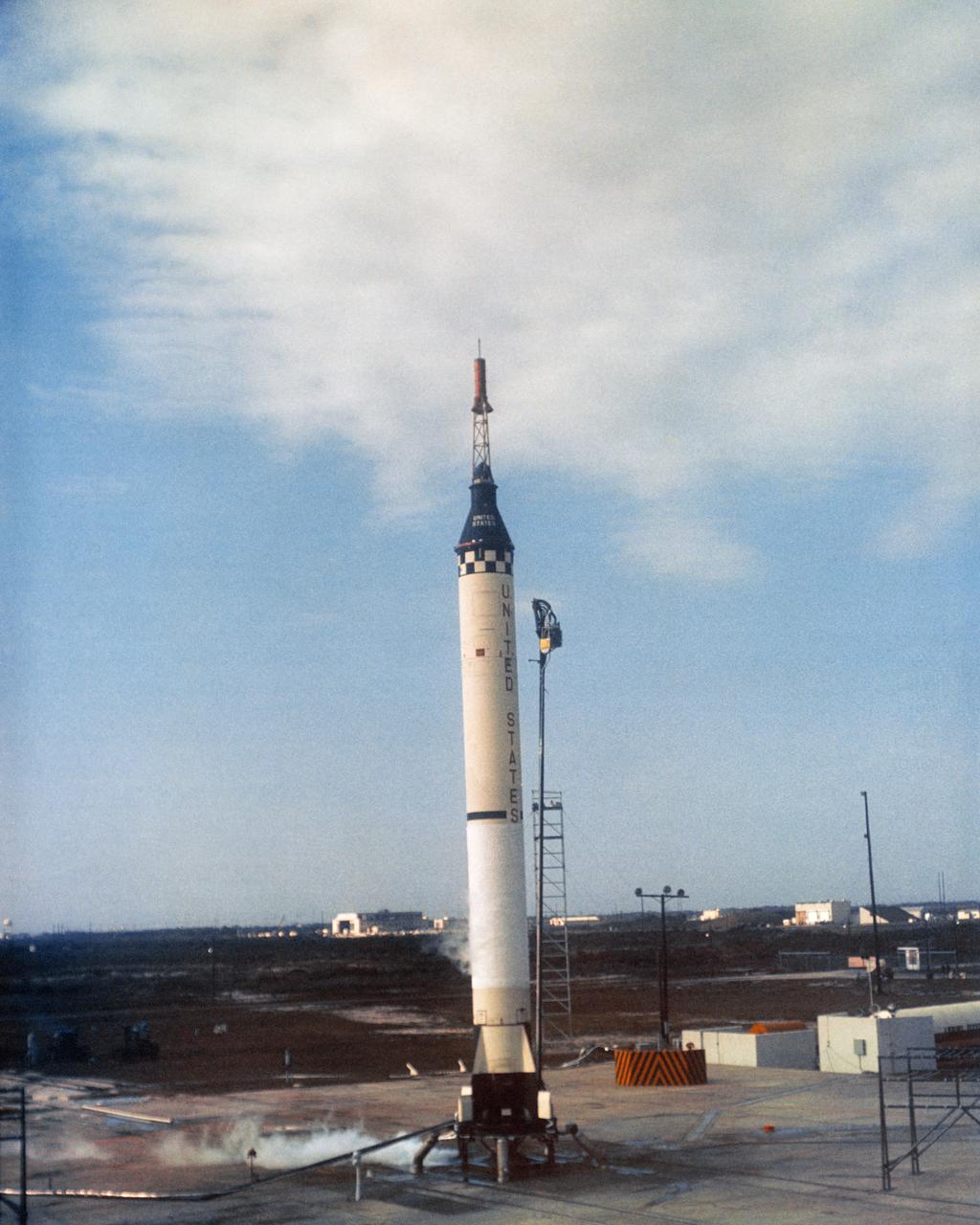
S63-02651 (21 July 1961) --- This is a ground-level view of the Mercury-Redstone (MR-4) launch of Virgil I. Grissom on July 21, 1961, from Cape Canaveral, Florida. Photo credit: NASA
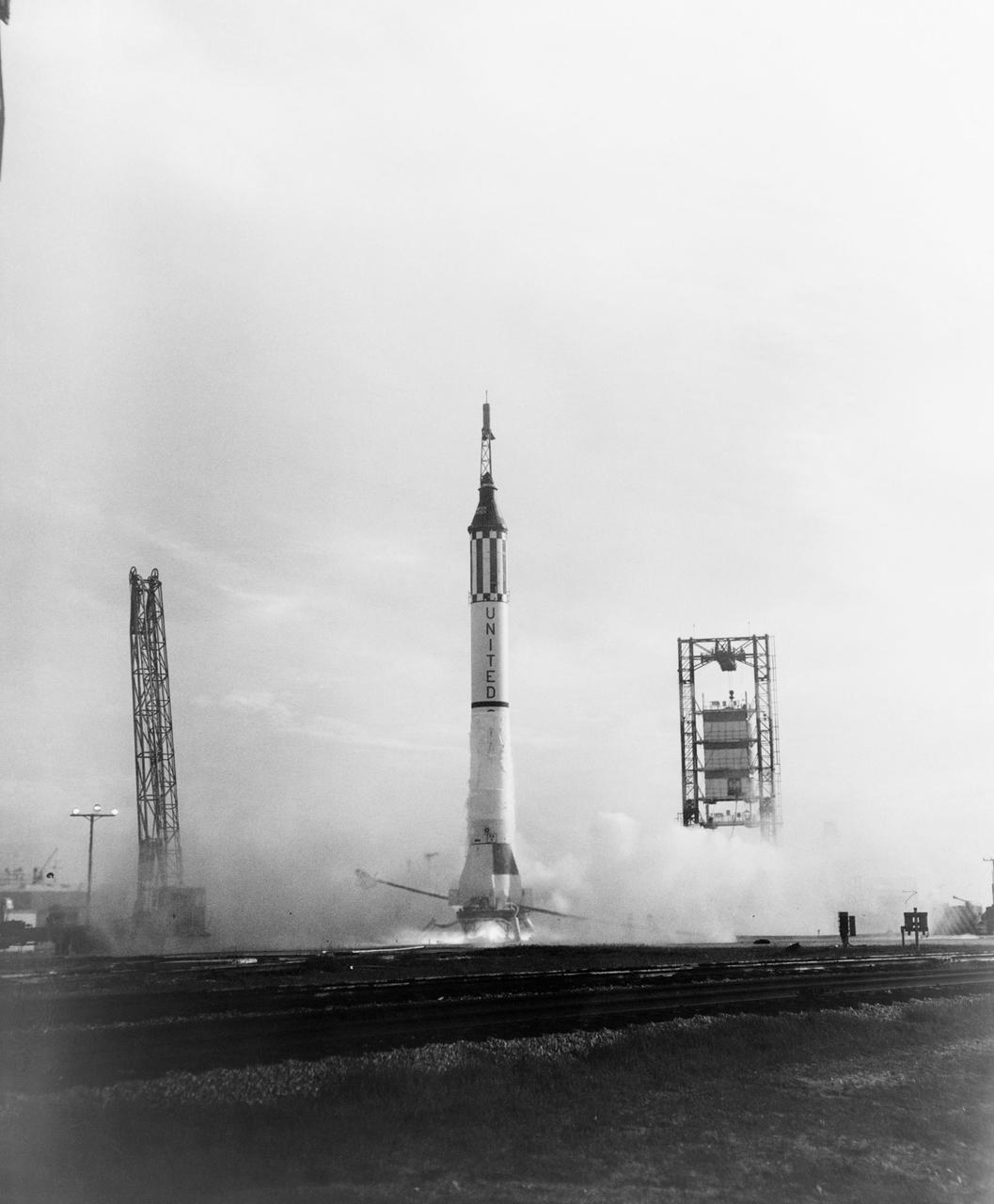
S61-03121 (21 July 1961) --- Mercury-Redstone 4 (MR-4) launch of Virgil I. Grissom on July 21, 1961, from Cape Canaveral, Florida. Photo credit: NASA
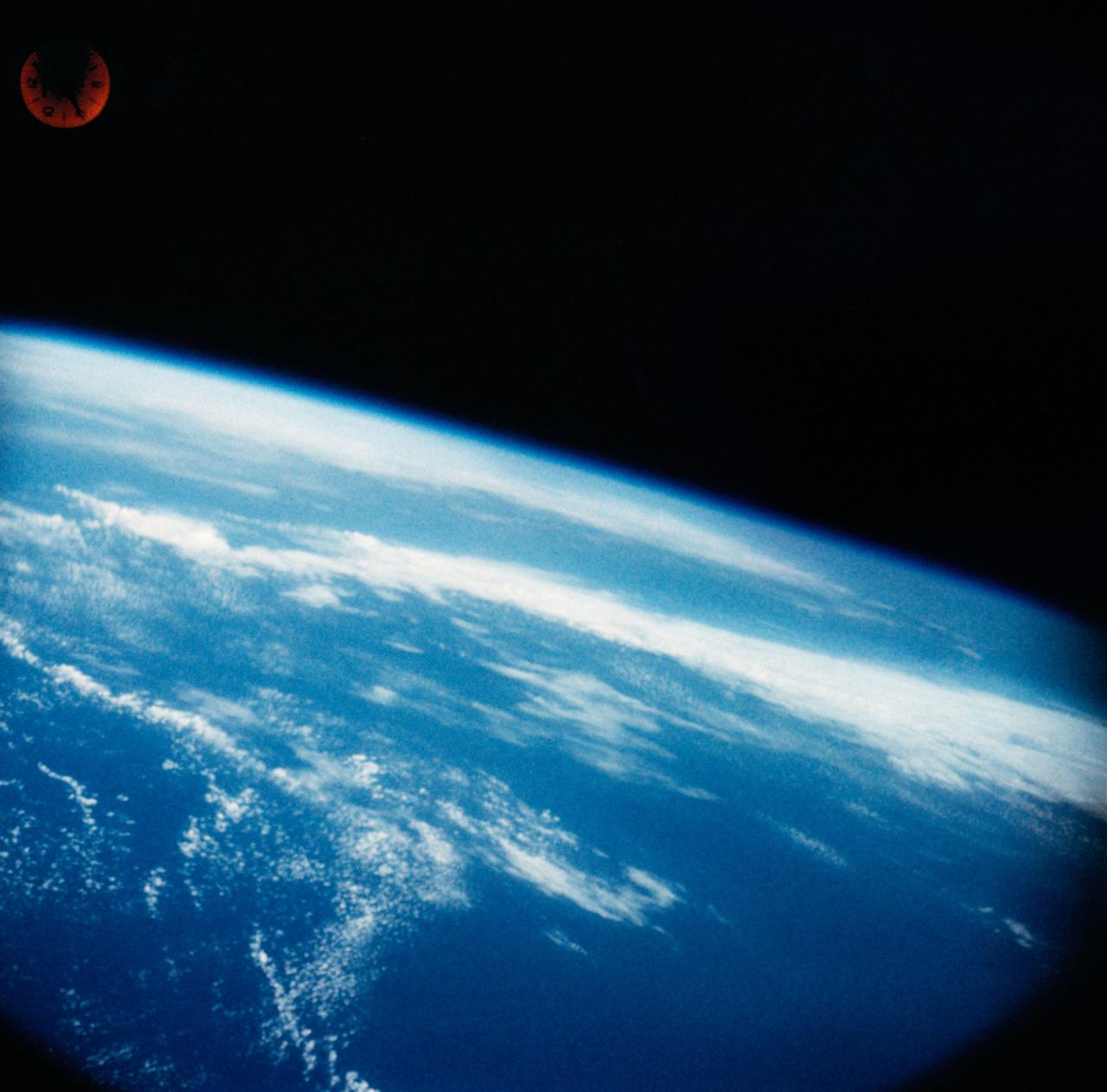
S61-01918 (5 May 1961) --- Mercury-Redstone 3 (MR-3) spaceflight Earth observations of a cloudy Earth surface. Photo credit: NASA or National Aeronautics and Space Administration
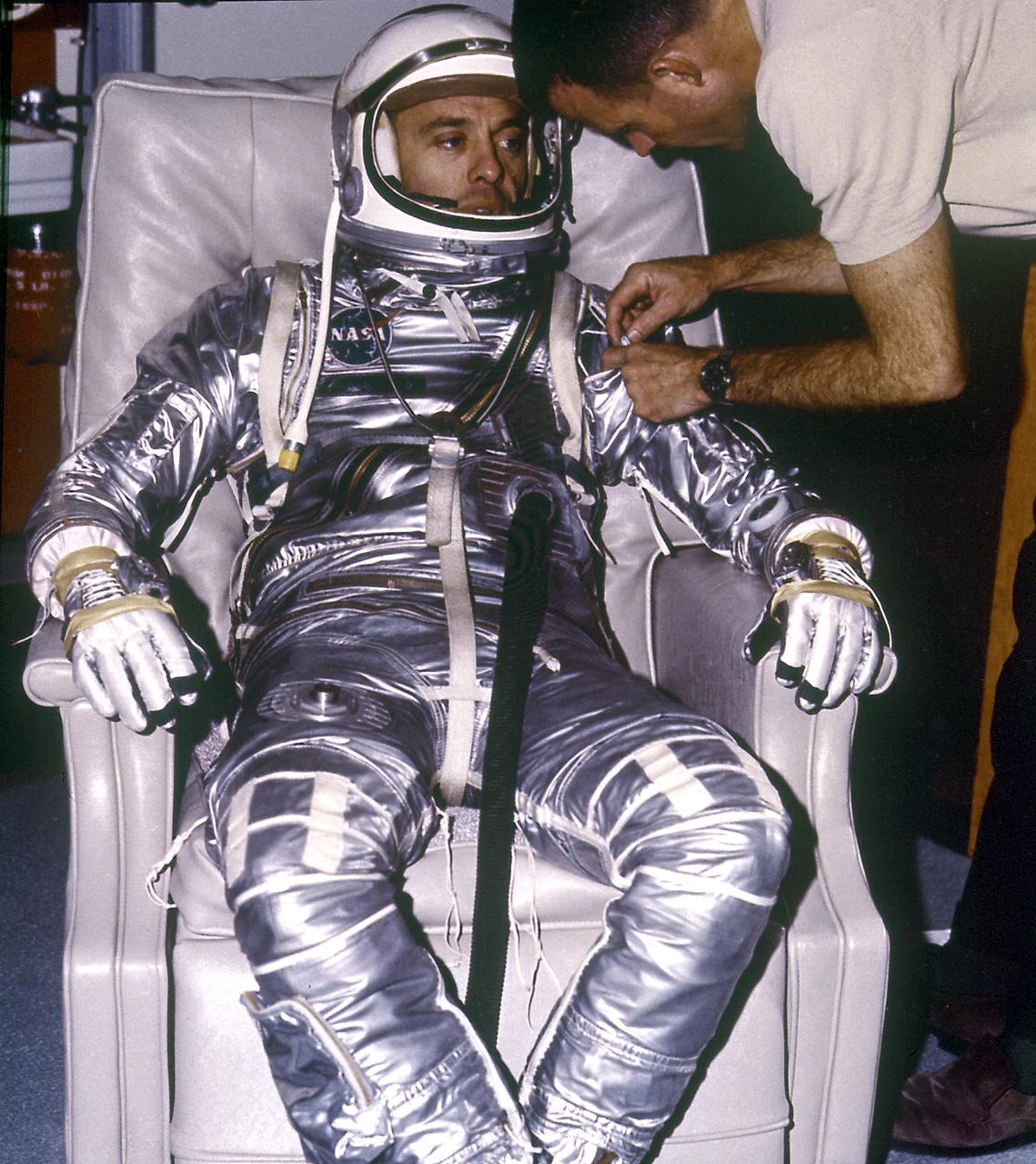
Astronaut Alan B. Shepard, Jr. during suiting for the first manned suborbital flight, MR-3 mission. The Freedom 7 spacecraft, carrying the first American, Astronaut Shepard and boosted by the Mercury-Redstone launch vehicle, lifted off on May 5, 1961.
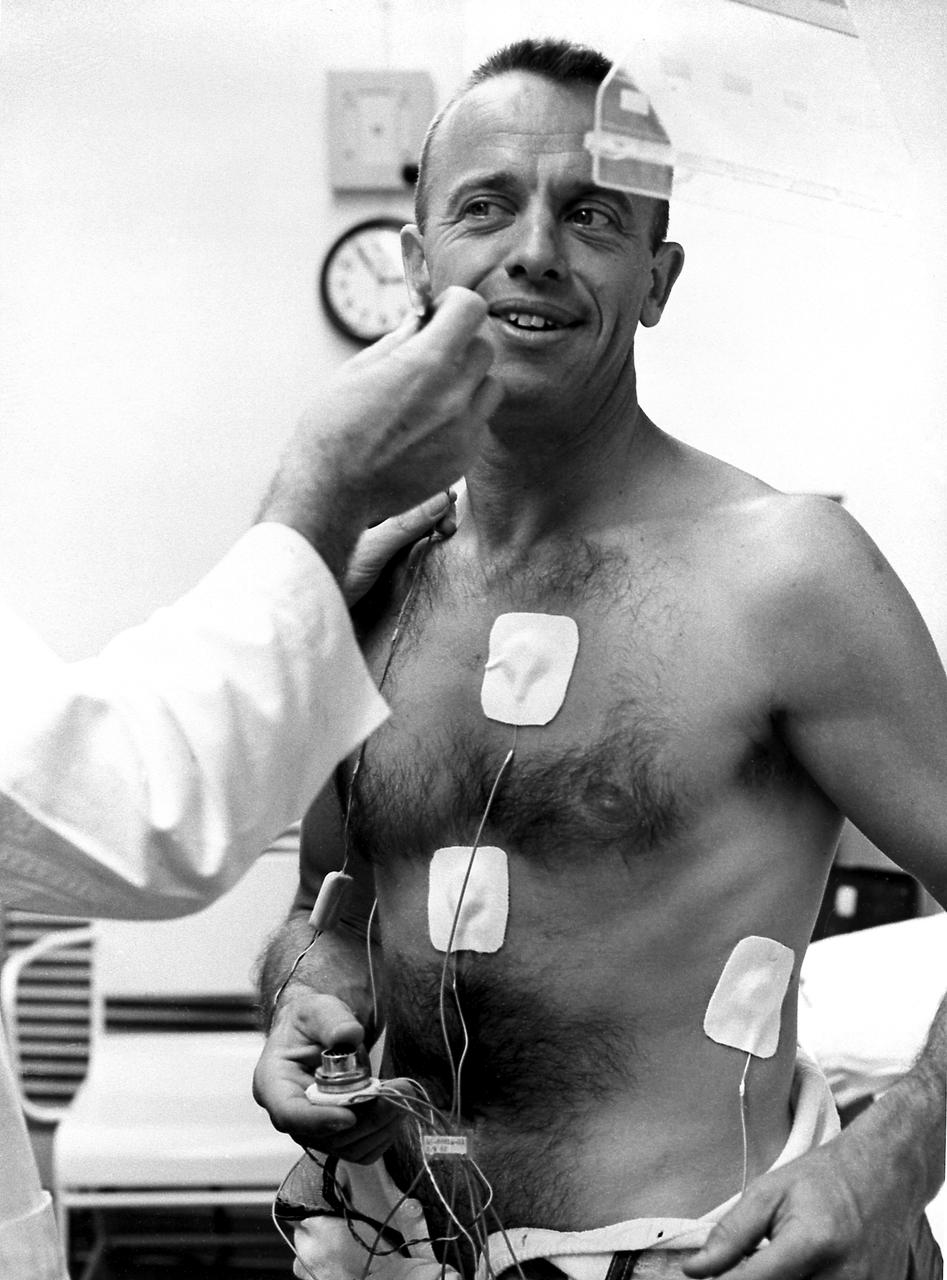
Astronaut Alan Shepard underwent a physical examination prior to the first marned suborbital flight. Freedom 7 carrying Astronaut Alan Shepard, boosted by the Mercury-Redstone launch vehicle, lifted off on May 5, 1961. Astronaut Shepard became the first American in space.
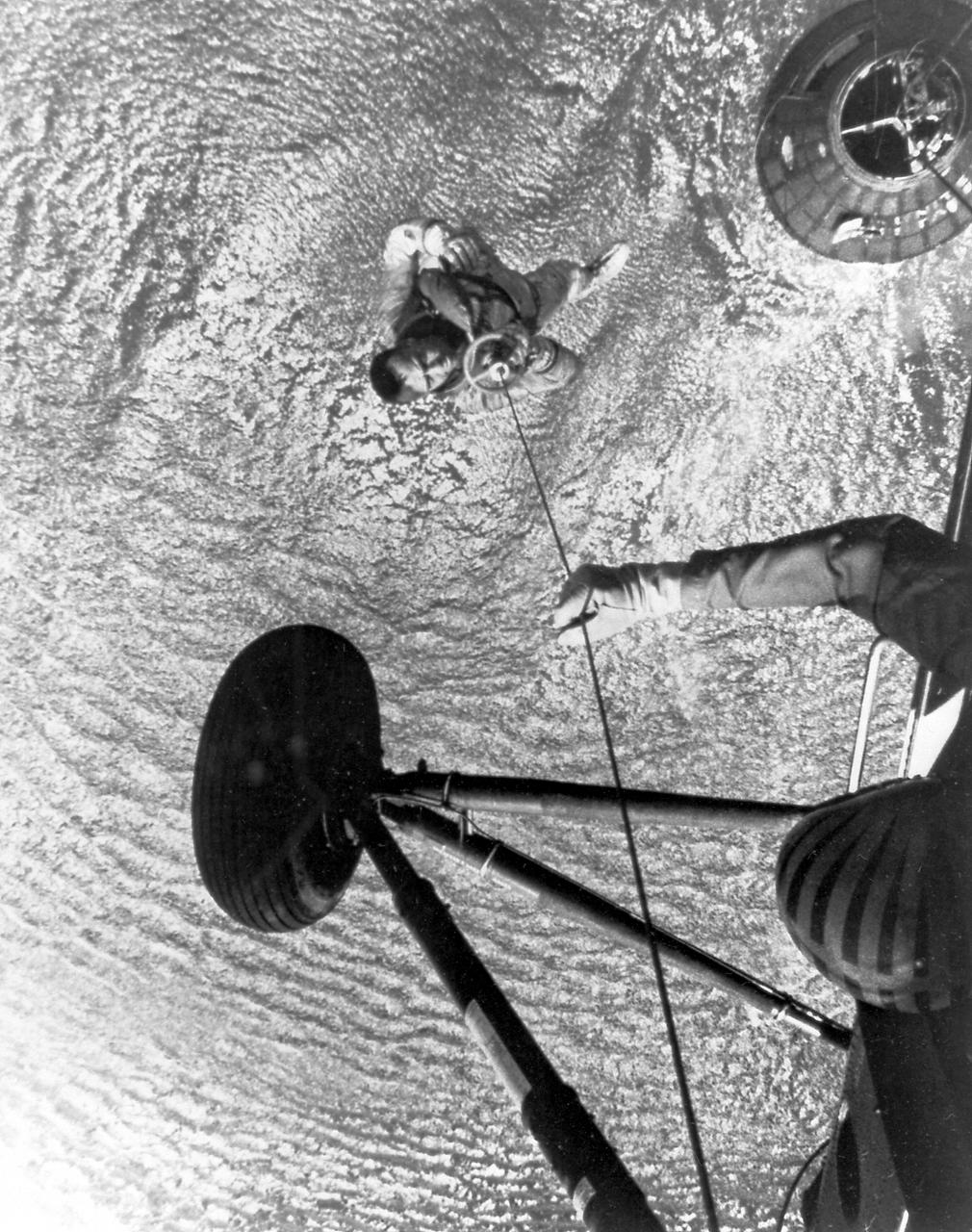
This photo depicts the recovery operations of the MR-3 mission. Astronaut Alan Shepard was picked up by a U.S. Marine helicopter after the completion of the first marned suborbital flight by MR-3 (Mercury-Redstone) with the Freedom 7 capsule.
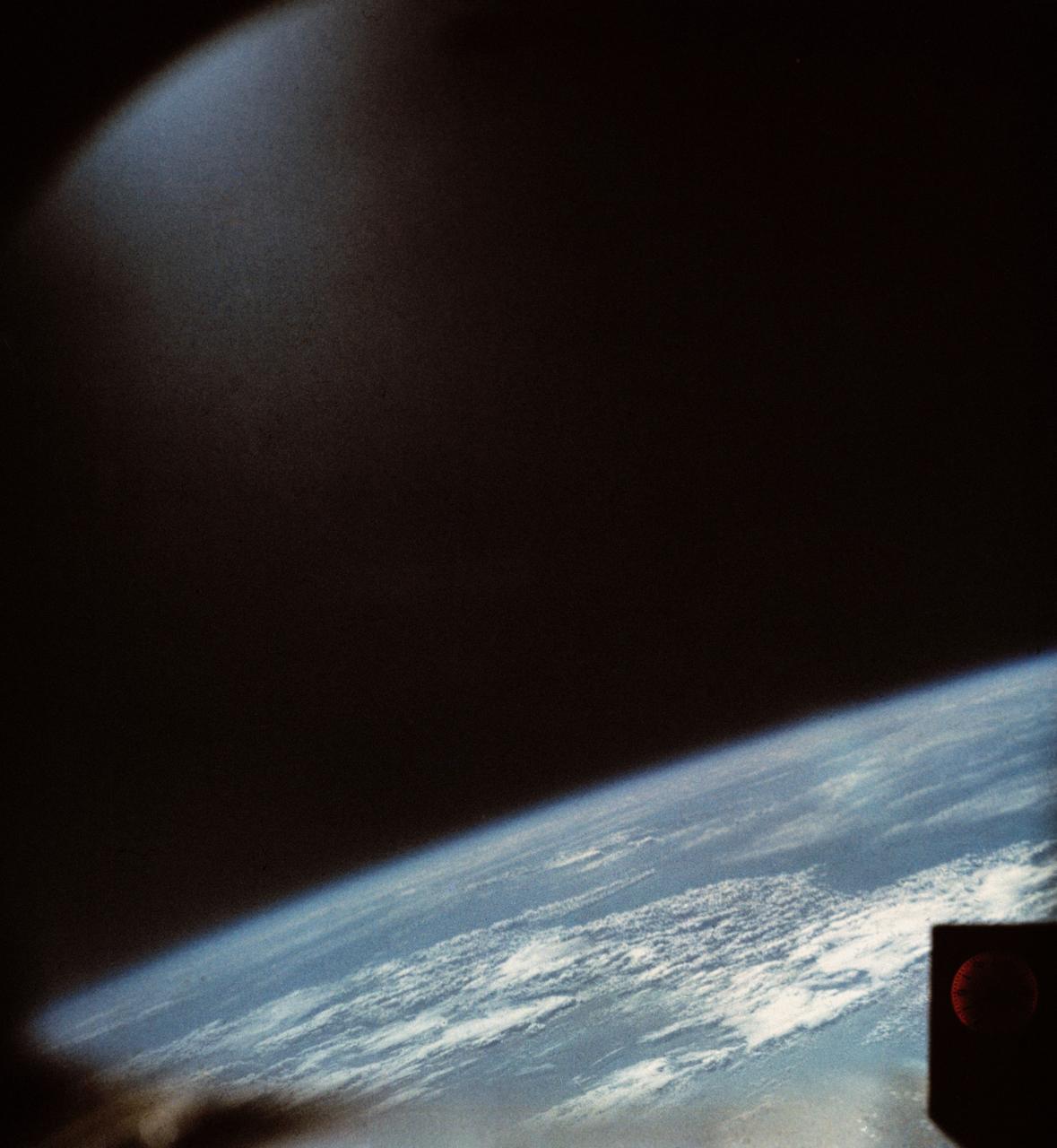
S61-04692 (31 Jan. 1961) --- Earth view from the Mercury Redstone 2 (MR-2) spacecraft. Photo credit: NASA
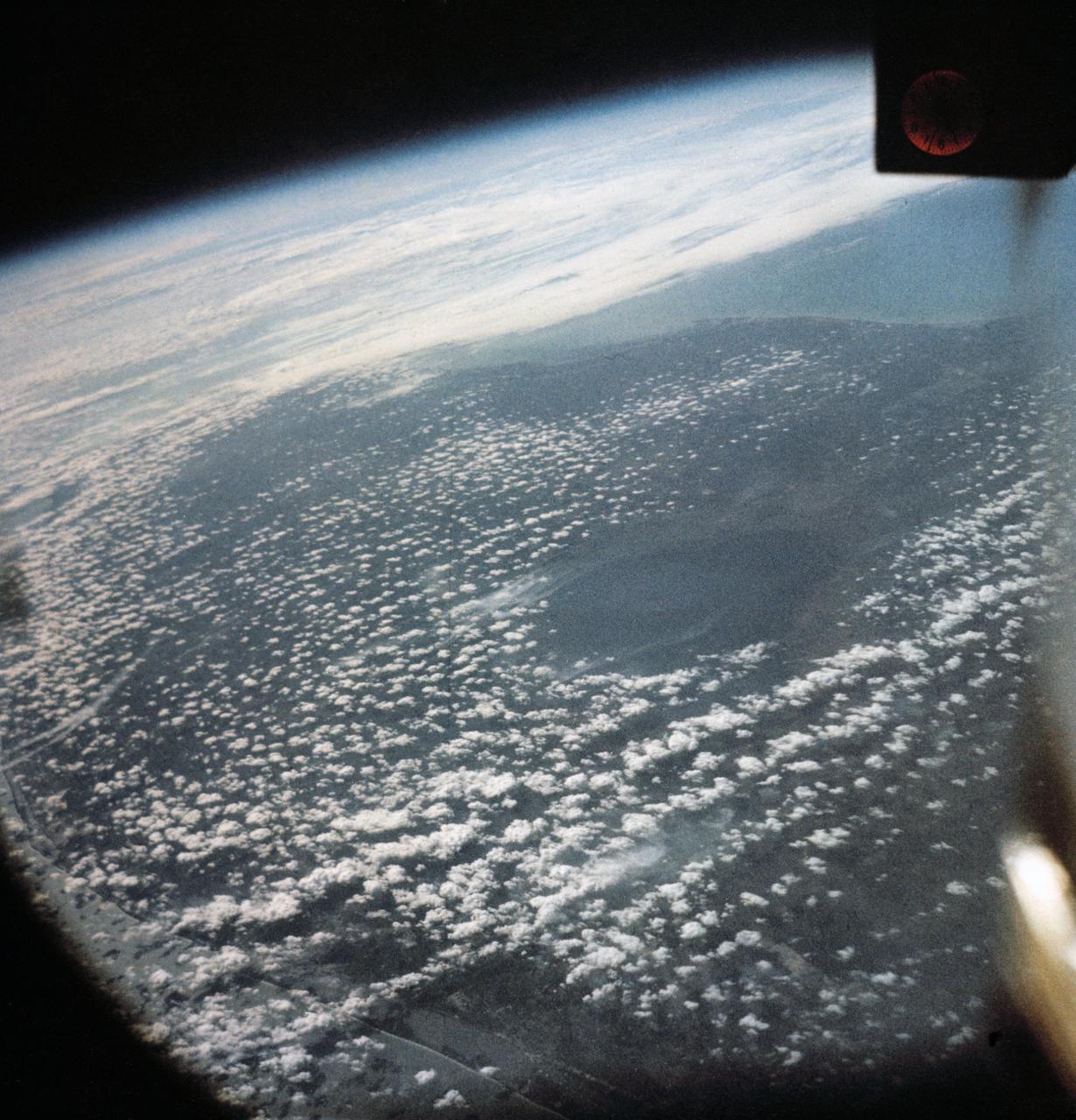
S61-04674 (31 Jan. 1961) --- Earth view from the Mercury Redstone 2 (MR-2) spacecraft. Photo credit: NASA
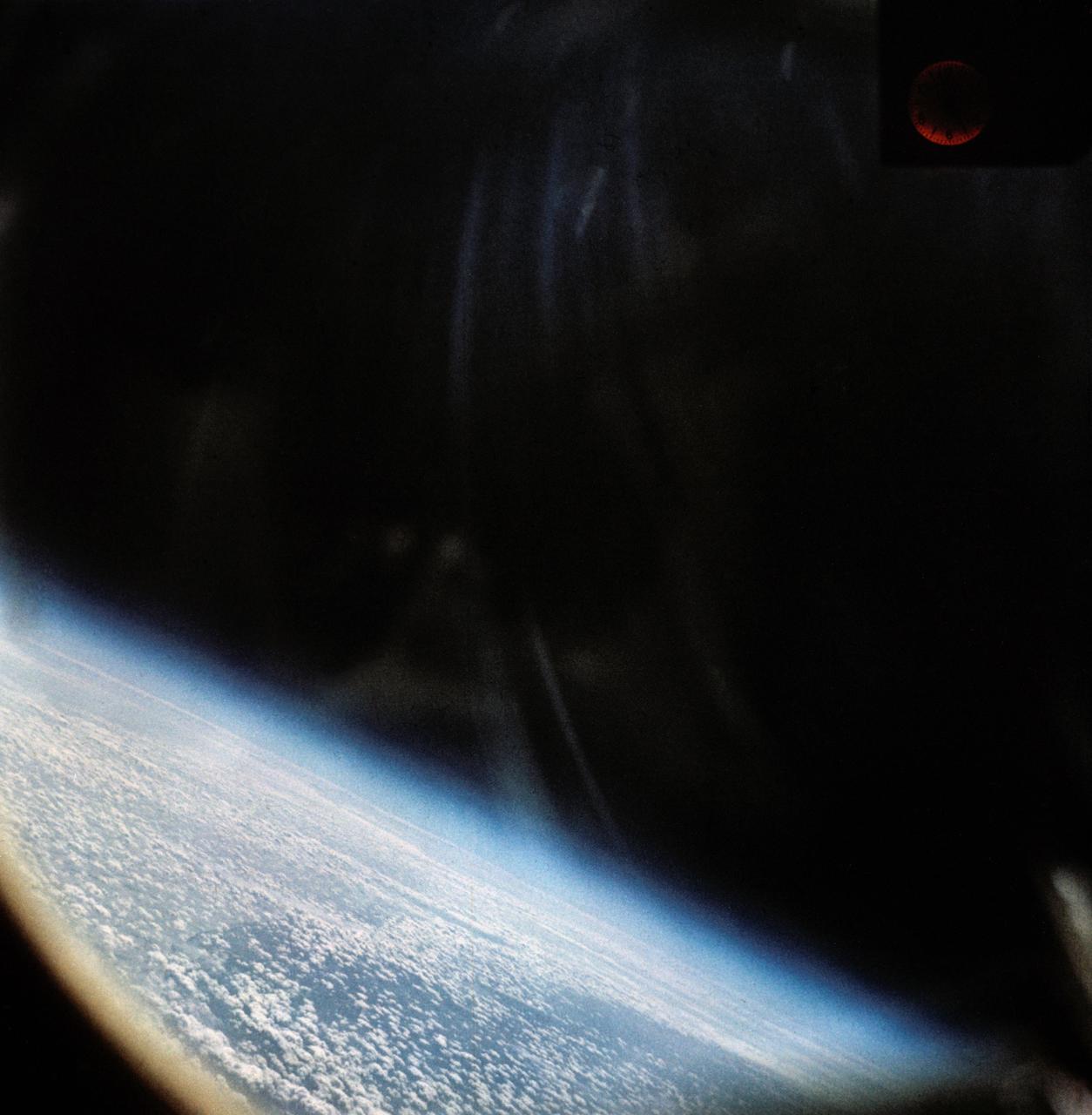
S61-04669 (31 Jan. 1961) --- Earth view from the Mercury Redstone 2 (MR-2) spacecraft. Photo credit: NASA
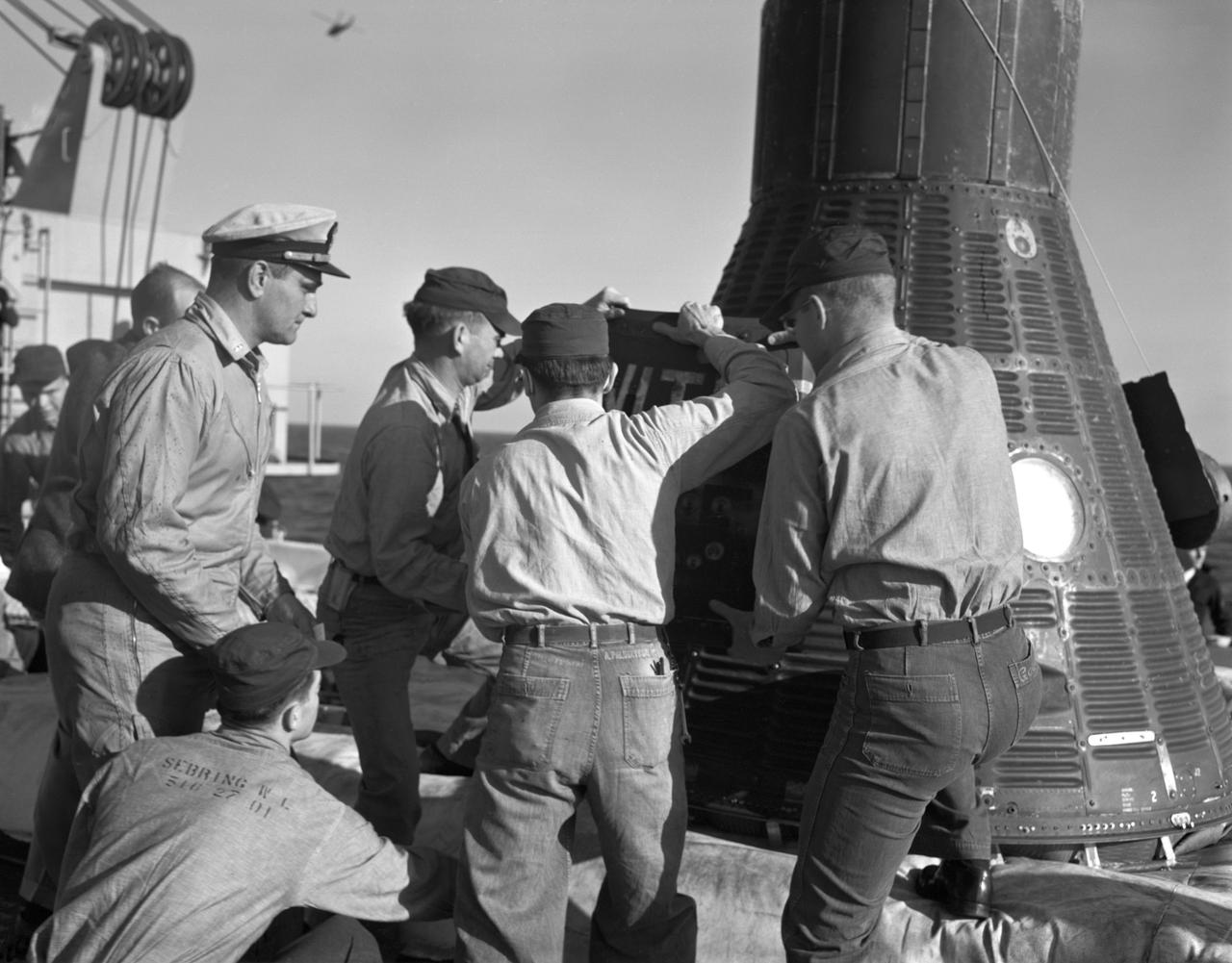
S61-00199 (31 Jan. 1961) --- Recovery personnel aboard the USS Donner remove ?Ham?, a 37-pound chimpanzee, from a Mercury-Redstone spacecraft following the successful Mercury-Redstone 2 (MR-2) suborbital flight from Cape Canaveral, Florida. The primate's 420-statute mile MR-2 flight was a significant accomplishment on the American route toward manned spaceflight. Photo credit: NASA
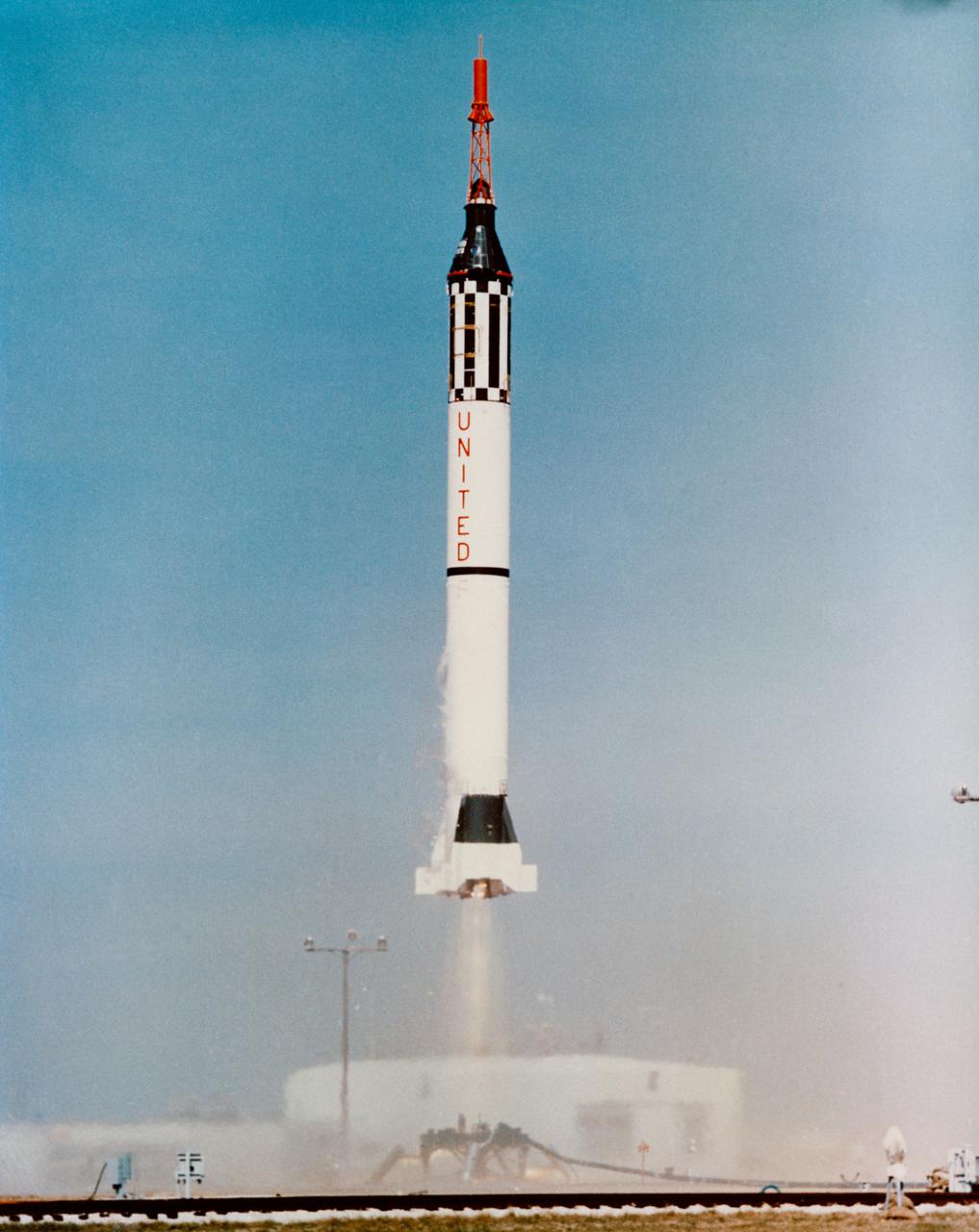
S62-08106 (19 Dec. 1960) --- Launch of the unmanned Mercury Redstone 1A (MR-1A) from Cape Canaveral on Dec. 19, 1960. Successful flight to peak altitude of 135 statue miles. Horizontal distance of 235 statue miles. Photo credit: NASA
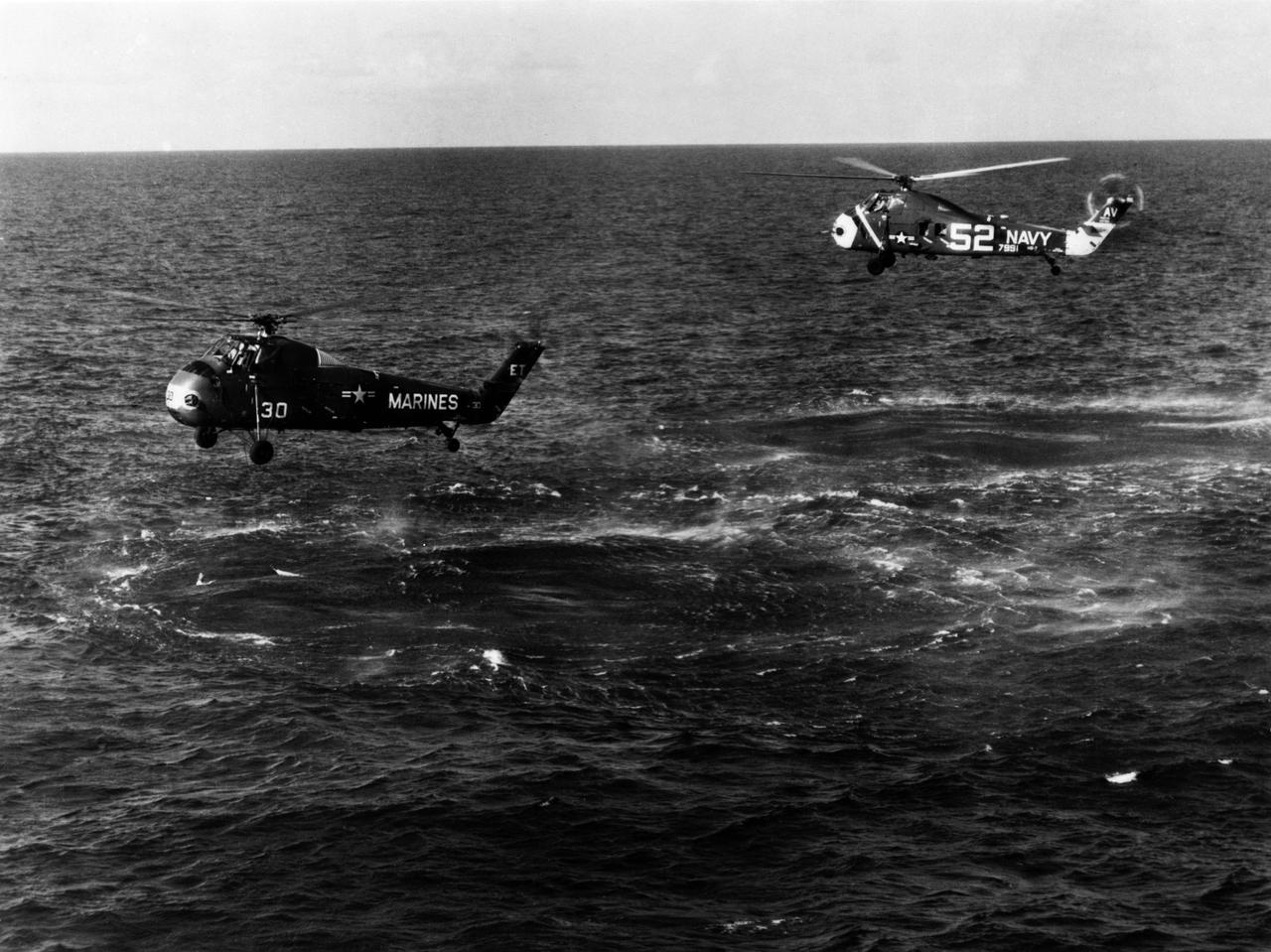
S61-02820 (21 July 1961) --- Attempted recovery of Mercury spacecraft at end of the Mercury-Redstone 4 (MR-4) mission. View shows the Marine helicopter pulled almost to the waters surface by the weight of the capsule, which filled with water. It eventually had to abandon its recovery attempts. Behind the Marine helicopter, a Navy helicopter prepares to assist. Photo credit: NASA
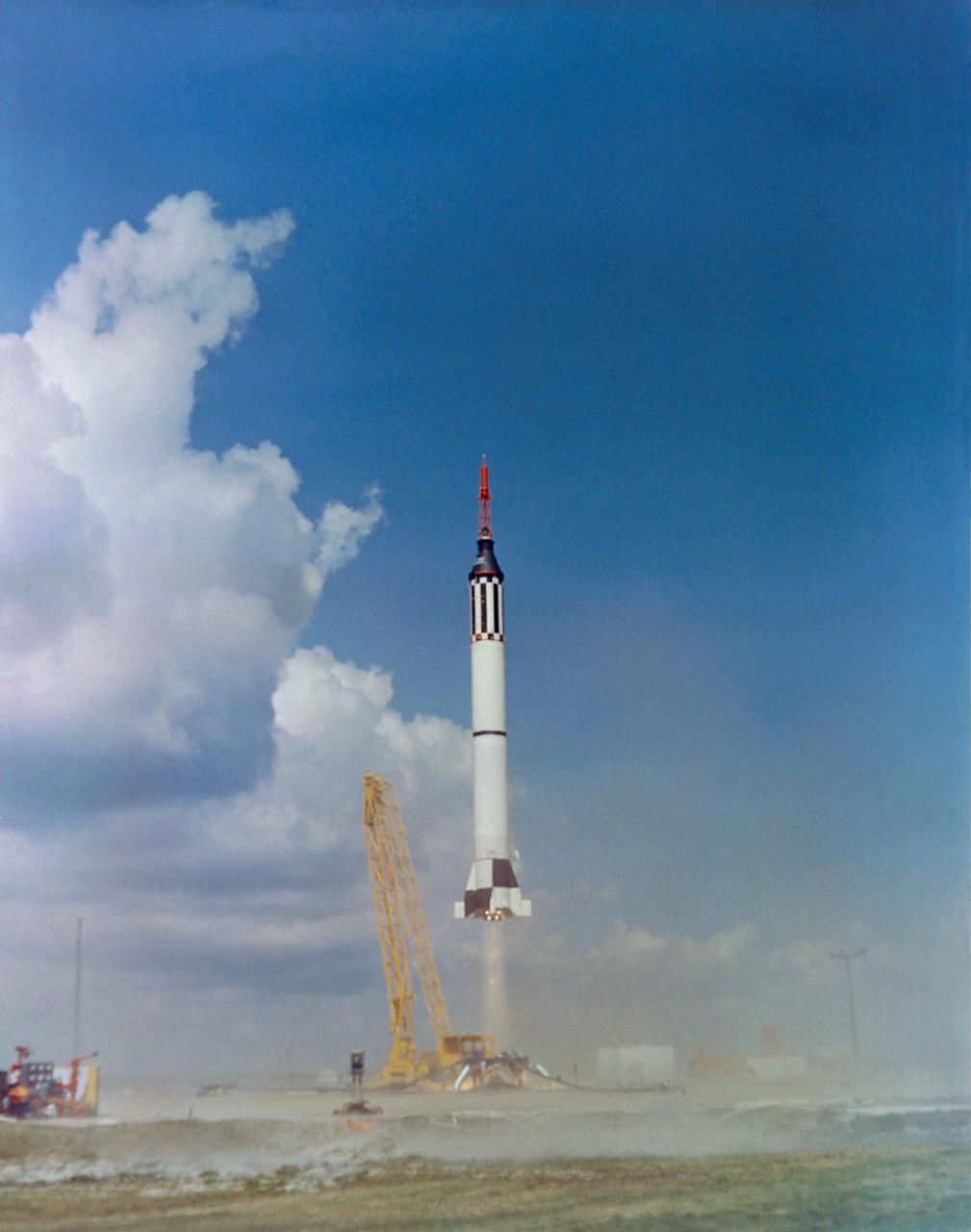
S63-22731 (31 Jan. 1961) --- The launch of the Mercury-Redstone 2 (MR-2) suborbital mission from Cape Canaveral, Florida, on Jan. 31, 1961. Onboard the spacecraft was ?Ham?, a 37-pound chimpanzee. Despite an over-acceleration factor, the flight was considered to be successful. Following recovery Ham appeared to be in good physiological condition, but sometime later when he was shown the Mercury spacecraft it was visually apparent that he had no further interest in cooperating with the spaceflight program. Photo credit: NASA
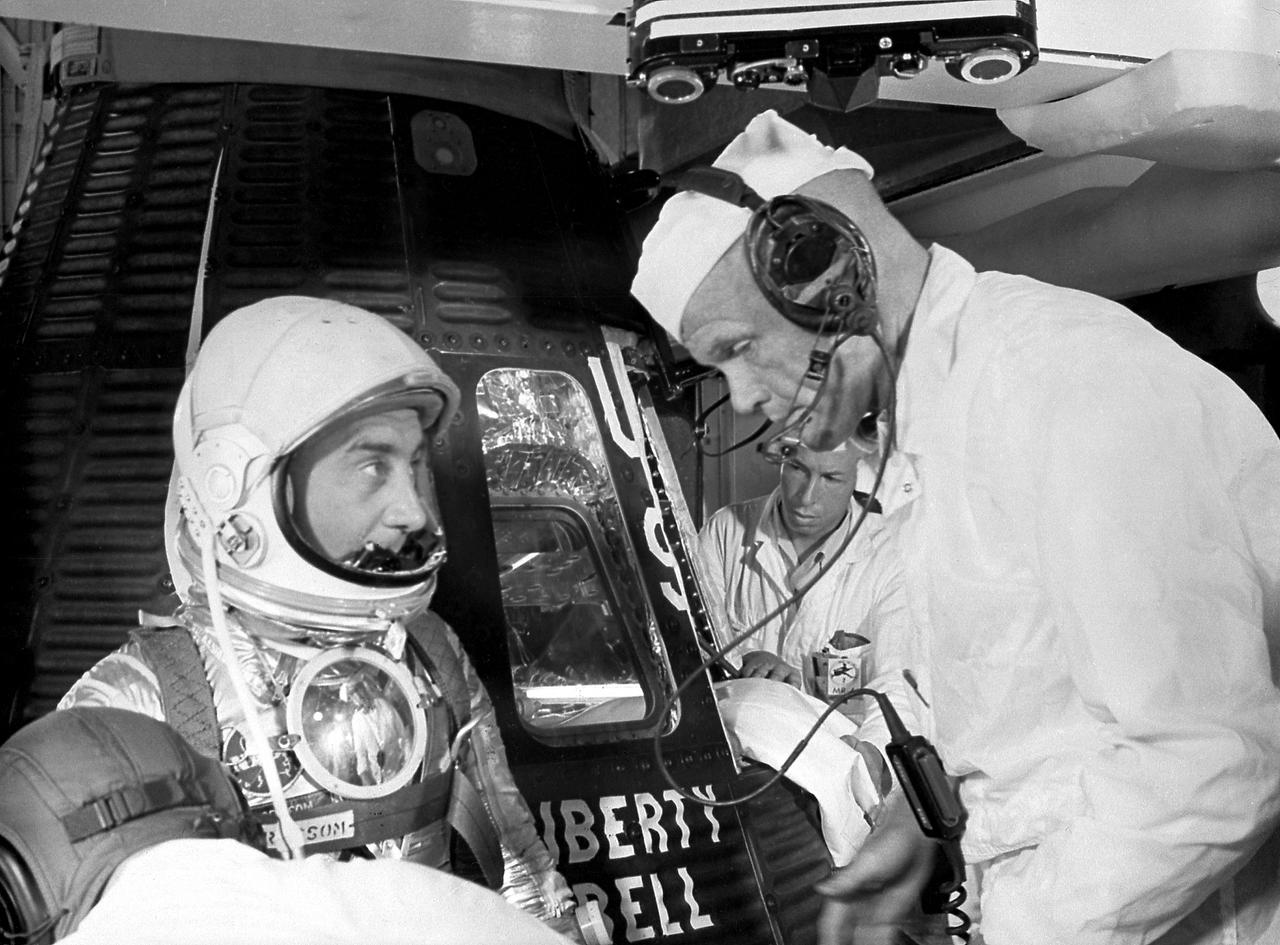
Astronaut Virgil Grissom chats with Astronaut John Glenn prior to entering the Liberty Bell 7 capsule for the MR-4 Mission. The MR-4 mission was the second manned suborbital flight using the Mercury-Redstone booster, which was developed by the Marshall Space Flight Center.
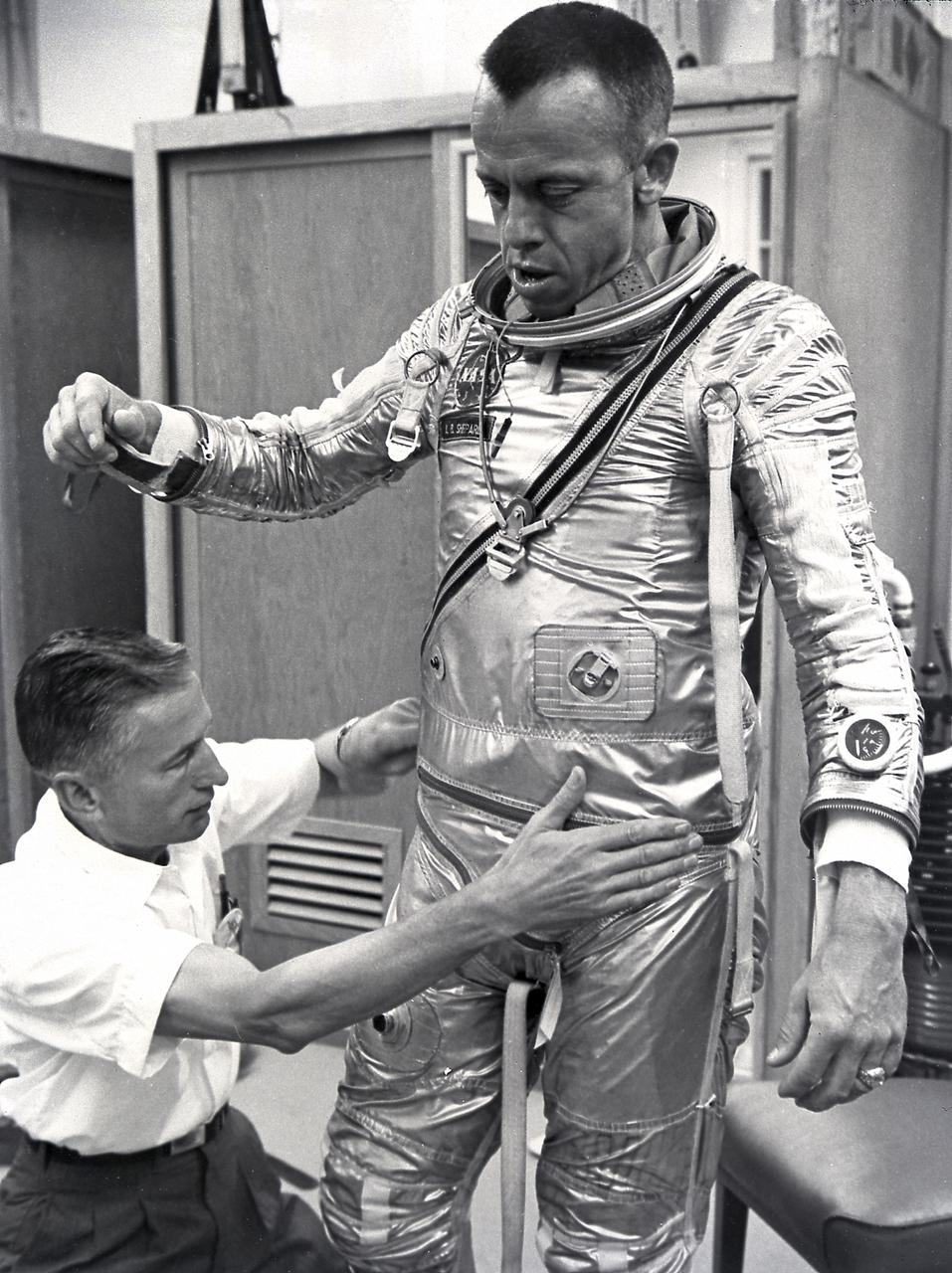
Astronaut Alan Shepard fitted with space suit prior to the first marned suborbital flight. Freedom 7, carrying Astronaut Alan Shepard, boosted by the Mercury-Redstone launch vehicle, lifted off on May 5, 1961. Astronaut Shepard became the first American in space.
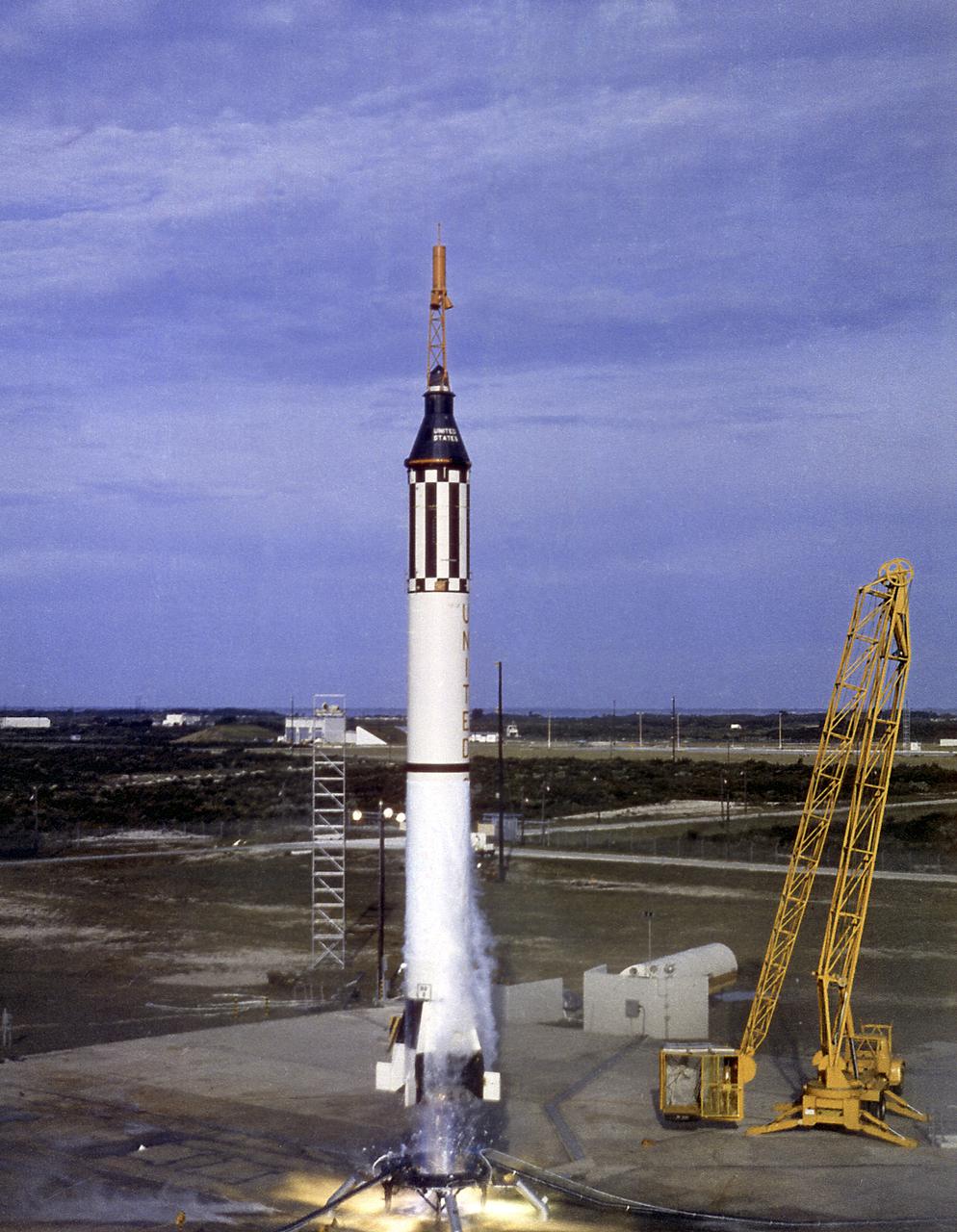
Liftoff of MR-4 (Mercury-Redstone), Liberty Bell 7, on July 21, 1961. MR-4 mission was the second marned suborbital flight and carried Astronaut Virgil Grissom aboard the Liberty Bell 7 spacecraft in space for a duration of 15-1/2 minutes.
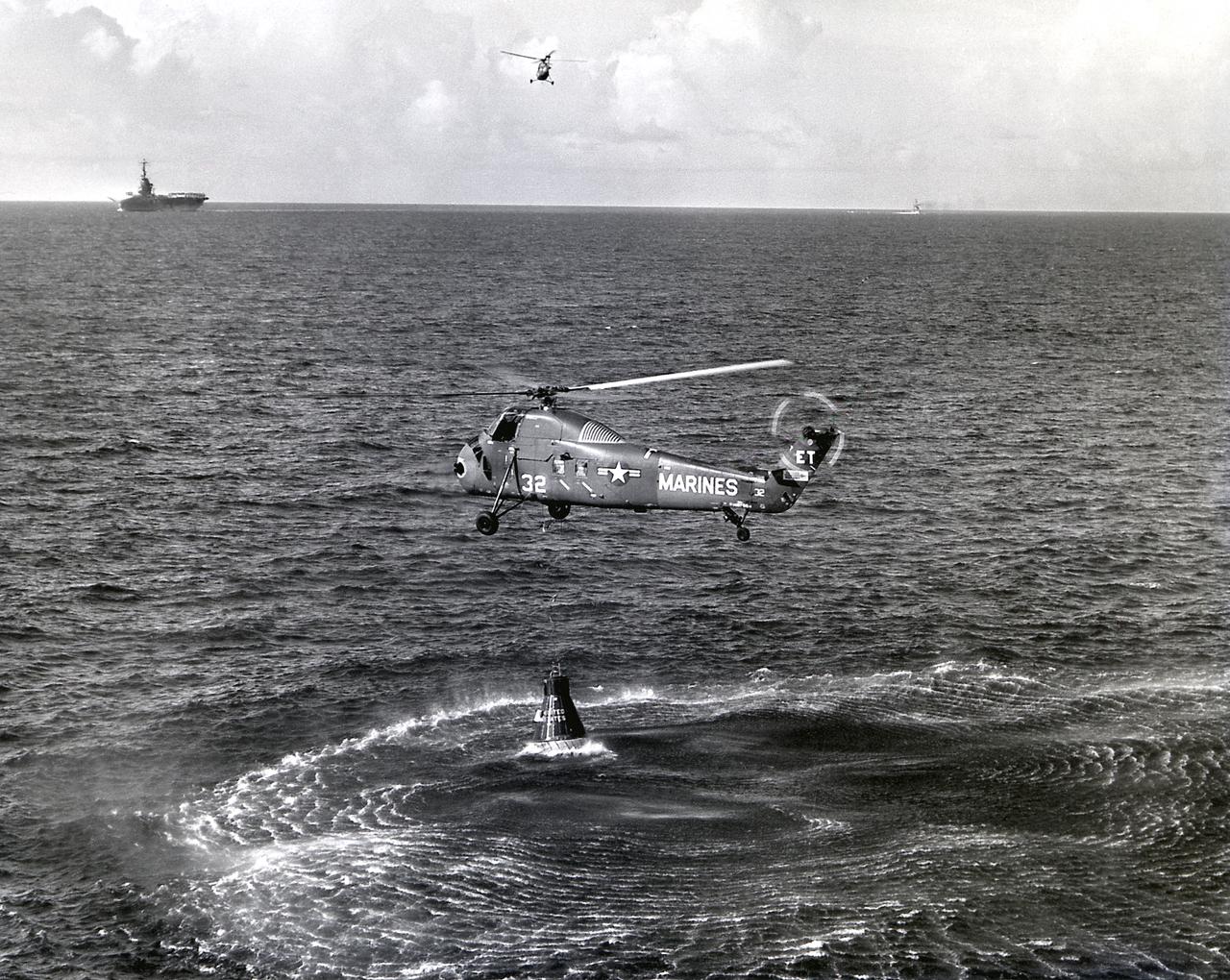
A U.S. Marine helicopter attempts to retrieve the sinking capsule, Liberty Bell 7, of the MR-4 mission. The attempt failed and the capsule sank. The MR-4 mission marned by Astronaut Virgil Grissom was the second manned orbital flight boosted by the Mercury-Redstone vehicle. The Recovery ship is in the background.
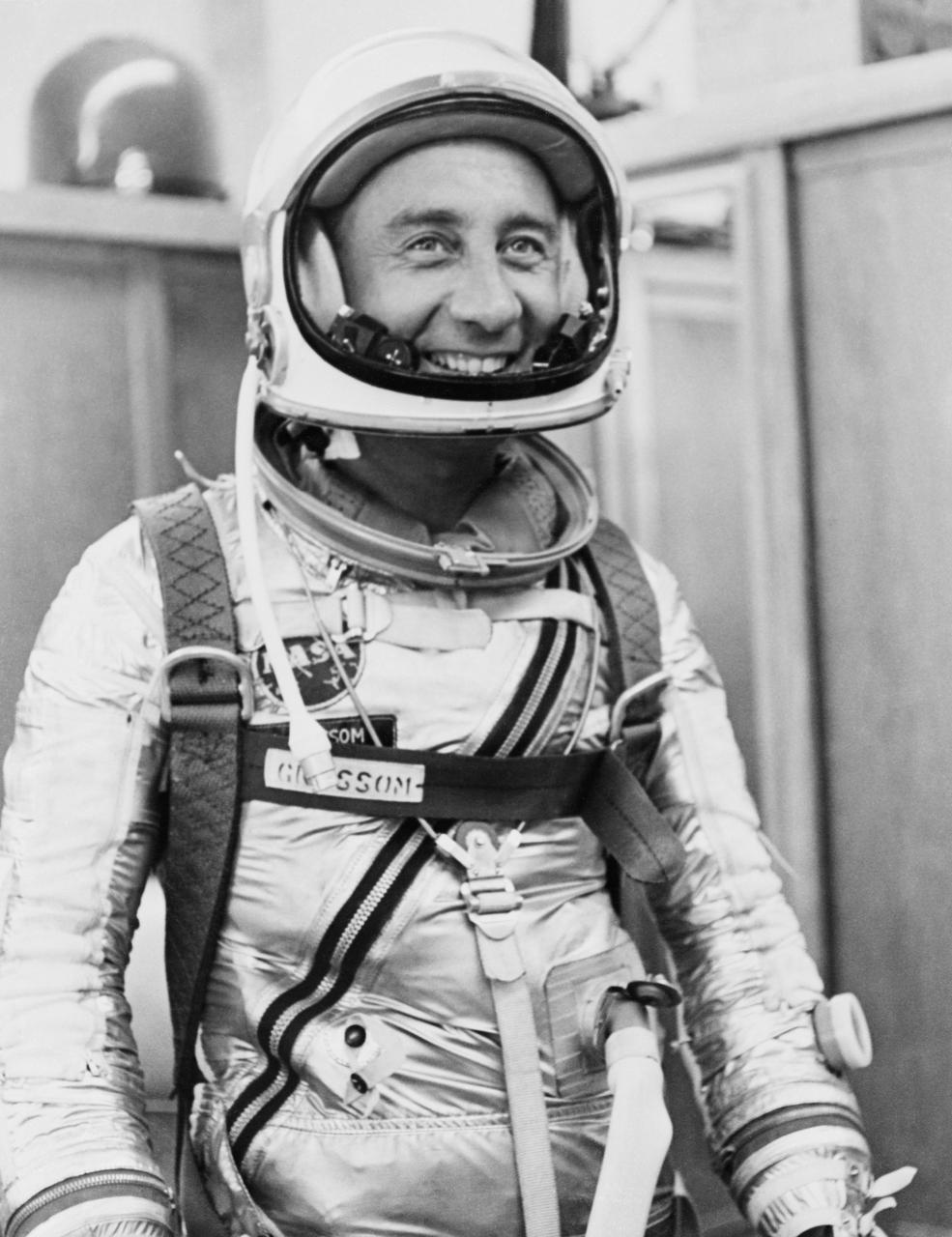
S61-02845 (1961) --- Portrait of astronaut Virgil I. (Gus) Grissom in his pressure suit and wearing his helmet in Hangar S at Cape Canaveral, Florida before the Mercury-Redstone 4 mission. Photo credit: NASA
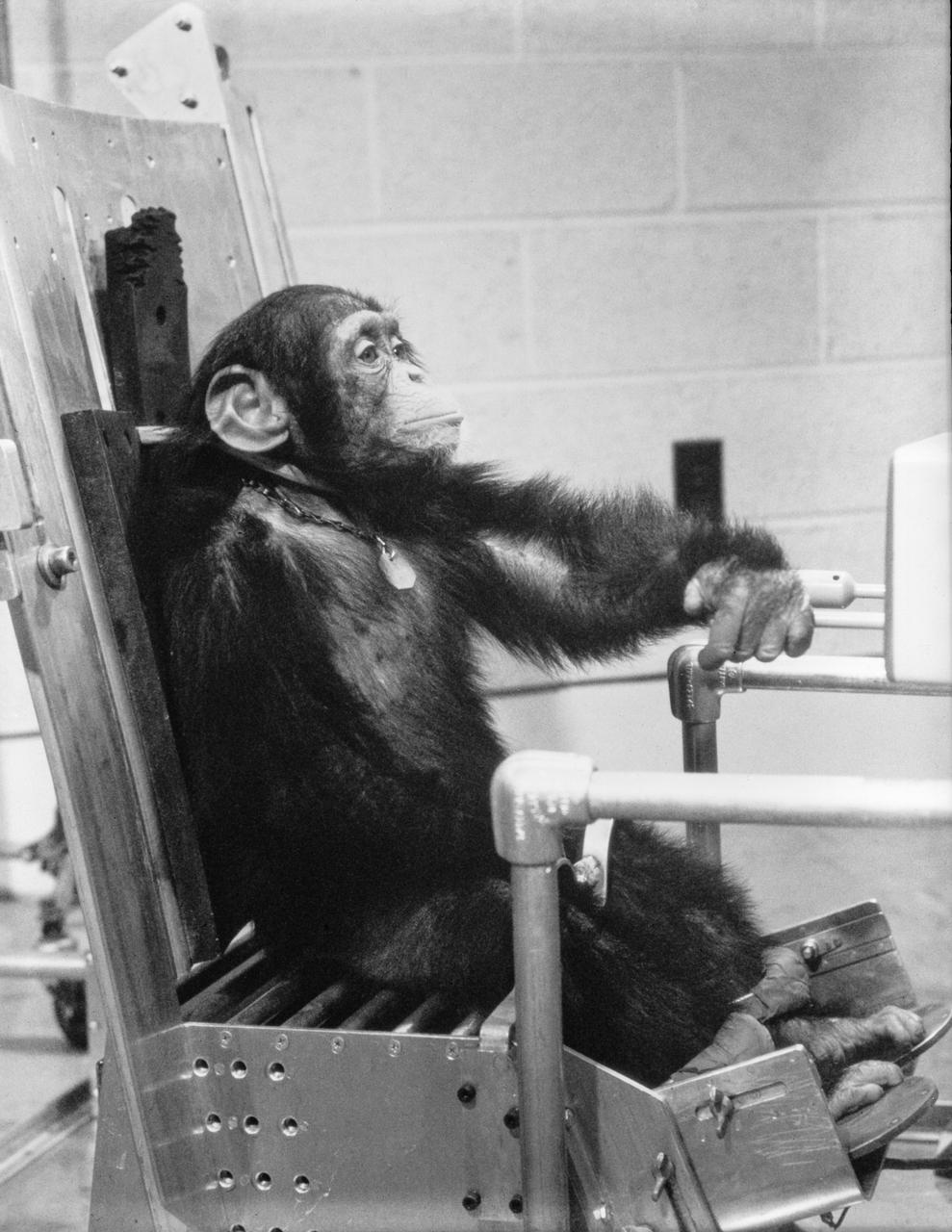
G61-00337 (31 Jan. 1961) --- Chimpanzee "Ham" during preflight activity with one of his handlers prior to the Mercury-Redstone 2 (MR-2) test flight which was conducted on Jan. 31, 1961. Photo credit: NASA
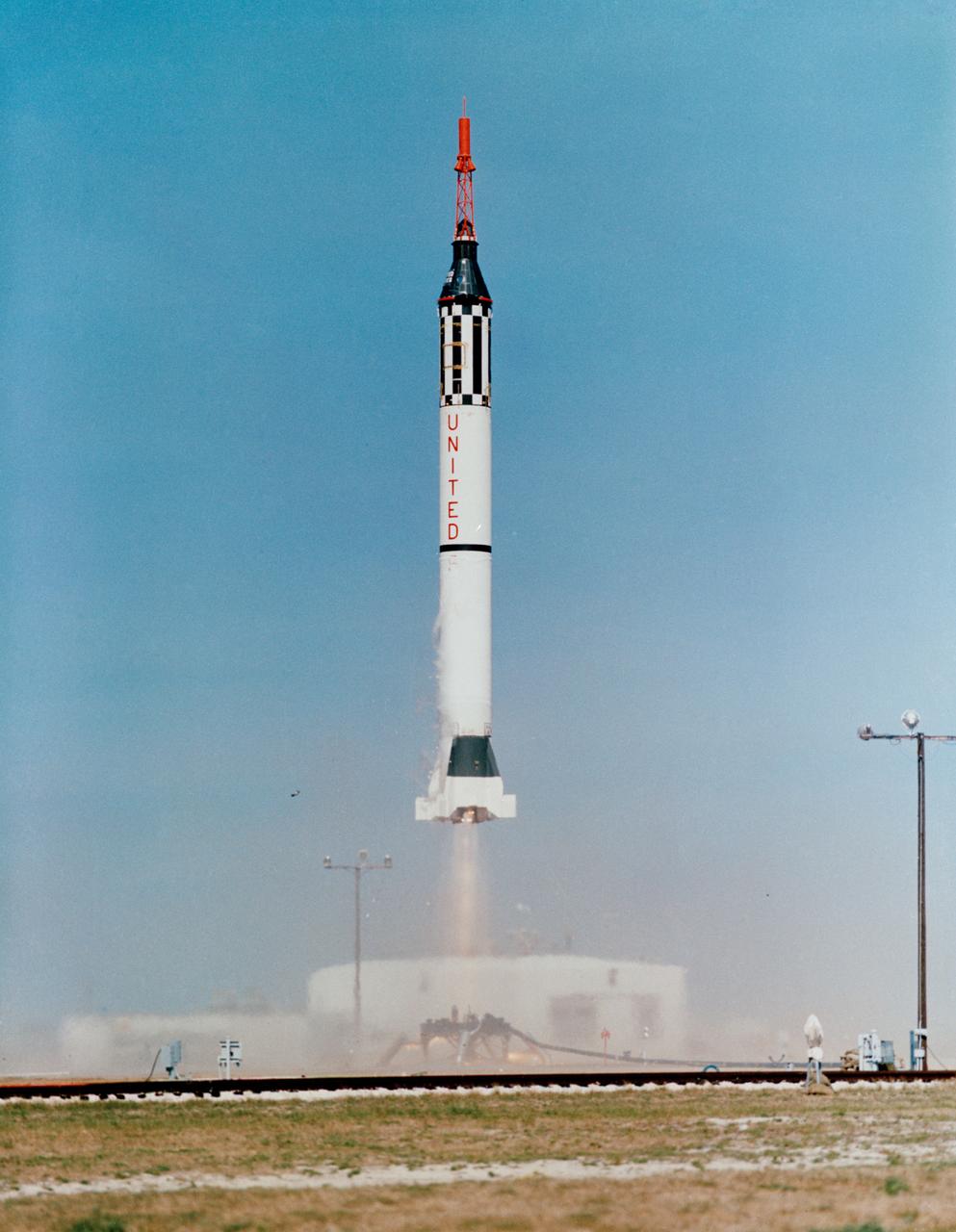
S61-01942 (31 Jan. 1961) --- Launch of the Mercury-Redstone 2 (MR-2) vehicle on Jan. 31, 1961. The 16-minute suborbital flight carried biomedical test subject chimpanzee (Ham) aboard. Photo credit: NASA
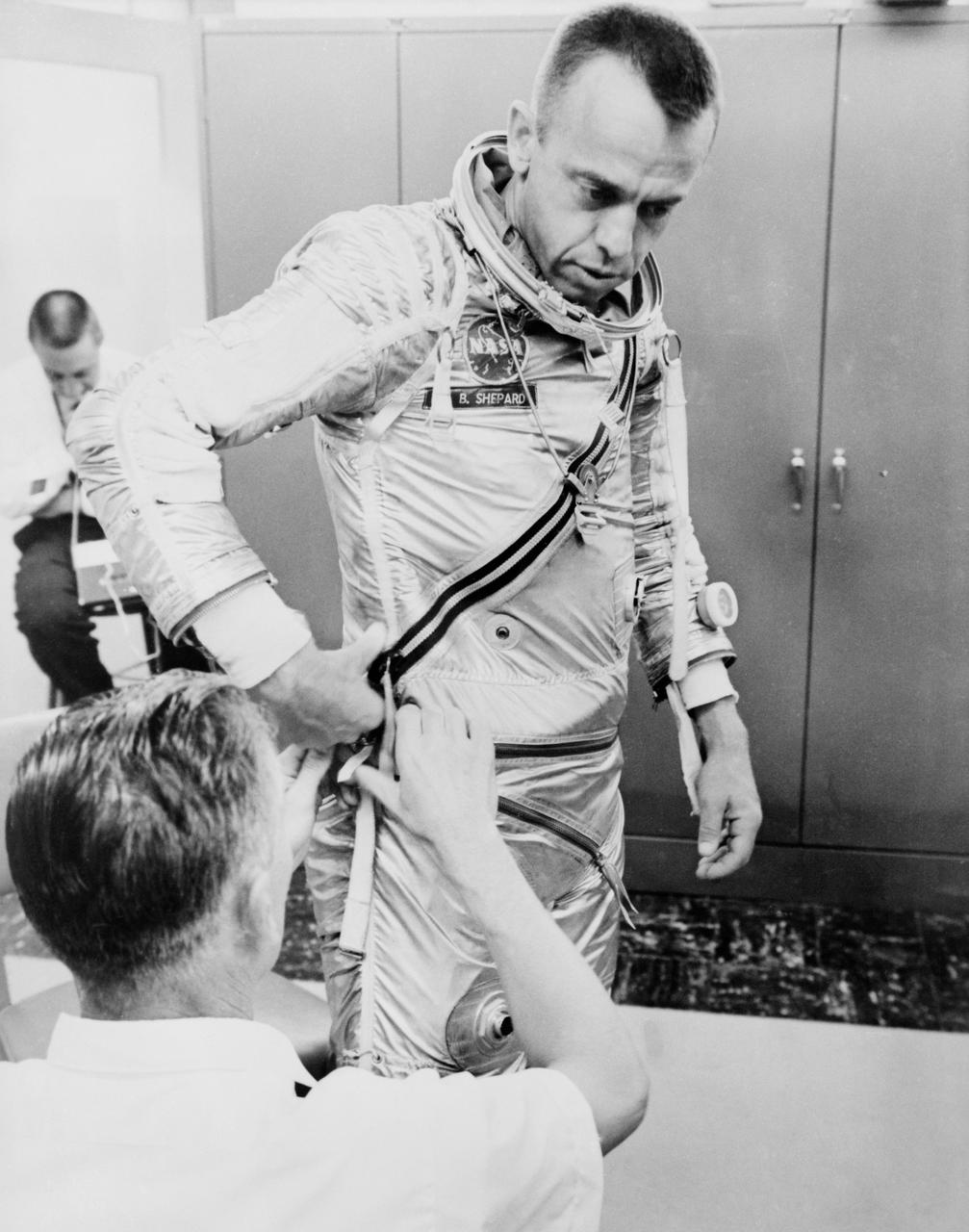
S61-02757 (5 May 1961) --- Astronaut Alan B. Shepard Jr. is being helped into his pressure suit for the Mercury-Redstone 3 (MR-3) flight, the first American manned spaceflight. Photo credit: NASA or National Aeronautics and Space Administration
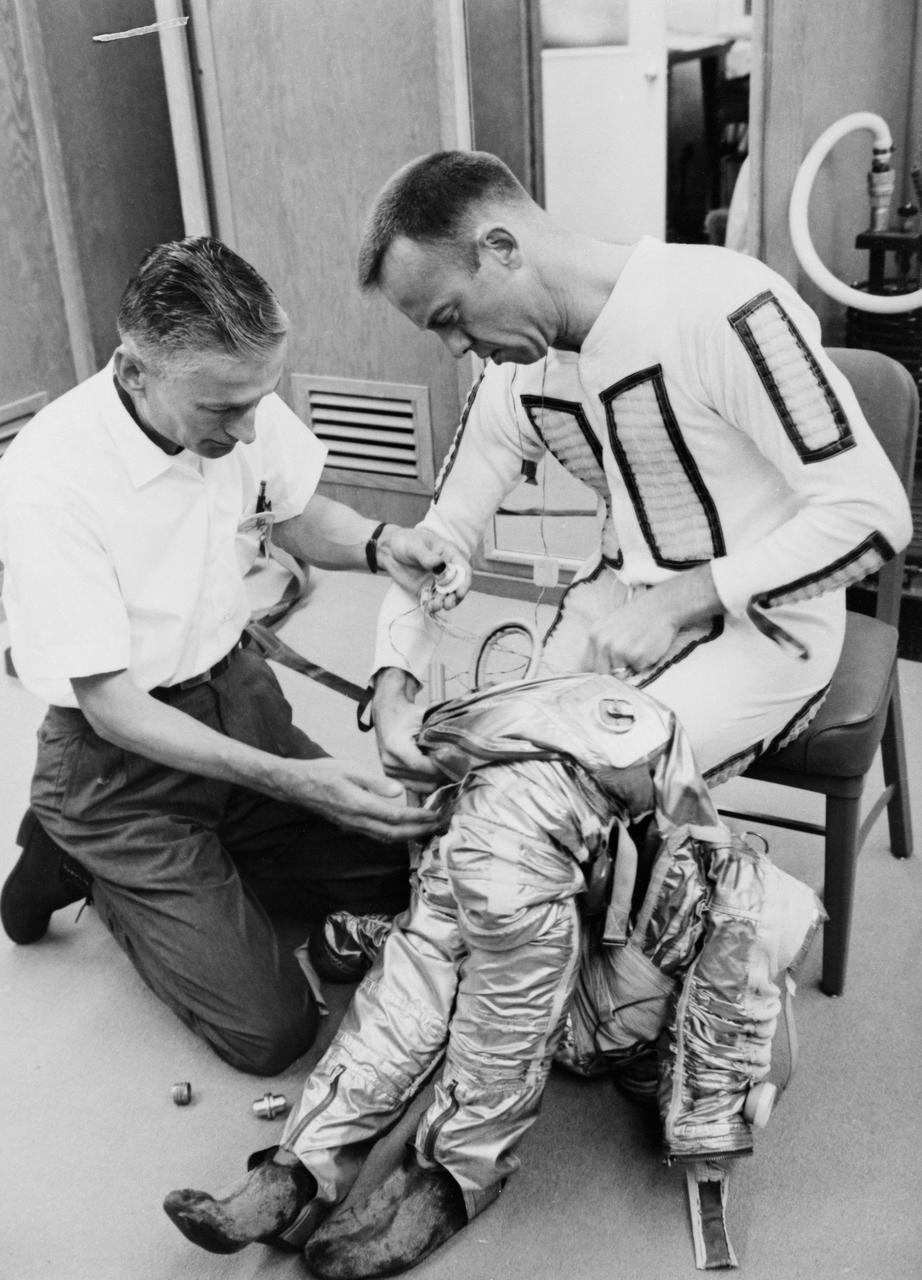
S61-02755 (5 May 1961) --- Astronaut Alan B. Shepard Jr. is being helped into the lower half of his pressure suit for the Mercury-Redstone 3 (MR-3) flight, the first American manned spaceflight. Photo credit: NASA or National Aeronautics and Space Administration
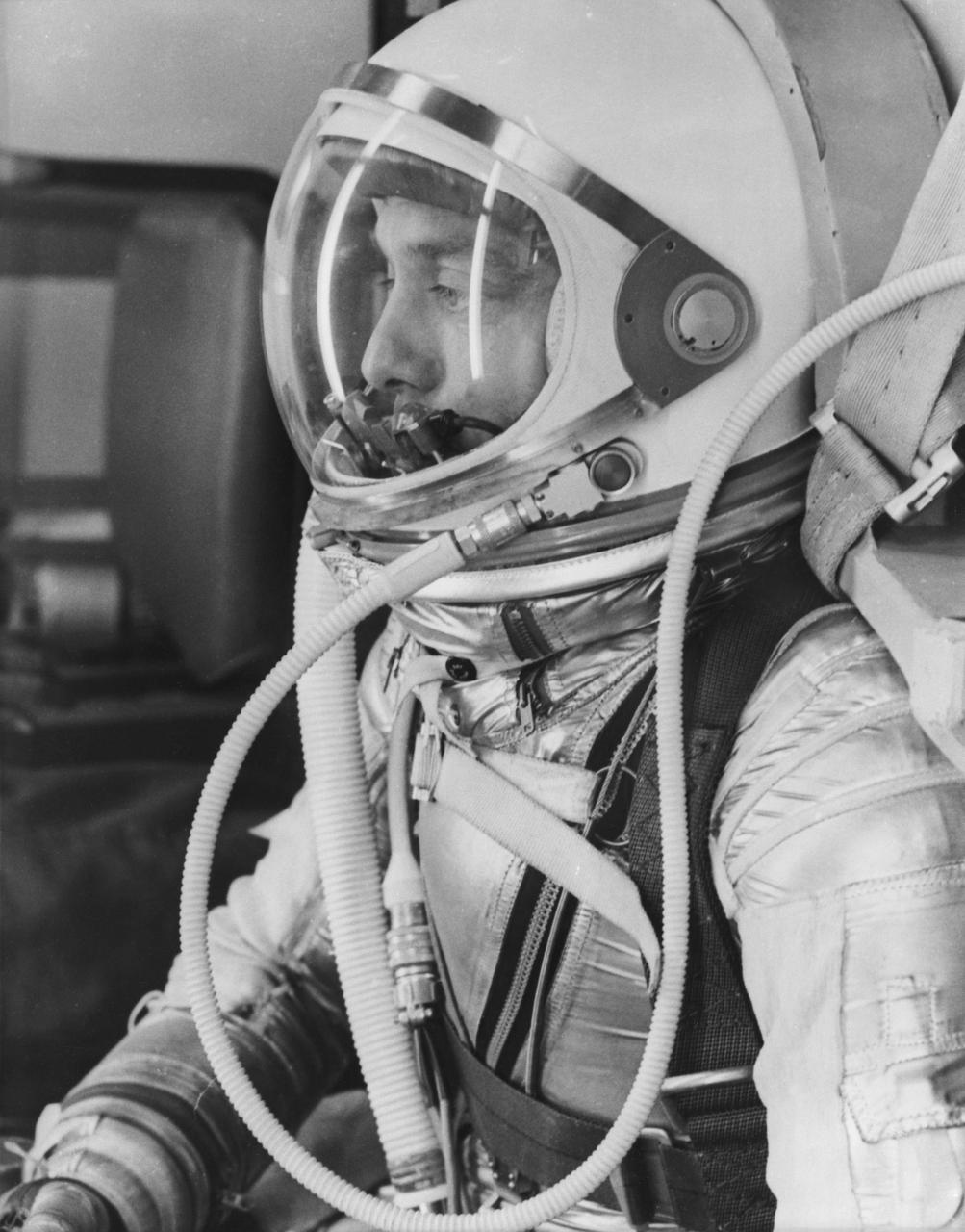
S61-02766 (5 May 1961) --- Side view of astronaut Alan B. Shepard Jr. in his pressure suit, with helmet closed, for the Mercury-Redstone 3 (MR-3) flight, the first American manned spaceflight. Photo credit: NASA or National Aeronautics and Space Administration
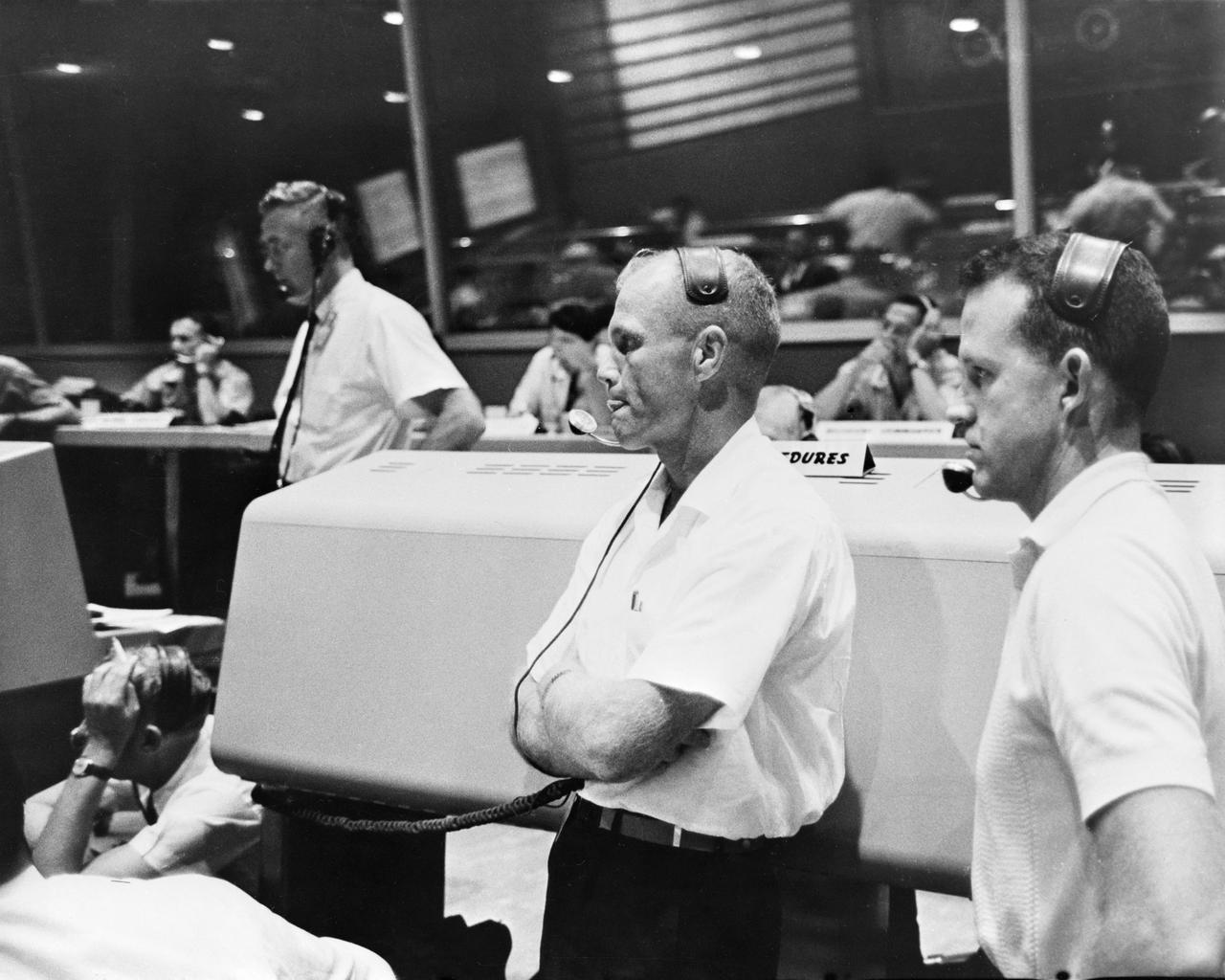
S61-03829 (21 July 1961) --- View of the Mission Control Center at Cape Canaveral during the Mercury-Redstone 4 (MR-4) mission. Astronauts John Glenn (left) and L. Gordon Cooper (right) act as spacecraft communicators (CAPCOM). Photo credit: NASA
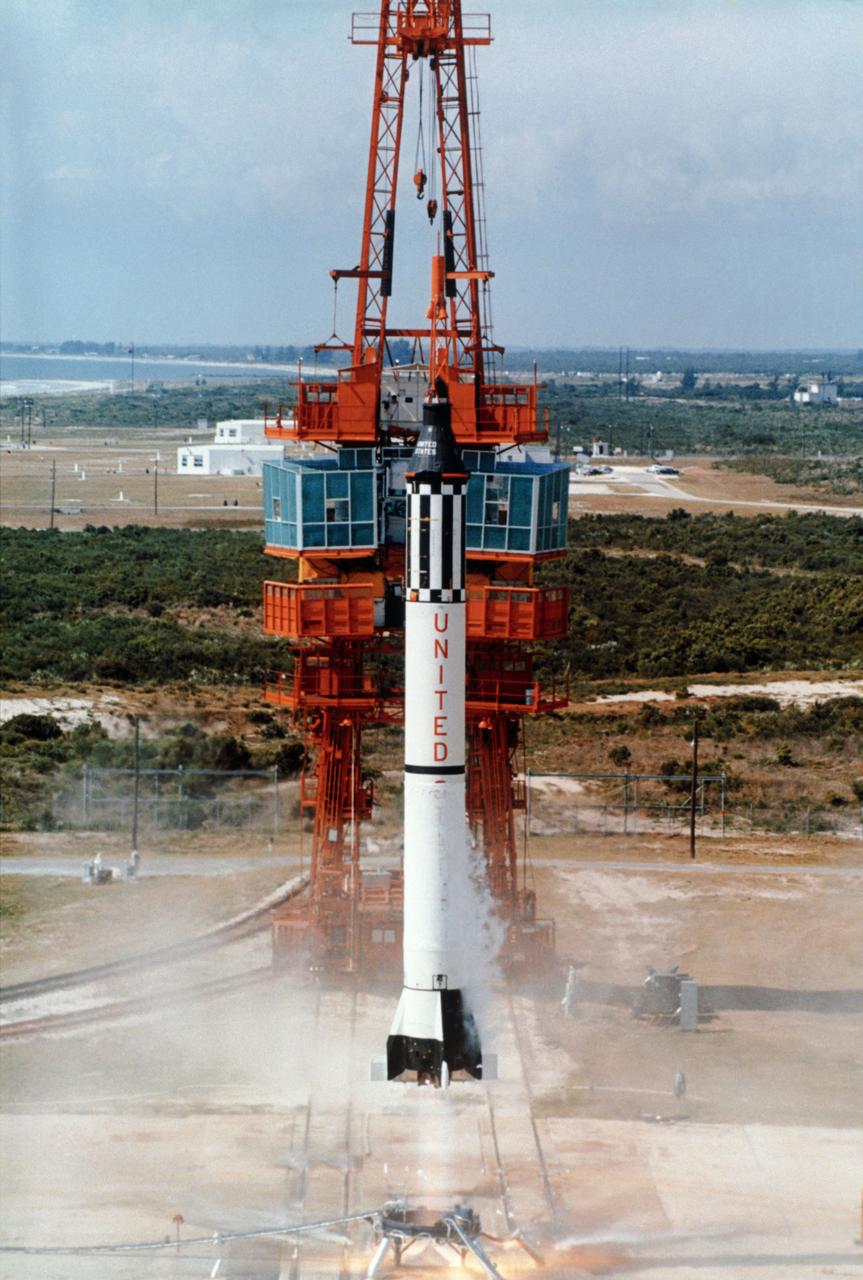
S61-01928 (5 May 1961) --- Mercury-Redstone 3 (MR-3), the United States' first manned spaceflight, is launched from Cape Canaveral on a suborbital mission. Astronaut Alan B. Shepard Jr. was the pilot of the Mercury spacecraft, designated "Freedom 7". The spacecraft attained a maximum speed of 5,180 miles per hour (mph), reached an altitude of 116 1/2 statute miles, and landed 302 statute miles downrange from Cape Canaveral, Florida. Photo credit: NASA or National Aeronautics and Space Administration
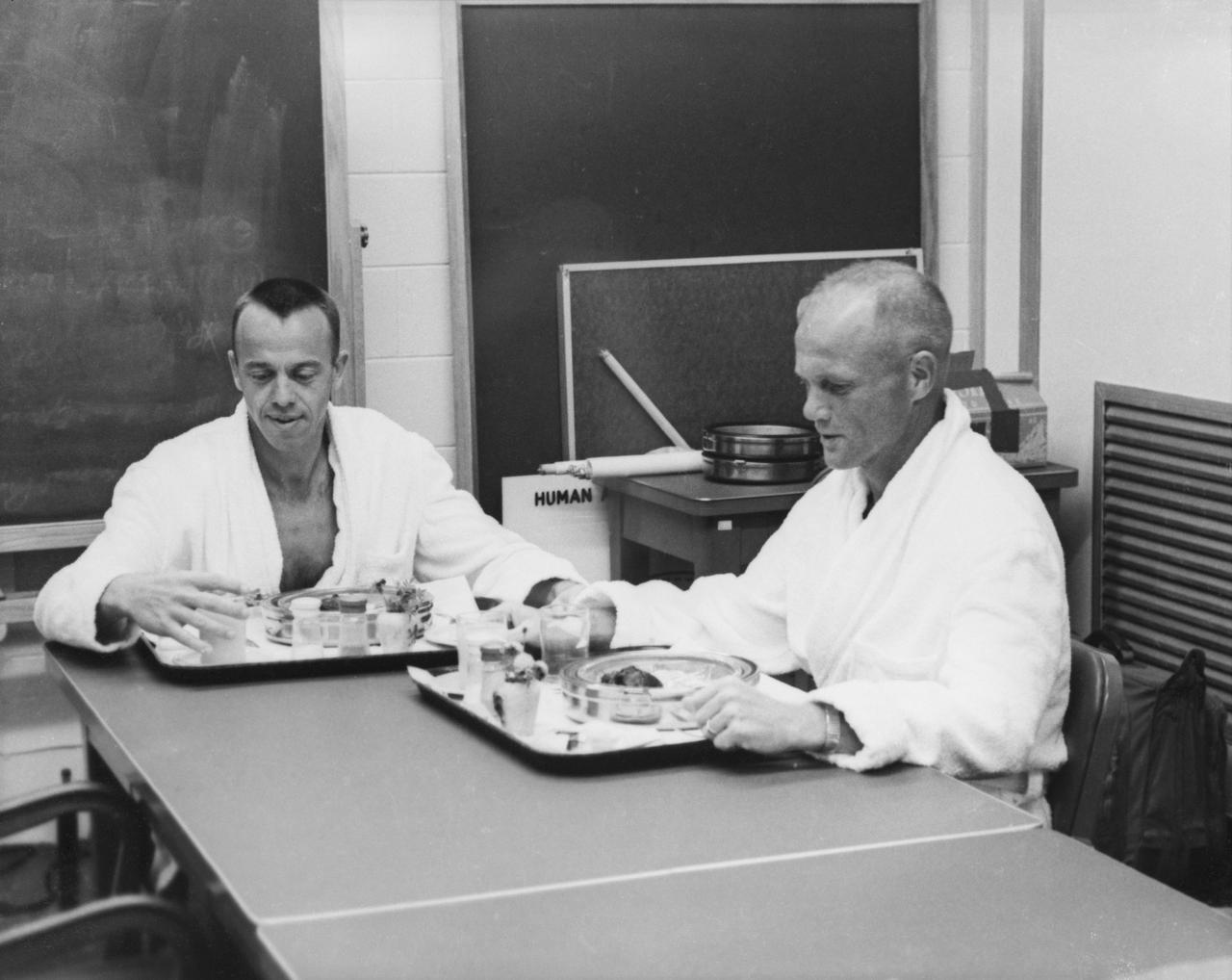
S61-02735 (5 May 1961) --- Astronauts Alan Shepard and John Glenn at breakfast before Shepard's Mercury-Redstone 3 (MR-3) spaceflight. Photo credit: NASA or National Aeronautics and Space Administration
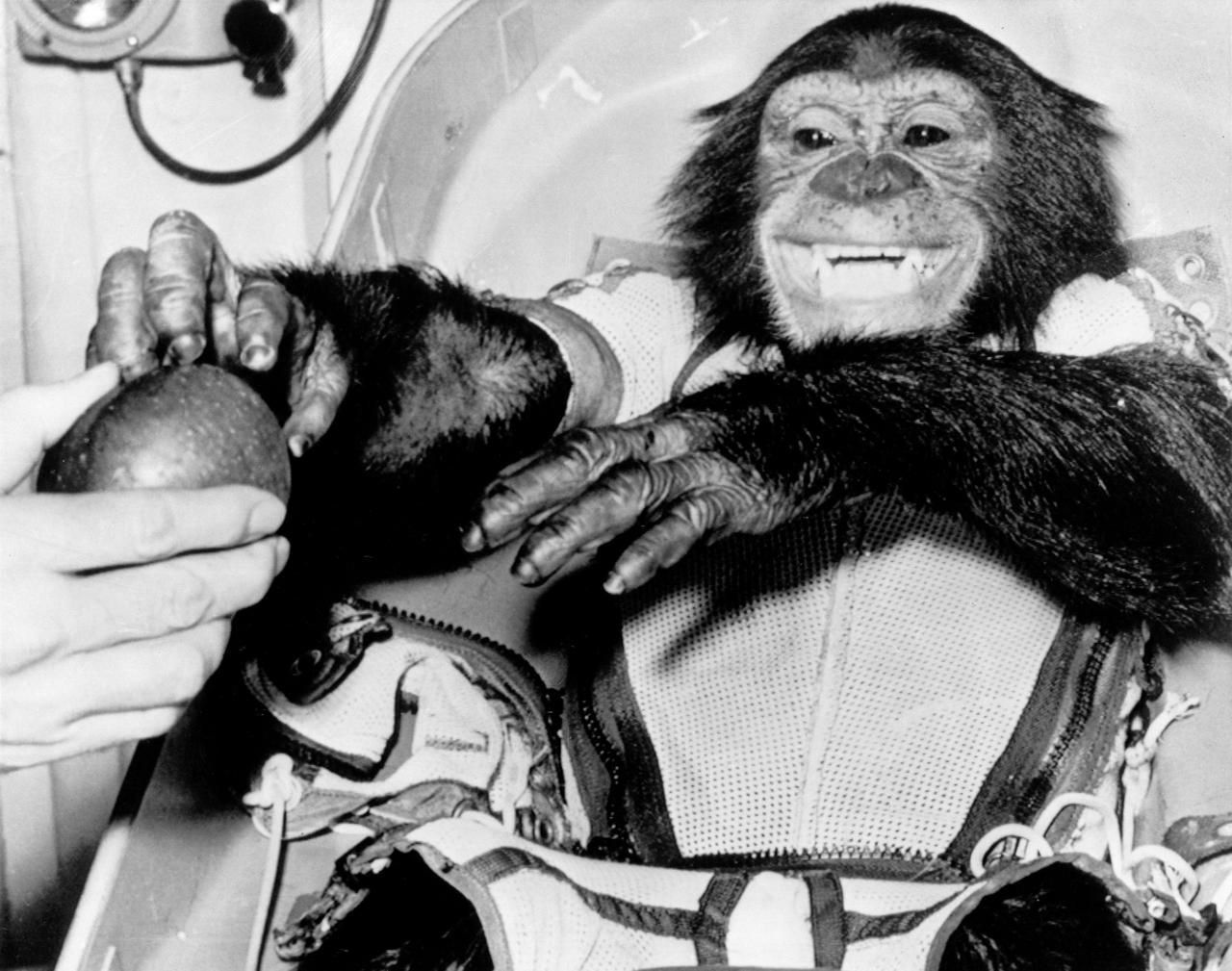
S63-18198 (31 Jan. 1961) --- Closeup view of the chimpanzee "Ham", the live test subject for the Mercury-Redstone 2 (MR-2) test flight, following his successful recovery from the Atlantic. The 420-statute mile suborbital MR-2 flight by the 37-pound primate was a significant accomplishment on the American route toward manned spaceflight. Photo credit: NASA
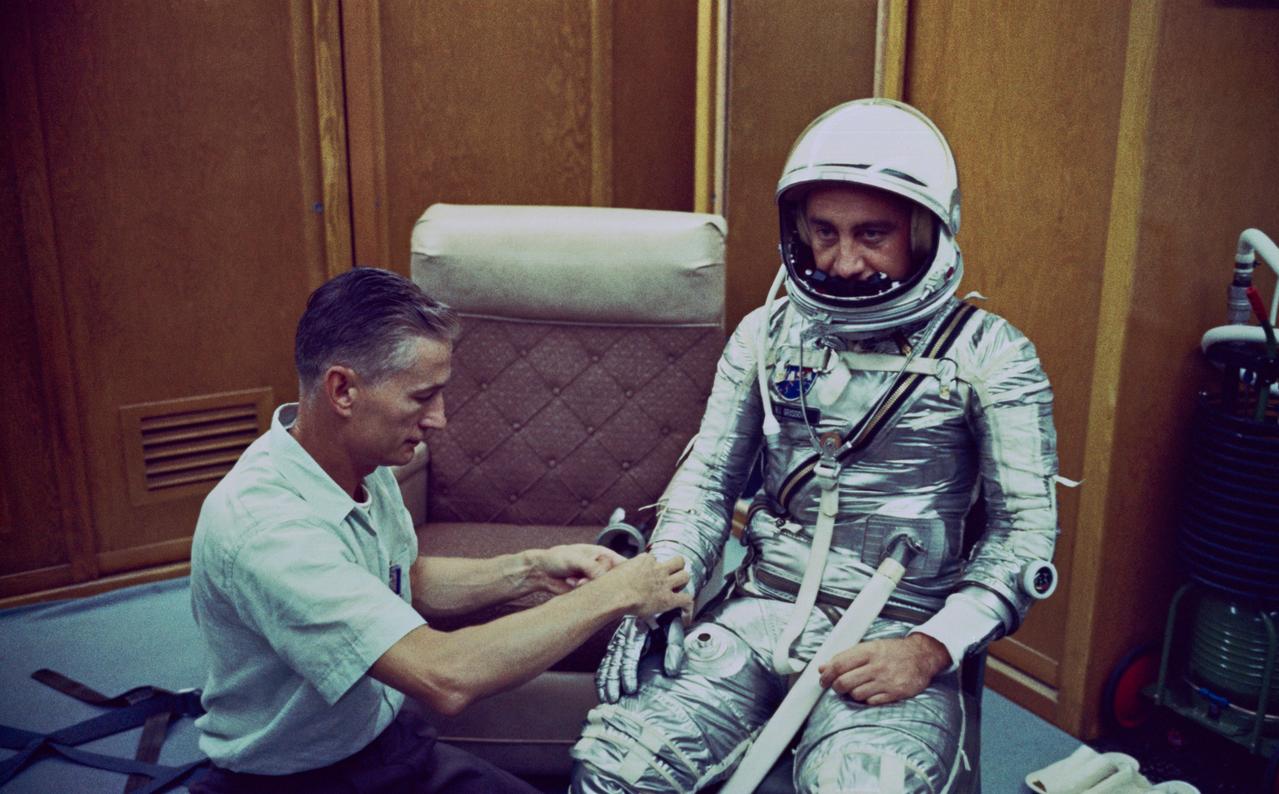
S88-55875 (19 July 1961) --- Donning a spacesuit for the Mercury-Redstone 4 (MR-4) mission, astronaut Virgil I. (Gus) Grissom chats with spaceflight equipment specialist Joe W. Schmitt in the personal equipment room of Hangar S at Cape Canaveral, Florida. Shortly after this photograph was taken, the launch was postponed two days due to unfavorable weather conditions in the area. Photo credit: NASA
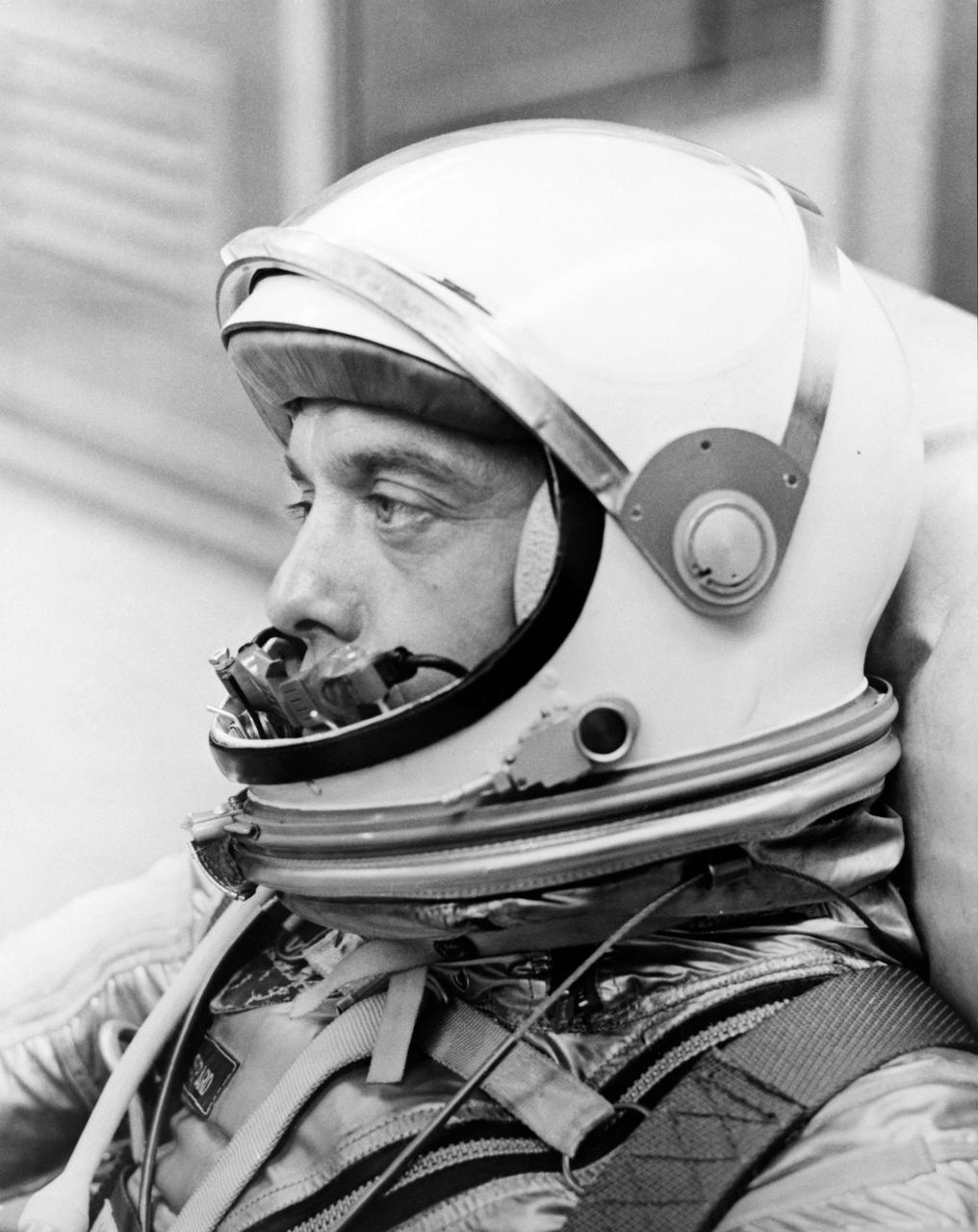
S61-02775 (5 May 1961) --- Close-up view of astronaut Alan B. Shepard Jr. in his pressure suit, with helmet opened, for the Mercury-Redstone 3 (MR-3) flight, the first American manned spaceflight. Photo credit: NASA or National Aeronautics and Space Administration
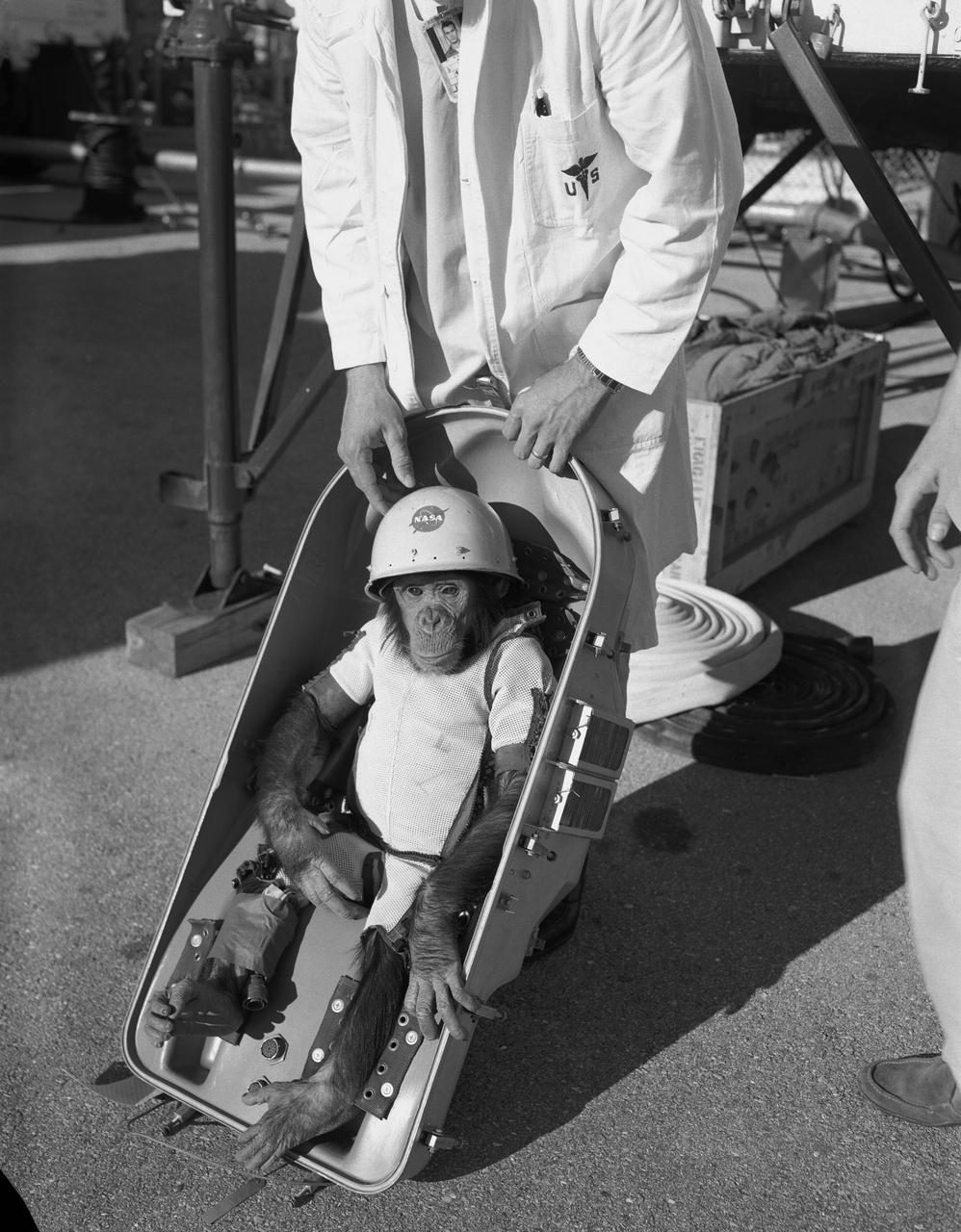
S63-20801 (23 Jan. 1961) --- Primate chimpanzee ?Ham?, in his spacesuit, is fitted into the couch of the Mercury-Redstone 2 (MR-2) capsule #5 prior to its test flight which was conducted on Jan. 31, 1961. Photo credit: NASA
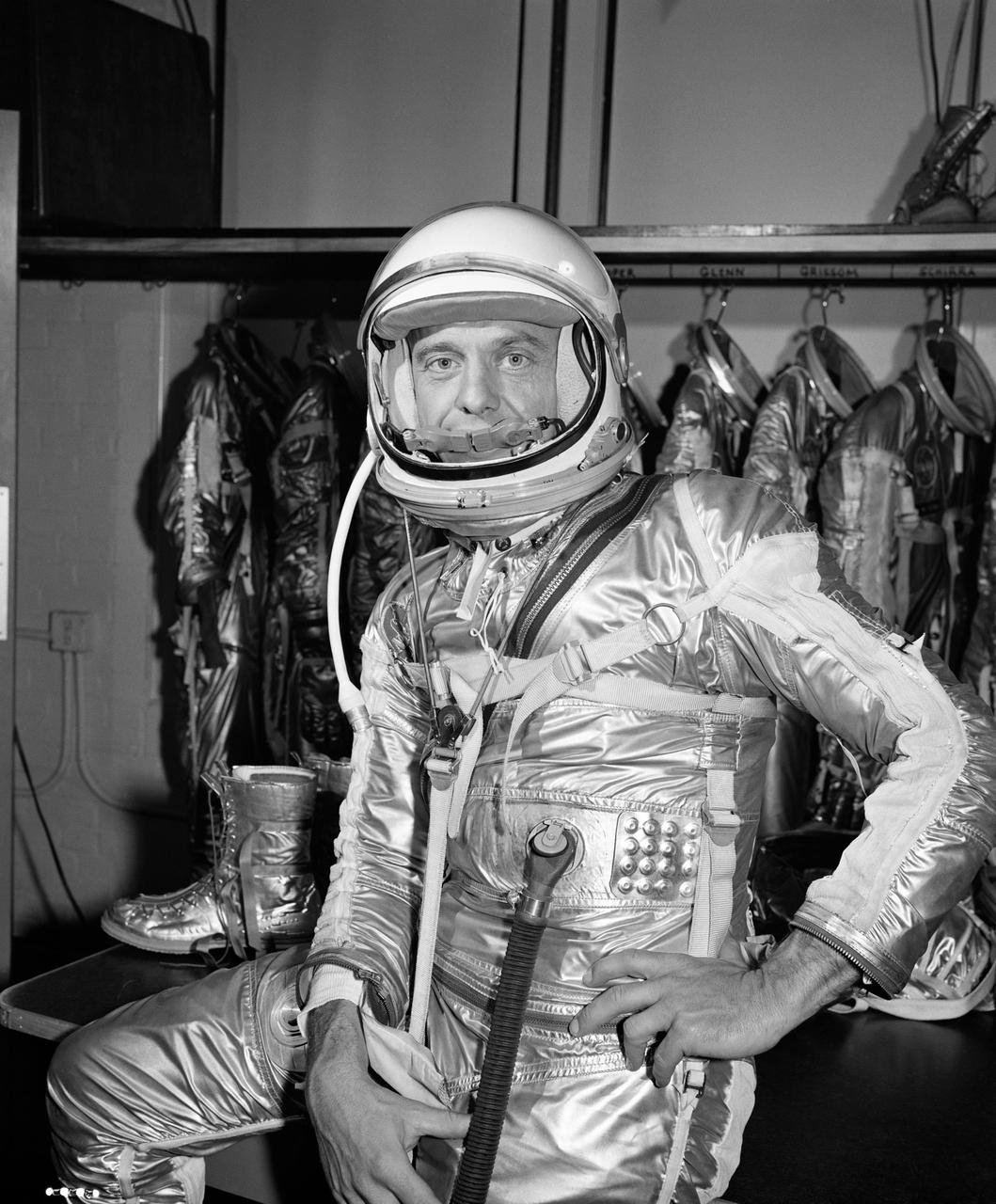
S61-00220 (20 April 1961) --- Close-up view of astronaut Alan B. Shepard Jr. in his pressure suit, with helmet opened, for the Mercury-Redstone 3 (MR-3) flight, the first American manned spaceflight. Photo credit: NASA or National Aeronautics and Space Administration
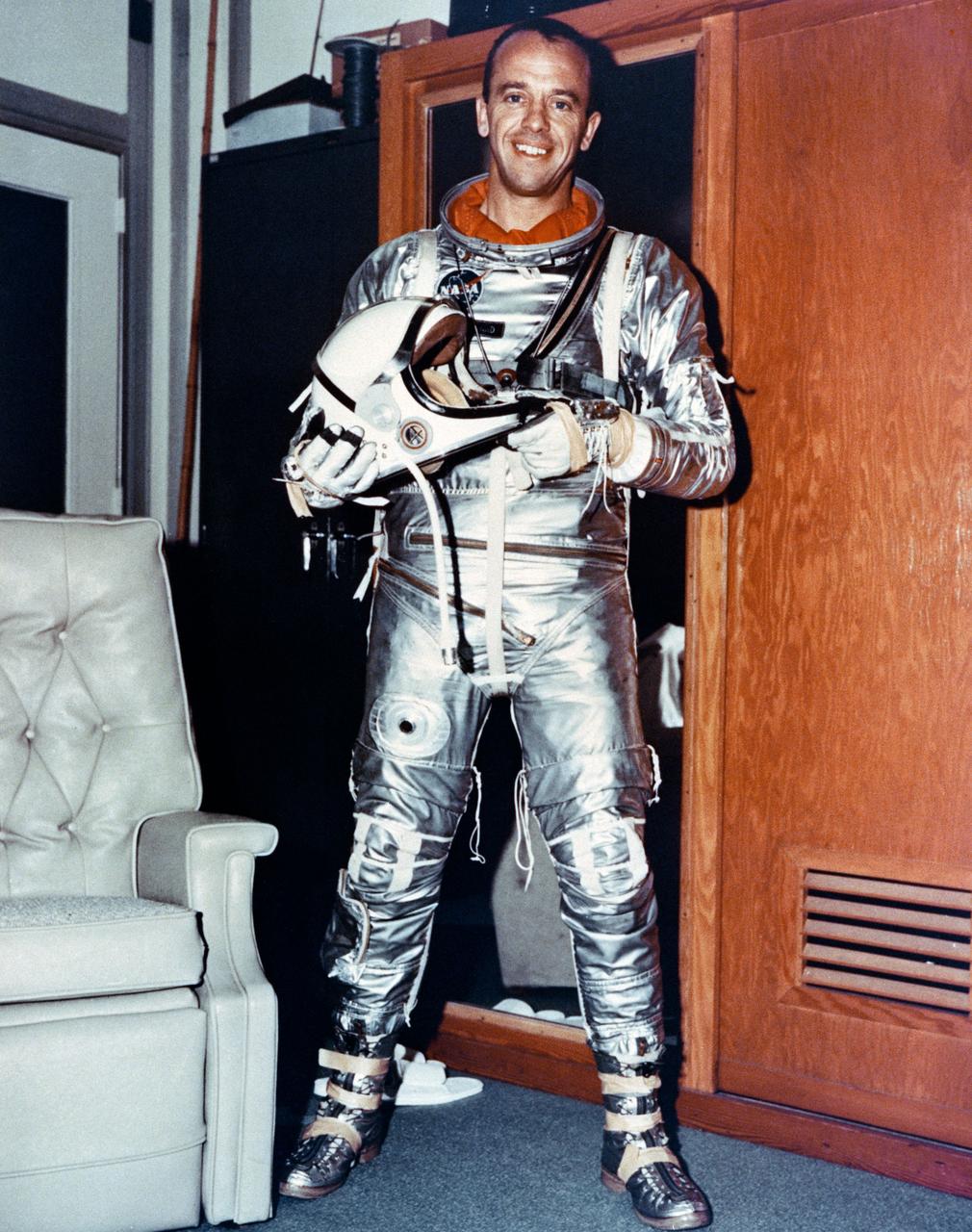
S63-02082 (5 May 1961) --- Astronaut Alan B. Shepard Jr., attired in his Mercury pressure suit, poses for a photo prior to his launch in a Mercury-Redstone 3 (MR-3) spacecraft from Cape Canaveral on a suborbital mission ? the first U.S. manned spaceflight. Photo credit: NASA or National Aeronautics and Space Administration
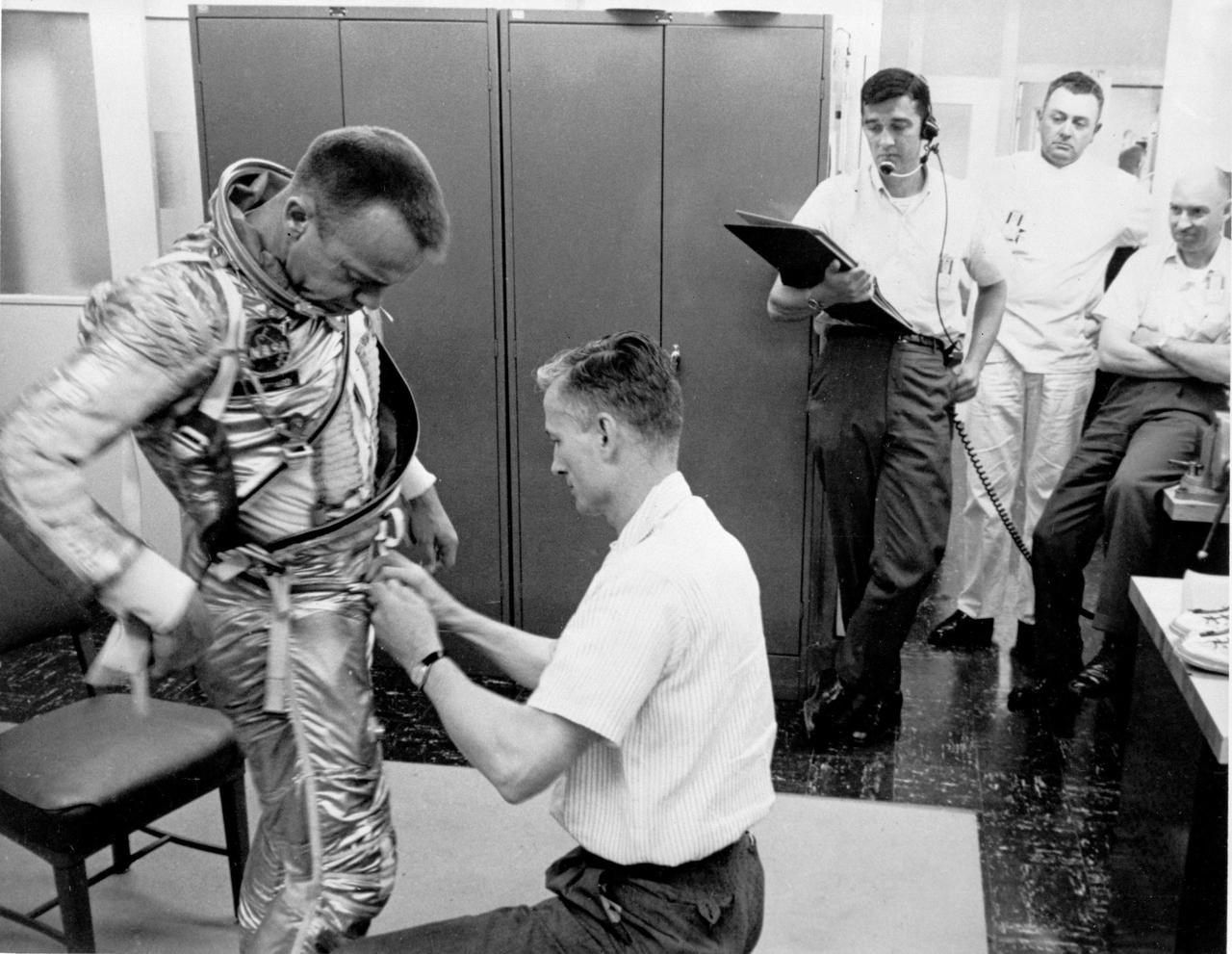
KENNEDY SPACE CENTER, FLA. - Astronaut Alan B. Shepard is being assisted by a technician in getting into his space suit at 2:45 a.m. this morning, beginning the long countdown of the scheduled launch of the Mercury Redstone. After Astronaut Shepard is suited up, he will travel by van to the Redstone Gantry on Pad 5 and be placed into the Mercury Capsule, called Freedom 7, on top of the Redstone booster rocket. Astronaut Shepard will pilot the first U.S. manned sub-orbital space flight of the Manned Mercury Program.
/61-mr4-55(s)~medium.jpg)
KENNEDY SPACE CENTER, FLA. -- Project Mercury Astronaut Virgil I. Grissom, primary pilot for the Mercury-Redstone 4 manned space flight known as Liberty Bell 7, gets an assist from suit specialist Joe W. Schmidt as he prepares for the Mercury-Redstone 4 manned space flight. The flight, the second manned shot in the Mercury program, was postponed because of bad weather in the launch area. (NASA Photo
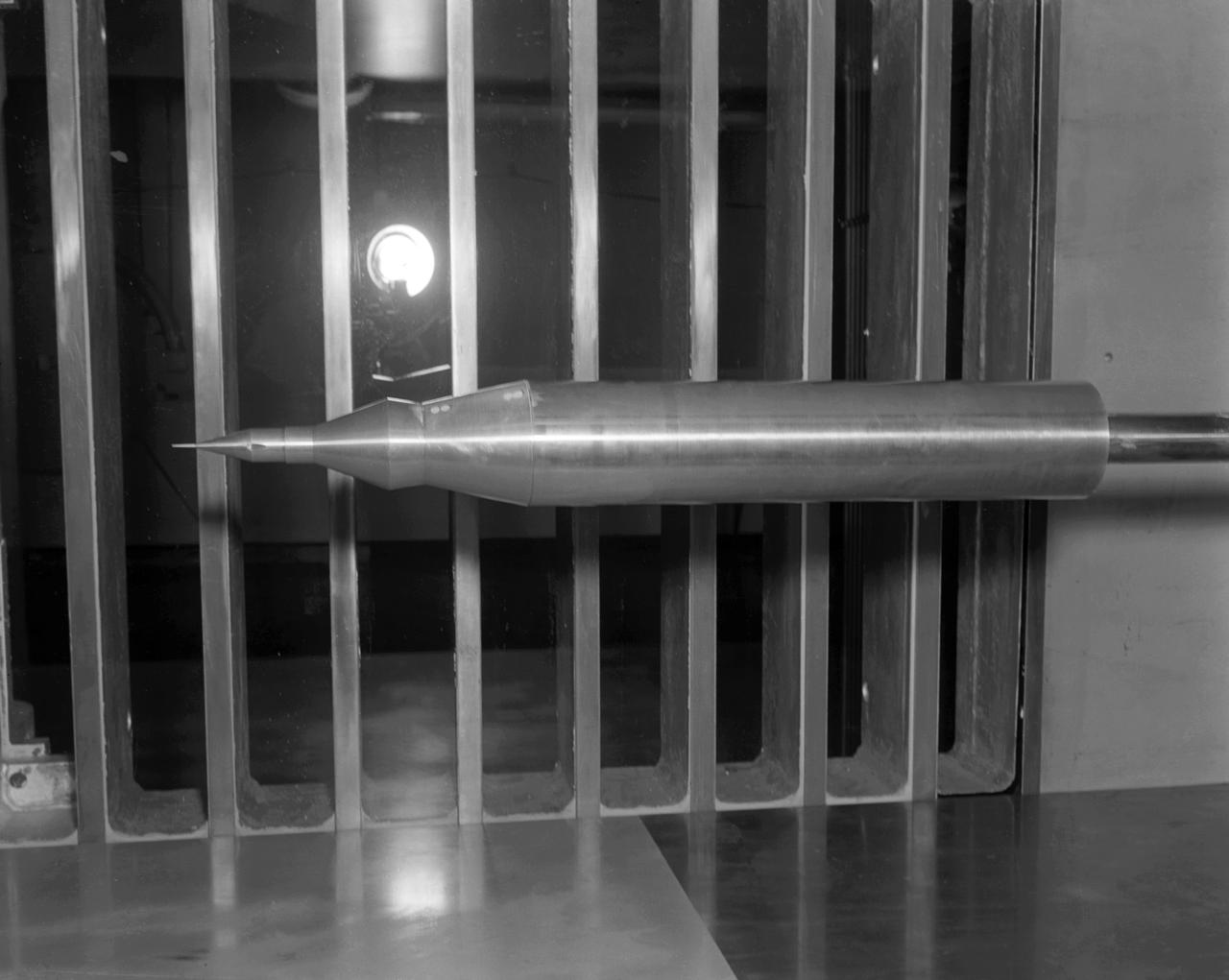
Model of Mercury (Redstone booster) carrying the spacecraft in the Unitary Plan wind tunnel for testing.

Model of Mercury (Redstone booster) carrying the spacecraft in the Unitary Plan wind tunnel for testing.

S61-02921 (21 July 1961) --- Attempted recovery of Mercury spacecraft at end of the Mercury-Redstone 4 (MR-4) mission. View shows the top of the capsule before it sinks beneath the waves. Photo credit: NASA
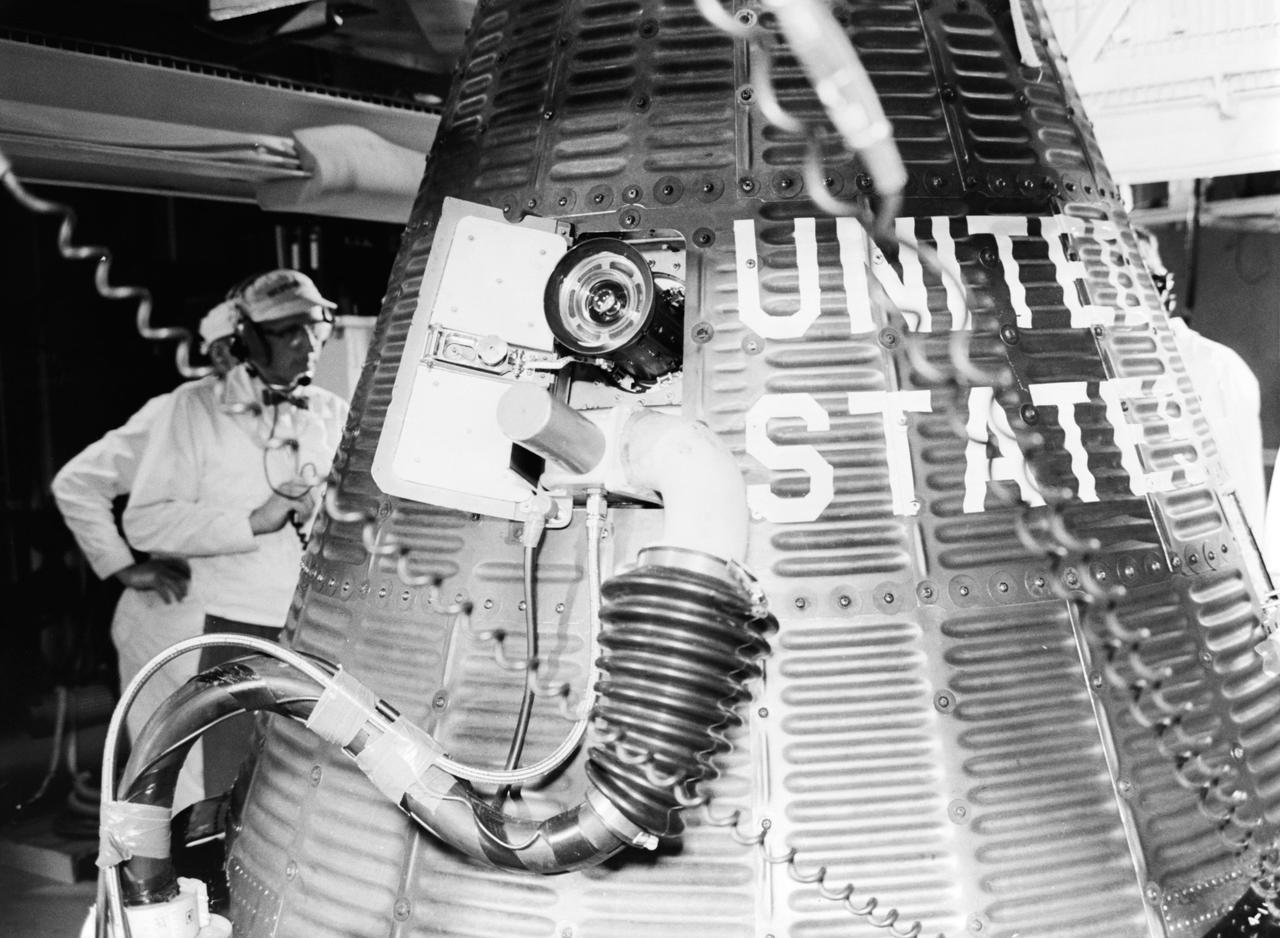
S61-03705 (1961) --- Close-up view of the fueling of the Liberty Bell 7 for the Mercury-Redstone 4 (MR-4) mission. Photo credit: NASA
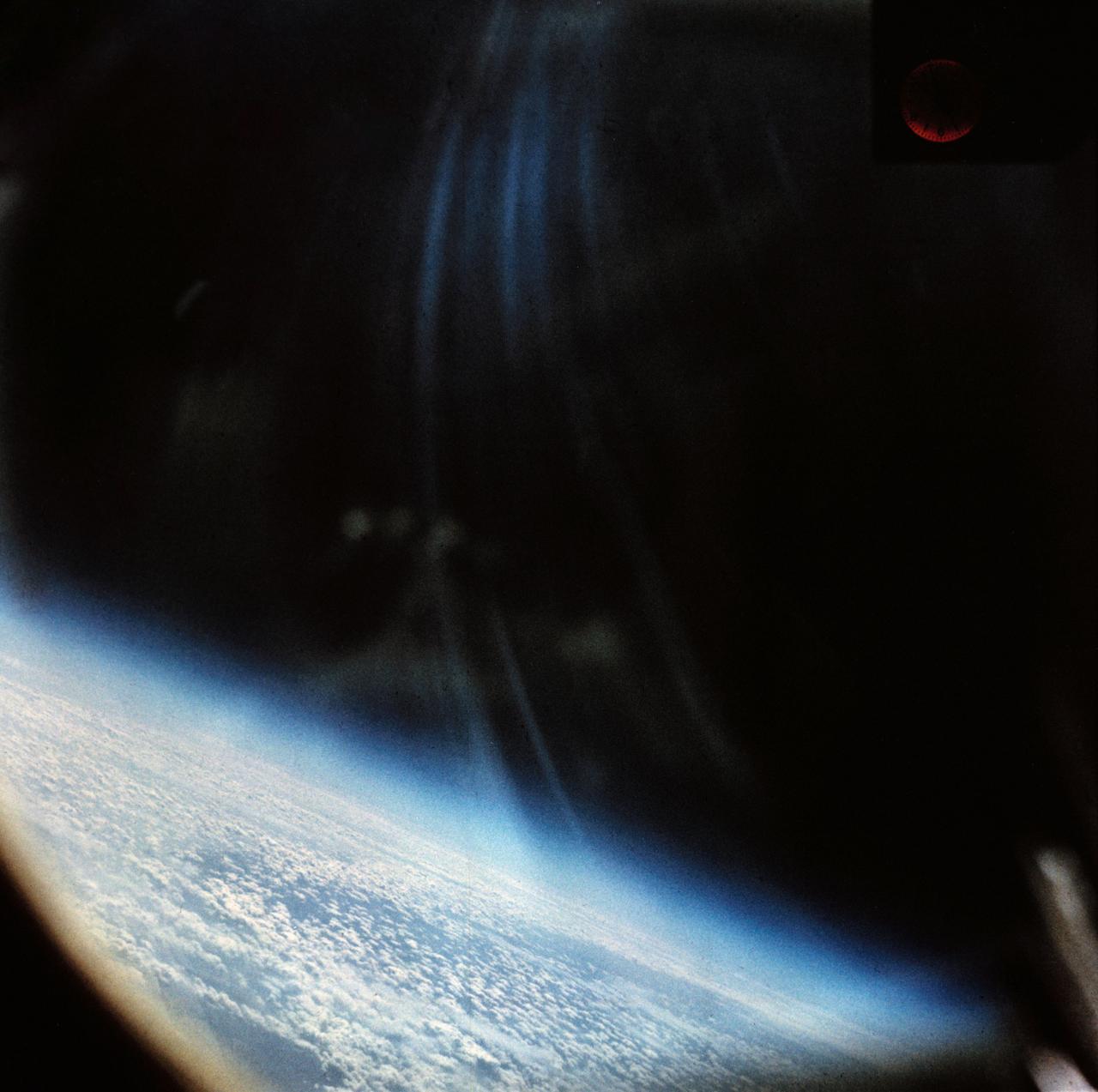
S61-04667 (31 Jan. 1961) --- Earth view from the Mercury Redstone 2 (MR-2) spacecraft. Photo credit: NASA
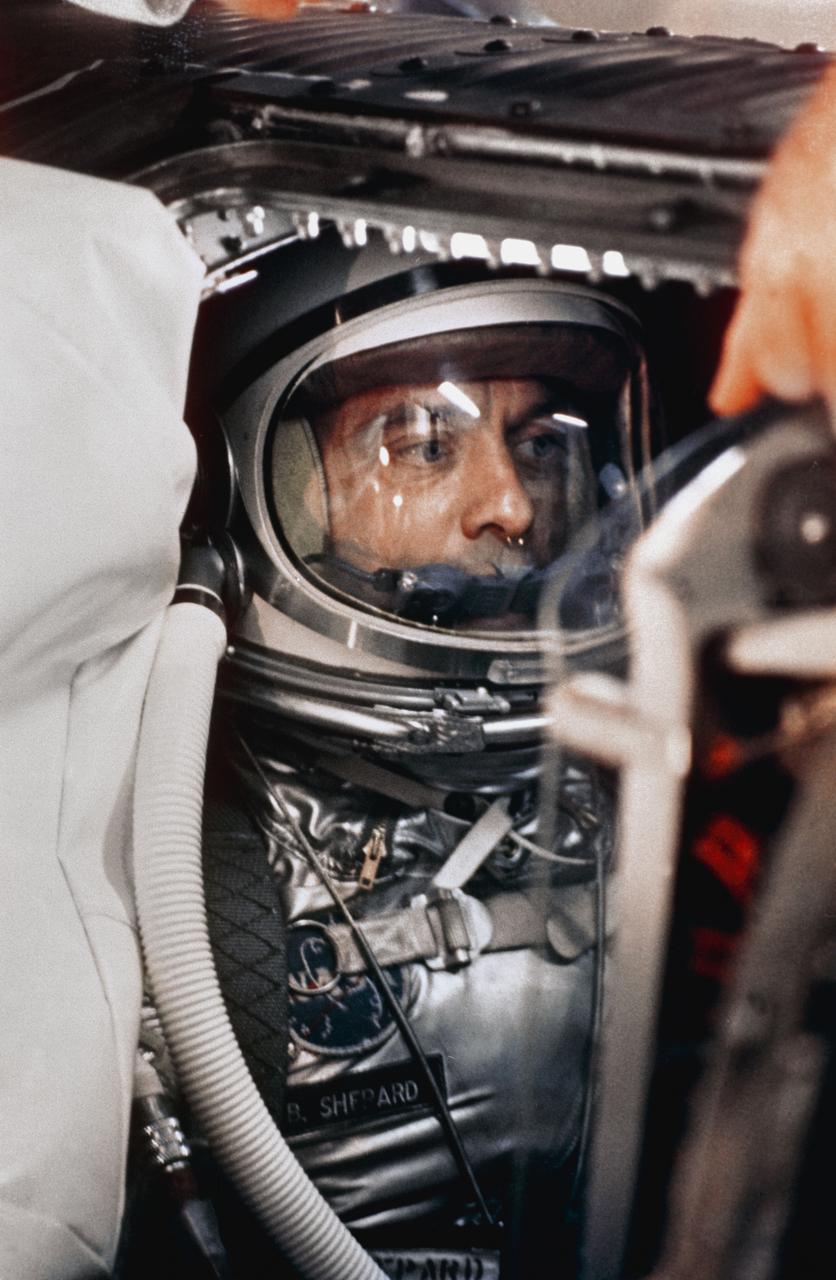
S88-31374 (29 April 1961) --- A close-up of astronaut Alan B. Shepard Jr. in his space suit with his helmet on inside the Mercury capsule. He is undergoing a flight simulation test with the capsule mated to the Redstone booster. This will be the first attempt to put a man into space by the U.S. aboard a Mercury spacecraft, launched atop a Redstone rocket. The suborbital trajectory will be down the Atlantic Missile Range. Photo credit: NASA or National Aeronautics and Space Administration
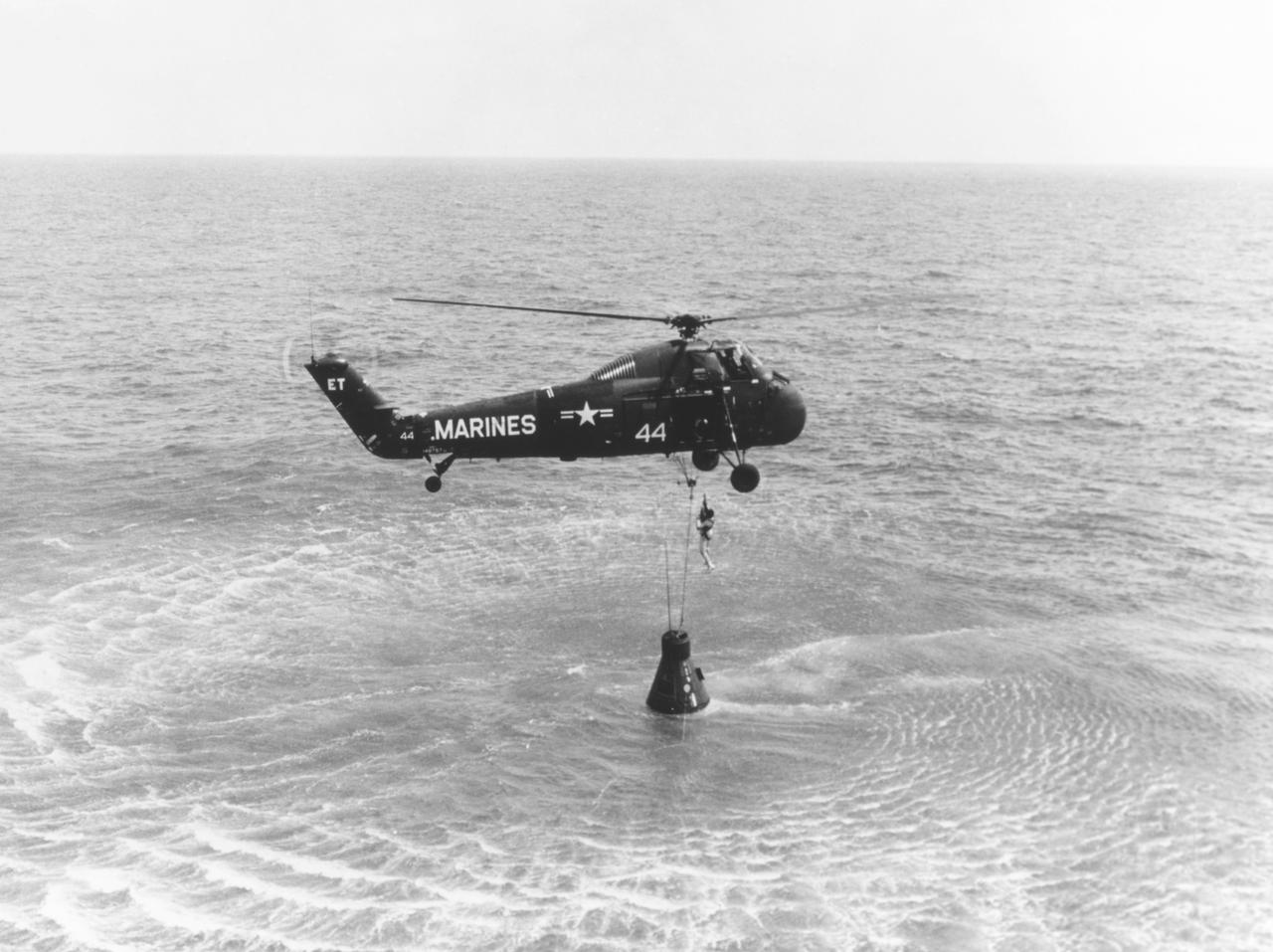
JSC2007-E-046478 (5 May 1961) --- Astronaut Alan B. Shepard Jr. is rescued by a U.S. Marine helicopter at the termination of his suborbital flight May 5, 1961, down range from the Florida eastern coast. Original photo number was 61-MR3-76A. Photo credit: NASA or National Aeronautics and Space Administration
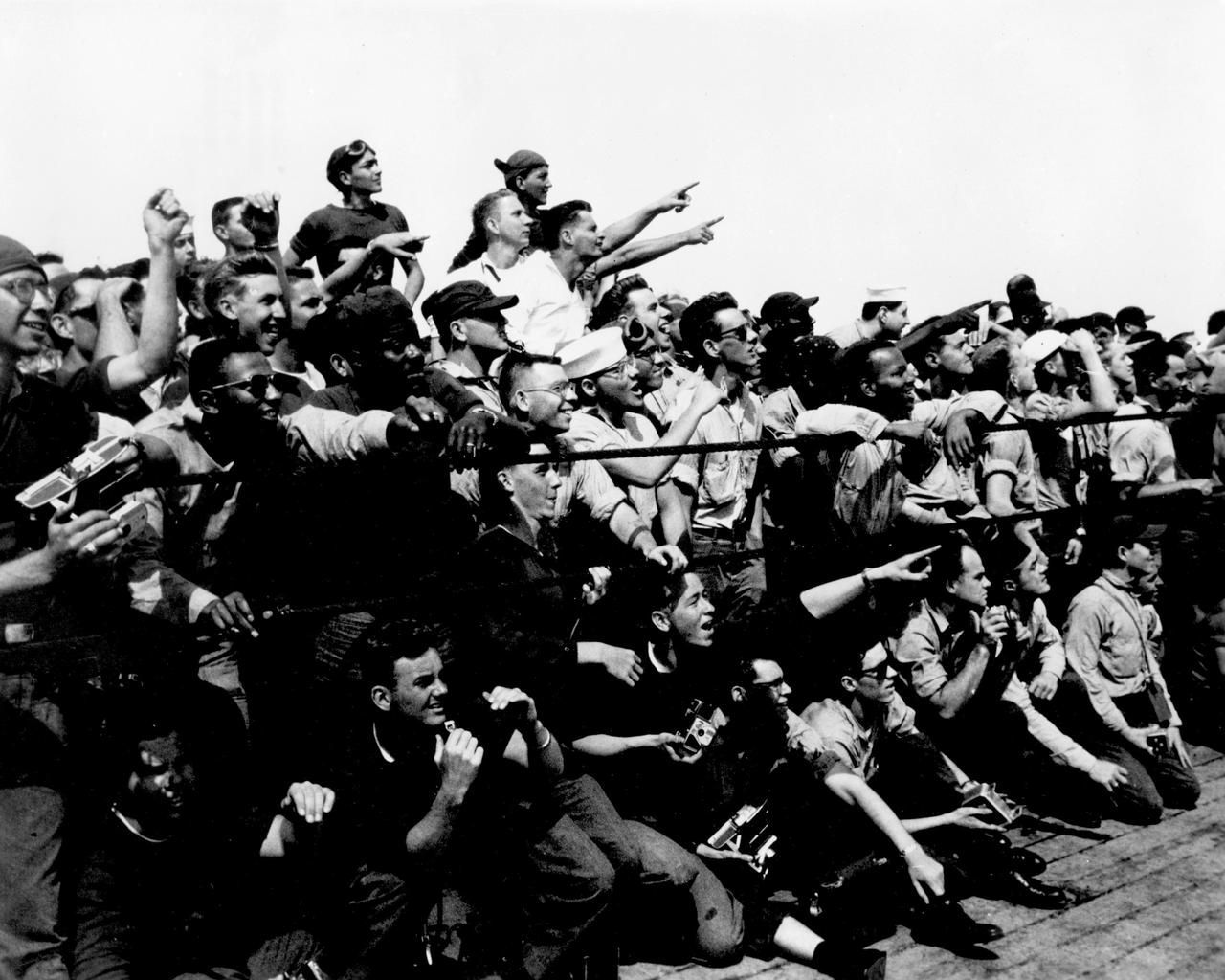
JSC2007-E-046479 (5 May 1961) --- Crew members of the U.S. Navy Carrier Champlain cheer and take pictures of the arrival of the first Project Mercury pilot to fly a suborbital flight, astronaut Alan B. Shepard Jr. Original photo number was 61-MR3-106. Photo credit: NASA
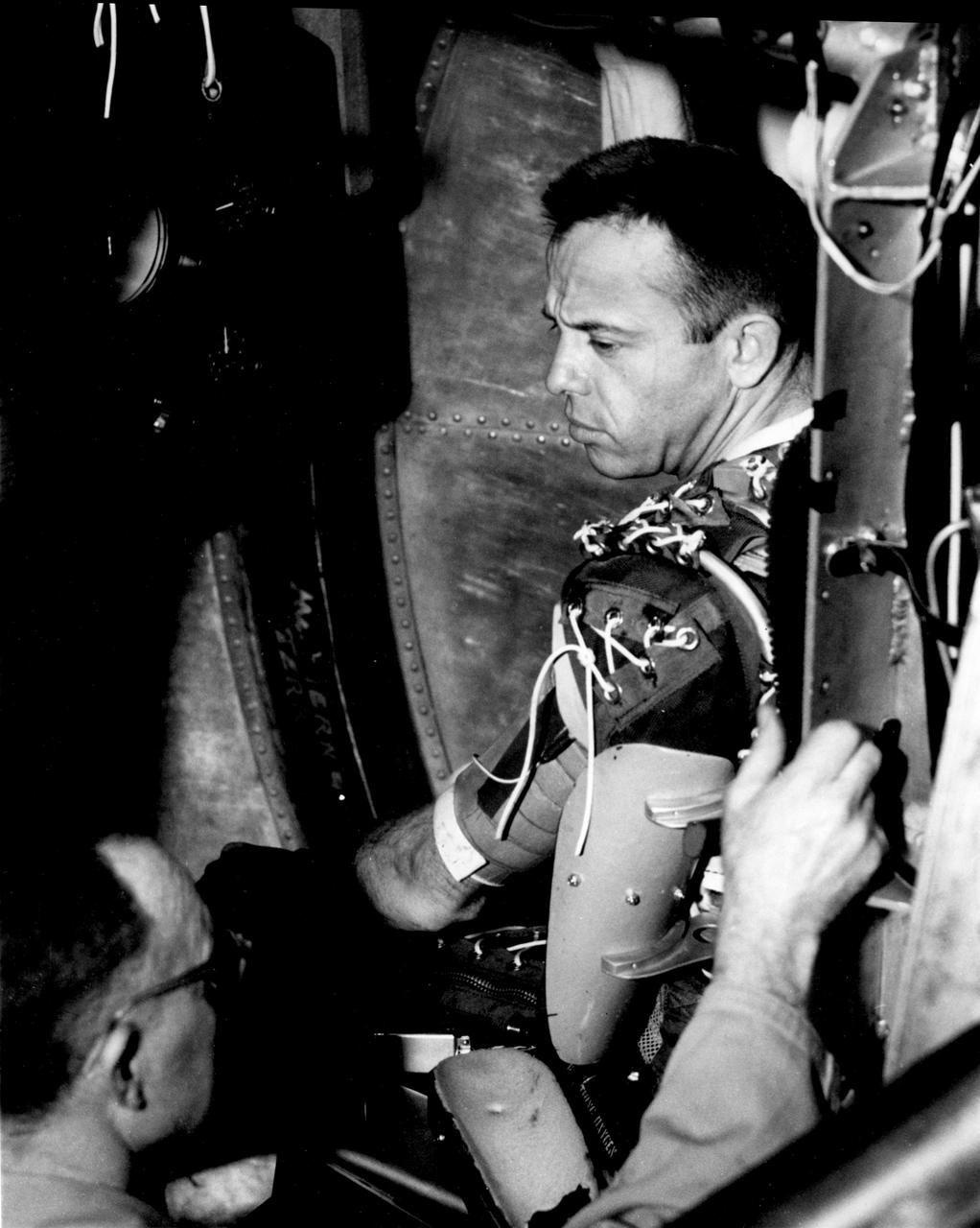
JSC2007-E-046476 (1961) --- Astronaut Alan B. Shepard Jr., one of three NASA astronauts chosen for the Project Mercury first manned suborbital flight, prepares for testing in a capsule of the U.S. Navy's centrifuge at Johnsville, Pennsylvania. Original photo number was 61-MR3-19. Photo credit: NASA or National Aeronautics and Space Administration
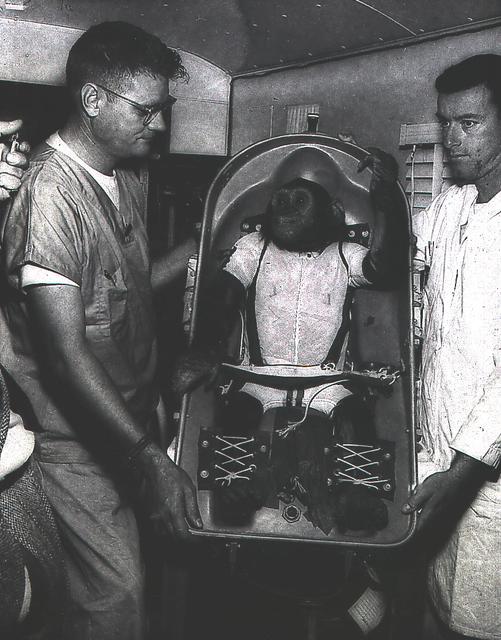
A three-year-old chimpanzee, named Ham, in the biopack couch for the MR-2 suborbital test flight. On January 31, 1961, a Mercury-Redstone launch from Cape Canaveral carried the chimpanzee "Ham" over 640 kilometers down range in an arching trajectory that reached a peak of 254 kilometers above the Earth. The mission was successful and Ham performed his lever-pulling task well in response to the flashing light. NASA used chimpanzees and other primates to test the Mercury Capsule before launching the first American astronaut Alan Shepard in May 1961. The successful flight and recovery confirmed the soundness of the Mercury-Redstone systems.
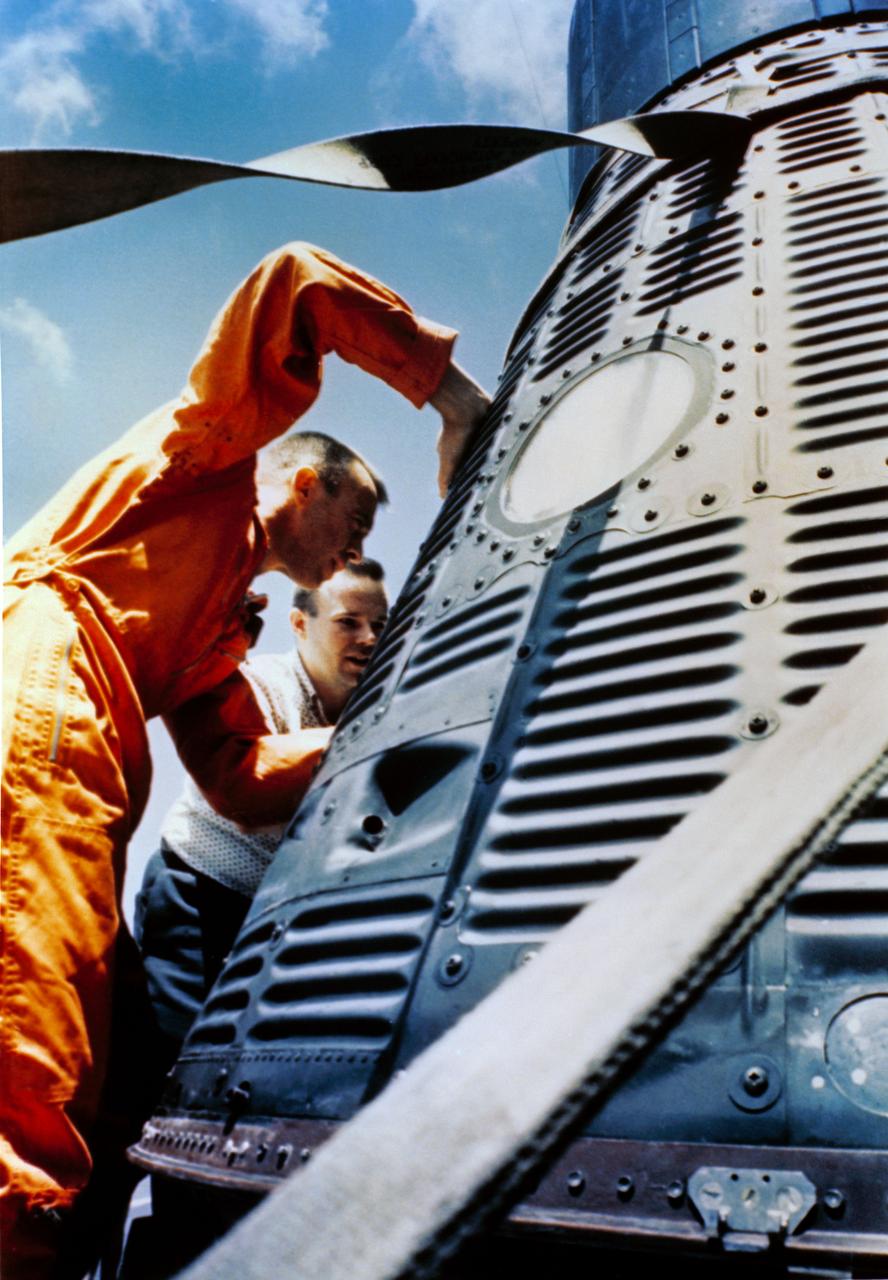
S88-31384 (5 May 1961) --- Astronaut Alan B. Shepard Jr., Mercury-Redstone 3 (MR-3) pilot, is pictured near his Freedom 7 capsule during a postflight inspection aboard the U.S. Navy Carrier Champlain after the recovery of his Mercury vehicle. Earlier Shepard had completed the historical 15-minute suborbital Mercury-Redstone 3 mission, marking the U.S. inaugural manned space mission. (NASA Hq. No. 61-MR3-107 or MR3-44) Photo credit: NASA or National Aeronautics and Space Administration
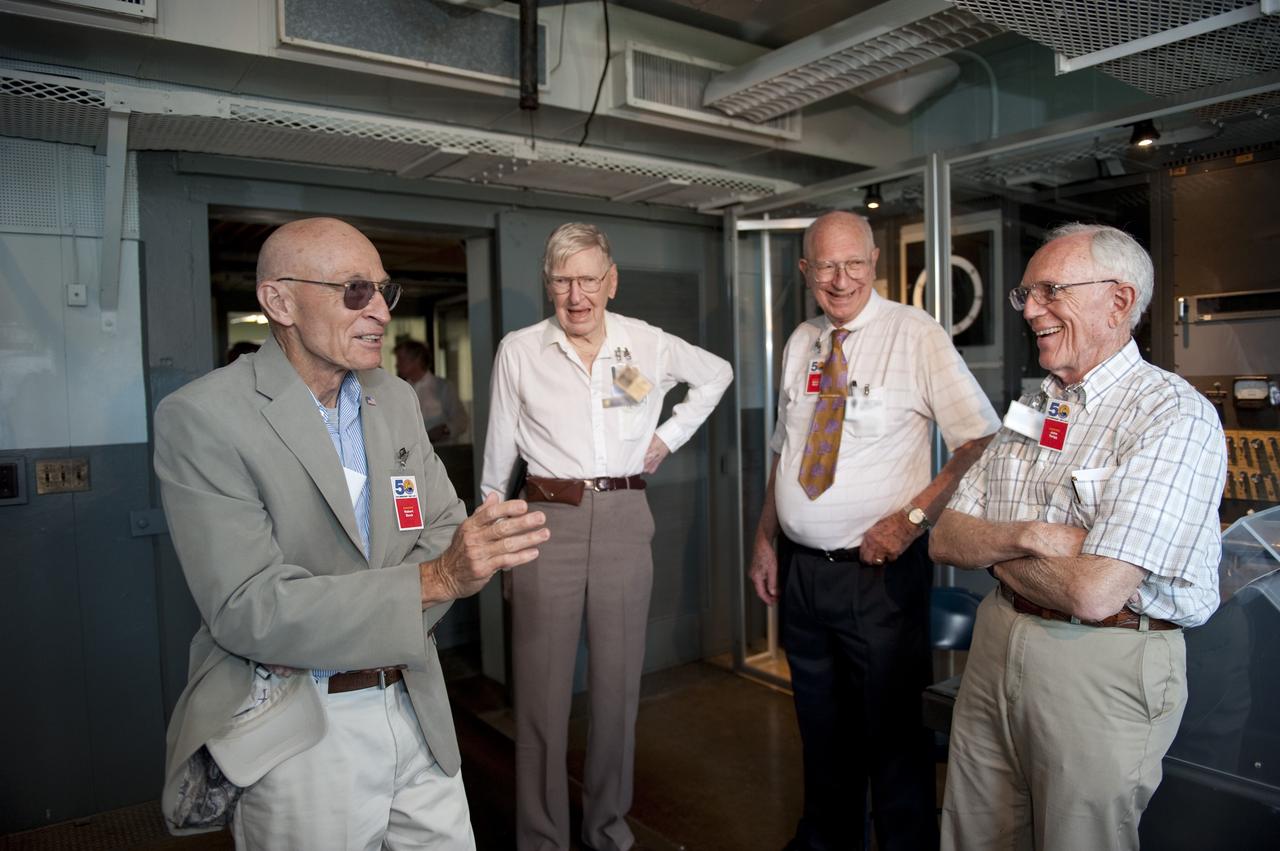
CAPE CANAVERAL, Fla. -- On Cape Canaveral Air Force Station in Florida, invited guests tour the blockhouse at Complex 5/6 during a celebration of Alan Shepard's historic flight 50 years ago. From left are Robert Sieck, former shuttle launch director; Andy Anderson, former manager for communications in the Mercury Mission Control Center; Bob Moser, former chief test conductor for the Mercury-Redstone launches; and John Twigg, former backup chief test conductor for the Mercury-Redstone launches. The celebration was held at the launch site of the first U.S. manned spaceflight May 5, 1961, to mark the 50th anniversary of the flight. Fifty years ago, astronaut Alan Shepard lifted off inside the Mercury capsule, "Freedom 7," atop an 82-foot-tall Mercury-Redstone rocket at 9:34 a.m. EST, sending him on a remarkably successful, 15-minute suborbital flight. The event was attended by more than 200 workers from the original Mercury program and included a re-creation of Shepard's flight and recovery, as well as a tribute to his contributions as a moonwalker on the Apollo 14 lunar mission. For more information, visit www.nasa.gov/topics/history/milestones/index.html. Photo credit: NASA/Kim Shiflett
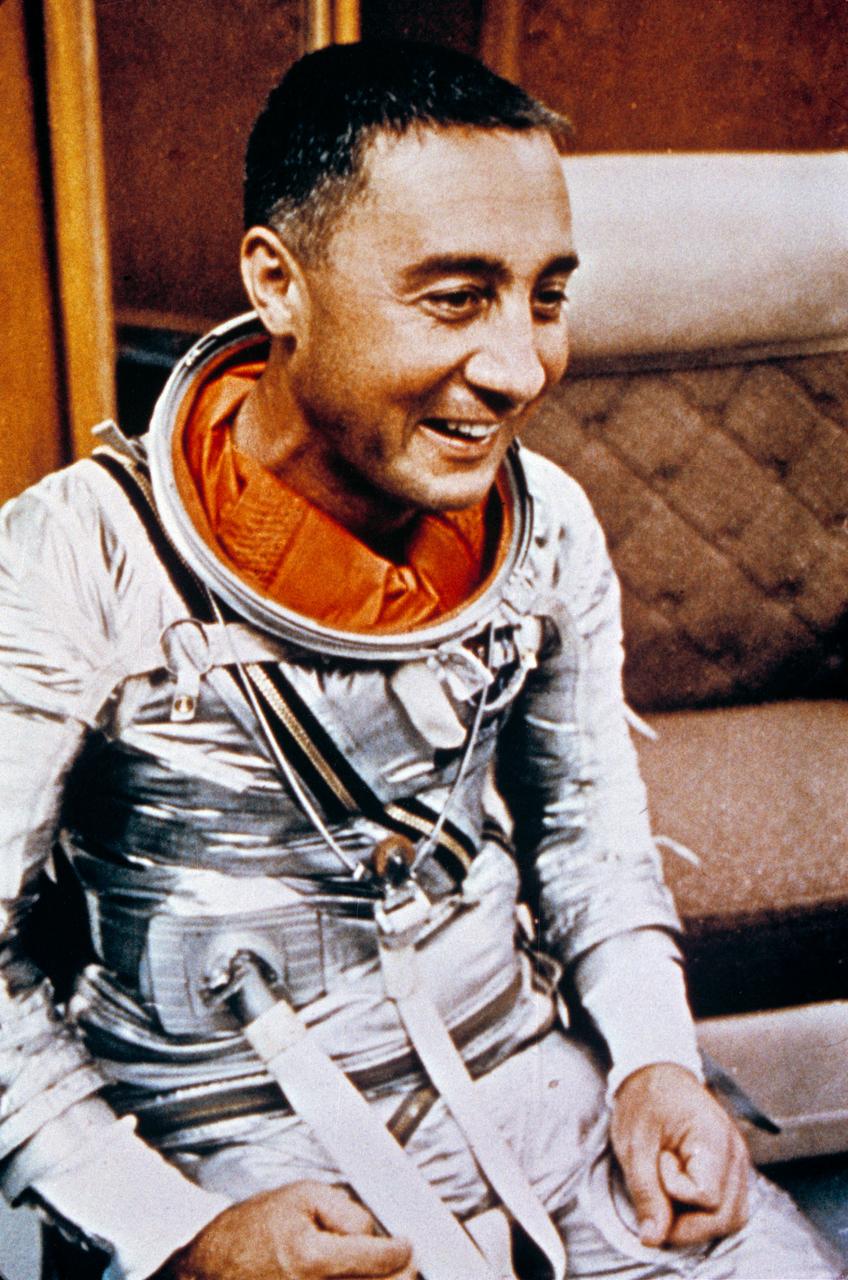
S64-36909 (1961) --- Astronaut Virgil I. (Gus) Grissom, pilot of the Mercury-Redstone 4 (MR-4) spaceflight, wearing Mercury pressure suit, poses for picture during training activities at the Florida Space Center. Photo credit: NASA

Astronaut Alan B. Shepard, one of the original seven astronauts for Mercury Project selected by NASA on April 27, 1959. The Freedom 7 spacecraft boosted by Mercury-Redstone vehicle for the MR-3 mission made the first marned suborbital flight and Astronaut Shepard became the first American in space.
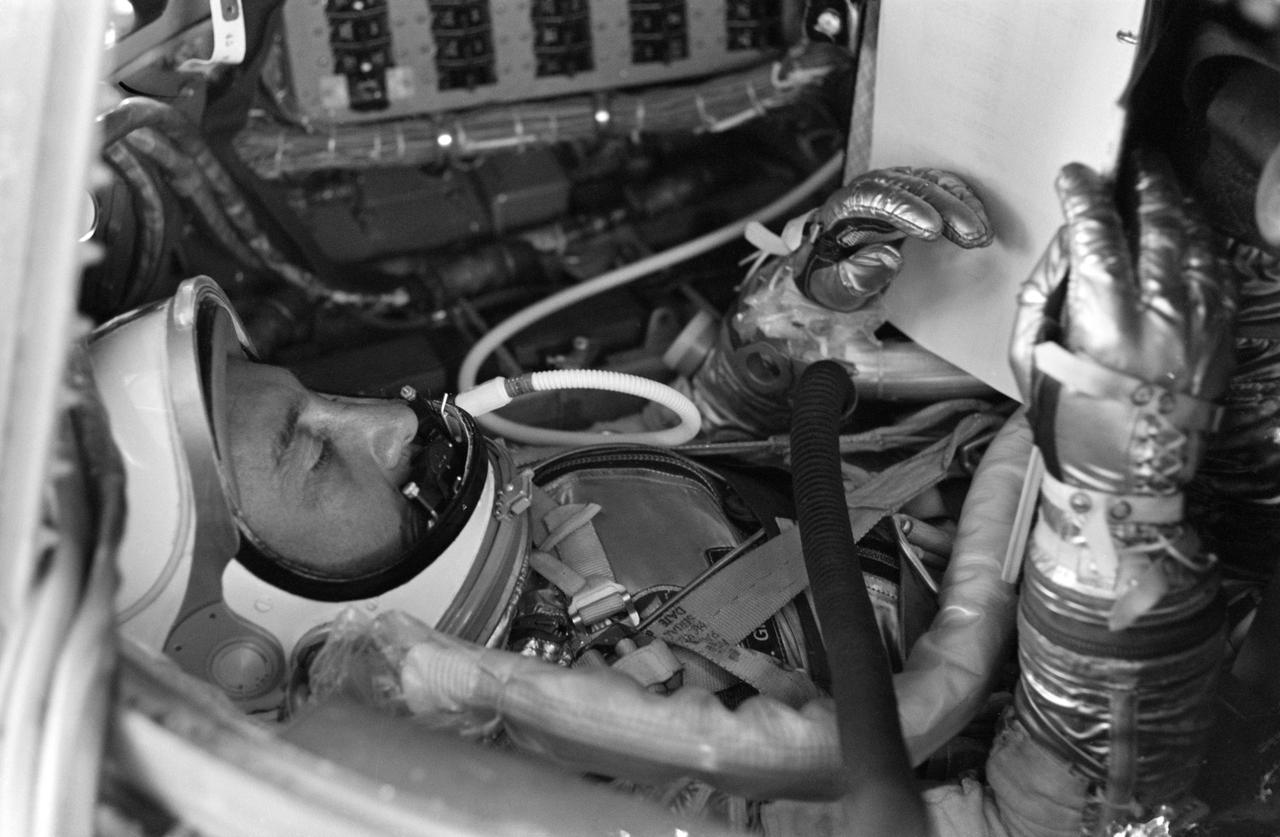
S64-10806 (21 July 1961) --- Astronaut Virgil I. (Gus) Grissom, pilot of the Mercury-Redstone 4 (MR-4) spaceflight, in his Mercury "Liberty Bell 7" spacecraft is checking his flight plan during prelaunch activities. Photo credit: NASA
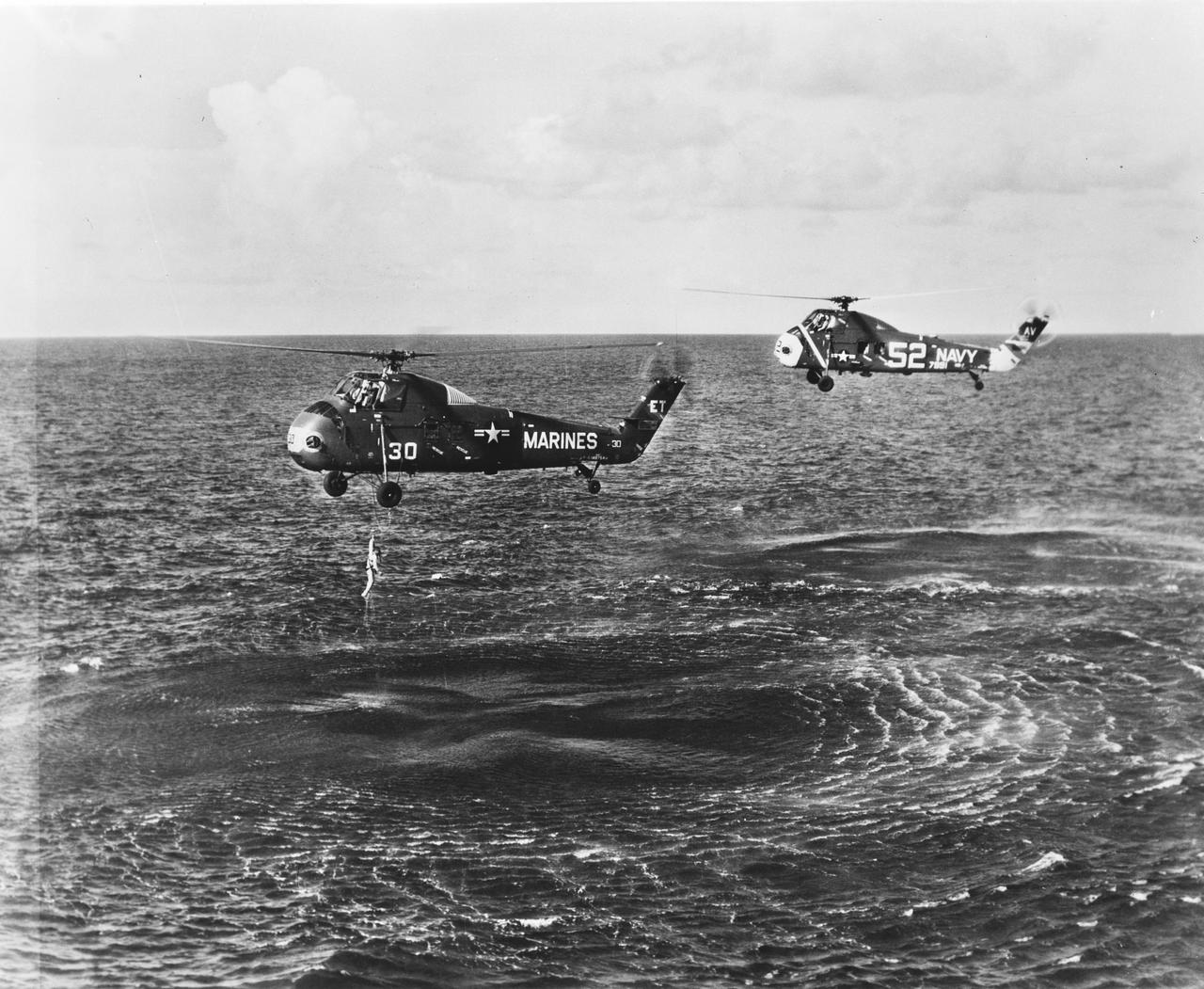
S61-02819 (21 July 1961) --- A U.S. Marine Corps helicopter retrieves astronaut Virgil I. Grissom from the Atlantic Ocean following the Mercury-Redstone 4 (MR-4) spaceflight. Grissom's "Liberty Bell" Mercury spacecraft sank to the bottom of the ocean and was not recovered. Photo credit: NASA

Astronaut Virgil I. "Gus" Grissom, one of the original seven astronauts for Mercury Project selected by NASA on April 27, 1959. The MR-4 mission, boosted by the Mercury-Redstone vehicle, made the second marned suborbital flight. The capsule, Liberty Bell 7, sank into the sea after the splashdown.
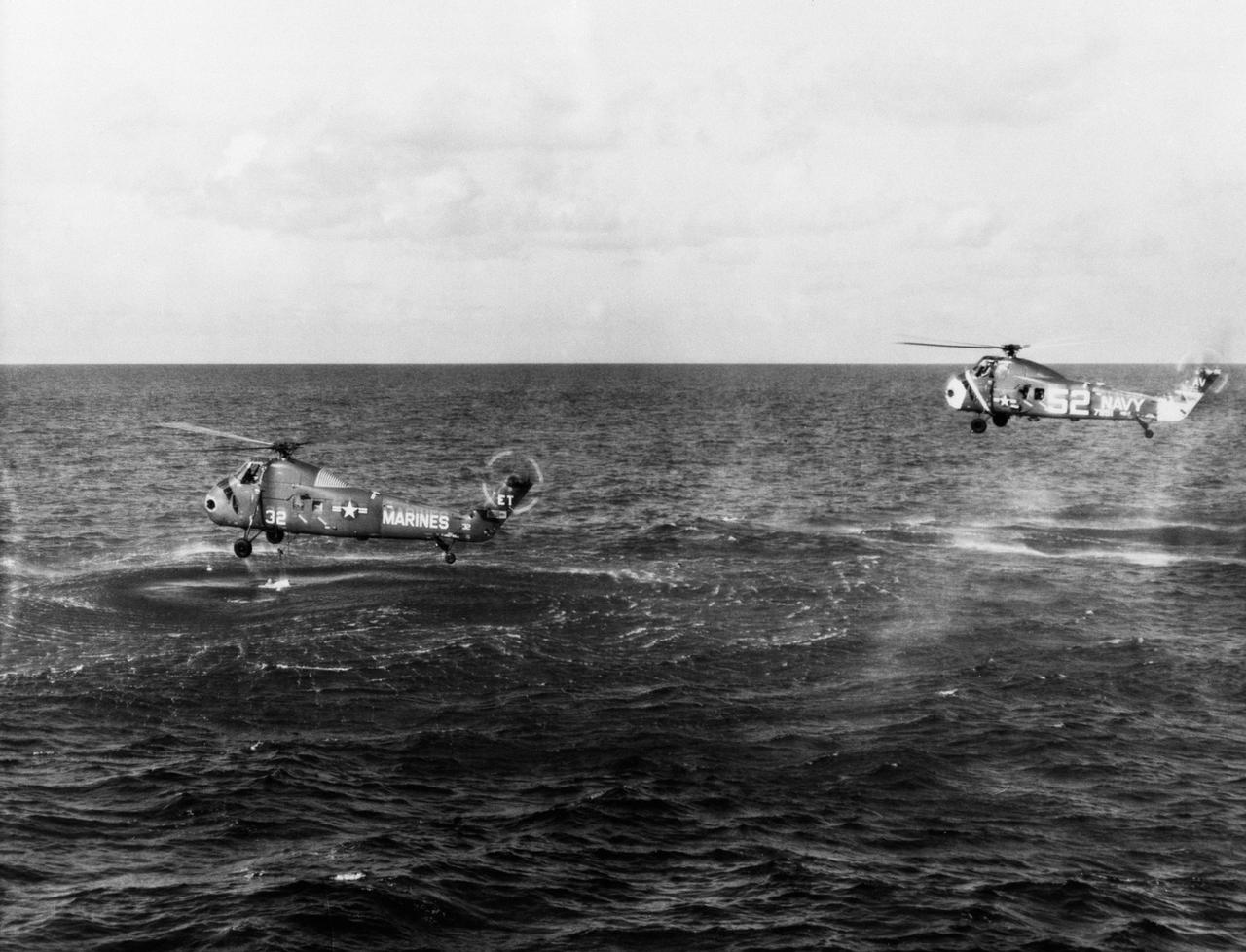
S61-02817 (21 July 1961) --- Attempted recovery of Mercury spacecraft at end of the Mercury-Redstone 4 (MR-4) mission. View shows the Marine helicopter pulled almost to the waters surface by the weight of the capsule, which filled with water. Behind the Marine helicopter, a Navy helicopter prepares to assist. Photo credit: NASA
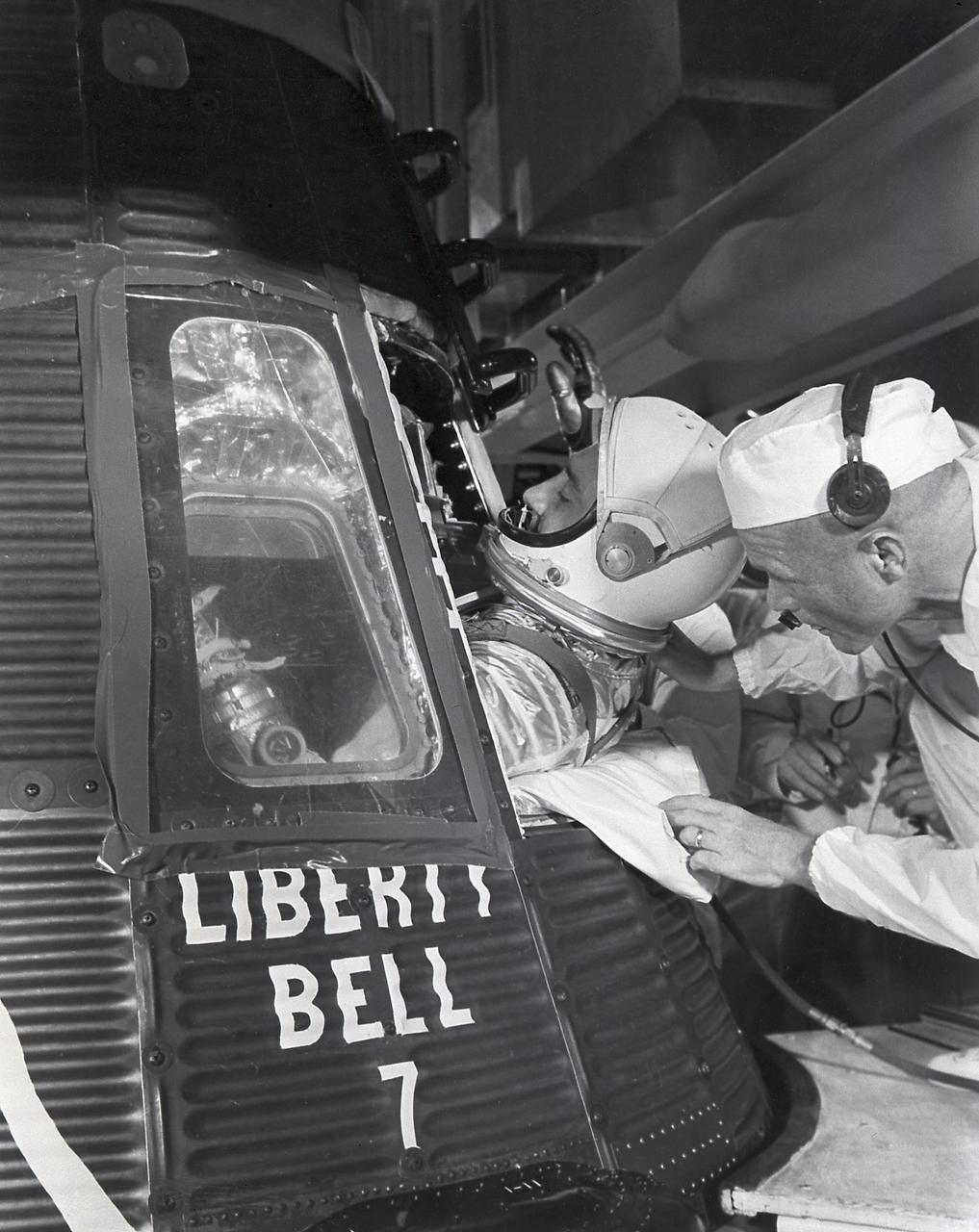
Assisted by Astronaut John Glenn, Astronaut Virgil Grissom enters the Mercury capsule, Liberty Bell 7, for the MR-4 mission on July 21, 1961. Boosted by the Mercury-Redstone vehicle, the MR-4 mission was the second manned suborbital flight.
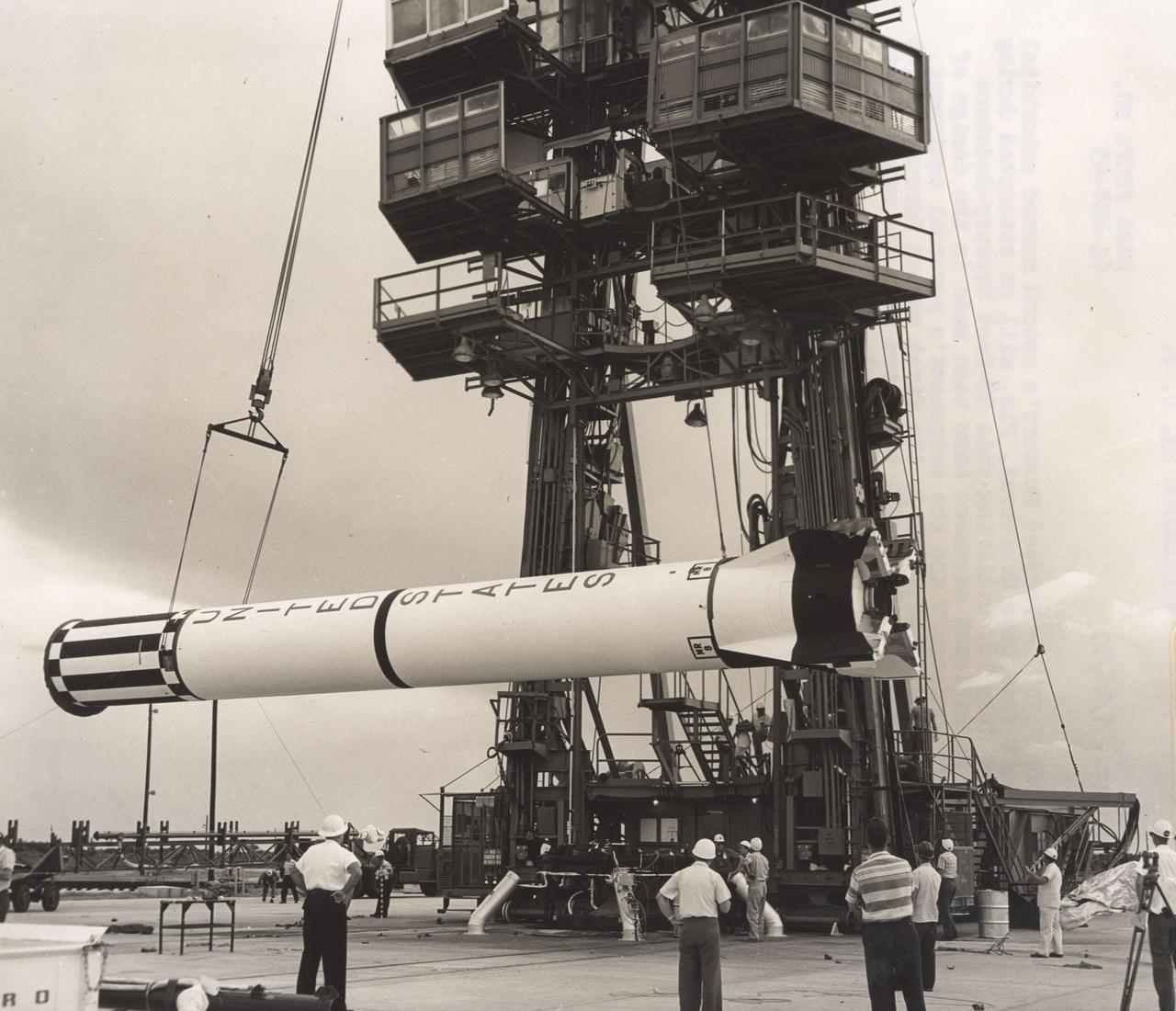
KENNEDY SPACE CENTER, FLA. -- READIED FOR FLIGHT - Project Mercury's second manned suborbital space flight, Liberty Bell 7, from Cape Canaveral, Fla., will be attempted during the week of July 16, utilizing this 58-foot Mercury-Redstone vehicle. Significant advances have been made in the design of the Mercury spacecraft and the astronaut's personal equipment. Flight will be similar to MR-3, the first manned Mercury flight May 5, 1961; however, the pilot will have more time for making Earth and celestial observations. (NASA Photo)
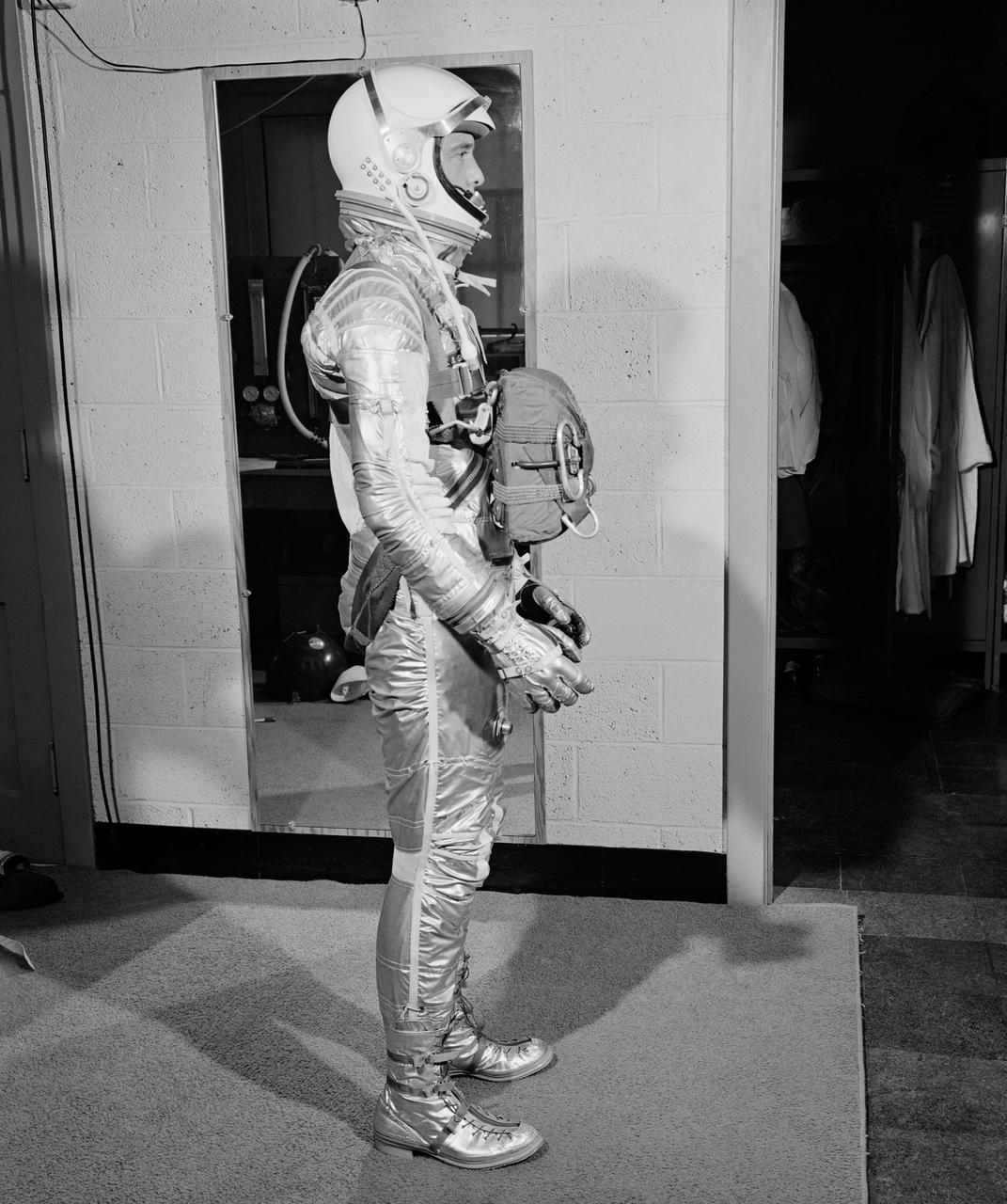
G60-02665 (1960) --- Astronaut Alan B. Shepard Jr., Mercury-Redstone 3 (MR-3) pilot, wearing pressure suit with body parachute. Photo credit: NASA or National Aeronautics and Space Administration
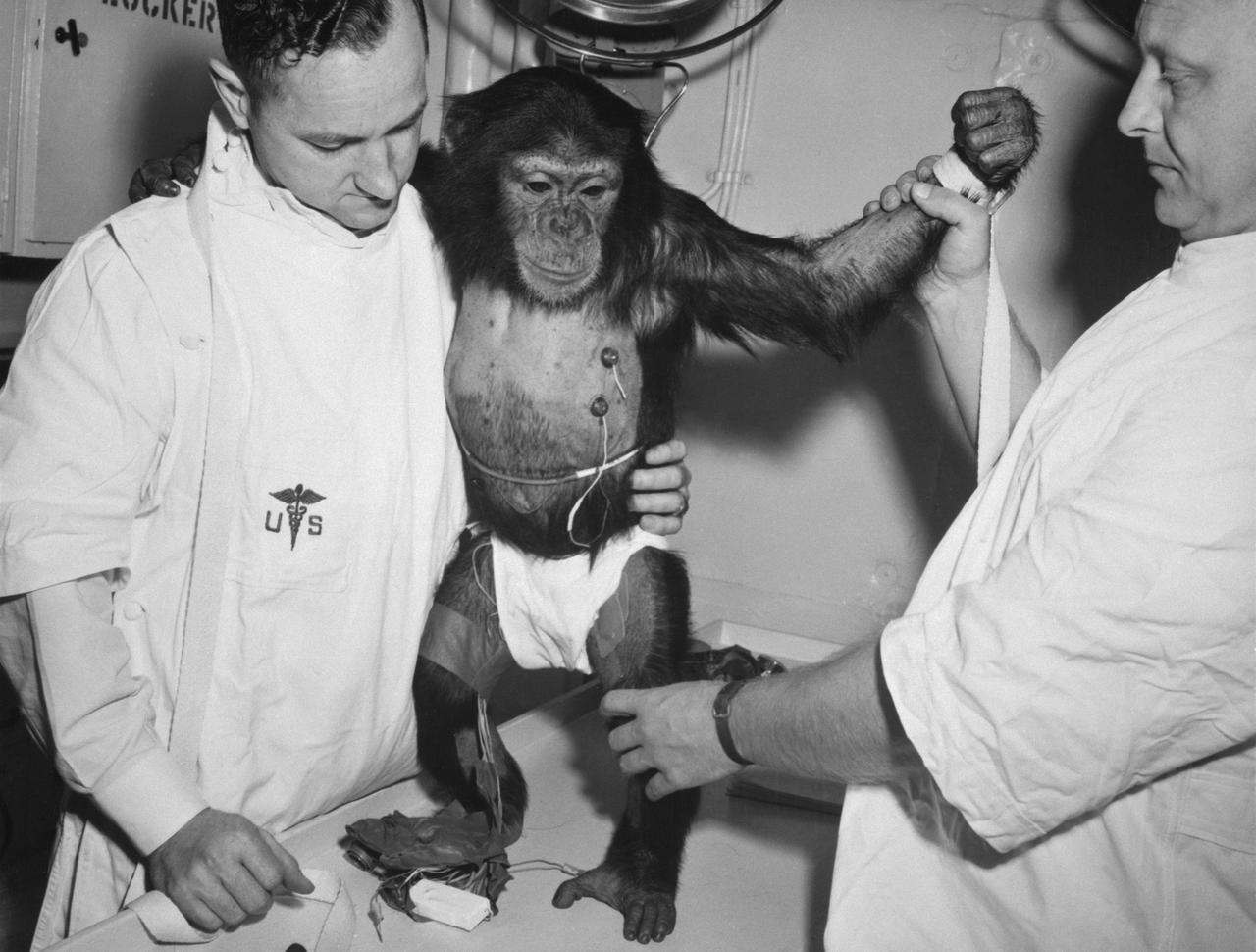
S61-00203 (31 Jan. 1961) --- Chimpanzee "Ham" with bio-sensors attached to his body is readied by handlers for his trip in the Mercury-Redstone 2 (MR-2) spacecraft. Photo credit: NASA
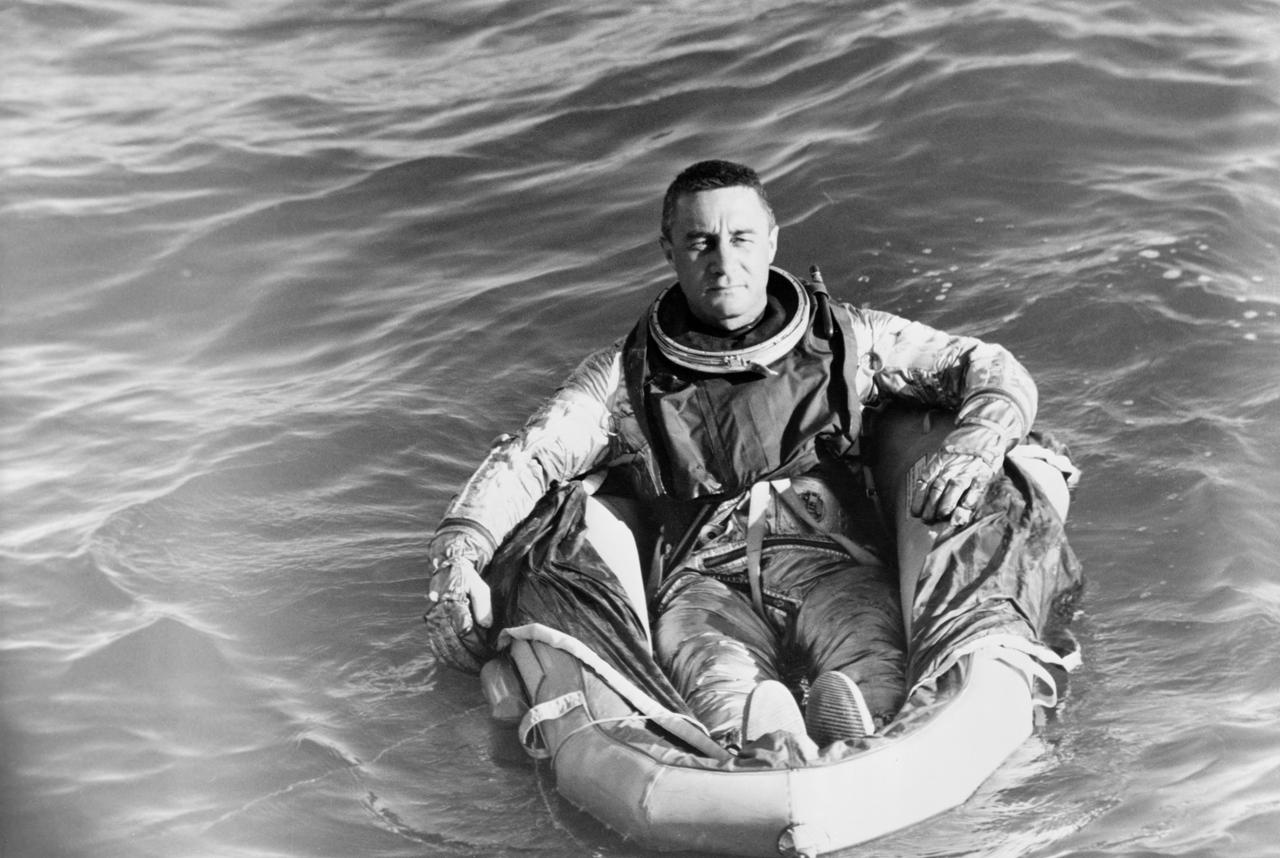
S61-04037 (1961) --- Astronaut Virgil I. (Gus) Grissom, pilot of the Mercury-Redstone 4 spaceflight, sits in a life raft during water egress training activies. Photo credit: NASA
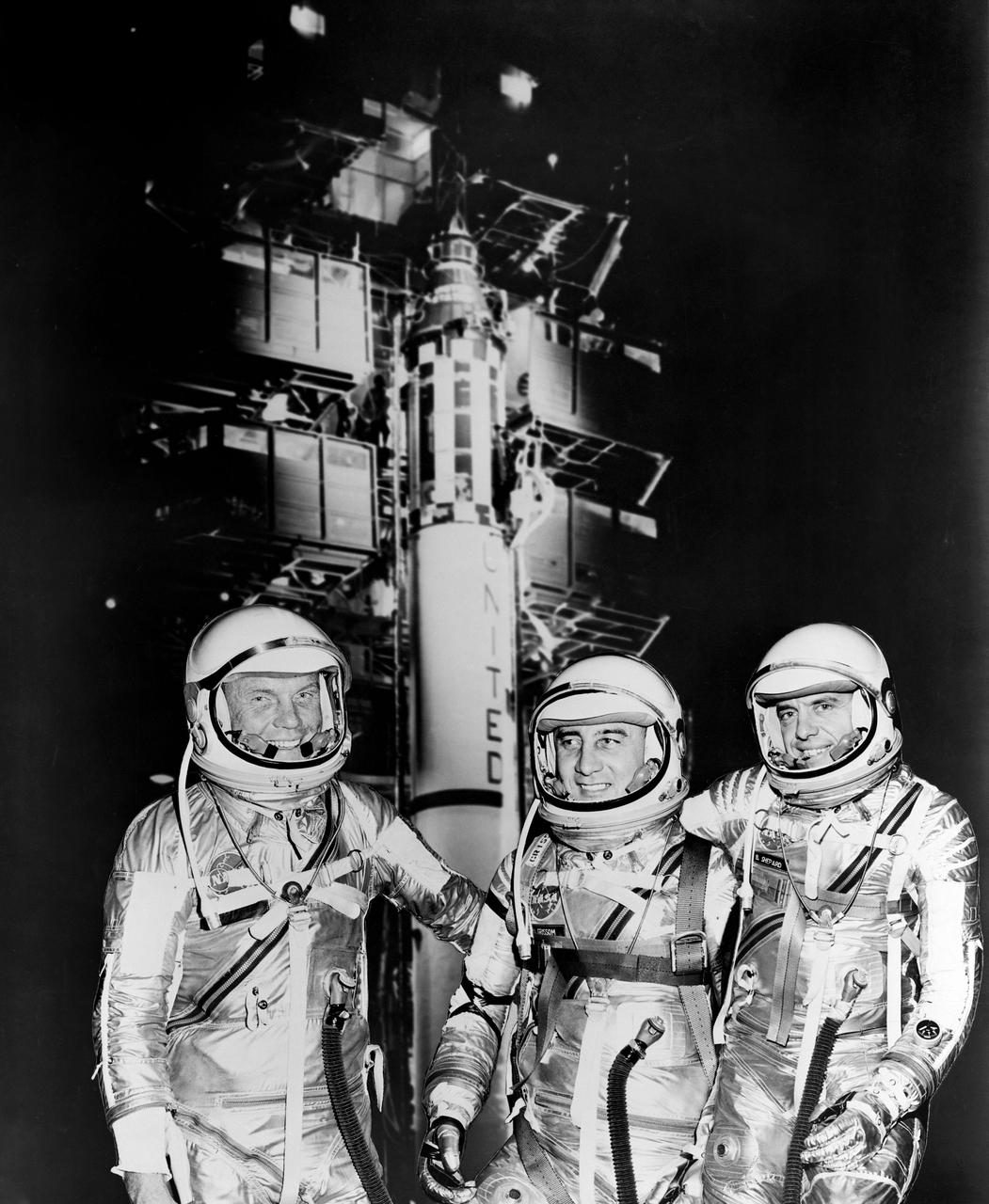
S61-00239 (1961) --- Mercury astronauts John H. Glenn Jr., Virgil I. Grissom and Alan B. Shepard Jr. standing by Redstone rocket in their spacesuits. Photo credit: NASA
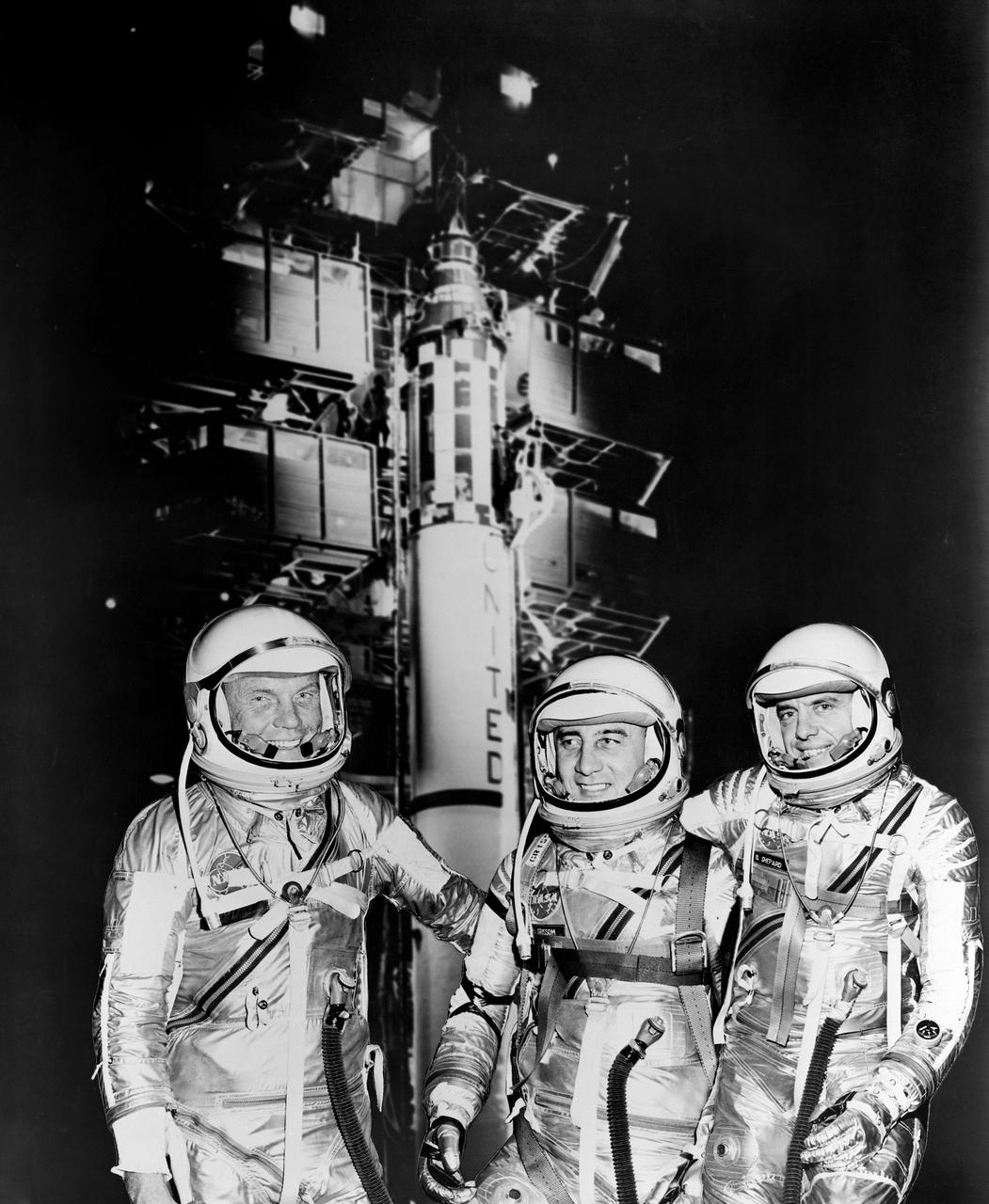
1961 -- The first three Americans in space, Mercury astronauts, from the left, John H. Glenn Jr., Virgil I. (Gus) Grissom and Alan B. Shepard Jr. standing by Redstone rocket in their spacesuits.
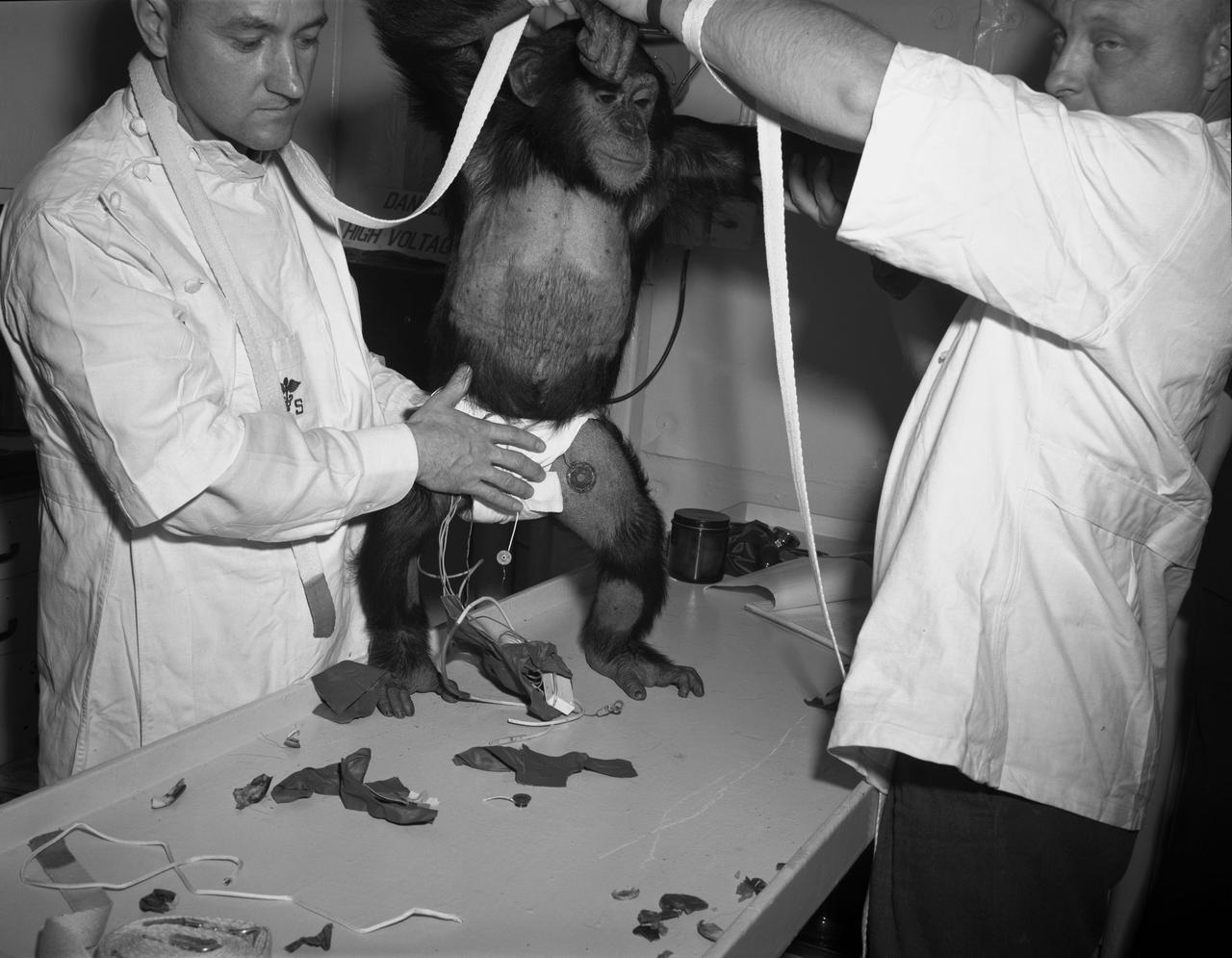
S63-20800 (31 Jan. 1961) --- Chimpanzee "Ham" being assisted into "spacesuit" prior to the Mercury-Redstone 2 (MR-2) test flight which was conducted on Jan. 31, 1961. Photo credit: NASA
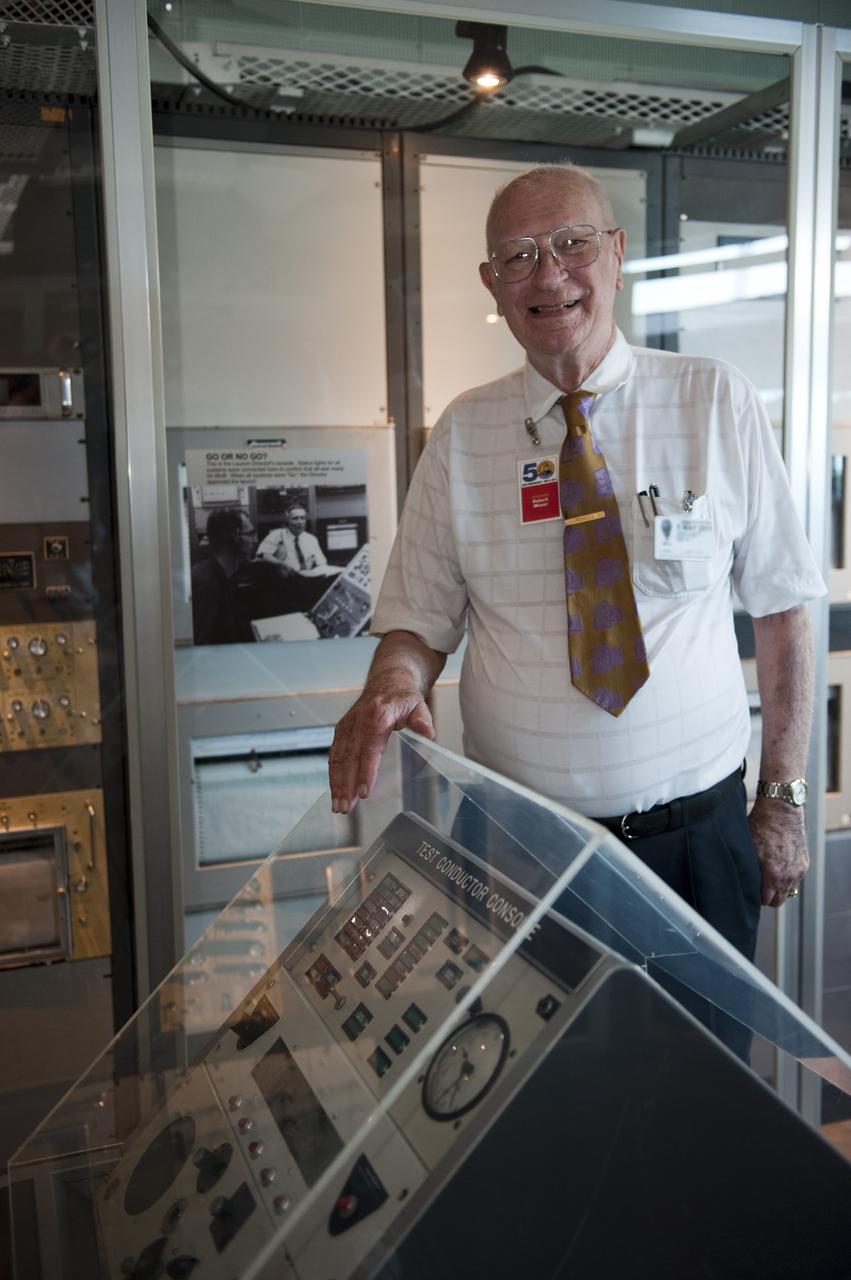
CAPE CANAVERAL, Fla. -- Bob Moser, former chief test conductor for the Mercury-Redstone launches, tours the blockhouse at Complex 5/6 on Cape Canaveral Air Force Station in Florida. The celebration was held at the launch site of the first U.S. manned spaceflight May 5, 1961, to mark the 50th anniversary of the flight. Fifty years ago, astronaut Alan Shepard lifted off inside the Mercury capsule, "Freedom 7," atop an 82-foot-tall Mercury-Redstone rocket at 9:34 a.m. EST, sending him on a remarkably successful, 15-minute suborbital flight. The event was attended by more than 200 workers from the original Mercury program and included a re-creation of Shepard's flight and recovery, as well as a tribute to his contributions as a moonwalker on the Apollo 14 lunar mission. For more information, visit www.nasa.gov/topics/history/milestones/index.html. Photo credit: NASA/Kim Shiflett
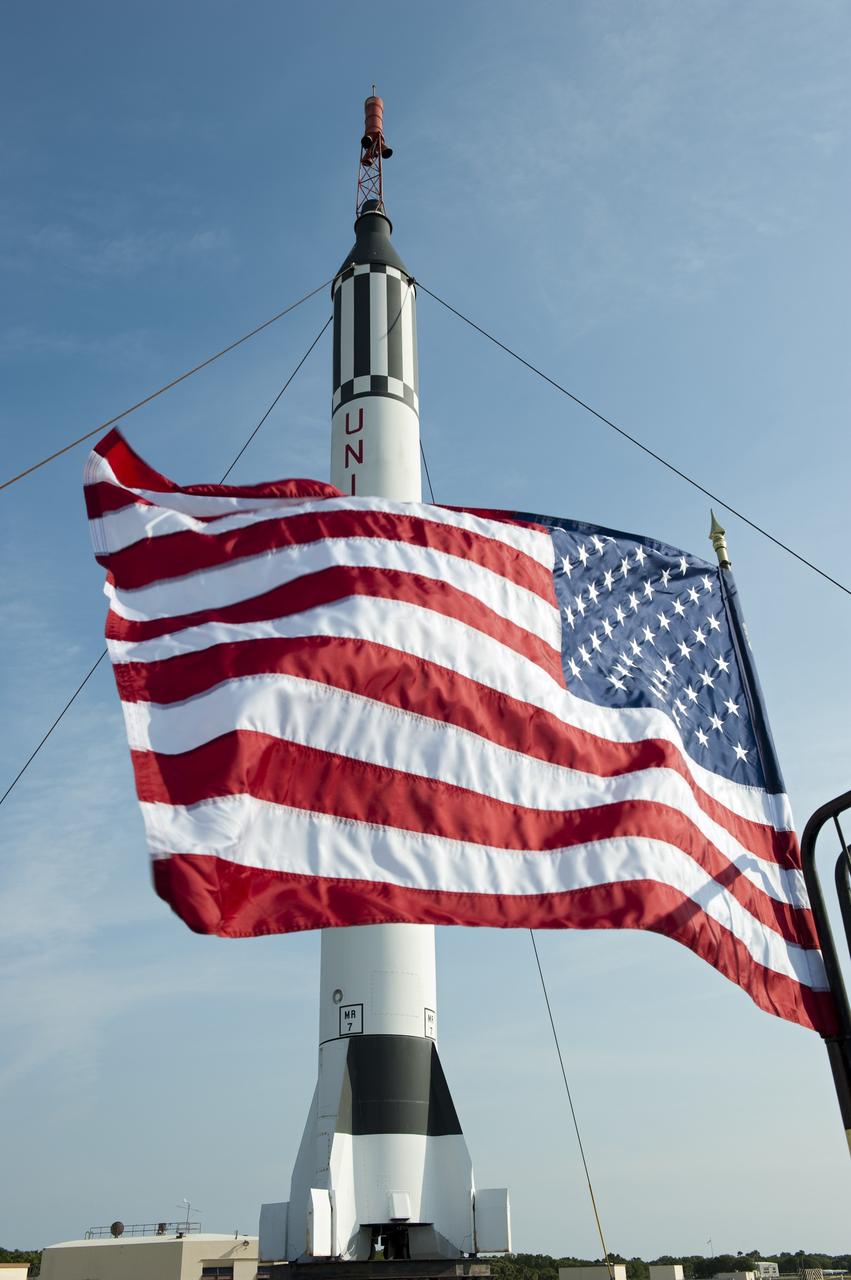
CAPE CANAVERAL, Fla. -- The U.S. flag waves proudly in front of a replica of a Mercury-Redstone rocket at Complex 5/6 on Cape Canaveral Air Force Station in Florida. A celebration was held at the launch site of the first U.S. manned spaceflight May 5, 1961, to mark the 50th anniversary of the flight. Fifty years ago, astronaut Alan Shepard lifted off inside the Mercury capsule, "Freedom 7," atop an 82-foot-tall Mercury-Redstone rocket at 9:34 a.m. EST, sending him on a remarkably successful, 15-minute suborbital flight. The event was attended by more than 200 workers from the original Mercury program and included a re-creation of Shepard's flight and recovery, as well as a tribute to his contributions as a moonwalker on the Apollo 14 lunar mission. For more information, visit www.nasa.gov/topics/history/milestones/index.html. Photo credit: NASA/Kim Shiflett
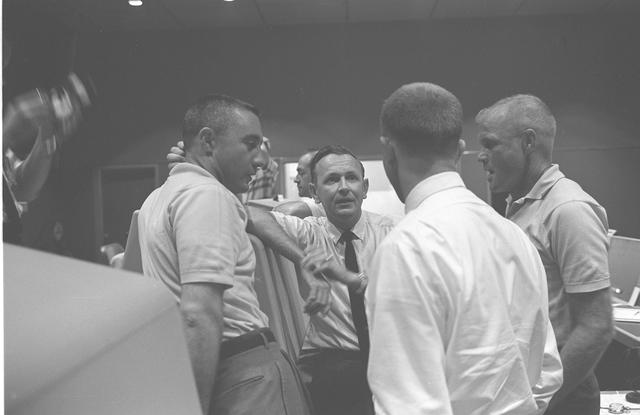
S64-10761 (1962) --- Astronauts Virgil I. (Gus) Grissom (left) and John H. Glenn Jr. hold a discussion in the Mercury Control Center during Mercury-Atlas 6 preflight activity. Glenn is the MA-6 pilot. Grissom was the pilot for the Mercury-Redstone 4 spaceflight made on July 21, 1961. Photo credit: NASA
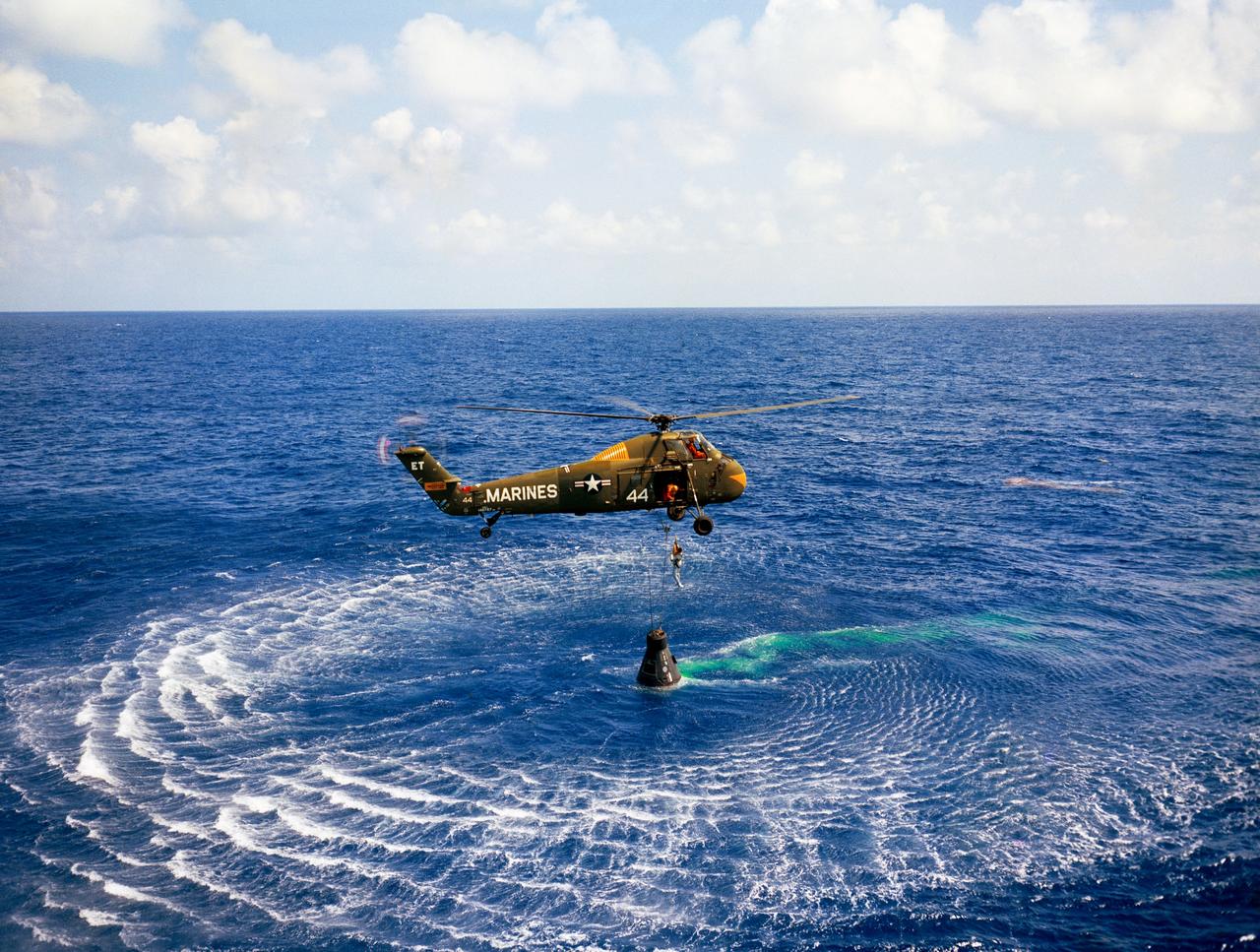
JSC2004-E-19882 (5 May 1961) --- Astronaut Alan B. Shepard Jr. is rescued by a U.S. Marine helicopter at the termination of his suborbital flight May 5, 1961, down range from the Florida eastern coast. Photo credit: NASA
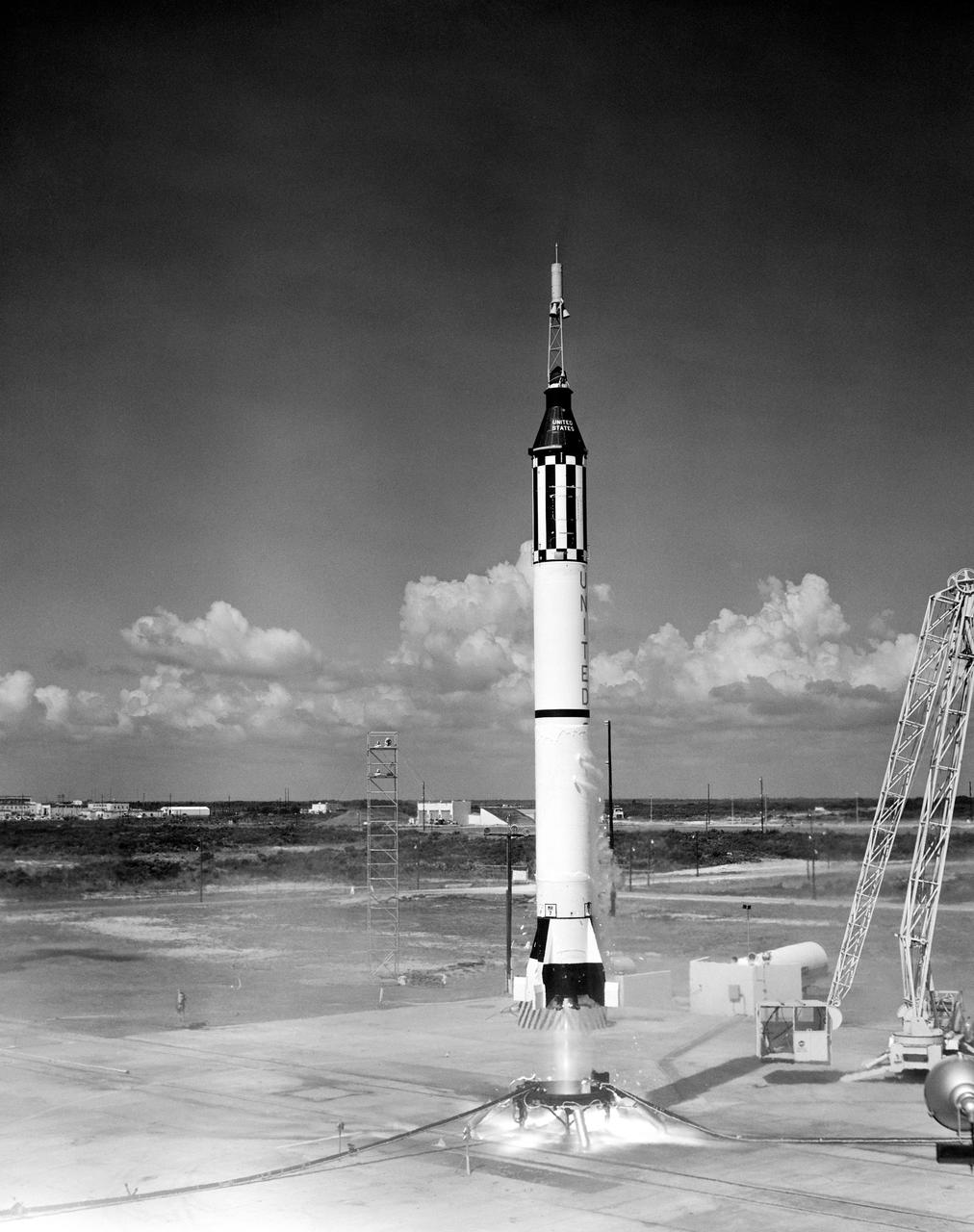
S61-02408 (5 May 1961) --- Launching of the Mercury-Redstone 3 (MR-3) rocket from Cape Canaveral on astronaut Alan B. Shepard?s suborbital mission. Photo credit: NASA or National Aeronautics and Space Administration
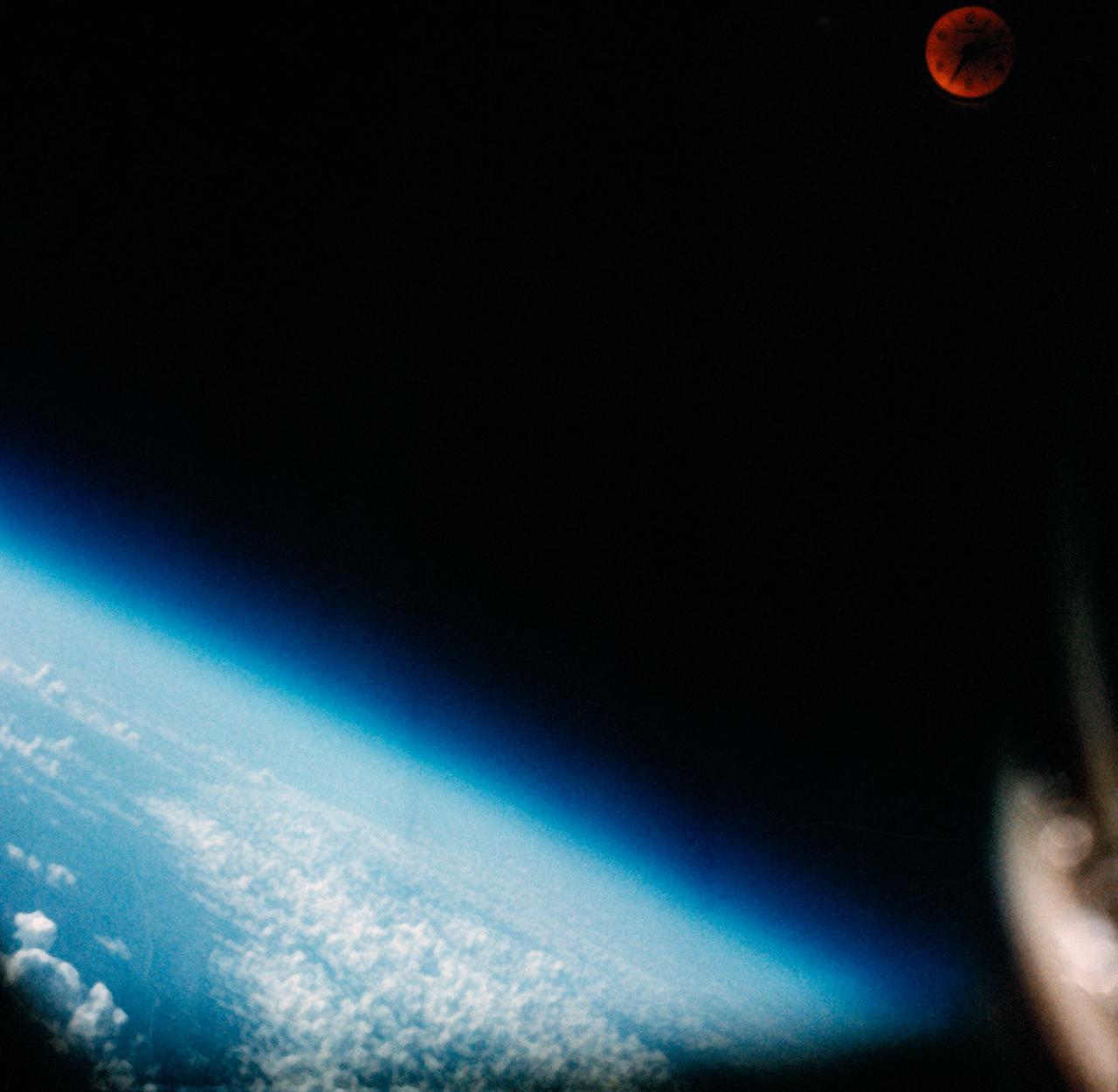
S61-01914 (5 May 1961) --- Mercury-Redstone 3 (MR-3) spaceflight Earth observations of a cloudy Earth surface. There is a gleam from the light reflected off the capsule window in the lower right side of the frame. Photo credit: NASA or National Aeronautics and Space Administration
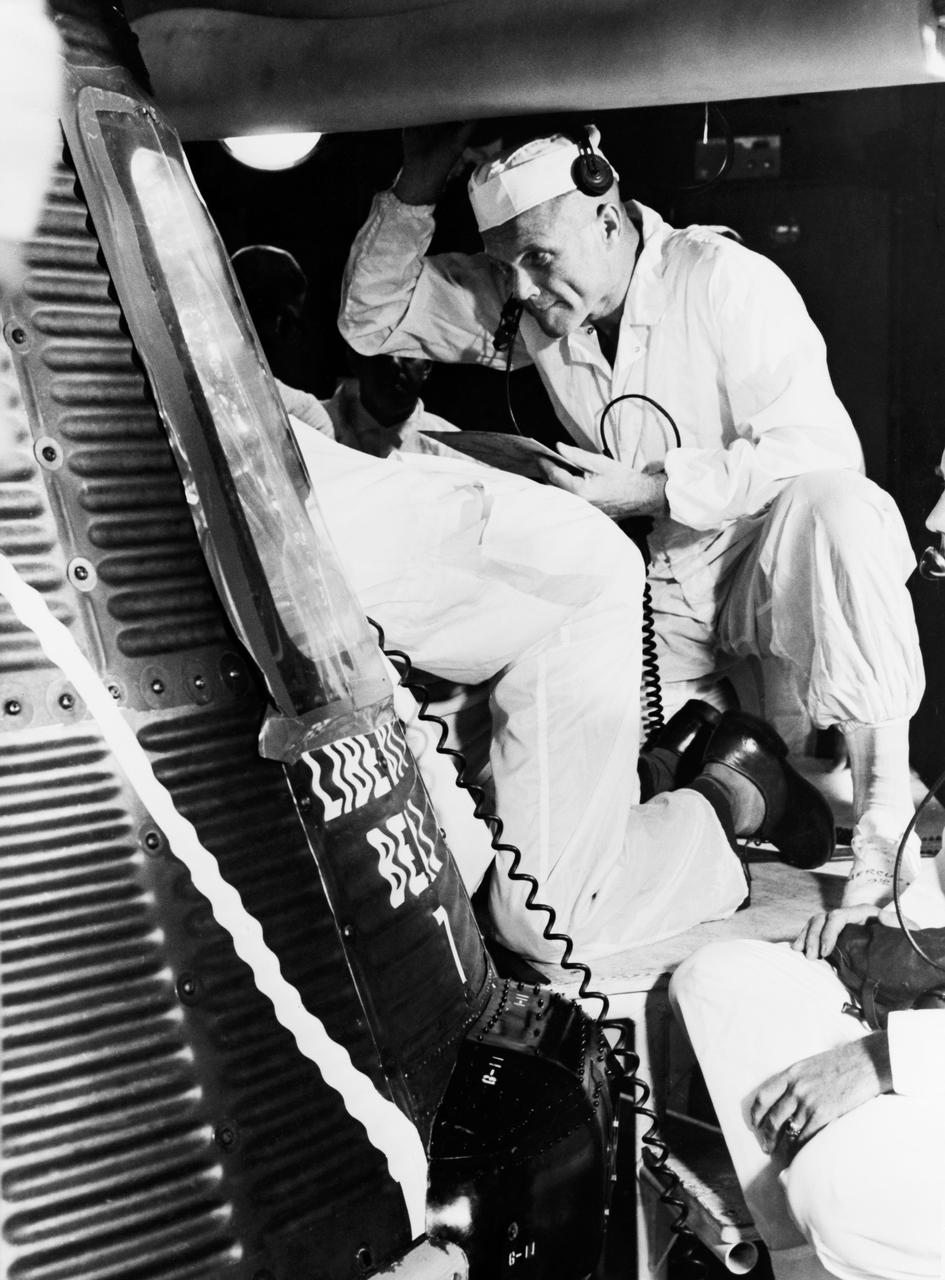
S61-03740 (20 July 1961) --- Astronaut John H. Glenn Jr. and a technician examine the interior of the Liberty Bell 7, the capsule flown a few days later during the Mercury-Redstone 4 mission with astronaut Virgil I. (Gus) Grissom. Photo credit: NASA
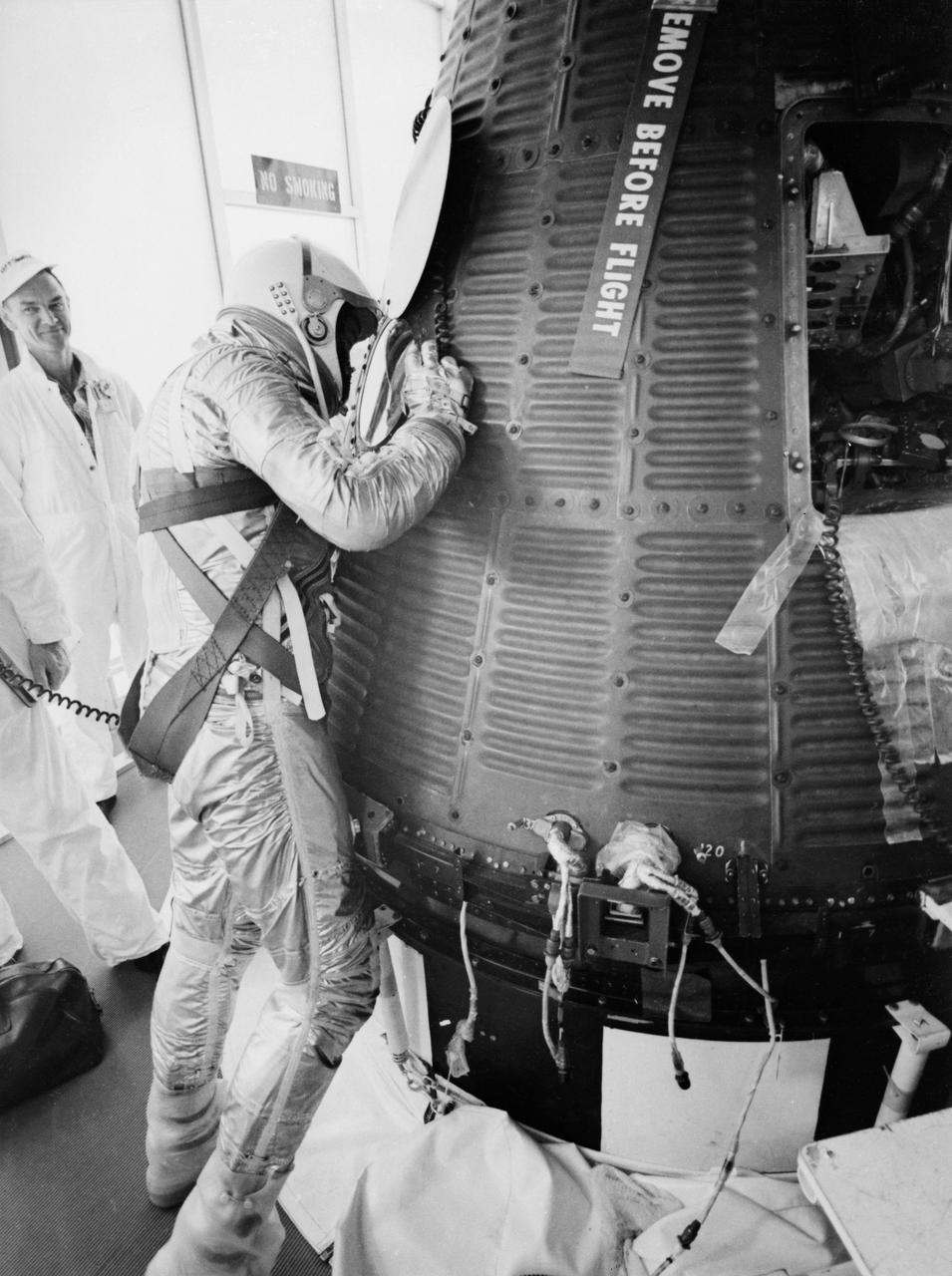
S61-02547 (5 May 1961) --- Astronaut Alan B. Shepard Jr., in his pressure suit and helmet, looks into the Freedom 7 capsule in preparation for ingress before the Mercury-Redstone 3 (MR-3) mission. Photo credit: NASA or National Aeronautics and Space Administration
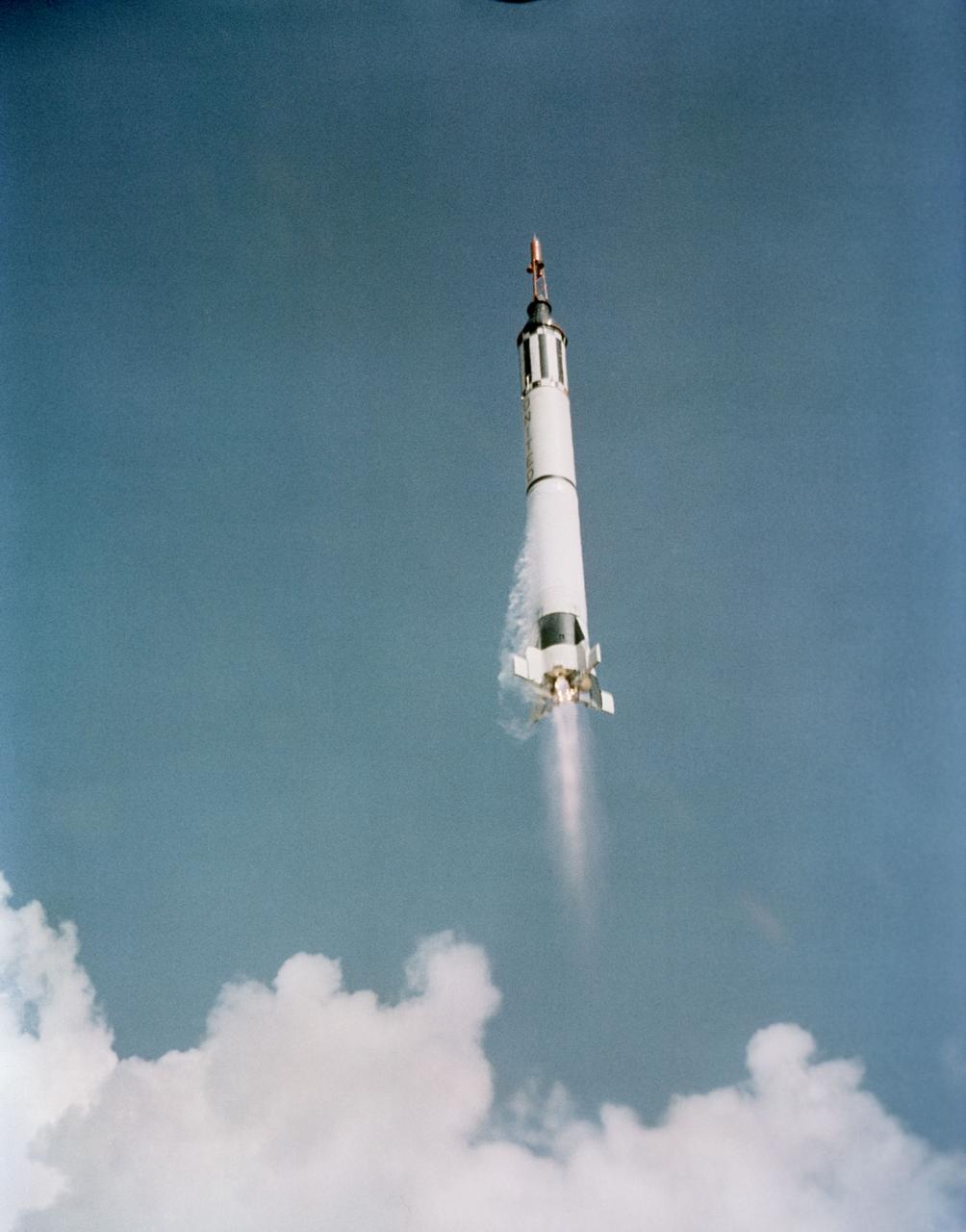
S61-01908 (5 May 1961) --- This is the launch of the Mercury-Redstone 3 (MR-3) spacecraft from Cape Canaveral on a suborbital mission -- the first U.S. manned spaceflight. The spacecraft is already headed towards its suborbital mission. Photo credit: NASA or National Aeronautics and Space Administration
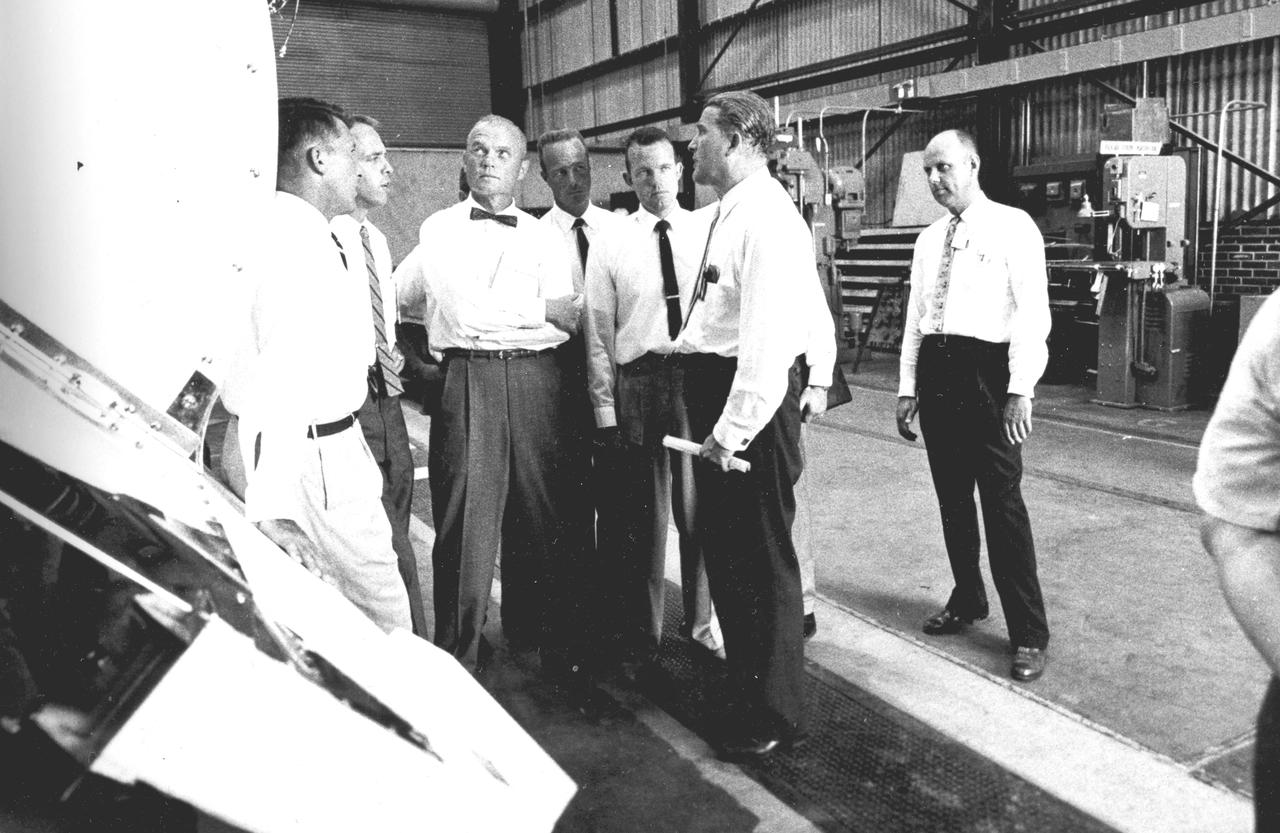
Five of the seven original astronauts are seen with Dr. von Braun inspecting the Mercury-Redstone hardware in the Fabrication Laboratory of Army Ballistic Missile Agency (ABMA) in 1959. Left to right: Astronauts Walter Schirra, Alan Shepard, John Glenn, Scott Carpenter, Gordon Cooper, and Dr. von Braun.
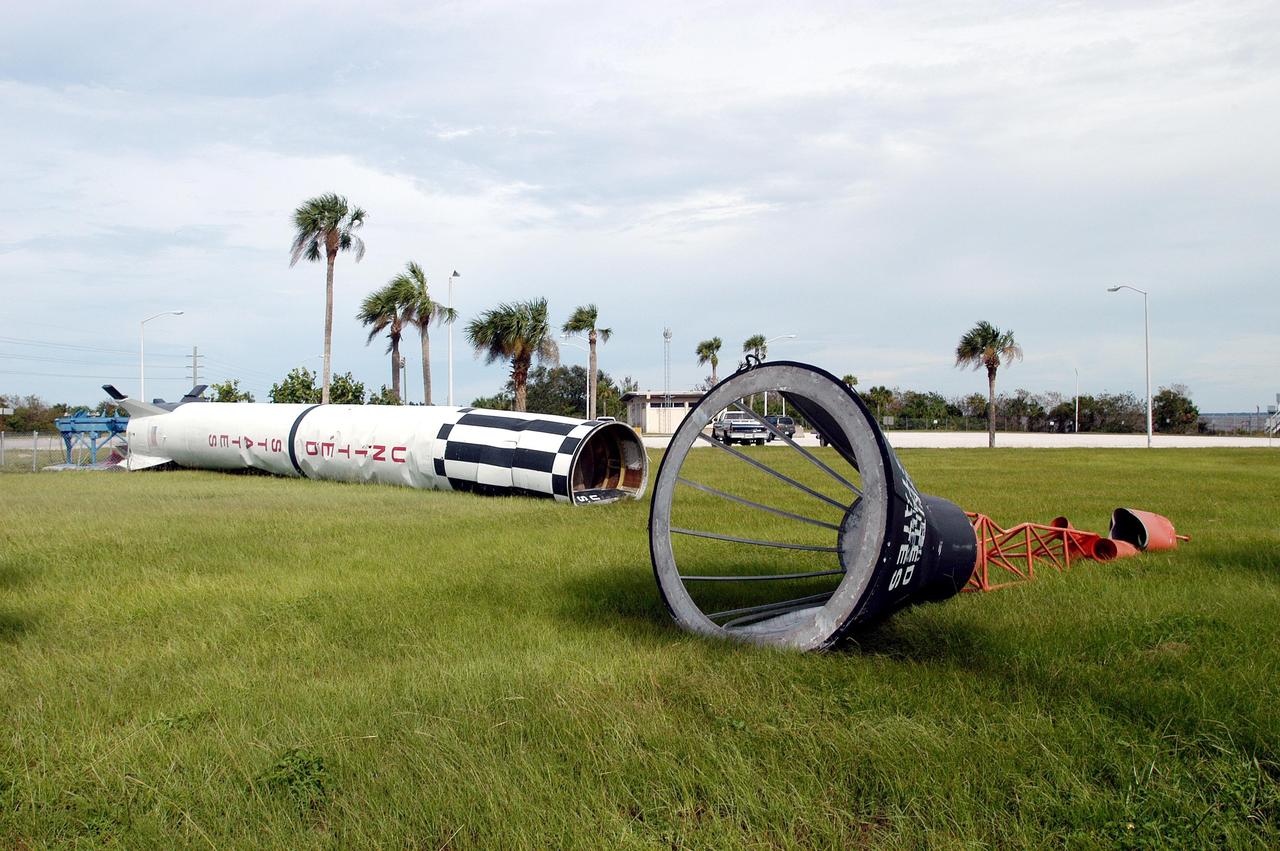
KENNEDY SPACE CENTER, FLA. - A Mercury/Redstone rocket on display at the Pass and Identification Building at the entrance to Kennedy Space lies on its side following Hurricane Frances. The storm's path over Florida took it through Cape Canaveral and KSC property during Labor Day weekend.
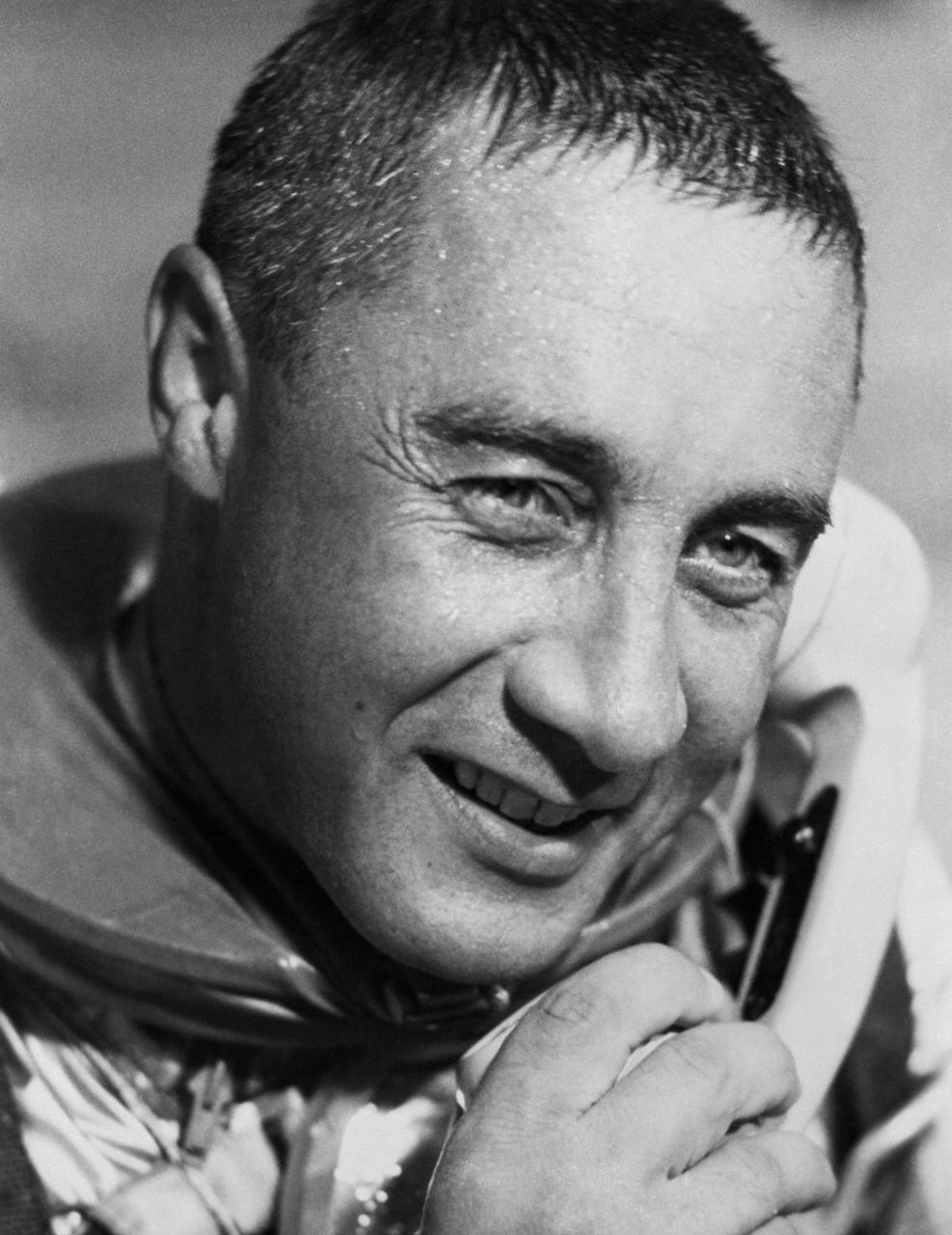
S61-02897 (21 July 1961) --- Virgil I. (Gus) Grissom, pilot of the Mercury-Redstone 4 (MR-4) ?Liberty Bell 7? spaceflight, talking on the phone with President Kennedy. Grissom is still wearing his pressure suit. Photo credit: NASA
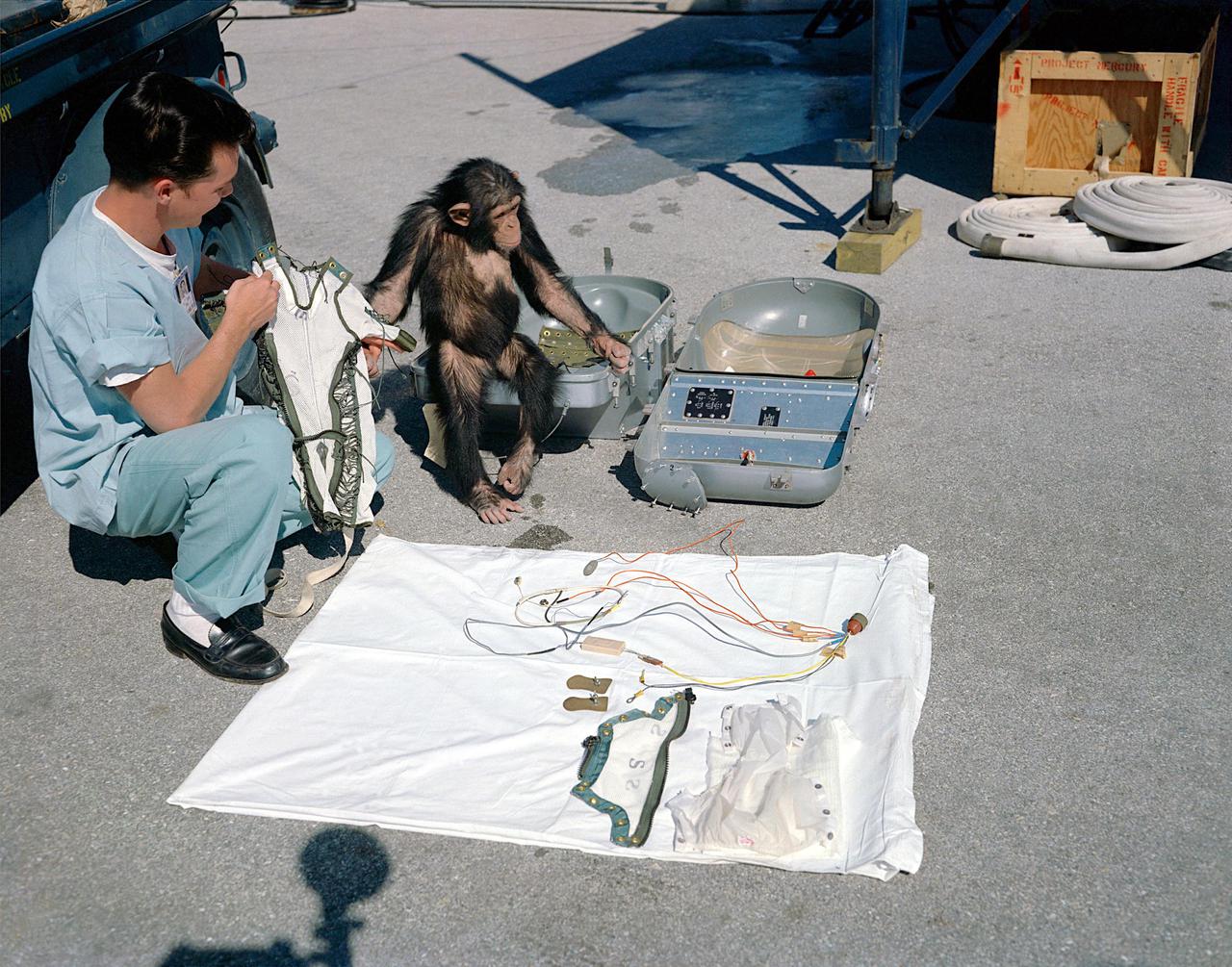
KENNEDY SPACE CENTER, FLA. - The chimp Ham (primate #65) and a technician goes over the equipment in Hangar S that is going to be used for Ham's suborbital flight. Ham is scheduled to be launched aboard a Mercury-Redstone 2 from Launch Pad 5 on January 31, 1961.
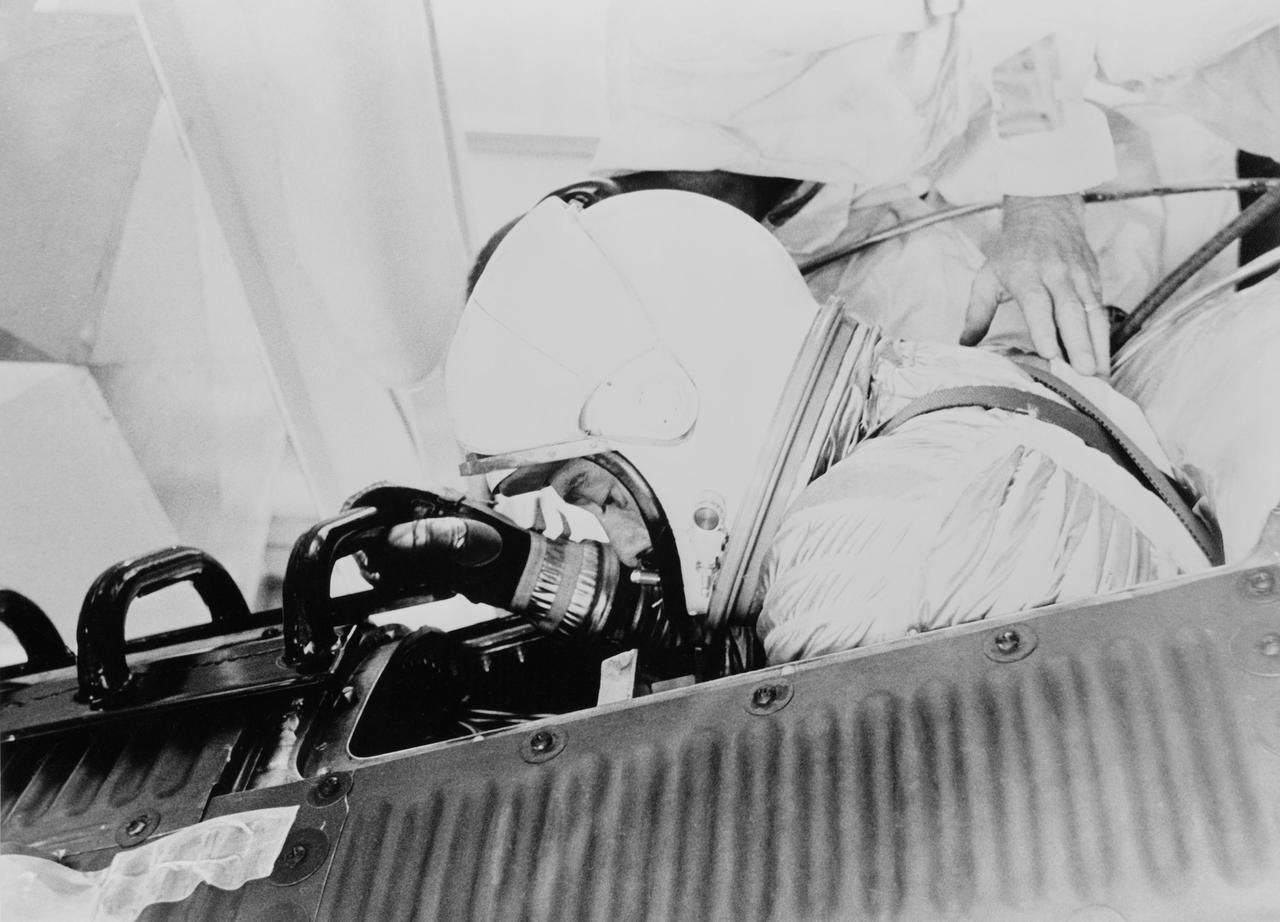
S61-03645 (5 May 1961) --- Close-up of astronaut Alan B. Shepard Jr., in his pressure suit and helmet, ingressing into the Freedom 7 capsule in preparation for the Mercury-Redstone 3 (MR-3) mission. Photo credit: NASA or National Aeronautics and Space Administration
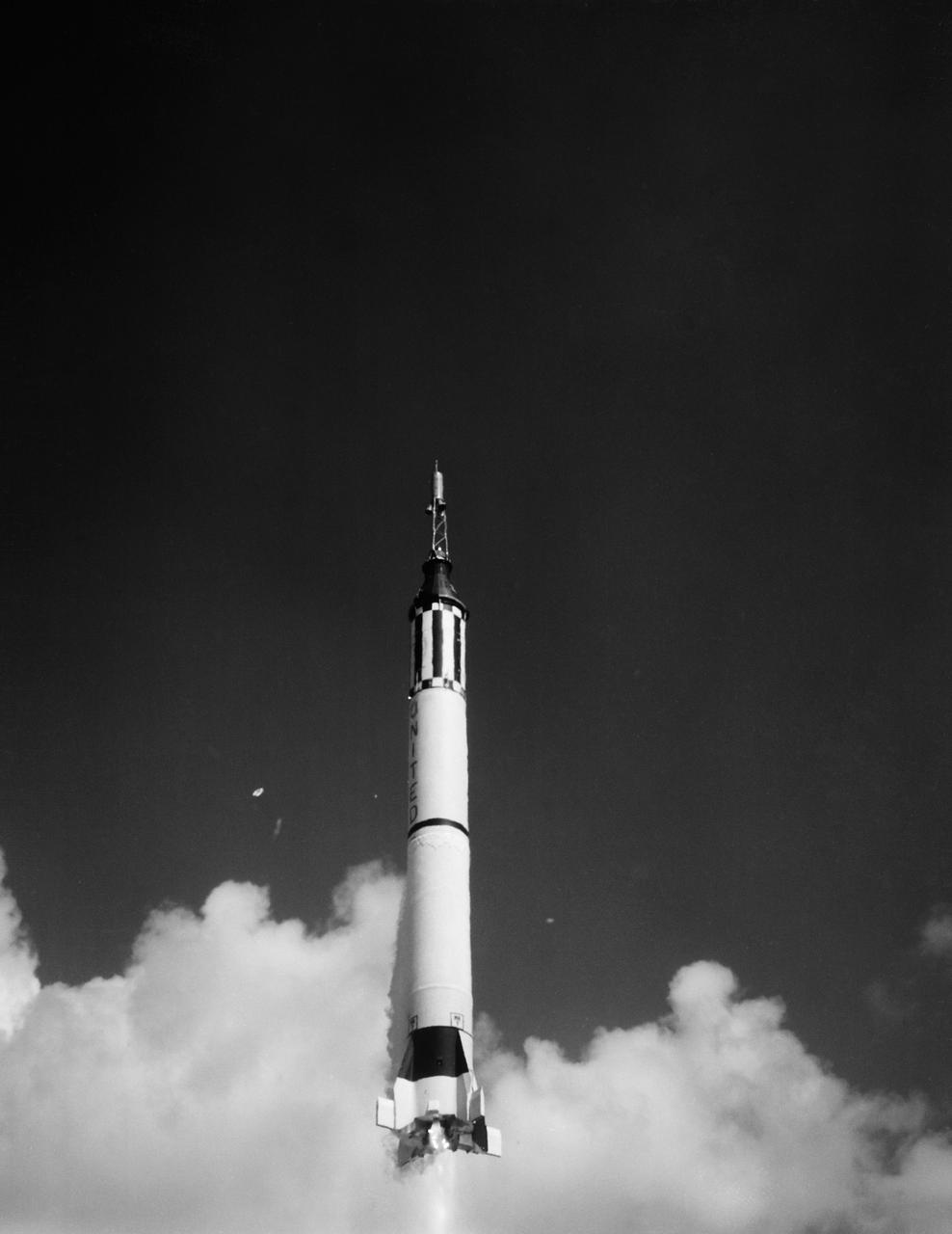
S61-02409 (5 May 1961) --- Launching of the Mercury-Redstone 3 (MR-3) rocket from Cape Canaveral on astronaut Alan B. Shepard?s suborbital mission. Photo credit: NASA or National Aeronautics and Space Administration
/61-mr4-72(s)~medium.jpg)
KENNEDY SPACE CENTER, FLA. -- Astronaut Virgil I. Grissom, suited up and ready to climb into Liberty Bell 7 spacecraft, talks with backup astronaut John Glenn prior to insertion. The Mercury-Redstone 4 mission was scrubbed a few hours later due to unfavorable weather over the launch area. (NASA Photo)
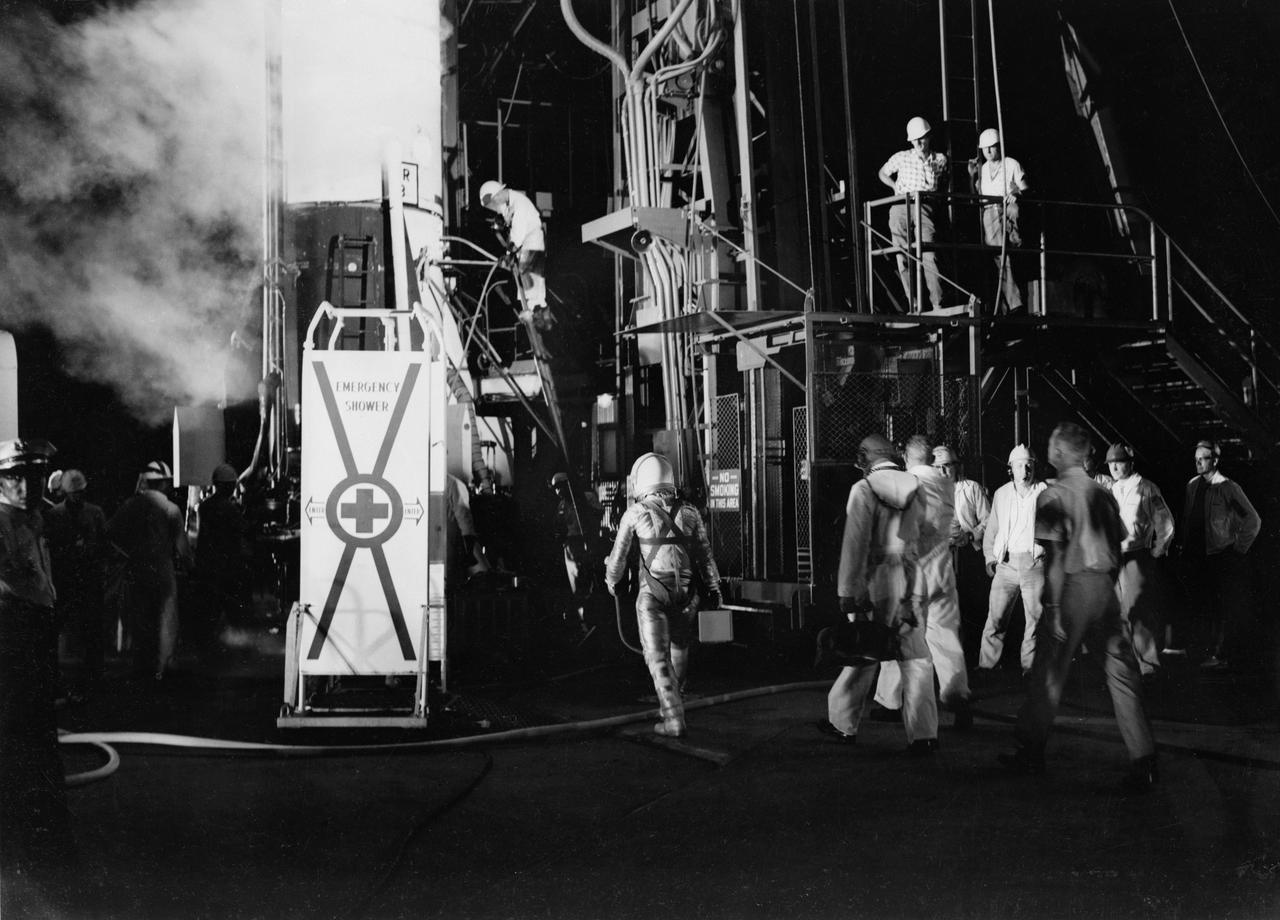
S61-02889 (1961) --- Astronaut Virgil I. (Gus) Grissom approaches his Mercury-Redstone 4 (MR-4) launch vehicle to begin his mission. To the left of the view is an emergency shower stall, to the right is the elevator which will take Grissom to the capsule. Photo credit: NASA
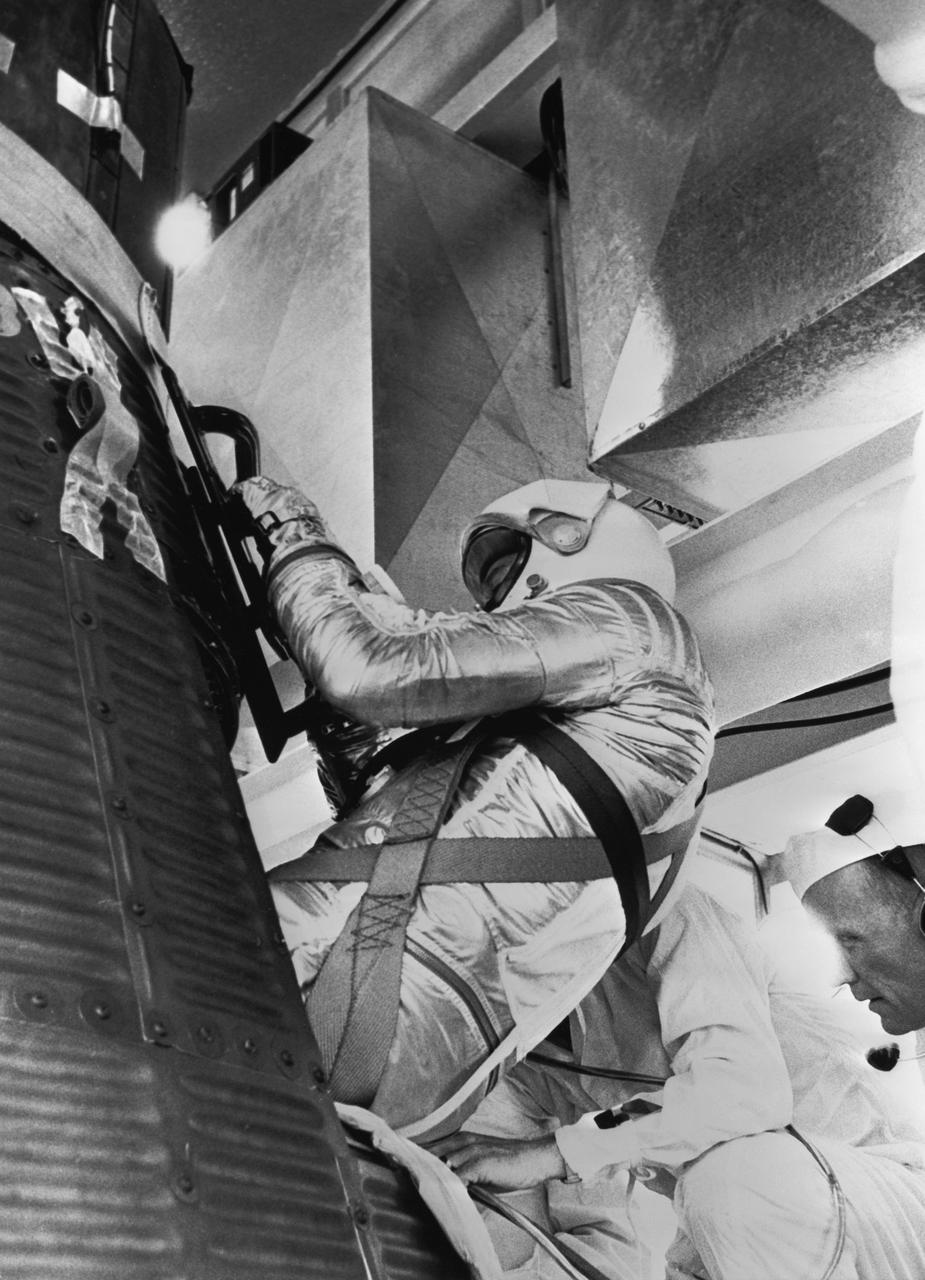
S61-03651 (5 May 1961) --- Astronaut Alan B. Shepard Jr., in his pressure suit and helmet, is being inserted into the Freedom 7 capsule in preparation for the Mercury-Redstone 3 (MR-3) mission. Photo credit: NASA or National Aeronautics and Space Administration