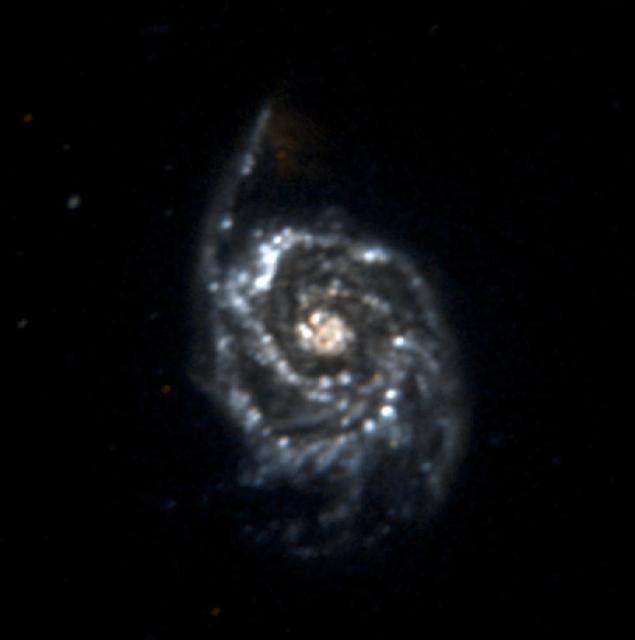
NASA's Galaxy Evolution Explorer took this image of the spiral galaxy Messier 51 on June 19 and 20, 2003. Messier 51 is located 27 million light-years from Earth. Due to a lack of star formation, the companion galaxy in the top of the picture is barely visible as a near ultraviolet object. http://photojournal.jpl.nasa.gov/catalog/PIA04628

The arrangement of the spiral arms in the galaxy Messier 63, seen here in a new image from the NASA/ESA Hubble Space Telescope, recall the pattern at the centre of a sunflower. So the nickname for this cosmic object — the Sunflower Galaxy — is no coincidence. Discovered by Pierre Mechain in 1779, the galaxy later made it as the 63rd entry into fellow French astronomer Charles Messier’s famous catalogue, published in 1781. The two astronomers spotted the Sunflower Galaxy’s glow in the small, northern constellation Canes Venatici (the Hunting Dogs). We now know this galaxy is about 27 million light-years away and belongs to the M51 Group — a group of galaxies, named after its brightest member, Messier 51, another spiral-shaped galaxy dubbed the Whirlpool Galaxy. Galactic arms, sunflowers and whirlpools are only a few examples of nature’s apparent preference for spirals. For galaxies like Messier 63 the winding arms shine bright because of the presence of recently formed, blue–white giant stars, readily seen in this Hubble image.
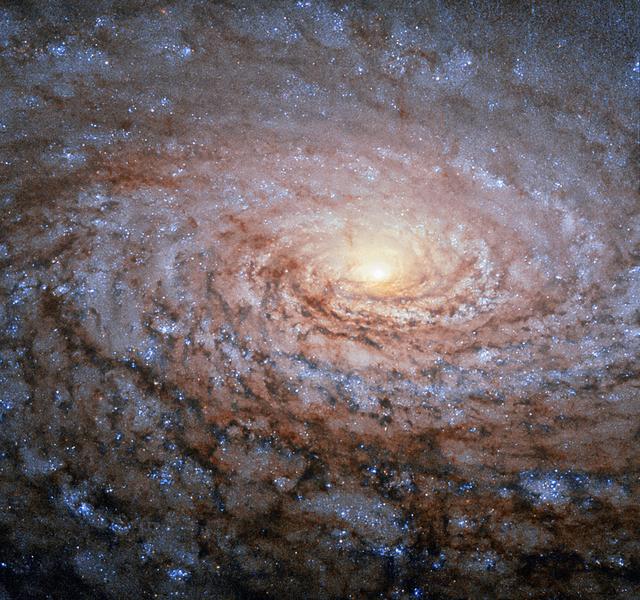
The arrangement of the spiral arms in the galaxy Messier 63, seen here in an image from the NASA/ESA Hubble Space Telescope, recall the pattern at the center of a sunflower. So the nickname for this cosmic object — the Sunflower Galaxy — is no coincidence. Discovered by Pierre Mechain in 1779, the galaxy later made it as the 63rd entry into fellow French astronomer Charles Messier’s famous catalogue, published in 1781. The two astronomers spotted the Sunflower Galaxy’s glow in the small, northern constellation Canes Venatici (the Hunting Dogs). We now know this galaxy is about 27 million light-years away and belongs to the M51 Group — a group of galaxies, named after its brightest member, Messier 51, another spiral-shaped galaxy dubbed the Whirlpool Galaxy. Galactic arms, sunflowers and whirlpools are only a few examples of nature’s apparent preference for spirals. For galaxies like Messier 63 the winding arms shine bright because of the presence of recently formed, blue–white giant stars and clusters, readily seen in this Hubble image. Image credit: ESA/Hubble & NASA <b><a href="http://www.nasa.gov/audience/formedia/features/MP_Photo_Guidelines.html" rel="nofollow">NASA image use policy.</a></b> <b><a href="http://www.nasa.gov/centers/goddard/home/index.html" rel="nofollow">NASA Goddard Space Flight Center</a></b> enables NASA’s mission through four scientific endeavors: Earth Science, Heliophysics, Solar System Exploration, and Astrophysics. Goddard plays a leading role in NASA’s accomplishments by contributing compelling scientific knowledge to advance the Agency’s mission. <b>Follow us on <a href="http://twitter.com/NASAGoddardPix" rel="nofollow">Twitter</a></b> <b>Like us on <a href="http://www.facebook.com/pages/Greenbelt-MD/NASA-Goddard/395013845897?ref=tsd" rel="nofollow">Facebook</a></b> <b>Find us on <a href="http://instagrid.me/nasagoddard/?vm=grid" rel="nofollow">Instagram</a></b>

These four panels show the Whirlpool galaxy — which is actually a pair of galaxies also known as Messier 51 and NGC 5194/5195 — and how different wavelengths of light can reveal different features of a cosmic object. Located approximately 23 million light-years away, it resides in the constellation Canes Venatici. The left image (a) shows the galaxy in visible light, from the Kitt Peak National Observatory 2.1-meter (6.8-foot) telescope and shows light at 0.4 microns (blue) and 0.7 microns (green). The next image (b) combines two visible-light wavelengths (in blue and green) and infrared light (in red). The infrared was captured by NASA's Spitzer Space Telescope and emphasizes how the dark dust veins that block our view in visible light begin to light up at these longer, infrared wavelengths. The right two panels are composed entirely of Spitzer data. In the middle-right panel (c), we see three wavelengths of infrared light: 3.6 microns (shown in blue), 4.5 microns (green) and 8 microns (red). The blended light from the billions of stars in the Whirlpool is brightest at the shorter infrared wavelengths and appear as as a blue haze. The individual blue dots across the image are mostly nearby stars and a few distant galaxies. Red features (at 8 microns) show us dust composed mostly of carbon that is illuminated by the stars in the galaxy. The far-right panel (d) expands our infrared view to include light at a wavelength of 24 microns (in red), which is particularly good for highlighting areas where the dust is especially hot. The bright reddish-white spots trace regions where new stars are forming and, in the process, heating their surroundings. All of the data shown here were released as part of the Spitzer Infrared Nearby Galaxies Survey (SINGS) project, captured during Spitzer's cryogenic and warm missions. https://photojournal.jpl.nasa.gov/catalog/PIA23128
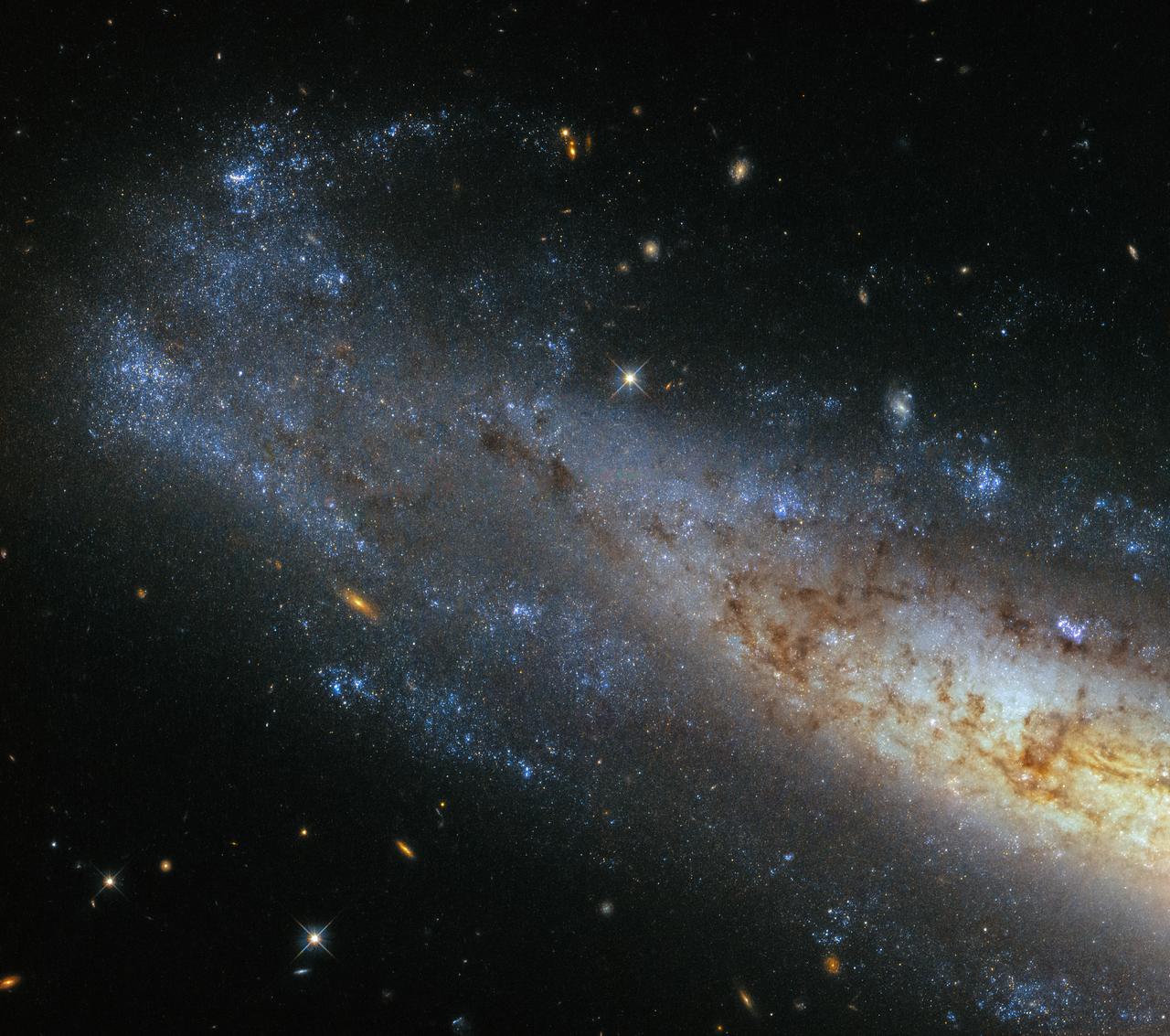
This image from Hubble’s Wide Field Camera 3 (WFC3) shows a section of NGC 1448, a spiral galaxy located about 50 million light-years from Earth in the little-known constellation of Horologium (The Pendulum Clock). We tend to think of spiral galaxies as massive and roughly circular celestial bodies, so this glittering oval does not immediately appear to fit the visual bill. What’s going on? Imagine a spiral galaxy as a circular frisbee spinning gently in space. When we see it face on, our observations reveal a spectacular amount of detail and structure — a great example from Hubble is the telescope’s view of Messier 51, otherwise known as the Whirlpool Galaxy. However, the NGC 1448 frisbee is very nearly edge-on with respect to Earth, giving it an appearance that is more oval than circular. The spiral arms, which curve out from NGC 1448’s dense core, can just about be seen. Although spiral galaxies might appear static with their picturesque shapes frozen in space, this is very far from the truth. The stars in these dramatic spiral configurations are constantly moving as they orbit around the galaxy’s core, with those on the inside making the orbit faster than those sitting further out. This makes the formation and continued existence of a spiral galaxy’s arms something of a cosmic puzzle, because the arms wrapped around the spinning core should become wound tighter and tighter as time goes on — but this is not what we see. This is known as the winding problem. Credit: ESA/Hubble & NASA #nasagoddard #space #science #Hubble #star <b><a href="http://www.nasa.gov/audience/formedia/features/MP_Photo_Guidelines.html" rel="nofollow">NASA image use policy.</a></b> <b><a href="http://www.nasa.gov/centers/goddard/home/index.html" rel="nofollow">NASA Goddard Space Flight Center</a></b> enables NASA’s mission through four scientific endeavors: Earth Science, Heliophysics, Solar System Exploration, and Astrophysics. Goddard plays a leading role in NASA’s accomplishments by contributing compelling scientific knowledge to advance the Agency’s mission. <b>Follow us on <a href="http://twitter.com/NASAGoddardPix" rel="nofollow">Twitter</a></b> <b>Like us on <a href="http://www.facebook.com/pages/Greenbelt-MD/NASA-Goddard/395013845897?ref=tsd" rel="nofollow">Facebook</a></b> <b>Find us on <a href="http://instagrid.me/nasagoddard/?vm=grid" rel="nofollow">Instagram</a></b>