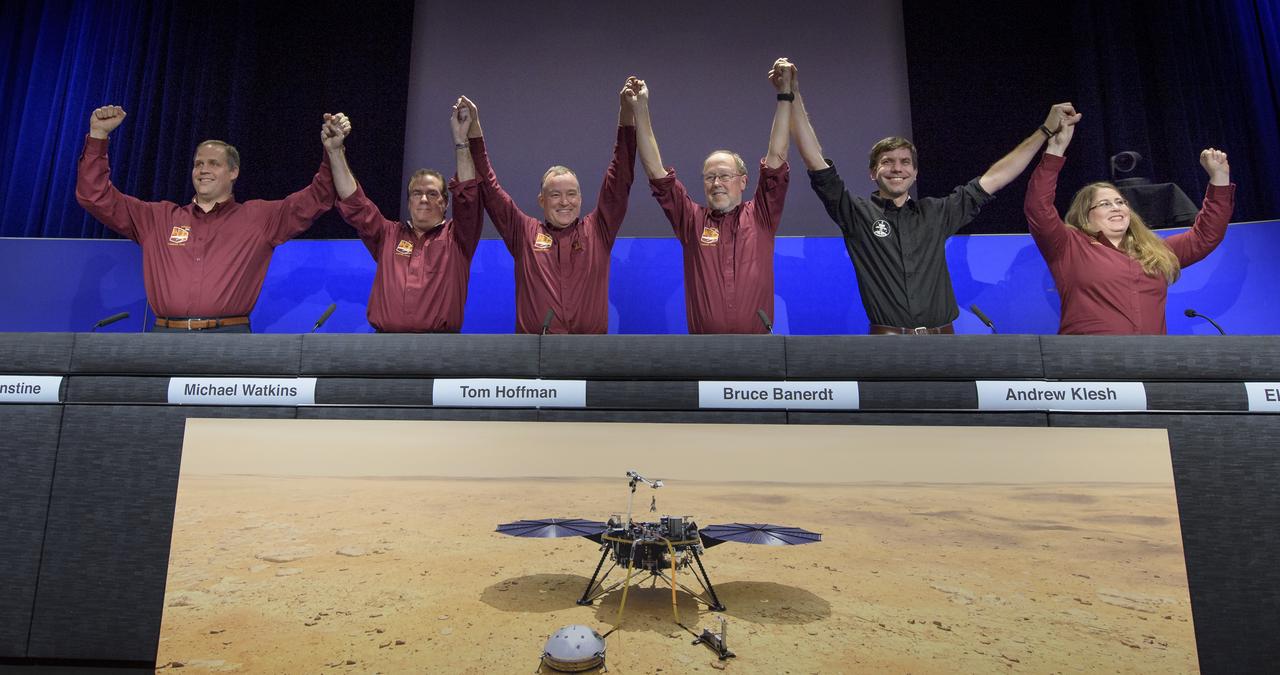
NASA Administrator Jim Bridenstine, left, JPL Director Michael Watkins, InSight Project Manager Tom Hoffman, InSight Principal Investigator Bruce Banerdt, MarCO chief engineer Andy Klesh, and InSight Instrument Operations Lead Elizabeth Barrett, celebrate Mars InSight landing successfully on Mars during a press conference, Monday, Nov. 26, 2018 at NASA's Jet Propulsion Laboratory in Pasadena, California. InSight, short for Interior Exploration using Seismic Investigations, Geodesy and Heat Transport, is a Mars lander designed to study the "inner space" of Mars: its crust, mantle, and core. Photo Credit: (NASA/Bill Ingalls)
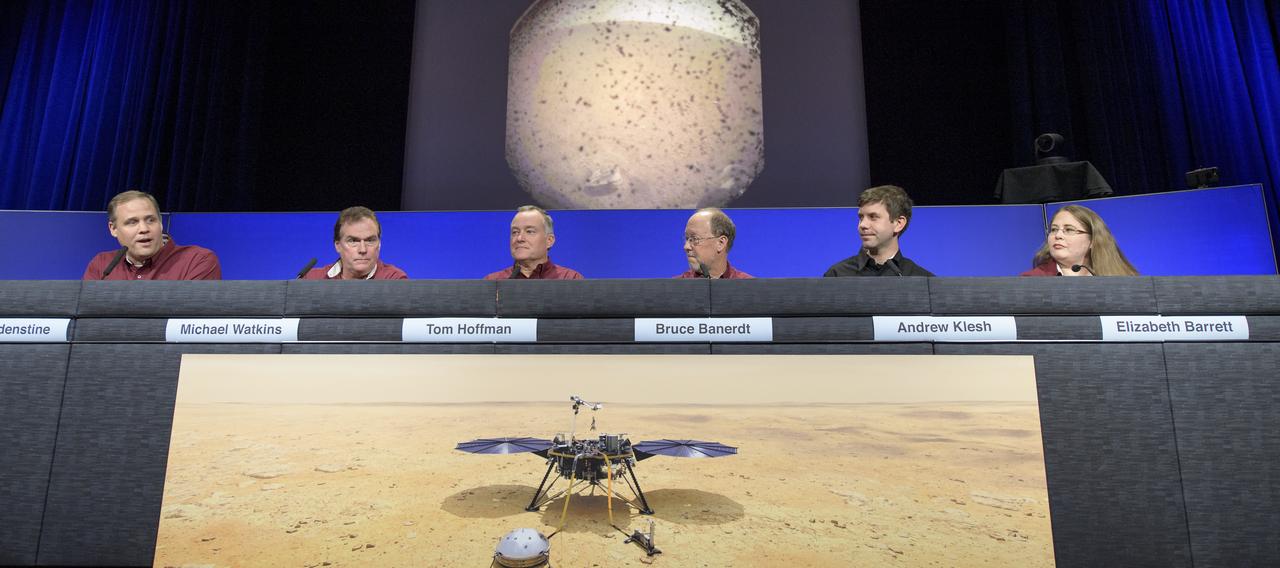
NASA Administrator Jim Bridenstine, left, JPL Director Michael Watkins, InSight Project Manager Tom Hoffman, InSight Principal Investigator Bruce Banerdt, MarCO chief engineer Andy Klesh, and InSight Instrument Operations Lead Elizabeth Barrett, give a Mars InSight post-landing press conference, Monday, Nov. 26, 2018 at NASA's Jet Propulsion Laboratory in Pasadena, California. InSight, short for Interior Exploration using Seismic Investigations, Geodesy and Heat Transport, is a Mars lander designed to study the "inner space" of Mars: its crust, mantle, and core. Photo Credit: (NASA/Bill Ingalls)
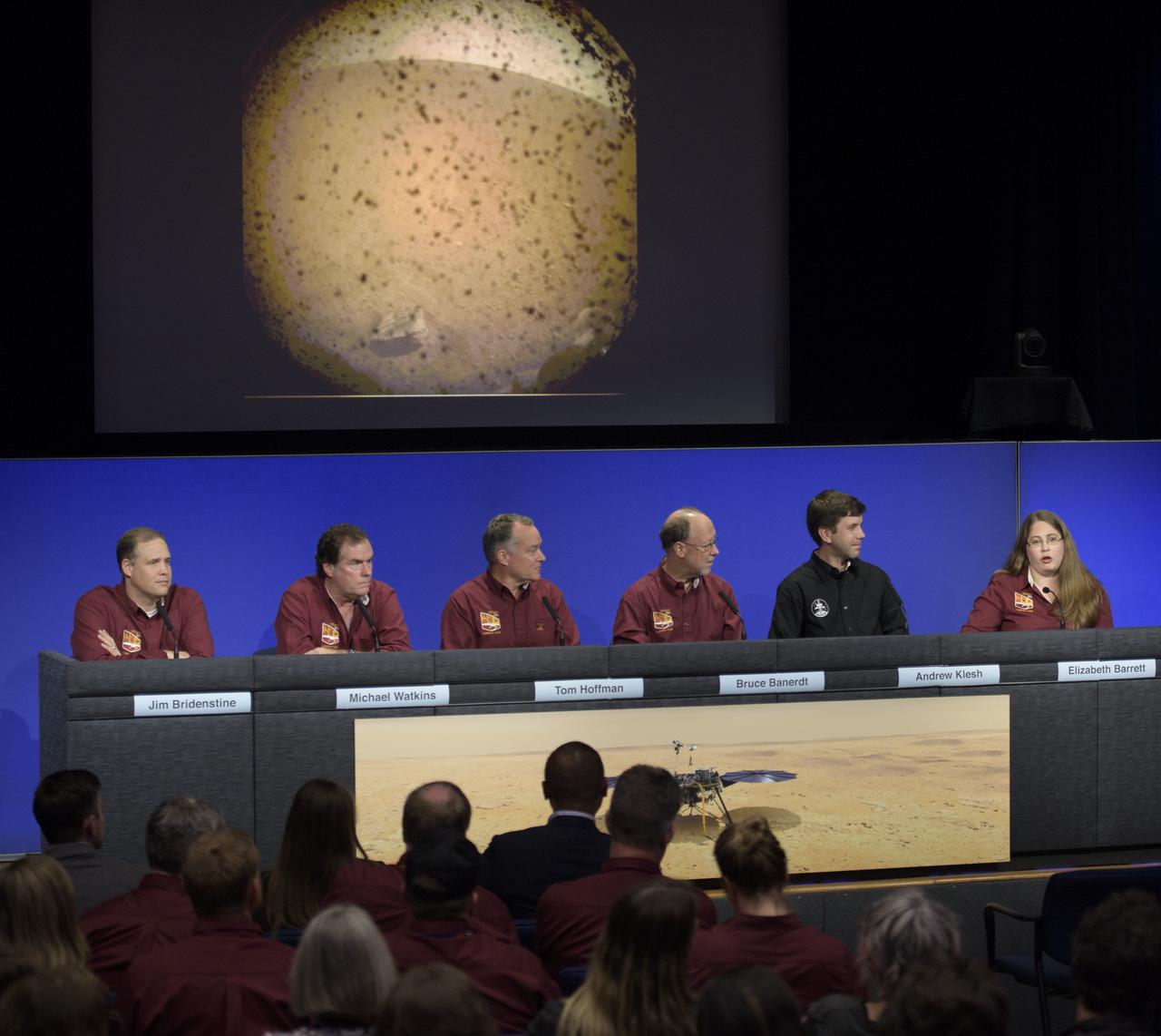
NASA Administrator Jim Bridenstine, left, JPL Director Michael Watkins, InSight Project Manager Tom Hoffman, InSight Principal Investigator Bruce Banerdt, MarCO chief engineer Andy Klesh, and InSight Instrument Operations Lead Elizabeth Barrett, answer questions during a Mars InSight post-landing press conference, Monday, Nov. 26, 2018 at NASA's Jet Propulsion Laboratory in Pasadena, California. InSight, short for Interior Exploration using Seismic Investigations, Geodesy and Heat Transport, is a Mars lander designed to study the "inner space" of Mars: its crust, mantle, and core. Photo Credit: (NASA/Bill Ingalls)
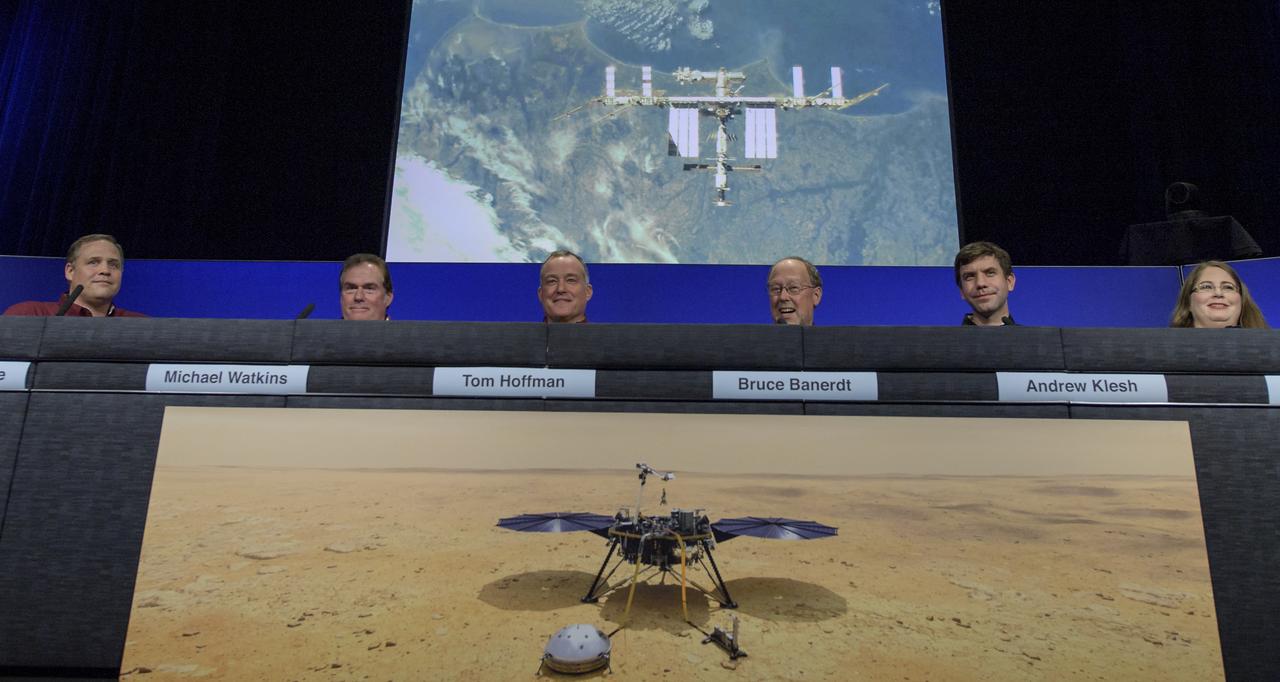
NASA Administrator Jim Bridenstine, left, JPL Director Michael Watkins, InSight Project Manager Tom Hoffman, InSight Principal Investigator Bruce Banerdt, MarCO chief engineer Andy Klesh, and InSight Instrument Operations Lead Elizabeth Barrett, listen to comments given by the International Space Station crew during a Mars InSight post-landing press conference, Monday, Nov. 26, 2018 at NASA's Jet Propulsion Laboratory in Pasadena, California. InSight, short for Interior Exploration using Seismic Investigations, Geodesy and Heat Transport, is a Mars lander designed to study the "inner space" of Mars: its crust, mantle, and core. Photo Credit: (NASA/Bill Ingalls)
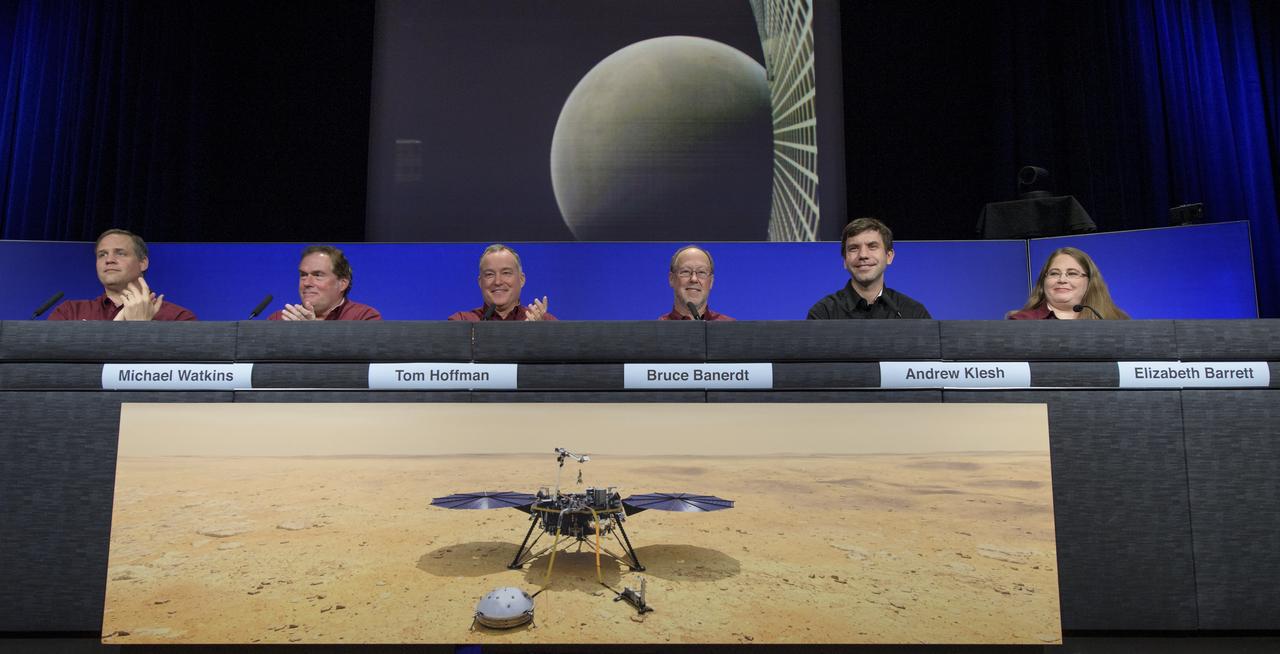
NASA Administrator Jim Bridenstine, left, JPL Director Michael Watkins, InSight Project Manager Tom Hoffman, InSight Principal Investigator Bruce Banerdt, MarCO chief engineer Andy Klesh, and InSight Instrument Operations Lead Elizabeth Barrett, show an image of Mars made by one of the Mars Cube One CubeSats during a Mars InSight post-landing press conference, Monday, Nov. 26, 2018 at NASA's Jet Propulsion Laboratory in Pasadena, California. InSight, short for Interior Exploration using Seismic Investigations, Geodesy and Heat Transport, is a Mars lander designed to study the "inner space" of Mars: its crust, mantle, and core. Photo Credit: (NASA/Bill Ingalls)
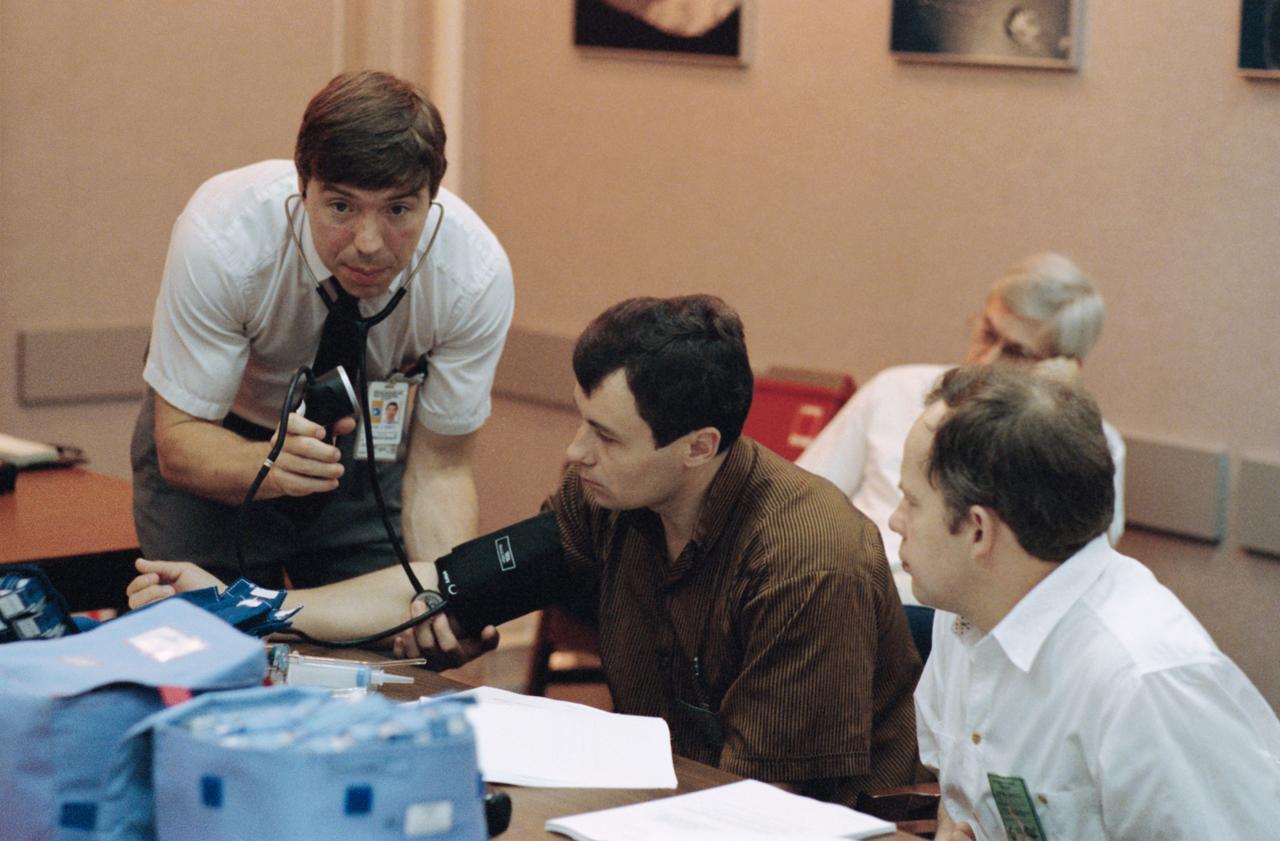
Cosmonaut Vladimir N. Dezhurov (center), Mir 18 mission commander, gets his blood pressure taken by Dr. Michael J. Barrett, flight surgeon. Cosmonaut Anatoliy Y. Solovyev (right), Mir 19 mission commander, looks on. Solovyev, Dezhurov, along with their respective flight engineers and a number of other cosmonauts and astronauts participating in the joint program, were in Houston, Texas, to prepare for their upcoming missions.
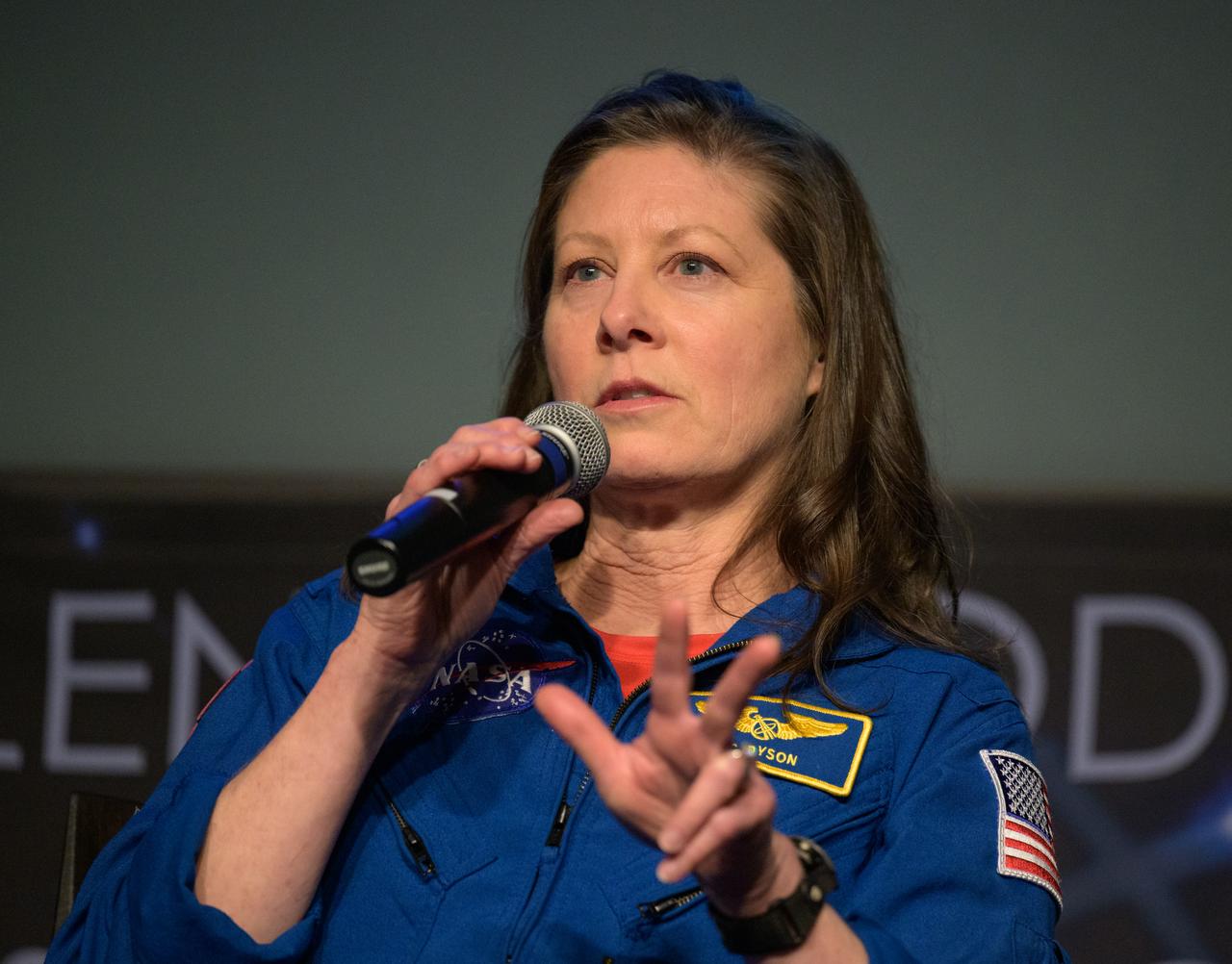
NASA astronaut Tracy Dyson, is seen during an Expedition 71 postflight presentation, Monday, March 3, 2025, at the Mary W. Jackson NASA Headquarters Building in Washington. Dyson, Michael Barrett, Matthew Dominick, and Jeanette Epps served as part of Expedition 71 aboard the International Space Station. Photo Credit: (NASA/Bill Ingalls)
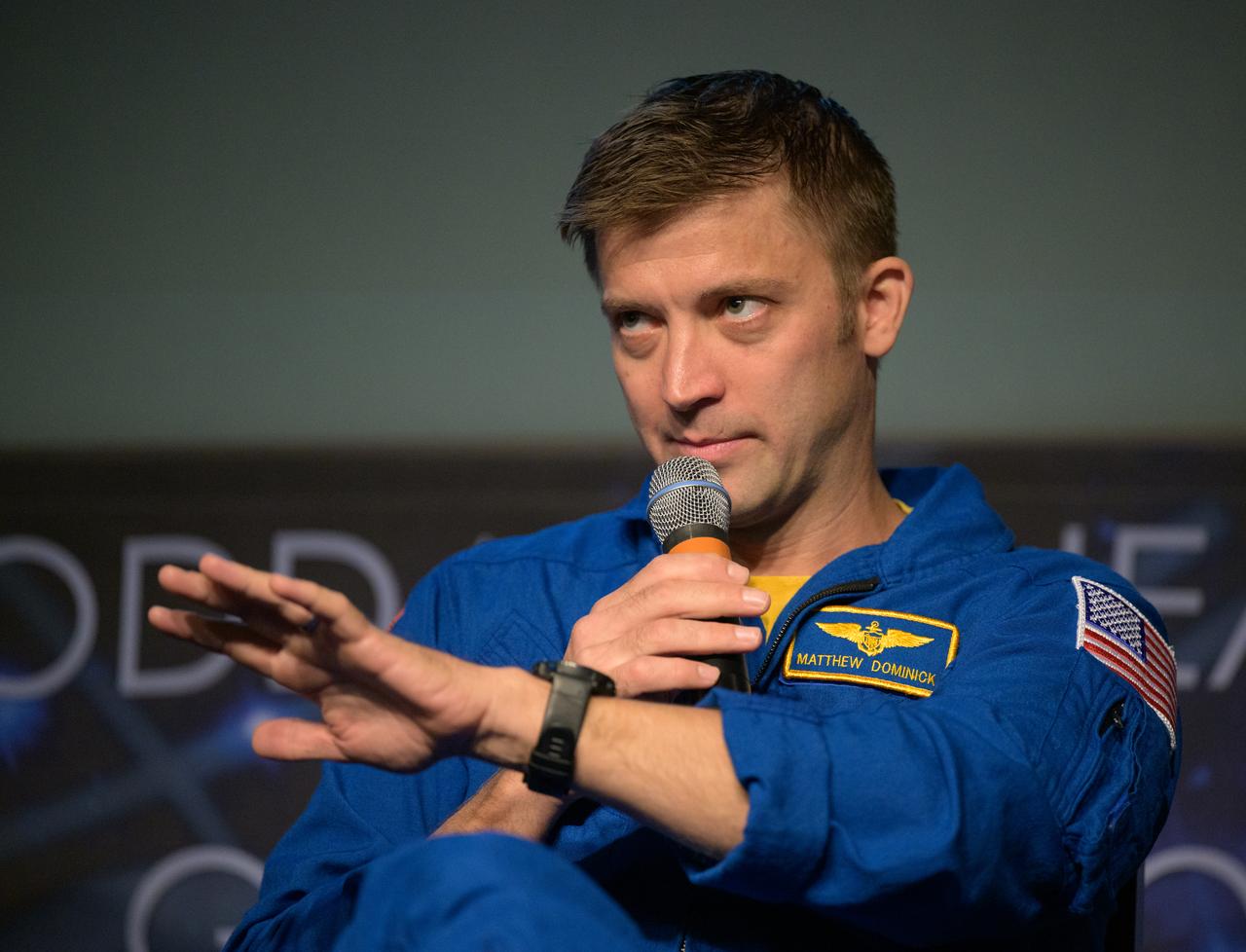
NASA astronaut Matthew Dominick, is seen during an Expedition 71 postflight presentation, Monday, March 3, 2025, at the Mary W. Jackson NASA Headquarters Building in Washington. Dominick, Michael Barrett, Tracy Dyson, and Jeanette Epps served as part of Expedition 71 aboard the International Space Station. Photo Credit: (NASA/Bill Ingalls)
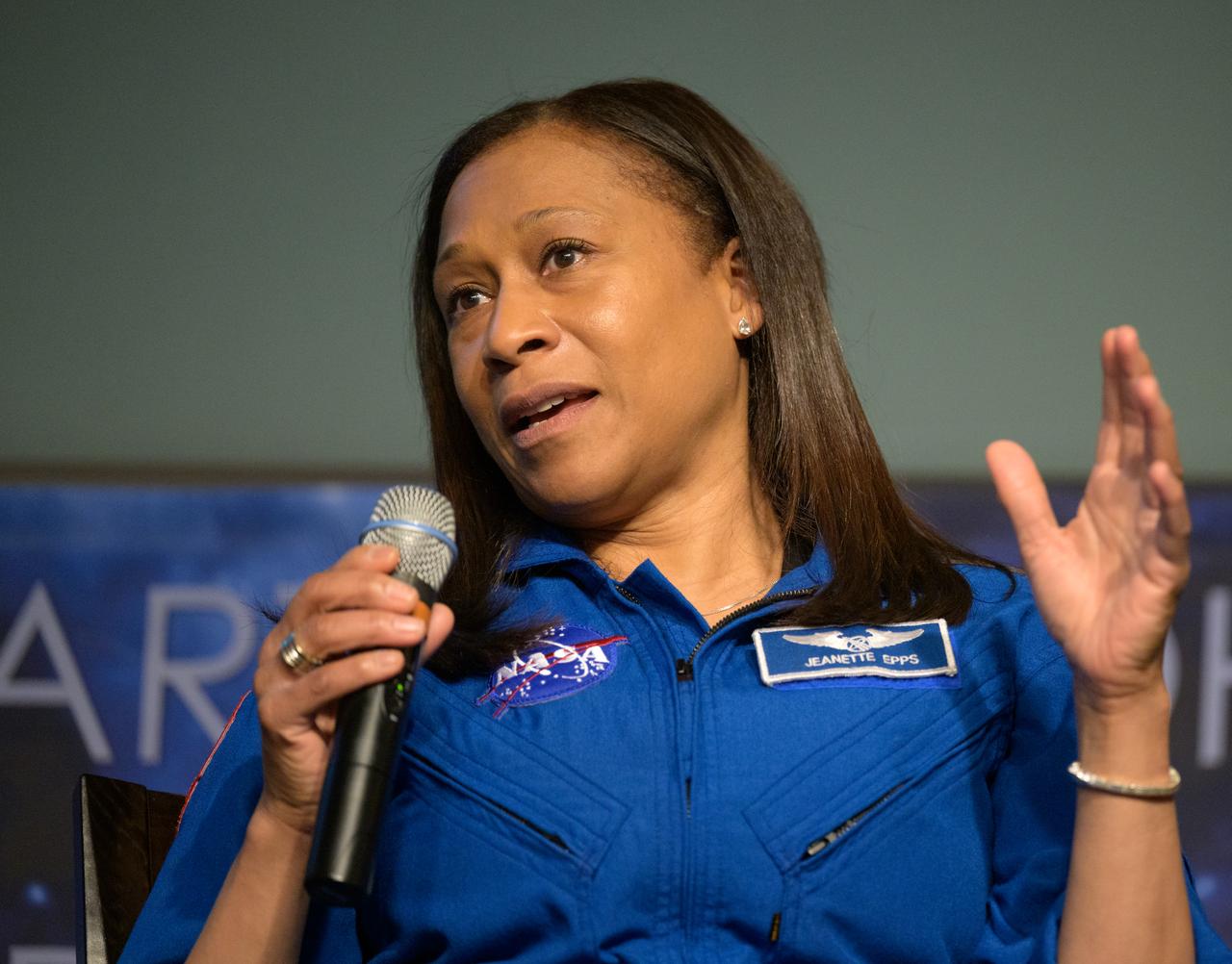
NASA astronaut Jeanette Epps, is seen during an Expedition 71 postflight presentation, Monday, March 3, 2025, at the Mary W. Jackson NASA Headquarters Building in Washington. Epps, Michael Barrett, Tracy Dyson, and Matthew Dominick served as part of Expedition 71 aboard the International Space Station. Photo Credit: (NASA/Bill Ingalls)
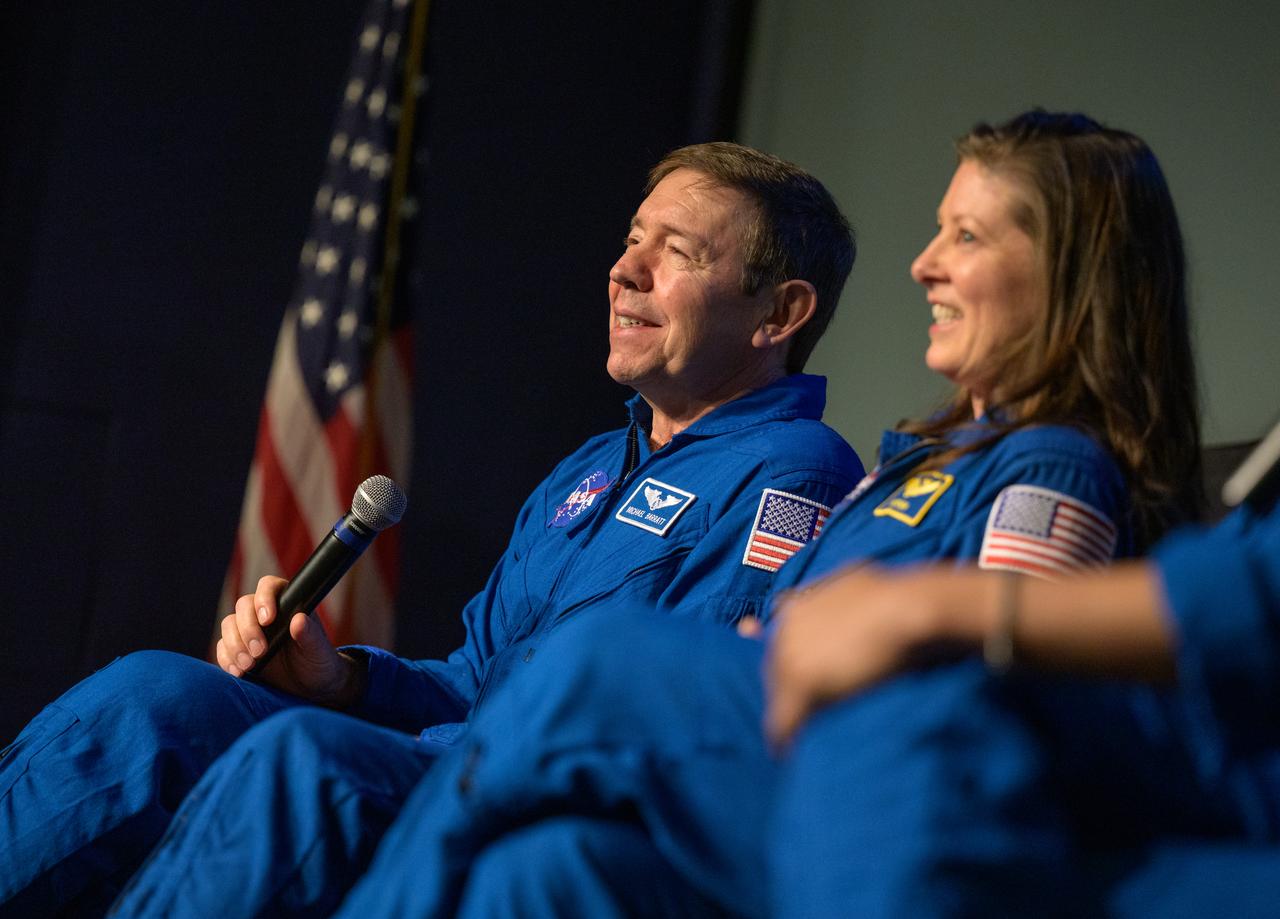
NASA astronaut Michael Barratt, is seen during an Expedition 71 postflight presentation, Monday, March 3, 2025, at the Mary W. Jackson NASA Headquarters Building in Washington. Barrett, Matthew Dominick, Jeanette Epps, and Tracy Dyson served as part of Expedition 71 aboard the International Space Station. Photo Credit: (NASA/Bill Ingalls)
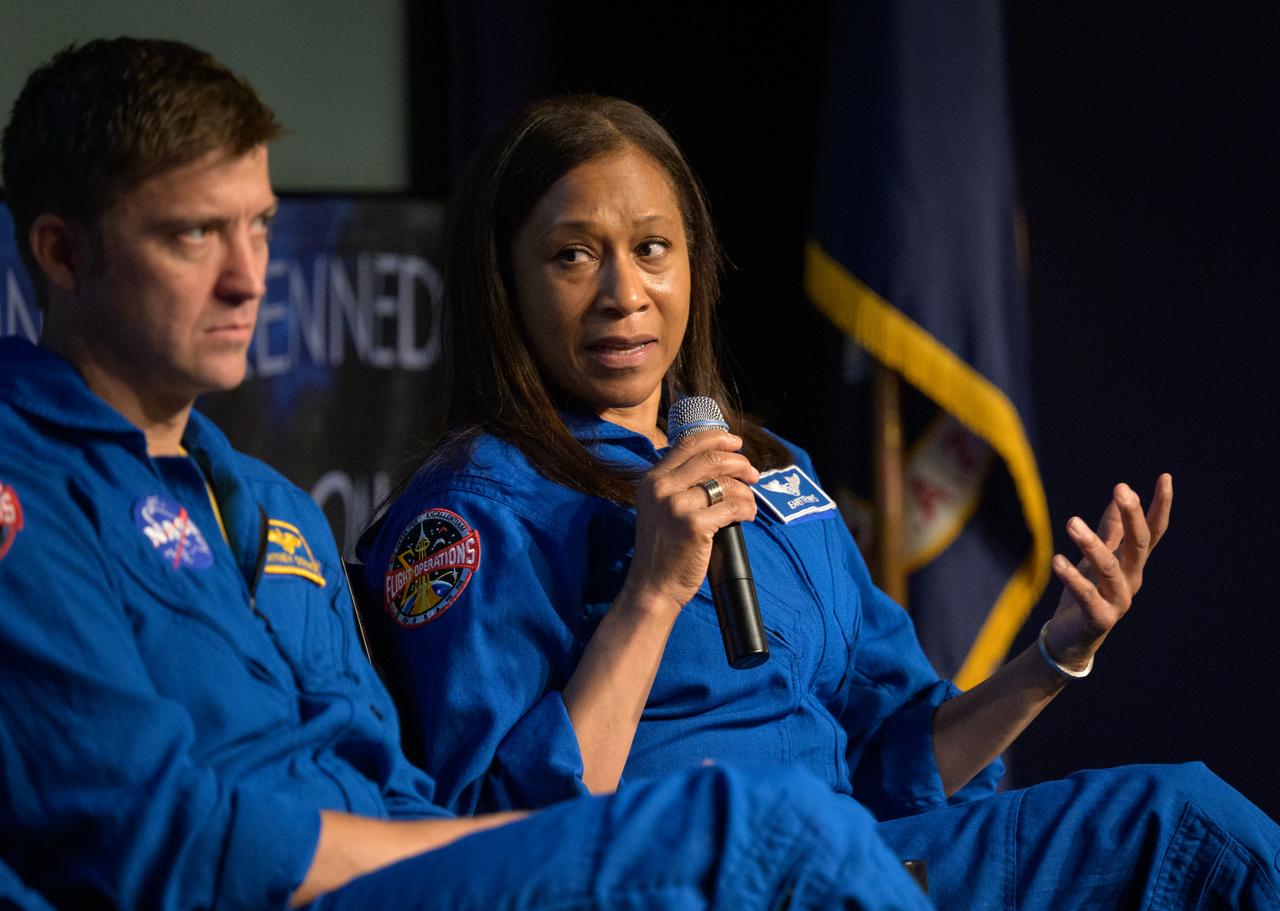
NASA astronaut Jeanette Epps, is seen during an Expedition 71 postflight presentation, Monday, March 3, 2025, at the Mary W. Jackson NASA Headquarters Building in Washington. Epps, Michael Barrett, Tracy Dyson, and Matthew Dominick served as part of Expedition 71 aboard the International Space Station. Photo Credit: (NASA/Bill Ingalls)
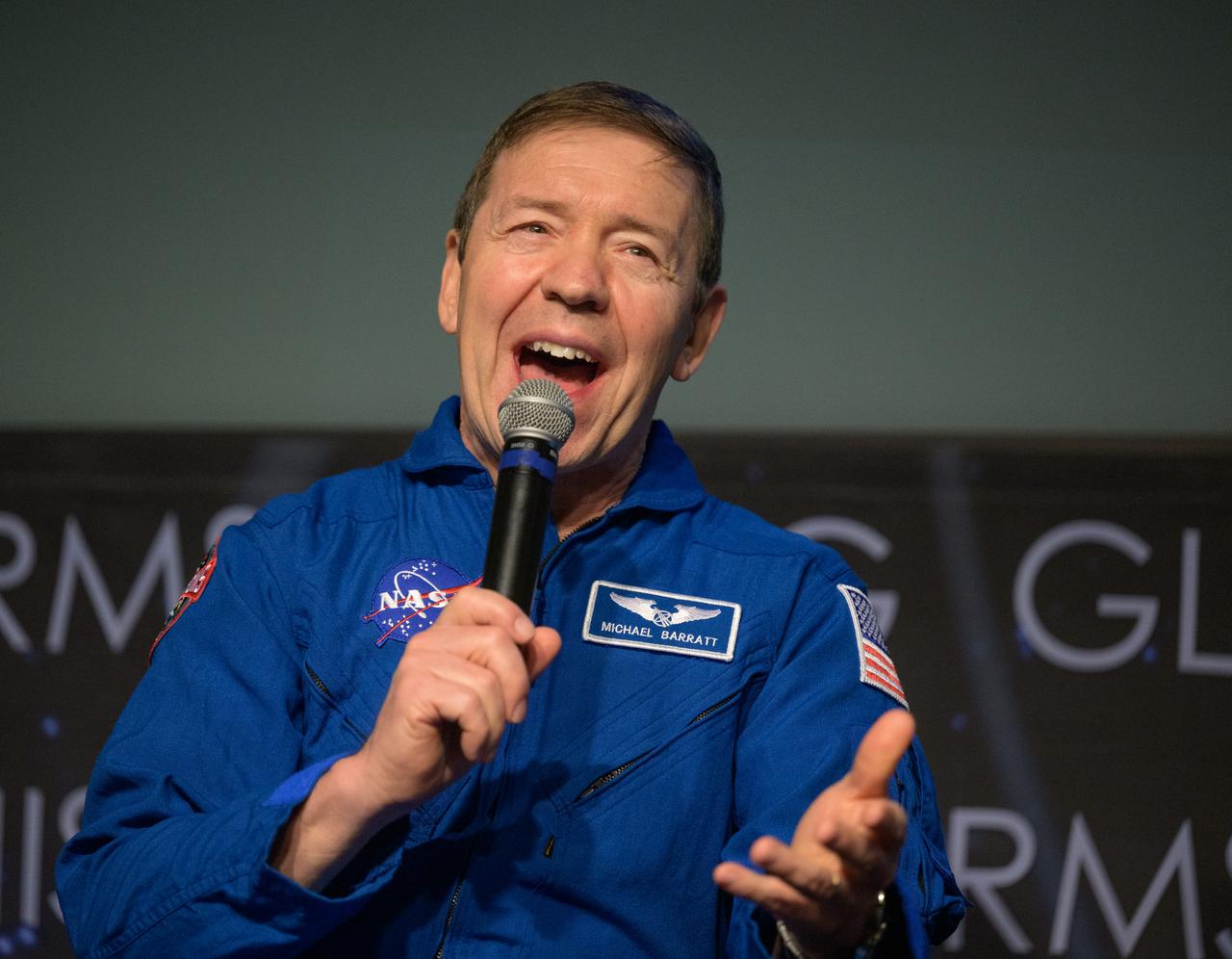
NASA astronaut Michael Barratt, is seen during an Expedition 71 postflight presentation, Monday, March 3, 2025, at the Mary W. Jackson NASA Headquarters Building in Washington. Barrett, Matthew Dominick, Jeanette Epps, and Tracy Dyson served as part of Expedition 71 aboard the International Space Station. Photo Credit: (NASA/Bill Ingalls)
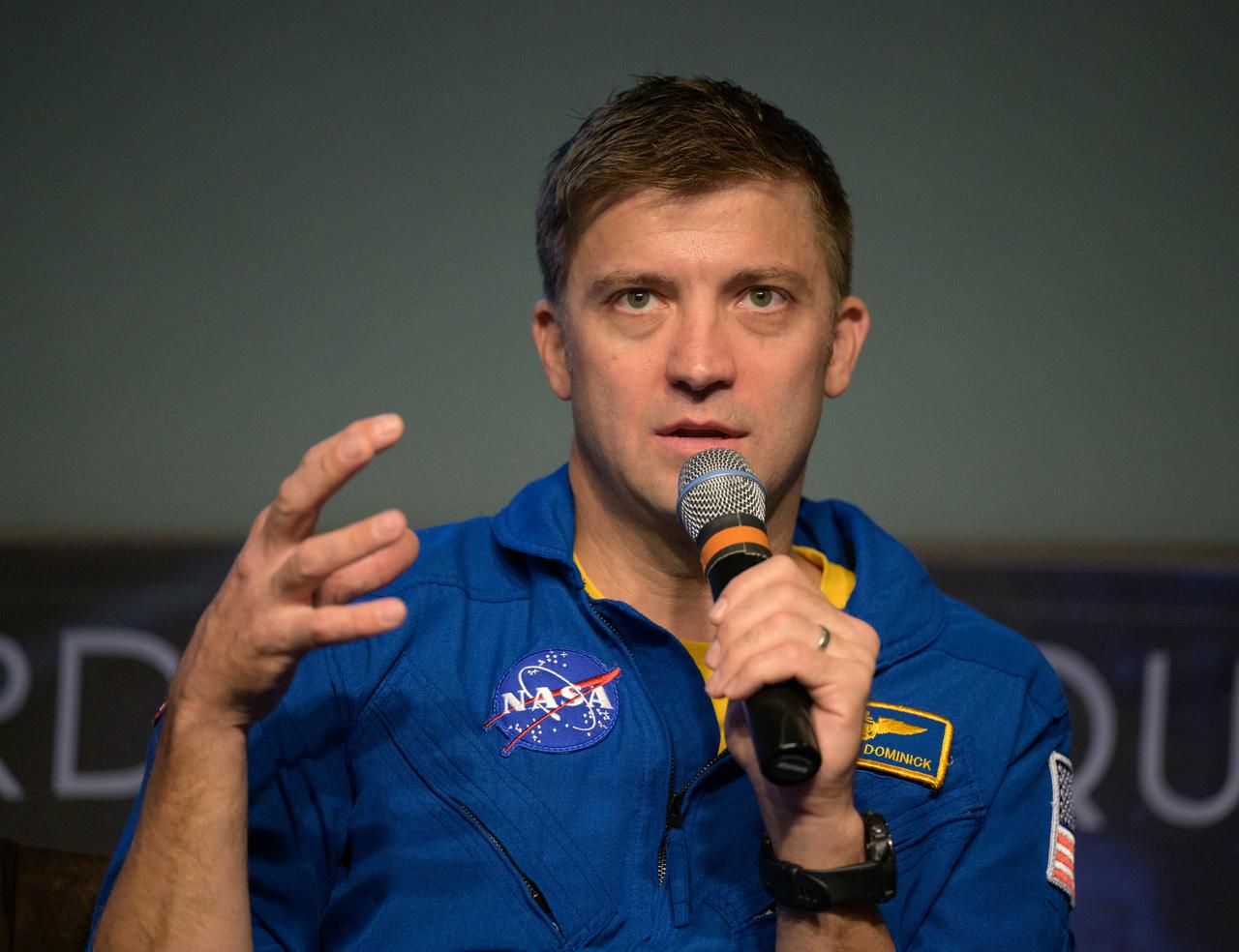
NASA astronaut Matthew Dominick, is seen during an Expedition 71 postflight presentation, Monday, March 3, 2025, at the Mary W. Jackson NASA Headquarters Building in Washington. Dominick, Michael Barrett, Tracy Dyson, and Jeanette Epps served as part of Expedition 71 aboard the International Space Station. Photo Credit: (NASA/Bill Ingalls)
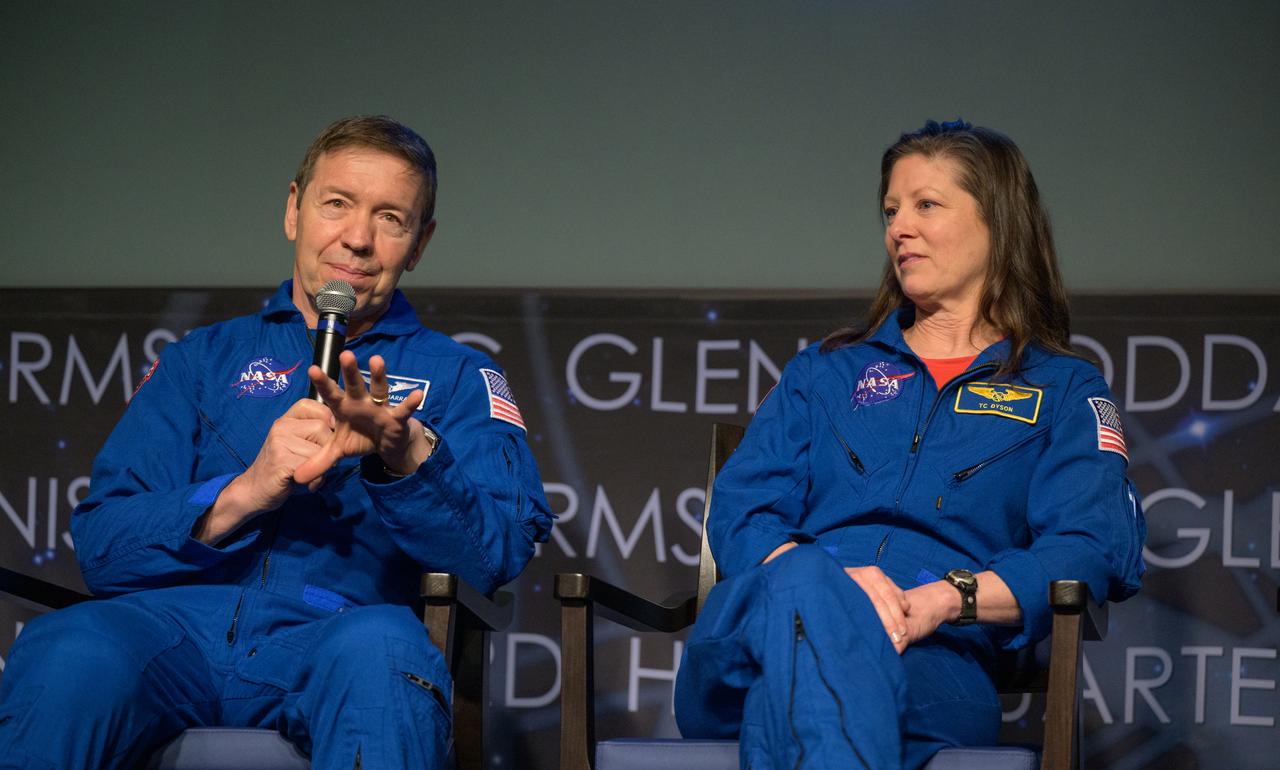
NASA astronauts Michael Barratt, left, Tracy Dyson, are seen during an Expedition 71 postflight presentation, Monday, March 3, 2025, at the Mary W. Jackson NASA Headquarters Building in Washington. Barrett, Dyson, Jeanette Epps, and Matthew Dominick served as part of Expedition 71 aboard the International Space Station. Photo Credit: (NASA/Bill Ingalls)
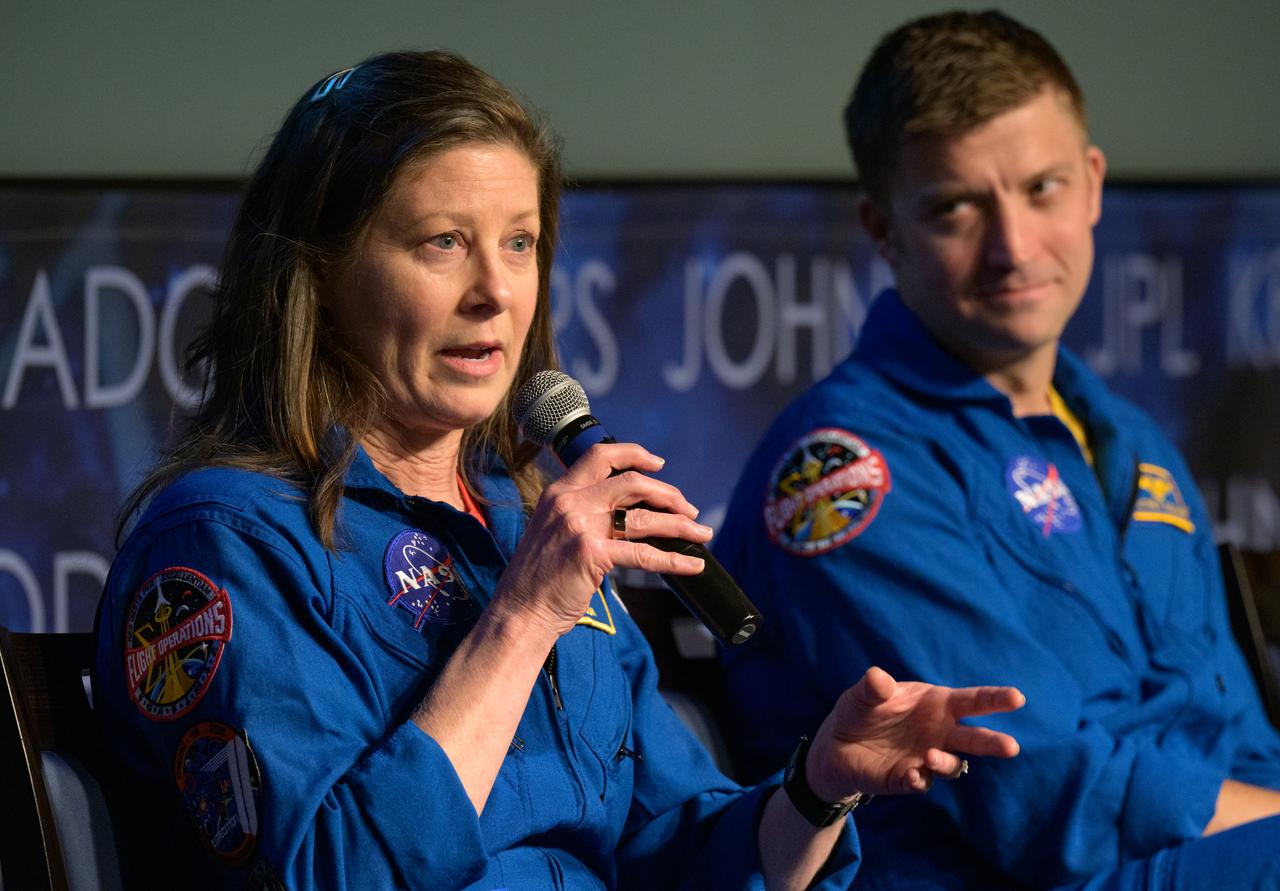
NASA astronaut Tracy Dyson, left, is seen during an Expedition 71 postflight presentation, Monday, March 3, 2025, at the Mary W. Jackson NASA Headquarters Building in Washington. Dyson, Michael Barrett, Matthew Dominick, and Jeanette Epps served as part of Expedition 71 aboard the International Space Station. Photo Credit: (NASA/Bill Ingalls)
![KENNEDY SPACE CENTER, FLA. -- Space Shuttle Columbia emblazons the pre-dawn clouds as it soars into the sky on its 27th flight into space on mission STS-109. Liftoff occurred at 6:22:02:08 a.m. EST(11:22:02:08 GMT). The goal of the mission is the maintenance and upgrade of the Hubble Space Telescope, to be carried out in five spacewalks. The crew of STS-109 comprises Commander Scott D. Altman, Pilot Duane G. Carey, Payload Commander John M. Grunsfeld, and Mission Specialists Nancy Jane Currie, Richard M. Linnehan, James H. Newman and Michael J. Massimino. After an 11-day mission, Columbia is expected to return to Kennedy March 12 about 4:35 a.m. EST (09:35 GMT). [Photo by Anita Barrett]](https://images-assets.nasa.gov/image/KSC-02pd0217/KSC-02pd0217~medium.jpg)
KENNEDY SPACE CENTER, FLA. -- Space Shuttle Columbia emblazons the pre-dawn clouds as it soars into the sky on its 27th flight into space on mission STS-109. Liftoff occurred at 6:22:02:08 a.m. EST(11:22:02:08 GMT). The goal of the mission is the maintenance and upgrade of the Hubble Space Telescope, to be carried out in five spacewalks. The crew of STS-109 comprises Commander Scott D. Altman, Pilot Duane G. Carey, Payload Commander John M. Grunsfeld, and Mission Specialists Nancy Jane Currie, Richard M. Linnehan, James H. Newman and Michael J. Massimino. After an 11-day mission, Columbia is expected to return to Kennedy March 12 about 4:35 a.m. EST (09:35 GMT). [Photo by Anita Barrett]
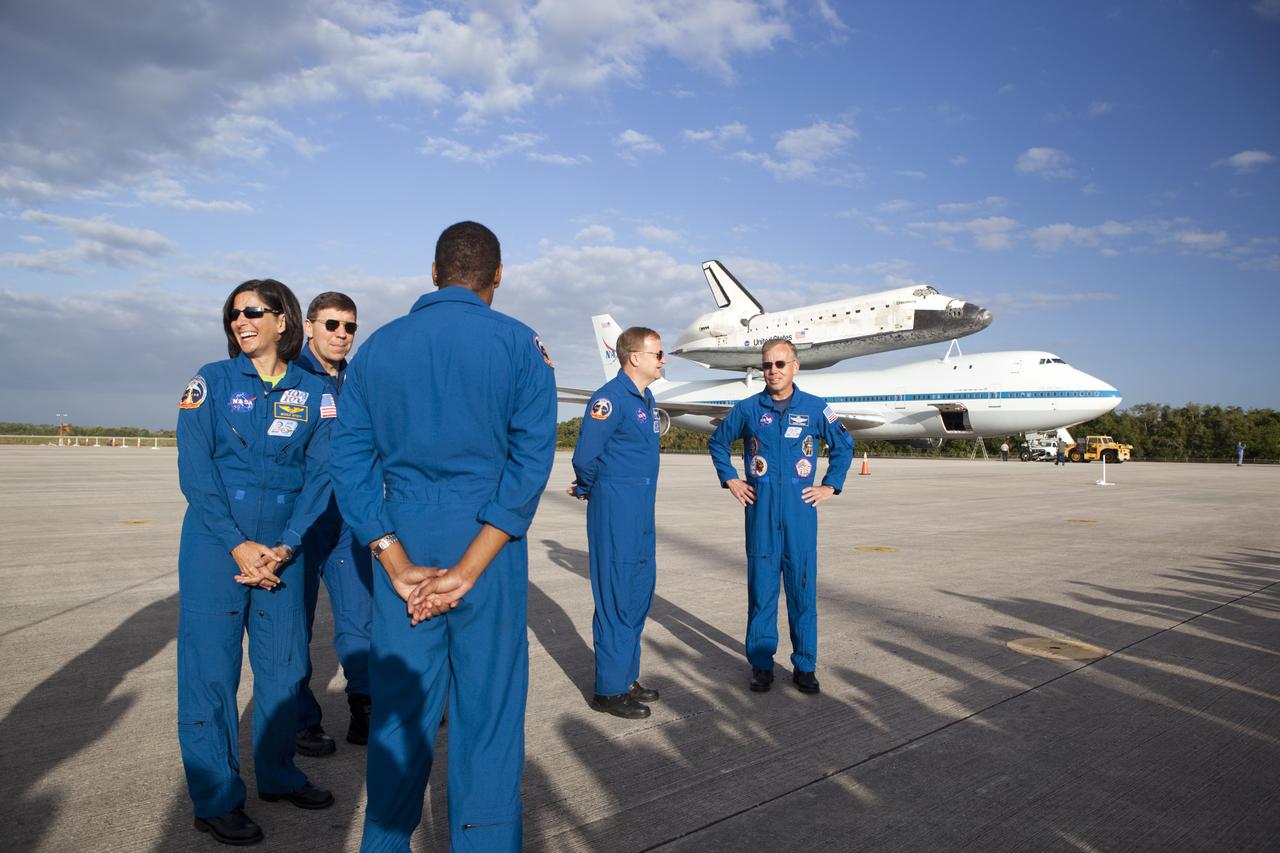
CAPE CANAVERAL, Fla. – At NASA Kennedy Space Center’s Shuttle Landing Facility in Florida, crew members of space shuttle Discovery’s last mission, STS-133, have arrived. From the left, are Mission Specialists Nicole Stott, Michael Barrett and Alvin Drew facing away, Pilot Eric Boe and Commander Steve Lindsay. In the background is the Shuttle Carrier Aircraft, or SCA, with space shuttle Discovery attached atop after being backed away from the mate/demate device. Known as the MDD, the devise is a large gantry-like steel structure used to hoist a shuttle off the ground and position it onto the back of the SCA. The SCA is a Boeing 747 jet that was originally manufactured for commercial use and modified by NASA to transport the shuttles between destinations on Earth. This SCA, designated NASA 905, is assigned to the remaining ferry missions, delivering the shuttles to their permanent public display sites. NASA 905 is scheduled to ferry Discovery to the Washington Dulles International Airport in Virginia on April 17, after which the shuttle will be placed on display in the Smithsonian’s National Air and Space Museum, Steven F. Udvar-Hazy Center in Chantilly, Va. For more information on the SCA, visit http://www.nasa.gov/centers/dryden/news/FactSheets/FS-013-DFRC.html. For more information on shuttle transition and retirement activities, visit http://www.nasa.gov/transition. Photo credit: NASA/Dimitri Gerondidakis
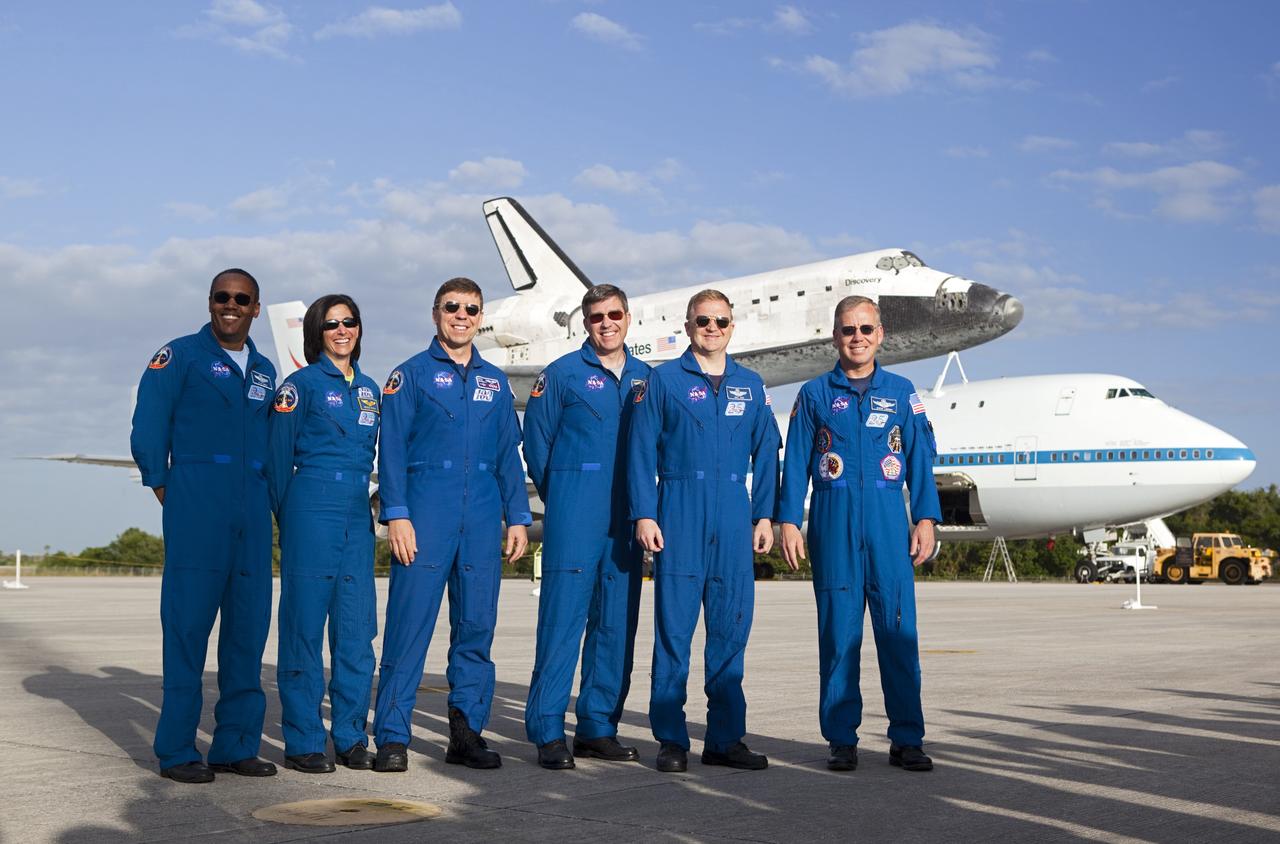
CAPE CANAVERAL, Fla. – At NASA Kennedy Space Center’s Shuttle Landing Facility in Florida, crew members of space shuttle Discovery’s last mission, STS-133, have arrived. From the left, are Mission Specialists Alvin Drew, Nicole Stott, Michael Barrett and Steve Bowen, Pilot Eric Boe and Commander Steve Lindsay. In the background is the Shuttle Carrier Aircraft, or SCA, with space shuttle Discovery attached atop after being backed away from the mate/demate device. Known as the MDD, the devise is a large gantry-like steel structure used to hoist a shuttle off the ground and position it onto the back of the SCA. The SCA is a Boeing 747 jet that was originally manufactured for commercial use and modified by NASA to transport the shuttles between destinations on Earth. This SCA, designated NASA 905, is assigned to the remaining ferry missions, delivering the shuttles to their permanent public display sites. NASA 905 is scheduled to ferry Discovery to the Washington Dulles International Airport in Virginia on April 17, after which the shuttle will be placed on display in the Smithsonian’s National Air and Space Museum, Steven F. Udvar-Hazy Center in Chantilly, Va. For more information on the SCA, visit http://www.nasa.gov/centers/dryden/news/FactSheets/FS-013-DFRC.html. For more information on shuttle transition and retirement activities, visit http://www.nasa.gov/transition. Photo credit: NASA/Dimitri Gerondidakis

CAPE CANAVERAL, Fla. – At NASA Kennedy Space Center’s Shuttle Landing Facility in Florida, crew members of space shuttle Discovery’s last mission, STS-133, have arrived. From the left, are Mission Specialists Alvin Drew, Nicole Stott, Michael Barrett and Steve Bowen, Pilot Eric Boe and Commander Steve Lindsay. In the background is the Shuttle Carrier Aircraft, or SCA, with space shuttle Discovery attached atop after being backed away from the mate/demate device. Known as the MDD, the devise is a large gantry-like steel structure used to hoist a shuttle off the ground and position it onto the back of the SCA. The SCA is a Boeing 747 jet that was originally manufactured for commercial use and modified by NASA to transport the shuttles between destinations on Earth. This SCA, designated NASA 905, is assigned to the remaining ferry missions, delivering the shuttles to their permanent public display sites. NASA 905 is scheduled to ferry Discovery to the Washington Dulles International Airport in Virginia on April 17, after which the shuttle will be placed on display in the Smithsonian’s National Air and Space Museum, Steven F. Udvar-Hazy Center in Chantilly, Va. For more information on the SCA, visit http://www.nasa.gov/centers/dryden/news/FactSheets/FS-013-DFRC.html. For more information on shuttle transition and retirement activities, visit http://www.nasa.gov/transition. Photo credit: NASA/Dimitri Gerondidakis
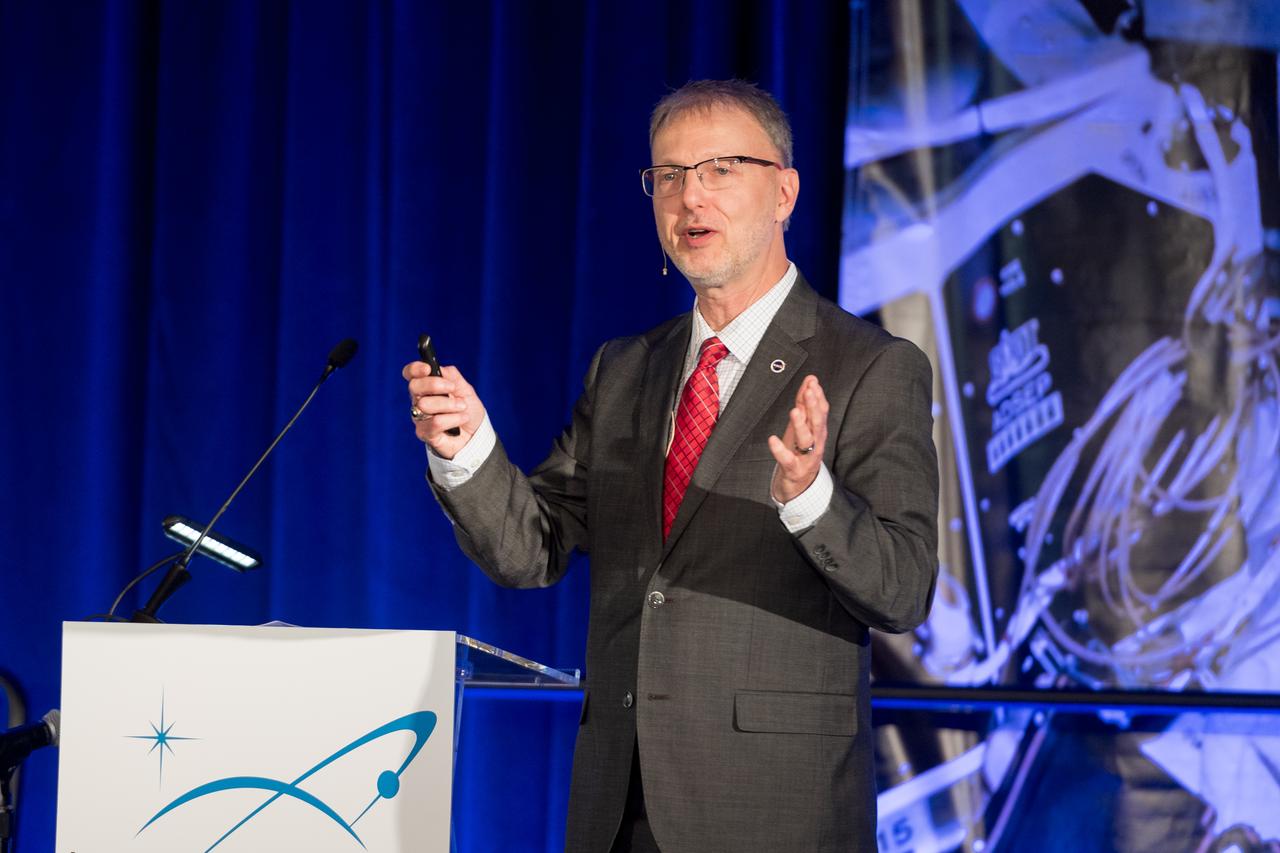
The inaugural Glenn Symposium focused on advancements in aerospace technology including power and propulsion, autonomy and communications, low boom supersonics, hypersonics, and more. Discussion also encompassed humans returning to the moon, including challenges associated with the 2024 mission.
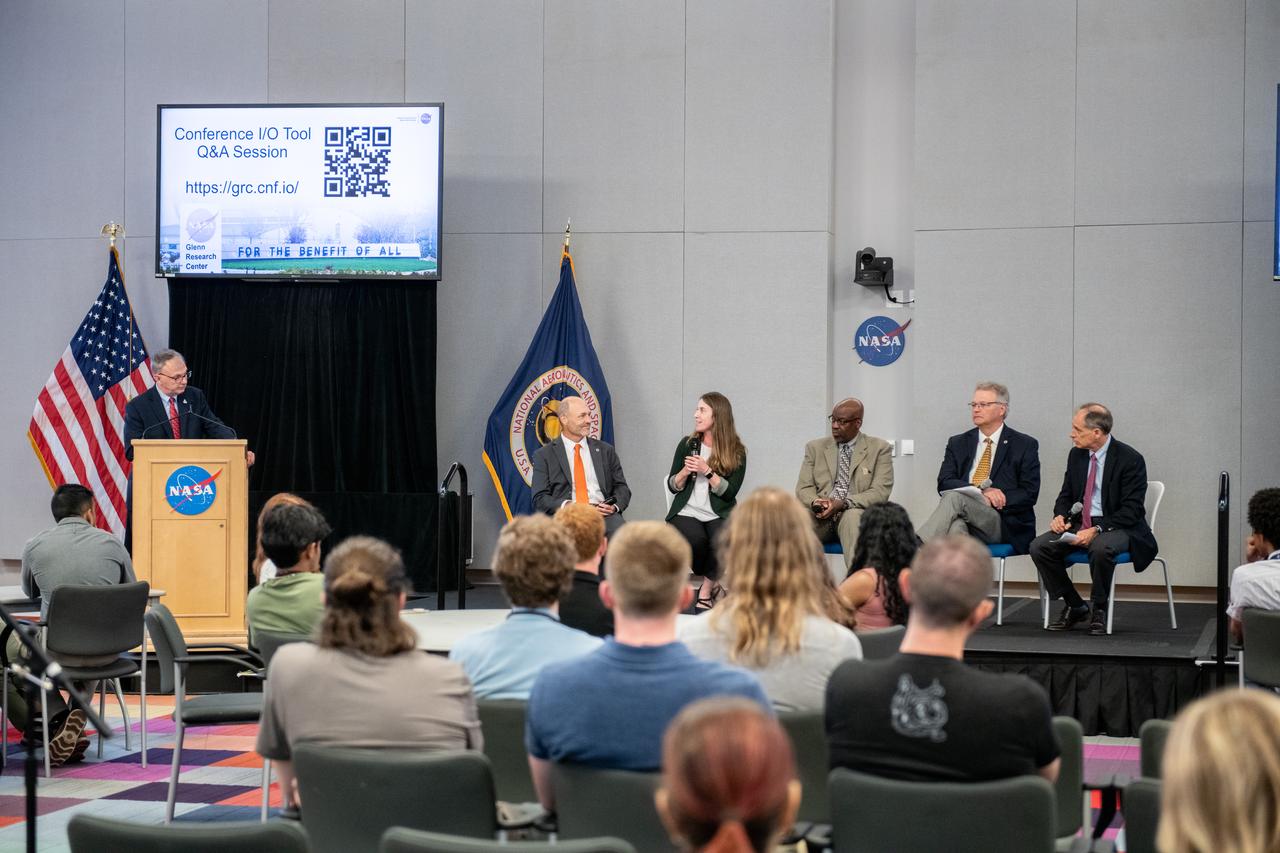
During the climate town hall meeting on June 17th 2024, Dr. Calvin and center leaders explored how technologies being developed at NASA Glenn Research Center could help reduce the effects of climate change. The panelists who lead the discussion include: Dr. Calvin; Dr. Rickey Shyne, Director of Research and Engineering; Bryan Smith, Director of Facilities, Test, & Manufacturing; and W. Allen Kilgore, Acting Director of Aeronautics. Director of Space Flight Systems Dr. Mike Barrett served as the moderator.

The inaugural Glenn Symposium focused on advancements in aerospace technology including power and propulsion, autonomy and communications, low boom supersonics, hypersonics, and more. Discussion also encompassed humans returning to the moon, including challenges associated with the 2024 mission.

Nuclear Emerging Technologies for Space, NETS 2022 Conference
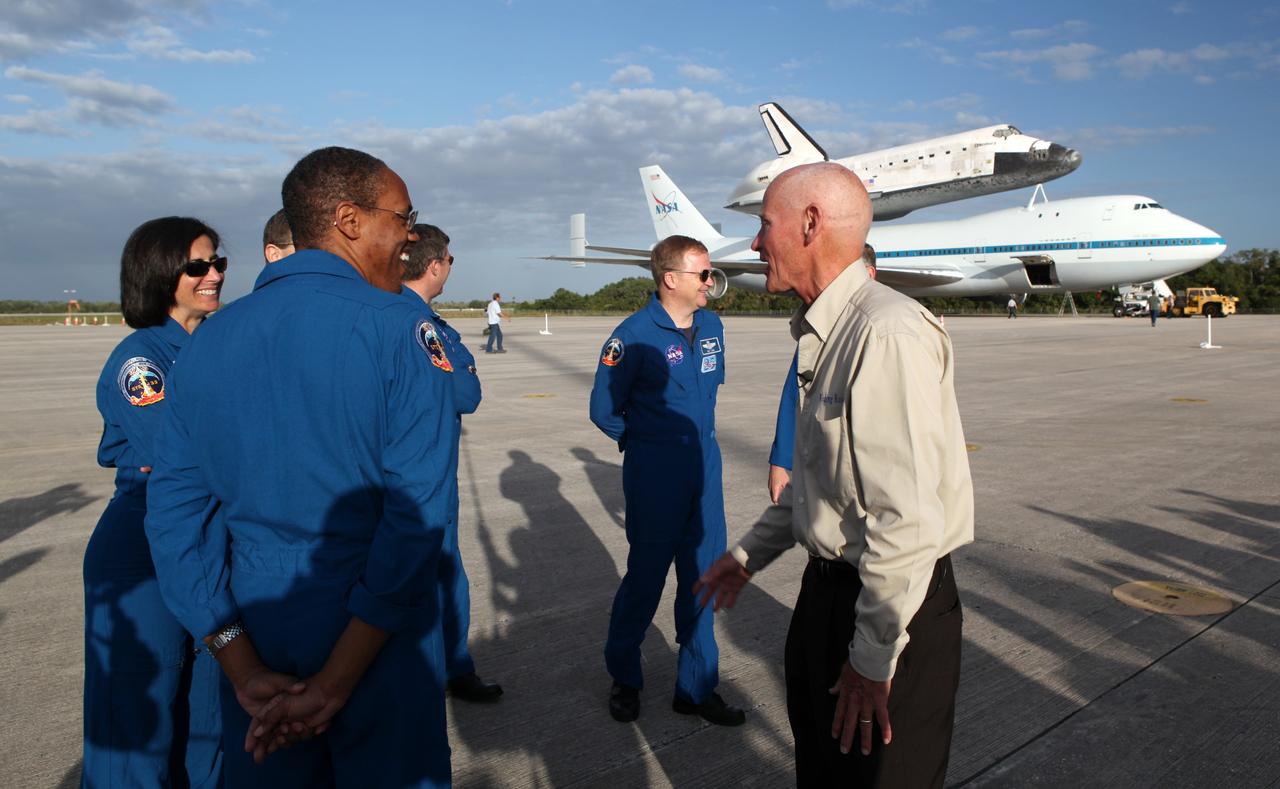
CAPE CANAVERAL, Fla. – At NASA Kennedy Space Center’s Shuttle Landing Facility in Florida, crew members of space shuttle Discovery’s last mission, STS-133, have arrived. From the left, are Mission Specialists Alvin Drew, Nicole Stott, Steve Bowen partially hidden and Michael Barrett, and Pilot Eric Boe. Also present, but not in view, is Commander Steve Lindsay. The crew arrived to view the Shuttle Carrier Aircraft, or SCA, with space shuttle Discovery attached atop after being backed away from the mate/demate device. Known as the MDD, the devise is a large gantry-like steel structure used to hoist a shuttle off the ground and position it onto the back of the SCA. The SCA is a Boeing 747 jet that was originally manufactured for commercial use and modified by NASA to transport the shuttles between destinations on Earth. This SCA, designated NASA 905, is assigned to the remaining ferry missions, delivering the shuttles to their permanent public display sites. NASA 905 is scheduled to ferry Discovery to the Washington Dulles International Airport in Virginia on April 17, after which the shuttle will be placed on display in the Smithsonian’s National Air and Space Museum, Steven F. Udvar-Hazy Center in Chantilly, Va. For more information on the SCA, visit http://www.nasa.gov/centers/dryden/news/FactSheets/FS-013-DFRC.html. For more information on shuttle transition and retirement activities, visit http://www.nasa.gov/transition. Photo credit: NASA/Dimitri Gerondidakis
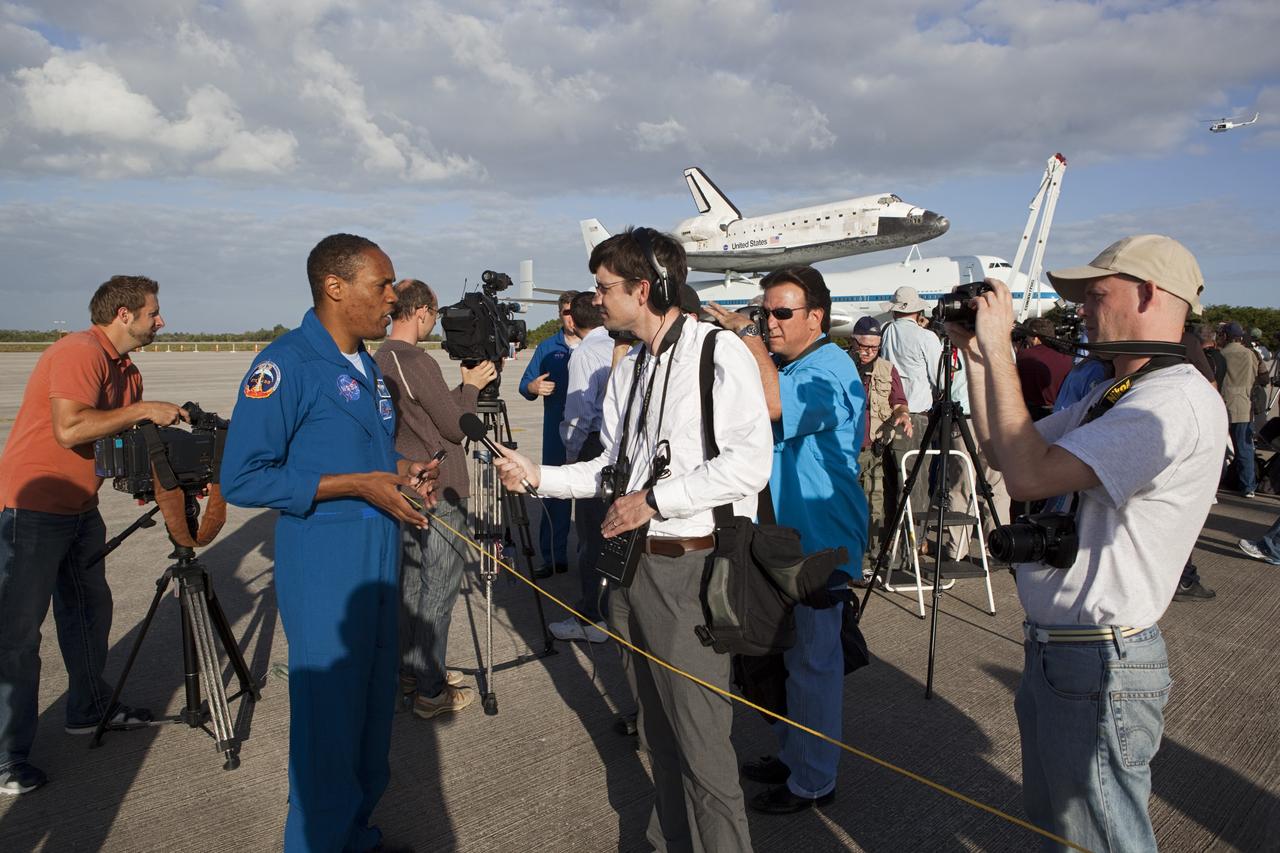
CAPE CANAVERAL, Fla. – At NASA Kennedy Space Center’s Shuttle Landing Facility in Florida, crew members of space shuttle Discovery’s last mission, STS-133, have arrived. Mission Specialist Alvin Drew visits with the media. Also present, but not in view, are Mission Specialists Nicole Stott, Michael Barrett and Steve Bowen, Pilot Eric Boe and Commander Steve Lindsay. In the background is the Shuttle Carrier Aircraft, or SCA, with space shuttle Discovery attached atop after being backed away from the mate/demate device. Known as the MDD, the devise is a large gantry-like steel structure used to hoist a shuttle off the ground and position it onto the back of the SCA. The SCA is a Boeing 747 jet that was originally manufactured for commercial use and modified by NASA to transport the shuttles between destinations on Earth. This SCA, designated NASA 905, is assigned to the remaining ferry missions, delivering the shuttles to their permanent public display sites. NASA 905 is scheduled to ferry Discovery to the Washington Dulles International Airport in Virginia on April 17, after which the shuttle will be placed on display in the Smithsonian’s National Air and Space Museum, Steven F. Udvar-Hazy Center in Chantilly, Va. For more information on the SCA, visit http://www.nasa.gov/centers/dryden/news/FactSheets/FS-013-DFRC.html. For more information on shuttle transition and retirement activities, visit http://www.nasa.gov/transition. Photo credit: NASA/Dimitri Gerondidakis

CAPE CANAVERAL, Fla. – At NASA Kennedy Space Center’s Shuttle Landing Facility in Florida, crew members of space shuttle Discovery’s last mission, STS-133, have arrived. Commander Steve Lindsay visits with the media. Also present, but not in view, are Mission Specialists Nicole Stott, Michael Barrett, Steve Bowen and Alvin Drew, and Pilot Eric Boe. The crew arrived to view the Shuttle Carrier Aircraft, or SCA, with space shuttle Discovery attached atop after being backed away from the mate/demate device. Known as the MDD, the devise is a large gantry-like steel structure used to hoist a shuttle off the ground and position it onto the back of the SCA. The SCA is a Boeing 747 jet that was originally manufactured for commercial use and modified by NASA to transport the shuttles between destinations on Earth. This SCA, designated NASA 905, is assigned to the remaining ferry missions, delivering the shuttles to their permanent public display sites. NASA 905 is scheduled to ferry Discovery to the Washington Dulles International Airport in Virginia on April 17, after which the shuttle will be placed on display in the Smithsonian’s National Air and Space Museum, Steven F. Udvar-Hazy Center in Chantilly, Va. For more information on the SCA, visit http://www.nasa.gov/centers/dryden/news/FactSheets/FS-013-DFRC.html. For more information on shuttle transition and retirement activities, visit http://www.nasa.gov/transition. Photo credit: NASA/Dimitri Gerondidakis

CAPE CANAVERAL, Fla. – At NASA Kennedy Space Center’s Shuttle Landing Facility in Florida, crew members of space shuttle Discovery’s last mission, STS-133, have arrived. Pilot Eric Boe visits with the media. Also present, but not in view, are Mission Specialists Nicole Stott, Michael Barrett, Steve Bowen and Alvin Drew, and Commander Steve Lindsay. The crew arrived to view the Shuttle Carrier Aircraft, or SCA, with space shuttle Discovery attached atop after being backed away from the mate/demate device. Known as the MDD, the devise is a large gantry-like steel structure used to hoist a shuttle off the ground and position it onto the back of the SCA. The SCA is a Boeing 747 jet that was originally manufactured for commercial use and modified by NASA to transport the shuttles between destinations on Earth. This SCA, designated NASA 905, is assigned to the remaining ferry missions, delivering the shuttles to their permanent public display sites. NASA 905 is scheduled to ferry Discovery to the Washington Dulles International Airport in Virginia on April 17, after which the shuttle will be placed on display in the Smithsonian’s National Air and Space Museum, Steven F. Udvar-Hazy Center in Chantilly, Va. For more information on the SCA, visit http://www.nasa.gov/centers/dryden/news/FactSheets/FS-013-DFRC.html. For more information on shuttle transition and retirement activities, visit http://www.nasa.gov/transition. Photo credit: NASA/Dimitri Gerondidakis
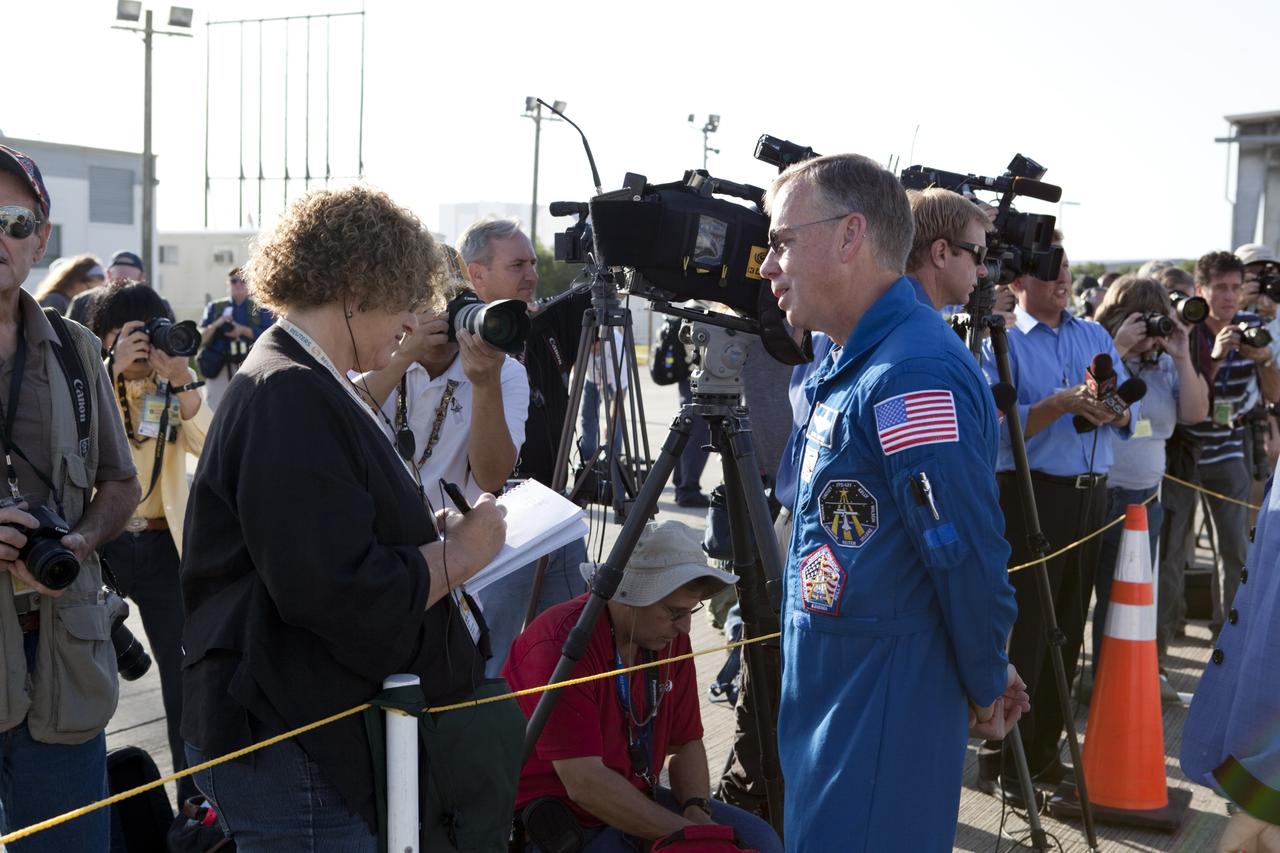
CAPE CANAVERAL, Fla. – At NASA Kennedy Space Center’s Shuttle Landing Facility in Florida, crew members of space shuttle Discovery’s last mission, STS-133, have arrived. Commander Steve Lindsay visits with the media. Also present, but not in view, are Mission Specialists Nicole Stott, Michael Barrett, Steve Bowen and Alvin Drew, and Pilot Eric Boe. The crew arrived to view the Shuttle Carrier Aircraft, or SCA, with space shuttle Discovery attached atop after being backed away from the mate/demate device. Known as the MDD, the devise is a large gantry-like steel structure used to hoist a shuttle off the ground and position it onto the back of the SCA. The SCA is a Boeing 747 jet that was originally manufactured for commercial use and modified by NASA to transport the shuttles between destinations on Earth. This SCA, designated NASA 905, is assigned to the remaining ferry missions, delivering the shuttles to their permanent public display sites. NASA 905 is scheduled to ferry Discovery to the Washington Dulles International Airport in Virginia on April 17, after which the shuttle will be placed on display in the Smithsonian’s National Air and Space Museum, Steven F. Udvar-Hazy Center in Chantilly, Va. For more information on the SCA, visit http://www.nasa.gov/centers/dryden/news/FactSheets/FS-013-DFRC.html. For more information on shuttle transition and retirement activities, visit http://www.nasa.gov/transition. Photo credit: NASA/Dimitri Gerondidakis

CAPE CANAVERAL, Fla. – At NASA Kennedy Space Center’s Shuttle Landing Facility in Florida, crew members of space shuttle Discovery’s last mission, STS-133, have arrived. Mission Specialists Michael Barrett foreground and Alvin Drew visit with the media. Also present, but not in view, are Mission Specialists Nicole Stott and Steve Bowen, Pilot Eric Boe and Commander Steve Lindsay. The crew arrived to view the Shuttle Carrier Aircraft, or SCA, with space shuttle Discovery attached atop after being backed away from the mate/demate device. Known as the MDD, the devise is a large gantry-like steel structure used to hoist a shuttle off the ground and position it onto the back of the SCA. The SCA is a Boeing 747 jet that was originally manufactured for commercial use and modified by NASA to transport the shuttles between destinations on Earth. This SCA, designated NASA 905, is assigned to the remaining ferry missions, delivering the shuttles to their permanent public display sites. NASA 905 is scheduled to ferry Discovery to the Washington Dulles International Airport in Virginia on April 17, after which the shuttle will be placed on display in the Smithsonian’s National Air and Space Museum, Steven F. Udvar-Hazy Center in Chantilly, Va. For more information on the SCA, visit http://www.nasa.gov/centers/dryden/news/FactSheets/FS-013-DFRC.html. For more information on shuttle transition and retirement activities, visit http://www.nasa.gov/transition. Photo credit: NASA/Dimitri Gerondidakis

CAPE CANAVERAL, Fla. – At NASA Kennedy Space Center’s Shuttle Landing Facility in Florida, crew members of space shuttle Discovery’s last mission, STS-133, have arrived. Mission Specialist Nicole Stott visits with the media. Also present, but not in view, are Mission Specialists Michael Barrett, Steve Bowen and Alvin Drew, Pilot Eric Boe and Commander Steve Lindsay. The crew arrived to view the Shuttle Carrier Aircraft, or SCA, with space shuttle Discovery attached atop after being backed away from the mate/demate device. Known as the MDD, the devise is a large gantry-like steel structure used to hoist a shuttle off the ground and position it onto the back of the SCA. The SCA is a Boeing 747 jet that was originally manufactured for commercial use and modified by NASA to transport the shuttles between destinations on Earth. This SCA, designated NASA 905, is assigned to the remaining ferry missions, delivering the shuttles to their permanent public display sites. NASA 905 is scheduled to ferry Discovery to the Washington Dulles International Airport in Virginia on April 17, after which the shuttle will be placed on display in the Smithsonian’s National Air and Space Museum, Steven F. Udvar-Hazy Center in Chantilly, Va. For more information on the SCA, visit http://www.nasa.gov/centers/dryden/news/FactSheets/FS-013-DFRC.html. For more information on shuttle transition and retirement activities, visit http://www.nasa.gov/transition. Photo credit: NASA/Dimitri Gerondidakis
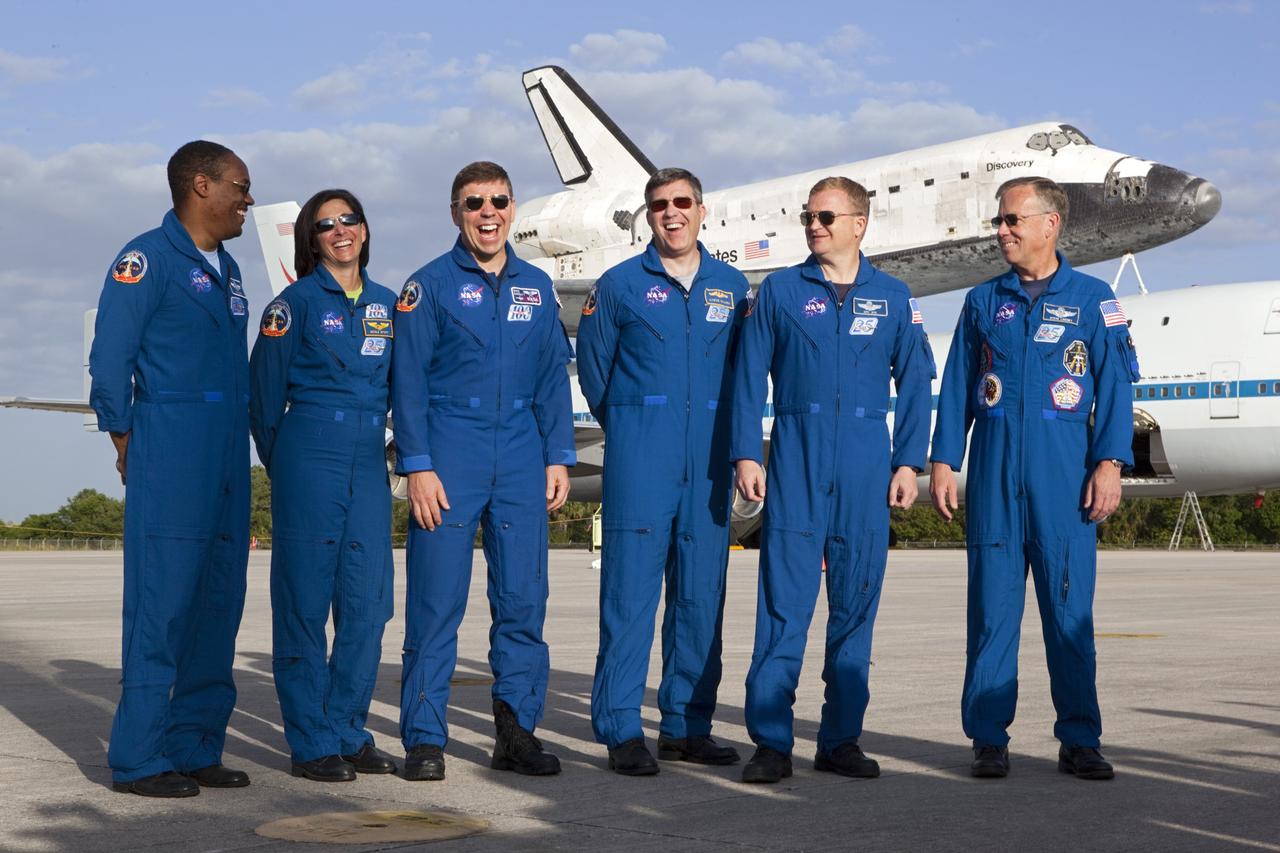
CAPE CANAVERAL, Fla. – At NASA Kennedy Space Center’s Shuttle Landing Facility in Florida, crew members of space shuttle Discovery’s last mission, STS-133, visit with each other after arriving in T-38 jet aircraft. From the left, are Mission Specialists Alvin Drew, Nicole Stott, Michael Barrett and Steve Bowen, Pilot Eric Boe and Commander Steve Lindsay. In the background is the Shuttle Carrier Aircraft, or SCA, with space shuttle Discovery attached atop after being backed away from the mate/demate device. Known as the MDD, the devise is a large gantry-like steel structure used to hoist a shuttle off the ground and position it onto the back of the SCA. The SCA is a Boeing 747 jet that was originally manufactured for commercial use and modified by NASA to transport the shuttles between destinations on Earth. This SCA, designated NASA 905, is assigned to the remaining ferry missions, delivering the shuttles to their permanent public display sites. NASA 905 is scheduled to ferry Discovery to the Washington Dulles International Airport in Virginia on April 17, after which the shuttle will be placed on display in the Smithsonian’s National Air and Space Museum, Steven F. Udvar-Hazy Center in Chantilly, Va. For more information on the SCA, visit http://www.nasa.gov/centers/dryden/news/FactSheets/FS-013-DFRC.html. For more information on shuttle transition and retirement activities, visit http://www.nasa.gov/transition. Photo credit: NASA/Dimitri Gerondidakis