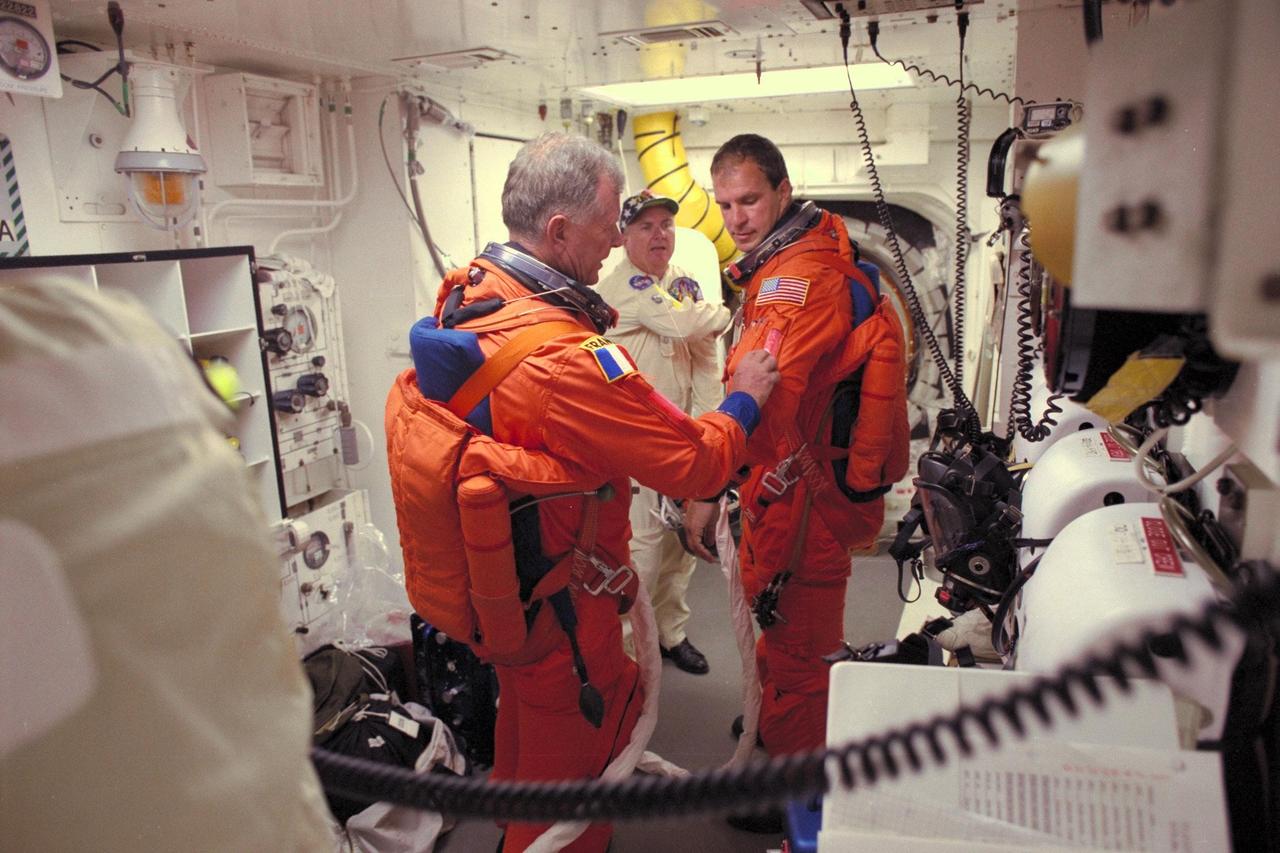
While a white room closeout crew member looks on, STS-86 Pilot Michael J. Bloomfield, at right, gets some assistance from fellow crew member, Mission Specialist Jean-Loup J.M. Chretien of the French Space Agency, CNES, before entering the Space Shuttle Atlantis at Launch Pad 39A
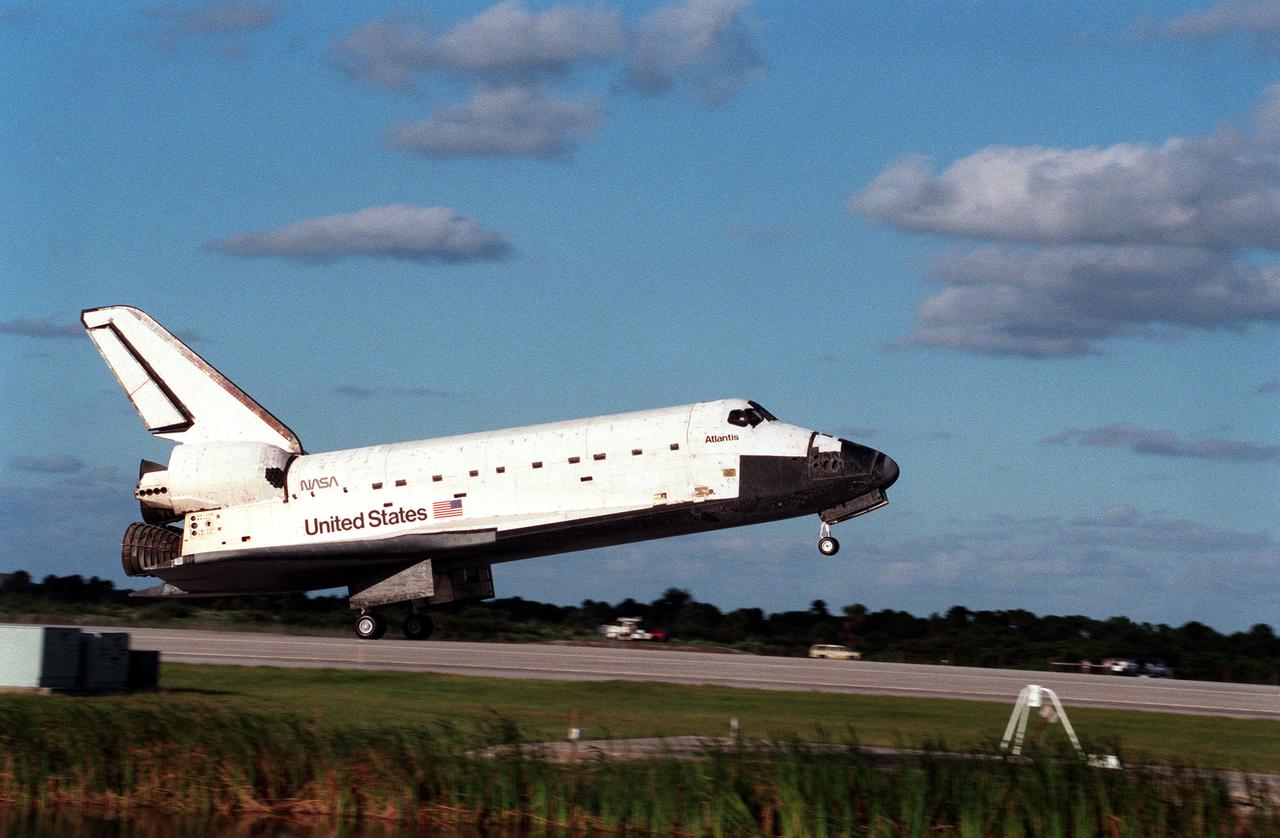
STS086-S-014 (6 Oct 1997) --- The main landing gear of the Space Shuttle Atlantis is about to touch down on the Kennedy Space Center's (KSC) Shuttle Landing Facility to complete the STS-86 mission. Touchdown occurred at 5:55:09 p.m. (EDT), October 6, 1997. Onboard were astronauts James D. Wetherbee, Michael J. Bloomfield, Wendy B. Lawrence, Scott F. Parazynski, Vladimir G. Titov, C. Michael Foale and Jean-Loup J. M. Chretien. Chretien and Titov represent the French Space Agency (CNES) and the Russian Space Agency (RSA), respectively.
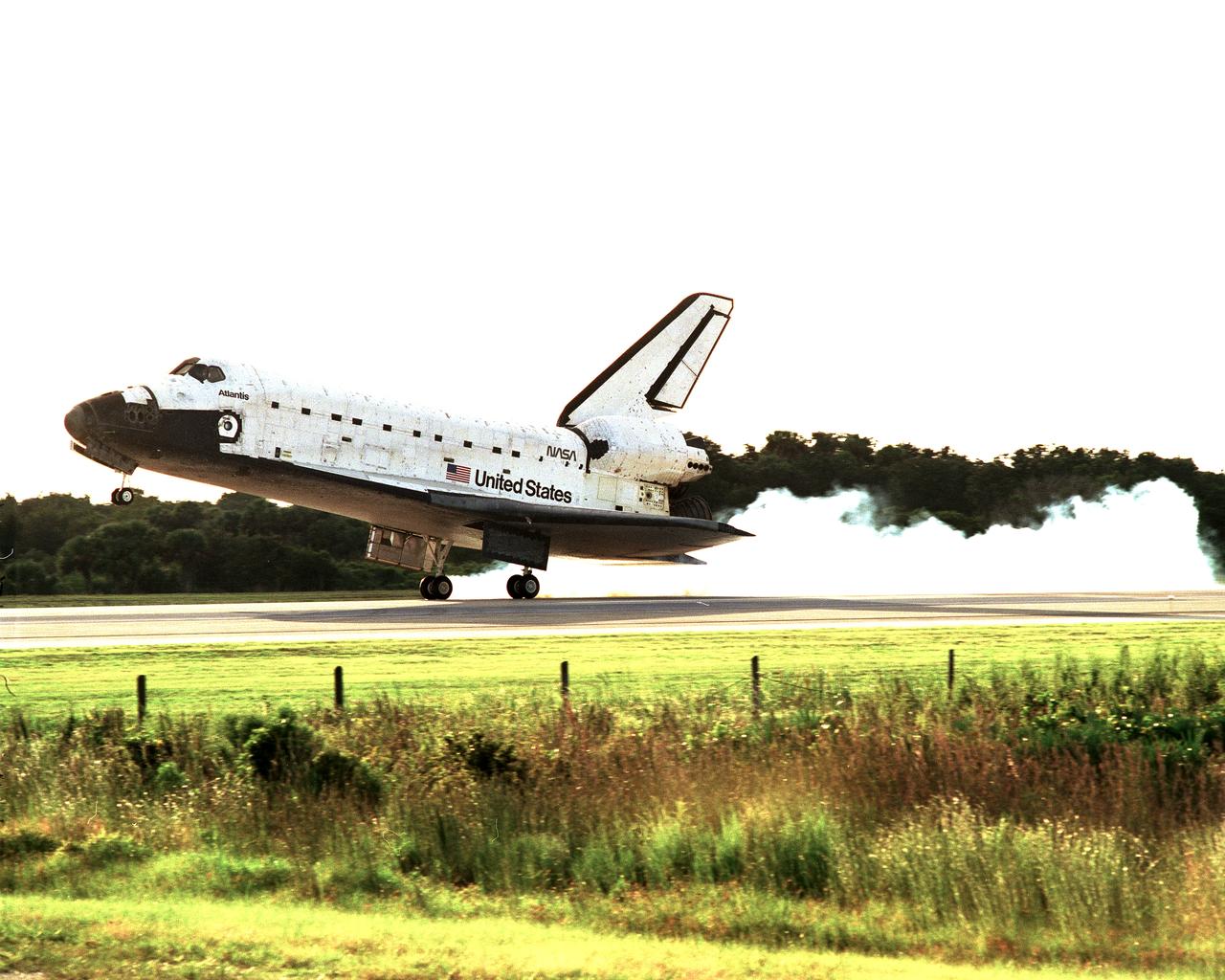
STS086-S-015 (6 Oct 1997) --- The main landing gear of the Space Shuttle Atlantis touches down on the Kennedy Space Center?s (KSC) Shuttle Landing Facility to complete the STS-86 mission. Touchdown occurred at 5:55:09 p.m. (EDT), October 6, 1997. Onboard were astronauts James D. Wetherbee, Michael J. Bloomfield, Wendy B. Lawrence, Scott F. Parazynski, Vladimir G. Titov, C. Michael Foale and Jean-Loup J. M. Chretien. Chretien and Titov represent the French Space Agency (CNES) and the Russian Space Agency (RSA), respectively.
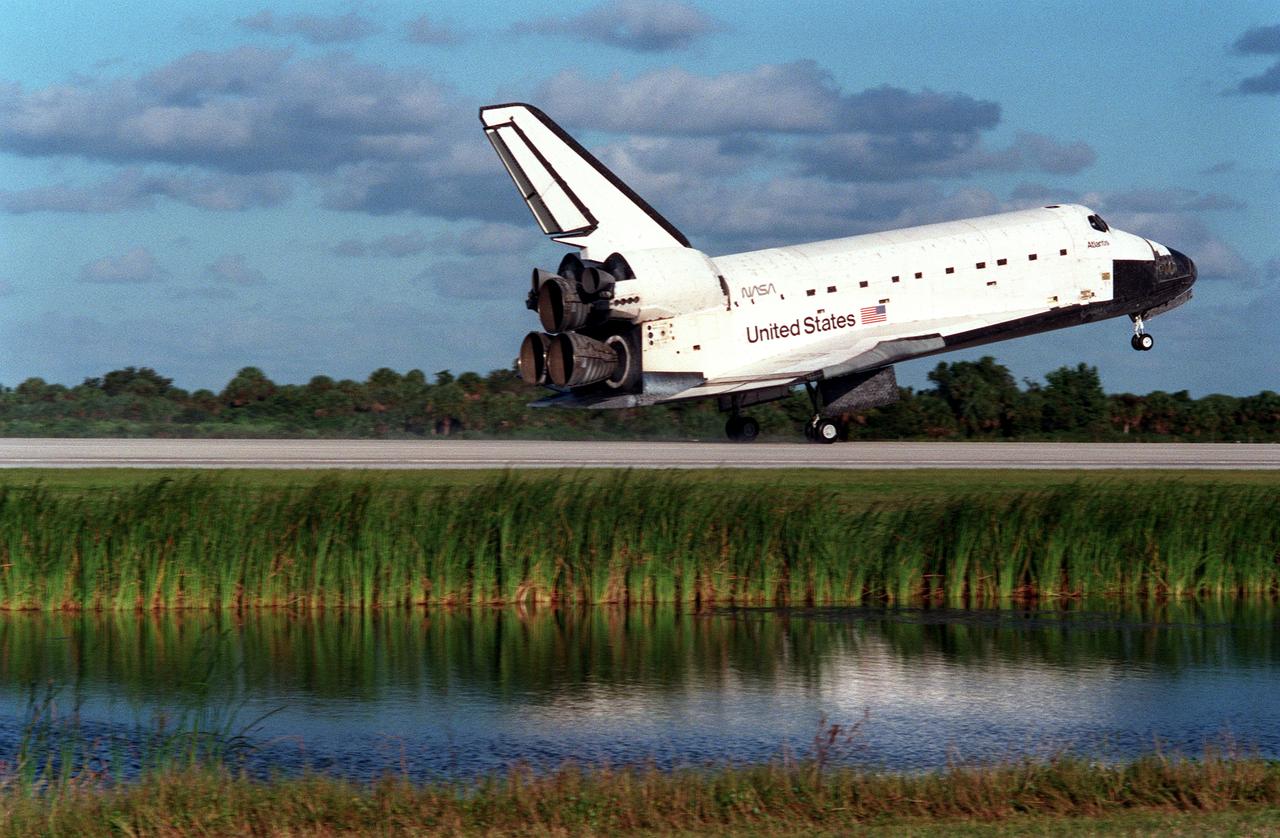
STS086-S-013 (6 Oct 1997) --- The main landing gear of the Space Shuttle Atlantis is about to touch down on the Kennedy Space Center?s (KSC) Shuttle Landing Facility to complete the STS-86 mission. Touchdown occurred at 5:55:09 p.m. (EDT), October 6, 1997. Onboard were astronauts James D. Wetherbee, Michael J. Bloomfield, Wendy B. Lawrence, Scott F. Parazynski, Vladimir G. Titov, C. Michael Foale and Jean-Loup J. M. Chretien. Chretien and Titov represent the French Space Agency (CNES) and the Russian Space Agency (RSA), respectively.
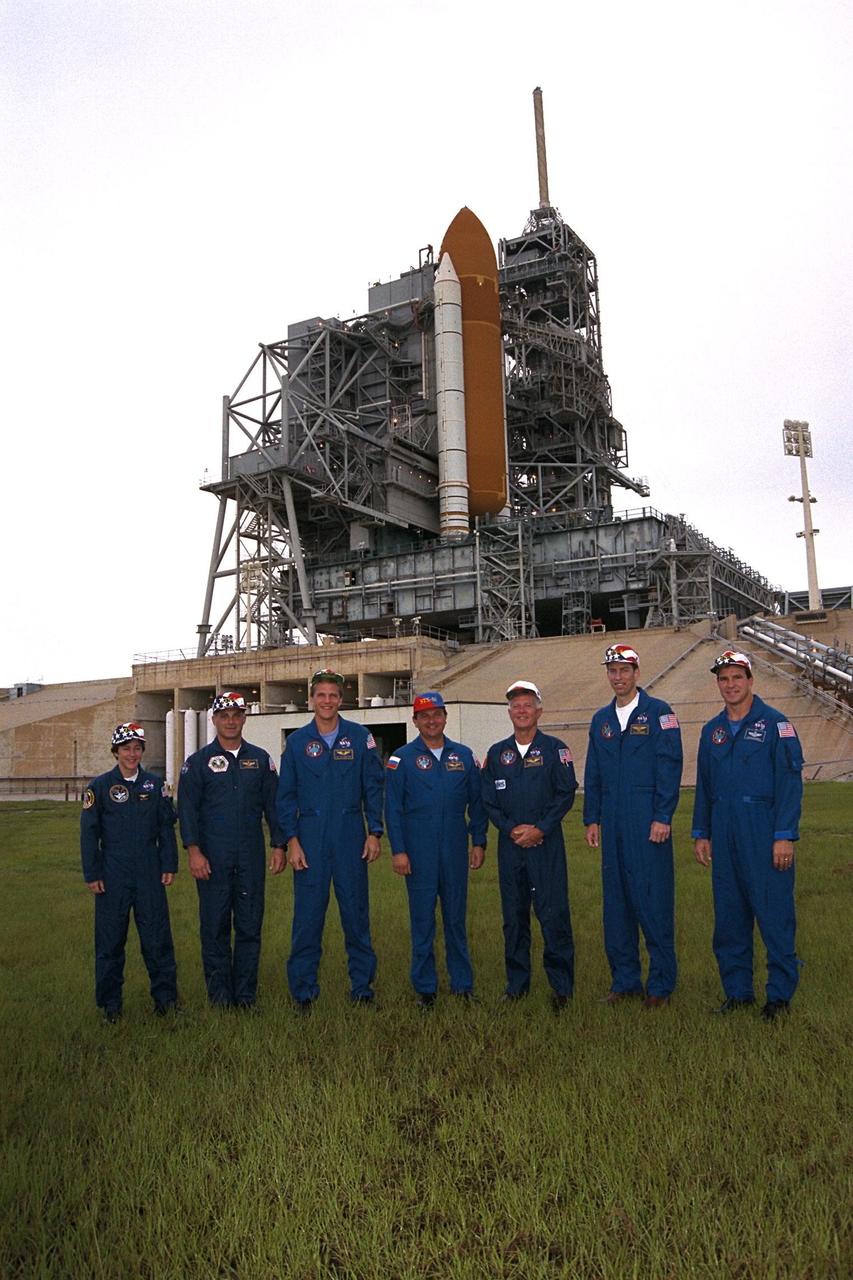
KENNEDY SPACE CENTER, Fla. -- With the Space Shuttle Atlantis behind them, the STS-86 crew poses for a photograph at Launch Pad 39A. The seven crew members are at KSC to participate in Terminal Countdown Demonstration Test (TCDT) activities. From left are Mission Specialists Wendy B. Lawrence, David A. Wolf, Scott E. Parazynski, Vladimir Georgievich Titov of the Russian Space Agency, Jean-Loup J.M. Chretien of the French Space Agency, CNES; Commander James D. Wetherbee; and Pilot Michael J. Bloomfield. STS-86 will be the seventh docking of the Space Shuttle with the Russian Space Station Mir. After docking, Wolf will transfer to the Mir 24 crew, replacing astronaut C. Michael Foale, who arrived there during the last docking mission, STS-84, in May. Launch is targeted for Sept. 25
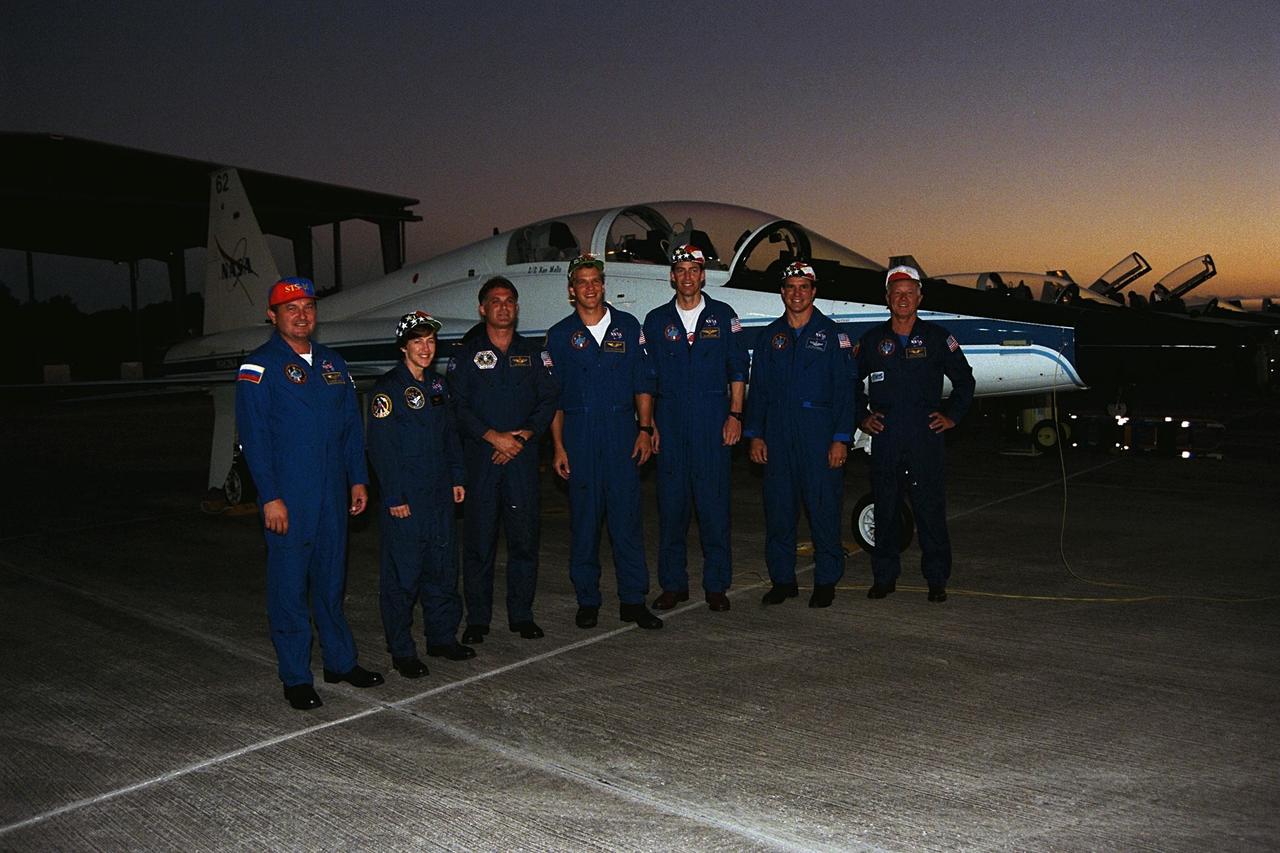
STS-86 crew members pose for a photograph after arrival at KSC’s Shuttle Landing Facility for the Terminal Countdown Demonstration Test (TCDT), a dress rehearsal for launch. From left, are Mission Specialists Vladimir Georgievich Titov of the Russian Space Agency, Wendy B. Lawrence, David A. Wolf and Scott Parazynski; Commander James D. Wetherbee; Pilot Michael J. Bloomfield; and Mission Specialist Jean-Loup J.M. Chretien of the French Space Agency, CNES. STS-86 will be the seventh docking of the Space Shuttle with the Russian Space Station Mir. Wolf will transfer to the Mir for a long-duration stay, replacing Mir 24 crew member C. Michael Foale, who will return to Earth with the rest of the STS-86 crew. The mission is targeted for a Sept. 25 launch aboard the Space Shuttle Atlantis
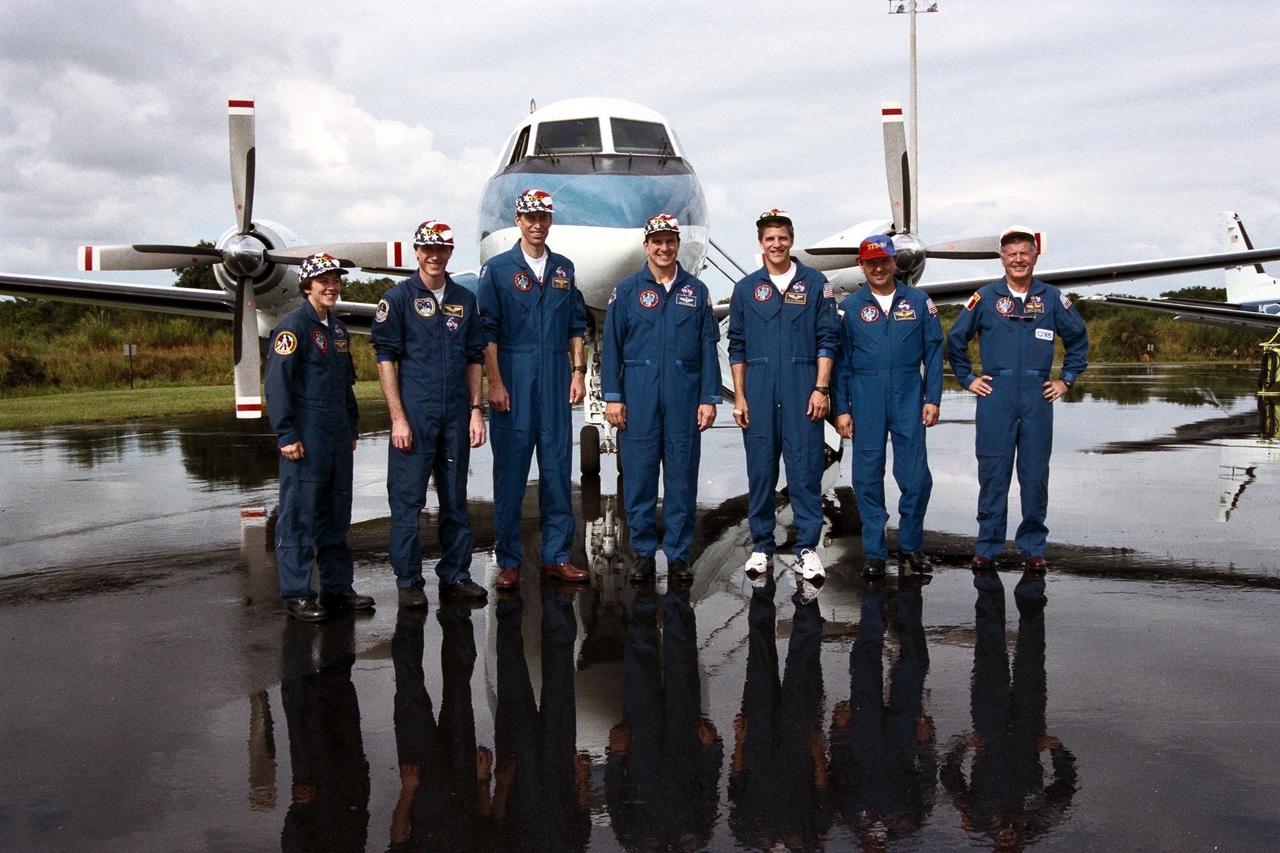
Members of the STS-86 crew pose for a last photograph at the Skid Strip on Cape Canaveral Air Station before flying back to their home base at the Johnson Space Center in Houston, Texas. From left, are Mission Specialist Wendy B. Lawrence, Mission Specialist and recent Mir 24 crew member C. Michael Foale, Commander James D. Wetherbee, Pilot Michael J. Bloomfield, and Mission Specialists Scott E. Parazynski, Vladimir Georgievich Titov of the Russian Space Agency and Jean-Loup J.M. Chretien of the French Space Agency, CNES. Foale, who was on the Russian Space Station Mir since mid-May, returned to Earth aboard the Space Shuttle orbiter Atlantis at the Oct. 6 KSC landing of Mission STS-86. He was replaced on the Mir by STS-86 Mission Specialist David A. Wolf, who is scheduled to remain there until mid-January
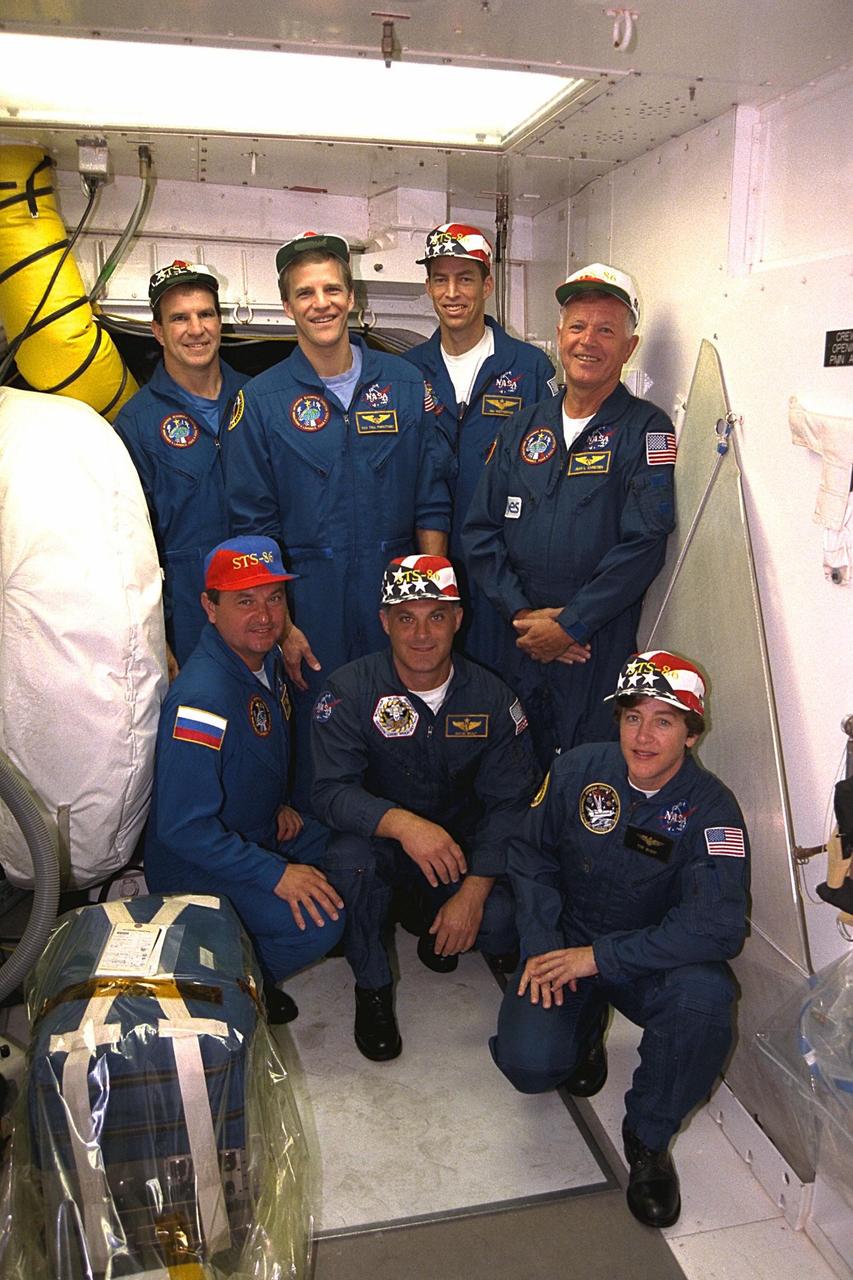
STS-86 crew members pose for a group photograph outside the hatch to the crew cabin of the Space Shuttle Atlantis at Launch Pad 39A. Kneeling in front, from left, are Mission Specialists Vladimir Georgievich Titov of the Russian Space Agency, David A. Wolf and Wendy B. Lawrence. Standing, from left, are Pilot Michael J. Bloomfield, Mission Specialist Scott E. Parazynski, Commander James D. Wetherbee, and Mission Specialist Jean-Loup J.M. Chretien of the French Space Agency, CNES. STS-86 will be the seventh docking of the Space Shuttle with the Russian Space Station Mir. During the docking, Wolf will transfer to the orbiting Russian station and become a member of the Mir 24 crew, replacing U.S. astronaut C. Michael Foale, who has been on the Mir since the last docking mission, STS-84, in May. Launch of Mission STS-86 aboard the Space Shuttle Atlantis is targeted for Sept. 25
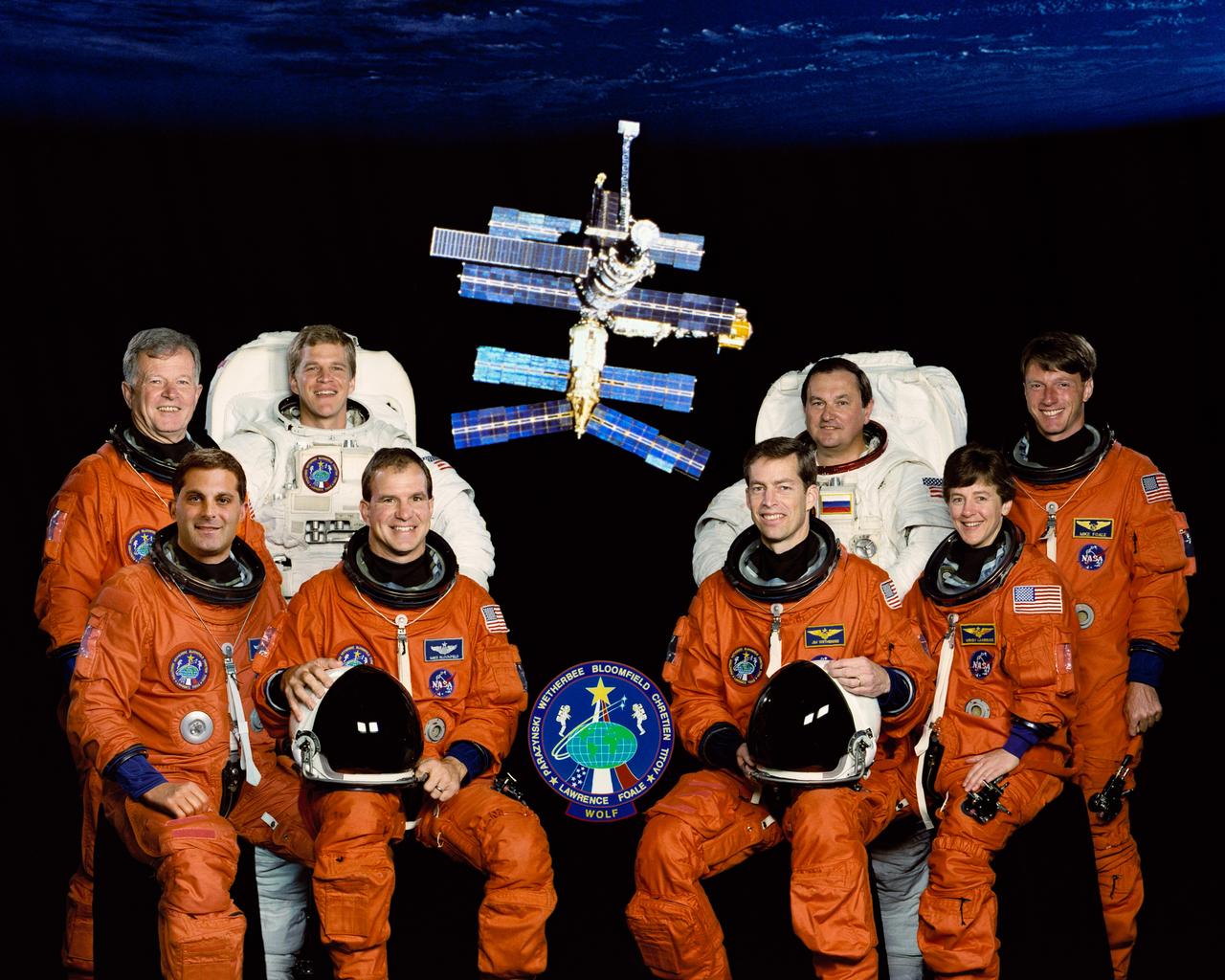
STS086-S-002 (May 1997) --- These eight astronauts have been assigned as the crew for the STS-86 mission, scheduled for a September 1997 launch and visit to Russia's Mir space station. Wearing the partial pressure launch and entry suits are, from the left, Jean-Loup J.M. Chretien, mission specialist; David A. Wolf, mission specialist; Michael J. Bloomfield, pilot; James D. Wetherbee, mission commander; and Wendy B. Lawrence and C. Michael Foale, both mission specialists. Wearing the Extravehicular Mobility Unit (EMU) space suits are Scott F. Parazynski (left) and Vladimir G. Titov, both mission specialists. Chretien and Titov are international mission specialists, representing the French Space Agency (CNES) and Russian Space Agency (RSA), respectively.
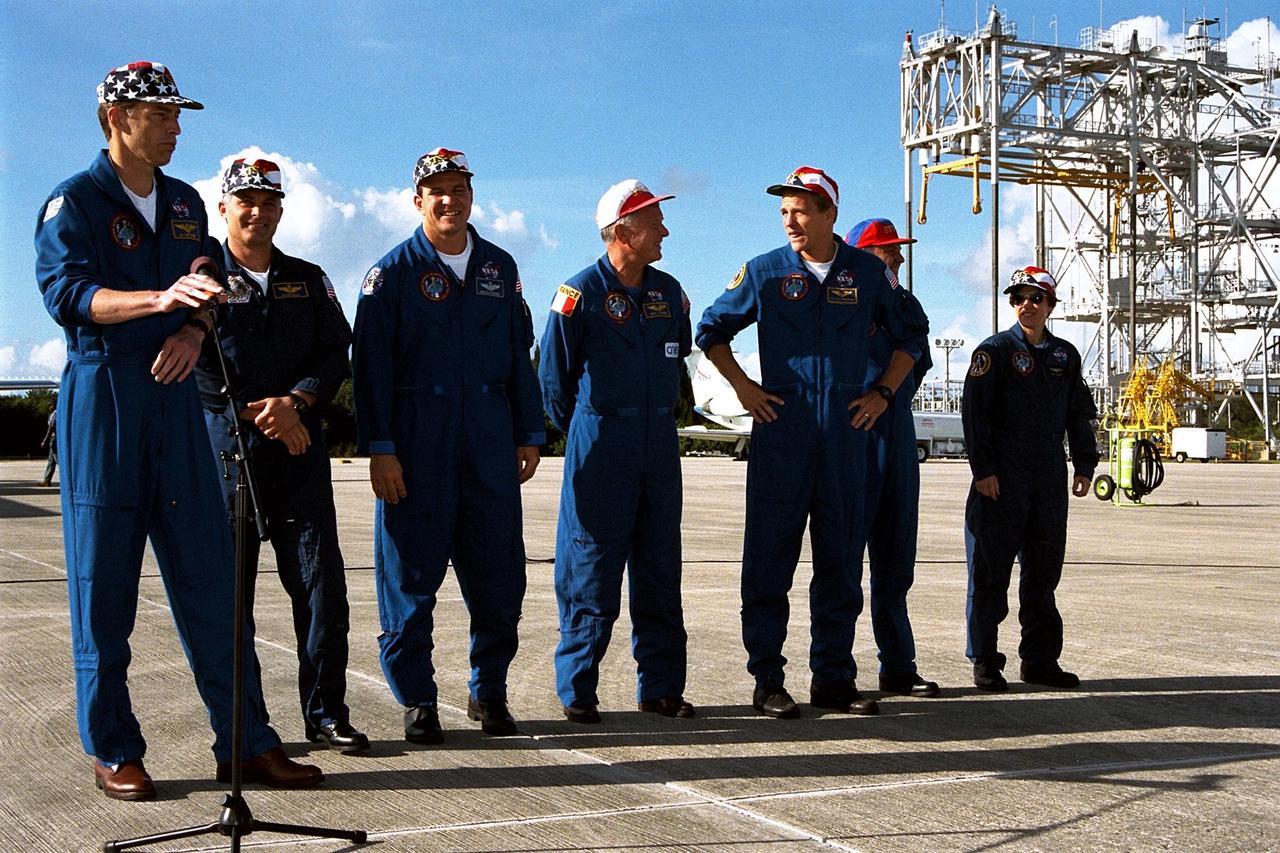
STS-86 Commander James D. Wetherbee, with microphone, addresses press representatives and other onlookers after the astronauts’ arrival Monday at KSC’s Shuttle Landing Facility. The other crew members, from left, are Mission Specialist David A. Wolf; Pilot Michael J. Bloomfield; Mission Specialist Jean-Loup J.M. Chretien of the French Space Agency, CNES; Mission Specialist Scott E. Parazynksi; Mission Specialist Vladimir Georgievich Titov of the Russian Space Agency; and Mission Specialist Wendy B. Lawrence. STS-86 is slated to be the seventh docking of the Space Shuttle with the Russian Space Station Mir. After the docking, Wolf is scheduled to transfer to the Mir 24 crew, replacing astronaut C. Michael Foale. Wolf is scheduled to remain on the Mir for about four months. Liftoff of STS-86 aboard Atlantis is targeted for Sept. 25
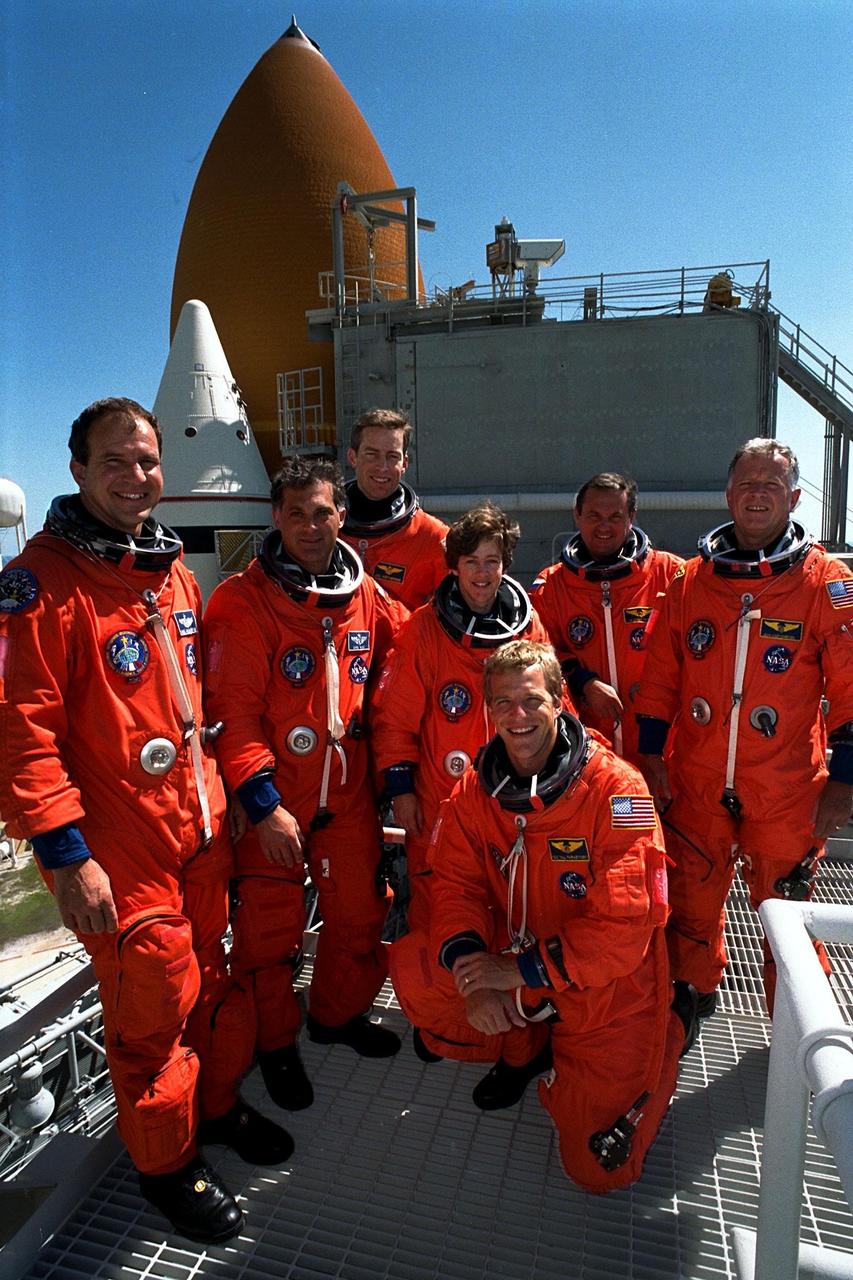
KENNEDY SPACE CENTER, Fla. -- With the Space Shuttle Atlantis behind then, STS-86 crew members pose for a group photograph at Launch Pad 39A. Kneeling in front is Mission Specialist Scott E. Parazynski. From left, are Pilot Michael J. Bloomfield, Mission Specialist David A. Wolf, Commander James D. Wetherbee, and Mission Specialists Wendy B. Lawrence, Vladimir Georgievich Titov of the Russian Space Agency, and Jean-Loup J.M. Chretien of the French Space Agency, CNES. STS-86 will be the seventh docking of the Space Shuttle with the Russian Space Station Mir. Liftoff is targeted for Sept. 25
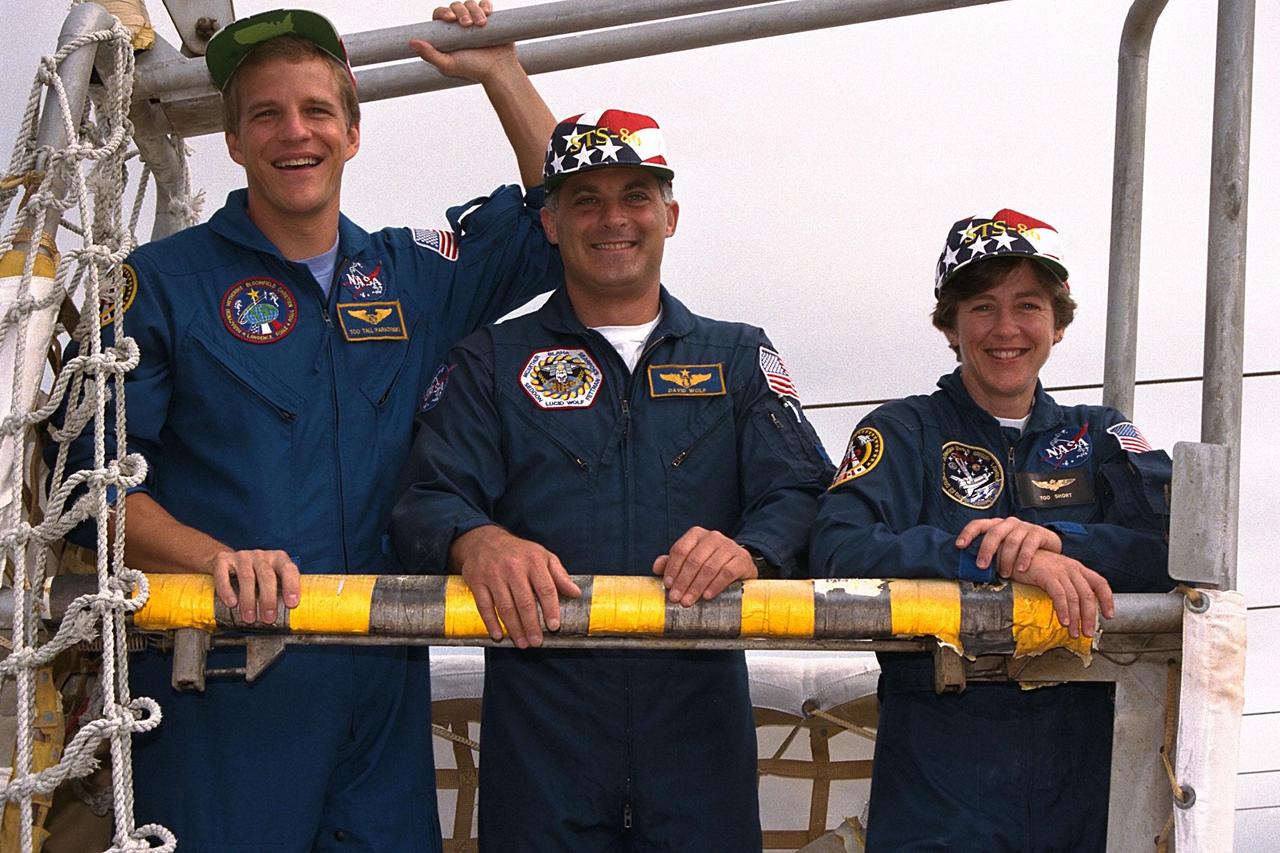
KENNEDY SPACE CENTER, Fla. -- STS-86 Mission Specialists Scott E. Parazynski, at left, David A. Wolf, and Wendy B. Lawrence, at right, participate in emergency egress training at Launch Pad 39A as part of Terminal Countdown Demonstration Test (TCDT) activities. They are the three U.S. astronauts who will serve as mission specialists during the planned 10-day flight to the Russian Space Station Mir. Also serving as mission specialists will be Vladimir Georgievich Titov of the Russian Space Agency and Jean-Loup J.M. Chretien of the French Space Agency, CNES. STS-86 will be the seventh docking of the Space Shuttle with the Mir. During the docking, Wolf will transfer to the orbiting Russian station and become a member of the Mir 24 crew, replacing U.S. astronaut C. Michael Foale, who has been on the Mir since the last docking mission, STS-84, in May. Launch of Mission STS-86 aboard the Space Shuttle Atlantis is targeted for Sept. 25
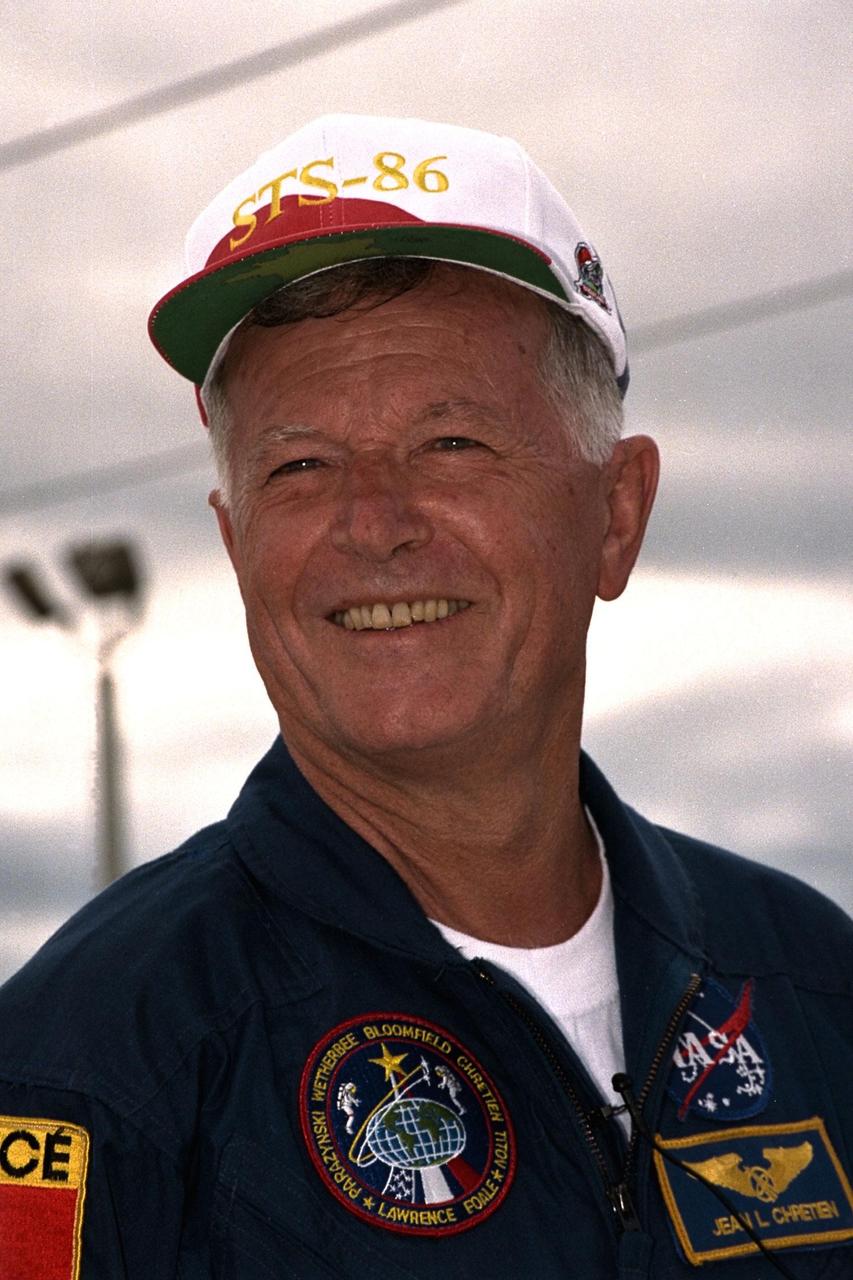
KENNEDY SPACE CENTER, Fla. -- STS-86 Mission Specialist Jean-Loup J.M. Chretien of the French Space Agency, CNES, participates in Terminal Countdown Demonstration Test (TCDT) activities at Launch Pad 39A. This will be his third spaceflight, but first on the Space Shuttle. He flew twice as a research-cosmonaut on Russian missions. STS-86 will be the seventh docking of the Space Shuttle with the Russian Space Station Mir. During the docking, STS-86 Mission Specialist David A. Wolf will transfer to the orbiting Russian station and become a member of the Mir 24 crew, replacing U.S. astronaut C. Michael Foale, who has been on the Mir since the last docking mission, STS-84, in May. Launch of Mission STS-86 aboard the Space Shuttle Atlantis is targeted for Sept. 25
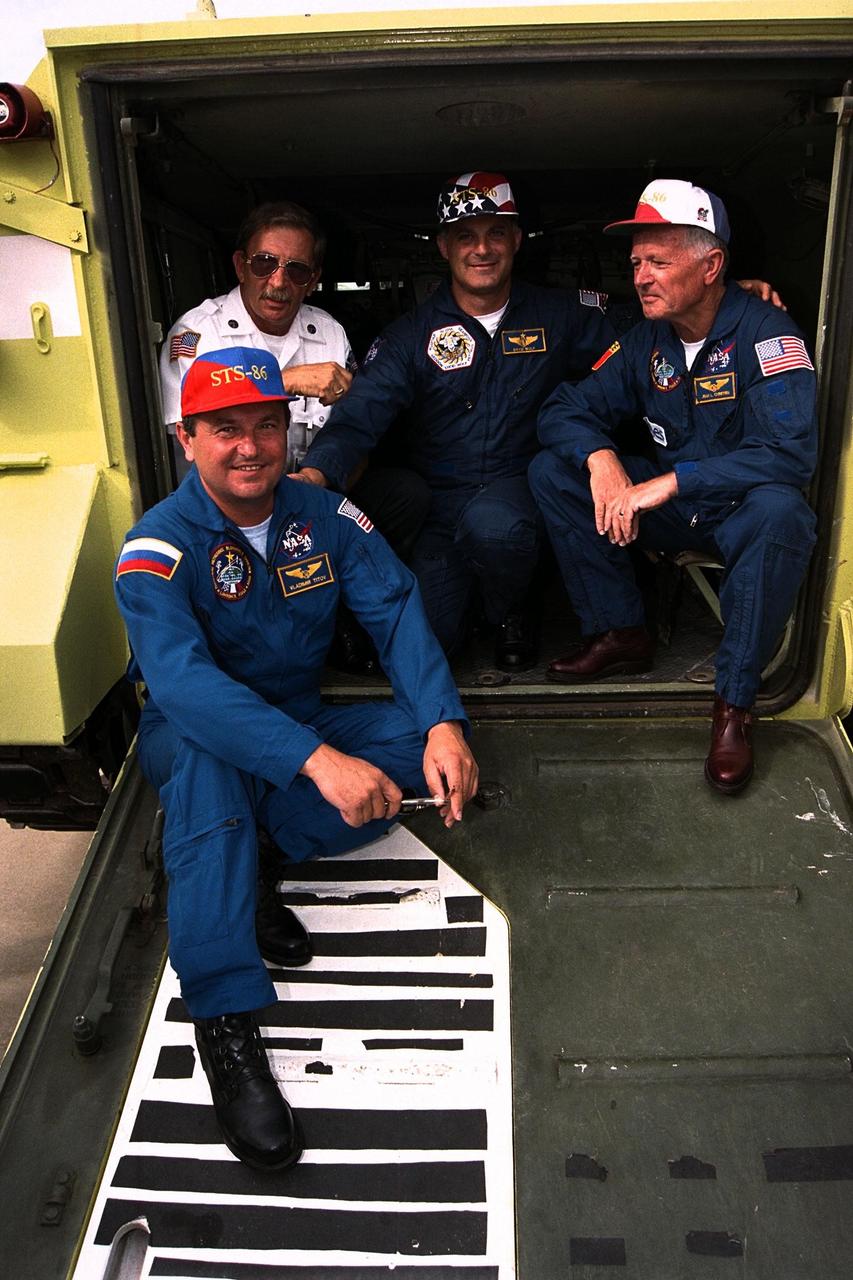
STS-86 crew members get a ride in, and learn to operate, an M-113 armored personnel carrier as part of training exercises during the Terminal Countdown Demonstration Test (TCDT), a dress rehearsal for launch. George Hoggard, in back at left, a training officer with KSC Fire Services, provides this part of the training to Mission Specialists David A. Wolf, to the right of Hoggard; Jean-Loup J.M. Chretien of the French Space Agency; and Vladimir Georgievich Titov, in foreground, of the Russian Space Agency. STS-86 will be the seventh docking of the Space Shuttle with the Russian Space Station Mir. During the docking, Wolf will transfer to the orbiting Russian station and become a member of the Mir 24 crew, replacing U.S. astronaut C. Michael Foale, who has been on the Mir since the last docking mission, STS-84, in May. Launch of Mission STS-86 aboard the Space Shuttle Atlantis is targeted for Sept. 25 from Launch Pad 39A
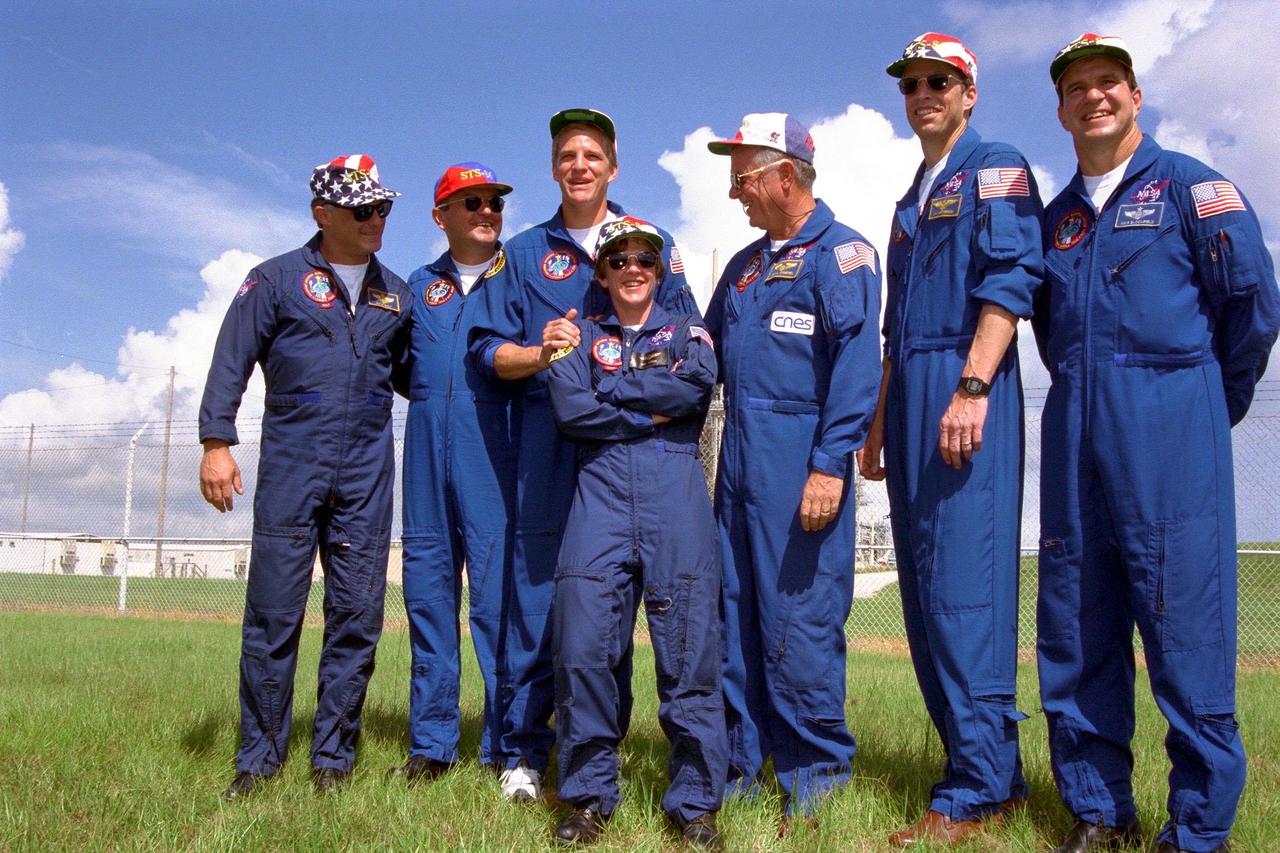
The STS-86 crew enjoys a relaxing moment while greeting friends, families and other well-wishers the day before the scheduled Sept. 25 launch aboard the Space Shuttle Atlantis. From left are Mission Specialist David A. Wolf; Mission Specialist Vladimir Georgievich Titov of the Russian Space Agency; Mission Specialist Scott E. Parazynski; Mission Specialist Wendy B. Lawrence (leaning into Parazynski); Mission Specialist Jean-Loup J.M. Chretien of the French Space Agency, CNES; Commander James D. Wetherbee; and Pilot Michael J. Bloomfield. STS-86 is slated to be the seventh docking of the Space Shuttle and the Russian Space Station Mir. Parazynski and Lawrence had trained to live and work aboard the Russian station but were withdrawn from Mir training Parazynski because he was "too tall" to fit safely in the Russian Soyuz vehicle, and Lawrence because she is "too short" to fit in the Russian spacewalk suit. "Just right" Wolf is scheduled to become a Mir 24 crew member after the docking, to replace U.S. astronaut C. Michael Foale for an extended stay aboard the Russian orbiting outpost
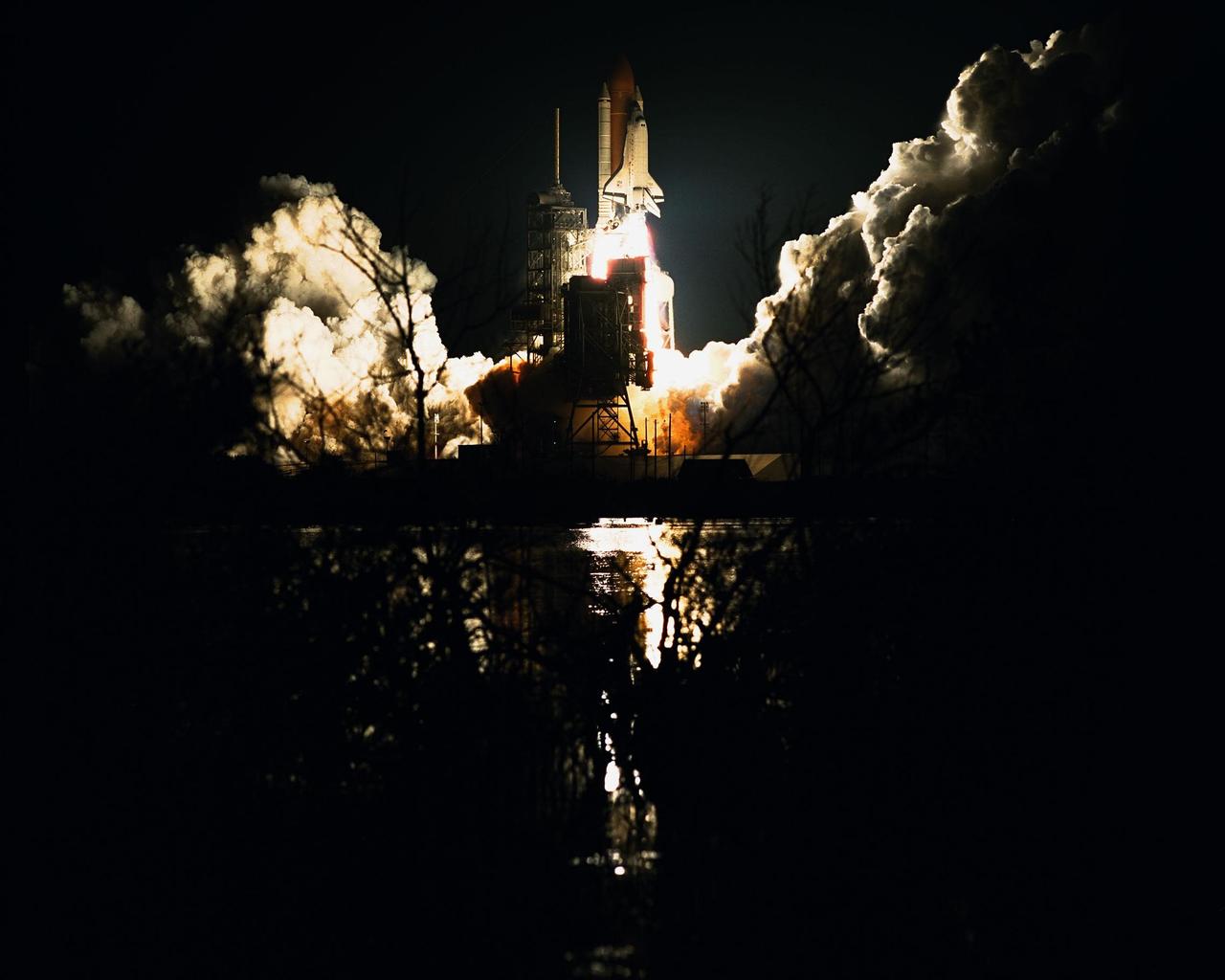
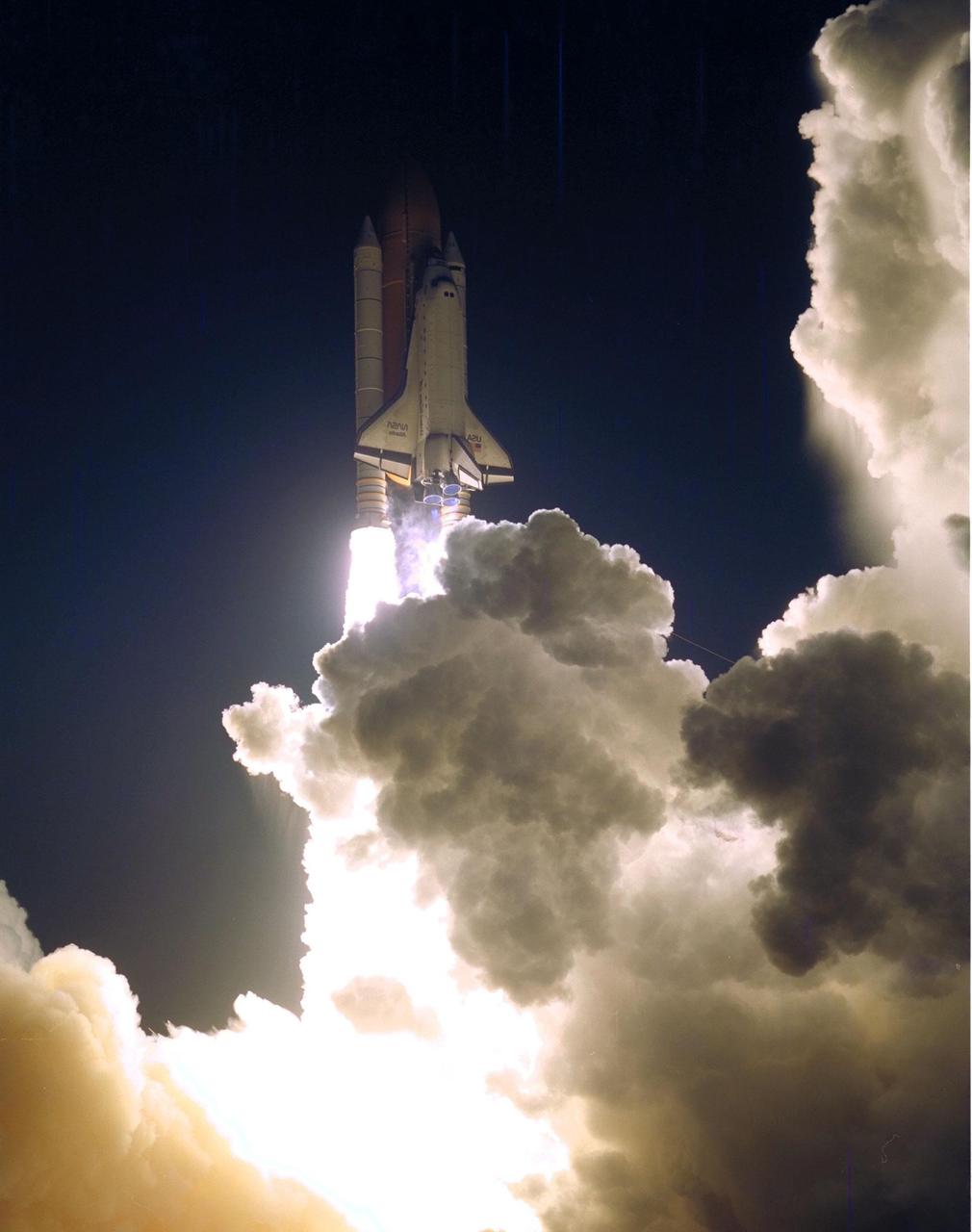
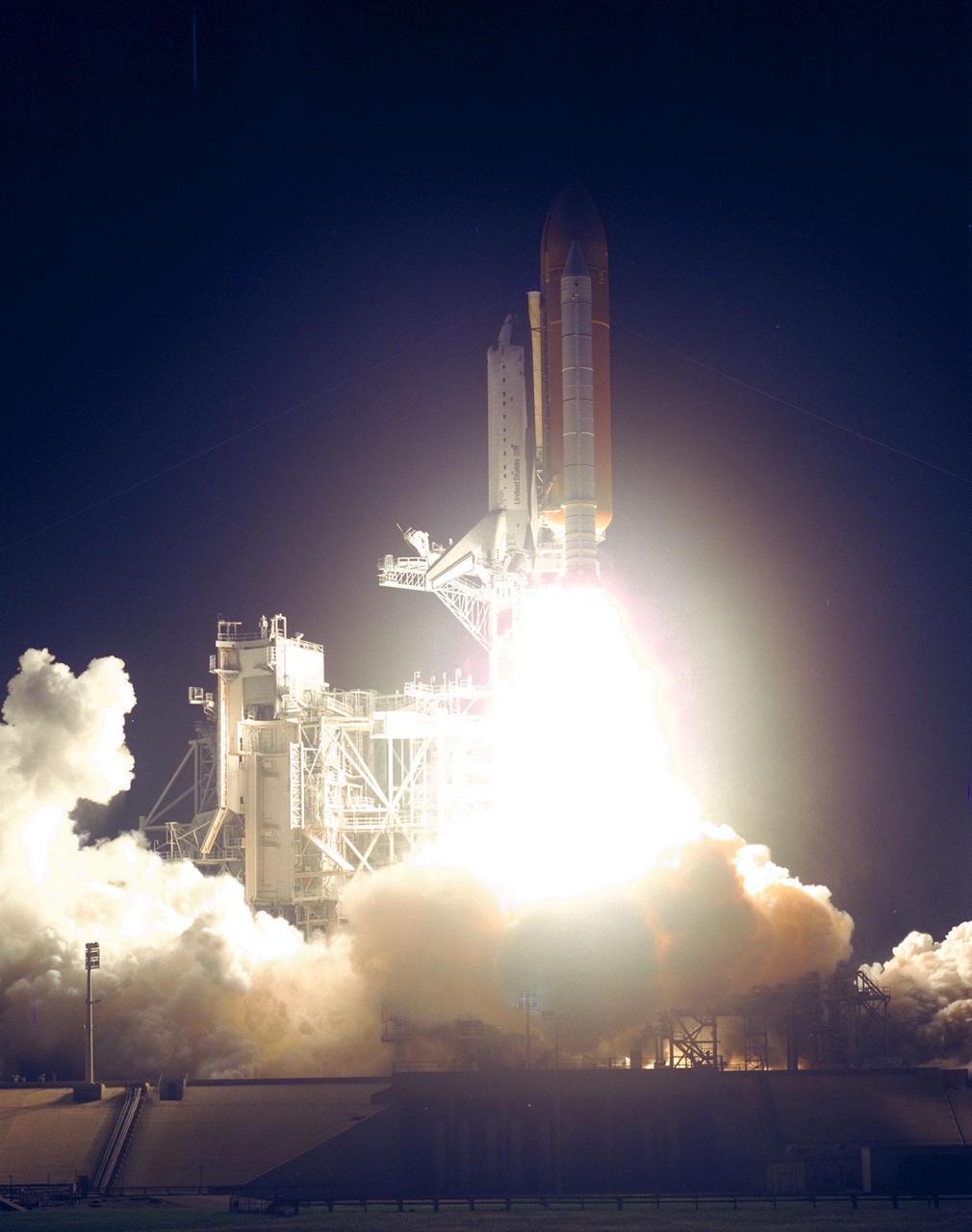
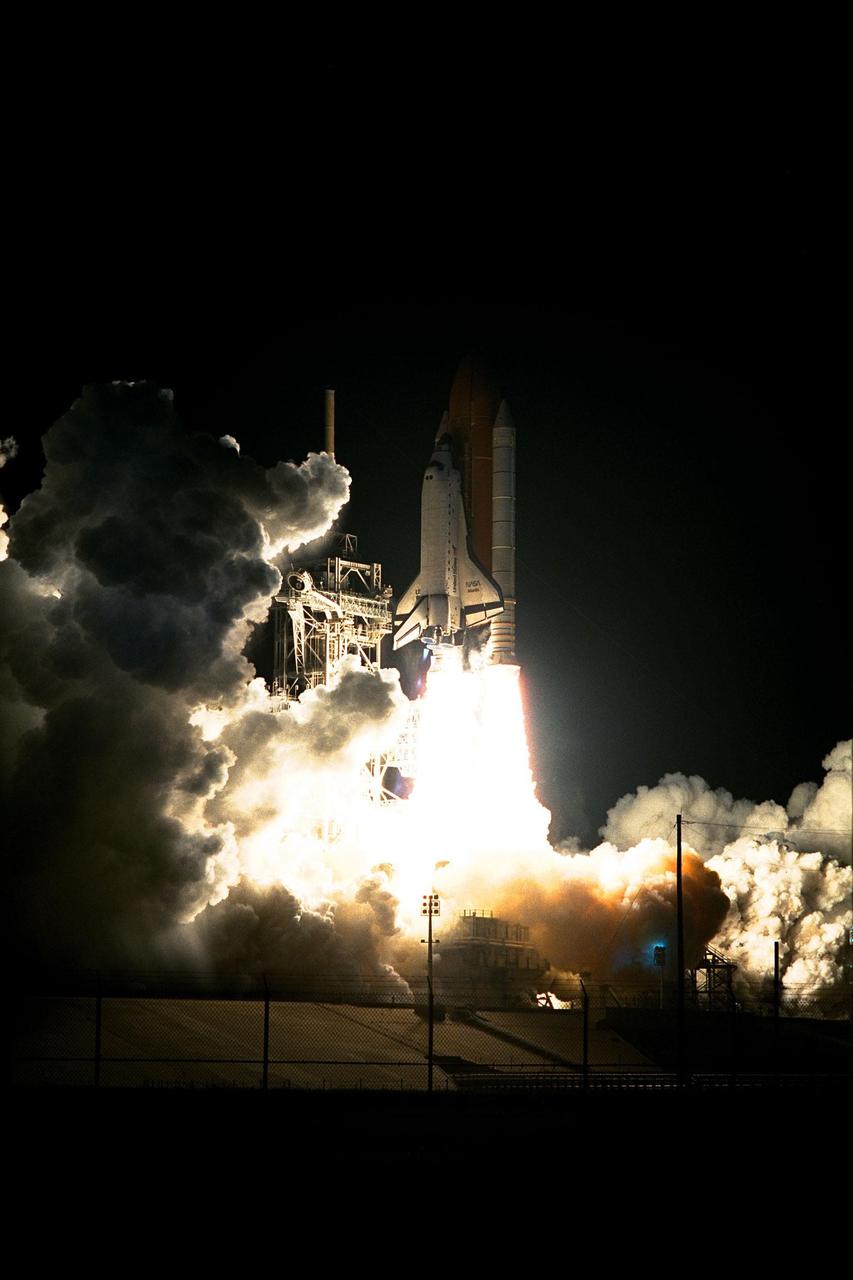
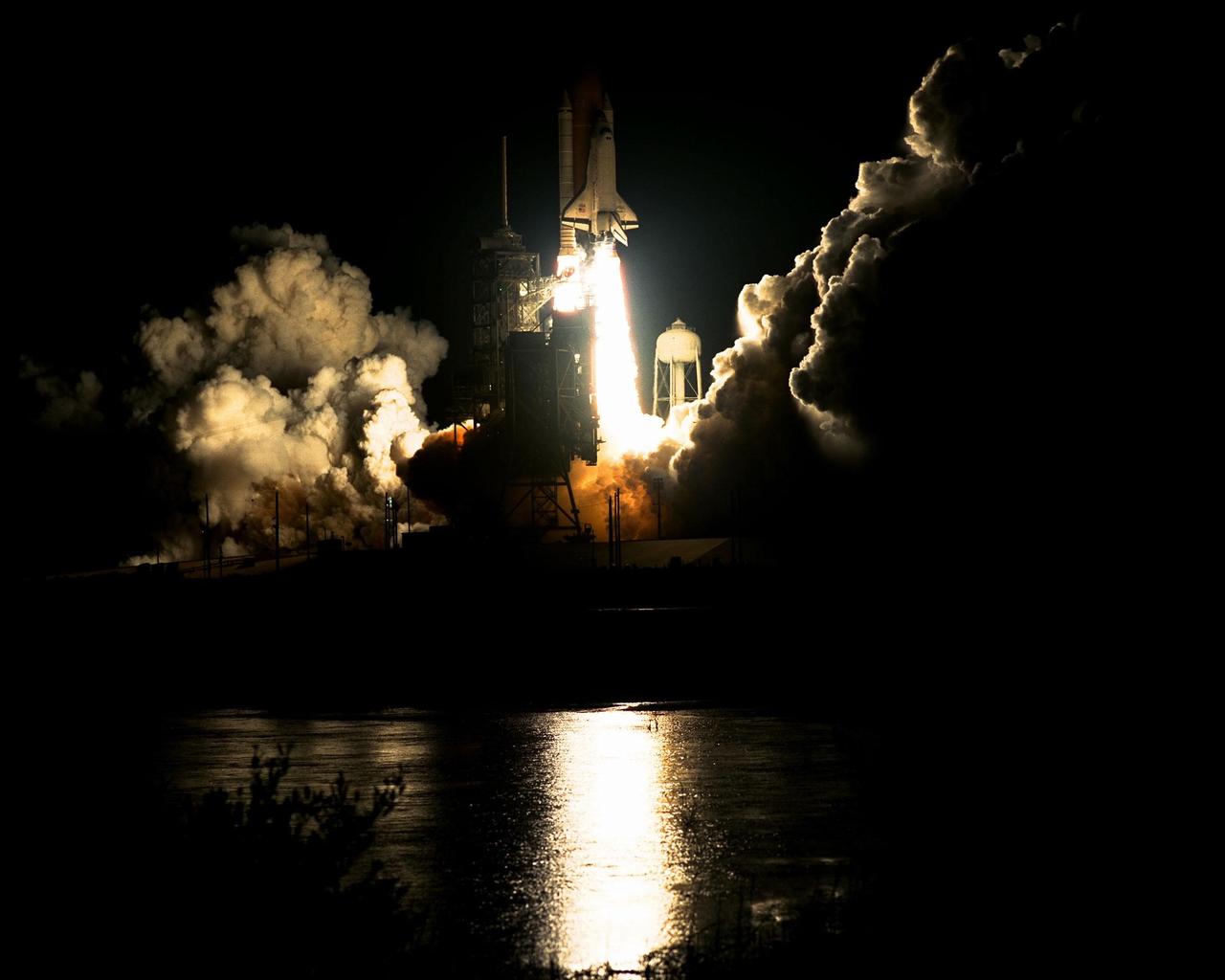
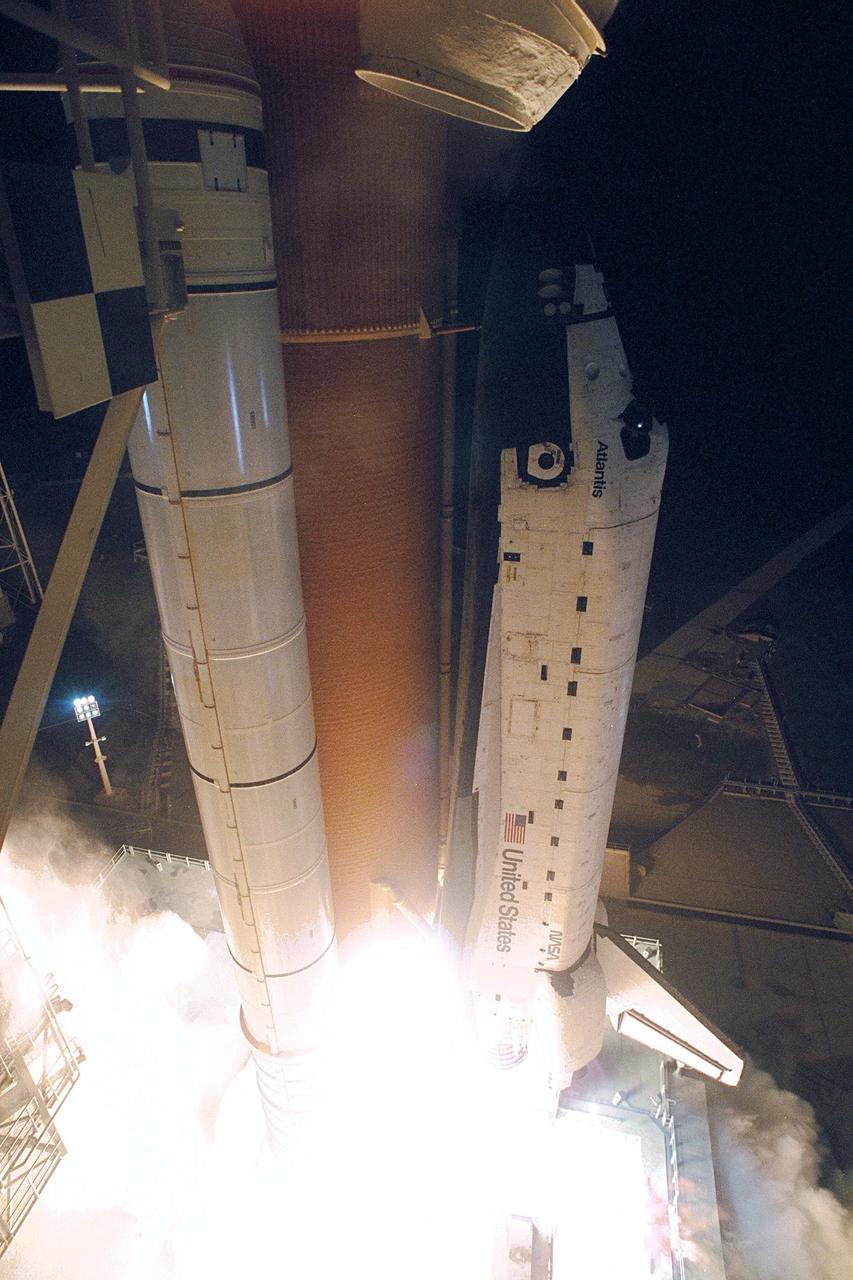
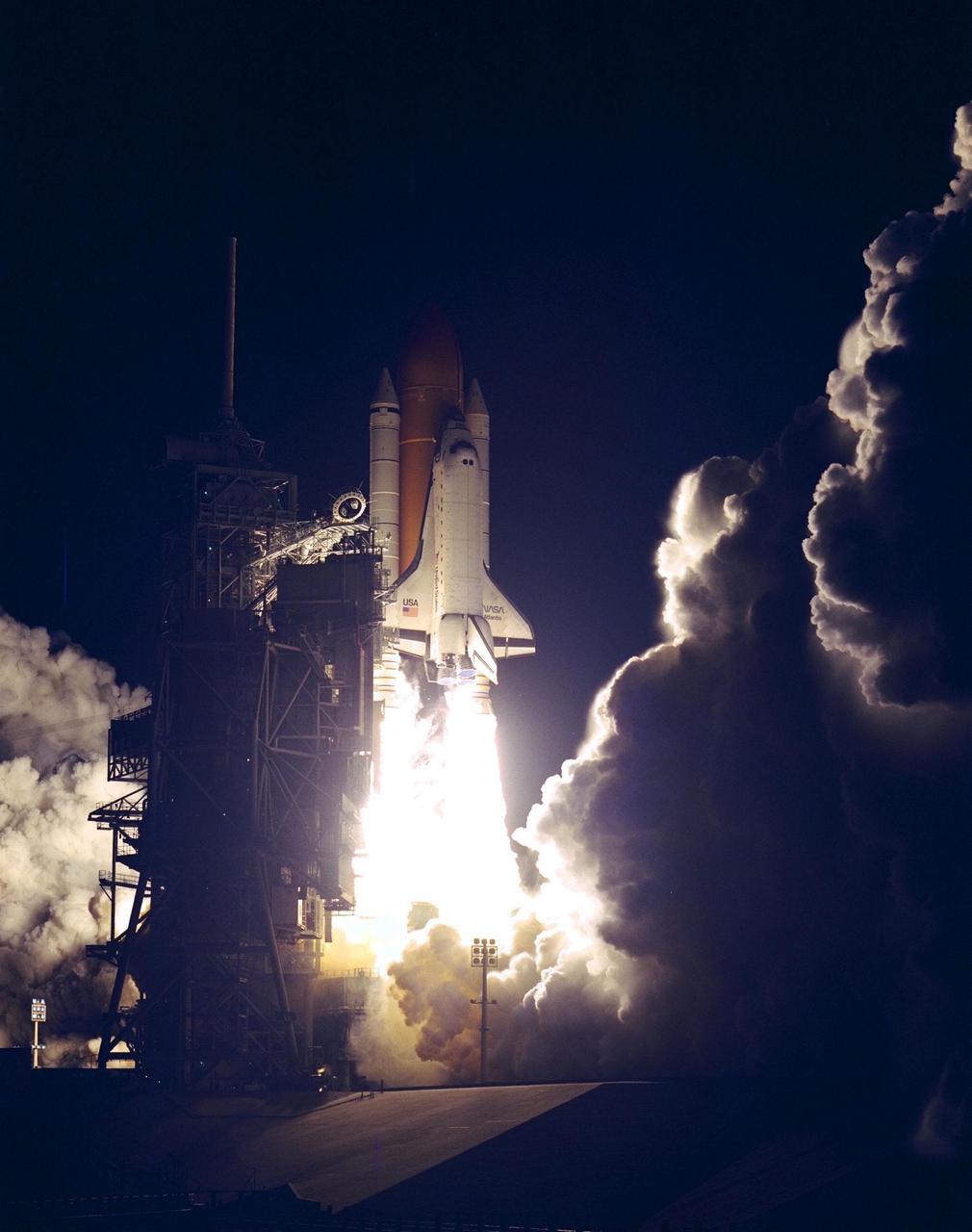
The Space Shuttle Atlantis blazes through the night sky to begin the STS-86 mission, slated to be the seventh of nine planned dockings of the Space Shuttle with the Russian Space Station Mir. Liftoff on Sept. 25 from Launch Pad 39A was at 10:34:19 p.m. EDT, within seconds of the preferred time, during a six-minute, 45-second launch window. The 10-day flight will include the transfer of the sixth U.S. astronaut to live and work aboard the Mir. After the docking, STS-86 Mission Specialist David A. Wolf will become a member of the Mir 24 crew, replacing astronaut C. Michael Foale, who will return to Earth aboard Atlantis with the remainder of the STS-86 crew. Foale has been on the Russian Space Station since mid-May. Wolf is scheduled to remain there about four months. Besides Wolf (embarking to Mir) and Foale (returning), the STS-86 crew includes Commander James D. Wetherbee, Pilot Michael J. Bloomfield, and Mission Specialists Wendy B. Lawrence, Scott E. Parazynski, Vladimir Georgievich Titov of the Russian Space Agency, and Jean-Loup J.M. Chretien of the French Space Agency, CNES. Other primary objectives of the mission are a spacewalk by Parazynski and Titov, and the exchange of about three-and-a-half tons of science/logistical equipment and supplies between Atlantis and the Mir
The Space Shuttle Atlantis blazes through the night sky to begin the STS-86 mission, slated to be the seventh of nine planned dockings of the Space Shuttle with the Russian Space Station Mir. Liftoff on Sept. 25 from Launch Pad 39A was at 10:34:19 p.m. EDT, within seconds of the preferred time, during a six-minute, 45-second launch window. The 10-day flight will include the transfer of the sixth U.S. astronaut to live and work aboard the Mir. After the docking, STS-86 Mission Specialist David A. Wolf will become a member of the Mir 24 crew, replacing astronaut C. Michael Foale, who will return to Earth aboard Atlantis with the remainder of the STS-86 crew. Foale has been on the Russian Space Station since mid-May. Wolf is scheduled to remain there about four months. Besides Wolf (embarking to Mir) and Foale (returning), the STS-86 crew includes Commander James D. Wetherbee, Pilot Michael J. Bloomfield, and Mission Specialists Wendy B. Lawrence, Scott E. Parazynski, Vladimir Georgievich Titov of the Russian Space Agency, and Jean-Loup J.M. Chretien of the French Space Agency, CNES. Other primary objectives of the mission are a spacewalk by Parazynski and Titov, and the exchange of about three-and-a-half tons of science/logistical equipment and supplies between Atlantis and the Mir
The Space Shuttle Atlantis blazes through the night sky to begin the STS-86 mission, slated to be the seventh of nine planned dockings of the Space Shuttle with the Russian Space Station Mir. Liftoff on Sept. 25 from Launch Pad 39A was at 10:34:19 p.m. EDT, within seconds of the preferred time, during a six-minute, 45-second launch window. The 10-day flight will include the transfer of the sixth U.S. astronaut to live and work aboard the Mir. After the docking, STS-86 Mission Specialist David A. Wolf will become a member of the Mir 24 crew, replacing astronaut C. Michael Foale, who will return to Earth aboard Atlantis with the remainder of the STS-86 crew. Foale has been on the Russian Space Station since mid-May. Wolf is scheduled to remain there about four months. Besides Wolf (embarking to Mir) and Foale (returning), the STS-86 crew includes Commander James D. Wetherbee, Pilot Michael J. Bloomfield, and Mission Specialists Wendy B. Lawrence, Scott E. Parazynski, Vladimir Georgievich Titov of the Russian Space Agency, and Jean-Loup J.M. Chretien of the French Space Agency, CNES. Other primary objectives of the mission are a spacewalk by Parazynski and Titov, and the exchange of about three-and-a-half tons of science/logistical equipment and supplies between Atlantis and the Mir
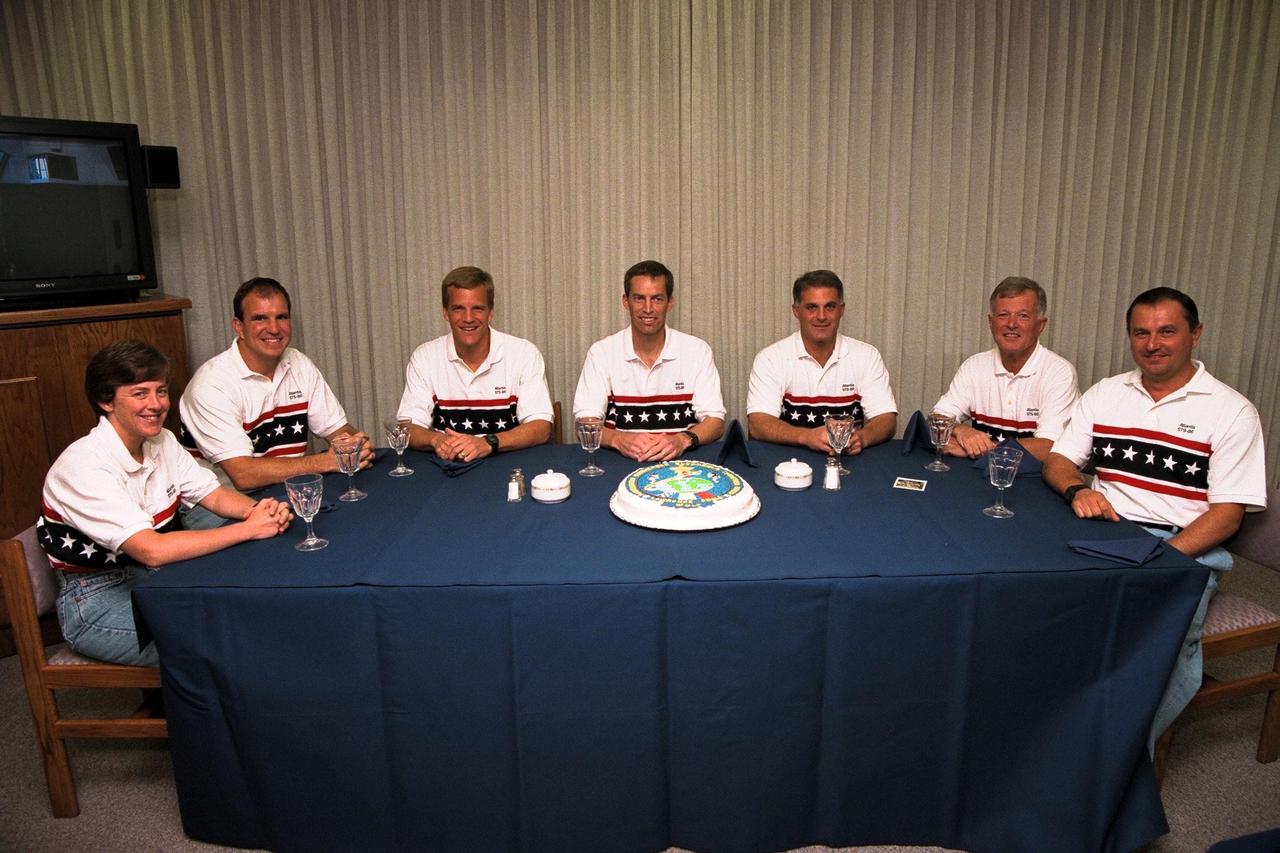
As part of the final STS-86 prelaunch activities, the seven crew members gather for a snack and a photo opportunity in the Operations and Checkout Building. From left are Mission Specialist Wendy B. Lawrence; Pilot Michael J. Bloomfield; Mission Specialist Scott E. Parazynski; Commander James D. Wetherbee; Mission Specialist David A. Wolf; Mission Specialist Jean-Loup J.M. Chretien of the French Space Agency, CNES; and Mission Specialist Vladimir Georgievich Titov of the Russian Space Agency. After a weather briefing, the astronauts will don their orange launch and entry suits and depart for Launch Pad 39A where the Space Shuttle Atlantis awaits liftoff at about 10:34 p.m. EDT, Sept. 25. The exact launch time may vary slightly based on calculations of the Russian Space Station Mir’s precise location in space at the time of liftoff. STS-86 is slated to be the seventh of nine planned dockings of the Shuttle with the Mir. Wolf is scheduled to become a member of the Mir 24 crew, replacing U.S. astronaut C. Michael Foale who will return to Earth aboard Atlantis after more than four months on the Russian orbiting outpost
The Space Shuttle Atlantis blazes through the night sky to begin the STS-86 mission, slated to be the seventh of nine planned dockings of the Space Shuttle with the Russian Space Station Mir. Liftoff on Sept. 25 from Launch Pad 39A was at 10:34:19 p.m. EDT, within seconds of the preferred time, during a six-minute, 45-second launch window. The 10-day flight will include the transfer of the sixth U.S. astronaut to live and work aboard the Mir. After the docking, STS-86 Mission Specialist David A. Wolf will become a member of the Mir 24 crew, replacing astronaut C. Michael Foale, who will return to Earth aboard Atlantis with the remainder of the STS-86 crew. Foale has been on the Russian Space Station since mid-May. Wolf is scheduled to remain there about four months. Besides Wolf (embarking to Mir) and Foale (returning), the STS-86 crew includes Commander James D. Wetherbee, Pilot Michael J. Bloomfield, and Mission Specialists Wendy B. Lawrence, Scott E. Parazynski, Vladimir Georgievich Titov of the Russian Space Agency, and Jean-Loup J.M. Chretien of the French Space Agency, CNES. Other primary objectives of the mission are a spacewalk by Parazynski and Titov, and the exchange of about three-and-a-half tons of science/logistical equipment and supplies between Atlantis and the Mir
The Space Shuttle Atlantis blazes through the night sky to begin the STS-86 mission, slated to be the seventh of nine planned dockings of the Space Shuttle with the Russian Space Station Mir. Liftoff on Sept. 25 from Launch Pad 39A was at 10:34:19 p.m. EDT, within seconds of the preferred time, during a six-minute, 45-second launch window. The 10-day flight will include the transfer of the sixth U.S. astronaut to live and work aboard the Mir. After the docking, STS-86 Mission Specialist David A. Wolf will become a member of the Mir 24 crew, replacing astronaut C. Michael Foale, who will return to Earth aboard Atlantis with the remainder of the STS-86 crew. Foale has been on the Russian Space Station since mid-May. Wolf is scheduled to remain there about four months. Besides Wolf (embarking to Mir) and Foale (returning), the STS-86 crew includes Commander James D. Wetherbee, Pilot Michael J. Bloomfield, and Mission Specialists Wendy B. Lawrence, Scott E. Parazynski, Vladimir Georgievich Titov of the Russian Space Agency, and Jean-Loup J.M. Chretien of the French Space Agency, CNES. Other primary objectives of the mission are a spacewalk by Parazynski and Titov, and the exchange of about three-and-a-half tons of science/logistical equipment and supplies between Atlantis and the Mir
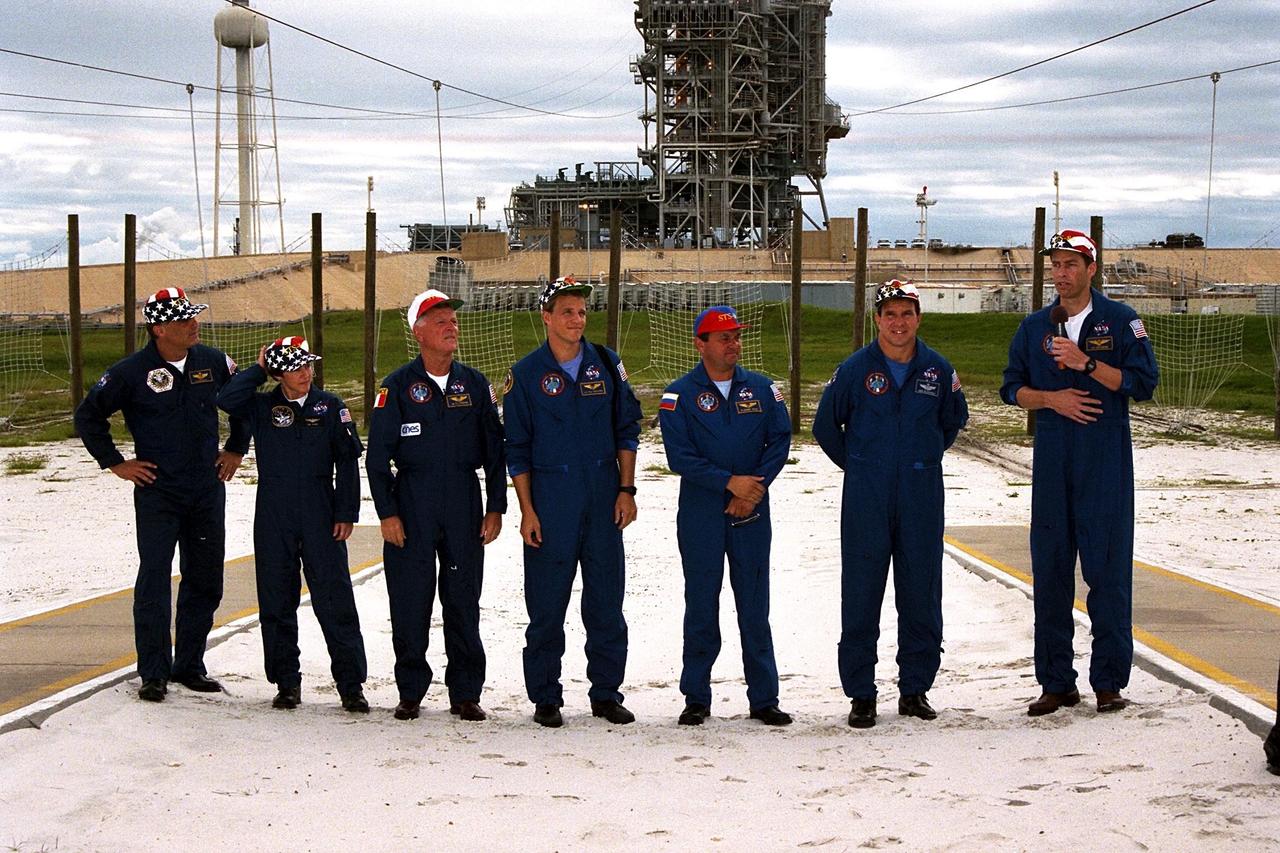
KENNEDY SPACE CENTER, Fla. -- STS-86 Commander James D. Wetherbee, with microphone, and other crew members of the Space Shuttle Atlantis speak to media representatives and other onlookers at Launch Pad 39A during the Terminal Countdown Demonstration Test (TCDT), a dress rehearsal for launch. From right, after Wetherbee, are Pilot Michael J. Bloomfield, Mission Specialist Vladimir Georgievich Titov of the Russian Space Agency, Mission Specialist Scott E. Parazynski, Mission Specialist Jean-Loup J.M. Chretien of the French Space Agency, CNES, and Mission Specialists Wendy B. Lawrence and David A. Wolf. STS-86 will be the seventh docking of the Space Shuttle with the Russian Space Station Mir. During the docking, Wolf will transfer to the orbiting Russian station and become a member of the Mir 24 crew, replacing U.S. astronaut C. Michael Foale, who has been on the Mir since the last docking mission, STS-84, in May. Launch of Mission STS-86 aboard the Space Shuttle Atlantis is targeted for Sept. 25
The Space Shuttle Atlantis blazes through the night sky to begin the STS-86 mission, slated to be the seventh of nine planned dockings of the Space Shuttle with the Russian Space Station Mir. Liftoff on Sept. 25 from Launch Pad 39A was at 10:34:19 p.m. EDT, within seconds of the preferred time, during a six-minute, 45-second launch window. The 10-day flight will include the transfer of the sixth U.S. astronaut to live and work aboard the Mir. After the docking, STS-86 Mission Specialist David A. Wolf will become a member of the Mir 24 crew, replacing astronaut C. Michael Foale, who will return to Earth aboard Atlantis with the remainder of the STS-86 crew. Foale has been on the Russian Space Station since mid-May. Wolf is scheduled to remain there about four months. Besides Wolf (embarking to Mir) and Foale (returning), the STS-86 crew includes Commander James D. Wetherbee, Pilot Michael J. Bloomfield, and Mission Specialists Wendy B. Lawrence, Scott E. Parazynski, Vladimir Georgievich Titov of the Russian Space Agency, and Jean-Loup J.M. Chretien of the French Space Agency, CNES. Other primary objectives of the mission are a spacewalk by Parazynski and Titov, and the exchange of about three-and-a-half tons of science/logistical equipment and supplies between Atlantis and the Mir
The Space Shuttle Atlantis blazes through the night sky to begin the STS-86 mission, slated to be the seventh of nine planned dockings of the Space Shuttle with the Russian Space Station Mir. Liftoff on Sept. 25 from Launch Pad 39A was at 10:34:19 p.m. EDT, within seconds of the preferred time, during a six-minute, 45-second launch window. The 10-day flight will include the transfer of the sixth U.S. astronaut to live and work aboard the Mir. After the docking, STS-86 Mission Specialist David A. Wolf will become a member of the Mir 24 crew, replacing astronaut C. Michael Foale, who will return to Earth aboard Atlantis with the remainder of the STS-86 crew. Foale has been on the Russian Space Station since mid-May. Wolf is scheduled to remain there about four months. Besides Wolf (embarking to Mir) and Foale (returning), the STS-86 crew includes Commander James D. Wetherbee, Pilot Michael J. Bloomfield, and Mission Specialists Wendy B. Lawrence, Scott E. Parazynski, Vladimir Georgievich Titov of the Russian Space Agency, and Jean-Loup J.M. Chretien of the French Space Agency, CNES. Other primary objectives of the mission are a spacewalk by Parazynski and Titov, and the exchange of about three-and-a-half tons of science/logistical equipment and supplies between Atlantis and the Mir
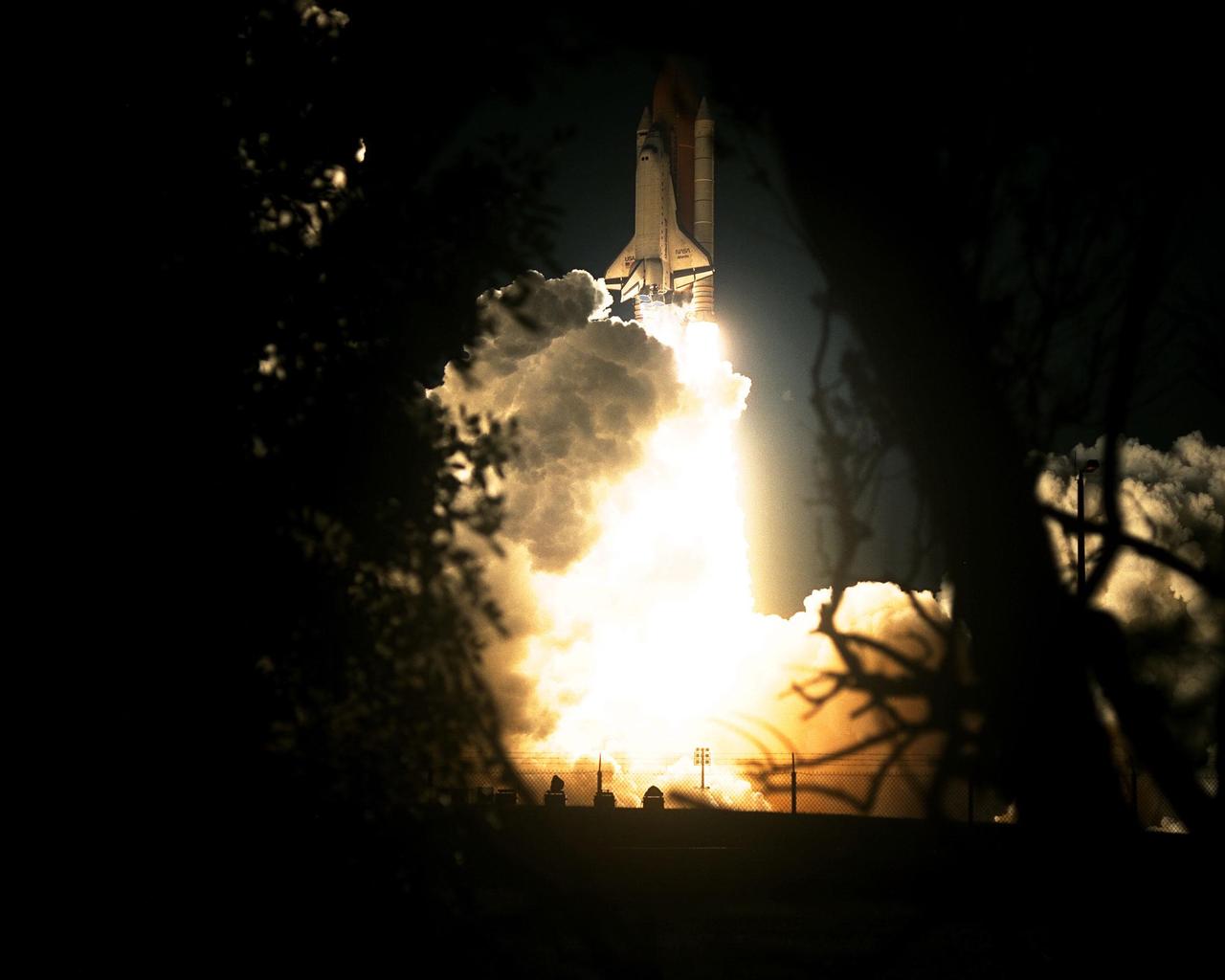
The Space Shuttle Atlantis blazes through the night sky to begin the STS-86 mission, slated to be the seventh of nine planned dockings of the Space Shuttle with the Russian Space Station Mir. Liftoff on Sept. 25 from Launch Pad 39A was at 10:34:19 p.m. EDT, within seconds of the preferred time, during a six-minute, 45-second launch window. The 10-day flight will include the transfer of the sixth U.S. astronaut to live and work aboard the Mir. After the docking, STS-86 Mission Specialist David A. Wolf will become a member of the Mir 24 crew, replacing astronaut C. Michael Foale, who will return to Earth aboard Atlantis with the remainder of the STS-86 crew. Foale has been on the Russian Space Station since mid-May. Wolf is scheduled to remain there about four months. Besides Wolf (embarking to Mir) and Foale (returning), the STS-86 crew includes Commander James D. Wetherbee, Pilot Michael J. Bloomfield, and Mission Specialists Wendy B. Lawrence, Scott E. Parazynski, Vladimir Georgievich Titov of the Russian Space Agency, and Jean-Loup J.M. Chretien of the French Space Agency, CNES. Other primary objectives of the mission are a spacewalk by Parazynski and Titov, and the exchange of about three-and-a-half tons of science/logistical equipment and supplies between Atlantis and the Mir
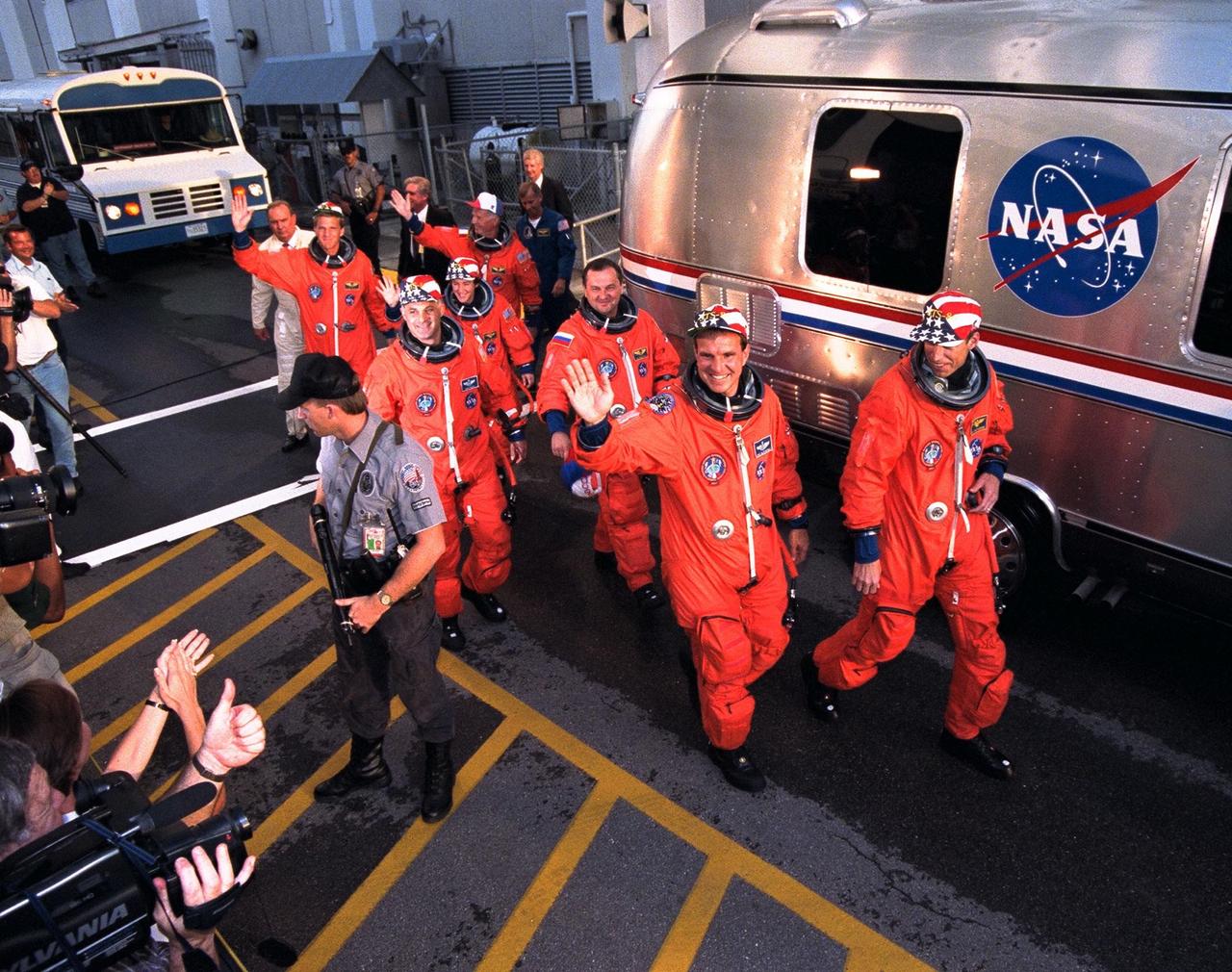
STS-86 crew members smile and wave to the crowd of press representatives, KSC employees and other well-wishers as they prepare to board the astronaut van, at right, after departing from the Operations and Checkout Building. Leading the way are Pilot Michael J. Bloomfield, at left, and Commander James D. Wetherbee. Mission Specialists David A. Wolf, at left, and Vladimir Georgievich Titov of the Russian Space Agency are directly behind them, followed by Mission Specialist Wendy B. Lawrence, at center. Bringing up the rear are Mission Specialists Scott E. Parazynski, at left, and Jean-Loup J.M. Chretien of the French Space Agency, CNES. The seven-member crew is en route to Launch Pad 39A, where the Space Shuttle Atlantis awaits liftoff on a planned 10-day mission slated to be the seventh docking of the Space Shuttle and the Russian Space Station Mir. Wolf is scheduled to transfer to the Mir 24 crew for an approximate four-month stay aboard the Russian space station. He will replace U.S. astronaut C. Michael Foale, who will return to Earth aboard Atlantis with the remainder of the STS-86 crew
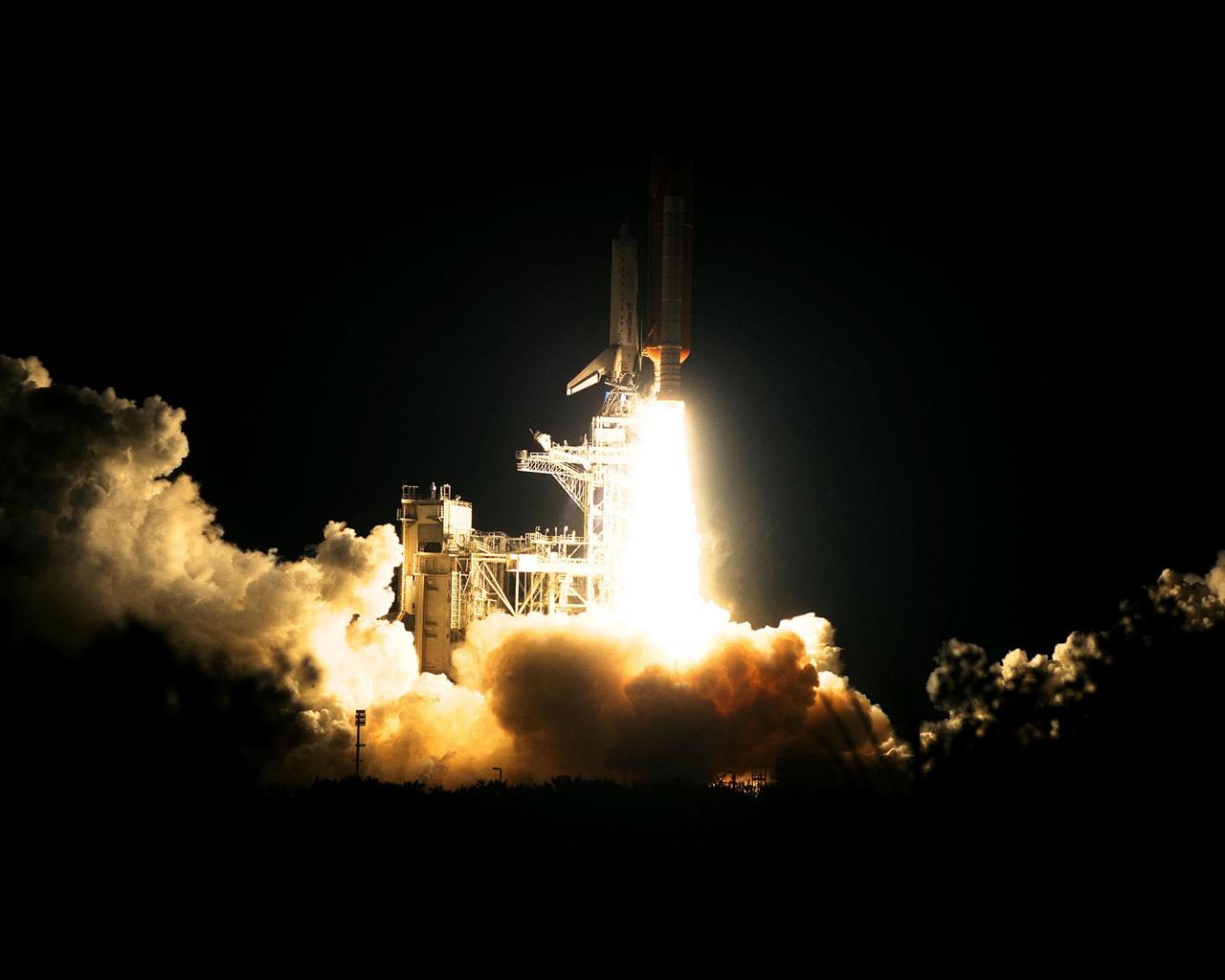
The Space Shuttle Atlantis blazes through the night sky to begin the STS-86 mission, slated to be the seventh of nine planned dockings of the Space Shuttle with the Russian Space Station Mir. Liftoff on Sept. 25 from Launch Pad 39A was at 10:34:19 p.m. EDT, within seconds of the preferred time, during a six-minute, 45-second launch window. The 10-day flight will include the transfer of the sixth U.S. astronaut to live and work aboard the Mir. After the docking, STS-86 Mission Specialist David A. Wolf will become a member of the Mir 24 crew, replacing astronaut C. Michael Foale, who will return to Earth aboard Atlantis with the remainder of the STS-86 crew. Foale has been on the Russian Space Station since mid-May. Wolf is scheduled to remain there about four months. Besides Wolf (embarking to Mir) and Foale (returning), the STS-86 crew includes Commander James D. Wetherbee, Pilot Michael J. Bloomfield, and Mission Specialists Wendy B. Lawrence, Scott E. Parazynski, Vladimir Georgievich Titov of the Russian Space Agency, and Jean-Loup J.M. Chretien of the French Space Agency, CNES. Other primary objectives of the mission are a spacewalk by Parazynski and Titov, and the exchange of about three-and-a-half tons of science/logistical equipment and supplies between Atlantis and the Mir
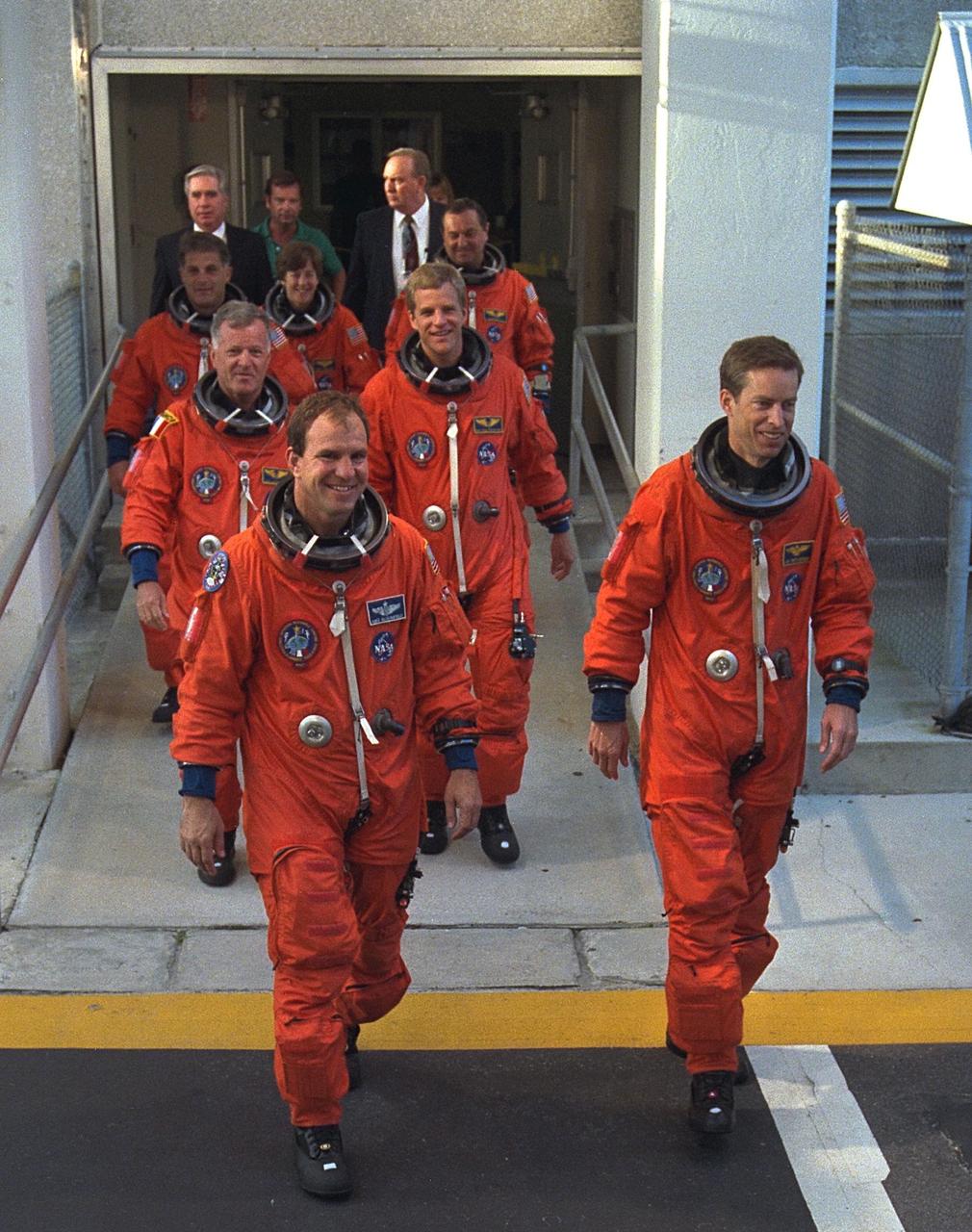
STS-86 Commander James D. Wetherbee, in foreground at right, leads the way as the next Space Shuttle crew does a practice walkout from the Operations and Checkout Building en route to Launch Pad 39A. The seven crew members are at KSC to participate in the Terminal Countdown Demonstration Test (TCDT), a dress rehearsal for launch. Pilot Michael J. Bloomfield is in foreground at left. Directly behind the pilot and commander, from left, are Mission Specialists Jean-Loup J.M. Chretien of the French Space Agency, CNES, and Scott E. Parazynski. Bringing up the rear, from left, are Mission Specialists David A. Wolf, Wendy B. Lawrence and Vladimir Georgievich Titov of the Russian Space Agency. STS-86 will be the seventh docking of the Space Shuttle with the Russian Space Station Mir. After the docking, Wolf will transfer to the Mir 24 crew, replacing U.S. astronaut C. Michael Foale, who arrived there during the last docking mission, STS-85, in May. The STS-86 launch aboard Atlantis is targeted for Sept. 25
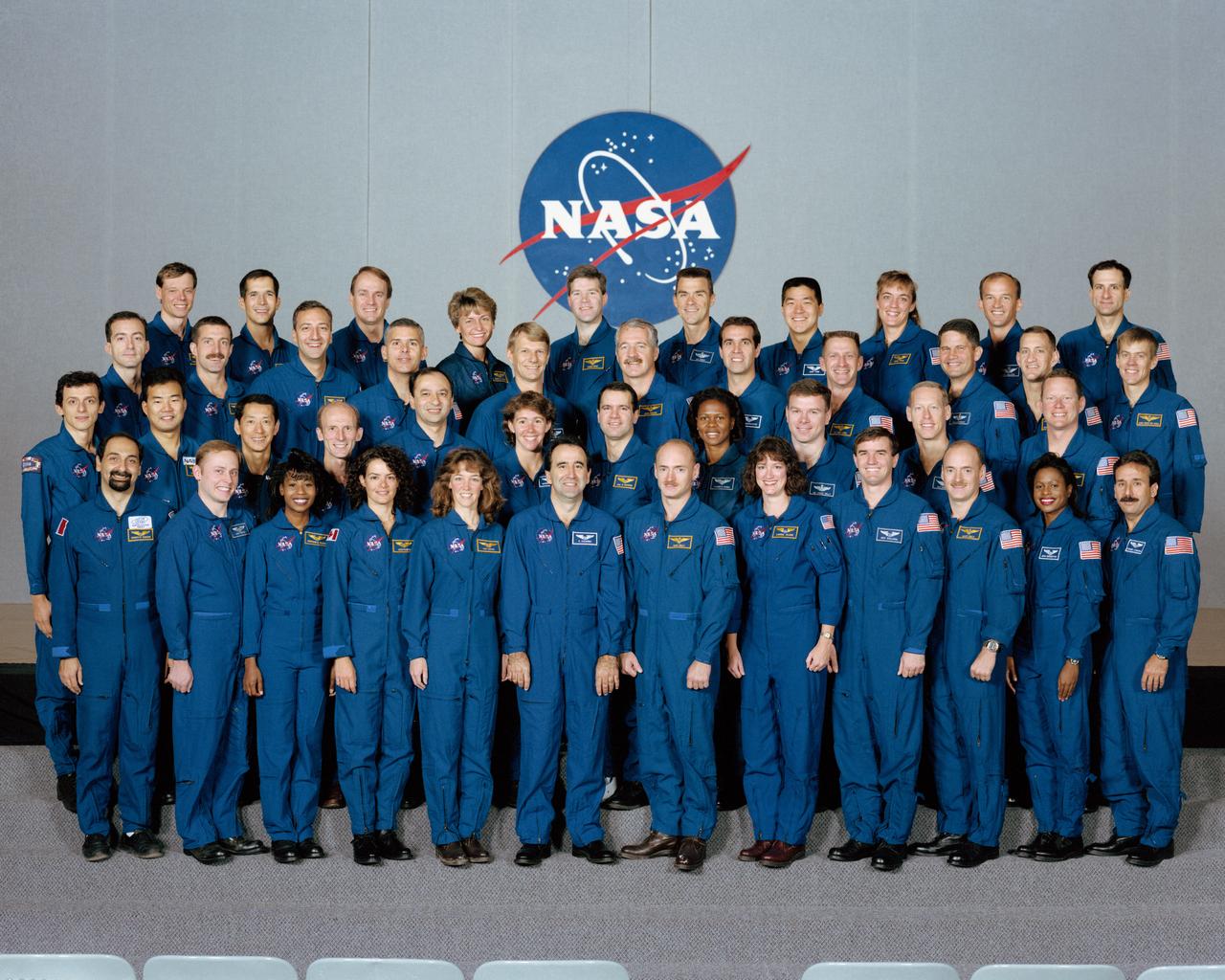
S96-18546 (5 Nov. 1996) --- Following their selection from among 2,400 applicants, the 44 astronaut candidates begin a lengthy period of training and evaluation at NASA's Johnson Space Center as they gather for their group portrait. This year?s class is the largest in the history of space shuttle astronauts and their early program predecessors. Ten pilots and 25 mission specialists make up the internationally diverse class. The international trainees represent the Canadian, Japanese, Italian, French, German and European space agencies. Back row ? from the left, Christer Fuglesang, John Herrington, Steve MacLean, Peggy Whitson, Stephen Frick, Duane Carey, Daniel Tani, Heidemarie Stefanyshyn-Piper, Jeffrey Williams and Donald Pettit. Second to back row ? from the left, Philippe Perrin, Daniel Burbank, Michael Massimino, Lee Morin, Piers Sellers, John Phillips, Richard Mastraccio, Christopher Loria, Paul Lockhart, Charles Hobaugh and William McCool. Second to front row ? from the left, Pedro Duque, Soichi Noguchi, Mamoru Mohri, Gerhard Thiele, Mark Polansky, Sandra Magnus, Paul Richards, Yvonne Cagle, James Kelly, Patrick Forrester and David Brown. Front row ? from the left, Umberto Guidoni, Edward Fincke, Stephanie Wilson, Julie Payette, Lisa Nowak, Fernando Caldeiro, Mark Kelly, Laurel Clark, Rex Walheim, Scott Kelly, Joan Higginbotham and Charles Camarda. Guidoni represents the Italian Space Agency (ASI). Fuglesang and Duque represent the European Space Agency (ESA). Mohri and Noguchi represent the Japanese Space Agency (NASDA). MacLean and Payette are with the Canadian Space Agency. Perrin is associated with the French Space Agency (CNES) and Thiele represents the German Space Agency (DARA). Photo credit: NASA or National Aeronautics and Space Administration
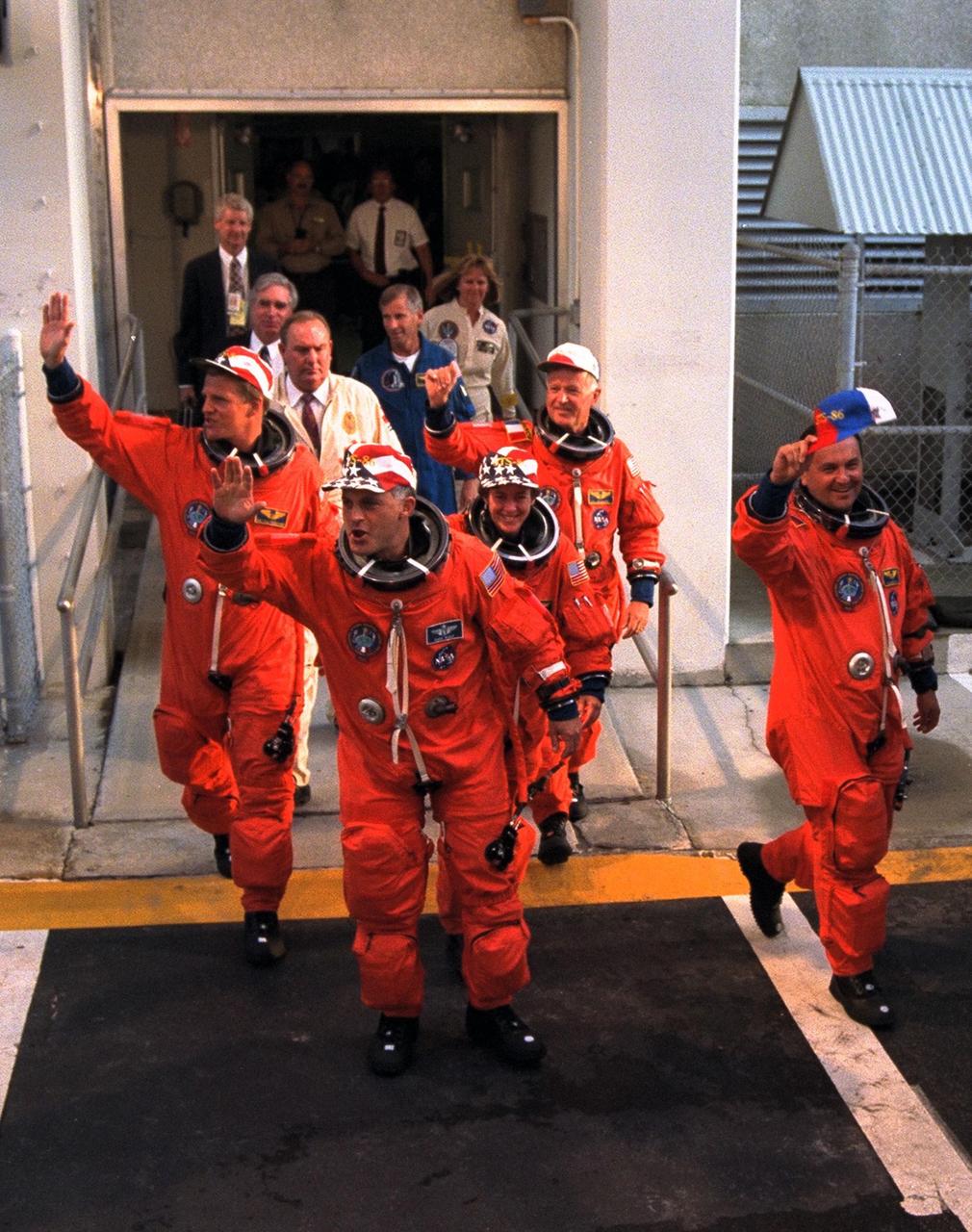
The five STS-86 mission specialists wave to the crowd of press representatives, KSC employees and other well-wishers as they depart from the Operations and Checkout Building. The three U.S. mission specialists (and their nicknames for this flight) are, from left, "too tall" Scott E. Parazynski, "just right" David A. Wolf and "too short" Wendy B. Lawrence. The two mission specialists representing foreign space agencies are Vladimir Georgievich Titov of the Russian Space Agency, in foreground at right, and Jean-Loup J.M. Chretien of the French Space Agency, CNES, in background at right. Commander James D. Wetherbee and Pilot Michael J. Bloomfield are out of the frame. STS-86 is slated to be the seventh docking of the Space Shuttle with the Russian Space Station Mir. Wolf is scheduled to transfer to the Mir 24 crew for an approximate four-month stay aboard the Russian space station. Parazynski and Lawrence were withdrawn from training for an extended stay aboard the Mir Parazynski because he was too tall to fit safely in a Russian Soyuz spacecraft, and Lawrence because she was too short to fit into a Russian spacewalk suit. The crew is en route to Launch Pad 39A, where the Space Shuttle Atlantis awaits liftoff on the planned 10-day mission
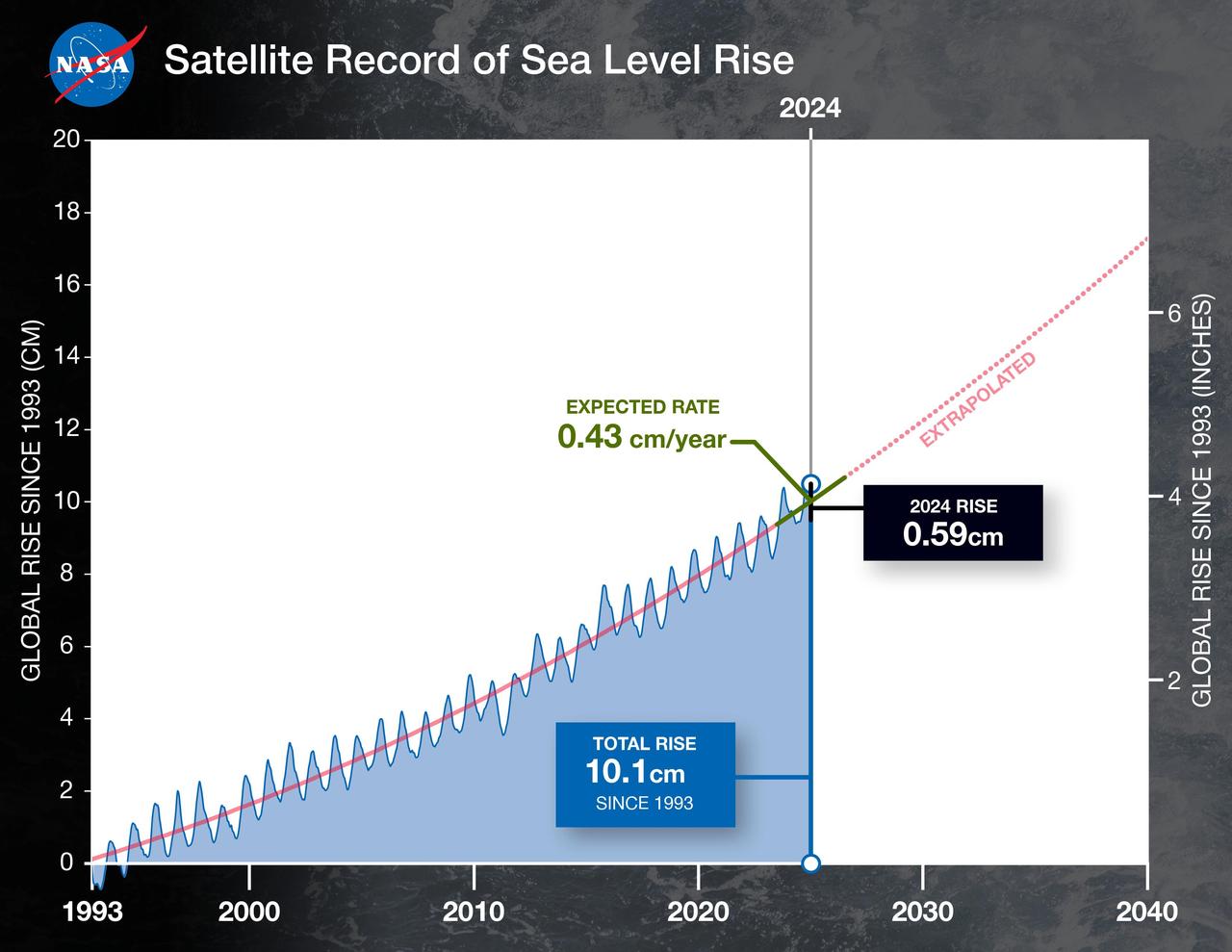
This graph shows the rise in global mean sea level from 1993 to 2024 based on data from a series of five international satellites. The solid red line indicates the trajectory of this increase, which has more than doubled over the three decades. The dotted red line projects future sea level rise. Global sea level rose faster than expected in 2024 due mostly to ocean water expanding as it warms, or thermal expansion. According to a NASA-led analysis, last year's rate of rise was 0.23 inches (0.59 centimeters) per year, compared to the expected rate of 0.17 inches (0.43 centimeters) per year. In recent years, about two-thirds of sea level rise was due to the addition of water from land into the ocean by melting ice sheets and glaciers. About a third came from thermal expansion of seawater. But in 2024, those contributions flipped, with two-thirds of sea level rise coming from thermal expansion. This NASA-led analysis is based on a sea level dataset featuring more than 30 years of satellite observations, starting with the U.S.-French TOPEX/Poseidon mission, which launched in 1992. The Sentinel-6 Michael Freilich mission, which launched in November 2020, is the latest in the series of satellites that have contributed to this sea level record. https://photojournal.jpl.nasa.gov/catalog/PIA26189

This graph shows the rise in global mean sea level from 1993 to 2023 based on data from a series of five international satellites. The solid red line indicates the trajectory of this increase, which has more than doubled over the three decades. The dotted red line projects future sea level rise. The relatively large jump in sea level from 2022 to 2023, a rise of about 0.3 inches (0.76 centimeters), is due mostly to a warming climate and the development of a strong El Niño. The 2022-2023 rise is equivalent to draining a quarter of Lake Superior into the ocean over the course of a year. This NASA-led analysis is based on a sea level data set featuring more than 30 years of satellite observations, starting with the U.S.-French TOPEX/Poseidon mission, which launched in 1992. The Sentinel-6 Michael Freilich mission, which launched in November 2020, is the latest in the series of satellites that have contributed to this sea level record. https://photojournal.jpl.nasa.gov/catalog/PIA26183
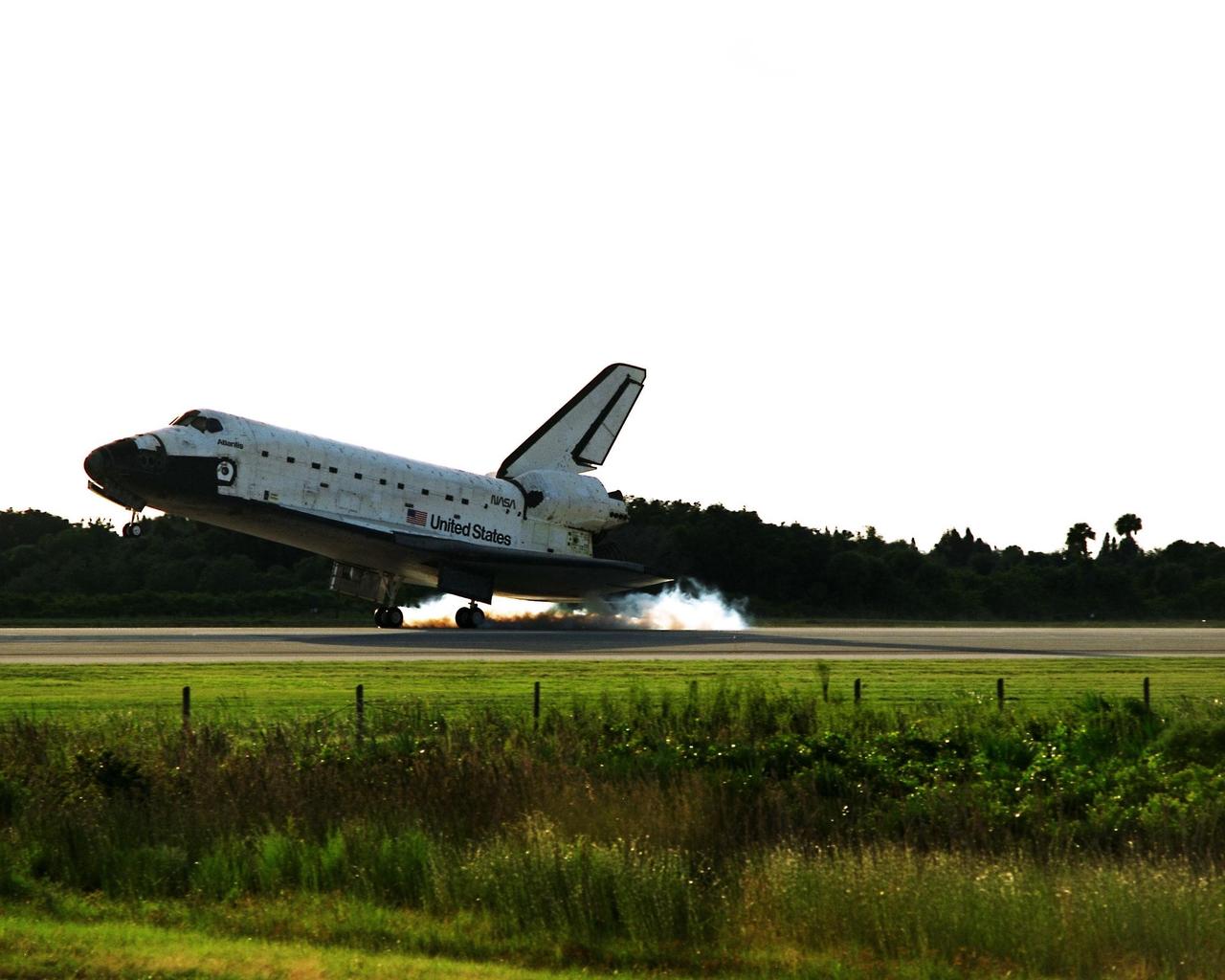
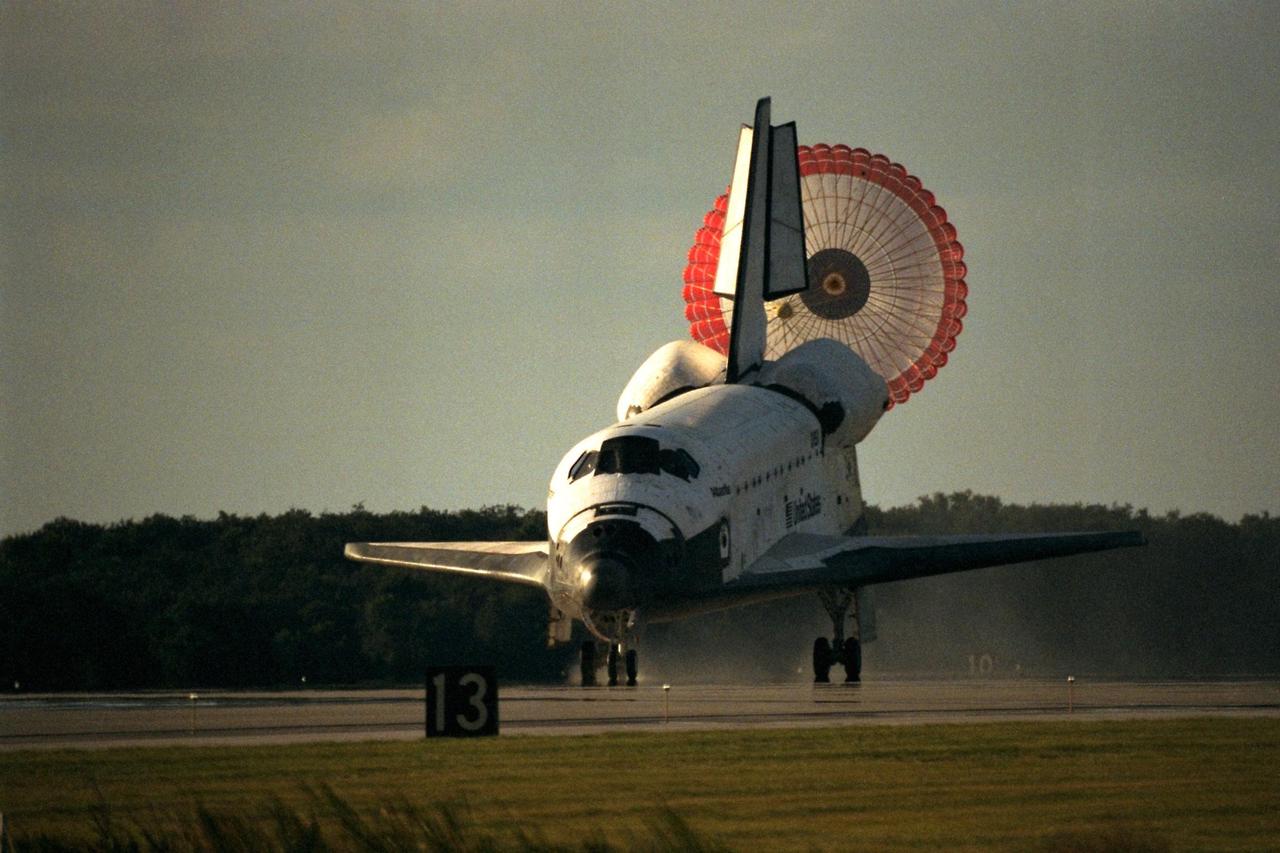
KENNEDY SPACE CENTER, Fla. -- The orbiter drag chute deploys after the Space Shuttle orbiter Atlantis lands on Runway 15 of the KSC Shuttle Landing Facility (SLF) at the conclusion of the nearly 11-day STS-86 mission. Main gear touchdown was at 5:55:09 p.m. EDT, Oct. 6, 1997, with an unofficial mission-elapsed time of 10 days, 19 hours, 20 minutes and 50 seconds. The first two KSC landing opportunities on Sunday were waved off because of weather concerns. The 87th Space Shuttle mission was the 40th landing of the Shuttle at KSC. On Sunday evening, the Space Shuttle program reached a milestone: The total flight time of the Shuttle passed the two-year mark. STS86 was the seventh of nine planned dockings of the Space Shuttle with the Russian Space Station Mir. STS-86 Mission Specialist David A. Wolf replaced NASA astronaut and Mir 24 crew member C. Michael Foale, who has been on the Mir since mid-May. Foale returned to Earth on Atlantis with the remainder of the STS-86 crew. The other crew members are Commander James D. Wetherbee, Pilot Michael J. Bloomfield, and Mission Specialists Wendy B. Lawrence, Scott E. Parazynski, Vladimir Georgievich Titov of the Russian Space Agency, and Jean-Loup J.M. Chretien of the French Space Agency, CNES. Wolf is scheduled to remain on the Mir until the STS-89 Shuttle mission in January. Besides the docking and crew exchange, STS-86 included the transfer of more than three-and-a-half tons of science/logistical equipment and supplies between the two orbiting spacecraft. Parazynski and Titov also conducted a spacewalk while Atlantis and the Mir were docked
KENNEDY SPACE CENTER, Fla. -- The orbiter drag chute deploys after the Space Shuttle orbiter Atlantis lands on Runway 15 of the KSC Shuttle Landing Facility (SLF) at the conclusion of the nearly 11-day STS-86 mission. Main gear touchdown was at 5:55:09 p.m. EDT, Oct. 6, 1997, with an unofficial mission-elapsed time of 10 days, 19 hours, 20 minutes and 50 seconds. The first two KSC landing opportunities on Sunday were waved off because of weather concerns. The 87th Space Shuttle mission was the 40th landing of the Shuttle at KSC. On Sunday evening, the Space Shuttle program reached a milestone: The total flight time of the Shuttle passed the two-year mark. STS86 was the seventh of nine planned dockings of the Space Shuttle with the Russian Space Station Mir. STS-86 Mission Specialist David A. Wolf replaced NASA astronaut and Mir 24 crew member C. Michael Foale, who has been on the Mir since mid-May. Foale returned to Earth on Atlantis with the remainder of the STS-86 crew. The other crew members are Commander James D. Wetherbee, Pilot Michael J. Bloomfield, and Mission Specialists Wendy B. Lawrence, Scott E. Parazynski, Vladimir Georgievich Titov of the Russian Space Agency, and Jean-Loup J.M. Chretien of the French Space Agency, CNES. Wolf is scheduled to remain on the Mir until the STS-89 Shuttle mission in January. Besides the docking and crew exchange, STS-86 included the transfer of more than three-and-a-half tons of science/logistical equipment and supplies between the two orbiting spacecraft. Parazynski and Titov also conducted a spacewalk while Atlantis and the Mir were docked
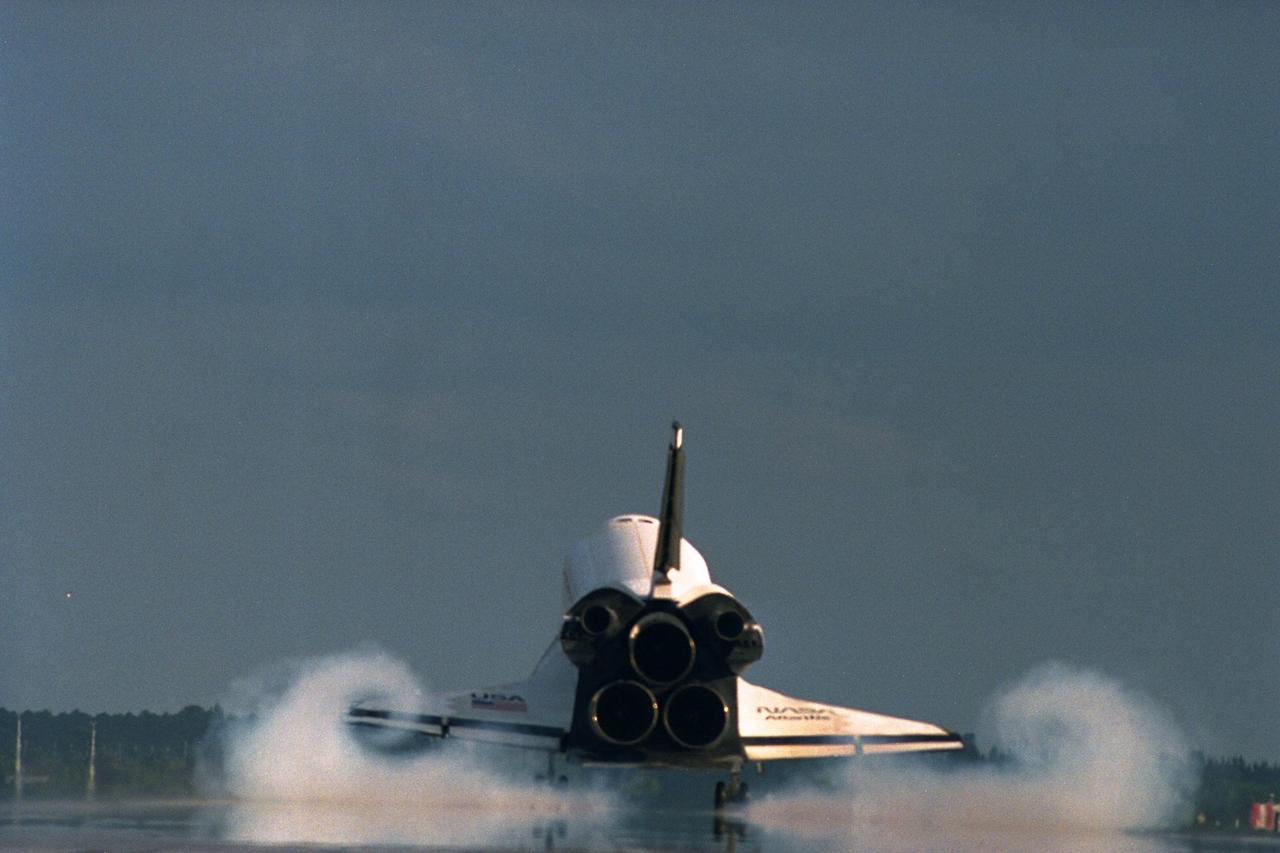
KENNEDY SPACE CENTER, Fla. -- The Space Shuttle orbiter Atlantis touches down on Runway 15 of the KSC Shuttle Landing Facility (SLF) to complete the nearly 11-day STS-86 mission. Main gear touchdown was at 5:55:09 p.m. EDT on Oct. 6, 1997. The unofficial mission-elapsed time at main gear touchdown was 10 days, 19 hours, 20 minutes and 50 seconds. The first two landing opportunities on Sunday were waved off because of weather concerns. The 87th Space Shuttle mission was the 40th landing of the Shuttle at KSC. On Sunday evening, the Space Shuttle program reached a milestone: The total flight time of the Shuttle passed the two-year mark. STS-86 was the seventh of nine planned dockings of the Space Shuttle with the Russian Space Station Mir. STS-86 Mission Specialist David A. Wolf replaced NASA astronaut and Mir 24 crew member C. Michael Foale, who has been on the Mir since mid-May. Foale returned to Earth on Atlantis with the remainder of the STS-86 crew. The other crew members are Commander James D. Wetherbee, Pilot Michael J. Bloomfield, and Mission Specialists Wendy B. Lawrence, Scott E. Parazynski, Vladimir Georgievich Titov of the Russian Space Agency, and Jean-Loup J.M. Chretien of the French Space Agency, CNES. Wolf is scheduled to remain on the Mir until the STS-89 Shuttle mission in January. Besides the docking and crew exchange, STS-86 included the transfer of more than three-and-ahalf tons of science/logistical equipment and supplies between the two orbiting spacecraft. Parazynski and Titov also conducted a spacewalk while Atlantis and the Mir were docked
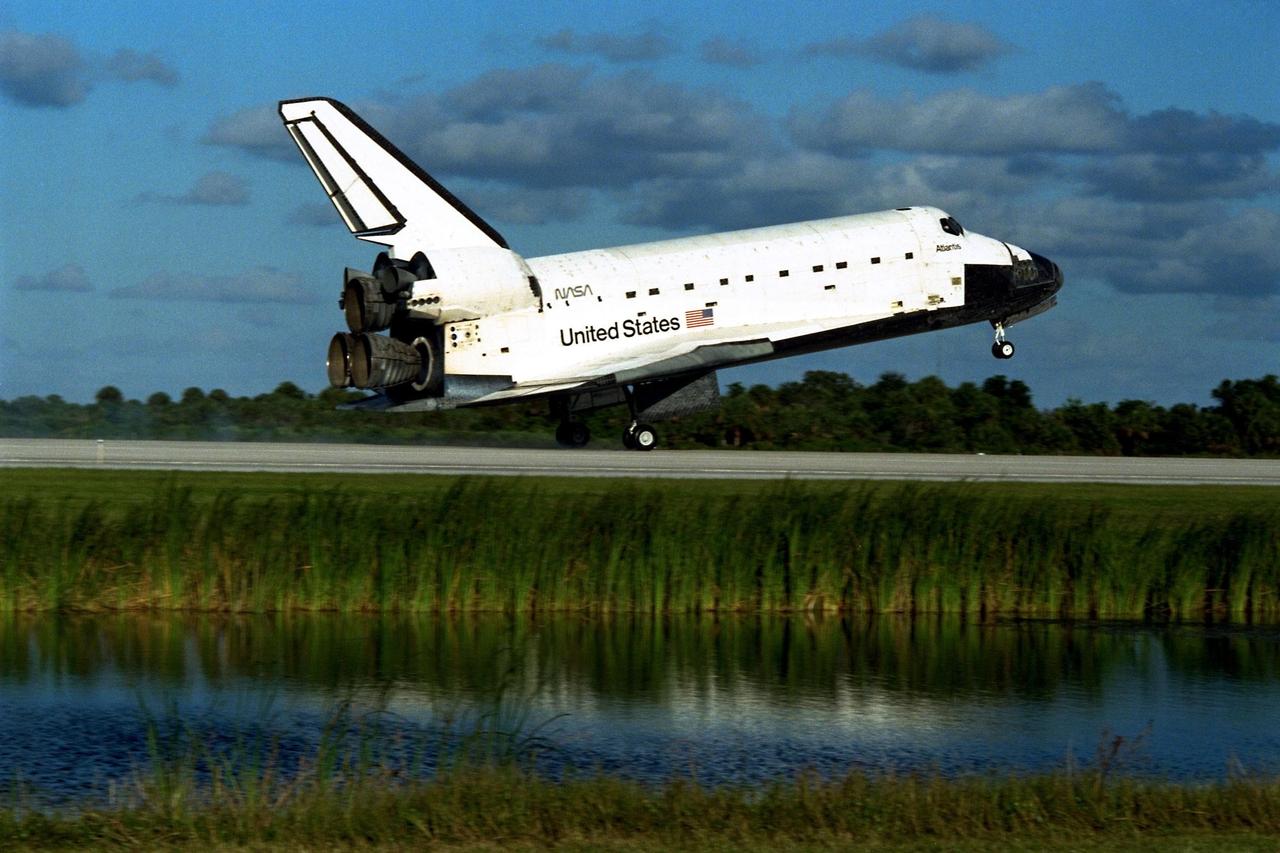
The Space Shuttle orbiter Atlantis touches down on Runway 15 of the KSC Shuttle Landing Facility (SLF) to complete the nearly 11-day STS-86 mission. Main gear touchdown was at 5:55:09 p.m. EDT on Oct. 6, 1997. The unofficial mission-elapsed time at main gear touchdown was 10 days, 19 hours, 20 minutes and 50 seconds. The first two landing opportunities on Sunday were waved off because of weather concerns. The 87th Space Shuttle mission was the 40th landing of the Shuttle at KSC. On Sunday evening, the Space Shuttle program reached a milestone: The total flight time of the Shuttle passed the two-year mark. STS-86 was the seventh of nine planned dockings of the Space Shuttle with the Russian Space Station Mir. STS-86 Mission Specialist David A. Wolf replaced NASA astronaut and Mir 24 crew member C. Michael Foale, who has been on the Mir since mid-May. Foale returned to Earth on Atlantis with the remainder of the STS-86 crew. The other crew members are Commander James D. Wetherbee, Pilot Michael J. Bloomfield, and Mission Specialists Wendy B. Lawrence, Scott E. Parazynski, Vladimir Georgievich Titov of the Russian Space Agency, and Jean-Loup J.M. Chretien of the French Space Agency, CNES. Wolf is scheduled to remain on the Mir until the STS-89 Shuttle mission in January. Besides the docking and crew exchange, STS-86 included the transfer of more than three-and-ahalf tons of science/logistical equipment and supplies between the two orbiting spacecraft. Parazynski and Titov also conducted a spacewalk while Atlantis and the Mir were docked
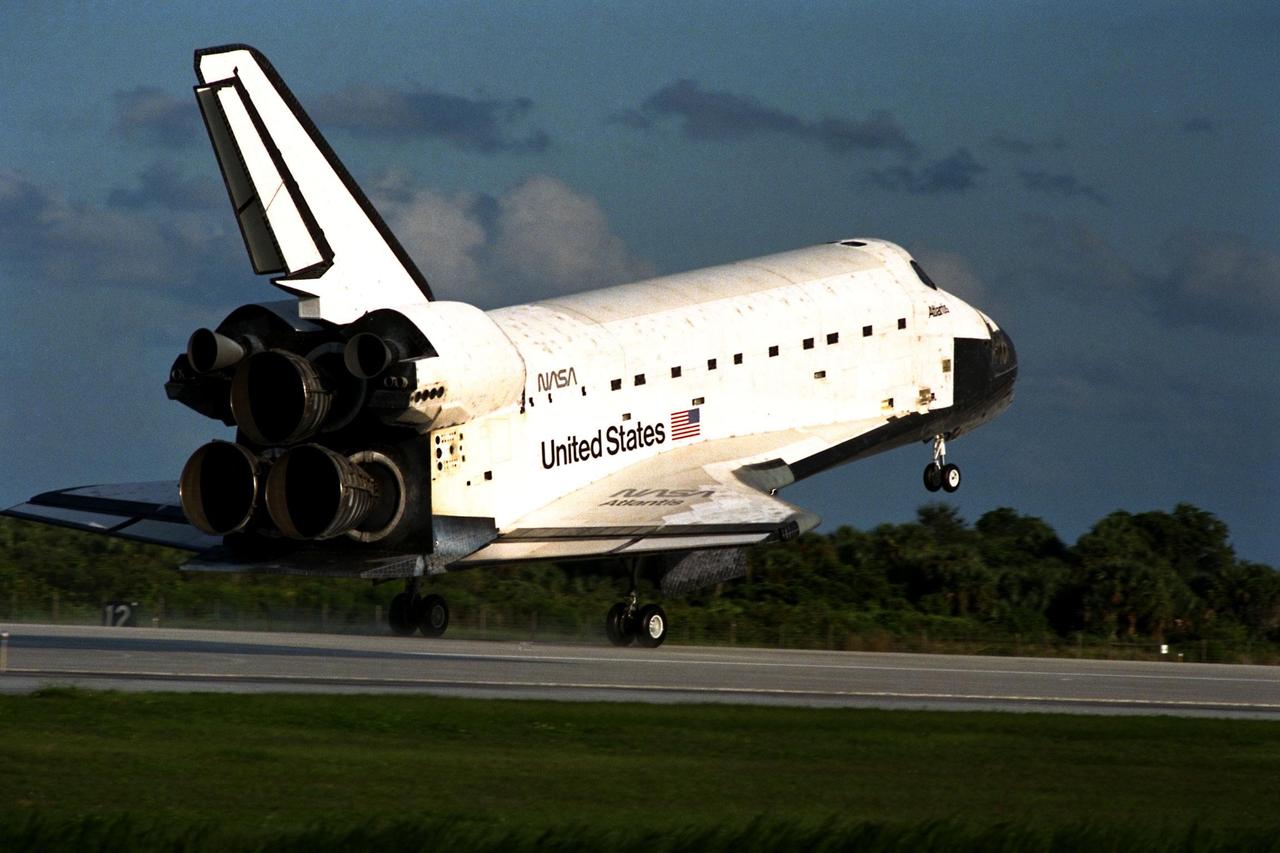
KENNEDY SPACE CENTER, Fla. -- The Space Shuttle orbiter Atlantis touches down on Runway 15 of the KSC Shuttle Landing Facility (SLF) to complete the nearly 11-day STS-86 mission. Main gear touchdown was at 5:55:09 p.m. EDT on Oct. 6, 1997. The unofficial mission-elapsed time at main gear touchdown was 10 days, 19 hours, 20 minutes and 50 seconds. The first two landing opportunities on Sunday were waved off because of weather concerns. The 87th Space Shuttle mission was the 40th landing of the Shuttle at KSC. On Sunday evening, the Space Shuttle program reached a milestone: The total flight time of the Shuttle passed the two-year mark. STS-86 was the seventh of nine planned dockings of the Space Shuttle with the Russian Space Station Mir. STS-86 Mission Specialist David A. Wolf replaced NASA astronaut and Mir 24 crew member C. Michael Foale, who has been on the Mir since mid-May. Foale returned to Earth on Atlantis with the remainder of the STS-86 crew. The other crew members are Commander James D. Wetherbee, Pilot Michael J. Bloomfield, and Mission Specialists Wendy B. Lawrence, Scott E. Parazynski, Vladimir Georgievich Titov of the Russian Space Agency, and Jean-Loup J.M. Chretien of the French Space Agency, CNES. Wolf is scheduled to remain on the Mir until the STS-89 Shuttle mission in January. Besides the docking and crew exchange, STS-86 included the transfer of more than three-and-ahalf tons of science/logistical equipment and supplies between the two orbiting spacecraft. Parazynski and Titov also conducted a spacewalk while Atlantis and the Mir were docked
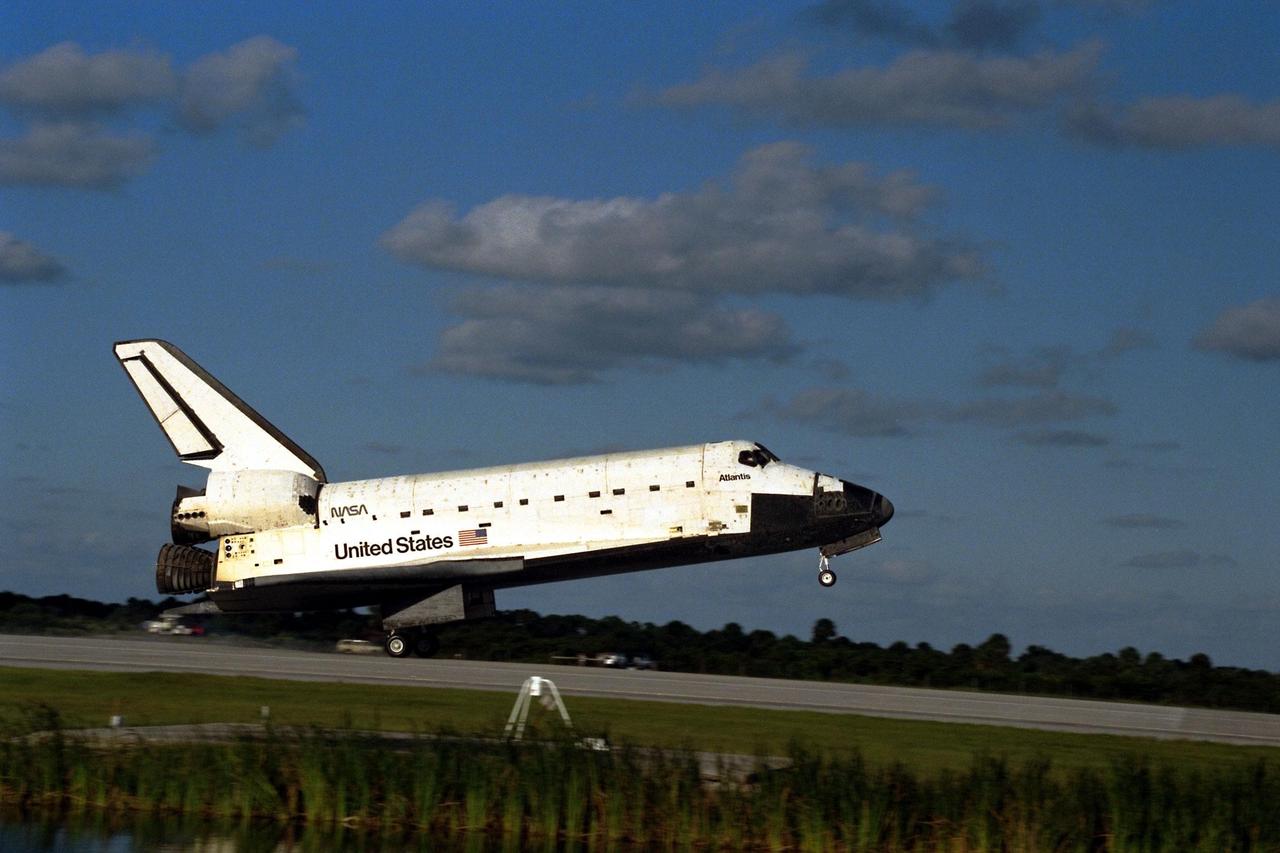
The Space Shuttle orbiter Atlantis touches down on Runway 15 of the KSC Shuttle Landing Facility (SLF) to complete the nearly 11-day STS-86 mission. Main gear touchdown was at 5:55:09 p.m. EDT on Oct. 6, 1997. The unofficial mission-elapsed time at main gear touchdown was 10 days, 19 hours, 20 minutes and 50 seconds. The first two landing opportunities on Sunday were waved off because of weather concerns. The 87th Space Shuttle mission was the 40th landing of the Shuttle at KSC. On Sunday evening, the Space Shuttle program reached a milestone: The total flight time of the Shuttle passed the two-year mark. STS-86 was the seventh of nine planned dockings of the Space Shuttle with the Russian Space Station Mir. STS-86 Mission Specialist David A. Wolf replaced NASA astronaut and Mir 24 crew member C. Michael Foale, who has been on the Mir since mid-May. Foale returned to Earth on Atlantis with the remainder of the STS-86 crew. The other crew members are Commander James D. Wetherbee, Pilot Michael J. Bloomfield, and Mission Specialists Wendy B. Lawrence, Scott E. Parazynski, Vladimir Georgievich Titov of the Russian Space Agency, and Jean-Loup J.M. Chretien of the French Space Agency, CNES. Wolf is scheduled to remain on the Mir until the STS-89 Shuttle mission in January. Besides the docking and crew exchange, STS-86 included the transfer of more than three-and-ahalf tons of science/logistical equipment and supplies between the two orbiting spacecraft. Parazynski and Titov also conducted a spacewalk while Atlantis and the Mir were docked
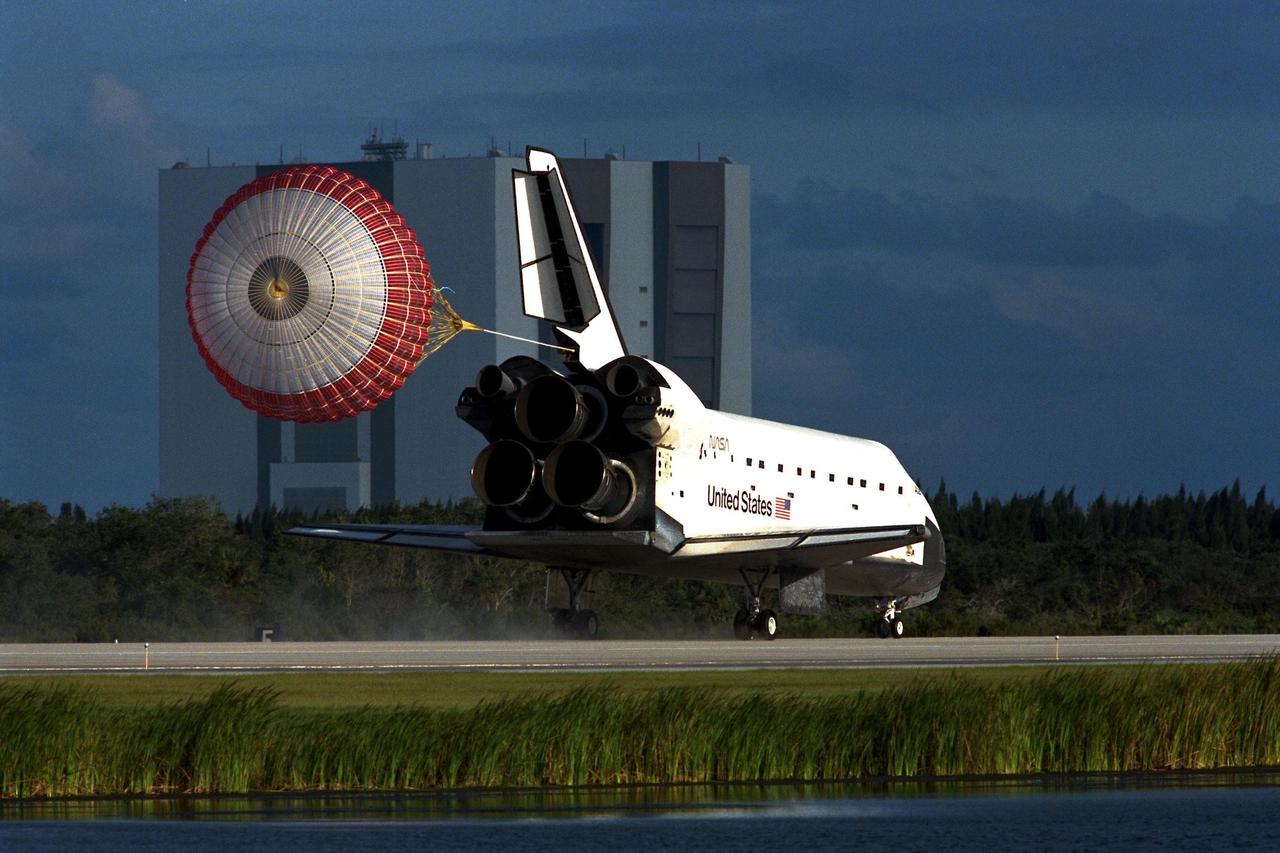
KENNEDY SPACE CENTER, Fla. -- The orbiter drag chute deploys after the Space Shuttle orbiter Atlantis lands on Runway 15 of the KSC Shuttle Landing Facility (SLF) at the conclusion of the nearly 11-day STS-86 mission. The Vehicle Assembly Building (VAB) can be seen in the background. Main gear touchdown was at 5:55:09 p.m. EDT, Oct. 6, 1997, with an unofficial mission-elapsed time of 10 days, 19 hours, 20 minutes and 50 seconds. The first two KSC landing opportunities on Sunday were waved off because of weather concerns. The 87th Space Shuttle mission was the 40th landing of the Shuttle at KSC. On Sunday evening, the Space Shuttle program reached a milestone: The total flight time of the Shuttle passed the two-year mark. STS86 was the seventh of nine planned dockings of the Space Shuttle with the Russian Space Station Mir. STS-86 Mission Specialist David A. Wolf replaced NASA astronaut and Mir 24 crew member C. Michael Foale, who has been on the Mir since mid-May. Foale returned to Earth on Atlantis with the remainder of the STS-86 crew. The other crew members are Commander James D. Wetherbee, Pilot Michael J. Bloomfield, and Mission Specialists Wendy B. Lawrence, Scott E. Parazynski, Vladimir Georgievich Titov of the Russian Space Agency, and Jean-Loup J.M. Chretien of the French Space Agency, CNES. Wolf is scheduled to remain on the Mir until the STS-89 Shuttle mission in January. Besides the docking and crew exchange, STS-86 included the transfer of more than three-and-a-half tons of science/logistical equipment and supplies between the two orbiting spacecraft. Parazynski and Titov also conducted a spacewalk while Atlantis and the Mir were docked
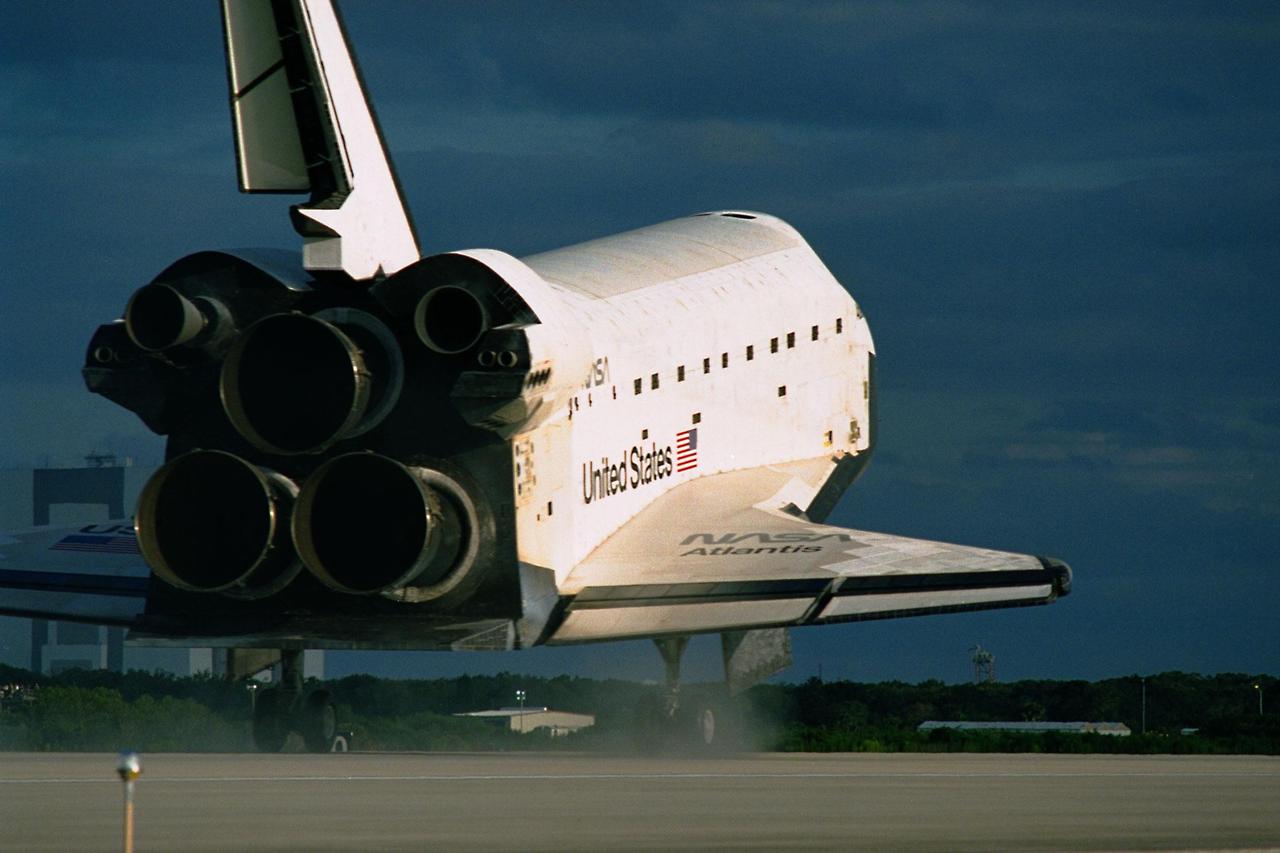
The Space Shuttle orbiter Atlantis touches down on Runway 15 of the KSC Shuttle Landing Facility (SLF) to complete the nearly 11-day STS-86 mission. Main gear touchdown was at 5:55:09 p.m. EDT on Oct. 6, 1997. The unofficial mission-elapsed time at main gear touchdown was 10 days, 19 hours, 20 minutes and 50 seconds. The first two landing opportunities on Sunday were waved off because of weather concerns. The 87th Space Shuttle mission was the 40th landing of the Shuttle at KSC. On Sunday evening, the Space Shuttle program reached a milestone: The total flight time of the Shuttle passed the two-year mark. STS-86 was the seventh of nine planned dockings of the Space Shuttle with the Russian Space Station Mir. STS-86 Mission Specialist David A. Wolf replaced NASA astronaut and Mir 24 crew member C. Michael Foale, who has been on the Mir since mid-May. Foale returned to Earth on Atlantis with the remainder of the STS-86 crew. The other crew members are Commander James D. Wetherbee, Pilot Michael J. Bloomfield, and Mission Specialists Wendy B. Lawrence, Scott E. Parazynski, Vladimir Georgievich Titov of the Russian Space Agency, and Jean-Loup J.M. Chretien of the French Space Agency, CNES. Wolf is scheduled to remain on the Mir until the STS-89 Shuttle mission in January. Besides the docking and crew exchange, STS-86 included the transfer of more than three-and-ahalf tons of science/logistical equipment and supplies between the two orbiting spacecraft. Parazynski and Titov also conducted a spacewalk while Atlantis and the Mir were docked
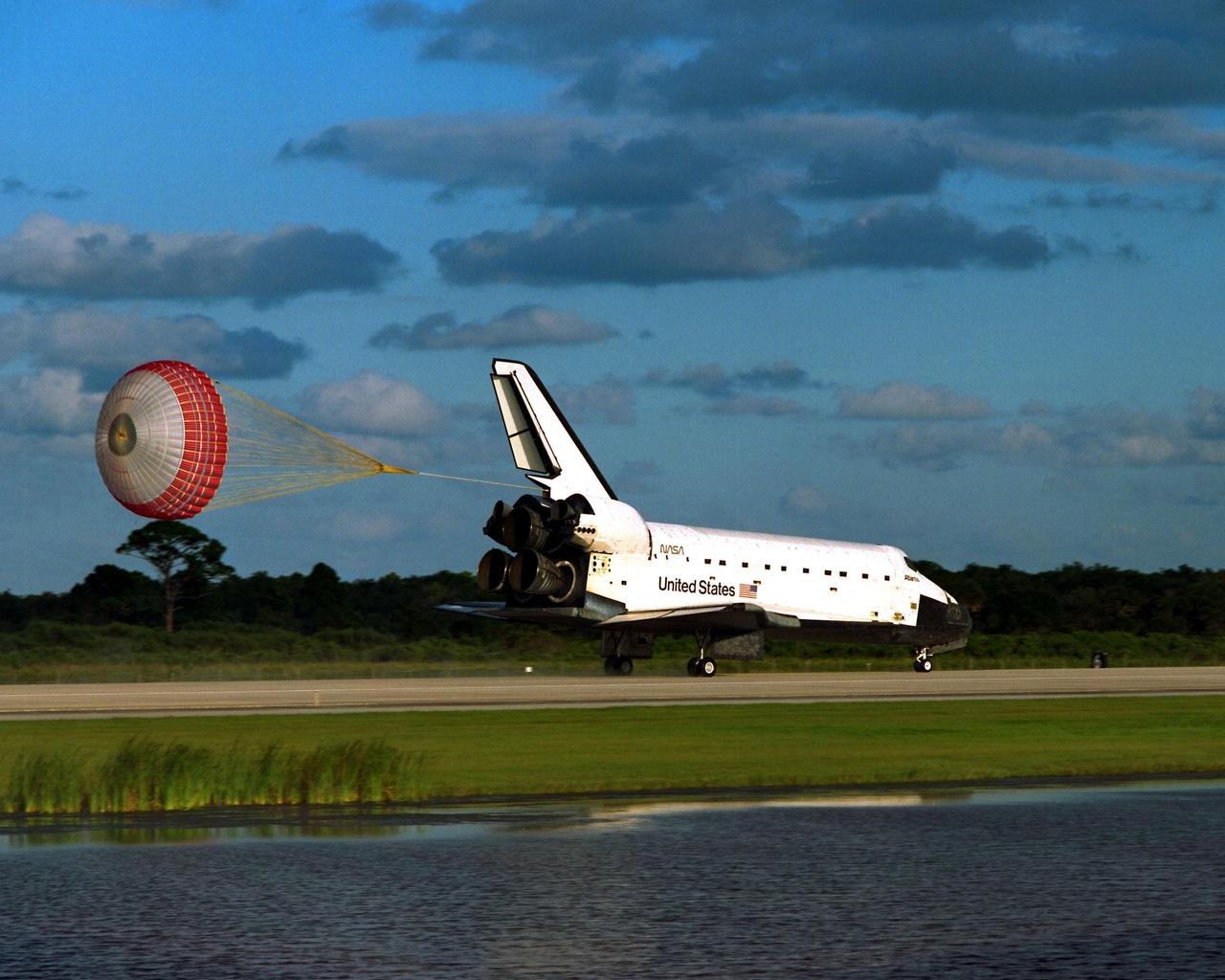
KENNEDY SPACE CENTER, Fla. -- The orbiter drag chute deploys after the Space Shuttle orbiter Atlantis lands on Runway 15 of the KSC Shuttle Landing Facility (SLF) at the conclusion of the nearly 11-day STS-86 mission. Main gear touchdown was at 5:55:09 p.m. EDT, Oct. 6, 1997, with an unofficial mission-elapsed time of 10 days, 19 hours, 20 minutes and 50 seconds. The first two KSC landing opportunities on Sunday were waved off because of weather concerns. The 87th Space Shuttle mission was the 40th landing of the Shuttle at KSC. On Sunday evening, the Space Shuttle program reached a milestone: The total flight time of the Shuttle passed the two-year mark. STS86 was the seventh of nine planned dockings of the Space Shuttle with the Russian Space Station Mir. STS-86 Mission Specialist David A. Wolf replaced NASA astronaut and Mir 24 crew member C. Michael Foale, who has been on the Mir since mid-May. Foale returned to Earth on Atlantis with the remainder of the STS-86 crew. The other crew members are Commander James D. Wetherbee, Pilot Michael J. Bloomfield, and Mission Specialists Wendy B. Lawrence, Scott E. Parazynski, Vladimir Georgievich Titov of the Russian Space Agency, and Jean-Loup J.M. Chretien of the French Space Agency, CNES. Wolf is scheduled to remain on the Mir until the STS-89 Shuttle mission in January. Besides the docking and crew exchange, STS-86 included the transfer of more than three-and-a-half tons of science/logistical equipment and supplies between the two orbiting spacecraft. Parazynski and Titov also conducted a spacewalk while Atlantis and the Mir were docked
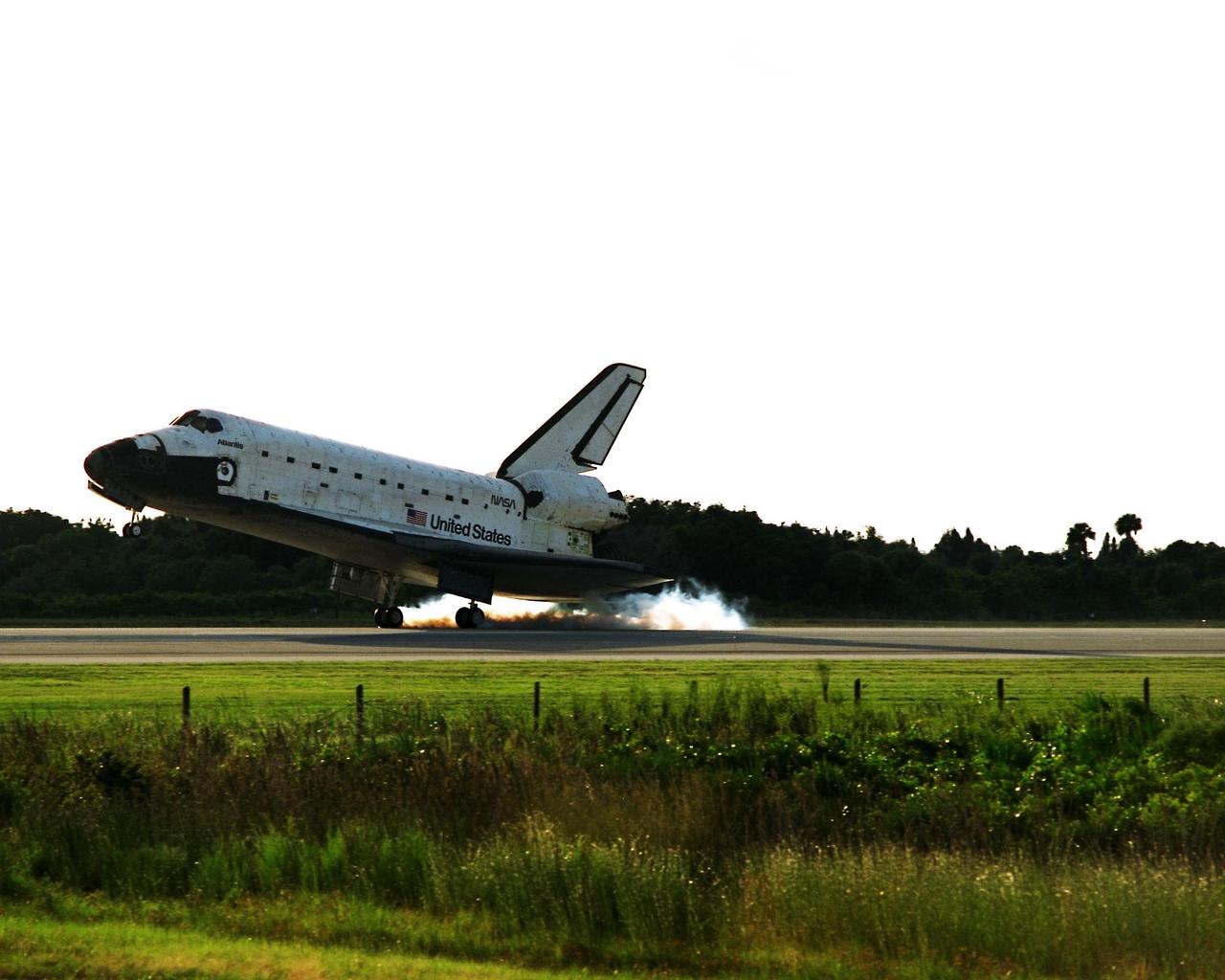
KENNEDY SPACE CENTER, Fla. -- The Space Shuttle orbiter Atlantis touches down on Runway 15 of the KSC Shuttle Landing Facility (SLF) to complete the nearly 11-day STS-86 mission. Main gear touchdown was at 5:55:09 p.m. EDT on Oct. 6, 1997. The unofficial mission-elapsed time at main gear touchdown was 10 days, 19 hours, 20 minutes and 50 seconds. The first two landing opportunities on Sunday were waved off because of weather concerns. The 87th Space Shuttle mission was the 40th landing of the Shuttle at KSC. On Sunday evening, the Space Shuttle program reached a milestone: The total flight time of the Shuttle passed the two-year mark. STS-86 was the seventh of nine planned dockings of the Space Shuttle with the Russian Space Station Mir. STS-86 Mission Specialist David A. Wolf replaced NASA astronaut and Mir 24 crew member C. Michael Foale, who has been on the Mir since mid-May. Foale returned to Earth on Atlantis with the remainder of the STS-86 crew. The other crew members are Commander James D. Wetherbee, Pilot Michael J. Bloomfield, and Mission Specialists Wendy B. Lawrence, Scott E. Parazynski, Vladimir Georgievich Titov of the Russian Space Agency, and Jean-Loup J.M. Chretien of the French Space Agency, CNES. Wolf is scheduled to remain on the Mir until the STS-89 Shuttle mission in January. Besides the docking and crew exchange, STS-86 included the transfer of more than three-and-ahalf tons of science/logistical equipment and supplies between the two orbiting spacecraft. Parazynski and Titov also conducted a spacewalk while Atlantis and the Mir were docked

NASA personnel and members of the public watch as a wreath is laid at the Tomb of the Unknowns by NASA Administrator Charles Bolden as part of NASA's Day of Remembrance, Friday, Jan. 31, 2014, at Arlington National Cemetery. The wreaths were laid in memory of those men and women who lost their lives in the quest for space exploration. Photo Credit: (NASA/Bill Ingalls)

Photographs documenting International Space Station (ISS) Phase One activities at the Russian Space Agency's (RSA) Gagarin Cosmonaut Training Center, Korolov Mission Control Center and Zvezda; and ISS and Soyuz manufacturing at RSA's Khrunichev Design Center and RSC Energiya in Moscow, Russia, the French Space Agency's (CNES) INTESPACE facility in Toulouse, France, and the Italian Space Agency's (ASI) Alenia Spazio facility in Torino, Italy. Photographs were taken by Johnson Space Center Imagery and Publications Office contractors travelling from October 7 to November 4, 1996. Includes: VIEWS FROM RSC ENERGIYA'S SPACE MUSEUM: Room with a Buran model and photographic displays (17372-374). Salyut Space Station mock-up (17376). Russian propulsion engines on display (17377-378). Russian spacecraft on display (17375, 17387-398). Graphic displays (17399-405). VIEWS FROM RSC ENERGIYA MANUFACTURING FACILITIES: Unidentified facility (17379). Mir 24 crew member Michael C. Foale, suited in a Soyuz pressure suit, ingresses the Soyuz TM-26 flight article at RSC Energiya for a fit check (17380-381). Closeups of Foale inside the Soyuz during the fit check (17382-383, 17466-467). Overhead views of RSC Energiya's Building 444 manufacturing floor where docking modules and Soyuz TM spacecraft are built (17495-498). Technicians on the Building 444 manufacturing floor assembling probe and drogue docking modules (17499-500, 17504). Technicians assembling Soyuz spacecraft (17437-439). Views of other Soyuz spacecraft (17440-441). Androgynous Peripheral Docking System (APDS) mock-up (17501-503). Closeups of a control panel, possibly for the APDS mock-up (17519-528). VIEWS FROM ZVEZDA, RSA CONTRACTOR FOR SUIT DESIGN AND SOYUZ SEAT LINERS: Mir 24 crew member Foale dons a "penguin" flight suit for a fit check (17454-456). Zvezda personnel adjust Foale's Soyuz seat and seat liner (17442). Closeup of Foale, suited in a Soyuz pressure suit, sitting on a chair (17444). Zvezda personnel strap pressure-suited Foale into his Soyuz seat (17443, 17445, 17450). Views of Foale in his Soyuz seat during a pressurized pressure suit fit check (17451-453). Views looking into a vacuum chamber where Foale, wearing pressure suit, is strapped into his Soyuz seat (17466-467). Views of Zvezda personnel working at the vacuum chamber control station during the vacuum chamber suit test (17468-471). VIEWS FROM KHRUNICHEV DESIGN CENTER: Views of a green ISS Functional Cargo Block (FGB) test article on the manufacturing floor (17529, 17532-536, 17540-544). Views of an ISS Service Module (SM) test article on the manufacturing floor (17530-531, 17537, 17539). Closeup of the SM test article docking sphere (17538). Views of the FGB flight article on the manufacturing floor during systems tests (17545-548, 17550-567). Views of technicians conducting the FGB systems tests (17549, 17557). VIEWS FROM GAGARIN COSMONAUT TRAINING CENTER: NASA astronauts work out in the cosmonaut gym at Gagarin: Closeup of ISS 2R Expedition Commander William Shepherd on a weight machine (17384). Shepherd and an unidentified man with back to camera work out with dumbbells (17386). Shepherd does pull-ups (17447). Closeup of Foale on an exercise machine (17385). Closeups of Foale exercising arms on a cycle ergometer and a weight machine (17415, 17448-449). Foale exercises on a Nordic Track (17416). Closeup of Mir 23 crew member Jerry Linenger exercising arms (17417). Wendy Lawrence exercises with dumbbells (17418). Closeup of Lawrence in a handstand position (17419). David Wolf works out on a leg press machine (17446). Views of the Mir Space Station mock-up at Gagarin: Interior views of the Mir Base Module mock-up looking toward the transfer compartment (17421-425). Mir Base Module living area mock-up (17420). Overall views of the Base Module mock-up central control station (17426-427, 17505). Closeups of switch panels on the central control station (17428-436, 17506-518). Other views from Gagarin: Personnel work at an unidentified test/trainer control station (17472-473). Linenger sits at a table next to an RSA trainer during a Mir 23 meeting (17475-476). Out-of-focus view of two subjects in the Soyuz trainer (17474). Foale examines a Mir Complex EVA Suit (Orlan) with RSA trainers during an EVA suit training class (17492-494). VIEWS FROM KOROLOV MISSION CONTROL CENTER: Various views of personnel working in the NASA Consulting Room and/or PAO Consulting Room at Korolov Mission Control Center (17457-463). VIEWS FROM INTESPACE: Exterior views of an ISS Mini Pressurized Logistics Module (MPLM) structural test article (STA) during testing at INTESPACE (17406-409, 17477, 17482-484). Technicians install hatch on the MPLM STA (17410-414). Interior views of the MPLM STA (17478-481). VIEWS FROM ALENIA SPAZIO: Closeups of MPLM flight article #1 side panels during milling and refining at Alenia Spazio (17485-488). Workers process MPLM parts at milling machines (17489-491).