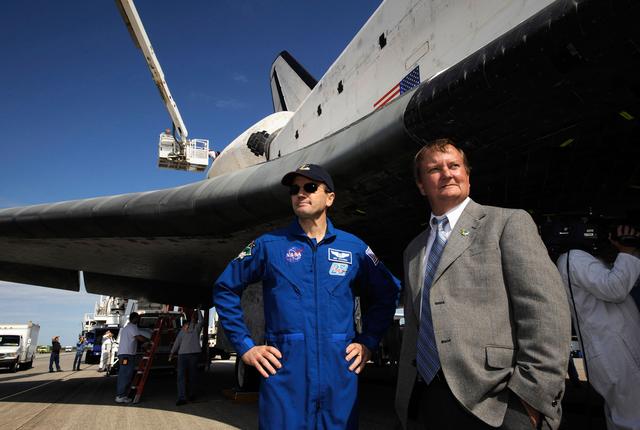
STS-122 Mission Specialist, Rex Walheim, left, and Shuttle Launch Director, Michael D. Leinbach take a moment to watch the close out crew work on the space shuttle Atlantis. Atlantis landed at the Shuttle Landing Facility, 9:07a.m., Wednesday, Feb. 20, 2008 at Kennedy Space Center, Fla. completing delivery of the European Space Agency’s (ESA) Columbus laboratory to the International Space Station. Photo Credit: (NASA/Bill Ingalls)
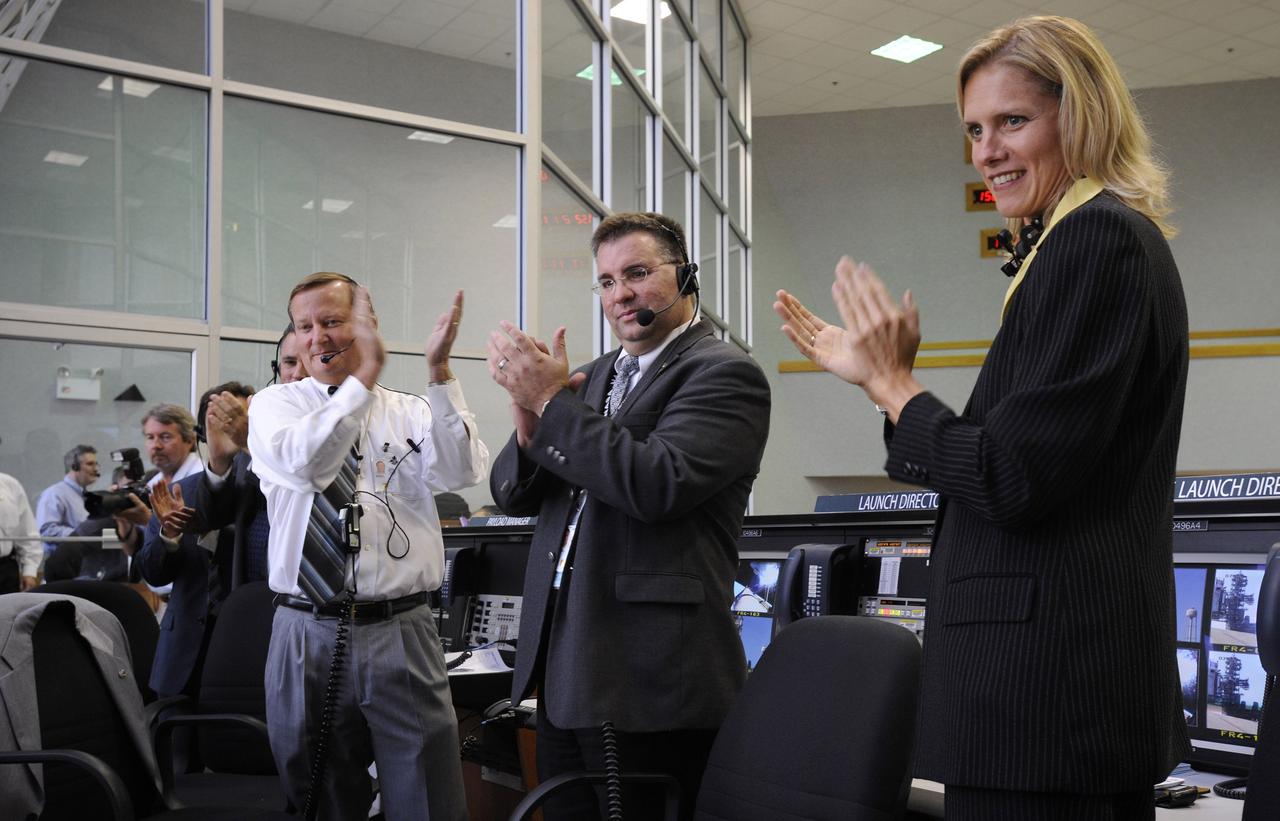
NASA Shuttle Launch Director Michael Leinbach, left, STS-124 Assistant Launch Director Ed Mango, center, and Flow Director for Space Shuttle Discovery Stephanie Stilson clap in the the Launch Control Center after the main engine cut off and successful launch of the Space Shuttle Discovery (STS-124) Saturday, May 31, 2008, at the Kennedy Space Center in Cape Canaveral, Fla. The Shuttle lifted off from launch pad 39A at 5:02 p.m. EDT. Photo Credit: (NASA/Bill Ingalls)
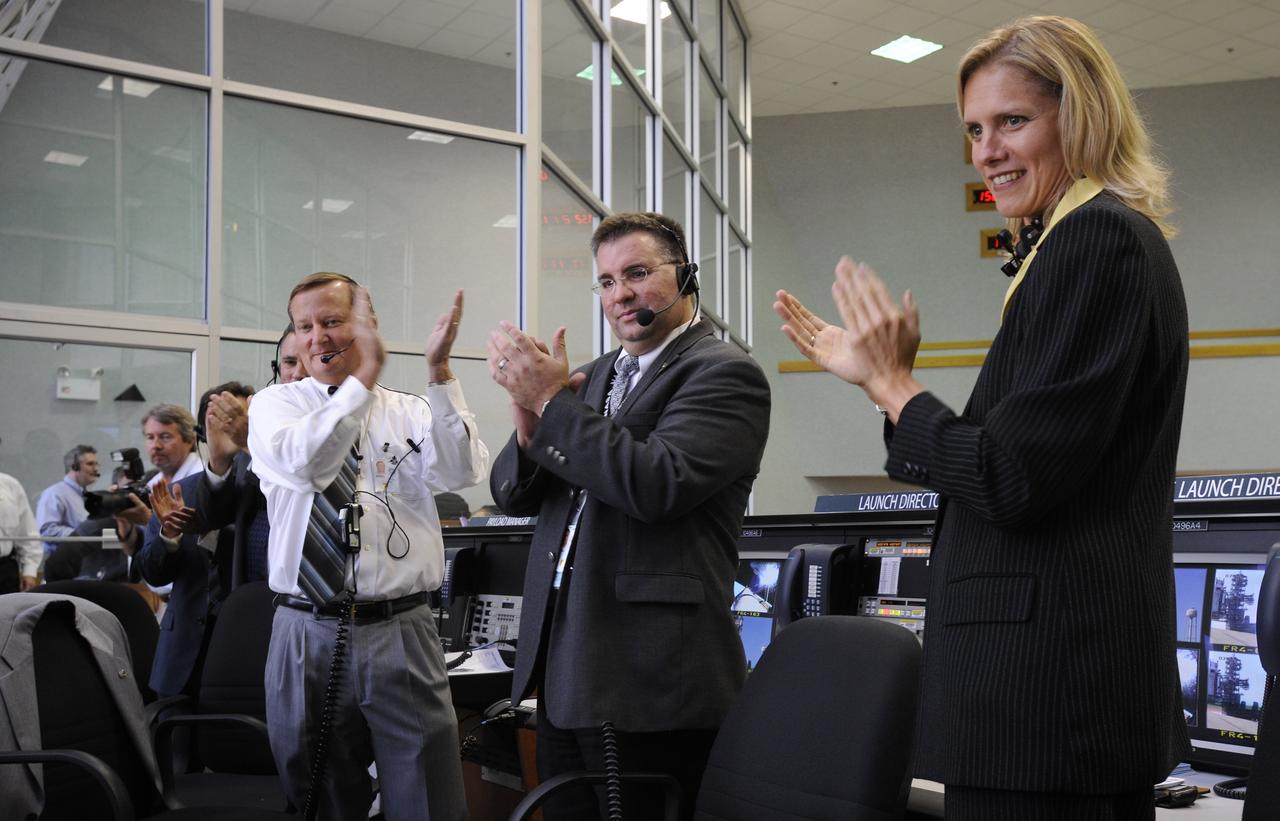
NASA Shuttle Launch Director Michael Leinbach, left, STS-124 Assistant Launch Director Ed Mango, center, and Flow Director for Space Shuttle Discovery Stephanie Stilson clap in the the Launch Control Center after the main engine cut off and successful launch of the Space Shuttle Discovery (STS-124) Saturday, May 31, 2008, at the Kennedy Space Center in Cape Canaveral, Fla. The Shuttle lifted off from launch pad 39A at 5:02 p.m. EDT. Photo Credit: (NASA/Bill Ingalls)
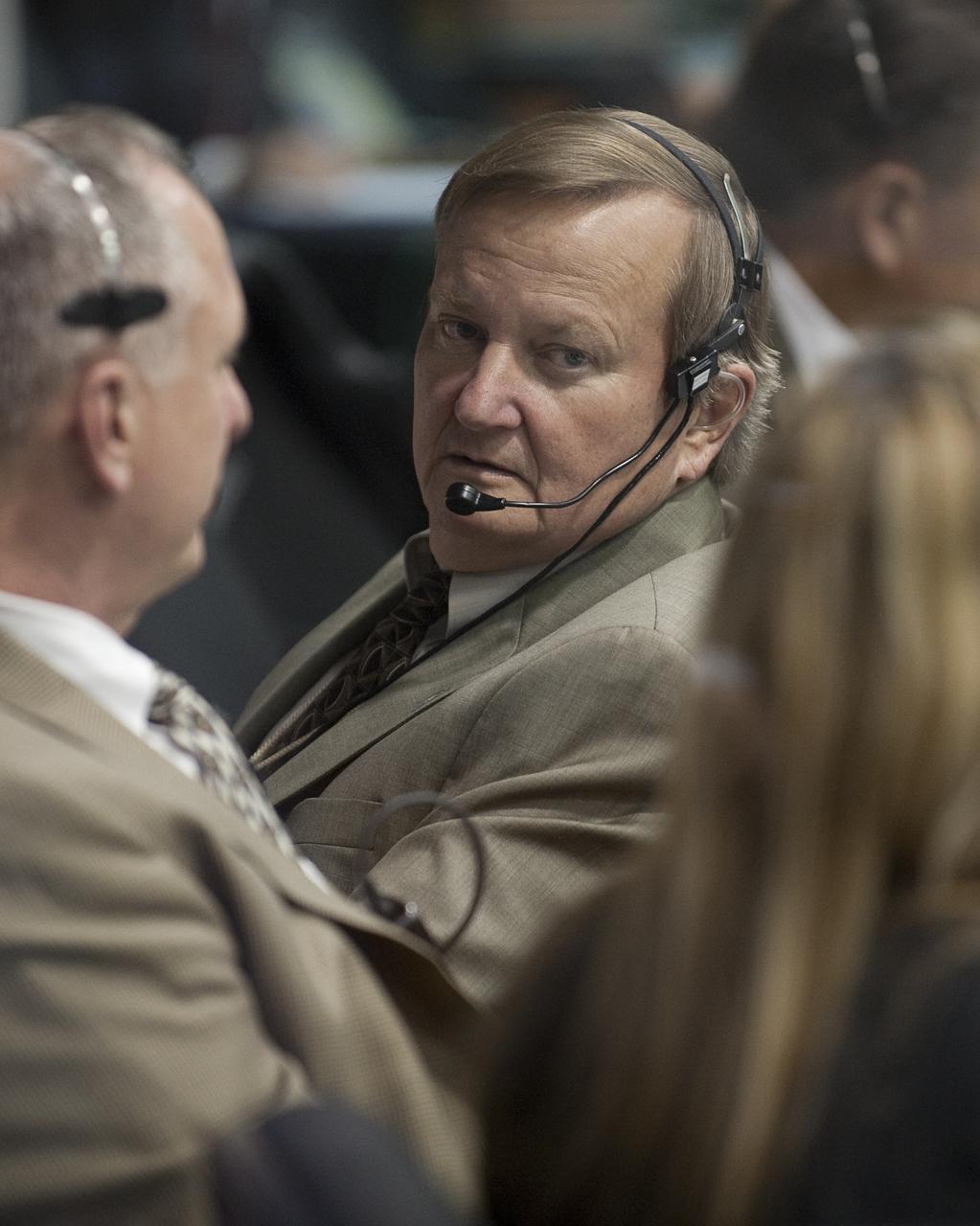
NASA Shuttle Launch Director Michael Leinbach talks with other launch managers in Firing Room Four of the Launch Control Center as they monitor the countdown of the launch of the space shuttle Endeavour and the start of the STS-130 mission at NASA Kennedy Space Center in Cape Canaveral, Fla. on Monday Feb. 8, 2010. Photo Credit: (NASA/Bill Ingalls)
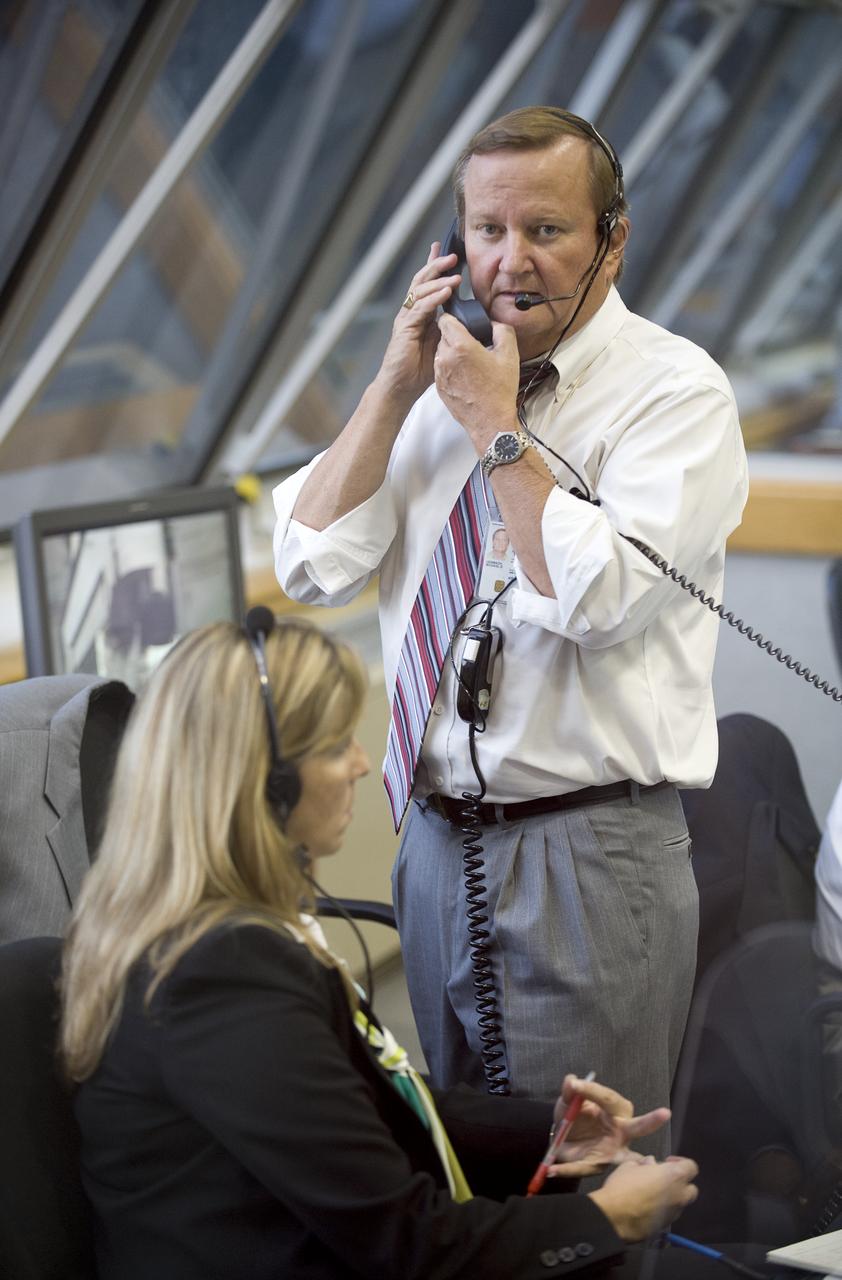
NASA Shuttle Launch Director Michael Leinbach talks on the phone from Firing Room Four of the Launch Control Center at NASA's Kennedy Space Center in Cape Canaveral, Florida, Sunday, July 12, 2009. THe space shuttle Endeavour is set to launch at 7:13p.m. EDT with the crew of STS-127 and start a 16-day mission that will feature five spacewalks and complete construction of the Japan Aerospace Exploration Agency's Kibo laboratory. Photo Credit: (NASA/Bill Ingalls)
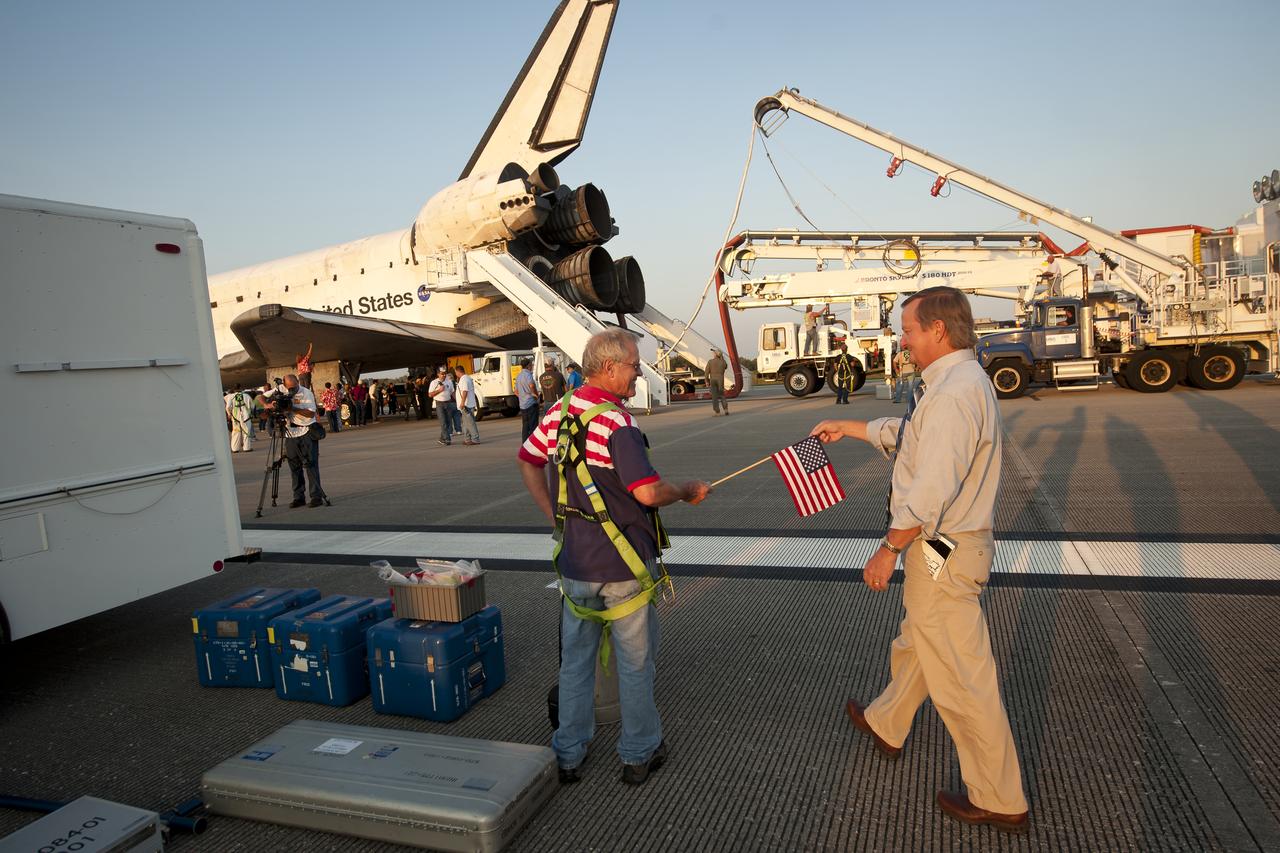
NASA Launch Director Michael Leinbach, right, hands an American flag to a worker on the runway of the Shuttle Landing Facility (SLF) shortly after the space shuttle Atlantis (STS-135) landed early Thursday morning, July 21, 2011, in Cape Canaveral, Fla. Overall, Atlantis spent 307 days in space and traveled nearly 126 million miles during its 33 flights. Atlantis, the fourth orbiter built, launched on its first mission on Oct. 3, 1985. Photo Credit: (NASA/Bill Ingalls)
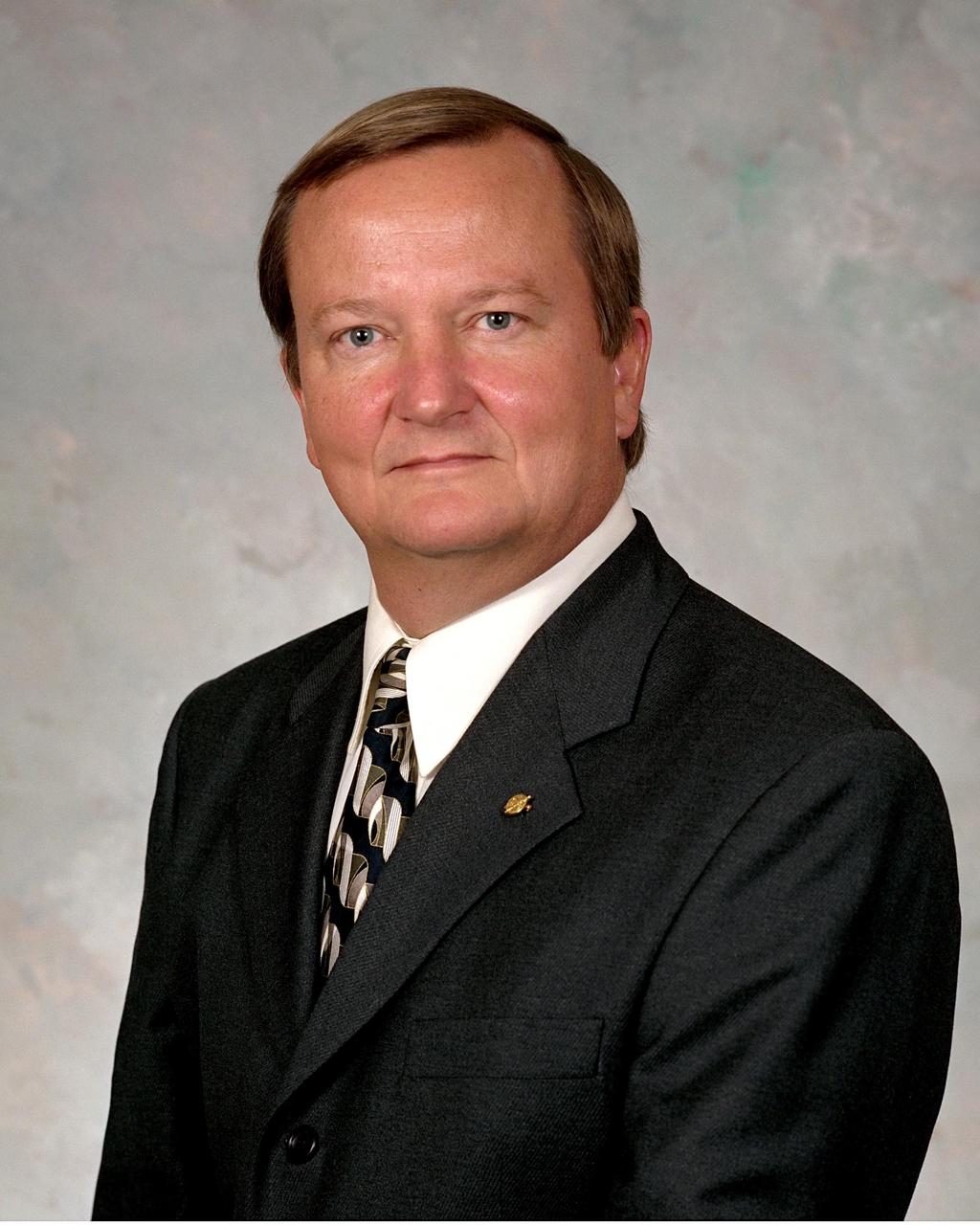
KENNEDY SPACE CENTER, FLA. -- Official portrait of Michael Leinbach, Shuttle Launch director.
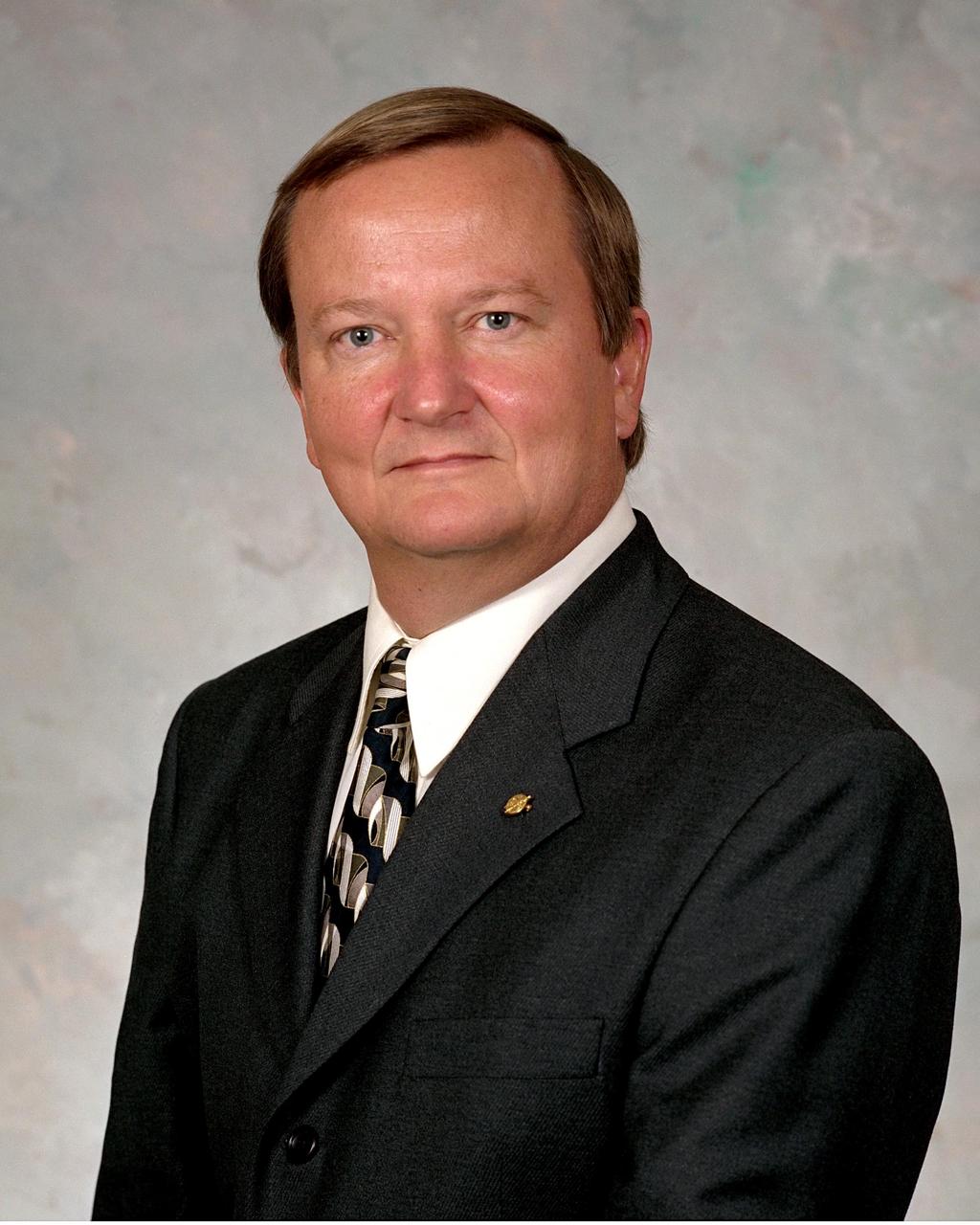
KENNEDY SPACE CENTER, FLA. -- Official portrait of Michael Leinbach, Shuttle Launch director.

KENNEDY SPACE CENTER, FLA. - Official portrait of Michael Leinbach, Shuttle launch director at NASA's Kennedy Space Center.
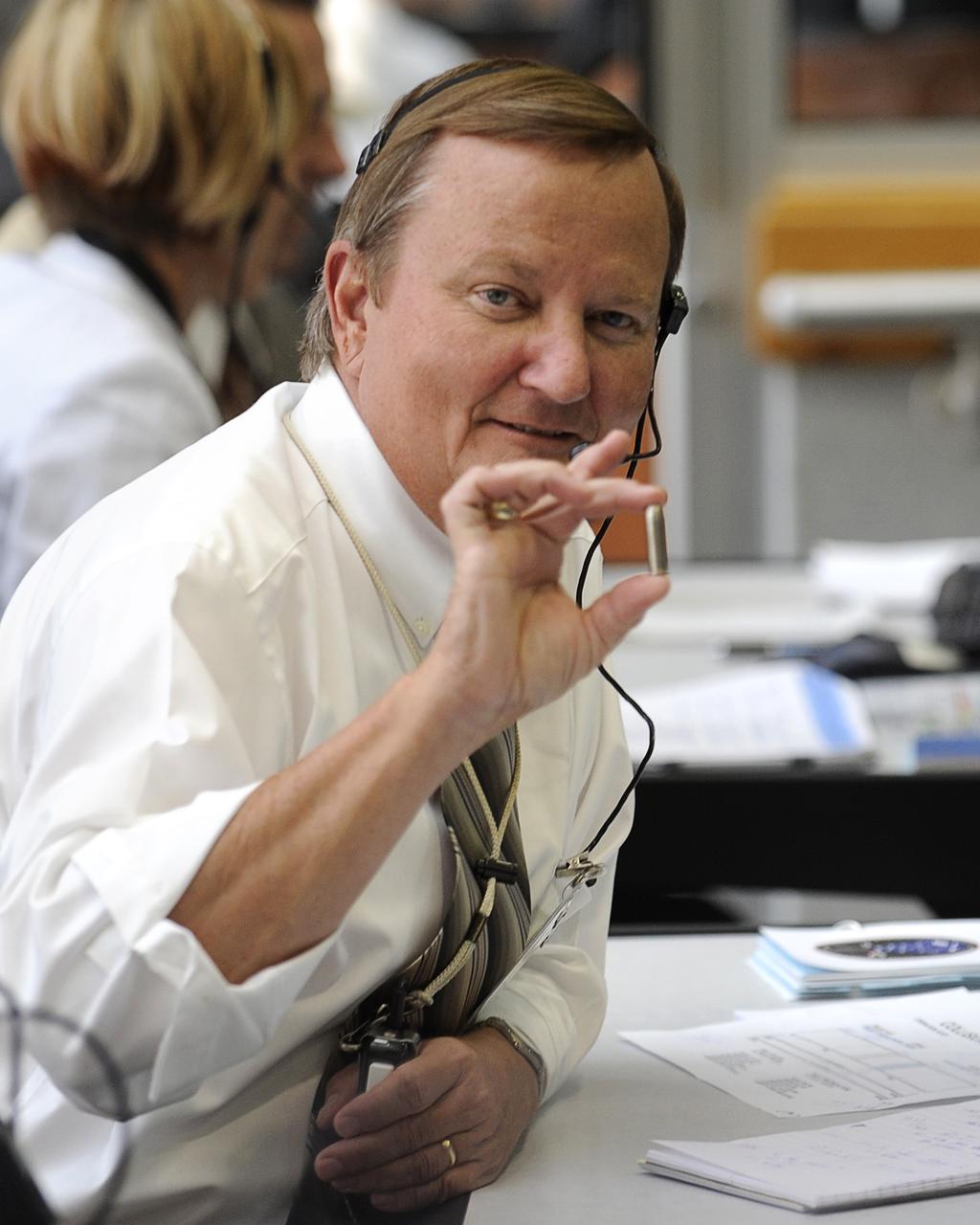
CAPE CANAVERAL, Fla. – NASA Shuttle Launch Director Michael Leinbach shows his lucky silver bullet while in firing room #4 of the NASA Kennedy Space Center's Launch Control Center, Monday, May 11, 2009, at Cape Canaveral, Fla. Leinbach carries the inert silver bullet as a good luck charm. Space shuttle Atlantis with its seven-member crew launched at 2:01 p.m. EDT Monday from Kennedy on the final Hubble Space Telescope servicing mission. Photo credit: NASA/Bill Ingalls
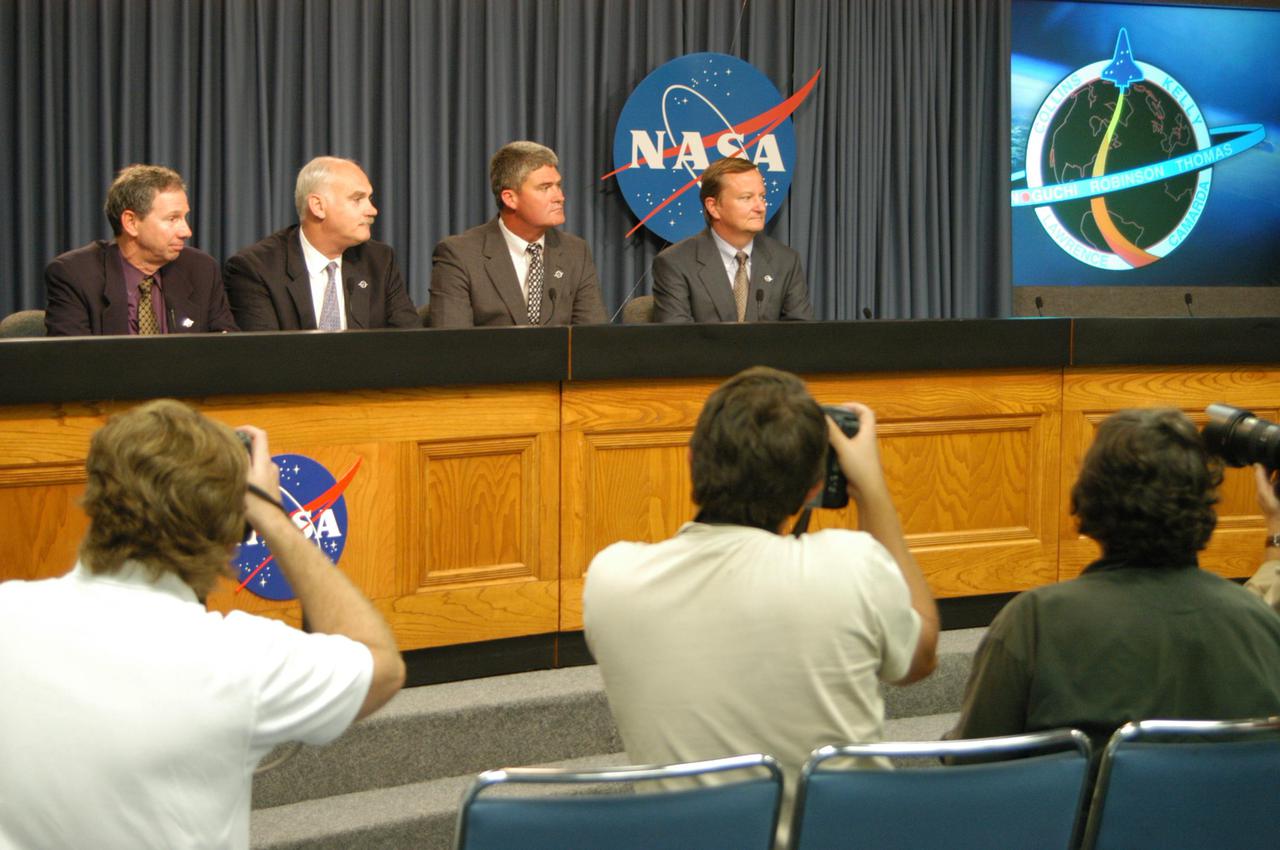
KENNEDY SPACE CENTER, FLA. - Space Shuttle managers take questions from the media during a press conference held following the conclusion of the Flight Readiness Review for Space Shuttle Discovery's Return to Flight mission STS-114. From left are NASA's Administrator Michael Griffin, Associate Administrator for Space Operations William Readdy, Space Shuttle Program Manager William Parsons, and Space Shuttle Launch Director Michael Leinbach. A July 13 launch date was approved for the 12-day mission during which Discovery’s seven-person crew will test new hardware and techniques to improve Shuttle safety, as well as deliver supplies to the International Space Station.
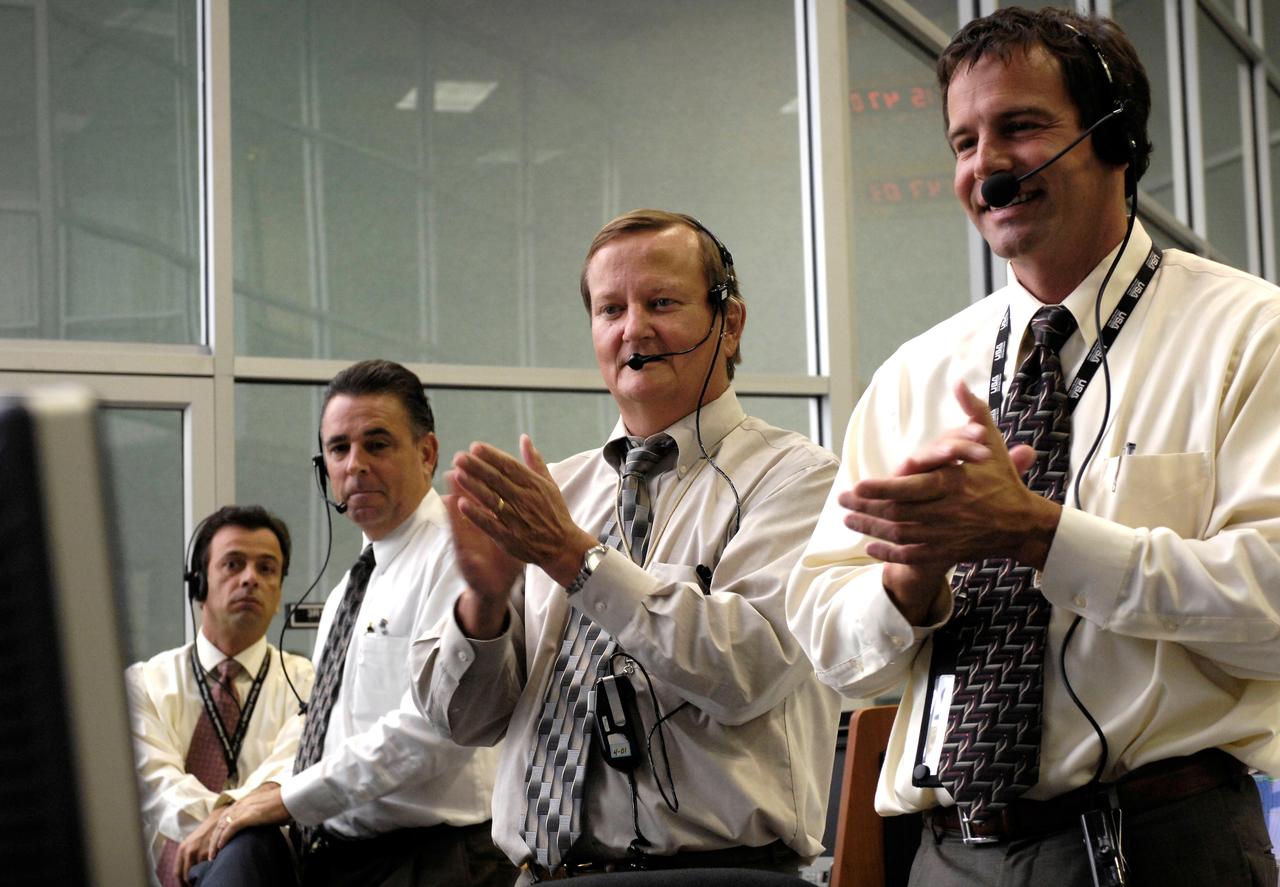
STS120-S-026 (23 Oct. 2007) --- In the firing room of the Kennedy Space Center in Florida, NASA Shuttle Launch Director Michael Leinbach (second right) and launch managers watch the 11:38 a.m. (EDT) launch of Space Shuttle Discovery. Discovery launched Oct. 23 on a 14-day construction mission to the International Space Station. Photo credit: NASA/Bill Ingalls
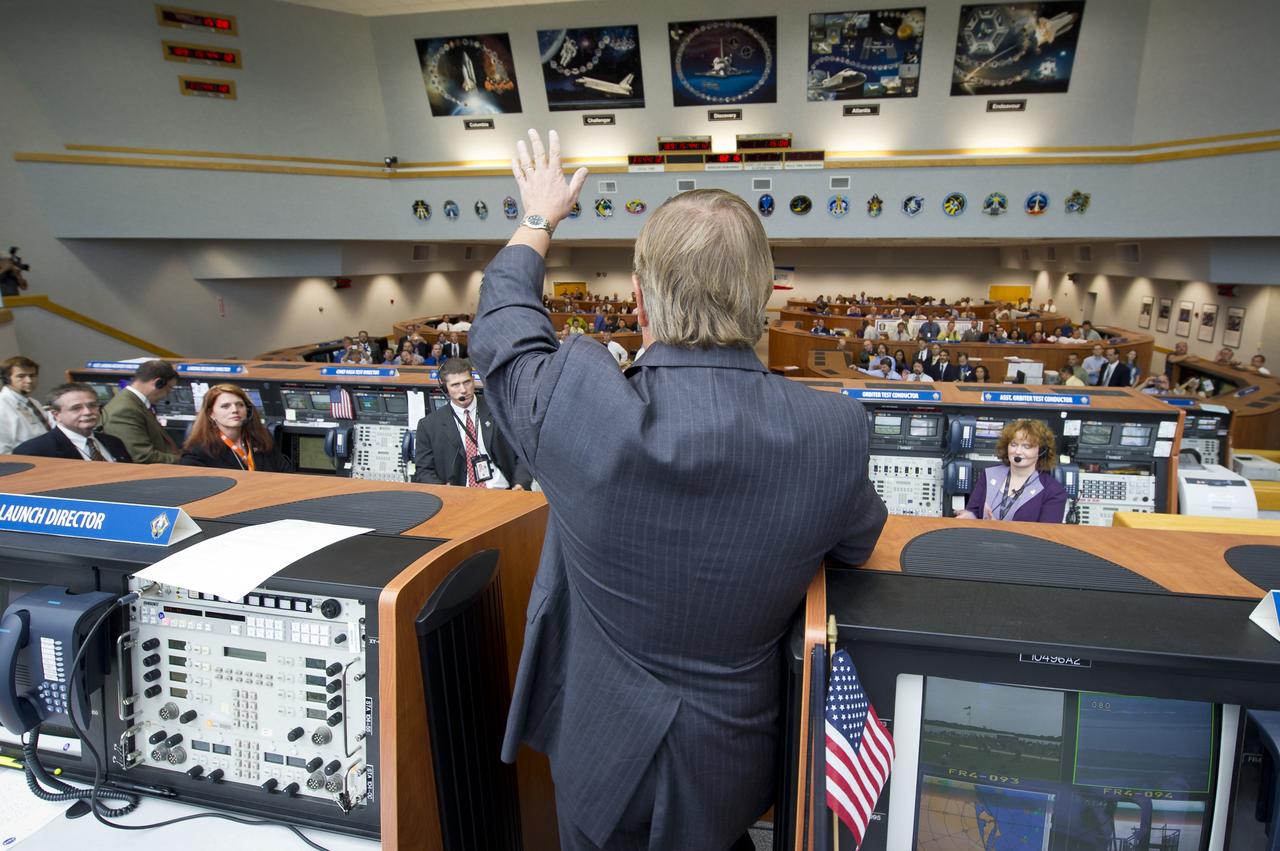
NASA Launch Director Michael Leinbach congratulates the launch team in the NASA Kennedy Space Center Firing Room Four of the Launch Control Center (LCC) shortly after the space shuttle Atlantis, STS-135, launched on Friday, July 8, 2011, in Cape Canaveral, Fla. The launch of Atlantis, STS-135, is the final flight of the shuttle program, a 12-day mission to the International Space Station. Photo Credit: (NASA/Bill Ingalls)
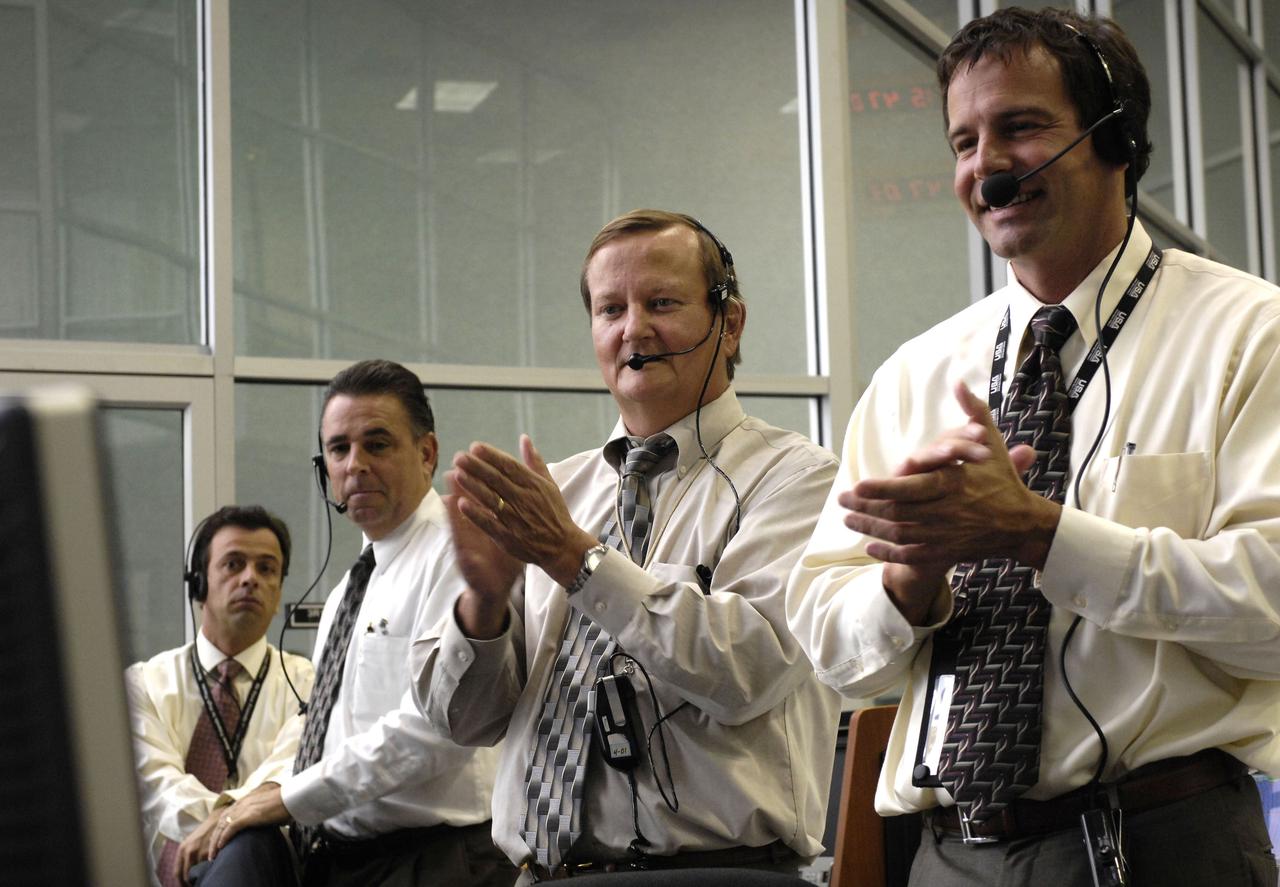
In the firing room of the Kennedy Space Center in Florida, NASA Shuttle Launch Director Michael Leinbach (2nd from right) and launch managers watch the 11:38 a.m. EDT launch of Space Shuttle Discovery. Discovery launched Oct. 23 on a 14-day construction mission to the International Space Station. Photo credit: "NASA/Bill Ingalls"
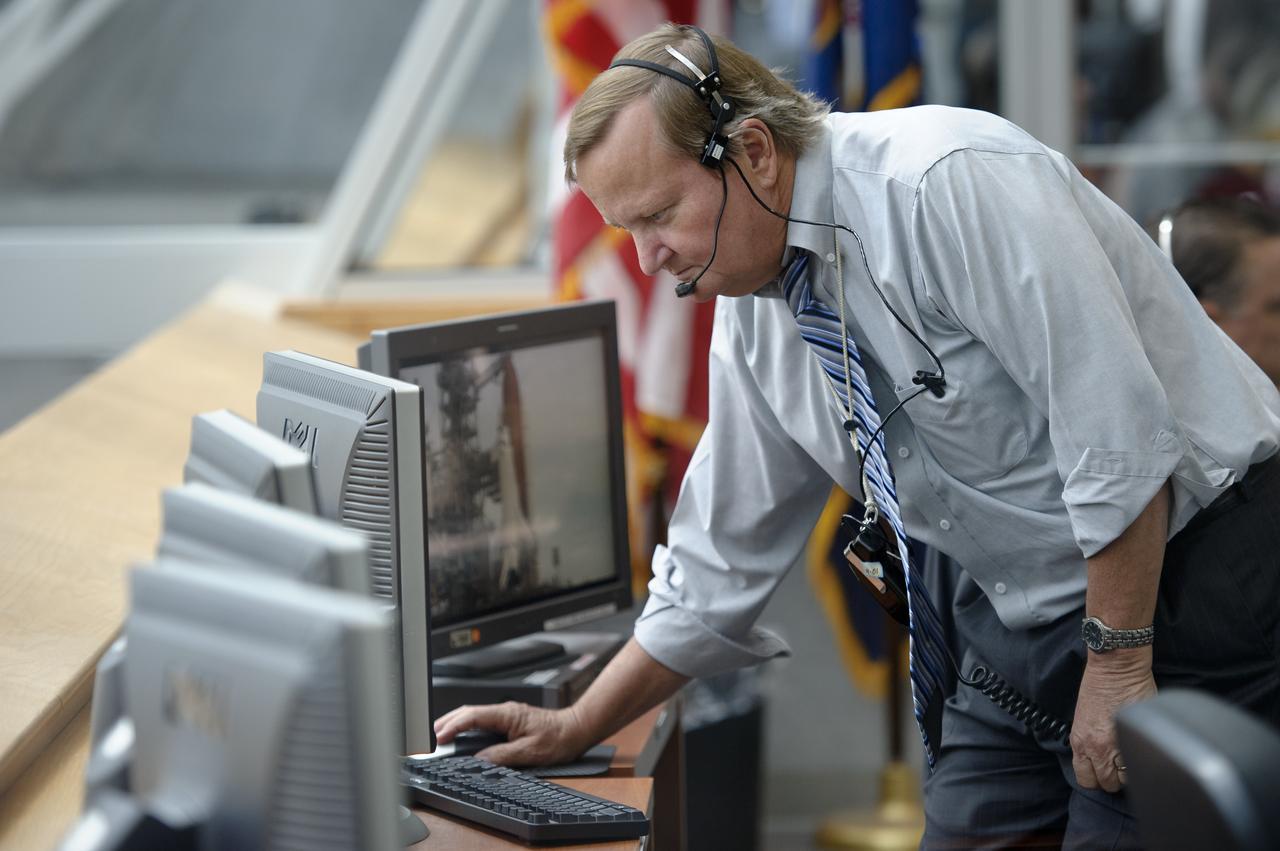
NASA Shuttle Launch Director Michael Leinbach monitors the launch countdown from Firing Room Four of the Launch Control Center (LCC) at NASA's Kennedy Space Center on Friday, July 8, 2011, in Cape Canaveral, Fla. The launch of Atlantis, STS-135, is the final flight of the shuttle program, a 12-day mission to the International Space Station. Photo Credit: (NASA/Bill Ingalls)
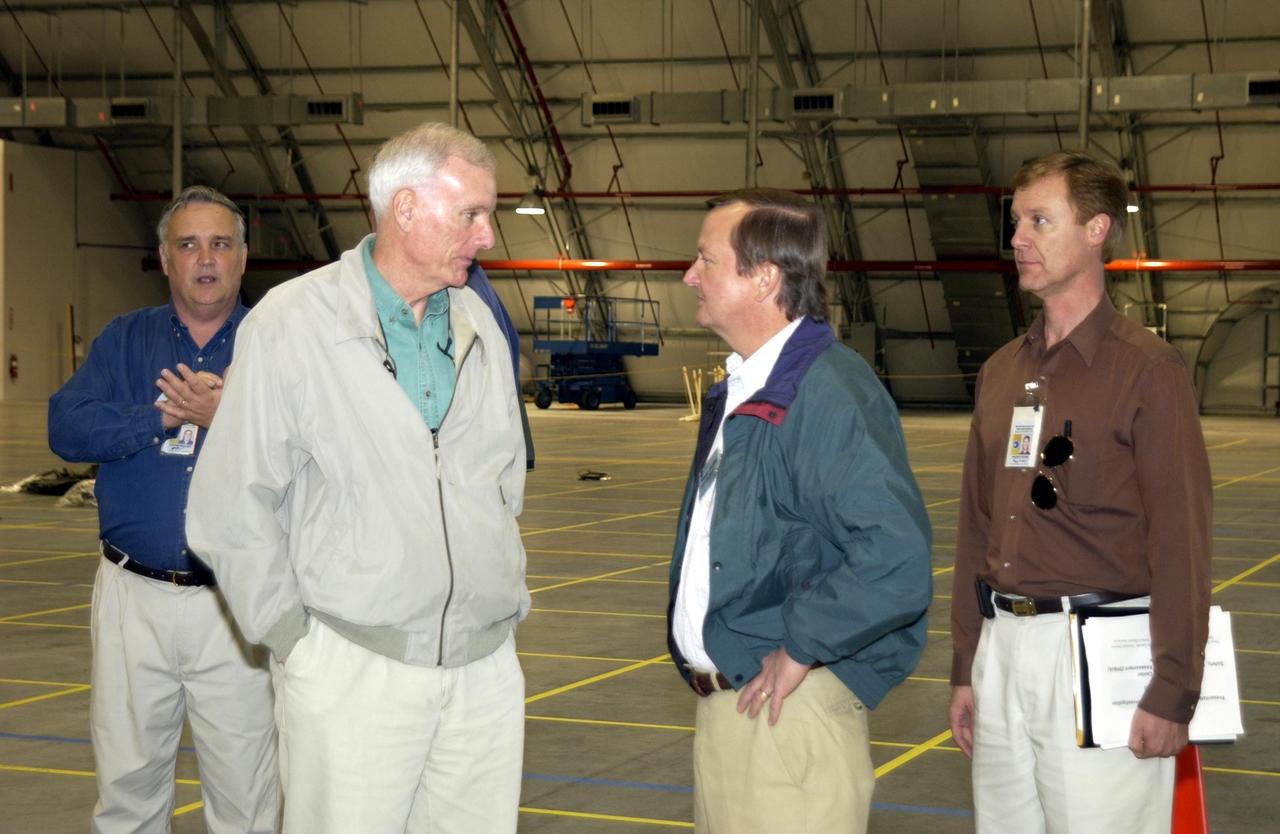
KENNEDY SPACE CENTER, FLA. -- Retired Navy Admiral Harold W. Gehman Jr. (left front), chairman of the Columbia Accident Investigation Board, talks to KSC Shuttle Launch Director Michael Leinbach in the RLV Hangar where the Columbia debris is being organized. The debris was shipped from the collection point at Barksdale Air Force Base, Shreveport, La. As part of the ongoing investigation into the tragic accident that claimed Columbia and her crew of seven, workers will attempt to reconstruct the orbiter inside the RLV.
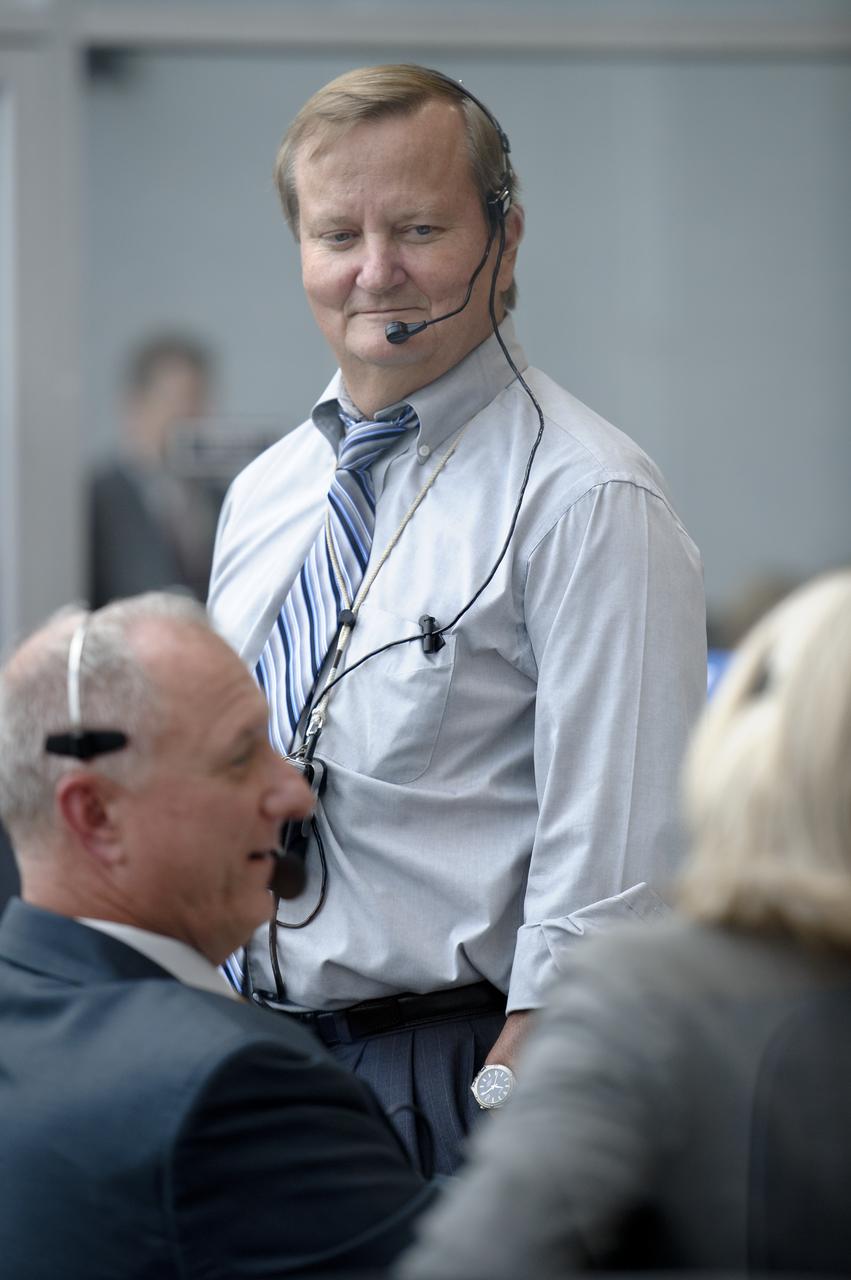
NASA Shuttle Launch Director Michael Leinbach talks with other members of teh launch team as they monitor the launch countdown from Firing Room Four of the Launch Control Center (LCC) at NASA's Kennedy Space Center on Friday, July 8, 2011, in Cape Canaveral, Fla. The launch of Atlantis, STS-135, is the final flight of the shuttle program, a 12-day mission to the International Space Station. Photo Credit: (NASA/Bill Ingalls)
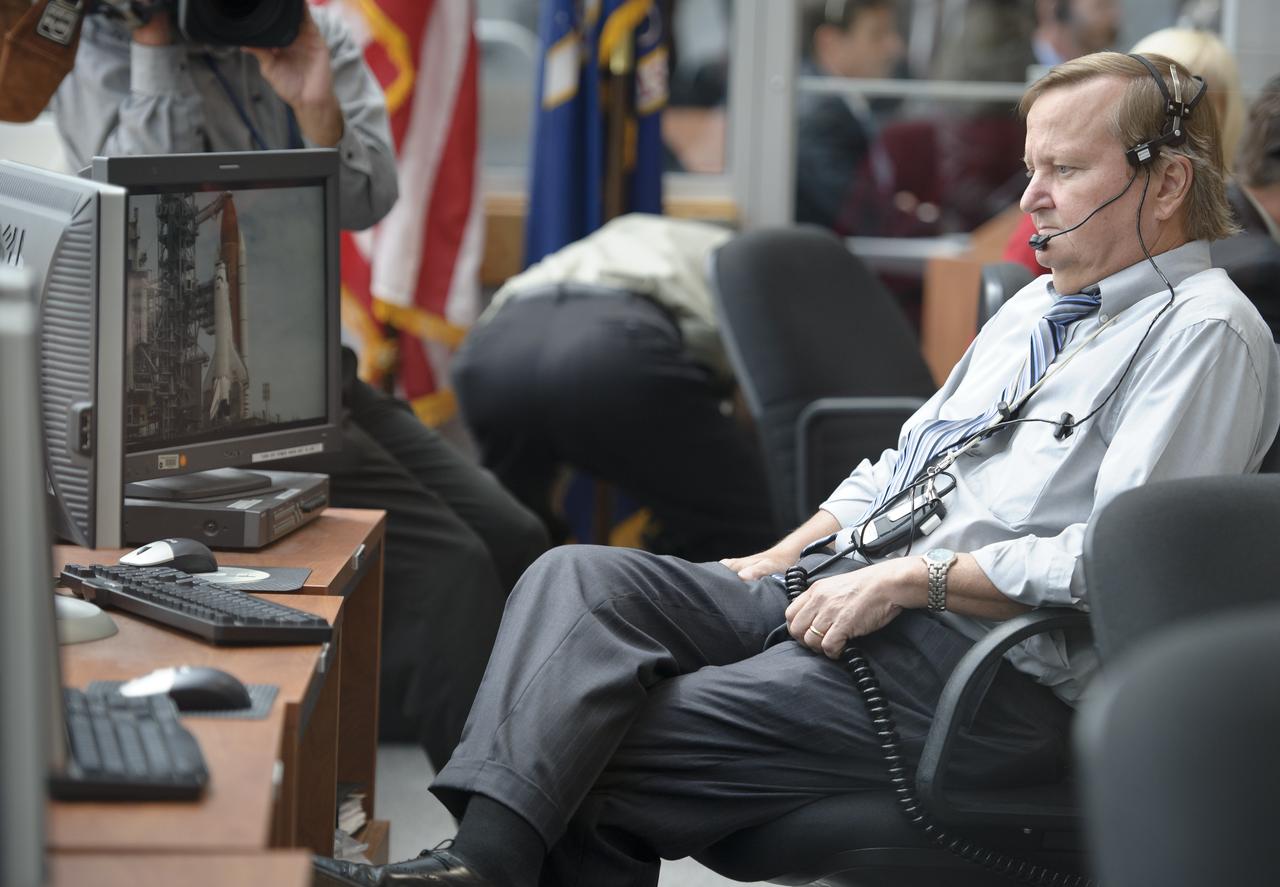
NASA Shuttle Launch Director Michael Leinbach monitors the launch countdown from Firing Room Four of the Launch Control Center (LCC) at NASA's Kennedy Space Center on Friday, July 8, 2011, in Cape Canaveral, Fla. The launch of Atlantis, STS-135, is the final flight of the shuttle program, a 12-day mission to the International Space Station. Photo Credit: (NASA/Bill Ingalls)
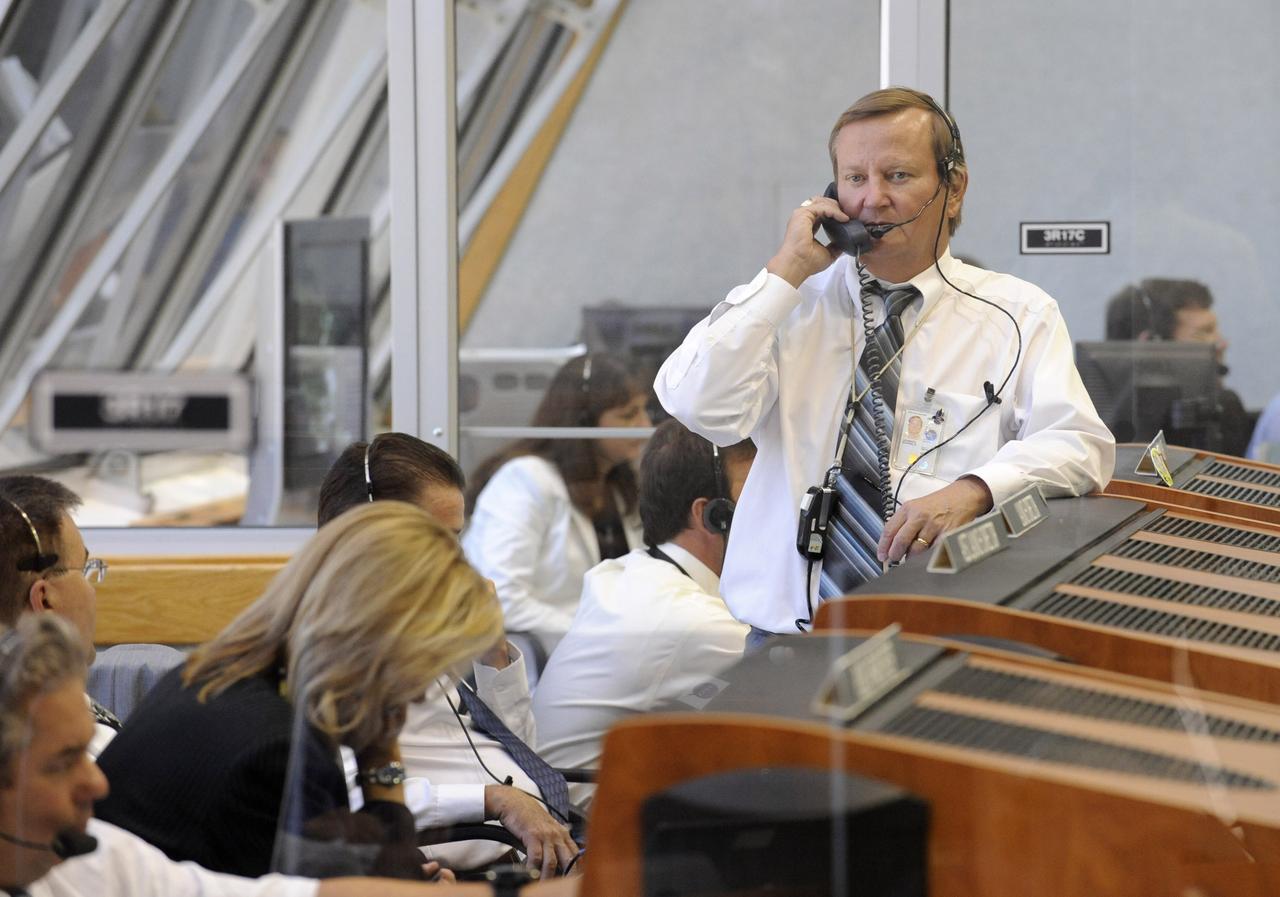
CAPE CANAVERAL, Fla. -- NASA Shuttle Launch Director Michael Leinbach talks on the phonein the Launch Control Center prior to the launch of space shuttle Discovery on the STS-124 mission on Saturday, May 31, 2008, at NASA's Kennedy Space Center. The shuttle lifted off from Launch Pad 39A at 5:02 p.m. EDT. Photo credit: NASA/Bill Ingalls
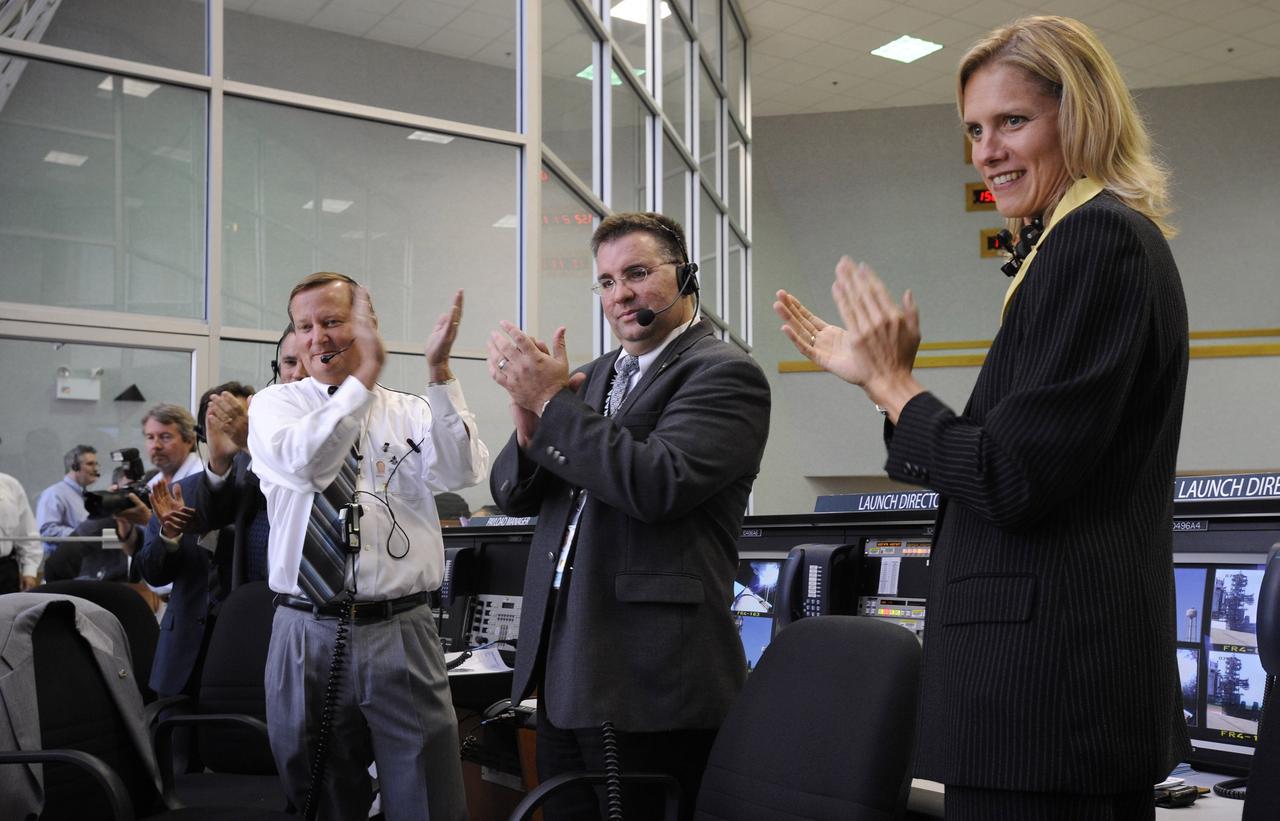
CAPE CANAVERAL, Fla. -- NASA Shuttle Launch Director Michael Leinbach, left, STS-124 Assistant Launch Director Ed Mango, center, and Flow Director for space shuttle Discovery Stephanie Stilson clap in the Launch Control Center after the main engine cut-off and successful launch of Discovery on the STS-124 mission Saturday, May 31, 2008, at NASA's Kennedy Space Center. The shuttle lifted off from Launch Pad 39A at 5:02 p.m. EDT. Photo credit: NASA/Bill Ingalls
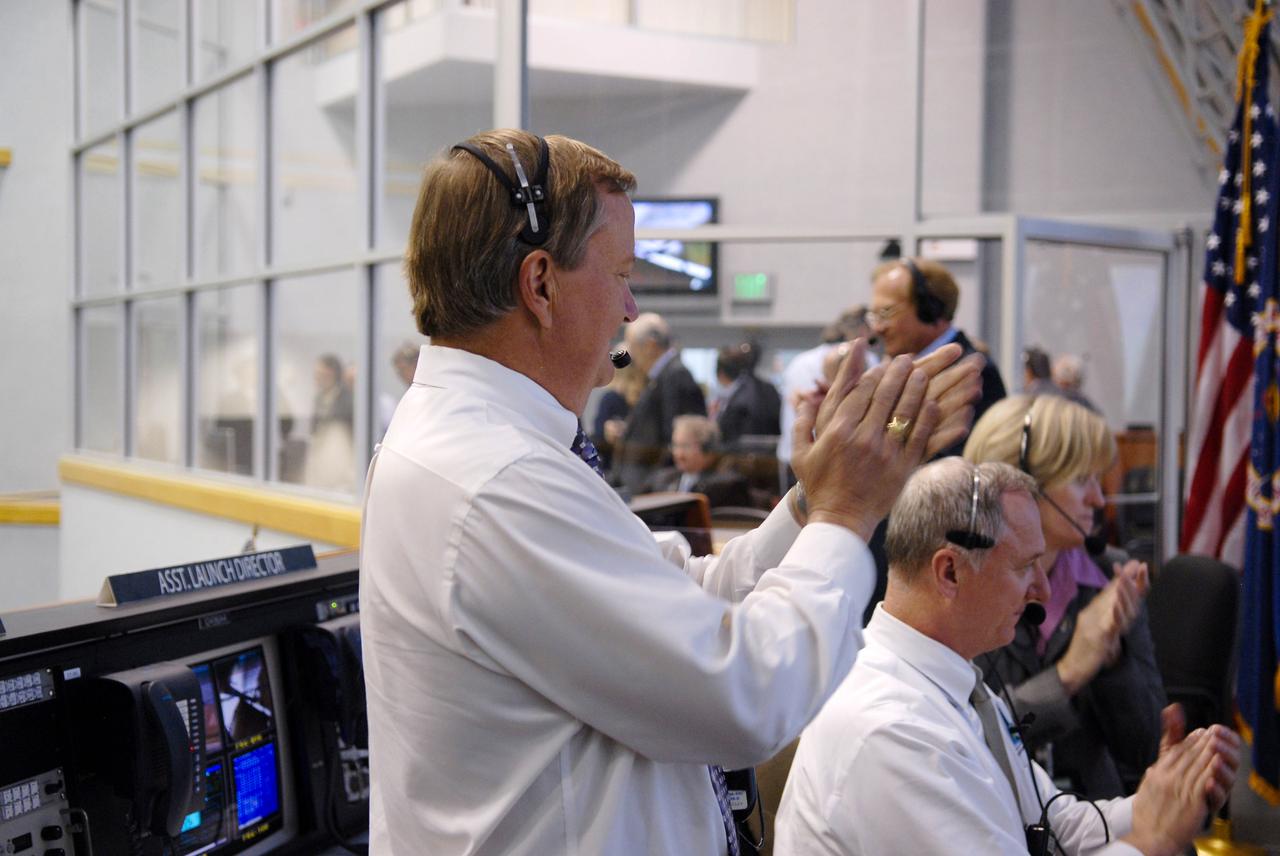
STS129-S-058 (16 Nov. 2009) --- In Firing Room 4 of NASA Kennedy Space Center's Launch Control Center, shuttle launch director Michael Leinbach (standing), assistant launch director Peter Nickolenko and Atlantis flow director Angie Brewer (both seated), applaud the launch team upon the successful launch of Space Shuttle Atlantis. Liftoff of Atlantis from Launch Pad 39A on its STS-129 mission to the International Space Station came at 2:28 p.m. (EST) Nov. 16, 2009.
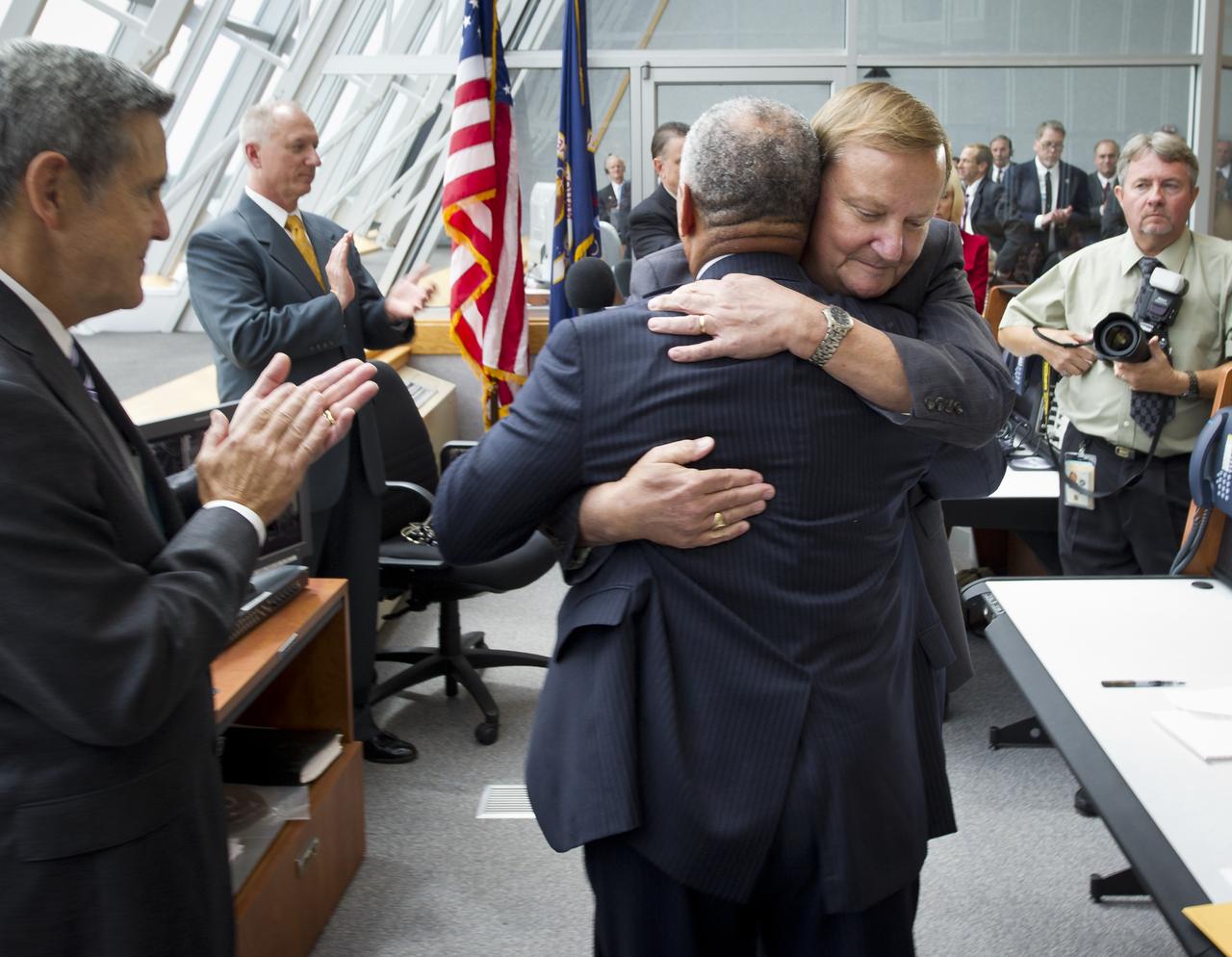
NASA Administrator Charles Bolden congratulates Launch Director Michael Leinbach, facing camera, in Firing Room Four of the Launch Control Center (LCC) shortly after the space shuttle Atlantis, STS-135, launched on Friday, July 8, 2011, in Cape Canaveral, Fla. The launch of Atlantis, STS-135, is the final flight of the shuttle program, a 12-day mission to the International Space Station. Photo Credit: (NASA/Bill Ingalls)
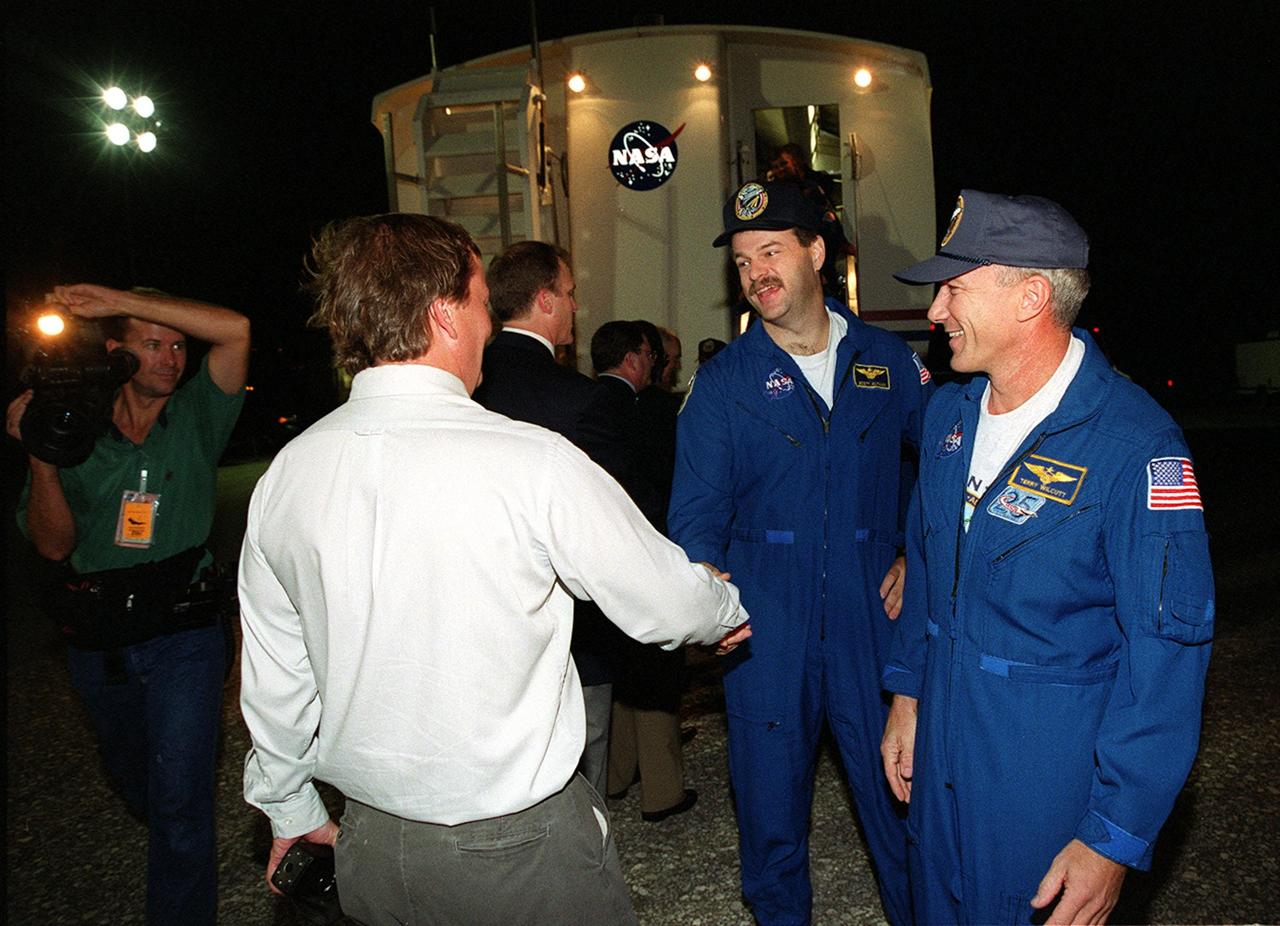
KENNEDY SPACE CENTER, FLA. -- At the Shuttle Landing Facility, KSC Launch Director Michael Leinbach (shaking hands) greets STS-106 Pilot Scott D. Altman and Commander Terrence W. Wilcutt after their successful mission and landing. Just behind Leinbach is Jim Halsell, manager of Space Shuttle Launch Integration and former Shuttle Commander, plus other dignitaries on hand to welcome the crew home. Landing occurred on-time at 3:56:48 a.m. EDT. Atlantis and crew traveled 4.9 million miles on the 11-day, 19-hour, 11-minute STS-106 mission. During the mission to the International Space Station, the crew transferred nearly 5,000 pounds of equipment and supplies for use by the first resident crew expected to arrive in November. STs-106 was the 99th flight in the Shuttle program and the 22nd for Atlantis. STS-106 also marked the 15th nighttime landing in Shuttle history and the 23rd consecutive landing at KSC
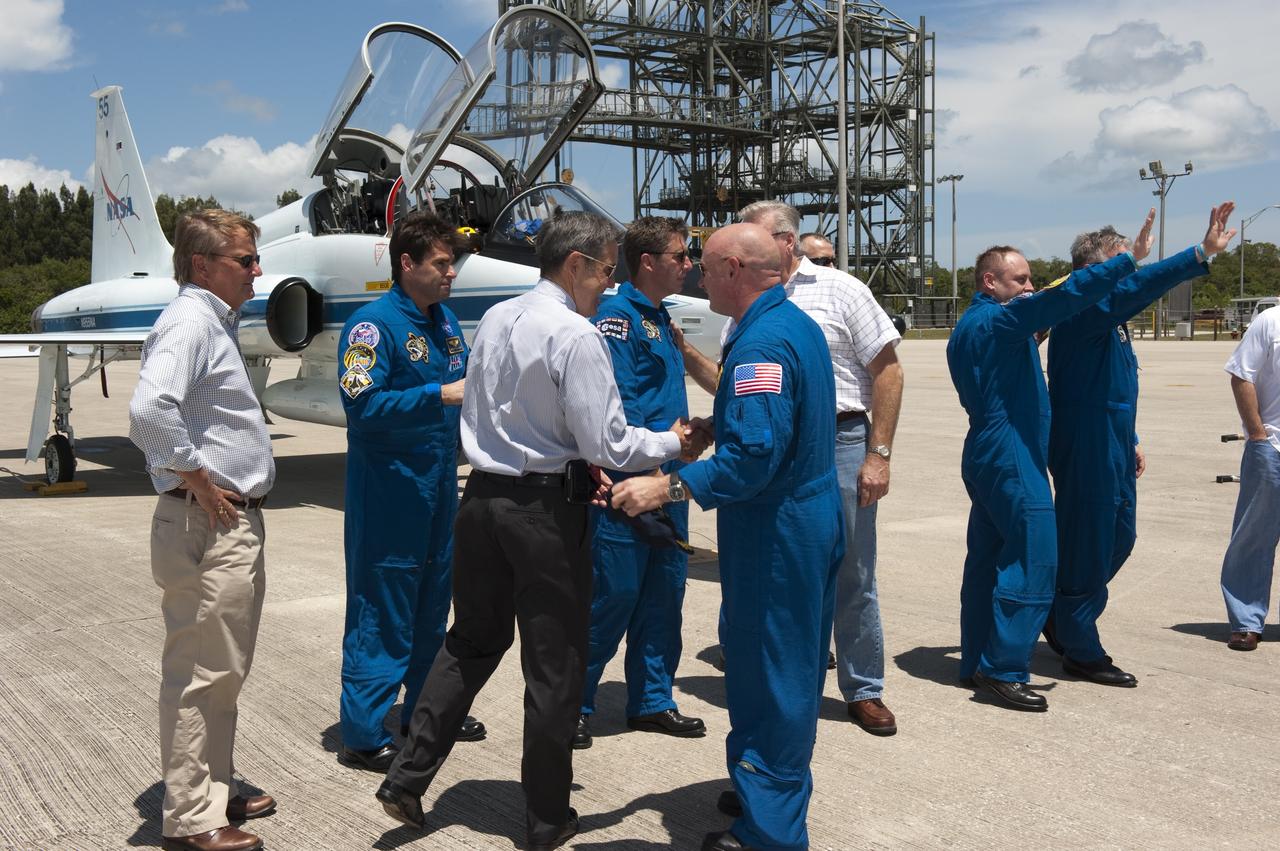
CAPE CANAVERAL, Fla. -- At NASA Kennedy Space Center's Shuttle Landing Facility in Florida, the STS-134 crew members are greeted by Kennedy Center Director Bob Cabana, Shuttle Launch Director Mike Leinbach and other NASA managers after the crew's arrival for final preparations for shuttle Endeavour's liftoff to the International Space Station. From center are Commander Mark Kelly, Bob Cabana, Mike Leinbach, Mission Specialists Greg Chamitoff, European Space Agency astronaut Roberto Vittori, Mission Specialists Andrew Feustel, Michael Fincke and Pilot Greg H. Johnson. Endeavour and its crew will deliver the Express Logistics Carrier-3, Alpha Magnetic Spectrometer-2 (AMS), a high-pressure gas tank and additional spare parts for the Dextre robotic helper to the station. This will be the final spaceflight for Endeavour. For more information visit, www.nasa.gov/mission_pages/shuttle/shuttlemissions/sts134/index.html. Photo credit: NASA/Kim Shiflett
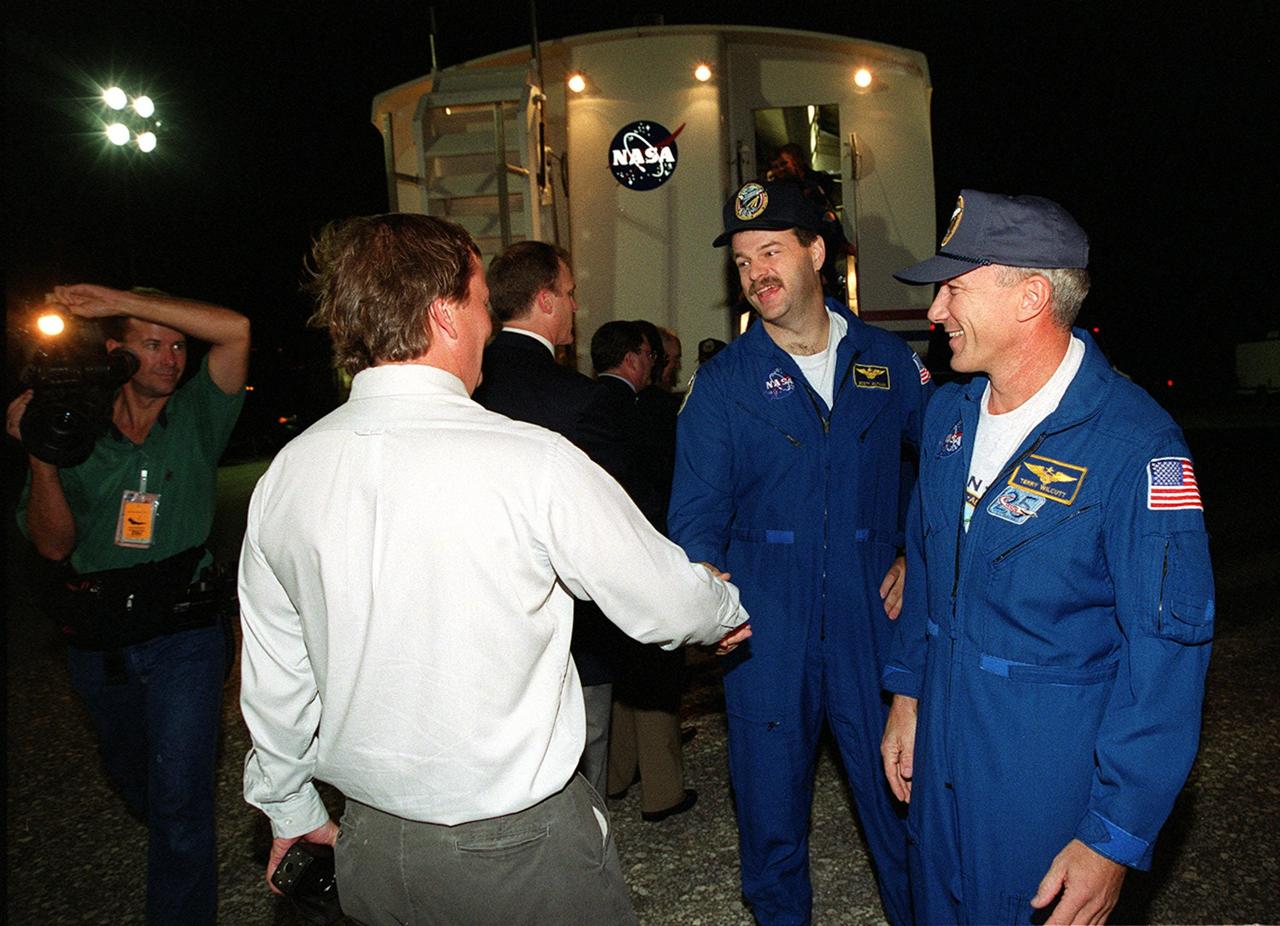
KENNEDY SPACE CENTER, FLA. -- At the Shuttle Landing Facility, KSC Launch Director Michael Leinbach (shaking hands) greets STS-106 Pilot Scott D. Altman and Commander Terrence W. Wilcutt after their successful mission and landing. Just behind Leinbach is Jim Halsell, manager of Space Shuttle Launch Integration and former Shuttle Commander, plus other dignitaries on hand to welcome the crew home. Landing occurred on-time at 3:56:48 a.m. EDT. Atlantis and crew traveled 4.9 million miles on the 11-day, 19-hour, 11-minute STS-106 mission. During the mission to the International Space Station, the crew transferred nearly 5,000 pounds of equipment and supplies for use by the first resident crew expected to arrive in November. STs-106 was the 99th flight in the Shuttle program and the 22nd for Atlantis. STS-106 also marked the 15th nighttime landing in Shuttle history and the 23rd consecutive landing at KSC
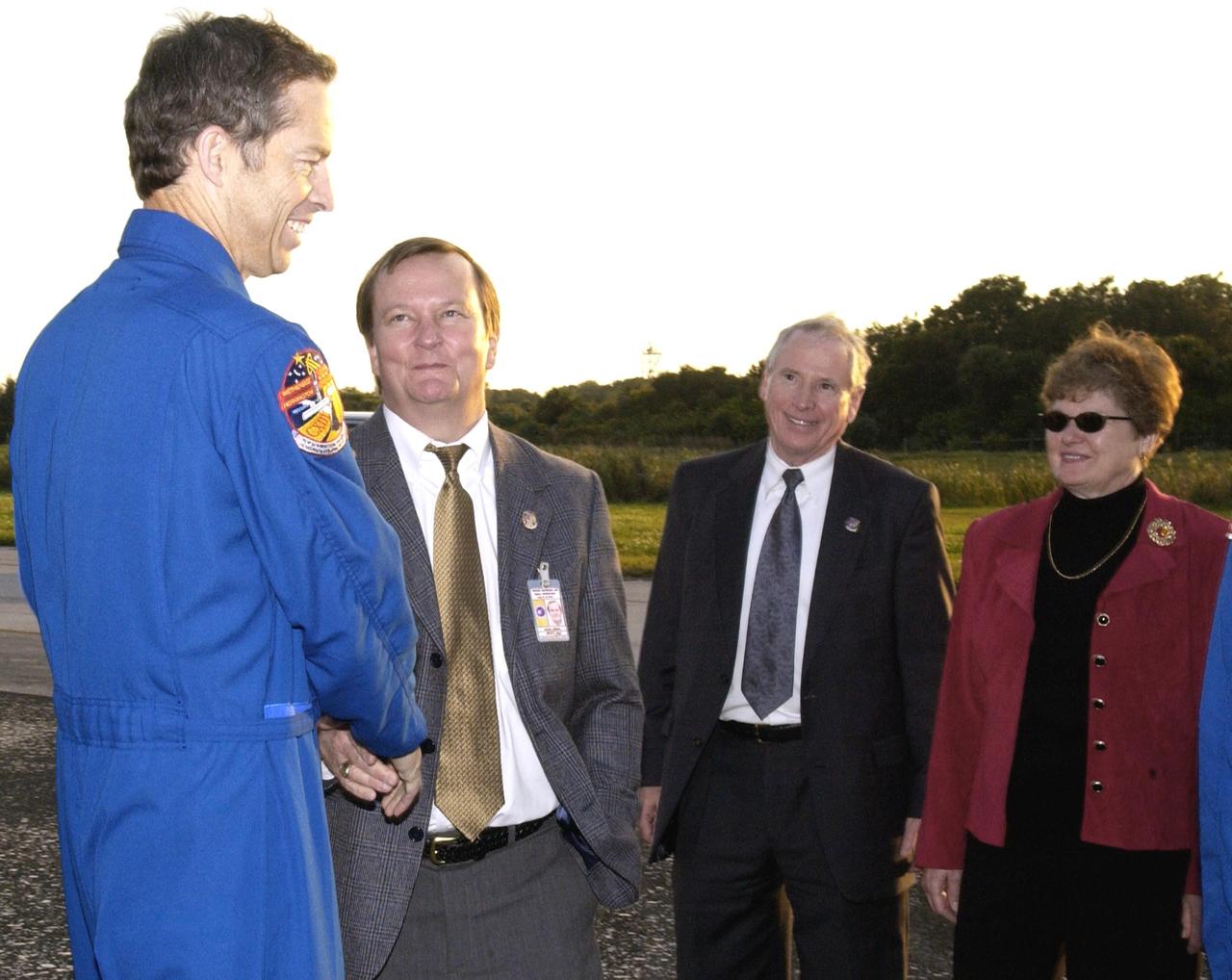
KENNEDY SPACE CENTER, FLA. - STS-113 Commander James Wetherbee shakes hands with Michael D. Leinbach, Shuttle Launch Director at KSC, on the runway of the Shuttle Landing Facility following the landing of Endeavour. From left are Wetherbee, Leinbach, Dr. Daniel R. Mulville, NASA Associate Deputy Administrator, and Mrs. Mulville. Commander Wetherbee earlier guided Space Shuttle Endeavour to a flawless touchdown on runway 33 at the Shuttle Landing Facility after completing the 13-day, 18-hour, 48-minute, 5.74-million mile STS-113 mission to the International Space Station. Main gear touchdown was at 2:37:12 p.m. EST, nose gear touchdown was at 2:37:23 p.m., and wheel stop was at 2:38:25 p.m. Poor weather conditions thwarted landing opportunities until a fourth day, the first time in Shuttle program history that a landing has been waved off for three consecutive days. The orbiter also carried the other members of the STS-113 crew, Pilot Paul Lockhart and Mission Specialists Michael Lopez-Alegria and John Herrington, as well as the returning Expedition Five crew, Commander Valeri Korzun, ISS Science Officer Peggy Whitson and Flight Engineer Sergei Treschev. The installation of the P1 truss on the International Space Station was accomplished during the mission.
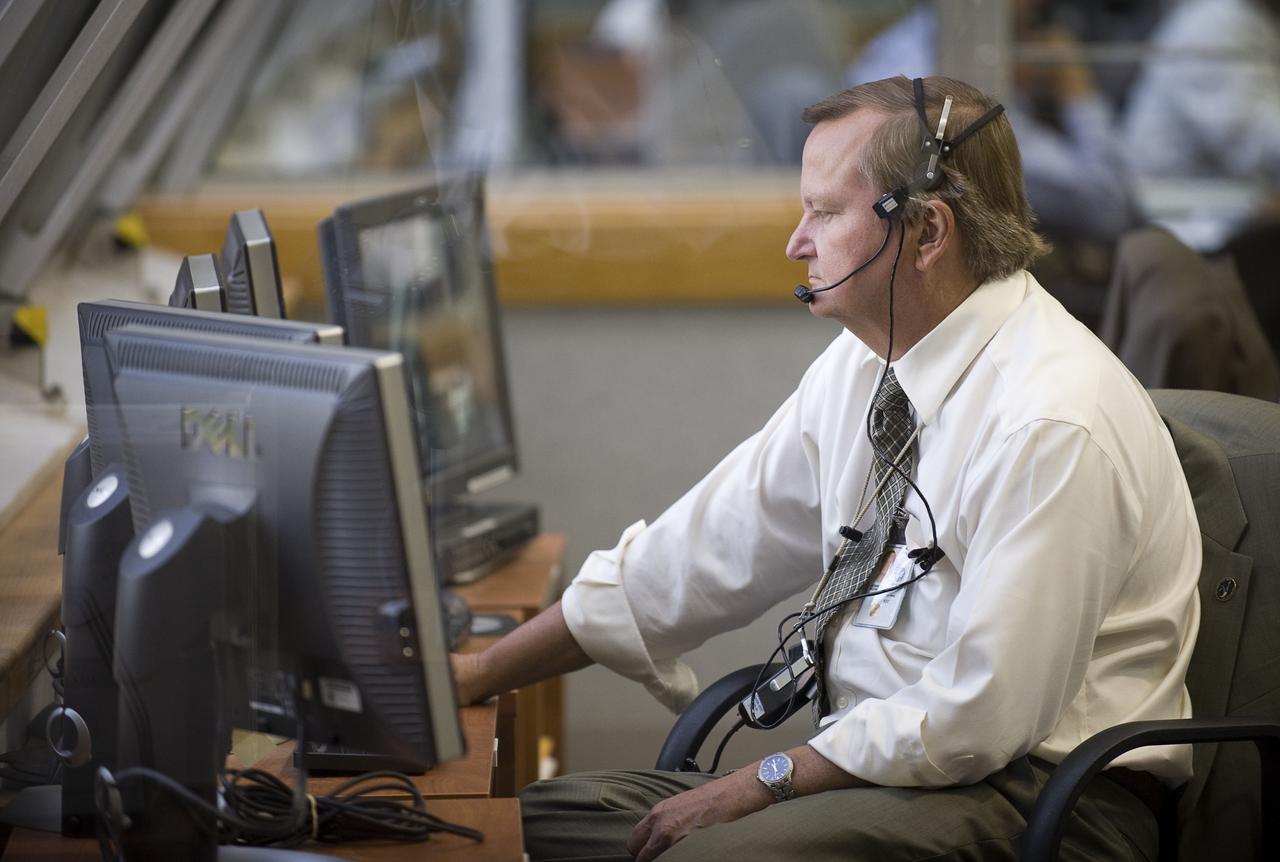
Mike Leinbach, NASA Assistant Shuttle Launch Director for the STS-127 mission, monitors the launch countdown progress and local weather from Firing Room Four of the Launch Control Center at NASA's Kennedy Space Center in Cape Canaveral, Florida, Monday, July 13, 2009. The space shuttle Endeavour is set to launch at 6:51p.m. EDT with the crew of STS-127 and start a 16-day mission that will feature five spacewalks and complete construction of the Japan Aerospace Exploration Agency's Kibo laboratory. Photo Credit: (NASA/Bill Ingalls)
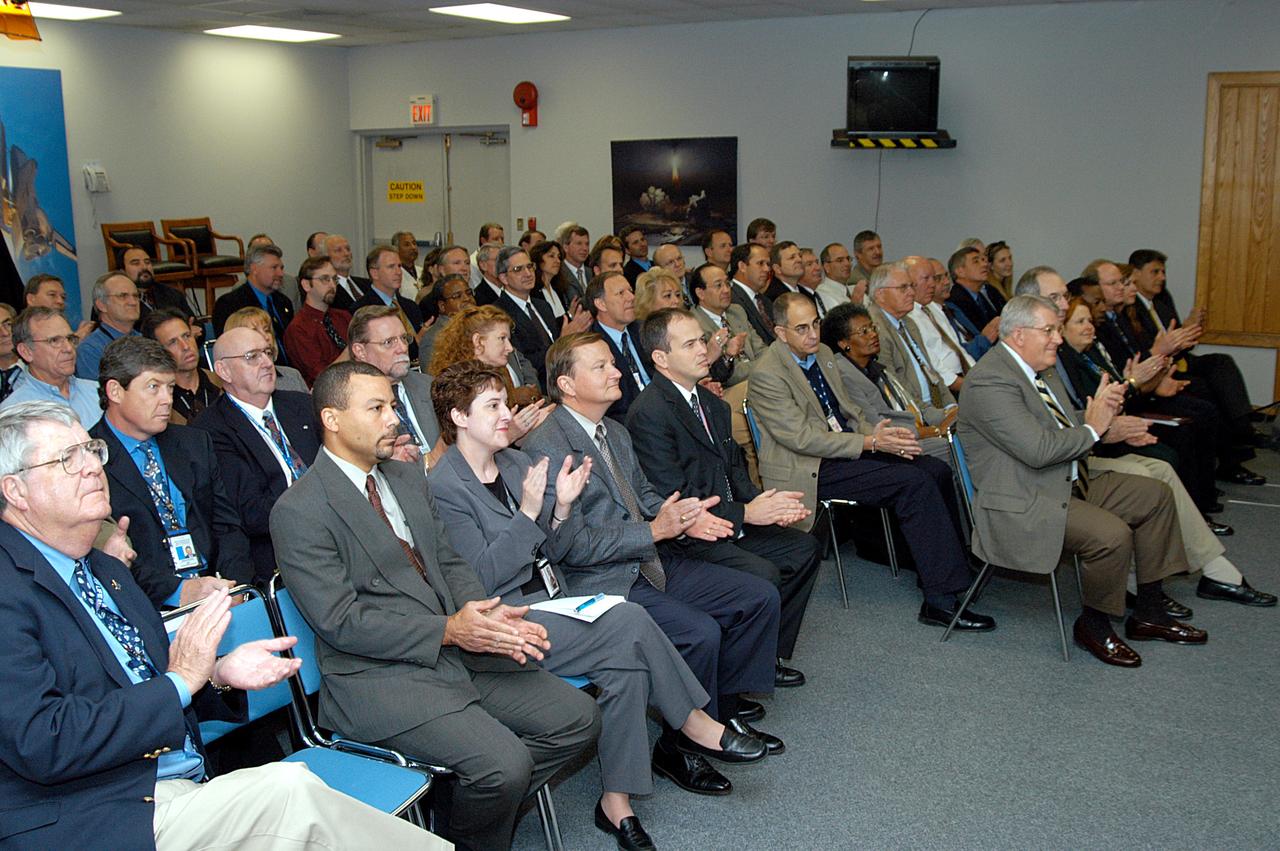
KENNEDY SPACE CENTER, FLA. -- From the KSC television studio, KSC management and other employees applaud President George W. Bush, who addressed the public and an assembly of government officials at NASA Headquarters, outlining a new focus and vision for the space agency. Fourth from left is Mike Leinbach, Shuttle launch director; at right, front row, are Bill Pickavance vice president and associate program manager of Florida Operations, United Space Alliance (USA) and Howard DeCastro, USA vice president and Space Shuttle program manager. The President stated his goals for NASA’s new mission: Completing the International Space Station, retiring the Space Shuttle orbiters, developing a new crew exploration vehicle, and returning to the moon and beyond within the next two decades. Pres. Bush was welcomed by NASA Administrator Sean O’Keefe and Expedition 8 Commander Michael Foale, who greeted him from the International Space Station. Members of the Washington, D.C., audience included astronauts Eileen Collins, Ed Lu and Michael Lopez-Alegria, and former astronaut Gene Cernan.
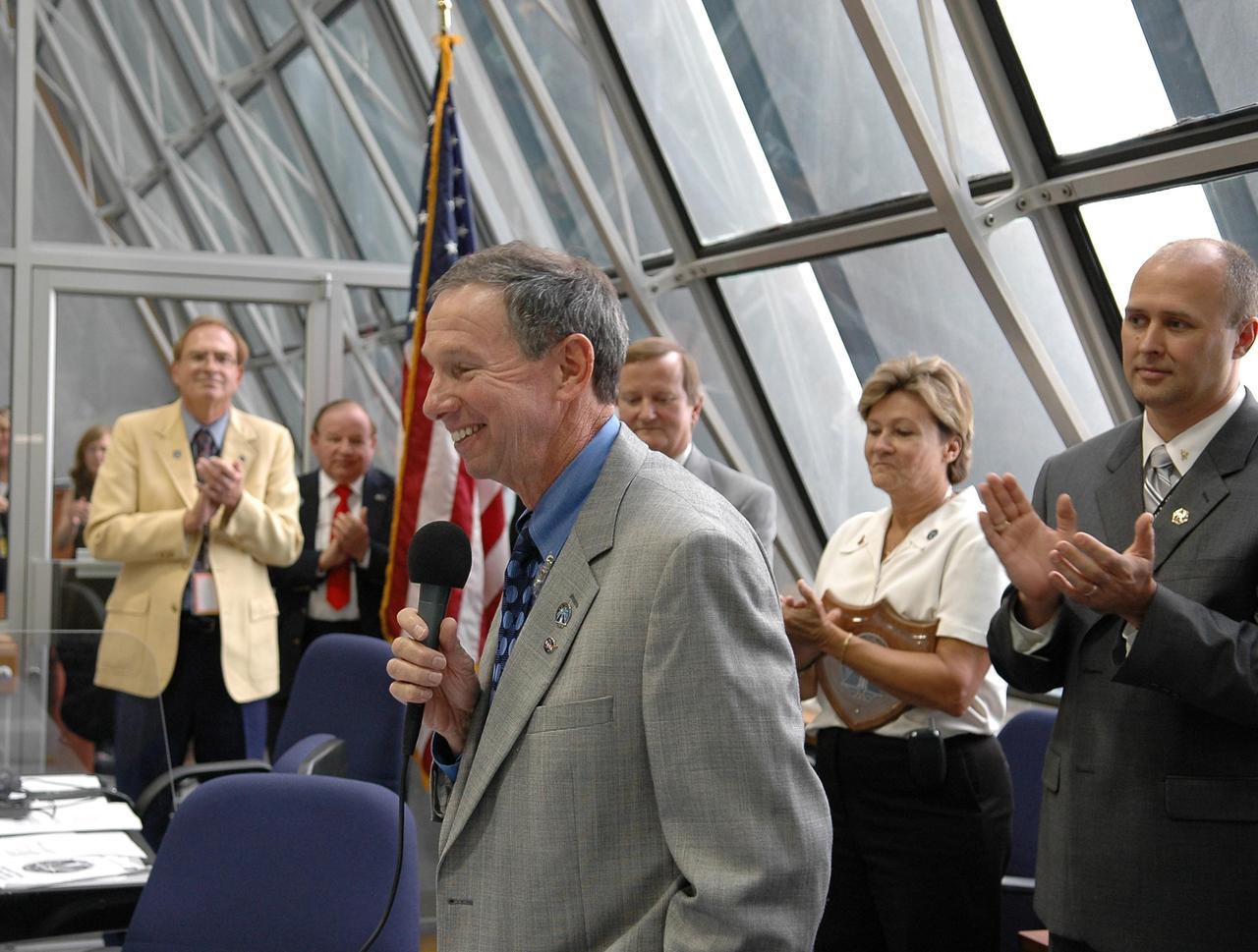
KENNEDY SPACE CENTER, FLA. - Inside the Launch Control Center, NASA Administrator Michael Griffin congratulates the launch team after the liftoff of Space Shuttle Atlantis on mission STS-115. Behind him are (left to right) Shuttle Launch Director Mike Leinbach, Pat Leslie and Robbie Ashley, STS-115 payload manager. Mission STS-115 is the 116th space shuttle flight, the 27th flight for orbiter Atlantis, and the 19th U.S. flight to the International Space Station. Mission STS-115 is scheduled to last 11 days with a planned landing at KSC. Photo credit: NASA/Kim Shiflett
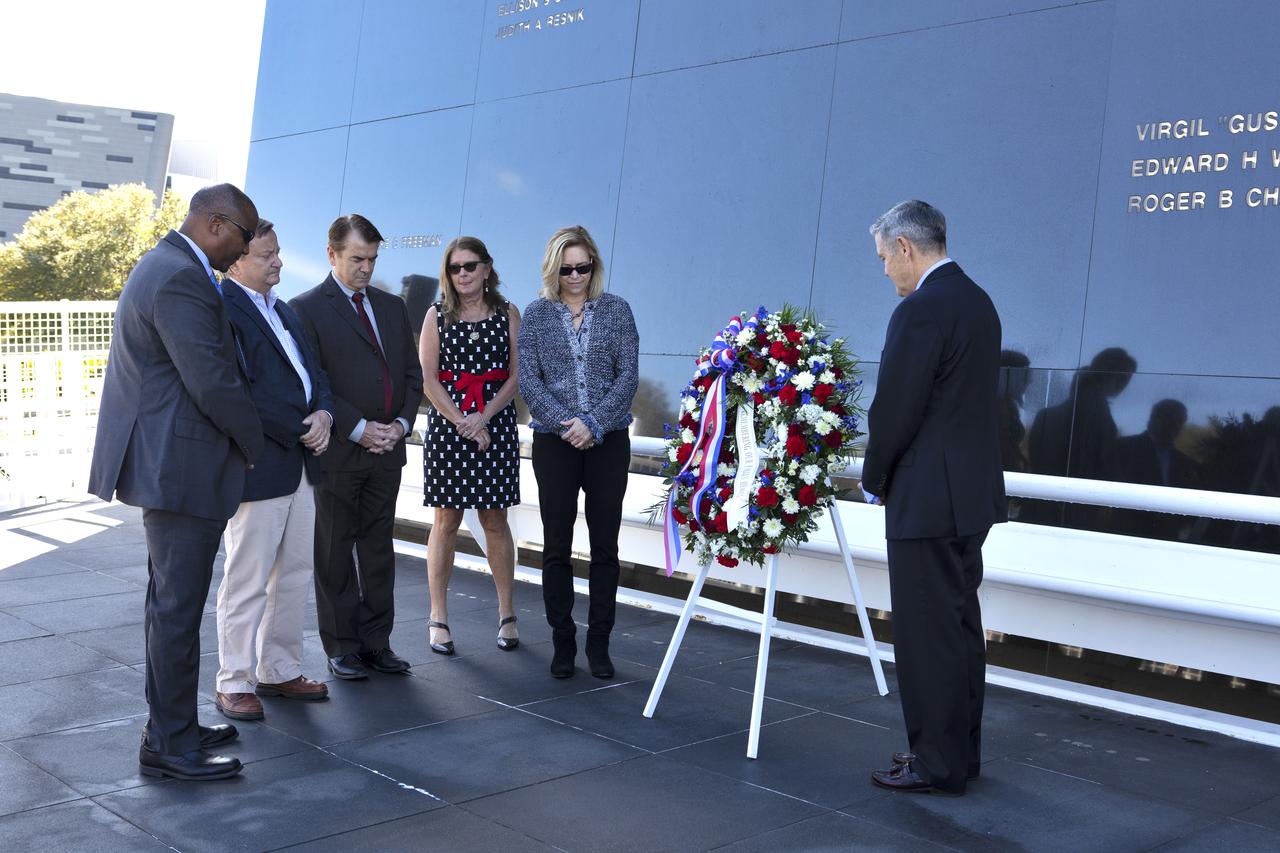
During this year’s Day of Remembrance ceremony at the Kennedy Space Center Visitor Complex, from left, Kennedy Associate Director Kelvin Manning, former Shuttle Launch Director Michael Leinbach, President and Chief Executive Officer of the Astronauts Memorial Foundation (AMF) Thad Altman, AMF Vice Chair Sheryl Chaffee, Kennedy Deputy Director Janet Petro, and Kennedy Center Director Bob Cabana stand in a moment of silence after placing a memorial wreath in front of the Space Mirror Memorial. Each year, Kennedy employees and guests gather with others throughout NASA to honor those astronauts who have fallen in the pursuit of space exploration.
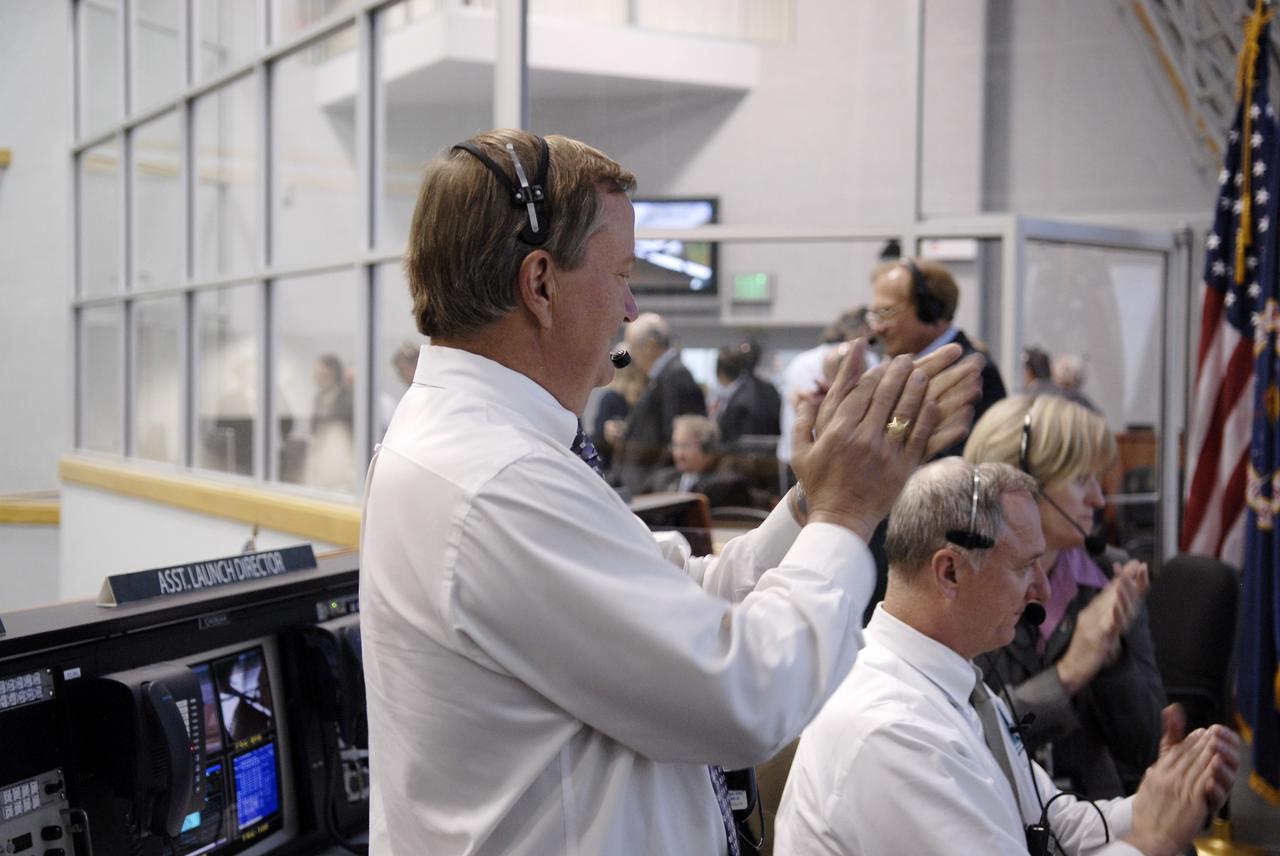
CAPE CANAVERAL, Fla. - In Firing Room 4 of NASA Kennedy Space Center's Launch Control Center, shuttle launch director Michael Leinbach, standing, assistant launch director Peter Nickolenko and shuttle Atlantis flow director Angie Brewer, both seated, applaud the launch team upon the successful launch of space shuttle Atlantis. Liftoff of Atlantis from Launch Pad 39A on its STS-129 mission to the International Space Station came at 2:28 p.m. EST Nov. 16. For information on the STS-129 mission and crew, visit http://www.nasa.gov/mission_pages/shuttle/shuttlemissions/sts129/index.html. Photo credit: NASA/Kim Shiflett
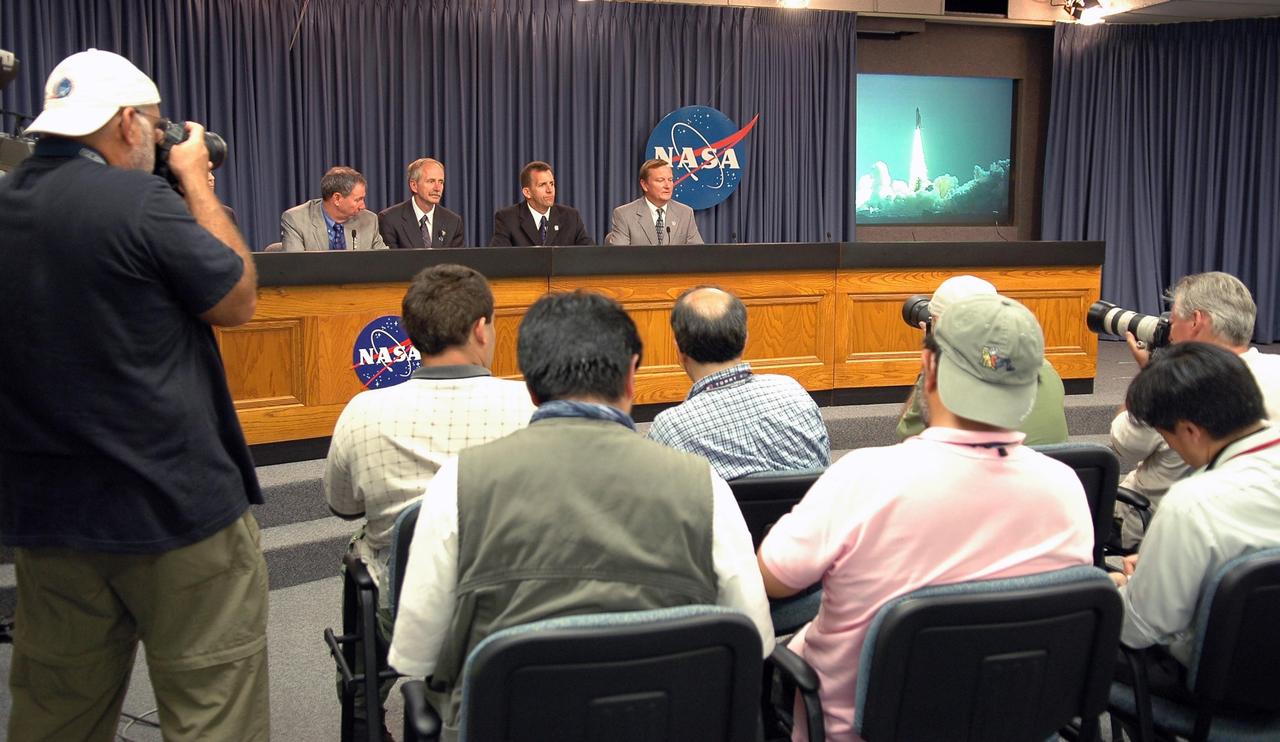
KENNEDY SPACE CENTER, FLA. - Following the successful launch of Space Shuttle Atlantis on mission STS-115, NASA Administrator Michael Griffin, Associate Administrator for Space Operations Mission William Gerstenmaier, Launch Integration Director LeRoy Cain and Shuttle Launch Director Mike Leinbach respond to questions from the media during a post-launch press conference. Mission STS-115 is the 116th space shuttle flight, the 27th flight for orbiter Atlantis, and the 19th U.S. flight to the International Space Station. STS-115 is scheduled to last 11 days with a planned landing at KSC. Photo credit: NASA/Kim Shiflett
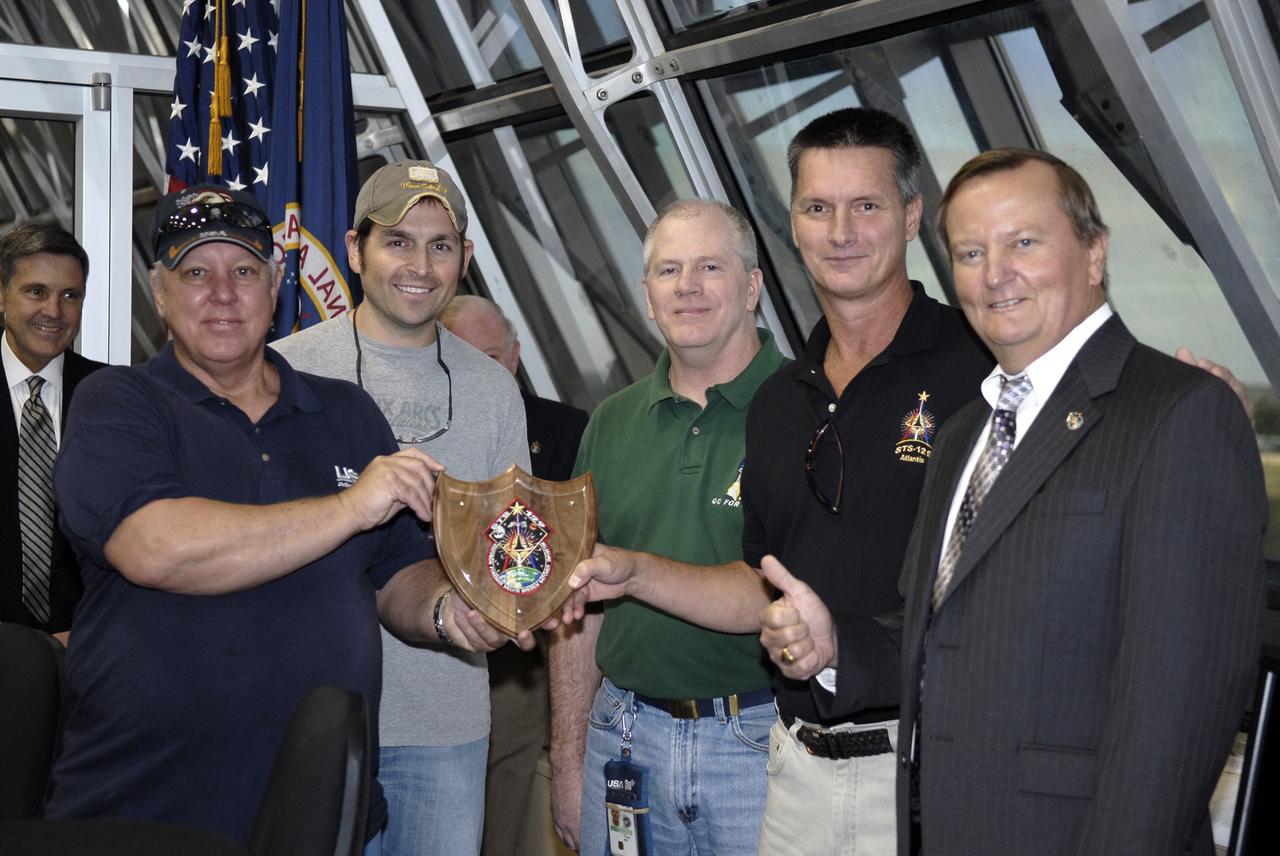
CAPE CANAVERAL, Fla. - In Firing Room 4 of NASA Kennedy Space Center's Launch Control Center, NASA's space shuttle launch director Michael Leinbach presents members of the United Space Alliance Midbody Team for space shuttle Atlantis with the Launch Director's Flow Award, a plaque emblazoned with the logo for Atlantis' STS-129 mission. The award recognizes the team's superior work in reconfiguring the shuttle's payload bay between STS-125, the last Hubble Space Telescope servicing mission, and the current STS-129 mission to the International Space Station. From left are midbody lead Jim Reed, midbody thermal control system technician Chris Oliver, midbody planner and payload operations representative for STS-129 Steve Durnin, Orbiter Processing Facility-1 midbody supervisor Bobby Pracek, and Leinbach. Liftoff of Atlantis from Launch Pad 39A on its STS-129 mission to the International Space Station came at 2:28 p.m. EST Nov. 16. For information on the STS-129 mission and crew, visit http://www.nasa.gov/mission_pages/shuttle/shuttlemissions/sts129/index.html. Photo credit: NASA/Kim Shiflett
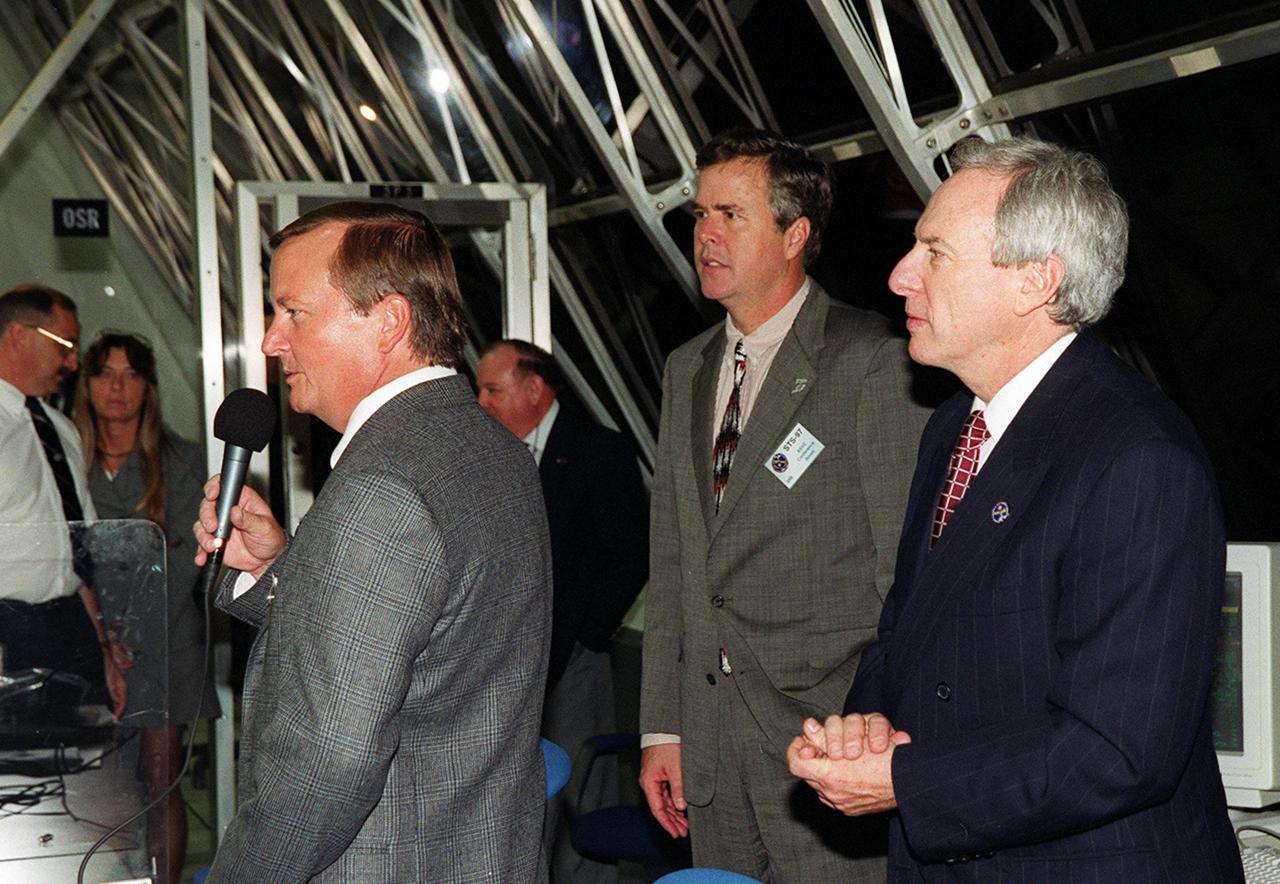
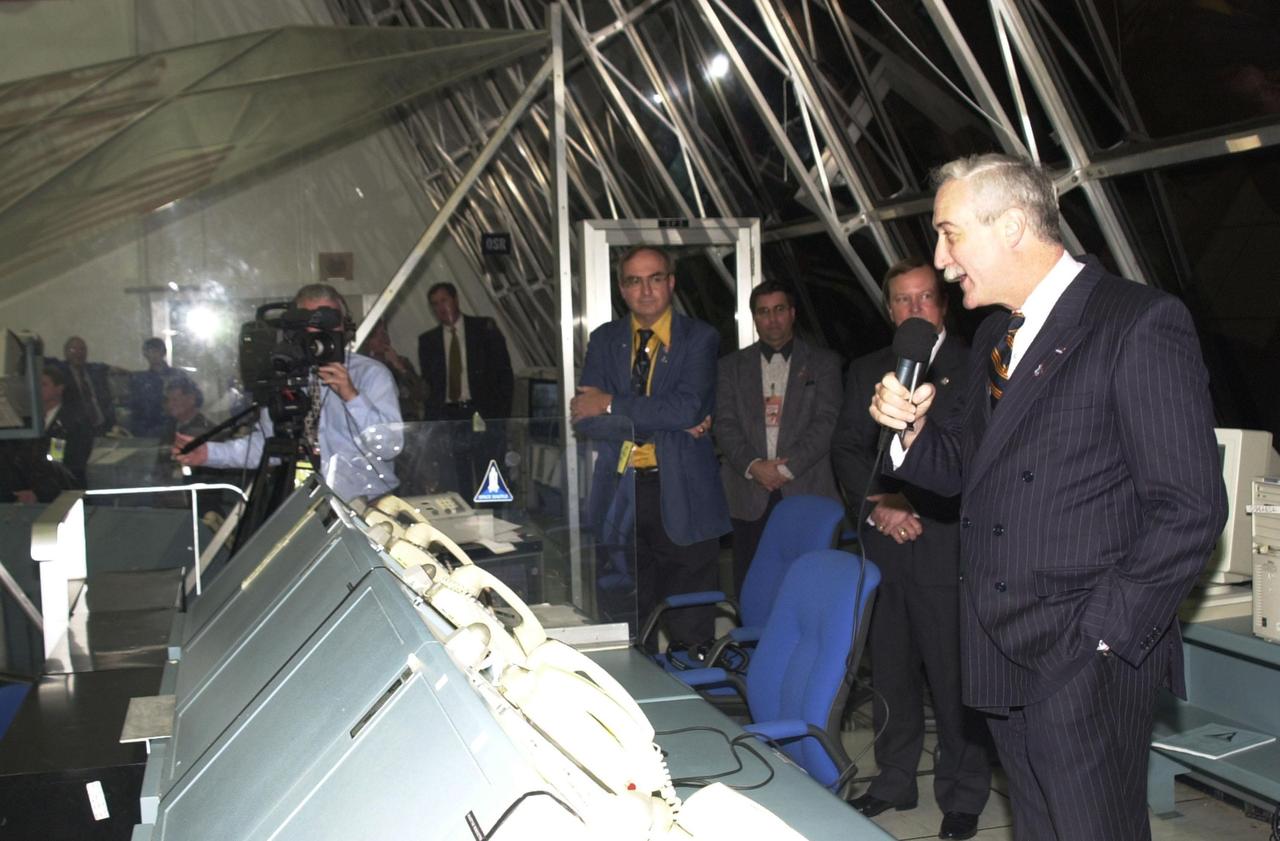
KENNEDY SPACE CENTER, FLA. -- In the Firing Room, Launch Control Center, after a successful launch of Space Shuttle Endeavour on mission STS-97, Launch Director Michael Leinbach (with microphone) addresses the launch team. Behind him at right are Florida Governor Jeb Bush and NASA Administrator Daniel Goldin. Liftoff of Endeavour occurred at 10:06:01 p.m. EST. Endeavour and its five-member crew will deliver U.S. solar arrays to the International Space Station and be the first Shuttle crew to visit the Station’s first resident crew. The 11-day mission includes three spacewalks. This marks the 101st mission in Space Shuttle history and the 25th night launch. Endeavour is expected to land at KSC Dec. 11 at 6:19 p.m. EST
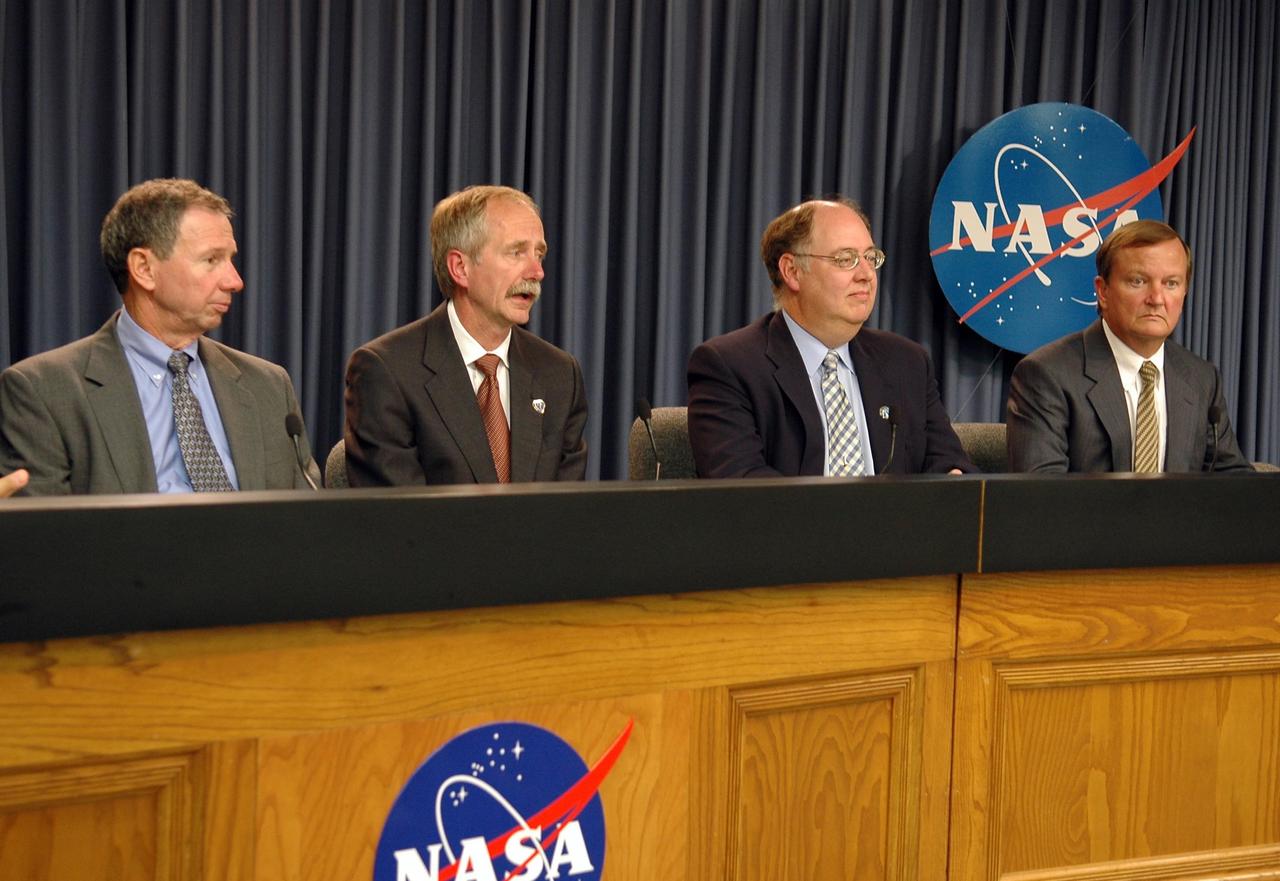
KENNEDY SPACE CENTER, FLA. - At a press conference following the Flight Readiness Review, a thorough assessment of preparations for the mission, NASA officials announce the final launch date of Aug. 27 for mission STS-115. Seated left to right are Michael Griffin, NASA administrator; Bill Gerstenmaier, associate administrator for Space Operations; Wayne Hale, Space Shuttle Program manager; and Mike Leinbach, NASA launch director. They also answered questions from the media. Mission STS-115 continues the assembly of the International Space Station with the installation of the truss segments P3 and P4. Liftoff of Space Shuttle Atlantis on mission STS-115 is targeted at approximately 4:30 p.m. EDT on Aug. 27. Photo credit: NASA/Kim Shiflett
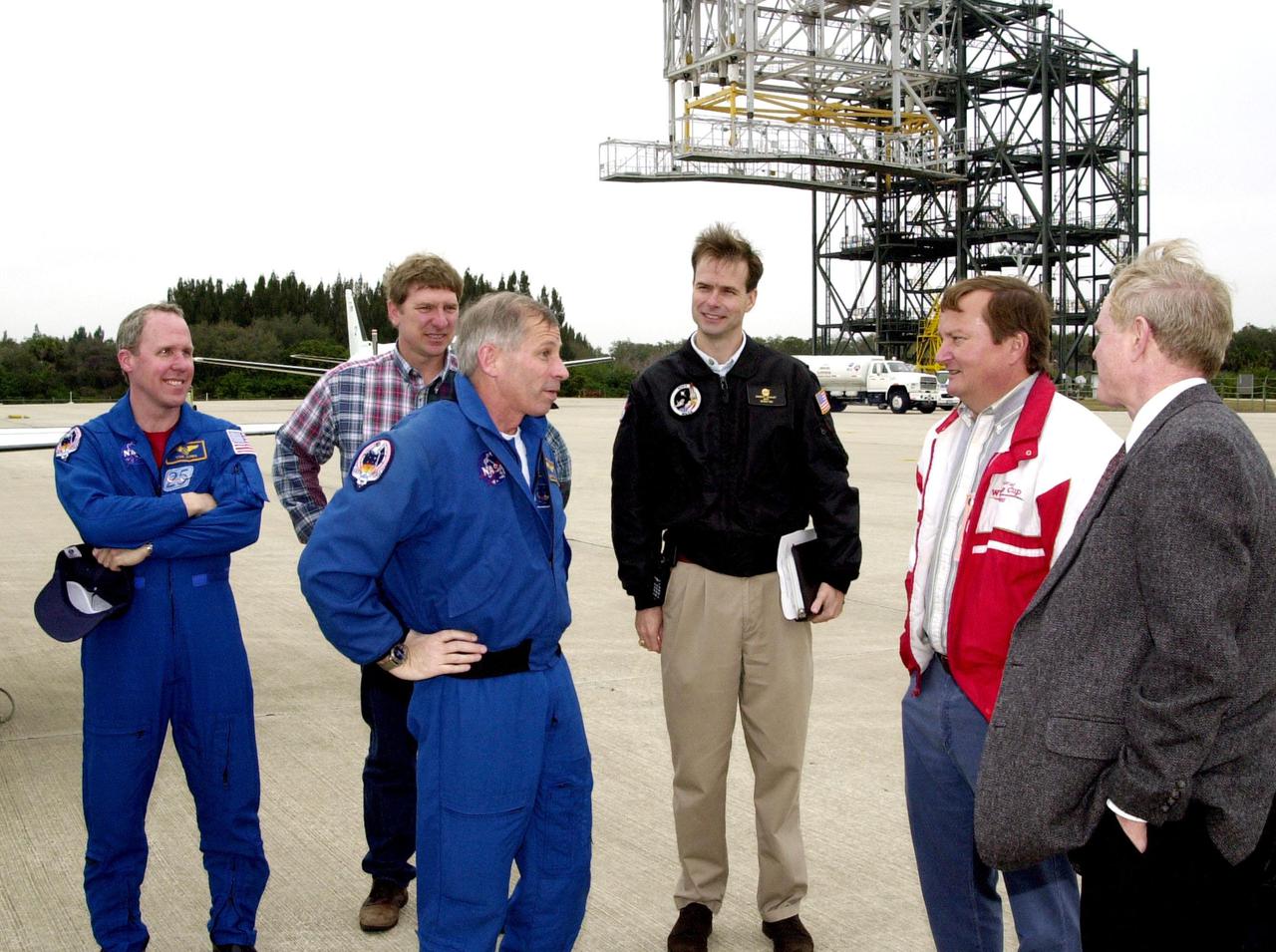
KENNEDY SPACE CENTER, FLA. -- STS-98 Mission Commander Kenneth Cockrell (center) talks with Launch Director Michael Leinbach (red and white jacket) and Center Director Roy Bridges (right) at the Shuttle Landing Facility after the crew's arrival Sunday to complete preparations for launch.; Behind him are, from left to right, Mission Specialist Thomas Jones; Tom Kwiatkowski, NASA, Johnson Space Center (JSC); and Robert Hanley, United Space Alliance, JSC.; The crew also includes Pilot Mark Polansky and Mission Specialists Marsha Ivins and Robert Curbeam.; STS-98 is the seventh construction flight to the International Space Station, carrying as payload the U.S. Lab Destiny, a key element in the construction of the ISS. Launch of STS-98 is scheduled for Feb. 7 at 6:11 p.m. EST
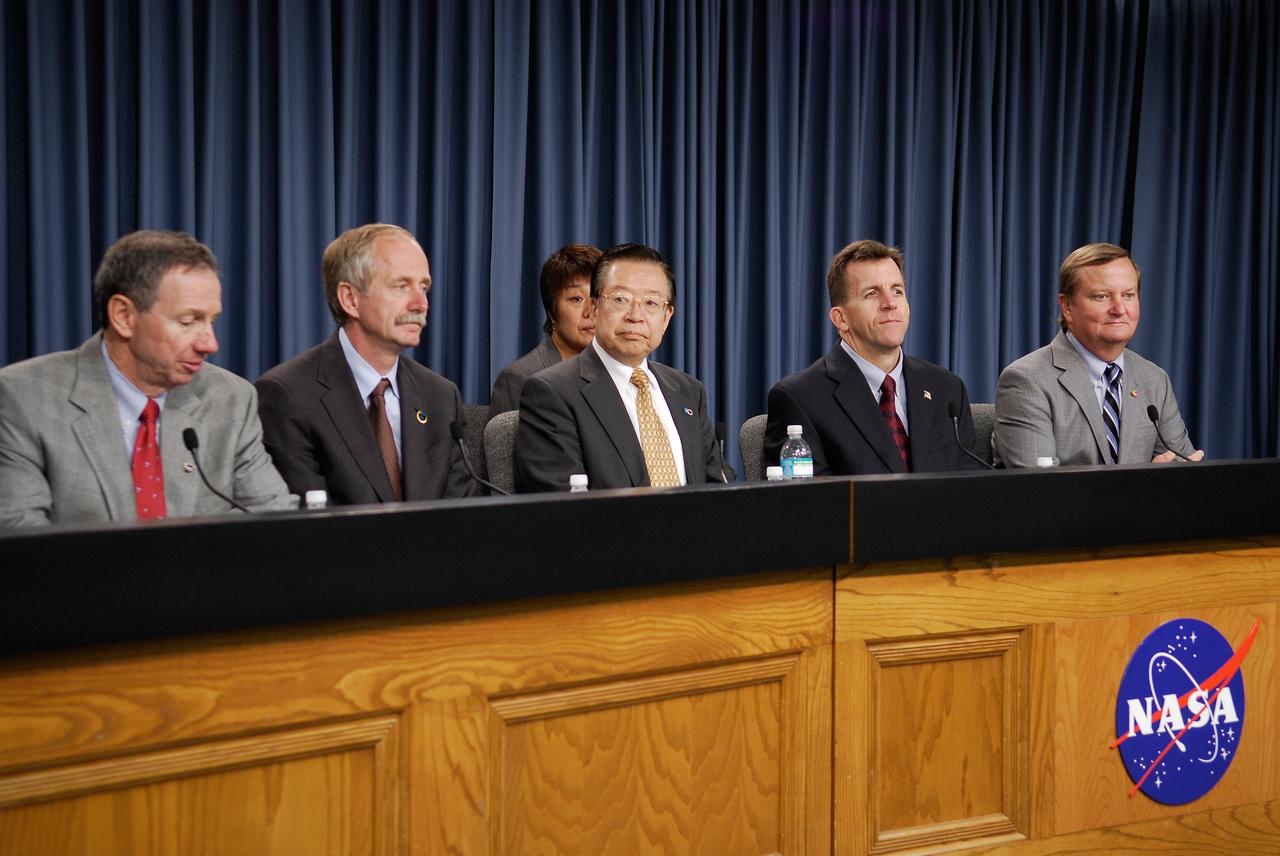
CAPE CANAVERAL, Fla. --- After the successful landing of space shuttle Endeavour to conclude the STS-123 mission, NASA officials hold a media briefing. The participants are, left to right, Michael Griffin, NASA administrator; Bill Gerstenmaier, NASA associate administrator for Space Operations; Kaoru Mamiya, Japan Aerospace Exploration Agency vice president; LeRoy Cain, chair of the mission management team; and Mike Leinbach, NASA space shuttle launch director. Endeavour landed on the second opportunity, on orbit 250, at 8:39:08 p.m. EDT. The STS-123 mission delivered the first segment of the Japan Aerospace Exploration Agency's Kibo laboratory and the Canadian Space Agency's two-armed robotic system, known as Dextre. Photo credit: NASA/Kim Shiflett
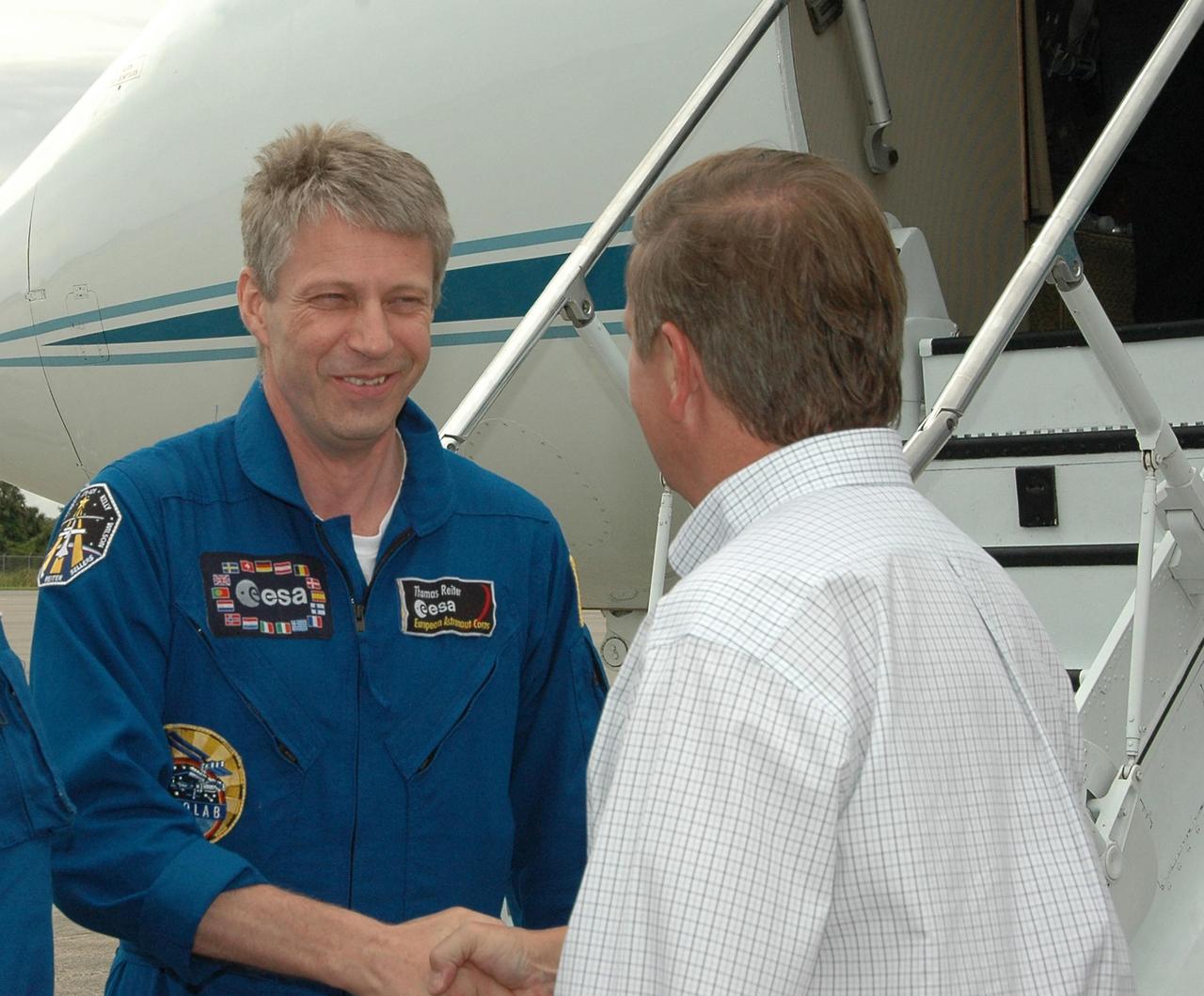
KENNEDY SPACE CENTER, FLA. - During a break in the rain storms from Tropical Storm Alberto, the STS-121 crew arrives at NASA's Kennedy Space Center aboard a Grumman G2 aircraft to take part in a Terminal Countdown Demonstration Test, or TCDT. Greeting the crew is Shuttle Launch Director Mike Leinbach, here shaking hands with Mission Specialist Thomas Reiter, who represents the European Space Agency. Other crew members are Mission Commander Steven Lindsey, Pilot Mark Kelly, and Mission Specialists Piers Sellers, Michael Fossum, Lisa Nowak and Stephanie Wilson. Over several days, the crew will practice emergency egress from the pad and suit up in their orange flight suits for the simulated countdown to launch. Space Shuttle Discovery is designated to launch July 1 on mission STS-121. It will carry supplies to the International Space Station. Photo credit: NASA/Kim Shiflett
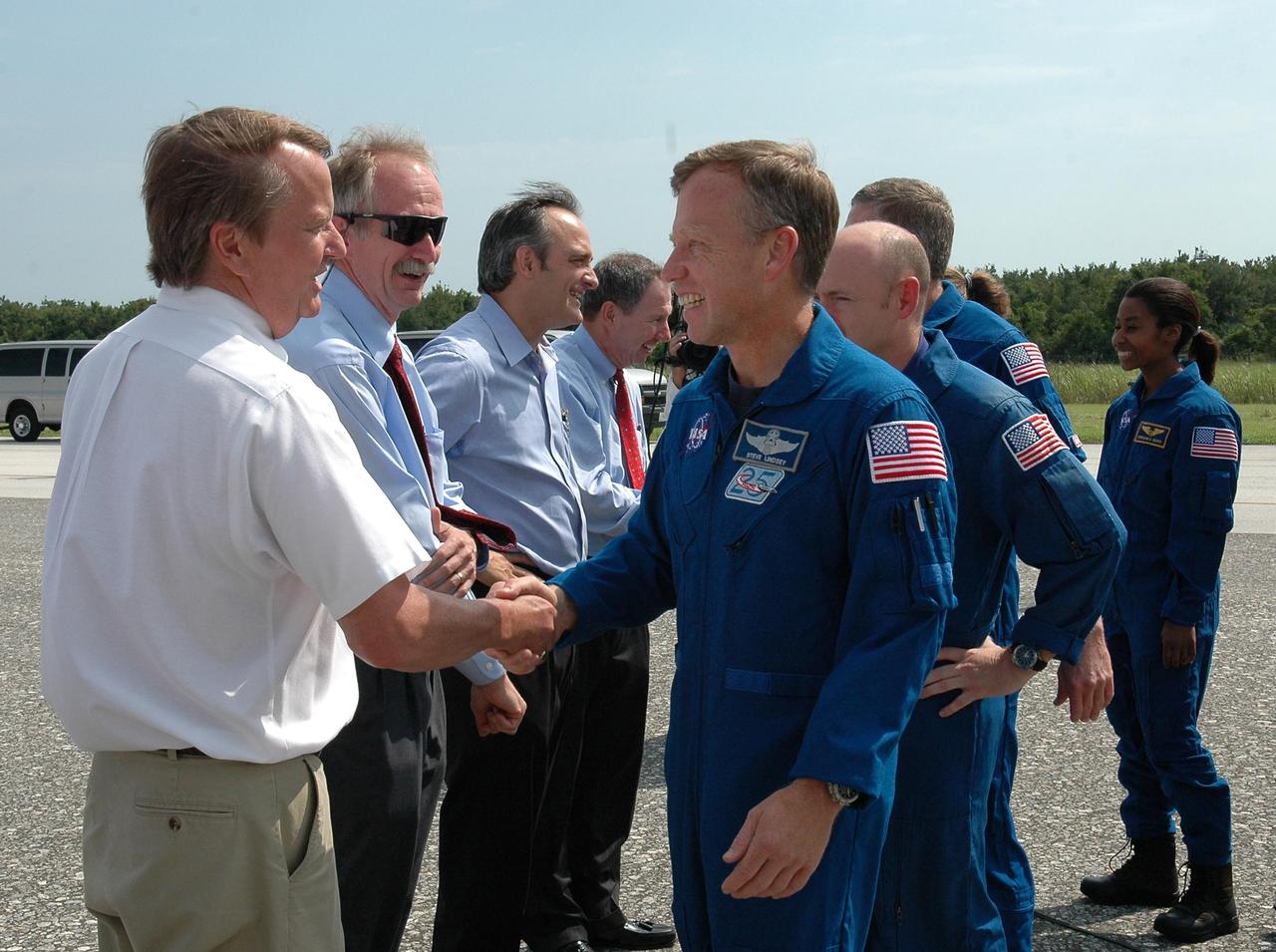
KENNEDY SPACE CENTER, FLA. - (From left) Shuttle Launch Director Mike Leinbach, Associate Administrator for Space Operations Bill Gerstenmaier, Associate Administrator Rex Geveden and NASA Administrator Mike Griffin greet STS-121 Commander Steven Lindsey, Pilot Mike Kelly and Mission Specialists Michael Fossum and Stephanie Wilson. Not visible are Mission Specialists Piers Sellers and Lisa Nowak. Mission Specialist Thomas Reiter, who launched with the crew on July 4, remained on the station to join the Expedition 13 crew there. Discovery's smooth and perfect landing was on time at 9:14 a.m. EDT on Runway 15 of NASA's Shuttle Landing Facility after traveling 5.3 million miles on 202 orbits. Mission elapsed time was 12 days, 18 hours, 37 minutes and 54 seconds. The landing is the 62nd at Kennedy Space Center and the 32nd for Discovery. Photo credit: NASA/Kim Shiflett
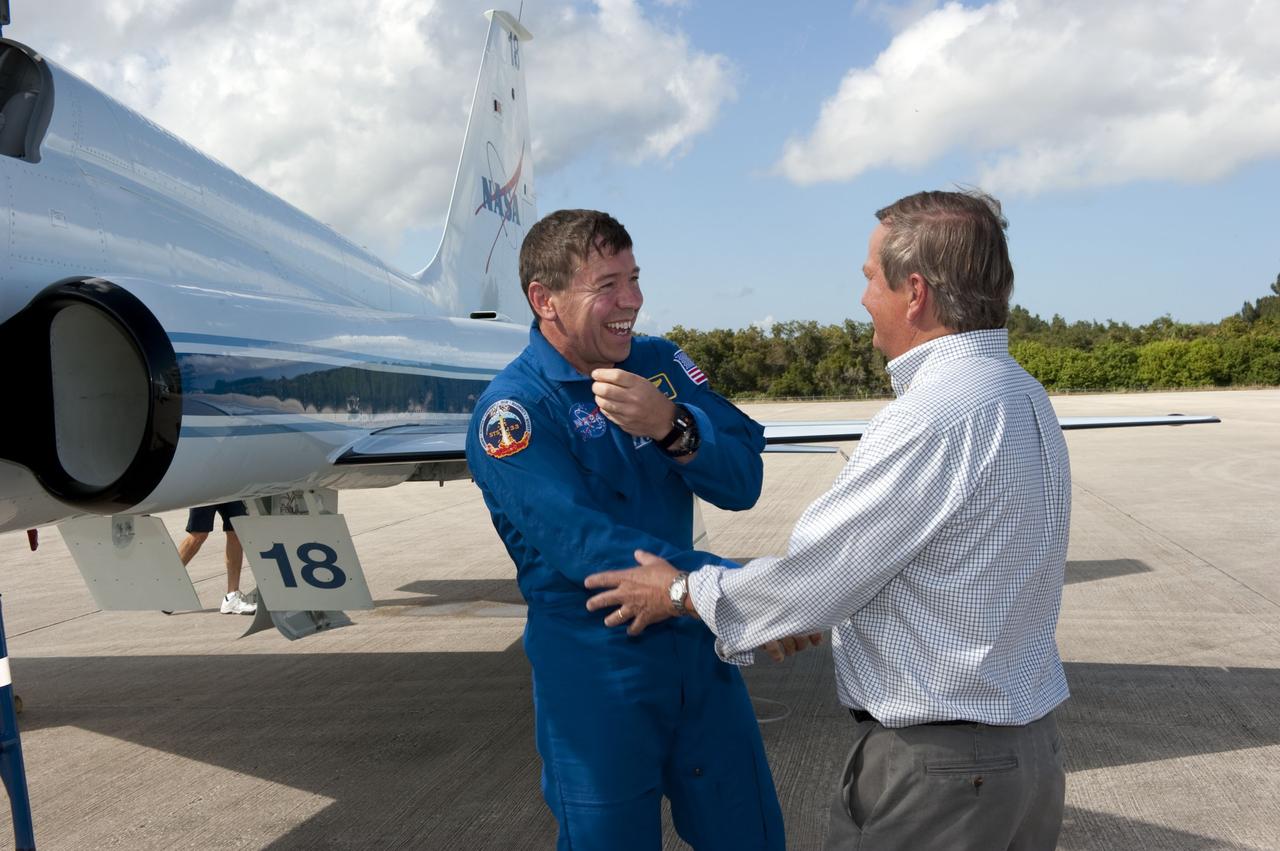
CAPE CANAVERAL, Fla. -- At NASA's Kennedy Space Center in Florida, space shuttle Discovery's STS-133 Mission Specialist Michael Barratt, left, is greeted by Shuttle Launch Director Mike Leinbach on the Shuttle Landing Facility runway after arriving in a T-38 training jet. In the days leading up to their launch to the International Space Station, Barratt and his crew members will check the fit of their launch-and-entry suits, review launch-day procedures, receive weather briefings and remain medically quarantined to prevent sickness. Scheduled to lift off Nov. 1 at 4:40 p.m., Discovery and crew will deliver the Permanent Multipurpose Module, packed with supplies and critical spare parts, as well as Robonaut 2, the dexterous humanoid astronaut helper, to the orbiting outpost. For more information on the STS-133 mission, visit www.nasa.gov/mission_pages/shuttle/shuttlemissions/sts133/. Photo credit: NASA/Kim Shiflett
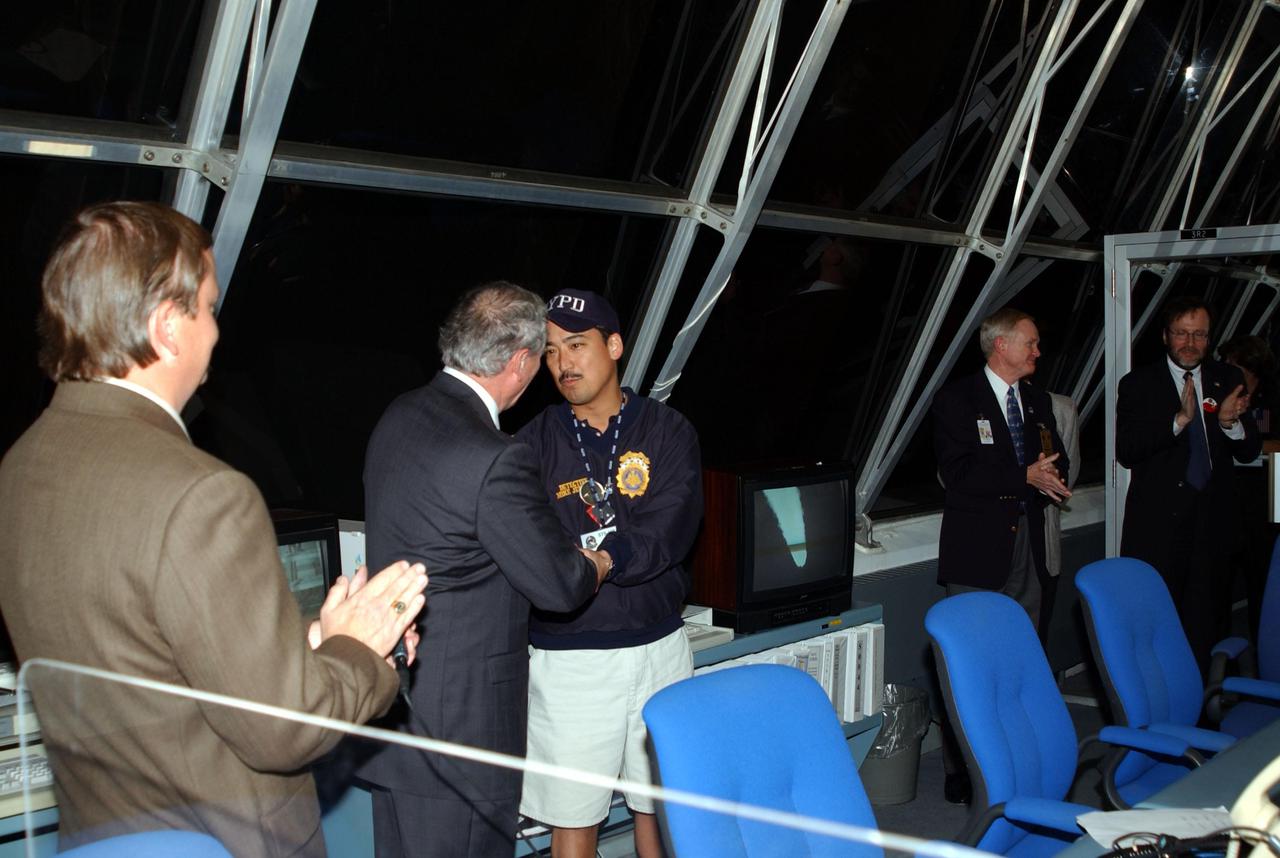
KENNEDY SPACE CENTER, Fla. -- New York Police Department Detective Michael Jermyn (center) is thanked for representing the New York Police and Fire Departments at the launch of Space Shuttle Endeavour on mission STS-108. Offering his handshake is NASA's Acting Administrator Daniel Mulville; Launch Director Mike Leinbach (left) applauds. At right is Center Director Roy Bridges Jr. Jermyn praised the efforts of the workers on the successful launch. Endeavour is carrying 6,000 flags that will be given to the families of those who died in the fall of the Twin Towers. Liftoff of Endeavour occurred at 5:19:28 p.m. EST (22:19.28 GMT). Endeavour will dock with the International Space Station on Dec. 7. STS-108 is the final Shuttle mission of 2001and the 107th Shuttle flight overall. It is the 12th flight to the Space Station. Landing of the orbiter at KSC's Shuttle Landing Facility is targeted for 1:05 p.m. EST (18:05 p.m. GMT) Dec. 16
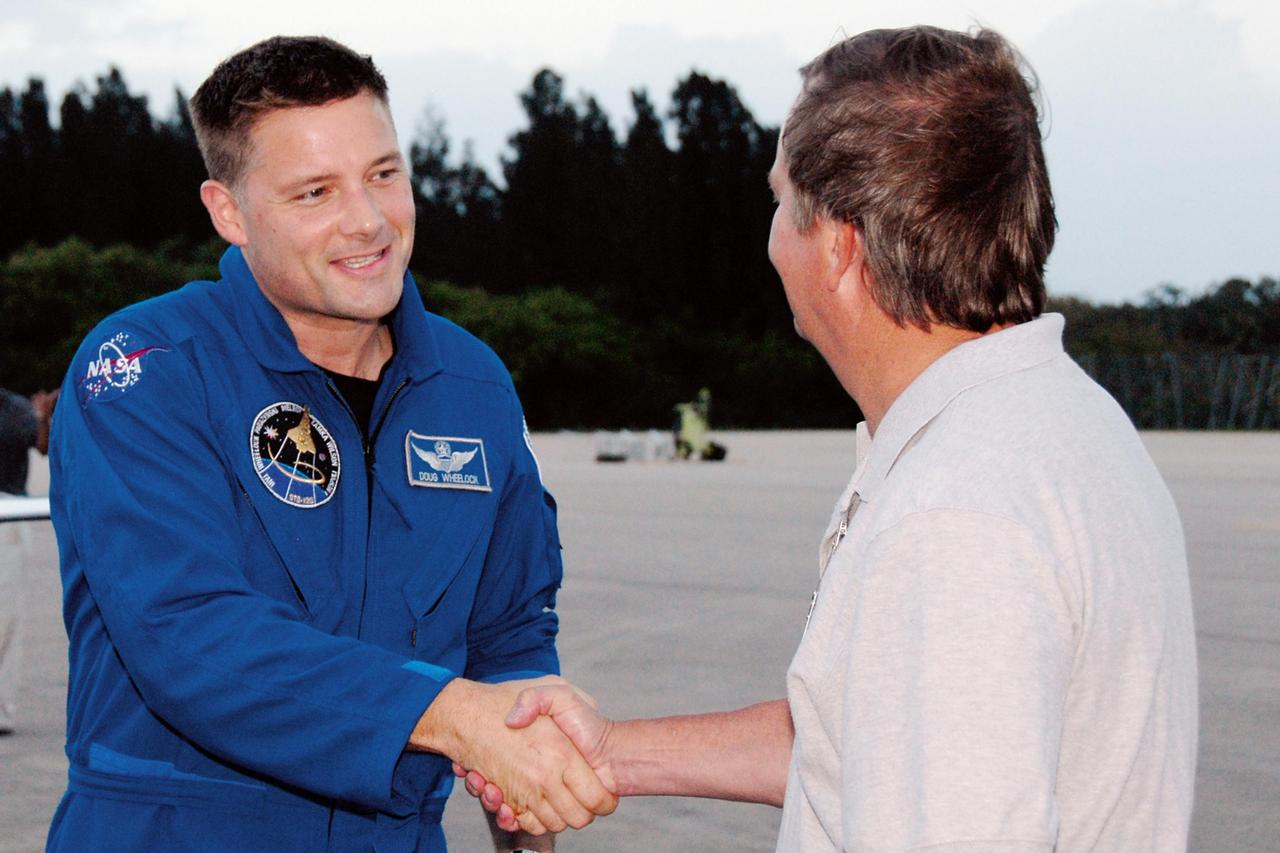
KENNEDY SPACE CENTER, FLA. -- The crew members of mission STS-120 arrive at NASA's Kennedy Space Center Shuttle Landing Facility aboard T-38 jet aircraft to take part in terminal countdown demonstration test activities. Mission Specialist Doug Wheelock, who will be making his first shuttle flight, is welcomed by Shuttle Launch Director Michael Leinbach, at right. The terminal countdown demonstration test provides astronauts and ground crews an opportunity to participate in various simulated countdown activities, including equipment familiarization and emergency training. The STS-120 mission will deliver the U.S. Node 2 module, named Harmony, aboard space shuttle Discovery to the International Space Station. Launch of Discovery on mission STS-120 is targeted for Oct. 23 at 11:38 a.m. EDT on a 14-day mission to the International Space Station. Photo credit: NASA/Kim Shiflett
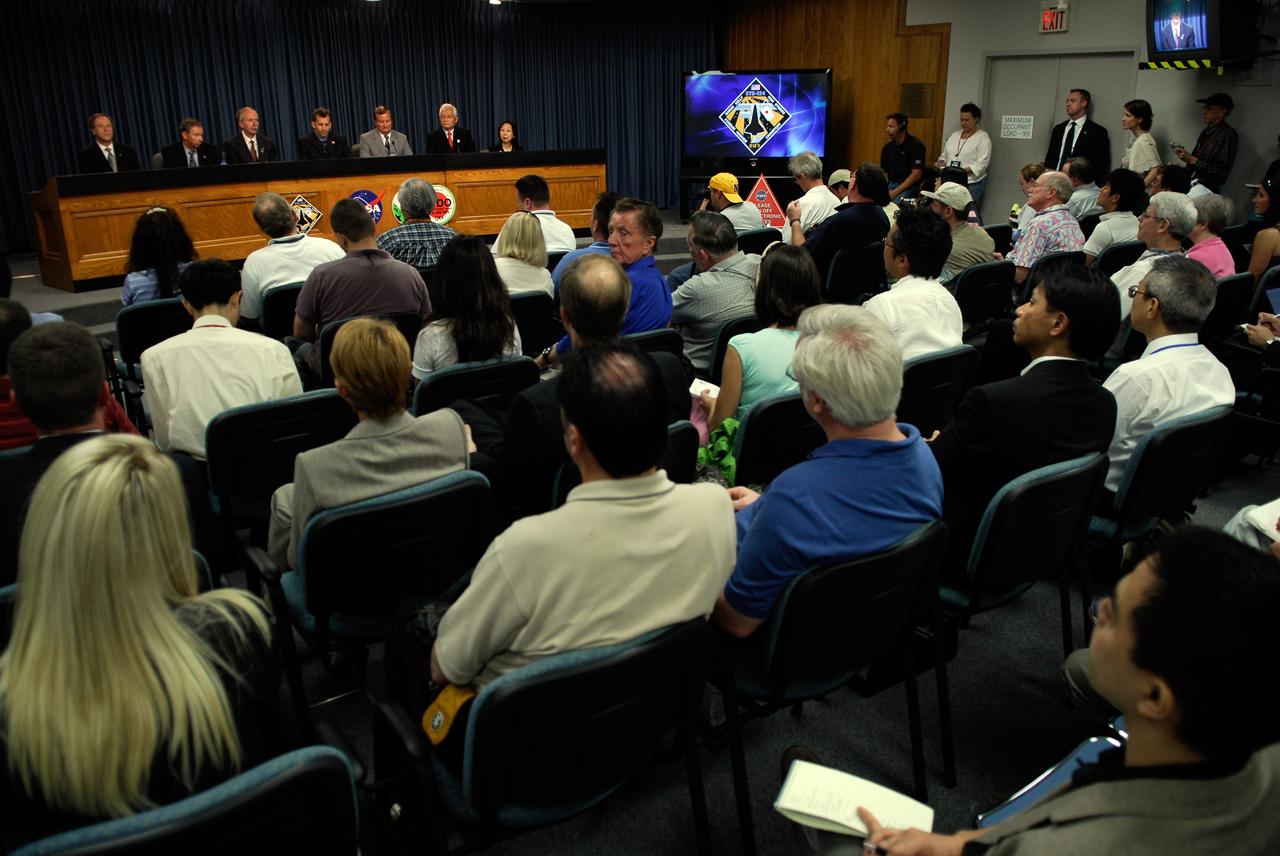
CAPE CANAVERAL, Fla. -- The media fill the NASA's News Center television studio for a news conference with key NASA personnel following the successful launch of space shuttle Discovery on the STS-124 mission. On the stage are (left to right) Public Affairs Officer David Mould as moderator, NASA Administrator Michael Griffin, Associate Administrator for Space Operations Bill Gerstenmaier, Director of Mission Launch Integration LeRoy Cain, Shuttle Launch Director Mike Leinbach, Japan Aerospace Exploration Agency President Dr. Keiji Tachikawa and an interpreter. The STS-124 mission is the 26th in the assembly of the space station. It is the second of three flights launching components to complete the Japan Aerospace Exploration Agency's Kibo laboratory. The shuttle crew will install Kibo's large Japanese Pressurized Module and its remote manipulator system, or RMS. The 14-day flight includes three spacewalks. Photo credit: NASAKim Shiflett
KENNEDY SPACE CENTER, Fla. - In the firing room, NASA Administrator Sean O'Keefe (right) congratulates the launch team after the successful on-time launch of Space Shuttle Columbia. Standing next to O'Keefe is Launch Director Mike Leinbach. Liftoff occurred at 6:22:02:08 a.m. EST (11:22:02:08 GMT). Columbia is on its 27th flight and the 108th flight of the Shuttle Program. The goal of the mission is the maintenance and upgrade of the Hubble Space Telescope, to be carried out in five spacewalks. The crew of STS-109 comprises Commander Scott D. Altman, Pilot Duane G. Carey, Payload Commander John M. Grunsfeld, and Mission Specialists Nancy Jane Currie, Richard M. Linnehan, James H. Newman and Michael J. Massimino. After an 11-day mission, Columbia is expected to return to Kennedy March 12 about 4:35 a.m. EST (09:35 GMT)
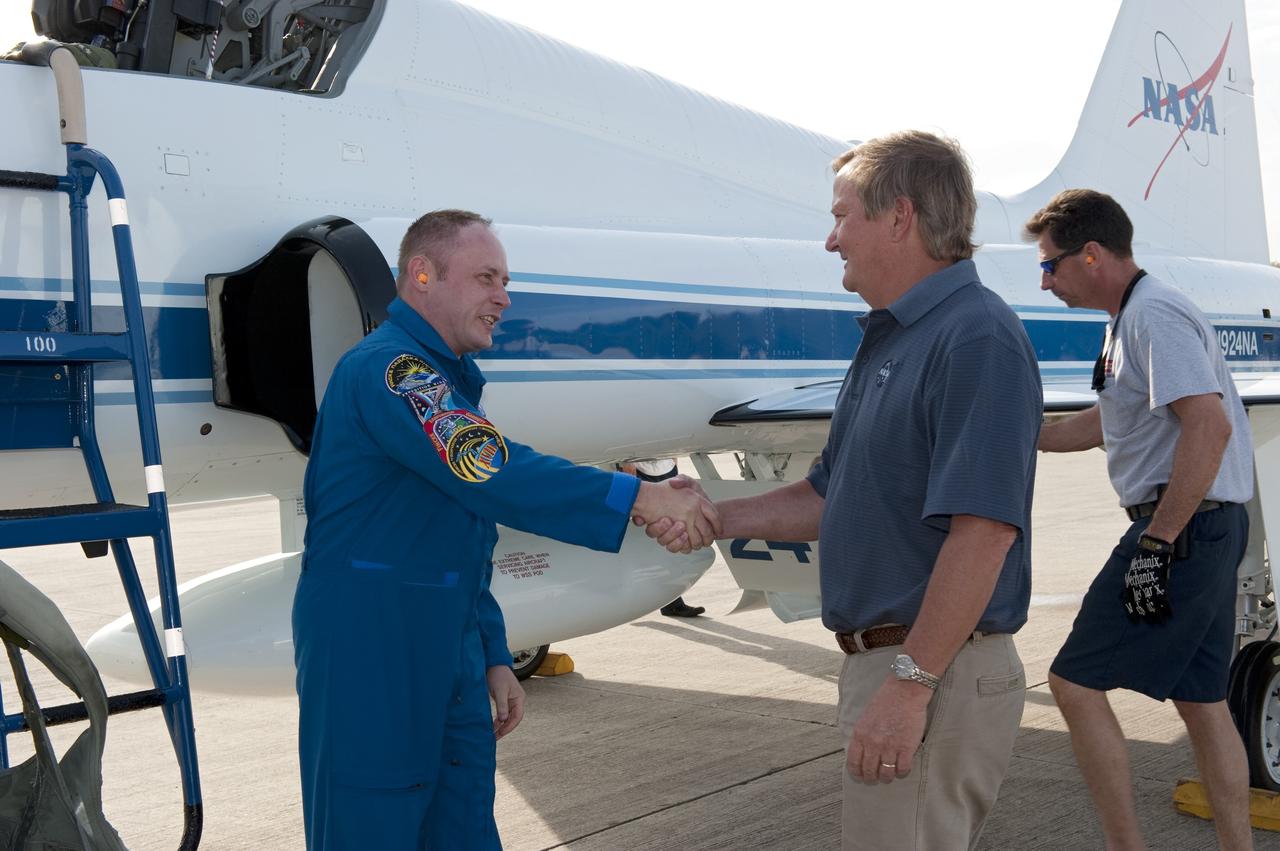
CAPE CANAVERAL, Fla. -- Shuttle Launch Director Mike Leinbach greets STS-134 Mission Specialist Michael Fincke, who arrived on the Shuttle Landing Facility at NASA's Kennedy Space Center in Florida aboard a T-38 jet. While at Kennedy, space shuttle Endeavour's crew will participate in a launch countdown dress rehearsal called the Terminal Countdown Demonstration Test (TCDT) and related training in preparation for the upcoming STS-134 mission. Endeavour and its six STS-134 crew members will deliver the Express Logistics Carrier-3, Alpha Magnetic Spectrometer-2 (AMS), a high-pressure gas tank, additional spare parts for the Dextre robotic helper and micrometeoroid debris shields to the International Space Station. This will be the final spaceflight for Endeavour. Launch is targeted for April 19 at 7:48 p.m. EDT. For more information visit, www.nasa.gov/mission_pages/shuttle/shuttlemissions/sts134/index.html. Photo credit: NASA/Kim Shiflett
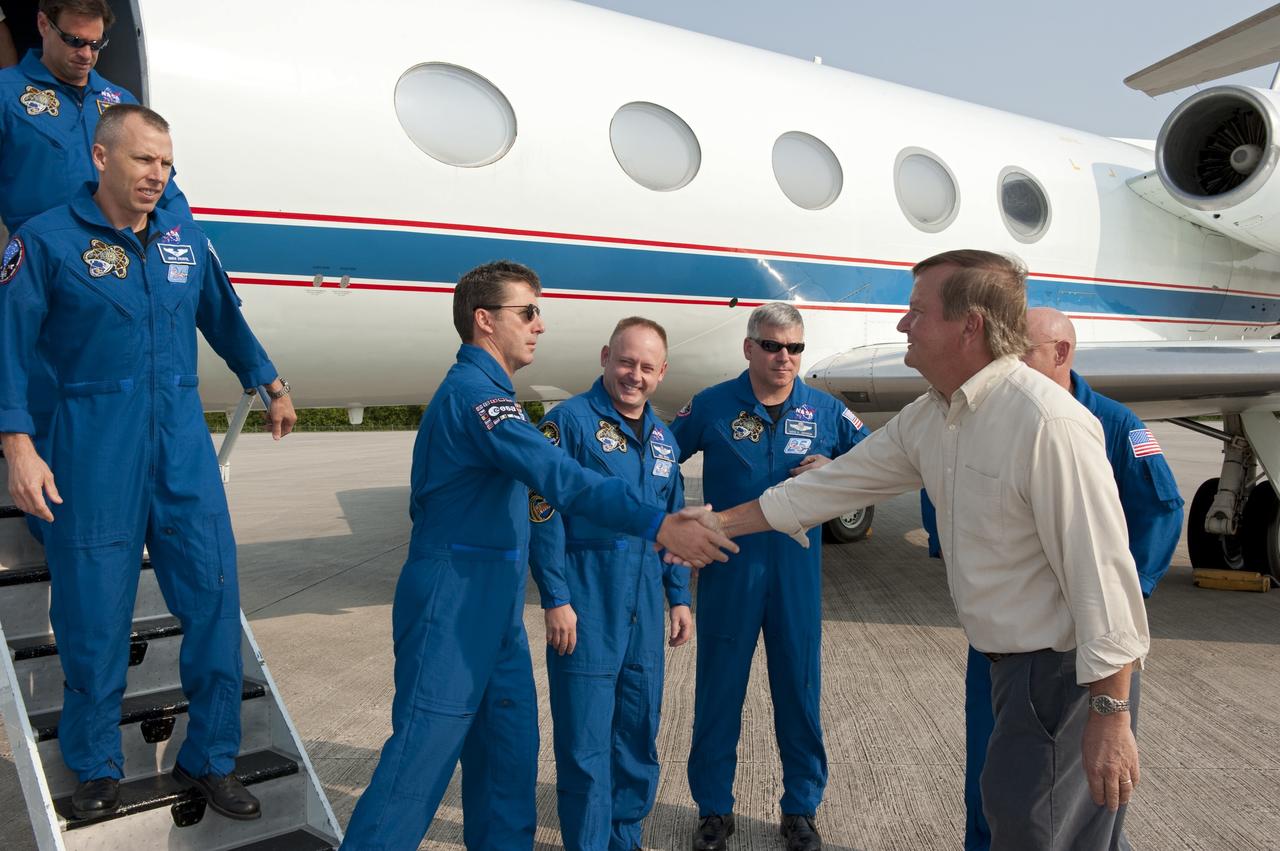
CAPE CANAVERAL, Fla. -- At NASA Kennedy Space Center's Shuttle Landing Facility in Florida, the STS-134 crew members are greeted by Shuttle Launch Director Mike Leinbach after the crew's arrival for shuttle Endeavour's liftoff to the International Space Station scheduled for Monday, May 16 at 8:56 a.m. EDT. From right are Commander Mark Kelly (partially obscured), Pilot Greg H. Johnson, Mission Specialists Michael Fincke, European Space Agency astronaut Roberto Vittori, Andrew Feustel and Greg Chamitoff. Endeavour and its crew will deliver the Express Logistics Carrier-3, Alpha Magnetic Spectrometer-2 (AMS), a high-pressure gas tank and additional spare parts for the Dextre robotic helper to the station. This will be the final spaceflight for Endeavour. For more information visit, www.nasa.gov/mission_pages/shuttle/shuttlemissions/sts134/index.html. Photo credit: NASA/Kim Shiflett
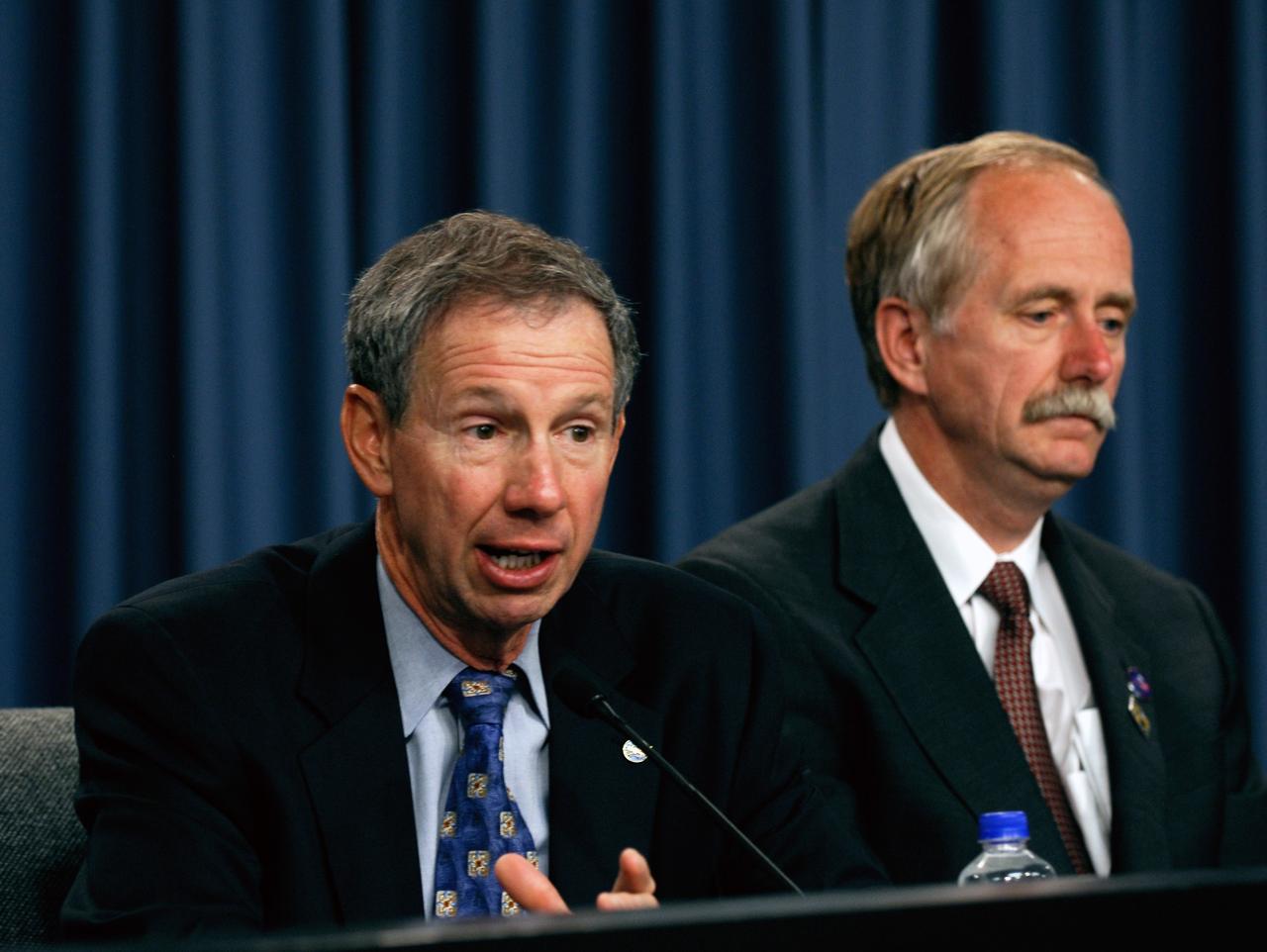
CAPE CANAVERAL, Fla. -- NASA Administrator Michael Griffin responds to a question from the media during a news conference in NASA's News Center television studio following the successful launch of space shuttle Discovery on the STS-124 mission. At right is Associate Administrator for Space Operations Bill Gerstenmaier. Others who participated were Director of Mission Launch Integration LeRoy Cain, Shuttle Launch Director Mike Leinbach and Japan Aerospace Exploration Agency President Dr. Keiji Tachikawa. The STS-124 mission is the 26th in the assembly of the space station. It is the second of three flights launching components to complete the Japan Aerospace Exploration Agency's Kibo laboratory. The shuttle crew will install Kibo's large Japanese Pressurized Module and its remote manipulator system, or RMS. The 14-day flight includes three spacewalks. Photo credit: NASAKim Shiflett
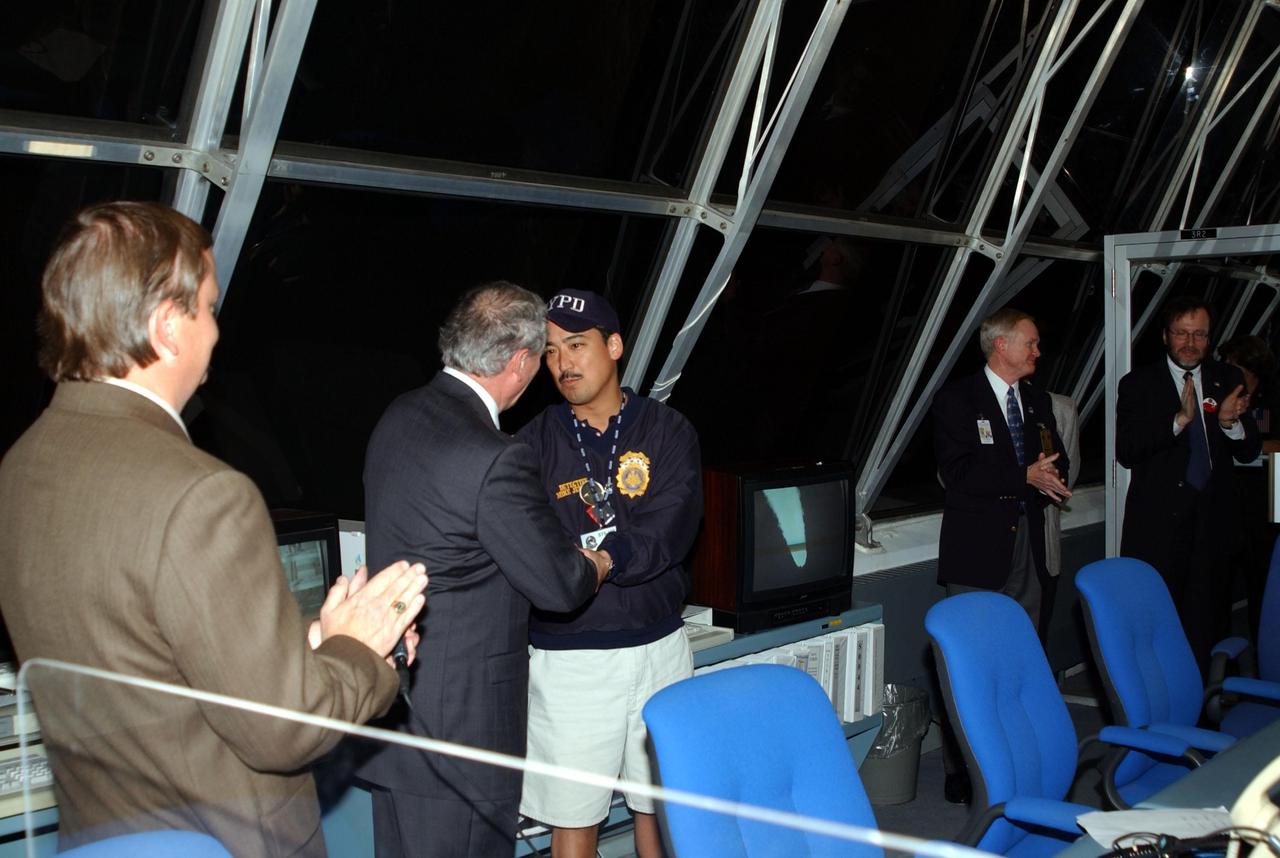
KENNEDY SPACE CENTER, Fla. -- New York Police Department Detective Michael Jermyn (center) is thanked for representing the New York Police and Fire Departments at the launch of Space Shuttle Endeavour on mission STS-108. Offering his handshake is NASA's Acting Administrator Daniel Mulville; Launch Director Mike Leinbach (left) applauds. At right is Center Director Roy Bridges Jr. Jermyn praised the efforts of the workers on the successful launch. Endeavour is carrying 6,000 flags that will be given to the families of those who died in the fall of the Twin Towers. Liftoff of Endeavour occurred at 5:19:28 p.m. EST (22:19.28 GMT). Endeavour will dock with the International Space Station on Dec. 7. STS-108 is the final Shuttle mission of 2001and the 107th Shuttle flight overall. It is the 12th flight to the Space Station. Landing of the orbiter at KSC's Shuttle Landing Facility is targeted for 1:05 p.m. EST (18:05 p.m. GMT) Dec. 16
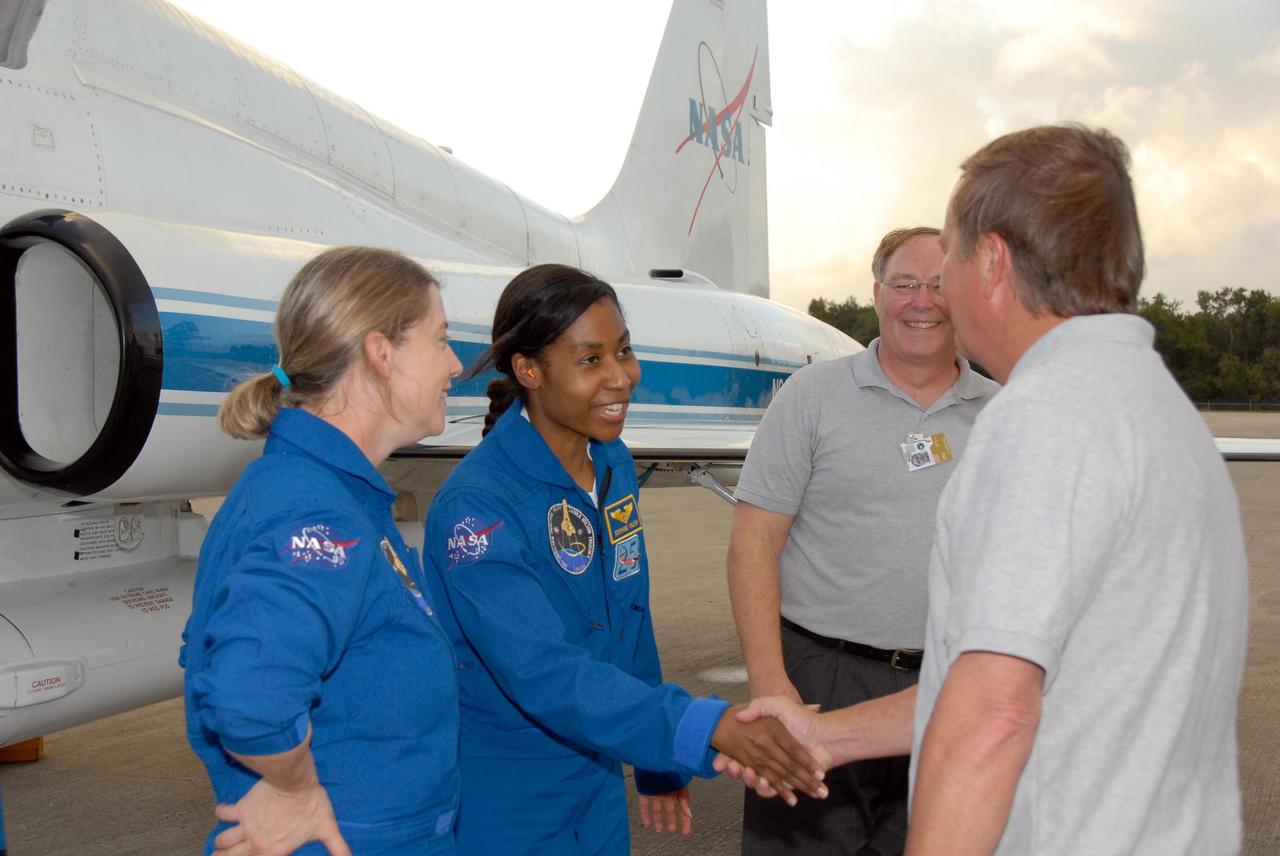
KENNEDY SPACE CENTER, FLA. -- The crew members of mission STS-120 arrive at NASA's Kennedy Space Center Shuttle Landing Facility aboard T-38 jet aircraft to take part in terminal countdown demonstration test activities. Shuttle Launch Director Michael Leinbach shakes hands with Mission Specialist Stephanie Wilson, who will be making her second shuttle flight, as Commander Pam Melroy, at left, looks on. The terminal countdown demonstration test provides astronauts and ground crews an opportunity to participate in various simulated countdown activities, including equipment familiarization and emergency training. The STS-120 mission will deliver the U.S. Node 2 module, named Harmony, aboard space shuttle Discovery to the International Space Station. Launch of Discovery on mission STS-120 is targeted for Oct. 23 at 11:38 a.m. EDT on a 14-day mission to the International Space Station. Photo credit: NASA/Kim Shiflett
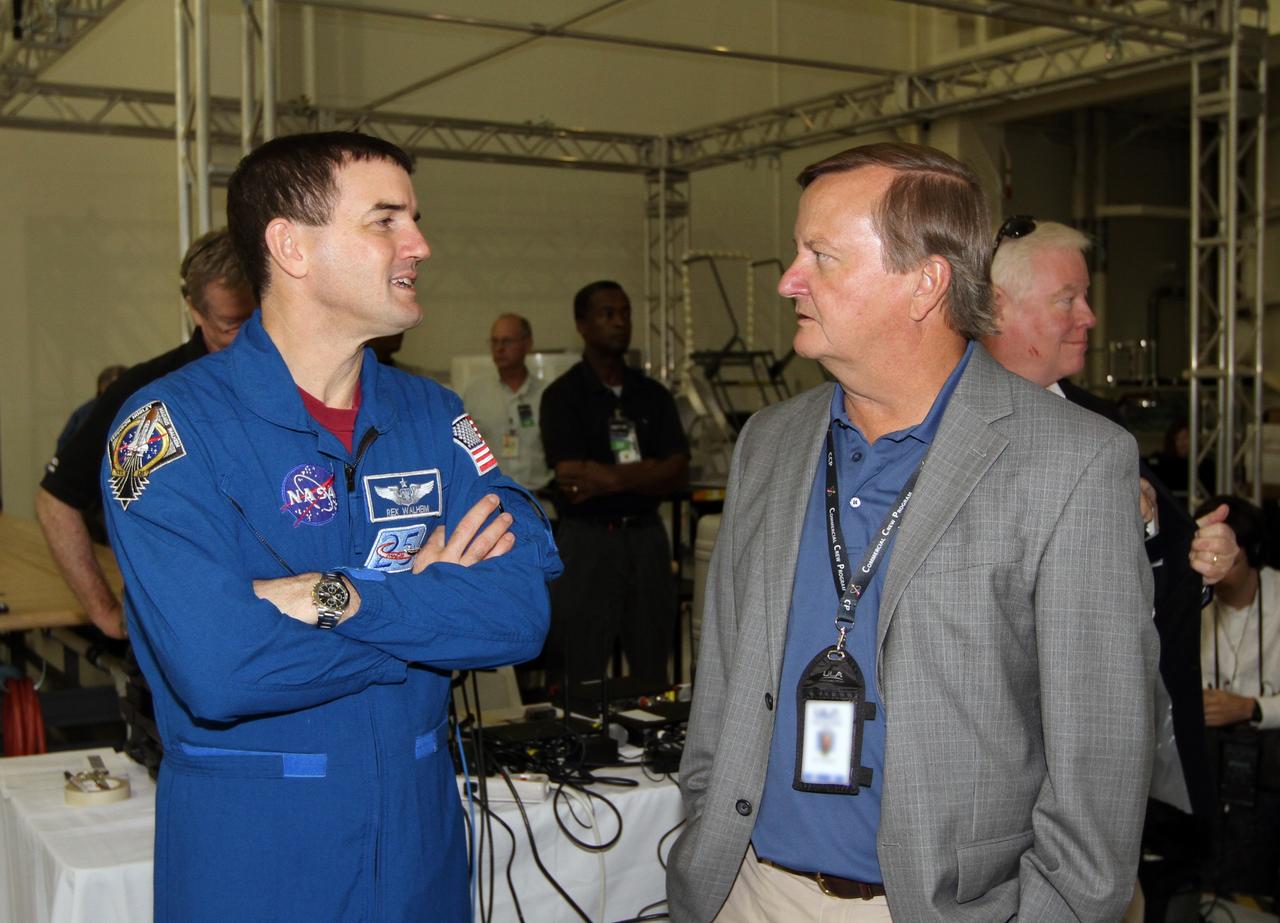
CAPE CANAVERAL, Fla. – NASA astronaut Rex Walheim talks to Michael Leinbach, director of Human Spaceflight Operations for United Launch Alliance, in Kennedy Space Center's Operations and Checkout Building high bay during an event marking the arrival of NASA's first space-bound Orion capsule in Florida. Slated for Exploration Flight Test-1, an uncrewed mission planned for 2014, the capsule will travel farther into space than any human spacecraft has gone in more than 40 years. The capsule was shipped to Kennedy from NASA's Michoud Assembly Facility in New Orleans where the crew module pressure vessel was built. The Orion production team will prepare the module for flight at Kennedy by installing heat-shielding thermal protection systems, avionics and other subsystems. For more information, visit http://www.nasa.gov/orion. Photo credit: NASA/Kim Shiflett
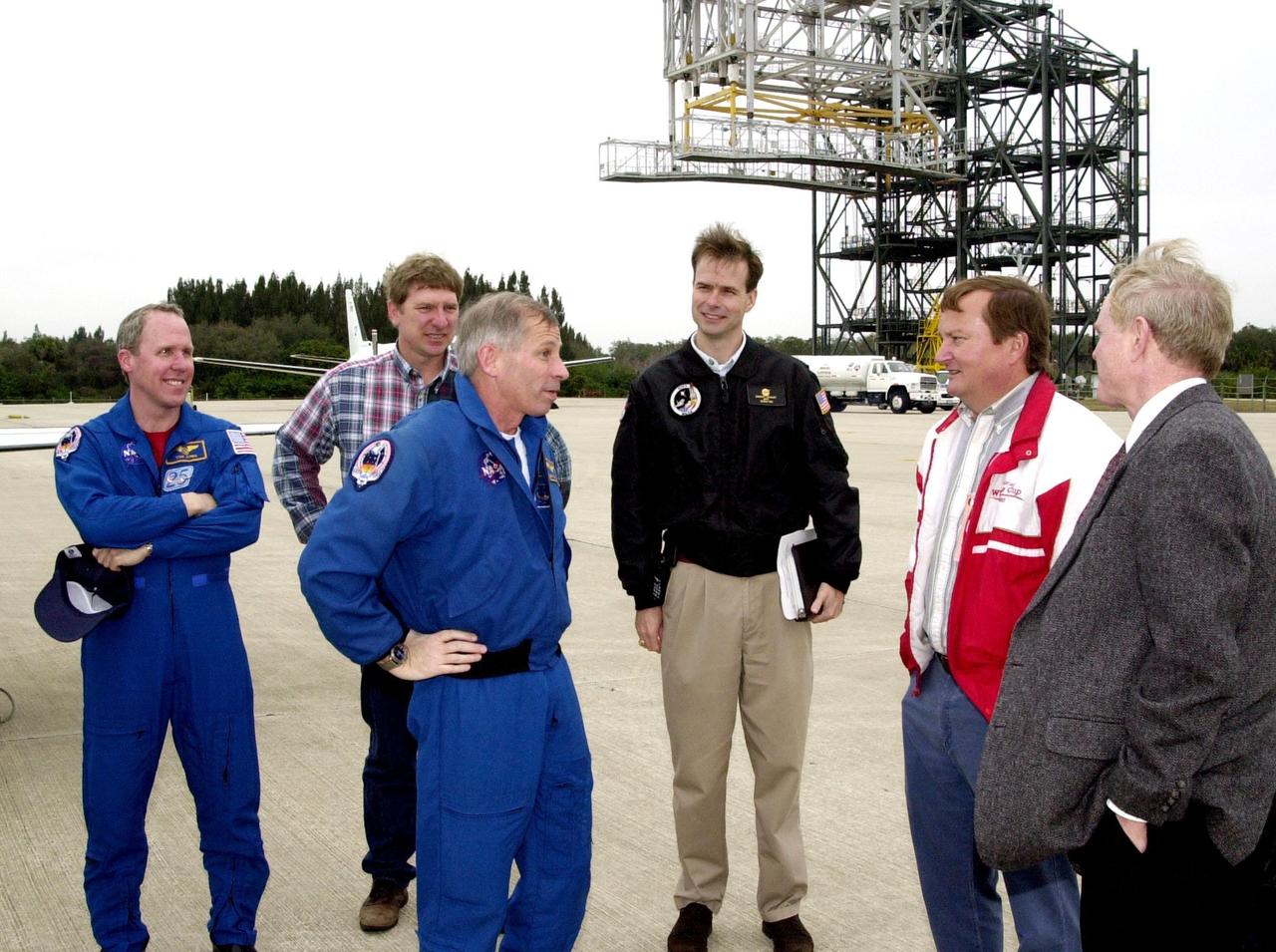
KENNEDY SPACE CENTER, FLA. -- STS-98 Mission Commander Kenneth Cockrell (center) talks with Launch Director Michael Leinbach (red and white jacket) and Center Director Roy Bridges (right) at the Shuttle Landing Facility after the crew's arrival Sunday to complete preparations for launch.; Behind him are, from left to right, Mission Specialist Thomas Jones; Tom Kwiatkowski, NASA, Johnson Space Center (JSC); and Robert Hanley, United Space Alliance, JSC.; The crew also includes Pilot Mark Polansky and Mission Specialists Marsha Ivins and Robert Curbeam.; STS-98 is the seventh construction flight to the International Space Station, carrying as payload the U.S. Lab Destiny, a key element in the construction of the ISS. Launch of STS-98 is scheduled for Feb. 7 at 6:11 p.m. EST
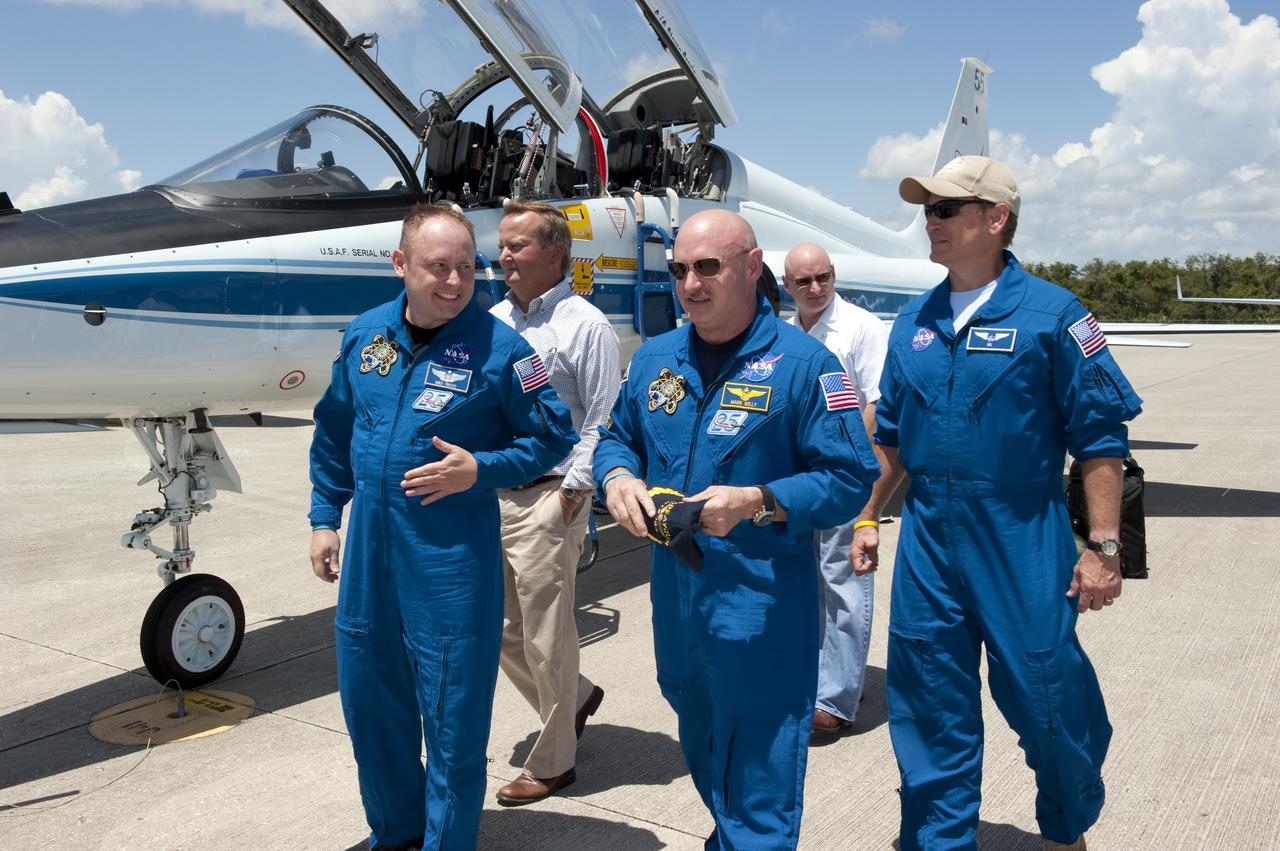
CAPE CANAVERAL, Fla. -- At NASA Kennedy Space Center's Shuttle Landing Facility in Florida, the STS-134 crew members arrive for final preparations for shuttle Endeavour's liftoff to the International Space Station. On the tarmac are from left (front row) Mission Specialist Michael Fincke and Commander Mark Kelly. Walking behind (from left) are Shuttle Launch Director Mike Leinbach, NASA astronaut Scott Kelly and Deputy Chief of Flight Crew Operations, Brian Kelly. Endeavour and its crew will deliver the Express Logistics Carrier-3, Alpha Magnetic Spectrometer-2 (AMS), a high-pressure gas tank and additional spare parts for the Dextre robotic helper to the station. This will be the final spaceflight for Endeavour. For more information visit, www.nasa.gov/mission_pages/shuttle/shuttlemissions/sts134/index.html. Photo credit: NASA/Kim Shiflett
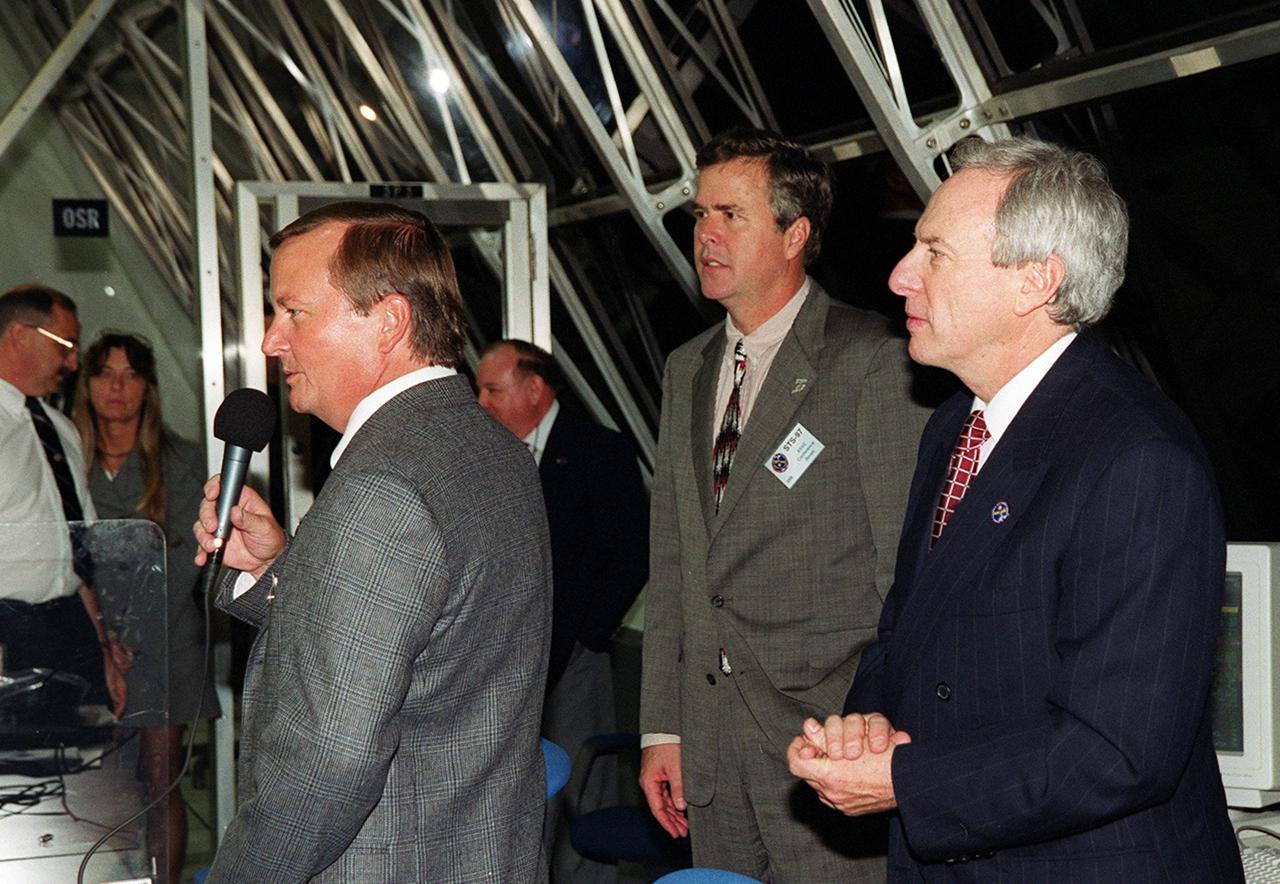
KENNEDY SPACE CENTER, FLA. -- In the Firing Room, Launch Control Center, after a successful launch of Space Shuttle Endeavour on mission STS-97, Launch Director Michael Leinbach (with microphone) addresses the launch team. Behind him at right are Florida Governor Jeb Bush and NASA Administrator Daniel Goldin. Liftoff of Endeavour occurred at 10:06:01 p.m. EST. Endeavour and its five-member crew will deliver U.S. solar arrays to the International Space Station and be the first Shuttle crew to visit the Station’s first resident crew. The 11-day mission includes three spacewalks. This marks the 101st mission in Space Shuttle history and the 25th night launch. Endeavour is expected to land at KSC Dec. 11 at 6:19 p.m. EST
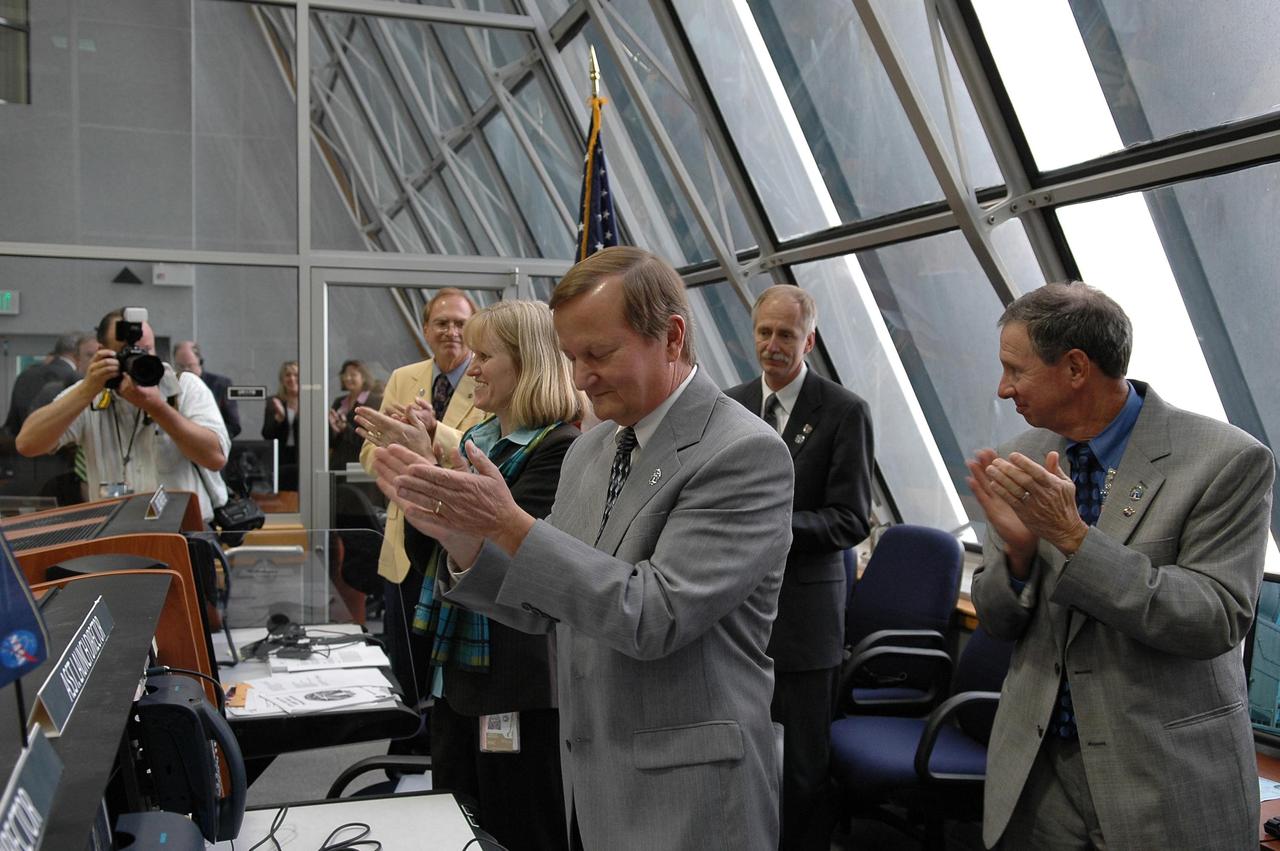
KENNEDY SPACE CENTER, FLA. - Inside the Launch Control Center, NASA and KSC officials applaud the successful launch of Space Shuttle Atlantis on mission STS-115. From right are NASA Administrator Michael Griffin, Associate Administrator for Space Operations Mission William Gerstenmaier, Shuttle Launch Director Mike Leinbach, NASA Flow Director Angie Brewer, and Public Affairs Officer George Diller, who provided commentary leading up to the launch. Mission STS-115 is the 116th space shuttle flight, the 27th flight for orbiter Atlantis, and the 19th U.S. flight to the International Space Station. STS-115 is scheduled to last 11 days with a planned landing at KSC. Photo credit: NASA/Kim Shiflett
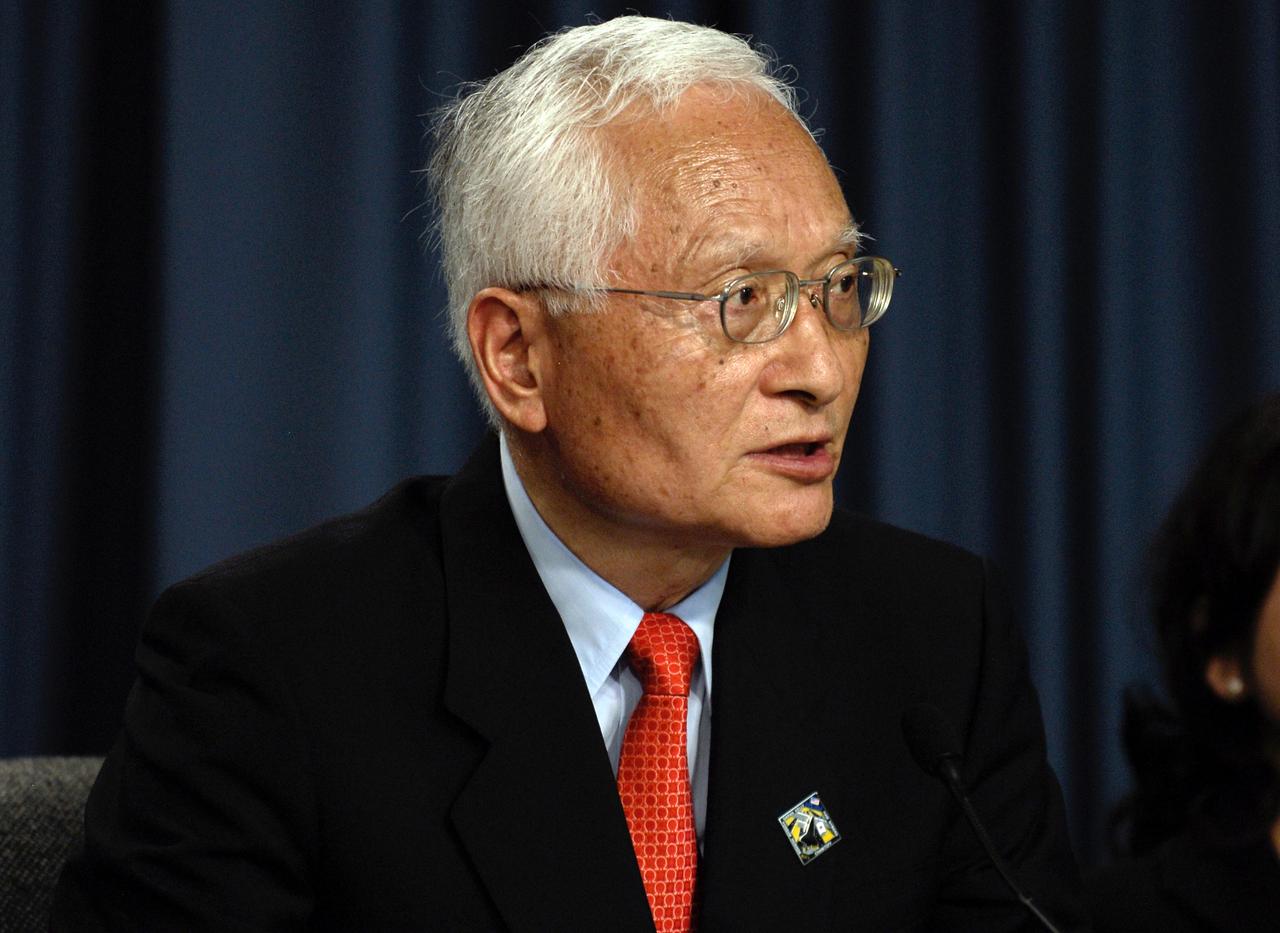
CAPE CANAVERAL, Fla. -- Japan Aerospace Exploration Agency President Dr. Keiji Tachikawa talks to the media during a news conference in NASA's News Center television studio following the successful launch of space shuttle Discovery on the STS-124 mission. Others who participated were NASA Administrator Michael Griffin, Associate Administrator for Space Operations Bill Gerstenmaier, Director of Mission Launch Integration LeRoy Cain and Shuttle Launch Director Mike Leinbach. The STS-124 mission is the 26th in the assembly of the space station. It is the second of three flights launching components to complete the Japan Aerospace Exploration Agency's Kibo laboratory. The shuttle crew will install Kibo's large Japanese Pressurized Module and its remote manipulator system, or RMS. The 14-day flight includes three spacewalks. Photo credit: NASAKim Shiflett
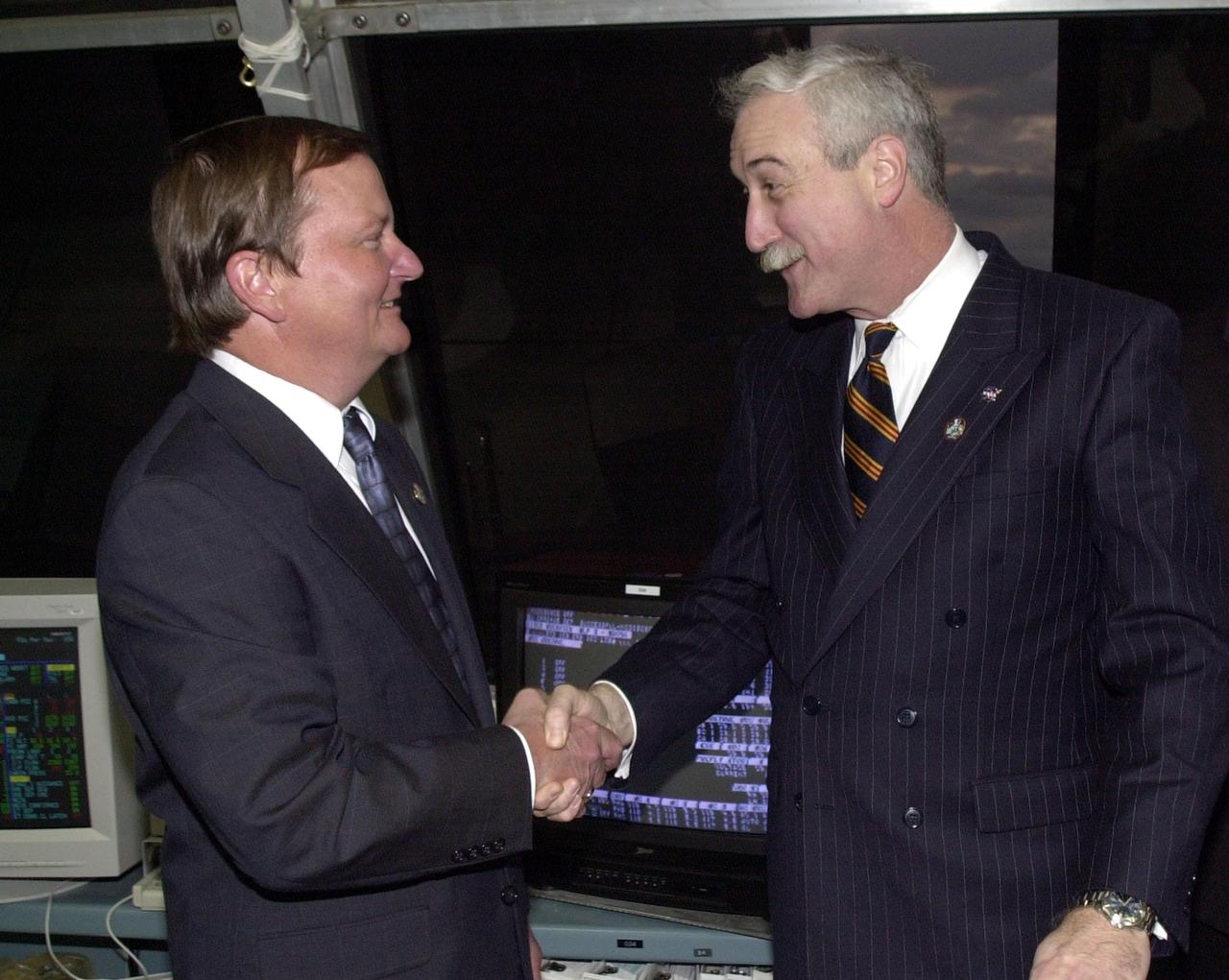
KENNEDY SPACE CENTER, Fla. - In the firing room, NASA Administrator Sean O'Keefe (right) congratulates Launch Director Mike Leinbach for the successful on-time launch of Space Shuttle Columbia. Liftoff occurred at 6:22:02:08 a.m. EST (11:22:02:08 GMT). Columbia is on its 27th flight and the 108th flight of the Shuttle Program. The goal of the mission is the maintenance and upgrade of the Hubble Space Telescope, to be carried out in five spacewalks. The crew of STS-109 comprises Commander Scott D. Altman, Pilot Duane G. Carey, Payload Commander John M. Grunsfeld, and Mission Specialists Nancy Jane Currie, Richard M. Linnehan, James H. Newman and Michael J. Massimino. After an 11-day mission, Columbia is expected to return to Kennedy March 12 about 4:35 a.m. EST (09:35 GMT)
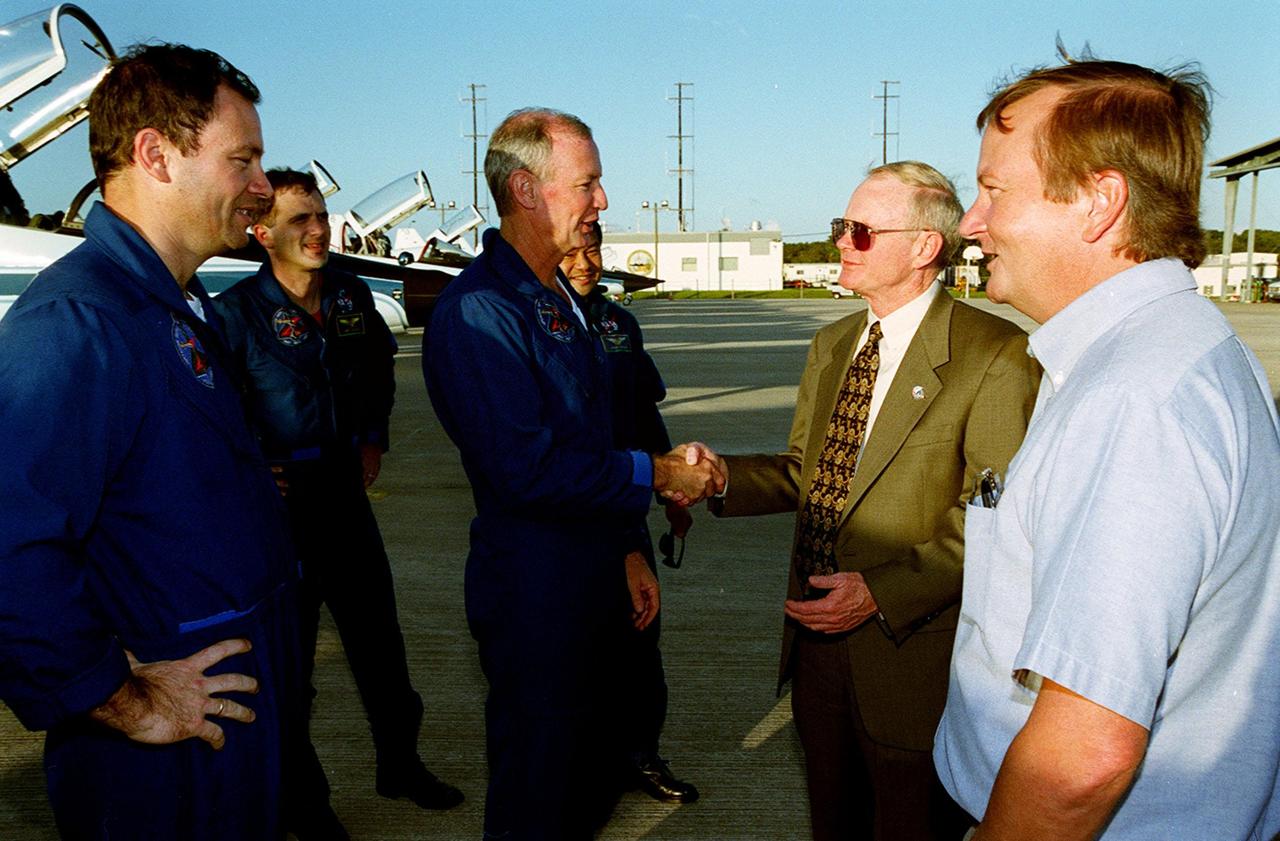
Center Director Roy Bridges greets STS-92 Commander Brian Duffy after the crew’s arrival at the KSC Shuttle Landing Facility. Behind Duffy are Mission Specialists Michael Lopez-Alegria, Jeff Wisoff and Koichi Wakata (NASDA). Next to Bridges is Michael Leinbach, the new KSC launch director. The STS-92 crew is at KSC to take part in Terminal Countdown Demonstration Test (TCDT) activities. The TCDT includes emergency egress training from the orbiter and pad, plus a simulated countdown. The fifth mission to the International Space Station, STS-92 will carry the Integrated Truss Structure Z1, the first of the planned 10 trusses on the Space Station, and the third Pressurized Mating Adapter. The Z1 will allow the first U.S. solar arrays on a future flight to be temporarily installed on Unity for early power. PMA-3 will provide a Shuttle docking port for the solar array installation on the sixth ISS flight and Lab installation on the seventh ISS flight. STS-92 is scheduled to launch Oct. 5 from launch Pad 39A. It will be the 100th flight in the Shuttle program
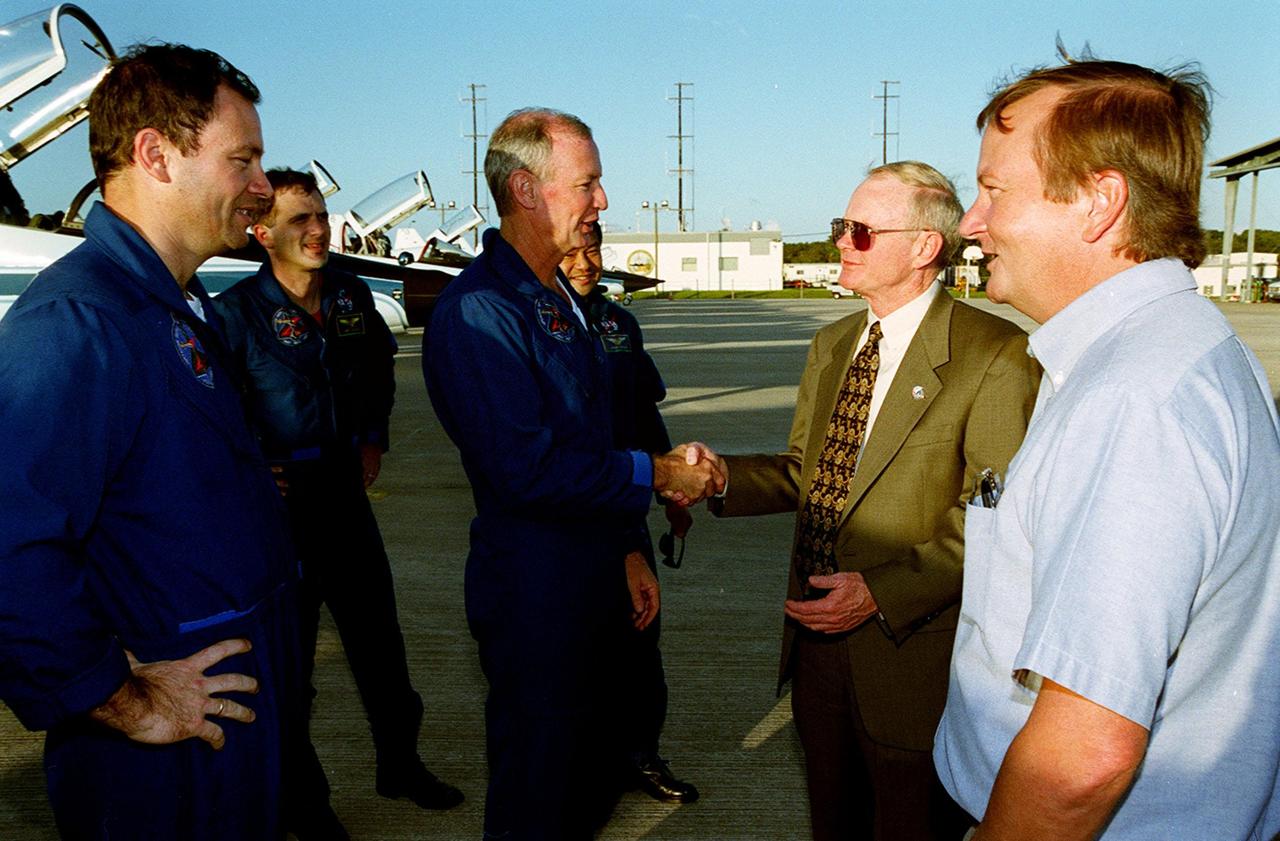
Center Director Roy Bridges greets STS-92 Commander Brian Duffy after the crew’s arrival at the KSC Shuttle Landing Facility. Behind Duffy are Mission Specialists Michael Lopez-Alegria, Jeff Wisoff and Koichi Wakata (NASDA). Next to Bridges is Michael Leinbach, the new KSC launch director. The STS-92 crew is at KSC to take part in Terminal Countdown Demonstration Test (TCDT) activities. The TCDT includes emergency egress training from the orbiter and pad, plus a simulated countdown. The fifth mission to the International Space Station, STS-92 will carry the Integrated Truss Structure Z1, the first of the planned 10 trusses on the Space Station, and the third Pressurized Mating Adapter. The Z1 will allow the first U.S. solar arrays on a future flight to be temporarily installed on Unity for early power. PMA-3 will provide a Shuttle docking port for the solar array installation on the sixth ISS flight and Lab installation on the seventh ISS flight. STS-92 is scheduled to launch Oct. 5 from launch Pad 39A. It will be the 100th flight in the Shuttle program
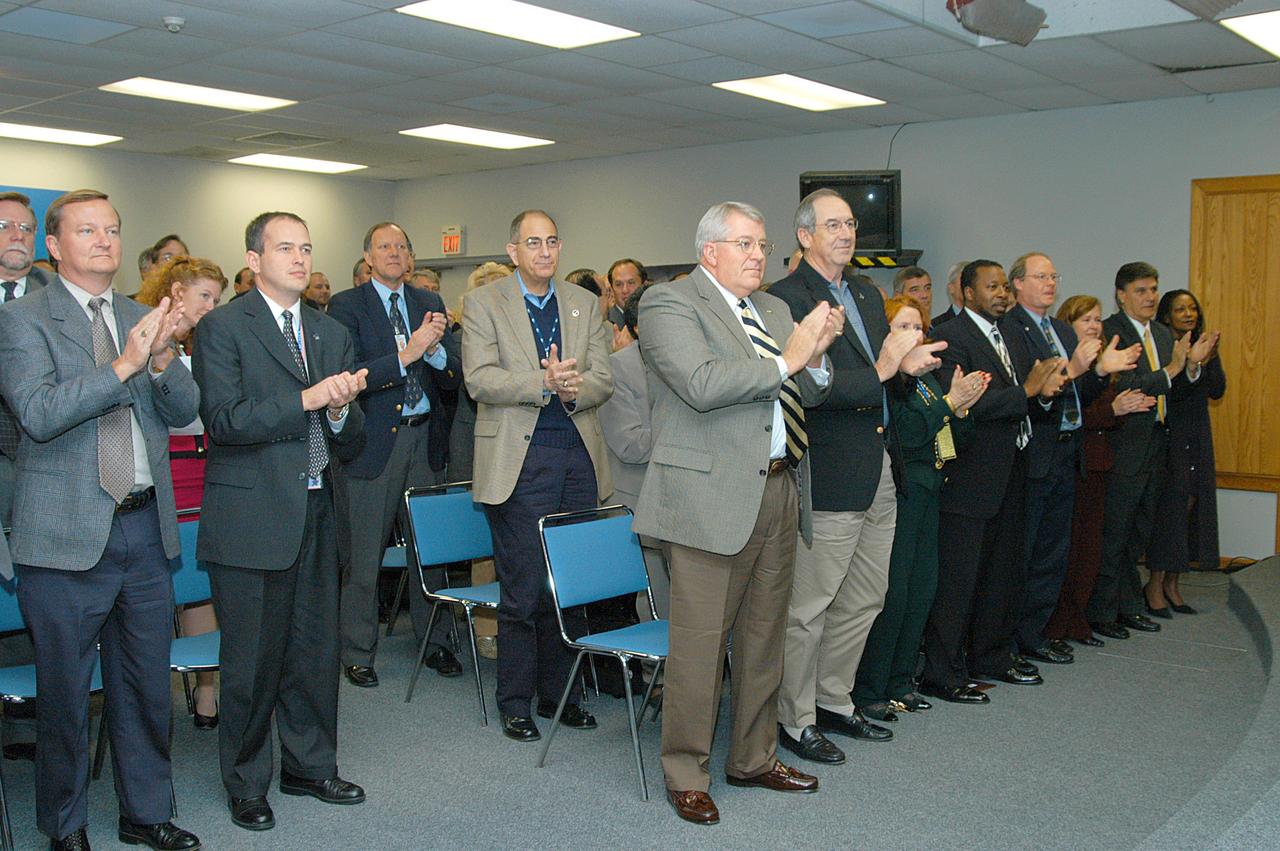
KENNEDY SPACE CENTER, FLA. -- From the KSC television studio, KSC management and other employees applaud President George W. Bush, who addressed the public and an assembly of government officials at NASA Headquarters as he outlined a new focus and vision for the space agency. Shown from left are Mike Leinbach, Shuttle launch director; David Culp, with NASA; Steve Francois, director, Launch Services Program; Richard Cota, deputy chief financial officer, KSC; Bill Pickavance vice president and associate program manager of Florida Operations, United Space Alliance (USA) ; Howard DeCastro, vice president and Space Shuttle program manager, USA; Shannon Roberts, with External Affairs; Woodrow Whitlow, KSC deputy director; Bruce Buckingham, assistant to Dr. Whitlow; Lisa Malone, director of External Affairs; Ken Aguilar, chief, Equal Opportunity office; and Cheryl Cox, External Affairs. The President stated his goals for NASA’s new mission: Completing the International Space Station, retiring the Space Shuttle orbiters, developing a new crew exploration vehicle, and returning to the moon and beyond within the next two decades. Pres. Bush was welcomed by NASA Administrator Sean O’Keefe and Expedition 8 Commander Michael Foale, who greeted him from the International Space Station. Members of the Washington, D.C., audience included astronauts Eileen Collins, Ed Lu and Michael Lopez-Alegria, and former astronaut Gene Cernan
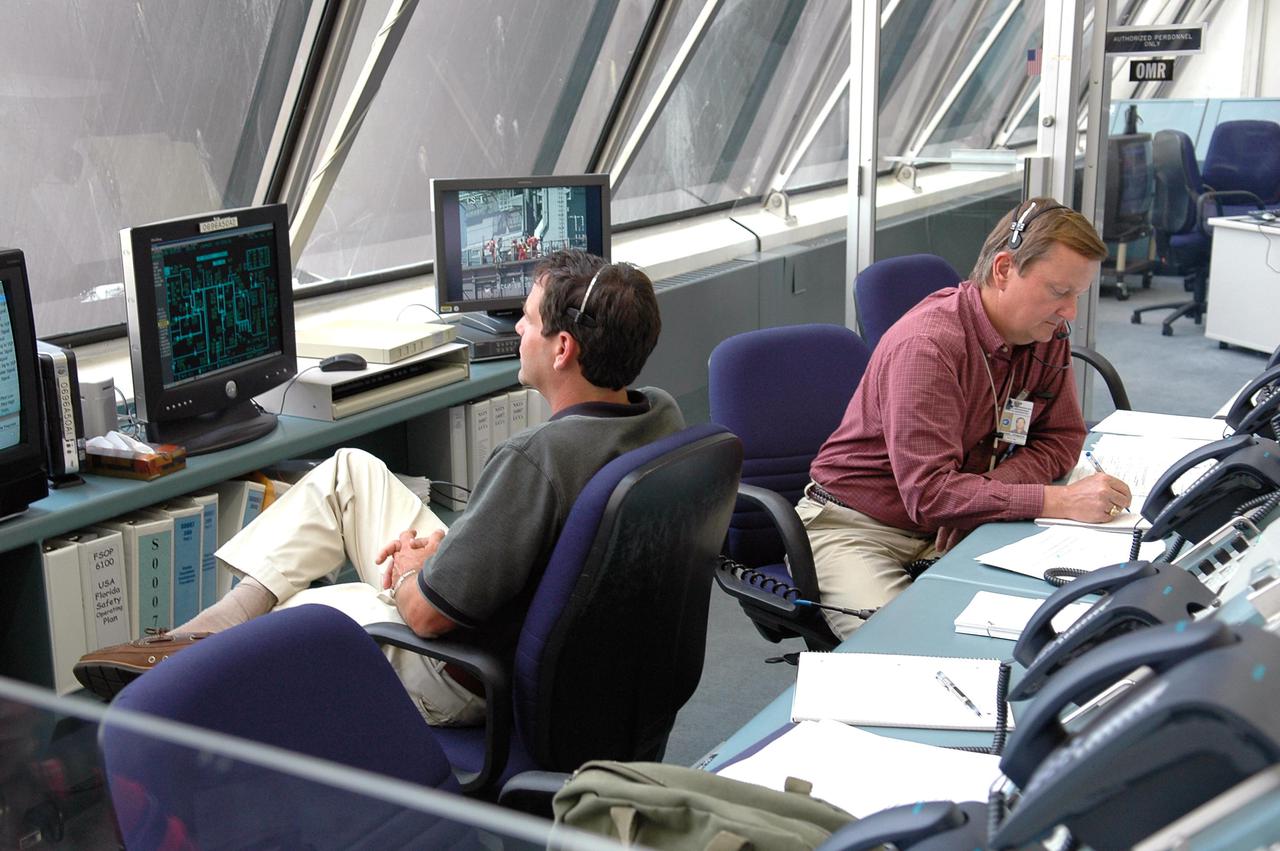
KENNEDY SPACE CENTER, FLA. - Space Shuttle launch director Michael Leinbach (right) and assistant launch director Doug Lyons support an External Tank (ET) tanking test at Launch Pad 39B from the Launch Control Center. The tanking test is designed to evaluate how the tank, orbiter, solid rocket boosters and ground systems perform under 'cryo-load,' when the tank is filled with the two ultra-low-temperature propellants. The tank filling and draining portion of the test takes about 11 hours. The test also includes a simulated countdown through the hold at T-31 seconds. The test is being conducted to troubleshoot two issues identified by a tanking test held on April 14. Data is being collected to analyze the liquid hydrogen sensors that gave intermittent readings and the liquid hydrogen pressurization relief valve that cycled more times than standard. The tanking tests are part of preparations for Space Shuttle Discovery's Return to Flight mission, STS-114, to the International Space Station. The launch window extends from July 13 through July 31.
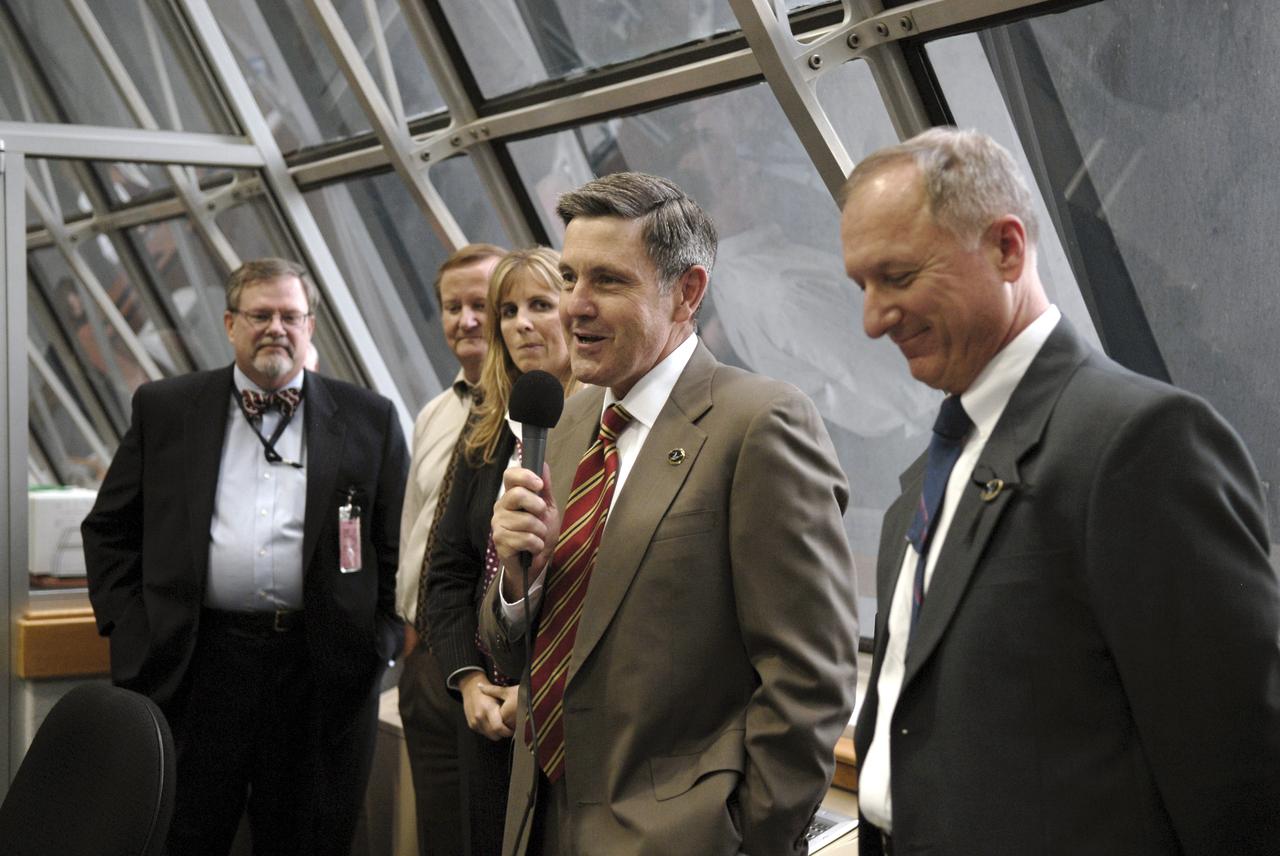
CAPE CANAVERAL, Fla. – In the Firing Room at NASA's Kennedy Space Center in Florida, Center Director Bob Cabana congratulates the mission team for the successful launch of space shuttle Endeavour on the STS-127 mission. Liftoff was on-time at 6:03 p.m. EDT. Looking on at left are Associate Administrator of Program Analysis & Evaluation at NASA Dr. Michael Hawes, Shuttle Launch Director Mike Leinbach and Endeavour Flow Director Dana Hutcherson , and at right, STS-127 Shuttle Launch Director Pete Nickolenko. Today was the sixth launch attempt for the STS-127 mission. The launch was scrubbed on June 13 and June 17 when a hydrogen gas leak occurred during tanking due to a misaligned Ground Umbilical Carrier Plate. The mission was postponed July 11, 12 and 13 due to weather conditions near the Shuttle Landing Facility at Kennedy that violated rules for launching, and lightning issues. Endeavour will deliver the Japanese Experiment Module's Exposed Facility and the Experiment Logistics Module-Exposed Section in the final of three flights dedicated to the assembly of the Japan Aerospace Exploration Agency's Kibo laboratory complex on the International Space Station. Photo credit: NASA/Kim Shiflett

CAPE CANAVERAL, Fla. - NASA managers participate in a post-landing media briefing at NASA's Kennedy Space Center in Florida following the completion of the STS-133 mission. From left are Allard Beutel, NASA Public Affairs; Bill Gerstenmaier, associate administrator for Space Operations; Mike Moses, space shuttle launch integration manager; and Mike Leinbach, shuttle launch director. Space shuttle Discovery's final return from space on Runway 15 at Kennedy's Shuttle Landing Facility completed the 13-day, 5.3-million-mile STS-133 mission. Main gear touchdown was at 11:57:17 a.m., followed by nose gear touchdown at 11:57:28, and wheelstop at 11:58:14 a.m. On board are Commander Steve Lindsey, Pilot Eric Boe, and Mission Specialists Nicole Stott, Michael Barratt, Alvin Drew and Steve Bowen. Discovery and its six-member crew delivered the Permanent Multipurpose Module, packed with supplies and critical spare parts, as well as Robonaut 2, the dexterous humanoid astronaut helper, to the orbiting outpost. STS-133 was Discovery's 39th and final mission. This was the 133rd Space Shuttle Program mission and the 35th shuttle voyage to the space station. Photo credit: NASA/Jack Pfaller
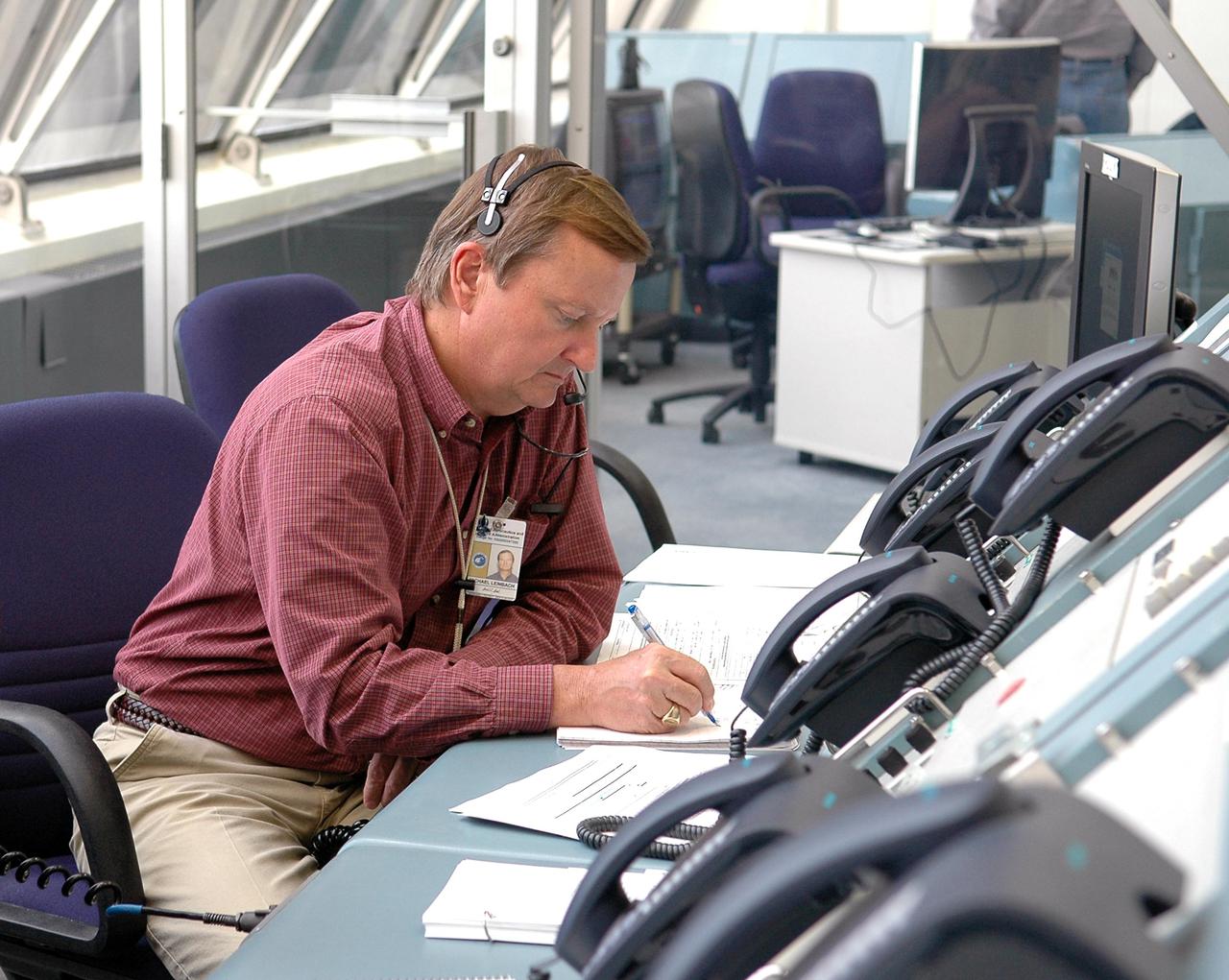
KENNEDY SPACE CENTER, FLA. - Space Shuttle launch director Michael Leinbach supports an External Tank (ET) tanking test at Launch Pad 39B from the Launch Control Center. The tanking test is designed to evaluate how the tank, orbiter, solid rocket boosters and ground systems perform under 'cryo-load,' when the tank is filled with the two ultra-low-temperature propellants. The tank filling and draining portion of the test takes about 11 hours. The test also includes a simulated countdown through the hold at T-31 seconds. The test is being conducted to troubleshoot two issues identified by a tanking test held on April 14. Data is being collected to analyze the liquid hydrogen sensors that gave intermittent readings and the liquid hydrogen pressurization relief valve that cycled more times than standard. The tanking tests are part of preparations for Space Shuttle Discovery's Return to Flight mission, STS-114, to the International Space Station. The launch window extends from July 13 through July 31.
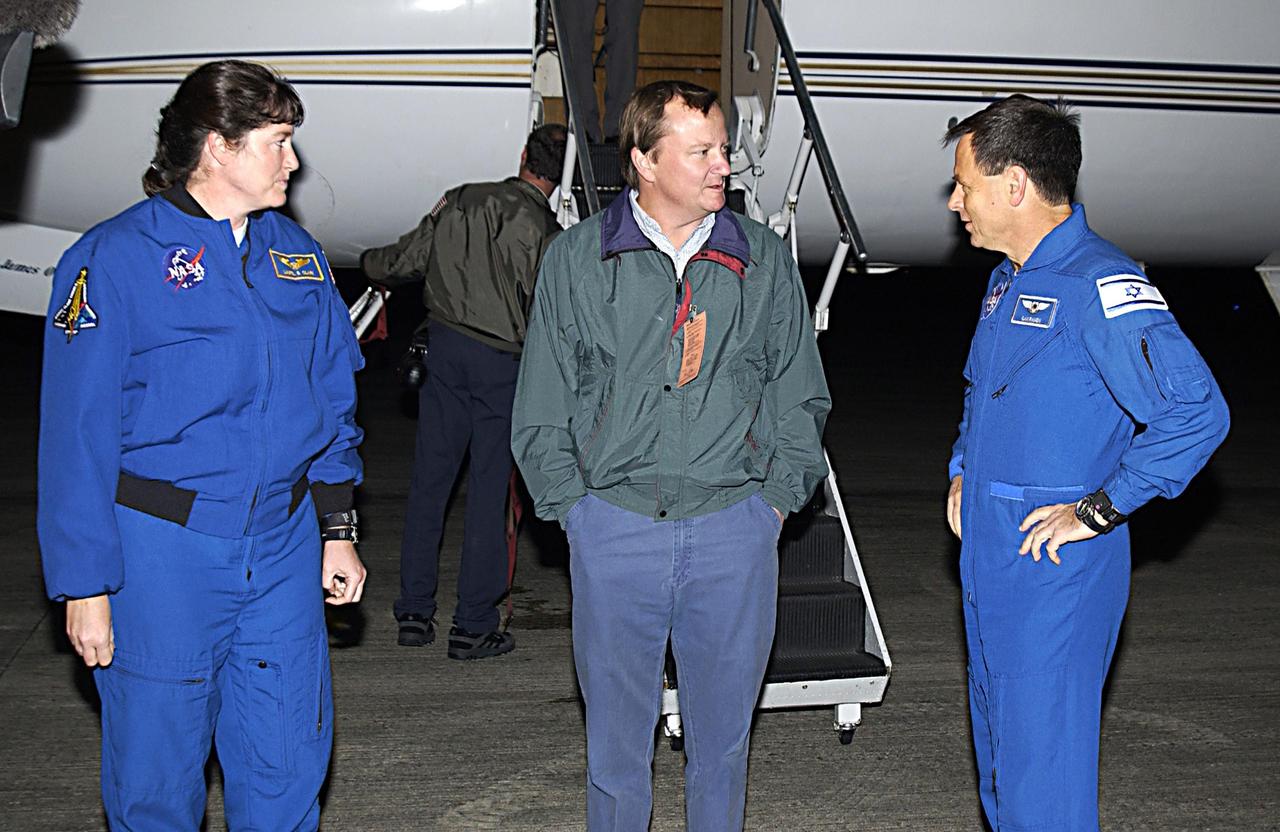
KENNEDY SPACE CENTER, FLA. -- Two members of the STS-107 crew, Mission Specialist Laurel Clark (left) and Payload Specialist Ilan Ramon (right), talk after their arrival at KSC to Launch Director Mike Leinbach. Ramon is the first Israeli astronaut to fly on a Shuttle mission. STS-107 is a mission devoted to research and will include more than 80 experiments that will study Earth and space science, advanced technology development, and astronaut health and safety. The payload on Space Shuttle Columbia includes FREESTAR (Fast Reaction Experiments Enabling Science, Technology, Applications and Research) and the SHI Research Double Module (SHI/RDM), known as SPACEHAB. Experiments on the module range from material sciences to life sciences. Other crew members are Commander Rick Husband, Pilot William "Willie" McCool, Payload Commander Michael Anderson and Mission Specialists Kalpana Chawla and David Brown. Launch of Columbia is targeted for Jan. 16 between 10 a.m. and 2 p.m.
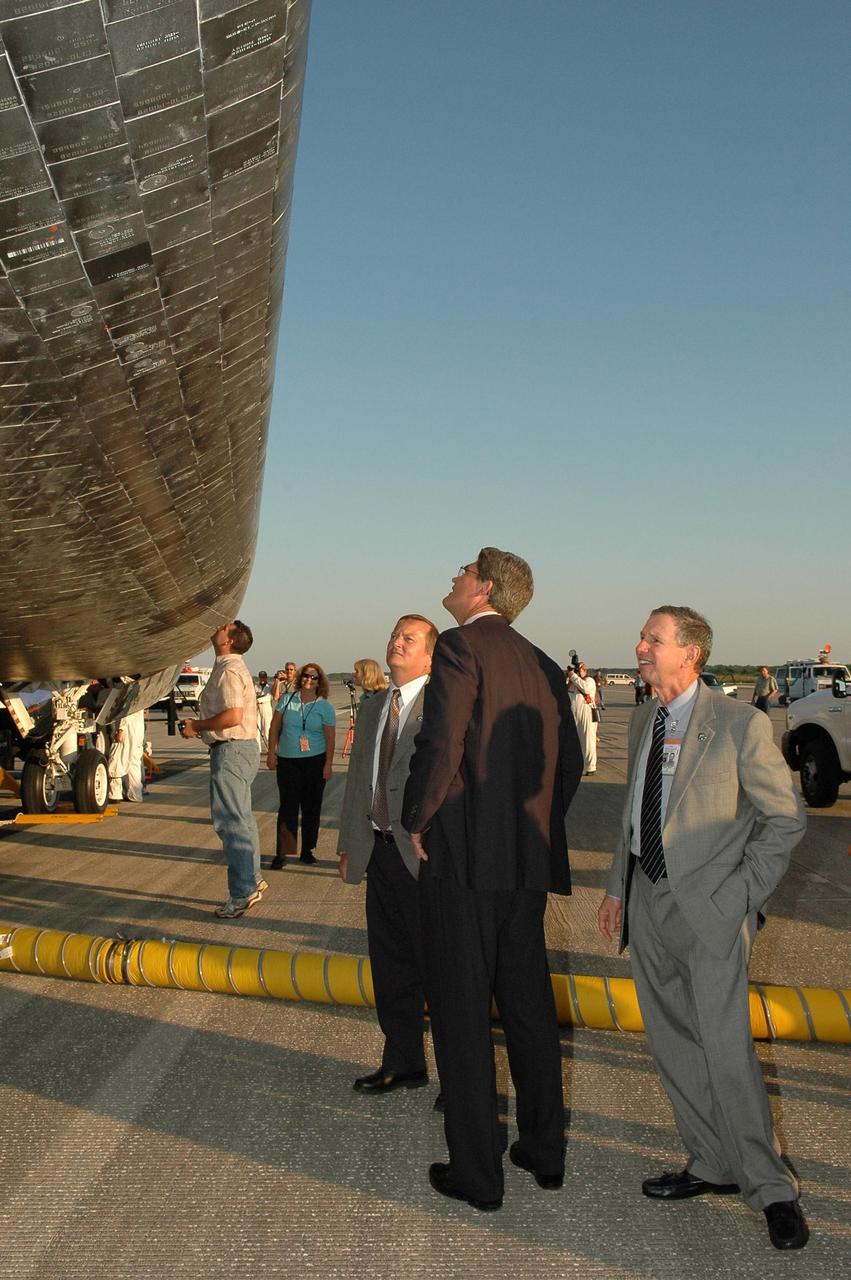
KENNEDY SPACE CENTER, FLA. - Before welcoming the STS-115 crew on their return from space, NASA officials look at the underside of the orbiter Atlantis on the Shuttle Landing Facility. From right are NASA Administrator Michael Griffin, KSC Deputy Director Bill Parsons and Shuttle Launch Director Mike Leinbach. During the mission, astronauts completed three spacewalks to attach the P3/P4 integrated truss structure to the International Space Station. Main gear touchdown was at 6:21:30 a.m. EDT. Nose gear touchdown was at 6:21:36 a.m. and wheel stop was at 6:22:16 a.m. At touchdown -- nominally about 2,500 ft. beyond the runway threshold -- the orbiter is traveling at a speed ranging from 213 to 226 mph. Atlantis traveled 4.9 million miles, landing on orbit 187. Mission elapsed time was 11 days, 19 hours, six minutes. This is the 15th night landing at KSC and the 23rd night landing overall. Photo credit: NASA/Kim Shiflett
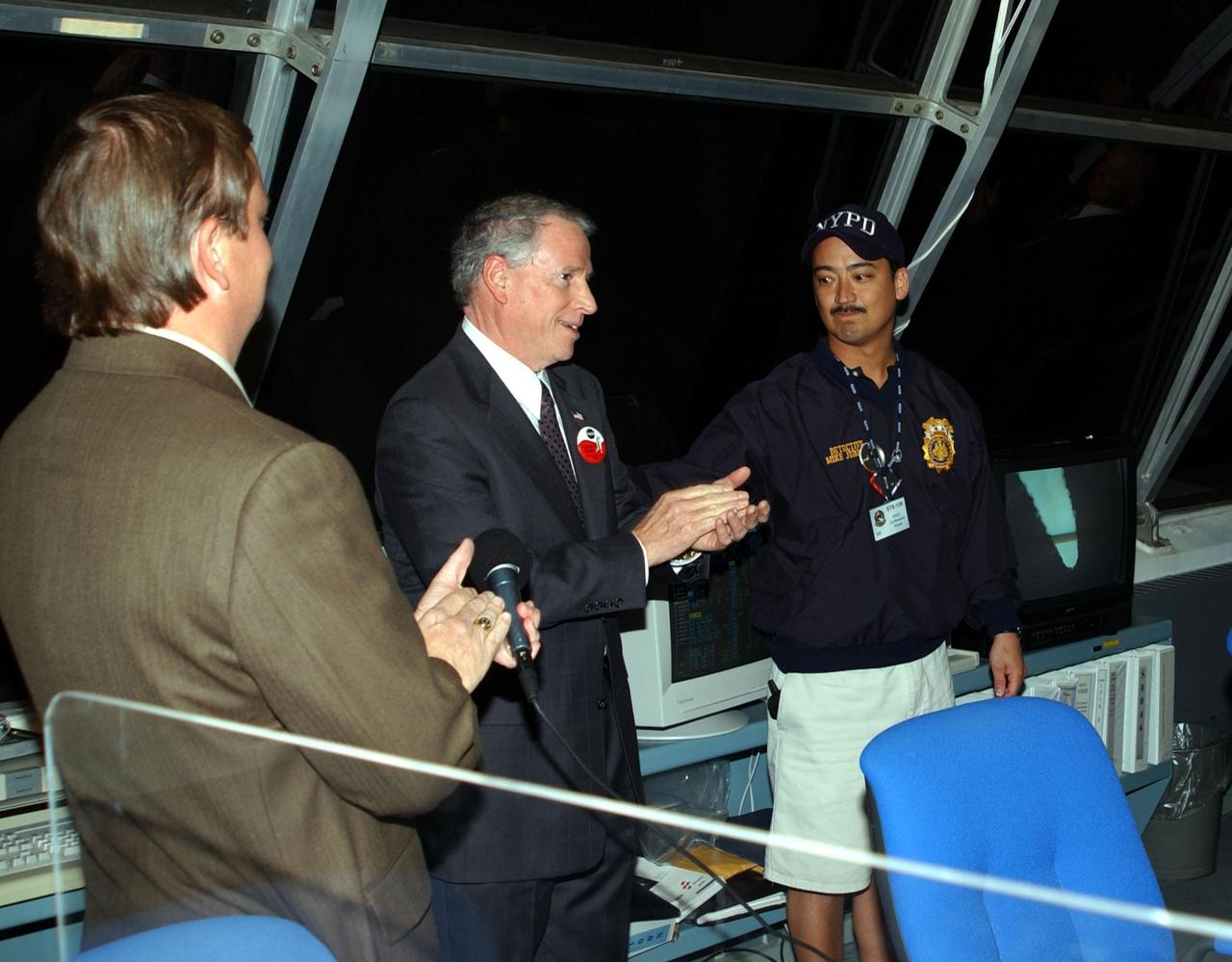
KENNEDY SPACE CENTER, FLA. -- NASA's Acting Administrator Daniel Mulville (center) joins Launch Director Mike Leinbach (left) in recognizing New York Police Department Detective Michael Jermyn in the Firiing Room, Launch Control Center, after watching the launch of Space Shuttle Endeavour on mission STS-108. Jermyn attended the launch as a guest representing the New York Police and Fire Departments whose members lost their lives in the September 11 attacks. Endeavour is carrying 6,000 flags that will be given to the families of those who died in the fall of the Twin Towers. Liftoff of Endeavour occurred at 5:19:28 p.m. EST (22:19.28 GMT). Endeavour will dock with the International Space Station on Dec. 7. STS-108 is the final Shuttle mission of 2001and the 107th Shuttle flight overall. It is the 12th flight to the Space Station. Landing of the orbiter at KSC's Shuttle Landing Facility is targeted for 1:05 p.m. EST (18:05 p.m. GMT) Dec. 16
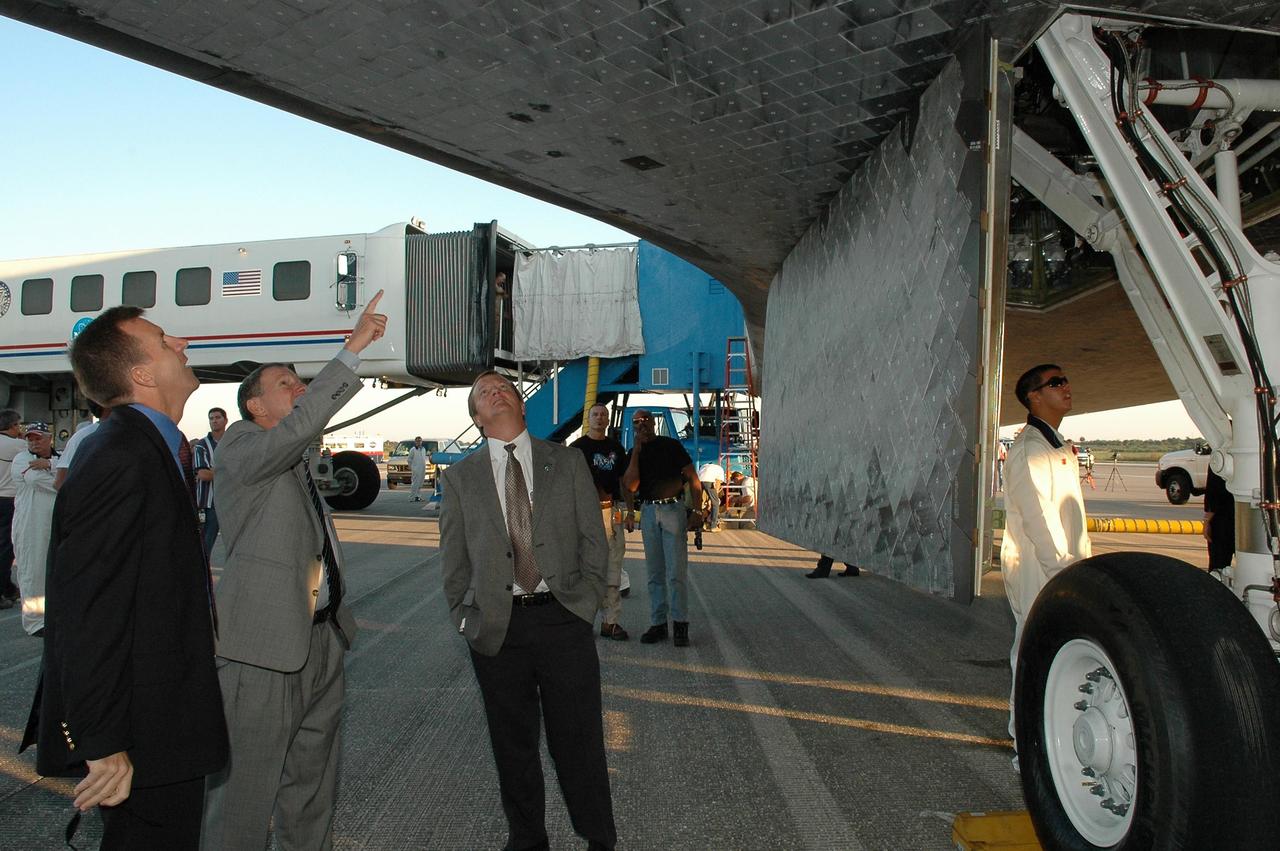
KENNEDY SPACE CENTER, FLA. - Before welcoming the STS-115 crew on their return from space, NASA officials look at the underside of the orbiter Atlantis on the Shuttle Landing Facility. From left are Mission Launch Integration Director LeRoy Cain, NASA Administrator Michael Griffin and Shuttle Launch Director Mike Leinbach. During the mission, astronauts completed three spacewalks to attach the P3/P4 integrated truss structure to the International Space Station. Main gear touchdown was at 6:21:30 a.m. EDT. Nose gear touchdown was at 6:21:36 a.m. and wheel stop was at 6:22:16 a.m. At touchdown -- nominally about 2,500 ft. beyond the runway threshold -- the orbiter is traveling at a speed ranging from 213 to 226 mph. Atlantis traveled 4.9 million miles, landing on orbit 187. Mission elapsed time was 11 days, 19 hours, six minutes. This is the 15th night landing at KSC and the 23rd night landing overall. Photo credit: NASA/Kim Shiflett

CAPE CANAVERAL, Fla. -- At the Merritt Island Launch Annex (MILA) Spaceflight Tracking and Data Network Station at NASA's Kennedy Space Center in Florida, Shuttle Launch Director Michael Leinbach addresses those in attendance at a closing ceremony recognizing the station's 45 years of service. The station was originally established by NASA's Goddard Space Flight Center as one of 17 Space Flight Tracking and Data Network stations around the world. Commissioned for the Apollo Program, the first launch it supported was the Apollo/Saturn 203 test flight from Launch Complex 37 on July 5, 1966. It also provided orbital support for low earth-orbiting scientific satellites. In recent history, the station has been used almost exclusively for space shuttle launch and landing support. Following the final launch and landing of the Space Shuttle Program in July 2011, the MILA station is officially decommissioned. For more information, visit http://www.nasa.gov/centers/kennedy/pdf/167424main_MILA-08C.pdf. Photo credit: NASA/Kim Shiflett
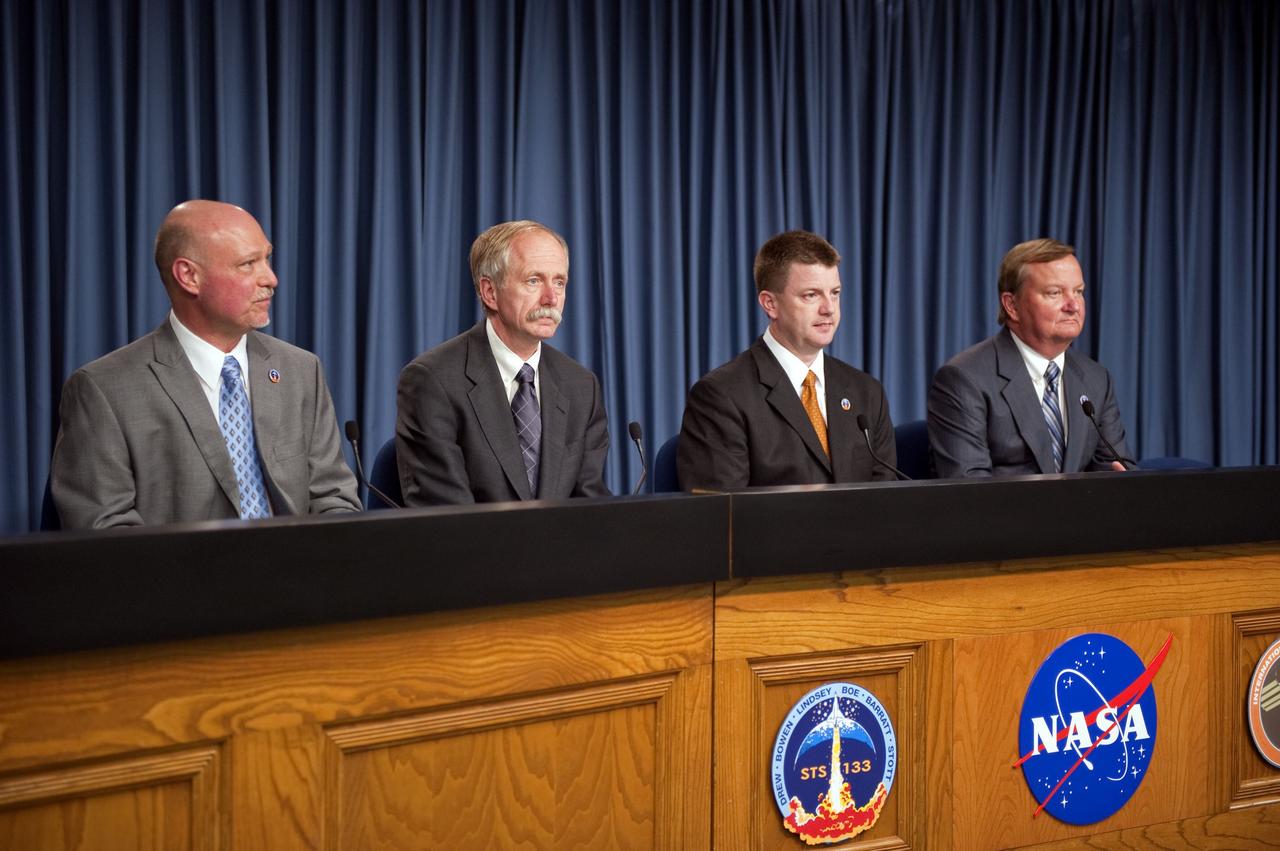
CAPE CANAVERAL, Fla. -- At NASA's Kennedy Space Center in Florida, NASA Public Affairs Officer Michael Curie, left, Associate Administrator for Space Operations Bill Gerstenmaier, Space Shuttle Program Launch Integration Manager Mike Moses and Shuttle Launch Director Mike Leinbach talk to media following a Flight Readiness Review that gave a unanimous "go" to launch space shuttle Discovery on the STS-133 mission to the International Space Station. This will be the second launch attempt for Discovery, following a scrub in November 2010 due to a hydrogen gas leak at the ground umbilical carrier plate (GUCP) as well as modifications to the external fuel tank's intertank support beams, called stringers. Scheduled to lift off Feb. 24 at 4:50 p.m. EST, Discovery and its six-member crew will deliver the Permanent Multipurpose Module, packed with supplies and critical spare parts, as well as Robonaut 2, the dexterous humanoid astronaut helper, to the orbiting outpost. For more information on the STS-133 mission, visit www.nasa.gov/mission_pages/shuttle/shuttlemissions/sts133/. Photo credit: NASA/Kim Shiflett
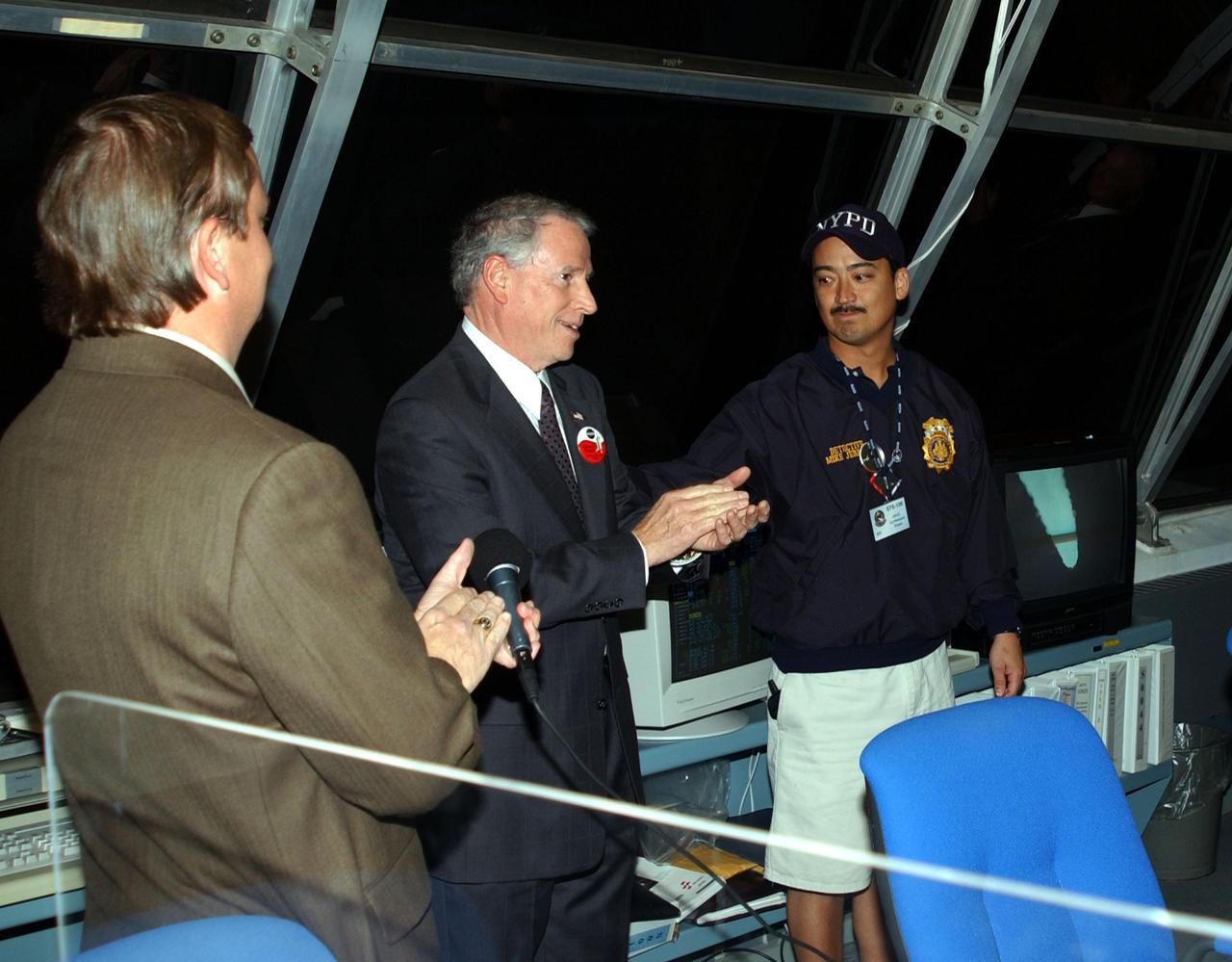
KENNEDY SPACE CENTER, FLA. -- NASA's Acting Administrator Daniel Mulville (center) joins Launch Director Mike Leinbach (left) in recognizing New York Police Department Detective Michael Jermyn in the Firiing Room, Launch Control Center, after watching the launch of Space Shuttle Endeavour on mission STS-108. Jermyn attended the launch as a guest representing the New York Police and Fire Departments whose members lost their lives in the September 11 attacks. Endeavour is carrying 6,000 flags that will be given to the families of those who died in the fall of the Twin Towers. Liftoff of Endeavour occurred at 5:19:28 p.m. EST (22:19.28 GMT). Endeavour will dock with the International Space Station on Dec. 7. STS-108 is the final Shuttle mission of 2001and the 107th Shuttle flight overall. It is the 12th flight to the Space Station. Landing of the orbiter at KSC's Shuttle Landing Facility is targeted for 1:05 p.m. EST (18:05 p.m. GMT) Dec. 16