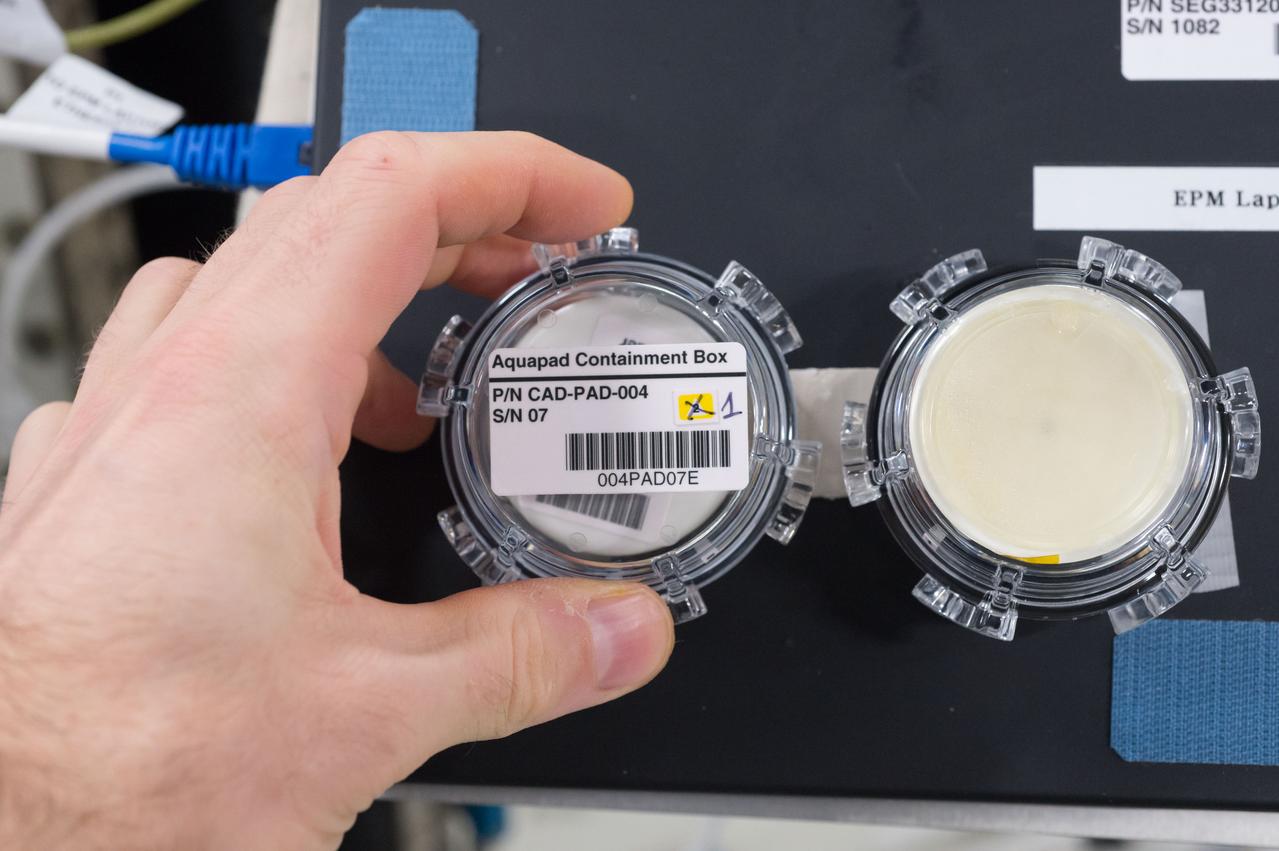
iss050e057692 (3/16/2017) --- View of Aquapad Microbial Contamination within container during analysis of water samples. Photo was taken during Expedition 50.
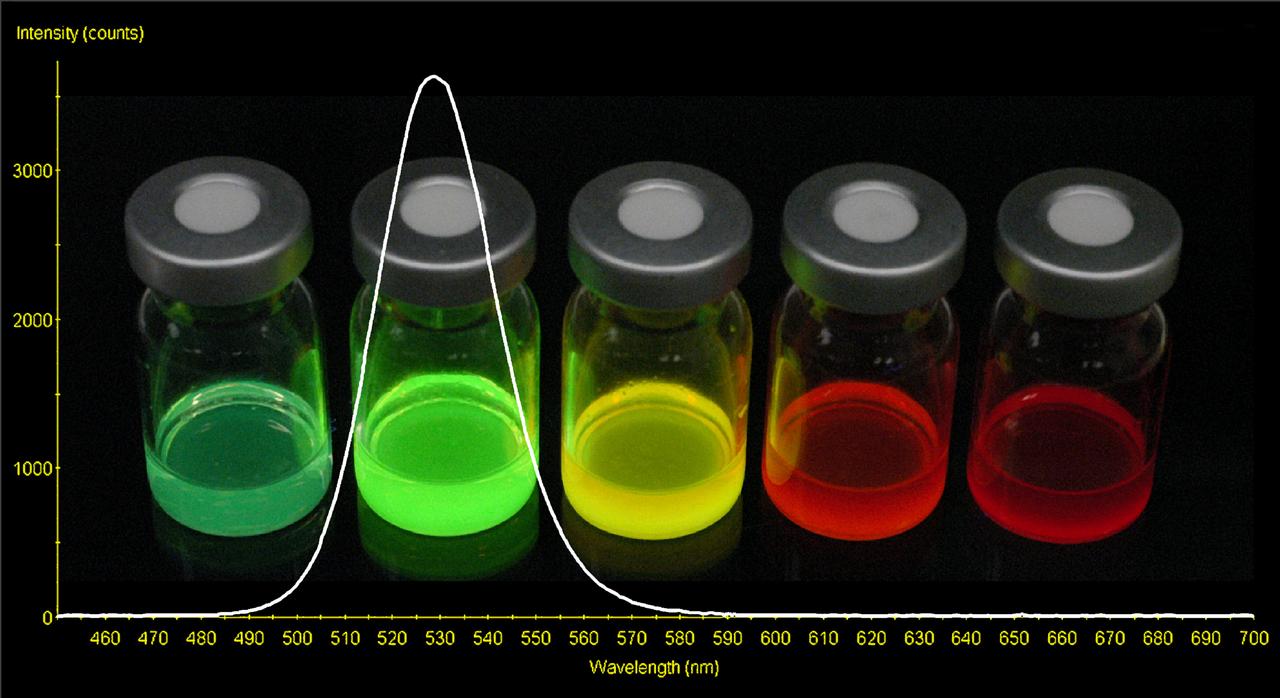
Cadmium selenium Quantum Dots (QDs) are metal nanoparticles that fluoresce in a variety of colors determined by their size. QDs are solid state structures made of semiconductors or metals that confine a countable, small number of electrons into a small space. The confinement of electrons is achieved by the placement of some insulating material(s) around a central, well conducted region. Coupling QDs with antibodies can be used to make spectrally multiplexed immunoassays that test for a number of microbial contaminants using a single test.
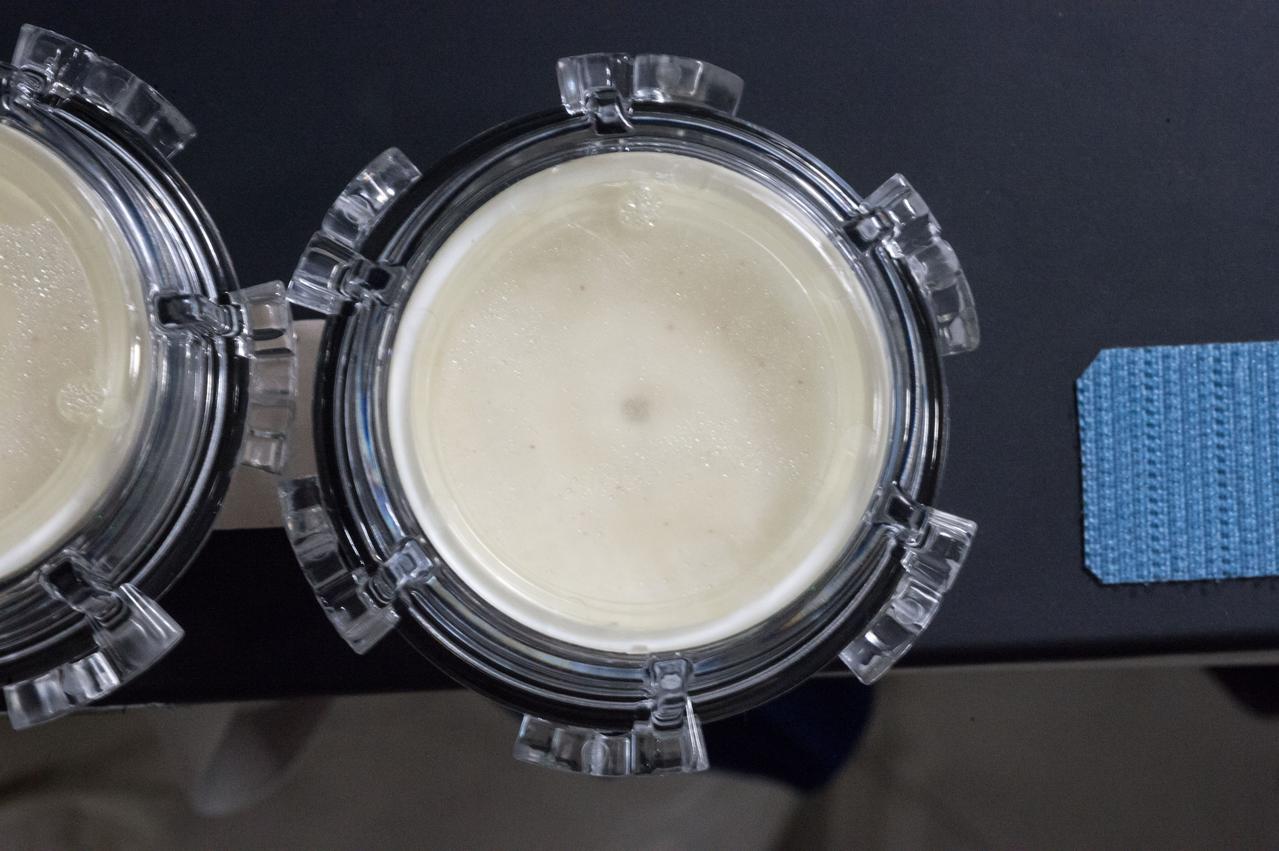
iss050e011727 (11/25/2016) --- View of Aquapad Microbial Contamination after incubation. Photo was taken during Expedition 40.
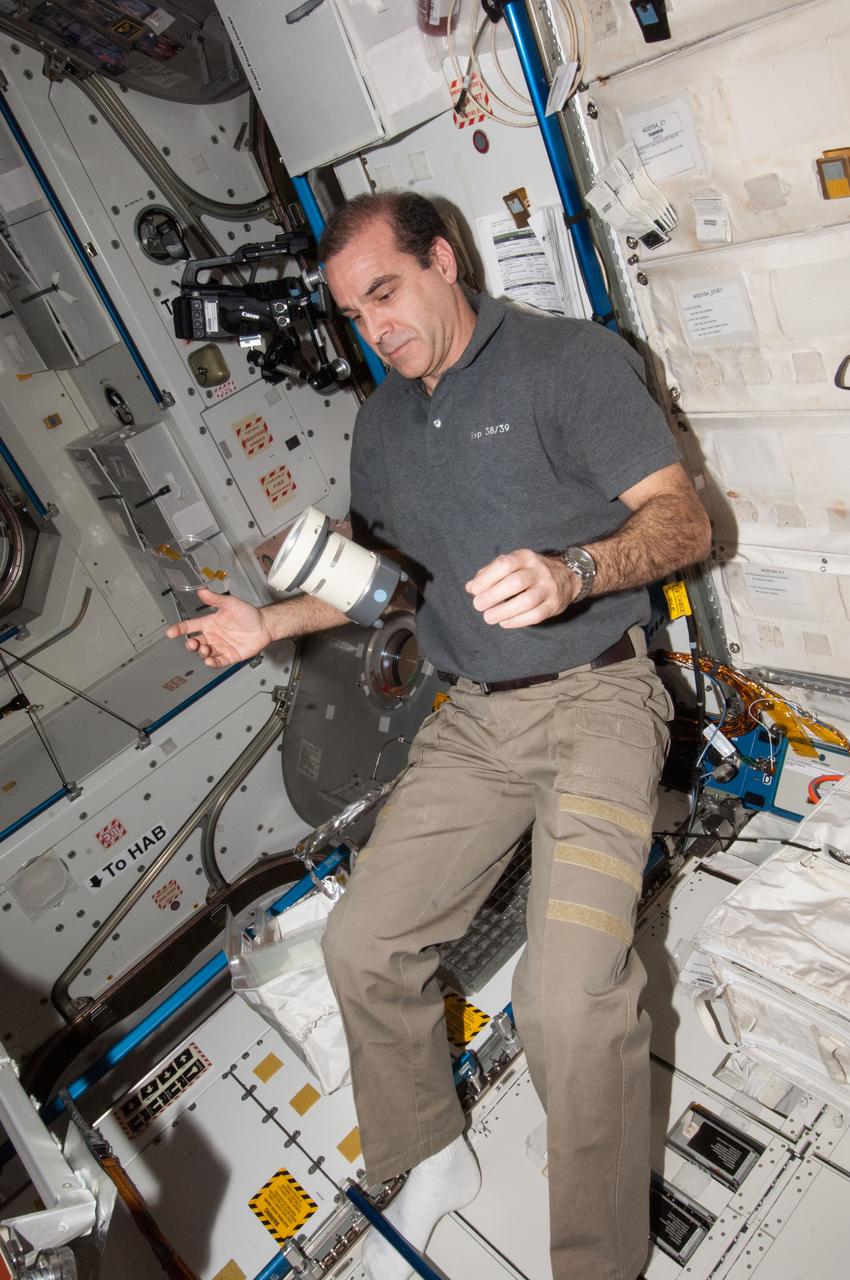
ISS038-E-053780 (18 Feb. 2014) --- NASA astronaut Rick Mastracchio, Expedition 38 flight engineer, uses a Microbial Air Sampler to collect air samples in the Unity node of the International Space Station. These air samples will be incubated for five days and tested for signs of microbial contamination.
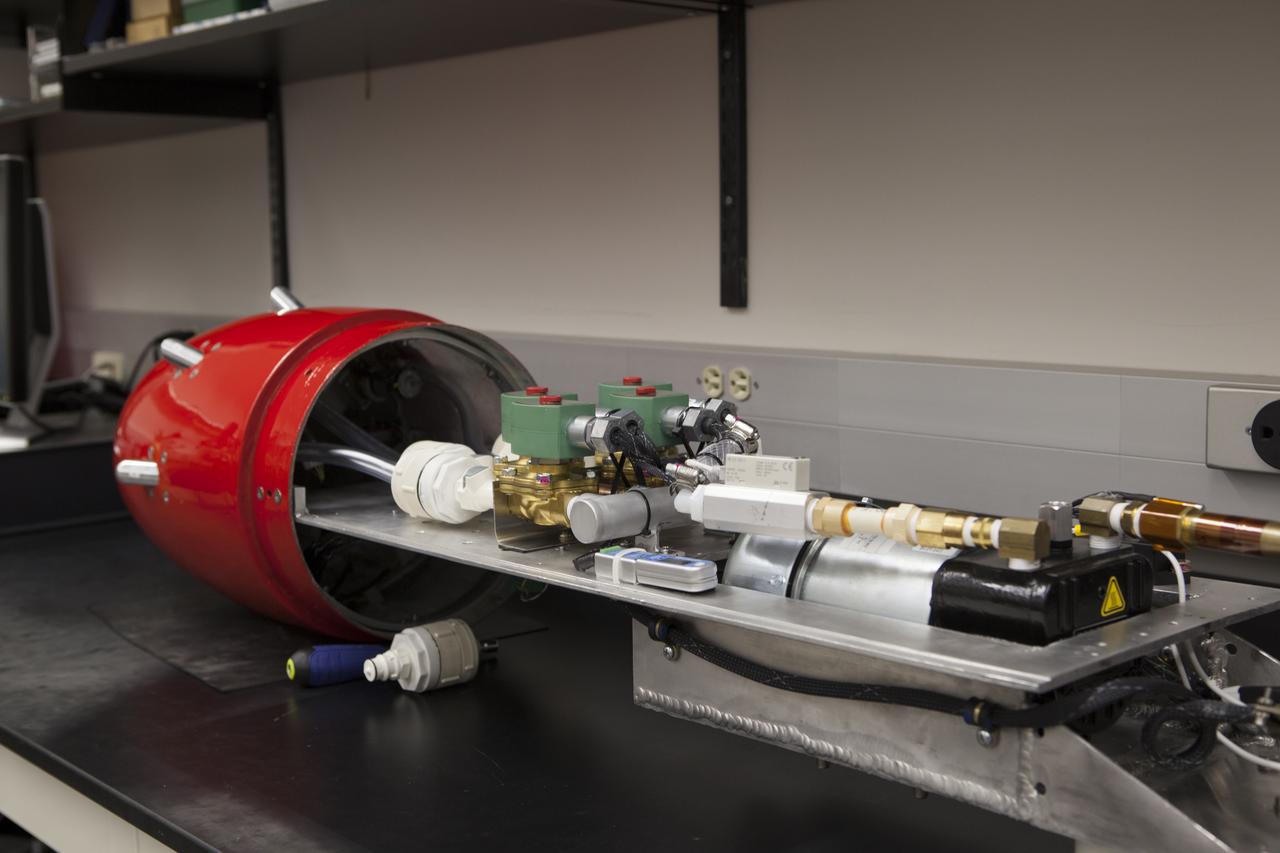
The Dust Atmospheric Recovery Technology, or DART, spacecraft is being assembled in a laboratory inside the Space Life Sciences Lab at NASA’s Kennedy Space Center in Florida. DART will characterize the dust loading and microbial diversity in the atmosphere over Florida during summer months with a special emphasis on their interactions during an African dust storm. DART will be used to collect atmospheric aerosols and suspended microbial cells over Florida and Kennedy. Results will help predict the risks of excessive microbial contamination adhering to spacecraft surfaces.
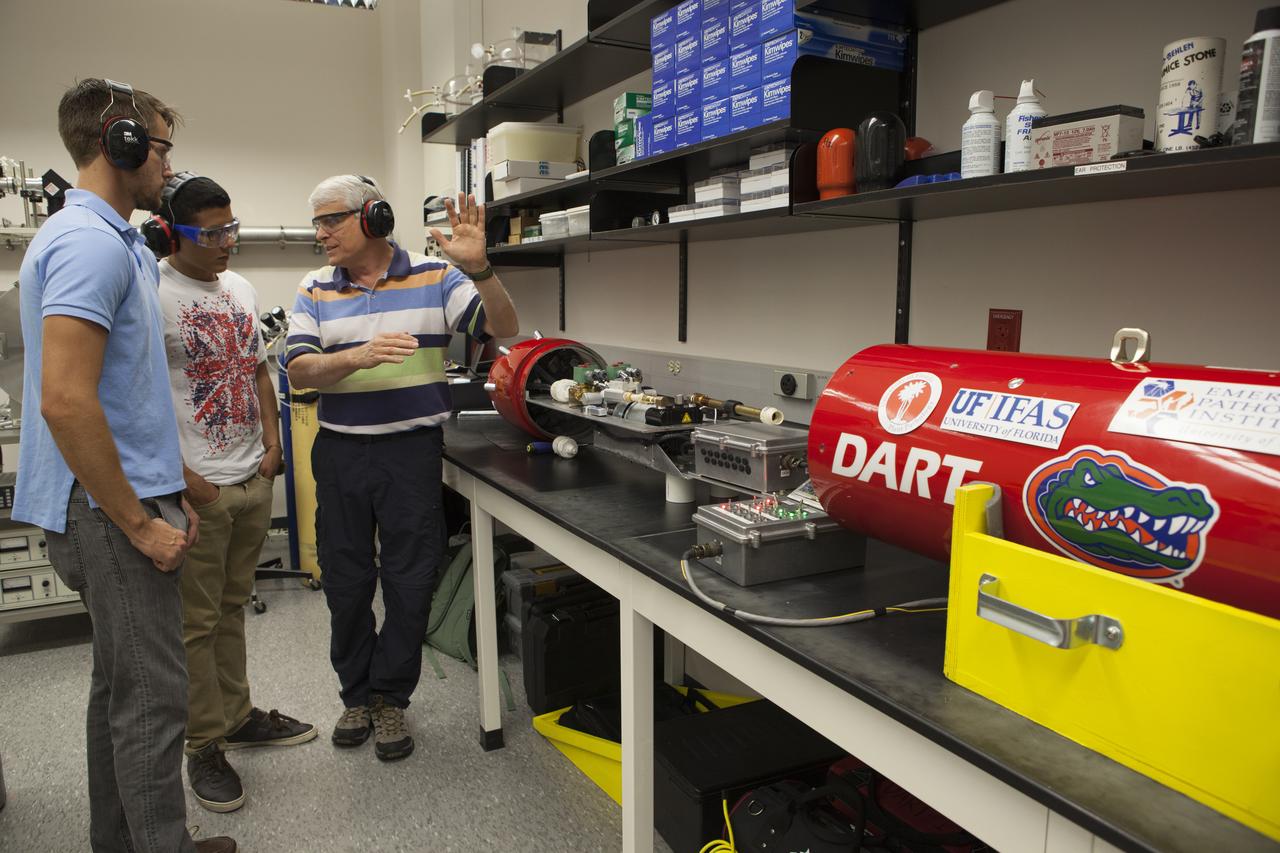
Researchers at NASA’s Kennedy Space Center in Florida check readings on the Dust Atmospheric Recovery Technology, or DART, spacecraft inside a laboratory at the Space Life Sciences Lab. DART will characterize the dust loading and microbial diversity in the atmosphere over Florida during summer months with a special emphasis on their interactions during an African dust storm. DART will be used to collect atmospheric aerosols and suspended microbial cells over Florida and Kennedy. Results will help predict the risks of excessive microbial contamination adhering to spacecraft surfaces.
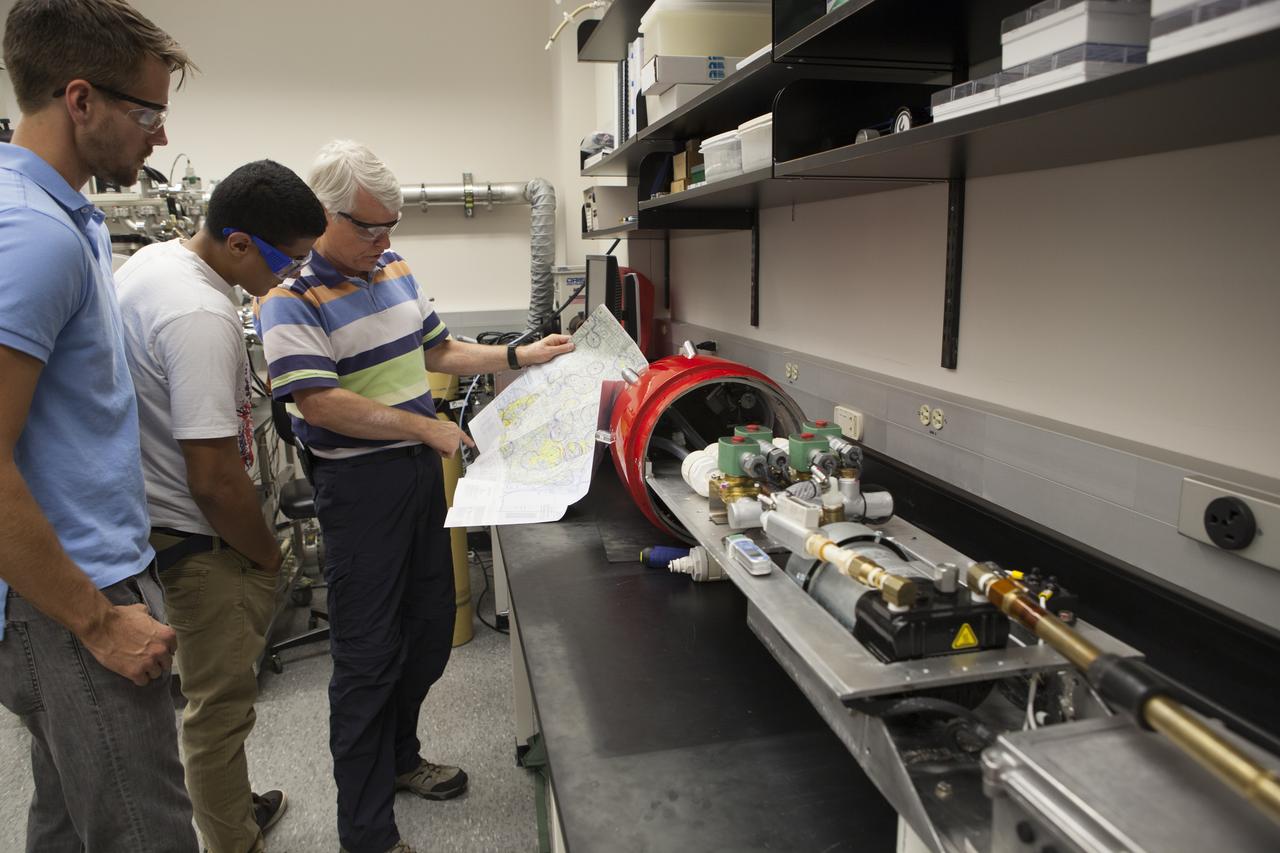
Researchers at NASA’s Kennedy Space Center in Florida check readings on the Dust Atmospheric Recovery Technology, or DART, spacecraft inside a laboratory at the Space Life Sciences Lab. DART will characterize the dust loading and microbial diversity in the atmosphere over Florida during summer months with a special emphasis on their interactions during an African dust storm. DART will be used to collect atmospheric aerosols and suspended microbial cells over Florida and Kennedy. Results will help predict the risks of excessive microbial contamination adhering to spacecraft surfaces.
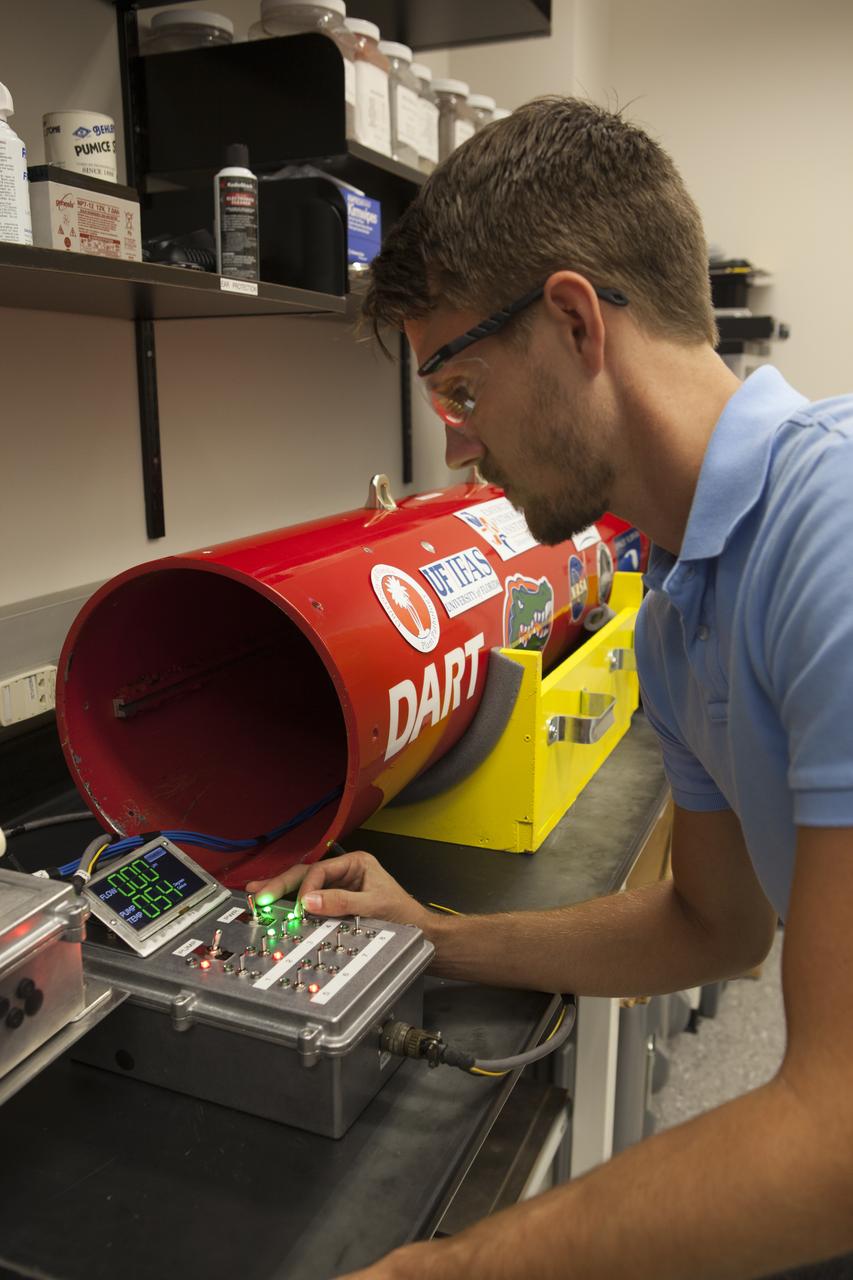
A researcher at NASA’s Kennedy Space Center in Florida checks a reading on the Dust Atmospheric Recovery Technology, or DART, spacecraft inside a laboratory at the Space Life Sciences Lab. DART will characterize the dust loading and microbial diversity in the atmosphere over Florida during summer months with a special emphasis on their interactions during an African dust storm. DART will be used to collect atmospheric aerosols and suspended microbial cells over Florida and Kennedy. Results will help predict the risks of excessive microbial contamination adhering to spacecraft surfaces.
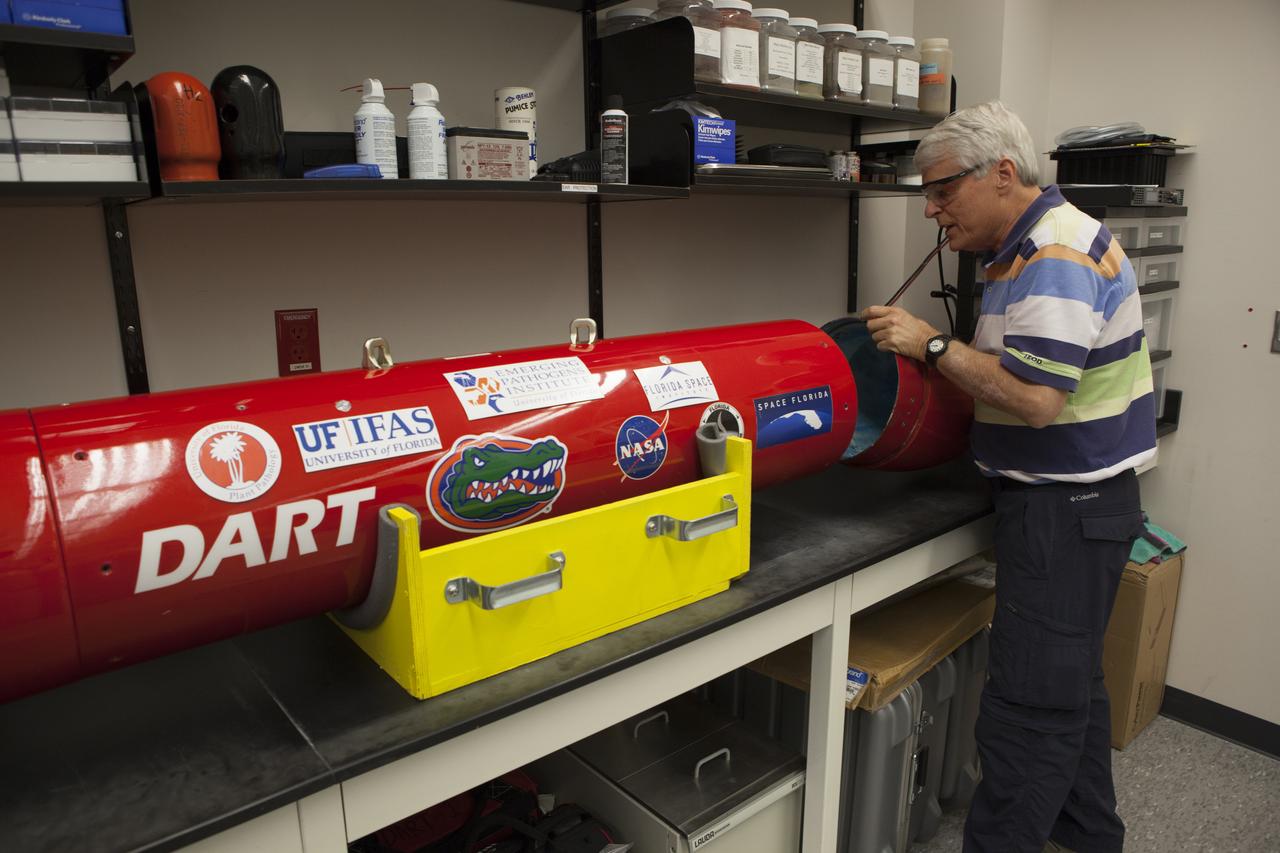
A researcher from the University of Florida in Gainesville, checks the Dust Atmospheric Recovery Technology, or DART, spacecraft in a laboratory inside the Space Life Sciences Lab at NASA’s Kennedy Space Center in Florida. DART will characterize the dust loading and microbial diversity in the atmosphere over Florida during summer months with a special emphasis on their interactions during an African dust storm. DART will be used to collect atmospheric aerosols and suspended microbial cells over Florida and Kennedy. Results will help predict the risks of excessive microbial contamination adhering to spacecraft surfaces.
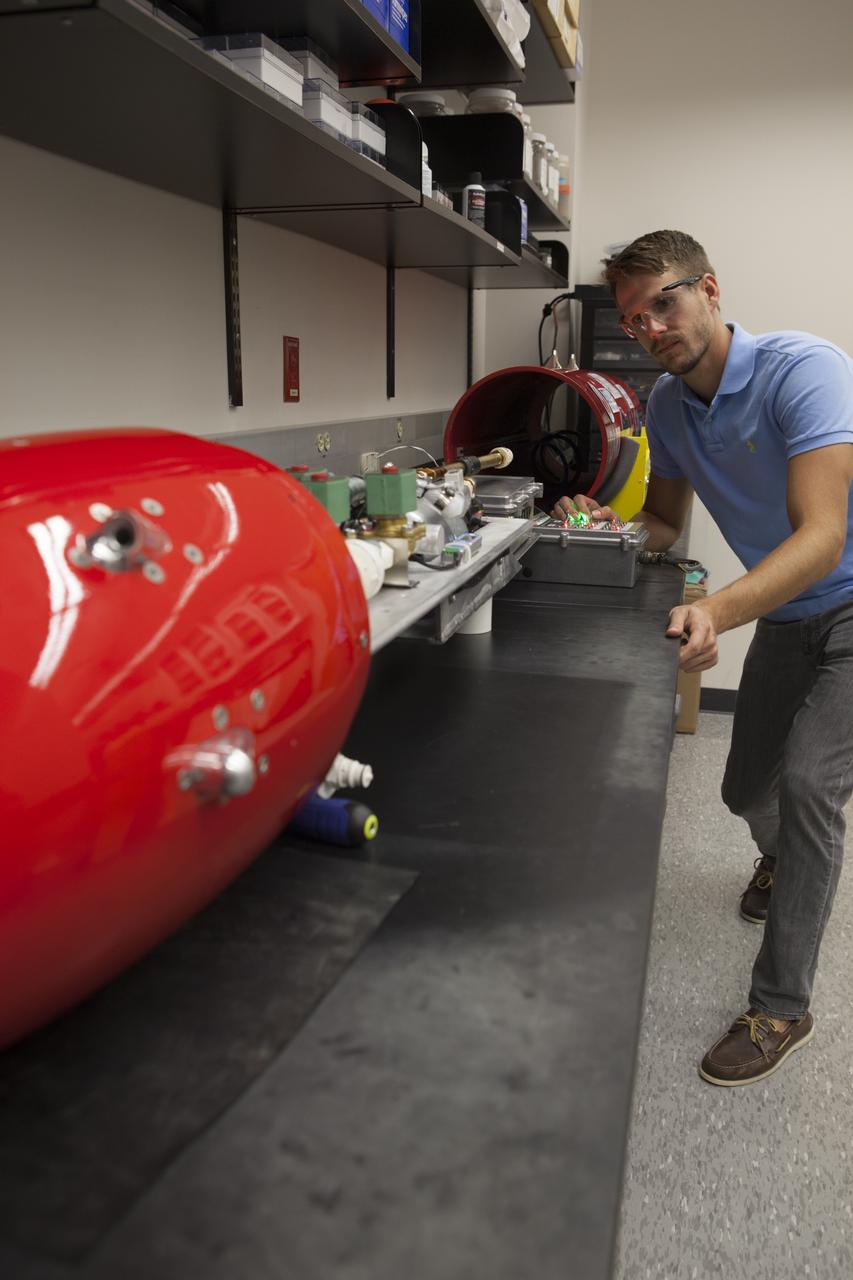
A researcher at NASA’s Kennedy Space Center in Florida checks a reading on the Dust Atmospheric Recovery Technology, or DART, spacecraft inside a laboratory at the Space Life Sciences Lab. DART will characterize the dust loading and microbial diversity in the atmosphere over Florida during summer months with a special emphasis on their interactions during an African dust storm. DART will be used to collect atmospheric aerosols and suspended microbial cells over Florida and Kennedy. Results will help predict the risks of excessive microbial contamination adhering to spacecraft surfaces.
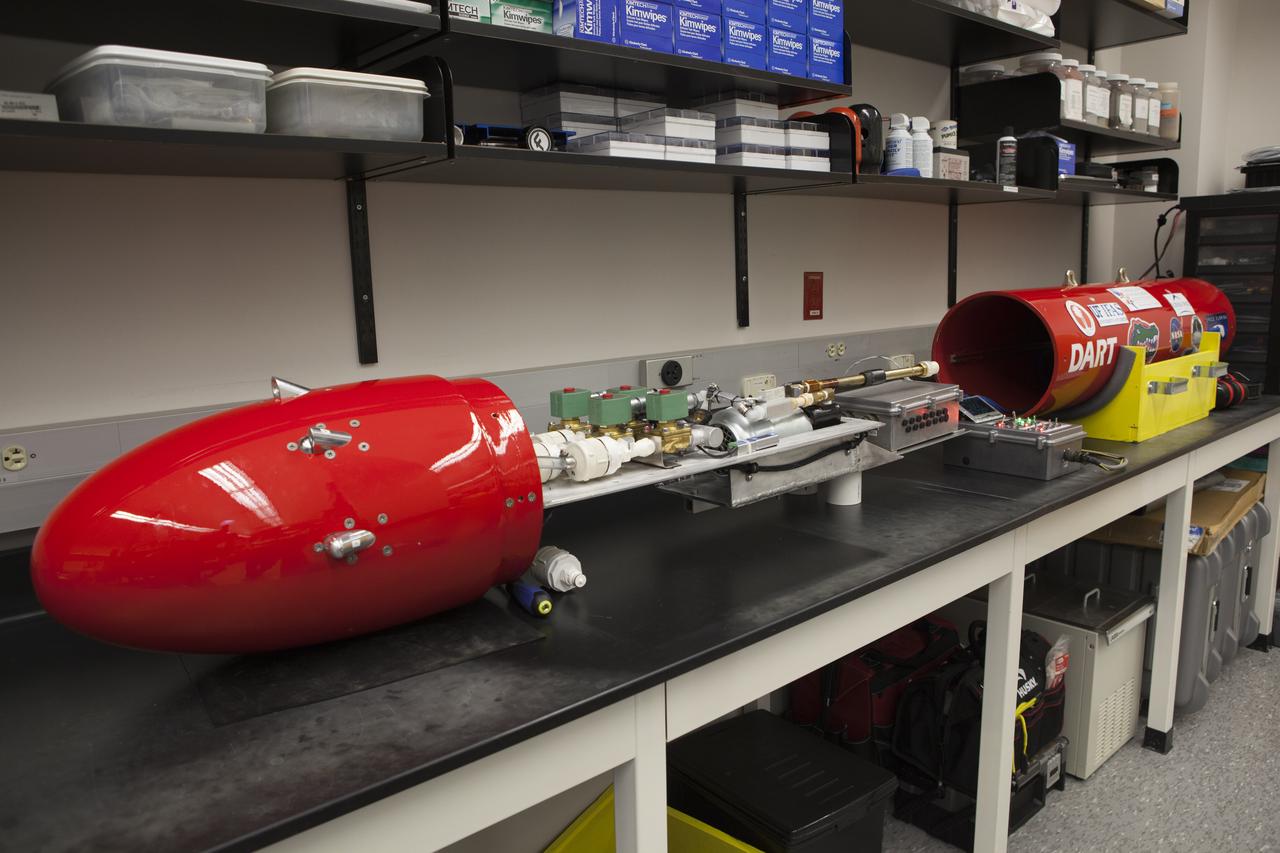
The Dust Atmospheric Recovery Technology, or DART, spacecraft is being assembled in a laboratory inside the Space Life Sciences Lab at NASA’s Kennedy Space Center in Florida. DART will characterize the dust loading and microbial diversity in the atmosphere over Florida during summer months with a special emphasis on their interactions during an African dust storm. DART will be used to collect atmospheric aerosols and suspended microbial cells over Florida and Kennedy. Results will help predict the risks of excessive microbial contamination adhering to spacecraft surfaces.
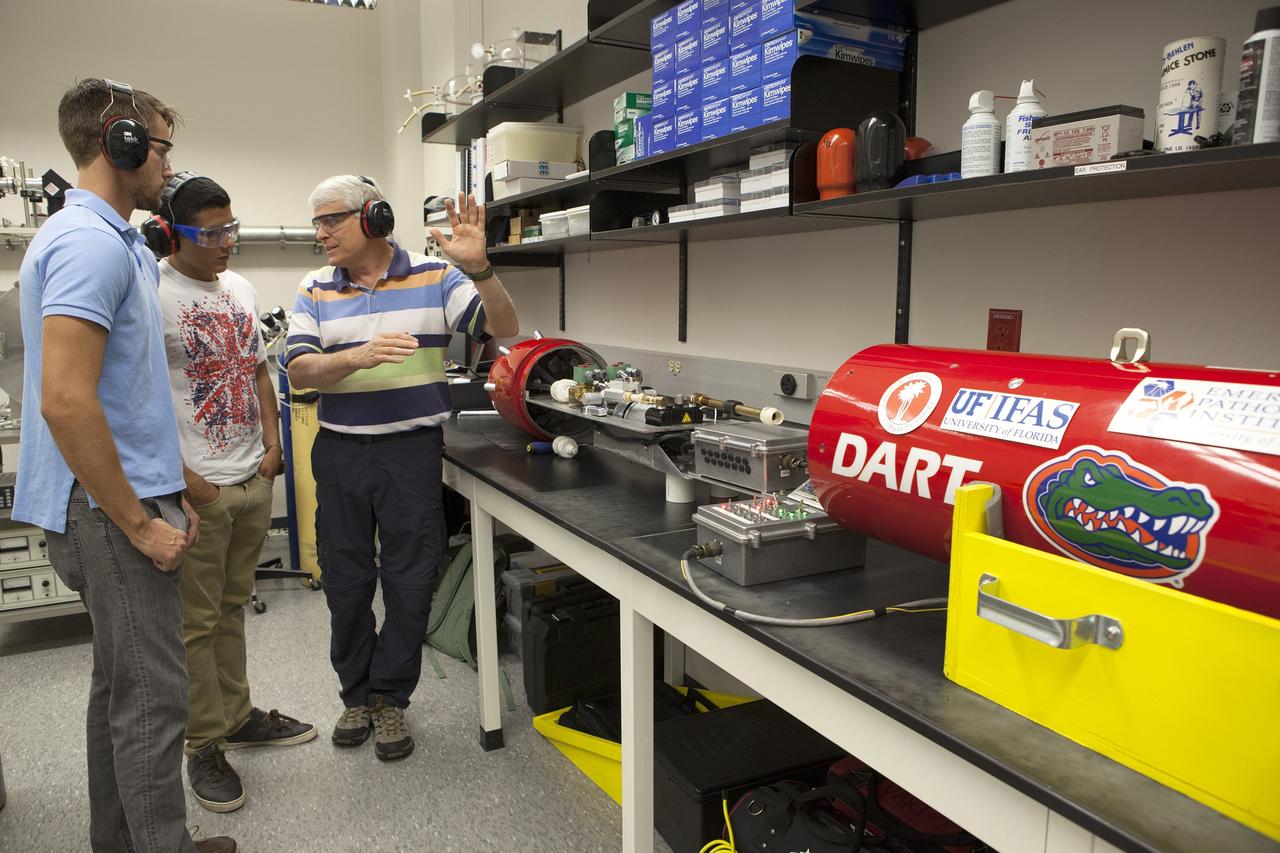
CAPE CANAVERAL, Fla. – Researchers at NASA’s Kennedy Space Center in Florida check readings on the Dust Atmospheric Recovery Technology, or DART, spacecraft inside a laboratory at the Space Life Sciences Lab. DART will characterize the dust loading and microbial diversity in the atmosphere over Florida during summer months with a special emphasis on their interactions during an African dust storm. DART will be used to collect atmospheric aerosols and suspended microbial cells over Florida and Kennedy. Results will help predict the risks of excessive microbial contamination adhering to spacecraft surfaces. Photo credit: NASA/Dimitri Gerondidakis
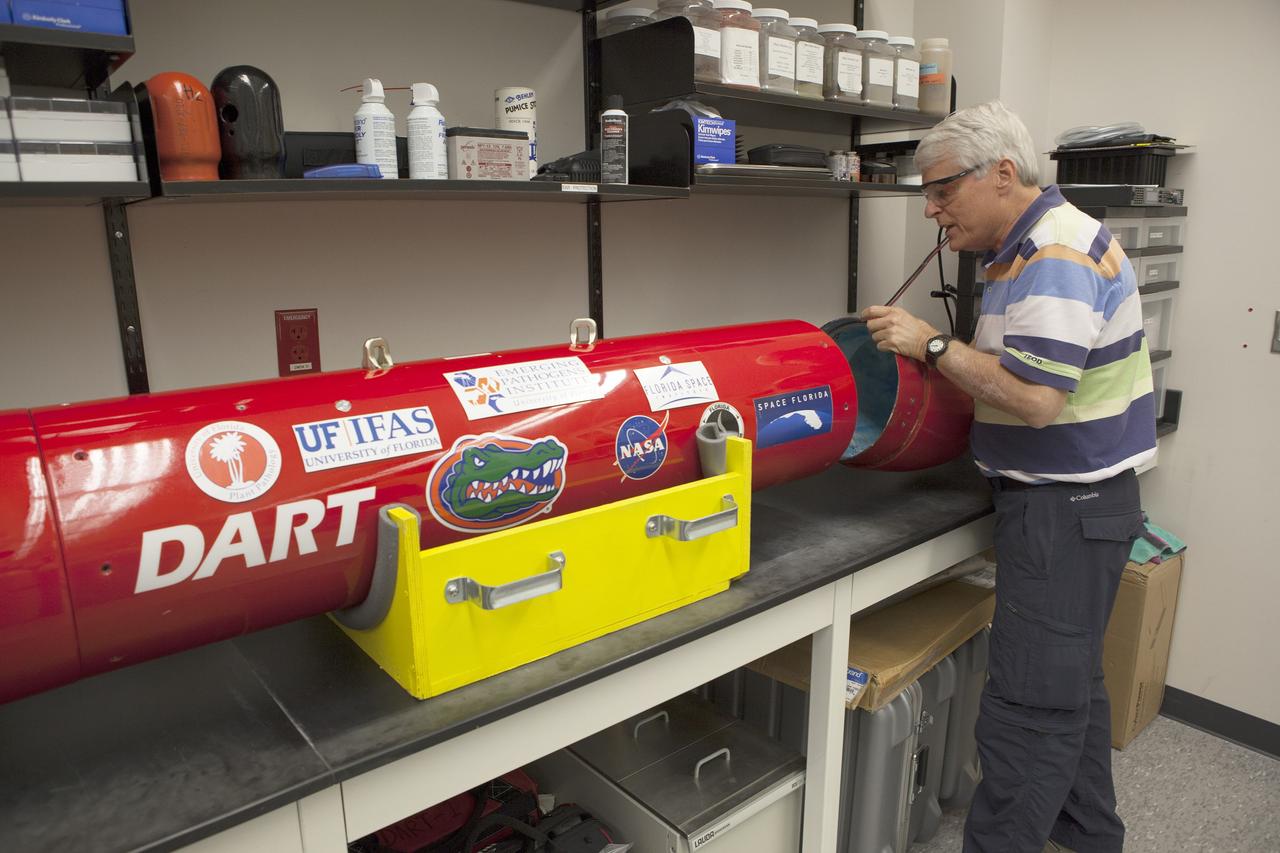
CAPE CANAVERAL, Fla. – A researcher from the University of Florida in Gainesville, checks the Dust Atmospheric Recovery Technology, or DART, spacecraft in a laboratory inside the Space Life Sciences Lab at NASA’s Kennedy Space Center in Florida. DART will characterize the dust loading and microbial diversity in the atmosphere over Florida during summer months with a special emphasis on their interactions during an African dust storm. DART will be used to collect atmospheric aerosols and suspended microbial cells over Florida and Kennedy. Results will help predict the risks of excessive microbial contamination adhering to spacecraft surfaces. Photo credit: NASA/Dimitri Gerondidakis
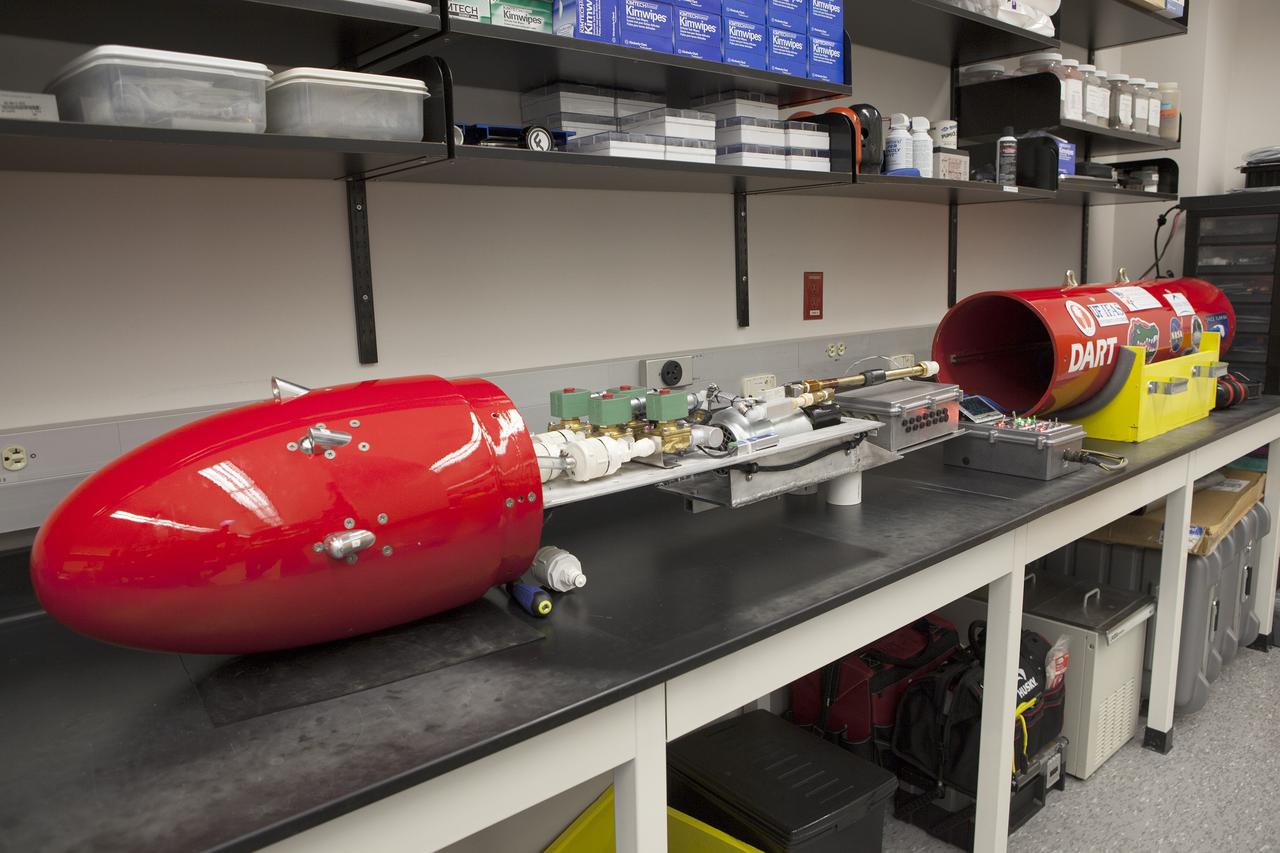
CAPE CANAVERAL, Fla. – The Dust Atmospheric Recovery Technology, or DART, spacecraft is being assembled in a laboratory inside the Space Life Sciences Lab at NASA’s Kennedy Space Center in Florida. DART will characterize the dust loading and microbial diversity in the atmosphere over Florida during summer months with a special emphasis on their interactions during an African dust storm. DART will be used to collect atmospheric aerosols and suspended microbial cells over Florida and Kennedy. Results will help predict the risks of excessive microbial contamination adhering to spacecraft surfaces. Photo credit: NASA/Dimitri Gerondidakis
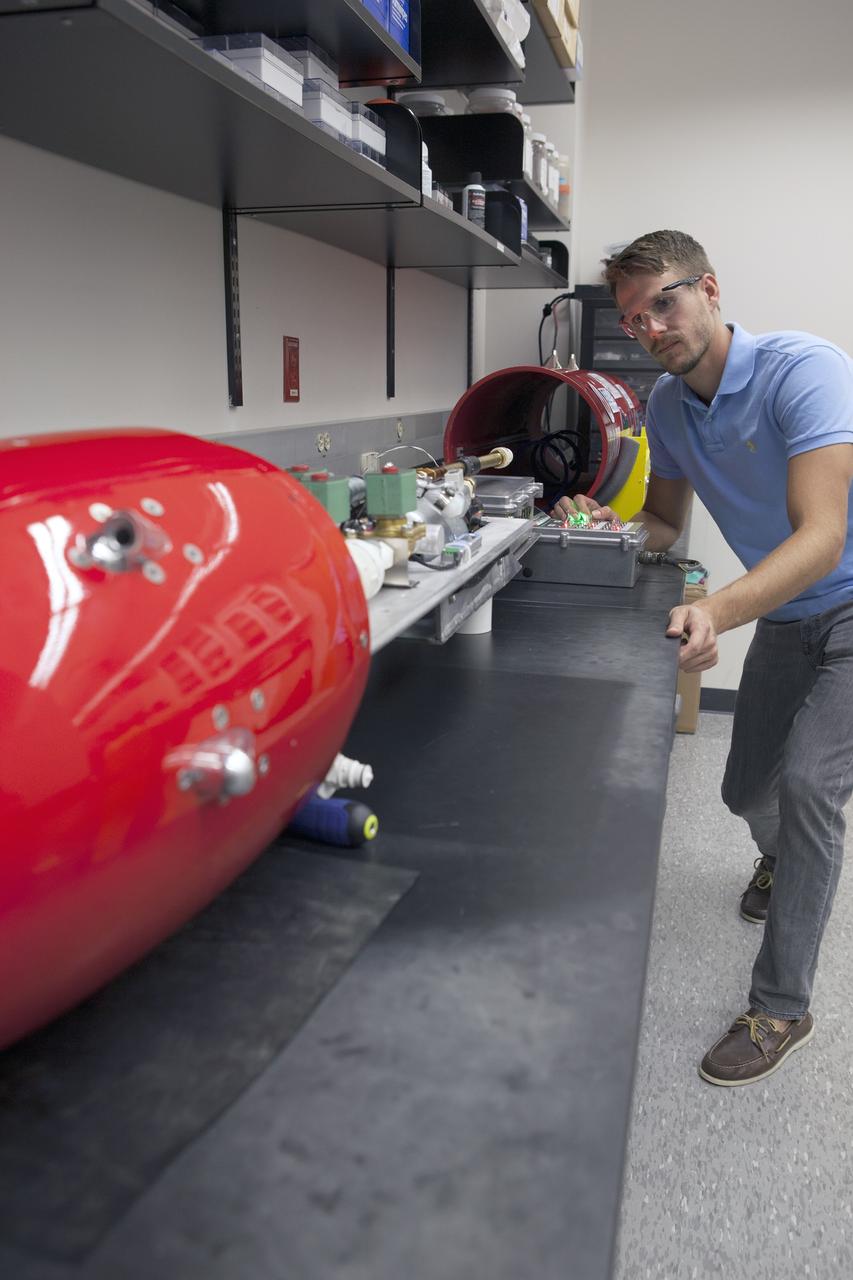
CAPE CANAVERAL, Fla. – A researcher at NASA’s Kennedy Space Center in Florida checks a reading on the Dust Atmospheric Recovery Technology, or DART, spacecraft inside a laboratory at the Space Life Sciences Lab. DART will characterize the dust loading and microbial diversity in the atmosphere over Florida during summer months with a special emphasis on their interactions during an African dust storm. DART will be used to collect atmospheric aerosols and suspended microbial cells over Florida and Kennedy. Results will help predict the risks of excessive microbial contamination adhering to spacecraft surfaces. Photo credit: NASA/Dimitri Gerondidakis
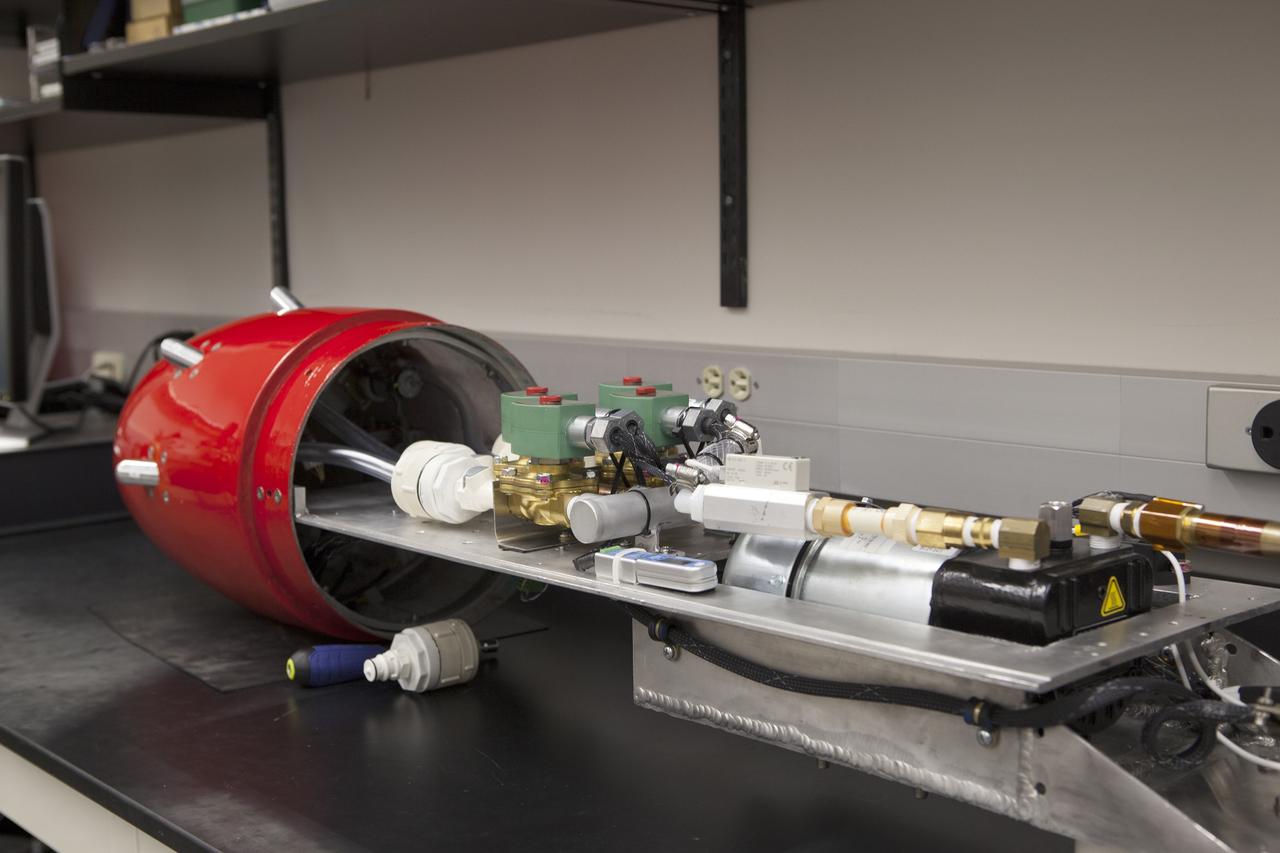
CAPE CANAVERAL, Fla. – The Dust Atmospheric Recovery Technology, or DART, spacecraft is being assembled in a laboratory inside the Space Life Sciences Lab at NASA’s Kennedy Space Center in Florida. DART will characterize the dust loading and microbial diversity in the atmosphere over Florida during summer months with a special emphasis on their interactions during an African dust storm. DART will be used to collect atmospheric aerosols and suspended microbial cells over Florida and Kennedy. Results will help predict the risks of excessive microbial contamination adhering to spacecraft surfaces. Photo credit: NASA/Dimitri Gerondidakis
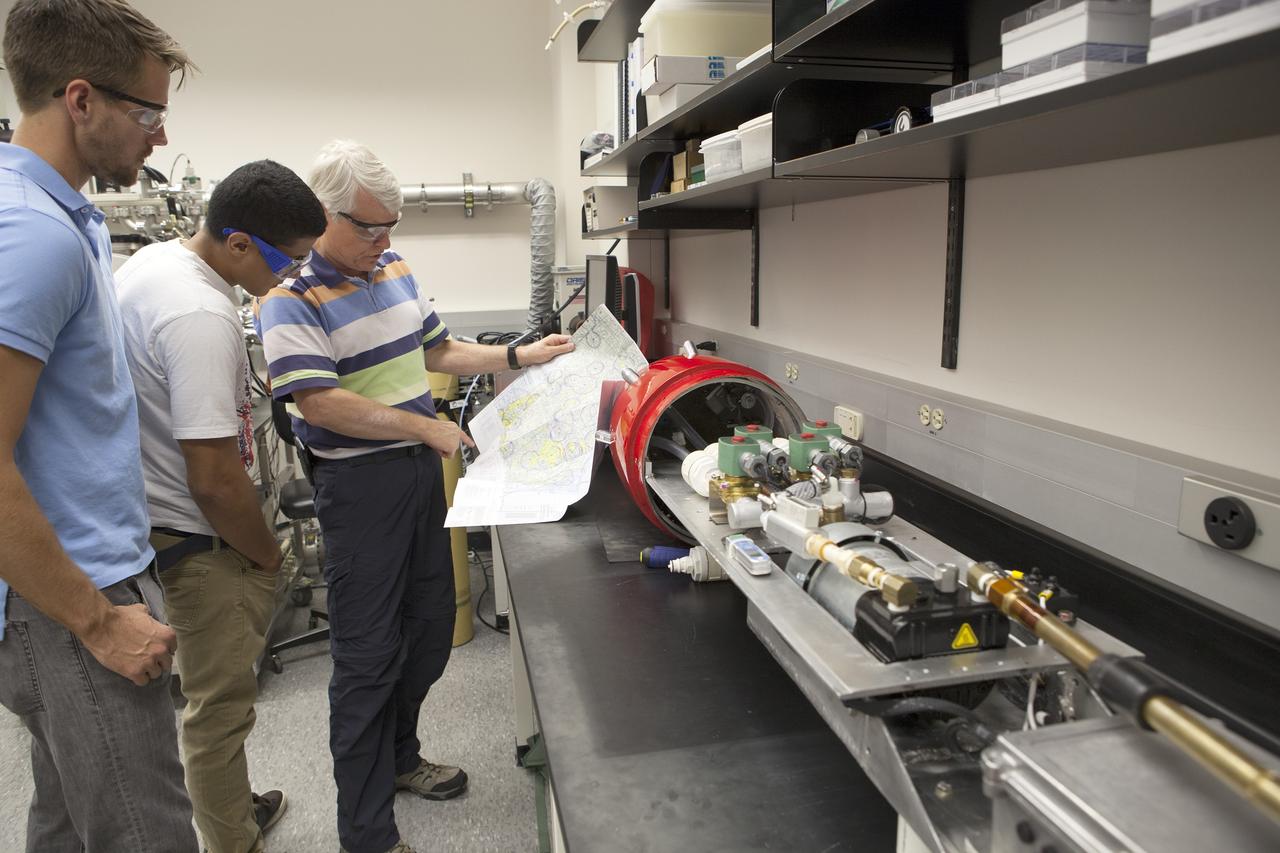
CAPE CANAVERAL, Fla. – Researchers at NASA’s Kennedy Space Center in Florida check readings on the Dust Atmospheric Recovery Technology, or DART, spacecraft inside a laboratory at the Space Life Sciences Lab. DART will characterize the dust loading and microbial diversity in the atmosphere over Florida during summer months with a special emphasis on their interactions during an African dust storm. DART will be used to collect atmospheric aerosols and suspended microbial cells over Florida and Kennedy. Results will help predict the risks of excessive microbial contamination adhering to spacecraft surfaces. Photo credit: NASA/Dimitri Gerondidakis
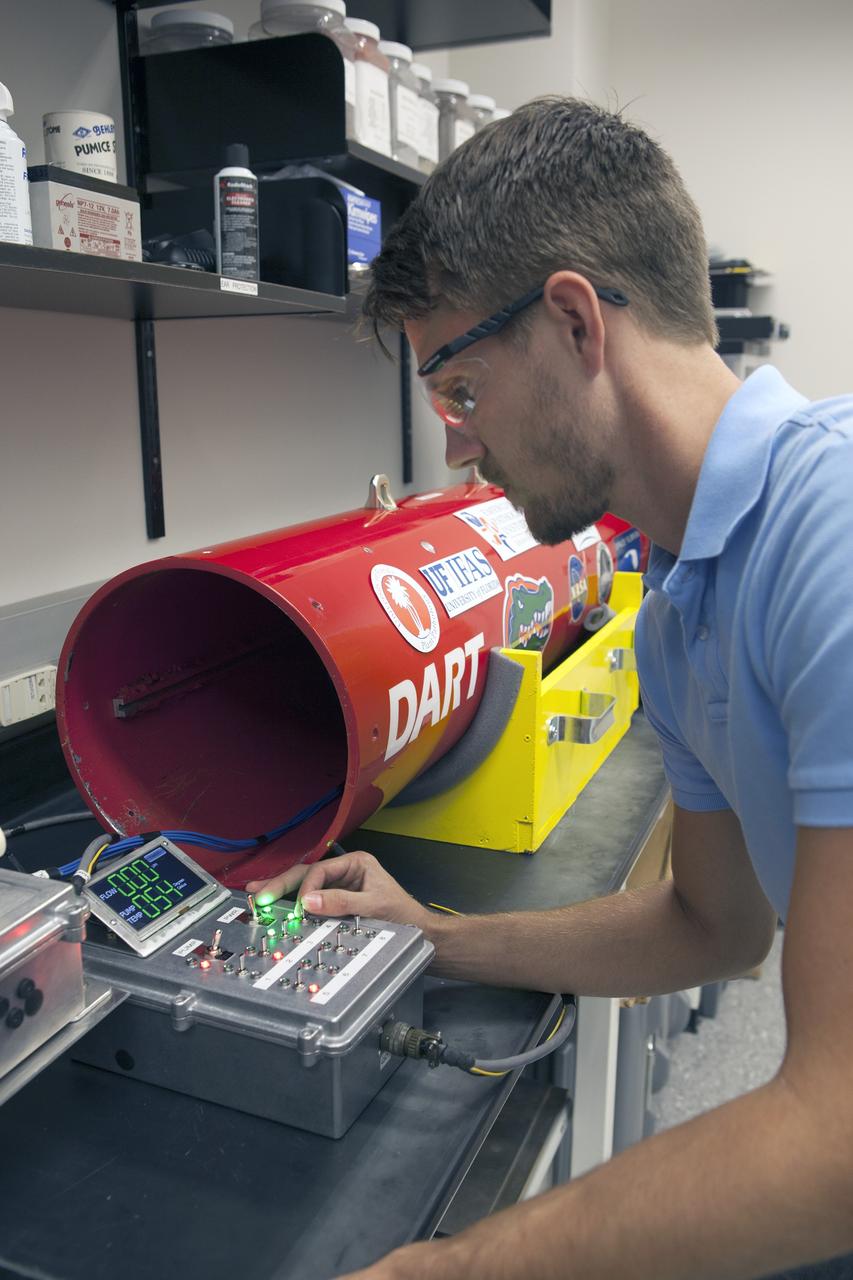
CAPE CANAVERAL, Fla. – A researcher at NASA’s Kennedy Space Center in Florida checks a reading on the Dust Atmospheric Recovery Technology, or DART, spacecraft inside a laboratory at the Space Life Sciences Lab. DART will characterize the dust loading and microbial diversity in the atmosphere over Florida during summer months with a special emphasis on their interactions during an African dust storm. DART will be used to collect atmospheric aerosols and suspended microbial cells over Florida and Kennedy. Results will help predict the risks of excessive microbial contamination adhering to spacecraft surfaces. Photo credit: NASA/Dimitri Gerondidakis
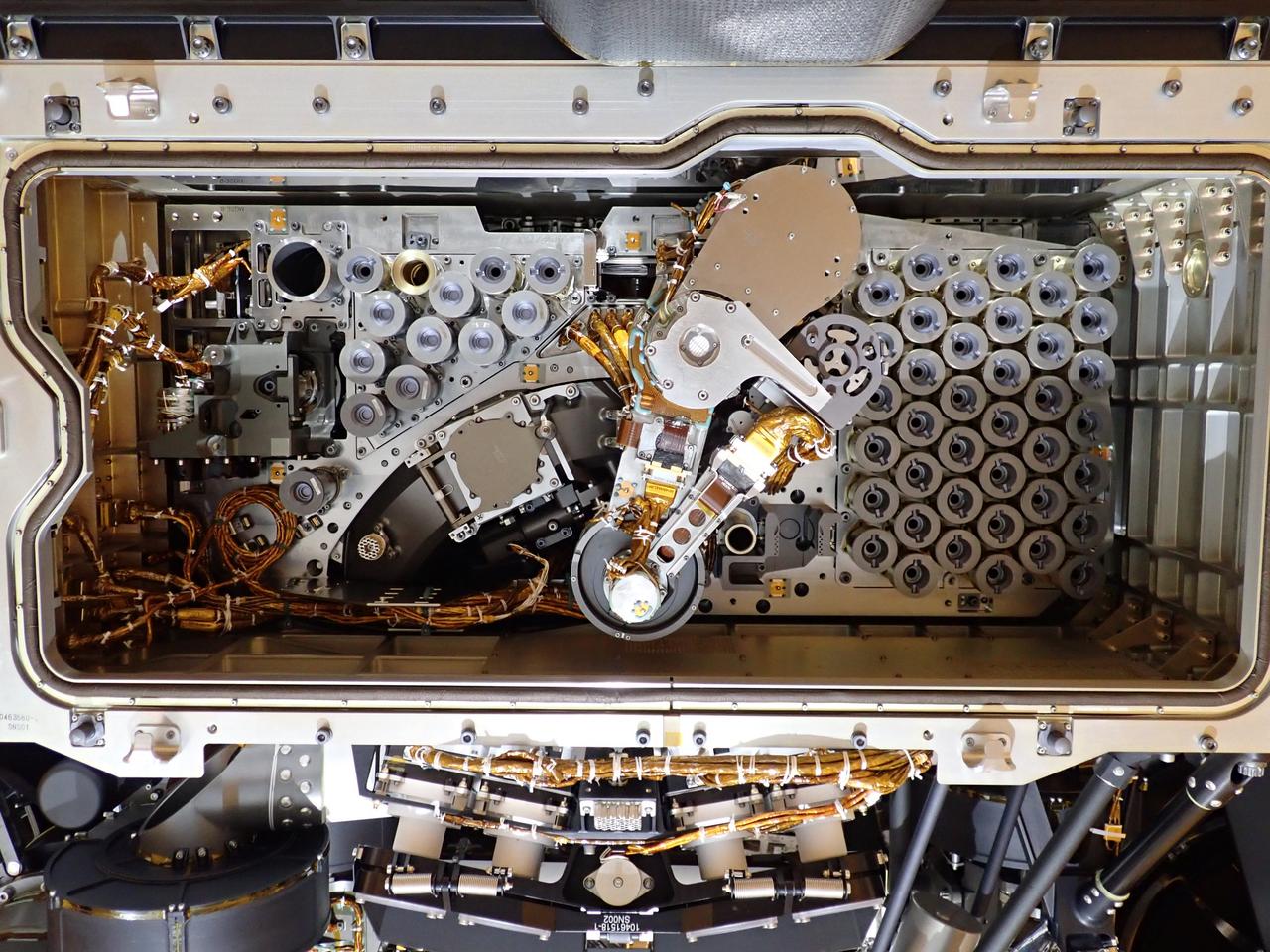
Inside the Payload Hazardous Servicing Facility at NASA’s Kennedy Space Center in Florida, the Sample Caching System Sterile Flight Model hardware was installed on the Mars Perseverance rover on May 21, 2020. The system includes 39 sample tubes. Each tube is sheathed in a gold-colored cylindrical enclosure to protect it from contamination. Perseverance rover will carry 43 sample tubes in total to Mars' Jezero Crater. The Mars Perseverance rover is scheduled to launch in mid-July atop a United Launch Alliance Atlas V 541 rocket from Pad 41 at nearby Cape Canaveral Air Force Station. The rover is part of NASA’s Mars Exploration Program, a long-term effort of robotic exploration of the Red Planet. The rover will search for habitable conditions in the ancient past and signs of past microbial life on Mars. The Launch Services Program at Kennedy is responsible for launch management.
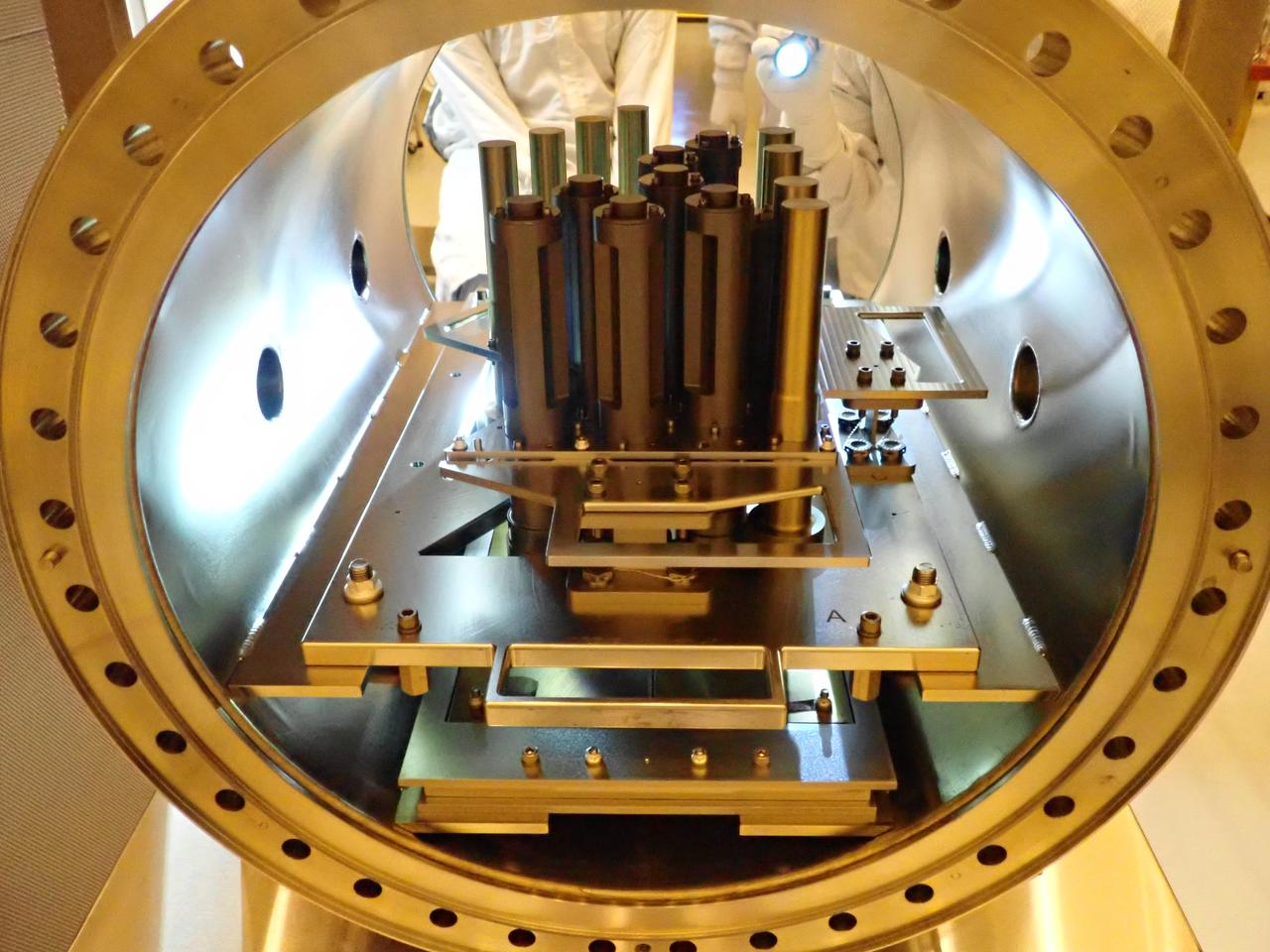
Inside the Payload Hazardous Servicing Facility at NASA’s Kennedy Space Center in Florida, the Sample Caching System Sterile Flight Model hardware is being prepared for installation on the Mars Perseverance rover on May 20, 2020. The system includes 39 sample tubes that will be inserted into the underside of the rover. Each tube is sheathed in a gold-colored cylindrical enclosure to protect it from contamination. Perseverance rover will carry 43 sample tubes in total to Mars' Jezero Crater. The Mars Perseverance rover is scheduled to launch in mid-July atop a United Launch Alliance Atlas V 541 rocket from Pad 41 at nearby Cape Canaveral Air Force Station. The rover is part of NASA’s Mars Exploration Program, a long-term effort of robotic exploration of the Red Planet. The rover will search for habitable conditions in the ancient past and signs of past microbial life on Mars. The Launch Services Program at Kennedy is responsible for launch management.
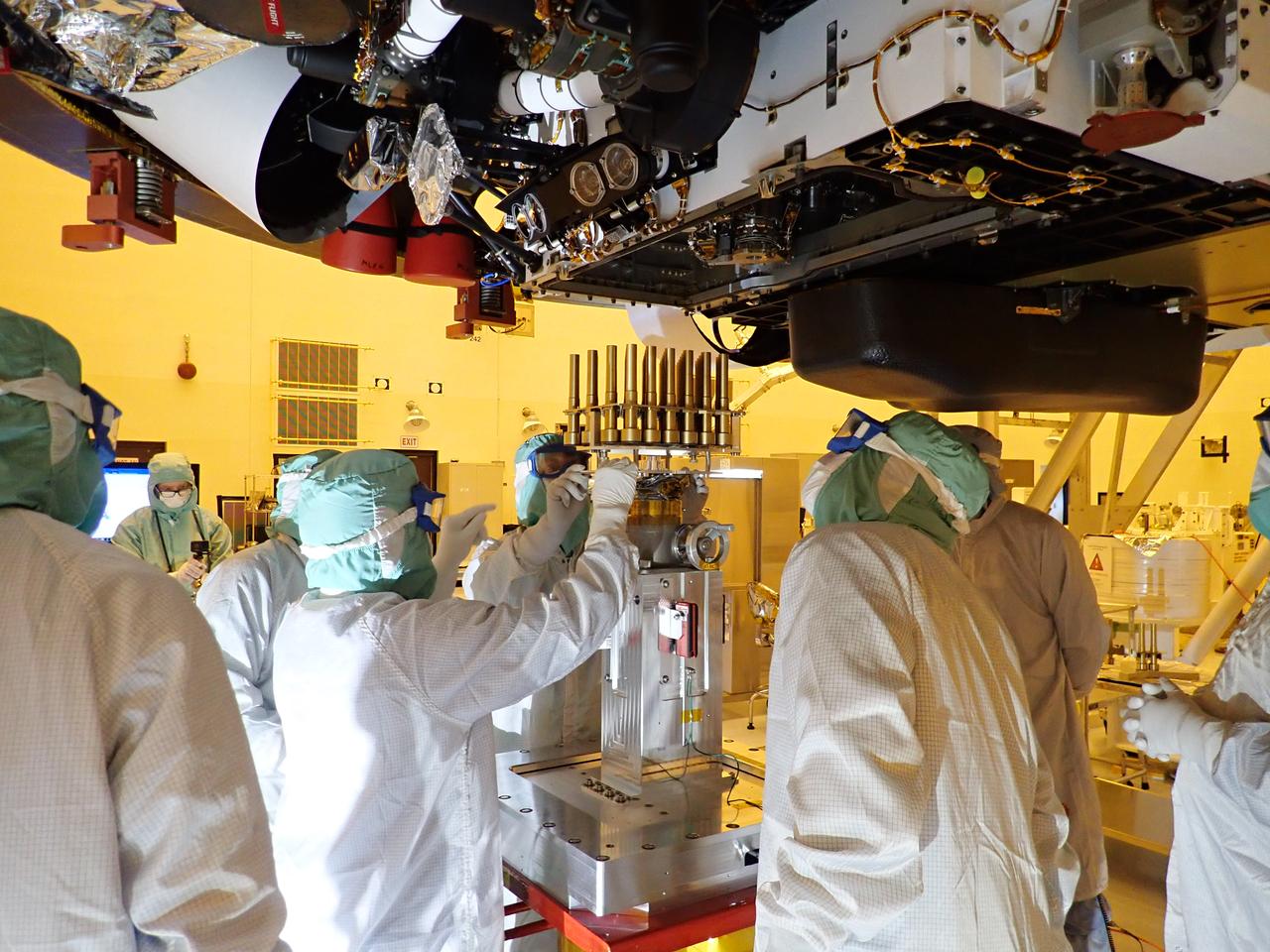
Inside the Payload Hazardous Servicing Facility at NASA’s Kennedy Space Center in Florida, workers prepare to install the Sample Caching System Sterile Flight Model hardware on the Mars Perseverance rover on May 21, 2020. The system includes 39 sample tubes that will be inserted into the underside of the rover. Each tube is sheathed in a gold-colored cylindrical enclosure to protect it from contamination. Perseverance rover will carry 43 sample tubes in total to Mars' Jezero Crater. The Mars Perseverance rover is scheduled to launch in mid-July atop a United Launch Alliance Atlas V 541 rocket from Pad 41 at nearby Cape Canaveral Air Force Station. The rover is part of NASA’s Mars Exploration Program, a long-term effort of robotic exploration of the Red Planet. The rover will search for habitable conditions in the ancient past and signs of past microbial life on Mars. The Launch Services Program at Kennedy is responsible for launch management.
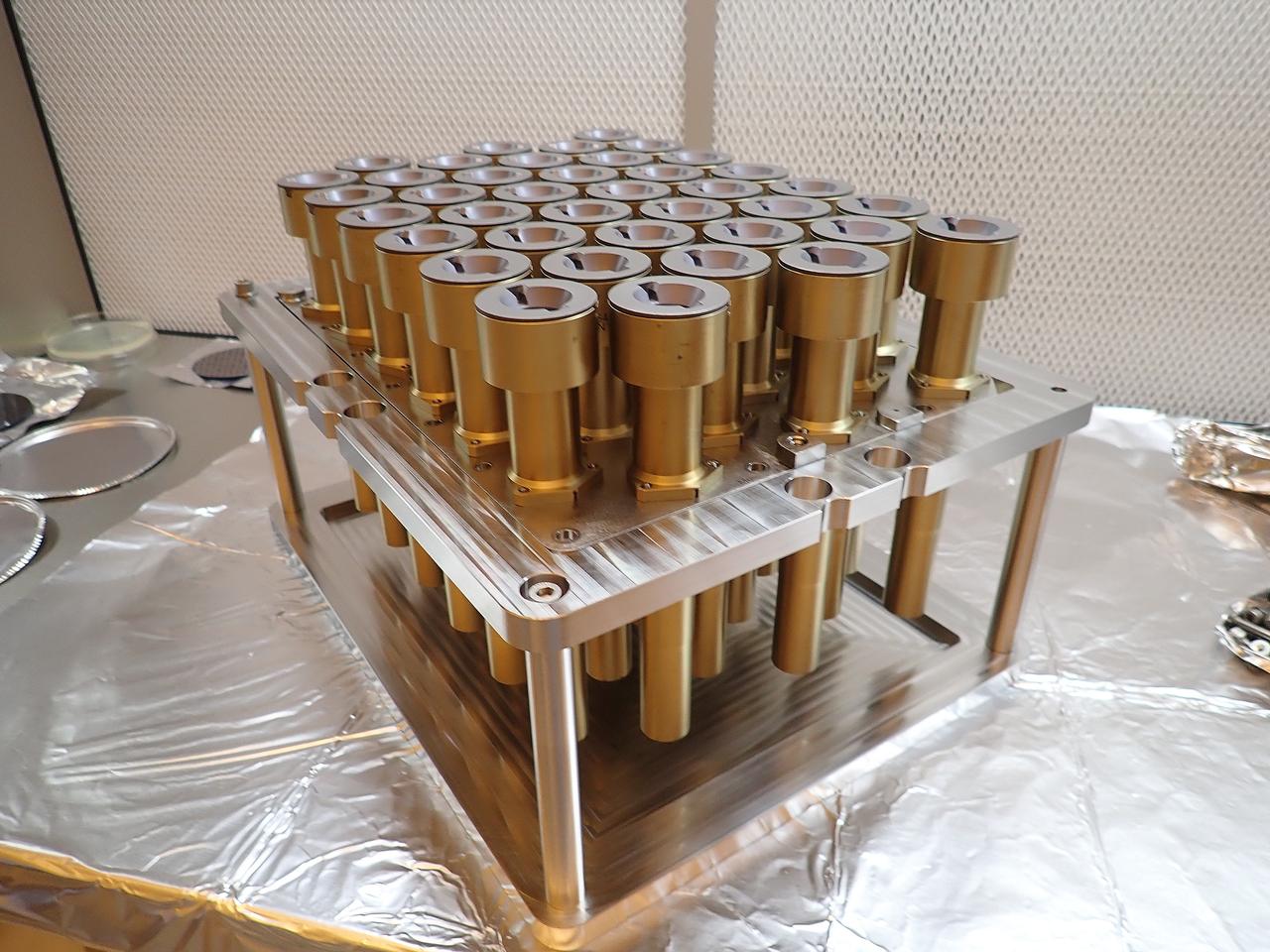
Inside the Payload Hazardous Servicing Facility at NASA’s Kennedy Space Center in Florida, the Sample Caching System Sterile Flight Model hardware is being prepared for installation on the Mars Perseverance rover on May 21, 2020. The system includes 39 sample tubes that will be inserted into the underside of the rover. Each tube is sheathed in a gold-colored cylindrical enclosure to protect it from contamination. Perseverance rover will carry 43 sample tubes in total to Mars' Jezero Crater. The Mars Perseverance rover is scheduled to launch in mid-July atop a United Launch Alliance Atlas V 541 rocket from Pad 41 at nearby Cape Canaveral Air Force Station. The rover is part of NASA’s Mars Exploration Program, a long-term effort of robotic exploration of the Red Planet. The rover will search for habitable conditions in the ancient past and signs of past microbial life on Mars. The Launch Services Program at Kennedy is responsible for launch management.
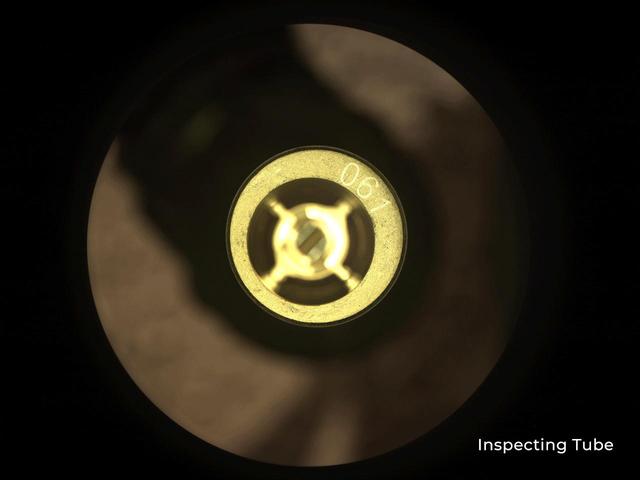
As part of its search for signs of ancient life on Mars, Perseverance is the first rover to bring a sample caching system to the Red Planet that will package promising samples for return to Earth by a future mission. This series of images shows NASA's Perseverance rover inspecting and sealing a "witness" sample tube on June 21, 2021 (the 120th sol, or Martian day, of the mission), as it prepares to collect its first sample of Martian rock and sediment. Witness tubes are similar to the sample tubes that will hold Martian rock and sediment, except they have been preloaded with a variety of materials that can capture molecular and particulate contaminants. They are opened on the Martian surface to "witness" the ambient environment near sample collection sites. With samples returned to Earth in the future, the witness tubes would show whether Earth contaminants were present during sample collection. Such information would help scientists tell which materials in the Martian samples may be of Earth origin. The sampling system's dedicated camera, the Cachecam, captured these images. A key objective for Perseverance's mission on Mars is astrobiology, including the search for signs of ancient microbial life. The rover will characterize the planet's geology and past climate, pave the way for human exploration of the Red Planet, and be the first mission to collect and cache Martian rock and regolith (broken rock and dust). Subsequent NASA missions, in cooperation with ESA (European Space Agency), would send spacecraft to Mars to collect these sealed samples from the surface and return them to Earth for in-depth analysis. The Mars 2020 Perseverance mission is part of NASA's Moon to Mars exploration approach, which includes Artemis missions to the Moon that will help prepare for human exploration of the Red Planet. Animation available at https://photojournal.jpl.nasa.gov/catalog/PIA24751
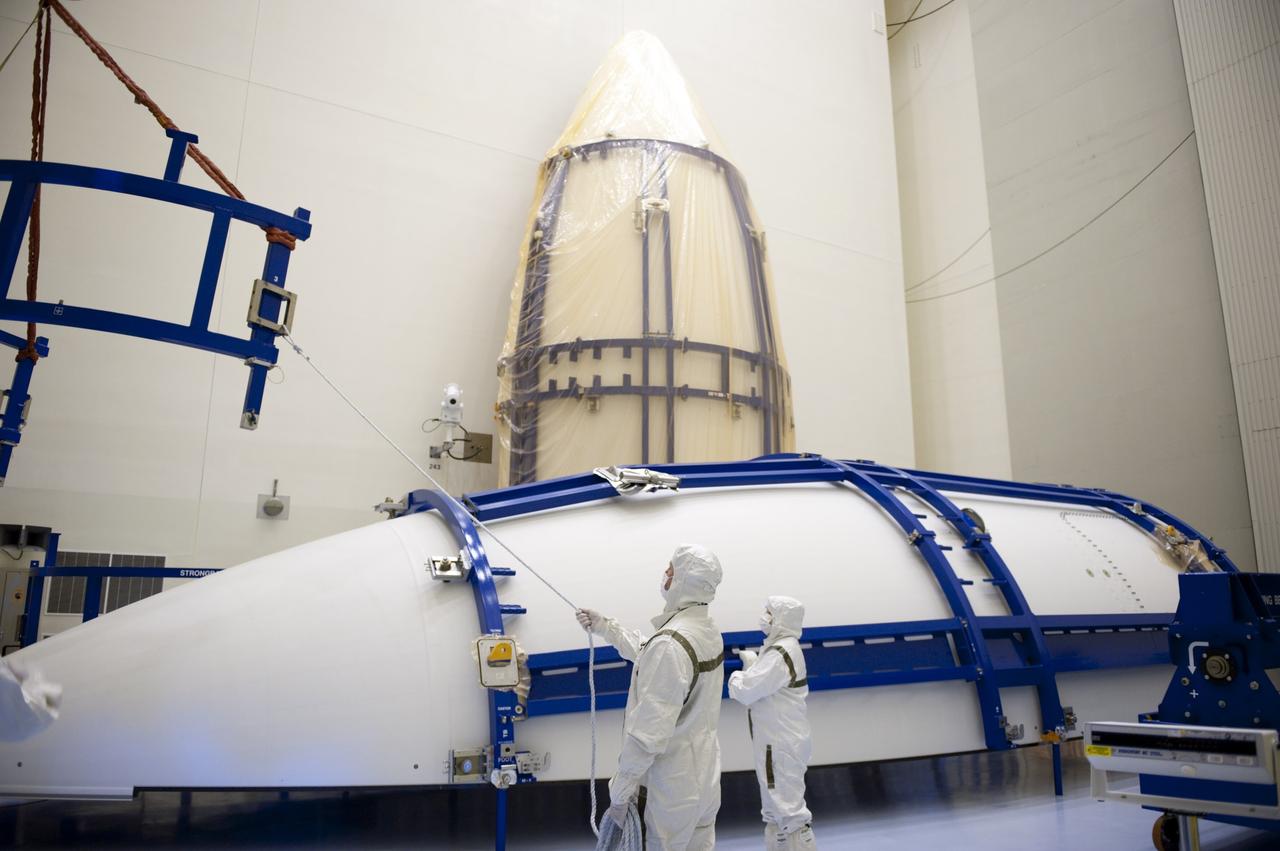
CAPE CANAVERAL, Fla. -- In the Payload Hazardous Servicing Facility at NASA's Kennedy Space Center in Florida, United Launch Alliance technicians guide a lifting device toward half of the Atlas V payload fairing for NASA's Mars Science Laboratory (MSL) mission. The fairing has been uncovered, and preparations are under way to clean it to meet NASA's planetary protection requirements. In the background is the other half of the fairing, still uncovered. The fairing will protect the spacecraft from the impact of aerodynamic pressure and heating during ascent. Although jettisoned once the spacecraft is outside the Earth's atmosphere, the fairing must be cleaned to the same exacting standards as the laboratory to avoid the possibility of contaminating it. MSL's components include a compact car-sized rover, Curiosity, which has 10 science instruments designed to search for evidence on whether Mars has had environments favorable to microbial life, including the chemical ingredients for life. The unique rover will use a laser to look inside rocks and release its gasses so that the rover’s spectrometer can analyze and send the data back to Earth. Launch of MSL aboard a United Launch Alliance Atlas V rocket is planned for Nov. 25 from Space Launch Complex 41 on Cape Canaveral Air Force Station. For more information, visit http://www.nasa.gov/msl. Photo credit: NASA/Kim Shiflett
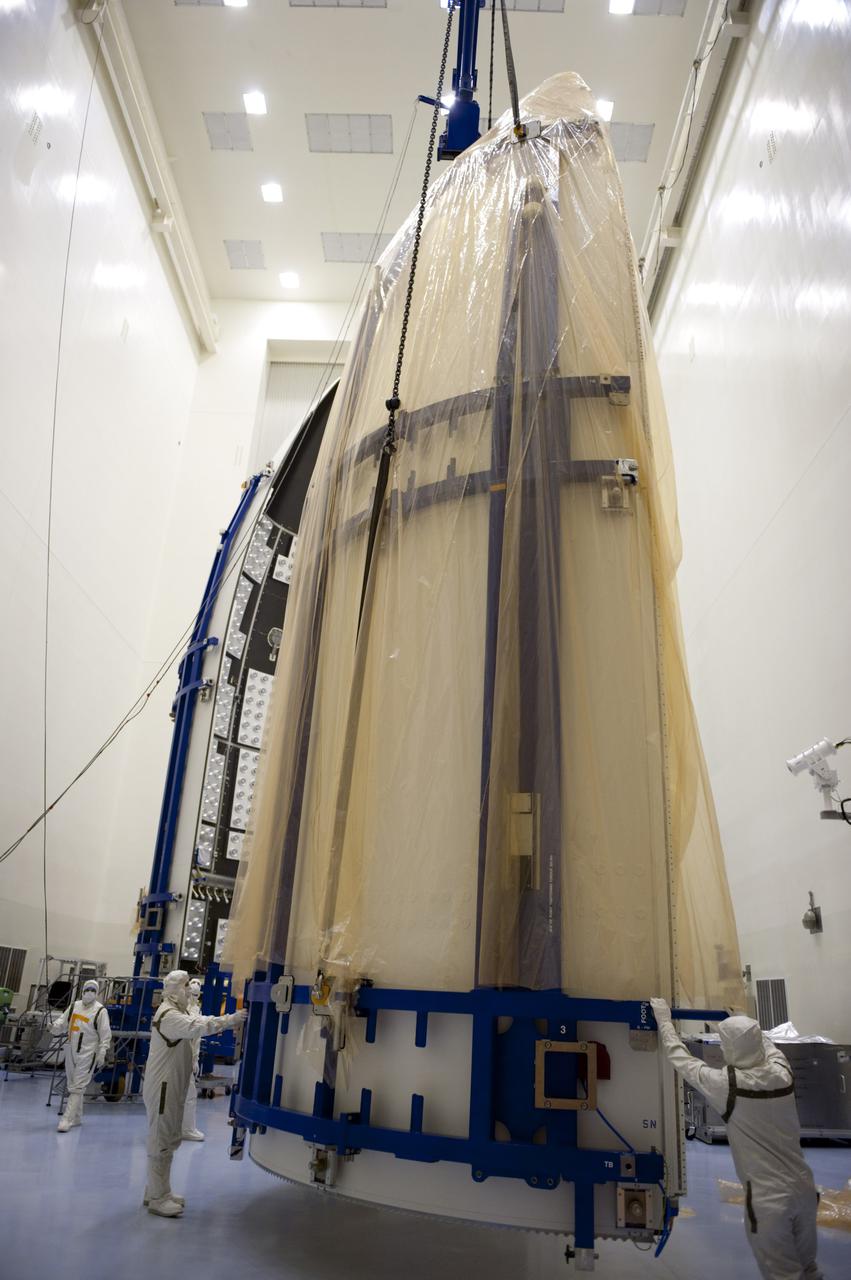
CAPE CANAVERAL, Fla. -- In the Payload Hazardous Servicing Facility at NASA's Kennedy Space Center in Florida, United Launch Alliance technicians steady half of the Atlas V payload fairing for NASA's Mars Science Laboratory (MSL) mission as it is lifted from the floor. Preparations are under way to lower it into a horizontal position to uncover and then clean it to meet NASA's planetary protection requirements. Behind it is the other half of the fairing, already uncovered. The fairing will protect the spacecraft from the impact of aerodynamic pressure and heating during ascent. Although jettisoned once the spacecraft is outside the Earth's atmosphere, the fairing must be cleaned to the same exacting standards as the laboratory to avoid the possibility of contaminating it. MSL's components include a compact car-sized rover, Curiosity, which has 10 science instruments designed to search for evidence on whether Mars has had environments favorable to microbial life, including the chemical ingredients for life. The unique rover will use a laser to look inside rocks and release its gasses so that the rover’s spectrometer can analyze and send the data back to Earth. Launch of MSL aboard a United Launch Alliance Atlas V rocket is planned for Nov. 25 from Space Launch Complex 41 on Cape Canaveral Air Force Station. For more information, visit http:__www.nasa.gov_msl. Photo credit: NASA_Kim Shiflett
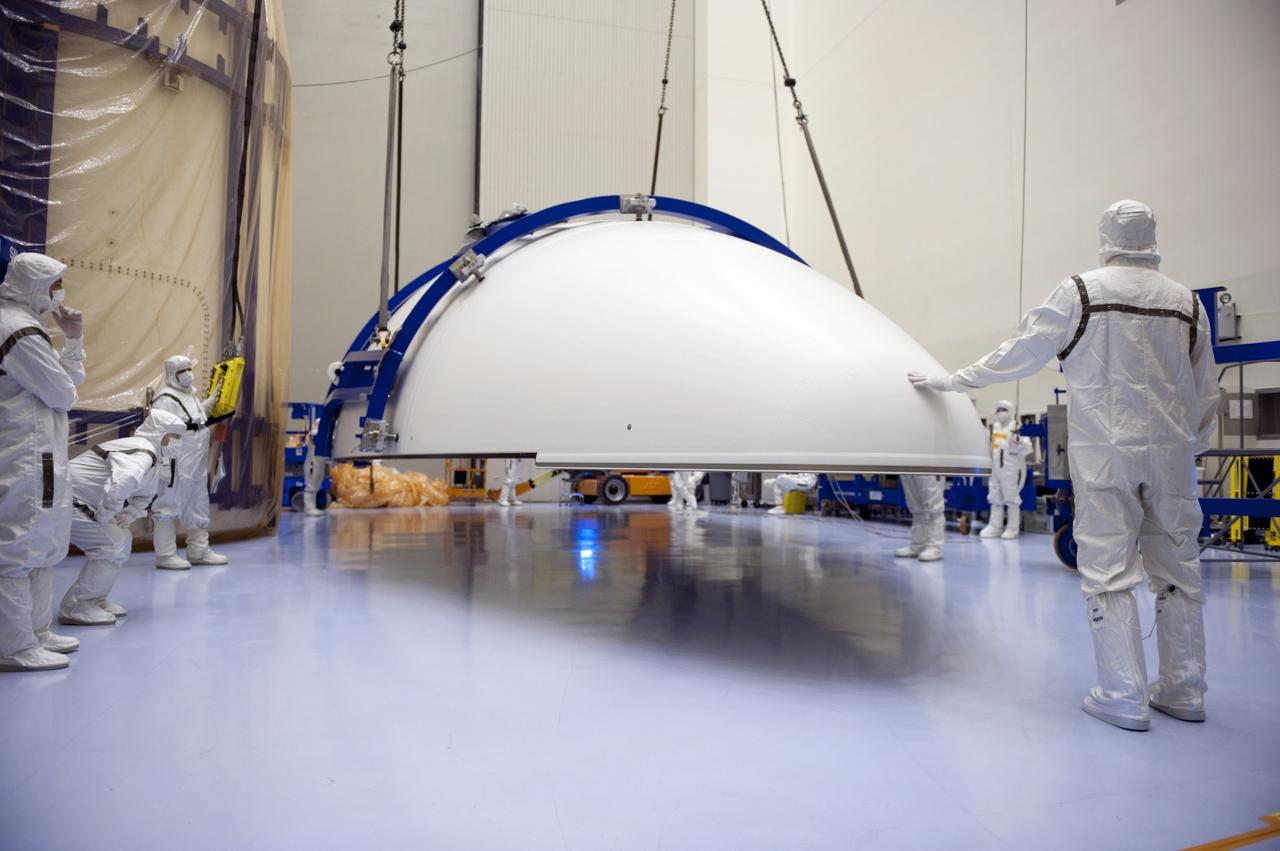
CAPE CANAVERAL, Fla. -- In the Payload Hazardous Servicing Facility at NASA's Kennedy Space Center in Florida, half of the Atlas V payload fairing for NASA's Mars Science Laboratory (MSL) mission is lowered into a horizontal position. It then will be uncovered and cleaned to meet NASA's planetary protection requirements. The fairing will protect the spacecraft from the impact of aerodynamic pressure and heating during ascent. Although jettisoned once the spacecraft is outside the Earth's atmosphere, the fairing must be cleaned to the same exacting standards as the laboratory to avoid the possibility of contaminating it. MSL's components include a compact car-sized rover, Curiosity, which has 10 science instruments designed to search for evidence on whether Mars has had environments favorable to microbial life, including the chemical ingredients for life. The unique rover will use a laser to look inside rocks and release its gasses so that the rover’s spectrometer can analyze and send the data back to Earth. Launch of MSL aboard a United Launch Alliance Atlas V rocket is planned for Nov. 25 from Space Launch Complex 41 on Cape Canaveral Air Force Station. For more information, visit http:__www.nasa.gov_msl. Photo credit: NASA_Kim Shiflett
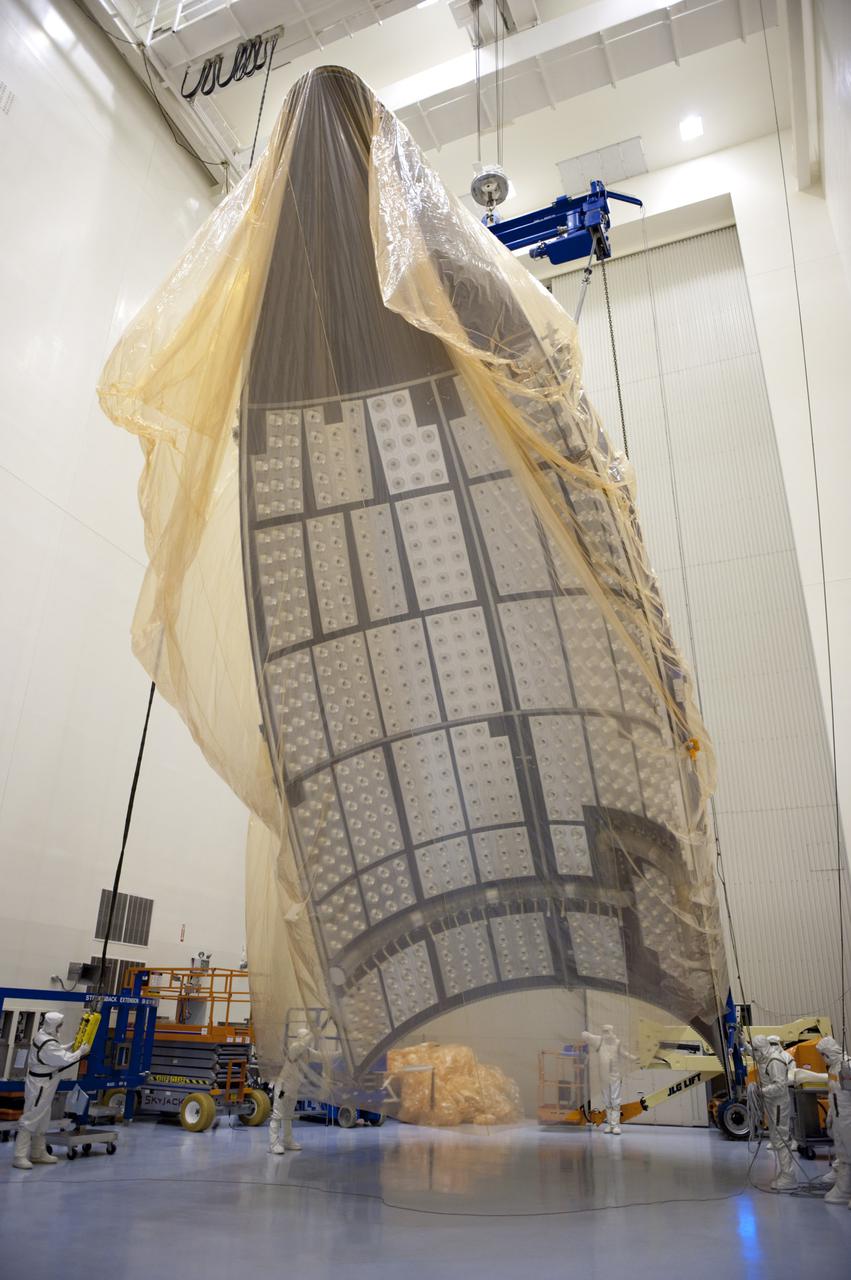
CAPE CANAVERAL, Fla. -- In the Payload Hazardous Servicing Facility at NASA's Kennedy Space Center in Florida, half of the Atlas V payload fairing for NASA's Mars Science Laboratory (MSL) mission hovers above the floor during operations to raise it into a vertical position. The fairing has been uncovered, and preparations are under way to clean it to meet NASA's planetary protection requirements. At left is the other half of the fairing, still uncovered. The fairing will protect the spacecraft from the impact of aerodynamic pressure and heating during ascent. Although jettisoned once the spacecraft is outside the Earth's atmosphere, the fairing must be cleaned to the same exacting standards as the laboratory to avoid the possibility of contaminating it. MSL's components include a compact car-sized rover, Curiosity, which has 10 science instruments designed to search for evidence on whether Mars has had environments favorable to microbial life, including the chemical ingredients for life. The unique rover will use a laser to look inside rocks and release its gasses so that the rover’s spectrometer can analyze and send the data back to Earth. Launch of MSL aboard a United Launch Alliance Atlas V rocket is planned for Nov. 25 from Space Launch Complex 41 on Cape Canaveral Air Force Station. For more information, visit http://www.nasa.gov/msl. Photo credit: NASA/Kim Shiflett
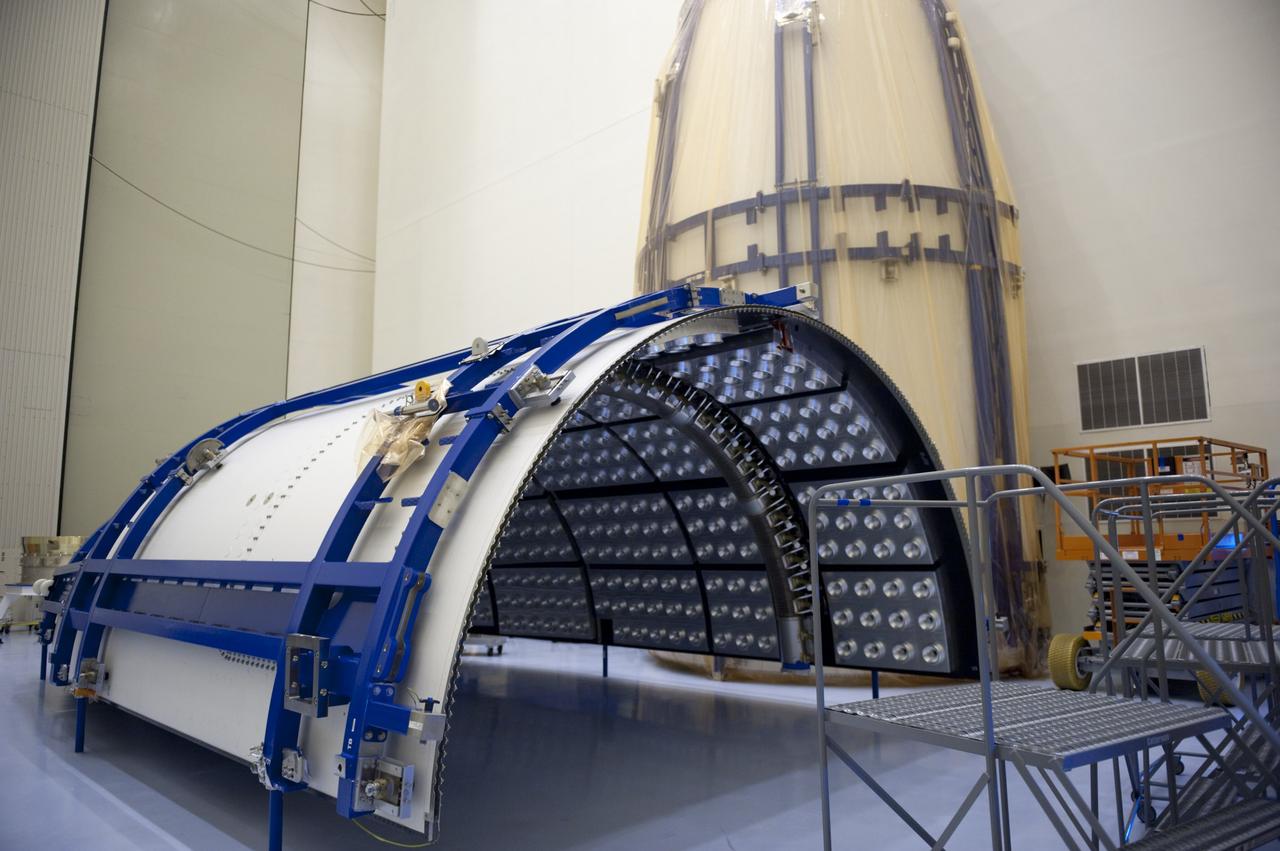
CAPE CANAVERAL, Fla. -- In the Payload Hazardous Servicing Facility at NASA's Kennedy Space Center in Florida, half of the Atlas V payload fairing for NASA's Mars Science Laboratory (MSL) mission is uncovered during preparations to clean it to meet NASA's planetary protection requirements. In the background is the other half of the fairing, still uncovered. The fairing will protect the spacecraft from the impact of aerodynamic pressure and heating during ascent. Although jettisoned once the spacecraft is outside the Earth's atmosphere, the fairing must be cleaned to the same exacting standards as the laboratory to avoid the possibility of contaminating it. MSL's components include a compact car-sized rover, Curiosity, which has 10 science instruments designed to search for evidence on whether Mars has had environments favorable to microbial life, including the chemical ingredients for life. The unique rover will use a laser to look inside rocks and release its gasses so that the rover’s spectrometer can analyze and send the data back to Earth. Launch of MSL aboard a United Launch Alliance Atlas V rocket is planned for Nov. 25 from Space Launch Complex 41 on Cape Canaveral Air Force Station. For more information, visit http://www.nasa.gov/msl. Photo credit: NASA/Kim Shiflett
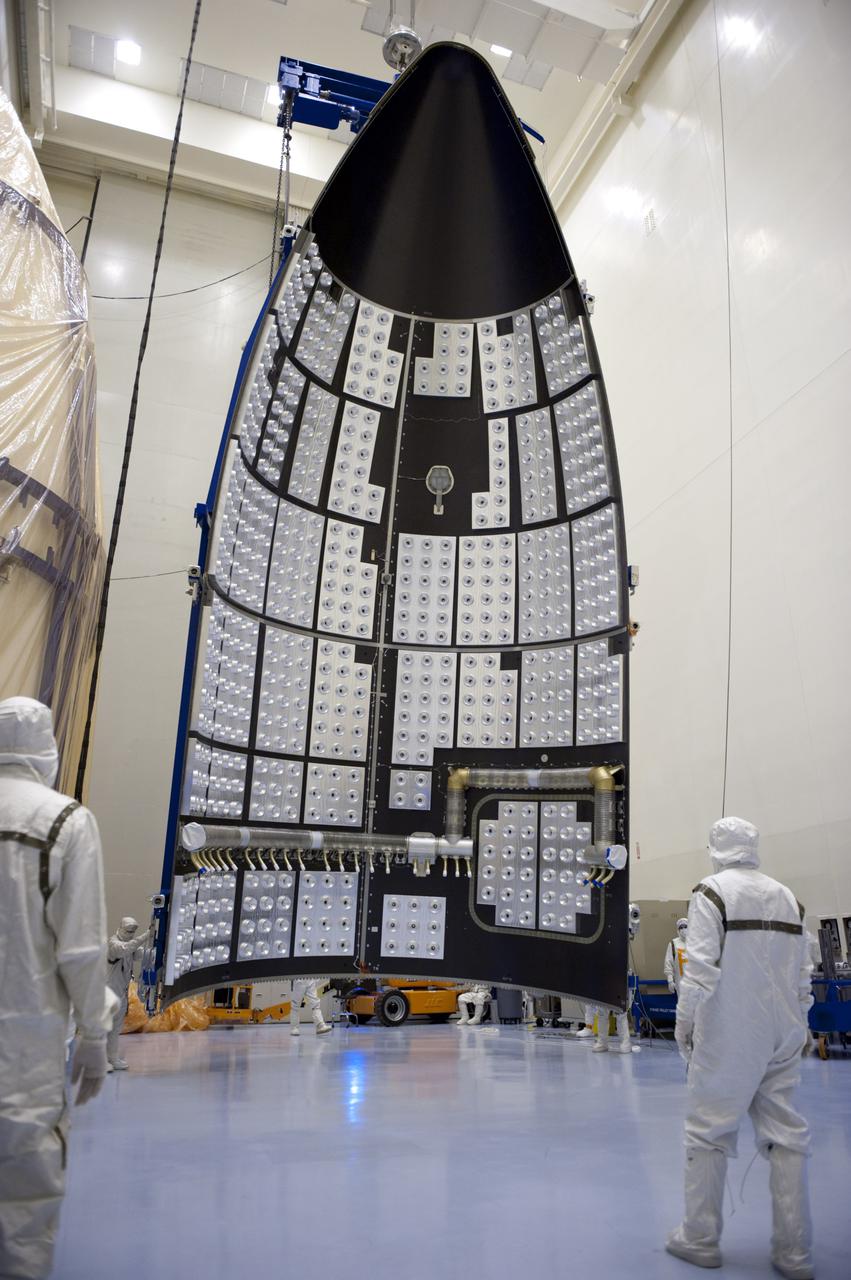
CAPE CANAVERAL, Fla. -- In the Payload Hazardous Servicing Facility at NASA's Kennedy Space Center in Florida, a section of the Atlas V payload fairing for NASA's Mars Science Laboratory (MSL) mission hangs vertically from the ceiling. The fairing has been uncovered, revealing the fairing acoustic protection (FAP) system lining its interior. The FAP protects the payload by dampening the sound created by the rocket during liftoff. Next, the fairing will be cleaned to meet NASA's planetary protection requirements. The fairing will protect the spacecraft from the impact of aerodynamic pressure and heating during ascent. Although jettisoned once the spacecraft is outside the Earth's atmosphere, the fairing must be cleaned to the same exacting standards as the laboratory to avoid the possibility of contaminating it. MSL's components include a compact car-sized rover, Curiosity, which has 10 science instruments designed to search for evidence on whether Mars has had environments favorable to microbial life, including the chemical ingredients for life. The unique rover will use a laser to look inside rocks and release its gasses so that the rover’s spectrometer can analyze and send the data back to Earth. Launch of MSL aboard a United Launch Alliance Atlas V rocket is planned for Nov. 25 from Space Launch Complex 41 on Cape Canaveral Air Force Station. For more information, visit http:__www.nasa.gov_msl. Photo credit: NASA_Kim Shiflett
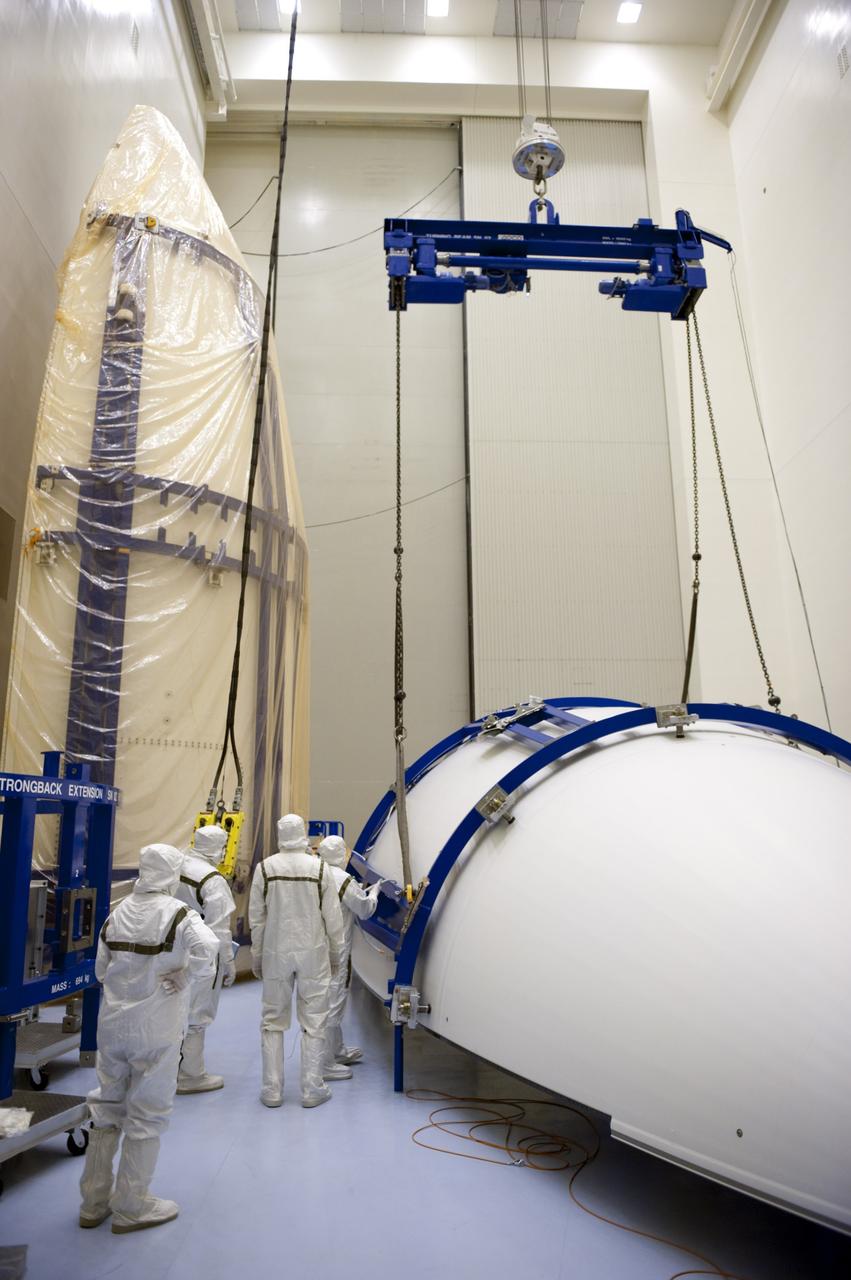
CAPE CANAVERAL, Fla. -- In the Payload Hazardous Servicing Facility at NASA's Kennedy Space Center in Florida, a lifting device is secured to half of the Atlas V payload fairing for NASA's Mars Science Laboratory (MSL) mission. The fairing has been uncovered, and preparations are under way to clean it to meet NASA's planetary protection requirements. At left is the other half of the fairing, still uncovered. The fairing will protect the spacecraft from the impact of aerodynamic pressure and heating during ascent. Although jettisoned once the spacecraft is outside the Earth's atmosphere, the fairing must be cleaned to the same exacting standards as the laboratory to avoid the possibility of contaminating it. MSL's components include a compact car-sized rover, Curiosity, which has 10 science instruments designed to search for evidence on whether Mars has had environments favorable to microbial life, including the chemical ingredients for life. The unique rover will use a laser to look inside rocks and release its gasses so that the rover’s spectrometer can analyze and send the data back to Earth. Launch of MSL aboard a United Launch Alliance Atlas V rocket is planned for Nov. 25 from Space Launch Complex 41 on Cape Canaveral Air Force Station. For more information, visit http://www.nasa.gov/msl. Photo credit: NASA/Kim Shiflett
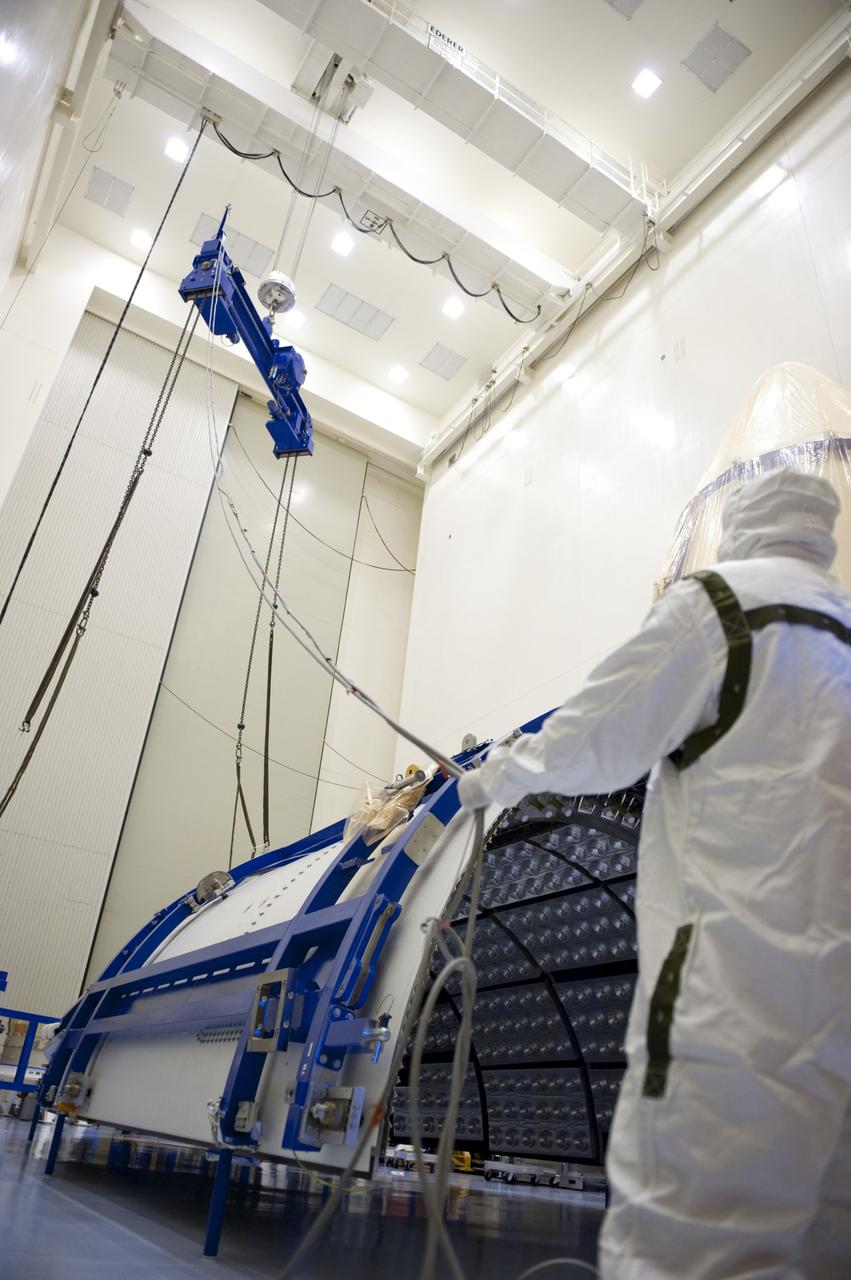
CAPE CANAVERAL, Fla. -- In the Payload Hazardous Servicing Facility at NASA's Kennedy Space Center in Florida, United Launch Alliance technicians lower a lifting device toward half of the Atlas V payload fairing for NASA's Mars Science Laboratory (MSL) mission. The fairing has been uncovered, and preparations are under way to clean it to meet NASA's planetary protection requirements. The fairing will protect the spacecraft from the impact of aerodynamic pressure and heating during ascent. Although jettisoned once the spacecraft is outside the Earth's atmosphere, the fairing must be cleaned to the same exacting standards as the laboratory to avoid the possibility of contaminating it. MSL's components include a compact car-sized rover, Curiosity, which has 10 science instruments designed to search for evidence on whether Mars has had environments favorable to microbial life, including the chemical ingredients for life. The unique rover will use a laser to look inside rocks and release its gasses so that the rover’s spectrometer can analyze and send the data back to Earth. Launch of MSL aboard a United Launch Alliance Atlas V rocket is planned for Nov. 25 from Space Launch Complex 41 on Cape Canaveral Air Force Station. For more information, visit http://www.nasa.gov/msl. Photo credit: NASA/Kim Shiflett
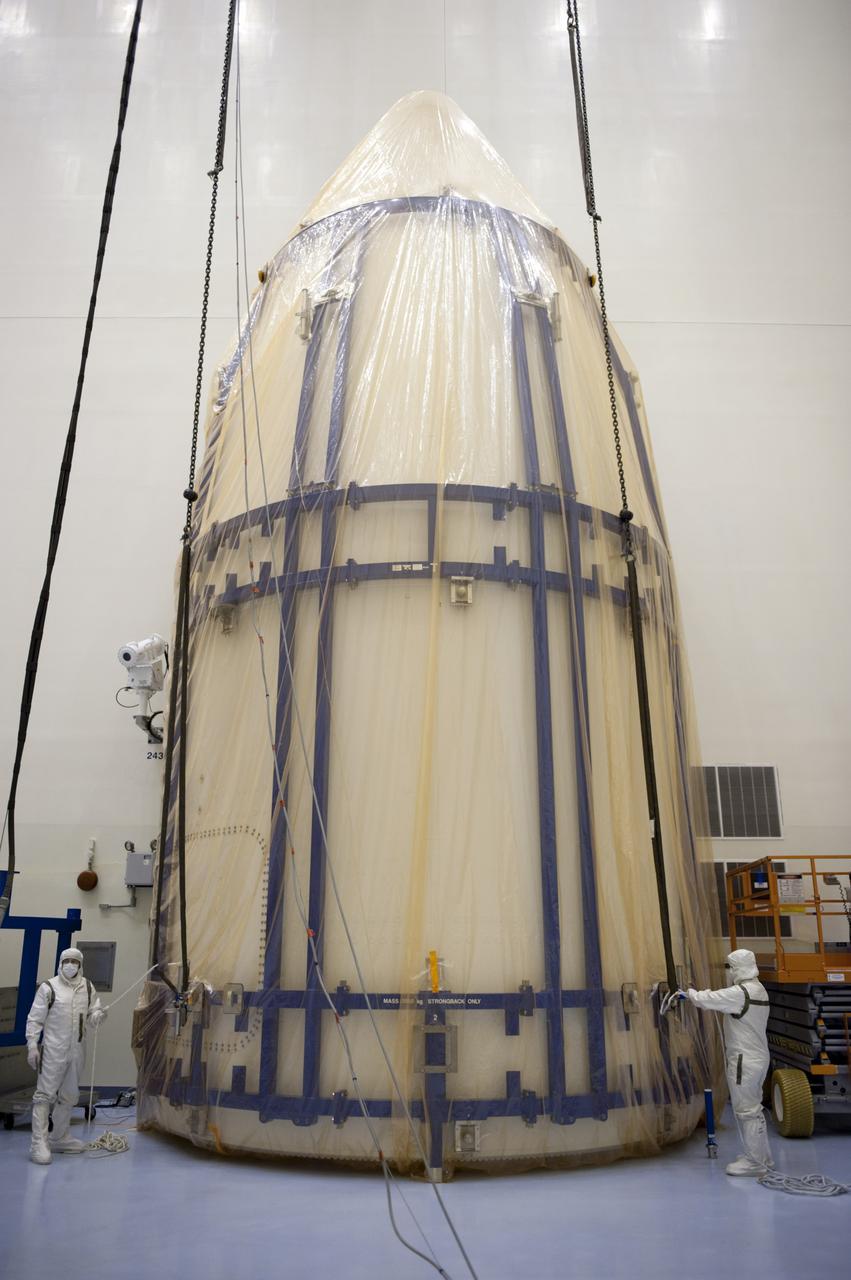
CAPE CANAVERAL, Fla. -- In the Payload Hazardous Servicing Facility at NASA's Kennedy Space Center in Florida, United Launch Alliance technicians prepare to lift half of the Atlas V payload fairing for NASA's Mars Science Laboratory (MSL) mission from the floor. Preparations are under way to lower it into a horizontal position to uncover and then clean it to meet NASA's planetary protection requirements. The fairing will protect the spacecraft from the impact of aerodynamic pressure and heating during ascent. Although jettisoned once the spacecraft is outside the Earth's atmosphere, the fairing must be cleaned to the same exacting standards as the laboratory to avoid the possibility of contaminating it. MSL's components include a compact car-sized rover, Curiosity, which has 10 science instruments designed to search for evidence on whether Mars has had environments favorable to microbial life, including the chemical ingredients for life. The unique rover will use a laser to look inside rocks and release its gasses so that the rover’s spectrometer can analyze and send the data back to Earth. Launch of MSL aboard a United Launch Alliance Atlas V rocket is planned for Nov. 25 from Space Launch Complex 41 on Cape Canaveral Air Force Station. For more information, visit http:__www.nasa.gov_msl. Photo credit: NASA_Kim Shiflett
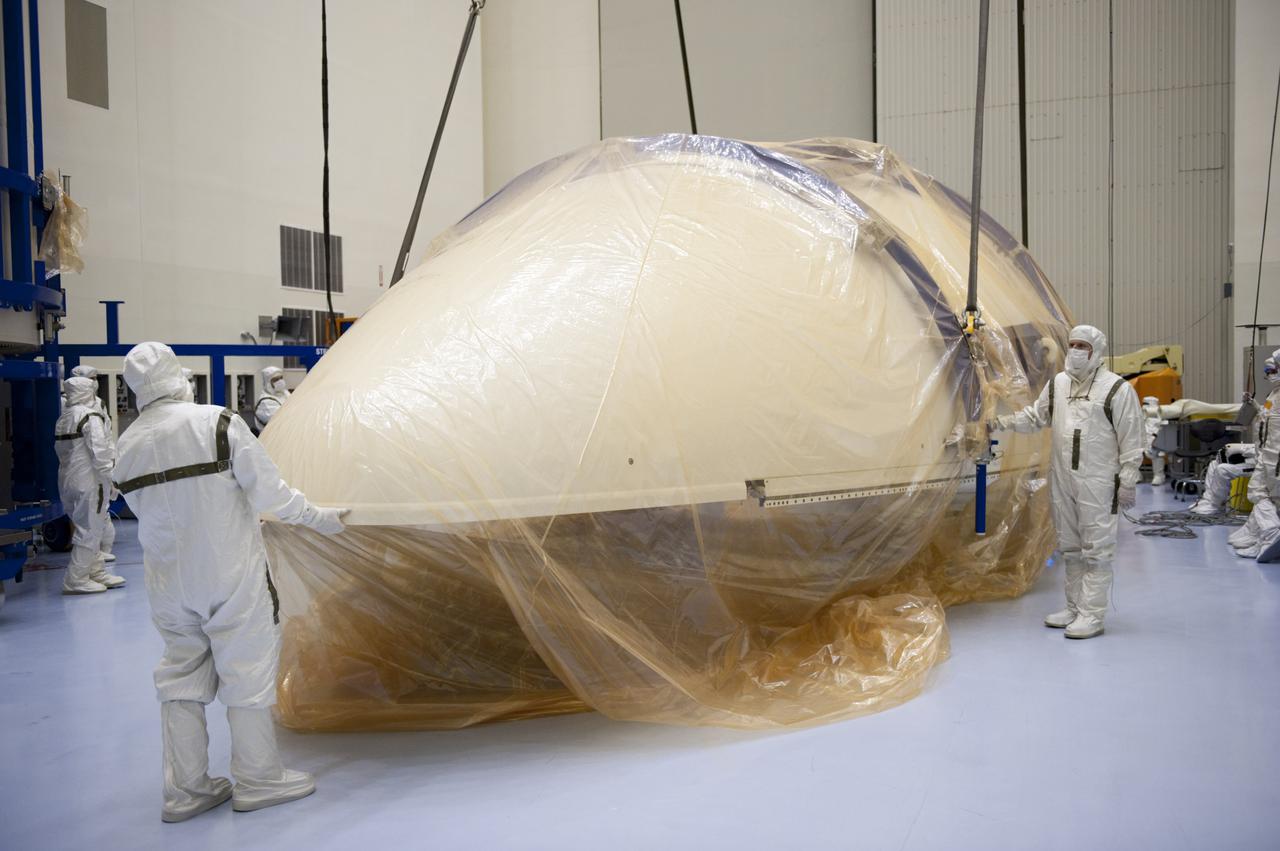
CAPE CANAVERAL, Fla. -- In the Payload Hazardous Servicing Facility at NASA's Kennedy Space Center in Florida, half of the Atlas V payload fairing for NASA's Mars Science Laboratory (MSL) mission comes to rest on the floor in a horizontal position. It next will be uncovered and cleaned to meet NASA's planetary protection requirements. The fairing will protect the spacecraft from the impact of aerodynamic pressure and heating during ascent. Although jettisoned once the spacecraft is outside the Earth's atmosphere, the fairing must be cleaned to the same exacting standards as the laboratory to avoid the possibility of contaminating it. MSL's components include a compact car-sized rover, Curiosity, which has 10 science instruments designed to search for evidence on whether Mars has had environments favorable to microbial life, including the chemical ingredients for life. The unique rover will use a laser to look inside rocks and release its gasses so that the rover’s spectrometer can analyze and send the data back to Earth. Launch of MSL aboard a United Launch Alliance Atlas V rocket is planned for Nov. 25 from Space Launch Complex 41 on Cape Canaveral Air Force Station. For more information, visit http:__www.nasa.gov_msl. Photo credit: NASA_Kim Shiflett
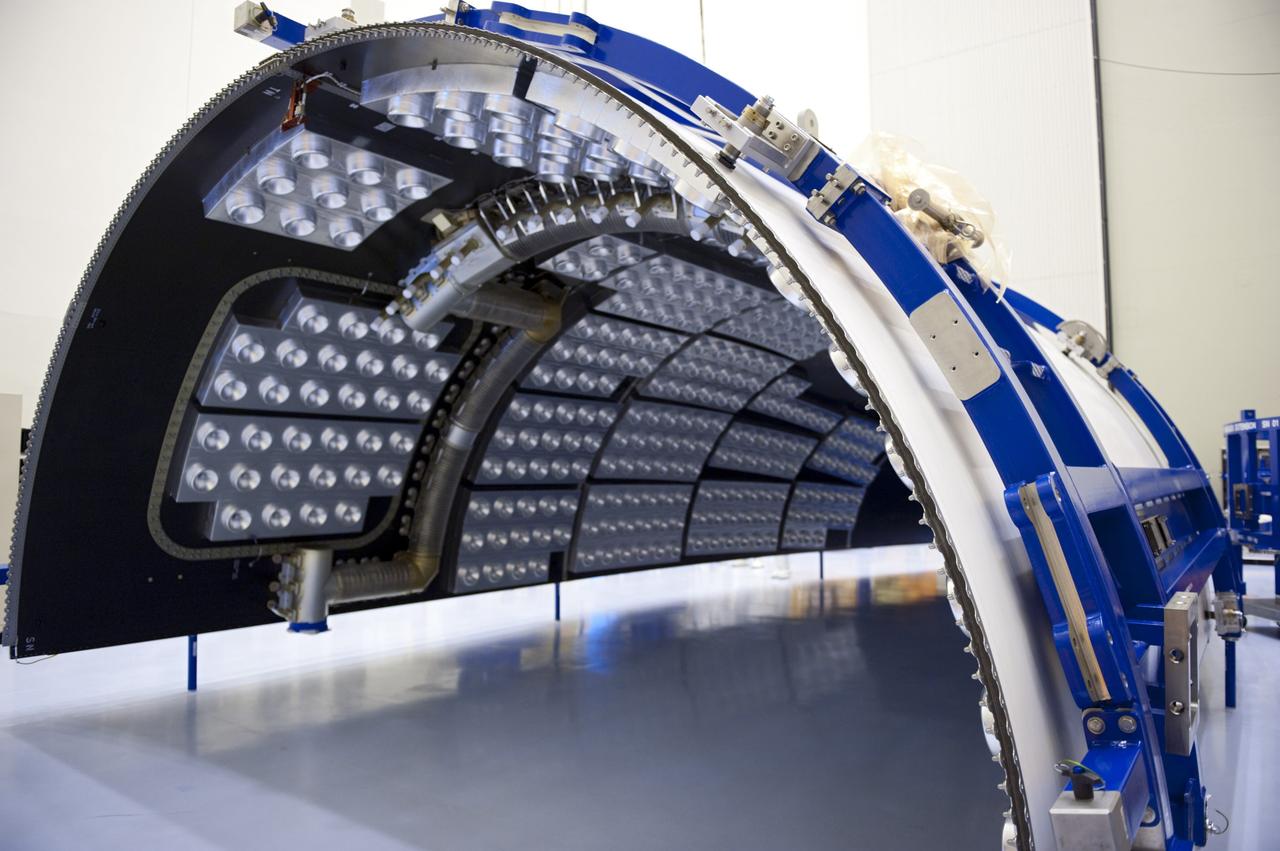
CAPE CANAVERAL, Fla. -- In the Payload Hazardous Servicing Facility at NASA's Kennedy Space Center in Florida, the fairing acoustic protection (FAP) system lining the inside of the Atlas V payload fairing for NASA's Mars Science Laboratory (MSL) mission is visible after the fairing is uncovered during preparations to clean it to meet NASA's planetary protection requirements. The FAP protects the payload by dampening the sound created by the rocket during liftoff. The fairing will protect the spacecraft from the impact of aerodynamic pressure and heating during ascent. Although jettisoned once the spacecraft is outside the Earth's atmosphere, the fairing must be cleaned to the same exacting standards as the laboratory to avoid the possibility of contaminating it. MSL's components include a compact car-sized rover, Curiosity, which has 10 science instruments designed to search for evidence on whether Mars has had environments favorable to microbial life, including the chemical ingredients for life. The unique rover will use a laser to look inside rocks and release its gasses so that the rover’s spectrometer can analyze and send the data back to Earth. Launch of MSL aboard a United Launch Alliance Atlas V rocket is planned for Nov. 25 from Space Launch Complex 41 on Cape Canaveral Air Force Station. For more information, visit http://www.nasa.gov/msl. Photo credit: NASA/Kim Shiflett
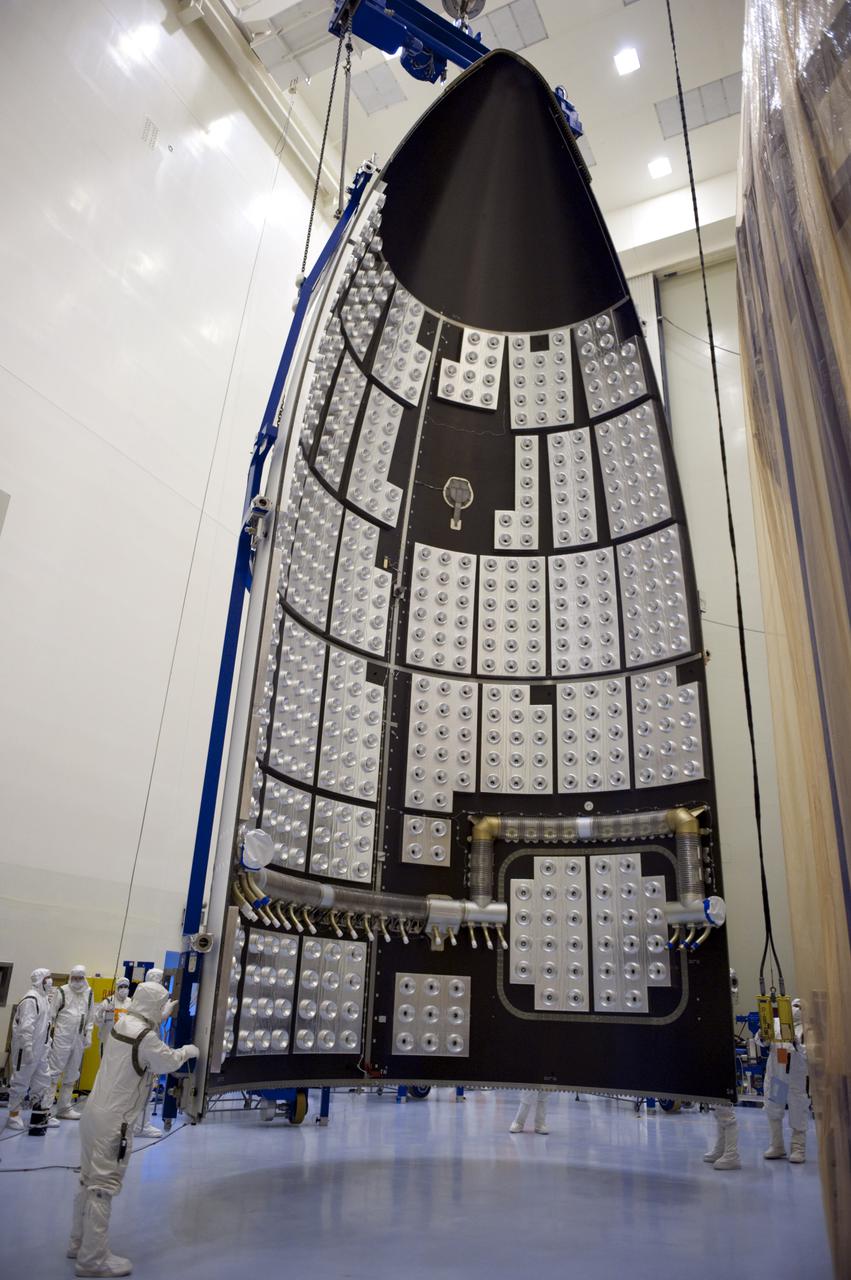
CAPE CANAVERAL, Fla. -- In the Payload Hazardous Servicing Facility at NASA's Kennedy Space Center in Florida, United Launch Alliance technicians steady half of the Atlas V payload fairing for NASA's Mars Science Laboratory (MSL) mission as it hangs vertically from the ceiling. The interior of the fairing is lined with the fairing acoustic protection (FAP) system which protects the payload by dampening the sound created by the rocket during liftoff. As a precaution, the fairing next will be cleaned to meet NASA's planetary protection requirements. The fairing will protect the spacecraft from the impact of aerodynamic pressure and heating during ascent. Although jettisoned once the spacecraft is outside the Earth's atmosphere, the fairing must be cleaned to the same exacting standards as the laboratory to avoid the possibility of contaminating it. MSL's components include a compact car-sized rover, Curiosity, which has 10 science instruments designed to search for evidence on whether Mars has had environments favorable to microbial life, including the chemical ingredients for life. The unique rover will use a laser to look inside rocks and release its gasses so that the rover’s spectrometer can analyze and send the data back to Earth. Launch of MSL aboard a United Launch Alliance Atlas V rocket is planned for Nov. 25 from Space Launch Complex 41 on Cape Canaveral Air Force Station. For more information, visit http:__www.nasa.gov_msl. Photo credit: NASA_Kim Shiflett

CAPE CANAVERAL, Fla. -- In the Payload Hazardous Servicing Facility at NASA's Kennedy Space Center in Florida, the fairing acoustic protection (FAP) system lines the inside of the Atlas V payload fairing for NASA's Mars Science Laboratory (MSL) mission. This half of the fairing has been uncovered during preparations to clean it to meet NASA's planetary protection requirements. The FAP protects the payload by dampening the sound created by the rocket during liftoff. The fairing will protect the spacecraft from the impact of aerodynamic pressure and heating during ascent. Although jettisoned once the spacecraft is outside the Earth's atmosphere, the fairing must be cleaned to the same exacting standards as the laboratory to avoid the possibility of contaminating it. MSL's components include a compact car-sized rover, Curiosity, which has 10 science instruments designed to search for evidence on whether Mars has had environments favorable to microbial life, including the chemical ingredients for life. The unique rover will use a laser to look inside rocks and release its gasses so that the rover’s spectrometer can analyze and send the data back to Earth. Launch of MSL aboard a United Launch Alliance Atlas V rocket is planned for Nov. 25 from Space Launch Complex 41 on Cape Canaveral Air Force Station. For more information, visit http://www.nasa.gov/msl. Photo credit: NASA/Kim Shiflett
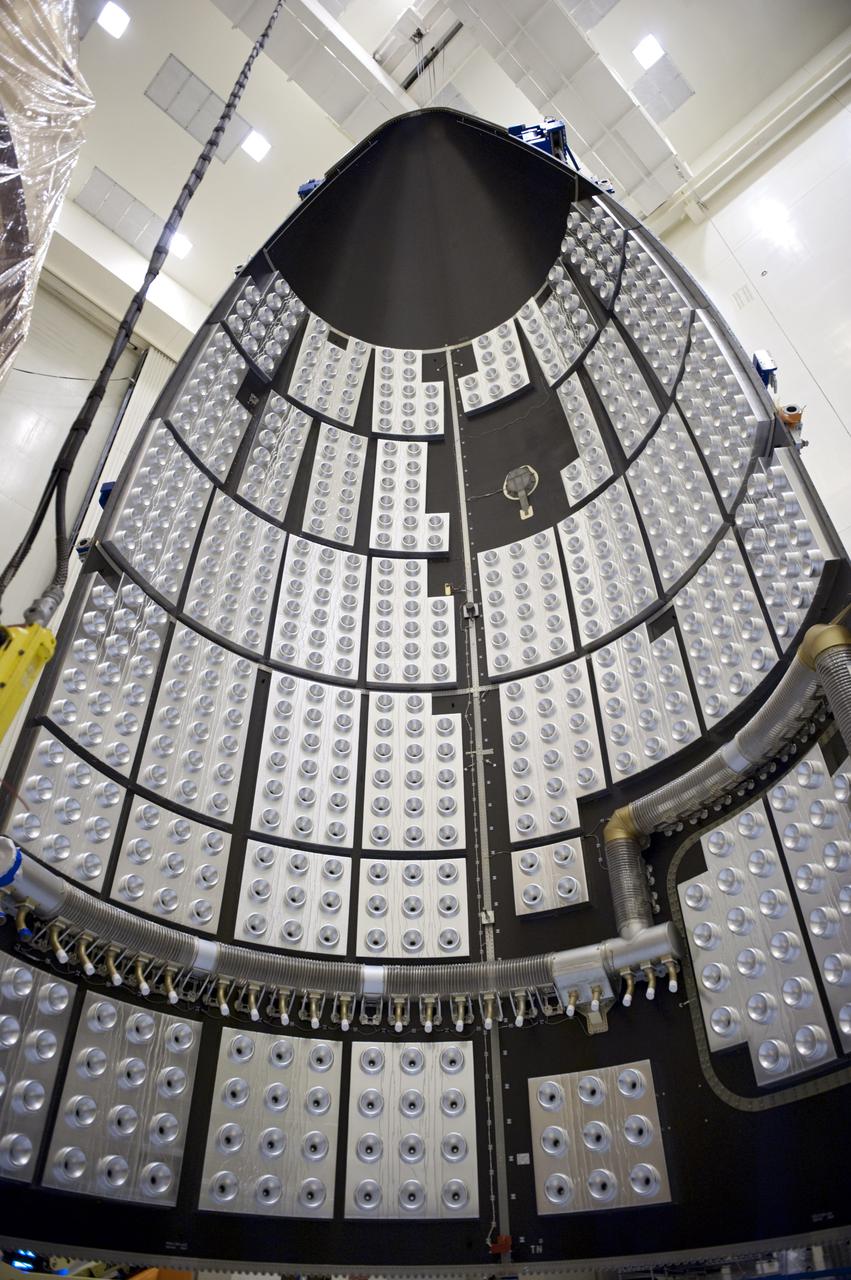
CAPE CANAVERAL, Fla. -- In the Payload Hazardous Servicing Facility at NASA's Kennedy Space Center in Florida, half of the Atlas V payload fairing for NASA's Mars Science Laboratory (MSL) mission hangs vertically from the ceiling. The interior of the fairing is lined with the fairing acoustic protection (FAP) system which protects the payload by dampening the sound created by the rocket during liftoff. As a precaution, the fairing next will be cleaned to meet NASA's planetary protection requirements. The fairing will protect the spacecraft from the impact of aerodynamic pressure and heating during ascent. Although jettisoned once the spacecraft is outside the Earth's atmosphere, the fairing must be cleaned to the same exacting standards as the laboratory to avoid the possibility of contaminating it. MSL's components include a compact car-sized rover, Curiosity, which has 10 science instruments designed to search for evidence on whether Mars has had environments favorable to microbial life, including the chemical ingredients for life. The unique rover will use a laser to look inside rocks and release its gasses so that the rover’s spectrometer can analyze and send the data back to Earth. Launch of MSL aboard a United Launch Alliance Atlas V rocket is planned for Nov. 25 from Space Launch Complex 41 on Cape Canaveral Air Force Station. For more information, visit http:__www.nasa.gov_msl. Photo credit: NASA_Kim Shiflett
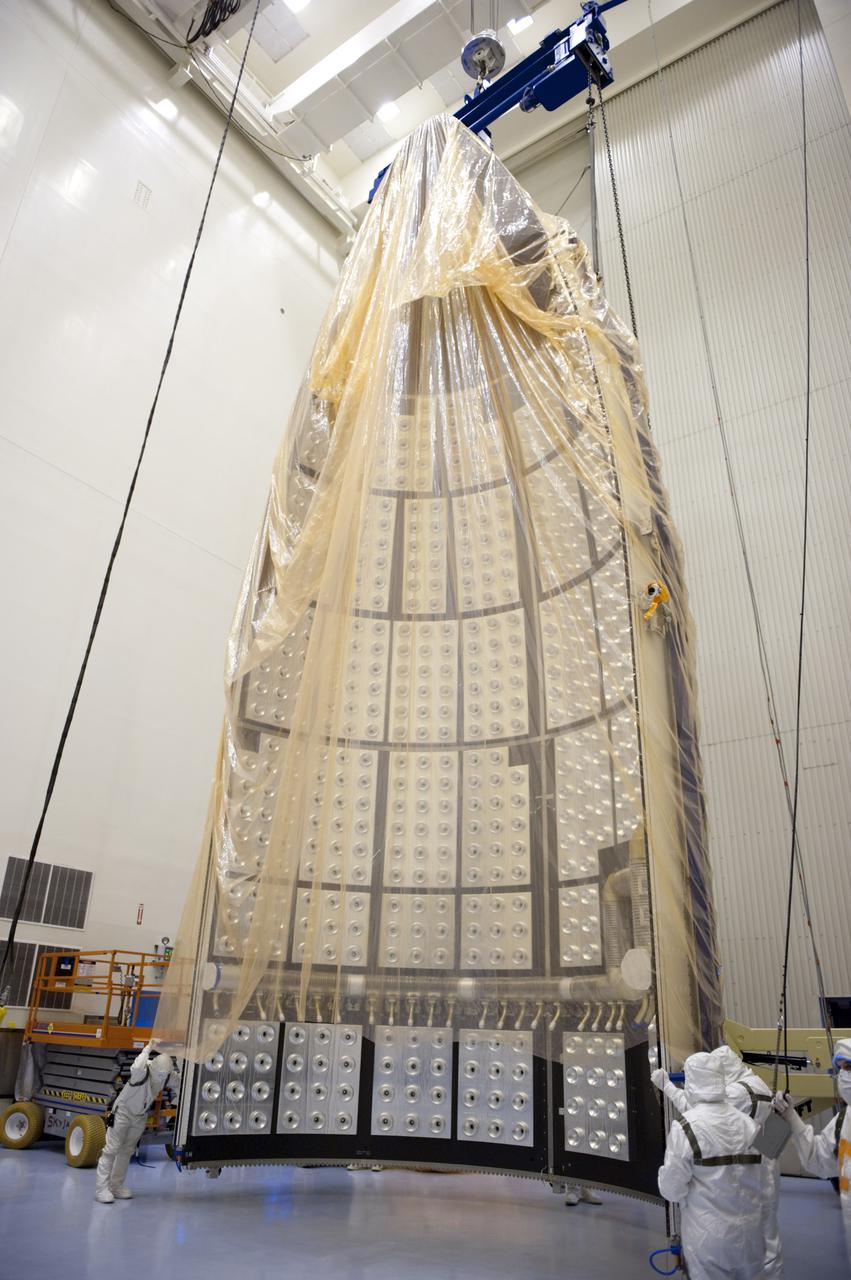
CAPE CANAVERAL, Fla. -- In the Payload Hazardous Servicing Facility at NASA's Kennedy Space Center in Florida, work is under way to lower half of the Atlas V payload fairing for NASA's Mars Science Laboratory (MSL) mission into a horizontal position. It then will be uncovered and cleaned to meet NASA's planetary protection requirements. The fairing will protect the spacecraft from the impact of aerodynamic pressure and heating during ascent. Although jettisoned once the spacecraft is outside the Earth's atmosphere, the fairing must be cleaned to the same exacting standards as the laboratory to avoid the possibility of contaminating it. MSL's components include a compact car-sized rover, Curiosity, which has 10 science instruments designed to search for evidence on whether Mars has had environments favorable to microbial life, including the chemical ingredients for life. The unique rover will use a laser to look inside rocks and release its gasses so that the rover’s spectrometer can analyze and send the data back to Earth. Launch of MSL aboard a United Launch Alliance Atlas V rocket is planned for Nov. 25 from Space Launch Complex 41 on Cape Canaveral Air Force Station. For more information, visit http:__www.nasa.gov_msl. Photo credit: NASA_Kim Shiflett
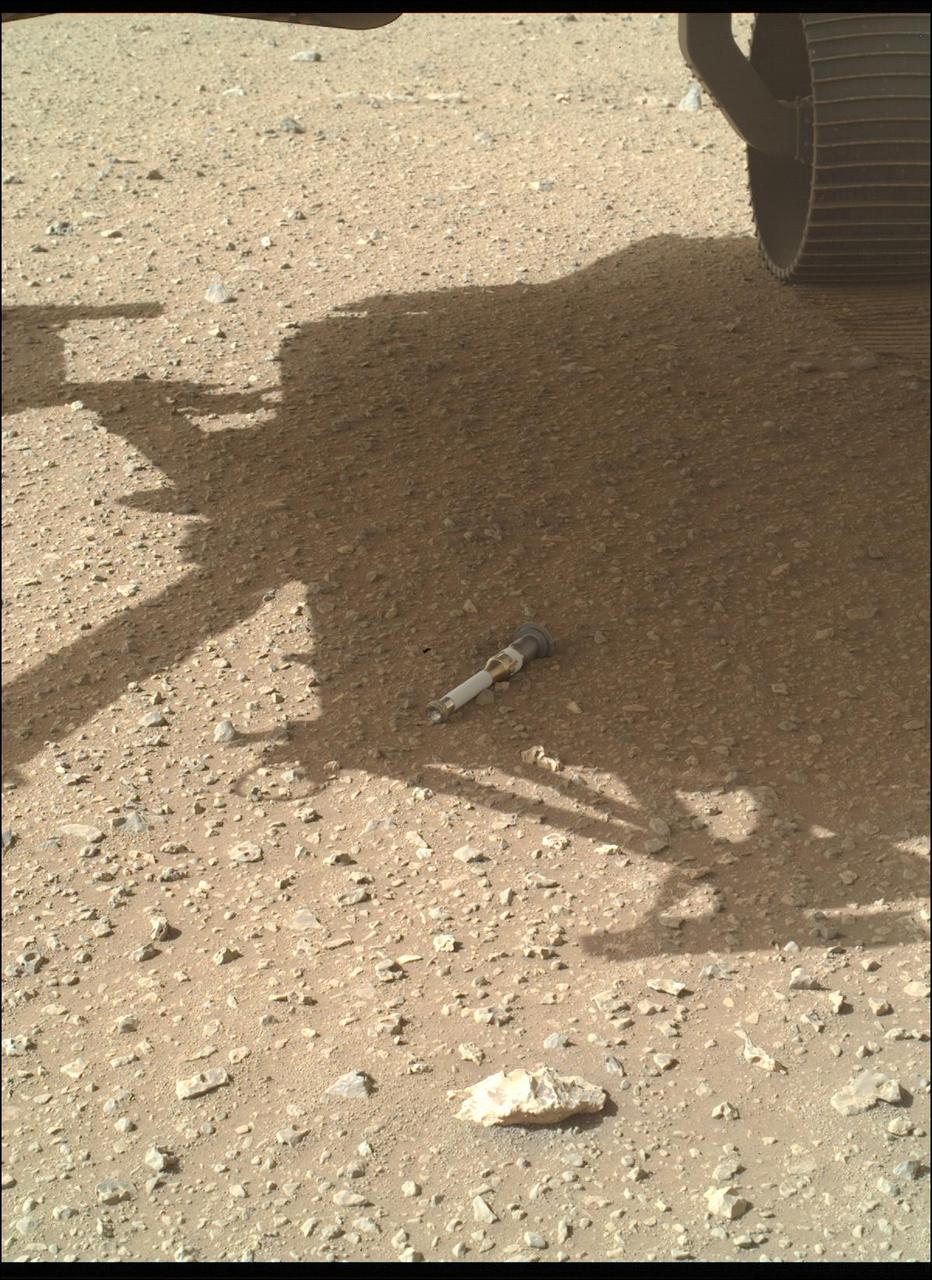
NASA's Perseverance Mars rover dropped the last of 10 tubes at the "Three Forks" sample depot on Jan. 28, 2023, the 690th Martian day, or sol, of the mission. This image of the 10th tube was taken by the WATSON (Wide Angle Topographic Sensor for Operations and eNgineering) camera on the end of the rover's 7-foot-long (2-meter-long) robotic arm. This final sample is what's called a "witness" tube – one of three collected by the rover so far and the only one deposited at the depot. Witness tubes are similar to the sample tubes that hold Martian rock and sediment, except they have been preloaded with a variety of materials that can capture molecular and particulate contaminants. They are opened on the Martian surface to "witness" the ambient environment near sample collection sites. With samples returned to Earth in the future, the witness tubes would be used to determine if samples being collected might be contaminated with materials that traveled with the rover from Earth. The Three Forks depot, the first sample depot on another world, is a crucial milestone in the NASA-ESA (European Space Agency) Mars Sample Return campaign, which aims to bring Mars samples to Earth for closer study. The Perseverance rover will be the primary means to convey the collected samples to a future robotic lander as part of the campaign. The lander would, in turn, use a robotic arm to place the samples in a containment capsule aboard a small rocket that would blast off to Mars orbit, where another spacecraft would capture the sample container and return it safely to Earth. Hosting the duplicate set, the Three Forks depot will serve as a backup if Perseverance can't deliver its samples. A key objective for Perseverance's mission on Mars is astrobiology, including the search for signs of ancient microbial life. The rover will characterize the planet's geology and past climate, pave the way for human exploration of the Red Planet, and be the first mission to collect and cache Martian rock and regolith (broken rock and dust). Subsequent NASA missions, in cooperation with ESA (European Space Agency), would send spacecraft to Mars to collect these sealed samples from the surface and return them to Earth for in-depth analysis. The Mars 2020 Perseverance mission is part of NASA's Moon to Mars exploration approach, which includes Artemis missions to the Moon that will help prepare for human exploration of the Red Planet. https://photojournal.jpl.nasa.gov/catalog/PIA25340
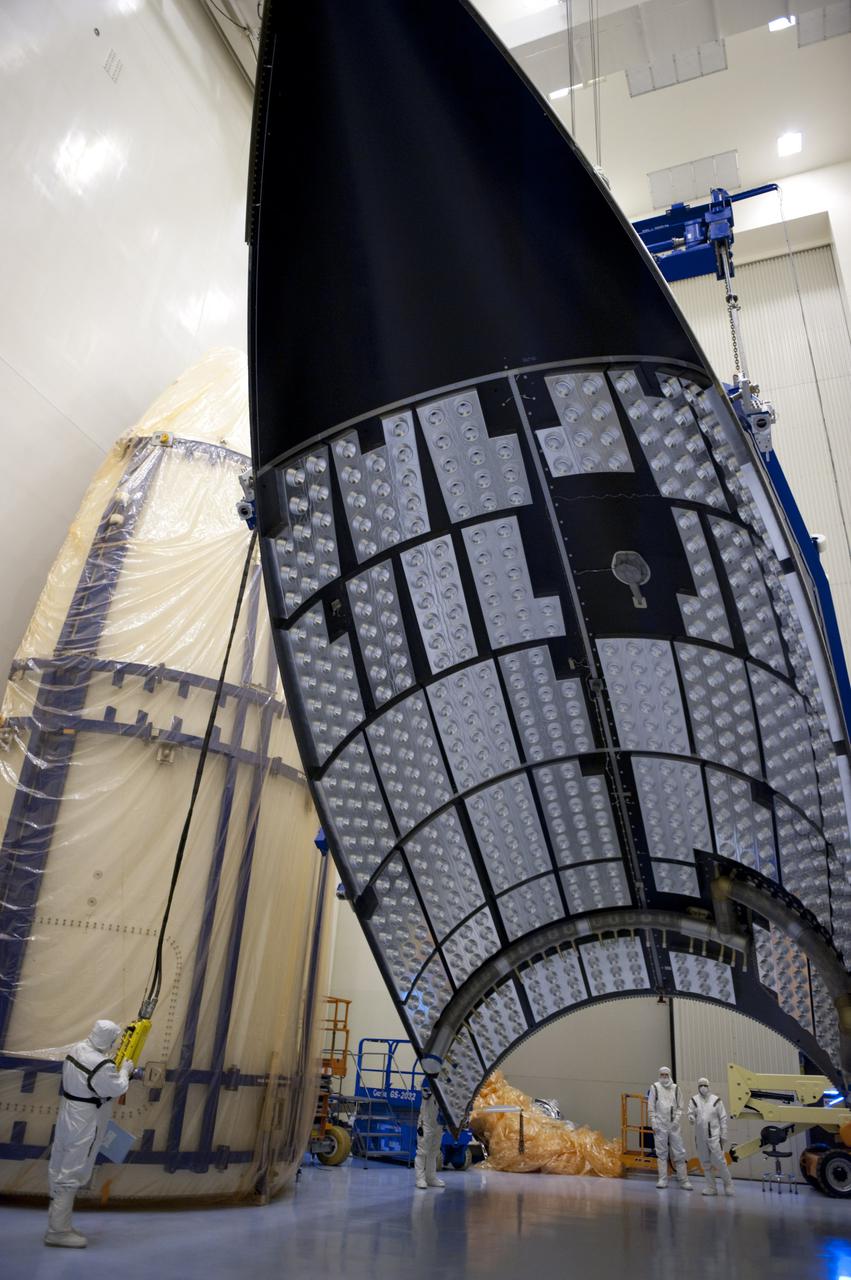
CAPE CANAVERAL, Fla. -- In the Payload Hazardous Servicing Facility at NASA's Kennedy Space Center in Florida, half of the Atlas V payload fairing for NASA's Mars Science Laboratory (MSL) mission rises into a vertical position. The fairing has been uncovered, revealing the fairing acoustic protection (FAP) system lining its insides, and preparations are under way to clean it to meet NASA's planetary protection requirements. The FAP protects the payload by dampening the sound created by the rocket during liftoff. At left is the other half of the fairing, still uncovered. The fairing will protect the spacecraft from the impact of aerodynamic pressure and heating during ascent. Although jettisoned once the spacecraft is outside the Earth's atmosphere, the fairing must be cleaned to the same exacting standards as the laboratory to avoid the possibility of contaminating it. MSL's components include a compact car-sized rover, Curiosity, which has 10 science instruments designed to search for evidence on whether Mars has had environments favorable to microbial life, including the chemical ingredients for life. The unique rover will use a laser to look inside rocks and release its gasses so that the rover’s spectrometer can analyze and send the data back to Earth. Launch of MSL aboard a United Launch Alliance Atlas V rocket is planned for Nov. 25 from Space Launch Complex 41 on Cape Canaveral Air Force Station. For more information, visit http:__www.nasa.gov_msl. Photo credit: NASA_Kim Shiflett
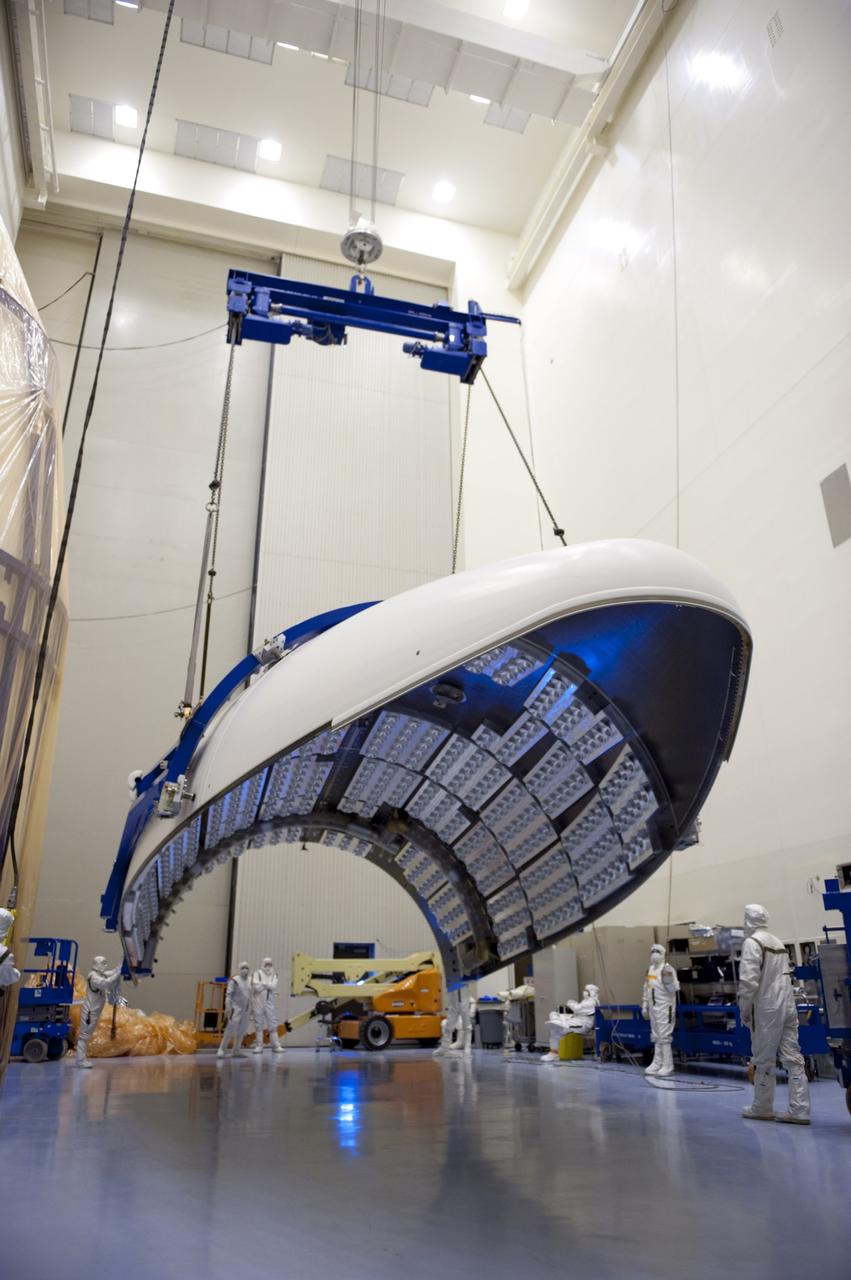
CAPE CANAVERAL, Fla. -- In the Payload Hazardous Servicing Facility at NASA's Kennedy Space Center in Florida, the fairing acoustic protection (FAP) system lining the inside of the Atlas V payload fairing for NASA's Mars Science Laboratory (MSL) mission comes into view as the fairing is lifted into a vertical position. The FAP protects the payload by dampening the sound created by the rocket during liftoff. The fairing has been uncovered, and preparations are under way to clean it to meet NASA's planetary protection requirements. The fairing will protect the spacecraft from the impact of aerodynamic pressure and heating during ascent. Although jettisoned once the spacecraft is outside the Earth's atmosphere, the fairing must be cleaned to the same exacting standards as the laboratory to avoid the possibility of contaminating it. MSL's components include a compact car-sized rover, Curiosity, which has 10 science instruments designed to search for evidence on whether Mars has had environments favorable to microbial life, including the chemical ingredients for life. The unique rover will use a laser to look inside rocks and release its gasses so that the rover’s spectrometer can analyze and send the data back to Earth. Launch of MSL aboard a United Launch Alliance Atlas V rocket is planned for Nov. 25 from Space Launch Complex 41 on Cape Canaveral Air Force Station. For more information, visit http://www.nasa.gov/msl. Photo credit: NASA/Kim Shiflett
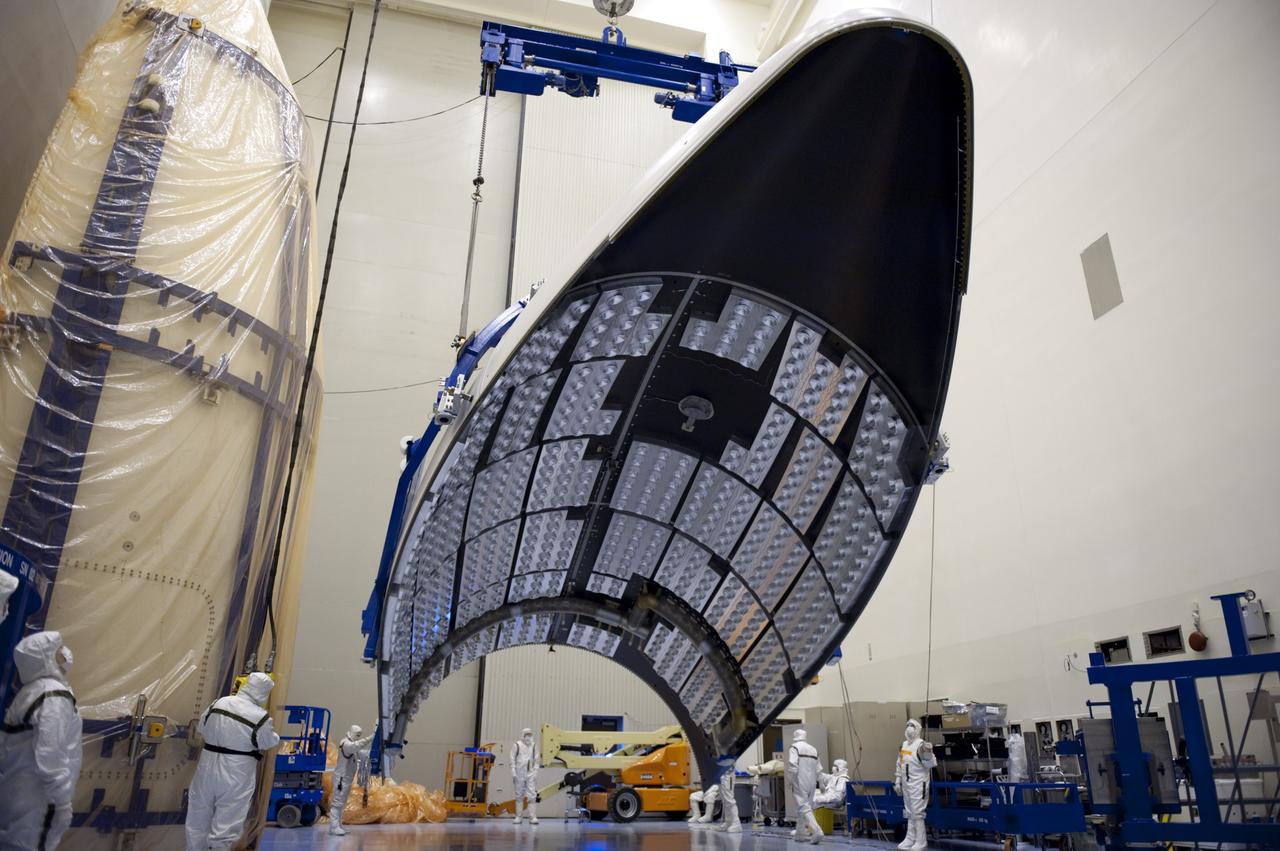
CAPE CANAVERAL, Fla. -- In the Payload Hazardous Servicing Facility at NASA's Kennedy Space Center in Florida, the fairing acoustic protection (FAP) system lining the inside of the Atlas V payload fairing for NASA's Mars Science Laboratory (MSL) mission is in view as the fairing is lifted into a vertical position. The FAP protects the payload by dampening the sound created by the rocket during liftoff. The fairing has been uncovered, and preparations are under way to clean it to meet NASA's planetary protection requirements. At left is the other half of the fairing, still uncovered. The fairing will protect the spacecraft from the impact of aerodynamic pressure and heating during ascent. Although jettisoned once the spacecraft is outside the Earth's atmosphere, the fairing must be cleaned to the same exacting standards as the laboratory to avoid the possibility of contaminating it. MSL's components include a compact car-sized rover, Curiosity, which has 10 science instruments designed to search for evidence on whether Mars has had environments favorable to microbial life, including the chemical ingredients for life. The unique rover will use a laser to look inside rocks and release its gasses so that the rover’s spectrometer can analyze and send the data back to Earth. Launch of MSL aboard a United Launch Alliance Atlas V rocket is planned for Nov. 25 from Space Launch Complex 41 on Cape Canaveral Air Force Station. For more information, visit http://www.nasa.gov/msl. Photo credit: NASA/Kim Shiflett