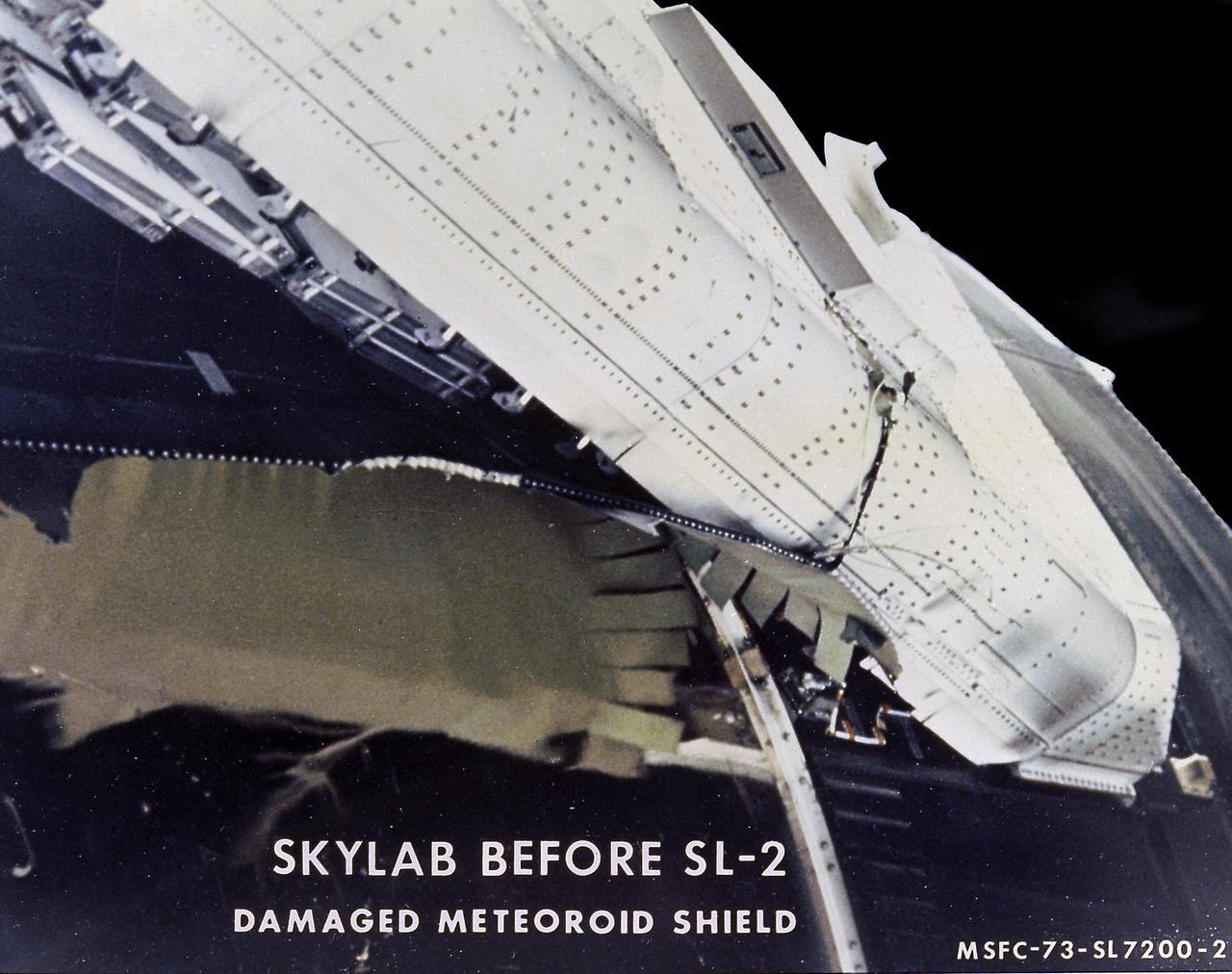
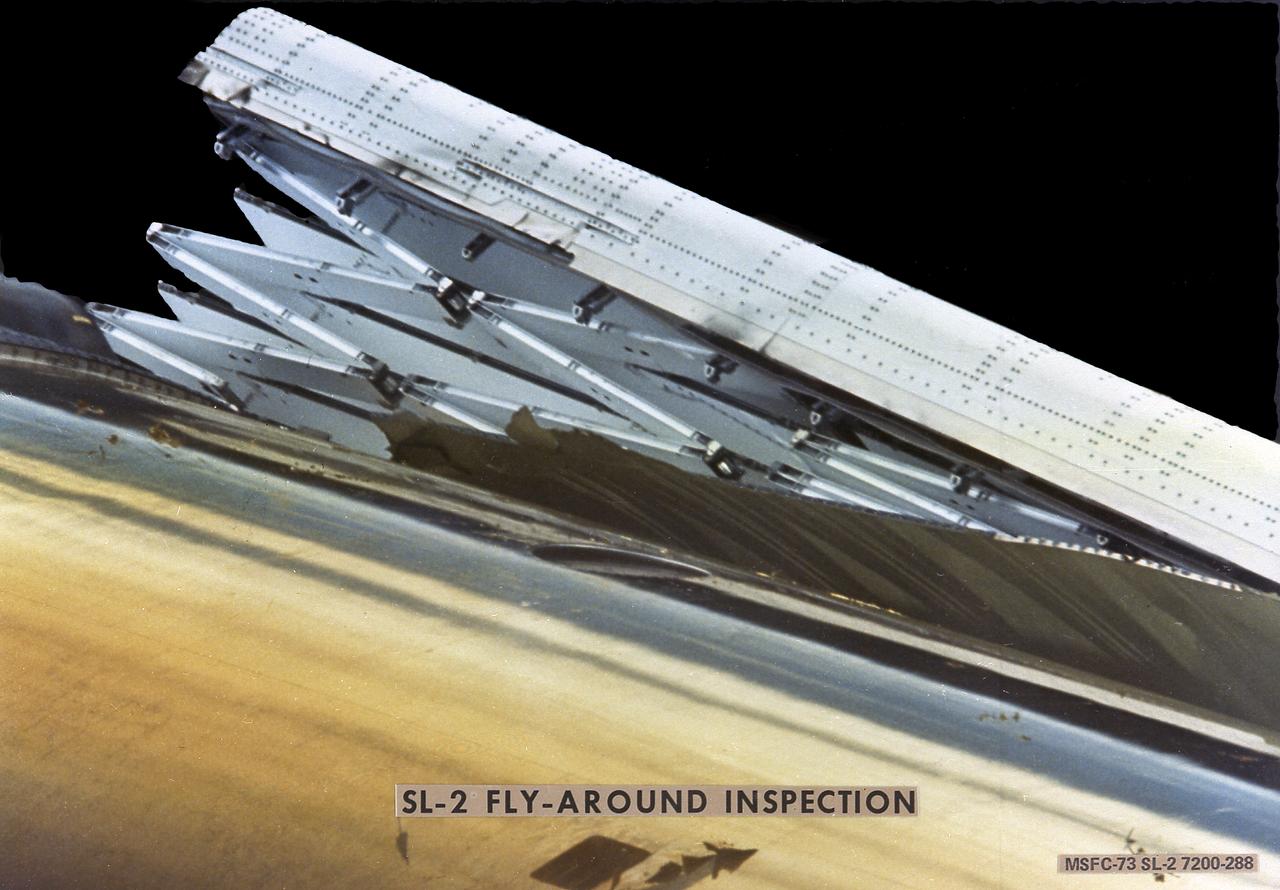
The Saturn V vehicle, carrying the unmarned orbital workshop for the Skylab-1 mission, lifted off successfully and all systems performed normally. Sixty-three seconds into flight, engineers in the operation support and control center saw an unexpected telemetry indication that signalled that damages occurred on one solar array and the micrometeoroid shield during the launch. The micrometeoroid shield, a thin protective cylinder surrounding the workshop protecting it from tiny space particles and the sun's scorching heat, ripped loose from its position around the workshop. This caused the loss of one solar wing and jammed the other. Still unoccupied, the Skylab was stricken with the loss of the heat shield and sunlight beat mercilessly on the lab's sensitive skin. Internal temperatures soared, rendering the station uninhabitable, threatening foods, medicines, films, and experiments. This image, taken during a fly-around inspection by the Skylab-2 crew, shows the damaged meteoroid shield being held by a thin aluminum strap entangled with green-hued remnants of the lost heat shield. The Marshall Space Flight Center (MSFC) developed, tested, rehearsed, and approved three repair options. These options included a parasol sunshade and a twin-pole sunshade to restore the temperature inside the workshop, and a set of metal cutting tools to free the jammed solar panel.
This close up view of one of the two scientific airlocks on the Skylab Orbital Workshop Section was taken from the Skylab 2 Command/Service Module during its initial fly around inspection. The micrometeoroid shield can be seen to be missing from this section of the orbital workshop. A parasol solar shield was later devised and put in place over this damaged area through this very same airlock opening.
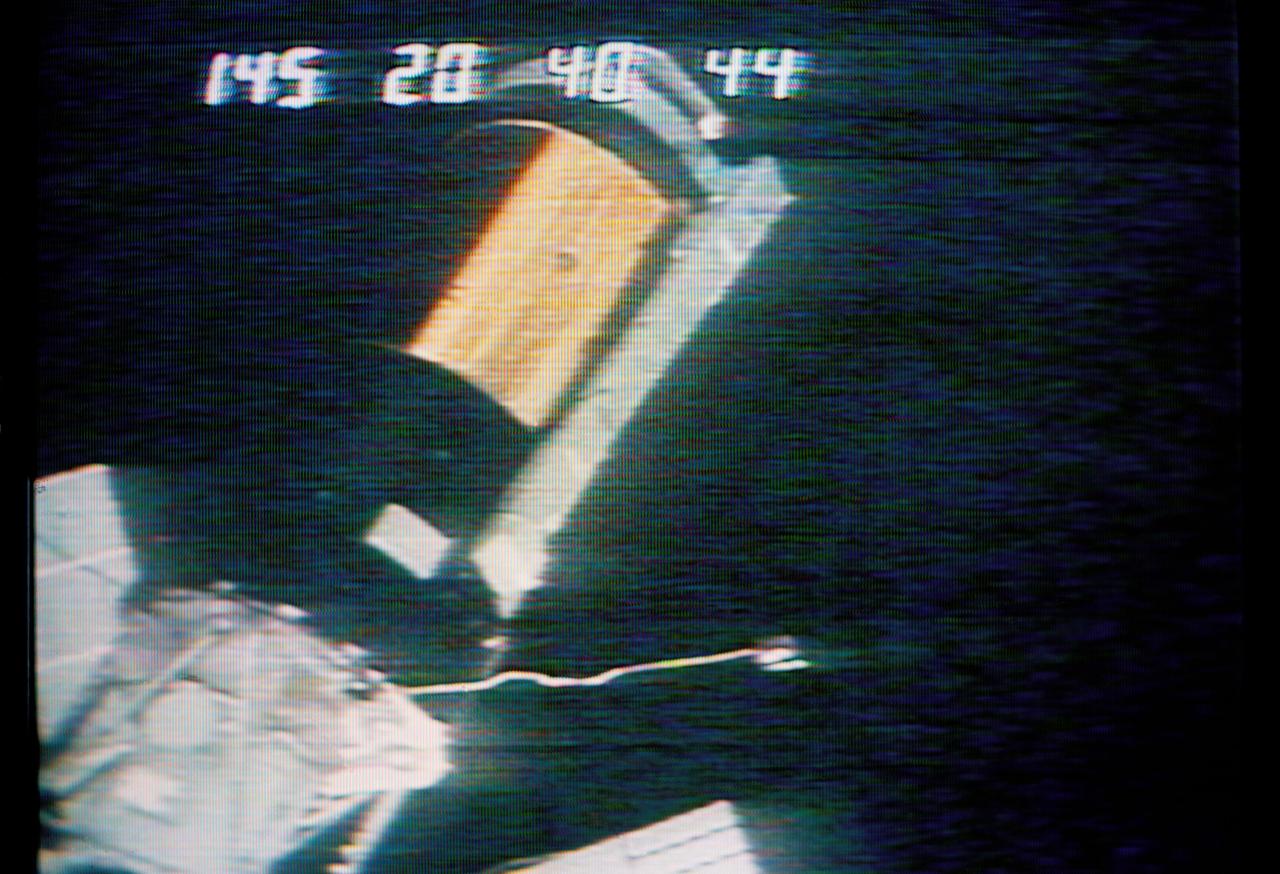
S73-26738 (25 May 1973) --- A close-up view of the Skylab 1 space station cluster can be seen in this reproduction taken from a color television transmission made by a TV camera aboard the Skylab 2 Command Module during its ?fly-around? inspection of the cluster. The numbers across the top of the picture indicate the Skylab 1 ground lapse time. Note the missing portion of the micrometeoroid shield on the Orbital Workshop. The shield area was reported to be solid gold by the Skylab 2 crewmen. A cable appears to be wrapped around the damaged OWS solar array system wing. The crewmen reported that the other OWS solar panel was completely gone, with only tubes and wiring sticking out. One of the discone antennas extends out form the Airlock Module. The Multiple Docking Adapter is in the lower left corner of the picture. A portion of a solar panel on the Apollo Telescope Mount is visible at the bottom and at the left edge. In their ?fly around? inspection the crewmen noted that portions of the micrometeoroid shield had slid back underneath the OWS solar wing. Photo credit: NASA
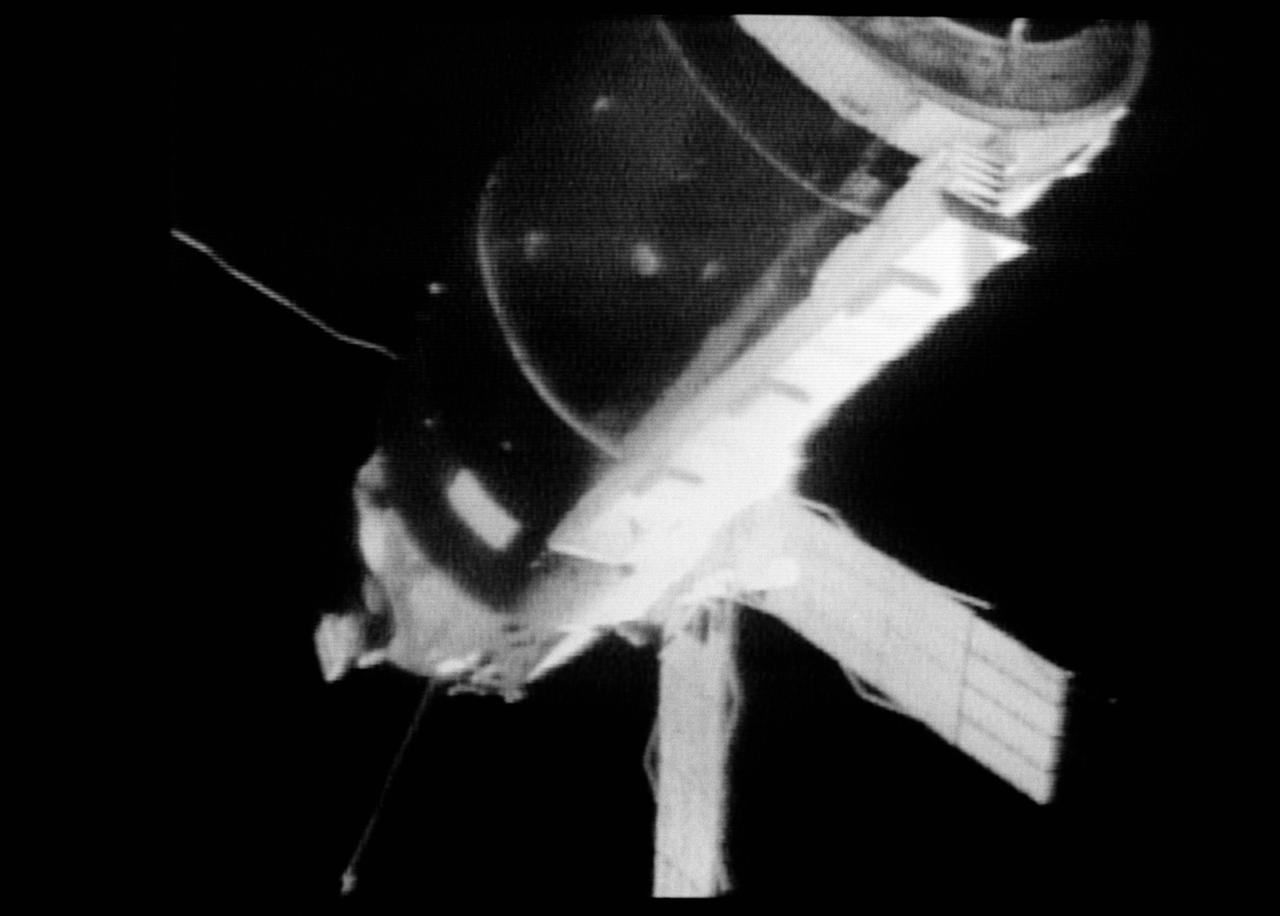
S73-27182 (25 May 1973) --- A close-up view of the Skylab 1 space station cluster can be seen in this reproduction taken from a color television transmission made by a TV camera aboard the Skylab 2 Command Module during its "fly around" inspection of the cluster. This view has been enhanced. At left center the damaged solar array system wing on the Orbital Workshop (OWS) appears to be partly folded. In their preliminary inspection the crewmen noted that portions of the micrometeoroid shield had slid back underneath the OWS solar wing. Solar panels on the Apollo Telescope Mount extend out at the top center. Photo credit: NASA
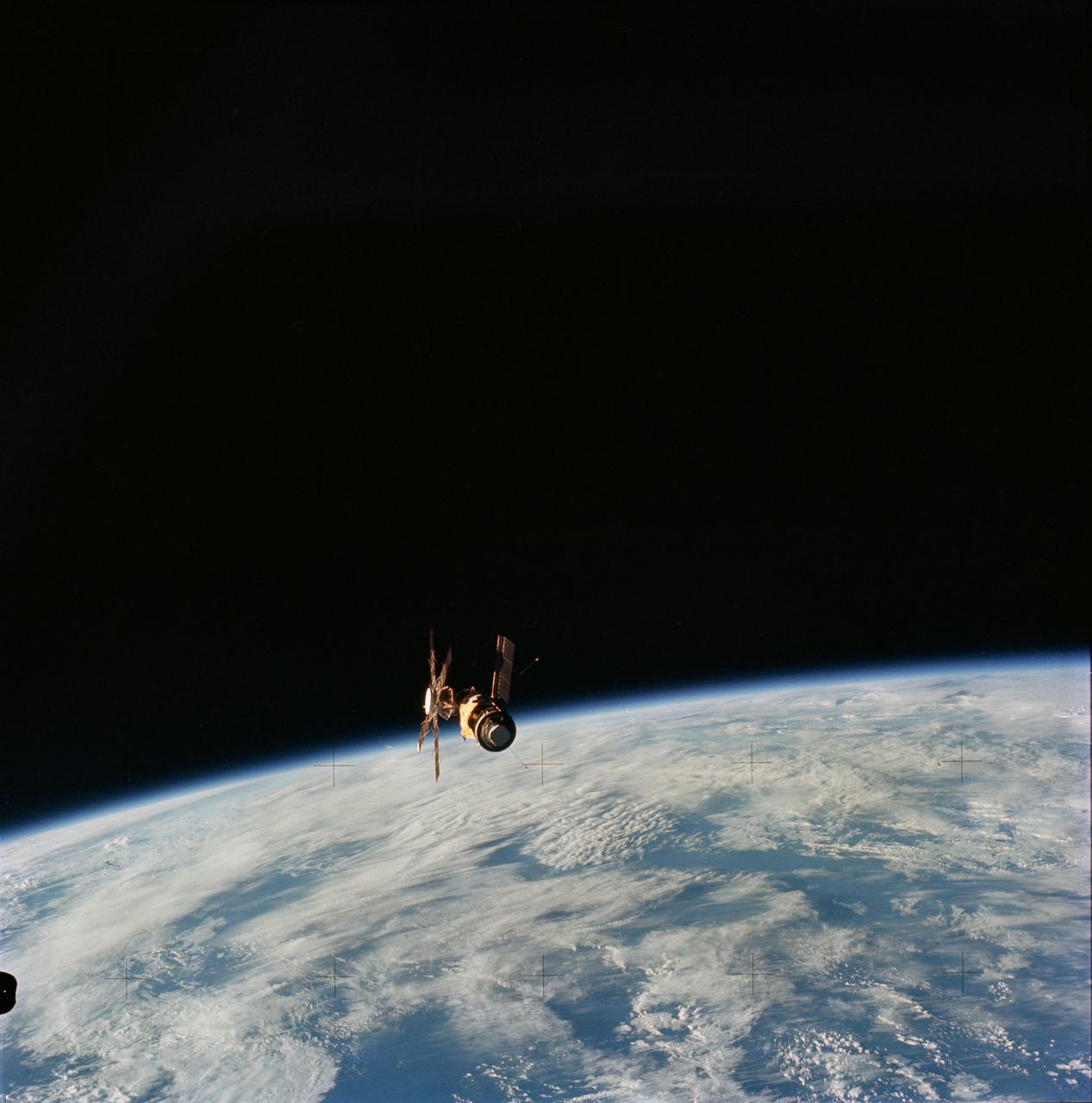
SL2-07-667 (22 June 1973) --- This overhead view of the Skylab Space Station was taken from the Departing Skylab Command/Service Module during the Skylab 2's final fly-around inspection. The single solar panel is quite evident as well as the parasol solar shield, rigged to replace the missing micrometeoroid shield. Both the second solar panel and the micrometeoroid shield were torn away during a mishap in the original Skylab 1 liftoff and orbital insertion. Photo credit: NASA
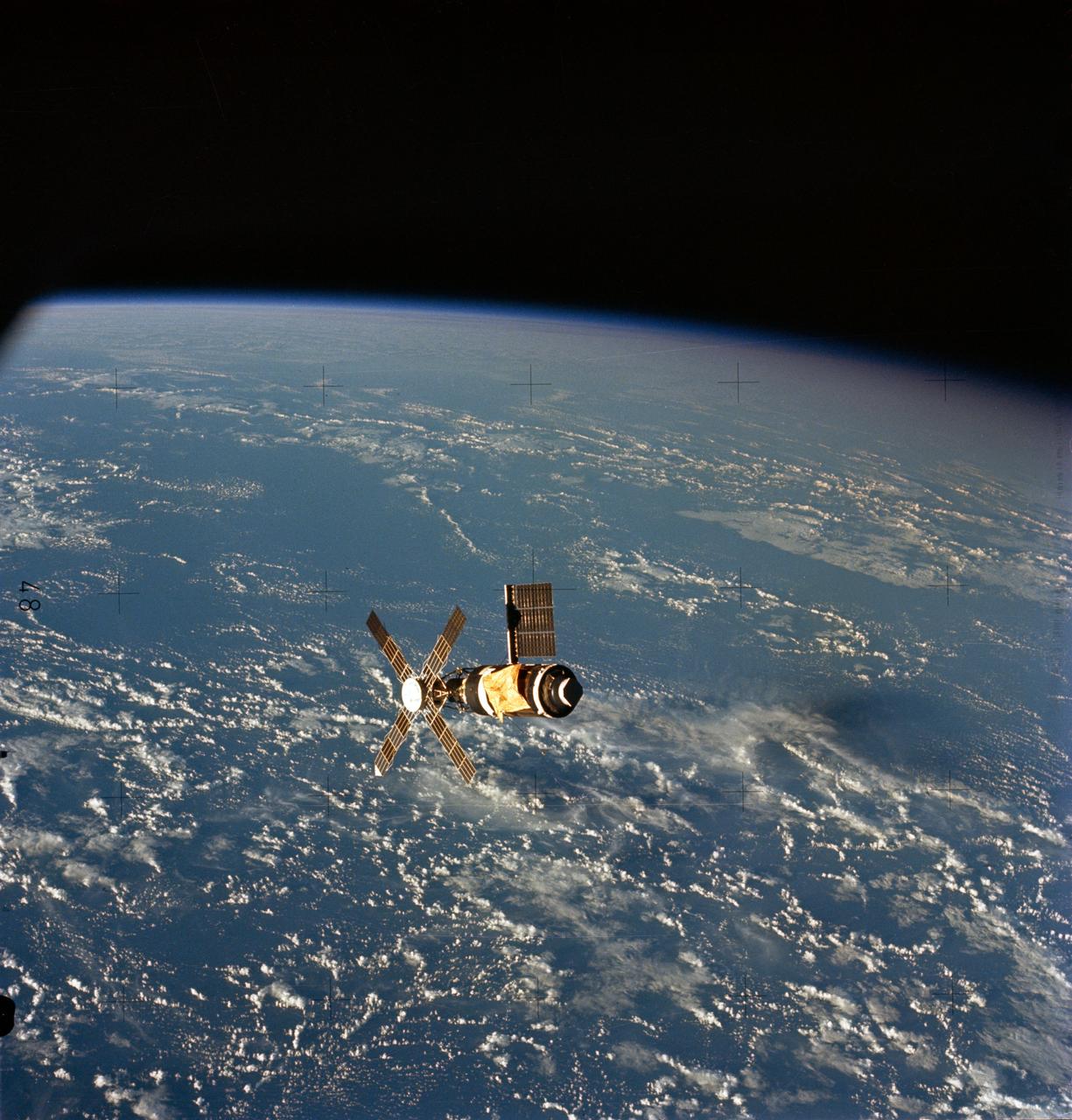
SL2-07-651 (22 June 1973) --- This overhead view of the Skylab Space Station was taken from the Departing Skylab Command/Service Module during the Skylab 2's final fly-around inspection. The single solar panel is quite evident as well as the parasol solar shield, rigged to replace the missing micrometeoroid shield. Both the second solar panel and the micrometeoroid shield were torn away during a mishap in the original Skylab 1 liftoff and orbital insertion. Photo credit: NASA
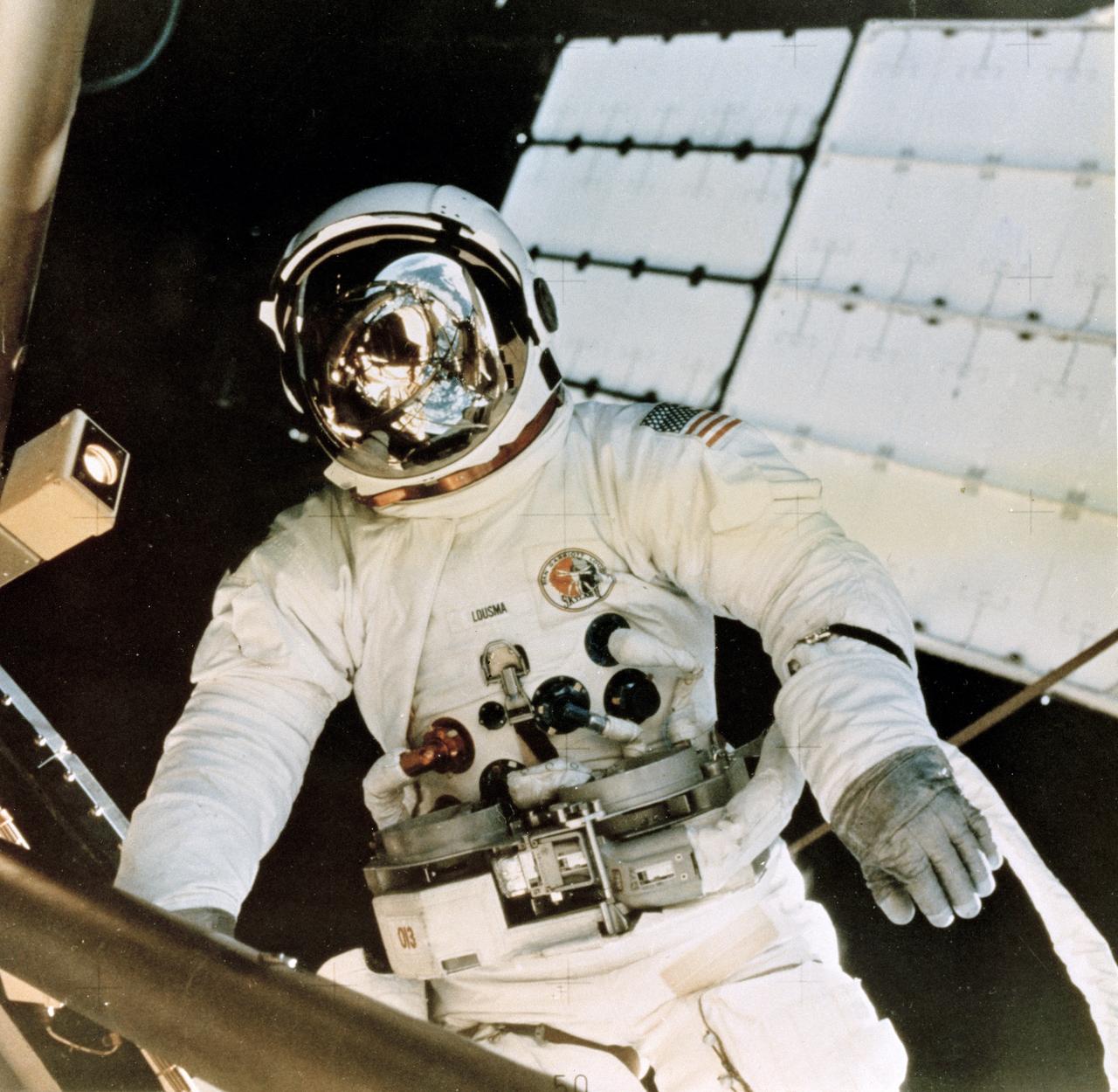
Skylab-3 was the second marned mission in the skylab project. The crew spent 59 days in orbit. In this photo, Astronaut Jack Lousma deploys the Twin Pole Sun Shield created by Marshall Space Flight Center team members to replace the micrometeoroid shield, a thin protective cylinder surrounding the workshop protecting it from tiny space particles and the sun's scorching heat. The shield was damaged during the Skylab-2 mission.
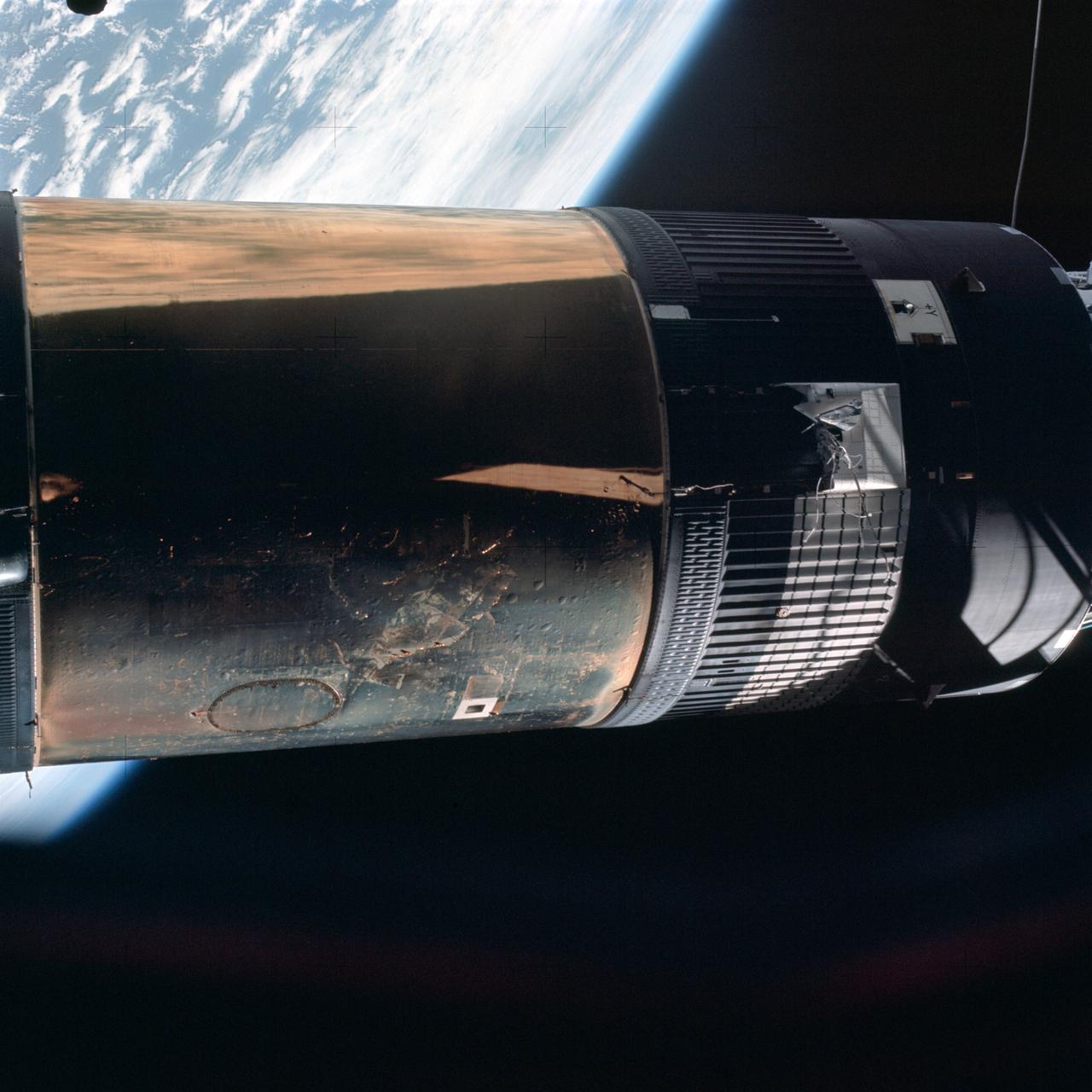
SL2-X4-256 (25 May 1973) --- This photo, made at long range from the command module during Skylab 2's approach to the Skylab complex during fly-around inspection, features the orbital workshop with the area of the missing micrometeoroid shield visible. Photo credit: NASA
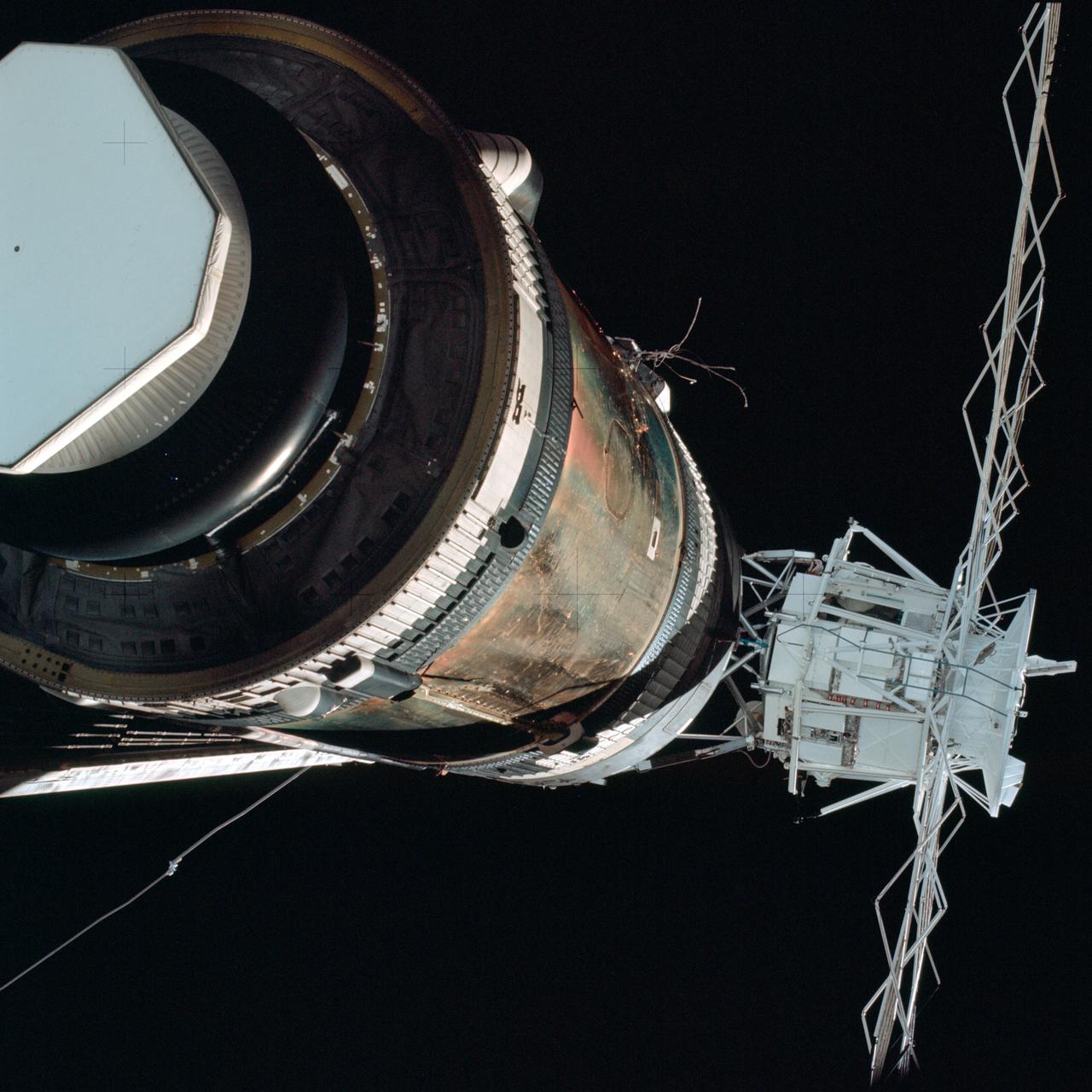
SL2-4-265 (25 May 1973) --- Skylab 2, approach to Skylab at long range, fly-around inspection. Orbital Workshop with area of missing micrometeoroid shield visible and partially deployed solar array visible. Photo credit: NASA
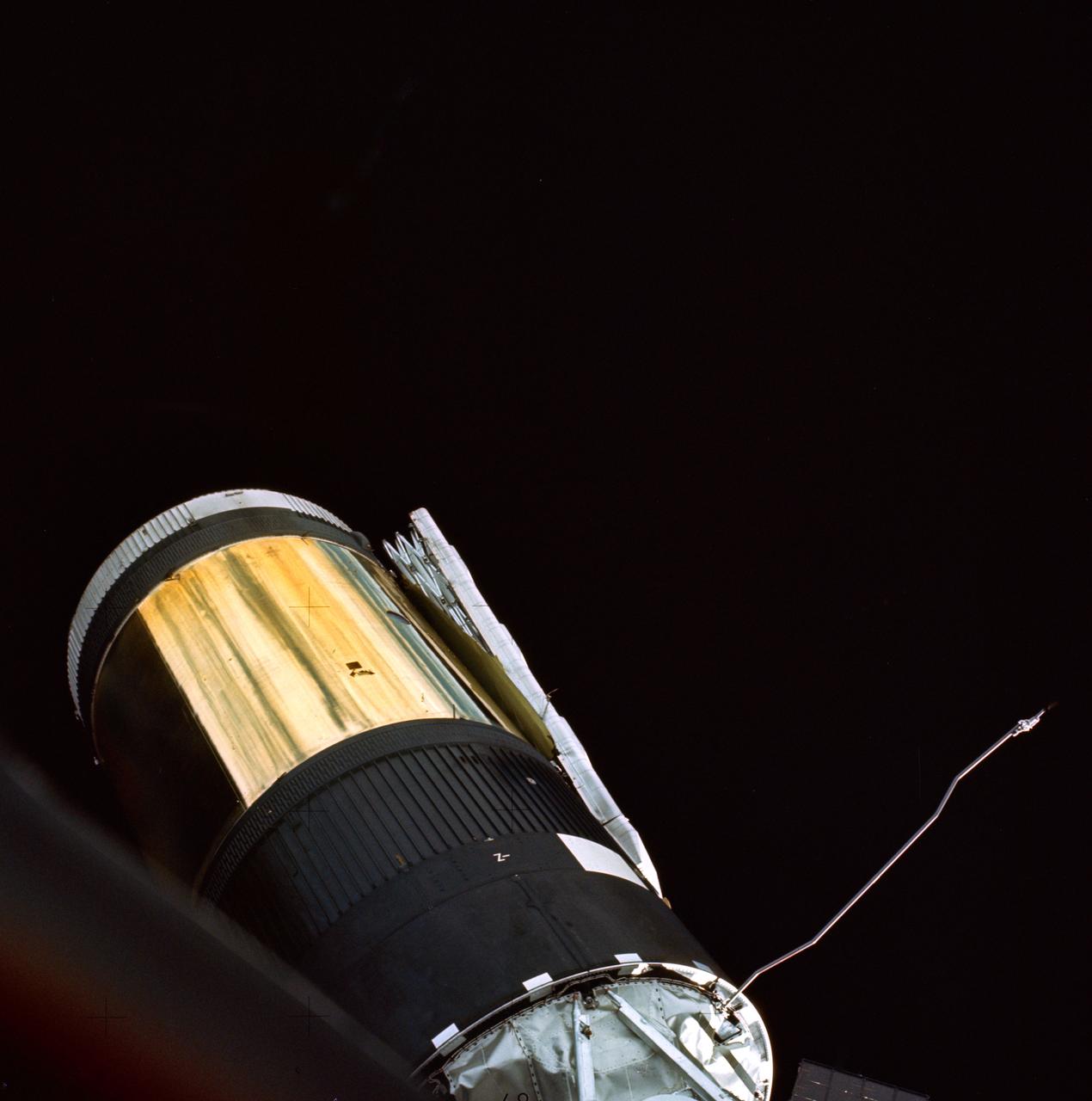
This view of the Skylab Orbital Space Station was taken from the Skylab 2 Command/Service Module during it's initial fly around inspection. The micrometeoroid shield can be seen to be missing and a parasol solar shield was later fitted in its place. The damaged and partially deployed solar array, in the center of the scene, can be seen to be restrained by a strap that was later cut during an early EVA, allowing the panel to fully deploy.
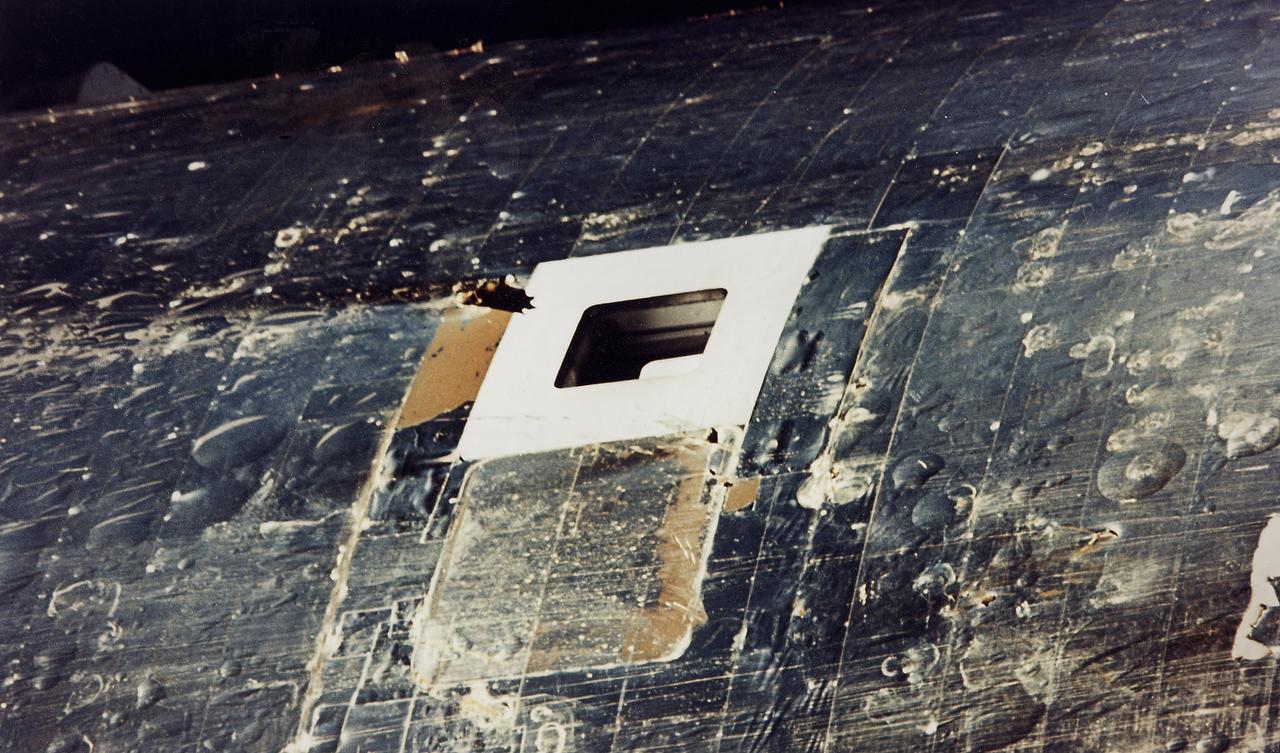
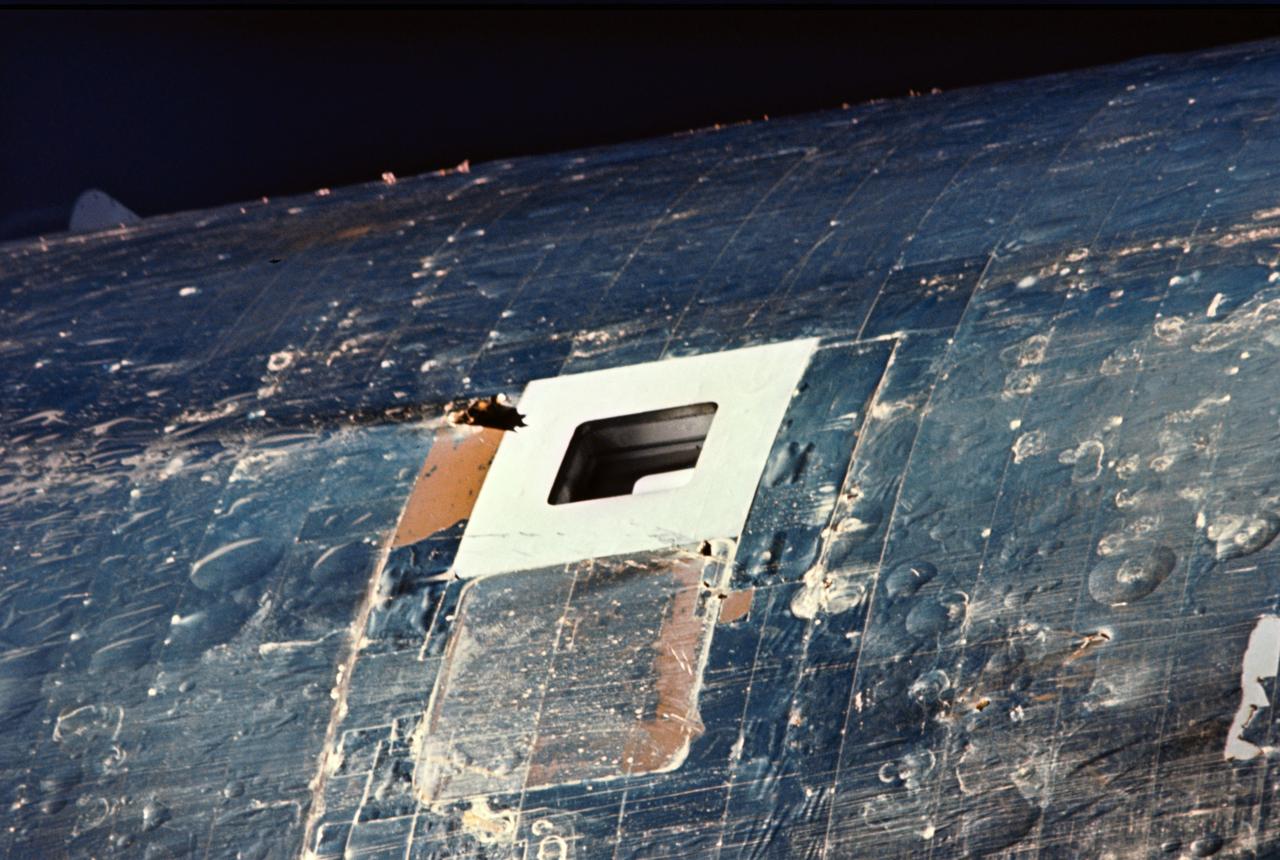
The Saturn V vehicle, carrying the unmarned orbital workshop for the Skylab-1 mission, lifted off successfully and all systems performed normally. Sixty-three seconds into flight, engineers in the operation support and control center saw an unexpected telemetry indication that signalled that damages occurred on one solar array and the micrometeoroid shield during the launch. The micrometeoroid shield, a thin protective cylinder surrounding the workshop protecting it from tiny space particles and the sun's scorching heat, ripped loose from its position around the workshop. This caused the loss of one solar wing and jammed the other. Still unoccupied, the Skylab was stricken with the loss of the heat shield and sunlight beat mercilessly on the lab's sensitive skin. Internal temperatures soared, rendering the the station uninhabitable, threatening foods, medicines, films, and experiments. This image shows the sun-ravaged skin of the Orbital Workshop, bared by the missing heat shield, with blister scars and tarnish from temperatures that reached 300 degrees F. The rectangular opening at the upper center is the scientific airlock through which the parasol to protect the workshop from sun's rays was later deployed. This view was taken during a fly-around inspection by the Skylab-2 crew. The Marshall Space Flight Center had a major role in developing the procedures to repair the damaged Skylab.
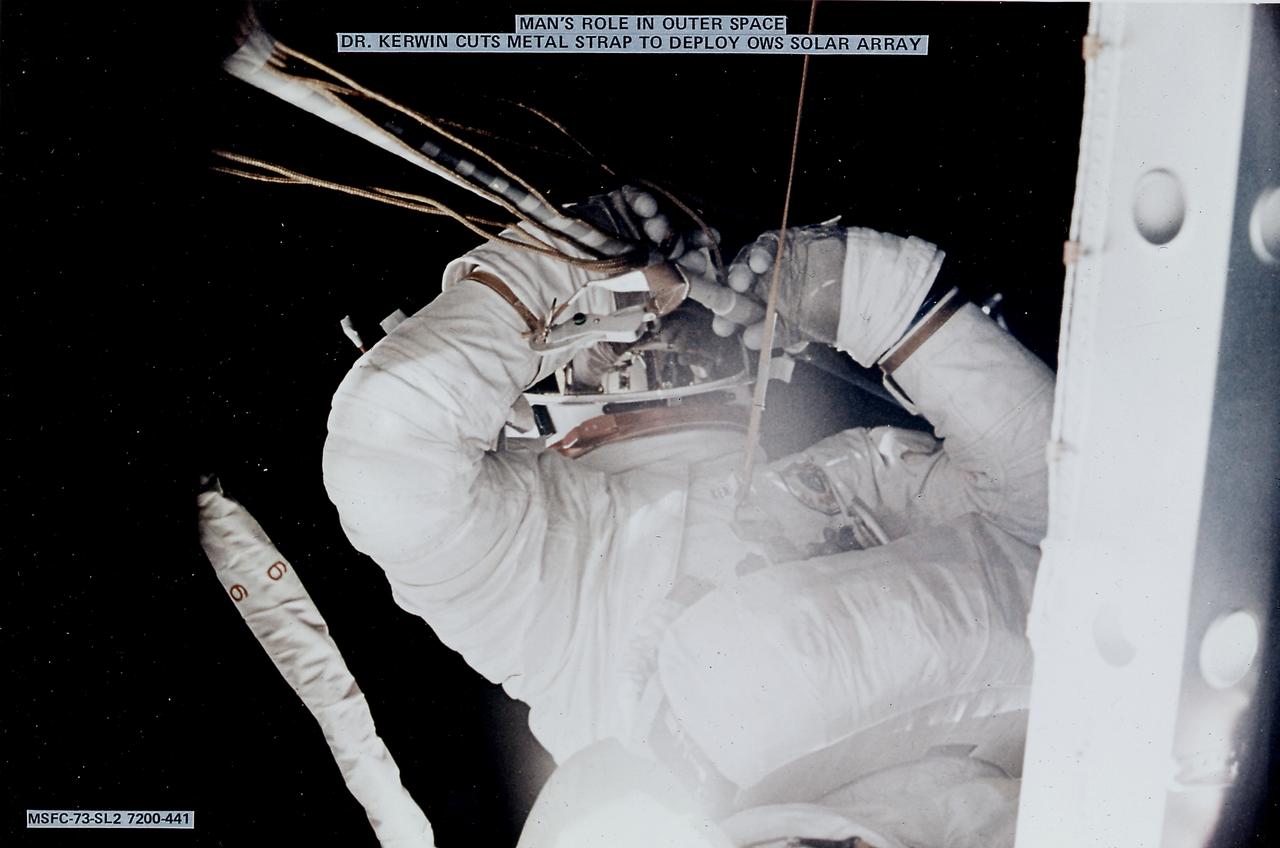
The Saturn V vehicle, carrying the unmarned orbital workshop for the Skylab-1 mission, lifted off successfully and all systems performed normally. Sixty-three seconds into the flight, engineers in the operation support and control center saw an unexpected telemetry indication that signalled that damages occurred on one solar array and the micrometeoroid shield during the launch. The micrometeoroid shield, a thin protective cylinder surrounding the workshop protecting it from tiny space particles and the sun's scorching heat, ripped loose from its position around the workshop. This caused the loss of one solar wing and jammed the other. Still unoccupied, the Skylab was stricken with the loss of the heat shield and sunlight beat mercilessly on the lab's sensitive skin. Intrnal temperatures soared, rendering the station uninhabitable, threatening foods, medicines, films, and experiments. This image shows astronaut Kerwin cutting the metal strap to free and deploy the Orbital Workshop solar array. Kerwin used special cutting tools developed by engineers at the Marshall Space Flight Center (MSFC). The MSFC had a major role in developing the procedures to repair the damaged Skylab.
The Saturn V vehicle, carrying the unmarned orbital workshop for the Skylab-1 mission, lifted off successfully and all systems performed normally. Sixty-three seconds into the flight, engineers in the operation support and control center saw an unexpected telemetry indication that signalled that damages occurred on one solar array and the micrometeoroid shield during the launch. The micrometeoroid shield, a thin protective cylinder surrounding the workshop protecting it from tiny space particles and the sun's scorching heat, ripped loose from its position around the workshop. This caused the loss of one solar wing and jammed the other. Still unoccupied, the Skylab was stricken with the loss of the heat shield and sunlight beat mercilessly on the lab's sensitive skin. Internal temperatures soared, rendering the station uninhabitable, threatening foods, medicines, films, and experiments. This image, taken during a fly-around inspection by the Skylab-2 crew, shows the station's remaining solar panel jammed against its side. The Marshall Space Flight Center had a major role in developing the procedures to repair the damaged Skylab.
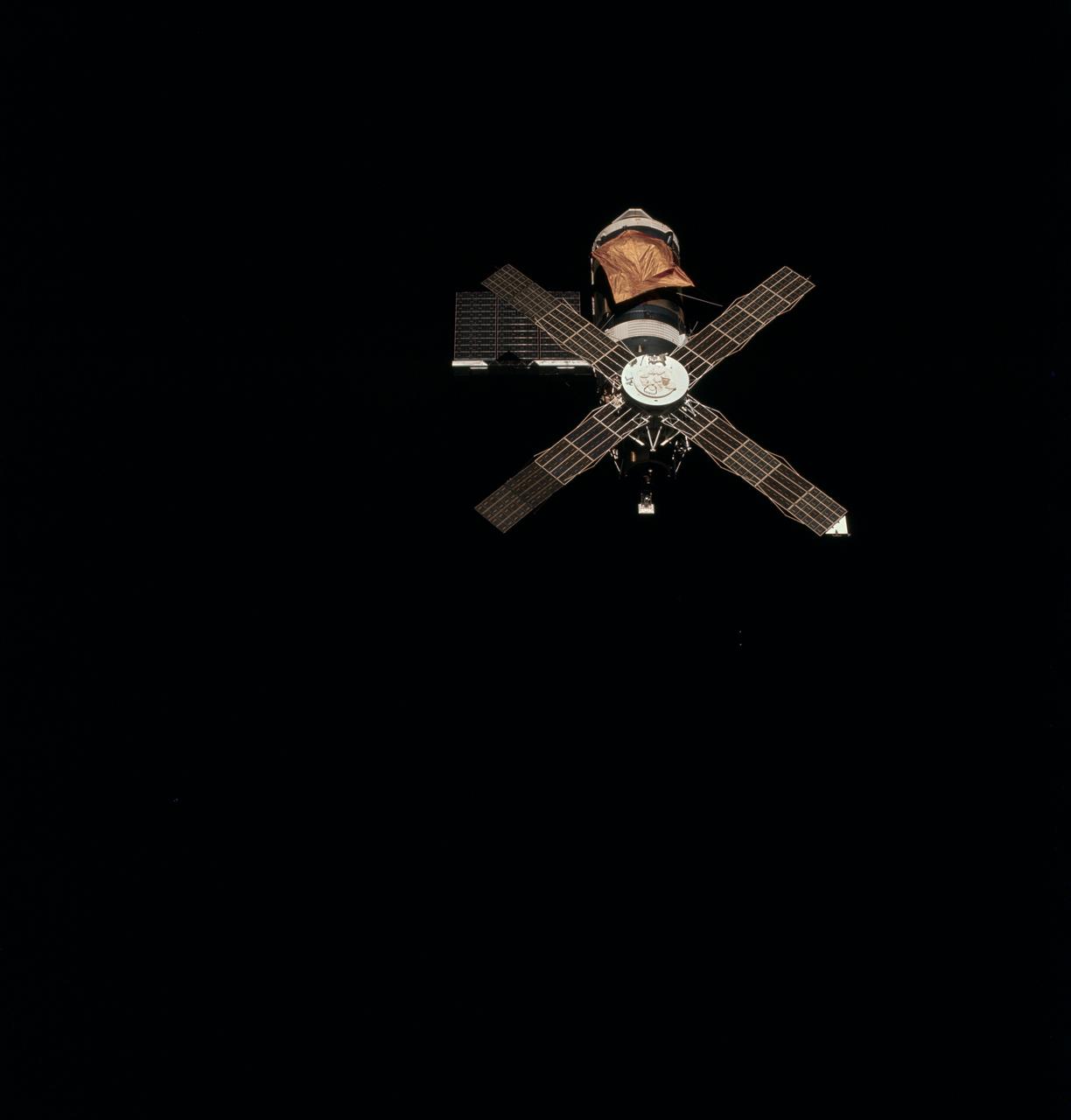
SL2-X7-615 (22 June 1973) --- An overhead view of the Skylab 1 space station cluster in Earth orbit photographed from the Skylab 2 Command/Service Module during the final ?fly around? inspection by the CSM. The space station is sharply contrasted against a black sky background. Note the deployed parasol solar shield which shades the Orbital Workshop where the micrometeoroid shield is missing. The one remaining OWS solar array system wing has been fully deployed successfully. The OWS solar panel on the opposite side is missing completely. Photo credit: NASA
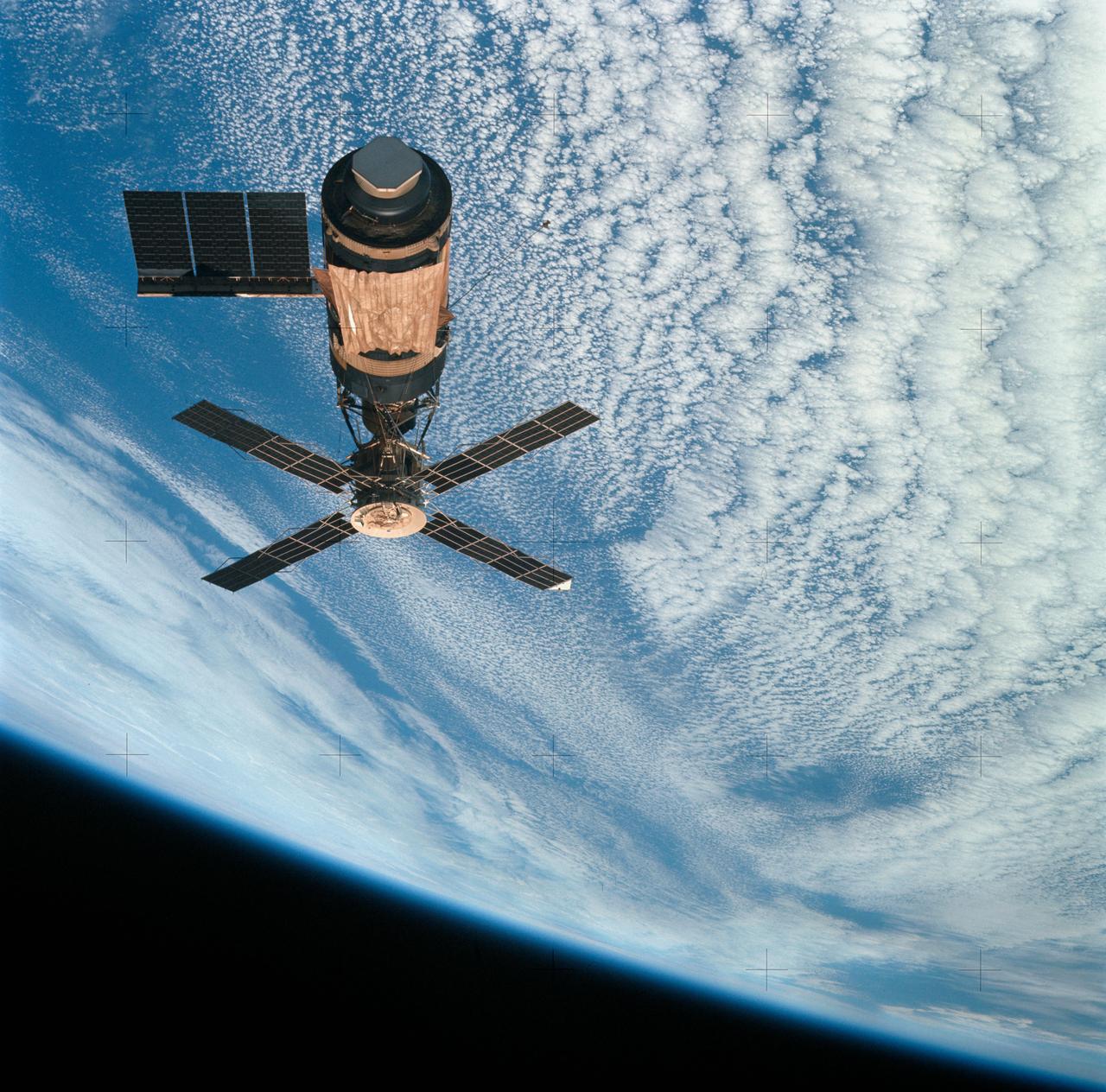
SL4-143-4707 (8 Feb. 1974) --- An overhead view of the Skylab space station cluster in Earth orbit as photographed from the Skylab 4 Command and Service Modules (CSM) during the final fly-around by the CSM before returning home. The space station is contrasted against a cloud-covered Earth. Note the solar shield which was deployed by the second crew of Skylab and from which a micrometeoroid shield has been missing since the cluster was launched on May 14, 1973. The OWS solar panel on the left side was also lost on workshop launch day. Photo credit: NASA
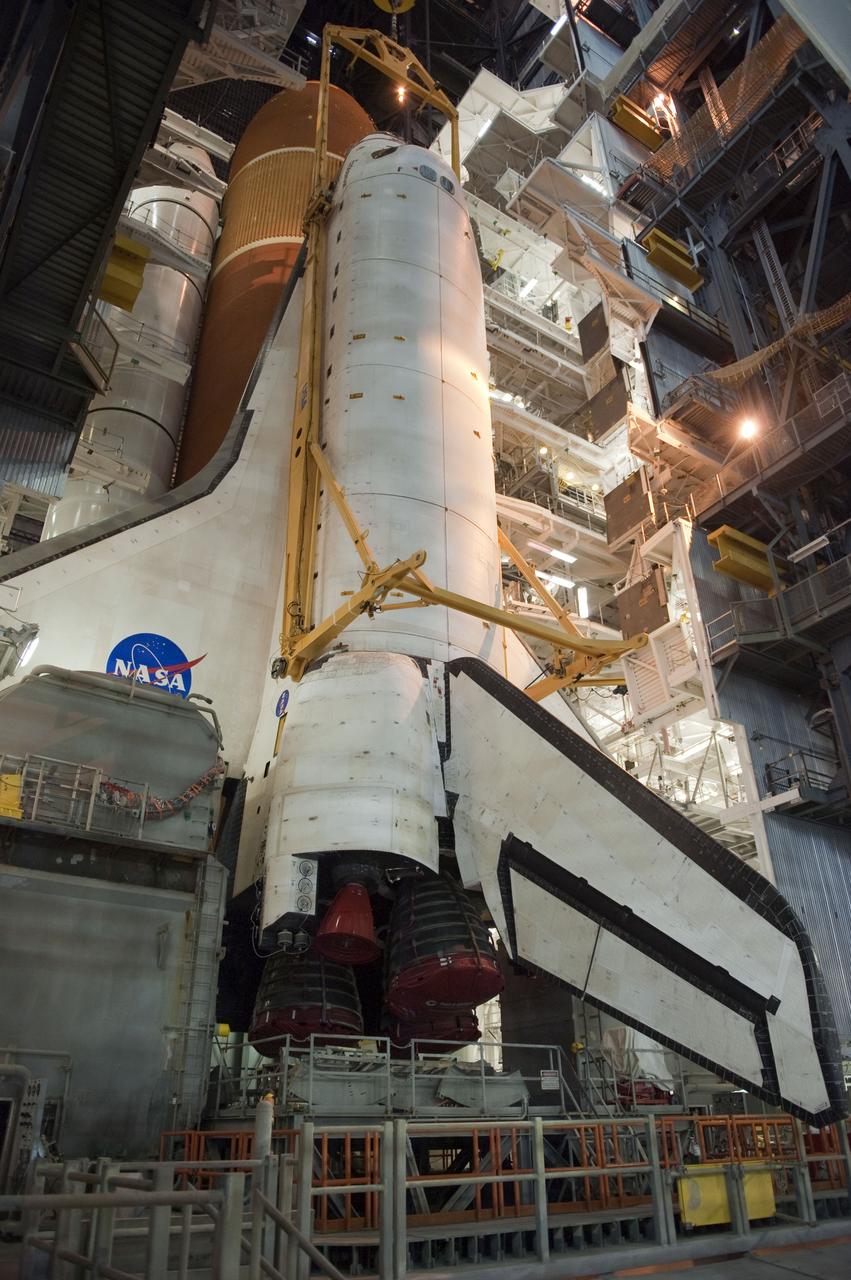
CAPE CANAVERAL, Fla. -- In the Vehicle Assembly Building at NASA's Kennedy Space Center in Florida, shuttle Endeavour is lowered into place where it is being attached to its external fuel tank and solid rocket boosters, already positioned on the mobile launcher platform. Endeavour and its STS-134 crew will deliver the Express Logistics Carrier-3, Alpha Magnetic Spectrometer, a high-pressure gas tank, additional spare parts for Dextre and micrometeoroid debris shields to the International Space Station. Endeavour's final launch is targeted for April 19 at 7:48 p.m. EDT. For more information visit, http://www.nasa.gov/mission_pages/shuttle/shuttlemissions/sts134/index.html. Photo credit: NASA/Kim Shiflett
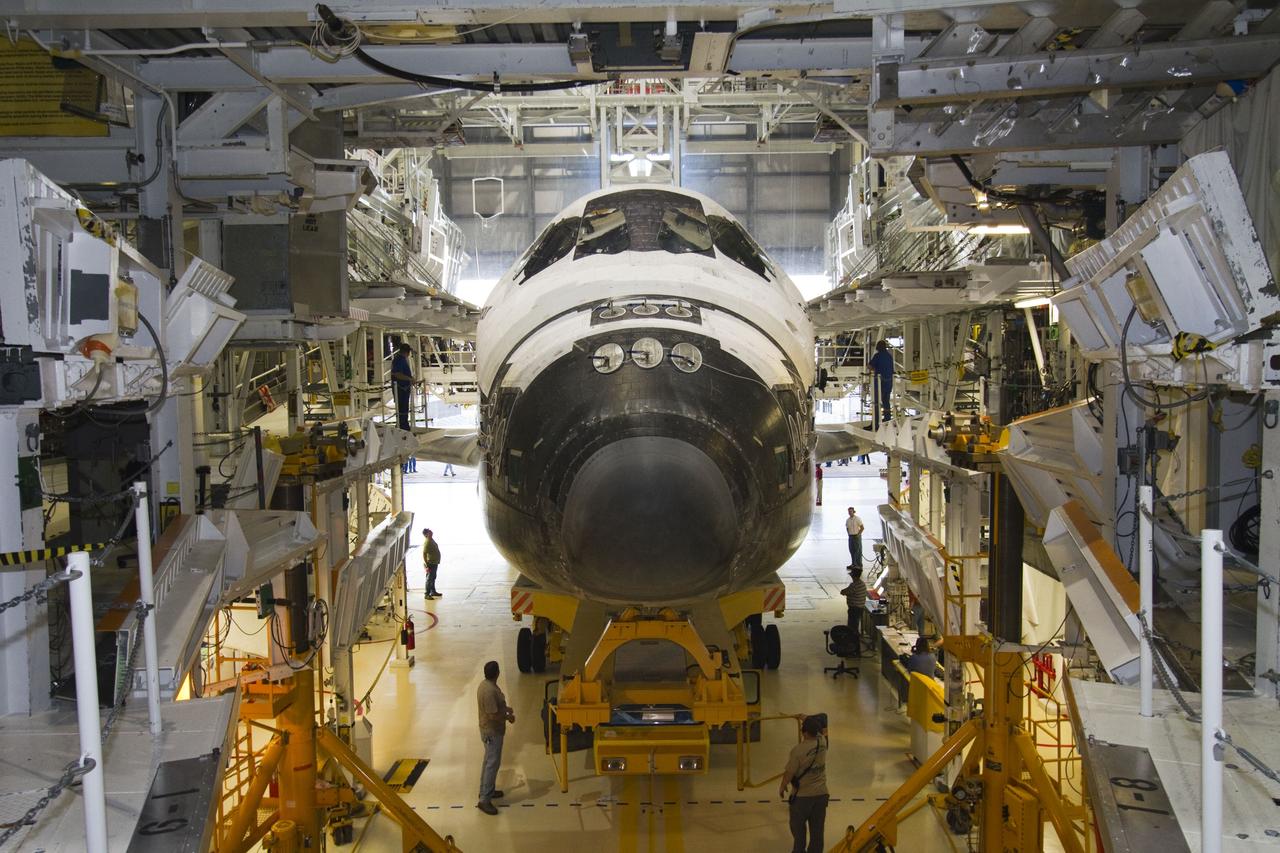
CAPE CANAVERAL, Fla. -- In Orbiter Processing Facility-2 at NASA’s Kennedy Space Center in Florida, workers prepare space shuttle Endeavour for its move, or "rollover," from its hangar to the Vehicle Assembly Building. Endeavour and its STS-134 crew will deliver the Express Logistics Carrier-3, Alpha Magnetic Spectrometer, spare parts, a high-pressure gas tank, additional spare parts for Dextre and micrometeoroid debris shields to the International Space Station. Launch is targeted for April 19 at 7:48 p.m. EDT. For more information visit, http://www.nasa.gov/mission_pages/shuttle/shuttlemissions/sts134/index.html. Photo credit: NASA/Jack Pfaller
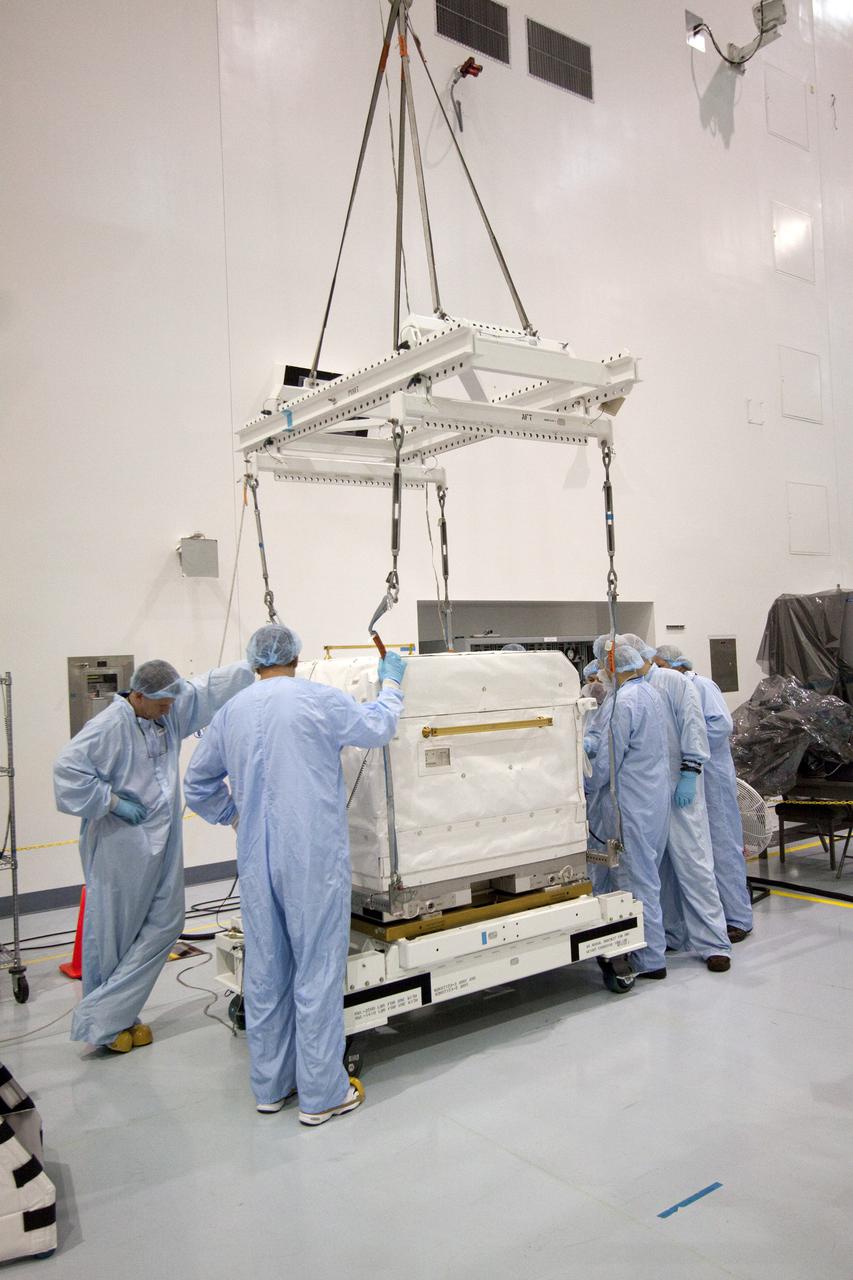
CAPE CANAVERAL, Fla. - In the Space Station Processing Facility at NASA's Kennedy Space Center in Florida, preparations are under way to move a cargo transport container to the ExPRESS Logistics Carrier-3, or ELC-3, on which it will be installed. The ELC-3 and the Alpha Magnetic Spectrometer are the primary payloads on space shuttle Endeavour's STS-134 mission to the International Space Station. Spare parts, including two S-band communications antennas; a high pressure gas tank; replacement parts for Dextre, the robotic hand on the station; and micrometeoroid debris shields, also will be delivered to the station. Endeavour's launch is targeted for mid-November. For information on the STS-134 mission, visit http:__www.nasa.gov_mission_pages_shuttle_shuttlemissions_sts134_index.html. Photo credit: NASA_Jack Pfaller
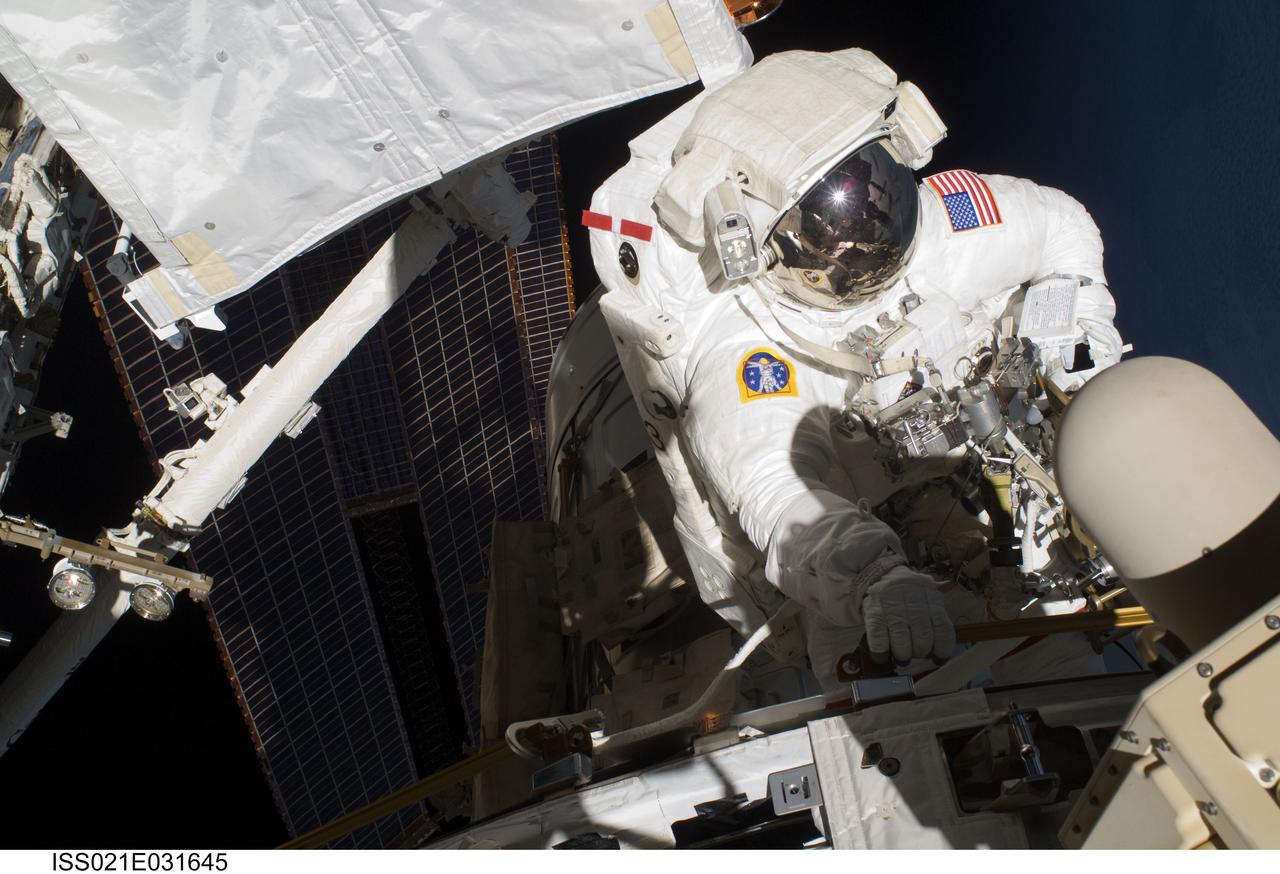
ISS021-E-031645 (23 Nov. 2009) --- Astronaut Randy Bresnik, STS-129 mission specialist, participates in the mission's third and final session of extravehicular activity (EVA) as construction and maintenance continue on the International Space Station. During the five-hour, 42-minute spacewalk, Bresnik and Robert L. Satcher Jr. (out of frame), mission specialist, removed a pair of micrometeoroid and orbital debris shields from the Quest airlock and strapped them to the External Stowage Platform #2, then moved an articulating foot restraint to the airlock, and released a bolt on a starboard truss ammonia tank assembly (ATA) in preparation for an STS-131 spacewalk that will replace the ATA.
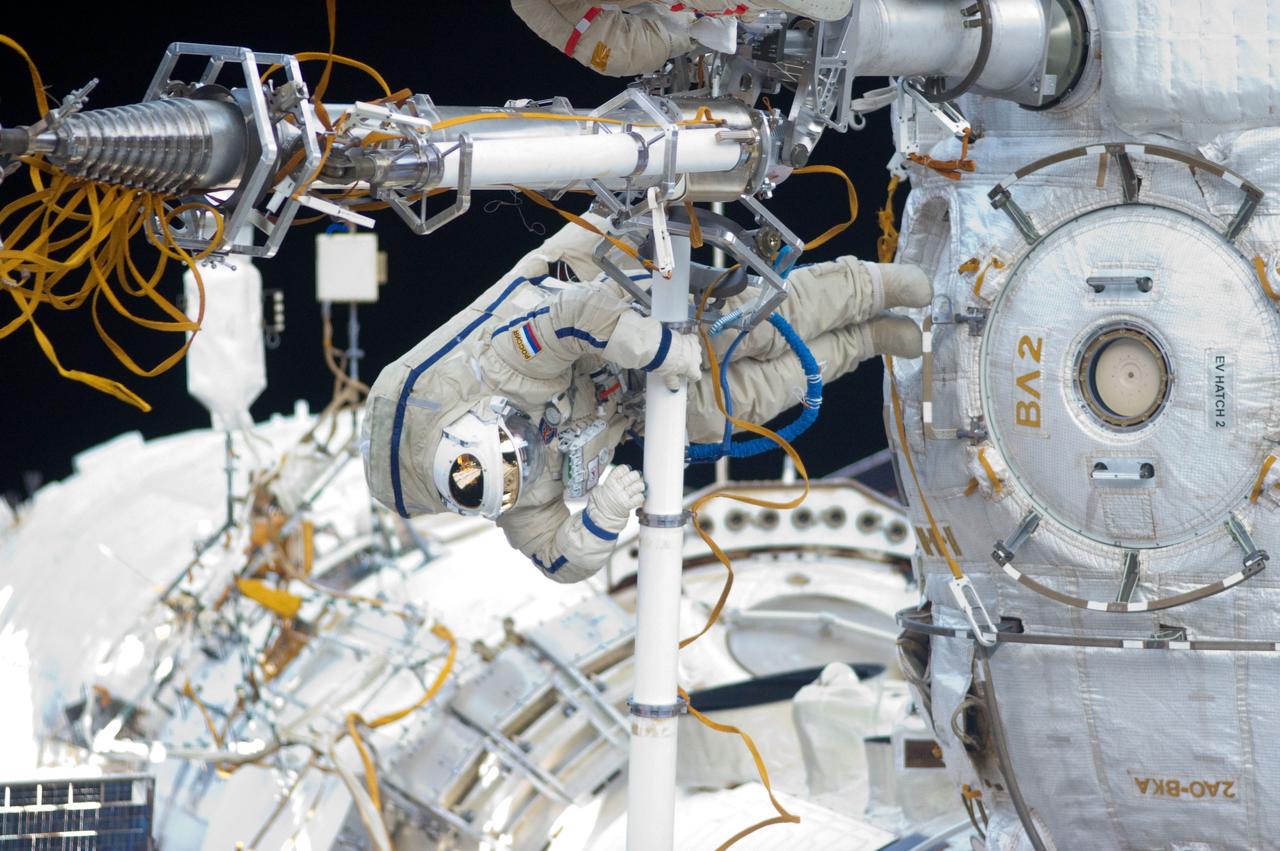
ISS032-E-021058 (20 Aug. 2012) --- Russian cosmonaut Yuri Malenchenko, Expedition 32 flight engineer, participates in a session of extravehicular activity (EVA) to continue outfitting the International Space Station. During the five-hour, 51-minute spacewalk, Malenchenko and Russian cosmonaut Gennady Padalka (out of frame), commander, moved the Strela-2 cargo boom from the Pirs docking compartment to the Zarya module to prepare Pirs for its eventual replacement with a new Russian multipurpose laboratory module. The two spacewalking cosmonauts also installed micrometeoroid debris shields on the exterior of the Zvezda service module and deployed a small science satellite.
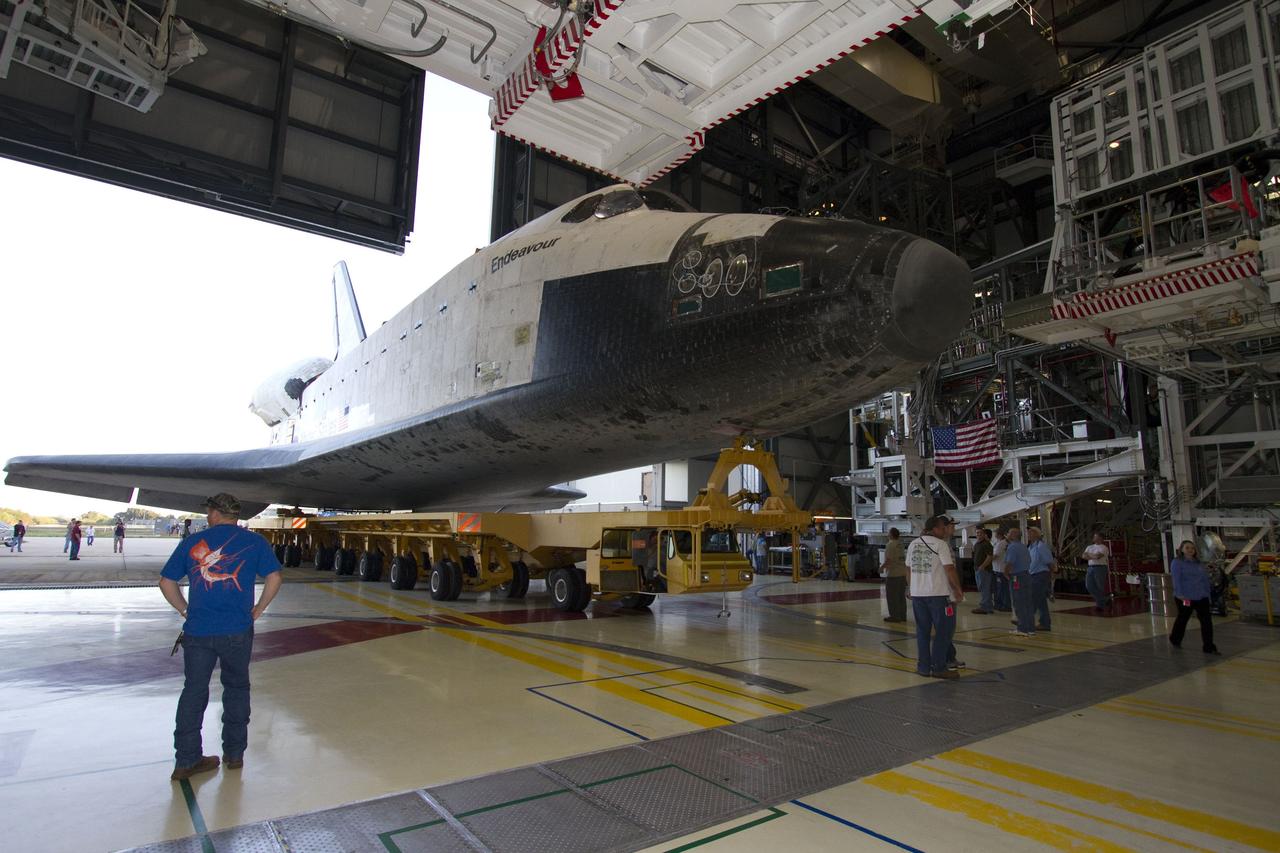
CAPE CANAVERAL, Fla. -- In Orbiter Processing Facility-2 at NASA’s Kennedy Space Center in Florida, workers prepare space shuttle Endeavour for its move, or "rollover," from its hangar to the Vehicle Assembly Building. Endeavour and its STS-134 crew will deliver the Express Logistics Carrier-3, Alpha Magnetic Spectrometer, spare parts, a high-pressure gas tank, additional spare parts for Dextre and micrometeoroid debris shields to the International Space Station. Launch is targeted for April 19 at 7:48 p.m. EDT. For more information visit, http://www.nasa.gov/mission_pages/shuttle/shuttlemissions/sts134/index.html. Photo credit: NASA/Jack Pfaller
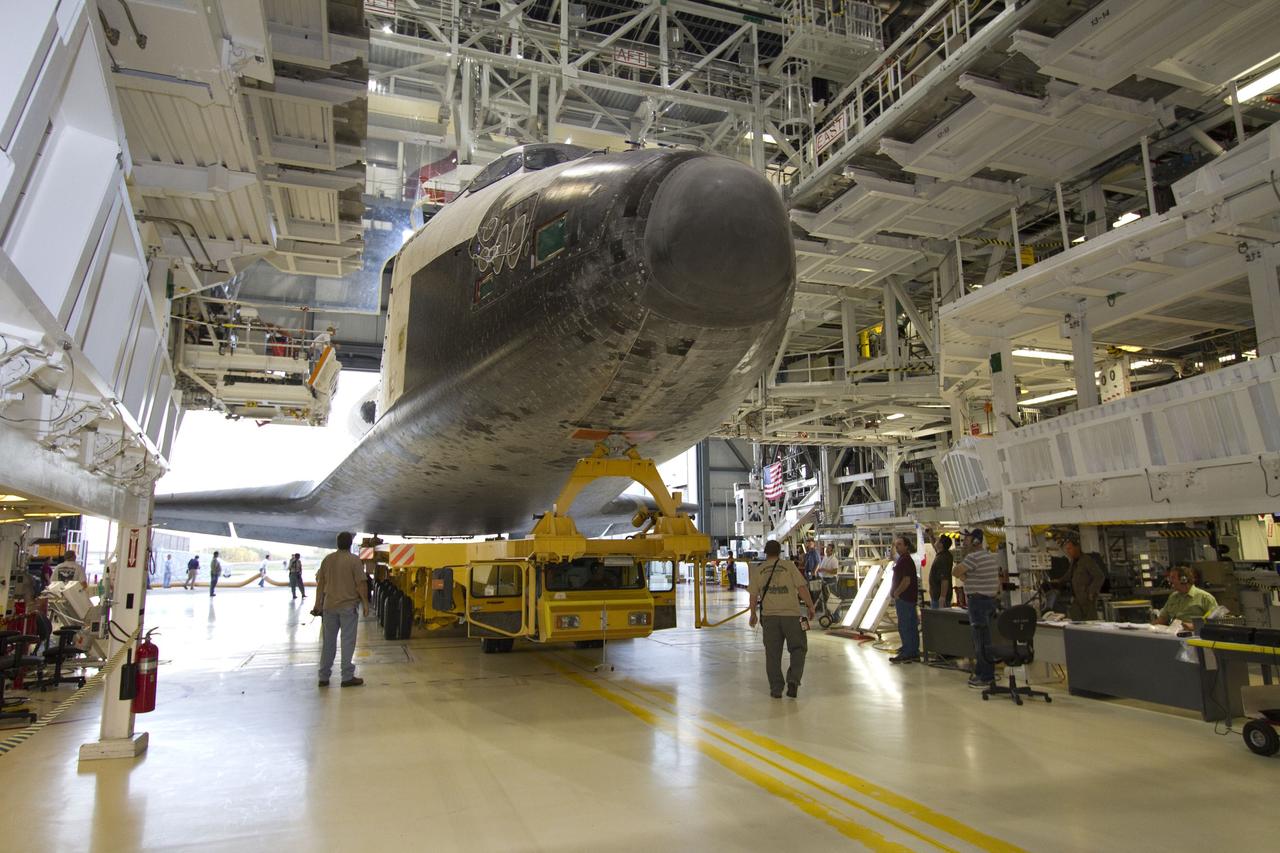
CAPE CANAVERAL, Fla. -- In Orbiter Processing Facility-2 at NASA’s Kennedy Space Center in Florida, workers prepare space shuttle Endeavour for its move, or "rollover," from its hangar to the Vehicle Assembly Building. Endeavour and its STS-134 crew will deliver the Express Logistics Carrier-3, Alpha Magnetic Spectrometer, spare parts, a high-pressure gas tank, additional spare parts for Dextre and micrometeoroid debris shields to the International Space Station. Launch is targeted for April 19 at 7:48 p.m. EDT. For more information visit, http://www.nasa.gov/mission_pages/shuttle/shuttlemissions/sts134/index.html. Photo credit: NASA/Jack Pfaller
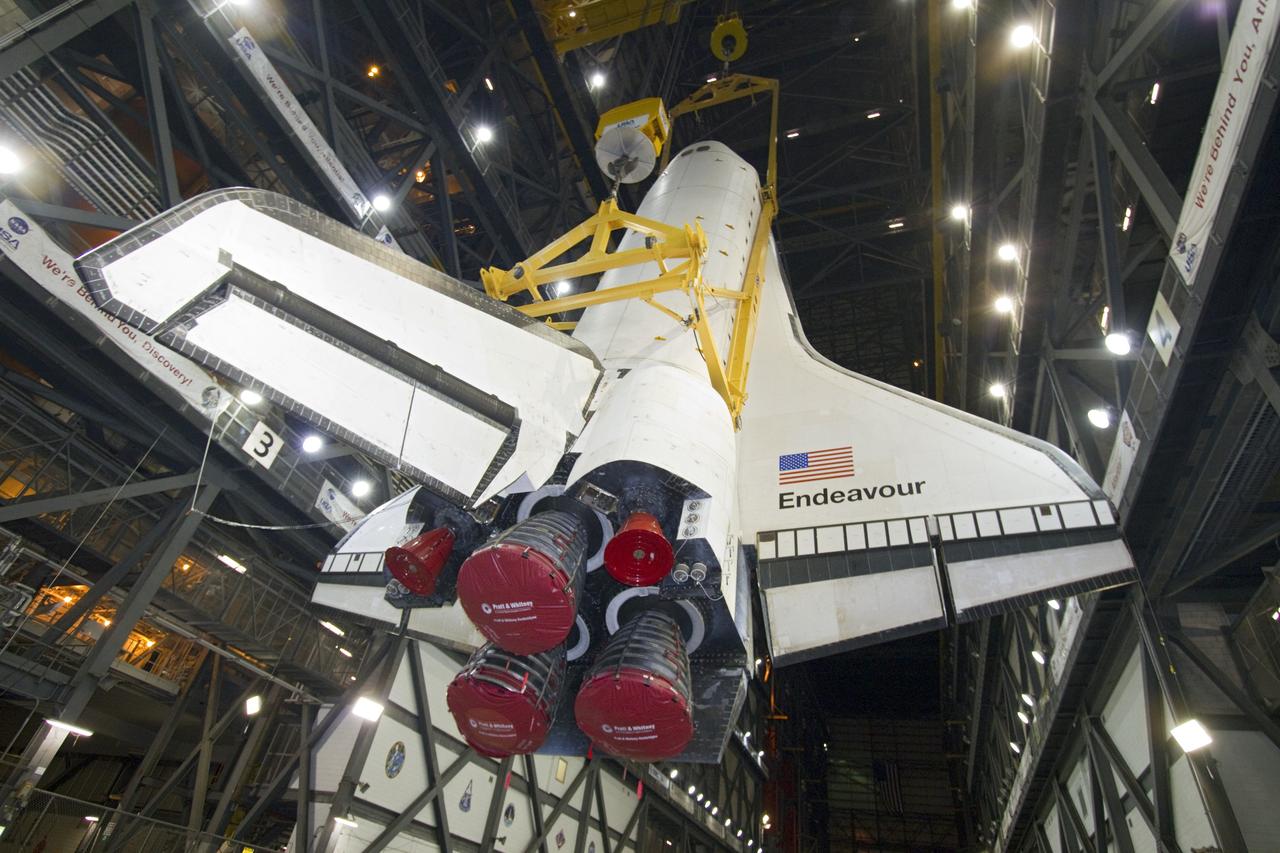
CAPE CANAVERAL, Fla. -- In Vehicle Assembly Building at NASA's Kennedy Space Center in Florida, shuttle Endeavour is suspended vertically over the transfer aisle. The spacecraft will be moved into a high bay where it will be installed to the waiting external fuel tank and solid rocket boosters. Endeavour and its STS-134 crew will deliver the Express Logistics Carrier-3, Alpha Magnetic Spectrometer, a high-pressure gas tank, additional spare parts for Dextre and micrometeoroid debris shields to the International Space Station. Endeavour's final launch is targeted for April 19 at 7:48 p.m. EDT. For more information visit, http://www.nasa.gov/mission_pages/shuttle/shuttlemissions/sts134/index.html. Photo credit: NASA/Jack Pfaller
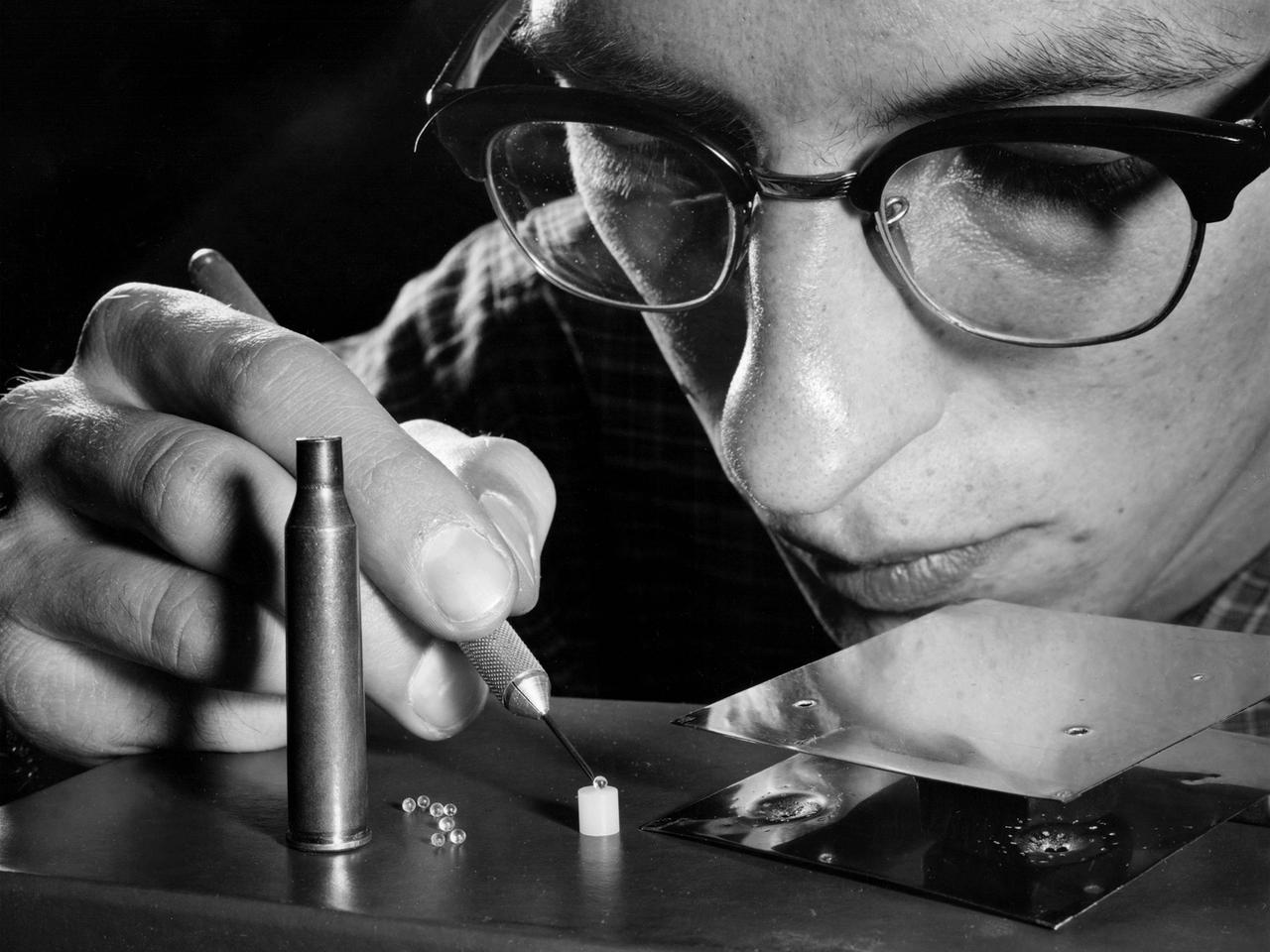
A researcher at the NASA Lewis Research Center manipulates cartridge pellets and a strain gauge target as part of a study on the impact of micrometeorites striking space vehicles. Early in the space program NASA researchers were concerned that small micrometeorites would penetrate spacecraft, injure engines, or damage solar arrays. In response, researchers worked to develop stronger materials to withstand meteorite strikes and screens to block the objects. NASA launched a series of experimental spacecraft into orbit with foil shields that were used to determine the number of meteorite strikes. By the early 1960s the experiments and computer modelling efforts revealed that the micrometeoroid threat was lower than previously anticipated.
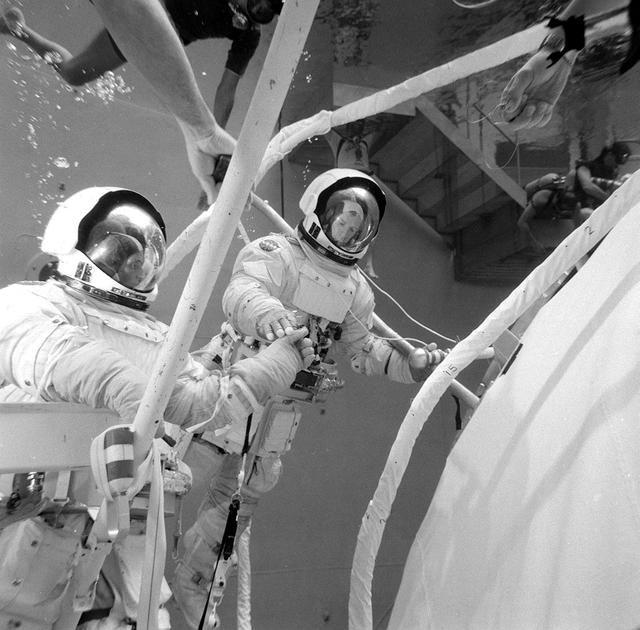
This photograph was taken during testing of an emergency procedure to free jammed solar array panels on the Skylab workshop. A metal strap became tangled over one of the folded solar array panels when Skylab lost its micrometeoroid shield during the launch. This photograph shows astronauts Schweickart and Gibson in the Marshall Space Flight Center (MSFC) Neutral Buoyancy Simulator (NBS) using various cutting tools and methods developed by the MSFC to free the jammed solar wing. Extensive testing and many hours of practice in simulators such as the NBS tank helped prepare the Skylab crewmen for extravehicular performance in the weightless environment. This huge water tank simulated the weightless environment that the astronauts would encounter in space.
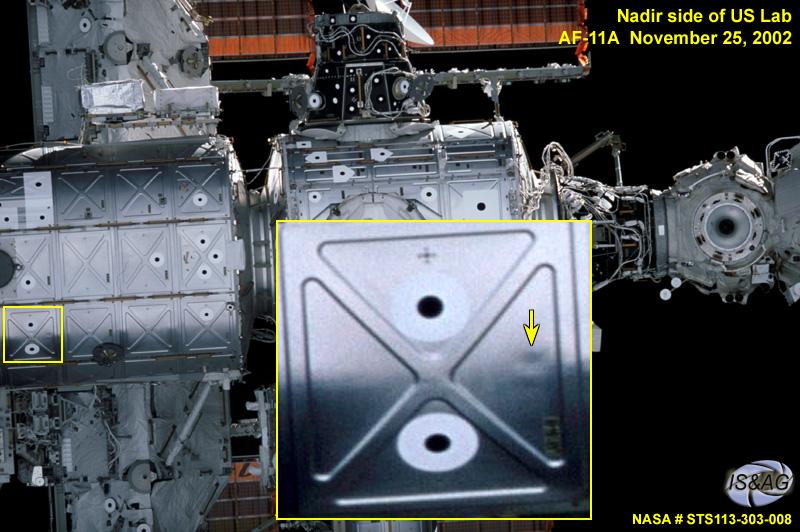
JSC2004-E-50470 (25 November 2002) --- The original photograph in this image was taken during the Space Shuttle Endeavour’s approach to the International Space Station for docking during the STS-113/11A assembly mission. An indentation in a micrometeoroid debris panel on the exterior of the Destiny Laboratory module is indicated by an arrow in an enhanced section of the image provided by the Image Science and Analysis Group at the Johnson Space Center. Analysis of this image and additional video indicates that the indentation is not from a debris strike, but is consistent with flat spots seen on other areas that are likely the result of significant temperature changes. The protective shield’s function is not affected by the indentations.
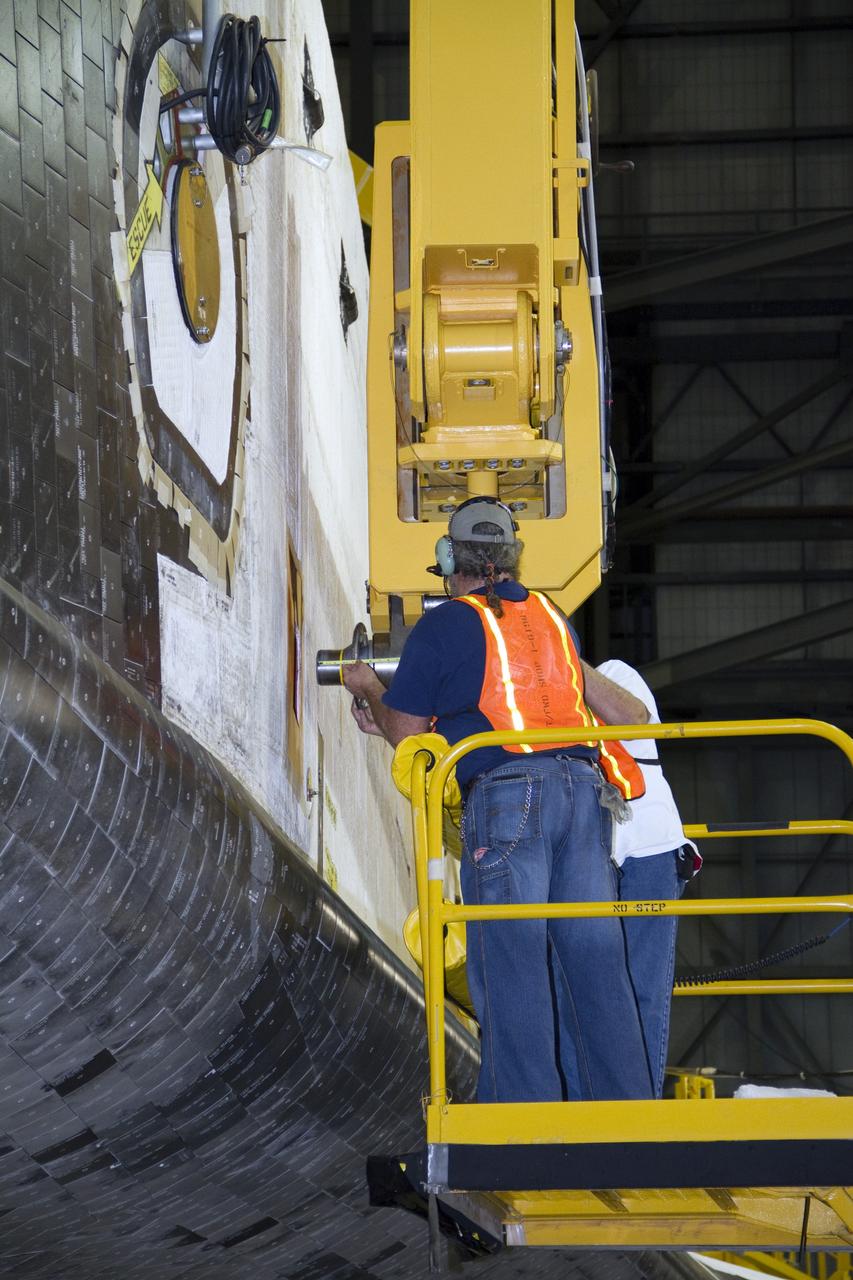
CAPE CANAVERAL, Fla. -- In the Vehicle Assembly Building at NASA's Kennedy Space Center in Florida, workers attach an overhead crane to shuttle Endeavour. The crane will lift the spacecraft into a high bay where it will be attached to the waiting external fuel tank and solid rocket boosters. Endeavour and its STS-134 crew will deliver the Express Logistics Carrier-3, Alpha Magnetic Spectrometer, a high-pressure gas tank, additional spare parts for Dextre and micrometeoroid debris shields to the International Space Station. Endeavour's final launch is targeted for April 19 at 7:48 p.m. EDT. For more information visit, http://www.nasa.gov/mission_pages/shuttle/shuttlemissions/sts134/index.html. Photo credit: NASA/Jack Pfaller
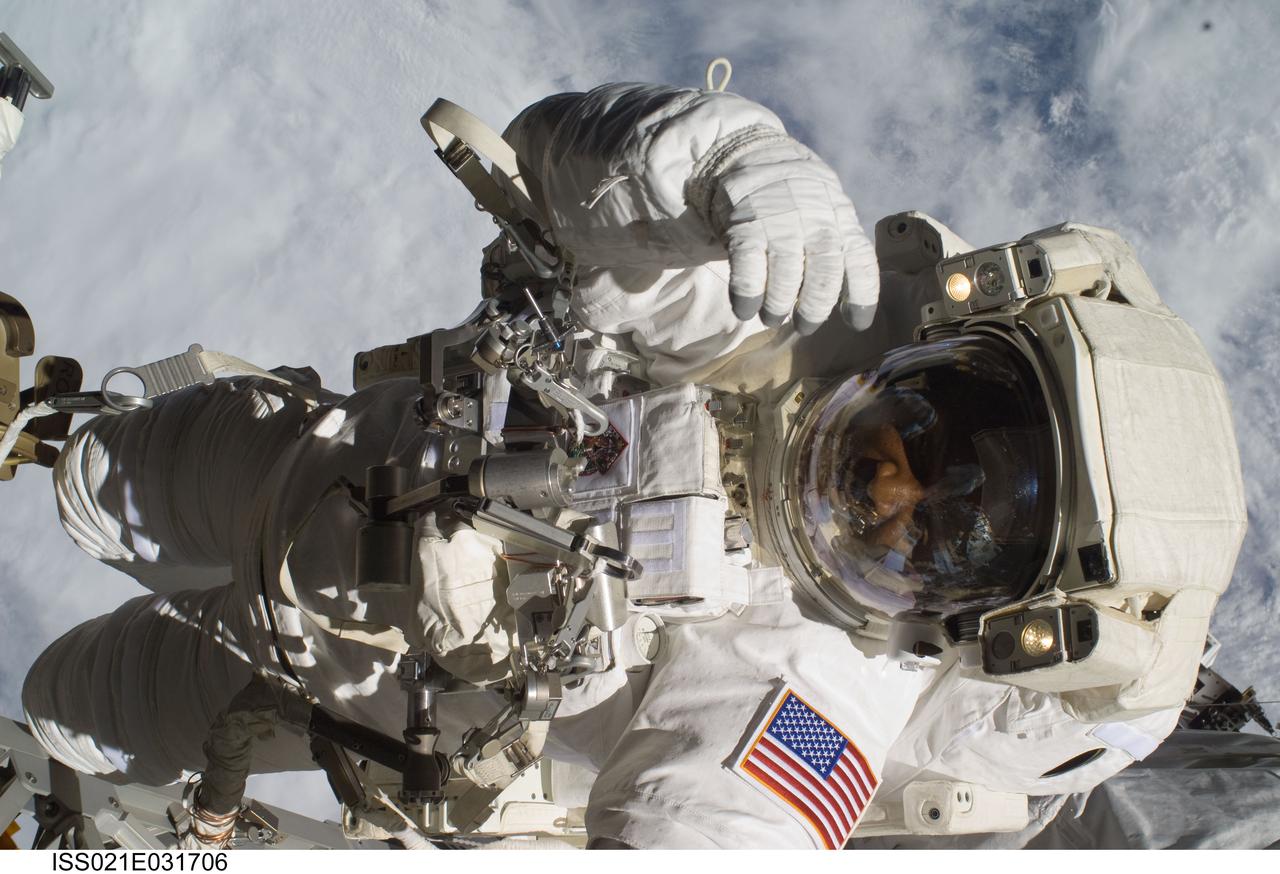
ISS021-E-031706 (23 Nov. 2009) --- Astronaut Robert L. Satcher Jr., STS-129 mission specialist, participates in the mission's third and final session of extravehicular activity (EVA) as construction and maintenance continue on the International Space Station. During the five-hour, 42-minute spacewalk, Satcher and astronaut Randy Bresnik (out of frame), mission specialist, removed a pair of micrometeoroid and orbital debris shields from the Quest airlock and strapped them to the External Stowage Platform #2, then moved an articulating foot restraint to the airlock, and released a bolt on a starboard truss ammonia tank assembly (ATA) in preparation for an STS-131 spacewalk that will replace the ATA.
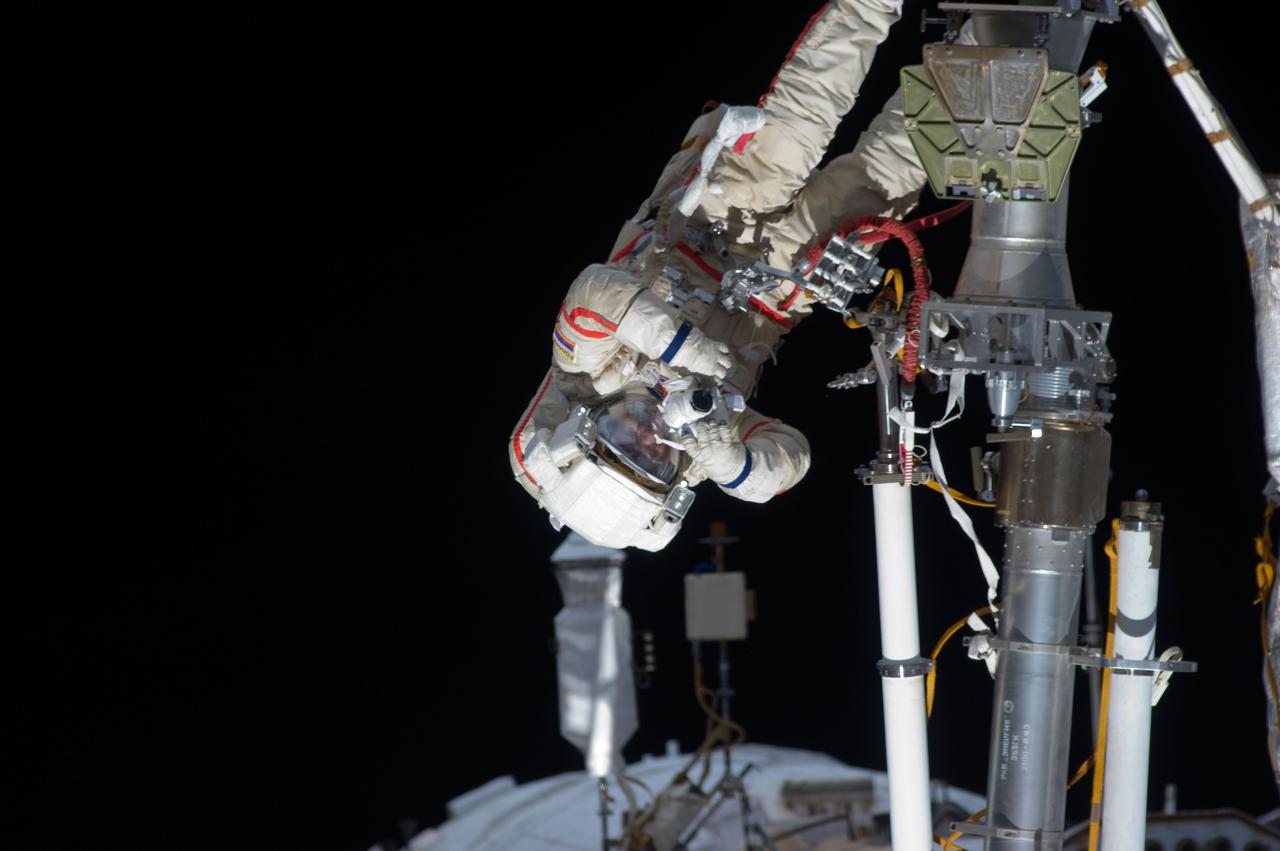
ISS032-E-021078 (20 Aug. 2012) --- Russian cosmonaut Gennady Padalka, Expedition 32 commander, uses a still camera during a session of extravehicular activity (EVA) to continue outfitting the International Space Station. During the five-hour, 51-minute spacewalk, Padalka and Russian cosmonaut Yuri Malenchenko (out of frame), flight engineer, moved the Strela-2 cargo boom from the Pirs docking compartment to the Zarya module to prepare Pirs for its eventual replacement with a new Russian multipurpose laboratory module. The two spacewalking cosmonauts also installed micrometeoroid debris shields on the exterior of the Zvezda service module and deployed a small science satellite.
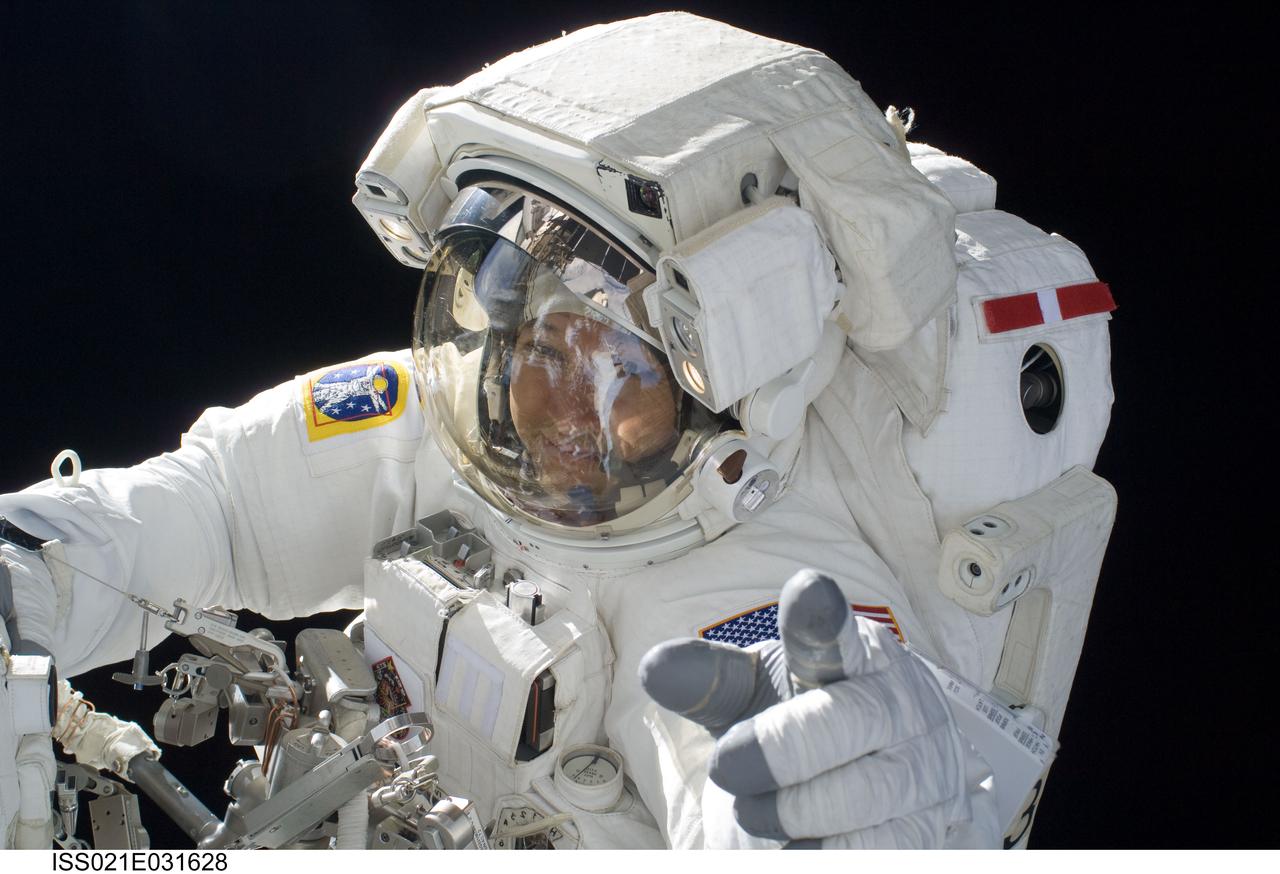
ISS021-E-031628 (23 Nov. 2009) --- Astronaut Randy Bresnik, STS-129 mission specialist, participates in the mission's third and final session of extravehicular activity (EVA) as construction and maintenance continue on the International Space Station. During the five-hour, 42-minute spacewalk, Bresnik and Robert L. Satcher Jr. (out of frame), mission specialist, removed a pair of micrometeoroid and orbital debris shields from the Quest airlock and strapped them to the External Stowage Platform #2, then moved an articulating foot restraint to the airlock, and released a bolt on a starboard truss ammonia tank assembly (ATA) in preparation for an STS-131 spacewalk that will replace the ATA.
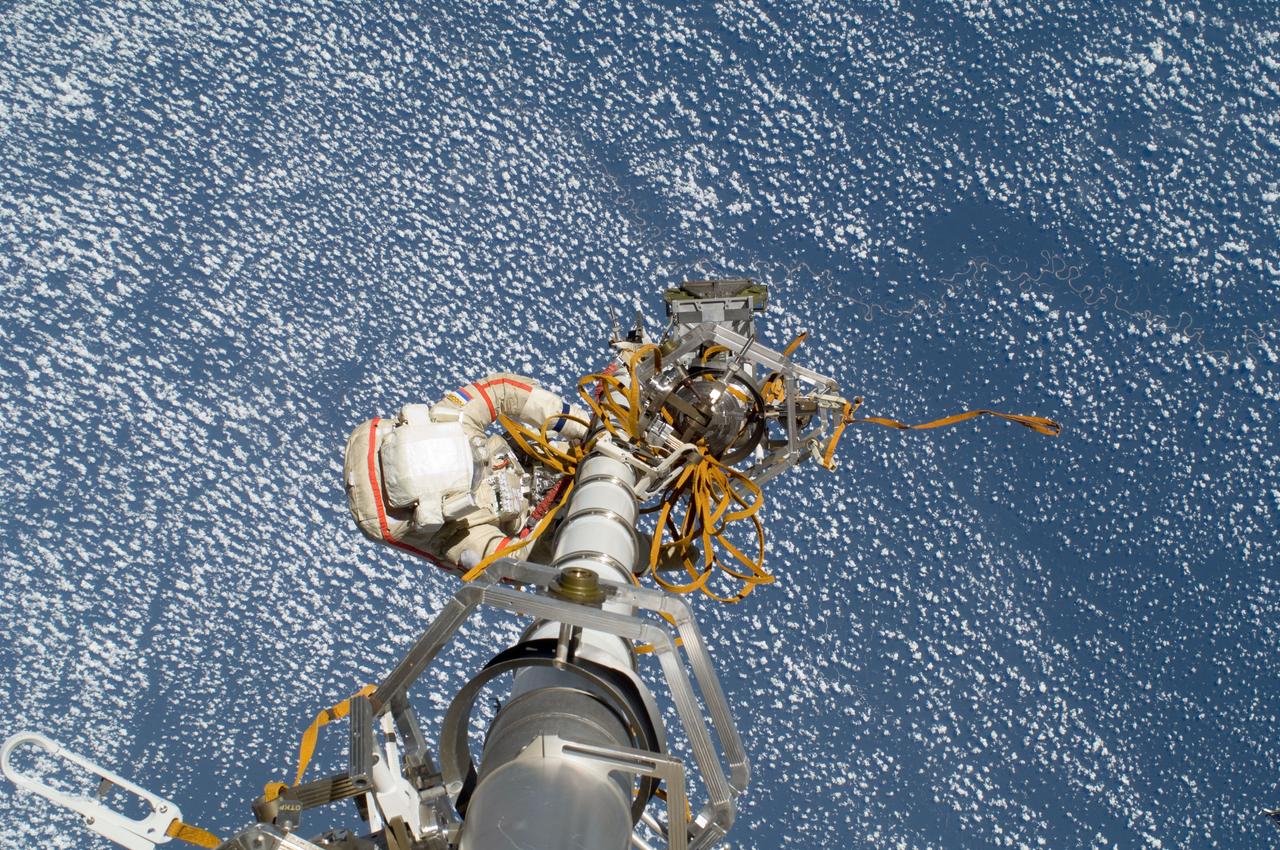
ISS032-E-020581 (20 Aug. 2012) --- Russian cosmonaut Gennady Padalka, Expedition 32 commander, participates in a session of extravehicular activity (EVA) to continue outfitting the International Space Station. During the five-hour, 51-minute spacewalk, Padalka and Russian cosmonaut Yuri Malenchenko (out of frame), flight engineer, moved the Strela-2 cargo boom from the Pirs docking compartment to the Zarya module to prepare Pirs for its eventual replacement with a new Russian multipurpose laboratory module. The two spacewalking cosmonauts also installed micrometeoroid debris shields on the exterior of the Zvezda service module and deployed a small science satellite.
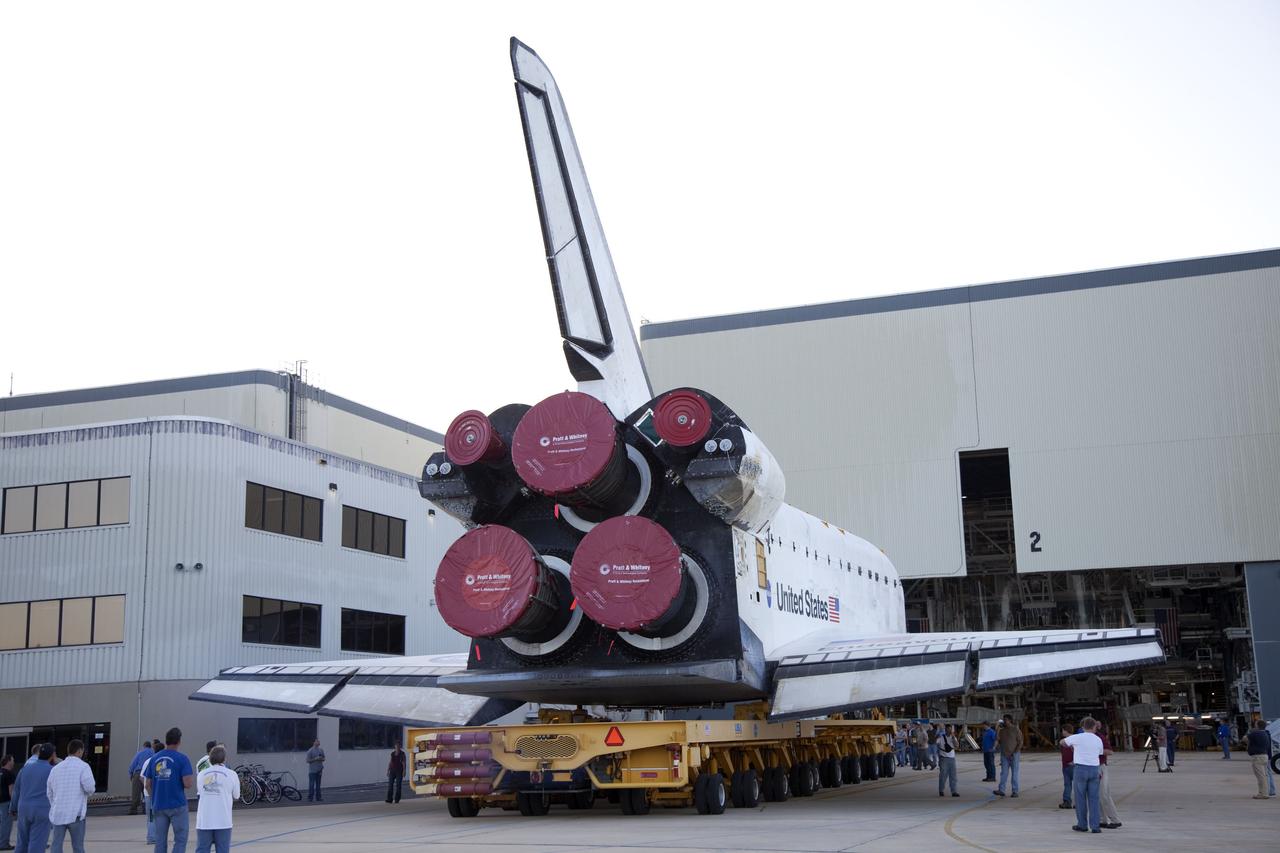
CAPE CANAVERAL, Fla. -- At NASA’s Kennedy Space Center in Florida, workers accompany space shuttle Endeavour as it is backed out of Orbiter Processing Facility-2 for its move, or "rollover," to the Vehicle Assembly Building. Endeavour and its STS-134 crew will deliver the Express Logistics Carrier-3, Alpha Magnetic Spectrometer, spare parts, a high-pressure gas tank, additional spare parts for Dextre and micrometeoroid debris shields to the International Space Station. Launch is targeted for April 19 at 7:48 p.m. EDT. For more information visit, http://www.nasa.gov/mission_pages/shuttle/shuttlemissions/sts134/index.html. Photo credit: NASA/Frankie Martin
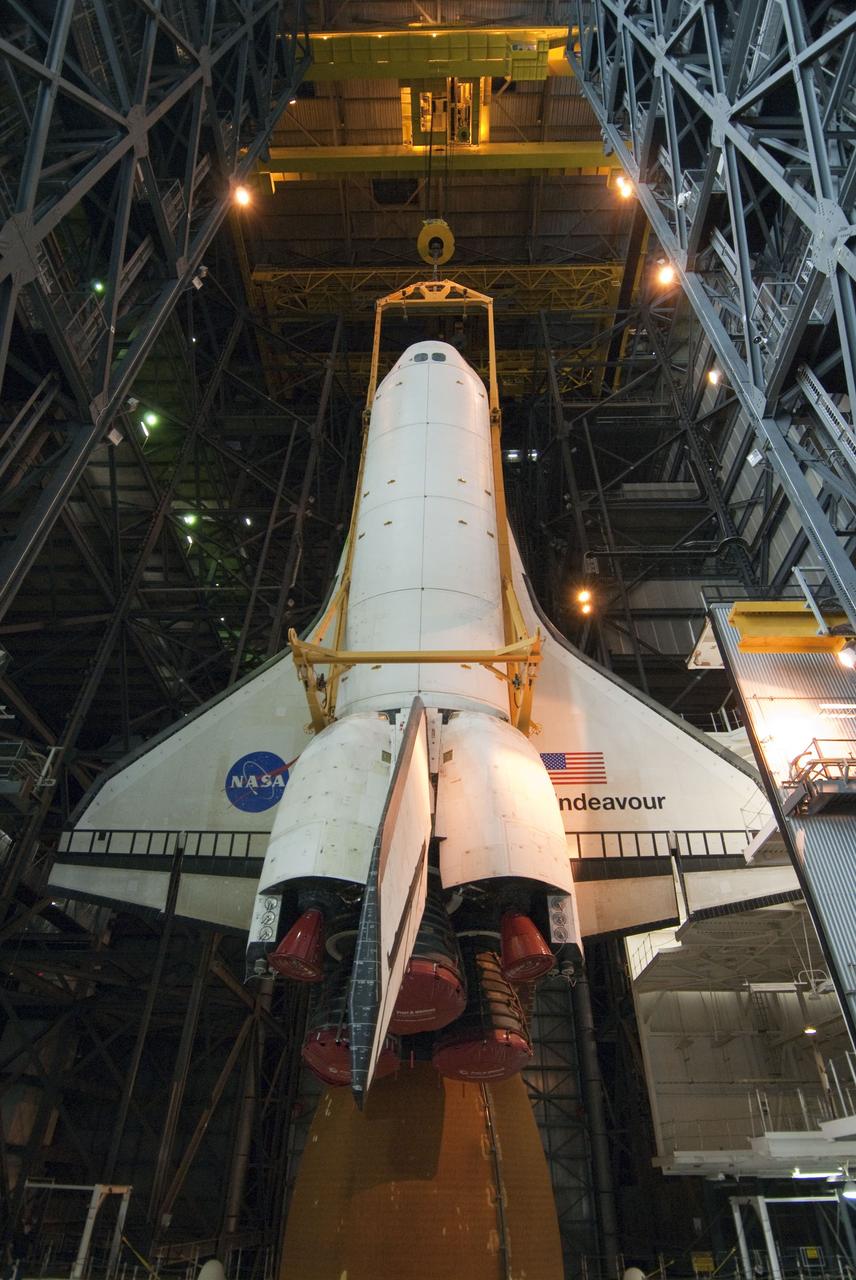
CAPE CANAVERAL, Fla. -- In the Vehicle Assembly Building at NASA's Kennedy Space Center in Florida, shuttle Endeavour is being lowered into place where it will be attached to its external fuel tank and solid rocket boosters, already positioned on the mobile launcher platform. Endeavour and its STS-134 crew will deliver the Express Logistics Carrier-3, Alpha Magnetic Spectrometer, a high-pressure gas tank, additional spare parts for Dextre and micrometeoroid debris shields to the International Space Station. Endeavour's final launch is targeted for April 19 at 7:48 p.m. EDT. For more information visit, http://www.nasa.gov/mission_pages/shuttle/shuttlemissions/sts134/index.html. Photo credit: NASA/Jim Grossmann

ISS032-E-021046 (20 Aug. 2012) --- Russian cosmonauts Gennady Padalka (top), Expedition 32 commander; and Yuri Malenchenko, flight engineer, participate in a session of extravehicular activity (EVA) to continue outfitting the International Space Station. During the five-hour, 51-minute spacewalk, Padalka and Malenchenko moved the Strela-2 cargo boom from the Pirs docking compartment to the Zarya module to prepare Pirs for its eventual replacement with a new Russian multipurpose laboratory module. The two spacewalking cosmonauts also installed micrometeoroid debris shields on the exterior of the Zvezda service module and deployed a small science satellite.
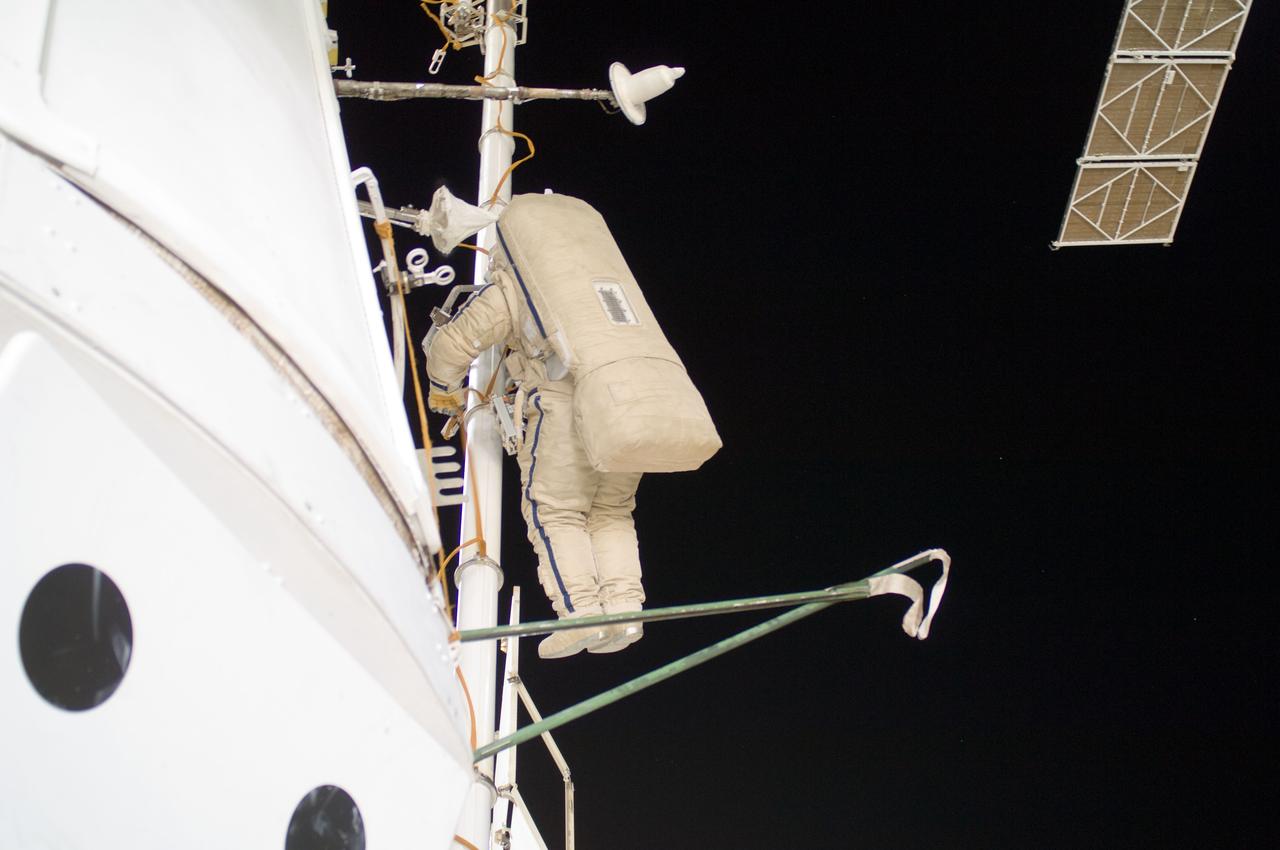
ISS032-E-020884 (20 Aug. 2012) --- Russian cosmonaut Yuri Malenchenko, Expedition 32 flight engineer, participates in a session of extravehicular activity (EVA) to continue outfitting the International Space Station. During the five-hour, 51-minute spacewalk, Malenchenko and Russian cosmonaut Gennady Padalka (out of frame), commander, moved the Strela-2 cargo boom from the Pirs docking compartment to the Zarya module to prepare Pirs for its eventual replacement with a new Russian multipurpose laboratory module. The two spacewalking cosmonauts also installed micrometeoroid debris shields on the exterior of the Zvezda service module and deployed a small science satellite.
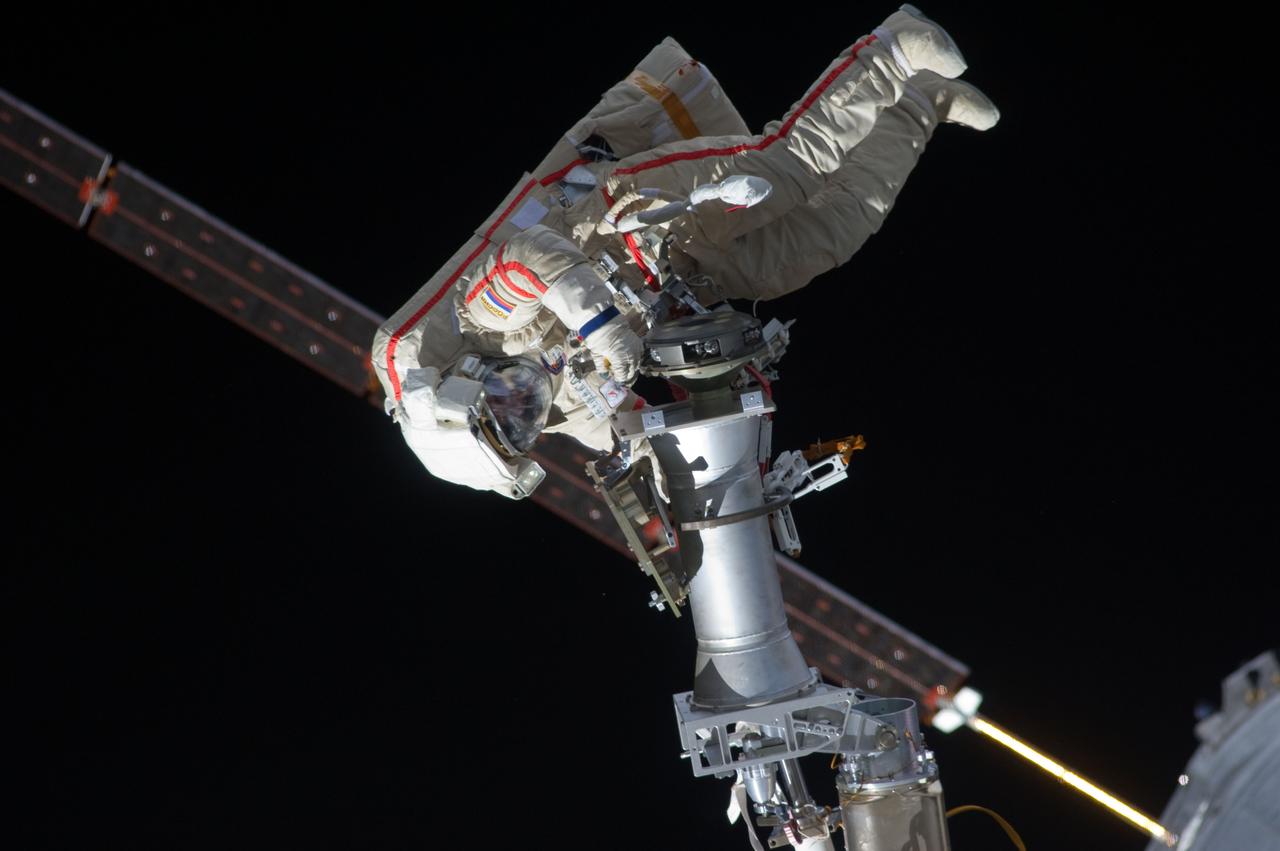
ISS032-E-021085 (20 Aug. 2012) --- Russian cosmonaut Gennady Padalka, Expedition 32 commander, participates in a session of extravehicular activity (EVA) to continue outfitting the International Space Station. During the five-hour, 51-minute spacewalk, Padalka and Russian cosmonaut Yuri Malenchenko (out of frame), flight engineer, moved the Strela-2 cargo boom from the Pirs docking compartment to the Zarya module to prepare Pirs for its eventual replacement with a new Russian multipurpose laboratory module. The two spacewalking cosmonauts also installed micrometeoroid debris shields on the exterior of the Zvezda service module and deployed a small science satellite.
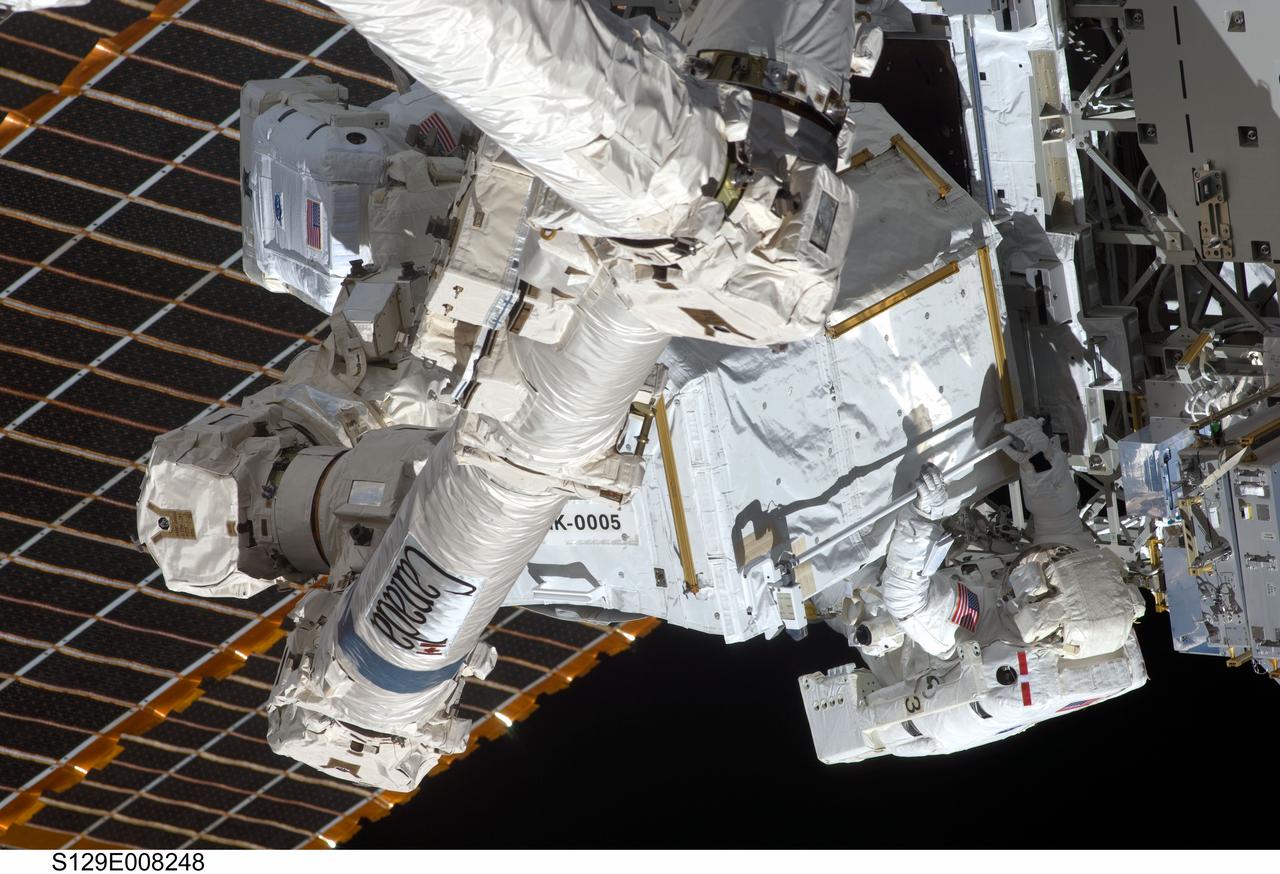
S129-E-008248 (23 Nov. 2009) --- Astronauts Randy Bresnik (right) and Robert L. Satcher Jr. (top left), both STS-129 mission specialists, participate in the mission's third and final session of extravehicular activity (EVA) as construction and maintenance continue on the International Space Station. During the five-hour, 42-minute spacewalk, Bresnik and Satcher removed a pair of micrometeoroid and orbital debris shields from the Quest airlock and strapped them to the External Stowage Platform #2, then moved an articulating foot restraint to the airlock, and released a bolt on a starboard truss ammonia tank assembly (ATA) in preparation for an STS-131 spacewalk that will replace the ATA.
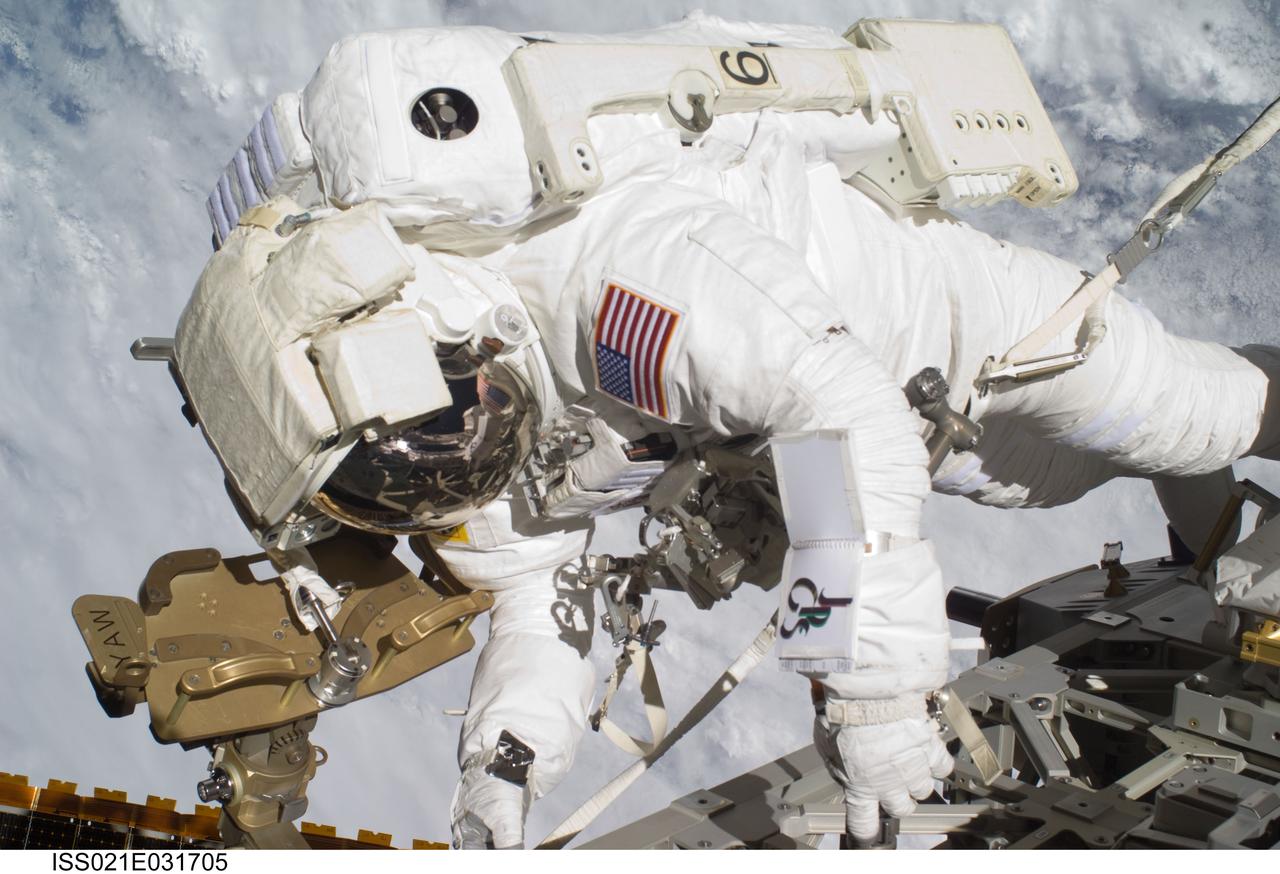
ISS021-E-031705 (23 Nov. 2009) --- Astronaut Robert L. Satcher Jr., STS-129 mission specialist, participates in the mission's third and final session of extravehicular activity (EVA) as construction and maintenance continue on the International Space Station. During the five-hour, 42-minute spacewalk, Satcher and astronaut Randy Bresnik (out of frame), mission specialist, removed a pair of micrometeoroid and orbital debris shields from the Quest airlock and strapped them to the External Stowage Platform #2, then moved an articulating foot restraint to the airlock, and released a bolt on a starboard truss ammonia tank assembly (ATA) in preparation for an STS-131 spacewalk that will replace the ATA.
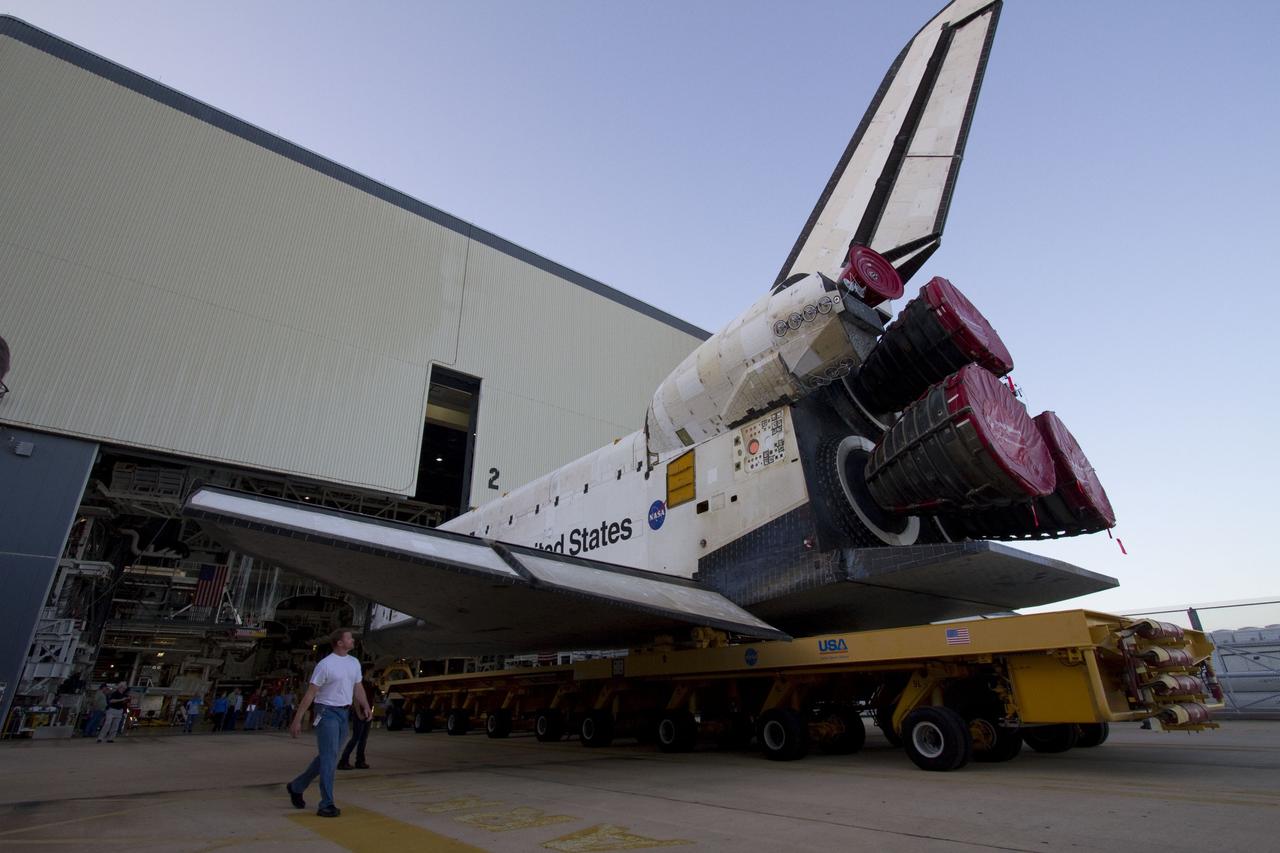
CAPE CANAVERAL, Fla. -- At NASA’s Kennedy Space Center in Florida, workers accompany space shuttle Endeavour as it is backed out of Orbiter Processing Facility-2 for its move, "or rollover," to the Vehicle Assembly Building. Endeavour and its STS-134 crew will deliver the Express Logistics Carrier-3, Alpha Magnetic Spectrometer, spare parts, a high-pressure gas tank, additional spare parts for Dextre and micrometeoroid debris shields to the International Space Station. Launch is targeted for April 19 at 7:48 p.m. EDT. For more information visit, http://www.nasa.gov/mission_pages/shuttle/shuttlemissions/sts134/index.html. Photo credit: NASA/Jack Pfaller
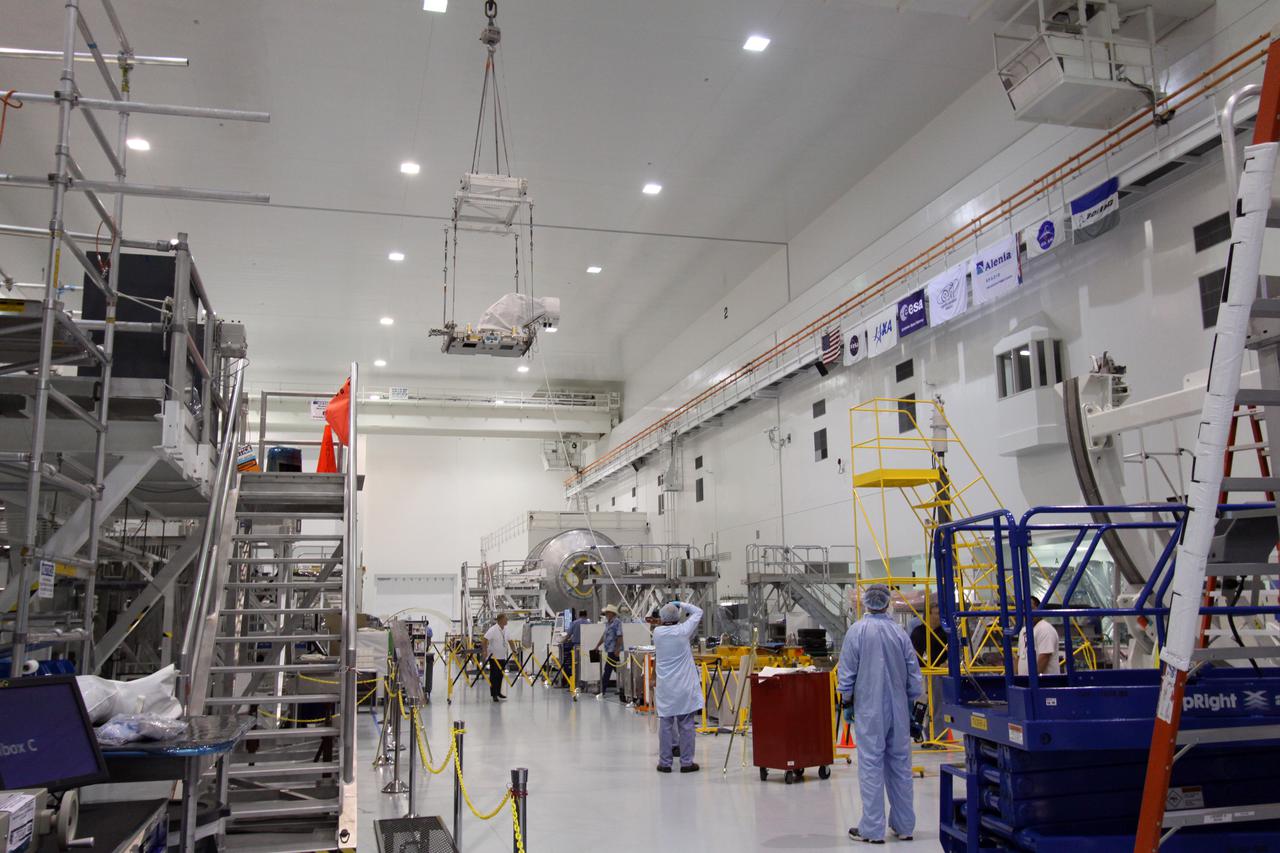
CAPE CANAVERAL, Fla. -- At NASA's Kennedy Space Center in Florida, technicians begin to lift the new S-band antenna support assembly for installation on ExPRESS Logistics Carrier-3 in the Space Station Processing Facility. The assembly will be used aboard the International Space Station to transmit and receive audio communications, and is being installed for the STS-134 mission. Space shuttle Endeavour will take up other spare parts, including a high-pressure gas tank, micrometeoroid debris shields and replacement parts for Dextre, the robotic arm on the station. STS-134, the last planned shuttle mission, is targeted to launch in the fall of 2010. For information on the upcoming mission and crew, visit www.nasa.gov_mission_pages_shuttle_shuttlemissions_sts134_index.html. NASA_Jack Pfaller
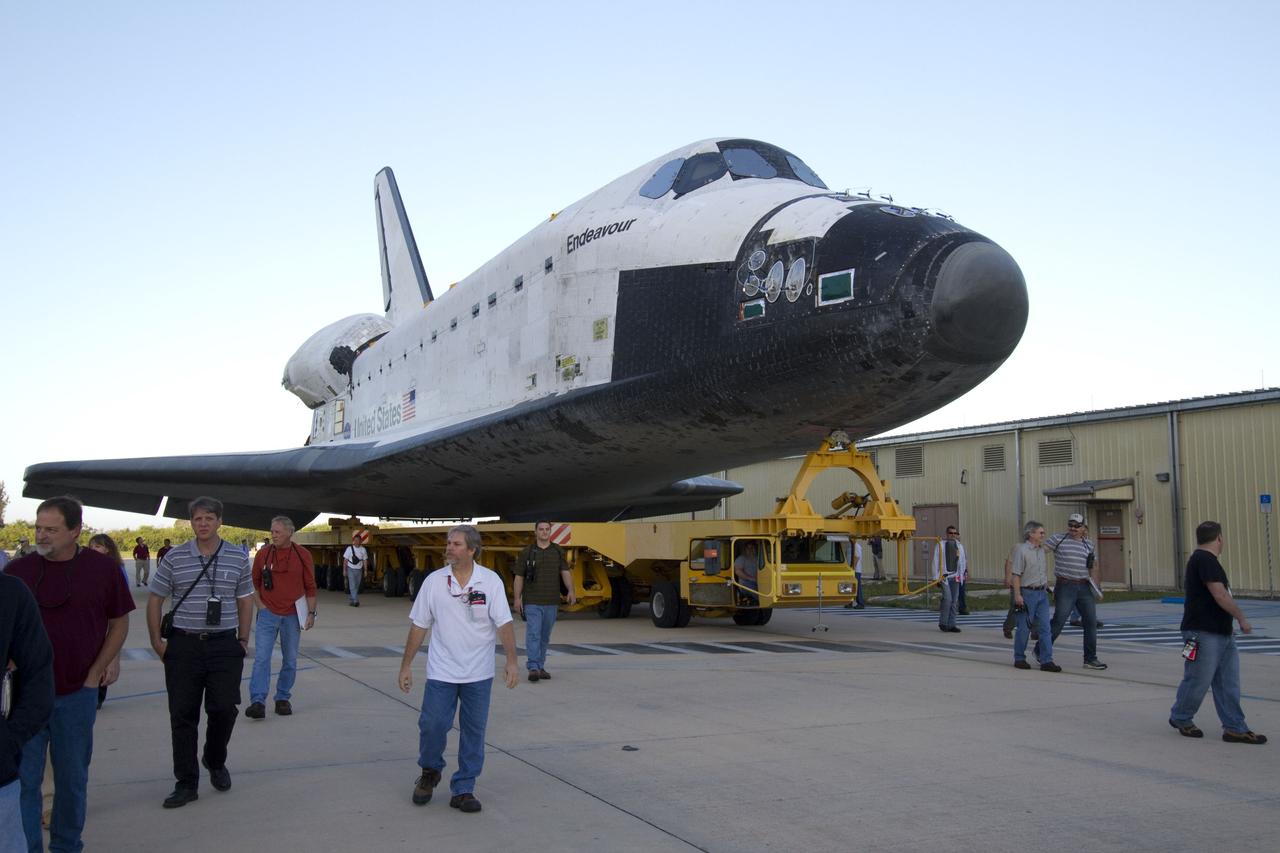
CAPE CANAVERAL, Fla. -- At NASA's Kennedy Space Center in Florida, workers accompany space shuttle Endeavour as it is being transported from Orbiter Processing Facility-2 to the Vehicle Assembly Building. Endeavour and its STS-134 crew will deliver the Express Logistics Carrier-3, Alpha Magnetic Spectrometer, spare parts, a high-pressure gas tank, additional spare parts for Dextre and micrometeoroid debris shields to the International Space Station. Launch is targeted for April 19 at 7:48 p.m. EDT. For more information visit, http://www.nasa.gov/mission_pages/shuttle/shuttlemissions/sts134/index.html. Photo credit: NASA/Jack Pfaller
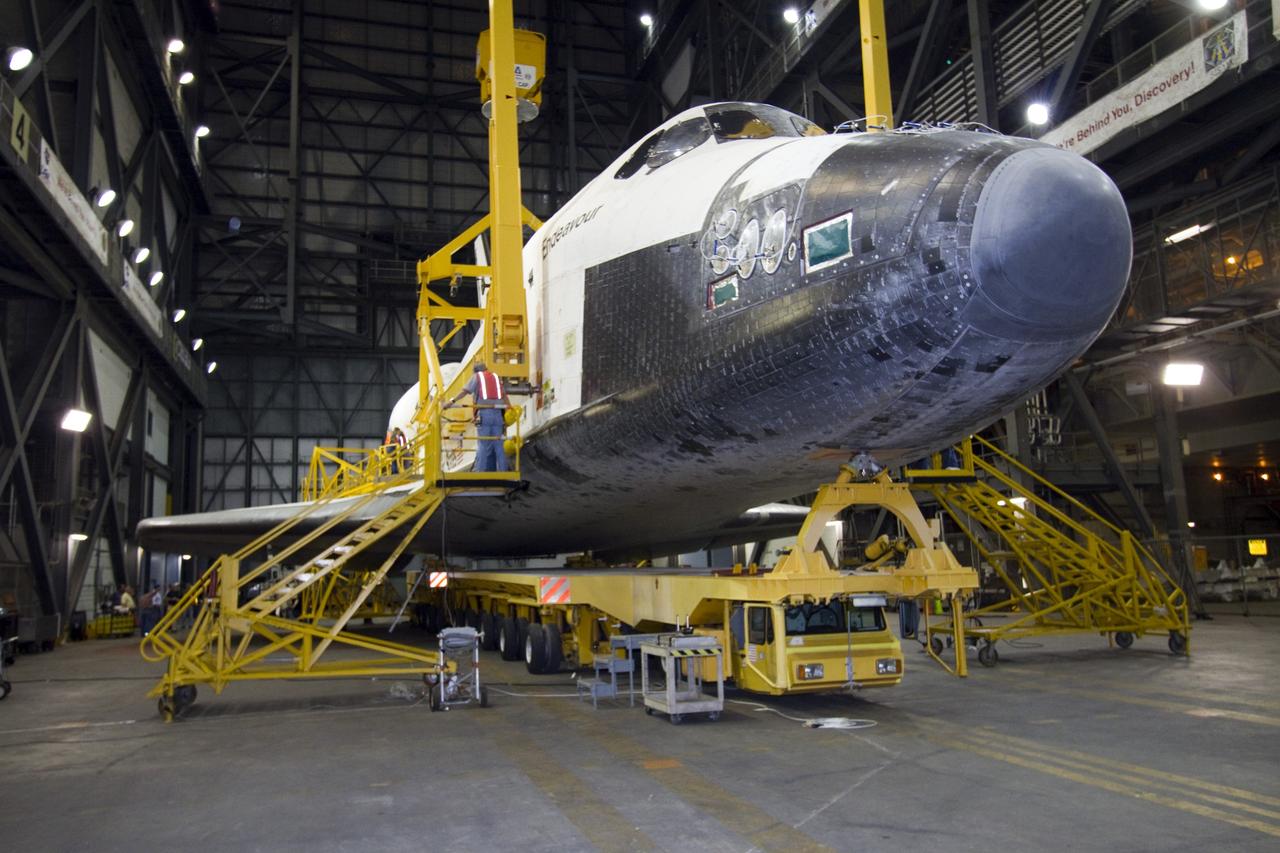
CAPE CANAVERAL, Fla. -- In the Vehicle Assembly Building at NASA's Kennedy Space Center in Florida, workers attach an overhead crane to shuttle Endeavour. The crane will lift the spacecraft into a high bay where it will be attached to the waiting external fuel tank and solid rocket boosters. Endeavour and its STS-134 crew will deliver the Express Logistics Carrier-3, Alpha Magnetic Spectrometer, a high-pressure gas tank, additional spare parts for Dextre and micrometeoroid debris shields to the International Space Station. Endeavour's final launch is targeted for April 19 at 7:48 p.m. EDT. For more information visit, http://www.nasa.gov/mission_pages/shuttle/shuttlemissions/sts134/index.html. Photo credit: NASA/Jack Pfaller
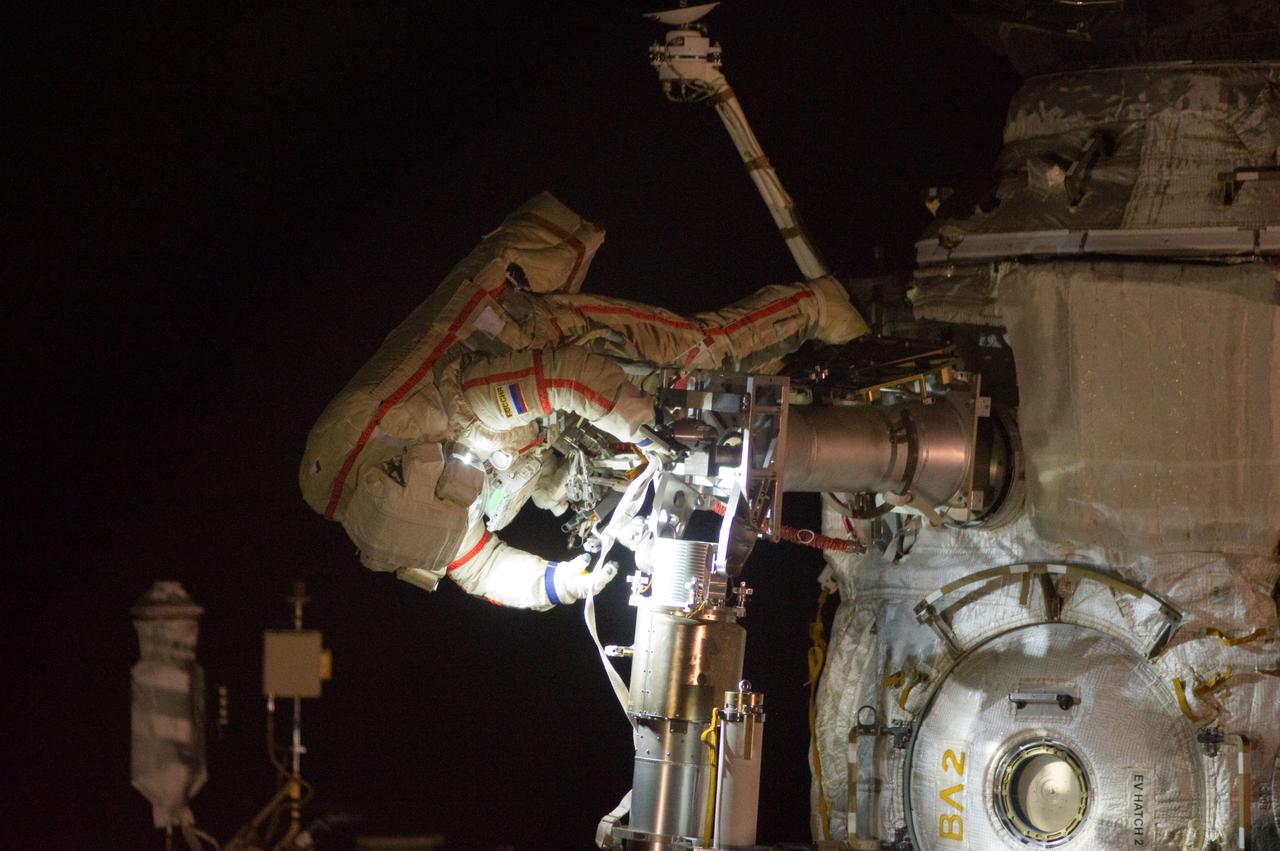
ISS032-E-021024 (20 Aug. 2012) --- Russian cosmonaut Gennady Padalka, Expedition 32 commander, participates in a session of extravehicular activity (EVA) to continue outfitting the International Space Station. During the five-hour, 51-minute spacewalk, Padalka and Russian cosmonaut Yuri Malenchenko (out of frame), flight engineer, moved the Strela-2 cargo boom from the Pirs docking compartment to the Zarya module to prepare Pirs for its eventual replacement with a new Russian multipurpose laboratory module. The two spacewalking cosmonauts also installed micrometeoroid debris shields on the exterior of the Zvezda service module and deployed a small science satellite.
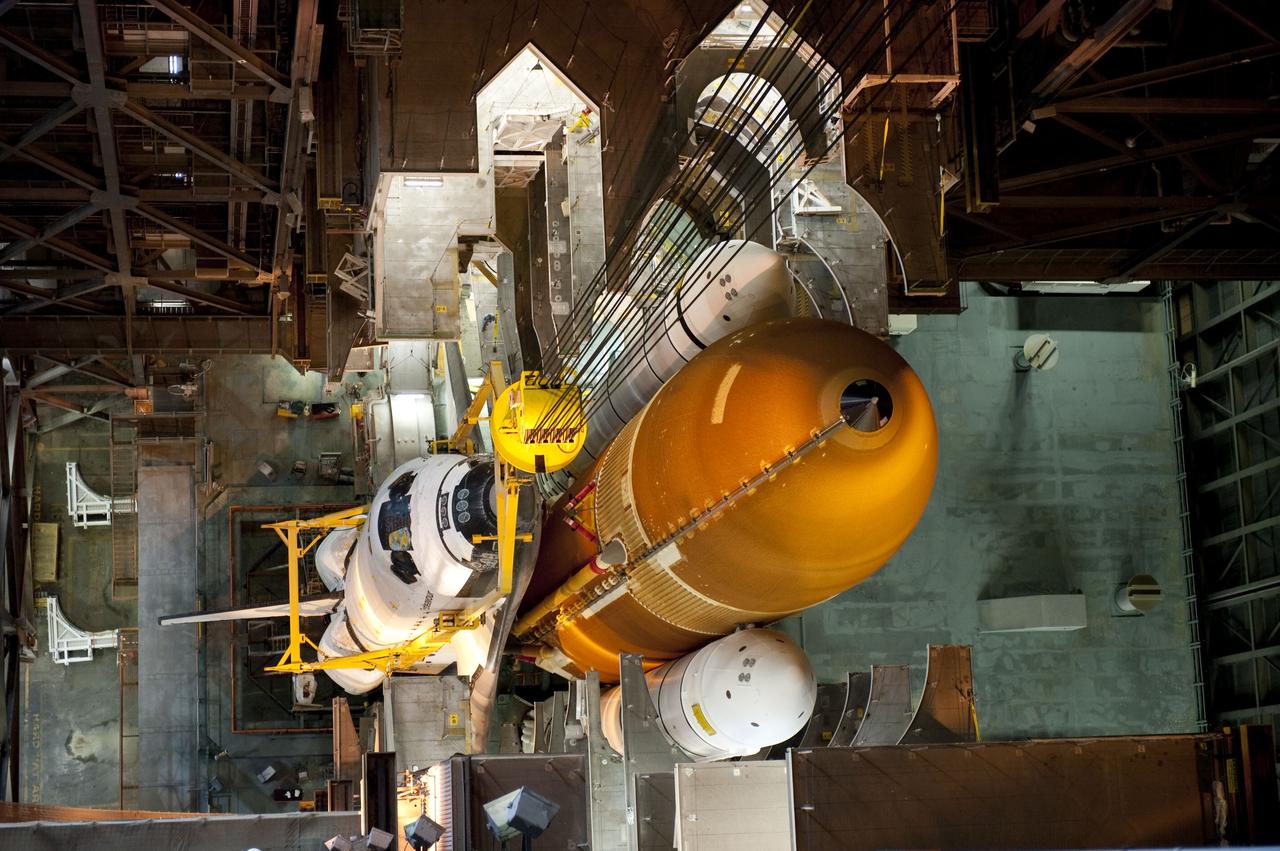
CAPE CANAVERAL, Fla. -- In the Vehicle Assembly Building at NASA's Kennedy Space Center in Florida, shuttle Endeavour is lowered into place where it is being attached to its external fuel tank and solid rocket boosters, already positioned on the mobile launcher platform. Endeavour and its STS-134 crew will deliver the Express Logistics Carrier-3, Alpha Magnetic Spectrometer, a high-pressure gas tank, additional spare parts for Dextre and micrometeoroid debris shields to the International Space Station. Endeavour's final launch is targeted for April 19 at 7:48 p.m. EDT. For more information visit, http://www.nasa.gov/mission_pages/shuttle/shuttlemissions/sts134/index.html. Photo credit: NASA/Kim Shiflett
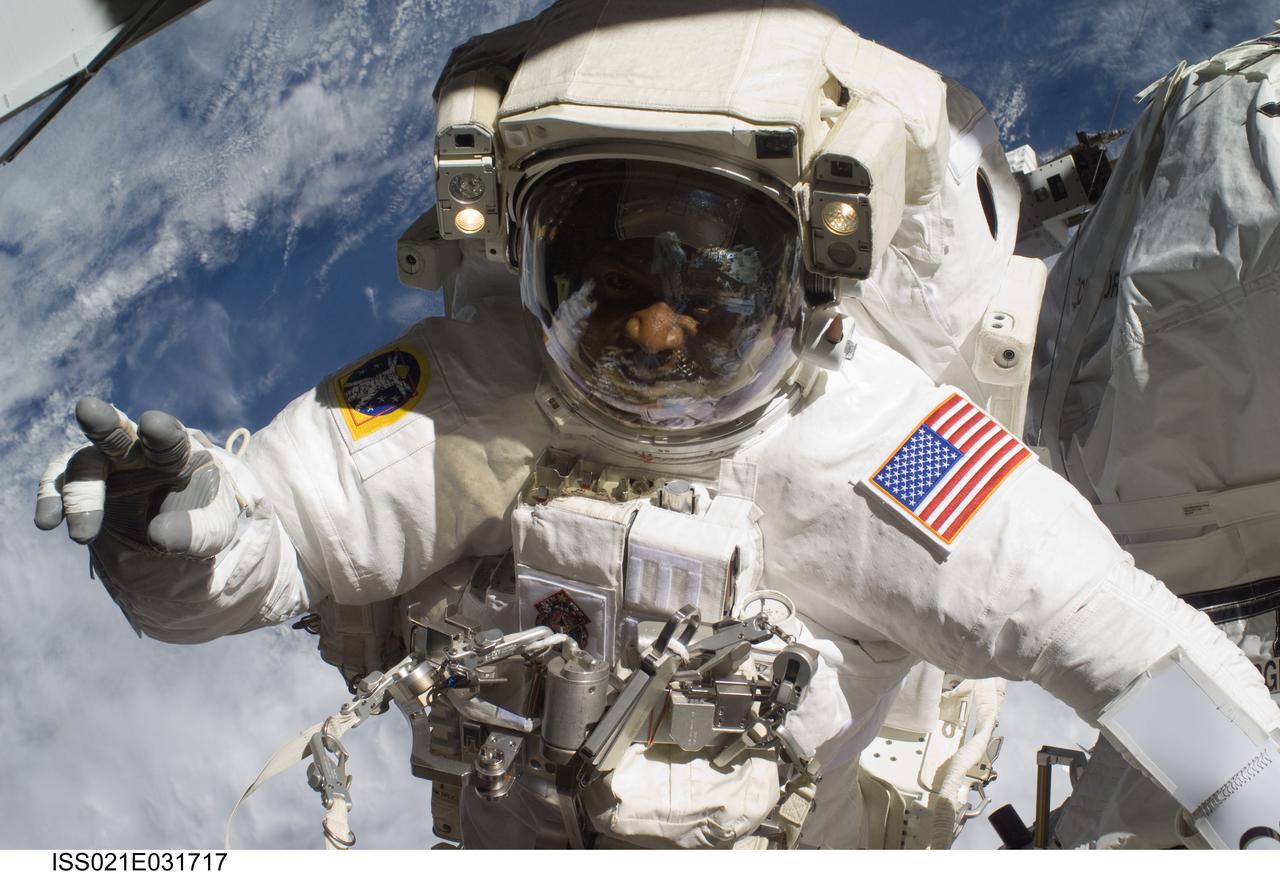
ISS021-E-031717 (23 Nov. 2009) --- Astronaut Robert L. Satcher Jr., STS-129 mission specialist, participates in the mission's third and final session of extravehicular activity (EVA) as construction and maintenance continue on the International Space Station. During the five-hour, 42-minute spacewalk, Satcher and astronaut Randy Bresnik (out of frame), mission specialist, removed a pair of micrometeoroid and orbital debris shields from the Quest airlock and strapped them to the External Stowage Platform #2, then moved an articulating foot restraint to the airlock, and released a bolt on a starboard truss ammonia tank assembly (ATA) in preparation for an STS-131 spacewalk that will replace the ATA.
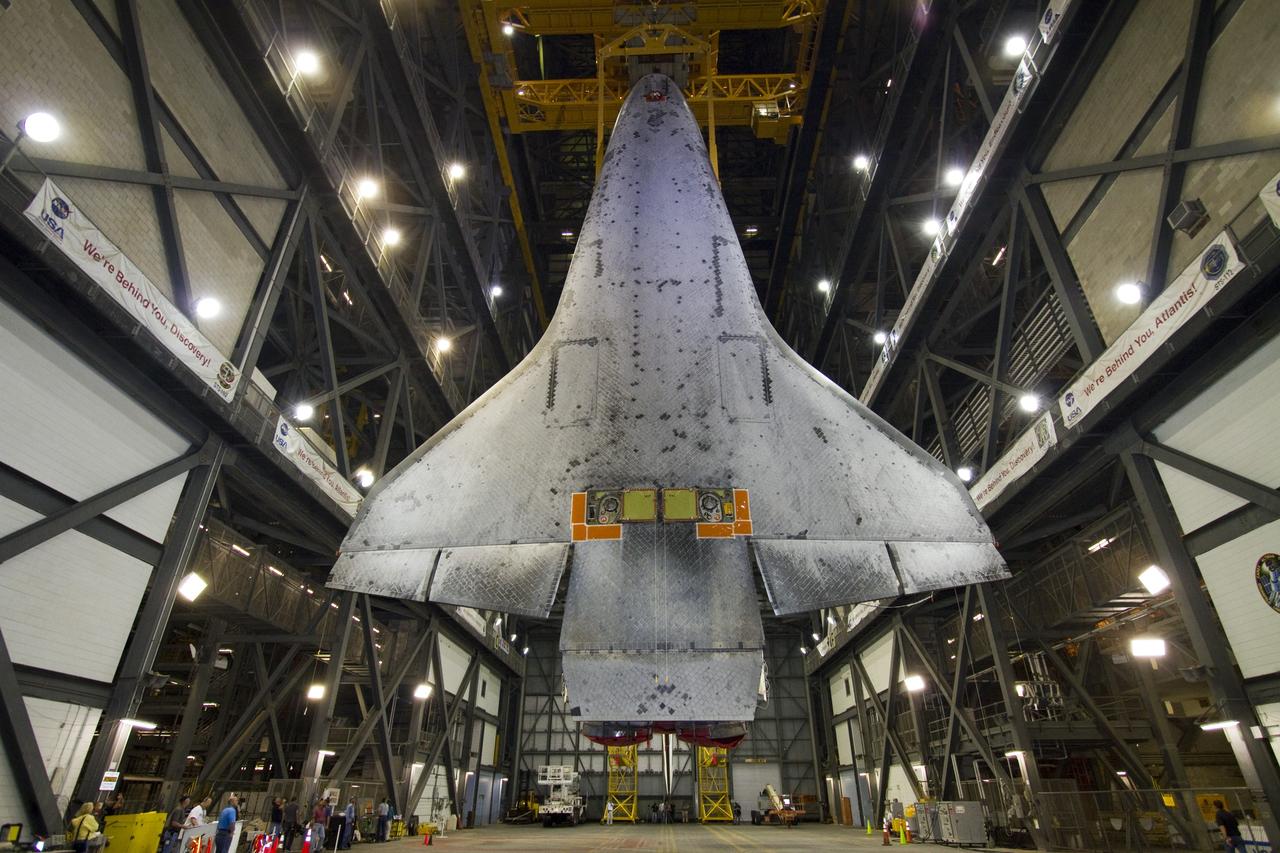
CAPE CANAVERAL, Fla. -- In Vehicle Assembly Building at NASA's Kennedy Space Center in Florida, shuttle Endeavour is suspended vertically over the transfer aisle. The spacecraft will be moved into a high bay where it will be installed to the waiting external fuel tank and solid rocket boosters. Endeavour and its STS-134 crew will deliver the Express Logistics Carrier-3, Alpha Magnetic Spectrometer, a high-pressure gas tank, additional spare parts for Dextre and micrometeoroid debris shields to the International Space Station. Endeavour's final launch is targeted for April 19 at 7:48 p.m. EDT. For more information visit, http://www.nasa.gov/mission_pages/shuttle/shuttlemissions/sts134/index.html. Photo credit: NASA/Jack Pfaller

ISS032-E-021054 (20 Aug. 2012) --- Russian cosmonaut Yuri Malenchenko, Expedition 32 flight engineer, participates in a session of extravehicular activity (EVA) to continue outfitting the International Space Station. During the five-hour, 51-minute spacewalk, Malenchenko and Russian cosmonaut Gennady Padalka (out of frame), commander, moved the Strela-2 cargo boom from the Pirs docking compartment to the Zarya module to prepare Pirs for its eventual replacement with a new Russian multipurpose laboratory module. The two spacewalking cosmonauts also installed micrometeoroid debris shields on the exterior of the Zvezda service module and deployed a small science satellite.
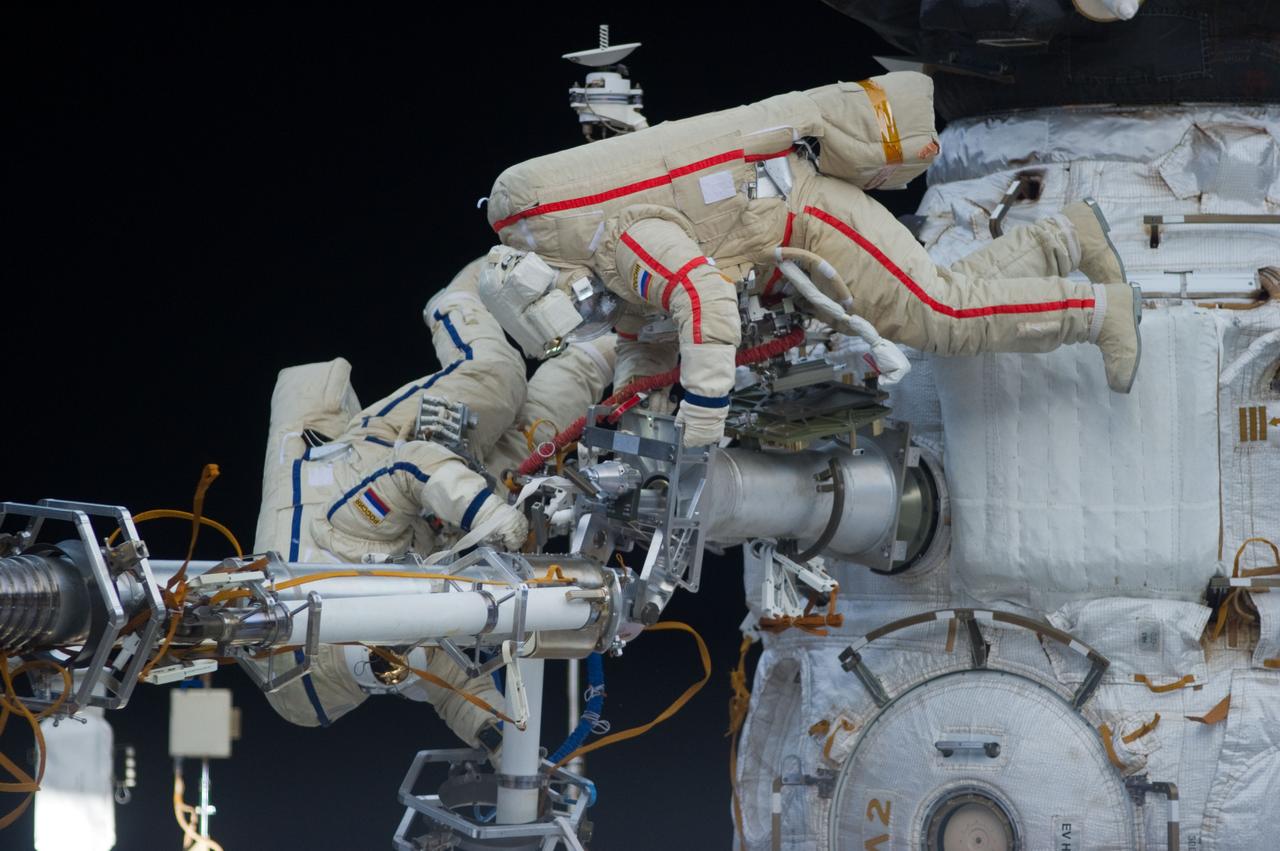
ISS032-E-021061 (20 Aug. 2012) --- Russian cosmonauts Gennady Padalka (top), Expedition 32 commander; and Yuri Malenchenko, flight engineer, participate in a session of extravehicular activity (EVA) to continue outfitting the International Space Station. During the five-hour, 51-minute spacewalk, Padalka and Malenchenko moved the Strela-2 cargo boom from the Pirs docking compartment to the Zarya module to prepare Pirs for its eventual replacement with a new Russian multipurpose laboratory module. The two spacewalking cosmonauts also installed micrometeoroid debris shields on the exterior of the Zvezda service module and deployed a small science satellite.
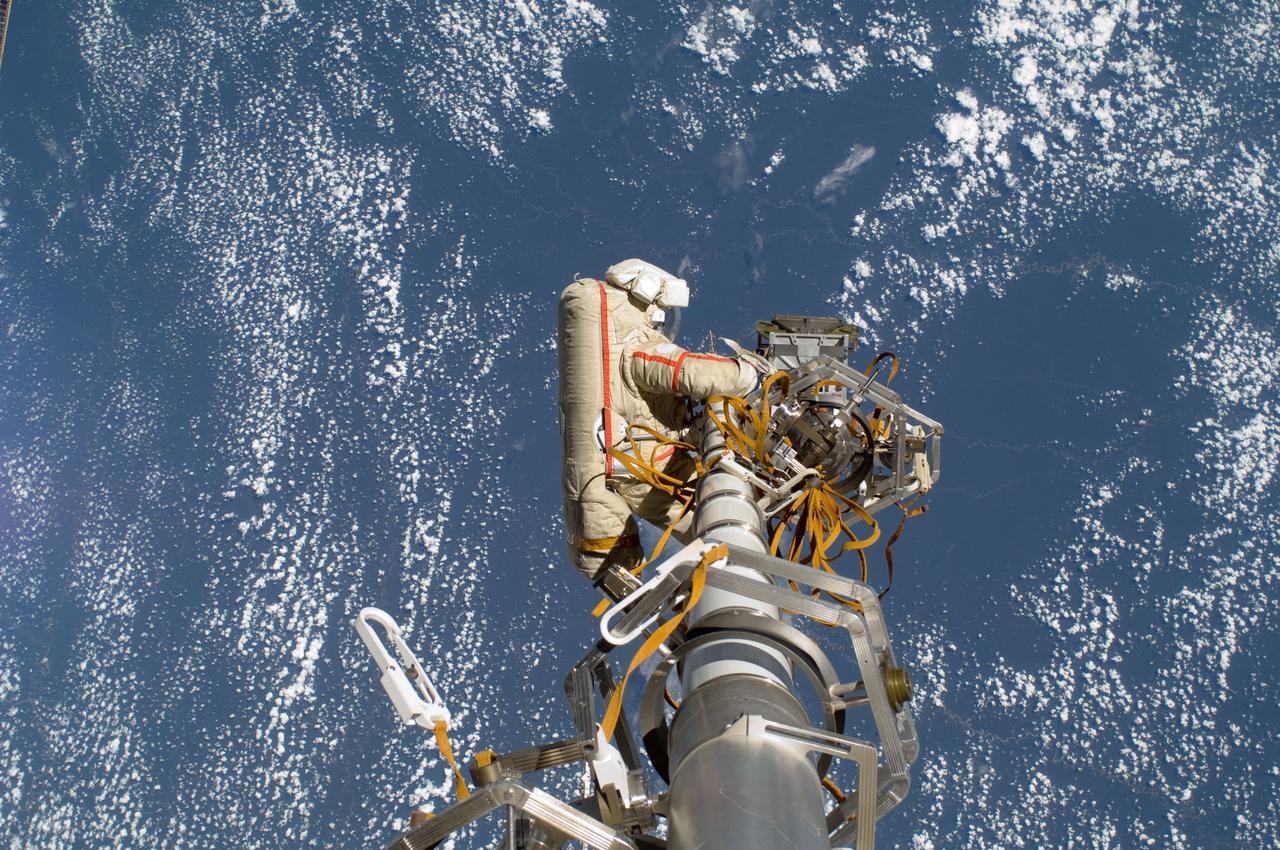
ISS032-E-020576 (20 Aug. 2012) --- Russian cosmonaut Gennady Padalka, Expedition 32 commander, participates in a session of extravehicular activity (EVA) to continue outfitting the International Space Station. During the five-hour, 51-minute spacewalk, Padalka and Russian cosmonaut Yuri Malenchenko (out of frame), flight engineer, moved the Strela-2 cargo boom from the Pirs docking compartment to the Zarya module to prepare Pirs for its eventual replacement with a new Russian multipurpose laboratory module. The two spacewalking cosmonauts also installed micrometeoroid debris shields on the exterior of the Zvezda service module and deployed a small science satellite.
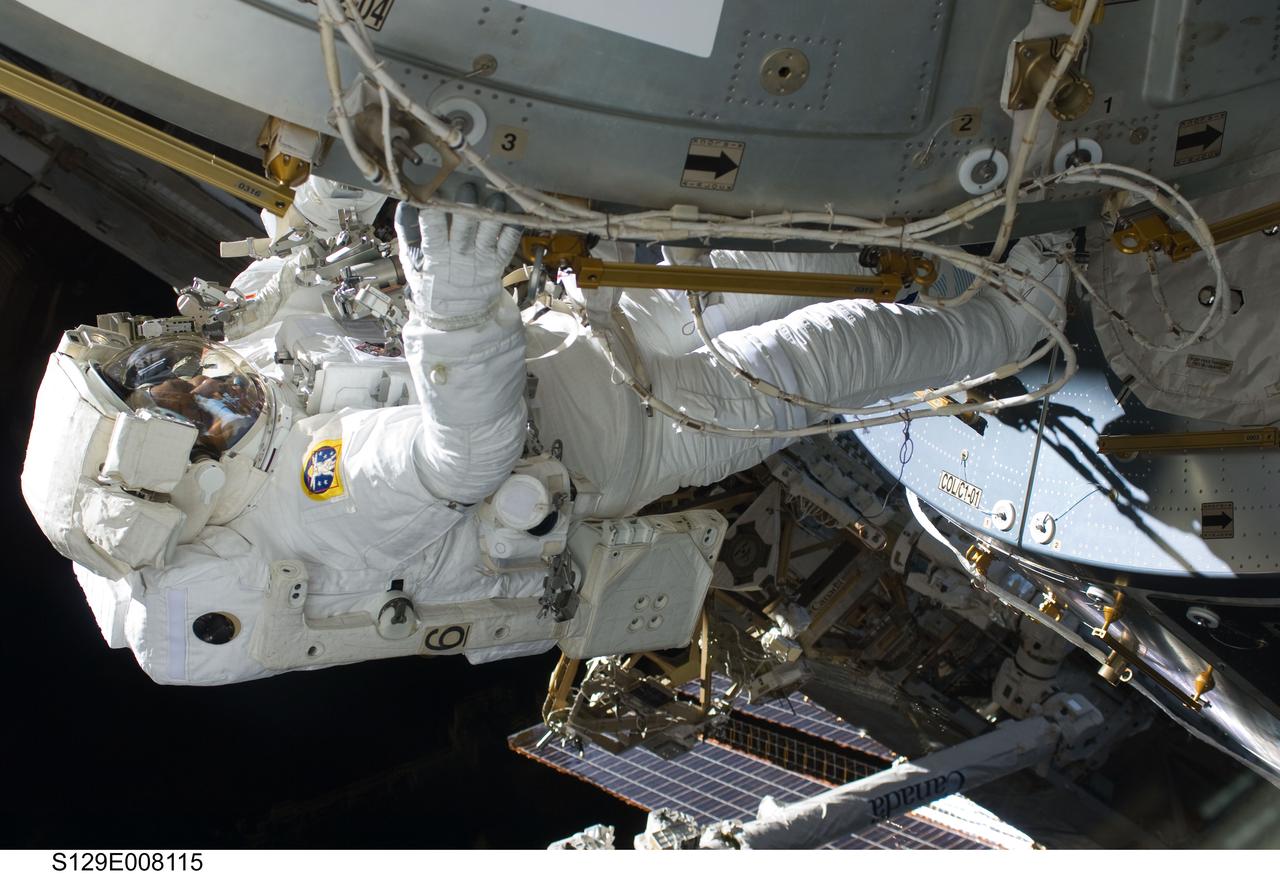
S129-E-008115 (23 Nov. 2009) --- Astronaut Robert L. Satcher Jr., STS-129 mission specialist, participates in the mission's third and final session of extravehicular activity (EVA) as construction and maintenance continue on the International Space Station. During the five-hour, 42-minute spacewalk, Satcher and astronaut Randy Bresnik (out of frame), mission specialist, removed a pair of micrometeoroid and orbital debris shields from the Quest airlock and strapped them to the External Stowage Platform #2, then moved an articulating foot restraint to the airlock, and released a bolt on a starboard truss ammonia tank assembly (ATA) in preparation for an STS-131 spacewalk that will replace the ATA.
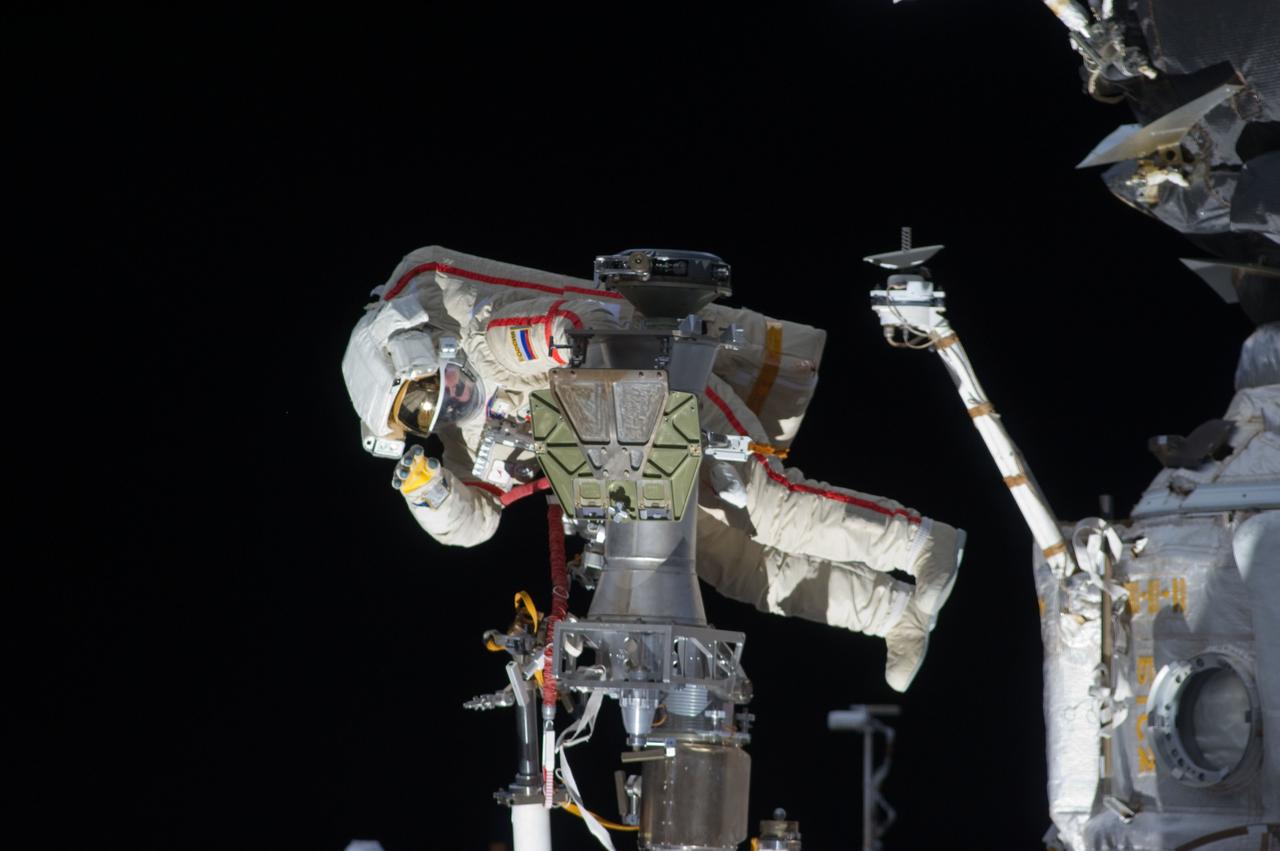
ISS032-E-021081 (20 Aug. 2012) --- Russian cosmonaut Gennady Padalka, Expedition 32 commander, participates in a session of extravehicular activity (EVA) to continue outfitting the International Space Station. During the five-hour, 51-minute spacewalk, Padalka and Russian cosmonaut Yuri Malenchenko (out of frame), flight engineer, moved the Strela-2 cargo boom from the Pirs docking compartment to the Zarya module to prepare Pirs for its eventual replacement with a new Russian multipurpose laboratory module. The two spacewalking cosmonauts also installed micrometeoroid debris shields on the exterior of the Zvezda service module and deployed a small science satellite.
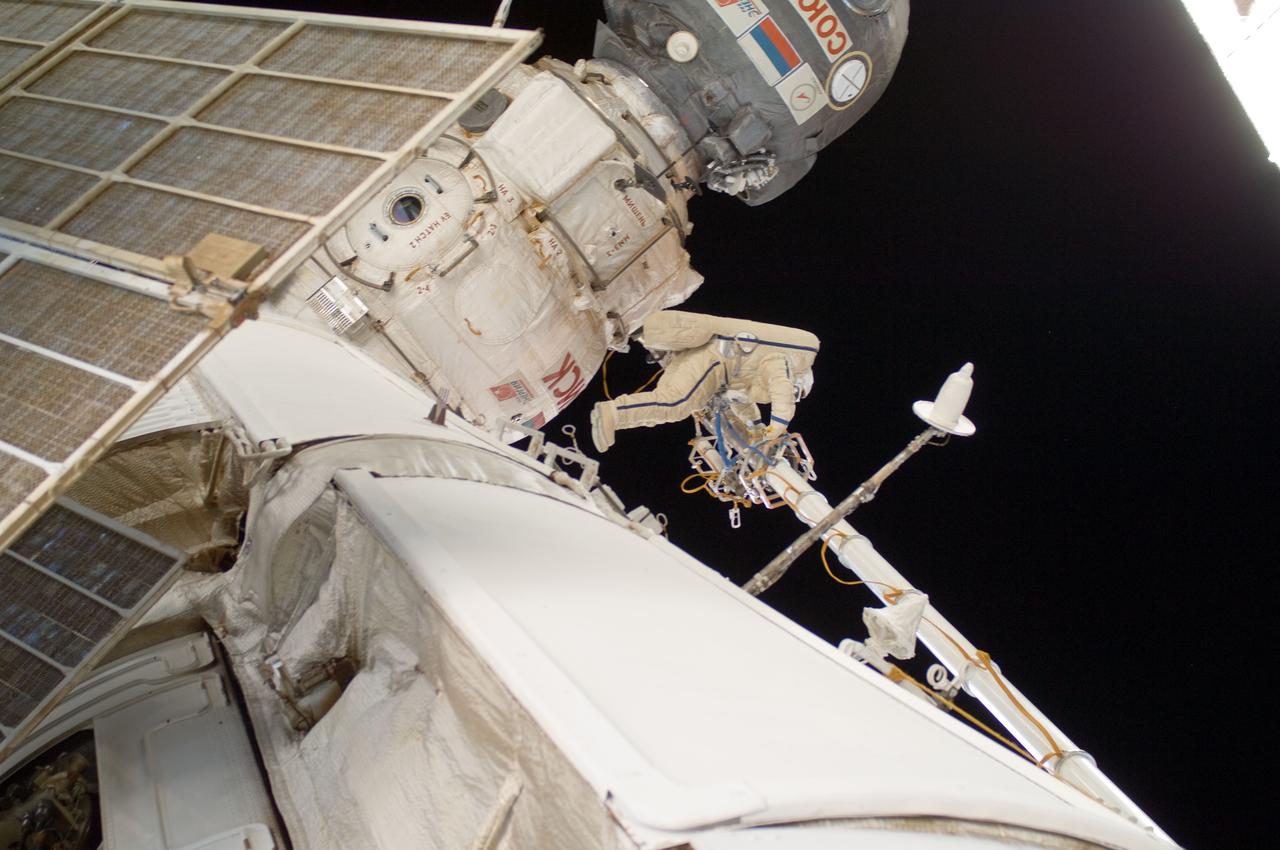
ISS032-E-020892 (20 Aug. 2012) --- Russian cosmonaut Yuri Malenchenko, Expedition 32 flight engineer, participates in a session of extravehicular activity (EVA) to continue outfitting the International Space Station. During the five-hour, 51-minute spacewalk, Malenchenko and Russian cosmonaut Gennady Padalka (out of frame), commander, moved the Strela-2 cargo boom from the Pirs docking compartment to the Zarya module to prepare Pirs for its eventual replacement with a new Russian multipurpose laboratory module. The two spacewalking cosmonauts also installed micrometeoroid debris shields on the exterior of the Zvezda service module and deployed a small science satellite.
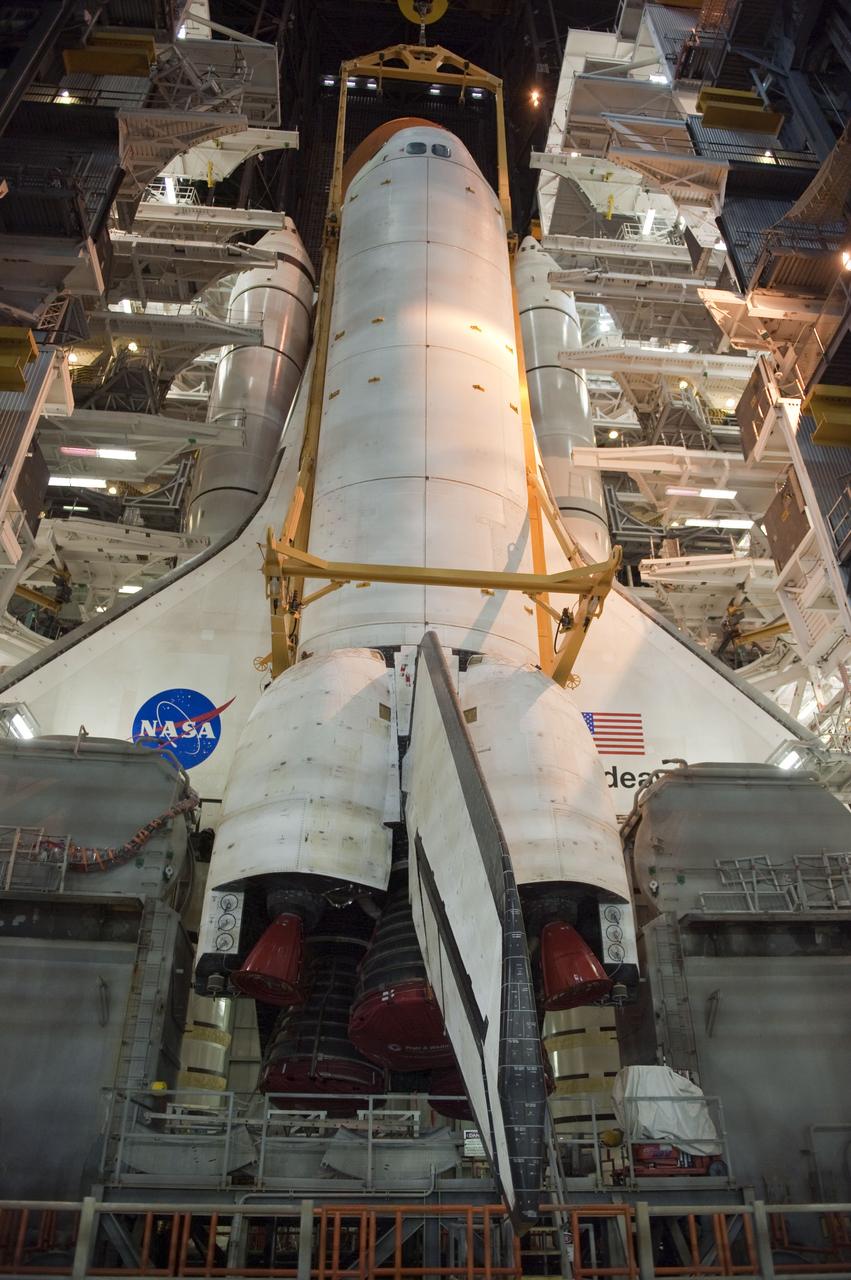
CAPE CANAVERAL, Fla. -- In the Vehicle Assembly Building at NASA's Kennedy Space Center in Florida, shuttle Endeavour is lowered into place where it is being attached to its external fuel tank and solid rocket boosters, already positioned on the mobile launcher platform. Endeavour and its STS-134 crew will deliver the Express Logistics Carrier-3, Alpha Magnetic Spectrometer, a high-pressure gas tank, additional spare parts for Dextre and micrometeoroid debris shields to the International Space Station. Endeavour's final launch is targeted for April 19 at 7:48 p.m. EDT. For more information visit, http://www.nasa.gov/mission_pages/shuttle/shuttlemissions/sts134/index.html. Photo credit: NASA/Kim Shiflett
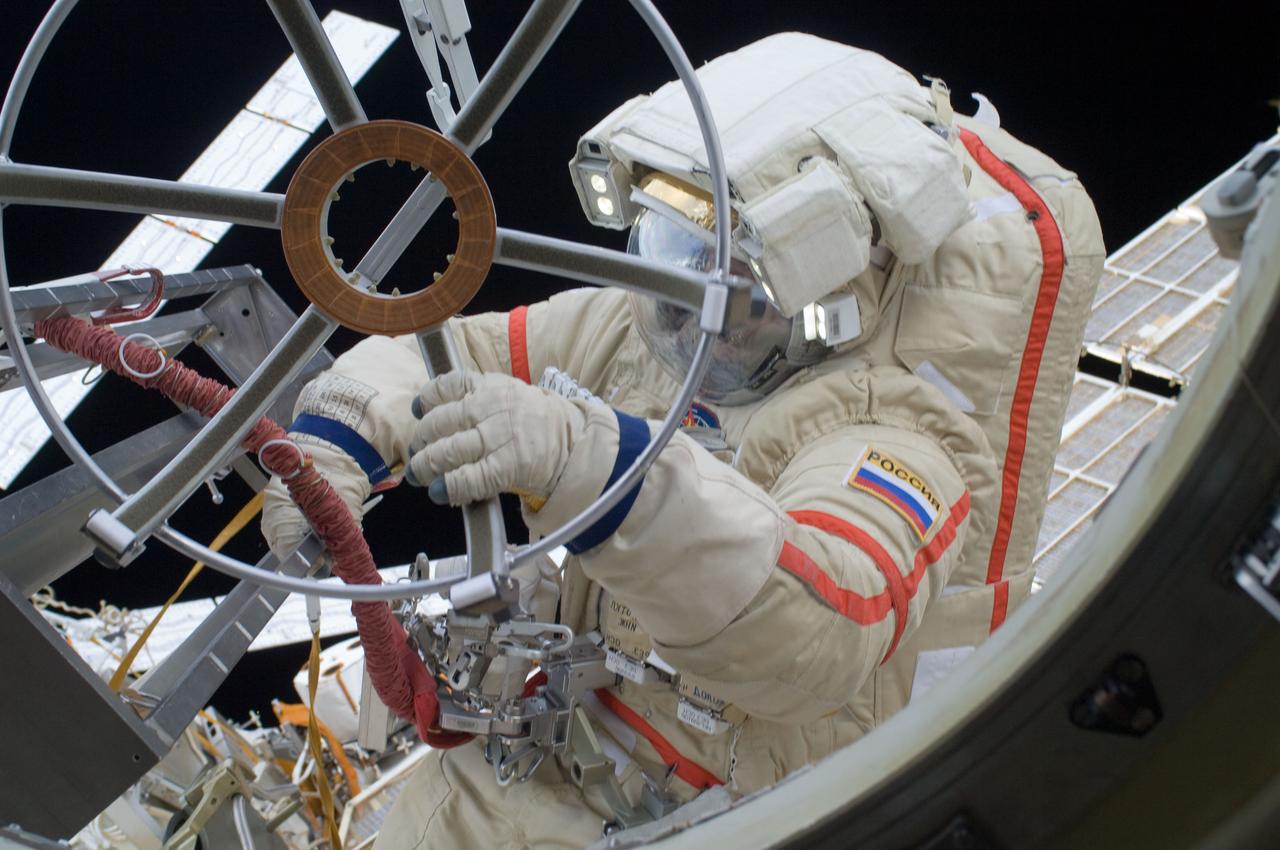
ISS032-E-020610 (20 Aug. 2012) --- Russian cosmonaut Gennady Padalka, Expedition 32 commander, participates in a session of extravehicular activity (EVA) to continue outfitting the International Space Station. During the five-hour, 51-minute spacewalk, Padalka and Russian cosmonaut Yuri Malenchenko (out of frame), flight engineer, moved the Strela-2 cargo boom from the Pirs docking compartment to the Zarya module to prepare Pirs for its eventual replacement with a new Russian multipurpose laboratory module. The two spacewalking cosmonauts also installed micrometeoroid debris shields on the exterior of the Zvezda service module and deployed a small science satellite.
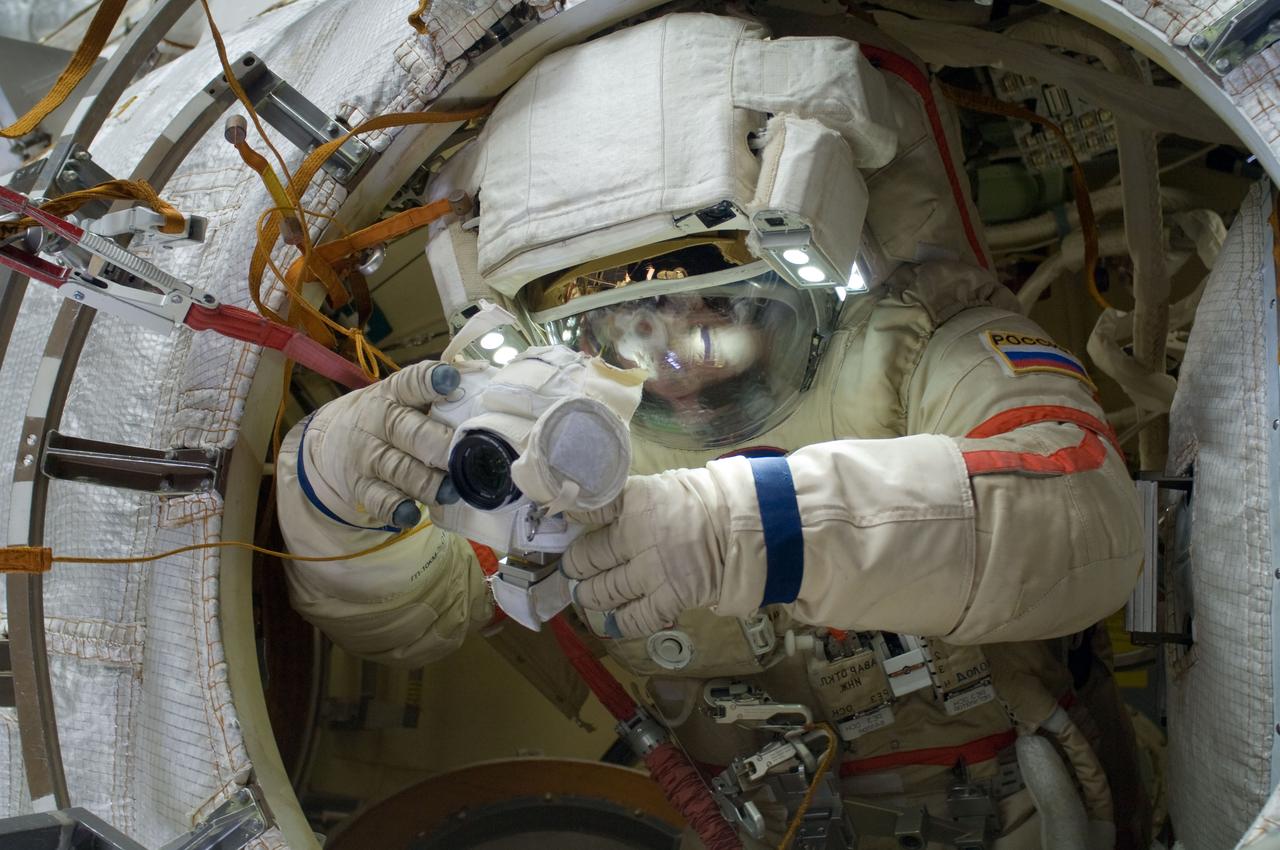
ISS032-E-020619 (20 Aug. 2012) --- Russian cosmonaut Gennady Padalka, Expedition 32 commander, uses a still camera during a session of extravehicular activity (EVA) to continue outfitting the International Space Station. During the five-hour, 51-minute spacewalk, Padalka and Russian cosmonaut Yuri Malenchenko (out of frame), flight engineer, moved the Strela-2 cargo boom from the Pirs docking compartment to the Zarya module to prepare Pirs for its eventual replacement with a new Russian multipurpose laboratory module. The two spacewalking cosmonauts also installed micrometeoroid debris shields on the exterior of the Zvezda service module and deployed a small science satellite.
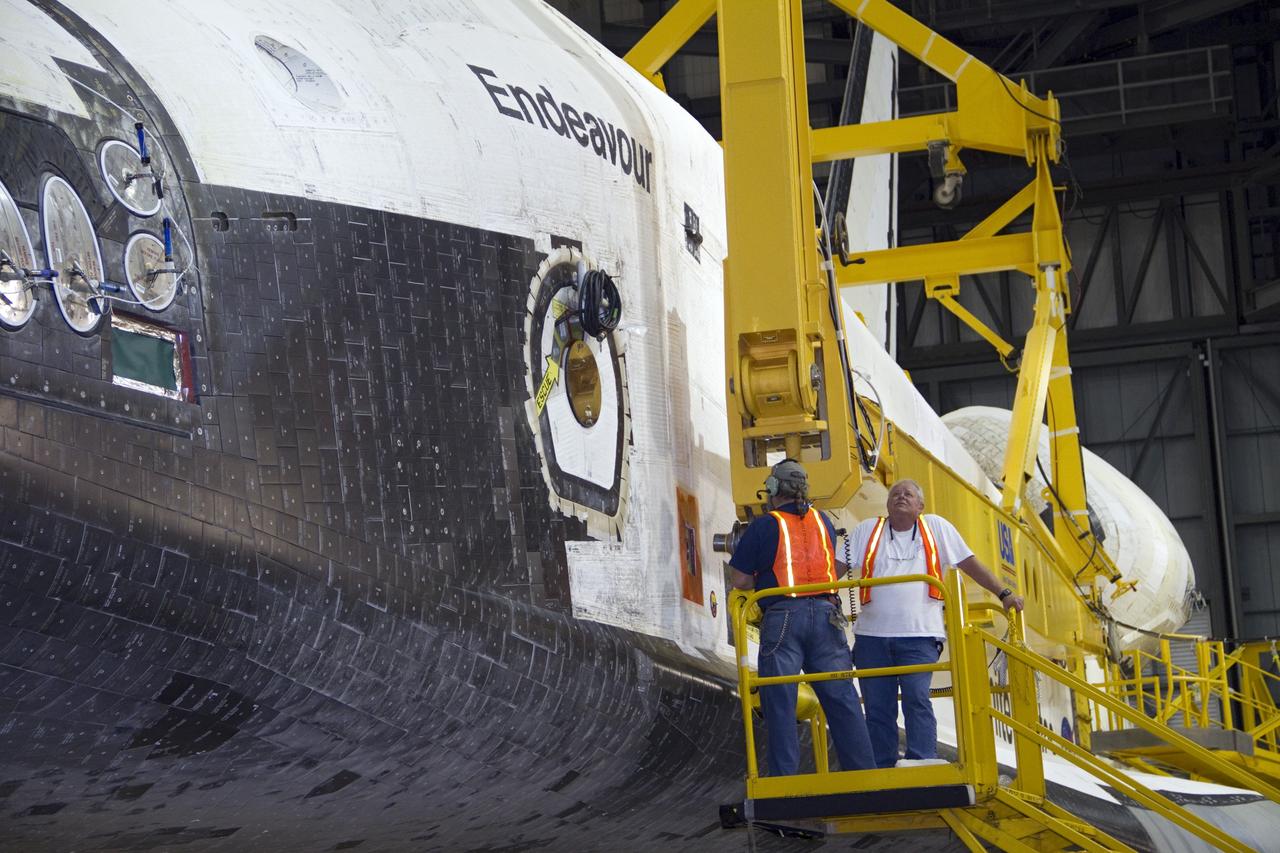
CAPE CANAVERAL, Fla. -- In the Vehicle Assembly Building at NASA's Kennedy Space Center in Florida, workers attach an overhead crane to shuttle Endeavour. The crane will lift the spacecraft into a high bay where it will be attached to the waiting external fuel tank and solid rocket boosters. Endeavour and its STS-134 crew will deliver the Express Logistics Carrier-3, Alpha Magnetic Spectrometer, a high-pressure gas tank, additional spare parts for Dextre and micrometeoroid debris shields to the International Space Station. Endeavour's final launch is targeted for April 19 at 7:48 p.m. EDT. For more information visit, http://www.nasa.gov/mission_pages/shuttle/shuttlemissions/sts134/index.html. Photo credit: NASA/Jack Pfaller
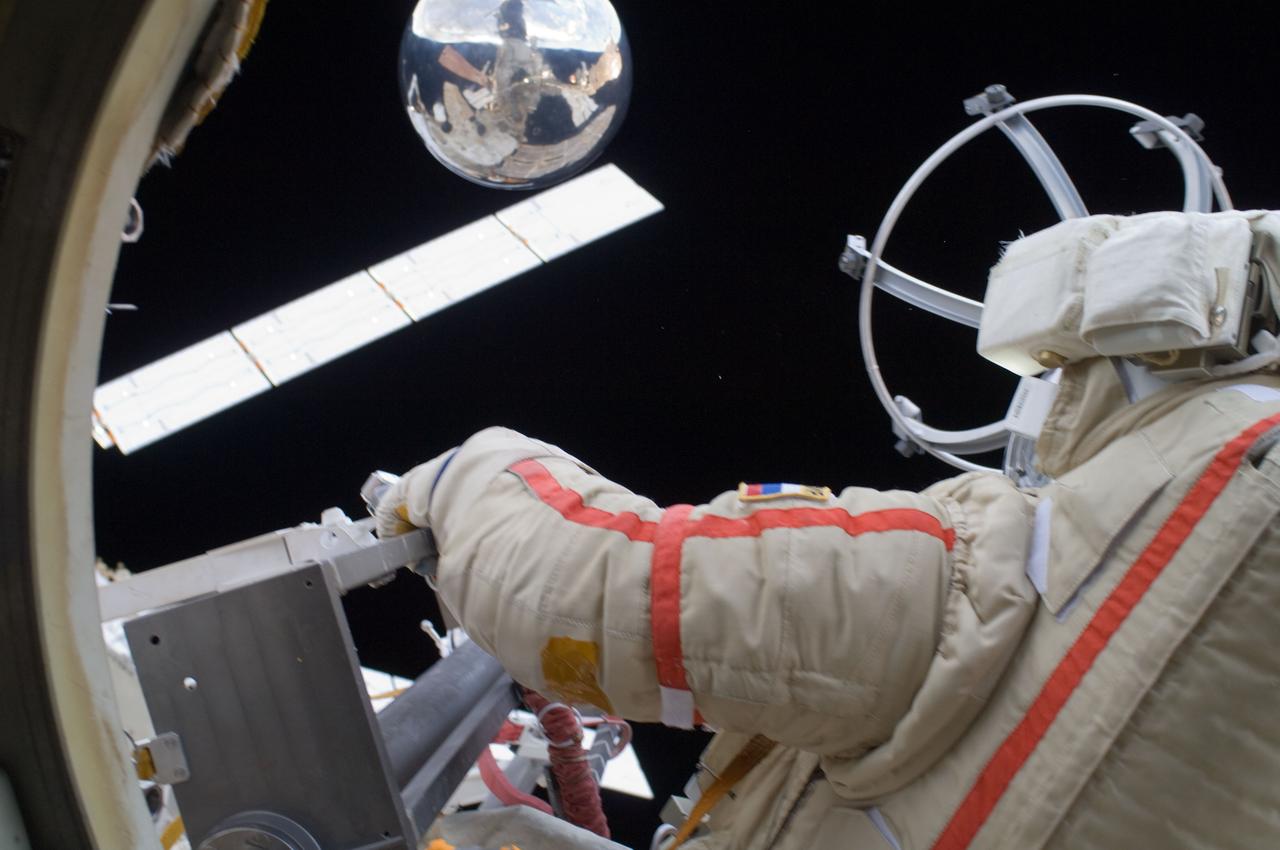
ISS032-E-020601 (20 Aug. 2012) --- Russian cosmonaut Gennady Padalka, Expedition 32 commander, deploys a small ball-shaped science satellite during a session of extravehicular activity (EVA) to continue outfitting the International Space Station. During the five-hour, 51-minute spacewalk, Padalka and Russian cosmonaut Yuri Malenchenko (out of frame), flight engineer, also moved the Strela-2 cargo boom from the Pirs docking compartment to the Zarya module to prepare Pirs for its eventual replacement with a new Russian multipurpose laboratory module. The two spacewalking cosmonauts also installed micrometeoroid debris shields on the exterior of the Zvezda service module.
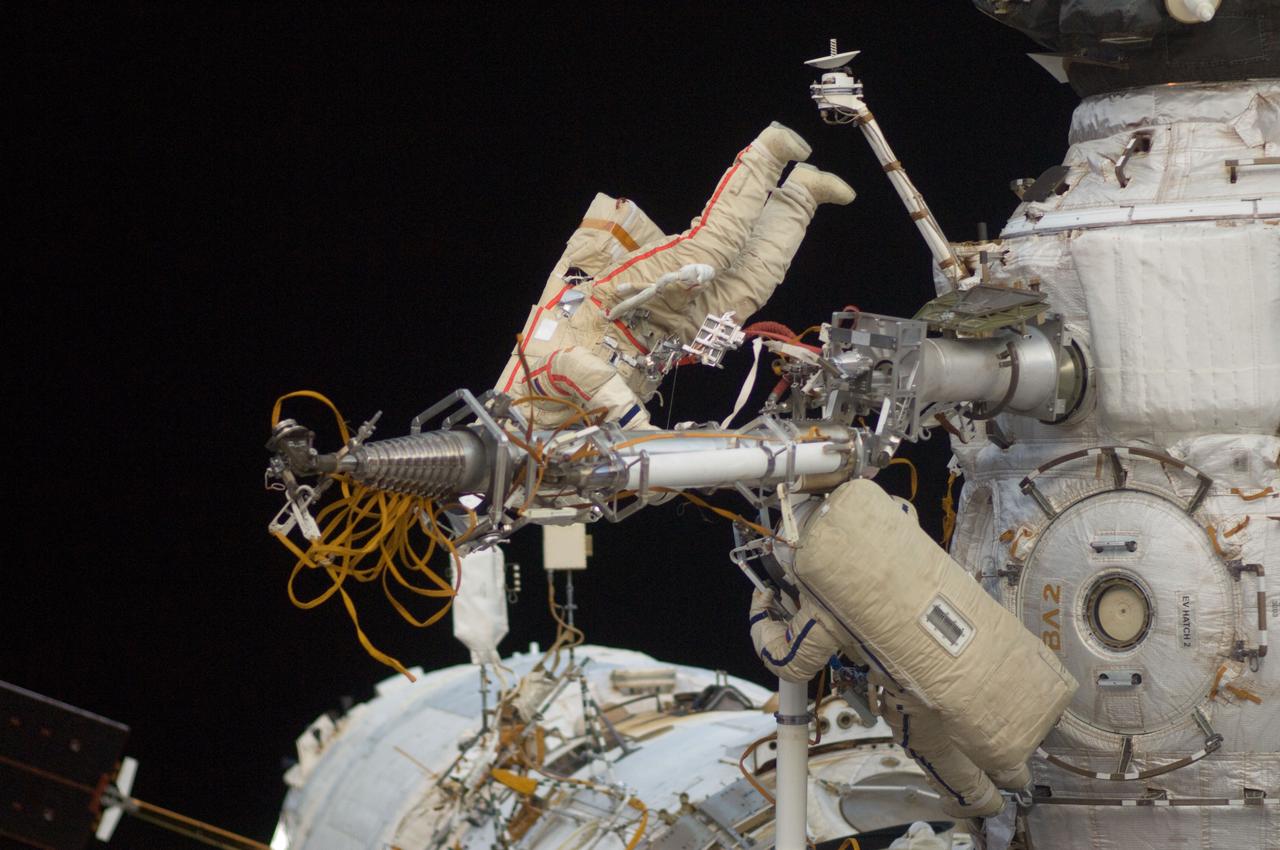
ISS032-E-021286 (20 Aug. 2012) --- Russian cosmonauts Gennady Padalka (top), Expedition 32 commander; and Yuri Malenchenko, flight engineer, participate in a session of extravehicular activity (EVA) to continue outfitting the International Space Station. During the five-hour, 51-minute spacewalk, Padalka and Malenchenko moved the Strela-2 cargo boom from the Pirs docking compartment to the Zarya module to prepare Pirs for its eventual replacement with a new Russian multipurpose laboratory module. The two spacewalking cosmonauts also installed micrometeoroid debris shields on the exterior of the Zvezda service module and deployed a small science satellite.
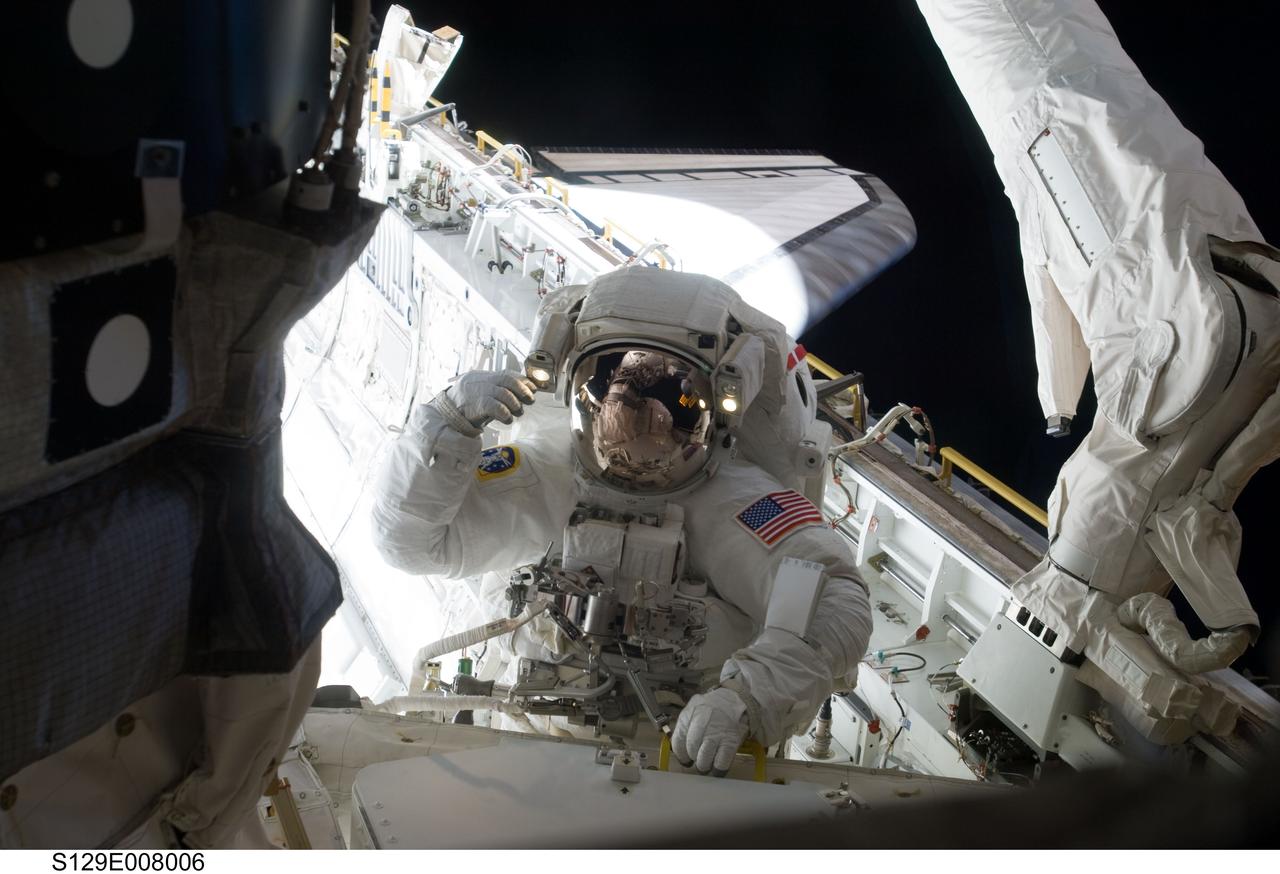
S129-E-008006 (23 Nov. 2009) --- Astronaut Randy Bresnik, STS-129 mission specialist, participates in the mission's third and final session of extravehicular activity (EVA) as construction and maintenance continue on the International Space Station. During the five-hour, 42-minute spacewalk, Bresnik and astronaut Robert L. Satcher Jr. (out of frame), mission specialist, removed a pair of micrometeoroid and orbital debris shields from the Quest airlock and strapped them to the External Stowage Platform #2, then moved an articulating foot restraint to the airlock, and released a bolt on a starboard truss ammonia tank assembly (ATA) in preparation for an STS-131 spacewalk that will replace the ATA.
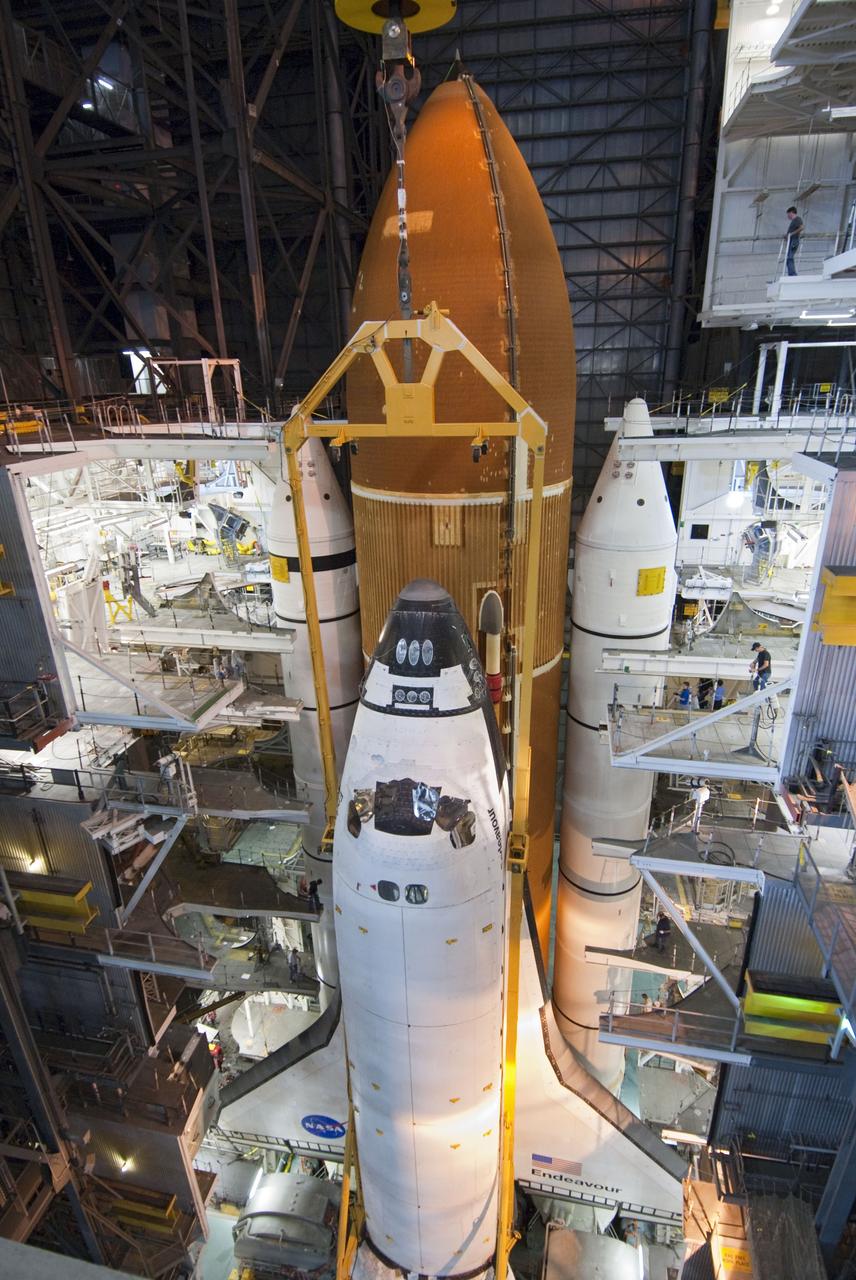
CAPE CANAVERAL, Fla. -- In the Vehicle Assembly Building at NASA's Kennedy Space Center in Florida, shuttle Endeavour is lowered into place where it will be attached to its external fuel tank and solid rocket boosters, already positioned on the mobile launcher platform. Endeavour and its STS-134 crew will deliver the Express Logistics Carrier-3, Alpha Magnetic Spectrometer, a high-pressure gas tank, additional spare parts for Dextre and micrometeoroid debris shields to the International Space Station. Endeavour's final launch is targeted for April 19 at 7:48 p.m. EDT. For more information visit, http://www.nasa.gov/mission_pages/shuttle/shuttlemissions/sts134/index.html. Photo credit: NASA/Jim Grossmann
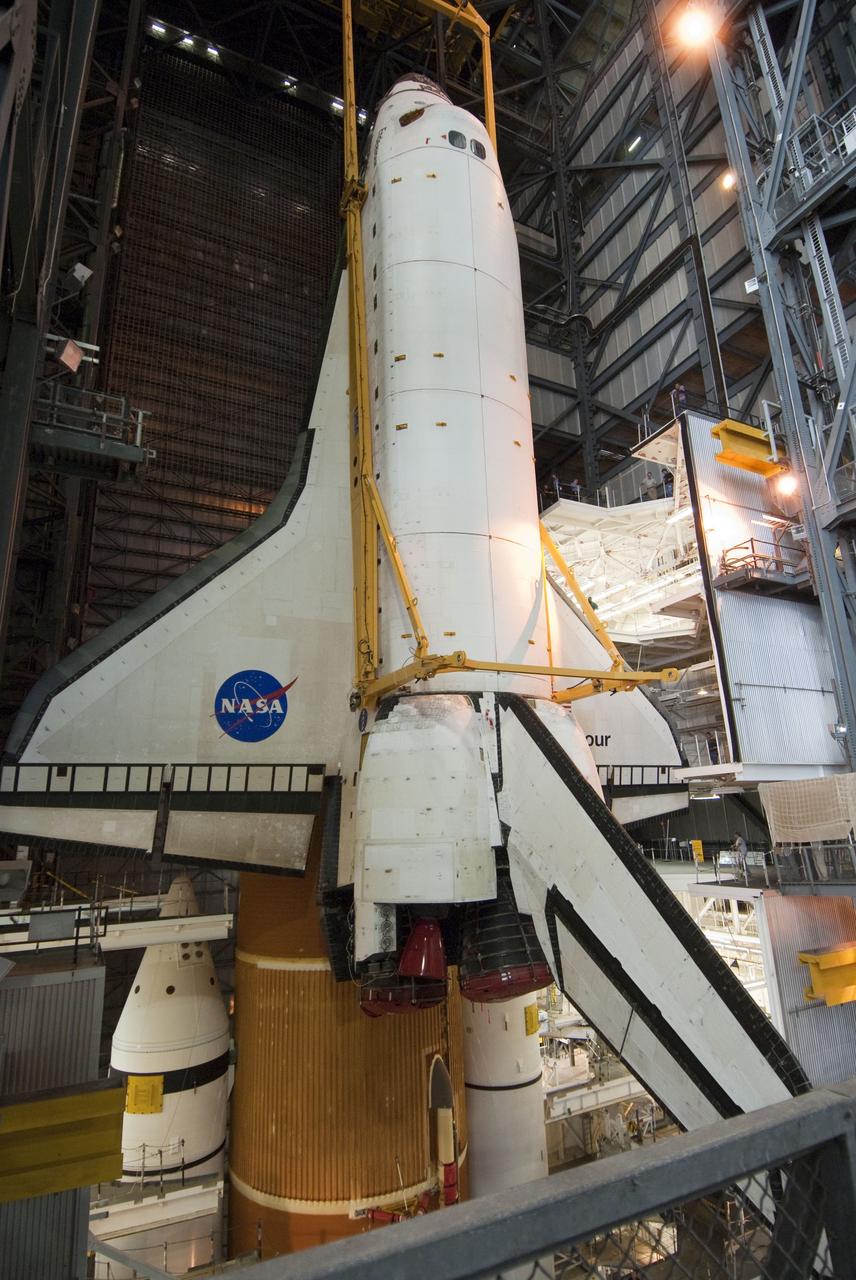
CAPE CANAVERAL, Fla. -- In the Vehicle Assembly Building at NASA's Kennedy Space Center in Florida, shuttle Endeavour is lowered into place where it will be attached to its external fuel tank and solid rocket boosters, already positioned on the mobile launcher platform. Endeavour and its STS-134 crew will deliver the Express Logistics Carrier-3, Alpha Magnetic Spectrometer, a high-pressure gas tank, additional spare parts for Dextre and micrometeoroid debris shields to the International Space Station. Endeavour's final launch is targeted for April 19 at 7:48 p.m. EDT. For more information visit, http://www.nasa.gov/mission_pages/shuttle/shuttlemissions/sts134/index.html. Photo credit: NASA/Jim Grossmann
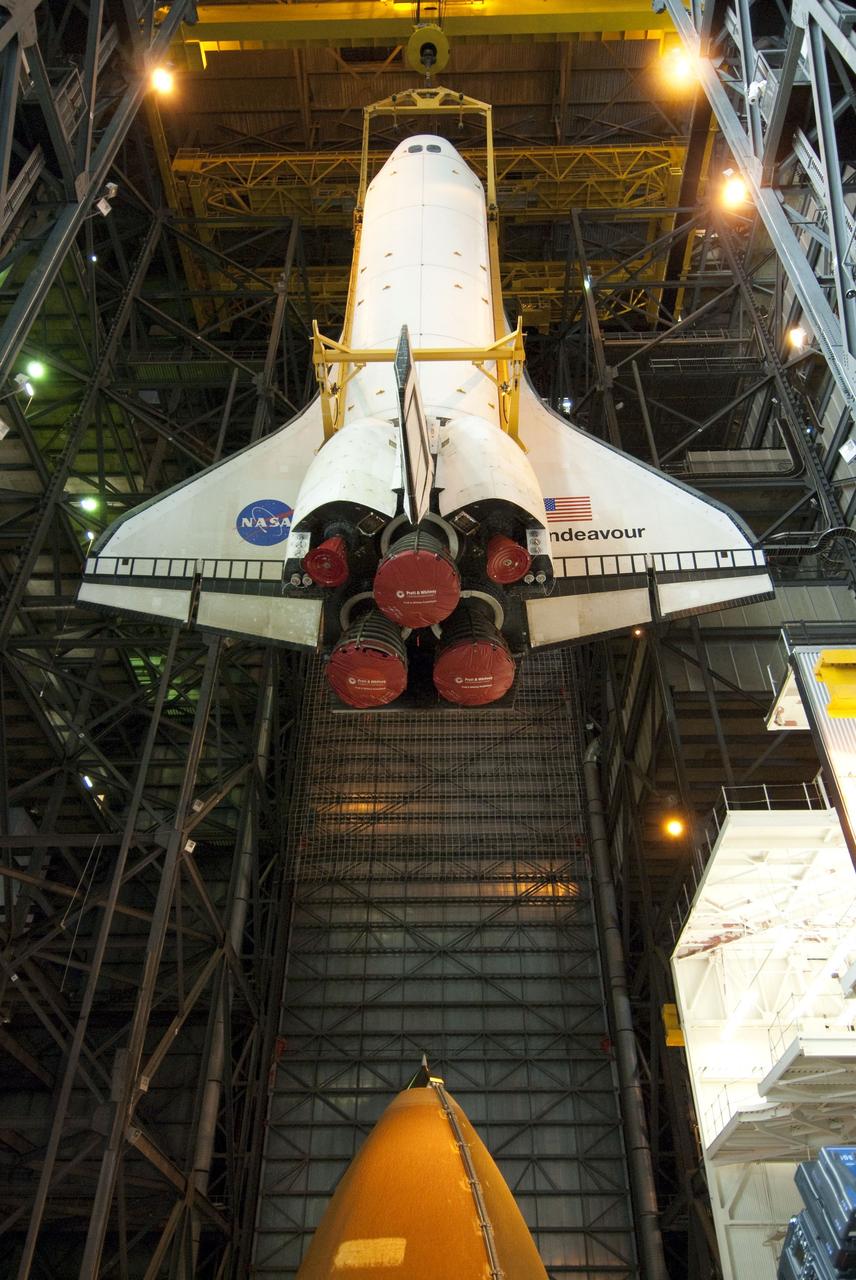
CAPE CANAVERAL, Fla. -- In the Vehicle Assembly Building at NASA's Kennedy Space Center in Florida, shuttle Endeavour is being lowered into a high bay to be attached to its external fuel tank and solid rocket boosters, already positioned on the mobile launcher platform. Endeavour and its STS-134 crew will deliver the Express Logistics Carrier-3, Alpha Magnetic Spectrometer, a high-pressure gas tank, additional spare parts for Dextre and micrometeoroid debris shields to the International Space Station. Endeavour's final launch is targeted for April 19 at 7:48 p.m. EDT. For more information visit, http://www.nasa.gov/mission_pages/shuttle/shuttlemissions/sts134/index.html. Photo credit: NASA/Jim Grossmann
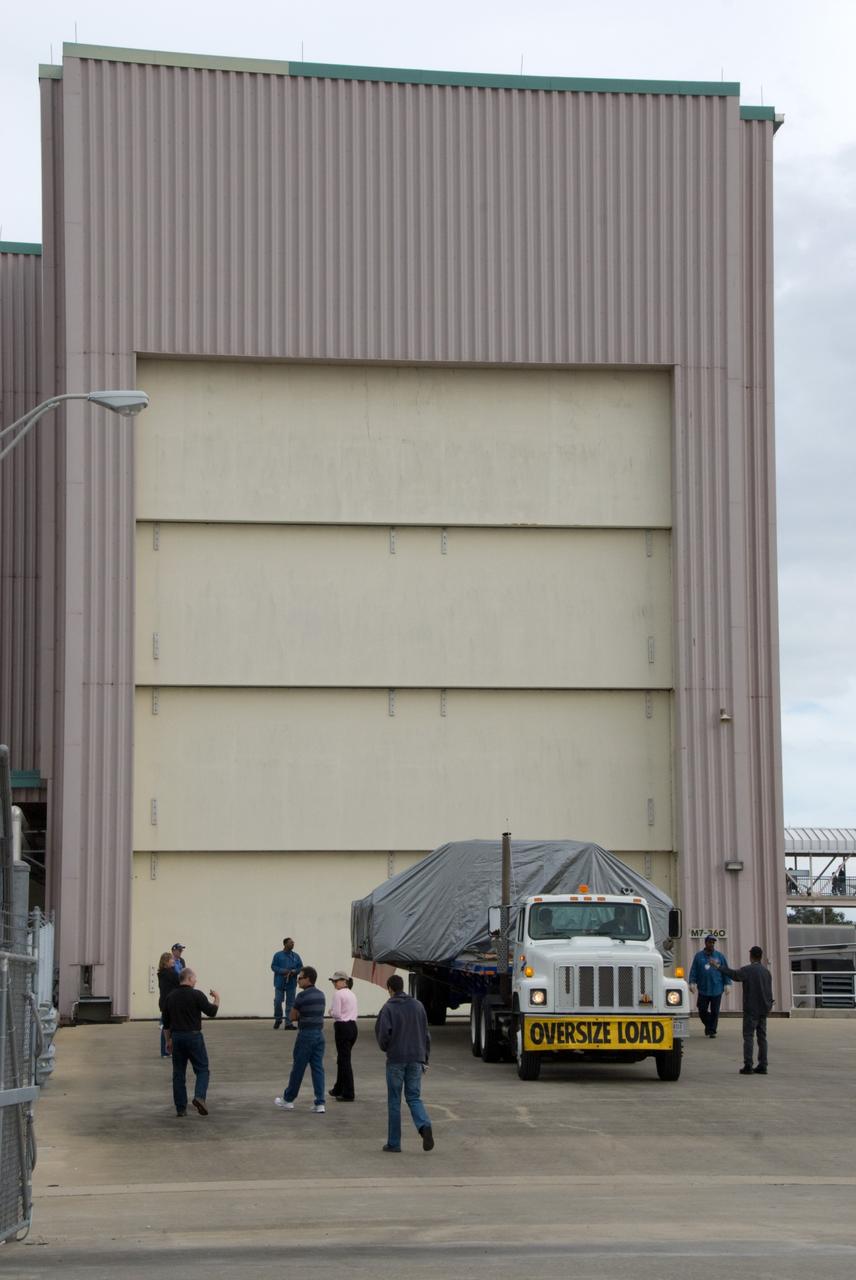
CAPE CANAVERAL, Fla. - At NASA's Kennedy Space Center in Florida, the ExPRESS Logistics Carrier 3, or ELC-3, arrives at the Space Station Processing Facility. ELC-3 and the Alpha Magnetic Spectrometer are the primary payloads for space shuttle Endeavour's STS-134 mission to the International Space Station. The STS-134 crew will also deliver spare parts including two S-band communications antennas, a high pressure gas tank, additional spare parts for Dextre and micrometeoroid debris shields. Endeavour's launch is targeted for July 29, 2010. For information on the STS-134 mission objectives and crew, visit http://www.nasa.gov/shuttle. Photo credit: NASA/Kim Shiflett
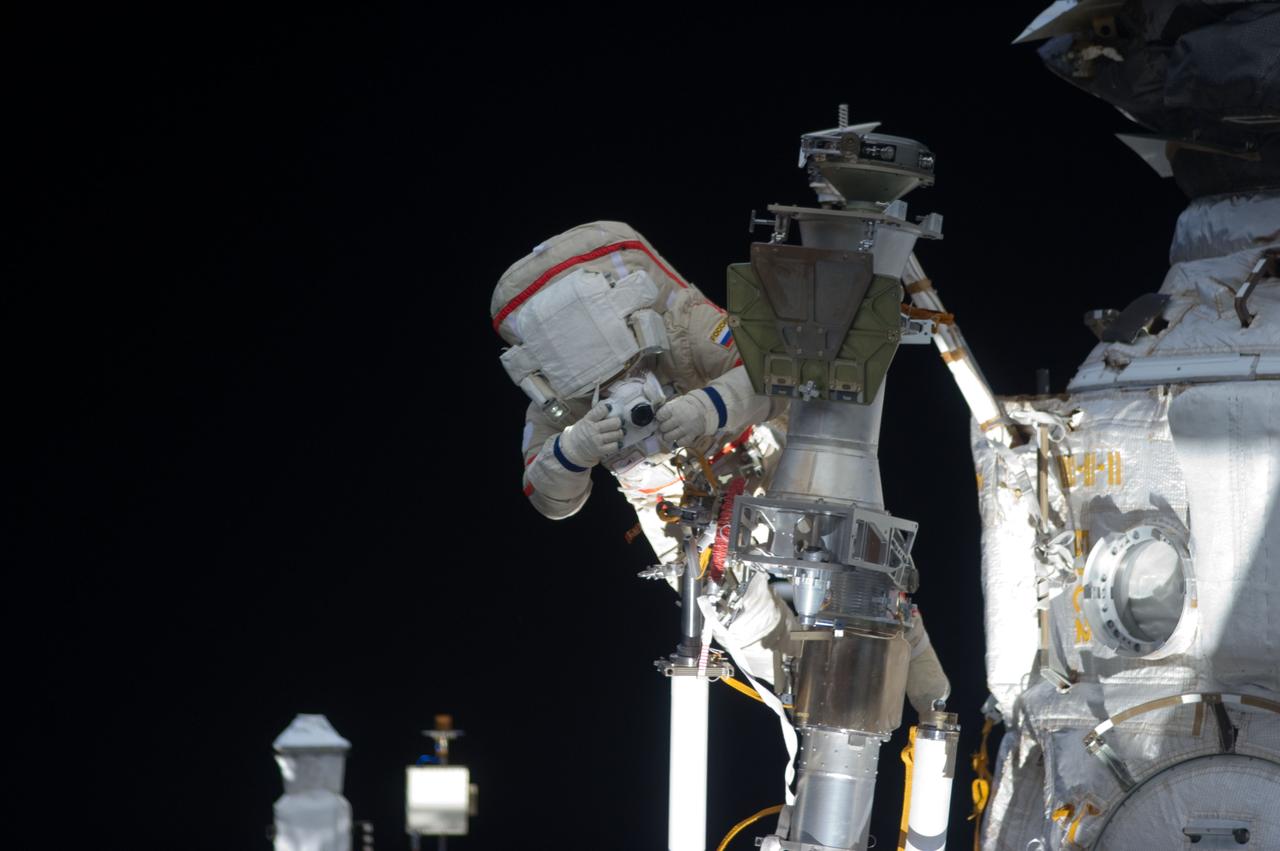
ISS032-E-021067 (20 Aug. 2012) --- Russian cosmonaut Gennady Padalka, Expedition 32 commander, uses a still camera during a session of extravehicular activity (EVA) to continue outfitting the International Space Station. During the five-hour, 51-minute spacewalk, Padalka and Russian cosmonaut Yuri Malenchenko (out of frame), flight engineer, moved the Strela-2 cargo boom from the Pirs docking compartment to the Zarya module to prepare Pirs for its eventual replacement with a new Russian multipurpose laboratory module. The two spacewalking cosmonauts also installed micrometeoroid debris shields on the exterior of the Zvezda service module and deployed a small science satellite.
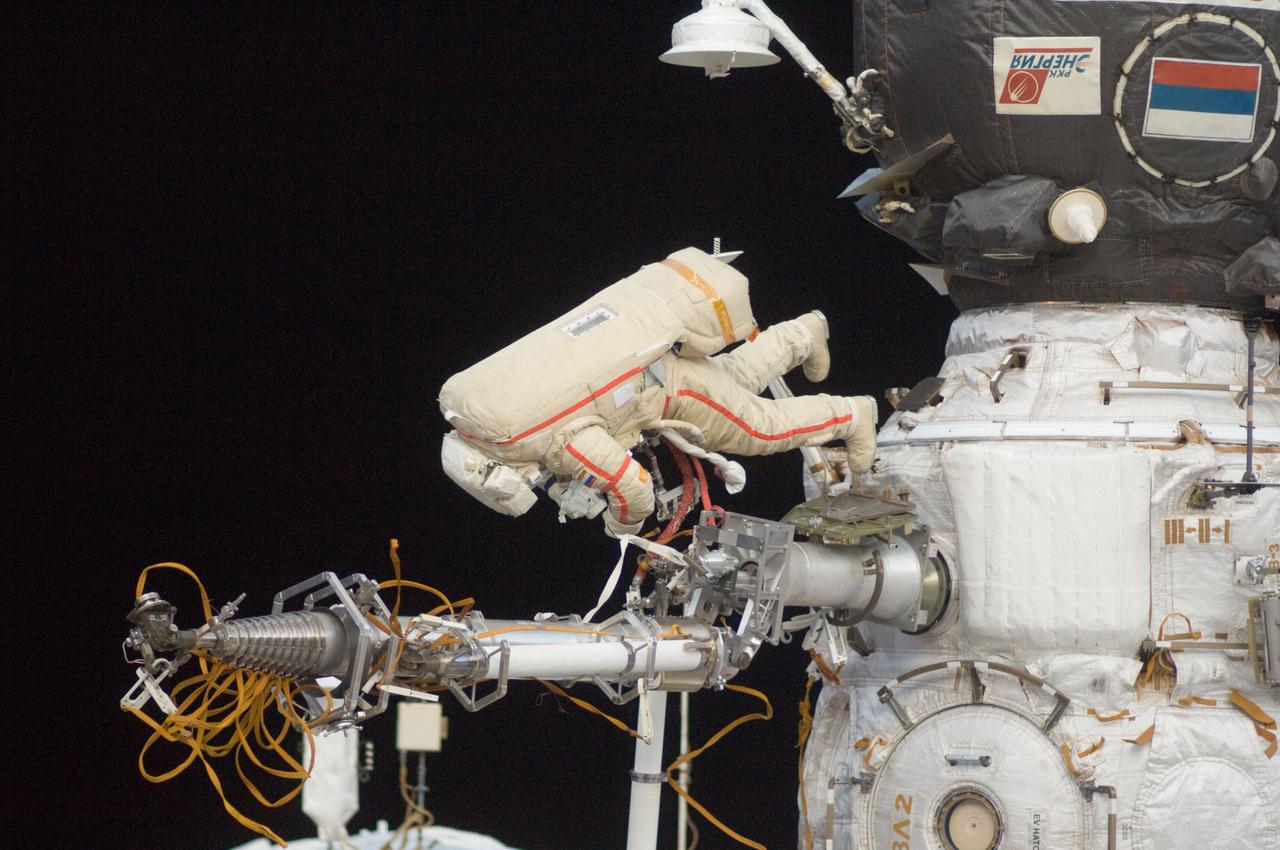
ISS032-E-021284 (20 Aug. 2012) --- Russian cosmonaut Gennady Padalka, Expedition 32 commander, participates in a session of extravehicular activity (EVA) to continue outfitting the International Space Station. During the five-hour, 51-minute spacewalk, Padalka and Russian cosmonaut Yuri Malenchenko (out of frame), flight engineer, moved the Strela-2 cargo boom from the Pirs docking compartment to the Zarya module to prepare Pirs for its eventual replacement with a new Russian multipurpose laboratory module. The two spacewalking cosmonauts also installed micrometeoroid debris shields on the exterior of the Zvezda service module and deployed a small science satellite.
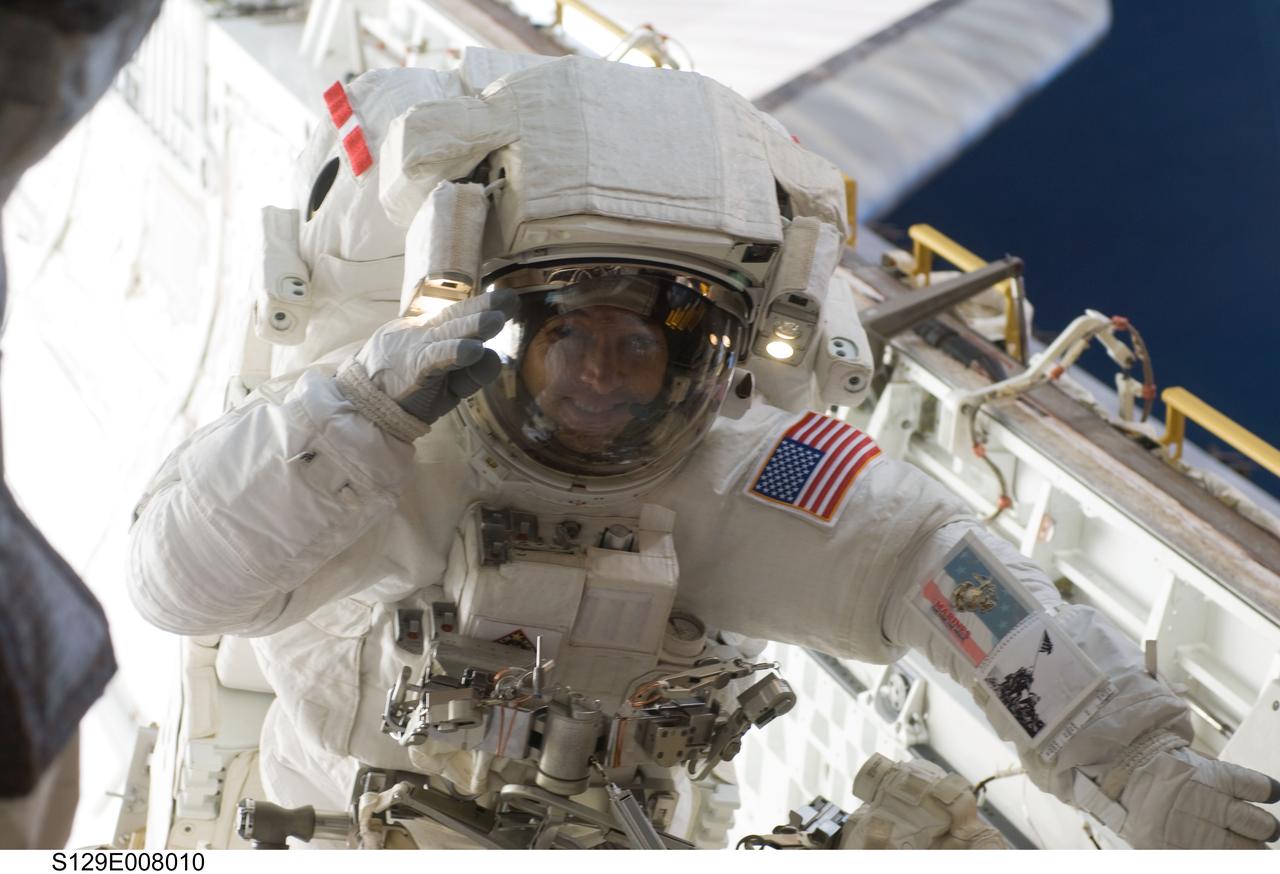
S129-E-008010 (23 Nov. 2009) --- Astronaut Randy Bresnik, STS-129 mission specialist, participates in the mission's third and final session of extravehicular activity (EVA) as construction and maintenance continue on the International Space Station. During the five-hour, 42-minute spacewalk, Bresnik and astronaut Robert L. Satcher Jr. (out of frame), mission specialist, removed a pair of micrometeoroid and orbital debris shields from the Quest airlock and strapped them to the External Stowage Platform #2, then moved an articulating foot restraint to the airlock, and released a bolt on a starboard truss ammonia tank assembly (ATA) in preparation for an STS-131 spacewalk that will replace the ATA.
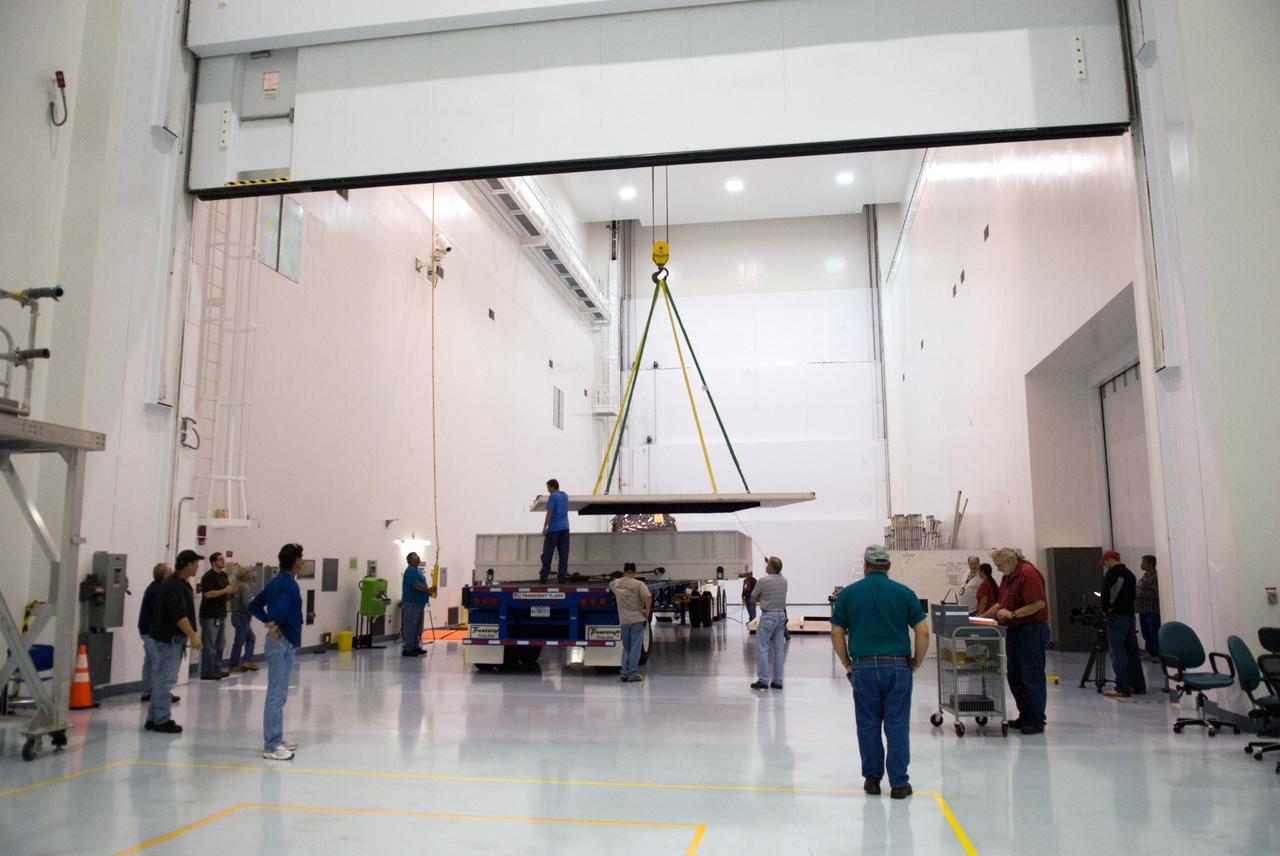
CAPE CANAVERAL, Fla. - In the Space Station Processing Facility at NASA's Kennedy Space Center in Florida, workers supervise the uncrating of the ExPRESS Logistics Carrier 3, or ELC-3. ELC-3 and the Alpha Magnetic Spectrometer are the primary payloads for space shuttle Endeavour's STS-134 mission to the International Space Station. The STS-134 crew will also deliver spare parts including two S-band communications antennas, a high pressure gas tank, additional spare parts for Dextre and micrometeoroid debris shields. Endeavour's launch is targeted for July 29, 2010. For information on the STS-134 mission objectives and crew, visit http://www.nasa.gov/shuttle. Photo credit: NASA/Kim Shiflett
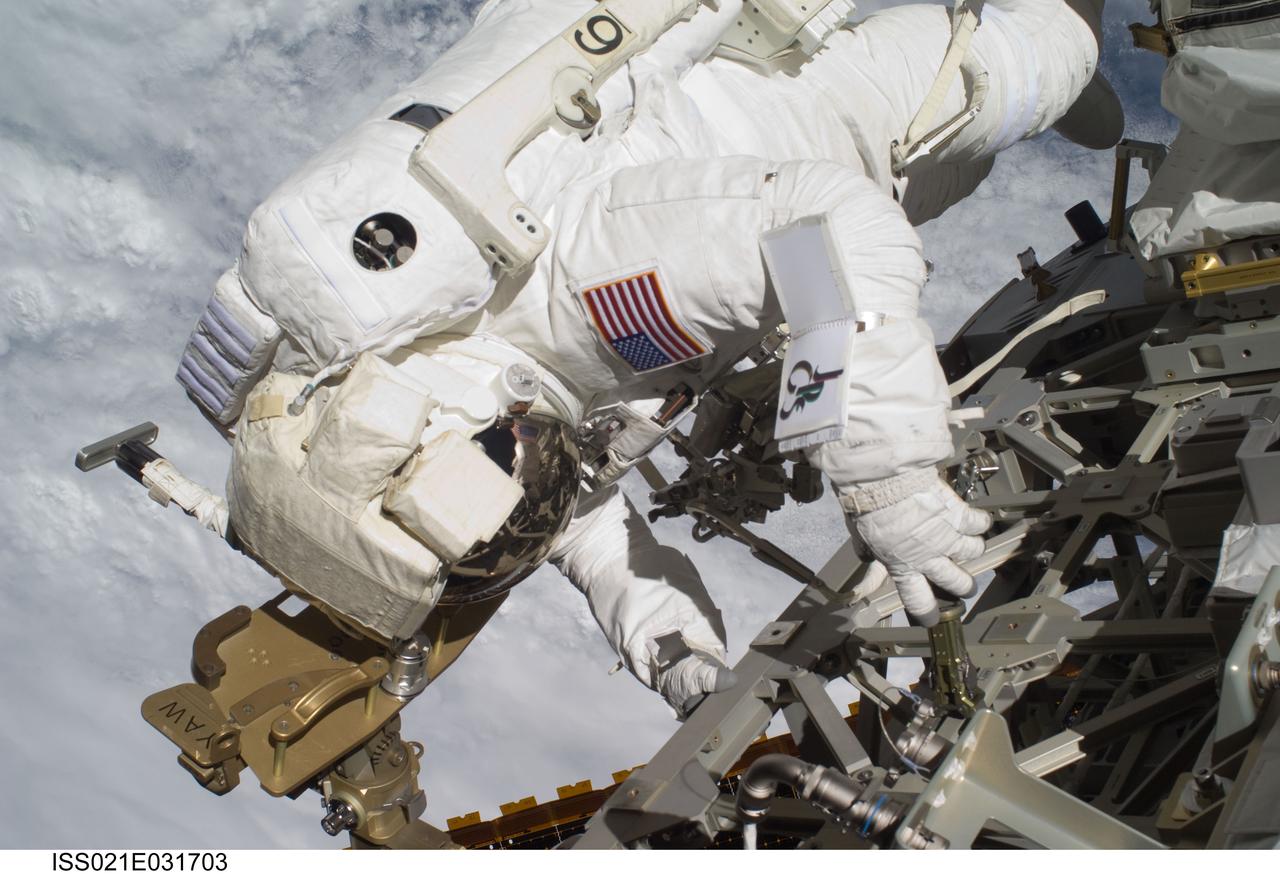
ISS021-E-031703 (23 Nov. 2009) --- Astronaut Robert L. Satcher Jr., STS-129 mission specialist, participates in the mission's third and final session of extravehicular activity (EVA) as construction and maintenance continue on the International Space Station. During the five-hour, 42-minute spacewalk, Satcher and astronaut Randy Bresnik (out of frame), mission specialist, removed a pair of micrometeoroid and orbital debris shields from the Quest airlock and strapped them to the External Stowage Platform #2, then moved an articulating foot restraint to the airlock, and released a bolt on a starboard truss ammonia tank assembly (ATA) in preparation for an STS-131 spacewalk that will replace the ATA.
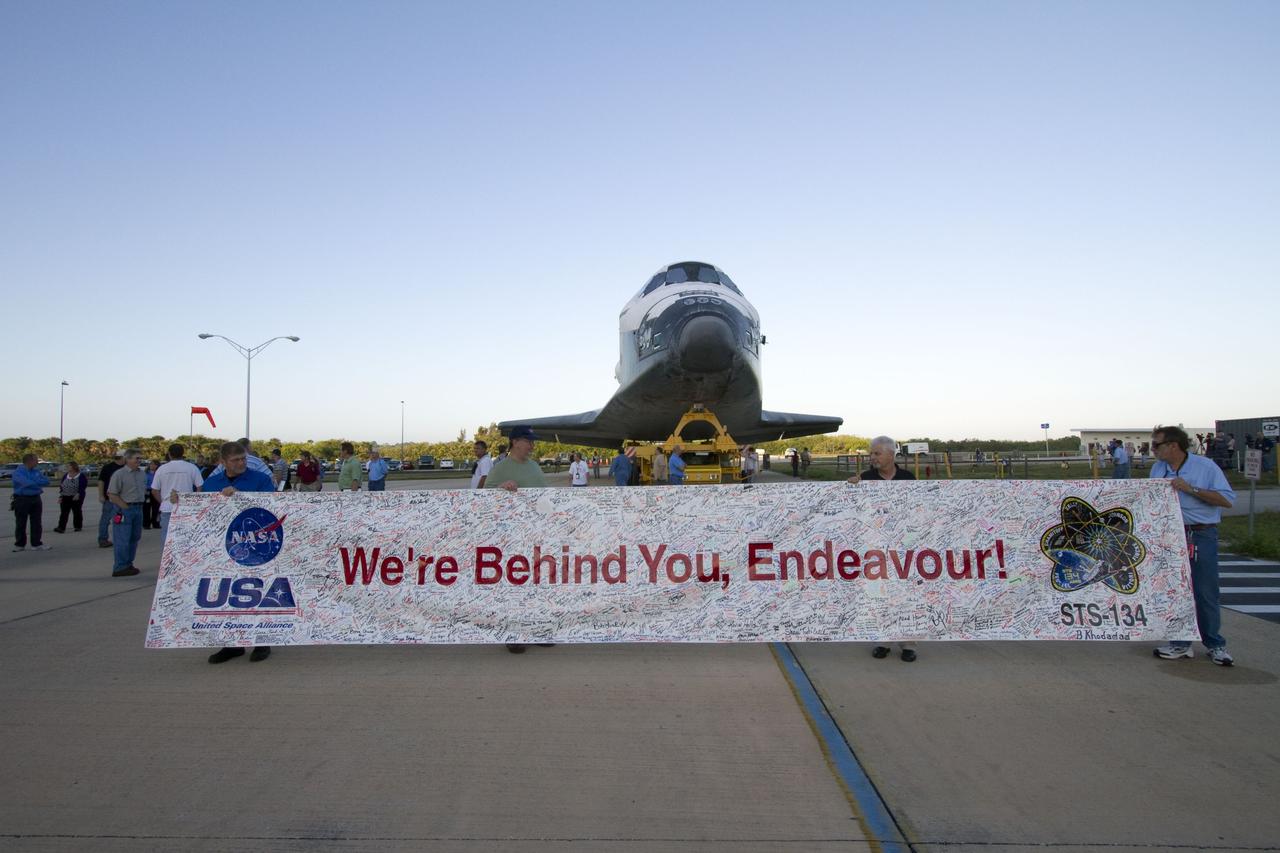
CAPE CANAVERAL, Fla. -- At NASA's Kennedy Space Center in Florida, employees hold up a banner to commemorate space shuttle Endeavour's STS-134 mission as it is transported from Orbiter Processing Facility-2 to the Vehicle Assembly Building. Endeavour and its STS-134 crew will deliver the Express Logistics Carrier-3, Alpha Magnetic Spectrometer, spare parts, a high-pressure gas tank, additional spare parts for Dextre and micrometeoroid debris shields to the International Space Station. Launch is targeted for April 19 at 7:48 p.m. EDT. For more information visit, http://www.nasa.gov/mission_pages/shuttle/shuttlemissions/sts134/index.html. Photo credit: NASA/Jack Pfaller
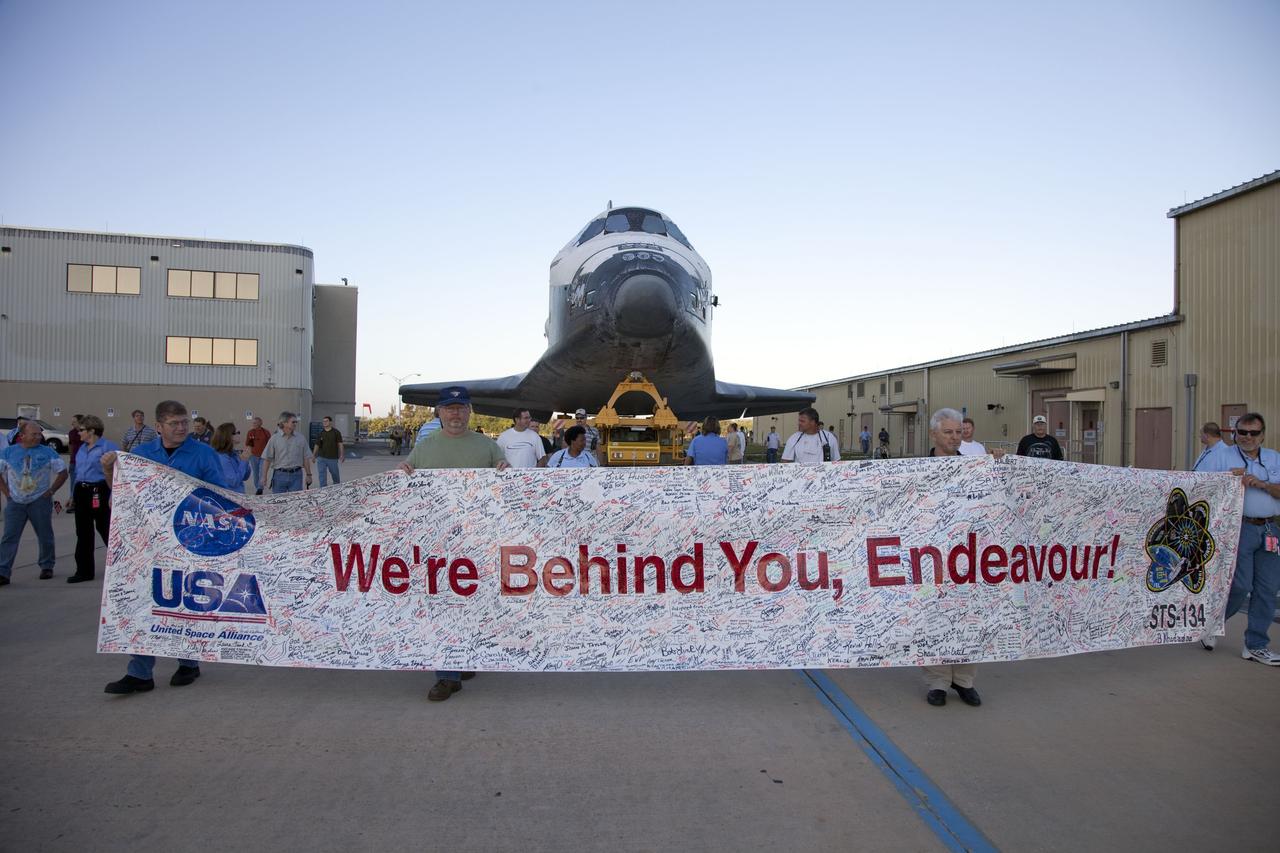
CAPE CANAVERAL, Fla. -- At NASA's Kennedy Space Center in Florida, employees hold up a banner to commemorate space shuttle Endeavour's STS-134 mission as it is transported from Orbiter Processing Facility-2 to the Vehicle Assembly Building. Endeavour and its STS-134 crew will deliver the Express Logistics Carrier-3, Alpha Magnetic Spectrometer, spare parts, a high-pressure gas tank, additional spare parts for Dextre and micrometeoroid debris shields to the International Space Station. Launch is targeted for April 19 at 7:48 p.m. EDT. For more information visit, http://www.nasa.gov/mission_pages/shuttle/shuttlemissions/sts134/index.html. Photo credit: NASA/Frankie Martin
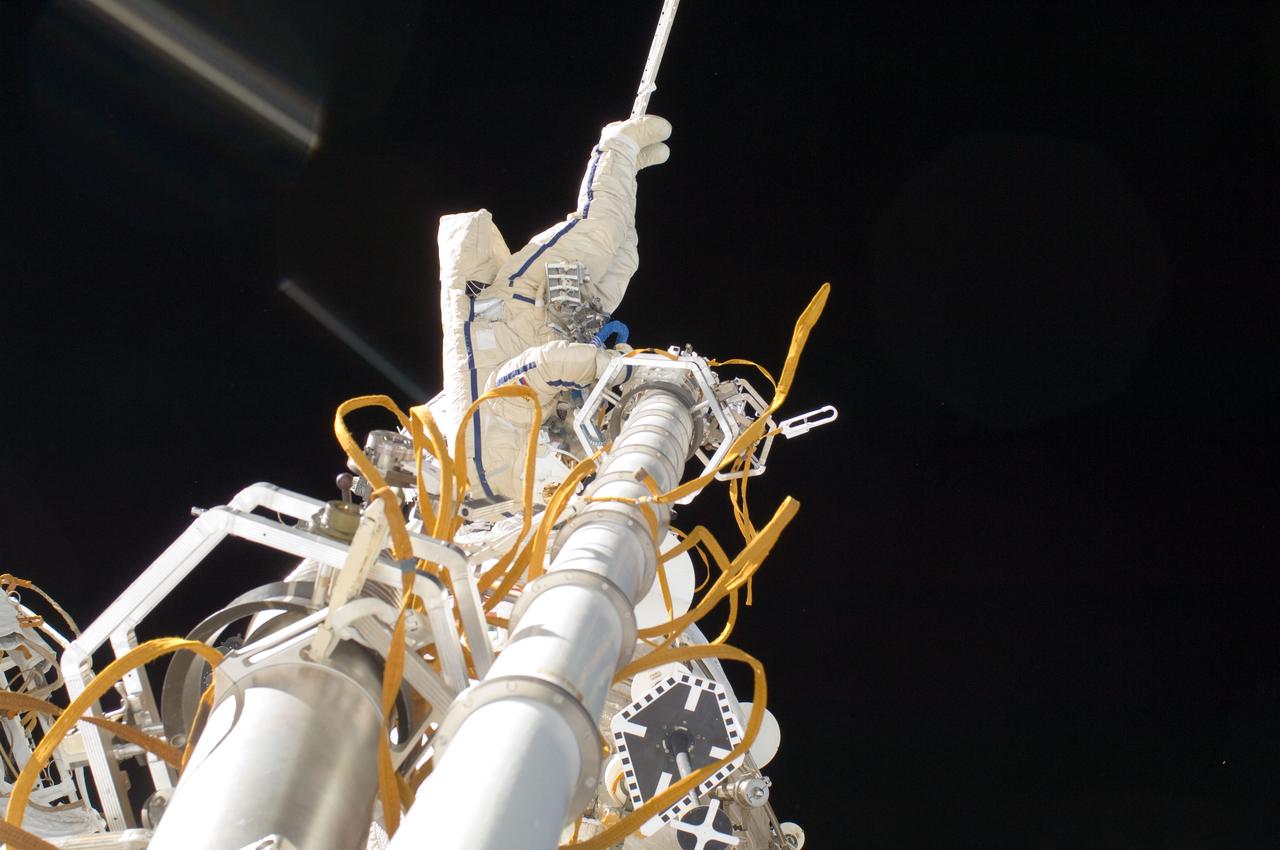
ISS032-E-020856 (20 Aug. 2012) --- Russian cosmonaut Yuri Malenchenko, Expedition 32 flight engineer, participates in a session of extravehicular activity (EVA) to continue outfitting the International Space Station. During the five-hour, 51-minute spacewalk, Malenchenko and Russian cosmonaut Gennady Padalka (out of frame), commander, moved the Strela-2 cargo boom from the Pirs docking compartment to the Zarya module to prepare Pirs for its eventual replacement with a new Russian multipurpose laboratory module. The two spacewalking cosmonauts also installed micrometeoroid debris shields on the exterior of the Zvezda service module and deployed a small science satellite.
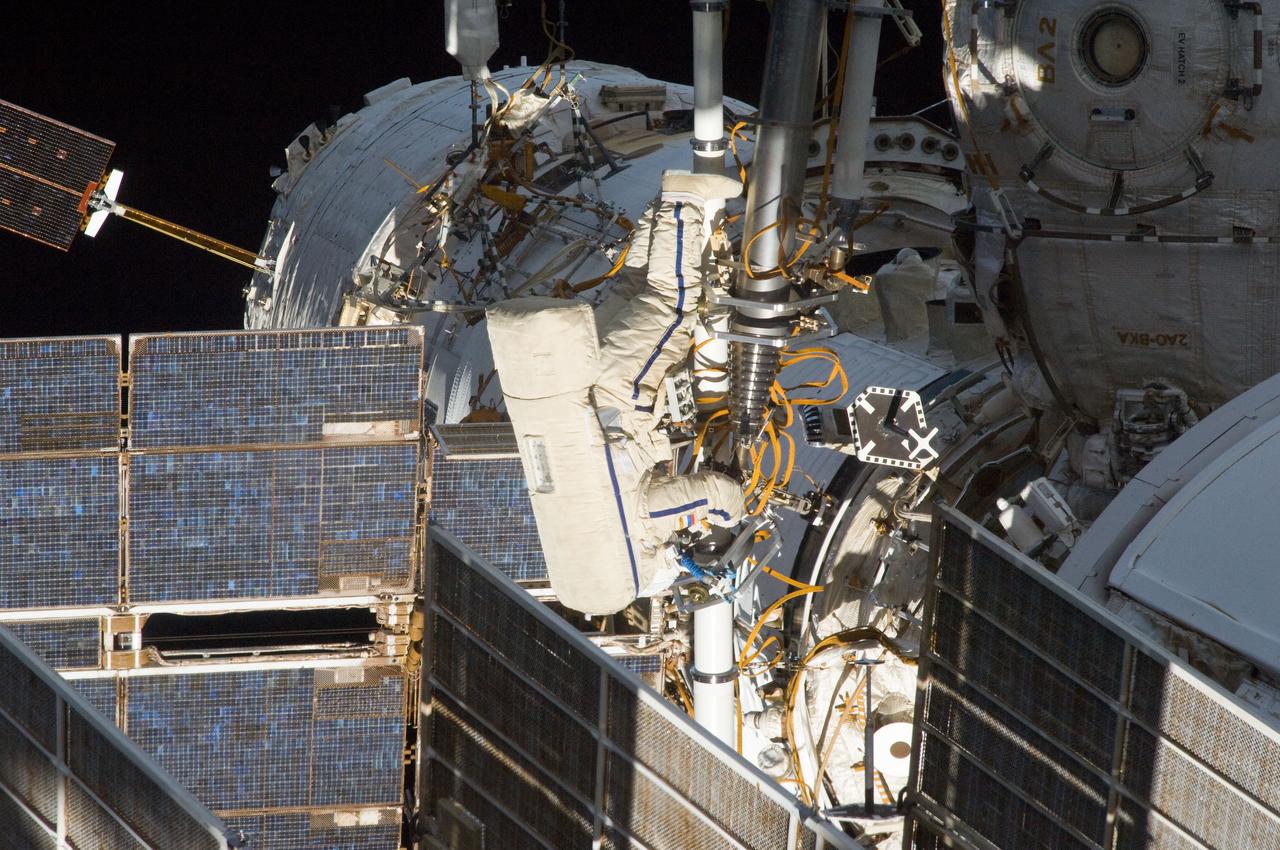
ISS032-E-021293 (20 Aug. 2012) --- Russian cosmonaut Yuri Malenchenko, Expedition 32 flight engineer, participates in a session of extravehicular activity (EVA) to continue outfitting the International Space Station. During the five-hour, 51-minute spacewalk, Malenchenko and Russian cosmonaut Gennady Padalka (out of frame), commander, moved the Strela-2 cargo boom from the Pirs docking compartment to the Zarya module to prepare Pirs for its eventual replacement with a new Russian multipurpose laboratory module. The two spacewalking cosmonauts also installed micrometeoroid debris shields on the exterior of the Zvezda service module and deployed a small science satellite.
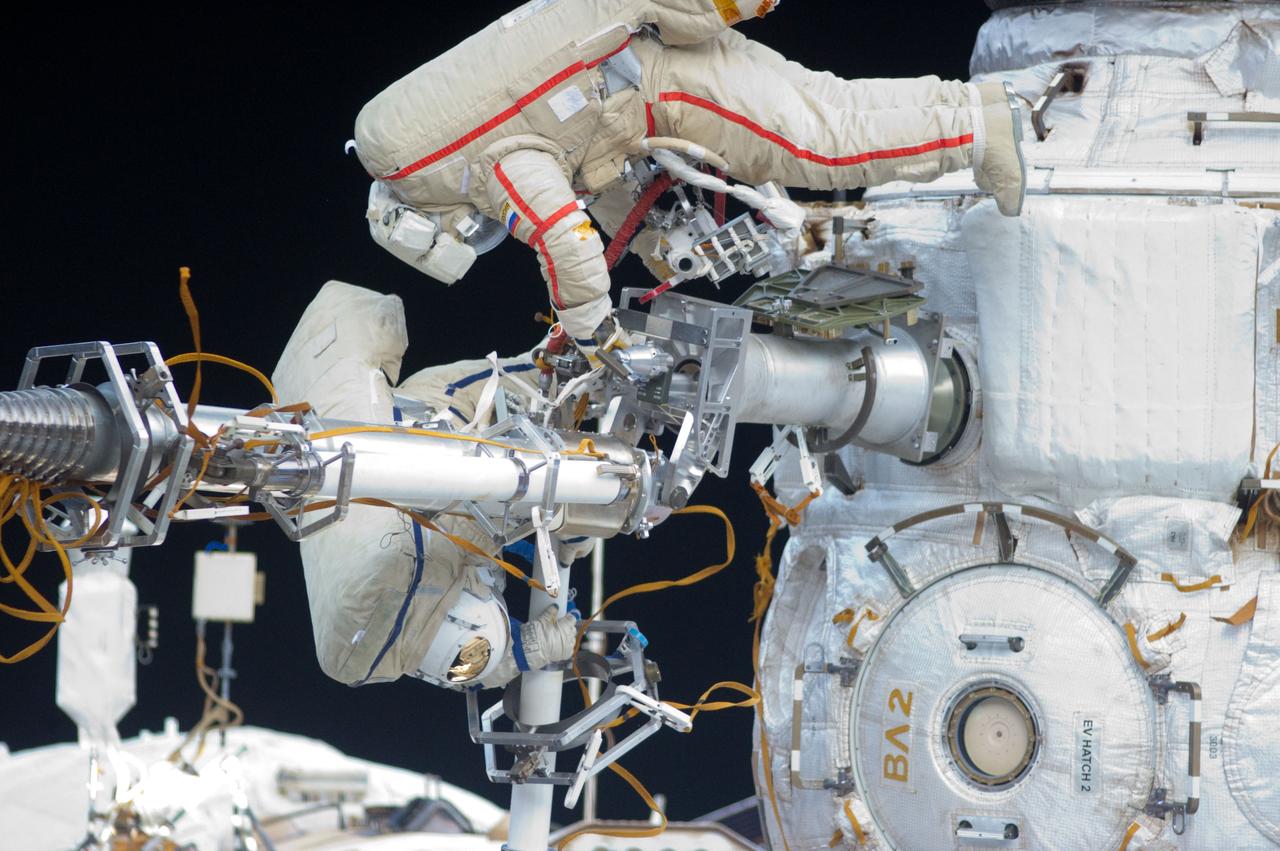
ISS032-E-021060 (20 Aug. 2012) --- Russian cosmonauts Gennady Padalka (top), Expedition 32 commander; and Yuri Malenchenko, flight engineer, participate in a session of extravehicular activity (EVA) to continue outfitting the International Space Station. During the five-hour, 51-minute spacewalk, Padalka and Malenchenko moved the Strela-2 cargo boom from the Pirs docking compartment to the Zarya module to prepare Pirs for its eventual replacement with a new Russian multipurpose laboratory module. The two spacewalking cosmonauts also installed micrometeoroid debris shields on the exterior of the Zvezda service module and deployed a small science satellite.
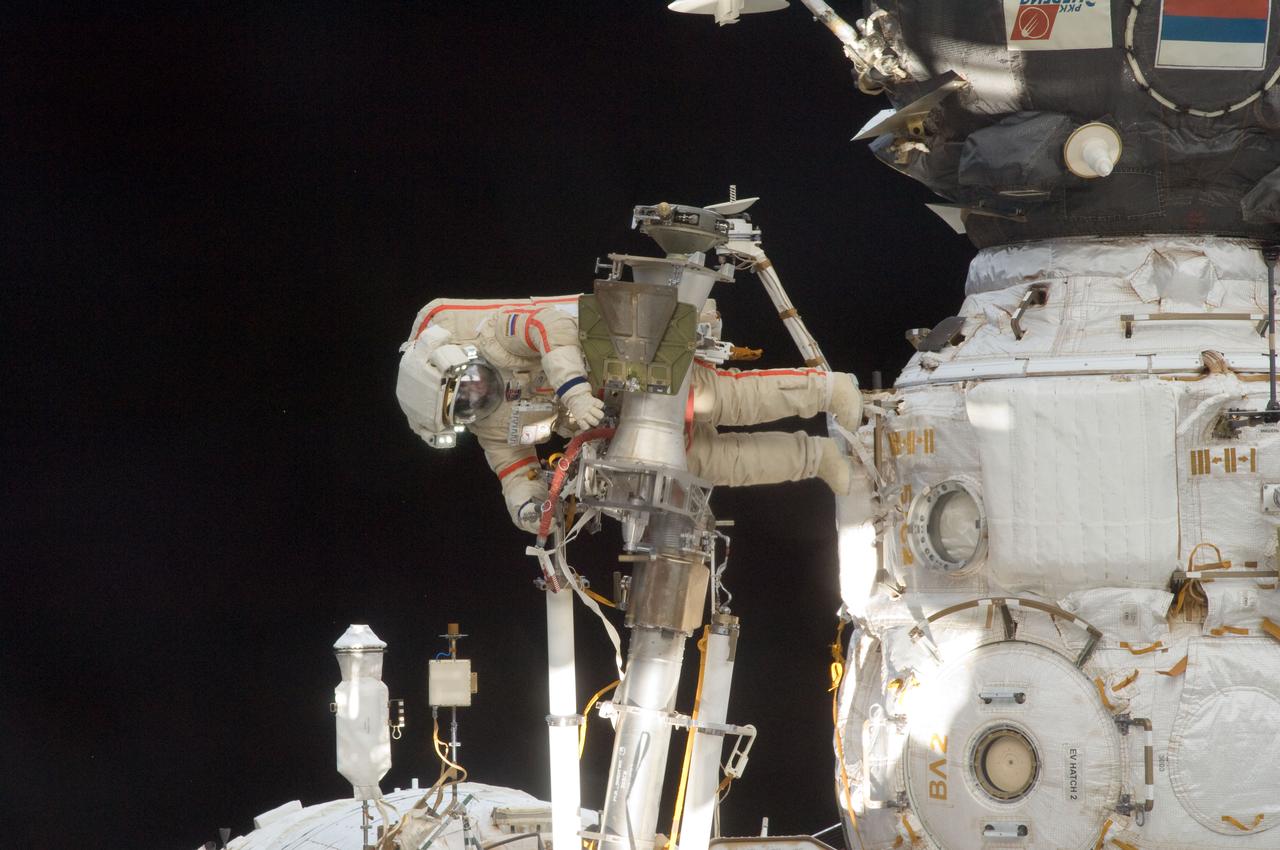
ISS032-E-021296 (20 Aug. 2012) --- Russian cosmonaut Gennady Padalka, Expedition 32 commander, participates in a session of extravehicular activity (EVA) to continue outfitting the International Space Station. During the five-hour, 51-minute spacewalk, Padalka and Russian cosmonaut Yuri Malenchenko (out of frame), flight engineer, moved the Strela-2 cargo boom from the Pirs docking compartment to the Zarya module to prepare Pirs for its eventual replacement with a new Russian multipurpose laboratory module. The two spacewalking cosmonauts also installed micrometeoroid debris shields on the exterior of the Zvezda service module and deployed a small science satellite.
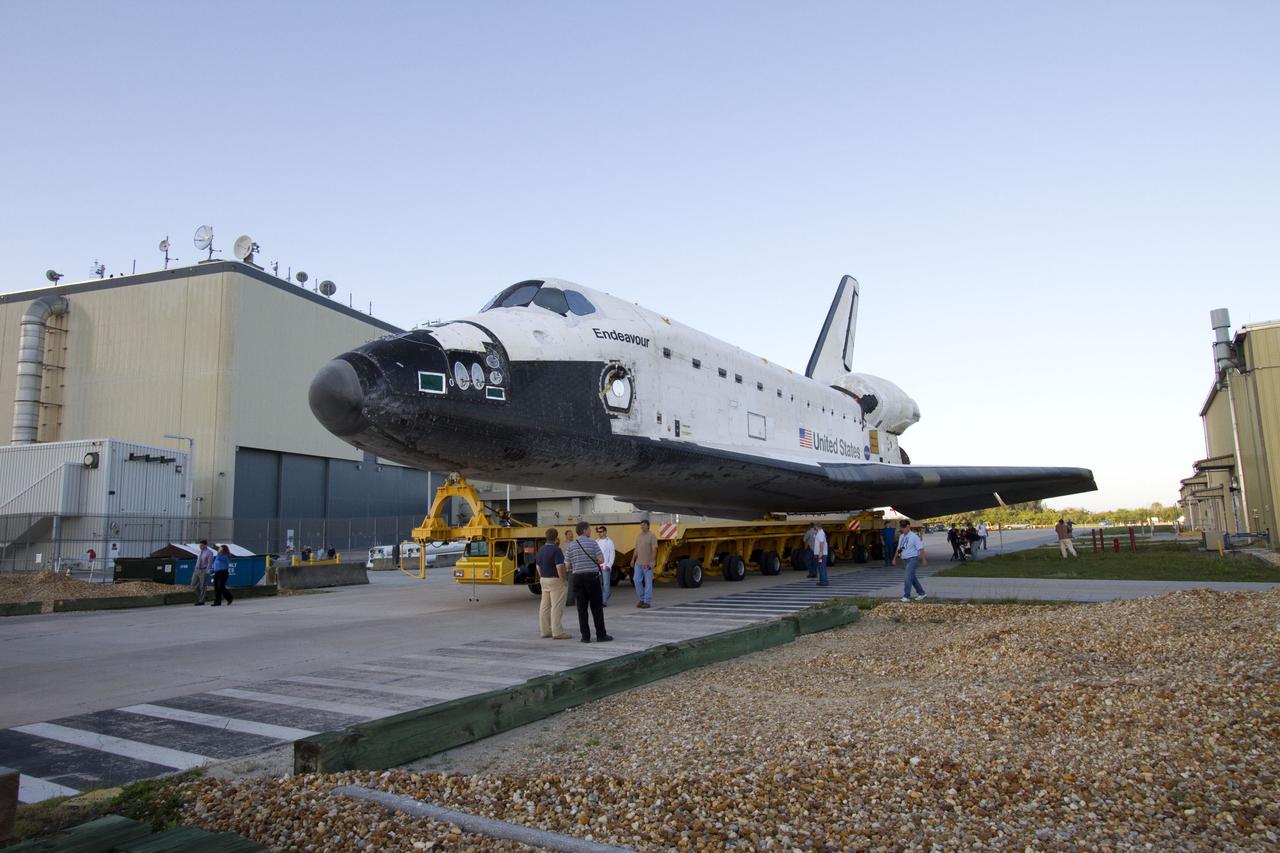
CAPE CANAVERAL, Fla. -- At NASA's Kennedy Space Center in Florida, workers accompany space shuttle Endeavour as it is being transported from Orbiter Processing Facility-2 to the Vehicle Assembly Building. Endeavour and its STS-134 crew will deliver the Express Logistics Carrier-3, Alpha Magnetic Spectrometer, spare parts, a high-pressure gas tank, additional spare parts for Dextre and micrometeoroid debris shields to the International Space Station. Launch is targeted for April 19 at 7:48 p.m. EDT. For more information visit, http://www.nasa.gov/mission_pages/shuttle/shuttlemissions/sts134/index.html. Photo credit: NASA/Jack Pfaller
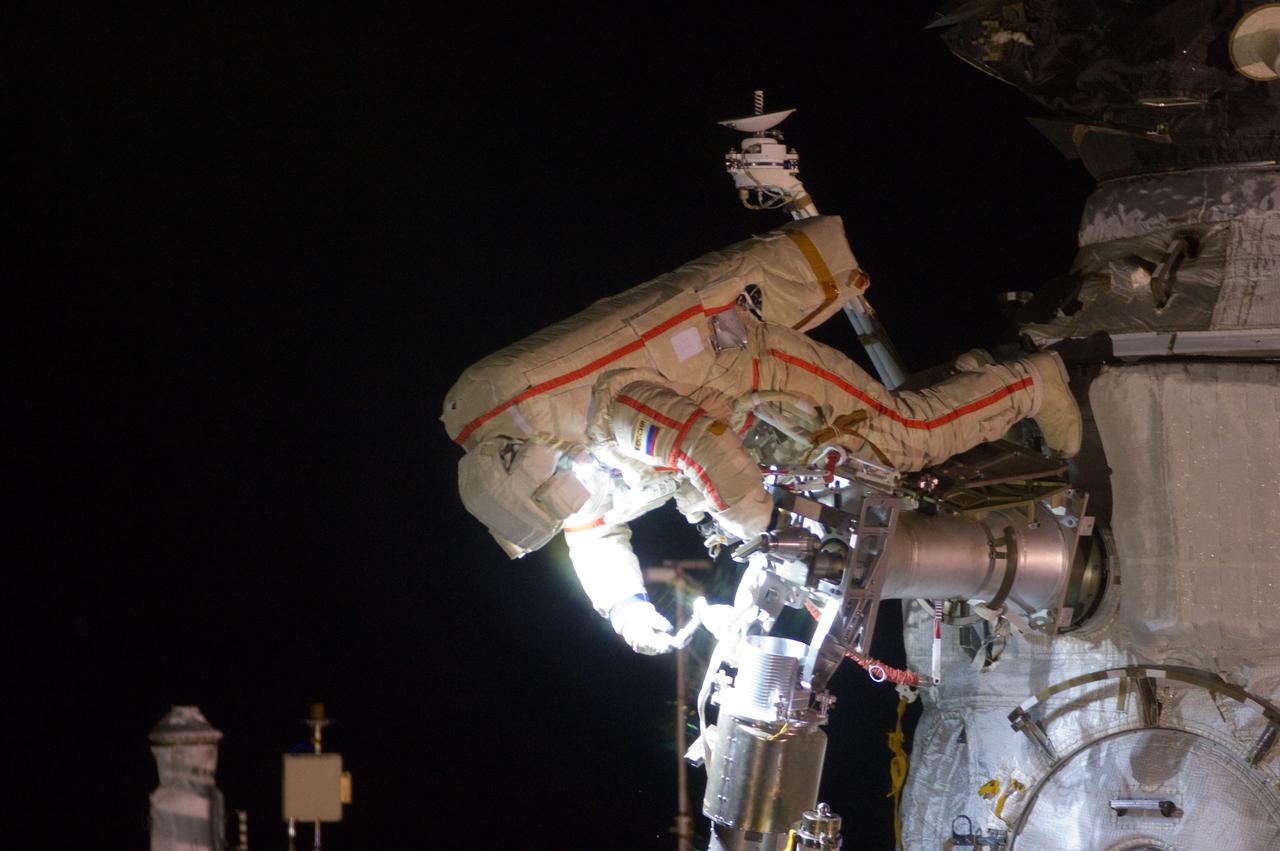
ISS032-E-021028 (20 Aug. 2012) --- Russian cosmonaut Gennady Padalka, Expedition 32 commander, participates in a session of extravehicular activity (EVA) to continue outfitting the International Space Station. During the five-hour, 51-minute spacewalk, Padalka and Russian cosmonaut Yuri Malenchenko (out of frame), flight engineer, moved the Strela-2 cargo boom from the Pirs docking compartment to the Zarya module to prepare Pirs for its eventual replacement with a new Russian multipurpose laboratory module. The two spacewalking cosmonauts also installed micrometeoroid debris shields on the exterior of the Zvezda service module and deployed a small science satellite.
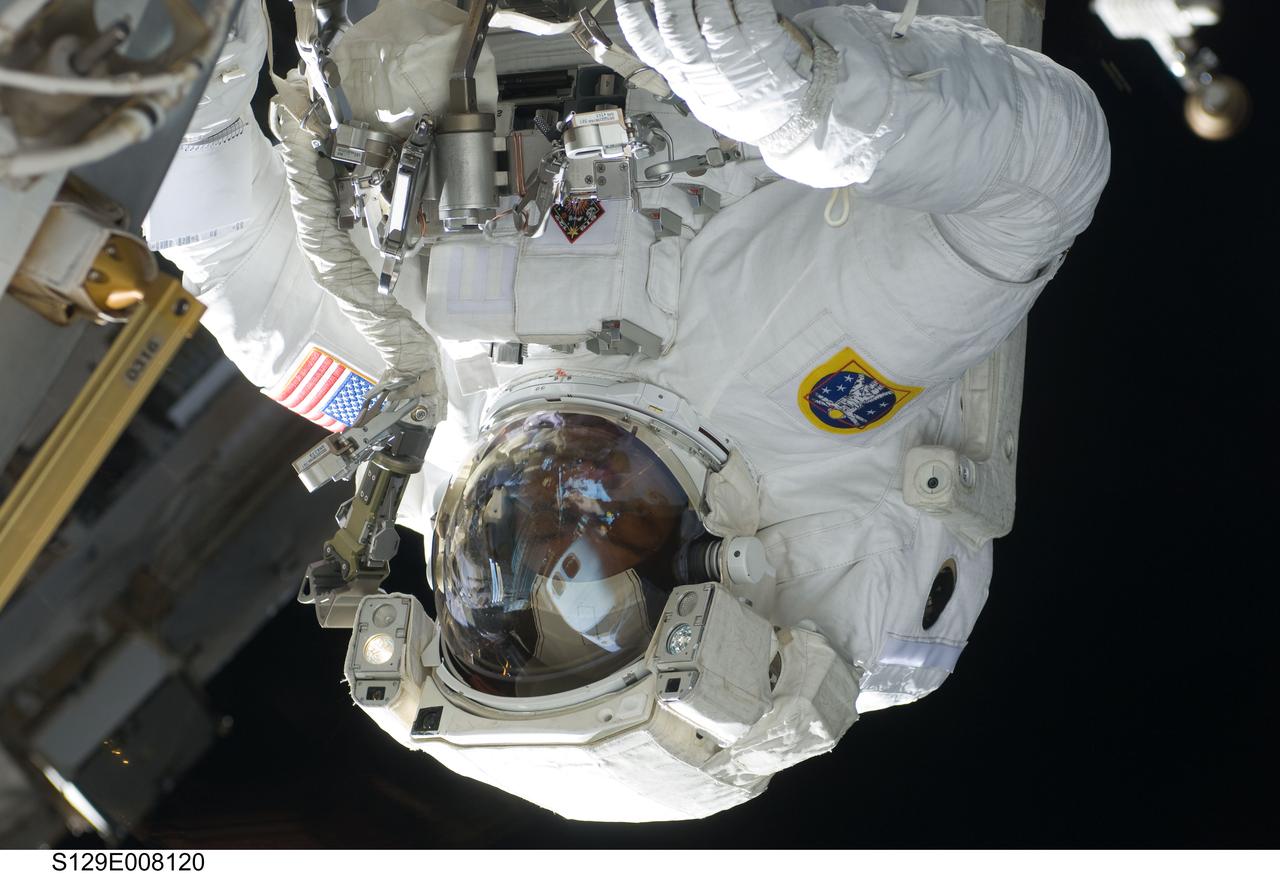
S129-E-008120 (23 Nov. 2009) --- Astronaut Robert L. Satcher Jr., STS-129 mission specialist, participates in the mission's third and final session of extravehicular activity (EVA) as construction and maintenance continue on the International Space Station. During the five-hour, 42-minute spacewalk, Satcher and astronaut Randy Bresnik (out of frame), mission specialist, removed a pair of micrometeoroid and orbital debris shields from the Quest airlock and strapped them to the External Stowage Platform #2, then moved an articulating foot restraint to the airlock, and released a bolt on a starboard truss ammonia tank assembly (ATA) in preparation for an STS-131 spacewalk that will replace the ATA.
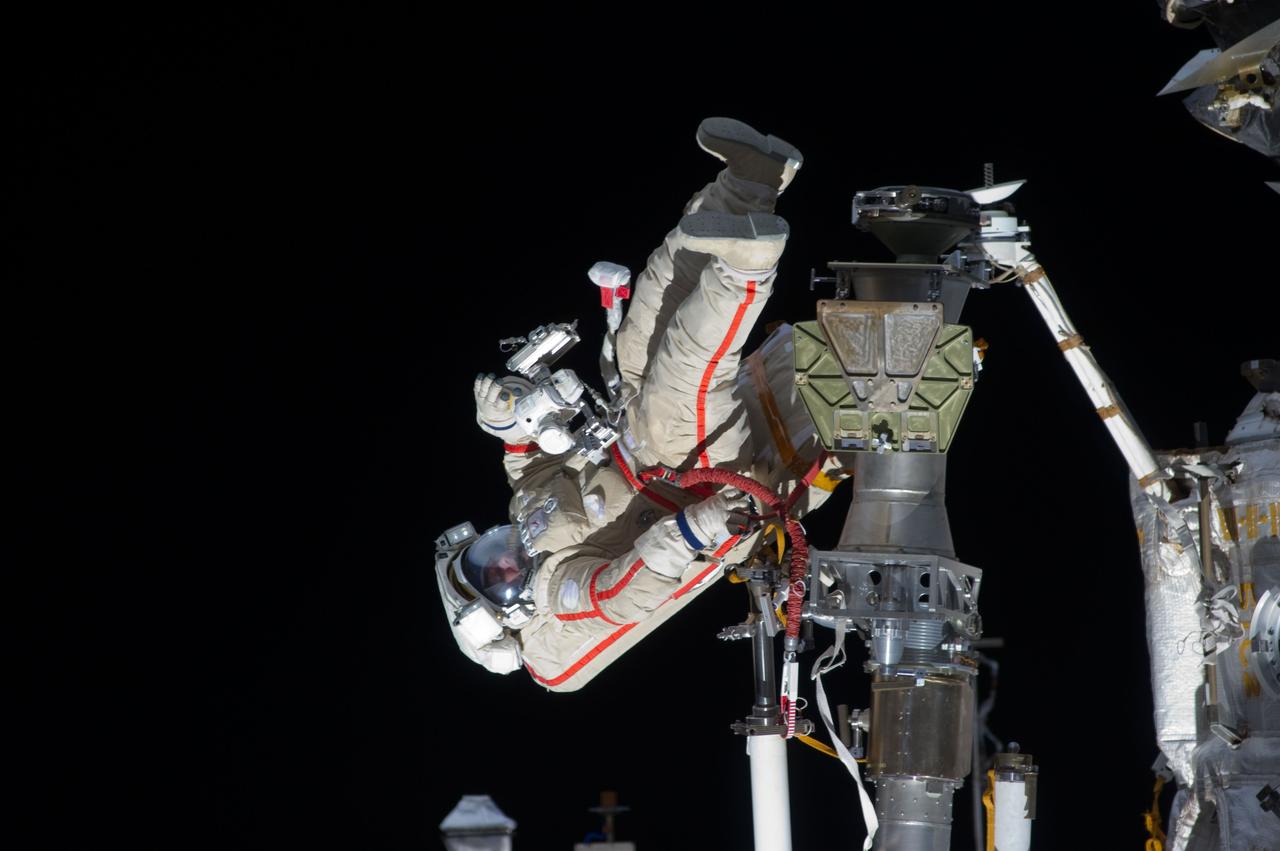
ISS032-E-021080 (20 Aug. 2012) --- Russian cosmonaut Gennady Padalka, Expedition 32 commander, participates in a session of extravehicular activity (EVA) to continue outfitting the International Space Station. During the five-hour, 51-minute spacewalk, Padalka and Russian cosmonaut Yuri Malenchenko (out of frame), flight engineer, moved the Strela-2 cargo boom from the Pirs docking compartment to the Zarya module to prepare Pirs for its eventual replacement with a new Russian multipurpose laboratory module. The two spacewalking cosmonauts also installed micrometeoroid debris shields on the exterior of the Zvezda service module and deployed a small science satellite.
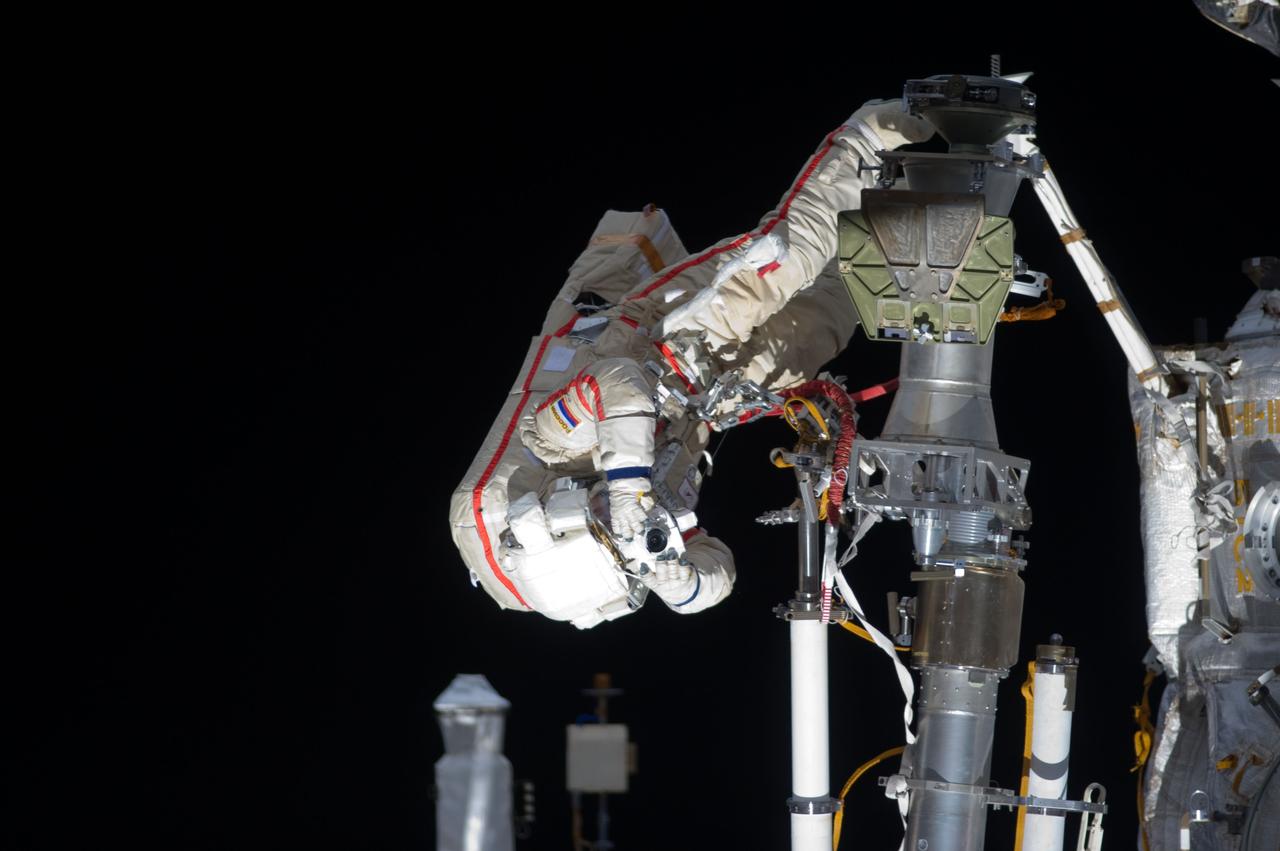
ISS032-E-021072 (20 Aug. 2012) --- Russian cosmonaut Gennady Padalka, Expedition 32 commander, uses a still camera during a session of extravehicular activity (EVA) to continue outfitting the International Space Station. During the five-hour, 51-minute spacewalk, Padalka and Russian cosmonaut Yuri Malenchenko (out of frame), flight engineer, moved the Strela-2 cargo boom from the Pirs docking compartment to the Zarya module to prepare Pirs for its eventual replacement with a new Russian multipurpose laboratory module. The two spacewalking cosmonauts also installed micrometeoroid debris shields on the exterior of the Zvezda service module and deployed a small science satellite.
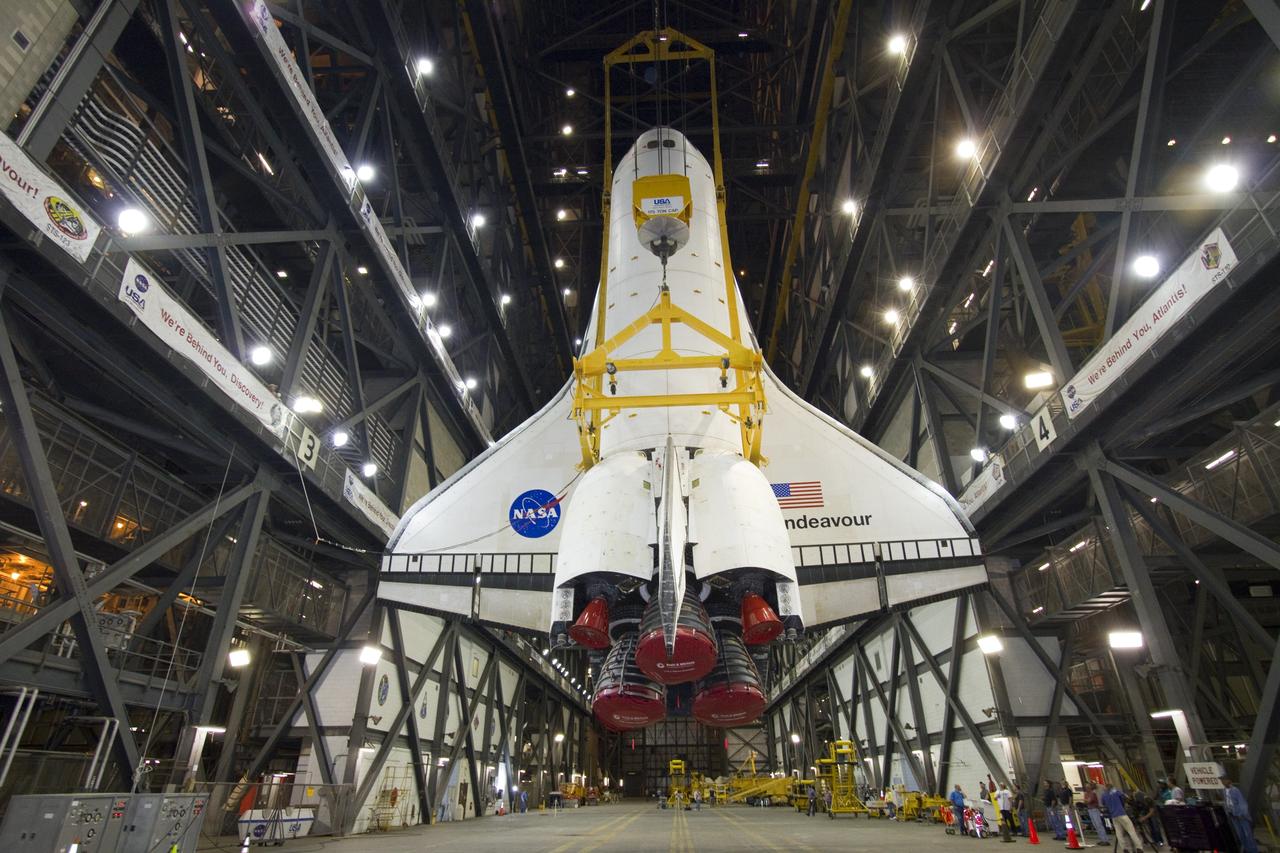
CAPE CANAVERAL, Fla. -- In Vehicle Assembly Building at NASA's Kennedy Space Center in Florida, shuttle Endeavour is suspended vertically over the transfer aisle. The spacecraft will be moved into a high bay where it will be installed to the waiting external fuel tank and solid rocket boosters. Endeavour and its STS-134 crew will deliver the Express Logistics Carrier-3, Alpha Magnetic Spectrometer, a high-pressure gas tank, additional spare parts for Dextre and micrometeoroid debris shields to the International Space Station. Endeavour's final launch is targeted for April 19 at 7:48 p.m. EDT. For more information visit, http://www.nasa.gov/mission_pages/shuttle/shuttlemissions/sts134/index.html. Photo credit: NASA/Jack Pfaller
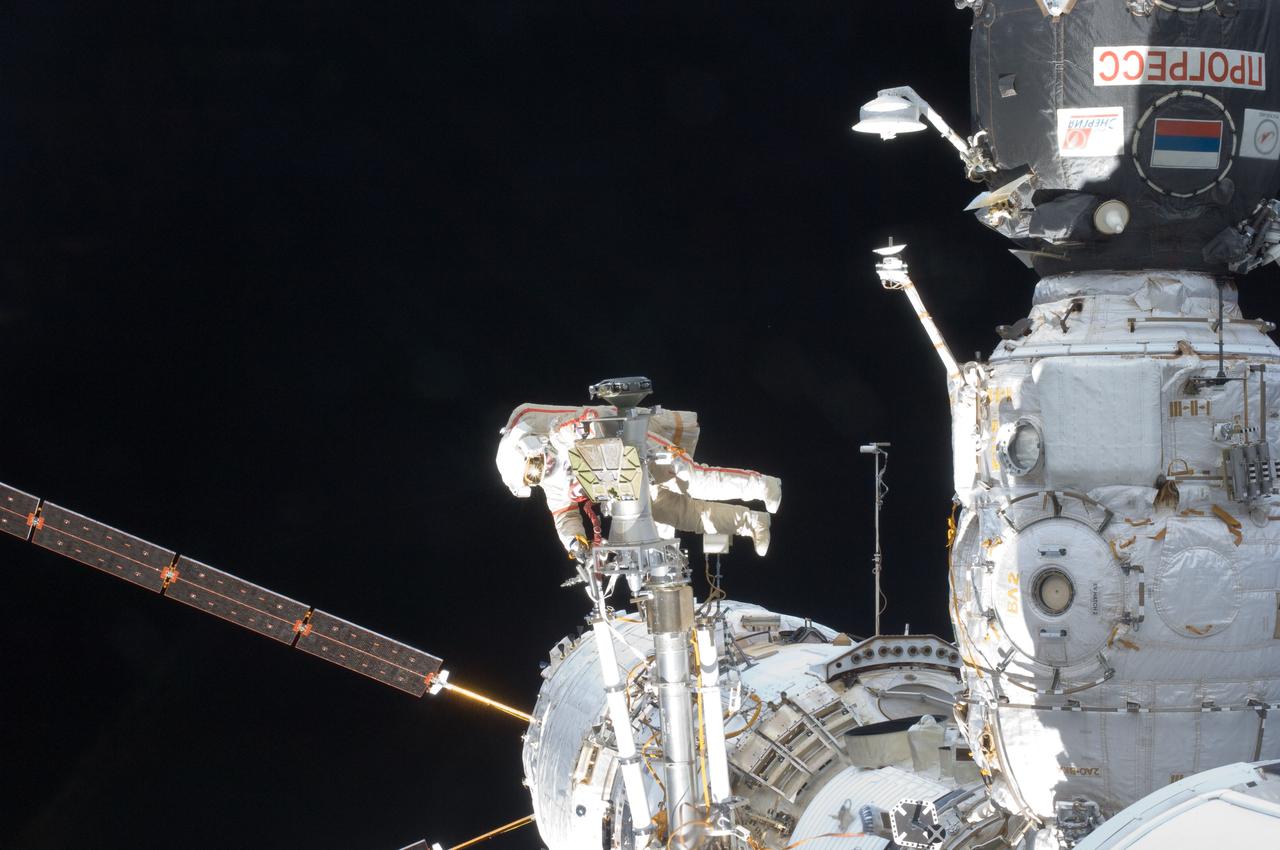
ISS032-E-020683 (20 Aug. 2012) --- Russian cosmonaut Gennady Padalka, Expedition 32 commander, participates in a session of extravehicular activity (EVA) to continue outfitting the International Space Station. During the five-hour, 51-minute spacewalk, Padalka and Russian cosmonaut Yuri Malenchenko (out of frame), flight engineer, moved the Strela-2 cargo boom from the Pirs docking compartment to the Zarya module to prepare Pirs for its eventual replacement with a new Russian multipurpose laboratory module. The two spacewalking cosmonauts also installed micrometeoroid debris shields on the exterior of the Zvezda service module and deployed a small science satellite.
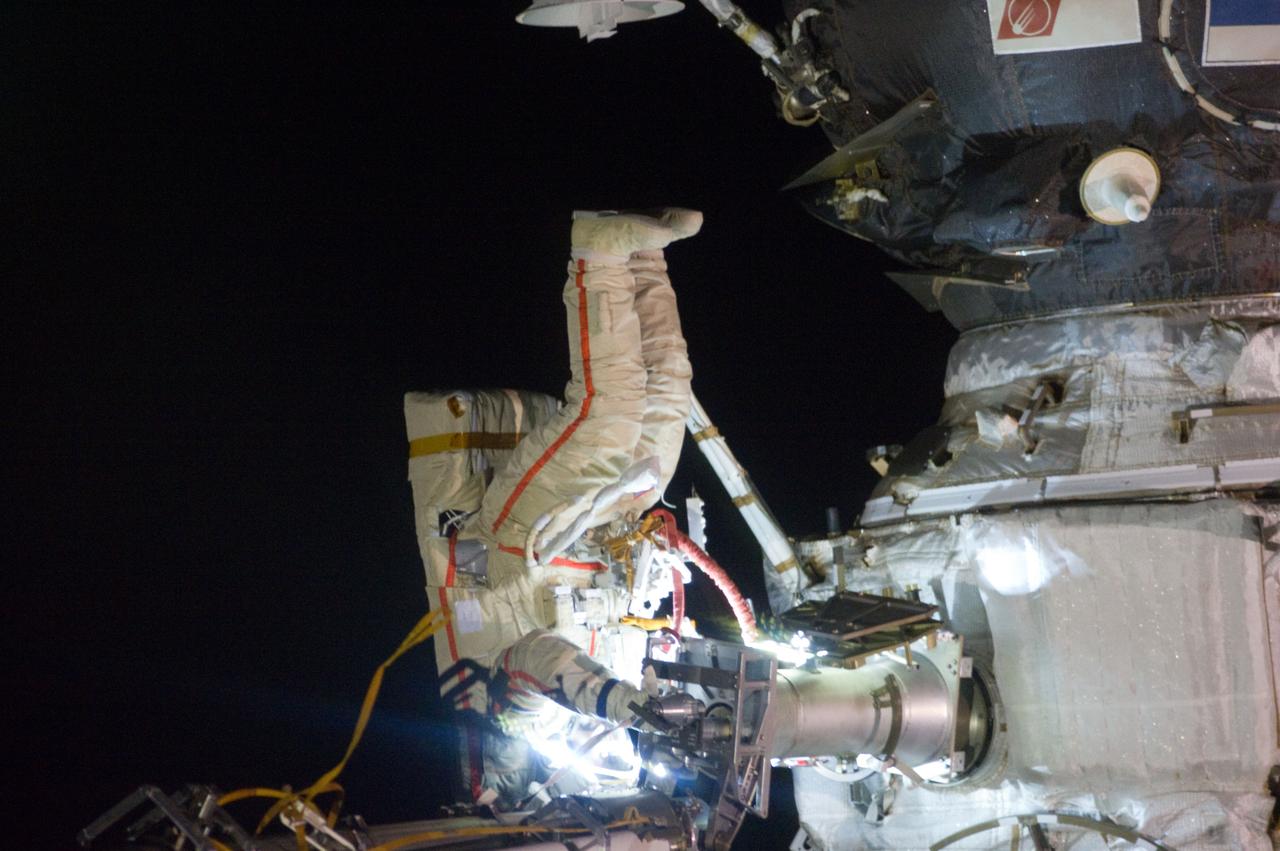
ISS032-E-021037 (20 Aug. 2012) --- Russian cosmonaut Gennady Padalka, Expedition 32 commander, participates in a session of extravehicular activity (EVA) to continue outfitting the International Space Station. During the five-hour, 51-minute spacewalk, Padalka and Russian cosmonaut Yuri Malenchenko (out of frame), flight engineer, moved the Strela-2 cargo boom from the Pirs docking compartment to the Zarya module to prepare Pirs for its eventual replacement with a new Russian multipurpose laboratory module. The two spacewalking cosmonauts also installed micrometeoroid debris shields on the exterior of the Zvezda service module and deployed a small science satellite.
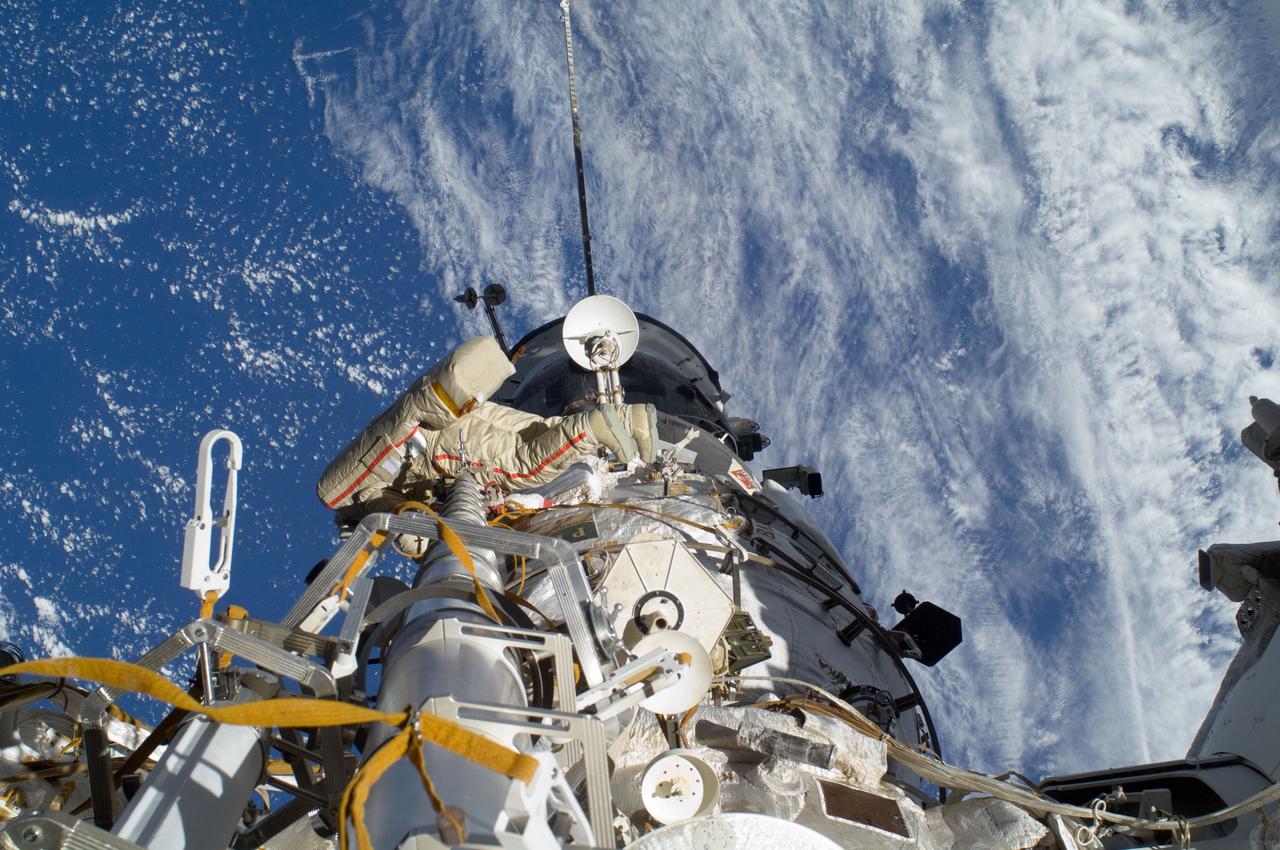
ISS032-E-020594 (20 Aug. 2012) --- Russian cosmonaut Gennady Padalka, Expedition 32 commander, participates in a session of extravehicular activity (EVA) to continue outfitting the International Space Station. During the five-hour, 51-minute spacewalk, Padalka and Russian cosmonaut Yuri Malenchenko (out of frame), flight engineer, moved the Strela-2 cargo boom from the Pirs docking compartment to the Zarya module to prepare Pirs for its eventual replacement with a new Russian multipurpose laboratory module. The two spacewalking cosmonauts also installed micrometeoroid debris shields on the exterior of the Zvezda service module and deployed a small science satellite.
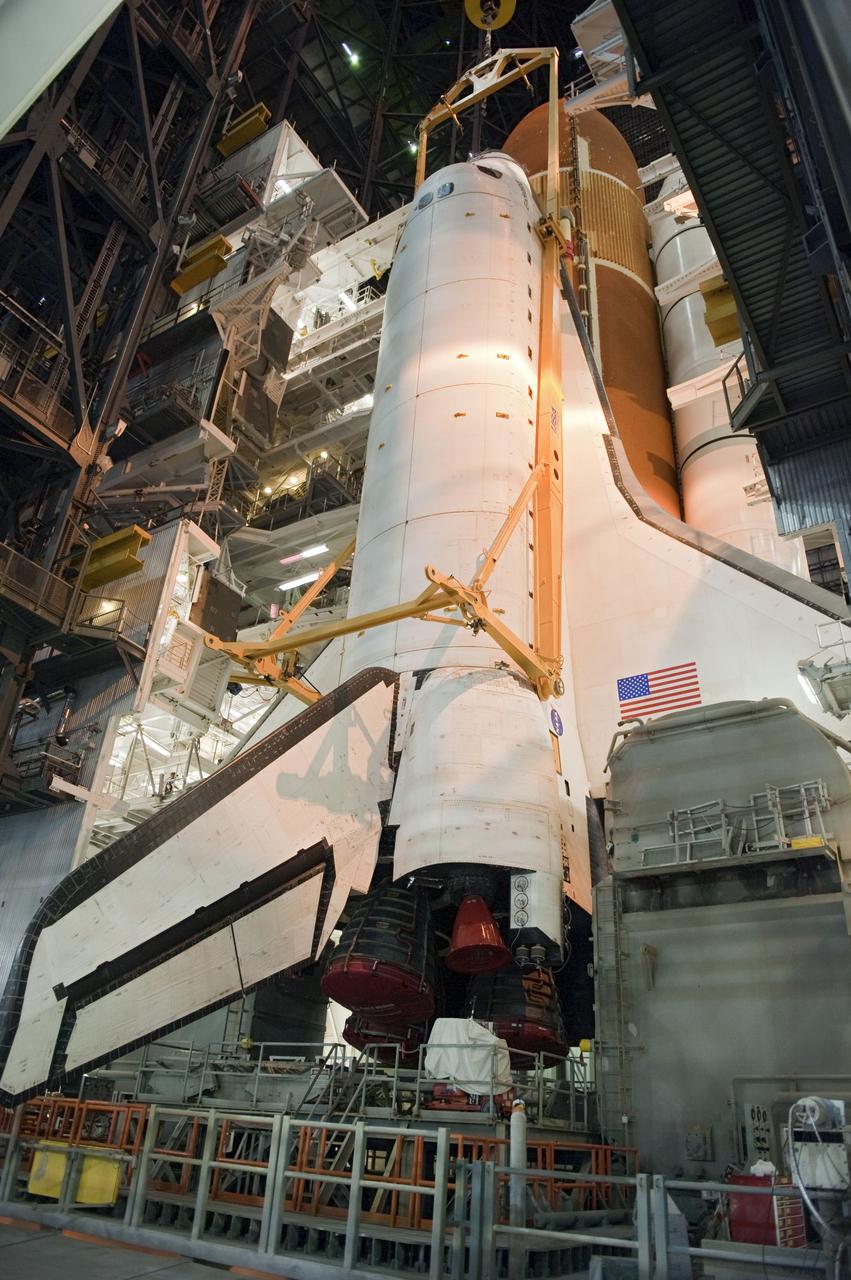
CAPE CANAVERAL, Fla. -- In the Vehicle Assembly Building at NASA's Kennedy Space Center in Florida, shuttle Endeavour is lowered into place where it is being attached to its external fuel tank and solid rocket boosters, already positioned on the mobile launcher platform. Endeavour and its STS-134 crew will deliver the Express Logistics Carrier-3, Alpha Magnetic Spectrometer, a high-pressure gas tank, additional spare parts for Dextre and micrometeoroid debris shields to the International Space Station. Endeavour's final launch is targeted for April 19 at 7:48 p.m. EDT. For more information visit, http://www.nasa.gov/mission_pages/shuttle/shuttlemissions/sts134/index.html. Photo credit: NASA/Kim Shiflett
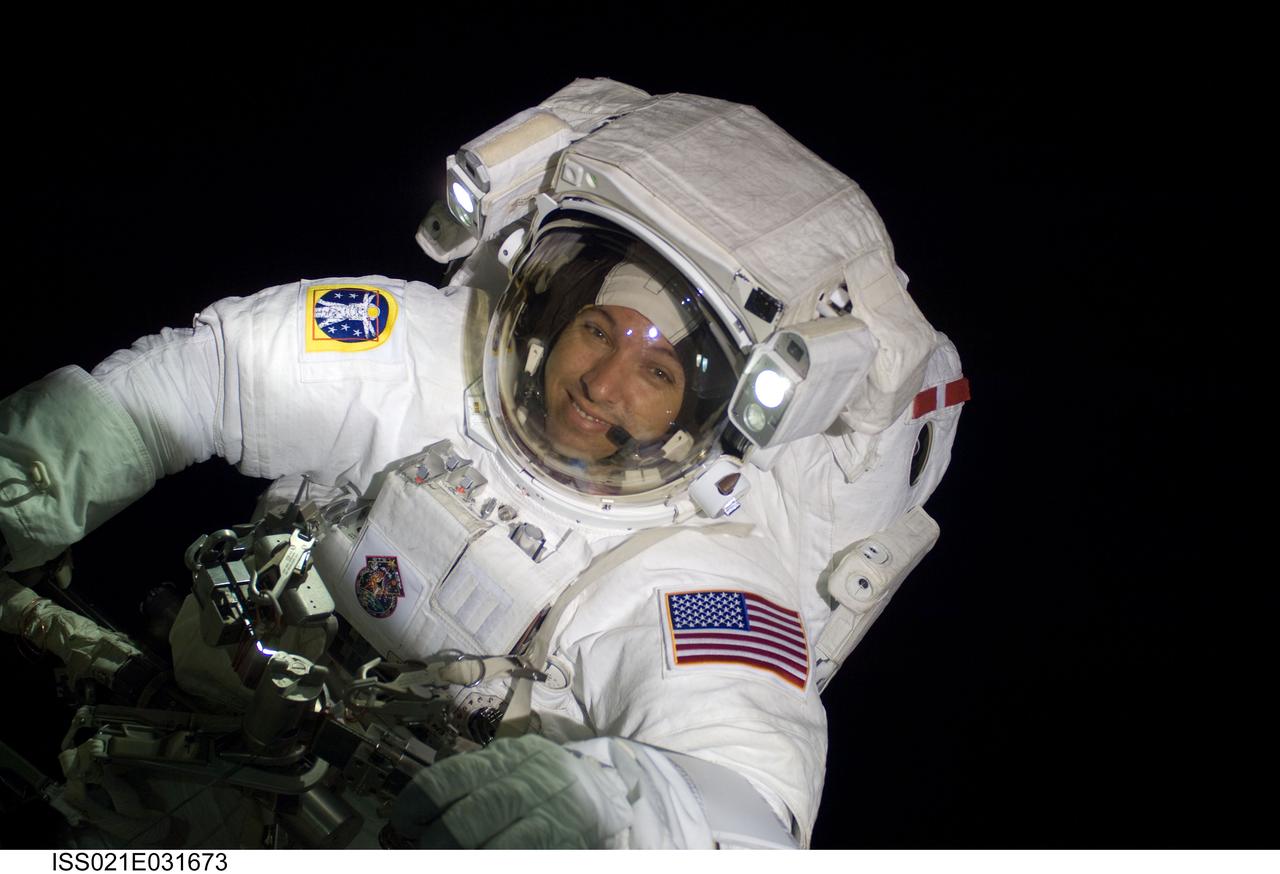
ISS021-E-031673 (23 Nov. 2009) --- Astronaut Randy Bresnik, STS-129 mission specialist, participates in the mission's third and final session of extravehicular activity (EVA) as construction and maintenance continue on the International Space Station. During the five-hour, 42-minute spacewalk, Bresnik and Robert L. Satcher Jr. (out of frame), mission specialist, removed a pair of micrometeoroid and orbital debris shields from the Quest airlock and strapped them to the External Stowage Platform #2, then moved an articulating foot restraint to the airlock, and released a bolt on a starboard truss ammonia tank assembly (ATA) in preparation for an STS-131 spacewalk that will replace the ATA.
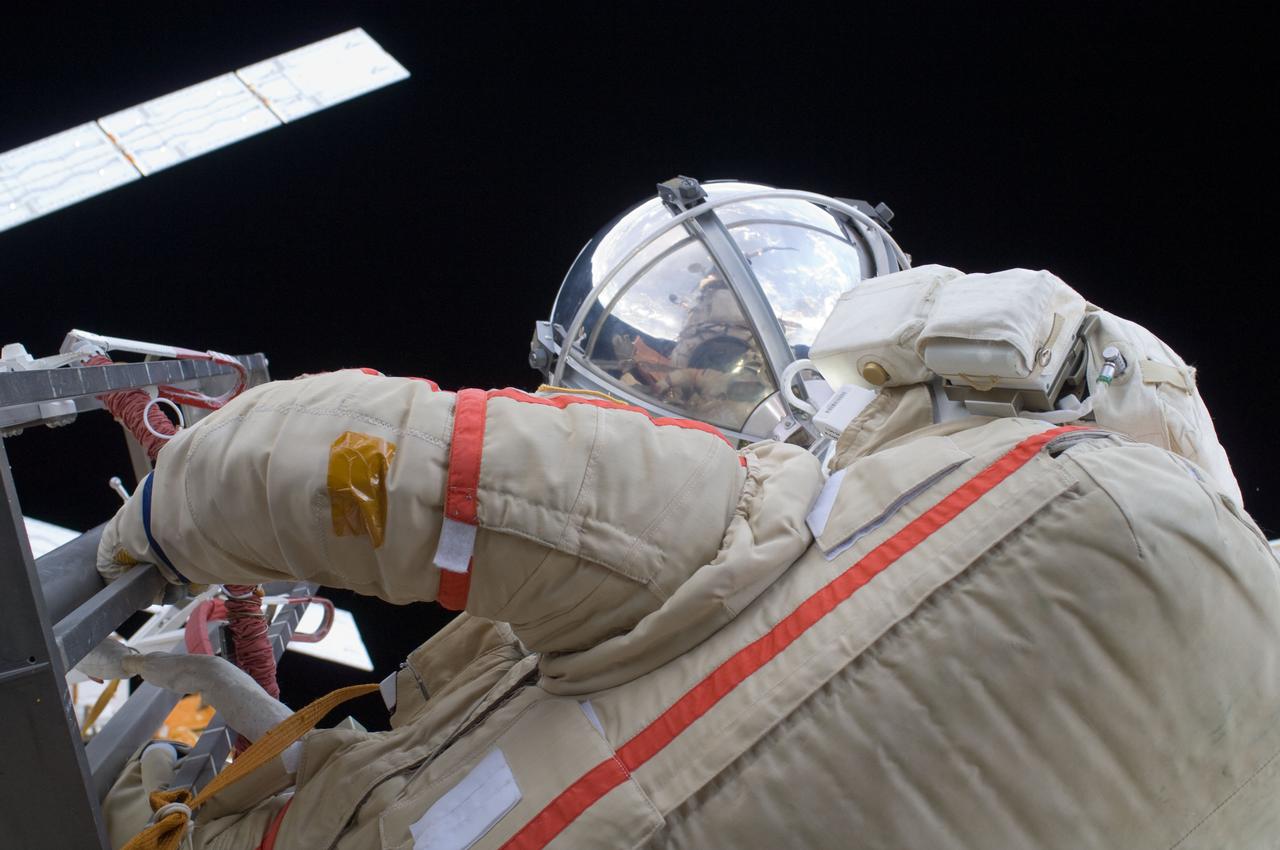
ISS032-E-020596 (20 Aug. 2012) --- Russian cosmonaut Gennady Padalka, Expedition 32 commander, deploys a small ball-shaped science satellite during a session of extravehicular activity (EVA) to continue outfitting the International Space Station. During the five-hour, 51-minute spacewalk, Padalka and Russian cosmonaut Yuri Malenchenko (out of frame), flight engineer, also moved the Strela-2 cargo boom from the Pirs docking compartment to the Zarya module to prepare Pirs for its eventual replacement with a new Russian multipurpose laboratory module. The two spacewalking cosmonauts also installed micrometeoroid debris shields on the exterior of the Zvezda service module.
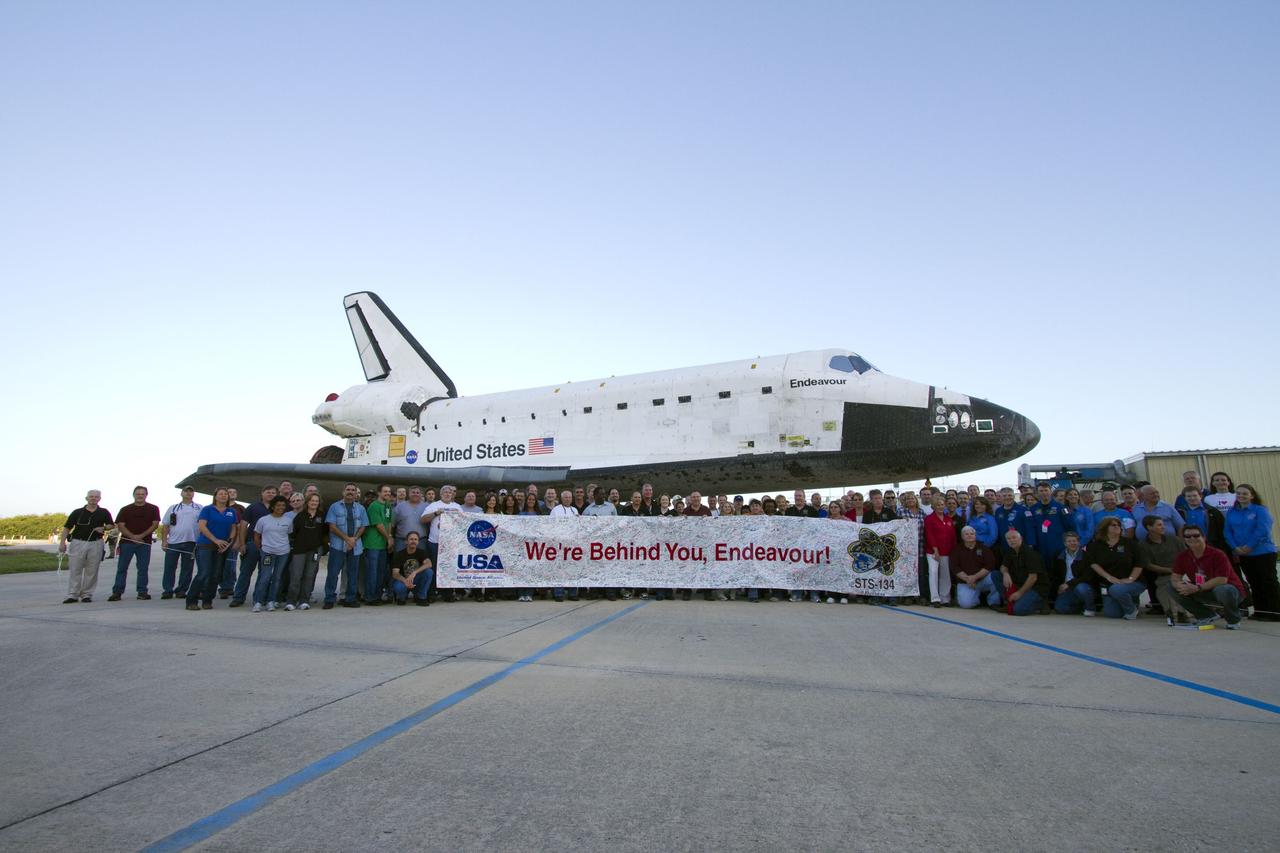
CAPE CANAVERAL, Fla. -- At NASA's Kennedy Space Center in Florida, employees gather to hold up a banner to commemorate space shuttle Endeavour's STS-134 mission, as it is moved from Orbiter Processing Facility-2 to the Vehicle Assembly Building. Endeavour and its STS-134 crew will deliver the Express Logistics Carrier-3, Alpha Magnetic Spectrometer, spare parts, a high-pressure gas tank, additional spare parts for Dextre and micrometeoroid debris shields to the International Space Station. Launch is targeted for April 19 at 7:48 p.m. EDT. For more information visit, http://www.nasa.gov/mission_pages/shuttle/shuttlemissions/sts134/index.html. Photo credit: NASA/Jack Pfaller
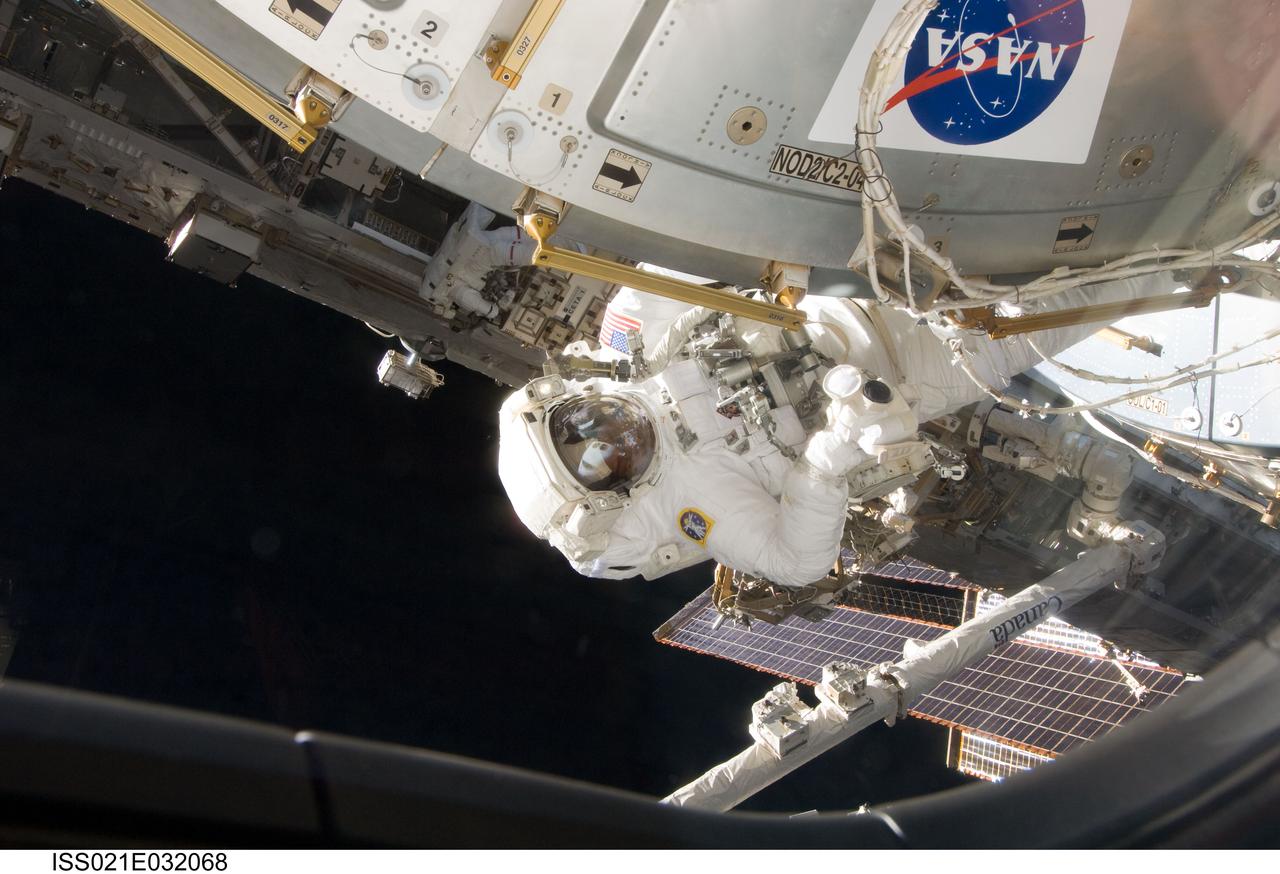
ISS021-E-032068 (23 Nov. 2009) --- Astronaut Robert L. Satcher Jr., STS-129 mission specialist, participates in the mission's third and final session of extravehicular activity (EVA) as construction and maintenance continue on the International Space Station. During the five-hour, 42-minute spacewalk, Satcher and astronaut Randy Bresnik (out of frame), mission specialist, removed a pair of micrometeoroid and orbital debris shields from the Quest airlock and strapped them to the External Stowage Platform #2, then moved an articulating foot restraint to the airlock, and released a bolt on a starboard truss ammonia tank assembly (ATA) in preparation for an STS-131 spacewalk that will replace the ATA.

CAPE CANAVERAL, Fla. -- In the Vehicle Assembly Building at NASA's Kennedy Space Center in Florida, shuttle Endeavour is lowered into place where it will be attached to its external fuel tank and solid rocket boosters, already positioned on the mobile launcher platform. Endeavour and its STS-134 crew will deliver the Express Logistics Carrier-3, Alpha Magnetic Spectrometer, a high-pressure gas tank, additional spare parts for Dextre and micrometeoroid debris shields to the International Space Station. Endeavour's final launch is targeted for April 19 at 7:48 p.m. EDT. For more information visit, http://www.nasa.gov/mission_pages/shuttle/shuttlemissions/sts134/index.html. Photo credit: NASA/Jim Grossmann
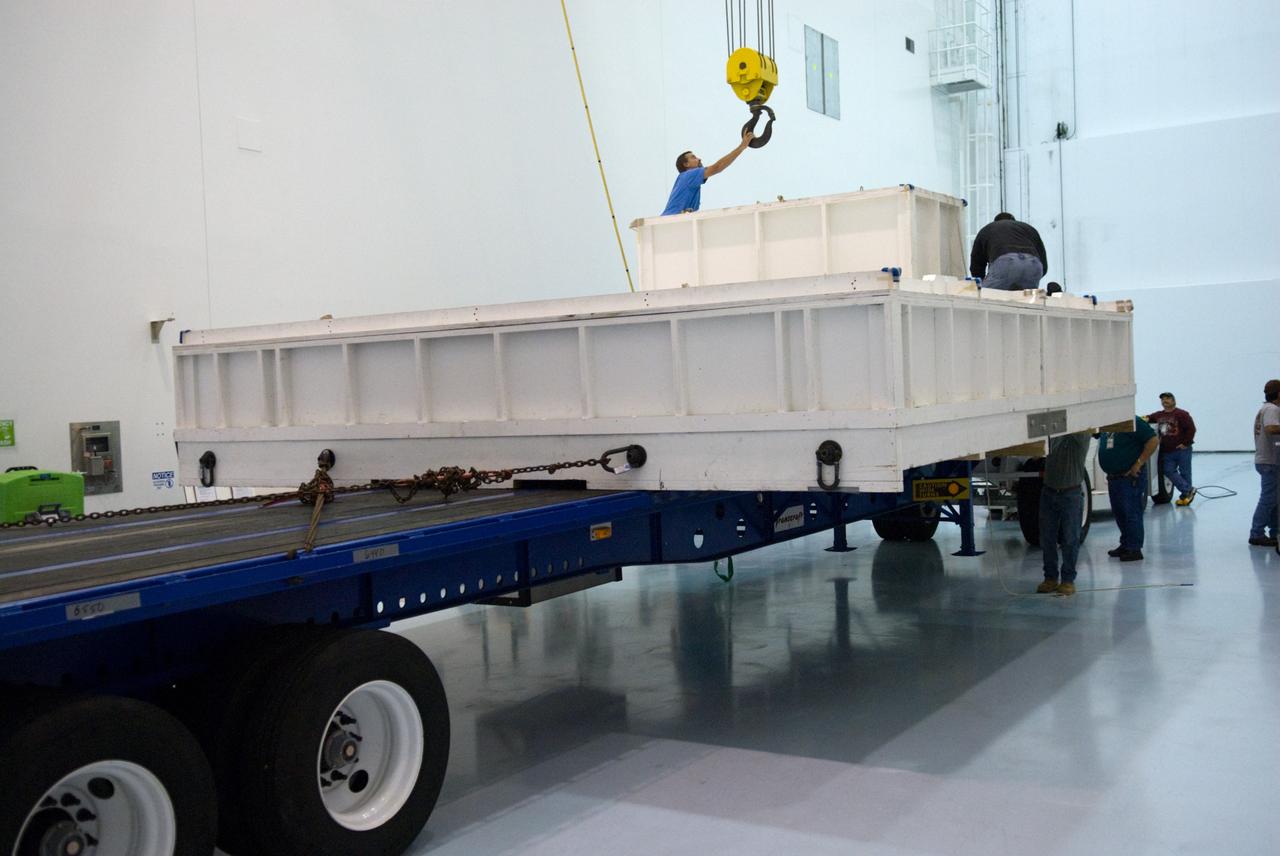
CAPE CANAVERAL, Fla. - In the Space Station Processing Facility at NASA's Kennedy Space Center in Florida, preparations are under way to uncrate the ExPRESS Logistics Carrier 3, or ELC-3. ELC-3 and the Alpha Magnetic Spectrometer are the primary payloads for space shuttle Endeavour's STS-134 mission to the International Space Station. The STS-134 crew will also deliver spare parts including two S-band communications antennas, a high pressure gas tank, additional spare parts for Dextre and micrometeoroid debris shields. Endeavour's launch is targeted for July 29, 2010. For information on the STS-134 mission objectives and crew, visit http://www.nasa.gov/shuttle. Photo credit: NASA/Kim Shiflett

ISS032-E-021044 (20 Aug. 2012) --- Russian cosmonauts Gennady Padalka (top), Expedition 32 commander; and Yuri Malenchenko, flight engineer, participate in a session of extravehicular activity (EVA) to continue outfitting the International Space Station. During the five-hour, 51-minute spacewalk, Padalka and Malenchenko moved the Strela-2 cargo boom from the Pirs docking compartment to the Zarya module to prepare Pirs for its eventual replacement with a new Russian multipurpose laboratory module. The two spacewalking cosmonauts also installed micrometeoroid debris shields on the exterior of the Zvezda service module and deployed a small science satellite.
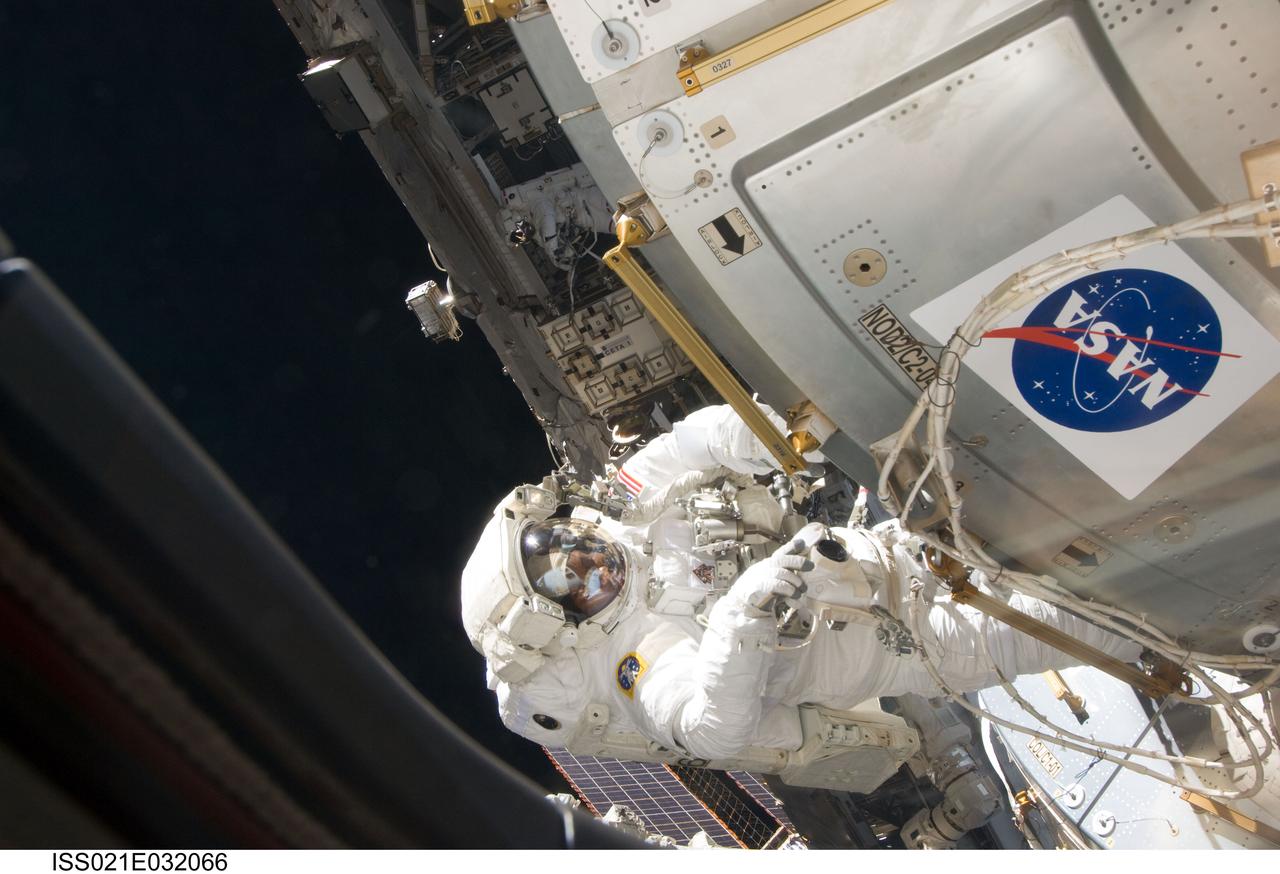
ISS021-E-032066 (23 Nov. 2009) --- Astronaut Robert L. Satcher Jr., STS-129 mission specialist, participates in the mission's third and final session of extravehicular activity (EVA) as construction and maintenance continue on the International Space Station. During the five-hour, 42-minute spacewalk, Satcher and astronaut Randy Bresnik (out of frame), mission specialist, removed a pair of micrometeoroid and orbital debris shields from the Quest airlock and strapped them to the External Stowage Platform #2, then moved an articulating foot restraint to the airlock, and released a bolt on a starboard truss ammonia tank assembly (ATA) in preparation for an STS-131 spacewalk that will replace the ATA.
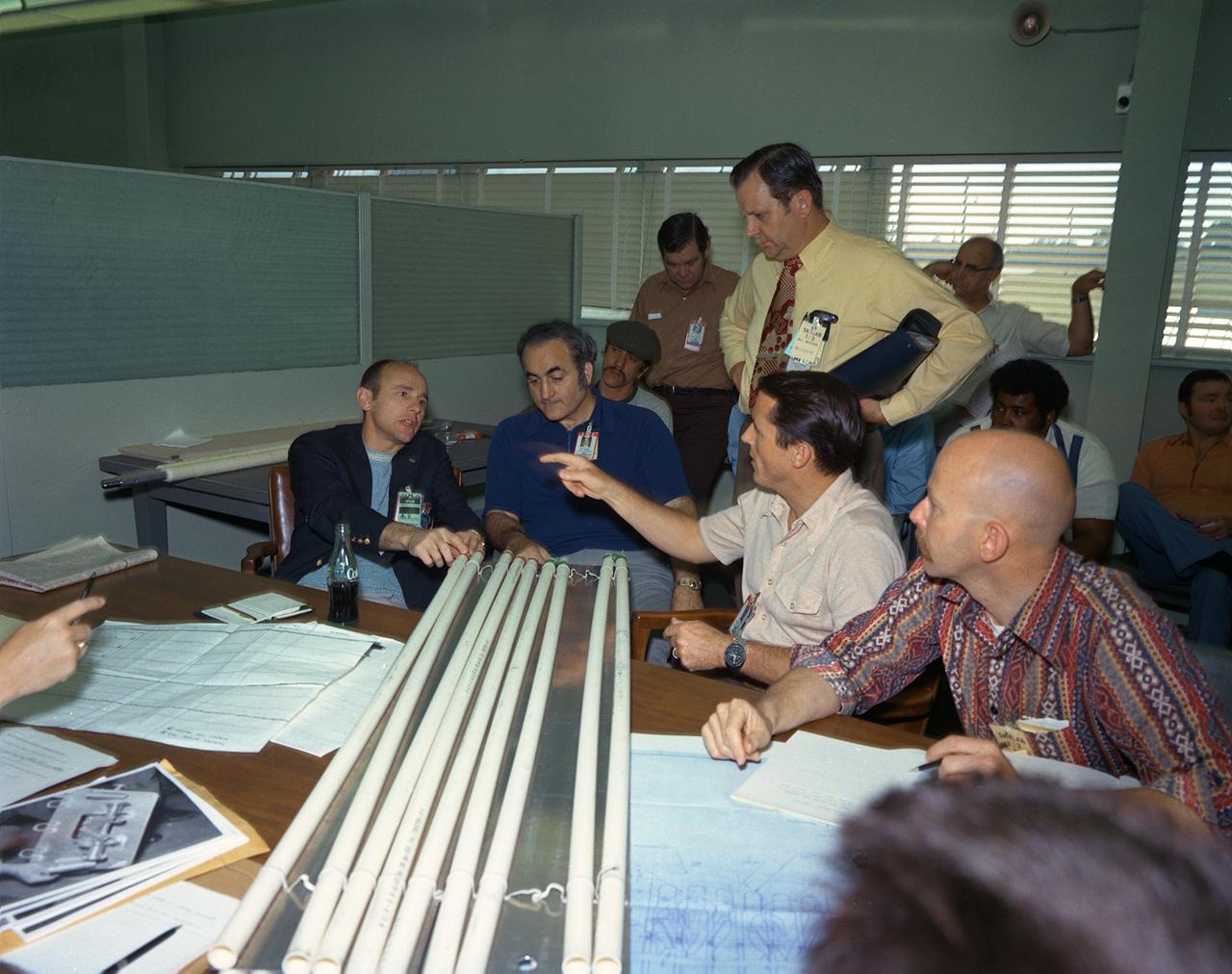
Sixty-three seconds after the launch of the modified Saturn V vehicle carrying the Skylab cluster, engineers in the operation support and control center saw an unexpected telemetry indication that signalled that damages occurred on one solar array and the micrometeoroid shield during the launch. Still unoccupied, the Skylab was stricken with the loss of the heat shield and sunlight beat mercilessly on the lab's sensitive skin. Internal temperatures soared, rendering the the station uninhabitable, threatening foods, medicines, films, and experiments. The launch of the first marned Skylab (Skylab-2) mission was delayed until methods were devised to repair and salvage the workshop. Personnel from other NASA Centers and industries quickly joined the Marshall Space Flight Center (MSFC) in efforts to save the damaged Skylab. They worked day and night for the next several days. Eventually the MSFC developed, tested, rehearsed, and approved three repair options. These options included a parasol sunshade and a twin-pole sunshade to restore the temperature inside the workshop, and a set of metal cutting tools to free the jammed solar panel. This photograph was taken during a discussion of the methods of the twin-pole Sun shield by (left to right) Astronaut Alan Bean, MSFC Director Dr. Rocco Petrone, Astronaut Edward Gibson, and MSFC engineer Richard Heckman. Dr. William Lucas, who became MSFC Director after Dr. Petrone left MSFC in March of 1974, is standing.
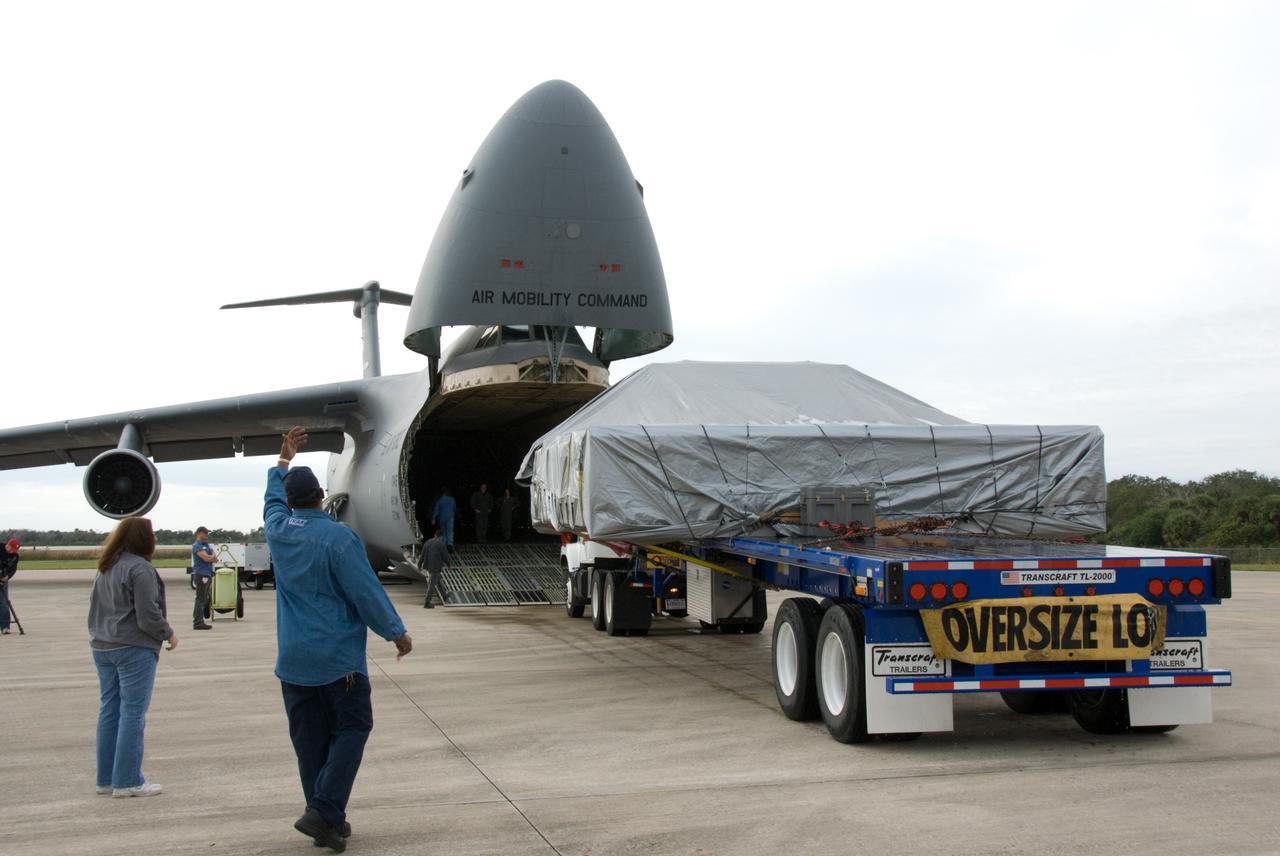
CAPE CANAVERAL, Fla. - At the Shuttle Landing Facility at NASA's Kennedy Space Center in Florida, the ExPRESS Logistics Carrier 3, or ELC-3, is removed from the cargo compartment of a U.S. Air Force C-5 aircraft. ELC-3 and the Alpha Magnetic Spectrometer are the primary payloads for space shuttle Endeavour's STS-134 mission to the International Space Station. The STS-134 crew will also deliver spare parts including two S-band communications antennas, a high pressure gas tank, additional spare parts for Dextre and micrometeoroid debris shields. Endeavour's launch is targeted for July 29, 2010. For information on the STS-134 mission objectives and crew, visit http://www.nasa.gov/shuttle. Photo credit: NASA/Kim Shiflett
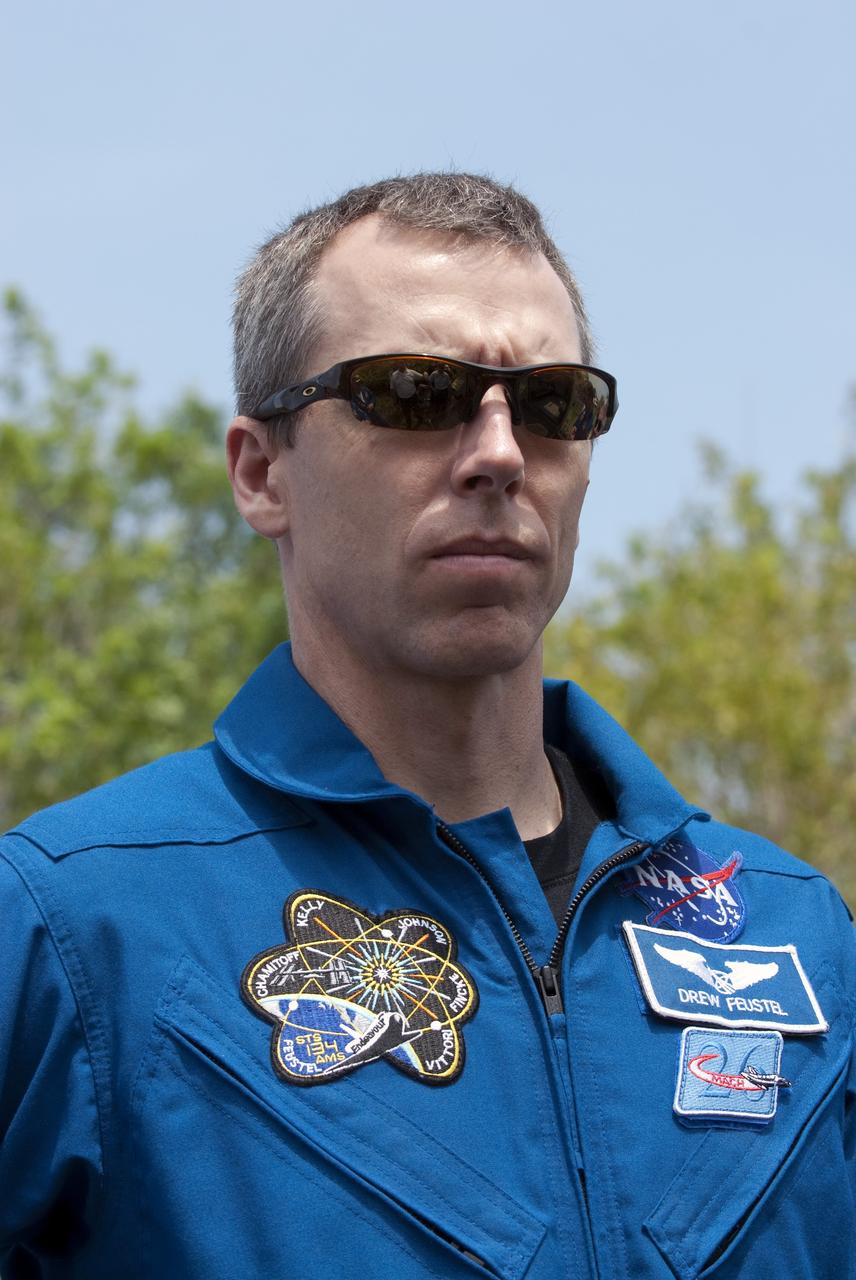
CAPE CANAVERAL, Fla. - STS-134 Mission Specialist Andrew Feustel listens intently to instruction during M113 armored personnel carrier training at NASA's Kennedy Space Center in Florida. An M113 is kept at the foot of the launch pad in case an emergency exit from the pad is needed and every shuttle crew is trained on driving the vehicle before launch. Space shuttle Endeavour's six crew members are at Kennedy for the launch countdown dress rehearsal called the Terminal Countdown Demonstration Test (TCDT) and related training. Targeted to launch April 19 at 7:48 p.m. EDT, they will deliver the Express Logistics Carrier-3, Alpha Magnetic Spectrometer-2 (AMS), a high-pressure gas tank, additional spare parts for the Dextre robotic helper and micrometeoroid debris shields to the space station. This is the final scheduled spaceflight for Endeavour. For more information visit, www.nasa.gov/mission_pages/shuttle/shuttlemissions/sts134/index.html. Photo credit: NASA/Kim Shiflett
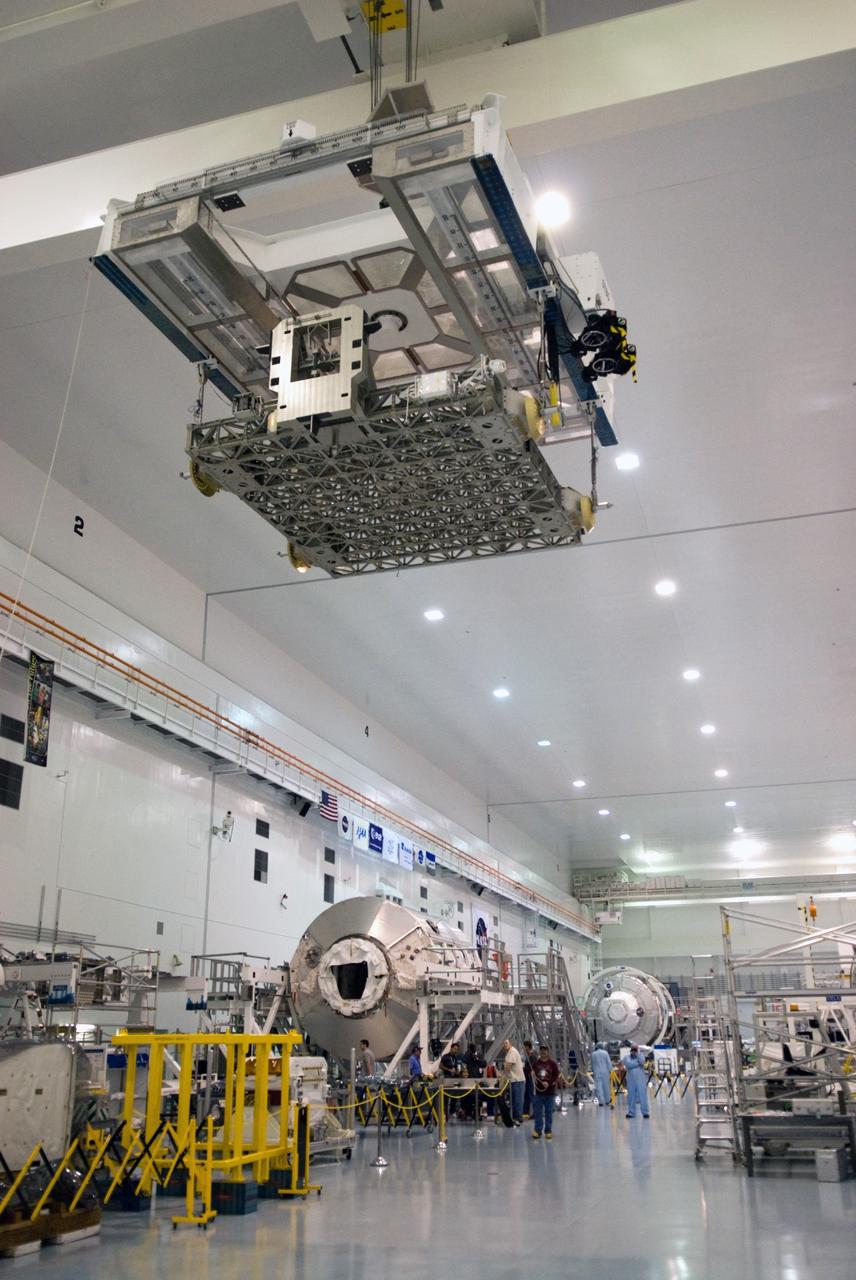
CAPE CANAVERAL, Fla. - In the Space Station Processing Facility at NASA's Kennedy Space Center in Florida, the newly arrived ExPRESS Logistics Carrier 3, or ELC-3, is lifted high above the clean room floor. ELC-3 and the Alpha Magnetic Spectrometer are the primary payloads for space shuttle Endeavour's STS-134 mission to the International Space Station. The STS-134 crew will also deliver spare parts including two S-band communications antennas, a high pressure gas tank, additional spare parts for Dextre and micrometeoroid debris shields. Endeavour's launch is targeted for July 29, 2010. For information on the STS-134 mission objectives and crew, visit http://www.nasa.gov/shuttle. Photo credit: NASA/Kim Shiflett
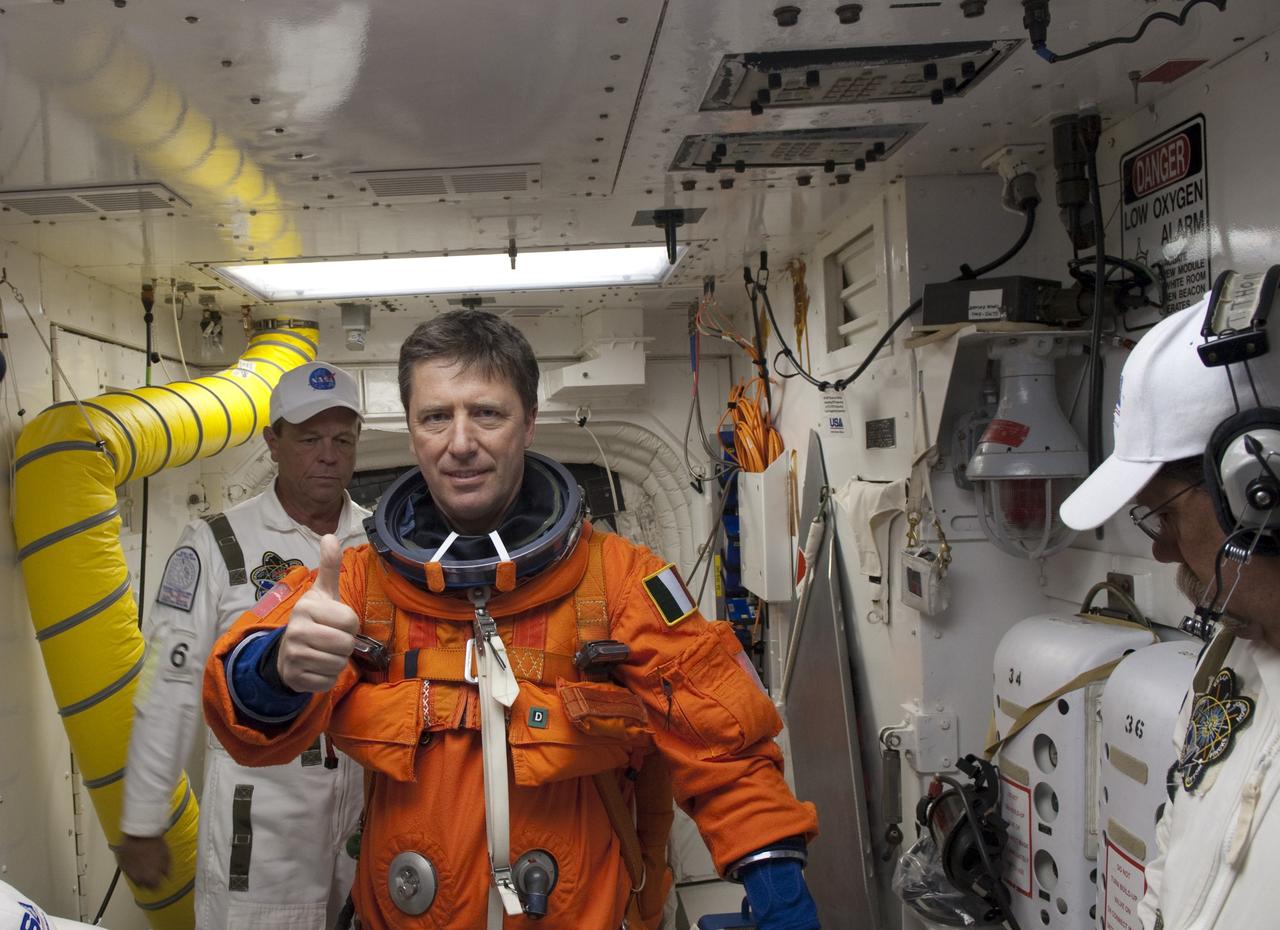
CAPE CANAVERAL, Fla. -- In the White Room of Launch Pad 39A at NASA's Kennedy Space Center in Florida, STS-134 Mission Specialist Roberto Vittori, with the European Space Agency, prepares to board space shuttle Endeavour during the Terminal Countdown Demonstration Test (TCDT). Part of TCDT includes practicing the final hours of a real launch day when astronauts put on their launch-and-entry suits, ride to the pad in the Astrovan and strap into the shuttle. Endeavour's six crew members are targeted to launch April 19 at 7:48 p.m. EDT. They will deliver the Express Logistics Carrier-3, Alpha Magnetic Spectrometer-2 (AMS), a high-pressure gas tank, additional spare parts for the Dextre robotic helper and micrometeoroid debris shields to the International Space Station. This will be the final spaceflight for Endeavour. For more information visit, www.nasa.gov/mission_pages/shuttle/shuttlemissions/sts134/index.html. Photo credit: NASA/Jim Grossmann
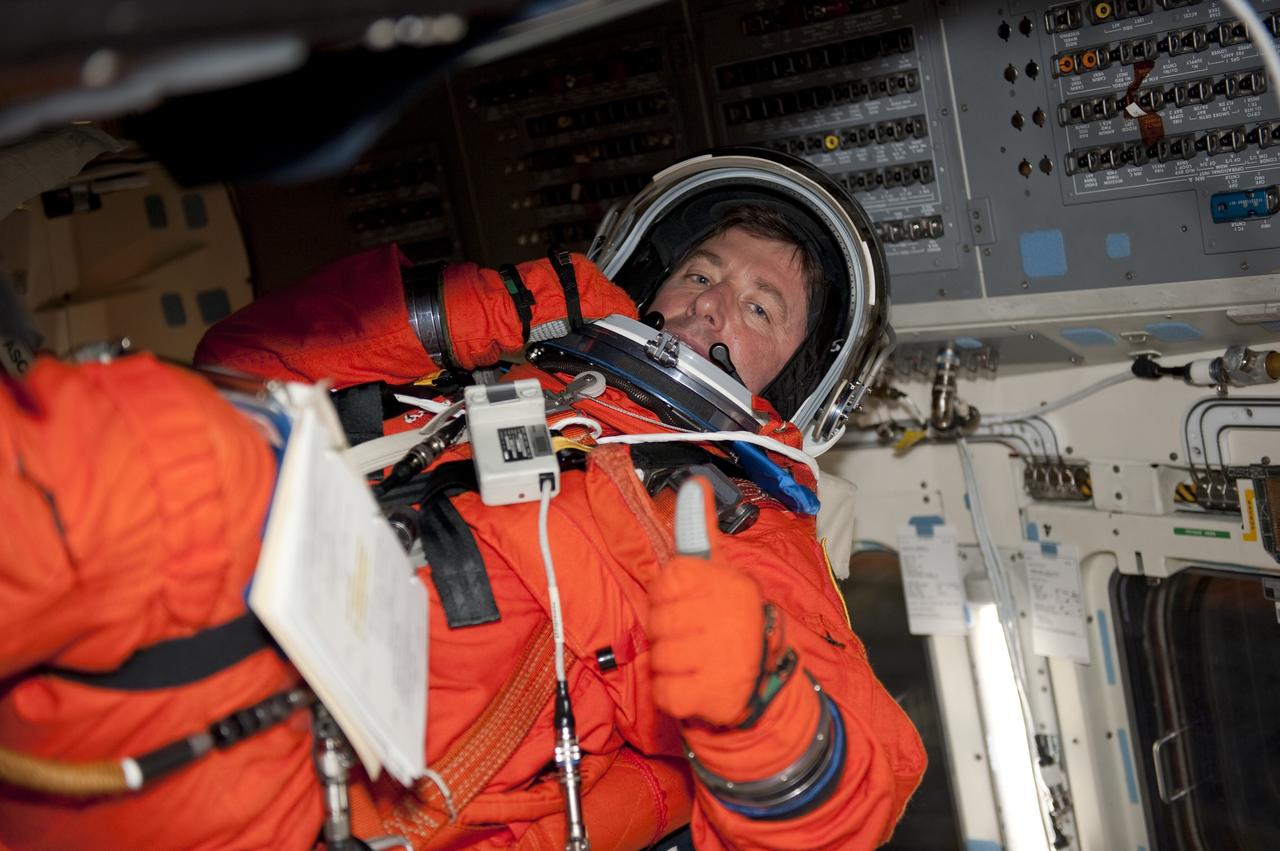
CAPE CANAVERAL, Fla. -- STS-134 Mission Specialist Roberto Vittori, with the European Space Agency, gives a thumbs-up as he takes his seat aboard space shuttle Endeavour during the Terminal Countdown Demonstration Test (TCDT) on Launch Pad 39A at NASA's Kennedy Space Center in Florida. Part of TCDT includes practicing the final hours of a real launch day when astronauts put on their launch-and-entry suits, ride to the pad in the Astrovan and strap into the shuttle. Endeavour's six crew members are targeted to launch April 19 at 7:48 p.m. EDT. They will deliver the Express Logistics Carrier-3, Alpha Magnetic Spectrometer-2 (AMS), a high-pressure gas tank, additional spare parts for the Dextre robotic helper and micrometeoroid debris shields to the International Space Station. This will be the final spaceflight for Endeavour. For more information visit, www.nasa.gov/mission_pages/shuttle/shuttlemissions/sts134/index.html. Photo credit: NASA/Kim Shiflett
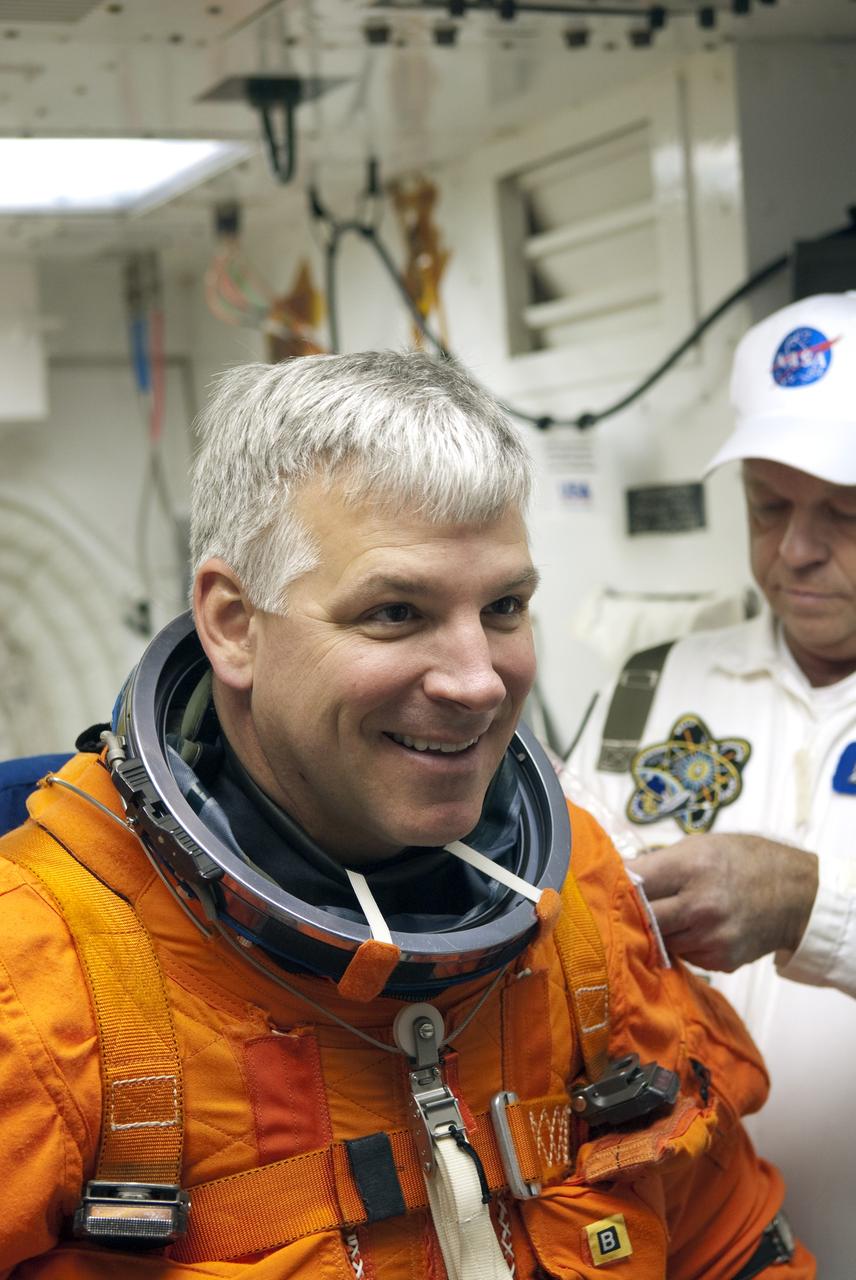
CAPE CANAVERAL, Fla. -- In the White Room of Launch Pad 39A at NASA's Kennedy Space Center in Florida, STS-134 Pilot Greg H. Johnson prepares to board space shuttle Endeavour during the Terminal Countdown Demonstration Test (TCDT). Part of TCDT includes practicing the final hours of a real launch day when astronauts put on their launch-and-entry suits, ride to the pad in the Astrovan and strap into the shuttle. Endeavour's six crew members are targeted to launch April 19 at 7:48 p.m. EDT. They will deliver the Express Logistics Carrier-3, Alpha Magnetic Spectrometer-2 (AMS), a high-pressure gas tank, additional spare parts for the Dextre robotic helper and micrometeoroid debris shields to the International Space Station. This will be the final spaceflight for Endeavour. For more information visit, www.nasa.gov/mission_pages/shuttle/shuttlemissions/sts134/index.html. Photo credit: NASA/Jim Grossmann
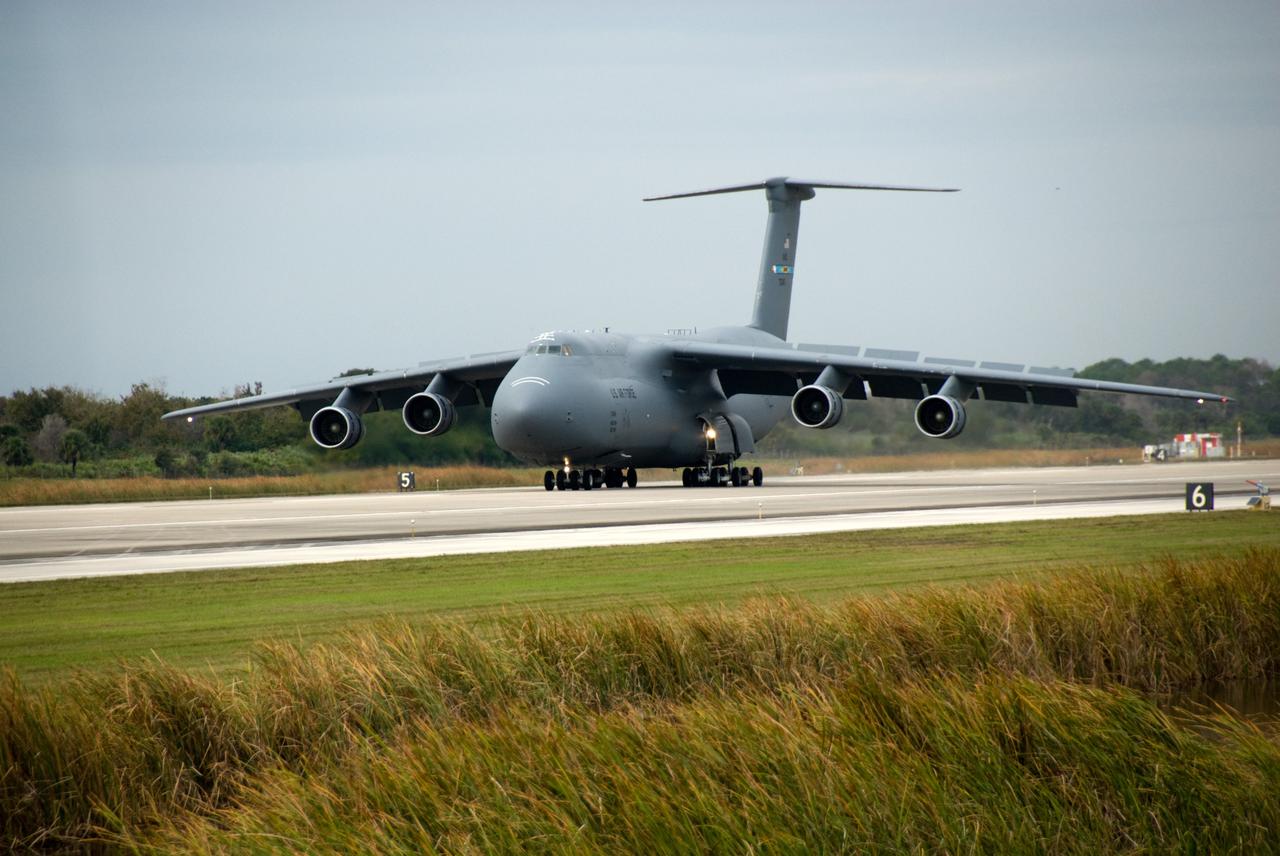
CAPE CANAVERAL, Fla. - At NASA's Kennedy Space Center in Florida, U.S. Air Force C-5 aircraft lands at the Shuttle Landing Facility, delivering the ExPRESS Logistics Carrier 3, or ELC-3. ELC-3 and the Alpha Magnetic Spectrometer are the primary payloads for space shuttle Endeavour's STS-134 mission to the International Space Station. The STS-134 crew will also deliver spare parts including two S-band communications antennas, a high pressure gas tank, additional spare parts for Dextre and micrometeoroid debris shields. Endeavour's launch is targeted for July 29, 2010. For information on the STS-134 mission objectives and crew, visit http://www.nasa.gov/shuttle. Photo credit: NASA/Kim Shiflett