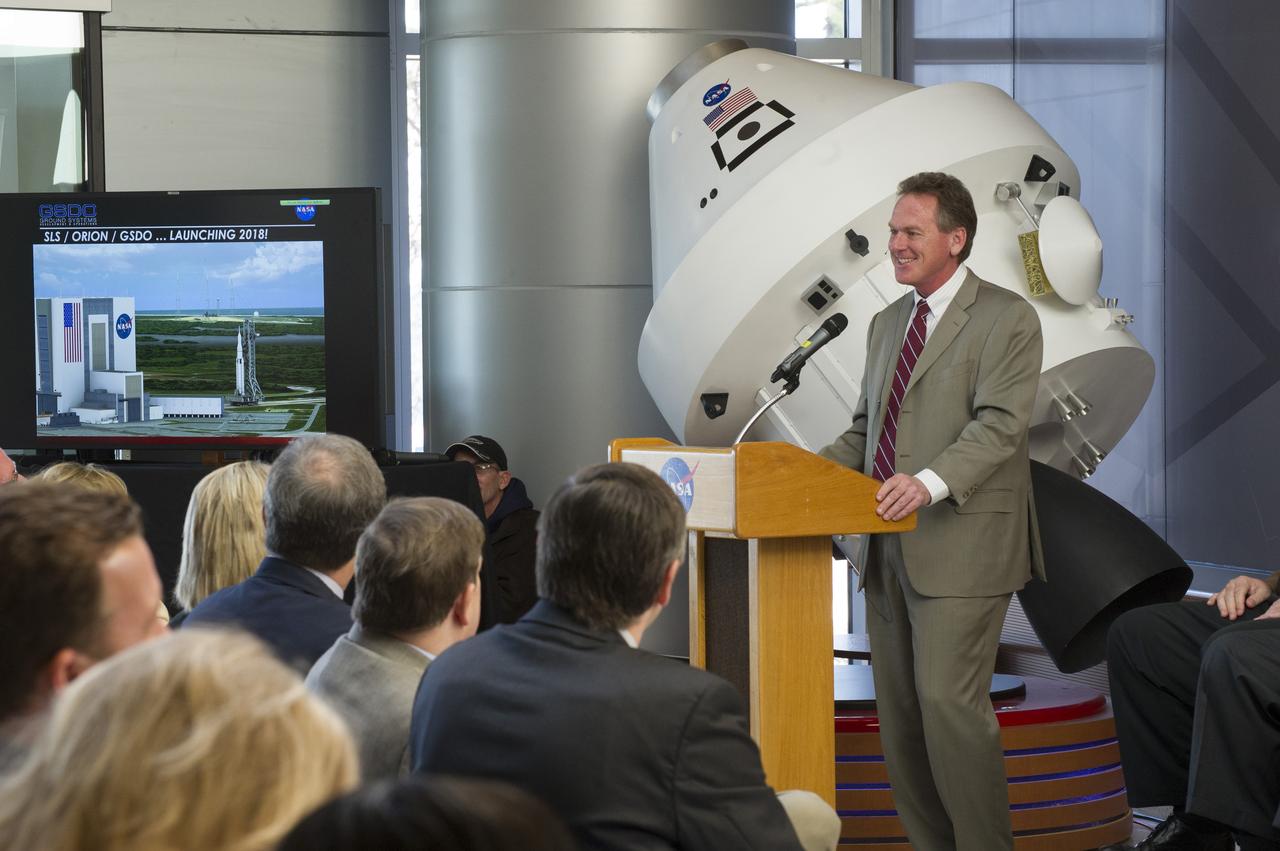
MIKE BOLGER ADDRESSES AUDIENCE AT SLS ALL HANDS
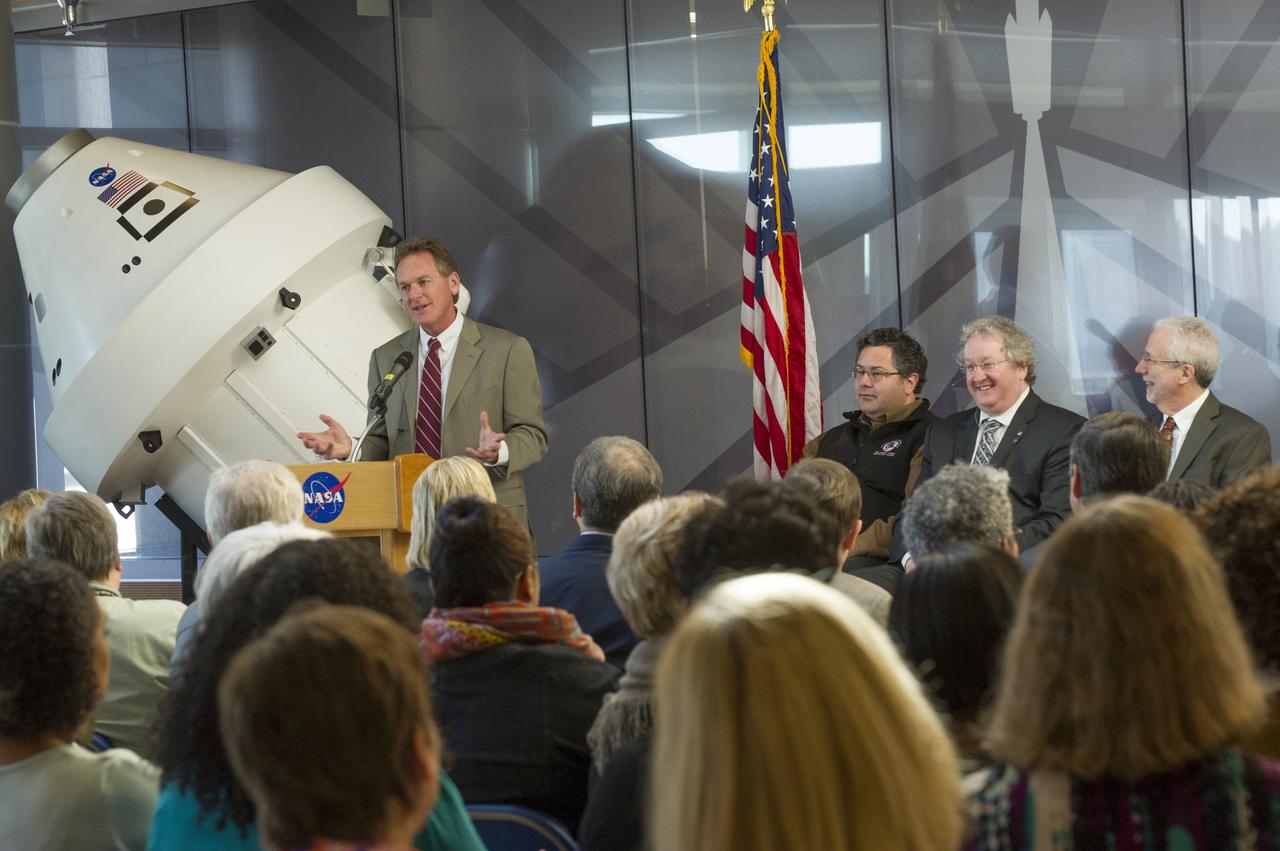
MIKE BOLGER ADDRESSES AUDIENCE AT SLS ALL HANDS
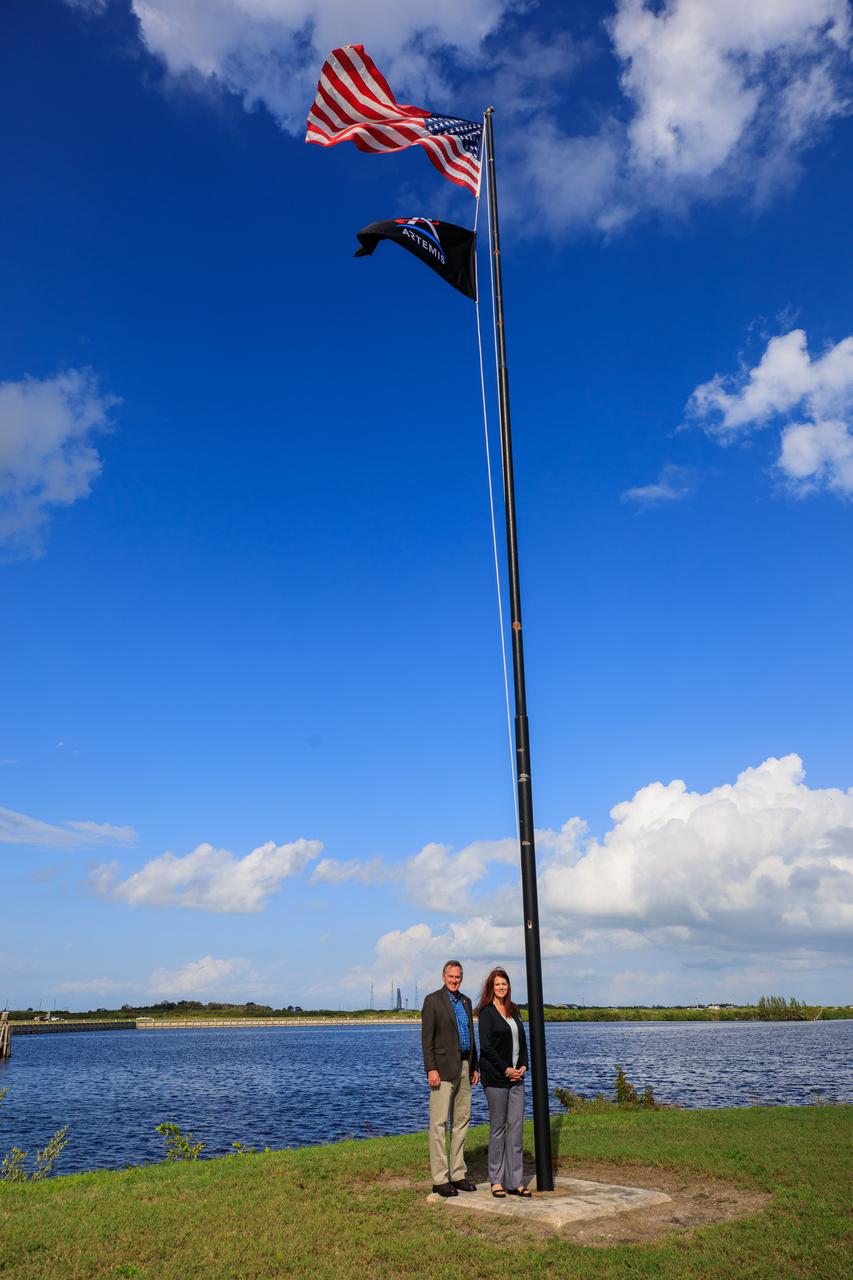
Exploration Ground Systems Manager Mike Bolger (left) and Artemis I Launch Director Charlie Blackwell-Thompson (right) raise the Artemis flag near the countdown clock at NASA’s Kennedy Space Center in Florida on Nov. 14, 2022. NASA’s Space Launch System (SLS) rocket and Orion spacecraft can be seen in the background at Kennedy’s Launch Pad 39B. The uncrewed Artemis I flight will be the first integrated test of the agency’s SLS rocket and Orion spacecraft and is scheduled to launch Wednesday, Nov. 16. The primary goal of Artemis I is to thoroughly test the integrated systems before crewed missions by launching Orion atop the SLS rocket, operating the spacecraft in a deep space environment, testing Orion’s heat shield, and recovering the crew module after reentry, descent, and splashdown. During the flight, Orion will launch atop the world’s most powerful rocket and fly farther than any human-rated spacecraft has ever flown, paving the way for human deep space exploration and demonstrating our commitment and capability to extend human presence to the Moon and beyond.
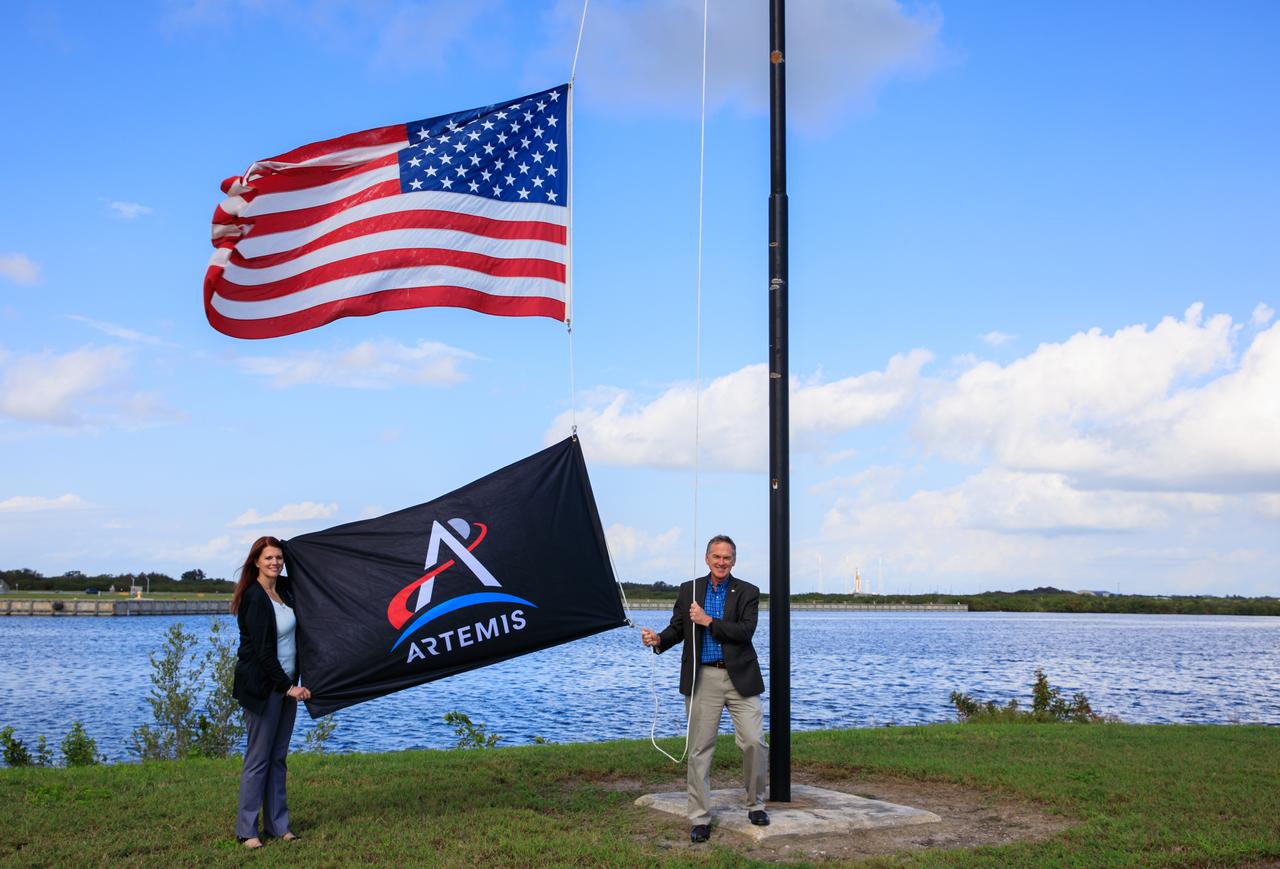
Artemis I Launch Director Charlie Blackwell-Thompson (left) and Exploration Ground Systems Manager Mike Bolger (right) raise the Artemis flag near the countdown clock at NASA’s Kennedy Space Center in Florida on Nov. 14, 2022. NASA’s Space Launch System (SLS) rocket and Orion spacecraft can be seen in the background at Kennedy’s Launch Pad 39B. The uncrewed Artemis I flight will be the first integrated test of the agency’s SLS rocket and Orion spacecraft and is scheduled to launch Wednesday, Nov. 16. The primary goal of Artemis I is to thoroughly test the integrated systems before crewed missions by launching Orion atop the SLS rocket, operating the spacecraft in a deep space environment, testing Orion’s heat shield, and recovering the crew module after reentry, descent, and splashdown. During the flight, Orion will launch atop the world’s most powerful rocket and fly farther than any human-rated spacecraft has ever flown, paving the way for human deep space exploration and demonstrating our commitment and capability to extend human presence to the Moon and beyond.
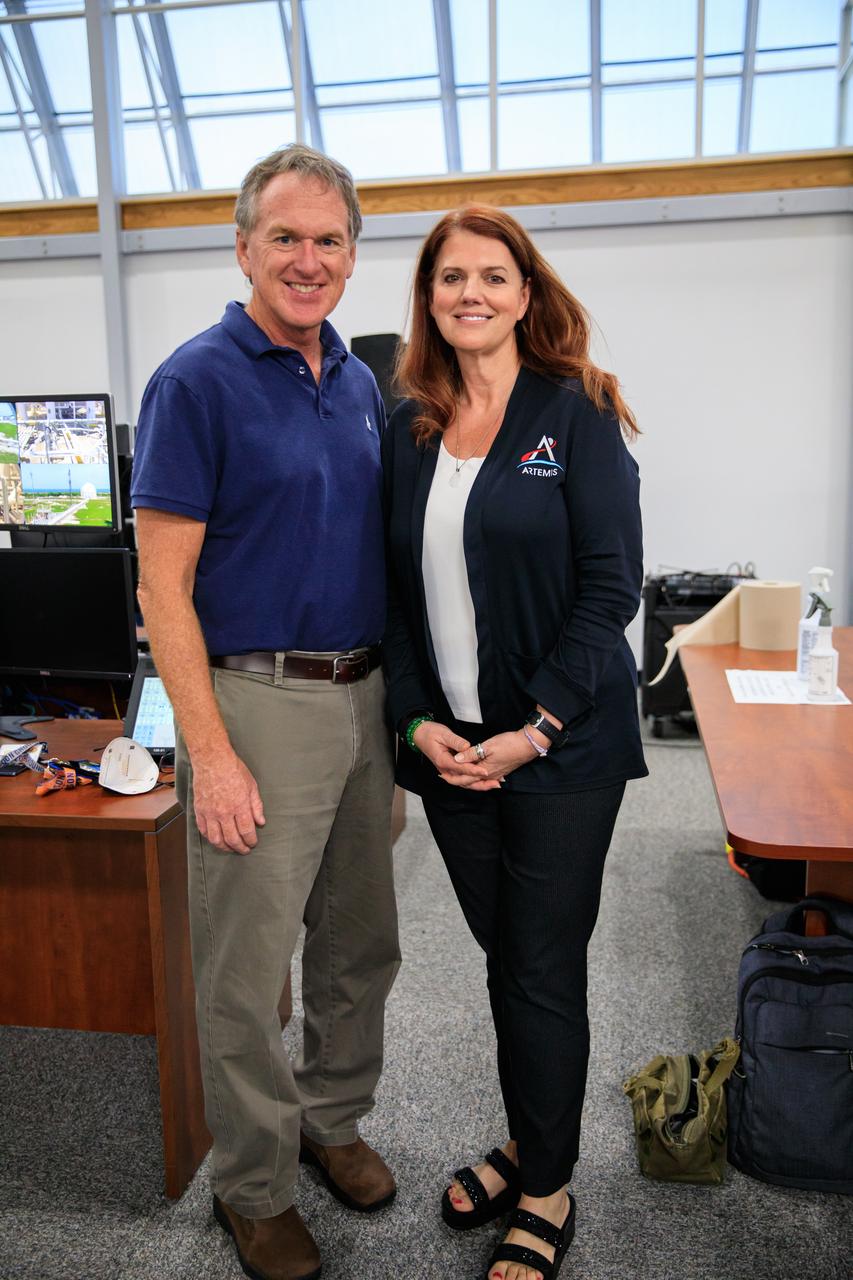
NASA’s Exploration Ground Systems Manager Mike Bolger (left) and Artemis I Launch Director Charlie Blackwell-Thompson are photographed inside Firing Room 2 of the Rocco A. Petrone Launch Control Center at the agency’s Kennedy Space Center in Florida during a certification ceremony on Aug. 12, 2022. The ceremony was held to commemorate the certification of the Artemis I launch team following their launch simulation held in December 2021. During the ceremony, Bolger and Blackwell-Thompson handed out certificates to individual members of the launch team. The first in an increasingly complex series of missions, Artemis I will test NASA’s Space Launch System rocket and Orion spacecraft as an integrated system prior to crewed flights to the Moon. Through Artemis, NASA will land the first woman and the first person of color on the lunar surface, paving the way for long-term lunar presence and using the Moon as a steppingstone before venturing to Mars.
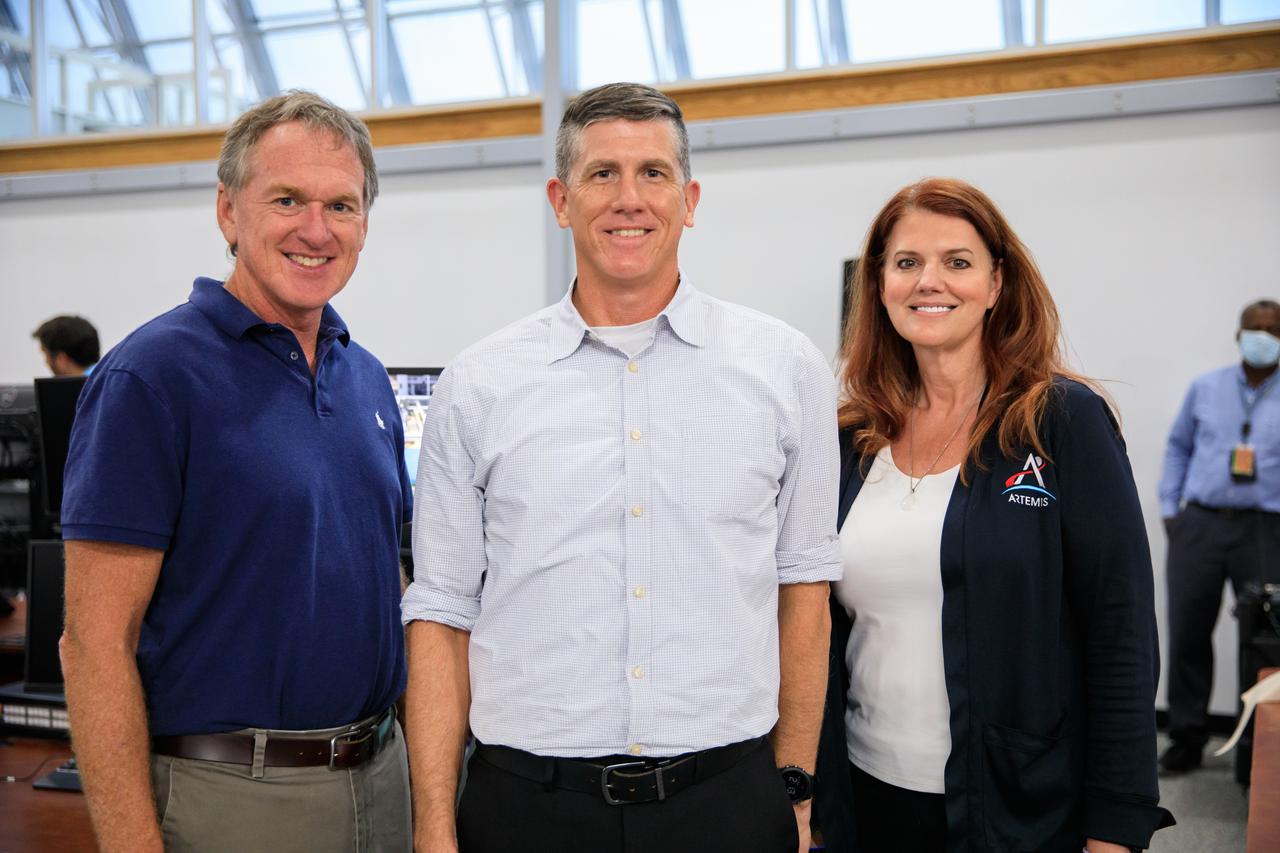
From left, NASA’s Exploration Ground Systems Manager Mike Bolger, Artemis I Assistant Launch Director Jeremy Graeber, and Launch Director Charlie Blackwell-Thompson are photographed inside Firing Room 2 of the Rocco A. Petrone Launch Control Center at the agency’s Kennedy Space Center in Florida during a certification ceremony on Aug. 12, 2022. The ceremony was held to commemorate the certification of the Artemis I launch team following their launch simulation held in December 2021. During the ceremony, Bolger, Graeber, and Blackwell-Thompson handed out certificates to individual members of the launch team. The first in an increasingly complex series of missions, Artemis I will test NASA’s Space Launch System rocket and Orion spacecraft as an integrated system prior to crewed flights to the Moon. Through Artemis, NASA will land the first woman and the first person of color on the lunar surface, paving the way for long-term lunar presence and using the Moon as a steppingstone before venturing to Mars.
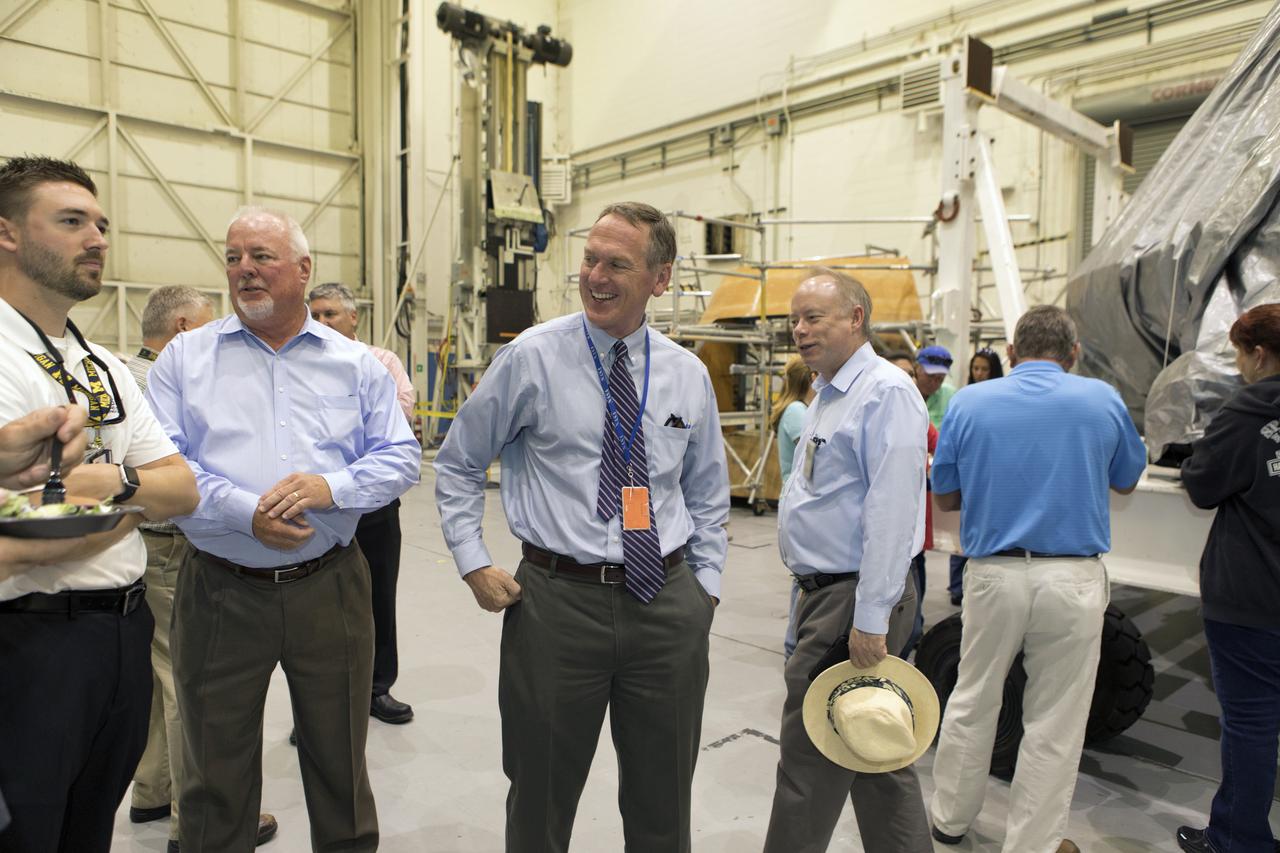
The team that tested the umbilical lines and accessories that will connect from the mobile launcher to NASA's Space Launch System rocket and Orion spacecraft for Exploration Mission-1 hold a banner signing event July 24, 2018, to mark completion of testing at the Launch Equipment Test Facility (LETF) at NASA's Kennedy Space Center in Florida. Attending the event is Mike Bolger, center, Exploration Ground Systems manager. A total of 21 umbilicals and launch accessories were tested on various simulators at the LETF before they were transferred to the mobile launcher for installation.
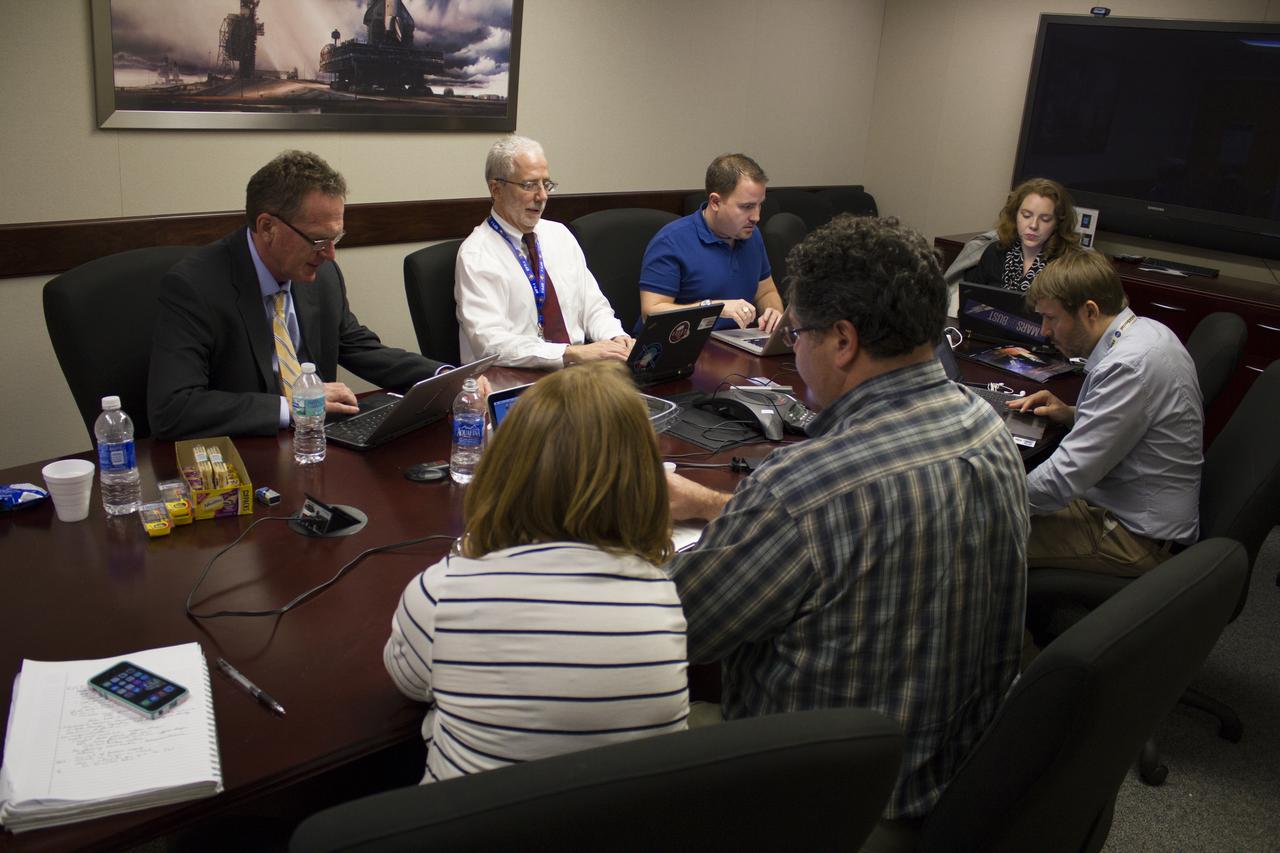
NASA managers participate in a live online Ask Me Anything, or AMA, session for reddit.com followers during Orion preflight activities at NASA Kennedy Space Center's News Center in Florida. From left, are Mike Bolger, Ground Systems Development and Operations program manager; and Mark Geyer, Orion program manager. Across from them, in the plaid shirt is Todd May, Space Launch System program manager. Discussion topics include Mars and technology.

NASA managers participate in a live online Ask Me Anything, or AMA, session for reddit.com followers during Orion preflight activities at NASA Kennedy Space Center's News Center in Florida. Participating are Mike Bolger, Ground Systems Development and Operations program manager Mark Geyer, Orion program manager and Todd May, Space Launch System program manager. Discussion topics include Mars and technology. Monitoring the live discussion is Brandi Dean, public affairs specialist from Johnson Space Center in Houston.
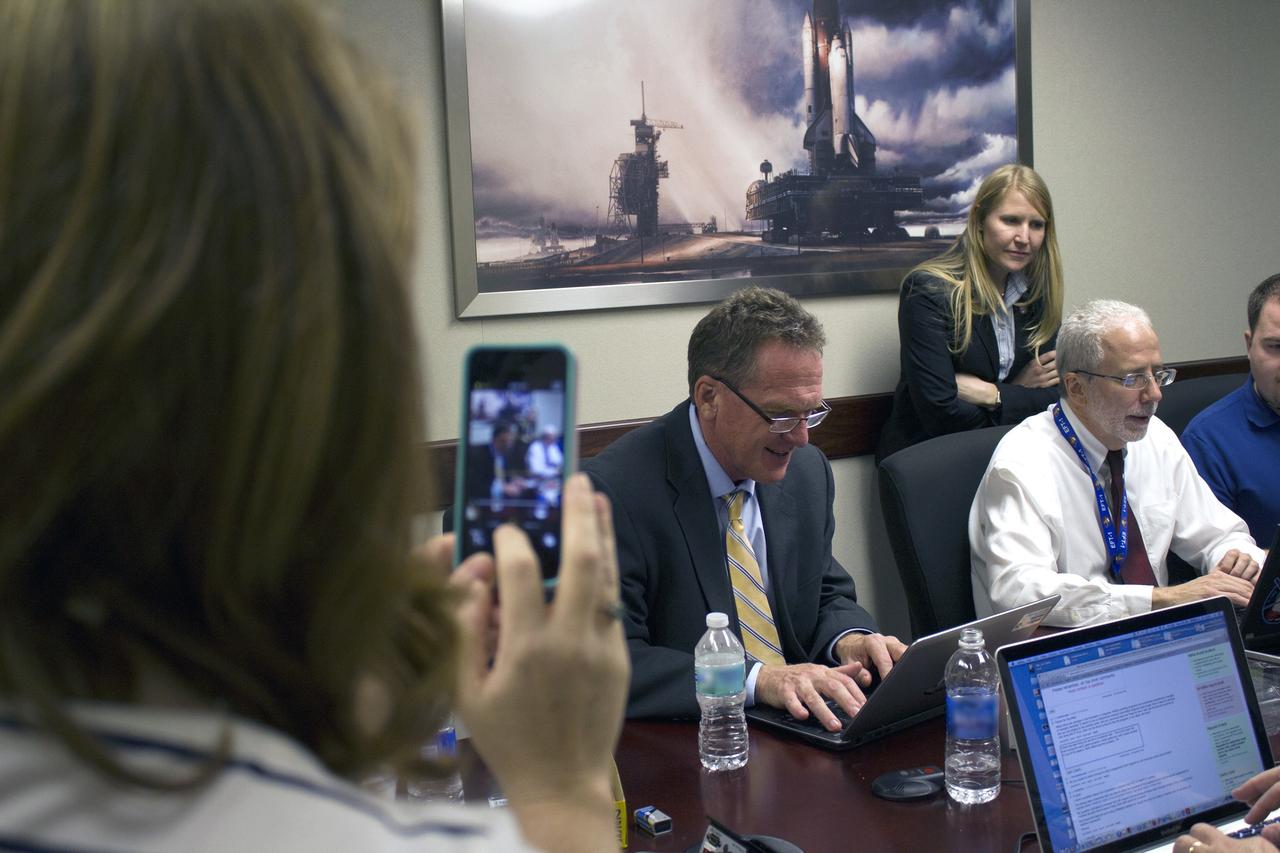
CAPE CANAVERAL, Fla. – NASA managers participate in a live online Ask Me Anything, or AMA, session for reddit.com followers during Orion preflight activities at NASA Kennedy Space Center's News Center in Florida. From left, are Mike Bolger, Ground Systems Development and Operations program manager and Mark Geyer, Orion program manager. Also participating, but not shown in the photo is Todd May, Space Launch System program manager. Discussion topics include Mars and technology. Photo credit: NASA/Frankie Martin

CAPE CANAVERAL, Fla. – NASA managers participate in a live online Ask Me Anything, or AMA, session for reddit.com followers during Orion preflight activities at NASA Kennedy Space Center's News Center in Florida. At left, is Mike Bolger, Ground Systems Development and Operations program manager. Not shown, but also participating were Mark Geyer, Orion program manager, and Todd May, Space Launch System program manager. Discussion topics include Mars and technology. Photo credit: NASA/Frankie Martin
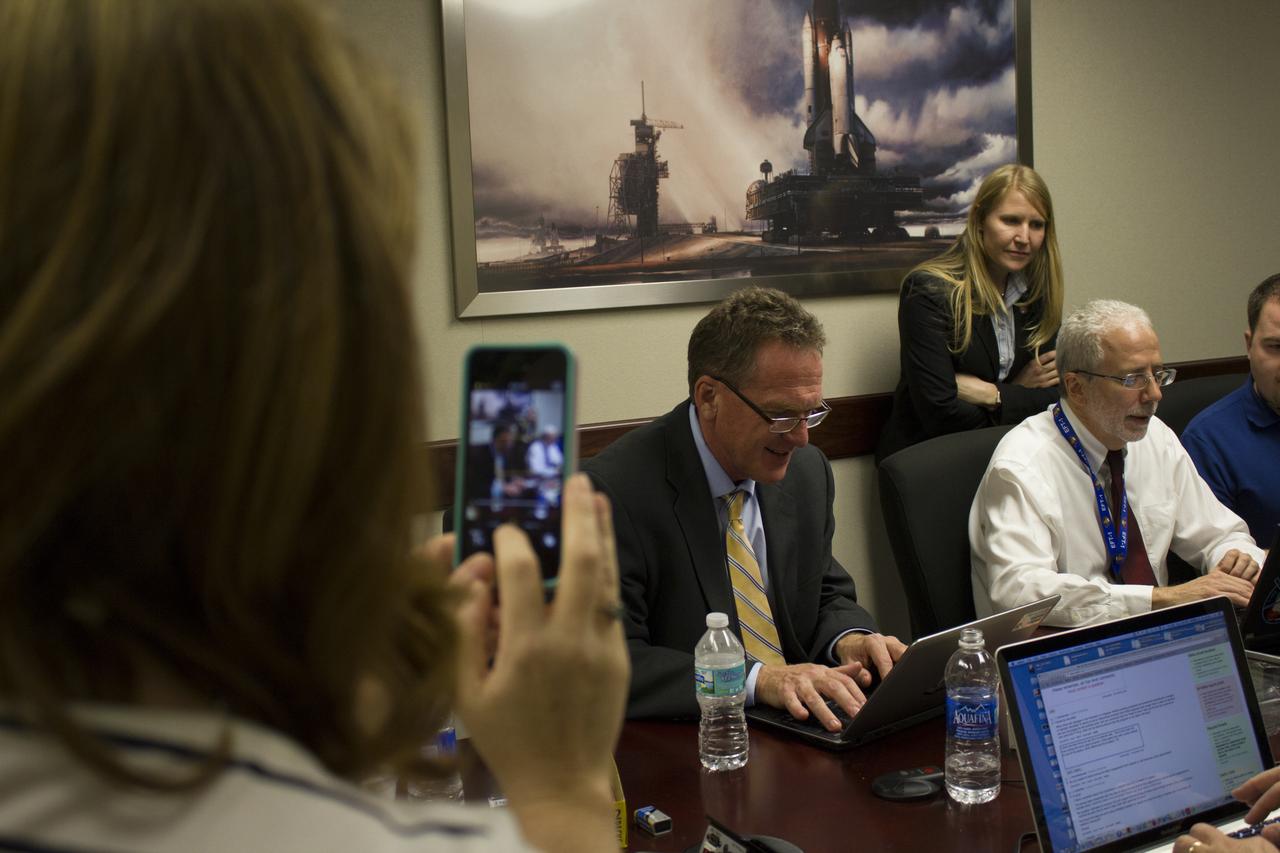
NASA managers participate in a live online Ask Me Anything, or AMA, session for reddit.com followers during Orion preflight activities at NASA Kennedy Space Center's News Center in Florida. From left, are Mike Bolger, Ground Systems Development and Operations program manager and Mark Geyer, Orion program manager. Also participating, but not shown in the photo is Todd May, Space Launch System program manager. Discussion topics include Mars and technology.
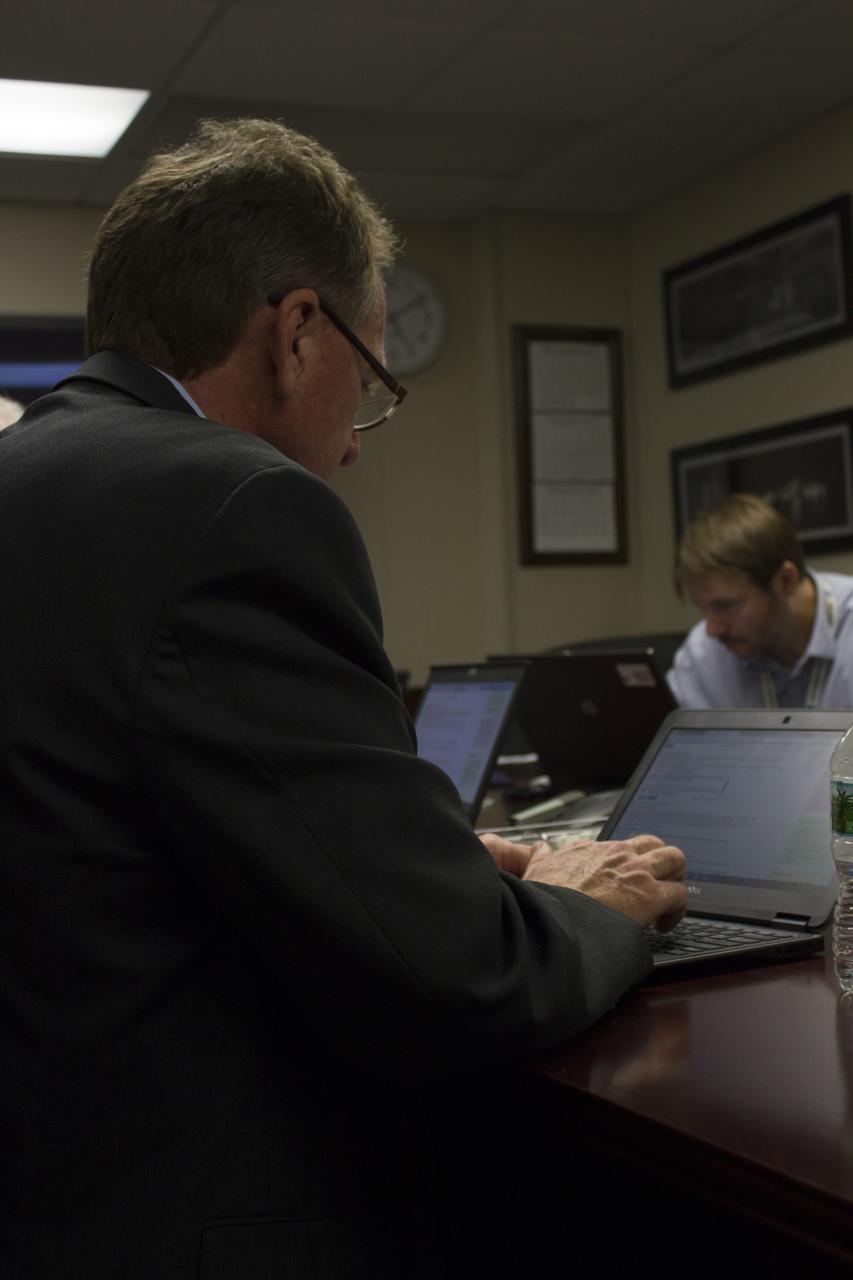
NASA managers participate in a live online Ask Me Anything, or AMA, session for reddit.com followers during Orion preflight activities at NASA Kennedy Space Center's News Center in Florida. At left, is Mike Bolger, Ground Systems Development and Operations program manager. Not shown, but also participating were Mark Geyer, Orion program manager, and Todd May, Space Launch System program manager. Discussion topics include Mars and technology.
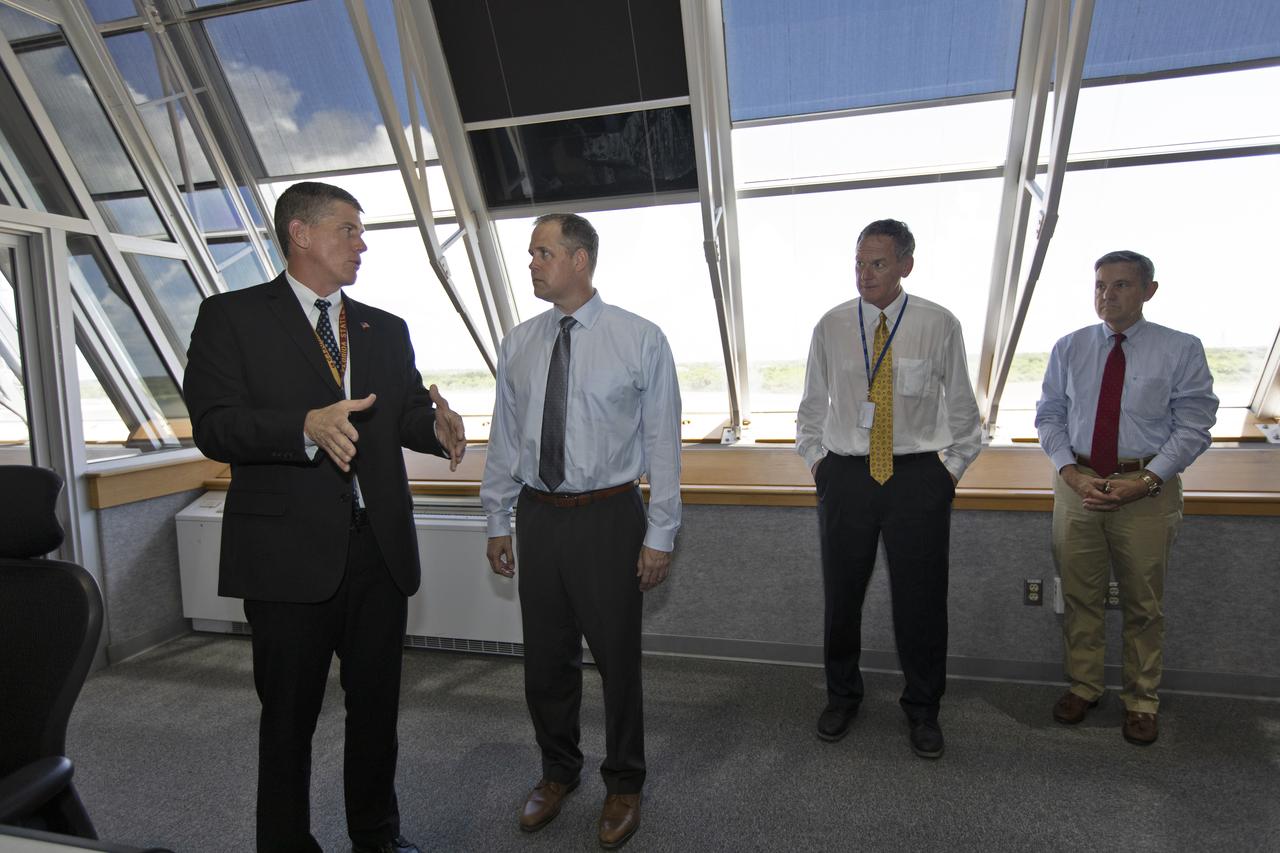
NASA Administrator Jim Bridenstine (second from the left) is briefed by Jeremy Graeber, chief of Test, Launch and Recovery Operations (left), Mike Bolger, Exploration Ground Systems program manager, (second from the right), and Kennedy Space Center Director Bob Cabana, during a tour of the Firing Room of the Launch Control Center. Bridenstine made his first official visit to the Florida spaceport on Aug. 6 and 7, 2018.
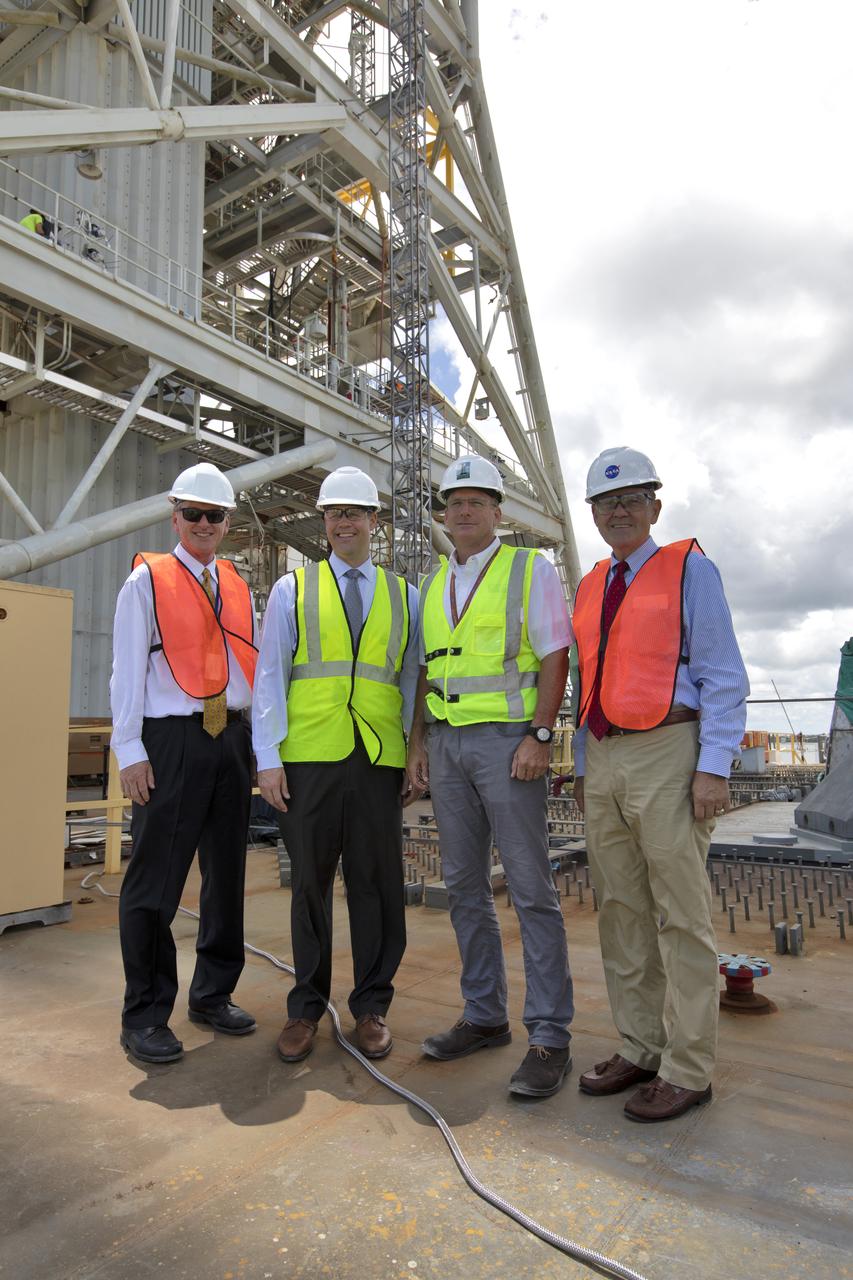
NASA Administrator Jim Bridenstine (second from left) is briefed on testing of the mobile launcher that will support the agency's Space Launch System rocket and Orion spacecraft that will liftoff on trips to the Moon, Mars and deep space. From the left, are Mike Bolger, Exploration Ground Systems program manager, Bridenstine, Cliff Lanham, Mobile Launcher Project Manager, and Center Director Bob Cabana. Bridenstine made his first official visit to the NASA's Kennedy Space Center on Aug. 6 and 7, 2018.
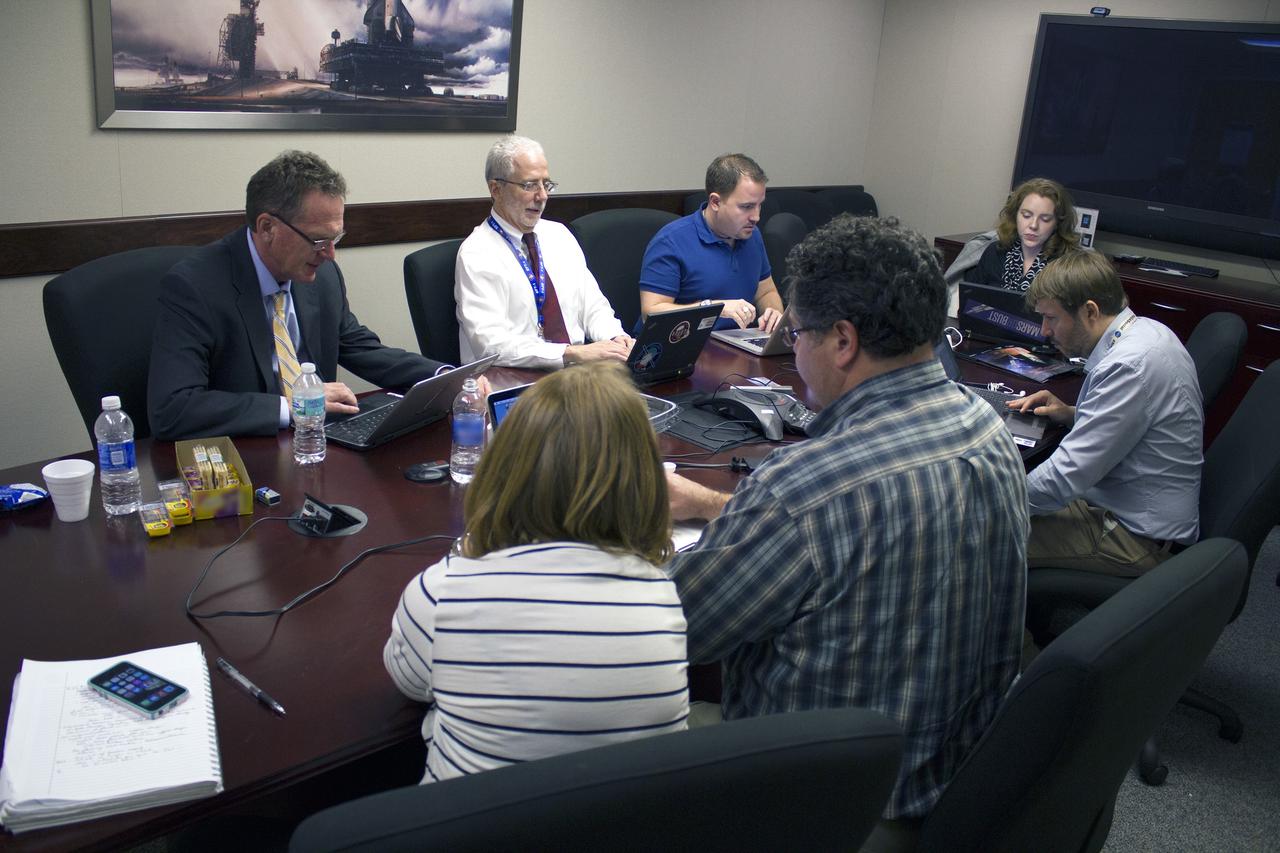
CAPE CANAVERAL, Fla. – NASA managers participate in a live online Ask Me Anything, or AMA, session for reddit.com followers during Orion preflight activities at NASA Kennedy Space Center's News Center in Florida. From left, are Mike Bolger, Ground Systems Development and Operations program manager and Mark Geyer, Orion program manager. Across from them, in the plaid shirt is Todd May, Space Launch System program manager. Discussion topics include Mars and technology. Photo credit: NASA/Frankie Martin
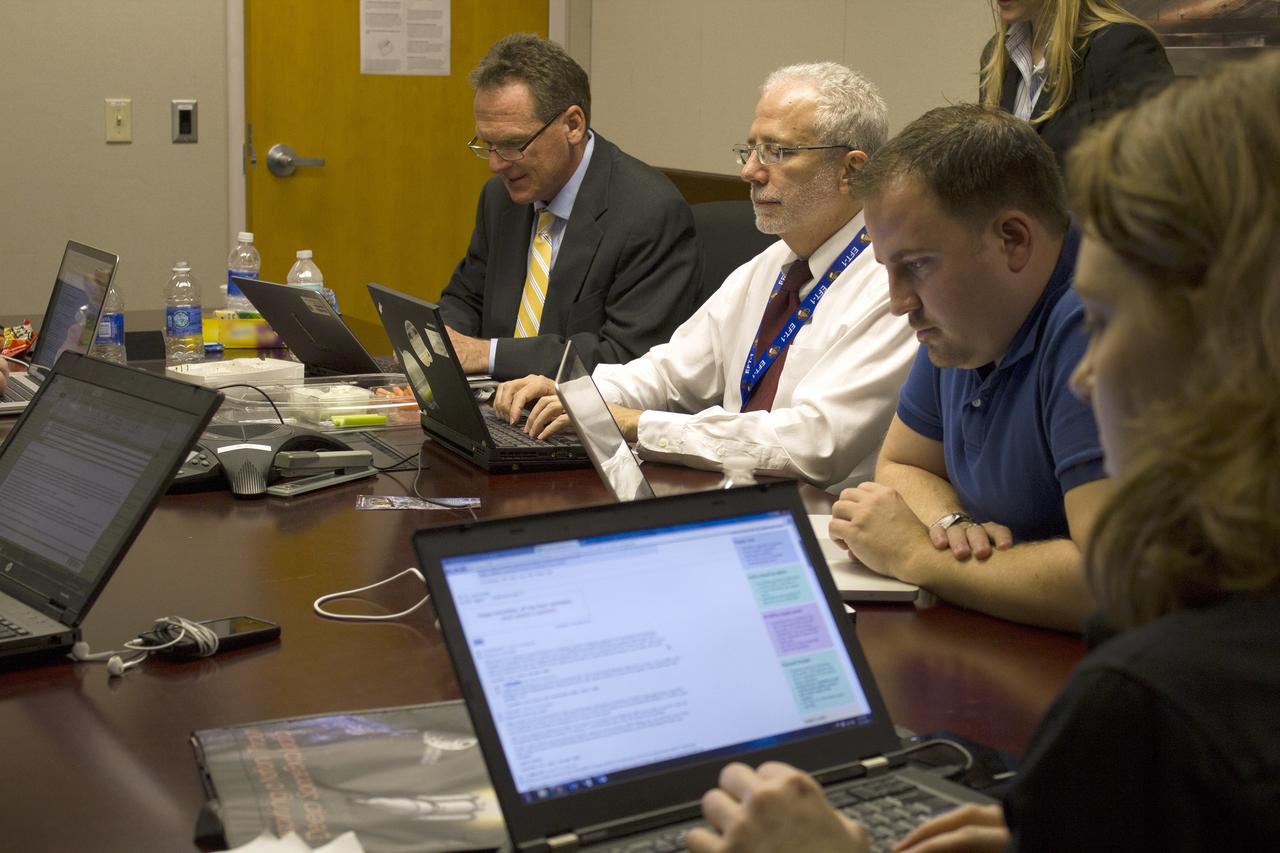
CAPE CANAVERAL, Fla. – From left, Mike Bolger, Ground Systems Development and Operations program manager and Mark Geyer, Orion program manager, participate in a live online Ask Me Anything, or AMA, session for reddit.com followers during Orion preflight activities at NASA Kennedy Space Center's News Center in Florida. Not shown, but also participating is Todd May, Space Launch System program manager. Discussion topics include Mars and technology. Photo credit: NASA/Frankie Martin
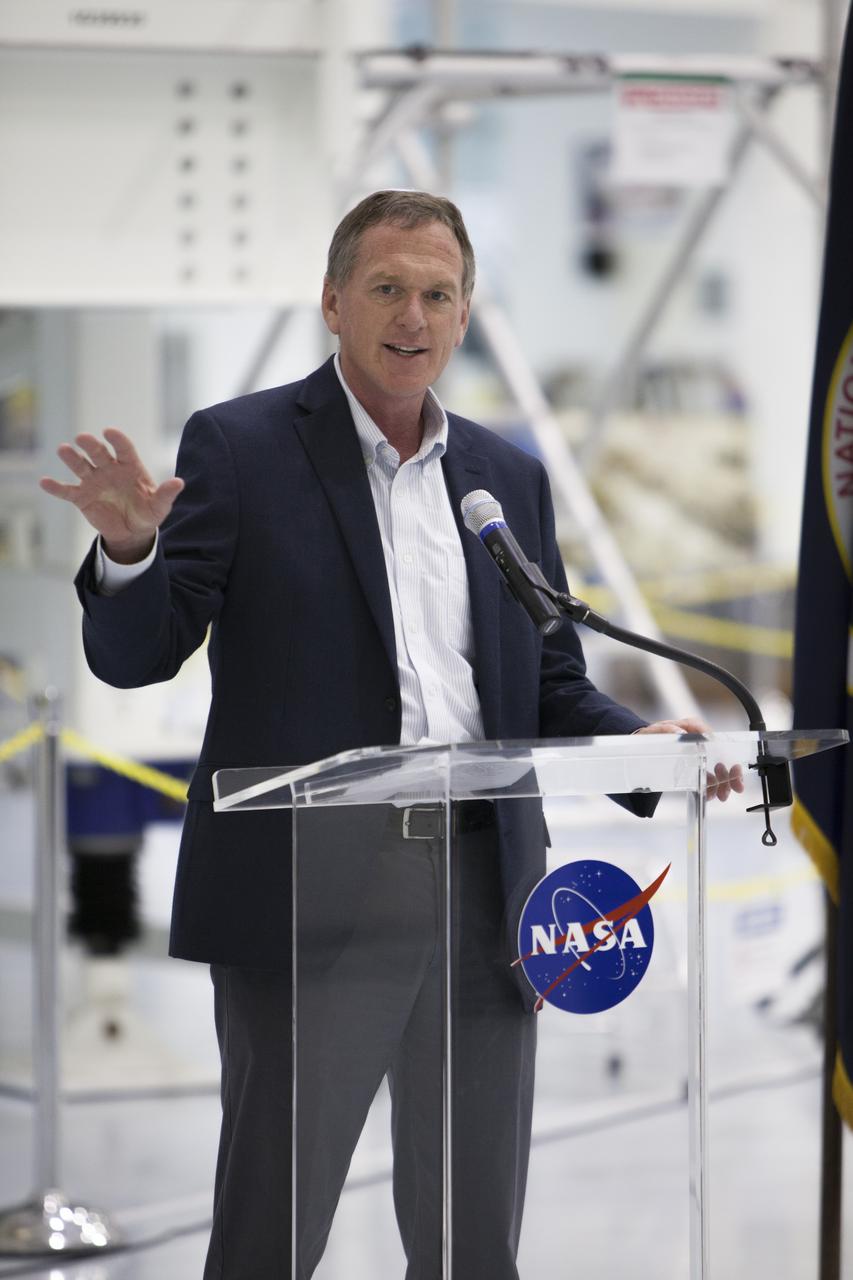
Mike Bolger, Ground Systems Development and Operations Program manager at NASA's Kennedy Space Center, speaks to guests during a ceremony in the high bay of the Space Station Processing Facility. The event marked the milestone of the Space Launch System rocket's Interim Cryogenic Propulsion Stage (ICPS) being turned over from NASA's Spacecraft/Payload Integration and Evolution organization to the spaceport's Ground Systems Development and Operations directorate. The ICPS is the first integrated piece of flight hardware to arrive in preparation for the uncrewed Exploration Mission-1.
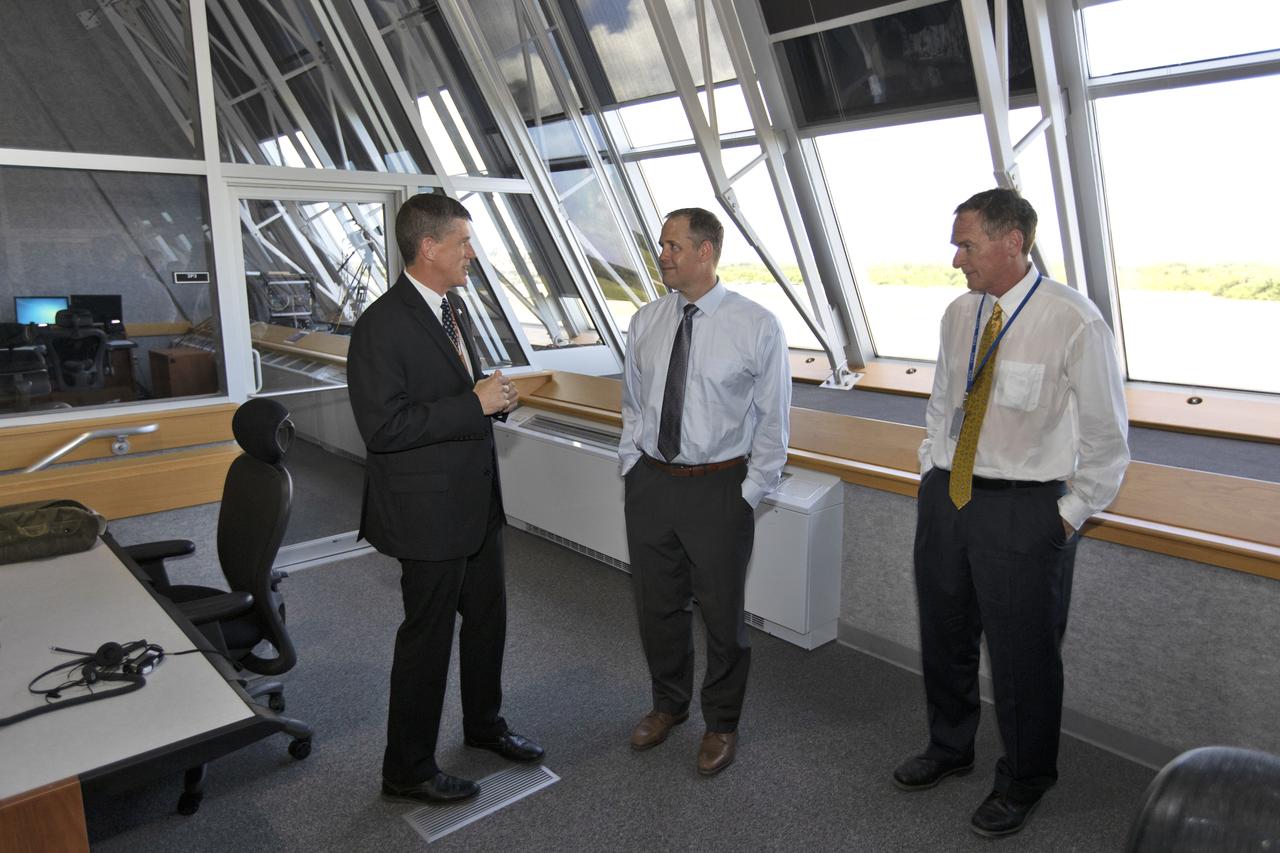
NASA Administrator Jim Bridenstine (center) is briefed by Jeremy Graeber, chief of Test, Launch and Recovery Operations (left), and Mike Bolger, Exploration Ground Systems program manager, during a tour of the Firing Room of the Launch Control Center at NASA's Kennedy Space Center. Bridenstine made his first official visit to the Florida spaceport on Aug. 6 and 7, 2018.
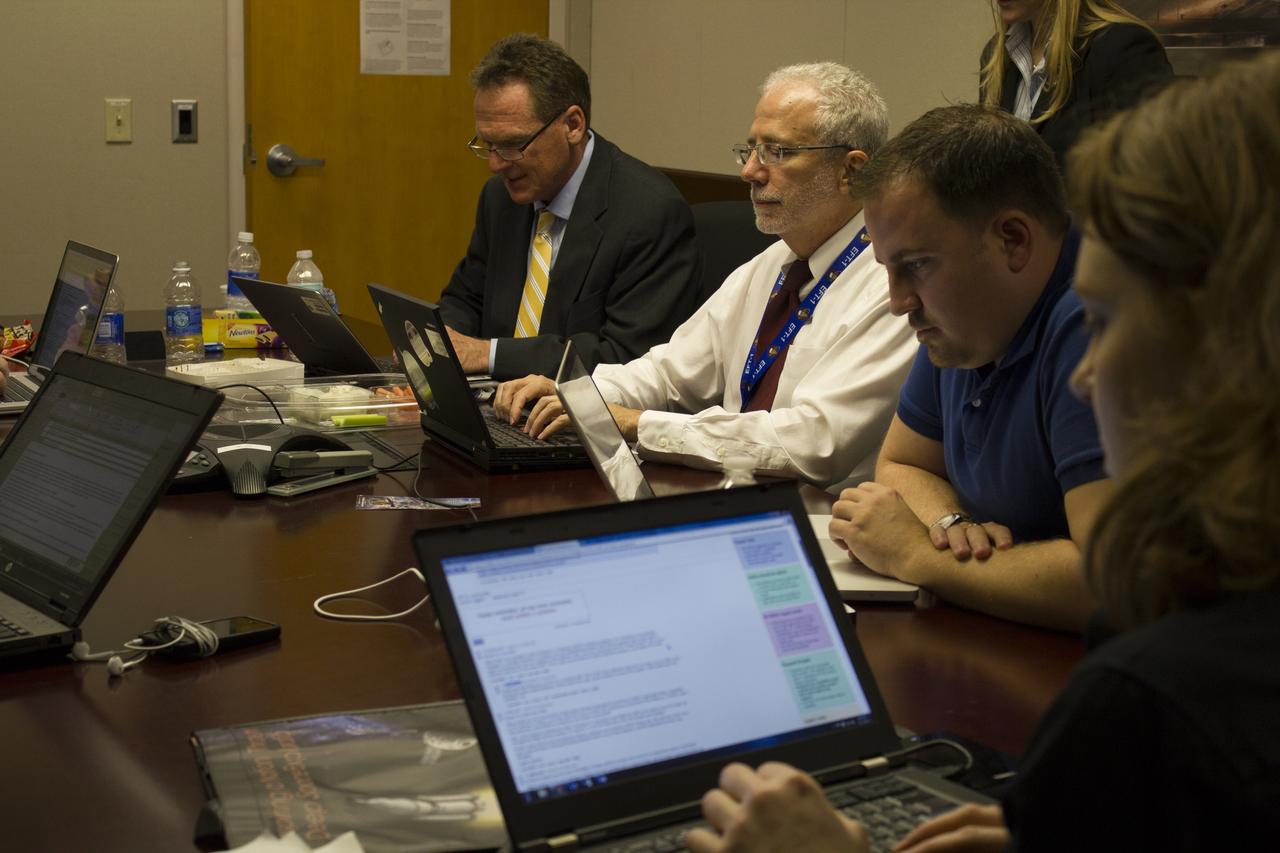
From left, Mike Bolger, Ground Systems Development and Operations program manager; and Mark Geyer, Orion program manager, participate in a live online Ask Me Anything, or AMA, session for reddit.com followers during Orion preflight activities at NASA Kennedy Space Center's News Center in Florida. Not shown is Todd May, Space Launch System program manager. Discussion topics include Mars and technology.
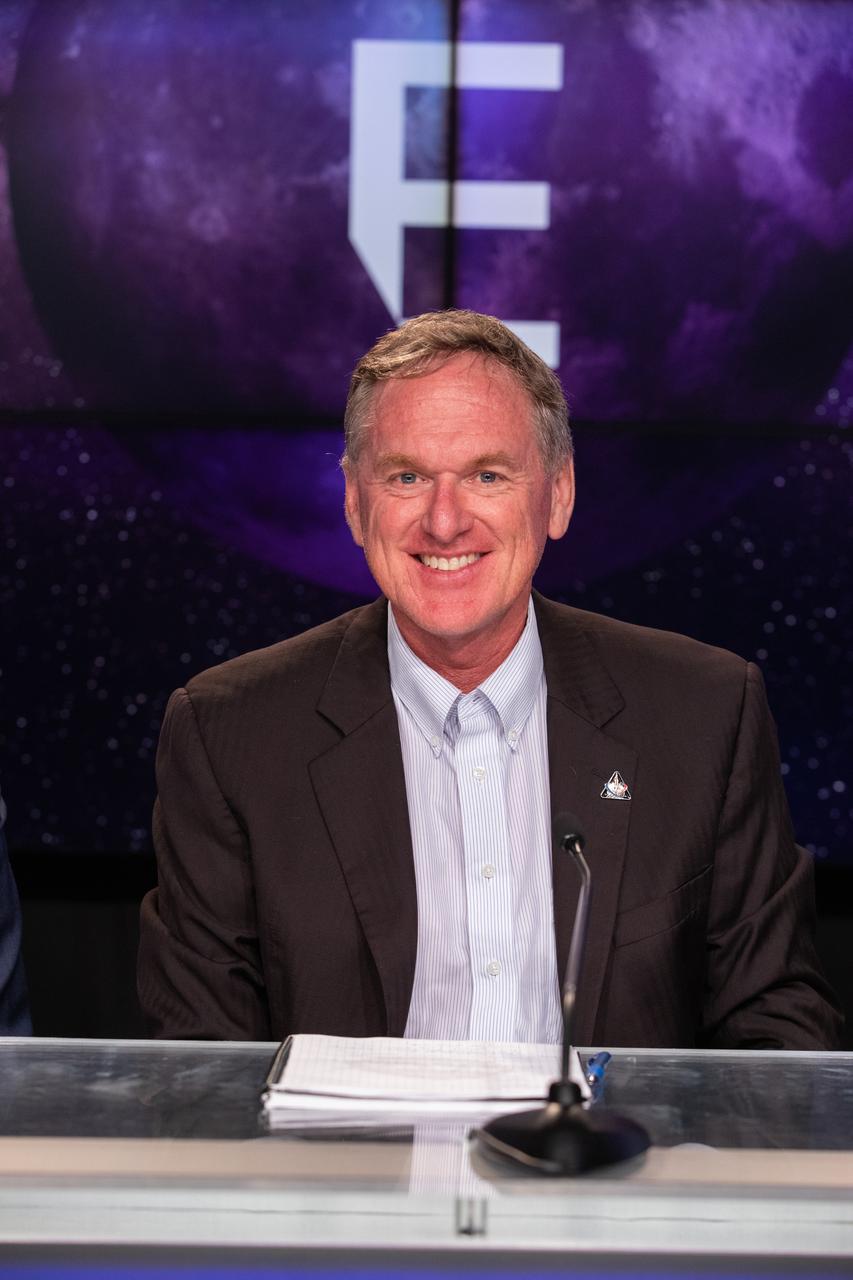
Mike Bolger, Exploration Ground Systems Program manager, Kennedy, participates in a postlaunch news conference on Nov. 16, 2022, at NASA’s Kennedy Space Center in Florida, after launch of Artemis I at 1:47 a.m. EST from Kennedy’s Launch Complex 39B. The first in a series of increasingly complex missions, Artemis I will provide a foundation for human deep space exploration and demonstrate our commitment and capability to extend human presence to the Moon and beyond. The primary goal of Artemis I is to thoroughly test the integrated systems before crewed missions by operating the spacecraft in a deep space environment, testing Orion’s heat shield, and recovering the crew module after reentry, descent, and splashdown.
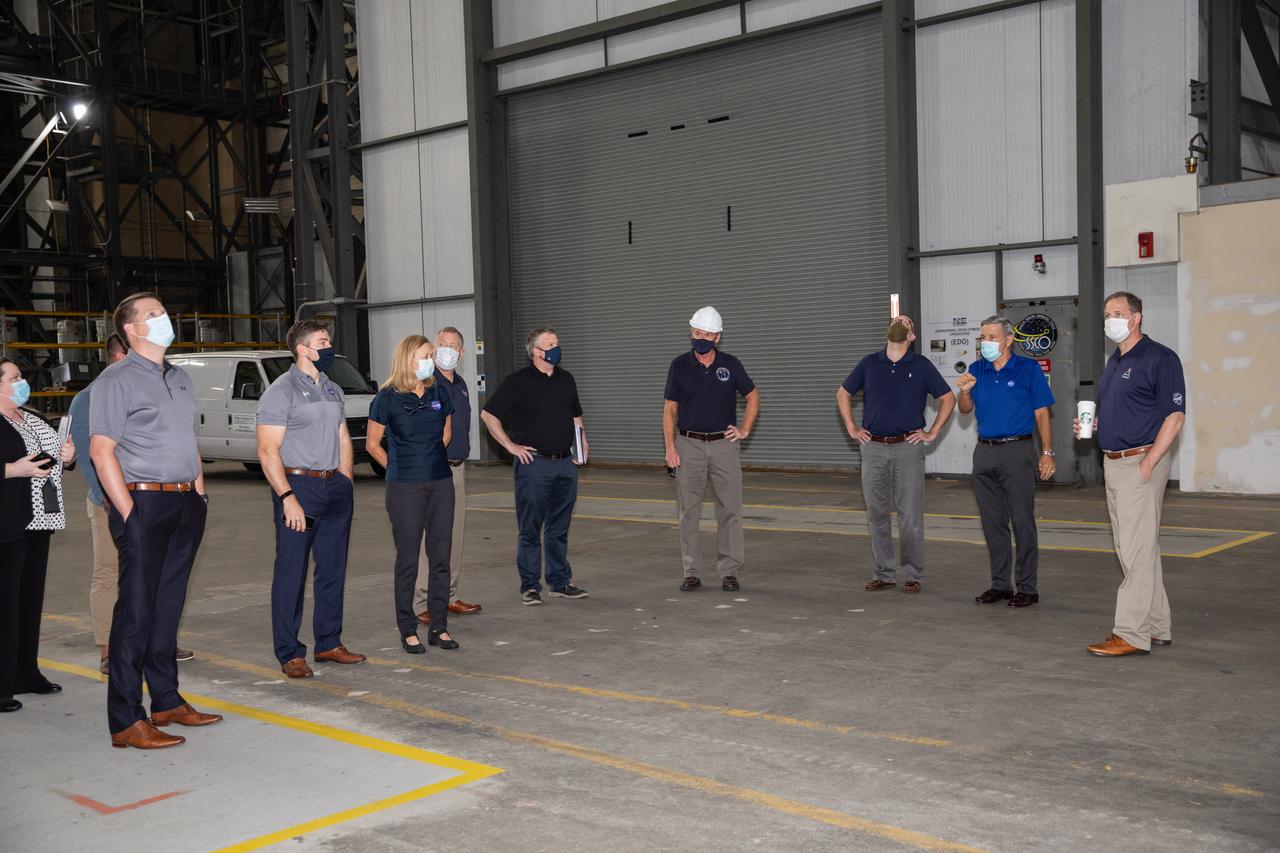
Kennedy Space Center Director Bob Cabana, second from right, accompanies Russell Vought, third from right, director of the White House Office of Management and Budget, and NASA Administrator Jim Bridenstine, far right, on a tour of the Vehicle Assembly Building (VAB) on Aug. 28, 2020. Third from left is Kennedy Deputy Director Janet Petro, and fourth from right is Mike Bolger, manager of Kennedy’s Exploration Ground Systems Directorate. The VAB is critical to the assembly of the Space Launch System rocket for NASA’s Artemis program. The Office of Management and Budget is working with the U.S. Congress to line up the necessary resources to land the first woman and the next man on the Moon in 2024.

Orion is revealed for one of the final times on Jan. 14, as it is readied atop its transport pallet from the Neil Armstrong Operations and Checkout Building at NASA’s Kennedy Space Center in Florida, along its path to the pad ahead of the Artemis I launch. Orion was officially transferred from the Orion Program to Exploration Ground Systems (EGS). Mike Bolger, EGS manager, stands inside the high bay with Orion in the background. Teams across the globe have worked tirelessly to assemble the spacecraft which, will receive a protective covering prior to departing for the Multi-Payload Processing Facility to begin ground processing by the EGS and Jacobs teams.
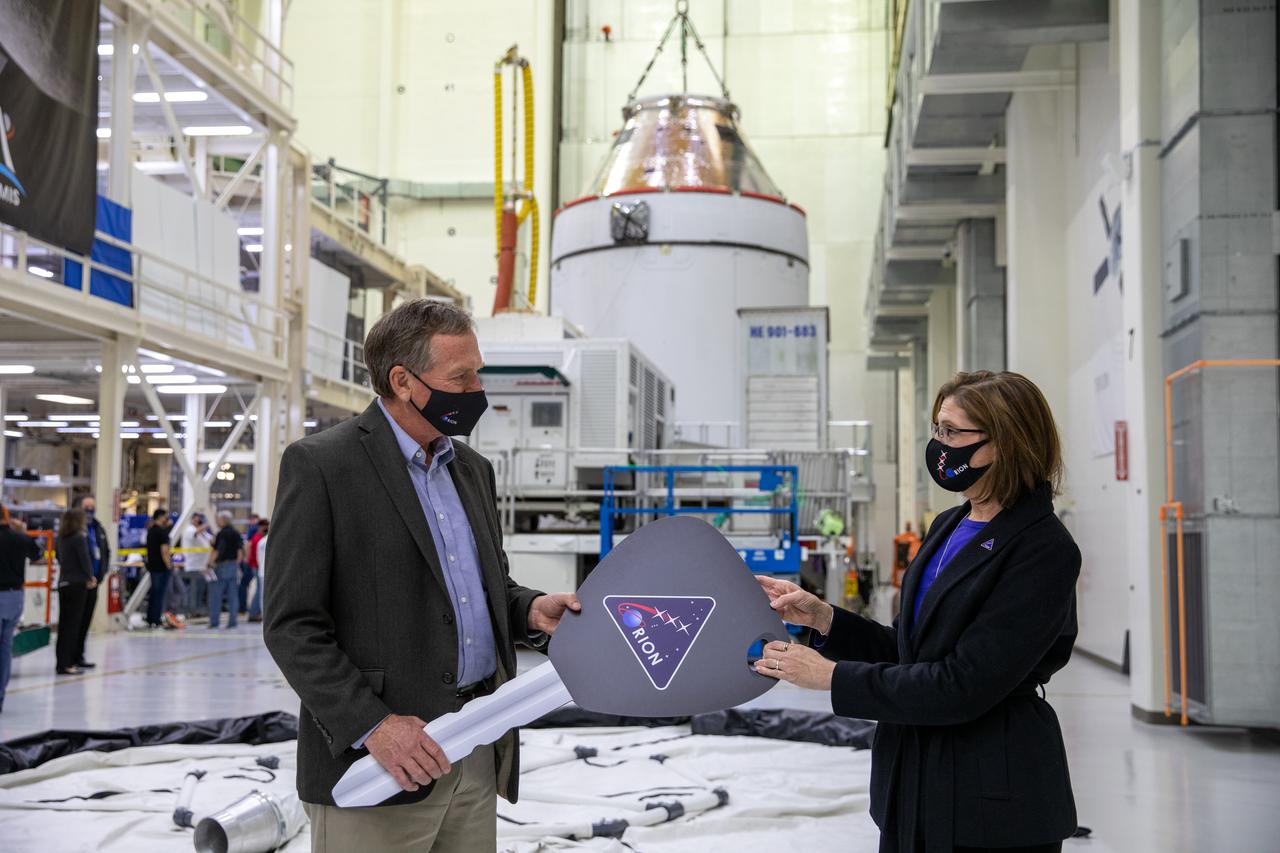
Orion is revealed for one of the final times on Jan. 14, as it is readied atop its transport pallet from the Neil Armstrong Operations and Checkout Building at NASA’s Kennedy Space Center in Florida, along its path to the pad ahead of the Artemis I launch. Mike Bolger, at left, manager of Exploration Ground Systems (EGS), receives the “key” to Orion from Cathy Koerner, Orion Program manager signifying the transfer of the spacecraft from the assembly to the ground system processing team. Teams across the globe have worked tirelessly to assemble the spacecraft, which will receive a protective covering prior to departing for the Multi-Payload Processing Facility to begin ground processing by the EGS and Jacobs teams.
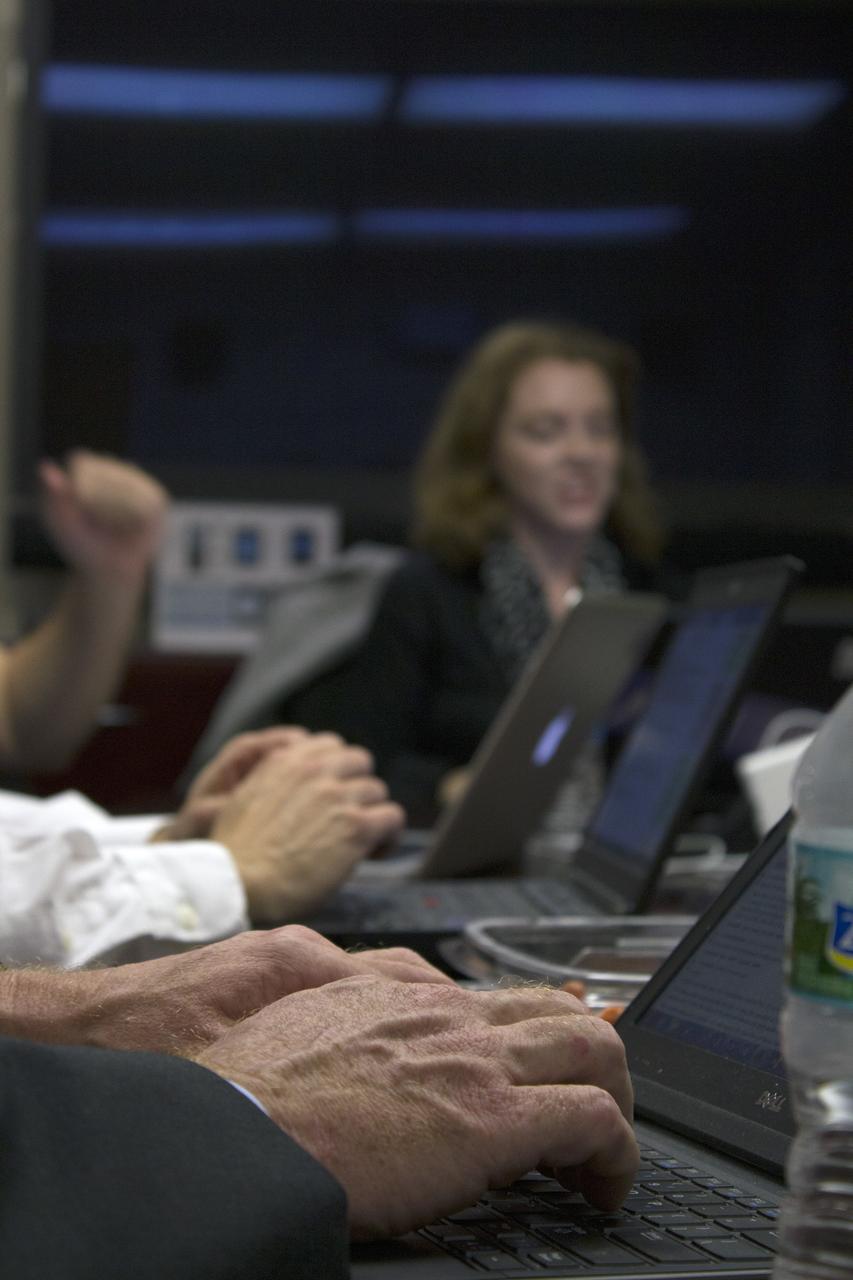
CAPE CANAVERAL, Fla. – NASA managers participate in a live online Ask Me Anything, or AMA, session for reddit.com followers during Orion preflight activities at NASA Kennedy Space Center's News Center in Florida. Participating are Mike Bolger, Ground Systems Development and Operations program manager Mark Geyer, Orion program manager and Todd May, Space Launch System program manager. Discussion topics include Mars and technology. Monitoring the live discussion is Brandi Dean, public affairs specialist from Johnson Space Center in Houston. Photo credit: NASA/Frankie Martin
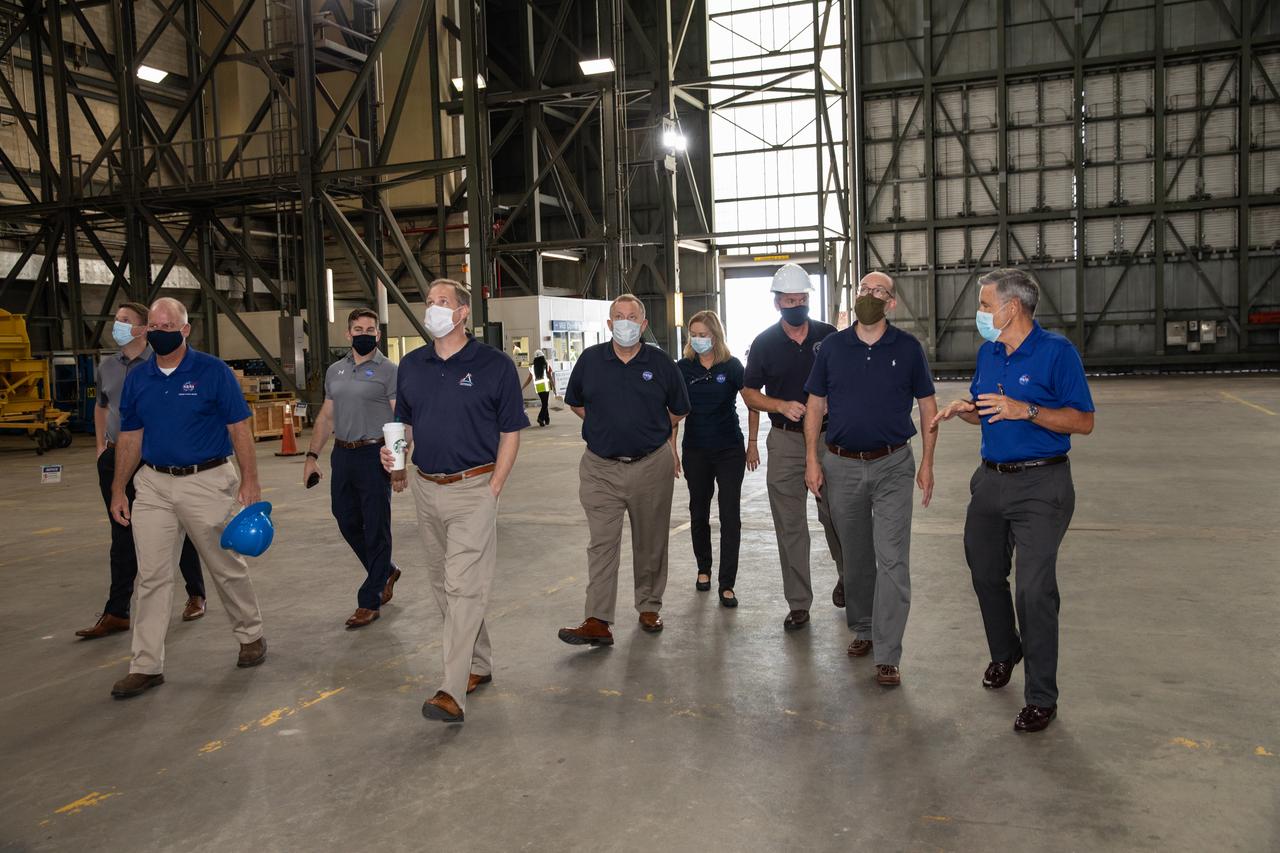
Kennedy Space Center Director Bob Cabana, far right, accompanies Russell Vought, second from right, director of the White House Office of Management and Budget, on a tour of the Vehicle Assembly Building (VAB) on Aug. 28, 2020. Leading the group, in front, is NASA Administrator Jim Bridenstine, along with NASA Deputy Administrator Jim Morhard, Kennedy Space Center Deputy Director Janet Petro, and Mike Bolger, manager of Kennedy’s Exploration Ground Systems Directorate. The VAB is critical to the assembly of the Space Launch System rocket for NASA’s Artemis program. The Office of Management and Budget is working with the U.S. Congress to line up the necessary resources to land the first woman and the next man on the Moon in 2024.
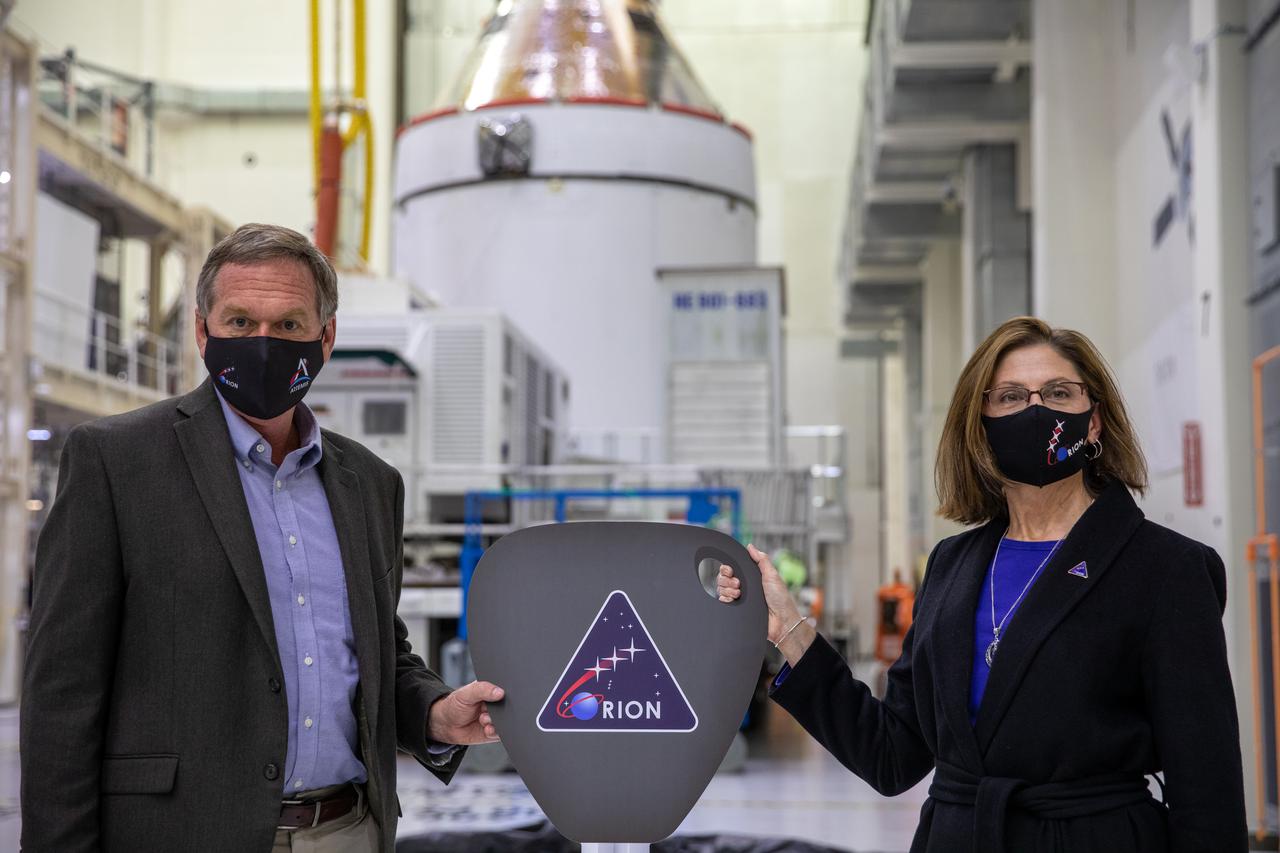
Orion is revealed for one of the final times on Jan. 14, as it is readied atop its transport pallet from the Neil Armstrong Operations and Checkout Building at NASA’s Kennedy Space Center in Florida, along its path to the pad ahead of the Artemis I launch. Mike Bolger, at left, manager of Exploration Ground Systems (EGS), receives the “key” to Orion from Cathy Koerner, Orion Program manager, signifying the transfer of the spacecraft from the assembly to the ground system processing team. Teams across the globe have worked tirelessly to assemble the spacecraft, which will receive a protective covering prior to departing for the Multi-Payload Processing Facility to begin ground processing by the EGS and Jacobs teams.
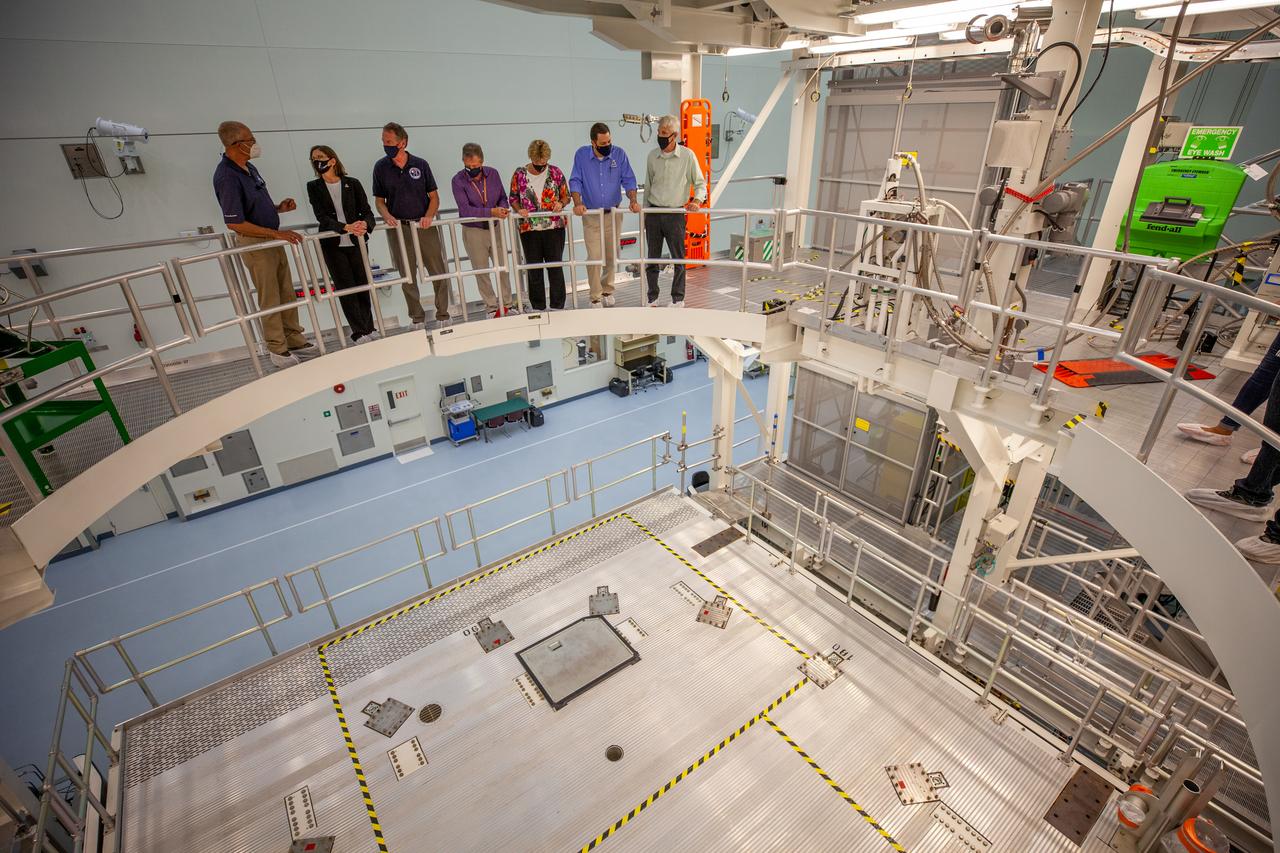
Catherine Koerner, second from left, NASA Orion Program manager, along with senior managers from Orion, Exploration Ground Systems (EGS) and TOSC, tours the Multi-Payload Processing Facility (MPPF) at NASA’s Kennedy Space Center in Florida on Oct. 5, 2020. Accompanying her, from left are Skip Williams, operations manager for the MPPF spacecraft offline element integration team; Mike Bolger, EGS manager; Nicolas Kindred, TOSC flow manager; Annette Hasbrook, Orion Program assistant manager; Jeremy Parsons, EGS deputy manager; and Scott Wilson, Orion Production Operations manager. Koerner viewed spacecraft hardware and processing facilities for the Artemis I and II missions. The first in a series of increasingly complex missions, Artemis I will test the Orion spacecraft and Space Launch System as an integrated system ahead of crewed flights to the Moon. Under the Artemis program, NASA will land the first woman and the next man on the Moon in 2024.

Catherine Koerner, in front, NASA Orion Program manager, along with senior managers from Orion, Exploration Ground Systems (EGS) and TOSC, tours the Multi-Payload Processing Facility (MPPF) at NASA’s Kennedy Space Center in Florida on Oct. 5, 2020. Accompanying her, from left are Nicolas Kindred, (partically hidden), TOSC flow manager; Jeremy Parsons, EGS deputy manager; Scott Wilson, Orion Production Operations manager; Mike Bolger, (partially hidden), EGS manager; and Skip Williams, operations manager for the MPPF spacecraft offline element integration team. Koerner viewed spacecraft hardware and processing facilities for the Artemis I and II missions. The first in a series of increasingly complex missions, Artemis I will test the Orion spacecraft and Space Launch System as an integrated system ahead of crewed flights to the Moon. Under the Artemis program, NASA will land the first woman and the next man on the Moon in 2024.
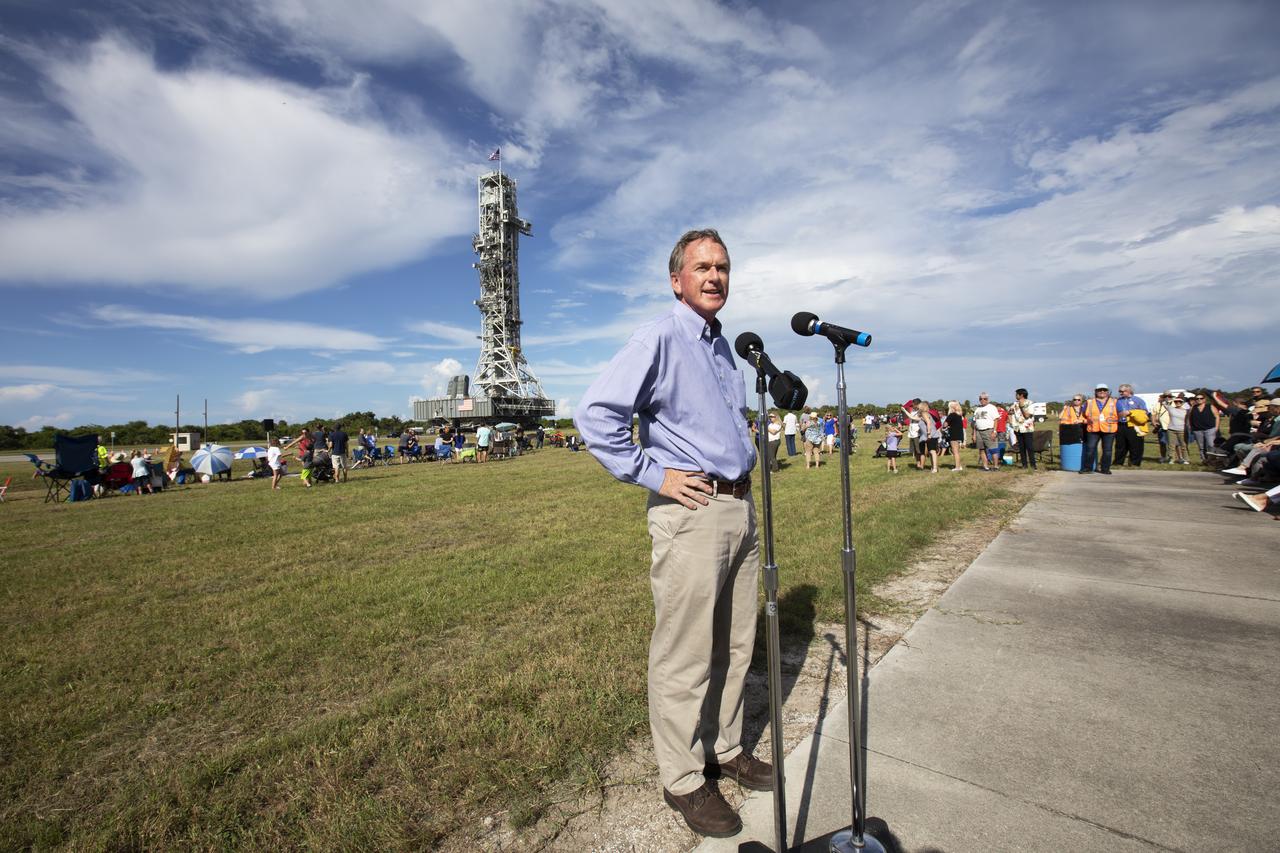
Mike Bolger, program manager of Exploration Ground Systems, speaks to workers and guests during an employee event for the mobile launcher move to the Vehicle Assembly Building (VAB) on Sept. 7, 2018, at NASA's Kennedy Space Center in Florida. The mobile launcher, atop crawler-transporter 2, began its trek from Launch Pad 39B along the crawlerway after undergoing a fit check and several days of systems testing with the pad. This is the first time that the modified mobile launcher made the trip to the pad. The 380-foot-tall mobile launcher is equipped with the crew access arm and several umbilicals that will provide power, environmental control, pneumatics, communication and electrical connections to the agency's Space Launch System and Orion spacecraft. The mobile launcher will spend seven months in the VAB undergoing testing. Exploration Ground Systems is preparing the ground systems necessary to launch SLS and Orion on Exploration Mission-1, missions to the Moon and on to Mars.
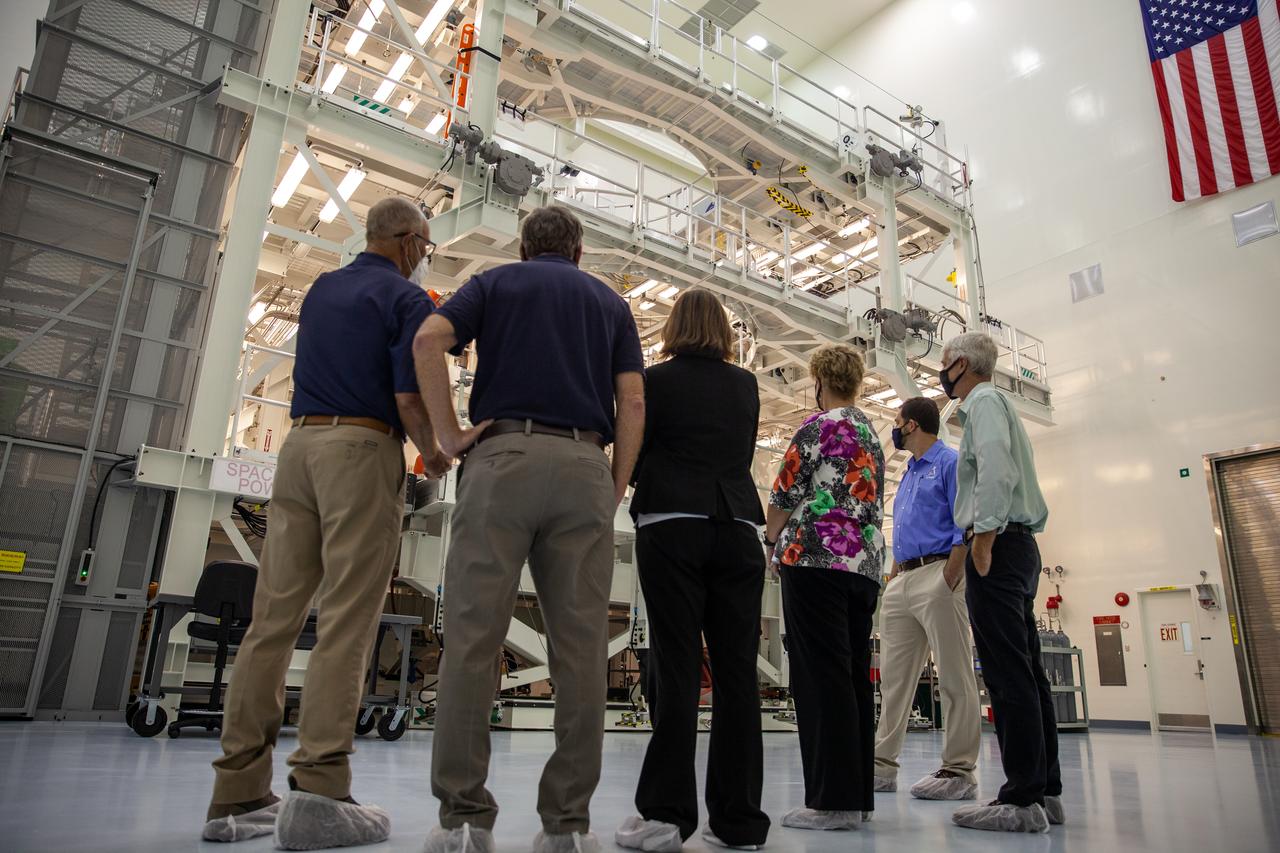
Catherine Koerner, third from left, NASA Orion Program manager, along with senior managers from Orion, and Exploration Ground Systems (EGS), visits the Multi-Payload Processing Facility (MPPF) at NASA’s Kennedy Space Center in Florida on Oct. 5, 2020. Accompanying her, from left are Skip Williams, operations manager for the MPPF spacecraft offline element integration team; Mike Bolger, EGS manager; Annette Hasbrook, Orion Program assistant manager; Scott Wilson, Orion Production Operations manager; and Jeremy Parsons, EGS deputy manager. Koerner viewed spacecraft hardware and processing facilities for the Artemis I and II missions. The first in a series of increasingly complex missions, Artemis I will test the Orion spacecraft and Space Launch System as an integrated system ahead of crewed flights to the Moon. Under the Artemis program, NASA will land the first woman and the next man on the Moon in 2024.
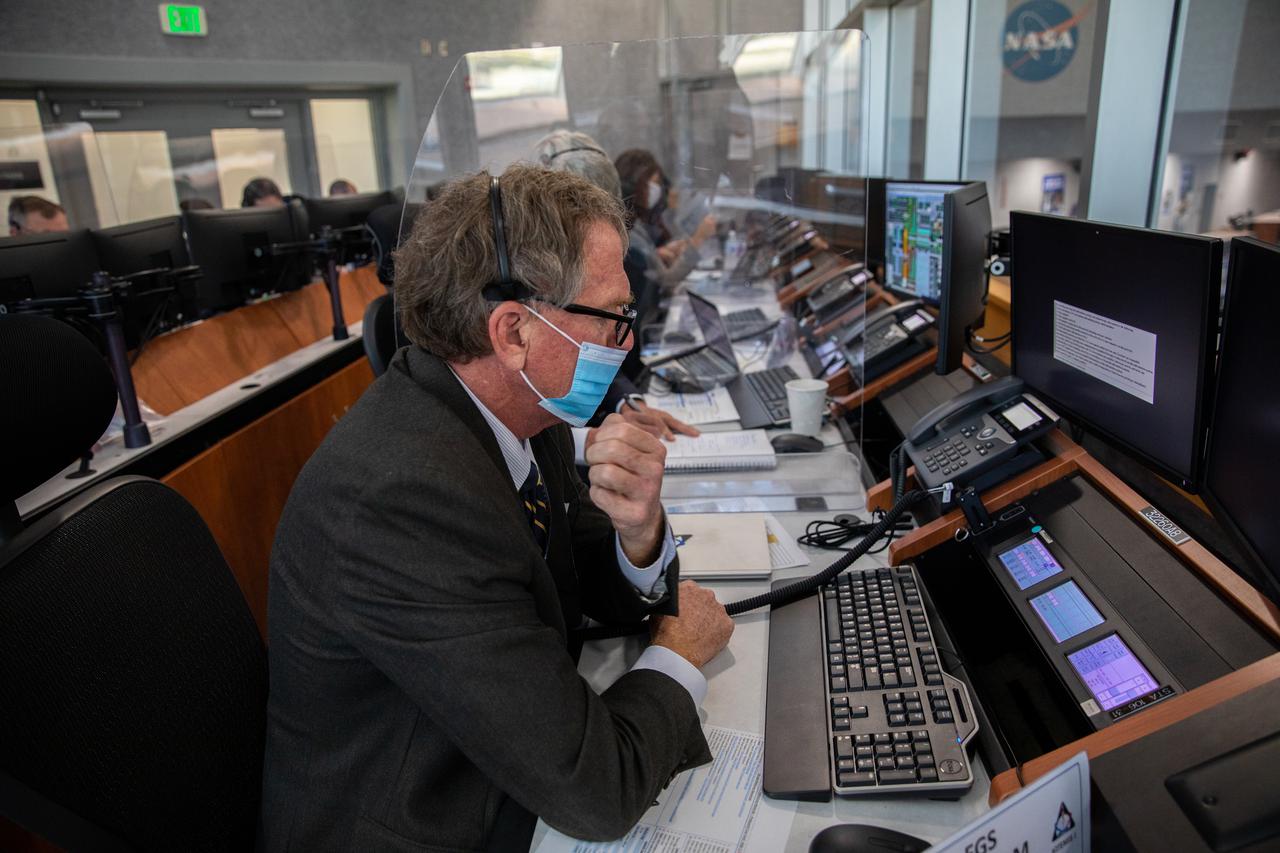
Mike Bolger, manager, Exploration Ground Systems, participates in the 11th terminal countdown simulation for the Artemis I launch inside Kennedy Space Center’s Launch Control Center on Oct. 14, 2021. The event marked the first time members of NASA’s mission management team, launch team, and contractor Jacobs conducted the simulation together. During Artemis I, the agency’s Orion spacecraft will lift off from Kennedy aboard NASA’s most powerful rocket – the Space Launch System – to fly farther than any spacecraft built for humans has ever flown. Through NASA’s Artemis missions, the agency, along with commercial and international partners, will establish a sustainable human presence on the Moon to prepare for missions to Mars.
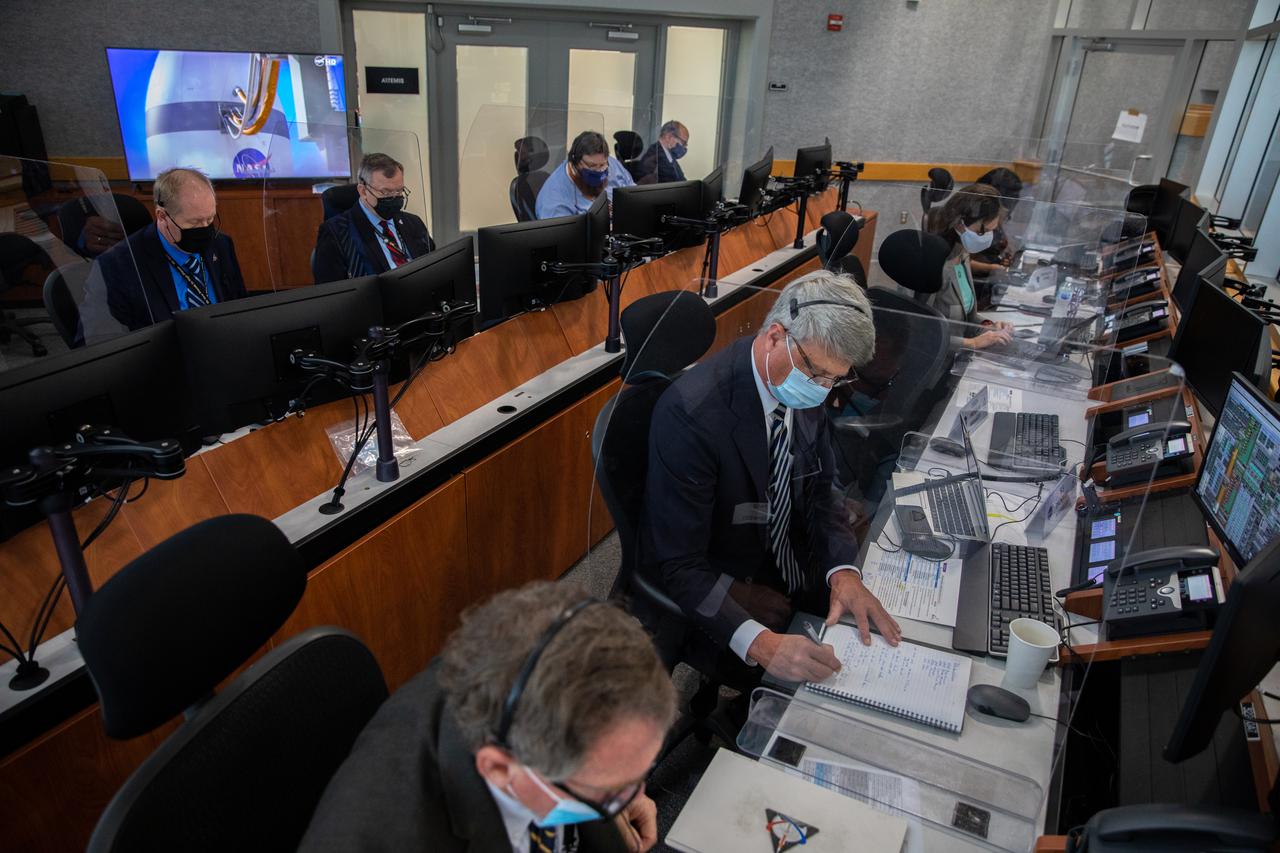
Mike Bolger; front; manager; NASA’s Exploration Ground Systems; and Chris Cianciola; NASA’s Space Launch System Program deputy manager at Marshall Space Flight Center; participate in the 11th terminal countdown simulation for the Artemis I launch inside Kennedy Space Center’s Launch Control Center on Oct. 14; 2021. The event marked the first time members of NASA’s mission management team; launch team; and contractor Jacobs conducted the simulation together. During Artemis I; the agency’s Orion spacecraft will lift off from Kennedy aboard NASA’s most powerful rocket – the Space Launch System – to fly farther than any spacecraft built for humans has ever flown. Through NASA’s Artemis missions; the agency; along with commercial and international partners; will establish a sustainable human presence on the Moon to prepare for missions to Mars.

Catherine Koerner, second from right, NASA Orion Program manager, along with senior managers from Orion, Exploration Ground Systems (EGS) and TOSC, tours the Multi-Payload Processing Facility (MPPF) at NASA’s Kennedy Space Center in Florida on Oct. 5, 2020. Accompanying her, from left are Scott Wilson, Orion Production Operations manager; Mike Bolger, EGS manager; and Nicolas Kindred, TOSC flow manager. At right is Jeremy Parsons, EGS deputy manager. Koerner viewed spacecraft hardware and processing facilities for the Artemis I and II missions. The first in a series of increasingly complex missions, Artemis I will test the Orion spacecraft and Space Launch System as an integrated system ahead of crewed flights to the Moon. Under the Artemis program, NASA will land the first woman and the next man on the Moon in 2024.
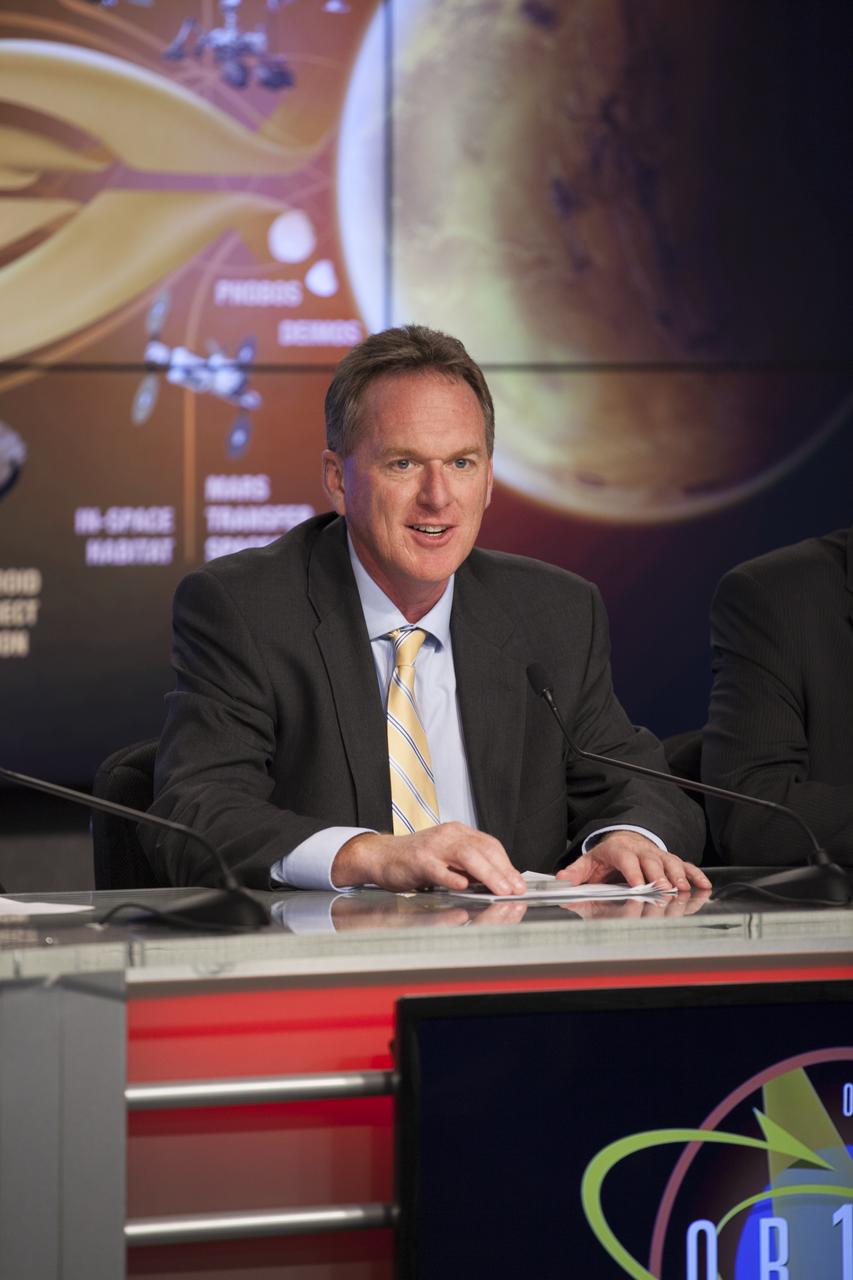
At NASA's Kennedy Space Center in Florida, Mike Bolger, program manager of Ground Systems Development and Operations Program, was one of several agency leaders who spoke to member of the news media about how the first flight of the new Orion spacecraft is a first step in the agency's plans to send humans to Mars. Orion is the exploration spacecraft designed to carry astronauts to destinations not yet explored by humans, including an asteroid and Mars. It will have emergency abort capability, sustain the crew during space travel and provide safe re-entry from deep space return velocities. The first unpiloted flight test of Orion is scheduled to launch Dec. 4, 2014 atop a United Launch Alliance Delta IV Heavy rocket, and in 2018 on NASA’s Space Launch System rocket.
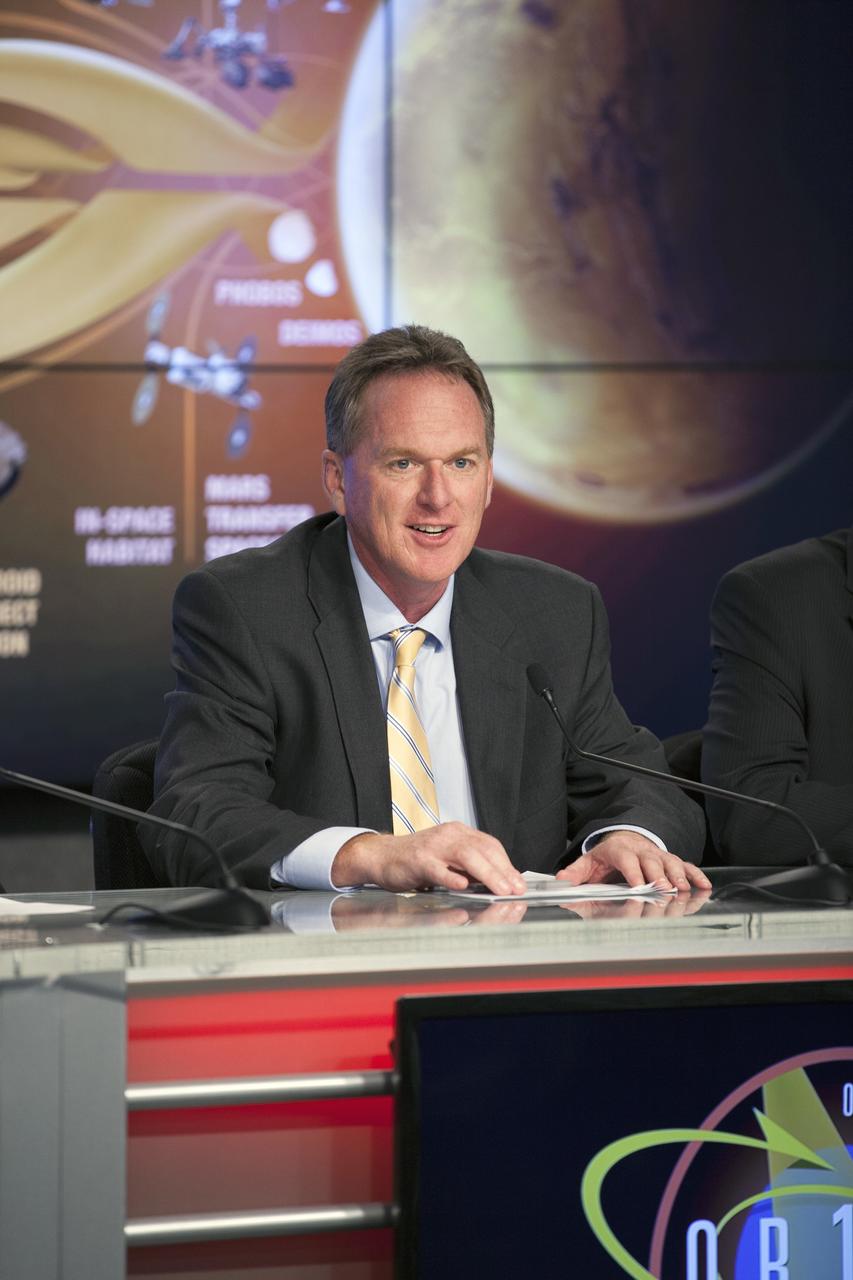
CAPE CANAVERAL, Fla. – At NASA's Kennedy Space Center in Florida, Mike Bolger, program manager of Ground Systems Development and Operations Program, was one of several agency leaders who spoke to member of the news media about how the first flight of the new Orion spacecraft is a first step in the agency's plans to send humans to Mars. Orion is the exploration spacecraft designed to carry astronauts to destinations not yet explored by humans, including an asteroid and Mars. It will have emergency abort capability, sustain the crew during space travel and provide safe re-entry from deep space return velocities. The first unpiloted flight test of Orion is scheduled to launch Dec. 4, 2014 atop a United Launch Alliance Delta IV Heavy rocket, and in 2018 on NASA’s Space Launch System rocket. For more information, visit www.nasa.gov/orion Photo credit: NASA/Kim Shiflett
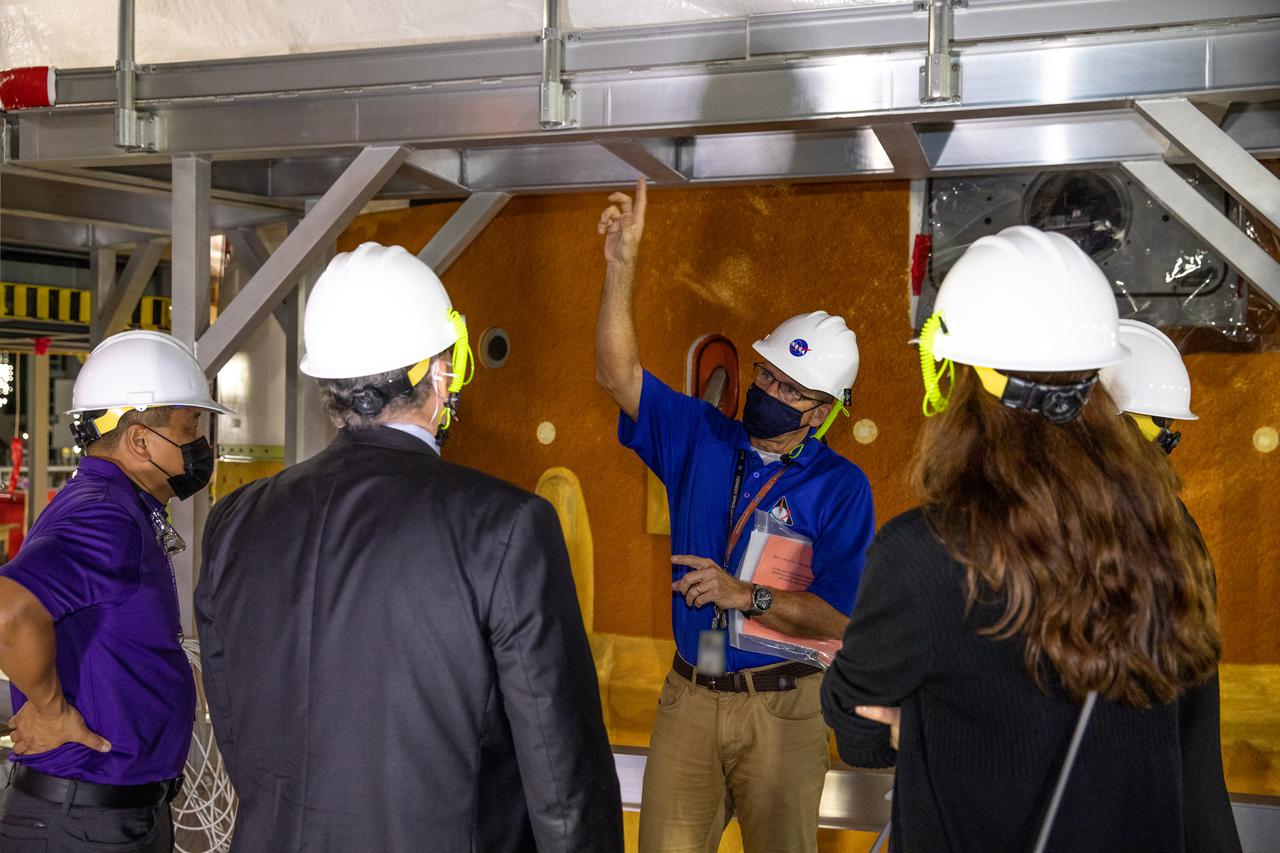
NASA’s Orion Program and Lockheed Martin management tour the Vehicle Assembly at NASA’s Kennedy Space Center in Florida on Oct. 15, 2021. Speaking to the group about the Space Launch System integration is Mike Bolger, Kennedy’s Exploration Ground Systems manager. The Orion spacecraft for NASA’s Artemis I mission, fully assembled with its launch abort system, is stacked on top of the Space Launch System rocket in High Bay 3. Launching in 2021, Artemis I will be an uncrewed test flight of the Orion spacecraft and Space Launch System rocket as an integrated system ahead of crewed flights to the Moon. Under Artemis, NASA aims to land the first woman and first person of color on the Moon and establish sustainable lunar exploration.
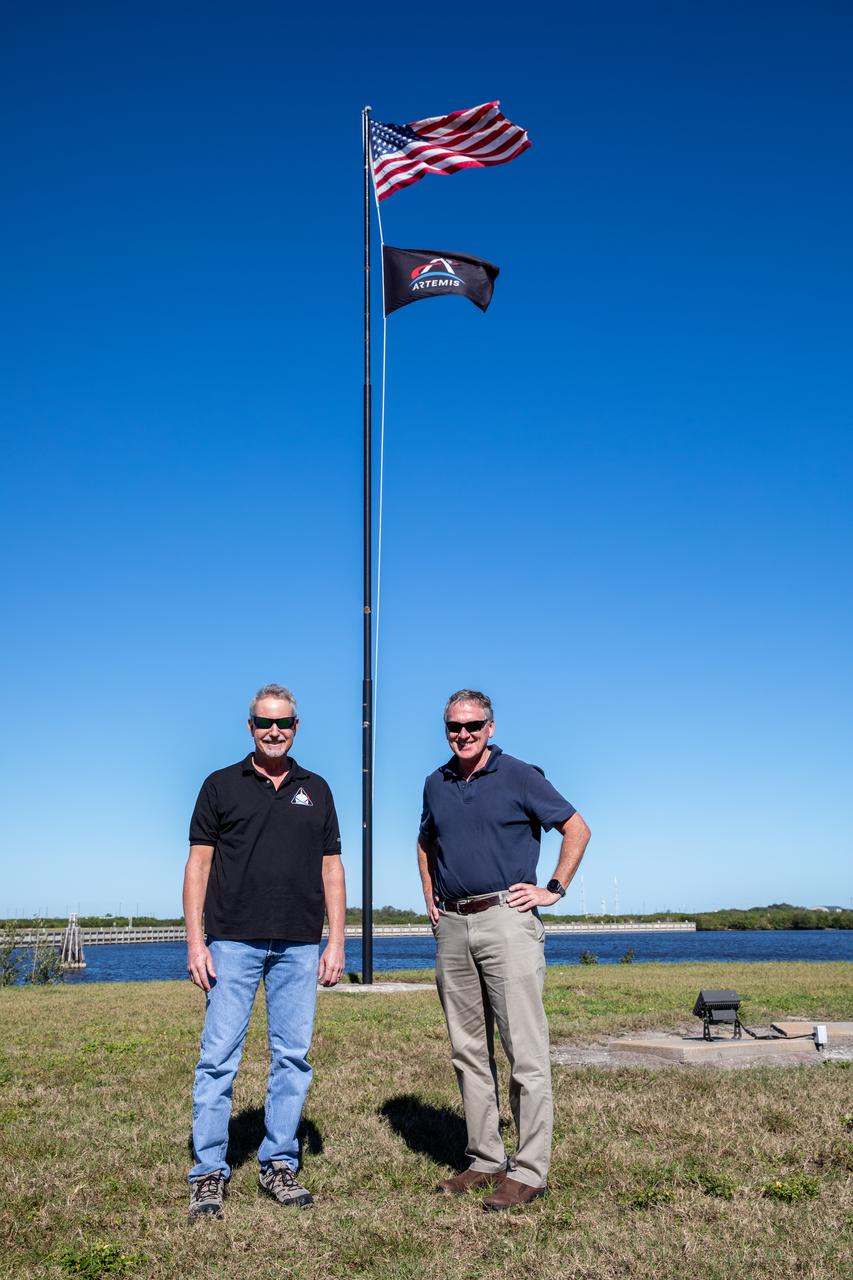
The Artemis flag is removed from NASA News Center property at the agency’s Kennedy Space Center in Florida on Jan. 6, 2023, following the successful Artemis I mission. At left is former Exploration Ground Systems (EGS) Senior Technical Integration Manager Phil Weber, joined by former EGS Manager Mike Bolger. Both men served in their respective roles during Artemis I, retiring at the end of 2022. NASA’s Space Launch System (SLS) rocket and Orion spacecraft lifted off from Kennedy’s Launch Complex 39B on Nov. 16, 2022. Orion splashed down in the Pacific Ocean on Dec. 11 and arrived back at Kennedy on Dec. 30. Artemis I sets the stage for the next mission of SLS and Orion to fly crew around the Moon on Artemis II.
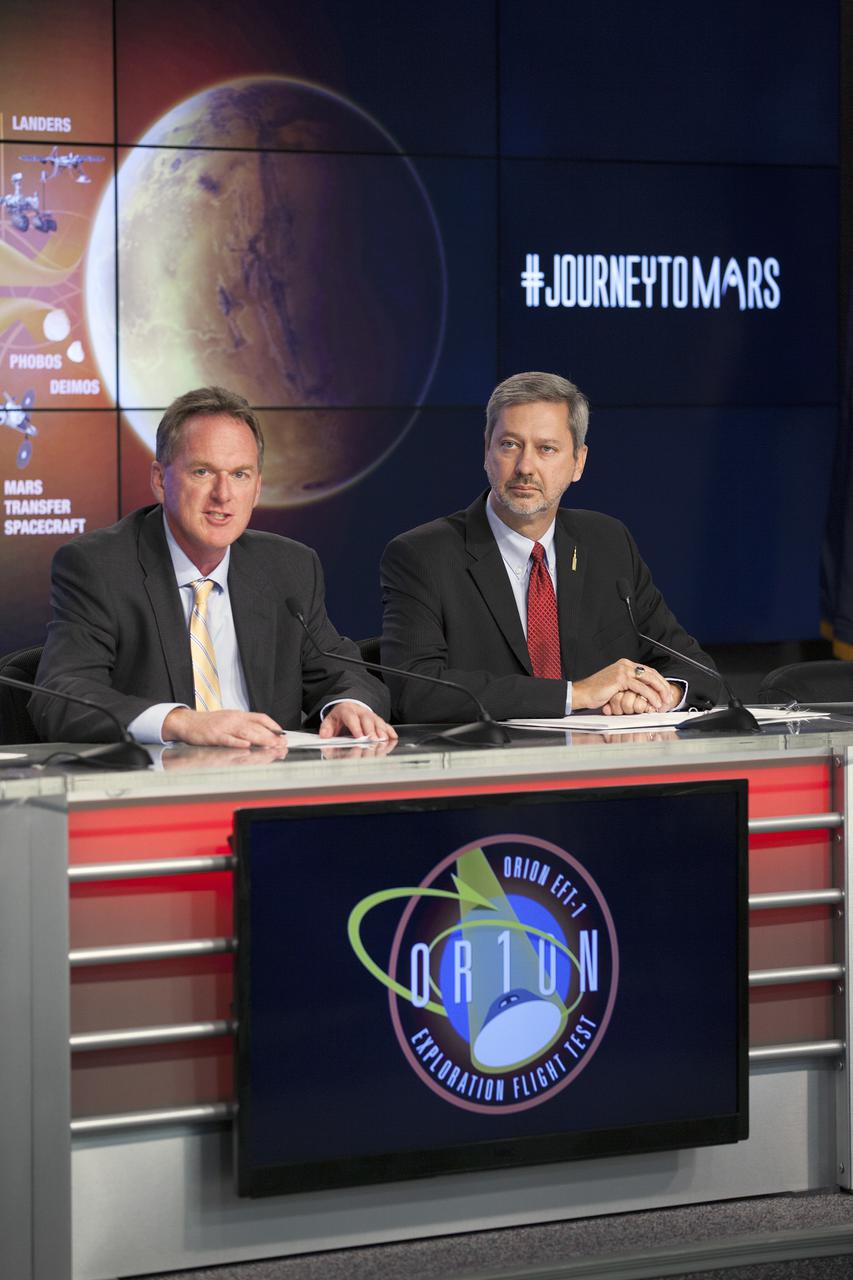
CAPE CANAVERAL, Fla. – At NASA's Kennedy Space Center in Florida, Mike Bolger, program manager of Ground Systems Development and Operations Program, and Chris Crumbly, manager of Space Launch System Spacecraft_Payload Integration and Evolution, were among several agency leaders who spoke to members of the news media about how the first fight of the new Orion spacecraft is a first step in NASA's plans to send humans to Mars. Orion is the exploration spacecraft designed to carry astronauts to destinations not yet explored by humans, including an asteroid and Mars. It will have emergency abort capability, sustain the crew during space travel and provide safe re-entry from deep space return velocities. The first unpiloted flight test of Orion is scheduled to launch Dec. 4, 2014 atop a United Launch Alliance Delta IV Heavy rocket, and in 2018 on NASA’s Space Launch System rocket. For more information, visit www.nasa.gov_orion Photo credit: NASA_Kim Shiflett
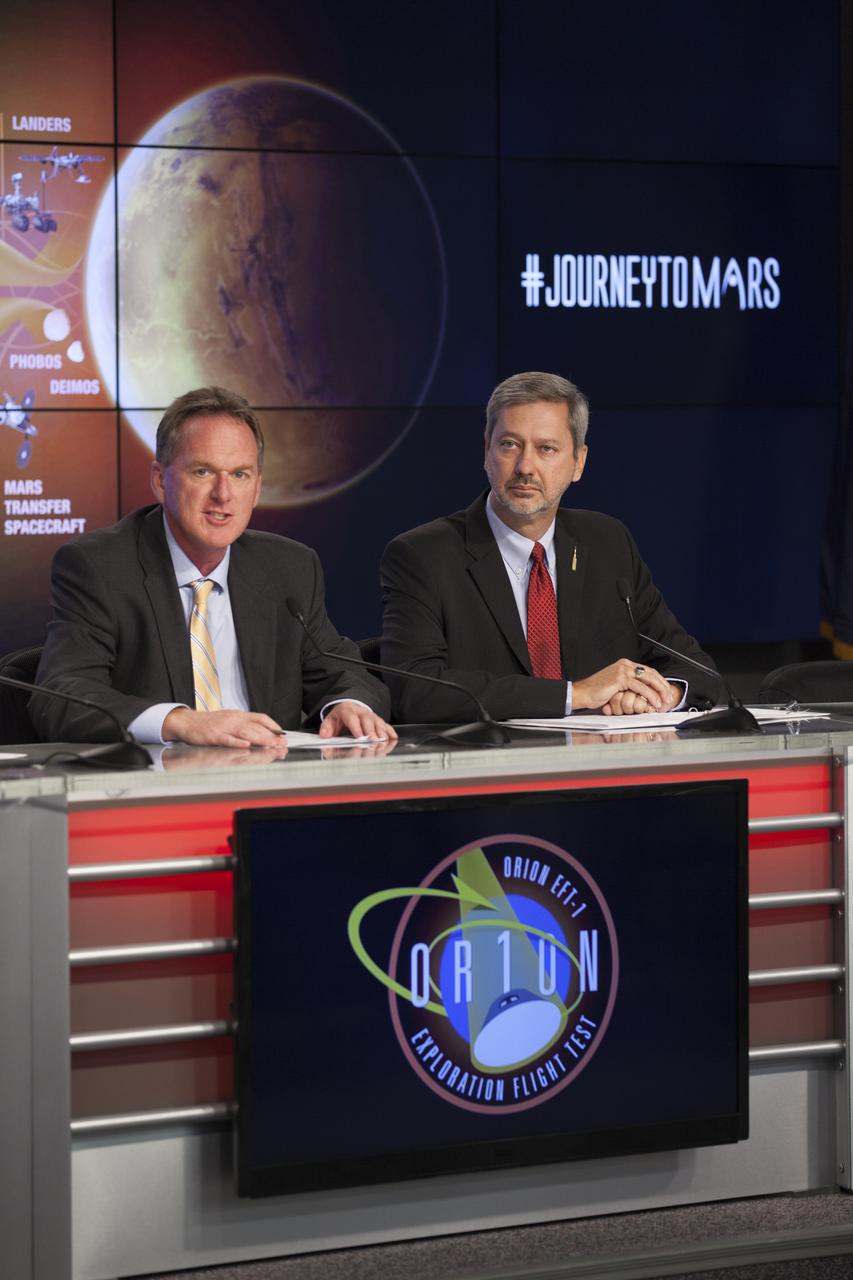
At NASA's Kennedy Space Center in Florida, Mike Bolger, program manager of Ground Systems Development and Operations Program, and Chris Crumbly, manager of Space Launch System Spacecraft/Payload Integration and Evolution, were among several agency leaders who spoke to members of the news media about how the first fight of the new Orion spacecraft is a first step in NASA's plans to send humans to Mars. Orion is the exploration spacecraft designed to carry astronauts to destinations not yet explored by humans, including an asteroid and Mars. It will have emergency abort capability, sustain the crew during space travel and provide safe re-entry from deep space return velocities. The first unpiloted flight test of Orion is scheduled to launch Dec. 4, 2014 atop a United Launch Alliance Delta IV Heavy rocket, and in 2018 on NASA’s Space Launch System rocket.
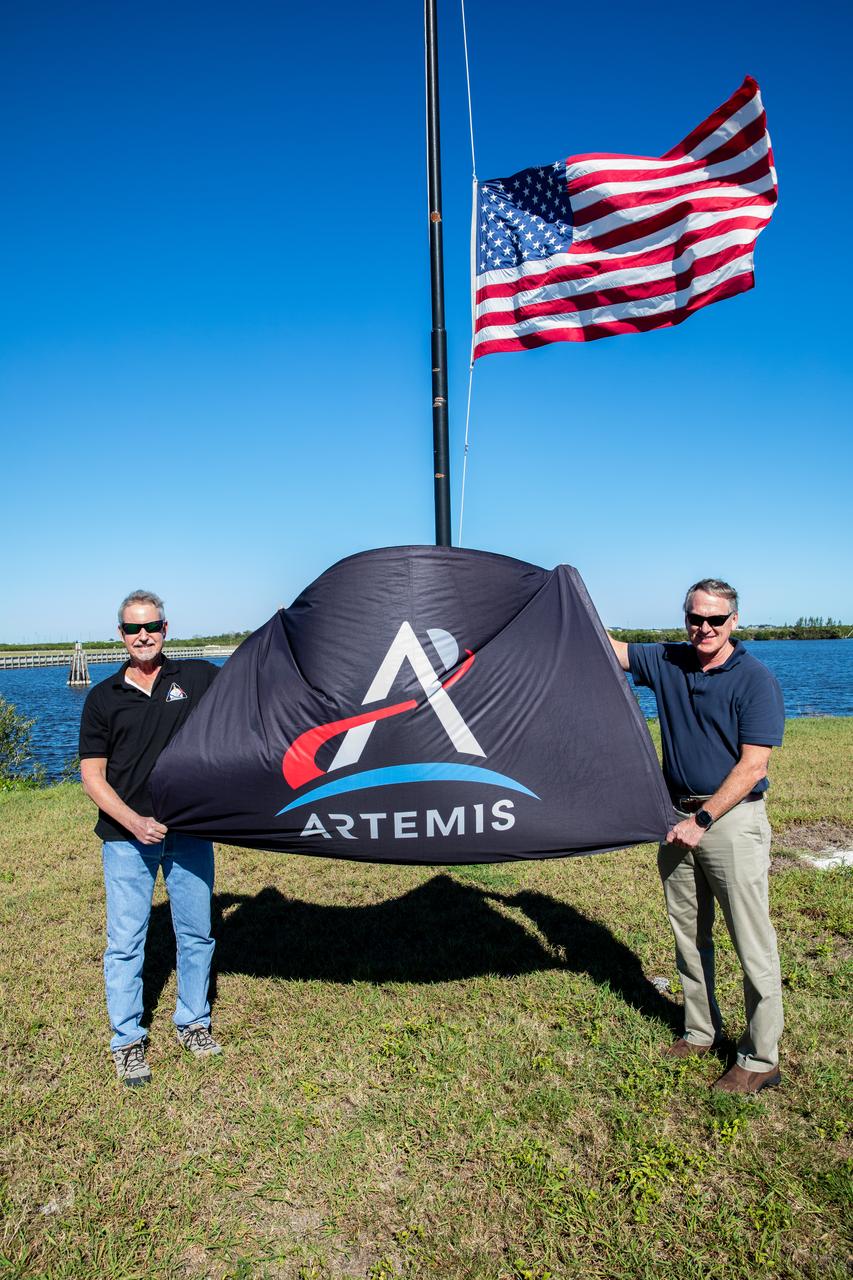
The Artemis flag is removed from NASA News Center property at the agency’s Kennedy Space Center in Florida on Jan. 6, 2023, following the successful Artemis I mission. At left is former Exploration Ground Systems (EGS) Senior Technical Integration Manager Phil Weber, joined by former EGS Manager Mike Bolger. Both men served in their respective roles during Artemis I, retiring at the end of 2022. NASA’s Space Launch System (SLS) rocket and Orion spacecraft lifted off from Kennedy’s Launch Complex 39B on Nov. 16, 2022. Orion splashed down in the Pacific Ocean on Dec. 11 and arrived back at Kennedy on Dec. 30. Artemis I sets the stage for the next mission of SLS and Orion to fly crew around the Moon on Artemis II.
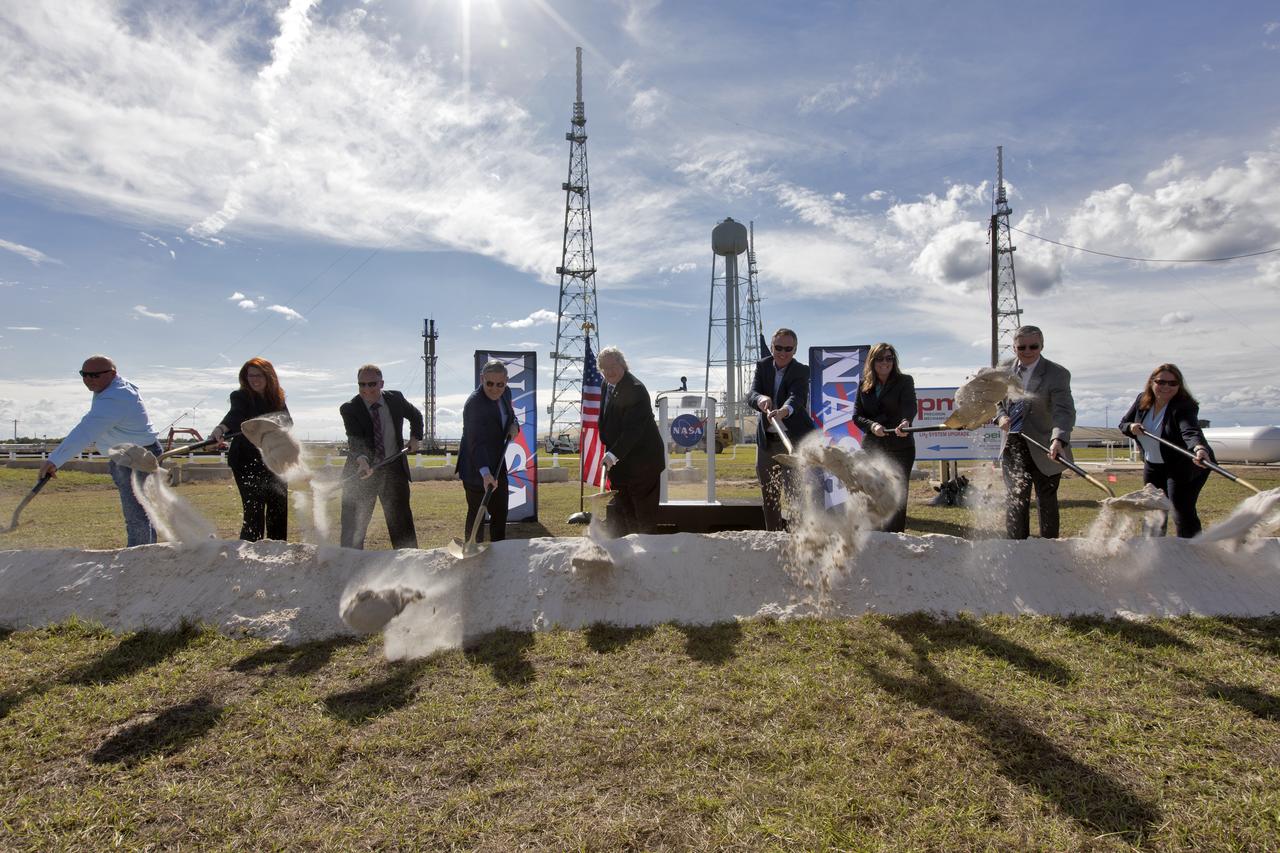
On Dec. 19, 2018, at NASA Kennedy Space Center's Launch Complex 39B, agency and contractor managers break ground for a new liquid hydrogen tank. Participating, from the left, are Todd Gray, president of Precision Mechanical, prime contractor for the project; Charlie Blackwell-Thompson, launch director; Shawn Quinn, director of Engineering; Bob Cabana, center director; Bill Hill, deputy associate administrator for Exploration Systems Development at NASA Headquarters in Washington; Mike Bolger, program manager for Exploration Ground Systems (EGS); Jennifer Kunz, deputy program manager for EGS, Andy Allen, general manager for Jacobs, NASA's Test and Operations Support Contractor; and Regina Spellman, launch pad senior project manager in EGS. The storage facility will hold 1.25 million gallons of the propellant for NASA's Space Launch System rocket designed to boost the agency's Orion spacecraft, sending humans to distant destinations such as the Moon and Mars.
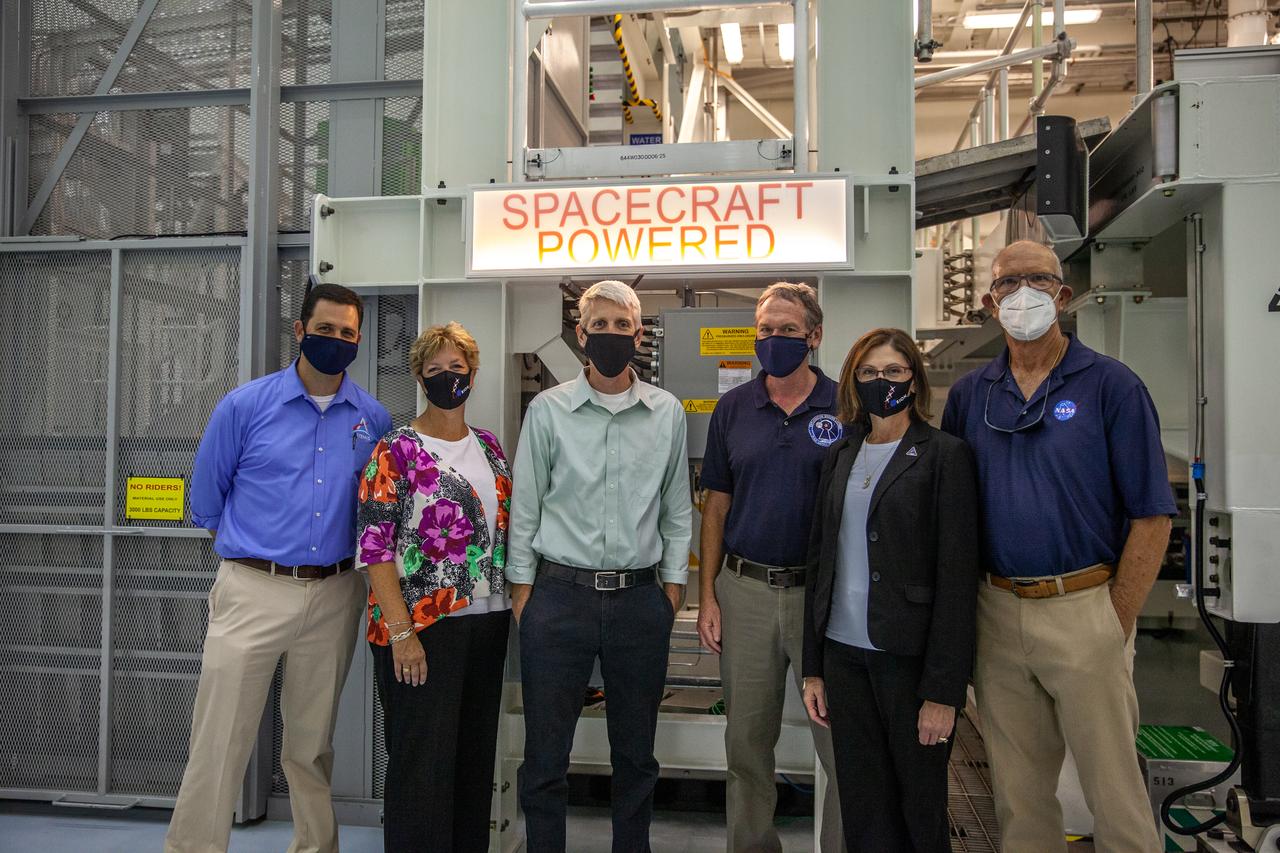
Catherine Koerner, second from right, NASA Orion Program manager, along with senior managers from Orion, and Exploration Ground Systems (EGS), tours the Multi-Payload Processing Facility (MPPF) at NASA’s Kennedy Space Center in Florida on Oct. 5, 2020. Accompanying her, from left are Jeremy Parsons, EGS deputy manager; Annette Hasbrook, Orion Program assistant manager; Scott Wilson, Orion Production Operations manager; and Mike Bolger, EGS manager. At far right is Skip Williams, operations manager for the MPPF spacecraft offline element integration team. Koerner viewed spacecraft hardware and processing facilities for the Artemis I and II missions. The first in a series of increasingly complex missions, Artemis I will test the Orion spacecraft and Space Launch System as an integrated system ahead of crewed flights to the Moon. Under the Artemis program, NASA will land the first woman and the next man on the Moon in 2024.
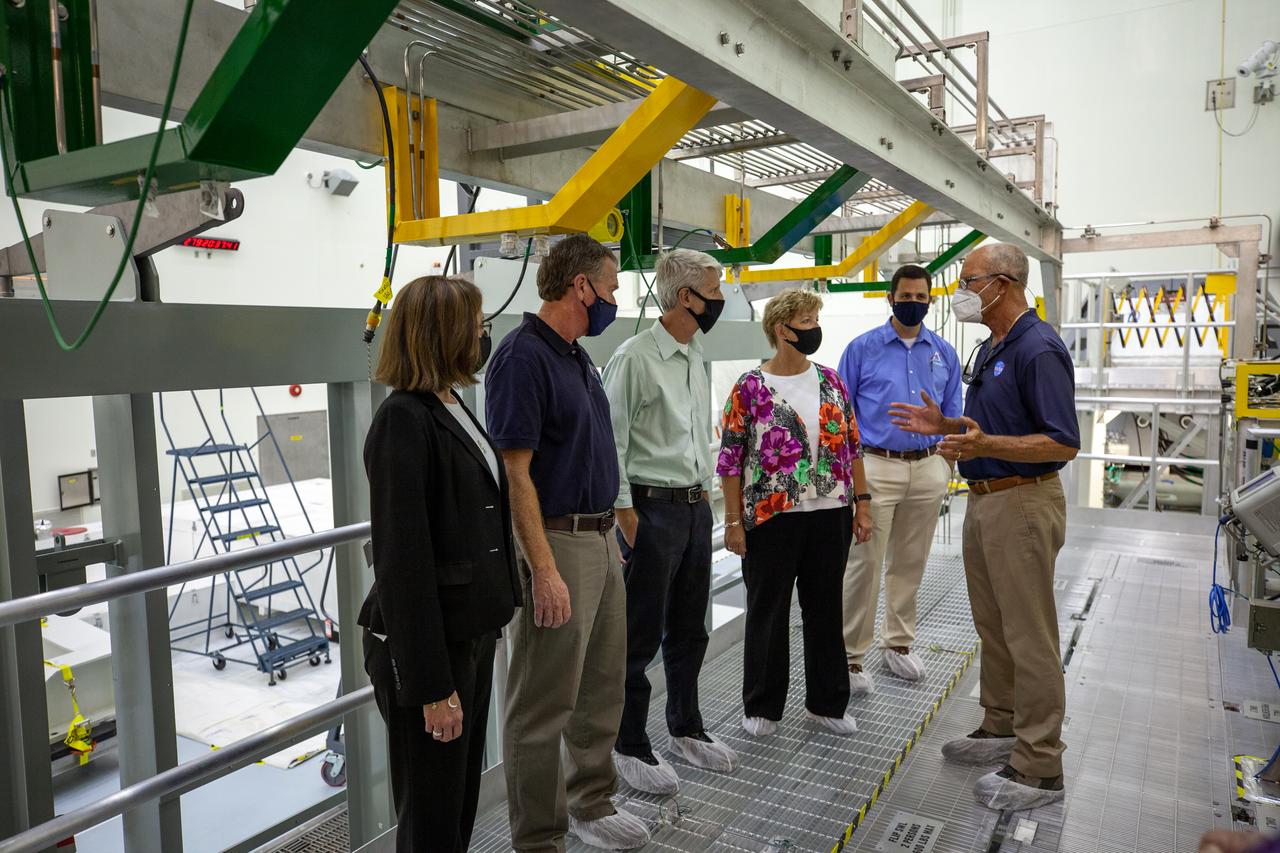
Catherine Koerner, far left, NASA Orion Program manager, along with senior managers from Orion, and Exploration Ground Systems (EGS), tours the Multi-Payload Processing Facility (MPPF) at NASA’s Kennedy Space Center in Florida on Oct. 5, 2020. Accompanying her, from left are Mike Bolger, EGS manager; Scott Wilson, Orion Production Operations manager; Annette Hasbrook, Orion Program assistant manager; and Jeremy Parsons, EGS deputy manager. Speaking to the group is Skip Williams, operations manager for the MPPF spacecraft offline element integration team. Koerner viewed spacecraft hardware and processing facilities for the Artemis I and II missions. The first in a series of increasingly complex missions, Artemis I will test the Orion spacecraft and Space Launch System as an integrated system ahead of crewed flights to the Moon. Under the Artemis program, NASA will land the first woman and the next man on the Moon in 2024.
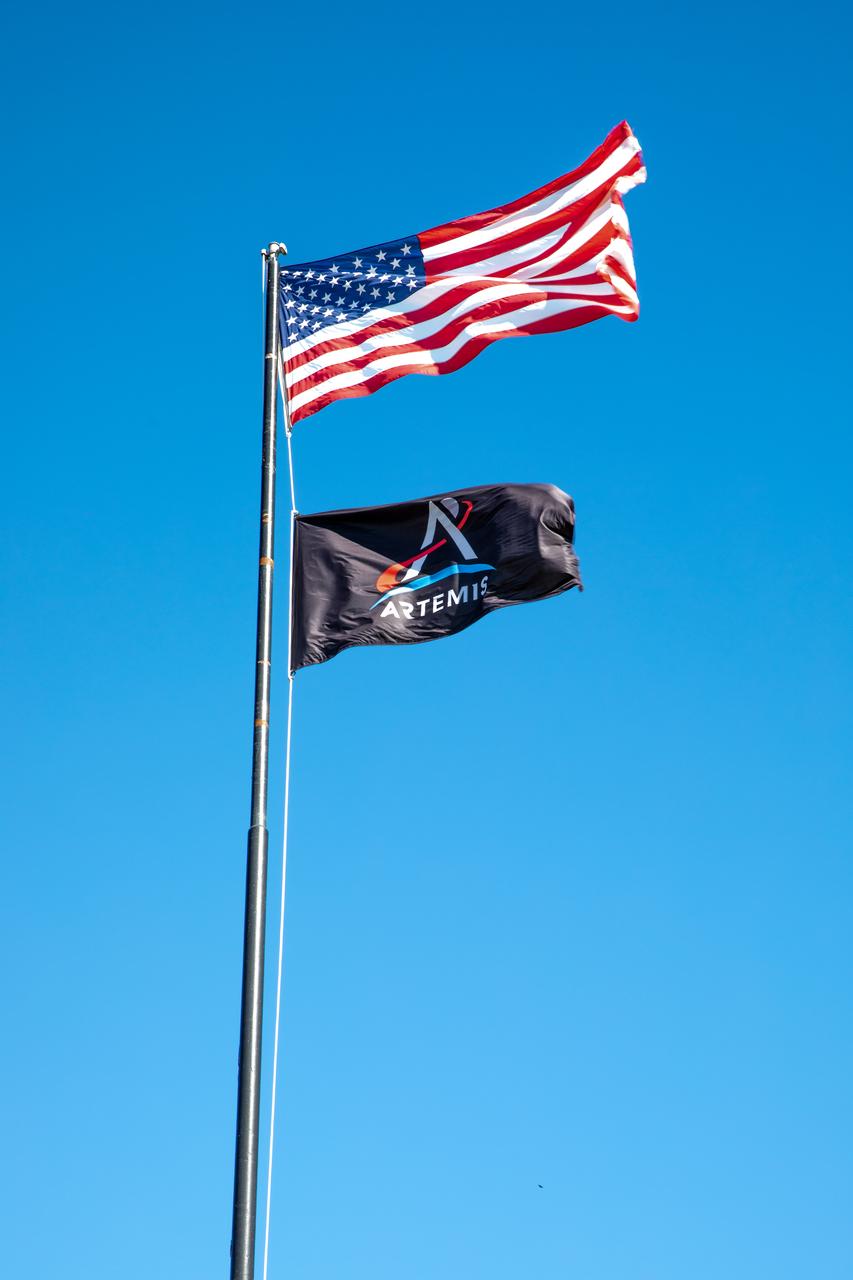
The Artemis flag is removed from NASA News Center property at the agency’s Kennedy Space Center in Florida on Jan. 6, 2023, following the successful Artemis I mission. At left is former Exploration Ground Systems (EGS) Senior Technical Integration Manager Phil Weber, joined by former EGS Manager Mike Bolger. Both men served in their respective roles during Artemis I, retiring at the end of 2022. NASA’s Space Launch System (SLS) rocket and Orion spacecraft lifted off from Kennedy’s Launch Complex 39B on Nov. 16, 2022. Orion splashed down in the Pacific Ocean on Dec. 11 and arrived back at Kennedy on Dec. 30. Artemis I sets the stage for the next mission of SLS and Orion to fly crew around the Moon on Artemis II.
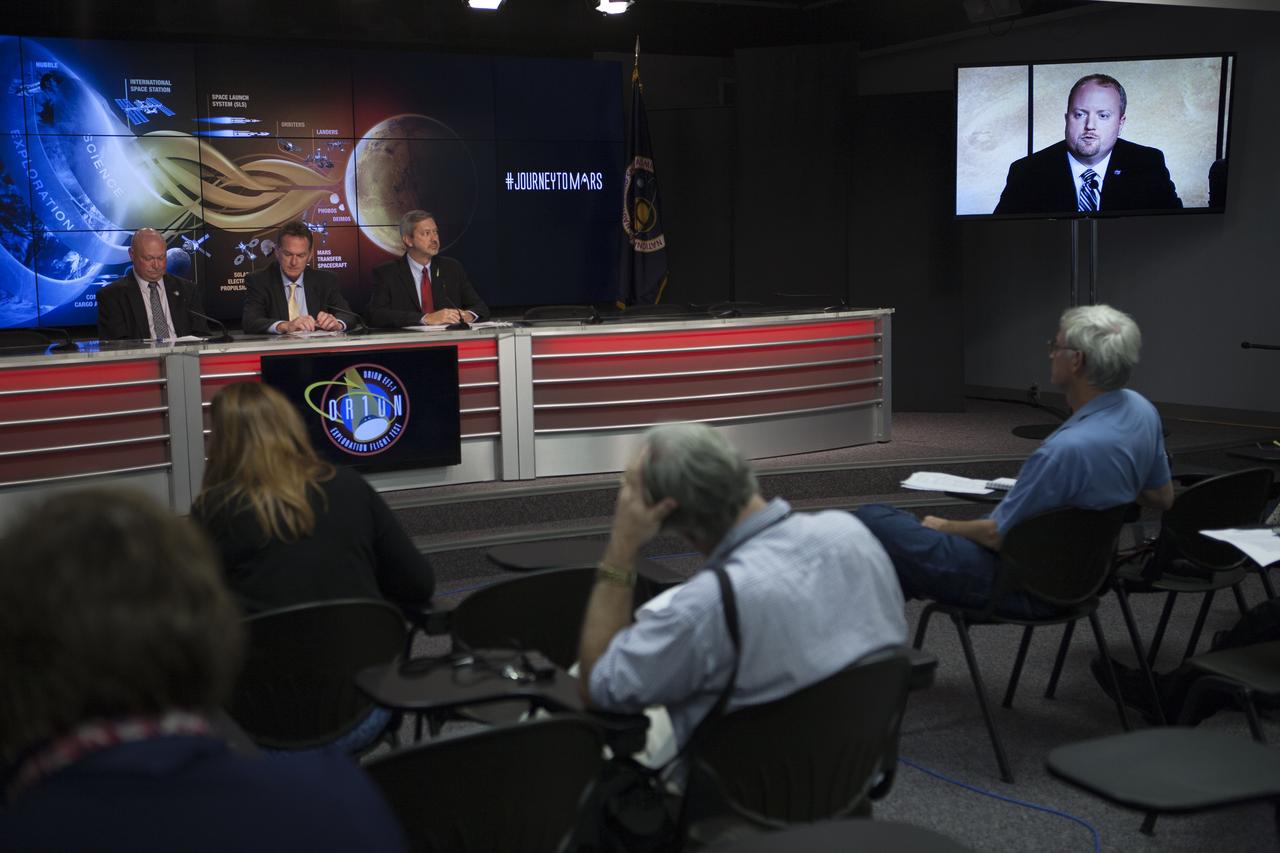
At NASA's Kennedy Space Center in Florida, NASA leaders spoke to members of the news media about how the first flight of the new Orion spacecraft is a first step in the agency's plans to send humans to Mars. At Kennedy's News Center auditorium from the left are: Mike Curie of NASA Public Affairs, Mike Bolger, program manager of Ground Systems Development and Operations Program, and Chris Crumbly, manager of Space Launch System Spacecraft/Payload Integration and Evolution. Participating via video from the agency's headquarters in Washington included Jason Crusan, director of Advanced Exploration Systems Division of Human Exploration and Operations Mission Directorate, seen on the monitor on the right. Orion is the exploration spacecraft designed to carry astronauts to destinations not yet explored by humans, including an asteroid and Mars. It will have emergency abort capability, sustain the crew during space travel and provide safe re-entry from deep space return velocities. The first unpiloted flight test of Orion is scheduled to launch Dec. 4, 2014 atop a United Launch Alliance Delta IV Heavy rocket, and in 2018 on NASA’s Space Launch System rocket.
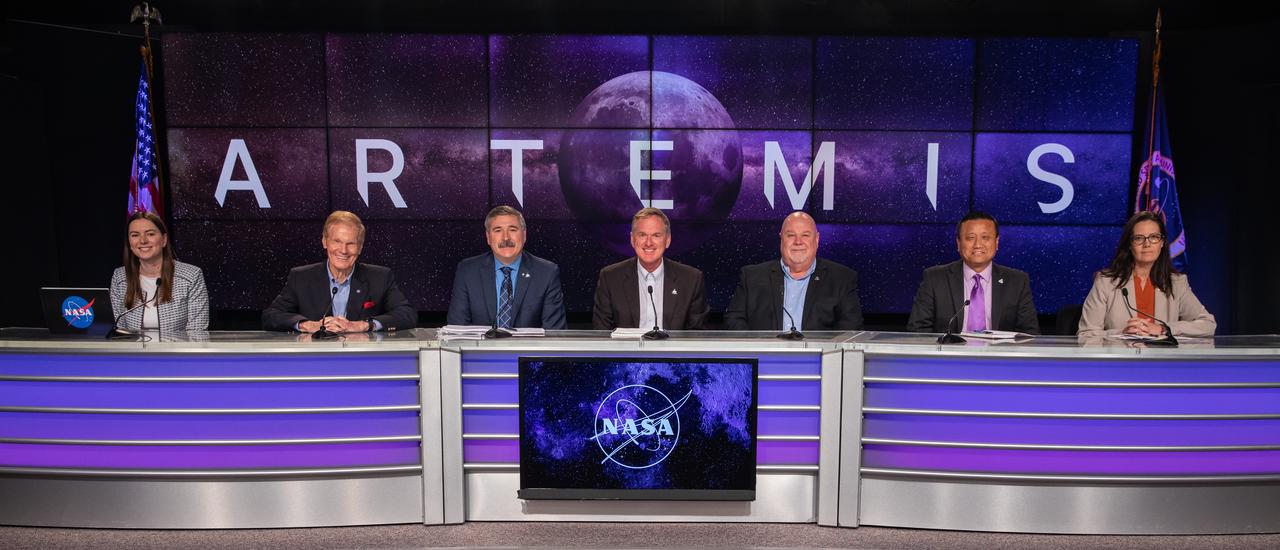
A postlaunch news conference is held on Nov. 16, 2022, at NASA’s Kennedy Space Center in Florida, after launch of Artemis I at 1:47 a.m. EST from Kennedy’s Launch Complex 39B. Participants are, from left, Jackie McGuiness, NASA Communications; Bill Nelson, NASA administrator; Mike Sarafin, Artemis mission manager, NASA Headquarters; Mike Bolger, Exploration Ground Systems Program manager, Kennedy; John Honeycutt, Space Launch System Program manager, Marshall; Howard Hu, Orion Program manager, NASA’s Johnson Space Center; and Emily Nelson, chief flight director, Johnson. The first in a series of increasingly complex missions, Artemis I will provide a foundation for human deep space exploration and demonstrate our commitment and capability to extend human presence to the Moon and beyond. The primary goal of Artemis I is to thoroughly test the integrated systems before crewed missions by operating the spacecraft in a deep space environment, testing Orion’s heat shield, and recovering the crew module after reentry, descent, and splashdown.
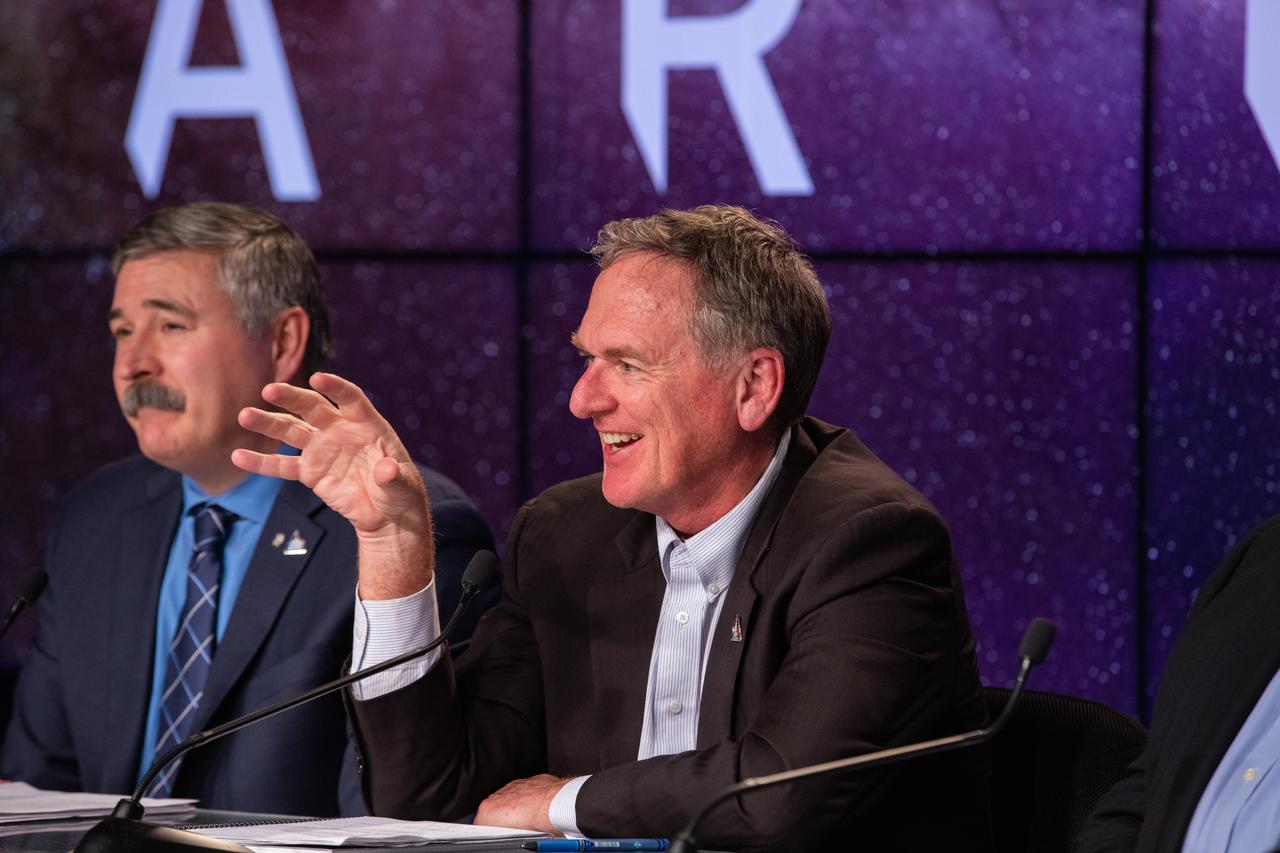
A postlaunch news conference is held on Nov. 16, 2022, at NASA’s Kennedy Space Center in Florida, after launch of Artemis I at 1:47 a.m. EST from Kennedy’s Launch Complex 39B. Participants were, from left, Mike Sarafin, Artemis mission manager, NASA Headquarters; and Mike Bolger, Exploration Ground Systems Program manager, Kennedy. Also participating were NASA Administrator Bill Nelson; John Honeycutt, Space Launch System Program manager, Marshall; Howard Hu, Orion Program manager, NASA’s Johnson Space Center; and Emily Nelson, chief flight director, Johnson. The first in a series of increasingly complex missions, Artemis I will provide a foundation for human deep space exploration and demonstrate our commitment and capability to extend human presence to the Moon and beyond. The primary goal of Artemis I is to thoroughly test the integrated systems before crewed missions by operating the spacecraft in a deep space environment, testing Orion’s heat shield, and recovering the crew module after reentry, descent, and splashdown.
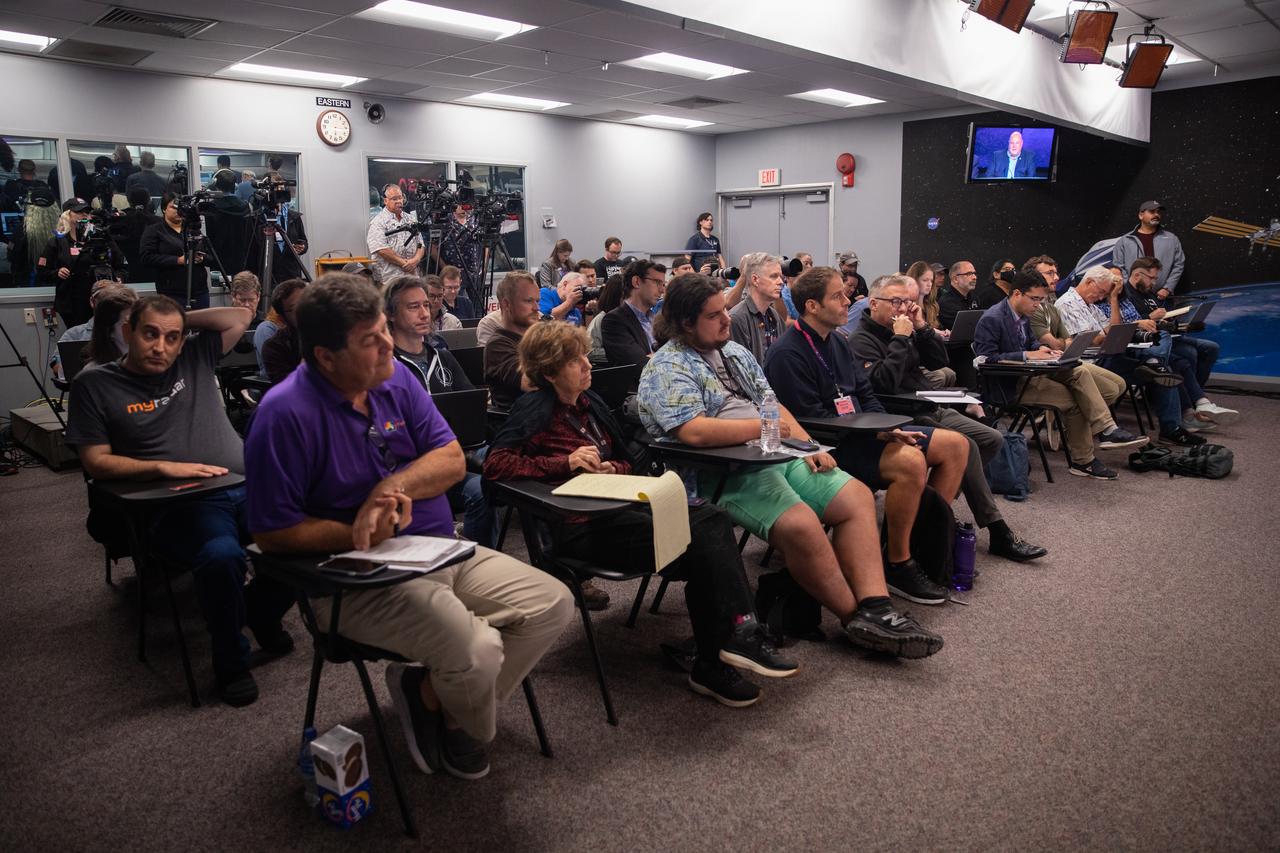
Members of the media attend a postlaunch news conference on Nov. 16, 2022, at NASA’s Kennedy Space Center in Florida, after launch of Artemis I at 1:47 a.m. EST from Kennedy’s Launch Complex 39B. Participants were Jackie McGuiness, NASA Communications; Bill Nelson, NASA administrator; Mike Sarafin, Artemis mission manager, NASA Headquarters; Mike Bolger, Exploration Ground Systems Program manager, Kennedy; John Honeycutt, Space Launch System Program manager, Marshall; Howard Hu, Orion Program manager, NASA’s Johnson Space Center; and Emily Nelson, chief flight director, Johnson. The first in a series of increasingly complex missions, Artemis I will provide a foundation for human deep space exploration and demonstrate our commitment and capability to extend human presence to the Moon and beyond. The primary goal of Artemis I is to thoroughly test the integrated systems before crewed missions by operating the spacecraft in a deep space environment, testing Orion’s heat shield, and recovering the crew module after reentry, descent, and splashdown.
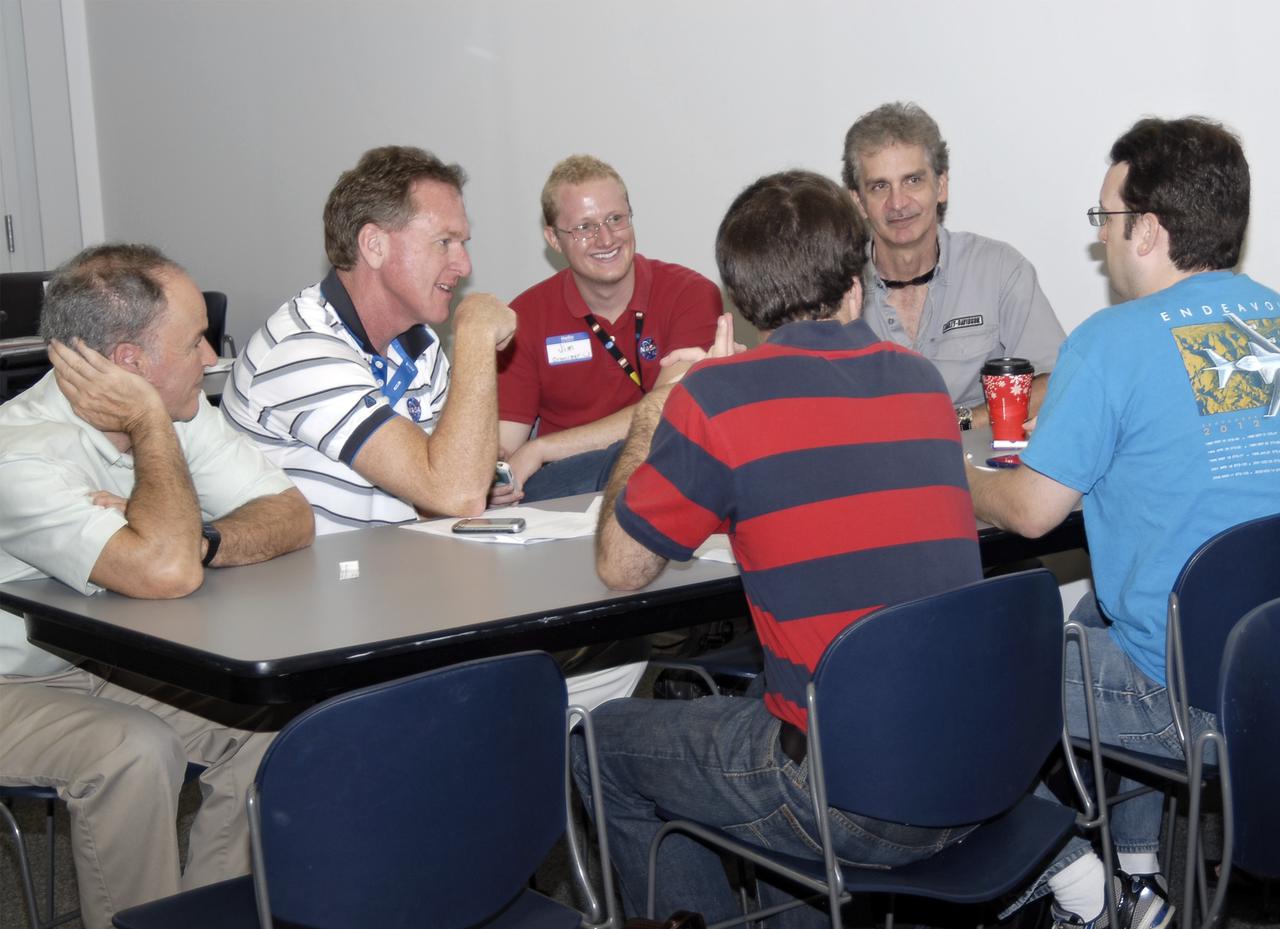
CAPE CANAVERAL, Fla. – Subject matter experts, event volunteers and participants discuss ideas during the 2013 International Space Apps Challenge at the Center for Space Education at the Kennedy Space Center Visitor Complex in Florida. From left, are Dr. Ray Wheeler, NASA subject matter expert Mike Bolger, Kennedy’s Information Technology director Jim Wood, event volunteer challenge participants Pat Starace and Mike King from Orlando and David Thorpe in Kennedy’s Center Planning and Development Directorate. During the worldwide two-day challenge, more than 9,000 people and 484 organizations came together in 83 cities across 44 countries, as well as online, to develop new ways of solving challenges that NASA faces. At Kennedy, four teams brainstormed ideas with subject matter experts and others and worked nearly 32 hours straight to present their concepts to a panel of three technical and non-technical judges. Challenges tackled at Kennedy were: Deployable Greenhouse, Kennedy Space Center 2040, Seven Minutes of Science, and Moonville – Lunar Industry Game. Photo credit: NASA_Charisse Nahser
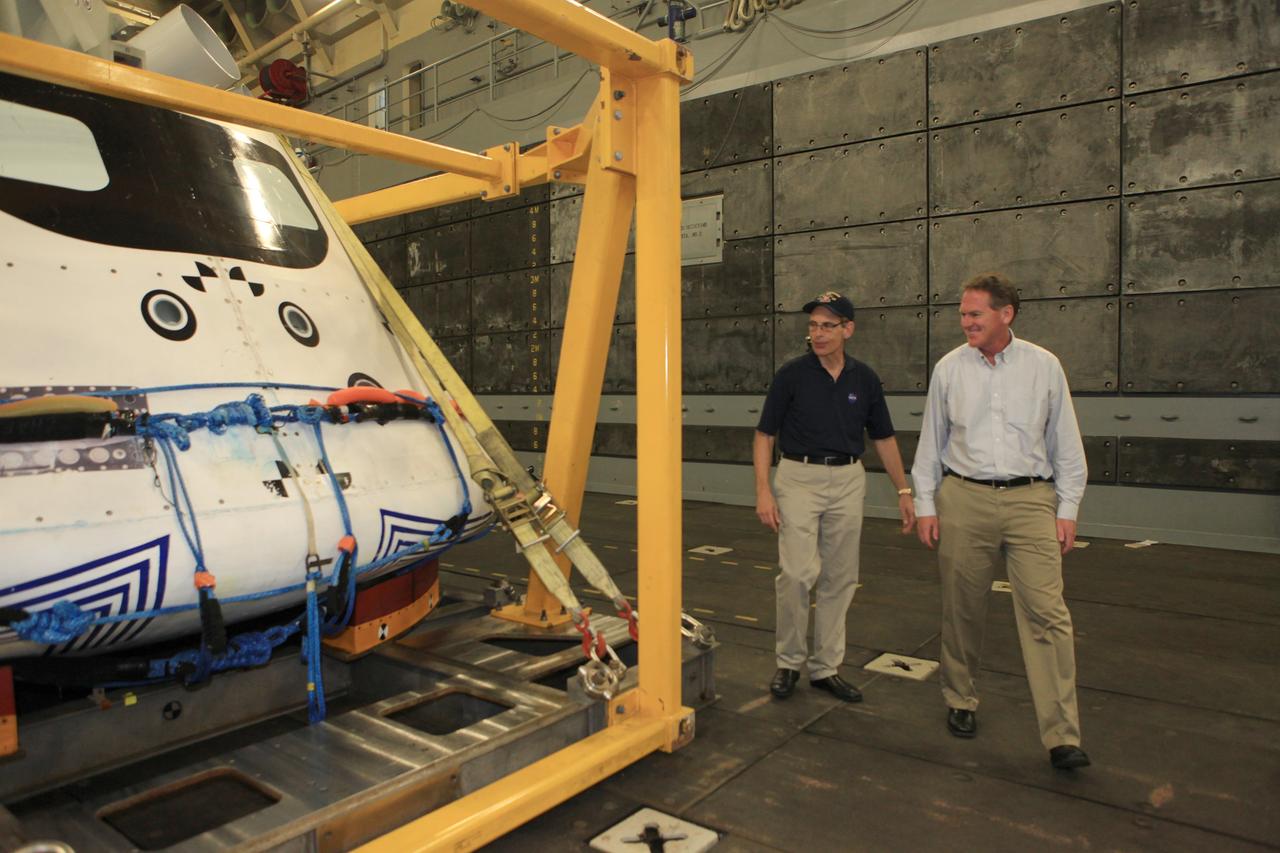
LOS ANGELES, Calif. – Mike Bolger, Ground Systems Development and Operations Program manager, at right, and Mike Generale, Orion Recovery Operations manager and Recovery Test director, both from NASA’s Kennedy Space Center in Florida, view the Orion boilerplate test vehicle in its recovery cradle in the well deck of the USS Anchorage. NASA, Lockheed Martin and the U.S. Navy completed the Orion recovery test in the Pacific Ocean off the coast of San Diego to prepare for recovery of the Orion crew module on its return from a deep space mission. The underway recovery test allowed the teams to demonstrate and evaluate the recovery processes, procedures, new hardware and personnel in open waters. The U.S. Navy ship is in Los Angeles for LA Navy Days. The Ground Systems Development and Operations Program conducted the underway recovery test. Orion is the exploration spacecraft designed to carry astronauts to destinations not yet explored by humans, including an asteroid and Mars. It will have emergency abort capability, sustain the crew during space travel and provide safe re-entry from deep space return velocities. The first unpiloted test flight of the Orion is scheduled to launch in 2014 atop a Delta IV rocket and in 2017 on NASA’s Space Launch System rocket. For more information, visit http://www.nasa.gov/orion. Photo credit: Kim Shiflett
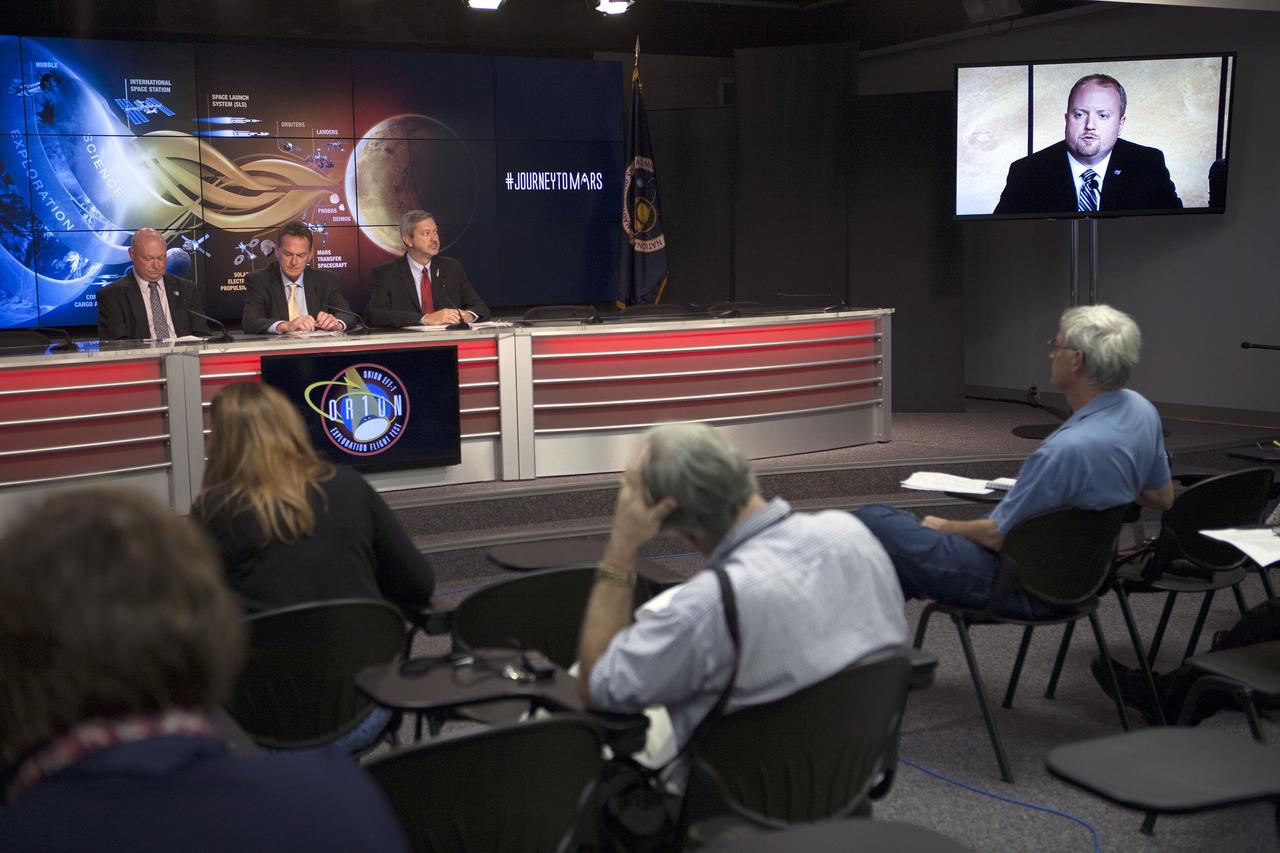
CAPE CANAVERAL, Fla. – At NASA's Kennedy Space Center in Florida, NASA leaders spoke to members of the news media about how the first flight of the new Orion spacecraft is a first step in the agency's plans to send humans to Mars. At Kennedy's News Center auditorium from the left are: Mike Curie of NASA Public Affairs, Mike Bolger, program manager of Ground Systems Development and Operations Program, and Chris Crumbly, manager of Space Launch System Spacecraft/Payload Integration and Evolution. Participating via video from the agency's headquarters in Washington included Jason Crusan, director of Advanced Exploration Systems Division of Human Exploration and Operations Mission Directorate, seen on the monitor on the right. Orion is the exploration spacecraft designed to carry astronauts to destinations not yet explored by humans, including an asteroid and Mars. It will have emergency abort capability, sustain the crew during space travel and provide safe re-entry from deep space return velocities. The first unpiloted flight test of Orion is scheduled to launch Dec. 4, 2014 atop a United Launch Alliance Delta IV Heavy rocket, and in 2018 on NASA’s Space Launch System rocket. For more information, visit www.nasa.gov/orion Photo credit: NASA/Kim Shiflett
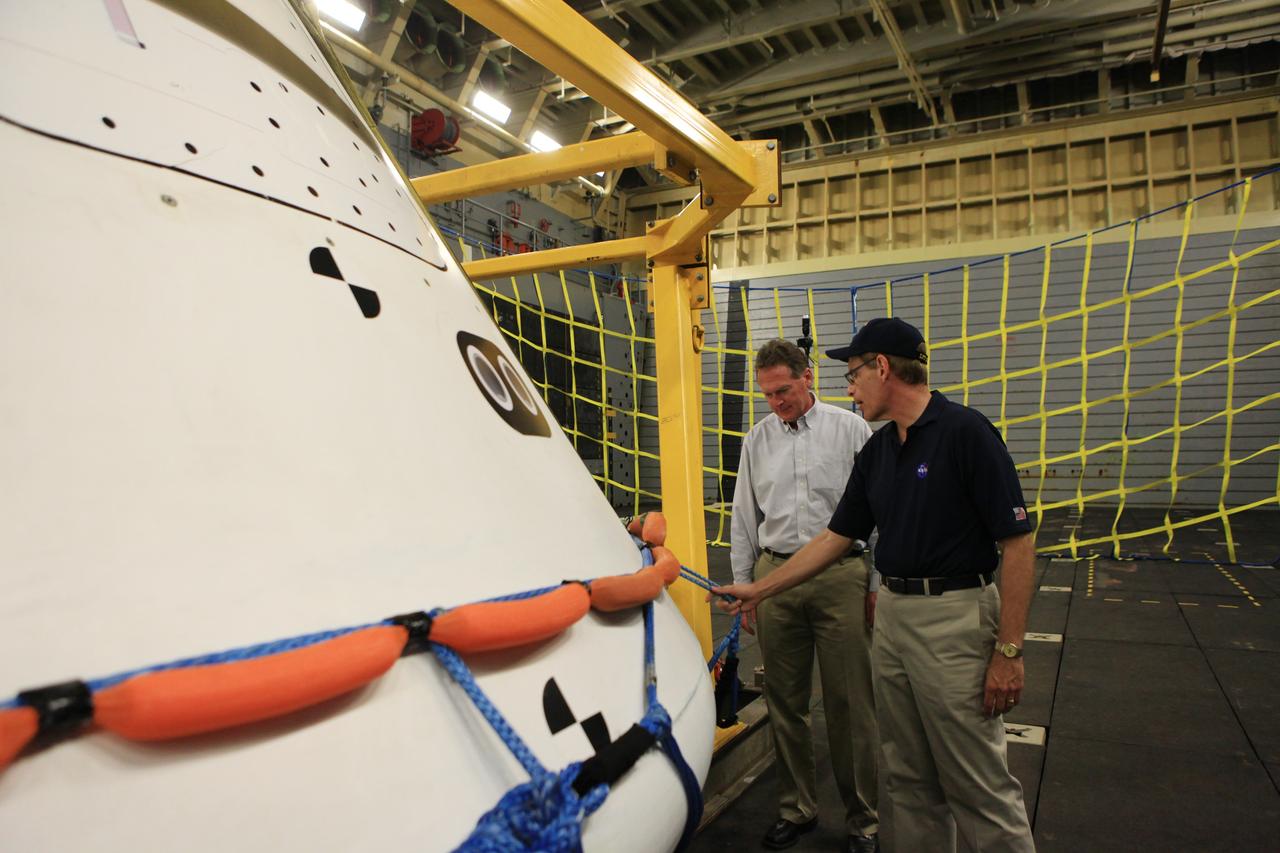
LOS ANGELES, Calif. – Mike Bolger, Ground Systems Development and Operations Program manager, at left, and Mike Generale, Orion Recovery Operations manager and Recovery Test director, both from NASA’s Kennedy Space Center in Florida, talk about Underway Recovery Test 2 in the well deck of the USS Anchorage. The U.S. Navy ship is in Los Angeles for LA Navy Days. NASA, Lockheed Martin and the U.S. Navy completed the recovery test in the Pacific Ocean off the coast of San Diego to prepare for recovery of the Orion crew module on its return from a deep space mission. The underway recovery test allowed the teams to demonstrate and evaluate the recovery processes, procedures, new hardware and personnel in open waters. The Ground Systems Development and Operations Program conducted the underway recovery test. Orion is the exploration spacecraft designed to carry astronauts to destinations not yet explored by humans, including an asteroid and Mars. It will have emergency abort capability, sustain the crew during space travel and provide safe re-entry from deep space return velocities. The first unpiloted test flight of the Orion is scheduled to launch in 2014 atop a Delta IV rocket and in 2017 on NASA’s Space Launch System rocket. For more information, visit http://www.nasa.gov/orion. Photo credit: Kim Shiflett

NASA dignitaries and launch team members gather inside Firing Room 1 of the Launch Control Center at Kennedy Space Center in Florida after the successful launch of the agency’s Space Launch System and Orion spacecraft on Nov. 16, 2022. Liftoff from Launch Complex 39B was at 1:47 a.m. EST. From left, are Artemis I Launch Director Charlie Blackwell-Thompson; Bob Cabana, NASA associate administrator; NASA Administrator Bill Nelson; Kennedy Space Center Director Janet Petro; former space shuttle Launch Director Bob Sieck; NASA Deputy Administrator Pam Melroy; Mike Bolger, Exploration Ground Systems manager; former space shuttle Launch Director Mike Leinbach; and Artemis I Assistant Launch Director Jeremy Graeber. The first in a series of increasingly complex missions, Artemis I will provide a foundation for human deep space exploration and demonstrate our commitment and capability to extend human presence to the Moon and beyond. The primary goal of Artemis I is to thoroughly test the integrated systems before crewed missions by operating the spacecraft in a deep space environment, testing Orion’s heat shield, and recovering the crew module after reentry, descent, and splashdown.
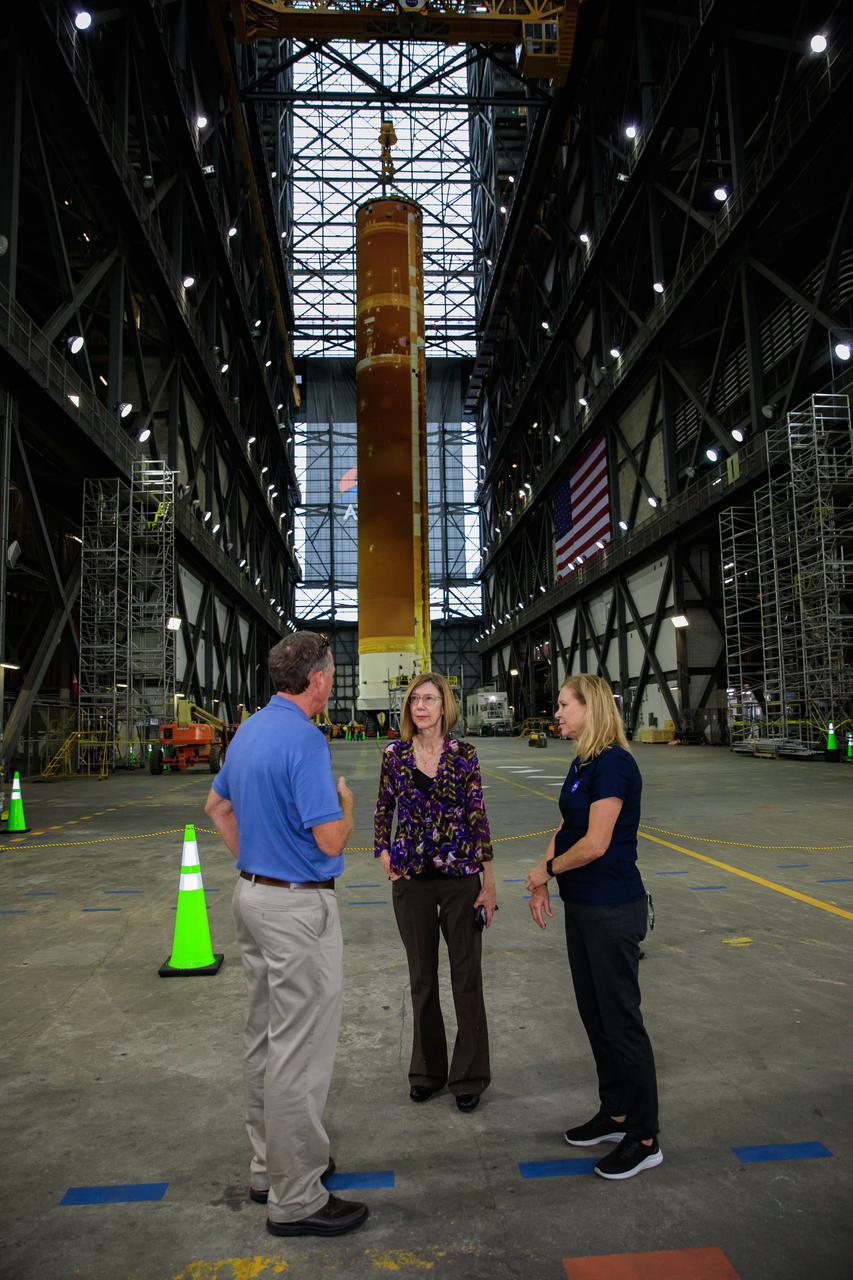
Exploration Ground Systems Manager Mike Bolger (left), NASA Human Exploration and Operations Associate Administrator Kathy Lueders (center), and Acting Director of Kennedy Space Center Janet Petro (right), visit the spaceport’s iconic Vehicle Assembly Building (VAB) in Florida on June 11, 2021. In the background, the core stage of NASA’s massive Space Launch System (SLS) rocket is visible in vertical position during lift and mate operations, prior to the core stage being moved and integrated with the twin solid rocket boosters atop the mobile launcher in High Bay 3 of the VAB. The 188,000-pound core stage, with its four RS-25 engines, will provide more than 2 million pounds of thrust during launch and ascent, and coupled with the boosters, will provide more than 8.8 million pounds of thrust to send the Artemis I mission to space. Under the Artemis program, NASA will land the first woman and first person of color on the Moon, as well as establish a sustainable presence on the lunar surface in preparation for human missions to Mars.
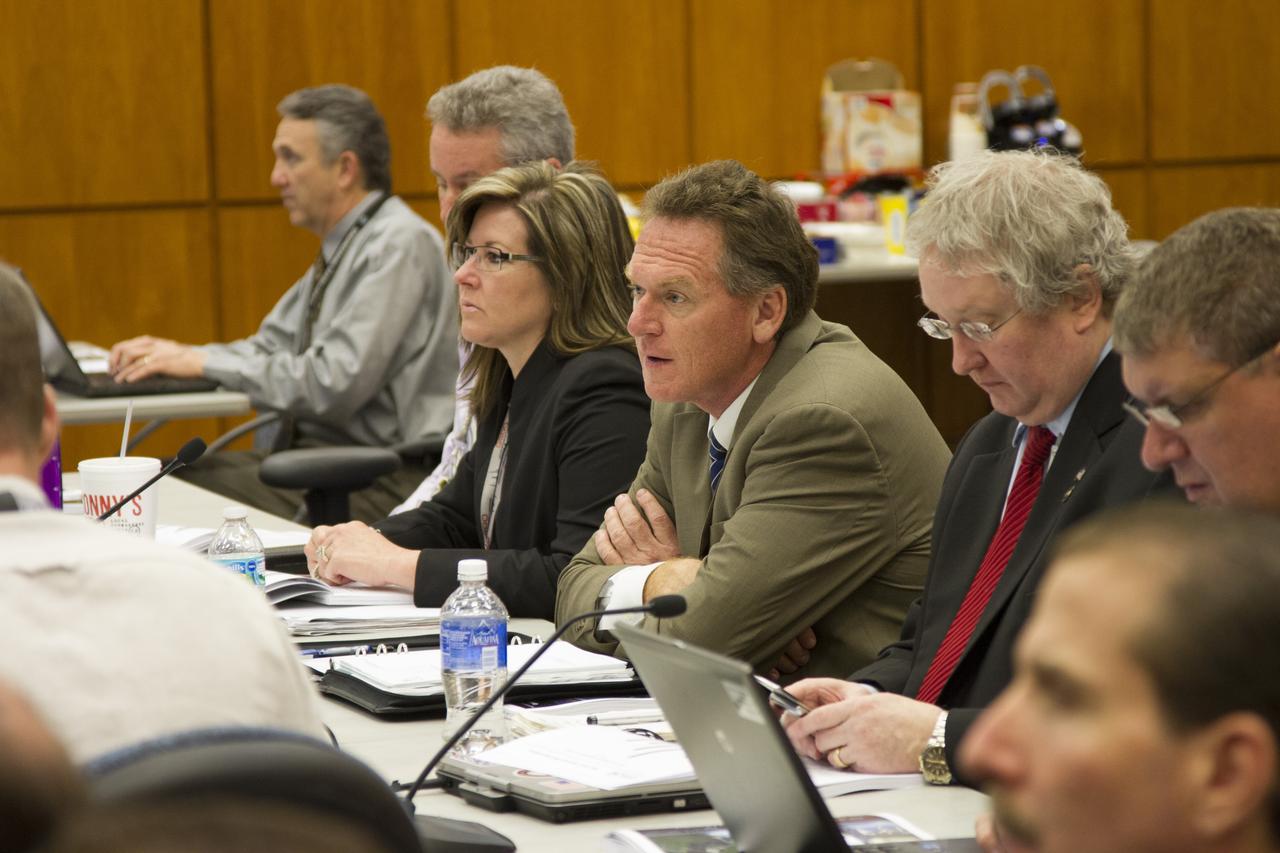
CAPE CANAVERAL, Fla. – Mike Bolger, program manager for the Ground Systems Development and Operations, or GSDO, Program speaks to participants during completion of the preliminary design review in the Mission Briefing Room inside the Operations and Checkout Building at NASA’s Kennedy Space Center in Florida. Representatives from NASA, its contractor partners and experts from across the aerospace industry met in the Mission Briefing Room inside the Operations and Checkout Building at NASA’s Kennedy Space Center in Florida to conclude the initial design and technology development phase. Completion of this review has validated that the baseline architecture is sound and aligns with the agency's exploration objectives. NASA is developing the Space Launch System and Orion spacecraft to provide an entirely new capability for human exploration beyond low-Earth orbit, with the flexibility to launch spacecraft for crew and cargo missions, including to an asteroid and Mars. Orion’s first unpiloted test flight is scheduled to launch later this year atop a Delta IV rocket. A second uncrewed flight test is scheduled for fiscal year 2018 on the Space Launch System rocket. For more information, visit http://www.nasa.gov/orion. Photo credit: NASA/Cory Huston
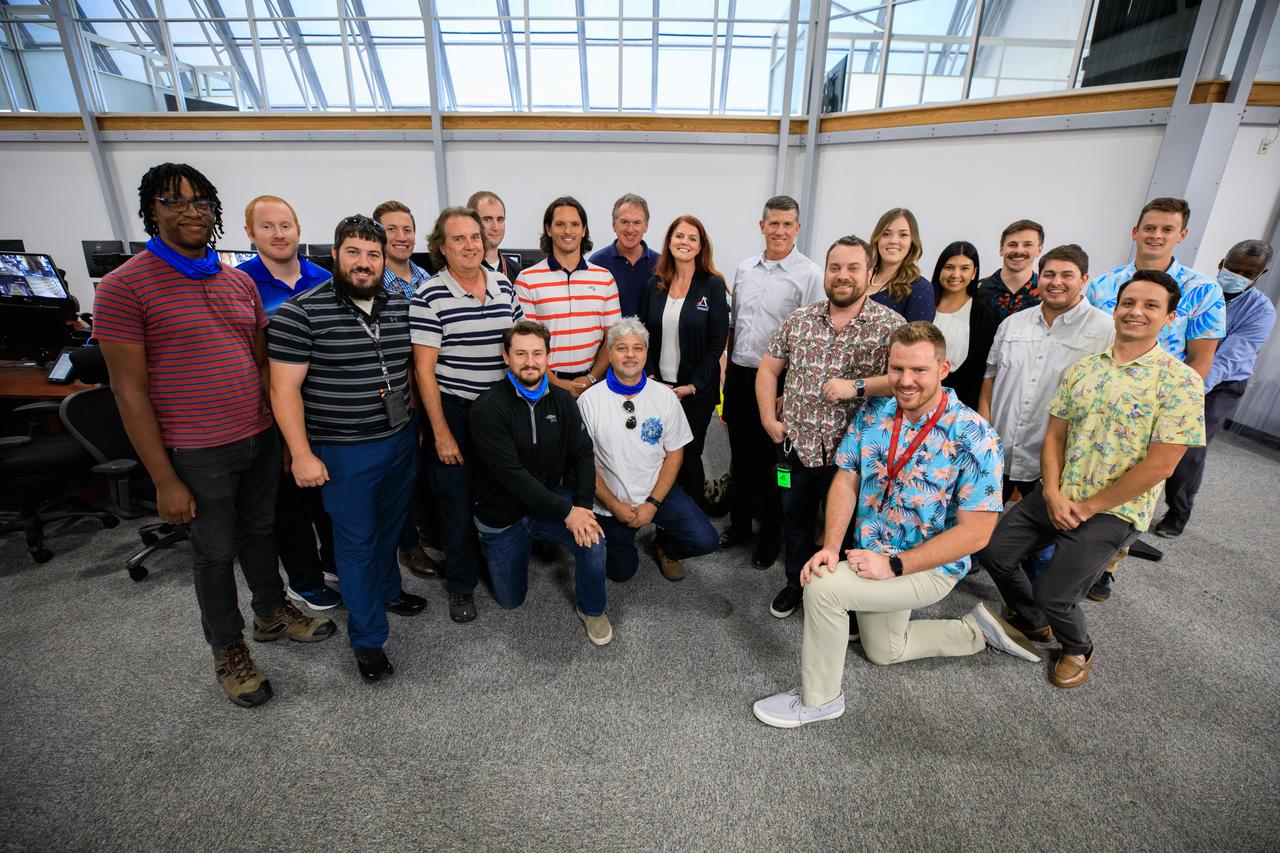
Members of the Artemis I launch team are photographed inside Firing Room 2 of the Rocco A. Petrone Launch Control Center at NASA’s Kennedy Space Center in Florida during a certification ceremony on Aug. 12, 2022. In the middle is Artemis I Launch Director Charlie Blackwell-Thompson. Behind her to the left is Mike Bolger, manager of NASA’s Exploration Ground Systems, and to her right is Jeremy Graeber, assistant launch director. The ceremony was held to commemorate the certification of the Artemis I launch team following their launch simulation held in December 2021. During the ceremony, senior members of the launch team handed out certificates to individual team members. The first in an increasingly complex series of missions, Artemis I will test NASA’s Space Launch System rocket and Orion spacecraft as an integrated system prior to crewed flights to the Moon. Through Artemis, NASA will land the first woman and the first person of color on the lunar surface, paving the way for long-term lunar presence and using the Moon as a steppingstone before venturing to Mars.
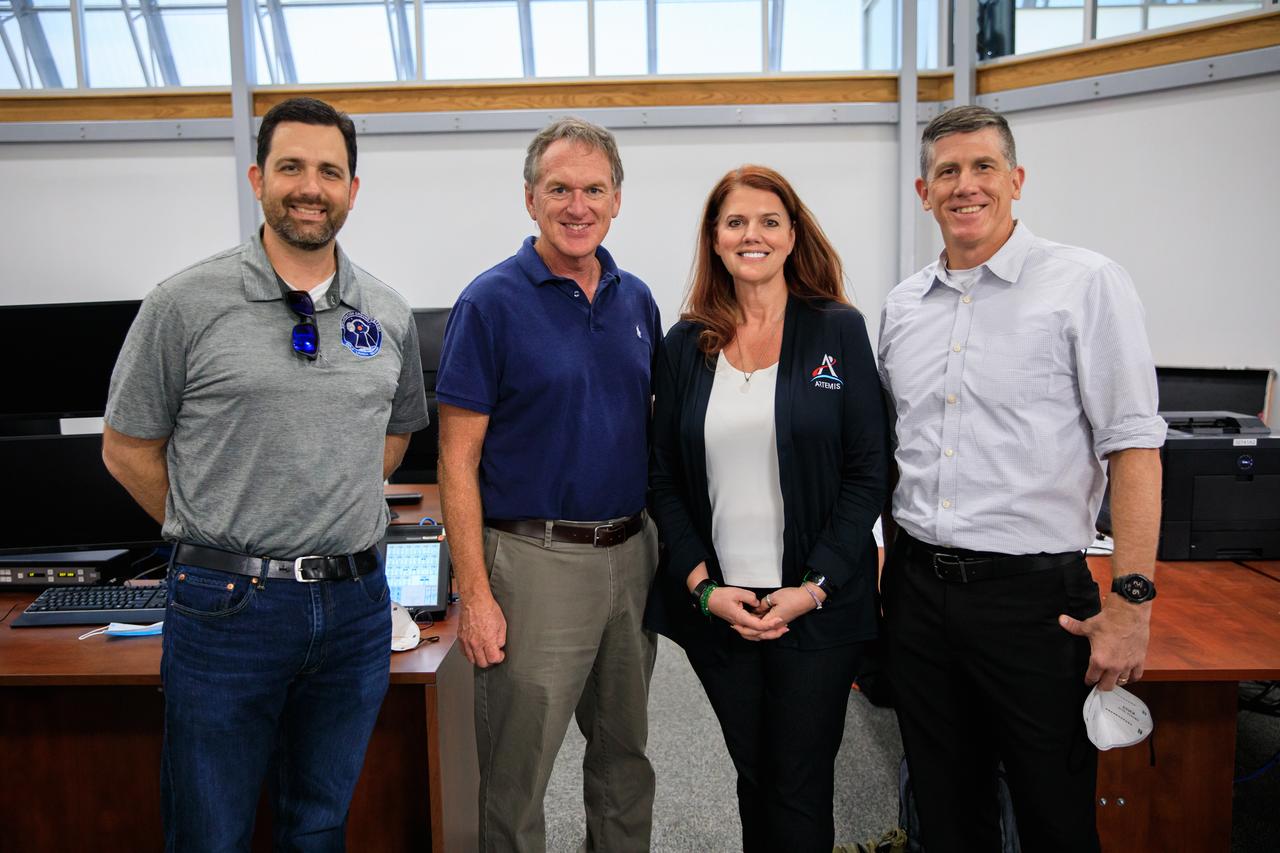
From left, NASA’s Exploration Ground Systems (EGS) Deputy Manager Jeremy Parsons, EGS Manager Mike Bolger, Artemis I Launch Director Charlie Blackwell-Thompson, and Assistant Launch Director Jeremy Graeber are photographed inside Firing Room 2 of the Rocco A. Petrone Launch Control Center at the agency’s Kennedy Space Center in Florida during a certification ceremony on Aug. 12, 2022. The ceremony was held to commemorate the certification of the Artemis I launch team following their launch simulation held in December 2021. During the ceremony, management staff handed out certificates to individual team members. The first in an increasingly complex series of missions, Artemis I will test NASA’s Space Launch System rocket and Orion spacecraft as an integrated system prior to crewed flights to the Moon. Through Artemis, NASA will land the first woman and the first person of color on the lunar surface, paving the way for long-term lunar presence and using the Moon as a steppingstone before venturing to Mars.
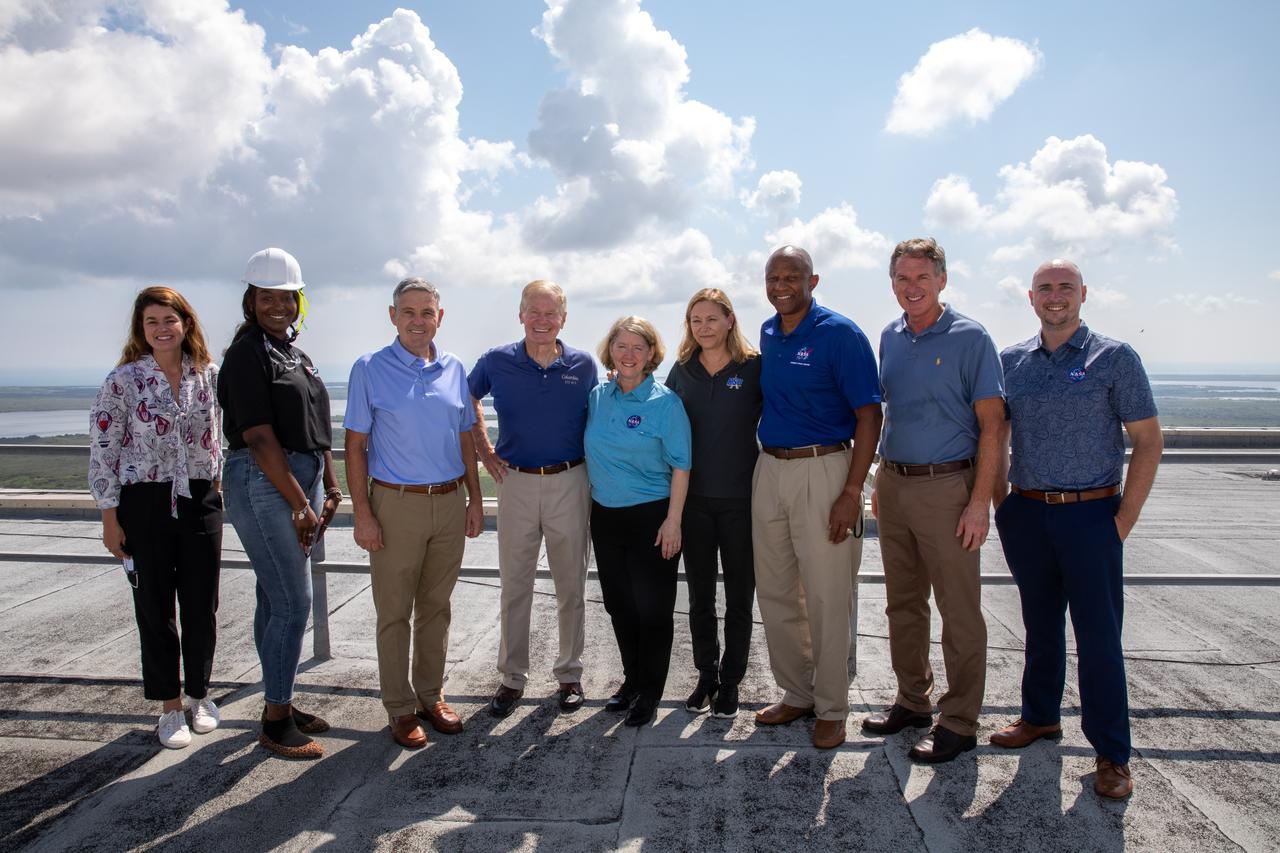
NASA and Kennedy Space Center leadership pose for a photo while touring the Vehicle Assembly Building (VAB) at the Florida spaceport on July 28, 2021. From left are NASA Headquarters’ Casey Swails; Tori Thompson, STEM intern for protocol; NASA Associate Administrator Bob Cabana; NASA Administrator Bill Nelson; NASA Deputy Administrator Pam Melroy; Kennedy Director Janet Petro; Kennedy Deputy Director Kelvin Manning; Mike Bolger, manager of NASA’s Exploration Ground Systems Program; and Executive Intern Peter Lyons. While inside the VAB, NASA senior leaders had the opportunity to view the Space Launch System (SLS) rocket as preparations for the Artemis I launch continue. The first in an increasingly complex set of missions, Artemis I will test SLS and Orion as an integrated system prior to crewed flights to the Moon. Through Artemis, NASA will land the first woman and first person of color on the lunar surface, as well as establish a sustainable presence on and around the Moon.

LOS ANGELES, Calif. – Mike Bolger, Ground Systems Development and Operations Program manager, talks with members of the media in the well deck of the USS Anchorage after completion of Underway Recovery Test 2. Behind him is the Orion boilerplate test vehicle secured in its recovery cradle. NASA, Lockheed Martin and the U.S. Navy conducted the test in the Pacific Ocean off the coast of San Diego to prepare for recovery of the Orion crew module on its return from a deep space mission. The underway recovery test allowed the teams to demonstrate and evaluate the recovery processes, procedures, new hardware and personnel in open waters. The Ground Systems Development and Operations Program conducted the underway recovery test. Orion is the exploration spacecraft designed to carry astronauts to destinations not yet explored by humans, including an asteroid and Mars. It will have emergency abort capability, sustain the crew during space travel and provide safe re-entry from deep space return velocities. The first unpiloted test flight of the Orion is scheduled to launch in 2014 atop a Delta IV rocket and in 2017 on NASA’s Space Launch System rocket. For more information, visit http://www.nasa.gov/orion. Photo credit: Kim Shiflett
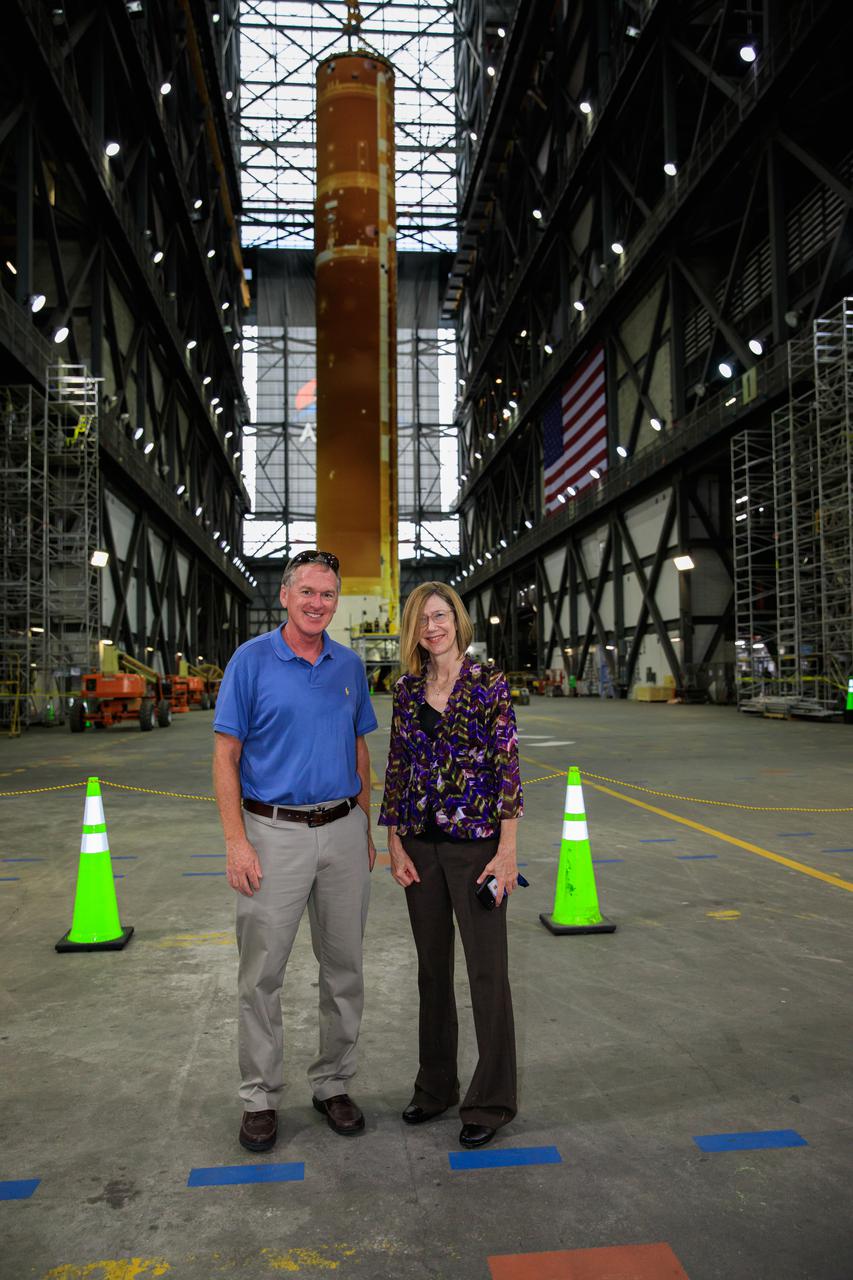
Exploration Ground Systems Manager Mike Bolger (left) and NASA Human Exploration and Operations Associate Administrator Kathy Lueders (right) visit Kennedy Space Center's Vehicle Assembly Building (VAB) in Florida on June 11, 2021. In the background, the core stage of NASA’s massive Space Launch System (SLS) rocket is visible in vertical position during stacking operations, prior to the core stage being moved and integrated with the twin solid rocket boosters atop the mobile launcher in High Bay 3 of the VAB. The 188,000-pound core stage, with its four RS-25 engines, will provide more than 2 million pounds of thrust during launch and ascent, and coupled with the boosters, will provide more than 8.8 million pounds of thrust to send the Artemis I mission to space. Under the Artemis program, NASA will land the first woman and first person of color on the Moon, as well as establish a sustainable presence on the lunar surface in preparation for human missions to Mars.
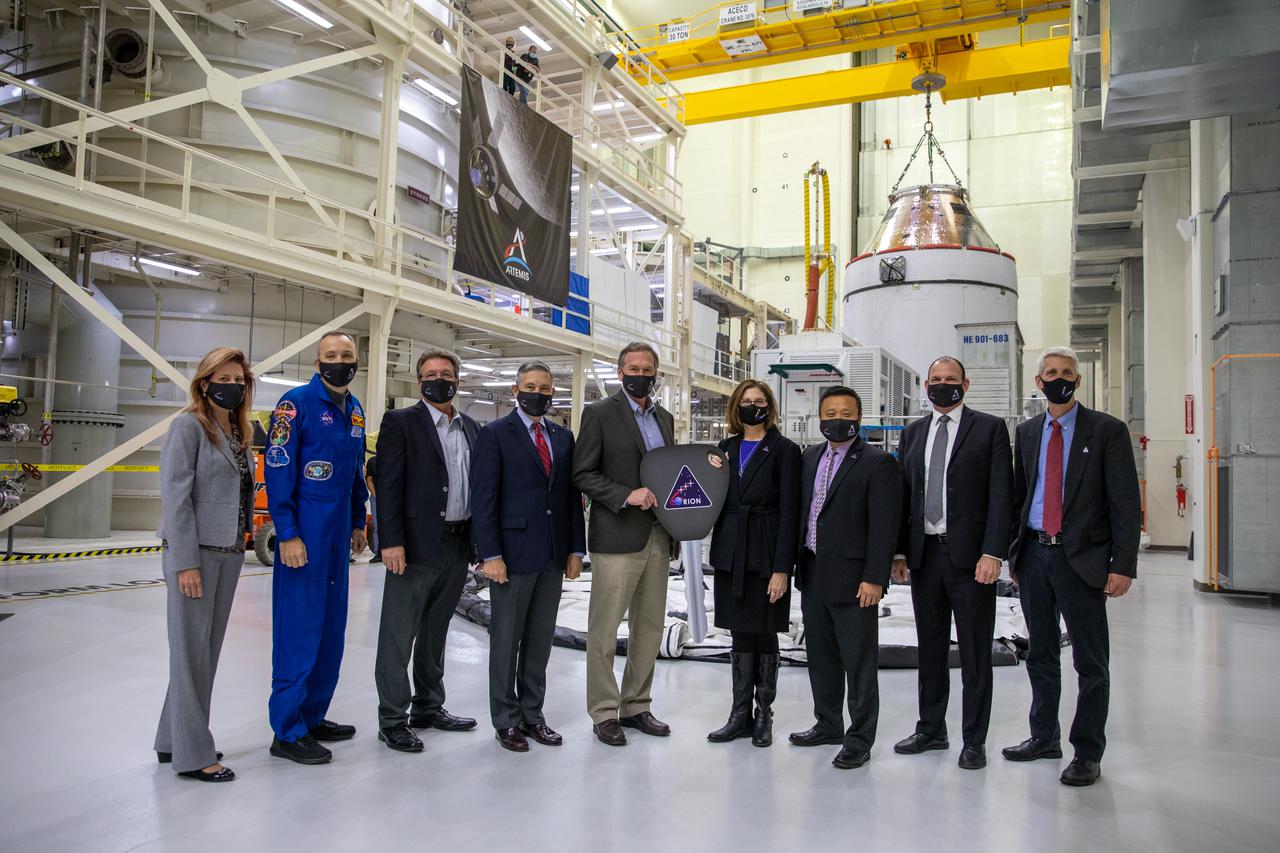
Orion is revealed for one of the final times on Jan. 14, as it is readied atop its transport pallet from the Neil Armstrong Operations and Checkout Building at NASA’s Kennedy Space Center in Florida, along its path to the pad ahead of the Artemis I launch. Standing in front of Orion, from left, are Kelly DeFazio, Lockheed Martin Orion Program director for production; NASA astronaut Randy Bresnik; Jules Schneider, Lockheed Martin director of Orion Assembly, Test & Launch at Kennedy; Kennedy Space Center Director Bob Cabana; Mike Bolger, Exploration Ground Systems (EGS) manager; Cathy Koerner, Orion Program manager; Howard Hu, Orion Program deputy manager; Tony Antonelli, Lockheed Martin Orion Program director and Artemis II mission director; and Scott Wilson, Orion Production Office manager. Teams across the globe have worked tirelessly to assemble the spacecraft, which will receive a protective covering prior to departing for the Multi-Payload Processing Facility to begin ground processing by the EGS and Jacobs teams.