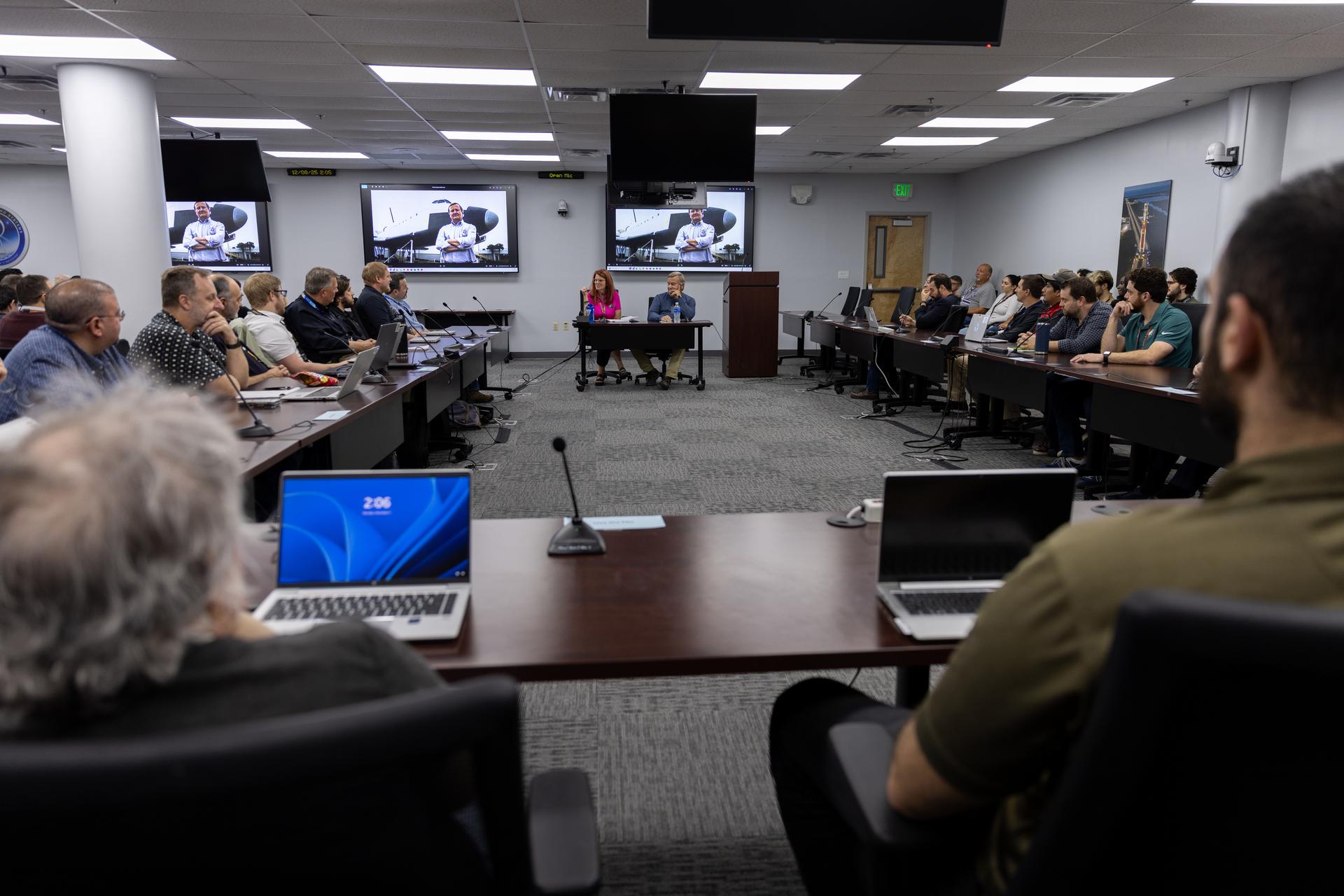
From left, Artemis Launch Director Charlie Blackwell-Thompson with the Exploration Ground Systems Program and former NASA Space Shuttle Launch Director Mike Leinbach speak during a meetup inside the Operations Support Building I at NASA’s Kennedy Space Center in Florida on Monday, Dec. 8, 2025. Leinbach spoke about his experience as the launch director for several space shuttle missions and discussed the upcoming Artemis II mission that will send four astronauts around the Moon and back in early 2026 from the spaceport’s Launch Complex 39B at NASA Kennedy.
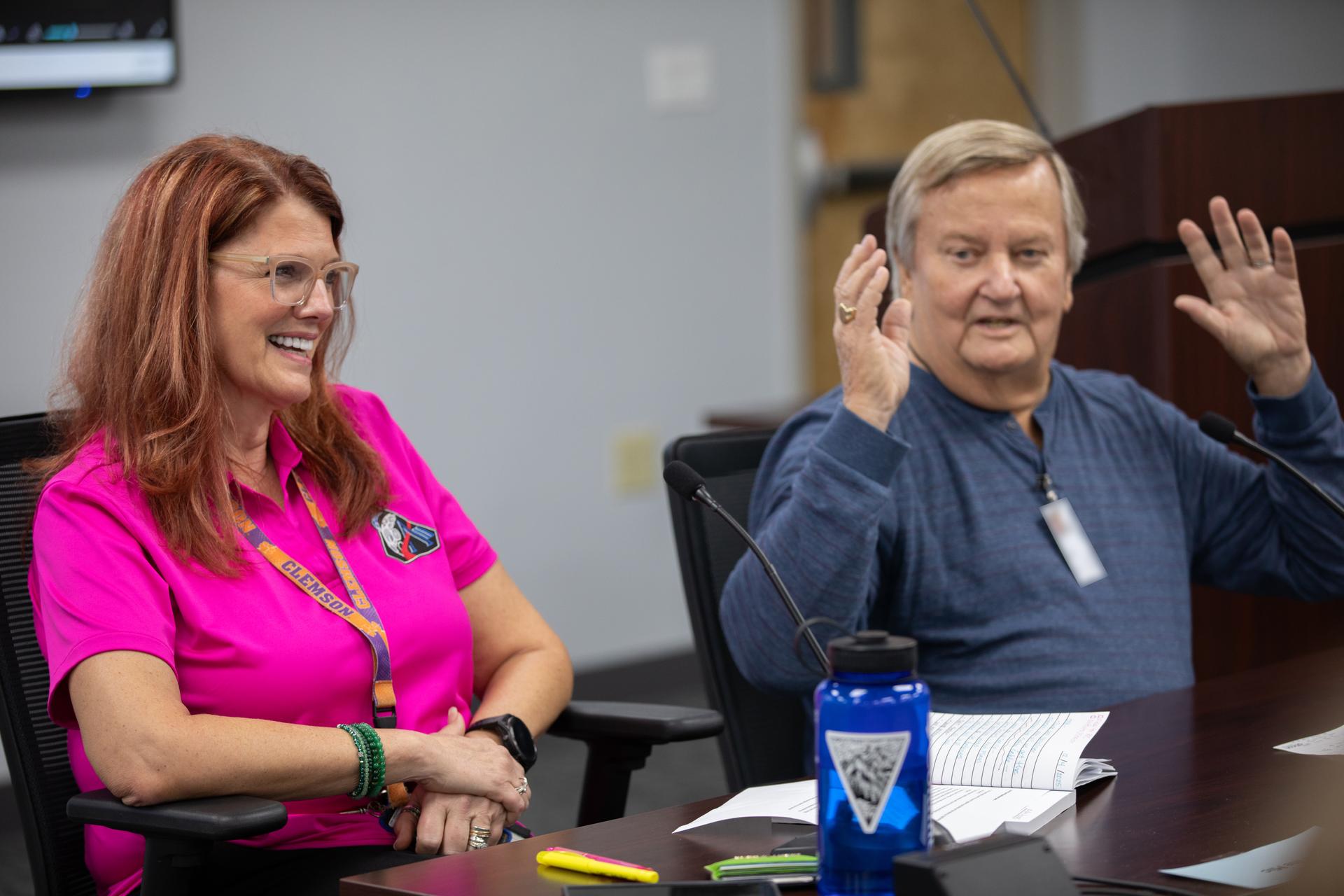
From left, Artemis Launch Director Charlie Blackwell-Thompson with the Exploration Ground Systems Program and former NASA Space Shuttle Launch Director Mike Leinbach speak during a meetup inside the Operations Support Building I at NASA’s Kennedy Space Center in Florida on Monday, Dec. 8, 2025. Leinbach spoke about his experience as the launch director for several space shuttle missions and discussed the upcoming Artemis II mission that will send four astronauts around the Moon and back in early 2026 from the spaceport’s Launch Complex 39B at NASA Kennedy.
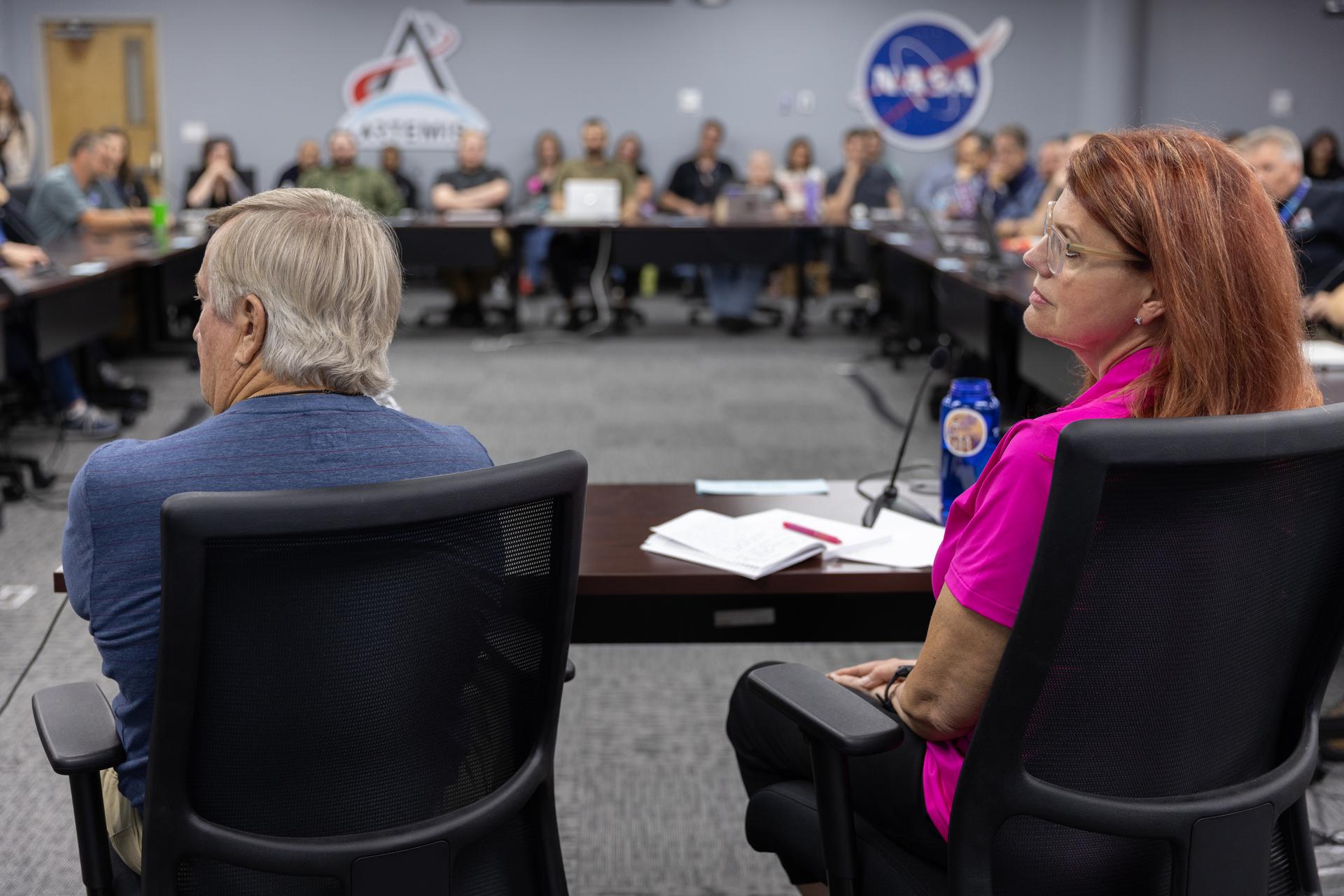
From left, Artemis Launch Director Charlie Blackwell-Thompson with the Exploration Ground Systems Program and former NASA Space Shuttle Launch Director Mike Leinbach speak during a meetup inside the Operations Support Building I at NASA’s Kennedy Space Center in Florida on Monday, Dec. 8, 2025. Leinbach spoke about his experience as the launch director for several space shuttle missions and discussed the upcoming Artemis II mission that will send four astronauts around the Moon and back in early 2026 from the spaceport’s Launch Complex 39B at NASA Kennedy.
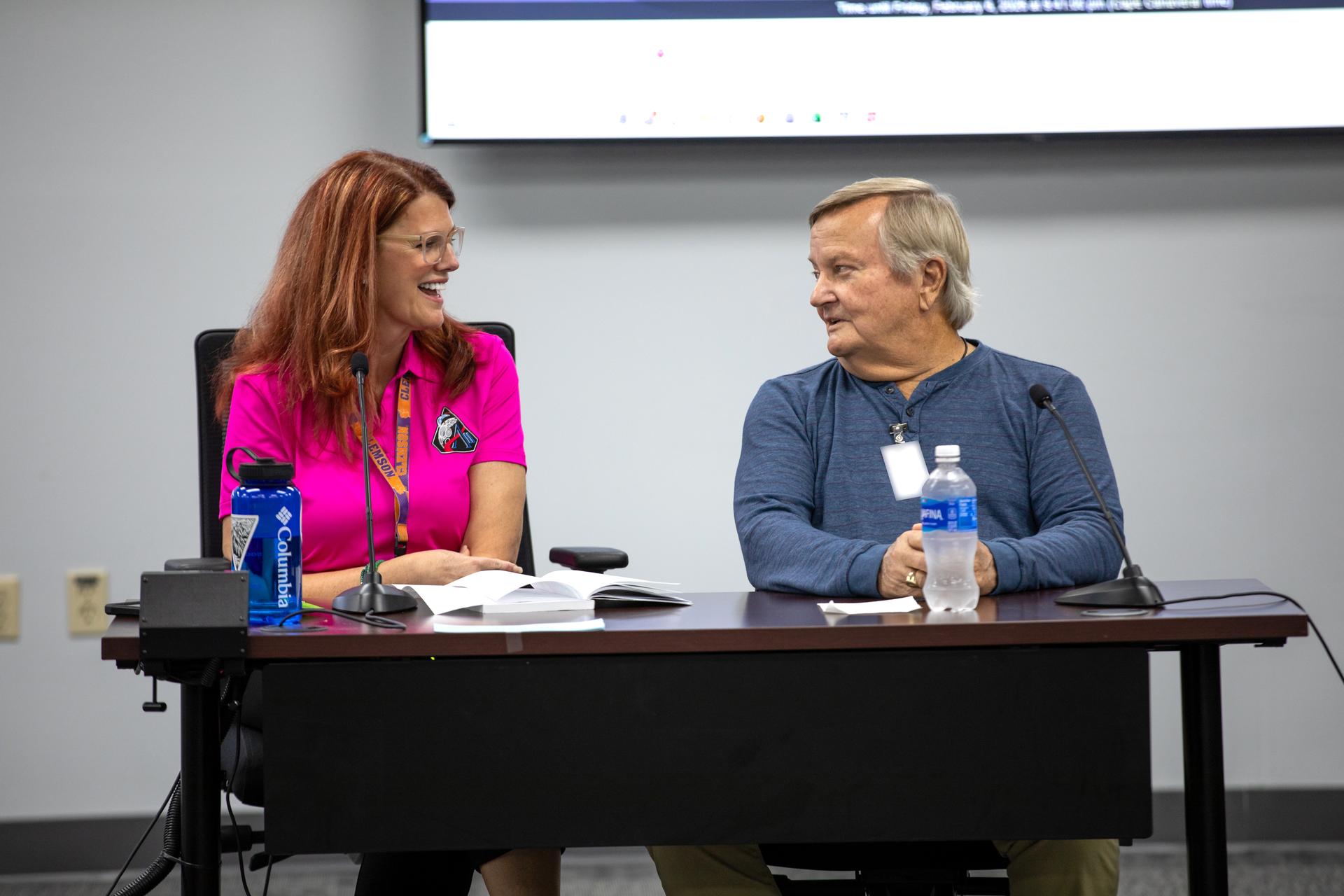
From left, Artemis Launch Director Charlie Blackwell-Thompson with the Exploration Ground Systems Program and former NASA Space Shuttle Launch Director Mike Leinbach speak during a meetup inside the Operations Support Building I at NASA’s Kennedy Space Center in Florida on Monday, Dec. 8, 2025. Leinbach spoke about his experience as the launch director for several space shuttle missions and discussed the upcoming Artemis II mission that will send four astronauts around the Moon and back in early 2026 from the spaceport’s Launch Complex 39B at NASA Kennedy.
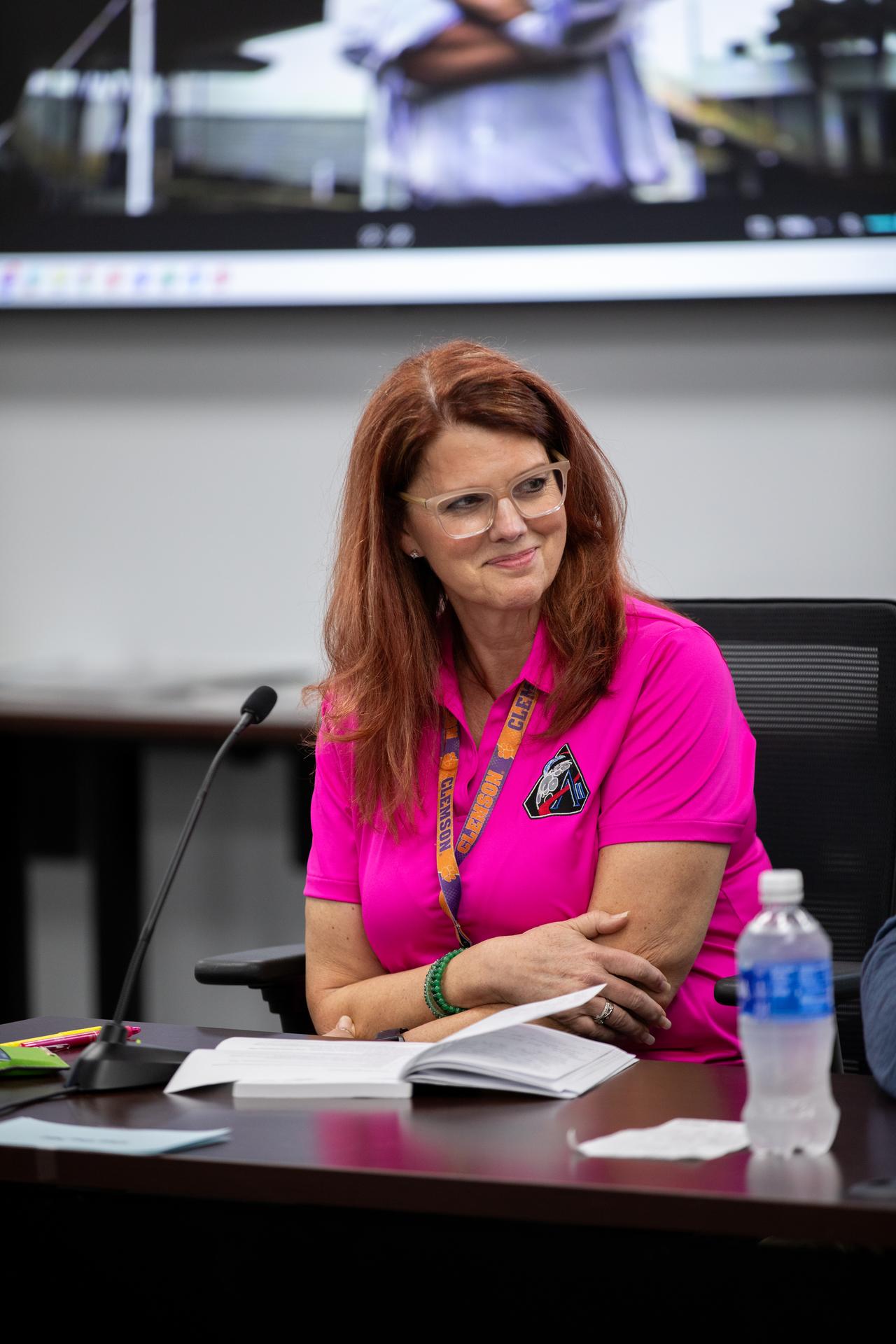
Artemis Launch Director Charlie Blackwell-Thompson with the Exploration Ground Systems Program listens during a presentation by former NASA Space Shuttle Launch Director Mike Leinbach inside the Operations Support Building I at NASA’s Kennedy Space Center in Florida on Monday, Dec. 8, 2025. Leinbach spoke about his experience as the launch director for several space shuttle missions and discussed the upcoming Artemis II mission that will send four astronauts around the Moon and back in early 2026 from the spaceport’s Launch Complex 39B at NASA Kennedy.
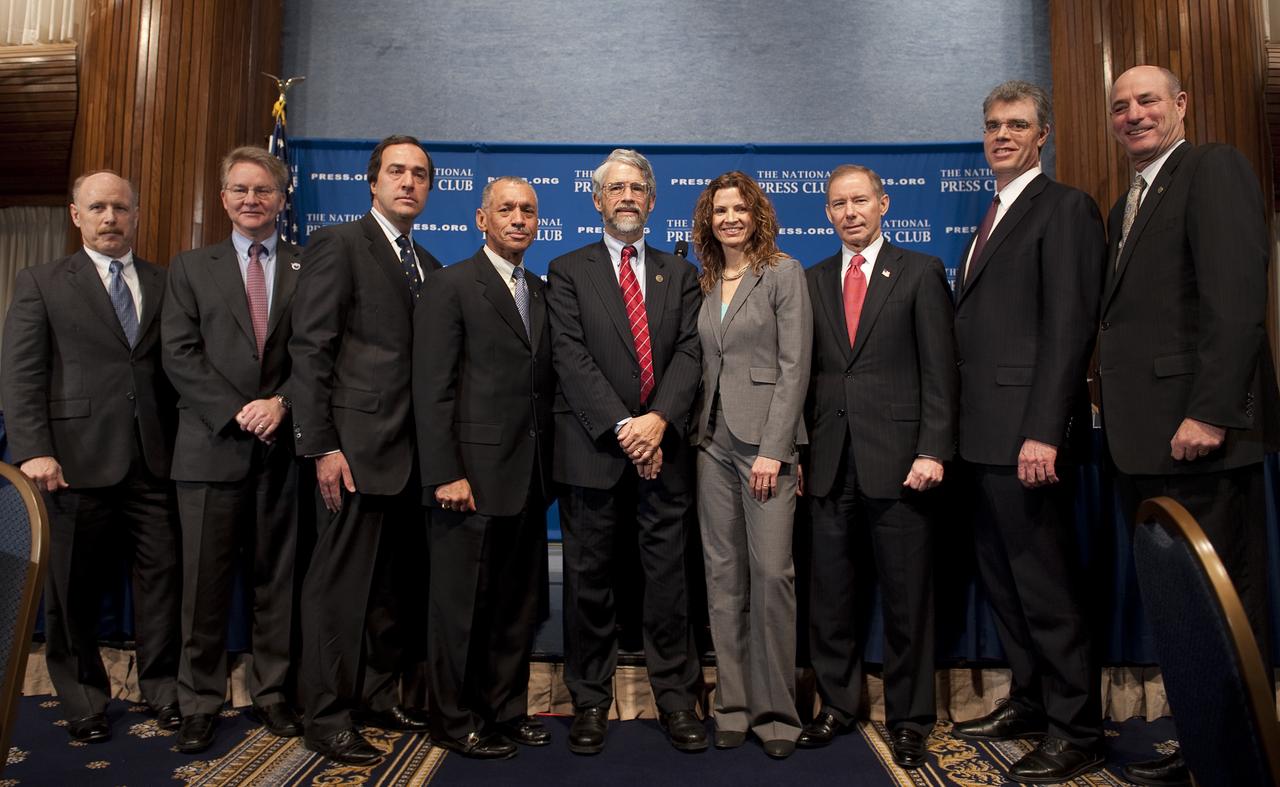
From left, Ken Bowersox, VP Astronaut Safety, SpaceX, David Thompson, CEO, Orbital Science Corporation, Mark Sirangelo, VP and Chair, SNC Space Systems Board, Sierra Nevada Corp., NASA Administrator Charles Bolden, Assistant to the President for Science and Technology and Director of the White House Office of Science and Technology Policy Dr. John P. Holdren, Jane Poynter, President and Chair, Paragon Space Development Corp., Brewster Shaw, VP and General Manager, NASA Systems, Boeing, Robert Millman of Blue Origin, and, Mike Gass, President and Chief Executive, United Launch Alliance, pose for a group photo during a press conference, Tuesday, Feb. 2, 2010, at the National Press Club in Washington, where it was announced that NASA has awarded $50 million through funded agreements to further the commercial sector's capability to support transport of crew to and from low Earth orbit. Photo Credit: (NASA/Bill Ingalls)
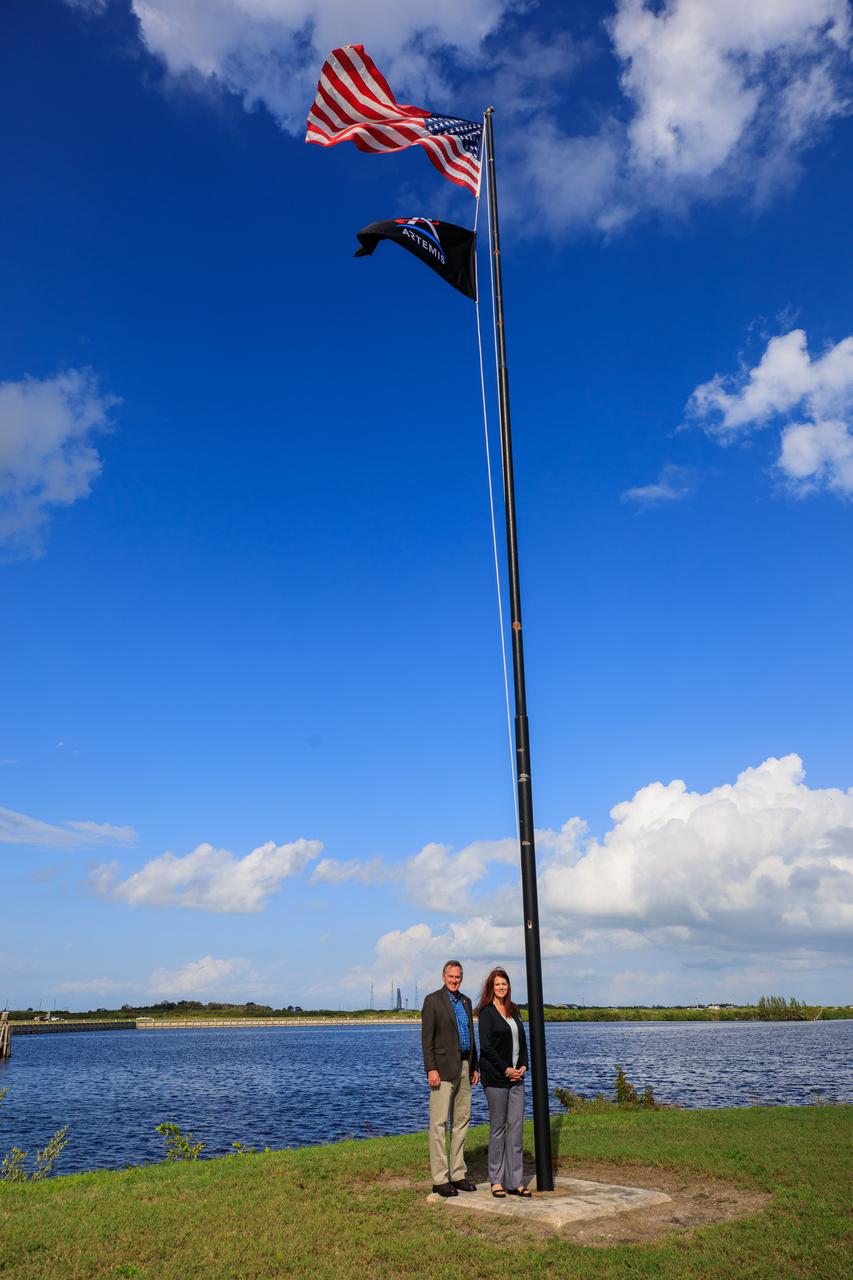
Exploration Ground Systems Manager Mike Bolger (left) and Artemis I Launch Director Charlie Blackwell-Thompson (right) raise the Artemis flag near the countdown clock at NASA’s Kennedy Space Center in Florida on Nov. 14, 2022. NASA’s Space Launch System (SLS) rocket and Orion spacecraft can be seen in the background at Kennedy’s Launch Pad 39B. The uncrewed Artemis I flight will be the first integrated test of the agency’s SLS rocket and Orion spacecraft and is scheduled to launch Wednesday, Nov. 16. The primary goal of Artemis I is to thoroughly test the integrated systems before crewed missions by launching Orion atop the SLS rocket, operating the spacecraft in a deep space environment, testing Orion’s heat shield, and recovering the crew module after reentry, descent, and splashdown. During the flight, Orion will launch atop the world’s most powerful rocket and fly farther than any human-rated spacecraft has ever flown, paving the way for human deep space exploration and demonstrating our commitment and capability to extend human presence to the Moon and beyond.
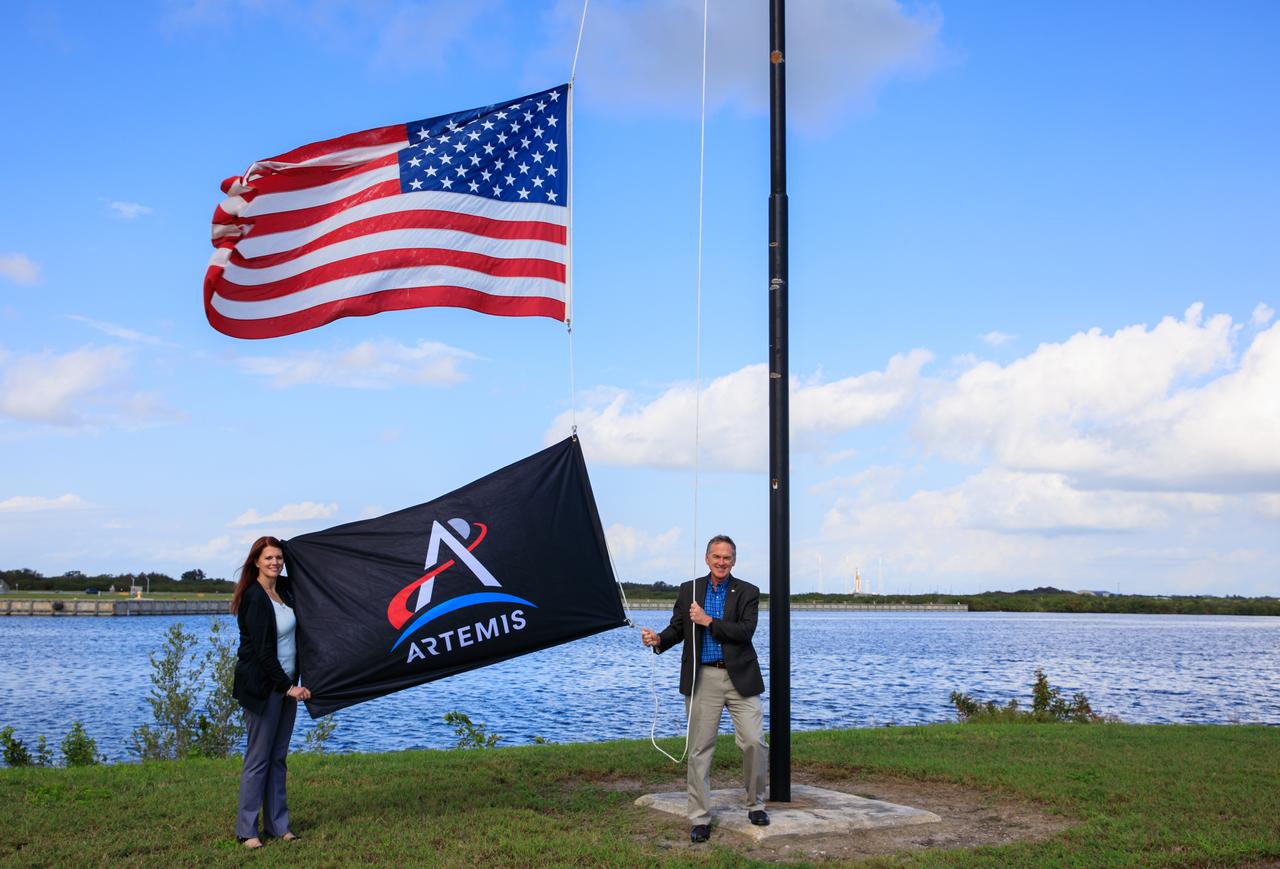
Artemis I Launch Director Charlie Blackwell-Thompson (left) and Exploration Ground Systems Manager Mike Bolger (right) raise the Artemis flag near the countdown clock at NASA’s Kennedy Space Center in Florida on Nov. 14, 2022. NASA’s Space Launch System (SLS) rocket and Orion spacecraft can be seen in the background at Kennedy’s Launch Pad 39B. The uncrewed Artemis I flight will be the first integrated test of the agency’s SLS rocket and Orion spacecraft and is scheduled to launch Wednesday, Nov. 16. The primary goal of Artemis I is to thoroughly test the integrated systems before crewed missions by launching Orion atop the SLS rocket, operating the spacecraft in a deep space environment, testing Orion’s heat shield, and recovering the crew module after reentry, descent, and splashdown. During the flight, Orion will launch atop the world’s most powerful rocket and fly farther than any human-rated spacecraft has ever flown, paving the way for human deep space exploration and demonstrating our commitment and capability to extend human presence to the Moon and beyond.
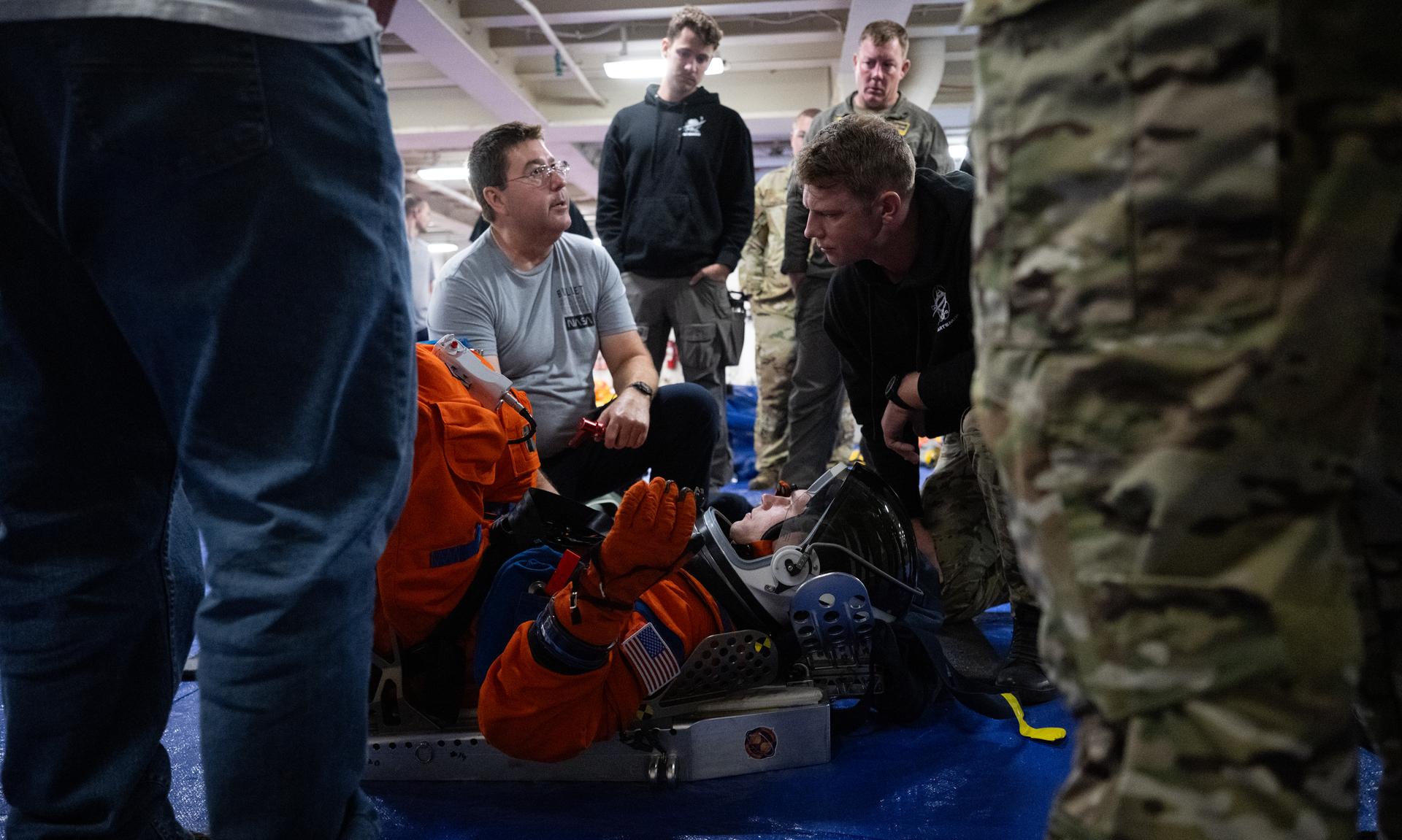
Mike Thompson, an Orion suit technician, left, and Nicholas Houghton, an Orion Crew Survival System engineer at NASA’s Johnson Space Center, wearing an Orion Crew Survival System suit, conducts familiarization training with U.S. Navy divers on doffing the suit onboard USS John P. Murtha ahead of the return of the Artemis II crewmembers to Earth, Tuesday, April 7, 2026, in the Pacific Ocean off the coast of California. NASA’s Artemis II mission is taking NASA astronauts Reid Wiseman, commander; Victor Glover, pilot; Christina Koch, mission specialist; and CSA (Canadian Space Agency) astronaut Jeremy Hansen, mission specialist on a 10-day journey around the Moon and back aboard their Orion spacecraft. Wiseman, Glover, Koch, and Hansen are scheduled to splash down off the coast of San Diego at approximately 5:07 p.m. PDT (8:07 p.m. EDT) on Friday, April 10. Photo Credit: (NASA/Joel Kowsky)
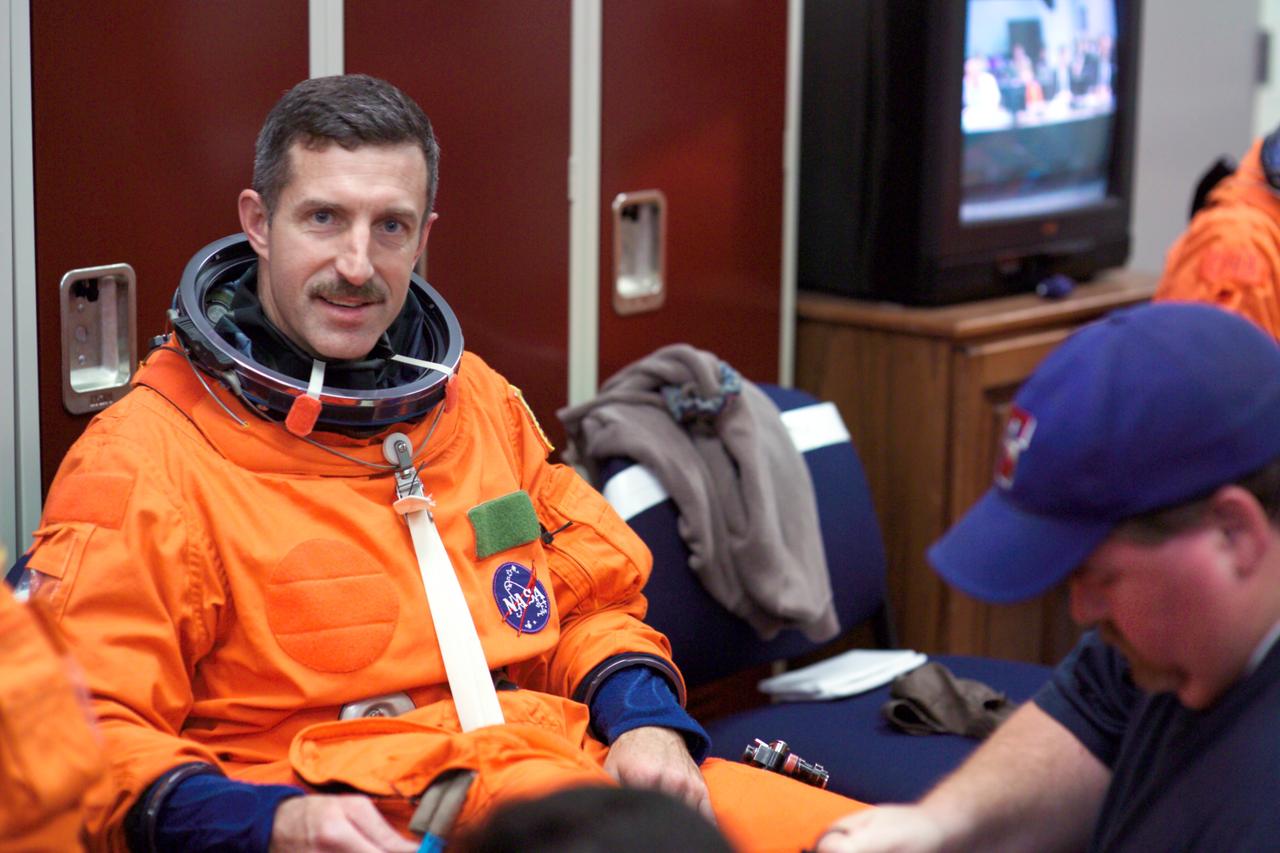
JSC2005-E-13774 (5 April 2005) --- Astronaut Daniel C. Burbank, STS-115 mission specialist, dons a training version of the shuttle launch and entry suit prior to the start of an emergency egress training session in the Space Vehicle Mockup Facility at the Johnson Space Center. Suit technician Mike Thompson assisted Burbank.
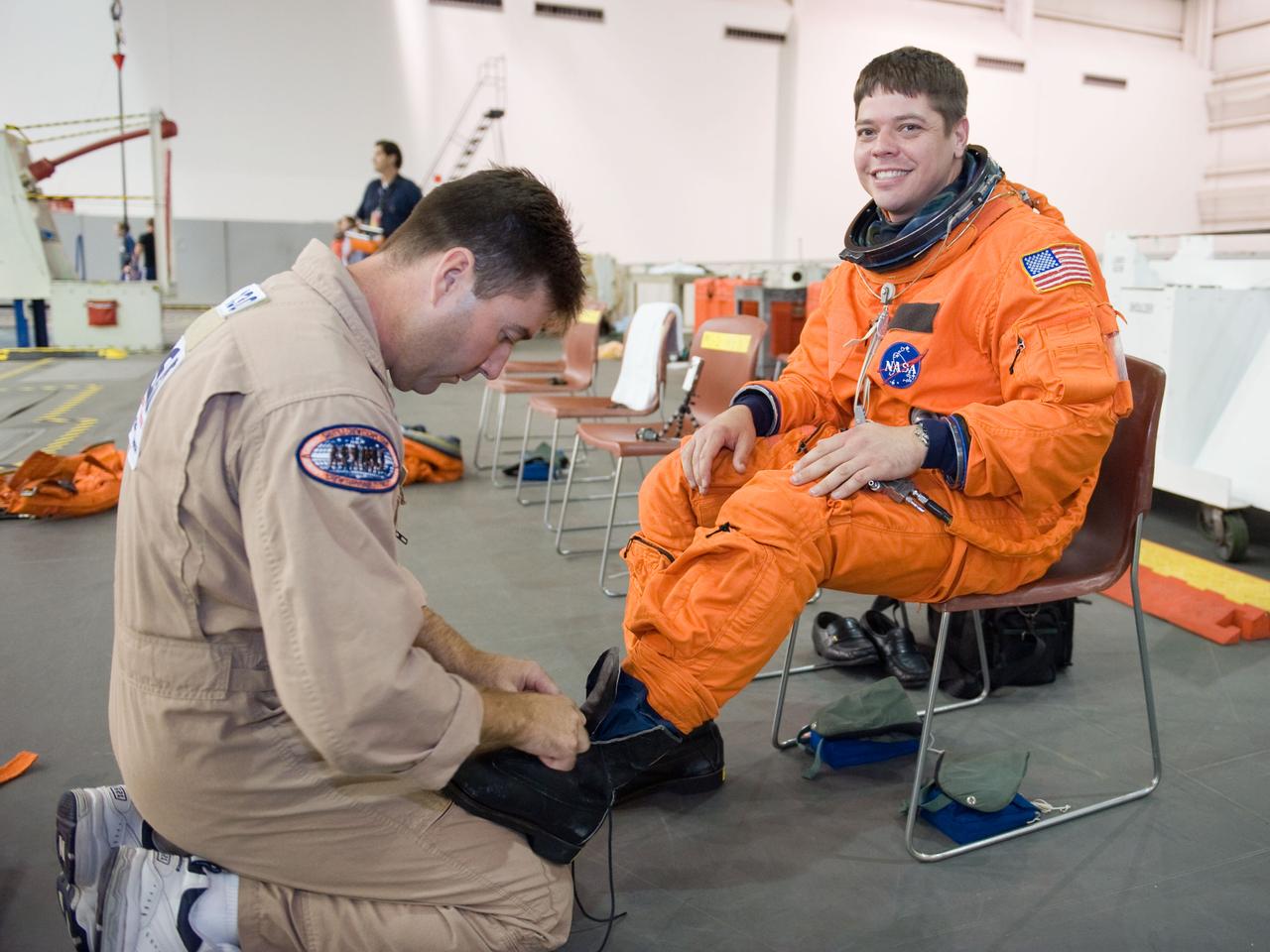
JSC2009-E-155158 (24 Aug. 2009) --- Astronaut Robert Behnken, STS-130 mission specialist, dons a training version of his shuttle launch and entry suit in preparation for a water survival training session in the waters of the Neutral Buoyancy Laboratory (NBL) near NASA's Johnson Space Center. United Space Alliance suit technician Mike Thompson assisted Behnken.
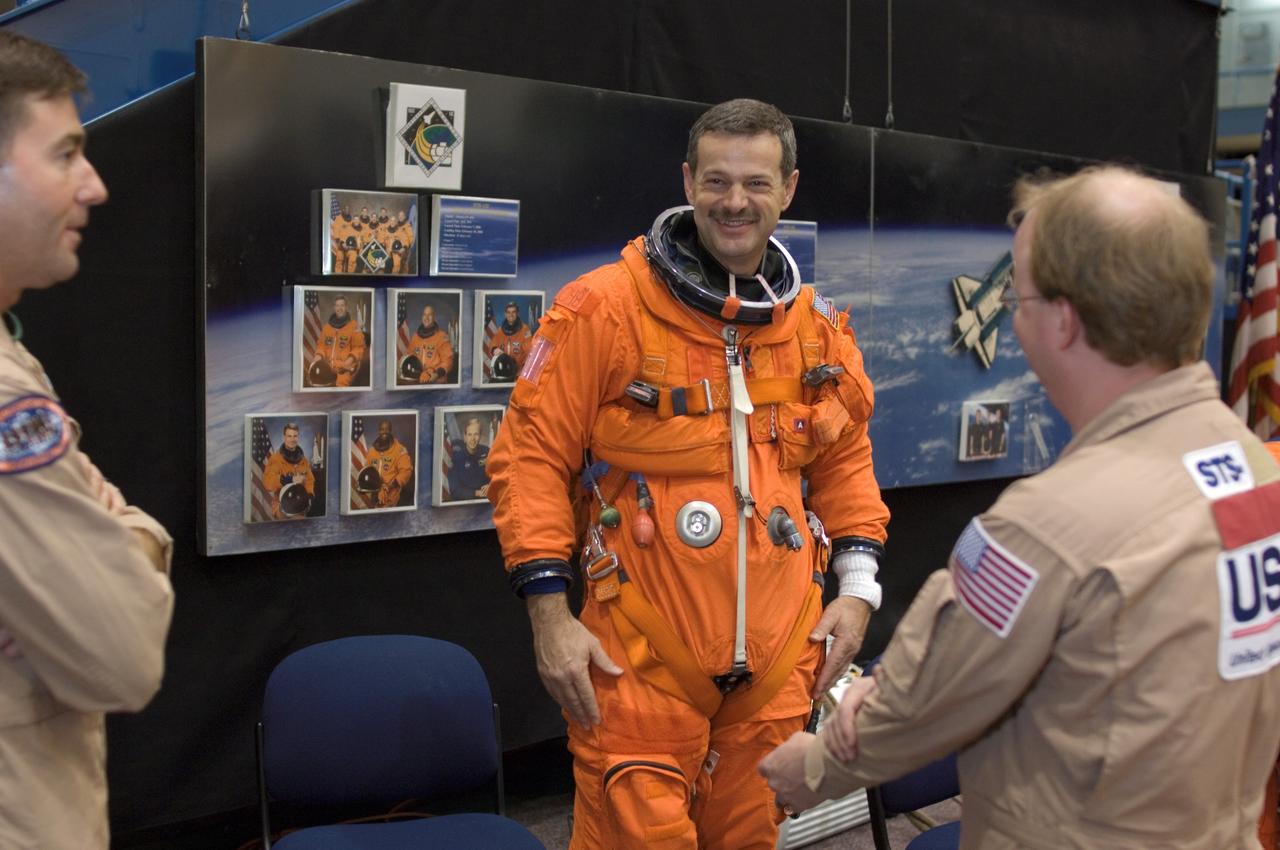
JSC2008-E-008441 (29 Jan. 2008) --- Attired in a training version of his shuttle launch and entry suit, astronaut Scott D. Altman, STS-125 commander, and United Space Alliance (USA) suit technicians Daniel Palmer (right) and Mike Thompson enjoy a light moment as they prepare for a training session in the Space Vehicle Mockup Facility at Johnson Space Center.
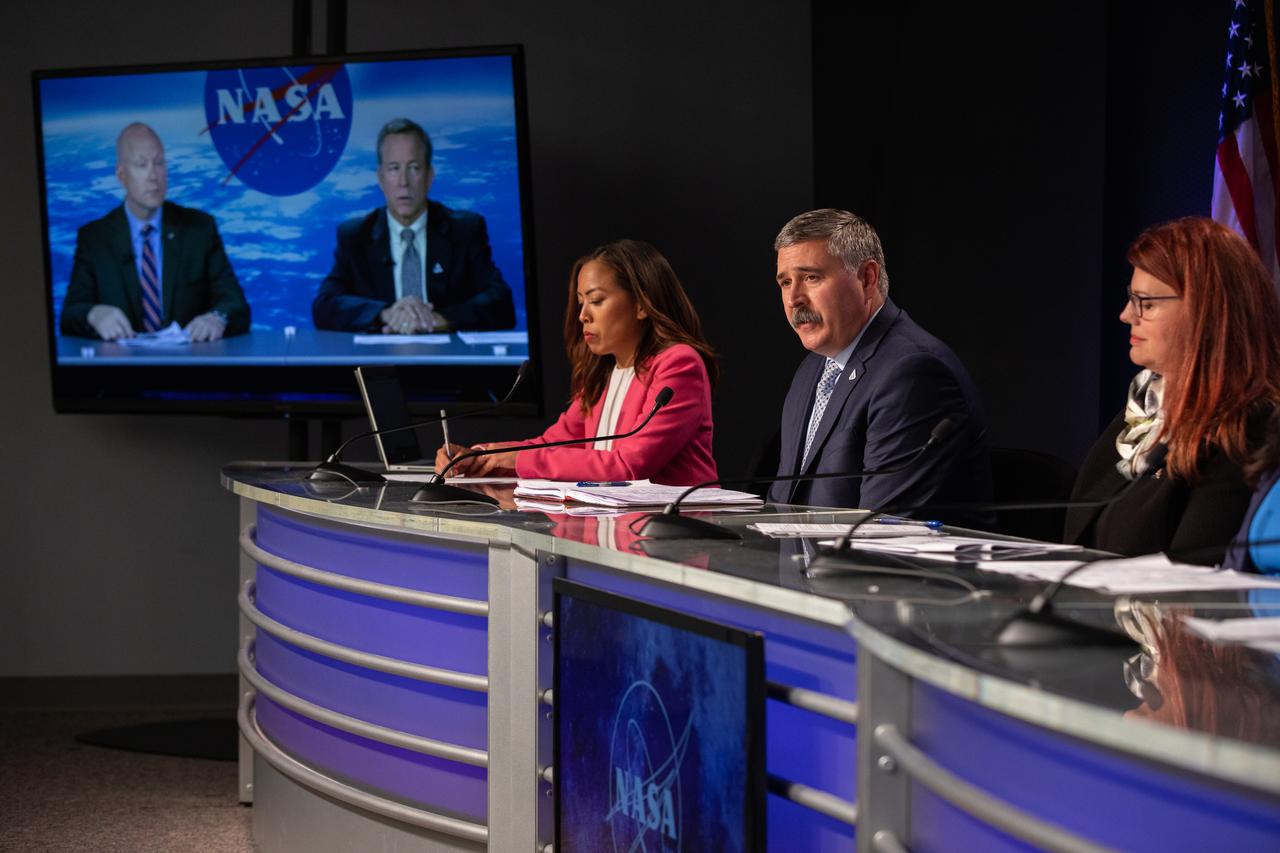
From left, Megan Cruz, NASA Communications; Mike Sarafin, Artemis mission manager, NASA Headquarters; and Charlie Blackwell-Thompson, Artemis launch director, Kennedy Space Center, participate in an Artemis I mission status press briefing at Kennedy on Aug. 27, 2022. NASA’s Space Launch System rocket and Orion spacecraft are targeted to lift off from Kennedy’s Launch Complex 39B no earlier than Aug. 29, 2022, at 8:33 a.m. EDT.
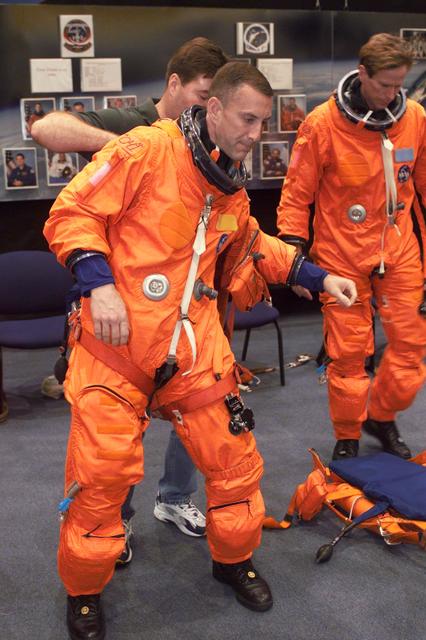
JSC2001-E-06410 (27 February 2001) --- Astronaut Charles O. Hobaugh, pilot, is assisted in his suiting process by suit technician Mike Thompson, and astronaut Michael L. Gernhardt, mission specialist, during mission training at the Johnson Space Center’s Systems Integration Facility. The STS-104 mission to the International Space Station (ISS) represents the Space Shuttle Atlantis' first flight using a new engine and is targeted for a liftoff no earlier than June 14, 2001.
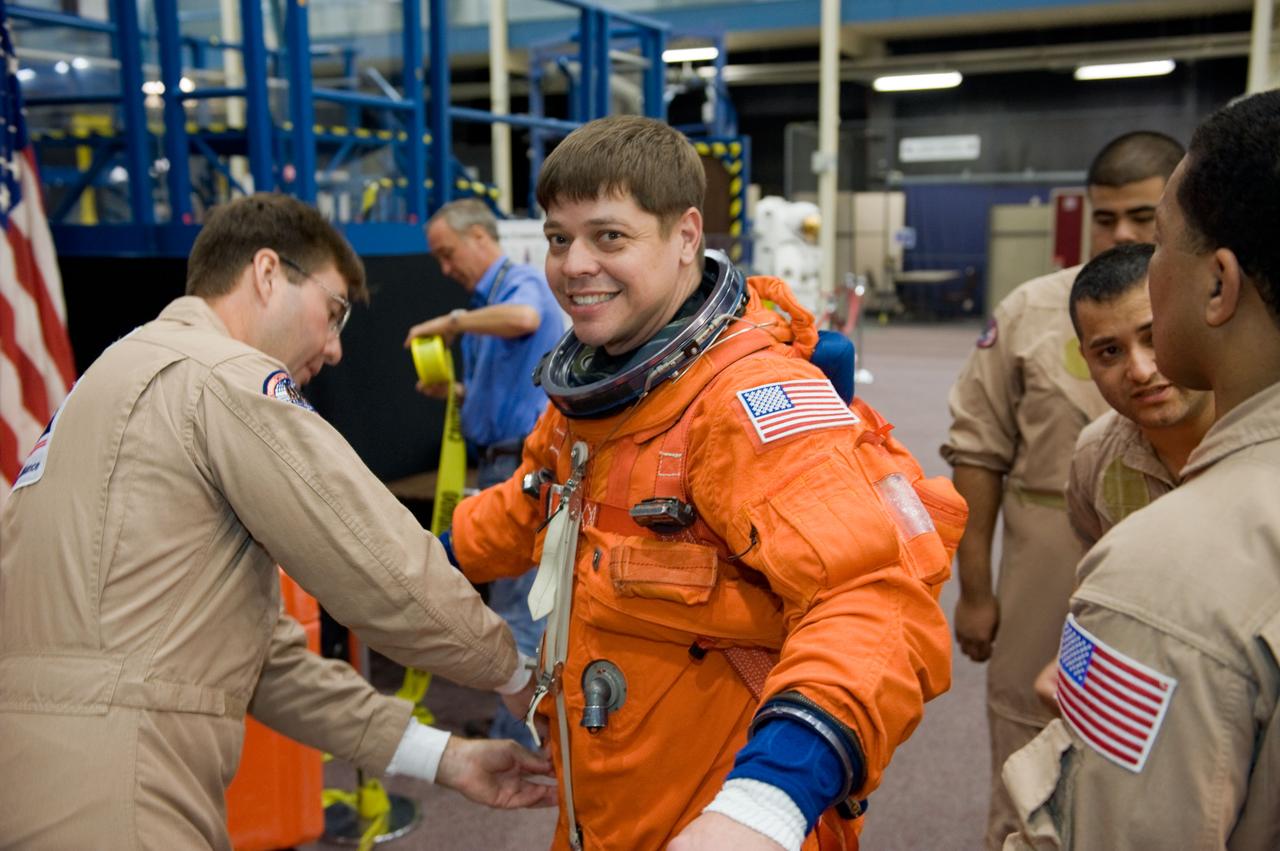
JSC2009-E-242832 (19 Nov. 2009) --- Astronaut Robert Behnken, STS-130 mission specialist, dons a training version of his shuttle launch and entry suit in preparation for a training session in the Space Vehicle Mockup Facility at NASA's Johnson Space Center. United Space Alliance suit technician Mike Thompson (left) assisted Behnken.
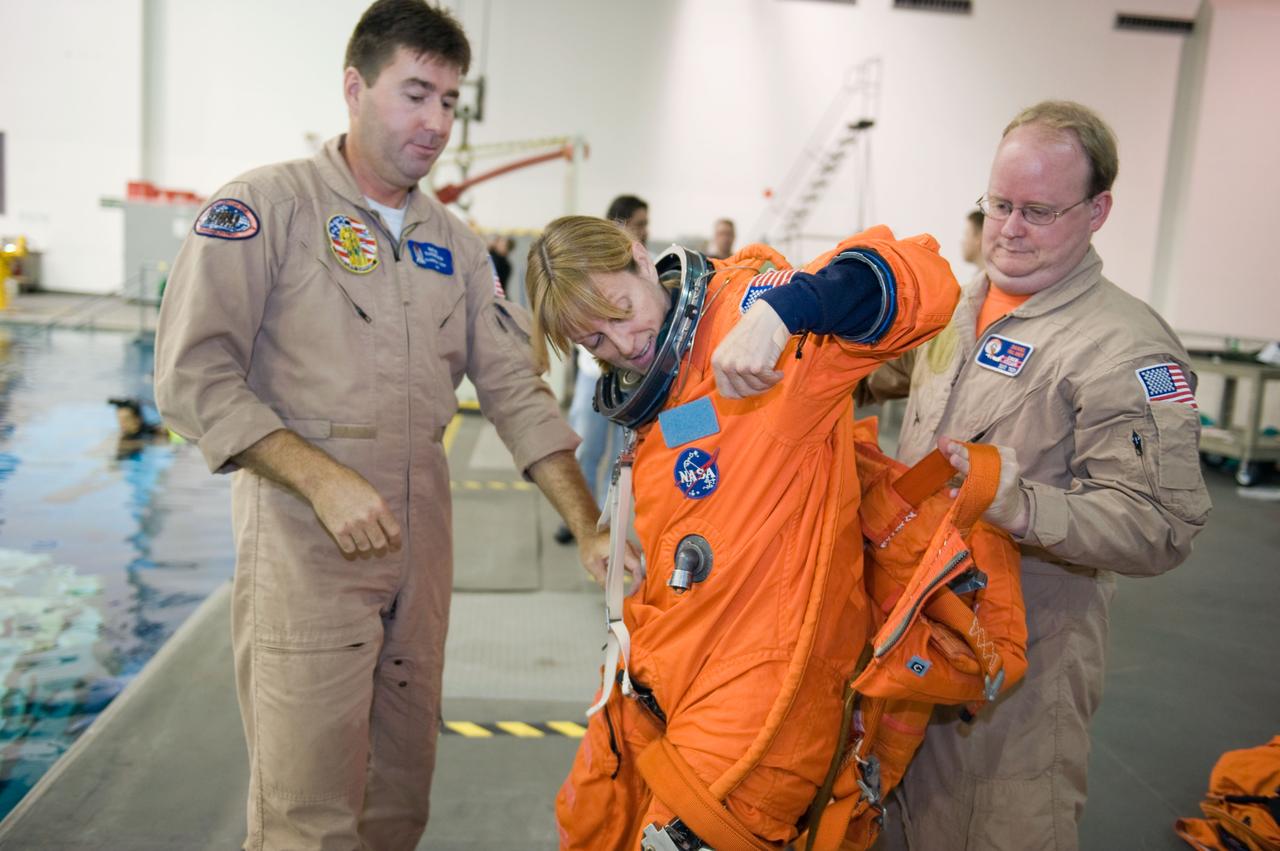
JSC2009-E-155129 (24 Aug. 2009) --- Astronaut Kathryn Hire, STS-130 mission specialist, dons a training version of her shuttle launch and entry suit in preparation for a water survival training session in the waters of the Neutral Buoyancy Laboratory (NBL) near NASA's Johnson Space Center. United Space Alliance suit technicians Daniel Palmer (right) and Mike Thompson assisted Hire.
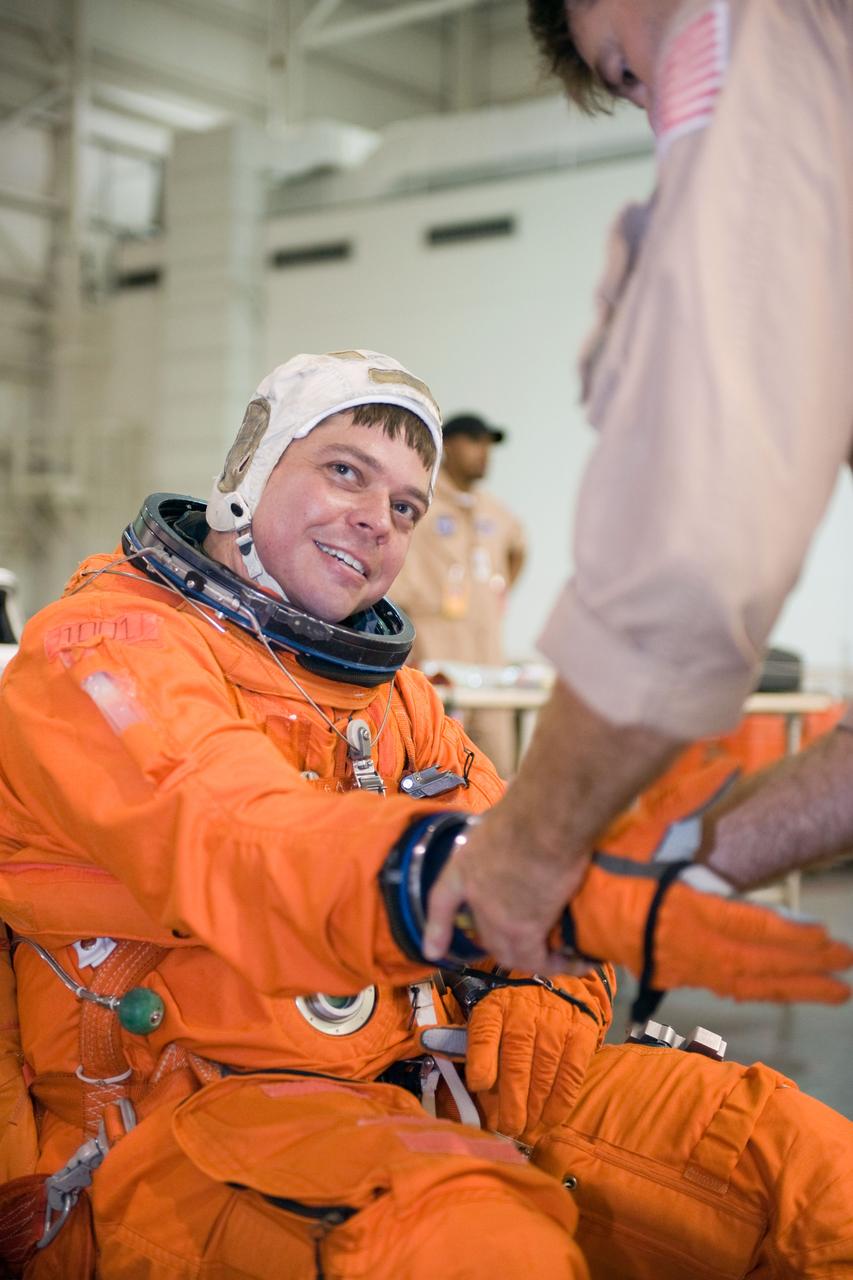
JSC2009-E-155160 (24 Aug. 2009) --- Astronaut Robert Behnken, STS-130 mission specialist, dons a training version of his shuttle launch and entry suit in preparation for a water survival training session in the waters of the Neutral Buoyancy Laboratory (NBL) near NASA's Johnson Space Center. United Space Alliance suit technician Mike Thompson assisted Behnken.
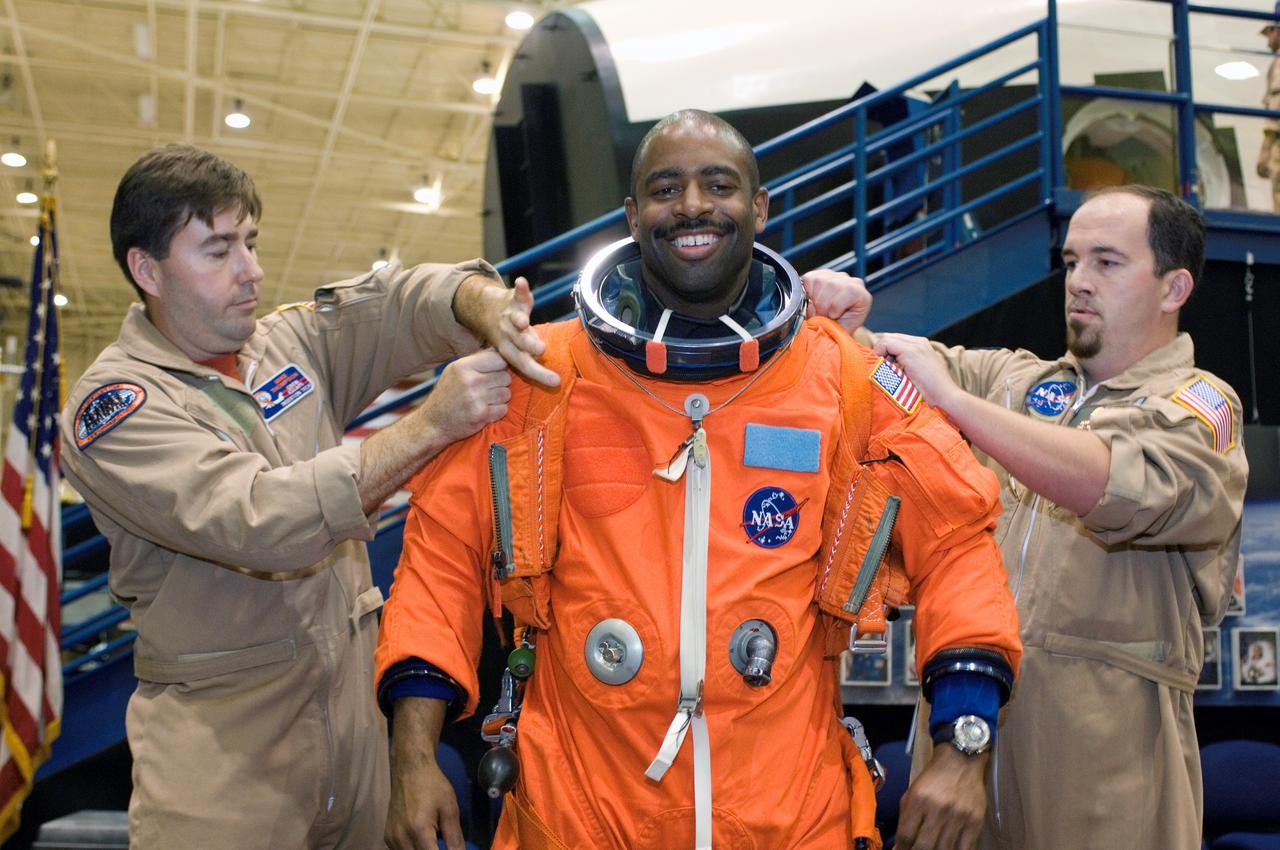
JSC2007-E-14467 (20 March 2007) --- Astronaut Leland D. Melvin, STS-122 mission specialist, dons a training version of his shuttle launch and entry suit in preparation for a post insertion/de-orbit training session in one of the full-scale trainers in the Space Vehicle Mockup Facility at Johnson Space Center. United Space Alliance (USA) suit technicians Mike Thompson (left) and Jeff Chiodo assisted Melvin.
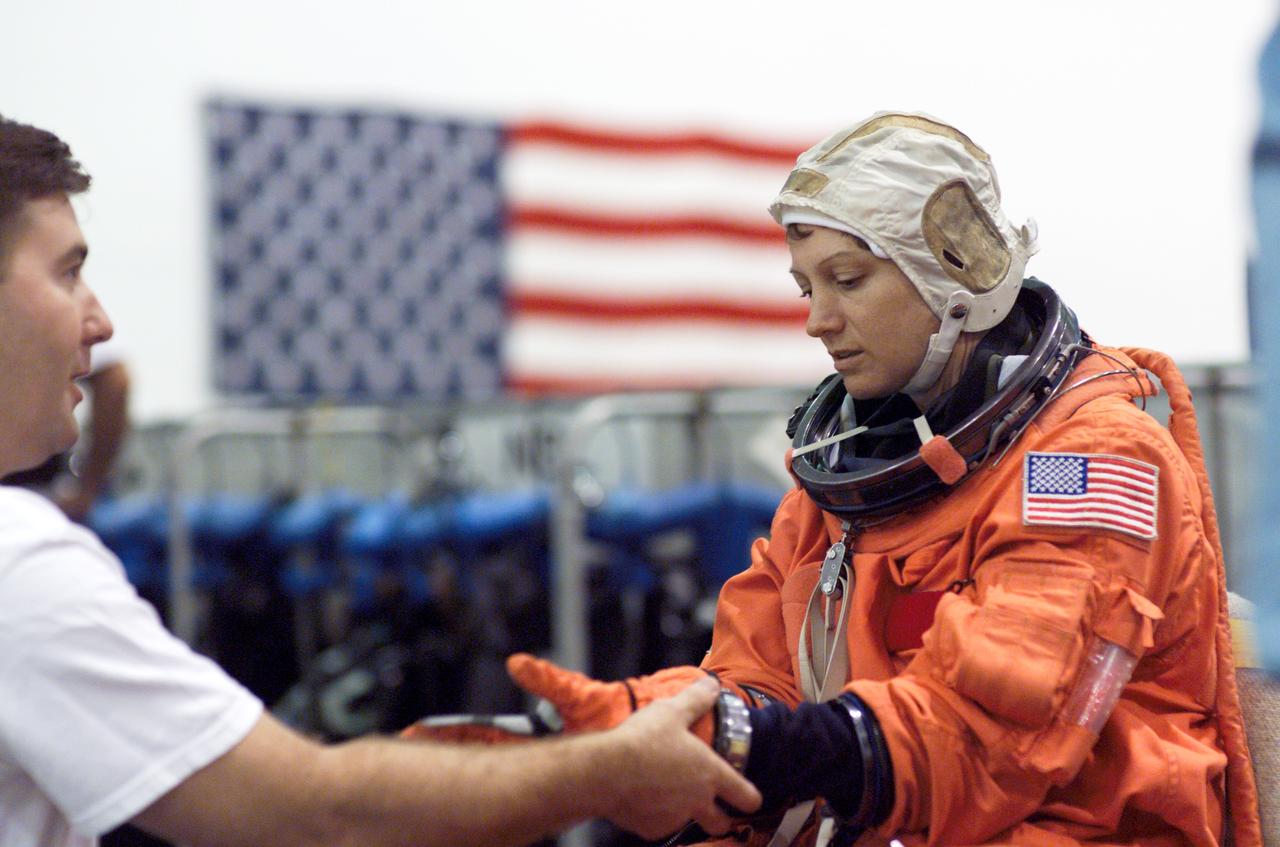
JSC2004-E-41381 (17 September 2004) --- Astronaut Eileen M. Collins, STS-114 commander, dons a training version of the shuttle launch and entry suit, prior to the start of a mission training session in the Neutral Buoyancy Laboratory (NBL) near Johnson Space Center (JSC). United Space Alliance (USA) suit technician Mike Thompson assisted Collins.
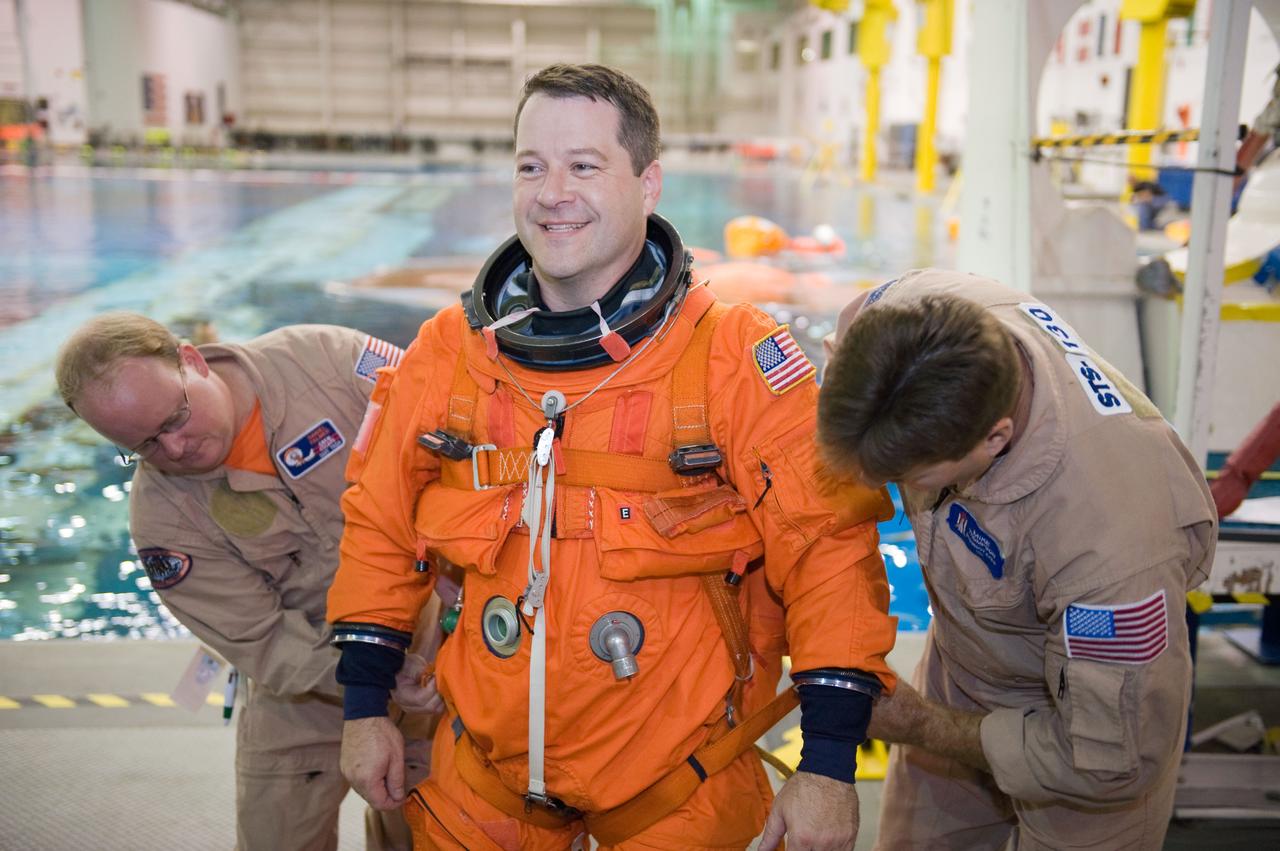
JSC2009-E-155150 (24 Aug. 2009) --- Astronaut Nicholas Patrick, STS-130 mission specialist, dons a training version of his shuttle launch and entry suit in preparation for a water survival training session in the waters of the Neutral Buoyancy Laboratory (NBL) near NASA's Johnson Space Center. United Space Alliance suit technicians Daniel Palmer (left) and Mike Thompson assisted Patrick.

CAPE CANAVERAL, Fla. – CAPE CANAVERAL, Fla. – Dr. Mason Peck, center, NASA's chief technologist, visits with Mike Woolley in the lobby of United Launch Alliance's Atlas V Space Operations Center at Cape Canaveral Air Force Station in Florida. Karen L. Thompson, left, chief technologist for Kennedy Space Center, looks on. Photo credit: NASA/Jim Grossman
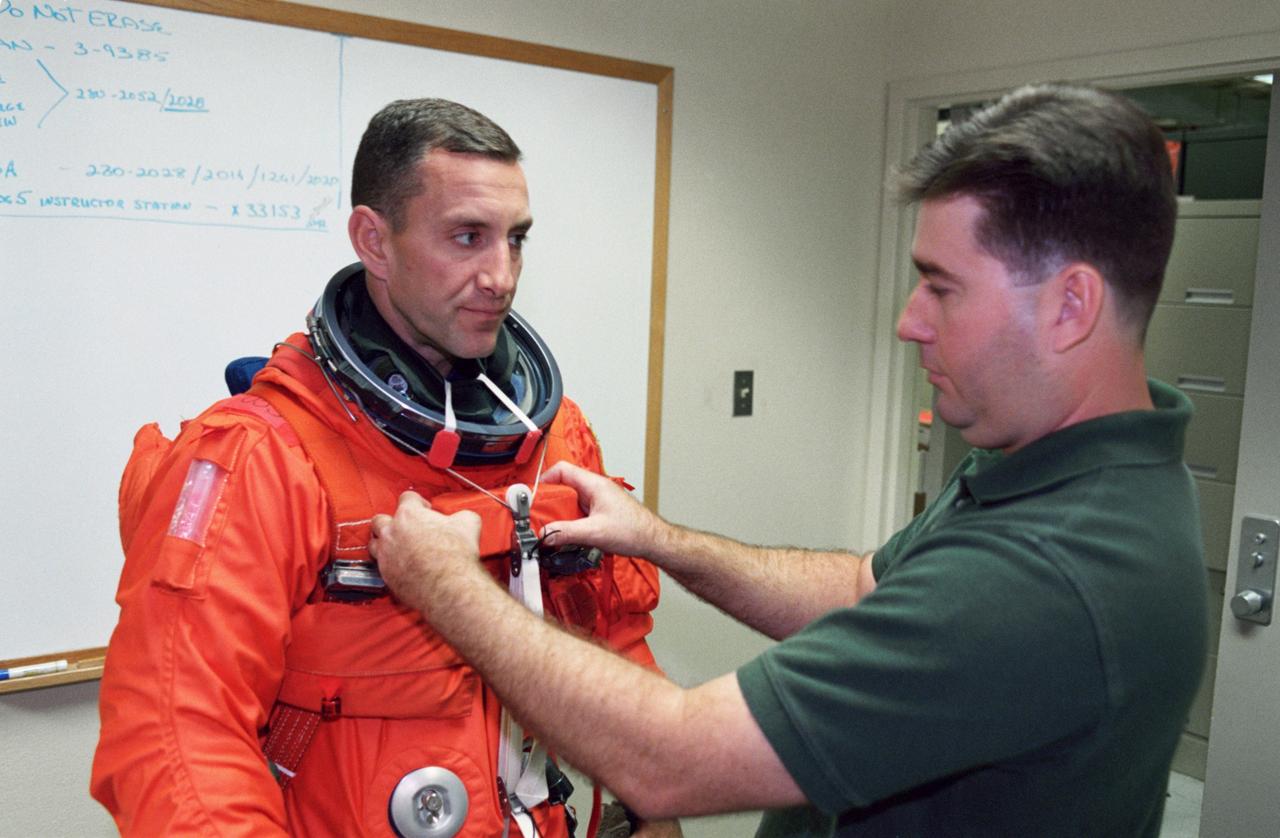
JSC2000-07282 (17 November 2000)--- Astronaut Charles O. Hobaugh, STS-104 pilot, is assisted by suit technician Mike Thompson with a training version of the shuttle launch and entry garment at the Jake Garn Simulation and Training Facility at Johnson Space Center (JSC). Hobaugh, who will join four other astronauts for a June mission with the International Space Station (ISS), shared nearby mockups (out of frame) with his crew mates for a training session dealing with launch and pre-launch issues.
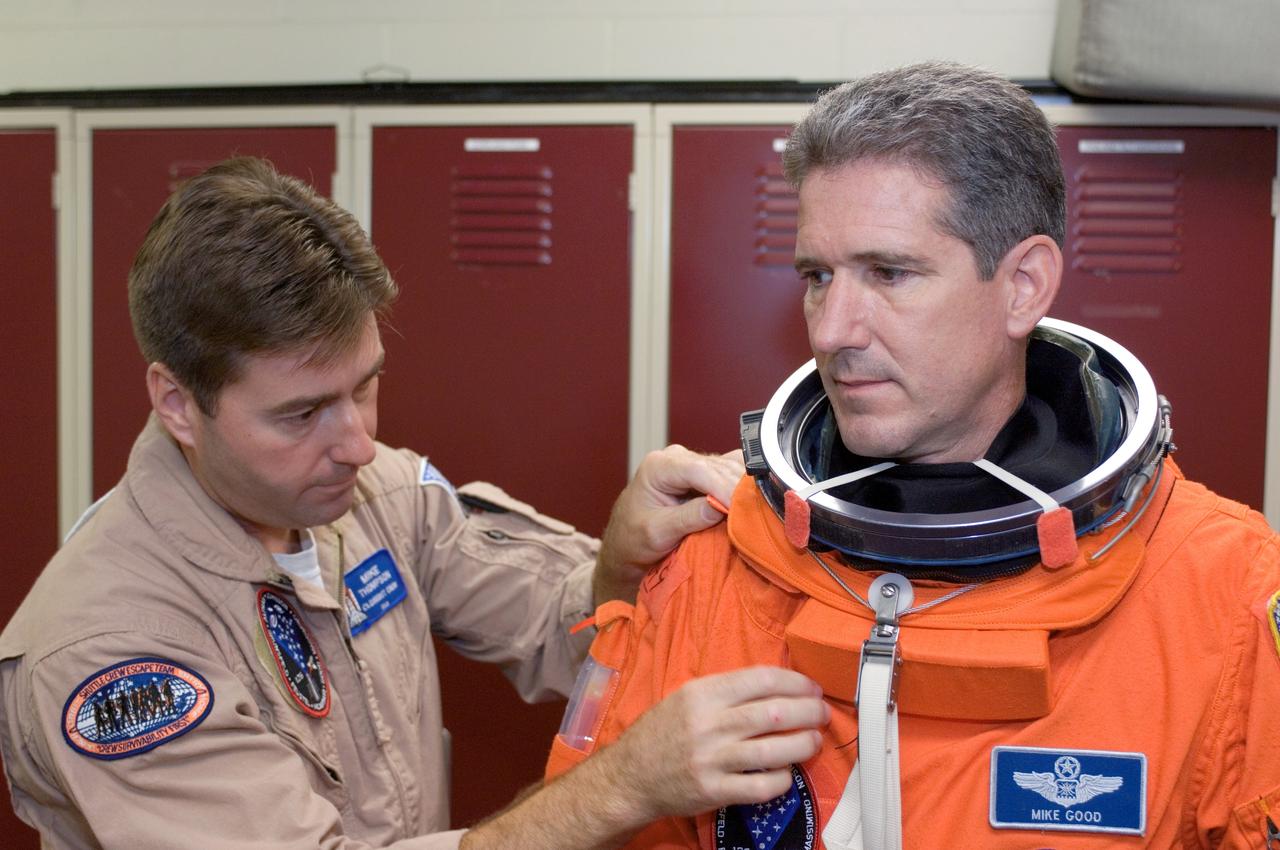
JSC2008-E-047956 (4 June 2008) --- Astronaut Michael T. Good, STS-125 mission specialist, dons a training version of his shuttle launch and entry suit in preparation for a training session in the Space Vehicle Mockup Facility at NASA's Johnson Space Center. United Space Alliance suit technician Mike Thompson assisted Good.
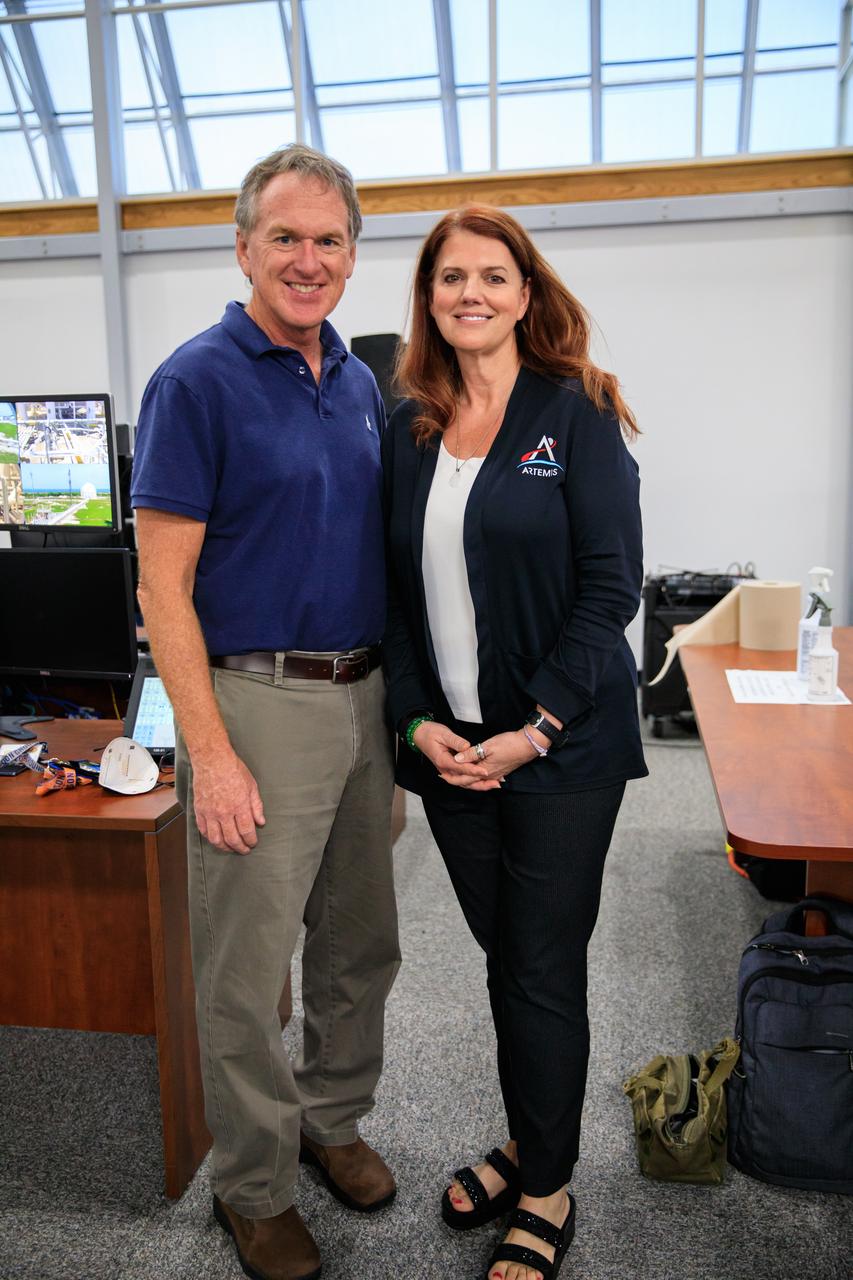
NASA’s Exploration Ground Systems Manager Mike Bolger (left) and Artemis I Launch Director Charlie Blackwell-Thompson are photographed inside Firing Room 2 of the Rocco A. Petrone Launch Control Center at the agency’s Kennedy Space Center in Florida during a certification ceremony on Aug. 12, 2022. The ceremony was held to commemorate the certification of the Artemis I launch team following their launch simulation held in December 2021. During the ceremony, Bolger and Blackwell-Thompson handed out certificates to individual members of the launch team. The first in an increasingly complex series of missions, Artemis I will test NASA’s Space Launch System rocket and Orion spacecraft as an integrated system prior to crewed flights to the Moon. Through Artemis, NASA will land the first woman and the first person of color on the lunar surface, paving the way for long-term lunar presence and using the Moon as a steppingstone before venturing to Mars.
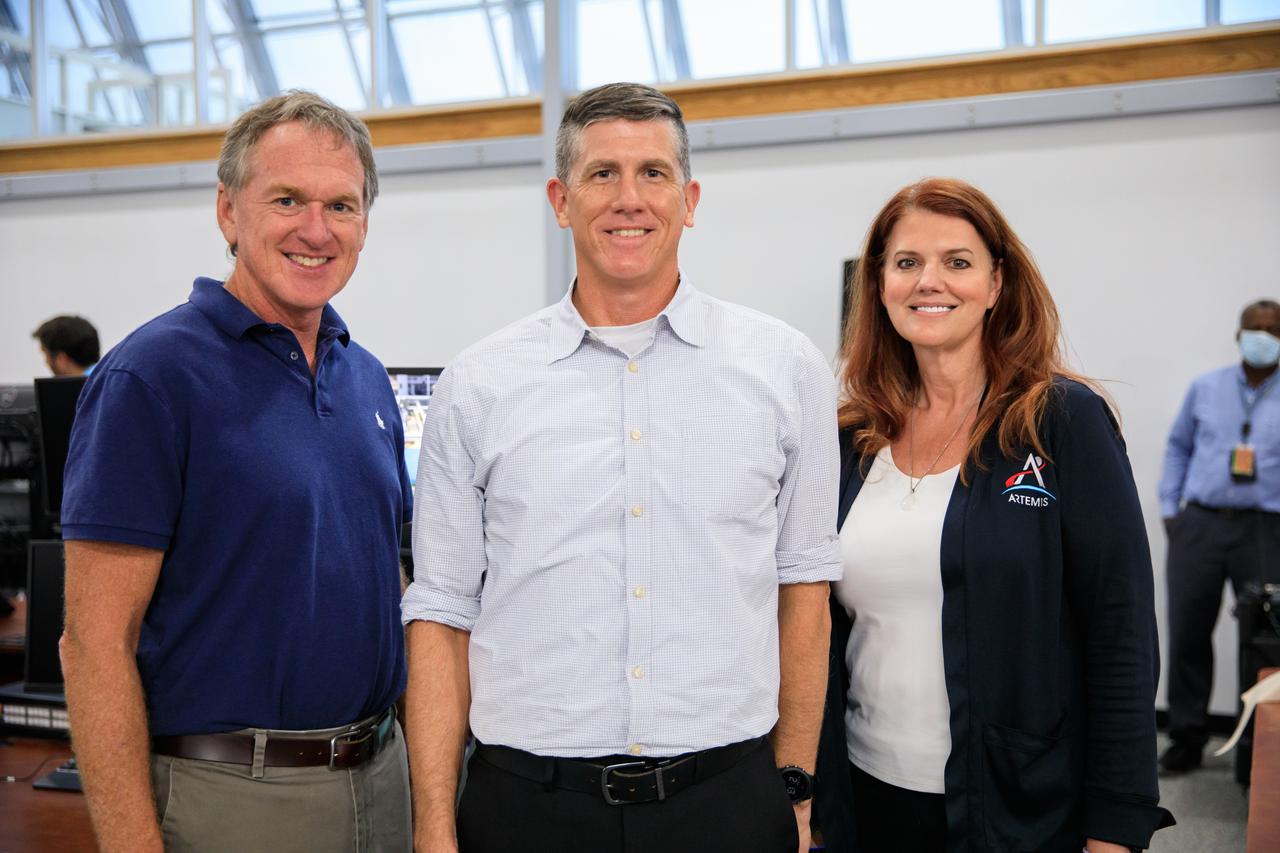
From left, NASA’s Exploration Ground Systems Manager Mike Bolger, Artemis I Assistant Launch Director Jeremy Graeber, and Launch Director Charlie Blackwell-Thompson are photographed inside Firing Room 2 of the Rocco A. Petrone Launch Control Center at the agency’s Kennedy Space Center in Florida during a certification ceremony on Aug. 12, 2022. The ceremony was held to commemorate the certification of the Artemis I launch team following their launch simulation held in December 2021. During the ceremony, Bolger, Graeber, and Blackwell-Thompson handed out certificates to individual members of the launch team. The first in an increasingly complex series of missions, Artemis I will test NASA’s Space Launch System rocket and Orion spacecraft as an integrated system prior to crewed flights to the Moon. Through Artemis, NASA will land the first woman and the first person of color on the lunar surface, paving the way for long-term lunar presence and using the Moon as a steppingstone before venturing to Mars.
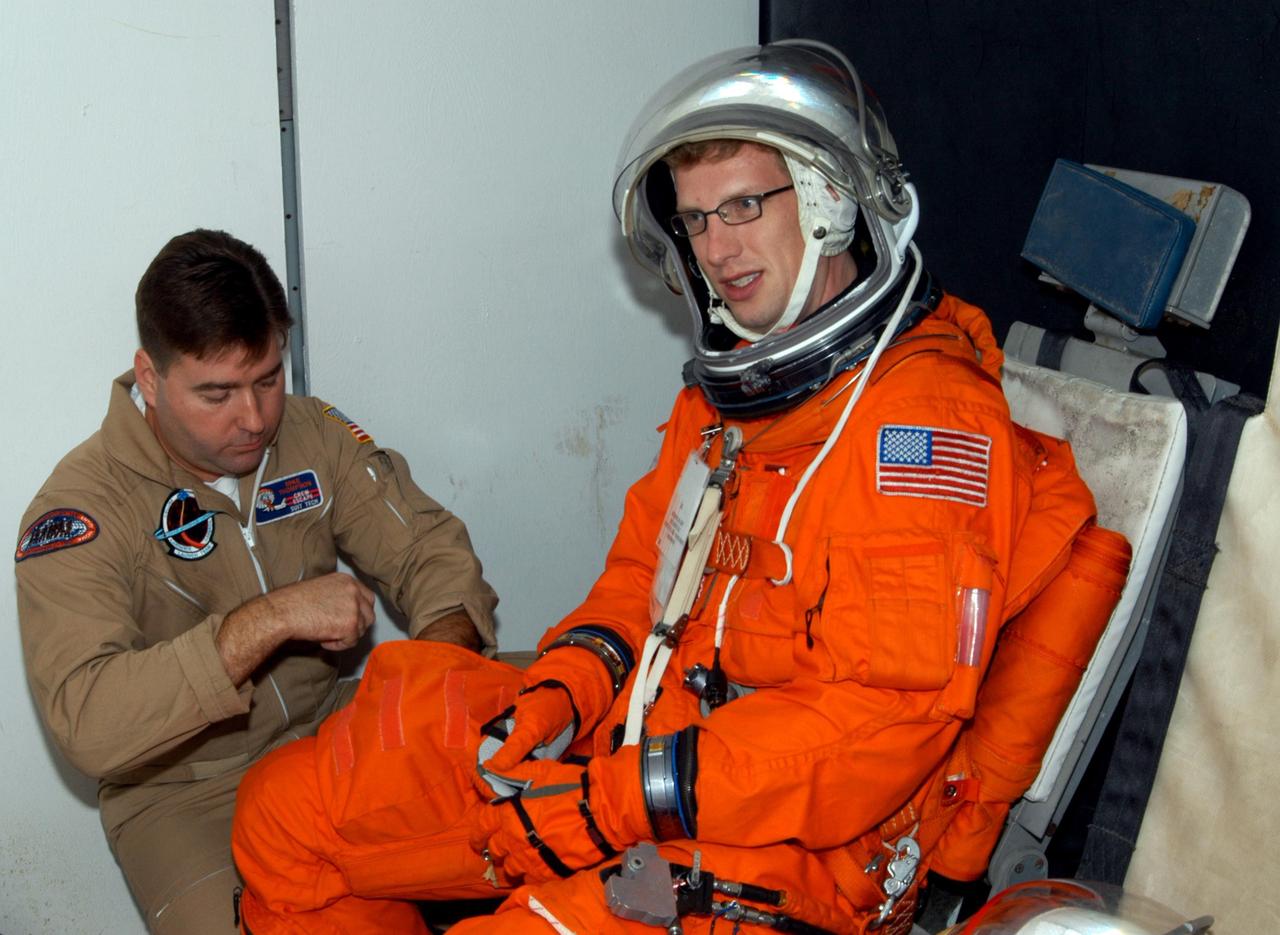
KENNEDY SPACE CENTER, FLA. - Inside the orbiter mockup at NASA Kennedy Space Center's Shuttle Landing Facility, volunteer "astronaut" Charlie Plain, with InDyne Inc., gets settled in a seat with the help of United Space Alliance Insertion Tech Mike Thompson before a simulated emergency landing of a shuttle crew. Known as a Mode VI exercise, the operation uses volunteer workers from the Center to pose as astronauts. The purpose of the simulation is to exercise emergency preparedness personnel, equipment and facilities in rescuing astronauts from a downed orbiter and providing immediate medical attention. Photo credit: NASA/George Shelton
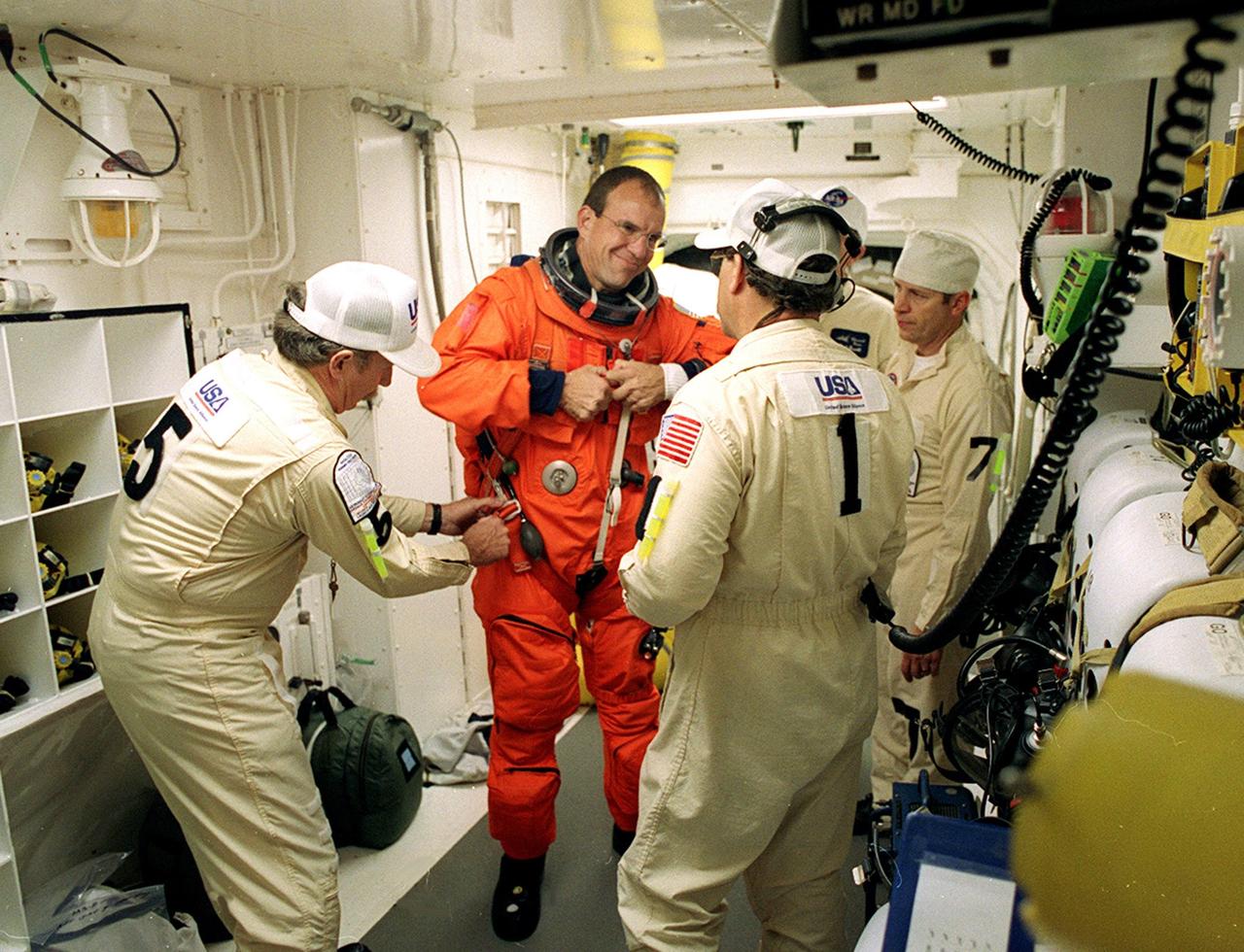
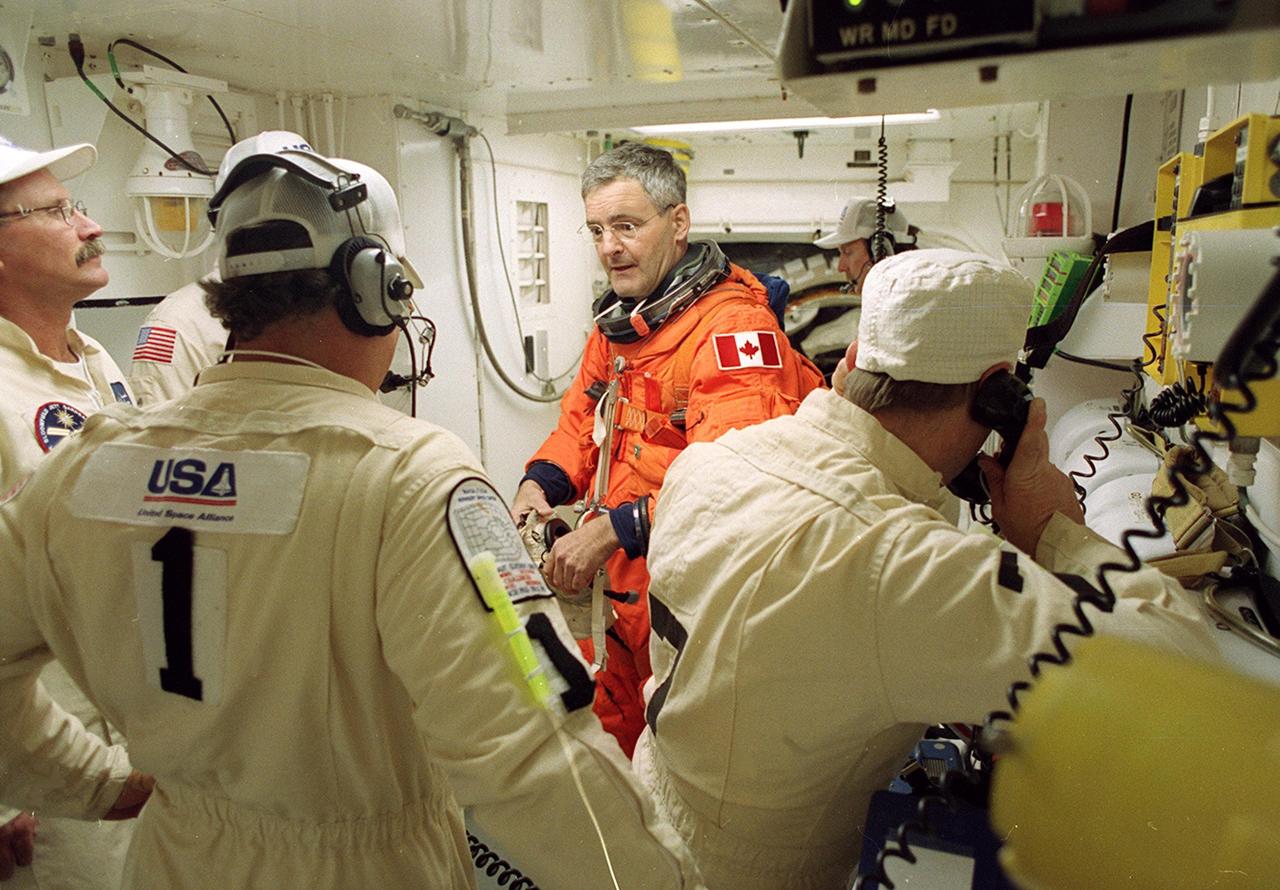
In the White Room, STS-97 Pilot Michael Bloomfield (center) prepares for entry into Space Shuttle Endeavour with the help of the Closeout Crew, (left to right) Al Schmidt, Travis Thompson and Mike Birkenseher. Space Shuttle Endeavour is targeted to launch Nov. 30 at 10:06 p.m. EST for the six construction flight to the International Space Station. Endeavour is transporting the P6 Integrated Truss Structure that comprises Solar Array Wing-3 and the Integrated Electronic Assembly, to provide power to the Space Station. After the 11-day mission, which includes three spacewalks, it is expected to land at KSC Dec. 11 at 6:19 p.m. EST
In the White Room, STS-97 Pilot Michael Bloomfield (center) prepares for entry into Space Shuttle Endeavour with the help of the Closeout Crew, (left to right) Al Schmidt, Travis Thompson and Mike Birkenseher. Space Shuttle Endeavour is targeted to launch Nov. 30 at 10:06 p.m. EST for the six construction flight to the International Space Station. Endeavour is transporting the P6 Integrated Truss Structure that comprises Solar Array Wing-3 and the Integrated Electronic Assembly, to provide power to the Space Station. After the 11-day mission, which includes three spacewalks, it is expected to land at KSC Dec. 11 at 6:19 p.m. EST
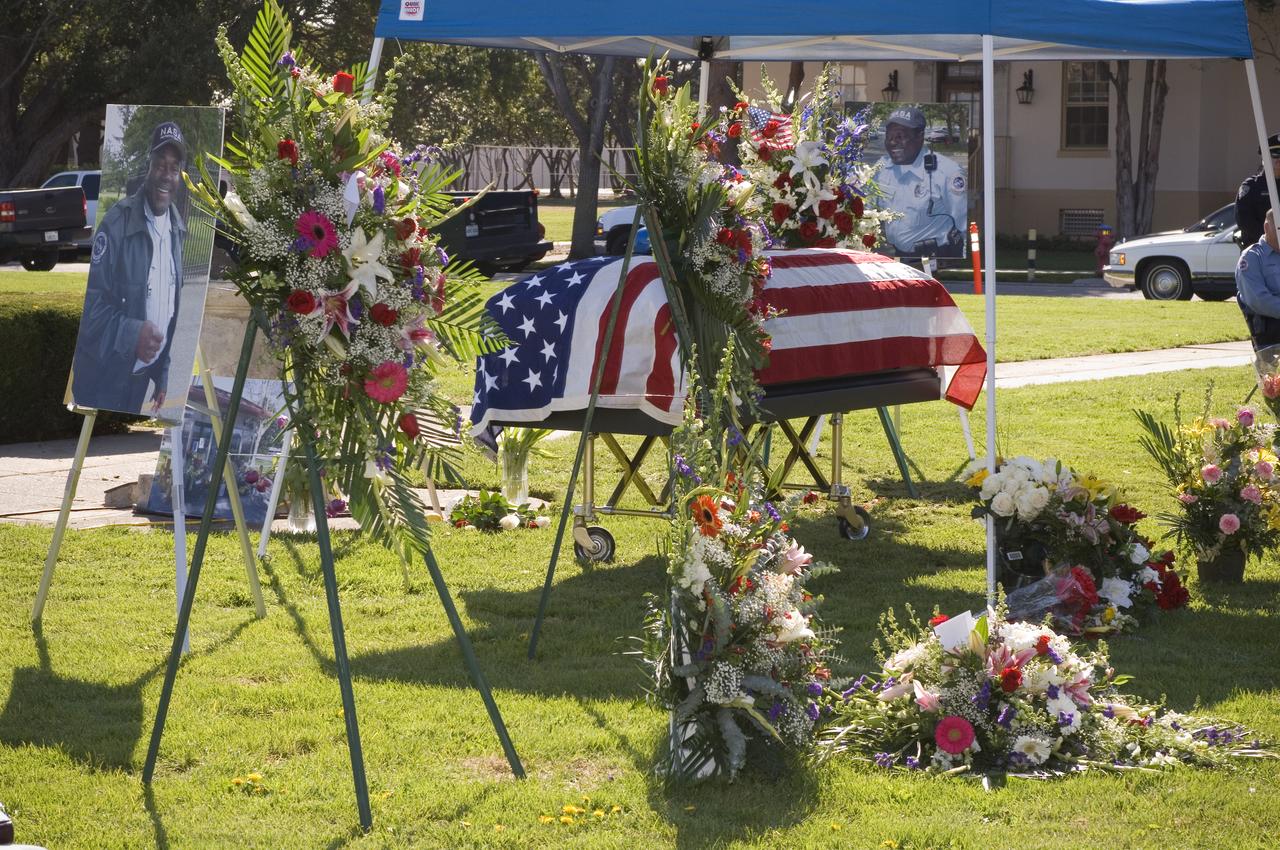
Memorial services for Ames Security Guard Johnny Green. funeral services on the NRP parade ground. Eugolies presented b Chris Christensen, Deputy Center Director, Ames Research Center, Robert Dlci, Cief, Protective Services, Roger Higby, Lt., Ames Protectives serices, Cynthia Green, Daughter, Sloan Thompson, Granddaughter - Awarding of California Commendation Medal, Col. Amos Bagdasarian 129th Rescue Wing, CA Ang, Military Shadow Box, CPO Mike Di Santo, USN, Presentation of American Flags, Robert Dolci
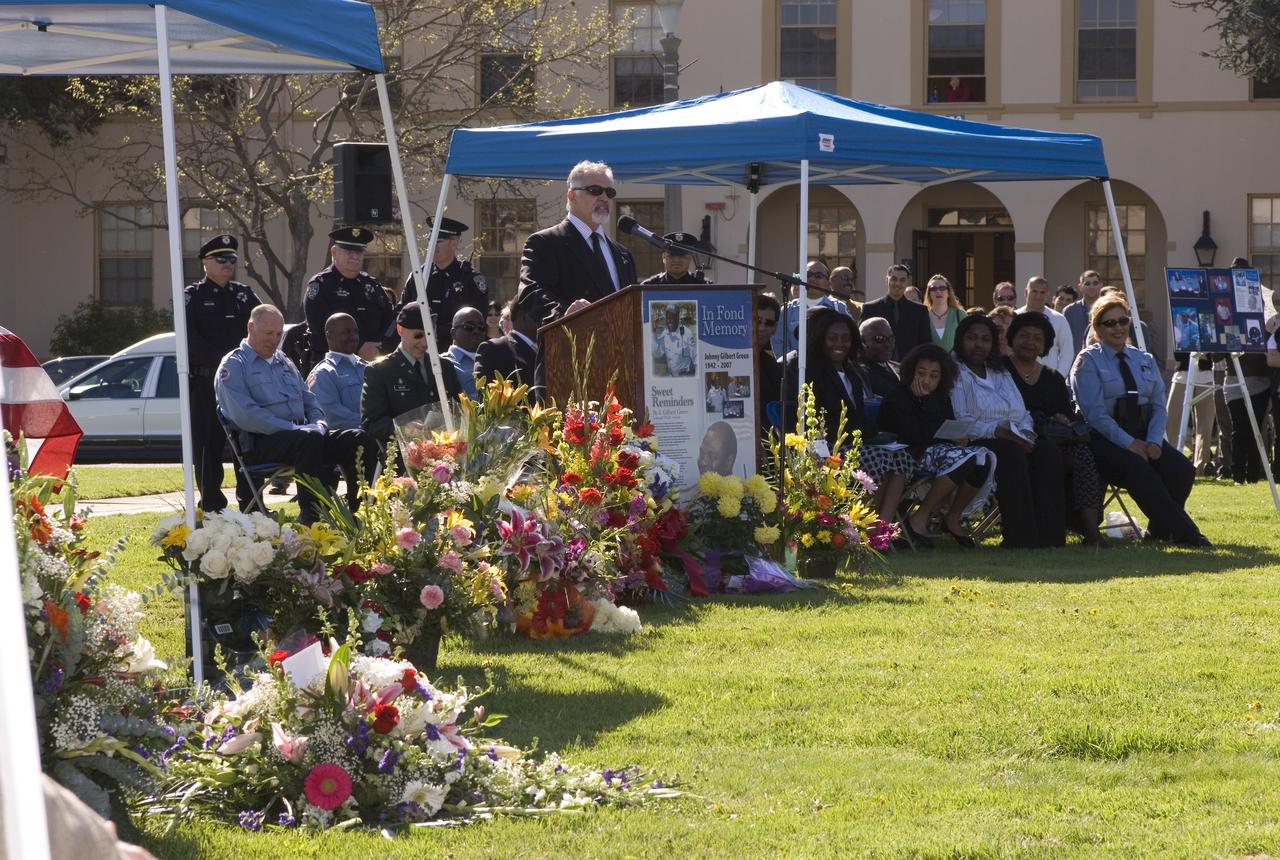
Memorial services for Ames Security Guard Johnny Green. funeral services on the NRP parade ground. Eugolies presented b Chris Christensen, Deputy Center Director, Ames Research Center, Robert Dlci, Cief, Protective Services, Roger Higby, Lt., Ames Protectives serices, Cynthia Green, Daughter, Sloan Thompson, Granddaughter - Awarding of California Commendation Medal, Col. Amos Bagdasarian 129th Rescue Wing, CA Ang, Military Shadow Box, CPO Mike Di Santo, USN, Presentation of American Flags, Robert Dolci
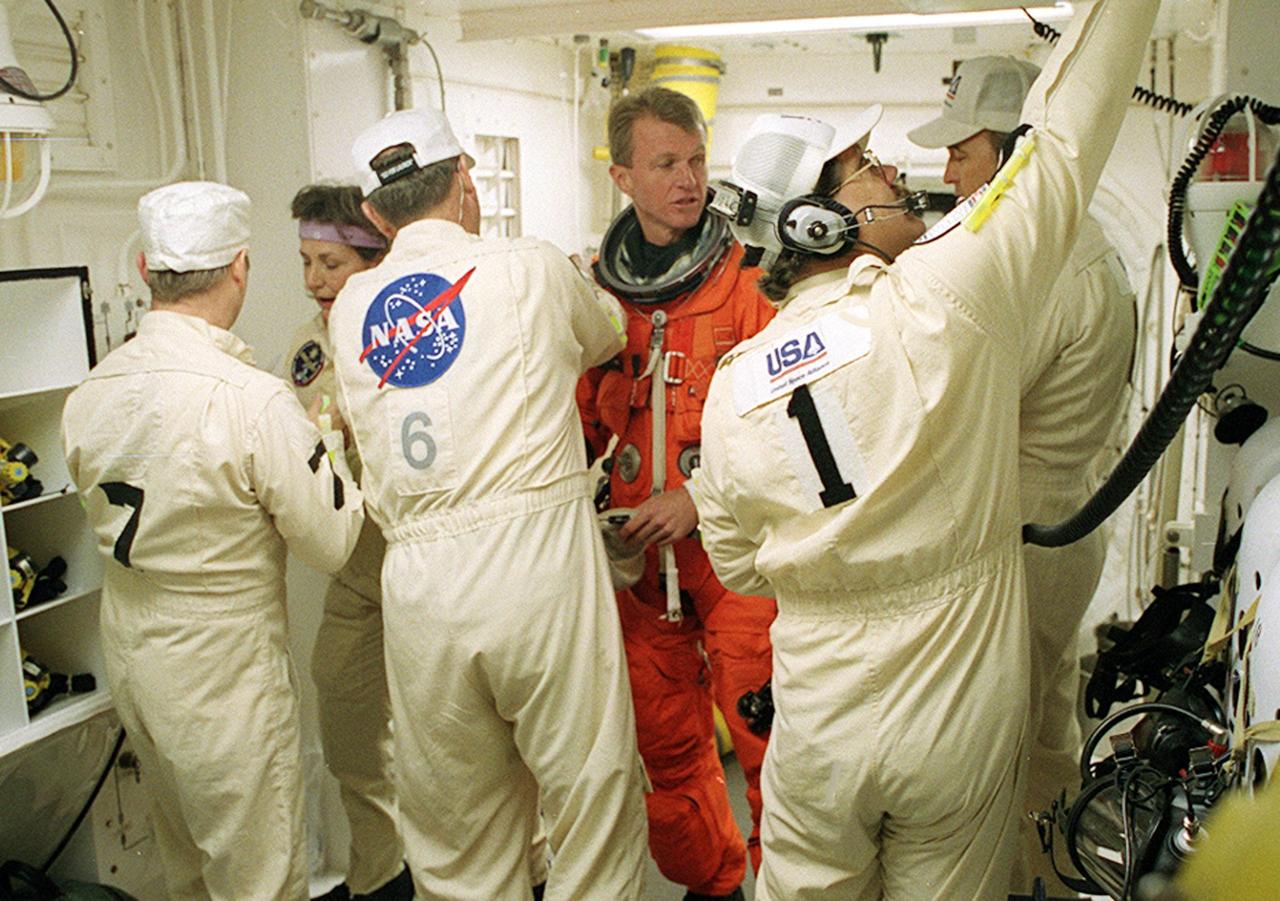
In the White Room, STS-97 Commander Brent Jett (center) prepares for entry into Space Shuttle Endeavour with the help of the Closeout Crew, (left to right) Mike Birkenseher, Jean Alexander, Jack Burritt, Travis Thompson and Dave Law. Space Shuttle Endeavour is targeted to launch Nov. 30 at 10:06 p.m. EST for the six construction flight to the International Space Station. Endeavour is transporting the P6 Integrated Truss Structure that comprises Solar Array Wing-3 and the Integrated Electronic Assembly, to provide power to the Space Station. After the 11-day mission, which includes three spacewalks, it is expected to land at KSC Dec. 11 at 6:19 p.m. EST
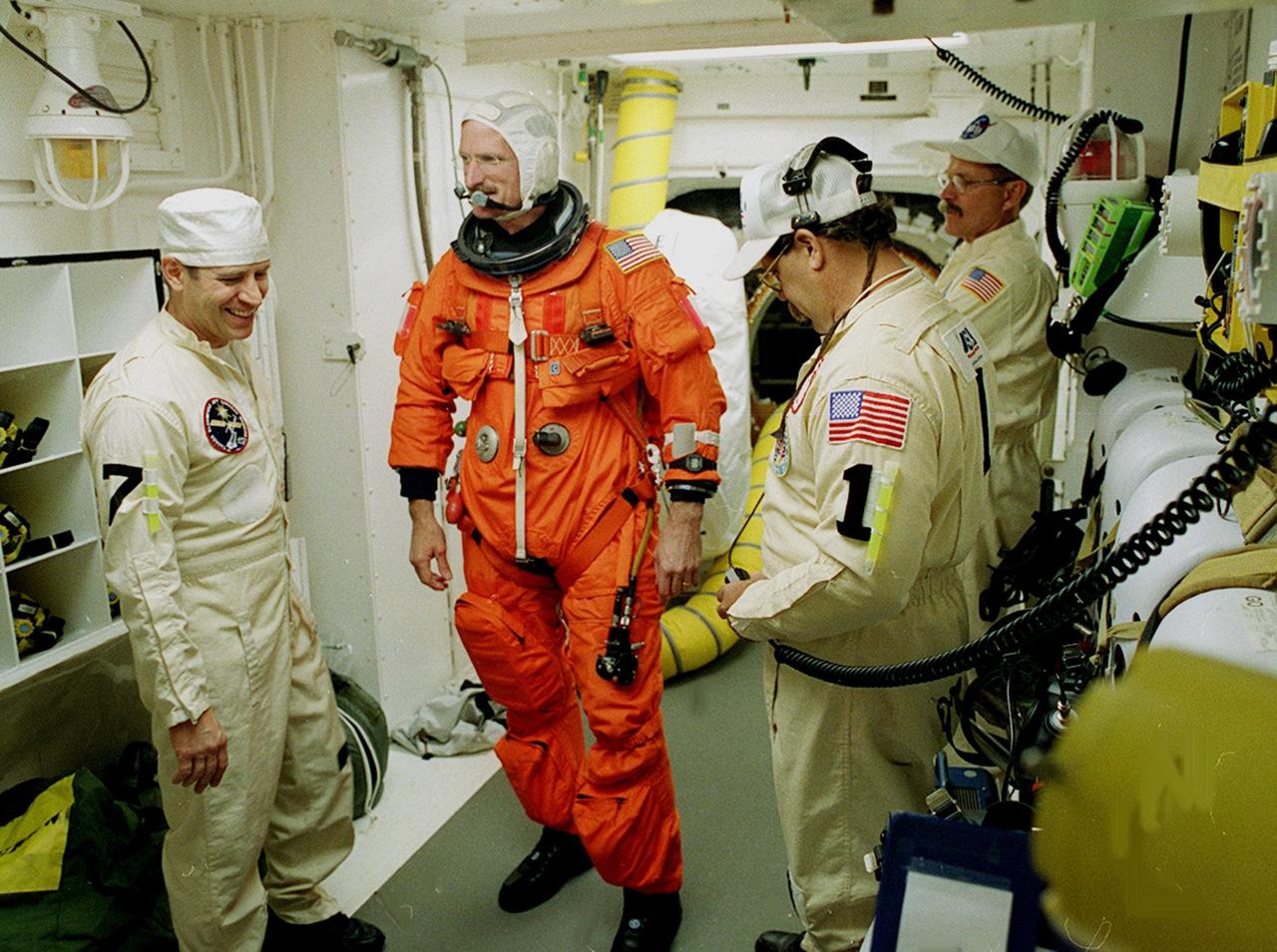
In the White Room, STS-97 Mission Specialist Joseph Tanner prepares for entry into Space Shuttle Endeavour with the help of the Closeout Crew, Mike Birkenseher (left), Travis Thompson (right, foreground) and Jack Burritt (right, background). Space Shuttle Endeavour is targeted to launch Nov. 30 at 10:06 p.m. EST for the six construction flight to the International Space Station. Endeavour is transporting the P6 Integrated Truss Structure that comprises Solar Array Wing-3 and the Integrated Electronic Assembly, to provide power to the Space Station. After the 11-day mission, which includes three spacewalks, it is expected to land at KSC Dec. 11 at 6:19 p.m. EST
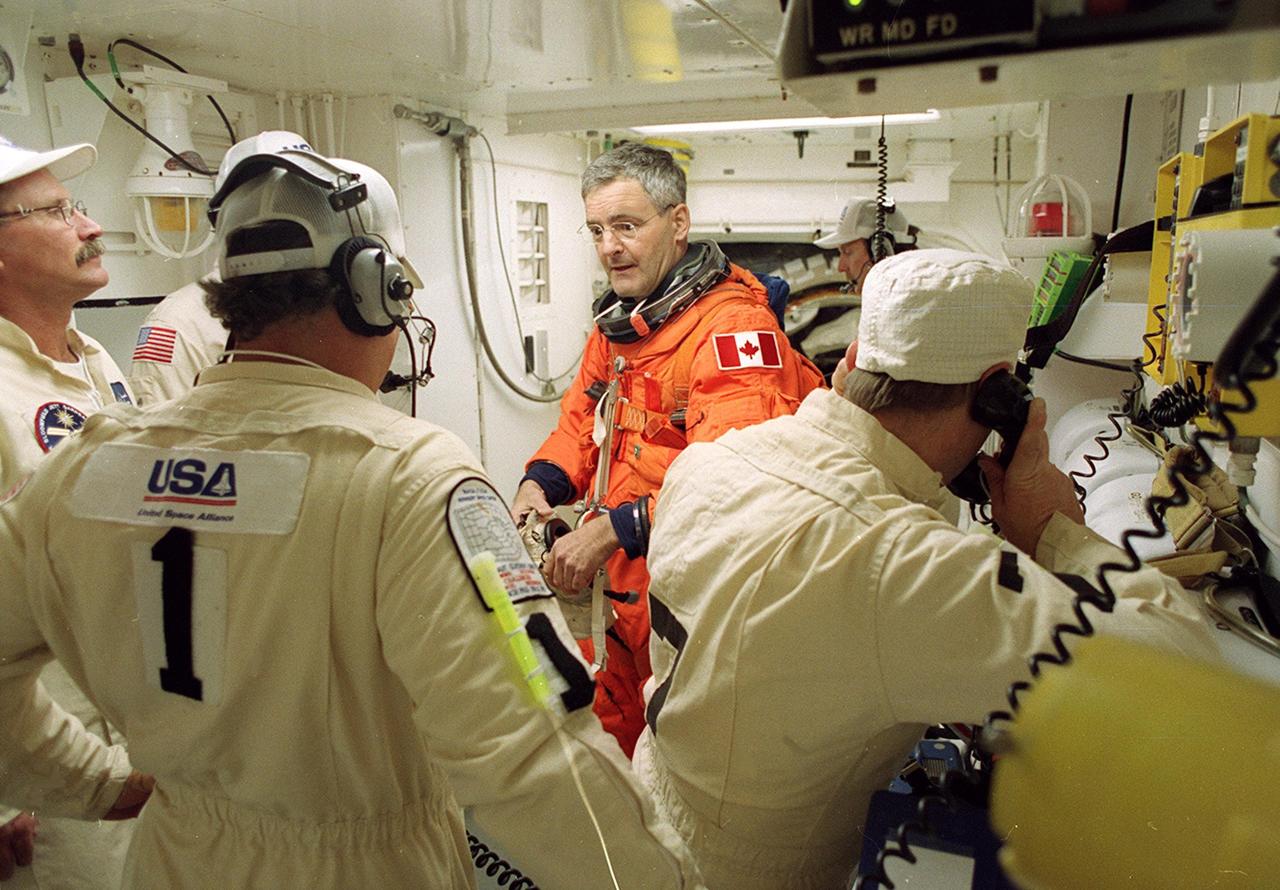
In the White Room, STS-97 Pilot Michael Bloomfield (center) prepares for entry into Space Shuttle Endeavour with the help of the Closeout Crew, (left to right) Al Schmidt, Travis Thompson and Mike Birkenseher. Space Shuttle Endeavour is targeted to launch Nov. 30 at 10:06 p.m. EST for the six construction flight to the International Space Station. Endeavour is transporting the P6 Integrated Truss Structure that comprises Solar Array Wing-3 and the Integrated Electronic Assembly, to provide power to the Space Station. After the 11-day mission, which includes three spacewalks, it is expected to land at KSC Dec. 11 at 6:19 p.m. EST
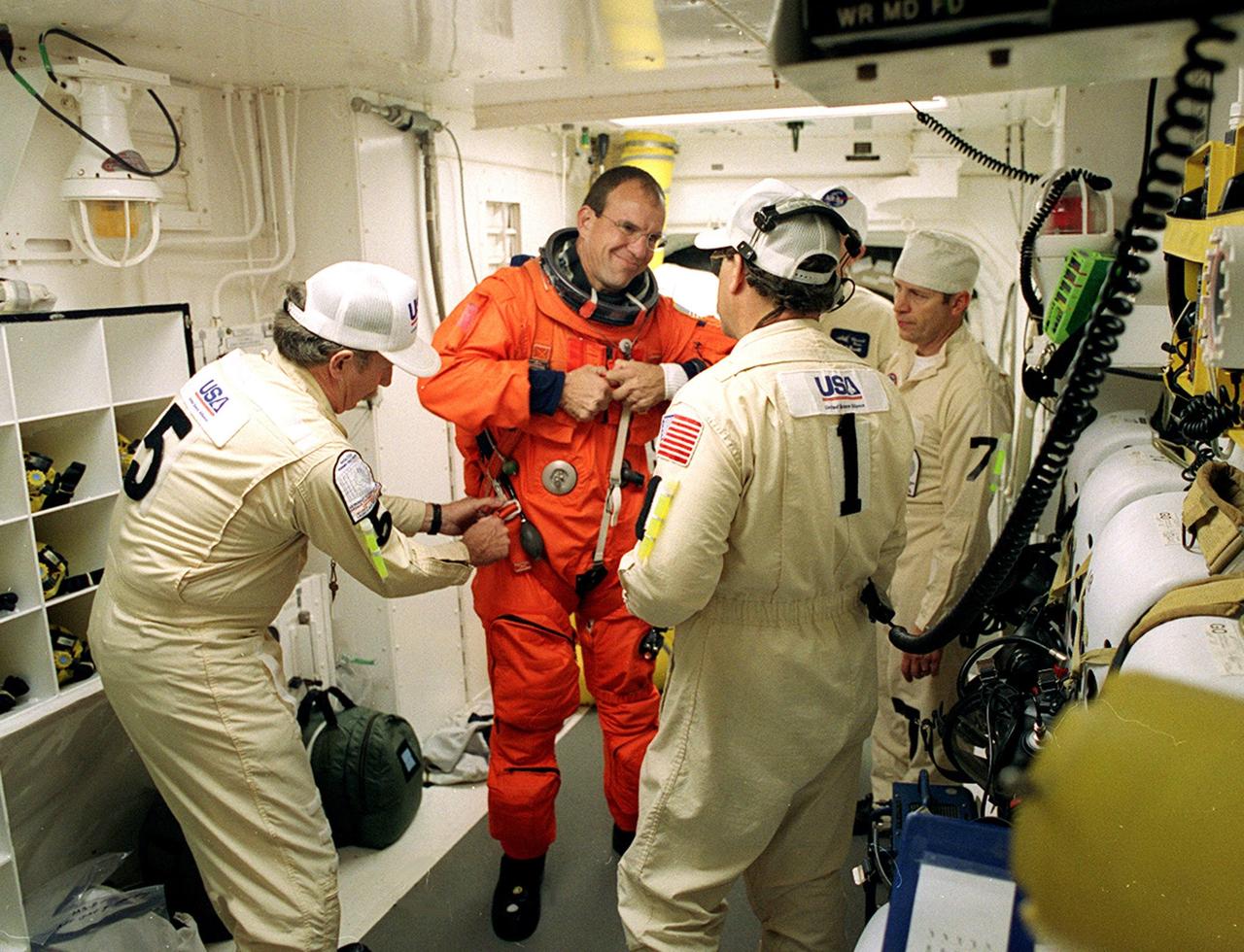
In the White Room, STS-97 Pilot Michael Bloomfield (center) prepares for entry into Space Shuttle Endeavour with the help of the Closeout Crew, (left to right) Al Schmidt, Travis Thompson and Mike Birkenseher. Space Shuttle Endeavour is targeted to launch Nov. 30 at 10:06 p.m. EST for the six construction flight to the International Space Station. Endeavour is transporting the P6 Integrated Truss Structure that comprises Solar Array Wing-3 and the Integrated Electronic Assembly, to provide power to the Space Station. After the 11-day mission, which includes three spacewalks, it is expected to land at KSC Dec. 11 at 6:19 p.m. EST
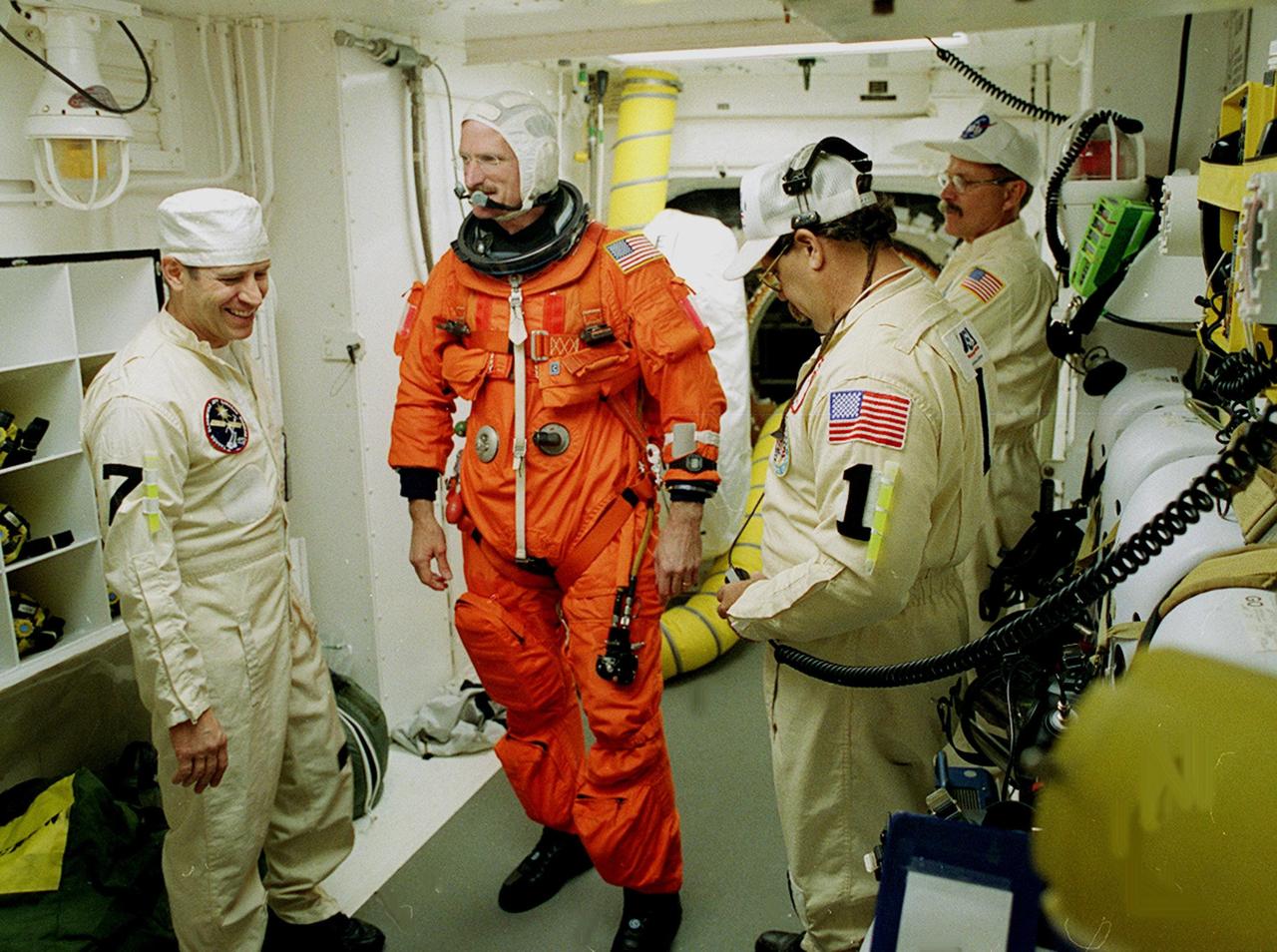
In the White Room, STS-97 Mission Specialist Joseph Tanner prepares for entry into Space Shuttle Endeavour with the help of the Closeout Crew, Mike Birkenseher (left), Travis Thompson (right, foreground) and Jack Burritt (right, background). Space Shuttle Endeavour is targeted to launch Nov. 30 at 10:06 p.m. EST for the six construction flight to the International Space Station. Endeavour is transporting the P6 Integrated Truss Structure that comprises Solar Array Wing-3 and the Integrated Electronic Assembly, to provide power to the Space Station. After the 11-day mission, which includes three spacewalks, it is expected to land at KSC Dec. 11 at 6:19 p.m. EST
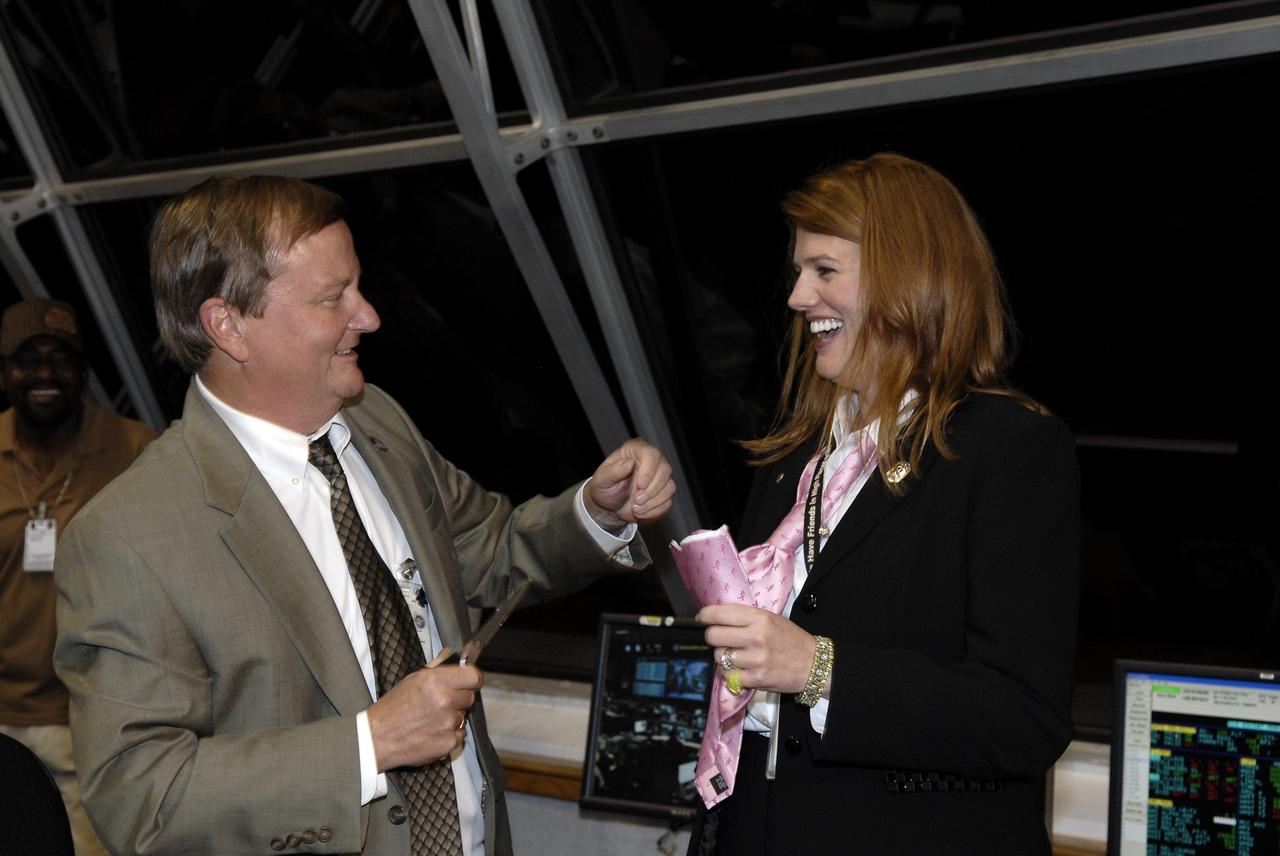
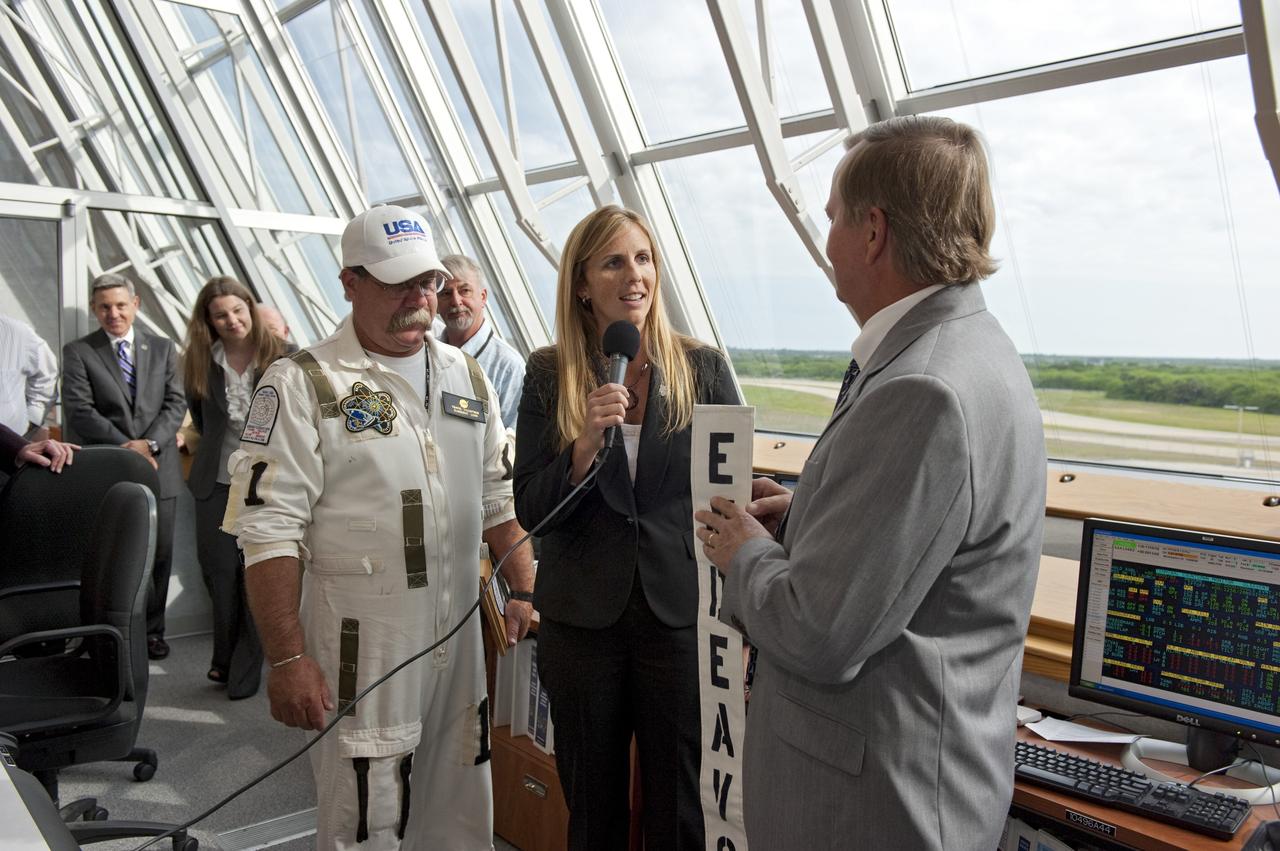
CAPE CANAVERAL, Fla. – In the Firing Room of the Launch Control Center at NASA's Kennedy Space Center in Florida, Shuttle Launch Director Mike Leinbach (left) congratulates STS-126 NASA Test Director Charlie Blackwell-Thompson with the traditional tie-cutting ceremony for a first-time NTD. Congratulations were offered for the successful launch of space shuttle Endeavour. Liftoff was on time at 7:55 p.m. EST. STS-126 is the 124th space shuttle flight and the 27th flight to the International Space Station. The mission will feature four spacewalks and work that will prepare the space station to house six crew members for long-duration missions. Photo credit: NASA/Kim Shiflett
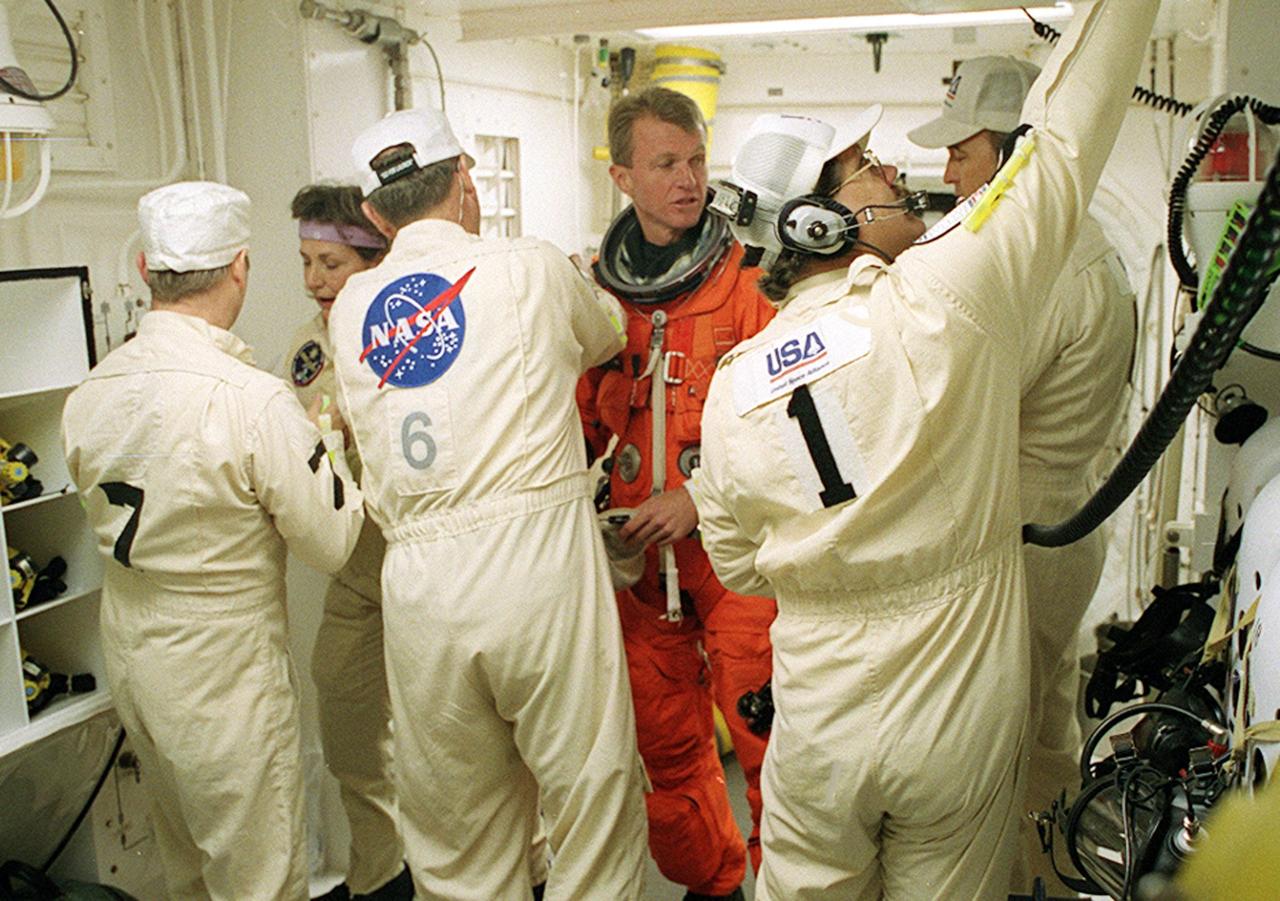
In the White Room, STS-97 Commander Brent Jett (center) prepares for entry into Space Shuttle Endeavour with the help of the Closeout Crew, (left to right) Mike Birkenseher, Jean Alexander, Jack Burritt, Travis Thompson and Dave Law. Space Shuttle Endeavour is targeted to launch Nov. 30 at 10:06 p.m. EST for the six construction flight to the International Space Station. Endeavour is transporting the P6 Integrated Truss Structure that comprises Solar Array Wing-3 and the Integrated Electronic Assembly, to provide power to the Space Station. After the 11-day mission, which includes three spacewalks, it is expected to land at KSC Dec. 11 at 6:19 p.m. EST
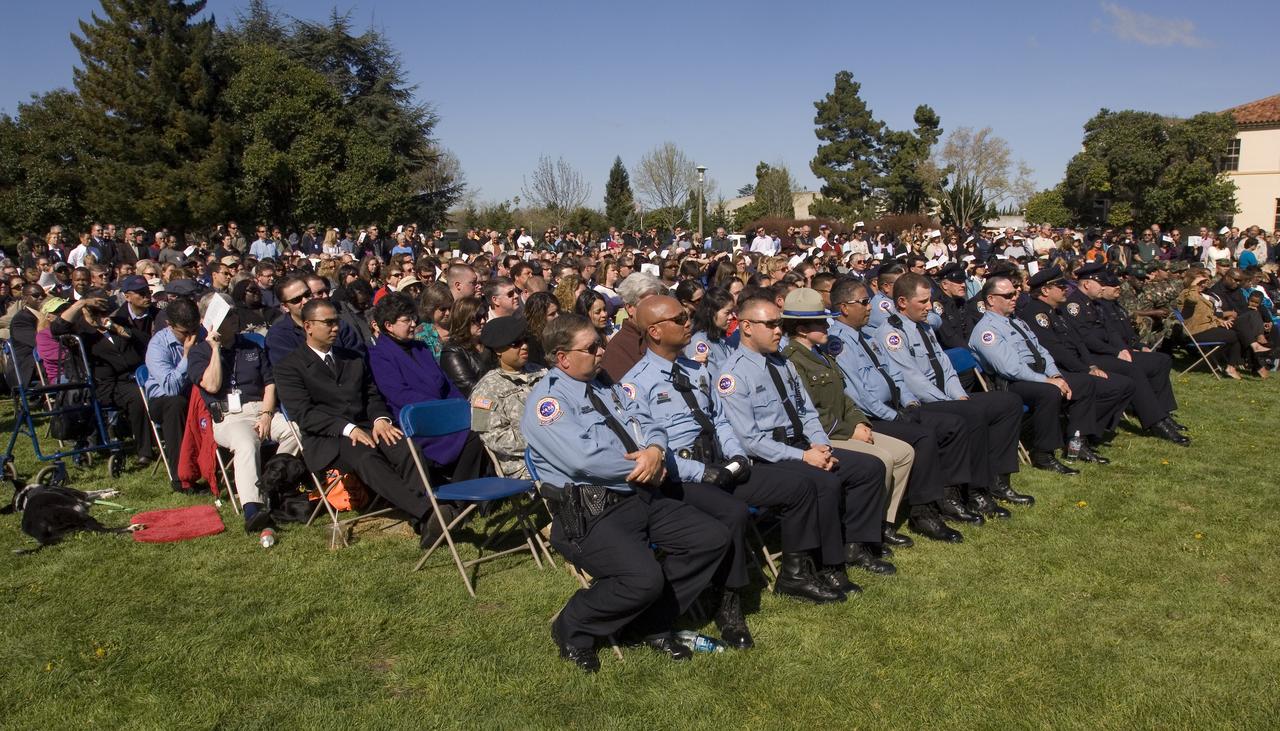
Memorial services for Ames Security Guard Johnny Green. funeral services on the NRP parade ground. Eugolies presented b Chris Christensen, Deputy Center Director, Ames Research Center, Robert Dlci, Cief, Protective Services, Roger Higby, Lt., Ames Protectives serices, Cynthia Green, Daughter, Sloan Thompson, Granddaughter - Awarding of California Commendation Medal, Col. Amos Bagdasarian 129th Rescue Wing, CA Ang, Military Shadow Box, CPO Mike Di Santo, USN, Presentation of American Flags, Robert Dolci
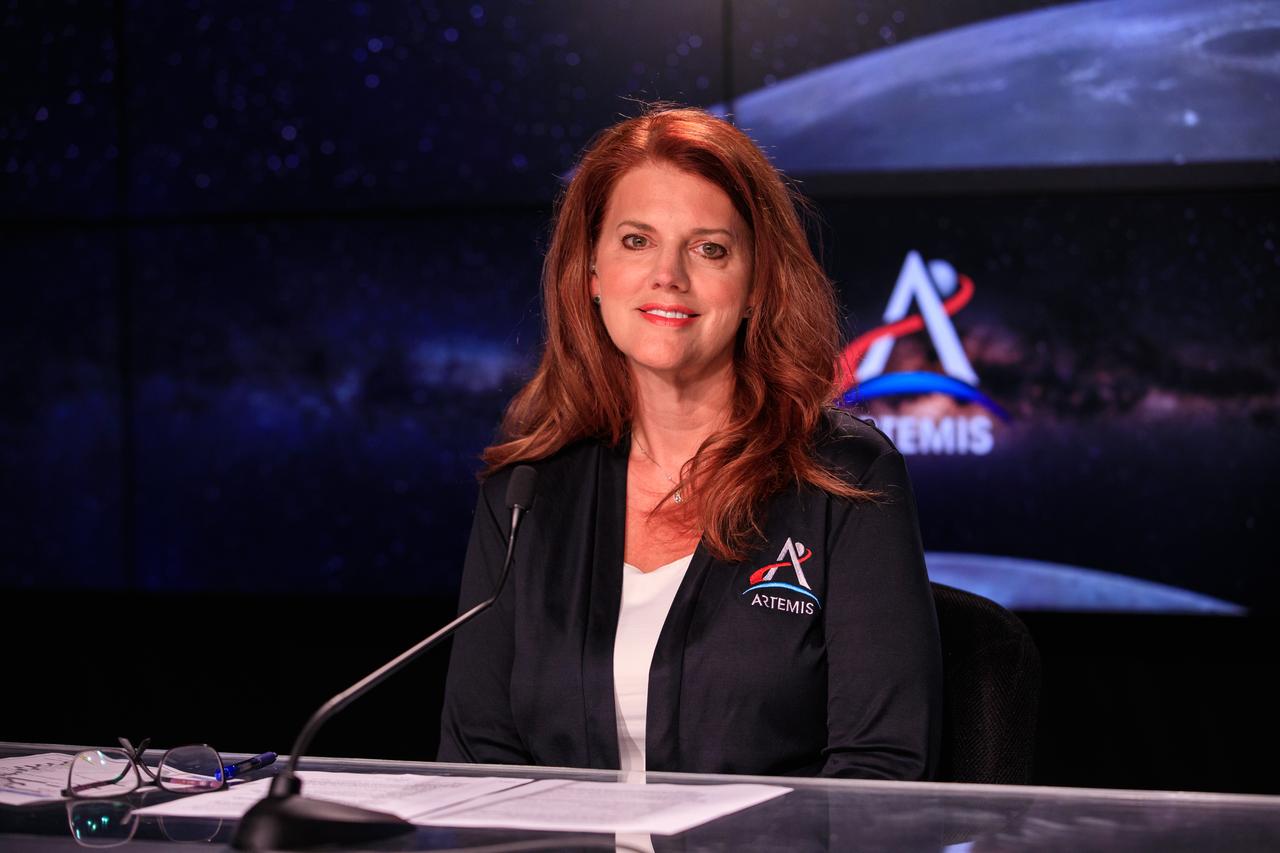
Launch Director Charlie Blackwell-Thompson participates in an Artemis I mission overview briefing inside the Press Site auditorium at NASA’s Kennedy Space Center in Florida on Aug. 3, 2022. Also participating in the briefing from various locations were NASA Administrator Bill Nelson; Associate Administrator for Technology, Policy, and Strategy Bhavya Lal; Mission Manager Mike Sarafin; Space Launch System (SLS) Program Manager John Honeycutt; and Orion Program Manager Howard Hu. The first in an increasingly complex series of missions, Artemis I will test the SLS rocket and Orion spacecraft as an integrated system prior to crewed flights to the Moon. Through Artemis, NASA will land the first woman and first person of color on the lunar surface, paving the way for long-term lunar presence and serving as a steppingstone before venturing to Mars.
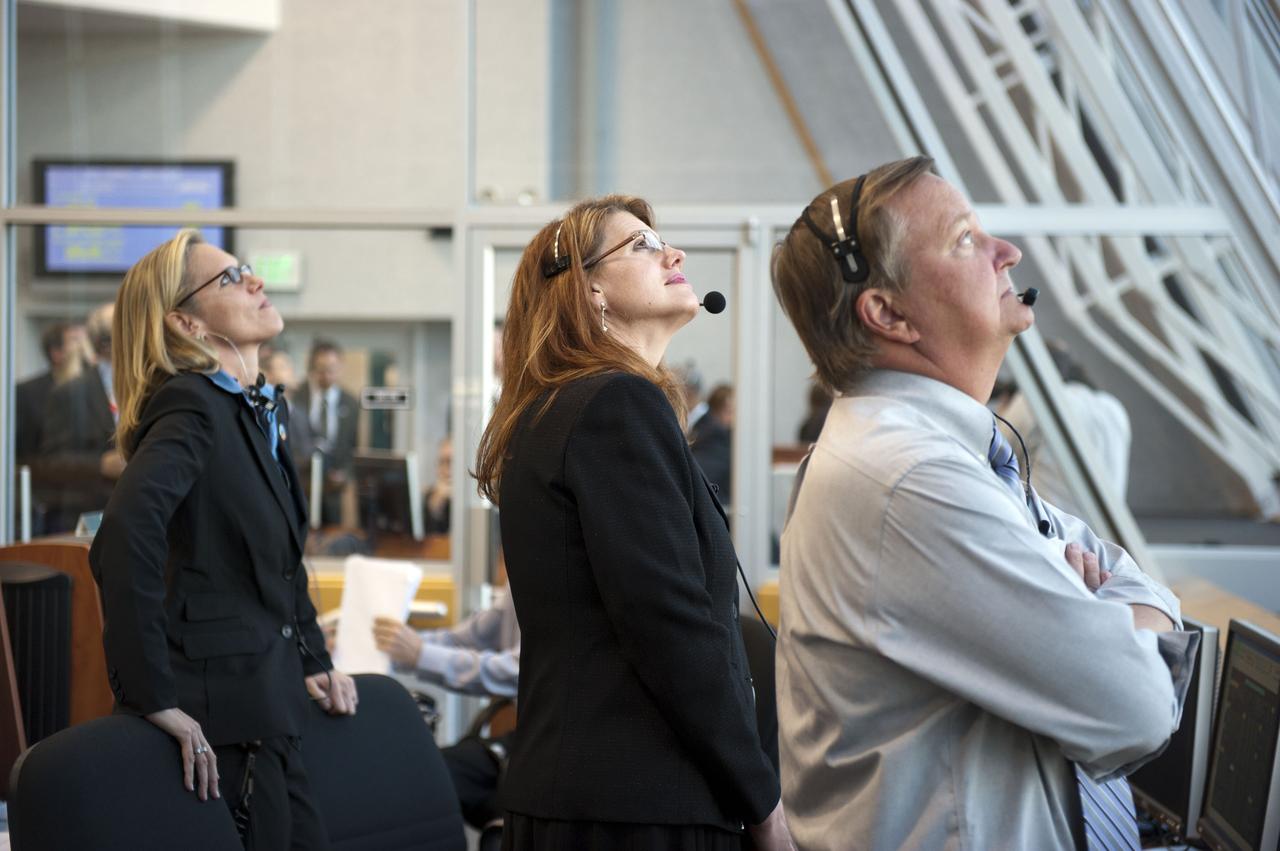
STS133-S-067 (24 Feb. 2011) --- In Firing Room 4 of the Launch Control Center at NASA's Kennedy Space Center in Florida, NASA's Discovery Flow Director Stephanie Stilson, left, STS-133 Assistant Shuttle Launch Director and lead NASA Test Director Charlie Blackwell-Thompson and Shuttle Launch Director Mike Leinbach watch space shuttle Discovery head toward Earth orbit on the STS-133 mission to the International Space Station. Discovery and its six-member crew are on a mission to deliver the Permanent Multipurpose Module, packed with supplies and critical spare parts, as well as Robonaut 2, the dexterous humanoid astronaut helper, to the orbiting outpost. Discovery is making its 39th mission and is scheduled to be retired following STS-133. This is the 133rd Space Shuttle Program mission and the 35th shuttle voyage to the space station. Photo credit: NASA or National Aeronautics and Space Administration
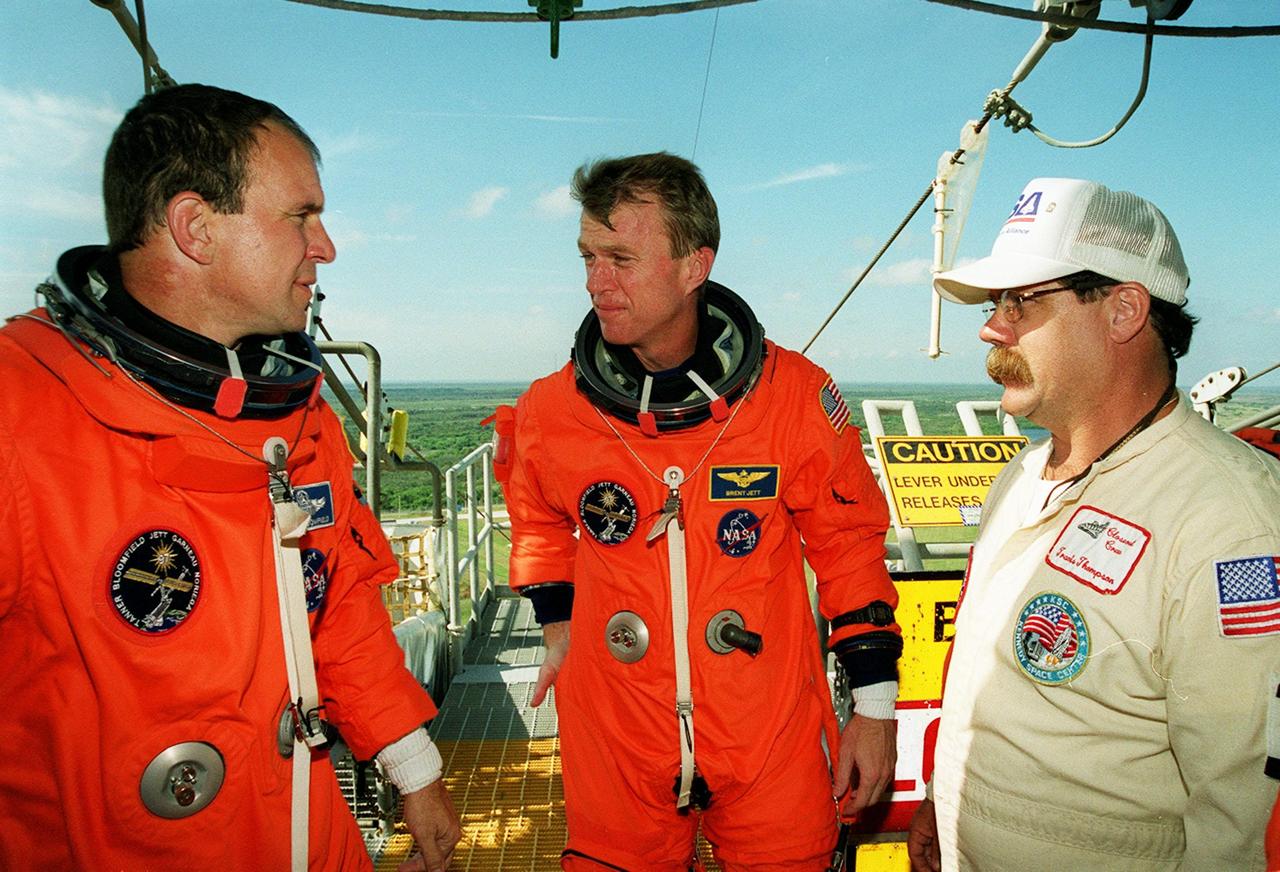
During emergency egress practice at Launch Pad 39B, STS-97 Pilot Mike Bloomfield (left) and Commander Brent Jett (center) discuss their activities with Closeout Crew member Travis Thompson (right). The practice is part of Terminal Countdown Demonstration Test (TCDT) activities that also include a simulated launch countdown and opportunities to inspect the mission payloads in the orbiter’s payload bay. Mission STS-97is the sixth construction flight to the International Space Station. Its payload includes the P6 Integrated Truss Structure and a photovoltaic (PV) module, with giant solar arrays that will provide power to the Station. The mission includes two spacewalks to complete the solar array connections. STS-97 is scheduled to launch Nov. 30 at 10:05 p.m. EST
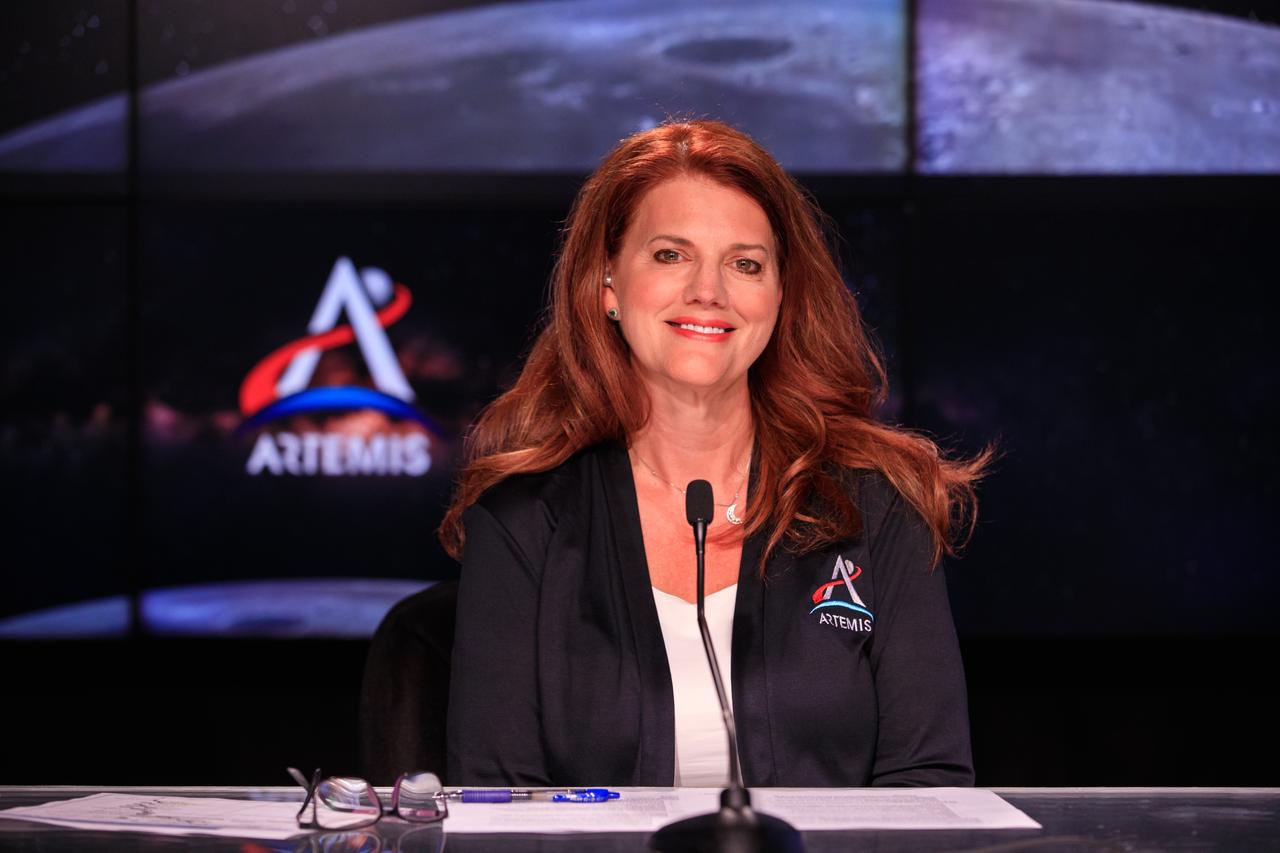
Launch Director Charlie Blackwell-Thompson participates in an Artemis I mission overview briefing inside the Press Site auditorium at NASA’s Kennedy Space Center in Florida on Aug. 3, 2022. Also participating in the briefing from various locations were NASA Administrator Bill Nelson; Associate Administrator for Technology, Policy, and Strategy Bhavya Lal; Mission Manager Mike Sarafin; Space Launch System (SLS) Program Manager John Honeycutt; and Orion Program Manager Howard Hu. The first in an increasingly complex series of missions, Artemis I will test the SLS rocket and Orion spacecraft as an integrated system prior to crewed flights to the Moon. Through Artemis, NASA will land the first woman and first person of color on the lunar surface, paving the way for long-term lunar presence and serving as a steppingstone before venturing to Mars.
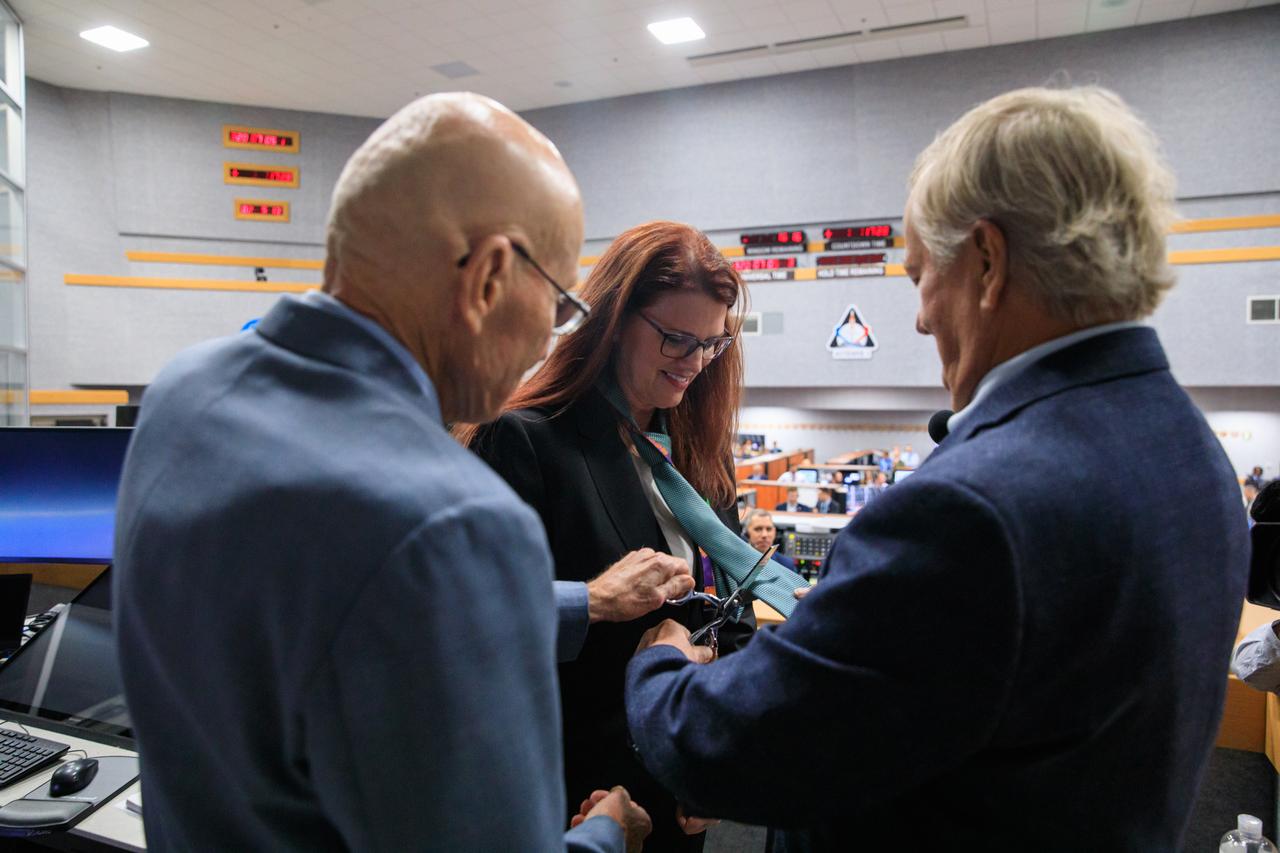
Former space shuttle launch directors Mike Leinbach, at right, and Bob Sieck perform the traditional cutting of the tie for Artemis I Launch Director Charlie Blackwell-Thompson inside the Launch Control Center at NASA’s Kennedy Space Center in Florida, after the launch of the agency’s Space Launch System and Orion spacecraft from Launch Complex 39B on Nov. 16, 2022. Liftoff was at 1:47 a.m. EST. The first in a series of increasingly complex missions, Artemis I will provide a foundation for human deep space exploration and demonstrate our commitment and capability to extend human presence to the Moon and beyond. The primary goal of Artemis I is to thoroughly test the integrated systems before crewed missions by operating the spacecraft in a deep space environment, testing Orion’s heat shield, and recovering the crew module after reentry, descent, and splashdown.
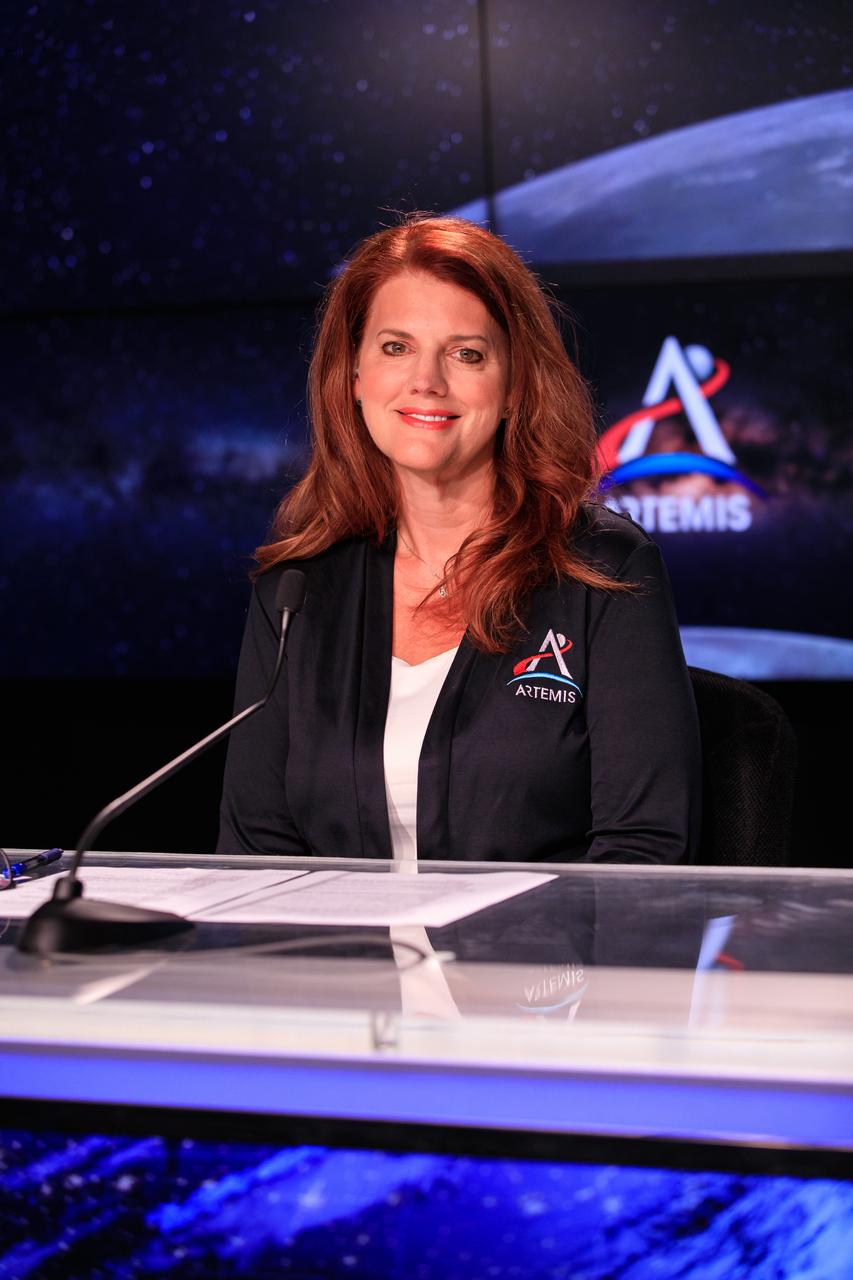
Launch Director Charlie Blackwell-Thompson participates in an Artemis I mission overview briefing inside the Press Site auditorium at NASA’s Kennedy Space Center in Florida on Aug. 3, 2022. Also participating in the briefing from various locations were NASA Administrator Bill Nelson; Associate Administrator for Technology, Policy, and Strategy Bhavya Lal; Mission Manager Mike Sarafin; Space Launch System (SLS) Program Manager John Honeycutt; and Orion Program Manager Howard Hu. The first in an increasingly complex series of missions, Artemis I will test the SLS rocket and Orion spacecraft as an integrated system prior to crewed flights to the Moon. Through Artemis, NASA will land the first woman and first person of color on the lunar surface, paving the way for long-term lunar presence and serving as a steppingstone before venturing to Mars.
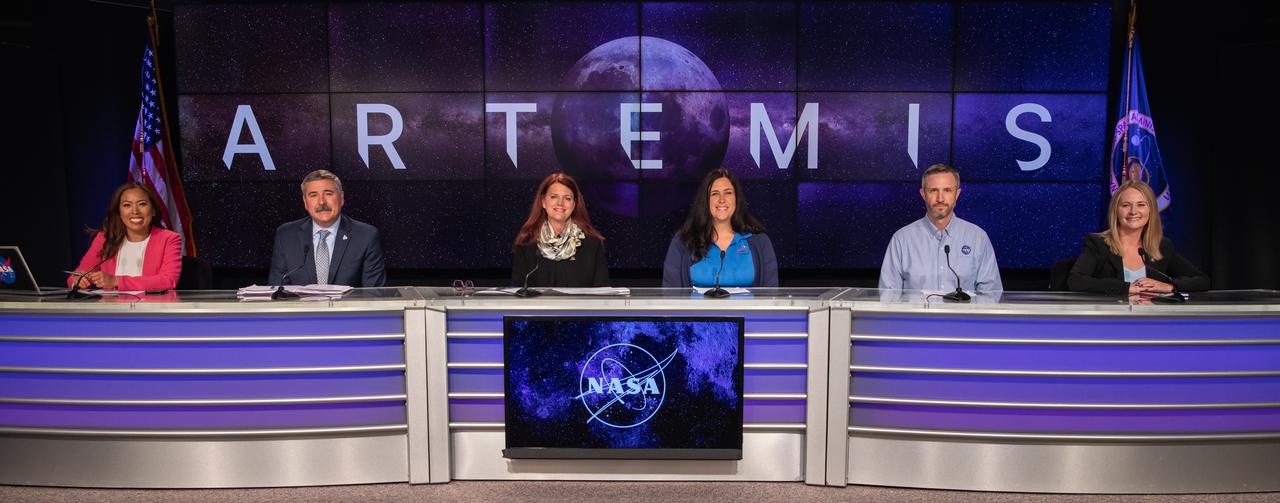
From left, Megan Cruz, NASA Communications; Mike Sarafin, Artemis mission manager, NASA Headquarters; Charlie Blackwell-Thompson, Artemis launch director, Kennedy Space Center; Melissa Jones, recovery director, Exploration Ground Systems Program, Kennedy; Jacob Bleacher, chief exploration scientist, Exploration Systems Development Mission Directorate, NASA Headquarters; and Melody Lovin, weather officer, Space Launch Delta 45, participate in an Artemis I mission status press briefing at Kennedy on Aug. 27, 2022. NASA’s Space Launch System rocket and Orion spacecraft are targeted to lift off from Kennedy’s Launch Complex 39B no earlier than Aug. 29, 2022, at 8:33 a.m. EDT.
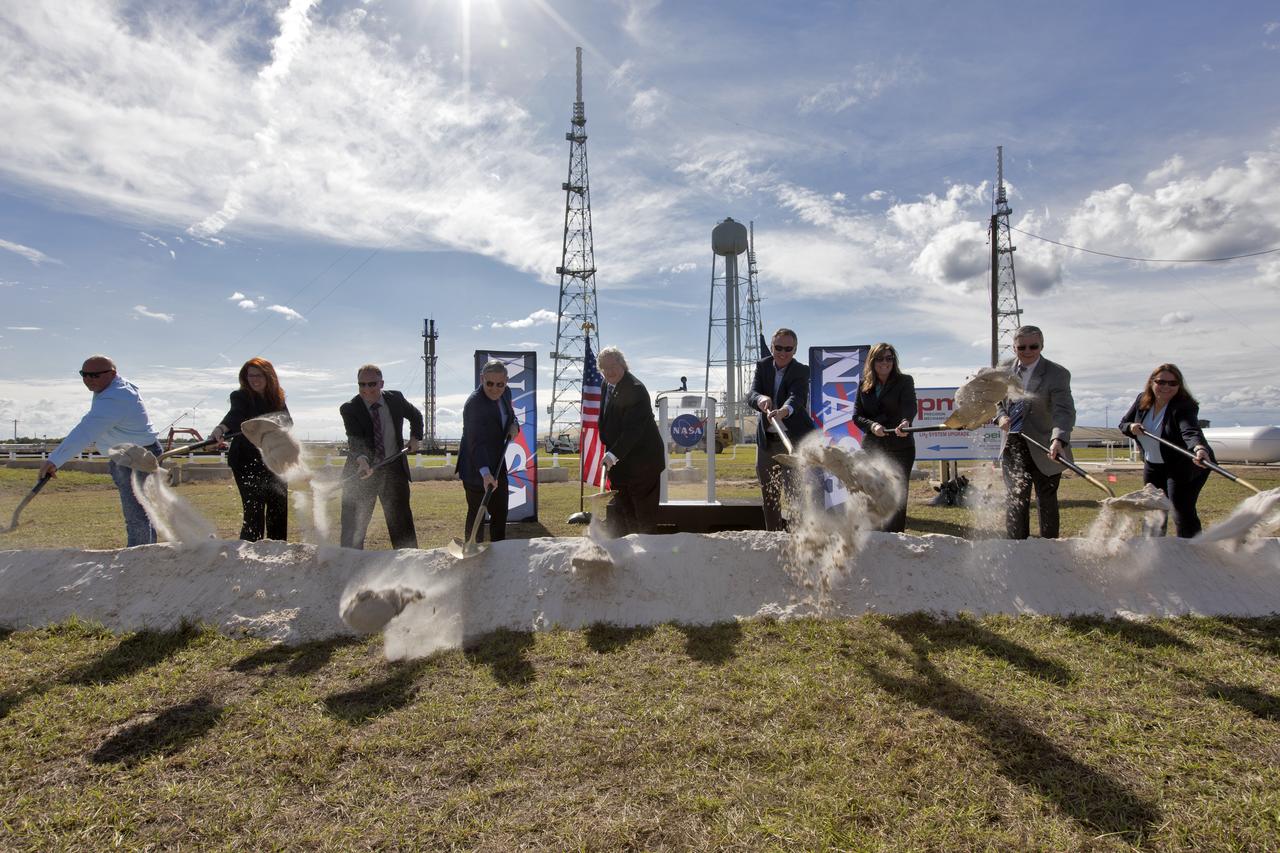
On Dec. 19, 2018, at NASA Kennedy Space Center's Launch Complex 39B, agency and contractor managers break ground for a new liquid hydrogen tank. Participating, from the left, are Todd Gray, president of Precision Mechanical, prime contractor for the project; Charlie Blackwell-Thompson, launch director; Shawn Quinn, director of Engineering; Bob Cabana, center director; Bill Hill, deputy associate administrator for Exploration Systems Development at NASA Headquarters in Washington; Mike Bolger, program manager for Exploration Ground Systems (EGS); Jennifer Kunz, deputy program manager for EGS, Andy Allen, general manager for Jacobs, NASA's Test and Operations Support Contractor; and Regina Spellman, launch pad senior project manager in EGS. The storage facility will hold 1.25 million gallons of the propellant for NASA's Space Launch System rocket designed to boost the agency's Orion spacecraft, sending humans to distant destinations such as the Moon and Mars.
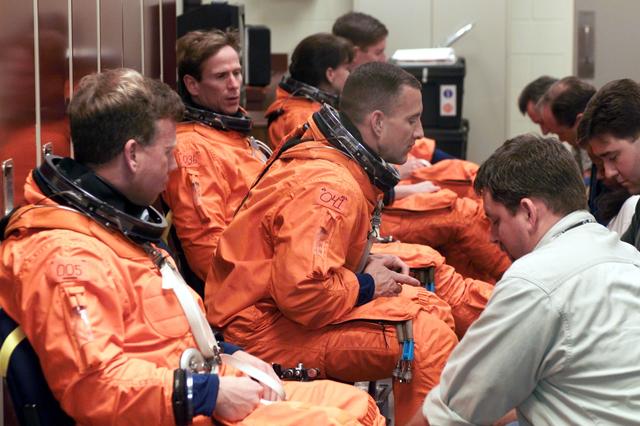
JSC2001-E-06407 (27 February 2001) --- Astronauts (from left foreground) Steven W. Lindsey, commander; Charles O. Hobaugh, pilot; Michael L. Gernhardt, Janet L. Kavandi, and James F. Reilly, all mission specialists, don training versions of the full-pressure launch and entry suit prior to a training session in one of the trainer/mockups (out of frame) in the Johnson Space Center’s Systems Integration Facility. The astronauts are assisted by suit technicians (from right foreground) Len Groce, Mike Thompson, Drew Billingsley and Jim Cheatham. The STS-104 mission to the International Space Station (ISS) represents the Space Shuttle Atlantis' first flight using a new engine and is targeted for a liftoff no earlier than June 14, 2001.

NASA dignitaries and launch team members gather inside Firing Room 1 of the Launch Control Center at Kennedy Space Center in Florida after the successful launch of the agency’s Space Launch System and Orion spacecraft on Nov. 16, 2022. Liftoff from Launch Complex 39B was at 1:47 a.m. EST. From left, are Artemis I Launch Director Charlie Blackwell-Thompson; Bob Cabana, NASA associate administrator; NASA Administrator Bill Nelson; Kennedy Space Center Director Janet Petro; former space shuttle Launch Director Bob Sieck; NASA Deputy Administrator Pam Melroy; Mike Bolger, Exploration Ground Systems manager; former space shuttle Launch Director Mike Leinbach; and Artemis I Assistant Launch Director Jeremy Graeber. The first in a series of increasingly complex missions, Artemis I will provide a foundation for human deep space exploration and demonstrate our commitment and capability to extend human presence to the Moon and beyond. The primary goal of Artemis I is to thoroughly test the integrated systems before crewed missions by operating the spacecraft in a deep space environment, testing Orion’s heat shield, and recovering the crew module after reentry, descent, and splashdown.
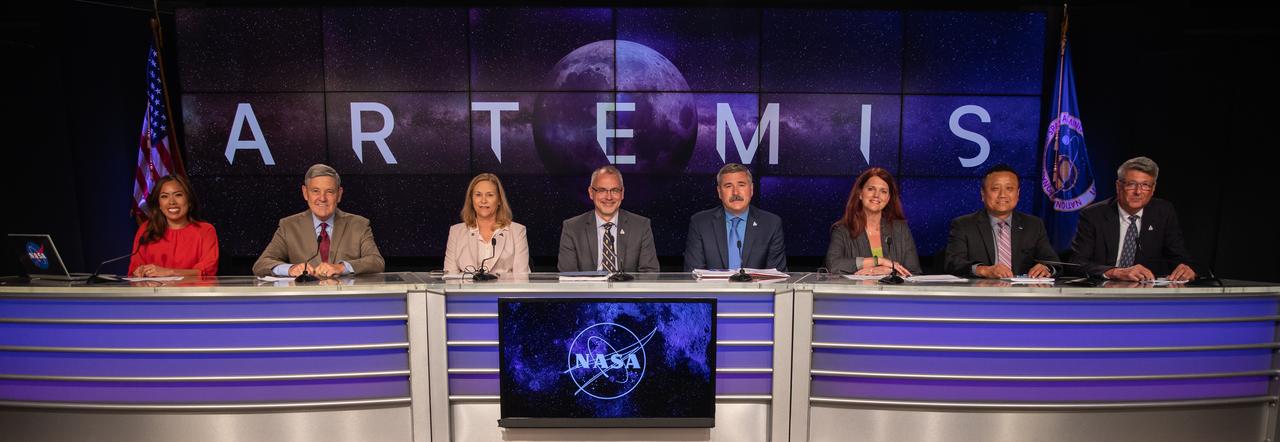
A prelaunch media briefing is held following completion of NASA’s Flight Readiness Review for Artemis I on Aug. 22, 2022, at the agency’s Kennedy Space Center in Florida. Participants are, from left, Megan Cruz, NASA Communications; Bob Cabana, NASA Associate Administrator; Janet Petro, Director, Kennedy Space Center; Jim Free, Associate Administrator, Exploration Systems Development; Mike Sarafin, Mission Manager, Artemis I; Charlie Blackwell-Thompson, Launch Director, Artemis I; Howard Hu, Manager, Orion Program; Chris Cianciola, Deputy Manager, SLS Program. Artemis I is scheduled to launch at 8:33 a.m. EDT on Aug. 29, 2022, from Kennedy’s Launch Complex 39B. The first in a series of increasingly complex missions, Artemis I will provide a foundation for human deep space exploration and demonstrate our commitment and capability to extend human presence to the Moon and beyond. The primary goal of Artemis I is to thoroughly test the integrated systems before crewed missions by operating the spacecraft in a deep space environment, testing Orion’s heat shield, and recovering the crew module after reentry, descent, and splashdown.
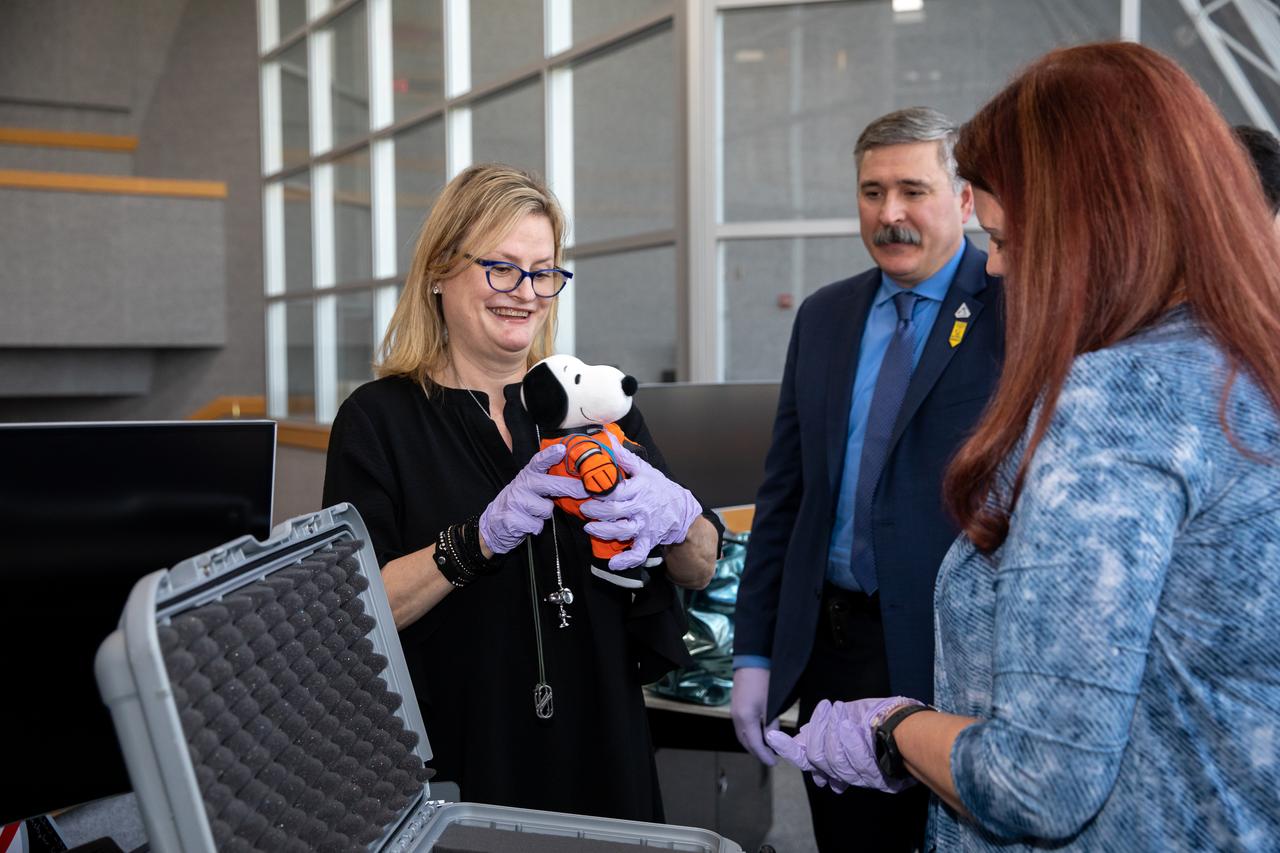
Melissa Menta, at left, senior vice president with Peanuts Worldwide LLC, accepts Snoopy during an official handover from Artemis Launch Director Charlie Blackwell-Thompson inside Launch Control Center Firing Room 1 at NASA’s Kennedy Space Center in Florida on Jan. 18, 2023. To the left of Charlie is Mike Sarafin, Artemis I mission manager. Snoopy served as the zero-gravity indicator during the Artemis I mission. Snoopy was secured inside Orion during the mission, a journey beyond the Moon and back to prepare for crewed missions to the Moon. Artemis I launched atop the Space Launch System rocket on Nov. 16, 2022 from Kennedy’s Launch Complex 39B. Orion returned to Earth for a splashdown in the Pacific Ocean on Dec. 11, 2022 after traveling more than 1.4 million miles. NASA has held an association with Snoopy since the Apollo Era – the character has contributed to the excitement for NASA human spaceflight missions, helping inspire generations to dream big, and is a symbol of NASA’s safety culture and mission success.
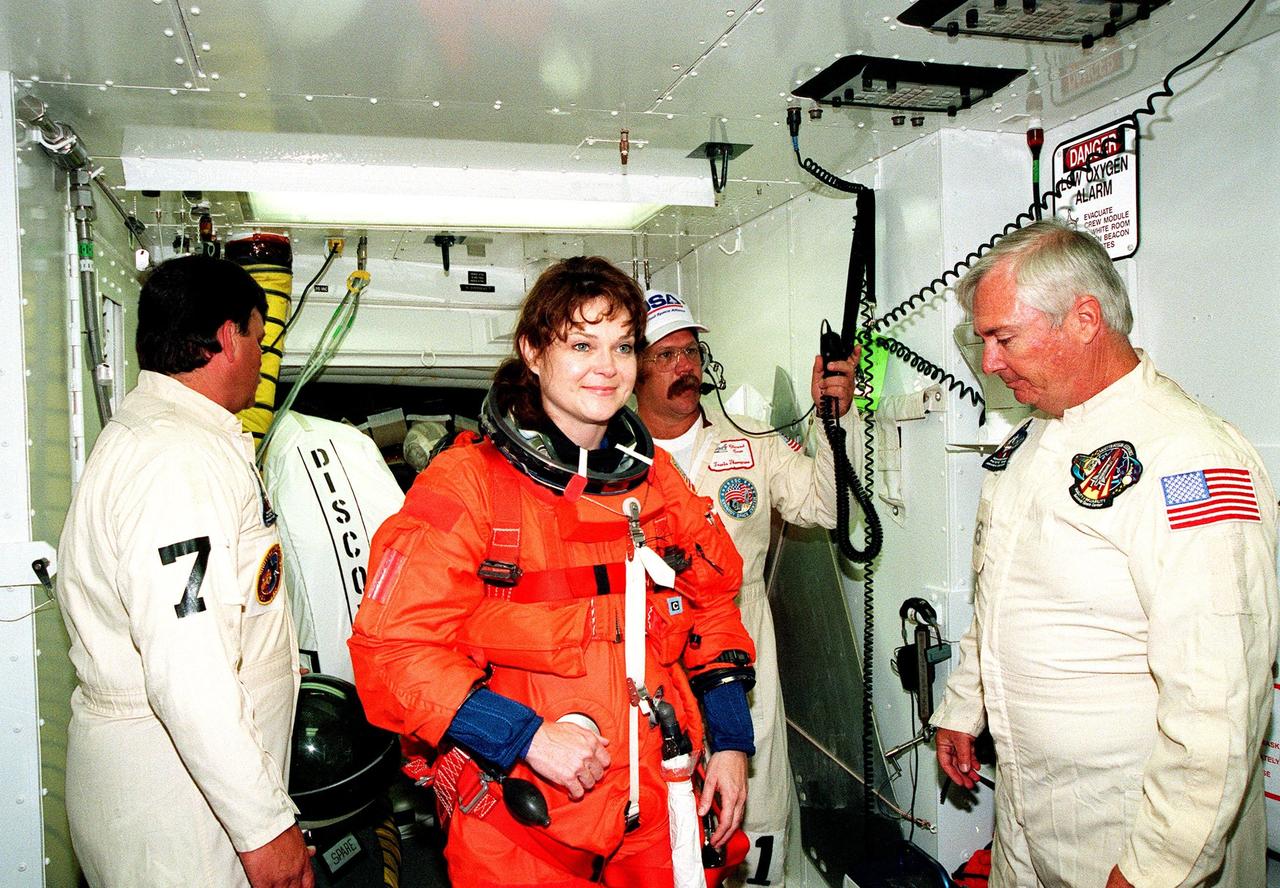
In the white room, an environmental chamber at Launch Pad 39B, Mission Specialist Tamara E. Jernigan (Ph.D.) gets ready to enter the orbiter Discovery. Helping her with her equipment are (left to right) Mike Birkenscher, Travis Thompson and James Davis. The STS-96 crew are taking part in Terminal Countdown Demonstration Test (TCDT) activities, which provide opportunities to inspect the mission payloads in the orbiter's payload bay, as well as simulated countdown exercises and emergency egress training. Other crew members are Commander Kent V. Rominger, Pilot Rick Douglas Husband, and Mission Specialists Ellen Ochoa (Ph.D.), Daniel Barry (M.D., Ph.D.), Julie Payette, who is with the Canadian Space Agency, and Valery Ivanovich Tokarev, who is with the Russian Space Agency. STS-96, scheduled for liftoff on May 20 at 9:32 a.m., is a logistics and resupply mission for the International Space Station, carrying such payloads as a Russian crane, the Strela; a U.S.-built crane; the Spacehab Oceaneering Space System Box (SHOSS), a logistics items carrier; and STARSHINE, a student-led experiment
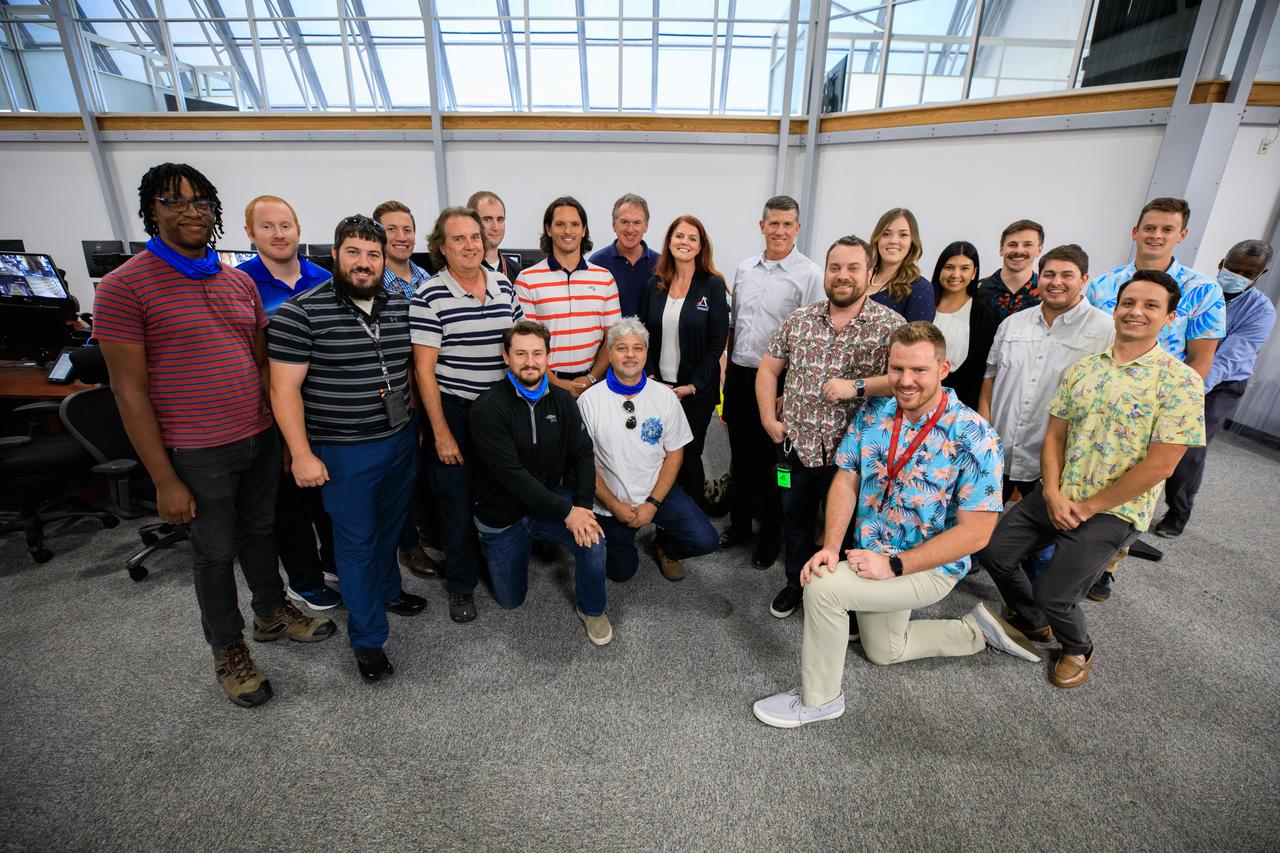
Members of the Artemis I launch team are photographed inside Firing Room 2 of the Rocco A. Petrone Launch Control Center at NASA’s Kennedy Space Center in Florida during a certification ceremony on Aug. 12, 2022. In the middle is Artemis I Launch Director Charlie Blackwell-Thompson. Behind her to the left is Mike Bolger, manager of NASA’s Exploration Ground Systems, and to her right is Jeremy Graeber, assistant launch director. The ceremony was held to commemorate the certification of the Artemis I launch team following their launch simulation held in December 2021. During the ceremony, senior members of the launch team handed out certificates to individual team members. The first in an increasingly complex series of missions, Artemis I will test NASA’s Space Launch System rocket and Orion spacecraft as an integrated system prior to crewed flights to the Moon. Through Artemis, NASA will land the first woman and the first person of color on the lunar surface, paving the way for long-term lunar presence and using the Moon as a steppingstone before venturing to Mars.
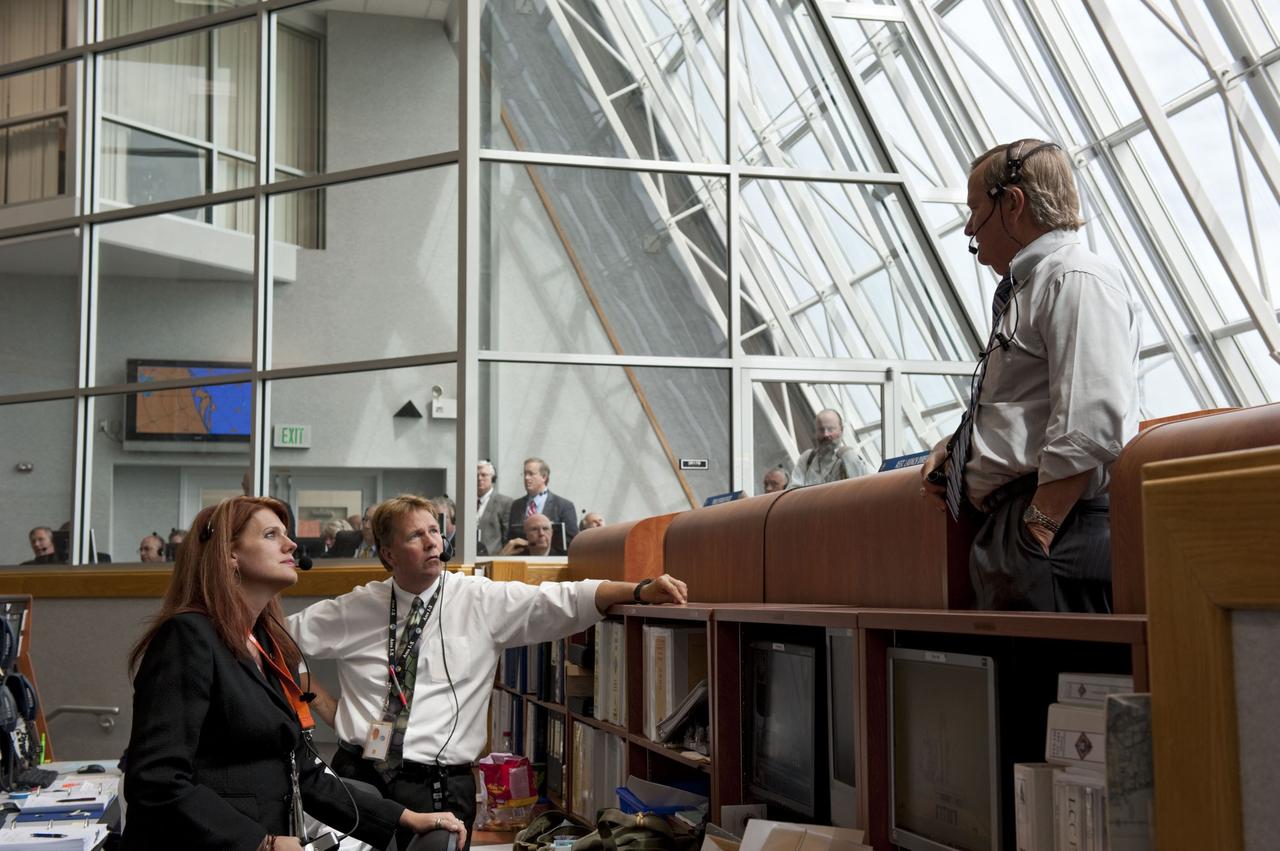
CAPE CANAVERAL, Fla. -- In Firing Room 4 of the Launch Control Center at NASA's Kennedy Space Center in Florida, Shuttle Launch Director Mike Leinbach speaks with NASA Test Directors Jeff Spaulding (center) and Charlie Blackwell-Thompson during the countdown to the launch of space shuttle Atlantis on its STS-135 mission to the International Space Station. Atlantis with its crew of four; Commander Chris Ferguson, Pilot Doug Hurley, Mission Specialists Sandy Magnus and Rex Walheim, lifted off at 11:29 a.m. EDT on July 8, 2011 to deliver the Raffaello multi-purpose logistics module packed with supplies and spare parts for the station. Atlantis also will fly the Robotic Refueling Mission experiment that will investigate the potential for robotically refueling existing satellites in orbit. In addition, Atlantis will return with a failed ammonia pump module to help NASA better understand the failure mechanism and improve pump designs for future systems. STS-135 will be the 33rd flight of Atlantis, the 37th shuttle mission to the space station, and the 135th and final mission of NASA's Space Shuttle Program. For more information, visit www.nasa.gov/mission_pages/shuttle/shuttlemissions/sts135/index.html. Photo credit: NASA/Kim Shiflett
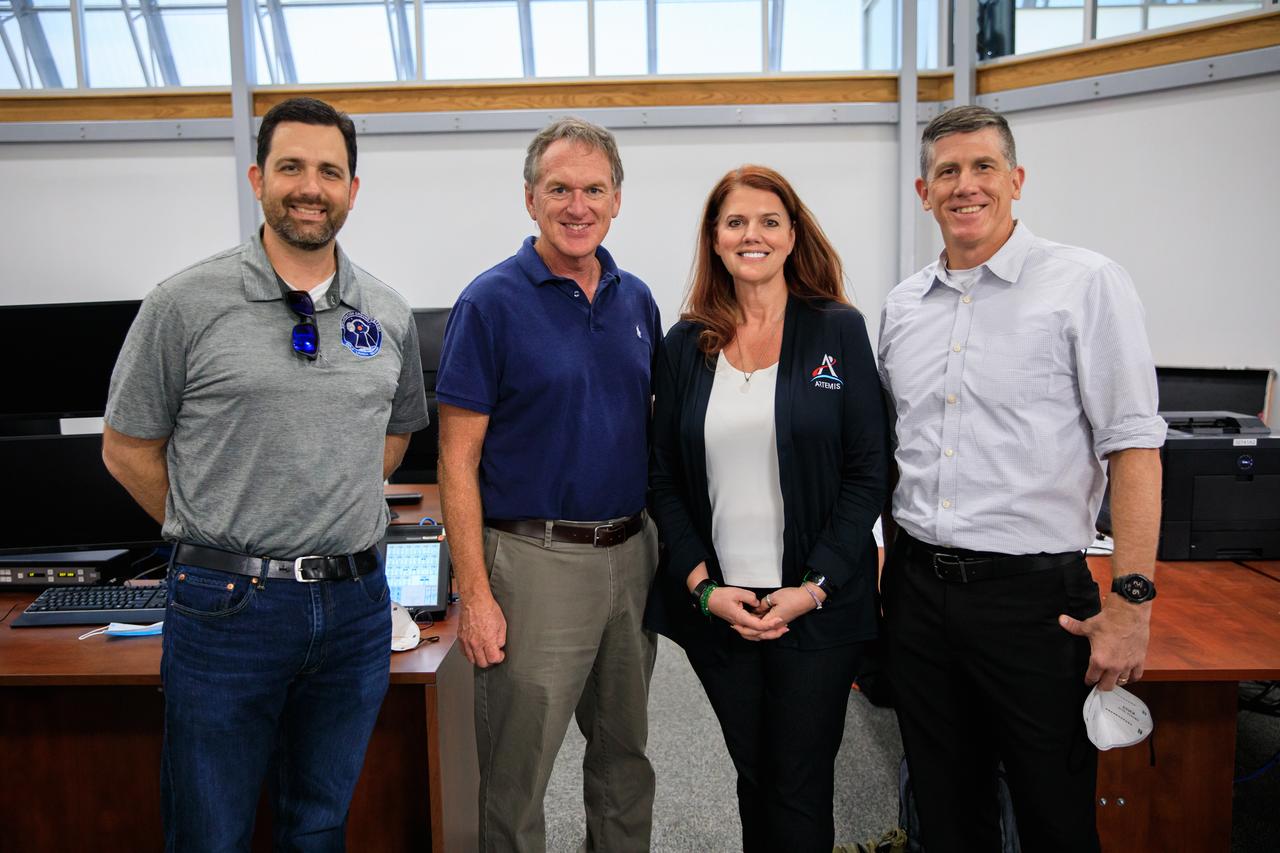
From left, NASA’s Exploration Ground Systems (EGS) Deputy Manager Jeremy Parsons, EGS Manager Mike Bolger, Artemis I Launch Director Charlie Blackwell-Thompson, and Assistant Launch Director Jeremy Graeber are photographed inside Firing Room 2 of the Rocco A. Petrone Launch Control Center at the agency’s Kennedy Space Center in Florida during a certification ceremony on Aug. 12, 2022. The ceremony was held to commemorate the certification of the Artemis I launch team following their launch simulation held in December 2021. During the ceremony, management staff handed out certificates to individual team members. The first in an increasingly complex series of missions, Artemis I will test NASA’s Space Launch System rocket and Orion spacecraft as an integrated system prior to crewed flights to the Moon. Through Artemis, NASA will land the first woman and the first person of color on the lunar surface, paving the way for long-term lunar presence and using the Moon as a steppingstone before venturing to Mars.
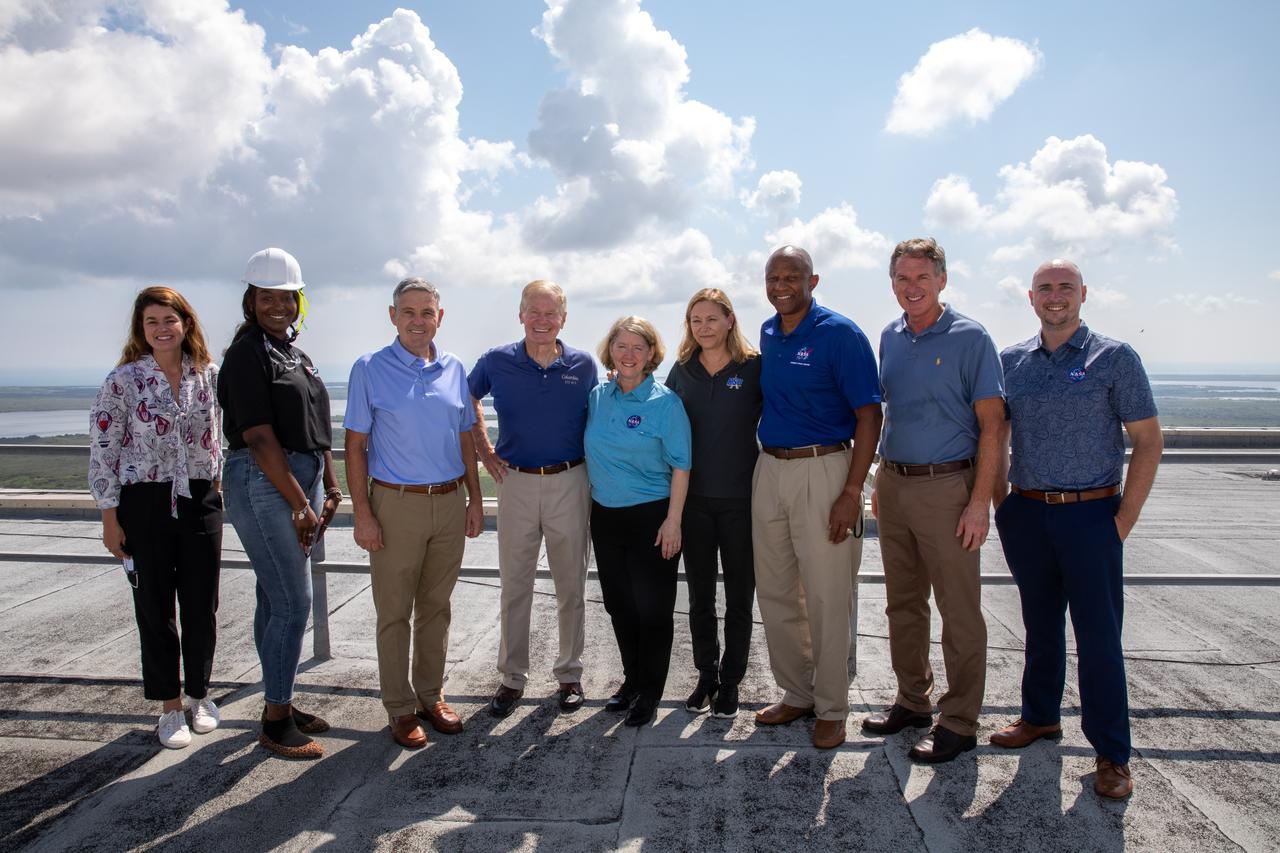
NASA and Kennedy Space Center leadership pose for a photo while touring the Vehicle Assembly Building (VAB) at the Florida spaceport on July 28, 2021. From left are NASA Headquarters’ Casey Swails; Tori Thompson, STEM intern for protocol; NASA Associate Administrator Bob Cabana; NASA Administrator Bill Nelson; NASA Deputy Administrator Pam Melroy; Kennedy Director Janet Petro; Kennedy Deputy Director Kelvin Manning; Mike Bolger, manager of NASA’s Exploration Ground Systems Program; and Executive Intern Peter Lyons. While inside the VAB, NASA senior leaders had the opportunity to view the Space Launch System (SLS) rocket as preparations for the Artemis I launch continue. The first in an increasingly complex set of missions, Artemis I will test SLS and Orion as an integrated system prior to crewed flights to the Moon. Through Artemis, NASA will land the first woman and first person of color on the lunar surface, as well as establish a sustainable presence on and around the Moon.
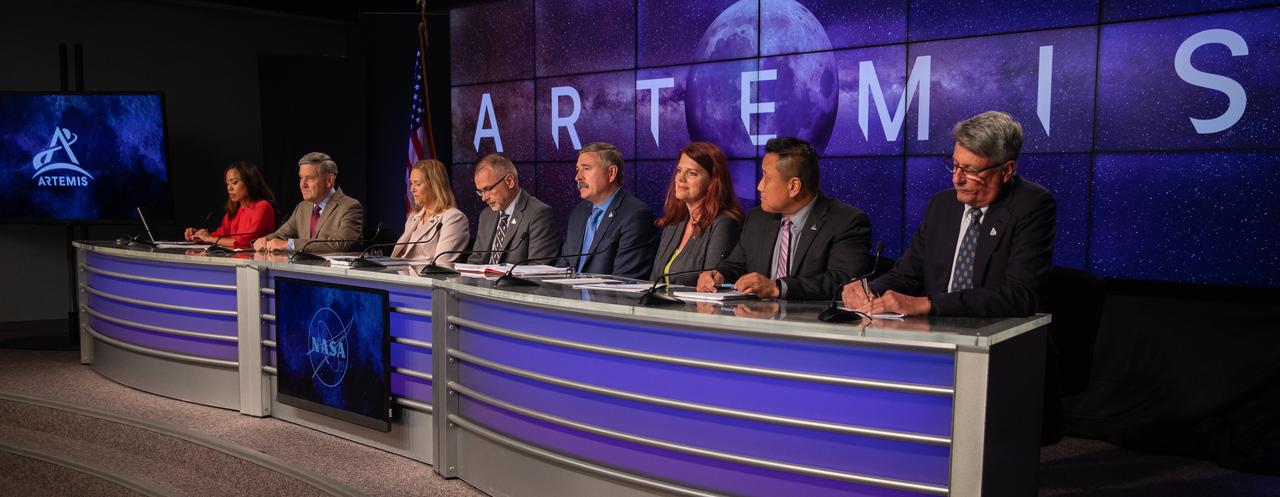
A prelaunch media briefing is held following completion of NASA’s Flight Readiness Review for Artemis I on Aug. 22, 2022, at the agency’s Kennedy Space Center in Florida. Participants are, from left, Megan Cruz, NASA Communications; Bob Cabana, NASA Associate Administrator; Janet Petro, Director, Kennedy Space Center; Jim Free, Associate Administrator, Exploration Systems Development; Mike Sarafin, Mission Manager, Artemis I; Charlie Blackwell-Thompson, Launch Director, Artemis I; Howard Hu, Manager, Orion Program; Chris Cianciola, Deputy Manager, SLS Program. Artemis I is scheduled to launch at 8:33 a.m. EDT on Aug. 29, 2022, from Kennedy’s Launch Complex 39B. The first in a series of increasingly complex missions, Artemis I will provide a foundation for human deep space exploration and demonstrate our commitment and capability to extend human presence to the Moon and beyond. The primary goal of Artemis I is to thoroughly test the integrated systems before crewed missions by operating the spacecraft in a deep space environment, testing Orion’s heat shield, and recovering the crew module after reentry, descent, and splashdown.
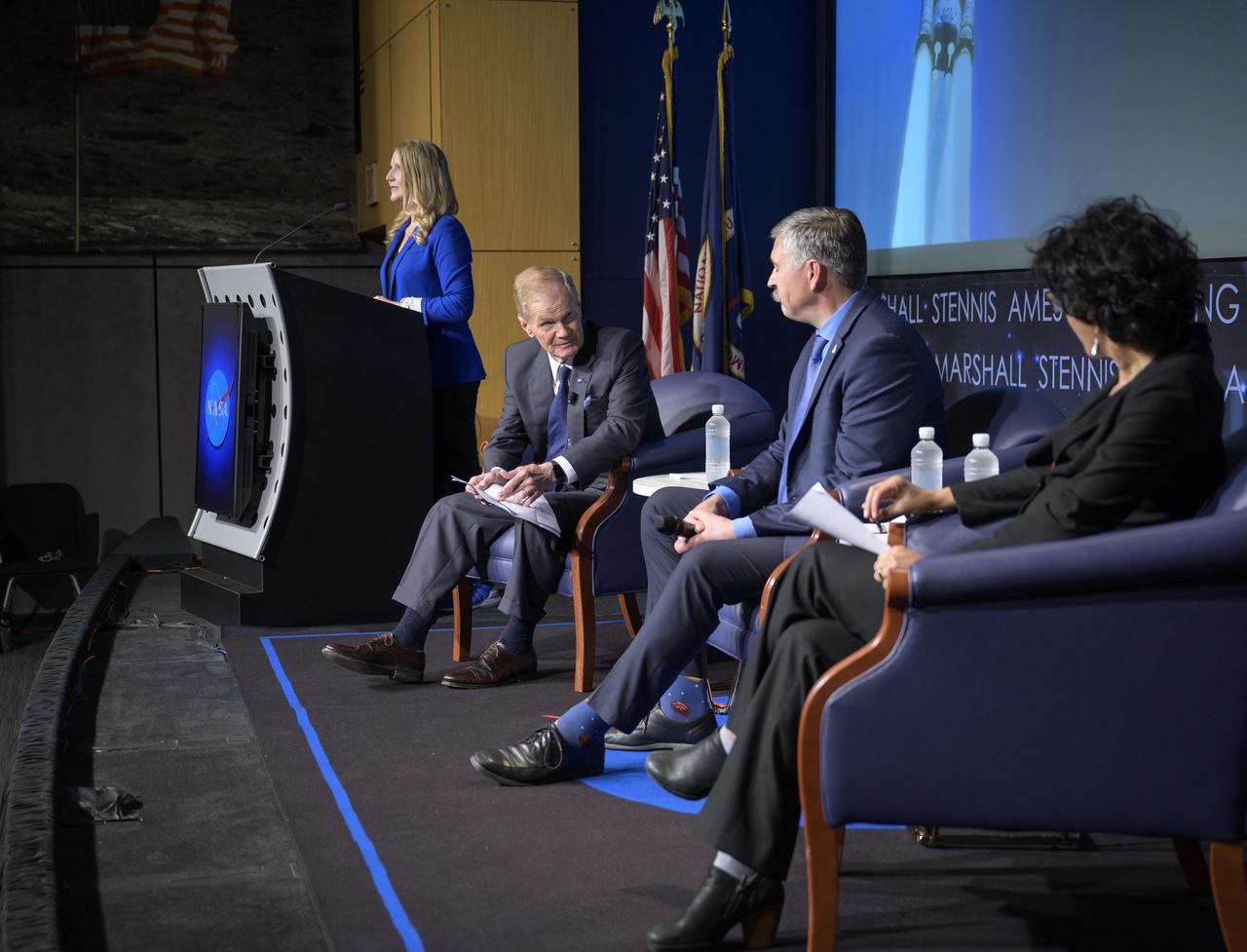
Stephanie Schierholz, a press secretary at NASA Headquarters, left, moderates a NASA briefing on the Artemis I Moon mission, with NASA Administrator Bill Nelson, Mike Sarafin, Artemis I mission manager at NASA Headquarters, and Bhavya Lal, associate administrator for technology, policy, and strategy at NASA Headquarters, right, Wednesday, Aug. 3, 2022, at the Mary W. Jackson NASA Headquarters building in Washington. Also participating remotely were Charlie Blackwell-Thompson, Artemis I launch director at NASA's Kennedy Space Center, John Honeycutt, Space Launch System (SLS) program manager at NASA's Marshall Space Flight Center, and Howard Hu, Orion program manager at NASA's Johnson Space Center. NASA’s Artemis I mission is the first integrated test of the agency’s deep space exploration systems: the Orion spacecraft, Space Launch System rocket, and supporting ground systems. Launch of the uncrewed flight test is targeted for no earlier than Monday, Aug. 29. Photo Credit: (NASA/Bill Ingalls)
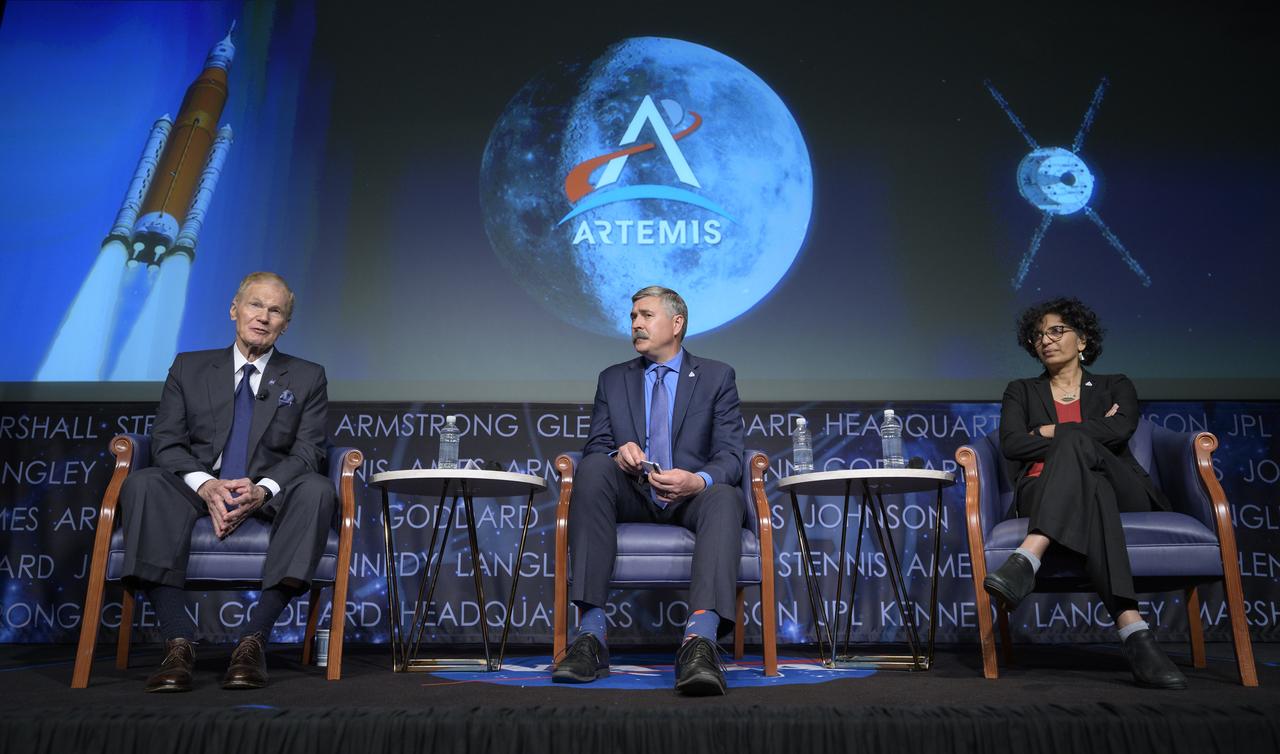
NASA Administrator Bill Nelson, left, Mike Sarafin, Artemis I mission manager at NASA Headquarters, and Bhavya Lal, associate administrator for technology, policy, and strategy at NASA Headquarters, right, are seen during a NASA briefing on the Artemis I Moon mission, Wednesday, Aug. 3, 2022, at the Mary W. Jackson NASA Headquarters building in Washington. Also participating remotely were Charlie Blackwell-Thompson, Artemis I launch director at NASA's Kennedy Space Center, John Honeycutt, Space Launch System (SLS) program manager at NASA's Marshall Space Flight Center, and Howard Hu, Orion program manager at NASA's Johnson Space Center. NASA’s Artemis I mission is the first integrated test of the agency’s deep space exploration systems: the Orion spacecraft, Space Launch System rocket, and supporting ground systems. Launch of the uncrewed flight test is targeted for no earlier than Monday, Aug. 29. Photo Credit: (NASA/Bill Ingalls)
CAPE CANAVERAL, Fla. - Following a successful launch, space shuttle Endeavour NASA Flow Director Dana Hutcherson congratulates Shuttle Launch Director Mike Leinbach, right, and Closeout Crew Lead Travis Thompson in Firing Room 4 of the Launch Control Center at NASA's Kennedy Space Center in Florida. Endeavour lifted off on its STS-134 mission to the International Space Station on time at 8:56 a.m. EDT on May 16. The shuttle and its six-member crew are embarking on a mission to deliver the Alpha Magnetic Spectrometer-2 (AMS), Express Logistics Carrier-3, a high-pressure gas tank and additional spare parts for the Dextre robotic helper to the space station. Endeavour's first launch attempt on April 29 was scrubbed because of an issue associated with a faulty power distribution box called the aft load control assembly-2 (ALCA-2). For more information visit, www.nasa.gov/mission_pages/shuttle/shuttlemissions/sts134/index.html. Photo credit: NASA/Kim Shiflett
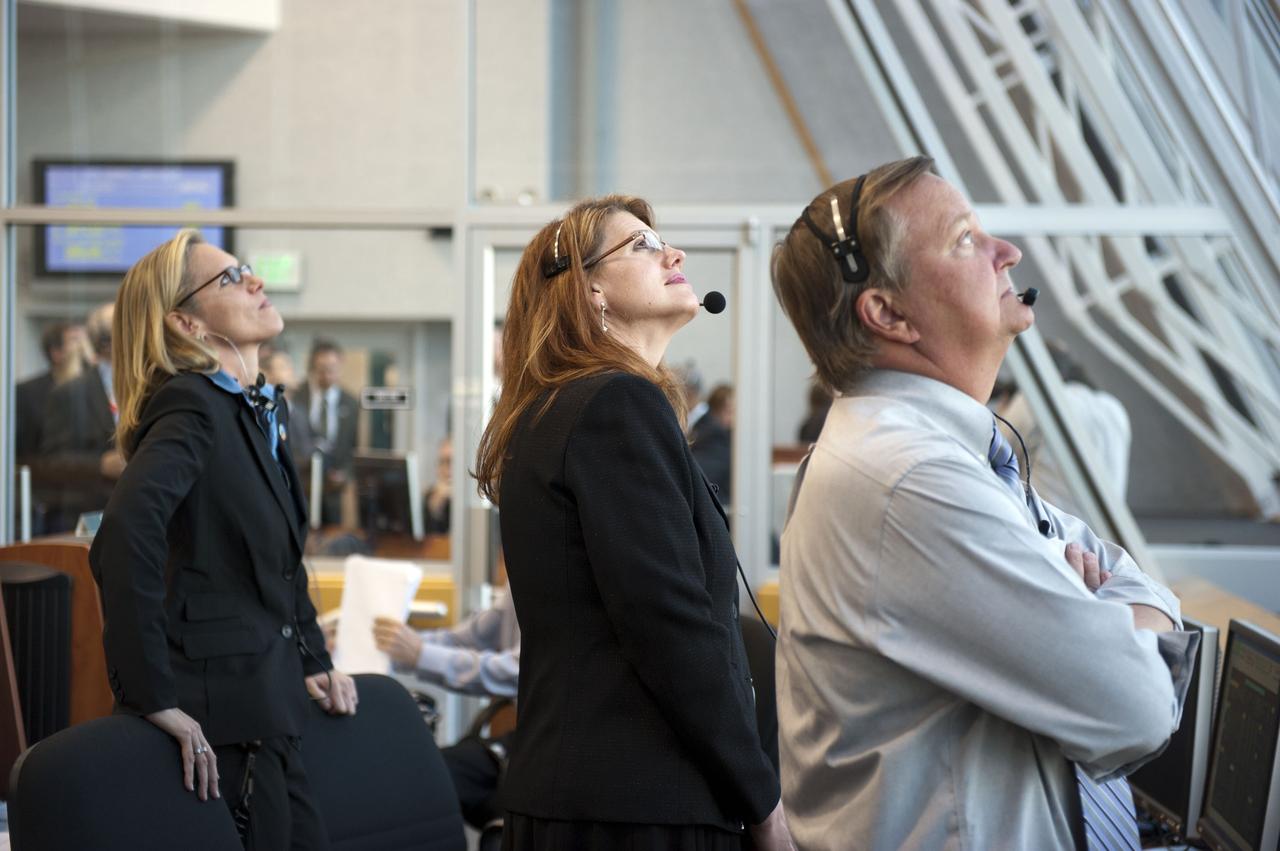
CAPE CANAVERAL, Fla. -- In Firing Room 4 of the Launch Control Center at NASA's Kennedy Space Center in Florida, NASA's Discovery Flow Director Stephanie Stilson, left, STS-133 Assistant Shuttle Launch Director and lead NASA Test Director Charlie Blackwell-Thompson and Shuttle Launch Director Mike Leinbach watch space shuttle Discovery blaze a trail of smoke and steam as it heads toward orbit on the STS-133 mission to the International Space Station. Discovery and its six-member crew are on a mission to deliver the Permanent Multipurpose Module, packed with supplies and critical spare parts, as well as Robonaut 2, the dexterous humanoid astronaut helper, to the orbiting outpost. Discovery is making its 39th mission and is scheduled to be retired following STS-133. This is the 133rd Space Shuttle Program mission and the 35th shuttle voyage to the space station. For more information on the STS-133 mission, visit www.nasa.gov/mission_pages/shuttle/shuttlemissions/sts133/. Photo credit: NASA/Kim Shiflett
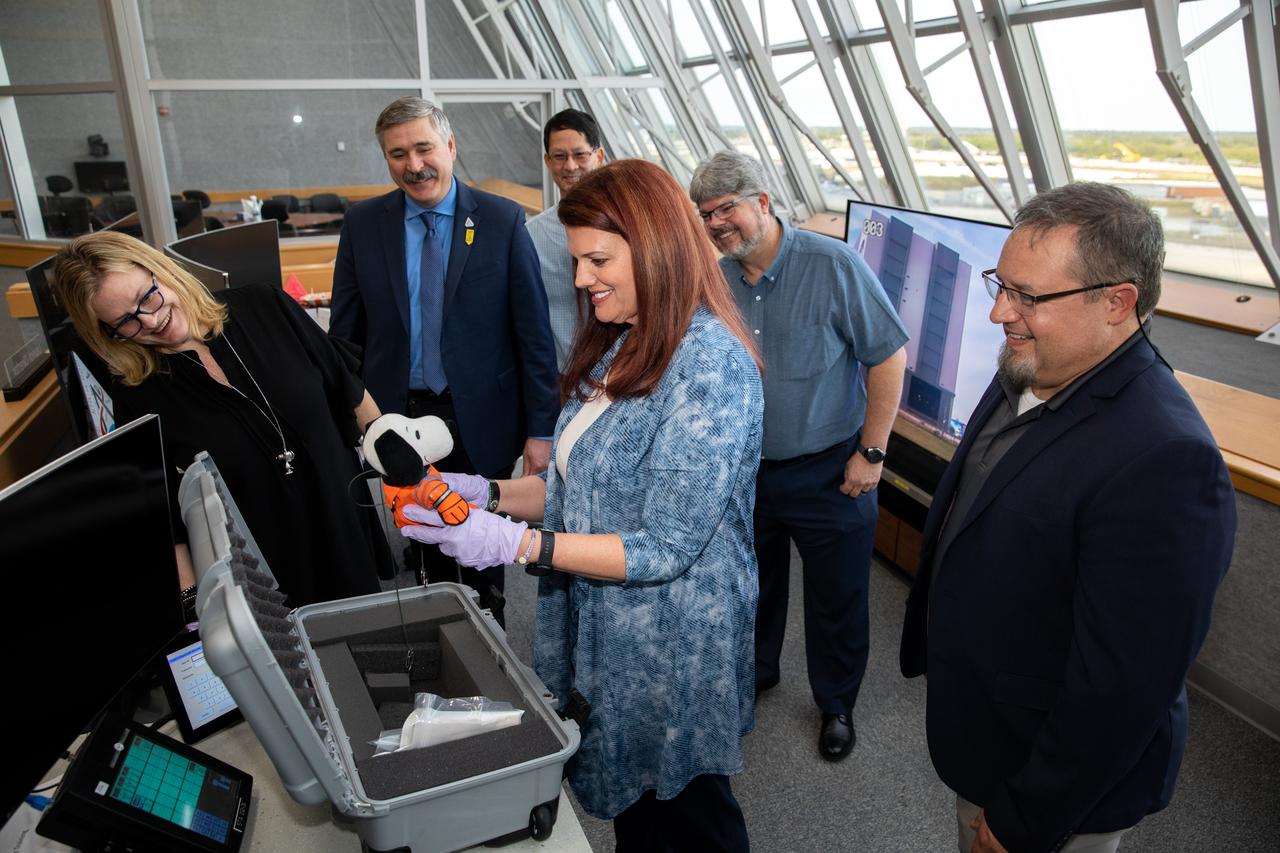
Artemis Launch Director Charlie Blackwell-Thompson, in the center, performs the official turnover of Snoopy to Melissa Menta, far left, senior vice president with Peanuts Worldwide LLC, inside Launch Control Center Firing Room 1 at NASA’s Kennedy Space Center in Florida on Jan. 18, 2023. From left, behind Charlie are Mike Sarafin, Artemis I mission manager; Glenn Chin, deputy manager, Orion Production Operations Office, Exploration Ground Systems; Kevin Ash, payload and flight crew equipment project lead with Jacobs; and Joe LeBlanc, Orion payload and cargo manager with Lockheed Martin. Snoopy served as the zero-gravity indicator during the Artemis I mission. Snoopy was secured inside Orion during the mission, a journey beyond the Moon and back to prepare for crewed missions to the Moon. Artemis I launched atop the Space Launch System rocket on Nov. 16, 2022 from Kennedy’s Launch Complex 39B. Orion returned to Earth for a splashdown in the Pacific Ocean on Dec. 11, 2022 after traveling more than 1.4 million miles. NASA has held an association with Snoopy since the Apollo Era – the character has contributed to the excitement for NASA human spaceflight missions, helping inspire generations to dream big, and is a symbol of NASA’s safety culture and mission success.
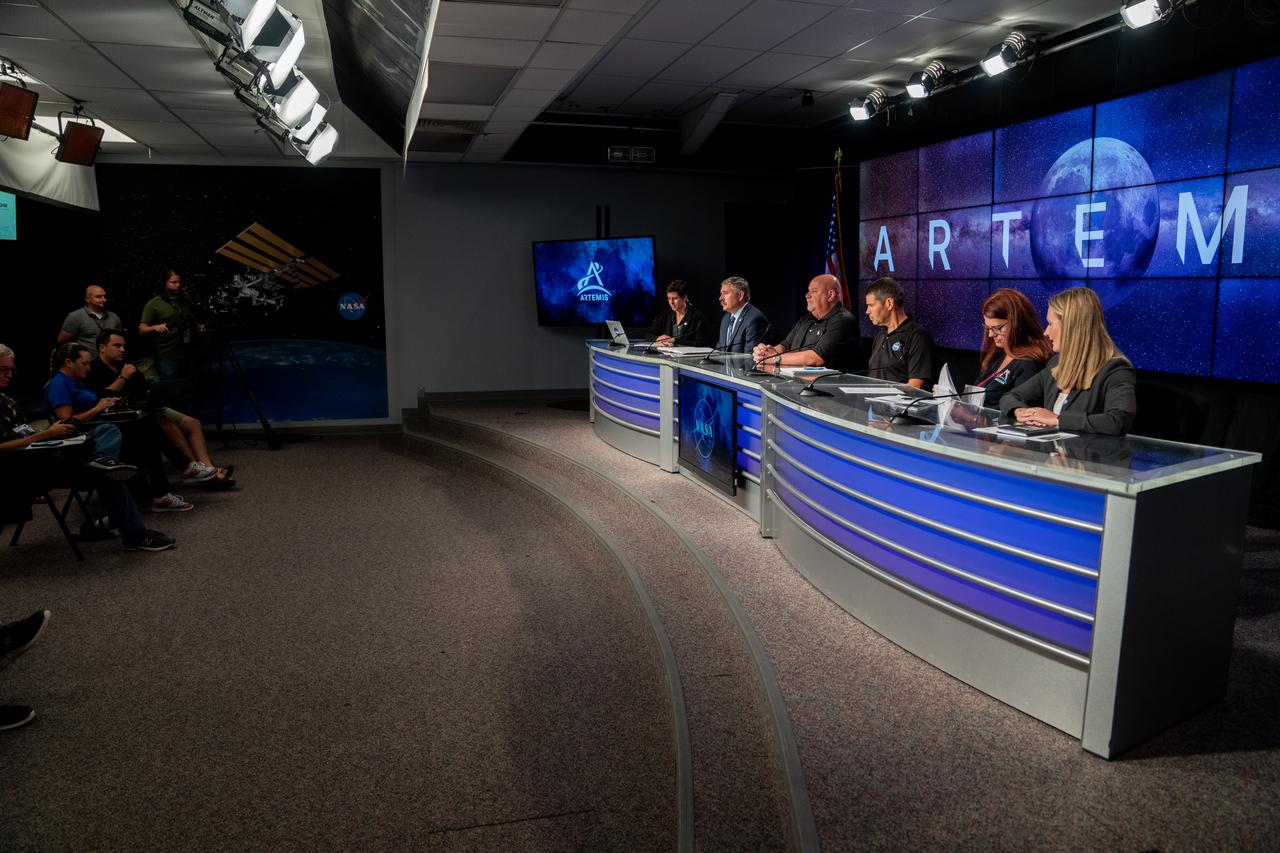
A prelaunch media briefing is held following a mission management team meeting for Artemis I on Sept. 1, 2022, at NASA’s Kennedy Space Center in Florida. Participants are, from left, Rachel Kraft, NASA Communications; Mike Sarafin, Artemis mission manager; John Honeycutt, Space Launch System (SLS) program manager; John Blevins, SLS chief engineer; Charlie Blackwell-Thompson, Artemis launch director; and Melody Lovin, Space Launch Delta 45 weather officer. Artemis I is scheduled to launch at 2:17 p.m. EDT on Sept. 3, from Kennedy’s Launch Complex 39B. Launch was waved off on Aug. 29 due to an issue during tanking. The first in a series of increasingly complex missions, Artemis I will provide a foundation for human deep space exploration and demonstrate NASA’s capability to extend human presence to the Moon and beyond. The primary goal of Artemis I is to thoroughly test the integrated systems before crewed missions by operating the spacecraft in a deep space environment, testing Orion’s heat shield, and recovering the crew module after reentry, descent, and splashdown.
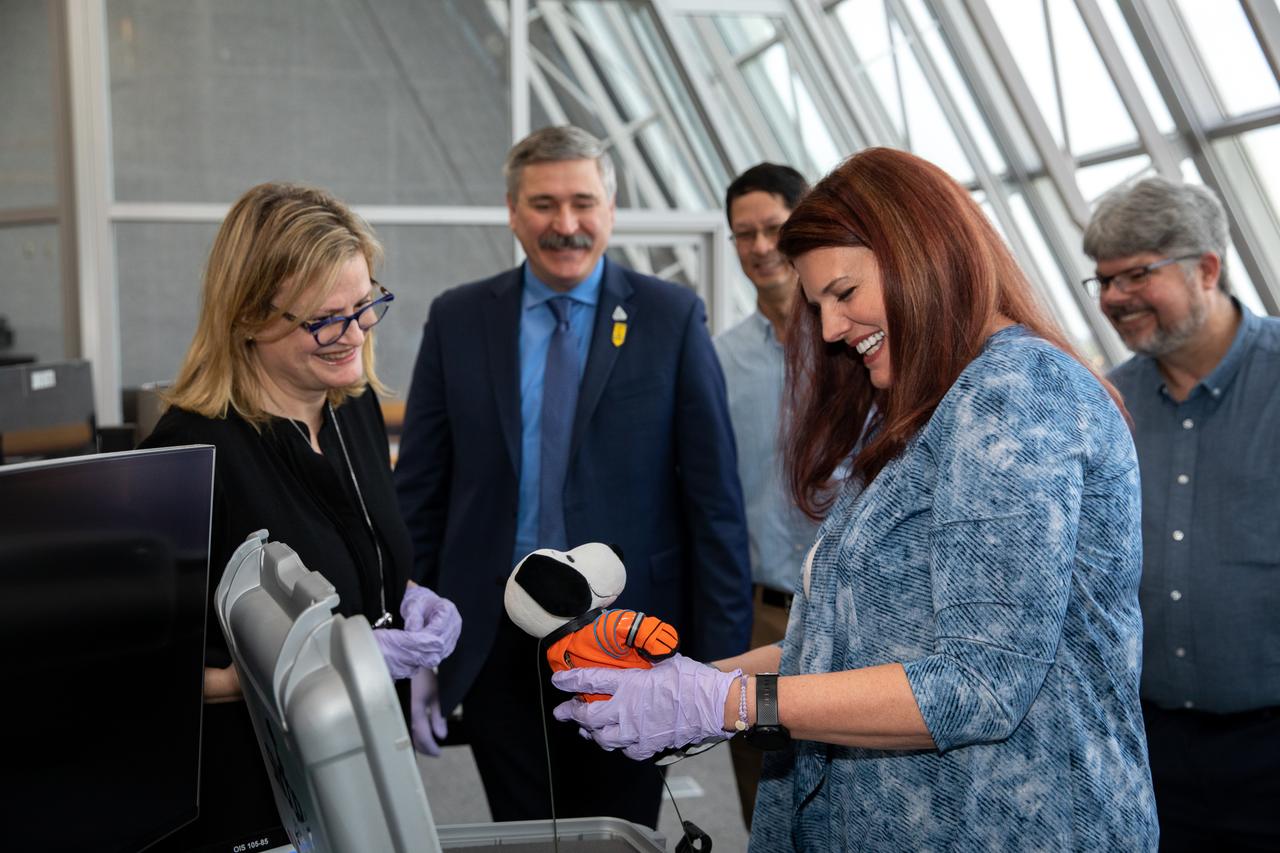
Artemis Launch Director Charlie Blackwell-Thompson, in the center, performs the official turnover of Snoopy to Melissa Menta, far left, senior vice president with Peanuts Worldwide LLC, inside Launch Control Center Firing Room 1 at NASA’s Kennedy Space Center in Florida on Jan. 18, 2023. From left, behind Charlie are Mike Sarafin, Artemis I mission manager; Glenn Chin, deputy manager, Orion Production Operations Office, Exploration Ground Systems; and Kevin Ash, payload and flight crew equipment project lead with Jacobs. Snoopy served as the zero-gravity indicator during the Artemis I mission. Snoopy was secured inside Orion during the mission, a journey beyond the Moon and back to prepare for crewed missions to the Moon. Artemis I launched atop the Space Launch System rocket on Nov. 16, 2022 from Kennedy’s Launch Complex 39B. Orion returned to Earth for a splashdown in the Pacific Ocean on Dec. 11, 2022 after traveling more than 1.4 million miles. NASA has held an association with Snoopy since the Apollo Era – the character has contributed to the excitement for NASA human spaceflight missions, helping inspire generations to dream big, and is a symbol of NASA’s safety culture and mission success.
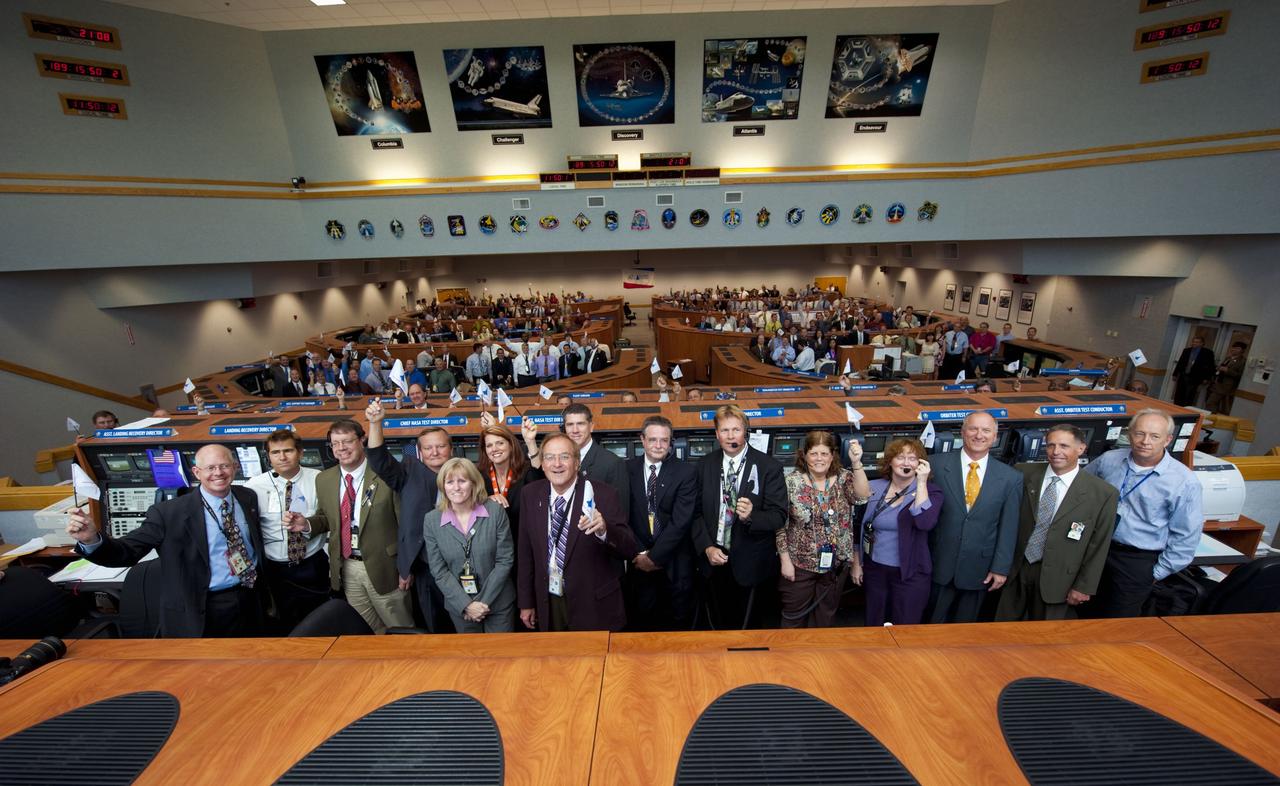
CAPE CANAVERAL, Fla. -- Launch controllers wave their STS-135 shuttle launch team member flags and cheer in Firing Room 4 of the Launch Control Center following the successful launch of space shuttle Atlantis from NASA's Kennedy Space Center in Florida. In the foreground, from left, are NASA Test Directors Steve Payne and Bob Holl; Landing and Recovery Director Greg Gaddis; Shuttle Launch Director Mike Leinbach; Atlantis' NASA Flow Director Angie Brewer; NASA Test Director Charlie Blackwell-Thompson; STS-135 Launch Commentator George Diller; NASA Test Directors Jeremy Graeber, Tim Potter, and Jeff Spaulding; Orbiter Test Conductor Roberta Wyrick; Assistant Orbiter Test Conductor Laurie Sally; Assistant Launch Director Pete Nickolenko; United Space Alliance Vice President of Launch and Recovery Systems Mark Nappi; and United Space Alliance Test Conductor Mark Paxton. Atlantis began its final flight, the STS-135 mission to the International Space Station, at 11:29 a.m. EDT on July 8. STS-135 will deliver the Raffaello multi-purpose logistics module packed with supplies and spare parts for the International Space Station. Atlantis also is flying the Robotic Refueling Mission experiment that will investigate the potential for robotically refueling existing satellites in orbit. In addition, Atlantis will return with a failed ammonia pump module to help NASA better understand the failure mechanism and improve pump designs for future systems. STS-135 is the 33rd flight of Atlantis, the 37th shuttle mission to the space station, and the 135th and final mission of NASA's Space Shuttle Program. For more information, visit www.nasa.gov/mission_pages/shuttle/shuttlemissions/sts135/index.html. Photo credit: NASA/Kim Shiflett