
Mimas On the Move
Mimas and the Giant
The Mimas Atlas
Spotlight on Mimas
The Mimas Atlas
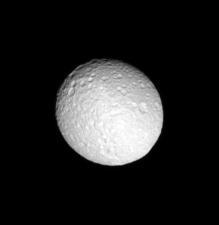
Mimas Aslant
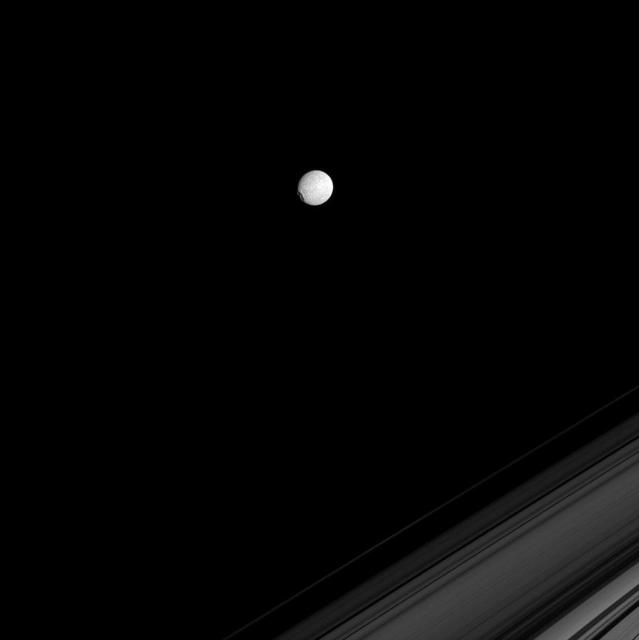
Mimas in Profile
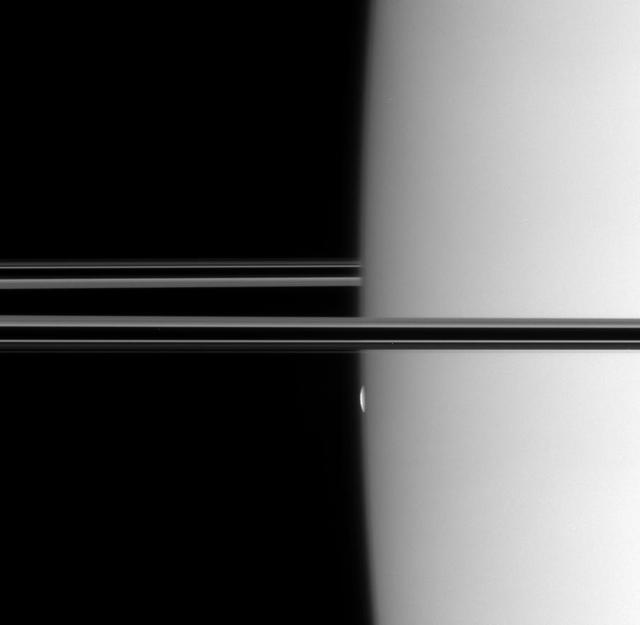
Mimas Emerges
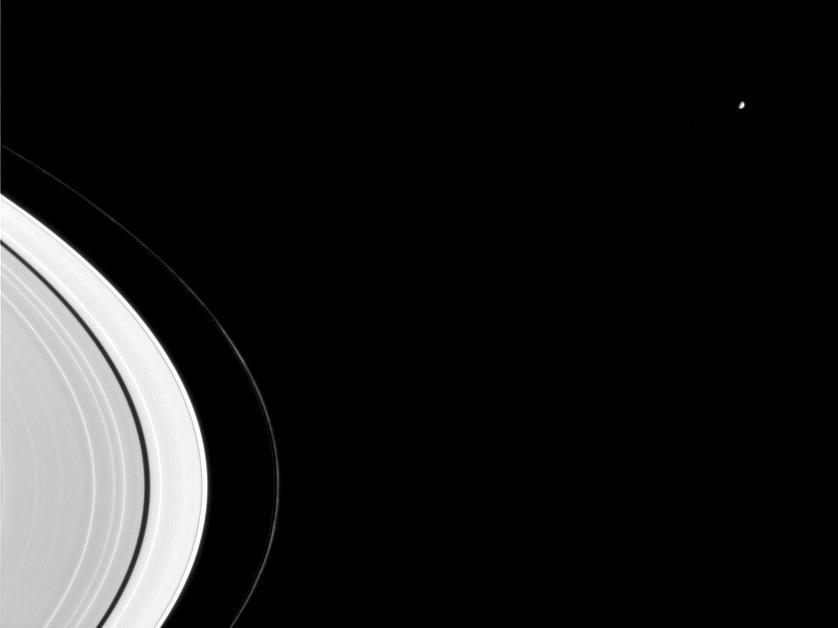
Influence of Mimas

Mimas and the Rings
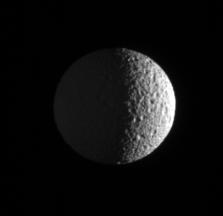
Mimas in View
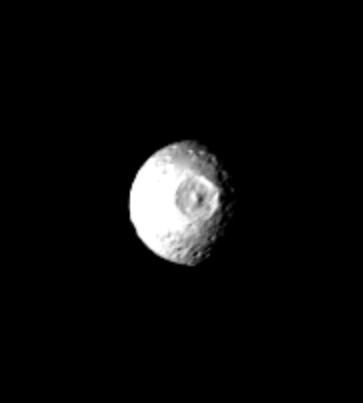
Mimas - Large Impact Structure
Saturn Moon Mimas
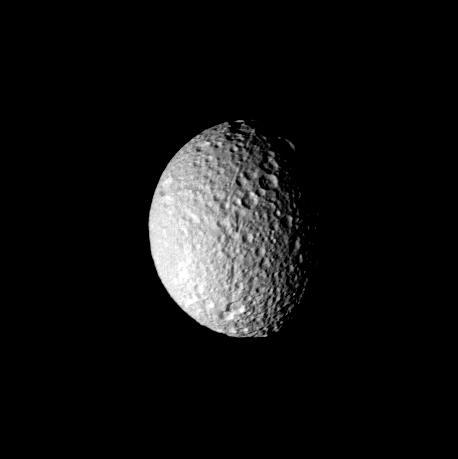
Mimas - cratered surface
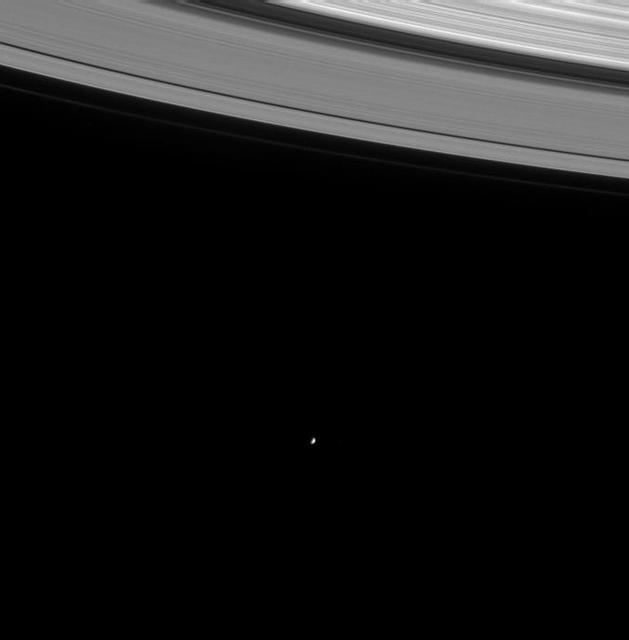
Gazing Upon Mimas
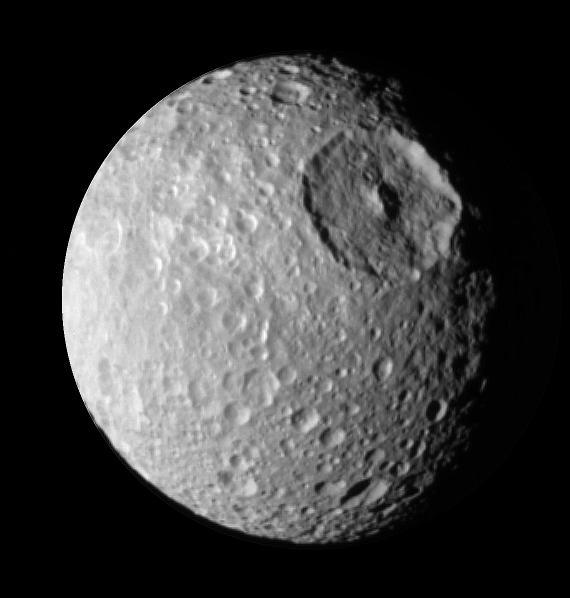
Up Close to Mimas
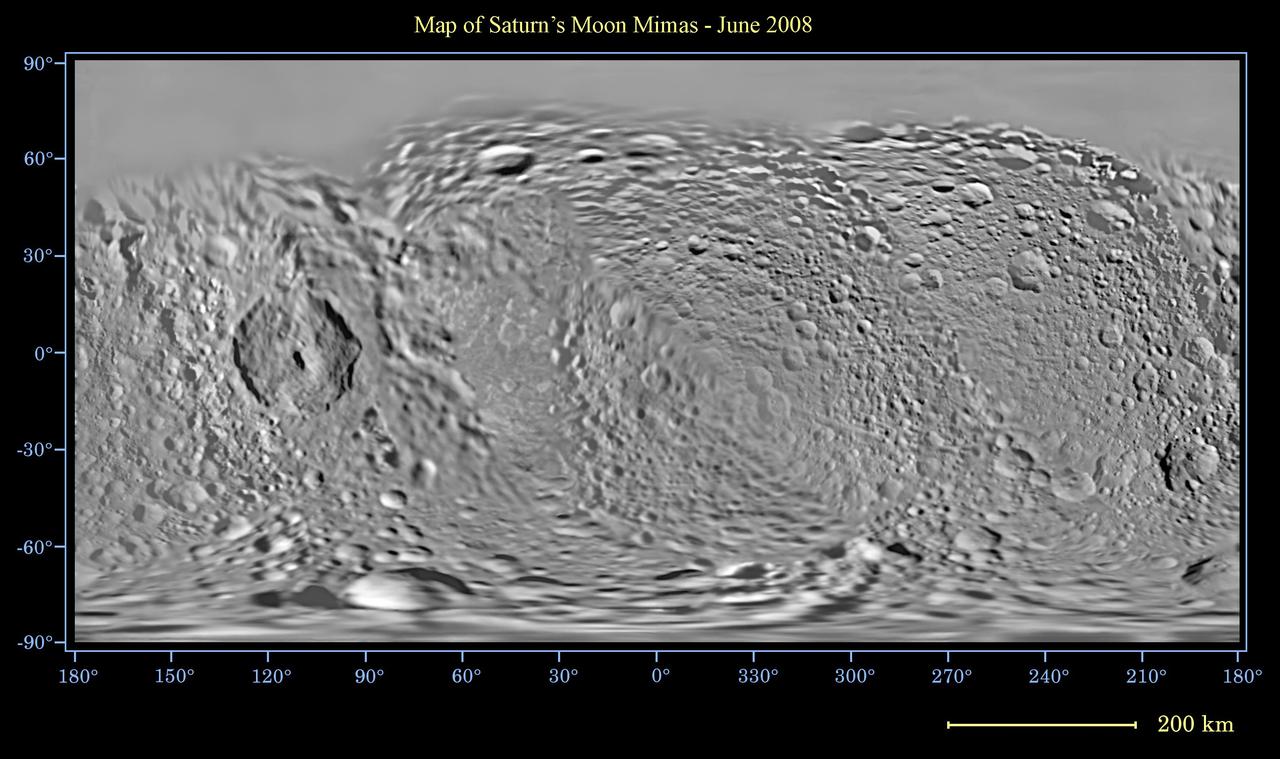
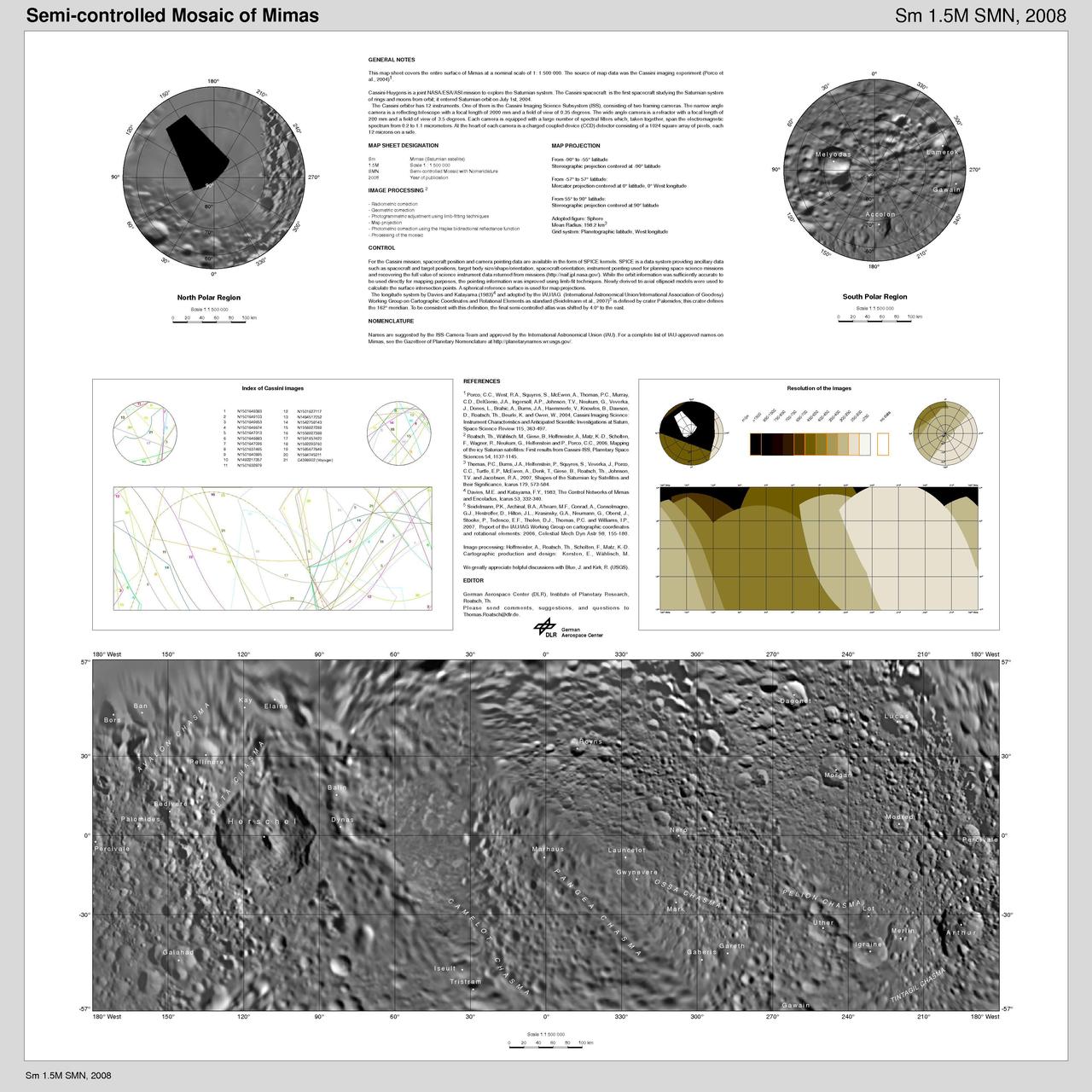
Map of Mimas - June 2008
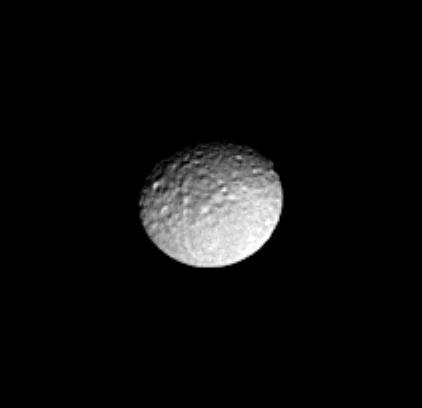
Battered Icy Mimas
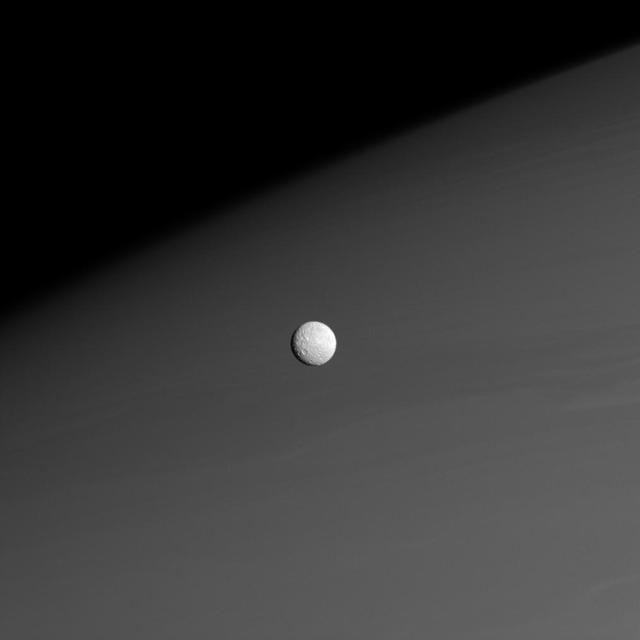
Mimas Before Saturn

High Above Mimas

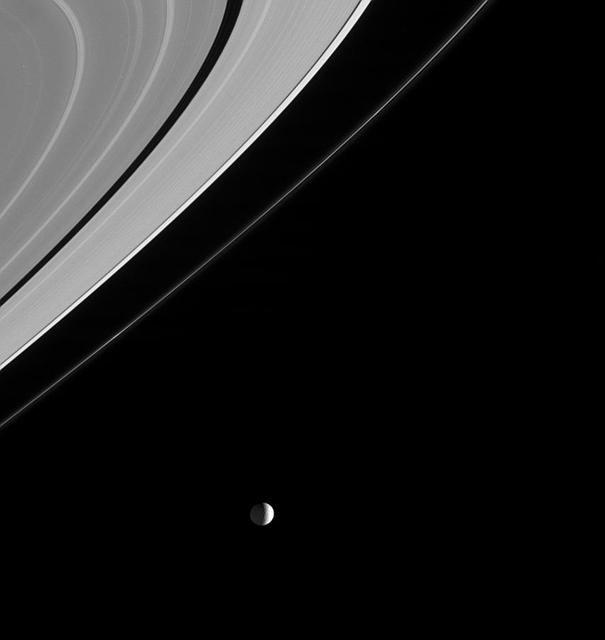
Beyond the Rings: Mimas
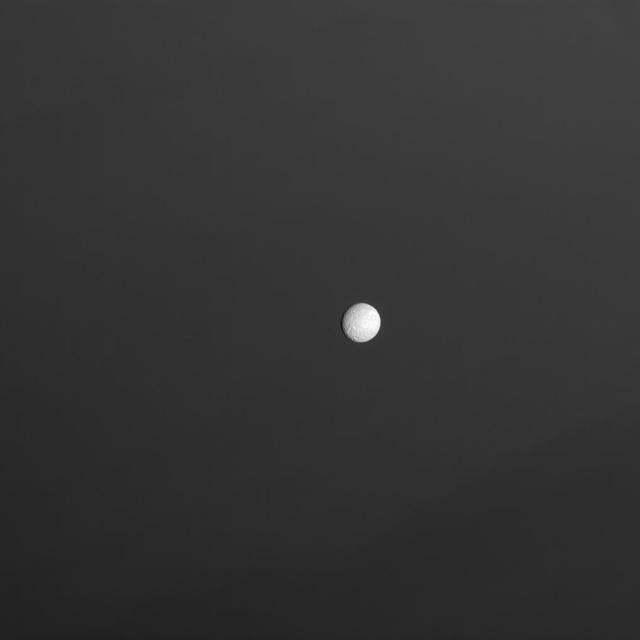
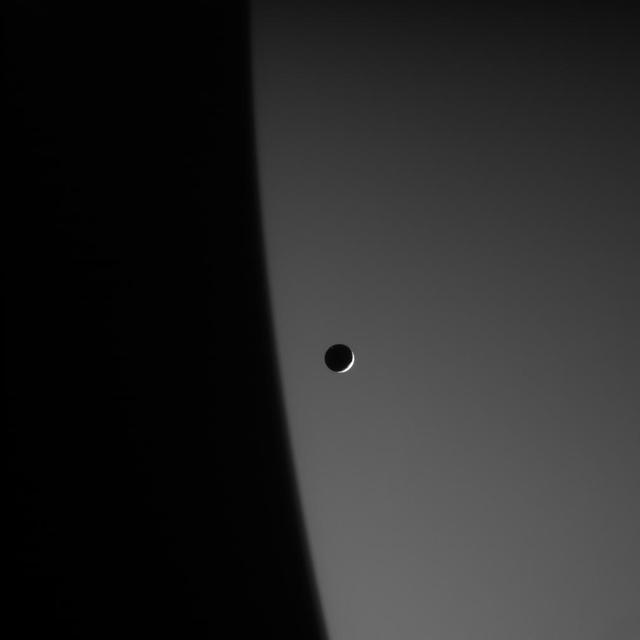
Mimas Above the Haze
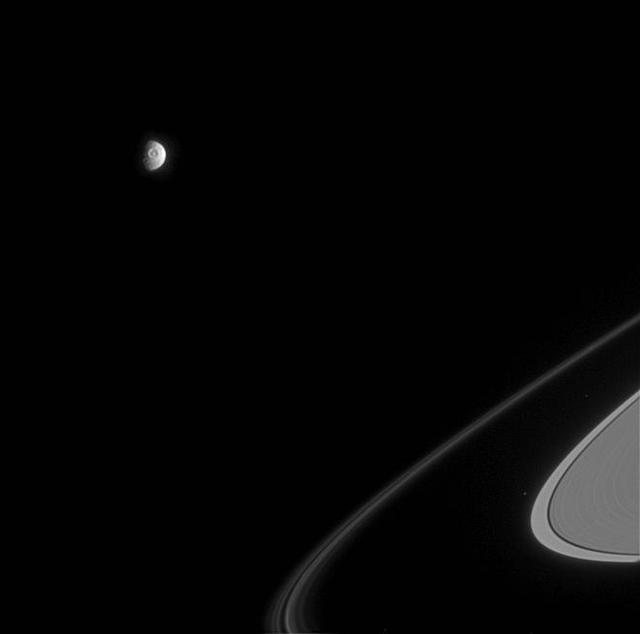
Mimas Stares Back
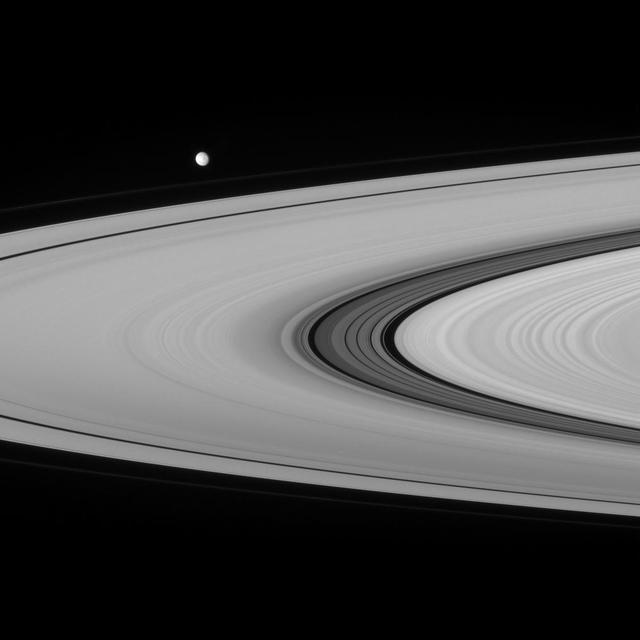
Mimas and the Great Division
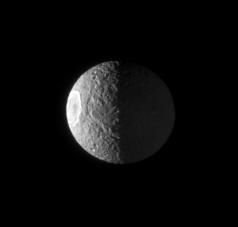
Rough, Icy Mimas

First Quarter Mimas
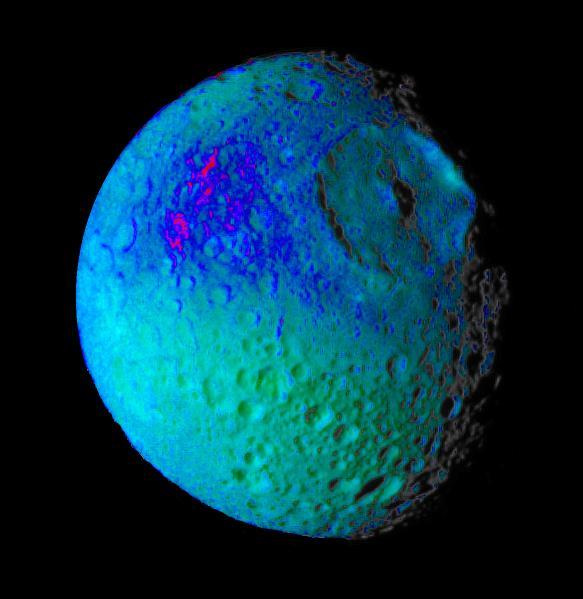
Mimas Showing False Colors #2
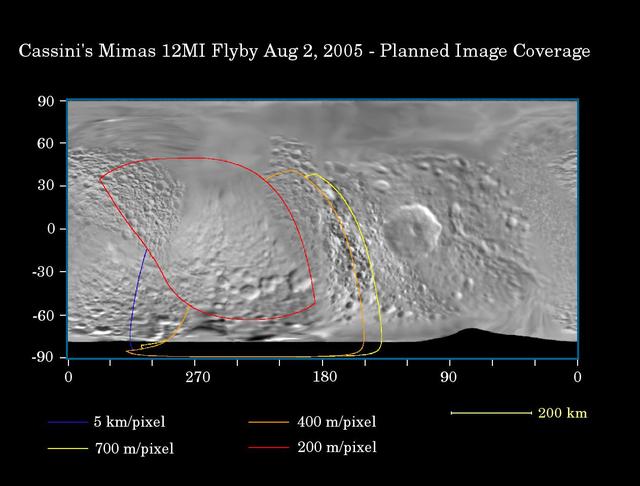
Mimas: Closer Than Ever Before
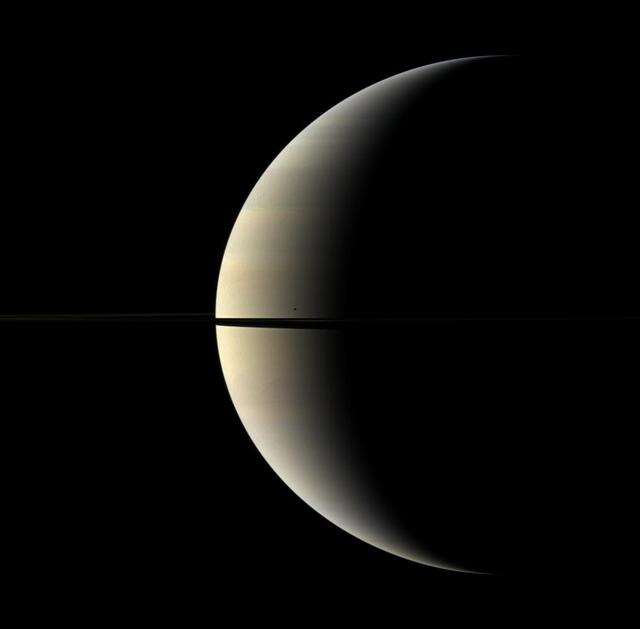
A pastel crescent of Saturn is interrupted by the moon Mimas and the rings in this color image captured by NASA Cassini spacecraft. Mimas 396 kilometers, or 246 miles across appears as a dark speck just above the rings.
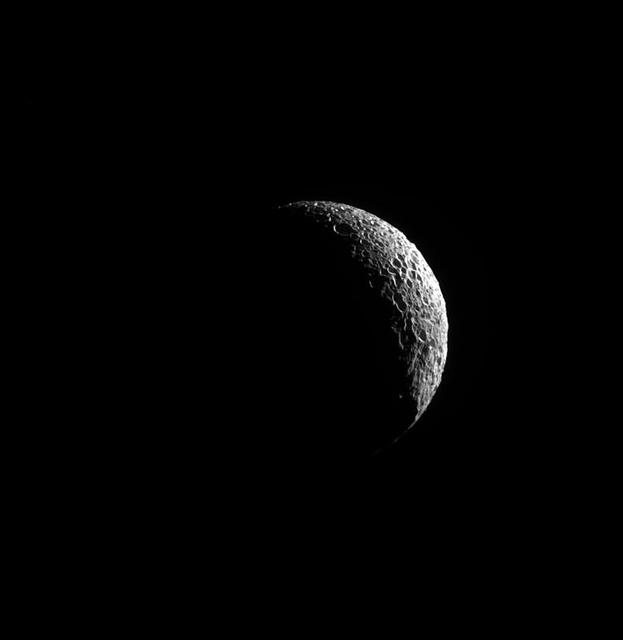
A thin sliver of Mimas is illuminated, the long shadows showing off its many craters, indicators of the moon's violent history. The most famous evidence of a collision on Mimas (246 miles, or 396 kilometers across) is the crater Herschel that gives Mimas its Death Star-like appearance. See PIA12568 for more on Herschel. This view looks toward the anti-Saturn hemisphere of Mimas. North on Mimas is up and rotated 40 degrees to the right. The image was taken in visible light with the Cassini spacecraft narrow-angle camera on May 20, 2013. The view was acquired at a distance of approximately 100,000 miles (200,000 kilometers) from Mimas and at a Sun-Mimas-spacecraft, or phase, angle of 130 degrees. Image scale is 4,000 feet (1 kilometer) per pixel. http://photojournal.jpl.nasa.gov/catalog/PIA18285
Saturn and its north polar hexagon dwarf Mimas as the moon peeks over the planet limb. Saturn A ring also makes an appearance on the far right. Mimas is 246 miles 396 kilometers across.
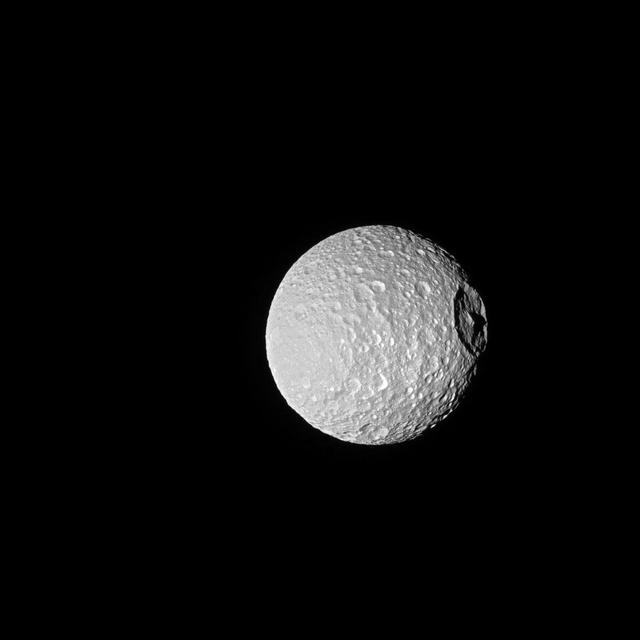
Shadows cast across Mimas' defining feature, Herschel Crater, provide an indication of the size of the crater's towering walls and central peak. Named after the icy moon's discoverer, astronomer William Herschel, the crater stretches 86 miles (139 kilometers) wide -- almost one-third of the diameter of Mimas (246 miles or 396 kilometers) itself. Large impact craters often have peaks in their center -- see Tethys' large crater Odysseus in PIA08400. Herschel's peak stands nearly as tall as Mount Everest on Earth. This view looks toward the anti-Saturn hemisphere of Mimas. North on Mimas is up and rotated 21 degrees to the left. The image was taken with the Cassini spacecraft narrow-angle camera on Oct. 22, 2016 using a combination of spectral filters which preferentially admits wavelengths of ultraviolet light centered at 338 nanometers. The view was acquired at a distance of approximately 115,000 miles (185,000 kilometers) from Mimas and at a Sun-Mimas-spacecraft, or phase, angle of 20 degrees. Image scale is 3,300 feet (1 kilometer) per pixel. http://photojournal.jpl.nasa.gov/catalog/PIA20515
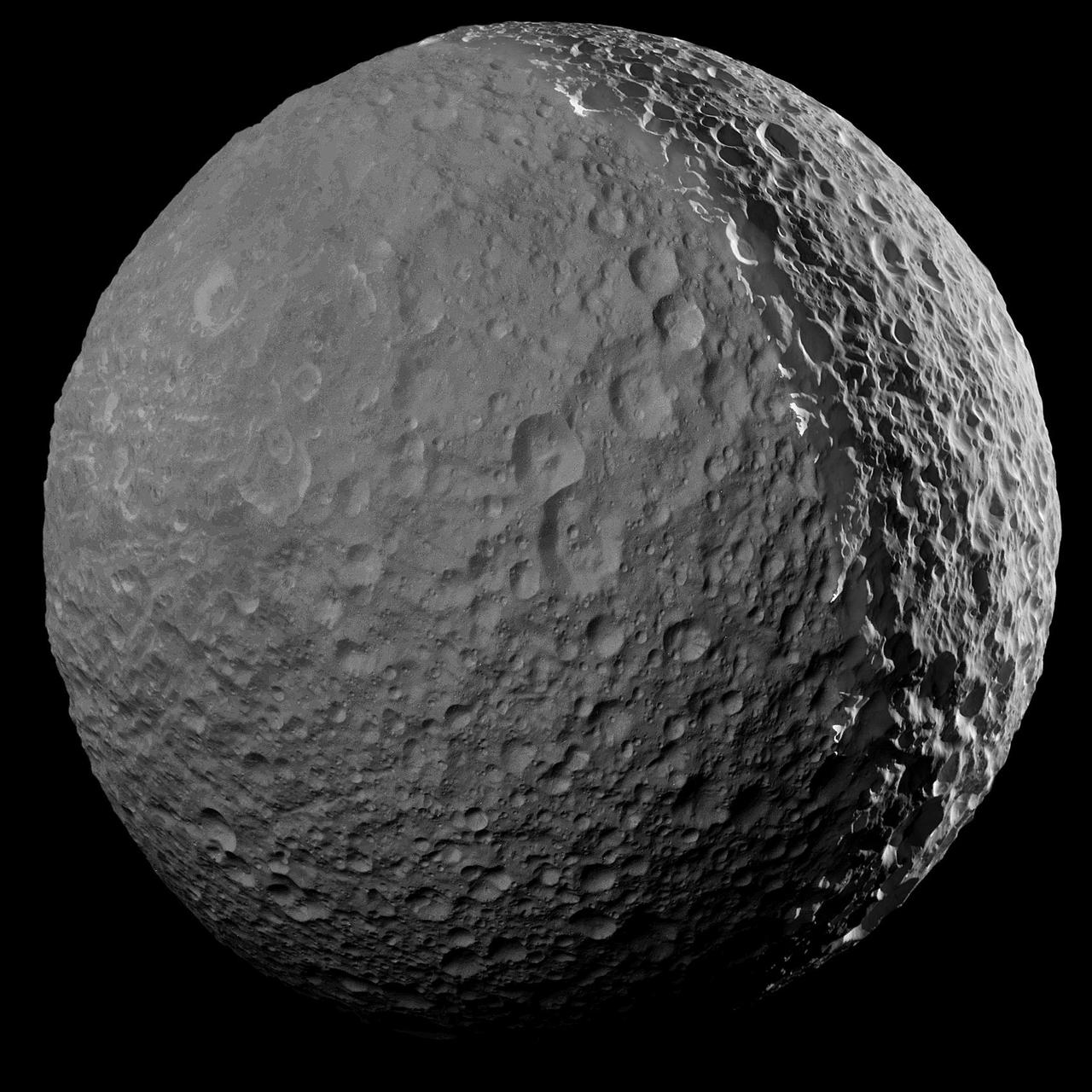
In its season of "lasts," NASA's Cassini spacecraft made its final close approach to Saturn's moon Mimas on January 30, 2017. At closest approach, Cassini passed 25,620 miles (41,230 kilometers) from Mimas. All future observations of Mimas will be from more than twice this distance. This mosaic is one of the highest resolution views ever captured of the icy moon. Close approaches to Mimas have been somewhat rare during Cassini's mission, with only seven flybys at distances of less than 31,000 miles (50,000 kilometers). Mimas' surface is pockmarked with countless craters, the largest of which gives the icy moon its distinctive appearance. Imaging scientists combined ten narrow-angle camera images to create this mosaic view. The scene is an orthographic projection centered on terrain at 17.5 degrees south latitude, 325.4 degrees west longitude on Mimas. An orthographic view is most like the view seen by a distant observer looking through a telescope. This mosaic was acquired at a distance of approximately 28,000 miles (45,000 kilometers) from Mimas. Image scale is approximately 820 feet (250 meters) per pixel. The images were taken in visible light with the Cassini spacecraft narrow-angle camera on Jan. 30, 2017. http://photojournal.jpl.nasa.gov/catalog/PIA17213
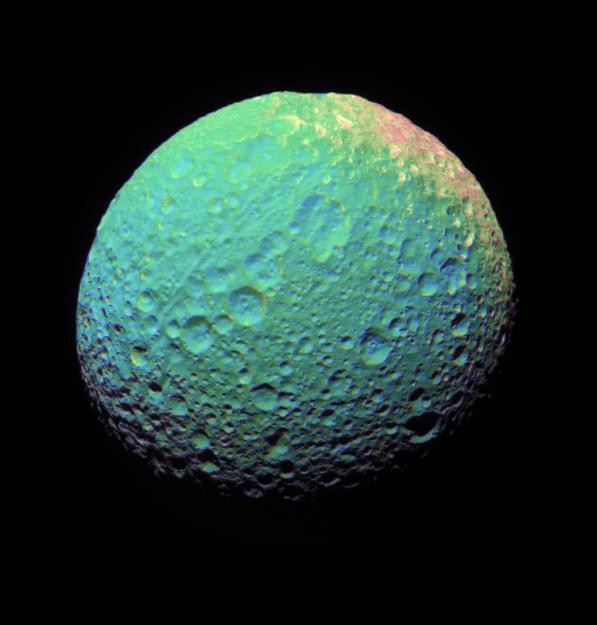
This extreme false-color view of Mimas shows color variation across the moon surface

The oblate moon Mimas displays the cratered surface of its anti-Saturn side in this image taken by NASA Cassini spacecraft.
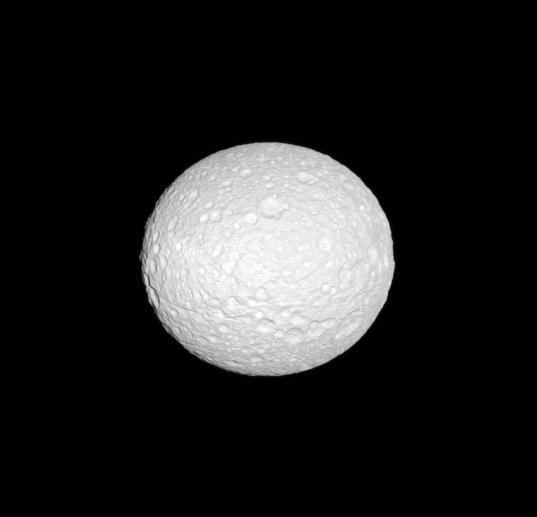
NASA Cassini spacecraft reveals the cratered surface of Mimas, a moon whose shape is flattened at the poles.
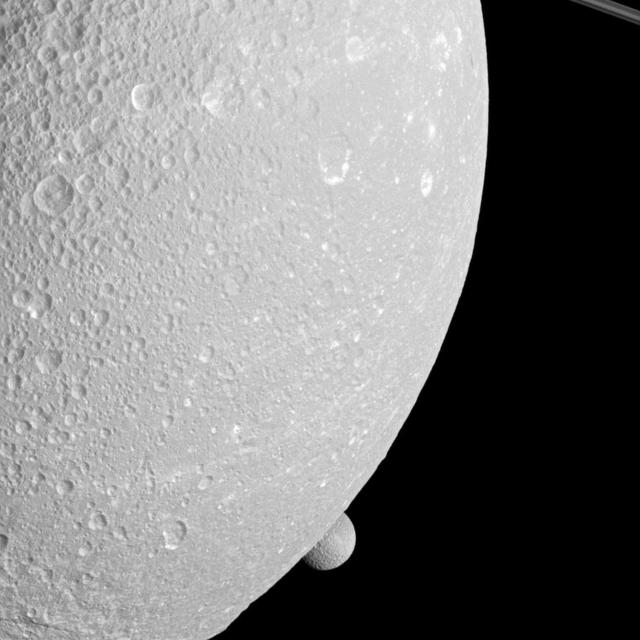
Saturn moon Mimas peeps out from behind the larger moon Dione in this view from NASA Cassini spacecraft.
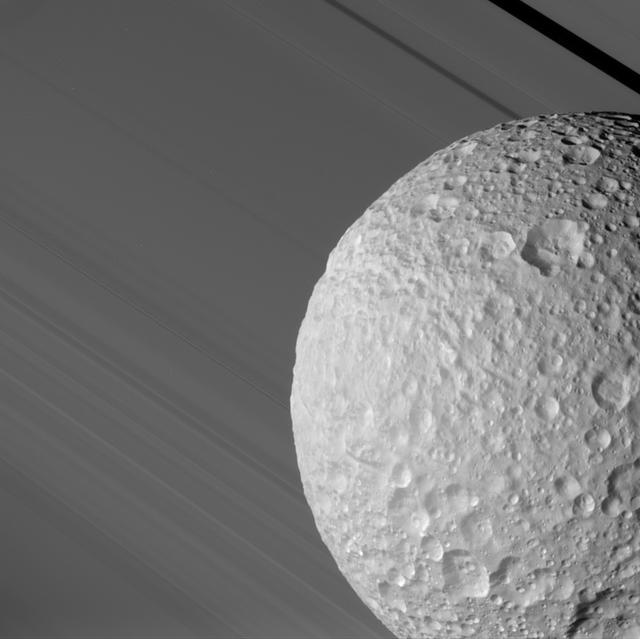
During its close flyby of Saturn's moon Mimas on Aug. 2, 2005, Cassini caught a glimpse of Mimas against the broad expanse of Saturn's rings. The Keeler Gap in the outer A ring, in which Cassini spied a never-before-seen small moon (see PIA06237), is at the upper right. The ancient, almost asteroid-like surface of Mimas is evident in its crater-upon-crater appearance. Even the material which has slumped down into the bottom of some of its craters bears the marks of later impacts. This image was taken through the clear filter of the Cassini spacecraft narrow-angle camera at a distance of 68,000 kilometers (42,500 miles) from Mimas and very near closest approach. The smallest features seen on the moon are about 400 meters wide (440 yards); the Sun-Mimas-Cassini angle is 44 degrees. http://photojournal.jpl.nasa.gov/catalog/PIA06412

Although we are used to seeing Saturn's moons lit directly by the Sun, sometimes we can catch them illuminated by "Saturnshine." Here, we see Mimas (upper right) lit by light reflected off of Saturn. With each reflection, the intensity of the illumination is decreased significantly. To better illustrate the effect of Saturnshine, in this image Mimas (246 miles, 396 kilometers across), has had its brightness enhanced by a factor of 2.5 relative to the rings. This view looks toward the trailing hemisphere of Mimas. North on Mimas is up and rotated 8 degrees to the right. The image was taken in visible light with the Cassini spacecraft narrow-angle camera on Feb. 16, 2015. The view was obtained at a distance of approximately 1.6 million miles (2.5 million kilometers) from Mimas and at a Sun-Mimas-spacecraft, or phase, angle of 148 degrees. Image scale is 9 miles (15 kilometers) per pixel. http://photojournal.jpl.nasa.gov/catalog/pia18312
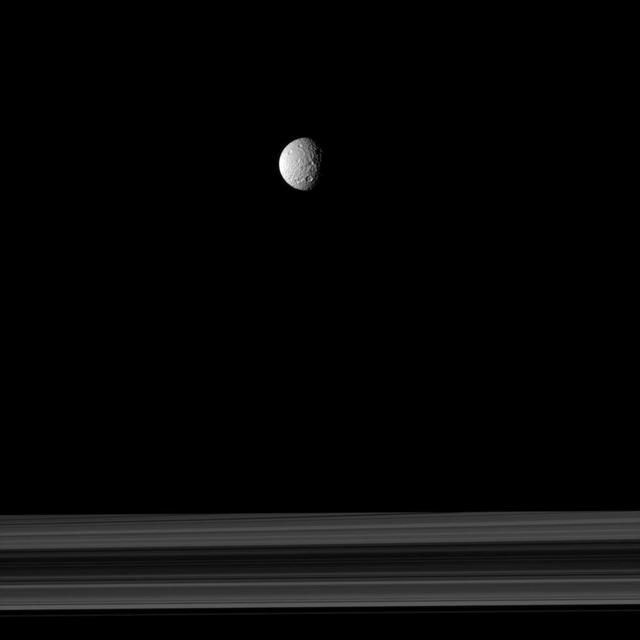
The cratered moon Mimas appears as if it has been hung like an ornament above Saturn rings in this image taken by NASA Cassini spacecraft.
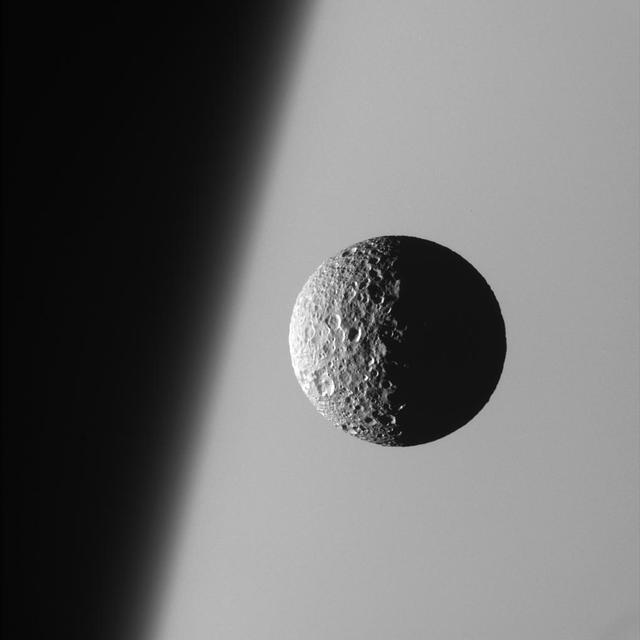
This amazing perspective view captures battered Mimas against the hazy limb of Saturn. It is obvious in such close-up images that Mimas has been badly scarred by impacts over the eons. Its wide crater, Herschel, lies in the darkness at right
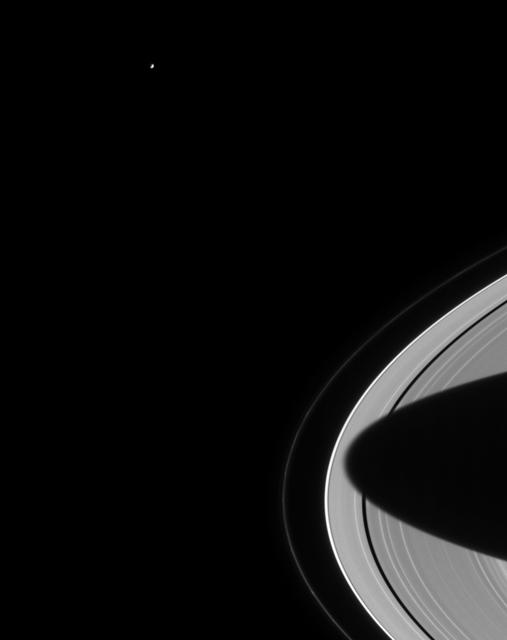
Lonely Mimas swings around Saturn, seeming to gaze down at the planet's splendid rings. The outermost, narrow F ring is visible here and exhibits some clumpy structure near the bottom of the frame. The shadow of Saturn's southern hemisphere stretches almost entirely across the rings. Mimas is 398 kilometers (247 miles) wide. The image was taken with the Cassini spacecraft narrow angle camera on August 15, 2004, at a distance of 8.8 million kilometers (5.5 million miles) from Saturn, through a filter sensitive to visible red light. The image scale is 53 kilometers (33 miles) per pixel. Contrast was slightly enhanced to aid visibility.almost entirely across the rings. Mimas is 398 kilometers (247 miles) wide. http://photojournal.jpl.nasa.gov/catalog/PIA06471
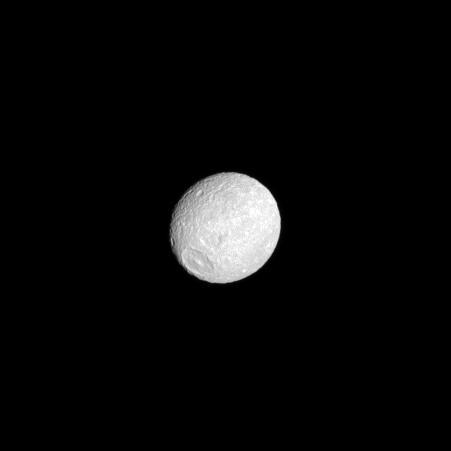
The oblate shape of Mimas is presented in this Cassini spacecraft image. The moon appears flattened at the poles with an equatorial bulge.
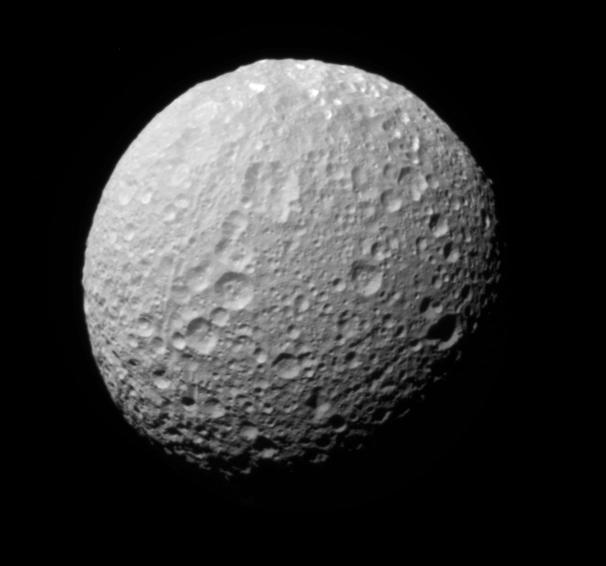
This monochrome view of Mimas, the clear filter image used for the color map, is presented here

Mimas drifts along in its orbit against the azure backdrop of Saturn northern latitudes in this true color view. The long, dark lines on the atmosphere are shadows cast by the planet rings.
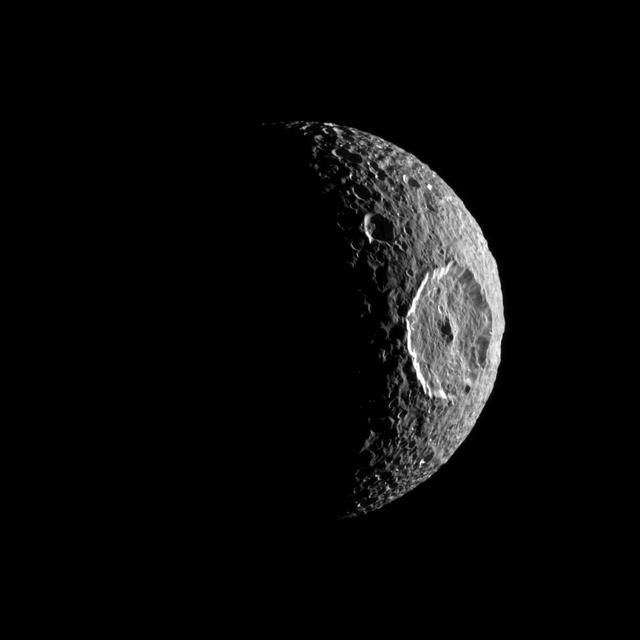
NASA Cassini spacecraft turns the eye of its camera toward Saturn moon Mimas and spies the large Herschel Crater which itself looks like the iris of an eye peering out into space.
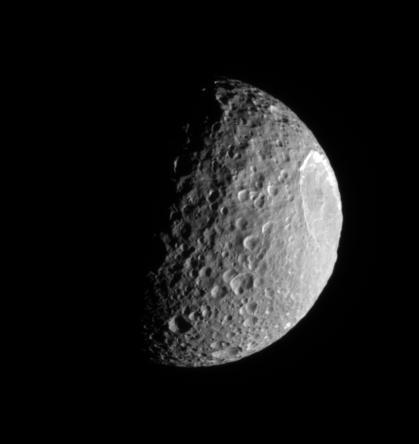
Mimas plows along in its orbit, its pockmarked surface in crisp relief. The bright, steep walls of the enormous crater, Herschel 130 kilometers, or 80 miles wide, gleam in the sunlight
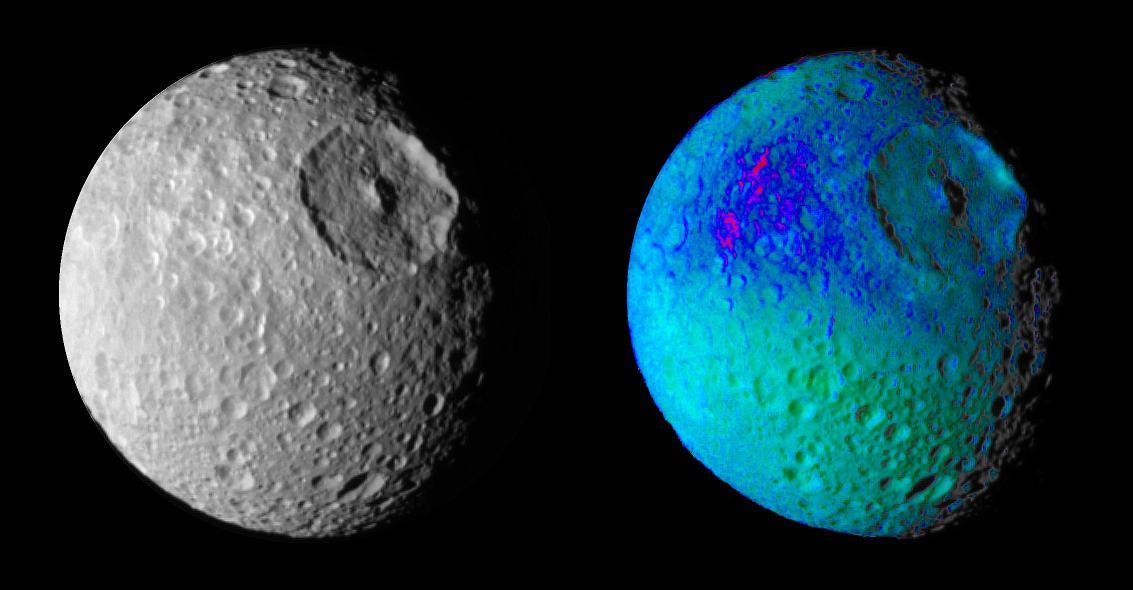
False color images of Saturn moon, Mimas, reveal variation in either the composition or texture across its surface.
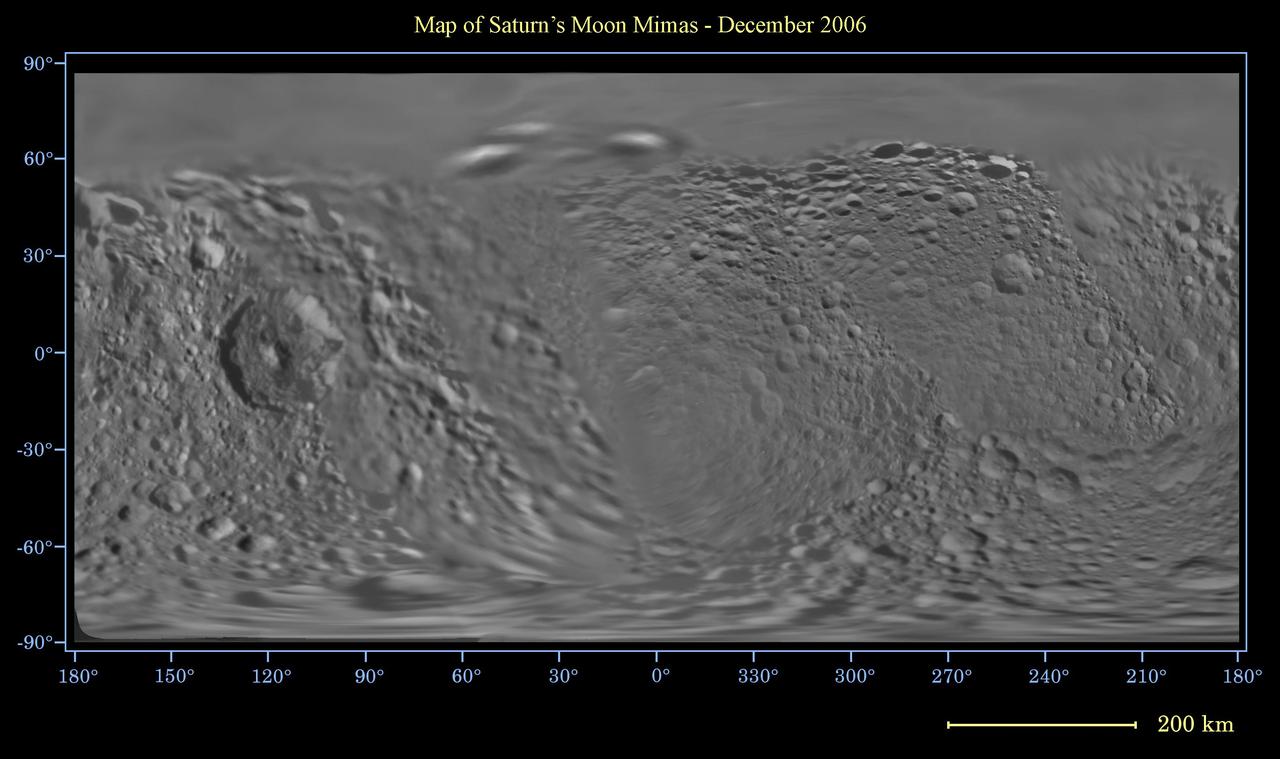
This global digital map of Saturn moon Mimas was created using data taken by the Cassini spacecraft, with gaps in coverage filled in by NASA Voyager spacecraft data
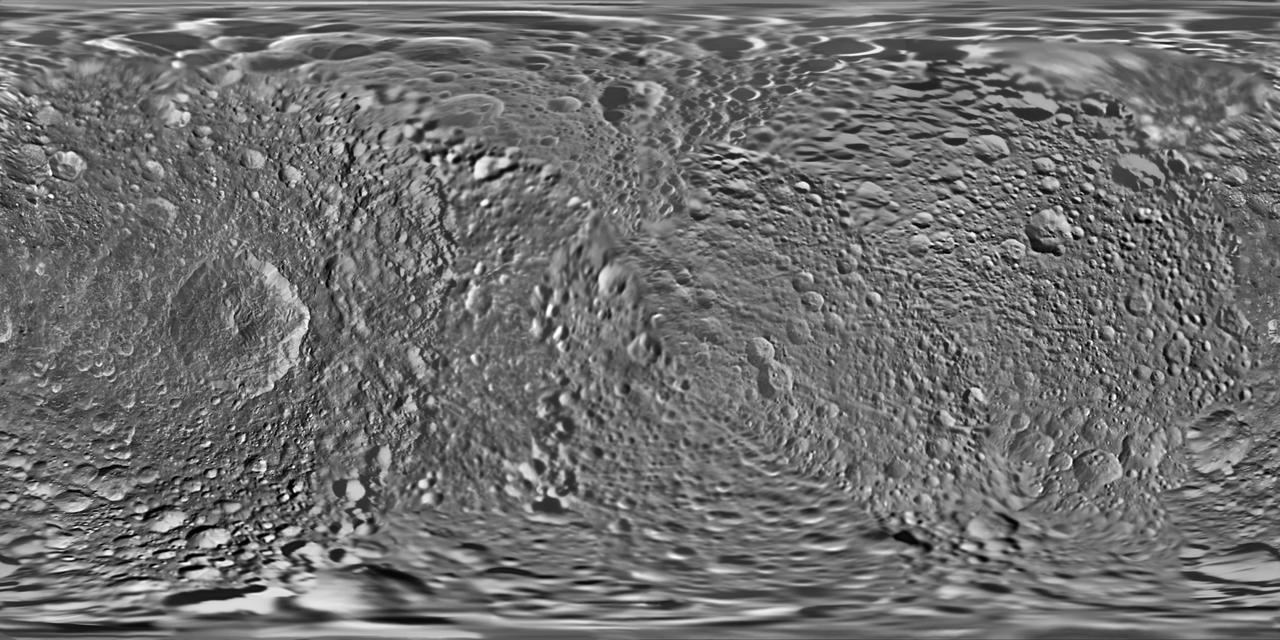
This global map of Saturn moon Mimas was created using images taken during NASA Cassini spacecraft flybys, with Voyager images filling in the gaps in Cassini coverage.
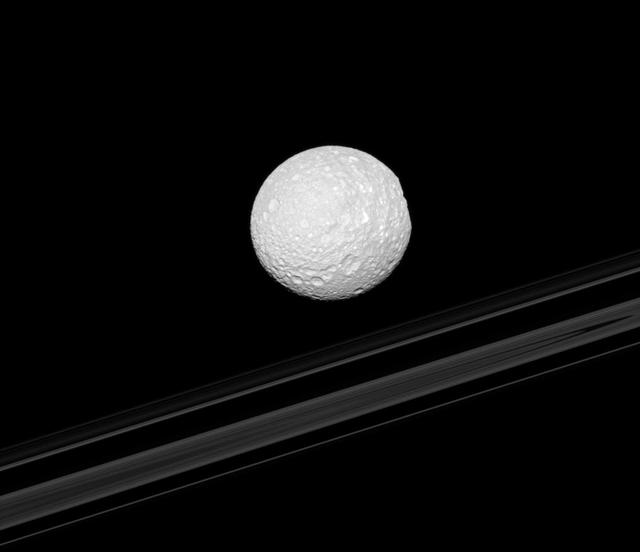
The right-hand limb of Saturn moon Mimas appears flattened as Herschel Crater is viewed edge-on in this image from NASA Cassini spacecraft. The planet rings are in the background.
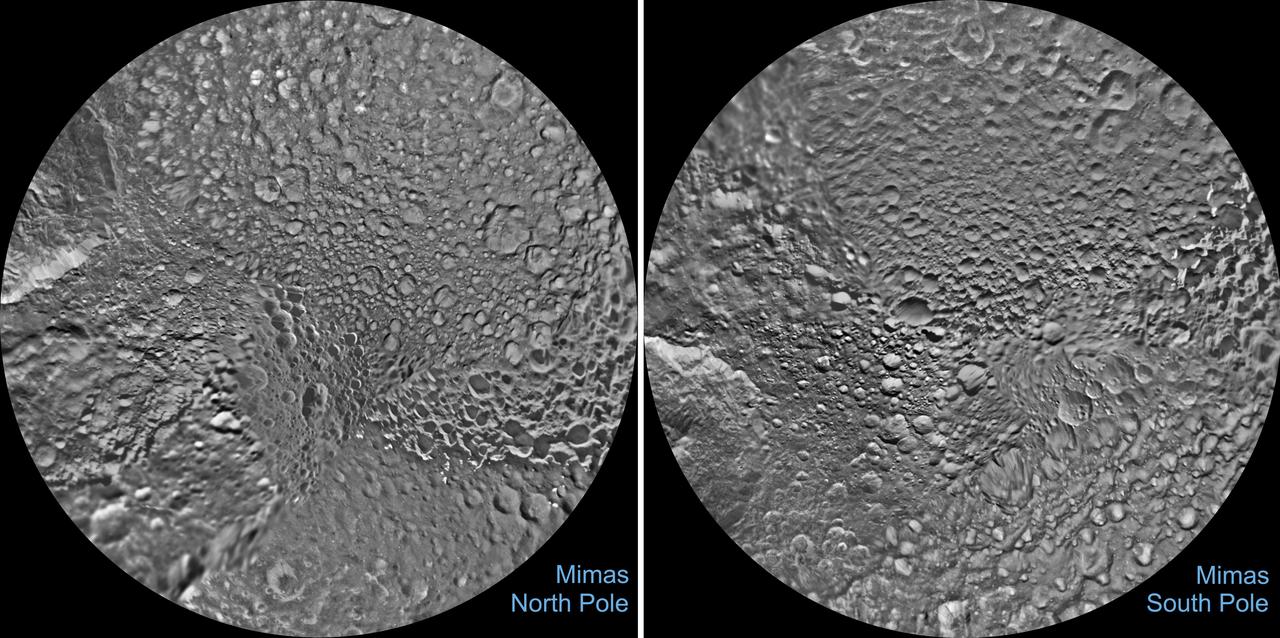
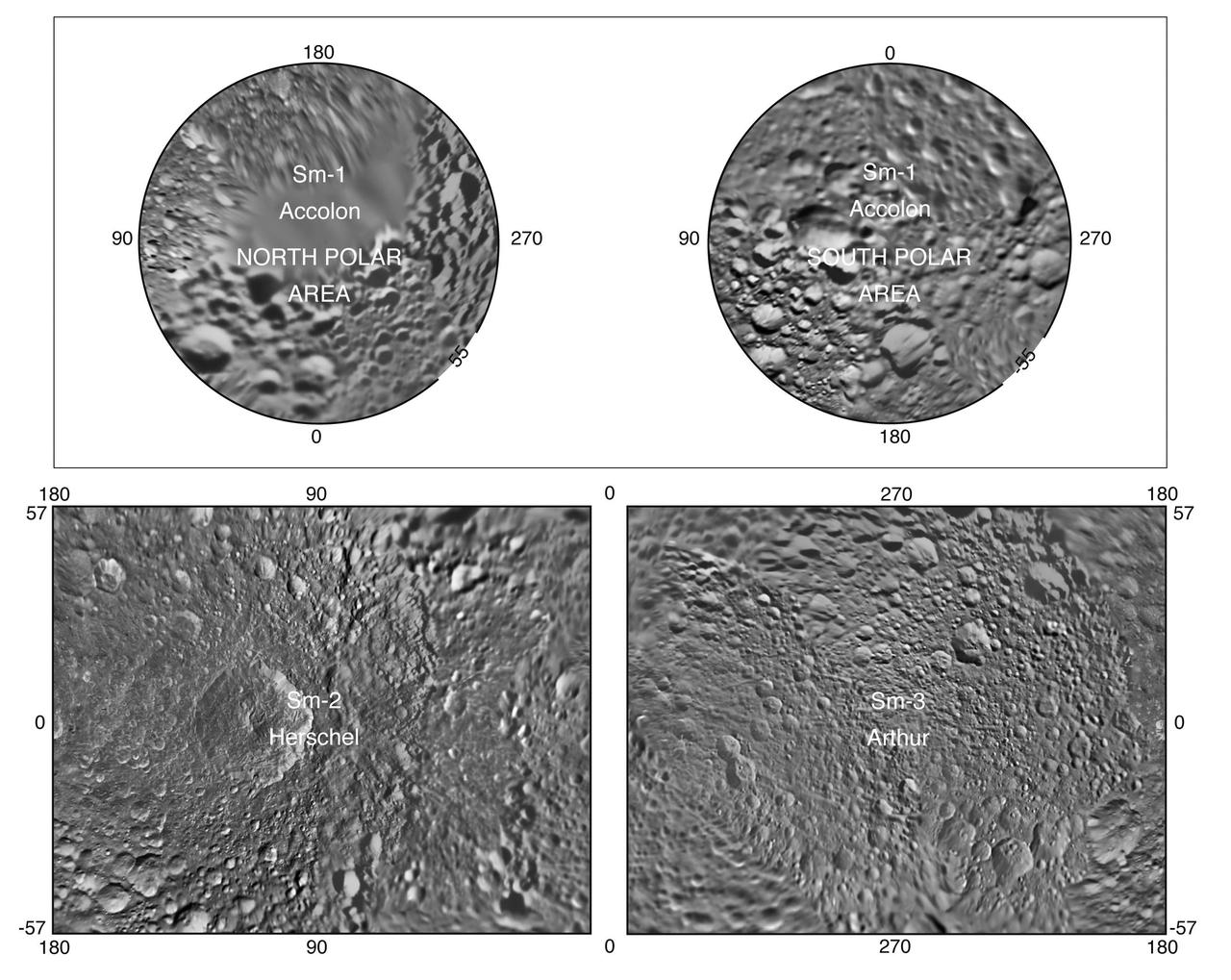
The northern and southern hemispheres of Saturn's moon Mimas are seen in these polar stereographic maps, mosaicked from the best-available Cassini images. Each map is centered on one of the poles, and surface coverage extends to the equator. Grid lines show latitude and longitude in 30-degree increments. Unlabeled versions of these maps are also provided. The scale in the full-size versions of these maps is 710 feet (216 meters) per pixel. The resolution of the map is 16 pixels per degree. The mean radius of Mimas used for projection of these maps is 123.2 miles (198.2 kilometers). The mosaics contain new data from two close flybys of Mimas in Nov. 2016 and Feb. 2017. https://photojournal.jpl.nasa.gov/catalog/PIA17215

Mimas and Dione
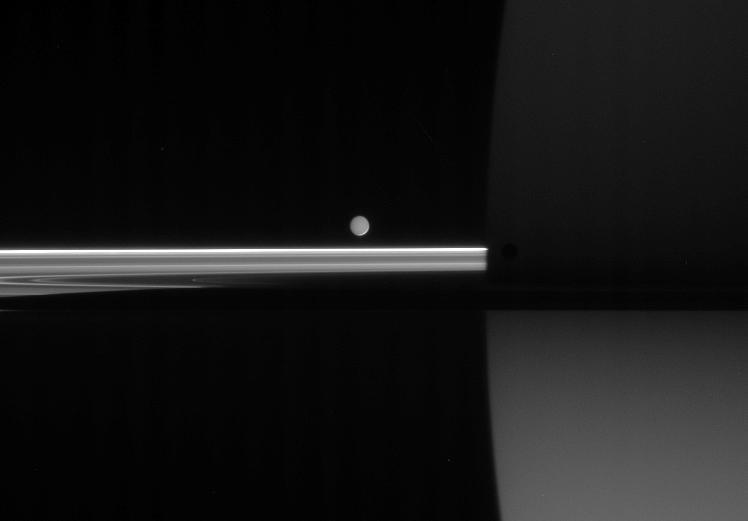
Mimas in Hiding
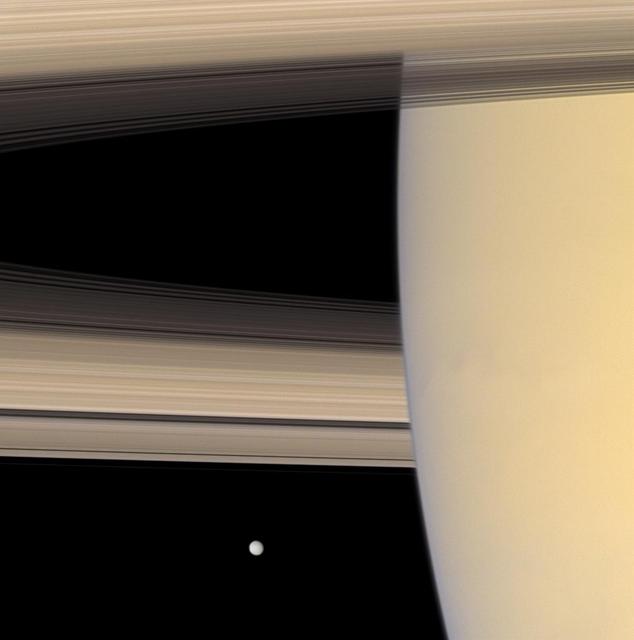
Mimas Adrift

Saturn and Mimas
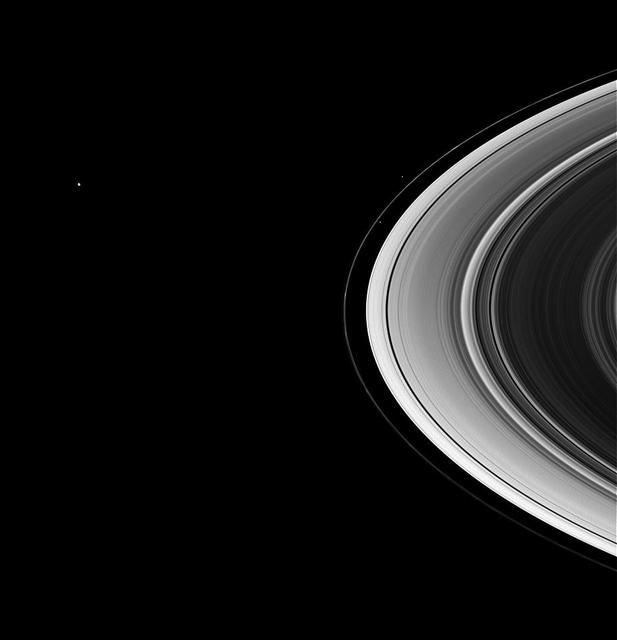
Mimas and the Shepherds
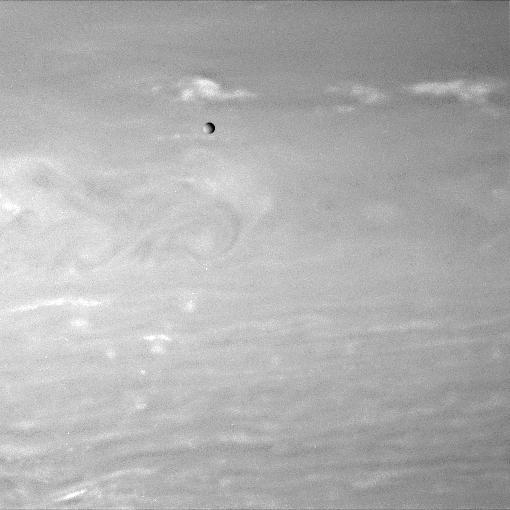
Mimas in Transit
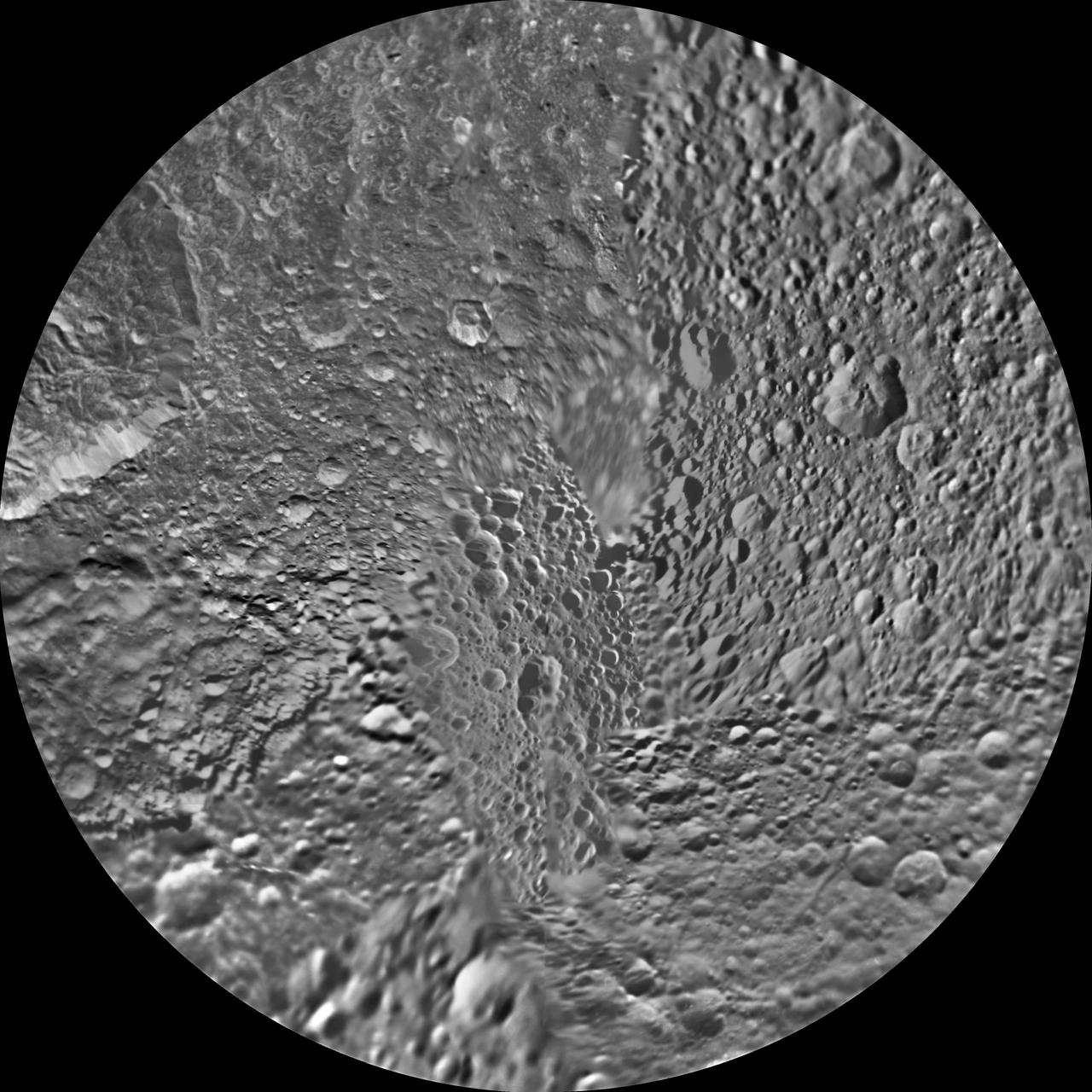
The northern and southern hemispheres of Saturn moon Mimas are seen in these polar stereographic maps, mosaicked from the best-available NASA Cassini and Voyager images.
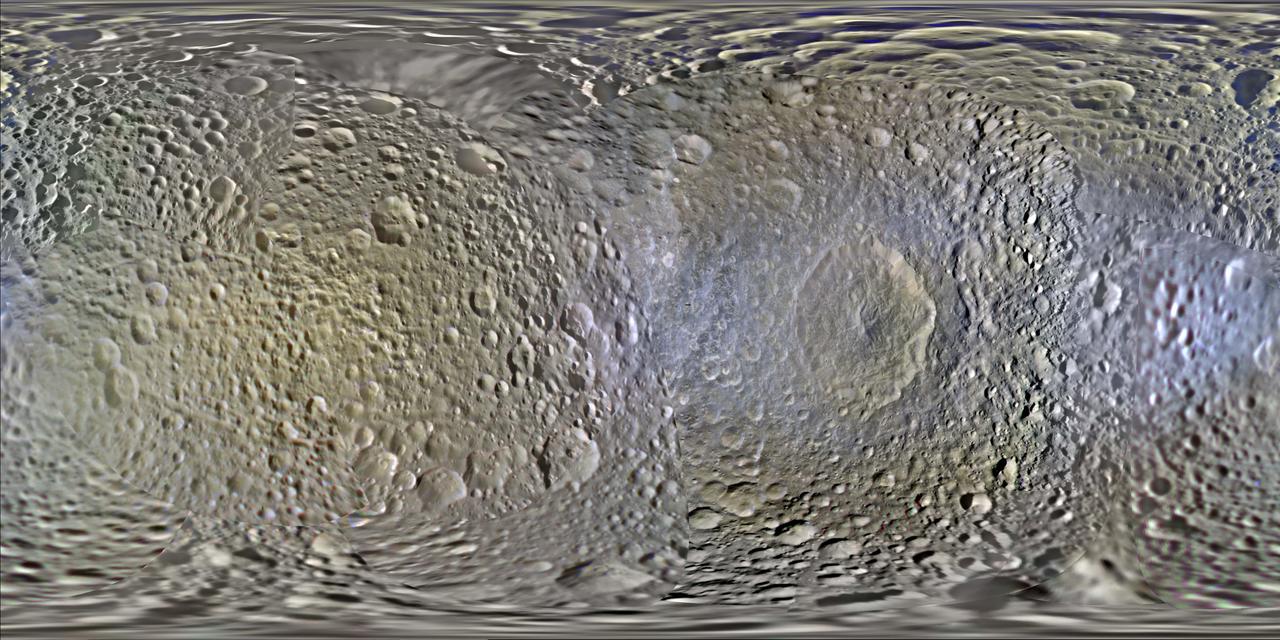
This set of global, color mosaics of Saturn moon Mimas was produced from images taken by NASA Cassini spacecraft during its first ten years exploring the Saturn system.
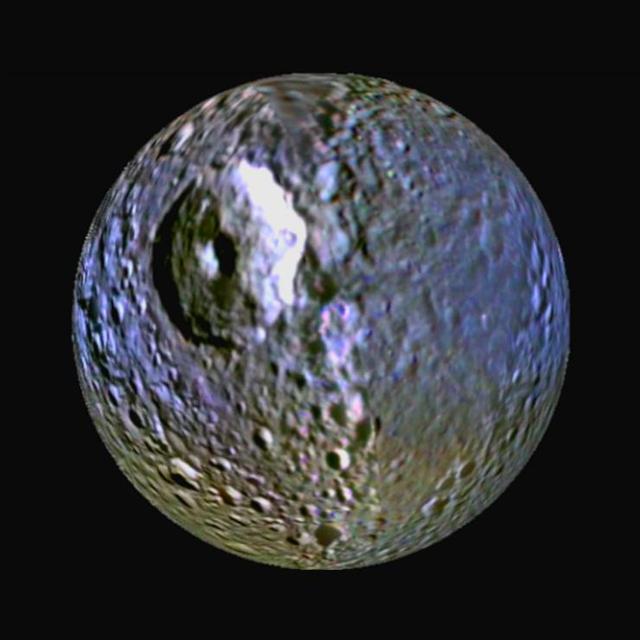
This enhanced-color view of Saturn moon Mimas was made from images obtained by NASA Cassini spacecraft. It highlights the bluish band around the icy moon equator. The large round gouge on the surface is Herschel Crater.
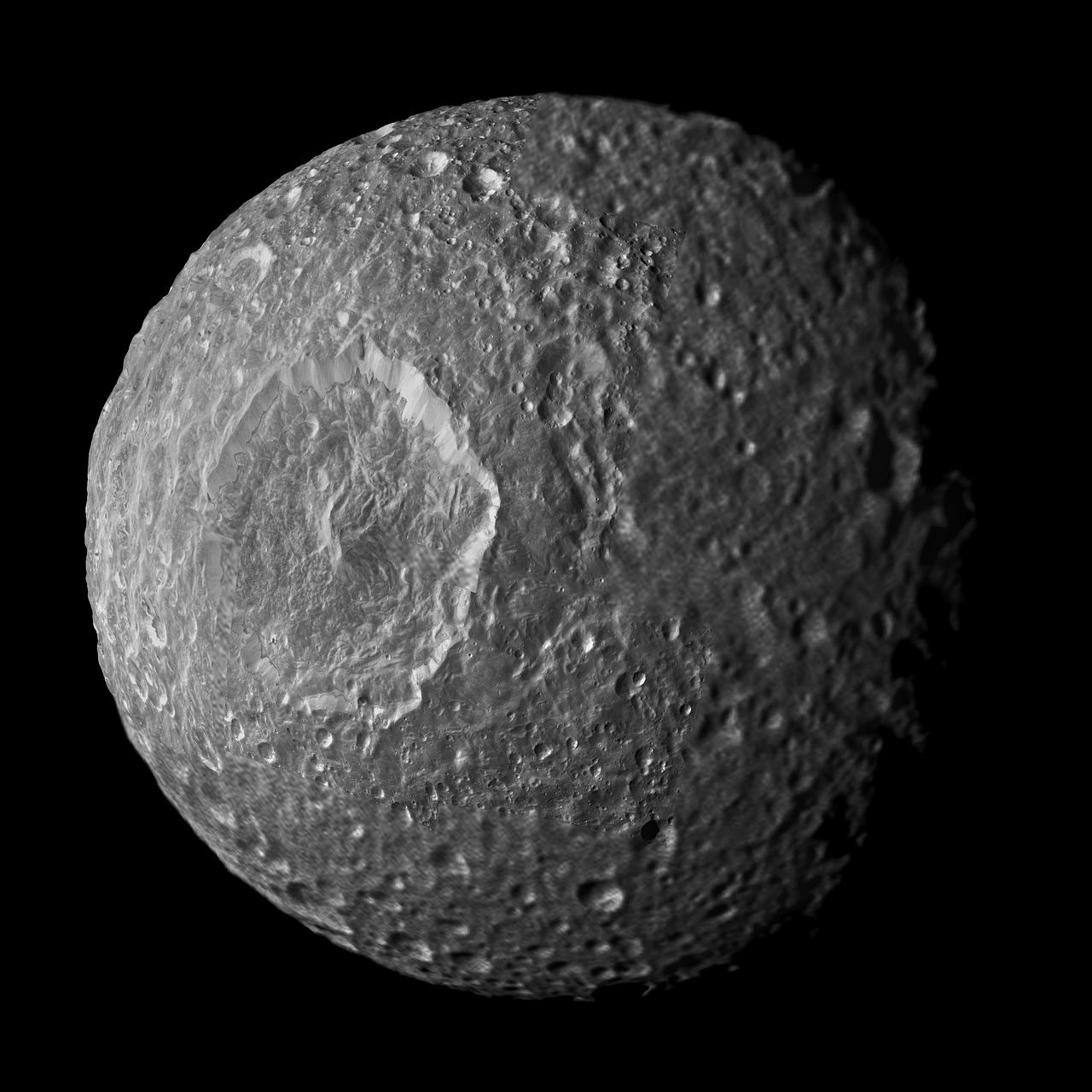
Relatively dark regions below bright crater walls and streaks on some of the walls are seen in this mosaic of Saturn moon Mimas, created from images taken by NASA Cassini spacecraft during its closest flyby of the moon.
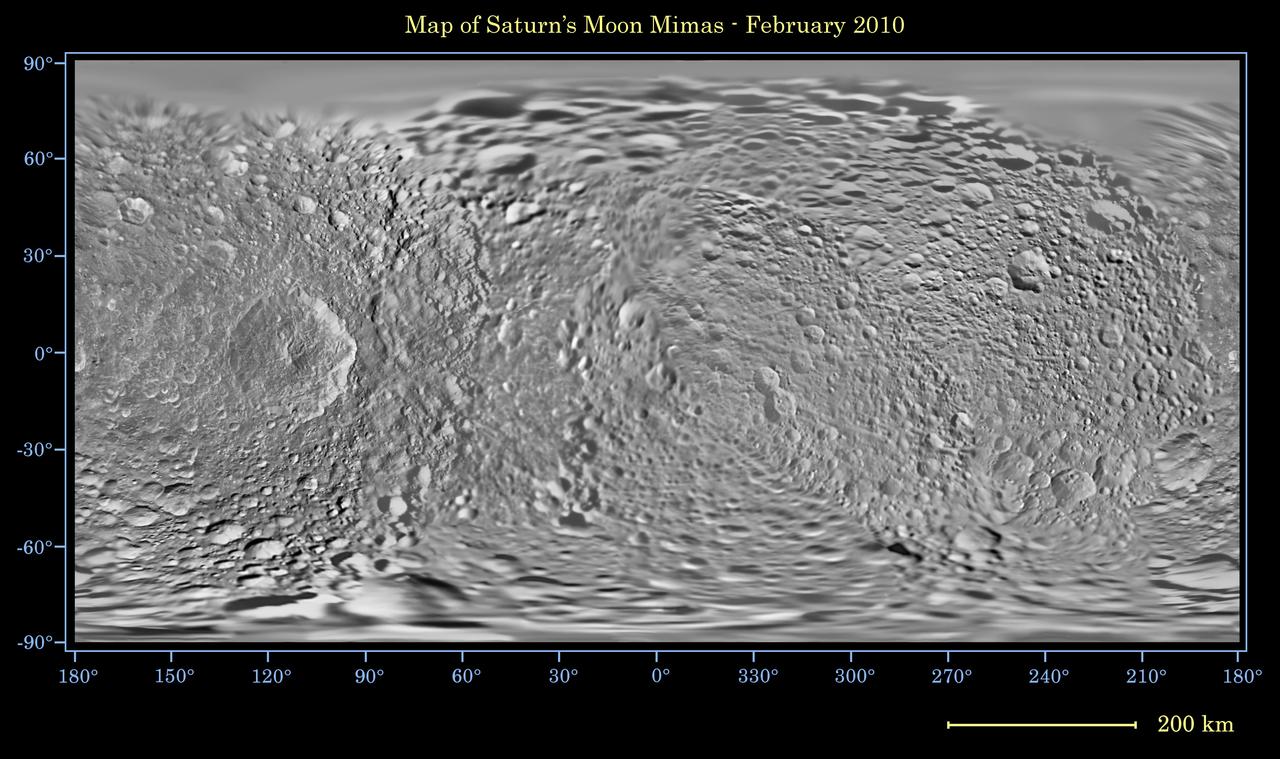
This global map of Saturn moon Mimas was created using images taken during NASA Cassini spacecraft flybys, with NASA Voyager images filling in the gaps in Cassini coverage.
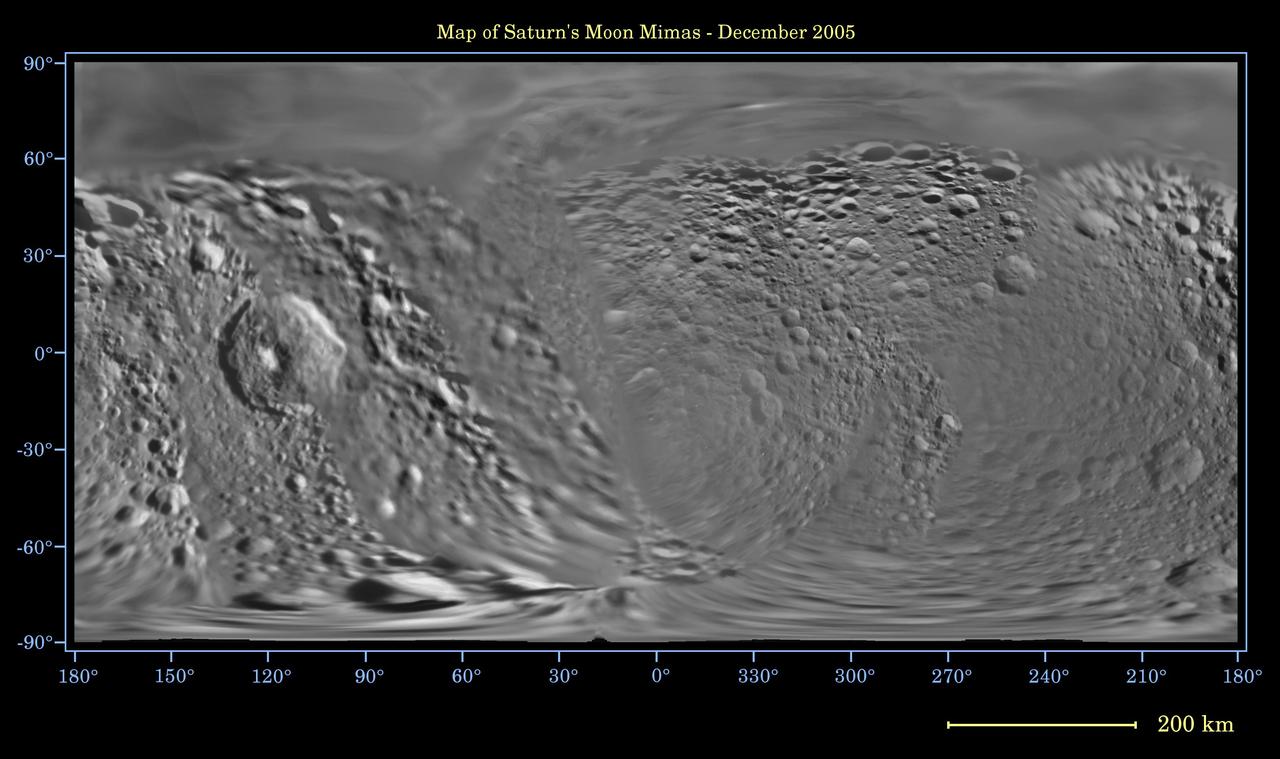
This global digital map of Saturn moon Mimas was created using data taken during Cassini and Voyager spacecraft flybys. The map is an equidistant projection and has a scale of 434 meters 1,424 feet per pixel
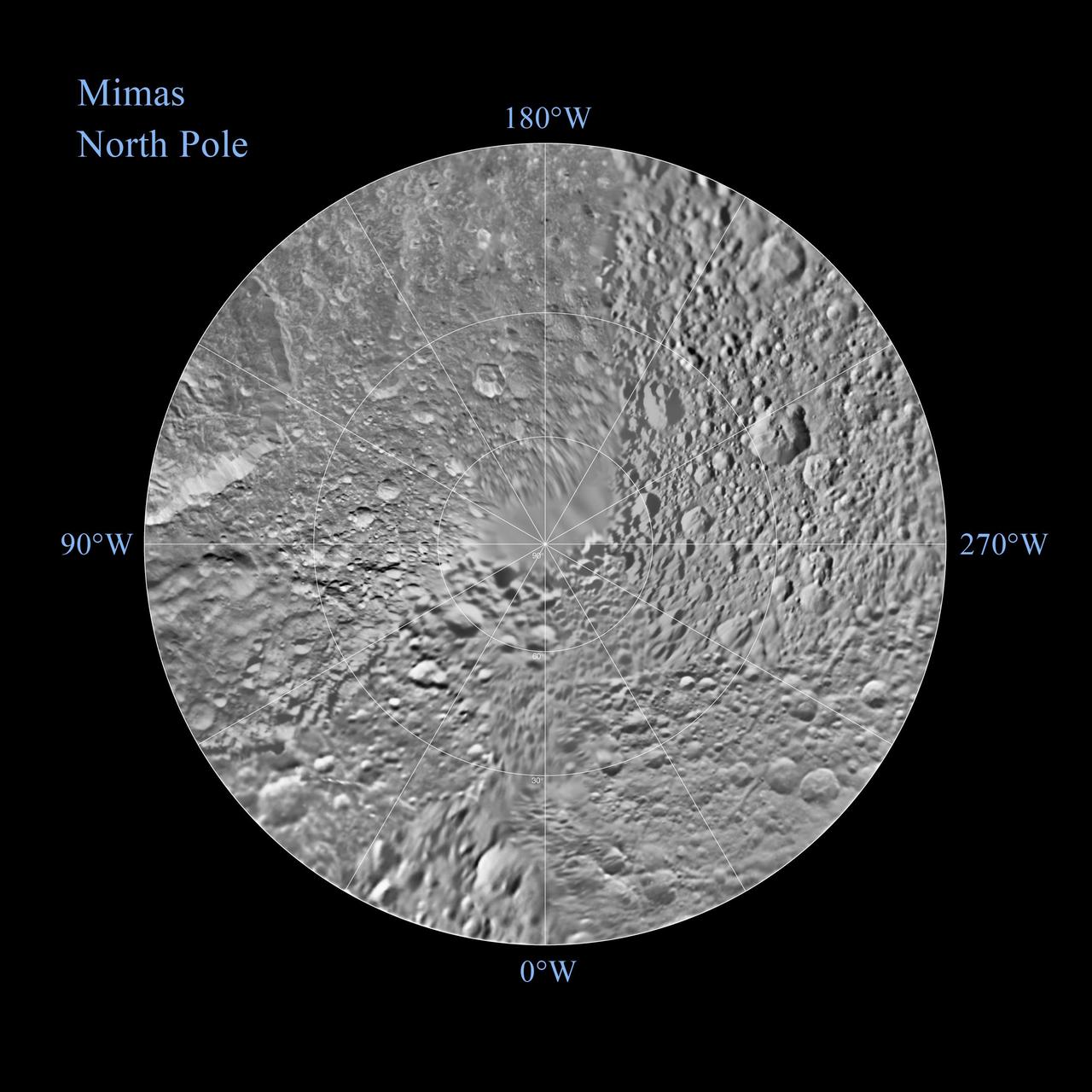
The northern hemisphere of Saturn moon Mimas is seen in these polar stereographic maps, mosaicked from the best-available NASA Cassini and Voyager images.
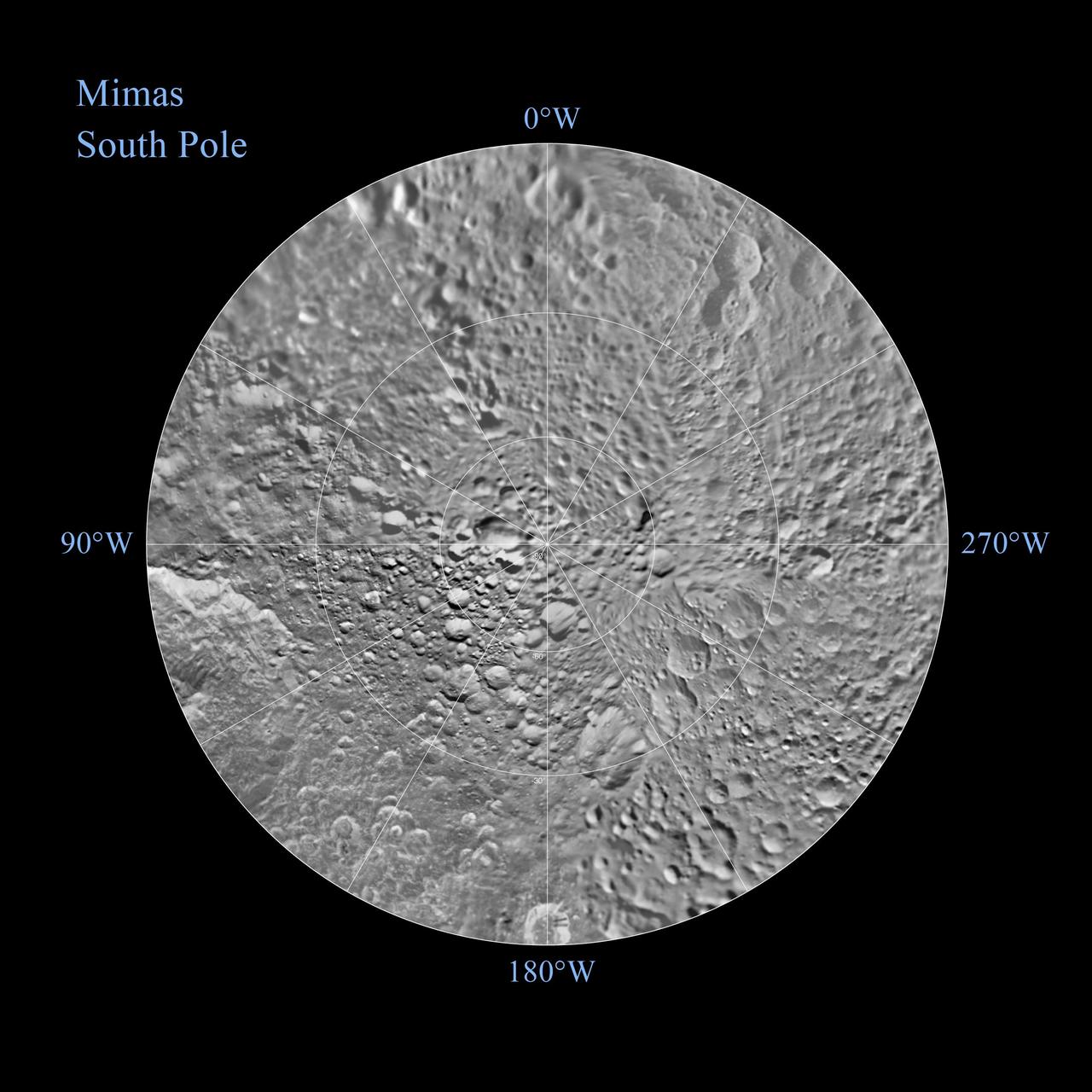
The southern hemisphere of Saturn moon Mimas is seen in these polar stereographic maps, mosaicked from the best-available NASA Cassini and Voyager images.
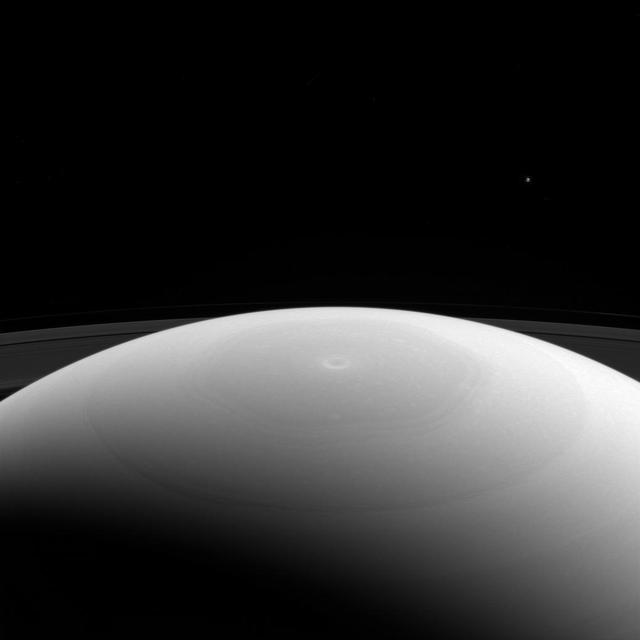
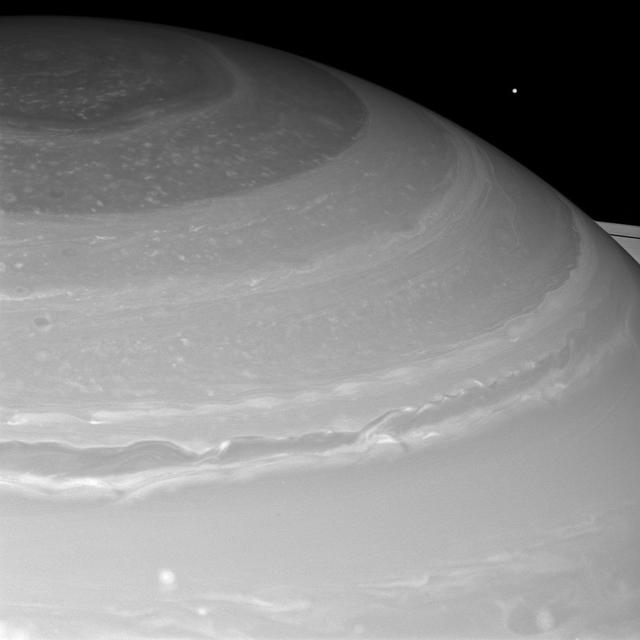
From high above Saturn's northern hemisphere, NASA's Cassini spacecraft gazes over the planet's north pole, with its intriguing hexagon and bullseye-like central vortex. Saturn's moon Mimas is visible as a mere speck near upper right. At 246 miles (396 kilometers across) across, Mimas is considered a medium-sized moon. It is large enough for its own gravity to have made it round, but isn't one of the really large moons in our solar system, like Titan. Even enormous Titan is tiny beside the mighty gas giant Saturn. This view looks toward Saturn from the sunlit side of the rings, from about 27 degrees above the ring plane. The image was taken in green light with the Cassini spacecraft wide-angle camera on March 27, 2017. The view was acquired at a distance of approximately 617,000 miles (993,000 kilometers) from Saturn. Image scale is 37 miles (59 kilometers) per pixel. Mimas' brightness has been enhanced by a factor of 3 in this image to make it easier to see. https://photojournal.jpl.nasa.gov/catalog/PIA21331
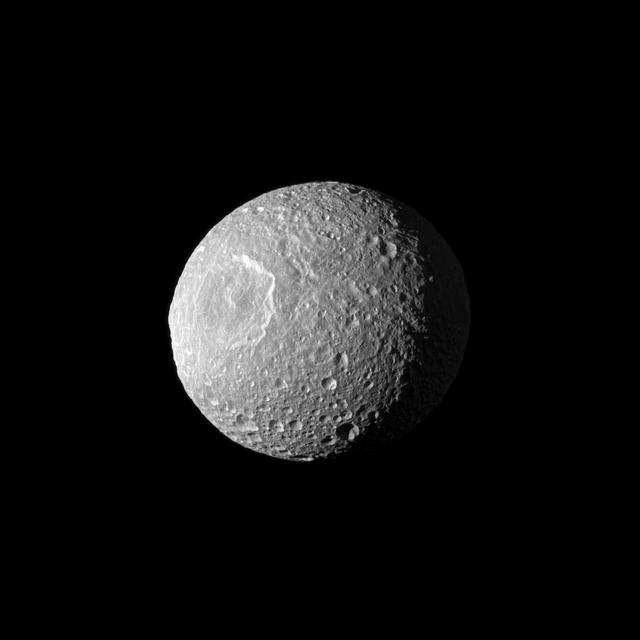
Appearing like a cyclops gazing off into space, Saturn moon Mimas and its large Herschel Crater are profiled from NASA Cassini spacecraft. Herschel Crater is 130 kilometers 80 miles wide and covers most of the left of this image.
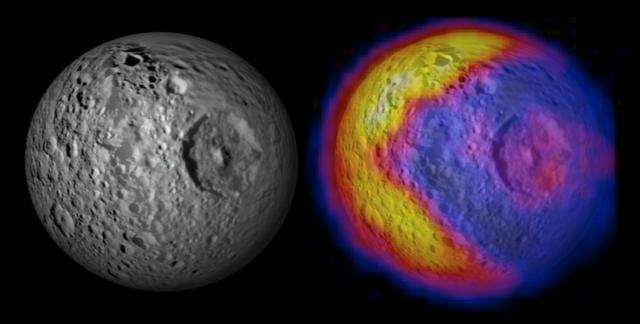
This image shows NASA Cassini spacecraft imaging science subsystem visible-light mosaic of Mimas from previous flybys on the left. The right-hand image shows new infrared temperature data mapped on top of the visible-light image.
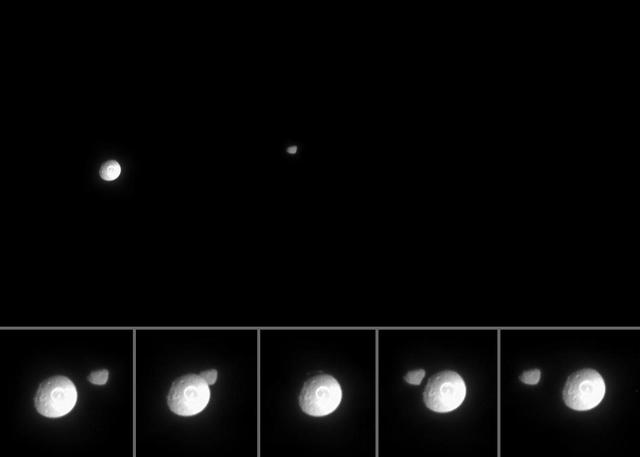
Mimas Occults Janus
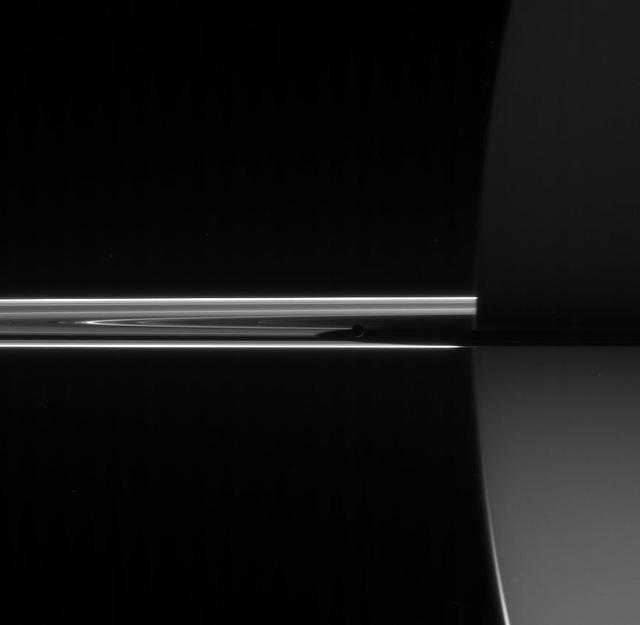
Mimas Seeking Solitude
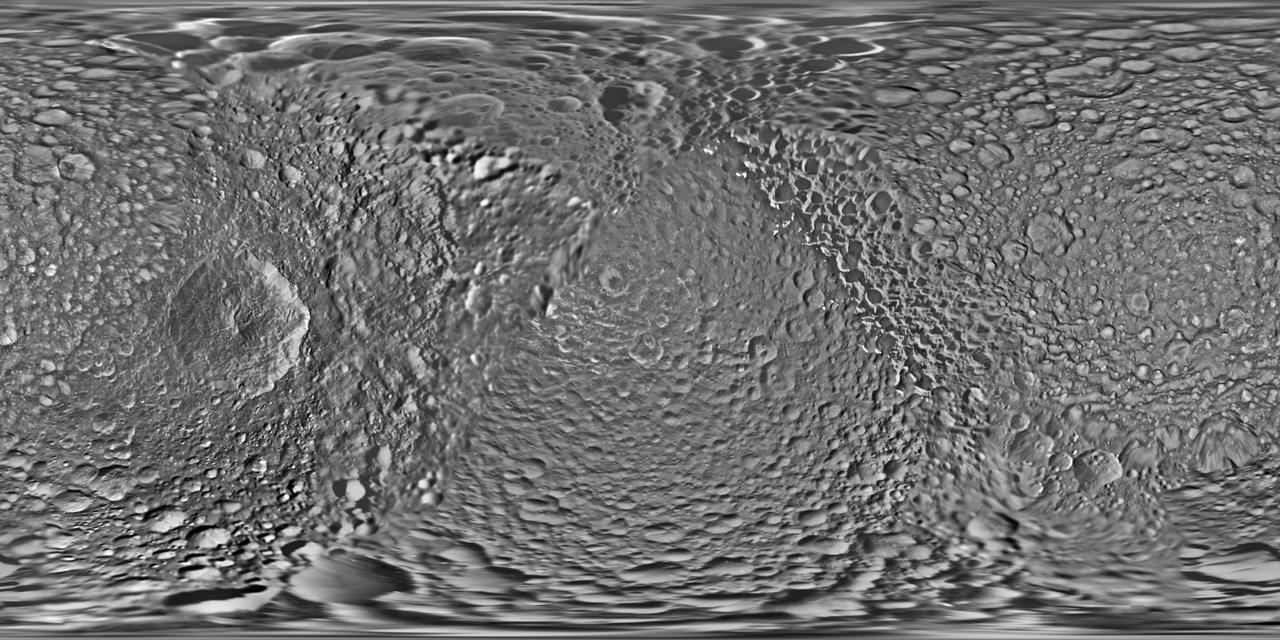
This global map of Saturn's moon Mimas was created using images taken during Cassini spacecraft flybys. The moon's large, distinguishing crater, Herschel, is seen on the map at left. The map is an equidistant (simple cylindrical) projection and has a scale of 710 feet (216 meters) per pixel at the equator. The mean radius of Mimas used for projection of this map is 123.2 miles (198.2 kilometers). The resolution of the map is 16 pixels per degree. The update includes new images for almost half of the moon's surface, with new images from two close flybys, in Nov. 2016 and Feb. 2017. The moon's western hemisphere, south pole and parts of the eastern hemisphere received updates in this version. https://photojournal.jpl.nasa.gov/catalog/PIA17214
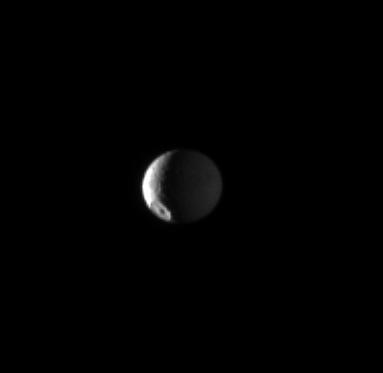
The Herschel crater dominates this view of Saturn moon Mimas.
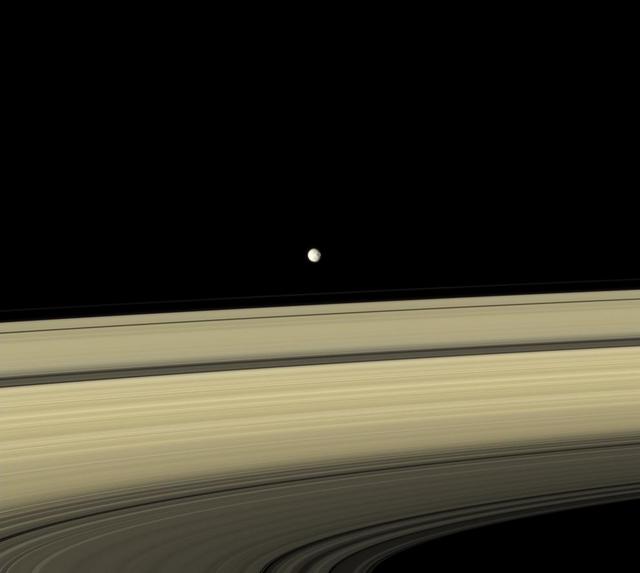
Gray Mimas appears to hover above the colorful rings. The large crater seen on the right side of the moon is named for William Herschel, who discovered Mimas in 1789.

The smaller moon Mimas upstages the larger moon Dione as the dramatic Herschel Crater is spotlighted on Mimas in this view from NASA Cassini spacecraft.
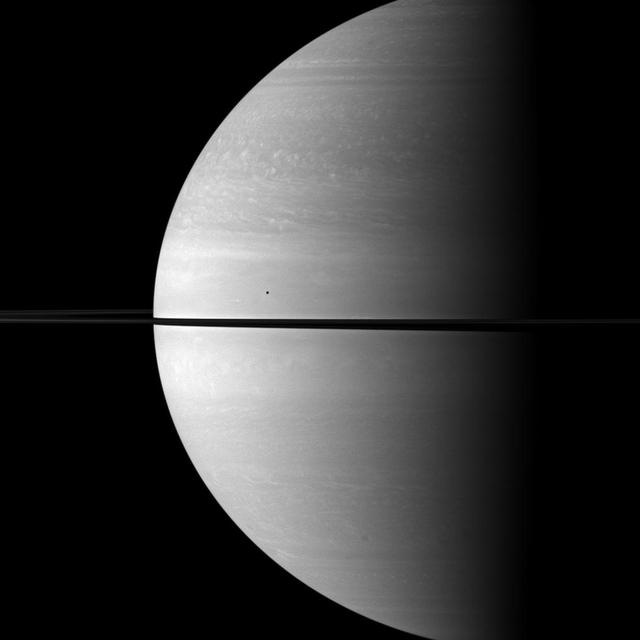
The immense size of Saturn is emphasized in this portrait by NASA Cassini spacecraft that features the moon Mimas shown in front of the planet. Mimas appears as only a small dot above the rings near the center of the image.

In this view captured by NASA Cassini spacecraft on its closest-ever flyby of Saturn moon Mimas, large Herschel Crater dominates Mimas, making the moon look like the Death Star in the movie Star Wars.

The diminutive moon Mimas can be found hiding in the middle of this view of a crescent of Saturn bisected by rings in this image captured by NASA Cassini spacecraft. Mimas appears as a dark speck just about the ringplane near the center of the image. Th
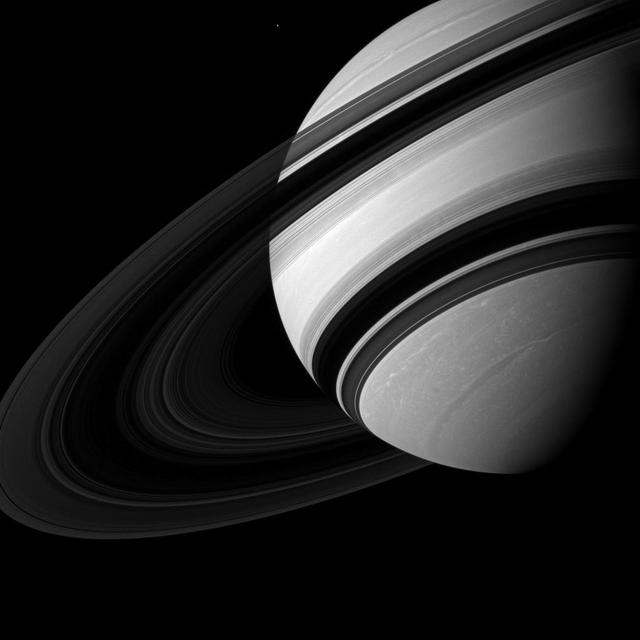
Saturn moon Mimas appears near Saturn, dwarfed by its parent planet in this image. Mimas appears tiny compared to the storms clearly visible in far northern and southern hemispheres of Saturn.
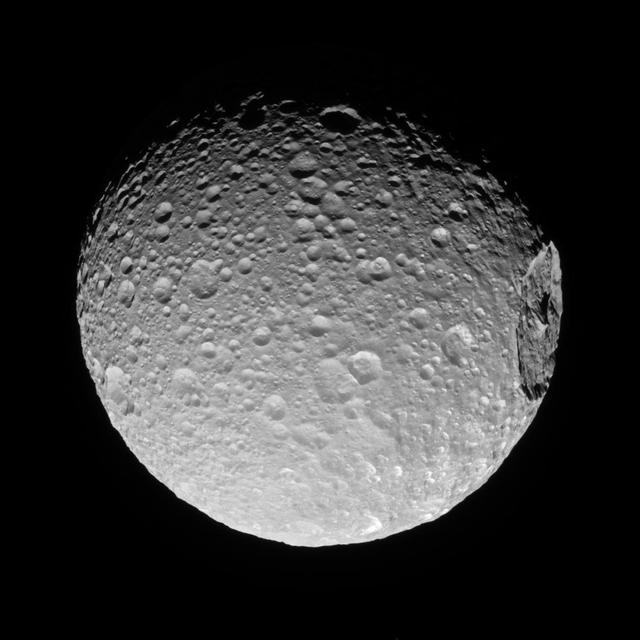
Mimas' gigantic crater Herschel lies near the moon's limb in this Cassini view. A big enough impact could potentially break up a moon. Luckily for Mimas, whatever created Herschel was not quite big enough to cause that level of disruption. When large impacts happen, they deliver tremendous amounts of energy -- sometimes enough to cause global destruction. Even impacts that are not catastrophic can leave enormous, near-permanent scars on bodies like Mimas (246 miles or 396 kilometers across). This view looks toward the anti-Saturn hemisphere of Mimas. North on Mimas is up and rotated 32 degrees to the left. The image was taken in visible light with the Cassini spacecraft narrow-angle camera on Nov. 19, 2016. The view was acquired at a distance of approximately 53,000 miles (85,000 kilometers) from Mimas. Image scale is 1,677 feet (511 meters) per pixel. http://photojournal.jpl.nasa.gov/catalog/PIA20523
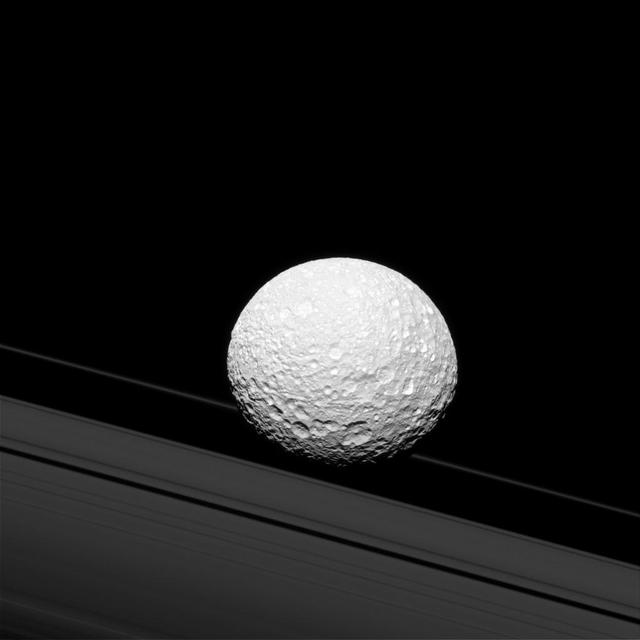
It may look as though Saturn's moon Mimas is crashing through the rings in this image taken by NASA's Cassini spacecraft, but Mimas is actually 28,000 miles (45,000 kilometers) away from the rings. There is a strong connection between the icy moon and Saturn's rings, though. Gravity links them together and shapes the way they both move. The gravitational pull of Mimas (246 miles or 396 kilometers across) creates waves in Saturn's rings that are visible in some Cassini images. Mimas' gravity also helps create the Cassini Division (not pictured here), which separates the A and B rings. This view looks toward the anti-Saturn hemisphere of Mimas. North on Mimas is up and rotated 15 degrees to the right. The image was taken in green light with the Cassini spacecraft narrow-angle camera on Oct. 23, 2016. The view was acquired at a distance of approximately 114,000 miles (183,000 kilometers) from Mimas and at a Sun-Mimas-spacecraft, or phase, angle of 29 degrees. Image scale is 3,300 feet (1 kilometer) per pixel. http://photojournal.jpl.nasa.gov/catalog/PIA20510
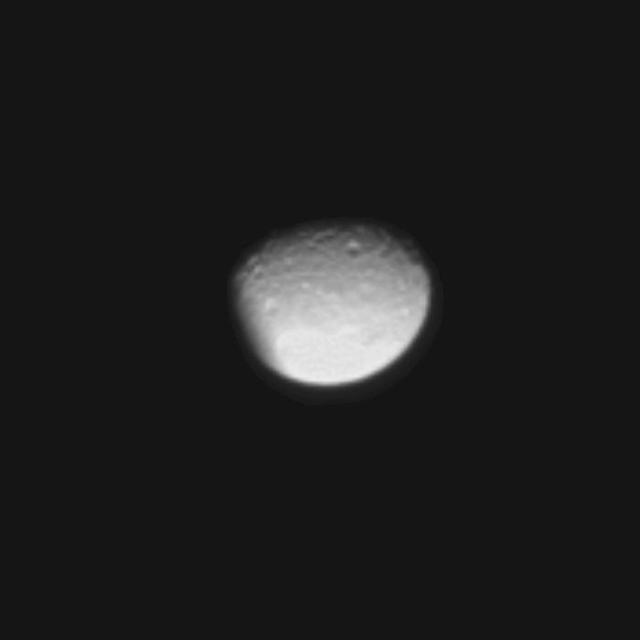
As the moon Enceladus eclipses its neighbor Mimas, Cassini records a scene possible only around the time of Saturn approaching equinox.
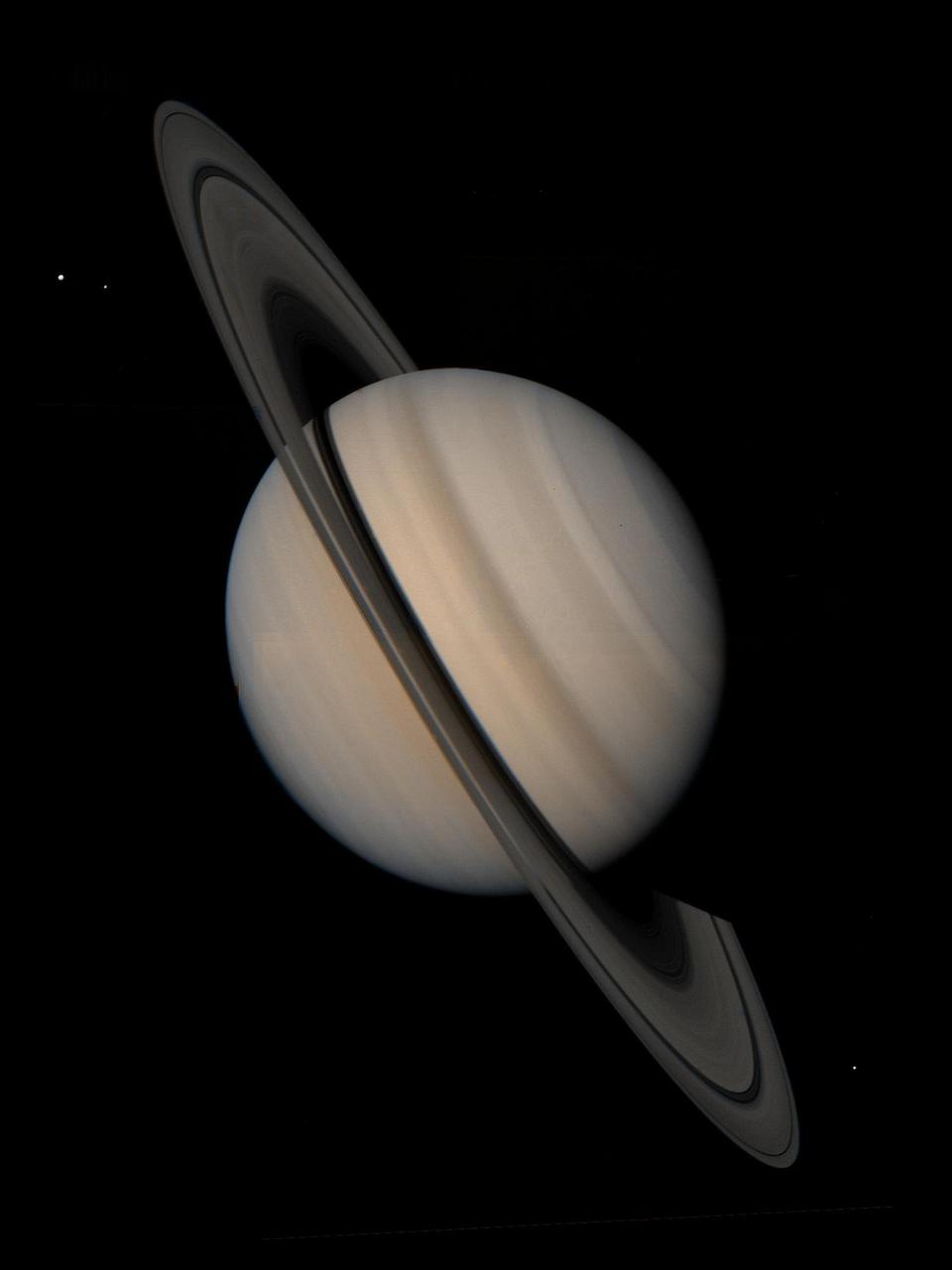
Saturn and its Satellites Tethys, Enceladus and Mimas

A kingly crescent Saturn rests on the right of this NASA Cassini spacecraft portrait while the moon Mimas appears above the rings on the left. Mimas looks like just a speck of light here but is actually 396 kilometers, or 246 miles, across.
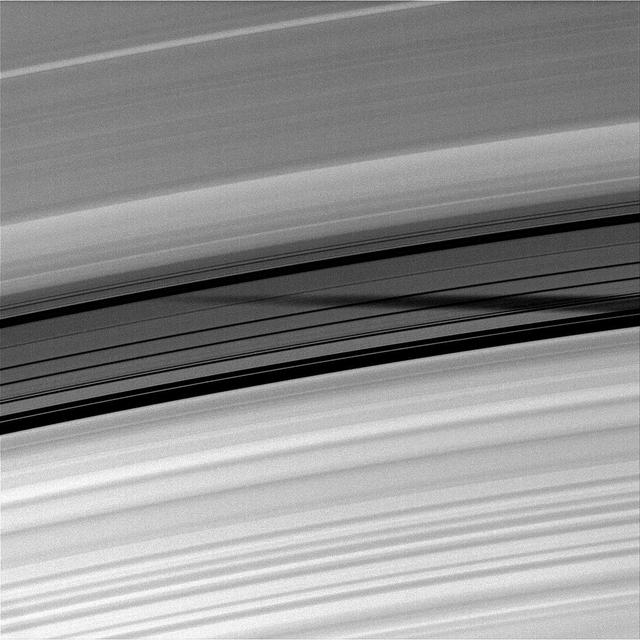
The shadow of the moon Mimas is seen through the unlit side of the Cassini Division of Saturn rings.
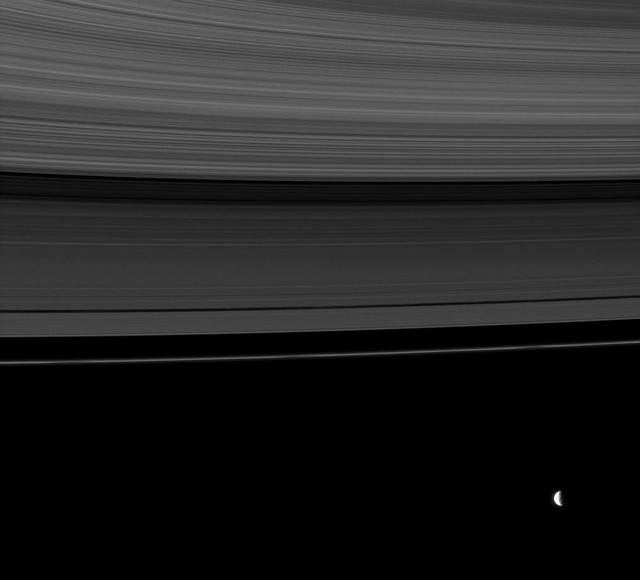
The rings share this view with Mimas, a moon whose gravity influences the rings in this image taken by NASA Cassini Orbiter.
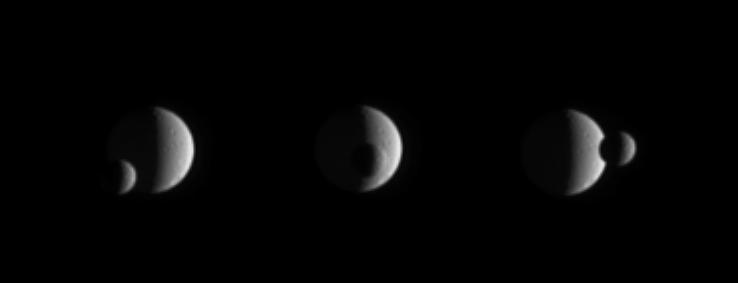
Mimas briefly slipped in front of Tethys while the Cassini spacecraft looked on and captured the event in this series of images
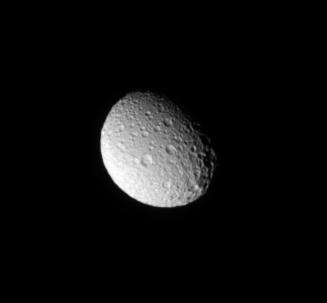
The Cassini spacecraft looks down on the north pole of Mimas and sees the moon cratered trailing hemisphere.
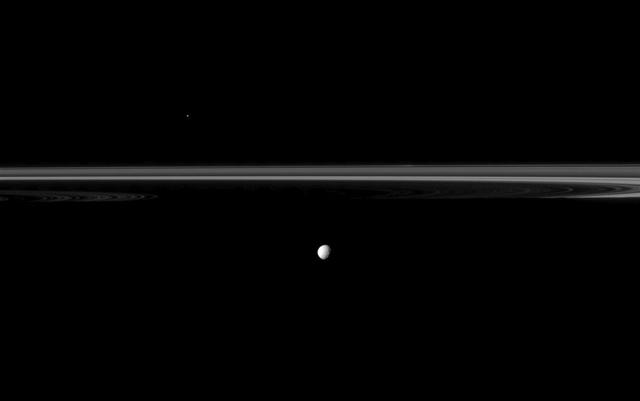
Saturn moon Mimas joins the planet rings which appear truncated by the planet shadow in this image from NASA Cassini spacecraft.
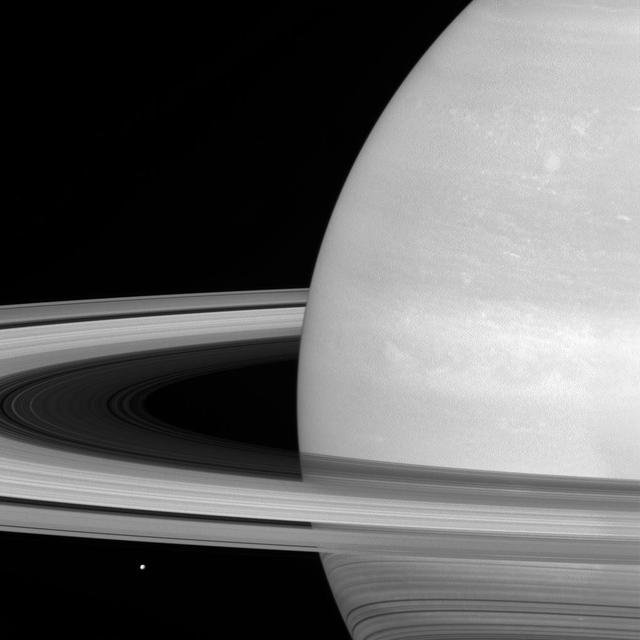
Saturn's icy moon Mimas is dwarfed by the planet's enormous rings. Because Mimas (near lower left) appears tiny by comparison, it might seem that the rings would be far more massive, but this is not the case. Scientists think the rings are no more than a few times as massive as Mimas, or perhaps just a fraction of Mimas' mass. Cassini is expected to determine the mass of Saturn's rings to within just a few hundredths of Mimas' mass as the mission winds down by tracking radio signals from the spacecraft as it flies close to the rings. The rings, which are made of small, icy particles spread over a vast area, are extremely thin -- generally no thicker than the height of a house. Thus, despite their giant proportions, the rings contain a surprisingly small amount of material. Mimas is 246 miles (396 kilometers) wide. This view looks toward the sunlit side of the rings from about 6 degrees above the ring plane. The image was taken in red light with the Cassini spacecraft wide-angle camera on July 21, 2016. The view was obtained at a distance of approximately 564,000 miles (907,000 kilometers) from Saturn and at a Sun-Saturn-spacecraft, or phase, angle of 31 degrees. Image scale is 34 miles (54 kilometers) per pixel. http://photojournal.jpl.nasa.gov/catalog/PIA20509
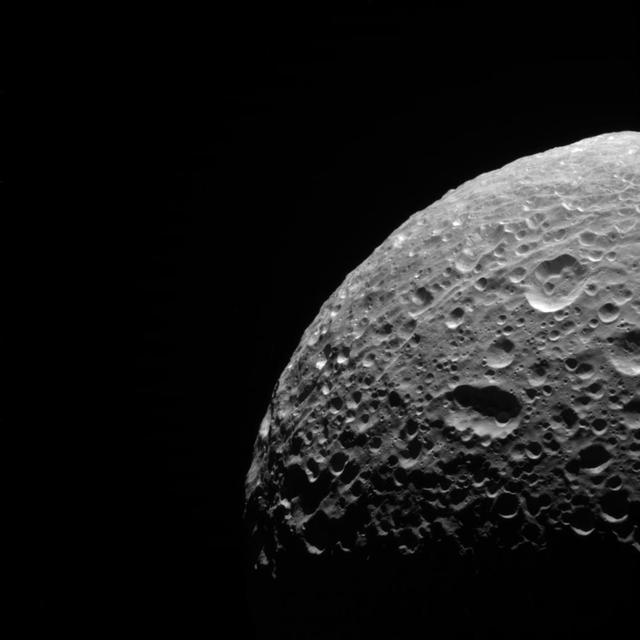
In addition to being evidence of past impacts, craters can serve another valuable scientific purpose. By counting the number of craters in an area, scientists can estimate the age of the terrain. Older surfaces, such as on Mimas (246 miles, or 396 kilometers across), will have more craters per unit area than younger surfaces. This view looks toward the trailing hemisphere of Mimas. North on Mimas is up and rotated 4 degrees to the left. The image was taken in visible light with the Cassini spacecraft narrow-angle camera on June 5, 2012. The view was acquired at a distance of approximately 31,000 miles (50,000 kilometers) from Mimas. Image scale is 982 feet (299 meters) per pixel. http://photojournal.jpl.nasa.gov/catalog/PIA18292
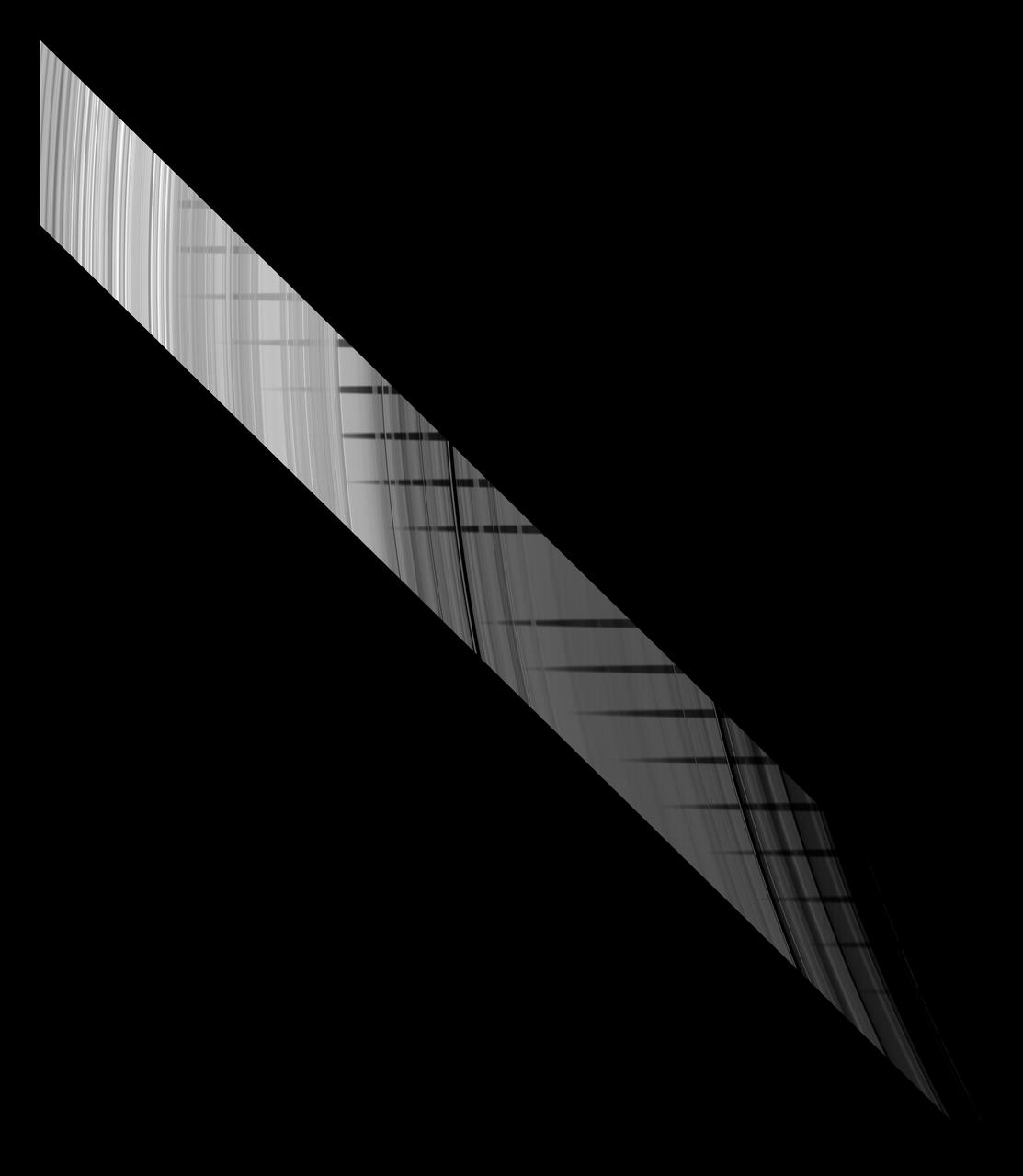
Part of the shadow of Saturn moon Mimas appears as if it has been woven through the planet rings in this unusual series of images from Cassini.
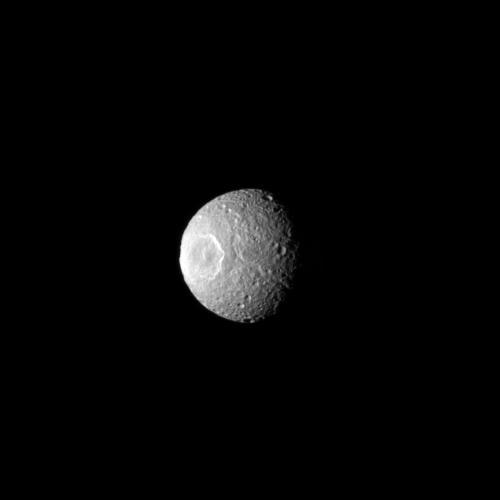
Herschel Crater features prominently on the moon Mimas in this NASA Cassini spacecraft image, which gives the impression of an eye staring out into space.
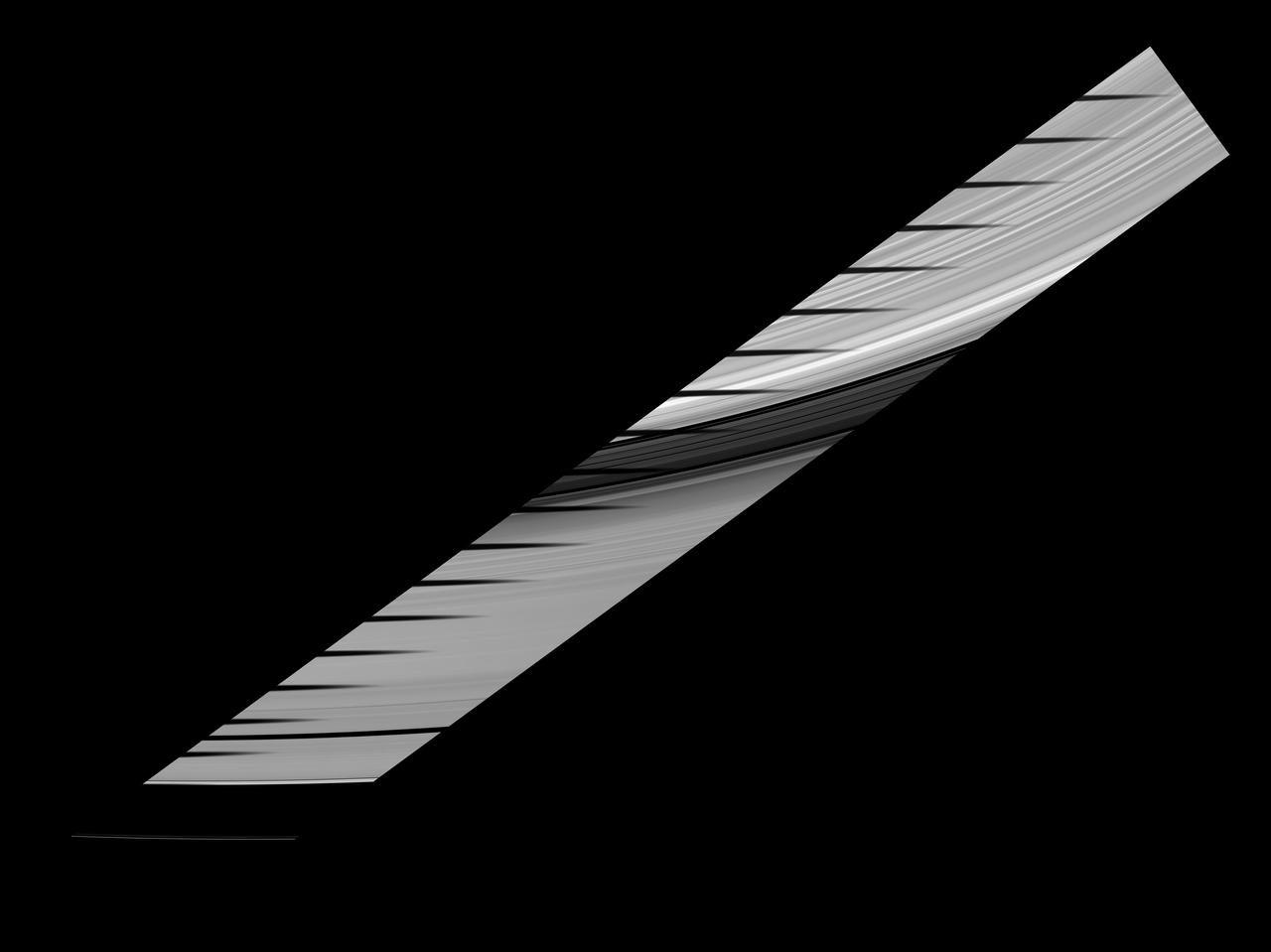
Mimas shadow traverses the sunlit side of Saturn rings in this image and mosaic showcasing the unusual sights seen at Saturn as the planet approaches its August 2009 equinox.
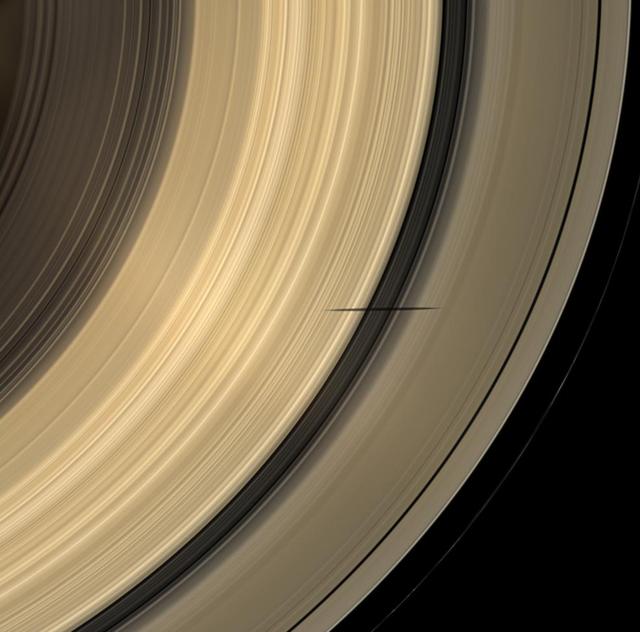
NASA Cassini spacecraft captures the shadow of Saturn moon Mimas as it dips onto the planet rings and straddles the Cassini Division in this natural color image.
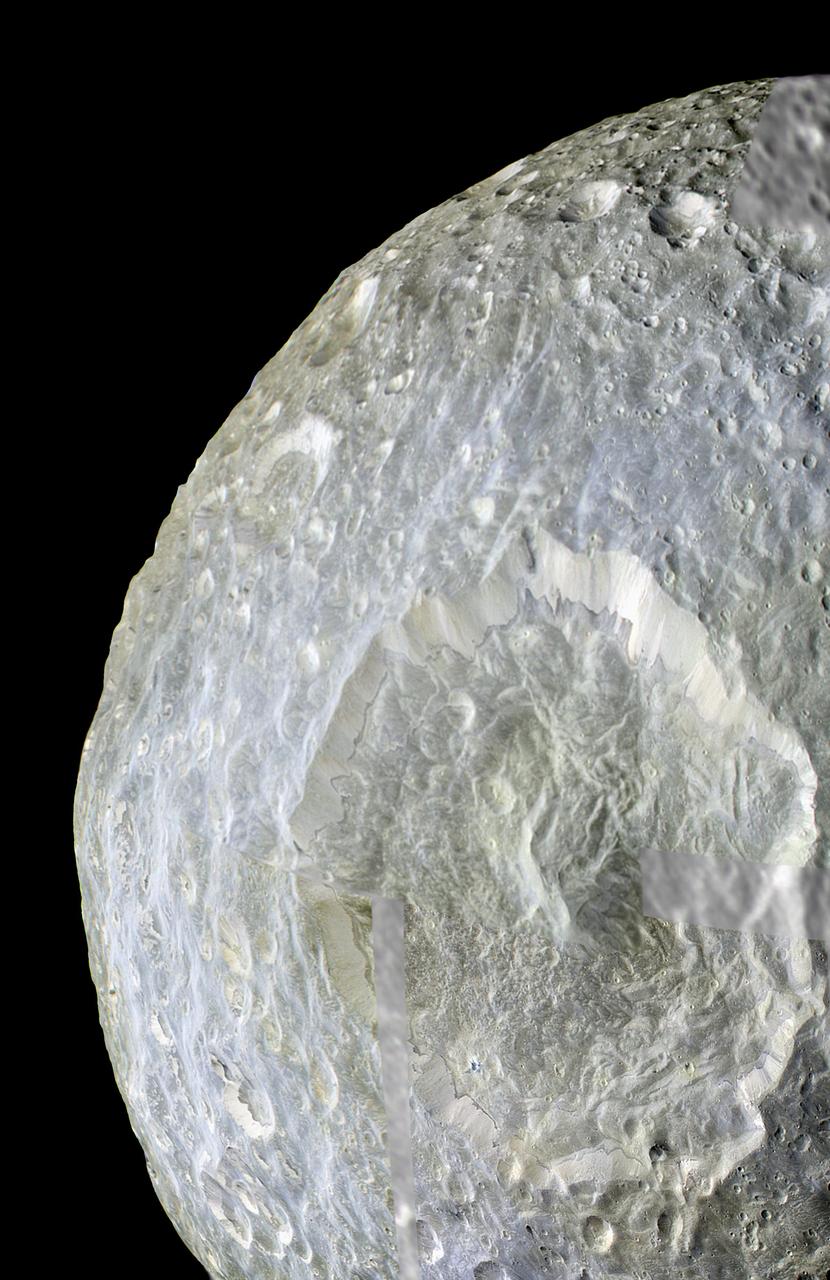
Subtle color differences on Saturn moon Mimas are apparent in this false-color view of Herschel Crater captured during NASA Cassini spacecraft on its closest-ever flyby of that moon.
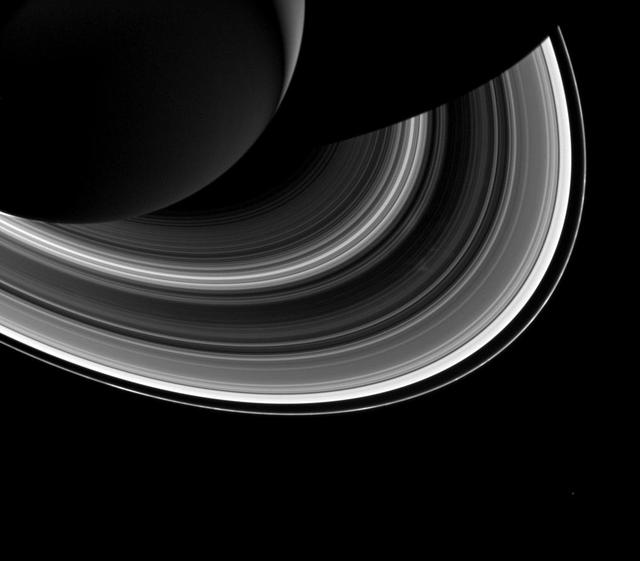
Among the interplay of Saturn shadow and rings, Mimas, which appears in the lower-right corner of the image, orbits Saturn as a set of the ever-intriguing spokes appear in the B ring to the right of center in this image from NASA Cassini spacecraft.
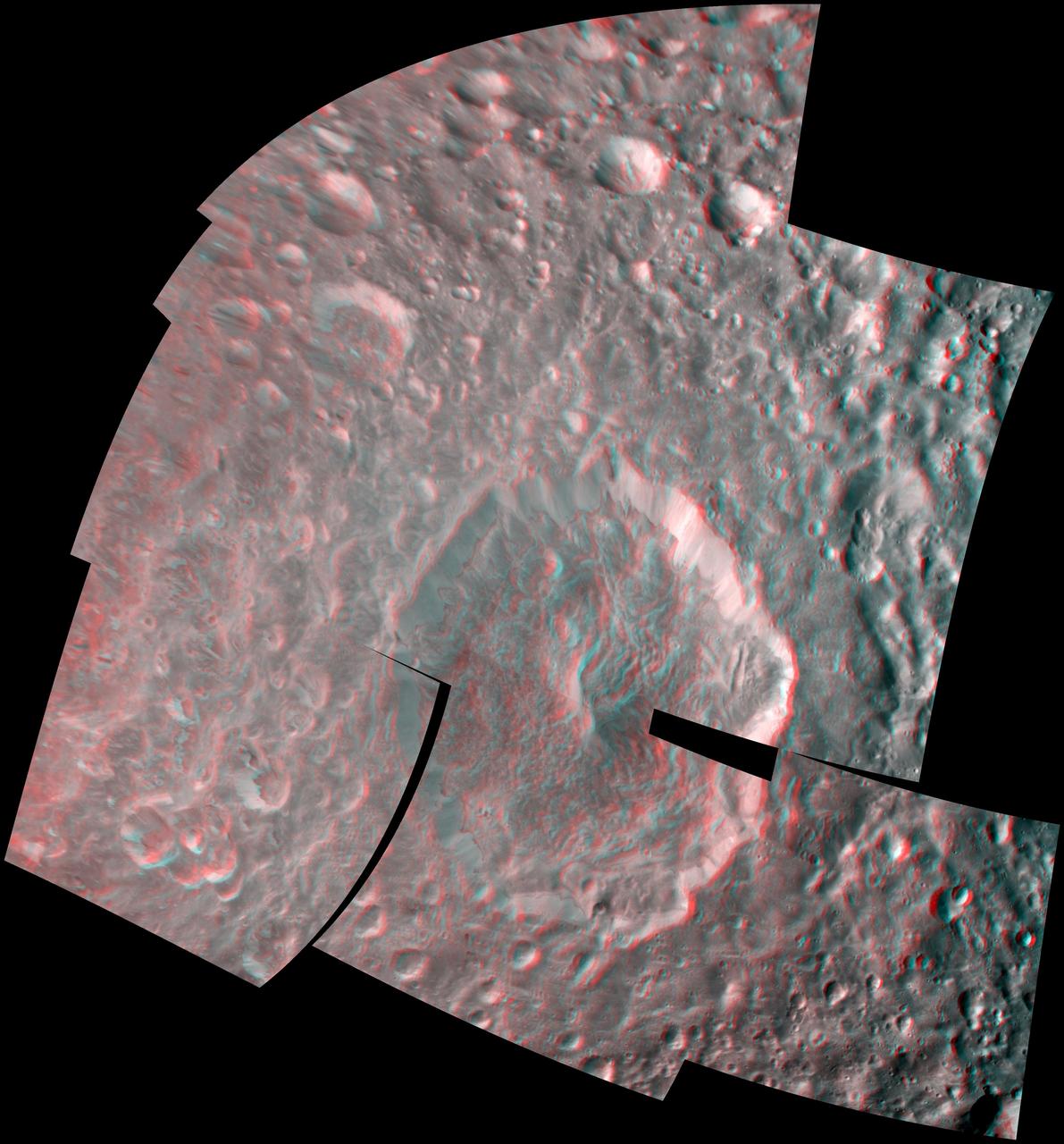
NASA Cassini spacecraft captured a three-dimensional view of the large Herschel Crater on Saturn moon Mimas during its closest-ever flyby of the moon. 3D glasses are needed to view this image.

The great basin that interrupts the contours of this moon crescent identifies the satellite unmistakably as Mimas. The giant crater Herschel 130 kilometers, or 80 miles wide is this moon most obvious feature
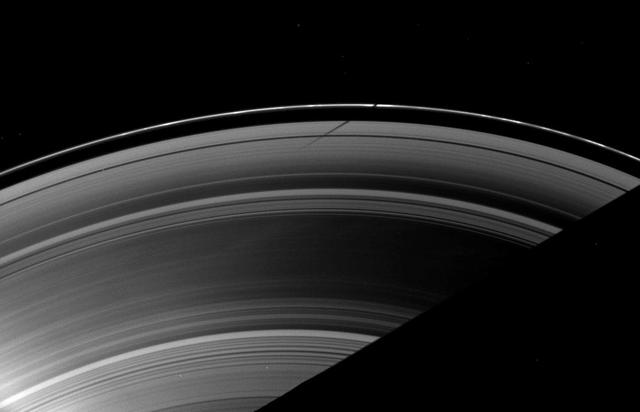
The shadow of the moon Mimas strikes the F ring at a different angle than the angle at which it is cast on the A ring, illustrating differences in the vertical heights of the rings in this image taken as Saturn approaches its August 2009 equinox.