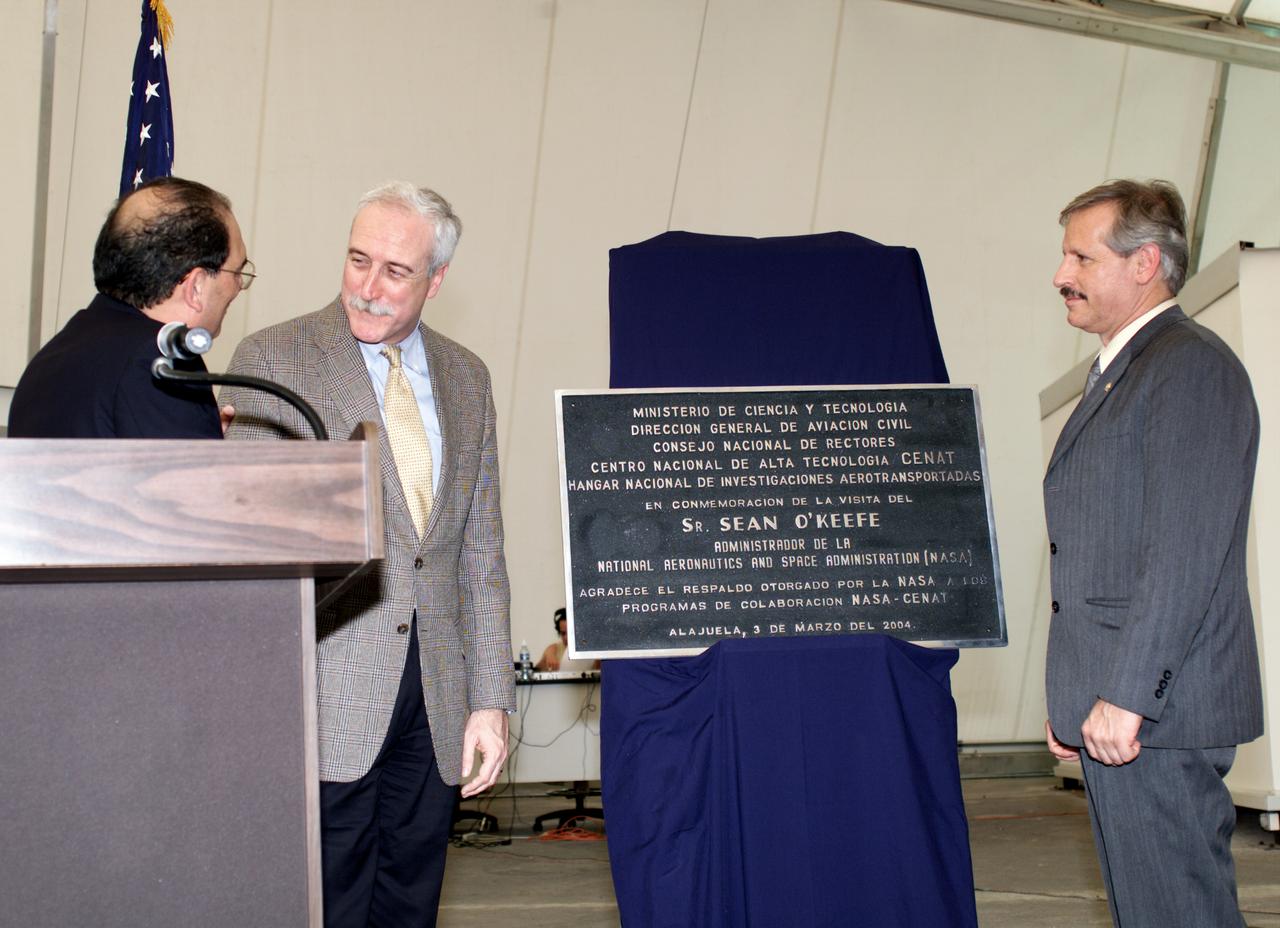
AirSAR 2004 Mesoamerica plaque unveiling by NASA Administrator Sean O'Keefe and Fernando Gutierrez, Costa Rican Minister of Science and Technology(MICIT). AirSAR 2004 Mesoamerica is a three-week expedition by an international team of scientists that will use an all-weather imaging tool, called the Airborne Synthetic Aperture Radar (AirSAR), in a mission ranging from the tropical rain forests of Central America to frigid Antarctica.
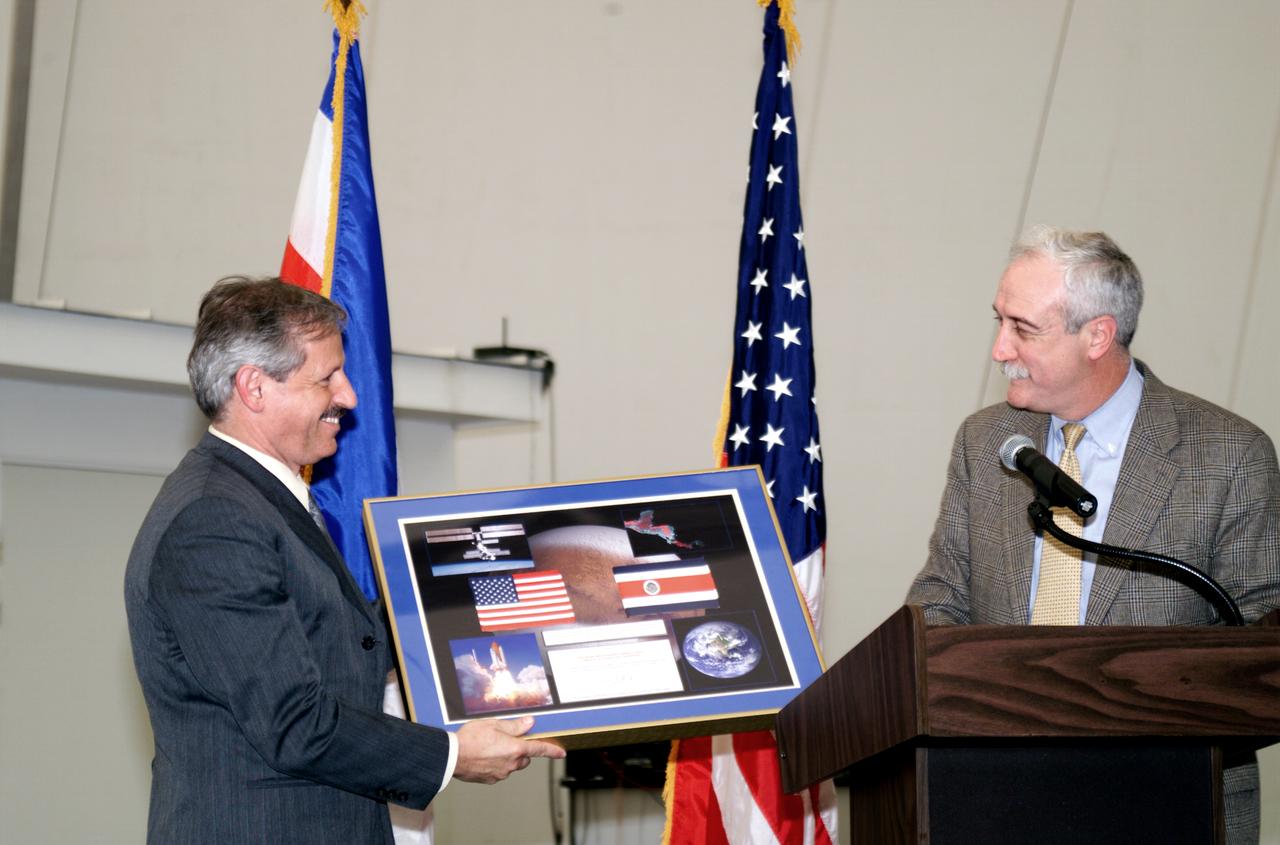
NASA Administrator Sean O'Keefe making a presentation to Fernando Gutierrez, Costa Rican Minister of Science and Technology(MICIT), during the AirSAR 2004 Mesoamerica hangar naming ceremony. AirSAR 2004 Mesoamerica is a three-week expedition by an international team of scientists that will use an all-weather imaging tool, called the Airborne Synthetic Aperture Radar (AirSAR), in a mission ranging from the tropical rain forests of Central America to frigid Antarctica.
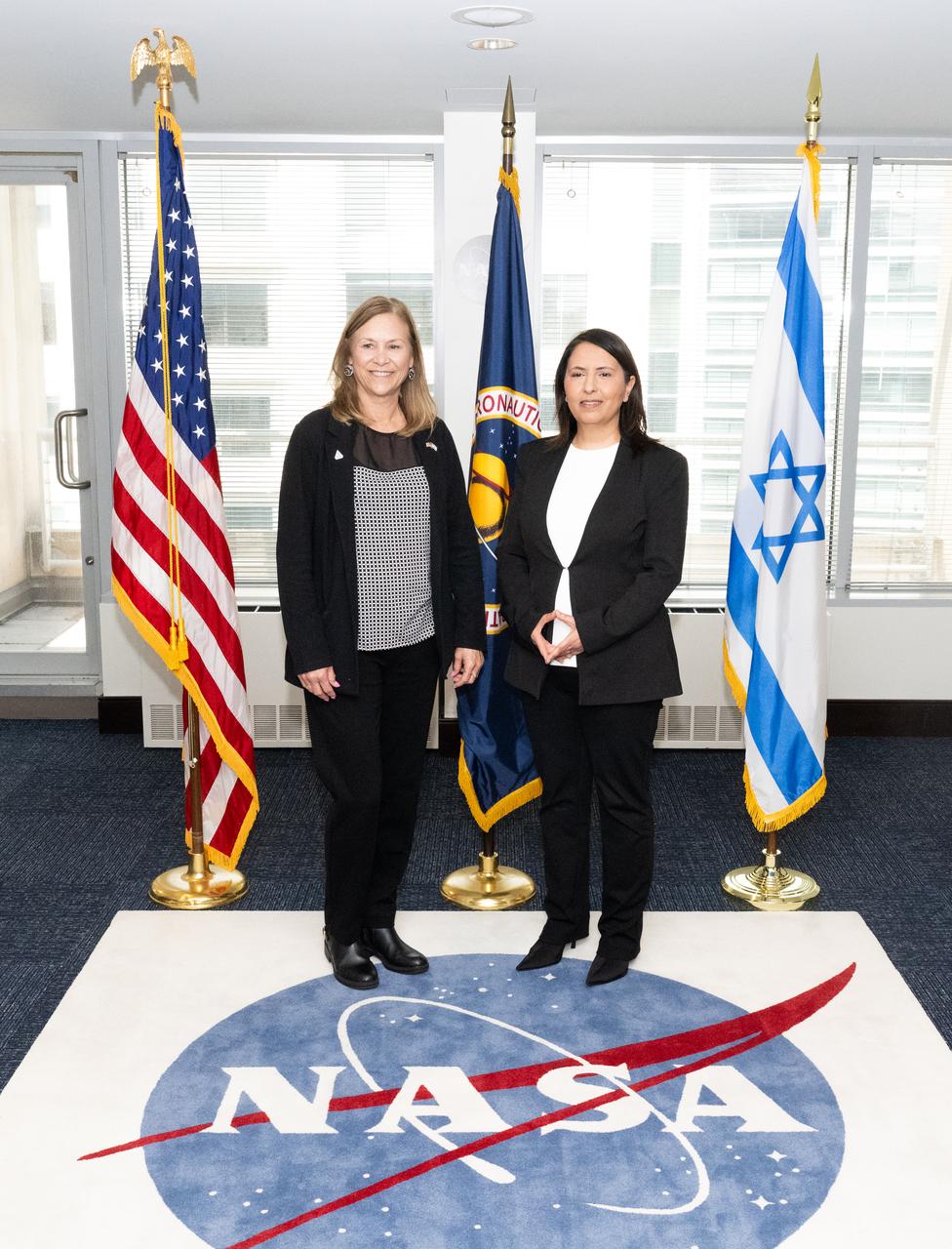
Acting NASA Administrator Janet Petro, left, and Israel Minister for Science, Technology, and Innovation Gila Gamliel, right, pose for a picture before they met to discuss areas of ongoing and potential future U.S.-Israel collaboration in science and exploration, Wednesday, June 4, 2025, at the Mary W. Jackson NASA Headquarters building in Washington. Photo Credit: (NASA/Joel Kowsky)
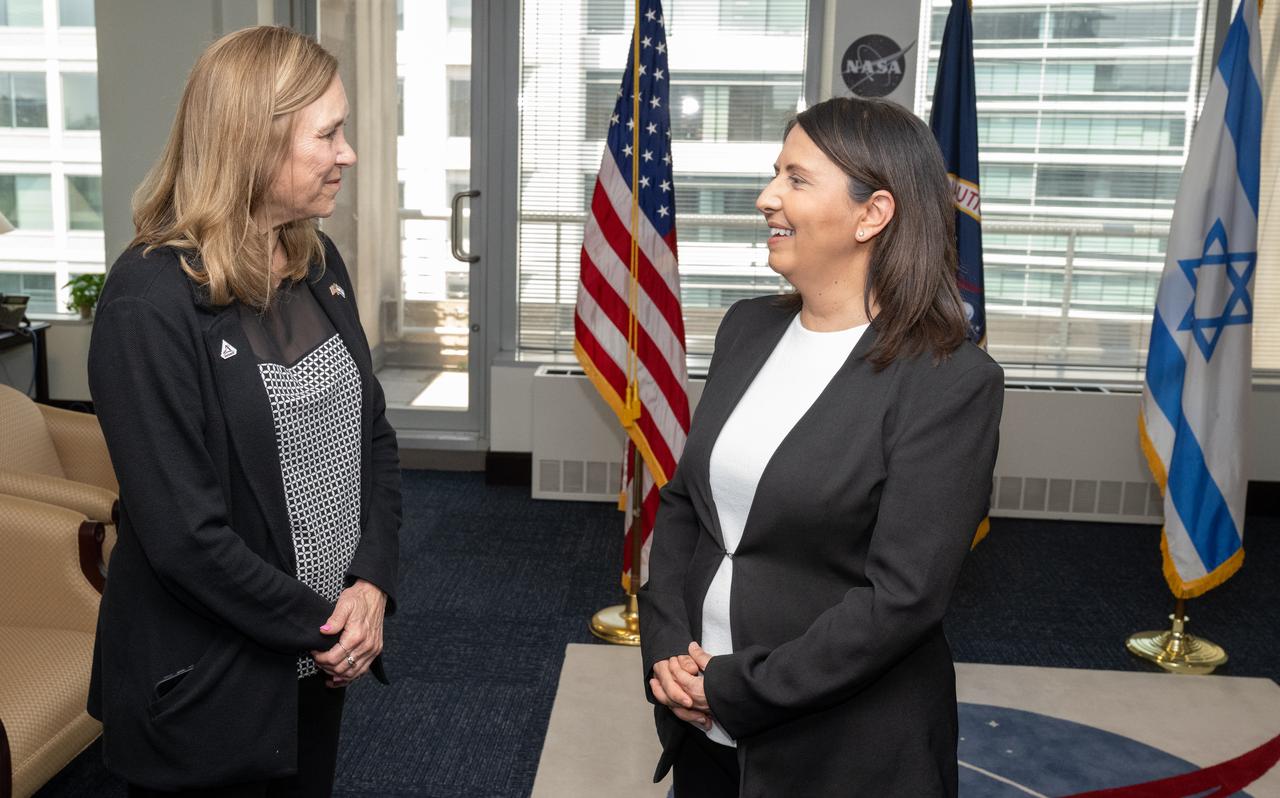
Acting NASA Administrator Janet Petro, left, and Israel Minister for Science, Technology, and Innovation Gila Gamliel, right, met to discuss areas of ongoing and potential future U.S.-Israel collaboration in science and exploration, Wednesday, June 4, 2025, at the Mary W. Jackson NASA Headquarters building in Washington. Photo Credit: (NASA/Joel Kowsky)
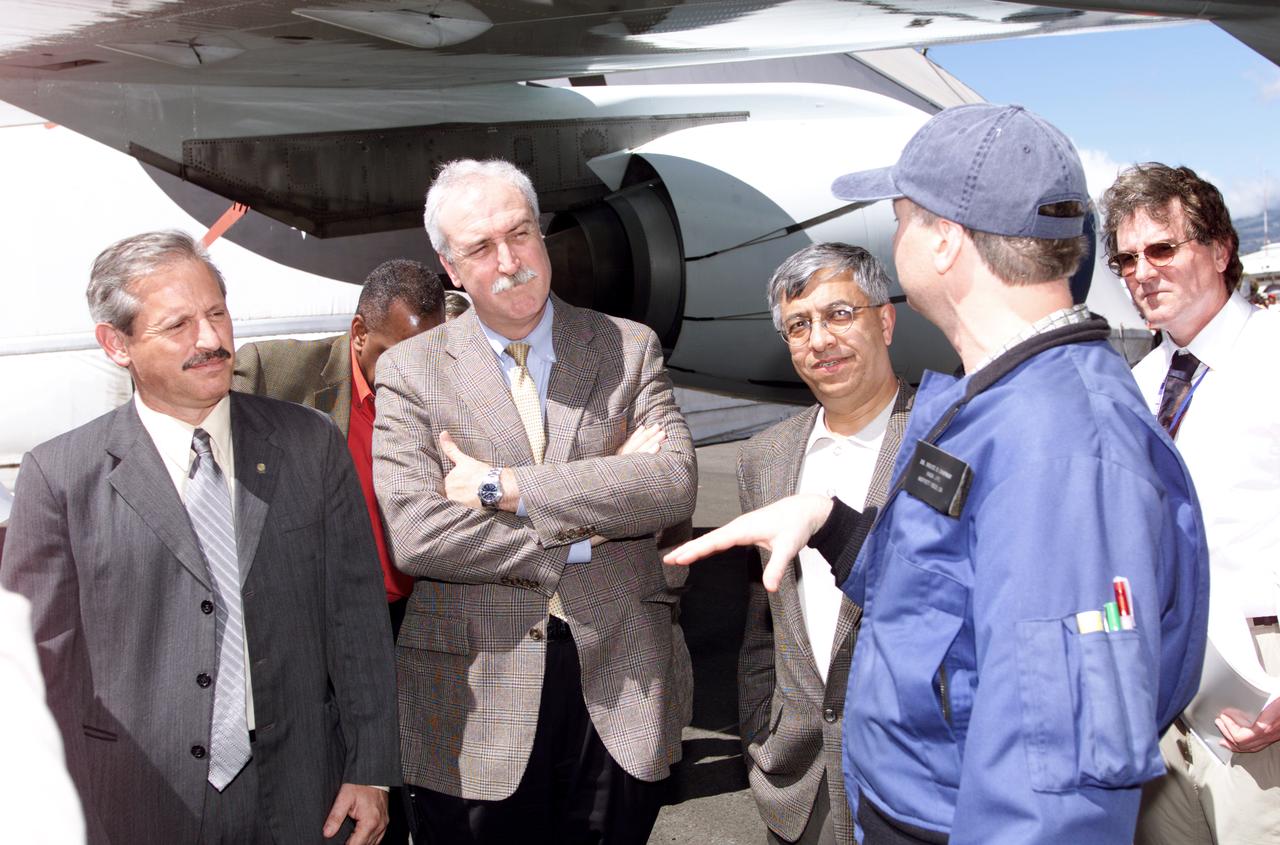
Personnel viewing AirSAR hardware while touring the outside of NASA's DC-8 during a stop-off on the AirSAR 2004 Mesoamerica campaign, L-R: Fernando Gutierrez, Costa Rican Minister of Science and Technology(MICIT); NASA Administrator Sean O'Keefe; Dr. Gahssem Asrar, NASA Associate Administrator for Earth Science Enterprises; JPL scientist Bruce Chapman; and Craig Dobson, NASA Program Manager for AirSAR. AirSAR 2004 Mesoamerica is a three-week expedition by an international team of scientists that will use an all-weather imaging tool, called the Airborne Synthetic Aperture Radar (AirSAR), in a mission ranging from the tropical rain forests of Central America to frigid Antarctica.
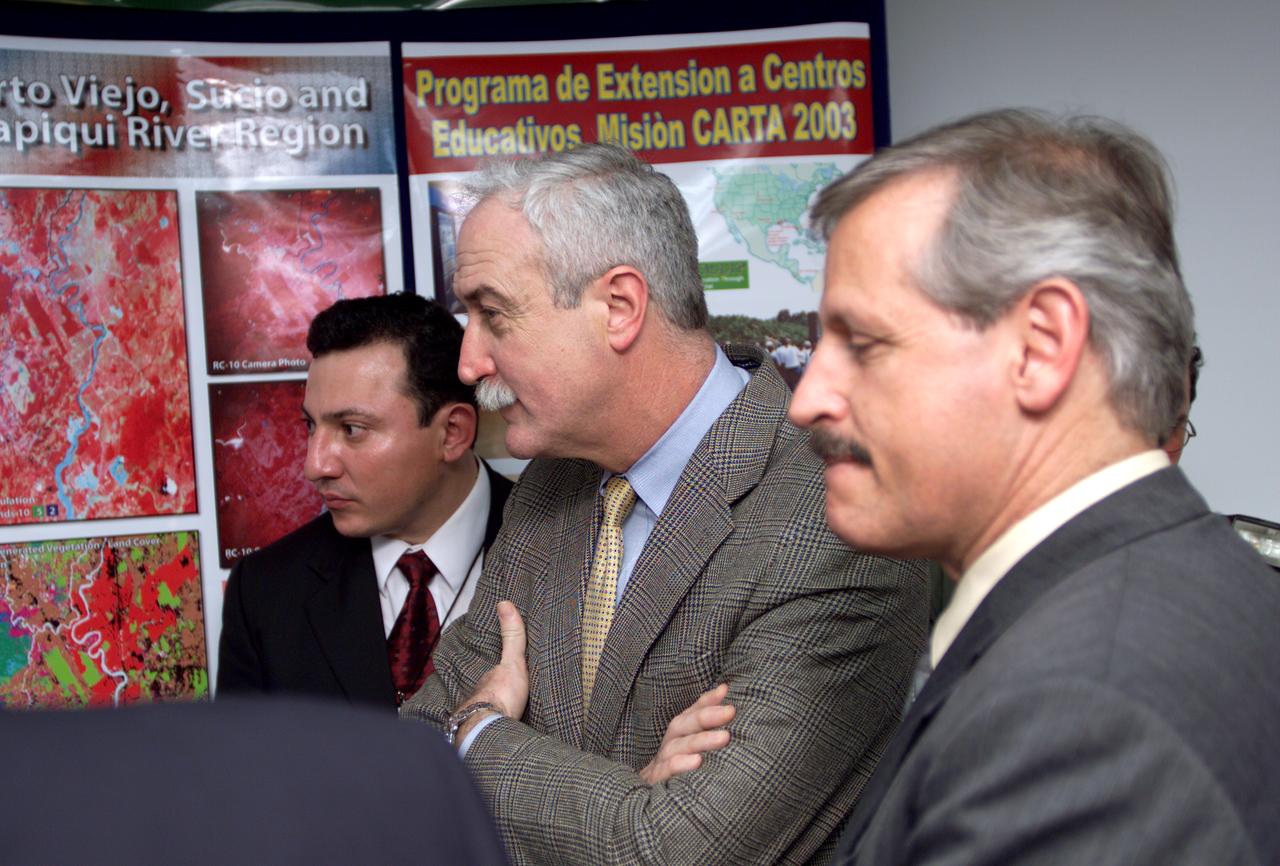
L-R; Jorge Andres Diaz, Director of the Costa Rican National Hangar for Airborne Research division of the National Center for High Technology(CENAT); NASA Administrator Sean O'Keefe; and Fernando Gutierrez, Costa Rican Minister of Science and Technology(MICIT), viewing posters showing how NASA activities have made an impact on Costa Rican people. Mr. O'Keefe was in Costa Rica to participate in the AirSAR 2004 Mesoamerica campaign, which used NASA DFRC's DC-8 airborne laboratory aircraft. AirSAR 2004 is a three-week expedition by an international team of scientists that will use an all-weather imaging tool, called the Airborne Synthetic Aperture Radar (AirSAR), in a mission ranging from the tropical rain forests of Central America to frigid Antarctica.
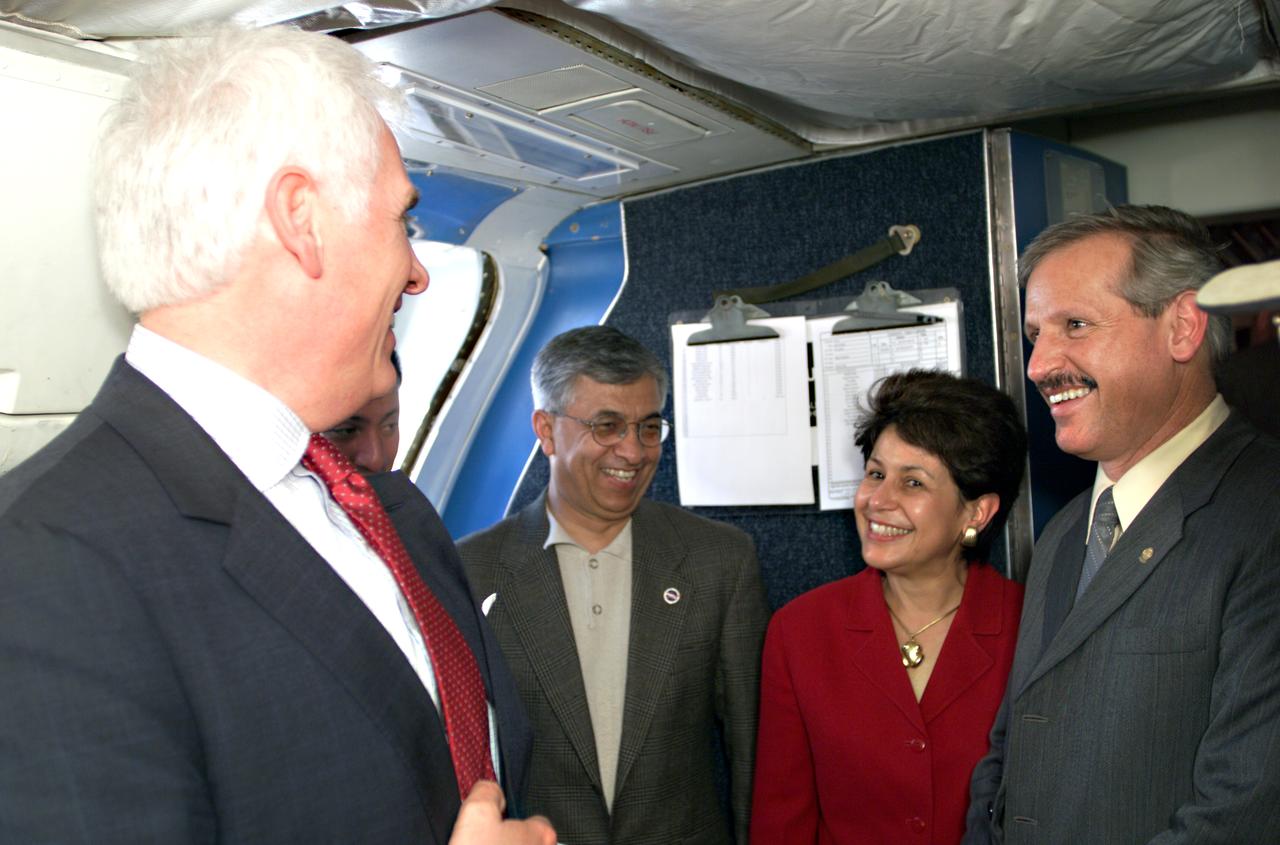
VIP’s onboard NASA's DC-8 aircraft during the AirSAR 2004 Mesoamerica campaign, L-R: Mr. John Danilovich, US Ambassador to Costa Rica; Dr. Gahssem Asrar, NASA Associate Administrator for Earth Science Enterprises; Dr. Sonia Marta Mora, President of the Costa Rican National Rector’s Council; and Fernando Gutierrez, Costa Rican Minister of Science and Technology(MICIT). AirSAR 2004 Mesoamerica is a three-week expedition by an international team of scientists that will use an all-weather imaging tool, called the Airborne Synthetic Aperture Radar (AirSAR), in a mission ranging from the tropical rain forests of Central America to frigid Antarctica.
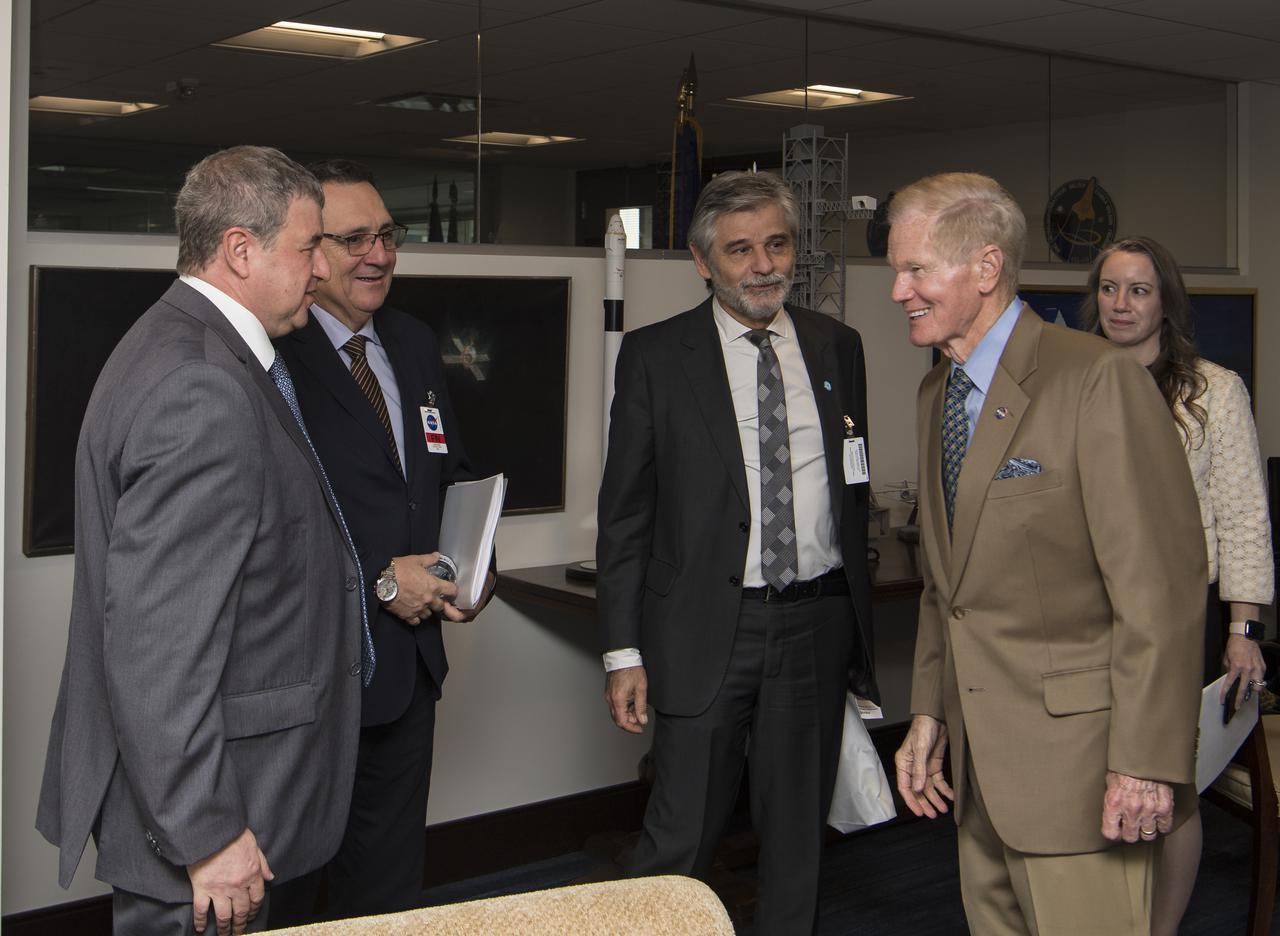
NASA Administrator Bill Nelson, right, meets with Executive and Technical Director of the Comisión Nacional de Actividades Espaciales (CONAE), Raúl Kulichevsky, left, Advisor to the Minister for Science and Technology in Argentina, Guillermo Salvatierra, second from left, and Minister of Science, Technology and Innovation in Argentina and Chairman of the Board of CONAE, Daniel Filmus, Tuesday, March 22, 2022, at NASA Headquarters in Washington DC. Photo Credit: (NASA/Aubrey Gemignani)
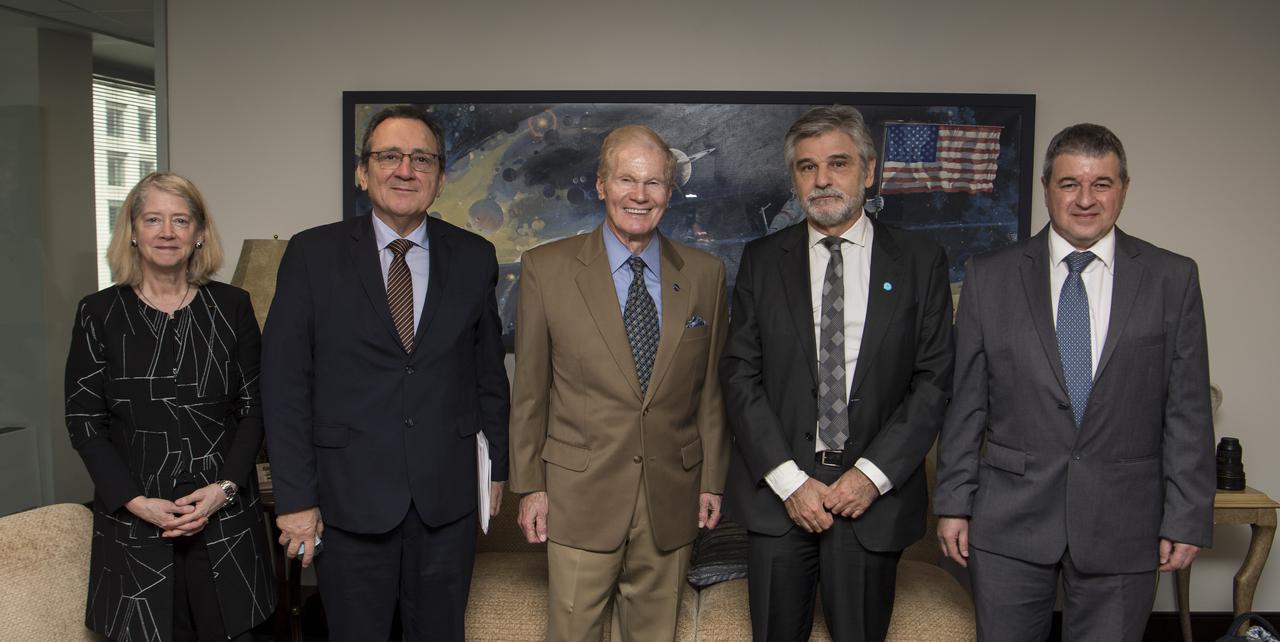
From left to right, NASA Deputy Administrator, Pam Melroy, Advisor to the Minister for Science and Technology in Argentina, Guillermo Salvatierra, NASA Administrator Bill Nelson, Minister of Science, Technology and Innovation in Argentina and Chairman of the Board of CONAE, Daniel Filmus, and Executive and Technical Director of the Comisión Nacional de Actividades Espaciales (CONAE), Raúl Kulichevsky, pose for a photo Tuesday, March 22, 2022, at NASA Headquarters in Washington DC. Photo Credit: (NASA/Aubrey Gemignani)
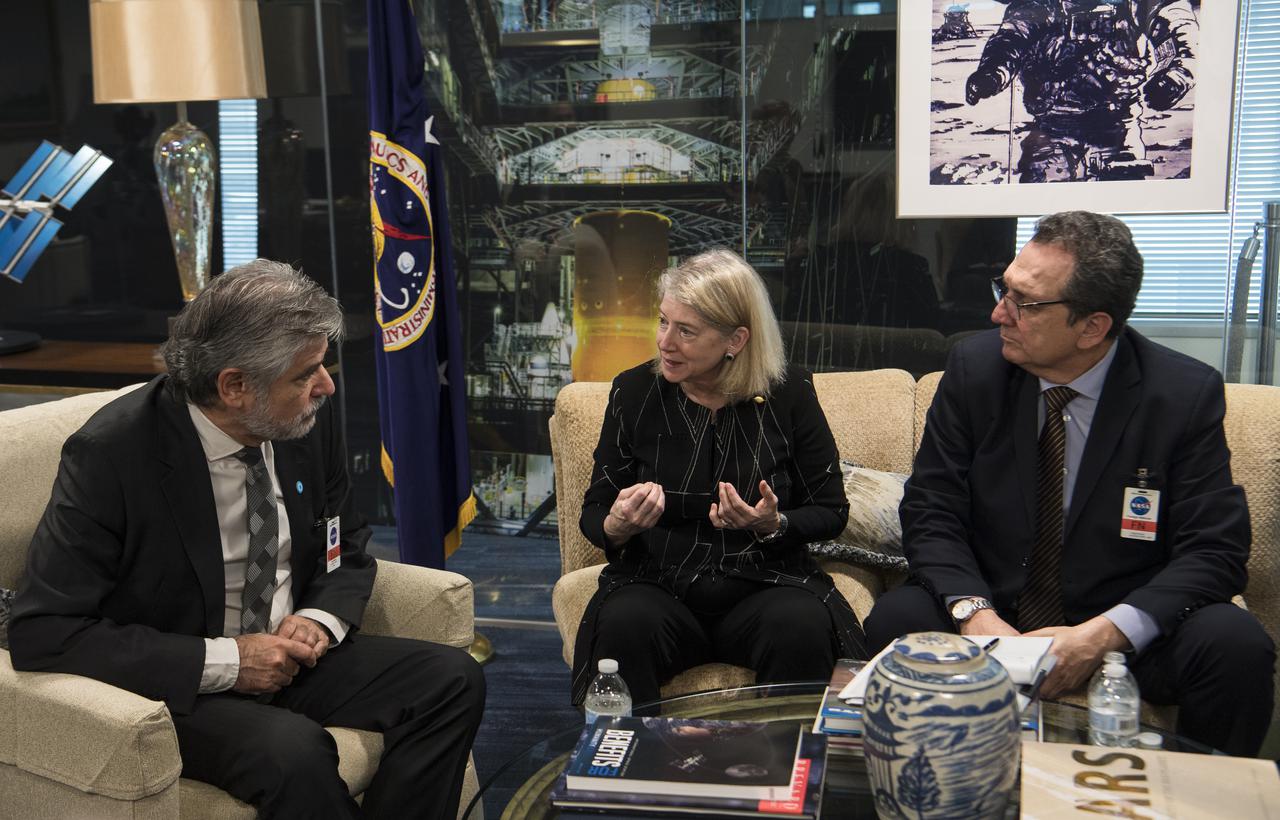
NASA Deputy Administrator Pam Melroy, center, speaks with the Minister of Science, Technology and Innovation in Argentina and Chairman of the Board of the Comisión Nacional de Actividades Espaciales (CONAE), Daniel Filmus, left, and Advisor to the Minister for Science and Technology in Argentina, Guillermo Salvatierra, during a meeting, Tuesday, March 22, 2022, at NASA Headquarters in Washington DC. Photo Credit: (NASA/Aubrey Gemignani)
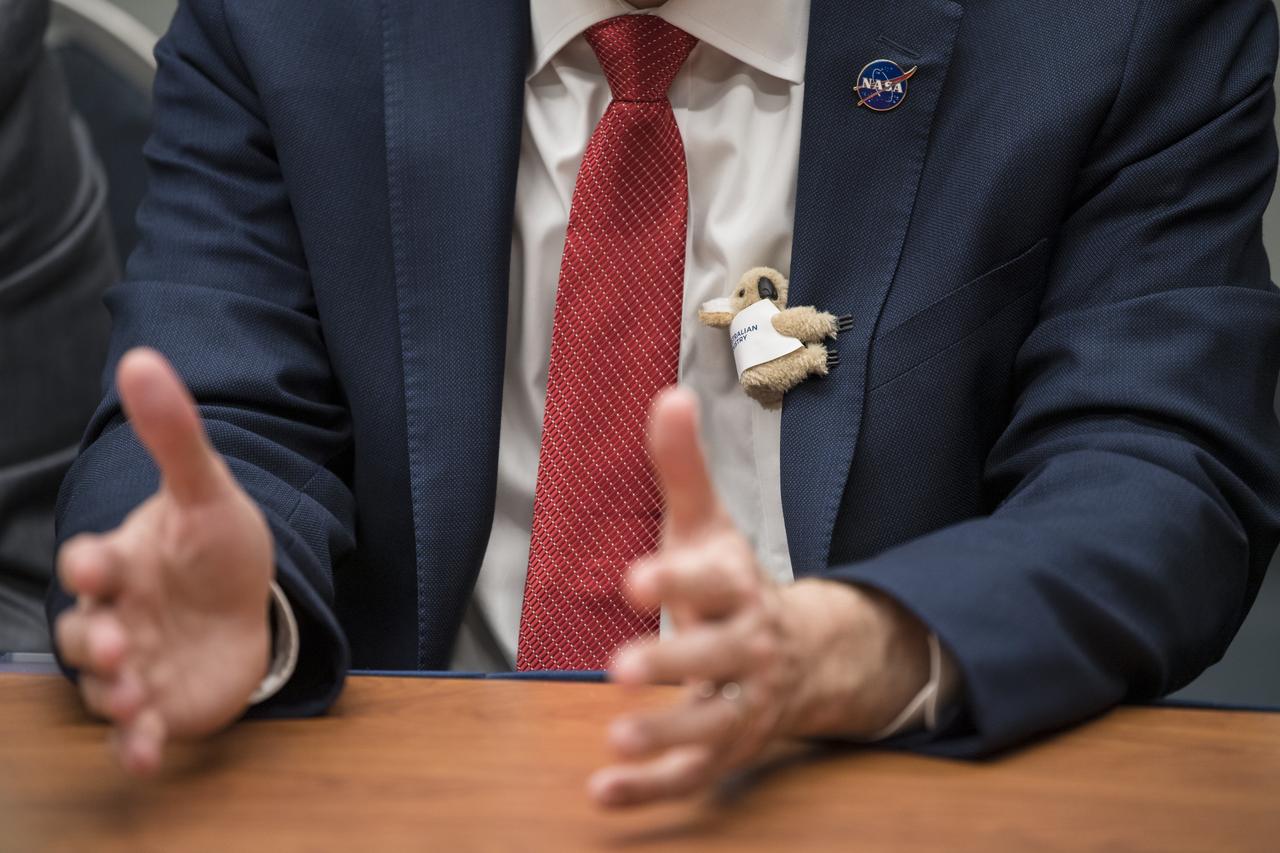
NASA Administrator Jim Bridenstine is seen wearing a koala gifted to him by the Honorable Karen Andrews, Minister of Parliament, and Minister, Industry, Science and Technology, Austrailia, during a meeting at the 70th International Astronautical Congress, Monday, Oct. 21, 2019 in Washington. Photo Credit: (NASA/Aubrey Gemignani)
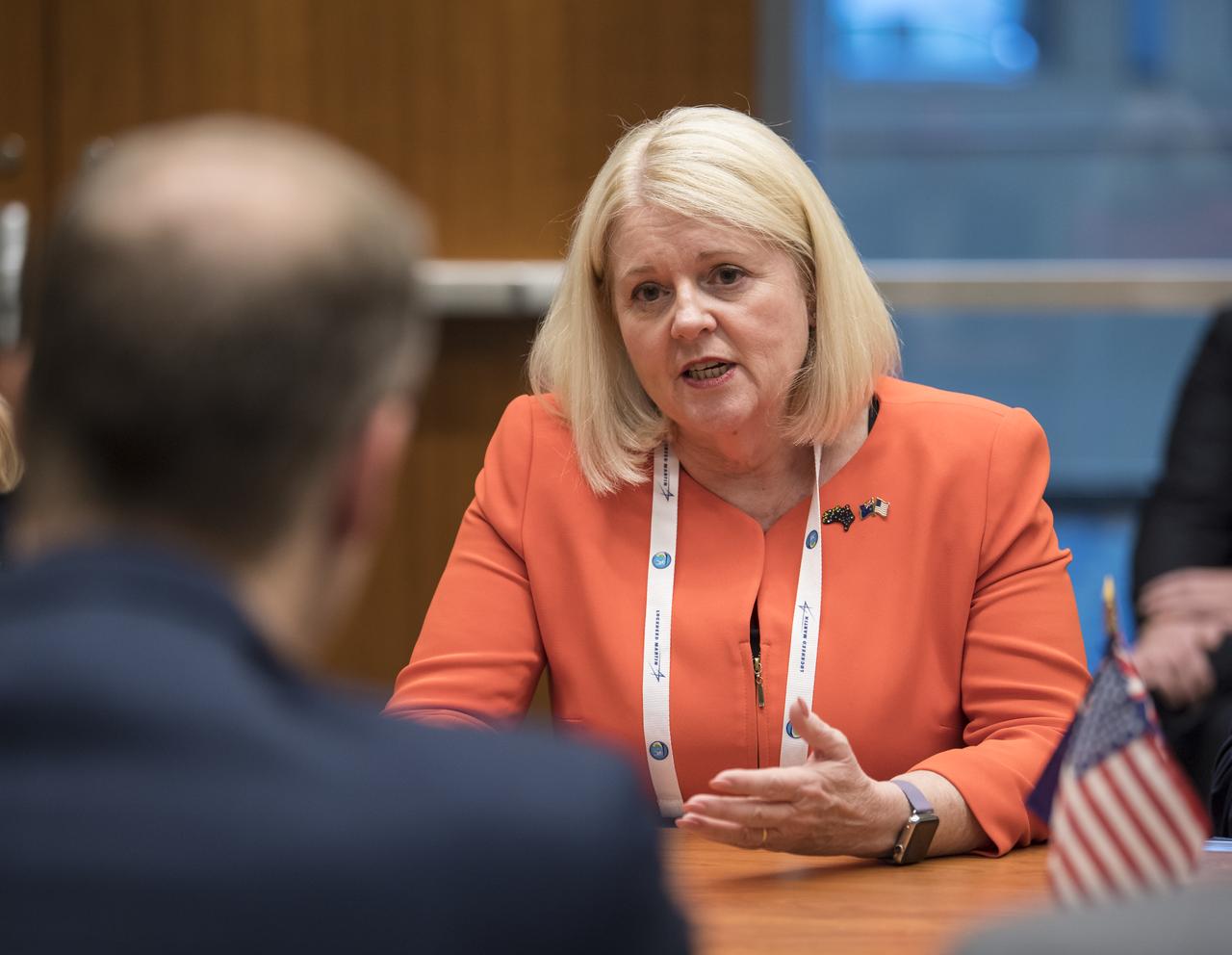
The Honorable Karen Andrews, Minister of Parliament and Minister, Industry, Science and Technology for Austrailia speaks with NASA Administrator Jim Bridenstine, left, during the 70th International Astronautical Congress, Monday, Oct. 21, 2019 in Washington. Photo Credit: (NASA/Aubrey Gemignani)
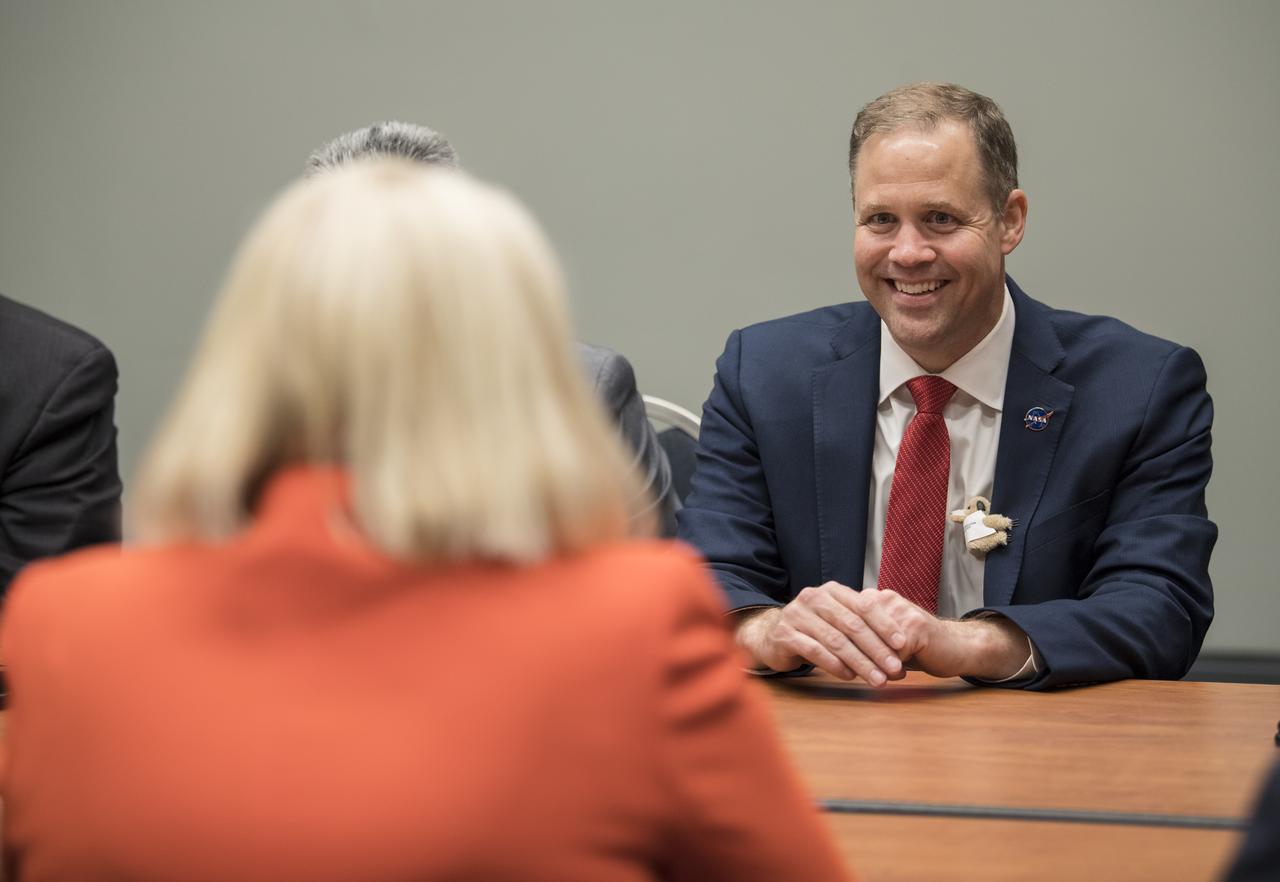
NASA Administrator Jim Bridenstine speaks with the Honorable Karen Andrews Minister of Parliament and Minister, Industry, Science and Technology, Austrailia, during the 70th International Astronautical Congress, Monday, Oct. 21, 2019 in Washington. Photo Credit: (NASA/Aubrey Gemignani)
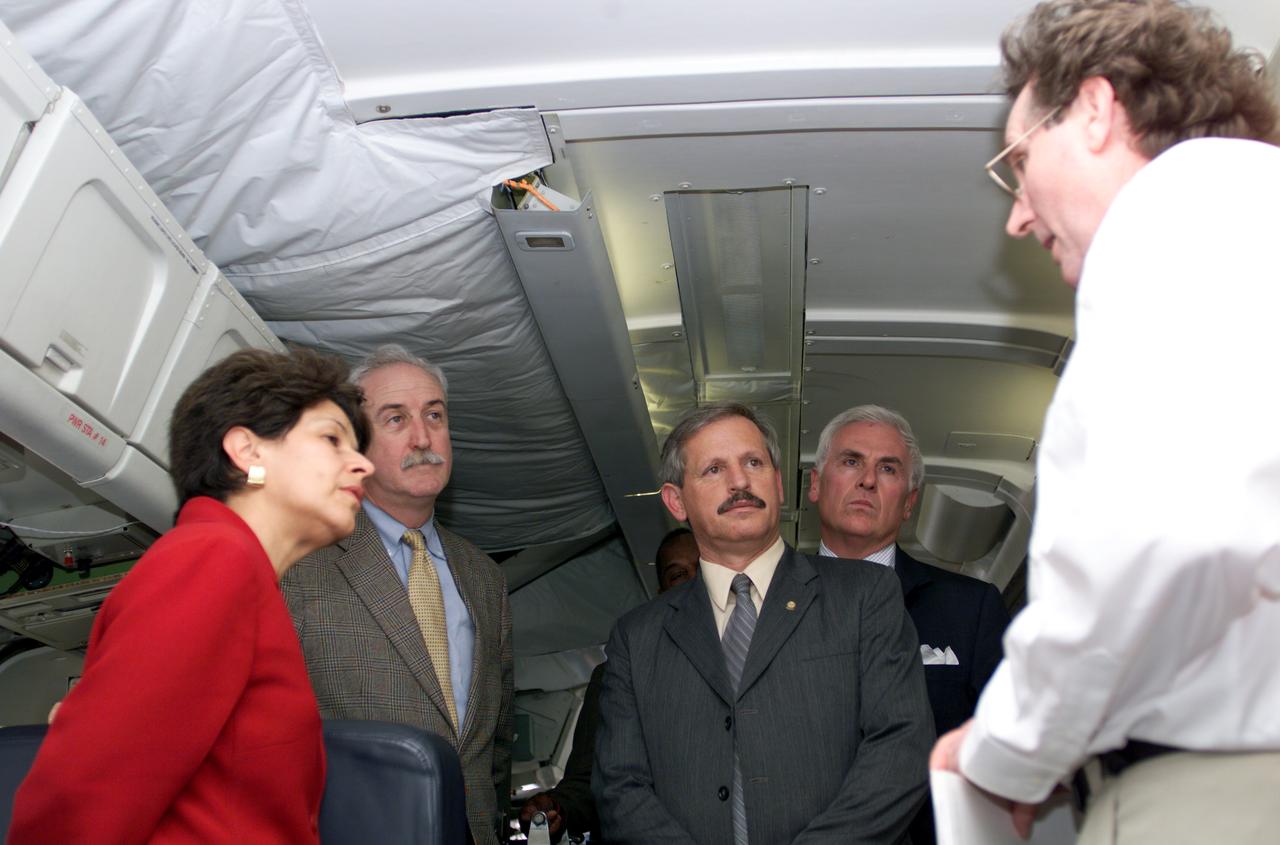
VIP tour of NASA DFRC's DC-8 airborne laboratory during the AirSAR 2004 Mesoamerica campaign given by Craig Dobson, NASA Program Manager for AirSAR, L-R: Dr. Sonia Marta Mora, President of the Costa Rican National Rector’s Council; NASA Administrator Sean O'Keefe; Fernando Gutierrez, Costa Rican Minister of Science and Technology(MICIT); Mr. John Danilovich, US Ambassador to Costa Rica; and Dobson. AirSAR 2004 Mesoamerica is a three-week expedition by an international team of scientists that will use an all-weather imaging tool, called the Airborne Synthetic Aperture Radar (AirSAR), in a mission ranging from the tropical rain forests of Central America to frigid Antarctica.
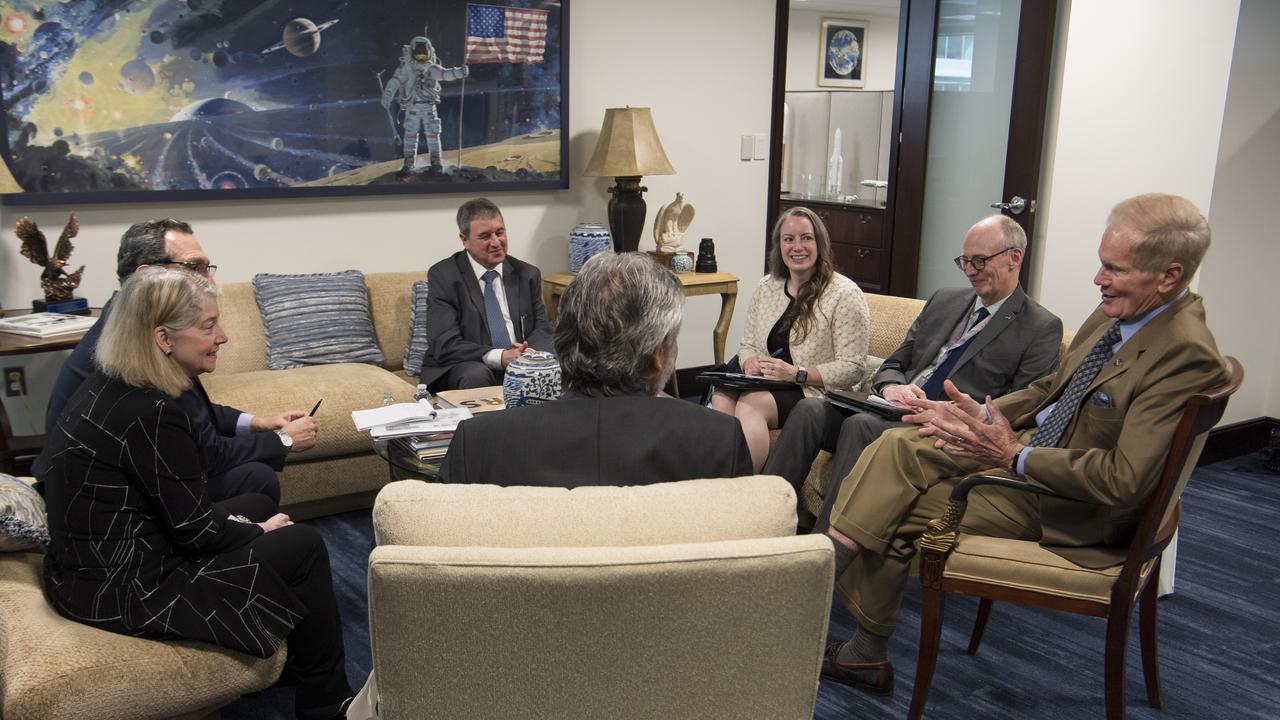
From left to right, NASA Deputy Administrator, Pam Melroy, Advisor to the Minister for Science and Technology in Argentina, Guillermo Salvatierra, Executive and Technical Director of the Comisión Nacional de Actividades Espaciales (CONAE), Raúl Kulichevsky, Minister of Science, Technology and Innovation in Argentina and Chairman of the Board of CONAE, Daniel Filmus, NASA Office of International and Interagency Relations Deputy Associate Administrator, Meredith McKay, NASA Office of International and Interagency Relations, Director of the Science Division, Gib Kirkham, and NASA Administrator Bill Nelson, meet Tuesday, March 22, 2022, at NASA Headquarters in Washington DC. Photo Credit: (NASA/Aubrey Gemignani)
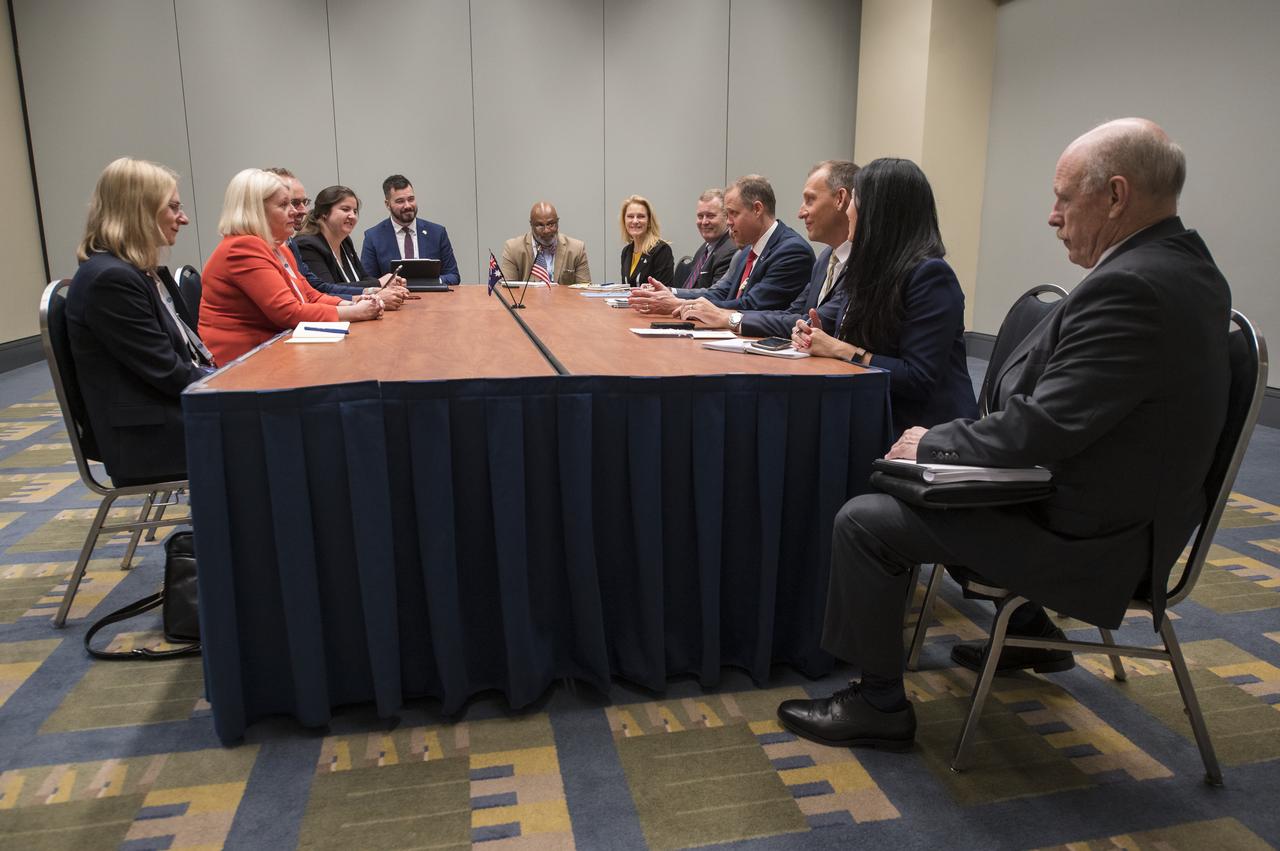
NASA Administrator Jim Bridenstine, fourth from right, and Deputy Administrator Jim Morhard, fifth from right, speak with the Honorable Karen Andrews Minister of Parliament and Minister, Industry, Science and Technology, Austrailia, second from left, during the 70th International Astronautical Congress, Monday, Oct. 21, 2019 in Washington. Photo Credit: (NASA/Aubrey Gemignani)
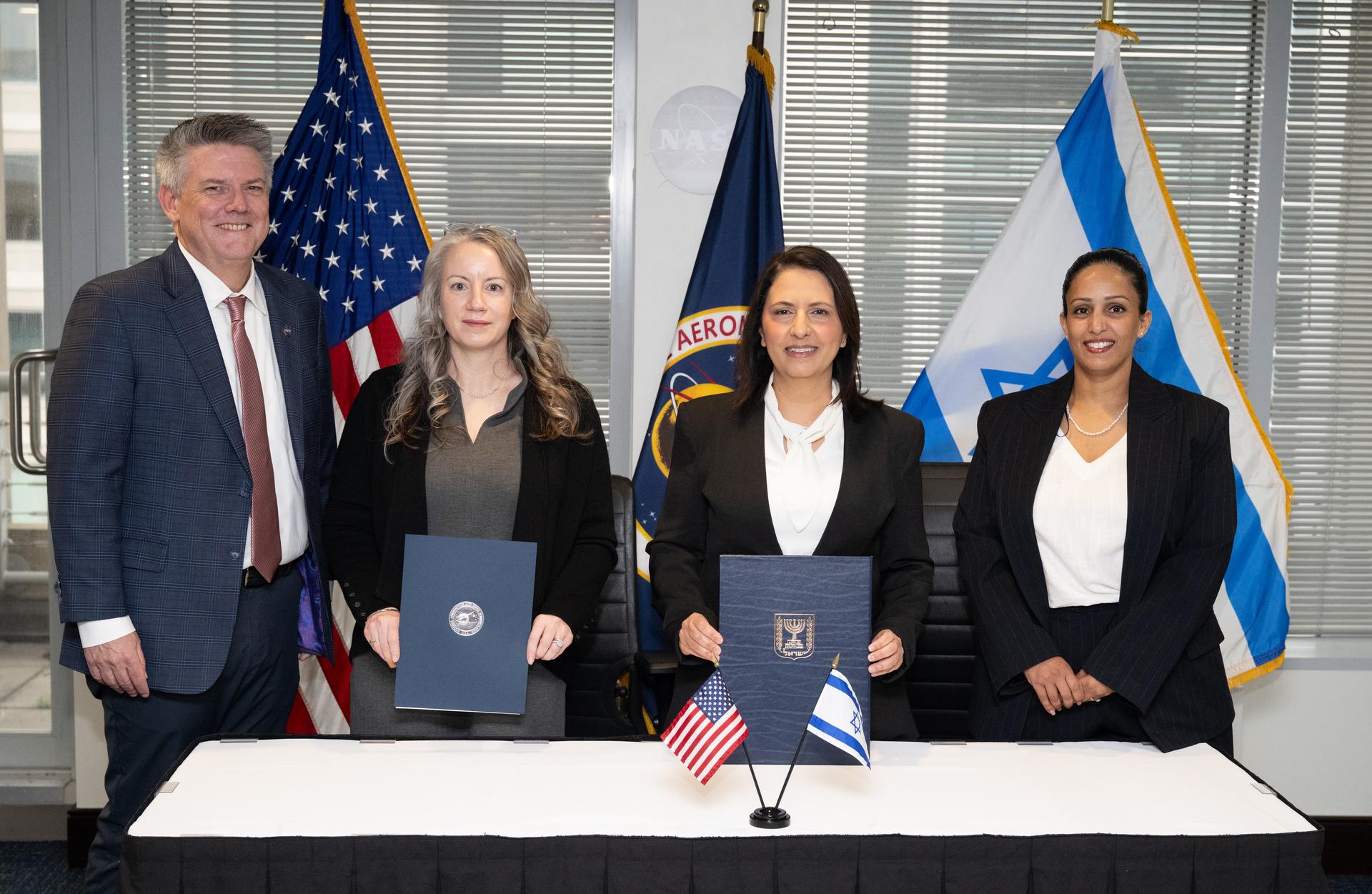
Brian Hughes, NASA Chief of Staff, left, Meredith McKay, acting associate administrator for NASA’s Office of International and Interagency Relations, second from left, Israel’s Minister for Innovation, Science, and Technology Gila Gamliel, and Shani Edri, director of International Relations in Israel’s Ministry of Innovation, Science, and Technology pose for a picture after the signing the US-Israel Space Cooperation Framework Agreement Extension, Wednesday, Dec. 10, 2025, at the Mary W. Jackson NASA Headquarters building in Washington. Photo Credit: (NASA/Joel Kowsky)
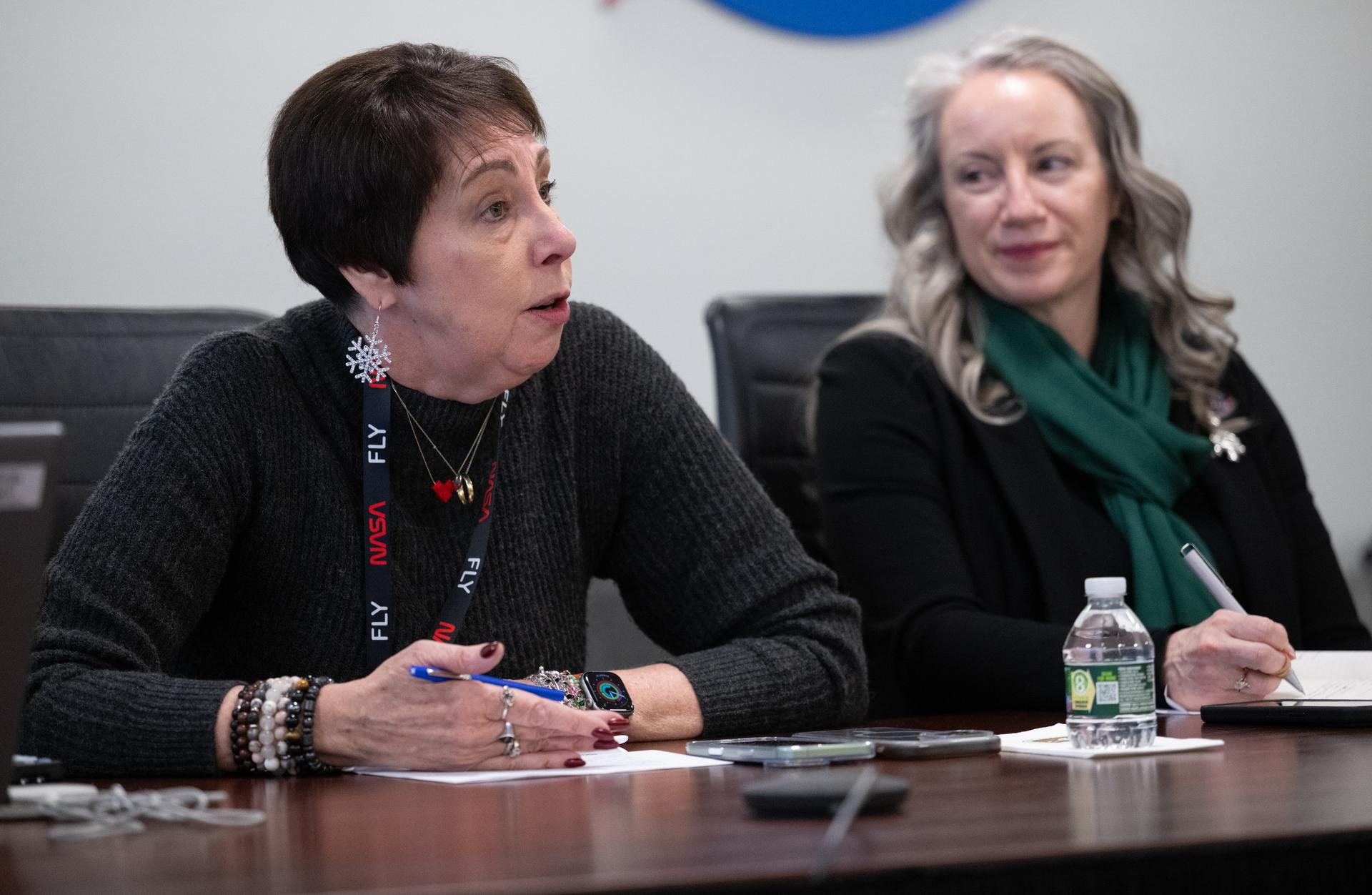
Nicola Fox, associate administrator for NASA’s Science Mission Directorate, is seen during a meeting with German Minister for Research, Technology, and Space Dorothee Bär, Tuesday, Dec. 9, 2025, at the Mary W. Jackson NASA Headquarters building in Washington. Photo Credit: (NASA/Joel Kowsky)
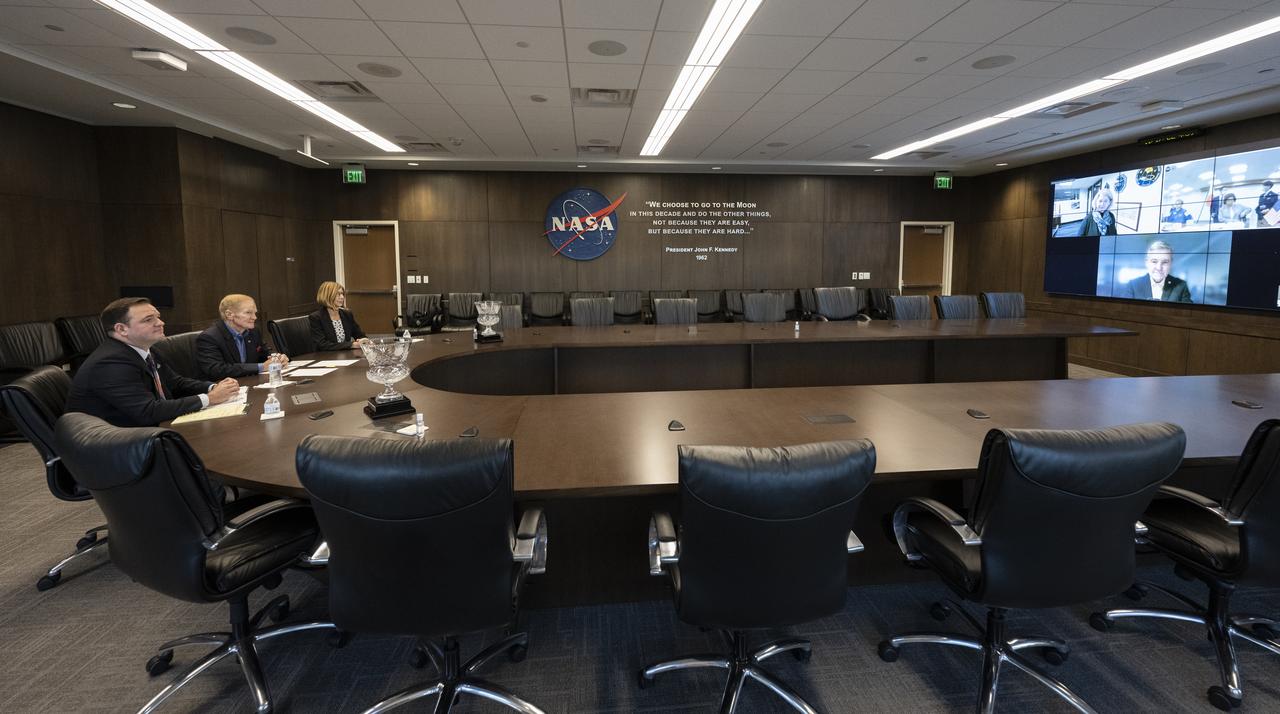
NASA Administrator Bill Nelson, joined by NASA Leadership, attends a virtual meeting hosted by Japanese Minister of Education, Culture, Sports, Science and Technology (MEXT) Keiko Nagaoka prior to signing a Gateway implementing agreement Thursday, Nov. 17, 2022, at NASA’s Kennedy Space Center in Florida. Photo Credit: (NASA/Keegan Barber)
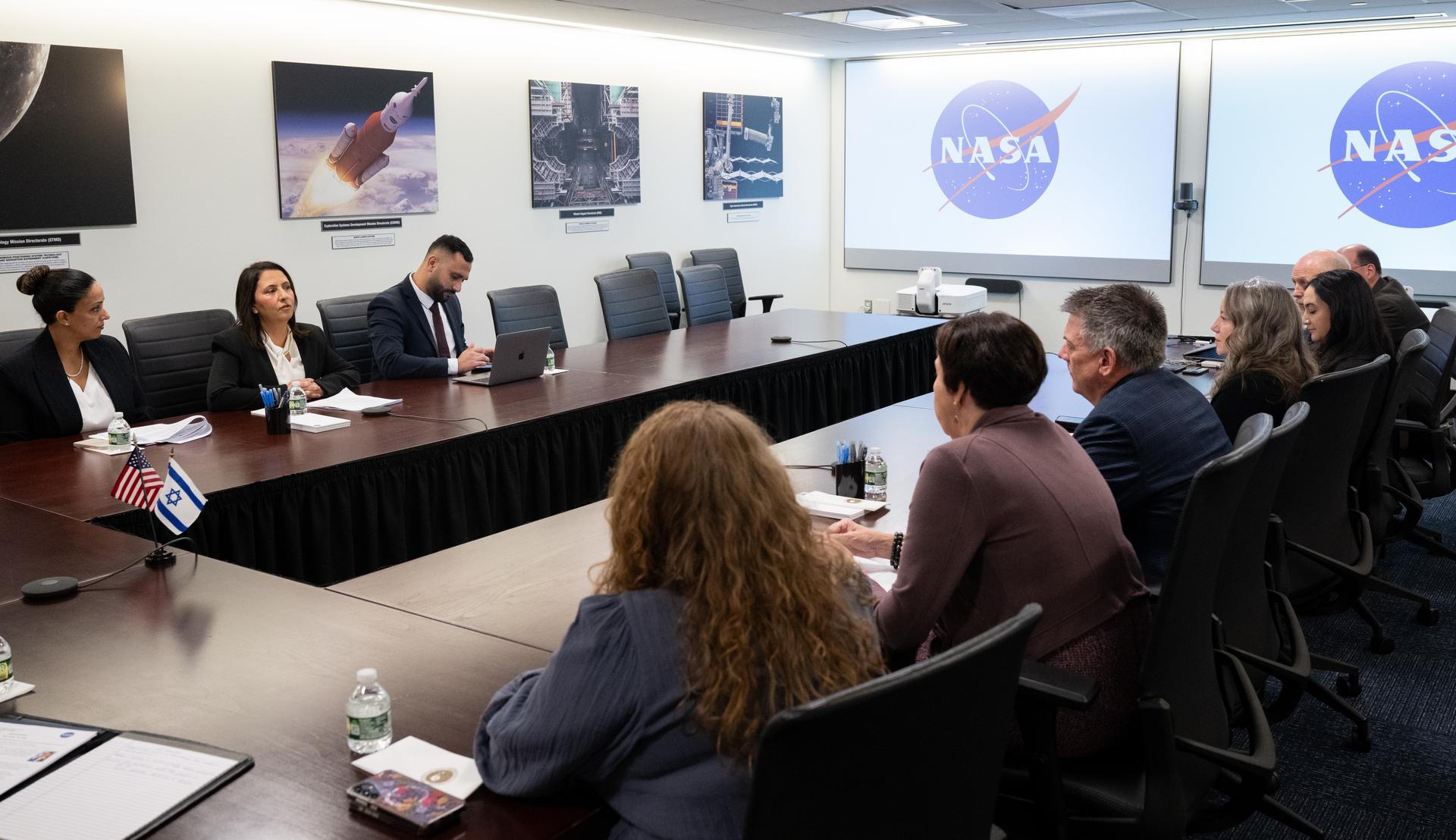
Israel’s Minister for Innovation, Science, and Technology Gila Gamliel, center left, is seen during a meeting with NASA leadership, Wednesday, Dec. 10, 2025, at the Mary W. Jackson NASA Headquarters building in Washington. Photo Credit: (NASA/Joel Kowsky)
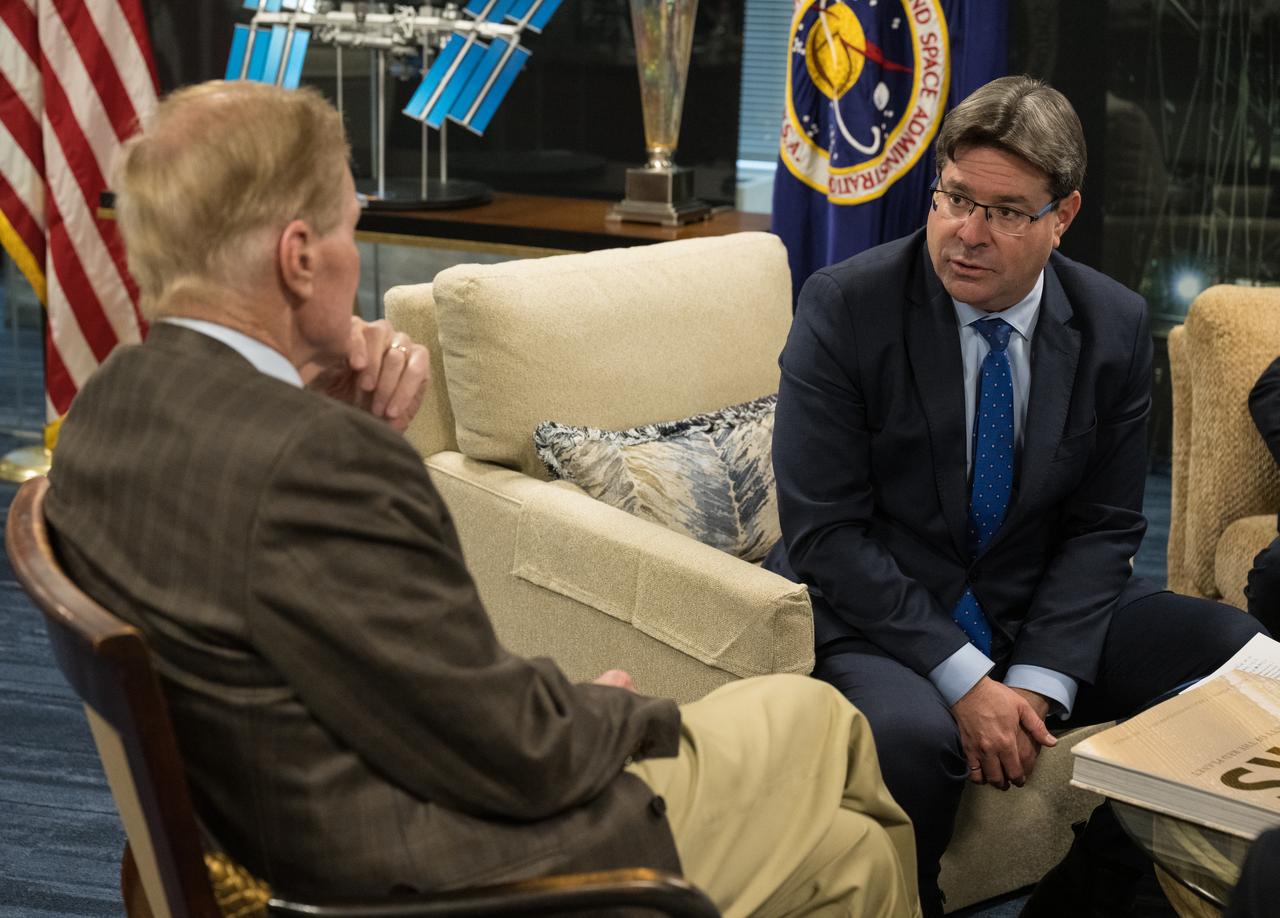
NASA Administrator Bill Nelson meets with Israel’s Minister of Innovation, Science, and Technology, Ofir Akunis, Monday, March 27, 2023 at the Mary W. Jackson NASA Headquarters building in Washington DC. Photo Credit: (NASA/Aubrey Gemignani)
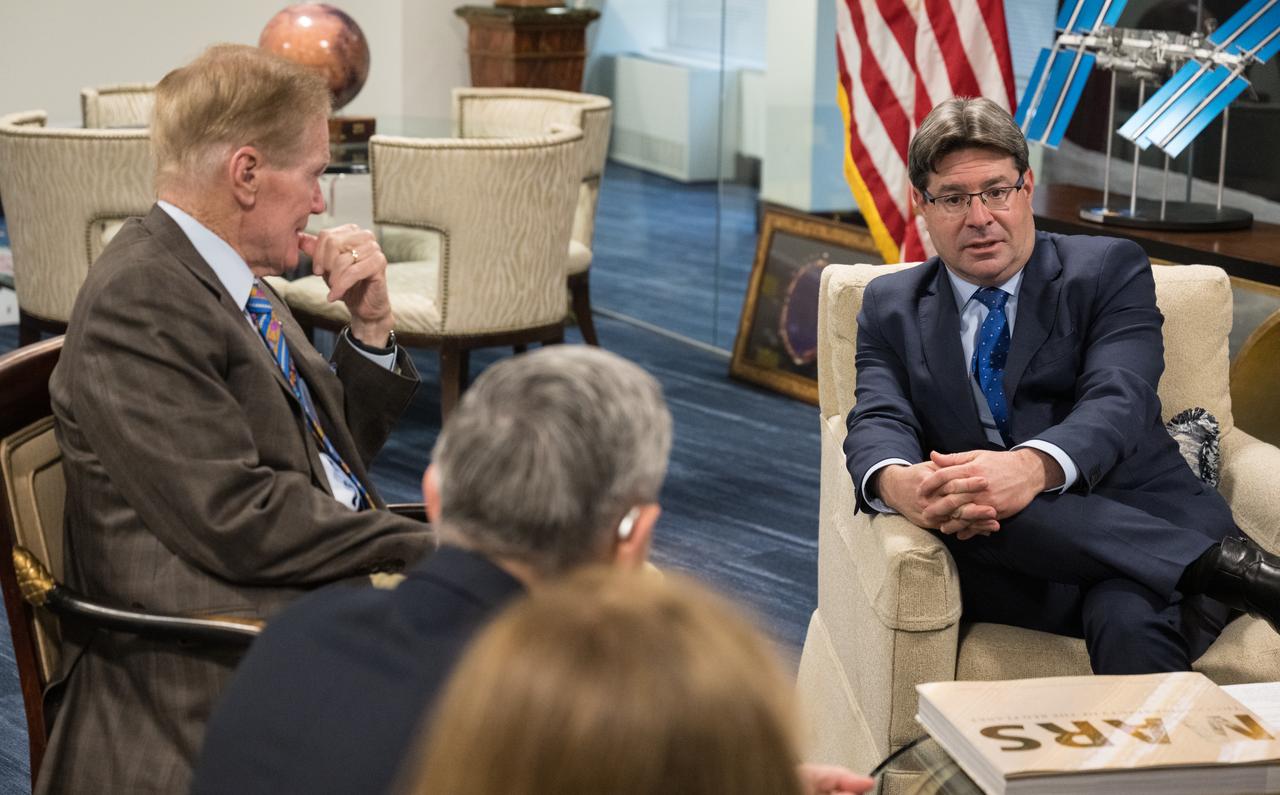
NASA Administrator Bill Nelson and NASA Associate Administrator Bob Cabana meet with Israel’s Minister of Innovation, Science, and Technology, Ofir Akunis, Monday, March 27, 2023 at the Mary W. Jackson NASA Headquarters building in Washington DC. Photo Credit: (NASA/Aubrey Gemignani)
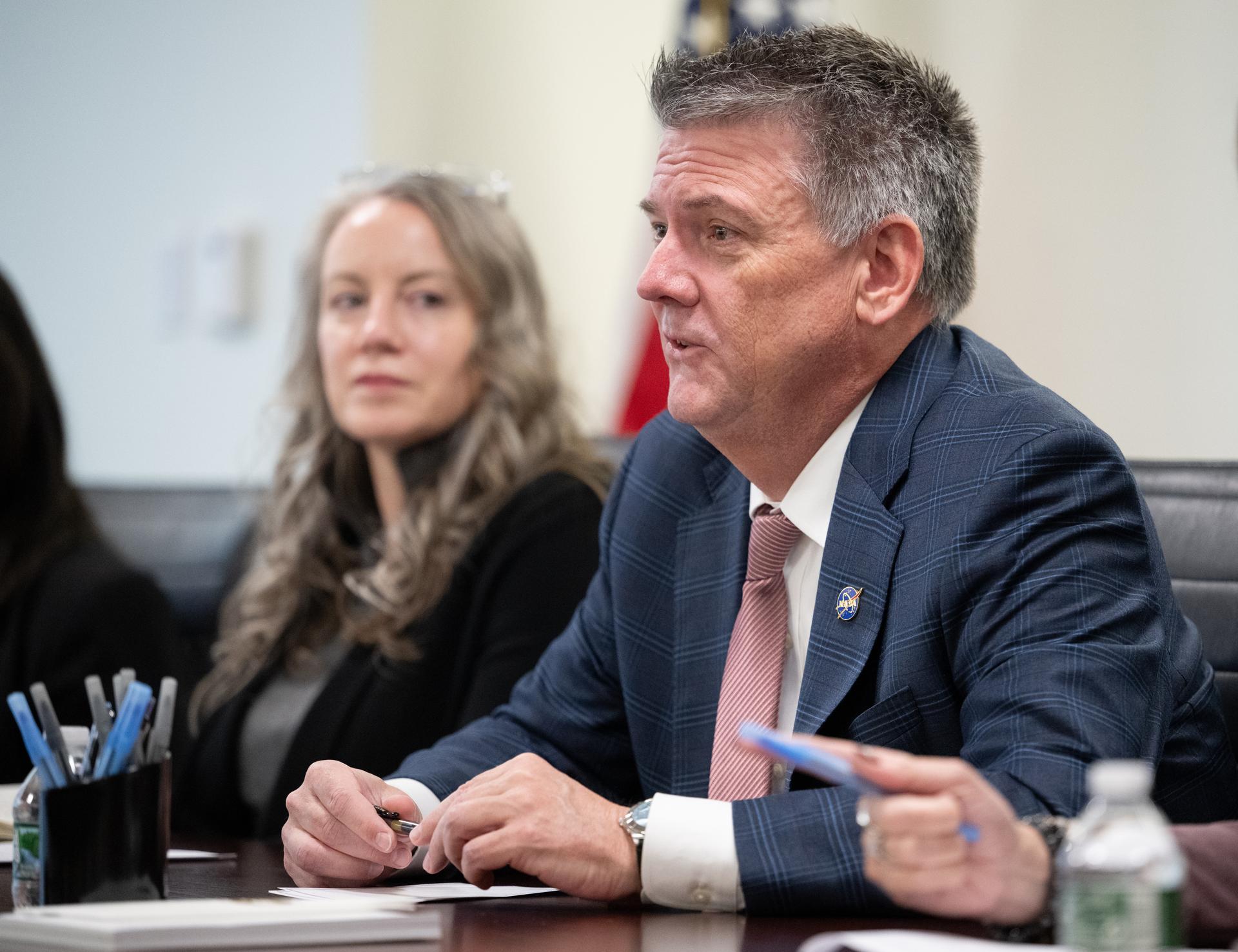
NASA Chief of Staff Brian Hughes is seen during a meeting with Israel’s Minister for Innovation, Science, and Technology Gila Gamliel, Wednesday, Dec. 10, 2025, at the Mary W. Jackson NASA Headquarters building in Washington. Photo Credit: (NASA/Joel Kowsky)
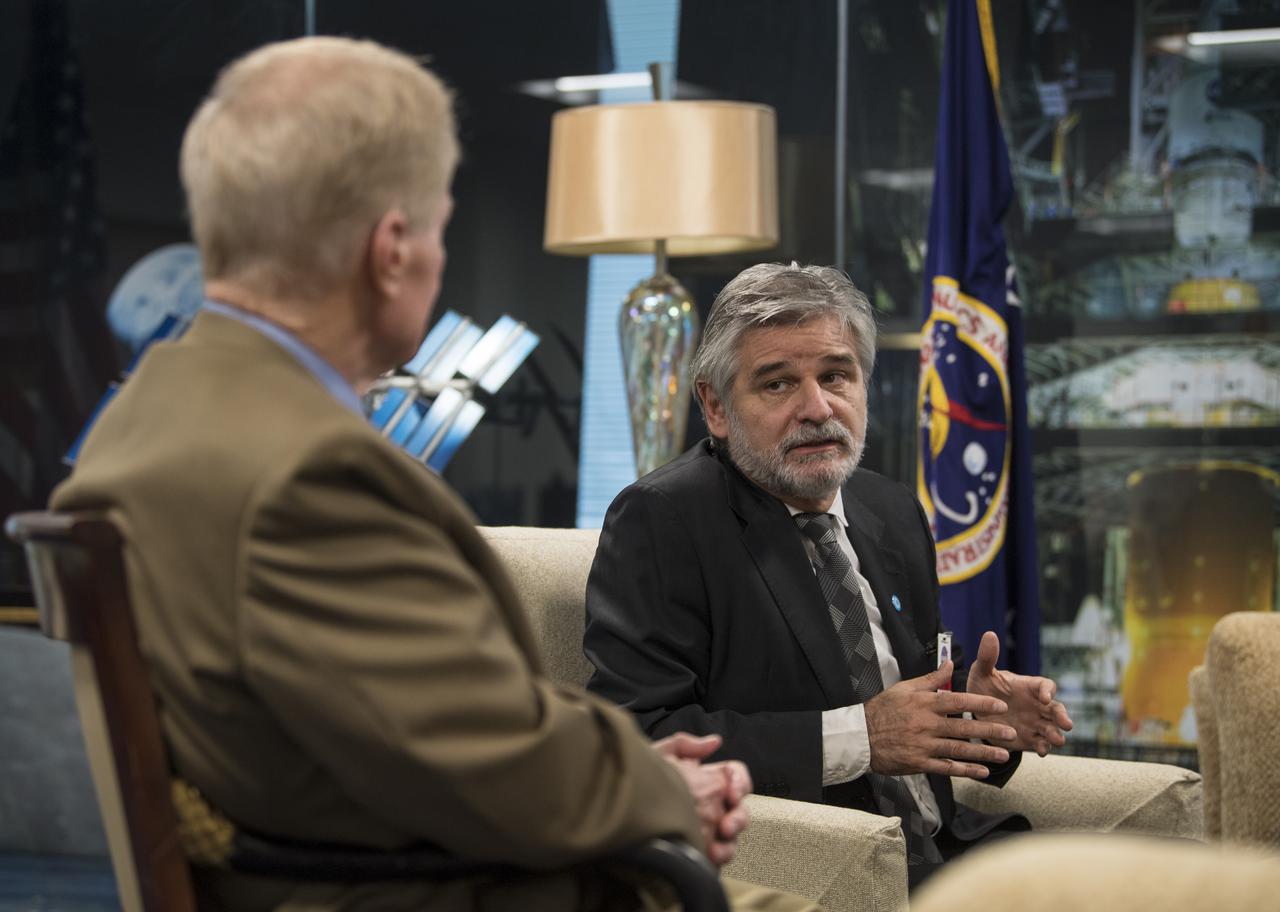
NASA Administrator Bill Nelson, speaks with the Minister of Science, Technology and Innovation in Argentina and Chairman of the Board of the Comisión Nacional de Actividades Espaciales (CONAE), Daniel Filmus, during a meeting, Tuesday, March 22, 2022, at NASA Headquarters in Washington DC. Photo Credit: (NASA/Aubrey Gemignani)
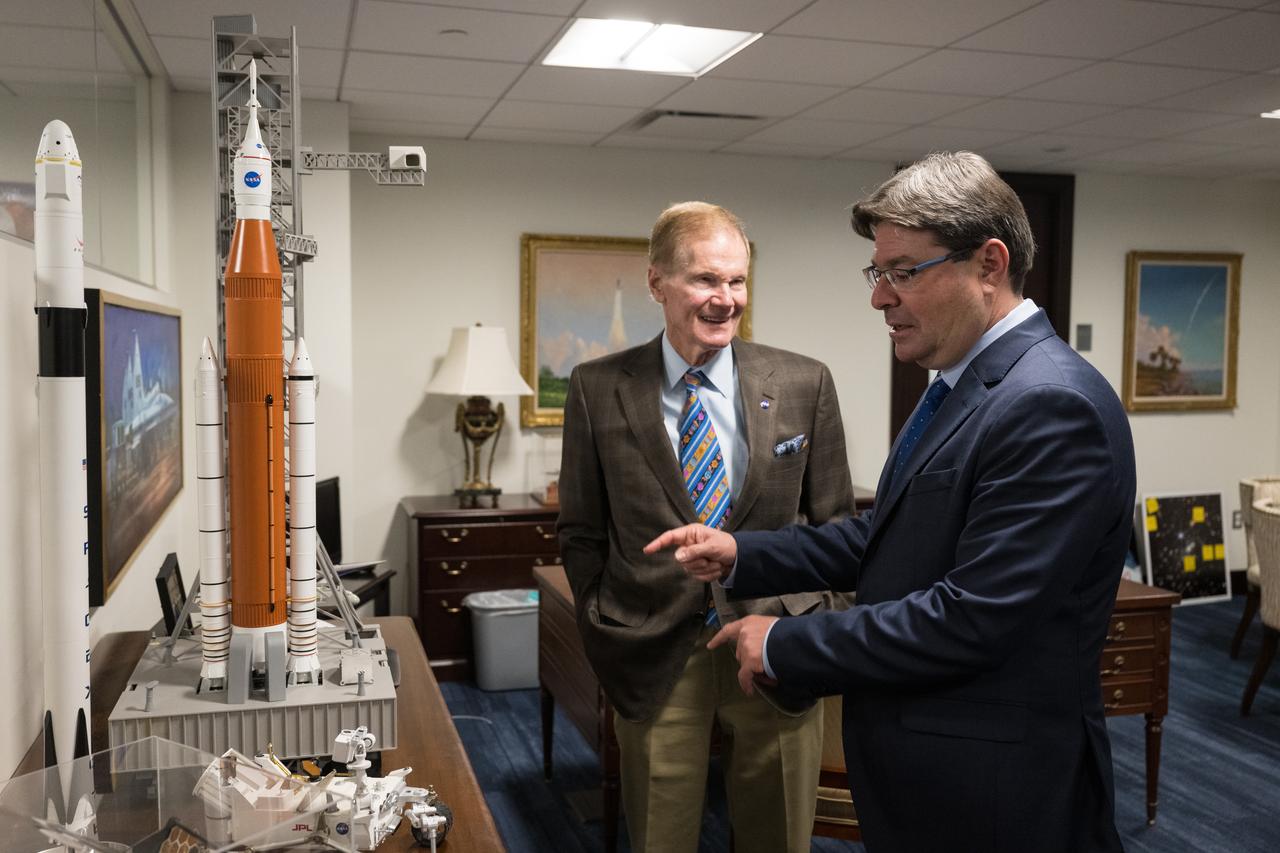
NASA Administrator Bill Nelson shows Israel’s Minister of Innovation, Science, and Technology, Ofir Akunis, a model of the Space Launch System (SLS), Monday, March 27, 2023 at the Mary W. Jackson NASA Headquarters building in Washington DC. Photo Credit: (NASA/Aubrey Gemignani)
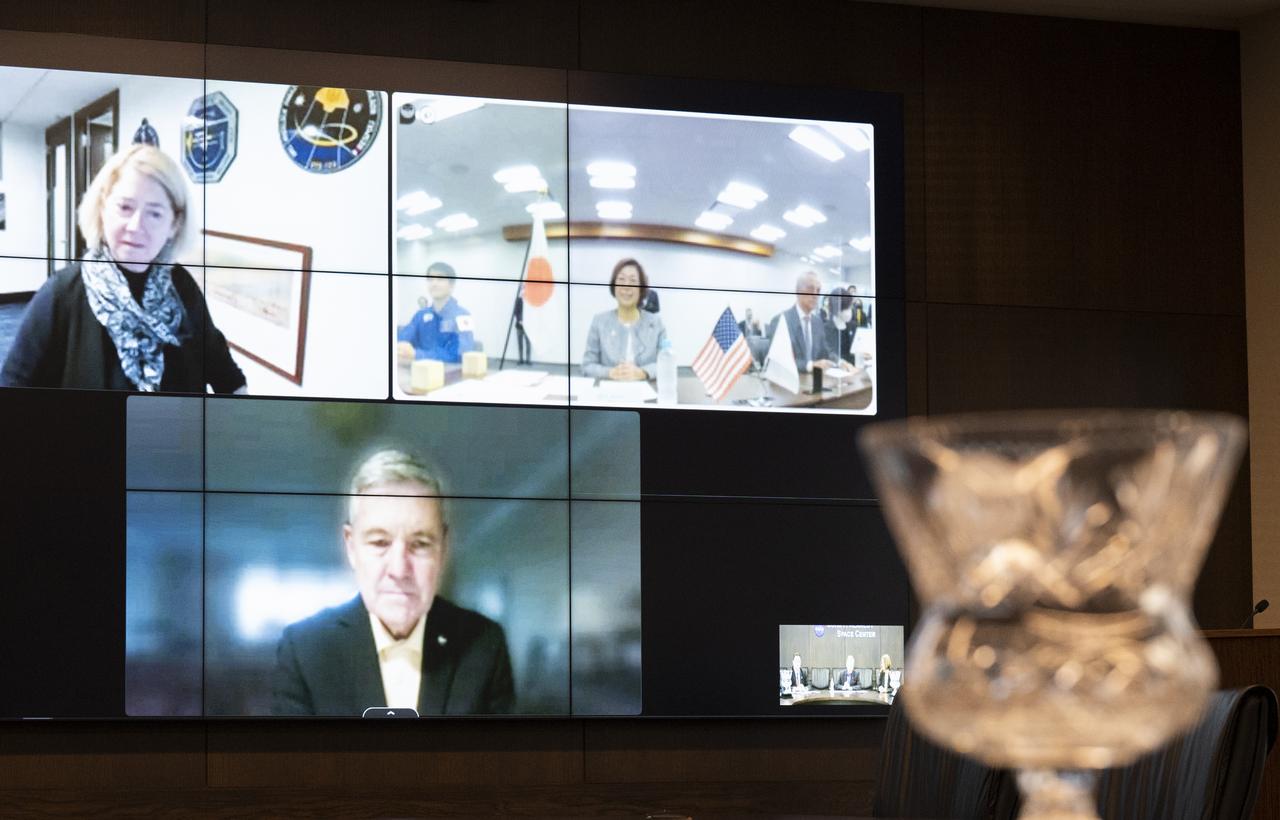
NASA Administrator Bill Nelson, joined by NASA Leadership, attends a virtual meeting hosted by Japanese Minister of Education, Culture, Sports, Science and Technology (MEXT) Keiko Nagaoka following the signing of a Gateway implementing agreement Thursday, Nov. 17, 2022, at NASA’s Kennedy Space Center in Florida. Photo Credit: (NASA/Keegan Barber)
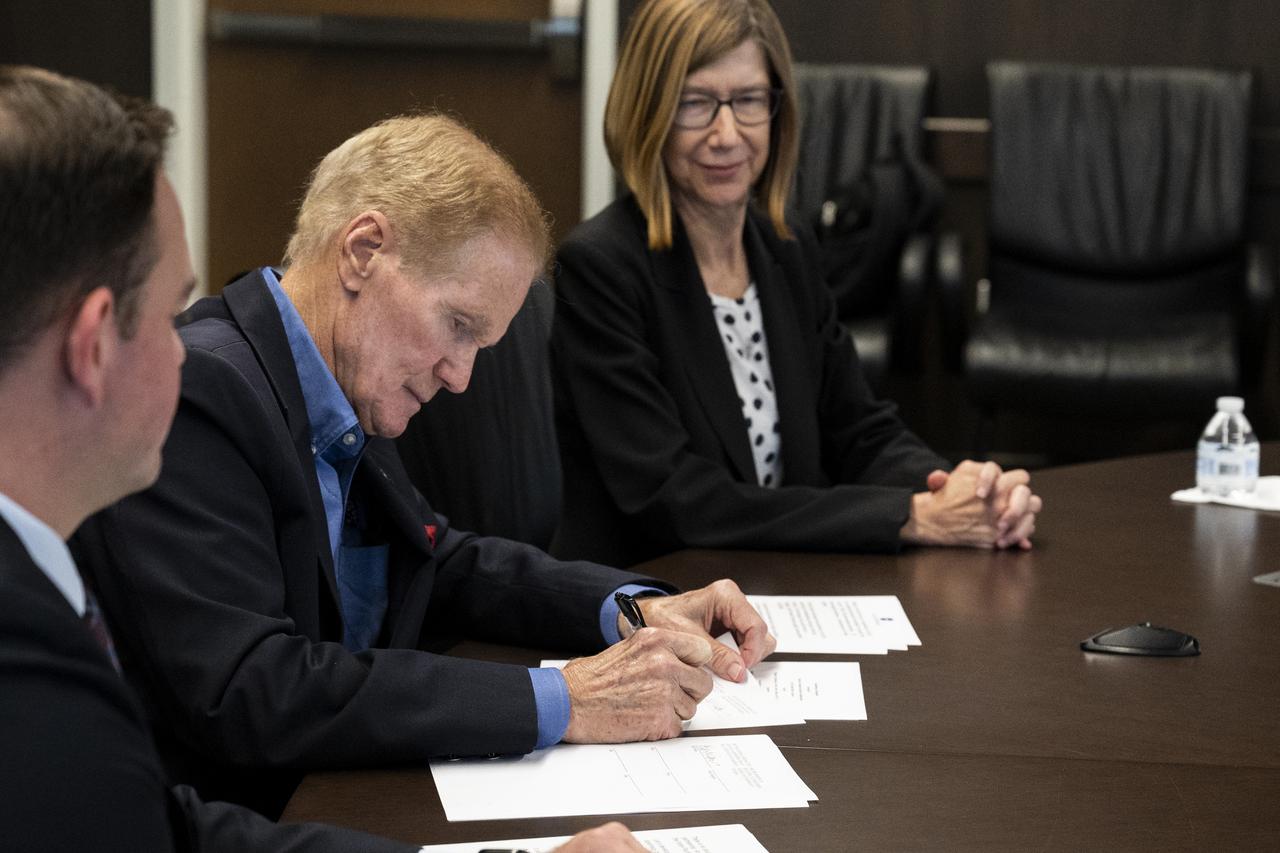
NASA Administrator Bill Nelson, joined by NASA Leadership, signs a Gateway implementing agreement during a virtual meeting hosted by Japanese Minister of Education, Culture, Sports, Science and Technology (MEXT) Keiko Nagaoka Thursday, Nov. 17, 2022, at NASA’s Kennedy Space Center in Florida. Photo Credit: (NASA/Keegan Barber)
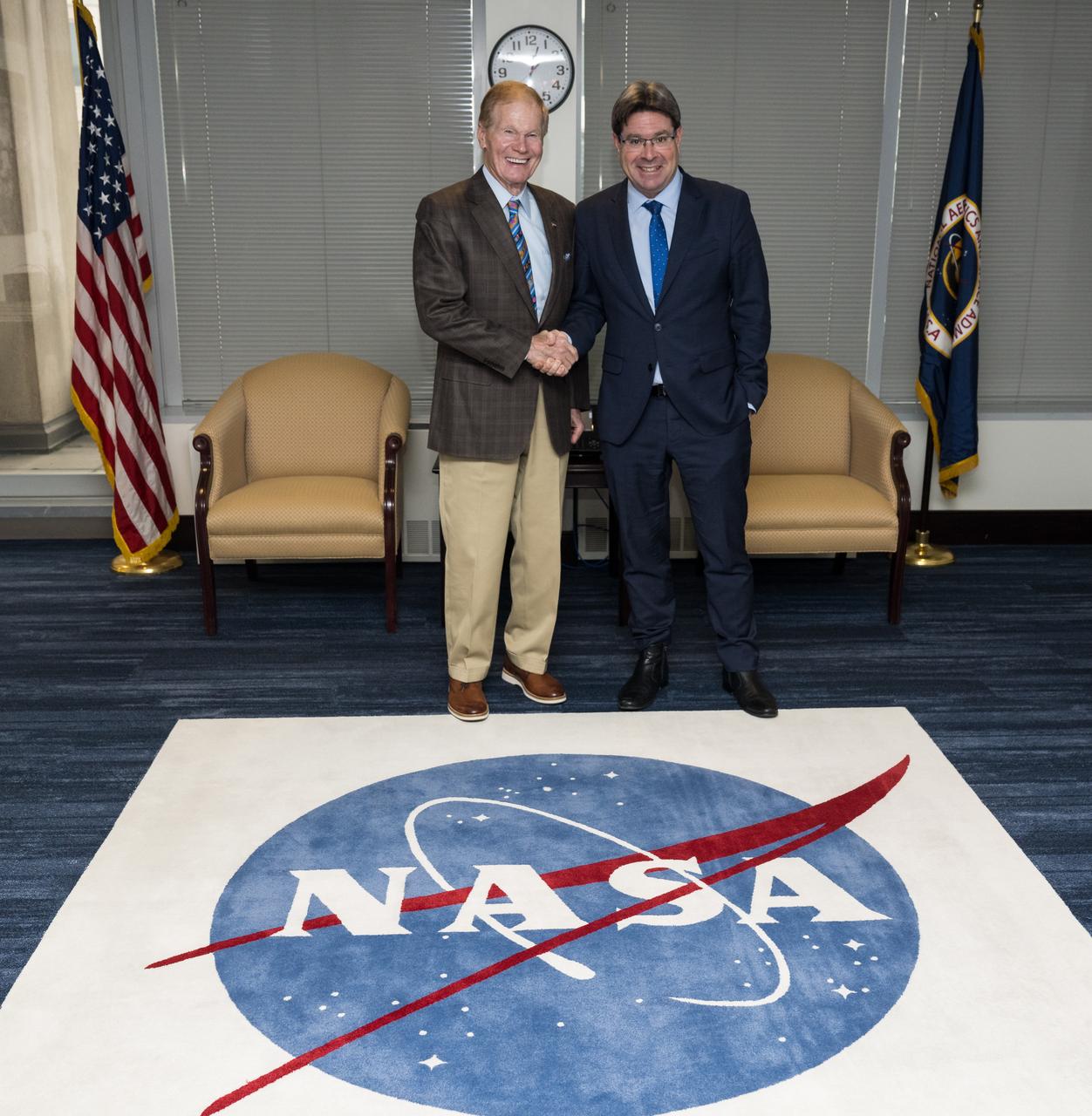
NASA Administrator Bill Nelson poses for a photo with Israel’s Minister of Innovation, Science, and Technology, Ofir Akunis, Monday, March 27, 2023 at the Mary W. Jackson NASA Headquarters building in Washington DC. Photo Credit: (NASA/Aubrey Gemignani)
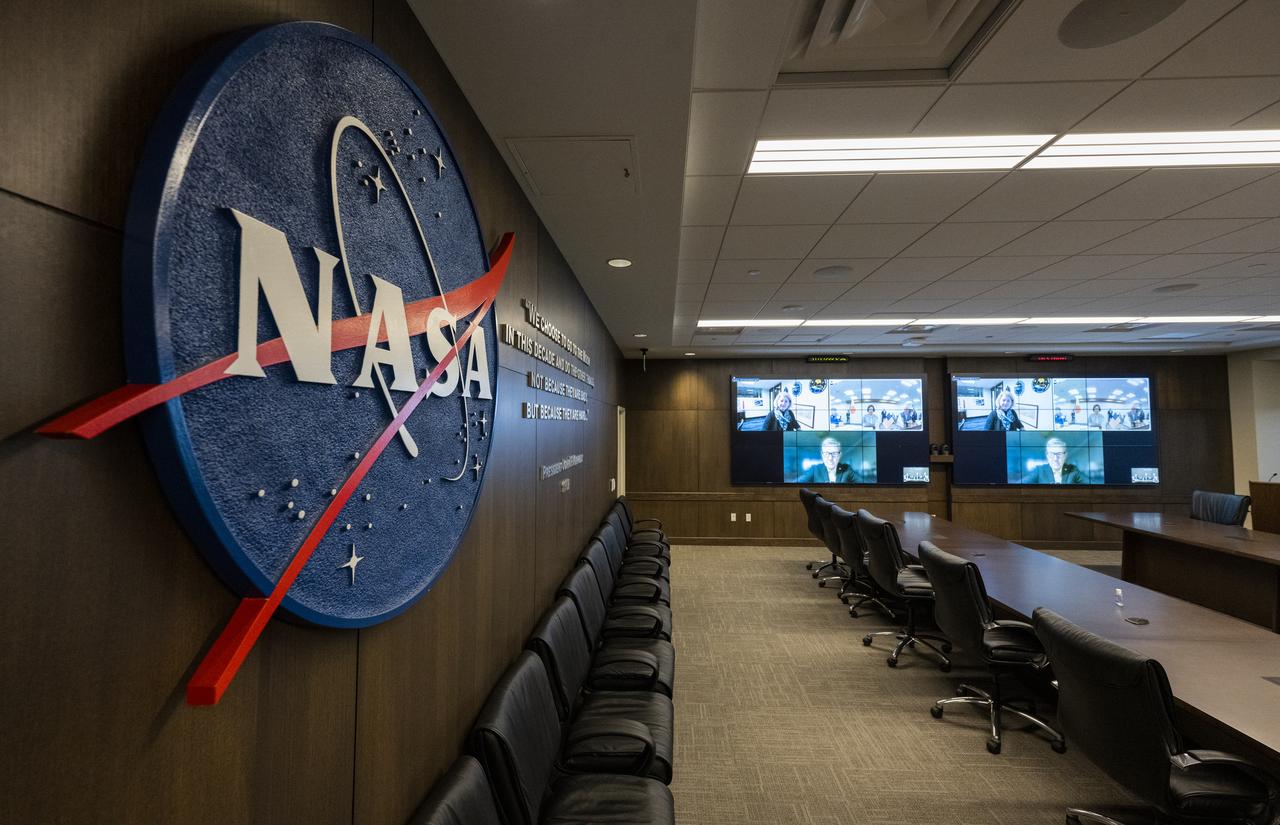
NASA Administrator Bill Nelson, joined by NASA Leadership, attends a virtual meeting hosted by Japanese Minister of Education, Culture, Sports, Science and Technology (MEXT) Keiko Nagaoka following the signing of a Gateway implementing agreement Thursday, Nov. 17, 2022, at NASA’s Kennedy Space Center in Florida. Photo Credit: (NASA/Keegan Barber)
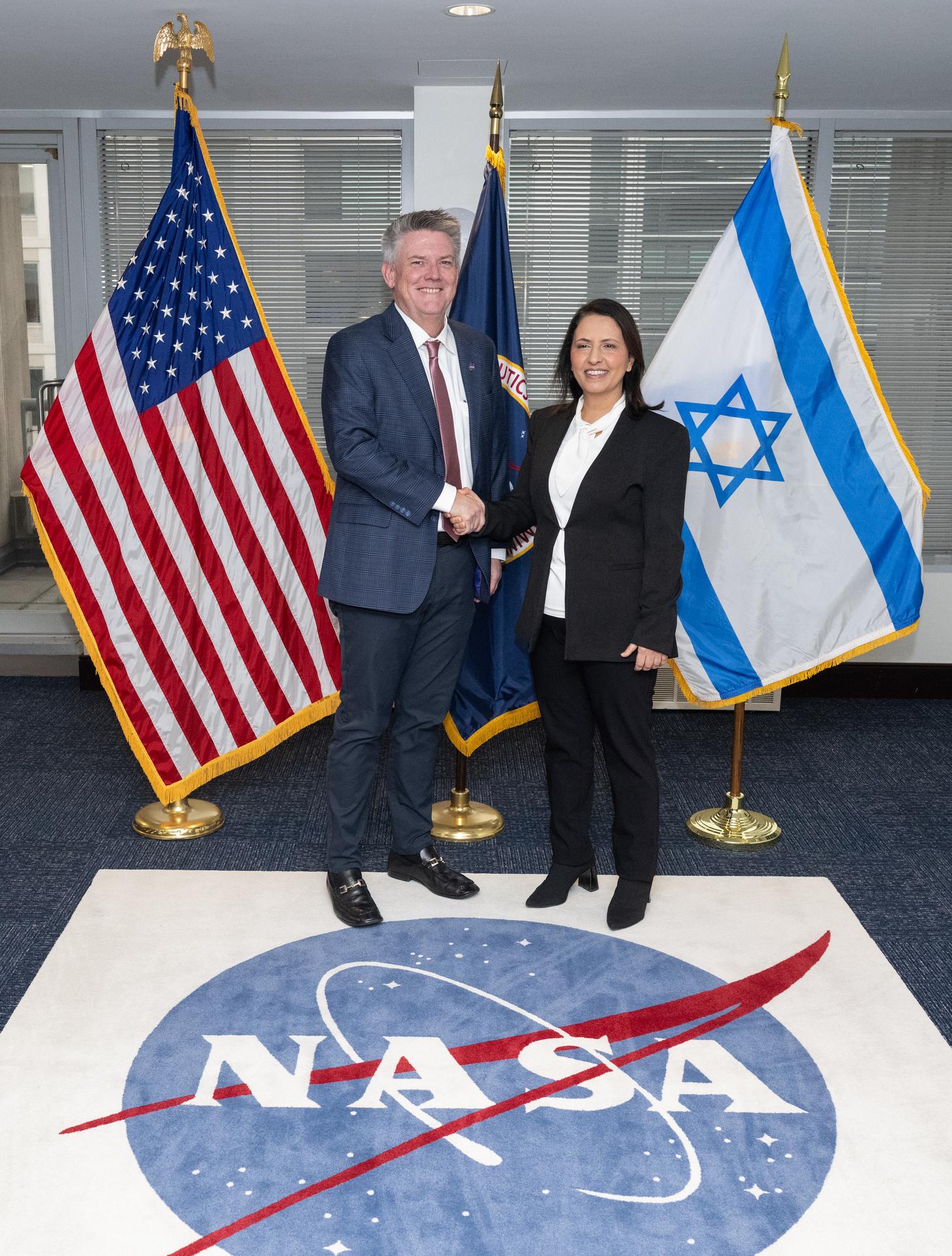
NASA Chief of Staff Brian Hughes, left, and Israel’s Minister for Innovation, Science, and Technology Gila Gamliel shake hands as they pose for a picture, Wednesday, Dec. 10, 2025, during a meeting at the Mary W. Jackson NASA Headquarters building in Washington. Photo Credit: (NASA/Joel Kowsky)
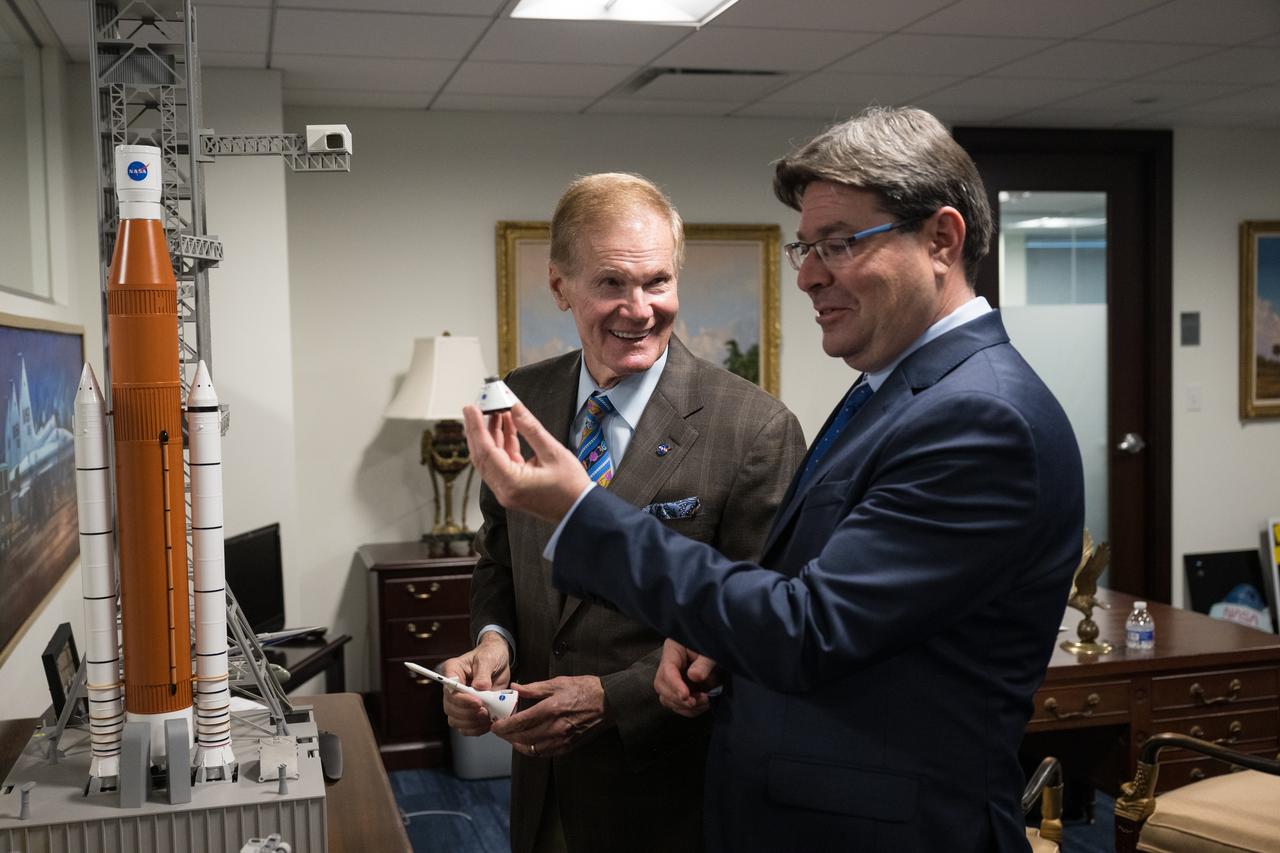
NASA Administrator Bill Nelson shows Israel’s Minister of Innovation, Science, and Technology, Ofir Akunis, a model of the Orion capsule, Monday, March 27, 2023 at the Mary W. Jackson NASA Headquarters building in Washington DC. Photo Credit: (NASA/Aubrey Gemignani)

UAE Assistant Minister of Foreign Affairs and International Cooperation for Advanced Science and Technology, Omran Sharaf, gives remarks during an event celebrating UAE-US collaboration in space, Friday, March 8, 2024, at the Four Seasons Hotel in Washington. Photo Credit: (NASA/Bill Ingalls)
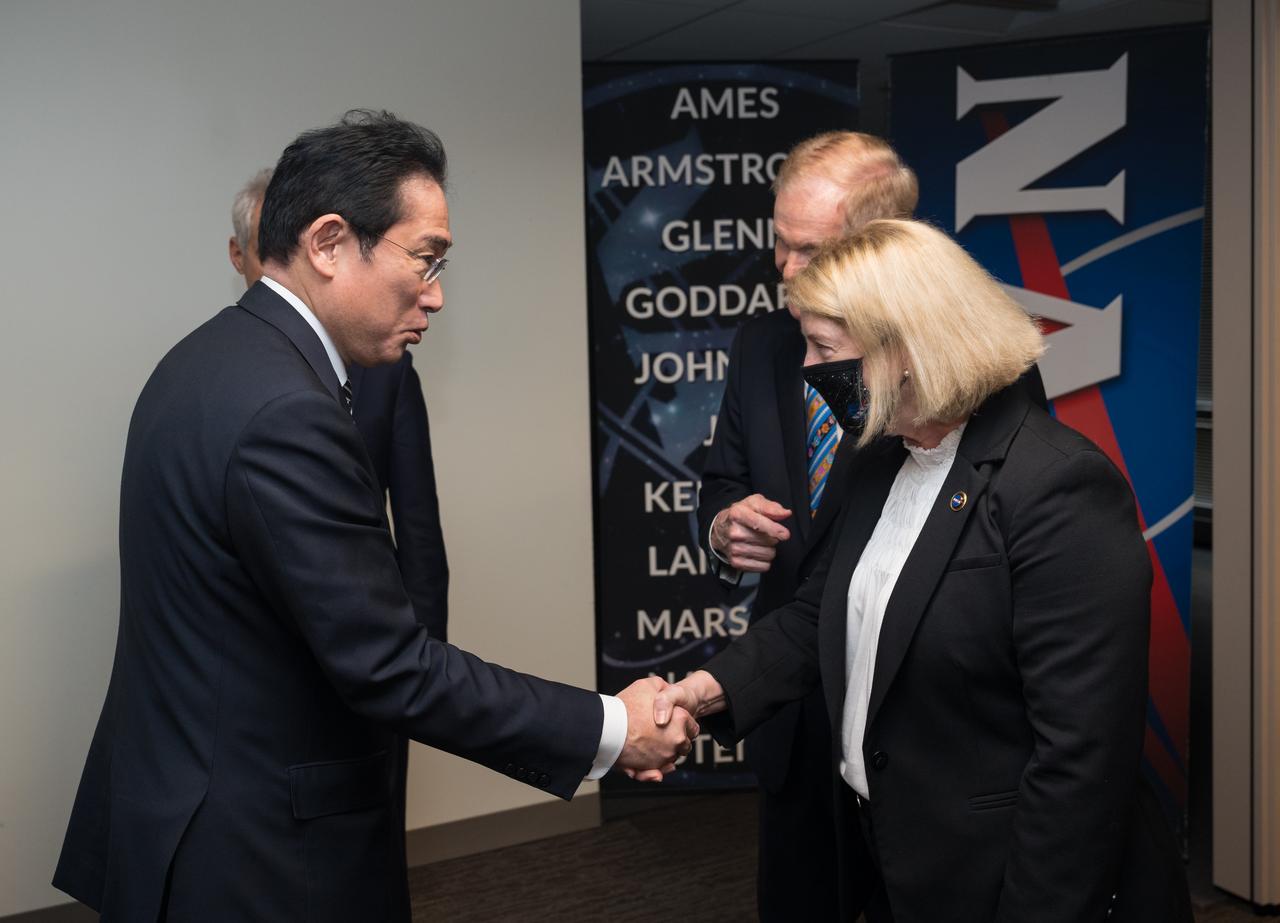
NASA Deputy Administrator Pam Melroy, right, greets Prime Minister of Japan, His Excellency Kishida Fumio, before U.S. Secretary of State Antony Blinken and Japan’s Minister for Foreign Affairs, Hayashi Yoshimasa, sign an agreement that builds on a long history of collaboration in space exploration between the U.S. and Japan, Friday, Jan. 13, 2023, at the Mary W. Jackson NASA Headquarters building in Washington. “The Framework Agreement Between the Government of Japan and the Government of the United States of America for Cooperation in Space Exploration and Use of Outer Space, Including the Moon and Other Celestial Bodies, For Peaceful Purposes” covers joint activities including space science, Earth science, space operations and exploration, aeronautical science and technology, space technology, space transportation, and safety and mission assurance, among others. Photo Credit: (NASA/Aubrey Gemignani)
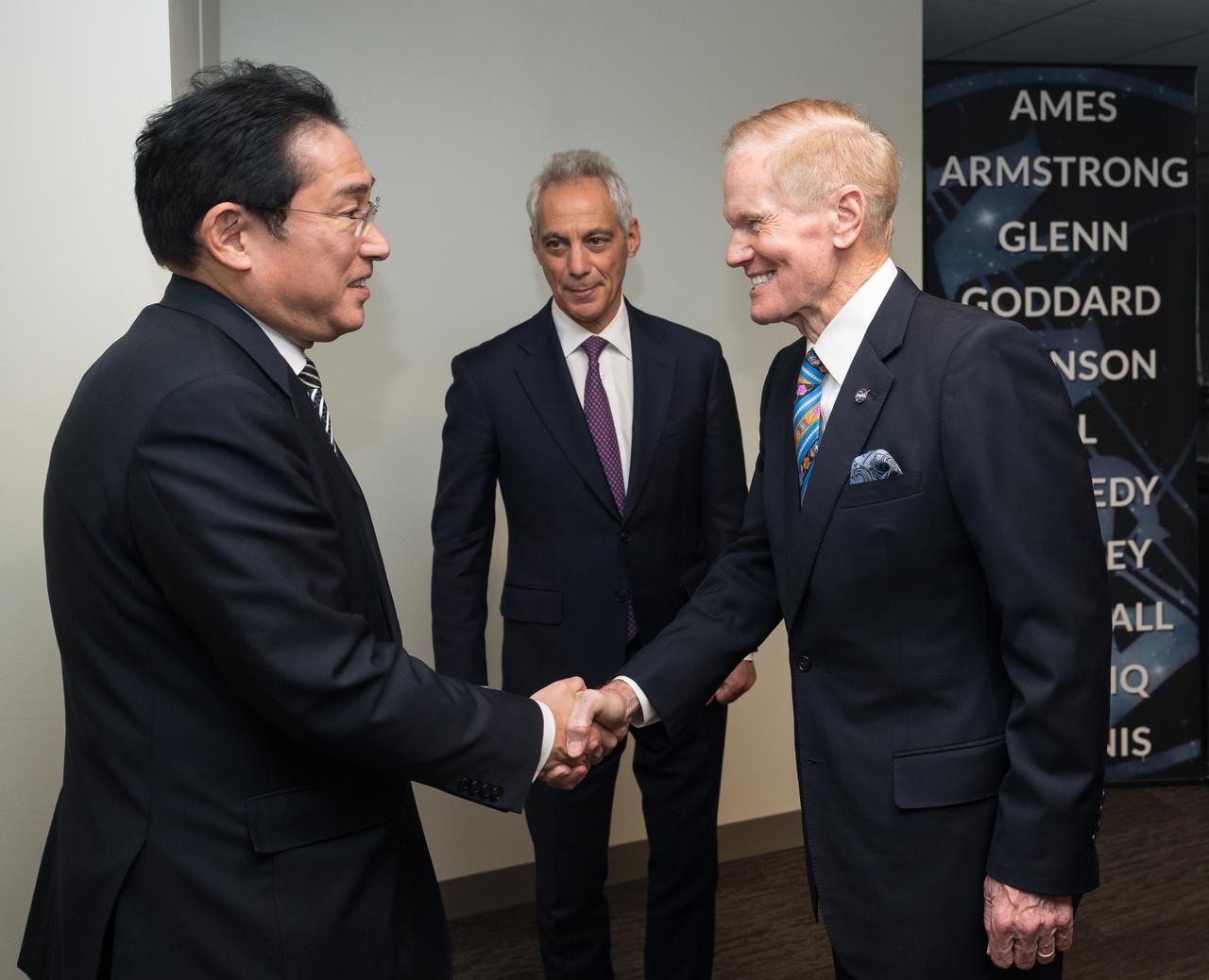
NASA Administrator Bill Nelson, right, and U.S. Ambassador to Japan, Rahm Emanuel, center, greet Prime Minister of Japan, His Excellency Kishida Fumio, before U.S. Secretary of State Antony Blinken and Japan’s Minister for Foreign Affairs, Hayashi Yoshimasa, sign an agreement that builds on a long history of collaboration in space exploration between the U.S. and Japan, Friday, Jan. 13, 2023, at the Mary W. Jackson NASA Headquarters building in Washington. “The Framework Agreement Between the Government of Japan and the Government of the United States of America for Cooperation in Space Exploration and Use of Outer Space, Including the Moon and Other Celestial Bodies, For Peaceful Purposes” covers joint activities including space science, Earth science, space operations and exploration, aeronautical science and technology, space technology, space transportation, and safety and mission assurance, among others. Photo Credit: (NASA/Aubrey Gemignani)
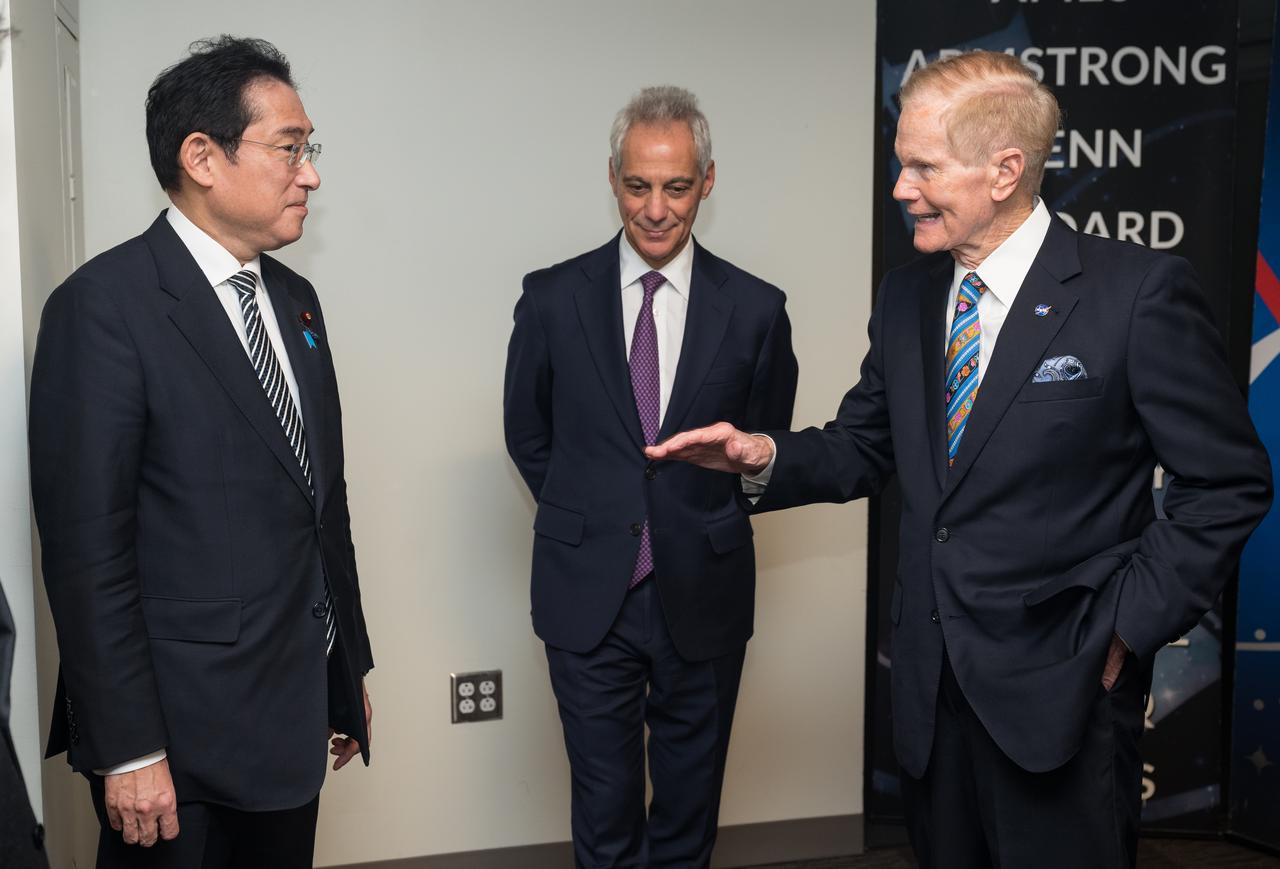
NASA Administrator Bill Nelson, right, and U.S. Ambassador to Japan, Rahm Emanuel, center, greet Prime Minister of Japan, His Excellency Kishida Fumio, before U.S. Secretary of State Antony Blinken and Japan’s Minister for Foreign Affairs, Hayashi Yoshimasa, sign an agreement that builds on a long history of collaboration in space exploration between the U.S. and Japan, Friday, Jan. 13, 2023, at the Mary W. Jackson NASA Headquarters building in Washington. “The Framework Agreement Between the Government of Japan and the Government of the United States of America for Cooperation in Space Exploration and Use of Outer Space, Including the Moon and Other Celestial Bodies, For Peaceful Purposes” covers joint activities including space science, Earth science, space operations and exploration, aeronautical science and technology, space technology, space transportation, and safety and mission assurance, among others. Photo Credit: (NASA/Aubrey Gemignani)
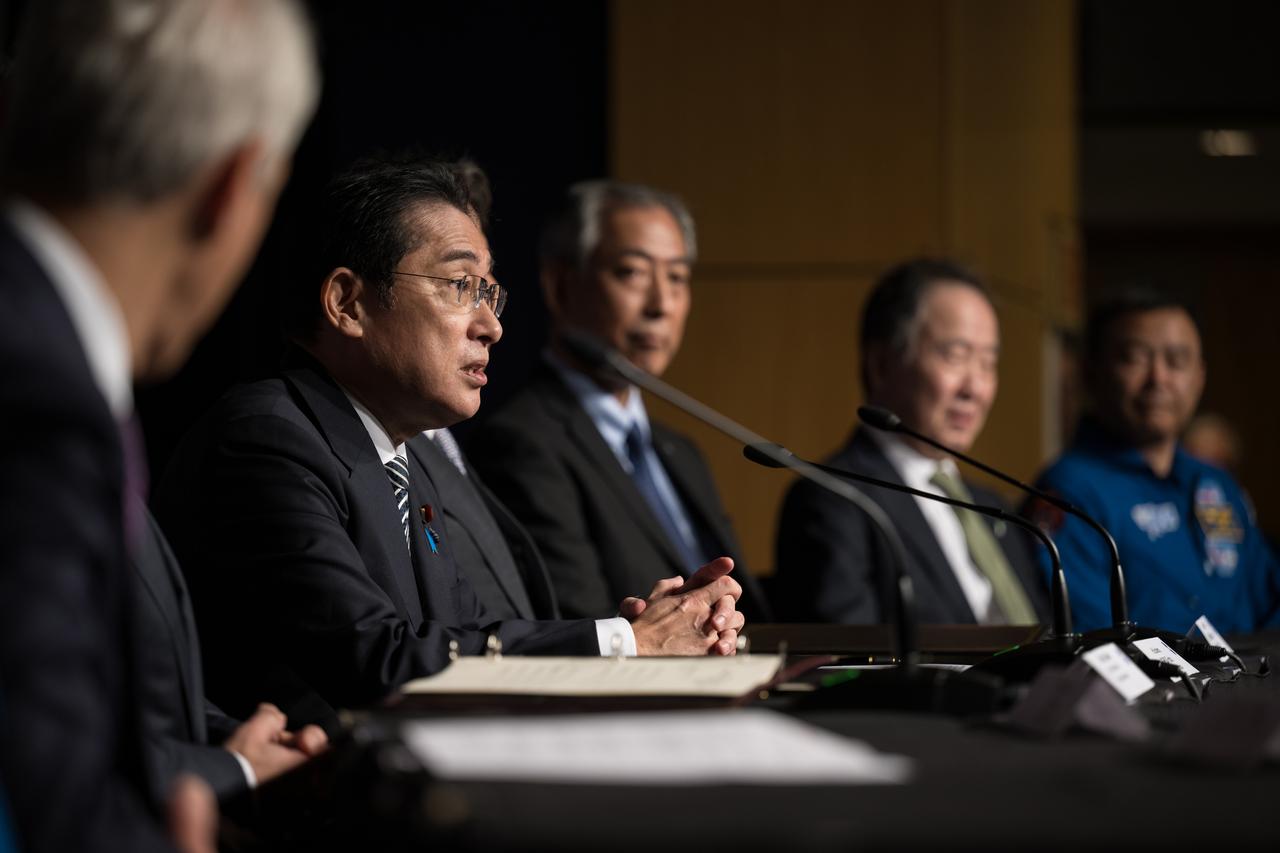
Prime Minister of Japan, His Excellency Kishida Fumio delivers remarks before U.S. Secretary of State, Antony Blinken and Japan’s Minister for Foreign Affairs, Hayashi Yoshimasa, sign an agreement that builds on a long history of collaboration in space exploration between the U.S. and Japan, Friday, Jan. 13, 2023, at the Mary W. Jackson NASA Headquarters building in Washington. “The Framework Agreement Between the Government of Japan and the Government of the United States of America for Cooperation in Space Exploration and Use of Outer Space, Including the Moon and Other Celestial Bodies, For Peaceful Purposes” covers joint activities including space science, Earth science, space operations and exploration, aeronautical science and technology, space technology, space transportation, and safety and mission assurance, among others. Photo Credit: (NASA/Aubrey Gemignani)
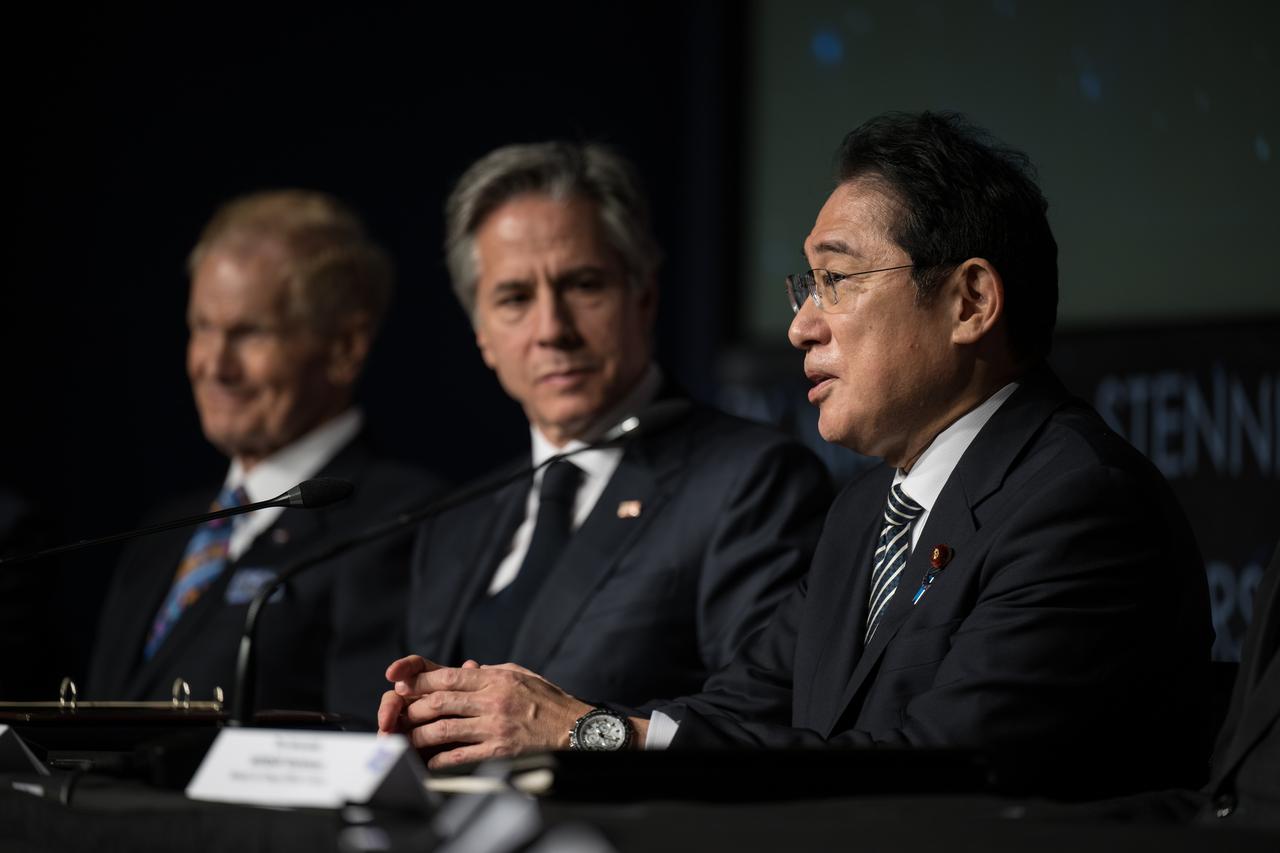
Prime Minister of Japan, His Excellency Kishida Fumio delivers remarks before U.S. Secretary of State, Antony Blinken and Japan’s Minister for Foreign Affairs, Hayashi Yoshimasa, sign an agreement that builds on a long history of collaboration in space exploration between the U.S. and Japan, Friday, Jan. 13, 2023, at the Mary W. Jackson NASA Headquarters building in Washington. “The Framework Agreement Between the Government of Japan and the Government of the United States of America for Cooperation in Space Exploration and Use of Outer Space, Including the Moon and Other Celestial Bodies, For Peaceful Purposes” covers joint activities including space science, Earth science, space operations and exploration, aeronautical science and technology, space technology, space transportation, and safety and mission assurance, among others. Photo Credit: (NASA/Aubrey Gemignani)
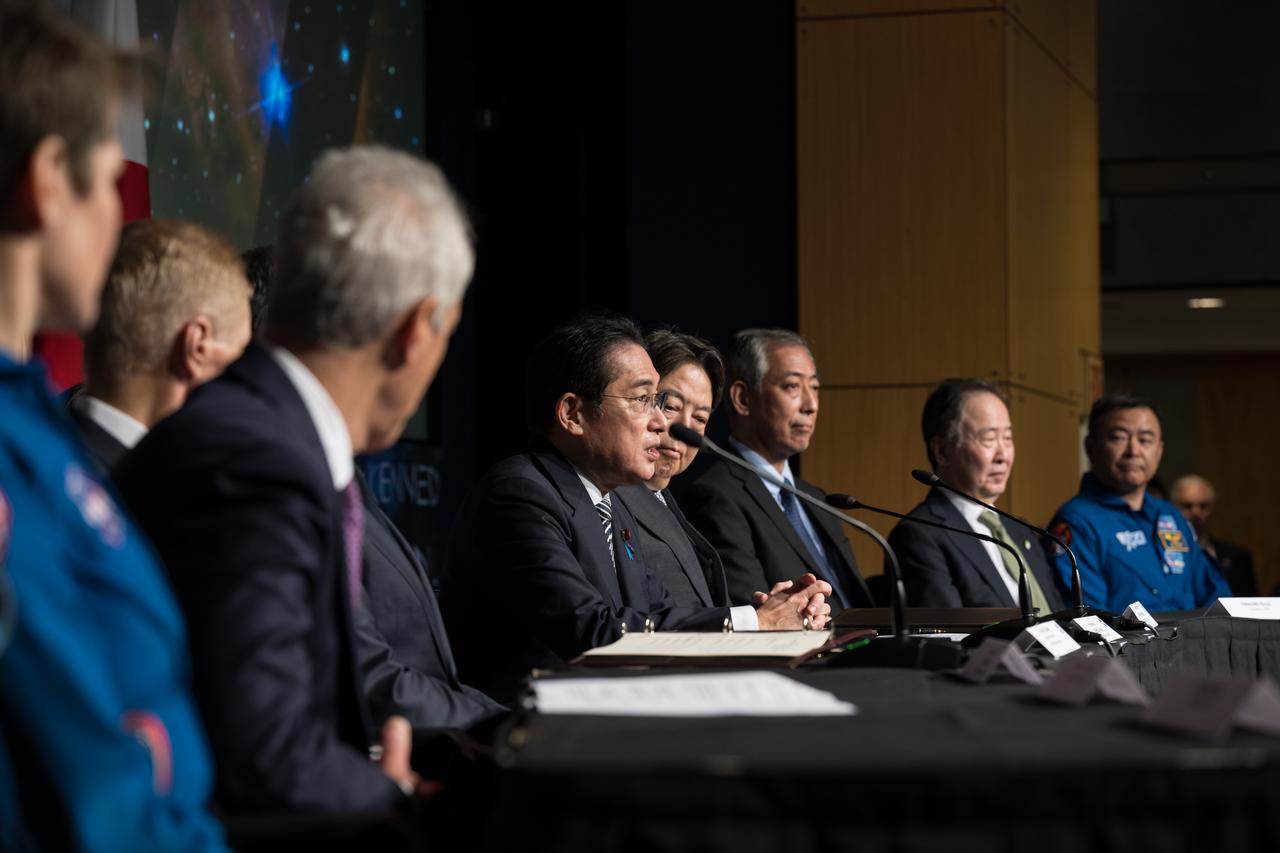
Prime Minister of Japan, His Excellency Kishida Fumio delivers remarks before U.S. Secretary of State, Antony Blinken and Japan’s Minister for Foreign Affairs, Hayashi Yoshimasa, sign an agreement that builds on a long history of collaboration in space exploration between the U.S. and Japan, Friday, Jan. 13, 2023, at the Mary W. Jackson NASA Headquarters building in Washington. “The Framework Agreement Between the Government of Japan and the Government of the United States of America for Cooperation in Space Exploration and Use of Outer Space, Including the Moon and Other Celestial Bodies, For Peaceful Purposes” covers joint activities including space science, Earth science, space operations and exploration, aeronautical science and technology, space technology, space transportation, and safety and mission assurance, among others. Photo Credit: (NASA/Aubrey Gemignani)
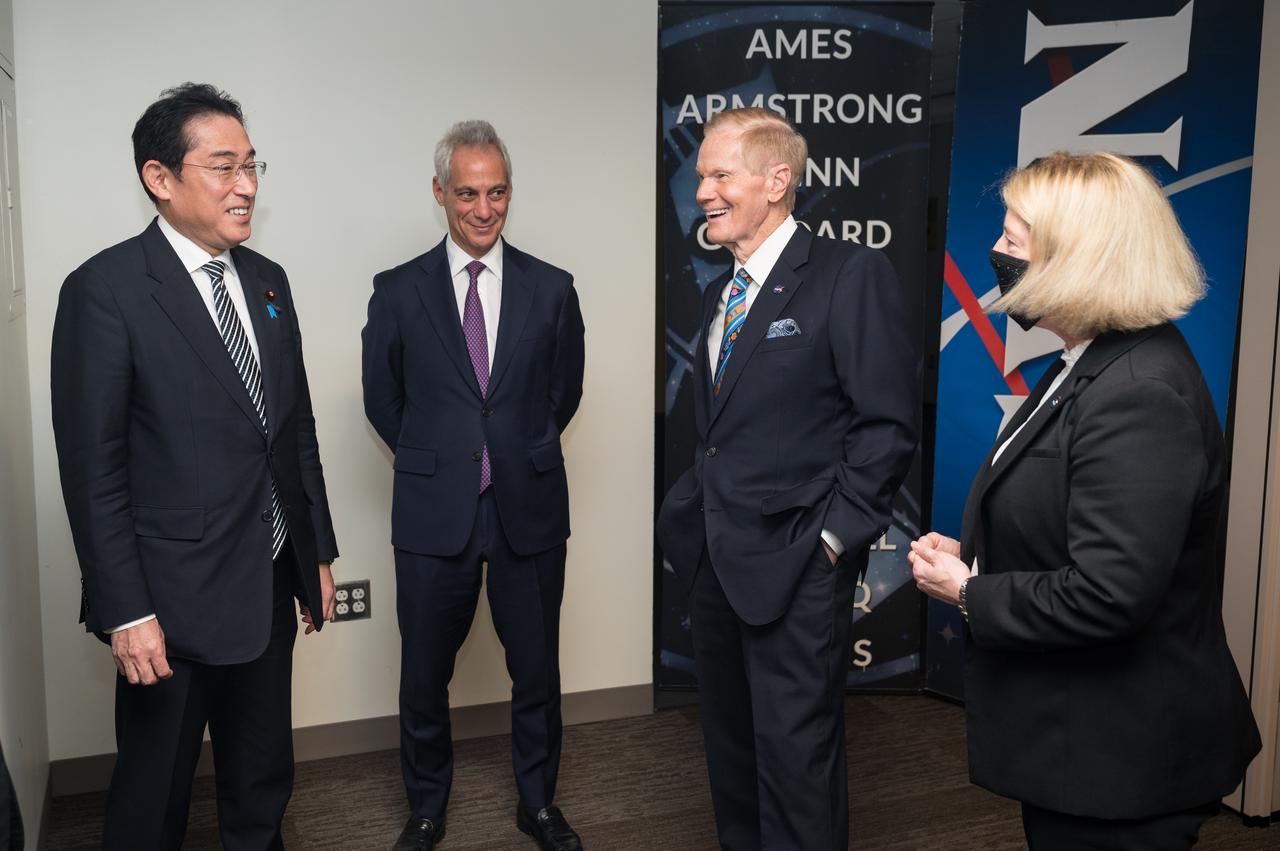
NASA Deputy Administrator Pam Melroy, right, NASA Administrator Bill Nelson, second from right, and U.S. Ambassador to Japan, Rahm Emanuel, second from left, greet Prime Minister of Japan, His Excellency Kishida Fumio, before U.S. Secretary of State Antony Blinken and Japan’s Minister for Foreign Affairs, Hayashi Yoshimasa, sign an agreement that builds on a long history of collaboration in space exploration between the U.S. and Japan, Friday, Jan. 13, 2023, at the Mary W. Jackson NASA Headquarters building in Washington. “The Framework Agreement Between the Government of Japan and the Government of the United States of America for Cooperation in Space Exploration and Use of Outer Space, Including the Moon and Other Celestial Bodies, For Peaceful Purposes” covers joint activities including space science, Earth science, space operations and exploration, aeronautical science and technology, space technology, space transportation, and safety and mission assurance, among others. Photo Credit: (NASA/Aubrey Gemignani)
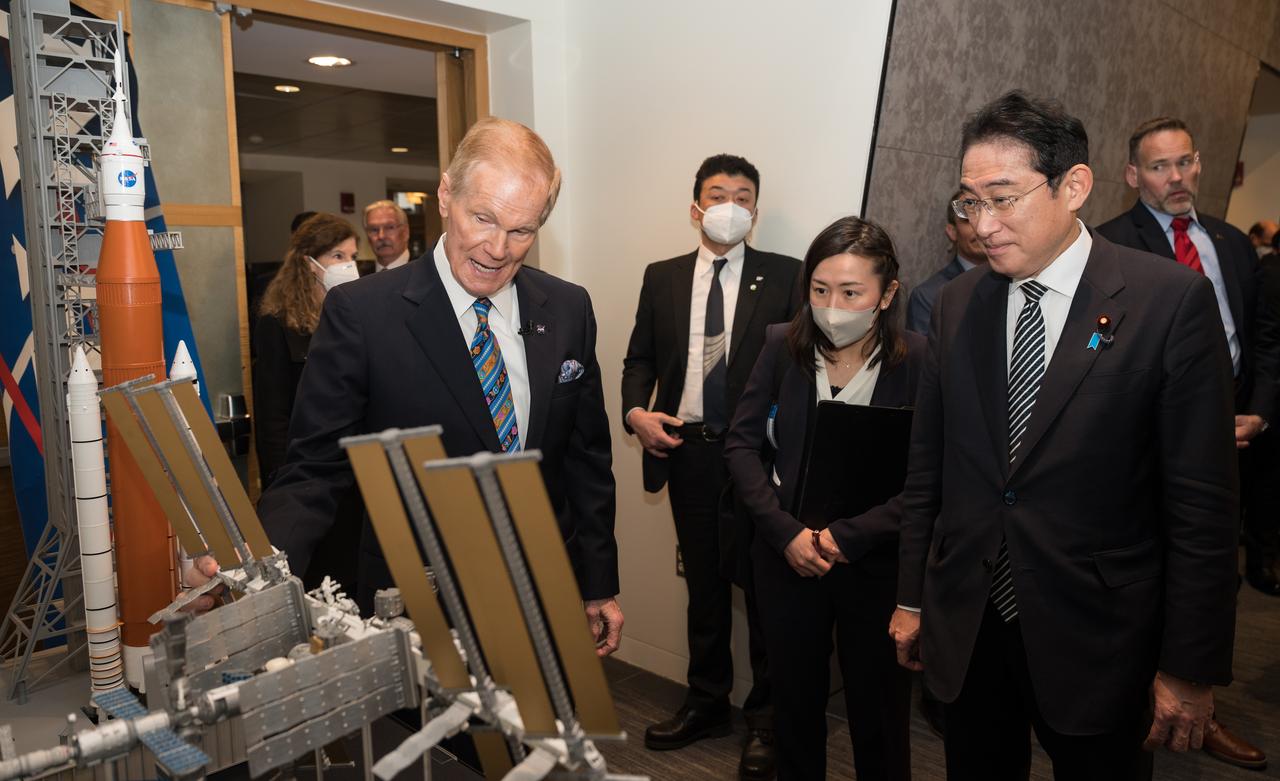
NASA Administrator Bill Nelson shows Prime Minister of Japan, His Excellency Kishida Fumio, a model of the International Space Station (ISS) before U.S. Secretary of State Antony Blinken and Japan’s Minister for Foreign Affairs, Hayashi Yoshimasa, sign an agreement that builds on a long history of collaboration in space exploration between the U.S. and Japan, Friday, Jan. 13, 2023, at the Mary W. Jackson NASA Headquarters building in Washington. “The Framework Agreement Between the Government of Japan and the Government of the United States of America for Cooperation in Space Exploration and Use of Outer Space, Including the Moon and Other Celestial Bodies, For Peaceful Purposes” covers joint activities including space science, Earth science, space operations and exploration, aeronautical science and technology, space technology, space transportation, and safety and mission assurance, among others. Photo Credit: (NASA/Aubrey Gemignani)
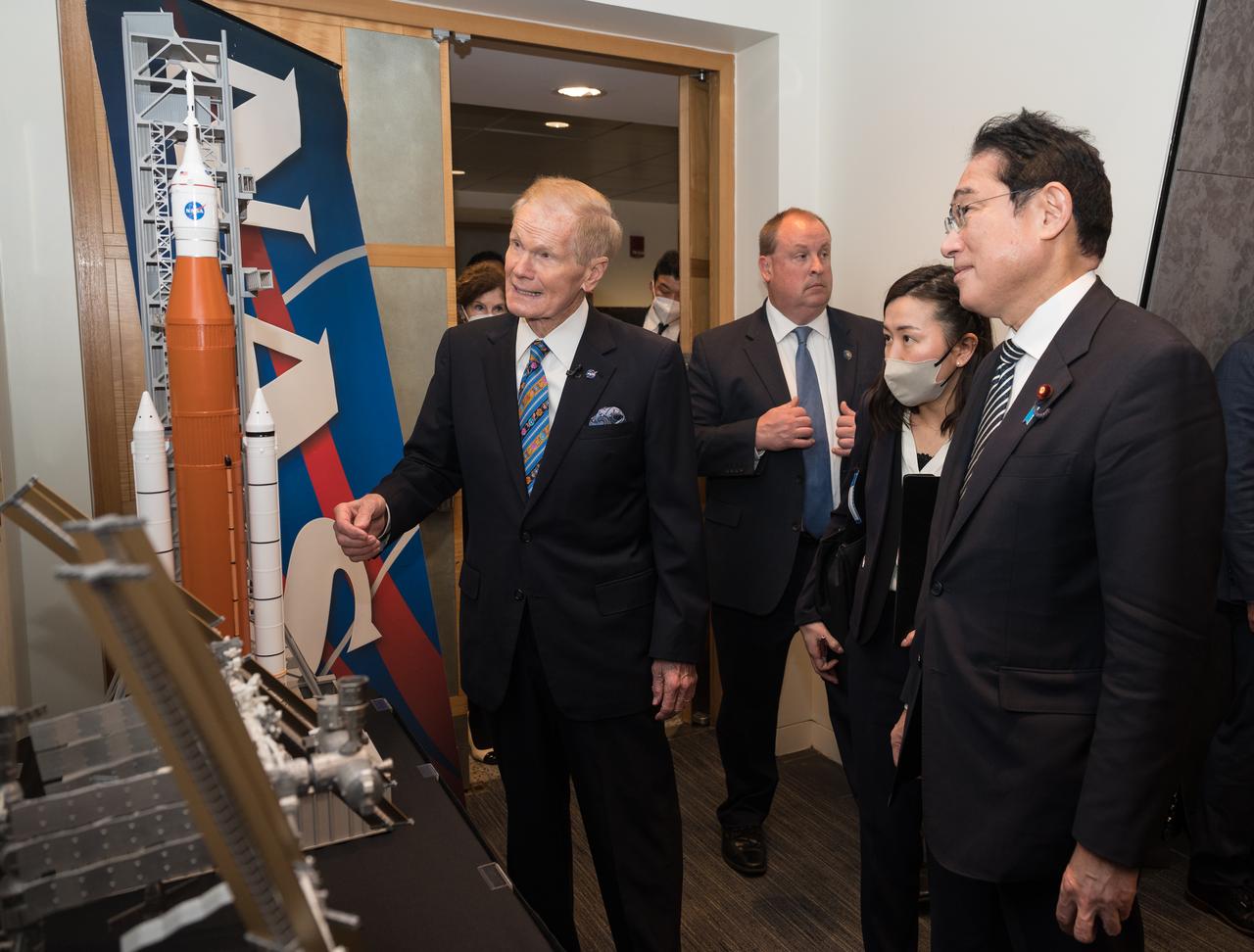
NASA Administrator Bill Nelson shows Prime Minister of Japan, His Excellency Kishida Fumio, a model of the Space Launch System (SLS) before U.S. Secretary of State Antony Blinken and Japan’s Minister for Foreign Affairs, Hayashi Yoshimasa, sign an agreement that builds on a long history of collaboration in space exploration between the U.S. and Japan, Friday, Jan. 13, 2023, at the Mary W. Jackson NASA Headquarters building in Washington. “The Framework Agreement Between the Government of Japan and the Government of the United States of America for Cooperation in Space Exploration and Use of Outer Space, Including the Moon and Other Celestial Bodies, For Peaceful Purposes” covers joint activities including space science, Earth science, space operations and exploration, aeronautical science and technology, space technology, space transportation, and safety and mission assurance, among others. Photo Credit: (NASA/Aubrey Gemignani)
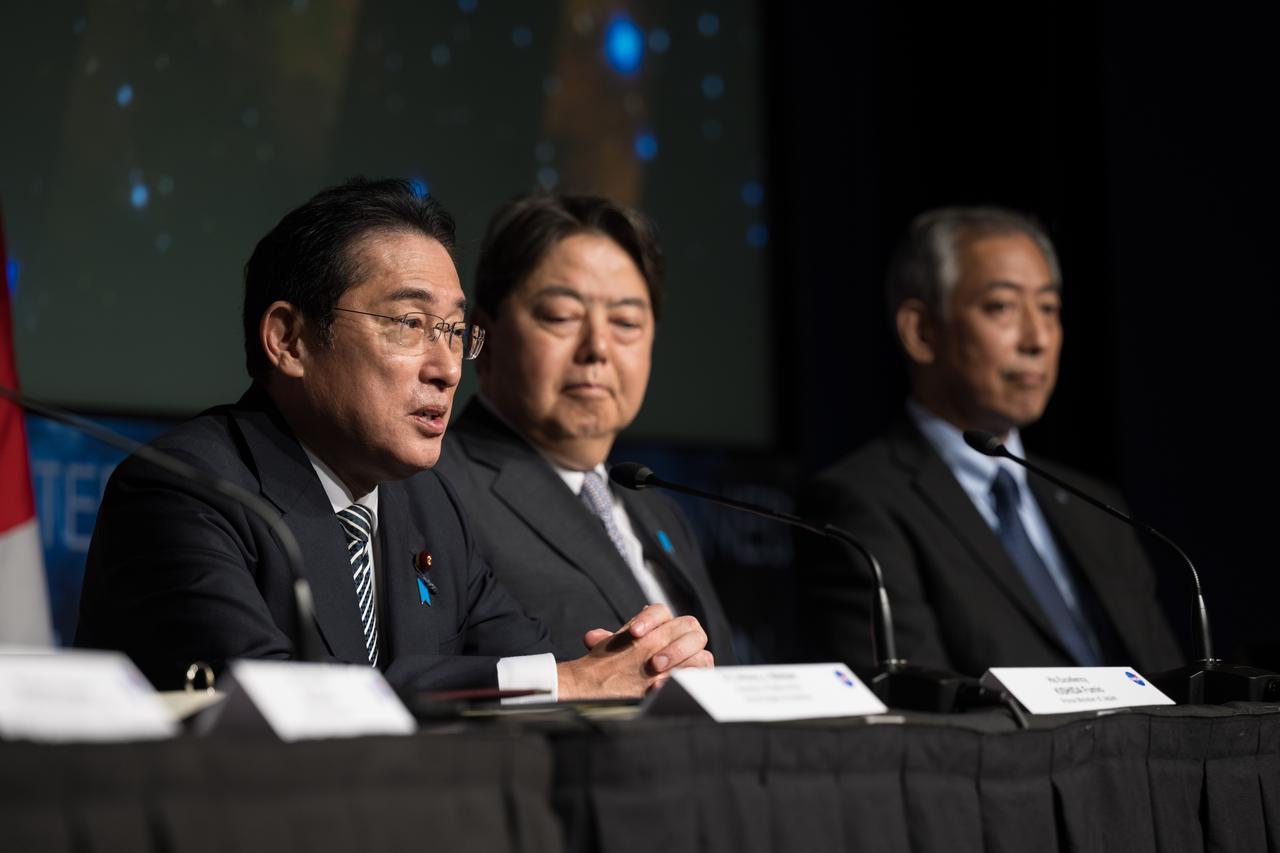
Prime Minister of Japan, His Excellency Kishida Fumio delivers remarks before U.S. Secretary of State, Antony Blinken and Japan’s Minister for Foreign Affairs, Hayashi Yoshimasa, sign an agreement that builds on a long history of collaboration in space exploration between the U.S. and Japan, Friday, Jan. 13, 2023, at the Mary W. Jackson NASA Headquarters building in Washington. “The Framework Agreement Between the Government of Japan and the Government of the United States of America for Cooperation in Space Exploration and Use of Outer Space, Including the Moon and Other Celestial Bodies, For Peaceful Purposes” covers joint activities including space science, Earth science, space operations and exploration, aeronautical science and technology, space technology, space transportation, and safety and mission assurance, among others. Photo Credit: (NASA/Aubrey Gemignani)
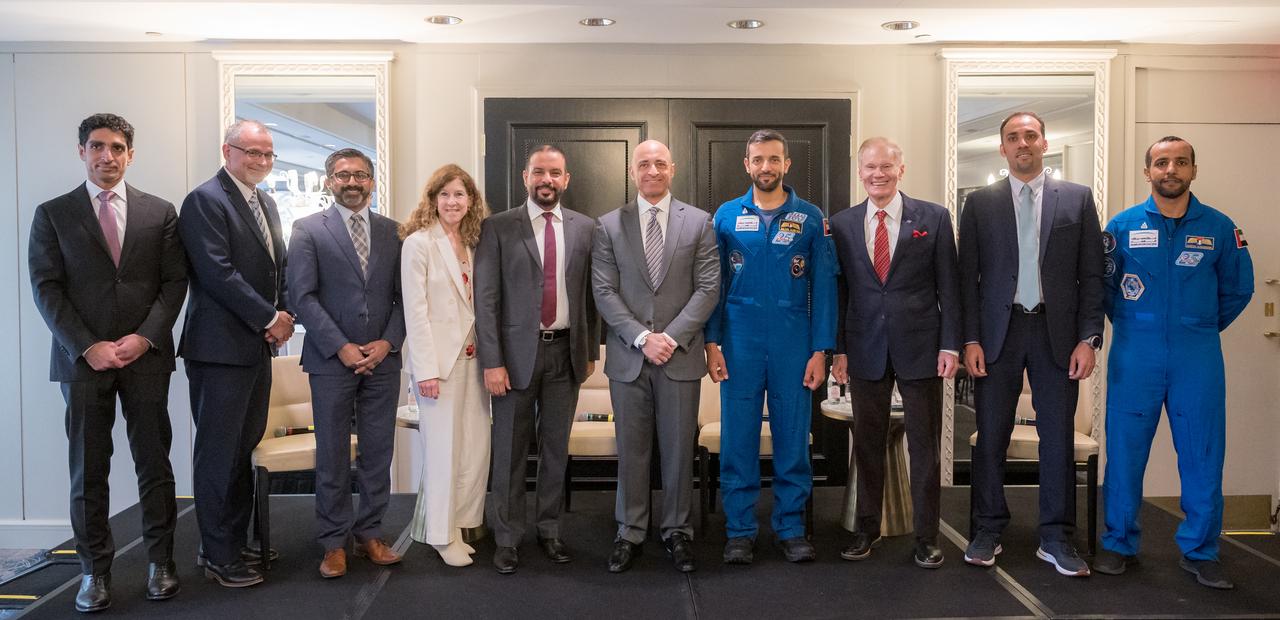
UAE Assistant Minister of Foreign Affairs and International Cooperation for Advanced Science and Technology, Omran Sharaf, left, NASA associate administrator Jim Free, National Space Council Executive Secretary Chirag Parikh, NASA associate administrator for International and Interagency Relations Karen Feldstein, Director General, UAE Space Agency Salem Al Qubaisi, UAE Ambassador to the US and Minister of State His Excellency Yousef Al Otaib, UAE astronaut and Minister of Youth, H.E. Dr. Sultan Al Neyadi, NASA Administrator Bill Nelson, Director General, Mohammed bin Rashid Space Centre Salem AlMarri, and UAE astronaut Hazza Al Mansouri, right, pose for a group photograph during an event celebrating UAE-US collaboration in space, Friday, March 8, 2024, at the Four Seasons Hotel in Washington. Photo Credit: (NASA/Bill Ingalls)
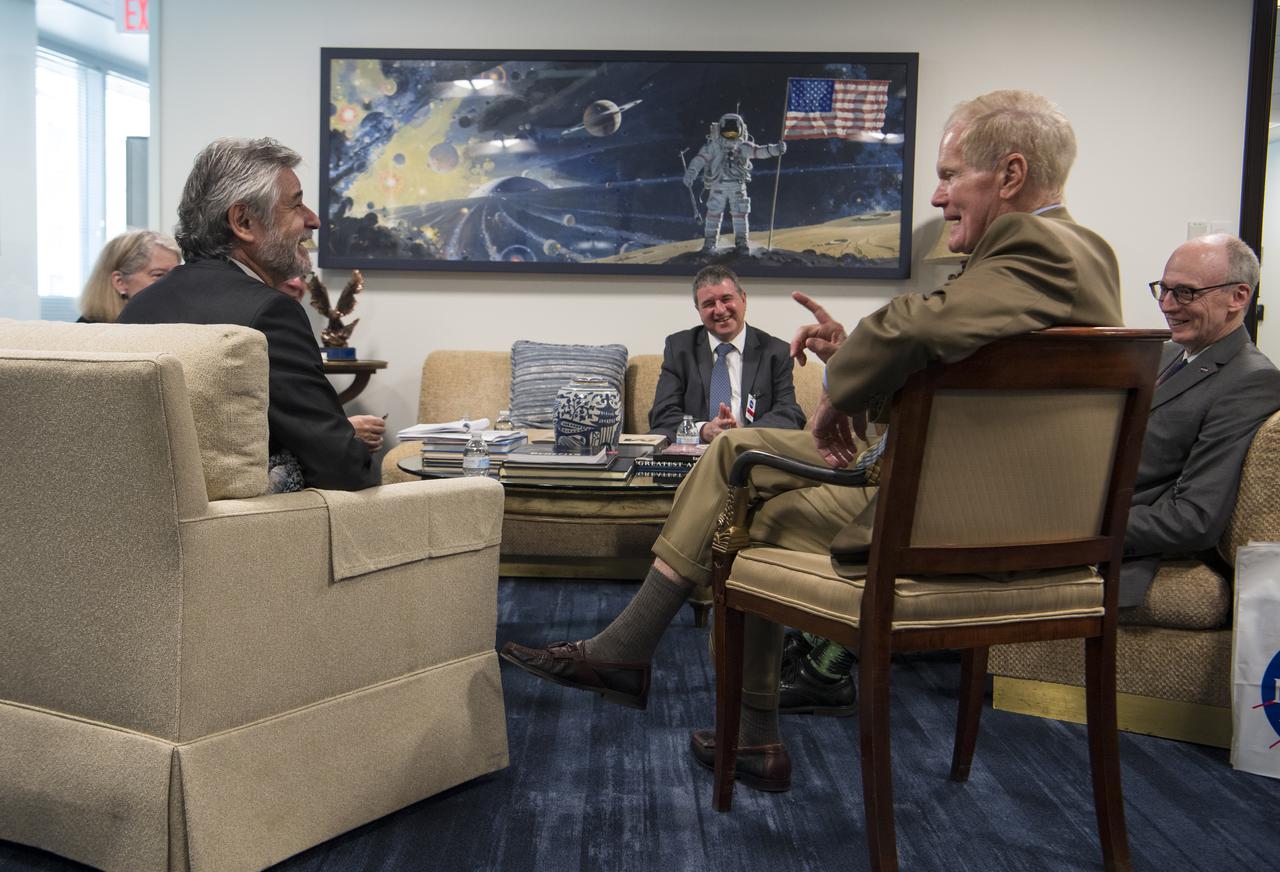
From left to right, NASA Deputy Administrator, Pam Melroy, Minister of Science, Technology and Innovation in Argentina and Chairman of the Board of the Comisión Nacional de Actividades Espaciales (CONAE), Daniel Filmus, Executive and Technical Director of CONAE, Raúl Kulichevsky, NASA Administrator Bill Nelson, and NASA Office of International and Interagency Relations, Director of the Science Division, Gib Kirkham, meet Tuesday, March 22, 2022, at NASA Headquarters in Washington DC. Photo Credit: (NASA/Aubrey Gemignani)
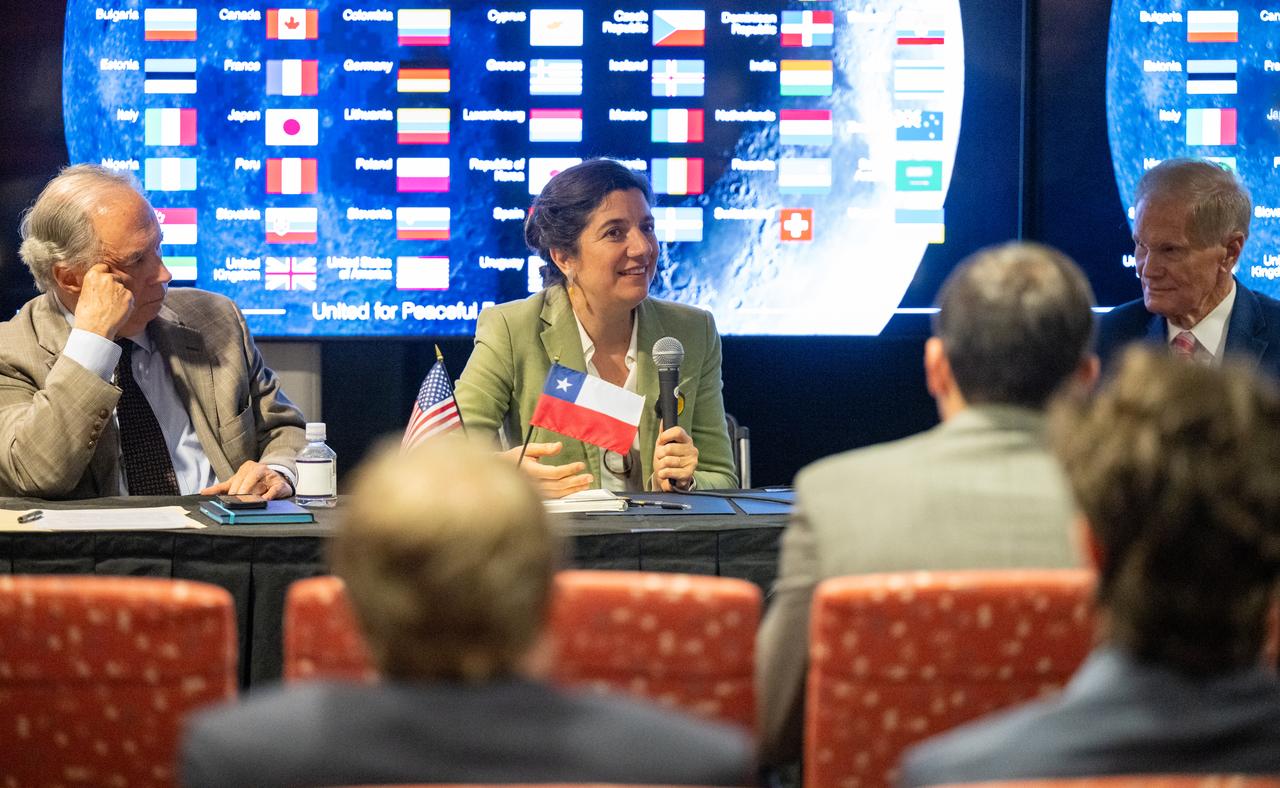
Chilean Minister of Science, Technology, Knowledge, and Innovation Aisén Etcheverry Escudero, center, delivers remarks during an Artemis Accords signing ceremony Friday, Oct. 25, 2024, at the Mary W. Jackson NASA Headquarters building in Washington. The Republic of Chile is the 47th country to sign the Artemis Accords, which establish a practical set of principles to guide space exploration cooperation among nations participating in NASA’s Artemis program. Photo Credit: (NASA/Keegan Barber)
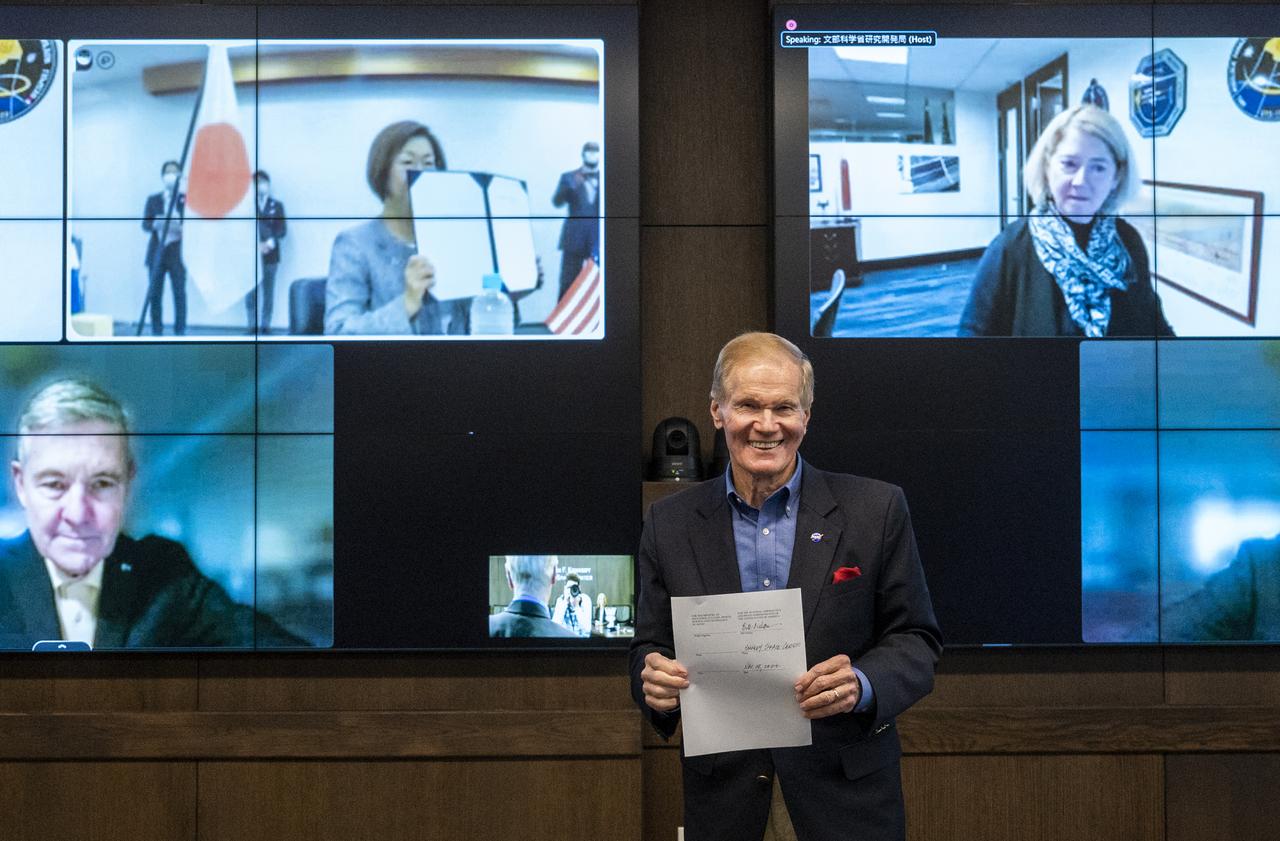
NASA Administrator Bill Nelson, joined by NASA Leadership, poses for photos following the signing of a Gateway implementing agreement during a virtual meeting hosted by Japanese Minister of Education, Culture, Sports, Science and Technology (MEXT) Keiko Nagaoka Thursday, Nov. 17, 2022, at NASA’s Kennedy Space Center in Florida. Photo Credit: (NASA/Keegan Barber)
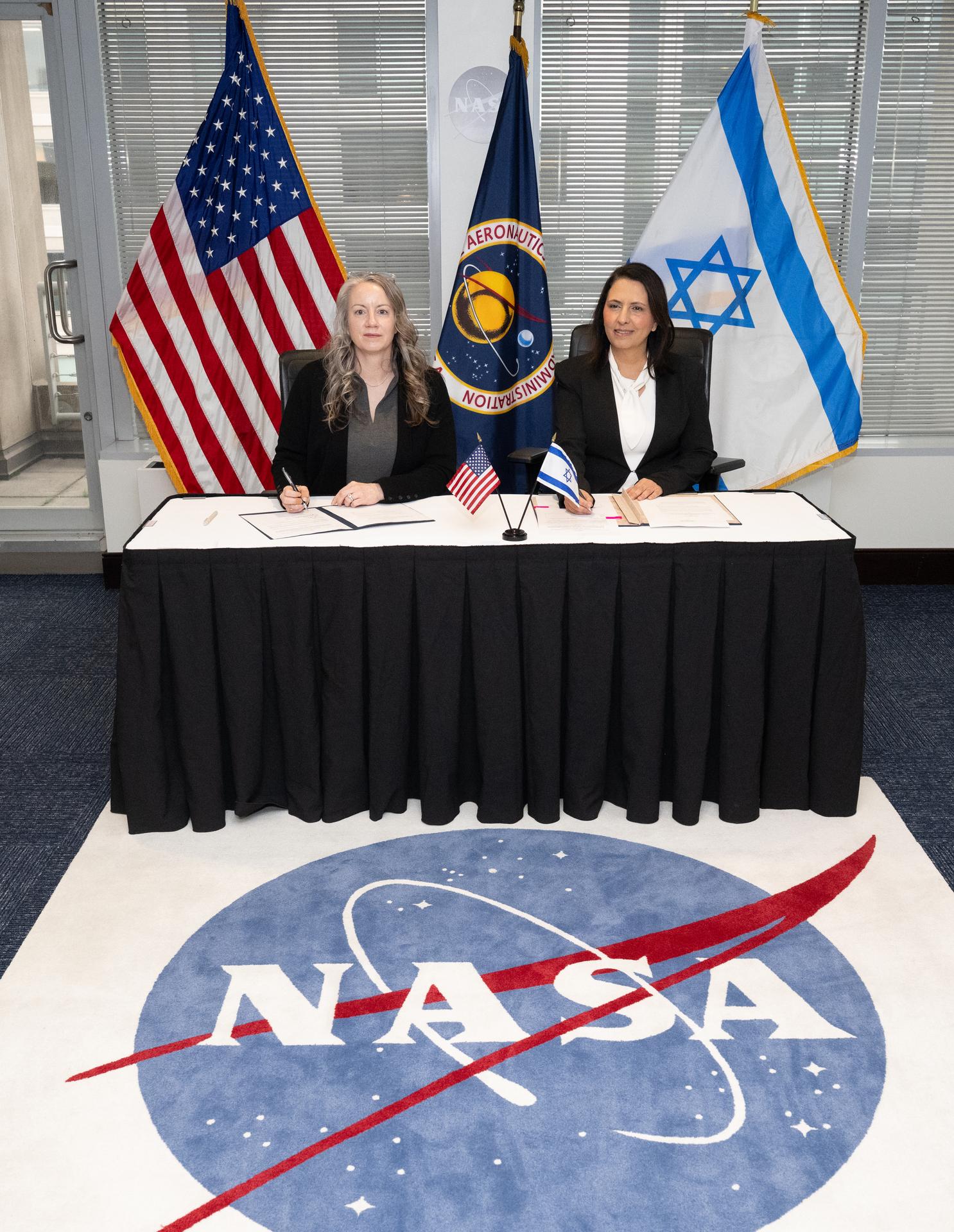
Meredith McKay, acting associate administrator for NASA’s Office of International and Interagency Relations, left, and Israel’s Minister for Innovation, Science, and Technology Gila Gamliel sign the US-Israel Space Cooperation Framework Agreement Extension, Wednesday, Dec. 10, 2025, at the Mary W. Jackson NASA Headquarters building in Washington. Photo Credit: (NASA/Joel Kowsky)
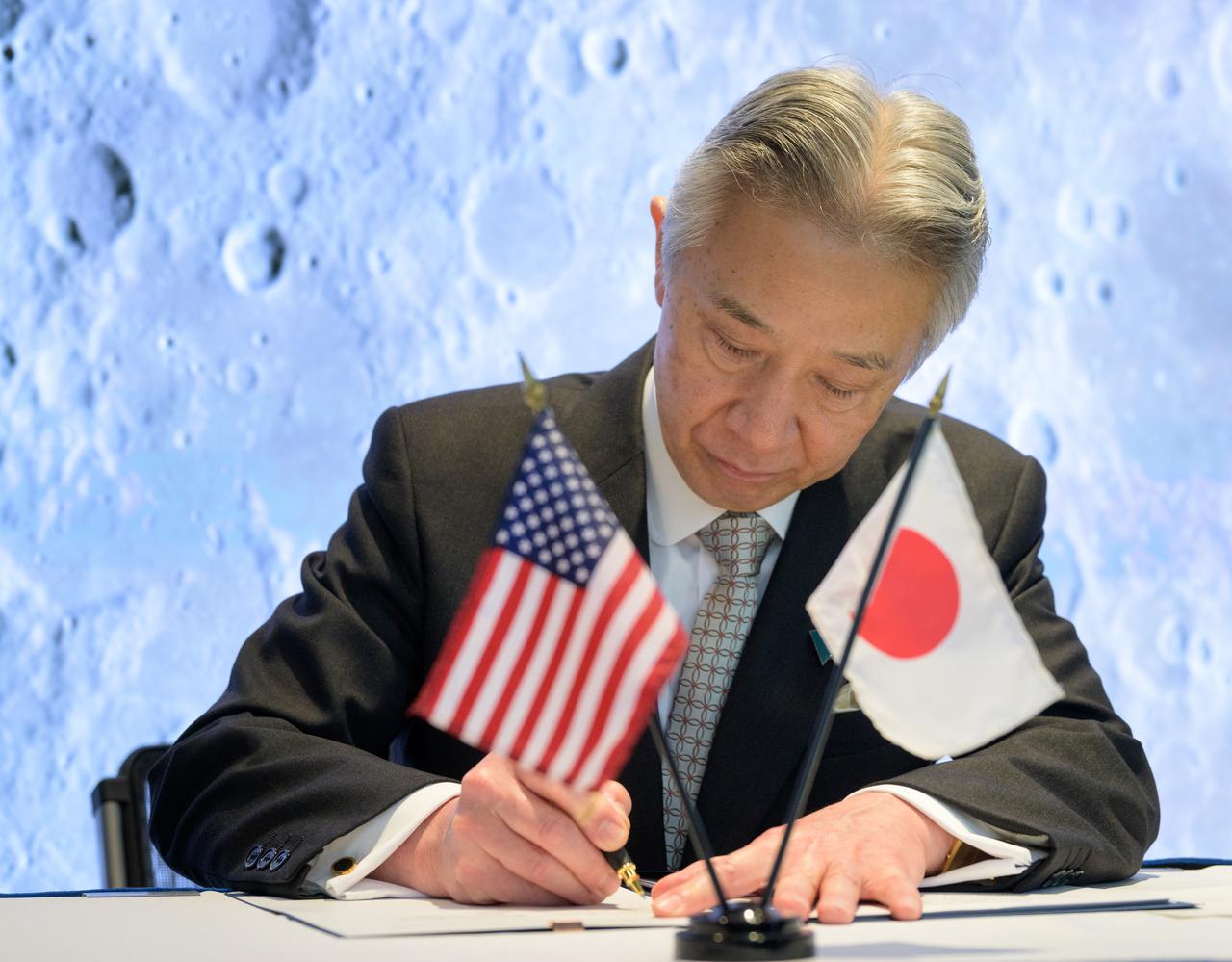
Japan’s Minister of Education, Culture, Sports, Science and Technology Masahito Moriyama, signs an historic agreement between the United States and Japan to advance sustainable human exploration of the Moon, Tuesday, April 9, 2024, at the NASA Headquarters Mary W. Jackson Building in Washington. Under the agreement, Japan will design, develop, and operate a pressurized rover for crewed and uncrewed exploration on the Moon. NASA will provide the launch and delivery of the rover to the Moon as well as two Japanese astronaut missions to the lunar surface. Photo Credit: (NASA/Bill Ingalls)
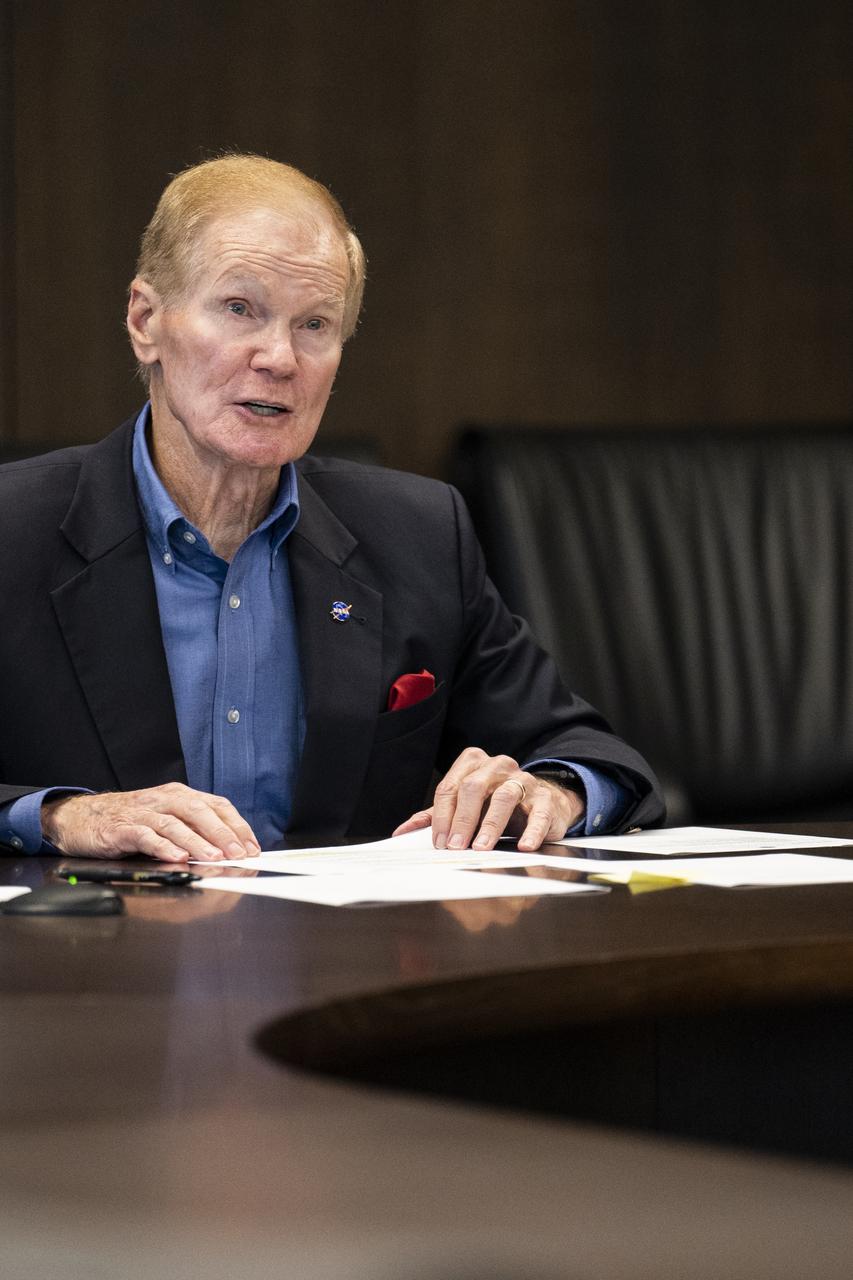
NASA Administrator Bill Nelson, joined by NASA Leadership, delivers opening remarks during a virtual meeting hosted by Japanese Minister of Education, Culture, Sports, Science and Technology (MEXT) Keiko Nagaoka prior to signing a Gateway implementing agreement Thursday, Nov. 17, 2022, at NASA’s Kennedy Space Center in Florida. Photo Credit: (NASA/Keegan Barber)
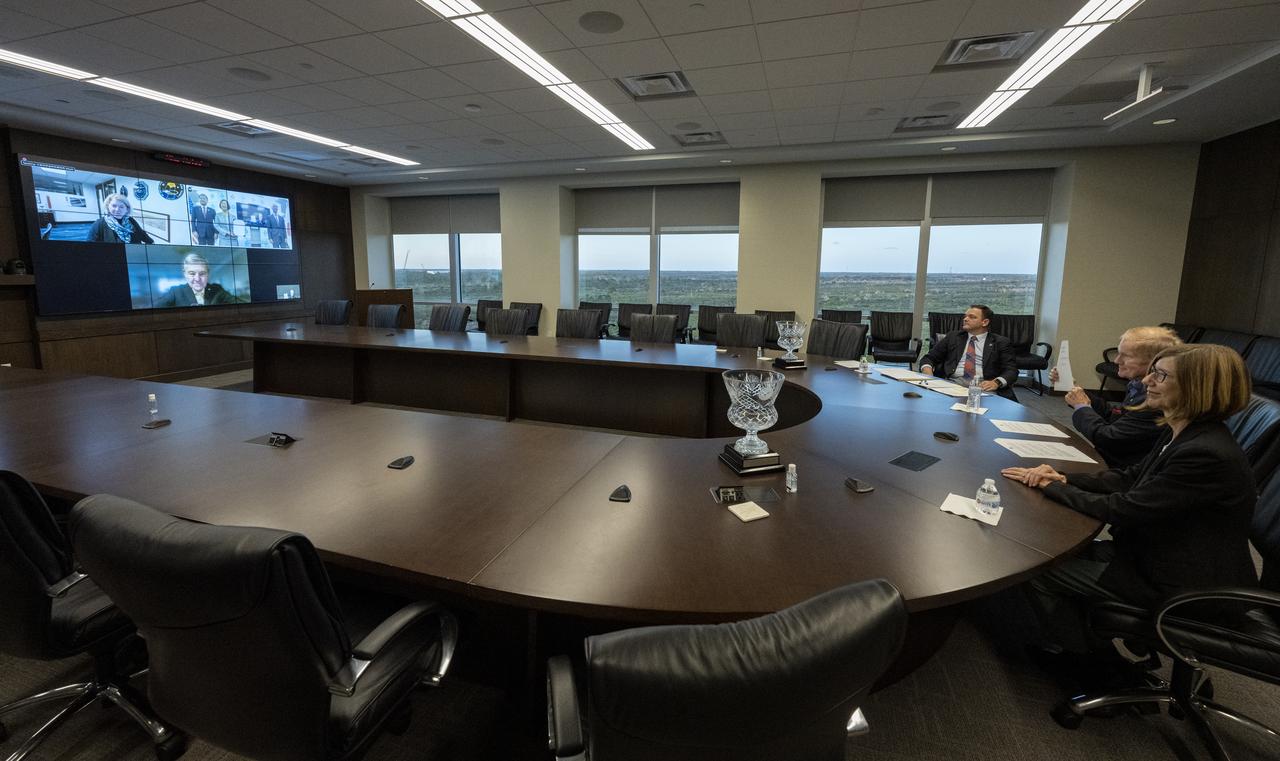
NASA Administrator Bill Nelson, joined by NASA Leadership, poses for photos following the signing of a Gateway implementing agreement during a virtual meeting hosted by Japanese Minister of Education, Culture, Sports, Science and Technology (MEXT) Keiko Nagaoka Thursday, Nov. 17, 2022, at NASA’s Kennedy Space Center in Florida. Photo Credit: (NASA/Keegan Barber)
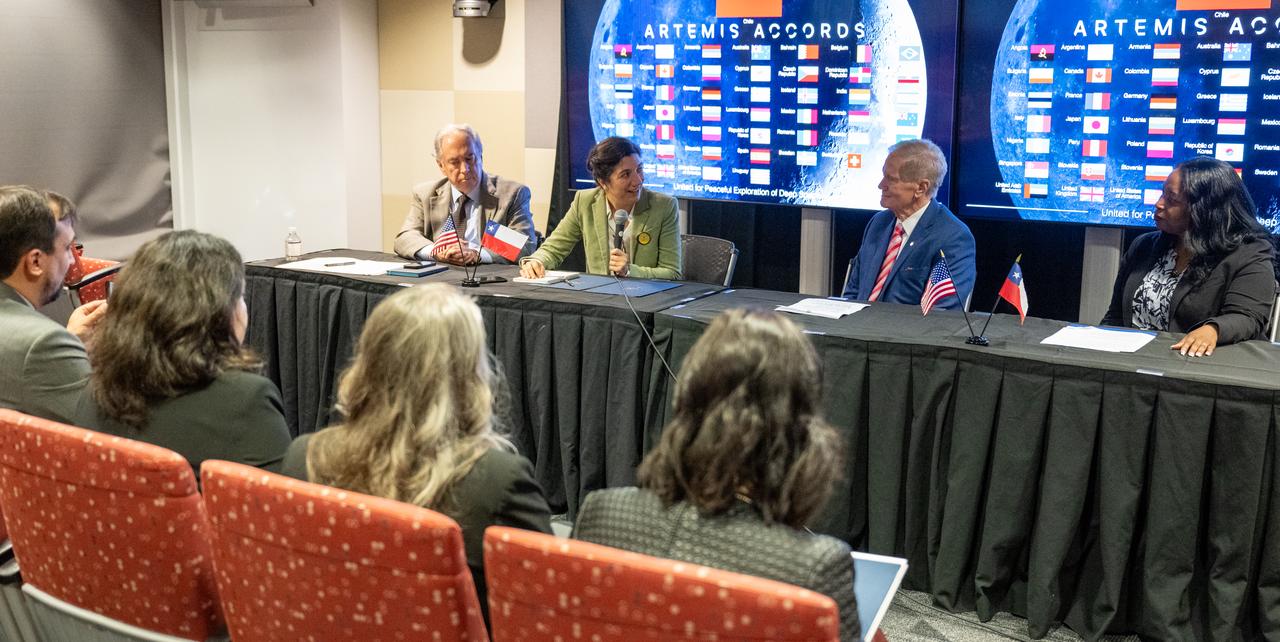
Chilean Minister of Science, Technology, Knowledge, and Innovation Aisén Etcheverry Escudero, second from left, delivers remarks during an Artemis Accords signing ceremony Friday, Oct. 25, 2024, at the Mary W. Jackson NASA Headquarters building in Washington. The Republic of Chile is the 47th country to sign the Artemis Accords, which establish a practical set of principles to guide space exploration cooperation among nations participating in NASA’s Artemis program. Photo Credit: (NASA/Keegan Barber)
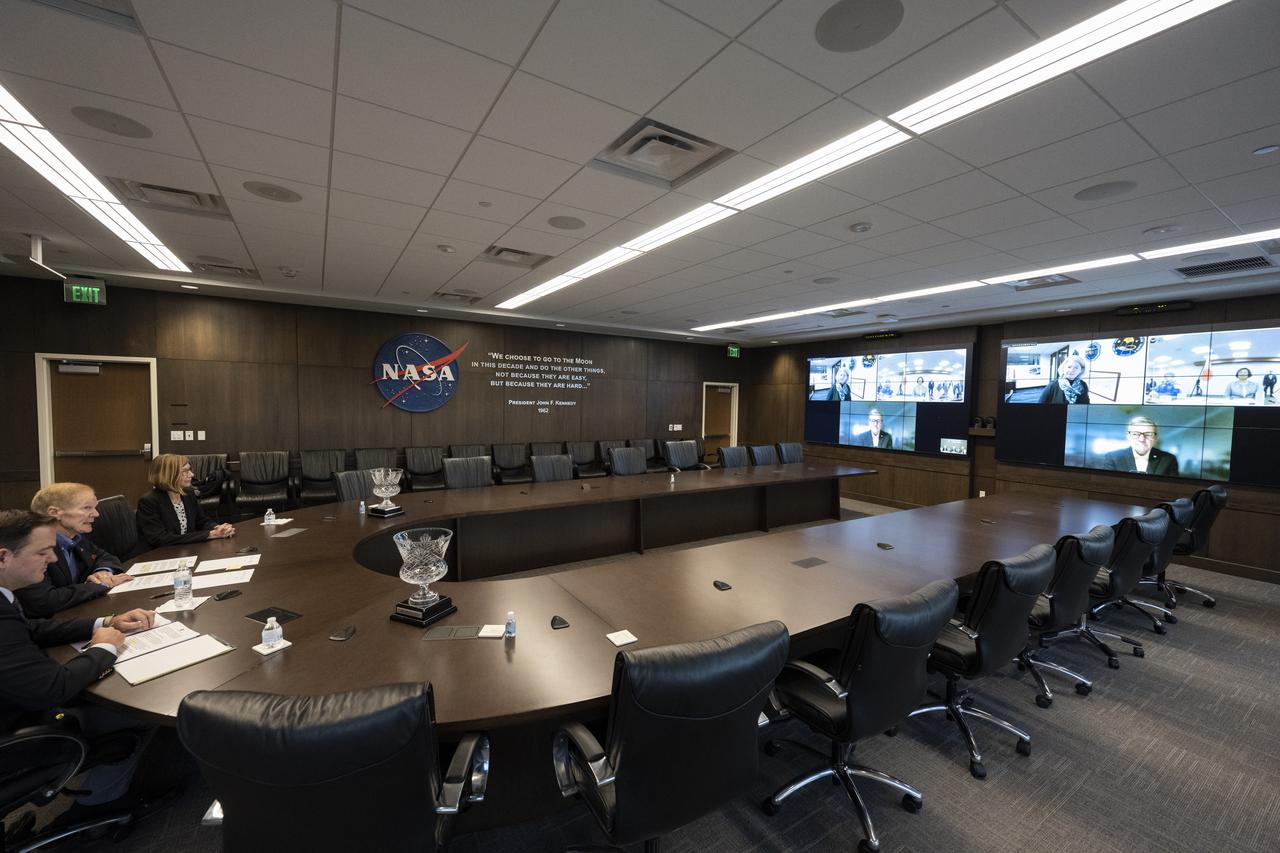
NASA Administrator Bill Nelson, joined by NASA Leadership, delivers opening remarks during a virtual meeting hosted by Japanese Minister of Education, Culture, Sports, Science and Technology (MEXT) Keiko Nagaoka prior to signing a Gateway implementing agreement Thursday, Nov. 17, 2022, at NASA’s Kennedy Space Center in Florida. Photo Credit: (NASA/Keegan Barber)
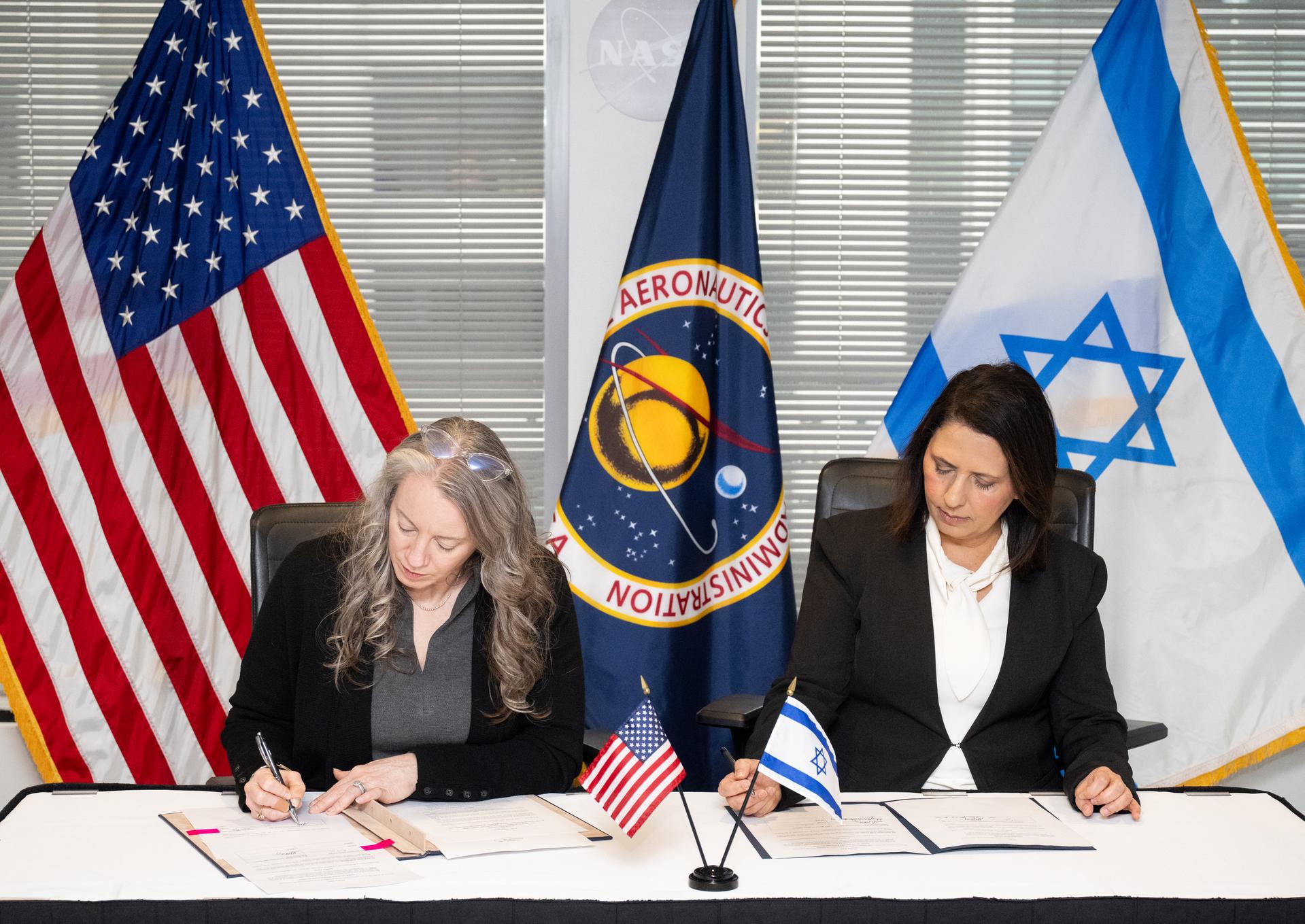
Meredith McKay, acting associate administrator for NASA’s Office of International and Interagency Relations, left, and Israel’s Minister for Innovation, Science, and Technology Gila Gamliel sign the US-Israel Space Cooperation Framework Agreement Extension, Wednesday, Dec. 10, 2025, at the Mary W. Jackson NASA Headquarters building in Washington. Photo Credit: (NASA/Joel Kowsky)
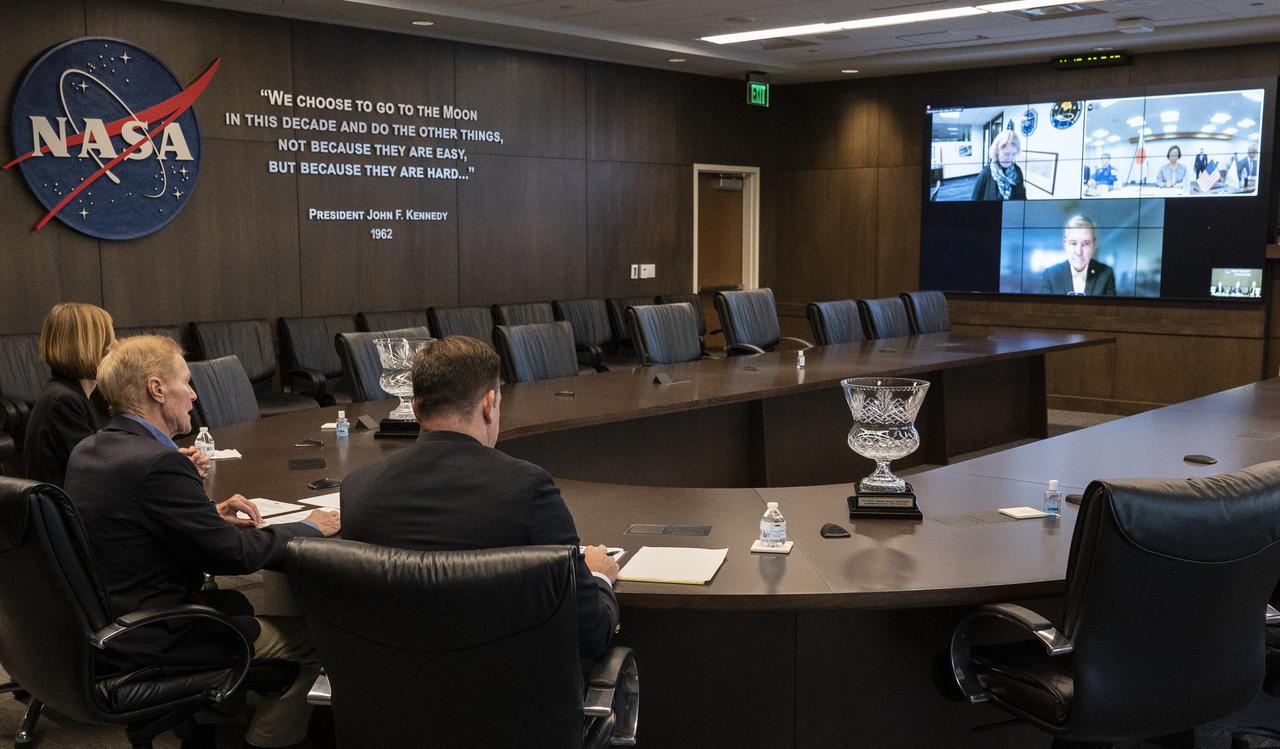
NASA Administrator Bill Nelson, joined by NASA Leadership, delivers opening remarks during a virtual meeting hosted by Japanese Minister of Education, Culture, Sports, Science and Technology (MEXT) Keiko Nagaoka prior to signing a Gateway implementing agreement Thursday, Nov. 17, 2022, at NASA’s Kennedy Space Center in Florida. Photo Credit: (NASA/Keegan Barber)
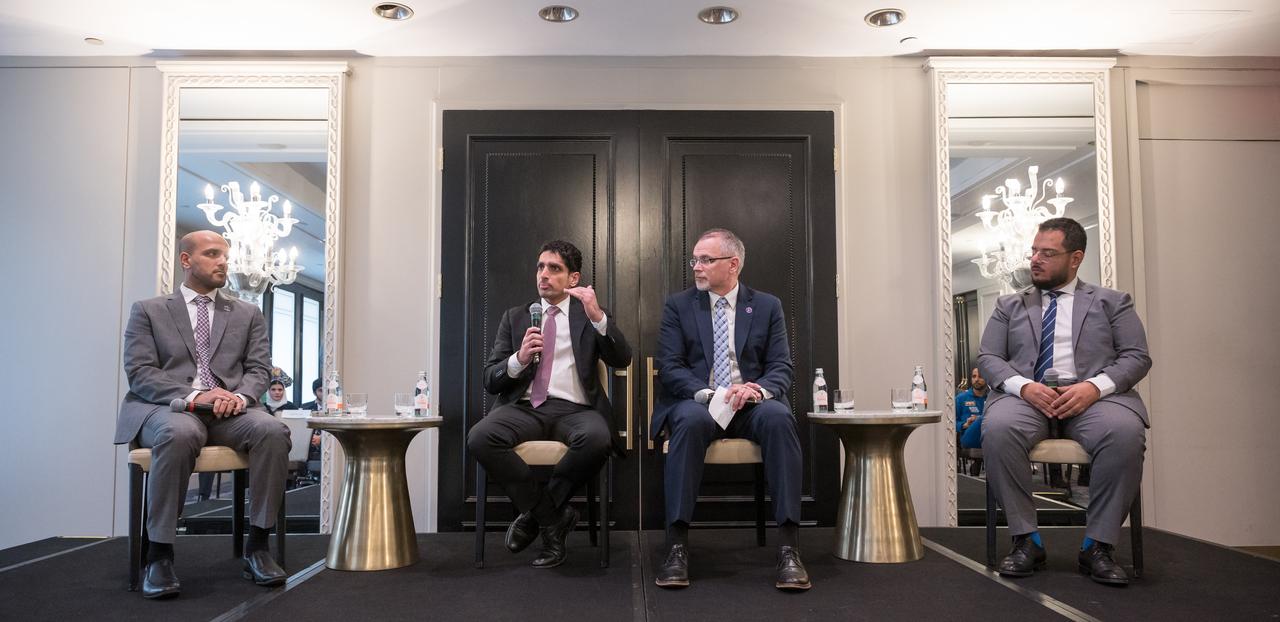
Senior Director of the Space Engineering Department, MBRSC, Amer Al Sayegh, left, UAE Assistant Minister of Foreign Affairs and International Cooperation for Advanced Science and Technology, Omran Sharaf, NASA Associate Administrator Jim Free, and Director of Space Missions Department, UAESA, Mohsen Al Awadhi, right, participate in a panel discussion during an event celebrating UAE-US collaboration in space, Friday, March 8, 2024, at the Four Seasons Hotel in Washington. Photo Credit: (NASA/Bill Ingalls)
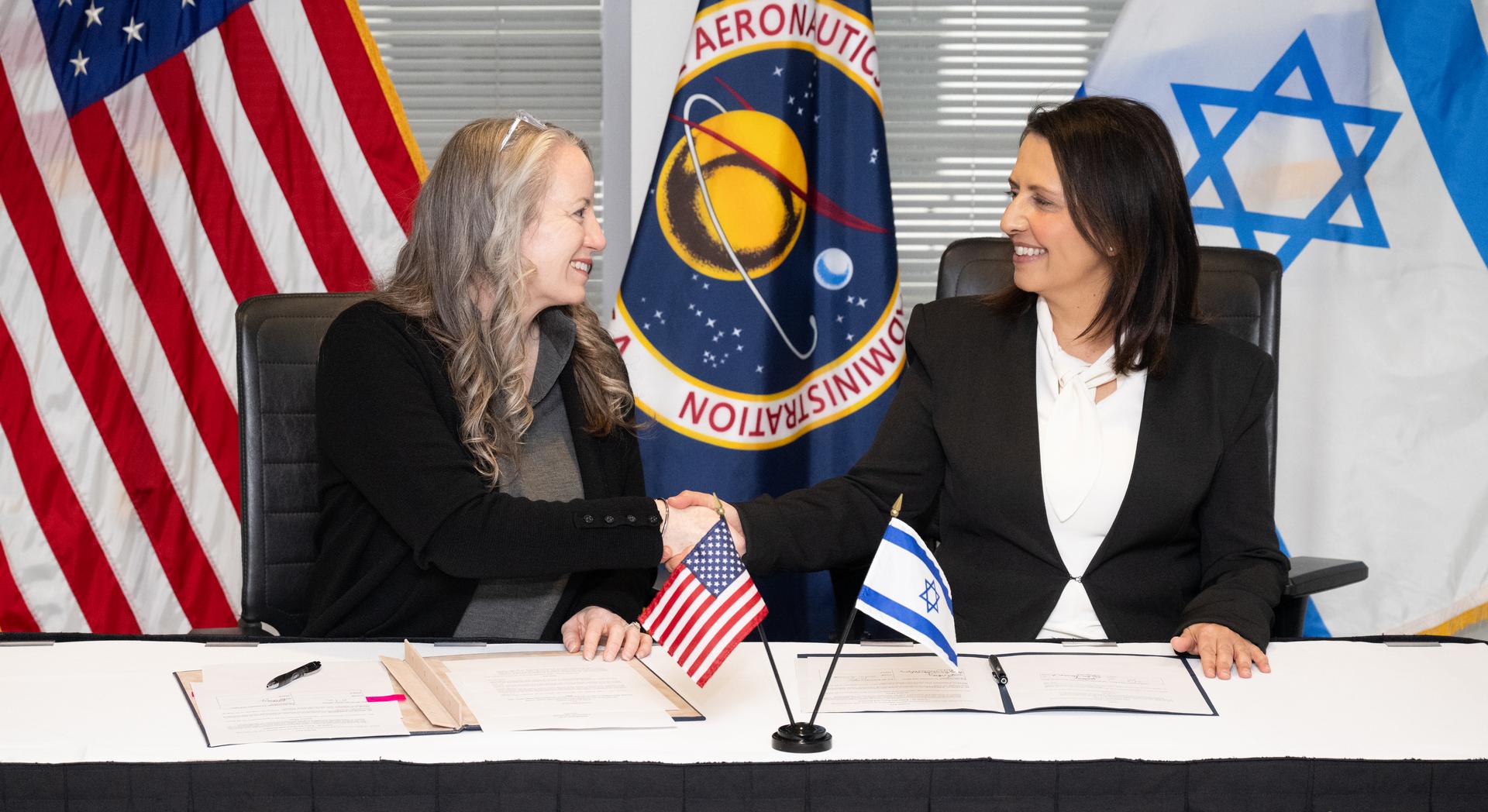
Meredith McKay, acting associate administrator for NASA’s Office of International and Interagency Relations, left, and Israel’s Minister for Innovation, Science, and Technology Gila Gamliel shake hands after signing the US-Israel Space Cooperation Framework Agreement Extension, Wednesday, Dec. 10, 2025, at the Mary W. Jackson NASA Headquarters building in Washington. Photo Credit: (NASA/Joel Kowsky)
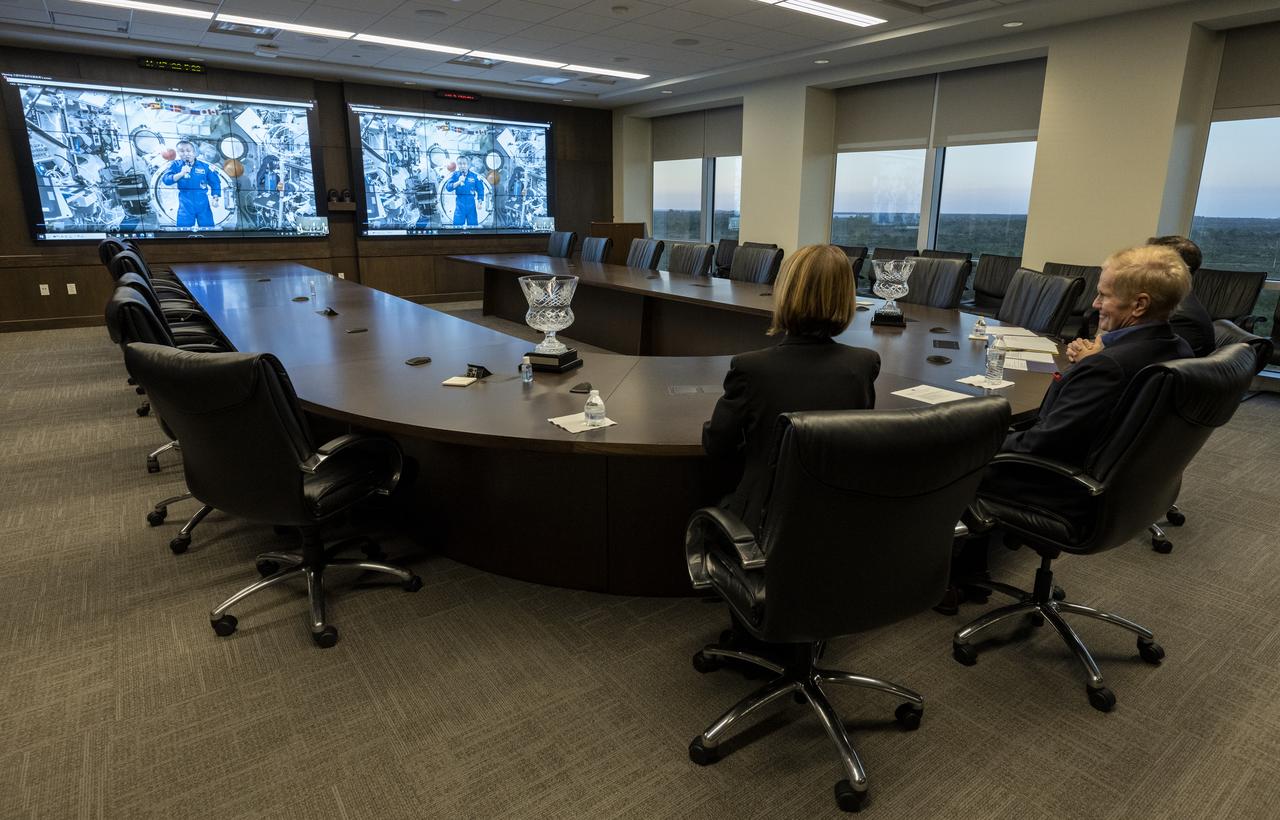
NASA Administrator Bill Nelson, joined by NASA Leadership, view a video message from Japan Aerospace Exploration Agency (JAXA) astronaut Akihiko Hoshide during a virtual meeting hosted by Japanese Minister of Education, Culture, Sports, Science and Technology (MEXT) Keiko Nagaoka following the signing of a Gateway implementing agreement Thursday, Nov. 17, 2022, at NASA’s Kennedy Space Center in Florida. Photo Credit: (NASA/Keegan Barber)
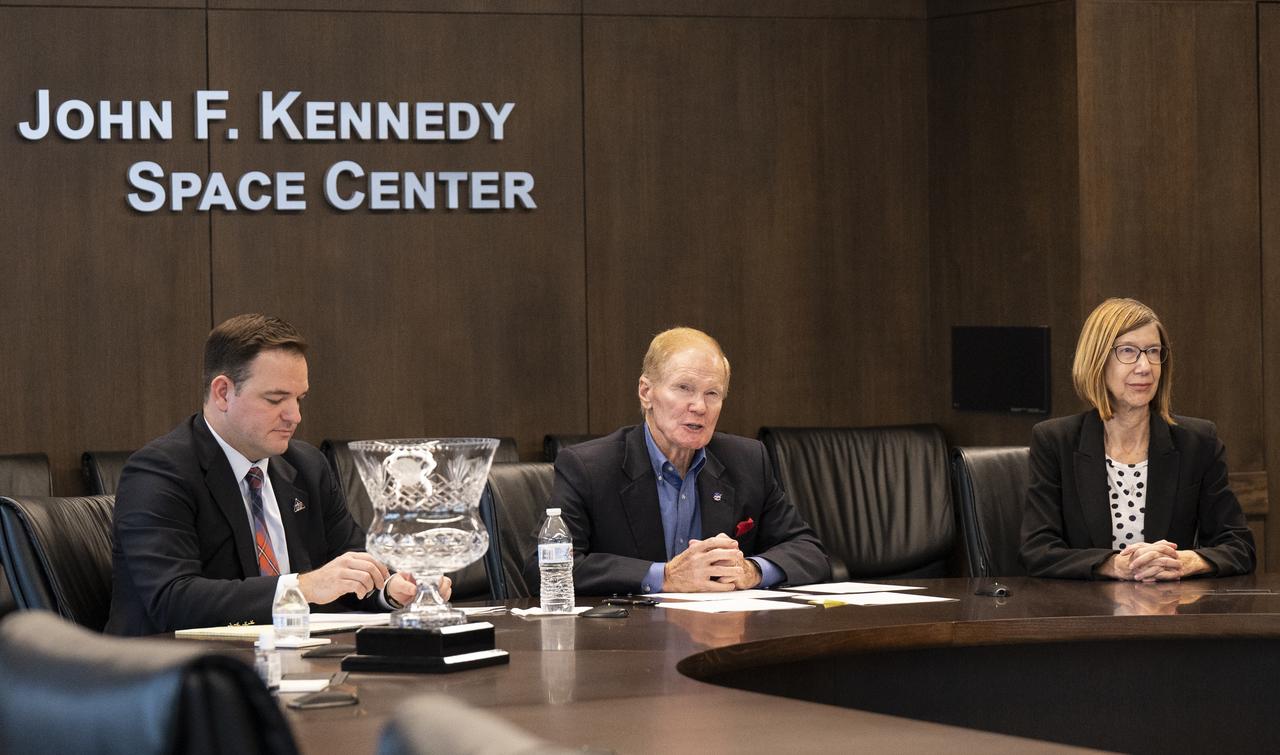
NASA Administrator Bill Nelson, joined by NASA Leadership, delivers opening remarks during a virtual meeting hosted by Japanese Minister of Education, Culture, Sports, Science and Technology (MEXT) Keiko Nagaoka prior to signing a Gateway implementing agreement Thursday, Nov. 17, 2022, at NASA’s Kennedy Space Center in Florida. Photo Credit: (NASA/Keegan Barber)
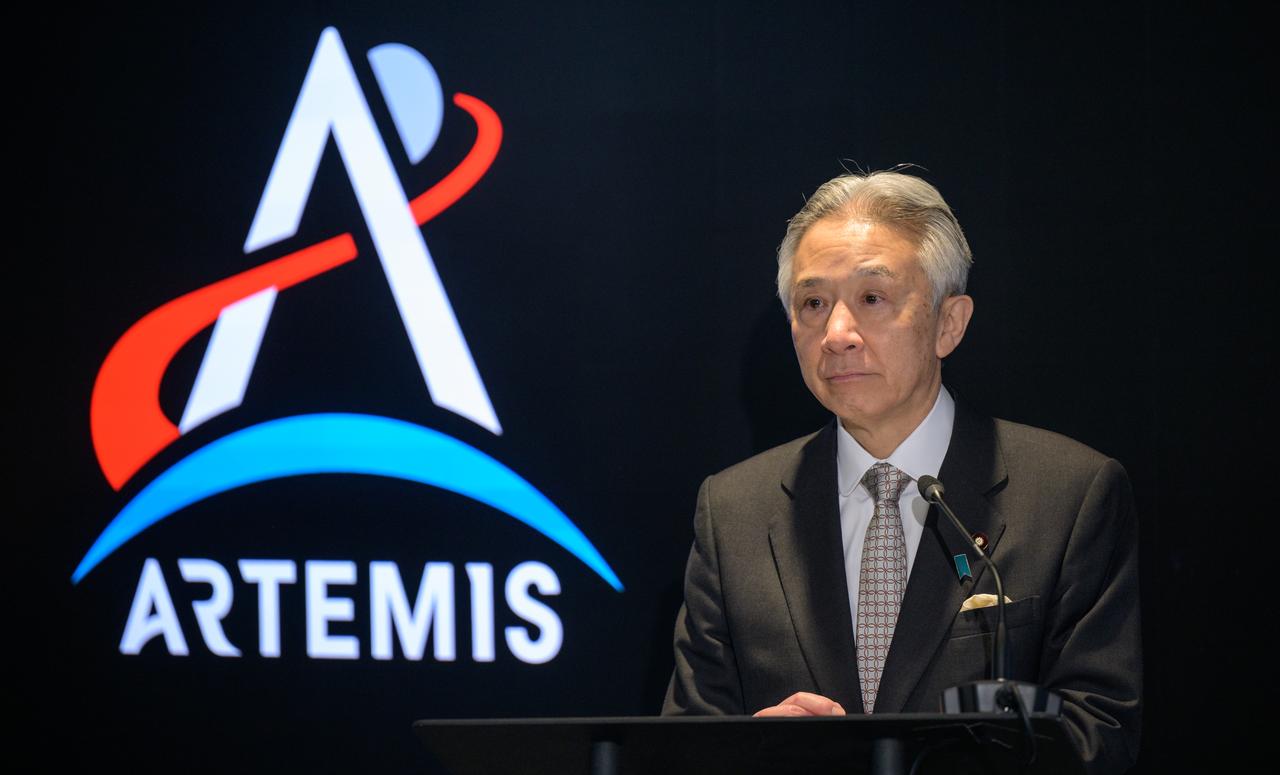
Japan’s Minister of Education, Culture, Sports, Science and Technology Masahito Moriyama speaks after signing an historic agreement between the United States and Japan to advance sustainable human exploration of the Moon, Tuesday, April 9, 2024, at the NASA Headquarters Mary W. Jackson Building in Washington. Under the agreement, Japan will design, develop, and operate a pressurized rover for crewed and uncrewed exploration on the Moon. NASA will provide the launch and delivery of the rover to the Moon as well as two Japanese astronaut missions to the lunar surface. Photo Credit: (NASA/Bill Ingalls)
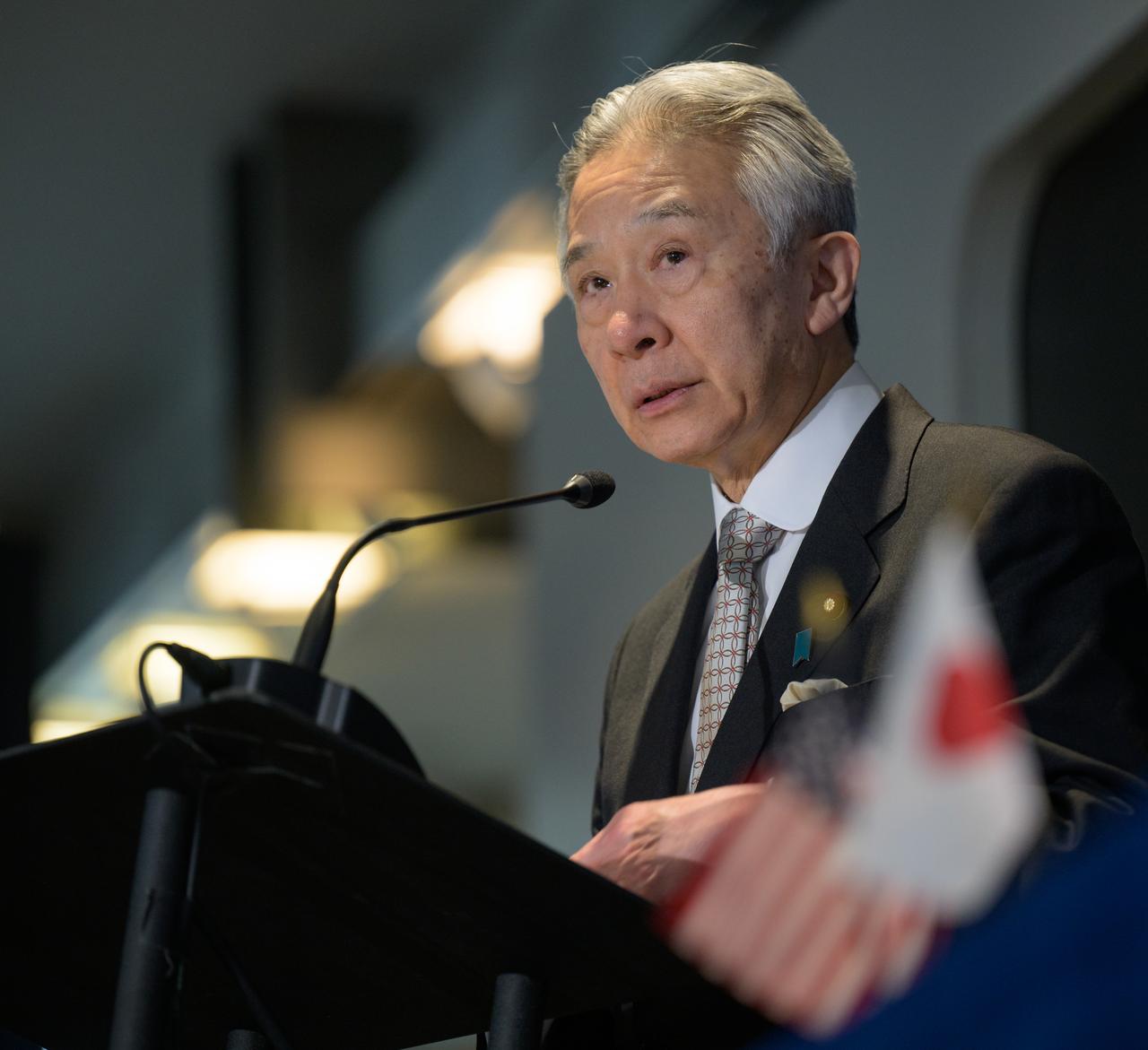
Japan’s Minister of Education, Culture, Sports, Science and Technology Masahito Moriyama speaks after signing an historic agreement between the United States and Japan to advance sustainable human exploration of the Moon, Tuesday, April 9, 2024, at the NASA Headquarters Mary W. Jackson Building in Washington. Under the agreement, Japan will design, develop, and operate a pressurized rover for crewed and uncrewed exploration on the Moon. NASA will provide the launch and delivery of the rover to the Moon as well as two Japanese astronaut missions to the lunar surface. Photo Credit: (NASA/Bill Ingalls)
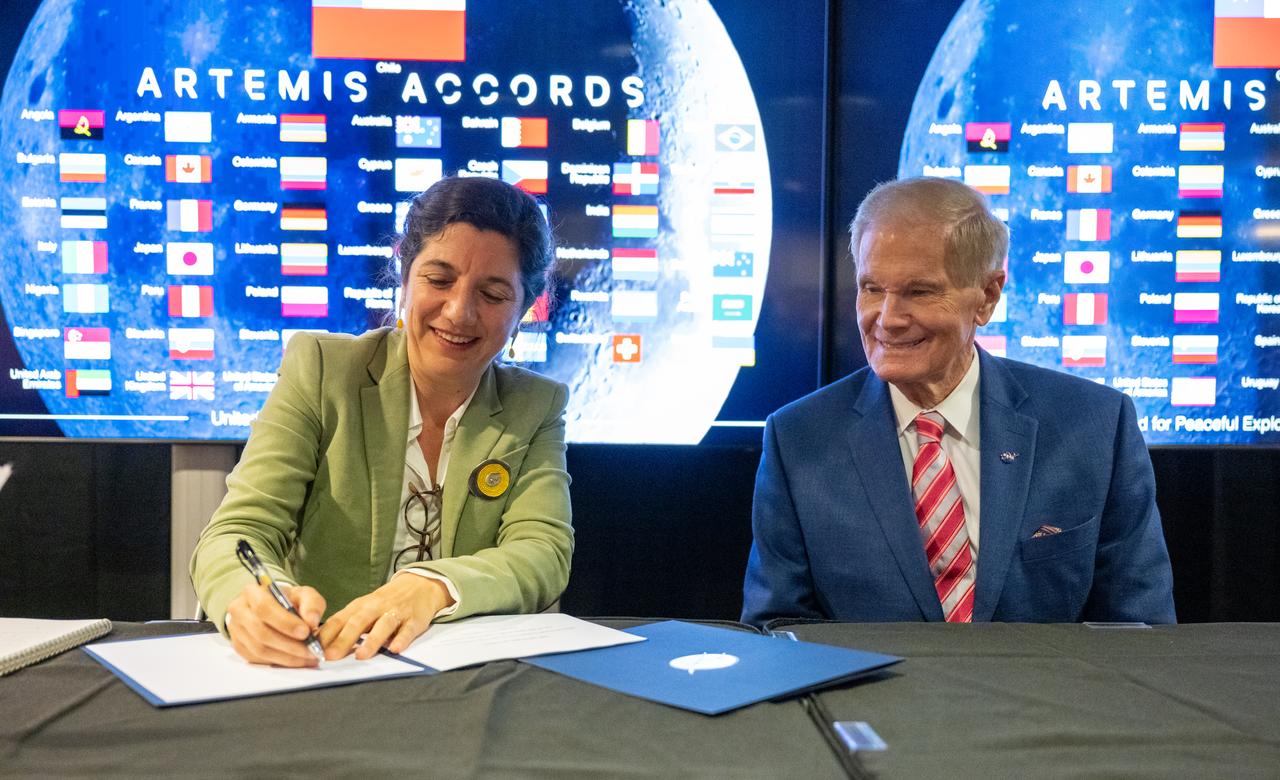
NASA Administrator Bill Nelson, right, looks on as Chilean Minister of Science, Technology, Knowledge, and Innovation Aisén Etcheverry Escudero, left, signs the Artemis Accords Friday, Oct. 25, 2024, at the Mary W. Jackson NASA Headquarters building in Washington. The Republic of Chile is the 47th country to sign the Artemis Accords, which establish a practical set of principles to guide space exploration cooperation among nations participating in NASA’s Artemis program. Photo Credit: (NASA/Keegan Barber)
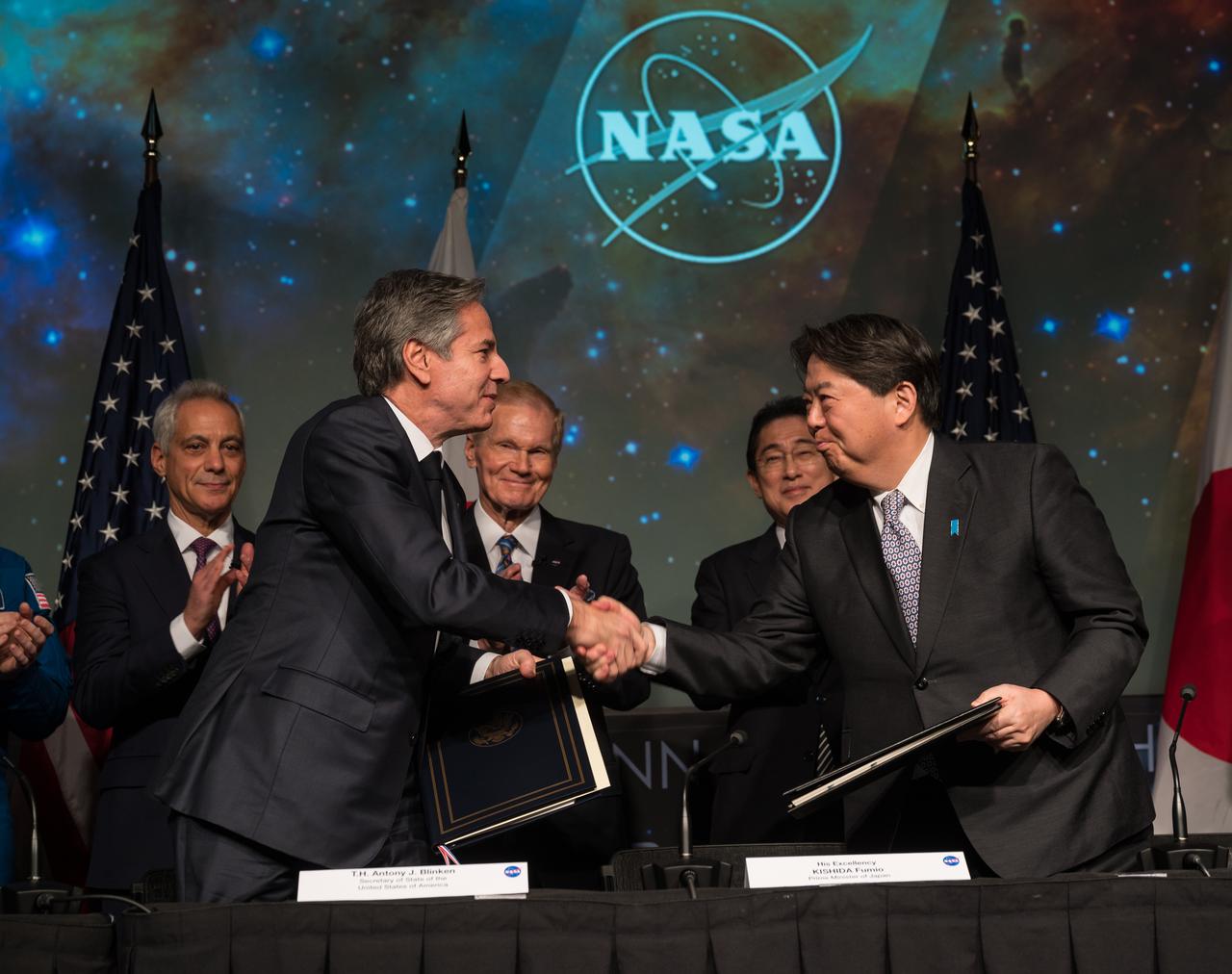
U.S. Secretary of State Antony Blinken, front left, and Japan’s Minister for Foreign Affairs, Hayashi Yoshimasa, front right, shake hands after signing an agreement that builds on a long history of collaboration in space exploration between the U.S. and Japan, Friday, Jan. 13, 2023, at the Mary W. Jackson NASA Headquarters building in Washington. Also present were, U.S. Ambassador to Japan Rahm Emanuel, left, NASA Administrator Bill Nelson, second from left, and Prime Minister of Japan, His Excellency Kishida Fumio, right. “The Framework Agreement Between the Government of Japan and the Government of the United States of America for Cooperation in Space Exploration and Use of Outer Space, Including the Moon and Other Celestial Bodies, For Peaceful Purposes” covers joint activities including space science, Earth science, space operations and exploration, aeronautical science and technology, space technology, space transportation, and safety and mission assurance, among others. Photo Credit: (NASA/Aubrey Gemignani)
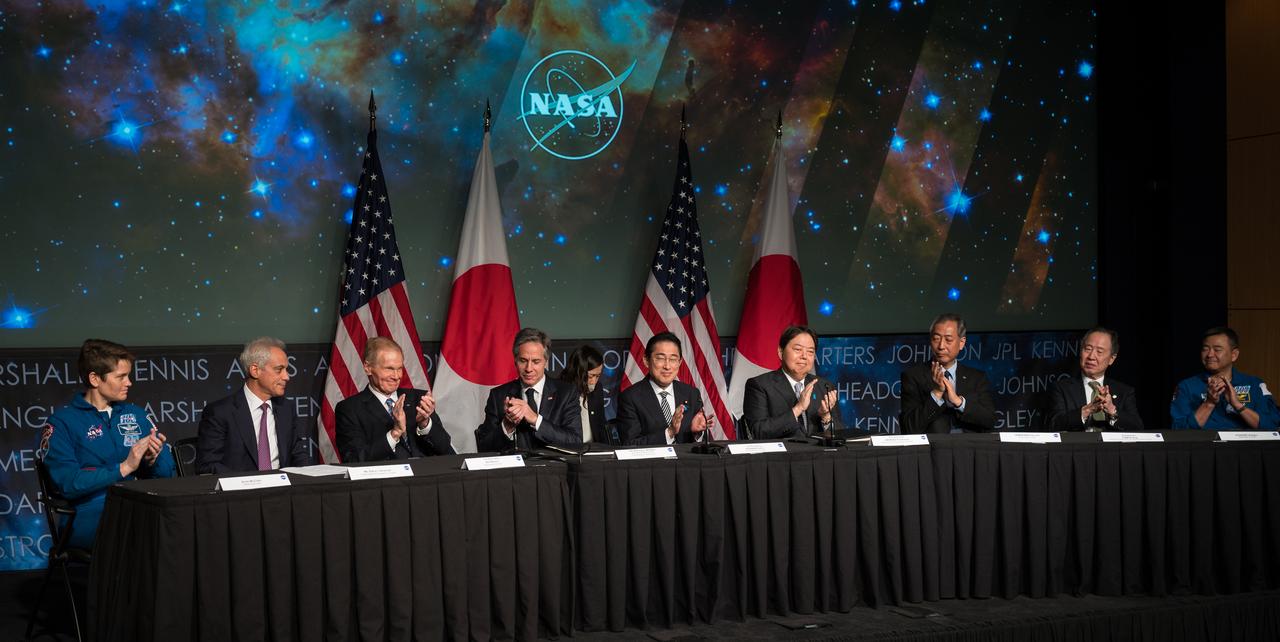
From left to right, NASA astronaut Anne McClain, U.S. Ambassador to Japan Rahm Emanuel, NASA Administrator Bill Nelson, U.S. Secretary of State Antony Blinken, Prime Minister of Japan, His Excellency Kishida Fumio, Minister for Foreign Affairs of Japan, The Honorable Hayashi Yoshimasa, President of the Japan Aerospace Exploration Agency (JAXA), Yamakawa Hiroshi, Ambassador Extraordinary and Plenipotentiary of Japan to the U.S., Tomita Koji, and JAXA astronaut Hoshide Akihiko, applaud after the signing of an agreement that builds on a long history of collaboration in space exploration between the U.S. and Japan, Friday, Jan. 13, 2023, at the Mary W. Jackson NASA Headquarters building in Washington. “The Framework Agreement Between the Government of Japan and the Government of the United States of America for Cooperation in Space Exploration and Use of Outer Space, Including the Moon and Other Celestial Bodies, For Peaceful Purposes” covers joint activities including space science, Earth science, space operations and exploration, aeronautical science and technology, space technology, space transportation, and safety and mission assurance, among others. Photo Credit: (NASA/Aubrey Gemignani)
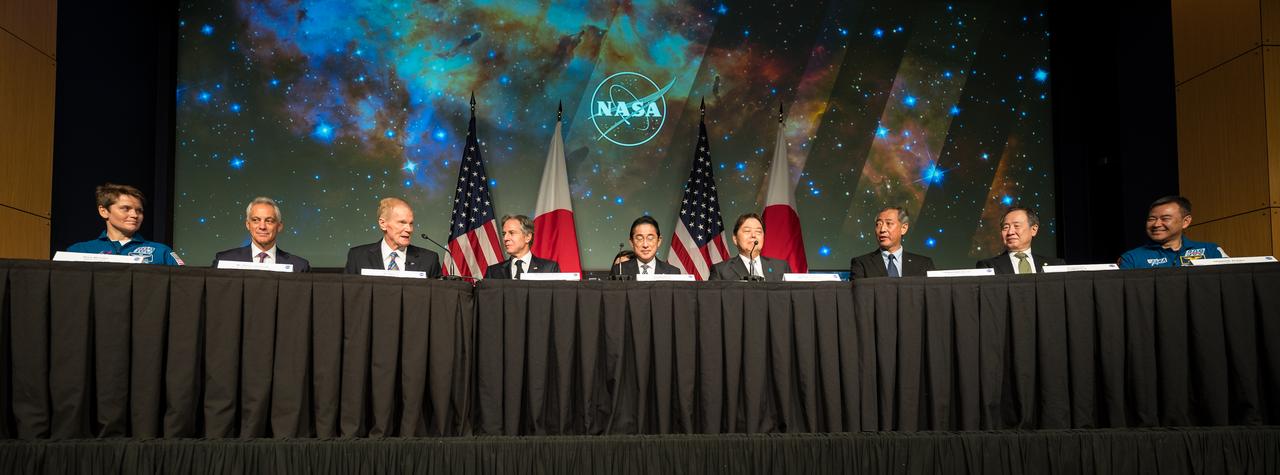
From left to right, NASA astronaut Anne McClain, U.S. Ambassador to Japan, Rahm Emanuel, NASA Administrator Bill Nelson, U.S. Secretary of State Antony Blinken, Prime Minister of Japan, His Excellency Kishida Fumio, Minister for Foreign Affairs of Japan, The Honorable Hayashi Yoshimasa, President of the Japan Aerospace Exploration Agency (JAXA), Yamakawa Hiroshi, Ambassador Extraordinary and Plenipotentiary of Japan to the U.S., Tomita Koji, and JAXA astronaut Hoshide Akihiko, are seen before the signing of an agreement that builds on a long history of collaboration in space exploration between the U.S. and Japan, Friday, Jan. 13, 2023, at the Mary W. Jackson NASA Headquarters building in Washington. “The Framework Agreement Between the Government of Japan and the Government of the United States of America for Cooperation in Space Exploration and Use of Outer Space, Including the Moon and Other Celestial Bodies, For Peaceful Purposes” covers joint activities including space science, Earth science, space operations and exploration, aeronautical science and technology, space technology, space transportation, and safety and mission assurance, among others. Photo Credit: (NASA/Aubrey Gemignani)
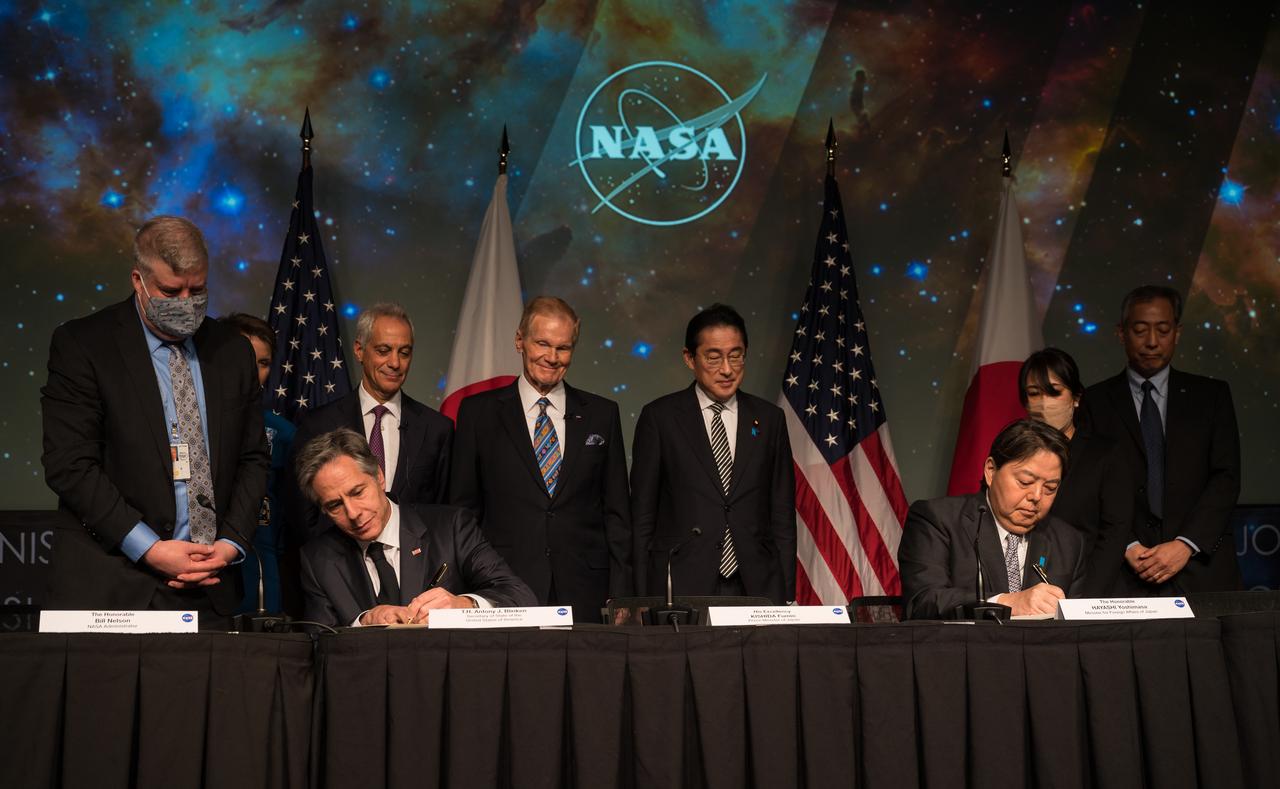
U.S. Secretary of State Antony Blinken, seated left, and Japan’s Minister for Foreign Affairs, Hayashi Yoshimasa, seated right, sign an agreement that builds on a long history of collaboration in space exploration between the U.S. and Japan, Friday, Jan. 13, 2023, at the Mary W. Jackson NASA Headquarters building in Washington. Also present were, U.S. Ambassador to Japan Rahm Emanuel, second from left, NASA Administrator Bill Nelson, third from left, Prime Minister of Japan, His Excellency Kishida Fumio, third from right, President of the Japan Aerospace Exploration Agency (JAXA), Yamakawa Hiroshi, right. “The Framework Agreement Between the Government of Japan and the Government of the United States of America for Cooperation in Space Exploration and Use of Outer Space, Including the Moon and Other Celestial Bodies, For Peaceful Purposes” covers joint activities including space science, Earth science, space operations and exploration, aeronautical science and technology, space technology, space transportation, and safety and mission assurance, among others. Photo Credit: (NASA/Aubrey Gemignani)
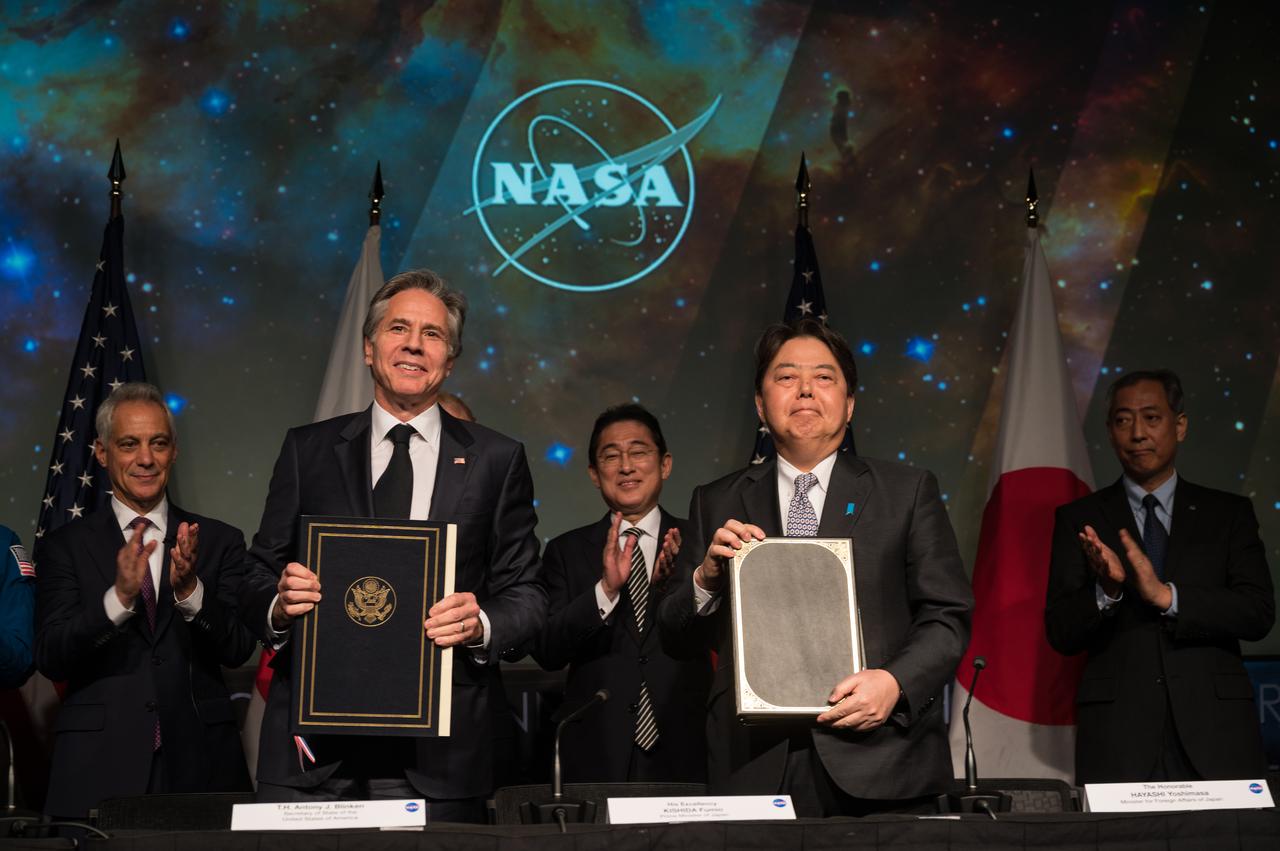
U.S. Secretary of State Antony Blinken, front left, and Japan’s Minister for Foreign Affairs, Hayashi Yoshimasa, front right, pose for a photo after signing an agreement that builds on a long history of collaboration in space exploration between the U.S. and Japan, Friday, Jan. 13, 2023, at the Mary W. Jackson NASA Headquarters building in Washington. Also present were, U.S. Ambassador to Japan Rahm Emanuel, left, NASA Administrator Bill Nelson, second from left, Prime Minister of Japan, His Excellency Kishida Fumio, second from right, President of the Japan Aerospace Exploration Agency (JAXA), Yamakawa Hiroshi, right. “The Framework Agreement Between the Government of Japan and the Government of the United States of America for Cooperation in Space Exploration and Use of Outer Space, Including the Moon and Other Celestial Bodies, For Peaceful Purposes” covers joint activities including space science, Earth science, space operations and exploration, aeronautical science and technology, space technology, space transportation, and safety and mission assurance, among others. Photo Credit: (NASA/Aubrey Gemignani)
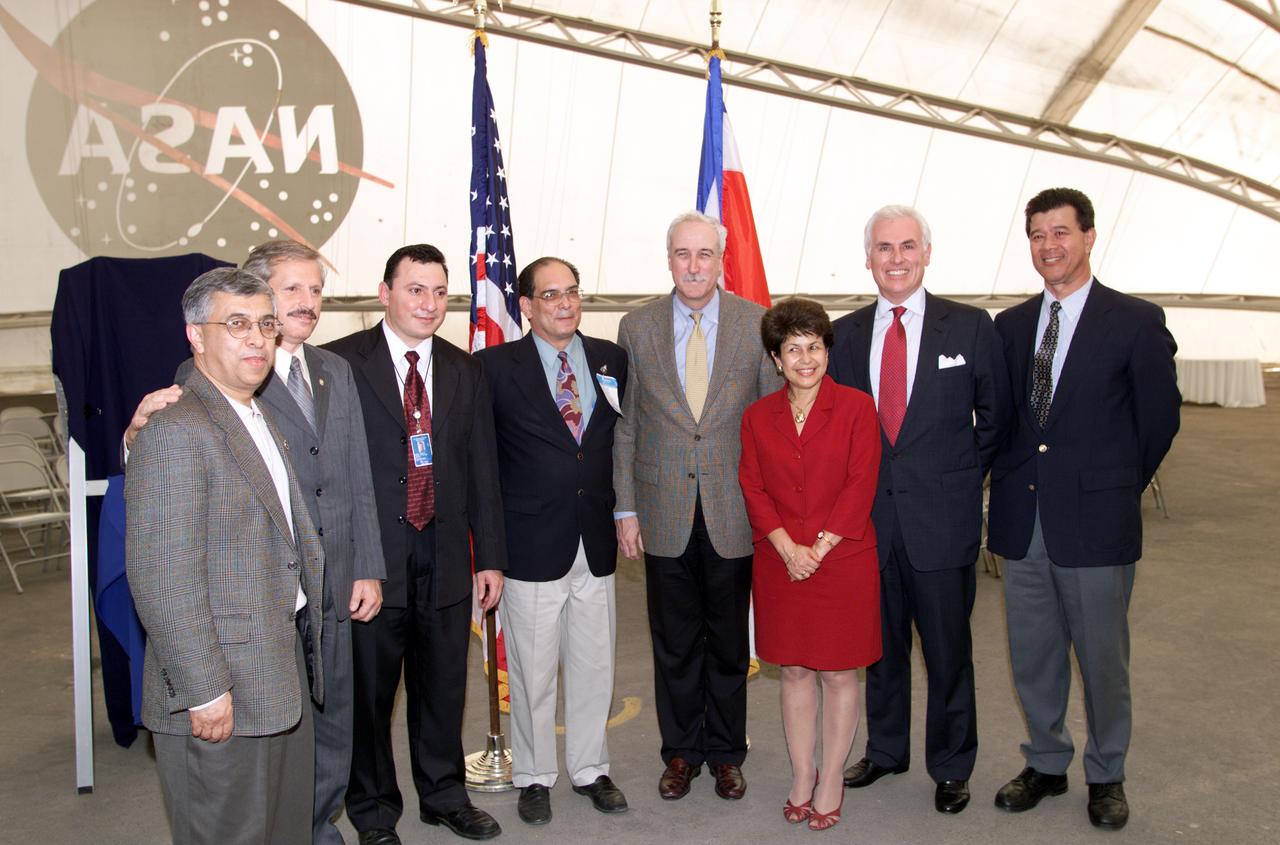
VIP group in hangar during AirSAR 2004 Mesoamerica campaign, L-R: Dr. Gahssem Asrar, NASA Associate Administrator for Earth Science Enterprises; Fernando Gutierrez, Costa Rican Minister of Science and Technology(MICIT); Jorge Andres Diaz, Director of the Costa Rican National Hangar for Airborne Research division of the National Center for High Technology(CENAT); Dr. Pedro Leon, General Director for the Costa Rican National Center for High Technology(CENAT); NASA Administrator Sean O'Keefe; Dr. Sonia Marta Mora, President of the Costa Rican National Rector’s Council(CONARE); Mr. John Danilovich, US Ambassador to Costa Rica; and unknown. AirSAR 2004 Mesoamerica is a three-week expedition by an international team of scientists that will use an all-weather imaging tool, called the Airborne Synthetic Aperture Radar (AirSAR), in a mission ranging from the tropical rain forests of Central America to frigid Antarctica.
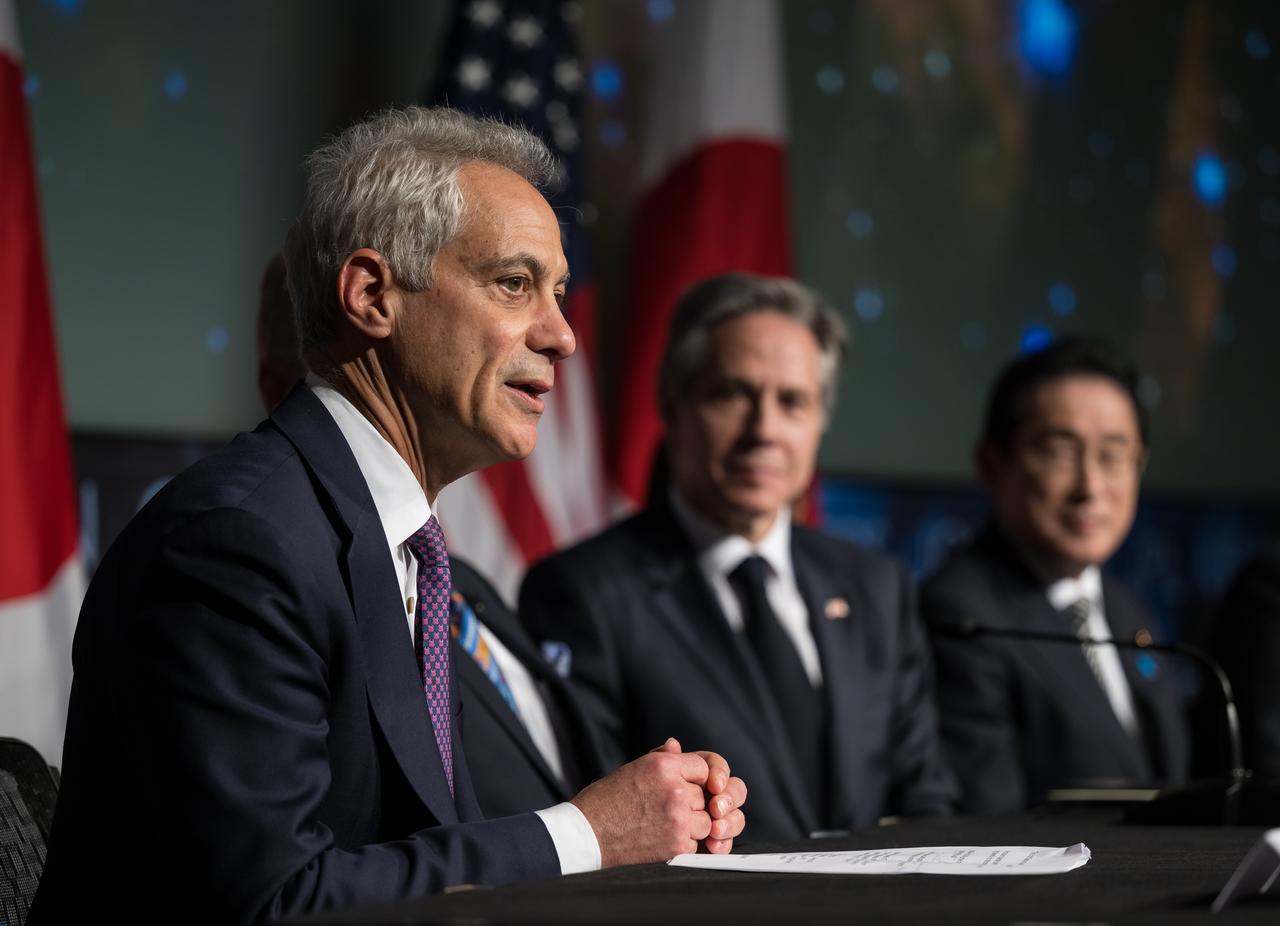
U.S. Ambassador to Japan, Rahm Emanuel, delivers remarks after U.S. Secretary of State, Antony Blinken and Minister for Foreign Affairs of Japan, The Honorable Hayashi Yoshimasa signed an agreement that builds on a long history of collaboration in space exploration between the U.S. and Japan, Friday, Jan. 13, 2023, at the Mary W. Jackson NASA Headquarters building in Washington. “The Framework Agreement Between the Government of Japan and the Government of the United States of America for Cooperation in Space Exploration and Use of Outer Space, Including the Moon and Other Celestial Bodies, For Peaceful Purposes” covers joint activities including space science, Earth science, space operations and exploration, aeronautical science and technology, space technology, space transportation, and safety and mission assurance, among others. Photo Credit: (NASA/Aubrey Gemignani)
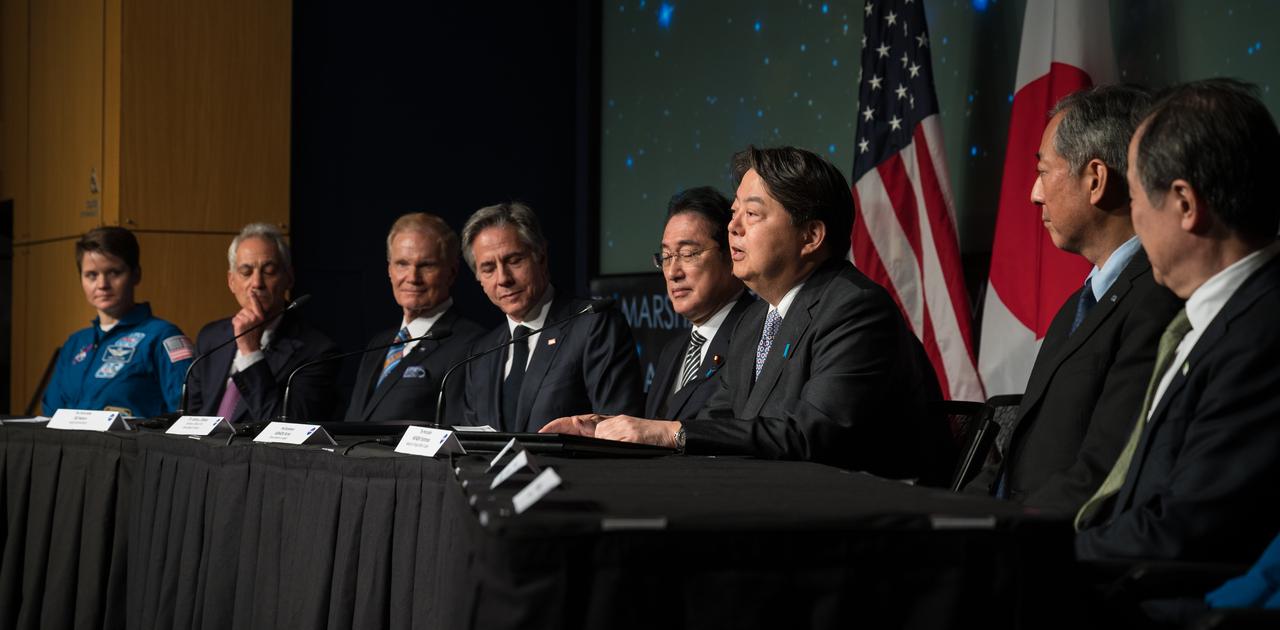
Minister for Foreign Affairs of Japan, The Honorable Hayashi Yoshimasa delivers remarks after he and U.S. Secretary of State, Antony Blinken signed an agreement that builds on a long history of collaboration in space exploration between the U.S. and Japan, Friday, Jan. 13, 2023, at the Mary W. Jackson NASA Headquarters building in Washington. “The Framework Agreement Between the Government of Japan and the Government of the United States of America for Cooperation in Space Exploration and Use of Outer Space, Including the Moon and Other Celestial Bodies, For Peaceful Purposes” covers joint activities including space science, Earth science, space operations and exploration, aeronautical science and technology, space technology, space transportation, and safety and mission assurance, among others. Photo Credit: (NASA/Aubrey Gemignani)
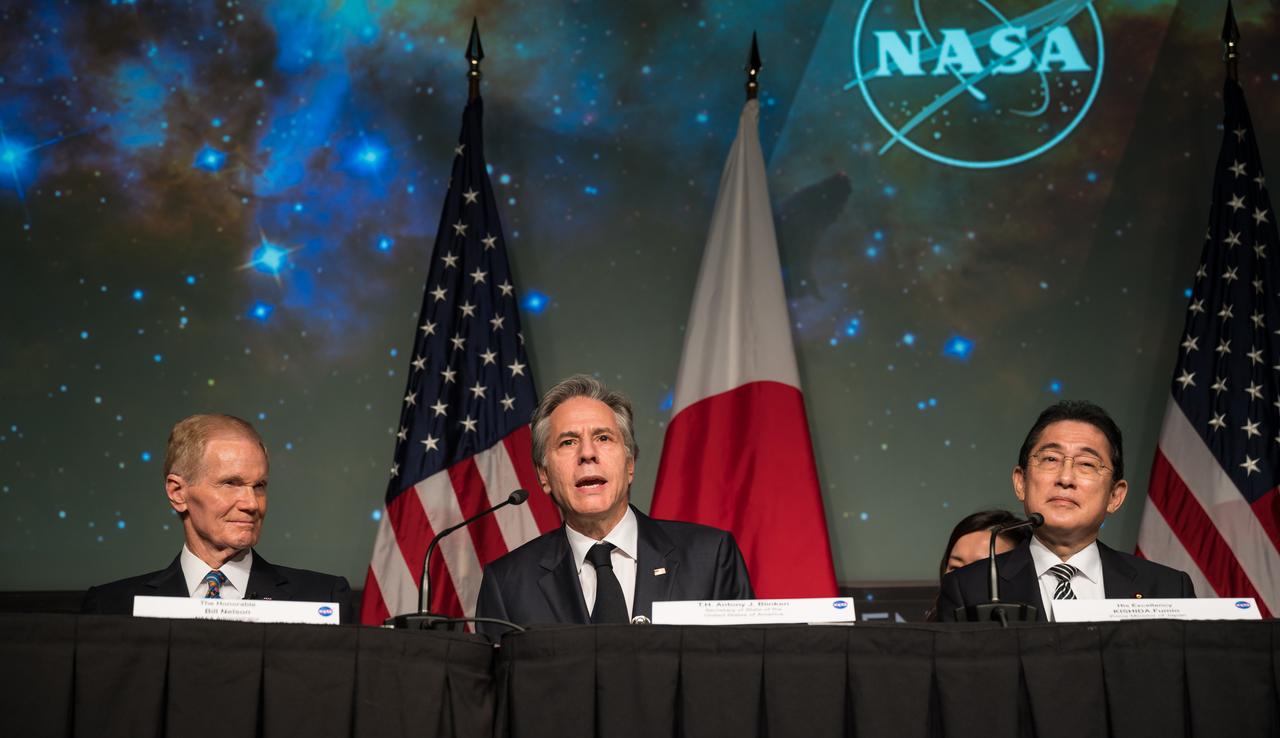
U.S. Secretary of State, Antony Blinken delivers remarks before U.S. Secretary of State, Antony Blinken and Japan’s Minister for Foreign Affairs, Hayashi Yoshimasa, sign an agreement that builds on a long history of collaboration in space exploration between the U.S. and Japan, Friday, Jan. 13, 2023, at the Mary W. Jackson NASA Headquarters building in Washington. “The Framework Agreement Between the Government of Japan and the Government of the United States of America for Cooperation in Space Exploration and Use of Outer Space, Including the Moon and Other Celestial Bodies, For Peaceful Purposes” covers joint activities including space science, Earth science, space operations and exploration, aeronautical science and technology, space technology, space transportation, and safety and mission assurance, among others. Photo Credit: (NASA/Aubrey Gemignani)
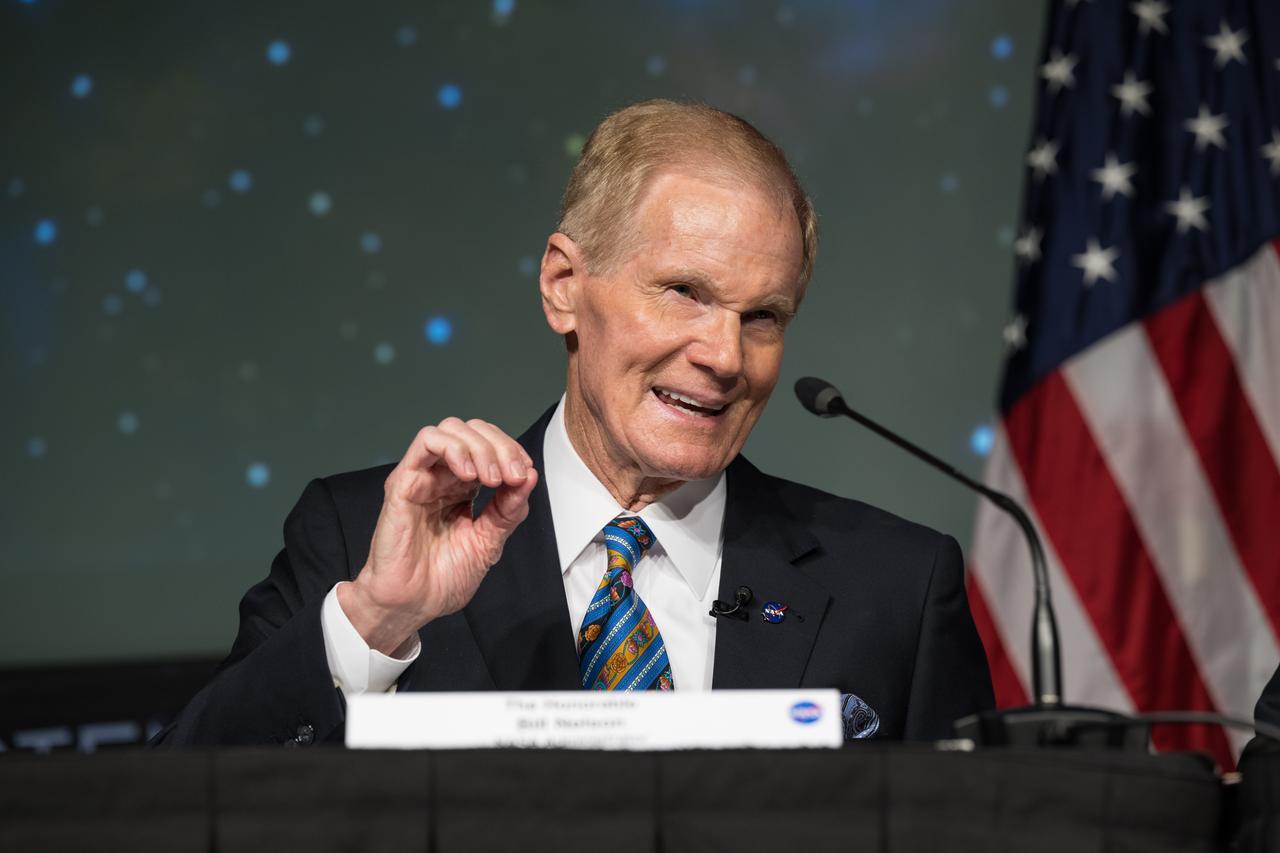
NASA Administrator Bill Nelson delivers remarks before U.S. Secretary of State, Antony Blinken and Japan’s Minister for Foreign Affairs, Hayashi Yoshimasa, sign an agreement that builds on a long history of collaboration in space exploration between the U.S. and Japan, Friday, Jan. 13, 2023, at the Mary W. Jackson NASA Headquarters building in Washington. “The Framework Agreement Between the Government of Japan and the Government of the United States of America for Cooperation in Space Exploration and Use of Outer Space, Including the Moon and Other Celestial Bodies, For Peaceful Purposes” covers joint activities including space science, Earth science, space operations and exploration, aeronautical science and technology, space technology, space transportation, and safety and mission assurance, among others. Photo Credit: (NASA/Aubrey Gemignani)
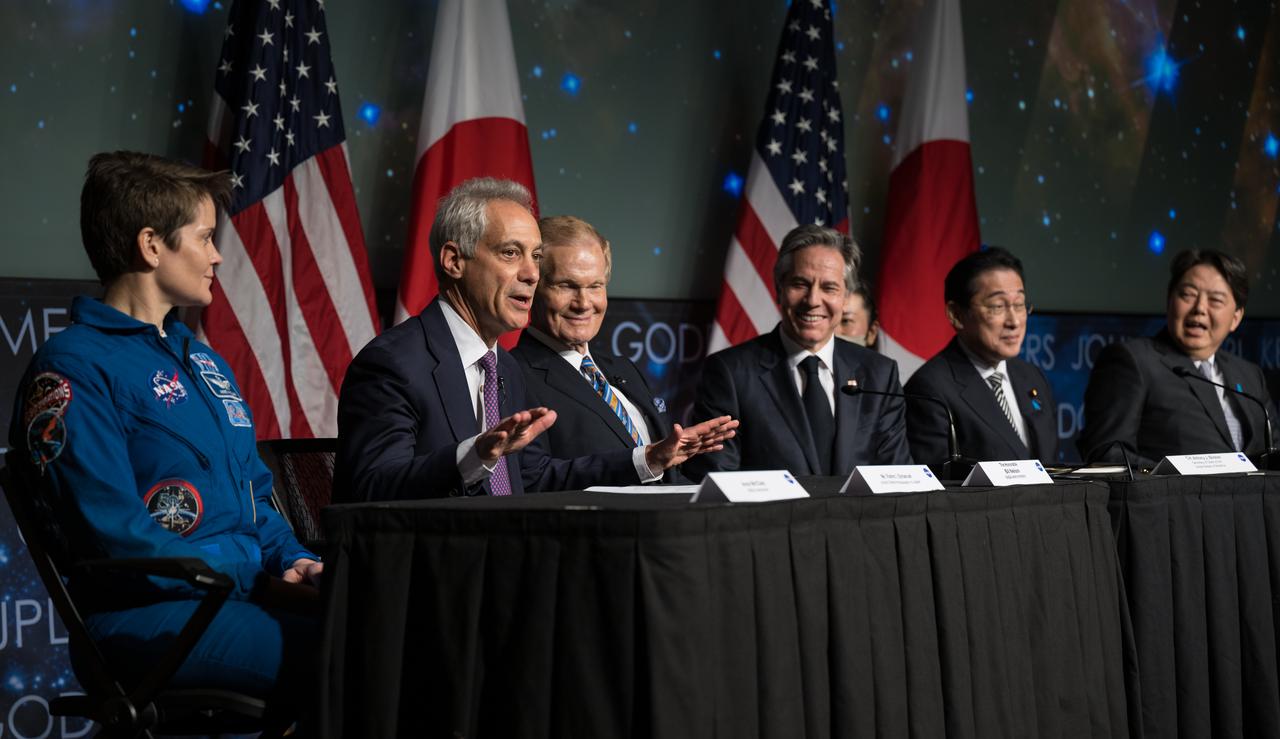
U.S. Ambassador to Japan, Rahm Emanuel, delivers remarks after U.S. Secretary of State, Antony Blinken and Minister for Foreign Affairs of Japan, The Honorable Hayashi Yoshimasa signed an agreement that builds on a long history of collaboration in space exploration between the U.S. and Japan, Friday, Jan. 13, 2023, at the Mary W. Jackson NASA Headquarters building in Washington. “The Framework Agreement Between the Government of Japan and the Government of the United States of America for Cooperation in Space Exploration and Use of Outer Space, Including the Moon and Other Celestial Bodies, For Peaceful Purposes” covers joint activities including space science, Earth science, space operations and exploration, aeronautical science and technology, space technology, space transportation, and safety and mission assurance, among others. Photo Credit: (NASA/Aubrey Gemignani)
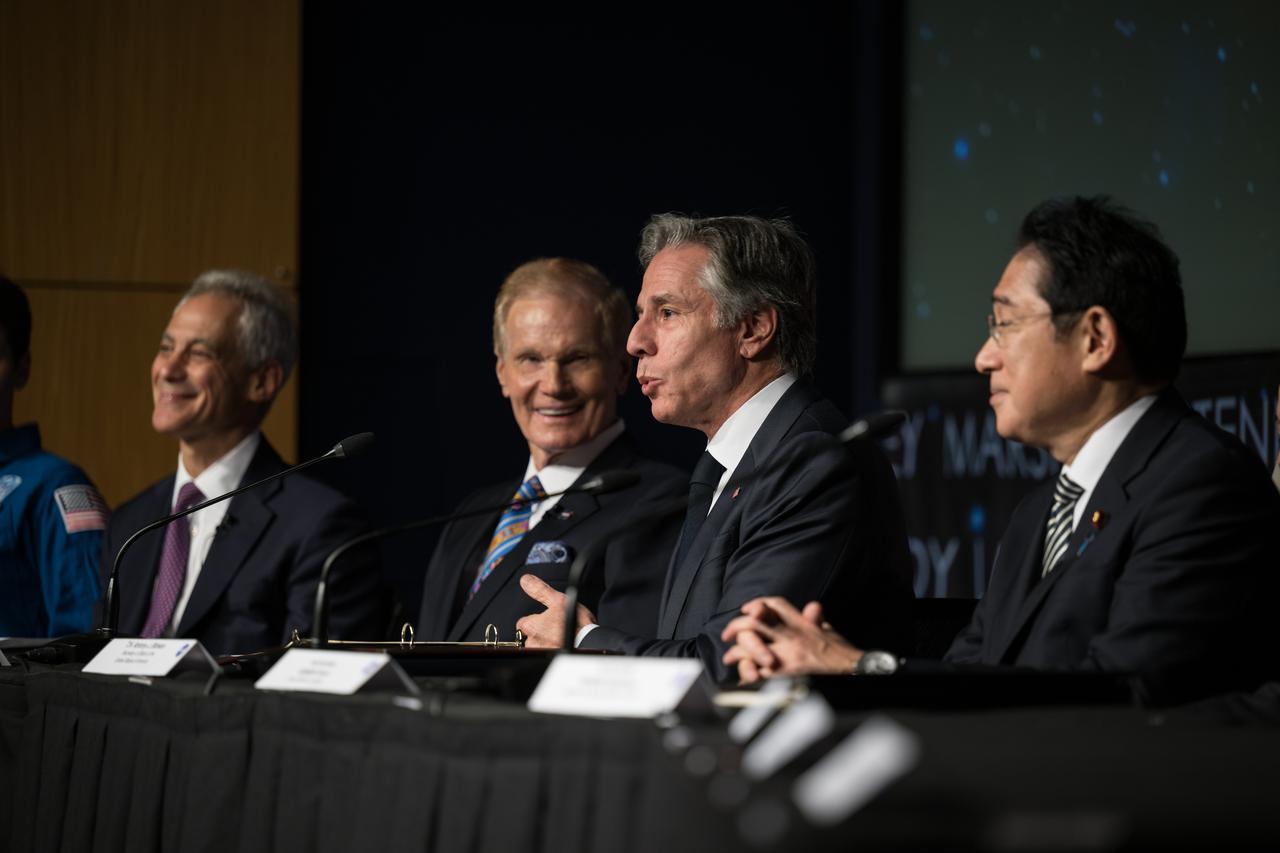
U.S. Secretary of State, Antony Blinken delivers remarks before he and Japan’s Minister for Foreign Affairs, Hayashi Yoshimasa, sign an agreement that builds on a long history of collaboration in space exploration between the U.S. and Japan, Friday, Jan. 13, 2023, at the Mary W. Jackson NASA Headquarters building in Washington. “The Framework Agreement Between the Government of Japan and the Government of the United States of America for Cooperation in Space Exploration and Use of Outer Space, Including the Moon and Other Celestial Bodies, For Peaceful Purposes” covers joint activities including space science, Earth science, space operations and exploration, aeronautical science and technology, space technology, space transportation, and safety and mission assurance, among others. Photo Credit: (NASA/Aubrey Gemignani)
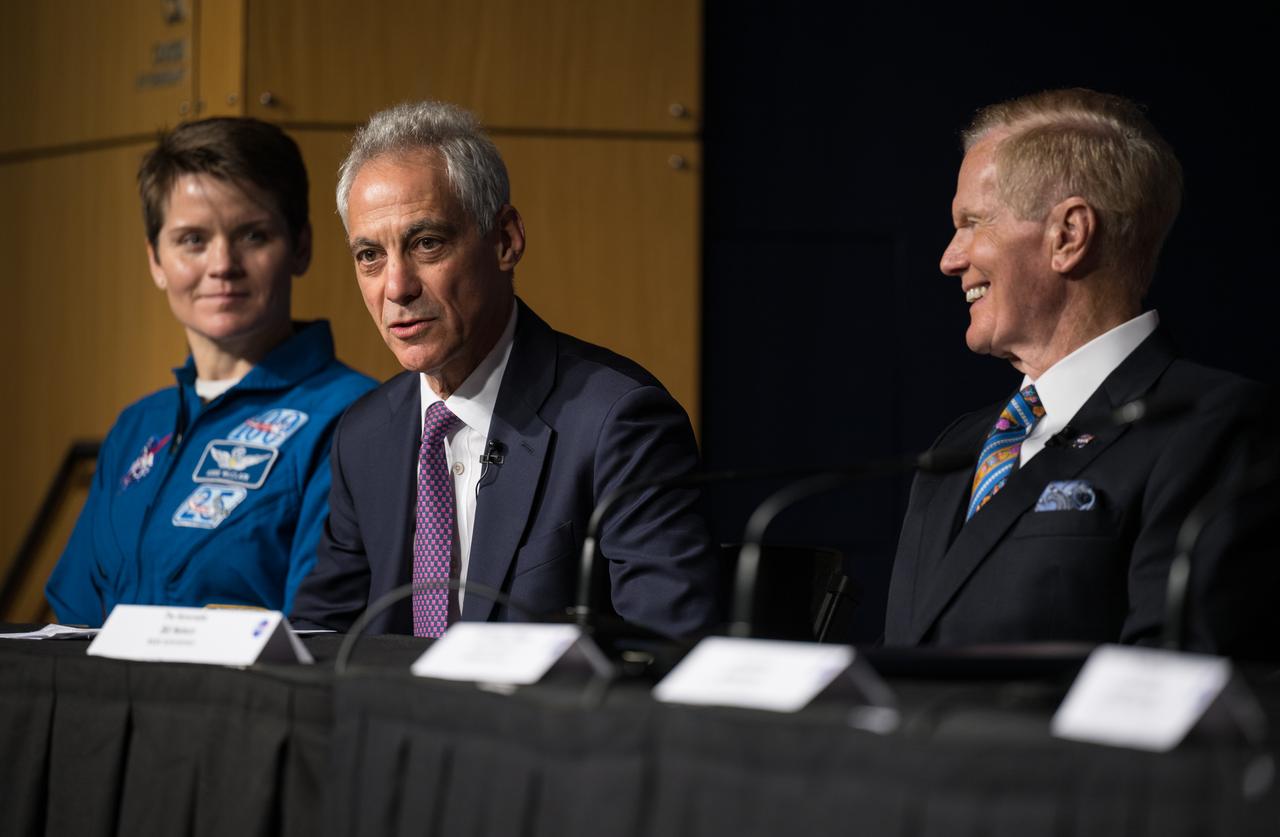
U.S. Ambassador to Japan, Rahm Emanuel, delivers remarks after U.S. Secretary of State, Antony Blinken and Minister for Foreign Affairs of Japan, The Honorable Hayashi Yoshimasa signed an agreement that builds on a long history of collaboration in space exploration between the U.S. and Japan, Friday, Jan. 13, 2023, at the Mary W. Jackson NASA Headquarters building in Washington. “The Framework Agreement Between the Government of Japan and the Government of the United States of America for Cooperation in Space Exploration and Use of Outer Space, Including the Moon and Other Celestial Bodies, For Peaceful Purposes” covers joint activities including space science, Earth science, space operations and exploration, aeronautical science and technology, space technology, space transportation, and safety and mission assurance, among others. Photo Credit: (NASA/Aubrey Gemignani)
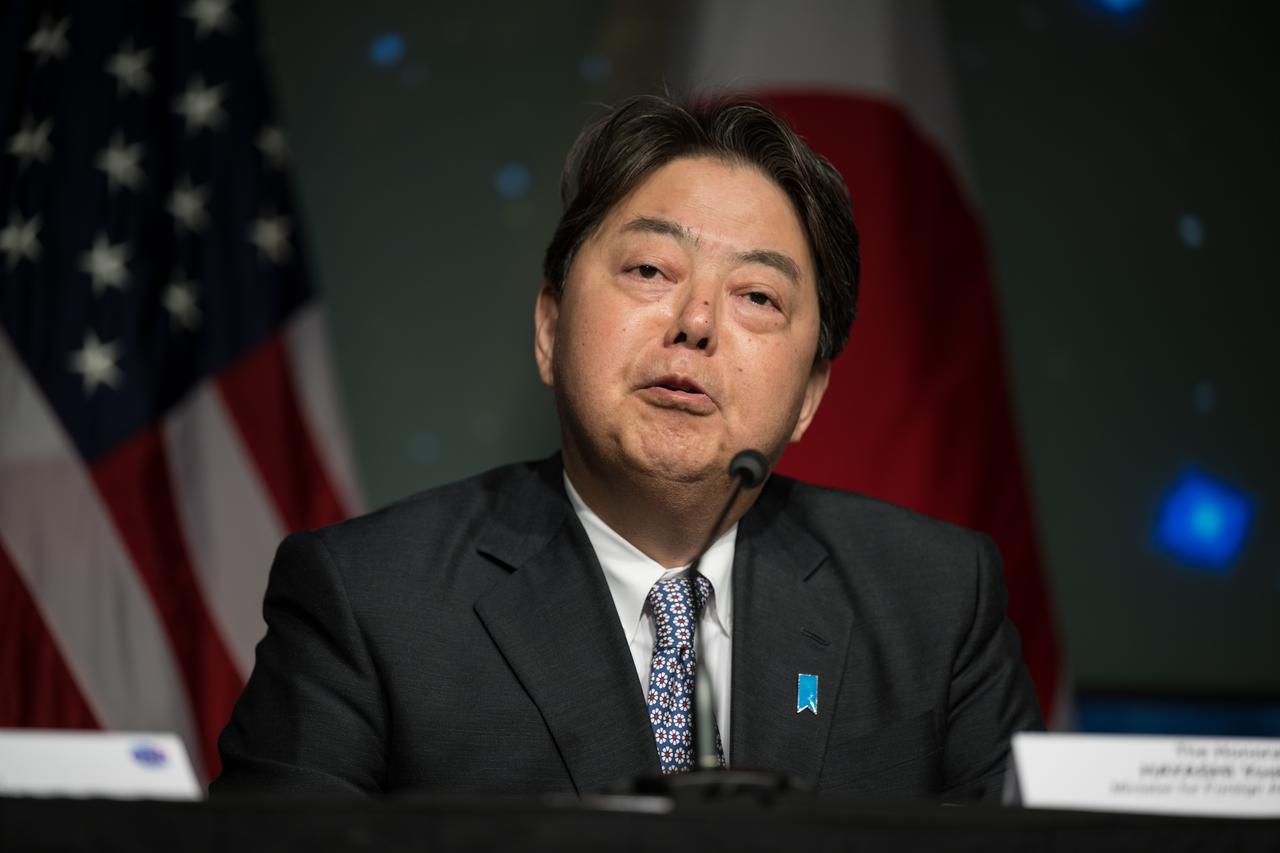
Minister for Foreign Affairs of Japan, The Honorable Hayashi Yoshimasa delivers remarks after he and U.S. Secretary of State, Antony Blinken signed an agreement that builds on a long history of collaboration in space exploration between the U.S. and Japan, Friday, Jan. 13, 2023, at the Mary W. Jackson NASA Headquarters building in Washington. “The Framework Agreement Between the Government of Japan and the Government of the United States of America for Cooperation in Space Exploration and Use of Outer Space, Including the Moon and Other Celestial Bodies, For Peaceful Purposes” covers joint activities including space science, Earth science, space operations and exploration, aeronautical science and technology, space technology, space transportation, and safety and mission assurance, among others. Photo Credit: (NASA/Aubrey Gemignani)
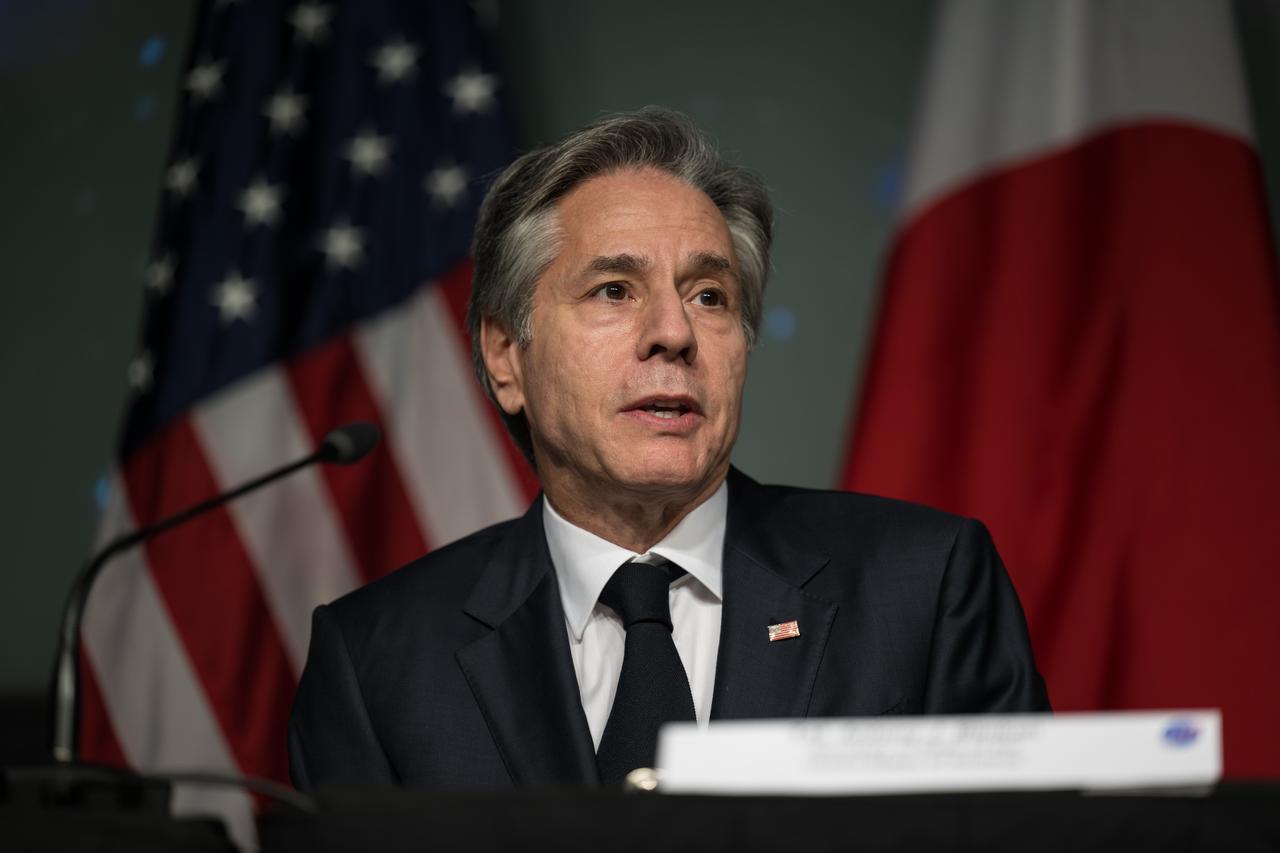
U.S. Secretary of State, Antony Blinken delivers remarks before he and Japan’s Minister for Foreign Affairs, Hayashi Yoshimasa, sign an agreement that builds on a long history of collaboration in space exploration between the U.S. and Japan, Friday, Jan. 13, 2023, at the Mary W. Jackson NASA Headquarters building in Washington. “The Framework Agreement Between the Government of Japan and the Government of the United States of America for Cooperation in Space Exploration and Use of Outer Space, Including the Moon and Other Celestial Bodies, For Peaceful Purposes” covers joint activities including space science, Earth science, space operations and exploration, aeronautical science and technology, space technology, space transportation, and safety and mission assurance, among others. Photo Credit: (NASA/Aubrey Gemignani)
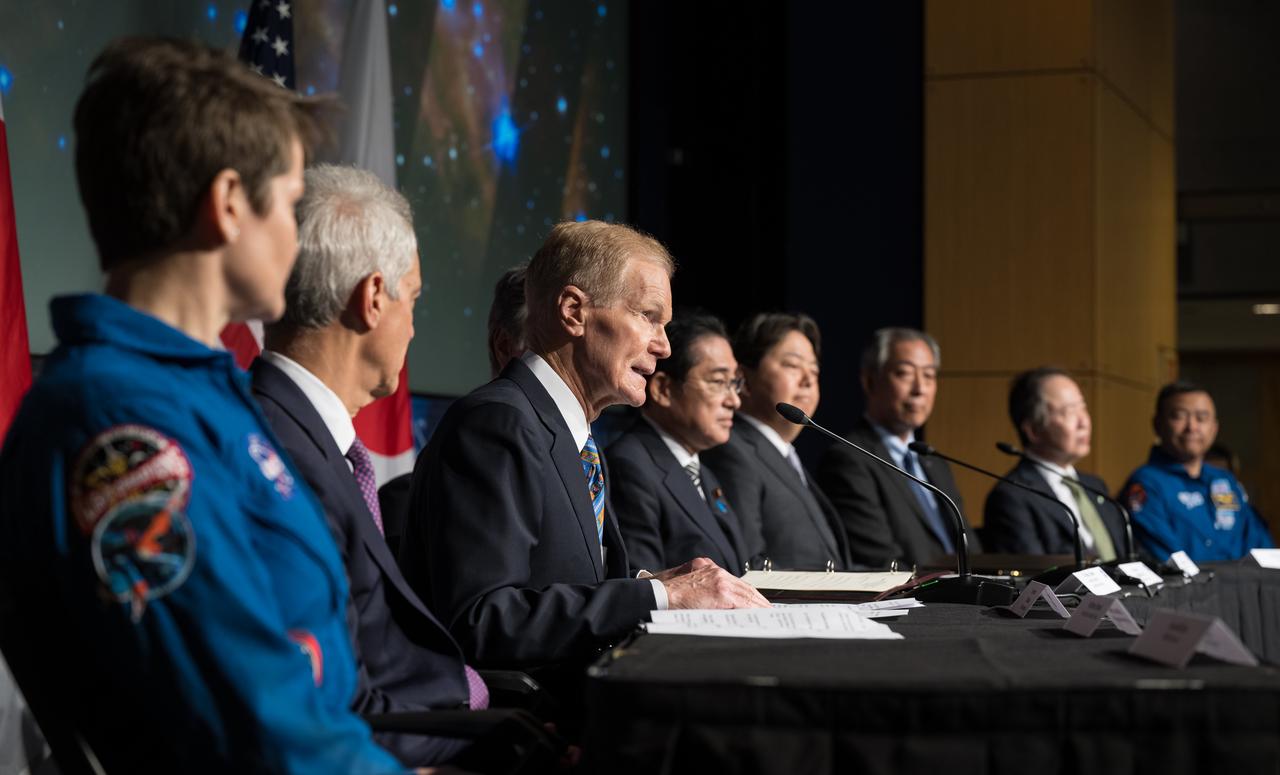
NASA Administrator Bill Nelson delivers remarks before U.S. Secretary of State, Antony Blinken and Japan’s Minister for Foreign Affairs, Hayashi Yoshimasa, sign an agreement that builds on a long history of collaboration in space exploration between the U.S. and Japan, Friday, Jan. 13, 2023, at the Mary W. Jackson NASA Headquarters building in Washington. “The Framework Agreement Between the Government of Japan and the Government of the United States of America for Cooperation in Space Exploration and Use of Outer Space, Including the Moon and Other Celestial Bodies, For Peaceful Purposes” covers joint activities including space science, Earth science, space operations and exploration, aeronautical science and technology, space technology, space transportation, and safety and mission assurance, among others. Photo Credit: (NASA/Aubrey Gemignani)
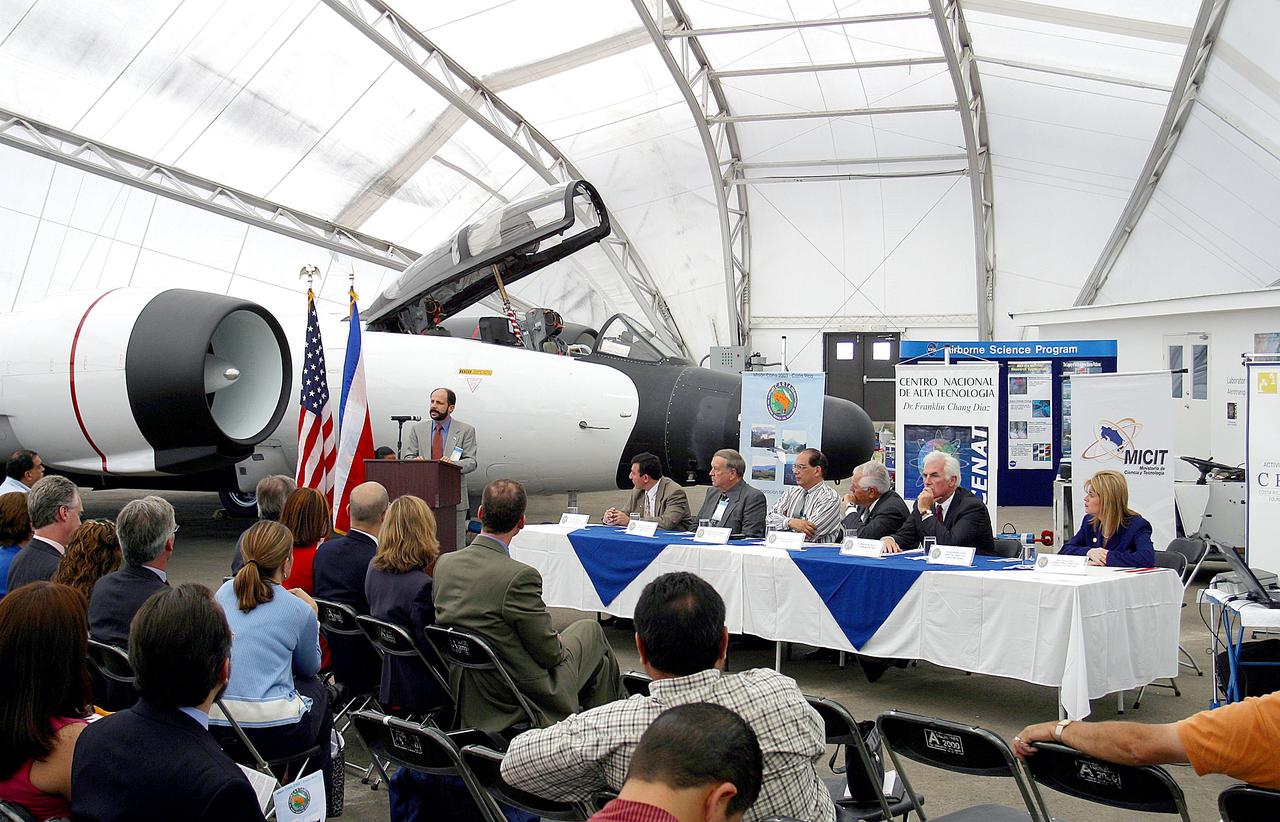
KENNEDY SPACE CENTER, FLA. - At the airport in San Jose, Costa Rica, the NASA hangar is dedicated. The speaker is Hermann Faith, executive director, Costa Rica-USA (CRUSA) Foundation. At the table are (from left) Dr. Jorge Andres Diaz, head scientiest CARTA mission; Gary Shelton, NASA deployment manager; Dr. Pedro Leon, general director, National Center for Advanced Technology (CENAT); Dr. Rogelio Pardo, minister of science and tchnology; John Danilovioch, U.S. ambassador to Costa Rica; and Lic. Vilma Lopez, subdirector, Civil Aviation (DGAC). NASA KSC has been testing its Aircraft-based Volcanic Emission Mass Spectrometer (AVEMS) in flights over the Turrialba volcano and in the crater, sampling and analyzing fresh volcanic gases in their natural chemical state. The AVEMS system has been developed for use in the Space Shuttle program, to detect toxic gas leaks and emissions in the Shuttle’s aft compartment and the crew compartment.
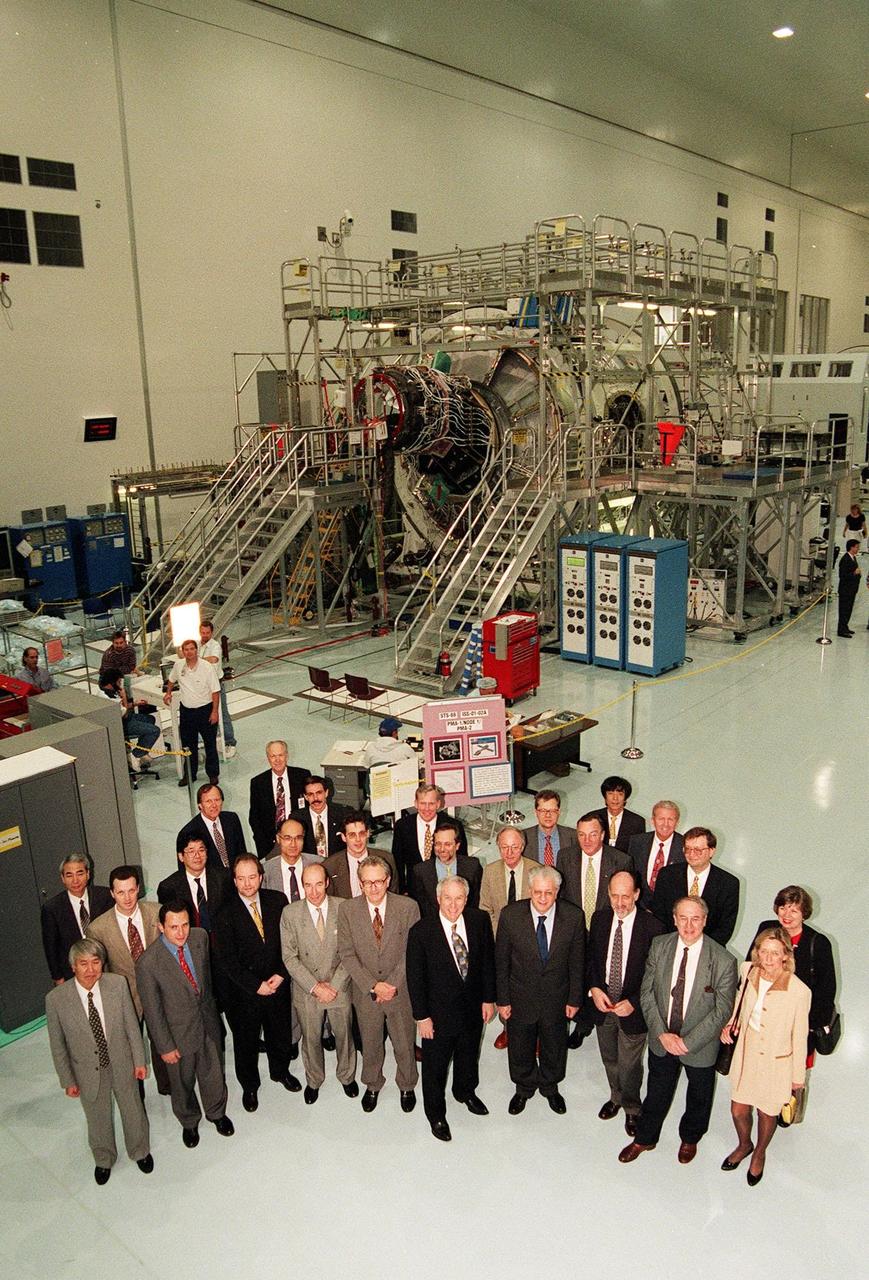
CAPE CANAVERAL, Fla. -- In the International Space Station Processing Facility at NASA's Kennedy Space Center in Florida, senior government officials from 15 countries participating in the space station program signed agreements in Washington D.C. on Jan. 29 to establish the framework of cooperation among the partners on the design, development, operation and utilization of the space station. Acting Secretary of State Strobe Talbott signed the 1998 Intergovernmental Agreement on Space Station Cooperation with representatives of Russia, Japan, Canada, and participating countries of the European Space Agency ESA -- Belgium, Denmark, France, Germany, Italy, the Netherlands, Norway, Spain, Sweden, Switzerland, and the United Kingdom. Some of these officials then toured Kennedy's Space Station Processing Facility SSPF with NASA Administrator Daniel Goldin, at front, sixth from the left. They are, left to right, front to back: Hidetoshi Murayama, National Space Development Agency of Japan NASDA Louis Laurent, Embassy of France Haakon Blankenborg, Norwegian Parliament Standing Committee on Foreign Affairs His Excellency Joris Vos, ambassador of the Netherlands His Excellency Tom Vraalsen, ambassador of Norway Goldin Luigi Berlinguer, Italian minister for education, scientific, and technological research Antonio Rodota, director general, ESA Yvan Ylieff, Belgian minister of science and chairman of the ESA Ministerial Council Jacqueline Ylieff Masaaki Komatsu, Kennedy local NASDA representative and interpreter Serge Ivanets, space attache, Embassy of Russia Hiroshi Fujita, Science and Technology Agency of Japan Akira Mizutani, Japanese Ministry of Foreign Affairs Peter Grognard, science attache', Royal Embassy of Belgium Michelangelo Pipan, Italian diplomatic counselor to the minister His Excellency Gerhard Fulda, German Federal Foreign Office Jorg Feustel-Buechl, ESA director of manned space flight and microgravity A. Yakovenko, Russian Ministry of Foreign Affairs JoAnn Morgan, Kennedy associate director for Advanced Development and Shuttle Upgrades Steve Francois, director, International Space Station and Shuttle Processing Roy Tharpe, Boeing launch site manager Jon Cowart, ISS elements manager John Schumacher, NASA associate administrator for external relations Didier Kechemair, space advistor to the French minister for education, research, and technology Yoshinori Yoshimura, NASDA and Loren Shriver, Kennedy deputy director for launch and payload processing. Node 1 of the ISS is in the background. Photo Credit: NASA
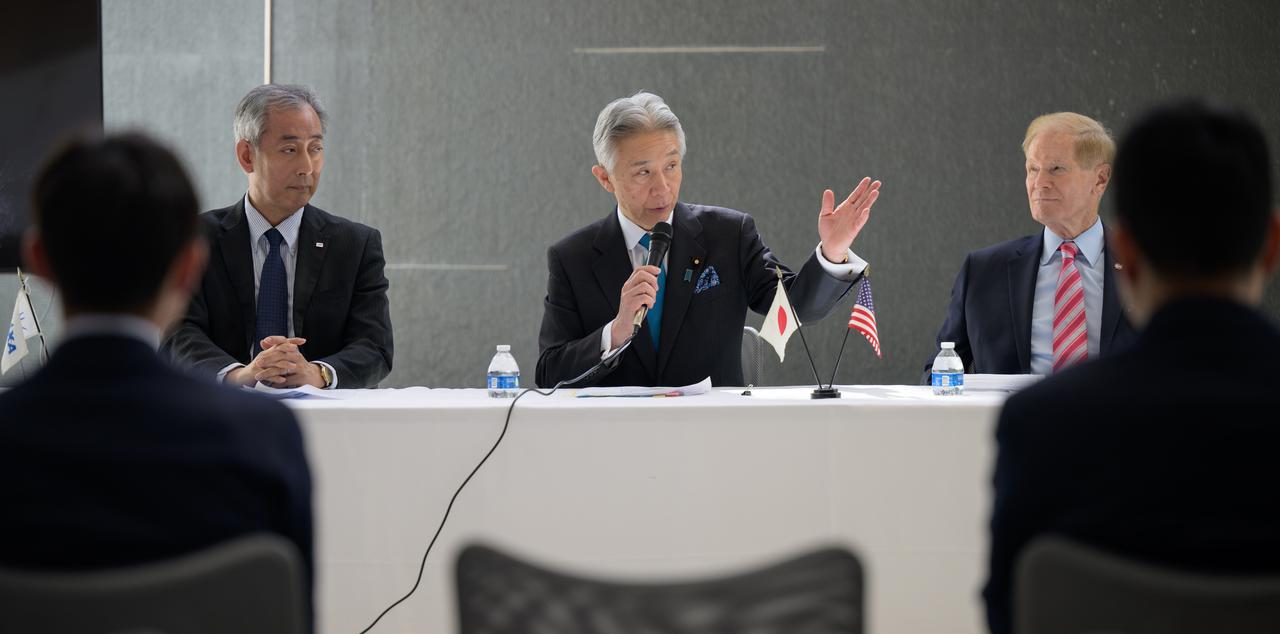
Japan’s Minister of Education, Culture, Sports, Science and Technology Masahito Moriyama, center, discusses the historic agreement signed April 9th at NASA Headquarters, between the United States and Japan to advance sustainable human exploration of the Moon, Wednesday, April 10, 2024, at the Japan Aerospace Exploration Agency (JAXA) offices in Washington. Under the agreement, Japan will design, develop, and operate a pressurized rover for crewed and uncrewed exploration on the Moon. NASA will provide the launch and delivery of the rover to the Moon as well as two Japanese astronaut missions to the lunar surface. Photo Credit: Photo Credit: (NASA/Bill Ingalls)
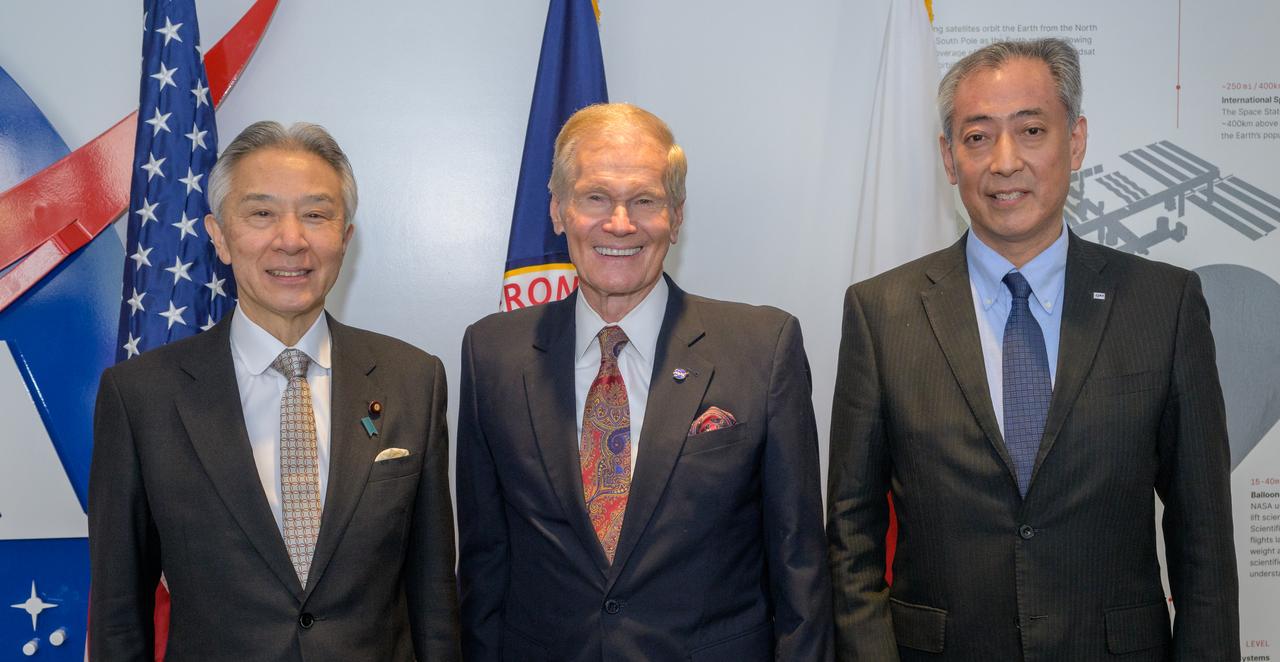
Japan’s Minister of Education, Culture, Sports, Science and Technology Masahito Moriyama, left, NASA Administrator Bill Nelson, and Japan Aerospace Exploration Agency (JAXA) President Hiroshi Yamakawa, right, pose for a photograph prior to the signing an historic agreement between the United States and Japan to advance sustainable human exploration of the Moon, Tuesday, April 9, 2024, at the NASA Headquarters Mary W. Jackson Building in Washington. Under the agreement, Japan will design, develop, and operate a pressurized rover for crewed and uncrewed exploration on the Moon. NASA will provide the launch and delivery of the rover to the Moon as well as two Japanese astronaut missions to the lunar surface. Photo Credit: (NASA/Bill Ingalls)
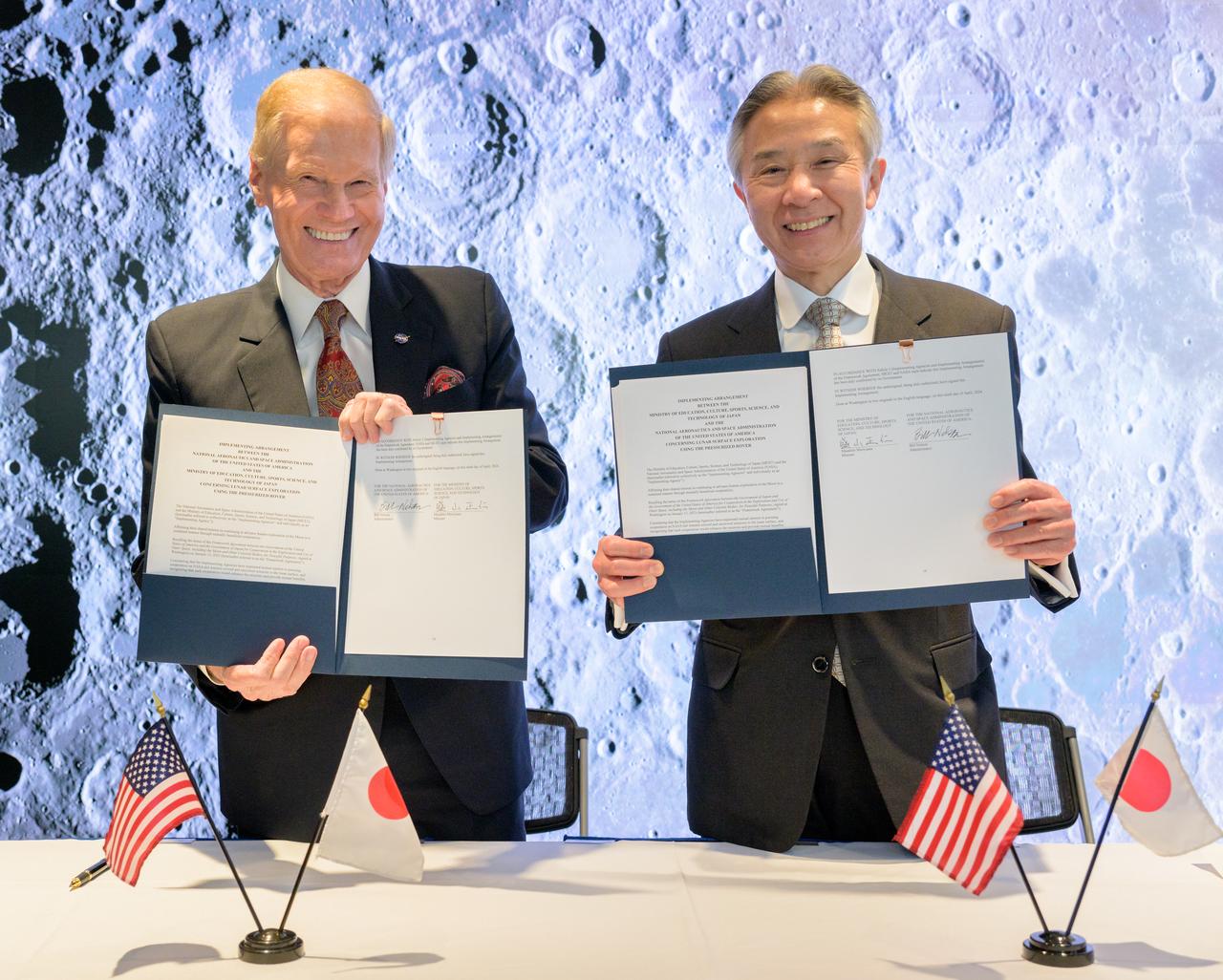
NASA Administrator Bill Nelson, left, and Japan’s Minister of Education, Culture, Sports, Science and Technology Masahito Moriyama, hold signed copies of an historic agreement between the United States and Japan to advance sustainable human exploration of the Moon, Tuesday, April 9, 2024, at the NASA Headquarters Mary W. Jackson Building in Washington. Under the agreement, Japan will design, develop, and operate a pressurized rover for crewed and uncrewed exploration on the Moon. NASA will provide the launch and delivery of the rover to the Moon as well as two Japanese astronaut missions to the lunar surface. Photo Credit: (NASA/Bill Ingalls)
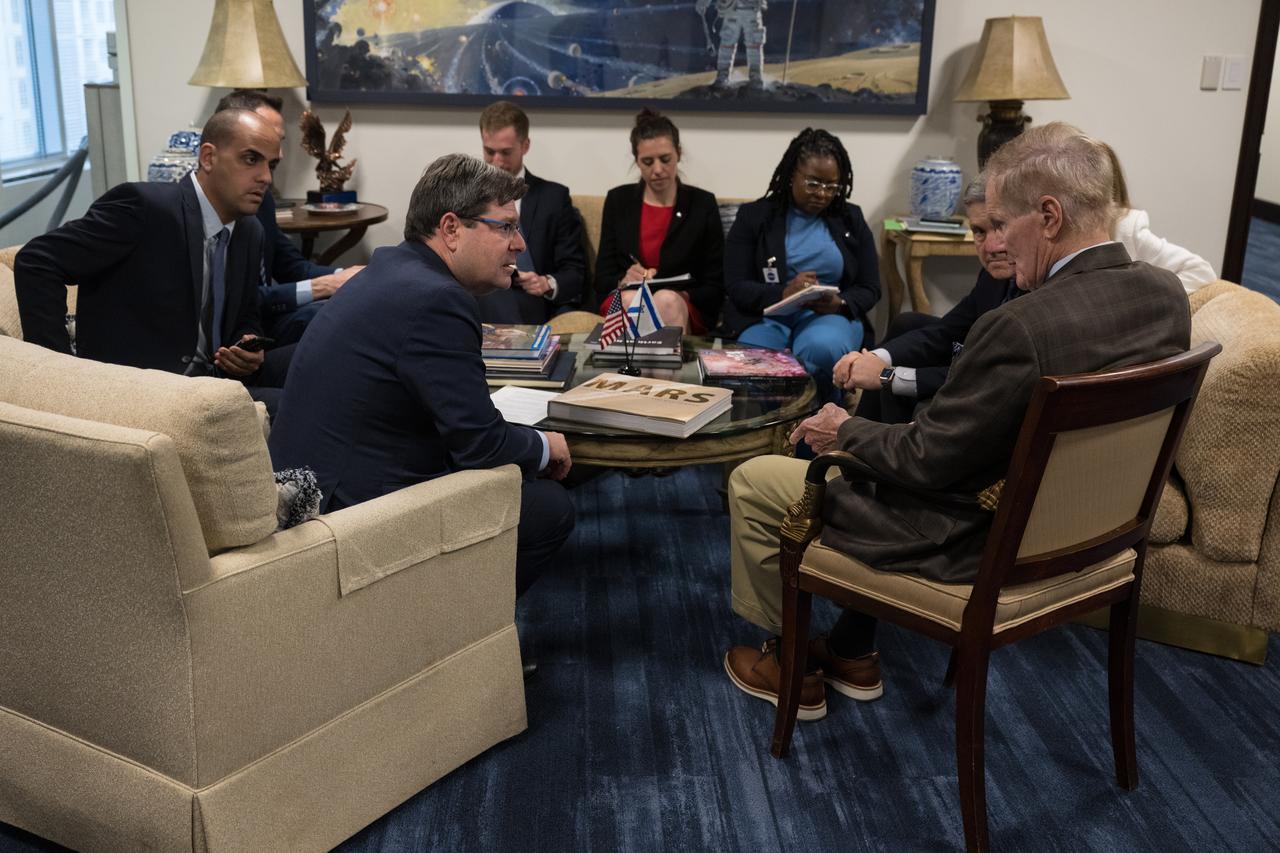
NASA Administrator Bill Nelson, right, and Associate Administrator Bob Cabana, second from right, meet with, from left to right, Israel’s Minister of Innovation, Science, and Technology, Ofir Akunis, Israel’s Deputy Director General, Omer Shechter, Israel’s Chief of Staff, Asaf Magen, Chief of Staff, Ambassador of Israel to the United States, Evan Charney, NASA Office of International and Interagency Relations, Rebecca Levy, NASA Office of International and Interagency Relations, Amber McIntyre, and NASA Associate Administrator, Office of International and Interagency Relations, Karen Feldstein, Monday, March 27, 2023 at the Mary W. Jackson NASA Headquarters building in Washington DC. Photo Credit: (NASA/Aubrey Gemignani)
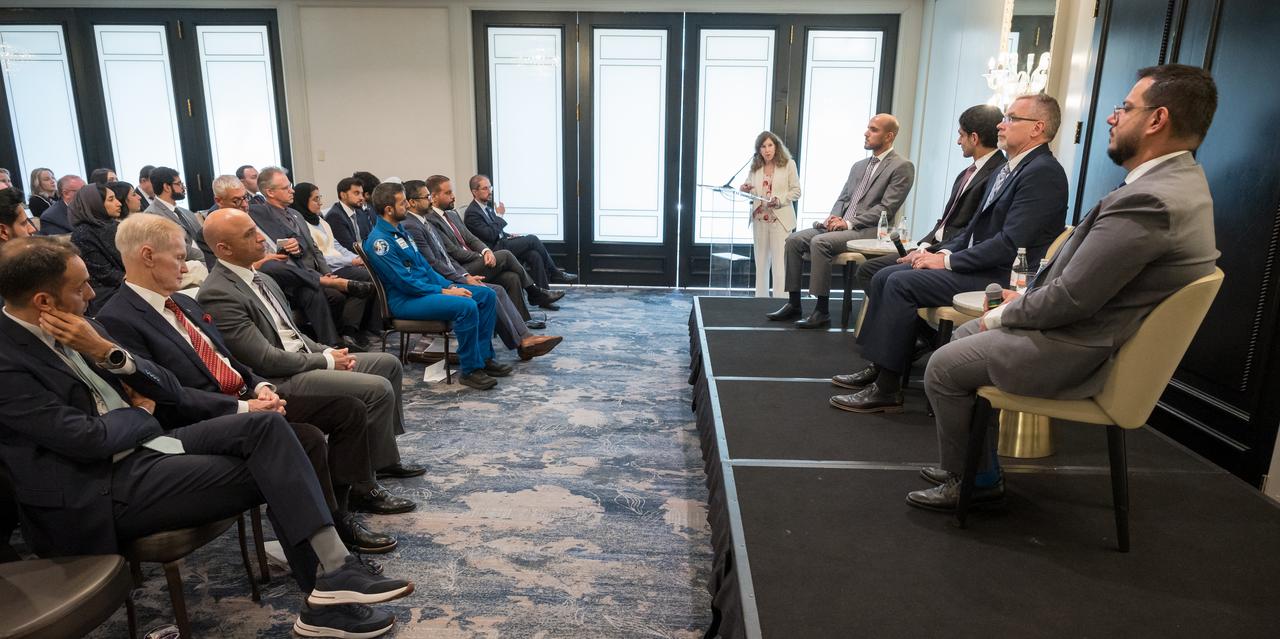
NASA associate administrator for International and Interagency Relations Karen Feldstein, moderates a panel discussion with, Senior Director of the Space Engineering Department, MBRSC, Amer Al Sayegh, left, UAE Assistant Minister of Foreign Affairs and International Cooperation for Advanced Science and Technology, Omran Sharaf, NASA Associate Administrator Jim Free, and Director of Space Missions Department, UAESA, Mohsen Al Awadhi, right, during an event celebrating UAE-US collaboration in space, Friday, March 8, 2024, at the Four Seasons Hotel in Washington. Photo Credit: (NASA/Bill Ingalls)
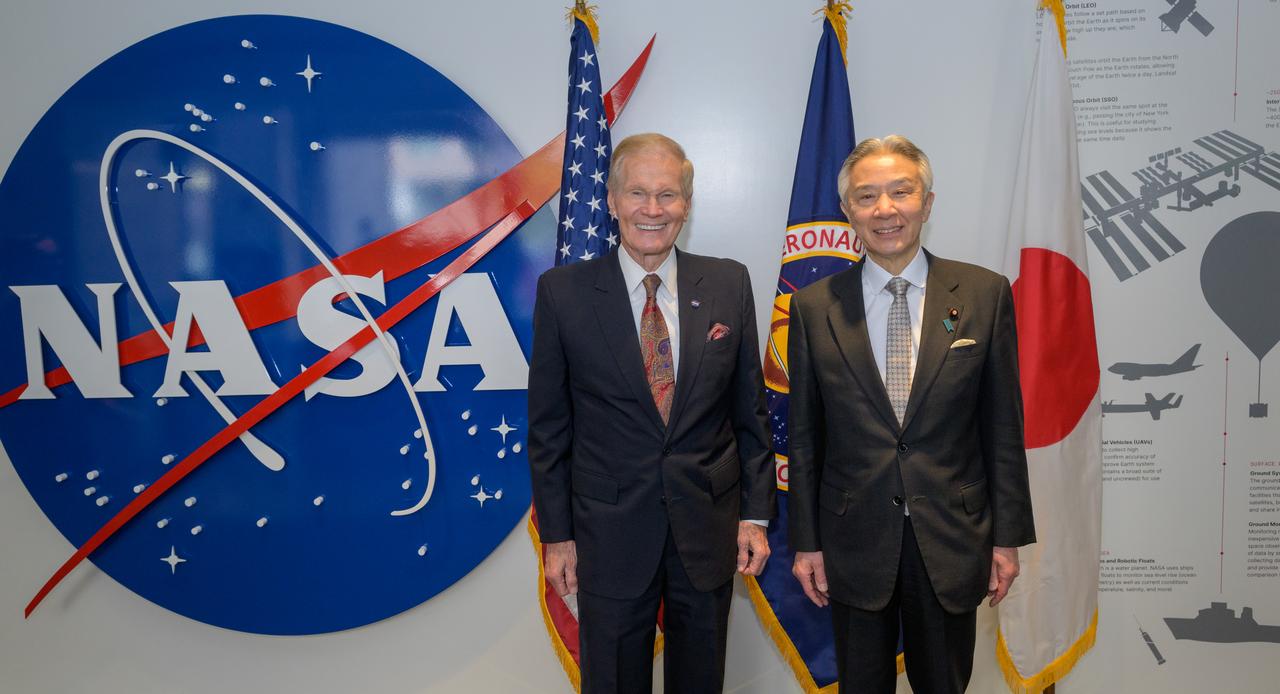
NASA Administrator Bill Nelson, left, and Japan’s Minister of Education, Culture, Sports, Science and Technology Masahito Moriyama, pose for a photograph prior to signing an historic agreement between the United States and Japan to advance sustainable human exploration of the Moon, Tuesday, April 9, 2024, at the NASA Headquarters Mary W. Jackson Building in Washington. Under the agreement, Japan will design, develop, and operate a pressurized rover for crewed and uncrewed exploration on the Moon. NASA will provide the launch and delivery of the rover to the Moon as well as two Japanese astronaut missions to the lunar surface. Photo Credit: (NASA/Bill Ingalls)
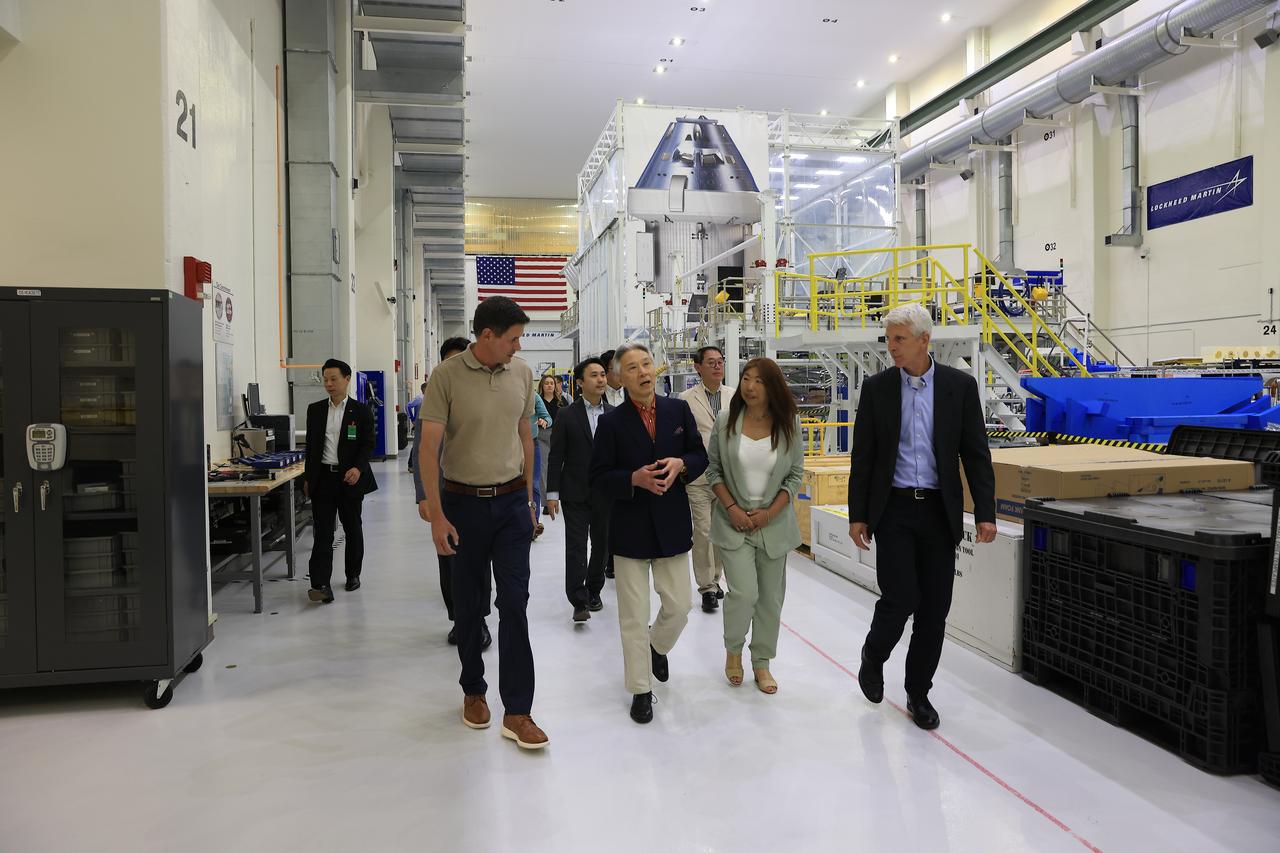
Nathan Varn, Program Director Orion Productions for Lockheed Martin, left, and Scott Wilson, NASA’s Division Chief, Orion Production Operations Office, right, lead a tour of the Neil A. Armstrong Operations and Checkout Building at NASA’s Kennedy Space Center in Florida, for Japanese Minister of Education, Culture, Sports, Science and Technology (MEXT) Masahito Moriyama on Friday, April 12, 2024. Moriyama’s visit included viewing the Orion crew modules for upcoming Artemis missions, which will land the first woman, first person of color, and NASA’s first international partner astronaut on the Moon.
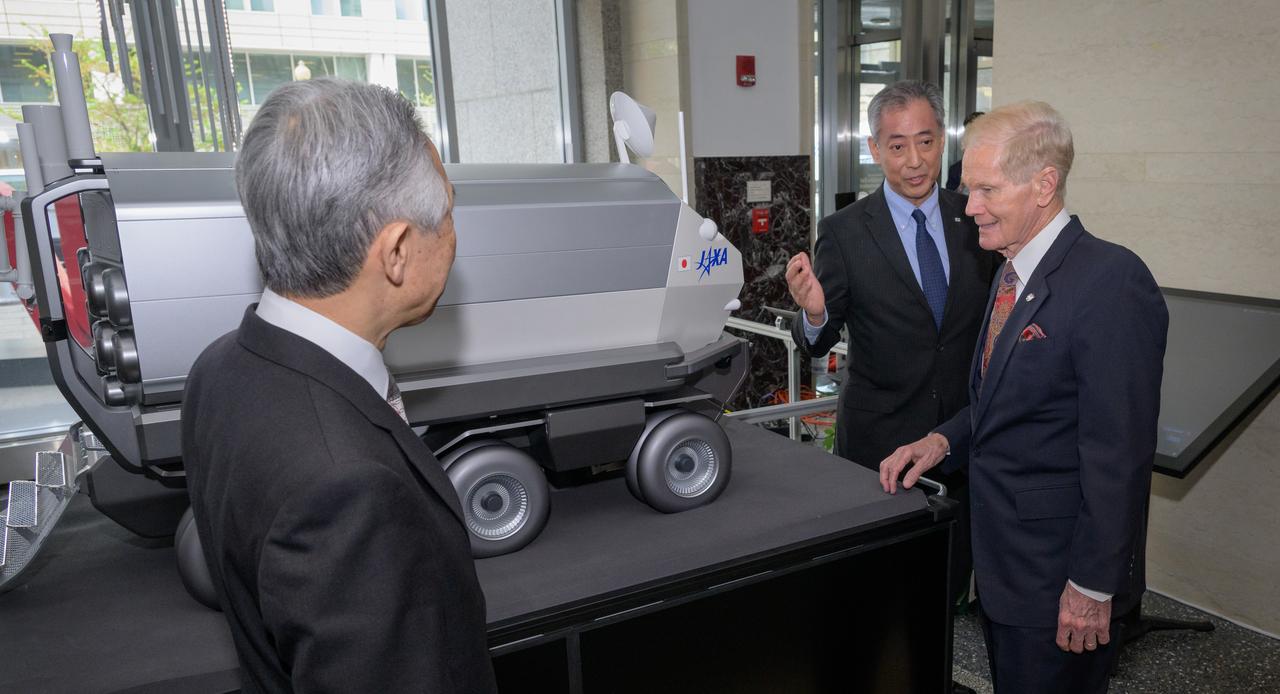
Japan’s Minister of Education, Culture, Sports, Science and Technology Masahito Moriyama, left, Japan Aerospace Exploration Agency (JAXA) President Hiroshi Yamakawa, and NASA Administrator Bill Nelson, right, look at a model of the Pressurized lunar rover, prior to the signing an historic agreement between the United States and Japan to advance sustainable human exploration of the Moon, Tuesday, April 9, 2024, at the NASA Headquarters Mary W. Jackson Building in Washington. Under the agreement, Japan will design, develop, and operate a pressurized rover for crewed and uncrewed exploration on the Moon. NASA will provide the launch and delivery of the rover to the Moon as well as two Japanese astronaut missions to the lunar surface. Photo Credit: (NASA/Bill Ingalls)
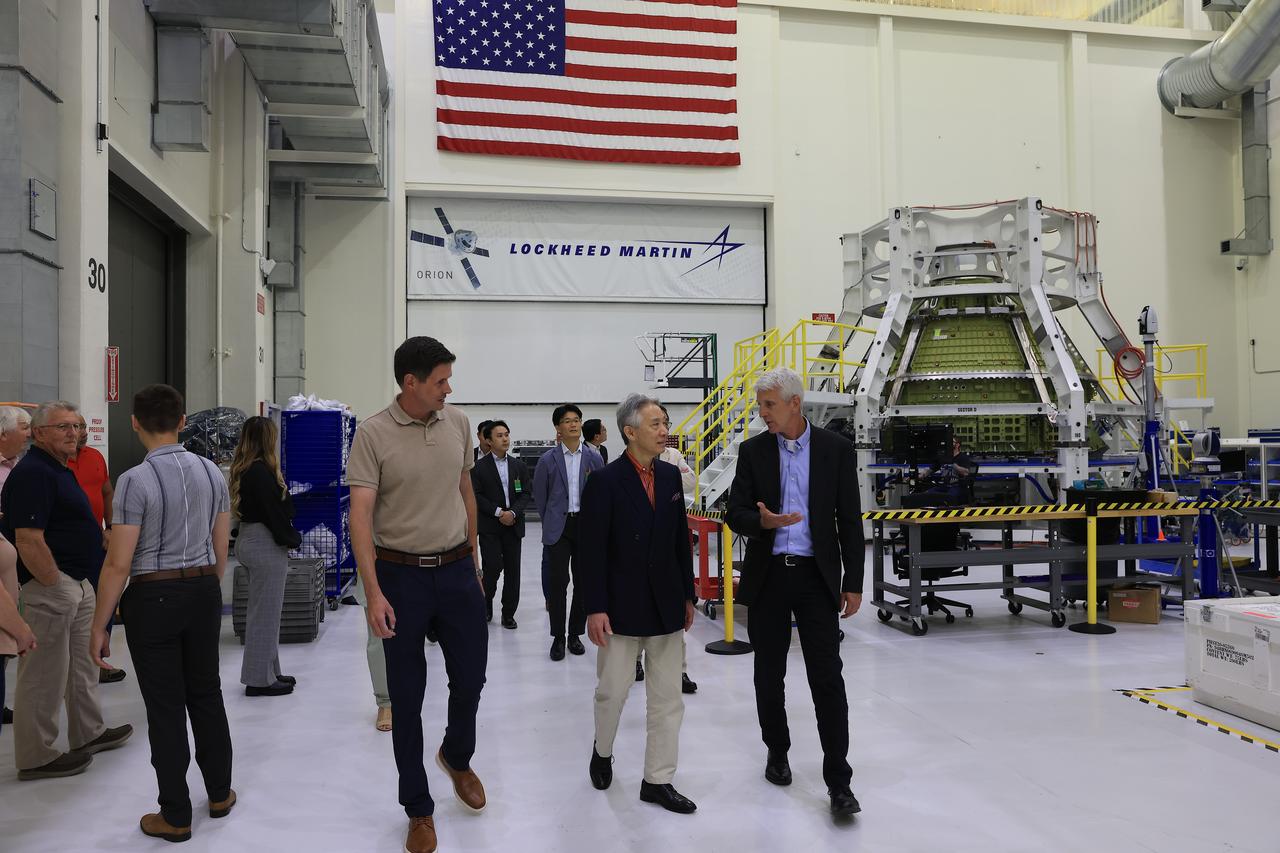
Nathan Varn, Program Director Orion Productions for Lockheed Martin, left, and Scott Wilson, NASA’s Division Chief, Orion Production Operations Office, right, lead a tour of the Neil A. Armstrong Operations and Checkout Building at NASA’s Kennedy Space Center in Florida, for Japanese Minister of Education, Culture, Sports, Science and Technology (MEXT) Masahito Moriyama on Friday, April 12, 2024. Moriyama’s visit included viewing the Orion crew modules for upcoming Artemis missions, which will land the first woman, first person of color, and NASA’s first international partner astronaut on the Moon.
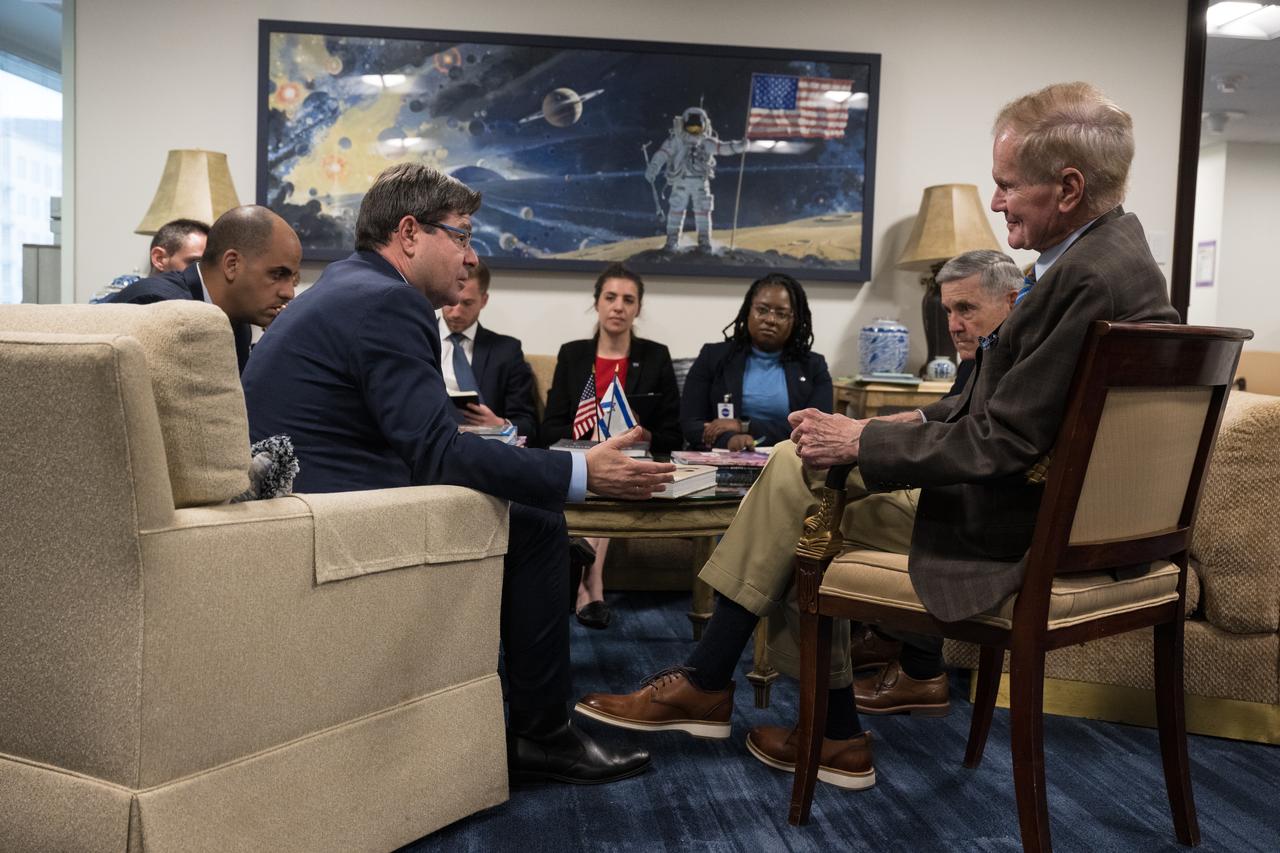
NASA Administrator Bill Nelson, right, and Associate Administrator Bob Cabana, second from right, meet with, from left to right, Israel’s Minister of Innovation, Science, and Technology, Ofir Akunis, Israel’s Deputy Director General, Omer Shechter, Israel’s Chief of Staff, Asaf Magen, Chief of Staff, Ambassador of Israel to the United States, Evan Charney, NASA Office of International and Interagency Relations, Rebecca Levy, NASA Office of International and Interagency Relations, Amber McIntyre, and NASA Associate Administrator, Office of International and Interagency Relations, Karen Feldstein, Monday, March 27, 2023 at the Mary W. Jackson NASA Headquarters building in Washington DC. Photo Credit: (NASA/Aubrey Gemignani)

Japan’s Minister of Education, Culture, Sports, Science and Technology Masahito Moriyama discusses the historic agreement signed April 9th at NASA Headquarters, between the United States and Japan to advance sustainable human exploration of the Moon, Wednesday, April 10, 2024, at the Japan Aerospace Exploration Agency (JAXA) offices in Washington. Under the agreement, Japan will design, develop, and operate a pressurized rover for crewed and uncrewed exploration on the Moon. NASA will provide the launch and delivery of the rover to the Moon as well as two Japanese astronaut missions to the lunar surface. Photo Credit: Photo Credit: (NASA/Bill Ingalls)
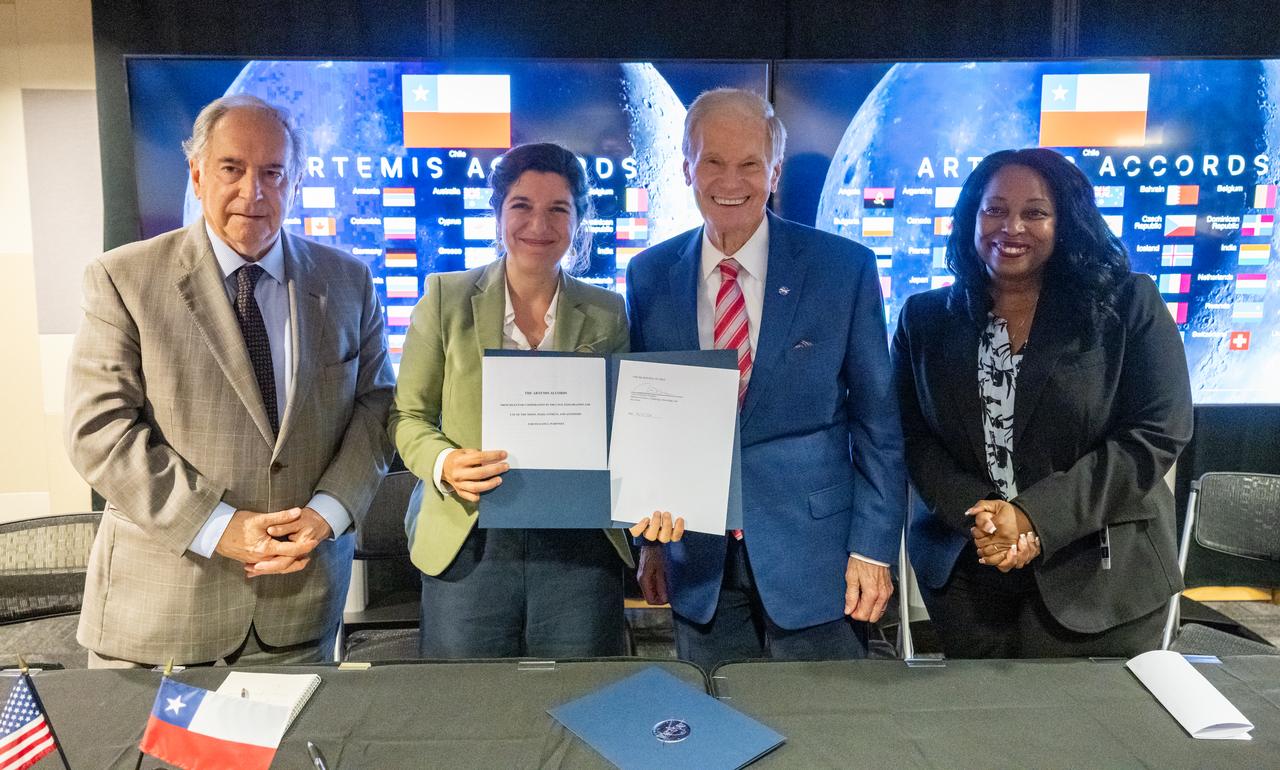
From left to right, Chilean Ambassador to the United States Juan Gabriel Valdés, Chilean Minister of Science, Technology, Knowledge, and Innovation Aisén Etcheverry Escudero, NASA Administrator Bill Nelson, and United States Department of State Acting Assistant Secretary in the Bureau of Oceans and International Environmental and Scientific Affairs Jennifer R. Littlejohn pose for a photo after the signing of the Artemis Accords, Friday, Oct. 25, 2024, at the Mary W. Jackson NASA Headquarters building in Washington. The Republic of Chile is the 47th country to sign the Artemis Accords, which establish a practical set of principles to guide space exploration cooperation among nations participating in NASA’s Artemis program. Photo Credit: (NASA/Keegan Barber)
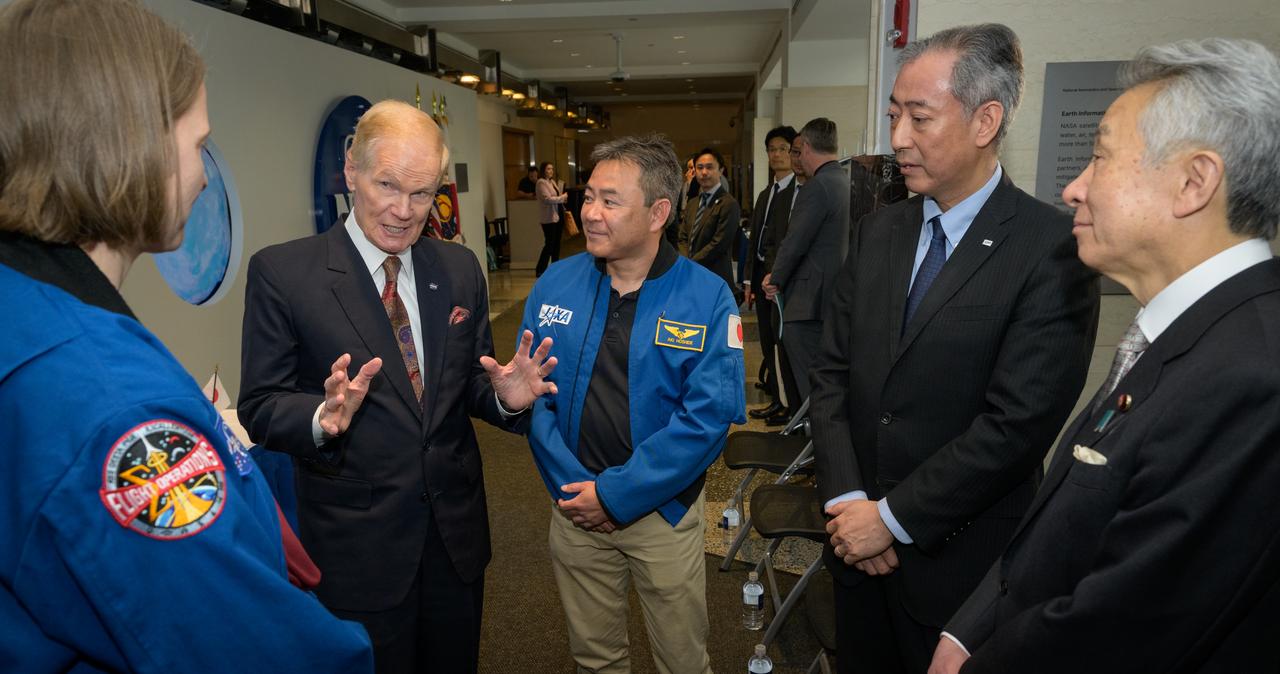
NASA astronaut Kayla Barron, left, NASA Administrator Bill Nelson, JAXA astronaut Akihiko Hoshide, Japan Aerospace Exploration Agency (JAXA) President Hiroshi Yamakawa, and Japan’s Minister of Education, Culture, Sports, Science and Technology Masahito Moriyama, right, talk after the signing of an historic agreement between the United States and Japan to advance sustainable human exploration of the Moon, Tuesday, April 9, 2024, at the NASA Headquarters Mary W. Jackson Building in Washington. Under the agreement, Japan will design, develop, and operate a pressurized rover for crewed and uncrewed exploration on the Moon. NASA will provide the launch and delivery of the rover to the Moon as well as two Japanese astronaut missions to the lunar surface. Photo Credit: (NASA/Bill Ingalls)
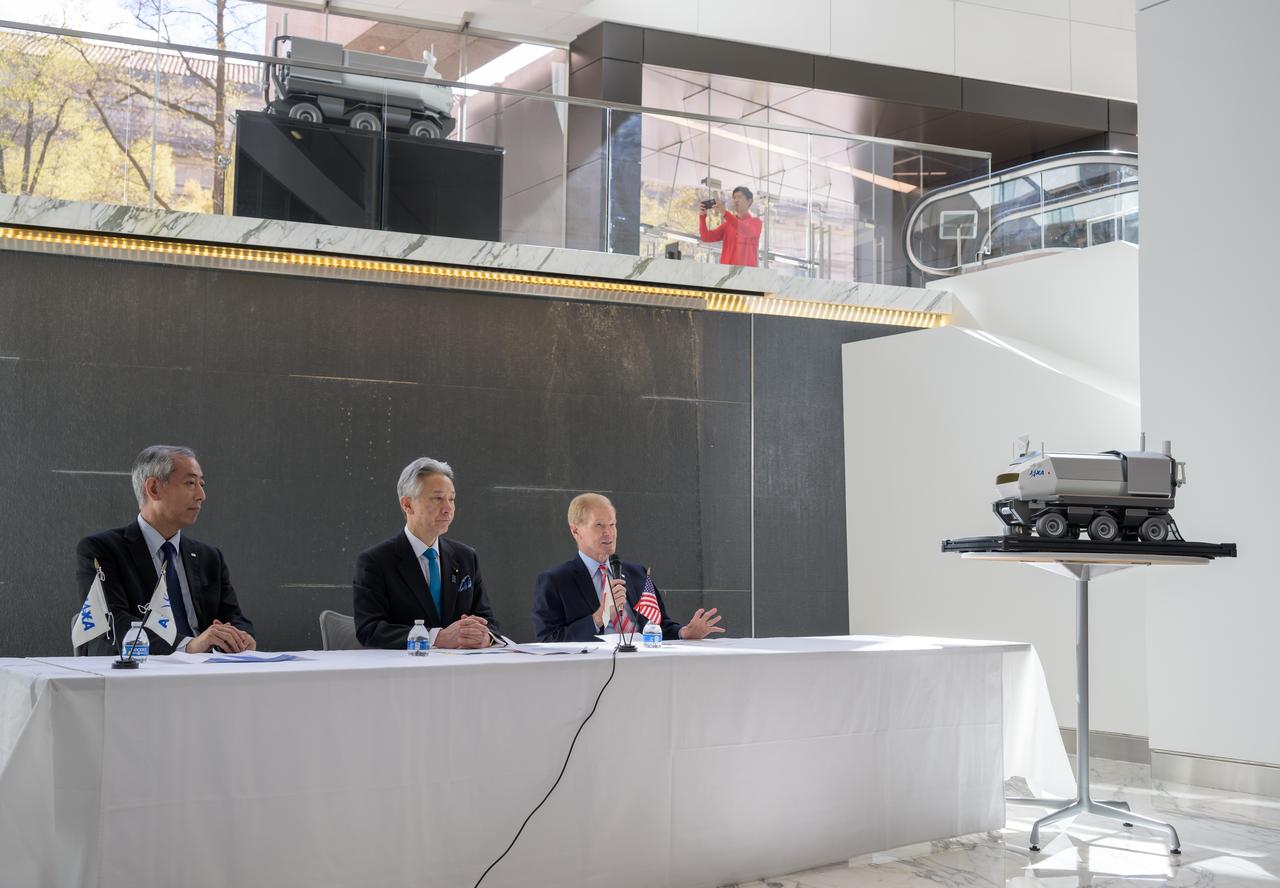
Japan Aerospace Exploration Agency (JAXA) President Hiroshi Yamakawa, left, Japan’s Minister of Education, Culture, Sports, Science and Technology Masahito Moriyama, and NASA Administrator Bill Nelson, right, are seen during a briefing where they discussed the historic agreement signed April 9th at NASA Headquarters, between the United States and Japan to advance sustainable human exploration of the Moon, Wednesday, April 10, 2024, at the Japan Aerospace Exploration Agency (JAXA) offices in Washington. Under the agreement, Japan will design, develop, and operate a pressurized rover for crewed and uncrewed exploration on the Moon. NASA will provide the launch and delivery of the rover to the Moon as well as two Japanese astronaut missions to the lunar surface. Photo Credit: Photo Credit: (NASA/Bill Ingalls)
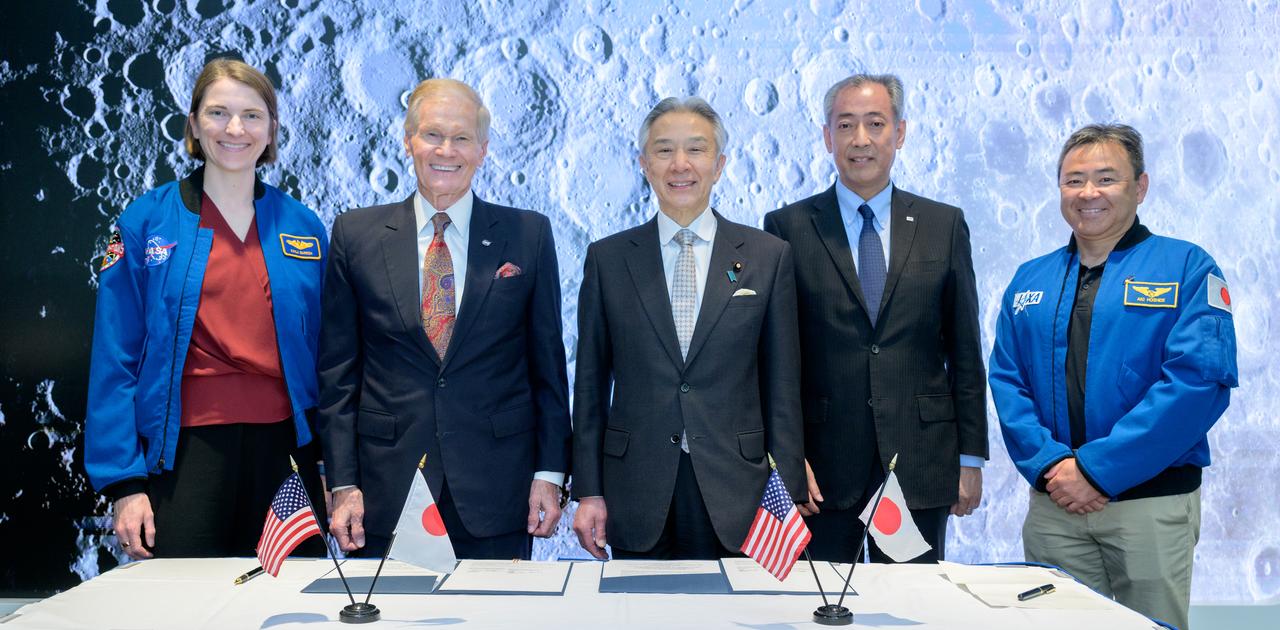
NASA astronaut Kayla Barron, left, NASA Administrator Bill Nelson, Japan’s Minister of Education, Culture, Sports, Science and Technology Masahito Moriyama, Japan Aerospace Exploration Agency (JAXA) President Hiroshi Yamakawa, and JAXA astronaut Akihiko Hoshide, right, pose for a group photograph after the signing of an historic agreement between the United States and Japan to advance sustainable human exploration of the Moon, Tuesday, April 9, 2024, at the NASA Headquarters Mary W. Jackson Building in Washington. Under the agreement, Japan will design, develop, and operate a pressurized rover for crewed and uncrewed exploration on the Moon. NASA will provide the launch and delivery of the rover to the Moon as well as two Japanese astronaut missions to the lunar surface. Photo Credit: (NASA/Bill Ingalls)
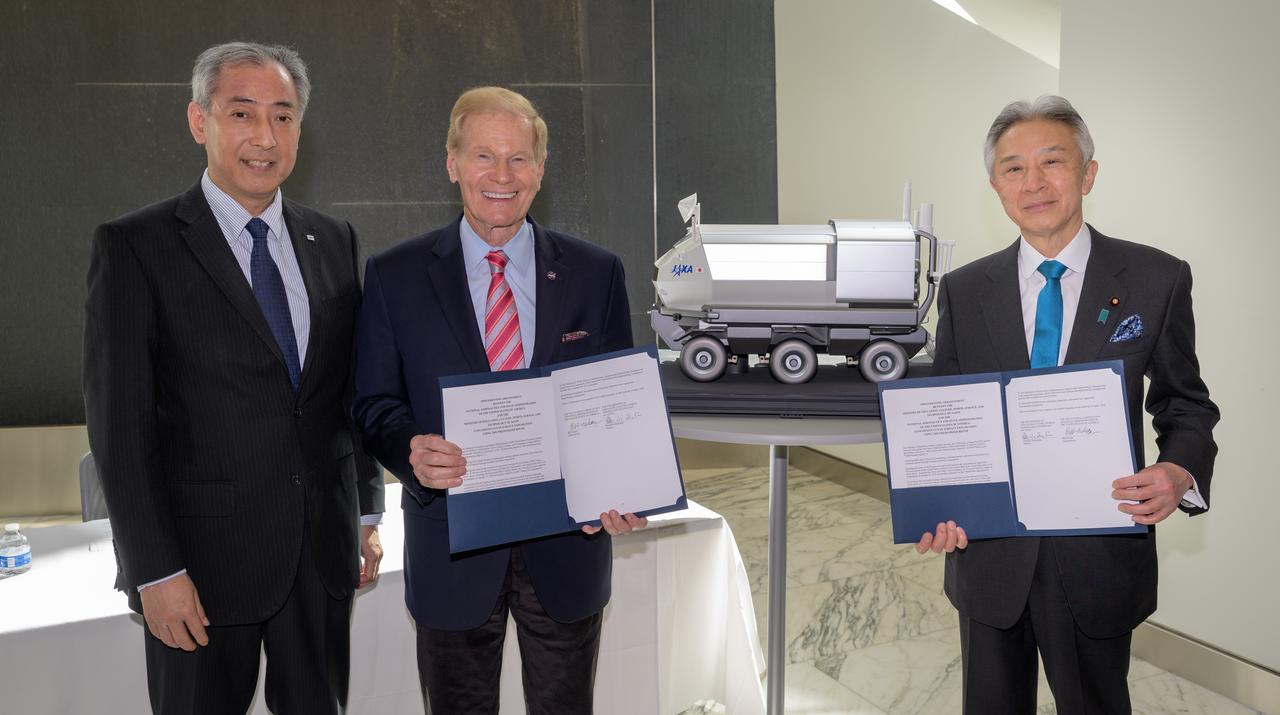
Japan Aerospace Exploration Agency (JAXA) President Hiroshi Yamakawa, left, NASA Administrator Bill Nelson, and Japan’s Minister of Education, Culture, Sports, Science and Technology Masahito Moriyama, right, pose for a group photograph holding the historic agreement signed April 9th at NASA Headquarters, between the United States and Japan to advance sustainable human exploration of the Moon, Wednesday, April 10, 2024, at the Japan Aerospace Exploration Agency (JAXA) offices in Washington. Under the agreement, Japan will design, develop, and operate a pressurized rover for crewed and uncrewed exploration on the Moon. NASA will provide the launch and delivery of the rover to the Moon as well as two Japanese astronaut missions to the lunar surface. Photo Credit: Photo Credit: (NASA/Bill Ingalls)
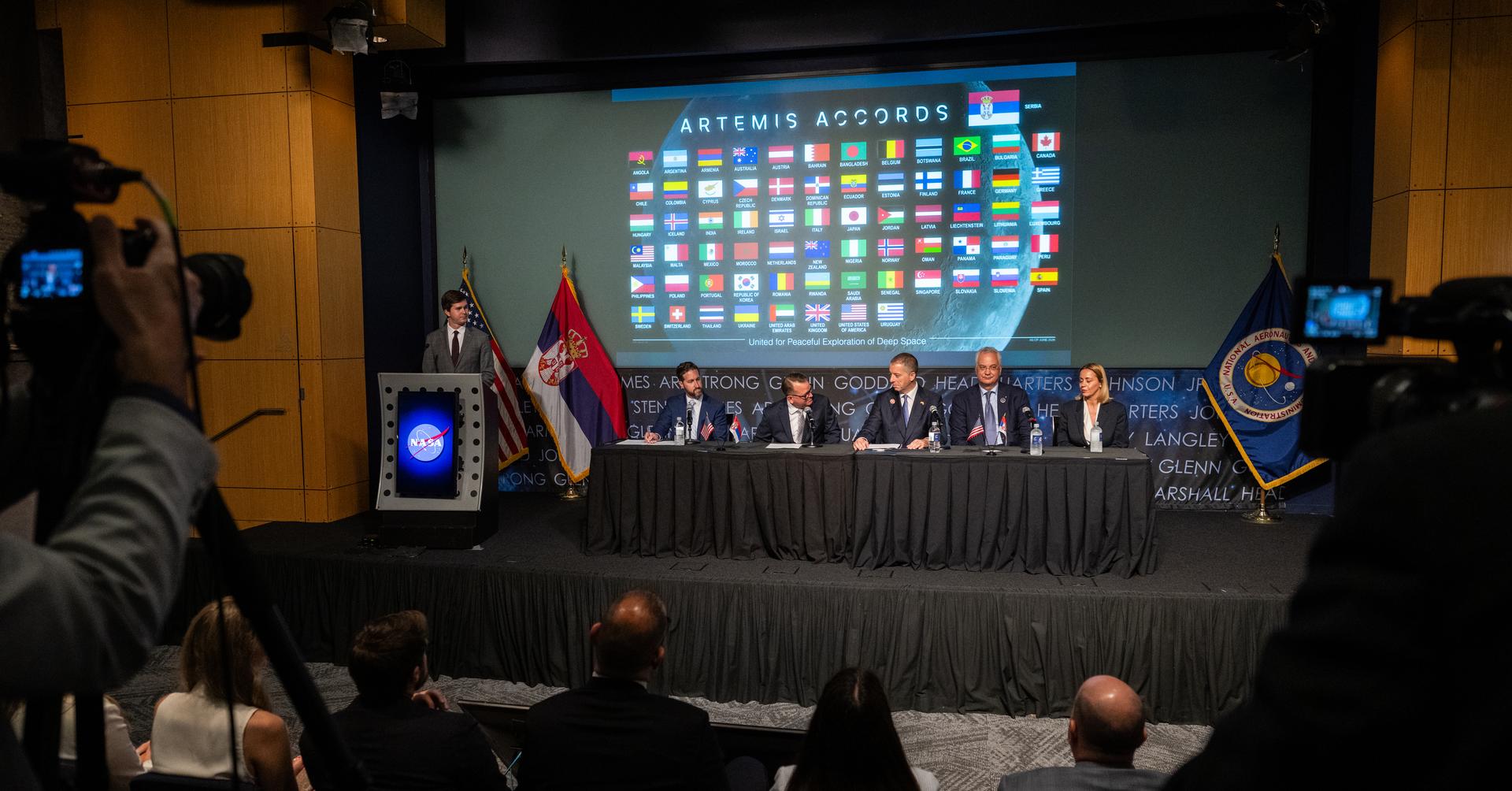
NASA Deputy Administrator Matt Anderson, fourth from right, delivers remarks alongside, seated from left to right, Assistant Secretary of State for Oceans and International Environmental and Scientific Affairs Wesley Brooks, Minister of Foreign Affairs Marko Đurić, Ambassador of Serbia to the Unites States Dragan Šutanovac, and State Secretary at the Ministry of Science, Technological Development & Innovation Marija Gnjatović, during an Artemis Accords signing ceremony Thursday, July 16, 2026, at the Mary W. Jackson NASA Headquarters building in Washington. Serbia is the 69th country to sign the Artemis Accords, which establish a practical set of principles to guide space exploration cooperation among nations participating in NASA’s Artemis program. Photo Credit: (NASA/Keegan Barber)
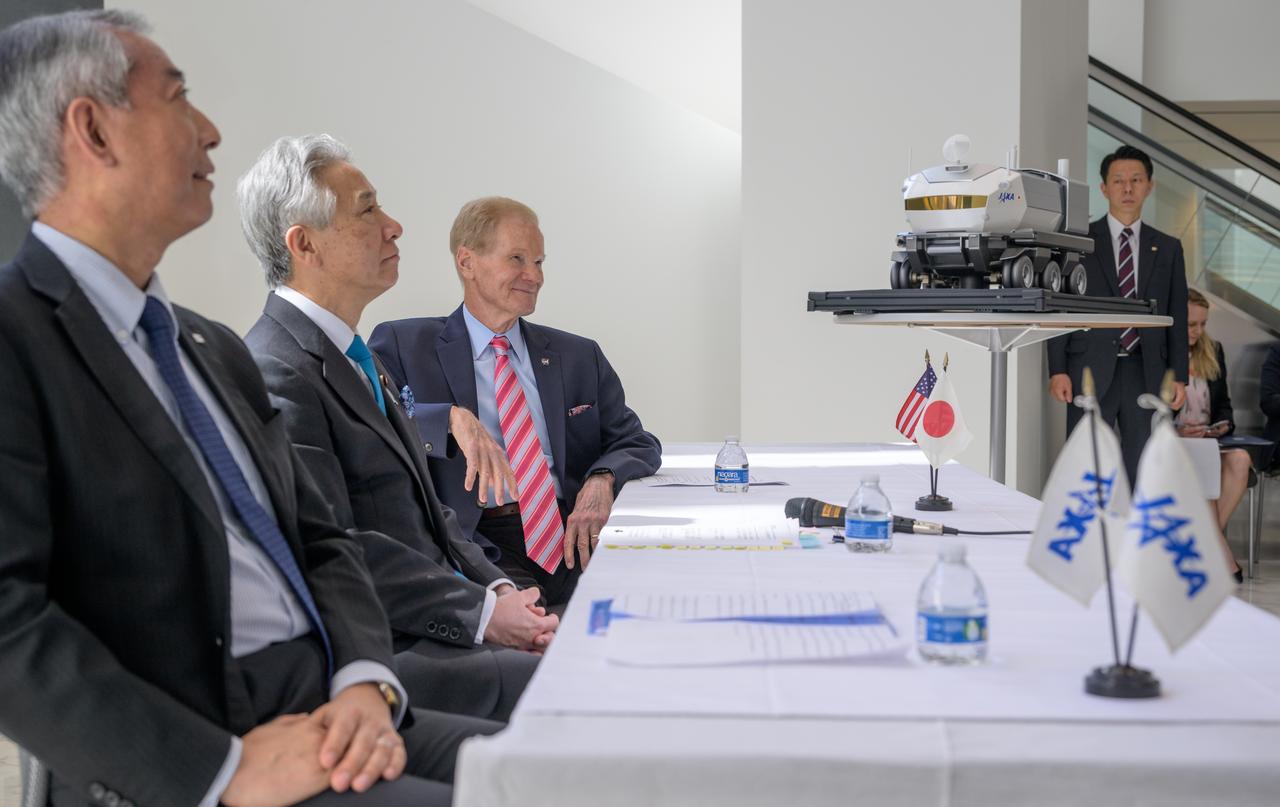
Japan Aerospace Exploration Agency (JAXA) President Hiroshi Yamakawa, left, Japan’s Minister of Education, Culture, Sports, Science and Technology Masahito Moriyama, and NASA Administrator Bill Nelson, right, are seen during a briefing where they discussed the historic agreement signed April 9th at NASA Headquarters, between the United States and Japan to advance sustainable human exploration of the Moon, Wednesday, April 10, 2024, at the Japan Aerospace Exploration Agency (JAXA) offices in Washington. Under the agreement, Japan will design, develop, and operate a pressurized rover for crewed and uncrewed exploration on the Moon. NASA will provide the launch and delivery of the rover to the Moon as well as two Japanese astronaut missions to the lunar surface. Photo Credit: Photo Credit: (NASA/Bill Ingalls)
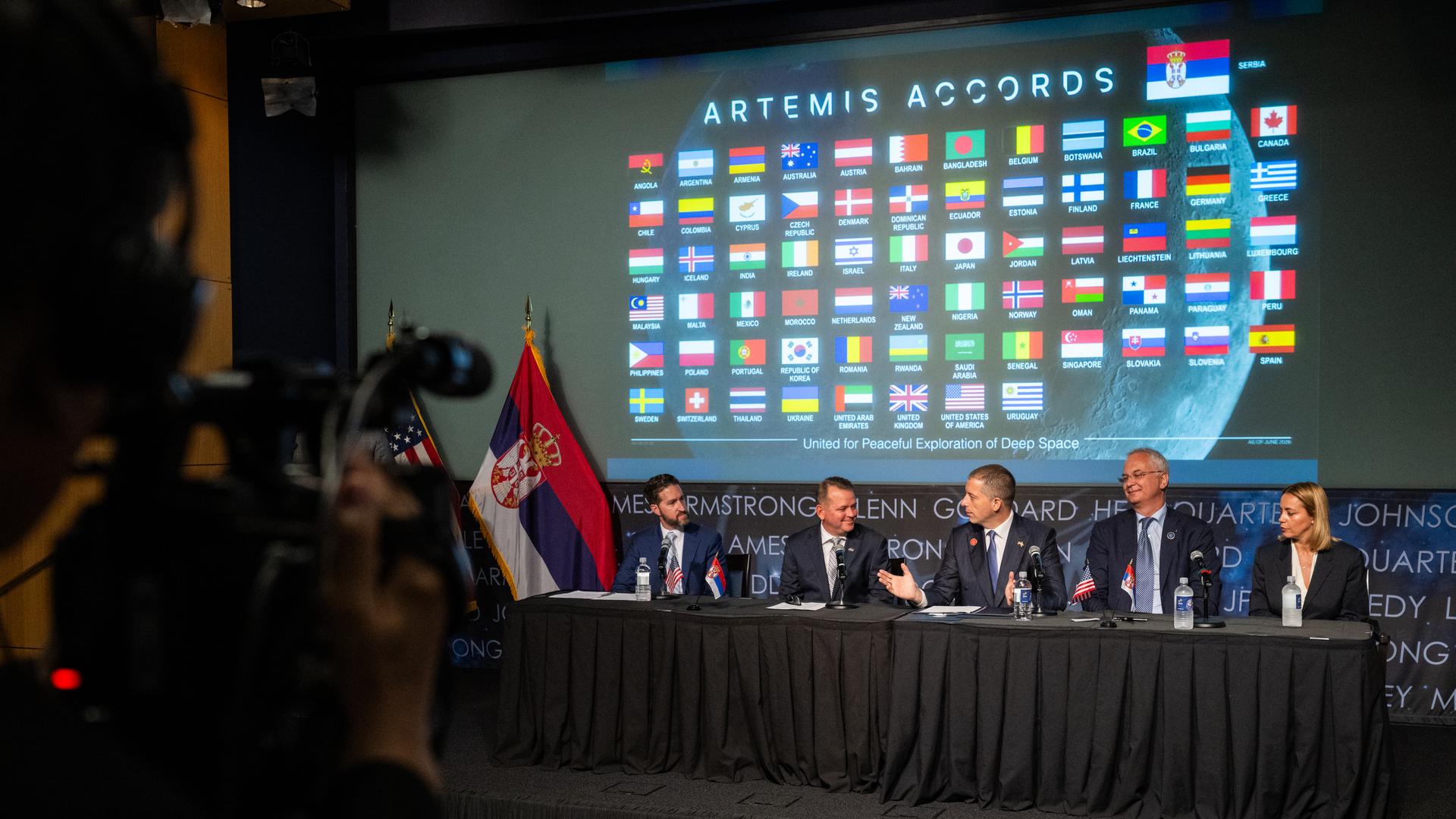
Minister of Foreign Affairs Marko Đurić, third from right, delivers remarks alongside, seated from left to right, Assistant Secretary of State for Oceans and International Environmental and Scientific Affairs Wesley Brooks, NASA Deputy Administrator Matt Anderson, Ambassador of Serbia to the Unites States Dragan Šutanovac, and State Secretary at the Ministry of Science, Technological Development & Innovation Marija Gnjatović, during an Artemis Accords signing ceremony Thursday, July 16, 2026, at the Mary W. Jackson NASA Headquarters building in Washington. Serbia is the 69th country to sign the Artemis Accords, which establish a practical set of principles to guide space exploration cooperation among nations participating in NASA’s Artemis program. Photo Credit: (NASA/Keegan Barber)

Japan Aerospace Exploration Agency (JAXA) President Hiroshi Yamakawa, left, JAXA astronaut Akihiko Hoshide, Japan’s Minister of Education, Culture, Sports, Science and Technology Masahito Moriyama, NASA Administrator Bill Nelson, and NASA astronaut Kayla Barron, right, talk by a model of the Pressurized lunar rover, after the signing of an historic agreement between the United States and Japan to advance sustainable human exploration of the Moon, Tuesday, April 9, 2024, at the NASA Headquarters Mary W. Jackson Building in Washington. Under the agreement, Japan will design, develop, and operate a pressurized rover for crewed and uncrewed exploration on the Moon. NASA will provide the launch and delivery of the rover to the Moon as well as two Japanese astronaut missions to the lunar surface. Photo Credit: (NASA/Bill Ingalls)
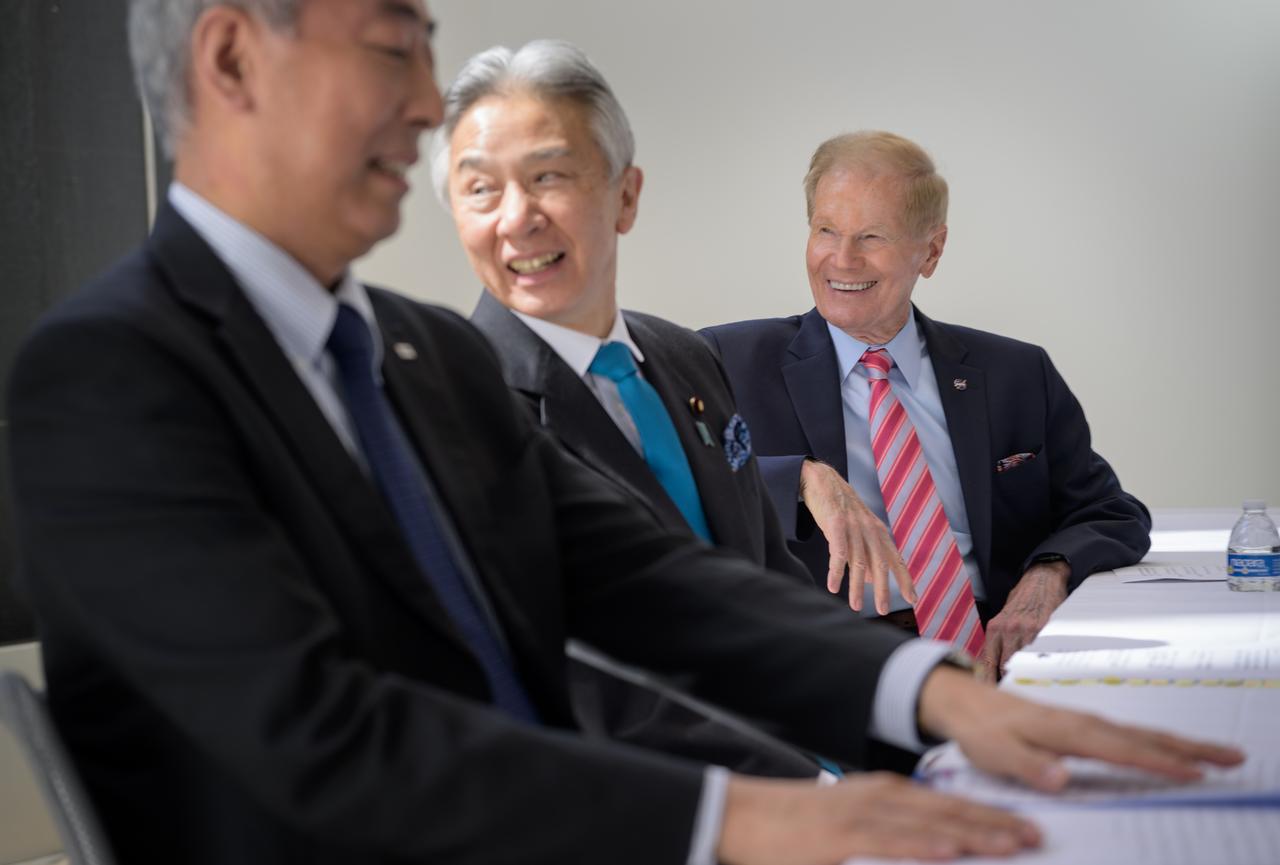
Japan Aerospace Exploration Agency (JAXA) President Hiroshi Yamakawa, left, Japan’s Minister of Education, Culture, Sports, Science and Technology Masahito Moriyama, and NASA Administrator Bill Nelson, right, are seen during a briefing where they discussed the historic agreement signed April 9th at NASA Headquarters, between the United States and Japan to advance sustainable human exploration of the Moon, Wednesday, April 10, 2024, at the Japan Aerospace Exploration Agency (JAXA) offices in Washington. Under the agreement, Japan will design, develop, and operate a pressurized rover for crewed and uncrewed exploration on the Moon. NASA will provide the launch and delivery of the rover to the Moon as well as two Japanese astronaut missions to the lunar surface. Photo Credit: Photo Credit: (NASA/Bill Ingalls)