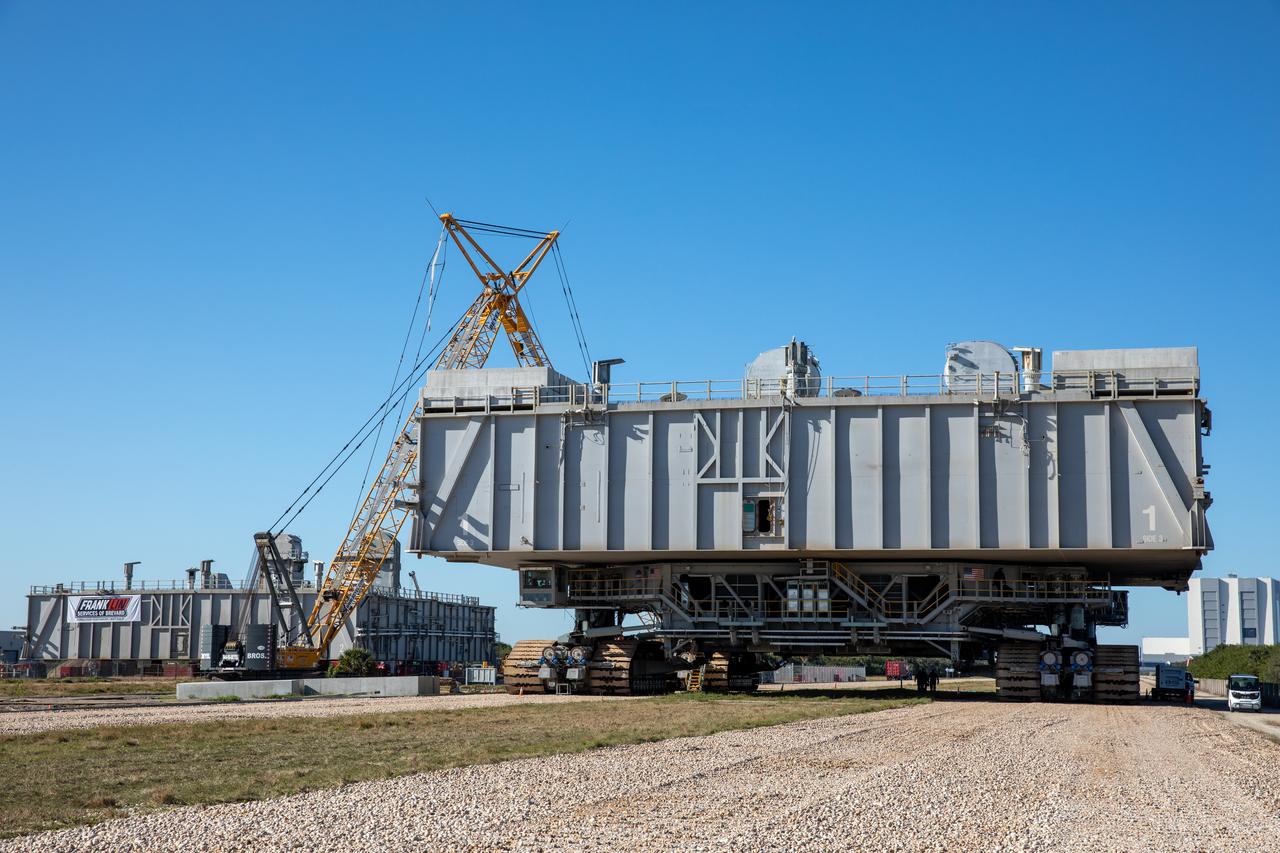
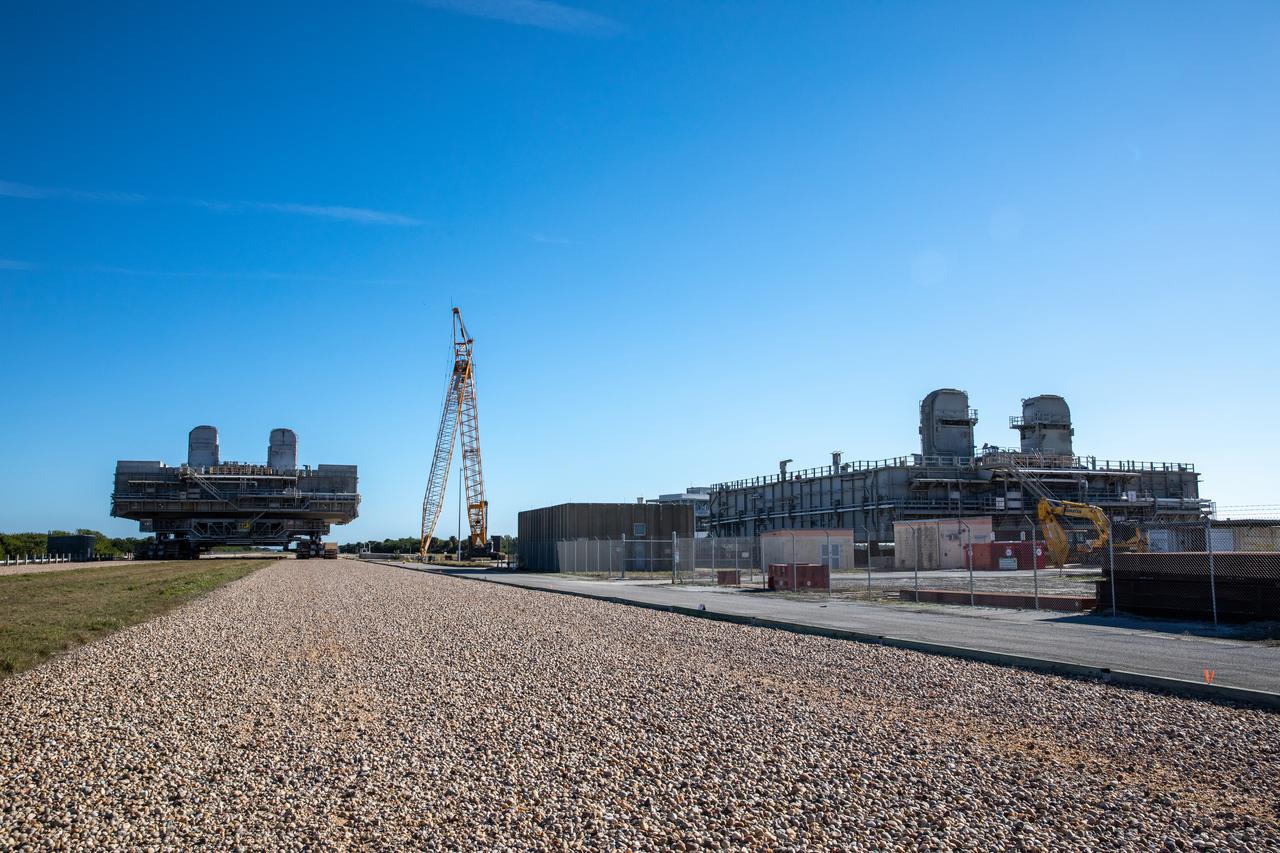
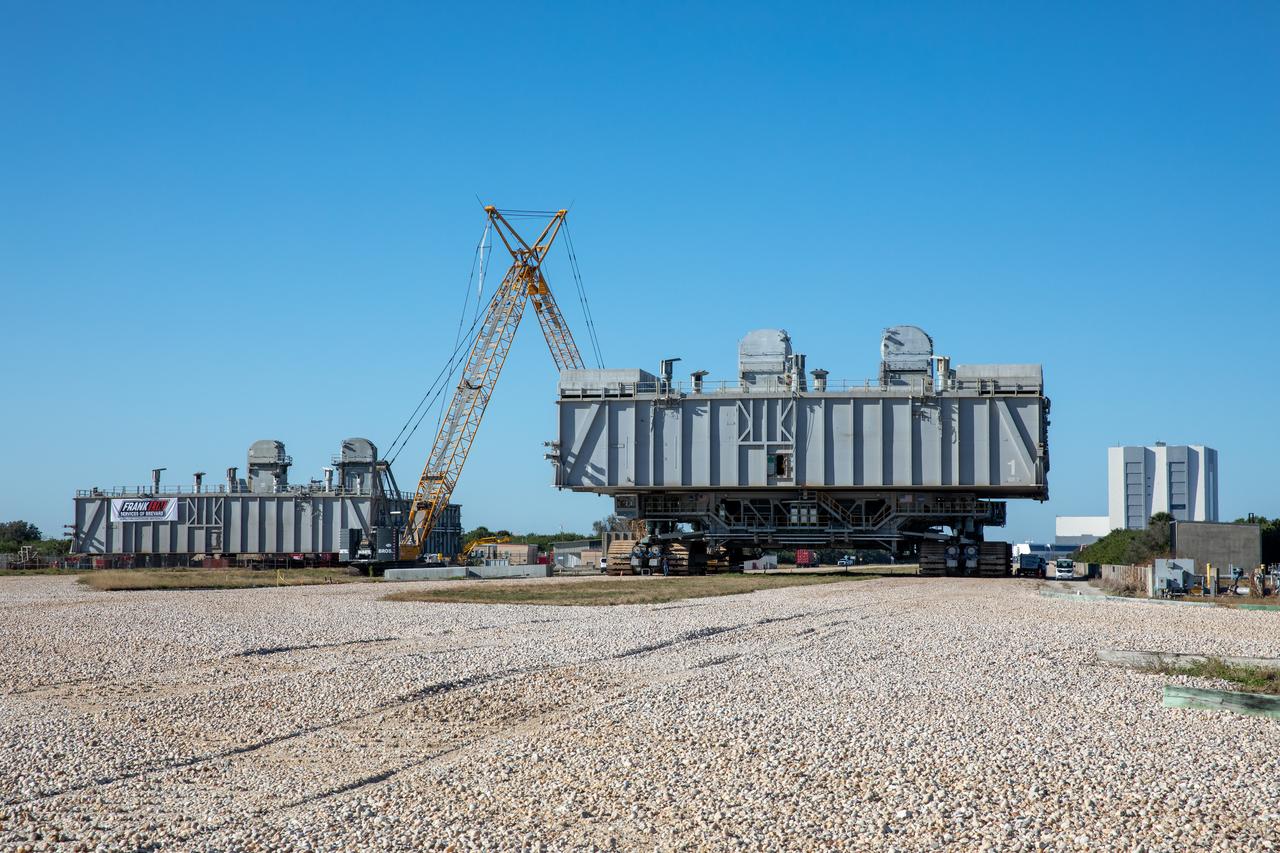
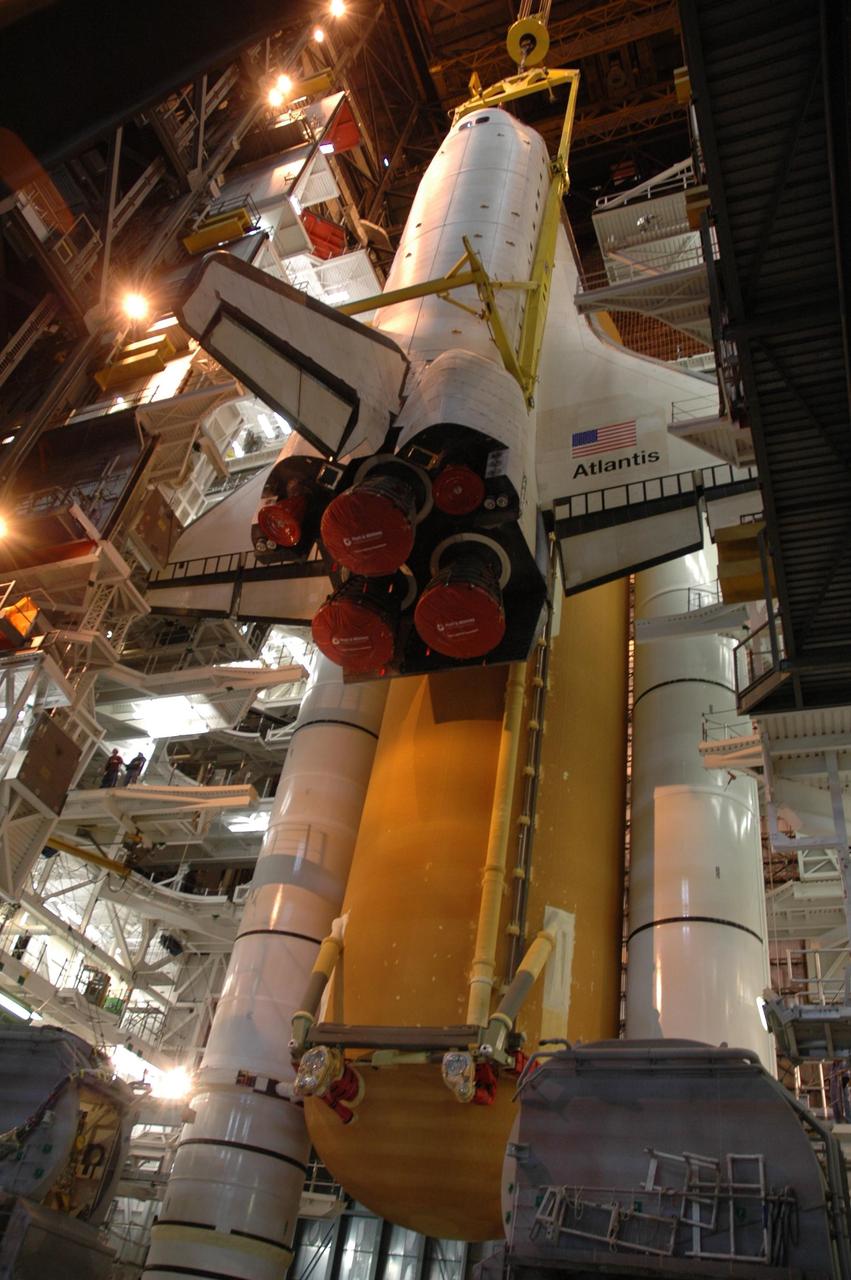
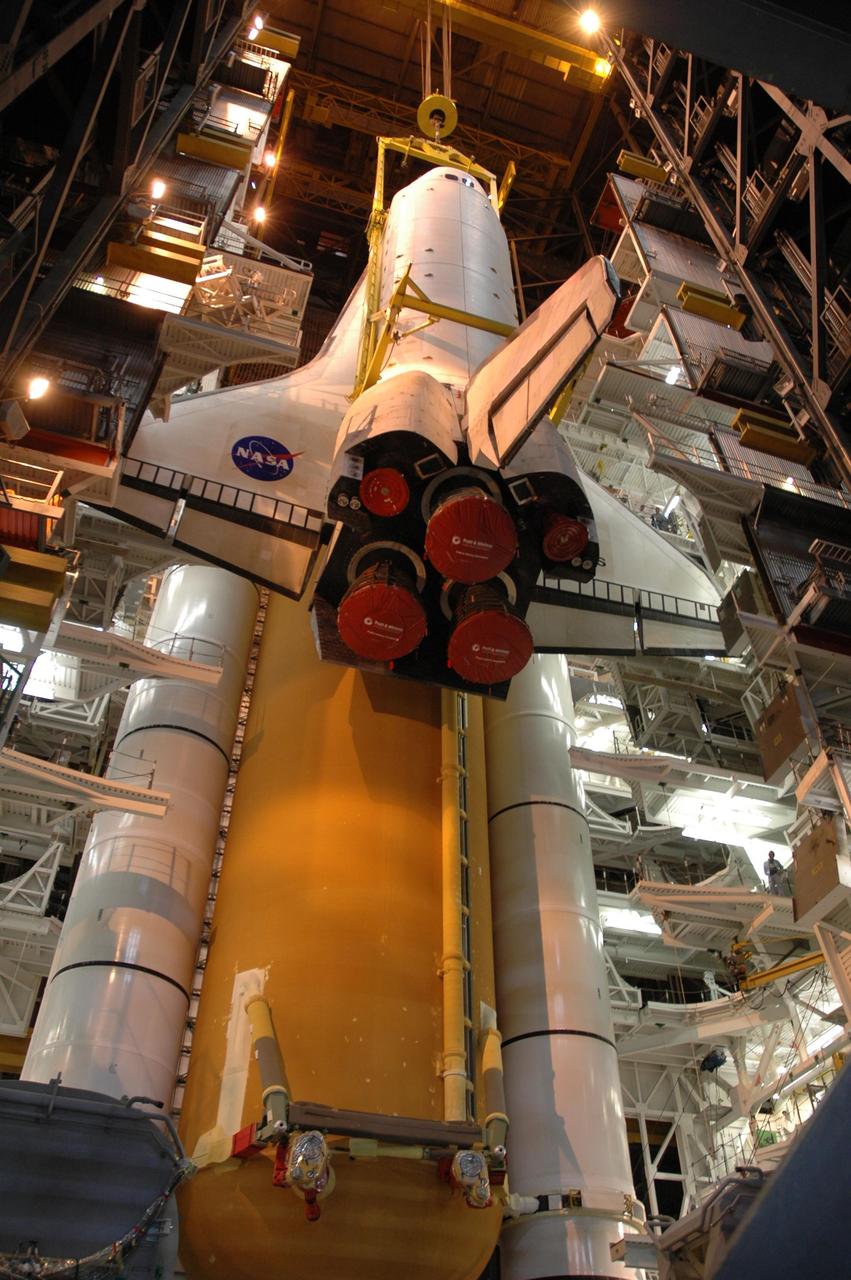
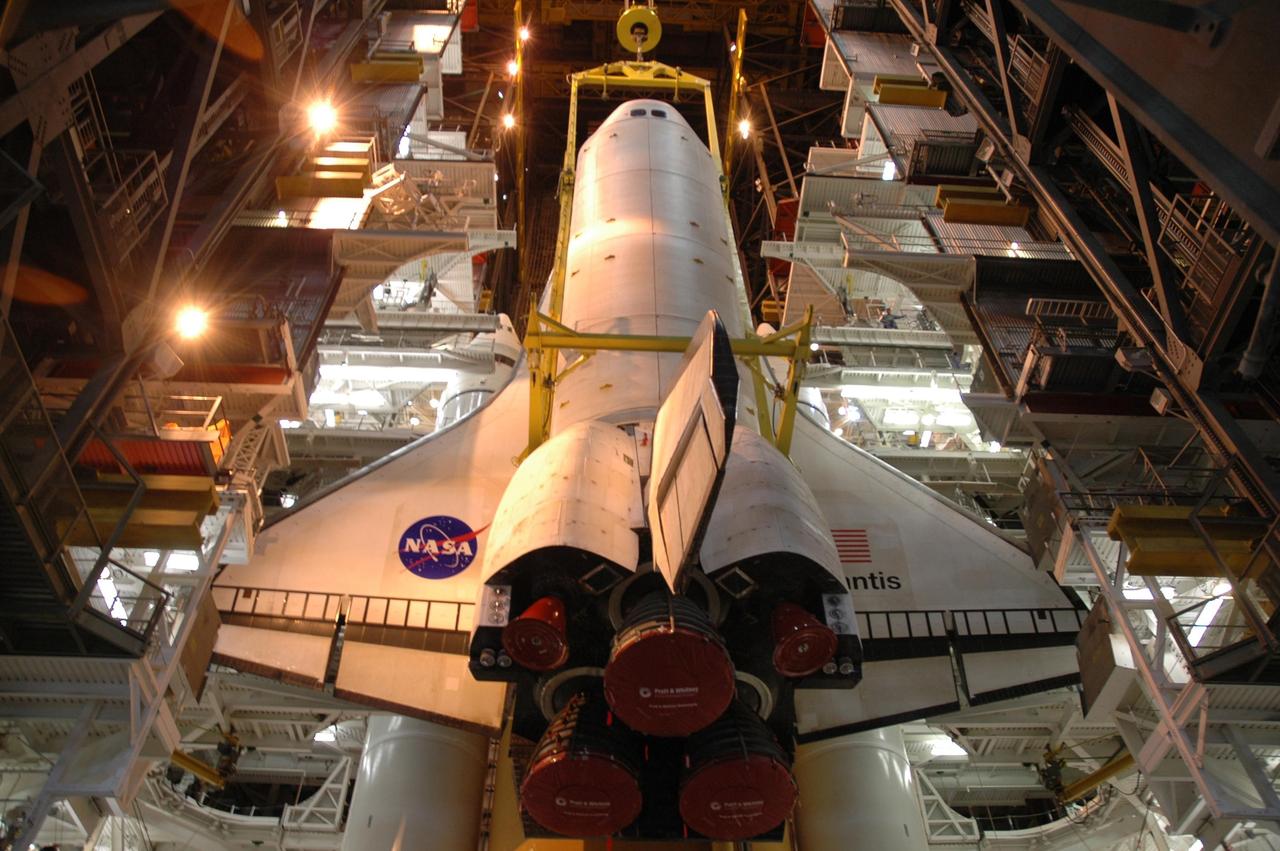
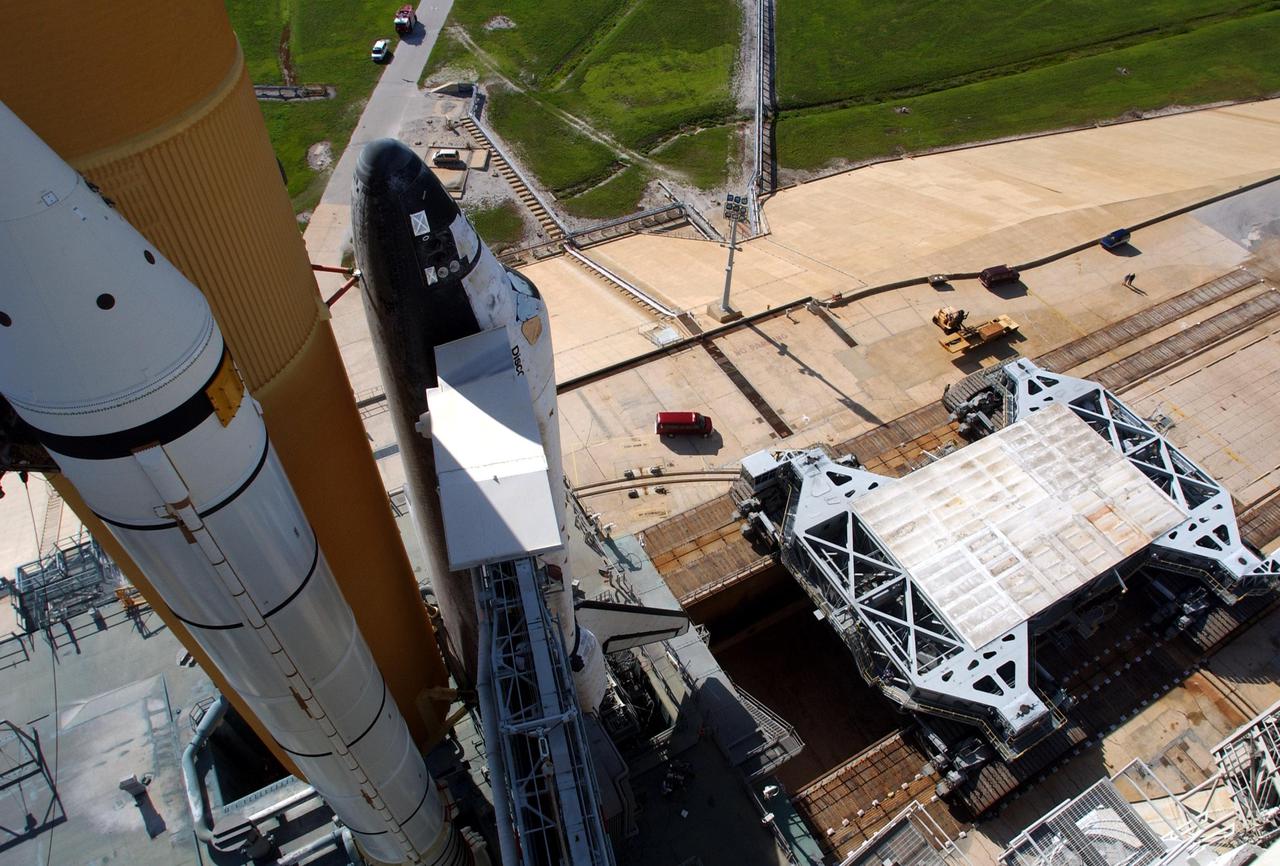
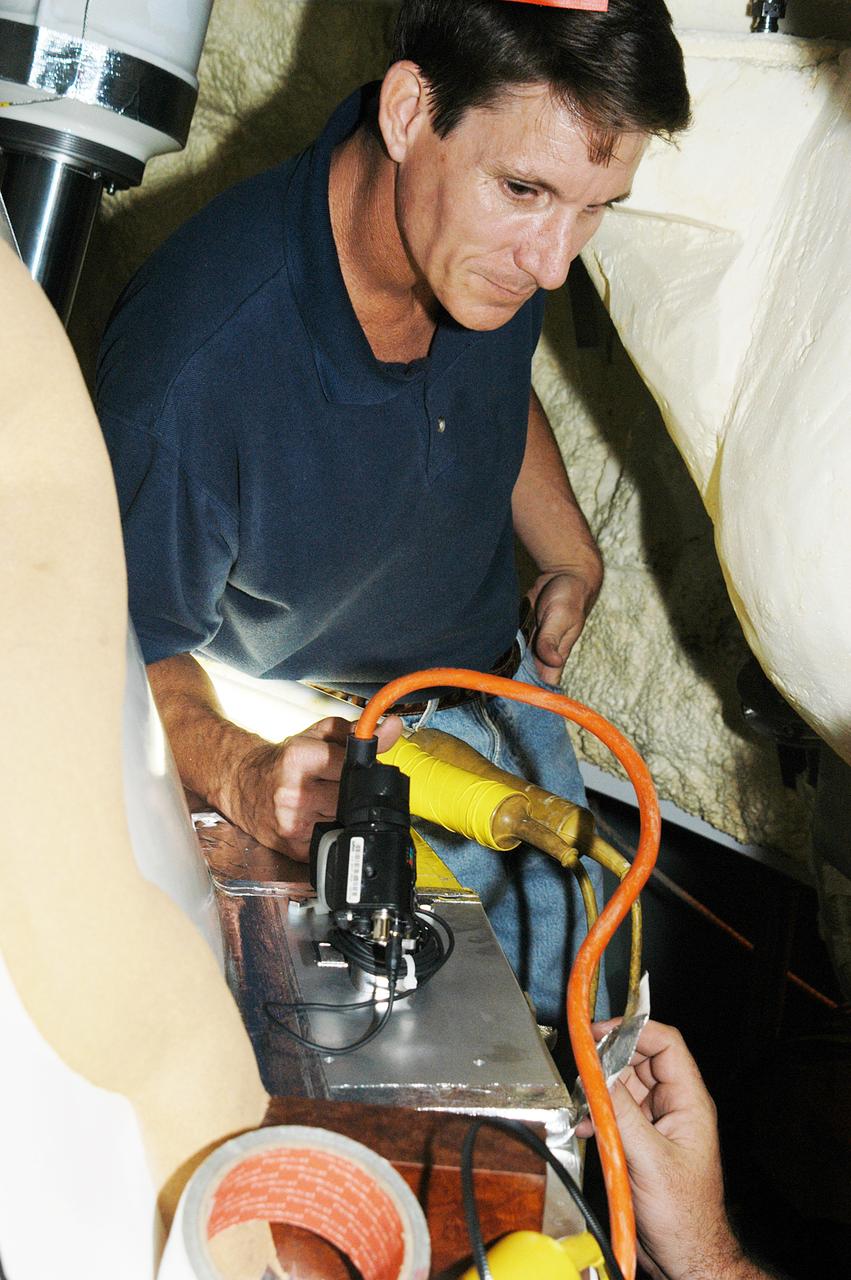
KENNEDY SPACE CENTER, FLA. -  A camera is installed on the aft skirt of a solid rocket booster in preparation for a vibration test of the Mobile Launcher Platform with SRBs and external tank mounted.  The MLP will roll from one bay to another in the Vehicle Assembly Building.
KENNEDY SPACE CENTER, FLA. - A camera is installed on the aft skirt of a solid rocket booster in preparation for a vibration test of the Mobile Launcher Platform with SRBs and external tank mounted. The MLP will roll from one bay to another in the Vehicle Assembly Building.
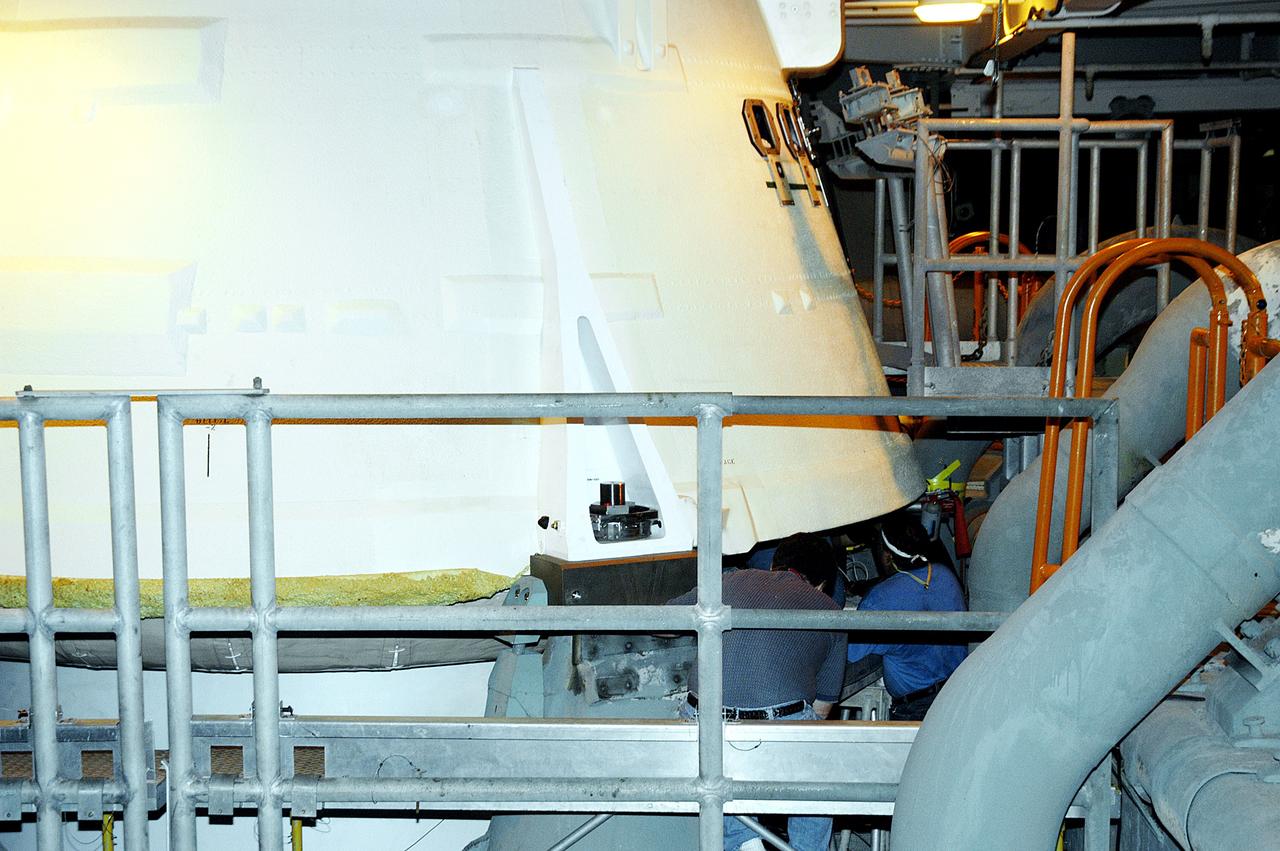
KENNEDY SPACE CENTER, FLA. -  The camera installed on the aft skirt of a solid rocket booster is seen here, framed by the railing.  The installation is in preparation for a vibration test of the Mobile Launcher Platform with SRBs and external tank mounted.  The MLP will roll from one bay to another in the Vehicle Assembly Building.
KENNEDY SPACE CENTER, FLA. - The camera installed on the aft skirt of a solid rocket booster is seen here, framed by the railing. The installation is in preparation for a vibration test of the Mobile Launcher Platform with SRBs and external tank mounted. The MLP will roll from one bay to another in the Vehicle Assembly Building.
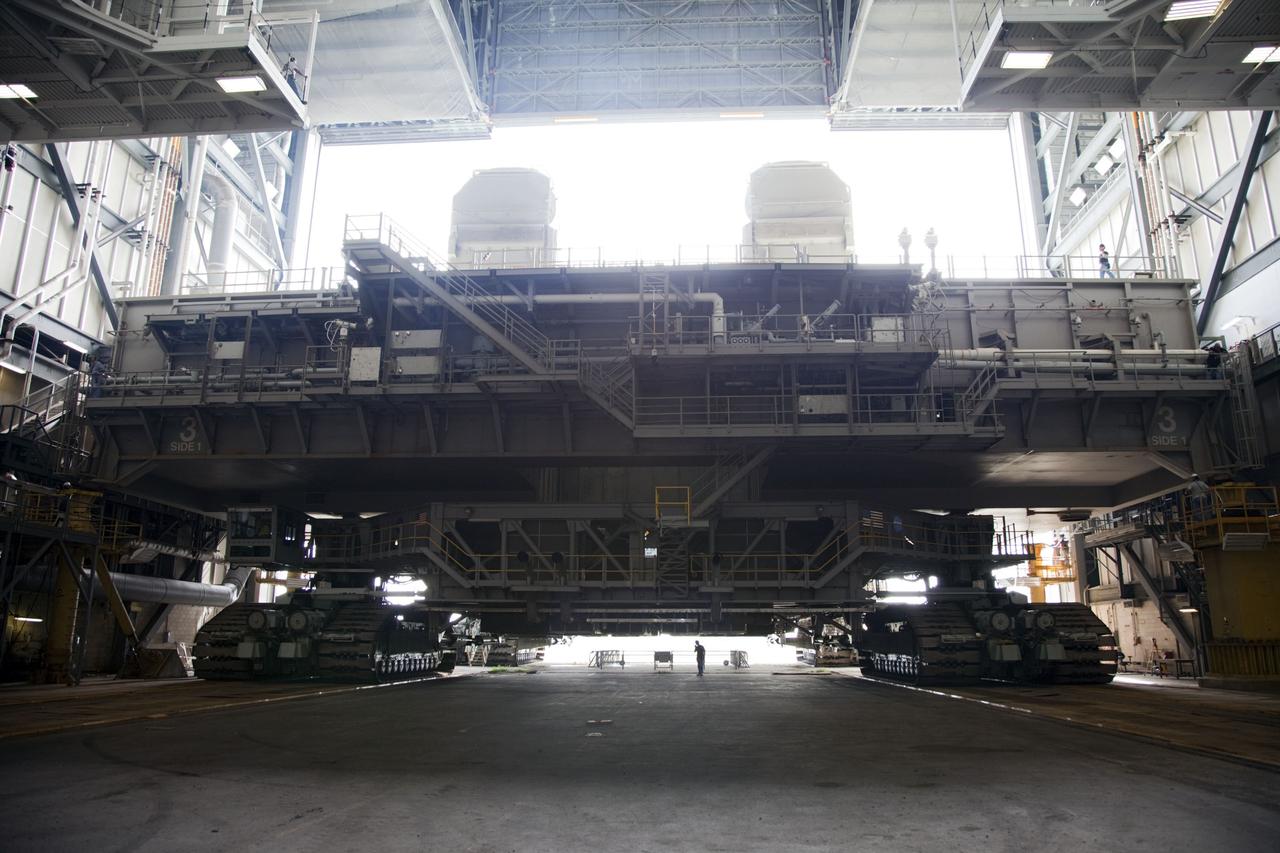
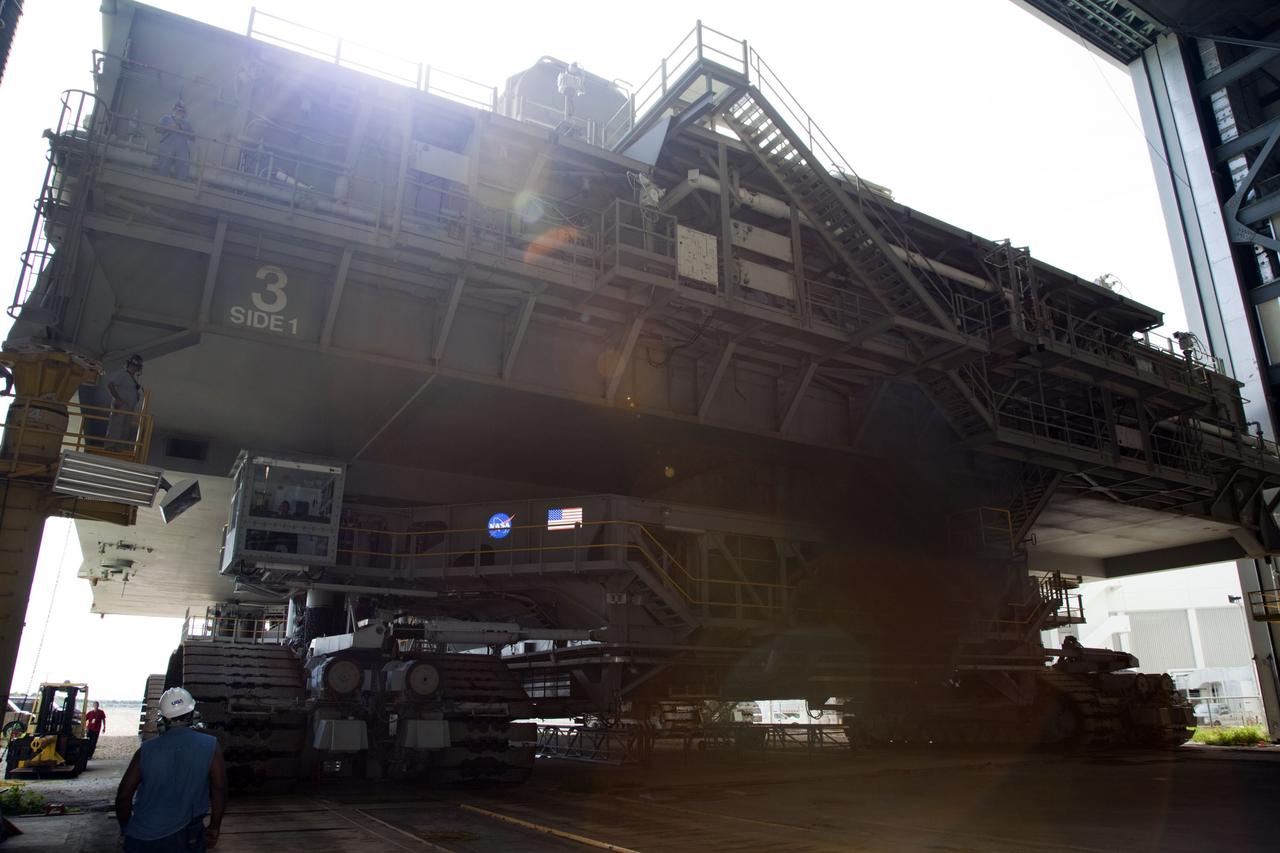
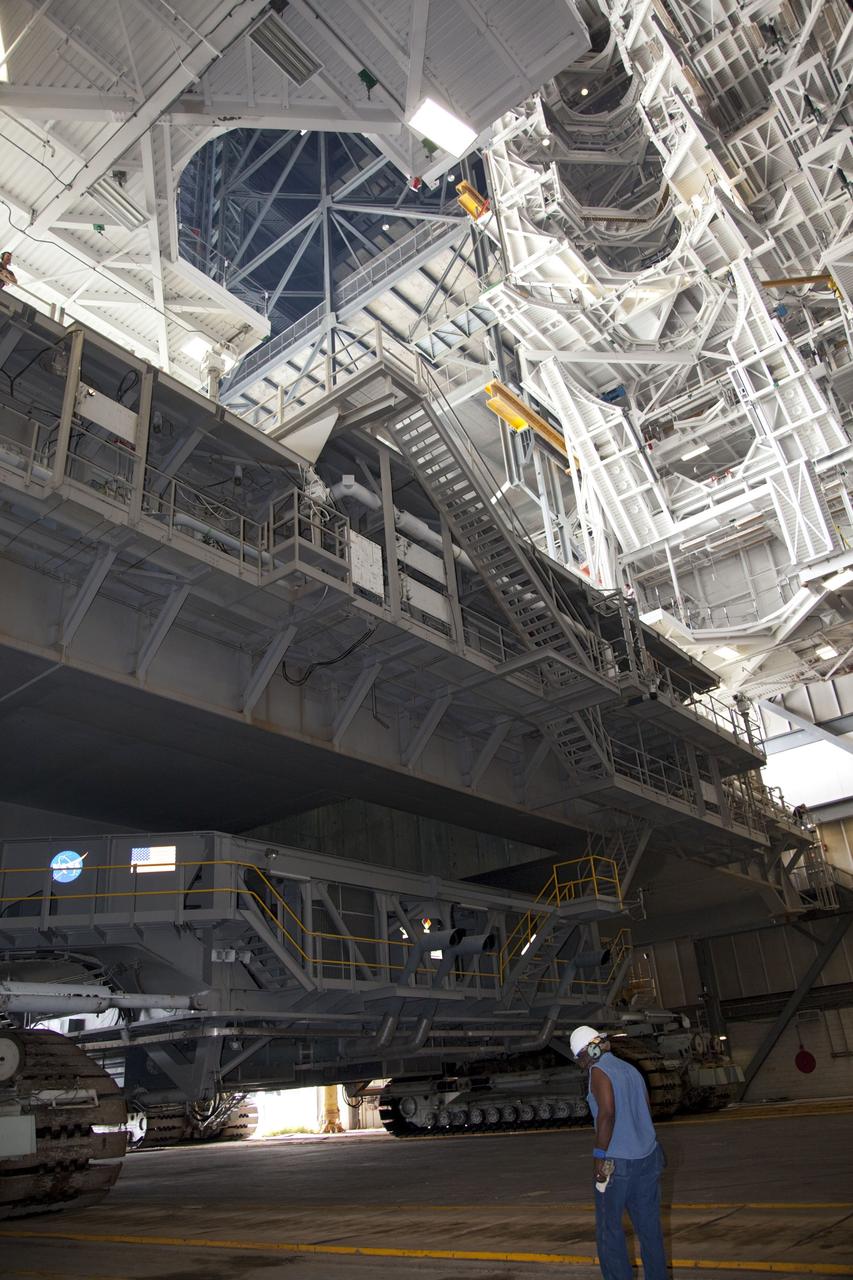
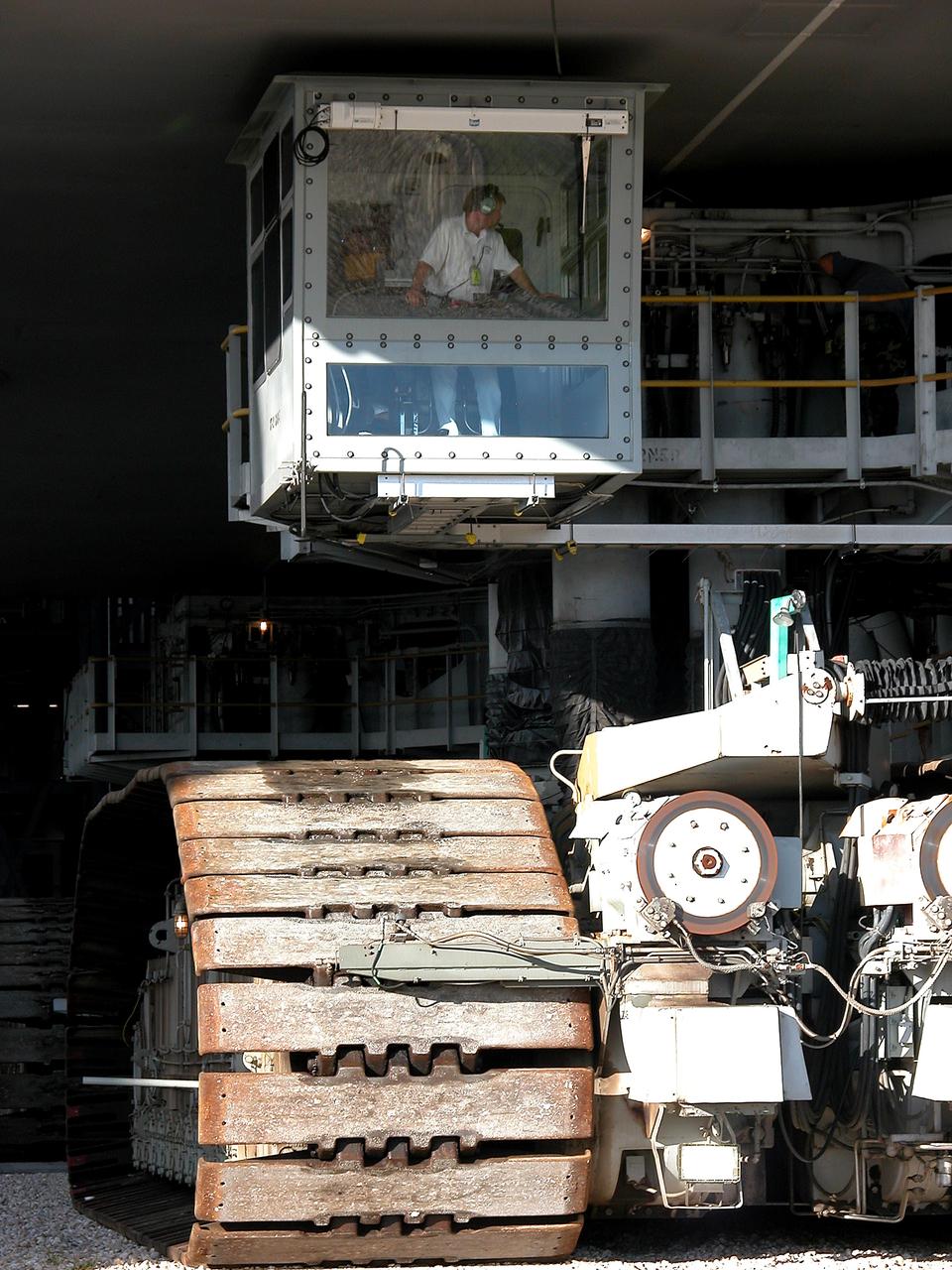
KENNEDY SPACE CENTER, FLA. -  As the crawler transporter slowly moves the Mobile Launcher Platform (MLP) out of the Vehicle Assembly Building, the driver of the front control cab can be seen.  The MLP is carrying two solid rocket boosters for engineering analysis vibration tests on the crawler and MLP.    The crawler is moving at various speeds up to 1 mph in an effort to achieve vibration data gathering goals as it leaves the VAB and then returns.  The boosters are braced at the top for stability.  The primary purpose of these rollout tests is to gather data to develop future maintenance requirements on the transport equipment and the flight hardware. Various parts of the MLP and crawler transporter have been instrumented with vibration data collection equipment.
KENNEDY SPACE CENTER, FLA. - As the crawler transporter slowly moves the Mobile Launcher Platform (MLP) out of the Vehicle Assembly Building, the driver of the front control cab can be seen. The MLP is carrying two solid rocket boosters for engineering analysis vibration tests on the crawler and MLP. The crawler is moving at various speeds up to 1 mph in an effort to achieve vibration data gathering goals as it leaves the VAB and then returns. The boosters are braced at the top for stability. The primary purpose of these rollout tests is to gather data to develop future maintenance requirements on the transport equipment and the flight hardware. Various parts of the MLP and crawler transporter have been instrumented with vibration data collection equipment.
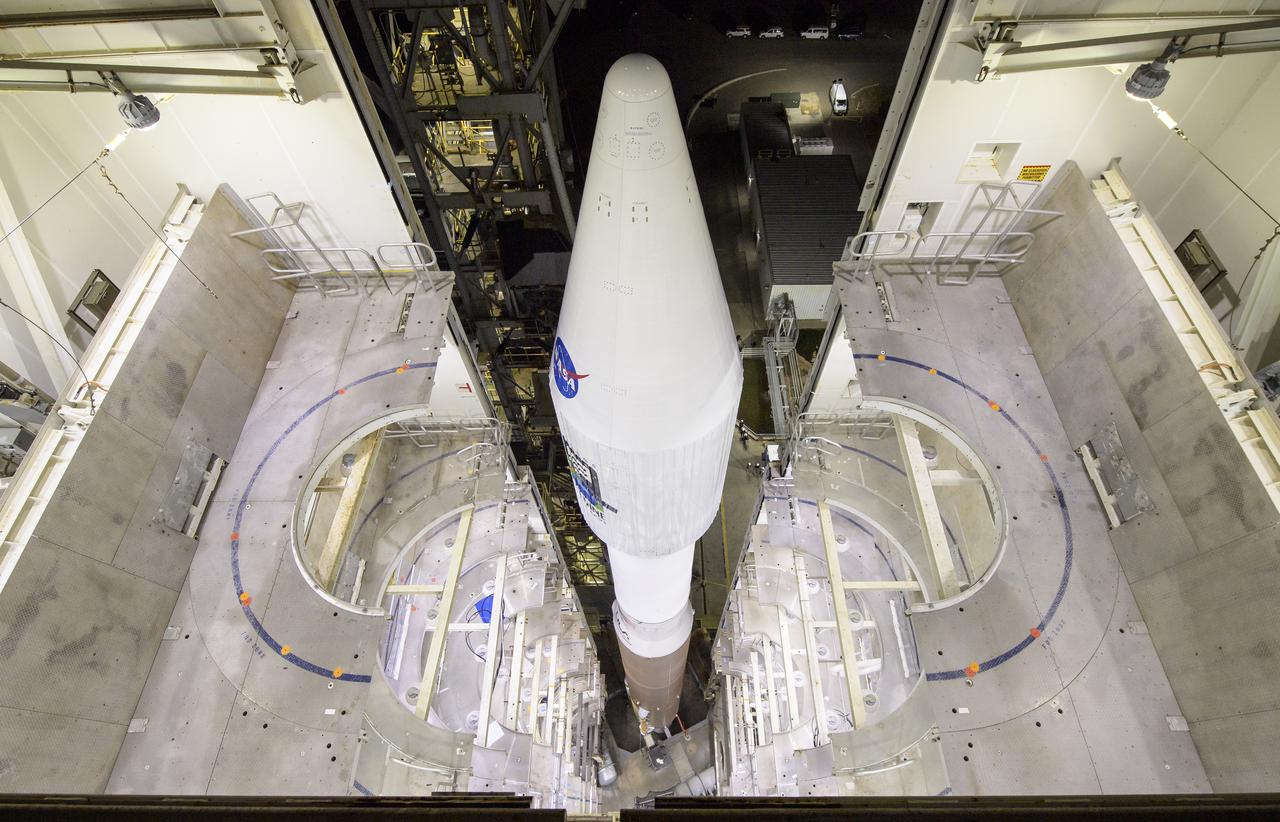
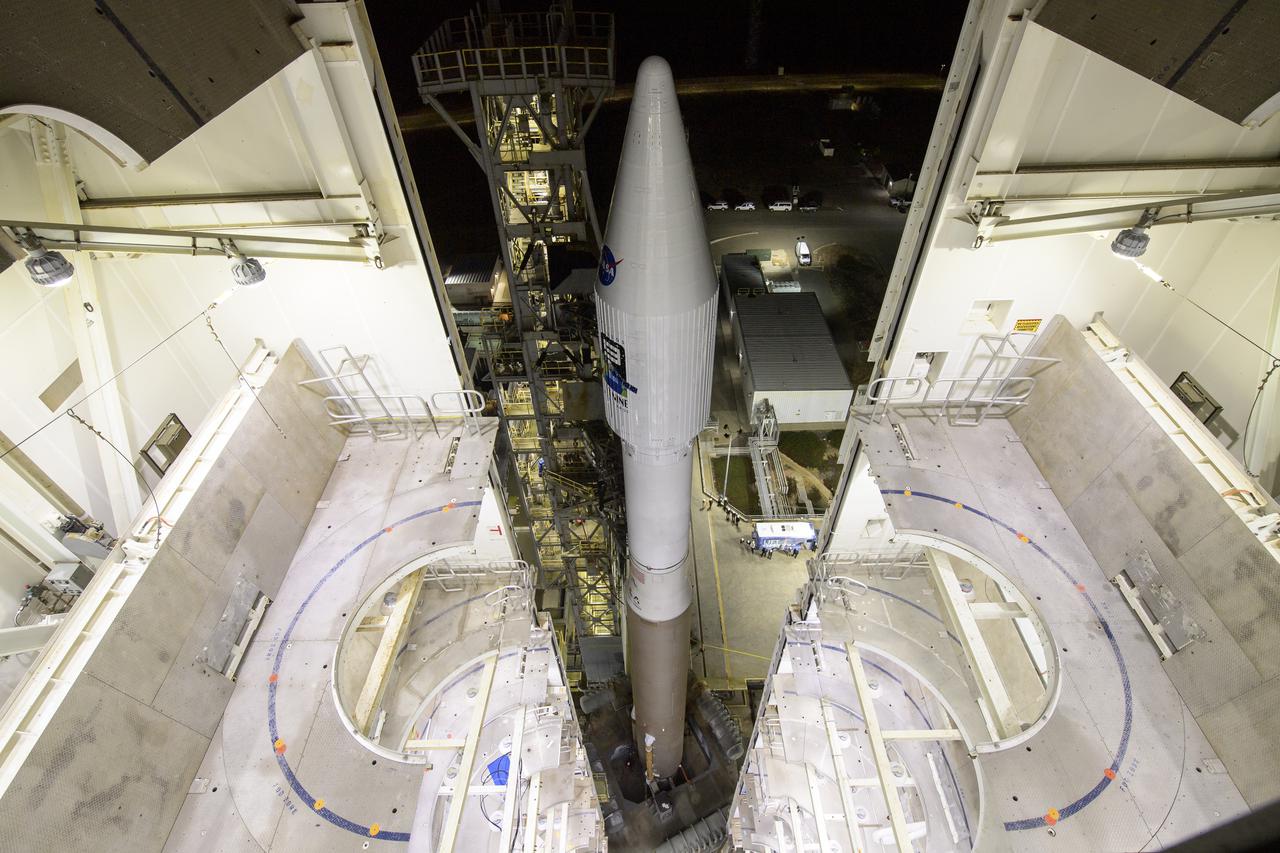
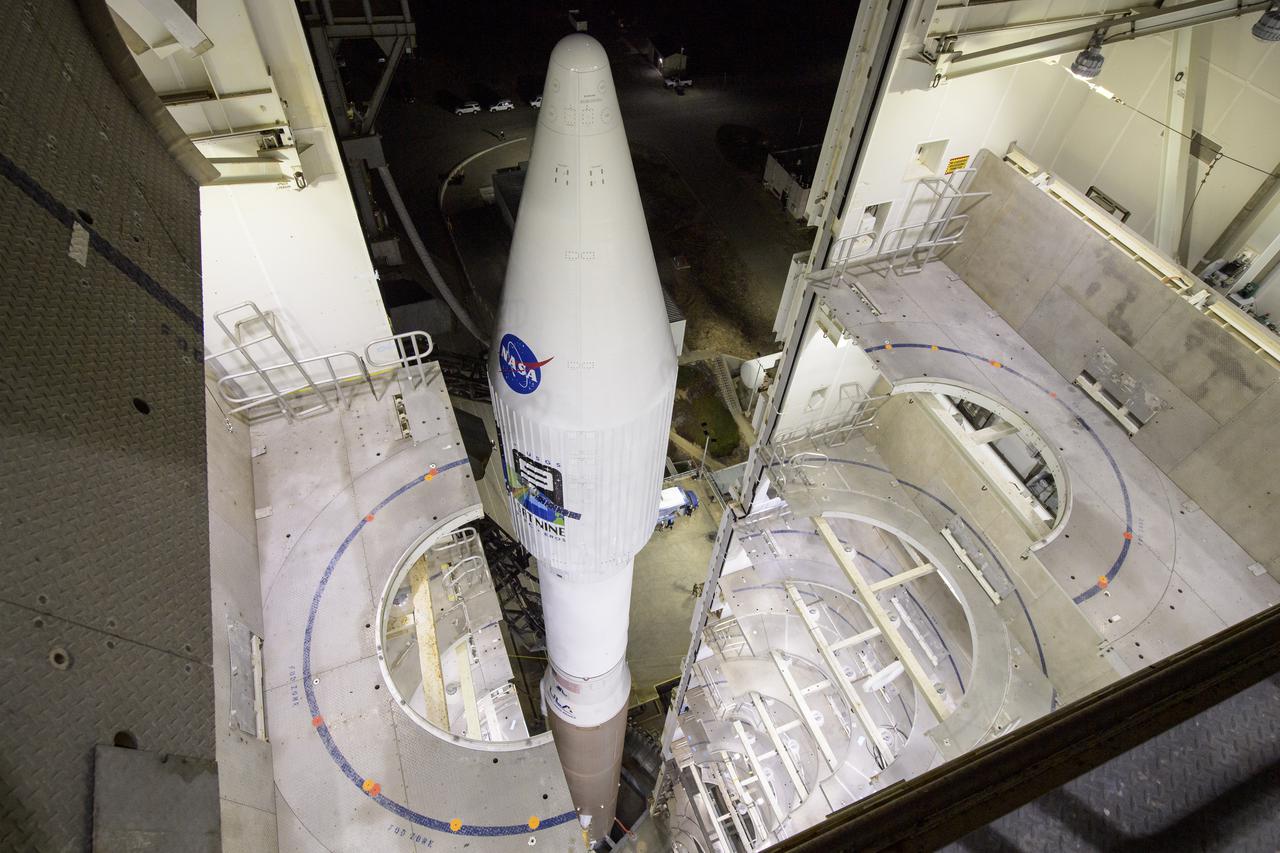
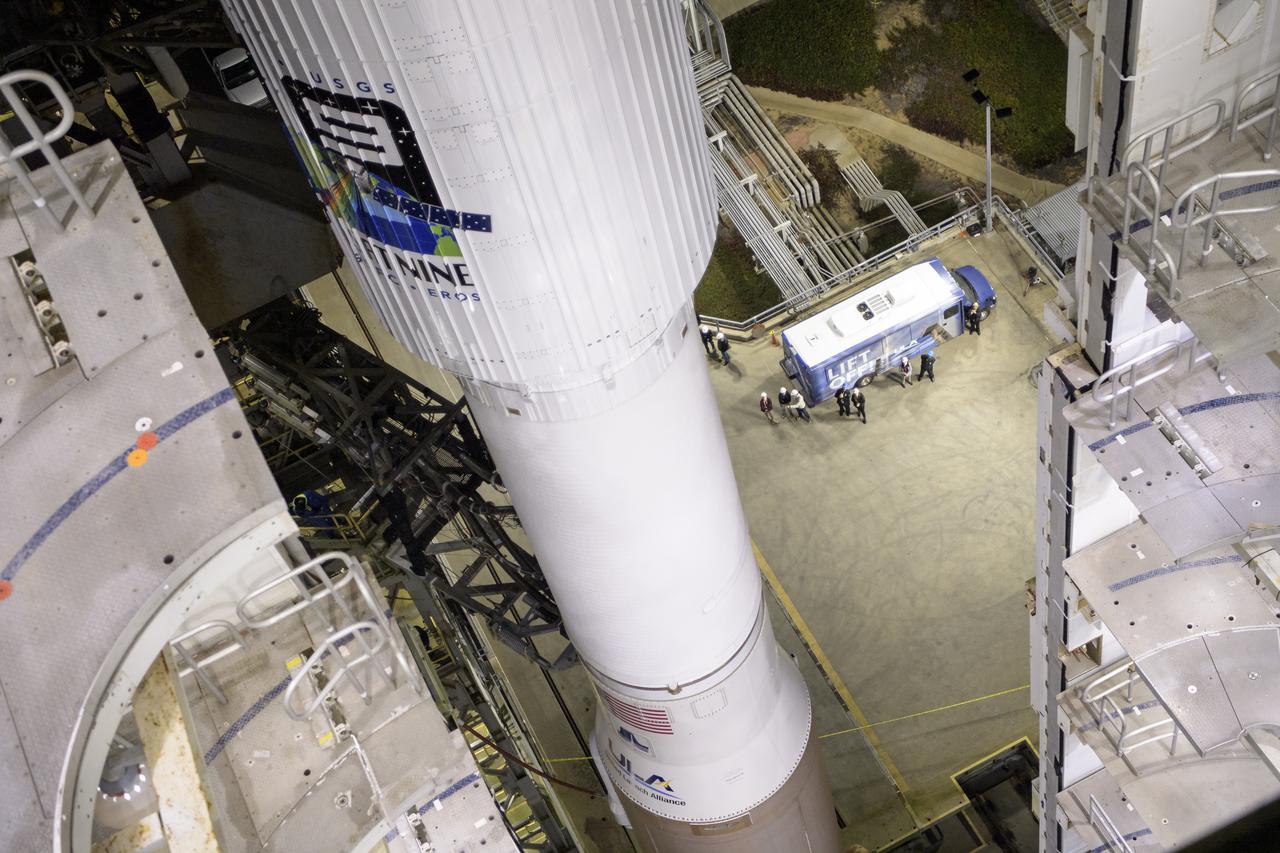
The United Launch Alliance (ULA) Atlas V rocket with the Landsat 9 satellite onboard is seen, Monday, Sept. 27, 2021, as the mobile launcher platform (MLP) is rolled back at Vandenberg Space Force Base in California. The Landsat 9 satellite is a joint NASA/U.S. Geological Survey mission that will continue the legacy of monitoring Earth’s land and coastal regions. Photo Credit: (NASA/Bill Ingalls)
Landsat 9 Prepares for Launch
The United Launch Alliance (ULA) Atlas V rocket with the Landsat 9 satellite onboard is seen, Monday, Sept. 27, 2021, as the mobile launcher platform (MLP) is rolled back at Vandenberg Space Force Base in California. The Landsat 9 satellite is a joint NASA/U.S. Geological Survey mission that will continue the legacy of monitoring Earth’s land and coastal regions. Photo Credit: (NASA/Bill Ingalls)
Landsat 9 Prepares for Launch
The United Launch Alliance (ULA) Atlas V rocket with the Landsat 9 satellite onboard is seen, Monday, Sept. 27, 2021, as the mobile launcher platform (MLP) is rolled back at Vandenberg Space Force Base in California. The Landsat 9 satellite is a joint NASA/U.S. Geological Survey mission that will continue the legacy of monitoring Earth’s land and coastal regions. Photo Credit: (NASA/Bill Ingalls)
Landsat 9 Prepares for Launch
The United Launch Alliance (ULA) Atlas V rocket with the Landsat 9 satellite onboard is seen, Monday, Sept. 27, 2021, as the mobile launcher platform (MLP) is rolled back at Vandenberg Space Force Base in California. The Landsat 9 satellite is a joint NASA/U.S. Geological Survey mission that will continue the legacy of monitoring Earth’s land and coastal regions. Photo Credit: (NASA/Bill Ingalls)
Landsat 9 Prepares for Launch
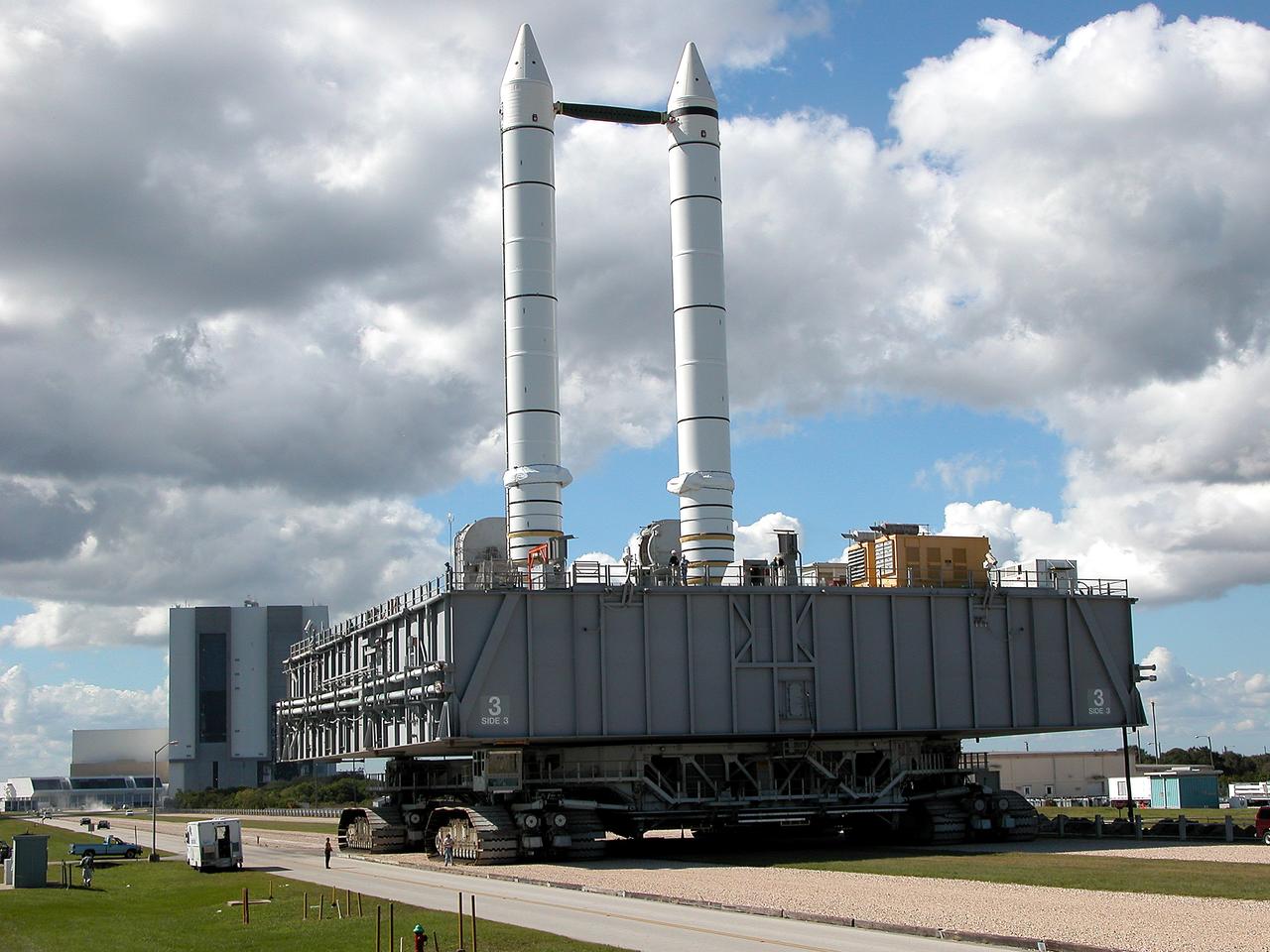
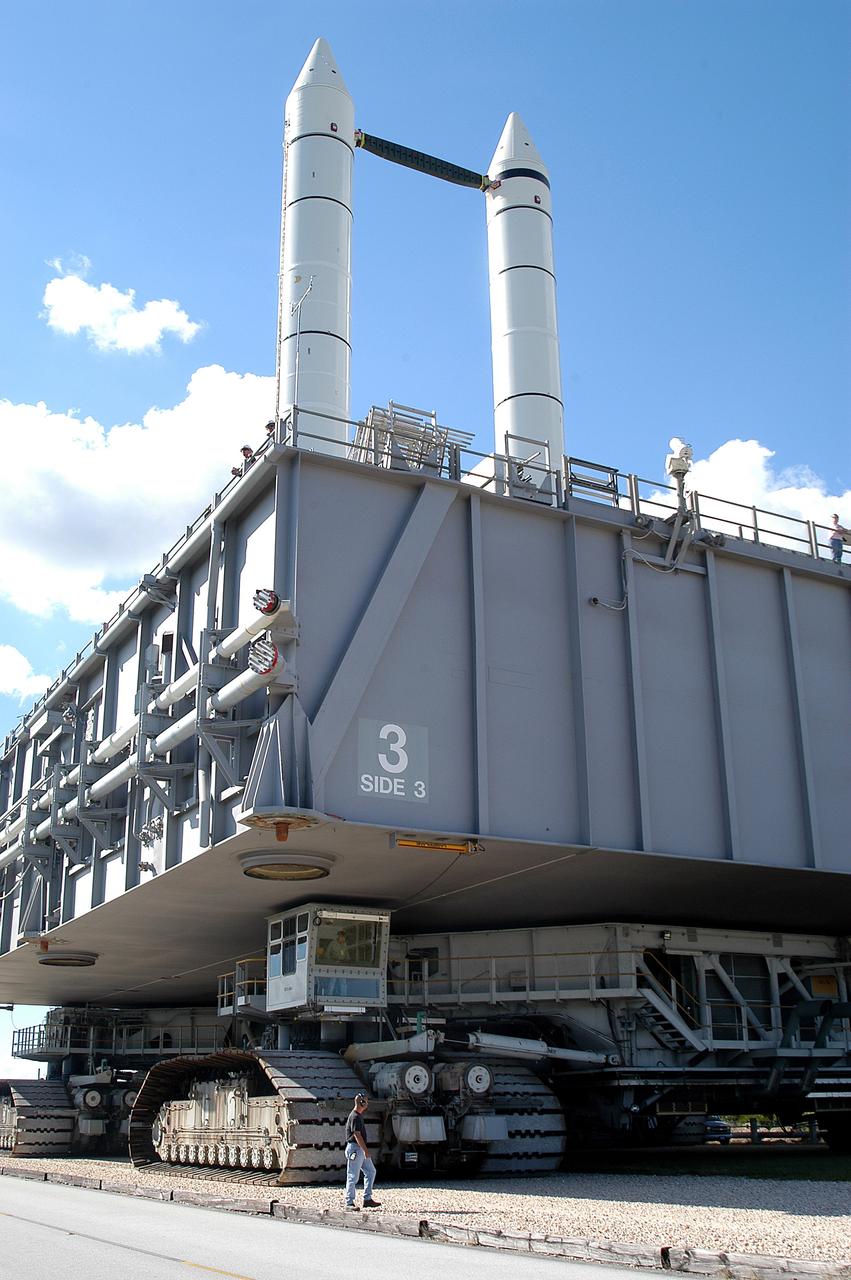
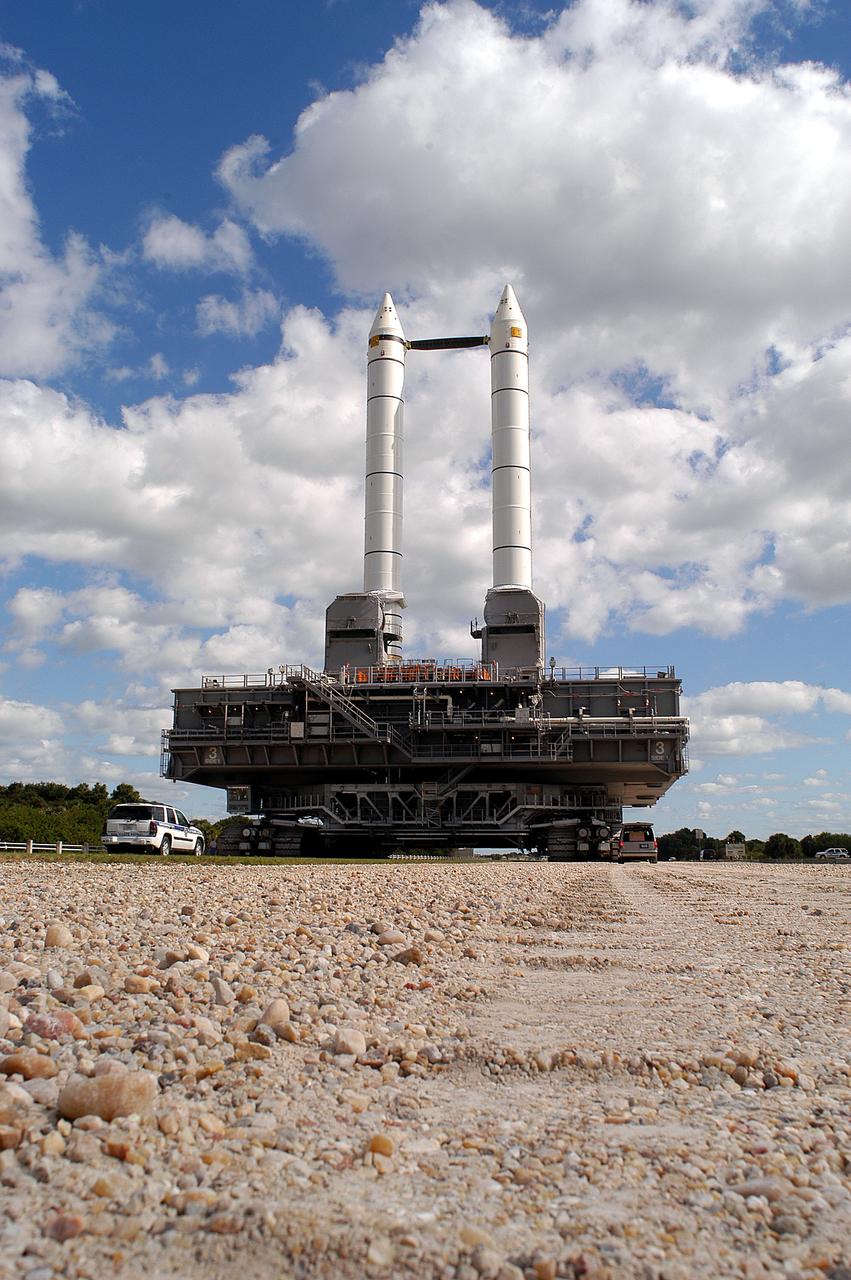
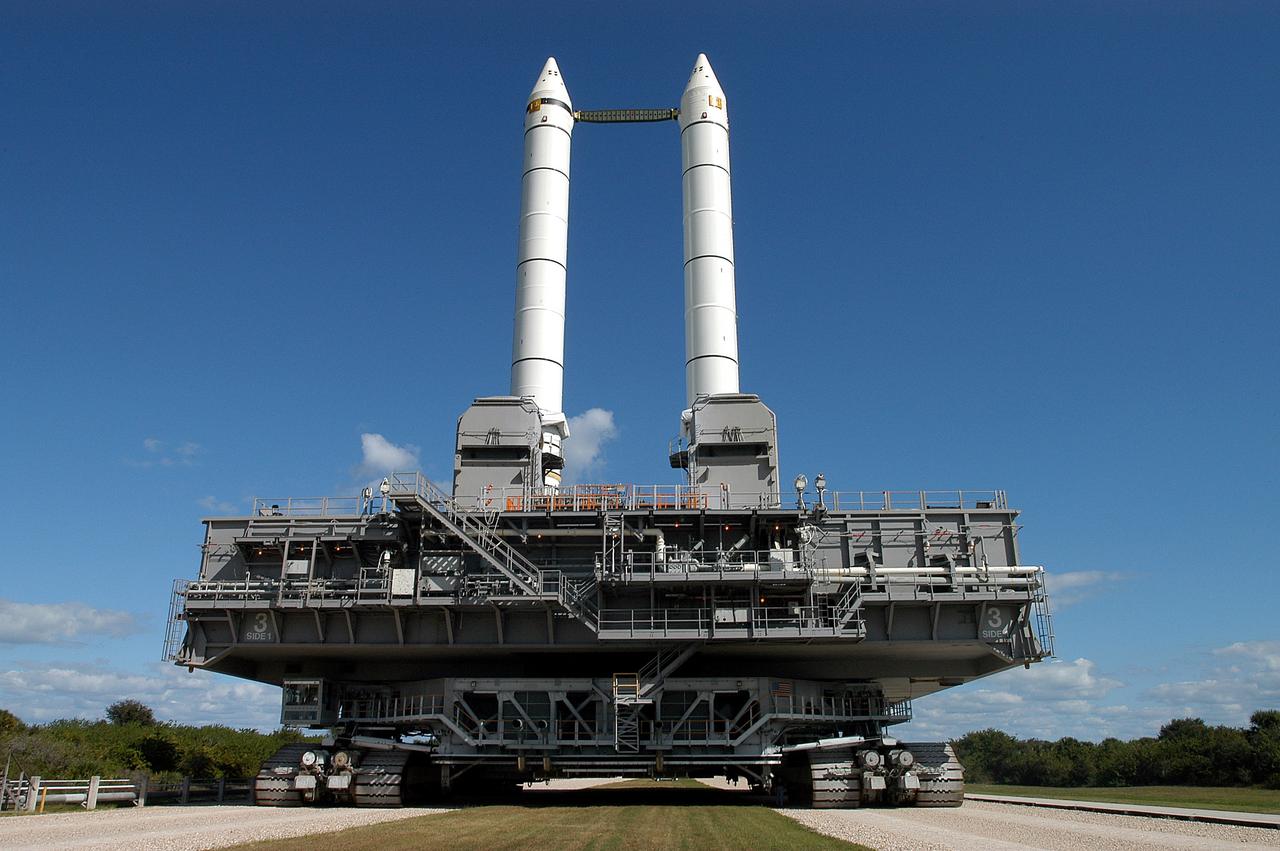
KENNEDY SPACE CENTER, FLA. -  Like candles embedded in a sculptured “cake,” the Mobile Launcher Platform (MLP) number 3 with twin solid rocket boosters bolted to it inches along the crawlerway at various speeds up to 1 mph in an effort to achieve vibration data gathering goals. The boosters are braced at the top for stability.  The primary purpose of these rollout tests is to gather data to develop future maintenance requirements on the transport equipment and the flight hardware. Various parts of the MLP and crawler transporter have been instrumented with vibration data collection equipment.
KENNEDY SPACE CENTER, FLA. - Like candles embedded in a sculptured “cake,” the Mobile Launcher Platform (MLP) number 3 with twin solid rocket boosters bolted to it inches along the crawlerway at various speeds up to 1 mph in an effort to achieve vibration data gathering goals. The boosters are braced at the top for stability. The primary purpose of these rollout tests is to gather data to develop future maintenance requirements on the transport equipment and the flight hardware. Various parts of the MLP and crawler transporter have been instrumented with vibration data collection equipment.
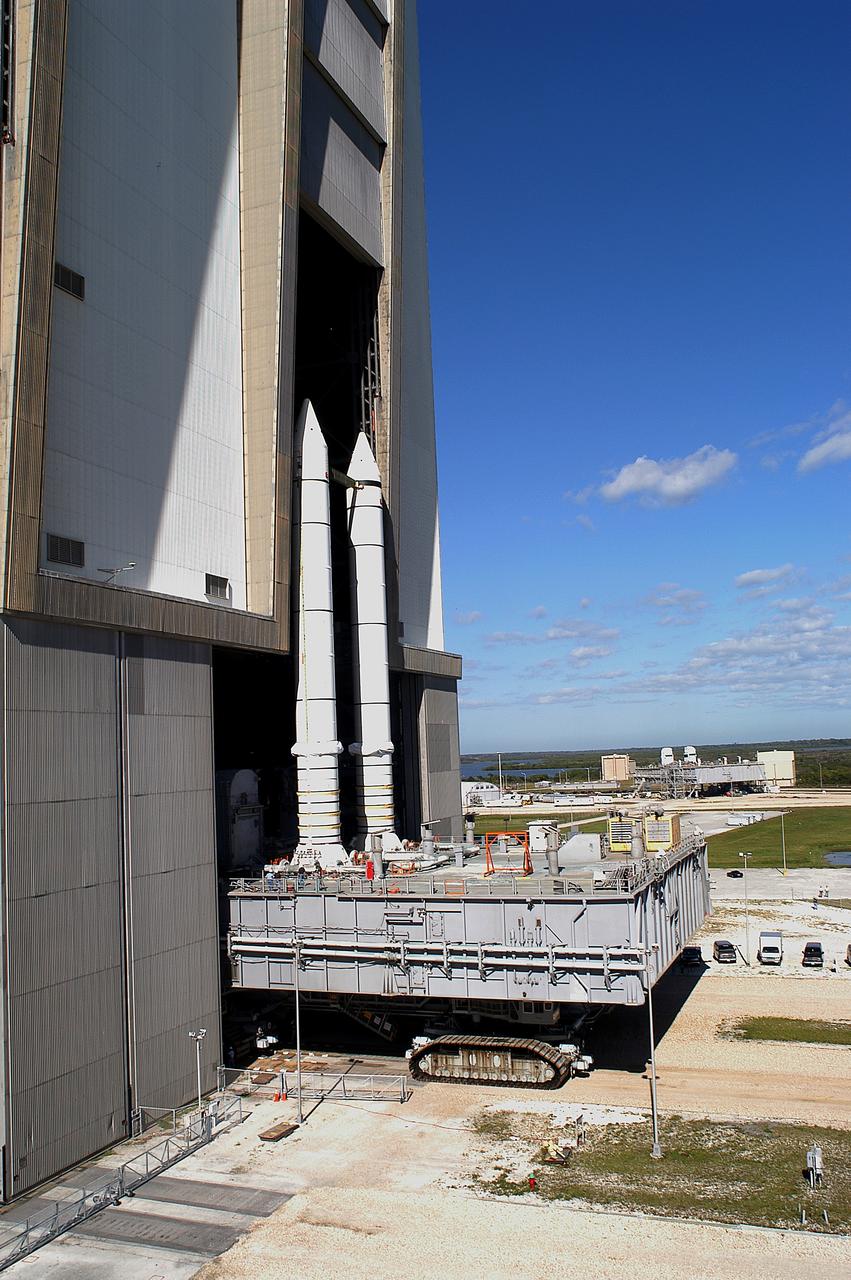
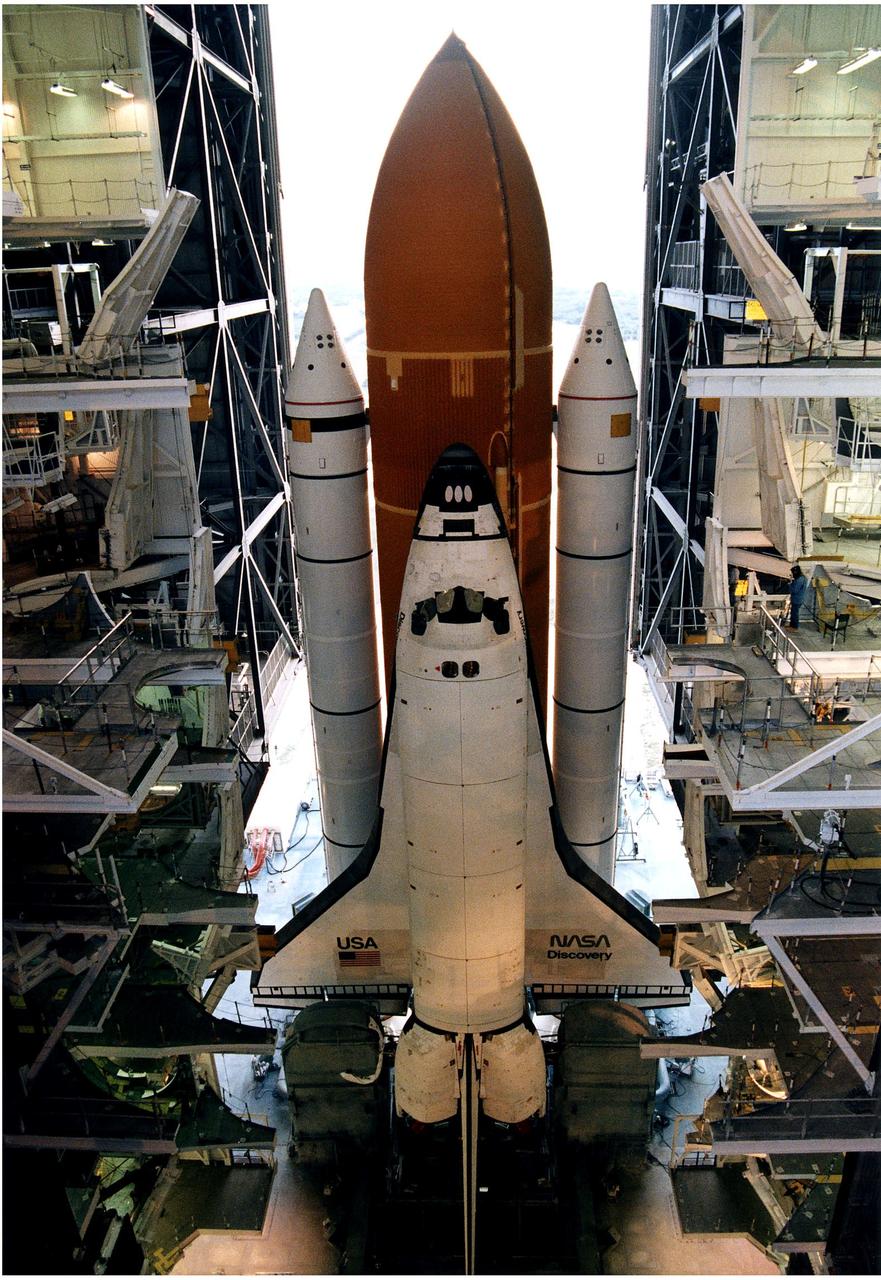
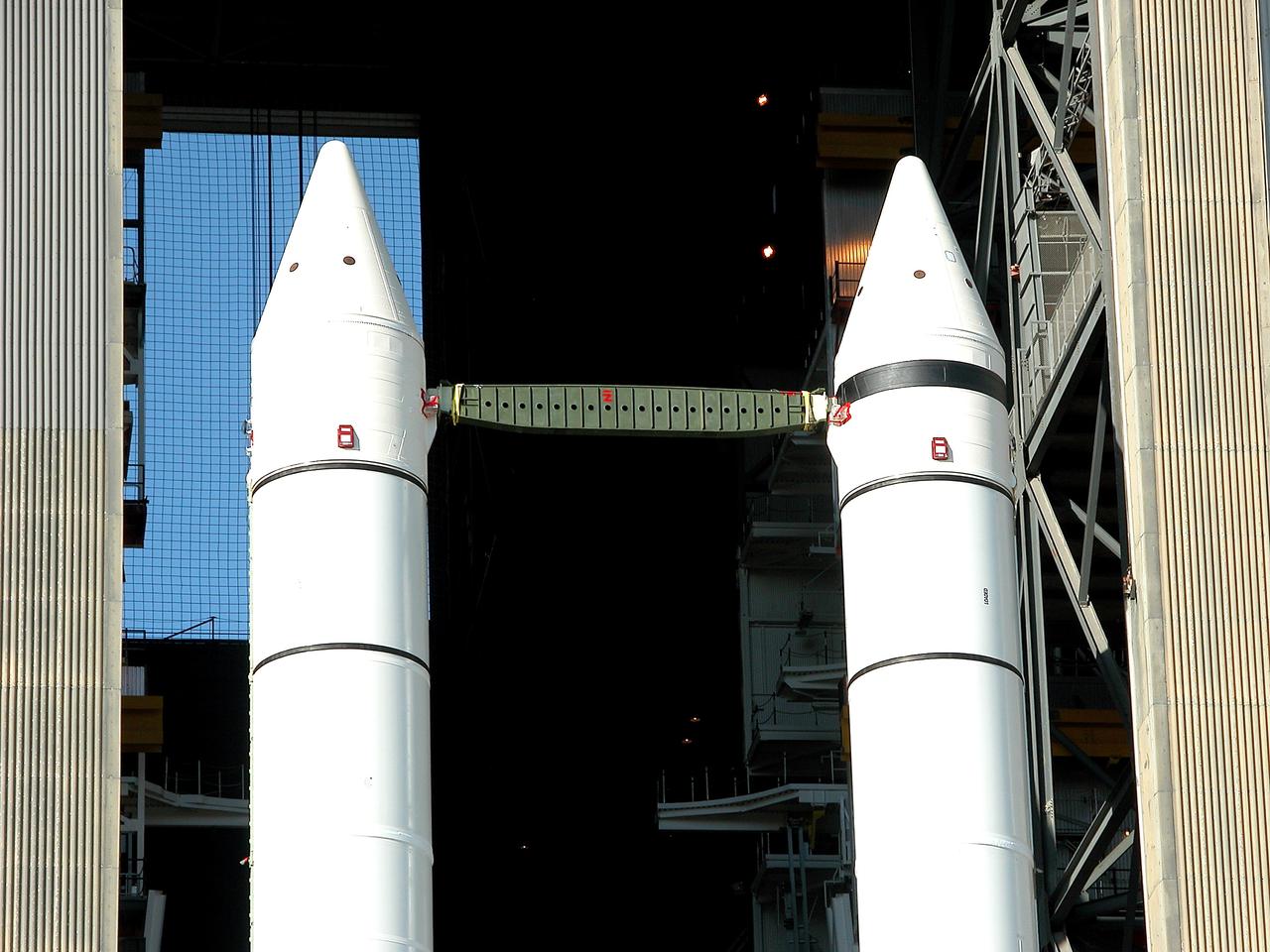
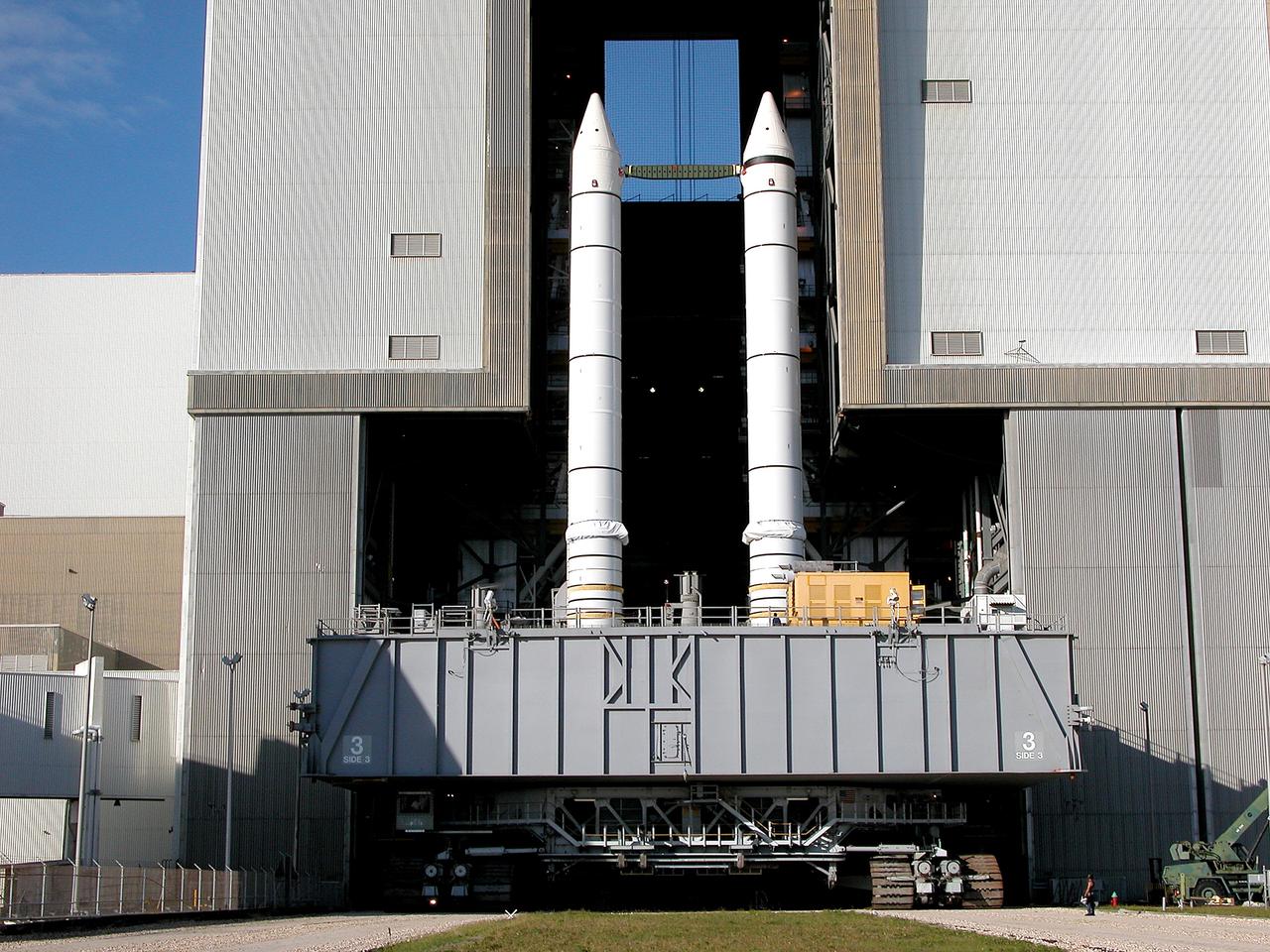
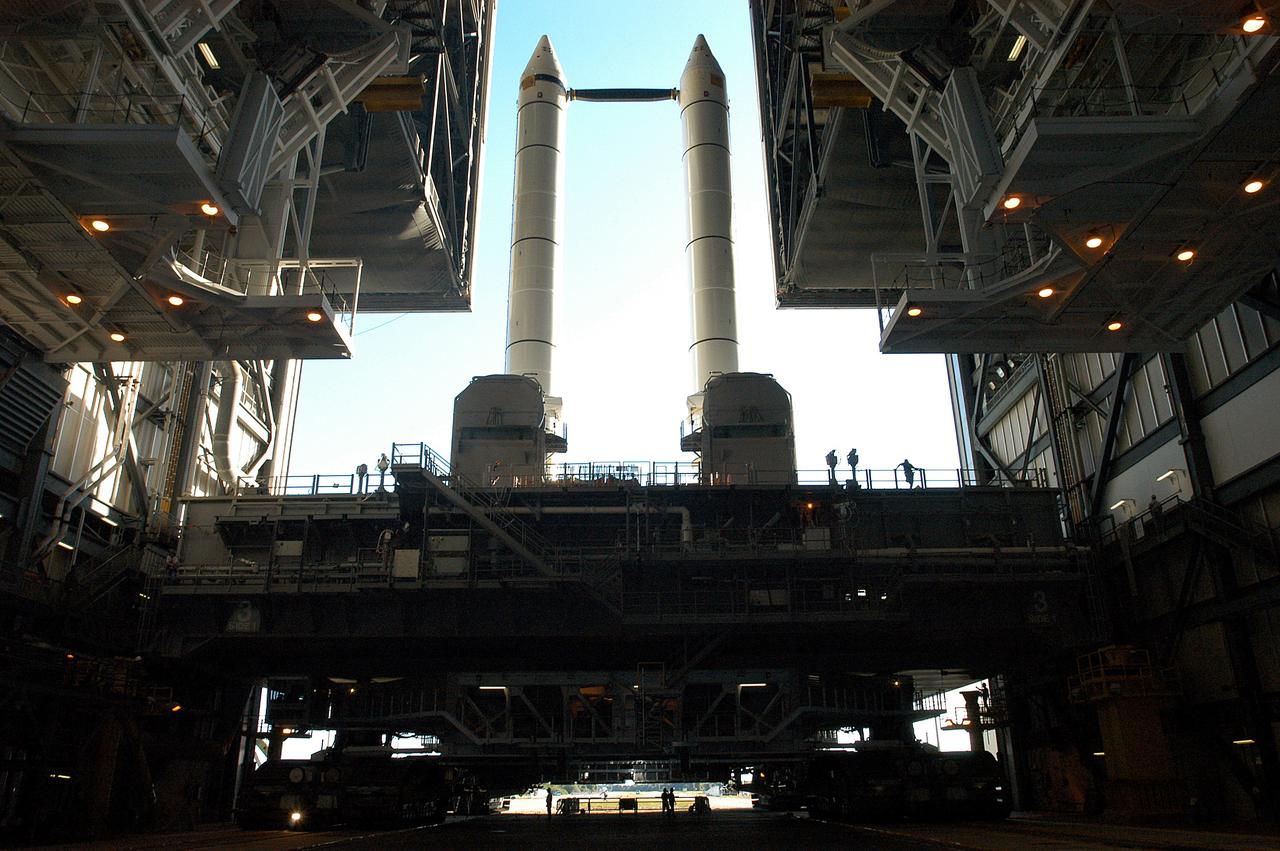
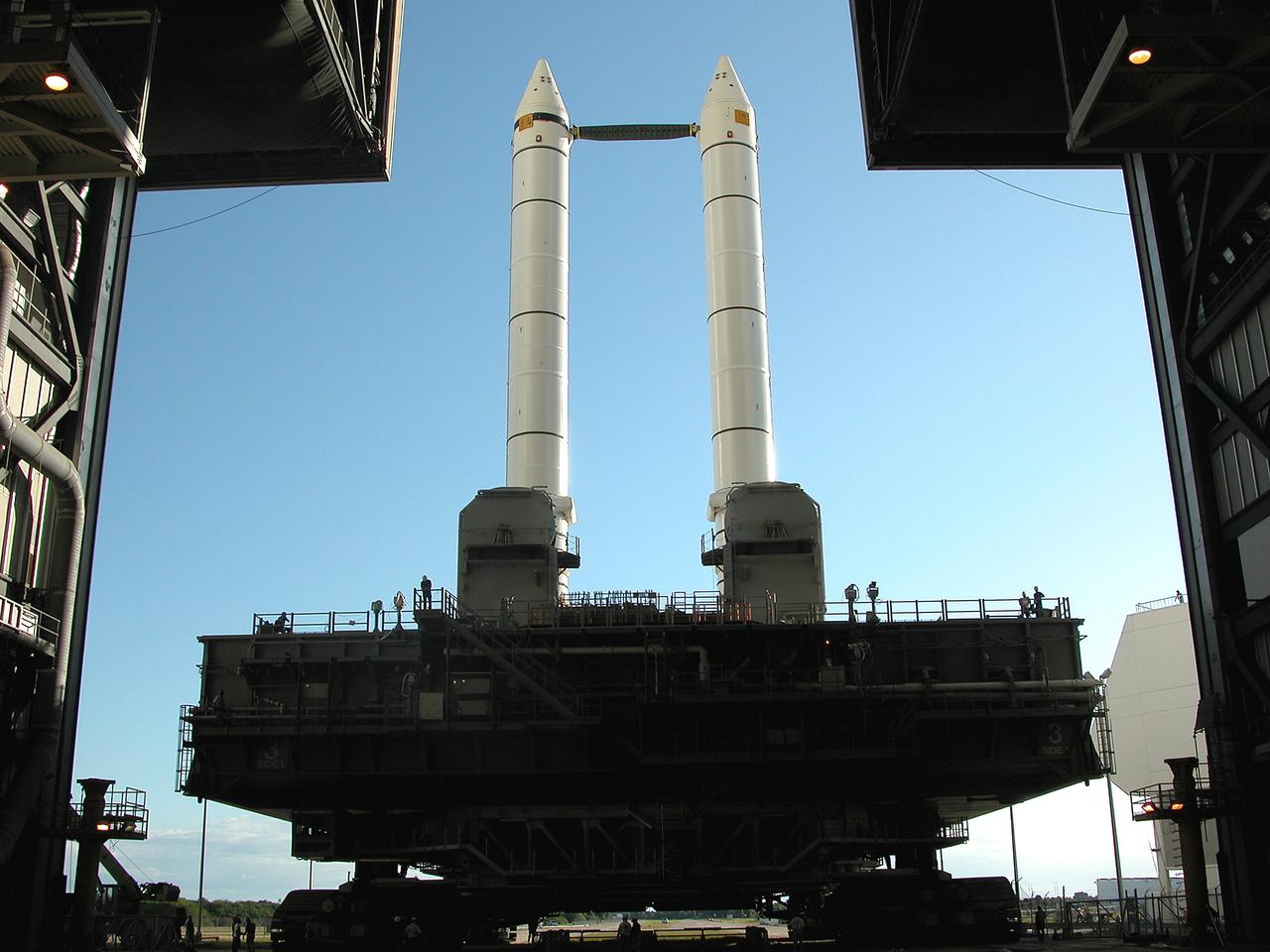
KENNEDY SPACE CENTER, FLA. -  As the crawler transporter slowly moves the Mobile Launcher Platform (MLP) out of the Vehicle Assembly Building, the two solid rocket boosters on top are framed in the doorway.  The move is in support of engineering analysis vibration tests on the crawler and MLP.  The crawler is moving at various speeds up to 1 mph in an effort to achieve vibration data gathering goals as it leaves the VAB and then returns.  The boosters are braced at the top for stability.  The primary purpose of these rollout tests is to gather data to develop future maintenance requirements on the transport equipment and the flight hardware. Various parts of the MLP and crawler transporter have been instrumented with vibration data collection equipment.
KENNEDY SPACE CENTER, FLA. - As the crawler transporter slowly moves the Mobile Launcher Platform (MLP) out of the Vehicle Assembly Building, the two solid rocket boosters on top are framed in the doorway. The move is in support of engineering analysis vibration tests on the crawler and MLP. The crawler is moving at various speeds up to 1 mph in an effort to achieve vibration data gathering goals as it leaves the VAB and then returns. The boosters are braced at the top for stability. The primary purpose of these rollout tests is to gather data to develop future maintenance requirements on the transport equipment and the flight hardware. Various parts of the MLP and crawler transporter have been instrumented with vibration data collection equipment.
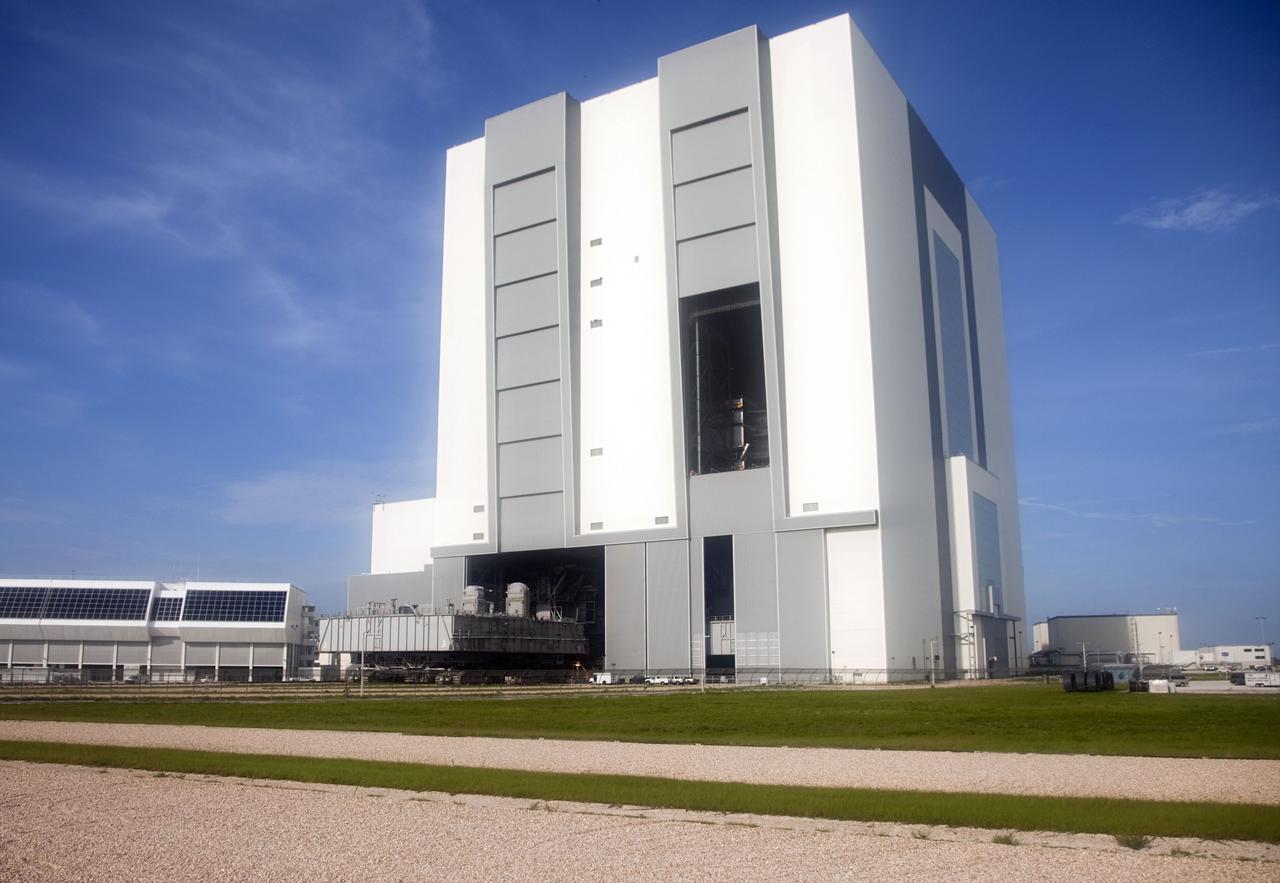
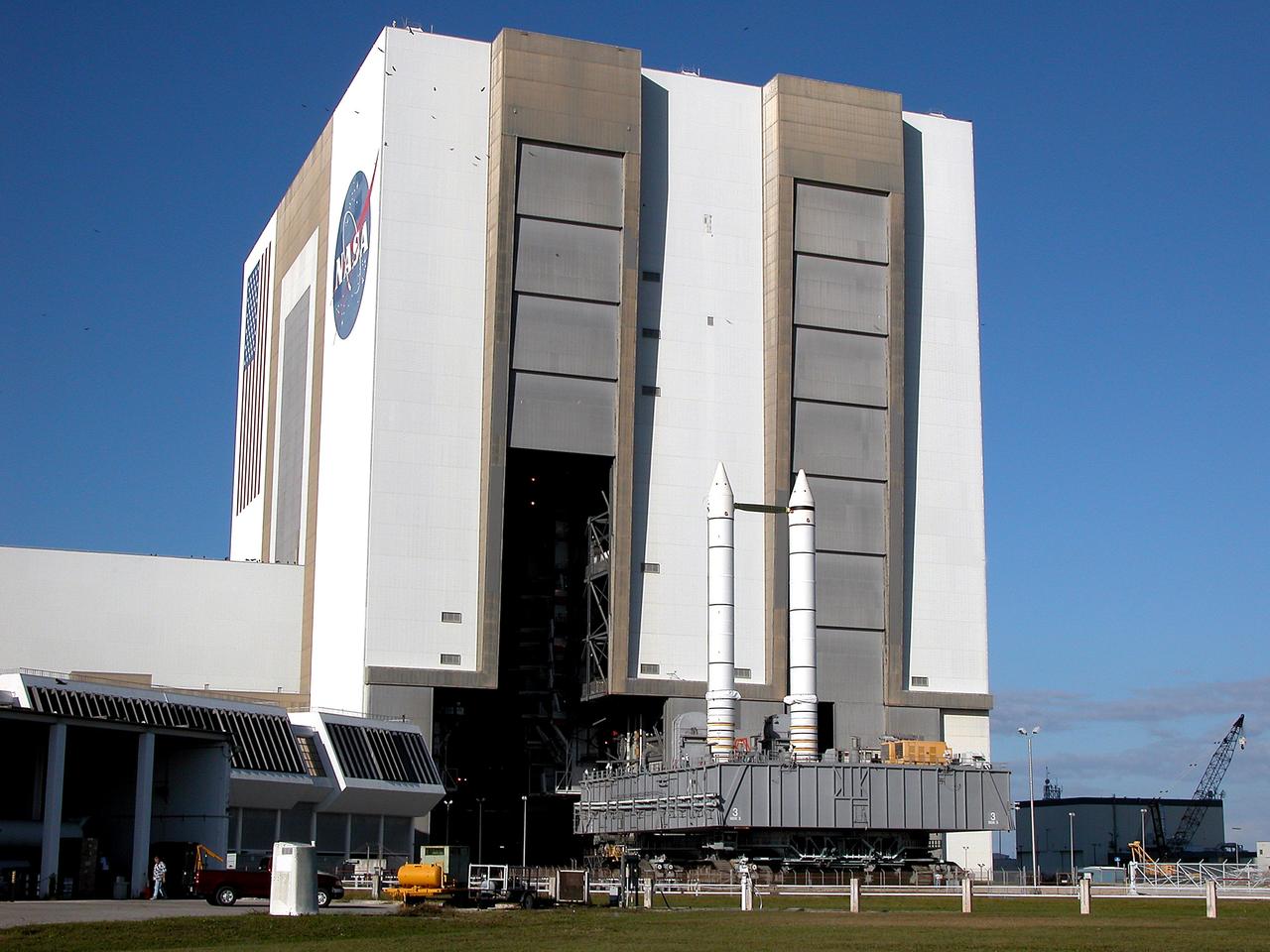
KENNEDY SPACE CENTER, FLA. -  The crawler transporter has slowly moved the Mobile Launcher Platform (MLP), carrying a set of twin solid rocket boosters, out of the Vehicle Assembly Building (VAB) in support of engineering analysis vibration tests on the crawler and MLP. The crawler is moving at various speeds up to 1 mph in an effort to achieve vibration data gathering goals as it leaves the VAB and then returns.  The boosters are braced at the top for stability.  The primary purpose of these rollout tests is to gather data to develop future maintenance requirements on the transport equipment and the flight hardware. Various parts of the MLP and crawler transporter have been instrumented with vibration data collection equipment.
KENNEDY SPACE CENTER, FLA. - The crawler transporter has slowly moved the Mobile Launcher Platform (MLP), carrying a set of twin solid rocket boosters, out of the Vehicle Assembly Building (VAB) in support of engineering analysis vibration tests on the crawler and MLP. The crawler is moving at various speeds up to 1 mph in an effort to achieve vibration data gathering goals as it leaves the VAB and then returns. The boosters are braced at the top for stability. The primary purpose of these rollout tests is to gather data to develop future maintenance requirements on the transport equipment and the flight hardware. Various parts of the MLP and crawler transporter have been instrumented with vibration data collection equipment.
KENNEDY SPACE CENTER, FLA. -  The crawler transporter slowly moves the Mobile Launcher Platform (MLP), carrying a set of twin solid rocket boosters, out of the Vehicle Assembly Building (VAB) in support of engineering analysis vibration tests on the crawler and MLP.   The crawler is moving at various speeds up to 1 mph in an effort to achieve vibration data gathering goals as it leaves the VAB and then returns.  The boosters are braced at the top for stability.  The primary purpose of these rollout tests is to gather data to develop future maintenance requirements on the transport equipment and the flight hardware. Various parts of the MLP and crawler transporter have been instrumented with vibration data collection equipment.
KENNEDY SPACE CENTER, FLA. - The crawler transporter slowly moves the Mobile Launcher Platform (MLP), carrying a set of twin solid rocket boosters, out of the Vehicle Assembly Building (VAB) in support of engineering analysis vibration tests on the crawler and MLP. The crawler is moving at various speeds up to 1 mph in an effort to achieve vibration data gathering goals as it leaves the VAB and then returns. The boosters are braced at the top for stability. The primary purpose of these rollout tests is to gather data to develop future maintenance requirements on the transport equipment and the flight hardware. Various parts of the MLP and crawler transporter have been instrumented with vibration data collection equipment.
KENNEDY SPACE CENTER, FLA. -  As the crawler transporter slowly moves the Mobile Launcher Platform (MLP) out of the Vehicle Assembly Building, the two solid rocket boosters on top are framed in the doorway.  The move is in support of engineering analysis vibration tests on the crawler and MLP. The crawler is moving at various speeds up to 1 mph in an effort to achieve vibration data gathering goals as it leaves the VAB and then returns.  The boosters are braced at the top for stability.  The primary purpose of these rollout tests is to gather data to develop future maintenance requirements on the transport equipment and the flight hardware. Various parts of the MLP and crawler transporter have been instrumented with vibration data collection equipment.
KENNEDY SPACE CENTER, FLA. - As the crawler transporter slowly moves the Mobile Launcher Platform (MLP) out of the Vehicle Assembly Building, the two solid rocket boosters on top are framed in the doorway. The move is in support of engineering analysis vibration tests on the crawler and MLP. The crawler is moving at various speeds up to 1 mph in an effort to achieve vibration data gathering goals as it leaves the VAB and then returns. The boosters are braced at the top for stability. The primary purpose of these rollout tests is to gather data to develop future maintenance requirements on the transport equipment and the flight hardware. Various parts of the MLP and crawler transporter have been instrumented with vibration data collection equipment.
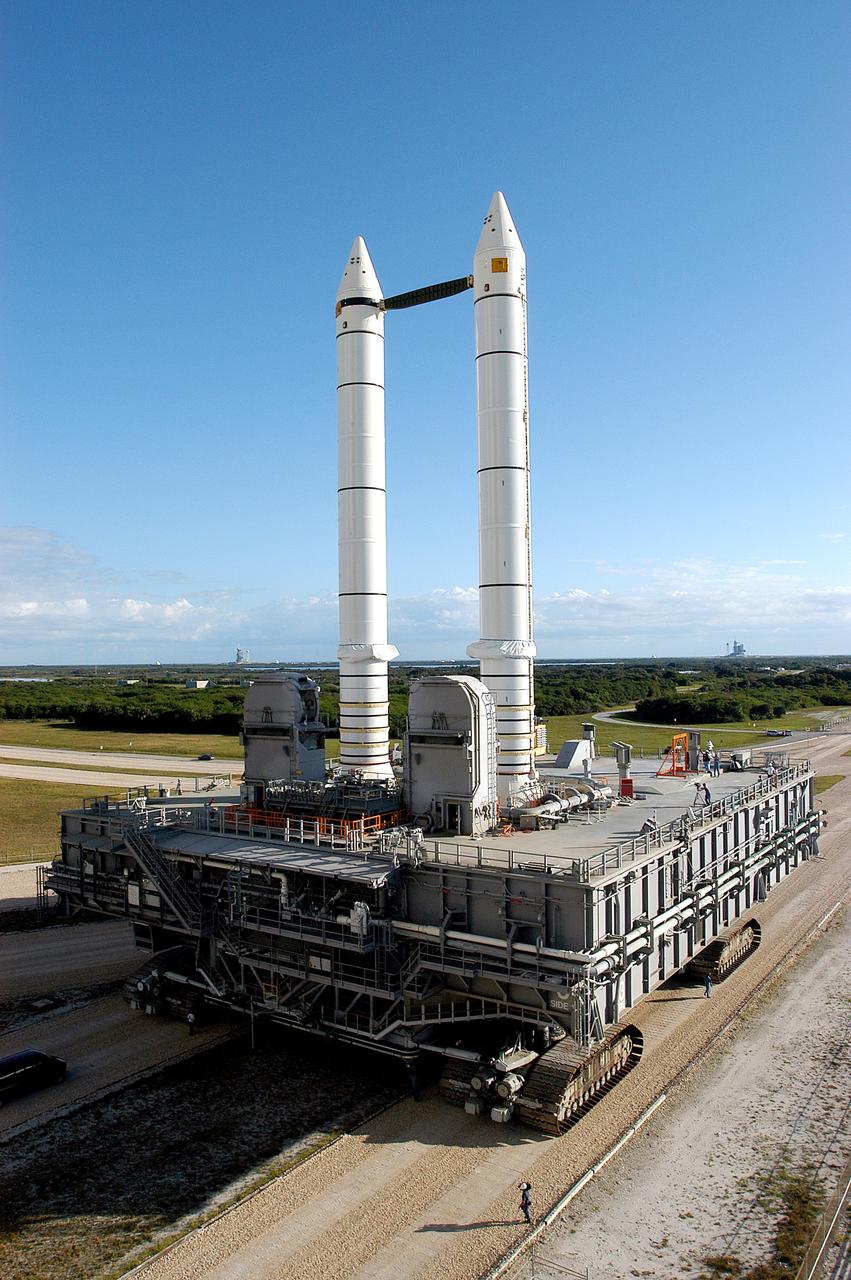
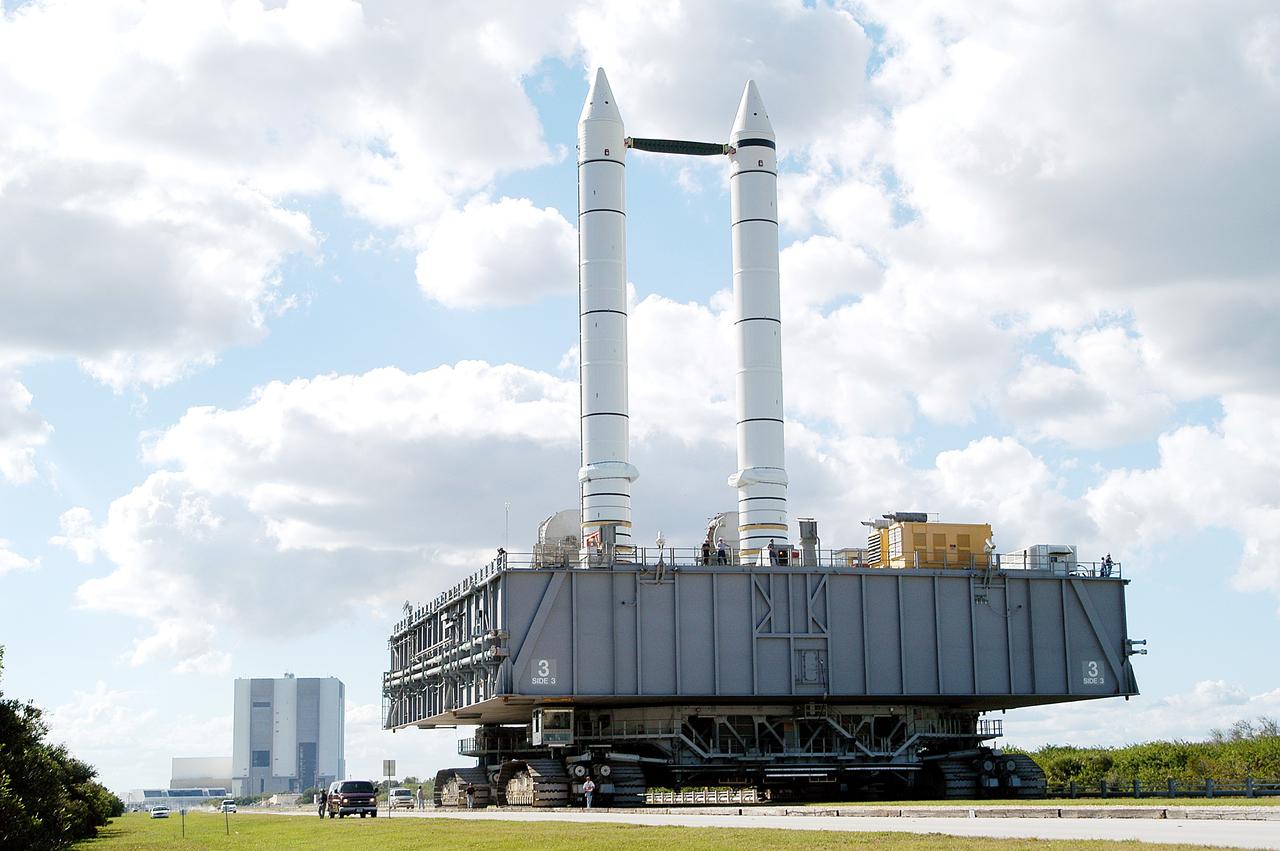
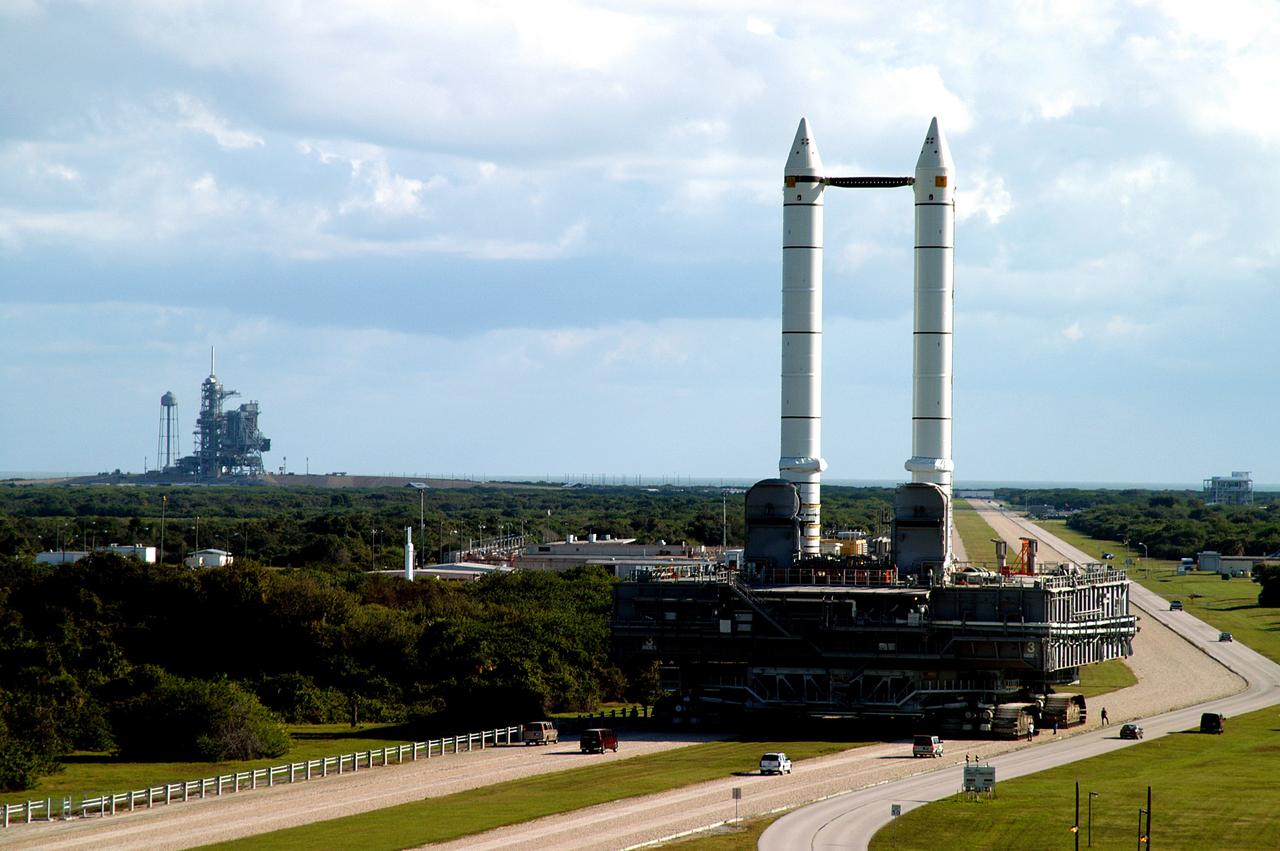
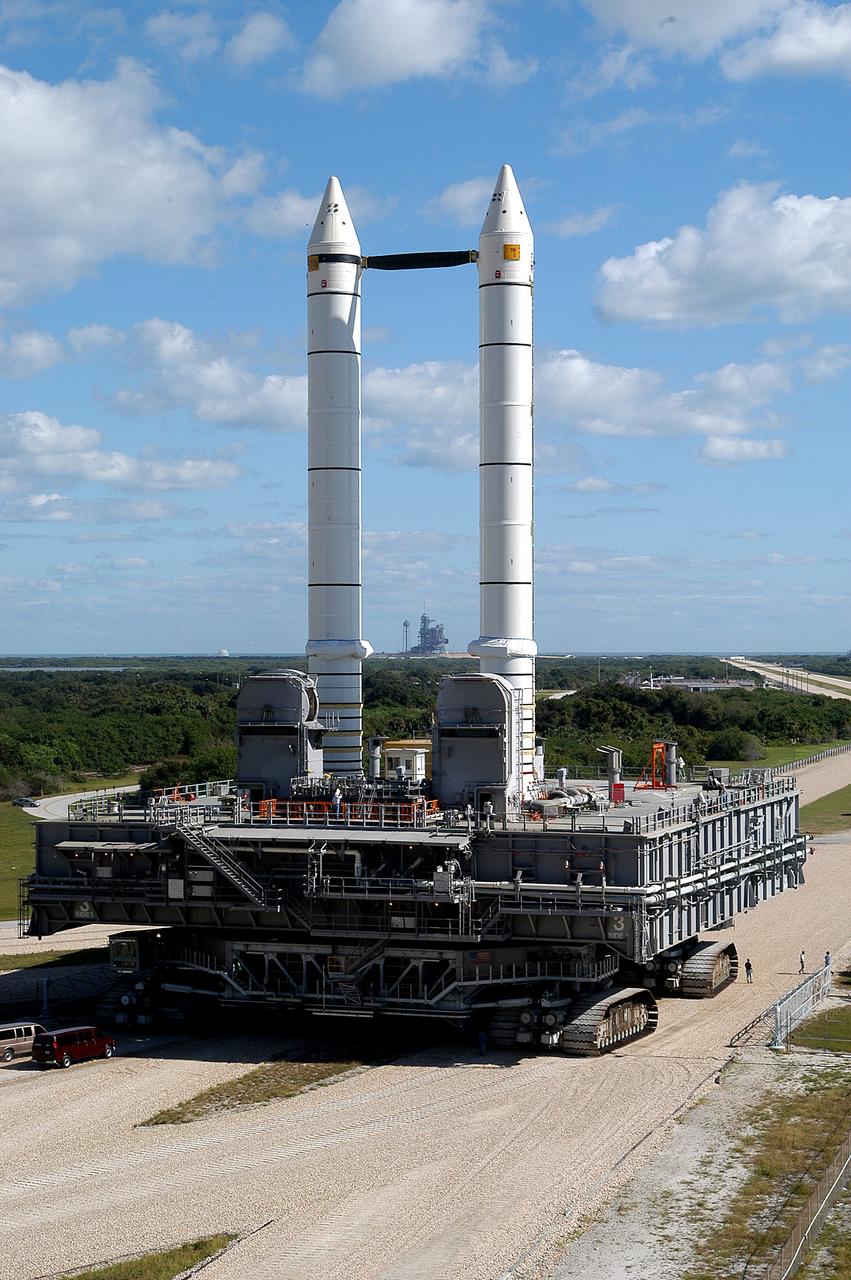
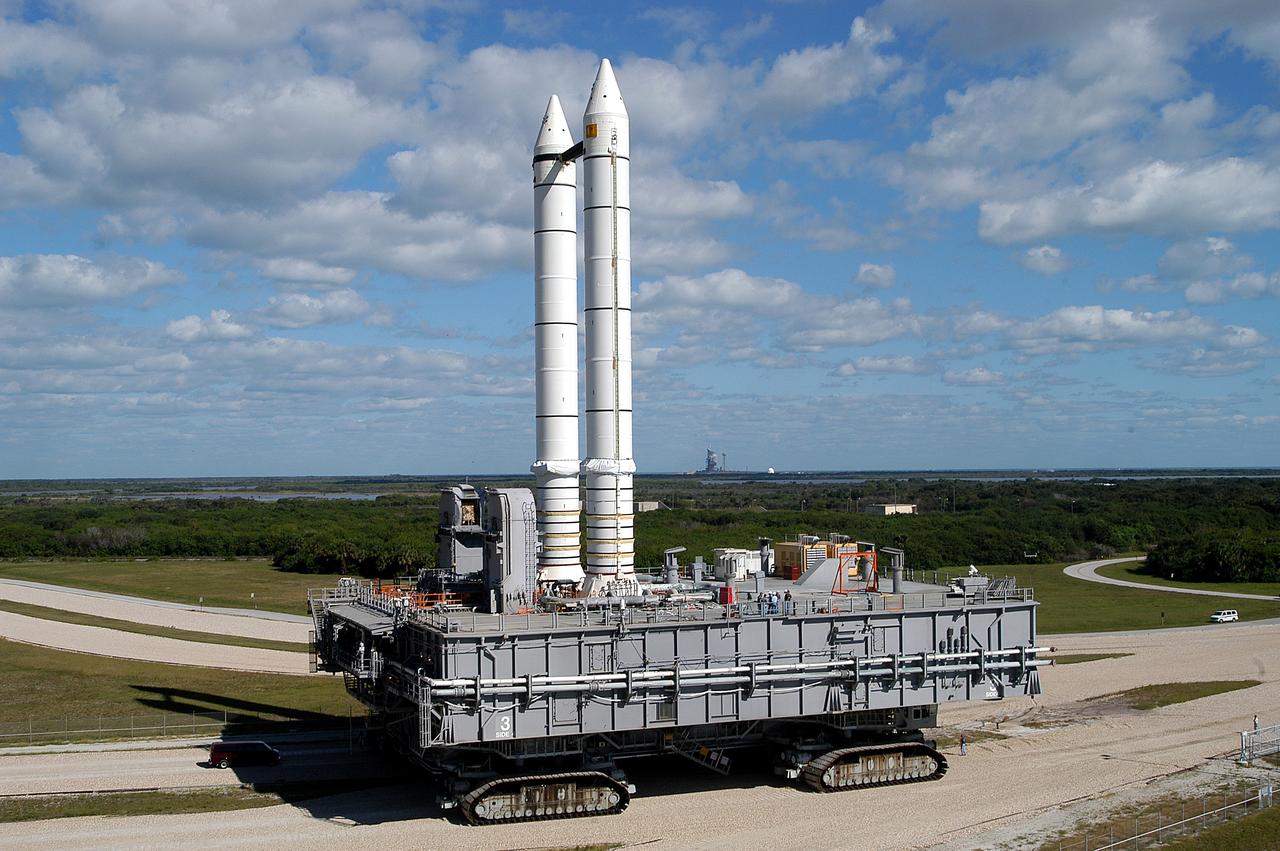
KENNEDY SPACE CENTER, FLA. -  Mobile Launcher Platform (MLP) number 3 and a set of twin solid rocket boosters, atop the crawler-transporter, inch along the crawlerway in support of the second engineering analysis vibration test on the crawler and MLP. The crawler is moving at various speeds up to 1 mph in an effort to achieve vibration data gathering goals as it leaves the VAB, travels toward Launch Pad 39A (framed between the boosters), and then returns.  The boosters are braced at the top for stability.  The primary purpose of these rollout tests is to gather data to develop future maintenance requirements on the transport equipment and the flight hardware. Various parts of the MLP and crawler transporter have been instrumented with vibration data collection equipment.
KENNEDY SPACE CENTER, FLA. - Mobile Launcher Platform (MLP) number 3 and a set of twin solid rocket boosters, atop the crawler-transporter, inch along the crawlerway in support of the second engineering analysis vibration test on the crawler and MLP. The crawler is moving at various speeds up to 1 mph in an effort to achieve vibration data gathering goals as it leaves the VAB, travels toward Launch Pad 39A (framed between the boosters), and then returns. The boosters are braced at the top for stability. The primary purpose of these rollout tests is to gather data to develop future maintenance requirements on the transport equipment and the flight hardware. Various parts of the MLP and crawler transporter have been instrumented with vibration data collection equipment.
KENNEDY SPACE CENTER, FLA. -  Mobile Launcher Platform (MLP) number 3 and a set of twin solid rocket boosters, atop the crawler-transporter, crawls away from the Vehicle Assembly Building in support of the second engineering analysis vibration test on the crawler and MLP. The crawler is moving at various speeds up to 1 mph in an effort to achieve vibration data gathering goals as it leaves the VAB, travels toward Launch Pad 39A and then returns.  The boosters are braced at the top for stability.  The primary purpose of these rollout tests is to gather data to develop future maintenance requirements on the transport equipment and the flight hardware. Various parts of the MLP and crawler transporter have been instrumented with vibration data collection equipment.
KENNEDY SPACE CENTER, FLA. - Mobile Launcher Platform (MLP) number 3 and a set of twin solid rocket boosters, atop the crawler-transporter, crawls away from the Vehicle Assembly Building in support of the second engineering analysis vibration test on the crawler and MLP. The crawler is moving at various speeds up to 1 mph in an effort to achieve vibration data gathering goals as it leaves the VAB, travels toward Launch Pad 39A and then returns. The boosters are braced at the top for stability. The primary purpose of these rollout tests is to gather data to develop future maintenance requirements on the transport equipment and the flight hardware. Various parts of the MLP and crawler transporter have been instrumented with vibration data collection equipment.
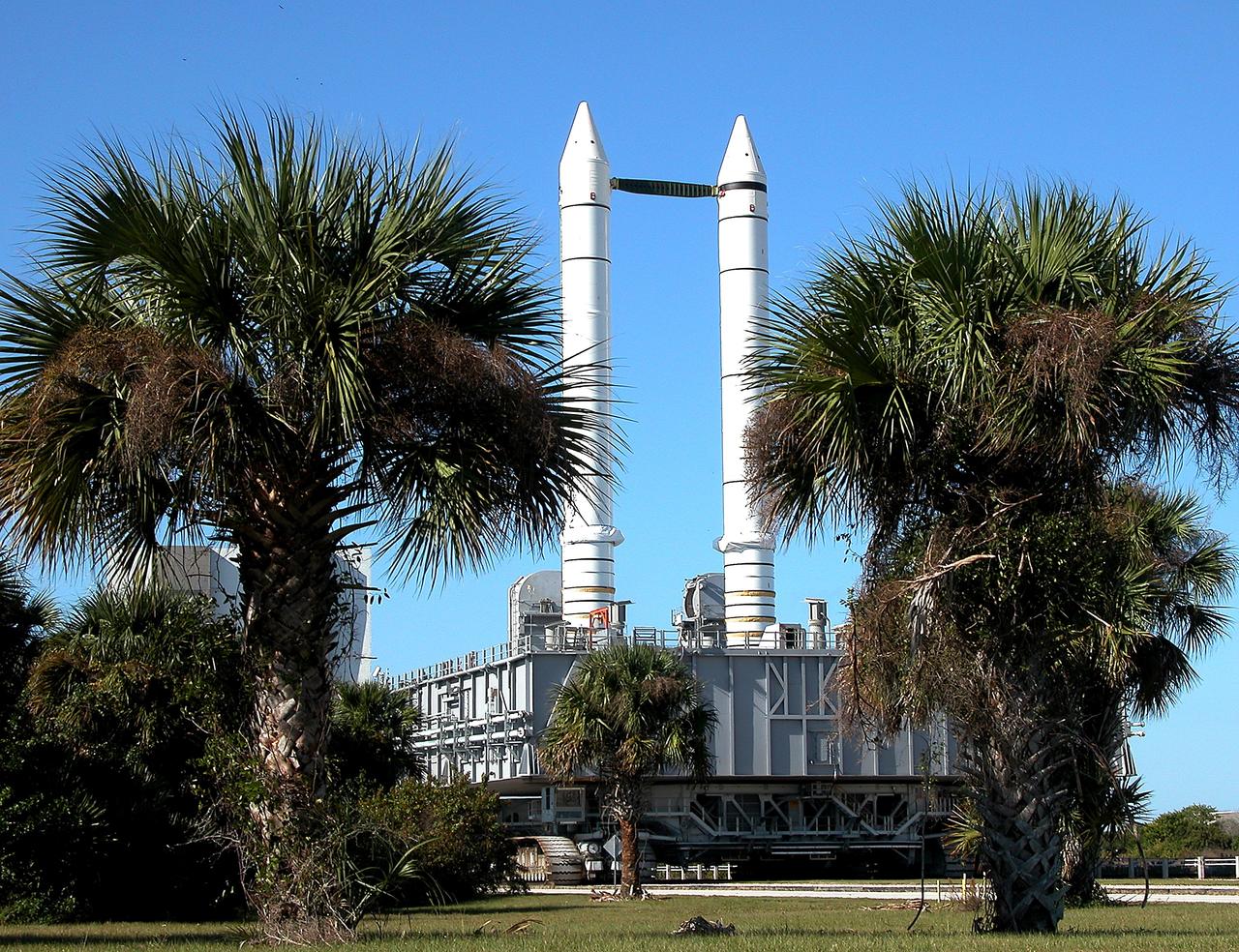
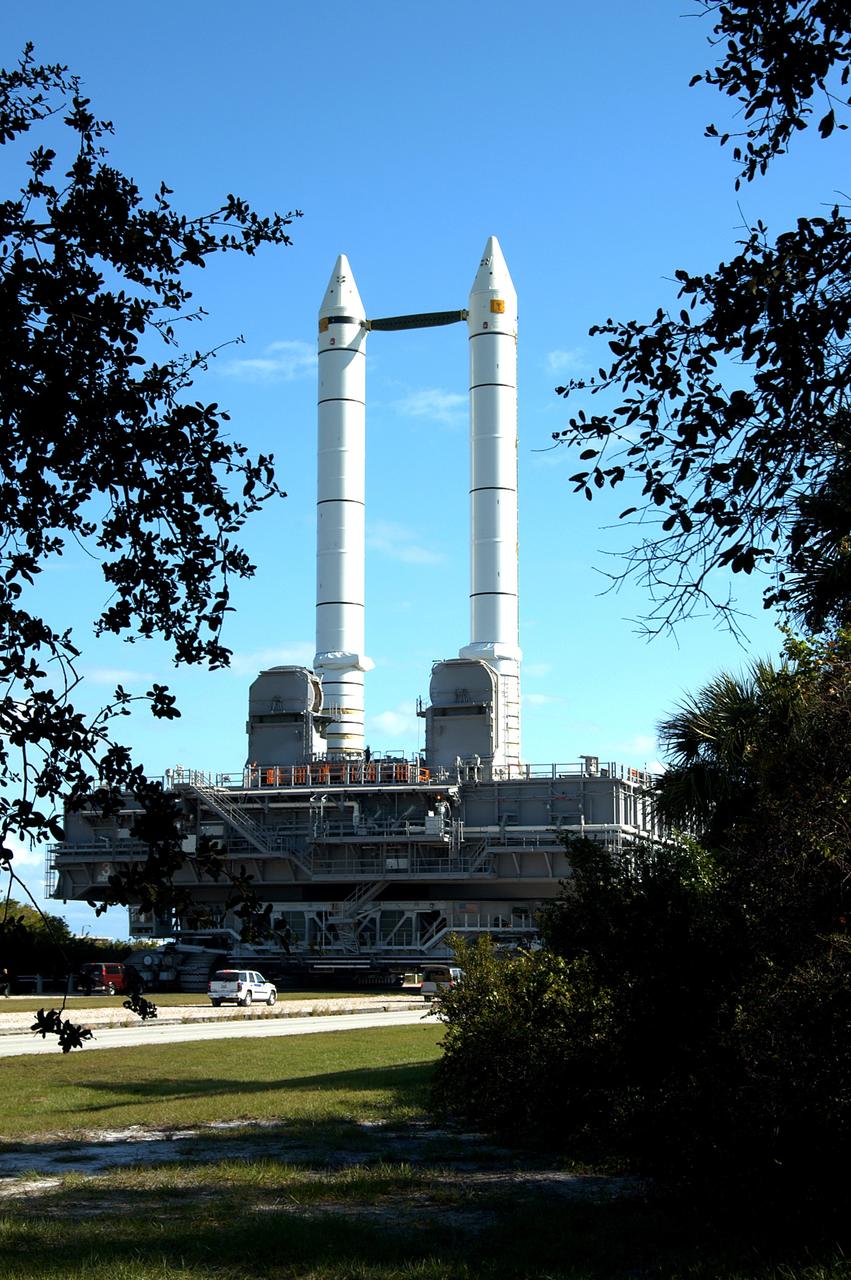
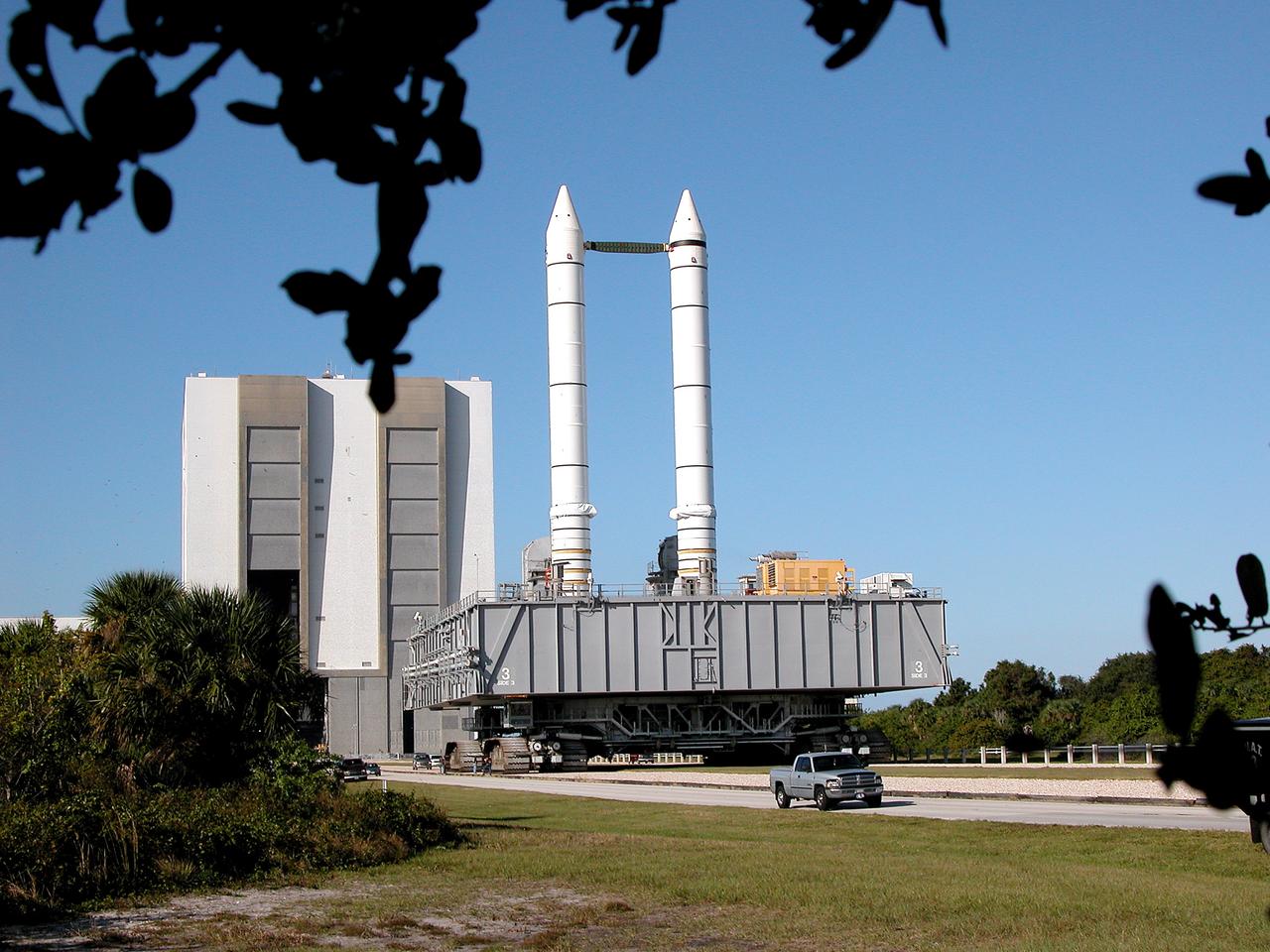
KENNEDY SPACE CENTER, FLA. -  Framed between palm trees, solid rocket boosters loom above the Mobile Launcher Platform (MLP) as the crawler transporter slowly moves it along the crawlerway.  The journey is in support of engineering analysis vibration tests on the crawler and MLP.  The crawler is moving at various speeds up to 1 mph in an effort to achieve vibration data gathering goals as it leaves the VAB and then returns.  The boosters are braced at the top for stability. The primary purpose of these rollout tests is to gather data to develop future maintenance requirements on the transport equipment and the flight hardware. Various parts of the MLP and crawler transporter have been instrumented with vibration data collection equipment.
KENNEDY SPACE CENTER, FLA. - Framed between palm trees, solid rocket boosters loom above the Mobile Launcher Platform (MLP) as the crawler transporter slowly moves it along the crawlerway. The journey is in support of engineering analysis vibration tests on the crawler and MLP. The crawler is moving at various speeds up to 1 mph in an effort to achieve vibration data gathering goals as it leaves the VAB and then returns. The boosters are braced at the top for stability. The primary purpose of these rollout tests is to gather data to develop future maintenance requirements on the transport equipment and the flight hardware. Various parts of the MLP and crawler transporter have been instrumented with vibration data collection equipment.
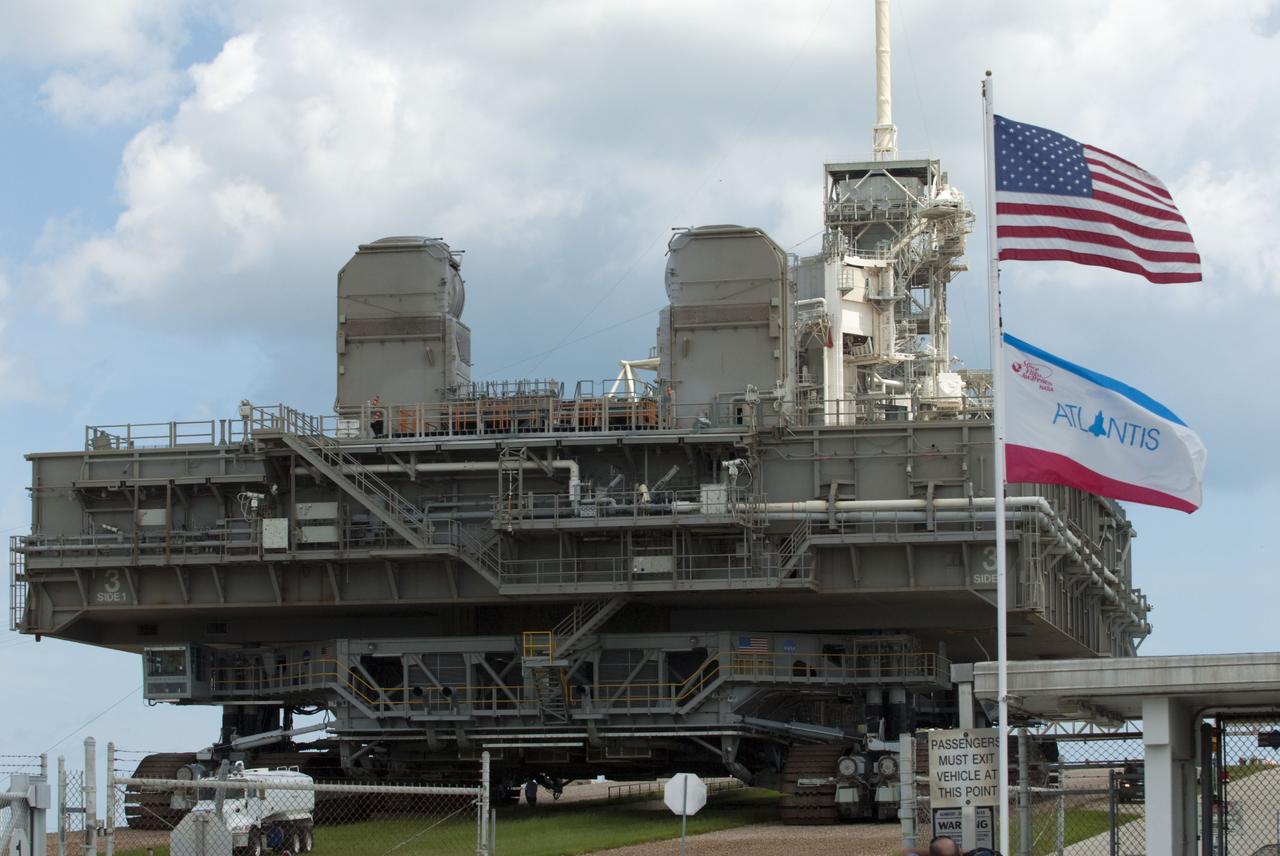
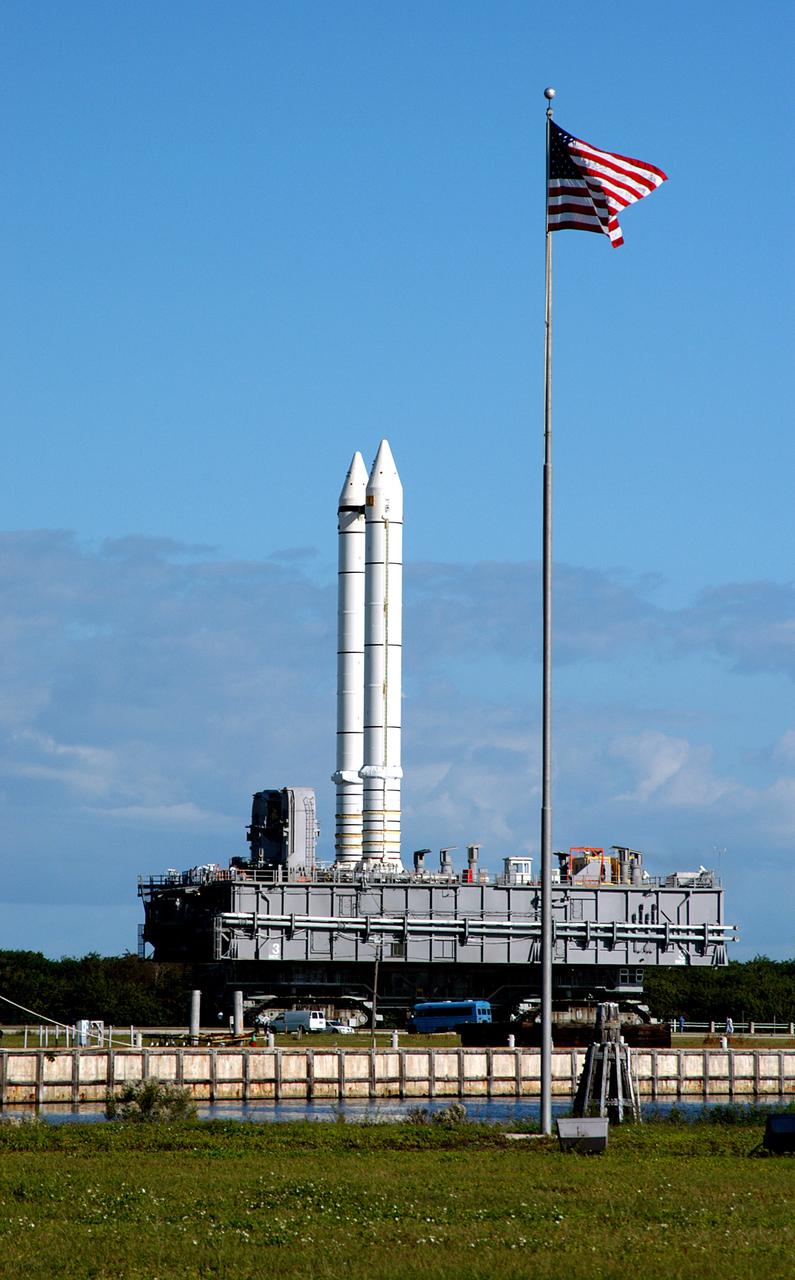
KENNEDY SPACE CENTER, FLA. - Carrying a set of twin solid rocket boosters, the crawler transporter slowly moves the Mobile Launcher Platform (MLP) past the NASA-KSC News Center where the U.S. flag flies daily.  The journey is in support of engineering analysis vibration tests on the crawler and MLP. The crawler is moving at various speeds up to 1 mph in an effort to achieve vibration data gathering goals as it leaves the VAB and then returns.  The boosters are braced at the top for stability.  The primary purpose of these rollout tests is to gather data to develop future maintenance requirements on the transport equipment and the flight hardware. Various parts of the MLP and crawler transporter have been instrumented with vibration data collection equipment.
KENNEDY SPACE CENTER, FLA. - Carrying a set of twin solid rocket boosters, the crawler transporter slowly moves the Mobile Launcher Platform (MLP) past the NASA-KSC News Center where the U.S. flag flies daily. The journey is in support of engineering analysis vibration tests on the crawler and MLP. The crawler is moving at various speeds up to 1 mph in an effort to achieve vibration data gathering goals as it leaves the VAB and then returns. The boosters are braced at the top for stability. The primary purpose of these rollout tests is to gather data to develop future maintenance requirements on the transport equipment and the flight hardware. Various parts of the MLP and crawler transporter have been instrumented with vibration data collection equipment.
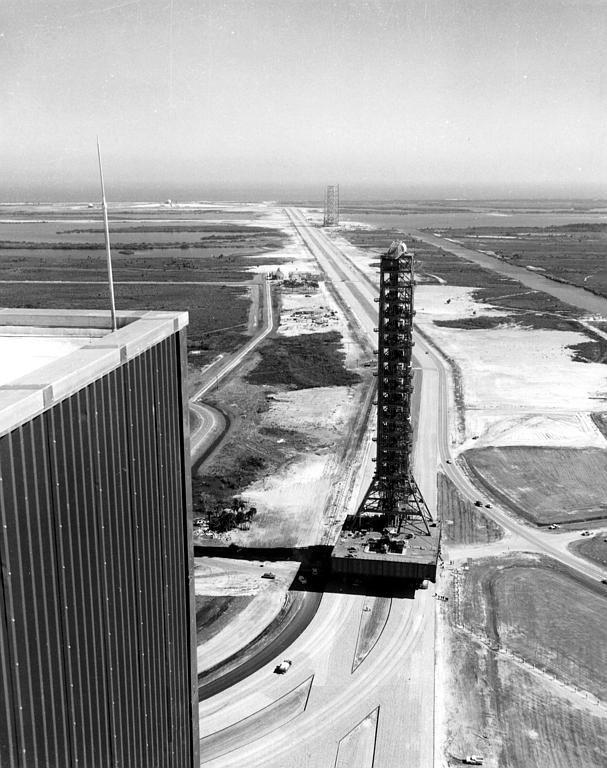
KENNEDY SPACE CENTER, FLA. -  The crawler transporter slowly moves the Mobile Launcher Platform (MLP), carrying a set of twin solid rocket boosters, along the crawlerway in support of engineering analysis vibration tests on the crawler and MLP.   In the distance, at left, is Launch Pad 39A. The crawler is moving at various speeds up to 1 mph in an effort to achieve vibration data gathering goals as it leaves the VAB and then returns.  The boosters are braced at the top for stability.  The primary purpose of these rollout tests is to gather data to develop future maintenance requirements on the transport equipment and the flight hardware. Various parts of the MLP and crawler transporter have been instrumented with vibration data collection equipment.
KENNEDY SPACE CENTER, FLA. - The crawler transporter slowly moves the Mobile Launcher Platform (MLP), carrying a set of twin solid rocket boosters, along the crawlerway in support of engineering analysis vibration tests on the crawler and MLP. In the distance, at left, is Launch Pad 39A. The crawler is moving at various speeds up to 1 mph in an effort to achieve vibration data gathering goals as it leaves the VAB and then returns. The boosters are braced at the top for stability. The primary purpose of these rollout tests is to gather data to develop future maintenance requirements on the transport equipment and the flight hardware. Various parts of the MLP and crawler transporter have been instrumented with vibration data collection equipment.
KENNEDY SPACE CENTER, FLA. -   The crawler transporter is slowly moving the Mobile Launcher Platform (MLP), carrying a set of twin solid rocket boosters, out of the Vehicle Assembly Building (VAB) in support of engineering analysis vibration tests on the crawler and MLP. The crawler is moving at various speeds up to 1 mph in an effort to achieve vibration data gathering goals as it leaves the VAB and then returns.  The boosters are braced at the top for stability.  The primary purpose of these rollout tests is to gather data to develop future maintenance requirements on the transport equipment and the flight hardware. Various parts of the MLP and crawler transporter have been instrumented with vibration data collection equipment.
KENNEDY SPACE CENTER, FLA. - The crawler transporter is slowly moving the Mobile Launcher Platform (MLP), carrying a set of twin solid rocket boosters, out of the Vehicle Assembly Building (VAB) in support of engineering analysis vibration tests on the crawler and MLP. The crawler is moving at various speeds up to 1 mph in an effort to achieve vibration data gathering goals as it leaves the VAB and then returns. The boosters are braced at the top for stability. The primary purpose of these rollout tests is to gather data to develop future maintenance requirements on the transport equipment and the flight hardware. Various parts of the MLP and crawler transporter have been instrumented with vibration data collection equipment.
KENNEDY SPACE CENTER, FLA. -  The crawler transporter slowly moves the Mobile Launcher Platform (MLP), carrying a set of twin solid rocket boosters, away from the Vehicle Assembly Building (VAB) in support of engineering analysis vibration tests on the crawler and MLP.   The crawler is moving at various speeds up to 1 mph in an effort to achieve vibration data gathering goals as it leaves the VAB and then returns.  The boosters are braced at the top for stability.  The primary purpose of these rollout tests is to gather data to develop future maintenance requirements on the transport equipment and the flight hardware. Various parts of the MLP and crawler transporter have been instrumented with vibration data collection equipment.
KENNEDY SPACE CENTER, FLA. - The crawler transporter slowly moves the Mobile Launcher Platform (MLP), carrying a set of twin solid rocket boosters, away from the Vehicle Assembly Building (VAB) in support of engineering analysis vibration tests on the crawler and MLP. The crawler is moving at various speeds up to 1 mph in an effort to achieve vibration data gathering goals as it leaves the VAB and then returns. The boosters are braced at the top for stability. The primary purpose of these rollout tests is to gather data to develop future maintenance requirements on the transport equipment and the flight hardware. Various parts of the MLP and crawler transporter have been instrumented with vibration data collection equipment.
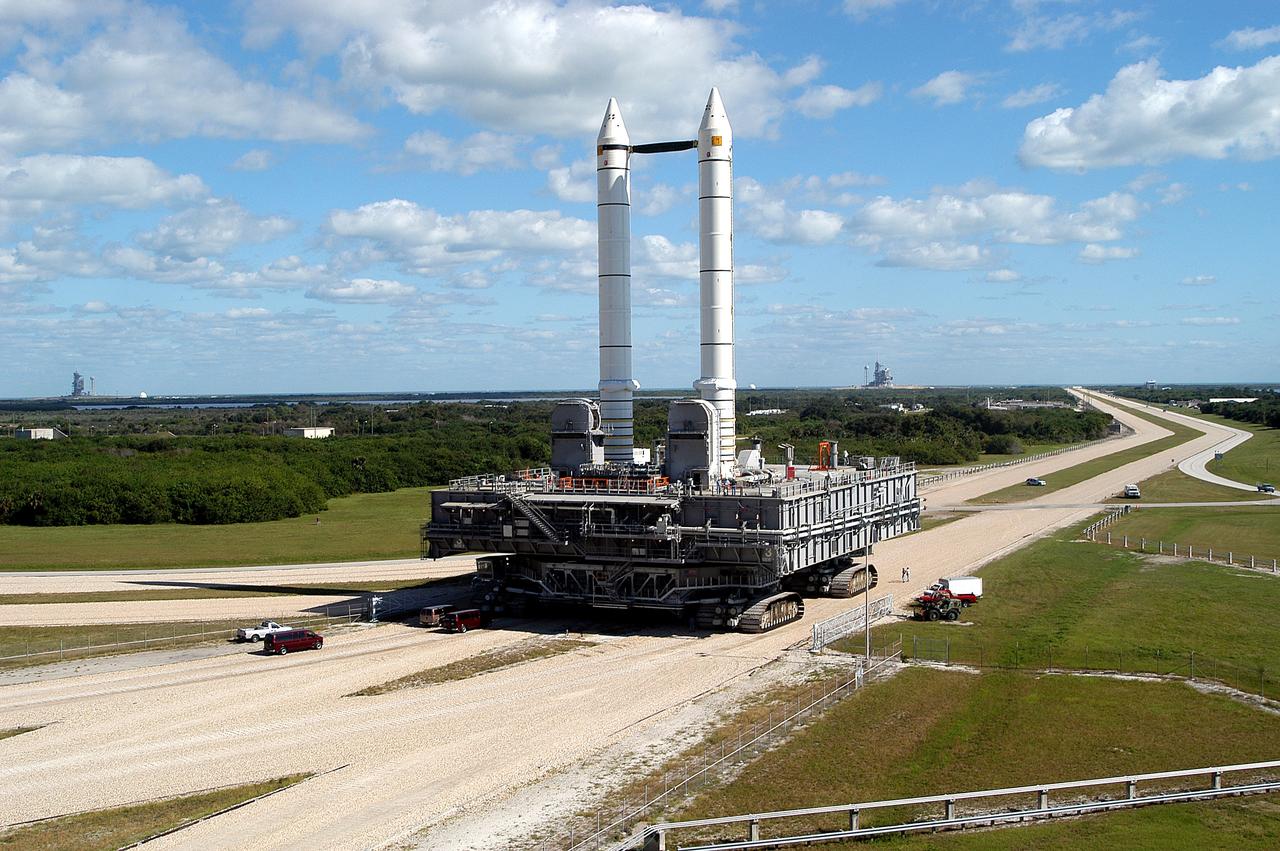
KENNEDY SPACE CENTER, FLA. -  Mobile Launcher Platform (MLP) number 3 and a set of twin solid rocket boosters, atop the crawler-transporter, inch along the crawlerway in support of the second engineering analysis vibration test on the crawler and MLP. The crawler is moving at various speeds up to 1 mph in an effort to achieve vibration data gathering goals as it leaves the VAB, travels toward Launch Pad 39A (on the horizon) and then returns.  The boosters are braced at the top for stability.  The primary purpose of these rollout tests is to gather data to develop future maintenance requirements on the transport equipment and the flight hardware. Various parts of the MLP and crawler transporter have been instrumented with vibration data collection equipment.
KENNEDY SPACE CENTER, FLA. - Mobile Launcher Platform (MLP) number 3 and a set of twin solid rocket boosters, atop the crawler-transporter, inch along the crawlerway in support of the second engineering analysis vibration test on the crawler and MLP. The crawler is moving at various speeds up to 1 mph in an effort to achieve vibration data gathering goals as it leaves the VAB, travels toward Launch Pad 39A (on the horizon) and then returns. The boosters are braced at the top for stability. The primary purpose of these rollout tests is to gather data to develop future maintenance requirements on the transport equipment and the flight hardware. Various parts of the MLP and crawler transporter have been instrumented with vibration data collection equipment.
KENNEDY SPACE CENTER, FLA. -   The crawler transporter slowly moves the Mobile Launcher Platform (MLP), carrying a set of twin solid rocket boosters, along the crawlerway in support of engineering analysis vibration tests on the crawler and MLP.  The crawler is moving at various speeds up to 1 mph in an effort to achieve vibration data gathering goals as it leaves the VAB and then returns.  The boosters are braced at the top for stability.  The primary purpose of these rollout tests is to gather data to develop future maintenance requirements on the transport equipment and the flight hardware. Various parts of the MLP and crawler transporter have been instrumented with vibration data collection equipment.
KENNEDY SPACE CENTER, FLA. - The crawler transporter slowly moves the Mobile Launcher Platform (MLP), carrying a set of twin solid rocket boosters, along the crawlerway in support of engineering analysis vibration tests on the crawler and MLP. The crawler is moving at various speeds up to 1 mph in an effort to achieve vibration data gathering goals as it leaves the VAB and then returns. The boosters are braced at the top for stability. The primary purpose of these rollout tests is to gather data to develop future maintenance requirements on the transport equipment and the flight hardware. Various parts of the MLP and crawler transporter have been instrumented with vibration data collection equipment.
KENNEDY SPACE CENTER, FLA. -  The crawler transporter slowly moves the Mobile Launcher Platform (MLP), carrying a set of twin solid rocket boosters, away from the Vehicle Assembly Building (VAB) in support of engineering analysis vibration tests on the crawler and MLP.   The crawler is moving at various speeds up to 1 mph in an effort to achieve vibration data gathering goals as it leaves the VAB and then returns.  The boosters are braced at the top for stability.  The primary purpose of these rollout tests is to gather data to develop future maintenance requirements on the transport equipment and the flight hardware. Various parts of the MLP and crawler transporter have been instrumented with vibration data collection equipment.
KENNEDY SPACE CENTER, FLA. - The crawler transporter slowly moves the Mobile Launcher Platform (MLP), carrying a set of twin solid rocket boosters, away from the Vehicle Assembly Building (VAB) in support of engineering analysis vibration tests on the crawler and MLP. The crawler is moving at various speeds up to 1 mph in an effort to achieve vibration data gathering goals as it leaves the VAB and then returns. The boosters are braced at the top for stability. The primary purpose of these rollout tests is to gather data to develop future maintenance requirements on the transport equipment and the flight hardware. Various parts of the MLP and crawler transporter have been instrumented with vibration data collection equipment.
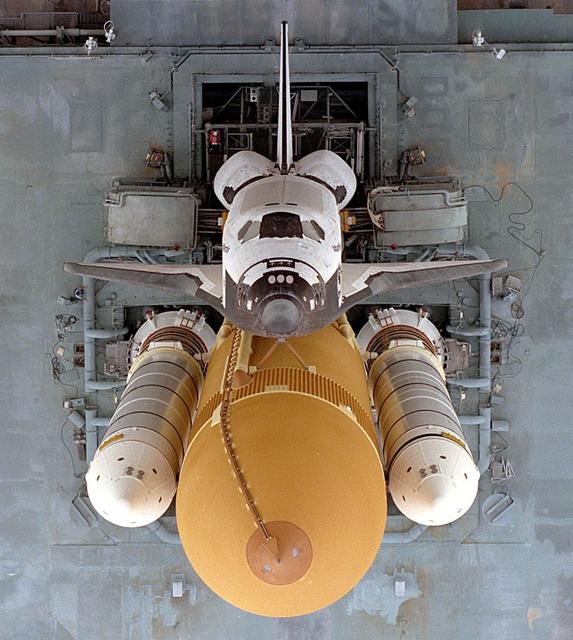
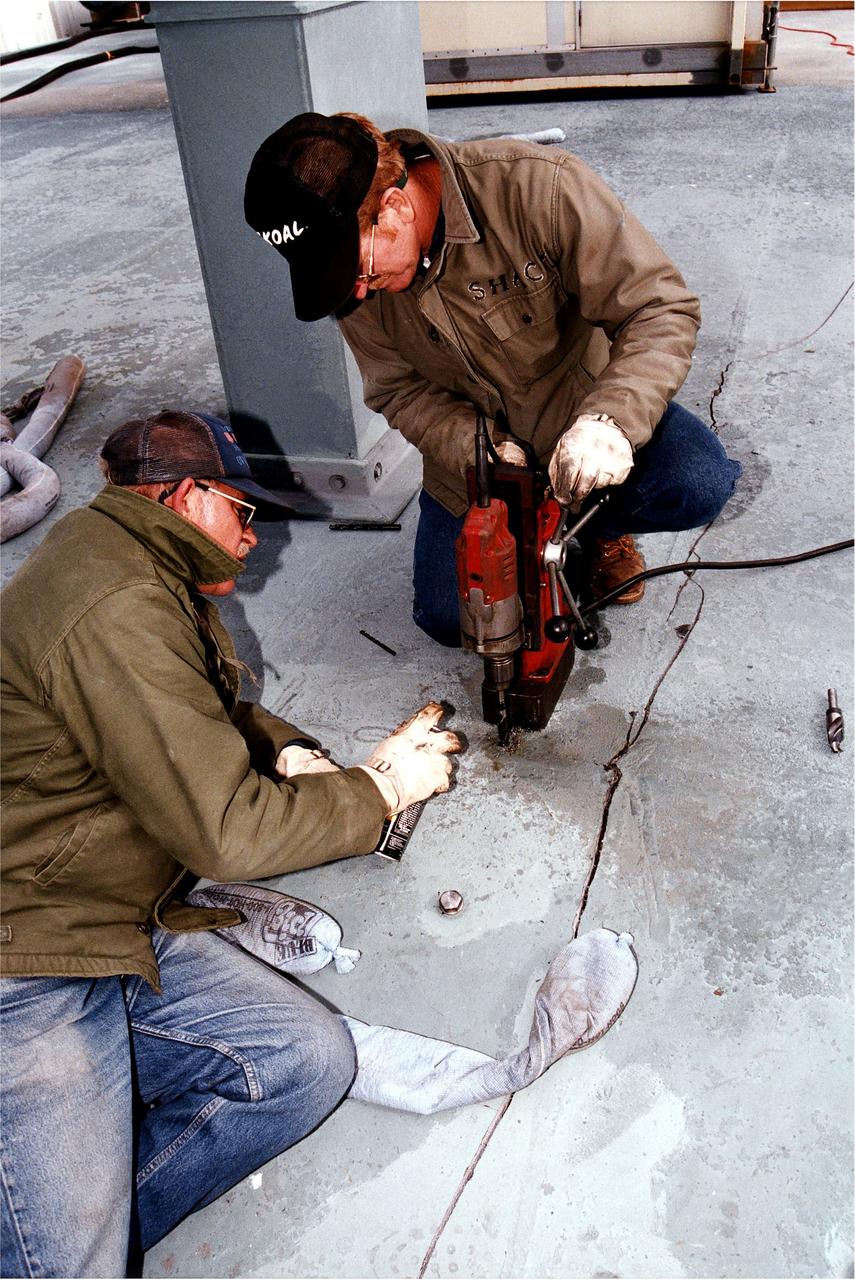
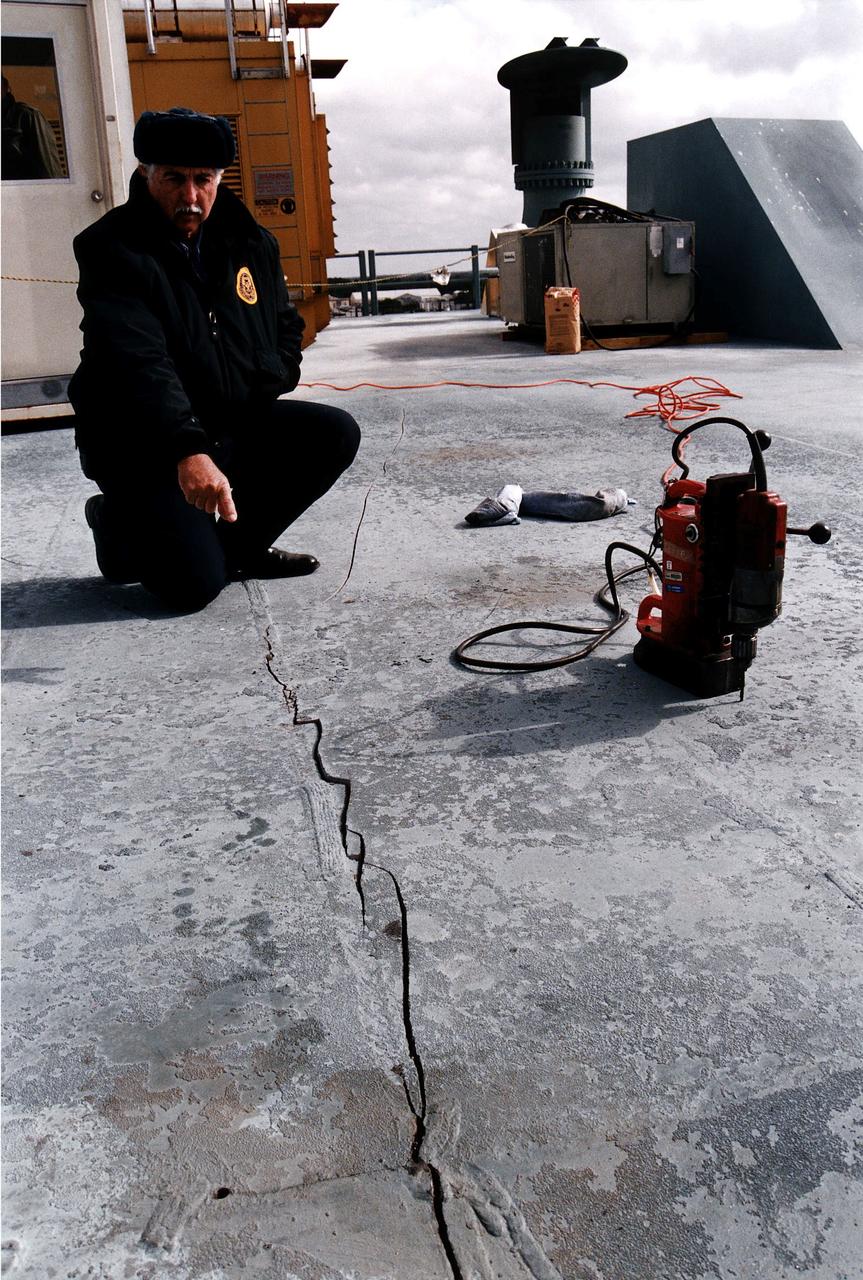
KENNEDY SPACE CENTER, FLA. -  Robert T. Nelson of KSC Security points to an approximately 24-foot-long crack on the Mobile Launcher Platform (MLP), which is holding the Space Shuttle Discovery en route to Launch Pad 39A for the STS-82 mission.  Nelson was riding on the MLP when he heard a loud noise and noticed the crack.  Rollout had begun shortly after 7 a.m. EST and was stopped at about 8:25 a.m.  This Y-shaped crack is on the MLP surface and runs from near the left-hand solid rocket booster flame hole toward the near corner of the MLP.  Rollout of Discovery resumed just past noon after structural engineers determined that the integrity of the MLP had not been compromised.  Discovery is scheduled to lift off on the second Hubble Space Telescope servicing mission on Feb. 11.
KENNEDY SPACE CENTER, FLA. - Robert T. Nelson of KSC Security points to an approximately 24-foot-long crack on the Mobile Launcher Platform (MLP), which is holding the Space Shuttle Discovery en route to Launch Pad 39A for the STS-82 mission. Nelson was riding on the MLP when he heard a loud noise and noticed the crack. Rollout had begun shortly after 7 a.m. EST and was stopped at about 8:25 a.m. This Y-shaped crack is on the MLP surface and runs from near the left-hand solid rocket booster flame hole toward the near corner of the MLP. Rollout of Discovery resumed just past noon after structural engineers determined that the integrity of the MLP had not been compromised. Discovery is scheduled to lift off on the second Hubble Space Telescope servicing mission on Feb. 11.
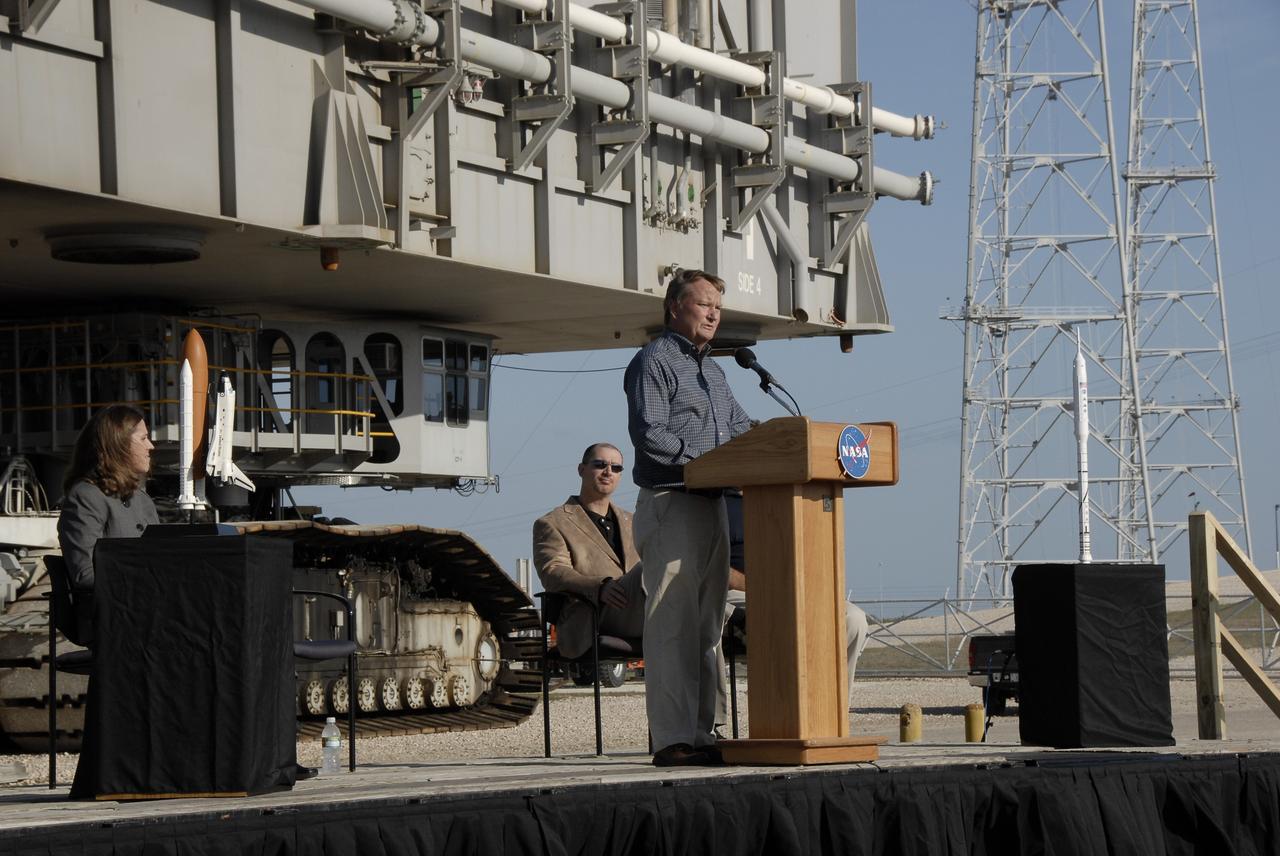
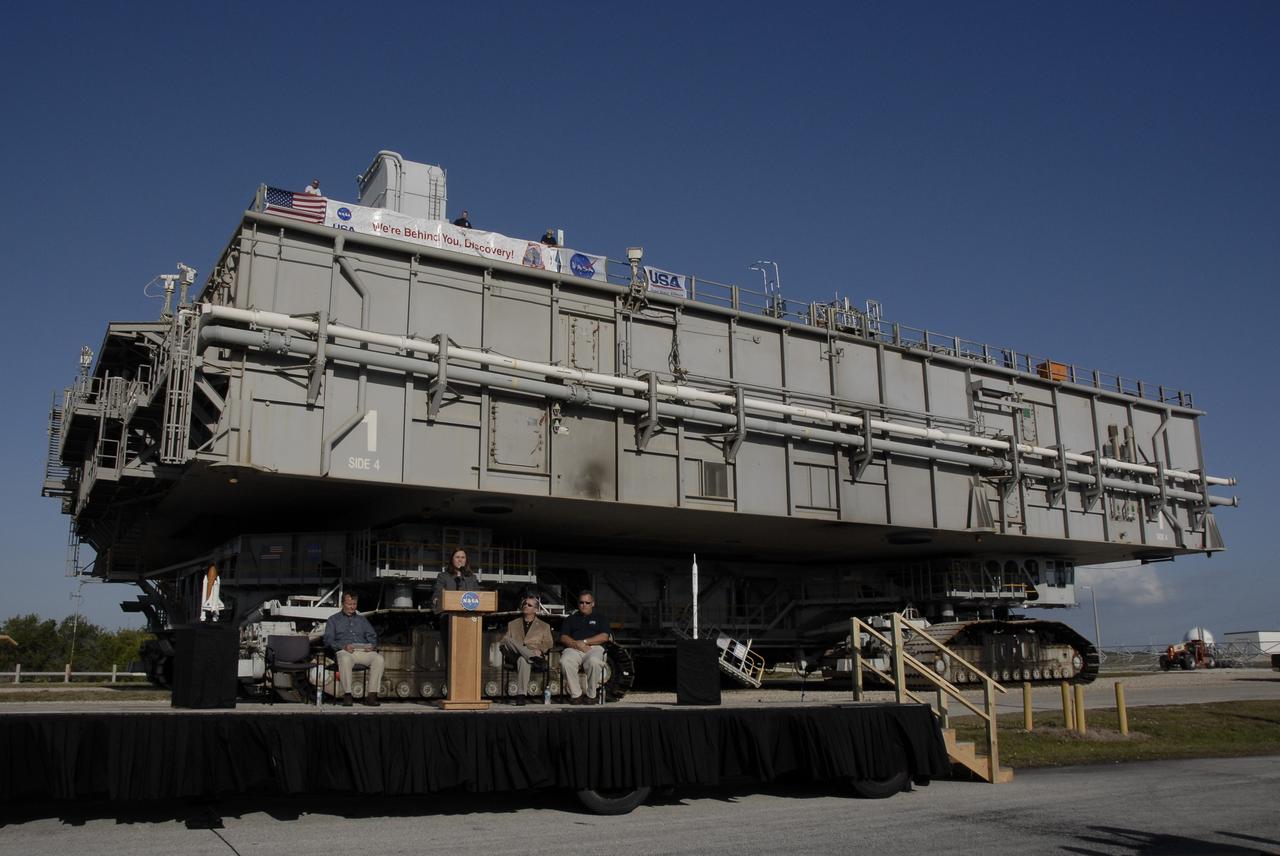
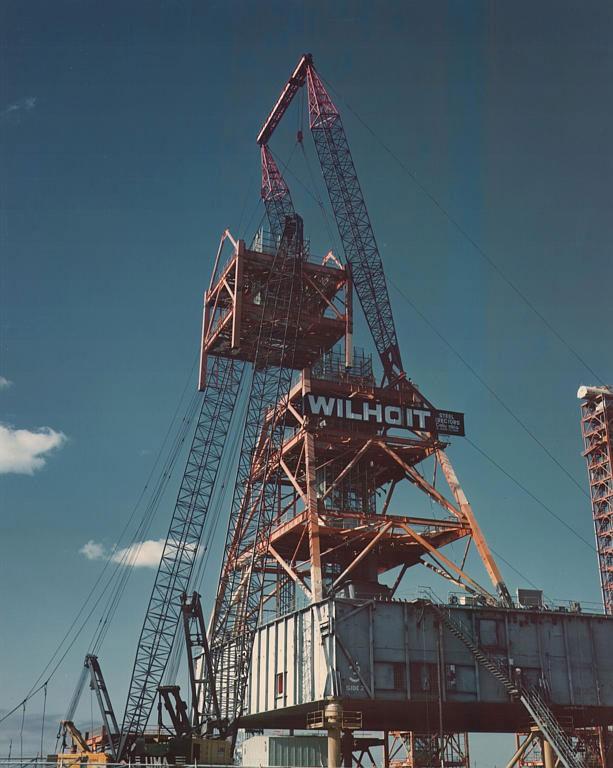
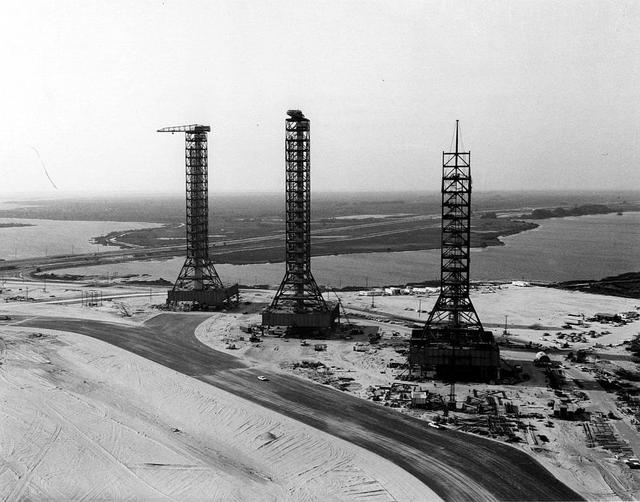
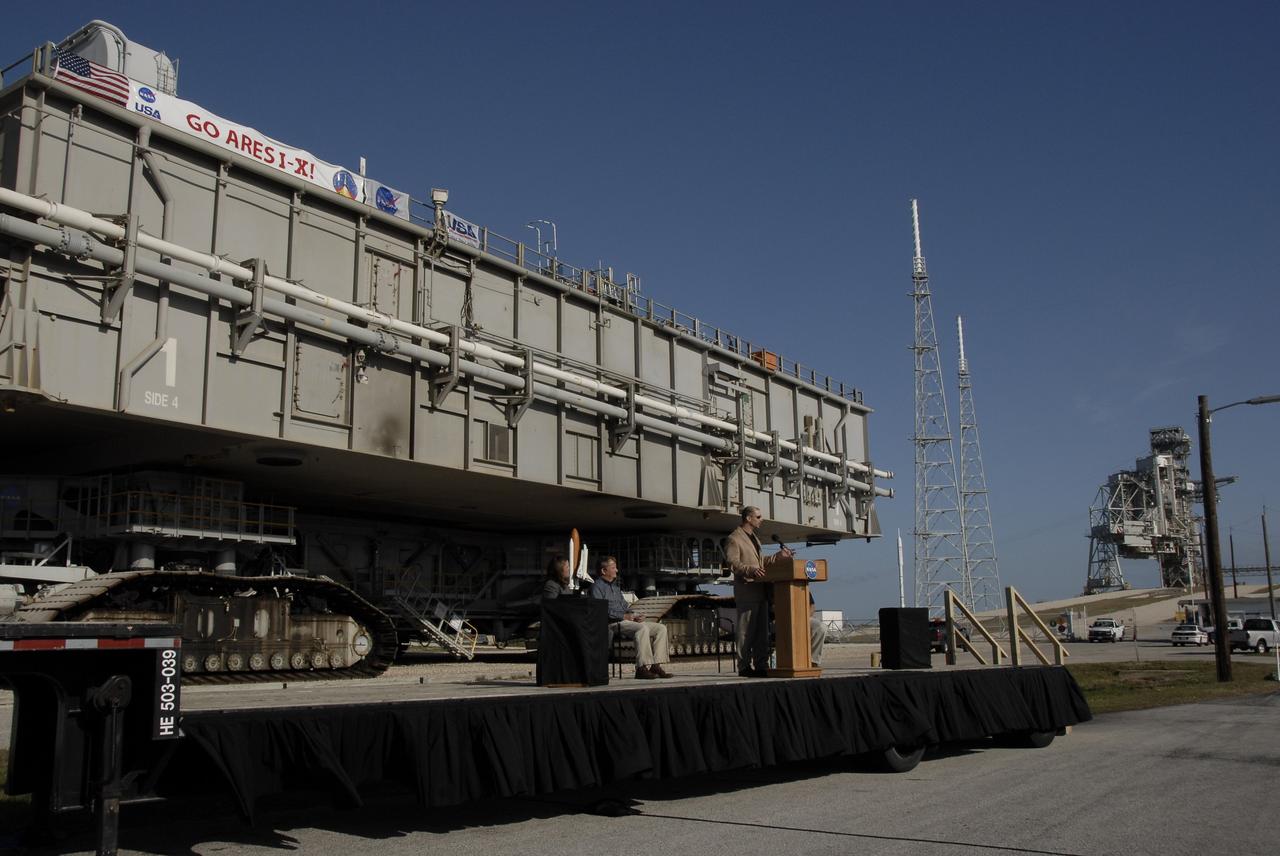
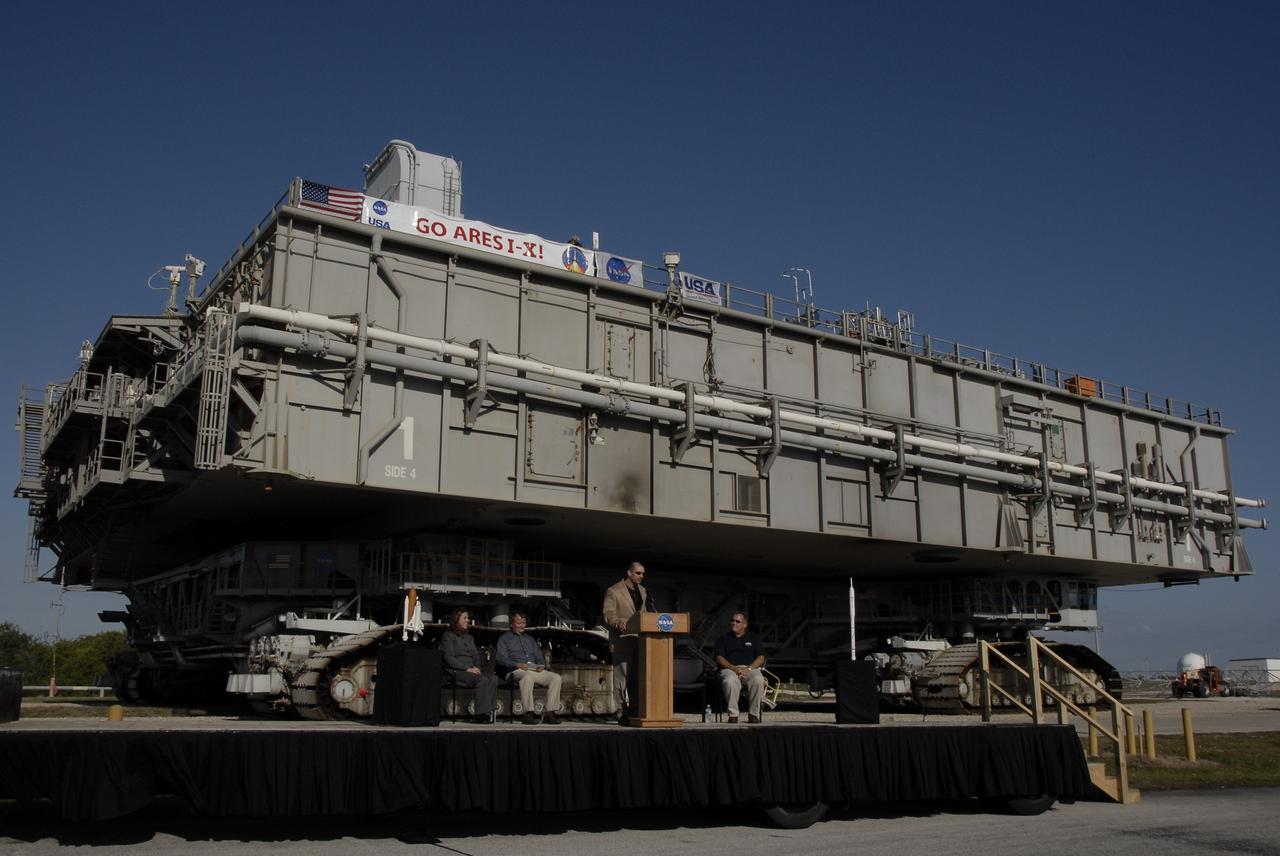
CAPE CANAVERAL, Fla. – Near Launch Pad 39B at NASA's Kennedy Space Center in Florida,  Director of the Constellation Project Office  Pepper E. Phillips speaks to employees and media during the handover ceremony for Mobile Launcher Platform-1.  Marking the handover is the change of banner on the platform behind him.  On the stage and also participating in the ceremony are Director of Launch Vehicle Processing Rita Willcoxon , Shuttle Launch Director Mike Leinbach,  and Manager of MLP Operations with United Space Alliance Brett Raulerson.  The platform is being transferred from NASA's Space Shuttle Program to the Constellation Program for the Ares I-X flight test targeted for this summer. Constructed in 1964, the mobile launchers used in Apollo/Saturn operations were modified for use in shuttle operations. With cranes, umbilical towers and swing arms removed, the mobile launchers were renamed Mobile Launcher Platforms, or MLPs.  Photo credit: NASA/Kim Shiflett
KSC-2009-2305
CAPE CANAVERAL, Fla. – Near Launch Pad 39B at NASA's Kennedy Space Center in Florida,  Director of the Constellation Project Office  Pepper E. Phillips speaks to employees and media during the handover ceremony for Mobile Launcher Platform-1.  Marking the handover is the change of banner on the platform behind him.  On the stage and also participating in the ceremony are Director of Launch Vehicle Processing Rita Willcoxon , Shuttle Launch Director Mike Leinbach,  and Manager of MLP Operations with United Space Alliance Brett Raulerson.  The platform is being transferred from NASA's Space Shuttle Program to the Constellation Program for the Ares I-X flight test targeted for this summer. Constructed in 1964, the mobile launchers used in Apollo/Saturn operations were modified for use in shuttle operations. With cranes, umbilical towers and swing arms removed, the mobile launchers were renamed Mobile Launcher Platforms, or MLPs.  Photo credit: NASA/Kim Shiflett
KSC-2009-2306
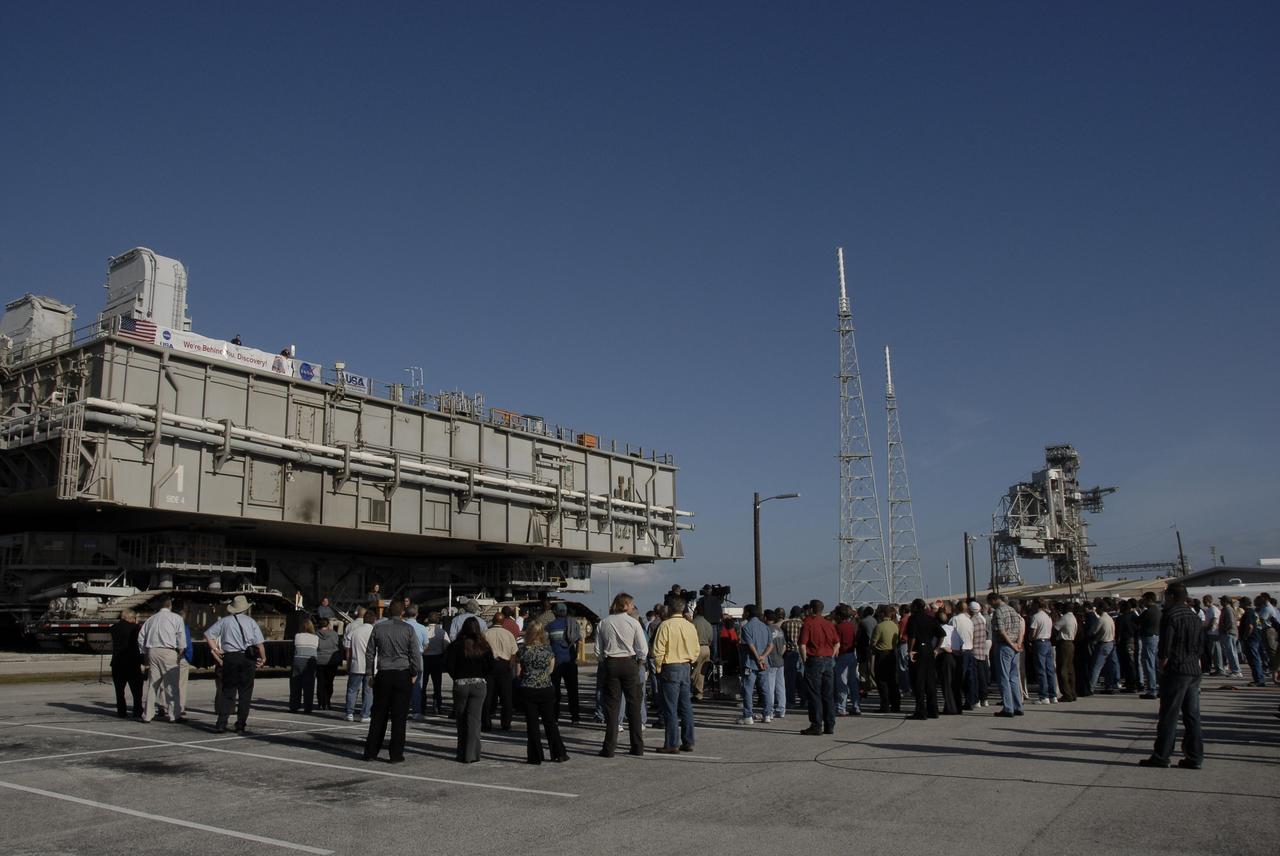
CAPE CANAVERAL, Fla. – Near Launch Pad 39B at NASA's Kennedy Space Center in Florida, employees and media gather listen to Shuttle Launch Director Mike Leinbach  during the handover ceremony for Mobile Launcher Platform-1. The platform is being transferred from NASA's Space Shuttle Program to the Constellation Program for the Ares I-X flight test targeted for this summer. Also participating in the ceremony are Rita Willcoxon, director of Launch Vehicle Processing at Kennedy, Pepper E. Phillips, director of the Constellation Project Office, and Brett Raulerson, manager of MLP Operations with United Space Alliance.  Constructed in 1964, the mobile launchers used in Apollo/Saturn operations were modified for use in shuttle operations. With cranes, umbilical towers and swing arms removed, the mobile launchers were renamed Mobile Launcher Platforms, or MLPs.  Photo credit: NASA/Kim Shiflett
KSC-2009-2304
CAPE CANAVERAL, Fla. – Near Launch Pad 39B  at NASA's Kennedy Space Center in Florida, Shuttle Launch Director Mike Leinbach speaks to the employees and media during the handover ceremony for Mobile Launcher Platform-1. The platform is being transferred from NASA's Space Shuttle Program to the Constellation Program for the Ares I-X flight test targeted for this summer. Also participating in the ceremony are (left) Rita Willcoxon, director of Launch Vehicle Processing at Kennedy, (right) Pepper E. Phillips, director of the Constellation Project Office, and (not visible) Brett Raulerson, manager of MLP Operations with United Space Alliance. Constructed in 1964, the mobile launchers used in Apollo/Saturn operations were modified for use in shuttle operations. With cranes, umbilical towers and swing arms removed, the mobile launchers were renamed Mobile Launcher Platforms, or MLPs.  Photo credit: NASA/Kim Shiflett
KSC-2009-2303
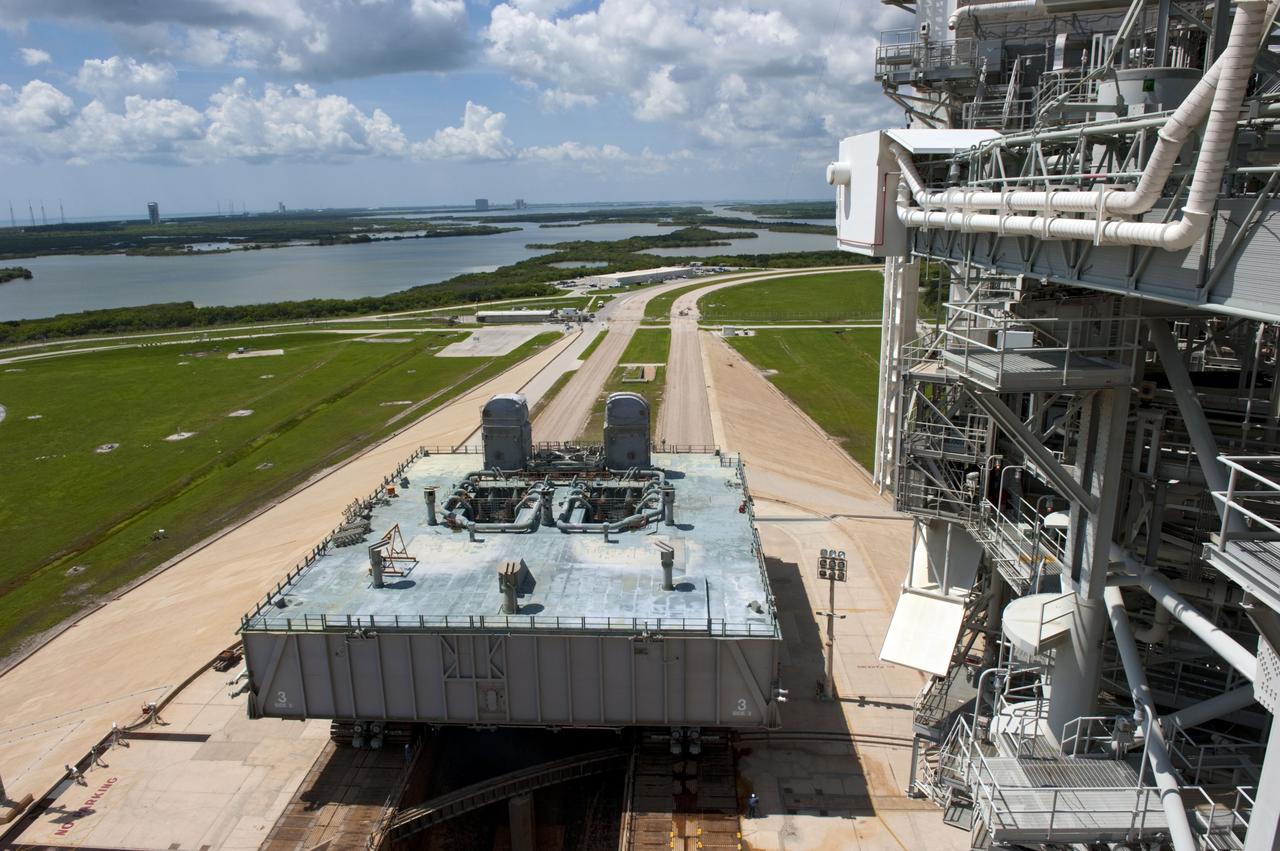
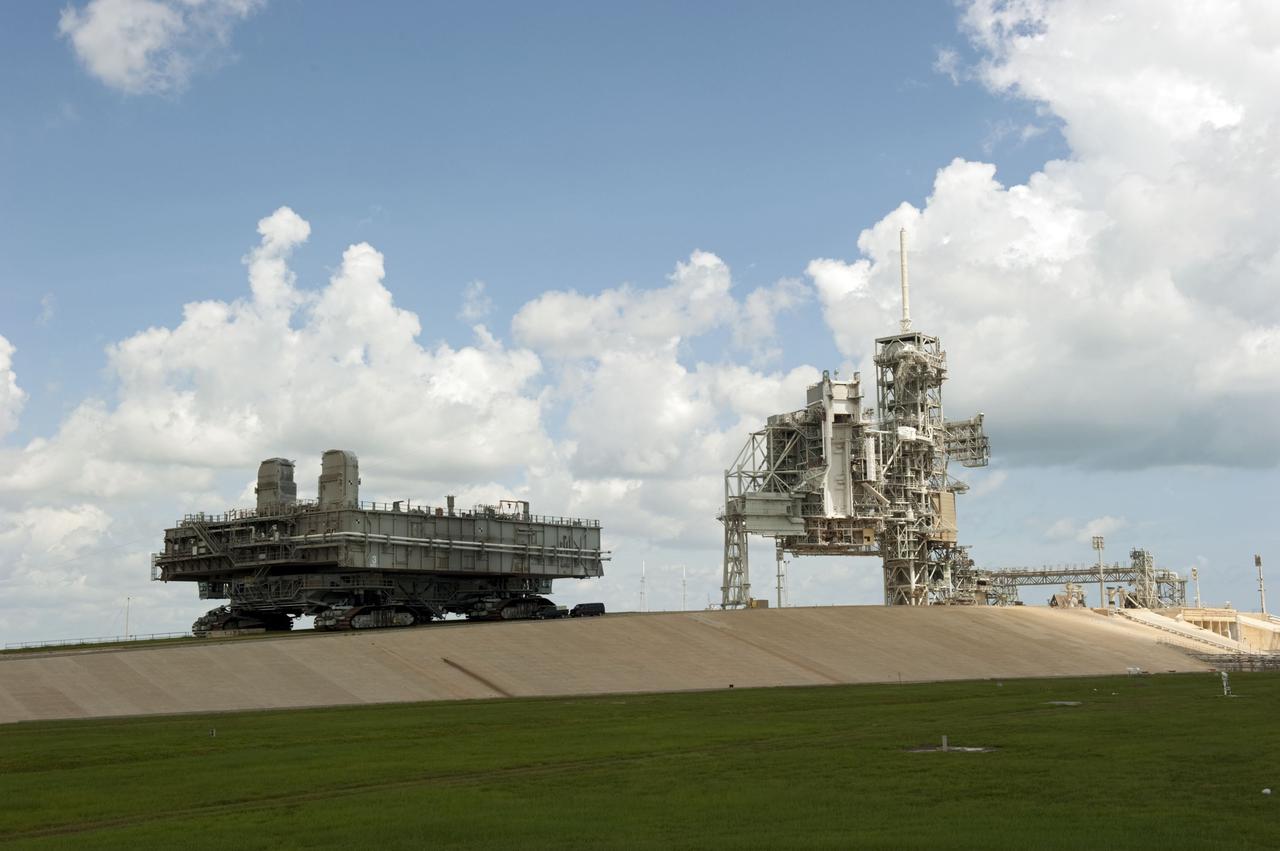
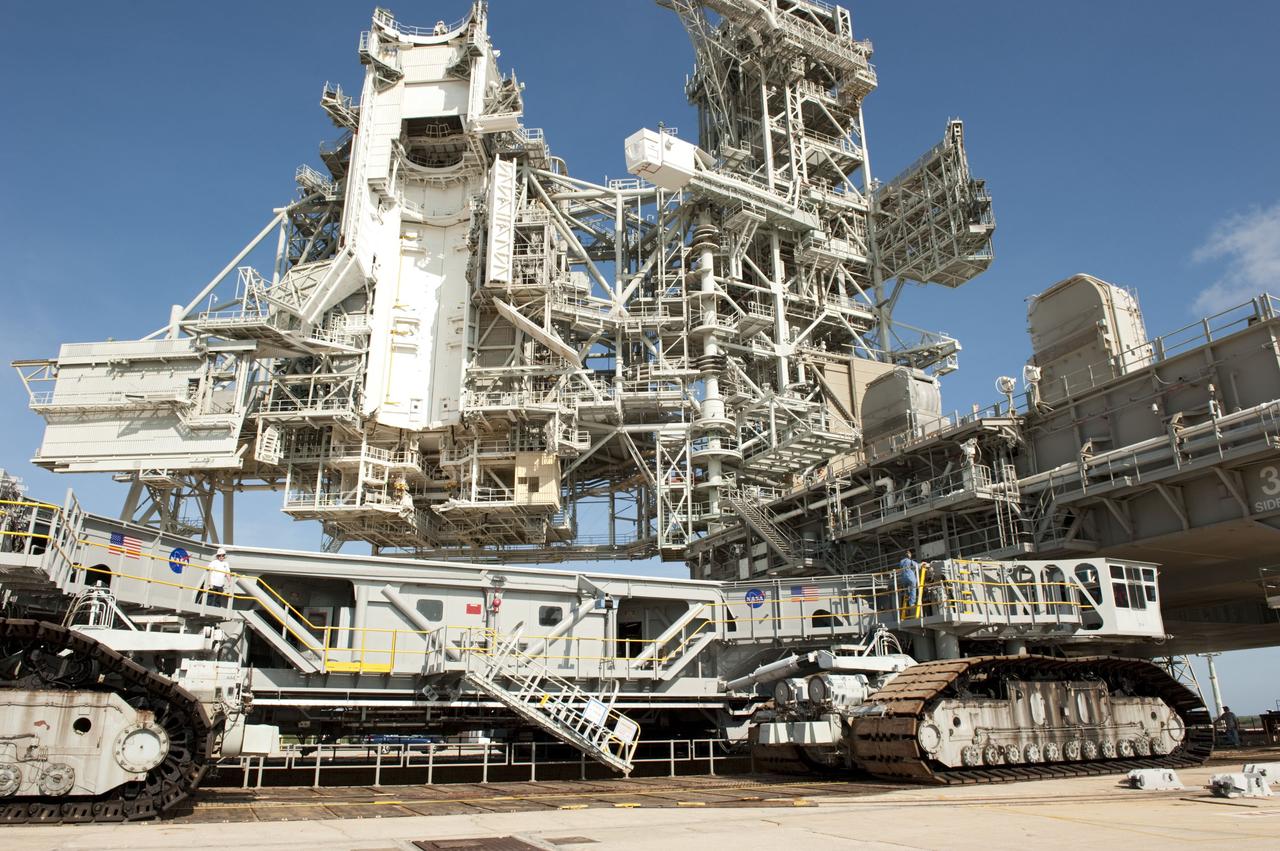
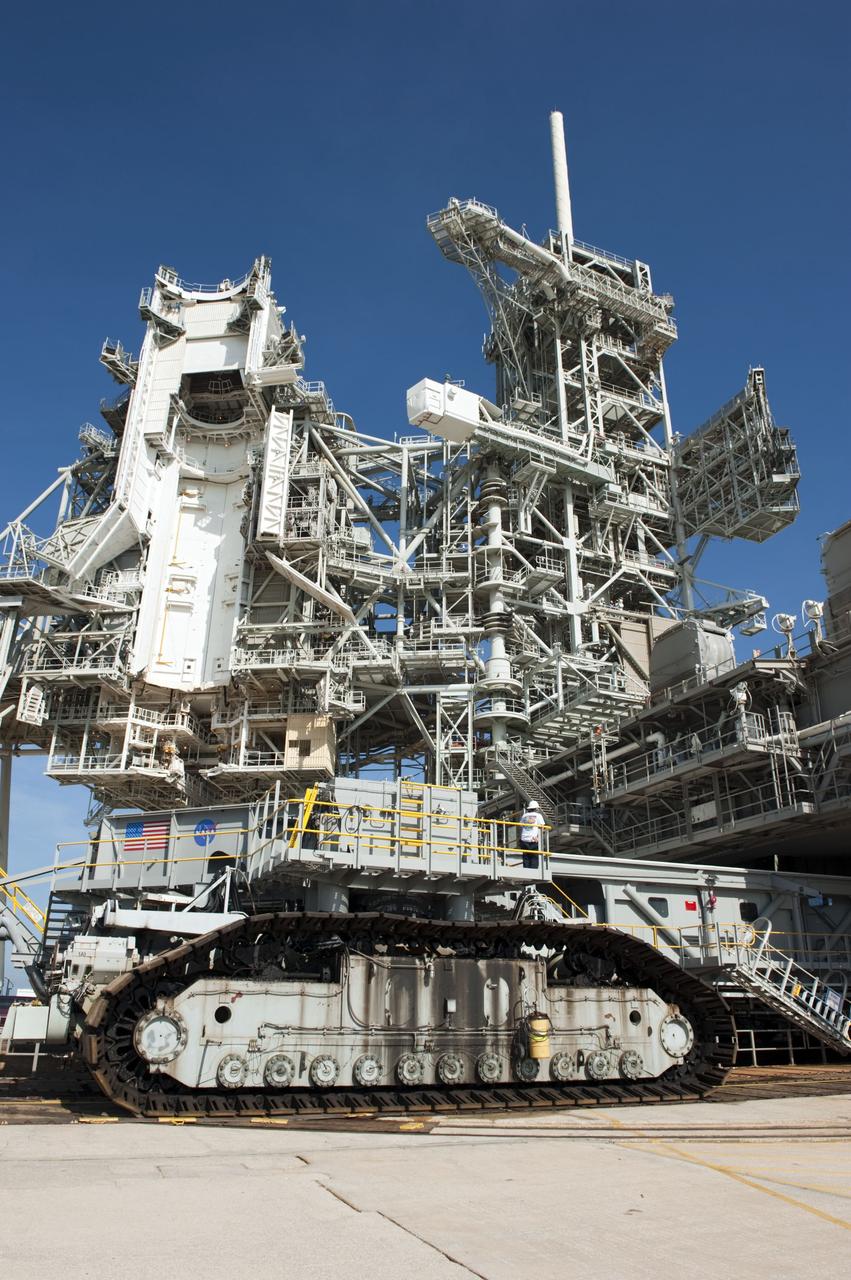
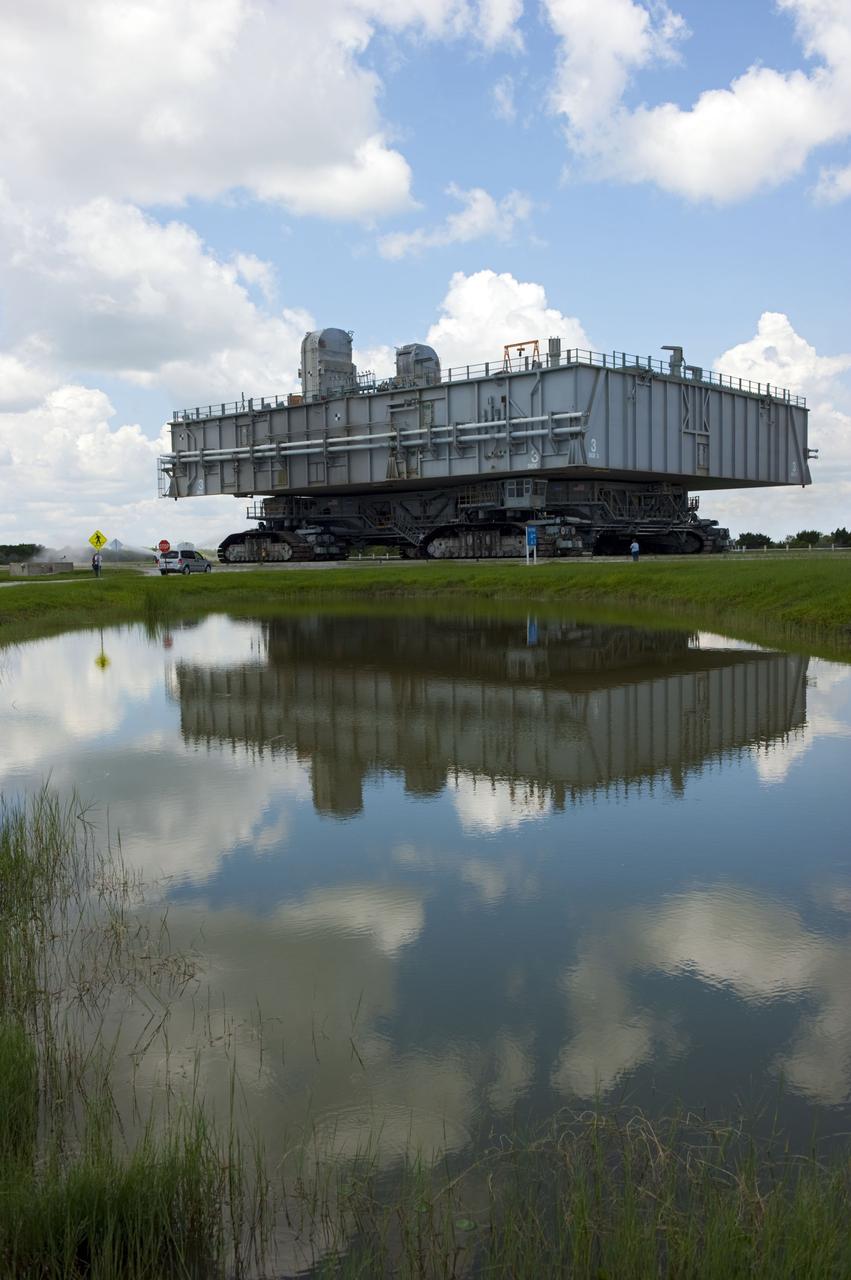
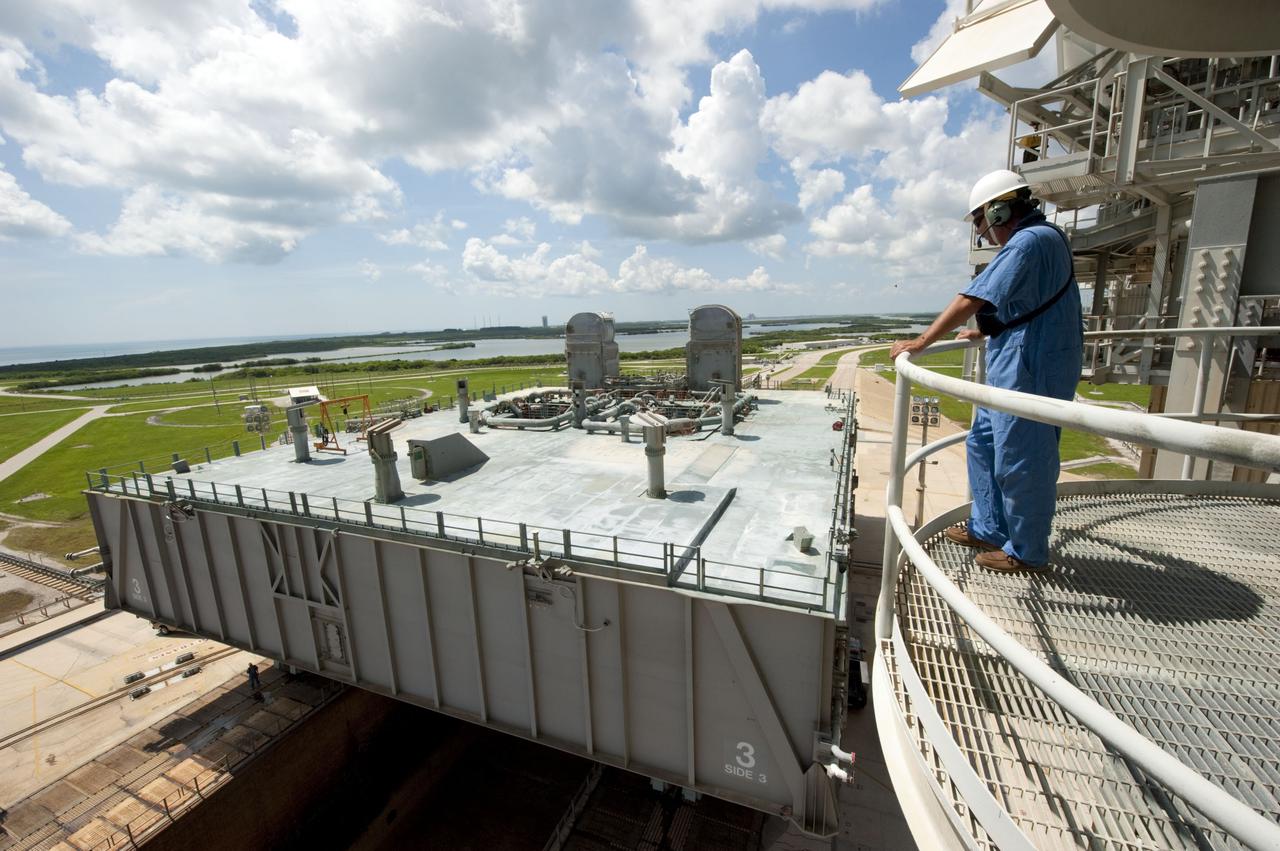
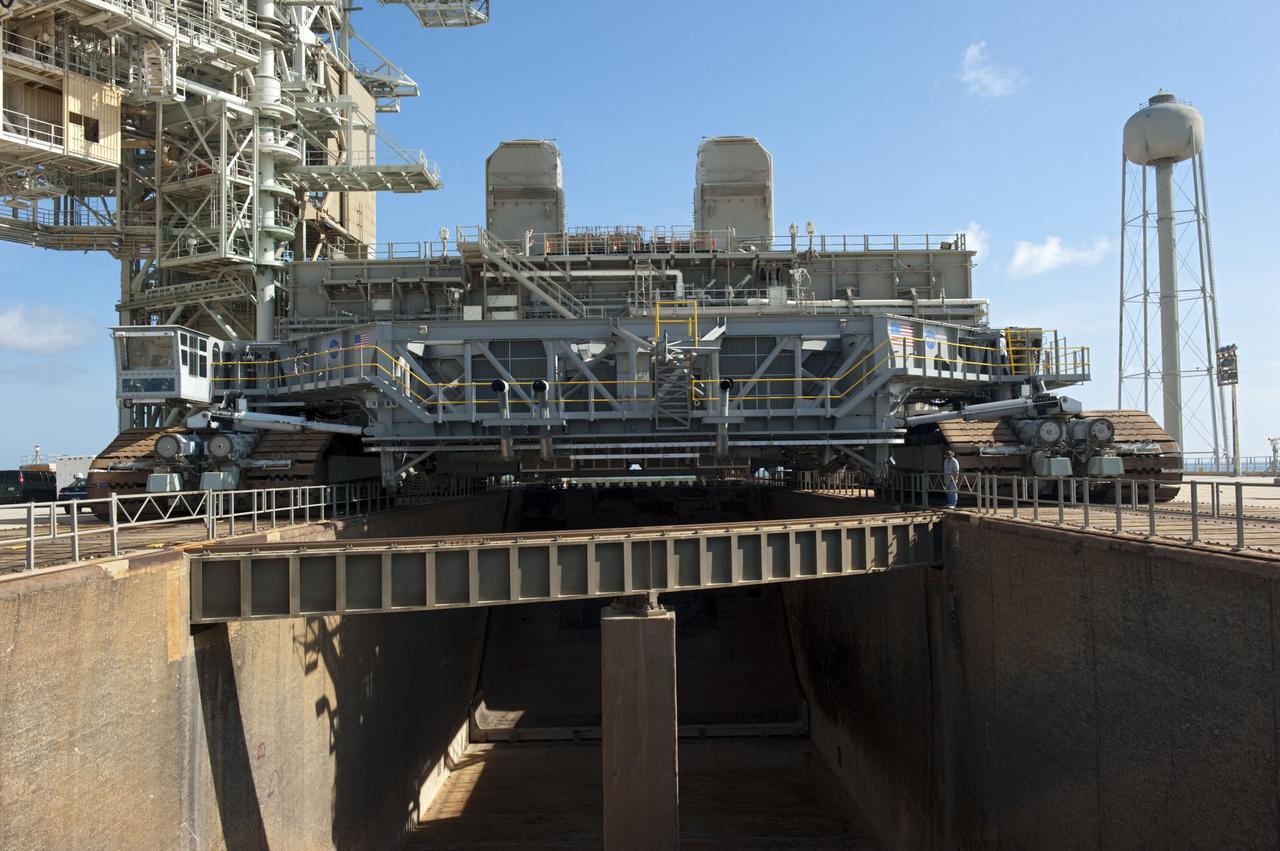
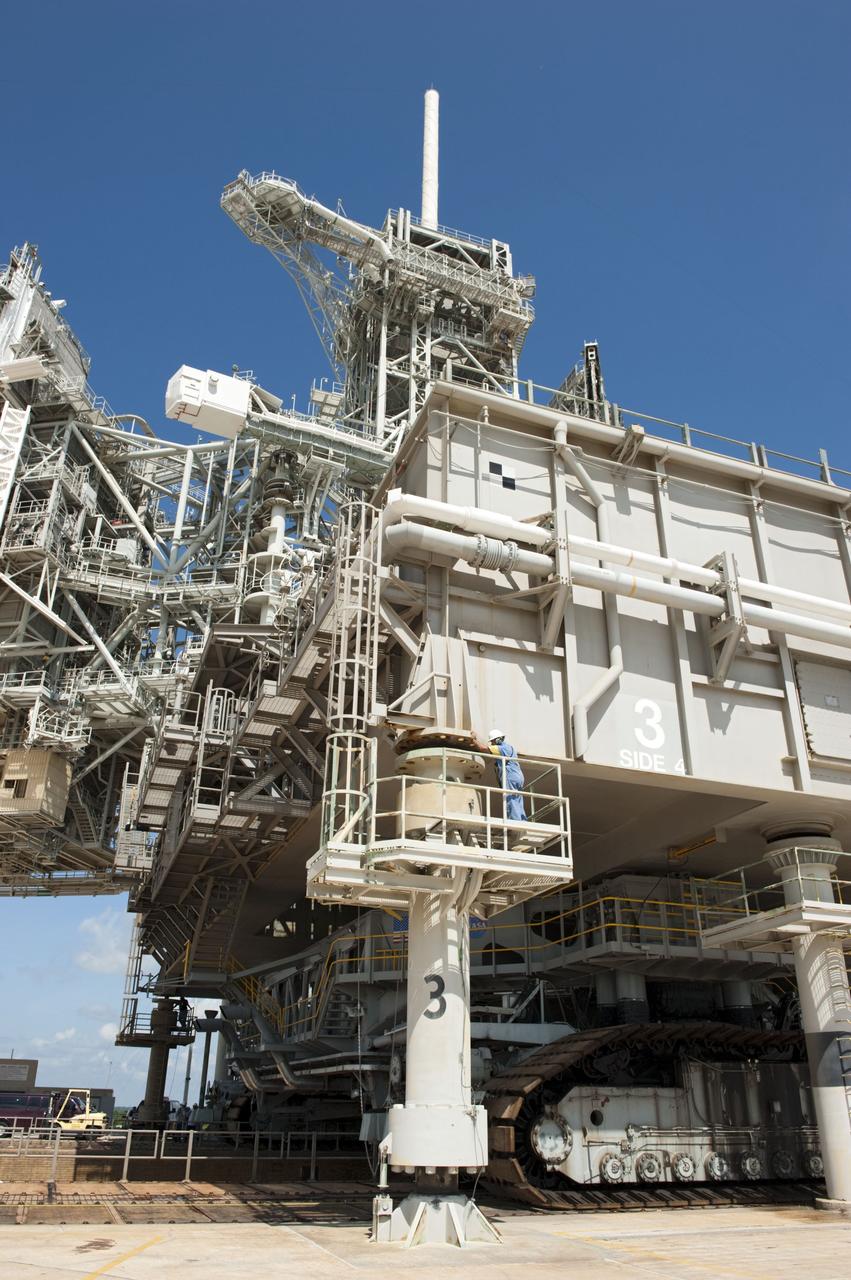
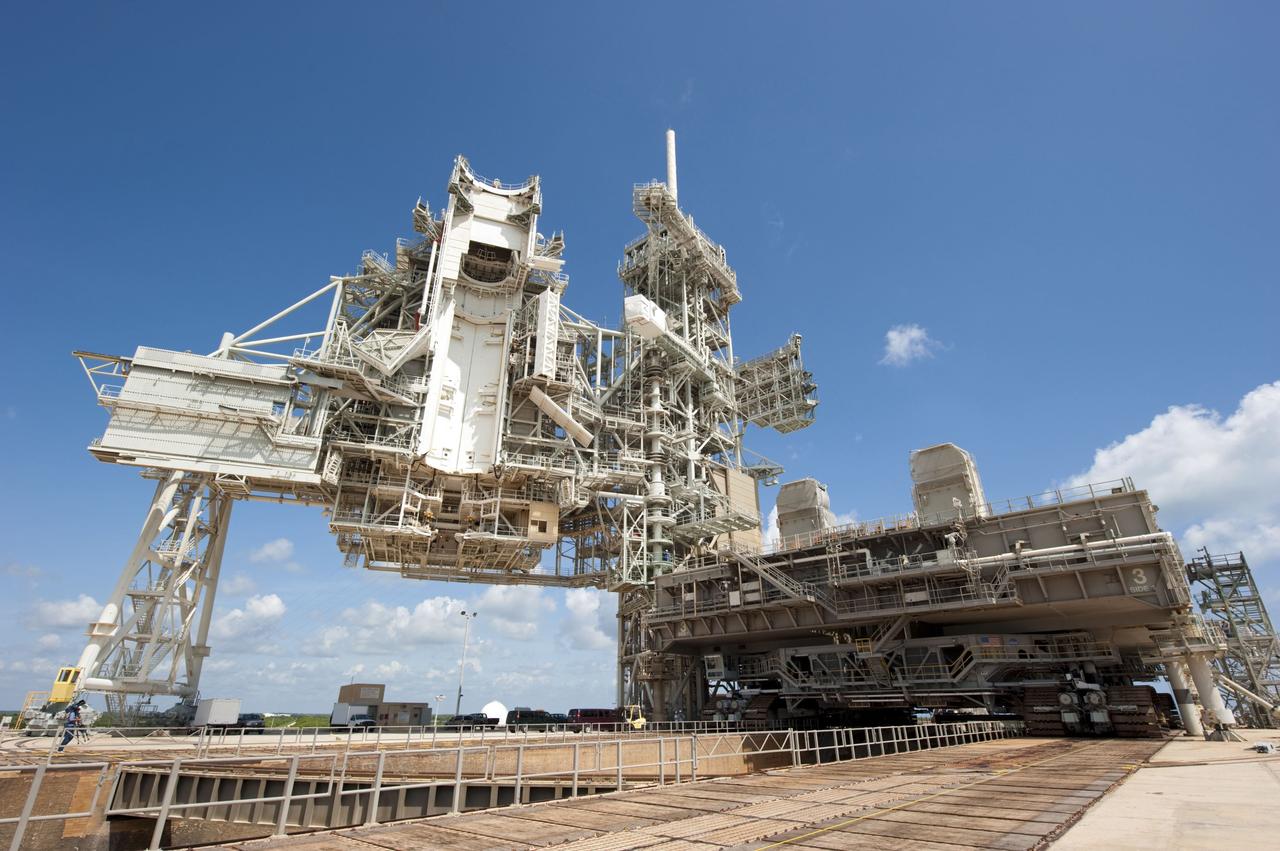
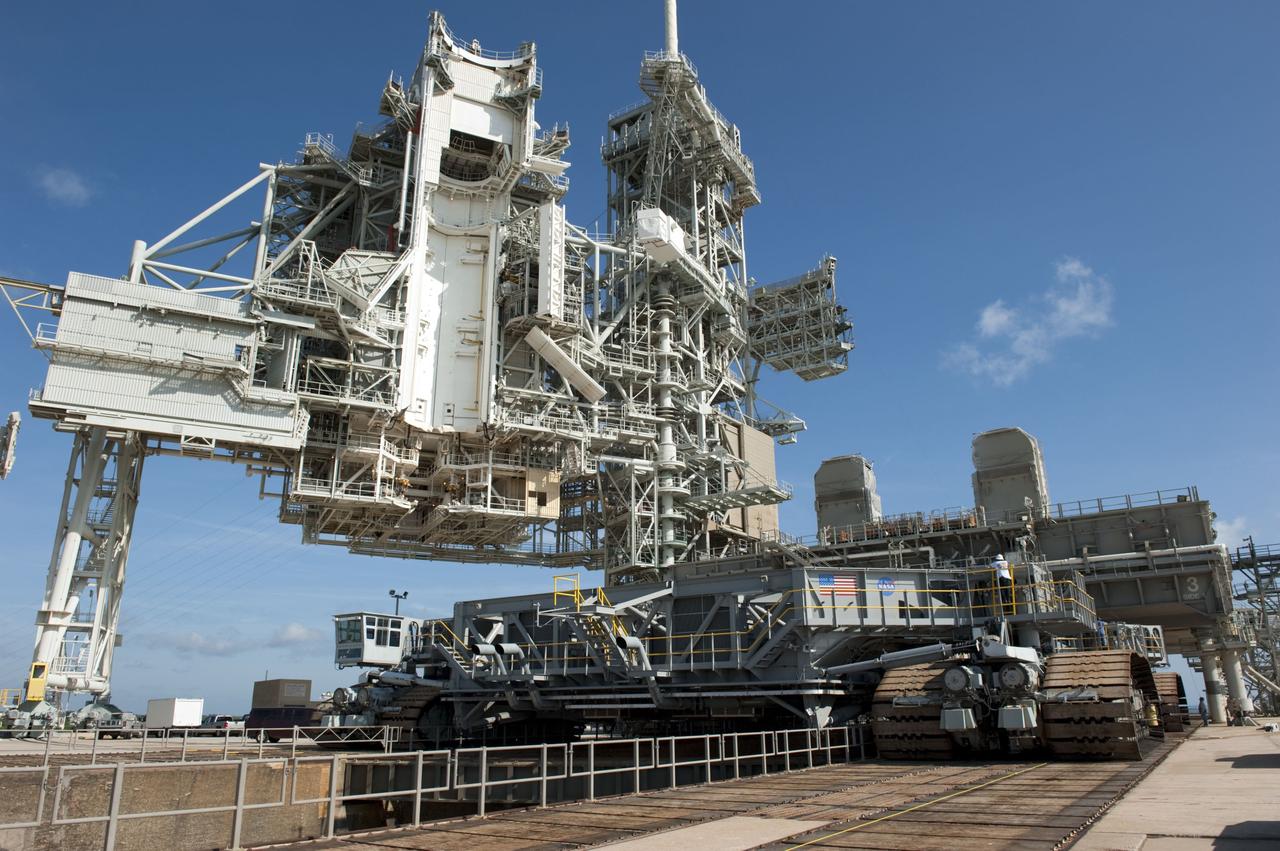
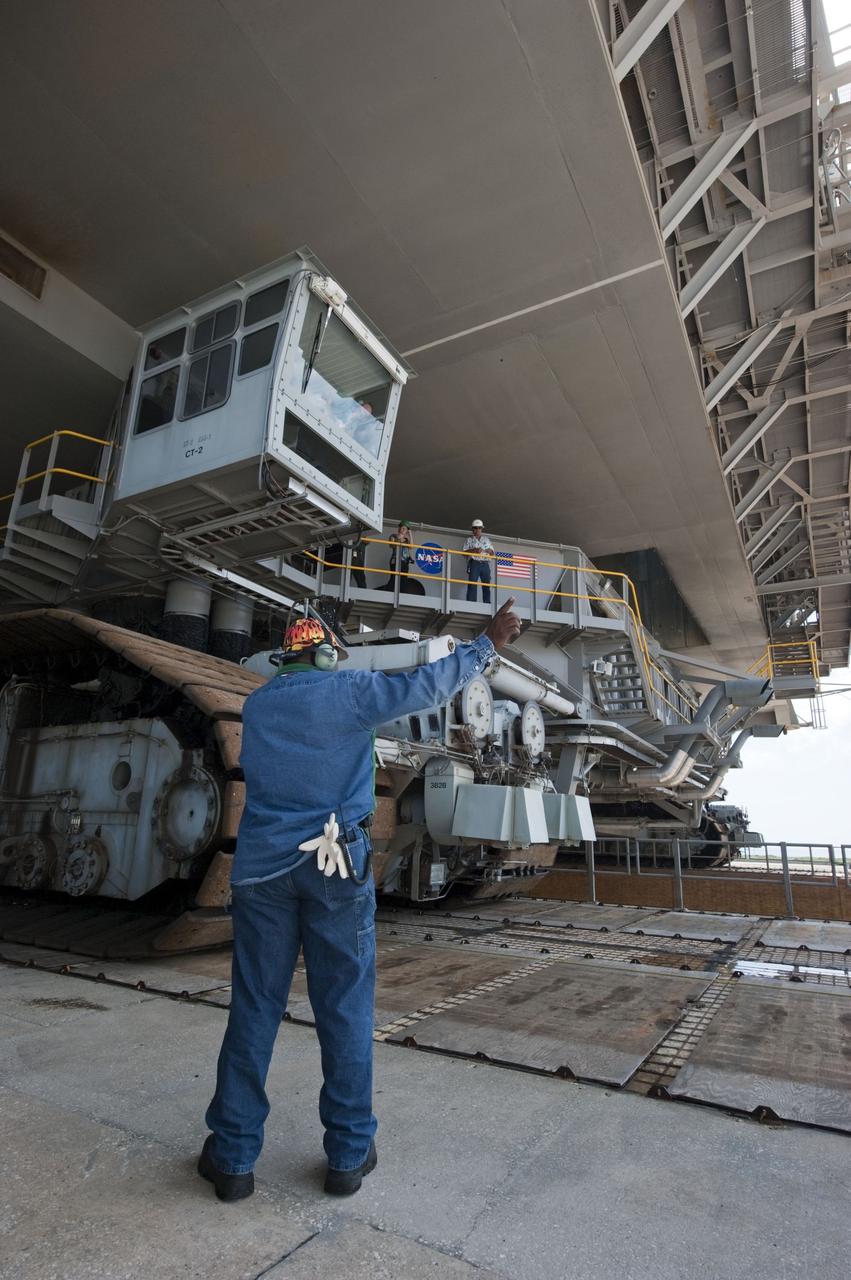
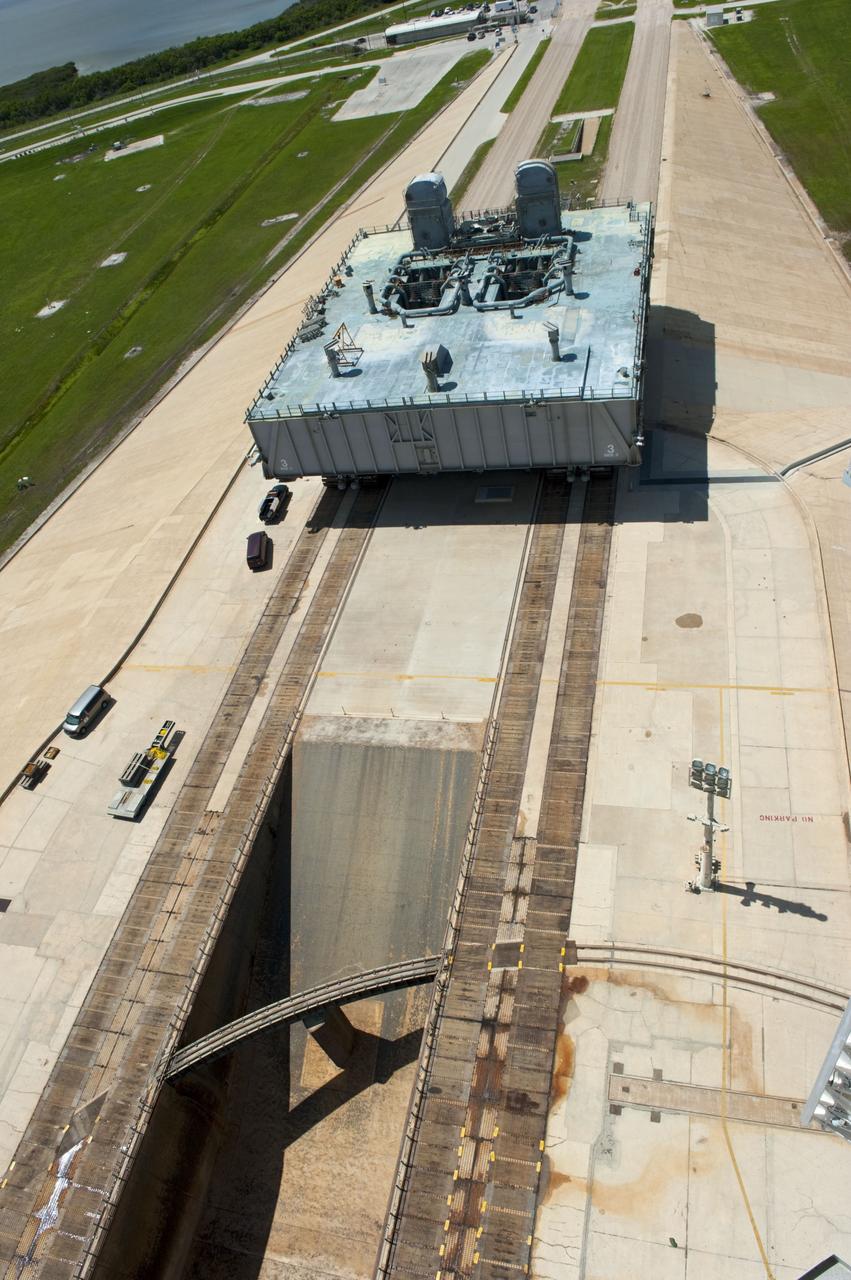
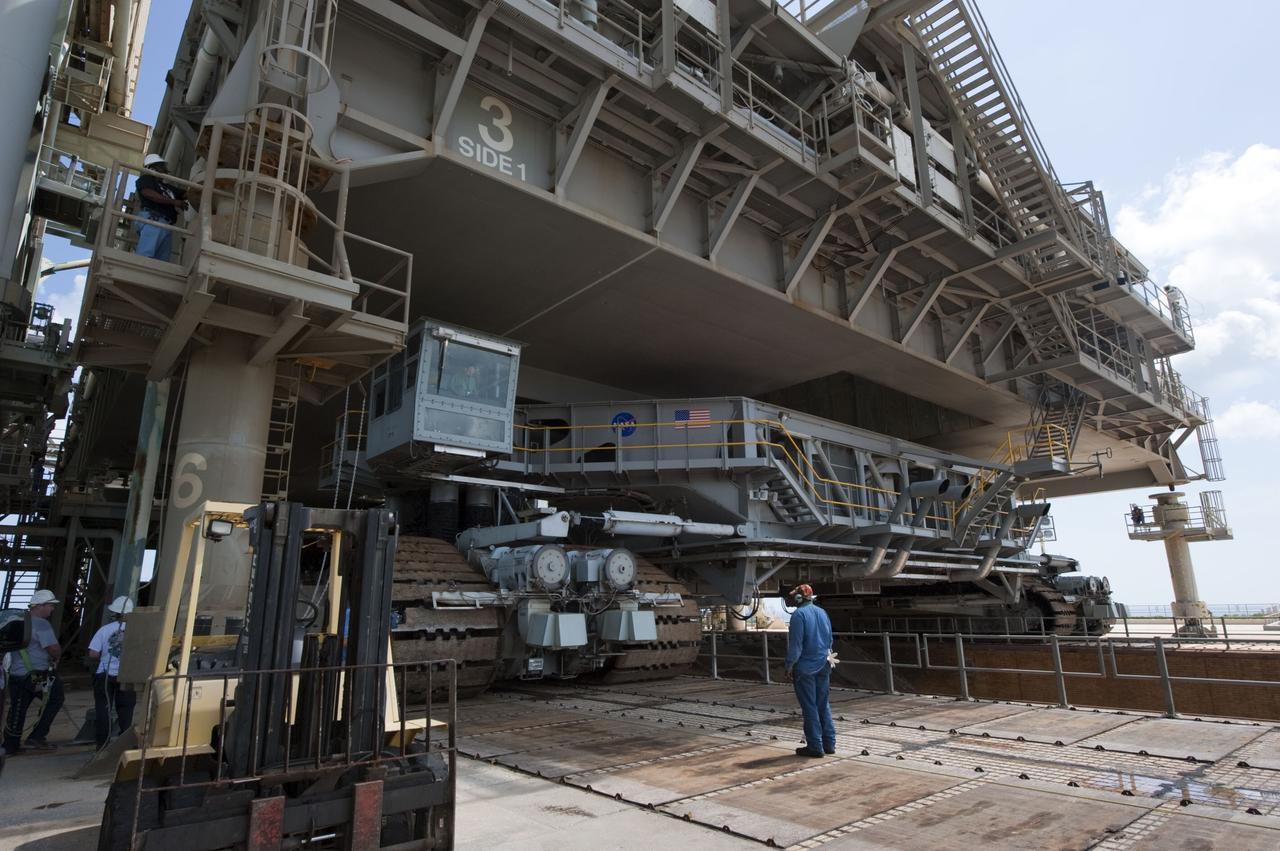
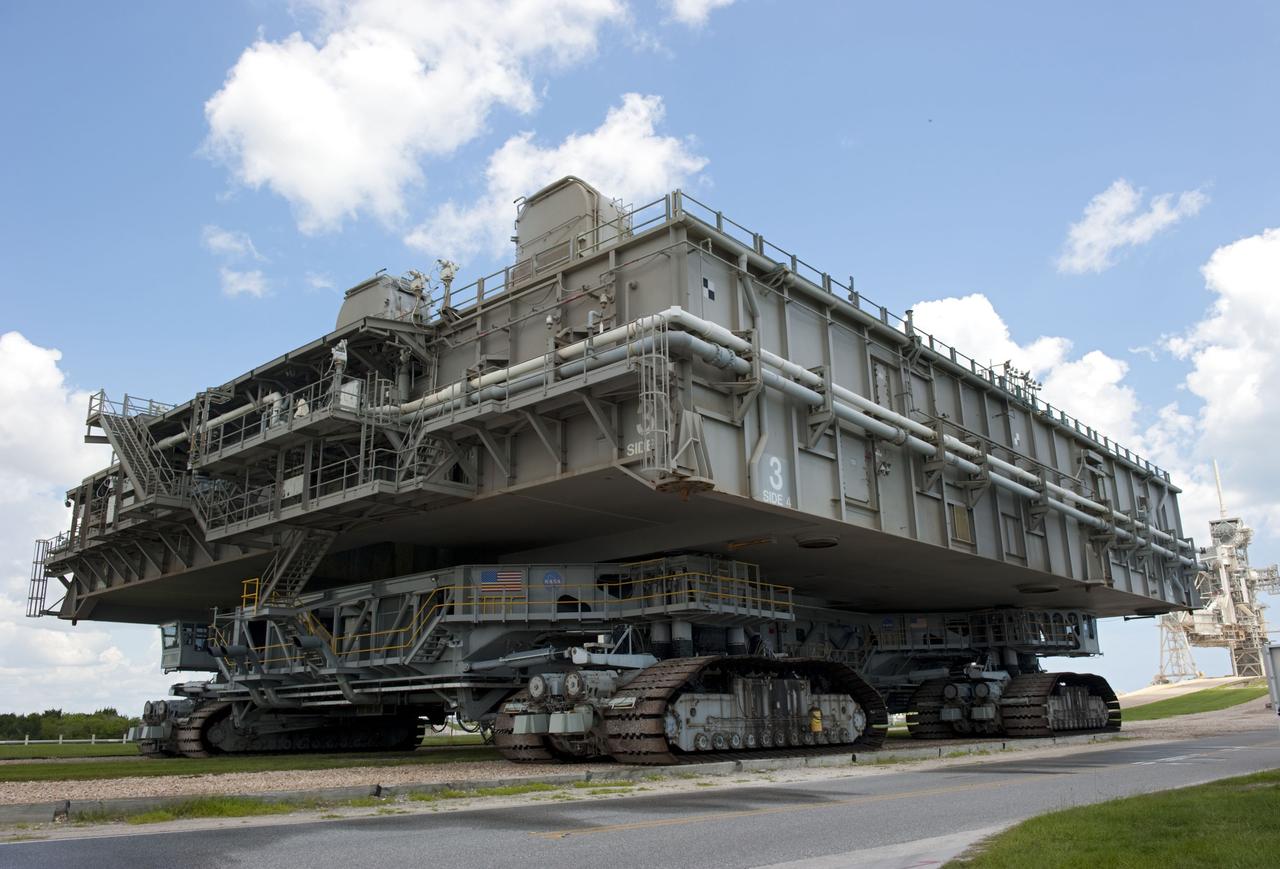
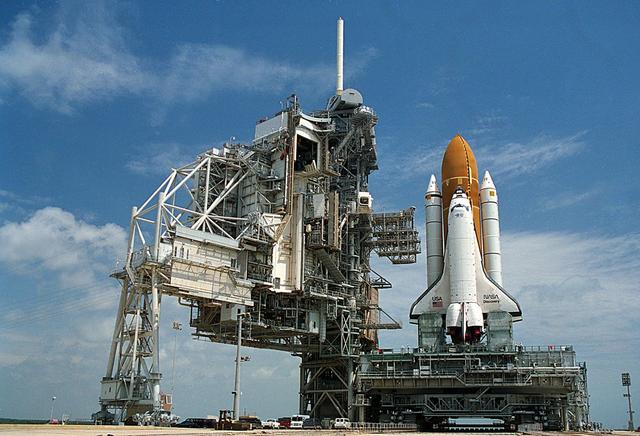
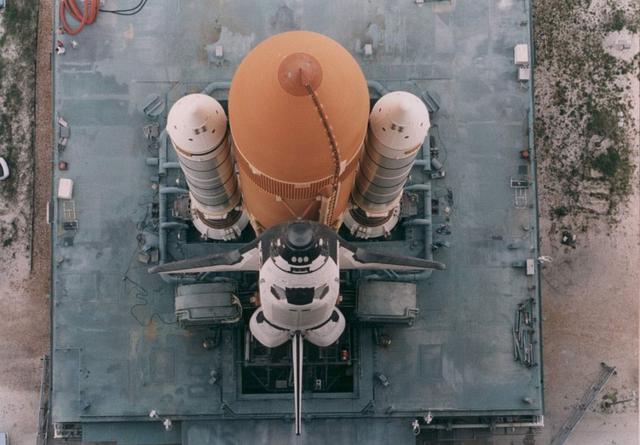
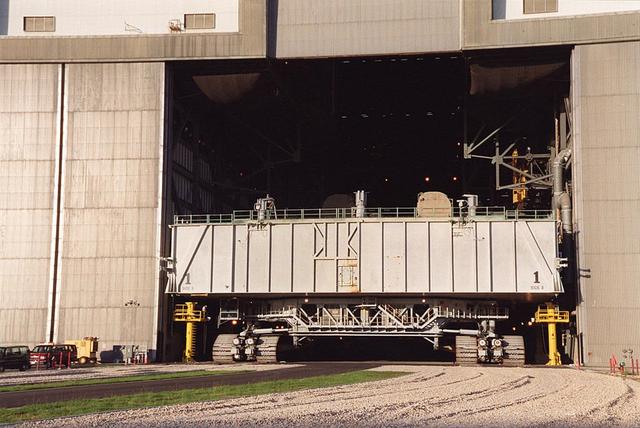
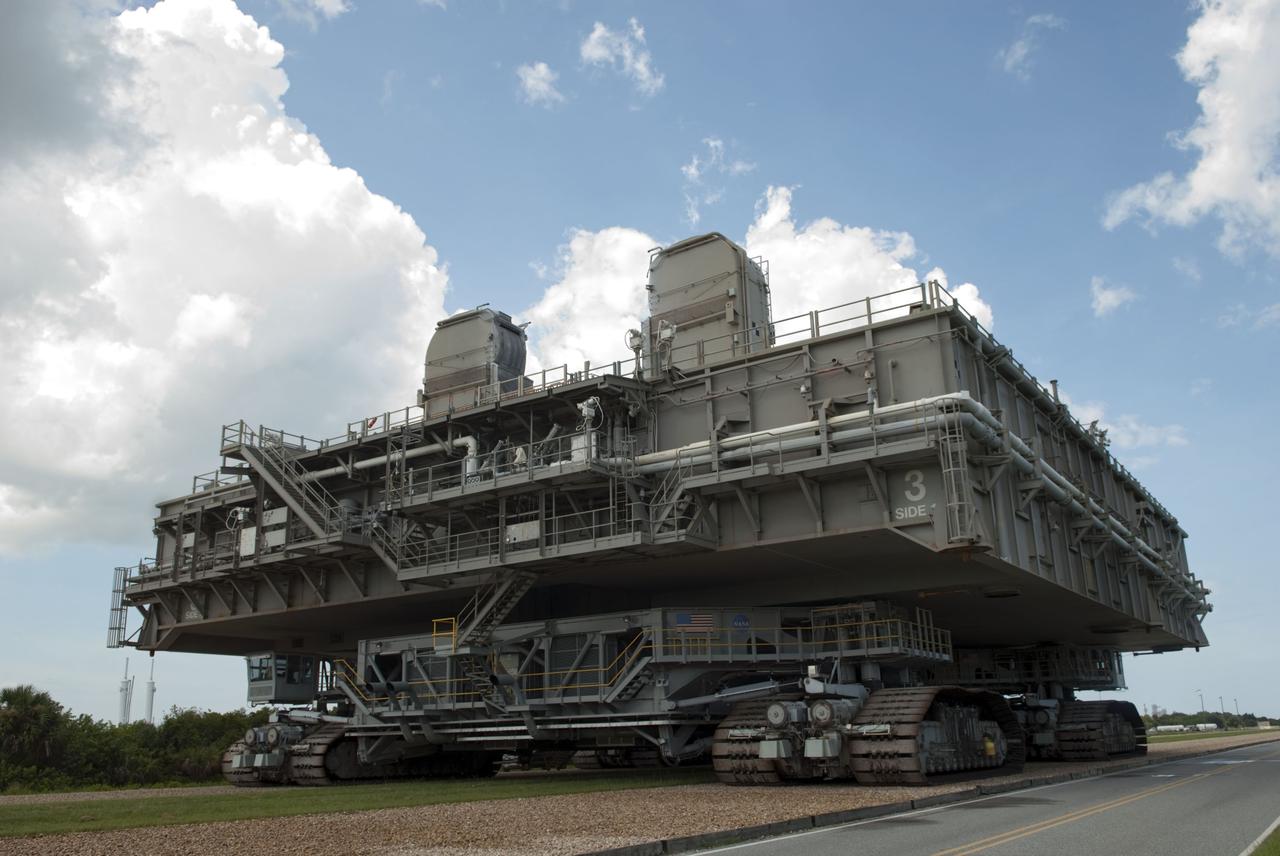
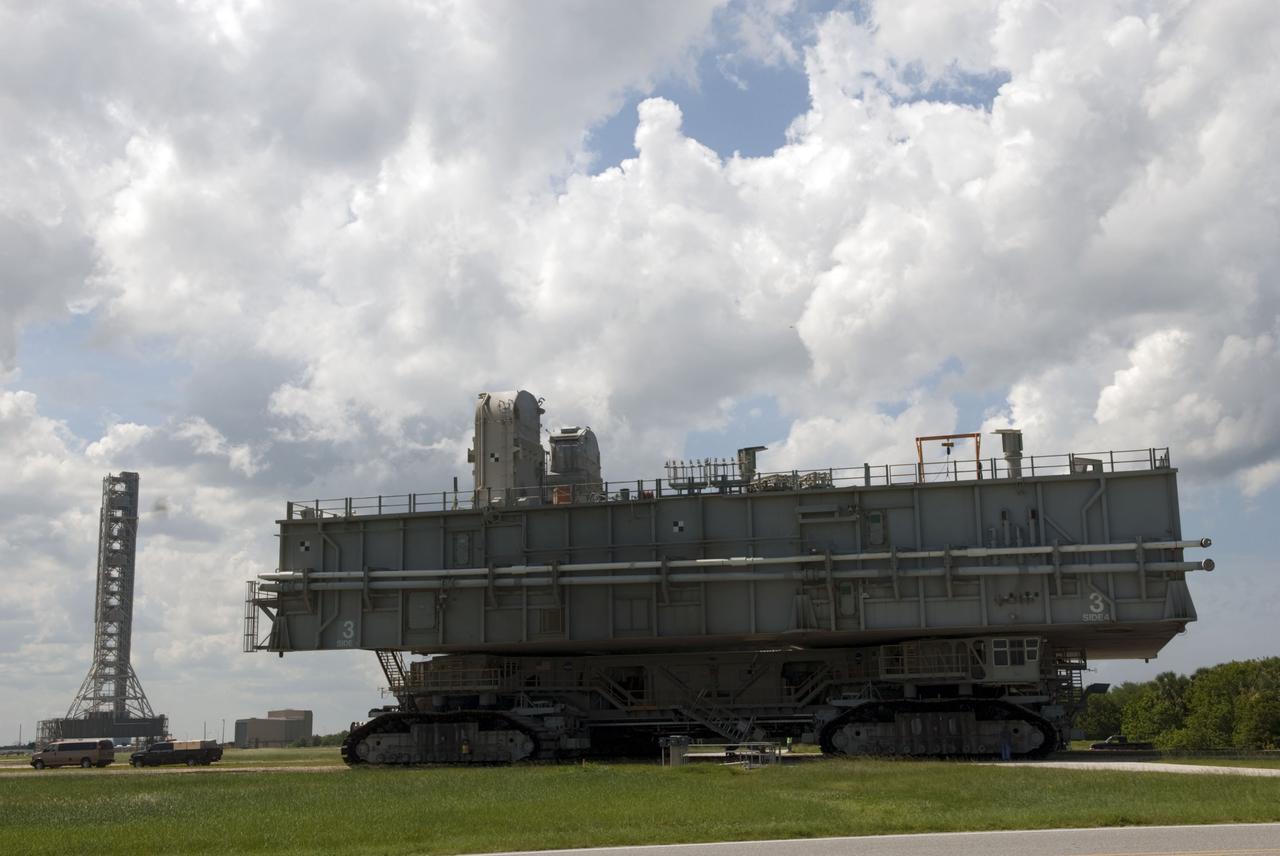
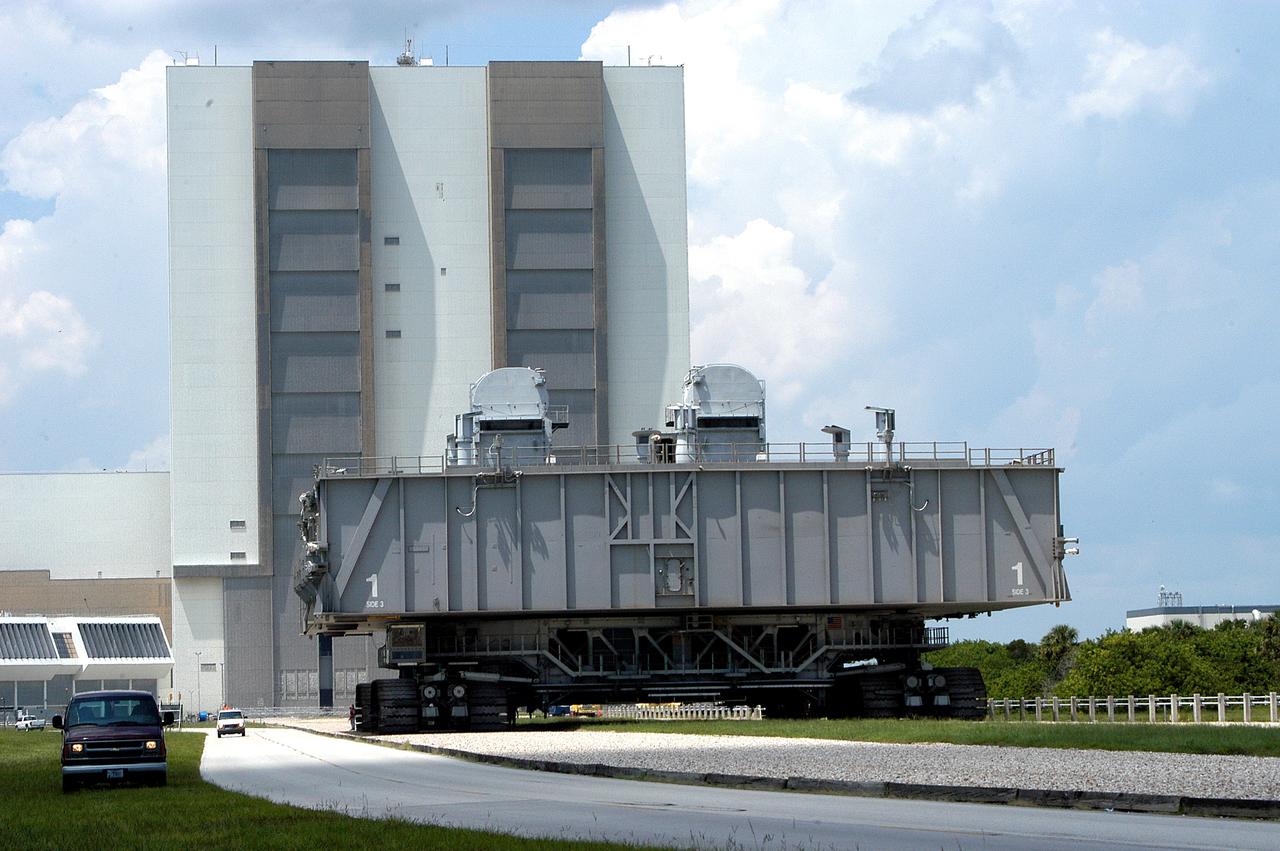
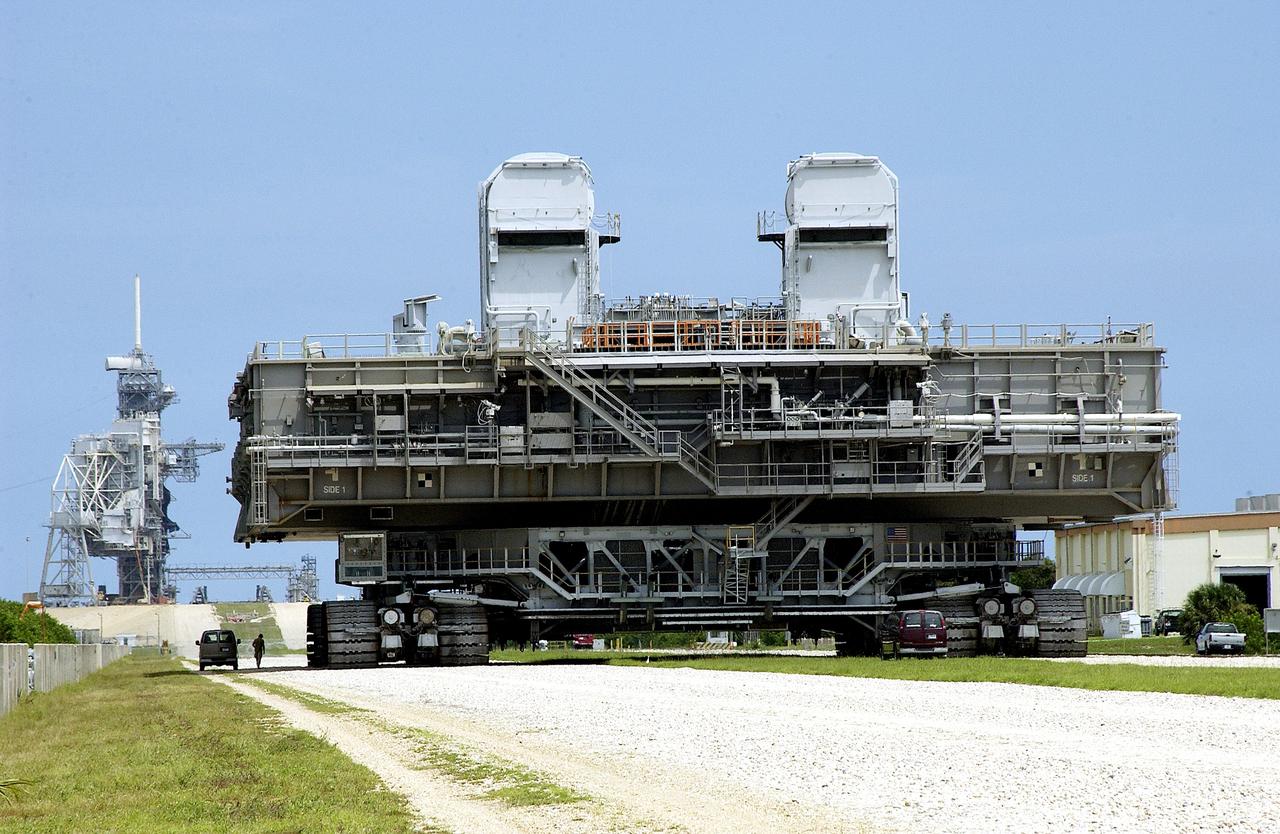
KENNEDY SPACE CENTER, FLA.  -  Crawler-transporter (CT) number 2, moves away from the Vehicle Assembly Building with a Mobile Launcher Platform (MLP) on top on a test run to the launch pad.  The CT recently underwent modifications to the cab.  The CT moves Space Shuttle vehicles, situated on the MLP, between the VAB and launch pad.  Moving on four double-tracked crawlers, the CT uses a laser guidance system and a leveling system for the journey that keeps the top of a Space Shuttle vertical within plus- or minus-10 minutes of arc.  The system enables the CT-MLP-Shuttle to negotiate the ramp leading to the launch pads and keep the load level.  Unloaded, the CT weighs 6 million pounds.  Seen on top of the MLP are two tail service masts that support the fluid, gas and electrical requirements of the orbiter’s liquid oxygen and liquid hydrogen aft umbilicals.
KENNEDY SPACE CENTER, FLA. - Crawler-transporter (CT) number 2, moves away from the Vehicle Assembly Building with a Mobile Launcher Platform (MLP) on top on a test run to the launch pad. The CT recently underwent modifications to the cab. The CT moves Space Shuttle vehicles, situated on the MLP, between the VAB and launch pad. Moving on four double-tracked crawlers, the CT uses a laser guidance system and a leveling system for the journey that keeps the top of a Space Shuttle vertical within plus- or minus-10 minutes of arc. The system enables the CT-MLP-Shuttle to negotiate the ramp leading to the launch pads and keep the load level. Unloaded, the CT weighs 6 million pounds. Seen on top of the MLP are two tail service masts that support the fluid, gas and electrical requirements of the orbiter’s liquid oxygen and liquid hydrogen aft umbilicals.
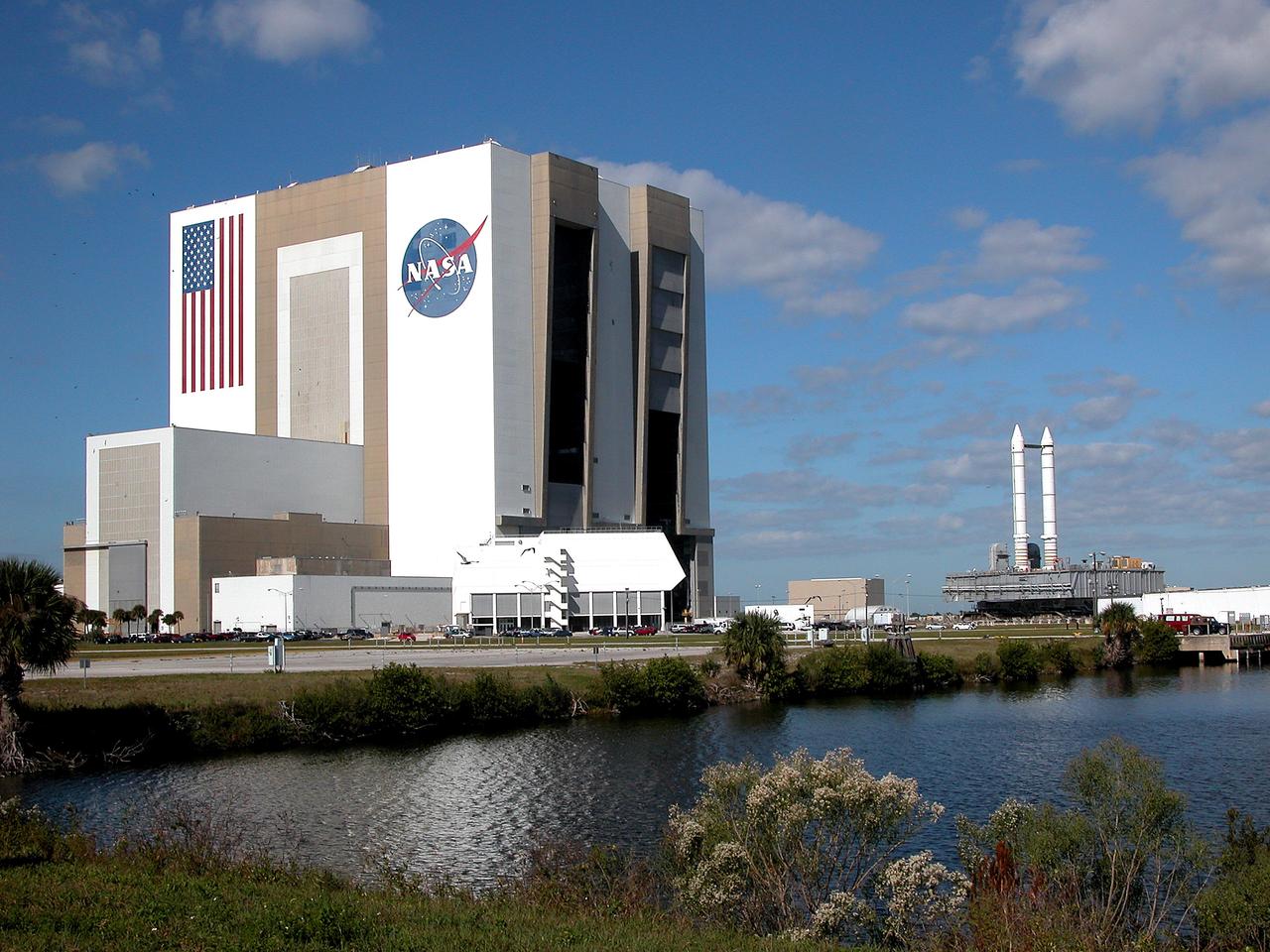
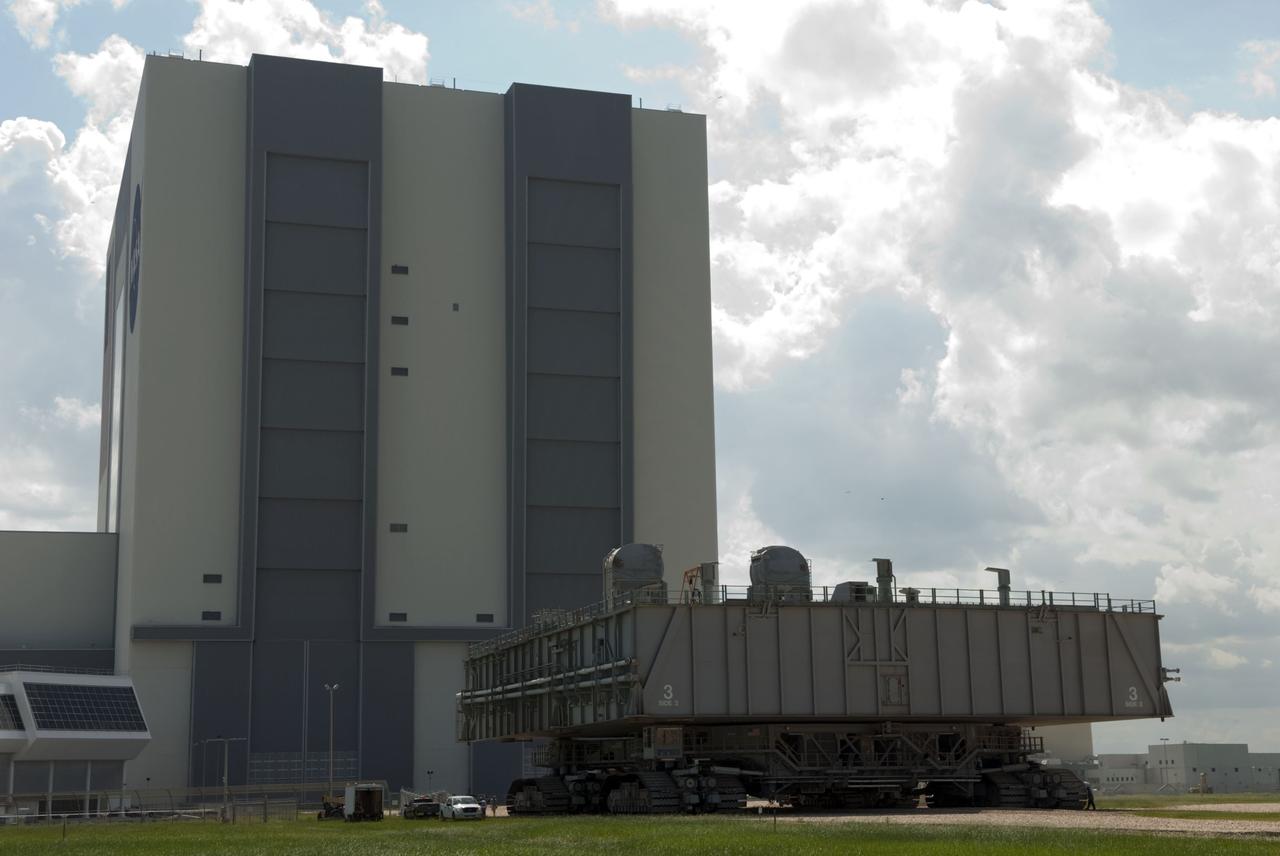
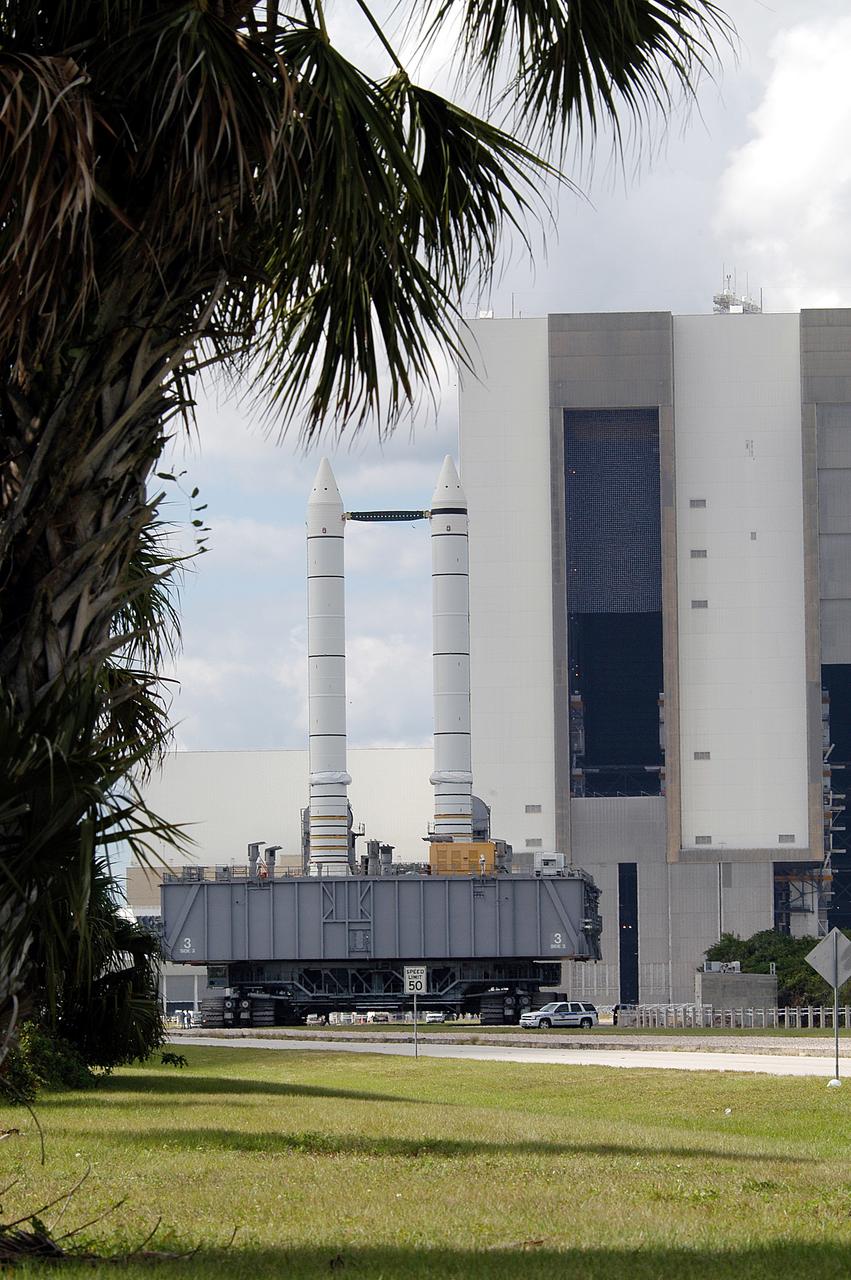
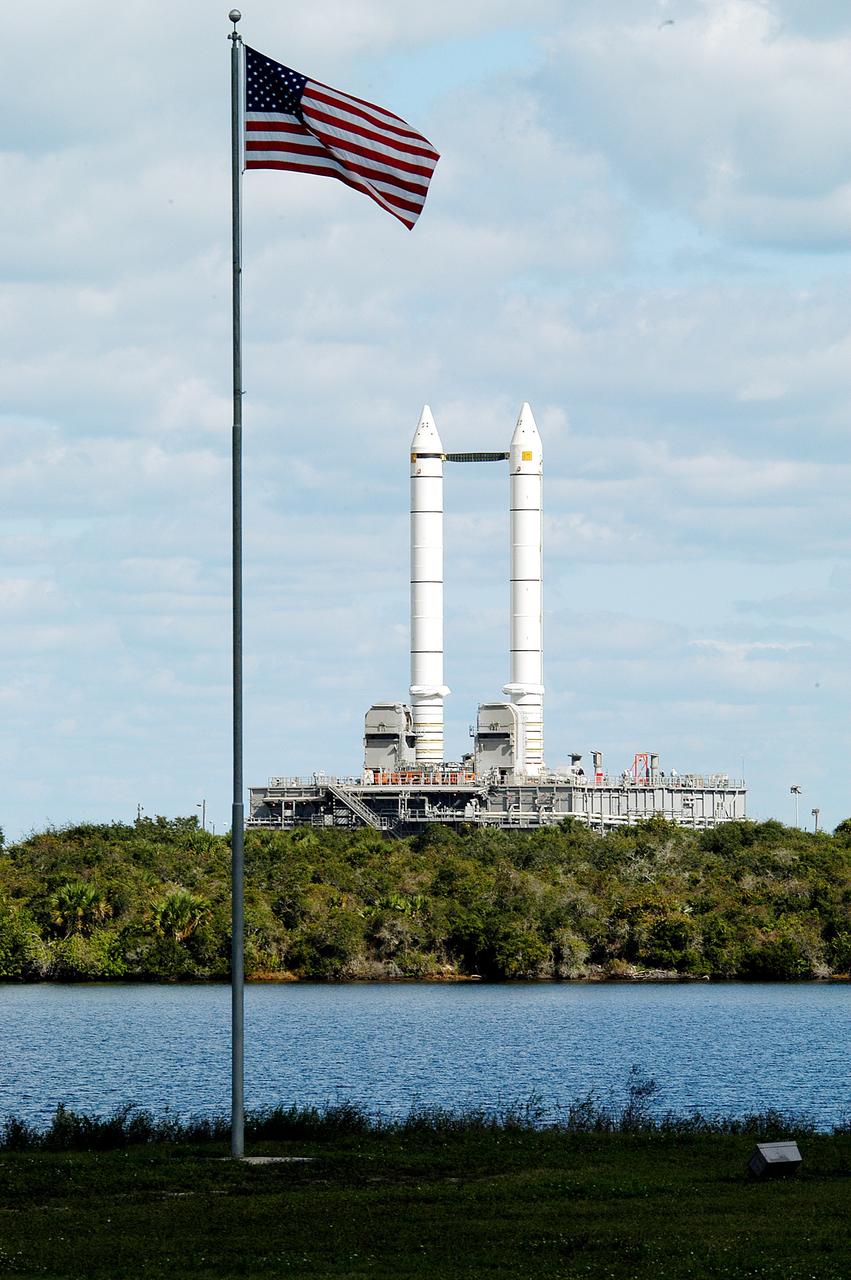
KENNEDY SPACE CENTER, FLA. -  Mobile Launcher Platform (MLP) number 3 and a set of twin solid rocket boosters bolted to it, atop the crawler-transporter, inches along the crawlerway in support of the second engineering analysis vibration test on the crawler and MLP.  The MLP is viewed from the KSC News Center across the turn basin.  The crawler is moving at various speeds up to 1 mph in an effort to achieve vibration data gathering goals as it leaves the VAB, travels toward Launch Pad 39A and then returns.  The boosters are braced at the top for stability.  The primary purpose of these rollout tests is to gather data to develop future maintenance requirements on the transport equipment and the flight hardware. Various parts of the MLP and crawler transporter have been instrumented with vibration data collection equipment.
KENNEDY SPACE CENTER, FLA. - Mobile Launcher Platform (MLP) number 3 and a set of twin solid rocket boosters bolted to it, atop the crawler-transporter, inches along the crawlerway in support of the second engineering analysis vibration test on the crawler and MLP. The MLP is viewed from the KSC News Center across the turn basin. The crawler is moving at various speeds up to 1 mph in an effort to achieve vibration data gathering goals as it leaves the VAB, travels toward Launch Pad 39A and then returns. The boosters are braced at the top for stability. The primary purpose of these rollout tests is to gather data to develop future maintenance requirements on the transport equipment and the flight hardware. Various parts of the MLP and crawler transporter have been instrumented with vibration data collection equipment.
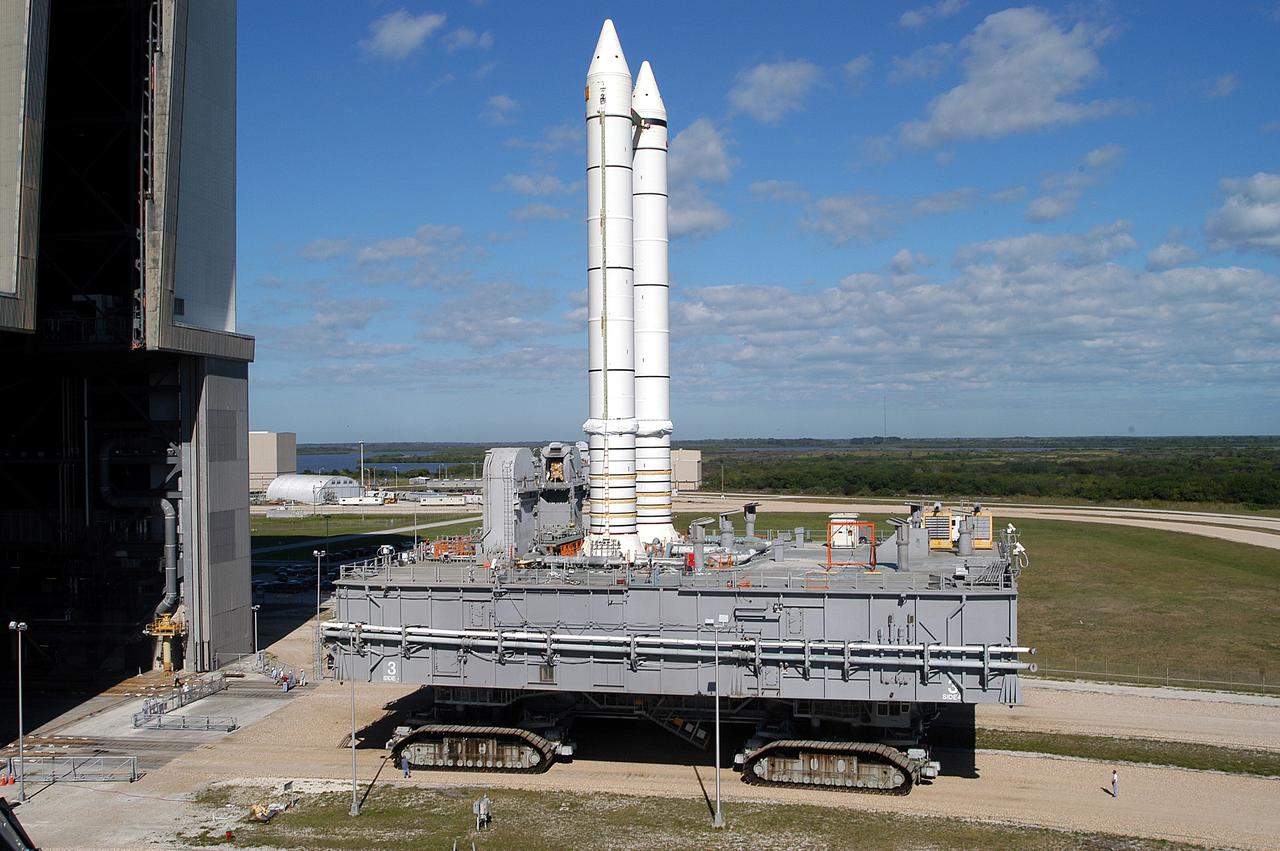
KENNEDY SPACE CENTER, FLA. -  Mobile Launcher Platform (MLP) number 3 and a set of twin solid rocket boosters, atop the crawler-transporter, crawl out of the Vehicle Assembly Building (VAB) in support of the second engineering analysis vibration test on the crawler and MLP. In the background is another MLP.  The crawler is moving at various speeds up to 1 mph in an effort to achieve vibration data gathering goals as it leaves the VAB, travels toward Launch Pad 39A and then returns.  The boosters are braced at the top for stability.  The primary purpose of these rollout tests is to gather data to develop future maintenance requirements on the transport equipment and the flight hardware. Various parts of the MLP and crawler transporter have been instrumented with vibration data collection equipment.
KENNEDY SPACE CENTER, FLA. - Mobile Launcher Platform (MLP) number 3 and a set of twin solid rocket boosters, atop the crawler-transporter, crawl out of the Vehicle Assembly Building (VAB) in support of the second engineering analysis vibration test on the crawler and MLP. In the background is another MLP. The crawler is moving at various speeds up to 1 mph in an effort to achieve vibration data gathering goals as it leaves the VAB, travels toward Launch Pad 39A and then returns. The boosters are braced at the top for stability. The primary purpose of these rollout tests is to gather data to develop future maintenance requirements on the transport equipment and the flight hardware. Various parts of the MLP and crawler transporter have been instrumented with vibration data collection equipment.
KENNEDY SPACE CENTER, FLA.  -   Crawler-transporter (CT) number 2 nears the launch pad with a Mobile Launcher Platform (MLP) on top.  After recent modifications to the cab and muffler system, the CT was taken on a test run.   The CT moves Space Shuttle vehicles, situated on the MLP, between the VAB and launch pad.  Moving on four double-tracked crawlers, the CT uses a laser guidance system and a leveling system for the journey that keeps the top of a Space Shuttle vertical within plus- or minus-10 minutes of arc.  The system enables the CT-MLP-Shuttle to negotiate the ramp leading to the launch pads and keep the load level.  Unloaded, the CT weighs 6 million pounds.  Seen on top of the MLP are two tail service masts that support the fluid, gas and electrical requirements of the orbiter’s liquid oxygen and liquid hydrogen aft umbilicals.
KENNEDY SPACE CENTER, FLA. - Crawler-transporter (CT) number 2 nears the launch pad with a Mobile Launcher Platform (MLP) on top. After recent modifications to the cab and muffler system, the CT was taken on a test run. The CT moves Space Shuttle vehicles, situated on the MLP, between the VAB and launch pad. Moving on four double-tracked crawlers, the CT uses a laser guidance system and a leveling system for the journey that keeps the top of a Space Shuttle vertical within plus- or minus-10 minutes of arc. The system enables the CT-MLP-Shuttle to negotiate the ramp leading to the launch pads and keep the load level. Unloaded, the CT weighs 6 million pounds. Seen on top of the MLP are two tail service masts that support the fluid, gas and electrical requirements of the orbiter’s liquid oxygen and liquid hydrogen aft umbilicals.
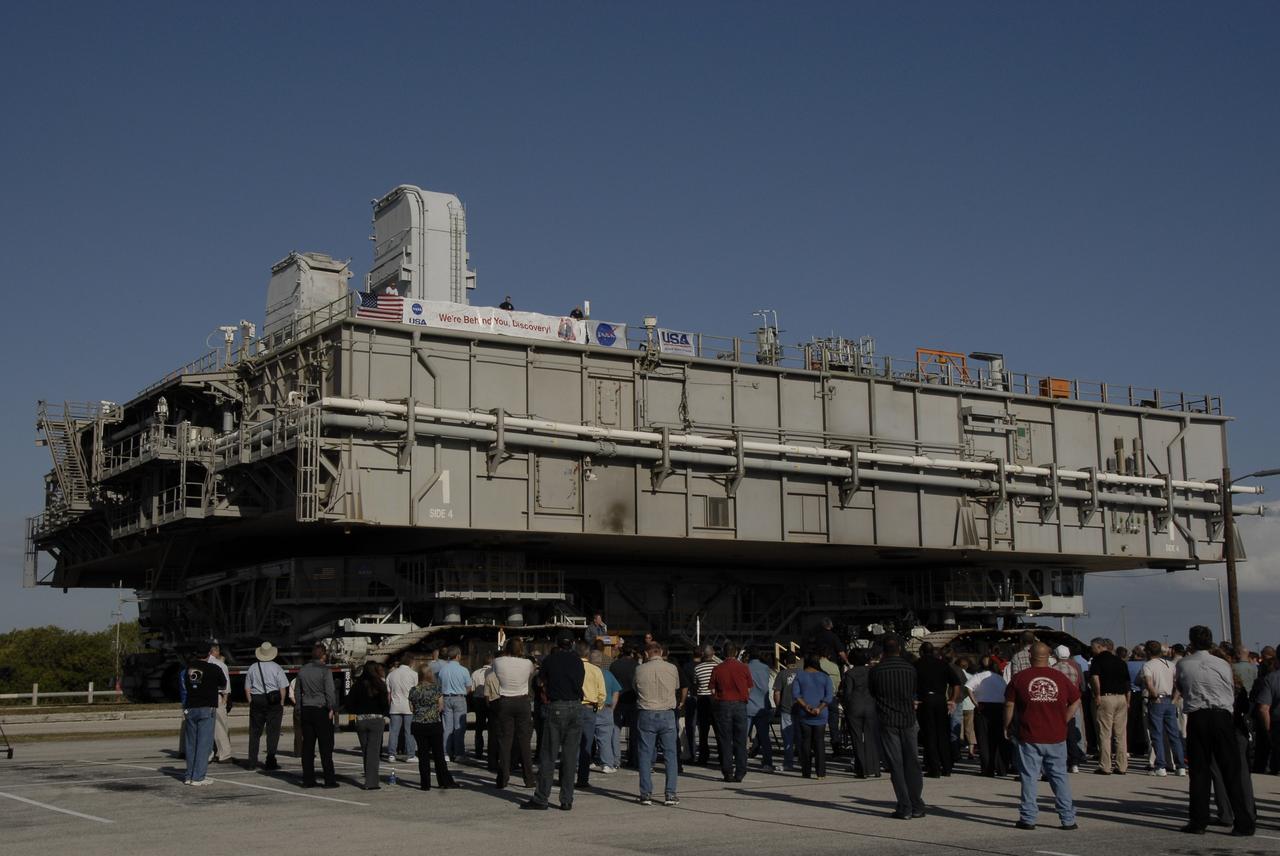
CAPE CANAVERAL, Fla. – –  Employees and media gather near Launch Pad 39B at NASA's Kennedy Space Center in Florida for the handover ceremony for Mobile Launcher Platform-1, seen here.  The platform is being transferred from NASA's Space Shuttle Program to the Constellation Program for the Ares I-X flight test targeted for this summer. Constructed in 1964, the mobile launchers used in Apollo/Saturn operations were modified for use in shuttle operations. With cranes, umbilical towers and swing arms removed, the mobile launchers were renamed Mobile Launcher Platforms, or MLPs.  Photo credit: NASA/Kim Shiflett
KSC-2009-2302
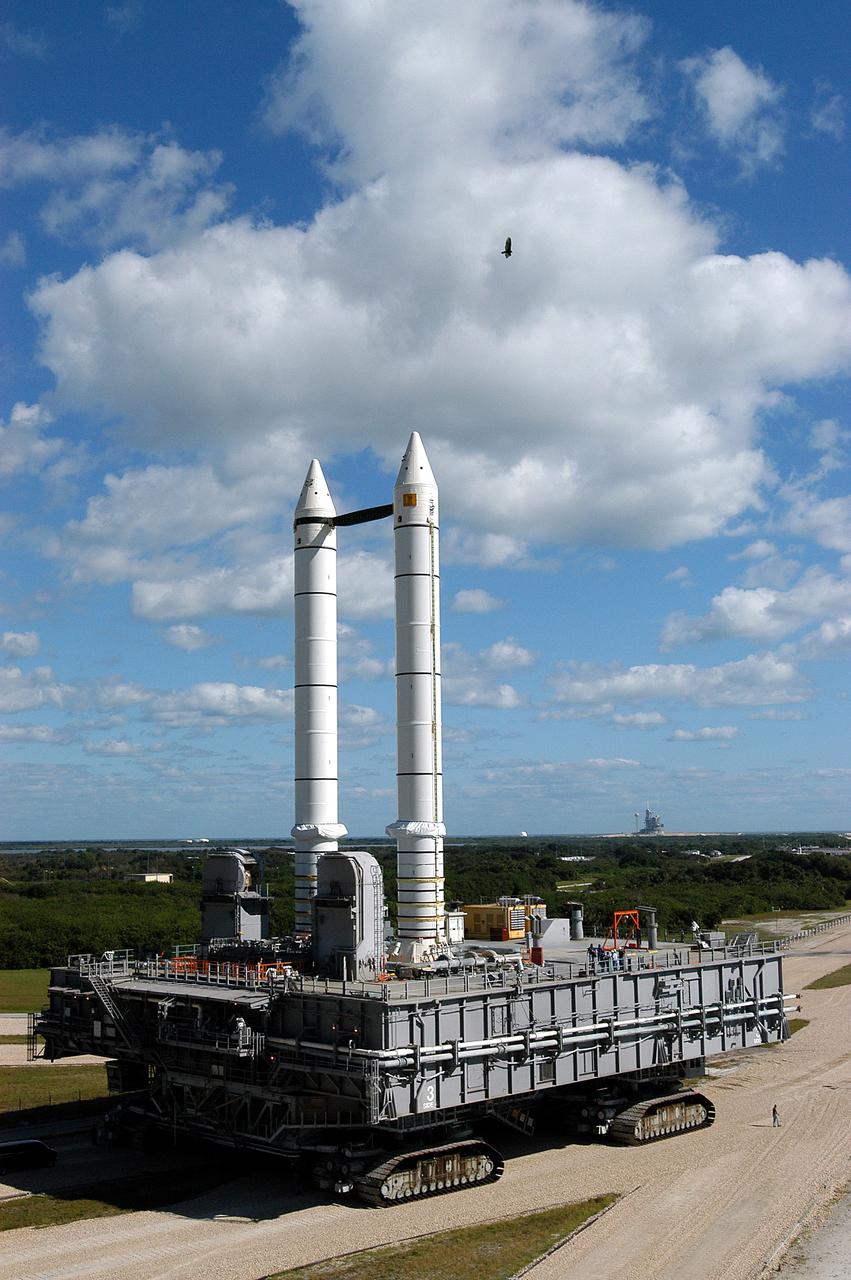
KENNEDY SPACE CENTER, FLA. -  A high-flying bird takes a closer look at the Mobile Launcher Platform (MLP) number 3 with twin solid rocket boosters bolted to it as it crawls toward Launch Pad 39A, in the background.  The crawler is moving along the crawlerway at various speeds up to 1 mph in an effort to achieve vibration data gathering goals as it travels toward Launch Pad 39A and then returns.  The boosters are braced at the top for stability.  The primary purpose of these rollout tests is to gather data to develop future maintenance requirements on the transport equipment and the flight hardware. Various parts of the MLP and crawler transporter have been instrumented with vibration data collection equipment.
KENNEDY SPACE CENTER, FLA. - A high-flying bird takes a closer look at the Mobile Launcher Platform (MLP) number 3 with twin solid rocket boosters bolted to it as it crawls toward Launch Pad 39A, in the background. The crawler is moving along the crawlerway at various speeds up to 1 mph in an effort to achieve vibration data gathering goals as it travels toward Launch Pad 39A and then returns. The boosters are braced at the top for stability. The primary purpose of these rollout tests is to gather data to develop future maintenance requirements on the transport equipment and the flight hardware. Various parts of the MLP and crawler transporter have been instrumented with vibration data collection equipment.
CAPE CANAVERAL, Fla. – NASA's Kennedy Space Center management host a ceremony near Launch Pad 39B to mark the handover of Mobile Launcher Platform-1 (behind them) from NASA's Space Shuttle Program to the Constellation Program for the Ares I-X flight test targeted for this summer. Seated are (left) Shuttle Launch  Director Mike Leinbach and (right) Pepper E. Phillips, director of the Constellation Project Office, and Brett Raulerson, manager of MLP Operations with United Space Alliance.  At the podium is Rita Willcoxon, director of Launch Vehicle Processing at Kennedy. Constructed in 1964, the mobile launchers used in Apollo/Saturn operations were modified for use in shuttle operations. With cranes, umbilical towers and swing arms removed, the mobile launchers were renamed Mobile Launcher Platforms, or MLPs.  Photo credit: NASA/Kim Shiflett
KSC-2009-2301
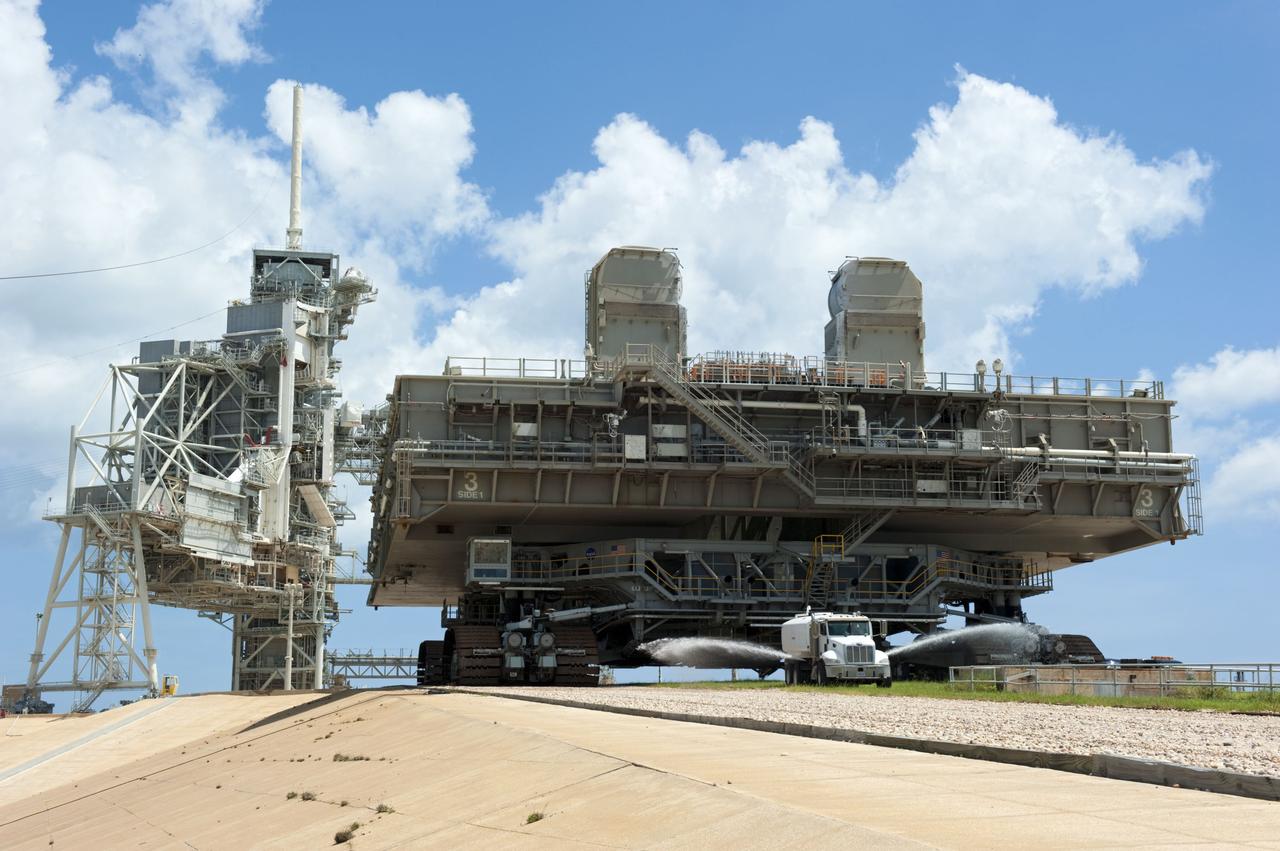
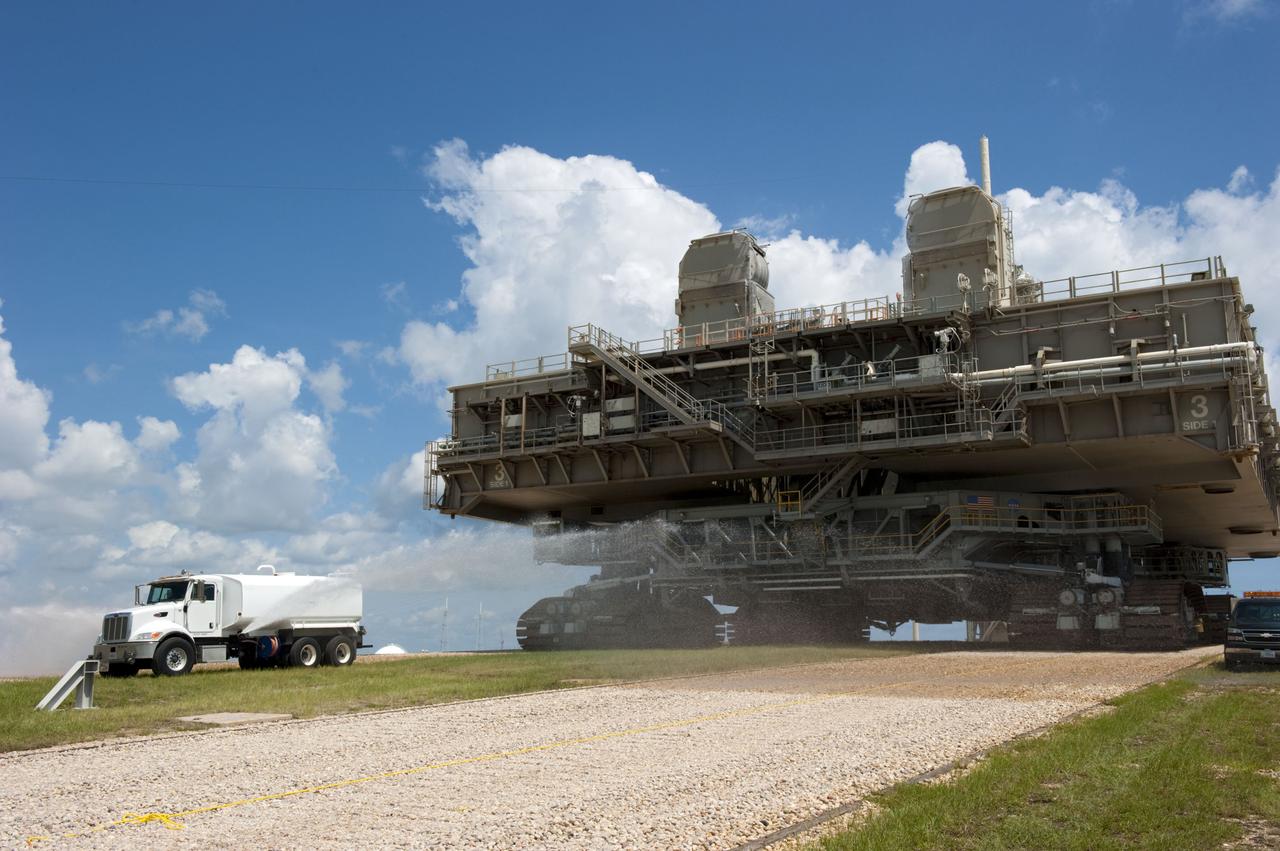
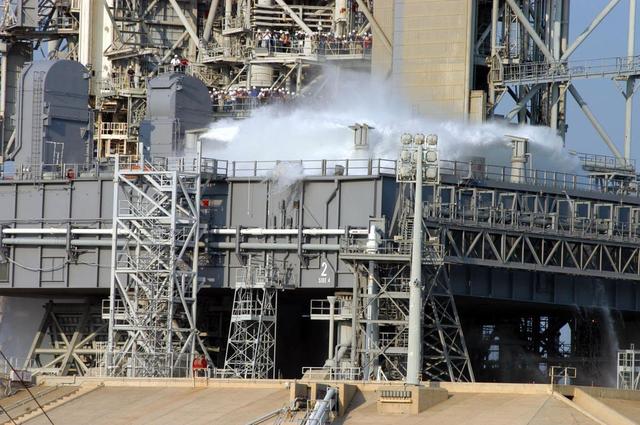
CAPE CANAVERAL, Fla. -- At NASA's Kennedy Space Center in Florida, Mobile Launcher Platform-3 (MLP), which supported space shuttle Atlantis for its final flight to the International Space Station on the STS-135 mission, is taking its last journey from Launch Pad 39A to the Vehicle Assembly Building (VAB). A massive crawler-transporter positioned under the MLP -- the last mobile launcher platform to launch a shuttle, begins the trek back to the VAB. A water truck leads the way spraying water on the dry crawlerway to reduce dust particles in the air.                     For more than 40 years, the MLPs have traveled between the massive VAB to both launch pads at Launch Complex 39, and then returned to the VAB for future use. MLP-3 was first used to launch Columbia on the STS-32 mission on Jan. 9, 1990. Photo credit: NASA/Kim Shiflett
KSC-2011-5590
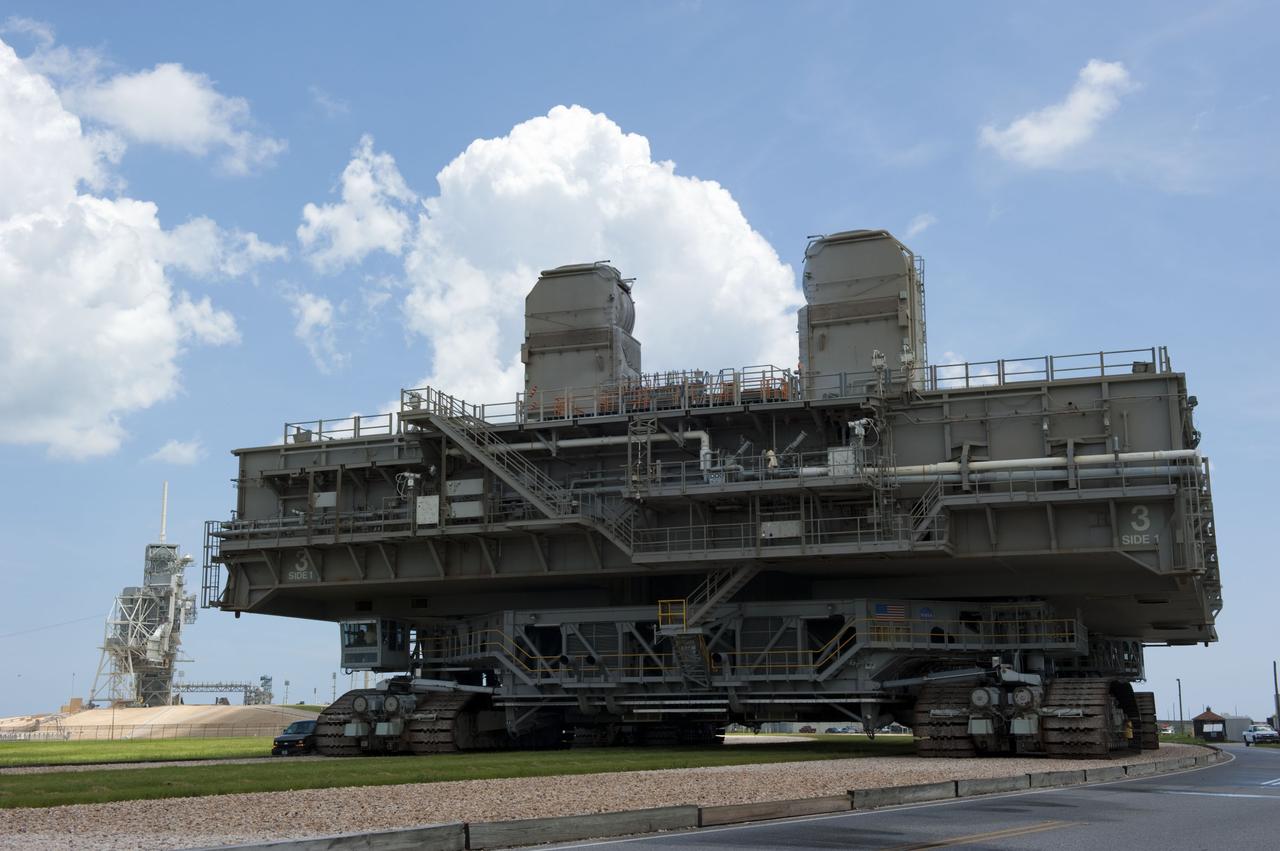
CAPE CANAVERAL, Fla. -- At NASA's Kennedy Space Center in Florida, Mobile Launcher Platform-3 (MLP), which supported space shuttle Atlantis for its final flight to the International Space Station on the STS-135 mission, is being prepared for its last journey from Launch Pad 39A to the Vehicle Assembly Building (VAB). Here, workers have moved a massive crawler-transporter under the MLP -- the last mobile launcher platform to launch a shuttle.                     For more than 40 years, the MLPs have traveled between the massive VAB to both launch pads at Launch Complex 39, and then returned to the VAB for future use. MLP-3 was first used to launch Columbia on the STS-32 mission on Jan. 9, 1990. Photo credit: NASA/Kim Shiflett
KSC-2011-5580
CAPE CANAVERAL, Fla. -- At NASA's Kennedy Space Center in Florida, Mobile Launcher Platform-3 (MLP), which supported space shuttle Atlantis for its final flight to the International Space Station on the STS-135 mission, is taking its last journey from Launch Pad 39A to the Vehicle Assembly Building (VAB). Here, workers monitor the process as a massive crawler-transporter positioned under the MLP, the last mobile launcher platform to launch a shuttle, begins its trek back to the VAB.                 For more than 40 years, the MLPs have traveled between the massive VAB to both launch pads at Launch Complex 39, and then returned to the VAB for future use. MLP-3 was first used to launch Columbia on the STS-32 mission on Jan. 9, 1990. Photo credit: NASA/Kim Shiflett
KSC-2011-5583
CAPE CANAVERAL, Fla. -- At NASA's Kennedy Space Center in Florida, Mobile Launcher Platform-3 (MLP), which supported space shuttle Atlantis for its final flight to the International Space Station on the STS-135 mission, is taking its last journey from Launch Pad 39A to the Vehicle Assembly Building (VAB). A massive crawler-transporter positioned under the MLP -- the last mobile launcher platform to launch a shuttle, begins the trek back to the VAB.                    For more than 40 years, the MLPs have traveled between the massive VAB to both launch pads at Launch Complex 39, and then returned to the VAB for future use. MLP-3 was first used to launch Columbia on the STS-32 mission on Jan. 9, 1990. Photo credit: NASA/Kim Shiflett
KSC-2011-5589
CAPE CANAVERAL, Fla. -- At NASA's Kennedy Space Center in Florida, Mobile Launcher Platform-3 (MLP), which supported space shuttle Atlantis for its final flight to the International Space Station on the STS-135 mission, is being prepared for its last journey from Launch Pad 39A to the Vehicle Assembly Building (VAB). Here, workers are moving a massive crawler-transporter under the MLP -- the last mobile launcher platform to launch a shuttle.                 For more than 40 years, the MLPs have traveled between the massive VAB to both launch pads at Launch Complex 39, and then returned to the VAB for future use. MLP-3 was first used to launch Columbia on the STS-32 mission on Jan. 9, 1990. Photo credit: NASA/Kim Shiflett
KSC-2011-5576
CAPE CANAVERAL, Fla. -- At NASA's Kennedy Space Center in Florida, Mobile Launcher Platform-3 (MLP), which supported space shuttle Atlantis for its final flight to the International Space Station on the STS-135 mission, is being prepared for its last journey from Launch Pad 39A to the Vehicle Assembly Building (VAB). Here, workers are moving a massive crawler-transporter under the MLP -- the last mobile launcher platform to launch a shuttle.                 For more than 40 years, the MLPs have traveled between the massive VAB to both launch pads at Launch Complex 39, and then returned to the VAB for future use. MLP-3 was first used to launch Columbia on the STS-32 mission on Jan. 9, 1990. Photo credit: NASA/Kim Shiflett
KSC-2011-5578
CAPE CANAVERAL, Fla. -- At NASA's Kennedy Space Center in Florida, Mobile Launcher Platform-3 (MLP), which supported space shuttle Atlantis for its final flight to the International Space Station on the STS-135 mission, is taking its last journey from Launch Pad 39A to the Vehicle Assembly Building (VAB). A massive crawler-transporter positioned under the MLP -- the last mobile launcher platform to launch a shuttle, begins the trek back to the VAB.                    For more than 40 years, the MLPs have traveled between the massive VAB to both launch pads at Launch Complex 39, and then returned to the VAB for future use. MLP-3 was first used to launch Columbia on the STS-32 mission on Jan. 9, 1990. Photo credit: NASA/Kim Shiflett
KSC-2011-5595
CAPE CANAVERAL, Fla. -- At NASA's Kennedy Space Center in Florida, Mobile Launcher Platform-3 (MLP), which supported space shuttle Atlantis for its final flight to the International Space Station on the STS-135 mission, is taking its last journey from Launch Pad 39A to the Vehicle Assembly Building (VAB). A massive crawler-transporter positioned under the MLP -- the last mobile launcher platform to launch a shuttle, begins the trek back to the VAB.                    For more than 40 years, the MLPs have traveled between the massive VAB to both launch pads at Launch Complex 39, and then returned to the VAB for future use. MLP-3 was first used to launch Columbia on the STS-32 mission on Jan. 9, 1990. Photo credit: NASA/Kim Shiflett
KSC-2011-5592
CAPE CANAVERAL, Fla. -- At NASA's Kennedy Space Center in Florida, Mobile Launcher Platform-3 (MLP), which supported space shuttle Atlantis for its final flight to the International Space Station on the STS-135 mission, is being prepared for its last journey from Launch Pad 39A to the Vehicle Assembly Building (VAB). Here, workers have moved a massive crawler-transporter under the MLP -- the last mobile launcher platform to launch a shuttle.                 For more than 40 years, the MLPs have traveled between the massive VAB to both launch pads at Launch Complex 39, and then returned to the VAB for future use. MLP-3 was first used to launch Columbia on the STS-32 mission on Jan. 9, 1990. Photo credit: NASA/Kim Shiflett
KSC-2011-5579
CAPE CANAVERAL, Fla. -- At NASA's Kennedy Space Center in Florida, Mobile Launcher Platform-3 (MLP), which supported space shuttle Atlantis for its final flight to the International Space Station on the STS-135 mission, is taking its last journey from Launch Pad 39A to the Vehicle Assembly Building (VAB). A massive crawler-transporter positioned under the MLP -- the last mobile launcher platform to launch a shuttle, begins the trek back to the VAB. A water truck leads the way spraying water on the dry crawlerway to reduce dust particles in the air.                     For more than 40 years, the MLPs have traveled between the massive VAB to both launch pads at Launch Complex 39, and then returned to the VAB for future use. MLP-3 was first used to launch Columbia on the STS-32 mission on Jan. 9, 1990. Photo credit: NASA/Kim Shiflett
KSC-2011-5594
CAPE CANAVERAL, Fla. -- At NASA's Kennedy Space Center in Florida, Mobile Launcher Platform-3 (MLP), which supported space shuttle Atlantis for its final flight to the International Space Station on the STS-135 mission, is taking its last journey from Launch Pad 39A to the Vehicle Assembly Building (VAB). A massive crawler-transporter positioned under the MLP -- the last mobile launcher platform to launch a shuttle, begins the trek back to the VAB.                  For more than 40 years, the MLPs have traveled between the massive VAB to both launch pads at Launch Complex 39, and then returned to the VAB for future use. MLP-3 was first used to launch Columbia on the STS-32 mission on Jan. 9, 1990. Photo credit: NASA/Kim Shiflett
KSC-2011-5586
CAPE CANAVERAL, Fla. -- At NASA's Kennedy Space Center in Florida, Mobile Launcher Platform-3 (MLP), which supported space shuttle Atlantis for its final flight to the International Space Station on the STS-135 mission, is taking its last journey from Launch Pad 39A to the Vehicle Assembly Building (VAB). A massive crawler-transporter positioned under the MLP -- the last mobile launcher platform to launch a shuttle, begins the trek back to the VAB.                    For more than 40 years, the MLPs have traveled between the massive VAB to both launch pads at Launch Complex 39, and then returned to the VAB for future use. MLP-3 was first used to launch Columbia on the STS-32 mission on Jan. 9, 1990. Photo credit: NASA/Kim Shiflett
KSC-2011-5591
CAPE CANAVERAL, Fla. -- At NASA's Kennedy Space Center in Florida, Mobile Launcher Platform-3 (MLP), which supported space shuttle Atlantis for its final flight to the International Space Station on the STS-135 mission, is taking its last journey from Launch Pad 39A to the Vehicle Assembly Building (VAB). A massive crawler-transporter positioned under the MLP -- the last mobile launcher platform to launch a shuttle, begins the trek back to the VAB.                  For more than 40 years, the MLPs have traveled between the massive VAB to both launch pads at Launch Complex 39, and then returned to the VAB for future use. MLP-3 was first used to launch Columbia on the STS-32 mission on Jan. 9, 1990. Photo credit: NASA/Kim Shiflett
KSC-2011-5585
CAPE CANAVERAL, Fla. -- At NASA's Kennedy Space Center in Florida, Mobile Launcher Platform-3 (MLP), which supported space shuttle Atlantis for its final flight to the International Space Station on the STS-135 mission, is being prepared for its last journey from Launch Pad 39A to the Vehicle Assembly Building (VAB). Here, workers are moving a massive crawler-transporter under the MLP -- the last mobile launcher platform to launch a shuttle.               For more than 40 years, the MLPs have traveled between the massive VAB to both launch pads at Launch Complex 39, and then returned to the VAB for future use. MLP-3 was first used to launch Columbia on the STS-32 mission on Jan. 9, 1990. Photo credit: NASA/Kim Shiflett
KSC-2011-5575
CAPE CANAVERAL, Fla. -- At NASA's Kennedy Space Center in Florida, Mobile Launcher Platform-3 (MLP), which supported space shuttle Atlantis for its final flight to the International Space Station on the STS-135 mission, is being prepared for its last journey from Launch Pad 39A to the Vehicle Assembly Building (VAB). Here, workers are moving a massive crawler-transporter under the MLP -- the last mobile launcher platform to launch a shuttle.                 For more than 40 years, the MLPs have traveled between the massive VAB to both launch pads at Launch Complex 39, and then returned to the VAB for future use. MLP-3 was first used to launch Columbia on the STS-32 mission on Jan. 9, 1990. Photo credit: NASA/Kim Shiflett
KSC-2011-5577
CAPE CANAVERAL, Fla. -- At NASA's Kennedy Space Center in Florida, Mobile Launcher Platform-3 (MLP), which supported space shuttle Atlantis for its final flight to the International Space Station on the STS-135 mission, is taking its last journey from Launch Pad 39A to the Vehicle Assembly Building (VAB). A massive crawler-transporter positioned under the MLP -- the last mobile launcher platform to launch a shuttle, begins the trek back to the VAB. A water truck leads the way spraying water on the dry crawlerway to reduce dust particles in the air.                     For more than 40 years, the MLPs have traveled between the massive VAB to both launch pads at Launch Complex 39, and then returned to the VAB for future use. MLP-3 was first used to launch Columbia on the STS-32 mission on Jan. 9, 1990. Photo credit: NASA/Kim Shiflett
KSC-2011-5588
CAPE CANAVERAL, Fla. -- At NASA's Kennedy Space Center in Florida, Mobile Launcher Platform-3 (MLP), which supported space shuttle Atlantis for its final flight to the International Space Station on the STS-135 mission, is taking its last journey from Launch Pad 39A to the Vehicle Assembly Building (VAB). A massive crawler-transporter positioned under the MLP -- the last mobile launcher platform to launch a shuttle, begins the trek back to the VAB.                  For more than 40 years, the MLPs have traveled between the massive VAB to both launch pads at Launch Complex 39, and then returned to the VAB for future use. MLP-3 was first used to launch Columbia on the STS-32 mission on Jan. 9, 1990. Photo credit: NASA/Kim Shiflett
KSC-2011-5584
CAPE CANAVERAL, Fla. -- At NASA's Kennedy Space Center in Florida, Mobile Launcher Platform-3 (MLP), which supported space shuttle Atlantis for its final flight to the International Space Station on the STS-135 mission, is being prepared for its last journey from Launch Pad 39A to the Vehicle Assembly Building (VAB). Here, workers check the position of the massive crawler-transporter positioned under the MLP -- the last mobile launcher platform to launch a shuttle.                   For more than 40 years, the MLPs have traveled between the massive VAB to both launch pads at Launch Complex 39, and then returned to the VAB for future use. MLP-3 was first used to launch Columbia on the STS-32 mission on Jan. 9, 1990. Photo credit: NASA/Kim Shiflett
KSC-2011-5581
CAPE CANAVERAL, Fla. -- At NASA's Kennedy Space Center in Florida, Mobile Launcher Platform-3 (MLP), which supported space shuttle Atlantis for its final flight to the International Space Station on the STS-135 mission, is being prepared for its last journey from Launch Pad 39A to the Vehicle Assembly Building (VAB). Here, workers check the position of the massive crawler-transporter positioned under the MLP -- the last mobile launcher platform to launch a shuttle.                   For more than 40 years, the MLPs have traveled between the massive VAB to both launch pads at Launch Complex 39, and then returned to the VAB for future use. MLP-3 was first used to launch Columbia on the STS-32 mission on Jan. 9, 1990. Photo credit: NASA/Kim Shiflett
KSC-2011-5582
CAPE CANAVERAL, Fla. -- At NASA's Kennedy Space Center in Florida, Mobile Launcher Platform-3 (MLP), which supported space shuttle Atlantis for its final flight to the International Space Station on the STS-135 mission, is taking its last journey from Launch Pad 39A to the Vehicle Assembly Building (VAB). A massive crawler-transporter positioned under the MLP -- the last mobile launcher platform to launch a shuttle, begins the trek back to the VAB.           For more than 40 years, the MLPs have traveled between the massive VAB to both launch pads at Launch Complex 39, and then returned to the VAB for future use. MLP-3 was first used to launch Columbia on the STS-32 mission on Jan. 9, 1990. Photo credit: NASA/Kim Shiflett
KSC-2011-5596
CAPE CANAVERAL, Fla. -- At NASA's Kennedy Space Center in Florida, Mobile Launcher Platform-3 (MLP), which supported space shuttle Atlantis for its final flight to the International Space Station on the STS-135 mission, is taking its last journey from Launch Pad 39A to the Vehicle Assembly Building (VAB). A massive crawler-transporter positioned under the MLP -- the last mobile launcher platform to launch a shuttle, begins the trek back to the VAB.                    For more than 40 years, the MLPs have traveled between the massive VAB to both launch pads at Launch Complex 39, and then returned to the VAB for future use. MLP-3 was first used to launch Columbia on the STS-32 mission on Jan. 9, 1990. Photo credit: NASA/Kim Shiflett
KSC-2011-5593
CAPE CANAVERAL, Fla. -- At NASA's Kennedy Space Center in Florida, Mobile Launcher Platform-3 (MLP), which supported space shuttle Atlantis for its final flight to the International Space Station on the STS-135 mission, is taking its last journey from Launch Pad 39A to the Vehicle Assembly Building (VAB). A massive crawler-transporter positioned under the MLP -- the last mobile launcher platform to launch a shuttle, begins the trek back to the VAB. A water truck leads the way spraying water on the dry crawlerway to reduce dust particles in the air.                     For more than 40 years, the MLPs have traveled between the massive VAB to both launch pads at Launch Complex 39, and then returned to the VAB for future use. MLP-3 was first used to launch Columbia on the STS-32 mission on Jan. 9, 1990. Photo credit: NASA/Kim Shiflett
KSC-2011-5587
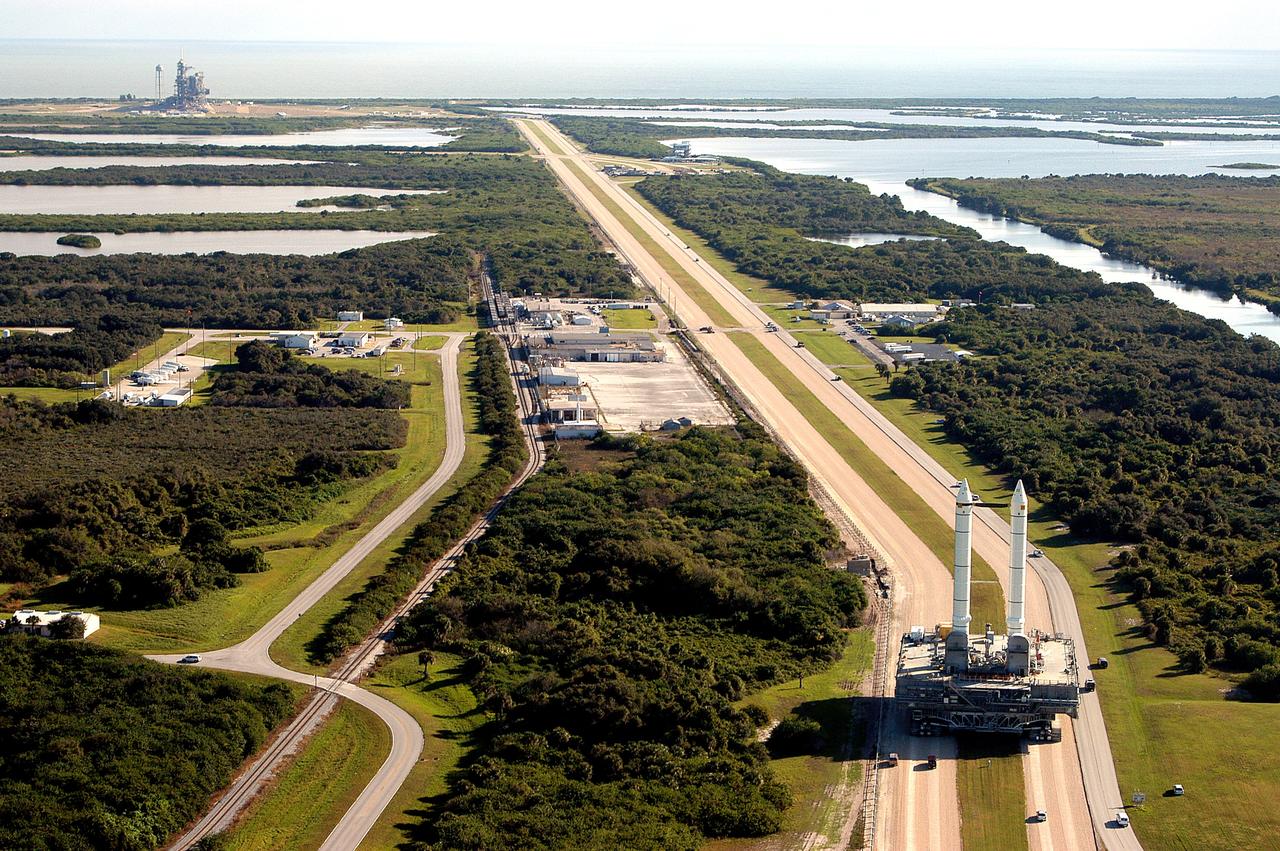
KENNEDY SPACE CENTER, FLA. -  The crawler transporter slowly moves the Mobile Launcher Platform (MLP), carrying a set of twin solid rocket boosters, away from the Vehicle Assembly Building (VAB) in support of engineering analysis vibration tests on the crawler and MLP.   In the distance, at left, is Launch Pad 39A.  The water on the right of the crawlerway is the Banana River.  The crawler is moving at various speeds up to 1 mph in an effort to achieve vibration data gathering goals as it leaves the VAB and then returns.  The boosters are braced at the top for stability.  The primary purpose of these rollout tests is to gather data to develop future maintenance requirements on the transport equipment and the flight hardware. Various parts of the MLP and crawler transporter have been instrumented with vibration data collection equipment.
KENNEDY SPACE CENTER, FLA. - The crawler transporter slowly moves the Mobile Launcher Platform (MLP), carrying a set of twin solid rocket boosters, away from the Vehicle Assembly Building (VAB) in support of engineering analysis vibration tests on the crawler and MLP. In the distance, at left, is Launch Pad 39A. The water on the right of the crawlerway is the Banana River. The crawler is moving at various speeds up to 1 mph in an effort to achieve vibration data gathering goals as it leaves the VAB and then returns. The boosters are braced at the top for stability. The primary purpose of these rollout tests is to gather data to develop future maintenance requirements on the transport equipment and the flight hardware. Various parts of the MLP and crawler transporter have been instrumented with vibration data collection equipment.
KENNEDY SPACE CENTER, FLA. -  Mobile Launcher Platform (MLP) number 3 and a set of twin solid rocket boosters bolted to it, atop the crawler-transporter, crawl to the intersection in the crawlerway in support of the second engineering analysis vibration test on the crawler and MLP.  In the background are Launch Pads 39A (right) and 39B (left).  The crawler is moving at various speeds up to 1 mph in an effort to achieve vibration data gathering goals as it leaves the VAB, travels toward Launch Pad 39A and then returns.  The boosters are braced at the top for stability.  The primary purpose of these rollout tests is to gather data to develop future maintenance requirements on the transport equipment and the flight hardware. Various parts of the MLP and crawler transporter have been instrumented with vibration data collection equipment.
KENNEDY SPACE CENTER, FLA. - Mobile Launcher Platform (MLP) number 3 and a set of twin solid rocket boosters bolted to it, atop the crawler-transporter, crawl to the intersection in the crawlerway in support of the second engineering analysis vibration test on the crawler and MLP. In the background are Launch Pads 39A (right) and 39B (left). The crawler is moving at various speeds up to 1 mph in an effort to achieve vibration data gathering goals as it leaves the VAB, travels toward Launch Pad 39A and then returns. The boosters are braced at the top for stability. The primary purpose of these rollout tests is to gather data to develop future maintenance requirements on the transport equipment and the flight hardware. Various parts of the MLP and crawler transporter have been instrumented with vibration data collection equipment.
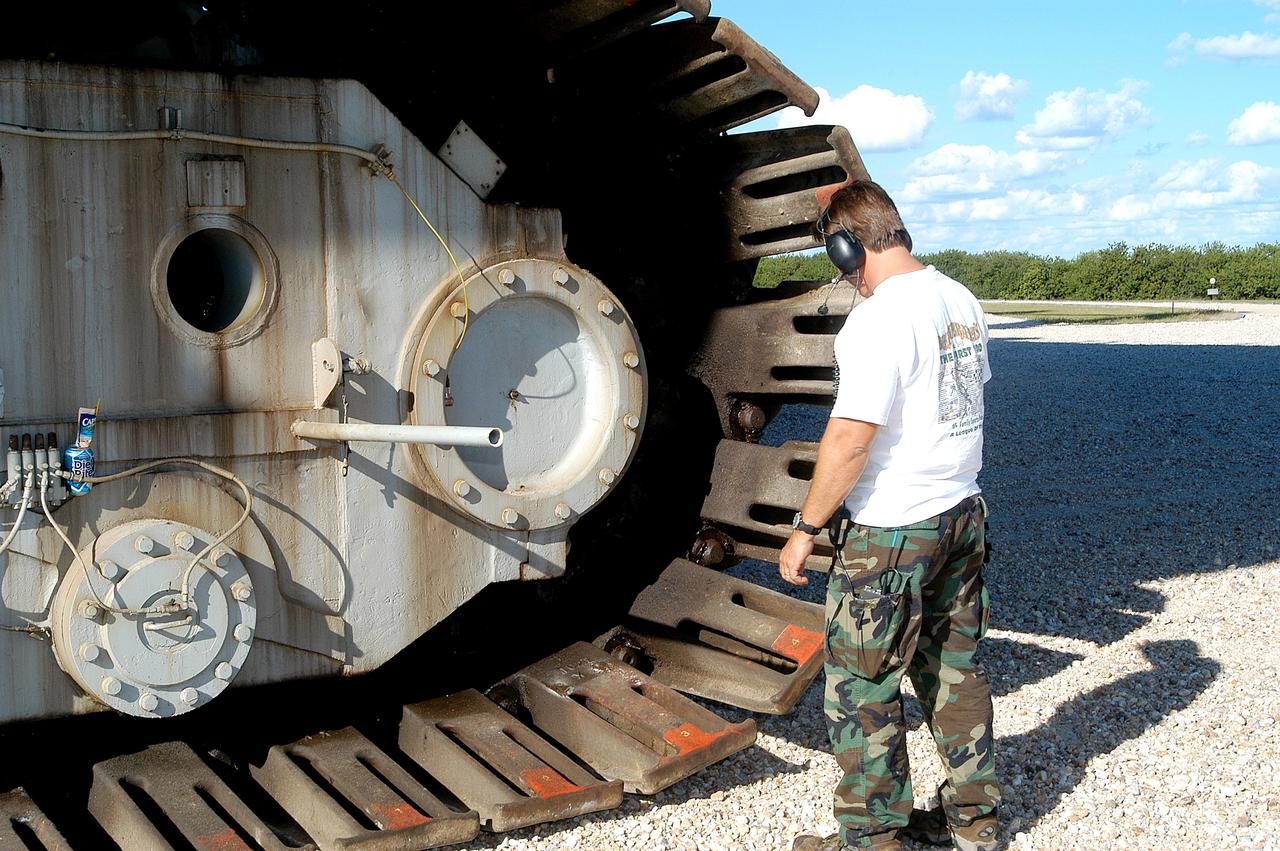
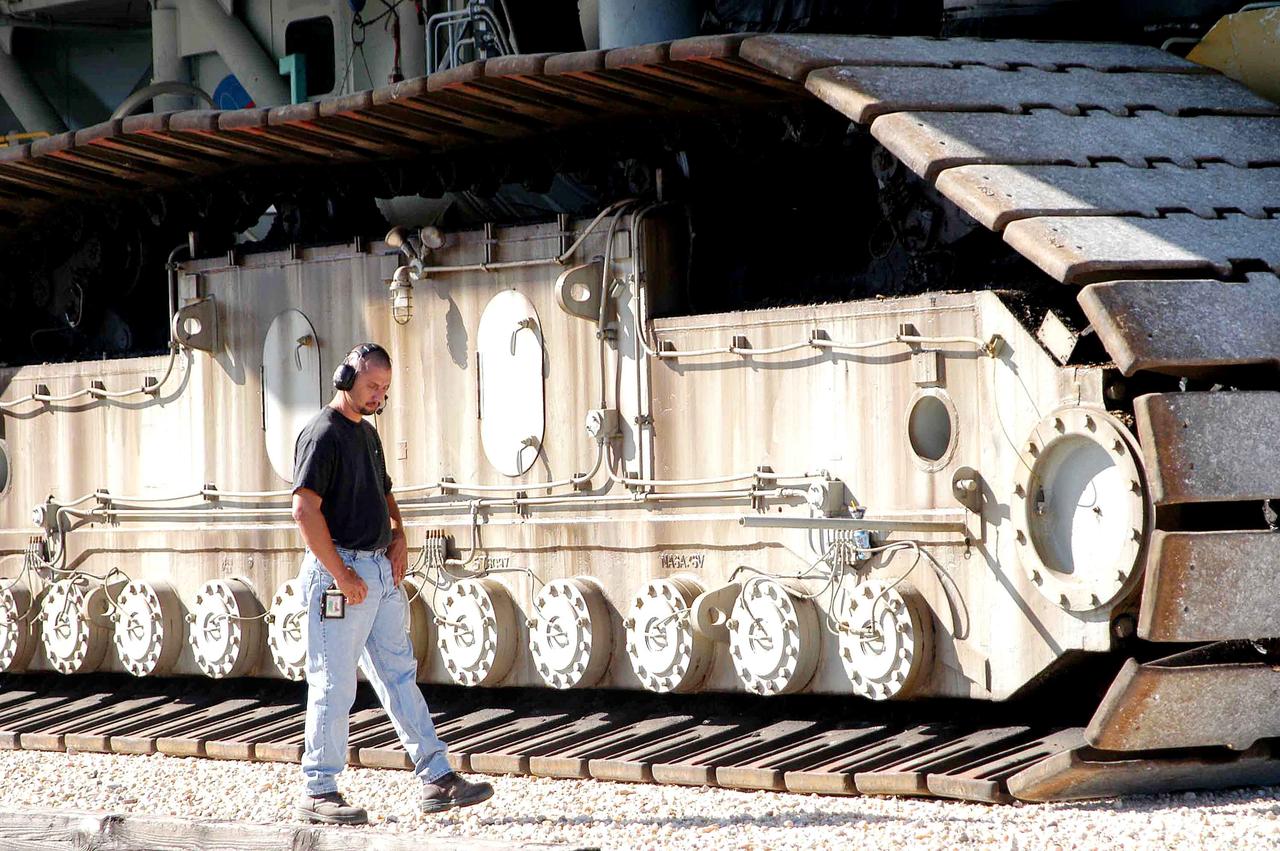
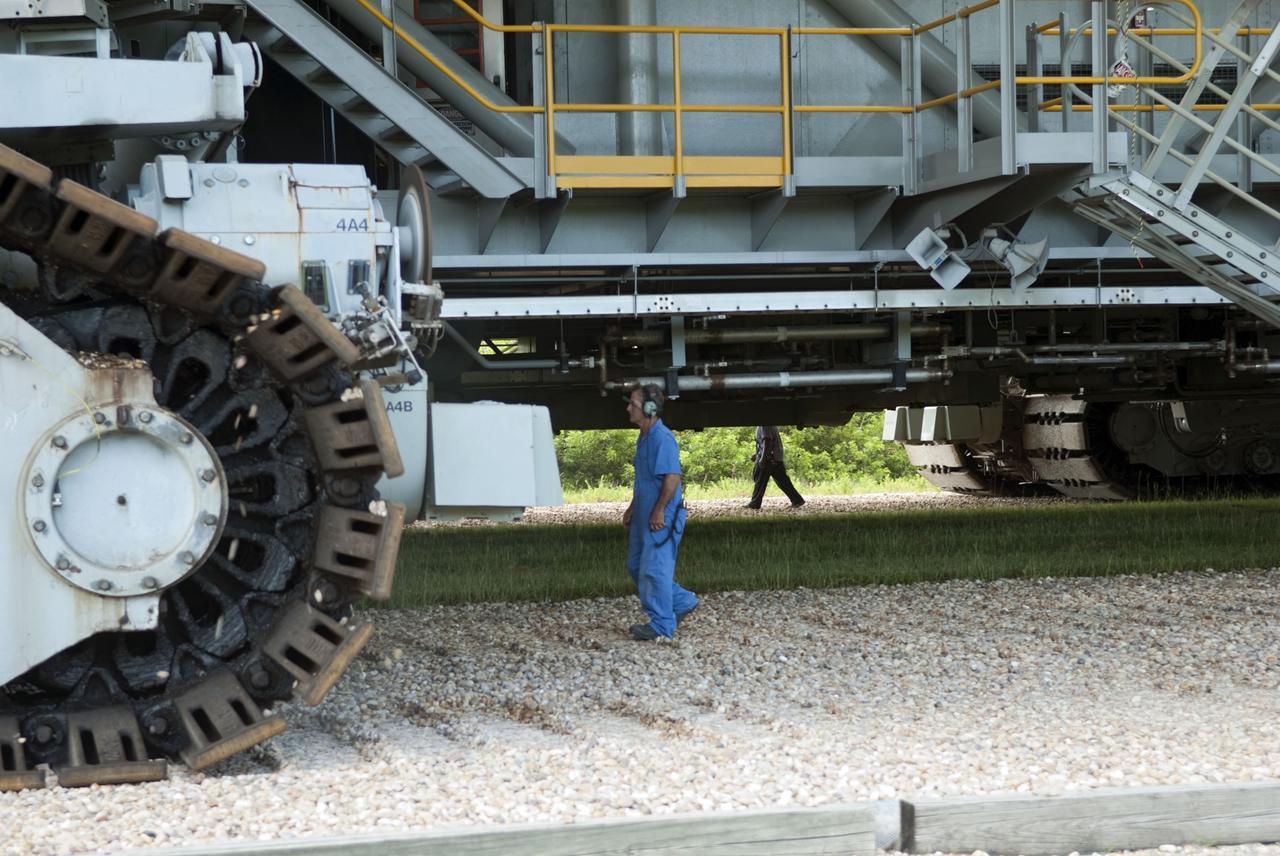
KENNEDY SPACE CENTER, FLA. - A Kennedy Space Center technician inspects the shoes on one of eight tracks of a crawler-transporter (CT).  The CT is moving Mobile Launcher Platform (MLP) number 3 with a set of twin solid rocket boosters bolted on top to the intersection in the crawlerway in support of the second engineering analysis vibration test on the crawler and MLP.  The crawler is moving at various speeds up to 1 mph in an effort to achieve vibration data gathering goals as it leaves the VAB, travels toward Launch Pad 39A and then returns. The boosters are braced at the top for stability. The primary purpose of these rollout tests is to gather data to develop future maintenance requirements on the transport equipment and the flight hardware. Various parts of the MLP and crawler transporter have been instrumented with vibration data collection equipment.
KENNEDY SPACE CENTER, FLA. - A Kennedy Space Center technician inspects the shoes on one of eight tracks of a crawler-transporter (CT). The CT is moving Mobile Launcher Platform (MLP) number 3 with a set of twin solid rocket boosters bolted on top to the intersection in the crawlerway in support of the second engineering analysis vibration test on the crawler and MLP. The crawler is moving at various speeds up to 1 mph in an effort to achieve vibration data gathering goals as it leaves the VAB, travels toward Launch Pad 39A and then returns. The boosters are braced at the top for stability. The primary purpose of these rollout tests is to gather data to develop future maintenance requirements on the transport equipment and the flight hardware. Various parts of the MLP and crawler transporter have been instrumented with vibration data collection equipment.
KENNEDY SPACE CENTER, FLA. - A Kennedy Space Center technician monitors the performance of a crawler-transporter as it moves Mobile Launcher Platform (MLP) number 3, with a set of twin solid rocket boosters bolted atop, to the intersection in the crawlerway during the second engineering analysis vibration test on the crawler and MLP.  The crawler is moving at various speeds up to 1 mph in an effort to achieve vibration data gathering goals as it leaves the VAB, travels toward Launch Pad 39A, and then returns. The boosters are braced at the top for stability. The primary purpose of these rollout tests is to gather data to develop future maintenance requirements on the transport equipment and the flight hardware. Various parts of the MLP and crawler transporter have been instrumented with vibration data collection equipment.
KENNEDY SPACE CENTER, FLA. - A Kennedy Space Center technician monitors the performance of a crawler-transporter as it moves Mobile Launcher Platform (MLP) number 3, with a set of twin solid rocket boosters bolted atop, to the intersection in the crawlerway during the second engineering analysis vibration test on the crawler and MLP. The crawler is moving at various speeds up to 1 mph in an effort to achieve vibration data gathering goals as it leaves the VAB, travels toward Launch Pad 39A, and then returns. The boosters are braced at the top for stability. The primary purpose of these rollout tests is to gather data to develop future maintenance requirements on the transport equipment and the flight hardware. Various parts of the MLP and crawler transporter have been instrumented with vibration data collection equipment.
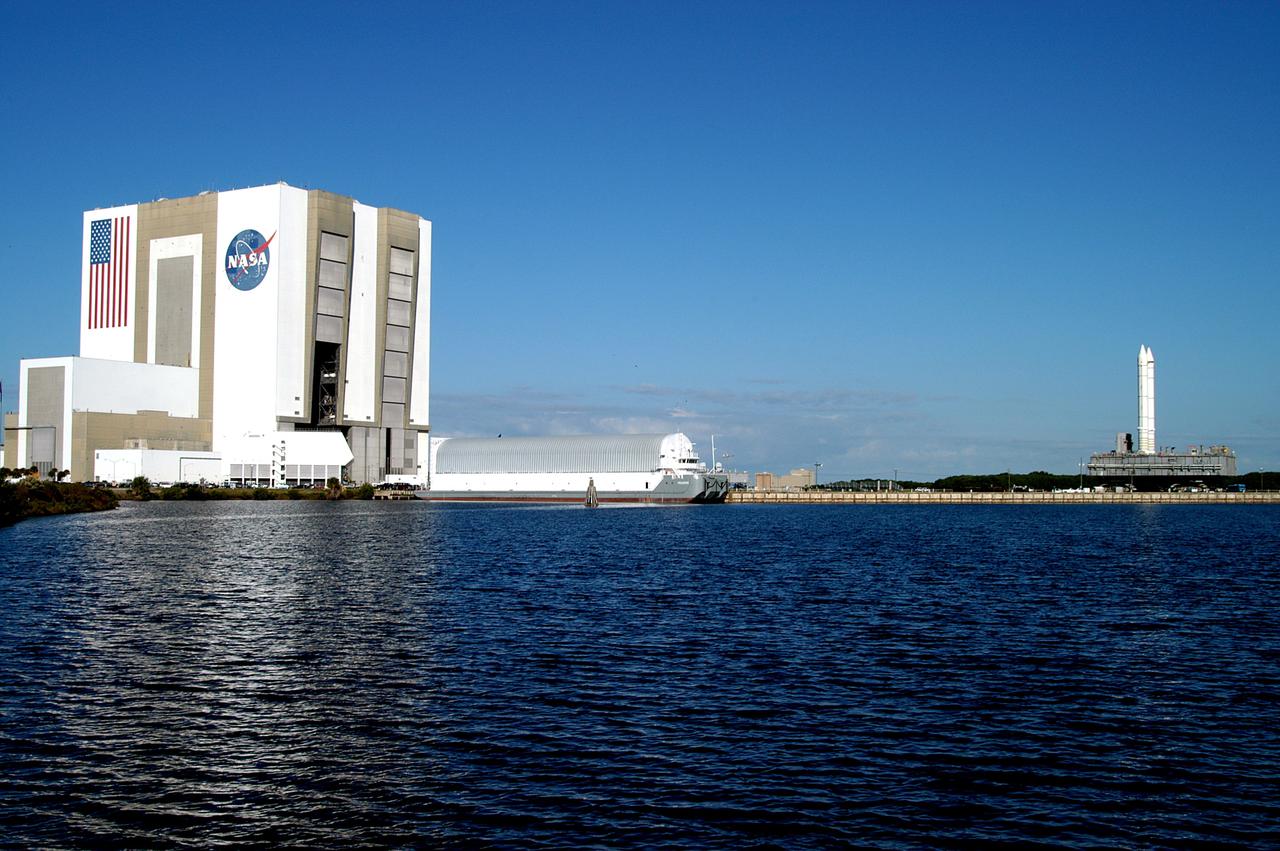
KENNEDY SPACE CENTER, FLA. - Seen across the water of the Launch Complex 39 turn basin, a crawler-transporter, carrying Mobile Launcher Platform (MLP) number 3 with a set of twin solid rocket boosters bolted atop, crawls out of the 525-foot-tall Vehicle Assembly Building during the second engineering analysis vibration test on the crawler and MLP.  The crawler is moving at various speeds up to 1 mph in an effort to achieve vibration data gathering goals as it leaves the VAB, travels toward Launch Pad 39A and then returns. The boosters are braced at the top for stability. The primary purpose of these rollout tests is to gather data to develop future maintenance requirements on the transport equipment and the flight hardware. Various parts of the MLP and crawler transporter have been instrumented with vibration data collection equipment.
KENNEDY SPACE CENTER, FLA. - Seen across the water of the Launch Complex 39 turn basin, a crawler-transporter, carrying Mobile Launcher Platform (MLP) number 3 with a set of twin solid rocket boosters bolted atop, crawls out of the 525-foot-tall Vehicle Assembly Building during the second engineering analysis vibration test on the crawler and MLP. The crawler is moving at various speeds up to 1 mph in an effort to achieve vibration data gathering goals as it leaves the VAB, travels toward Launch Pad 39A and then returns. The boosters are braced at the top for stability. The primary purpose of these rollout tests is to gather data to develop future maintenance requirements on the transport equipment and the flight hardware. Various parts of the MLP and crawler transporter have been instrumented with vibration data collection equipment.
KENNEDY SPACE CENTER, FLA. - A Kennedy Space Center technician walks towards the intersection of the crawlerway beside a crawler-transporter moving Mobile Launcher Platform (MLP) number 3, with a set of twin solid rocket boosters bolted atop, during the second engineering analysis vibration test on the crawler and MLP.  The crawler is moving at various speeds up to 1 mph in an effort to achieve vibration data gathering goals as it leaves the VAB, travels toward Launch Pad 39A, and then returns. The boosters are braced at the top for stability. The primary purpose of these rollout tests is to gather data to develop future maintenance requirements on the transport equipment and the flight hardware. Various parts of the MLP and crawler transporter have been instrumented with vibration data collection equipment.
KENNEDY SPACE CENTER, FLA. - A Kennedy Space Center technician walks towards the intersection of the crawlerway beside a crawler-transporter moving Mobile Launcher Platform (MLP) number 3, with a set of twin solid rocket boosters bolted atop, during the second engineering analysis vibration test on the crawler and MLP. The crawler is moving at various speeds up to 1 mph in an effort to achieve vibration data gathering goals as it leaves the VAB, travels toward Launch Pad 39A, and then returns. The boosters are braced at the top for stability. The primary purpose of these rollout tests is to gather data to develop future maintenance requirements on the transport equipment and the flight hardware. Various parts of the MLP and crawler transporter have been instrumented with vibration data collection equipment.
KENNEDY SPACE CENTER, FLA. -  The crawler transporter slowly moves the Mobile Launcher Platform (MLP), carrying a set of twin solid rocket boosters, away from the Vehicle Assembly Building (VAB) in support of engineering analysis vibration tests on the crawler and MLP.  On either side of the boosters on the horizon can be seen the two launch pads. The crawler is moving at various speeds up to 1 mph in an effort to achieve vibration data gathering goals as it leaves the VAB and then returns.  The boosters are braced at the top for stability.  The primary purpose of these rollout tests is to gather data to develop future maintenance requirements on the transport equipment and the flight hardware. Various parts of the MLP and crawler transporter have been instrumented with vibration data collection equipment.
KENNEDY SPACE CENTER, FLA. - The crawler transporter slowly moves the Mobile Launcher Platform (MLP), carrying a set of twin solid rocket boosters, away from the Vehicle Assembly Building (VAB) in support of engineering analysis vibration tests on the crawler and MLP. On either side of the boosters on the horizon can be seen the two launch pads. The crawler is moving at various speeds up to 1 mph in an effort to achieve vibration data gathering goals as it leaves the VAB and then returns. The boosters are braced at the top for stability. The primary purpose of these rollout tests is to gather data to develop future maintenance requirements on the transport equipment and the flight hardware. Various parts of the MLP and crawler transporter have been instrumented with vibration data collection equipment.
KENNEDY SPACE CENTER, FLA. - A crawler-transporter carrying Mobile Launcher Platform (MLP) number 3, with a set of twin solid rocket boosters bolted atop, crawls to the intersection in the crawlerway in support of the second engineering analysis vibration test on the crawler and MLP.  From this perspective, the Launch Control Center (left) and the 525-foot-tall Vehicle Assembly Building (right) in the background appear dwarfed by the 184-foot-tall boosters. The crawler is moving at various speeds up to 1 mph in an effort to achieve vibration data gathering goals as it leaves the VAB, travels toward Launch Pad 39A and then returns. The boosters are braced at the top for stability. The primary purpose of these rollout tests is to gather data to develop future maintenance requirements on the transport equipment and the flight hardware. Various parts of the MLP and crawler transporter have been instrumented with vibration data collection equipment.
KENNEDY SPACE CENTER, FLA. - A crawler-transporter carrying Mobile Launcher Platform (MLP) number 3, with a set of twin solid rocket boosters bolted atop, crawls to the intersection in the crawlerway in support of the second engineering analysis vibration test on the crawler and MLP. From this perspective, the Launch Control Center (left) and the 525-foot-tall Vehicle Assembly Building (right) in the background appear dwarfed by the 184-foot-tall boosters. The crawler is moving at various speeds up to 1 mph in an effort to achieve vibration data gathering goals as it leaves the VAB, travels toward Launch Pad 39A and then returns. The boosters are braced at the top for stability. The primary purpose of these rollout tests is to gather data to develop future maintenance requirements on the transport equipment and the flight hardware. Various parts of the MLP and crawler transporter have been instrumented with vibration data collection equipment.
KENNEDY SPACE CENTER, FLA. - Viewed across the turn basin in the Launch Complex 39 Area, the crawler transporter slowly moves the Mobile Launcher Platform (MLP), carrying a set of twin solid rocket boosters, away from the Vehicle Assembly Building (VAB).  The journey is in support of engineering analysis vibration tests on the crawler and MLP.  The water on the right of the crawlerway is the Banana River.  The crawler is moving at various speeds up to 1 mph in an effort to achieve vibration data gathering goals as it leaves the VAB and then returns.  The boosters are braced at the top for stability.  The primary purpose of these rollout tests is to gather data to develop future maintenance requirements on the transport equipment and the flight hardware. Various parts of the MLP and crawler transporter have been instrumented with vibration data collection equipment.
KENNEDY SPACE CENTER, FLA. - Viewed across the turn basin in the Launch Complex 39 Area, the crawler transporter slowly moves the Mobile Launcher Platform (MLP), carrying a set of twin solid rocket boosters, away from the Vehicle Assembly Building (VAB). The journey is in support of engineering analysis vibration tests on the crawler and MLP. The water on the right of the crawlerway is the Banana River. The crawler is moving at various speeds up to 1 mph in an effort to achieve vibration data gathering goals as it leaves the VAB and then returns. The boosters are braced at the top for stability. The primary purpose of these rollout tests is to gather data to develop future maintenance requirements on the transport equipment and the flight hardware. Various parts of the MLP and crawler transporter have been instrumented with vibration data collection equipment.
KENNEDY SPACE CENTER, FLA. -  Mobile Launcher Platform (MLP) number 3 and a set of twin solid rocket boosters, atop the crawler-transporter, inch away from the Vehicle Assembly Building (VAB) in support of the second engineering analysis vibration test on the crawler and MLP. The crawler is moving at various speeds up to 1 mph in an effort to achieve vibration data gathering goals as it leaves the VAB, travels toward Launch Pad 39A and then returns.  The boosters are braced at the top for stability.  The primary purpose of these rollout tests is to gather data to develop future maintenance requirements on the transport equipment and the flight hardware. Various parts of the MLP and crawler transporter have been instrumented with vibration data collection equipment.
KENNEDY SPACE CENTER, FLA. - Mobile Launcher Platform (MLP) number 3 and a set of twin solid rocket boosters, atop the crawler-transporter, inch away from the Vehicle Assembly Building (VAB) in support of the second engineering analysis vibration test on the crawler and MLP. The crawler is moving at various speeds up to 1 mph in an effort to achieve vibration data gathering goals as it leaves the VAB, travels toward Launch Pad 39A and then returns. The boosters are braced at the top for stability. The primary purpose of these rollout tests is to gather data to develop future maintenance requirements on the transport equipment and the flight hardware. Various parts of the MLP and crawler transporter have been instrumented with vibration data collection equipment.
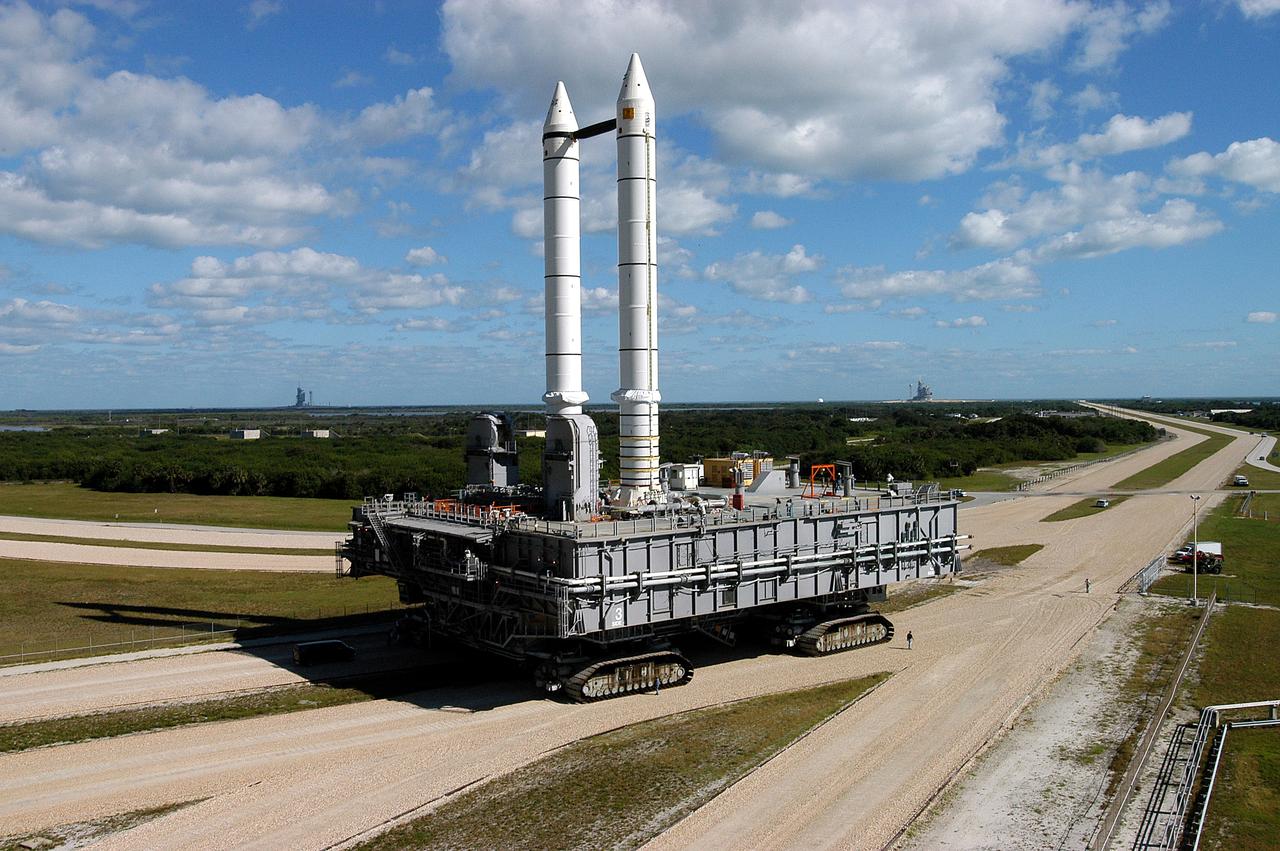
KENNEDY SPACE CENTER, FLA. -  Mobile Launcher Platform (MLP) number 3 and a set of twin solid rocket boosters, atop the crawler-transporter, inch along the crawlerway in support of the second engineering analysis vibration test on the crawler and MLP. The crawler is moving at various speeds up to 1 mph in an effort to achieve vibration data gathering goals as it leaves the VAB, travels toward Launch Pad 39A (on the horizon at right; Pad 39B is at far left), and then returns.  The boosters are braced at the top for stability.  The primary purpose of these rollout tests is to gather data to develop future maintenance requirements on the transport equipment and the flight hardware. Various parts of the MLP and crawler transporter have been instrumented with vibration data collection equipment.
KENNEDY SPACE CENTER, FLA. - Mobile Launcher Platform (MLP) number 3 and a set of twin solid rocket boosters, atop the crawler-transporter, inch along the crawlerway in support of the second engineering analysis vibration test on the crawler and MLP. The crawler is moving at various speeds up to 1 mph in an effort to achieve vibration data gathering goals as it leaves the VAB, travels toward Launch Pad 39A (on the horizon at right; Pad 39B is at far left), and then returns. The boosters are braced at the top for stability. The primary purpose of these rollout tests is to gather data to develop future maintenance requirements on the transport equipment and the flight hardware. Various parts of the MLP and crawler transporter have been instrumented with vibration data collection equipment.
KENNEDY SPACE CENTER, FLA. -  Mobile Launcher Platform (MLP) number 3 and a set of twin solid rocket boosters, atop the crawler-transporter, inch along the crawlerway in support of the second engineering analysis vibration test on the crawler and MLP. The view reveals the river gravel surface that is 4 inches thick on the straightaway sections and 8 inches thick on curves. The crawler is moving at various speeds up to 1 mph in an effort to achieve vibration data gathering goals as it leaves the VAB, travels toward Launch Pad 39A and then returns.  The boosters are braced at the top for stability.  The primary purpose of these rollout tests is to gather data to develop future maintenance requirements on the transport equipment and the flight hardware. Various parts of the MLP and crawler transporter have been instrumented with vibration data collection equipment.
KENNEDY SPACE CENTER, FLA. - Mobile Launcher Platform (MLP) number 3 and a set of twin solid rocket boosters, atop the crawler-transporter, inch along the crawlerway in support of the second engineering analysis vibration test on the crawler and MLP. The view reveals the river gravel surface that is 4 inches thick on the straightaway sections and 8 inches thick on curves. The crawler is moving at various speeds up to 1 mph in an effort to achieve vibration data gathering goals as it leaves the VAB, travels toward Launch Pad 39A and then returns. The boosters are braced at the top for stability. The primary purpose of these rollout tests is to gather data to develop future maintenance requirements on the transport equipment and the flight hardware. Various parts of the MLP and crawler transporter have been instrumented with vibration data collection equipment.
KENNEDY SPACE CENTER, FLA. - The crawler-transporter carrying Mobile Launcher Platform (MLP) number 3, with a set of twin solid rocket boosters bolted atop, crawls to the intersection in the crawlerway in support of the second engineering analysis vibration test on the crawler and MLP.  From this perspective, the Launch Control Center (left) and the 525-foot-tall Vehicle Assembly Building (right) in the background appear dwarfed by the 184-foot-tall boosters. The crawler is moving at various speeds up to 1 mph in an effort to achieve vibration data gathering goals as it leaves the VAB, travels toward Launch Pad 39A and then returns. The boosters are braced at the top for stability. The primary purpose of these rollout tests is to gather data to develop future maintenance requirements on the transport equipment and the flight hardware. Various parts of the MLP and crawler transporter have been instrumented with vibration data collection equipment.
KENNEDY SPACE CENTER, FLA. - The crawler-transporter carrying Mobile Launcher Platform (MLP) number 3, with a set of twin solid rocket boosters bolted atop, crawls to the intersection in the crawlerway in support of the second engineering analysis vibration test on the crawler and MLP. From this perspective, the Launch Control Center (left) and the 525-foot-tall Vehicle Assembly Building (right) in the background appear dwarfed by the 184-foot-tall boosters. The crawler is moving at various speeds up to 1 mph in an effort to achieve vibration data gathering goals as it leaves the VAB, travels toward Launch Pad 39A and then returns. The boosters are braced at the top for stability. The primary purpose of these rollout tests is to gather data to develop future maintenance requirements on the transport equipment and the flight hardware. Various parts of the MLP and crawler transporter have been instrumented with vibration data collection equipment.
The two mobile launcher platforms (MLPs) are seen at the MSS park site at NASA’s Kennedy Space Center in Florida on Jan. 4, 2021. One MLP is undergoing crawlerway conditioning – a several month-long project to ensure the path the rocket takes from the VAB to the launch pad is strong enough to support the weight for the upcoming Artemis I launch. The other MLP used during the shuttle program is in the process of being demolished.
CT-1 and CT-2, MLP-1 and MLP-2
The two mobile launcher platforms (MLPs) are seen at the MSS park site at NASA’s Kennedy Space Center in Florida on Jan. 4, 2021. One MLP is undergoing crawlerway conditioning – a several month-long project to ensure the path the rocket takes from the VAB to the launch pad is strong enough to support the weight for the upcoming Artemis I launch. The other MLP used during the shuttle program is in the process of being demolished.
CT-1 and CT-2, MLP-1 and MLP-2
The two mobile launcher platforms (MLPs) are seen at the MSS park site at NASA’s Kennedy Space Center in Florida on Jan. 4, 2021. One MLP is undergoing crawlerway conditioning – a several month-long project to ensure the path the rocket takes from the VAB to the launch pad is strong enough to support the weight for the upcoming Artemis I launch. The other MLP used during the shuttle program is in the process of being demolished.
CT-1 and CT-2, MLP-1 and MLP-2
Exterior view of Mobile Launcher Platform
KSC-20100330-PH-PR_mlpGPN-2000-000974
Exterior view of Mobile Launcher Platform
KSC-20100330-PH-PR_mlpGPN-2000-001877
Exterior view of Mobile Launcher Platform
KSC-20100330-PH-PR_mlpKSC-04PD-1064
Exterior view of Mobile Launcher Platform
KSC-20100330-PH-PR_mlp6901057
Aerial view of Mobile Launcher Platform
KSC-20100330-PH-PR_mlpKSC-66C-0887
Aerial view of Mobile Launcher Platform
KSC-20100330-PH-PR_mlpKSC-65C-0263
Exterior view of Mobile Launcher Platform
KSC-20100330-PH-PR_mlpKSC-00PP-0716
Exterior view of Mobile Launcher Platform
KSC-20100330-PH-PR_mlpKSC-04PD-1062
Exterior view of Mobile Launcher Platform
KSC-20100330-PH-PR_mlpKSC-76C-0715
Aerial view of Mobile Launcher Platform
KSC-20100330-PH-PR_mlpKSC-96PC-0997
Aerial view of Mobile Launcher Platform
KSC-20100330-PH-PR_mlpKSC-76C-2754
Exterior view of Mobile Launcher Platform
KSC-20100330-PH-PR_mlpKSC-76C-0904
Exterior view of Mobile Launcher Platform
KSC-20100330-PH-PR_mlpKSC-00PP-0723
KENNEDY SPACE CENTER, FLA. -  United Space Alliance (USA) workers J.D. Wise, left, and Robert Shackelford, with drill, try to stop an approximately 24-foot-long crack from getting any bigger on the Mobile Launcher Platform (MLP), which is holding the Space Shuttle Discovery en route to Launch Pad 39A for the STS-82 mission. Discovery was on its way out to the launch pad when engineers heard a loud bang and noticed that a crack had developed on the MLP. Rollout had begun shortly after 7 a.m. EST and was stopped at about 8:25 a.m.  This Y-shaped crack is on the MLP surface and runs from near the left-hand solid rocket booster flame hole toward the near corner of the MLP.  Rollout of Discovery resumed just past noon after structural engineers determined that the integrity of the MLP had not been compromised.  Discovery is scheduled to lift off on the second Hubble Space Telescope servicing mission on Feb. 11.
KENNEDY SPACE CENTER, FLA. - United Space Alliance (USA) workers J.D. Wise, left, and Robert Shackelford, with drill, try to stop an approximately 24-foot-long crack from getting any bigger on the Mobile Launcher Platform (MLP), which is holding the Space Shuttle Discovery en route to Launch Pad 39A for the STS-82 mission. Discovery was on its way out to the launch pad when engineers heard a loud bang and noticed that a crack had developed on the MLP. Rollout had begun shortly after 7 a.m. EST and was stopped at about 8:25 a.m. This Y-shaped crack is on the MLP surface and runs from near the left-hand solid rocket booster flame hole toward the near corner of the MLP. Rollout of Discovery resumed just past noon after structural engineers determined that the integrity of the MLP had not been compromised. Discovery is scheduled to lift off on the second Hubble Space Telescope servicing mission on Feb. 11.
KENNEDY SPACE CENTER, Fla. -- This high-level view shows the crawler transporter (right) as it is backing away from Space Shuttle Atlantis and the mobile launcher platform (MLP) on Launch Pad 39A. The crawler transporter moved the Shuttle atop the MLP from the Vehicle Assembly Building to the pad in about six hours. Discovery is scheduled to launch in early August on mission STS-105. Photo by Scott Andrews using a Nikon D1X camera
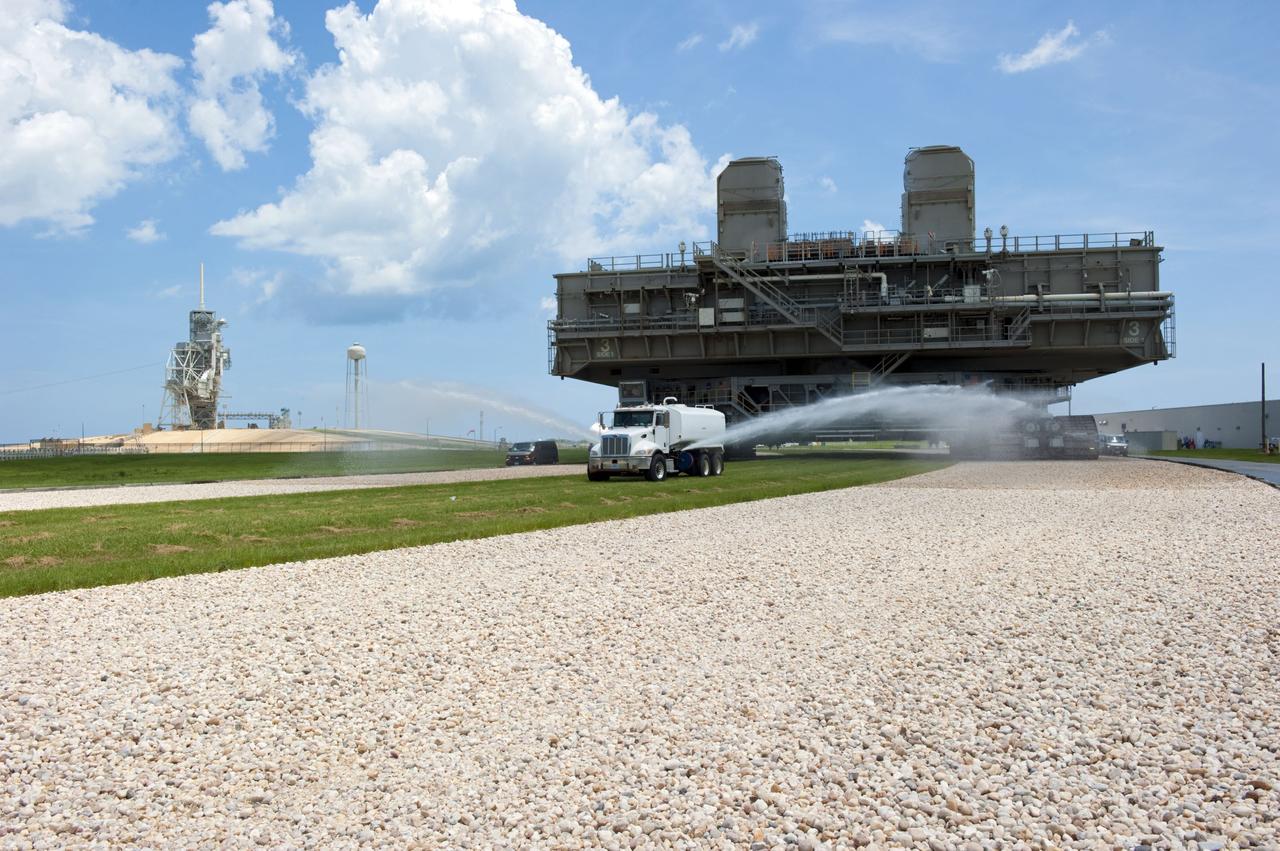
KSC-01padig-237
KENNEDY SPACE CENTER, FLA. --  The overhead sling lowers the orbiter Atlantis next to the external tank and solid rocket boosters stacked on the mobile launcher platform (MLP) below.  Atlantis will be mated to the MLPs  as well.  Space Shuttle Atlantis is targeted to roll out to Launch Pad 39A on February 14 for mission STS-117. The mission is No. 21 to the International Space Station and construction flight 13A. Photo credit: NASA/Amanda Diller
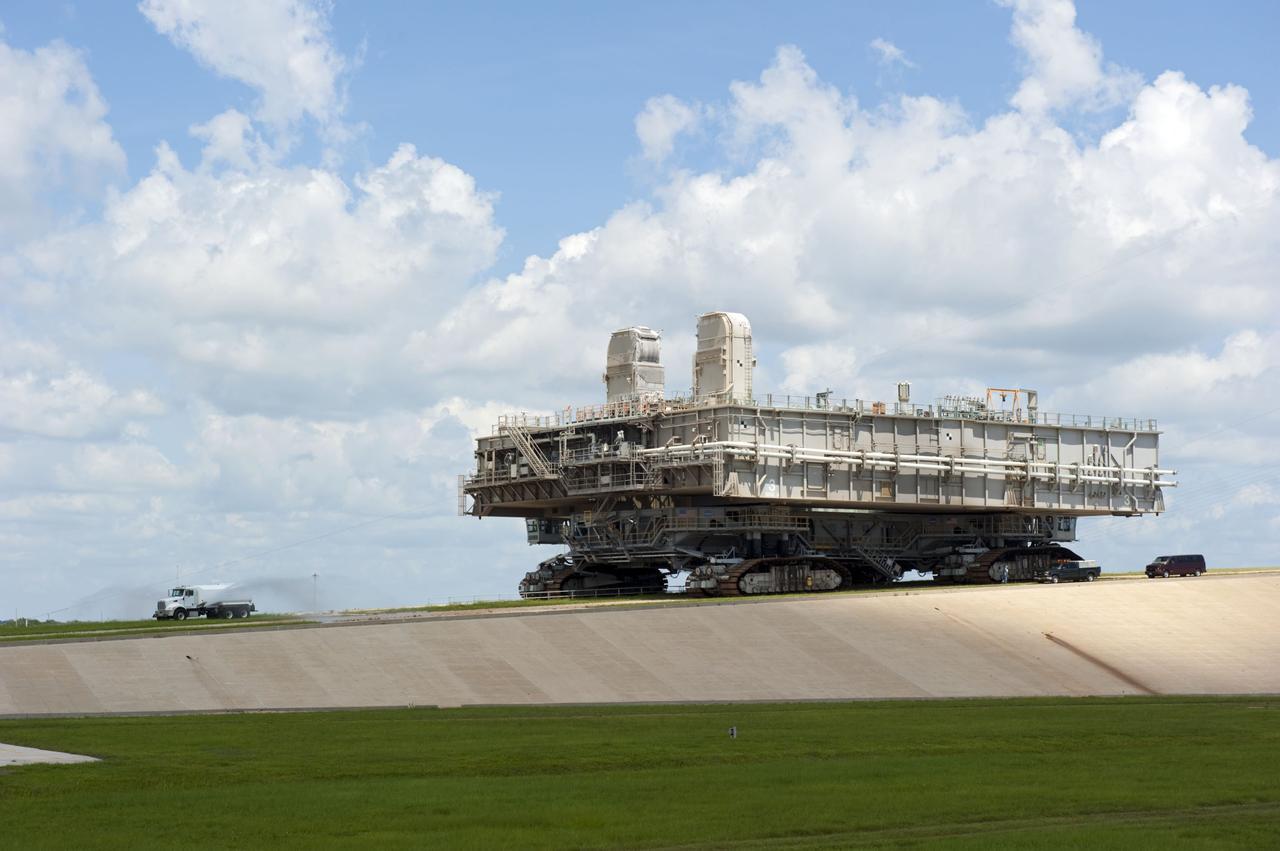
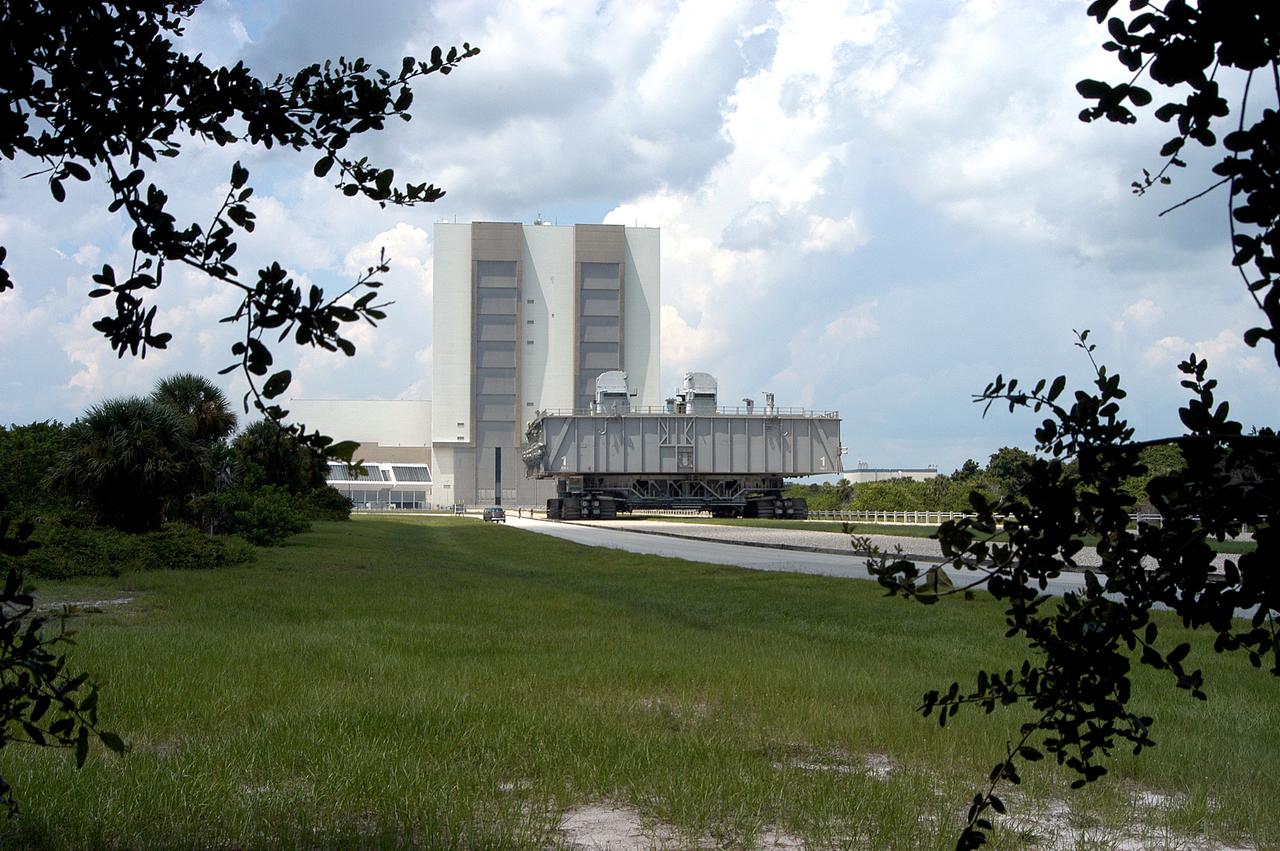
KSC-07pd0334
KENNEDY SPACE CENTER, FLA. --  The overhead sling lowers the orbiter Atlantis next to the external tank and solid rocket boosters stacked on the mobile launcher platform (MLP) below.  Atlantis will be mated to the MLP  as well. Space Shuttle Atlantis is targeted to roll out to Launch Pad 39A on February 14 for mission STS-117. The mission is No. 21 to the International Space Station and construction flight 13A. Photo credit: NASA/Amanda Diller
KSC-07pd0333
KENNEDY SPACE CENTER, FLA. --   The overhead sling lowers the orbiter Atlantis in front of the external tank and solid rocket boosters stacked on the mobile launcher platform (MLP) below.  Atlantis will be mated to the MLP as well.  Space Shuttle Atlantis is targeted to roll out to Launch Pad 39A on February 14 for mission STS-117. The mission is No. 21 to the International Space Station and construction flight 13A. Photo credit: NASA/Amanda Diller
KSC-07pd0335
CAPE CANAVERAL, Fla. -- At NASA's Kennedy Space Center in Florida, Mobile Launcher Platform-3 (MLP), which supported space shuttle Atlantis for its final flight to the International Space Station on the STS-135 mission, has been delivered to the Vehicle Assembly Building (VAB) atop a crawler-transporter.           For more than 40 years, the MLPs have traveled between the massive VAB to both launch pads at Launch Complex 39, and then returned to the VAB for future use. MLP-3 was first used to launch Columbia on the STS-32 mission on Jan. 9, 1990. Photo credit: NASA/Frankie Martin
KSC-2011-5612
CAPE CANAVERAL, Fla. -- At NASA's Kennedy Space Center in Florida, Mobile Launcher Platform-3 (MLP), which supported space shuttle Atlantis for its final flight to the International Space Station on the STS-135 mission, is making its last journey atop a massive crawler-transporter from Launch Pad 39A into the Vehicle Assembly Building (VAB).          For more than 40 years, the MLPs have traveled between the VAB to both launch pads at Launch Complex 39, and then returned to the VAB for future use. MLP-3 was first used to launch Columbia on the STS-32 mission on Jan. 9, 1990. Photo credit: NASA/Jim Grossmann
KSC-2011-5608
CAPE CANAVERAL, Fla. -- At NASA's Kennedy Space Center in Florida, Mobile Launcher Platform-3 (MLP), which supported space shuttle Atlantis for its final flight to the International Space Station on the STS-135 mission, is making its last journey from Launch Pad 39A back to the Vehicle Assembly Building (VAB) atop a massive crawler-transporter.          For more than 40 years, the MLPs have traveled between the VAB to both launch pads at Launch Complex 39, and then returned to the VAB for future use. MLP-3 was first used to launch Columbia on the STS-32 mission on Jan. 9, 1990. Photo credit: NASA/Jim Grossmann
KSC-2011-5605
CAPE CANAVERAL, Fla. -- At NASA's Kennedy Space Center in Florida, Mobile Launcher Platform-3 (MLP), which supported space shuttle Atlantis for its final flight to the International Space Station on the STS-135 mission, has been delivered to the Vehicle Assembly Building (VAB) atop a crawler-transporter.           For more than 40 years, the MLPs have traveled between the massive VAB to both launch pads at Launch Complex 39, and then returned to the VAB for future use. MLP-3 was first used to launch Columbia on the STS-32 mission on Jan. 9, 1990. Photo credit: NASA/Frankie Martin
KSC-2011-5613
CAPE CANAVERAL, Fla. -- At NASA's Kennedy Space Center in Florida, Mobile Launcher Platform-3 (MLP), which supported space shuttle Atlantis for its final flight to the International Space Station on the STS-135 mission, has been delivered to the Vehicle Assembly Building (VAB) atop a crawler-transporter. Seen also is the Space Shuttle Program's Launch Control Center (left).          For more than 40 years, the MLPs have traveled between the massive VAB to both launch pads at Launch Complex 39, and then returned to the VAB for future use. MLP-3 was first used to launch Columbia on the STS-32 mission on Jan. 9, 1990. Photo credit: NASA/Frankie Martin
KSC-2011-5614
CAPE CANAVERAL, Fla. -- At NASA's Kennedy Space Center in Florida, Mobile Launcher Platform-3 (MLP), which supported space shuttle Atlantis for its final flight to the International Space Station on the STS-135 mission, has been delivered to the Vehicle Assembly Building (VAB) atop a crawler-transporter.           For more than 40 years, the MLPs have traveled between the massive VAB to both launch pads at Launch Complex 39, and then returned to the VAB for future use. MLP-3 was first used to launch Columbia on the STS-32 mission on Jan. 9, 1990. Photo credit: NASA/Frankie Martin
KSC-2011-5611
CAPE CANAVERAL, Fla. -- At NASA's Kennedy Space Center in Florida, Mobile Launcher Platform-3 (MLP), which supported space shuttle Atlantis for its final flight to the International Space Station on the STS-135 mission, is making its last journey from Launch Pad 39A into the Vehicle Assembly Building (VAB) atop a massive crawler-transporter.       For more than 40 years, the MLPs have traveled between the VAB to both launch pads at Launch Complex 39, and then returned to the VAB for future use. MLP-3 was first used to launch Columbia on the STS-32 mission on Jan. 9, 1990. Photo credit: NASA/Jim Grossmann
KSC-2011-5609
CAPE CANAVERAL, Fla. -- At NASA's Kennedy Space Center in Florida, workers accompany Mobile Launcher Platform-3 (MLP), which supported space shuttle Atlantis for its final flight to the International Space Station on the STS-135 mission, while making its last journey from Launch Pad 39A back to the Vehicle Assembly Building (VAB) atop a massive crawler-transporter.            For more than 40 years, the MLPs have traveled between the VAB to both launch pads at Launch Complex 39, and then returned to the VAB for future use. MLP-3 was first used to launch Columbia on the STS-32 mission on Jan. 9, 1990. Photo credit: NASA/Jim Grossmann
KSC-2011-5606
KENNEDY SPACE CENTER, FLA. -  After leaving the Vehicle Assembly Building, the Space Shuttle Discovery makes its slow - up to 1 mile per hour - trek along the crawlerway to Launch Pad 39A in preparation for the STS-82 mission.  The Shuttle is assembled on a Mobile Launcher Platform, seen in this view taken from above, and the entire assemblage is carried out to the launch pad on the crawler transporter, which is underneath the MLP.  A seven-member crew will perform the second servicing of the orbiting Hubble Space Telescope (HST) during the 10-day STS-82 mission, which is targeted for a Feb. 11 liftoff.
KENNEDY SPACE CENTER, FLA. - After leaving the Vehicle Assembly Building, the Space Shuttle Discovery makes its slow - up to 1 mile per hour - trek along the crawlerway to Launch Pad 39A in preparation for the STS-82 mission. The Shuttle is assembled on a Mobile Launcher Platform, seen in this view taken from above, and the entire assemblage is carried out to the launch pad on the crawler transporter, which is underneath the MLP. A seven-member crew will perform the second servicing of the orbiting Hubble Space Telescope (HST) during the 10-day STS-82 mission, which is targeted for a Feb. 11 liftoff.
KENNEDY SPACE CENTER, FLA.  -Crawler-transporter (CT) number 2, moves away from the Vehicle Assembly Building, with a Mobile Launcher Platform on top, on a test run to the launch pad.  The CT recently underwent modifications to the cab.  The CT moves Space Shuttle vehicles between the VAB and launch pad.  Moving on four double-tracked crawlers, the CT uses a laser guidance system and a leveling system for the journey that keeps the top of a Space Shuttle vertical within plus- or minus-10 minutes of arc.  The system enables the CT-MLP-Shuttle to negotiate the ramp leading to the launch pads and keep the load level.  Unloaded, the CT weighs 6 million pounds.
KENNEDY SPACE CENTER, FLA. -Crawler-transporter (CT) number 2, moves away from the Vehicle Assembly Building, with a Mobile Launcher Platform on top, on a test run to the launch pad. The CT recently underwent modifications to the cab. The CT moves Space Shuttle vehicles between the VAB and launch pad. Moving on four double-tracked crawlers, the CT uses a laser guidance system and a leveling system for the journey that keeps the top of a Space Shuttle vertical within plus- or minus-10 minutes of arc. The system enables the CT-MLP-Shuttle to negotiate the ramp leading to the launch pads and keep the load level. Unloaded, the CT weighs 6 million pounds.