
S69-40152 (27 July 1969) --- A Mobile Quarantine Facility (MQF), with the three Apollo 11 crewmen inside, is unloaded from a United States Air Force C-141 transport at Ellington Air Force Base very early Sunday after a flight from Hawaii. A large crowd was present to welcome astronauts Neil A. Armstrong, Michael Collins, and Edwin E. Aldrin Jr. back to Houston following their historic lunar landing mission. The crew remained in the MQF until they arrived at the Crew Reception Area of the Lunar Receiving Laboratory (LRL) at the Manned Spacecraft Center (MSC). The crew will be released from quarantine on Aug. 11, 1969.
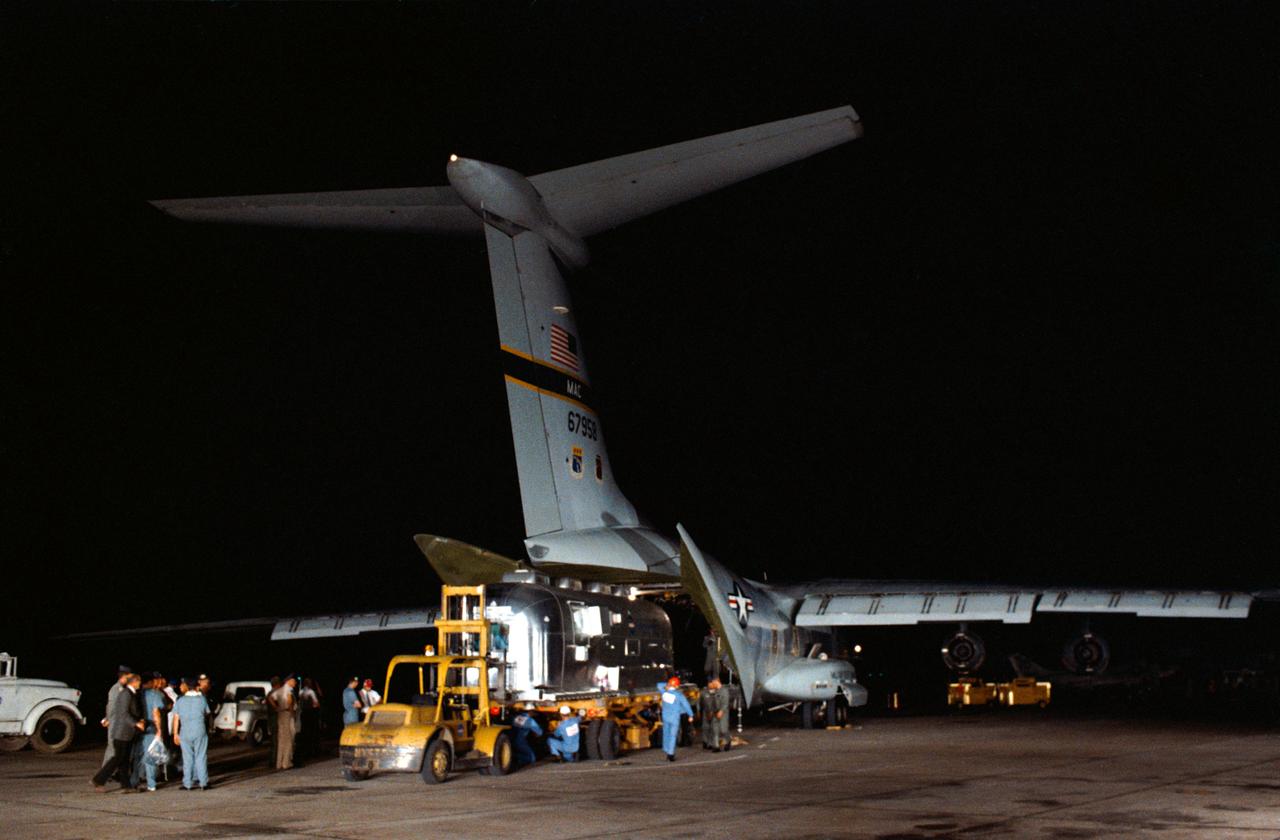
S69-40132 (27 July 1969) --- A Mobile Quarantine Facility (MQF), with the three Apollo 11 crewmembers inside, is unloaded from a United States Air Force C-141 transport at Ellington Air Force Base very early Sunday after a flight from Hawaii. A large crowd was present to welcome astronauts Neil A. Armstrong, Michael Collins, and Edwin E. Aldrin Jr. back to Houston following their historic lunar landing mission. The crew remained in the MQF until they arrived at the Crew Reception Area of the Lunar Receiving Laboratory (LRL) at the Manned Spacecraft Center (MSC). The crew will be released from quarantine on Aug. 11, 1969.

S69-60644 (29 Nov. 1969) --- A Mobile Quarantine Facility (MQF), with the crew men of the Apollo 12 lunar landing mission aboard, arrived at the Manned Spacecraft Center (MSC) Saturday morning, Nov. 29, 1969. Astronauts Charles Conrad Jr., Richard F. Gordon Jr., and Alan L. Bean were on their way to the Lunar Receiving Laboratory (LRL) where they will remain in quarantines until Dec. 10, 1969. Minutes earlier the three astronauts had arrived at Ellington Air Force Base from Hawaii aboard a U.S. Air Force C-141 transport. The crewmen were confined to the MQF from splashdown until they arrived at the LRL.
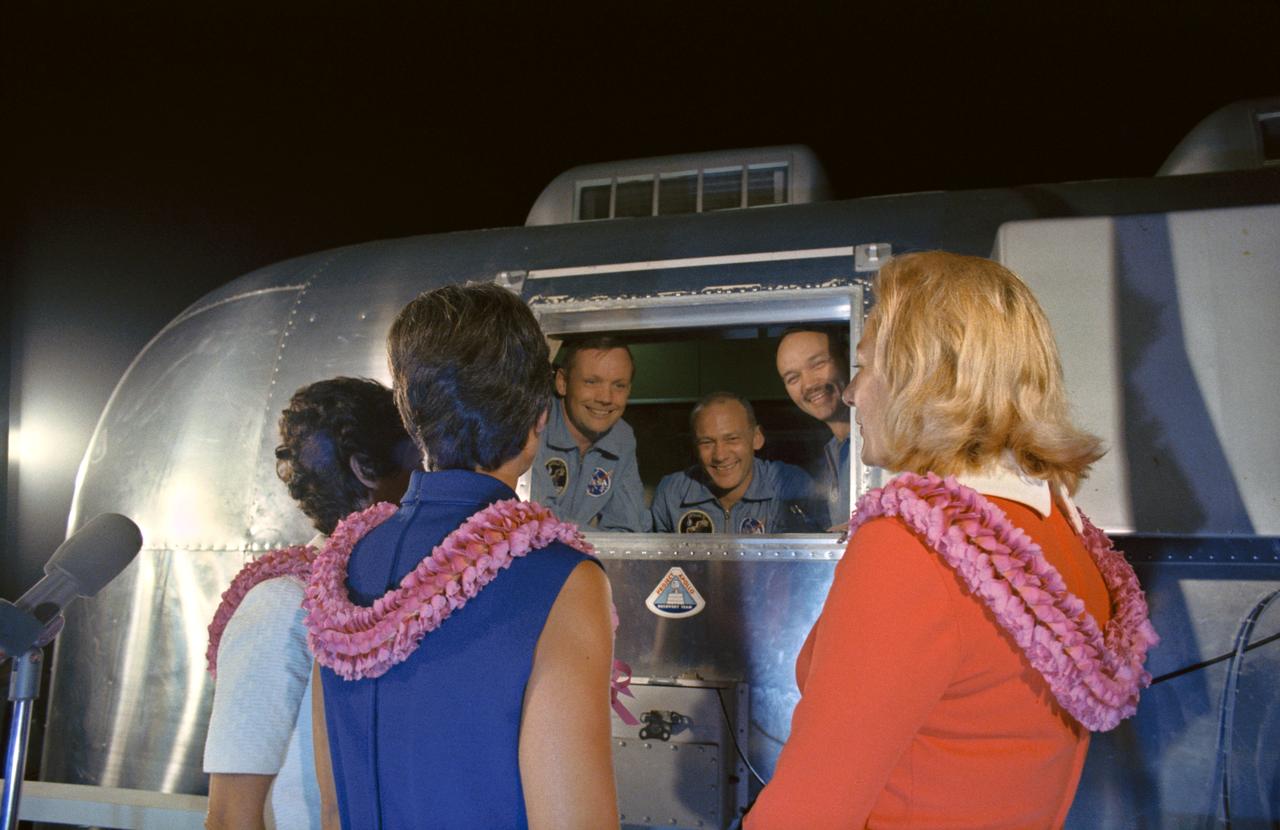
S69-40147 (27 July 1969) --- The Apollo 11 crewmen, still under a 21-day quarantine, are greeted by their wives. They arrived at Ellington Air Force Base very early Sunday after a flight aboard a U.S. Air Force C-141 transport from Hawaii. Looking through the window of a Mobile Quarantine Facility (MQF) are (left to right) astronauts Neil A. Armstrong, Edwin E. Aldrin Jr., and Michael Collins. The wives are (left to right) Mrs. Pat Collins, Mrs. Jan Armstrong, and Mrs. Joan Aldrin. The crew of the historic Apollo 11 lunar landing mission remained in the MQF until they arrived to the Crew Reception Area of the Lunar Receiving Laboratory at the Manned Spacecraft Center (MSC). The astronauts will be released from quarantine on Aug. 11, 1969.

The smiling Apollo 12 astronauts peer out of the window of the mobile quarantine facility aboard the recovery ship, USS Hornet. Pictured (Left to right) are Spacecraft Commander, Charles Conrad; Command Module (CM) Pilot, Richard Gordon; and Lunar Module (LM) Pilot, Alan L. Bean. The crew were housed in the quarantine facility immediately after the Pacific recovery operation took place. The second manned lunar landing mission, Apollo 12 launched from launch pad 39-A at Kennedy Space Center in Florida on November 14, 1969 via a Saturn V launch vehicle. The Saturn V vehicle was developed by the Marshall Space Flight Center (MSFC) under the direction of Dr. Wernher von Braun. The LM, Intrepid, landed astronauts Conrad and Bean on the lunar surface in what’s known as the Ocean of Storms while astronaut Richard Gordon piloted the CM, Yankee Clipper, in a parking orbit around the Moon. Lunar soil activities included the deployment of the Apollo Lunar Surface Experiments Package (ALSEP), finding the unmanned Surveyor 3 that landed on the Moon on April 19, 1967, and collecting 75 pounds (34 kilograms) of rock samples. Apollo 12 returned safely to Earth on November 24, 1969.

S71-18557 (9 Feb. 1971) --- Sealed inside a Mobile Quarantine Facility (MQF), Apollo 14 astronauts greet newsmen and crew men aboard the USS New Orleans, Apollo 14 prime recovery ship. They are from left to right, astronauts Stuart A. Roosa, command module pilot; Alan B. Shepard Jr., commander; and Edgar D. Mitchell, lunar module pilot. Apollo 14 splashdown occurred at 3:04:39 p.m. (CST), Feb. 9, 1971, in the South Pacific Ocean, approximately 765 nautical miles from American Samoa.
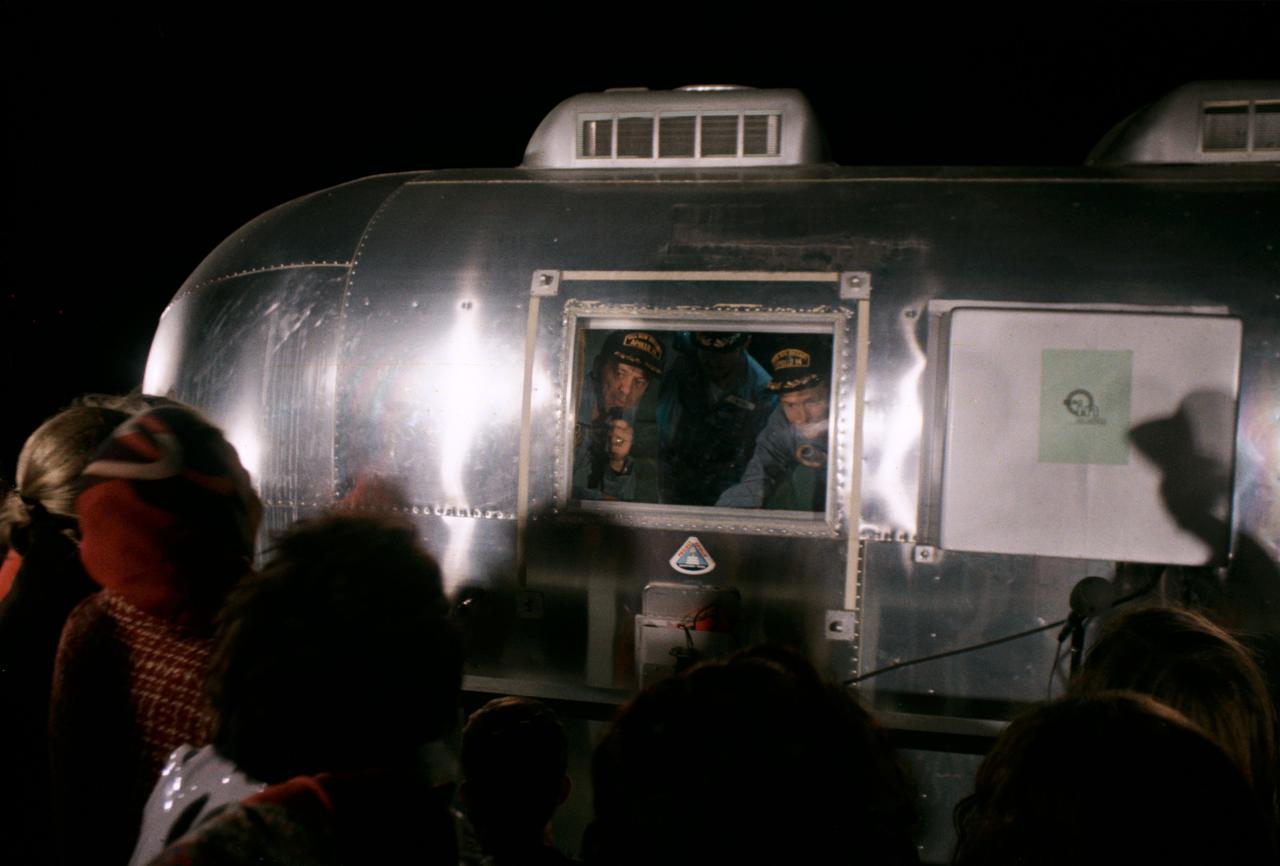
S71-19508 (12 Feb. 1971) --- Separated by aluminum and glass of their Mobile Quarantine Facility (MQF), the Apollo 14 crew members visit with their families and friends upon arriving at Ellington Air Force Base in the early morning hours of Feb. 12, 1971. Looking through the MQF window are astronauts Alan B. Shepard Jr. (left), commander; Stuart A. Roosa (right), command module pilot; and Edgar D. Mitchell, lunar module pilot. The crew men were brought to Houston aboard a C-141 transport plane from Pago Pago, American Samoa. The USS New Orleans had transported the crew to American Samoa from the recovery site in the South Pacific.
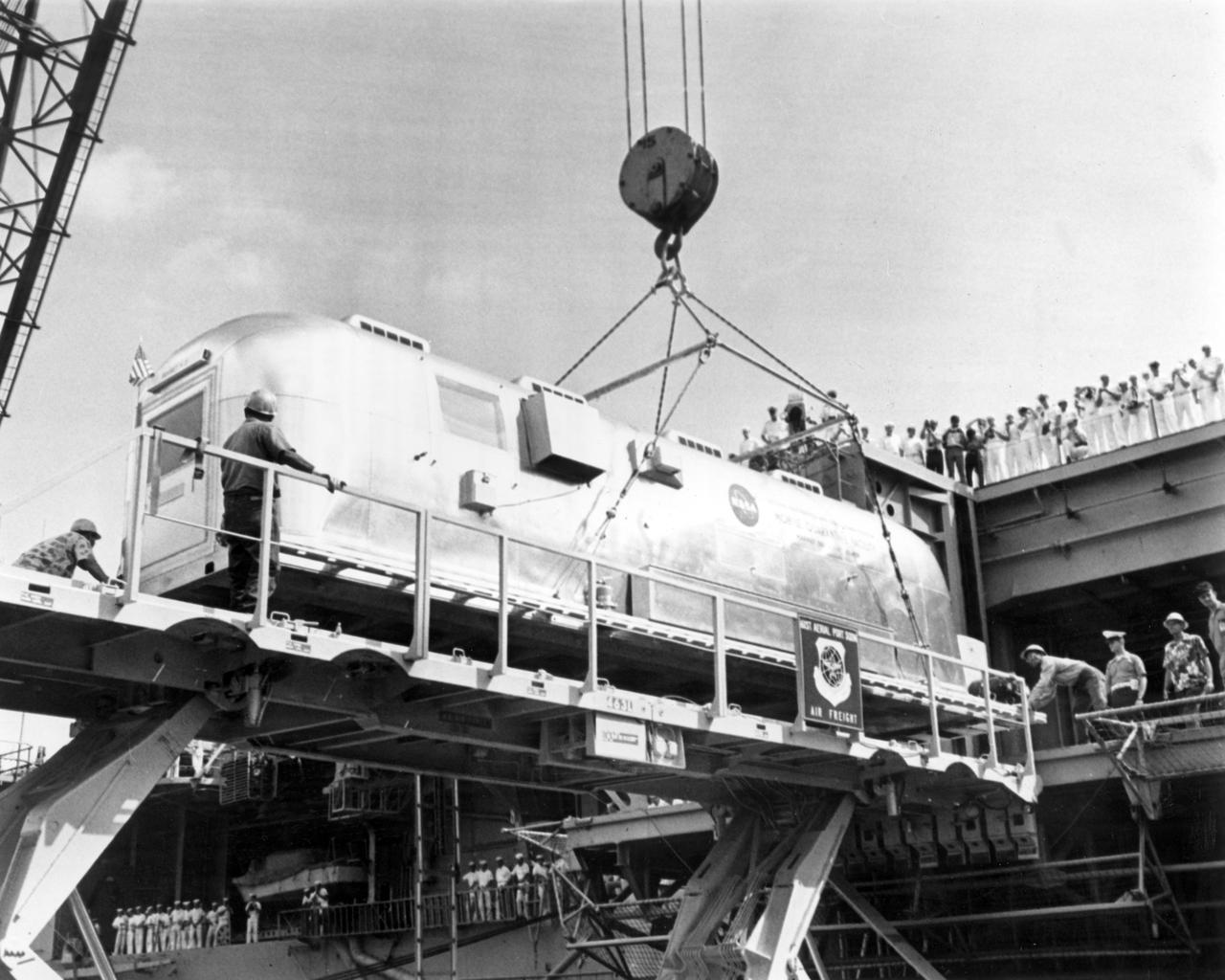
The Apollo 11 mission, the first manned lunar mission, launched from the Kennedy Space Center, Florida via the Marshall Space Flight Center (MSFC) developed Saturn V launch vehicle on July 16, 1969 and safely returned to Earth on July 24, 1969. Aboard the space craft were astronauts Neil A. Armstrong, commander; Michael Collins, Command Module (CM) pilot; and Edwin E. Aldrin Jr., Lunar Module (LM) pilot. The CM, piloted by Michael Collins remained in a parking orbit around the Moon while the LM, named “Eagle’’, carrying astronauts Neil Armstrong and Edwin Aldrin, landed on the Moon. During 2½ hours of surface exploration, the crew collected 47 pounds of lunar surface material for analysis back on Earth. The recovery operation took place in the Pacific Ocean where Navy para-rescue men recovered the capsule housing the 3-man Apollo 11 crew. The crew was airlifted to safety aboard the U.S.S. Hornet recovery ship, where they were quartered in a Mobile Quarantine Facility (MQF) which served as their home for 21 days. In this photo taken at Pearl Harbor, Hawaii, the quarantined housing facility is being lowered from the U.S.S. Hornet, onto a trailer for transport to Hickam Field. From there, it was loaded aboard an Air Force C-141 jet and flown back to Ellington Air Force Base Texas, and then on to the NASA Manned Spacecraft Center (MSC) Lunar Receiving Laboratory in Houston, Texas.
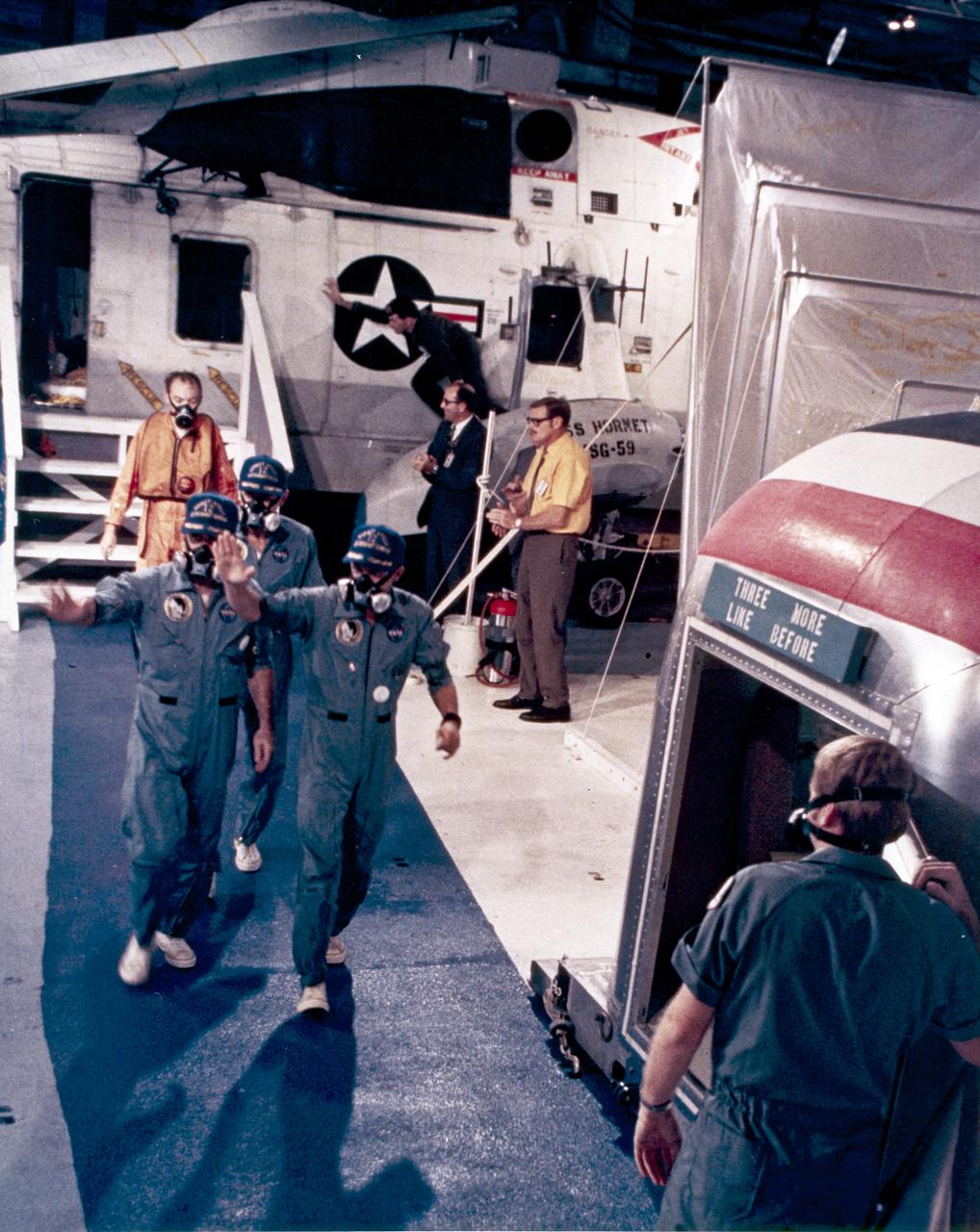
Aboard the recovery ship, USS Hornet, Apollo 12 astronauts wave to the crowd as they enter the mobile quarantine facility. The recovery operation took place in the Pacific Ocean after the splashdown of the Command Module capsule. Navy para-rescue men recovered the capsule housing the 3-man Apollo 12 crew. The second manned lunar landing mission, Apollo 12 launched from launch pad 39-A at Kennedy Space Center in Florida on November 14, 1969 via a Saturn V launch vehicle. The Saturn V was developed by the Marshall Space Flight Center (MSFC) under the direction of Dr. Wernher von Braun. Aboard Apollo 12 was a crew of three astronauts: Alan L. Bean, pilot of the Lunar Module (LM), Intrepid; Richard Gordon, pilot of the Command Module (CM), Yankee Clipper; and Spacecraft Commander Charles Conrad. The LM, Intrepid, landed astronauts Conrad and Bean on the lunar surface in what’s known as the Ocean of Storms while astronaut Richard Gordon piloted the CM, Yankee Clipper, in a parking orbit around the Moon. Lunar soil activities included the deployment of the Apollo Lunar Surface Experiments Package (ALSEP), finding the unmanned Surveyor 3 that landed on the Moon on April 19, 1967, and collecting 75 pounds (34 kilograms) of rock samples. Apollo 12 safely returned to Earth on November 24, 1969.
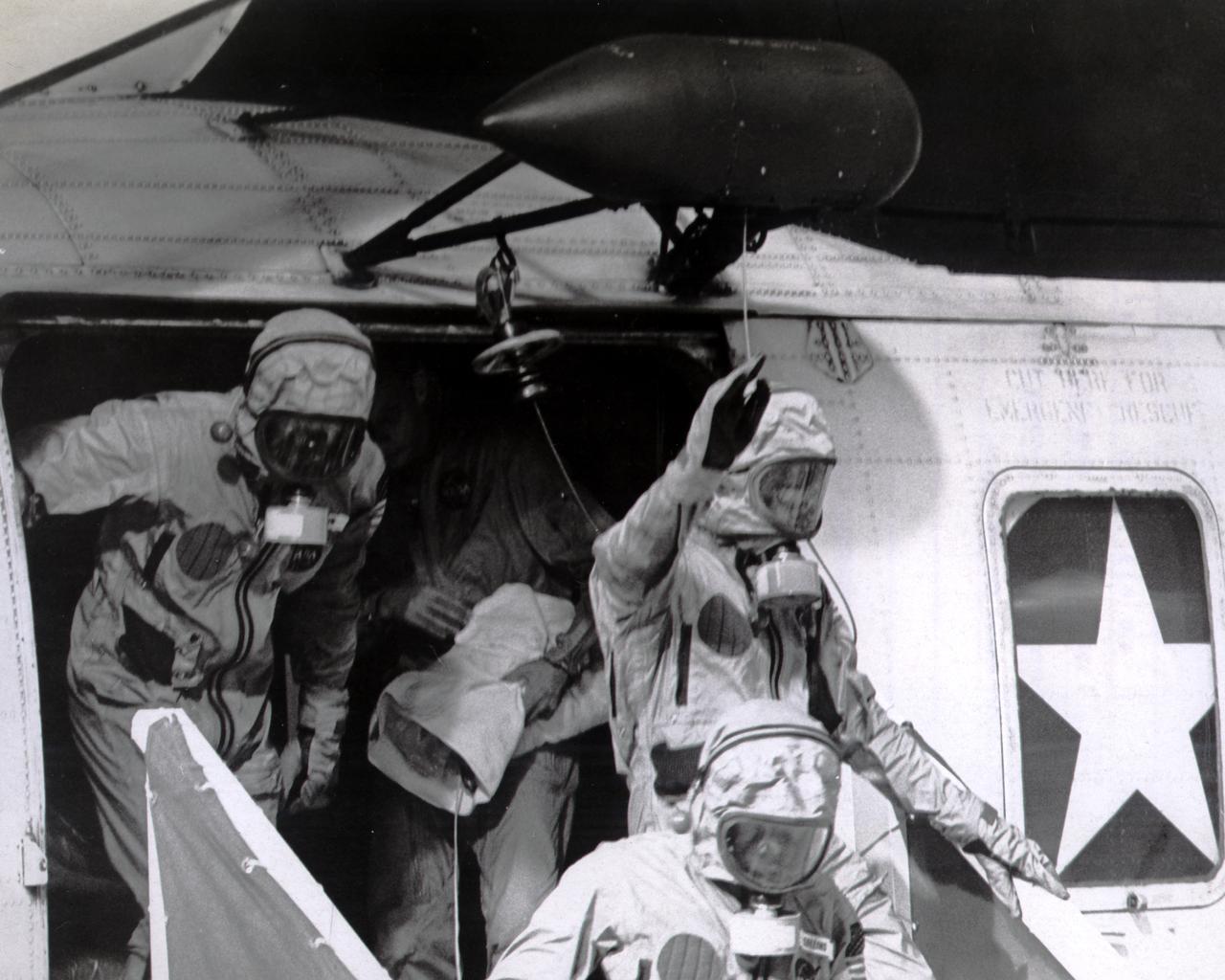
Donned in biological isolation garments, the Apollo 11 crew members, (L-R) Edwin Aldrin, Neil Armstrong (waving), and Michael Collins exit the recovery pick up helicopter to board the U.S.S. Hornet aircraft carrier after splashdown. The recovery operation took place in the Pacific Ocean where Navy para-rescue men recovered the capsule housing the 3-man Apollo 11 crew. The crew was airlifted to safety aboard the U.S.S. Hornet, where they were quartered in a Mobile Quarantine Facility (MQF). This portable facility served as their home until they reached the NASA Manned Spacecraft Center (MSC) Lunar Receiving Laboratory in Houston, Texas. The Apollo 11 mission, the first manned lunar mission, launched from the Kennedy Space Center (KSC), Florida via the Saturn V launch vehicle on July 16, 1969 and safely returned to Earth on July 24, 1969. Aboard were Neil A. Armstrong, commander; Michael Collins, Command Module (CM) pilot; and Edwin E. Aldrin Jr., Lunar Module (LM) pilot. The CM, piloted by Michael Collins remained in a parking orbit around the Moon while the LM, named “Eagle’’, carrying astronauts Neil Armstrong and Edwin Aldrin, landed on the Moon. Armstrong was the first human to ever stand on the lunar surface, followed by Aldrin. During 2½ hours of surface exploration, the crew collected 47 pounds of lunar surface material for analysis back on Earth. With the success of Apollo 11, the national objective to land men on the Moon and return them safely to Earth had been accomplished. The Saturn V vehicle was developed by the Marshall Space Flight Center (MSFC) under the direction of Dr. Werher von Braun.
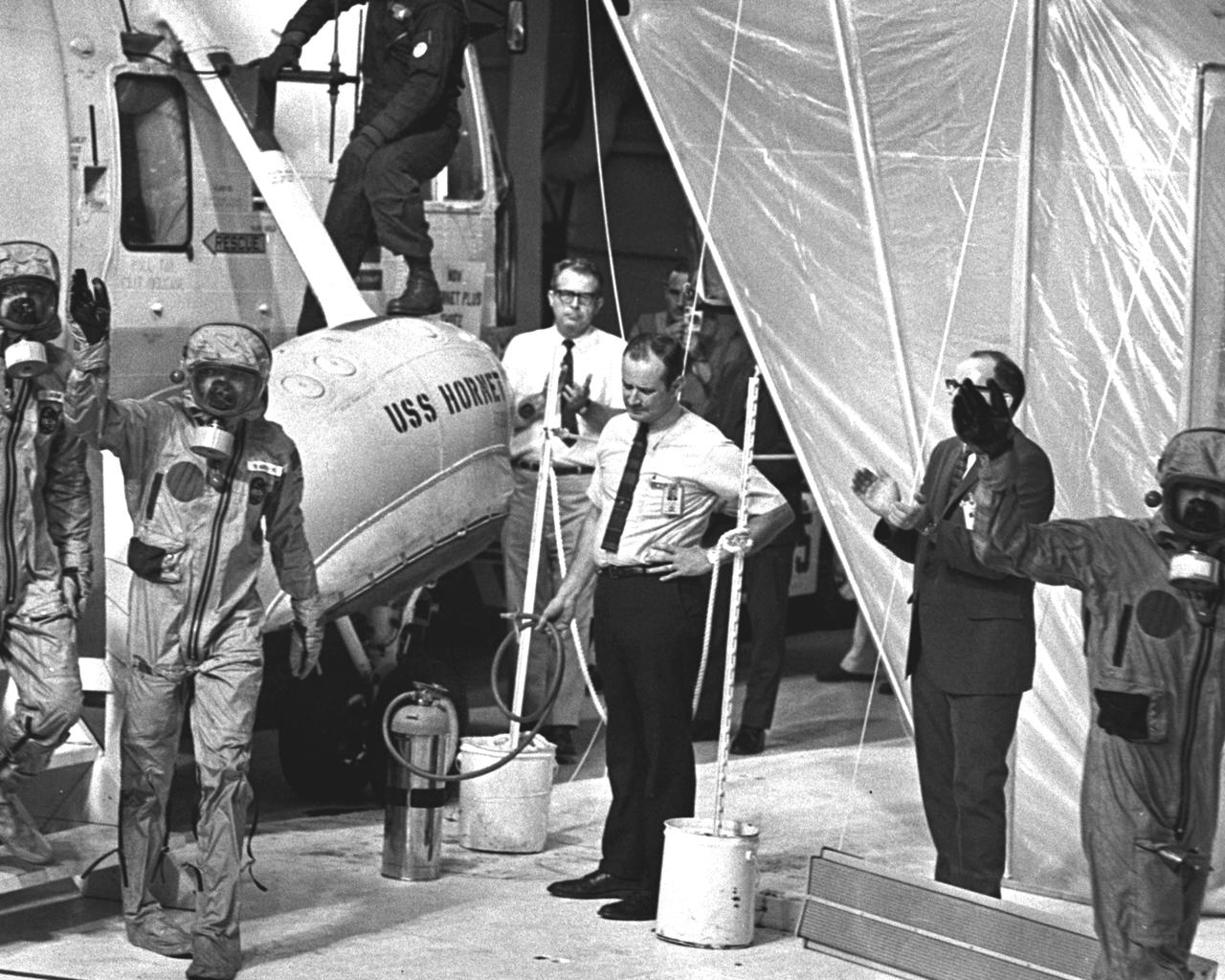
The Apollo 11 mission, the first manned lunar mission, launched from the Kennedy Space Center, Florida via the Saturn V launch vehicle on July 16, 1969 and safely returned to Earth on July 24, 1969. The Saturn V vehicle was developed by the Marshall Space Flight Center (MSFC) under the direction of Dr. Wernher von Braun. Aboard were Neil A. Armstrong, commander; Michael Collins, Command Module (CM) pilot; and Edwin E. Aldrin Jr., Lunar Module (LM) pilot. The CM, piloted by Michael Collins remained in a parking orbit around the Moon while the LM, named “Eagle’’, carrying astronauts Neil Armstrong and Edwin Aldrin, landed on the Moon. Armstrong was the first human to ever stand on the lunar surface, Aldrin. During 2½ hours of surface exploration, the crew collected 47 pounds of lunar surface material for analysis back on Earth. The recovery operation took place in the Pacific Ocean where Navy para-rescue men recovered the capsule housing the 3-man Apollo 11 crew. The crew was airlifted to safety aboard the U.S.S. Hornet, where they were quartered in a Mobile Quarantine Facility (MQF). Donned in biological isolation garments, the Apollo 11 crew members wave to well wishers as they leave the pick up helicopter making their way to the MQF. This portable facility served as their home until they reached the NASA Manned Spacecraft Center (MSC) Lunar Receiving Laboratory in Houston, Texas. With the success of Apollo 11, the national objective to land men on the Moon and return them safely to Earth had been accomplished.
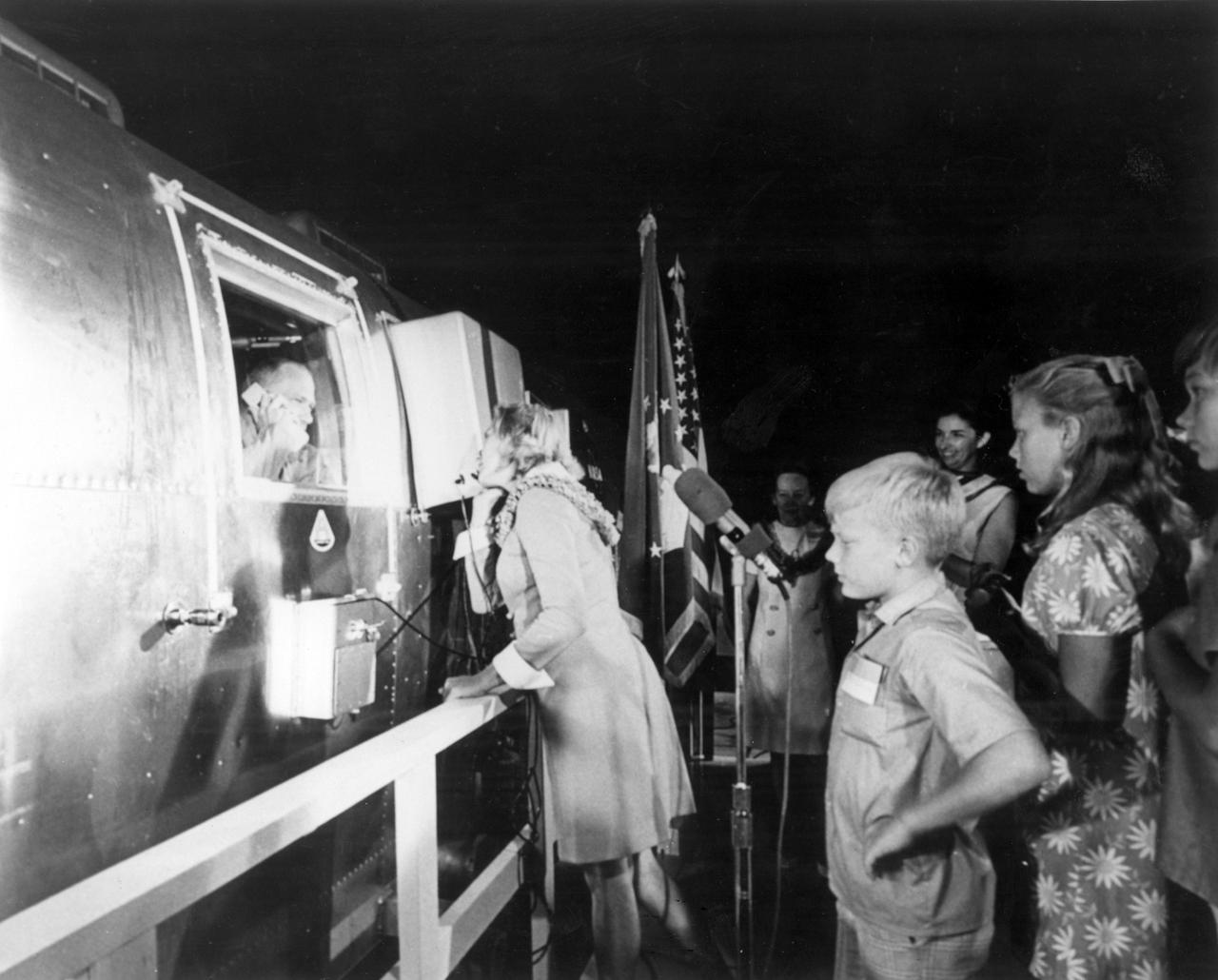
The Apollo 11 mission, the first manned lunar mission, launched from the Kennedy Space Center, Florida via the Marshall Space Flight Center (MSFC) developed Saturn V launch vehicle on July 16, 1969 and safely returned to Earth on July 24, 1969. Aboard the space craft were astronauts Neil A. Armstrong, commander; Michael Collins, Command Module (CM) pilot; and Edwin E. (Buzz) Aldrin Jr., Lunar Module (LM) pilot. The CM, piloted by Michael Collins remained in a parking orbit around the Moon while the LM, named “Eagle’’, carrying astronauts Neil Armstrong and Edwin Aldrin, landed on the Moon. During 2½ hours of surface exploration, the crew collected 47 pounds of lunar surface material for analysis back on Earth. The recovery operation took place in the Pacific Ocean where Navy para-rescue men recovered the capsule housing the 3-man Apollo 11 crew. The crew was airlifted to safety aboard the U.S.S. Hornet, where they were quartered in a Mobile Quarantine Facility (MQF) which served as their home until they reached the NASA Manned Spacecraft Center (MSC) Lunar Receiving Laboratory in Houston, Texas. On arrival at Ellington Air Force base near the MSC, the crew, still under a 21 day quarantine in the MQF, were greeted by their wives. Pictured here is Joan Aldrin, wife of Buzz Aldrin, speaking with her husband via telephone patch.
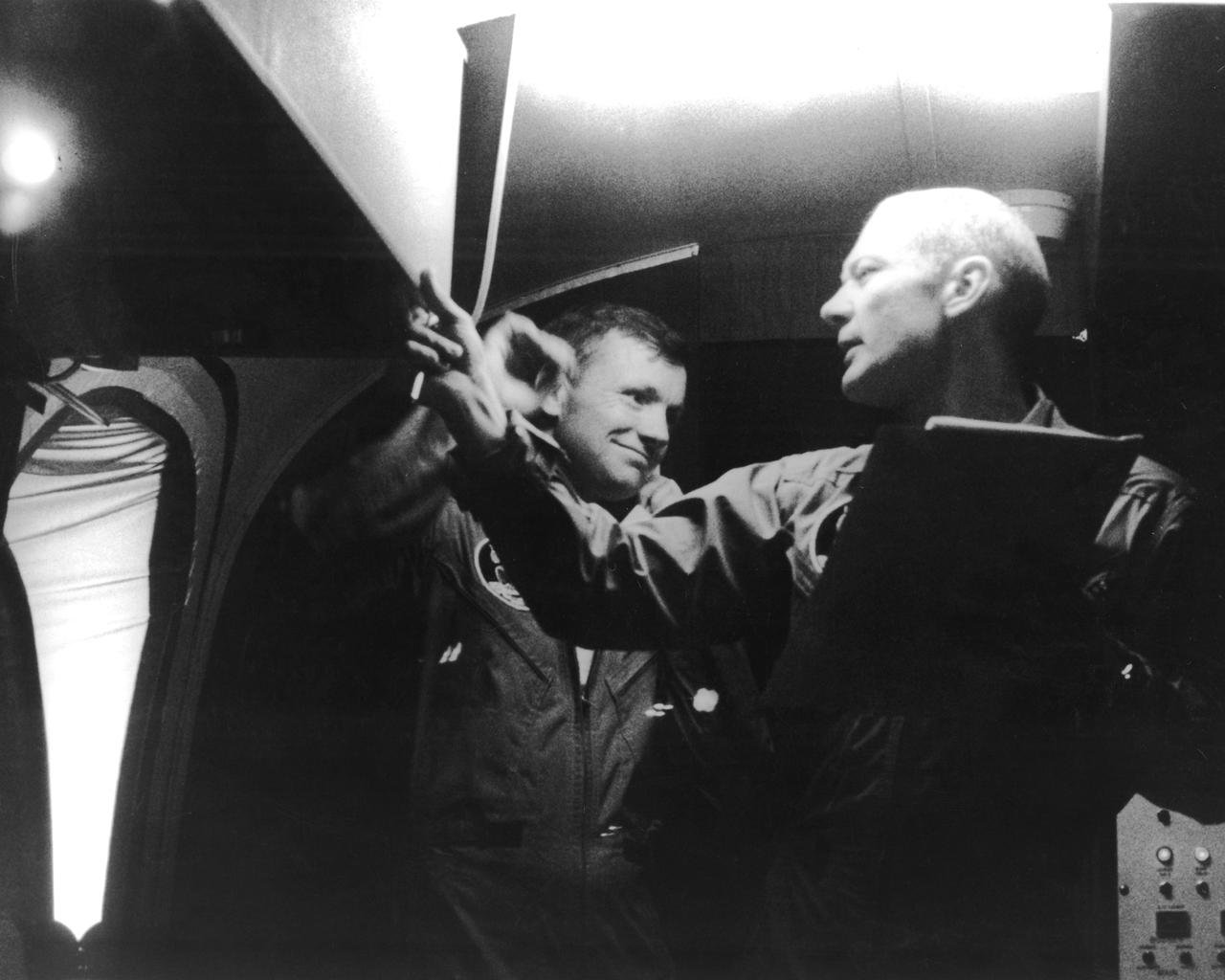
The Apollo 11 mission, the first manned lunar mission, launched aboard the Saturn V launch vehicle from the Kennedy Space Center, Florida on July 16, 1969 and safely returned to Earth on July 24, 1969. Aboard were astronauts Neil A. Armstrong, commander; Michael Collins, Command Module (CM) pilot; and Edwin E. Aldrin Jr., Lunar Module (LM) pilot. The CM, piloted by Michael Collins, remained in a parking orbit around the Moon while the LM, named “Eagle’’, carrying astronauts Neil Armstrong and Edwin Aldrin, landed on the Moon. Armstrong was the first human to ever stand on the lunar surface, followed by Edwin (Buzz) Aldrin. The surface exploration was concluded in 2½ hours. Once the crew collected 47 pounds of lunar surface material for analysis back on Earth, the LM redocked with the CM for the crew’s return to Earth. Following splash down in the Pacific Ocean, Navy para-rescue men recovered the capsule housing the 3-man crew. The crew was airlifted to safety aboard the U.S.S. Hornet, where they were quartered in a Mobile Quarantine Facility (MQF). Astronaut Collins took this snapshot of astronauts Armstrong (center) and Aldrin inside of the MQF.
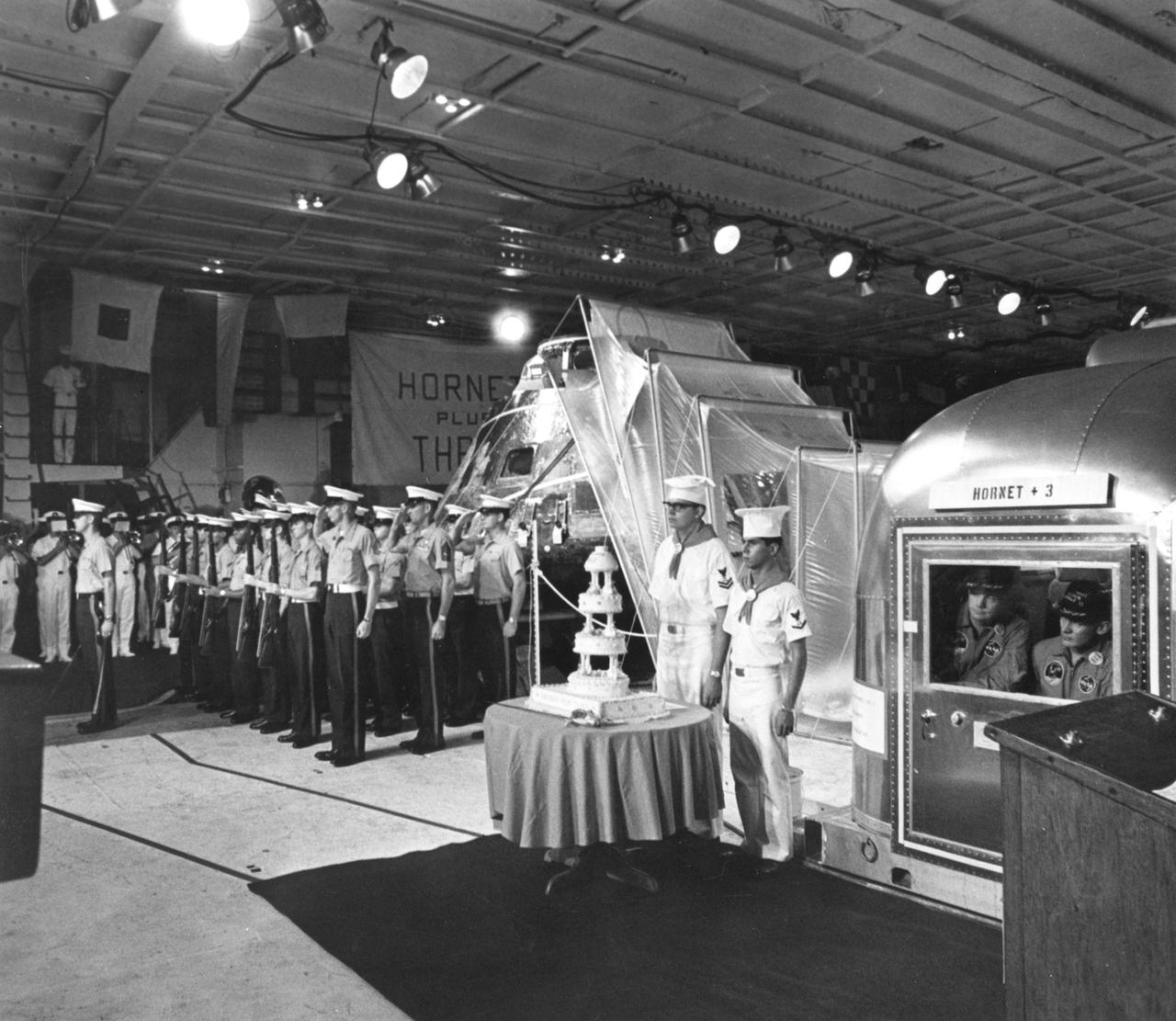
The Apollo 11 mission, the first manned lunar mission, launched from the Kennedy Space Center, Florida via the Space Flight Center (MSFC) developed Saturn V launch vehicle on July 16, 1969 and safely returned to Earth on July 24, 1969. Aboard the space craft were astronauts Neil A. Armstrong, commander; Michael Collins, Command Module (CM) pilot; and Edwin E. Aldrin Jr., Lunar Module (LM) pilot. The CM, piloted by Michael Collins remained in a parking orbit around the Moon while the LM, named “Eagle’’, carrying astronauts Neil Armstrong and Edwin Aldrin, landed on the Moon. During 2½ hours of surface exploration, the crew collected 47 pounds of lunar surface material for analysis back on Earth. The recovery operation took place in the Pacific Ocean where Navy para-rescue men recovered the capsule housing the 3-man Apollo 11 crew. The crew was airlifted to safety aboard the U.S.S. Hornet recovery ship, where they were quartered in a Mobile Quarantine Facility (MQF) which served as their home for 21 days following the mission. In this photograph, the Hornet crew and honor guard snap to attention to begin the official cake cutting ceremony for the Apollo 11 astronauts. Astronauts Armstrong and Aldrin are visible in the window of the MQF.
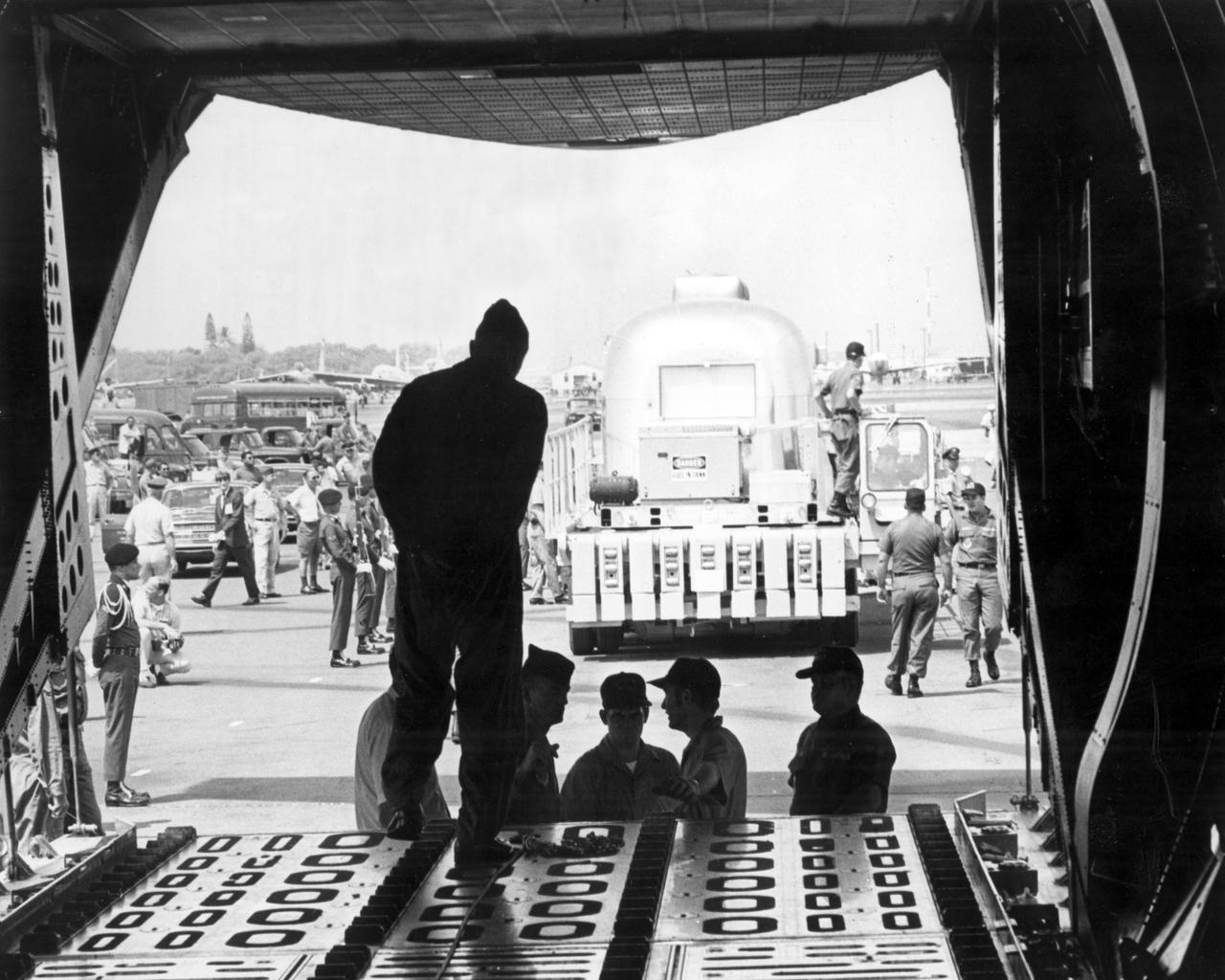
The Apollo 11 mission, the first manned lunar mission, launched from the Kennedy Space Center, Florida via the Marshall Space Flight Center (MSFC) developed Saturn V launch vehicle on July 16, 1969 and safely returned to Earth on July 24, 1969. Aboard the space craft were astronauts Neil A. Armstrong, commander; Michael Collins, Command Module (CM) pilot; and Edwin E. Aldrin Jr., Lunar Module (LM) pilot. The CM, piloted by Michael Collins remained in a parking orbit around the Moon while the LM, named “Eagle’’, carrying astronauts Neil Armstrong and Edwin Aldrin, landed on the Moon. During 2½ hours of surface exploration, the crew collected 47 pounds of lunar surface material for analysis back on Earth. The recovery operation took place in the Pacific Ocean where Navy para-rescue men recovered the capsule housing the 3-man Apollo 11 crew. The crew was airlifted to safety aboard the U.S.S. Hornet, where they were quartered in a Mobile Quarantine Facility (MQF) which served as their home until they reached the NASA Manned Spacecraft Center (MSC) Lunar Receiving Laboratory in Houston, Texas. In this photo taken at Pearl Harbor, Hawaii, the inhabited MQF is prepared for loading into an Air Force C-141 jet transport for the flight back to Ellington Air Force Base Texas and then on to the MSC.
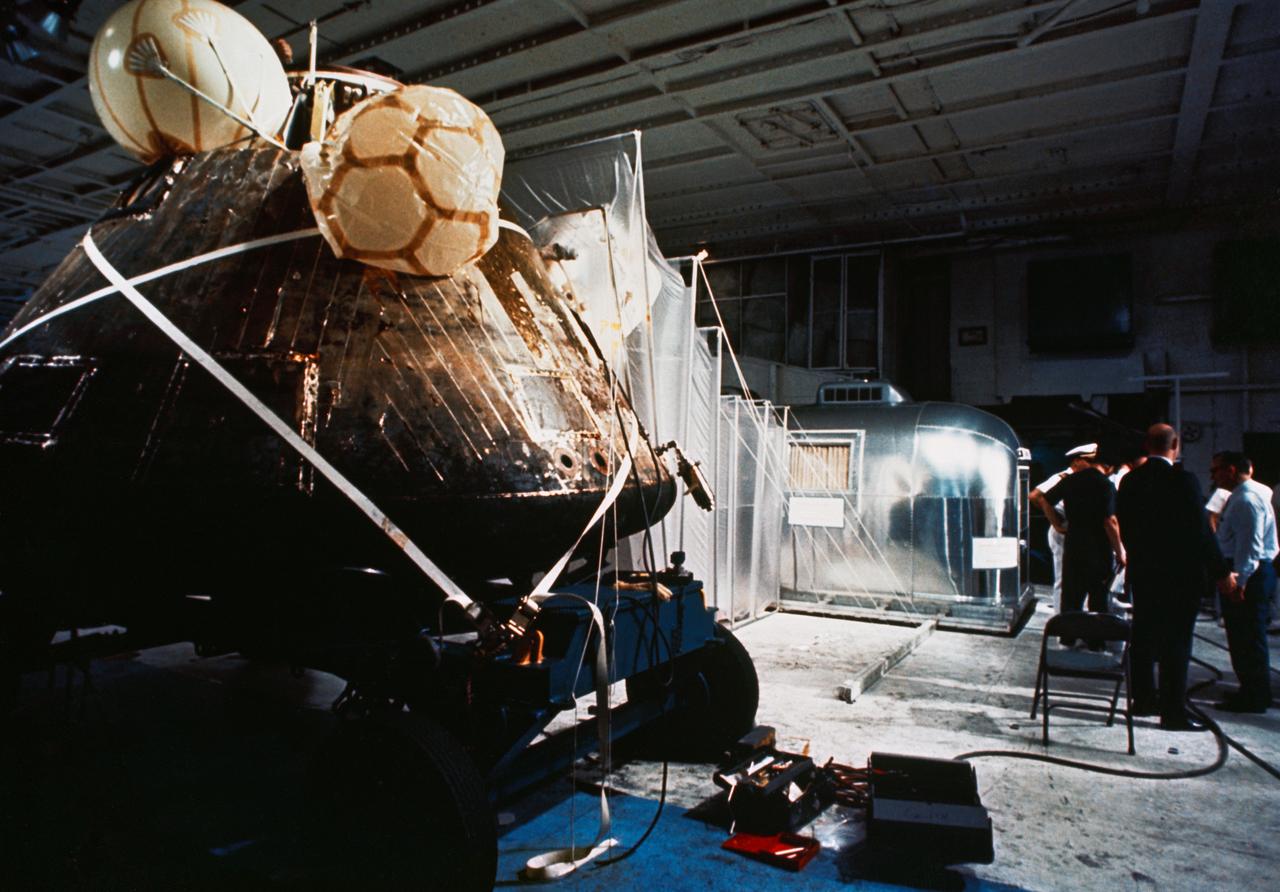
S69-40758 (24 July 1969) --- The Apollo 11 spacecraft Command Module (CM) and the Mobile Quarantine Facility (MQF) are photographed aboard the USS Hornet, prime recovery ship for the historic first lunar landing mission. The three crewmen are already in the MQF. Apollo 11 with astronauts Neil A. Armstrong, Michael Collins and Edwin E. Aldrin Jr. aboard splashed down at 11:49 a.m. (CDT), July 24, 1969, about 812 nautical miles southwest of Hawaii and only 12 nautical miles from the USS Hornet. While astronauts Armstrong, commander, and Aldrin, lunar module pilot, descended in the Lunar Module (LM) "Eagle" to explore the Sea of Tranquility region of the moon, astronaut Collins, command module pilot, remained with the Command and Service Modules (CSM) "Columbia" in lunar orbit.
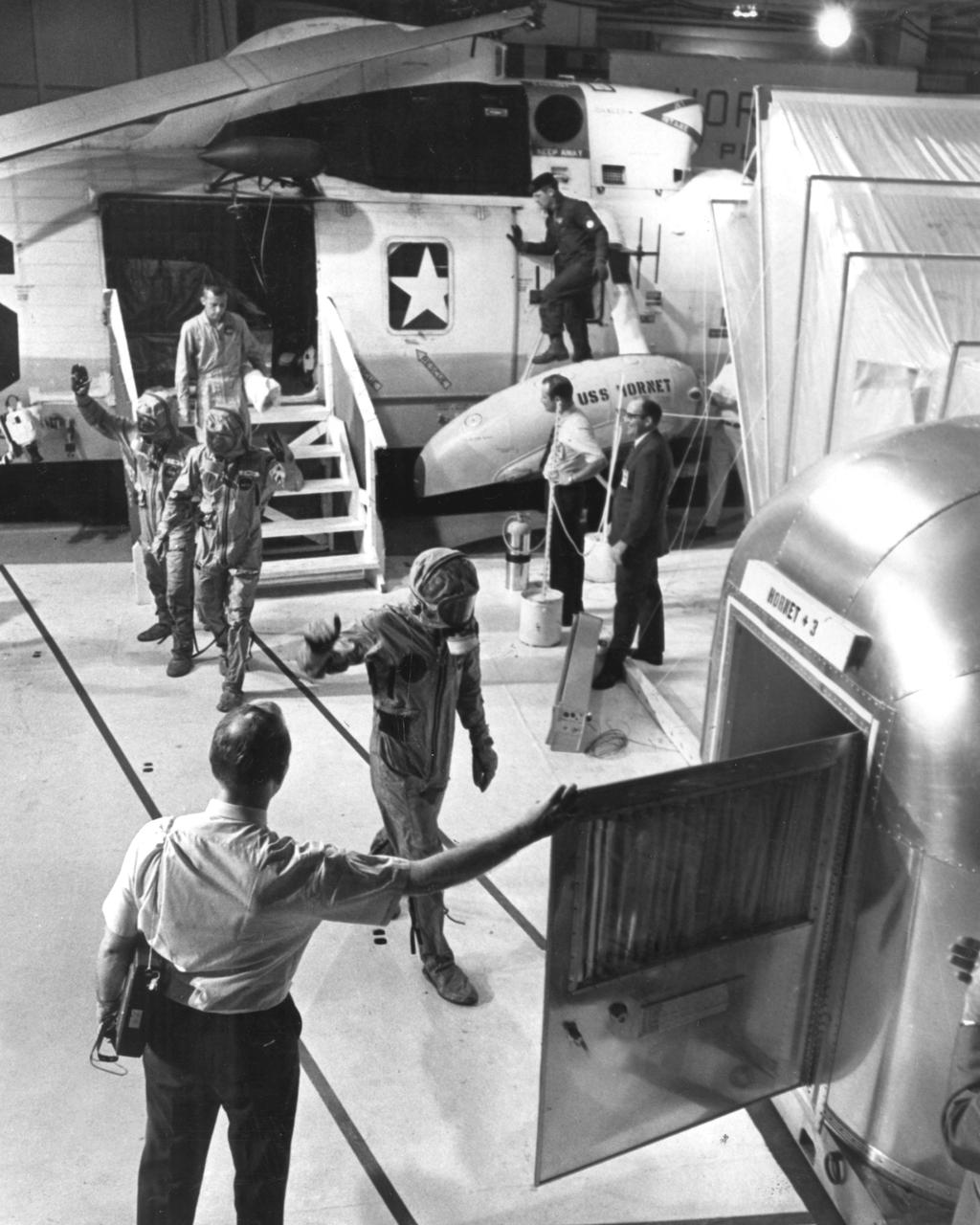
The Apollo 11 mission, the first manned lunar mission, launched from the Kennedy Space Center, Florida via the Saturn V launch vehicle on July 16, 1969 and safely returned to Earth on July 24, 1969. The Saturn V vehicle was developed by the Marshall Space Flight Center (MSFC) under the direction of Dr. Wernher von Braun. Aboard the craft were astronauts Neil A. Armstrong, commander; Michael Collins, Command Module (CM) pilot; and Edwin E. Aldrin Jr., Lunar Module (LM) pilot. The CM, piloted by Michael Collins remained in a parking orbit around the Moon while the LM, named “Eagle’’, carrying astronauts Neil Armstrong and Edwin Aldrin, landed on the Moon. Armstrong was the first human to ever stand on the lunar surface followed by Aldrin. During 2½ hours of surface exploration, the crew collected 47 pounds of lunar surface material for analysis back on Earth. The recovery operation took place in the Pacific Ocean where Navy para-rescue men recovered the capsule housing the 3-man Apollo 11 crew. The crew was airlifted to safety aboard the U.S.S. Hornet, where they were quartered in a Mobile Quarantine Facility (MQF). Donned in biological isolation garments, the Apollo 11 crew members (front to rear) Armstrong, Collins, and Aldrin leave the pick up helicopter making their way to the MQF. This portable facility served as their home until they reached the NASA Manned Spacecraft Center Lunar Receiving Laboratory in Houston, Texas. With the success of Apollo 11 mission the national objective to land men on the Moon and return them safely to Earth had been accomplished.
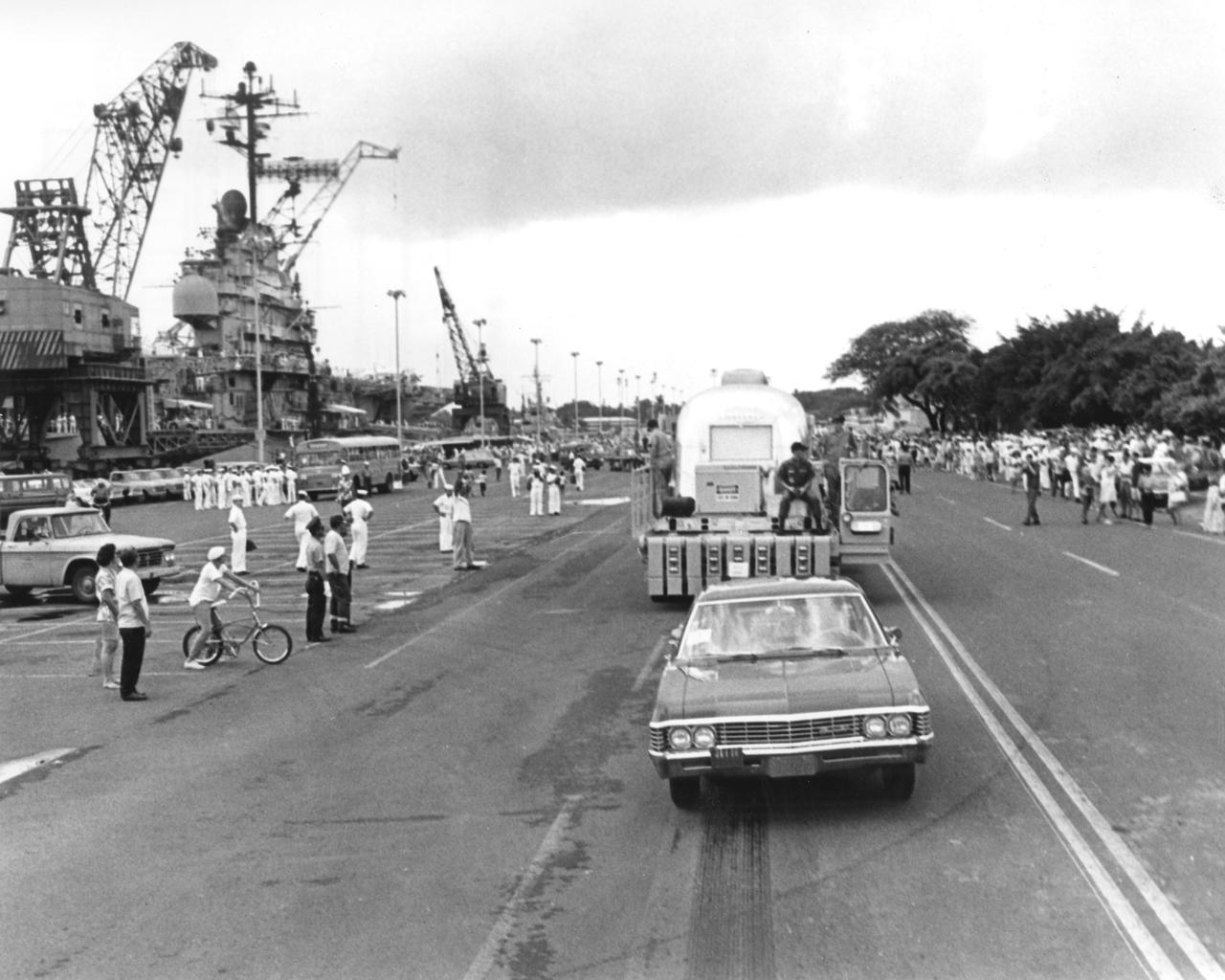
The Apollo 11 mission, the first manned lunar mission, launched from the Kennedy Space Center, Florida via the Marshall Space Flight Center (MSFC) developed Saturn V launch vehicle on July 16, 1969 and safely returned to Earth on July 24, 1969. Aboard the space craft were astronauts Neil A. Armstrong, commander; Michael Collins, Command Module (CM) pilot; and Edwin E. Aldrin Jr., Lunar Module (LM) pilot. The CM, piloted by Michael Collins remained in a parking orbit around the Moon while the LM, named “Eagle’’, carrying astronauts Neil Armstrong and Edwin Aldrin, landed on the Moon. During 2½ hours of surface exploration, the crew collected 47 pounds of lunar surface material for analysis back on Earth. The recovery operation took place in the Pacific Ocean where Navy para-rescue men recovered the capsule housing the 3-man Apollo 11 crew. The crew was airlifted to safety aboard the U.S.S. Hornet recovery ship, where they were quartered in a Mobile Quarantine Facility (MQF) which served as their home until they reached the NASA Manned Spacecraft Center (MSC) Lunar Receiving Laboratory in Houston, Texas. The occupied MQF was unloaded from the U.S.S. Hornet in Pearl Harbor, Hawaii. In this photo, the facility is moved from the Hornet’s dock enroute to Hickam Field where it was loaded aboard an Air Force C-141 jet transport for the flight back to Ellington Air Force Base Texas, and then on to the MSC.
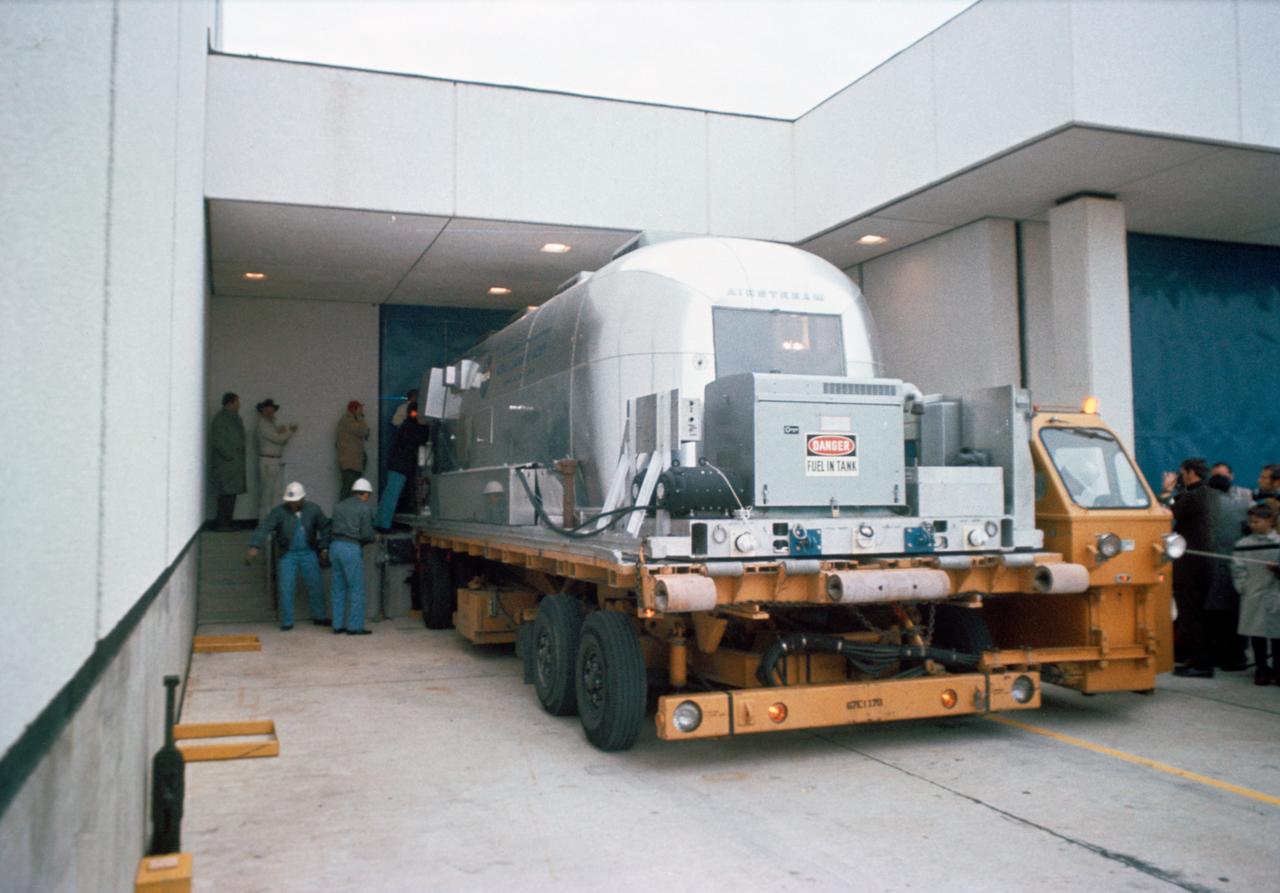
A Mobile Quarantine Facility (MQF), with the crew of the Apollo XII Lunar Landing Mission aboard, is shown on arriving at JSC, Saturday morning, 11/29/1969.
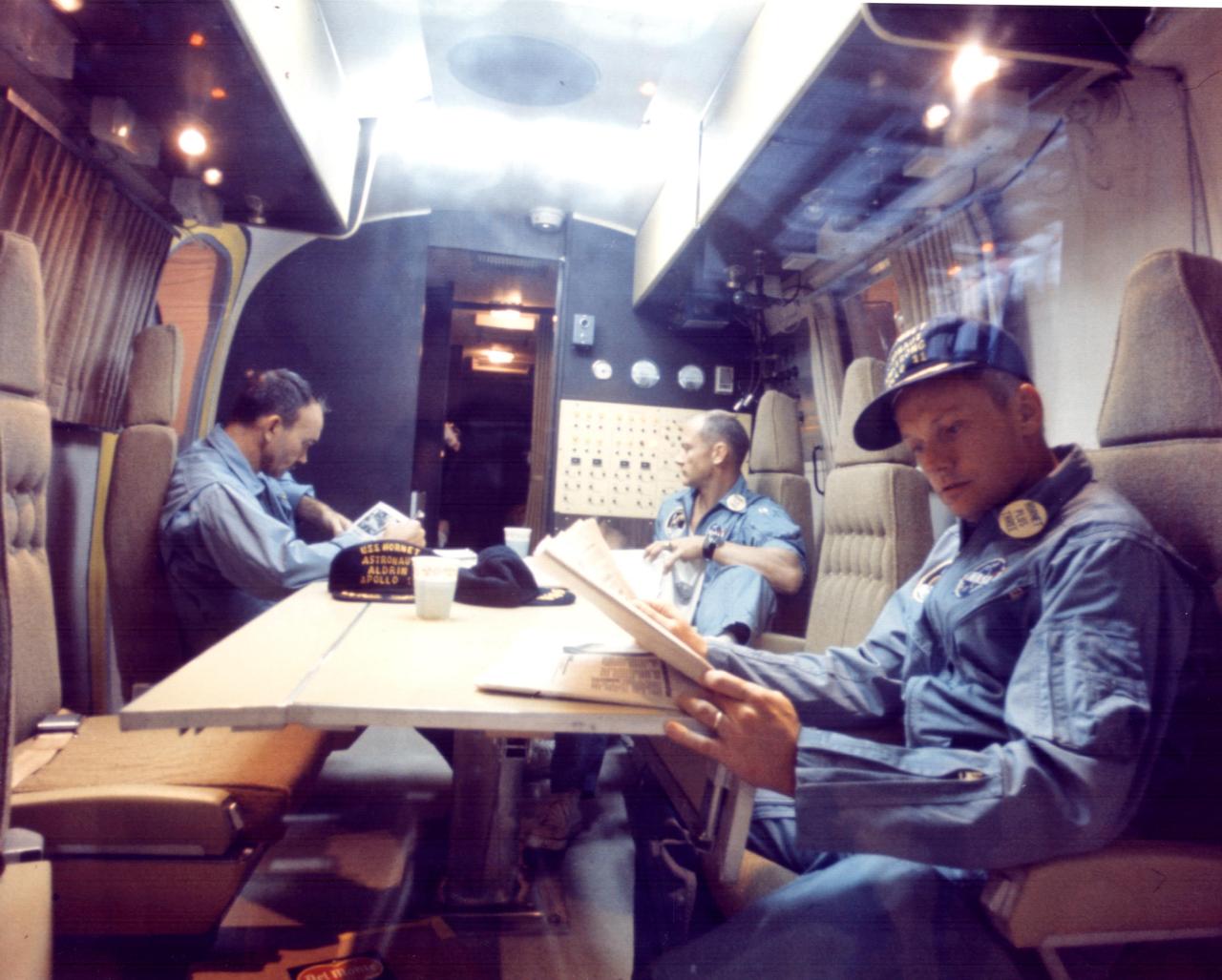
KENNEDY SPACE CENTER, FLA. - Within the Mobile Quarantine Facility, Apollo 11 astronauts (left to right) Michael Collins, Edwin E. Aldrin Jr. and Neil A. Armstrong relax following their successful lunar landing mission. They spent two-and-one-half days in the quarantine trailer enroute from the USS Hornet, prime recovery ship, to the Lunar Receiving Laboratory at the Manned Spacecraft Center in Houston. The Hornet docked at Pearl Harbor where the trailer was transferred to a jet aircraft for the flight to Houston.

S69-40217 (27 July 1969) --- Neil A. Armstrong, commander of the Apollo 11 flight, greets his son Mark, on telephone intercom system, while his wife Jan and another son Eric look on. Armstrong had just arrived in early morning with the Mobile Quarantine Facility (MQF) at Ellington Air Force Base. Armstrong and fellow astronauts will remain in the MQF until arrival and confinement in the Crew Reception Area (CRA) of the Lunar Receiving Laboratory (LRL) at the Manned Spacecraft Center (MSC). Quarantine period will end on Aug. 11, 1969.
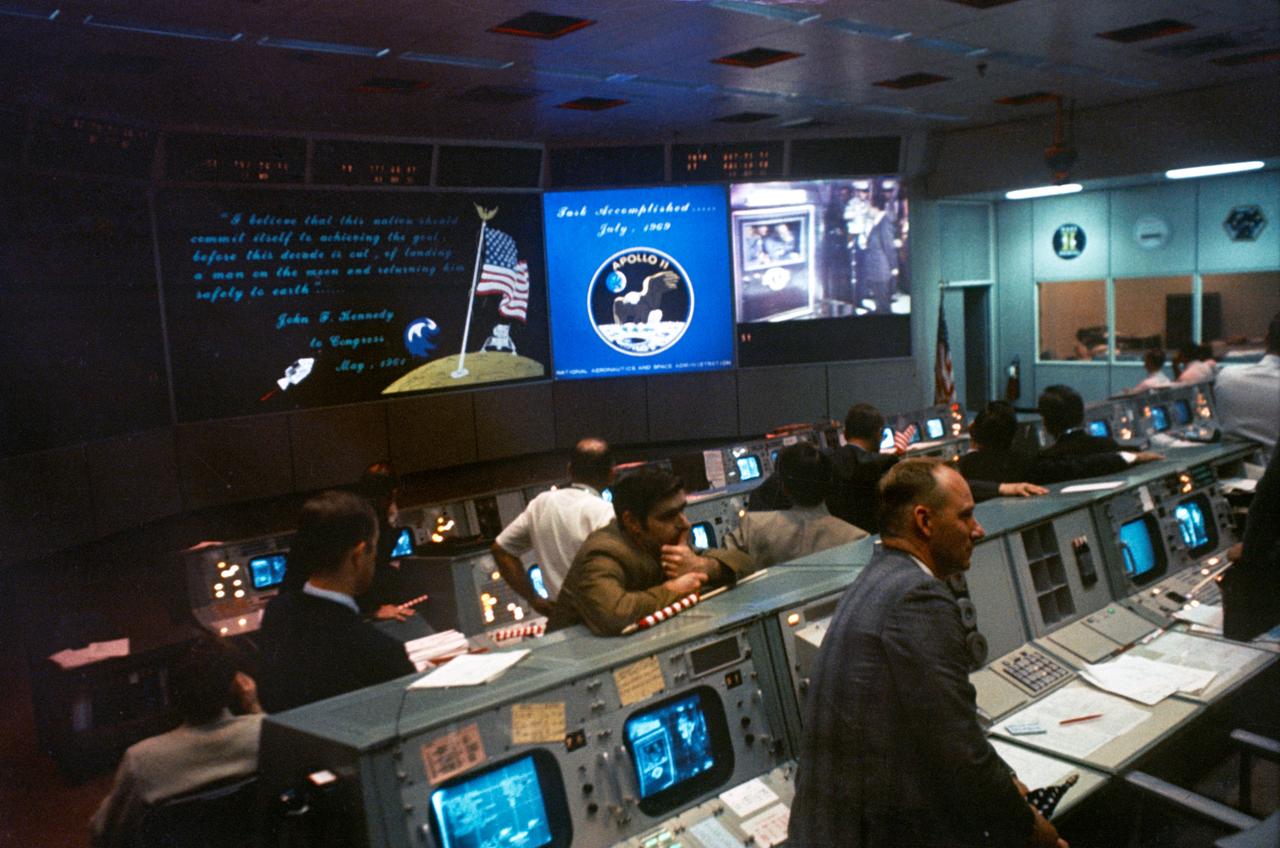
S69-40301 (24 July 1969) --- Overall view of the Mission Operations Control Room (MOCR) in the Mission Control Center (MCC), Building 30, Manned Spacecraft Center (MSC), at the conclusion of the Apollo 11 lunar landing mission. The television monitor shows President Richard M. Nixon greeting the Apollo 11 astronauts aboard the USS Hornet in the Pacific recovery area. Astronauts Neil A. Armstrong, Michael Collins, and Edwin E. Aldrin Jr. are inside the Mobile Quarantine Facility (MQF).
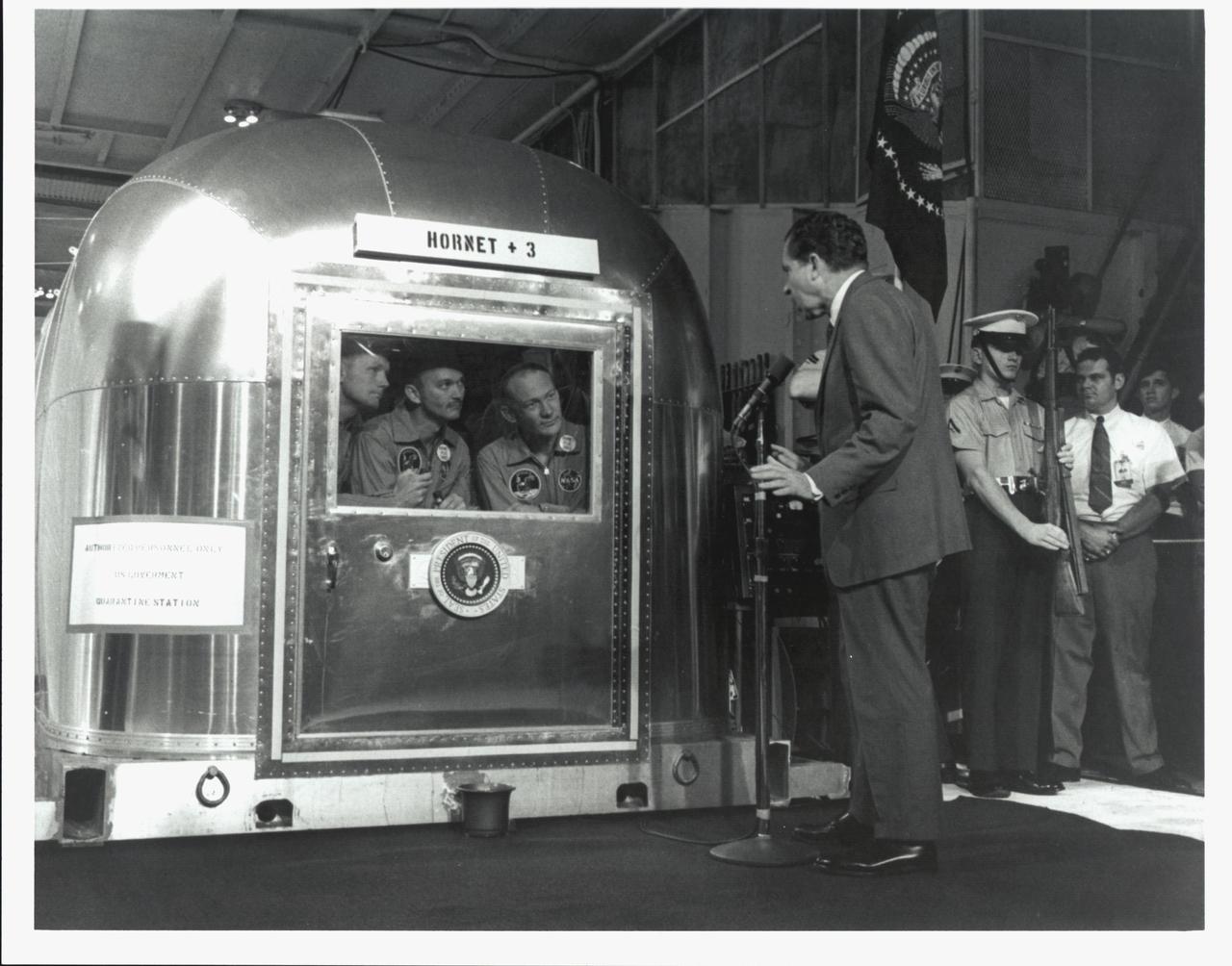
KENNEDY SPACE CENTER, FLA. - The Apollo 11 astronauts, left to right, Neil A. Armstrong, Michael Collins and Edwin E. Aldrin Jr., inside the Mobile Quarantine Facility aboard the USS Hornet, listen to President Richard M. Nixon as he welcomes them back to Earth and for a job well done. The astronauts, after their first manned mission to the Moon, splashed down in the Pacific Ocean at 12:50 p.m. EDT about 900 miles southwest of Hawaii.
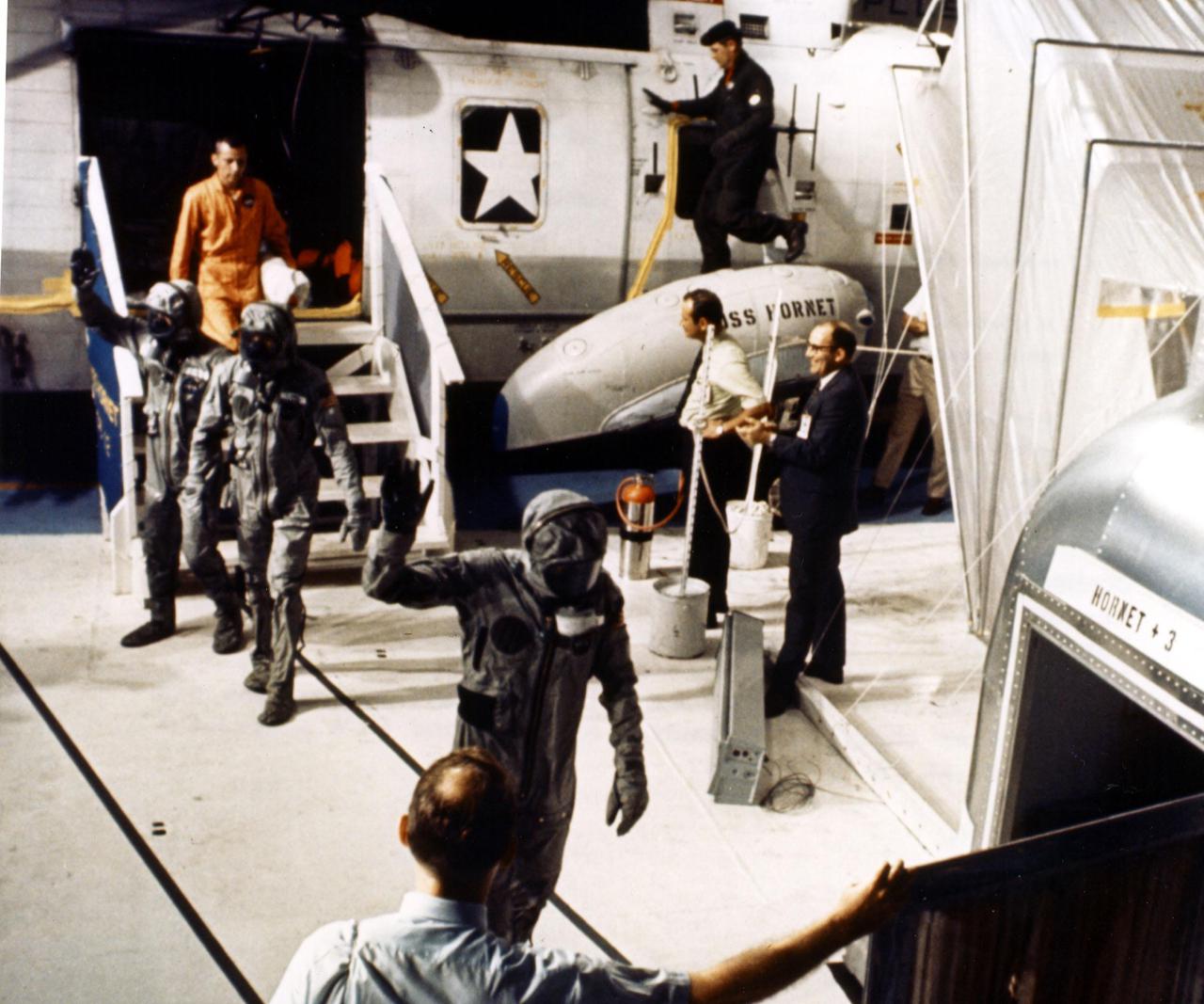
JOHNSON SPACE CENTER, HOUSTON, TEXAS - A technician aboard the USS Hornet holds the Mobile Quarantine Facility door open for the Apollo 11 astronauts as they leave the recovery helicopter. Astronauts, left to right, Edwin E. Aldrin Jr., Neil A. Armstrong and Michael Collins were taken to the USS Hornet after their Lunar Landing mission came to a successful completion at 12:50 p.m. EDT.
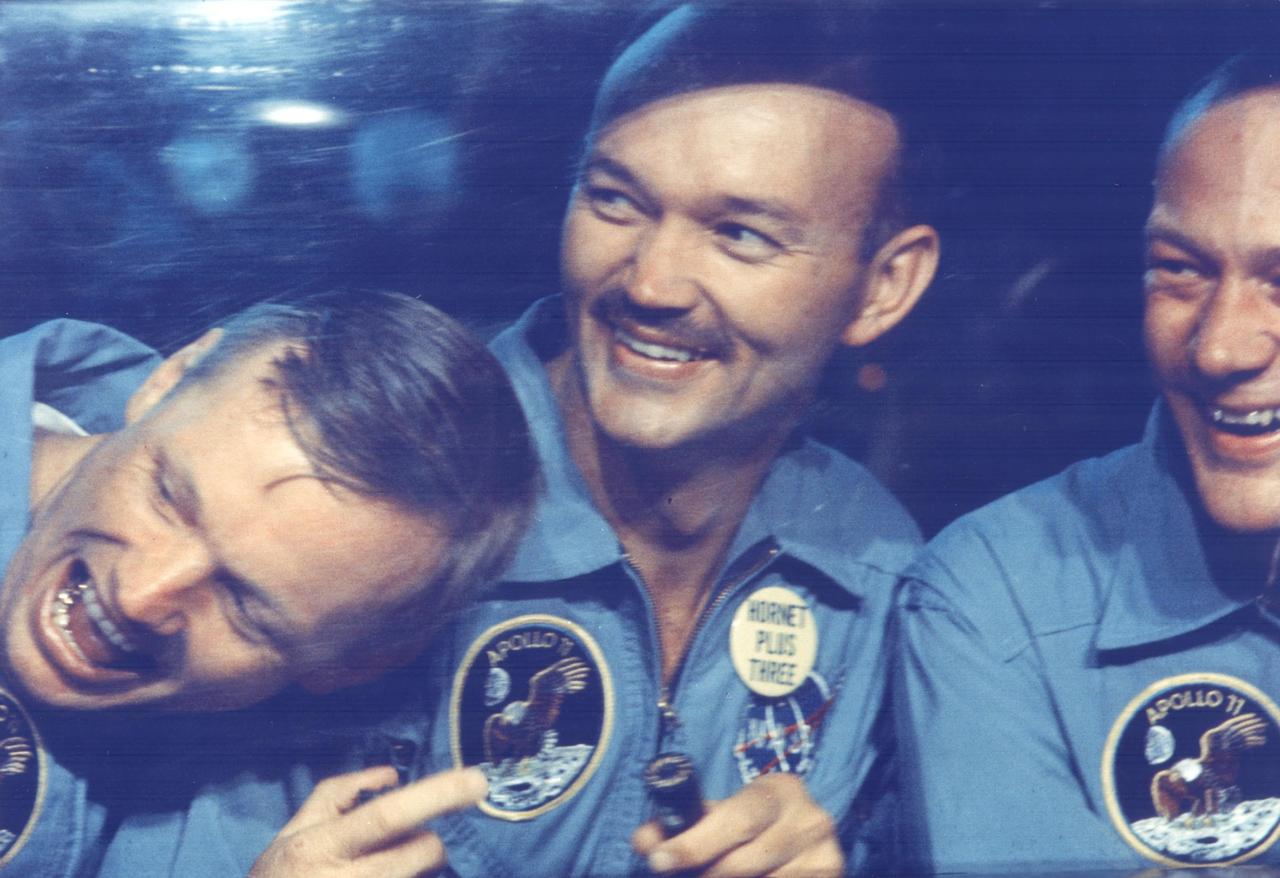
KENNEDY SPACE CENTER, FLA. - The Apollo 11 astronauts, left to right, Neil A. Armstrong, Michael Collins and Edwin E. Aldrin Jr. share jokes with well-wishers on the other side of the window of their Mobile Quarantine Facility aboard the USS Hornet. The astronauts splashed down at 12:50 p.m. EDT at the completion of their historical eight-day first manned lunar landing.
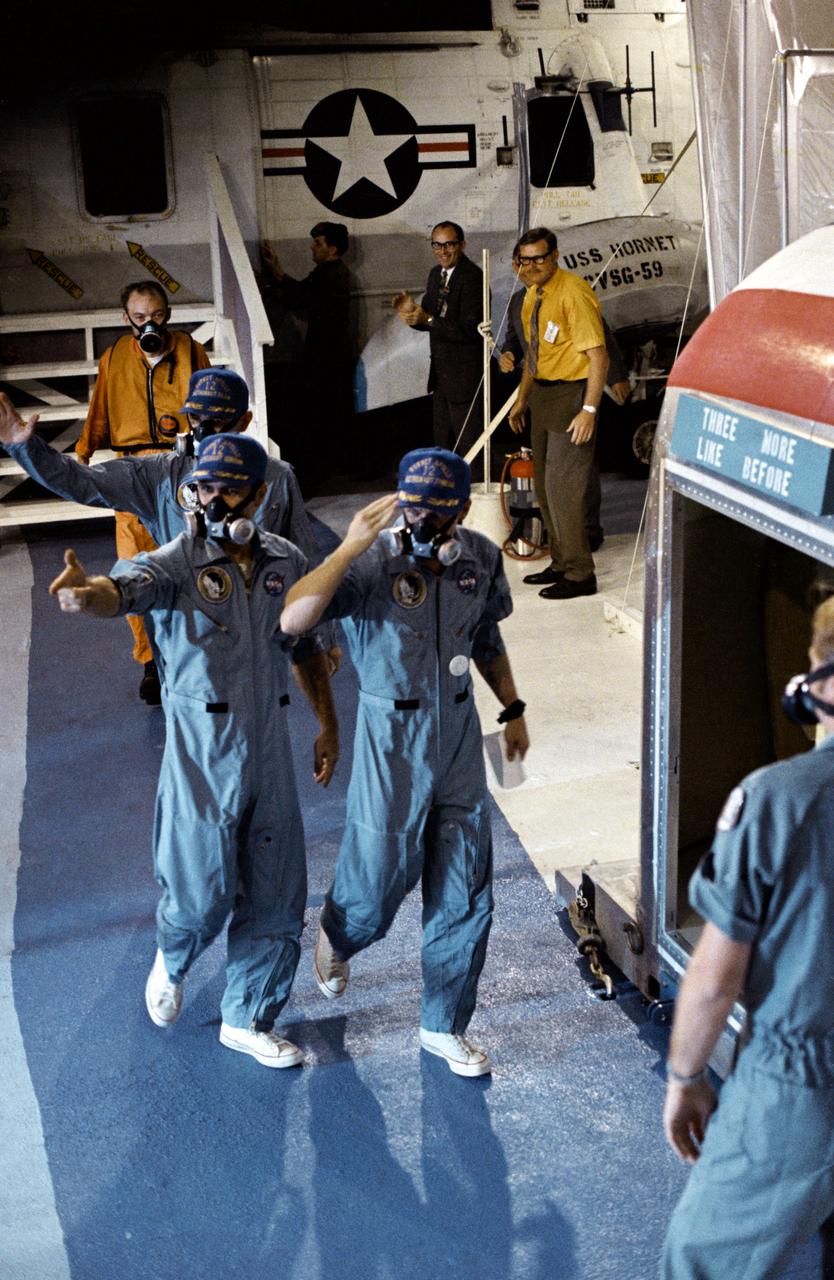
S69-22849 (24 Nov. 1969) --- USS Hornet crewmen are greeted by the crew of the Apollo 12 lunar landing mission as the three astronauts are transferred from a U.S. Navy helicopter to a Mobile Quarantine Facility (MQF) aboard the prime recovery vessel. Charles Conrad Jr., right, commander; Richard F. Gordon Jr., command module pilot, left front; and Alan L. Bean, lunar module pilot, splashed down safely at 2:58 p.m., Nov. 24, 1969.
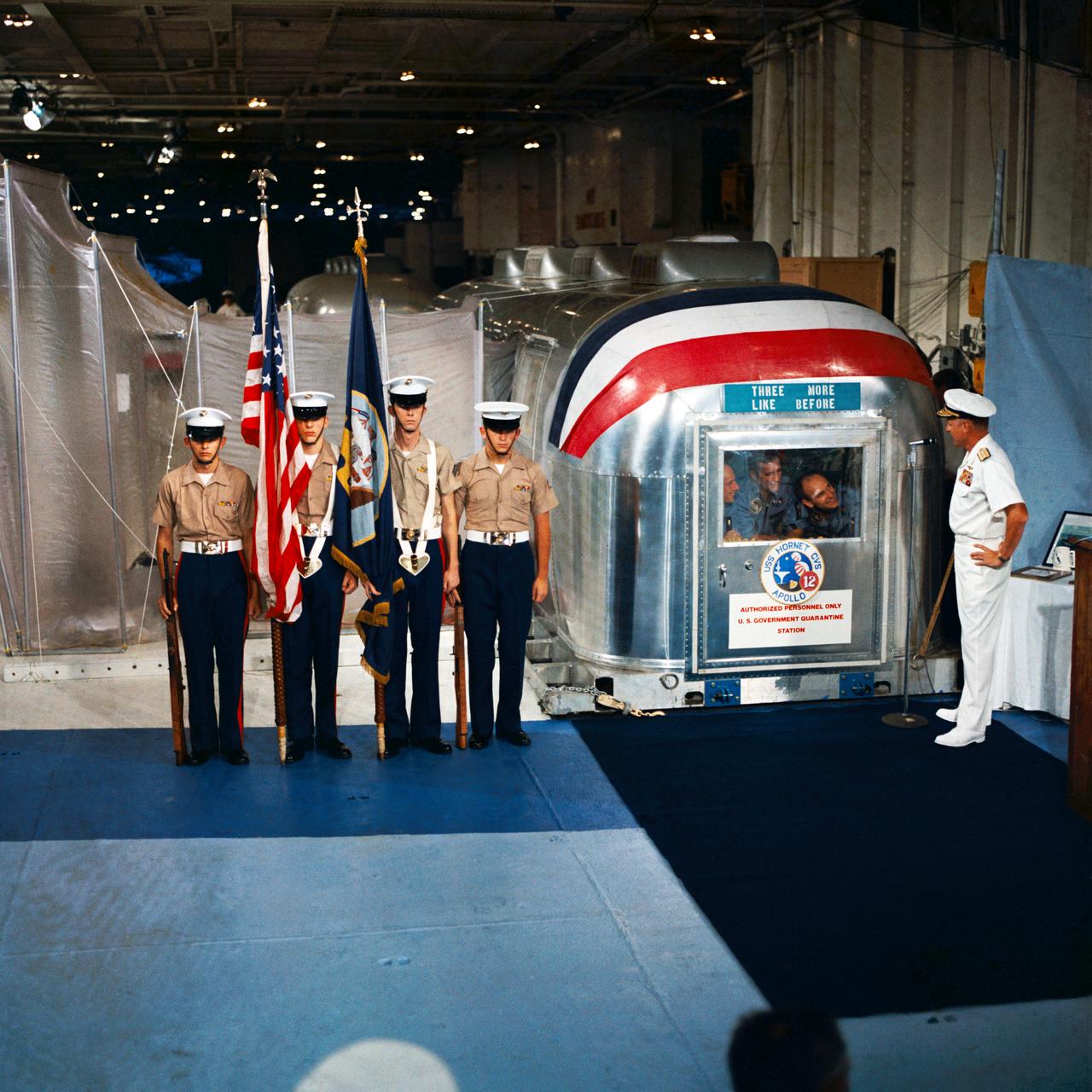
S69-22876 (24 Nov. 1969) --- Rear Admiral Donald C. David, Commander, Manned Spacecraft Recovery Force, Pacific, welcomes the crew of the Apollo 12 lunar landing mission aboard the USS Hornet, prime recovery vessel for the mission. A color guard was also on hand for the welcoming ceremonies. Inside the Mobile Quarantine Facility (MQF) are (left to right) astronauts Charles Conrad Jr., commander; Richard F. Gordon Jr., command module pilot; and Alan L. Bean, lunar module pilot.

S71-19473 (9 Feb. 1971) --- The Apollo 14 crew members step aboard the USS New Orleans, after exiting a U.S. Navy helicopter which retrieved the three from their splashdown site not far away. From left to right, are astronauts Stuart A. Roosa, command module pilot; Edgar D. Mitchell, lunar module pilot; and Alan B. Shepard Jr., commander. They will be sealed inside a Mobile Quarantine Facility (MQF) aboard the prime recovery ship. Apollo 14 splashdown occurred at 3:04:39 p.m. (CST) in the South Pacific Ocean, approximately 765 nautical miles from American Samoa.
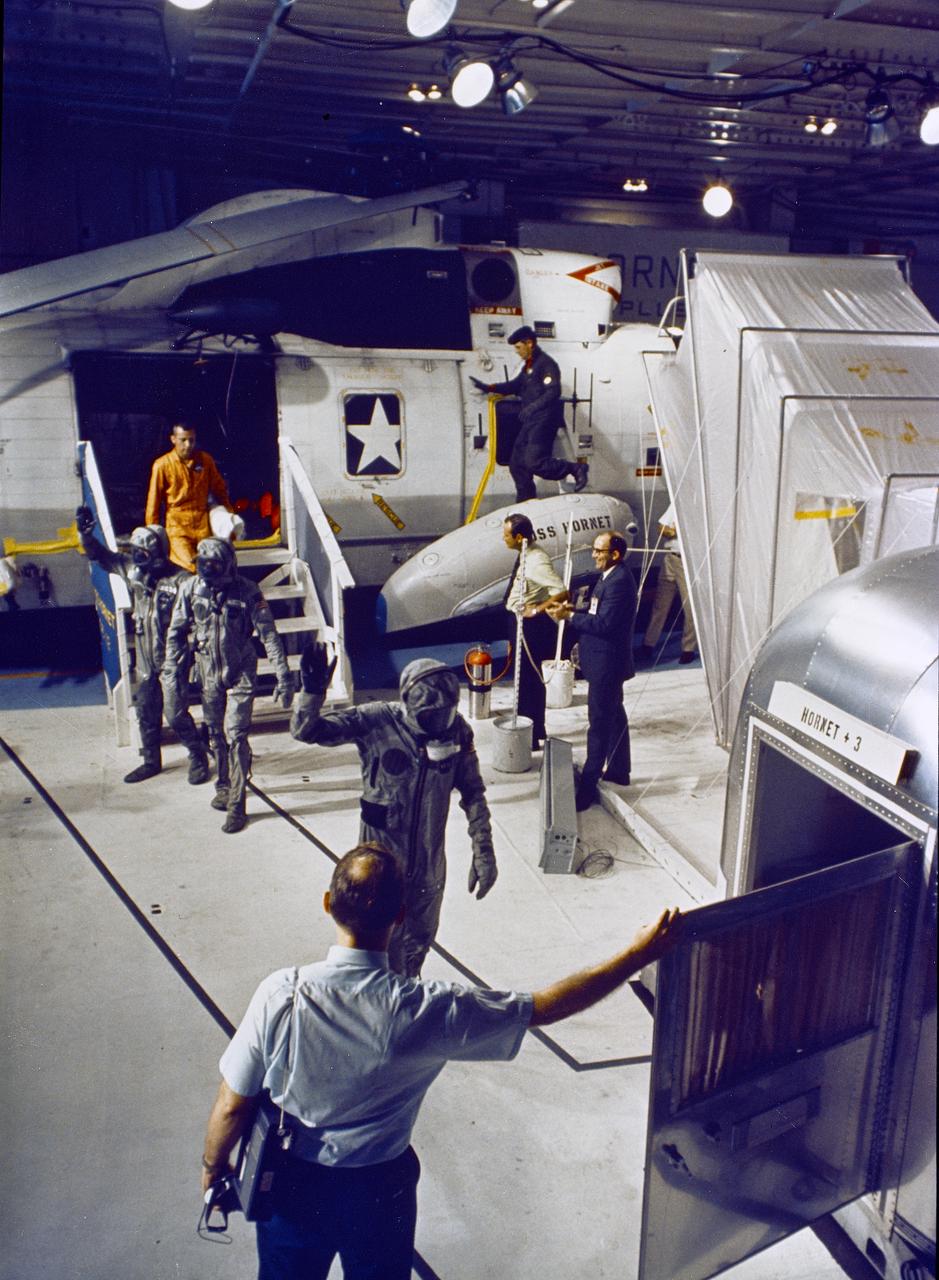
The Apollo 11 mission, the first manned lunar mission, launched from the Kennedy Space Center, Florida via a Saturn V launch vehicle on July 16, 1969 and safely returned to Earth on July 24, 1969. The Saturn V vehicle was developed by the Marshall Space Flight Center (MSFC) under the direction of Dr. Wernher von Braun. Aboard were Neil A. Armstrong, commander; Michael Collins, Command Module (CM) pilot; and Edwin E. Aldrin Jr., Lunar Module (LM) pilot. The CM, piloted by Michael Collins remained in a parking orbit around the Moon while the LM, named “Eagle’’, carrying astronauts Neil Armstrong and Edwin Aldrin, landed on the Moon. Armstrong was the first human to ever stand on the lunar surface, followed by Edwin (Buzz) Aldrin. During 2½ hours of surface exploration, the crew collected 47 pounds of lunar surface material for analysis back on Earth. The recovery operation took place after splash down in the Pacific Ocean. Navy para-rescue men recovered the capsule housing the 3-man Apollo 11 crew. The crew was taken to safety aboard the USS Hornet, where they were quartered in a mobile quarantine facility. Here the astronauts are shown waving as they enter the quarantine facility. With the success of Apollo 11, the national objective to land men on the Moon and return them safely to Earth had been accomplished.
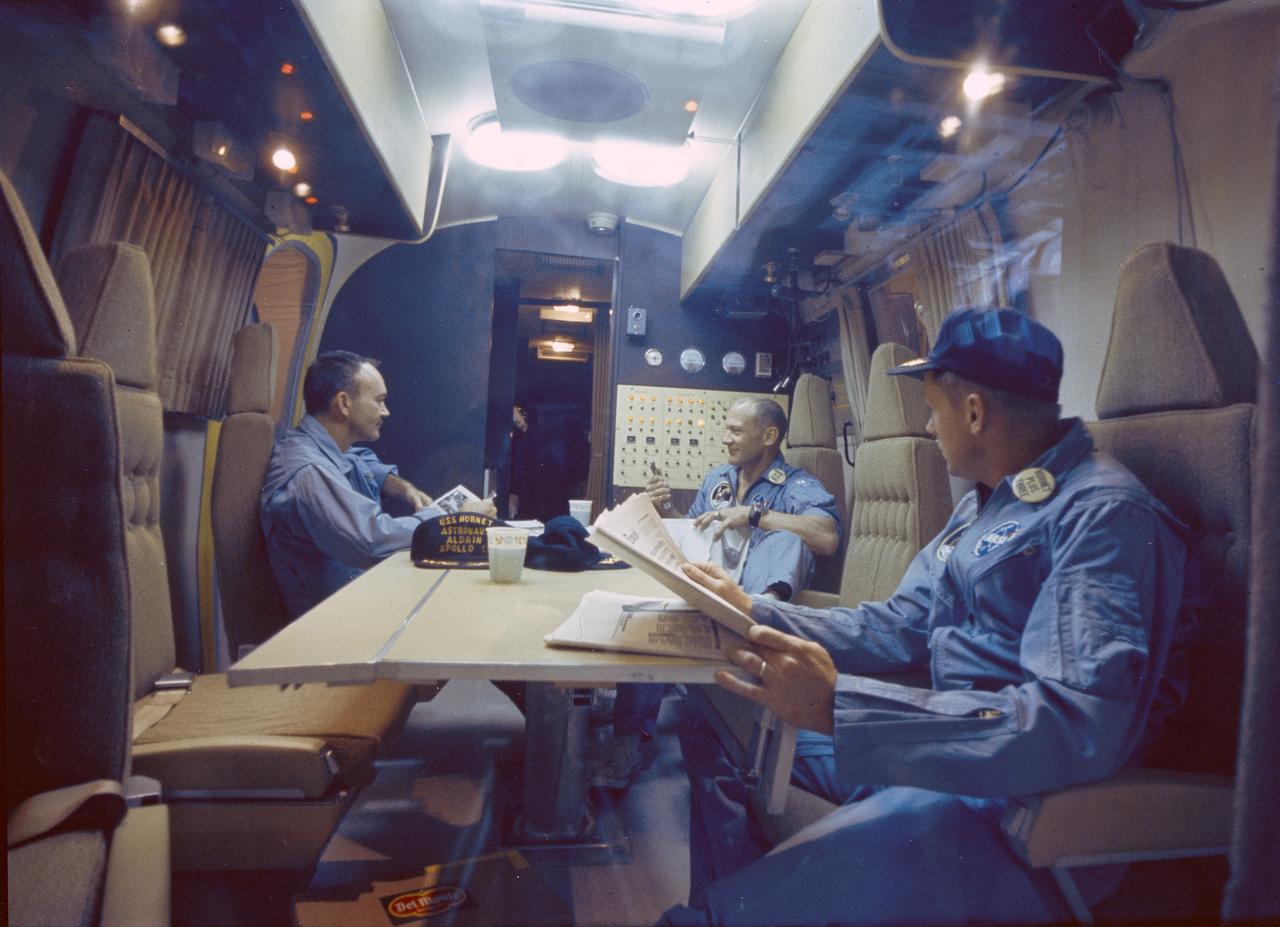
The Apollo 11 mission, the first manned lunar mission, launched from the Kennedy Space Center, Florida via a Saturn V launch vehicle on July 16, 1969 and safely returned to Earth on July 24, 1969. The Saturn V vehicle was developed by the Marshall Space Flight Center (MSFC) under the direction of Dr. Wernher von Braun. Aboard were Neil A. Armstrong, commander; Michael Collins, Command Module pilot; and Edwin E. Aldrin Jr., Lunar Module pilot. The Command Module (CM), piloted by Michael Collins remained in a parking orbit around the Moon while the Lunar Module (LM), named “Eagle’’, carrying astronauts Neil Armstrong and Edwin Aldrin, landed on the Moon. Armstrong was the first human to ever stand on the lunar surface, followed by Edwin (Buzz) Aldrin. The surface exploration was concluded in 2½ hours, in which the crew collected 47 pounds of lunar surface material for analysis back on Earth. Upon splash down in the Pacific Ocean, Navy para-rescue men recovered the capsule housing the 3-man Apollo 11 crew. The crew was taken to safety aboard the USS Hornet, where they were quartered in a mobile quarantine facility. Shown here is the Apollo 11 crew inside the quarantine facility. With the success of Apollo 11, the national objective to land men on the Moon and return them safely to Earth had been accomplished.
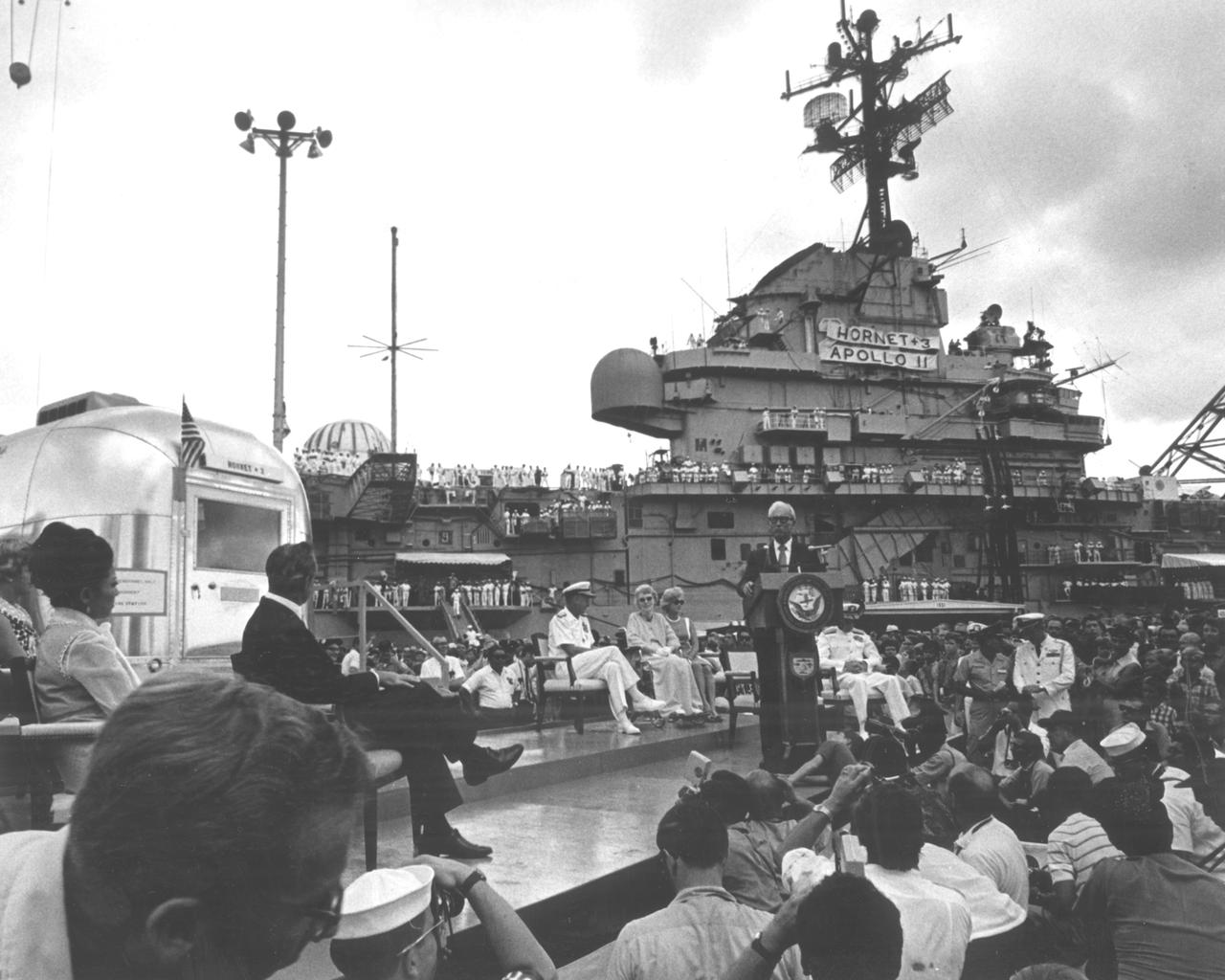
The Apollo 11 mission, the first manned lunar mission, launched from the Kennedy Space Center, Florida via the Marshall Space Flight Center (MSFC) developed Saturn V launch vehicle on July 16, 1969 and safely returned to Earth on July 24, 1969. Aboard the space craft were astronauts Neil A. Armstrong, commander; Michael Collins, Command Module (CM) pilot; and Edwin E. Aldrin Jr., Lunar Module (LM) pilot. The CM, piloted by Michael Collins remained in a parking orbit around the Moon while the LM, named “Eagle’’, carrying astronauts Neil Armstrong and Edwin Aldrin, landed on the Moon. During 2½ hours of surface exploration, the crew collected 47 pounds of lunar surface material for analysis back on Earth. The recovery operation took place in the Pacific Ocean where Navy para-rescue men recovered the capsule housing the 3-man Apollo 11 crew. The crew was airlifted to safety aboard the U.S.S. Hornet recovery ship, where they were quartered in a Mobile Quarantine Facility (MQF) for 21 days. The recovery vessel docked in Pearl Harbor Hawaii, where the occupied MQF was transferred for transport to the to NASA Manned Spacecraft Center (MSC) Lunar Receiving Laboratory in Houston, Texas. In this photo the quarantined astronauts are addressed by Hawaiian Governor John Burns upon their arrival at Pearl Harbor.
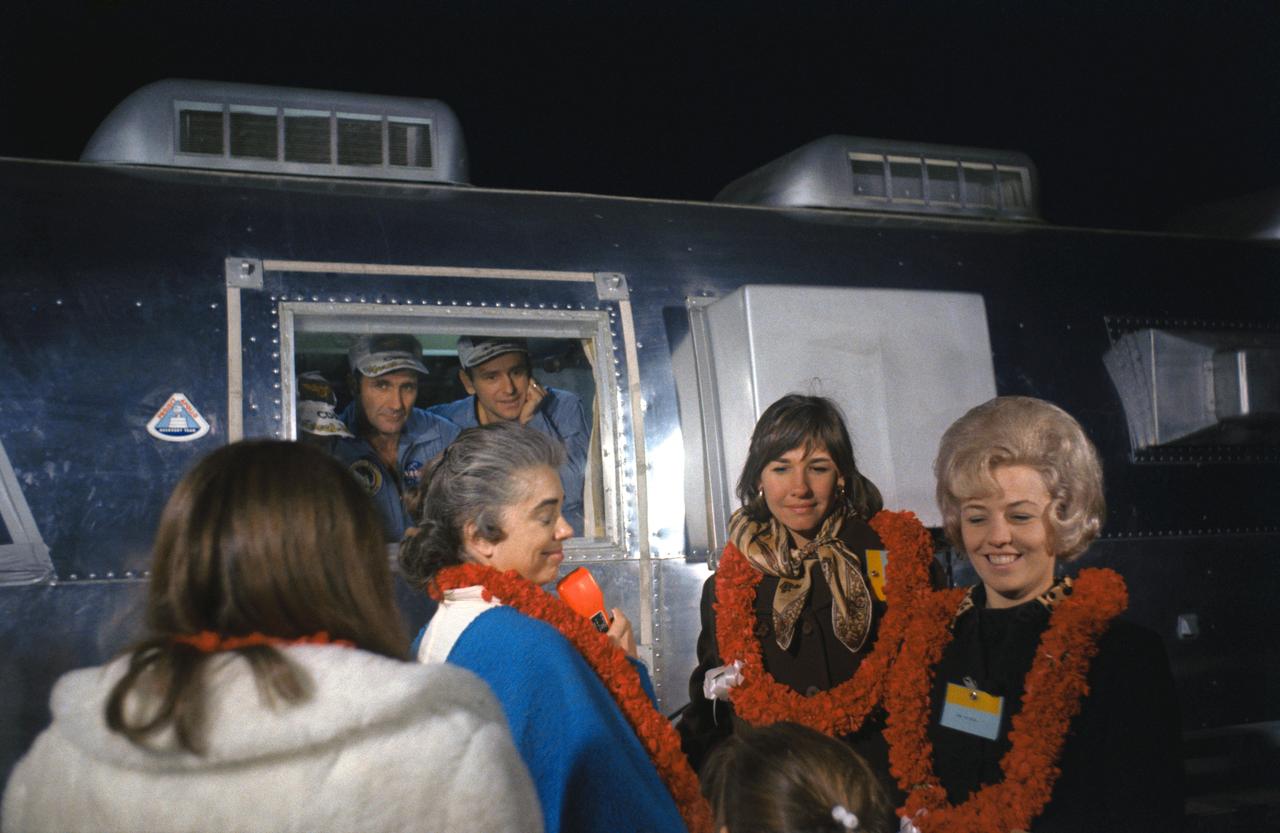
S69-60759 (29 Nov. 1969) --- Members of the Apollo 12 lunar landing mission's crew are greeted by their wives and children at the front of a large crowd on hand to welcome the three home. The Mobile Quarantine Facility (MQF), with the crew inside, arrived at Ellington Air Force Base aboard a United States Air Force C-141 transport jet in the early morning hours of Nov. 29, 1969. The crew men, looking out the MQF window at the crowd, are from left to right, astronauts Charles Conrad Jr., Richard F. Gordon Jr. and Alan L. Bean. Their wives are, from left to right, Mrs. Barbara Gordon, Mrs. Jane Conrad and Mrs. Sue Bean. The women are wearing lei's, an Hawaiian tradition. The crew members were taken to Hawaii from their Pacific Ocean recovery site aboard the USS Hornet, prime recovery vessel for the mission.

S69-60760 (29 Nov. 1969) --- Members of the Apollo 12 lunar landing mission's crew talk to their families from inside the Mobile Quarantine Facility (MQF) soon after their arrival at Ellington Air Force Base aboard a United States Air Force C-141 transport jet in the early morning hours of Nov. 29, 1969. The crew men, looking out the MQF window at the crowd, are from left to right, astronauts Charles Conrad Jr., Richard F. Gordon Jr., and Alan L. Bean. Some of the family members can be seen in lower right foreground. The crew members were taken to Hawaii from their Pacific Ocean recovery site aboard the USS Hornet, prime recovery vessel for the mission.

S69-40753 (24 July 1969) --- The Apollo 11 crewmen, wearing biological isolation garments, arrive aboard the USS Hornet during recovery operations in the central Pacific. They are walking toward the Mobile Quarantine Facility (MQF), in which they will be confined until they arrive at the Manned Spacecraft Center's (MSC), Lunar Receiving Laboratory (LRL). Apollo 11, with astronauts Neil A. Armstrong, commander; Michael Collins, command module pilot; and Edwin E. Aldrin Jr., lunar module pilot, onboard, splashed down at 11:49 a.m. (CDT), July 24, 1969, about 812 nautical miles southwest of Hawaii and only 12 nautical miles from the USS Hornet to conclude their historic lunar landing mission.
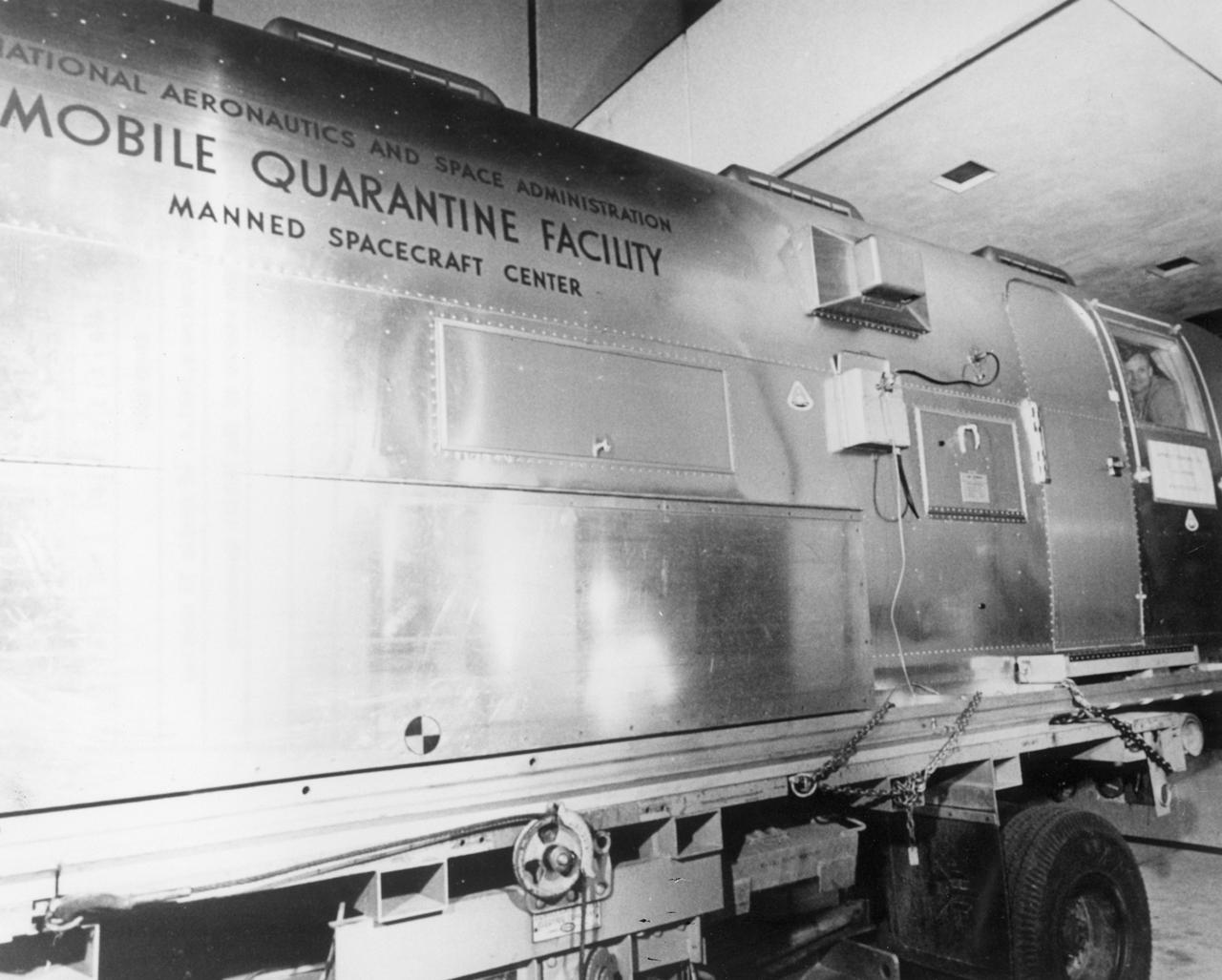
The Apollo 11 mission, the first manned lunar mission, launched from the Kennedy Space Center, Florida via the Marshall Space Flight Center (MSFC) developed Saturn V launch vehicle on July 16, 1969 and safely returned to Earth on July 24, 1969. Aboard the space craft were astronauts Neil A. Armstrong, commander; Michael Collins, Command Module (CM) pilot; and Edwin E. Aldrin Jr., Lunar Module (LM) pilot. The CM, piloted by Michael Collins remained in a parking orbit around the Moon while the LM, named “Eagle’’, carrying astronauts Neil Armstrong and Edwin Aldrin, landed on the Moon. During 2½ hours of surface exploration, the crew collected 47 pounds of lunar surface material for analysis back on Earth. The recovery operation took place in the Pacific Ocean where Navy para-rescue men recovered the capsule housing the 3-man Apollo 11 crew. The crew was airlifted to safety aboard the U.S.S. Hornet, where they were quartered in a Mobile Quarantine Facility (MQF) which served as their home until they reached the NASA Manned Spacecraft Center (MSC) Lunar Receiving Laboratory in Houston, Texas. In this close up of the MQF, commander Armstrong can be seen through the facility window after its arrival at the MSC.
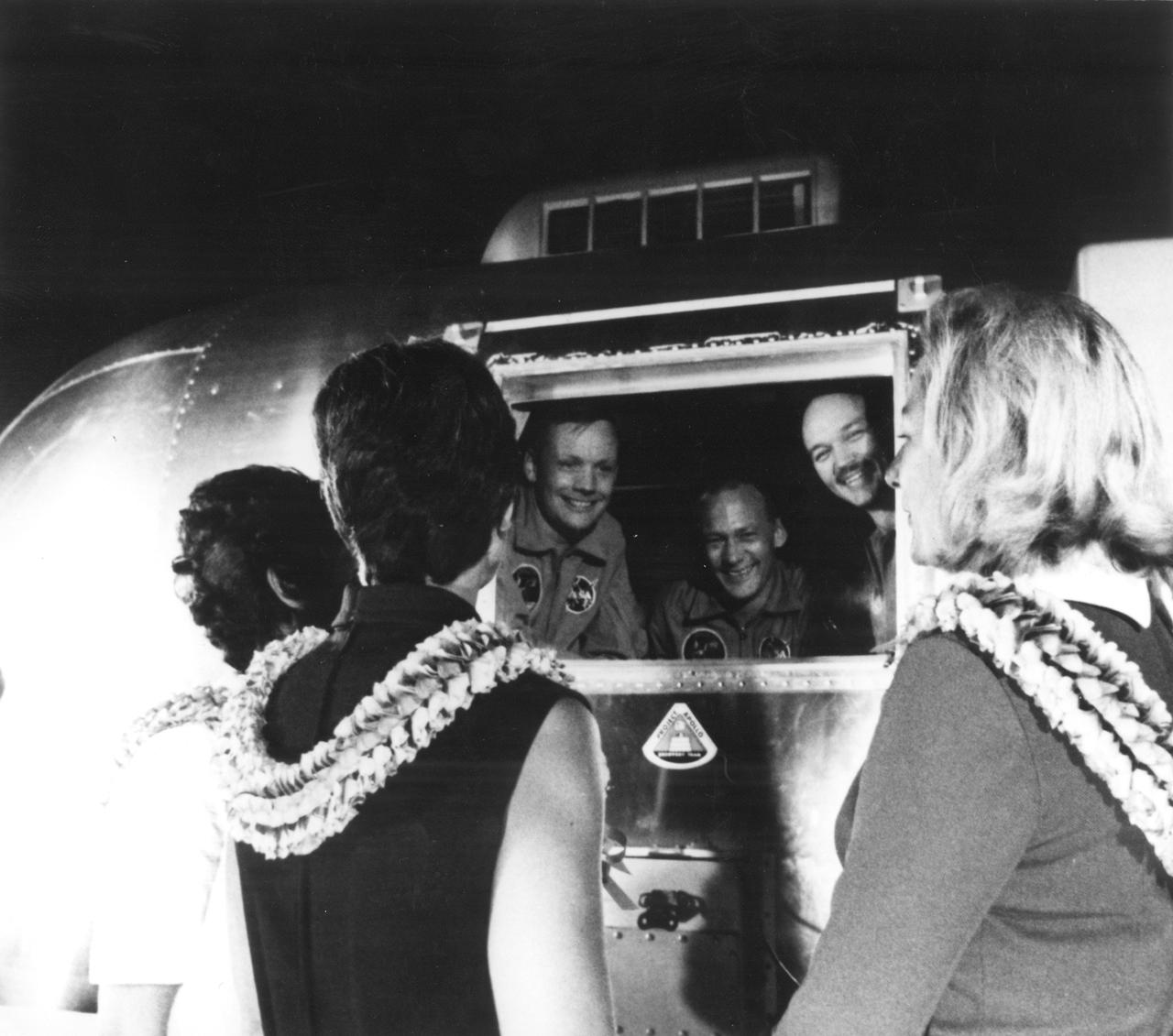
The Apollo 11 mission, the first manned lunar mission, launched from the Kennedy Space Center, Florida via the Marshall Space Flight Center (MSFC) developed Saturn V launch vehicle on July 16, 1969 and safely returned to Earth on July 24, 1969. Aboard the space craft were astronauts Neil A. Armstrong, commander; Michael Collins, Command Module (CM) pilot; and Edwin E. Aldrin Jr., Lunar Module (LM) pilot. The CM, piloted by Michael Collins remained in a parking orbit around the Moon while the LM, named “Eagle’’, carrying astronauts Neil Armstrong and Edwin Aldrin, landed on the Moon. During 2½ hours of surface exploration, the crew collected 47 pounds of lunar surface material for analysis back on Earth. The recovery operation took place in the Pacific Ocean where Navy para-rescue men recovered the capsule housing the 3-man Apollo 11 crew. The crew was airlifted to safety aboard the U.S.S. Hornet, where they were quartered in a Mobile Quarantine Facility (MQF) which served as their home until they reached the NASA Manned Spacecraft Center (MSC) Lunar Receiving Laboratory in Houston, Texas. On arrival at Ellington Air Force base near the MSC, the crew, still under a 21 day quarantine in the MQF are greeted by their wives. Looking out of the facility are (L-R) Armstrong, Aldrin, and Collins. Wives are (L-R) Pat Collins, Jan Armstrong, and Joan Aldrin.
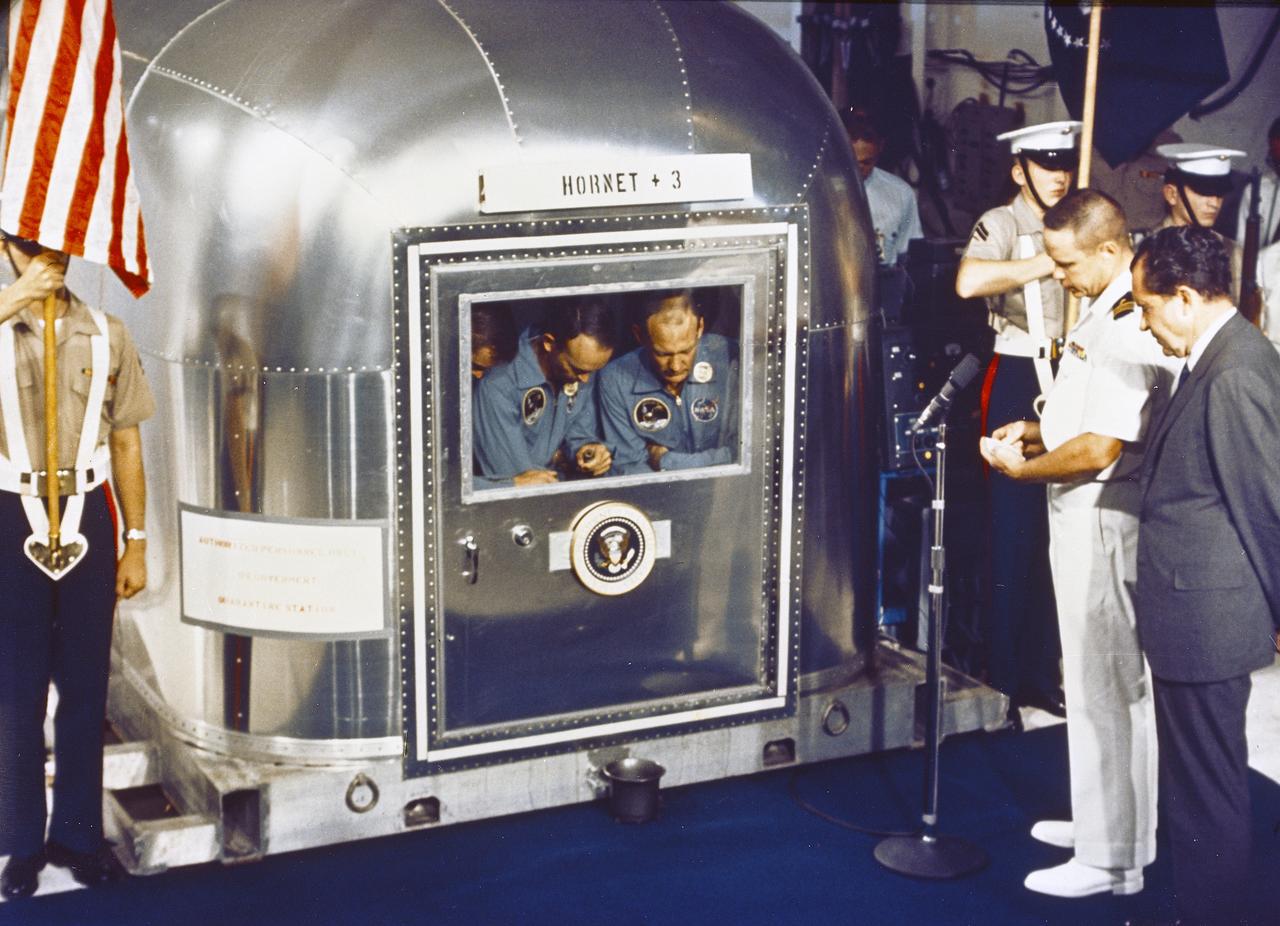
The Apollo 11 mission, the first manned lunar mission, launched from the Kennedy Space Center, Florida via a Saturn V launch vehicle on July 16, 1969 and safely returned to Earth on July 24, 1969. The Saturn V vehicle was developed by the Marshall Space Flight Center (MSFC) under the direction of Dr. Wernher von Braun. Aboard were Neil A. Armstrong, commander; Michael Collins, Command Module (CM) pilot; and Edwin E. Aldrin Jr., Lunar Module (LM) pilot. The CM, piloted by Michael Collins remained in a parking orbit around the Moon while the LM, named “Eagle’’, carrying astronauts Neil Armstrong and Edwin Aldrin, landed on the Moon. Armstrong was the first human to ever stand on the lunar surface, followed by Edwin (Buzz) Aldrin. During 2½ hours of surface exploration, the crew collected 47 pounds of lunar surface material for analysis back on Earth. The recovery operation took place in the Pacific Ocean where Navy para-rescue men recovered the capsule housing the 3-man Apollo 11 crew. The crew was taken to safety aboard the USS Hornet, where they were quartered in a mobile quarantine facility. Shown here is the Apollo 11 crew inside the quarantine facility as prayer is offered by Lt. Commander John Pirrto, USS Hornet Chaplain accompanied by U.S. President Richard Nixon (front right). With the success of Apollo 11, the national objective to land men on the Moon and return them safely to Earth had been accomplished.
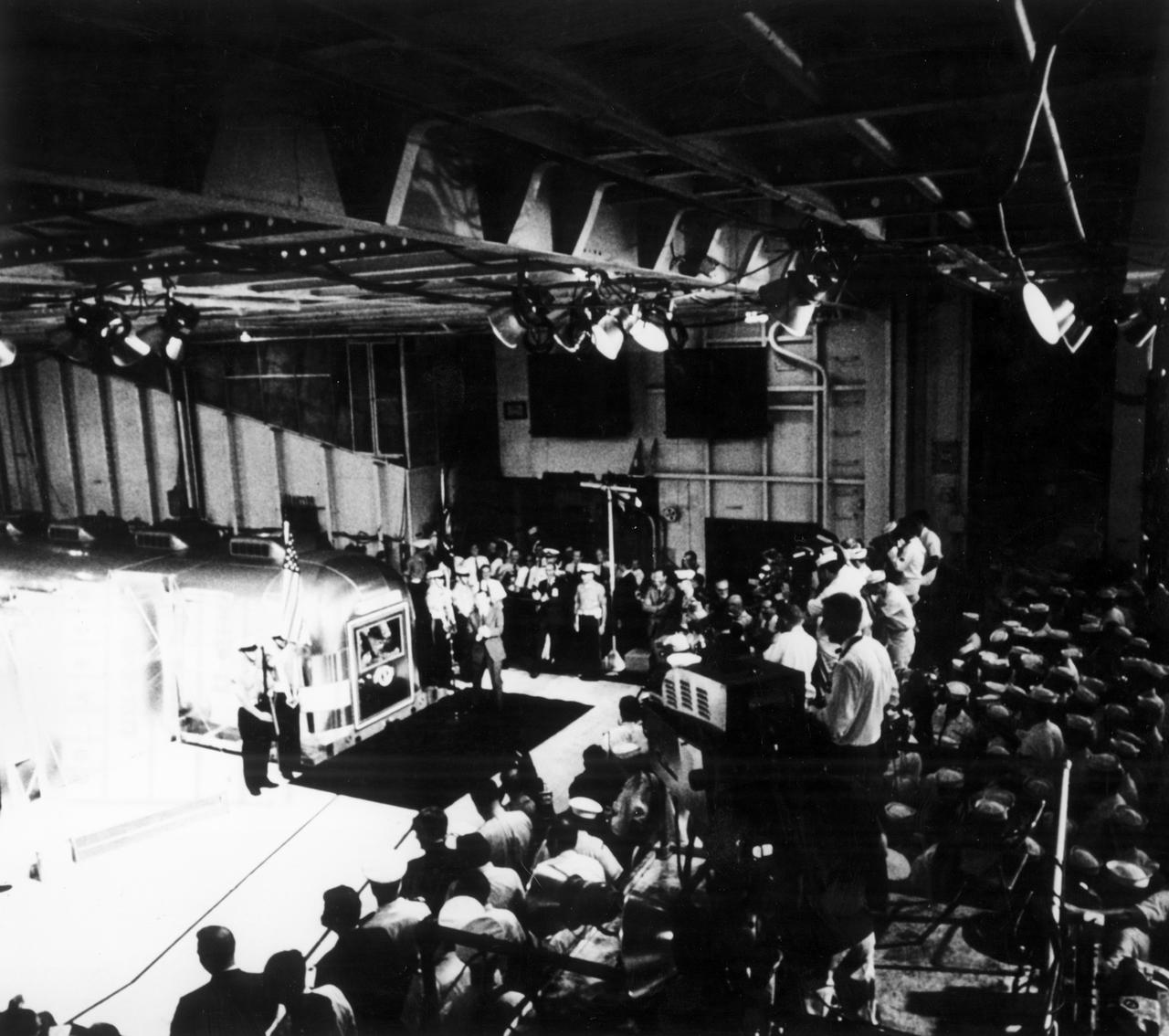
The Apollo 11 mission, the first manned lunar mission, launched from the Kennedy Space Center, Florida via the Marshall Space Flight Center (MSFC) developed Saturn V launch vehicle on July 16, 1969 and safely returned to Earth on July 24, 1969. Aboard the space craft were astronauts Neil A. Armstrong, commander; Michael Collins, Command Module (CM) pilot; and Edwin E. Aldrin Jr., Lunar Module (LM) pilot. The CM, piloted by Michael Collins remained in a parking orbit around the Moon while the LM, named “Eagle’’, carrying astronauts Neil Armstrong and Edwin Aldrin, landed on the Moon. During 2½ hours of surface exploration, the crew collected 47 pounds of lunar surface material for analysis back on Earth. The recovery operation took place in the Pacific Ocean where Navy para-rescue men recovered the capsule housing the 3-man Apollo 11 crew. The crew was airlifted to safety aboard the U.S.S. Hornet recovery ship, where they were quartered in a Mobile Quarantine Facility (MQF). In this photograph, the U.S.S. Hornet crew looks on as the quarantined Apollo 11 crew is addressed by U.S. President Richard Milhous Nixon via microphone and intercom. The president was aboard the recovery vessel awaiting return of the astronauts. With the success of Apollo 11, the national objective to land men on the Moon and return them safely to Earth had been accomplished.
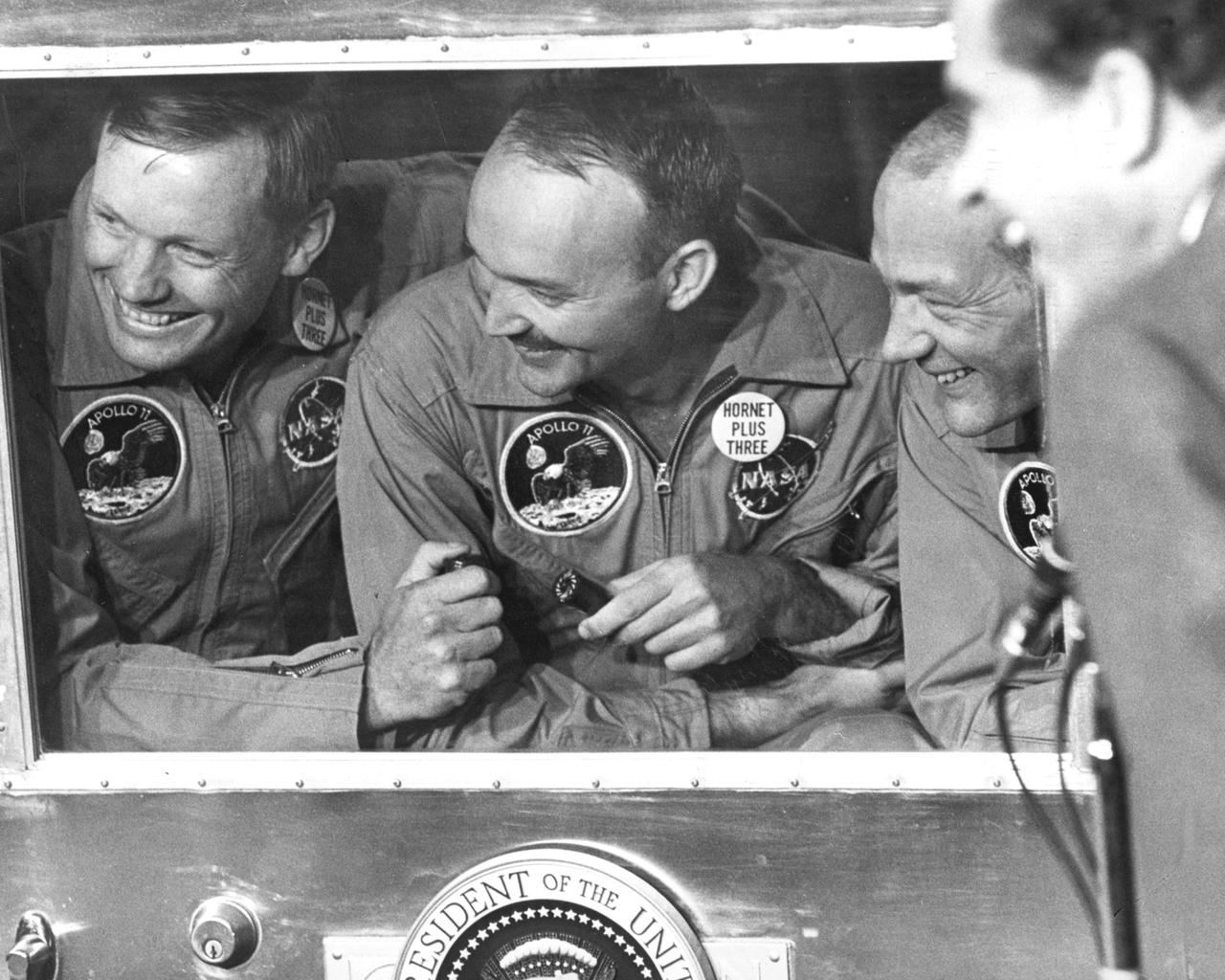
The Apollo 11 mission, the first manned lunar mission, launched from the Kennedy Space Center, Florida via the Saturn V launch vehicle on July 16, 1969 and safely returned to Earth on July 24, 1969. The Saturn V vehicle was developed by the Marshall Space Flight Center (MSFC) under the direction of Dr. Wernher von Braun. Aboard were Neil A. Armstrong, commander; Michael Collins, Command Module (CM) pilot; and Edwin E. Aldrin Jr., Lunar Module (LM) pilot. The CM, piloted by Michael Collins remained in a parking orbit around the Moon while the LM, named “Eagle’’, carrying astronauts Neil Armstrong and Edwin Aldrin, landed on the Moon. Armstrong was the first human to ever stand on the lunar surface, followed by Edwin (Buzz) Aldrin. During 2½ hours of surface exploration, the crew collected 47 pounds of lunar surface material for analysis back on Earth. The recovery operation took place in the Pacific Ocean where Navy para-rescue men recovered the capsule housing the 3-man Apollo 11 crew. The crew was airlifted to safety aboard the U.S.S. Hornet, where they were quartered in a Mobile Quarantine Facility (MQF). Here the quarantined Apollo 11 crew members (l to r) Armstrong, Collins, and Aldrin, and U.S. President Richard Milhous Nixon share laughs over a comment made by fellow astronaut Frank Borman, Apollo 8 commander. The president was aboard the recovery vessel awaiting return of the astronauts. With the success of Apollo 11, the national objective to land men on the Moon and return them safely to Earth had been accomplished.
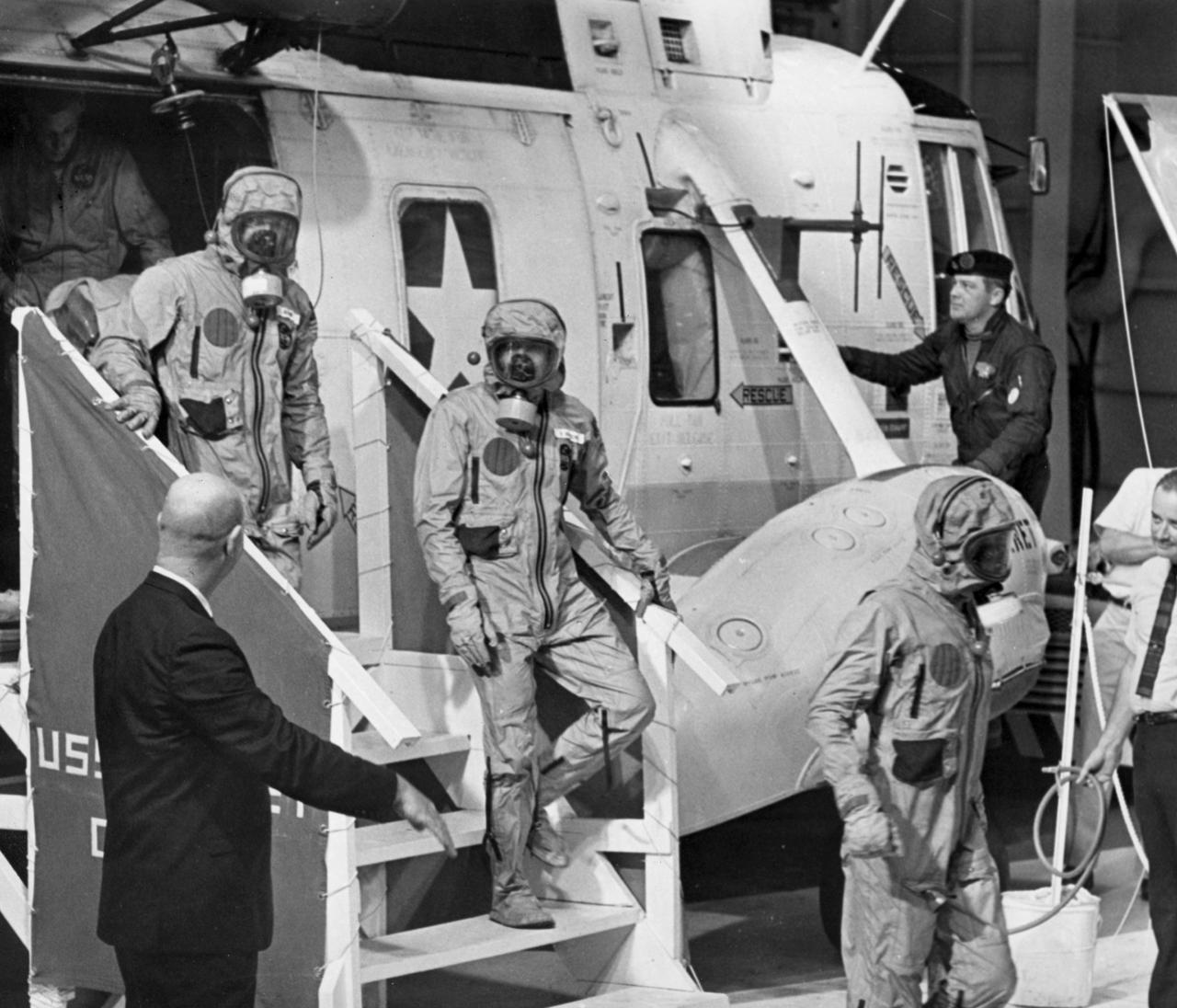
The Apollo 11 mission, the first manned lunar mission, launched from the Kennedy Space Center, Florida via the Marshall Space Flight Center (MSFC) developed Saturn V launch vehicle on July 16, 1969 and safely returned to Earth on July 24, 1969. Aboard the space craft were astronauts Neil A. Armstrong, commander; Michael Collins, Command Module (CM) pilot; and Edwin E. Aldrin Jr., Lunar Module (LM) pilot. The CM, piloted by Michael Collins remained in a parking orbit around the Moon while the LM, named “Eagle’’, carrying astronauts Neil Armstrong and Edwin Aldrin, landed on the Moon. During 2½ hours of surface exploration, the crew collected 47 pounds of lunar surface material for analysis back on Earth. Shown here are the three astronauts (L-R) Aldrin, Armstrong, and Collins leaving the recovery helicopter aboard the U.S.S. Hornet after their splashdown in the Pacific Ocean. Wearing biological isolation garments donned before leaving the spacecraft, the three went directly into the Mobile Quarantine Facility (MQF) on the aircraft carrier. The MQF served as their home for 21 days following the mission. With the success of Apollo 11, the national objective to land men on the Moon and return them safely to Earth had been accomplished.
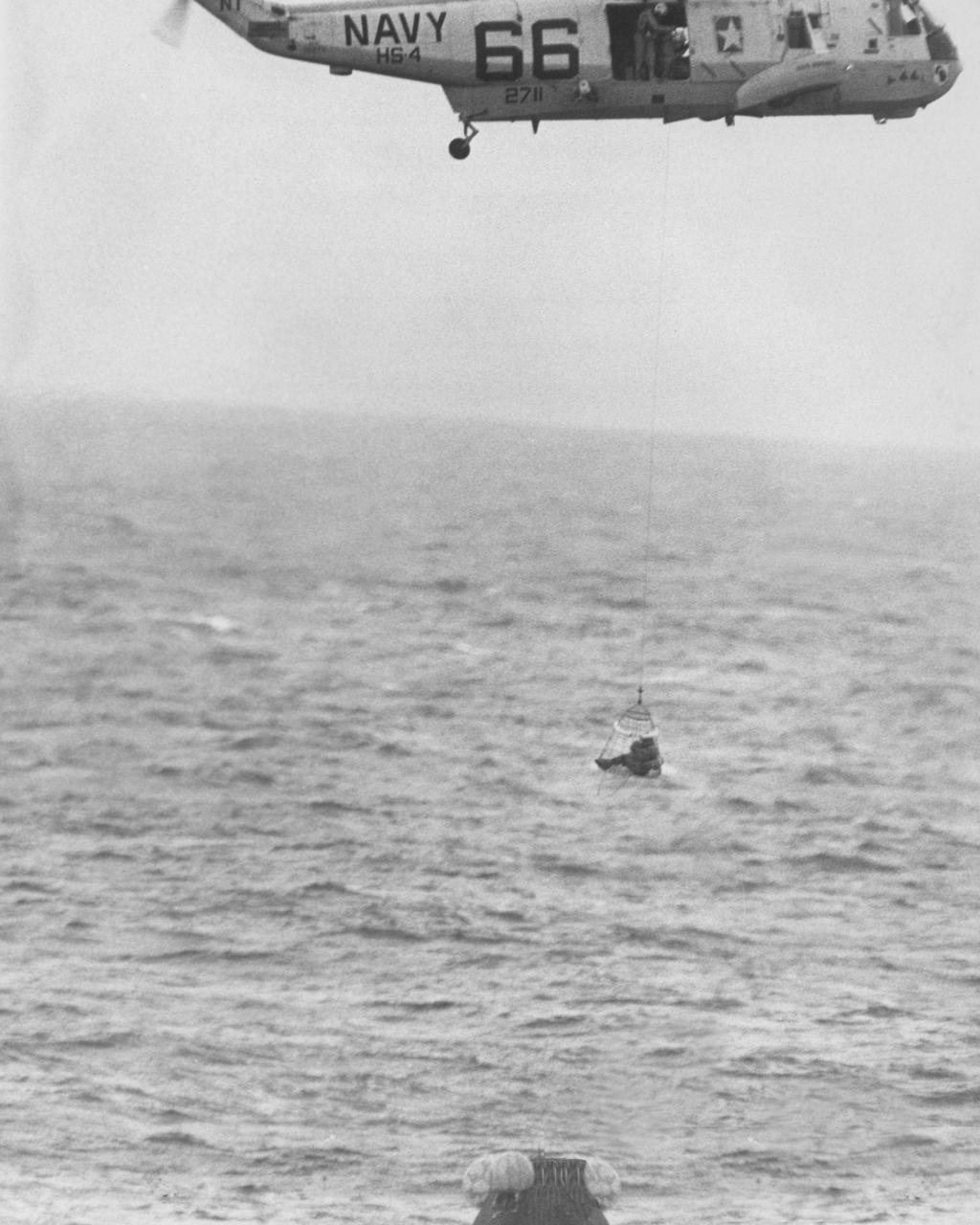
The Apollo 11 mission, the first manned lunar mission, launched from the Kennedy Space Center, Florida via the Saturn V launch vehicle on July 16, 1969 and safely returned to Earth on July 24, 1969. The Saturn V vehicle was developed by the Marshall Space Flight Center (MSFC) under the direction of Dr. Wernher von Braun. Aboard were Neil A. Armstrong, commander; Michael Collins, Command Module (CM) pilot; and Edwin E. Aldrin Jr., Lunar Module (LM) pilot. The CM, piloted by Michael Collins remained in a parking orbit around the Moon while the LM, named “Eagle’’, carrying astronauts Neil Armstrong and Edwin Aldrin, landed on the Moon. Armstrong was the first human to ever stand on the lunar surface, followed by Edwin (Buzz) Aldrin. During 2½ hours of surface exploration, the crew collected 47 pounds of lunar surface material for analysis back on Earth. Shown here is the recovery operation of the capsule in the Pacific Ocean after splashdown. One of the three astronauts is airlifted from the life raft into a helicopter. The helicopter airlifted the crew to safety aboard the prime recovery ship, the U.S.S. Hornet, where they were quartered in a Mobile Quarantine Facility (MQF). With the success of Apollo 11, the national objective to land men on the Moon and return them safely to Earth had been accomplished.
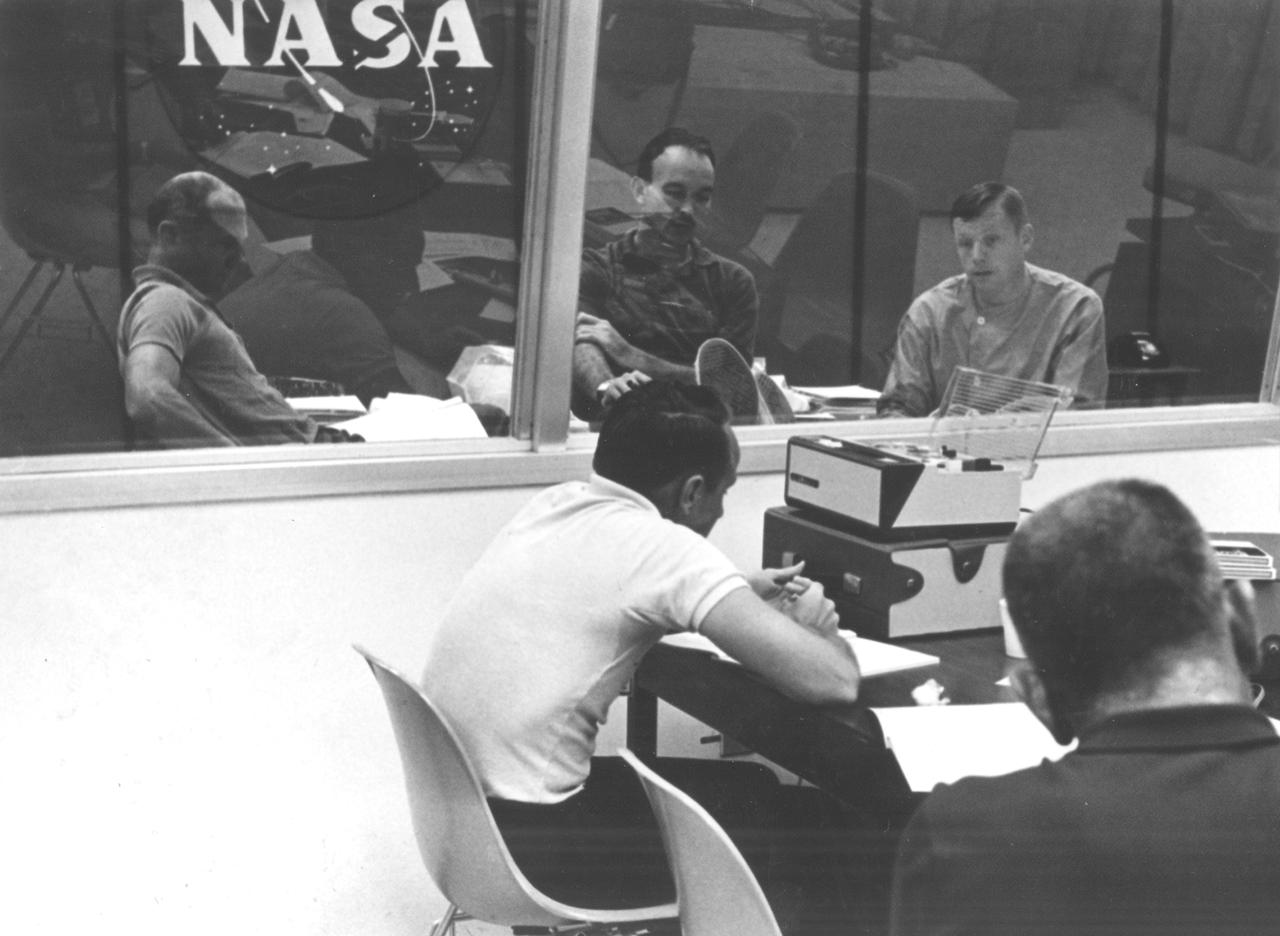
The Apollo 11 mission, the first manned lunar mission, launched from the Kennedy Space Center, Florida via the Marshall Space Flight Center (MSFC) developed Saturn V launch vehicle on July 16, 1969 and safely returned to Earth on July 24, 1969. Aboard the space craft were astronauts Neil A. Armstrong, commander; Michael Collins, Command Module (CM) pilot; and Edwin E. Aldrin Jr., Lunar Module (LM) pilot. The CM, piloted by Michael Collins remained in a parking orbit around the Moon while the LM, named “Eagle’’, carrying astronauts Neil Armstrong and Edwin Aldrin, landed on the Moon. During 2½ hours of surface exploration, the crew collected 47 pounds of lunar surface material for analysis back on Earth. The recovery operation took place in the Pacific Ocean where Navy para-rescue men recovered the capsule housing the 3-man Apollo 11 crew. The crew was airlifted to safety aboard the U.S.S. Hornet, where they were quartered in a Mobile Quarantine Facility (MQF) which served as their home until they reached the NASA Manned Spacecraft Center (MSC) Lunar Receiving Laboratory in Houston, Texas. The three are seen here at the MSC, still inside the MQF, undergoing their first debriefing on Sunday, August 3, 1969. Behind the glass are (L-R): Edwin Aldrin, Michael Collins, and Neil Armstrong.
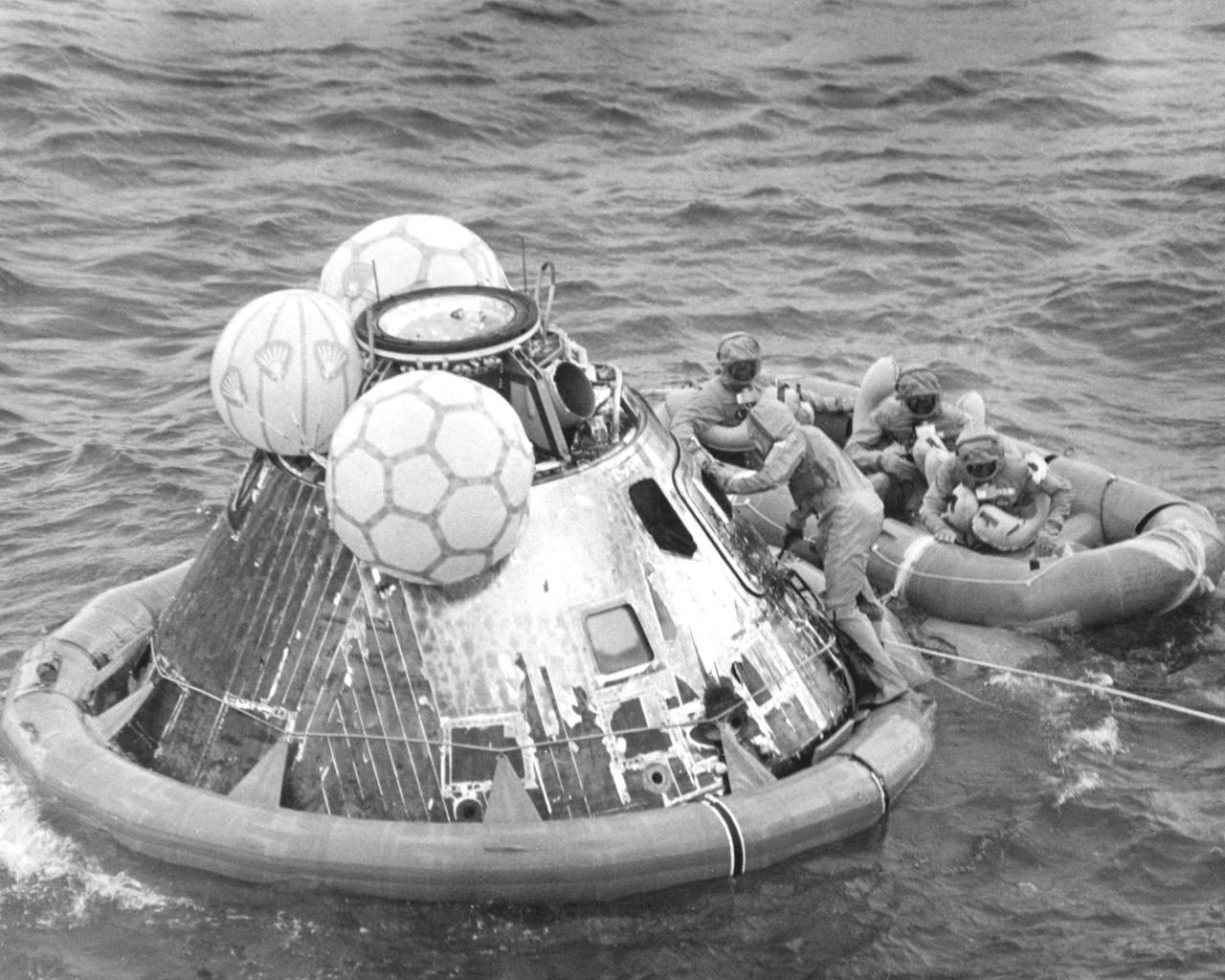
The Apollo 11 mission, the first manned lunar mission, launched from the Kennedy Space Center, Florida via the Saturn V launch vehicle on July 16, 1969 and safely returned to Earth on July 24, 1969. The Saturn V vehicle was developed by the Marshall Space Flight Center (MSFC) under the direction of Dr. Wernher von Braun. Aboard were astronauts Neil A. Armstrong, commander; Michael Collins, Command Module (CM) pilot; and Edwin E. Aldrin Jr., Lunar Module (LM) pilot. The CM, piloted by Michael Collins remained in a parking orbit around the Moon while the LM, named “Eagle’’, carrying astronauts Neil Armstrong and Edwin Aldrin, landed on the Moon. Armstrong was the first human to ever stand on the lunar surface, followed by Edwin (Buzz) Aldrin. During 2½ hours of surface exploration, the crew collected 47 pounds of lunar surface material for analysis back on Earth. Shown here is the recovery operation of the capsule in the Pacific Ocean after splashdown. The three astronauts wait in the life raft as a pararescue man closes and secures the capsule hatch. The crew was then air lifted to the prime recovery ship, the U.S.S. Hornet, where they were housed in a Mobile Quarantine Facility (MQF).
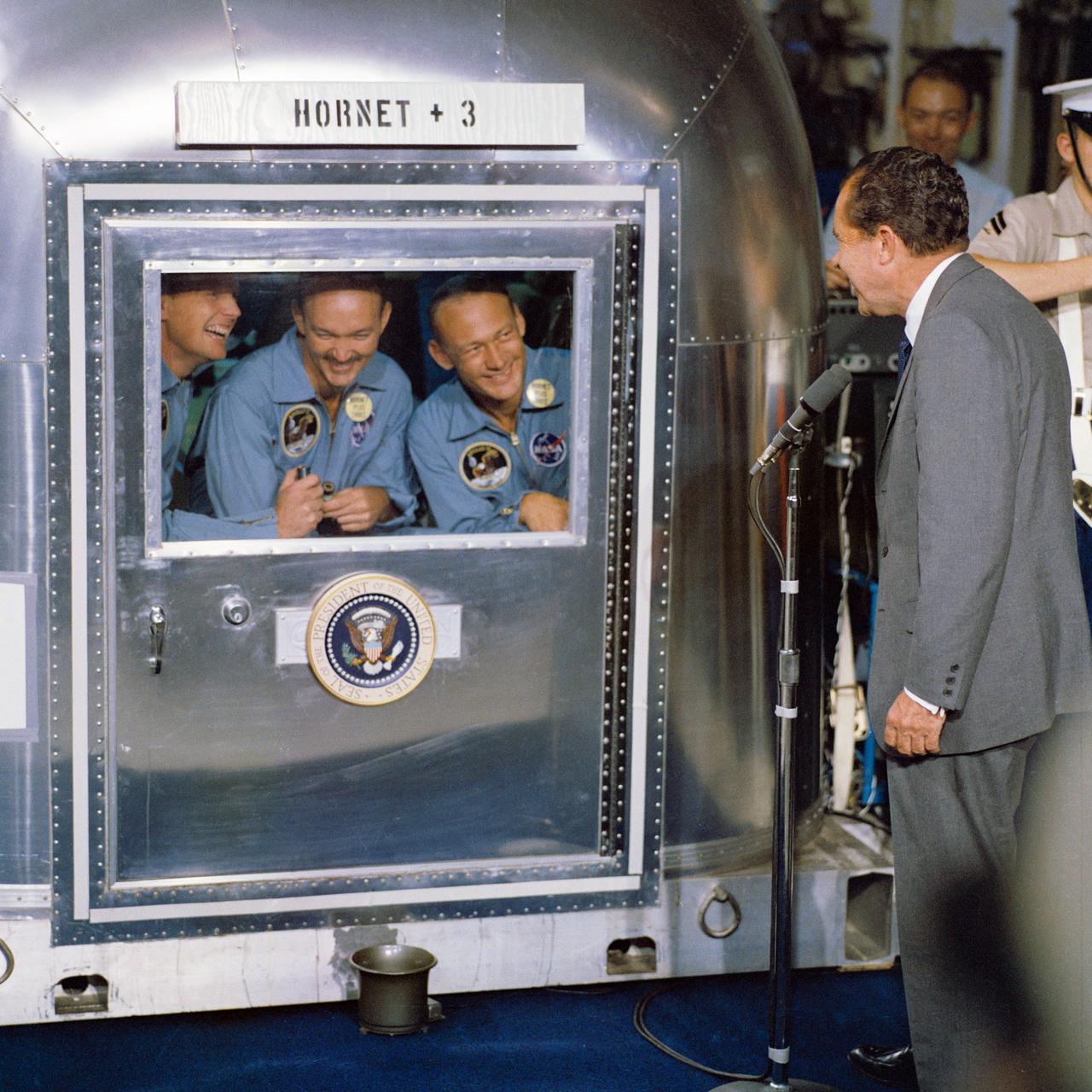
S69-21365 (24 July 1969) --- United States President Richard M. Nixon was in the central Pacific recovery area to welcome the Apollo 11 astronauts aboard the USS Hornet, prime recovery ship for the historic Apollo 11 lunar landing mission. Already confined to the Mobile Quarantine Facility (MQF) are (left to right) Neil A. Armstrong, commander; Michael Collins, command module pilot; and Edwin E. Aldrin Jr., lunar module pilot. Apollo 11 splashed down at 11:49 a.m. (CDT), July 24, 1969, about 812 nautical miles southwest of Hawaii and only 12 nautical miles from the USS Hornet. The three crewmen will remain in the MQF until they arrive at the Manned Spacecraft Center's (MSC) Lunar Receiving Laboratory (LRL). While astronauts Armstrong and Aldrin descended in the Lunar Module (LM) "Eagle" to explore the Sea of Tranquility region of the moon, astronaut Collins remained with the Command and Service Modules (CSM) "Columbia" in lunar orbit. Photo credit: NASA
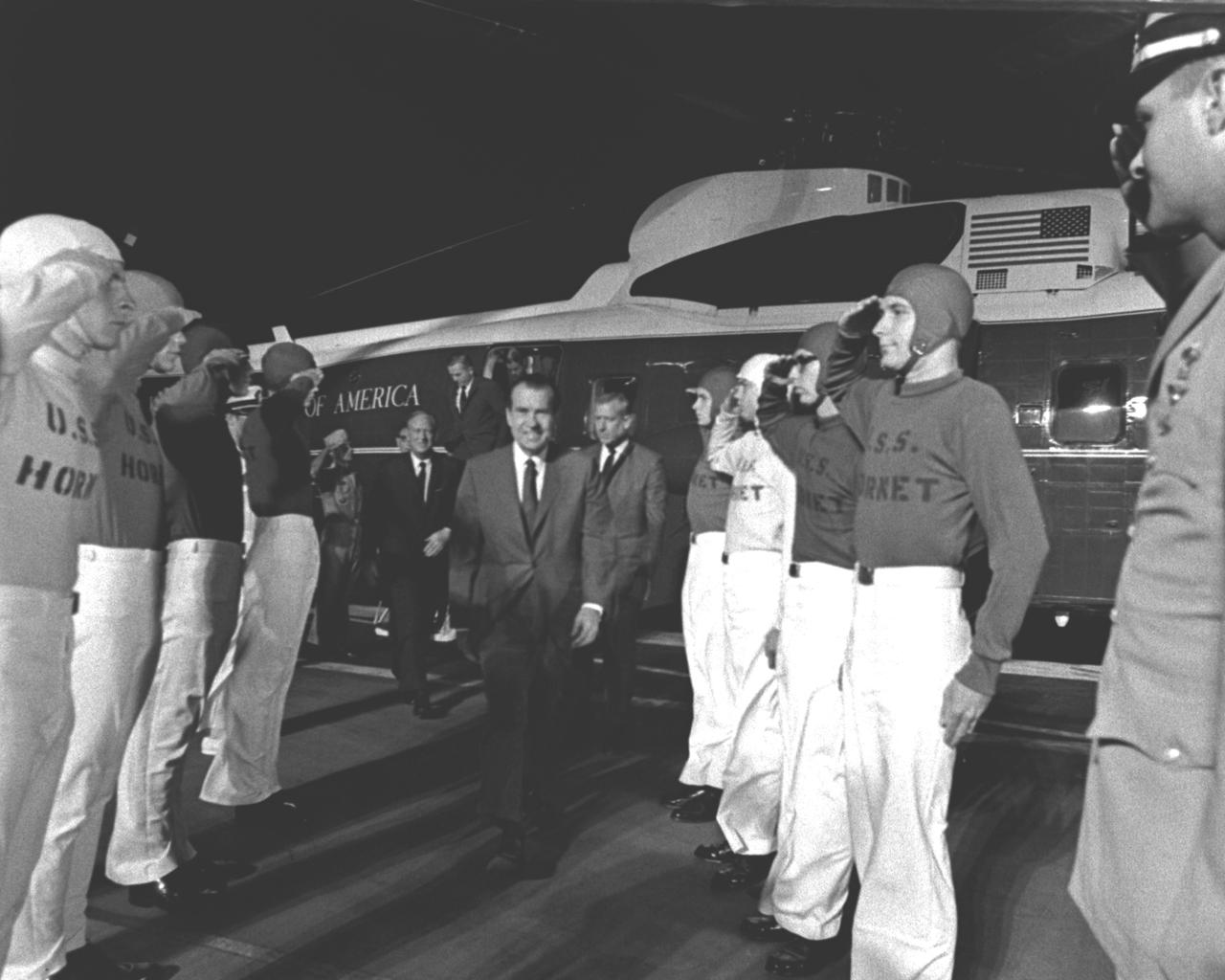
U.S. President Richard Milhous Nixon (center), is saluted by the honor guard of flight deck crewmen when he arrives aboard the U.S.S. Hornet, prime recovery ship for the Apollo 11 mission, to watch recovery operations and welcome the astronauts home. The recovery operation took place in the Pacific Ocean where Navy para-rescue men recovered the capsule housing the 3-man Apollo 11 crew. The crew was airlifted to safety aboard the U.S.S. Hornet, where they were quartered in a Mobile Quarantine Facility (MQF) for 21 days following the mission. The Apollo 11 mission, the first manned lunar mission, launched from the Kennedy Space Center, Florida via the Saturn V launch vehicle on July 16, 1969 and safely returned to Earth on July 24, 1969. Aboard were Neil A. Armstrong, commander; Michael Collins, Command Module (CM) pilot; and Edwin E. Aldrin Jr., Lunar Module (LM) pilot. The CM, piloted by Michael Collins remained in a parking orbit around the Moon while the LM, named “Eagle’’, carrying astronauts Neil Armstrong and Edwin Aldrin, landed on the Moon. Armstrong was the first human to ever stand on the lunar surface, followed by Edwin (Buzz) Aldrin. During 2½ hours of surface exploration, the crew collected 47 pounds of lunar surface material for analysis back on Earth. With the success of Apollo 11, the national objective to land men on the Moon and return them safely to Earth had been accomplished. The Saturn V vehicle was developed by the Marshall Space Flight Center (MSFC) under the direction of Dr. Wernher von Braun.
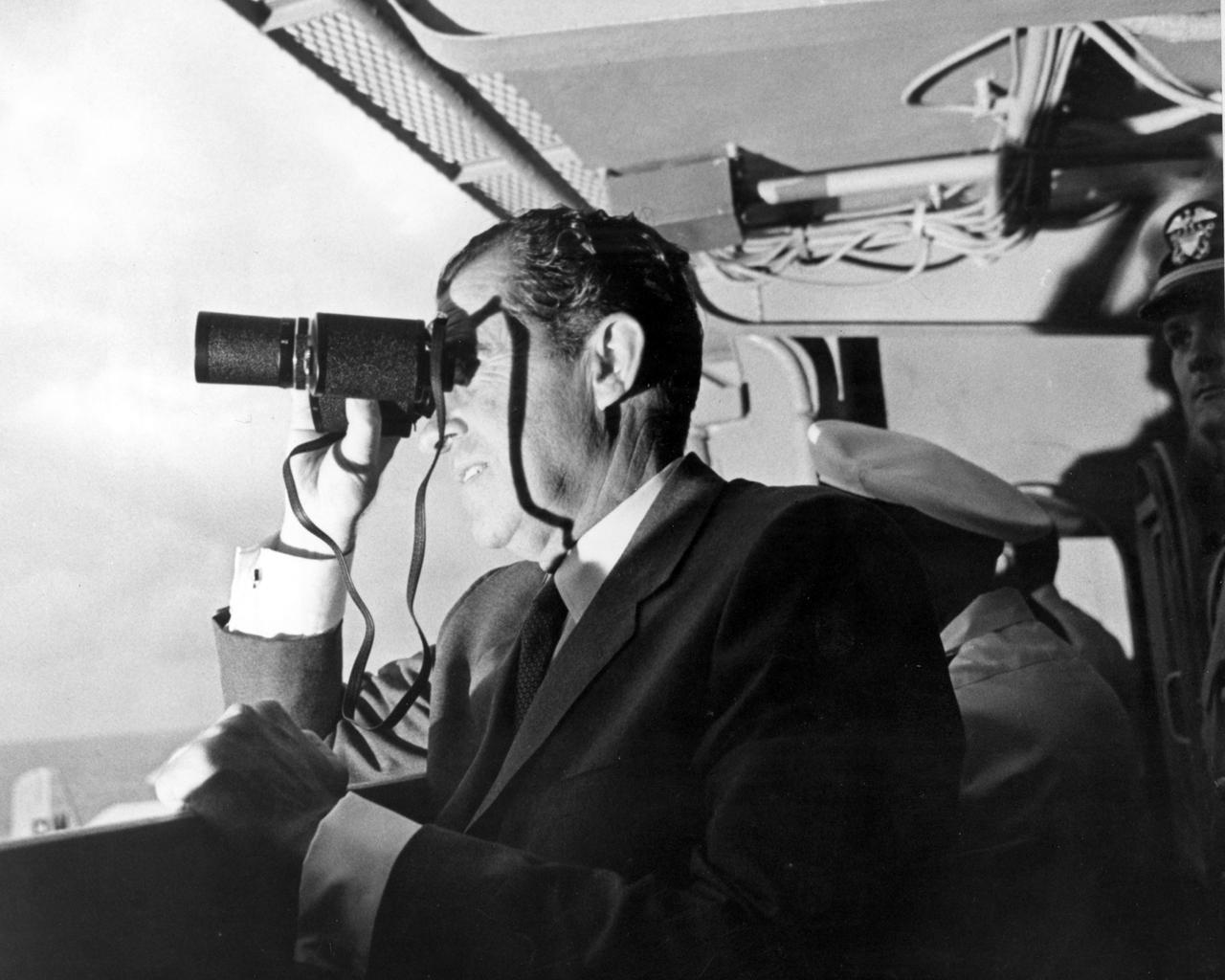
U.S. President Richard Milhous Nixon, aboard the U.S.S. Hornet aircraft carrier, used binoculars to watch the Apollo 11 Lunar Mission recovery. The recovery operation took place in the Pacific Ocean where Navy para-rescue men recovered the capsule housing the 3-man Apollo 11 crew. The crew was airlifted to safety aboard the U.S.S. Hornet, where they were quartered in a Mobile Quarantine Facility (MQF) for 21 days post mission. The Apollo 11 mission, the first manned lunar mission, launched from the Kennedy Space Center, Florida via the Saturn V launch vehicle on July 16, 1969 and safely returned to Earth on July 24, 1969. The Saturn V vehicle was developed by the Marshall Space Flight Center (MSFC) under the direction of Dr. Wernher von Braun. Aboard were Neil A. Armstrong, commander; Michael Collins, Command Module (CM) pilot; and Edwin E. Aldrin Jr., Lunar Module (LM) pilot. The CM, piloted by Michael Collins remained in a parking orbit around the Moon while the LM, named “Eagle’’, carrying astronauts Neil Armstrong and Edwin Aldrin, landed on the Moon. Armstrong was the first human to ever stand on the lunar surface, followed by Edwin (Buzz) Aldrin. During 2½ hours of surface exploration, the crew collected 47 pounds of lunar surface material for analysis back on Earth. With the success of Apollo 11, the national objective to land men on the Moon and return them safely to Earth had been accomplished.
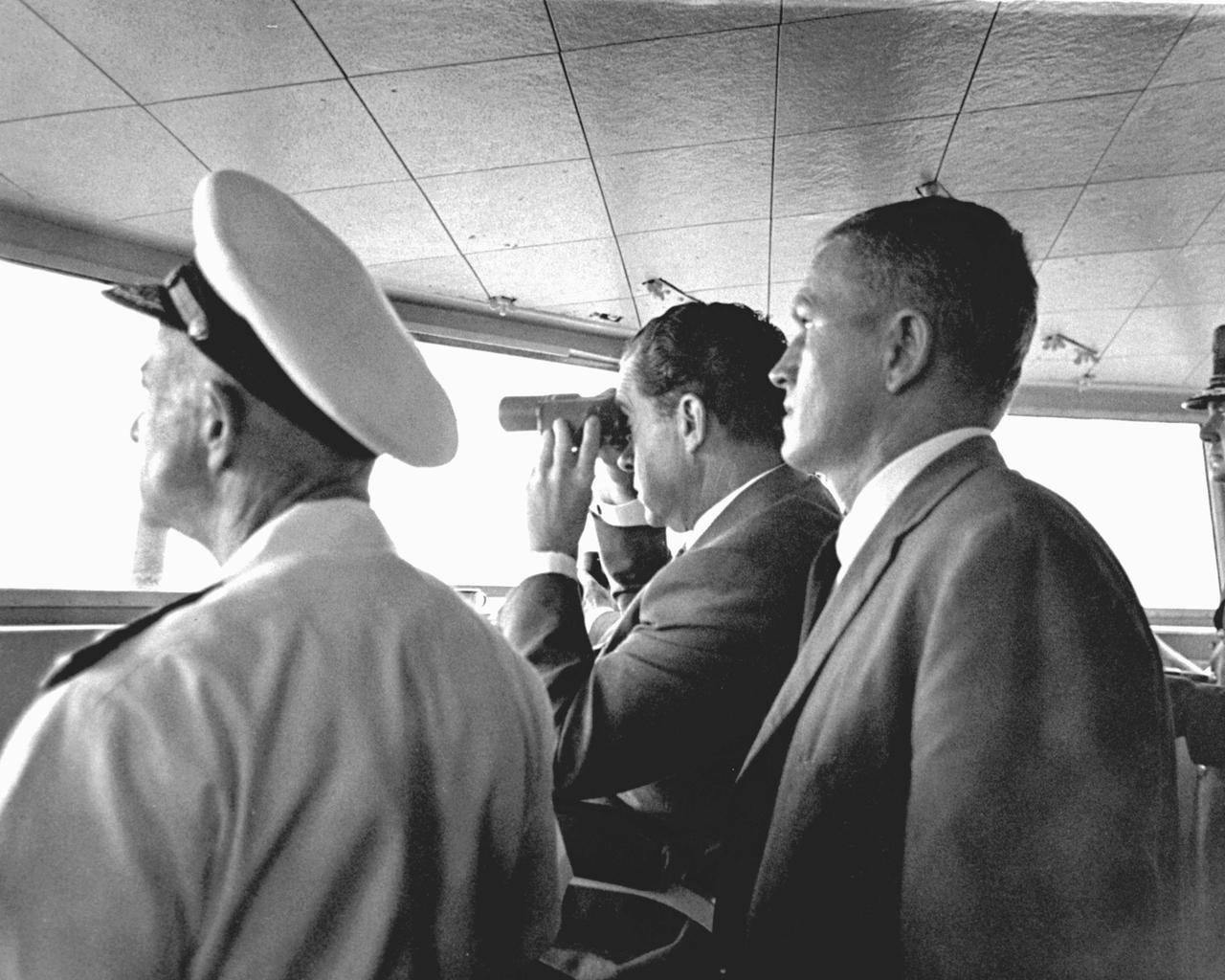
U.S. President Richard Milhous Nixon (center), aboard the U.S.S. Hornet aircraft carrier, used binoculars to watch the Apollo 11 Lunar Mission Recovery. Standing next to the President is astronaut Frank Borman, Apollo 8 Commander. The recovery operation took place in the Pacific Ocean where Navy para-rescue men recovered the capsule housing the 3-man Apollo 11 crew. The crew was airlifted to safety aboard the U.S.S. Hornet where they were quartered in a Mobile Quarantine Facility (MQF) for 21 days post mission. The Apollo 11 mission, the first manned lunar mission, launched from the Kennedy Space Center, Florida via the Saturn V launch vehicle on July 16, 1969 and safely returned to Earth on July 24, 1969. The Saturn V vehicle was developed by the Marshall Space Flight Center (MSFC) under the direction of Dr. Wernher von Braun. Aboard were Neil A. Armstrong, commander; Michael Collins, Command Module (CM) pilot; and Edwin E. Aldrin Jr., Lunar Module (LM) pilot. The CM, piloted by Michael Collins remained in a parking orbit around the Moon while the LM, named “Eagle’’, carrying astronauts Neil Armstrong and Edwin Aldrin, landed on the Moon. Armstrong was the first human to ever stand on the lunar surface, followed by Edwin (Buzz) Aldrin. During 2½ hours of surface exploration, the crew collected 47 pounds of lunar surface material for analysis back on Earth. With the success of Apollo 11, the national objective to land men on the Moon and return them safely to Earth had been accomplished.
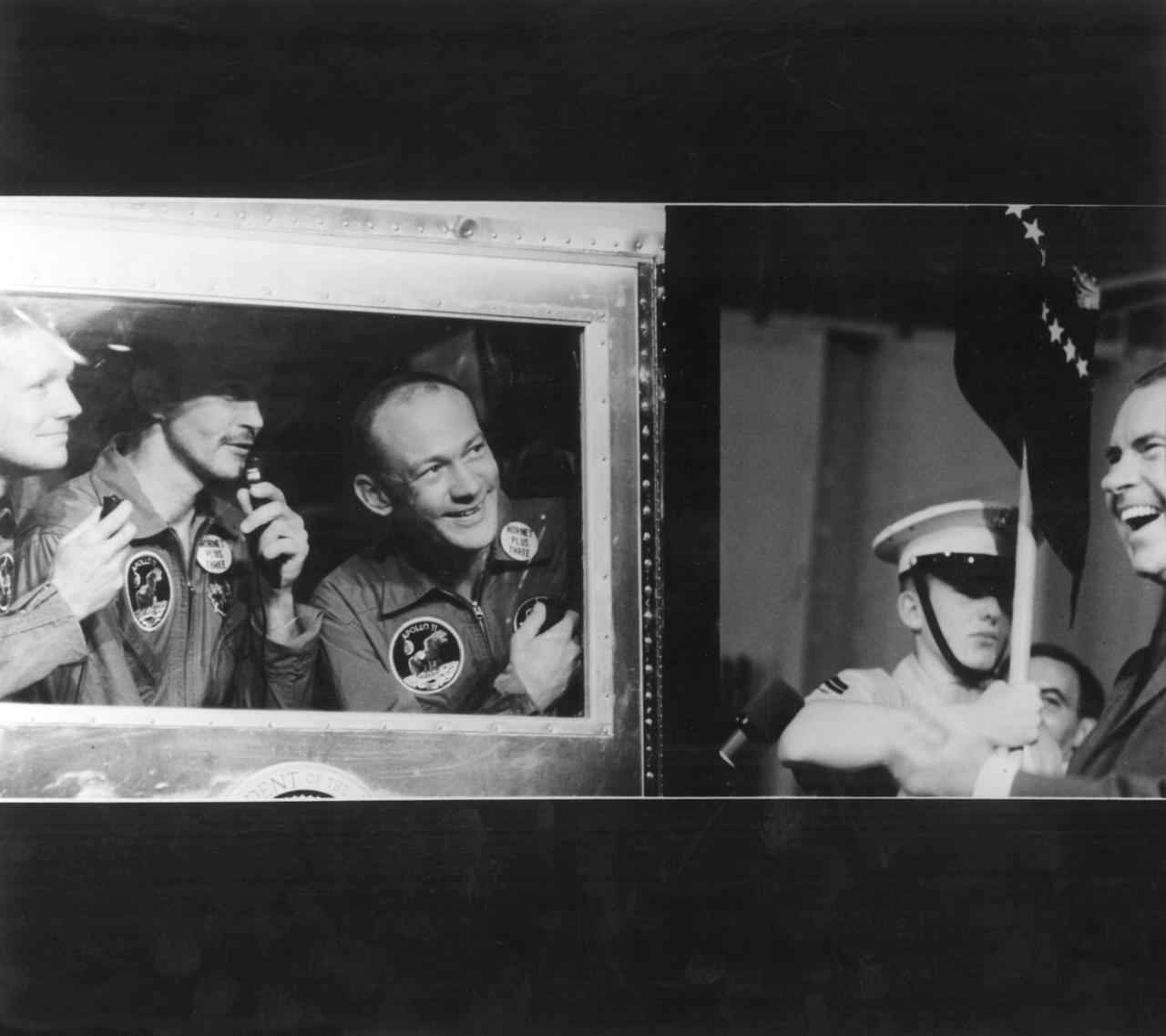
The Apollo 11 mission, the first manned lunar mission, launched from the Kennedy Space Center, Florida via the Marshall Space Flight Center (MSFC) developed Saturn V launch vehicle on July 16, 1969 and safely returned to Earth on July 24, 1969. Aboard the space craft were astronauts Neil A. Armstrong, commander; Michael Collins, Command Module (CM) pilot; and Edwin E. Aldrin Jr., Lunar Module (LM) pilot. The CM, piloted by Michael Collins remained in a parking orbit around the Moon while the LM, named “Eagle’’, carrying astronauts Neil Armstrong and Edwin Aldrin, landed on the Moon. During 2½ hours of surface exploration, the crew collected 47 pounds of lunar surface material for analysis back on Earth. The recovery operation took place in the Pacific Ocean where Navy para-rescue men recovered the capsule housing the 3-man Apollo 11 crew. The crew was airlifted to safety aboard the U.S.S. Hornet, where they were quartered in a Mobile Quarantine Facility (MQF) for 21 days. Here, U.S. President Richard Milhous Nixon gets a good laugh at something being said by Astronaut Collins (center) as astronauts Armstrong (left), and Aldrin (right) listen. The president was aboard the recovery vessel awaiting return of the astronauts. With the success of Apollo 11, the national objective to land men on the Moon and return them safely to Earth had been accomplished.
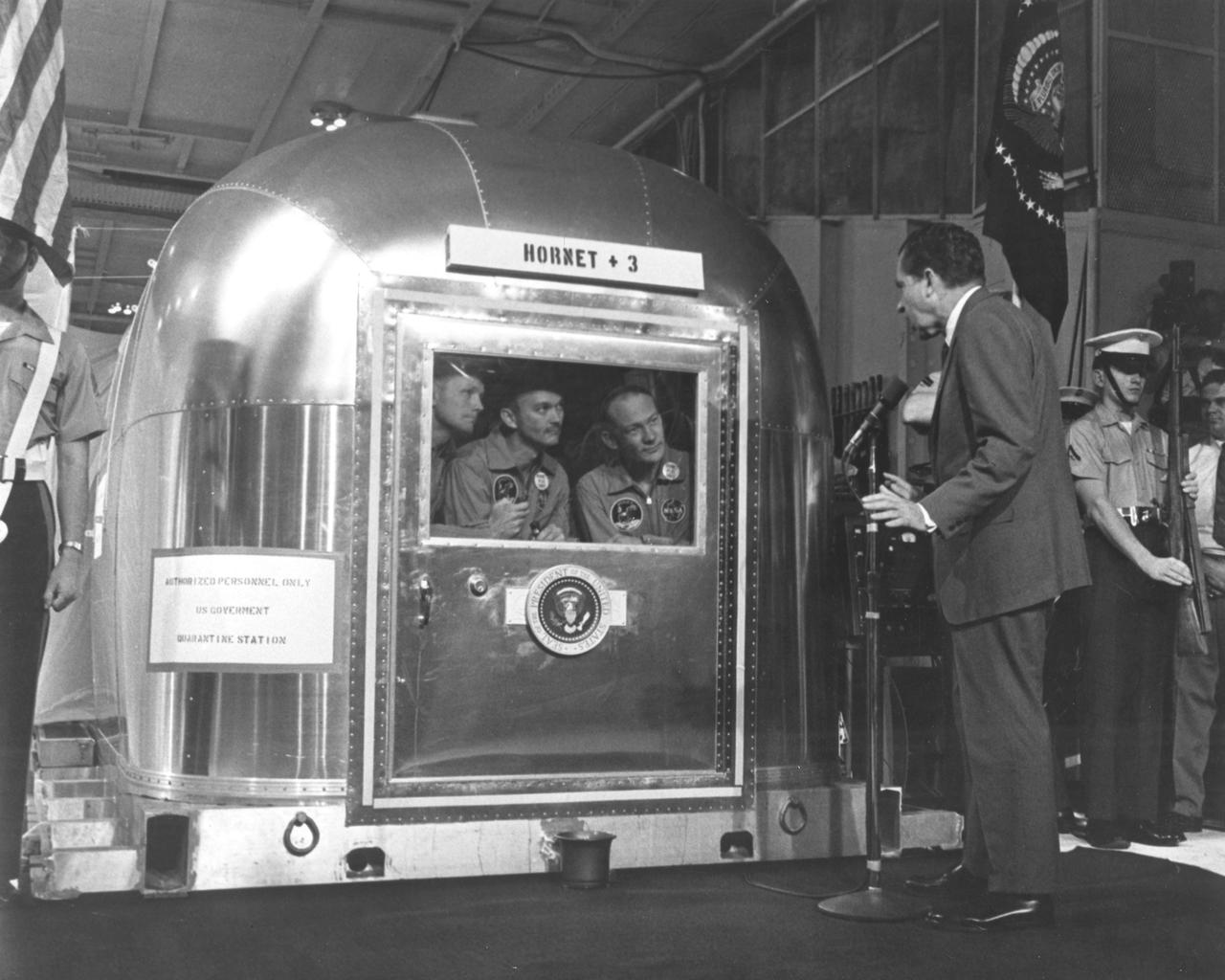
The Apollo 11 mission, the first manned lunar mission, launched from the Kennedy Space Center, Florida via the Saturn V launch vehicle on July 16, 1969 and safely returned to Earth on July 24, 1969. The Saturn V vehicle was developed by the Marshall Space Flight Center (MSFC) under the direction of Dr. Wernher von Braun. Aboard were Neil A. Armstrong, commander; Michael Collins, Command Module (CM) pilot; and Edwin E. Aldrin Jr., Lunar Module (LM) pilot. The CM, piloted by Michael Collins remained in a parking orbit around the Moon while the LM, named “Eagle’’, carrying astronauts Neil Armstrong and Edwin Aldrin, landed on the Moon. Armstrong was the first human to ever stand on the lunar surface, followed by Edwin (Buzz) Aldrin. During 2½ hours of surface exploration, the crew collected 47 pounds of lunar surface material for analysis back on Earth. The recovery operation took place in the Pacific Ocean where Navy para-rescue men recovered the capsule housing the 3-man Apollo 11 crew. The crew was airlifted by helicopter and taken to safety aboard the U.S.S. Hornet, where they were quartered in a Mobile Quarantine Facility (MQF). Shown here are the Apollo 11 crew members (L to R) Neil Armstrong, Michael Collins, and Edwin Aldrin inside the MQF as U.S. President Richard Milhous Nixon speaks to them via intercom. The president was aboard the recovery vessel awaiting return of the astronauts. With the success of Apollo 11, the national objective to land men on the Moon and return them safely to Earth had been accomplished.
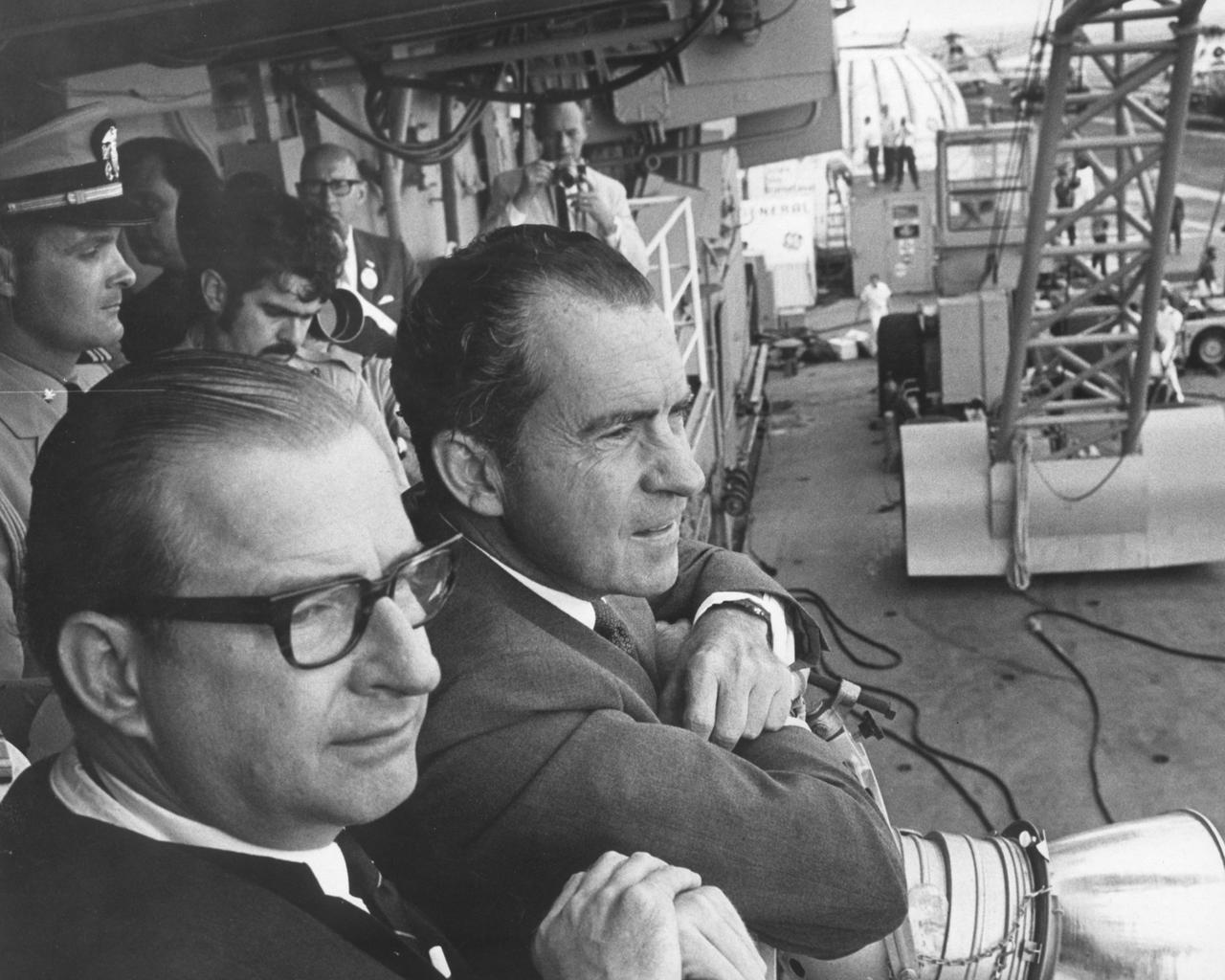
Dr. Thomas Paine, NASA administrator (left) and U.S. President Richard Milhous Nixon wait aboard the recovery ship, the U.S.S. Hornet, for splashdown of the Apollo 11 in the Pacific Ocean. Navy para-rescue men recovered the capsule housing the 3-man crew. The crew was taken to safety aboard the U.S.S. Hornet, where they were quartered in a Mobile Quarantine Facility (MQF). The Apollo 11 mission, the first manned lunar mission, launched from the Kennedy Space Center, Florida via the Saturn V launch vehicle on July 16, 1969 and safely returned to Earth on July 24, 1969. The Saturn V vehicle was developed by the Marshall Space Flight Center (MSFC) under the direction of Dr. Wernher von Braun. Aboard were Neil A. Armstrong, commander; Michael Collins, Command Module (CM) pilot; and Edwin E. Aldrin Jr., Lunar Module (LM) pilot. The CM, piloted by Michael Collins remained in a parking orbit around the Moon while the LM, named “Eagle’’, carrying astronauts Neil Armstrong and Edwin Aldrin, landed on the Moon. Armstrong was the first human to ever stand on the lunar surface, followed by Edwin (Buzz) Aldrin. During 2½ hours of surface exploration, the crew collected 47 pounds of lunar surface material for analysis back on Earth. With the success of Apollo 11, the national objective to land men on the Moon and return them safely to Earth had been accomplished.